IChO 2016 · Theory problem 6
Synthesis of galantamine
Although there is currently no known cure for Alzheimer’s disease, there are medications available to manage the neurodegenerative disorder. Among these are acetylcholinesterase inhibitors, of which galantamine 1 is an example. This molecule can be isolated from the Caucasian snowdrop, a plant native to Georgia; however, the large amounts needed for therapy require a synthetic route. Shown below is the route used to prepare galantamine industrially.
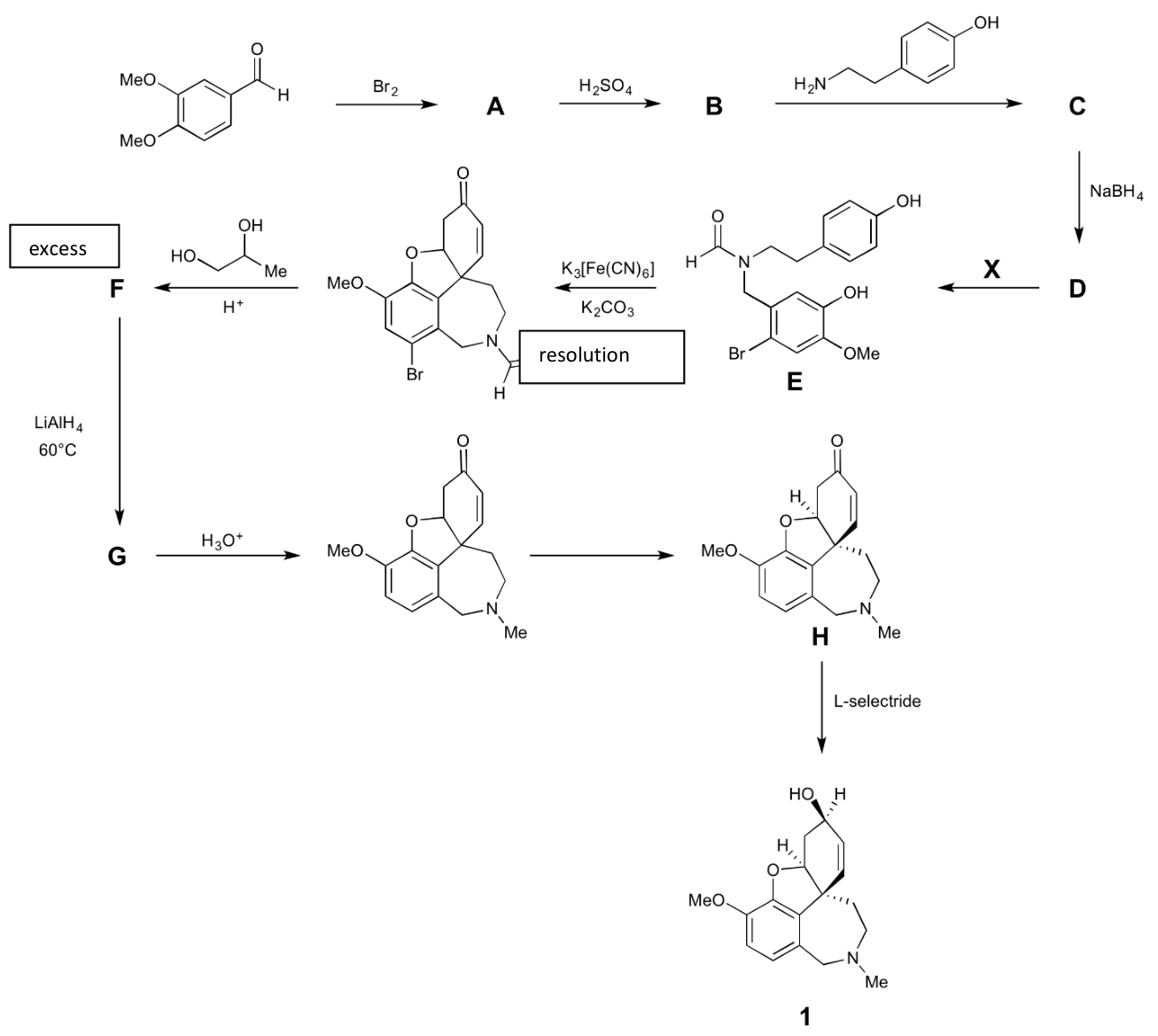
Notes about the synthesis:
- \(\ce{^1H}\) NMR of A indicates 2 aromatic protons in a para arrangement.
- C is labile in aqueous conditions, so it is not isolated, but rather reacted immediately with \(\ce{NaBH4}\) to convert it to D.
6.1.1 Suggest structures for A, B, C, D, F, and G. None of the reactions except for the final transformation with L-selectride are stereoselective. Therefore, stereochemistry does not need to be indicated in your answers.
6.1.2 Give the formula for a possible reagent, X, to convert compound D to E.
The optical rotation of the material obtained by resolution was \(-400^\circ\ \mathrm{cm^2\,g^{-1}}\), while that of the enantiomerically pure compound is \(-415^\circ\ \mathrm{cm^2\,g^{-1}}\) when measured under the same conditions. You may assume that the only optical impurity is the other enantiomer.
One way of describing optical purity is enantiomeric excess (\(ee\)). It is defined as the difference in the percentages of the enantiomers in a mixture. For example in a mixture of 70% \(R\) and 30% \(S\), the \(ee\) is 40%.
6.2.1 What is the enantiomeric excess of the resolved compound as prepared by the industrial route?
L-selectride is a commercial reagent that performs the final reaction stereoselectively.
6.2.2 Assign the labelled stereocentres \((\alpha,\beta,\gamma)\) in (−)-1 as \(R\) or \(S\).
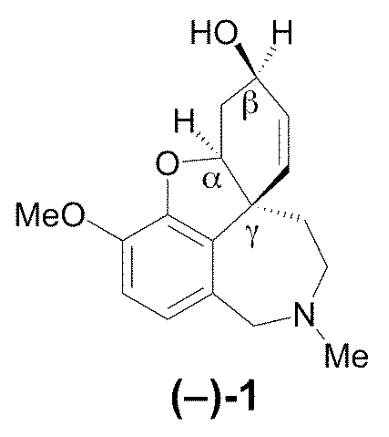
6.2.3 Give the formula for a reagent that carries out the same reaction as L-selectride, converting H to 1. You need not worry about stereoselectivity.
An alternative route to galantamine occurs with the seven-membered ring being the last ring to form.
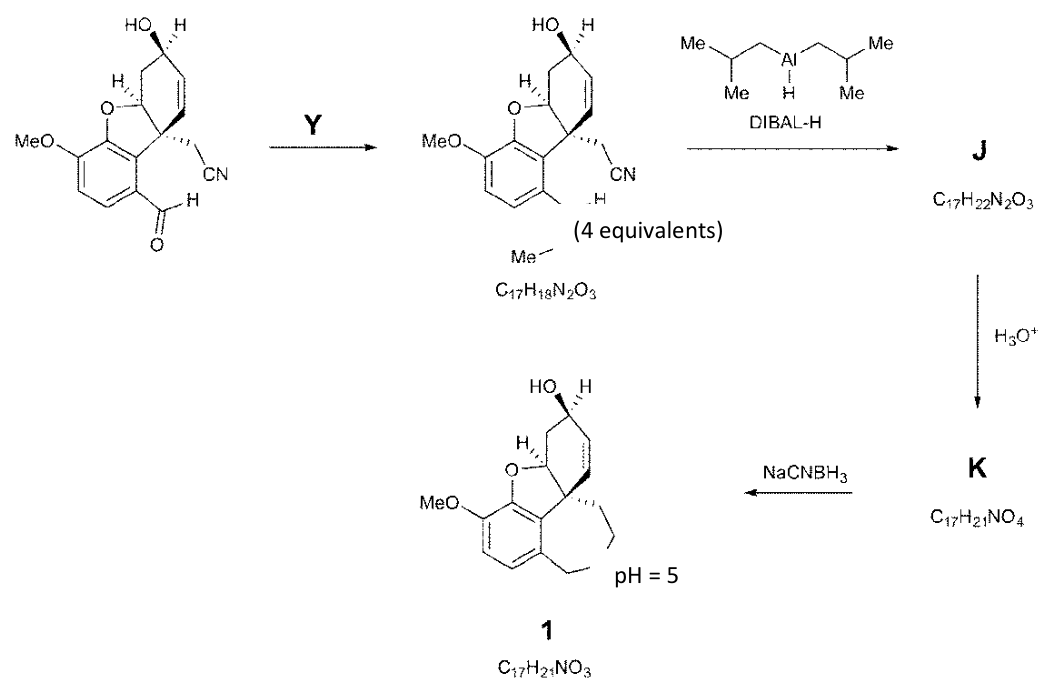
6.3.1 Give the formula for compound Y to carry out the first step of the route.
6.3.2 Suggest structures for J and K.
Official English text of the problem.
Answers
Names for the unnamed polycyclic intermediates below are descriptive; their SMILES specify the complete structures.
- 6.1.1
| Compound | Identification | SMILES |
|---|---|---|
| A | 2-Bromo-4,5-dimethoxybenzaldehyde | COc1cc(Br)c(C=O)cc1OC |
| B | 2-Bromo-5-hydroxy-4-methoxybenzaldehyde | COc1cc(Br)c(C=O)cc1O |
| C | N-(2-Bromo-5-hydroxy-4-methoxybenzylidene)-2-(4-hydroxyphenyl)ethan-1-amine; the Schiff base of B and tyramine | COc1cc(Br)c(C=NCCc2ccc(O)cc2)cc1O |
| D | N-(2-Bromo-5-hydroxy-4-methoxybenzyl)-2-(4-hydroxyphenyl)ethan-1-amine | COc1cc(Br)c(CNCCc2ccc(O)cc2)cc1O |
| F | Propane-1,2-diol ketal of the depicted brominated N-formyl ketone | COc1cc(Br)c2CN(C=O)CCC34C=CC5(OCC(C)O5)CC3Oc1c24 |
| G | Narwedine propane-1,2-diol ketal: the debrominated, N-methyl analogue of F | COc1ccc2CN(C)CCC34C=CC5(OCC(C)O5)CC3Oc1c24 |
-
6.1.2 A suitable X is ethyl formate, \(\ce{HCOOC2H5}\),
CCOC=O, with heating. -
6.2.1 \[ \boxed{ee=96.4\%} \] in favour of the negatively rotating enantiomer.
-
6.2.2 \[ \boxed{\alpha=S,\qquad \beta=R,\qquad \gamma=S.} \] (−)-Galantamine, with these configurations:
COc1ccc2CN(C)CC[C@@]34C=C[C@H](O)C[C@@H]3Oc1c24 -
6.2.3 Sodium borohydride, \(\ce{NaBH4}\),
[Na+].[BH4-]. -
6.3.1 Y is methylamine, \(\ce{CH3NH2}\),
CN. -
6.3.2
J — tricyclic amino-imine, \(\ce{C17H22N2O3}\): the aromatic substituent is methylaminomethyl, and the substituent on \(\gamma\) is 2-iminoethyl.
COc1ccc(CNC)c2c1O[C@H]1C[C@@H](O)C=C[C@]12CC=N
K — tricyclic amino-aldehyde, \(\ce{C17H21NO4}\): the aromatic substituent remains methylaminomethyl, and the substituent on \(\gamma\) is 2-oxoethyl.
COc1ccc(CNC)c2c1O[C@H]1C[C@@H](O)C=C[C@]12CC=O
Solution
Hydride reductions below are written as balanced net equations for the organic transformation, including protonation during work-up. A hydride equivalent is represented by \(\ce{H^-}\), [H-], and a proton by \(\ce{H+}\), [H+].
6.1.1 — Identification of A, B, C, D, F, and G
A: aromatic bromination. The starting compound is veratraldehyde, or 3,4-dimethoxybenzaldehyde, COc1ccc(C=O)cc1OC.
Numbering the starting ring with the aldehyde-bearing carbon as position 1 and the methoxy groups at positions 3 and 4, its aromatic hydrogens occupy positions 2, 5, and 6. The hydrogens at positions 2 and 5 are para to one another. Therefore, bromination must replace the hydrogen at position 6.
Renumbering the product to give the lowest substituent locants gives 2-bromo-4,5-dimethoxybenzaldehyde, A. Its remaining aromatic hydrogens are at positions 3 and 6, again a para pair.
Bromine, BrBr, gives hydrogen bromide, Br, as the substitution by-product:
\[ \ce{C9H10O3 + Br2 -> C9H9BrO3 + HBr}. \]
B: selective O-demethylation. Sulfuric acid, \(\ce{H2SO4}\), OS(=O)(=O)O, cleaves one aryl methyl ether. The structure of E identifies which one: relative to the benzyl substituent, its phenolic hydroxyl is meta and its remaining methoxy group is para.
Thus B has hydroxyl at position 5 and methoxy at position 4. The net equation after aqueous work-up is
\[ \ce{C9H9BrO3 + H2O ->[H2SO4] C8H7BrO3 + CH3OH}, \]
where water is O and methanol is CO.
C: imine formation. The amine reagent is tyramine, 2-(4-hydroxyphenyl)ethan-1-amine, NCCc1ccc(O)cc1.
Its primary amino group condenses with the aldehyde of B, eliminating water and forming the Schiff base C:
\[ \ce{C8H7BrO3 + C8H11NO -> C16H16BrNO3 + H2O}. \]
The new linkage is an imine between the former aldehyde carbon and the tyramine nitrogen. Imine formation is reversible in water, explaining why C is not isolated.
D: reduction of the imine. Sodium borohydride delivers hydride to the imine carbon; protonation gives the secondary amine D:
\[ \ce{C16H16BrNO3 + H^- + H+ -> C16H18BrNO3}. \]
The aldehyde-derived carbon therefore becomes a benzyl methylene bonded to nitrogen.
F: protection of the cyclic ketone. The supplied oxidative cyclization of E produces the brominated N-formyl tetracyclic ketone:
COc1cc(Br)c2CN(C=O)CCC34C=CC(=O)CC3Oc1c24
Its formula is \(\ce{C17H16BrNO4}\). The organic oxidation half-equation is
\[ \ce{C17H18BrNO4 -> C17H16BrNO4 + 2H+ + 2e^-}. \]
The diol shown is propane-1,2-diol, CC(O)CO. Under acid catalysis, its two hydroxyl groups react with the cyclic ketone to form F:
\[ \ce{C17H16BrNO4 + C3H8O2 <=>[H^+] C20H22BrNO5 + H2O}. \]
To draw F, retain the entire depicted skeleton, including bromine and the N-formyl group, and replace the ketone with a cyclic ketal. The former carbonyl carbon bonds to both diol oxygens, forming a five-membered 4-methyl-1,3-dioxolane ring. This ring shares only the former carbonyl carbon with the six-membered ring: it is a spiro ketal.
G: amide reduction and debromination. Excess lithium aluminium hydride, \(\ce{LiAlH4}\), [Li+].[AlH4-], at the stated temperature effects two changes:
- The N-formyl group becomes N-methyl; the formyl carbon is retained.
- The aryl bromine is replaced by hydrogen.
The ketal protects the cyclic ketone during these reductions. Thus G has the same ketal as F, but an N-methyl group and no bromine.
The balanced net transformation, with bromide [Br-] as the halogen-containing product, is
\[ \ce{C20H22BrNO5 + 3H^- + 2H+ -> C20H25NO4 + Br^- + H2O}. \]
The subsequent acid treatment hydrolyses the ketal, regenerating narwedine, the unresolved ketone preceding H:
COc1ccc2CN(C)CCC34C=CC(=O)CC3Oc1c24
\[ \ce{C20H25NO4 + H2O ->[H^+] C17H19NO3 + C3H8O2}. \]
This also confirms that G must already be debrominated and N-methylated.
6.1.2 — Reagent X
Comparing D and E, the secondary amine has acquired a formyl group.
E is N-(2-bromo-5-hydroxy-4-methoxybenzyl)-N-[2-(4-hydroxyphenyl)ethyl]formamide:
COc1cc(Br)c(CN(C=O)CCc2ccc(O)cc2)cc1O
A suitable reagent is ethyl formate, \(\ce{HCOOC2H5}\), CCOC=O. Heating with the secondary amine gives the formamide by nucleophilic acyl substitution, releasing ethanol, CCO:
\[ \ce{C16H18BrNO3 + HCOOC2H5 -> C17H18BrNO4 + C2H5OH}. \]
6.2.1 — Enantiomeric excess
Enantiomers have equal and opposite specific rotations under identical conditions. If \(x\) is the mole fraction of the negatively rotating enantiomer,
\[ [\alpha]_{\mathrm{mix}} =x[\alpha]_{(-)}+(1-x)[\alpha]_{(+)} =(2x-1)[\alpha]_{(-)}. \]
Hence
\[ ee =\left|\frac{[\alpha]_{\mathrm{mix}}} {[\alpha]_{\mathrm{pure}}}\right|\times100\% =\frac{400^\circ\ \mathrm{cm^2\,g^{-1}}} {415^\circ\ \mathrm{cm^2\,g^{-1}}}\times100\% =\boxed{96.4\%}. \]
The corresponding enantiomer proportions are
\[ x_{(-)}=\frac{1+400/415}{2}=0.98193, \qquad x_{(+)}=\frac{1-400/415}{2}=0.01807. \]
Thus the material contains approximately 98.2% negatively rotating enantiomer and 1.8% positively rotating enantiomer.
6.2.2 — Absolute configurations
Apply the Cahn–Ingold–Prelog rules, including duplicate atoms when comparing double bonds and aromatic bonds.
| Centre | Priorities, highest to lowest | Configuration |
|---|---|---|
| \(\alpha\) | Ether oxygen; carbon \(\gamma\); methylene leading towards \(\beta\); hydrogen | \(S\) |
| \(\beta\) | Hydroxyl oxygen; alkenyl carbon; saturated methylene leading towards \(\alpha\); hydrogen | \(R\) |
| \(\gamma\) | Oxygen-bearing carbon \(\alpha\); aromatic carbon; alkenyl carbon; methylene leading towards nitrogen | \(S\) |
At \(\alpha\), the carbon \(\gamma\) outranks the methylene because it is attached to three carbons, whereas the methylene is attached to one carbon and two hydrogens. With the dashed hydrogen directed away, priorities \(1\to2\to3\) run anticlockwise: \(S\).
At \(\beta\), the alkenyl path outranks the saturated methylene path because of the double-bond duplicate-atom rule. With hydrogen away, \(1\to2\to3\) runs clockwise: \(R\).
At \(\gamma\), the oxygen-bearing path has first priority. The aromatic path outranks the alkenyl path, which outranks the saturated side chain. The dashed side chain is the lowest-priority substituent and points away; \(1\to2\to3\) runs anticlockwise: \(S\).
Therefore,
\[ \boxed{(\alpha,\beta,\gamma)=(S,R,S)}. \]
6.2.3 — Alternative reducing reagent
Sodium borohydride, \(\ce{NaBH4}\), [Na+].[BH4-], reduces the ketone to an allylic alcohol.
The resolved ketone H, (−)-narwedine, is
COc1ccc2CN(C)CC[C@@]34C=CC(=O)C[C@@H]3Oc1c24
The net reduction is
\[ \ce{C17H19NO3 + H^- + H+ -> C17H21NO3}. \]
The carbonyl oxygen becomes the alcohol oxygen, while the carbon–carbon double bond remains. Without stereoselective control, reduction need not give exclusively the required configuration at \(\beta\), as allowed by the question.
6.3.1 — Identification of Y
The first step converts an aromatic aldehyde into an N-methyl imine. Therefore Y is methylamine, \(\ce{CH3NH2}\), CN.
The starting tricyclic cyano aldehyde is
COc1ccc(C=O)c2c1O[C@H]1C[C@@H](O)C=C[C@]12CC#N
The resulting tricyclic N-methyl imine is
COc1ccc(C=NC)c2c1O[C@H]1C[C@@H](O)C=C[C@]12CC#N
Its formation is a condensation:
\[ \ce{C16H15NO4 + CH3NH2 -> C17H18N2O3 + H2O}. \]
The nitrile and the existing three stereocentres remain unchanged. Imine \(E/Z\) geometry is not specified.
6.3.2 — Identification of J and K
Formation of J. Diisobutylaluminium hydride, DIBAL-H, has the monomeric-unit connectivity CC(C)C[AlH]CC(C)C, corresponding to the reagent drawing.
The organic structures and formulas require two reductions:
- The preformed N-methyl imine becomes the secondary methylaminomethyl group.
- The nitrile becomes a terminal primary imine.
Each transformation adds two hydrogen atoms to the neutral organic product. Thus
\[ \ce{C17H18N2O3 + 2H^- + 2H+ -> C17H22N2O3}. \]
Consequently, J has an aromatic methylaminomethyl substituent and a bridgehead 2-iminoethyl substituent:
COc1ccc(CNC)c2c1O[C@H]1C[C@@H](O)C=C[C@]12CC=N
This represents the neutral organic imine specified by the question’s formula; aluminium coordination is omitted.
Formation of K. Acidic hydrolysis converts the terminal imine into an aldehyde. K retains all 17 carbon atoms but contains only one nitrogen. This identifies the nitrogen lost during hydrolysis as the terminal imine nitrogen; the N-methyl group remains in the molecule.
Writing K in the neutral form used in the question, the balanced hydrolysis with hydronium, [OH3+], gives ammonium, [NH4+]:
\[ \ce{C17H22N2O3 + H3O+ -> C17H21NO4 + NH4+}. \]
Thus K is
COc1ccc(CNC)c2c1O[C@H]1C[C@@H](O)C=C[C@]12CC=O
To draw it, retain the stereochemistry and tricyclic core shown in the starting material. Place a methylaminomethyl group at the original aromatic aldehyde position and replace the original cyanomethyl side chain with a 2-oxoethyl side chain.
Closure to galantamine. The secondary amine of K attacks its aldehyde intramolecularly. Formation of a seven-membered cyclic iminium ion, followed by reduction with sodium cyanoborohydride, \(\ce{NaCNBH3}\), [Na+].[BH3-]C#N, gives galantamine.
The net reductive amination is
\[ \ce{C17H21NO4 + H^- + H+ -> C17H21NO3 + H2O}. \]
The aldehyde carbon becomes the methylene bonded to nitrogen in the completed seven-membered ring. The configurations at \(\alpha\), \(\beta\), and \(\gamma\) are retained.
The answers were checked against the official answers published by the organisers.
IChO 2016 · Theorieaufgabe 6
Synthese von Galantamin
Obwohl derzeit keine Heilung für die Alzheimer-Krankheit bekannt ist, stehen Medikamente zur Behandlung dieser neurodegenerativen Erkrankung zur Verfügung. Dazu gehören Acetylcholinesterase-Hemmer, zu denen beispielsweise Galantamin 1 zählt. Dieses Molekül kann aus dem Kaukasischen Schneeglöckchen, einer in Georgien heimischen Pflanze, isoliert werden; die für die Therapie benötigten großen Mengen erfordern jedoch einen Syntheseweg. Nachstehend ist der zur industriellen Herstellung von Galantamin verwendete Syntheseweg dargestellt.
Hinweise zur Synthese:
- Das \(\ce{^1H}\)-NMR-Spektrum von A zeigt 2 aromatische Protonen in para-Stellung zueinander.
- C ist unter wässrigen Bedingungen labil und wird daher nicht isoliert, sondern sofort mit \(\ce{NaBH4}\) umgesetzt, um es in D umzuwandeln.
6.1.1 Schlagen Sie Strukturen für A, B, C, D, F, und G vor. Mit Ausnahme der letzten Umsetzung mit L-Selectrid ist keine der Reaktionen stereoselektiv. Daher muss die Stereochemie in Ihren Antworten nicht angegeben werden.
6.1.2 Geben Sie die Formel eines geeigneten Reagenzes X zur Umwandlung der Verbindung D in E an.
Die optische Drehung des durch Racematspaltung erhaltenen Materials betrug \(-400^\circ\ \mathrm{cm^2\,g^{-1}}\), während diejenige der enantiomerenreinen Verbindung bei Messung unter denselben Bedingungen \(-415^\circ\ \mathrm{cm^2\,g^{-1}}\) beträgt. Sie dürfen annehmen, dass die einzige optisch aktive Verunreinigung das andere Enantiomer ist.
Eine Möglichkeit zur Beschreibung der optischen Reinheit ist der Enantiomerenüberschuss (\(ee\)). Er ist als Differenz der prozentualen Anteile der Enantiomere in einem Gemisch definiert. Beispielsweise beträgt der \(ee\) in einem Gemisch aus 70% \(R\) und 30% \(S\) 40%.
6.2.1 Wie groß ist der Enantiomerenüberschuss der durch Racematspaltung im industriellen Syntheseweg erhaltenen Verbindung?
L-Selectrid ist ein handelsübliches Reagenz, das die letzte Reaktion stereoselektiv durchführt.
6.2.2 Ordnen Sie den markierten Stereozentren \((\alpha,\beta,\gamma)\) in (−)-1 jeweils die Konfiguration \(R\) oder \(S\) zu.
6.2.3 Geben Sie die Formel eines Reagenzes an, das dieselbe Reaktion wie L-Selectrid durchführt und H in 1 umwandelt. Die Stereoselektivität brauchen Sie nicht zu berücksichtigen.
Bei einem alternativen Syntheseweg zu Galantamin wird der siebengliedrige Ring als letzter Ring gebildet.
6.3.1 Geben Sie die Formel der Verbindung Y an, mit der der erste Schritt dieses Synthesewegs durchgeführt werden kann.
6.3.2 Schlagen Sie Strukturen für J und K vor.
Aufgabentext aus dem offiziellen englischen Text übersetzt.
Antworten
Die Namen der nachstehend aufgeführten unbenannten polycyclischen Zwischenprodukte sind beschreibend; ihre SMILES geben die vollständigen Strukturen an.
- 6.1.1
| Verbindung | Identifizierung | SMILES |
|---|---|---|
| A | 2-Brom-4,5-dimethoxybenzaldehyd | COc1cc(Br)c(C=O)cc1OC |
| B | 2-Brom-5-hydroxy-4-methoxybenzaldehyd | COc1cc(Br)c(C=O)cc1O |
| C | N-(2-Brom-5-hydroxy-4-methoxybenzyliden)-2-(4-hydroxyphenyl)ethan-1-amin; die Schiff-Base aus B und Tyramin | COc1cc(Br)c(C=NCCc2ccc(O)cc2)cc1O |
| D | N-(2-Brom-5-hydroxy-4-methoxybenzyl)-2-(4-hydroxyphenyl)ethan-1-amin | COc1cc(Br)c(CNCCc2ccc(O)cc2)cc1O |
| F | Propan-1,2-diol-Ketal des abgebildeten bromierten N-Formylketons | COc1cc(Br)c2CN(C=O)CCC34C=CC5(OCC(C)O5)CC3Oc1c24 |
| G | Narwedin-Propan-1,2-diol-Ketal: das debromierte N-Methyl-Analogon von F | COc1ccc2CN(C)CCC34C=CC5(OCC(C)O5)CC3Oc1c24 |
-
6.1.2 Ein geeignetes X ist Ameisensäureethylester, \(\ce{HCOOC2H5}\),
CCOC=O, unter Erwärmen. -
6.2.1 \[ \boxed{ee=96.4\%} \] zugunsten des linksdrehenden Enantiomers.
-
6.2.2 \[ \boxed{\alpha=S,\qquad \beta=R,\qquad \gamma=S.} \] (−)-Galantamin, mit diesen Konfigurationen:
COc1ccc2CN(C)CC[C@@]34C=C[C@H](O)C[C@@H]3Oc1c24 -
6.2.3 Natriumborhydrid, \(\ce{NaBH4}\),
[Na+].[BH4-]. -
6.3.1 Y ist Methylamin, \(\ce{CH3NH2}\),
CN. -
6.3.2
J — tricyclisches Aminoimin, \(\ce{C17H22N2O3}\): Der aromatische Substituent ist Methylaminomethyl, und der Substituent an \(\gamma\) ist 2-Iminoethyl.
COc1ccc(CNC)c2c1O[C@H]1C[C@@H](O)C=C[C@]12CC=N
K — tricyclischer Aminoaldehyd, \(\ce{C17H21NO4}\): Der aromatische Substituent bleibt Methylaminomethyl, und der Substituent an \(\gamma\) ist 2-Oxoethyl.
COc1ccc(CNC)c2c1O[C@H]1C[C@@H](O)C=C[C@]12CC=O
Lösung
Die nachstehenden Hydridreduktionen sind als ausgeglichene Nettogleichungen für die organische Umsetzung einschließlich der Protonierung bei der Aufarbeitung angegeben. Ein Hydridäquivalent wird durch \(\ce{H^-}\), [H-], und ein Proton durch \(\ce{H+}\), [H+], dargestellt.
6.1.1 — Identifizierung von A, B, C, D, F und G
A: aromatische Bromierung. Die Ausgangsverbindung ist Veratrumaldehyd, auch 3,4-Dimethoxybenzaldehyd genannt, COc1ccc(C=O)cc1OC.
Nummeriert man den Ausgangsring so, dass das die Aldehydgruppe tragende Kohlenstoffatom die Position 1 einnimmt und die Methoxygruppen an den Positionen 3 und 4 stehen, befinden sich seine aromatischen Wasserstoffatome an den Positionen 2, 5 und 6. Die Wasserstoffatome an den Positionen 2 und 5 stehen para zueinander. Daher muss bei der Bromierung das Wasserstoffatom an Position 6 ersetzt werden.
Eine Neunummerierung des Produkts zur Vergabe der niedrigsten Substituentenlokanten ergibt 2-Brom-4,5-dimethoxybenzaldehyd, A. Seine verbleibenden aromatischen Wasserstoffatome befinden sich an den Positionen 3 und 6 und bilden wiederum ein para-ständiges Paar.
Brom, BrBr, liefert Bromwasserstoff, Br, als Nebenprodukt der Substitution:
\[ \ce{C9H10O3 + Br2 -> C9H9BrO3 + HBr}. \]
B: selektive O-Demethylierung. Schwefelsäure, \(\ce{H2SO4}\), OS(=O)(=O)O, spaltet einen Arylmethylether. Aus der Struktur von E geht hervor, welcher gespalten wird: Bezogen auf den Benzylsubstituenten steht seine phenolische Hydroxygruppe in meta-Stellung und seine verbleibende Methoxygruppe in para-Stellung.
Somit besitzt B eine Hydroxygruppe an Position 5 und eine Methoxygruppe an Position 4. Die Nettogleichung nach wässriger Aufarbeitung lautet
\[ \ce{C9H9BrO3 + H2O ->[H2SO4] C8H7BrO3 + CH3OH}, \]
wobei Wasser durch O und Methanol durch CO dargestellt wird.
C: Iminbildung. Das Aminreagenz ist Tyramin, 2-(4-Hydroxyphenyl)ethan-1-amin, NCCc1ccc(O)cc1.
Seine primäre Aminogruppe kondensiert mit der Aldehydgruppe von B, wobei Wasser abgespalten und die Schiff-Base C gebildet wird:
\[ \ce{C8H7BrO3 + C8H11NO -> C16H16BrNO3 + H2O}. \]
Die neue Verknüpfung ist eine Iminbindung zwischen dem ursprünglichen Aldehydkohlenstoff und dem Stickstoff des Tyramins. Die Iminbildung ist in Wasser reversibel, was erklärt, warum C nicht isoliert wird.
D: Reduktion des Imins. Natriumborhydrid überträgt Hydrid auf den Iminkohlenstoff; durch Protonierung entsteht das sekundäre Amin D:
\[ \ce{C16H16BrNO3 + H^- + H+ -> C16H18BrNO3}. \]
Der aus der Aldehydgruppe stammende Kohlenstoff wird somit zu einer benzylischen Methylengruppe, die an Stickstoff gebunden ist.
F: Schutz des cyclischen Ketons. Die vorgegebene oxidative Cyclisierung von E ergibt das bromierte tetracyclische N-Formylketon:
COc1cc(Br)c2CN(C=O)CCC34C=CC(=O)CC3Oc1c24
Seine Formel lautet \(\ce{C17H16BrNO4}\). Die Oxidationshalbgleichung für die organische Verbindung lautet
\[ \ce{C17H18BrNO4 -> C17H16BrNO4 + 2H+ + 2e^-}. \]
Das gezeigte Diol ist Propan-1,2-diol, CC(O)CO. Unter Säurekatalyse reagieren seine beiden Hydroxygruppen mit dem cyclischen Keton zu F:
\[ \ce{C17H16BrNO4 + C3H8O2 <=>[H^+] C20H22BrNO5 + H2O}. \]
Um F zu zeichnen, behalten Sie das gesamte abgebildete Grundgerüst einschließlich Brom und N-Formylgruppe bei und ersetzen Sie die Ketongruppe durch ein cyclisches Ketal. Der ursprüngliche Carbonylkohlenstoff bindet an beide Sauerstoffatome des Diols, wodurch ein fünfgliedriger 4-Methyl-1,3-dioxolanring entsteht. Dieser Ring hat mit dem sechsgliedrigen Ring nur den ursprünglichen Carbonylkohlenstoff gemeinsam: Es handelt sich um ein Spiroketal.
G: Amidreduktion und Debromierung. Überschüssiges Lithiumaluminiumhydrid, \(\ce{LiAlH4}\), [Li+].[AlH4-], bewirkt bei der angegebenen Temperatur zwei Veränderungen:
- Die N-Formylgruppe wird zur N-Methylgruppe; der Formylkohlenstoff bleibt erhalten.
- Das am Aromaten gebundene Brom wird durch Wasserstoff ersetzt.
Das Ketal schützt das cyclische Keton während dieser Reduktionen. Somit besitzt G dasselbe Ketal wie F, jedoch eine N-Methylgruppe und kein Brom.
Die ausgeglichene Nettoumsetzung mit Bromid [Br-] als halogenhaltigem Produkt lautet
\[ \ce{C20H22BrNO5 + 3H^- + 2H+ -> C20H25NO4 + Br^- + H2O}. \]
Die anschließende Säurebehandlung hydrolysiert das Ketal und bildet Narwedin zurück, das noch nicht durch Racematspaltung getrennte Keton vor H:
COc1ccc2CN(C)CCC34C=CC(=O)CC3Oc1c24
\[ \ce{C20H25NO4 + H2O ->[H^+] C17H19NO3 + C3H8O2}. \]
Dies bestätigt auch, dass G bereits debromiert und N-methyliert sein muss.
6.1.2 — Reagenz X
Der Vergleich von D und E zeigt, dass das sekundäre Amin eine Formylgruppe aufgenommen hat.
E ist N-(2-Brom-5-hydroxy-4-methoxybenzyl)-N-[2-(4-hydroxyphenyl)ethyl]formamid:
COc1cc(Br)c(CN(C=O)CCc2ccc(O)cc2)cc1O
Ein geeignetes Reagenz ist Ameisensäureethylester, \(\ce{HCOOC2H5}\), CCOC=O. Beim Erwärmen mit dem sekundären Amin entsteht durch nucleophile Acylsubstitution das Formamid unter Freisetzung von Ethanol, CCO:
\[ \ce{C16H18BrNO3 + HCOOC2H5 -> C17H18BrNO4 + C2H5OH}. \]
6.2.1 — Enantiomerenüberschuss
Enantiomere besitzen unter identischen Bedingungen betragsgleiche spezifische Drehungen mit entgegengesetztem Vorzeichen. Wenn \(x\) der Stoffmengenanteil des linksdrehenden Enantiomers ist, gilt
\[ [\alpha]_{\mathrm{mix}} =x[\alpha]_{(-)}+(1-x)[\alpha]_{(+)} =(2x-1)[\alpha]_{(-)}. \]
Daraus folgt
\[ ee =\left|\frac{[\alpha]_{\mathrm{mix}}} {[\alpha]_{\mathrm{pure}}}\right|\times100\% =\frac{400^\circ\ \mathrm{cm^2\,g^{-1}}} {415^\circ\ \mathrm{cm^2\,g^{-1}}}\times100\% =\boxed{96.4\%}. \]
Die entsprechenden Enantiomerenanteile sind
\[ x_{(-)}=\frac{1+400/415}{2}=0.98193, \qquad x_{(+)}=\frac{1-400/415}{2}=0.01807. \]
Somit enthält das Material ungefähr 98.2% linksdrehendes Enantiomer und 1.8% rechtsdrehendes Enantiomer.
6.2.2 — Absolute Konfigurationen
Wenden Sie die Cahn–Ingold–Prelog-Regeln an und berücksichtigen Sie beim Vergleich von Doppelbindungen und aromatischen Bindungen die Duplikatatome.
| Zentrum | Prioritäten, von der höchsten zur niedrigsten | Konfiguration |
|---|---|---|
| \(\alpha\) | Ethersauerstoff; Kohlenstoff \(\gamma\); Methylengruppe in Richtung \(\beta\); Wasserstoff | \(S\) |
| \(\beta\) | Hydroxylsauerstoff; Alkenylkohlenstoff; gesättigte Methylengruppe in Richtung \(\alpha\); Wasserstoff | \(R\) |
| \(\gamma\) | Sauerstofftragender Kohlenstoff \(\alpha\); aromatischer Kohlenstoff; Alkenylkohlenstoff; Methylengruppe in Richtung Stickstoff | \(S\) |
An \(\alpha\) hat der Kohlenstoff \(\gamma\) eine höhere Priorität als die Methylengruppe, da er an drei Kohlenstoffatome gebunden ist, während die Methylengruppe an ein Kohlenstoffatom und zwei Wasserstoffatome gebunden ist. Wenn das gestrichelt dargestellte Wasserstoffatom nach hinten weist, verlaufen die Prioritäten \(1\to2\to3\) gegen den Uhrzeigersinn: \(S\).
An \(\beta\) hat der Alkenylpfad aufgrund der Duplikatatomregel für Doppelbindungen eine höhere Priorität als der Pfad über die gesättigte Methylengruppe. Wenn Wasserstoff nach hinten weist, verläuft \(1\to2\to3\) im Uhrzeigersinn: \(R\).
An \(\gamma\) hat der sauerstofftragende Pfad die höchste Priorität. Der aromatische Pfad hat eine höhere Priorität als der Alkenylpfad, der wiederum eine höhere Priorität als die gesättigte Seitenkette hat. Die gestrichelt dargestellte Seitenkette ist der Substituent mit der niedrigsten Priorität und weist nach hinten; \(1\to2\to3\) verläuft gegen den Uhrzeigersinn: \(S\).
Somit gilt
\[ \boxed{(\alpha,\beta,\gamma)=(S,R,S)}. \]
6.2.3 — Alternatives Reduktionsmittel
Natriumborhydrid, \(\ce{NaBH4}\), [Na+].[BH4-], reduziert das Keton zu einem Allylalkohol.
Das durch Racematspaltung erhaltene Keton H, (−)-Narwedin, ist
COc1ccc2CN(C)CC[C@@]34C=CC(=O)C[C@@H]3Oc1c24
Die Nettogleichung der Reduktion lautet
\[ \ce{C17H19NO3 + H^- + H+ -> C17H21NO3}. \]
Der Carbonylsauerstoff wird zum Alkoholsauerstoff, während die Kohlenstoff–Kohlenstoff-Doppelbindung erhalten bleibt. Ohne stereoselektive Steuerung muss die Reduktion nicht ausschließlich die erforderliche Konfiguration an \(\beta\) ergeben, was laut Aufgabenstellung zulässig ist.
6.3.1 — Identifizierung von Y
Im ersten Schritt wird ein aromatischer Aldehyd in ein N-Methylimin umgewandelt. Daher ist Y Methylamin, \(\ce{CH3NH2}\), CN.
Der als Ausgangsverbindung eingesetzte tricyclische Cyanoaldehyd ist
COc1ccc(C=O)c2c1O[C@H]1C[C@@H](O)C=C[C@]12CC#N
Das entstehende tricyclische N-Methylimin ist
COc1ccc(C=NC)c2c1O[C@H]1C[C@@H](O)C=C[C@]12CC#N
Seine Bildung ist eine Kondensation:
\[ \ce{C16H15NO4 + CH3NH2 -> C17H18N2O3 + H2O}. \]
Die Nitrilgruppe und die drei vorhandenen Stereozentren bleiben unverändert. Die \(E/Z\)-Geometrie des Imins ist nicht angegeben.
6.3.2 — Identifizierung von J und K
Bildung von J. Diisobutylaluminiumhydrid, DIBAL-H, besitzt in seiner monomeren Einheit die Konnektivität CC(C)C[AlH]CC(C)C, entsprechend der Darstellung des Reagenzes.
Die organischen Strukturen und Formeln erfordern zwei Reduktionen:
- Das zuvor gebildete N-Methylimin wird zur sekundären Methylaminomethylgruppe.
- Das Nitril wird zu einem endständigen primären Imin.
Bei jeder Umsetzung werden dem neutralen organischen Produkt zwei Wasserstoffatome hinzugefügt. Somit gilt
\[ \ce{C17H18N2O3 + 2H^- + 2H+ -> C17H22N2O3}. \]
Folglich besitzt J einen Methylaminomethylsubstituenten am Aromaten und einen 2-Iminoethylsubstituenten am Brückenkopf:
COc1ccc(CNC)c2c1O[C@H]1C[C@@H](O)C=C[C@]12CC=N
Dies stellt das durch die Formel in der Aufgabenstellung vorgegebene neutrale organische Imin dar; die Koordination an Aluminium ist weggelassen.
Bildung von K. Saure Hydrolyse wandelt das endständige Imin in einen Aldehyd um. K behält alle 17 Kohlenstoffatome, enthält jedoch nur noch ein Stickstoffatom. Damit ist der bei der Hydrolyse abgespaltene Stickstoff als der endständige Iminstickstoff identifiziert; die N-Methylgruppe bleibt im Molekül erhalten.
Wird K in der in der Aufgabenstellung verwendeten neutralen Form geschrieben, ergibt die ausgeglichene Hydrolyse mit Oxonium, [OH3+], Ammonium, [NH4+]:
\[ \ce{C17H22N2O3 + H3O+ -> C17H21NO4 + NH4+}. \]
Somit ist K
COc1ccc(CNC)c2c1O[C@H]1C[C@@H](O)C=C[C@]12CC=O
Um die Struktur zu zeichnen, behalten Sie die Stereochemie und das tricyclische Grundgerüst der dargestellten Ausgangsverbindung bei. Setzen Sie eine Methylaminomethylgruppe an die ursprüngliche Position der aromatischen Aldehydgruppe und ersetzen Sie die ursprüngliche Cyanomethylseitenkette durch eine 2-Oxoethylseitenkette.
Ringschluss zu Galantamin. Das sekundäre Amin von K greift seine Aldehydgruppe intramolekular an. Die Bildung eines siebengliedrigen cyclischen Iminiumions mit anschließender Reduktion durch Natriumcyanoborhydrid, \(\ce{NaCNBH3}\), [Na+].[BH3-]C#N, ergibt Galantamin.
Die Nettogleichung der reduktiven Aminierung lautet
\[ \ce{C17H21NO4 + H^- + H+ -> C17H21NO3 + H2O}. \]
Der Aldehydkohlenstoff wird zur an Stickstoff gebundenen Methylengruppe im fertig gebildeten siebengliedrigen Ring. Die Konfigurationen an \(\alpha\), \(\beta\) und \(\gamma\) bleiben erhalten.
Die Ergebnisse wurden mit den von den Veranstaltern veröffentlichten offiziellen Ergebnissen abgeglichen.
IChO 2016 · Teori sorusu 6
Galantamin sentezi
Alzheimer hastalığının şu anda bilinen kesin bir tedavisi olmasa da bu nörodejeneratif hastalığın kontrol altında tutulmasını sağlayan ilaçlar mevcuttur. Bunlar arasında, galantaminin 1 bir örneğini oluşturduğu asetilkolinesteraz inhibitörleri de bulunur. Bu molekül, Gürcistan'a özgü bir bitki olan Kafkas kardeleninden izole edilebilir; ancak tedavi için gereken büyük miktarlar sentetik bir yol kullanılmasını gerektirir. Galantaminin endüstriyel olarak hazırlanmasında kullanılan sentez yolu aşağıda gösterilmiştir.
Senteze ilişkin notlar:
- A'nın \(\ce{^1H}\) NMR spektrumu, birbirine göre para konumunda 2 aromatik proton bulunduğunu gösterir.
- C, sulu koşullarda kararsız olduğundan izole edilmez; bunun yerine, D'ye dönüştürülmek üzere hemen \(\ce{NaBH4}\) ile tepkimeye sokulur.
6.1.1 A, B, C, D, F ve G için yapılar öneriniz. L-selectride ile gerçekleştirilen son dönüşüm dışında tepkimelerin hiçbiri stereoseçici değildir. Bu nedenle yanıtlarınızda stereokimyayı belirtmeniz gerekmez.
6.1.2 D bileşiğini E'ye dönüştürebilecek bir X reaktifinin formülünü veriniz.
Rezolüsyonla elde edilen maddenin optik çevirme değeri \(-400^\circ\ \mathrm{cm^2\,g^{-1}}\) iken enantiyomerik olarak saf bileşiğin aynı koşullarda ölçülen değeri \(-415^\circ\ \mathrm{cm^2\,g^{-1}}\)'dir. Optikçe aktif tek safsızlığın diğer enantiyomer olduğunu varsayabilirsiniz.
Optik saflığı ifade etmenin bir yolu enantiyomerik fazlalıktır (\(ee\)). Bu, bir karışımdaki enantiyomerlerin yüzdeleri arasındaki fark olarak tanımlanır. Örneğin, %70 \(R\) ve %30 \(S\) içeren bir karışımda \(ee\) %40'tır.
6.2.1 Endüstriyel yolla hazırlanıp rezolüsyonla ayrılan bileşiğin enantiyomerik fazlalığı nedir?
L-selectride, son tepkimeyi stereoseçici olarak gerçekleştiren ticari bir reaktiftir.
6.2.2 (−)-1'de işaretlenmiş stereomerkezlerin \((\alpha,\beta,\gamma)\) konfigürasyonlarını \(R\) veya \(S\) olarak belirleyiniz.
6.2.3 L-selectride ile aynı tepkimeyi gerçekleştirerek H'yi 1'e dönüştüren bir reaktifin formülünü veriniz. Stereoseçiciliği dikkate almanız gerekmez.
Galantamine giden alternatif bir sentez yolunda, yedi üyeli halka en son oluşan halkadır.
6.3.1 Bu sentez yolunun ilk basamağını gerçekleştirmek için gereken Y bileşiğinin formülünü veriniz.
6.3.2 J ve K için yapılar öneriniz.
Soru metni resmi İngilizce metinden çevrilmiştir.
Cevaplar
Aşağıdaki adlandırılmamış polisiklik ara ürünler için verilen adlar betimleyicidir; SMILES gösterimleri yapıların tamamını belirtir.
- 6.1.1
| Bileşik | Tanımlama | SMILES |
|---|---|---|
| A | 2-Bromo-4,5-dimetoksibenzaldehit | COc1cc(Br)c(C=O)cc1OC |
| B | 2-Bromo-5-hidroksi-4-metoksibenzaldehit | COc1cc(Br)c(C=O)cc1O |
| C | N-(2-Bromo-5-hidroksi-4-metoksibenziliden)-2-(4-hidroksifenil)etan-1-amin; B ile tiraminin Schiff bazı | COc1cc(Br)c(C=NCCc2ccc(O)cc2)cc1O |
| D | N-(2-Bromo-5-hidroksi-4-metoksibenzil)-2-(4-hidroksifenil)etan-1-amin | COc1cc(Br)c(CNCCc2ccc(O)cc2)cc1O |
| F | Gösterilen bromlanmış N-formil ketonun propan-1,2-diol ketali | COc1cc(Br)c2CN(C=O)CCC34C=CC5(OCC(C)O5)CC3Oc1c24 |
| G | Narvedinin propan-1,2-diol ketali: F'nin bromu uzaklaştırılmış N-metil analoğu | COc1ccc2CN(C)CCC34C=CC5(OCC(C)O5)CC3Oc1c24 |
-
6.1.2 Uygun bir X, ısıtılarak kullanılan etil format, \(\ce{HCOOC2H5}\),
CCOC=Oreaktifidir. -
6.2.1 \[ \boxed{ee=96.4\%} \] olup negatif yönde çeviren enantiyomer fazladır.
-
6.2.2 \[ \boxed{\alpha=S,\qquad \beta=R,\qquad \gamma=S.} \] Bu konfigürasyonlara sahip (−)-galantamin:
COc1ccc2CN(C)CC[C@@]34C=C[C@H](O)C[C@@H]3Oc1c24 -
6.2.3 Sodyum borohidrür, \(\ce{NaBH4}\),
[Na+].[BH4-]. -
6.3.1 Y, metilamin, \(\ce{CH3NH2}\),
CNbileşiğidir. -
6.3.2
J — trisiklik amino-imin, \(\ce{C17H22N2O3}\): aromatik sübstitüent metilaminometil, \(\gamma\) üzerindeki sübstitüent ise 2-iminoetildir.
COc1ccc(CNC)c2c1O[C@H]1C[C@@H](O)C=C[C@]12CC=N
K — trisiklik amino-aldehit, \(\ce{C17H21NO4}\): aromatik sübstitüent metilaminometil olarak kalır, \(\gamma\) üzerindeki sübstitüent ise 2-oksoetildir.
COc1ccc(CNC)c2c1O[C@H]1C[C@@H](O)C=C[C@]12CC=O
Çözüm
Aşağıdaki hidrür indirgenmeleri, tepkime sonrası işlemler sırasında gerçekleşen protonlanmayı da içeren, organik dönüşüme ait denkleştirilmiş net denklemler olarak yazılmıştır. Bir hidrür eşdeğeri \(\ce{H^-}\), [H-], bir proton ise \(\ce{H+}\), [H+] ile gösterilmiştir.
6.1.1 — A, B, C, D, F ve G'nin belirlenmesi
A: aromatik bromlama. Başlangıç bileşiği veratraldehit, diğer adıyla 3,4-dimetoksibenzaldehit, COc1ccc(C=O)cc1OC bileşiğidir.
Başlangıç halkası, aldehit grubunu taşıyan karbon 1 konumunda ve metoksi grupları 3 ve 4 konumlarında olacak şekilde numaralandırıldığında, aromatik hidrojenler 2, 5 ve 6 konumlarında bulunur. 2 ve 5 konumlarındaki hidrojenler birbirine göre para konumundadır. Bu nedenle bromlama, 6 konumundaki hidrojenin yerine geçmelidir.
Ürün, sübstitüentlere en küçük konum numaralarını verecek şekilde yeniden numaralandırıldığında 2-bromo-4,5-dimetoksibenzaldehit, A elde edilir. Geriye kalan aromatik hidrojenler 3 ve 6 konumlarındadır ve yine bir para çifti oluşturur.
Brom, BrBr, sübstitüsyon yan ürünü olarak hidrojen bromür, Br, verir:
\[ \ce{C9H10O3 + Br2 -> C9H9BrO3 + HBr}. \]
B: seçici O-demetilasyon. Sülfürik asit, \(\ce{H2SO4}\), OS(=O)(=O)O, aril metil eter gruplarından birini parçalar. Hangisinin parçalandığı E'nin yapısından belirlenir: benzil sübstitüentine göre fenolik hidroksil grubu meta, kalan metoksi grubu ise para konumundadır.
Dolayısıyla B'de hidroksil grubu 5, metoksi grubu ise 4 konumundadır. Sulu ortamda yapılan tepkime sonrası işlemlerin ardından net denklem şöyledir:
\[ \ce{C9H9BrO3 + H2O ->[H2SO4] C8H7BrO3 + CH3OH}, \]
burada su O, metanol ise CO ile gösterilir.
C: imin oluşumu. Amin reaktifi tiramin, 2-(4-hidroksifenil)etan-1-amin, NCCc1ccc(O)cc1 bileşiğidir.
Birincil amino grubu, B'nin aldehit grubuyla kondenzasyona girerek su ayrılmasıyla Schiff bazı C'yi oluşturur:
\[ \ce{C8H7BrO3 + C8H11NO -> C16H16BrNO3 + H2O}. \]
Yeni bağlantı, başlangıçtaki aldehit karbonu ile tiramin azotu arasında oluşan bir imin bağıdır. İmin oluşumu suda tersinirdir; bu da C'nin neden izole edilmediğini açıklar.
D: iminin indirgenmesi. Sodyum borohidrür, imin karbonuna hidrür aktarır; protonlanma sonucunda ikincil amin D oluşur:
\[ \ce{C16H16BrNO3 + H^- + H+ -> C16H18BrNO3}. \]
Böylece aldehitten gelen karbon, azota bağlı bir benzil metilenine dönüşür.
F: halkalı ketonun korunması. E'nin verilen oksidatif halkalaşması, bromlanmış N-formil tetrasiklik ketonu oluşturur:
COc1cc(Br)c2CN(C=O)CCC34C=CC(=O)CC3Oc1c24
Formülü \(\ce{C17H16BrNO4}\)'tür. Organik yükseltgenme yarı denklemi şöyledir:
\[ \ce{C17H18BrNO4 -> C17H16BrNO4 + 2H+ + 2e^-}. \]
Gösterilen diol, propan-1,2-diol, CC(O)CO bileşiğidir. Asit katalizi altında, iki hidroksil grubu halkalı ketonla tepkimeye girerek F'yi oluşturur:
\[ \ce{C17H16BrNO4 + C3H8O2 <=>[H^+] C20H22BrNO5 + H2O}. \]
F'yi çizmek için brom ve N-formil grubu dâhil gösterilen iskeletin tamamını koruyunuz ve ketonun yerine halkalı bir ketal yerleştiriniz. Başlangıçtaki karbonil karbonu, diolün her iki oksijenine bağlanarak beş üyeli bir 4-metil-1,3-dioksolan halkası oluşturur. Bu halka ile altı üyeli halkanın ortak tek atomu, başlangıçtaki karbonil karbonudur; dolayısıyla bu yapı bir spiro ketaldir.
G: amidin indirgenmesi ve bromun uzaklaştırılması. Belirtilen sıcaklıkta fazla miktarda lityum alüminyum hidrür, \(\ce{LiAlH4}\), [Li+].[AlH4-], iki değişiklik gerçekleştirir:
- N-formil grubu N-metil grubuna dönüşür; formil karbonu korunur.
- Aril bromunun yerini hidrojen alır.
Ketal, bu indirgenmeler sırasında halkalı ketonu korur. Dolayısıyla G, F ile aynı ketal grubuna sahiptir; ancak bir N-metil grubu içerir ve brom içermez.
Halojen içeren ürünün bromür [Br-] olduğu denkleştirilmiş net dönüşüm şöyledir:
\[ \ce{C20H22BrNO5 + 3H^- + 2H+ -> C20H25NO4 + Br^- + H2O}. \]
Ardından uygulanan asit işlemi ketali hidroliz ederek H'den önce gelen, henüz rezolüsyonla ayrılmamış keton olan narvedini yeniden oluşturur:
COc1ccc2CN(C)CCC34C=CC(=O)CC3Oc1c24
\[ \ce{C20H25NO4 + H2O ->[H^+] C17H19NO3 + C3H8O2}. \]
Bu, G'nin bromunun zaten uzaklaştırılmış ve azotunun metillenmiş olması gerektiğini de doğrular.
6.1.2 — X reaktifi
D ile E karşılaştırıldığında, ikincil amine bir formil grubunun bağlandığı görülür.
E, N-(2-bromo-5-hidroksi-4-metoksibenzil)-N-[2-(4-hidroksifenil)etil]formamid bileşiğidir:
COc1cc(Br)c(CN(C=O)CCc2ccc(O)cc2)cc1O
Uygun bir reaktif etil format, \(\ce{HCOOC2H5}\), CCOC=O bileşiğidir. İkincil aminle ısıtılması, nükleofilik açil sübstitüsyonu yoluyla formamidi oluştururken etanol, CCO, açığa çıkarır:
\[ \ce{C16H18BrNO3 + HCOOC2H5 -> C17H18BrNO4 + C2H5OH}. \]
6.2.1 — Enantiyomerik fazlalık
Enantiyomerler, aynı koşullarda büyüklükleri eşit, işaretleri zıt özgül çevirme değerlerine sahiptir. Negatif yönde çeviren enantiyomerin mol kesri \(x\) ise,
\[ [\alpha]_{\mathrm{mix}} =x[\alpha]_{(-)}+(1-x)[\alpha]_{(+)} =(2x-1)[\alpha]_{(-)}. \]
Dolayısıyla
\[ ee =\left|\frac{[\alpha]_{\mathrm{mix}}} {[\alpha]_{\mathrm{pure}}}\right|\times100\% =\frac{400^\circ\ \mathrm{cm^2\,g^{-1}}} {415^\circ\ \mathrm{cm^2\,g^{-1}}}\times100\% =\boxed{96.4\%}. \]
Buna karşılık gelen enantiyomer oranları şöyledir:
\[ x_{(-)}=\frac{1+400/415}{2}=0.98193, \qquad x_{(+)}=\frac{1-400/415}{2}=0.01807. \]
Dolayısıyla madde yaklaşık olarak %98.2 negatif yönde çeviren enantiyomer ve %1.8 pozitif yönde çeviren enantiyomer içerir.
6.2.2 — Mutlak konfigürasyonlar
Çift bağları ve aromatik bağları karşılaştırırken atomların kopyalarını da hesaba katarak Cahn–Ingold–Prelog kurallarını uygulayınız.
| Merkez | En yüksekten en düşüğe öncelikler | Konfigürasyon |
|---|---|---|
| \(\alpha\) | Eter oksijeni; \(\gamma\) karbonu; \(\beta\)'ya doğru uzanan metilen; hidrojen | \(S\) |
| \(\beta\) | Hidroksil oksijeni; alkenil karbonu; \(\alpha\)'ya doğru uzanan doymuş metilen; hidrojen | \(R\) |
| \(\gamma\) | Oksijen taşıyan \(\alpha\) karbonu; aromatik karbon; alkenil karbonu; azota doğru uzanan metilen | \(S\) |
\(\alpha\) merkezinde, \(\gamma\) karbonu üç karbona bağlı olduğu, metilen ise bir karbona ve iki hidrojene bağlı olduğu için \(\gamma\) karbonunun önceliği metilenden yüksektir. Kesik çizgiyle gösterilen hidrojen arkaya yönelmiş durumdayken, \(1\to2\to3\) öncelik sırası saat yönünün tersinde ilerler: \(S\).
\(\beta\) merkezinde, çift bağlar için atom kopyalama kuralı nedeniyle alkenil yolunun önceliği doymuş metilen yolundan yüksektir. Hidrojen arkaya yönelmiş durumdayken, \(1\to2\to3\) sırası saat yönünde ilerler: \(R\).
\(\gamma\) merkezinde, oksijen taşıyan yol birinci önceliğe sahiptir. Aromatik yolun önceliği alkenil yolundan, alkenil yolunun önceliği de doymuş yan zincirden yüksektir. Kesik çizgiyle gösterilen yan zincir, en düşük öncelikli sübstitüenttir ve arkaya yönelmiştir; \(1\to2\to3\) sırası saat yönünün tersinde ilerler: \(S\).
Bu nedenle,
\[ \boxed{(\alpha,\beta,\gamma)=(S,R,S)}. \]
6.2.3 — Alternatif indirgeme reaktifi
Sodyum borohidrür, \(\ce{NaBH4}\), [Na+].[BH4-], ketonu allilik bir alkole indirger.
Rezolüsyonla ayrılmış keton H, (−)-narvedin, şöyledir:
COc1ccc2CN(C)CC[C@@]34C=CC(=O)C[C@@H]3Oc1c24
Net indirgenme şöyledir:
\[ \ce{C17H19NO3 + H^- + H+ -> C17H21NO3}. \]
Karbonil oksijeni alkol oksijenine dönüşürken karbon–karbon çift bağı korunur. Stereoseçici kontrol olmadığında indirgenmenin, \(\beta\) merkezinde yalnızca istenen konfigürasyonu vermesi gerekmez; soruda buna izin verilmiştir.
6.3.1 — Y'nin belirlenmesi
İlk basamak, aromatik bir aldehiti N-metil imine dönüştürür. Bu nedenle Y, metilamin, \(\ce{CH3NH2}\), CN bileşiğidir.
Başlangıçtaki trisiklik siyano aldehit şöyledir:
COc1ccc(C=O)c2c1O[C@H]1C[C@@H](O)C=C[C@]12CC#N
Oluşan trisiklik N-metil imin şöyledir:
COc1ccc(C=NC)c2c1O[C@H]1C[C@@H](O)C=C[C@]12CC#N
Oluşumu bir kondenzasyondur:
\[ \ce{C16H15NO4 + CH3NH2 -> C17H18N2O3 + H2O}. \]
Nitril ve mevcut üç stereomerkez değişmeden kalır. İminin \(E/Z\) geometrisi belirtilmemiştir.
6.3.2 — J ve K'nin belirlenmesi
J'nin oluşumu. Diizobütilalüminyum hidrür, DIBAL-H, reaktifin çizimine karşılık gelen CC(C)C[AlH]CC(C)C monomer birimi bağlanma düzenine sahiptir.
Organik yapılar ve formüller, iki indirgenme gerektirir:
- Önceden oluşturulan N-metil imin, ikincil metilaminometil grubuna dönüşür.
- Nitril, uçta yer alan bir birincil imine dönüşür.
Her dönüşüm, nötr organik ürüne iki hidrojen atomu ekler. Dolayısıyla
\[ \ce{C17H18N2O3 + 2H^- + 2H+ -> C17H22N2O3}. \]
Sonuç olarak J, aromatik bir metilaminometil sübstitüenti ve köprübaşında bir 2-iminoetil sübstitüenti içerir:
COc1ccc(CNC)c2c1O[C@H]1C[C@@H](O)C=C[C@]12CC=N
Bu yapı, soruda verilen formülün belirttiği nötr organik imini temsil eder; alüminyum koordinasyonu gösterilmemiştir.
K'nin oluşumu. Asidik hidroliz, uçtaki imini aldehite dönüştürür. K, 17 karbon atomunun tamamını korur ancak yalnızca bir azot içerir. Bu durum, hidroliz sırasında kaybedilen azotun uçtaki imin azotu olduğunu gösterir; N-metil grubu molekülde kalır.
K, soruda kullanılan nötr biçiminde yazıldığında, hidronyum, [OH3+], ile gerçekleşen denkleştirilmiş hidroliz amonyum, [NH4+], verir:
\[ \ce{C17H22N2O3 + H3O+ -> C17H21NO4 + NH4+}. \]
Dolayısıyla K şöyledir:
COc1ccc(CNC)c2c1O[C@H]1C[C@@H](O)C=C[C@]12CC=O
Yapıyı çizmek için başlangıç maddesinde gösterilen stereokimyayı ve trisiklik çekirdeği koruyunuz. Başlangıçtaki aromatik aldehit konumuna bir metilaminometil grubu yerleştiriniz ve başlangıçtaki siyanometil yan zincirinin yerine bir 2-oksoetil yan zinciri koyunuz.
Halka kapanmasıyla galantamin oluşumu. K'nin ikincil amini, molekül içi olarak kendi aldehit grubuna saldırır. Yedi üyeli halkalı bir iminyum iyonunun oluşması ve ardından sodyum siyanoborohidrür, \(\ce{NaCNBH3}\), [Na+].[BH3-]C#N, ile indirgenmesi galantamini verir.
Net indirgeyici aminasyon şöyledir:
\[ \ce{C17H21NO4 + H^- + H+ -> C17H21NO3 + H2O}. \]
Aldehit karbonu, tamamlanan yedi üyeli halkada azota bağlı metilene dönüşür. \(\alpha\), \(\beta\) ve \(\gamma\) merkezlerindeki konfigürasyonlar korunur.
Sonuçlar, düzenleyicilerin yayımladığı resmi sonuçlarla karşılaştırılarak kontrol edildi.
IChO 2016 · Problema teórico 6
Síntesis de galantamina
Aunque actualmente no se conoce ninguna cura para la enfermedad de Alzheimer, existen medicamentos para tratar este trastorno neurodegenerativo. Entre ellos se encuentran los inhibidores de la acetilcolinesterasa, de los que la galantamina 1 es un ejemplo. Esta molécula puede aislarse de la campanilla de invierno del Cáucaso, una planta originaria de Georgia; sin embargo, las grandes cantidades necesarias para el tratamiento requieren una ruta sintética. A continuación se muestra la ruta utilizada para preparar galantamina industrialmente.
Notas sobre la síntesis:
- La RMN de \(\ce{^1H}\) de A indica 2 protones aromáticos en disposición para.
- C es lábil en medio acuoso, por lo que no se aísla, sino que se hace reaccionar inmediatamente con \(\ce{NaBH4}\) para convertirlo en D.
6.1.1 Proponga estructuras para A, B, C, D, F, y G. Ninguna de las reacciones, excepto la transformación final con L-selectride, es estereoselectiva. Por tanto, no es necesario indicar la estereoquímica en sus respuestas.
6.1.2 Dé la fórmula de un posible reactivo, X, para convertir el compuesto D en E.
La rotación óptica del material obtenido por resolución fue de \(-400^\circ\ \mathrm{cm^2\,g^{-1}}\), mientras que la del compuesto enantioméricamente puro es de \(-415^\circ\ \mathrm{cm^2\,g^{-1}}\) cuando se mide en las mismas condiciones. Puede suponer que la única impureza óptica es el otro enantiómero.
Una forma de describir la pureza óptica es el exceso enantiomérico (\(ee\)). Se define como la diferencia entre los porcentajes de los enantiómeros en una mezcla. Por ejemplo, en una mezcla de 70% de \(R\) y 30% de \(S\), el \(ee\) es del 40%.
6.2.1 ¿Cuál es el exceso enantiomérico del compuesto resuelto preparado mediante la ruta industrial?
L-selectride es un reactivo comercial que lleva a cabo la reacción final de forma estereoselectiva.
6.2.2 Asigne la configuración \(R\) o \(S\) a los estereocentros señalados \((\alpha,\beta,\gamma)\) en (−)-1.
6.2.3 Dé la fórmula de un reactivo que lleve a cabo la misma reacción que L-selectride, convirtiendo H en 1. No es necesario tener en cuenta la estereoselectividad.
En una ruta alternativa hacia la galantamina, el anillo de siete miembros es el último en formarse.
6.3.1 Dé la fórmula del compuesto Y para llevar a cabo el primer paso de la ruta.
6.3.2 Proponga estructuras para J y K.
Enunciado traducido del texto oficial en inglés.
Respuestas
Los nombres de los intermedios policíclicos sin nombre que aparecen a continuación son descriptivos; sus SMILES especifican las estructuras completas.
- 6.1.1
| Compuesto | Identificación | SMILES |
|---|---|---|
| A | 2-Bromo-4,5-dimetoxibenzaldehído | COc1cc(Br)c(C=O)cc1OC |
| B | 2-Bromo-5-hidroxi-4-metoxibenzaldehído | COc1cc(Br)c(C=O)cc1O |
| C | N-(2-Bromo-5-hidroxi-4-metoxibenciliden)-2-(4-hidroxifenil)etan-1-amina; la base de Schiff de B y la tiramina | COc1cc(Br)c(C=NCCc2ccc(O)cc2)cc1O |
| D | N-(2-Bromo-5-hidroxi-4-metoxibencil)-2-(4-hidroxifenil)etan-1-amina | COc1cc(Br)c(CNCCc2ccc(O)cc2)cc1O |
| F | Cetal de propano-1,2-diol de la cetona N-formilada bromada representada | COc1cc(Br)c2CN(C=O)CCC34C=CC5(OCC(C)O5)CC3Oc1c24 |
| G | Cetal de propano-1,2-diol de la narwedina: el análogo N-metilado y desbromado de F | COc1ccc2CN(C)CCC34C=CC5(OCC(C)O5)CC3Oc1c24 |
-
6.1.2 Un X adecuado es el formiato de etilo, \(\ce{HCOOC2H5}\),
CCOC=O, con calentamiento. -
6.2.1 \[ \boxed{ee=96.4\%} \] a favor del enantiómero levógiro.
-
6.2.2 \[ \boxed{\alpha=S,\qquad \beta=R,\qquad \gamma=S.} \] (−)-Galantamina, con estas configuraciones:
COc1ccc2CN(C)CC[C@@]34C=C[C@H](O)C[C@@H]3Oc1c24 -
6.2.3 Borohidruro de sodio, \(\ce{NaBH4}\),
[Na+].[BH4-]. -
6.3.1 Y es metilamina, \(\ce{CH3NH2}\),
CN. -
6.3.2
J — aminoimina tricíclica, \(\ce{C17H22N2O3}\): el sustituyente aromático es metilaminometilo y el sustituyente en \(\gamma\) es 2-iminoetilo.
COc1ccc(CNC)c2c1O[C@H]1C[C@@H](O)C=C[C@]12CC=N
K — aminoaldehído tricíclico, \(\ce{C17H21NO4}\): el sustituyente aromático sigue siendo metilaminometilo y el sustituyente en \(\gamma\) es 2-oxoetilo.
COc1ccc(CNC)c2c1O[C@H]1C[C@@H](O)C=C[C@]12CC=O
Solución
Las reducciones con hidruro que aparecen a continuación se escriben como ecuaciones netas ajustadas de la transformación orgánica, incluida la protonación durante el tratamiento posterior a la reacción. Un equivalente de hidruro se representa mediante \(\ce{H^-}\), [H-], y un protón mediante \(\ce{H+}\), [H+].
6.1.1 — Identificación de A, B, C, D, F y G
A: bromación aromática. El compuesto de partida es el veratraldehído, o 3,4-dimetoxibenzaldehído, COc1ccc(C=O)cc1OC.
Si se numera el anillo de partida asignando la posición 1 al carbono que porta el grupo aldehído y las posiciones 3 y 4 a los grupos metoxi, sus hidrógenos aromáticos ocupan las posiciones 2, 5 y 6. Los hidrógenos de las posiciones 2 y 5 están en posición para entre sí. Por tanto, la bromación debe sustituir el hidrógeno de la posición 6.
Al renumerar el producto para dar a los sustituyentes los localizadores más bajos, se obtiene el 2-bromo-4,5-dimetoxibenzaldehído, A. Sus hidrógenos aromáticos restantes están en las posiciones 3 y 6, de nuevo en posición para entre sí.
El bromo, BrBr, da bromuro de hidrógeno, Br, como subproducto de la sustitución:
\[ \ce{C9H10O3 + Br2 -> C9H9BrO3 + HBr}. \]
B: O-desmetilación selectiva. El ácido sulfúrico, \(\ce{H2SO4}\), OS(=O)(=O)O, escinde uno de los éteres aril metílicos. La estructura de E permite identificar cuál: con respecto al sustituyente bencilo, su hidroxilo fenólico está en posición meta y el grupo metoxi restante está en posición para.
Así, B tiene un hidroxilo en la posición 5 y un metoxi en la posición 4. La ecuación neta tras el tratamiento acuoso es
\[ \ce{C9H9BrO3 + H2O ->[H2SO4] C8H7BrO3 + CH3OH}, \]
donde el agua es O y el metanol es CO.
C: formación de la imina. El reactivo amínico es la tiramina, 2-(4-hidroxifenil)etan-1-amina, NCCc1ccc(O)cc1.
Su grupo amino primario se condensa con el aldehído de B, eliminando agua y formando la base de Schiff C:
\[ \ce{C8H7BrO3 + C8H11NO -> C16H16BrNO3 + H2O}. \]
El nuevo enlace es el de una imina entre el carbono que formaba parte del aldehído y el nitrógeno de la tiramina. La formación de iminas es reversible en agua, lo que explica por qué C no se aísla.
D: reducción de la imina. El borohidruro de sodio transfiere hidruro al carbono de la imina; la protonación da la amina secundaria D:
\[ \ce{C16H16BrNO3 + H^- + H+ -> C16H18BrNO3}. \]
Por tanto, el carbono procedente del aldehído se convierte en un metileno bencílico unido al nitrógeno.
F: protección de la cetona cíclica. La ciclación oxidativa de E indicada produce la cetona tetracíclica N-formilada bromada:
COc1cc(Br)c2CN(C=O)CCC34C=CC(=O)CC3Oc1c24
Su fórmula es \(\ce{C17H16BrNO4}\). La semirreacción de oxidación orgánica es
\[ \ce{C17H18BrNO4 -> C17H16BrNO4 + 2H+ + 2e^-}. \]
El diol mostrado es el propano-1,2-diol, CC(O)CO. Bajo catálisis ácida, sus dos grupos hidroxilo reaccionan con la cetona cíclica para formar F:
\[ \ce{C17H16BrNO4 + C3H8O2 <=>[H^+] C20H22BrNO5 + H2O}. \]
Para dibujar F, conserve todo el esqueleto representado, incluidos el bromo y el grupo N-formilo, y sustituya la cetona por un cetal cíclico. El carbono que formaba parte del carbonilo se une a ambos oxígenos del diol, formando un anillo de 4-metil-1,3-dioxolano de cinco miembros. Este anillo comparte únicamente el antiguo carbono carbonílico con el anillo de seis miembros: se trata de un cetal espiránico.
G: reducción de la amida y desbromación. Un exceso de hidruro de litio y aluminio, \(\ce{LiAlH4}\), [Li+].[AlH4-], a la temperatura indicada provoca dos cambios:
- El grupo N-formilo se convierte en N-metilo; se conserva el carbono del formilo.
- El bromo arílico se sustituye por hidrógeno.
El cetal protege la cetona cíclica durante estas reducciones. Así, G tiene el mismo cetal que F, pero presenta un grupo N-metilo y carece de bromo.
La transformación neta ajustada, con bromuro [Br-] como producto que contiene el halógeno, es
\[ \ce{C20H22BrNO5 + 3H^- + 2H+ -> C20H25NO4 + Br^- + H2O}. \]
El tratamiento ácido posterior hidroliza el cetal y regenera la narwedina, la cetona sin resolver que precede a H:
COc1ccc2CN(C)CCC34C=CC(=O)CC3Oc1c24
\[ \ce{C20H25NO4 + H2O ->[H^+] C17H19NO3 + C3H8O2}. \]
Esto también confirma que G ya debe estar desbromado y N-metilado.
6.1.2 — Reactivo X
Al comparar D y E, se observa que la amina secundaria ha adquirido un grupo formilo.
E es la N-(2-bromo-5-hidroxi-4-metoxibencil)-N-[2-(4-hidroxifenil)etil]formamida:
COc1cc(Br)c(CN(C=O)CCc2ccc(O)cc2)cc1O
Un reactivo adecuado es el formiato de etilo, \(\ce{HCOOC2H5}\), CCOC=O. El calentamiento con la amina secundaria da la formamida mediante sustitución nucleófila acílica y libera etanol, CCO:
\[ \ce{C16H18BrNO3 + HCOOC2H5 -> C17H18BrNO4 + C2H5OH}. \]
6.2.1 — Exceso enantiomérico
Los enantiómeros tienen rotaciones específicas iguales en magnitud y de signo opuesto en condiciones idénticas. Si \(x\) es la fracción molar del enantiómero levógiro,
\[ [\alpha]_{\mathrm{mix}} =x[\alpha]_{(-)}+(1-x)[\alpha]_{(+)} =(2x-1)[\alpha]_{(-)}. \]
Por tanto,
\[ ee =\left|\frac{[\alpha]_{\mathrm{mix}}} {[\alpha]_{\mathrm{pure}}}\right|\times100\% =\frac{400^\circ\ \mathrm{cm^2\,g^{-1}}} {415^\circ\ \mathrm{cm^2\,g^{-1}}}\times100\% =\boxed{96.4\%}. \]
Las proporciones correspondientes de los enantiómeros son
\[ x_{(-)}=\frac{1+400/415}{2}=0.98193, \qquad x_{(+)}=\frac{1-400/415}{2}=0.01807. \]
Así, el material contiene aproximadamente 98.2% de enantiómero levógiro y 1.8% de enantiómero dextrógiro.
6.2.2 — Configuraciones absolutas
Aplique las reglas de Cahn–Ingold–Prelog, incluidos los átomos duplicados al comparar enlaces dobles y enlaces aromáticos.
| Centro | Prioridades, de mayor a menor | Configuración |
|---|---|---|
| \(\alpha\) | Oxígeno del éter; carbono \(\gamma\); metileno que conduce hacia \(\beta\); hidrógeno | \(S\) |
| \(\beta\) | Oxígeno del hidroxilo; carbono alquenílico; metileno saturado que conduce hacia \(\alpha\); hidrógeno | \(R\) |
| \(\gamma\) | Carbono \(\alpha\) unido a oxígeno; carbono aromático; carbono alquenílico; metileno que conduce hacia el nitrógeno | \(S\) |
En \(\alpha\), el carbono \(\gamma\) tiene mayor prioridad que el metileno porque está unido a tres carbonos, mientras que el metileno está unido a un carbono y dos hidrógenos. Con el hidrógeno representado mediante un enlace discontinuo orientado hacia atrás, las prioridades \(1\to2\to3\) siguen el sentido antihorario: \(S\).
En \(\beta\), la ruta alquenílica tiene mayor prioridad que la ruta del metileno saturado debido a la regla de los átomos duplicados para los dobles enlaces. Con el hidrógeno orientado hacia atrás, \(1\to2\to3\) sigue el sentido horario: \(R\).
En \(\gamma\), la ruta que contiene el carbono unido a oxígeno tiene la primera prioridad. La ruta aromática tiene mayor prioridad que la ruta alquenílica, que a su vez tiene mayor prioridad que la cadena lateral saturada. La cadena lateral representada mediante un enlace discontinuo es el sustituyente de menor prioridad y apunta hacia atrás; \(1\to2\to3\) sigue el sentido antihorario: \(S\).
Por tanto,
\[ \boxed{(\alpha,\beta,\gamma)=(S,R,S)}. \]
6.2.3 — Reactivo reductor alternativo
El borohidruro de sodio, \(\ce{NaBH4}\), [Na+].[BH4-], reduce la cetona a un alcohol alílico.
La cetona resuelta H, (−)-narwedina, es
COc1ccc2CN(C)CC[C@@]34C=CC(=O)C[C@@H]3Oc1c24
La reducción neta es
\[ \ce{C17H19NO3 + H^- + H+ -> C17H21NO3}. \]
El oxígeno del carbonilo se convierte en el oxígeno del alcohol, mientras que el doble enlace carbono–carbono permanece. Sin control estereoselectivo, la reducción no tiene por qué dar exclusivamente la configuración requerida en \(\beta\), tal como permite el enunciado.
6.3.1 — Identificación de Y
El primer paso convierte un aldehído aromático en una imina N-metilada. Por tanto, Y es metilamina, \(\ce{CH3NH2}\), CN.
El cianoaldehído tricíclico de partida es
COc1ccc(C=O)c2c1O[C@H]1C[C@@H](O)C=C[C@]12CC#N
La imina tricíclica N-metilada resultante es
COc1ccc(C=NC)c2c1O[C@H]1C[C@@H](O)C=C[C@]12CC#N
Su formación es una condensación:
\[ \ce{C16H15NO4 + CH3NH2 -> C17H18N2O3 + H2O}. \]
El nitrilo y los tres estereocentros existentes permanecen inalterados. No se especifica la geometría \(E/Z\) de la imina.
6.3.2 — Identificación de J y K
Formación de J. El hidruro de diisobutilaluminio, DIBAL-H, tiene la conectividad de unidad monomérica CC(C)C[AlH]CC(C)C, que corresponde al dibujo del reactivo.
Las estructuras y fórmulas orgánicas requieren dos reducciones:
- La imina N-metilada preformada se convierte en el grupo metilaminometilo de amina secundaria.
- El nitrilo se convierte en una imina primaria terminal.
Cada transformación añade dos átomos de hidrógeno al producto orgánico neutro. Así,
\[ \ce{C17H18N2O3 + 2H^- + 2H+ -> C17H22N2O3}. \]
En consecuencia, J tiene un sustituyente metilaminometilo aromático y un sustituyente 2-iminoetilo en la cabeza de puente:
COc1ccc(CNC)c2c1O[C@H]1C[C@@H](O)C=C[C@]12CC=N
Esto representa la imina orgánica neutra especificada por la fórmula del enunciado; se omite la coordinación al aluminio.
Formación de K. La hidrólisis ácida convierte la imina terminal en un aldehído. K conserva los 17 átomos de carbono, pero contiene un solo nitrógeno. Esto permite identificar el nitrógeno perdido durante la hidrólisis como el de la imina terminal; el grupo N-metilo permanece en la molécula.
Escribiendo K en la forma neutra utilizada en el enunciado, la hidrólisis ajustada con hidronio, [OH3+], da amonio, [NH4+]:
\[ \ce{C17H22N2O3 + H3O+ -> C17H21NO4 + NH4+}. \]
Así, K es
COc1ccc(CNC)c2c1O[C@H]1C[C@@H](O)C=C[C@]12CC=O
Para dibujarlo, conserve la estereoquímica y el núcleo tricíclico mostrados en el material de partida. Coloque un grupo metilaminometilo en la posición original del aldehído aromático y sustituya la cadena lateral cianometilo original por una cadena lateral 2-oxoetilo.
Cierre del anillo para formar galantamina. La amina secundaria de K ataca intramolecularmente a su aldehído. La formación de un ion iminio cíclico de siete miembros, seguida de la reducción con cianoborohidruro de sodio, \(\ce{NaCNBH3}\), [Na+].[BH3-]C#N, da galantamina.
La aminación reductora neta es
\[ \ce{C17H21NO4 + H^- + H+ -> C17H21NO3 + H2O}. \]
El carbono del aldehído se convierte en el metileno unido al nitrógeno en el anillo de siete miembros completado. Se conservan las configuraciones en \(\alpha\), \(\beta\) y \(\gamma\).
Los resultados se comprobaron con los resultados oficiales publicados por los organizadores.
IChO 2016 · 理论题 6
加兰他敏的合成
虽然目前尚无已知的方法能够治愈阿尔茨海默病,但已有药物可用于控制这种神经退行性疾病。其中包括乙酰胆碱酯酶抑制剂,加兰他敏 1 就是一例。这种分子可从原产于格鲁吉亚的植物高加索雪花莲中分离得到;然而,治疗所需的用量很大,因此需要采用合成路线。下图所示为工业上制备加兰他敏所用的路线。
关于该合成的说明:
- A 的 \(\ce{^1H}\) NMR 表明,其具有 2 个互处对位的芳香氢。
- C 在水溶液条件下不稳定,因此不将其分离,而是立即使其与 \(\ce{NaBH4}\) 反应,将其转化为 D。
6.1.1 给出 A、B、C、D、F 和 G 的可能结构。除最后一步使用 L-selectride 的转化外,其余反应均不具有立体选择性。因此,答案中不必标明立体化学。
6.1.2 写出一种可将化合物 D 转化为 E 的试剂 X 的化学式。
经拆分所得物质的旋光度为 \(-400^\circ\ \mathrm{cm^2\,g^{-1}}\),而在相同条件下测得的对映体纯化合物的旋光度为 \(-415^\circ\ \mathrm{cm^2\,g^{-1}}\)。可假定唯一的光学杂质是另一对映体。
描述光学纯度的一种方式是对映体过量(\(ee\))。它定义为混合物中两种对映体所占百分比之差。例如,在含有 70% \(R\) 和 30% \(S\) 的混合物中,\(ee\) 为 40%。
6.2.1 通过该工业路线制得并经拆分的化合物,其对映体过量是多少?
L-selectride 是一种市售试剂,可使最后一步反应具有立体选择性。
6.2.2 将 (−)-1 中标出的立体中心 \((\alpha,\beta,\gamma)\) 分别指定为 \(R\) 或 \(S\)。
6.2.3 写出一种能够进行与 L-selectride 相同的反应、将 H 转化为 1 的试剂的化学式。不必考虑立体选择性。
另一条加兰他敏合成路线在最后一步才形成七元环。
6.3.1 写出用于完成该路线第一步反应的化合物 Y 的化学式。
6.3.2 给出 J 和 K 的可能结构。
题目译自官方英文原文。
答案
下列未命名多环中间体的名称为描述性名称;其 SMILES 指定了完整结构。
- 6.1.1
| 化合物 | 名称或结构说明 | SMILES |
|---|---|---|
| A | 2-溴-4,5-二甲氧基苯甲醛 | COc1cc(Br)c(C=O)cc1OC |
| B | 2-溴-5-羟基-4-甲氧基苯甲醛 | COc1cc(Br)c(C=O)cc1O |
| C | N-(2-溴-5-羟基-4-甲氧基苄叉基)-2-(4-羟基苯基)乙-1-胺;B 与酪胺形成的席夫碱 | COc1cc(Br)c(C=NCCc2ccc(O)cc2)cc1O |
| D | N-(2-溴-5-羟基-4-甲氧基苄基)-2-(4-羟基苯基)乙-1-胺 | COc1cc(Br)c(CNCCc2ccc(O)cc2)cc1O |
| F | 图示溴代 N-甲酰基酮的 1,2-丙二醇缩酮 | COc1cc(Br)c2CN(C=O)CCC34C=CC5(OCC(C)O5)CC3Oc1c24 |
| G | 那维定的 1,2-丙二醇缩酮:F 脱溴且 N-甲酰基转化为 N-甲基后的类似物 | COc1ccc2CN(C)CCC34C=CC5(OCC(C)O5)CC3Oc1c24 |
-
6.1.2 一种合适的 X 是甲酸乙酯,\(\ce{HCOOC2H5}\),
CCOC=O,反应需加热。 -
6.2.1 \[ \boxed{ee=96.4\%} \] 其中左旋对映体过量。
-
6.2.2 \[ \boxed{\alpha=S,\qquad \beta=R,\qquad \gamma=S.} \] 具有上述构型的 (−)-加兰他敏:
COc1ccc2CN(C)CC[C@@]34C=C[C@H](O)C[C@@H]3Oc1c24 -
6.2.3 硼氢化钠,\(\ce{NaBH4}\),
[Na+].[BH4-]。 -
6.3.1 Y 是甲胺,\(\ce{CH3NH2}\),
CN。 -
6.3.2
J — 三环氨基亚胺,\(\ce{C17H22N2O3}\):芳环上的取代基为甲氨基甲基,\(\gamma\) 上的取代基为 2-亚氨基乙基。
COc1ccc(CNC)c2c1O[C@H]1C[C@@H](O)C=C[C@]12CC=N
K — 三环氨基醛,\(\ce{C17H21NO4}\):芳环上的取代基仍为甲氨基甲基,\(\gamma\) 上的取代基为 2-氧代乙基。
COc1ccc(CNC)c2c1O[C@H]1C[C@@H](O)C=C[C@]12CC=O
解答
下文将氢化物还原反应写为有机转化的配平净反应方程式,其中包括后处理过程中的质子化。一个氢负离子当量用 \(\ce{H^-}\)、[H-] 表示,质子用 \(\ce{H+}\)、[H+] 表示。
6.1.1 — A、B、C、D、F 和 G 的结构确定
A:芳环溴化。 起始化合物是藜芦醛,即 3,4-二甲氧基苯甲醛,COc1ccc(C=O)cc1OC。
对起始芳环进行编号,将与醛基相连的碳定为 1 位,两个甲氧基位于 3 位和 4 位,则芳香氢位于 2、5 和 6 位。2 位和 5 位的氢互处对位。因此,溴化必须取代 6 位的氢。
对产物重新编号,使取代基的位次尽可能小,得到 2-溴-4,5-二甲氧基苯甲醛 A。其剩余的芳香氢位于 3 位和 6 位,也互处对位。
溴 BrBr 参与反应,生成的取代副产物为溴化氢 Br:
\[ \ce{C9H10O3 + Br2 -> C9H9BrO3 + HBr}. \]
B:选择性 O-脱甲基。 硫酸 \(\ce{H2SO4}\),OS(=O)(=O)O,使其中一个芳基甲基醚键断裂。由 E 的结构可确定断裂的是哪一个:相对于苄基取代基,其酚羟基处于间位,剩余的甲氧基处于对位。
因此,B 的羟基位于 5 位,甲氧基位于 4 位。经水溶液后处理后的净反应方程式为
\[ \ce{C9H9BrO3 + H2O ->[H2SO4] C8H7BrO3 + CH3OH}, \]
其中水为 O,甲醇为 CO。
C:亚胺的形成。 胺试剂为酪胺,即 2-(4-羟基苯基)乙-1-胺,NCCc1ccc(O)cc1。
其伯氨基与 B 的醛基缩合,脱去水并形成席夫碱 C:
\[ \ce{C8H7BrO3 + C8H11NO -> C16H16BrNO3 + H2O}. \]
新形成的连接是原醛基碳与酪胺氮之间的亚胺键。亚胺的形成在水中是可逆的,这解释了为何不将 C 分离。
D:亚胺的还原。 硼氢化钠将氢负离子转移至亚胺碳,随后经质子化生成仲胺 D:
\[ \ce{C16H16BrNO3 + H^- + H+ -> C16H18BrNO3}. \]
因此,来源于醛基的碳变为与氮相连的苄位亚甲基。
F:环酮的保护。 题目给出的 E 的氧化环化反应生成溴代 N-甲酰基四环酮:
COc1cc(Br)c2CN(C=O)CCC34C=CC(=O)CC3Oc1c24
其分子式为 \(\ce{C17H16BrNO4}\)。有机物氧化的半反应方程式为
\[ \ce{C17H18BrNO4 -> C17H16BrNO4 + 2H+ + 2e^-}. \]
图示二醇为 1,2-丙二醇,CC(O)CO。在酸催化下,其两个羟基与环酮反应,形成 F:
\[ \ce{C17H16BrNO4 + C3H8O2 <=>[H^+] C20H22BrNO5 + H2O}. \]
绘制 F 时,应保留图示的整个骨架,包括溴和 N-甲酰基,并将酮基替换为环状缩酮。原羰基碳与二醇的两个氧成键,形成五元的 4-甲基-1,3-二氧戊环。此环与六元环仅共用原羰基碳这一个原子,因此它是螺缩酮。
G:酰胺还原和脱溴。 过量的氢化铝锂 \(\ce{LiAlH4}\),[Li+].[AlH4-],在所示温度下引起两种变化:
- N-甲酰基变为 N-甲基;甲酰基碳被保留。
- 芳环上的溴被氢取代。
缩酮在这些还原过程中保护环酮。因此,G 具有与 F 相同的缩酮结构,但带有 N-甲基且不含溴。
以溴离子 [Br-] 为含卤产物,配平后的净转化为
\[ \ce{C20H22BrNO5 + 3H^- + 2H+ -> C20H25NO4 + Br^- + H2O}. \]
随后的酸处理使缩酮水解,重新生成那维定,即 H 之前尚未经拆分的酮:
COc1ccc2CN(C)CCC34C=CC(=O)CC3Oc1c24
\[ \ce{C20H25NO4 + H2O ->[H^+] C17H19NO3 + C3H8O2}. \]
这也证实 G 必须已经脱溴,且氮上的基团已转化为甲基。
6.1.2 — 试剂 X
比较 D 和 E 可见,仲胺上引入了一个甲酰基。
E 为 N-(2-溴-5-羟基-4-甲氧基苄基)-N-[2-(4-羟基苯基)乙基]甲酰胺:
COc1cc(Br)c(CN(C=O)CCc2ccc(O)cc2)cc1O
一种合适的试剂是甲酸乙酯,\(\ce{HCOOC2H5}\),CCOC=O。与仲胺共热时,通过亲核酰基取代反应生成甲酰胺,并释放乙醇 CCO:
\[ \ce{C16H18BrNO3 + HCOOC2H5 -> C17H18BrNO4 + C2H5OH}. \]
6.2.1 — 对映体过量
在相同条件下,对映体的比旋光度大小相等、符号相反。若 \(x\) 为左旋对映体的摩尔分数,则
\[ [\alpha]_{\mathrm{mix}} =x[\alpha]_{(-)}+(1-x)[\alpha]_{(+)} =(2x-1)[\alpha]_{(-)}. \]
因此
\[ ee =\left|\frac{[\alpha]_{\mathrm{mix}}} {[\alpha]_{\mathrm{pure}}}\right|\times100\% =\frac{400^\circ\ \mathrm{cm^2\,g^{-1}}} {415^\circ\ \mathrm{cm^2\,g^{-1}}}\times100\% =\boxed{96.4\%}. \]
相应的对映体比例为
\[ x_{(-)}=\frac{1+400/415}{2}=0.98193, \qquad x_{(+)}=\frac{1-400/415}{2}=0.01807. \]
因此,该物质约含 98.2% 的左旋对映体和 1.8% 的右旋对映体。
6.2.2 — 绝对构型
应用 Cahn–Ingold–Prelog 顺序规则,比较双键和芳香键时须计入重复原子。
| 中心 | 优先次序,由高到低 | 构型 |
|---|---|---|
| \(\alpha\) | 醚氧;碳 \(\gamma\);通向 \(\beta\) 的亚甲基;氢 | \(S\) |
| \(\beta\) | 羟基氧;烯基碳;通向 \(\alpha\) 的饱和亚甲基;氢 | \(R\) |
| \(\gamma\) | 与氧相连的碳 \(\alpha\);芳环碳;烯基碳;通向氮的亚甲基 | \(S\) |
在 \(\alpha\) 处,碳 \(\gamma\) 的优先级高于亚甲基,因为它连接三个碳,而亚甲基连接一个碳和两个氢。当虚线所示的氢指向远离观察者的方向时,优先次序 \(1\to2\to3\) 呈逆时针方向:\(S\)。
在 \(\beta\) 处,根据双键的重复原子规则,烯基路径的优先级高于饱和亚甲基路径。当氢指向远离观察者的方向时,\(1\to2\to3\) 呈顺时针方向:\(R\)。
在 \(\gamma\) 处,与氧相连的路径优先级最高。芳环路径的优先级高于烯基路径,后者又高于饱和侧链。虚线所示的侧链是优先级最低的取代基,并指向远离观察者的方向;\(1\to2\to3\) 呈逆时针方向:\(S\)。
因此,
\[ \boxed{(\alpha,\beta,\gamma)=(S,R,S)}. \]
6.2.3 — 可替代的还原试剂
硼氢化钠 \(\ce{NaBH4}\),[Na+].[BH4-],可将酮还原为烯丙醇。
经拆分的酮 H,即 (−)-那维定,为
COc1ccc2CN(C)CC[C@@]34C=CC(=O)C[C@@H]3Oc1c24
净还原反应为
\[ \ce{C17H19NO3 + H^- + H+ -> C17H21NO3}. \]
羰基氧变为醇羟基的氧,而碳碳双键保持不变。在没有立体选择性控制的情况下,还原不一定只生成在 \(\beta\) 处具有所需构型的产物,题目允许这一点。
6.3.1 — Y 的确定
第一步将芳香醛转化为 N-甲基亚胺。因此,Y 是甲胺,\(\ce{CH3NH2}\),CN。
起始的三环氰基醛为
COc1ccc(C=O)c2c1O[C@H]1C[C@@H](O)C=C[C@]12CC#N
生成的三环 N-甲基亚胺为
COc1ccc(C=NC)c2c1O[C@H]1C[C@@H](O)C=C[C@]12CC#N
其形成过程是缩合反应:
\[ \ce{C16H15NO4 + CH3NH2 -> C17H18N2O3 + H2O}. \]
腈基和已有的三个立体中心保持不变。亚胺的 \(E/Z\) 几何构型未作指定。
6.3.2 — J 和 K 的结构确定
J 的形成。 二异丁基氢化铝(DIBAL-H)的单体单元连接方式为 CC(C)C[AlH]CC(C)C,与图示试剂相对应。
根据有机物的结构和分子式,需要发生两种还原:
- 预先形成的 N-甲基亚胺变为含仲胺结构的甲氨基甲基。
- 腈基变为末端伯亚胺。
每种转化均使中性有机产物增加两个氢原子。因此
\[ \ce{C17H18N2O3 + 2H^- + 2H+ -> C17H22N2O3}. \]
所以,J 的芳环上带有甲氨基甲基取代基,桥头带有 2-亚氨基乙基取代基:
COc1ccc(CNC)c2c1O[C@H]1C[C@@H](O)C=C[C@]12CC=N
这表示题目所给分子式对应的中性有机亚胺;省略了与铝的配位。
K 的形成。 酸性水解将末端亚胺转化为醛。K 保留全部 17 个碳原子,但仅含一个氮原子。由此可确定,水解过程中失去的是末端亚胺氮;N-甲基仍保留在分子中。
将 K 写为题目采用的中性形式,与水合氢离子 [OH3+] 发生水解、生成铵离子 [NH4+] 的配平方程式为:
\[ \ce{C17H22N2O3 + H3O+ -> C17H21NO4 + NH4+}. \]
因此,K 为
COc1ccc(CNC)c2c1O[C@H]1C[C@@H](O)C=C[C@]12CC=O
绘制其结构时,应保留起始物中所示的立体化学和三环核心。在原芳香醛基的位置放置甲氨基甲基,并将原来的氰甲基侧链替换为 2-氧代乙基侧链。
闭环生成加兰他敏。 K 的仲胺对其醛基发生分子内进攻。形成七元环状亚胺鎓离子后,经氰基硼氢化钠 \(\ce{NaCNBH3}\),[Na+].[BH3-]C#N,还原,得到加兰他敏。
净还原胺化反应为
\[ \ce{C17H21NO4 + H^- + H+ -> C17H21NO3 + H2O}. \]
醛基碳变为所形成七元环中与氮相连的亚甲基。\(\alpha\)、\(\beta\) 和 \(\gamma\) 处的构型均保留。
结果已与主办方公布的官方答案核对。
IChO 2016 · Теоретическая задача 6
Синтез галантамина
Хотя в настоящее время не известно средства, позволяющего излечить болезнь Альцгеймера, существуют лекарственные препараты, позволяющие контролировать течение этого нейродегенеративного заболевания. К ним относятся ингибиторы ацетилхолинэстеразы, одним из примеров которых является галантамин 1. Это вещество можно выделить из подснежника кавказского — растения, произрастающего в Грузии; однако большие количества, необходимые для терапии, требуют разработки синтетического пути получения. Ниже показана схема промышленного синтеза галантамина.
Примечания к синтезу:
- Спектр ЯМР \(\ce{^1H}\) соединения A указывает на наличие 2 ароматических протонов в пара-положениях друг относительно друга.
- Соединение C неустойчиво в водной среде, поэтому его не выделяют, а сразу вводят в реакцию с \(\ce{NaBH4}\), превращая в D.
6.1.1 Предложите структуры A, B, C, D, F, и G. Ни одна из реакций, за исключением последнего превращения с L-селектридом, не является стереоселективной. Поэтому в ответах не требуется указывать стереохимию.
6.1.2 Приведите формулу возможного реагента X для превращения соединения D в E.
Удельное оптическое вращение вещества, полученного при разделении энантиомеров, составило \(-400^\circ\ \mathrm{cm^2\,g^{-1}}\), тогда как для энантиомерно чистого соединения при измерении в тех же условиях оно составляет \(-415^\circ\ \mathrm{cm^2\,g^{-1}}\). Можно считать, что единственной оптически активной примесью является другой энантиомер.
Один из способов выражения оптической чистоты — энантиомерный избыток (\(ee\)). Он определяется как разность процентных содержаний энантиомеров в смеси. Например, для смеси 70% \(R\) и 30% \(S\) величина \(ee\) равна 40%.
6.2.1 Каков энантиомерный избыток соединения, полученного после разделения энантиомеров в промышленном синтезе?
L-селектрид — коммерчески доступный реагент, позволяющий провести последнюю реакцию стереоселективно.
6.2.2 Определите конфигурации обозначенных стереоцентров \((\alpha,\beta,\gamma)\) в (−)-1 как \(R\) или \(S\).
6.2.3 Приведите формулу реагента, который осуществляет ту же реакцию, что и L-селектрид, превращая H в 1. Стереоселективность учитывать не требуется.
В альтернативном пути синтеза галантамина семичленный цикл образуется последним.
6.3.1 Приведите формулу соединения Y, необходимого для проведения первой стадии этого синтеза.
6.3.2 Предложите структуры J и K.
Условие переведено с официального английского текста.
Ответы
Приведённые ниже названия безымянных полициклических промежуточных соединений являются описательными; их полные структуры задаются строками SMILES.
- 6.1.1
| Соединение | Идентификация | SMILES |
|---|---|---|
| A | 2-Бром-4,5-диметоксибензальдегид | COc1cc(Br)c(C=O)cc1OC |
| B | 2-Бром-5-гидрокси-4-метоксибензальдегид | COc1cc(Br)c(C=O)cc1O |
| C | N-(2-Бром-5-гидрокси-4-метоксибензилиден)-2-(4-гидроксифенил)этан-1-амин; основание Шиффа, образованное из B и тирамина | COc1cc(Br)c(C=NCCc2ccc(O)cc2)cc1O |
| D | N-(2-Бром-5-гидрокси-4-метоксибензил)-2-(4-гидроксифенил)этан-1-амин | COc1cc(Br)c(CNCCc2ccc(O)cc2)cc1O |
| F | Пропан-1,2-диольный кеталь изображённого бромированного N-формильного кетона | COc1cc(Br)c2CN(C=O)CCC34C=CC5(OCC(C)O5)CC3Oc1c24 |
| G | Пропан-1,2-диольный кеталь нарведина: дебромированный N-метильный аналог F | COc1ccc2CN(C)CCC34C=CC5(OCC(C)O5)CC3Oc1c24 |
-
6.1.2 Подходящий реагент X — этилформиат, \(\ce{HCOOC2H5}\),
CCOC=O, при нагревании. -
6.2.1 \[ \boxed{ee=96.4\%} \] в пользу левовращающего энантиомера.
-
6.2.2 \[ \boxed{\alpha=S,\qquad \beta=R,\qquad \gamma=S.} \] (−)-Галантамин с указанными конфигурациями:
COc1ccc2CN(C)CC[C@@]34C=C[C@H](O)C[C@@H]3Oc1c24 -
6.2.3 Борогидрид натрия, \(\ce{NaBH4}\),
[Na+].[BH4-]. -
6.3.1 Y — метиламин, \(\ce{CH3NH2}\),
CN. -
6.3.2
J — трициклический аминоимин, \(\ce{C17H22N2O3}\): заместитель при ароматическом кольце — метиламинометильная группа, а заместитель при \(\gamma\) — 2-иминоэтильная группа.
COc1ccc(CNC)c2c1O[C@H]1C[C@@H](O)C=C[C@]12CC=N
K — трициклический аминоальдегид, \(\ce{C17H21NO4}\): заместитель при ароматическом кольце остаётся метиламинометильной группой, а заместитель при \(\gamma\) — 2-оксоэтильная группа.
COc1ccc(CNC)c2c1O[C@H]1C[C@@H](O)C=C[C@]12CC=O
Решение
Приведённые ниже гидридные восстановления записаны в виде сбалансированных суммарных уравнений превращений органических соединений с учётом протонирования при обработке реакционной смеси. Гидридный эквивалент обозначен как \(\ce{H^-}\), [H-], а протон — как \(\ce{H+}\), [H+].
6.1.1 — Определение структур A, B, C, D, F и G
A: бромирование ароматического кольца. Исходное соединение — вератровый альдегид, или 3,4-диметоксибензальдегид, COc1ccc(C=O)cc1OC.
Если пронумеровать исходное кольцо так, чтобы атом углерода, несущий альдегидную группу, занимал положение 1, а метоксигруппы — положения 3 и 4, то атомы водорода ароматического кольца находятся в положениях 2, 5 и 6. Атомы водорода в положениях 2 и 5 находятся в пара-положениях друг относительно друга. Следовательно, при бромировании должен замещаться атом водорода в положении 6.
При перенумерации продукта с целью получения наименьших локантов заместителей получаем 2-бром-4,5-диметоксибензальдегид, A. Оставшиеся атомы водорода ароматического кольца находятся в положениях 3 и 6, снова образуя пара-пару.
Бром, BrBr, образует бромоводород, Br, в качестве побочного продукта замещения:
\[ \ce{C9H10O3 + Br2 -> C9H9BrO3 + HBr}. \]
B: селективное O-деметилирование. Серная кислота, \(\ce{H2SO4}\), OS(=O)(=O)O, расщепляет одну арилметилэфирную группу. Структура E позволяет определить, какую именно: относительно бензильного заместителя фенольная гидроксильная группа находится в мета-положении, а оставшаяся метоксигруппа — в пара-положении.
Таким образом, в B гидроксильная группа находится в положении 5, а метоксигруппа — в положении 4. Суммарное уравнение после водной обработки имеет вид
\[ \ce{C9H9BrO3 + H2O ->[H2SO4] C8H7BrO3 + CH3OH}, \]
где вода — O, а метанол — CO.
C: образование имина. Аминный реагент — тирамин, 2-(4-гидроксифенил)этан-1-амин, NCCc1ccc(O)cc1.
Его первичная аминогруппа конденсируется с альдегидной группой B с отщеплением воды и образованием основания Шиффа C:
\[ \ce{C8H7BrO3 + C8H11NO -> C16H16BrNO3 + H2O}. \]
Новая связь представляет собой иминную связь между бывшим альдегидным атомом углерода и атомом азота тирамина. Образование имина в воде обратимо, что объясняет, почему C не выделяют.
D: восстановление имина. Борогидрид натрия переносит гидрид на иминный атом углерода; при протонировании образуется вторичный амин D:
\[ \ce{C16H16BrNO3 + H^- + H+ -> C16H18BrNO3}. \]
Таким образом, атом углерода исходной альдегидной группы превращается в бензильную метиленовую группу, связанную с азотом.
F: защита циклического кетона. При показанной в условии окислительной циклизации E образуется бромированный N-формильный тетрациклический кетон:
COc1cc(Br)c2CN(C=O)CCC34C=CC(=O)CC3Oc1c24
Его формула — \(\ce{C17H16BrNO4}\). Полуреакция окисления органического соединения имеет вид
\[ \ce{C17H18BrNO4 -> C17H16BrNO4 + 2H+ + 2e^-}. \]
Изображённый диол — пропан-1,2-диол, CC(O)CO. В условиях кислотного катализа обе его гидроксильные группы реагируют с циклическим кетоном с образованием F:
\[ \ce{C17H16BrNO4 + C3H8O2 <=>[H^+] C20H22BrNO5 + H2O}. \]
Чтобы изобразить F, сохраните весь показанный скелет, включая бром и N-формильную группу, и замените кетонную группу циклическим кеталем. Бывший карбонильный атом углерода связывается с обоими атомами кислорода диола, образуя пятичленный 4-метил-1,3-диоксолановый цикл. Этот цикл имеет с шестичленным циклом только один общий атом — бывший карбонильный атом углерода: это спирокеталь.
G: восстановление амида и дебромирование. Избыток алюмогидрида лития, \(\ce{LiAlH4}\), [Li+].[AlH4-], при указанной температуре вызывает два изменения:
- N-Формильная группа превращается в N-метильную; атом углерода формильной группы сохраняется.
- Атом брома при ароматическом кольце замещается водородом.
Кетальная группа защищает циклический кетон в ходе этих восстановлений. Таким образом, G содержит ту же кетальную группу, что и F, но N-метильную группу и не содержит брома.
Сбалансированное суммарное уравнение превращения, в котором галогенсодержащим продуктом является бромид [Br-], имеет вид
\[ \ce{C20H22BrNO5 + 3H^- + 2H+ -> C20H25NO4 + Br^- + H2O}. \]
Последующая обработка кислотой приводит к гидролизу кеталя с регенерацией нарведина — кетона до разделения энантиомеров, предшествующего H:
COc1ccc2CN(C)CCC34C=CC(=O)CC3Oc1c24
\[ \ce{C20H25NO4 + H2O ->[H^+] C17H19NO3 + C3H8O2}. \]
Это также подтверждает, что G уже должно быть дебромировано и N-метилировано.
6.1.2 — Реагент X
При сравнении D и E видно, что вторичный амин приобрёл формильную группу.
E — N-(2-бром-5-гидрокси-4-метоксибензил)-N-[2-(4-гидроксифенил)этил]формамид:
COc1cc(Br)c(CN(C=O)CCc2ccc(O)cc2)cc1O
Подходящий реагент — этилформиат, \(\ce{HCOOC2H5}\), CCOC=O. При нагревании со вторичным амином в результате нуклеофильного замещения при ацильном атоме углерода образуется формамид и выделяется этанол, CCO:
\[ \ce{C16H18BrNO3 + HCOOC2H5 -> C17H18BrNO4 + C2H5OH}. \]
6.2.1 — Энантиомерный избыток
В одинаковых условиях энантиомеры имеют равные по величине и противоположные по знаку удельные оптические вращения. Если \(x\) — мольная доля левовращающего энантиомера, то
\[ [\alpha]_{\mathrm{mix}} =x[\alpha]_{(-)}+(1-x)[\alpha]_{(+)} =(2x-1)[\alpha]_{(-)}. \]
Следовательно,
\[ ee =\left|\frac{[\alpha]_{\mathrm{mix}}} {[\alpha]_{\mathrm{pure}}}\right|\times100\% =\frac{400^\circ\ \mathrm{cm^2\,g^{-1}}} {415^\circ\ \mathrm{cm^2\,g^{-1}}}\times100\% =\boxed{96.4\%}. \]
Соответствующие доли энантиомеров равны
\[ x_{(-)}=\frac{1+400/415}{2}=0.98193, \qquad x_{(+)}=\frac{1-400/415}{2}=0.01807. \]
Таким образом, вещество содержит приблизительно 98.2% левовращающего энантиомера и 1.8% правовращающего энантиомера.
6.2.2 — Абсолютные конфигурации
Применим правила Кана — Ингольда — Прелога, учитывая дублирующие атомы при сравнении двойных и ароматических связей.
| Центр | Приоритеты от высшего к низшему | Конфигурация |
|---|---|---|
| \(\alpha\) | Кислород простой эфирной группы; атом углерода \(\gamma\); метиленовая группа в направлении \(\beta\); водород | \(S\) |
| \(\beta\) | Кислород гидроксильной группы; алкенильный атом углерода; насыщенная метиленовая группа в направлении \(\alpha\); водород | \(R\) |
| \(\gamma\) | Атом углерода \(\alpha\), связанный с кислородом; ароматический атом углерода; алкенильный атом углерода; метиленовая группа в направлении азота | \(S\) |
При \(\alpha\) атом углерода \(\gamma\) имеет более высокий приоритет, чем метиленовая группа, поскольку он связан с тремя атомами углерода, тогда как метиленовая группа связана с одним атомом углерода и двумя атомами водорода. Когда водород, обозначенный штриховой связью, направлен от наблюдателя, последовательность приоритетов \(1\to2\to3\) идёт против часовой стрелки: \(S\).
При \(\beta\) алкенильное направление имеет более высокий приоритет, чем направление через насыщенную метиленовую группу, в силу правила дублирования атомов при двойной связи. Когда водород направлен от наблюдателя, последовательность \(1\to2\to3\) идёт по часовой стрелке: \(R\).
При \(\gamma\) направление через атом углерода, связанный с кислородом, имеет наивысший приоритет. Ароматическое направление имеет более высокий приоритет, чем алкенильное, которое, в свою очередь, имеет более высокий приоритет, чем насыщенная боковая цепь. Боковая цепь, обозначенная штриховой связью, является заместителем с наименьшим приоритетом и направлена от наблюдателя; последовательность \(1\to2\to3\) идёт против часовой стрелки: \(S\).
Следовательно,
\[ \boxed{(\alpha,\beta,\gamma)=(S,R,S)}. \]
6.2.3 — Альтернативный восстановитель
Борогидрид натрия, \(\ce{NaBH4}\), [Na+].[BH4-], восстанавливает кетон до аллилового спирта.
Кетон H, полученный после разделения энантиомеров, — (−)-нарведин:
COc1ccc2CN(C)CC[C@@]34C=CC(=O)C[C@@H]3Oc1c24
Суммарное уравнение восстановления имеет вид
\[ \ce{C17H19NO3 + H^- + H+ -> C17H21NO3}. \]
Карбонильный кислород становится кислородом спиртовой группы, а двойная связь углерод–углерод сохраняется. Без стереоселективного контроля восстановление не обязательно приводит исключительно к требуемой конфигурации при \(\beta\), что допускается условием задачи.
6.3.1 — Определение Y
На первой стадии ароматический альдегид превращается в N-метилимин. Следовательно, Y — метиламин, \(\ce{CH3NH2}\), CN.
Исходный трициклический цианоальдегид:
COc1ccc(C=O)c2c1O[C@H]1C[C@@H](O)C=C[C@]12CC#N
Образующийся трициклический N-метилимин:
COc1ccc(C=NC)c2c1O[C@H]1C[C@@H](O)C=C[C@]12CC#N
Его образование представляет собой конденсацию:
\[ \ce{C16H15NO4 + CH3NH2 -> C17H18N2O3 + H2O}. \]
Нитрильная группа и три уже существующих стереоцентра остаются неизменными. \(E/Z\)-Геометрия имина не указана.
6.3.2 — Определение структур J и K
Образование J. Диизобутилалюминийгидрид, DIBAL-H, имеет строение мономерного звена CC(C)C[AlH]CC(C)C, соответствующее изображению реагента.
Структуры и формулы органических соединений требуют двух восстановлений:
- Ранее образованный N-метилимин превращается во вторичную метиламинометильную группу.
- Нитрильная группа превращается в концевую первичную иминную группу.
При каждом превращении к нейтральному органическому продукту присоединяются два атома водорода. Таким образом,
\[ \ce{C17H18N2O3 + 2H^- + 2H+ -> C17H22N2O3}. \]
Следовательно, J имеет метиламинометильный заместитель при ароматическом кольце и 2-иминоэтильный заместитель при узловом атоме углерода:
COc1ccc(CNC)c2c1O[C@H]1C[C@@H](O)C=C[C@]12CC=N
Здесь изображён нейтральный органический имин, соответствующий приведённой в условии формуле; координация с алюминием не показана.
Образование K. Кислотный гидролиз превращает концевую иминную группу в альдегидную. K сохраняет все 17 атомов углерода, но содержит только один атом азота. Это позволяет установить, что при гидролизе удаляется азот концевой иминной группы; N-метильная группа остаётся в молекуле.
Если записать K в нейтральной форме, используемой в условии, то сбалансированное уравнение гидролиза с участием иона гидроксония, [OH3+], с образованием иона аммония, [NH4+], имеет вид:
\[ \ce{C17H22N2O3 + H3O+ -> C17H21NO4 + NH4+}. \]
Таким образом, K имеет структуру
COc1ccc(CNC)c2c1O[C@H]1C[C@@H](O)C=C[C@]12CC=O
Чтобы изобразить его, сохраните стереохимию и трициклический остов исходного вещества. Поместите метиламинометильную группу в положение исходной ароматической альдегидной группы и замените исходную цианометильную боковую цепь на 2-оксоэтильную.
Замыкание цикла с образованием галантамина. Вторичная аминогруппа K внутримолекулярно атакует его альдегидную группу. Образование семичленного циклического иминиевого иона с последующим восстановлением цианоборогидридом натрия, \(\ce{NaCNBH3}\), [Na+].[BH3-]C#N, приводит к галантамину.
Суммарное уравнение восстановительного аминирования имеет вид
\[ \ce{C17H21NO4 + H^- + H+ -> C17H21NO3 + H2O}. \]
Альдегидный атом углерода превращается в метиленовую группу, связанную с азотом в сформированном семичленном цикле. Конфигурации при \(\alpha\), \(\beta\) и \(\gamma\) сохраняются.
Ответы проверены по официальным ответам, опубликованным организаторами.
IChO 2016 · مسألة نظرية 6
اصطناع الغالانتامين
على الرغم من عدم وجود علاج شافٍ معروف حاليًا لمرض ألزهايمر، تتوافر أدوية للتعامل مع هذا الاضطراب التنكسي العصبي. ومن بينها مثبطات أستيل كولين إستيراز، التي يُعدّ الغالانتامين 1 مثالًا عليها. يمكن عزل هذا الجزيء من نبات قطرة الثلج القوقازي، وهو نبات موطنه جورجيا؛ غير أن الكميات الكبيرة اللازمة للعلاج تستدعي مسارًا اصطناعيًا. يُبيَّن أدناه المسار المستخدم لتحضير الغالانتامين صناعيًا.
ملاحظات حول الاصطناع:
- يشير طيف الرنين المغناطيسي النووي لـ \(\ce{^1H}\) للمركب A إلى وجود بروتونين عطريين في ترتيب بارا.
- المركب C غير مستقر في الأوساط المائية، ولذلك لا يُعزل، بل يُفاعَل مباشرةً مع \(\ce{NaBH4}\) لتحويله إلى D.
6.1.1 اقترح بُنى للمركبات A, B, C, D, F, وG. لا يتسم أيٌّ من التفاعلات بالانتقائية الفراغية، باستثناء التحويل النهائي باستخدام L-selectride. ولذلك لا يلزم بيان الكيمياء الفراغية في إجاباتك.
6.1.2 أعطِ صيغة كاشف محتمل، X، لتحويل المركب D إلى E.
كان الدوران الضوئي للمادة الناتجة عن فصل المتماكبات المرآتية \(-400^\circ\ \mathrm{cm^2\,g^{-1}}\)، بينما يبلغ دوران المركب النقي مرآتيًا \(-415^\circ\ \mathrm{cm^2\,g^{-1}}\) عند القياس في الظروف نفسها. يمكنك افتراض أن الشائبة الضوئية الوحيدة هي المتماكب المرآتي الآخر.
من طرق وصف النقاوة الضوئية الفائض المرآتي (\(ee\)). ويُعرَّف بأنه الفرق بين النسبتين المئويتين للمتماكبين المرآتيين في مزيج. فعلى سبيل المثال، في مزيج يحتوي على 70% من \(R\) و30% من \(S\)، يكون \(ee\) مساويًا لـ40%.
6.2.1 ما الفائض المرآتي للمركب المفصول كما يُحضَّر بالمسار الصناعي؟
L-selectride كاشف تجاري يُجري التفاعل النهائي بانتقائية فراغية.
6.2.2 عيِّن المراكز الفراغية الموسومة \((\alpha,\beta,\gamma)\) في (−)-1 بوصفها \(R\) أو \(S\).
6.2.3 أعطِ صيغة كاشف يُجري التفاعل نفسه الذي يُجريه L-selectride، محوِّلًا H إلى 1. لا يلزم مراعاة الانتقائية الفراغية.
في مسار بديل إلى الغالانتامين، تكون الحلقة السباعية آخر حلقة تتكوّن.
6.3.1 أعطِ صيغة المركب Y اللازم لإجراء الخطوة الأولى من المسار.
6.3.2 اقترح بُنيتين للمركبين J وK.
نص المسألة مترجم عن النص الإنجليزي الرسمي.
الإجابات
الأسماء الواردة أدناه للمركبات الوسيطة متعددة الحلقات غير المسماة هي أسماء وصفية؛ وتحدّد سلاسل SMILES الخاصة بها البُنى الكاملة.
- 6.1.1
| المركب | التعريف | SMILES |
|---|---|---|
| A | 2-برومو-4,5-ثنائي ميثوكسي بنزالدهيد | COc1cc(Br)c(C=O)cc1OC |
| B | 2-برومو-5-هيدروكسي-4-ميثوكسي بنزالدهيد | COc1cc(Br)c(C=O)cc1O |
| C | N-(2-برومو-5-هيدروكسي-4-ميثوكسي بنزيليدين)-2-(4-هيدروكسي فينيل)إيثان-1-أمين؛ قاعدة شيف الناتجة من B والتيرامين | COc1cc(Br)c(C=NCCc2ccc(O)cc2)cc1O |
| D | N-(2-برومو-5-هيدروكسي-4-ميثوكسي بنزيل)-2-(4-هيدروكسي فينيل)إيثان-1-أمين | COc1cc(Br)c(CNCCc2ccc(O)cc2)cc1O |
| F | كيتال البروبان-1,2-ديول للكيتون المبروم الحامل لمجموعة N-فورميل والمبيَّن في الرسم | COc1cc(Br)c2CN(C=O)CCC34C=CC5(OCC(C)O5)CC3Oc1c24 |
| G | كيتال البروبان-1,2-ديول للنارويدين: نظير F المنزوع البروم والحامل لمجموعة N-ميثيل | COc1ccc2CN(C)CCC34C=CC5(OCC(C)O5)CC3Oc1c24 |
-
6.1.2 كاشف مناسب X هو فورمات الإيثيل، \(\ce{HCOOC2H5}\)،
CCOC=O، مع التسخين. -
6.2.1 \[ \boxed{ee=96.4\%} \] لصالح المتماكب المرآتي ذي الدوران السالب.
-
6.2.2 \[ \boxed{\alpha=S,\qquad \beta=R,\qquad \gamma=S.} \] (−)-غالانتامين، بهذه التشكيلات المطلقة:
COc1ccc2CN(C)CC[C@@]34C=C[C@H](O)C[C@@H]3Oc1c24 -
6.2.3 بوروهيدريد الصوديوم، \(\ce{NaBH4}\)،
[Na+].[BH4-]. -
6.3.1 Y هو ميثيل أمين، \(\ce{CH3NH2}\)،
CN. -
6.3.2
J — أمينو إيمين ثلاثي الحلقات، \(\ce{C17H22N2O3}\): المستبدَل العطري هو ميثيل أمينو ميثيل، والمستبدَل على \(\gamma\) هو 2-إيمينو إيثيل.
COc1ccc(CNC)c2c1O[C@H]1C[C@@H](O)C=C[C@]12CC=N
K — أمينو ألدهيد ثلاثي الحلقات، \(\ce{C17H21NO4}\): يظل المستبدَل العطري ميثيل أمينو ميثيل، والمستبدَل على \(\gamma\) هو 2-أوكسو إيثيل.
COc1ccc(CNC)c2c1O[C@H]1C[C@@H](O)C=C[C@]12CC=O
الحل
تُكتب اختزالات الهيدريد أدناه على هيئة معادلات صافية موزونة للتحويل العضوي، بما في ذلك البروتنة أثناء المعالجة النهائية. يُمثَّل مكافئ الهيدريد بـ\(\ce{H^-}\)، [H-]، والبروتون بـ\(\ce{H+}\)، [H+].
6.1.1 — تعيين A وB وC وD وF وG
A: البرومة العطرية. المركب الابتدائي هو فيراترالدهيد، أو 3,4-ثنائي ميثوكسي بنزالدهيد، COc1ccc(C=O)cc1OC.
عند ترقيم الحلقة الابتدائية بحيث تكون ذرة الكربون الحاملة للألدهيد في الموضع 1 ومجموعتا الميثوكسي في الموضعين 3 و4، تشغل ذرات الهيدروجين العطرية المواضع 2 و5 و6. تكون ذرتا الهيدروجين في الموضعين 2 و5 في وضع بارا إحداهما بالنسبة إلى الأخرى. لذلك يجب أن تحل البرومة محل الهيدروجين في الموضع 6.
تؤدي إعادة ترقيم الناتج لإعطاء المستبدَلات أصغر أرقام مواضع إلى 2-برومو-4,5-ثنائي ميثوكسي بنزالدهيد، A. وتقع ذرتا الهيدروجين العطريتان المتبقيتان فيه في الموضعين 3 و6، وهما أيضًا زوج في وضع بارا.
يعطي البروم، BrBr، بروميد الهيدروجين، Br، بوصفه ناتجًا جانبيًا للاستبدال:
\[ \ce{C9H10O3 + Br2 -> C9H9BrO3 + HBr}. \]
B: نزع الميثيل الانتقائي من O. يشطر حمض الكبريتيك، \(\ce{H2SO4}\)، OS(=O)(=O)O، أحد إيثري الأريل والميثيل. وتحدّد بنية E أيّهما: فبالنسبة إلى مستبدَل البنزيل، تكون مجموعة الهيدروكسيل الفينولية في وضع ميتا ومجموعة الميثوكسي المتبقية في وضع بارا.
إذًا يحتوي B على هيدروكسيل في الموضع 5 وميثوكسي في الموضع 4. والمعادلة الصافية بعد المعالجة النهائية المائية هي
\[ \ce{C9H9BrO3 + H2O ->[H2SO4] C8H7BrO3 + CH3OH}, \]
حيث الماء هو O والميثانول هو CO.
C: تكوّن الإيمين. الكاشف الأميني هو التيرامين، 2-(4-هيدروكسي فينيل)إيثان-1-أمين، NCCc1ccc(O)cc1.
تتكاثف مجموعة الأمينو الأولية فيه مع ألدهيد B، مع خروج الماء وتكوّن قاعدة شيف C:
\[ \ce{C8H7BrO3 + C8H11NO -> C16H16BrNO3 + H2O}. \]
الرابطة الجديدة هي رابطة إيمين بين ذرة كربون الألدهيد السابقة وذرة نيتروجين التيرامين. وتكوّن الإيمين عكوس في الماء، وهو ما يفسّر عدم عزل C.
D: اختزال الإيمين. ينقل بوروهيدريد الصوديوم الهيدريد إلى كربون الإيمين؛ وتعطي البروتنة الأمين الثانوي D:
\[ \ce{C16H16BrNO3 + H^- + H+ -> C16H18BrNO3}. \]
لذلك تتحول ذرة الكربون المشتقة من الألدهيد إلى مجموعة ميثيلين بنزيلية مرتبطة بالنيتروجين.
F: حماية الكيتون الحلقي. ينتج عن التحلّق التأكسدي المعطى للمركب E الكيتون رباعي الحلقات المبروم الحامل لمجموعة N-فورميل:
COc1cc(Br)c2CN(C=O)CCC34C=CC(=O)CC3Oc1c24
صيغته هي \(\ce{C17H16BrNO4}\). ونصف معادلة الأكسدة العضوية هو
\[ \ce{C17H18BrNO4 -> C17H16BrNO4 + 2H+ + 2e^-}. \]
الديول المبيَّن هو بروبان-1,2-ديول، CC(O)CO. بوجود حفاز حمضي، تتفاعل مجموعتا الهيدروكسيل فيه مع الكيتون الحلقي لتكوين F:
\[ \ce{C17H16BrNO4 + C3H8O2 <=>[H^+] C20H22BrNO5 + H2O}. \]
لرسم F، احتفظ بالهيكل المبيَّن كاملًا، بما فيه البروم ومجموعة N-فورميل، واستبدل بالكيتون كيتالًا حلقيًا. ترتبط ذرة كربون الكربونيل السابقة بكلتا ذرتي أكسجين الديول، مكوِّنةً حلقة 4-ميثيل-1,3-ديوكسولان خماسية الأعضاء. ولا تشترك هذه الحلقة مع الحلقة السداسية إلا في ذرة كربون الكربونيل السابقة: فهي كيتال سبيرو.
G: اختزال الأميد ونزع البروم. يُحدث فائض من هيدريد ألومنيوم الليثيوم، \(\ce{LiAlH4}\)، [Li+].[AlH4-]، عند درجة الحرارة المذكورة، تغييرين:
- تتحول مجموعة N-فورميل إلى N-ميثيل؛ ويُحتفَظ بكربون الفورميل.
- يُستبدَل هيدروجين ببروم الأريل.
يحمي الكيتال الكيتون الحلقي أثناء هذين الاختزالين. ومن ثم يحتوي G على الكيتال نفسه الموجود في F، ولكنه يحمل مجموعة N-ميثيل ولا يحتوي على البروم.
التحويل الصافي الموزون، مع البروميد [Br-] بوصفه الناتج المحتوي على الهالوجين، هو
\[ \ce{C20H22BrNO5 + 3H^- + 2H+ -> C20H25NO4 + Br^- + H2O}. \]
تؤدي المعالجة الحمضية اللاحقة إلى التحلل المائي للكيتال، فتُعيد توليد النارويدين، وهو الكيتون غير المفصول مرآتيًا الذي يسبق H:
COc1ccc2CN(C)CCC34C=CC(=O)CC3Oc1c24
\[ \ce{C20H25NO4 + H2O ->[H^+] C17H19NO3 + C3H8O2}. \]
ويؤكد هذا أيضًا أن G يجب أن يكون قد نُزع منه البروم ومُثيل على N بالفعل.
6.1.2 — الكاشف X
بمقارنة D وE، نجد أن الأمين الثانوي قد اكتسب مجموعة فورميل.
المركب E هو N-(2-برومو-5-هيدروكسي-4-ميثوكسي بنزيل)-N-[2-(4-هيدروكسي فينيل)إيثيل]فورماميد:
COc1cc(Br)c(CN(C=O)CCc2ccc(O)cc2)cc1O
الكاشف المناسب هو فورمات الإيثيل، \(\ce{HCOOC2H5}\)، CCOC=O. يعطي التسخين مع الأمين الثانوي الفورماميد عن طريق استبدال أسيل نوكليوفيلي، مع تحرير الإيثانول، CCO:
\[ \ce{C16H18BrNO3 + HCOOC2H5 -> C17H18BrNO4 + C2H5OH}. \]
6.2.1 — الفائض المرآتي
للمتماكبين المرآتيين دورانان نوعيان متساويان في المقدار ومتعاكسان في الإشارة في ظروف متماثلة. إذا كان \(x\) هو الكسر المولي للمتماكب المرآتي ذي الدوران السالب، فإن
\[ [\alpha]_{\mathrm{mix}} =x[\alpha]_{(-)}+(1-x)[\alpha]_{(+)} =(2x-1)[\alpha]_{(-)}. \]
ومن ثم
\[ ee =\left|\frac{[\alpha]_{\mathrm{mix}}} {[\alpha]_{\mathrm{pure}}}\right|\times100\% =\frac{400^\circ\ \mathrm{cm^2\,g^{-1}}} {415^\circ\ \mathrm{cm^2\,g^{-1}}}\times100\% =\boxed{96.4\%}. \]
نسبتا المتماكبين المرآتيين الموافقتان هما
\[ x_{(-)}=\frac{1+400/415}{2}=0.98193, \qquad x_{(+)}=\frac{1-400/415}{2}=0.01807. \]
إذًا تحتوي المادة على نحو 98.2% من المتماكب المرآتي ذي الدوران السالب و1.8% من المتماكب المرآتي ذي الدوران الموجب.
6.2.2 — التشكيلات المطلقة
طبّق قواعد كان–إنغولد–بريلوغ، بما في ذلك الذرات المكررة عند مقارنة الروابط المزدوجة والروابط العطرية.
| المركز | الأولويات، من الأعلى إلى الأدنى | التشكيل المطلق |
|---|---|---|
| \(\alpha\) | أكسجين الإيثر؛ الكربون \(\gamma\)؛ الميثيلين المؤدي نحو \(\beta\)؛ الهيدروجين | \(S\) |
| \(\beta\) | أكسجين الهيدروكسيل؛ كربون الألكينيل؛ الميثيلين المشبع المؤدي نحو \(\alpha\)؛ الهيدروجين | \(R\) |
| \(\gamma\) | الكربون \(\alpha\) الحامل للأكسجين؛ الكربون العطري؛ كربون الألكينيل؛ الميثيلين المؤدي نحو النيتروجين | \(S\) |
عند \(\alpha\)، يتقدم الكربون \(\gamma\) على الميثيلين في الأولوية لأنه مرتبط بثلاث ذرات كربون، بينما يرتبط الميثيلين بذرة كربون واحدة وذرتي هيدروجين. ومع توجيه الهيدروجين المرسوم برابطة متقطعة بعيدًا عن الناظر، يسير ترتيب الأولويات \(1\to2\to3\) عكس اتجاه عقارب الساعة: \(S\).
عند \(\beta\)، يتقدم مسار الألكينيل على مسار الميثيلين المشبع في الأولوية بسبب قاعدة الذرات المكررة للرابطة المزدوجة. ومع توجيه الهيدروجين بعيدًا عن الناظر، يسير \(1\to2\to3\) في اتجاه عقارب الساعة: \(R\).
عند \(\gamma\)، تكون الأولوية الأولى للمسار الحامل للأكسجين. ويتقدم المسار العطري على مسار الألكينيل في الأولوية، ويتقدم الأخير على السلسلة الجانبية المشبعة. السلسلة الجانبية المرسومة برابطة متقطعة هي المستبدَل الأدنى أولويةً وتتجه بعيدًا عن الناظر؛ ويسير \(1\to2\to3\) عكس اتجاه عقارب الساعة: \(S\).
لذلك،
\[ \boxed{(\alpha,\beta,\gamma)=(S,R,S)}. \]
6.2.3 — كاشف اختزال بديل
يختزل بوروهيدريد الصوديوم، \(\ce{NaBH4}\)، [Na+].[BH4-]، الكيتون إلى كحول أليلي.
الكيتون المفصول مرآتيًا H، وهو (−)-نارويدين، هو
COc1ccc2CN(C)CC[C@@]34C=CC(=O)C[C@@H]3Oc1c24
الاختزال الصافي هو
\[ \ce{C17H19NO3 + H^- + H+ -> C17H21NO3}. \]
يتحول أكسجين الكربونيل إلى أكسجين الكحول، بينما تبقى الرابطة المزدوجة بين الكربون والكربون. ومن دون تحكم انتقائي فراغي، ليس من الضروري أن يعطي الاختزال التشكيل المطلوب عند \(\beta\) وحده، كما يسمح السؤال.
6.3.1 — تعيين Y
تحوّل الخطوة الأولى ألدهيدًا عطريًا إلى إيمين N-ميثيلي. لذلك فإن Y هو ميثيل أمين، \(\ce{CH3NH2}\)، CN.
السيانو ألدهيد ثلاثي الحلقات الابتدائي هو
COc1ccc(C=O)c2c1O[C@H]1C[C@@H](O)C=C[C@]12CC#N
الإيمين N-الميثيلي ثلاثي الحلقات الناتج هو
COc1ccc(C=NC)c2c1O[C@H]1C[C@@H](O)C=C[C@]12CC#N
يتكوّن بتفاعل تكاثف:
\[ \ce{C16H15NO4 + CH3NH2 -> C17H18N2O3 + H2O}. \]
تبقى مجموعة النتريل والمراكز الفراغية الثلاثة الموجودة دون تغيير. ولا تُحدَّد هندسة الإيمين \(E/Z\).
6.3.2 — تعيين J وK
تكوّن J. يمتلك هيدريد ثنائي إيزوبوتيل الألومنيوم، DIBAL-H، ترابط الوحدة الأحادية CC(C)C[AlH]CC(C)C، الموافق لرسم الكاشف.
تستلزم البُنى والصيغ العضوية اختزالين:
- يتحول الإيمين N-الميثيلي المتكوّن مسبقًا إلى مجموعة ميثيل أمينو ميثيل ذات أمين ثانوي.
- تتحول مجموعة النتريل إلى إيمين أولي طرفي.
يضيف كل تحويل ذرتي هيدروجين إلى الناتج العضوي المتعادل. ومن ثم
\[ \ce{C17H18N2O3 + 2H^- + 2H+ -> C17H22N2O3}. \]
وبالتالي، يحتوي J على مستبدَل ميثيل أمينو ميثيل عطري ومستبدَل 2-إيمينو إيثيل عند رأس الجسر:
COc1ccc(CNC)c2c1O[C@H]1C[C@@H](O)C=C[C@]12CC=N
يمثّل هذا الإيمين العضوي المتعادل الذي تحدّده الصيغة المعطاة في السؤال؛ وقد أُغفل التناسق مع الألومنيوم.
تكوّن K. يحوّل التحلل المائي الحمضي الإيمين الطرفي إلى ألدهيد. يحتفظ K بذرات الكربون السبع عشرة جميعها، لكنه يحتوي على ذرة نيتروجين واحدة فقط. ويحدّد هذا النيتروجين المفقود أثناء التحلل المائي بأنه نيتروجين الإيمين الطرفي؛ وتبقى مجموعة N-ميثيل في الجزيء.
عند كتابة K بالصيغة المتعادلة المستخدمة في السؤال، يعطي التحلل المائي الموزون باستخدام الهيدرونيوم، [OH3+]، الأمونيوم، [NH4+]:
\[ \ce{C17H22N2O3 + H3O+ -> C17H21NO4 + NH4+}. \]
إذًا فإن K هو
COc1ccc(CNC)c2c1O[C@H]1C[C@@H](O)C=C[C@]12CC=O
لرسمه، احتفظ بالكيمياء الفراغية والنواة ثلاثية الحلقات المبيَّنتين في المادة الابتدائية. ضع مجموعة ميثيل أمينو ميثيل في موضع الألدهيد العطري الأصلي، واستبدل بالسلسلة الجانبية الأصلية من سيانو ميثيل سلسلةً جانبية من 2-أوكسو إيثيل.
انغلاق الحلقة لتكوين الغالانتامين. يهاجم الأمين الثانوي في K مجموعة الألدهيد فيه داخل الجزيء. يؤدي تكوّن أيون إيمينيوم حلقي سباعي الأعضاء، يليه الاختزال باستخدام سيانوبوروهيدريد الصوديوم، \(\ce{NaCNBH3}\)، [Na+].[BH3-]C#N، إلى الغالانتامين.
الأمينة الاختزالية الصافية هي
\[ \ce{C17H21NO4 + H^- + H+ -> C17H21NO3 + H2O}. \]
يتحول كربون الألدهيد إلى الميثيلين المرتبط بالنيتروجين في الحلقة السباعية المكتملة. ويُحتفَظ بالتشكيلات عند \(\alpha\) و\(\beta\) و\(\gamma\).
تمت مراجعة النتائج بمقارنتها بالنتائج الرسمية التي نشرها المنظمون.