IChO 2016 · Theory problem 7
Synthesis of dolasetron mesylate
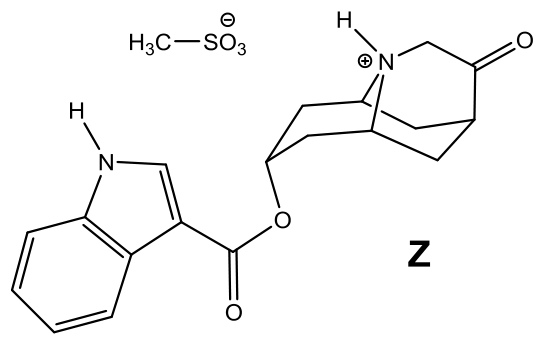
This question looks at the synthesis of dolasetron mesylate, Z (shown right), a drug sold under the tradename Anzemet and used to treat post-operative nausea and vomiting.
The synthesis begins as shown below.
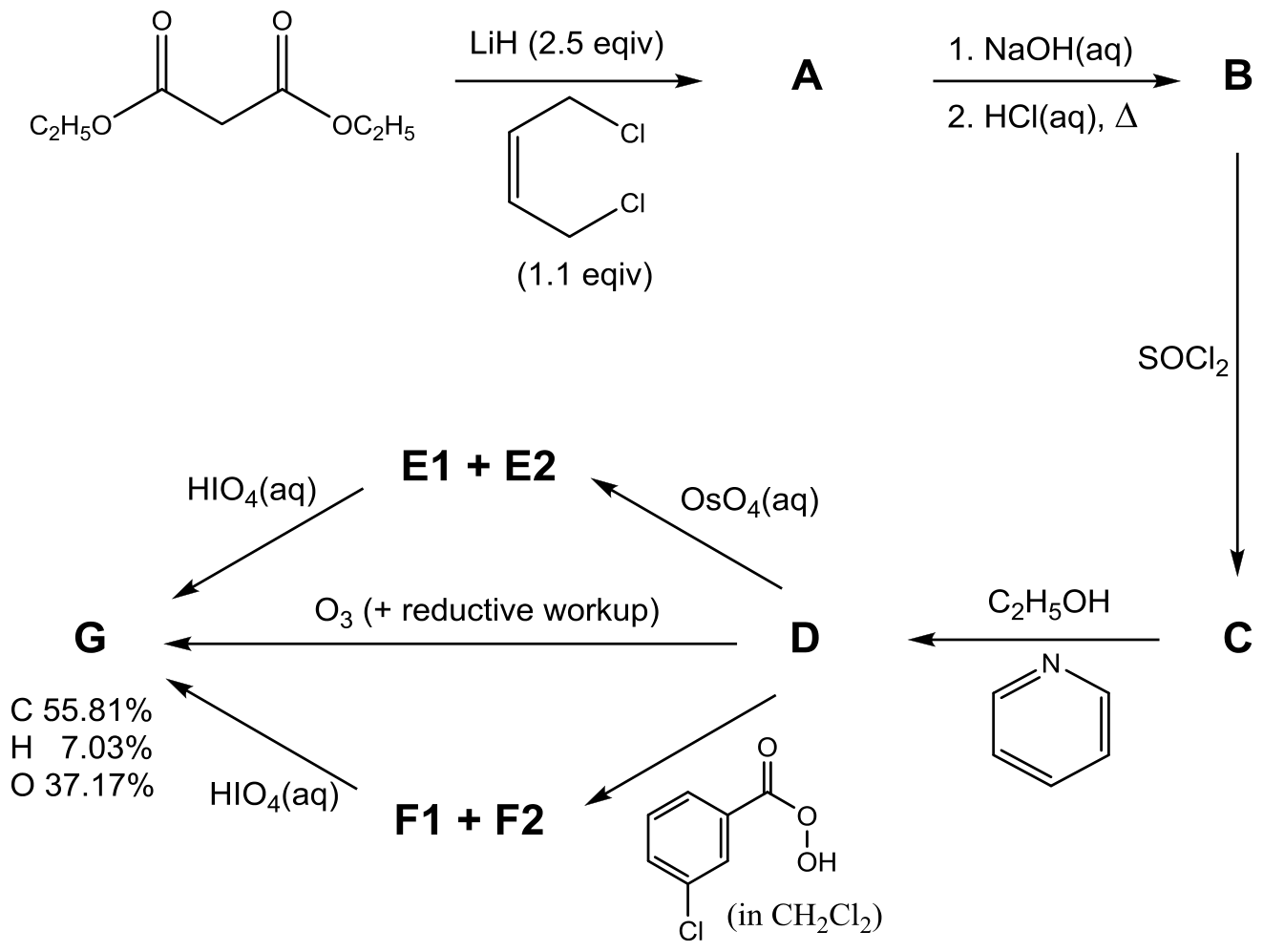
First cyclic compound A is made, which contains \(\ce{C}\), \(\ce{H}\), and \(\ce{O}\) only. Compound G is achiral and can be prepared directly from D using ozone under reductive conditions, or via stereoisomers E1 and E2 using \(\ce{OsO4}\), or via stereoisomers F1 and F2 using the peracid shown.
7.1 Determine the empirical formula of G from the percentage masses given.
7.2 Give the structures of A, B, C, D, E1, E2, F1, F2 and G.
Compound G is used in the next stage of the synthesis, under buffered conditions, to form H (as a mixture of two achiral diastereoisomers). Reduction of H with \(\ce{NaBH4}\) gives alcohol I (as a mixture of four achiral diastereoisomers). I reacts with acidified dihydropyran to form J (as a mixture of even more diastereoisomers). J is then treated first with t-butoxide base, then refluxed with acid before finally extracting under weakly basic conditions to form K as a mix of two diastereomers, K1 (major product) and K2 (minor product). These could be separated, and K1 was used in the final stages of the synthesis.
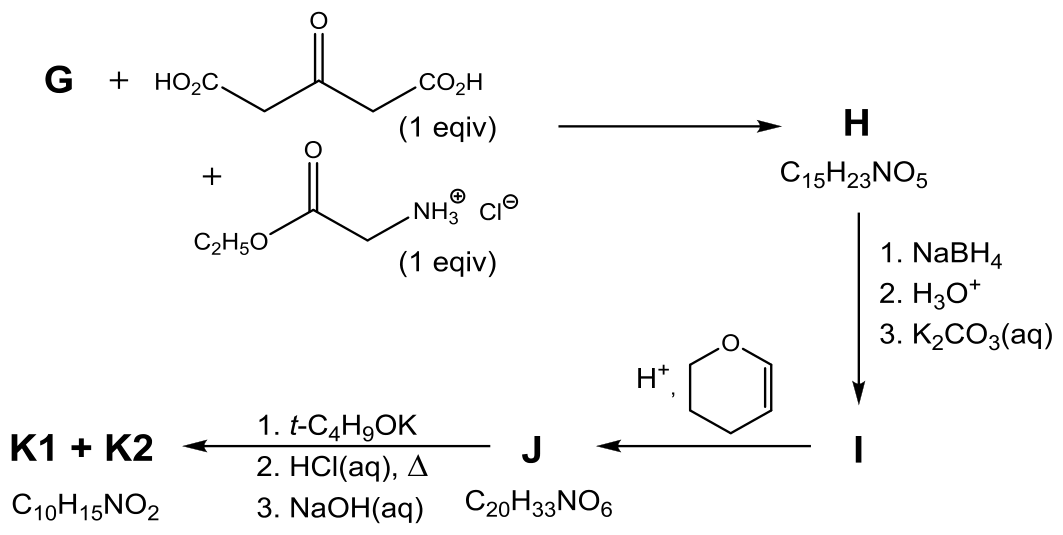
7.3.1 Give the structures of H, I, and J. There is no need to show the different diastereoisomers formed.
7.3.2 Give the structures of diastereoisomers K1, and K2.
In the final stage of the synthesis, L and M react to form intermediate N. N then reacts with K1 to form, after extraction, the neutral amine which gives the target compound upon protonation with \(\ce{CH3SO3H}\).
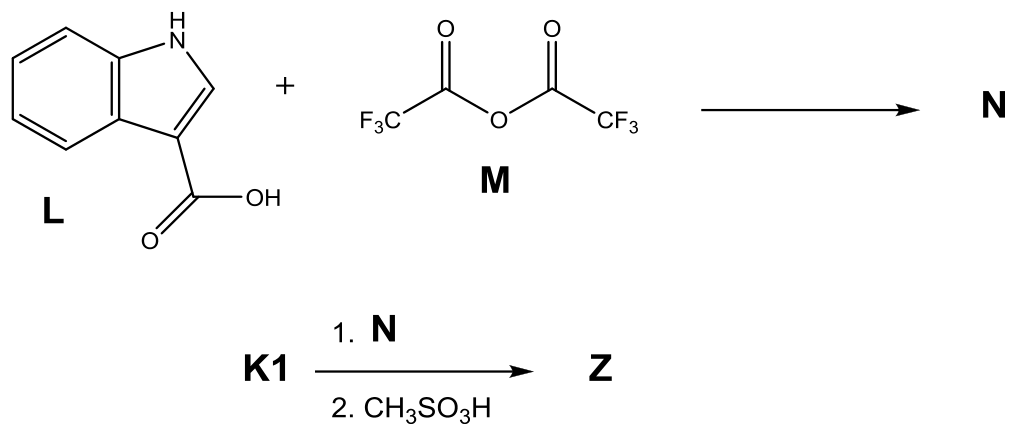
7.4 Give the structure of N.
Official English text of the problem.
Answers
-
7.1: The empirical formula of G is \(\ce{C2H3O}\).
-
7.2: The structures are listed below. The numerical labels within each E or F pair can be interchanged.
| Compound | Name and stereochemical description | SMILES |
|---|---|---|
| A | Diethyl cyclopent-3-ene-1,1-dicarboxylate | CCOC(=O)C1(C(=O)OCC)CC=CC1 |
| B | Cyclopent-3-ene-1-carboxylic acid | O=C(O)C1CC=CC1 |
| C | Cyclopent-3-ene-1-carbonyl chloride | O=C(Cl)C1CC=CC1 |
| D | Ethyl cyclopent-3-ene-1-carboxylate | CCOC(=O)C1CC=CC1 |
| E1 | Ethyl 3,4-dihydroxycyclopentane-1-carboxylate; both OH groups and the ester substituent are mutually cis | CCOC(=O)[C@@H]1C[C@H](O)[C@H](O)C1 |
| E2 | Ethyl 3,4-dihydroxycyclopentane-1-carboxylate; the OH groups are cis to each other and both trans to the ester substituent | CCOC(=O)[C@H]1C[C@H](O)[C@H](O)C1 |
| F1 | Ethyl 6-oxabicyclo[3.1.0]hexane-3-carboxylate; ester substituent syn to the epoxide oxygen bridge | CCOC(=O)[C@H]1C[C@H]2O[C@H]2C1 |
| F2 | Ethyl 6-oxabicyclo[3.1.0]hexane-3-carboxylate; ester substituent anti to the epoxide oxygen bridge | CCOC(=O)[C@@H]1C[C@H]2O[C@H]2C1 |
| G | Ethyl 2-(2-oxoethyl)-4-oxobutanoate | CCOC(=O)C(CC=O)CC=O |
- 7.3.1: Stereochemistry is omitted as permitted in the question.
| Compound | Name | SMILES |
|---|---|---|
| H | Ethyl 9-(2-ethoxy-2-oxoethyl)-7-oxo-9-azabicyclo[3.3.1]nonane-3-carboxylate | CCOC(=O)CN1C2CC(=O)CC1CC(C(=O)OCC)C2 |
| I | Ethyl 9-(2-ethoxy-2-oxoethyl)-7-hydroxy-9-azabicyclo[3.3.1]nonane-3-carboxylate | CCOC(=O)CN1C2CC(O)CC1CC(C(=O)OCC)C2 |
| J | Ethyl 9-(2-ethoxy-2-oxoethyl)-7-[(oxan-2-yl)oxy]-9-azabicyclo[3.3.1]nonane-3-carboxylate—the THP ether of I | CCOC(=O)CN1C2CC(OC3OCCCC3)CC1CC(C(=O)OCC)C2 |
- 7.3.2: Both products are stereoisomers of 5-hydroxy-8-azatricyclo\([5.3.1.0^{3,8}]\)undecan-10-one. “Anti” and “syn” below refer to the OH group relative to the nitrogen bridge of the original bicyclic framework.
| Compound | Configuration | SMILES |
|---|---|---|
| K1, major | Anti-OH isomer; its alcohol configuration matches the ester-bearing centre in Z | O=C1C[N@@]2[C@@H]3C[C@@H](O)C[C@H]2C[C@H]1C3 |
| K2, minor | Syn-OH isomer; the alcohol epimer of K1 | O=C1C[N@@]2[C@@H]3C[C@H](O)C[C@H]2C[C@H]1C3 |
- 7.4: N is the mixed anhydride of 1H-indole-3-carboxylic acid and trifluoroacetic acid:
O=C(OC(=O)C(F)(F)F)c1c[nH]c2ccccc12.
Solution
For redox steps whose complete work-up is unspecified, the equations below use balanced organic net reactions. Here \(\ce{[O]}\) denotes one oxygen-atom equivalent and \(\ce{[H]}\) one hydrogen-atom equivalent.
7.1 — Empirical formula of G
For a \(100\ \mathrm{g}\) sample, using conventional atomic molar masses:
| Element | Mass | Atomic molar mass | Amount |
|---|---|---|---|
| Carbon | \(55.81\ \mathrm{g}\) | \(12.01\ \mathrm{g\,mol^{-1}}\) | \(4.647\ \mathrm{mol}\) |
| Hydrogen | \(7.03\ \mathrm{g}\) | \(1.008\ \mathrm{g\,mol^{-1}}\) | \(6.97\ \mathrm{mol}\) |
| Oxygen | \(37.17\ \mathrm{g}\) | \(16.00\ \mathrm{g\,mol^{-1}}\) | \(2.323\ \mathrm{mol}\) |
Dividing by the smallest amount gives
\[ n_{\ce C}:n_{\ce H}:n_{\ce O} = \frac{4.647}{2.323}: \frac{6.97}{2.323}:1 \approx 2.00:3.00:1.00. \]
Therefore,
\[ \boxed{\text{Empirical formula of G}=\ce{C2H3O}}. \]
The molecular structure established below has formula \(\ce{C8H12O4}\), four times this empirical formula.
7.2 — Identification of A–G
Formation of A. The starting materials are diethyl malonate, CCOC(=O)CC(=O)OCC, and \((Z)\)-1,4-dichlorobut-2-ene, ClC/C=C\CCl.
Lithium hydride removes a proton from the methylene group between the two ester carbonyls. The resulting carbon nucleophile displaces chloride from one terminal chloromethyl group. Deprotonation of its remaining malonate proton permits a second, intramolecular substitution at the other chloromethyl group.
The malonate carbon and the four-carbon chain therefore form a five-membered ring, giving A. Both ester groups remain attached to the same ring carbon.
The stoichiometric balance is
\[ \ce{C7H12O4 + C4H6Cl2 + 2LiH -> C11H16O4 + 2LiCl + 2H2}. \]
The supplied \(2.5\) equivalents of \(\ce{LiH}\) exceed the two equivalents required by this net transformation.
A to B. Both esters undergo alkaline hydrolysis. Acidification gives cyclopent-3-ene-1,1-dicarboxylic acid, O=C(O)C1(C(=O)O)CC=CC1. This is a substituted malonic acid and loses one carboxyl group on heating, giving B.
Combining hydrolysis, acidification and decarboxylation:
\[ \ce{C11H16O4 + 2NaOH + 2HCl -> C6H8O2 + 2C2H5OH + CO2 + 2NaCl}. \]
B to C. Thionyl chloride converts the carboxylic acid into its acyl chloride:
\[ \ce{C6H8O2 + SOCl2 -> C6H7ClO + SO2 + HCl}. \]
Thus C is cyclopent-3-ene-1-carbonyl chloride.
C to D. Ethanol substitutes for chloride at the acyl carbon, producing the ethyl ester D:
\[ \ce{C6H7ClO + C2H5OH -> C8H12O2 + HCl}. \]
Pyridine, n1ccccc1, captures the liberated acid as pyridinium chloride, [Cl-].[nH+]1ccccc1:
\[ \ce{C5H5N + HCl -> [C5H6N]+ + Cl-}. \]
D to E1 and E2. Osmium tetroxide adds across the alkene through a cyclic osmate intermediate. Hydrolysis gives syn dihydroxylation: the two OH groups must be on the same face of the ring.
Addition on either face relative to the ester substituent gives:
- E1: the ester substituent and both OH groups on the same face;
- E2: both OH groups on the face opposite the ester substituent.
To sketch them, draw a cyclopentane ring bearing the ester at C1 and OH groups at C3 and C4. Give the two OH bonds matching wedges; use a matching ester wedge for E1 and an opposite ester wedge for E2. Both products are achiral.
The organic net balance is
\[ \ce{C8H12O2 + H2O + [O] -> C8H14O4}. \]
D to F1 and F2. The peracid is 3-chloroperoxybenzoic acid, or mCPBA, O=C(OO)c1cccc(Cl)c1. In the stated dichloromethane medium it converts the alkene into an epoxide.
Oxygen transfer from the two faces produces the two epoxide configurations in the answer table. The epoxide oxygen bridge and ester substituent are syn in F1 and anti in F2.
The by-product is 3-chlorobenzoic acid, O=C(O)c1cccc(Cl)c1:
\[ \ce{C8H12O2 + C7H5ClO3 -> C8H12O3 + C7H5ClO2}. \]
Formation of G. Each alkene carbon in D bears a hydrogen. Reductive ozonolysis therefore converts both into aldehydes. Cleavage opens the five-membered ring and gives
\[ \boxed{\ce{OHC-CH2-CH(CO2C2H5)-CH2-CHO}}. \]
This is G, ethyl 2-(2-oxoethyl)-4-oxobutanoate, CCOC(=O)C(CC=O)CC=O.
The central carbon has two identical \(\ce{-CH2CHO}\) substituents, so it is not stereogenic; G is achiral. Its formula is \(\ce{C8H12O4}\), consistent with part 7.1.
The organic net ozonolysis balance is
\[ \ce{C8H12O2 + 2[O] -> C8H12O4}. \]
Periodic acid cleaves the bond between the two hydroxyl-bearing carbons of either E isomer:
\[ \ce{C8H14O4 + HIO4 -> C8H12O4 + HIO3 + H2O}. \]
The epoxides F1/F2 also undergo cleavage in aqueous periodic acid, involving epoxide opening. Their overall balance is
\[ \ce{C8H12O3 + HIO4 -> C8H12O4 + HIO3}. \]
Thus all three routes give the same dialdehyde G.
7.3.1 — Structures and formation of H, I and J
Formation of H. The other reactants are:
- 3-Oxopentanedioic acid, commonly acetonedicarboxylic acid:
O=C(O)CC(=O)CC(=O)O; - Ethyl glycinate hydrochloride:
CCOC(=O)C[NH3+].[Cl-].
This is a Robinson–Schöpf-type bicyclic aminoketone synthesis, involving two Mannich condensations.
The connectivity can be tracked as follows:
- The nitrogen of ethyl glycinate becomes bonded to both terminal aldehyde carbons of G.
- The two methylene carbons flanking the ketone of acetonedicarboxylic acid form carbon–carbon bonds to those same aldehyde-derived carbons.
- Both carboxylic acid groups of acetonedicarboxylic acid are lost as \(\ce{CO2}\).
- The nitrogen retains its \(\ce{-CH2CO2C2H5}\) substituent, and the ester originally present in G remains intact.
The resulting bridgeheads are connected by three paths containing three, three and one internal atoms: the 9-azabicyclo[3.3.1]nonane skeleton of H.
The overall balance, writing the acid equivalent separately from its capture by the buffer, is
\[ \ce{C8H12O4 + C5H6O5 + C4H10ClNO2 -> C15H23NO5 + 2CO2 + 2H2O + HCl}. \]
This reproduces the supplied formula \(\ce{C15H23NO5}\).
The two achiral diastereoisomers differ in the orientation of the ring-bound ester relative to the nitrogen bridge.
H to I. Sodium borohydride reduces the ring ketone to a secondary alcohol while retaining both esters:
\[ \ce{C15H23NO5 + 2[H] -> C15H25NO5}. \]
The two possible alcohol configurations, combined with the two configurations already present in H, account for the four achiral diastereoisomers of I.
The acid and carbonate work-up gives the free amino alcohol shown in the answer table.
I to J. Acid-catalysed reaction with 3,4-dihydro-2H-pyran, C1=COCCC1, protects the alcohol as a tetrahydropyranyl (THP) ether.
The alcohol oxygen bonds to the carbon adjacent to the ring oxygen of the dihydropyran. This creates an acetal carbon and additional stereoisomers.
No small molecule is eliminated:
\[ \ce{C15H25NO5 + C5H8O -> C20H33NO6}. \]
The resulting formula agrees with the stated formula of J.
7.3.2 — Formation and stereochemistry of K1 and K2
Potassium tert-butoxide promotes an intramolecular Claisen, or Dieckmann, condensation between the two ester groups.
Deprotonation of the nitrogen-bound \(\ce{-CH2CO2C2H5}\) group gives an enolate. Its carbon attacks the carbonyl of the ester attached to the bicyclic ring, and ethoxide is expelled. The new carbon–carbon bond constructs the third ring.
A stereochemically unspecified representation of the resulting β-keto ester is:
Ethyl 5-[(oxan-2-yl)oxy]-10-oxo-8-azatricyclo\([5.3.1.0^{3,8}]\)undecane-9-carboxylate,
O=C1C(C(=O)OCC)N2C3CC(OC4OCCCC4)CC2CC1C3.
Calling this transient intermediate Q, its neutral organic balance after protonation is
\[ \ce{C20H33NO6 -> C18H27NO5 + C2H5OH}. \]
Heating with aqueous acid then accomplishes three transformations:
- Hydrolysis of the remaining ethyl ester;
- Decarboxylation of the resulting β-keto acid;
- Removal of the THP protecting group, restoring the alcohol.
THP hydrolysis formally releases 5-hydroxypentanal, O=CCCCCO, which can equilibrate with its cyclic hemiacetal. The combined balance is
\[ \ce{C18H27NO5 + 2H2O -> C10H15NO2 + C2H5OH + CO2 + C5H10O2}. \]
Hence the overall organic balance from J is
\[ \ce{C20H33NO6 + 2H2O -> C10H15NO2 + 2C2H5OH + CO2 + C5H10O2}. \]
Basic extraction furnishes the neutral tertiary amine. The product formula,
\[ \boxed{\ce{C10H15NO2}}, \]
matches the problem.
The ketone in K comes from the ester condensation. The alcohol formed in the earlier borohydride reduction survives protection and deprotection, leaving two alcohol configurations:
- K1: OH anti to the original nitrogen bridge;
- K2: OH syn to that bridge.
For the requested drawings, use the same tricyclic cage for both and invert only the alcohol-bearing centre. The target drawing identifies K1: replacing its OH hydrogen with the indole-3-carbonyl group gives the ester orientation shown in Z. Their precise configurations are encoded in the answer-table SMILES.
7.4 — Structure of N and completion of the synthesis
L is 1H-indole-3-carboxylic acid, O=C(O)c1c[nH]c2ccccc12.
M is trifluoroacetic anhydride, O=C(OC(=O)C(F)(F)F)C(F)(F)F.
The carboxylic acid reacts with the anhydride to form the activated mixed anhydride N:
\[ \boxed{\ce{(1H-indol-3-yl)-C(=O)-O-C(=O)-CF3}}. \]
Its SMILES is O=C(OC(=O)C(F)(F)F)c1c[nH]c2ccccc12.
The by-product is trifluoroacetic acid, O=C(O)C(F)(F)F. The balanced equation is
\[ \ce{C9H7NO2 + C4F6O3 -> C11H6F3NO3 + C2HF3O2}. \]
The alcohol oxygen of K1 attacks the indole-derived acyl carbonyl of N, and trifluoroacetate leaves. After extraction, this gives neutral dolasetron:
O=C1C[N@@]2[C@@H]3C[C@@H](OC(=O)c4c[nH]c5ccccc45)C[C@H]2C[C@H]1C3.
The net esterification balance is
\[ \ce{C10H15NO2 + C11H6F3NO3 -> C19H20N2O3 + C2HF3O2}. \]
Finally, methanesulfonic acid, CS(=O)(=O)O, protonates the tertiary amine:
\[ \ce{C19H20N2O3 + CH3SO3H -> [C19H21N2O3]+ + CH3SO3-}. \]
The product is dolasetron mesylate, Z:
CS(=O)(=O)[O-].O=C1C[N@H+]2[C@@H]3C[C@@H](OC(=O)c4c[nH]c5ccccc45)C[C@H]2C[C@H]1C3.
The answers were checked against the official answers published by the organisers.
IChO 2016 · Theorieaufgabe 7
Synthese von Dolasetronmesilat
Diese Aufgabe behandelt die Synthese von Dolasetronmesilat, Z (rechts abgebildet), einem Arzneistoff, der unter dem Handelsnamen Anzemet vertrieben und zur Behandlung von postoperativer Übelkeit und Erbrechen eingesetzt wird.
Die Synthese beginnt wie unten gezeigt.
Zunächst wird die cyclische Verbindung A hergestellt, die ausschließlich \(\ce{C}\), \(\ce{H}\) und \(\ce{O}\) enthält. Verbindung G ist achiral und kann direkt aus D mit Ozon unter reduktiven Bedingungen hergestellt werden, oder über die Stereoisomere E1 und E2 mit \(\ce{OsO4}\), oder über die Stereoisomere F1 und F2 mit der gezeigten Persäure.
7.1 Bestimmen Sie die Verhältnisformel von G anhand der angegebenen Massenanteile in Prozent.
7.2 Geben Sie die Strukturen von A, B, C, D, E1, E2, F1, F2 und G an.
Verbindung G wird im nächsten Schritt der Synthese unter gepufferten Bedingungen zur Bildung von H eingesetzt (als Gemisch zweier achiraler Diastereoisomere). Die Reduktion von H mit \(\ce{NaBH4}\) ergibt den Alkohol I (als Gemisch von vier achiralen Diastereoisomeren). I reagiert mit Dihydropyran unter Säurezusatz zu J (als Gemisch einer noch größeren Anzahl von Diastereoisomeren). J wird dann zunächst mit der Base t-Butoxid behandelt, anschließend mit Säure unter Rückfluss erhitzt und schließlich unter schwach basischen Bedingungen extrahiert. Dabei entsteht K als Gemisch zweier Diastereomere, K1 (Hauptprodukt) und K2 (Nebenprodukt). Diese konnten getrennt werden, und K1 wurde für die letzten Schritte der Synthese verwendet.
7.3.1 Geben Sie die Strukturen von H, I und J an. Die verschiedenen gebildeten Diastereoisomere müssen nicht dargestellt werden.
7.3.2 Geben Sie die Strukturen der Diastereoisomere K1 und K2 an.
Im letzten Schritt der Synthese reagieren L und M zum Zwischenprodukt N. N reagiert dann mit K1, wobei nach der Extraktion das neutrale Amin erhalten wird, das bei Protonierung mit \(\ce{CH3SO3H}\) die Zielverbindung ergibt.
7.4 Geben Sie die Struktur von N an.
Aufgabentext aus dem offiziellen englischen Text übersetzt.
Antworten
-
7.1: Die Verhältnisformel von G lautet \(\ce{C2H3O}\).
-
7.2: Die Strukturen sind unten aufgeführt. Die Ziffernbezeichnungen innerhalb jedes E- bzw. F-Paares können vertauscht werden.
| Verbindung | Name und stereochemische Beschreibung | SMILES |
|---|---|---|
| A | Diethylcyclopent-3-en-1,1-dicarboxylat | CCOC(=O)C1(C(=O)OCC)CC=CC1 |
| B | Cyclopent-3-en-1-carbonsäure | O=C(O)C1CC=CC1 |
| C | Cyclopent-3-en-1-carbonylchlorid | O=C(Cl)C1CC=CC1 |
| D | Ethylcyclopent-3-en-1-carboxylat | CCOC(=O)C1CC=CC1 |
| E1 | Ethyl-3,4-dihydroxycyclopentan-1-carboxylat; beide OH-Gruppen und der Estersubstituent stehen zueinander jeweils cis | CCOC(=O)[C@@H]1C[C@H](O)[C@H](O)C1 |
| E2 | Ethyl-3,4-dihydroxycyclopentan-1-carboxylat; die OH-Gruppen stehen cis zueinander und beide trans zum Estersubstituenten | CCOC(=O)[C@H]1C[C@H](O)[C@H](O)C1 |
| F1 | Ethyl-6-oxabicyclo[3.1.0]hexan-3-carboxylat; Estersubstituent syn zur Sauerstoffbrücke des Epoxids | CCOC(=O)[C@H]1C[C@H]2O[C@H]2C1 |
| F2 | Ethyl-6-oxabicyclo[3.1.0]hexan-3-carboxylat; Estersubstituent anti zur Sauerstoffbrücke des Epoxids | CCOC(=O)[C@@H]1C[C@H]2O[C@H]2C1 |
| G | Ethyl-2-(2-oxoethyl)-4-oxobutanoat | CCOC(=O)C(CC=O)CC=O |
- 7.3.1: Die Stereochemie ist weggelassen, wie in der Aufgabenstellung gestattet.
| Verbindung | Name | SMILES |
|---|---|---|
| H | Ethyl-9-(2-ethoxy-2-oxoethyl)-7-oxo-9-azabicyclo[3.3.1]nonan-3-carboxylat | CCOC(=O)CN1C2CC(=O)CC1CC(C(=O)OCC)C2 |
| I | Ethyl-9-(2-ethoxy-2-oxoethyl)-7-hydroxy-9-azabicyclo[3.3.1]nonan-3-carboxylat | CCOC(=O)CN1C2CC(O)CC1CC(C(=O)OCC)C2 |
| J | Ethyl-9-(2-ethoxy-2-oxoethyl)-7-[(oxan-2-yl)oxy]-9-azabicyclo[3.3.1]nonan-3-carboxylat — der THP-Ether von I | CCOC(=O)CN1C2CC(OC3OCCCC3)CC1CC(C(=O)OCC)C2 |
- 7.3.2: Beide Produkte sind Stereoisomere von 5-Hydroxy-8-azatricyclo\([5.3.1.0^{3,8}]\)undecan-10-on. „Anti“ und „syn“ beziehen sich im Folgenden auf die OH-Gruppe relativ zur Stickstoffbrücke des ursprünglichen bicyclischen Gerüsts.
| Verbindung | Konfiguration | SMILES |
|---|---|---|
| K1, Hauptprodukt | Anti-OH-Isomer; seine Konfiguration am alkoholtragenden Zentrum entspricht derjenigen am estertragenden Zentrum in Z | O=C1C[N@@]2[C@@H]3C[C@@H](O)C[C@H]2C[C@H]1C3 |
| K2, Nebenprodukt | Syn-OH-Isomer; das Epimer von K1 am alkoholtragenden Zentrum | O=C1C[N@@]2[C@@H]3C[C@H](O)C[C@H]2C[C@H]1C3 |
- 7.4: N ist das gemischte Anhydrid aus 1H-Indol-3-carbonsäure und Trifluoressigsäure:
O=C(OC(=O)C(F)(F)F)c1c[nH]c2ccccc12.
Lösung
Für Redoxschritte, deren vollständige Aufarbeitung nicht angegeben ist, werden im Folgenden ausgeglichene Nettoreaktionsgleichungen der organischen Umsetzung verwendet. Dabei bezeichnet \(\ce{[O]}\) ein Sauerstoffatom-Äquivalent und \(\ce{[H]}\) ein Wasserstoffatom-Äquivalent.
7.1 — Verhältnisformel von G
Für eine Probe von \(100\ \mathrm{g}\) ergibt sich unter Verwendung der üblichen molaren Atommassen:
| Element | Masse | Molare Atommasse | Stoffmenge |
|---|---|---|---|
| Kohlenstoff | \(55.81\ \mathrm{g}\) | \(12.01\ \mathrm{g\,mol^{-1}}\) | \(4.647\ \mathrm{mol}\) |
| Wasserstoff | \(7.03\ \mathrm{g}\) | \(1.008\ \mathrm{g\,mol^{-1}}\) | \(6.97\ \mathrm{mol}\) |
| Sauerstoff | \(37.17\ \mathrm{g}\) | \(16.00\ \mathrm{g\,mol^{-1}}\) | \(2.323\ \mathrm{mol}\) |
Division durch die kleinste Stoffmenge ergibt
\[ n_{\ce C}:n_{\ce H}:n_{\ce O} = \frac{4.647}{2.323}: \frac{6.97}{2.323}:1 \approx 2.00:3.00:1.00. \]
Somit gilt
\[ \boxed{\text{Verhältnisformel von G}=\ce{C2H3O}}. \]
Die unten ermittelte Molekülstruktur hat die Summenformel \(\ce{C8H12O4}\), das Vierfache dieser Verhältnisformel.
7.2 — Identifizierung von A–G
Bildung von A. Die Ausgangsstoffe sind Diethylmalonat, CCOC(=O)CC(=O)OCC, und \((Z)\)-1,4-Dichlorbut-2-en, ClC/C=C\CCl.
Lithiumhydrid entfernt ein Proton von der Methylengruppe zwischen den beiden Estercarbonylgruppen. Das entstehende Kohlenstoffnucleophil verdrängt Chlorid aus einer endständigen Chlormethylgruppe. Die Deprotonierung des verbleibenden Malonatprotons ermöglicht eine zweite, intramolekulare Substitution an der anderen Chlormethylgruppe.
Das Malonat-Kohlenstoffatom und die Kette aus vier Kohlenstoffatomen bilden somit einen fünfgliedrigen Ring, wodurch A entsteht. Beide Estergruppen bleiben an dasselbe Ringkohlenstoffatom gebunden.
Die stöchiometrische Bilanz lautet
\[ \ce{C7H12O4 + C4H6Cl2 + 2LiH -> C11H16O4 + 2LiCl + 2H2}. \]
Die eingesetzten \(2.5\) Äquivalente \(\ce{LiH}\) übersteigen die zwei Äquivalente, die für diese Nettoumsetzung benötigt werden.
A zu B. Beide Ester werden alkalisch hydrolysiert. Ansäuern ergibt Cyclopent-3-en-1,1-dicarbonsäure, O=C(O)C1(C(=O)O)CC=CC1. Dabei handelt es sich um eine substituierte Malonsäure, die beim Erhitzen eine Carboxylgruppe abspaltet und B ergibt.
Zusammenfassung von Hydrolyse, Ansäuern und Decarboxylierung:
\[ \ce{C11H16O4 + 2NaOH + 2HCl -> C6H8O2 + 2C2H5OH + CO2 + 2NaCl}. \]
B zu C. Thionylchlorid überführt die Carbonsäure in ihr Säurechlorid:
\[ \ce{C6H8O2 + SOCl2 -> C6H7ClO + SO2 + HCl}. \]
Somit ist C Cyclopent-3-en-1-carbonylchlorid.
C zu D. Ethanol ersetzt Chlorid am Acylkohlenstoffatom, wobei der Ethylester D entsteht:
\[ \ce{C6H7ClO + C2H5OH -> C8H12O2 + HCl}. \]
Pyridin, n1ccccc1, fängt die freigesetzte Säure als Pyridiniumchlorid, [Cl-].[nH+]1ccccc1, ab:
\[ \ce{C5H5N + HCl -> [C5H6N]+ + Cl-}. \]
D zu E1 und E2. Osmiumtetroxid addiert an die Alken-Doppelbindung unter Bildung eines cyclischen Osmat-Zwischenprodukts. Die Hydrolyse führt zu einer syn-Dihydroxylierung: Die beiden OH-Gruppen müssen auf derselben Seite des Rings liegen.
Die Addition von einer der beiden Seiten relativ zum Estersubstituenten ergibt:
- E1: den Estersubstituenten und beide OH-Gruppen auf derselben Seite;
- E2: beide OH-Gruppen auf der dem Estersubstituenten gegenüberliegenden Seite.
Zeichnen Sie zur Darstellung einen Cyclopentanring mit dem Ester an C1 und OH-Gruppen an C3 und C4. Stellen Sie die beiden OH-Bindungen durch gleichgerichtete Keile dar; verwenden Sie für die Esterbindung bei E1 einen gleichgerichteten und bei E2 einen entgegengesetzt gerichteten Keil. Beide Produkte sind achiral.
Die organische Nettobilanz lautet
\[ \ce{C8H12O2 + H2O + [O] -> C8H14O4}. \]
D zu F1 und F2. Die Persäure ist 3-Chlorperoxybenzoesäure, auch mCPBA genannt, O=C(OO)c1cccc(Cl)c1. Im angegebenen Lösungsmittel Dichlormethan überführt sie das Alken in ein Epoxid.
Die Sauerstoffübertragung von den beiden Seiten erzeugt die beiden Epoxidkonfigurationen in der Antworttabelle. Die Sauerstoffbrücke des Epoxids und der Estersubstituent stehen in F1 syn und in F2 anti zueinander.
Das Nebenprodukt ist 3-Chlorbenzoesäure, O=C(O)c1cccc(Cl)c1:
\[ \ce{C8H12O2 + C7H5ClO3 -> C8H12O3 + C7H5ClO2}. \]
Bildung von G. Jedes Alken-Kohlenstoffatom in D trägt ein Wasserstoffatom. Die reduktive Ozonolyse überführt daher beide in Aldehydgruppen. Die Spaltung öffnet den fünfgliedrigen Ring und ergibt
\[ \boxed{\ce{OHC-CH2-CH(CO2C2H5)-CH2-CHO}}. \]
Dies ist G, Ethyl-2-(2-oxoethyl)-4-oxobutanoat, CCOC(=O)C(CC=O)CC=O.
Das zentrale Kohlenstoffatom trägt zwei identische \(\ce{-CH2CHO}\)-Substituenten und ist daher nicht stereogen; G ist achiral. Seine Summenformel lautet \(\ce{C8H12O4}\), in Übereinstimmung mit Teil 7.1.
Die organische Nettobilanz der Ozonolyse lautet
\[ \ce{C8H12O2 + 2[O] -> C8H12O4}. \]
Periodsäure spaltet bei beiden E-Isomeren die Bindung zwischen den beiden hydroxyltragenden Kohlenstoffatomen:
\[ \ce{C8H14O4 + HIO4 -> C8H12O4 + HIO3 + H2O}. \]
Die Epoxide F1/F2 werden in wässriger Periodsäure ebenfalls gespalten, wobei eine Epoxidöffnung beteiligt ist. Ihre Gesamtbilanz lautet
\[ \ce{C8H12O3 + HIO4 -> C8H12O4 + HIO3}. \]
Somit liefern alle drei Wege denselben Dialdehyd G.
7.3.1 — Strukturen und Bildung von H, I und J
Bildung von H. Die weiteren Reaktanden sind:
- 3-Oxopentandisäure, üblicherweise Acetondicarbonsäure genannt:
O=C(O)CC(=O)CC(=O)O; - Glycinethylesterhydrochlorid:
CCOC(=O)C[NH3+].[Cl-].
Es handelt sich um eine Synthese eines bicyclischen Aminoketons vom Robinson–Schöpf-Typ, die zwei Mannich-Kondensationen umfasst.
Die Verknüpfung der Atome lässt sich wie folgt nachvollziehen:
- Das Stickstoffatom des Glycinethylesters wird mit beiden endständigen Aldehyd-Kohlenstoffatomen von G verknüpft.
- Die beiden Methylen-Kohlenstoffatome beiderseits der Ketogruppe der Acetondicarbonsäure bilden Kohlenstoff–Kohlenstoff-Bindungen zu denselben, aus den Aldehydgruppen stammenden Kohlenstoffatomen.
- Beide Carbonsäuregruppen der Acetondicarbonsäure werden als \(\ce{CO2}\) abgespalten.
- Das Stickstoffatom behält seinen \(\ce{-CH2CO2C2H5}\)-Substituenten, und der ursprünglich in G vorhandene Ester bleibt erhalten.
Die entstehenden Brückenköpfe sind durch drei Wege mit drei, drei bzw. einem dazwischenliegenden Atom verbunden: das 9-Azabicyclo[3.3.1]nonan-Gerüst von H.
Die Gesamtbilanz, bei der das Säureäquivalent getrennt von seiner Abfangreaktion durch den Puffer geschrieben wird, lautet
\[ \ce{C8H12O4 + C5H6O5 + C4H10ClNO2 -> C15H23NO5 + 2CO2 + 2H2O + HCl}. \]
Dies ergibt die angegebene Summenformel \(\ce{C15H23NO5}\).
Die beiden achiralen Diastereoisomere unterscheiden sich in der Orientierung des ringgebundenen Esters relativ zur Stickstoffbrücke.
H zu I. Natriumborhydrid reduziert das cyclische Keton zu einem sekundären Alkohol, wobei beide Ester erhalten bleiben:
\[ \ce{C15H23NO5 + 2[H] -> C15H25NO5}. \]
Die beiden möglichen Konfigurationen am alkoholtragenden Zentrum ergeben zusammen mit den beiden bereits in H vorhandenen Konfigurationen die vier achiralen Diastereoisomere von I.
Die Aufarbeitung mit Säure und Carbonat liefert den in der Antworttabelle gezeigten freien Aminoalkohol.
I zu J. Die säurekatalysierte Reaktion mit 3,4-Dihydro-2H-pyran, C1=COCCC1, schützt den Alkohol als Tetrahydropyranyl(THP)-Ether.
Das Sauerstoffatom des Alkohols bindet an das Kohlenstoffatom neben dem Ringsauerstoff des Dihydropyrans. Dadurch entstehen ein Acetal-Kohlenstoffatom und zusätzliche Stereoisomere.
Es wird kein kleines Molekül abgespalten:
\[ \ce{C15H25NO5 + C5H8O -> C20H33NO6}. \]
Die resultierende Summenformel stimmt mit der angegebenen Summenformel von J überein.
7.3.2 — Bildung und Stereochemie von K1 und K2
Kalium-tert-butoxid fördert eine intramolekulare Claisen- bzw. Dieckmann-Kondensation zwischen den beiden Estergruppen.
Die Deprotonierung der an Stickstoff gebundenen \(\ce{-CH2CO2C2H5}\)-Gruppe ergibt ein Enolat. Dessen Kohlenstoffatom greift die Carbonylgruppe des an den bicyclischen Ring gebundenen Esters an, und Ethoxid wird abgespalten. Die neue Kohlenstoff–Kohlenstoff-Bindung bildet den dritten Ring.
Eine Darstellung des entstehenden β-Ketoesters ohne Festlegung der Stereochemie lautet:
Ethyl-5-[(oxan-2-yl)oxy]-10-oxo-8-azatricyclo\([5.3.1.0^{3,8}]\)undecan-9-carboxylat,
O=C1C(C(=O)OCC)N2C3CC(OC4OCCCC4)CC2CC1C3.
Bezeichnet man dieses kurzlebige Zwischenprodukt als Q, so lautet seine organische Bilanz in neutraler Form nach der Protonierung
\[ \ce{C20H33NO6 -> C18H27NO5 + C2H5OH}. \]
Das Erhitzen mit wässriger Säure bewirkt anschließend drei Umwandlungen:
- Hydrolyse des verbleibenden Ethylesters;
- Decarboxylierung der entstehenden β-Ketosäure;
- Abspaltung der THP-Schutzgruppe unter Wiederherstellung des Alkohols.
Bei der THP-Hydrolyse wird formal 5-Hydroxypentanal, O=CCCCCO, freigesetzt, das mit seinem cyclischen Halbacetal im Gleichgewicht stehen kann. Die zusammengefasste Bilanz lautet
\[ \ce{C18H27NO5 + 2H2O -> C10H15NO2 + C2H5OH + CO2 + C5H10O2}. \]
Somit lautet die organische Gesamtbilanz ausgehend von J
\[ \ce{C20H33NO6 + 2H2O -> C10H15NO2 + 2C2H5OH + CO2 + C5H10O2}. \]
Die Extraktion unter basischen Bedingungen liefert das neutrale tertiäre Amin. Die Summenformel des Produkts,
\[ \boxed{\ce{C10H15NO2}}, \]
stimmt mit der Aufgabenstellung überein.
Die Ketogruppe in K stammt aus der Esterkondensation. Der bei der vorherigen Borhydridreduktion gebildete Alkohol bleibt beim Schützen und Entschützen erhalten, sodass zwei Konfigurationen am alkoholtragenden Zentrum vorliegen:
- K1: OH anti zur ursprünglichen Stickstoffbrücke;
- K2: OH syn zu dieser Brücke.
Verwenden Sie für die geforderten Zeichnungen dasselbe tricyclische Käfiggerüst für beide und invertieren Sie nur das alkoholtragende Zentrum. Die Zeichnung der Zielverbindung legt K1 fest: Ersetzt man dessen OH-Wasserstoff durch die Indol-3-carbonylgruppe, erhält man die in Z gezeigte Esterorientierung. Die genauen Konfigurationen sind in den SMILES der Antworttabelle codiert.
7.4 — Struktur von N und Abschluss der Synthese
L ist 1H-Indol-3-carbonsäure, O=C(O)c1c[nH]c2ccccc12.
M ist Trifluoressigsäureanhydrid, O=C(OC(=O)C(F)(F)F)C(F)(F)F.
Die Carbonsäure reagiert mit dem Anhydrid zum aktivierten gemischten Anhydrid N:
\[ \boxed{\ce{(1H-indol-3-yl)-C(=O)-O-C(=O)-CF3}}. \]
Sein SMILES lautet O=C(OC(=O)C(F)(F)F)c1c[nH]c2ccccc12.
Das Nebenprodukt ist Trifluoressigsäure, O=C(O)C(F)(F)F. Die ausgeglichene Gleichung lautet
\[ \ce{C9H7NO2 + C4F6O3 -> C11H6F3NO3 + C2HF3O2}. \]
Das Sauerstoffatom der Alkoholgruppe von K1 greift die vom Indol stammende Acylcarbonylgruppe von N an, und Trifluoracetat wird abgespalten. Nach der Extraktion erhält man dadurch neutrales Dolasetron:
O=C1C[N@@]2[C@@H]3C[C@@H](OC(=O)c4c[nH]c5ccccc45)C[C@H]2C[C@H]1C3.
Die Nettobilanz der Veresterung lautet
\[ \ce{C10H15NO2 + C11H6F3NO3 -> C19H20N2O3 + C2HF3O2}. \]
Schließlich protoniert Methansulfonsäure, CS(=O)(=O)O, das tertiäre Amin:
\[ \ce{C19H20N2O3 + CH3SO3H -> [C19H21N2O3]+ + CH3SO3-}. \]
Das Produkt ist Dolasetronmesilat, Z:
CS(=O)(=O)[O-].O=C1C[N@H+]2[C@@H]3C[C@@H](OC(=O)c4c[nH]c5ccccc45)C[C@H]2C[C@H]1C3.
Die Ergebnisse wurden mit den von den Veranstaltern veröffentlichten offiziellen Ergebnissen abgeglichen.
IChO 2016 · Teori sorusu 7
Dolasetron mesilat sentezi
Bu soru, Anzemet ticari adıyla satılan ve ameliyat sonrası bulantı ve kusmayı tedavi etmek için kullanılan bir ilaç olan dolasetron mesilatın, Z (sağda gösterilmiştir), sentezini ele almaktadır.
Sentez aşağıda gösterildiği gibi başlar.
Önce, yalnızca \(\ce{C}\), \(\ce{H}\) ve \(\ce{O}\) içeren halkalı A bileşiği elde edilir. G bileşiği akiraldir ve indirgen koşullarda ozon kullanılarak doğrudan D'den ya da \(\ce{OsO4}\) kullanılarak E1 ve E2 stereoizomerleri üzerinden veya gösterilen perasit kullanılarak F1 ve F2 stereoizomerleri üzerinden hazırlanabilir.
7.1 Verilen kütle yüzdelerinden G'nin basit formülünü belirleyiniz.
7.2 A, B, C, D, E1, E2, F1, F2 ve G'nin yapılarını veriniz.
G bileşiği, sentezin bir sonraki aşamasında tamponlanmış koşullarda H'yi (iki akiral diastereoizomerin karışımı olarak) oluşturmak için kullanılır. H'nin \(\ce{NaBH4}\) ile indirgenmesi, I alkolünü (dört akiral diastereoizomerin karışımı olarak) verir. I, asitlendirilmiş dihidropiran ile tepkimeye girerek J'yi (daha da fazla diastereoizomerin karışımı olarak) oluşturur. Ardından J, önce t-bütoksit bazıyla işleme tabi tutulur, sonra asitle geri soğutucu altında kaynatılır ve son olarak zayıf bazik koşullarda ekstrakte edilerek iki diastereomerin, K1 (ana ürün) ve K2 (yan ürün), karışımı hâlinde K elde edilir. Bunlar ayrılabilmiş ve sentezin son aşamalarında K1 kullanılmıştır.
7.3.1 H, I ve J'nin yapılarını veriniz. Oluşan farklı diastereoizomerleri göstermeniz gerekmez.
7.3.2 K1 ve K2 diastereoizomerlerinin yapılarını veriniz.
Sentezin son aşamasında L ve M tepkimeye girerek N ara ürününü oluşturur. Daha sonra N, K1 ile tepkimeye girerek ekstraksiyon sonrasında nötr amini oluşturur; bu amin, \(\ce{CH3SO3H}\) ile protonlandığında hedef bileşiği verir.
7.4 N'nin yapısını veriniz.
Soru metni resmi İngilizce metinden çevrilmiştir.
Cevaplar
-
7.1: G'nin basit formülü \(\ce{C2H3O}\)'dur.
-
7.2: Yapılar aşağıda listelenmiştir. Her bir E veya F çiftindeki sayısal etiketler birbiriyle değiştirilebilir.
| Bileşik | Adı ve stereokimyasal açıklaması | SMILES |
|---|---|---|
| A | Dietil siklopent-3-en-1,1-dikarboksilat | CCOC(=O)C1(C(=O)OCC)CC=CC1 |
| B | Siklopent-3-en-1-karboksilik asit | O=C(O)C1CC=CC1 |
| C | Siklopent-3-en-1-karbonil klorür | O=C(Cl)C1CC=CC1 |
| D | Etil siklopent-3-en-1-karboksilat | CCOC(=O)C1CC=CC1 |
| E1 | Etil 3,4-dihidroksisiklopentan-1-karboksilat; her iki OH grubu ve ester sübstitüenti birbirlerine göre cis konumundadır | CCOC(=O)[C@@H]1C[C@H](O)[C@H](O)C1 |
| E2 | Etil 3,4-dihidroksisiklopentan-1-karboksilat; OH grupları birbirlerine göre cis, her ikisi de ester sübstitüentine göre trans konumundadır | CCOC(=O)[C@H]1C[C@H](O)[C@H](O)C1 |
| F1 | Etil 6-oksabisiklo[3.1.0]heksan-3-karboksilat; ester sübstitüenti epoksit oksijen köprüsüne göre syn konumundadır | CCOC(=O)[C@H]1C[C@H]2O[C@H]2C1 |
| F2 | Etil 6-oksabisiklo[3.1.0]heksan-3-karboksilat; ester sübstitüenti epoksit oksijen köprüsüne göre anti konumundadır | CCOC(=O)[C@@H]1C[C@H]2O[C@H]2C1 |
| G | Etil 2-(2-oksoetil)-4-oksobütanoat | CCOC(=O)C(CC=O)CC=O |
- 7.3.1: Soruda izin verildiği üzere stereokimya gösterilmemiştir.
| Bileşik | Adı | SMILES |
|---|---|---|
| H | Etil 9-(2-etoksi-2-oksoetil)-7-okso-9-azabisiklo[3.3.1]nonan-3-karboksilat | CCOC(=O)CN1C2CC(=O)CC1CC(C(=O)OCC)C2 |
| I | Etil 9-(2-etoksi-2-oksoetil)-7-hidroksi-9-azabisiklo[3.3.1]nonan-3-karboksilat | CCOC(=O)CN1C2CC(O)CC1CC(C(=O)OCC)C2 |
| J | Etil 9-(2-etoksi-2-oksoetil)-7-[(oksan-2-il)oksi]-9-azabisiklo[3.3.1]nonan-3-karboksilat—I'nın THP eteri | CCOC(=O)CN1C2CC(OC3OCCCC3)CC1CC(C(=O)OCC)C2 |
- 7.3.2: Her iki ürün de 5-hidroksi-8-azatrisiklo\([5.3.1.0^{3,8}]\)undekan-10-on bileşiğinin stereoizomerleridir. Aşağıdaki “anti” ve “syn” ifadeleri, OH grubunun başlangıçtaki bisiklik iskeletin azot köprüsüne göre konumunu belirtir.
| Bileşik | Konfigürasyon | SMILES |
|---|---|---|
| K1, ana ürün | Anti-OH izomeri; alkol konfigürasyonu Z'deki ester taşıyan merkezin konfigürasyonuyla aynıdır | O=C1C[N@@]2[C@@H]3C[C@@H](O)C[C@H]2C[C@H]1C3 |
| K2, yan ürün | Syn-OH izomeri; K1'in alkol epimeri | O=C1C[N@@]2[C@@H]3C[C@H](O)C[C@H]2C[C@H]1C3 |
- 7.4: N, 1H-indol-3-karboksilik asit ile trifloroasetik asidin karışık anhidrididir:
O=C(OC(=O)C(F)(F)F)c1c[nH]c2ccccc12.
Çözüm
Tepkime sonrası işlemlerin tamamı belirtilmemiş redoks basamakları için aşağıdaki denklemlerde denkleştirilmiş net organik tepkimeler kullanılmıştır. Burada \(\ce{[O]}\) bir oksijen atomu eşdeğerini, \(\ce{[H]}\) ise bir hidrojen atomu eşdeğerini gösterir.
7.1 — G'nin basit formülü
\(100\ \mathrm{g}\)'lık bir örnek için, yaygın olarak kullanılan atomik molar kütlelerle:
| Element | Kütle | Atomik molar kütle | Madde miktarı |
|---|---|---|---|
| Karbon | \(55.81\ \mathrm{g}\) | \(12.01\ \mathrm{g\,mol^{-1}}\) | \(4.647\ \mathrm{mol}\) |
| Hidrojen | \(7.03\ \mathrm{g}\) | \(1.008\ \mathrm{g\,mol^{-1}}\) | \(6.97\ \mathrm{mol}\) |
| Oksijen | \(37.17\ \mathrm{g}\) | \(16.00\ \mathrm{g\,mol^{-1}}\) | \(2.323\ \mathrm{mol}\) |
En küçük madde miktarına bölündüğünde
\[ n_{\ce C}:n_{\ce H}:n_{\ce O} = \frac{4.647}{2.323}: \frac{6.97}{2.323}:1 \approx 2.00:3.00:1.00. \]
Dolayısıyla,
\[ \boxed{\text{G'nin basit formülü}=\ce{C2H3O}}. \]
Aşağıda belirlenen molekül yapısının formülü \(\ce{C8H12O4}\) olup bu basit formülün dört katıdır.
7.2 — A–G'nin belirlenmesi
A'nın oluşumu. Başlangıç maddeleri dietil malonat, CCOC(=O)CC(=O)OCC, ve \((Z)\)-1,4-diklorobut-2-en, ClC/C=C\CCl, bileşikleridir.
Lityum hidrür, iki ester karbonili arasındaki metilen grubundan bir proton koparır. Oluşan karbon nükleofili, uçtaki klorometil gruplarından birindeki klorürü yerinden çıkarır. Geriye kalan malonat protonunun uzaklaştırılması, diğer klorometil grubunda ikinci bir molekül içi sübstitüsyona olanak tanır.
Böylece malonat karbonu ve dört karbonlu zincir beş üyeli bir halka oluşturarak A'yı verir. Her iki ester grubu da aynı halka karbonuna bağlı kalır.
Stokiyometrik denklem şöyledir:
\[ \ce{C7H12O4 + C4H6Cl2 + 2LiH -> C11H16O4 + 2LiCl + 2H2}. \]
Verilen \(2.5\) eşdeğer \(\ce{LiH}\), bu net dönüşüm için gereken iki eşdeğerden fazladır.
A'dan B'ye. Her iki ester de bazik hidrolize uğrar. Asitlendirme sonucunda siklopent-3-en-1,1-dikarboksilik asit, O=C(O)C1(C(=O)O)CC=CC1, elde edilir. Bu, sübstitüe bir malonik asittir ve ısıtıldığında bir karboksil grubunu kaybederek B'yi verir.
Hidroliz, asitlendirme ve dekarboksilasyon birleştirildiğinde:
\[ \ce{C11H16O4 + 2NaOH + 2HCl -> C6H8O2 + 2C2H5OH + CO2 + 2NaCl}. \]
B'den C'ye. Tiyonil klorür, karboksilik asidi açil klorürüne dönüştürür:
\[ \ce{C6H8O2 + SOCl2 -> C6H7ClO + SO2 + HCl}. \]
Dolayısıyla C, siklopent-3-en-1-karbonil klorürdür.
C'den D'ye. Etanol, açil karbonundaki klorürün yerini alarak etil ester D'yi oluşturur:
\[ \ce{C6H7ClO + C2H5OH -> C8H12O2 + HCl}. \]
Piridin, n1ccccc1, açığa çıkan asidi piridinyum klorür, [Cl-].[nH+]1ccccc1, olarak tutar:
\[ \ce{C5H5N + HCl -> [C5H6N]+ + Cl-}. \]
D'den E1 ve E2'ye. Osmiyum tetroksit, halkalı bir osmat ara ürünü üzerinden alkenin çift bağına katılır. Hidroliz sonucunda syn dihidroksilasyon gerçekleşir: iki OH grubu halkanın aynı yüzünde olmalıdır.
Ester sübstitüentine göre iki yüzün herhangi birinden katılma şu ürünleri verir:
- E1: ester sübstitüenti ve her iki OH grubu aynı yüzde;
- E2: her iki OH grubu ester sübstitüentinin karşı yüzünde.
Bunları çizmek için C1'de ester, C3 ve C4'te OH grupları taşıyan bir siklopentan halkası çiziniz. İki OH bağını aynı tür kama ile gösteriniz; E1 için ester bağında aynı tür kama, E2 için ise zıt tür kama kullanınız. Her iki ürün de akiraldir.
Net organik tepkime denklemi şöyledir:
\[ \ce{C8H12O2 + H2O + [O] -> C8H14O4}. \]
D'den F1 ve F2'ye. Perasit, 3-kloroperoksibenzoik asit veya mCPBA, O=C(OO)c1cccc(Cl)c1, bileşiğidir. Belirtilen diklorometan ortamında alkeni bir epokside dönüştürür.
İki yüzden oksijen aktarımı, cevap tablosundaki iki epoksit konfigürasyonunu oluşturur. Epoksit oksijen köprüsü ve ester sübstitüenti F1'de syn, F2'de anti konumundadır.
Yan ürün 3-klorobenzoik asit, O=C(O)c1cccc(Cl)c1, bileşiğidir:
\[ \ce{C8H12O2 + C7H5ClO3 -> C8H12O3 + C7H5ClO2}. \]
G'nin oluşumu. D'deki her bir alken karbonu bir hidrojen taşır. Bu nedenle indirgen ozonoliz her ikisini de aldehitlere dönüştürür. Bağın parçalanması beş üyeli halkayı açar ve şu yapıyı verir:
\[ \boxed{\ce{OHC-CH2-CH(CO2C2H5)-CH2-CHO}}. \]
Bu yapı G, etil 2-(2-oksoetil)-4-oksobütanoat, CCOC(=O)C(CC=O)CC=O, bileşiğidir.
Merkezdeki karbonun iki özdeş \(\ce{-CH2CHO}\) sübstitüenti vardır; bu nedenle stereojenik değildir; G akiraldir. Formülü, 7.1 kısmıyla uyumlu olarak \(\ce{C8H12O4}\)'tür.
Net organik ozonoliz denklemi şöyledir:
\[ \ce{C8H12O2 + 2[O] -> C8H12O4}. \]
Periyodik asit, E izomerlerinin her birinde hidroksil taşıyan iki karbon arasındaki bağı parçalar:
\[ \ce{C8H14O4 + HIO4 -> C8H12O4 + HIO3 + H2O}. \]
F1/F2 epoksitleri de sulu periyodik asitte epoksit halkasının açılmasını içeren bir parçalanmaya uğrar. Toplam tepkime denklemleri şöyledir:
\[ \ce{C8H12O3 + HIO4 -> C8H12O4 + HIO3}. \]
Böylece üç yolun tümü aynı dialdehit G'yi verir.
7.3.1 — H, I ve J'nin yapıları ve oluşumu
H'nin oluşumu. Diğer tepkimeye giren maddeler şunlardır:
- Yaygın adı asetondikarboksilik asit olan 3-oksopentandioik asit:
O=C(O)CC(=O)CC(=O)O; - Etil glisinat hidroklorür:
CCOC(=O)C[NH3+].[Cl-].
Bu, iki Mannich kondenzasyonu içeren Robinson–Schöpf tipi bir bisiklik aminoketon sentezidir.
Bağlantılar şu şekilde izlenebilir:
- Etil glisinatın azotu, G'nin her iki uç aldehit karbonuna bağlanır.
- Asetondikarboksilik asitte ketonun iki yanında bulunan metilen karbonları, aldehitten türeyen aynı karbonlarla karbon–karbon bağları oluşturur.
- Asetondikarboksilik asidin her iki karboksilik asit grubu da \(\ce{CO2}\) olarak ayrılır.
- Azot, \(\ce{-CH2CO2C2H5}\) sübstitüentini korur ve başlangıçta G'de bulunan ester değişmeden kalır.
Oluşan köprübaşları, aralarında sırasıyla üç, üç ve bir atom bulunan üç yolla birbirine bağlanır: bu, H'nin 9-azabisiklo[3.3.1]nonan iskeletidir.
Asit eşdeğeri, tampon tarafından tutulmasından ayrı yazıldığında toplam tepkime denklemi şöyledir:
\[ \ce{C8H12O4 + C5H6O5 + C4H10ClNO2 -> C15H23NO5 + 2CO2 + 2H2O + HCl}. \]
Bu, verilen \(\ce{C15H23NO5}\) formülünü doğrular.
İki akiral diastereoizomer, halkaya bağlı esterin azot köprüsüne göre yönelimi bakımından farklılık gösterir.
H'den I'ya. Sodyum borohidrür, her iki esteri de koruyarak halkadaki ketonu sekonder bir alkole indirger:
\[ \ce{C15H23NO5 + 2[H] -> C15H25NO5}. \]
Olası iki alkol konfigürasyonu, H'de zaten bulunan iki konfigürasyonla birleştiğinde I'nın dört akiral diastereoizomerini açıklar.
Tepkime sonrasında asit ve karbonatla yapılan işlemler, cevap tablosunda gösterilen serbest amino alkolü verir.
I'dan J'ye. 3,4-Dihidro-2H-piran, C1=COCCC1, ile asit katalizli tepkime, alkolü tetrahidropiranil (THP) eter olarak korur.
Alkol oksijeni, dihidropiranın halka oksijenine komşu karbonuna bağlanır. Bu, bir asetal karbonu ve ek stereoizomerler oluşturur.
Küçük bir molekül ayrılmaz:
\[ \ce{C15H25NO5 + C5H8O -> C20H33NO6}. \]
Elde edilen formül, J için belirtilen formülle uyumludur.
7.3.2 — K1 ve K2'nin oluşumu ve stereokimyası
Potasyum tert-bütoksit, iki ester grubu arasında molekül içi Claisen veya Dieckmann kondenzasyonunu sağlar.
Azota bağlı \(\ce{-CH2CO2C2H5}\) grubundan proton koparılması bir enolat verir. Enolatın karbonu, bisiklik halkaya bağlı esterin karboniline saldırır ve etoksit ayrılır. Yeni karbon–karbon bağı üçüncü halkayı oluşturur.
Oluşan β-keto esterin stereokimyası belirtilmemiş bir gösterimi şöyledir:
Etil 5-[(oksan-2-il)oksi]-10-okso-8-azatrisiklo\([5.3.1.0^{3,8}]\)undekan-9-karboksilat,
O=C1C(C(=O)OCC)N2C3CC(OC4OCCCC4)CC2CC1C3.
Bu geçici ara ürüne Q denirse, protonlanma sonrasındaki nötr organik tepkime denklemi şöyledir:
\[ \ce{C20H33NO6 -> C18H27NO5 + C2H5OH}. \]
Ardından sulu asitle ısıtma üç dönüşüm gerçekleştirir:
- Kalan etil esterin hidrolizi;
- Oluşan β-keto asidin dekarboksilasyonu;
- THP koruyucu grubunun uzaklaştırılarak alkolün yeniden elde edilmesi.
THP hidrolizinde biçimsel olarak 5-hidroksipentanal, O=CCCCCO, açığa çıkar; bu bileşik, halkalı hemiasetaliyle dengede bulunabilir. Birleşik tepkime denklemi şöyledir:
\[ \ce{C18H27NO5 + 2H2O -> C10H15NO2 + C2H5OH + CO2 + C5H10O2}. \]
Dolayısıyla J'den başlayan toplam organik tepkime denklemi şöyledir:
\[ \ce{C20H33NO6 + 2H2O -> C10H15NO2 + 2C2H5OH + CO2 + C5H10O2}. \]
Bazik ortamda ekstraksiyon, nötr tersiyer amini verir. Ürünün formülü,
\[ \boxed{\ce{C10H15NO2}}, \]
soruda verilenle örtüşür.
K'deki keton, ester kondenzasyonundan kaynaklanır. Daha önceki borohidrür indirgenmesinde oluşan alkol, koruma ve koruyucu grubun uzaklaştırılması işlemleri boyunca korunur ve geriye iki alkol konfigürasyonu kalır:
- K1: OH, başlangıçtaki azot köprüsüne göre anti konumundadır;
- K2: OH, bu köprüye göre syn konumundadır.
İstenen çizimlerde her ikisi için de aynı trisiklik kafesi kullanınız ve yalnızca alkol taşıyan merkezin konfigürasyonunu tersine çeviriniz. Hedef yapının çizimi K1'i belirler: OH hidrojeninin indol-3-karbonil grubuyla değiştirilmesi, Z'de gösterilen ester yönelimini verir. Kesin konfigürasyonları, cevap tablosundaki SMILES gösterimlerinde kodlanmıştır.
7.4 — N'nin yapısı ve sentezin tamamlanması
L, 1H-indol-3-karboksilik asit, O=C(O)c1c[nH]c2ccccc12, bileşiğidir.
M, trifloroasetik anhidrit, O=C(OC(=O)C(F)(F)F)C(F)(F)F, bileşiğidir.
Karboksilik asit, anhidritle tepkimeye girerek etkinleştirilmiş karışık anhidrit N'yi oluşturur:
\[ \boxed{\ce{(1H-indol-3-yl)-C(=O)-O-C(=O)-CF3}}. \]
SMILES gösterimi O=C(OC(=O)C(F)(F)F)c1c[nH]c2ccccc12 şeklindedir.
Yan ürün trifloroasetik asit, O=C(O)C(F)(F)F, bileşiğidir. Denkleştirilmiş tepkime denklemi şöyledir:
\[ \ce{C9H7NO2 + C4F6O3 -> C11H6F3NO3 + C2HF3O2}. \]
K1'in alkol oksijeni, N'nin indolden türeyen açil karboniline saldırır ve trifloroasetat ayrılır. Ekstraksiyondan sonra bu tepkime nötr dolasetronu verir:
O=C1C[N@@]2[C@@H]3C[C@@H](OC(=O)c4c[nH]c5ccccc45)C[C@H]2C[C@H]1C3.
Net esterleşme denklemi şöyledir:
\[ \ce{C10H15NO2 + C11H6F3NO3 -> C19H20N2O3 + C2HF3O2}. \]
Son olarak metansülfonik asit, CS(=O)(=O)O, tersiyer amini protonlar:
\[ \ce{C19H20N2O3 + CH3SO3H -> [C19H21N2O3]+ + CH3SO3-}. \]
Ürün dolasetron mesilat, Z'dir:
CS(=O)(=O)[O-].O=C1C[N@H+]2[C@@H]3C[C@@H](OC(=O)c4c[nH]c5ccccc45)C[C@H]2C[C@H]1C3.
Sonuçlar, düzenleyicilerin yayımladığı resmi sonuçlarla karşılaştırılarak kontrol edildi.
IChO 2016 · Problema teórico 7
Síntesis del mesilato de dolasetrón
Esta cuestión trata de la síntesis del mesilato de dolasetrón, Z (mostrado a la derecha), un fármaco comercializado con el nombre de Anzemet y utilizado para tratar las náuseas y los vómitos posoperatorios.
La síntesis comienza como se muestra a continuación.
Primero se obtiene el compuesto cíclico A, que contiene únicamente \(\ce{C}\), \(\ce{H}\) y \(\ce{O}\). El compuesto G es aquiral y puede prepararse directamente a partir de D utilizando ozono en condiciones reductoras, o a través de los estereoisómeros E1 y E2 utilizando \(\ce{OsO4}\), o a través de los estereoisómeros F1 y F2 utilizando el perácido mostrado.
7.1 Determine la fórmula empírica de G a partir de los porcentajes en masa indicados.
7.2 Indique las estructuras de A, B, C, D, E1, E2, F1, F2 y G.
El compuesto G se utiliza en la siguiente etapa de la síntesis, en un medio tamponado, para formar H (como mezcla de dos diastereoisómeros aquirales). La reducción de H con \(\ce{NaBH4}\) da el alcohol I (como mezcla de cuatro diastereoisómeros aquirales). I reacciona con dihidropirano acidificado para formar J (como mezcla de un número aún mayor de diastereoisómeros). A continuación, J se trata primero con la base t-butóxido y después se calienta a reflujo con ácido, antes de efectuar finalmente una extracción en condiciones débilmente básicas para obtener K como mezcla de dos diastereoisómeros, K1 (producto mayoritario) y K2 (producto minoritario). Estos pudieron separarse, y K1 se utilizó en las etapas finales de la síntesis.
7.3.1 Indique las estructuras de H, I, y J. No es necesario mostrar los distintos diastereoisómeros formados.
7.3.2 Indique las estructuras de los diastereoisómeros K1, y K2.
En la etapa final de la síntesis, L y M reaccionan para formar el intermedio N. A continuación, N reacciona con K1 para formar, tras la extracción, la amina neutra que da el compuesto objetivo al protonarse con \(\ce{CH3SO3H}\).
7.4 Indique la estructura de N.
Enunciado traducido del texto oficial en inglés.
Respuestas
-
7.1: La fórmula empírica de G es \(\ce{C2H3O}\).
-
7.2: Las estructuras se enumeran a continuación. Las etiquetas numéricas dentro de cada pareja E o F pueden intercambiarse.
| Compuesto | Nombre y descripción estereoquímica | SMILES |
|---|---|---|
| A | Ciclopent-3-eno-1,1-dicarboxilato de dietilo | CCOC(=O)C1(C(=O)OCC)CC=CC1 |
| B | Ácido ciclopent-3-eno-1-carboxílico | O=C(O)C1CC=CC1 |
| C | Cloruro de ciclopent-3-eno-1-carbonilo | O=C(Cl)C1CC=CC1 |
| D | Ciclopent-3-eno-1-carboxilato de etilo | CCOC(=O)C1CC=CC1 |
| E1 | 3,4-Dihidroxiciclopentano-1-carboxilato de etilo; ambos grupos OH y el sustituyente éster son mutuamente cis | CCOC(=O)[C@@H]1C[C@H](O)[C@H](O)C1 |
| E2 | 3,4-Dihidroxiciclopentano-1-carboxilato de etilo; los grupos OH son cis entre sí y ambos son trans respecto al sustituyente éster | CCOC(=O)[C@H]1C[C@H](O)[C@H](O)C1 |
| F1 | 6-Oxabiciclo[3.1.0]hexano-3-carboxilato de etilo; sustituyente éster syn respecto al puente de oxígeno del epóxido | CCOC(=O)[C@H]1C[C@H]2O[C@H]2C1 |
| F2 | 6-Oxabiciclo[3.1.0]hexano-3-carboxilato de etilo; sustituyente éster anti respecto al puente de oxígeno del epóxido | CCOC(=O)[C@@H]1C[C@H]2O[C@H]2C1 |
| G | 2-(2-Oxoetil)-4-oxobutanoato de etilo | CCOC(=O)C(CC=O)CC=O |
- 7.3.1: Se omite la estereoquímica, tal como permite el enunciado.
| Compuesto | Nombre | SMILES |
|---|---|---|
| H | 9-(2-Etoxi-2-oxoetil)-7-oxo-9-azabiciclo[3.3.1]nonano-3-carboxilato de etilo | CCOC(=O)CN1C2CC(=O)CC1CC(C(=O)OCC)C2 |
| I | 9-(2-Etoxi-2-oxoetil)-7-hidroxi-9-azabiciclo[3.3.1]nonano-3-carboxilato de etilo | CCOC(=O)CN1C2CC(O)CC1CC(C(=O)OCC)C2 |
| J | 9-(2-Etoxi-2-oxoetil)-7-[(oxan-2-il)oxi]-9-azabiciclo[3.3.1]nonano-3-carboxilato de etilo: el éter THP de I | CCOC(=O)CN1C2CC(OC3OCCCC3)CC1CC(C(=O)OCC)C2 |
- 7.3.2: Ambos productos son estereoisómeros de la 5-hidroxi-8-azatriciclo\([5.3.1.0^{3,8}]\)undecan-10-ona. «Anti» y «syn» se refieren a continuación al grupo OH respecto al puente de nitrógeno del esqueleto bicíclico original.
| Compuesto | Configuración | SMILES |
|---|---|---|
| K1, mayoritario | Isómero anti-OH; su configuración en el centro que porta el alcohol coincide con la del centro que porta el éster en Z | O=C1C[N@@]2[C@@H]3C[C@@H](O)C[C@H]2C[C@H]1C3 |
| K2, minoritario | Isómero syn-OH; el epímero de K1 en el centro que porta el alcohol | O=C1C[N@@]2[C@@H]3C[C@H](O)C[C@H]2C[C@H]1C3 |
- 7.4: N es el anhídrido mixto del ácido 1H-indol-3-carboxílico y el ácido trifluoroacético:
O=C(OC(=O)C(F)(F)F)c1c[nH]c2ccccc12.
Solución
Para las etapas redox cuyo tratamiento posterior completo no se especifica, las ecuaciones siguientes emplean reacciones orgánicas netas ajustadas. Aquí, \(\ce{[O]}\) representa un equivalente de átomo de oxígeno y \(\ce{[H]}\), un equivalente de átomo de hidrógeno.
7.1 — Fórmula empírica de G
Para una muestra de \(100\ \mathrm{g}\), utilizando las masas molares atómicas convencionales:
| Elemento | Masa | Masa molar atómica | Cantidad de sustancia |
|---|---|---|---|
| Carbono | \(55.81\ \mathrm{g}\) | \(12.01\ \mathrm{g\,mol^{-1}}\) | \(4.647\ \mathrm{mol}\) |
| Hidrógeno | \(7.03\ \mathrm{g}\) | \(1.008\ \mathrm{g\,mol^{-1}}\) | \(6.97\ \mathrm{mol}\) |
| Oxígeno | \(37.17\ \mathrm{g}\) | \(16.00\ \mathrm{g\,mol^{-1}}\) | \(2.323\ \mathrm{mol}\) |
Al dividir por la menor cantidad de sustancia se obtiene
\[ n_{\ce C}:n_{\ce H}:n_{\ce O} = \frac{4.647}{2.323}: \frac{6.97}{2.323}:1 \approx 2.00:3.00:1.00. \]
Por tanto,
\[ \boxed{\text{Fórmula empírica de G}=\ce{C2H3O}}. \]
La estructura molecular establecida a continuación tiene la fórmula \(\ce{C8H12O4}\), cuatro veces esta fórmula empírica.
7.2 — Identificación de A–G
Formación de A. Los materiales de partida son el malonato de dietilo, CCOC(=O)CC(=O)OCC, y el \((Z)\)-1,4-diclorobut-2-eno, ClC/C=C\CCl.
El hidruro de litio elimina un protón del grupo metileno situado entre los dos carbonilos de los ésteres. El nucleófilo carbonado resultante desplaza el cloruro de uno de los grupos clorometilo terminales. La desprotonación del protón restante del malonato permite una segunda sustitución, intramolecular, en el otro grupo clorometilo.
Por tanto, el carbono del malonato y la cadena de cuatro carbonos forman un anillo de cinco miembros, dando A. Ambos grupos éster permanecen unidos al mismo carbono del anillo.
El balance estequiométrico es
\[ \ce{C7H12O4 + C4H6Cl2 + 2LiH -> C11H16O4 + 2LiCl + 2H2}. \]
Los \(2.5\) equivalentes de \(\ce{LiH}\) suministrados superan los dos equivalentes necesarios para esta transformación neta.
De A a B. Ambos ésteres experimentan hidrólisis alcalina. La acidificación da ácido ciclopent-3-eno-1,1-dicarboxílico, O=C(O)C1(C(=O)O)CC=CC1. Este es un ácido malónico sustituido y pierde un grupo carboxilo al calentarse, dando B.
Combinando la hidrólisis, la acidificación y la descarboxilación:
\[ \ce{C11H16O4 + 2NaOH + 2HCl -> C6H8O2 + 2C2H5OH + CO2 + 2NaCl}. \]
De B a C. El cloruro de tionilo convierte el ácido carboxílico en su cloruro de acilo:
\[ \ce{C6H8O2 + SOCl2 -> C6H7ClO + SO2 + HCl}. \]
Así pues, C es el cloruro de ciclopent-3-eno-1-carbonilo.
De C a D. El etanol sustituye al cloruro en el carbono acílico, produciendo el éster etílico D:
\[ \ce{C6H7ClO + C2H5OH -> C8H12O2 + HCl}. \]
La piridina, n1ccccc1, capta el ácido liberado en forma de cloruro de piridinio, [Cl-].[nH+]1ccccc1:
\[ \ce{C5H5N + HCl -> [C5H6N]+ + Cl-}. \]
De D a E1 y E2. El tetróxido de osmio se adiciona al doble enlace del alqueno a través de un intermedio osmiato cíclico. La hidrólisis da una dihidroxilación syn: los dos grupos OH deben estar en la misma cara del anillo.
La adición por una u otra cara respecto al sustituyente éster da:
- E1: el sustituyente éster y ambos grupos OH en la misma cara;
- E2: ambos grupos OH en la cara opuesta al sustituyente éster.
Para representarlos, dibuje un anillo de ciclopentano con el éster en C1 y grupos OH en C3 y C4. Represente los dos enlaces OH mediante cuñas del mismo tipo; utilice una cuña del mismo tipo para el éster en E1 y una del tipo opuesto para el éster en E2. Ambos productos son aquirales.
El balance orgánico neto es
\[ \ce{C8H12O2 + H2O + [O] -> C8H14O4}. \]
De D a F1 y F2. El perácido es el ácido 3-cloroperoxibenzoico, o mCPBA, O=C(OO)c1cccc(Cl)c1. En el medio de diclorometano indicado convierte el alqueno en un epóxido.
La transferencia de oxígeno desde las dos caras produce las dos configuraciones del epóxido de la tabla de respuestas. El puente de oxígeno del epóxido y el sustituyente éster son syn en F1 y anti en F2.
El subproducto es el ácido 3-clorobenzoico, O=C(O)c1cccc(Cl)c1:
\[ \ce{C8H12O2 + C7H5ClO3 -> C8H12O3 + C7H5ClO2}. \]
Formación de G. Cada carbono del alqueno en D porta un hidrógeno. Por tanto, la ozonólisis reductora convierte ambos en aldehídos. La escisión abre el anillo de cinco miembros y da
\[ \boxed{\ce{OHC-CH2-CH(CO2C2H5)-CH2-CHO}}. \]
Este es G, el 2-(2-oxoetil)-4-oxobutanoato de etilo, CCOC(=O)C(CC=O)CC=O.
El carbono central tiene dos sustituyentes \(\ce{-CH2CHO}\) idénticos, por lo que no es estereogénico; G es aquiral. Su fórmula es \(\ce{C8H12O4}\), en concordancia con el apartado 7.1.
El balance orgánico neto de la ozonólisis es
\[ \ce{C8H12O2 + 2[O] -> C8H12O4}. \]
El ácido peryódico rompe el enlace entre los dos carbonos que portan grupos hidroxilo de cualquiera de los isómeros E:
\[ \ce{C8H14O4 + HIO4 -> C8H12O4 + HIO3 + H2O}. \]
Los epóxidos F1/F2 también experimentan escisión en ácido peryódico acuoso, con apertura del epóxido. Su balance global es
\[ \ce{C8H12O3 + HIO4 -> C8H12O4 + HIO3}. \]
Así pues, las tres rutas dan el mismo dialdehído G.
7.3.1 — Estructuras y formación de H, I y J
Formación de H. Los otros reactivos son:
- Ácido 3-oxopentanodioico, conocido comúnmente como ácido acetonadicarboxílico:
O=C(O)CC(=O)CC(=O)O; - Clorhidrato de glicinato de etilo:
CCOC(=O)C[NH3+].[Cl-].
Se trata de una síntesis de una aminocetona bicíclica de tipo Robinson–Schöpf, que implica dos condensaciones de Mannich.
La conectividad puede seguirse de la siguiente manera:
- El nitrógeno del glicinato de etilo se enlaza a ambos carbonos aldehídicos terminales de G.
- Los dos carbonos metilénicos situados a ambos lados de la cetona del ácido acetonadicarboxílico forman enlaces carbono–carbono con esos mismos carbonos derivados de los aldehídos.
- Ambos grupos ácido carboxílico del ácido acetonadicarboxílico se pierden en forma de \(\ce{CO2}\).
- El nitrógeno conserva su sustituyente \(\ce{-CH2CO2C2H5}\), y el éster originalmente presente en G permanece intacto.
Las cabezas de puente resultantes están conectadas por tres caminos que contienen tres, tres y un átomos internos: el esqueleto de 9-azabiciclo[3.3.1]nonano de H.
El balance global, escribiendo el equivalente de ácido por separado de su captación por el tampón, es
\[ \ce{C8H12O4 + C5H6O5 + C4H10ClNO2 -> C15H23NO5 + 2CO2 + 2H2O + HCl}. \]
Esto reproduce la fórmula proporcionada, \(\ce{C15H23NO5}\).
Los dos diastereoisómeros aquirales difieren en la orientación del éster unido al anillo respecto al puente de nitrógeno.
De H a I. El borohidruro de sodio reduce la cetona del anillo a un alcohol secundario y conserva ambos ésteres:
\[ \ce{C15H23NO5 + 2[H] -> C15H25NO5}. \]
Las dos configuraciones posibles del alcohol, combinadas con las dos configuraciones ya presentes en H, explican los cuatro diastereoisómeros aquirales de I.
El tratamiento posterior con ácido y carbonato da el aminoalcohol libre mostrado en la tabla de respuestas.
De I a J. La reacción catalizada por ácido con 3,4-dihidro-2H-pirano, C1=COCCC1, protege el alcohol en forma de éter tetrahidropiranílico (THP).
El oxígeno del alcohol se enlaza al carbono adyacente al oxígeno del anillo del dihidropirano. Esto crea un carbono acetálico y estereoisómeros adicionales.
No se elimina ninguna molécula pequeña:
\[ \ce{C15H25NO5 + C5H8O -> C20H33NO6}. \]
La fórmula resultante concuerda con la fórmula indicada para J.
7.3.2 — Formación y estereoquímica de K1 y K2
El tert-butóxido de potasio promueve una condensación de Claisen intramolecular, o de Dieckmann, entre los dos grupos éster.
La desprotonación del grupo \(\ce{-CH2CO2C2H5}\) unido al nitrógeno da un enolato. Su carbono ataca el carbonilo del éster unido al anillo bicíclico y se expulsa etóxido. El nuevo enlace carbono–carbono construye el tercer anillo.
Una representación del β-cetoéster resultante sin especificar la estereoquímica es:
5-[(Oxan-2-il)oxi]-10-oxo-8-azatriciclo\([5.3.1.0^{3,8}]\)undecano-9-carboxilato de etilo,
O=C1C(C(=O)OCC)N2C3CC(OC4OCCCC4)CC2CC1C3.
Denominando Q a este intermedio transitorio, su balance orgánico en forma neutra tras la protonación es
\[ \ce{C20H33NO6 -> C18H27NO5 + C2H5OH}. \]
El calentamiento posterior con ácido acuoso lleva a cabo tres transformaciones:
- Hidrólisis del éster etílico restante;
- Descarboxilación del β-cetoácido resultante;
- Eliminación del grupo protector THP, que regenera el alcohol.
La hidrólisis del THP libera formalmente 5-hidroxipentanal, O=CCCCCO, que puede establecer un equilibrio con su hemiacetal cíclico. El balance combinado es
\[ \ce{C18H27NO5 + 2H2O -> C10H15NO2 + C2H5OH + CO2 + C5H10O2}. \]
Por tanto, el balance orgánico global a partir de J es
\[ \ce{C20H33NO6 + 2H2O -> C10H15NO2 + 2C2H5OH + CO2 + C5H10O2}. \]
La extracción en medio básico proporciona la amina terciaria neutra. La fórmula del producto,
\[ \boxed{\ce{C10H15NO2}}, \]
coincide con la del enunciado.
La cetona de K procede de la condensación de los ésteres. El alcohol formado en la reducción anterior con borohidruro se conserva durante la protección y la desprotección, quedando dos configuraciones del alcohol:
- K1: OH anti respecto al puente de nitrógeno original;
- K2: OH syn respecto a ese puente.
Para los dibujos solicitados, utilice la misma estructura tricíclica en jaula para ambos e invierta únicamente el centro que porta el alcohol. El dibujo del compuesto objetivo identifica K1: al sustituir el hidrógeno de su OH por el grupo indol-3-carbonilo se obtiene la orientación del éster mostrada en Z. Sus configuraciones precisas están codificadas en los SMILES de la tabla de respuestas.
7.4 — Estructura de N y finalización de la síntesis
L es el ácido 1H-indol-3-carboxílico, O=C(O)c1c[nH]c2ccccc12.
M es el anhídrido trifluoroacético, O=C(OC(=O)C(F)(F)F)C(F)(F)F.
El ácido carboxílico reacciona con el anhídrido para formar el anhídrido mixto N activado:
\[ \boxed{\ce{(1H-indol-3-yl)-C(=O)-O-C(=O)-CF3}}. \]
Su SMILES es O=C(OC(=O)C(F)(F)F)c1c[nH]c2ccccc12.
El subproducto es el ácido trifluoroacético, O=C(O)C(F)(F)F. La ecuación ajustada es
\[ \ce{C9H7NO2 + C4F6O3 -> C11H6F3NO3 + C2HF3O2}. \]
El oxígeno del alcohol de K1 ataca el carbonilo acílico de N derivado del indol, y se desprende trifluoroacetato. Tras la extracción, se obtiene dolasetrón neutro:
O=C1C[N@@]2[C@@H]3C[C@@H](OC(=O)c4c[nH]c5ccccc45)C[C@H]2C[C@H]1C3.
El balance neto de la esterificación es
\[ \ce{C10H15NO2 + C11H6F3NO3 -> C19H20N2O3 + C2HF3O2}. \]
Por último, el ácido metanosulfónico, CS(=O)(=O)O, protona la amina terciaria:
\[ \ce{C19H20N2O3 + CH3SO3H -> [C19H21N2O3]+ + CH3SO3-}. \]
El producto es el mesilato de dolasetrón, Z:
CS(=O)(=O)[O-].O=C1C[N@H+]2[C@@H]3C[C@@H](OC(=O)c4c[nH]c5ccccc45)C[C@H]2C[C@H]1C3.
Los resultados se comprobaron con los resultados oficiales publicados por los organizadores.
IChO 2016 · 理论题 7
甲磺酸多拉司琼的合成
本题探讨甲磺酸多拉司琼 Z(如右图所示)的合成。该药物以 Anzemet 为商品名销售,用于治疗术后恶心和呕吐。
合成的起始步骤如下所示。
首先制得仅含 \(\ce{C}\)、\(\ce{H}\) 和 \(\ce{O}\) 的环状化合物 A。化合物 G 不具有手性,可由 D 经臭氧处理并在还原条件下后处理直接制得,也可使用 \(\ce{OsO4}\) 经立体异构体 E1 和 E2 制得,或使用图示过氧酸经立体异构体 F1 和 F2 制得。
7.1 根据给出的质量百分数,确定 G 的最简式。
7.2 写出 A、B、C、D、E1、E2、F1、F2 和 G 的结构。
在下一阶段的合成中,化合物 G 在缓冲条件下反应,生成 H(为两种非手性非对映异构体的混合物)。用 \(\ce{NaBH4}\) 还原 H 得到醇 I(为四种非手性非对映异构体的混合物)。I 在酸性条件下与二氢吡喃反应,生成 J(为更多种非对映异构体的混合物)。随后,先用叔丁醇盐碱处理 J,再与酸一起回流,最后在弱碱性条件下萃取,得到两种非对映异构体 K1(主要产物)和 K2(次要产物)的混合物 K。这两种异构体可以分离,K1 用于合成的最后几个步骤。
7.3.1 写出 H、I 和 J 的结构。不必画出所形成的各种非对映异构体。
7.3.2 写出非对映异构体 K1 和 K2 的结构。
在合成的最后阶段,L 与 M 反应生成中间体 N。随后,N 与 K1 反应,经萃取得到中性胺,再用 \(\ce{CH3SO3H}\) 将其质子化,即得目标化合物。
7.4 写出 N 的结构。
题目译自官方英文原文。
答案
-
7.1: G 的最简式为 \(\ce{C2H3O}\)。
-
7.2: 各结构列于下表。每对 E 或 F 异构体中的数字编号可以互换。
| 化合物 | 名称及立体化学描述 | SMILES |
|---|---|---|
| A | 环戊-3-烯-1,1-二甲酸二乙酯 | CCOC(=O)C1(C(=O)OCC)CC=CC1 |
| B | 环戊-3-烯-1-甲酸 | O=C(O)C1CC=CC1 |
| C | 环戊-3-烯-1-甲酰氯 | O=C(Cl)C1CC=CC1 |
| D | 环戊-3-烯-1-甲酸乙酯 | CCOC(=O)C1CC=CC1 |
| E1 | 3,4-二羟基环戊烷-1-甲酸乙酯;两个 OH 基团与酯基取代基彼此均为顺式 | CCOC(=O)[C@@H]1C[C@H](O)[C@H](O)C1 |
| E2 | 3,4-二羟基环戊烷-1-甲酸乙酯;两个 OH 基团彼此为顺式,且均与酯基取代基呈反式 | CCOC(=O)[C@H]1C[C@H](O)[C@H](O)C1 |
| F1 | 6-氧杂双环[3.1.0]己烷-3-甲酸乙酯;酯基取代基与环氧氧桥位于同侧 | CCOC(=O)[C@H]1C[C@H]2O[C@H]2C1 |
| F2 | 6-氧杂双环[3.1.0]己烷-3-甲酸乙酯;酯基取代基与环氧氧桥位于异侧 | CCOC(=O)[C@@H]1C[C@H]2O[C@H]2C1 |
| G | 2-(2-氧代乙基)-4-氧代丁酸乙酯 | CCOC(=O)C(CC=O)CC=O |
- 7.3.1: 按照题目允许的方式,省略立体化学信息。
| 化合物 | 名称 | SMILES |
|---|---|---|
| H | 9-(2-乙氧基-2-氧代乙基)-7-氧代-9-氮杂双环[3.3.1]壬烷-3-甲酸乙酯 | CCOC(=O)CN1C2CC(=O)CC1CC(C(=O)OCC)C2 |
| I | 9-(2-乙氧基-2-氧代乙基)-7-羟基-9-氮杂双环[3.3.1]壬烷-3-甲酸乙酯 | CCOC(=O)CN1C2CC(O)CC1CC(C(=O)OCC)C2 |
| J | 9-(2-乙氧基-2-氧代乙基)-7-[(四氢吡喃-2-基)氧基]-9-氮杂双环[3.3.1]壬烷-3-甲酸乙酯——即 I 的 THP 醚 | CCOC(=O)CN1C2CC(OC3OCCCC3)CC1CC(C(=O)OCC)C2 |
- 7.3.2: 两种产物均为 5-羟基-8-氮杂三环\([5.3.1.0^{3,8}]\)十一烷-10-酮的立体异构体。下文中的“异侧”和“同侧”指 OH 基团相对于原双环骨架中氮桥的位置。
| 化合物 | 构型 | SMILES |
|---|---|---|
| K1,主要产物 | 异侧-OH 异构体;其醇羟基所在中心的构型与 Z 中连接酯基的中心相符 | O=C1C[N@@]2[C@@H]3C[C@@H](O)C[C@H]2C[C@H]1C3 |
| K2,次要产物 | 同侧-OH 异构体;为 K1 在醇羟基所在中心的差向异构体 | O=C1C[N@@]2[C@@H]3C[C@H](O)C[C@H]2C[C@H]1C3 |
- 7.4: N 为 1H-吲哚-3-甲酸与三氟乙酸的混合酸酐:
O=C(OC(=O)C(F)(F)F)c1c[nH]c2ccccc12。
解答
对于未明确给出完整后处理过程的氧化还原步骤,下列方程式采用配平后的有机净反应表示。其中,\(\ce{[O]}\) 表示一个氧原子当量,\(\ce{[H]}\) 表示一个氢原子当量。
7.1 — G 的最简式
对于 \(100\ \mathrm{g}\) 样品,采用常用的原子摩尔质量:
| 元素 | 质量 | 原子摩尔质量 | 物质的量 |
|---|---|---|---|
| 碳 | \(55.81\ \mathrm{g}\) | \(12.01\ \mathrm{g\,mol^{-1}}\) | \(4.647\ \mathrm{mol}\) |
| 氢 | \(7.03\ \mathrm{g}\) | \(1.008\ \mathrm{g\,mol^{-1}}\) | \(6.97\ \mathrm{mol}\) |
| 氧 | \(37.17\ \mathrm{g}\) | \(16.00\ \mathrm{g\,mol^{-1}}\) | \(2.323\ \mathrm{mol}\) |
各物质的量除以其中的最小值,得到
\[ n_{\ce C}:n_{\ce H}:n_{\ce O} = \frac{4.647}{2.323}: \frac{6.97}{2.323}:1 \approx 2.00:3.00:1.00. \]
因此,
\[ \boxed{\text{G 的最简式}=\ce{C2H3O}}. \]
下文确定的分子结构具有分子式 \(\ce{C8H12O4}\),是该最简式的四倍。
7.2 — A–G 的鉴定
A 的生成。 起始原料为丙二酸二乙酯 CCOC(=O)CC(=O)OCC 和 \((Z)\)-1,4-二氯丁-2-烯 ClC/C=C\CCl。
氢化锂从两个酯羰基之间的亚甲基上夺取一个质子。所形成的碳亲核试剂取代一个末端氯甲基上的氯离子。随后,丙二酸酯部分剩余的质子被脱去,使其能够在另一个氯甲基处发生第二次分子内取代。
因此,丙二酸酯的中心碳与四碳链形成一个五元环,得到 A。两个酯基仍连接在同一个环碳上。
配平后的化学计量方程式为
\[ \ce{C7H12O4 + C4H6Cl2 + 2LiH -> C11H16O4 + 2LiCl + 2H2}. \]
所用的 \(2.5\) 当量 \(\ce{LiH}\) 超过该净转化所需的两个当量。
A 转化为 B。 两个酯基均发生碱性水解。酸化后得到环戊-3-烯-1,1-二甲酸 O=C(O)C1(C(=O)O)CC=CC1。它是一种取代丙二酸,加热时失去一个羧基,生成 B。
将水解、酸化和脱羧合并表示:
\[ \ce{C11H16O4 + 2NaOH + 2HCl -> C6H8O2 + 2C2H5OH + CO2 + 2NaCl}. \]
B 转化为 C。 氯化亚砜将羧酸转化为相应的酰氯:
\[ \ce{C6H8O2 + SOCl2 -> C6H7ClO + SO2 + HCl}. \]
因此,C 为环戊-3-烯-1-甲酰氯。
C 转化为 D。 乙醇在酰基碳处取代氯,生成乙酯 D:
\[ \ce{C6H7ClO + C2H5OH -> C8H12O2 + HCl}. \]
吡啶 n1ccccc1 捕获释放的酸,形成氯化吡啶鎓 [Cl-].[nH+]1ccccc1:
\[ \ce{C5H5N + HCl -> [C5H6N]+ + Cl-}. \]
D 转化为 E1 和 E2。 四氧化锇通过环状锇酸酯中间体加成到烯烃双键上。水解后实现同面二羟基化:两个 OH 基团必定位于环的同一面。
相对于酯基取代基,从任一面发生加成可分别得到:
- E1: 酯基取代基与两个 OH 基团位于同一面;
- E2: 两个 OH 基团均位于酯基取代基的相反面。
绘图时,画出一个在 C1 位带有酯基、在 C3 和 C4 位带有 OH 基团的环戊烷环。两个 OH 键使用同向的楔形键;对于 E1,酯基使用同向的楔形键,对于 E2,酯基使用反向的楔形键。两种产物均不具有手性。
配平后的有机净反应为
\[ \ce{C8H12O2 + H2O + [O] -> C8H14O4}. \]
D 转化为 F1 和 F2。 所用过氧酸为间氯过氧苯甲酸,即 mCPBA,O=C(OO)c1cccc(Cl)c1。在题述的二氯甲烷介质中,它将烯烃转化为环氧化合物。
氧从两个不同面转移,产生答案表中所示的两种环氧化合物构型。在 F1 中,环氧氧桥与酯基取代基位于同侧;在 F2 中,两者位于异侧。
副产物为间氯苯甲酸 O=C(O)c1cccc(Cl)c1:
\[ \ce{C8H12O2 + C7H5ClO3 -> C8H12O3 + C7H5ClO2}. \]
G 的生成。 D 的每个烯碳上均连有一个氢。因此,还原性臭氧分解将两者均转化为醛基。断裂使五元环开环,得到
\[ \boxed{\ce{OHC-CH2-CH(CO2C2H5)-CH2-CHO}}. \]
这就是 G,即 2-(2-氧代乙基)-4-氧代丁酸乙酯,CCOC(=O)C(CC=O)CC=O。
中心碳上连接两个相同的 \(\ce{-CH2CHO}\) 取代基,因此它不是立体中心;G 不具有手性。其分子式为 \(\ce{C8H12O4}\),与 7.1 部分的结果一致。
配平后的臭氧分解有机净反应为
\[ \ce{C8H12O2 + 2[O] -> C8H12O4}. \]
高碘酸使任一种 E 异构体中两个连有羟基的碳原子之间的键断裂:
\[ \ce{C8H14O4 + HIO4 -> C8H12O4 + HIO3 + H2O}. \]
环氧化合物 F1/F2 在高碘酸水溶液中也发生断裂,该过程涉及环氧环开环。其配平后的总反应为
\[ \ce{C8H12O3 + HIO4 -> C8H12O4 + HIO3}. \]
因此,三条路线均得到同一种二醛 G。
7.3.1 — H、I 和 J 的结构及生成过程
H 的生成。 其他反应物为:
- 3-氧代戊二酸,俗称丙酮二甲酸:
O=C(O)CC(=O)CC(=O)O; - 甘氨酸乙酯盐酸盐:
CCOC(=O)C[NH3+].[Cl-]。
这是一个 Robinson–Schöpf 型双环氨基酮合成反应,涉及两次 Mannich 缩合。
各原子的连接关系可按以下步骤追踪:
- 甘氨酸乙酯的氮原子与 G 的两个末端醛基碳均形成化学键。
- 丙酮二甲酸中酮羰基两侧的两个亚甲基碳分别与上述两个来源于醛基的碳形成碳–碳键。
- 丙酮二甲酸的两个羧基均以 \(\ce{CO2}\) 的形式脱去。
- 氮原子保留其 \(\ce{-CH2CO2C2H5}\) 取代基,而 G 中原有的酯基保持完整。
所形成的桥头原子由三条路径相连,各路径分别含有三个、三个和一个内部原子,构成 H 的 9-氮杂双环[3.3.1]壬烷骨架。
将生成的酸当量与其被缓冲体系捕获的过程分开表示,配平后的总反应为
\[ \ce{C8H12O4 + C5H6O5 + C4H10ClNO2 -> C15H23NO5 + 2CO2 + 2H2O + HCl}. \]
由此得到题目给出的分子式 \(\ce{C15H23NO5}\)。
两种非手性非对映异构体的区别在于,连接在环上的酯基相对于氮桥的取向不同。
H 转化为 I。 硼氢化钠将环上的酮羰基还原为仲醇,同时保留两个酯基:
\[ \ce{C15H23NO5 + 2[H] -> C15H25NO5}. \]
醇羟基所在中心的两种可能构型与 H 中已有的两种构型组合,构成 I 的四种非手性非对映异构体。
经酸和碳酸盐后处理,得到答案表中所示的游离氨基醇。
I 转化为 J。 在酸催化下与 3,4-二氢-2H-吡喃 C1=COCCC1 反应,将醇保护为四氢吡喃基(THP)醚。
醇氧与二氢吡喃中紧邻环氧原子的碳成键。这会形成一个缩醛碳,并产生更多的立体异构体。
反应不脱去小分子:
\[ \ce{C15H25NO5 + C5H8O -> C20H33NO6}. \]
所得分子式与题目给出的 J 的分子式一致。
7.3.2 — K1 和 K2 的生成过程及立体化学
叔丁醇钾促使两个酯基之间发生分子内 Claisen 缩合,即 Dieckmann 缩合。
与氮相连的 \(\ce{-CH2CO2C2H5}\) 基团经去质子化形成烯醇负离子。其碳原子进攻连接在双环骨架上的酯羰基,并脱去乙氧基负离子。新形成的碳–碳键构筑了第三个环。
所生成的 β-酮酸酯可用以下未指定立体化学的结构表示:
5-[(四氢吡喃-2-基)氧基]-10-氧代-8-氮杂三环\([5.3.1.0^{3,8}]\)十一烷-9-甲酸乙酯,
O=C1C(C(=O)OCC)N2C3CC(OC4OCCCC4)CC2CC1C3。
将这一瞬态中间体记作 Q,质子化后以中性有机物表示的配平反应为
\[ \ce{C20H33NO6 -> C18H27NO5 + C2H5OH}. \]
随后在酸性水溶液中加热,完成三种转化:
- 剩余乙酯基的水解;
- 所生成的 β-酮酸脱羧;
- 脱去 THP 保护基,恢复醇羟基。
THP 水解形式上释放出 5-羟基戊醛 O=CCCCCO,它可与其环状半缩醛形成平衡。配平后的合并反应为
\[ \ce{C18H27NO5 + 2H2O -> C10H15NO2 + C2H5OH + CO2 + C5H10O2}. \]
因此,从 J 出发的配平有机总反应为
\[ \ce{C20H33NO6 + 2H2O -> C10H15NO2 + 2C2H5OH + CO2 + C5H10O2}. \]
在碱性条件下萃取,得到中性叔胺。产物分子式
\[ \boxed{\ce{C10H15NO2}}, \]
与题目相符。
K 中的酮羰基来自酯的缩合。此前硼氢化物还原所形成的醇羟基经保护和脱保护后得以保留,留下两种醇羟基构型:
- K1: OH 与原有氮桥位于异侧;
- K2: OH 与该氮桥位于同侧。
绘制题目要求的结构时,两者使用相同的三环笼状骨架,且仅反转连接醇羟基的中心的构型。目标产物的结构图可用于确定 K1:将其 OH 上的氢替换为吲哚-3-甲酰基,即得到 Z 中所示的酯基取向。它们的精确构型已编码于答案表中的 SMILES 中。
7.4 — N 的结构及合成的完成
L 为 1H-吲哚-3-甲酸,O=C(O)c1c[nH]c2ccccc12。
M 为三氟乙酸酐,O=C(OC(=O)C(F)(F)F)C(F)(F)F。
羧酸与酸酐反应,形成活化的混合酸酐 N:
\[ \boxed{\ce{(1H-indol-3-yl)-C(=O)-O-C(=O)-CF3}}. \]
其 SMILES 为 O=C(OC(=O)C(F)(F)F)c1c[nH]c2ccccc12。
副产物为三氟乙酸 O=C(O)C(F)(F)F。配平后的方程式为
\[ \ce{C9H7NO2 + C4F6O3 -> C11H6F3NO3 + C2HF3O2}. \]
K1 的醇氧进攻 N 中来自吲哚羧酸的酰基羰基,三氟乙酸根离去。萃取后得到中性的多拉司琼:
O=C1C[N@@]2[C@@H]3C[C@@H](OC(=O)c4c[nH]c5ccccc45)C[C@H]2C[C@H]1C3。
配平后的酯化净反应为
\[ \ce{C10H15NO2 + C11H6F3NO3 -> C19H20N2O3 + C2HF3O2}. \]
最后,甲磺酸 CS(=O)(=O)O 将叔胺质子化:
\[ \ce{C19H20N2O3 + CH3SO3H -> [C19H21N2O3]+ + CH3SO3-}. \]
产物即为甲磺酸多拉司琼 Z:
CS(=O)(=O)[O-].O=C1C[N@H+]2[C@@H]3C[C@@H](OC(=O)c4c[nH]c5ccccc45)C[C@H]2C[C@H]1C3。
结果已与主办方公布的官方答案核对。
IChO 2016 · Теоретическая задача 7
Синтез мезилата доласетрона
В этой задаче рассматривается синтез мезилата доласетрона, Z (показан справа), лекарственного препарата, продаваемого под торговым названием Anzemet и применяемого для лечения послеоперационной тошноты и рвоты.
Синтез начинается так, как показано ниже.
Сначала получают циклическое соединение A, содержащее только \(\ce{C}\), \(\ce{H}\) и \(\ce{O}\). Соединение G ахирально и может быть получено непосредственно из D озонолизом с восстановительной обработкой, либо через стереоизомеры E1 и E2 с использованием \(\ce{OsO4}\), либо через стереоизомеры F1 и F2 с использованием показанной надкислоты.
7.1 Определите простейшую формулу G по приведённым массовым долям в процентах.
7.2 Приведите структуры A, B, C, D, E1, E2, F1, F2 и G.
Соединение G используют на следующей стадии синтеза в буферной среде для получения H (в виде смеси двух ахиральных диастереоизомеров). Восстановление H с помощью \(\ce{NaBH4}\) даёт спирт I (в виде смеси четырёх ахиральных диастереоизомеров). I реагирует с дигидропираном в кислой среде с образованием J (в виде смеси ещё большего числа диастереоизомеров). Затем J сначала обрабатывают основанием — трет-бутоксидом, затем кипятят с кислотой с обратным холодильником и, наконец, экстрагируют в слабощелочных условиях, получая K в виде смеси двух диастереоизомеров: K1 (основной продукт) и K2 (побочный продукт). Их удалось разделить, и K1 использовали на заключительных стадиях синтеза.
7.3.1 Приведите структуры H, I, и J. Показывать различные образующиеся диастереоизомеры не требуется.
7.3.2 Приведите структуры диастереоизомеров K1, и K2.
На заключительной стадии синтеза L и M реагируют с образованием промежуточного соединения N. Затем N реагирует с K1, образуя после экстракции нейтральный амин, который при протонировании с помощью \(\ce{CH3SO3H}\) даёт целевое соединение.
7.4 Приведите структуру N.
Условие переведено с официального английского текста.
Ответы
-
7.1: Простейшая формула G — \(\ce{C2H3O}\).
-
7.2: Структуры приведены ниже. Числовые обозначения внутри каждой пары E или F можно поменять местами.
| Соединение | Название и стереохимическое описание | SMILES |
|---|---|---|
| A | Диэтилциклопент-3-ен-1,1-дикарбоксилат | CCOC(=O)C1(C(=O)OCC)CC=CC1 |
| B | Циклопент-3-ен-1-карбоновая кислота | O=C(O)C1CC=CC1 |
| C | Хлорангидрид циклопент-3-ен-1-карбоновой кислоты | O=C(Cl)C1CC=CC1 |
| D | Этилциклопент-3-ен-1-карбоксилат | CCOC(=O)C1CC=CC1 |
| E1 | Этил-3,4-дигидроксициклопентан-1-карбоксилат; обе группы OH и сложноэфирный заместитель находятся в цис-положении друг к другу | CCOC(=O)[C@@H]1C[C@H](O)[C@H](O)C1 |
| E2 | Этил-3,4-дигидроксициклопентан-1-карбоксилат; группы OH находятся в цис-положении друг к другу и обе в транс-положении к сложноэфирному заместителю | CCOC(=O)[C@H]1C[C@H](O)[C@H](O)C1 |
| F1 | Этил-6-оксабицикло[3.1.0]гексан-3-карбоксилат; сложноэфирный заместитель находится в син-положении к кислородному мостику эпоксида | CCOC(=O)[C@H]1C[C@H]2O[C@H]2C1 |
| F2 | Этил-6-оксабицикло[3.1.0]гексан-3-карбоксилат; сложноэфирный заместитель находится в анти-положении к кислородному мостику эпоксида | CCOC(=O)[C@@H]1C[C@H]2O[C@H]2C1 |
| G | Этил-2-(2-оксоэтил)-4-оксобутаноат | CCOC(=O)C(CC=O)CC=O |
- 7.3.1: Стереохимия опущена, как разрешено в условии.
| Соединение | Название | SMILES |
|---|---|---|
| H | Этил-9-(2-этокси-2-оксоэтил)-7-оксо-9-азабицикло[3.3.1]нонан-3-карбоксилат | CCOC(=O)CN1C2CC(=O)CC1CC(C(=O)OCC)C2 |
| I | Этил-9-(2-этокси-2-оксоэтил)-7-гидрокси-9-азабицикло[3.3.1]нонан-3-карбоксилат | CCOC(=O)CN1C2CC(O)CC1CC(C(=O)OCC)C2 |
| J | Этил-9-(2-этокси-2-оксоэтил)-7-[(оксан-2-ил)окси]-9-азабицикло[3.3.1]нонан-3-карбоксилат — THP-эфир I | CCOC(=O)CN1C2CC(OC3OCCCC3)CC1CC(C(=O)OCC)C2 |
- 7.3.2: Оба продукта являются стереоизомерами 5-гидрокси-8-азатрицикло\([5.3.1.0^{3,8}]\)ундекан-10-она. Обозначения «анти» и «син» ниже относятся к положению группы OH относительно азотного мостика исходного бициклического скелета.
| Соединение | Конфигурация | SMILES |
|---|---|---|
| K1, основной | Анти-OH-изомер; конфигурация его спиртового центра соответствует конфигурации центра, несущего сложноэфирную группу в Z | O=C1C[N@@]2[C@@H]3C[C@@H](O)C[C@H]2C[C@H]1C3 |
| K2, побочный | Син-OH-изомер; эпимер K1 по спиртовому центру | O=C1C[N@@]2[C@@H]3C[C@H](O)C[C@H]2C[C@H]1C3 |
- 7.4: N — смешанный ангидрид 1H-индол-3-карбоновой и трифторуксусной кислот:
O=C(OC(=O)C(F)(F)F)c1c[nH]c2ccccc12.
Решение
Для окислительно-восстановительных стадий, полная процедура обработки реакционной смеси на которых не указана, ниже приведены сбалансированные суммарные уравнения органических превращений. Здесь \(\ce{[O]}\) обозначает один атомный эквивалент кислорода, а \(\ce{[H]}\) — один атомный эквивалент водорода.
7.1 — Простейшая формула G
Для образца массой \(100\ \mathrm{g}\), используя общепринятые молярные массы атомов:
| Элемент | Масса | Молярная масса атомов | Количество вещества |
|---|---|---|---|
| Углерод | \(55.81\ \mathrm{g}\) | \(12.01\ \mathrm{g\,mol^{-1}}\) | \(4.647\ \mathrm{mol}\) |
| Водород | \(7.03\ \mathrm{g}\) | \(1.008\ \mathrm{g\,mol^{-1}}\) | \(6.97\ \mathrm{mol}\) |
| Кислород | \(37.17\ \mathrm{g}\) | \(16.00\ \mathrm{g\,mol^{-1}}\) | \(2.323\ \mathrm{mol}\) |
Деление на наименьшее количество вещества даёт
\[ n_{\ce C}:n_{\ce H}:n_{\ce O} = \frac{4.647}{2.323}: \frac{6.97}{2.323}:1 \approx 2.00:3.00:1.00. \]
Следовательно,
\[ \boxed{\text{Простейшая формула G}=\ce{C2H3O}}. \]
Молекулярная структура, установленная ниже, имеет формулу \(\ce{C8H12O4}\), которая в четыре раза кратна этой простейшей формуле.
7.2 — Установление структур A–G
Образование A. Исходными веществами служат диэтилмалонат, CCOC(=O)CC(=O)OCC, и \((Z)\)-1,4-дихлорбут-2-ен, ClC/C=C\CCl.
Гидрид лития отщепляет протон от метиленовой группы между двумя сложноэфирными карбонильными группами. Образующийся углеродный нуклеофил вытесняет хлорид из одной концевой хлорметильной группы. Отщепление оставшегося малонатного протона делает возможным второе, внутримолекулярное замещение у другой хлорметильной группы.
Таким образом, атом углерода малоната и четырёхуглеродная цепь образуют пятичленный цикл, давая A. Обе сложноэфирные группы остаются связанными с одним и тем же атомом углерода цикла.
Стехиометрическое уравнение имеет вид
\[ \ce{C7H12O4 + C4H6Cl2 + 2LiH -> C11H16O4 + 2LiCl + 2H2}. \]
Указанные \(2.5\) эквивалента \(\ce{LiH}\) превышают два эквивалента, необходимые для этого суммарного превращения.
Превращение A в B. Обе сложноэфирные группы подвергаются щелочному гидролизу. При подкислении образуется циклопент-3-ен-1,1-дикарбоновая кислота, O=C(O)C1(C(=O)O)CC=CC1. Это замещённая малоновая кислота, которая при нагревании теряет одну карбоксильную группу, давая B.
Объединяя гидролиз, подкисление и декарбоксилирование, получаем:
\[ \ce{C11H16O4 + 2NaOH + 2HCl -> C6H8O2 + 2C2H5OH + CO2 + 2NaCl}. \]
Превращение B в C. Тионилхлорид превращает карбоновую кислоту в её хлорангидрид:
\[ \ce{C6H8O2 + SOCl2 -> C6H7ClO + SO2 + HCl}. \]
Следовательно, C — хлорангидрид циклопент-3-ен-1-карбоновой кислоты.
Превращение C в D. Этанол замещает хлорид у ацильного атома углерода с образованием этилового эфира D:
\[ \ce{C6H7ClO + C2H5OH -> C8H12O2 + HCl}. \]
Пиридин, n1ccccc1, связывает выделяющуюся кислоту в виде хлорида пиридиния, [Cl-].[nH+]1ccccc1:
\[ \ce{C5H5N + HCl -> [C5H6N]+ + Cl-}. \]
Превращение D в E1 и E2. Тетраоксид осмия присоединяется по двойной связи алкена через промежуточный циклический осмат. Гидролиз приводит к син-дигидроксилированию: обе группы OH должны находиться по одну сторону цикла.
Присоединение с каждой из двух сторон относительно сложноэфирного заместителя даёт:
- E1: сложноэфирный заместитель и обе группы OH находятся по одну сторону;
- E2: обе группы OH находятся со стороны, противоположной сложноэфирному заместителю.
Чтобы изобразить их, нарисуйте циклопентановое кольцо со сложноэфирной группой при C1 и группами OH при C3 и C4. Обозначьте обе связи с OH одинаковыми клиньями; для связи со сложноэфирной группой используйте такой же клин в E1 и противоположный клин в E2. Оба продукта ахиральны.
Суммарное уравнение органического превращения имеет вид
\[ \ce{C8H12O2 + H2O + [O] -> C8H14O4}. \]
Превращение D в F1 и F2. Используемая надкислота — 3-хлорпероксибензойная кислота, или mCPBA, O=C(OO)c1cccc(Cl)c1. В указанной среде дихлорметана она превращает алкен в эпоксид.
Перенос кислорода с двух сторон приводит к двум конфигурациям эпоксида, приведённым в таблице ответов. Кислородный мостик эпоксида и сложноэфирный заместитель находятся в син-положении в F1 и в анти-положении в F2.
Побочный продукт — 3-хлорбензойная кислота, O=C(O)c1cccc(Cl)c1:
\[ \ce{C8H12O2 + C7H5ClO3 -> C8H12O3 + C7H5ClO2}. \]
Образование G. Каждый атом углерода двойной связи в D несёт атом водорода. Поэтому озонолиз с восстановительной обработкой превращает оба этих атома углерода в альдегидные группы. Расщепление раскрывает пятичленный цикл и даёт
\[ \boxed{\ce{OHC-CH2-CH(CO2C2H5)-CH2-CHO}}. \]
Это G, этил-2-(2-оксоэтил)-4-оксобутаноат, CCOC(=O)C(CC=O)CC=O.
Центральный атом углерода имеет два одинаковых заместителя \(\ce{-CH2CHO}\), поэтому он не является стереогенным; G ахирально. Его формула — \(\ce{C8H12O4}\), что согласуется с пунктом 7.1.
Суммарное уравнение органического превращения при озонолизе имеет вид
\[ \ce{C8H12O2 + 2[O] -> C8H12O4}. \]
Иодная кислота расщепляет связь между двумя атомами углерода, несущими гидроксильные группы, в любом из изомеров E:
\[ \ce{C8H14O4 + HIO4 -> C8H12O4 + HIO3 + H2O}. \]
Эпоксиды F1/F2 также подвергаются расщеплению в водном растворе иодной кислоты, включающему раскрытие эпоксидного цикла. Суммарное уравнение для них имеет вид
\[ \ce{C8H12O3 + HIO4 -> C8H12O4 + HIO3}. \]
Таким образом, все три пути приводят к одному и тому же диальдегиду G.
7.3.1 — Структуры и образование H, I и J
Образование H. Другие реагенты:
- 3-Оксопентандиовая кислота, обычно называемая ацетондикарбоновой кислотой:
O=C(O)CC(=O)CC(=O)O; - Гидрохлорид этилглицината:
CCOC(=O)C[NH3+].[Cl-].
Это синтез бициклического аминокетона по типу реакции Робинсона — Шёпфа, включающий две конденсации Манниха.
Образование связей можно проследить следующим образом:
- Атом азота этилглицината образует связи с обоими концевыми альдегидными атомами углерода G.
- Два метиленовых атома углерода по обе стороны от кетонной группы ацетондикарбоновой кислоты образуют углерод-углеродные связи с теми же атомами углерода, происходящими из альдегидных групп.
- Обе карбоксильные группы ацетондикарбоновой кислоты отщепляются в виде \(\ce{CO2}\).
- Атом азота сохраняет свой заместитель \(\ce{-CH2CO2C2H5}\), а сложноэфирная группа, изначально присутствовавшая в G, остаётся неизменной.
Образовавшиеся узловые атомы соединены тремя цепями, содержащими три, три и один внутренний атом: это скелет 9-азабицикло[3.3.1]нонана в H.
Суммарное уравнение, в котором эквивалент кислоты записан отдельно от её связывания буфером, имеет вид
\[ \ce{C8H12O4 + C5H6O5 + C4H10ClNO2 -> C15H23NO5 + 2CO2 + 2H2O + HCl}. \]
Это воспроизводит приведённую формулу \(\ce{C15H23NO5}\).
Два ахиральных диастереоизомера различаются ориентацией связанной с циклом сложноэфирной группы относительно азотного мостика.
Превращение H в I. Борогидрид натрия восстанавливает кетонную группу в цикле до вторичной спиртовой группы, сохраняя обе сложноэфирные группы:
\[ \ce{C15H23NO5 + 2[H] -> C15H25NO5}. \]
Две возможные конфигурации спиртового центра в сочетании с двумя конфигурациями, уже присутствующими в H, объясняют образование четырёх ахиральных диастереоизомеров I.
Обработка кислотой и карбонатом даёт свободный аминоспирт, показанный в таблице ответов.
Превращение I в J. Катализируемая кислотой реакция с 3,4-дигидро-2H-пираном, C1=COCCC1, защищает спиртовую группу в виде тетрагидропиранилового (THP) эфира.
Атом кислорода спиртовой группы образует связь с атомом углерода, соседним с атомом кислорода в цикле дигидропирана. При этом возникает ацетальный атом углерода и образуются дополнительные стереоизомеры.
Отщепления низкомолекулярного соединения не происходит:
\[ \ce{C15H25NO5 + C5H8O -> C20H33NO6}. \]
Полученная формула согласуется с указанной формулой J.
7.3.2 — Образование и стереохимия K1 и K2
Трет-бутоксид калия способствует внутримолекулярной конденсации Кляйзена, или конденсации Дикмана, между двумя сложноэфирными группами.
Депротонирование связанной с азотом группы \(\ce{-CH2CO2C2H5}\) даёт енолят. Его атом углерода атакует карбонильную группу сложного эфира, присоединённого к бициклическому кольцу, и отщепляется этоксид. Новая углерод-углеродная связь замыкает третий цикл.
Представление образующегося β-кетоэфира без указания стереохимии:
Этил-5-[(оксан-2-ил)окси]-10-оксо-8-азатрицикло\([5.3.1.0^{3,8}]\)ундекан-9-карбоксилат,
O=C1C(C(=O)OCC)N2C3CC(OC4OCCCC4)CC2CC1C3.
Обозначив это короткоживущее промежуточное соединение как Q, запишем суммарное уравнение органического превращения с нейтральными веществами после протонирования:
\[ \ce{C20H33NO6 -> C18H27NO5 + C2H5OH}. \]
Последующее нагревание с водным раствором кислоты осуществляет три превращения:
- Гидролиз оставшегося этилового эфира;
- Декарбоксилирование образующейся β-кетокислоты;
- Удаление защитной THP-группы с восстановлением спиртовой группы.
При гидролизе THP-группы формально выделяется 5-гидроксипентаналь, O=CCCCCO, который может находиться в равновесии со своим циклическим полуацеталем. Объединённое уравнение имеет вид
\[ \ce{C18H27NO5 + 2H2O -> C10H15NO2 + C2H5OH + CO2 + C5H10O2}. \]
Следовательно, суммарное уравнение органического превращения исходного J имеет вид
\[ \ce{C20H33NO6 + 2H2O -> C10H15NO2 + 2C2H5OH + CO2 + C5H10O2}. \]
Экстракция в щелочной среде даёт нейтральный третичный амин. Формула продукта,
\[ \boxed{\ce{C10H15NO2}}, \]
соответствует условию задачи.
Кетонная группа в K образуется в результате конденсации сложных эфиров. Спиртовая группа, полученная при предшествующем восстановлении борогидридом, сохраняется после введения и снятия защиты, в результате чего остаются две конфигурации спиртового центра:
- K1: OH в анти-положении к исходному азотному мостику;
- K2: OH в син-положении к этому мостику.
Для требуемых рисунков используйте один и тот же трициклический каркас для обоих соединений и обратите конфигурацию только центра, несущего спиртовую группу. Изображение целевого соединения позволяет определить K1: замена водорода его группы OH на индол-3-карбонильную группу даёт ориентацию сложноэфирной группы, показанную в Z. Их точные конфигурации закодированы в SMILES в таблице ответов.
7.4 — Структура N и завершение синтеза
L — 1H-индол-3-карбоновая кислота, O=C(O)c1c[nH]c2ccccc12.
M — трифторуксусный ангидрид, O=C(OC(=O)C(F)(F)F)C(F)(F)F.
Карбоновая кислота реагирует с ангидридом с образованием активированного смешанного ангидрида N:
\[ \boxed{\ce{(1H-indol-3-yl)-C(=O)-O-C(=O)-CF3}}. \]
Его SMILES: O=C(OC(=O)C(F)(F)F)c1c[nH]c2ccccc12.
Побочный продукт — трифторуксусная кислота, O=C(O)C(F)(F)F. Сбалансированное уравнение имеет вид
\[ \ce{C9H7NO2 + C4F6O3 -> C11H6F3NO3 + C2HF3O2}. \]
Атом кислорода спиртовой группы K1 атакует ацильную карбонильную группу индольного фрагмента N, и трифторацетат отщепляется. После экстракции это даёт нейтральный доласетрон:
O=C1C[N@@]2[C@@H]3C[C@@H](OC(=O)c4c[nH]c5ccccc45)C[C@H]2C[C@H]1C3.
Суммарное уравнение образования сложного эфира имеет вид
\[ \ce{C10H15NO2 + C11H6F3NO3 -> C19H20N2O3 + C2HF3O2}. \]
Наконец, метансульфоновая кислота, CS(=O)(=O)O, протонирует третичный амин:
\[ \ce{C19H20N2O3 + CH3SO3H -> [C19H21N2O3]+ + CH3SO3-}. \]
Продукт — мезилат доласетрона, Z:
CS(=O)(=O)[O-].O=C1C[N@H+]2[C@@H]3C[C@@H](OC(=O)c4c[nH]c5ccccc45)C[C@H]2C[C@H]1C3.
Ответы проверены по официальным ответам, опубликованным организаторами.
IChO 2016 · مسألة نظرية 7
اصطناع ميسيلات دولاسيترون
تتناول هذه المسألة اصطناع ميسيلات دولاسيترون، Z (الموضح يمينًا)، وهو دواء يباع تحت الاسم التجاري Anzemet ويستخدم لعلاج الغثيان والقيء التاليين للعمليات الجراحية.
يبدأ الاصطناع كما هو موضح أدناه.
يُحضَّر أولًا المركب الحلقي A، الذي لا يحتوي إلا على \(\ce{C}\) و\(\ce{H}\) و\(\ce{O}\). المركب G غير كيرالي، ويمكن تحضيره مباشرةً من D باستخدام الأوزون في ظروف اختزالية، أو عبر المتماكبين الفراغيين E1 وE2 باستخدام \(\ce{OsO4}\)، أو عبر المتماكبين الفراغيين F1 وF2 باستخدام الحمض البيروكسي الموضح.
7.1 حدِّد الصيغة الأولية للمركب G من النسب المئوية الكتلية المعطاة.
7.2 أعطِ تراكيب A, B, C, D, E1, E2, F1, F2 وG.
يُستخدم المركب G في المرحلة التالية من الاصطناع، في وسط منظَّم، لتكوين H (على هيئة مزيج من متماكبين فراغيين غير مرآتيين وغير كيراليين). يؤدي اختزال H باستخدام \(\ce{NaBH4}\) إلى الكحول I (على هيئة مزيج من أربعة متماكبات فراغية غير مرآتية وغير كيرالية). يتفاعل I مع ثنائي هيدرو البيران المحمَّض لتكوين J (على هيئة مزيج من عدد أكبر من المتماكبات الفراغية غير المرآتية). ثم يُعالَج J أولًا بقاعدة t-بوتوكسيد، ثم يُسخَّن تحت الارتجاع مع حمض، وأخيرًا يُستخلص في ظروف قاعدية ضعيفة لتكوين K على هيئة مزيج من متماكبين فراغيين غير مرآتيين، K1 (الناتج الرئيس) وK2 (الناتج الثانوي). أمكن فصل هذين المتماكبين، واستُخدم K1 في المراحل النهائية من الاصطناع.
7.3.1 أعطِ تراكيب H, I, وJ. لا حاجة إلى إظهار المتماكبات الفراغية غير المرآتية المختلفة المتكوِّنة.
7.3.2 أعطِ تركيبي المتماكبين الفراغيين غير المرآتيين K1, وK2.
في المرحلة النهائية من الاصطناع، يتفاعل L وM لتكوين الوسيط N. ثم يتفاعل N مع K1 ليعطي، بعد الاستخلاص، الأمين المتعادل الذي يعطي المركب المستهدف عند بروتنته باستخدام \(\ce{CH3SO3H}\).
7.4 أعطِ تركيب N.
نص المسألة مترجم عن النص الإنجليزي الرسمي.
الإجابات
-
7.1: الصيغة الأولية للمركب G هي \(\ce{C2H3O}\).
-
7.2: التراكيب مدرجة أدناه. يمكن تبادل التسميتين العدديتين ضمن كل زوج من E أو F.
| المركب | الاسم والوصف الكيميائي الفراغي | SMILES |
|---|---|---|
| A | سيكلوبنت-3-ين-1،1-ثنائي كربوكسيلات ثنائي الإيثيل | CCOC(=O)C1(C(=O)OCC)CC=CC1 |
| B | حمض سيكلوبنت-3-ين-1-كربوكسيليك | O=C(O)C1CC=CC1 |
| C | كلوريد سيكلوبنت-3-ين-1-كربونيل | O=C(Cl)C1CC=CC1 |
| D | سيكلوبنت-3-ين-1-كربوكسيلات الإيثيل | CCOC(=O)C1CC=CC1 |
| E1 | 3،4-ثنائي هيدروكسي سيكلوبنتان-1-كربوكسيلات الإيثيل؛ مجموعتا OH ومستبدَل الإستر جميعها في وضع مقرون بعضها بالنسبة إلى بعض | CCOC(=O)[C@@H]1C[C@H](O)[C@H](O)C1 |
| E2 | 3،4-ثنائي هيدروكسي سيكلوبنتان-1-كربوكسيلات الإيثيل؛ مجموعتا OH في وضع مقرون إحداهما بالنسبة إلى الأخرى، وكلتاهما في وضع مفروق بالنسبة إلى مستبدَل الإستر | CCOC(=O)[C@H]1C[C@H](O)[C@H](O)C1 |
| F1 | 6-أوكسابيسيكلو[3.1.0]هكسان-3-كربوكسيلات الإيثيل؛ مستبدَل الإستر في وضع متوافق (syn) بالنسبة إلى جسر أكسجين الإيبوكسيد | CCOC(=O)[C@H]1C[C@H]2O[C@H]2C1 |
| F2 | 6-أوكسابيسيكلو[3.1.0]هكسان-3-كربوكسيلات الإيثيل؛ مستبدَل الإستر في وضع متعاكس (anti) بالنسبة إلى جسر أكسجين الإيبوكسيد | CCOC(=O)[C@@H]1C[C@H]2O[C@H]2C1 |
| G | 2-(2-أوكسو إيثيل)-4-أوكسوبوتانوات الإيثيل | CCOC(=O)C(CC=O)CC=O |
- 7.3.1: أُغفلت الكيمياء الفراغية كما تسمح المسألة.
| المركب | الاسم | SMILES |
|---|---|---|
| H | 9-(2-إيثوكسي-2-أوكسو إيثيل)-7-أوكسو-9-آزابيسيكلو[3.3.1]نونان-3-كربوكسيلات الإيثيل | CCOC(=O)CN1C2CC(=O)CC1CC(C(=O)OCC)C2 |
| I | 9-(2-إيثوكسي-2-أوكسو إيثيل)-7-هيدروكسي-9-آزابيسيكلو[3.3.1]نونان-3-كربوكسيلات الإيثيل | CCOC(=O)CN1C2CC(O)CC1CC(C(=O)OCC)C2 |
| J | 9-(2-إيثوكسي-2-أوكسو إيثيل)-7-[(أوكسان-2-يل)أوكسي]-9-آزابيسيكلو[3.3.1]نونان-3-كربوكسيلات الإيثيل، وهو إيثر THP للمركب I | CCOC(=O)CN1C2CC(OC3OCCCC3)CC1CC(C(=O)OCC)C2 |
- 7.3.2: كلا الناتجين متماكبان فراغيان للمركب 5-هيدروكسي-8-آزاتريسيكلو\([5.3.1.0^{3,8}]\)أونديكان-10-ون. يشير الوصفان «متعاكس» و«متوافق» أدناه إلى وضع مجموعة OH بالنسبة إلى جسر النيتروجين في الهيكل الأصلي ثنائي الحلقة.
| المركب | التشكيل الفراغي | SMILES |
|---|---|---|
| K1، الرئيس | متماكب OH المتعاكسة؛ يطابق التشكيل الفراغي للكحول فيه تشكيل المركز الحامل للإستر في Z | O=C1C[N@@]2[C@@H]3C[C@@H](O)C[C@H]2C[C@H]1C3 |
| K2، الثانوي | متماكب OH المتوافقة؛ الإبيمر الكحولي للمركب K1 | O=C1C[N@@]2[C@@H]3C[C@H](O)C[C@H]2C[C@H]1C3 |
- 7.4: N هو الأنهيدريد المختلط لحمض 1H-إندول-3-كربوكسيليك وحمض ثلاثي فلورو الأسيتيك:
O=C(OC(=O)C(F)(F)F)c1c[nH]c2ccccc12.
الحل
بالنسبة إلى خطوات الأكسدة والاختزال التي لم تُحدَّد فيها المعالجة اللاحقة كاملةً، تستخدم المعادلات أدناه تفاعلات عضوية صافية موزونة. يرمز \(\ce{[O]}\) هنا إلى مكافئ واحد من ذرة الأكسجين، ويرمز \(\ce{[H]}\) إلى مكافئ واحد من ذرة الهيدروجين.
7.1 — الصيغة الأولية للمركب G
لعينة كتلتها \(100\ \mathrm{g}\)، وباستخدام الكتل المولية الذرية المعتادة:
| العنصر | الكتلة | الكتلة المولية الذرية | كمية المادة |
|---|---|---|---|
| الكربون | \(55.81\ \mathrm{g}\) | \(12.01\ \mathrm{g\,mol^{-1}}\) | \(4.647\ \mathrm{mol}\) |
| الهيدروجين | \(7.03\ \mathrm{g}\) | \(1.008\ \mathrm{g\,mol^{-1}}\) | \(6.97\ \mathrm{mol}\) |
| الأكسجين | \(37.17\ \mathrm{g}\) | \(16.00\ \mathrm{g\,mol^{-1}}\) | \(2.323\ \mathrm{mol}\) |
تعطي القسمة على أصغر كمية:
\[ n_{\ce C}:n_{\ce H}:n_{\ce O} = \frac{4.647}{2.323}: \frac{6.97}{2.323}:1 \approx 2.00:3.00:1.00. \]
إذن،
\[ \boxed{\text{الصيغة الأولية للمركب G}=\ce{C2H3O}}. \]
الصيغة الجزيئية للتركيب الذي سيُحدَّد أدناه هي \(\ce{C8H12O4}\)، وهي أربعة أمثال هذه الصيغة الأولية.
7.2 — تحديد A–G
تكوين A. المادتان الابتدائيتان هما مالونات ثنائي الإيثيل، CCOC(=O)CC(=O)OCC، و\((Z)\)-1،4-ثنائي كلوروبوت-2-ين، ClC/C=C\CCl.
ينزع هيدريد الليثيوم بروتونًا من مجموعة الميثيلين الواقعة بين مجموعتي كربونيل الإستر. ويزيح النيوكليوفيل الكربوني الناتج أيون الكلوريد من إحدى مجموعتي الكلوروميثيل الطرفيتين. ويتيح نزع بروتون المالونات المتبقي حدوث استبدال ثانٍ داخل الجزيء عند مجموعة الكلوروميثيل الأخرى.
ومن ثم تكوِّن ذرة كربون المالونات والسلسلة ذات ذرات الكربون الأربع حلقة خماسية الأعضاء، لتعطي A. وتبقى مجموعتا الإستر مرتبطتين بذرة الكربون نفسها في الحلقة.
المعادلة الستوكيومترية الموزونة هي:
\[ \ce{C7H12O4 + C4H6Cl2 + 2LiH -> C11H16O4 + 2LiCl + 2H2}. \]
تزيد كمية \(\ce{LiH}\) المعطاة، وهي \(2.5\) مكافئ، على المكافئين اللازمين لهذا التحول الصافي.
من A إلى B. تخضع مجموعتا الإستر للتحلل المائي القلوي. ويعطي التحميض حمض سيكلوبنت-3-ين-1،1-ثنائي الكربوكسيليك، O=C(O)C1(C(=O)O)CC=CC1. وهو حمض مالونيك مستبدَل يفقد إحدى مجموعتي الكربوكسيل عند التسخين، ليعطي B.
بجمع التحلل المائي والتحميض ونزع الكربوكسيل:
\[ \ce{C11H16O4 + 2NaOH + 2HCl -> C6H8O2 + 2C2H5OH + CO2 + 2NaCl}. \]
من B إلى C. يحوِّل كلوريد الثيونيل الحمض الكربوكسيلي إلى كلوريد الأسيل الموافق:
\[ \ce{C6H8O2 + SOCl2 -> C6H7ClO + SO2 + HCl}. \]
إذن C هو كلوريد سيكلوبنت-3-ين-1-كربونيل.
من C إلى D. يحل الإيثانول محل الكلوريد عند كربون الأسيل، منتجًا إستر الإيثيل D:
\[ \ce{C6H7ClO + C2H5OH -> C8H12O2 + HCl}. \]
يلتقط البيريدين، n1ccccc1، الحمض المتحرر على هيئة كلوريد البيريدينيوم، [Cl-].[nH+]1ccccc1:
\[ \ce{C5H5N + HCl -> [C5H6N]+ + Cl-}. \]
من D إلى E1 وE2. يُضاف رباعي أكسيد الأوزميوم عبر الرابطة المزدوجة للألكين مرورًا بوسيط أوسمات حلقي. ويعطي التحلل المائي إضافة متوافقة لمجموعتي هيدروكسيل: إذ يجب أن تقع مجموعتا OH على الوجه نفسه من الحلقة.
تعطي الإضافة على أيٍّ من الوجهين بالنسبة إلى مستبدَل الإستر:
- E1: مستبدَل الإستر ومجموعتا OH على الوجه نفسه؛
- E2: مجموعتا OH على الوجه المقابل لمستبدَل الإستر.
لرسمهما، ارسم حلقة سيكلوبنتان تحمل الإستر عند C1 ومجموعتي OH عند C3 وC4. مثِّل رابطتي OH بإسفينين متماثلين؛ واستخدم إسفينًا مماثلًا للإستر في E1 وإسفينًا معاكسًا للإستر في E2. كلا الناتجين غير كيرالي.
المعادلة العضوية الصافية الموزونة هي:
\[ \ce{C8H12O2 + H2O + [O] -> C8H14O4}. \]
من D إلى F1 وF2. الحمض البيروكسي هو حمض 3-كلوروبيروكسي بنزويك، أو mCPBA، O=C(OO)c1cccc(Cl)c1. وهو يحوِّل الألكين إلى إيبوكسيد في وسط ثنائي كلوروميثان المذكور.
يؤدي انتقال الأكسجين من الوجهين إلى التشكيلين الفراغيين للإيبوكسيد الواردين في جدول الإجابات. ويكون جسر أكسجين الإيبوكسيد ومستبدَل الإستر في وضع متوافق في F1 ومتعاكس في F2.
الناتج الجانبي هو حمض 3-كلوروبنزويك، O=C(O)c1cccc(Cl)c1:
\[ \ce{C8H12O2 + C7H5ClO3 -> C8H12O3 + C7H5ClO2}. \]
تكوين G. تحمل كل ذرة كربون ألكينية في D ذرة هيدروجين. لذا يحوِّلهما التحلل الأوزوني الاختزالي إلى مجموعتي ألدهيد. ويفتح الشطر الحلقة الخماسية الأعضاء ويعطي:
\[ \boxed{\ce{OHC-CH2-CH(CO2C2H5)-CH2-CHO}}. \]
هذا هو G، أي 2-(2-أوكسو إيثيل)-4-أوكسوبوتانوات الإيثيل، CCOC(=O)C(CC=O)CC=O.
تحمل ذرة الكربون المركزية مستبدَلين متماثلين من \(\ce{-CH2CHO}\)، ولذلك فهي ليست مركزًا مولِّدًا للتصاوغ الفراغي؛ G غير كيرالي. وصيغته هي \(\ce{C8H12O4}\)، بما يتفق مع الجزء 7.1.
المعادلة العضوية الصافية الموزونة للتحلل الأوزوني هي:
\[ \ce{C8H12O2 + 2[O] -> C8H12O4}. \]
يشطر حمض البيريوديك الرابطة بين ذرتي الكربون الحاملتين لمجموعتي الهيدروكسيل في أيٍّ من متماكبي E:
\[ \ce{C8H14O4 + HIO4 -> C8H12O4 + HIO3 + H2O}. \]
تخضع الإيبوكسيدات F1/F2 أيضًا للشطر في حمض البيريوديك المائي، مع فتح حلقة الإيبوكسيد. ومعادلتها الكلية الموزونة هي:
\[ \ce{C8H12O3 + HIO4 -> C8H12O4 + HIO3}. \]
وهكذا تعطي المسارات الثلاثة جميعها ثنائي الألدهيد نفسه G.
7.3.1 — تراكيب H وI وJ وتكوينها
تكوين H. المتفاعلان الآخران هما:
- حمض 3-أوكسوبنتان ديويك، المعروف باسم حمض الأسيتون ثنائي الكربوكسيليك:
O=C(O)CC(=O)CC(=O)O؛ - هيدروكلوريد غليسينات الإيثيل:
CCOC(=O)C[NH3+].[Cl-].
هذا اصطناع لأمينوكيتون ثنائي الحلقة من نمط روبنسون–شوبف، ويتضمن تفاعلي تكاثف مانيخ.
يمكن تتبُّع الترابط كما يلي:
- ترتبط ذرة نيتروجين غليسينات الإيثيل بذرتي كربون الألدهيد الطرفيتين في G.
- تكوِّن ذرتا كربون الميثيلين المجاورتان لمجموعة الكيتون في حمض الأسيتون ثنائي الكربوكسيليك رابطتي كربون–كربون مع ذرتي الكربون نفسيهما المشتقتين من الألدهيد.
- تُفقَد مجموعتا الحمض الكربوكسيلي في حمض الأسيتون ثنائي الكربوكسيليك على هيئة \(\ce{CO2}\).
- تحتفظ ذرة النيتروجين بمستبدَلها \(\ce{-CH2CO2C2H5}\)، ويبقى الإستر الموجود أصلًا في G سليمًا.
يرتبط رأسا الجسر الناتجان بثلاثة مسارات تحتوي على ثلاث ذرات داخلية وثلاث ذرات داخلية وذرة داخلية واحدة، على التوالي: وهو هيكل 9-آزابيسيكلو[3.3.1]نونان للمركب H.
المعادلة الكلية الموزونة، مع كتابة المكافئ الحمضي منفصلًا عن التقاطه بواسطة المحلول المنظِّم، هي:
\[ \ce{C8H12O4 + C5H6O5 + C4H10ClNO2 -> C15H23NO5 + 2CO2 + 2H2O + HCl}. \]
وهذا يطابق الصيغة المعطاة \(\ce{C15H23NO5}\).
يختلف المتماكبان الفراغيان غير المرآتيين وغير الكيراليين في اتجاه الإستر المرتبط بالحلقة بالنسبة إلى جسر النيتروجين.
من H إلى I. يختزل بوروهيدريد الصوديوم كيتون الحلقة إلى كحول ثانوي مع الإبقاء على مجموعتي الإستر:
\[ \ce{C15H23NO5 + 2[H] -> C15H25NO5}. \]
يفسِّر التشكيلان الفراغيان الممكنان للكحول، مقترنين بالتشكيلين الموجودين أصلًا في H، وجود المتماكبات الفراغية الأربعة غير المرآتية وغير الكيرالية للمركب I.
تعطي المعالجة اللاحقة بالحمض والكربونات الكحول الأميني الحر الموضح في جدول الإجابات.
من I إلى J. يحمي التفاعل المحفَّز بالحمض مع 3،4-ثنائي هيدرو-2H-بيران، C1=COCCC1، الكحول على هيئة إيثر رباعي هيدروبيرانيل (THP).
ترتبط ذرة أكسجين الكحول بذرة الكربون المجاورة لأكسجين الحلقة في ثنائي هيدرو البيران. وينشئ ذلك ذرة كربون أسيتالية ومتماكبات فراغية إضافية.
لا يُطرَد أي جزيء صغير:
\[ \ce{C15H25NO5 + C5H8O -> C20H33NO6}. \]
تتفق الصيغة الناتجة مع الصيغة المذكورة للمركب J.
7.3.2 — تكوين K1 وK2 وكيمياؤهما الفراغية
يعزِّز ثالثي-بوتوكسيد البوتاسيوم تكاثف كلايزن داخل الجزيء، أو تكاثف ديكمان، بين مجموعتي الإستر.
يعطي نزع بروتون من مجموعة \(\ce{-CH2CO2C2H5}\) المرتبطة بالنيتروجين إينولات. تهاجم ذرة الكربون فيها كربونيل الإستر المرتبط بالحلقة الثنائية، ويُطرَد الإيثوكسيد. وتُنشئ رابطة الكربون–الكربون الجديدة الحلقة الثالثة.
فيما يلي تمثيل لإستر β-كيتو الناتج دون تحديد كيميائه الفراغية:
5-[(أوكسان-2-يل)أوكسي]-10-أوكسو-8-آزاتريسيكلو\([5.3.1.0^{3,8}]\)أونديكان-9-كربوكسيلات الإيثيل،
O=C1C(C(=O)OCC)N2C3CC(OC4OCCCC4)CC2CC1C3.
إذا سمَّينا هذا الوسيط العابر Q، فإن معادلته العضوية الموزونة بصورته المتعادلة بعد البروتنة هي:
\[ \ce{C20H33NO6 -> C18H27NO5 + C2H5OH}. \]
ثم يُنجز التسخين مع حمض مائي ثلاثة تحولات:
- التحلل المائي لإستر الإيثيل المتبقي؛
- نزع الكربوكسيل من حمض β-كيتو الناتج؛
- إزالة مجموعة الحماية THP، واستعادة الكحول.
يحرِّر التحلل المائي لمجموعة THP، صوريًا، 5-هيدروكسي بنتانال، O=CCCCCO، الذي يمكن أن يكون في توازن مع نصف الأسيتال الحلقي الموافق له. والمعادلة المجمَّعة الموزونة هي:
\[ \ce{C18H27NO5 + 2H2O -> C10H15NO2 + C2H5OH + CO2 + C5H10O2}. \]
ومن ثم فإن المعادلة العضوية الكلية الموزونة انطلاقًا من J هي:
\[ \ce{C20H33NO6 + 2H2O -> C10H15NO2 + 2C2H5OH + CO2 + C5H10O2}. \]
يعطي الاستخلاص في وسط قاعدي الأمين الثالثي المتعادل. وصيغة الناتج،
\[ \boxed{\ce{C10H15NO2}}, \]
تطابق الصيغة الواردة في المسألة.
تنشأ مجموعة الكيتون في K من تكاثف الإستر. ويبقى الكحول المتكوِّن في خطوة الاختزال السابقة بالبوروهيدريد بعد الحماية وإزالة الحماية، مما يُبقي تشكيلين فراغيين للكحول:
- K1: مجموعة OH متعاكسة مع جسر النيتروجين الأصلي؛
- K2: مجموعة OH متوافقة مع ذلك الجسر.
للرسوم المطلوبة، استخدم القفص ثلاثي الحلقات نفسه لكليهما واقلب المركز الحامل للكحول فقط. ويحدِّد رسم المركب المستهدف المتماكب K1: إذ يعطي استبدال هيدروجين مجموعة OH فيه بمجموعة إندول-3-كربونيل اتجاه الإستر الموضح في Z. وتُشفَّر تشكيلاتهما الفراغية الدقيقة في سلاسل SMILES في جدول الإجابات.
7.4 — تركيب N وإتمام الاصطناع
L هو حمض 1H-إندول-3-كربوكسيليك، O=C(O)c1c[nH]c2ccccc12.
M هو أنهيدريد ثلاثي فلورو الأسيتيك، O=C(OC(=O)C(F)(F)F)C(F)(F)F.
يتفاعل الحمض الكربوكسيلي مع الأنهيدريد لتكوين الأنهيدريد المختلط المنشَّط N:
\[ \boxed{\ce{(1H-indol-3-yl)-C(=O)-O-C(=O)-CF3}}. \]
سلسلة SMILES الخاصة به هي O=C(OC(=O)C(F)(F)F)c1c[nH]c2ccccc12.
الناتج الجانبي هو حمض ثلاثي فلورو الأسيتيك، O=C(O)C(F)(F)F. والمعادلة الموزونة هي:
\[ \ce{C9H7NO2 + C4F6O3 -> C11H6F3NO3 + C2HF3O2}. \]
تهاجم ذرة أكسجين الكحول في K1 مجموعة كربونيل الأسيل المشتقة من الإندول في N، وتغادر مجموعة ثلاثي فلورو الأسيتات. ويعطي ذلك، بعد الاستخلاص، دولاسيترون المتعادل:
O=C1C[N@@]2[C@@H]3C[C@@H](OC(=O)c4c[nH]c5ccccc45)C[C@H]2C[C@H]1C3.
المعادلة الصافية الموزونة للأسترة هي:
\[ \ce{C10H15NO2 + C11H6F3NO3 -> C19H20N2O3 + C2HF3O2}. \]
أخيرًا، يبروتن حمض الميثان سلفونيك، CS(=O)(=O)O، الأمين الثالثي:
\[ \ce{C19H20N2O3 + CH3SO3H -> [C19H21N2O3]+ + CH3SO3-}. \]
الناتج هو ميسيلات دولاسيترون، Z:
CS(=O)(=O)[O-].O=C1C[N@H+]2[C@@H]3C[C@@H](OC(=O)c4c[nH]c5ccccc45)C[C@H]2C[C@H]1C3.
تمت مراجعة النتائج بمقارنتها بالنتائج الرسمية التي نشرها المنظمون.