IChO 2016 · Theory problem 8
Sugar derivatives from D-glucose
An exotic, but biologically relevant sugar analogue can be prepared from D-glucose in the following manner. Heating a mixture of D-glucose and acetone with a few drops of concentrated acid results in the formation of a diacetonide A. Then A can be hydrolyzed selectively to B.
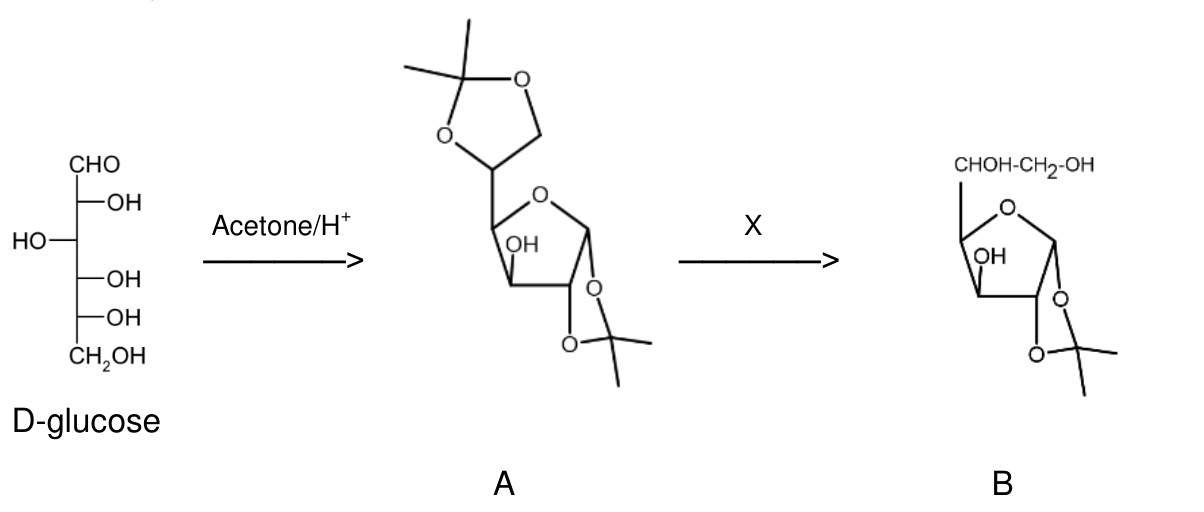
8.1.1 Which of the following sentences is true? (Tick the relevant boxes.)
- ☐ A is an α isomer.
- ☐ A is neither α nor β.
- ☐ A is a β isomer.
- ☐ A is a mixture of α and β isomers.
Give your chosen answers to the questions on the answer sheet.
8.1.2 Which of the following sentences is true?
- ☐ We can get product A only if we use α-D-glucose as starting material.
- ☐ We can get product A only if we use β-D-glucose as starting material.
- ☐ We can get product A either from α- or from β-D glucose as starting material.
8.1.3 Which one of these reagents can be utilized as X for the selective hydrolysis of A?
- ☐ 50% acetic acid
- ☐ concentrated \(\ce{H2SO4}\)
- ☐ \(\ce{HCl}\) in water (\(6\ \mathrm{mol\,dm^{-3}}\))
- ☐ \(\ce{NaOH}\) aqueous solution (\(1\ \mathrm{mol\,dm^{-3}}\))
- ☐ \(\ce{HCl}\) in acetic acid (\(6\ \mathrm{mol\,dm^{-3}}\))
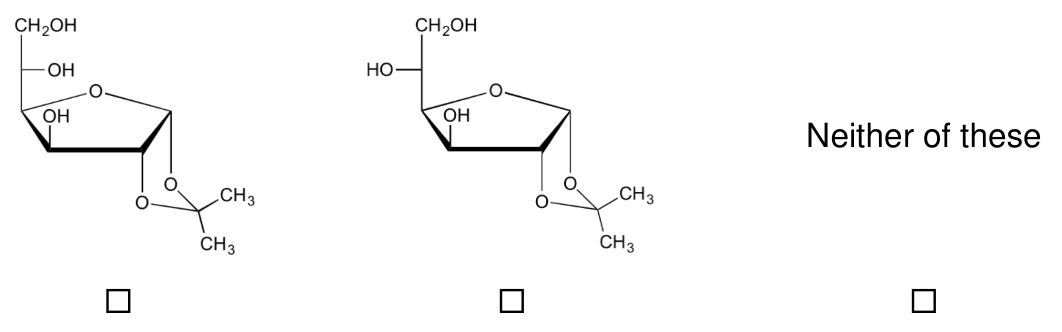
8.1.4 Which is the stereochemically correct structure for compound B?
B is treated with sodium metaperiodate to get C. C is then reacted with an aqueous solution of \(\ce{NaCN}\), then heated with 10% \(\ce{NaOH}\) solution to get a mixture of two diastereomeric compounds D₁ and D₂. These compounds can be separated by column chromatography.

Reaction of D₁ with \(\ce{LiAlH4}\) followed by heating with 1M \(\ce{HCl}\) solution gives sugar F that is the hydrolysis product of the most abundant natural polysaccharide.

8.2.1 Draw the structures of C, D₁, D₂, E and F including stereochemical information. Show F as the more stable 6-membered ring containing isomer using the ring skeleton. Indicate with a wavy line if absolute chirality around a carbon is not known.
8.2.2 The reaction sequence from glucose to F does not seem to be useful. In some cases, however, this is the most economical way to produce F. In which case?
- ☐ \(\ce{^{13}C}\) labelling at carbon 6 of F
- ☐ \(\ce{^{13}C}\) labelling at carbon 5 of F
- ☐ \(\ce{^{13}C}\) labelling at carbon 1 of F
- ☐ \(\ce{^{15}O}\) labelling at glycosidic OH of F
- ☐ synthesis of an uncommon isomer of F
Neutralization of D₂ with \(\ce{HCl}\) followed by heating in toluene results in dehydration and formation of G, which has a tricyclic structure in water-free solvents. Boiling G in \(\ce{HCl}\) solution (\(c = 1\ \mathrm{mol\,dm^{-3}}\)) gives H (\(\ce{C6H10O7}\)), which is a natural sugar derivative containing a 6 membered ring. H is a building block of heparin, an anticoagulant polysaccharide produced by our bodies.

8.3.1 Draw the structure of G including the stereochemistry.
Draw H as the more stable 6-membered ring containing isomer using the ring skeleton. Indicate with a wavy line if absolute chirality around a carbon is not known.
8.3.2 How are the rings of G fused together?
- ☐ both junctions cis,
- ☐ one cis and one trans junction,
- ☐ both junctions trans.
8.3.3 Which of the following is true for H? (You can choose more than one option.)
- ☐ H is a reducing sugar (reacts with Fehling’s reagent)
- ☐ H is an aldaric acid (dicarboxylic derivative of an aldose)
- ☐ H is an aldonic acid (α-carboxyl derivative of an aldose)
- ☐ H is a uronic acid (ω-carboxyl derivative of an aldose)
- ☐ H is a ketose
- ☐ H is a lactone
- ☐ H is a D sugar
- ☐ H is achiral
- ☐ H is a meso compound
Official English text of the problem.
Answers
-
8.1.1: A is an α isomer. It is 1,2:5,6-di-O-isopropylidene-α-D-glucofuranose.
SMILES:CC1(C)O[C@H]2O[C@H]([C@H]3COC(C)(C)O3)[C@H](O)[C@H]2O1 -
8.1.2: Either α-D-glucose or β-D-glucose can be used. Their pyranose structures are:
- α-D-glucopyranose:
OC[C@H]1O[C@H](O)[C@H](O)[C@@H](O)[C@@H]1O -
β-D-glucopyranose:
OC[C@H]1O[C@@H](O)[C@H](O)[C@@H](O)[C@@H]1O -
8.1.3: 50% aqueous acetic acid,
CC(=O)O. -
8.1.4: The second, middle structure, with the C5 hydroxyl drawn to the left. B is 1,2-O-isopropylidene-α-D-glucofuranose.
SMILES:CC1(C)O[C@H]2O[C@H]([C@H](O)CO)[C@H](O)[C@H]2O1 -
8.2.1:
- C: 1,2-O-isopropylidene-α-D-xylo-pentodialdo-1,4-furanose, the protected five-carbon sugar with an aldehyde at C5.
SMILES:CC1(C)O[C@H]2O[C@H](C=O)[C@H](O)[C@H]2O1 - D₁: Sodium 1,2-O-isopropylidene-α-D-glucofuranuronate.
SMILES:CC1(C)O[C@H]2O[C@H]([C@H](O)C(=O)[O-])[C@H](O)[C@H]2O1.[Na+] - D₂: Sodium 1,2-O-isopropylidene-β-L-idofuranuronate, the C5 epimer of D₁.
SMILES:CC1(C)O[C@H]2O[C@H]([C@@H](O)C(=O)[O-])[C@H](O)[C@H]2O1.[Na+] - E: 1,2-O-isopropylidene-α-D-glucofuranose, identical to B.
SMILES:CC1(C)O[C@H]2O[C@H]([C@H](O)CO)[C@H](O)[C@H]2O1 -
F: D-glucopyranose, with a wavy C1–OH bond because the reaction permits anomeric equilibration.
SMILES, anomer unspecified:OC[C@H]1OC(O)[C@H](O)[C@@H](O)[C@@H]1O
Its predominant anomer is β-D-glucopyranose, whose most stable chair is \(^{4}C_{1}\). -
8.2.2: \(\ce{^{13}C}\) labelling at carbon 6 of F. The product is [6-\(\ce{^{13}C}\)]-D-glucose.
Pyranose SMILES, anomer unspecified:O[13CH2][C@H]1OC(O)[C@H](O)[C@@H](O)[C@@H]1O -
8.3.1:
- G: 1,2-O-isopropylidene-β-L-idofuranurono-6,3-lactone.
SMILES:CC1(C)O[C@H]2O[C@H]3[C@H](OC(=O)[C@@H]3O)[C@H]2O1 -
H: L-iduronic acid, drawn as L-idopyranuronic acid, with a wavy C1–OH bond.
SMILES, anomer unspecified:O=C(O)[C@@H]1OC(O)[C@H](O)[C@@H](O)[C@@H]1O -
8.3.2: Both junctions are cis.
-
8.3.3: Select:
- H is a reducing sugar.
- H is a uronic acid.
Solution
Carbon numbering below follows the original glucose chain: C1 is the reducing carbon and C6 is the terminal carbon. The original C6 is subsequently removed and replaced by the carbon supplied by cyanide. The SMILES above specify molecular connectivity and configuration; chair conformations and the required drawing conventions are described below.
8.1.1 — Configuration and formation of A
The product contains a five-membered glucofuranose ring and two isopropylidene protecting groups, joining the oxygens at C1/C2 and C5/C6.
In the depicted furanose orientation, the oxygen substituents at C1 and C2 both point below the ring. The anomeric configuration is therefore α for this D-glucose derivative. The cis arrangement also permits formation of the five-membered 1,2-acetonide ring.
Acetone, CC(=O)C, reacts with two pairs of hydroxyl groups, eliminating two molecules of water, O. The balanced overall reaction is
\[ \ce{C6H12O6 + 2C3H6O <=>[H+] C12H20O6 + 2H2O}. \]
The product \(\ce{C12H20O6}\) is A.
8.1.2 — Why either starting anomer works
Acid catalysis permits ring opening and interconversion of glucose anomers and ring forms. The open-chain intermediate is D-glucose, O=C[C@H](O)[C@@H](O)[C@H](O)[C@H](O)CO.
Consequently, either starting anomer can furnish the α-glucofuranose configuration that is trapped as A. The starting anomer does not uniquely determine the protected product.
8.1.3 — Selective hydrolysis
The terminal 5,6-acetonide can be removed under sufficiently mild aqueous acidic conditions while retaining the 1,2-acetonide. The appropriate reagent is 50% aqueous acetic acid.
The balanced transformation is
\[ \ce{C12H20O6 + H2O ->[H+] C9H16O6 + C3H6O}, \]
that is, A gives B and acetone.
The stronger acidic choices are unsuitable for the intended selective hydrolysis. Acetonides are stable to aqueous base, so sodium hydroxide, [Na+].[OH-], is not the appropriate reagent.
8.1.4 — Selecting the correct drawing of B
Hydrolysis of an acetonide does not invert C5. Thus B must retain the C5 configuration of D-glucose.
In the two proposed drawings, the side-chain projection has C6 at the top and C4 at the bottom. This reverses their vertical order relative to the usual glucose Fischer projection. A \(180^\circ\) rotation of a Fischer projection preserves configuration but exchanges left and right.
Therefore, with C6 above C5, the C5 hydroxyl must be on the left. This selects the second structure.
8.2.1 — Structures of C, D₁, D₂, E and F
Formation of C. The only unprotected vicinal diol in B is the C5–C6 unit. Sodium metaperiodate, [Na+].[O-]I(=O)(=O)=O, cleaves this bond. C5 becomes an aldehyde, while the original C6 leaves as methanal, C=O.
The balanced reaction, including sodium iodate, [Na+].[O-]I(=O)=O, is
\[ \ce{C9H16O6 + NaIO4 -> C8H12O5 + CH2O + NaIO3 + H2O}. \]
Thus C retains the protected furanose framework but has an aldehyde directly attached to C4. Its formula agrees with the supplied molar mass:
\[ M(\ce{C8H12O5}) =8(12.01)+12(1.008)+5(16.00) =188.18\ \mathrm{g\,mol^{-1}} \approx188.2\ \mathrm{g\,mol^{-1}}. \]
For a drawing of C, retain the furanose configuration of B and replace its C4 side chain by \(\ce{-CHO}\). C5 is now trigonal and has no configuration.
Formation of D₁ and D₂. Sodium cyanide, [Na+].[C-]#N, attacks either face of the planar C5 aldehyde, creating two configurations at C5. Alkaline hydrolysis converts the introduced nitrile group into a carboxylate, releasing ammonia, N.
For either epimer, the balanced overall transformation is
\[ \ce{C8H12O5 + NaCN + 2H2O -> C9H13NaO7 + NH3}. \]
The products are sodium carboxylates under the stated alkaline conditions. The added cyanide carbon is their C6.
The most abundant natural polysaccharide is cellulose, whose hydrolysis gives D-glucose. Hence F is D-glucose, and D₁ must be the epimer that gives the D-glucose configuration upon reduction. D₂ has the opposite configuration at C5.
The underlying configurations can be recorded by the following Fischer-projection convention: C1 at the top and C6 at the bottom.
| Centre | D₁ branch: D-glucose configuration | D₂ branch: L-idose configuration |
|---|---|---|
| C2 oxygen substituent | Right | Right |
| C3 oxygen substituent | Left | Left |
| C4 oxygen substituent | Right | Right |
| C5 oxygen substituent | Right | Left |
The C1–C4 configurations of the protected furanose remain unchanged. Because the D/L reference centre changes at C5, the retained anomeric configuration is designated α-D in D₁ and β-L in D₂.
For the protected furanose drawings, use the orientation in the problem:
- Ring oxygen at the top, C1 at the right, and C2–C3 along the lower edge.
- The C1 and C2 acetonide oxygens point below the ring.
- The C3 hydroxyl and the C4 side chain point above the ring.
- D₁ and D₂ differ only in the side-chain C5 configuration.
Reduction to E. Lithium aluminium hydride, [Li+].[AlH4-], reduces the C6 carboxylate to a primary alcohol without changing C5. Consequently, E is identical to B.
A balanced reduction half-equation for the organic anion is
\[ \ce{C9H13O7^- + 5H+ + 4e- -> C9H16O6 + H2O}. \]
This expresses the net redox balance including the protonating work-up.
Hydrolysis to F. Aqueous hydrochloric acid, [H+].[Cl-], removes the remaining acetonide:
\[ \ce{C9H16O6 + H2O ->[H+] C6H12O6 + C3H6O}. \]
The liberated sugar undergoes ring-size and anomeric equilibration.
To draw F as a six-membered ring, use the conventional glucopyranose Haworth orientation: ring oxygen at the upper right, C1 at the right, and numbering clockwise through C2–C5. Draw:
- C2–OH down;
- C3–OH up;
- C4–OH down;
- the C5 hydroxymethyl substituent up;
- C1–OH with a wavy bond.
The anomeric configuration is not fixed by the hydrolysis. The predominant anomer, β-D-glucopyranose, adopts the \(^{4}C_{1}\) chair with all hydroxyl groups and the hydroxymethyl substituent equatorial. SMILES does not specify this chair conformation.
8.2.2 — Selective carbon-6 labelling
The carbon tracing is
\[ \begin{aligned} \text{Original glucose C6} &\longrightarrow \text{methanal},\\ \text{Cyanide carbon} &\longrightarrow \text{C6 carboxylate carbon of D₁}\\ &\longrightarrow \text{C6 hydroxymethyl carbon of F}. \end{aligned} \]
Using sodium \(\ce{^{13}C}\)-cyanide, [Na+].[13C-]#N, therefore gives [6-\(\ce{^{13}C}\)]-D-glucose.
The route replaces just one skeletal carbon with the labelled carbon supplied by cyanide, making it useful for selective C6 labelling.
8.3.1 — Structures of G and H
Neutralization and lactonization. One equivalent of hydrochloric acid converts D₂ into 1,2-O-isopropylidene-β-L-idofuranuronic acid:
CC1(C)O[C@H]2O[C@H]([C@@H](O)C(=O)O)[C@H](O)[C@H]2O1
The balanced neutralization is
\[ \ce{C9H13NaO7 + HCl -> C9H14O7 + NaCl}, \]
where sodium chloride is [Na+].[Cl-].
Heating in toluene, Cc1ccccc1, promotes intramolecular esterification between the C6 carboxyl group and the C3 hydroxyl:
\[ \ce{C9H14O7 ->[\Delta] C9H12O6 + H2O}. \]
This produces the 6,3-lactone G. Its three rings are:
- The original five-membered furanose ring.
- The five-membered 1,2-acetonide ring.
- A five-membered lactone containing the oxygen originally attached to C3, followed by C6, C5, C4 and C3.
For the drawing, join the C3 oxygen to the C6 carbonyl carbon, retaining all existing configurations. The C5 hydroxyl remains free. The stereochemical SMILES in the Answers fixes its orientation.
Hydrolysis to H. Aqueous acid hydrolyses both the acetonide and the lactone. The balanced overall reaction is
\[ \ce{C9H12O6 + 2H2O ->[H+] C6H10O7 + C3H6O}. \]
The resulting sugar acid has the L-idose configuration and a carboxyl group at C6: it is L-iduronic acid.
For its six-membered L-idopyranuronic acid drawing, use the same Haworth orientation as for F. Draw:
- C2–OH down;
- C3–OH up;
- C4–OH down;
- the C5 carboxyl substituent down;
- C1–OH with a wavy bond.
The ring oxygen is the oxygen originally attached to C5. The wavy bond reflects anomeric equilibration after deprotection. This Haworth description fixes configuration without assigning a particular chair conformation.
8.3.2 — Ring junctions in G
The acetonide and furanose share the C1–C2 bond. Their two acetonide oxygen attachments are on the same face of the furanose ring, so this junction is cis.
The lactone and furanose share the C3–C4 bond. The C3 oxygen and the C4 side chain that form the lactone are also on the same face, so this junction is cis.
Therefore, both junctions are cis.
8.3.3 — Properties of H
| Proposed property | True? | Reason |
|---|---|---|
| Reducing sugar | Yes | Its free anomeric hemiacetal can open to an aldehyde and react with Fehling’s reagent. |
| Aldaric acid | No | It has only one carboxyl group. |
| Aldonic acid | No | Its carboxyl group is at C6; C1 remains the reducing terminus. |
| Uronic acid | Yes | The terminal C6 primary-alcohol position is a carboxyl group. |
| Ketose | No | Its open-chain reducing group is an aldehyde. |
| Lactone | No | The lactone of G has been hydrolysed; the pyranose ring is a hemiacetal. |
| D sugar | No | Its C5 configuration places it in the L series. |
| Achiral | No | It has fixed stereocentres and no internal symmetry making it achiral. |
| Meso compound | No | It lacks the required internal symmetry. |
The answers were checked against the official answers published by the organisers.
IChO 2016 · Theorieaufgabe 8
Zuckerderivate aus D-Glucose
Ein exotisches, aber biologisch relevantes Zuckeranalogon lässt sich auf folgende Weise aus D-Glucose herstellen. Beim Erhitzen eines Gemisches aus D-Glucose und Aceton mit einigen Tropfen konzentrierter Säure entsteht ein Diacetonid A. Anschließend lässt sich A selektiv zu B hydrolysieren.
8.1.1 Welche der folgenden Aussagen ist richtig? (Kreuzen Sie die entsprechenden Kästchen an.)
- ☐ A ist ein α-Isomer.
- ☐ A ist weder α noch β.
- ☐ A ist ein β-Isomer.
- ☐ A ist ein Gemisch aus α- und β-Isomeren.
Tragen Sie Ihre gewählten Antworten auf die Fragen in das Antwortblatt ein.
8.1.2 Welche der folgenden Aussagen ist richtig?
- ☐ Wir können Produkt A nur erhalten, wenn wir α-D-Glucose als Ausgangsstoff verwenden.
- ☐ Wir können Produkt A nur erhalten, wenn wir β-D-Glucose als Ausgangsstoff verwenden.
- ☐ Wir können Produkt A sowohl aus α- als auch aus β-D-Glucose als Ausgangsstoff erhalten.
8.1.3 Welches dieser Reagenzien kann als X für die selektive Hydrolyse von A verwendet werden?
- ☐ 50%ige Essigsäure
- ☐ konzentrierte \(\ce{H2SO4}\)
- ☐ \(\ce{HCl}\) in Wasser (\(6\ \mathrm{mol\,dm^{-3}}\))
- ☐ wässrige \(\ce{NaOH}\)-Lösung (\(1\ \mathrm{mol\,dm^{-3}}\))
- ☐ \(\ce{HCl}\) in Essigsäure (\(6\ \mathrm{mol\,dm^{-3}}\))
8.1.4 Welche ist die stereochemisch korrekte Struktur der Verbindung B?
B wird mit Natriummetaperiodat behandelt, um C zu erhalten. C wird anschließend mit einer wässrigen Lösung von \(\ce{NaCN}\) umgesetzt und danach mit 10%iger \(\ce{NaOH}\)-Lösung erhitzt, wobei ein Gemisch aus zwei diastereomeren Verbindungen D₁ und D₂ entsteht. Diese Verbindungen lassen sich durch Säulenchromatographie trennen.
Die Reaktion von D₁ mit \(\ce{LiAlH4}\), gefolgt vom Erhitzen mit 1M \(\ce{HCl}\)-Lösung, liefert den Zucker F, der das Hydrolyseprodukt des am häufigsten vorkommenden natürlichen Polysaccharids ist.
8.2.1 Zeichnen Sie die Strukturen von C, D₁, D₂, E und F einschließlich der stereochemischen Angaben. Stellen Sie F unter Verwendung des Ringgerüsts als das stabilere Isomer mit einem sechsgliedrigen Ring dar. Kennzeichnen Sie mit einer Wellenlinie, wenn die absolute Konfiguration an einem Kohlenstoffatom nicht bekannt ist.
8.2.2 Die Reaktionsfolge von Glucose zu F erscheint nicht sinnvoll. In manchen Fällen ist dies jedoch der wirtschaftlichste Weg zur Herstellung von F. In welchem Fall?
- ☐ \(\ce{^{13}C}\)-Markierung am Kohlenstoffatom 6 von F
- ☐ \(\ce{^{13}C}\)-Markierung am Kohlenstoffatom 5 von F
- ☐ \(\ce{^{13}C}\)-Markierung am Kohlenstoffatom 1 von F
- ☐ \(\ce{^{15}O}\)-Markierung an der glykosidischen OH-Gruppe von F
- ☐ Synthese eines seltenen Isomers von F
Die Neutralisation von D₂ mit \(\ce{HCl}\), gefolgt vom Erhitzen in Toluol, führt zur Wasserabspaltung und zur Bildung von G, das in wasserfreien Lösungsmitteln eine tricyclische Struktur aufweist. Beim Kochen von G in \(\ce{HCl}\)-Lösung (\(c = 1\ \mathrm{mol\,dm^{-3}}\)) entsteht H (\(\ce{C6H10O7}\)), ein natürliches Zuckerderivat mit einem sechsgliedrigen Ring. H ist ein Baustein von Heparin, einem gerinnungshemmenden Polysaccharid, das unser Körper produziert.
8.3.1 Zeichnen Sie die Struktur von G einschließlich der Stereochemie.
Zeichnen Sie H unter Verwendung des Ringgerüsts als das stabilere Isomer mit einem sechsgliedrigen Ring. Kennzeichnen Sie mit einer Wellenlinie, wenn die absolute Konfiguration an einem Kohlenstoffatom nicht bekannt ist.
8.3.2 Wie sind die Ringe von G miteinander verknüpft?
- ☐ beide Verknüpfungen cis,
- ☐ eine cis- und eine trans-Verknüpfung,
- ☐ beide Verknüpfungen trans.
8.3.3 Welche der folgenden Aussagen trifft auf H zu? (Sie können mehr als eine Option auswählen.)
- ☐ H ist ein reduzierender Zucker (reagiert mit Fehling-Reagenz)
- ☐ H ist eine Aldarsäure (Dicarbonsäurederivat einer Aldose)
- ☐ H ist eine Aldonsäure (α-Carboxylderivat einer Aldose)
- ☐ H ist eine Uronsäure (ω-Carboxylderivat einer Aldose)
- ☐ H ist eine Ketose
- ☐ H ist ein Lacton
- ☐ H ist ein D-Zucker
- ☐ H ist achiral
- ☐ H ist eine meso-Verbindung
Aufgabentext aus dem offiziellen englischen Text übersetzt.
Antworten
-
8.1.1: A ist ein α-Isomer. Es handelt sich um 1,2:5,6-Di-O-isopropyliden-α-D-glucofuranose.
SMILES:CC1(C)O[C@H]2O[C@H]([C@H]3COC(C)(C)O3)[C@H](O)[C@H]2O1 -
8.1.2: Sowohl α-D-Glucose als auch β-D-Glucose können verwendet werden. Ihre Pyranosestrukturen sind:
- α-D-Glucopyranose:
OC[C@H]1O[C@H](O)[C@H](O)[C@@H](O)[C@@H]1O -
β-D-Glucopyranose:
OC[C@H]1O[C@@H](O)[C@H](O)[C@@H](O)[C@@H]1O -
8.1.3: 50%ige wässrige Essigsäure,
CC(=O)O. -
8.1.4: Die zweite, mittlere Struktur, bei der die Hydroxygruppe an C5 nach links gezeichnet ist. B ist 1,2-O-Isopropyliden-α-D-glucofuranose.
SMILES:CC1(C)O[C@H]2O[C@H]([C@H](O)CO)[C@H](O)[C@H]2O1 -
8.2.1:
- C: 1,2-O-Isopropyliden-α-D-xylo-pentodialdo-1,4-furanose, der geschützte Zucker mit fünf Kohlenstoffatomen und einer Aldehydgruppe an C5.
SMILES:CC1(C)O[C@H]2O[C@H](C=O)[C@H](O)[C@H]2O1 - D₁: Natrium-1,2-O-isopropyliden-α-D-glucofuranuronat.
SMILES:CC1(C)O[C@H]2O[C@H]([C@H](O)C(=O)[O-])[C@H](O)[C@H]2O1.[Na+] - D₂: Natrium-1,2-O-isopropyliden-β-L-idofuranuronat, das C5-Epimer von D₁.
SMILES:CC1(C)O[C@H]2O[C@H]([C@@H](O)C(=O)[O-])[C@H](O)[C@H]2O1.[Na+] - E: 1,2-O-Isopropyliden-α-D-glucofuranose, identisch mit B.
SMILES:CC1(C)O[C@H]2O[C@H]([C@H](O)CO)[C@H](O)[C@H]2O1 -
F: D-Glucopyranose, mit einer gewellten C1–OH-Bindung, da die Reaktion die Einstellung des Anomerengleichgewichts ermöglicht.
SMILES, Anomer nicht festgelegt:OC[C@H]1OC(O)[C@H](O)[C@@H](O)[C@@H]1O
Ihr überwiegendes Anomer ist β-D-Glucopyranose, dessen stabilste Sesselkonformation \(^{4}C_{1}\) ist. -
8.2.2: \(\ce{^{13}C}\)-Markierung am Kohlenstoffatom 6 von F. Das Produkt ist [6-\(\ce{^{13}C}\)]-D-Glucose.
Pyranose-SMILES, Anomer nicht festgelegt:O[13CH2][C@H]1OC(O)[C@H](O)[C@@H](O)[C@@H]1O -
8.3.1:
- G: 1,2-O-Isopropyliden-β-L-idofuranurono-6,3-lacton.
SMILES:CC1(C)O[C@H]2O[C@H]3[C@H](OC(=O)[C@@H]3O)[C@H]2O1 -
H: L-Iduronsäure, gezeichnet als L-Idopyranuronsäure, mit einer gewellten C1–OH-Bindung.
SMILES, Anomer nicht festgelegt:O=C(O)[C@@H]1OC(O)[C@H](O)[C@@H](O)[C@@H]1O -
8.3.2: Beide Verknüpfungen sind cis.
-
8.3.3: Anzukreuzen sind:
- H ist ein reduzierender Zucker.
- H ist eine Uronsäure.
Lösung
Die nachfolgende Nummerierung der Kohlenstoffatome folgt der ursprünglichen Glucosekette: C1 ist das reduzierende Kohlenstoffatom und C6 das endständige Kohlenstoffatom. Das ursprüngliche C6 wird später entfernt und durch das vom Cyanid gelieferte Kohlenstoffatom ersetzt. Die obigen SMILES geben die molekulare Konnektivität und Konfiguration an; Sesselkonformationen und die erforderlichen Zeichenkonventionen werden im Folgenden beschrieben.
8.1.1 — Konfiguration und Bildung von A
Das Produkt enthält einen fünfgliedrigen Glucofuranosering und zwei Isopropyliden-Schutzgruppen, die die Sauerstoffatome an C1/C2 und C5/C6 miteinander verbinden.
In der dargestellten Furanoseorientierung zeigen die Sauerstoffsubstituenten an C1 und C2 beide unter die Ringebene. Die anomere Konfiguration dieses D-Glucosederivats ist daher α. Die cis-Anordnung ermöglicht außerdem die Bildung des fünfgliedrigen 1,2-Acetonidrings.
Aceton, CC(=O)C, reagiert mit zwei Paaren von Hydroxygruppen unter Abspaltung von zwei Molekülen Wasser, O. Die ausgeglichene Gesamtreaktion lautet
\[ \ce{C6H12O6 + 2C3H6O <=>[H+] C12H20O6 + 2H2O}. \]
Das Produkt \(\ce{C12H20O6}\) ist A.
8.1.2 — Warum beide Ausgangsanomere geeignet sind
Die Säurekatalyse ermöglicht die Ringöffnung und die wechselseitige Umwandlung der Anomere und Ringformen der Glucose. Das offenkettige Zwischenprodukt ist D-Glucose, O=C[C@H](O)[C@@H](O)[C@H](O)[C@H](O)CO.
Folglich kann jedes der beiden Ausgangsanomere die α-Glucofuranosekonfiguration liefern, die als A fixiert wird. Das Ausgangsanomer bestimmt das geschützte Produkt nicht eindeutig.
8.1.3 — Selektive Hydrolyse
Das endständige 5,6-Acetonid lässt sich unter hinreichend milden wässrig-sauren Bedingungen entfernen, während das 1,2-Acetonid erhalten bleibt. Das geeignete Reagenz ist 50%ige wässrige Essigsäure.
Die ausgeglichene Umsetzung lautet
\[ \ce{C12H20O6 + H2O ->[H+] C9H16O6 + C3H6O}, \]
das heißt, A liefert B und Aceton.
Die stärker sauren Optionen sind für die beabsichtigte selektive Hydrolyse ungeeignet. Acetonide sind gegenüber wässrigen Basen stabil, daher ist Natriumhydroxid, [Na+].[OH-], nicht das geeignete Reagenz.
8.1.4 — Auswahl der richtigen Darstellung von B
Die Hydrolyse eines Acetonids führt nicht zu einer Inversion an C5. Daher muss B die C5-Konfiguration der D-Glucose beibehalten.
In den beiden vorgeschlagenen Darstellungen befindet sich in der Projektion der Seitenkette C6 oben und C4 unten. Damit ist ihre vertikale Reihenfolge gegenüber der üblichen Fischer-Projektion der Glucose umgekehrt. Eine Drehung einer Fischer-Projektion um \(180^\circ\) erhält die Konfiguration, vertauscht aber links und rechts.
Wenn C6 oberhalb von C5 steht, muss sich die Hydroxygruppe an C5 daher links befinden. Damit ist die zweite Struktur auszuwählen.
8.2.1 — Strukturen von C, D₁, D₂, E und F
Bildung von C. Das einzige ungeschützte vicinale Diol in B ist die C5–C6-Einheit. Natriummetaperiodat, [Na+].[O-]I(=O)(=O)=O, spaltet diese Bindung. C5 wird zu einer Aldehydgruppe, während das ursprüngliche C6 als Methanal, C=O, abgespalten wird.
Die ausgeglichene Reaktion einschließlich Natriumiodat, [Na+].[O-]I(=O)=O, lautet
\[ \ce{C9H16O6 + NaIO4 -> C8H12O5 + CH2O + NaIO3 + H2O}. \]
Somit behält C das geschützte Furanosegerüst bei, besitzt aber eine direkt an C4 gebundene Aldehydgruppe. Seine Summenformel stimmt mit der angegebenen molaren Masse überein:
\[ M(\ce{C8H12O5}) =8(12.01)+12(1.008)+5(16.00) =188.18\ \mathrm{g\,mol^{-1}} \approx188.2\ \mathrm{g\,mol^{-1}}. \]
Behalten Sie beim Zeichnen von C die Furanosekonfiguration von B bei und ersetzen Sie dessen Seitenkette an C4 durch \(\ce{-CHO}\). C5 ist nun trigonal und besitzt keine Konfiguration.
Bildung von D₁ und D₂. Natriumcyanid, [Na+].[C-]#N, greift die planare Aldehydgruppe an C5 von beiden Seiten an, wodurch zwei Konfigurationen an C5 entstehen. Die alkalische Hydrolyse wandelt die eingeführte Nitrilgruppe unter Freisetzung von Ammoniak, N, in ein Carboxylat um.
Für jedes der beiden Epimere lautet die ausgeglichene Gesamtumsetzung
\[ \ce{C8H12O5 + NaCN + 2H2O -> C9H13NaO7 + NH3}. \]
Unter den angegebenen alkalischen Bedingungen liegen die Produkte als Natriumcarboxylate vor. Das hinzugefügte Cyanid-Kohlenstoffatom ist ihr C6.
Das am häufigsten vorkommende natürliche Polysaccharid ist Cellulose, deren Hydrolyse D-Glucose liefert. Daher ist F D-Glucose, und D₁ muss das Epimer sein, das bei der Reduktion die D-Glucosekonfiguration ergibt. D₂ besitzt die entgegengesetzte Konfiguration an C5.
Die zugrunde liegenden Konfigurationen lassen sich nach folgender Konvention der Fischer-Projektion festhalten: C1 oben und C6 unten.
| Zentrum | D₁-Reaktionszweig: D-Glucosekonfiguration | D₂-Reaktionszweig: L-Idosekonfiguration |
|---|---|---|
| Sauerstoffsubstituent an C2 | Rechts | Rechts |
| Sauerstoffsubstituent an C3 | Links | Links |
| Sauerstoffsubstituent an C4 | Rechts | Rechts |
| Sauerstoffsubstituent an C5 | Rechts | Links |
Die Konfigurationen an C1–C4 der geschützten Furanose bleiben unverändert. Da sich das D/L-Referenzzentrum an C5 ändert, wird die beibehaltene anomere Konfiguration in D₁ als α-D und in D₂ als β-L bezeichnet.
Verwenden Sie für die Zeichnungen der geschützten Furanosen die Orientierung aus der Aufgabenstellung:
- Ringsauerstoff oben, C1 rechts und C2–C3 entlang der unteren Kante.
- Die Acetonid-Sauerstoffatome an C1 und C2 zeigen unter die Ringebene.
- Die Hydroxygruppe an C3 und die Seitenkette an C4 zeigen über die Ringebene.
- D₁ und D₂ unterscheiden sich nur in der Konfiguration an C5 der Seitenkette.
Reduktion zu E. Lithiumaluminiumhydrid, [Li+].[AlH4-], reduziert das Carboxylat an C6 zu einem primären Alkohol, ohne C5 zu verändern. Folglich ist E identisch mit B.
Eine ausgeglichene Reduktionshalbgleichung für das organische Anion lautet
\[ \ce{C9H13O7^- + 5H+ + 4e- -> C9H16O6 + H2O}. \]
Sie gibt die Nettoredoxbilanz einschließlich der protonierenden Aufarbeitung wieder.
Hydrolyse zu F. Wässrige Salzsäure, [H+].[Cl-], entfernt das verbleibende Acetonid:
\[ \ce{C9H16O6 + H2O ->[H+] C6H12O6 + C3H6O}. \]
Beim freigesetzten Zucker stellen sich Gleichgewichte zwischen den Ringgrößen und zwischen den Anomeren ein.
Um F als sechsgliedrigen Ring zu zeichnen, verwenden Sie die übliche Haworth-Orientierung der Glucopyranose: Ringsauerstoff oben rechts, C1 rechts und Nummerierung im Uhrzeigersinn über C2–C5. Zeichnen Sie:
- C2–OH nach unten;
- C3–OH nach oben;
- C4–OH nach unten;
- den Hydroxymethylsubstituenten an C5 nach oben;
- C1–OH mit einer gewellten Bindung.
Die anomere Konfiguration wird durch die Hydrolyse nicht festgelegt. Das überwiegende Anomer, β-D-Glucopyranose, nimmt die \(^{4}C_{1}\)-Sesselkonformation ein, in der alle Hydroxygruppen und der Hydroxymethylsubstituent äquatorial stehen. SMILES legt diese Sesselkonformation nicht fest.
8.2.2 — Selektive Markierung von Kohlenstoffatom 6
Die Kohlenstoffatome lassen sich wie folgt verfolgen:
\[ \begin{aligned} \text{Ursprüngliches C6 der Glucose} &\longrightarrow \text{Methanal},\\ \text{Cyanid-Kohlenstoffatom} &\longrightarrow \text{C6-Carboxylat-Kohlenstoffatom von D₁}\\ &\longrightarrow \text{C6-Hydroxymethyl-Kohlenstoffatom von F}. \end{aligned} \]
Die Verwendung von Natrium-\(\ce{^{13}C}\)-cyanid, [Na+].[13C-]#N, liefert daher [6-\(\ce{^{13}C}\)]-D-Glucose.
Dieser Syntheseweg ersetzt nur ein einziges Kohlenstoffatom des Gerüsts durch das vom Cyanid gelieferte markierte Kohlenstoffatom und eignet sich daher zur selektiven C6-Markierung.
8.3.1 — Strukturen von G und H
Neutralisation und Lactonisierung. Ein Äquivalent Salzsäure wandelt D₂ in 1,2-O-Isopropyliden-β-L-idofuranuronsäure um:
CC1(C)O[C@H]2O[C@H]([C@@H](O)C(=O)O)[C@H](O)[C@H]2O1
Die ausgeglichene Neutralisation lautet
\[ \ce{C9H13NaO7 + HCl -> C9H14O7 + NaCl}, \]
wobei Natriumchlorid als [Na+].[Cl-] dargestellt wird.
Das Erhitzen in Toluol, Cc1ccccc1, fördert die intramolekulare Veresterung zwischen der Carboxylgruppe an C6 und der Hydroxygruppe an C3:
\[ \ce{C9H14O7 ->[\Delta] C9H12O6 + H2O}. \]
Dabei entsteht das 6,3-Lacton G. Seine drei Ringe sind:
- Der ursprüngliche fünfgliedrige Furanosering.
- Der fünfgliedrige 1,2-Acetonidring.
- Ein fünfgliedriges Lacton, das das ursprünglich an C3 gebundene Sauerstoffatom, gefolgt von C6, C5, C4 und C3, enthält.
Verbinden Sie in der Zeichnung das Sauerstoffatom an C3 mit dem Carbonyl-Kohlenstoffatom C6 und behalten Sie dabei alle vorhandenen Konfigurationen bei. Die Hydroxygruppe an C5 bleibt frei. Der stereochemische SMILES in den Antworten legt ihre Orientierung fest.
Hydrolyse zu H. Wässrige Säure hydrolysiert sowohl das Acetonid als auch das Lacton. Die ausgeglichene Gesamtreaktion lautet
\[ \ce{C9H12O6 + 2H2O ->[H+] C6H10O7 + C3H6O}. \]
Die entstehende Zuckersäure besitzt die L-Idosekonfiguration und eine Carboxylgruppe an C6: Es handelt sich um L-Iduronsäure.
Verwenden Sie für ihre Darstellung als sechsgliedrige L-Idopyranuronsäure dieselbe Haworth-Orientierung wie für F. Zeichnen Sie:
- C2–OH nach unten;
- C3–OH nach oben;
- C4–OH nach unten;
- den Carboxylsubstituenten an C5 nach unten;
- C1–OH mit einer gewellten Bindung.
Der Ringsauerstoff ist das ursprünglich an C5 gebundene Sauerstoffatom. Die gewellte Bindung spiegelt die Einstellung des Anomerengleichgewichts nach der Entschützung wider. Diese Haworth-Beschreibung legt die Konfiguration fest, ohne eine bestimmte Sesselkonformation zuzuweisen.
8.3.2 — Ringverknüpfungen in G
Acetonid und Furanose haben die C1–C2-Bindung gemeinsam. Ihre beiden Bindungen zu den Acetonid-Sauerstoffatomen liegen auf derselben Seite des Furanoserings, daher ist diese Verknüpfung cis.
Lacton und Furanose haben die C3–C4-Bindung gemeinsam. Das Sauerstoffatom an C3 und die Seitenkette an C4, die das Lacton bilden, liegen ebenfalls auf derselben Seite, daher ist diese Verknüpfung cis.
Somit sind beide Verknüpfungen cis.
8.3.3 — Eigenschaften von H
| Vorgeschlagene Eigenschaft | Richtig? | Begründung |
|---|---|---|
| Reduzierender Zucker | Ja | Sein freies anomeres Halbacetal kann sich zu einem Aldehyd öffnen und mit Fehling-Reagenz reagieren. |
| Aldarsäure | Nein | Es besitzt nur eine Carboxylgruppe. |
| Aldonsäure | Nein | Seine Carboxylgruppe befindet sich an C6; C1 bleibt das reduzierende Ende. |
| Uronsäure | Ja | An der endständigen C6-Position des primären Alkohols befindet sich eine Carboxylgruppe. |
| Ketose | Nein | Seine offenkettige reduzierende Gruppe ist eine Aldehydgruppe. |
| Lacton | Nein | Das Lacton von G wurde hydrolysiert; der Pyranosering ist ein Halbacetal. |
| D-Zucker | Nein | Seine C5-Konfiguration ordnet es der L-Reihe zu. |
| Achiral | Nein | Es besitzt festgelegte Stereozentren und keine innere Symmetrie, die es achiral machen würde. |
| meso-Verbindung | Nein | Ihm fehlt die erforderliche innere Symmetrie. |
Die Ergebnisse wurden mit den von den Veranstaltern veröffentlichten offiziellen Ergebnissen abgeglichen.
IChO 2016 · Teori sorusu 8
D-glukozdan şeker türevleri
Alışılmadık, ancak biyolojik açıdan önemli bir şeker analoğu D-glukozdan aşağıdaki şekilde hazırlanabilir. D-glukoz ve aseton karışımının birkaç damla derişik asitle ısıtılması, bir diasetonid olan A'nın oluşmasını sağlar. Ardından A, seçici olarak hidroliz edilerek B'ye dönüştürülebilir.
8.1.1 Aşağıdaki ifadelerden hangisi doğrudur? (İlgili kutuları işaretleyiniz.)
- ☐ A bir α izomeridir.
- ☐ A ne α ne de β izomeridir.
- ☐ A bir β izomeridir.
- ☐ A, α ve β izomerlerinin bir karışımıdır.
Sorular için seçtiğiniz cevapları cevap kâğıdına yazınız.
8.1.2 Aşağıdaki ifadelerden hangisi doğrudur?
- ☐ A ürününü yalnızca başlangıç maddesi olarak α-D-glukoz kullanırsak elde edebiliriz.
- ☐ A ürününü yalnızca başlangıç maddesi olarak β-D-glukoz kullanırsak elde edebiliriz.
- ☐ A ürününü başlangıç maddesi olarak hem α-D-glukozdan hem de β-D-glukozdan elde edebiliriz.
8.1.3 A'nın seçici hidrolizi için aşağıdaki reaktiflerden hangisi X olarak kullanılabilir?
- ☐ %50 asetik asit
- ☐ derişik \(\ce{H2SO4}\)
- ☐ suda \(\ce{HCl}\) (\(6\ \mathrm{mol\,dm^{-3}}\))
- ☐ sulu \(\ce{NaOH}\) çözeltisi (\(1\ \mathrm{mol\,dm^{-3}}\))
- ☐ asetik asitte \(\ce{HCl}\) (\(6\ \mathrm{mol\,dm^{-3}}\))
8.1.4 B bileşiği için stereokimyasal olarak doğru yapı hangisidir?
B, sodyum metaperiyodat ile tepkimeye sokularak C elde edilir. Daha sonra C, sulu \(\ce{NaCN}\) çözeltisiyle tepkimeye sokulur ve ardından %10'luk \(\ce{NaOH}\) çözeltisiyle ısıtılarak birbirinin diastereomeri olan D₁ ve D₂ bileşiklerinin bir karışımı elde edilir. Bu bileşikler kolon kromatografisiyle ayrılabilir.
D₁'in \(\ce{LiAlH4}\) ile tepkimesini takiben 1M \(\ce{HCl}\) çözeltisiyle ısıtılması, doğada en bol bulunan polisakkaridin hidroliz ürünü olan F şekerini verir.
8.2.1 C, D₁, D₂, E ve F'nin yapılarını stereokimyasal bilgileri de içerecek şekilde çiziniz. Halka iskeletini kullanarak F'yi daha kararlı olan 6 üyeli halka içeren izomer biçiminde gösteriniz. Bir karbonun çevresindeki mutlak kiralite bilinmiyorsa bunu dalgalı bir çizgiyle belirtiniz.
8.2.2 Glukozdan F'ye uzanan tepkime dizisi yararlı görünmemektedir. Ancak bazı durumlarda bu, F'yi üretmenin en ekonomik yoludur. Hangi durumda?
- ☐ F'nin 6 numaralı karbonunda \(\ce{^{13}C}\) ile işaretleme
- ☐ F'nin 5 numaralı karbonunda \(\ce{^{13}C}\) ile işaretleme
- ☐ F'nin 1 numaralı karbonunda \(\ce{^{13}C}\) ile işaretleme
- ☐ F'nin glikozidik OH grubunda \(\ce{^{15}O}\) ile işaretleme
- ☐ F'nin yaygın olmayan bir izomerinin sentezi
D₂'nin \(\ce{HCl}\) ile nötrleştirilmesini takiben toluen içinde ısıtılması, su ayrılmasına ve susuz çözücülerde üç halkalı bir yapıya sahip olan G'nin oluşmasına yol açar. G'nin \(\ce{HCl}\) çözeltisinde (\(c = 1\ \mathrm{mol\,dm^{-3}}\)) kaynatılması, 6 üyeli bir halka içeren doğal bir şeker türevi olan H'yi (\(\ce{C6H10O7}\)) verir. H, vücudumuzun ürettiği antikoagülan bir polisakkarit olan heparinin bir yapı taşıdır.
8.3.1 G'nin yapısını stereokimyayı da içerecek şekilde çiziniz.
Halka iskeletini kullanarak H'yi daha kararlı olan 6 üyeli halka içeren izomer biçiminde çiziniz. Bir karbonun çevresindeki mutlak kiralite bilinmiyorsa bunu dalgalı bir çizgiyle belirtiniz.
8.3.2 G'nin halkaları birbirine nasıl kaynaşmıştır?
- ☐ her iki birleşme de cis,
- ☐ bir birleşme cis, diğeri trans,
- ☐ her iki birleşme de trans.
8.3.3 Aşağıdakilerden hangileri H için doğrudur? (Birden fazla seçenek seçebilirsiniz.)
- ☐ H indirgeyici bir şekerdir (Fehling reaktifiyle tepkime verir)
- ☐ H bir aldarik asittir (bir aldozun dikarboksilik türevi)
- ☐ H bir aldonik asittir (bir aldozun α-karboksil türevi)
- ☐ H bir üronik asittir (bir aldozun ω-karboksil türevi)
- ☐ H bir ketozdur
- ☐ H bir laktondur
- ☐ H bir D şekeridir
- ☐ H akiraldir
- ☐ H bir mezo bileşiktir
Soru metni resmi İngilizce metinden çevrilmiştir.
Cevaplar
-
8.1.1: A bir α izomeridir. 1,2:5,6-di-O-izopropiliden-α-D-glukofuranozdur.
SMILES:CC1(C)O[C@H]2O[C@H]([C@H]3COC(C)(C)O3)[C@H](O)[C@H]2O1 -
8.1.2: Hem α-D-glukoz hem de β-D-glukoz kullanılabilir. Piranoz yapıları şöyledir:
- α-D-glukopiranoz:
OC[C@H]1O[C@H](O)[C@H](O)[C@@H](O)[C@@H]1O -
β-D-glukopiranoz:
OC[C@H]1O[C@@H](O)[C@H](O)[C@@H](O)[C@@H]1O -
8.1.3: %50'lik sulu asetik asit,
CC(=O)O. -
8.1.4: C5 hidroksilinin sola çizildiği ikinci, ortadaki yapı. B, 1,2-O-izopropiliden-α-D-glukofuranozdur.
SMILES:CC1(C)O[C@H]2O[C@H]([C@H](O)CO)[C@H](O)[C@H]2O1 -
8.2.1:
- C: 1,2-O-izopropiliden-α-D-ksilo-pentodialdo-1,4-furanoz, C5'te aldehit grubu bulunan, korunmuş beş karbonlu şeker.
SMILES:CC1(C)O[C@H]2O[C@H](C=O)[C@H](O)[C@H]2O1 - D₁: Sodyum 1,2-O-izopropiliden-α-D-glukofuranüronat.
SMILES:CC1(C)O[C@H]2O[C@H]([C@H](O)C(=O)[O-])[C@H](O)[C@H]2O1.[Na+] - D₂: Sodyum 1,2-O-izopropiliden-β-L-idofuranüronat, D₁'in C5 epimeri.
SMILES:CC1(C)O[C@H]2O[C@H]([C@@H](O)C(=O)[O-])[C@H](O)[C@H]2O1.[Na+] - E: 1,2-O-izopropiliden-α-D-glukofuranoz, B ile aynıdır.
SMILES:CC1(C)O[C@H]2O[C@H]([C@H](O)CO)[C@H](O)[C@H]2O1 -
F: Tepkime anomerler arasında denge kurulmasına izin verdiği için C1–OH bağı dalgalı olarak gösterilen D-glukopiranoz.
Anomeri belirtilmemiş SMILES:OC[C@H]1OC(O)[C@H](O)[C@@H](O)[C@@H]1O
Baskın anomeri β-D-glukopiranozdur ve en kararlı sandalye konformasyonu \(^{4}C_{1}\)'dir. -
8.2.2: F'nin 6 numaralı karbonunda \(\ce{^{13}C}\) ile işaretleme. Ürün [6-\(\ce{^{13}C}\)]-D-glukozdur.
Anomeri belirtilmemiş piranoz SMILES'i:O[13CH2][C@H]1OC(O)[C@H](O)[C@@H](O)[C@@H]1O -
8.3.1:
- G: 1,2-O-izopropiliden-β-L-idofuranürono-6,3-lakton.
SMILES:CC1(C)O[C@H]2O[C@H]3[C@H](OC(=O)[C@@H]3O)[C@H]2O1 -
H: L-idüronik asit; C1–OH bağı dalgalı olarak gösterilerek L-idopiranüronik asit biçiminde çizilir.
Anomeri belirtilmemiş SMILES:O=C(O)[C@@H]1OC(O)[C@H](O)[C@@H](O)[C@@H]1O -
8.3.2: Her iki birleşme de cis'tir.
-
8.3.3: Şunları seçiniz:
- H indirgeyici bir şekerdir.
- H bir üronik asittir.
Çözüm
Aşağıdaki karbon numaralandırması başlangıçtaki glukoz zincirine göredir: C1 indirgeyici karbon, C6 ise uç karbondur. Başlangıçtaki C6 daha sonra uzaklaştırılır ve yerine siyanürden gelen karbon geçer. Yukarıdaki SMILES gösterimleri moleküllerdeki bağlanma düzenini ve konfigürasyonu belirtir; sandalye konformasyonları ve gerekli çizim kuralları aşağıda açıklanmıştır.
8.1.1 — A'nın konfigürasyonu ve oluşumu
Ürün, beş üyeli bir glukofuranoz halkası ile C1/C2 ve C5/C6'daki oksijenleri birbirine bağlayan iki izopropiliden koruyucu grup içerir.
Gösterilen furanoz yöneliminde C1 ve C2'deki oksijenli sübstitüentlerin ikisi de halkanın altına yönelmiştir. Bu nedenle bu D-glukoz türevinin anomerik konfigürasyonu α'dır. Cis düzenlenmesi, beş üyeli 1,2-asetonid halkasının oluşmasına da olanak tanır.
Aseton, CC(=O)C, iki çift hidroksil grubuyla tepkimeye girerek iki su molekülünün, O, ayrılmasını sağlar. Denkleştirilmiş toplam tepkime şöyledir:
\[ \ce{C6H12O6 + 2C3H6O <=>[H+] C12H20O6 + 2H2O}. \]
\(\ce{C12H20O6}\) ürünü A'dır.
8.1.2 — Her iki başlangıç anomerinin de neden kullanılabildiği
Asit katalizi, halka açılmasına ve glukoz anomerleri ile halka biçimlerinin birbirine dönüşmesine olanak tanır. Açık zincirli ara ürün D-glukozdur: O=C[C@H](O)[C@@H](O)[C@H](O)[C@H](O)CO.
Dolayısıyla her iki başlangıç anomeri de A olarak sabitlenen α-glukofuranoz konfigürasyonunu verebilir. Başlangıç anomeri, korunmuş ürünü tek başına belirlemez.
8.1.3 — Seçici hidroliz
Uçtaki 5,6-asetonid, yeterince ılımlı sulu asidik koşullarda 1,2-asetonid korunarak uzaklaştırılabilir. Uygun reaktif %50'lik sulu asetik asittir.
Denkleştirilmiş dönüşüm şöyledir:
\[ \ce{C12H20O6 + H2O ->[H+] C9H16O6 + C3H6O}, \]
yani A, B ve aseton verir.
Daha kuvvetli asidik seçenekler, amaçlanan seçici hidroliz için uygun değildir. Asetonidler sulu baz ortamında kararlıdır; bu nedenle sodyum hidroksit, [Na+].[OH-], uygun reaktif değildir.
8.1.4 — B'nin doğru çiziminin seçilmesi
Bir asetonidin hidrolizi C5'te konfigürasyonun tersine dönmesine yol açmaz. Dolayısıyla B, D-glukozun C5 konfigürasyonunu korumalıdır.
Önerilen iki çizimde yan zincir izdüşümünde C6 üstte, C4 ise alttadır. Bu, alışılmış glukoz Fischer izdüşümüne göre dikey sıralarını tersine çevirir. Bir Fischer izdüşümünün \(180^\circ\) döndürülmesi konfigürasyonu korur, ancak sağ ile solun yerini değiştirir.
Bu nedenle C6, C5'in üzerindeyken C5 hidroksili solda olmalıdır. Böylece ikinci yapı seçilir.
8.2.1 — C, D₁, D₂, E ve F'nin yapıları
C'nin oluşumu. B'deki korunmamış tek komşu diol, C5–C6 birimidir. Sodyum metaperiyodat, [Na+].[O-]I(=O)(=O)=O, bu bağı koparır. C5 bir aldehide dönüşürken başlangıçtaki C6, metanal, C=O, olarak ayrılır.
Sodyum iyodatı, [Na+].[O-]I(=O)=O, da içeren denkleştirilmiş tepkime şöyledir:
\[ \ce{C9H16O6 + NaIO4 -> C8H12O5 + CH2O + NaIO3 + H2O}. \]
Böylece C, korunmuş furanoz iskeletini muhafaza eder, ancak C4'e doğrudan bağlı bir aldehit grubu taşır. Formülü, verilen molar kütleyle uyumludur:
\[ M(\ce{C8H12O5}) =8(12.01)+12(1.008)+5(16.00) =188.18\ \mathrm{g\,mol^{-1}} \approx188.2\ \mathrm{g\,mol^{-1}}. \]
C'yi çizmek için B'nin furanoz konfigürasyonunu koruyunuz ve C4'teki yan zincirini \(\ce{-CHO}\) ile değiştiriniz. C5 artık üçgensel düzlemseldir ve bir konfigürasyona sahip değildir.
D₁ ve D₂'nin oluşumu. Sodyum siyanür, [Na+].[C-]#N, düzlemsel C5 aldehidinin her iki yüzünden de saldırarak C5'te iki farklı konfigürasyon oluşturur. Bazik hidroliz, eklenen nitril grubunu karboksilata dönüştürür ve amonyak, N, açığa çıkarır.
Her iki epimer için denkleştirilmiş toplam dönüşüm şöyledir:
\[ \ce{C8H12O5 + NaCN + 2H2O -> C9H13NaO7 + NH3}. \]
Belirtilen bazik koşullarda ürünler sodyum karboksilatlardır. Eklenen siyanür karbonu, bu ürünlerin C6 karbonudur.
Doğada en bol bulunan polisakkarit selülozdur ve hidrolizi D-glukoz verir. Bu nedenle F, D-glukozdur ve D₁, indirgendiğinde D-glukoz konfigürasyonunu veren epimer olmalıdır. D₂, C5'te zıt konfigürasyona sahiptir.
Temel konfigürasyonlar şu Fischer izdüşümü düzeniyle gösterilebilir: C1 üstte, C6 altta.
| Merkez | D₁ kolu: D-glukoz konfigürasyonu | D₂ kolu: L-idoz konfigürasyonu |
|---|---|---|
| C2 oksijenli sübstitüenti | Sağda | Sağda |
| C3 oksijenli sübstitüenti | Solda | Solda |
| C4 oksijenli sübstitüenti | Sağda | Sağda |
| C5 oksijenli sübstitüenti | Sağda | Solda |
Korunmuş furanozun C1–C4 konfigürasyonları değişmeden kalır. C5'teki D/L referans merkezinin konfigürasyonu değiştiği için korunan anomerik konfigürasyon D₁'de α-D, D₂'de ise β-L olarak adlandırılır.
Korunmuş furanoz çizimleri için sorudaki yönelimi kullanınız:
- Halka oksijeni üstte, C1 sağda ve C2–C3 alt kenar boyunca yer alır.
- C1 ve C2 asetonid oksijenleri halkanın altına yönelir.
- C3 hidroksili ve C4 yan zinciri halkanın üstüne yönelir.
- D₁ ve D₂ yalnızca yan zincirdeki C5 konfigürasyonu bakımından farklıdır.
E'ye indirgenme. Lityum alüminyum hidrür, [Li+].[AlH4-], C5'i değiştirmeden C6 karboksilatını bir birincil alkole indirger. Dolayısıyla E, B ile aynıdır.
Organik anyon için denkleştirilmiş bir indirgenme yarı tepkimesi şöyledir:
\[ \ce{C9H13O7^- + 5H+ + 4e- -> C9H16O6 + H2O}. \]
Bu, protonlama içeren tepkime sonrası işlem de dâhil olmak üzere net redoks bilançosunu ifade eder.
F'ye hidroliz. Sulu hidroklorik asit, [H+].[Cl-], kalan asetonidi uzaklaştırır:
\[ \ce{C9H16O6 + H2O ->[H+] C6H12O6 + C3H6O}. \]
Serbest kalan şekerin farklı halka boyutları ve anomerleri arasında denge kurulur.
F'yi altı üyeli bir halka olarak çizmek için geleneksel glukopiranoz Haworth yönelimini kullanınız: halka oksijeni sağ üstte, C1 sağda olmalı ve numaralandırma C2–C5 boyunca saat yönünde ilerlemelidir. Çizimde:
- C2–OH aşağı yönelmeli;
- C3–OH yukarı yönelmeli;
- C4–OH aşağı yönelmeli;
- C5 hidroksimetil sübstitüenti yukarı yönelmeli;
- C1–OH dalgalı bir bağla gösterilmelidir.
Anomerik konfigürasyon hidrolizle sabitlenmez. Baskın anomer olan β-D-glukopiranoz, tüm hidroksil gruplarının ve hidroksimetil sübstitüentinin ekvatoryal olduğu \(^{4}C_{1}\) sandalye konformasyonunu benimser. SMILES bu sandalye konformasyonunu belirtmez.
8.2.2 — 6 numaralı karbonun seçici olarak işaretlenmesi
Karbonların izlediği yol şöyledir:
\[ \begin{aligned} \text{Başlangıçtaki glukozun C6 karbonu} &\longrightarrow \text{metanal},\\ \text{Siyanür karbonu} &\longrightarrow \text{D₁'in C6 karboksilat karbonu}\\ &\longrightarrow \text{F'nin C6 hidroksimetil karbonu}. \end{aligned} \]
Bu nedenle sodyum \(\ce{^{13}C}\)-siyanür, [Na+].[13C-]#N, kullanılması [6-\(\ce{^{13}C}\)]-D-glukoz verir.
Bu sentez yolu, iskeletteki yalnızca bir karbonu siyanürden gelen işaretli karbonla değiştirir; bu da onu seçici C6 işaretlemesi için yararlı kılar.
8.3.1 — G ve H'nin yapıları
Nötrleşme ve laktonlaşma. Bir eşdeğer hidroklorik asit, D₂'yi 1,2-O-izopropiliden-β-L-idofuranüronik aside dönüştürür:
CC1(C)O[C@H]2O[C@H]([C@@H](O)C(=O)O)[C@H](O)[C@H]2O1
Denkleştirilmiş nötrleşme tepkimesi şöyledir:
\[ \ce{C9H13NaO7 + HCl -> C9H14O7 + NaCl}, \]
burada sodyum klorür [Na+].[Cl-] ile gösterilir.
Toluen, Cc1ccccc1, içinde ısıtma, C6 karboksil grubu ile C3 hidroksili arasındaki molekül içi esterleşmeyi destekler:
\[ \ce{C9H14O7 ->[\Delta] C9H12O6 + H2O}. \]
Bunun sonucunda 6,3-lakton G oluşur. Üç halkası şunlardır:
- Başlangıçtaki beş üyeli furanoz halkası.
- Beş üyeli 1,2-asetonid halkası.
- Başlangıçta C3'e bağlı olan oksijeni ve ardından C6, C5, C4 ve C3'ü içeren beş üyeli bir lakton.
Çizim için mevcut tüm konfigürasyonları koruyarak C3 oksijenini C6 karbonil karbonuna bağlayınız. C5 hidroksili serbest kalır. Cevaplar bölümündeki stereokimyasal SMILES gösterimi, bu grubun yönelimini belirler.
H'ye hidroliz. Sulu asit hem asetonidi hem de laktonu hidroliz eder. Denkleştirilmiş toplam tepkime şöyledir:
\[ \ce{C9H12O6 + 2H2O ->[H+] C6H10O7 + C3H6O}. \]
Oluşan şeker asidi, L-idoz konfigürasyonuna ve C6'da bir karboksil grubuna sahiptir: bu bileşik L-idüronik asittir.
Altı üyeli L-idopiranüronik asit çizimi için F ile aynı Haworth yönelimini kullanınız. Çizimde:
- C2–OH aşağı yönelmeli;
- C3–OH yukarı yönelmeli;
- C4–OH aşağı yönelmeli;
- C5 karboksil sübstitüenti aşağı yönelmeli;
- C1–OH dalgalı bir bağla gösterilmelidir.
Halka oksijeni, başlangıçta C5'e bağlı olan oksijendir. Dalgalı bağ, koruyucu grupların uzaklaştırılmasından sonra anomerler arasında denge kurulmasını yansıtır. Bu Haworth tanımı, belirli bir sandalye konformasyonu atamadan konfigürasyonu belirler.
8.3.2 — G'deki halka birleşmeleri
Asetonid ve furanoz C1–C2 bağını ortaklaşa paylaşır. İki asetonid oksijeninin bağlandığı noktalar furanoz halkasının aynı yüzünde olduğundan bu birleşme cis'tir.
Lakton ve furanoz C3–C4 bağını ortaklaşa paylaşır. Laktonu oluşturan C3 oksijeni ile C4 yan zinciri de aynı yüzde olduğundan bu birleşme cis'tir.
Dolayısıyla her iki birleşme de cis'tir.
8.3.3 — H'nin özellikleri
| Önerilen özellik | Doğru mu? | Gerekçe |
|---|---|---|
| İndirgeyici şeker | Evet | Serbest anomerik hemiasetali açılarak bir aldehit oluşturabilir ve Fehling reaktifiyle tepkimeye girebilir. |
| Aldarik asit | Hayır | Yalnızca bir karboksil grubu vardır. |
| Aldonik asit | Hayır | Karboksil grubu C6'dadır; C1 indirgeyici uç olarak kalır. |
| Üronik asit | Evet | Uçtaki C6 birincil alkol konumunda bir karboksil grubu bulunur. |
| Ketoz | Hayır | Açık zincirli biçimindeki indirgeyici grup bir aldehittir. |
| Lakton | Hayır | G'nin laktonu hidroliz edilmiştir; piranoz halkası bir hemiasetaldir. |
| D şekeri | Hayır | C5 konfigürasyonu onu L serisine yerleştirir. |
| Akiral | Hayır | Sabit stereomerkezleri vardır ve onu akiral kılacak bir iç simetriye sahip değildir. |
| Mezo bileşik | Hayır | Gerekli iç simetriye sahip değildir. |
Sonuçlar, düzenleyicilerin yayımladığı resmi sonuçlarla karşılaştırılarak kontrol edildi.
IChO 2016 · Problema teórico 8
Derivados de azúcares a partir de D-glucosa
Un análogo de azúcar poco habitual, pero de relevancia biológica, puede prepararse a partir de D-glucosa de la siguiente manera. Al calentar una mezcla de D-glucosa y acetona con unas gotas de ácido concentrado, se forma un diacetónido A. A continuación, A puede hidrolizarse selectivamente para obtener B.
8.1.1 ¿Cuál de las siguientes afirmaciones es verdadera? (Marque las casillas correspondientes.)
- ☐ A es un isómero α.
- ☐ A no es ni α ni β.
- ☐ A es un isómero β.
- ☐ A es una mezcla de los isómeros α y β.
Indique las respuestas elegidas a las preguntas en la hoja de respuestas.
8.1.2 ¿Cuál de las siguientes afirmaciones es verdadera?
- ☐ Solo podemos obtener el producto A si utilizamos α-D-glucosa como material de partida.
- ☐ Solo podemos obtener el producto A si utilizamos β-D-glucosa como material de partida.
- ☐ Podemos obtener el producto A utilizando como material de partida tanto α-D-glucosa como β-D-glucosa.
8.1.3 ¿Cuál de estos reactivos puede utilizarse como X para la hidrólisis selectiva de A?
- ☐ Ácido acético al 50%
- ☐ \(\ce{H2SO4}\) concentrado
- ☐ \(\ce{HCl}\) en agua (\(6\ \mathrm{mol\,dm^{-3}}\))
- ☐ Disolución acuosa de \(\ce{NaOH}\) (\(1\ \mathrm{mol\,dm^{-3}}\))
- ☐ \(\ce{HCl}\) en ácido acético (\(6\ \mathrm{mol\,dm^{-3}}\))
8.1.4 ¿Cuál es la estructura estereoquímicamente correcta del compuesto B?
B se trata con metaperyodato de sodio para obtener C. A continuación, C se hace reaccionar con una disolución acuosa de \(\ce{NaCN}\) y después se calienta con una disolución de \(\ce{NaOH}\) al 10% para obtener una mezcla de dos compuestos diastereoméricos D₁ y D₂. Estos compuestos pueden separarse mediante cromatografía en columna.
La reacción de D₁ con \(\ce{LiAlH4}\), seguida de calentamiento con una disolución de \(\ce{HCl}\) 1M, da el azúcar F, que es el producto de hidrólisis del polisacárido natural más abundante.
8.2.1 Dibuje las estructuras de C, D₁, D₂, E y F, incluyendo la información estereoquímica. Represente F como el isómero más estable que contiene un anillo de 6 miembros, utilizando el esqueleto del anillo. Indique con una línea ondulada si no se conoce la quiralidad absoluta en torno a un carbono.
8.2.2 La secuencia de reacciones desde la glucosa hasta F no parece útil. Sin embargo, en algunos casos, esta es la forma más económica de producir F. ¿En qué caso?
- ☐ Marcaje con \(\ce{^{13}C}\) en el carbono 6 de F
- ☐ Marcaje con \(\ce{^{13}C}\) en el carbono 5 de F
- ☐ Marcaje con \(\ce{^{13}C}\) en el carbono 1 de F
- ☐ Marcaje con \(\ce{^{15}O}\) en el OH glucosídico de F
- ☐ Síntesis de un isómero poco común de F
La neutralización de D₂ con \(\ce{HCl}\), seguida de calentamiento en tolueno, provoca la deshidratación y la formación de G, que presenta una estructura tricíclica en disolventes anhidros. Al hervir G en una disolución de \(\ce{HCl}\) (\(c = 1\ \mathrm{mol\,dm^{-3}}\)), se obtiene H (\(\ce{C6H10O7}\)), un derivado natural de un azúcar que contiene un anillo de 6 miembros. H es una unidad constituyente de la heparina, un polisacárido anticoagulante producido por nuestro organismo.
8.3.1 Dibuje la estructura de G, incluyendo la estereoquímica.
Dibuje H como el isómero más estable que contiene un anillo de 6 miembros, utilizando el esqueleto del anillo. Indique con una línea ondulada si no se conoce la quiralidad absoluta en torno a un carbono.
8.3.2 ¿Cómo están fusionados entre sí los anillos de G?
- ☐ Ambas uniones son cis,
- ☐ una unión es cis y la otra trans,
- ☐ ambas uniones son trans.
8.3.3 ¿Cuáles de las siguientes afirmaciones son verdaderas para H? (Puede elegir más de una opción.)
- ☐ H es un azúcar reductor (reacciona con el reactivo de Fehling)
- ☐ H es un ácido aldárico (derivado dicarboxílico de una aldosa)
- ☐ H es un ácido aldónico (derivado α-carboxílico de una aldosa)
- ☐ H es un ácido urónico (derivado ω-carboxílico de una aldosa)
- ☐ H es una cetosa
- ☐ H es una lactona
- ☐ H es un azúcar D
- ☐ H es aquiral
- ☐ H es un compuesto meso
Enunciado traducido del texto oficial en inglés.
Respuestas
-
8.1.1: A es un isómero α. Es 1,2:5,6-di-O-isopropiliden-α-D-glucofuranosa.
SMILES:CC1(C)O[C@H]2O[C@H]([C@H]3COC(C)(C)O3)[C@H](O)[C@H]2O1 -
8.1.2: Puede utilizarse tanto α-D-glucosa como β-D-glucosa. Sus estructuras piranósicas son:
- α-D-glucopiranosa:
OC[C@H]1O[C@H](O)[C@H](O)[C@@H](O)[C@@H]1O -
β-D-glucopiranosa:
OC[C@H]1O[C@@H](O)[C@H](O)[C@@H](O)[C@@H]1O -
8.1.3: Ácido acético acuoso al 50%,
CC(=O)O. -
8.1.4: La segunda estructura, la central, con el hidroxilo de C5 dibujado a la izquierda. B es 1,2-O-isopropiliden-α-D-glucofuranosa.
SMILES:CC1(C)O[C@H]2O[C@H]([C@H](O)CO)[C@H](O)[C@H]2O1 -
8.2.1:
- C: 1,2-O-isopropiliden-α-D-xilo-pentodialdo-1,4-furanosa, el azúcar protegido de cinco carbonos con un aldehído en C5.
SMILES:CC1(C)O[C@H]2O[C@H](C=O)[C@H](O)[C@H]2O1 - D₁: 1,2-O-isopropiliden-α-D-glucofuranuronato de sodio.
SMILES:CC1(C)O[C@H]2O[C@H]([C@H](O)C(=O)[O-])[C@H](O)[C@H]2O1.[Na+] - D₂: 1,2-O-isopropiliden-β-L-idofuranuronato de sodio, el epímero en C5 de D₁.
SMILES:CC1(C)O[C@H]2O[C@H]([C@@H](O)C(=O)[O-])[C@H](O)[C@H]2O1.[Na+] - E: 1,2-O-isopropiliden-α-D-glucofuranosa, idéntica a B.
SMILES:CC1(C)O[C@H]2O[C@H]([C@H](O)CO)[C@H](O)[C@H]2O1 -
F: D-glucopiranosa, con un enlace C1–OH ondulado, porque la reacción permite el establecimiento del equilibrio anomérico.
SMILES, sin especificar el anómero:OC[C@H]1OC(O)[C@H](O)[C@@H](O)[C@@H]1O
Su anómero predominante es la β-D-glucopiranosa, cuya conformación de silla más estable es \(^{4}C_{1}\). -
8.2.2: Marcaje con \(\ce{^{13}C}\) en el carbono 6 de F. El producto es [6-\(\ce{^{13}C}\)]-D-glucosa.
SMILES de la forma piranósica, sin especificar el anómero:O[13CH2][C@H]1OC(O)[C@H](O)[C@@H](O)[C@@H]1O -
8.3.1:
- G: 1,2-O-isopropiliden-β-L-idofuranurono-6,3-lactona.
SMILES:CC1(C)O[C@H]2O[C@H]3[C@H](OC(=O)[C@@H]3O)[C@H]2O1 -
H: Ácido L-idurónico, representado como ácido L-idopiranurónico, con un enlace C1–OH ondulado.
SMILES, sin especificar el anómero:O=C(O)[C@@H]1OC(O)[C@H](O)[C@@H](O)[C@@H]1O -
8.3.2: Ambas uniones son cis.
-
8.3.3: Seleccione:
- H es un azúcar reductor.
- H es un ácido urónico.
Solución
La numeración de los carbonos que se utiliza a continuación sigue la cadena de glucosa original: C1 es el carbono reductor y C6 es el carbono terminal. El C6 original se elimina posteriormente y se sustituye por el carbono aportado por el cianuro. Los SMILES anteriores especifican la conectividad molecular y la configuración; las conformaciones de silla y las convenciones de representación requeridas se describen a continuación.
8.1.1 — Configuración y formación de A
El producto contiene un anillo de glucofuranosa de cinco miembros y dos grupos protectores isopropilideno, que unen los oxígenos de C1/C2 y C5/C6.
En la orientación de la furanosa representada, los sustituyentes oxigenados de C1 y C2 apuntan ambos por debajo del anillo. Por tanto, la configuración anomérica de este derivado de D-glucosa es α. La disposición cis también permite la formación del anillo de 1,2-acetónido de cinco miembros.
La acetona, CC(=O)C, reacciona con dos pares de grupos hidroxilo y se eliminan dos moléculas de agua, O. La reacción global ajustada es
\[ \ce{C6H12O6 + 2C3H6O <=>[H+] C12H20O6 + 2H2O}. \]
El producto \(\ce{C12H20O6}\) es A.
8.1.2 — Por qué sirve cualquiera de los anómeros de partida
La catálisis ácida permite la apertura del anillo y la interconversión de los anómeros y de las formas cíclicas de la glucosa. El intermedio de cadena abierta es la D-glucosa, O=C[C@H](O)[C@@H](O)[C@H](O)[C@H](O)CO.
En consecuencia, cualquiera de los anómeros de partida puede proporcionar la configuración de α-glucofuranosa que queda fijada en A. El anómero de partida no determina de manera unívoca el producto protegido.
8.1.3 — Hidrólisis selectiva
El 5,6-acetónido terminal puede eliminarse en condiciones ácidas acuosas suficientemente suaves, conservando el 1,2-acetónido. El reactivo apropiado es el ácido acético acuoso al 50%.
La transformación ajustada es
\[ \ce{C12H20O6 + H2O ->[H+] C9H16O6 + C3H6O}, \]
es decir, A da B y acetona.
Las opciones con mayor acidez no son adecuadas para la hidrólisis selectiva deseada. Los acetónidos son estables en medio básico acuoso, por lo que el hidróxido de sodio, [Na+].[OH-], no es el reactivo apropiado.
8.1.4 — Selección de la representación correcta de B
La hidrólisis de un acetónido no invierte la configuración de C5. Por tanto, B debe conservar la configuración de C5 de la D-glucosa.
En las dos representaciones propuestas, la proyección de la cadena lateral tiene C6 arriba y C4 abajo. Esto invierte su orden vertical con respecto a la proyección de Fischer habitual de la glucosa. Una rotación de \(180^\circ\) de una proyección de Fischer conserva la configuración, pero intercambia la izquierda y la derecha.
Por tanto, con C6 por encima de C5, el hidroxilo de C5 debe estar a la izquierda. Esto corresponde a la segunda estructura.
8.2.1 — Estructuras de C, D₁, D₂, E y F
Formación de C. El único diol vecinal no protegido de B es la unidad C5–C6. El metaperyodato de sodio, [Na+].[O-]I(=O)(=O)=O, rompe este enlace. C5 se convierte en un aldehído, mientras que el C6 original se separa como metanal, C=O.
La reacción ajustada, que incluye el yodato de sodio, [Na+].[O-]I(=O)=O, es
\[ \ce{C9H16O6 + NaIO4 -> C8H12O5 + CH2O + NaIO3 + H2O}. \]
Así, C conserva el esqueleto de furanosa protegido, pero tiene un aldehído unido directamente a C4. Su fórmula concuerda con la masa molar proporcionada:
\[ M(\ce{C8H12O5}) =8(12.01)+12(1.008)+5(16.00) =188.18\ \mathrm{g\,mol^{-1}} \approx188.2\ \mathrm{g\,mol^{-1}}. \]
Para dibujar C, conserve la configuración de la furanosa de B y sustituya su cadena lateral en C4 por \(\ce{-CHO}\). C5 es ahora trigonal y no tiene configuración.
Formación de D₁ y D₂. El cianuro de sodio, [Na+].[C-]#N, ataca cualquiera de las caras del aldehído plano en C5, dando lugar a dos configuraciones en C5. La hidrólisis alcalina convierte el grupo nitrilo introducido en un carboxilato y libera amoníaco, N.
Para cualquiera de los epímeros, la transformación global ajustada es
\[ \ce{C8H12O5 + NaCN + 2H2O -> C9H13NaO7 + NH3}. \]
Los productos son carboxilatos de sodio en las condiciones alcalinas indicadas. El carbono del cianuro añadido es su C6.
El polisacárido natural más abundante es la celulosa, cuya hidrólisis da D-glucosa. Por tanto, F es D-glucosa y D₁ debe ser el epímero que da la configuración de la D-glucosa al reducirse. D₂ tiene la configuración opuesta en C5.
Las configuraciones correspondientes pueden registrarse mediante la siguiente convención de proyección de Fischer: C1 arriba y C6 abajo.
| Centro | Rama de D₁: configuración de D-glucosa | Rama de D₂: configuración de L-idosa |
|---|---|---|
| Sustituyente oxigenado de C2 | Derecha | Derecha |
| Sustituyente oxigenado de C3 | Izquierda | Izquierda |
| Sustituyente oxigenado de C4 | Derecha | Derecha |
| Sustituyente oxigenado de C5 | Derecha | Izquierda |
Las configuraciones de C1–C4 de la furanosa protegida permanecen inalteradas. Como el centro de referencia D/L cambia en C5, la configuración anomérica conservada se designa α-D en D₁ y β-L en D₂.
Para las representaciones de la furanosa protegida, utilice la orientación del enunciado:
- El oxígeno del anillo arriba, C1 a la derecha y C2–C3 a lo largo del borde inferior.
- Los oxígenos del acetónido en C1 y C2 apuntan por debajo del anillo.
- El hidroxilo de C3 y la cadena lateral de C4 apuntan por encima del anillo.
- D₁ y D₂ difieren únicamente en la configuración de C5 de la cadena lateral.
Reducción a E. El hidruro de litio y aluminio, [Li+].[AlH4-], reduce el carboxilato de C6 a un alcohol primario sin modificar C5. En consecuencia, E es idéntico a B.
Una semirreacción de reducción ajustada para el anión orgánico es
\[ \ce{C9H13O7^- + 5H+ + 4e- -> C9H16O6 + H2O}. \]
Esto expresa el balance redox neto, incluido el tratamiento final de protonación.
Hidrólisis a F. El ácido clorhídrico acuoso, [H+].[Cl-], elimina el acetónido restante:
\[ \ce{C9H16O6 + H2O ->[H+] C6H12O6 + C3H6O}. \]
El azúcar liberado establece un equilibrio entre formas de distinto tamaño de anillo y entre anómeros.
Para dibujar F como un anillo de seis miembros, utilice la orientación convencional de Haworth de la glucopiranosa: el oxígeno del anillo en la parte superior derecha, C1 a la derecha y la numeración en sentido horario a través de C2–C5. Dibuje:
- C2–OH hacia abajo;
- C3–OH hacia arriba;
- C4–OH hacia abajo;
- el sustituyente hidroximetilo de C5 hacia arriba;
- C1–OH con un enlace ondulado.
La hidrólisis no fija la configuración anomérica. El anómero predominante, la β-D-glucopiranosa, adopta la conformación de silla \(^{4}C_{1}\), con todos los grupos hidroxilo y el sustituyente hidroximetilo en posición ecuatorial. El SMILES no especifica esta conformación de silla.
8.2.2 — Marcaje selectivo del carbono 6
El seguimiento de los carbonos es
\[ \begin{aligned} \text{C6 de la glucosa original} &\longrightarrow \text{metanal},\\ \text{Carbono del cianuro} &\longrightarrow \text{Carbono carboxilato C6 de D₁}\\ &\longrightarrow \text{Carbono hidroximetilo C6 de F}. \end{aligned} \]
Por tanto, el uso de \(\ce{^{13}C}\)-cianuro de sodio, [Na+].[13C-]#N, da [6-\(\ce{^{13}C}\)]-D-glucosa.
La ruta sustituye un único carbono del esqueleto por el carbono marcado aportado por el cianuro, lo que la hace útil para el marcaje selectivo de C6.
8.3.1 — Estructuras de G y H
Neutralización y lactonización. Un equivalente de ácido clorhídrico convierte D₂ en ácido 1,2-O-isopropiliden-β-L-idofuranurónico:
CC1(C)O[C@H]2O[C@H]([C@@H](O)C(=O)O)[C@H](O)[C@H]2O1
La neutralización ajustada es
\[ \ce{C9H13NaO7 + HCl -> C9H14O7 + NaCl}, \]
donde el cloruro de sodio es [Na+].[Cl-].
El calentamiento en tolueno, Cc1ccccc1, favorece la esterificación intramolecular entre el grupo carboxilo de C6 y el hidroxilo de C3:
\[ \ce{C9H14O7 ->[\Delta] C9H12O6 + H2O}. \]
Esto produce la 6,3-lactona G. Sus tres anillos son:
- El anillo original de furanosa de cinco miembros.
- El anillo de 1,2-acetónido de cinco miembros.
- Una lactona de cinco miembros que contiene el oxígeno originalmente unido a C3, seguido de C6, C5, C4 y C3.
Para la representación, una el oxígeno de C3 al carbono carbonílico de C6, conservando todas las configuraciones existentes. El hidroxilo de C5 permanece libre. El SMILES estereoquímico de las Respuestas fija su orientación.
Hidrólisis a H. El ácido acuoso hidroliza tanto el acetónido como la lactona. La reacción global ajustada es
\[ \ce{C9H12O6 + 2H2O ->[H+] C6H10O7 + C3H6O}. \]
El ácido derivado de azúcar resultante tiene la configuración de la L-idosa y un grupo carboxilo en C6: es el ácido L-idurónico.
Para representar su forma de seis miembros, el ácido L-idopiranurónico, utilice la misma orientación de Haworth que para F. Dibuje:
- C2–OH hacia abajo;
- C3–OH hacia arriba;
- C4–OH hacia abajo;
- el sustituyente carboxilo de C5 hacia abajo;
- C1–OH con un enlace ondulado.
El oxígeno del anillo es el oxígeno originalmente unido a C5. El enlace ondulado refleja el establecimiento del equilibrio anomérico tras la desprotección. Esta descripción de Haworth fija la configuración sin asignar una conformación de silla concreta.
8.3.2 — Uniones entre anillos en G
El acetónido y la furanosa comparten el enlace C1–C2. Los dos enlaces a los oxígenos del acetónido se encuentran en la misma cara del anillo de furanosa, por lo que esta unión es cis.
La lactona y la furanosa comparten el enlace C3–C4. El oxígeno de C3 y la cadena lateral de C4 que forman la lactona también se encuentran en la misma cara, por lo que esta unión es cis.
Por tanto, ambas uniones son cis.
8.3.3 — Propiedades de H
| Propiedad propuesta | ¿Verdadera? | Motivo |
|---|---|---|
| Azúcar reductor | Sí | Su hemiacetal anomérico libre puede abrirse para dar un aldehído y reaccionar con el reactivo de Fehling. |
| Ácido aldárico | No | Solo tiene un grupo carboxilo. |
| Ácido aldónico | No | Su grupo carboxilo está en C6; C1 sigue siendo el extremo reductor. |
| Ácido urónico | Sí | La posición del alcohol primario terminal C6 está ocupada por un grupo carboxilo. |
| Cetosa | No | Su grupo reductor en la forma de cadena abierta es un aldehído. |
| Lactona | No | La lactona de G se ha hidrolizado; el anillo de piranosa es un hemiacetal. |
| Azúcar D | No | Su configuración en C5 lo sitúa en la serie L. |
| Aquiral | No | Tiene estereocentros fijos y carece de simetría interna que lo haga aquiral. |
| Compuesto meso | No | Carece de la simetría interna necesaria. |
Los resultados se comprobaron con los resultados oficiales publicados por los organizadores.
IChO 2016 · 理论题 8
由 D-葡萄糖制备糖衍生物
一种不常见但具有生物学意义的糖类似物可由 D-葡萄糖按以下方法制备。将 D-葡萄糖与丙酮的混合物加入几滴浓酸后加热,可生成二异丙叉衍生物 A。随后可将 A 选择性水解为 B。
8.1.1 下列说法中哪项正确?(在相应方框内打勾。)
- ☐ A 是 α 异构体。
- ☐ A 既不是 α 异构体,也不是 β 异构体。
- ☐ A 是 β 异构体。
- ☐ A 是 α 和 β 异构体的混合物。
请在答题纸上填写各题所选的答案。
8.1.2 下列说法中哪项正确?
- ☐ 只有以 α-D-葡萄糖为起始原料,才能得到产物 A。
- ☐ 只有以 β-D-葡萄糖为起始原料,才能得到产物 A。
- ☐ 以 α-D-葡萄糖或 β-D-葡萄糖为起始原料,均可得到产物 A。
8.1.3 下列哪种试剂可用作 X,使 A 发生选择性水解?
- ☐ 50% 乙酸
- ☐ 浓 \(\ce{H2SO4}\)
- ☐ \(\ce{HCl}\) 的水溶液(\(6\ \mathrm{mol\,dm^{-3}}\))
- ☐ \(\ce{NaOH}\) 水溶液(\(1\ \mathrm{mol\,dm^{-3}}\))
- ☐ \(\ce{HCl}\) 的乙酸溶液(\(6\ \mathrm{mol\,dm^{-3}}\))
8.1.4 哪个结构正确表示了化合物 B 的立体化学?
用高碘酸钠处理 B,得到 C。随后使 C 与 \(\ce{NaCN}\) 水溶液反应,再与 10% \(\ce{NaOH}\) 溶液一起加热,得到两种非对映异构体 D₁ 和 D₂ 的混合物。这两种化合物可通过柱色谱分离。
使 D₁ 与 \(\ce{LiAlH4}\) 反应,再与 1M \(\ce{HCl}\) 溶液一起加热,得到糖 F,它是自然界中含量最丰富的多糖的水解产物。
8.2.1 画出 C、D₁、D₂、E 和 F 的结构,并标明立体化学信息。使用给定的环骨架,将 F 画成较稳定的含六元环异构体。若某个碳原子的绝对构型未知,请用波浪线表示。
8.2.2 从葡萄糖到 F 的这一反应序列似乎没有实用价值。然而,在某些情况下,这是制备 F 最经济的方法。是哪种情况?
- ☐ 在 F 的 6 号碳上进行 \(\ce{^{13}C}\) 标记
- ☐ 在 F 的 5 号碳上进行 \(\ce{^{13}C}\) 标记
- ☐ 在 F 的 1 号碳上进行 \(\ce{^{13}C}\) 标记
- ☐ 在 F 的糖苷羟基上进行 \(\ce{^{15}O}\) 标记
- ☐ 合成 F 的一种不常见异构体
用 \(\ce{HCl}\) 中和 D₂,随后在甲苯中加热,使其脱水生成 G;G 在无水溶剂中具有三环结构。将 G 在 \(\ce{HCl}\) 溶液(\(c = 1\ \mathrm{mol\,dm^{-3}}\))中煮沸,得到 H(\(\ce{C6H10O7}\)),它是一种含六元环的天然糖衍生物。H 是肝素的结构单元,肝素是人体产生的一种具有抗凝血作用的多糖。
8.3.1 画出 G 的结构,并标明立体化学信息。
使用给定的环骨架,将 H 画成较稳定的含六元环异构体。若某个碳原子的绝对构型未知,请用波浪线表示。
8.3.2 G 中的各环以何种方式稠合?
- ☐ 两处均为顺式稠合,
- ☐ 一处为顺式稠合,另一处为反式稠合,
- ☐ 两处均为反式稠合。
8.3.3 关于 H,下列哪些说法正确?(可选择多项。)
- ☐ H 是还原糖(可与斐林试剂反应)
- ☐ H 是糖二酸(醛糖的二羧酸衍生物)
- ☐ H 是糖酸(醛糖的 α-羧基衍生物)
- ☐ H 是糖醛酸(醛糖的 ω-羧基衍生物)
- ☐ H 是酮糖
- ☐ H 是内酯
- ☐ H 是 D 型糖
- ☐ H 是非手性的
- ☐ H 是内消旋化合物
题目译自官方英文原文。
答案
-
8.1.1: A 是 α 异构体。 它是 1,2:5,6-二-O-异丙叉-α-D-呋喃葡萄糖。
SMILES:CC1(C)O[C@H]2O[C@H]([C@H]3COC(C)(C)O3)[C@H](O)[C@H]2O1 -
8.1.2: α-D-葡萄糖和 β-D-葡萄糖均可使用。 它们的吡喃糖结构为:
- α-D-吡喃葡萄糖:
OC[C@H]1O[C@H](O)[C@H](O)[C@@H](O)[C@@H]1O -
β-D-吡喃葡萄糖:
OC[C@H]1O[C@@H](O)[C@H](O)[C@@H](O)[C@@H]1O -
8.1.3: 50% 乙酸水溶液,
CC(=O)O。 -
8.1.4: 第二个,即中间的结构,其中 C5 羟基画在左侧。B 是 1,2-O-异丙叉-α-D-呋喃葡萄糖。
SMILES:CC1(C)O[C@H]2O[C@H]([C@H](O)CO)[C@H](O)[C@H]2O1 -
8.2.1:
- C: 1,2-O-异丙叉-α-D-木型-戊二醛-1,4-呋喃糖,即在 C5 处含有醛基的受保护五碳糖。
SMILES:CC1(C)O[C@H]2O[C@H](C=O)[C@H](O)[C@H]2O1 - D₁: 1,2-O-异丙叉-α-D-呋喃葡萄糖醛酸钠。
SMILES:CC1(C)O[C@H]2O[C@H]([C@H](O)C(=O)[O-])[C@H](O)[C@H]2O1.[Na+] - D₂: 1,2-O-异丙叉-β-L-呋喃艾杜糖醛酸钠,是 D₁ 的 C5 差向异构体。
SMILES:CC1(C)O[C@H]2O[C@H]([C@@H](O)C(=O)[O-])[C@H](O)[C@H]2O1.[Na+] - E: 1,2-O-异丙叉-α-D-呋喃葡萄糖,与 B 相同。
SMILES:CC1(C)O[C@H]2O[C@H]([C@H](O)CO)[C@H](O)[C@H]2O1 -
F: D-吡喃葡萄糖,其 C1–OH 键用波浪线表示,因为该反应允许异头异构体之间达到平衡。
未指定异头构型的 SMILES:OC[C@H]1OC(O)[C@H](O)[C@@H](O)[C@@H]1O
其占优势的异头异构体为 β-D-吡喃葡萄糖,最稳定的椅式构象为 \(^{4}C_{1}\)。 -
8.2.2: 在 F 的 6 号碳上进行 \(\ce{^{13}C}\) 标记。 产物为 [6-\(\ce{^{13}C}\)]-D-葡萄糖。
未指定异头构型的吡喃糖 SMILES:O[13CH2][C@H]1OC(O)[C@H](O)[C@@H](O)[C@@H]1O -
8.3.1:
- G: 1,2-O-异丙叉-β-L-呋喃艾杜糖醛酸-6,3-内酯。
SMILES:CC1(C)O[C@H]2O[C@H]3[C@H](OC(=O)[C@@H]3O)[C@H]2O1 -
H: L-艾杜糖醛酸,画成 L-吡喃艾杜糖醛酸,其 C1–OH 键用波浪线表示。
未指定异头构型的 SMILES:O=C(O)[C@@H]1OC(O)[C@H](O)[C@@H](O)[C@@H]1O -
8.3.2: 两处均为顺式稠合。
-
8.3.3: 选择:
- H 是还原糖。
- H 是糖醛酸。
解答
下文的碳原子编号沿用原始葡萄糖碳链的编号:C1 为还原端碳,C6 为末端碳。原来的 C6 随后被脱除,并由氰化物提供的碳替代。上面的 SMILES 指定了分子的连接关系和构型;椅式构象及所需的绘图约定在下文说明。
8.1.1 — A 的构型与生成
产物含有一个五元呋喃葡萄糖环和两个异丙叉保护基,分别连接 C1/C2 和 C5/C6 上的氧原子。
在图示的呋喃糖取向中,C1 和 C2 上的含氧取代基均指向环的下方。因此,对于这一 D-葡萄糖衍生物,其异头构型为 α。这种顺式排列也使五元 1,2-异丙叉缩酮环能够形成。
丙酮 CC(=O)C 与两对羟基反应,脱去两分子水 O。配平的总反应为
\[ \ce{C6H12O6 + 2C3H6O <=>[H+] C12H20O6 + 2H2O}. \]
产物 \(\ce{C12H20O6}\) 即为 A。
8.1.2 — 为什么两种起始异头异构体均可使用
酸催化使葡萄糖能够开环,并使不同异头异构体及不同环形式之间相互转化。开链中间体为 D-葡萄糖,O=C[C@H](O)[C@@H](O)[C@H](O)[C@H](O)CO。
因此,无论以哪一种异头异构体为起始原料,均可形成 α-呋喃葡萄糖构型,并以 A 的形式被固定下来。起始异头异构体并不唯一决定受保护产物的构型。
8.1.3 — 选择性水解
在足够温和的酸性水溶液条件下,可以脱除末端的 5,6-异丙叉缩酮,同时保留 1,2-异丙叉缩酮。适用的试剂为 50% 乙酸水溶液。
配平的转化反应为
\[ \ce{C12H20O6 + H2O ->[H+] C9H16O6 + C3H6O}, \]
即 A 生成 B 和丙酮。
其余酸性更强的选项不适合所要求的选择性水解。异丙叉缩酮对碱性水溶液稳定,因此氢氧化钠 [Na+].[OH-] 不是适用的试剂。
8.1.4 — 选择 B 的正确结构图
异丙叉缩酮的水解不会使 C5 构型反转。因此,B 必须保留 D-葡萄糖的 C5 构型。
在给出的两个结构图中,侧链投影的 C6 位于上方,C4 位于下方。这与通常的葡萄糖费歇尔投影式中二者的上下顺序相反。将费歇尔投影式旋转 \(180^\circ\) 不改变构型,但会使左右位置互换。
因此,当 C6 位于 C5 上方时,C5 羟基必须位于左侧。故应选择第二个结构。
8.2.1 — C、D₁、D₂、E 和 F 的结构
C 的生成。 B 中唯一未被保护的邻二醇单元是 C5–C6 单元。高碘酸钠 [Na+].[O-]I(=O)(=O)=O 使该碳碳键断裂。C5 变为醛基,而原来的 C6 以甲醛 C=O 的形式脱离。
包含碘酸钠 [Na+].[O-]I(=O)=O 在内的配平反应为
\[ \ce{C9H16O6 + NaIO4 -> C8H12O5 + CH2O + NaIO3 + H2O}. \]
因此,C 保留了受保护的呋喃糖骨架,但在 C4 上直接连接一个醛基。其分子式与给出的摩尔质量一致:
\[ M(\ce{C8H12O5}) =8(12.01)+12(1.008)+5(16.00) =188.18\ \mathrm{g\,mol^{-1}} \approx188.2\ \mathrm{g\,mol^{-1}}. \]
绘制 C 时,保留 B 的呋喃糖构型,并将其 C4 上的侧链替换为 \(\ce{-CHO}\)。此时 C5 为平面三角形结构,不再具有构型。
D₁ 和 D₂ 的生成。 氰化钠 [Na+].[C-]#N 可从平面的 C5 醛基的任一面进攻,在 C5 处形成两种构型。碱性水解将新引入的腈基转化为羧酸根,并释放氨 N。
对于任一种差向异构体,配平的总转化反应均为
\[ \ce{C8H12O5 + NaCN + 2H2O -> C9H13NaO7 + NH3}. \]
在题述的碱性条件下,产物为羧酸钠盐。新引入的氰化物碳成为它们的 C6。
自然界中含量最丰富的多糖是纤维素,其水解生成 D-葡萄糖。因此,F 为 D-葡萄糖,而 D₁ 必须是还原后得到 D-葡萄糖构型的差向异构体。D₂ 在 C5 处具有相反构型。
这些基本构型可按以下费歇尔投影约定记录:C1 位于顶端,C6 位于底端。
| 中心 | D₁ 支路:D-葡萄糖构型 | D₂ 支路:L-艾杜糖构型 |
|---|---|---|
| C2 含氧取代基 | 右 | 右 |
| C3 含氧取代基 | 左 | 左 |
| C4 含氧取代基 | 右 | 右 |
| C5 含氧取代基 | 右 | 左 |
受保护呋喃糖的 C1–C4 构型保持不变。由于位于 C5 的 D/L 参照中心发生改变,保留下来的异头构型在 D₁ 中标为 α-D,而在 D₂ 中标为 β-L。
绘制受保护呋喃糖时,采用题目中的取向:
- 环氧原子位于顶端,C1 位于右侧,C2–C3 沿下缘排列。
- C1 和 C2 上的异丙叉缩酮氧原子指向环的下方。
- C3 羟基和 C4 侧链指向环的上方。
- D₁ 和 D₂ 仅在侧链的 C5 构型上不同。
还原生成 E。 氢化铝锂 [Li+].[AlH4-] 将 C6 羧酸根还原为伯醇,而不改变 C5。因此,E 与 B 相同。
该有机阴离子的配平还原半反应式为
\[ \ce{C9H13O7^- + 5H+ + 4e- -> C9H16O6 + H2O}. \]
该式表示包含质子化后处理在内的净氧化还原衡算。
水解生成 F。 盐酸水溶液 [H+].[Cl-] 脱除剩余的异丙叉缩酮:
\[ \ce{C9H16O6 + H2O ->[H+] C6H12O6 + C3H6O}. \]
释放出的糖在不同环大小及不同异头构型之间达到平衡。
将 F 画成六元环时,采用常规的吡喃葡萄糖哈沃思投影取向:环氧原子位于右上方,C1 位于右侧,沿顺时针方向依次编号为 C2–C5。绘制如下:
- C2–OH 向下;
- C3–OH 向上;
- C4–OH 向下;
- C5 上的羟甲基取代基向上;
- C1–OH 用波浪键表示。
水解并不固定异头构型。占优势的异头异构体 β-D-吡喃葡萄糖采取 \(^{4}C_{1}\) 椅式构象,其中所有羟基和羟甲基取代基均处于平伏键位置。SMILES 不指定这一椅式构象。
8.2.2 — 6 号碳的选择性标记
碳原子的去向为
\[ \begin{aligned} \text{原始葡萄糖的 C6} &\longrightarrow \text{甲醛},\\ \text{氰化物的碳} &\longrightarrow \text{D₁ 的 C6 羧酸根碳}\\ &\longrightarrow \text{F 的 C6 羟甲基碳}. \end{aligned} \]
因此,使用 \(\ce{^{13}C}\) 标记的氰化钠 [Na+].[13C-]#N 可得到 [6-\(\ce{^{13}C}\)]-D-葡萄糖。
该路线仅将一个骨架碳替换为氰化物提供的标记碳,因此适用于选择性 C6 标记。
8.3.1 — G 和 H 的结构
中和与内酯化。 一当量盐酸将 D₂ 转化为 1,2-O-异丙叉-β-L-呋喃艾杜糖醛酸:
CC1(C)O[C@H]2O[C@H]([C@@H](O)C(=O)O)[C@H](O)[C@H]2O1
配平的中和反应为
\[ \ce{C9H13NaO7 + HCl -> C9H14O7 + NaCl}, \]
其中氯化钠为 [Na+].[Cl-]。
在甲苯 Cc1ccccc1 中加热,可促进 C6 羧基与 C3 羟基之间的分子内酯化:
\[ \ce{C9H14O7 ->[\Delta] C9H12O6 + H2O}. \]
由此生成 6,3-内酯 G。它的三个环为:
- 原有的五元呋喃糖环。
- 五元 1,2-异丙叉缩酮环。
- 一个五元内酯环,环上依次为原先连接于 C3 的氧原子,以及 C6、C5、C4 和 C3。
绘图时,将 C3 上的氧原子与 C6 羰基碳相连,同时保留所有已有构型。C5 羟基保持游离状态。答案中的立体化学 SMILES 确定了它的取向。
水解生成 H。 酸性水溶液使异丙叉缩酮和内酯均发生水解。配平的总反应为
\[ \ce{C9H12O6 + 2H2O ->[H+] C6H10O7 + C3H6O}. \]
所得糖的酸性衍生物具有 L-艾杜糖构型,且 C6 为羧基:它就是 L-艾杜糖醛酸。
绘制其六元环 L-吡喃艾杜糖醛酸 结构时,采用与 F 相同的哈沃思投影取向。绘制如下:
- C2–OH 向下;
- C3–OH 向上;
- C4–OH 向下;
- C5 上的羧基取代基向下;
- C1–OH 用波浪键表示。
环氧原子是原先连接于 C5 的氧原子。波浪键反映了脱保护后异头异构体之间的平衡。这一哈沃思投影描述确定了构型,但未指定具体的椅式构象。
8.3.2 — G 中的环稠合方式
异丙叉缩酮环与呋喃糖环共用 C1–C2 键。两个异丙叉缩酮氧原子的连接位点位于呋喃糖环的同一面,因此此处为顺式稠合。
内酯环与呋喃糖环共用 C3–C4 键。形成内酯的 C3 氧原子和 C4 侧链也位于同一面,因此此处为顺式稠合。
所以,两处均为顺式稠合。
8.3.3 — H 的性质
| 所列性质 | 是否正确? | 原因 |
|---|---|---|
| 还原糖 | 是 | 其游离的异头半缩醛可开环形成醛,并与斐林试剂反应。 |
| 糖二酸 | 否 | 它只有一个羧基。 |
| 糖酸 | 否 | 其羧基位于 C6;C1 仍为还原端。 |
| 糖醛酸 | 是 | 末端 C6 的伯醇位置为羧基。 |
| 酮糖 | 否 | 其开链形式的还原性基团为醛基。 |
| 内酯 | 否 | G 的内酯已被水解;吡喃糖环为半缩醛。 |
| D 型糖 | 否 | 其 C5 构型使其归属于 L 系列。 |
| 非手性 | 否 | 它具有固定的立体中心,且不存在使其成为非手性分子的内部对称性。 |
| 内消旋化合物 | 否 | 它缺少所需的内部对称性。 |
结果已与主办方公布的官方答案核对。
IChO 2016 · Теоретическая задача 8
Производные сахаров из D-глюкозы
Необычный, но биологически значимый аналог сахара можно получить из D-глюкозы следующим образом. Нагревание смеси D-глюкозы и ацетона с несколькими каплями концентрированной кислоты приводит к образованию диацетонида A. Затем A можно селективно гидролизовать до B.
8.1.1 Какие из следующих утверждений верны? (Отметьте соответствующие поля.)
- ☐ A — α-изомер.
- ☐ A не является ни α-, ни β-изомером.
- ☐ A — β-изомер.
- ☐ A — смесь α- и β-изомеров.
Укажите выбранные ответы на вопросы в листе ответов.
8.1.2 Какое из следующих утверждений верно?
- ☐ Продукт A можно получить только при использовании α-D-глюкозы в качестве исходного вещества.
- ☐ Продукт A можно получить только при использовании β-D-глюкозы в качестве исходного вещества.
- ☐ Продукт A можно получить при использовании в качестве исходного вещества как α-, так и β-D-глюкозы.
8.1.3 Какой из этих реагентов можно использовать в качестве X для селективного гидролиза A?
- ☐ 50%-я уксусная кислота
- ☐ концентрированная \(\ce{H2SO4}\)
- ☐ \(\ce{HCl}\) в воде (\(6\ \mathrm{mol\,dm^{-3}}\))
- ☐ водный раствор \(\ce{NaOH}\) (\(1\ \mathrm{mol\,dm^{-3}}\))
- ☐ \(\ce{HCl}\) в уксусной кислоте (\(6\ \mathrm{mol\,dm^{-3}}\))
8.1.4 Какая структура соединения B стереохимически правильна?
B обрабатывают метапериодатом натрия с получением C. Затем C вводят в реакцию с водным раствором \(\ce{NaCN}\), после чего нагревают с 10%-м раствором \(\ce{NaOH}\), получая смесь двух диастереомерных соединений D₁ и D₂. Эти соединения можно разделить колоночной хроматографией.
Реакция D₁ с \(\ce{LiAlH4}\) с последующим нагреванием с 1М раствором \(\ce{HCl}\) даёт сахар F, который является продуктом гидролиза самого распространённого природного полисахарида.
8.2.1 Изобразите структуры C, D₁, D₂, E и F, указав стереохимию. Изобразите F в виде более устойчивого изомера, содержащего шестичленный цикл, используя предложенный скелет цикла. Если абсолютная конфигурация при каком-либо атоме углерода неизвестна, обозначьте это волнистой линией.
8.2.2 Последовательность реакций превращения глюкозы в F, на первый взгляд, не имеет практического смысла. Однако в некоторых случаях это наиболее экономичный способ получения F. В каком случае?
- ☐ введение метки \(\ce{^{13}C}\) в положение атома углерода 6 соединения F
- ☐ введение метки \(\ce{^{13}C}\) в положение атома углерода 5 соединения F
- ☐ введение метки \(\ce{^{13}C}\) в положение атома углерода 1 соединения F
- ☐ введение метки \(\ce{^{15}O}\) в гликозидную OH-группу соединения F
- ☐ синтез редкого изомера F
Нейтрализация D₂ с помощью \(\ce{HCl}\) с последующим нагреванием в толуоле приводит к дегидратации и образованию G, которое в безводных растворителях имеет трициклическую структуру. Кипячение G в растворе \(\ce{HCl}\) (\(c = 1\ \mathrm{mol\,dm^{-3}}\)) даёт H (\(\ce{C6H10O7}\)) — природное производное сахара, содержащее шестичленный цикл. H является структурным звеном гепарина — полисахарида с антикоагулянтным действием, вырабатываемого нашим организмом.
8.3.1 Изобразите структуру G, указав стереохимию.
Изобразите H в виде более устойчивого изомера, содержащего шестичленный цикл, используя предложенный скелет цикла. Если абсолютная конфигурация при каком-либо атоме углерода неизвестна, обозначьте это волнистой линией.
8.3.2 Как сочленены циклы в G?
- ☐ оба сочленения цис,
- ☐ одно сочленение цис, другое транс,
- ☐ оба сочленения транс.
8.3.3 Какие из следующих утверждений верны для H? (Можно выбрать несколько вариантов.)
- ☐ H — восстанавливающий сахар (реагирует с реактивом Фелинга)
- ☐ H — альдаровая кислота (дикарбоксильное производное альдозы)
- ☐ H — альдоновая кислота (α-карбоксильное производное альдозы)
- ☐ H — уроновая кислота (ω-карбоксильное производное альдозы)
- ☐ H — кетоза
- ☐ H — лактон
- ☐ H — сахар D-ряда
- ☐ H ахирально
- ☐ H — мезосоединение
Условие переведено с официального английского текста.
Ответы
-
8.1.1: A — α-изомер. Это 1,2:5,6-ди-O-изопропилиден-α-D-глюкофураноза.
SMILES:CC1(C)O[C@H]2O[C@H]([C@H]3COC(C)(C)O3)[C@H](O)[C@H]2O1 -
8.1.2: Можно использовать как α-D-глюкозу, так и β-D-глюкозу. Их пиранозные структуры:
- α-D-глюкопираноза:
OC[C@H]1O[C@H](O)[C@H](O)[C@@H](O)[C@@H]1O -
β-D-глюкопираноза:
OC[C@H]1O[C@@H](O)[C@H](O)[C@@H](O)[C@@H]1O -
8.1.3: 50%-й водный раствор уксусной кислоты,
CC(=O)O. -
8.1.4: Вторая, средняя структура, в которой гидроксильная группа при C5 изображена слева. B — 1,2-O-изопропилиден-α-D-глюкофураноза.
SMILES:CC1(C)O[C@H]2O[C@H]([C@H](O)CO)[C@H](O)[C@H]2O1 -
8.2.1:
- C: 1,2-O-изопропилиден-α-D-ксило-пентодиальдо-1,4-фураноза, защищённый пятиуглеродный сахар с альдегидной группой при C5.
SMILES:CC1(C)O[C@H]2O[C@H](C=O)[C@H](O)[C@H]2O1 - D₁: 1,2-O-изопропилиден-α-D-глюкофурануронат натрия.
SMILES:CC1(C)O[C@H]2O[C@H]([C@H](O)C(=O)[O-])[C@H](O)[C@H]2O1.[Na+] - D₂: 1,2-O-изопропилиден-β-L-идофурануронат натрия, эпимер D₁ по C5.
SMILES:CC1(C)O[C@H]2O[C@H]([C@@H](O)C(=O)[O-])[C@H](O)[C@H]2O1.[Na+] - E: 1,2-O-изопропилиден-α-D-глюкофураноза, идентичная B.
SMILES:CC1(C)O[C@H]2O[C@H]([C@H](O)CO)[C@H](O)[C@H]2O1 -
F: D-глюкопираноза с волнистой связью C1–OH, поскольку в условиях реакции возможно установление аномерного равновесия.
SMILES без указания аномера:OC[C@H]1OC(O)[C@H](O)[C@@H](O)[C@@H]1O
Её преобладающий аномер — β-D-глюкопираноза, наиболее устойчивая конформация кресла которой — \(^{4}C_{1}\). -
8.2.2: Введение метки \(\ce{^{13}C}\) в положение атома углерода 6 соединения F. Продукт — [6-\(\ce{^{13}C}\)]-D-глюкоза.
SMILES пиранозной формы без указания аномера:O[13CH2][C@H]1OC(O)[C@H](O)[C@@H](O)[C@@H]1O -
8.3.1:
- G: 1,2-O-изопропилиден-β-L-идофурануроно-6,3-лактон.
SMILES:CC1(C)O[C@H]2O[C@H]3[C@H](OC(=O)[C@@H]3O)[C@H]2O1 -
H: L-идуроновая кислота, изображённая в виде L-идопирануроновой кислоты с волнистой связью C1–OH.
SMILES без указания аномера:O=C(O)[C@@H]1OC(O)[C@H](O)[C@@H](O)[C@@H]1O -
8.3.2: Оба сочленения цис.
-
8.3.3: Выберите:
- H — восстанавливающий сахар.
- H — уроновая кислота.
Решение
Нумерация атомов углерода ниже соответствует исходной цепи глюкозы: C1 — восстанавливающий атом углерода, а C6 — концевой атом углерода. Исходный C6 впоследствии удаляется и заменяется атомом углерода, поступающим из цианида. Приведённые выше SMILES задают порядок соединения атомов и конфигурацию; конформации кресла и необходимые правила изображения описаны ниже.
8.1.1 — Конфигурация и образование A
Продукт содержит пятичленный глюкофуранозный цикл и две изопропилиденовые защитные группы, соединяющие атомы кислорода при C1/C2 и C5/C6.
При изображённой ориентации фуранозного цикла кислородные заместители при C1 и C2 оба направлены под плоскость цикла. Следовательно, аномерная конфигурация этого производного D-глюкозы — α. Цис-расположение также позволяет образоваться пятичленному 1,2-ацетонидному циклу.
Ацетон, CC(=O)C, реагирует с двумя парами гидроксильных групп с отщеплением двух молекул воды, O. Суммарное уравнение реакции с расставленными коэффициентами:
\[ \ce{C6H12O6 + 2C3H6O <=>[H+] C12H20O6 + 2H2O}. \]
Продукт \(\ce{C12H20O6}\) — это A.
8.1.2 — Почему подходит любой исходный аномер
Кислотный катализ обеспечивает раскрытие цикла и взаимопревращение аномеров и циклических форм глюкозы. Промежуточное соединение с открытой цепью — D-глюкоза, O=C[C@H](O)[C@@H](O)[C@H](O)[C@H](O)CO.
Следовательно, любой исходный аномер может дать α-глюкофуранозную конфигурацию, которая фиксируется в виде A. Исходный аномер не определяет однозначно структуру защищённого продукта.
8.1.3 — Селективный гидролиз
Концевую 5,6-ацетонидную группу можно удалить в достаточно мягких условиях в водной кислой среде, сохранив 1,2-ацетонидную группу. Подходящий реагент — 50%-й водный раствор уксусной кислоты.
Уравнение превращения с расставленными коэффициентами:
\[ \ce{C12H20O6 + H2O ->[H+] C9H16O6 + C3H6O}, \]
то есть A даёт B и ацетон.
Предложенные более сильнокислые среды не подходят для требуемого селективного гидролиза. Ацетониды устойчивы к водным растворам щелочей, поэтому гидроксид натрия, [Na+].[OH-], не является подходящим реагентом.
8.1.4 — Выбор правильного изображения B
Гидролиз ацетонида не приводит к обращению конфигурации C5. Поэтому B должно сохранять конфигурацию C5 D-глюкозы.
В двух предложенных изображениях проекция боковой цепи содержит C6 сверху и C4 снизу. Их вертикальный порядок, таким образом, противоположен обычному порядку в проекции Фишера для глюкозы. Поворот проекции Фишера на \(180^\circ\) сохраняет конфигурацию, но меняет местами левую и правую стороны.
Поэтому, если C6 расположен над C5, гидроксильная группа при C5 должна находиться слева. Этому соответствует вторая структура.
8.2.1 — Структуры C, D₁, D₂, E и F
Образование C. Единственный незащищённый вицинальный диольный фрагмент в B — это C5–C6. Метапериодат натрия, [Na+].[O-]I(=O)(=O)=O, расщепляет эту связь. C5 превращается в альдегидную группу, а исходный C6 отщепляется в виде метаналя, C=O.
Уравнение реакции с расставленными коэффициентами, включающее иодат натрия, [Na+].[O-]I(=O)=O:
\[ \ce{C9H16O6 + NaIO4 -> C8H12O5 + CH2O + NaIO3 + H2O}. \]
Таким образом, C сохраняет защищённый фуранозный скелет, но содержит альдегидную группу, непосредственно связанную с C4. Его формула согласуется с указанной молярной массой:
\[ M(\ce{C8H12O5}) =8(12.01)+12(1.008)+5(16.00) =188.18\ \mathrm{g\,mol^{-1}} \approx188.2\ \mathrm{g\,mol^{-1}}. \]
Чтобы изобразить C, сохраните конфигурацию фуранозного цикла B и замените его боковую цепь при C4 на \(\ce{-CHO}\). Теперь C5 имеет тригональную геометрию и не обладает конфигурацией.
Образование D₁ и D₂. Цианид натрия, [Na+].[C-]#N, атакует плоскую альдегидную группу C5 с любой из двух сторон, создавая две конфигурации при C5. Щелочной гидролиз превращает введённую нитрильную группу в карбоксилатную с выделением аммиака, N.
Для каждого из эпимеров суммарное уравнение превращения с расставленными коэффициентами:
\[ \ce{C8H12O5 + NaCN + 2H2O -> C9H13NaO7 + NH3}. \]
В указанных щелочных условиях продукты представляют собой натриевые соли карбоновых кислот. Присоединённый атом углерода цианида становится их C6.
Самый распространённый природный полисахарид — целлюлоза, гидролиз которой даёт D-глюкозу. Следовательно, F — D-глюкоза, а D₁ должно быть тем эпимером, который при восстановлении даёт конфигурацию D-глюкозы. D₂ имеет противоположную конфигурацию при C5.
Соответствующие конфигурации можно записать, используя следующую ориентацию проекции Фишера: C1 сверху, C6 снизу.
| Центр | Ветвь D₁: конфигурация D-глюкозы | Ветвь D₂: конфигурация L-идозы |
|---|---|---|
| Кислородный заместитель при C2 | Справа | Справа |
| Кислородный заместитель при C3 | Слева | Слева |
| Кислородный заместитель при C4 | Справа | Справа |
| Кислородный заместитель при C5 | Справа | Слева |
Конфигурации C1–C4 защищённой фуранозы остаются неизменными. Поскольку при C5 меняется конфигурация центра, определяющего принадлежность к D/L-ряду, сохраняющаяся аномерная конфигурация обозначается α-D в D₁ и β-L в D₂.
Для изображений защищённых фураноз используйте ориентацию из условия задачи:
- Атом кислорода цикла сверху, C1 справа, а C2–C3 вдоль нижнего края.
- Атомы кислорода ацетонидной группы при C1 и C2 направлены под плоскость цикла.
- Гидроксильная группа при C3 и боковая цепь при C4 направлены над плоскостью цикла.
- D₁ и D₂ различаются только конфигурацией C5 в боковой цепи.
Восстановление до E. Алюмогидрид лития, [Li+].[AlH4-], восстанавливает карбоксилатную группу C6 до первичной спиртовой группы, не изменяя конфигурацию C5. Следовательно, E идентично B.
Уравнение полуреакции восстановления органического аниона с расставленными коэффициентами:
\[ \ce{C9H13O7^- + 5H+ + 4e- -> C9H16O6 + H2O}. \]
Оно выражает суммарный окислительно-восстановительный баланс с учётом протонирования при последующей обработке реакционной смеси.
Гидролиз до F. Водный раствор хлороводорода, [H+].[Cl-], удаляет оставшуюся ацетонидную группу:
\[ \ce{C9H16O6 + H2O ->[H+] C6H12O6 + C3H6O}. \]
Высвободившийся сахар вступает в равновесие между формами с разным размером цикла и между аномерами.
Чтобы изобразить F в виде шестичленного цикла, используйте обычную ориентацию проекции Хеуорса для глюкопиранозы: атом кислорода цикла вверху справа, C1 справа, нумерация идёт по часовой стрелке через C2–C5. Изобразите:
- C2–OH вниз;
- C3–OH вверх;
- C4–OH вниз;
- гидроксиметильный заместитель при C5 вверх;
- C1–OH с волнистой связью.
Гидролиз не фиксирует аномерную конфигурацию. Преобладающий аномер, β-D-глюкопираноза, принимает конформацию кресла \(^{4}C_{1}\), в которой все гидроксильные группы и гидроксиметильный заместитель занимают экваториальные положения. SMILES не задаёт эту конформацию кресла.
8.2.2 — Селективное введение метки в положение углерода 6
Путь атомов углерода:
\[ \begin{aligned} \text{Исходный C6 глюкозы} &\longrightarrow \text{метаналь},\\ \text{Атом углерода цианида} &\longrightarrow \text{Карбоксилатный атом углерода C6 в D₁}\\ &\longrightarrow \text{Гидроксиметильный атом углерода C6 в F}. \end{aligned} \]
Следовательно, использование \(\ce{^{13}C}\)-цианида натрия, [Na+].[13C-]#N, даёт [6-\(\ce{^{13}C}\)]-D-глюкозу.
Этот путь заменяет лишь один атом углерода скелета меченым атомом углерода, поступающим из цианида, что делает его полезным для селективного введения метки в положение C6.
8.3.1 — Структуры G и H
Нейтрализация и лактонизация. Один эквивалент соляной кислоты превращает D₂ в 1,2-O-изопропилиден-β-L-идофурануроновую кислоту:
CC1(C)O[C@H]2O[C@H]([C@@H](O)C(=O)O)[C@H](O)[C@H]2O1
Уравнение нейтрализации с расставленными коэффициентами:
\[ \ce{C9H13NaO7 + HCl -> C9H14O7 + NaCl}, \]
где хлорид натрия — [Na+].[Cl-].
Нагревание в толуоле, Cc1ccccc1, способствует внутримолекулярной этерификации между карбоксильной группой C6 и гидроксильной группой при C3:
\[ \ce{C9H14O7 ->[\Delta] C9H12O6 + H2O}. \]
При этом образуется 6,3-лактон G. Его три цикла:
- Исходный пятичленный фуранозный цикл.
- Пятичленный 1,2-ацетонидный цикл.
- Пятичленный лактон, содержащий атом кислорода, исходно связанный с C3, за которым следуют C6, C5, C4 и C3.
При изображении соедините атом кислорода при C3 с карбонильным атомом углерода C6, сохранив все имеющиеся конфигурации. Гидроксильная группа при C5 остаётся свободной. Стереохимическая запись SMILES в разделе «Ответы» задаёт её ориентацию.
Гидролиз до H. Водный раствор кислоты гидролизует как ацетонид, так и лактон. Суммарное уравнение реакции с расставленными коэффициентами:
\[ \ce{C9H12O6 + 2H2O ->[H+] C6H10O7 + C3H6O}. \]
Образующаяся сахарная кислота имеет конфигурацию L-идозы и карбоксильную группу при C6: это L-идуроновая кислота.
Для изображения её шестичленной формы — L-идопирануроновой кислоты — используйте ту же ориентацию проекции Хеуорса, что и для F. Изобразите:
- C2–OH вниз;
- C3–OH вверх;
- C4–OH вниз;
- карбоксильный заместитель при C5 вниз;
- C1–OH с волнистой связью.
Атом кислорода цикла — это атом кислорода, исходно связанный с C5. Волнистая связь отражает установление аномерного равновесия после снятия защиты. Это описание в проекции Хеуорса задаёт конфигурацию, не приписывая определённой конформации кресла.
8.3.2 — Сочленения циклов в G
Ацетонидный и фуранозный циклы имеют общую связь C1–C2. Два атома кислорода ацетонидного цикла присоединены с одной и той же стороны фуранозного цикла, поэтому это сочленение — цис.
Лактонный и фуранозный циклы имеют общую связь C3–C4. Атом кислорода при C3 и боковая цепь при C4, образующие лактон, также находятся с одной и той же стороны, поэтому это сочленение — цис.
Следовательно, оба сочленения цис.
8.3.3 — Свойства H
| Предполагаемое свойство | Верно? | Обоснование |
|---|---|---|
| Восстанавливающий сахар | Да | Его свободная аномерная полуацетальная группа может раскрываться с образованием альдегидной группы и реагировать с реактивом Фелинга. |
| Альдаровая кислота | Нет | Имеется только одна карбоксильная группа. |
| Альдоновая кислота | Нет | Карбоксильная группа находится при C6; C1 остаётся восстанавливающим концом. |
| Уроновая кислота | Да | Концевая первичная спиртовая группа при C6 заменена карбоксильной группой. |
| Кетоза | Нет | Восстанавливающая группа в открытой цепи — альдегидная. |
| Лактон | Нет | Лактонный цикл G гидролизован; пиранозный цикл представляет собой полуацеталь. |
| Сахар D-ряда | Нет | Конфигурация C5 определяет его принадлежность к L-ряду. |
| Ахиральное соединение | Нет | Имеются фиксированные стереоцентры и отсутствует внутренняя симметрия, которая делала бы соединение ахиральным. |
| Мезосоединение | Нет | Отсутствует необходимая внутренняя симметрия. |
Ответы проверены по официальным ответам, опубликованным организаторами.
IChO 2016 · مسألة نظرية 8
مشتقات سكرية من D-غلوكوز
يمكن تحضير نظير سكري غير مألوف، لكنه ذو أهمية حيوية، من D-غلوكوز بالطريقة الآتية. يؤدي تسخين مزيج من D-غلوكوز والأسيتون مع بضع قطرات من حمض مركز إلى تكوّن ثنائي الأسيتونيد A. ثم يمكن حلمهة A انتقائيًا إلى B.
8.1.1 أي العبارات الآتية صحيحة؟ (ضع علامة في المربعات المناسبة.)
- ☐ A متماكب α.
- ☐ A ليس α ولا β.
- ☐ A متماكب β.
- ☐ A مزيج من المتماكبين α وβ.
دوّن إجاباتك المختارة عن الأسئلة في ورقة الإجابة.
8.1.2 أي العبارات الآتية صحيحة؟
- ☐ لا يمكننا الحصول على الناتج A إلا إذا استخدمنا α-D-غلوكوز مادةً ابتدائية.
- ☐ لا يمكننا الحصول على الناتج A إلا إذا استخدمنا β-D-غلوكوز مادةً ابتدائية.
- ☐ يمكننا الحصول على الناتج A باستخدام إما α-D-غلوكوز أو β-D-غلوكوز مادةً ابتدائية.
8.1.3 أي الكواشف الآتية يمكن استخدامه بوصفه X للحلمهة الانتقائية للمركب A؟
- ☐ حمض الأسيتيك بتركيز 50%
- ☐ \(\ce{H2SO4}\) المركز
- ☐ \(\ce{HCl}\) في الماء (\(6\ \mathrm{mol\,dm^{-3}}\))
- ☐ محلول مائي من \(\ce{NaOH}\) (\(1\ \mathrm{mol\,dm^{-3}}\))
- ☐ \(\ce{HCl}\) في حمض الأسيتيك (\(6\ \mathrm{mol\,dm^{-3}}\))
8.1.4 ما البنية الصحيحة من حيث الكيمياء الفراغية للمركب B؟
يُعالَج B بميتابيريودات الصوديوم للحصول على C. ثم يُفاعَل C مع محلول مائي من \(\ce{NaCN}\)، ويُسخَّن بعد ذلك مع محلول \(\ce{NaOH}\) بتركيز 10% للحصول على مزيج من مركبين متماكبين فراغيين غير مرآتيين D₁ وD₂. ويمكن فصل هذين المركبين بالاستشراب العمودي.
يؤدي تفاعل D₁ مع \(\ce{LiAlH4}\)، ثم التسخين مع محلول \(\ce{HCl}\) بتركيز 1M، إلى إعطاء السكر F، وهو ناتج حلمهة أكثر عديدات السكاريد الطبيعية وفرةً.
8.2.1 ارسم بُنى C وD₁ وD₂ وE وF مع تضمين المعلومات الفراغية. مثّل F بالمتماكب الأكثر استقرارًا الذي يحتوي على حلقة سداسية الأعضاء، باستخدام الهيكل الحلقي. استخدم خطًا متموجًا إذا كانت الكيرالية المطلقة حول ذرة كربون غير معروفة.
8.2.2 لا يبدو تسلسل التفاعلات من الغلوكوز إلى F مفيدًا. إلا أنه في بعض الحالات يكون الطريقة الأكثر اقتصادية لإنتاج F. في أي حالة؟
- ☐ الوسم بـ \(\ce{^{13}C}\) عند الكربون 6 في F
- ☐ الوسم بـ \(\ce{^{13}C}\) عند الكربون 5 في F
- ☐ الوسم بـ \(\ce{^{13}C}\) عند الكربون 1 في F
- ☐ الوسم بـ \(\ce{^{15}O}\) عند مجموعة OH الغليكوسيدية في F
- ☐ اصطناع متماكب غير شائع من F
تؤدي معادلة D₂ باستخدام \(\ce{HCl}\)، ثم التسخين في التولوين، إلى نزع الماء وتكوّن G، الذي تكون بنيته ثلاثية الحلقات في المذيبات الخالية من الماء. ويعطي غلي G في محلول \(\ce{HCl}\) (\(c = 1\ \mathrm{mol\,dm^{-3}}\)) المركب H (\(\ce{C6H10O7}\))، وهو مشتق سكري طبيعي يحتوي على حلقة سداسية الأعضاء. ويُعدّ H وحدة بنائية للهيبارين، وهو عديد سكاريد مضاد للتخثر تنتجه أجسامنا.
8.3.1 ارسم بنية G مع تضمين الكيمياء الفراغية.
ارسم H بالمتماكب الأكثر استقرارًا الذي يحتوي على حلقة سداسية الأعضاء، باستخدام الهيكل الحلقي. استخدم خطًا متموجًا إذا كانت الكيرالية المطلقة حول ذرة كربون غير معروفة.
8.3.2 كيف تلتحم حلقات G بعضها ببعض؟
- ☐ كلا الالتحامين من نوع cis،
- ☐ أحد الالتحامين من نوع cis والآخر من نوع trans،
- ☐ كلا الالتحامين من نوع trans.
8.3.3 أي العبارات الآتية صحيحة بشأن H؟ (يمكنك اختيار أكثر من إجابة واحدة.)
- ☐ H سكر مختزل (يتفاعل مع كاشف فهلنغ)
- ☐ H حمض ألداريك (مشتق ثنائي الكربوكسيل لألدوز)
- ☐ H حمض ألدونيك (مشتق α-كربوكسيلي لألدوز)
- ☐ H حمض يورونيك (مشتق ω-كربوكسيلي لألدوز)
- ☐ H كيتوز
- ☐ H لاكتون
- ☐ H سكر من السلسلة D
- ☐ H غير كيرالي
- ☐ H مركب ميزو
نص المسألة مترجم عن النص الإنجليزي الرسمي.
الإجابات
-
8.1.1: A متماكب α. وهو 1,2:5,6-ثنائي-O-إيزوبروبيليدين-α-D-غلوكوفورانوز.
SMILES:CC1(C)O[C@H]2O[C@H]([C@H]3COC(C)(C)O3)[C@H](O)[C@H]2O1 -
8.1.2: يمكن استخدام إما α-D-غلوكوز أو β-D-غلوكوز. وبنيتاهما البيرانوزيتان هما:
- α-D-غلوكوبيرانوز:
OC[C@H]1O[C@H](O)[C@H](O)[C@@H](O)[C@@H]1O -
β-D-غلوكوبيرانوز:
OC[C@H]1O[C@@H](O)[C@H](O)[C@@H](O)[C@@H]1O -
8.1.3: حمض الأسيتيك المائي بتركيز 50%،
CC(=O)O. -
8.1.4: البنية الثانية، الوسطى، التي رُسمت فيها مجموعة الهيدروكسيل عند C5 إلى اليسار. والمركب B هو 1,2-O-إيزوبروبيليدين-α-D-غلوكوفورانوز.
SMILES:CC1(C)O[C@H]2O[C@H]([C@H](O)CO)[C@H](O)[C@H]2O1 -
8.2.1:
- C: 1,2-O-إيزوبروبيليدين-α-D-زيلو-بنتوديألدو-1,4-فورانوز، وهو السكر المحمي خماسي الكربون الذي يحمل مجموعة ألدهيد عند C5.
SMILES:CC1(C)O[C@H]2O[C@H](C=O)[C@H](O)[C@H]2O1 - D₁: 1,2-O-إيزوبروبيليدين-α-D-غلوكوفورانيورونات الصوديوم.
SMILES:CC1(C)O[C@H]2O[C@H]([C@H](O)C(=O)[O-])[C@H](O)[C@H]2O1.[Na+] - D₂: 1,2-O-إيزوبروبيليدين-β-L-إيدوفورانيورونات الصوديوم، وهو الإبيمر عند C5 للمركب D₁.
SMILES:CC1(C)O[C@H]2O[C@H]([C@@H](O)C(=O)[O-])[C@H](O)[C@H]2O1.[Na+] - E: 1,2-O-إيزوبروبيليدين-α-D-غلوكوفورانوز، وهو مطابق للمركب B.
SMILES:CC1(C)O[C@H]2O[C@H]([C@H](O)CO)[C@H](O)[C@H]2O1 -
F: D-غلوكوبيرانوز، مع رابطة C1–OH متموجة لأن التفاعل يسمح ببلوغ الاتزان بين الأنومرات.
SMILES، مع عدم تحديد الأنومر:OC[C@H]1OC(O)[C@H](O)[C@@H](O)[C@@H]1O
أنومره السائد هو β-D-غلوكوبيرانوز، وأكثر أشكاله الكرسيّة استقرارًا هو \(^{4}C_{1}\). -
8.2.2: الوسم بـ \(\ce{^{13}C}\) عند الكربون 6 في F. الناتج هو [6-\(\ce{^{13}C}\)]-D-غلوكوز.
SMILES للشكل البيرانوزي، مع عدم تحديد الأنومر:O[13CH2][C@H]1OC(O)[C@H](O)[C@@H](O)[C@@H]1O -
8.3.1:
- G: 1,2-O-إيزوبروبيليدين-β-L-إيدوفورانيورونو-6,3-لاكتون.
SMILES:CC1(C)O[C@H]2O[C@H]3[C@H](OC(=O)[C@@H]3O)[C@H]2O1 -
H: حمض L-إيديورونيك، مرسومًا على هيئة حمض L-إيدوبيرانيورونيك، مع رابطة C1–OH متموجة.
SMILES، مع عدم تحديد الأنومر:O=C(O)[C@@H]1OC(O)[C@H](O)[C@@H](O)[C@@H]1O -
8.3.2: كلا الالتحامين من نوع cis.
-
8.3.3: اختر:
- H سكر مختزل.
- H حمض يورونيك.
الحل
يتبع ترقيم ذرات الكربون أدناه سلسلة الغلوكوز الأصلية: C1 هو الكربون المختزل وC6 هو الكربون الطرفي. ويُزال C6 الأصلي لاحقًا ويُستبدل به الكربون الذي يوفره السيانيد. تحدد صيغ SMILES أعلاه ترابط الذرات والتشكيل الفراغي؛ أما الأشكال الكرسيّة وقواعد الرسم المطلوبة فتُوصَف أدناه.
8.1.1 — التشكيل الفراغي للمركب A وتكوّنه
يحتوي الناتج على حلقة غلوكوفورانوز خماسية الأعضاء ومجموعتي حماية من الإيزوبروبيليدين، تربطان ذرتَي الأكسجين عند C1/C2 وعند C5/C6.
في الاتجاه المرسوم للفورانوز، تتجه المستبدلات الأكسجينية عند C1 وC2 كلتاهما إلى أسفل الحلقة. ولذلك يكون التشكيل الأنومري α لهذا المشتق من D-غلوكوز. كما يتيح الترتيب cis تكوّن حلقة 1,2-أسيتونيد خماسية الأعضاء.
يتفاعل الأسيتون، CC(=O)C، مع زوجين من مجموعات الهيدروكسيل، مع حذف جزيئين من الماء، O. والتفاعل الكلي الموزون هو
\[ \ce{C6H12O6 + 2C3H6O <=>[H+] C12H20O6 + 2H2O}. \]
الناتج \(\ce{C12H20O6}\) هو A.
8.1.2 — لماذا يصلح أيٌّ من الأنومرين مادةً ابتدائية
يتيح التحفيز الحمضي فتح الحلقة والتحول المتبادل بين أنومرات الغلوكوز وأشكاله الحلقية. والمركب الوسيط مفتوح السلسلة هو D-غلوكوز، O=C[C@H](O)[C@@H](O)[C@H](O)[C@H](O)CO.
وبالتالي، يمكن لأيٍّ من الأنومرين الابتدائيين أن يعطي تشكيل α-غلوكوفورانوز الذي يُثبَّت في صورة A. ولا يحدد الأنومر الابتدائي وحده الناتج المحمي تحديدًا فريدًا.
8.1.3 — الحلمهة الانتقائية
يمكن إزالة 5,6-أسيتونيد الطرفي في وسط مائي حمضي معتدل بما يكفي، مع الإبقاء على 1,2-أسيتونيد. والكاشف المناسب هو حمض الأسيتيك المائي بتركيز 50%.
التحول الموزون هو
\[ \ce{C12H20O6 + H2O ->[H+] C9H16O6 + C3H6O}, \]
أي إن A يعطي B والأسيتون.
الخيارات الحمضية الأقوى غير مناسبة للحلمهة الانتقائية المقصودة. والأسيتونيدات مستقرة تجاه القواعد المائية، لذا فإن هيدروكسيد الصوديوم، [Na+].[OH-]، ليس الكاشف المناسب.
8.1.4 — اختيار الرسم الصحيح للمركب B
لا تؤدي حلمهة الأسيتونيد إلى انقلاب التشكيل عند C5. ولذلك يجب أن يحتفظ B بتشكيل D-غلوكوز عند C5.
في الرسمين المقترحين، يضع إسقاط السلسلة الجانبية C6 في الأعلى وC4 في الأسفل. وهذا يعكس ترتيبهما الرأسي بالنسبة إلى إسقاط فيشر المعتاد للغلوكوز. ويحافظ تدوير إسقاط فيشر بمقدار \(180^\circ\) على التشكيل الفراغي، لكنه يبادل اليسار واليمين.
لذلك، عندما يكون C6 فوق C5، يجب أن تكون مجموعة الهيدروكسيل عند C5 إلى اليسار. وهذا يحدد البنية الثانية.
8.2.1 — بُنى C وD₁ وD₂ وE وF
تكوّن C. ثنائي الكحول المتجاور الوحيد غير المحمي في B هو الوحدة C5–C6. تشطر ميتابيريودات الصوديوم، [Na+].[O-]I(=O)(=O)=O، هذه الرابطة. ويصبح C5 مجموعة ألدهيد، بينما يغادر C6 الأصلي على هيئة ميثانال، C=O.
التفاعل الموزون، بما فيه يودات الصوديوم، [Na+].[O-]I(=O)=O، هو
\[ \ce{C9H16O6 + NaIO4 -> C8H12O5 + CH2O + NaIO3 + H2O}. \]
وهكذا يحتفظ C بهيكل الفورانوز المحمي، لكنه يحمل مجموعة ألدهيد مرتبطة مباشرةً بـ C4. وتتفق صيغته مع الكتلة المولية المعطاة:
\[ M(\ce{C8H12O5}) =8(12.01)+12(1.008)+5(16.00) =188.18\ \mathrm{g\,mol^{-1}} \approx188.2\ \mathrm{g\,mol^{-1}}. \]
لرسم C، أبقِ تشكيل الفورانوز في B واستبدل بسلسلته الجانبية عند C4 مجموعة \(\ce{-CHO}\). أصبح C5 الآن مثلثيّ الهندسة ولا يمتلك تشكيلًا فراغيًا.
تكوّن D₁ وD₂. يهاجم سيانيد الصوديوم، [Na+].[C-]#N، أيًّا من وجهَي مجموعة الألدهيد المستوية عند C5، مولِّدًا تشكيلين عند C5. وتحوّل الحلمهة القلوية مجموعة النتريل المُدخَلة إلى مجموعة كربوكسيلات، مع إطلاق الأمونيا، N.
لكلٍّ من الإبيمرين، يكون التحول الكلي الموزون
\[ \ce{C8H12O5 + NaCN + 2H2O -> C9H13NaO7 + NH3}. \]
تكون النواتج كربوكسيلات الصوديوم في الظروف القلوية المذكورة. وكربون السيانيد المضاف هو C6 فيها.
أكثر عديدات السكاريد الطبيعية وفرةً هو السليلوز، الذي تعطي حلمهته D-غلوكوز. ومن ثم فإن F هو D-غلوكوز، ويجب أن يكون D₁ الإبيمر الذي يعطي تشكيل D-غلوكوز عند الاختزال. أما D₂ فله التشكيل المعاكس عند C5.
يمكن تسجيل التشكيلات الأساسية وفق الاصطلاح الآتي لإسقاط فيشر: C1 في الأعلى وC6 في الأسفل.
| المركز | مسار D₁: تشكيل D-غلوكوز | مسار D₂: تشكيل L-إيدوز |
|---|---|---|
| المستبدل الأكسجيني عند C2 | اليمين | اليمين |
| المستبدل الأكسجيني عند C3 | اليسار | اليسار |
| المستبدل الأكسجيني عند C4 | اليمين | اليمين |
| المستبدل الأكسجيني عند C5 | اليمين | اليسار |
تبقى تشكيلات C1–C4 في الفورانوز المحمي دون تغيير. ولأن المركز المرجعي لتعيين D/L يتغير عند C5، يُسمّى التشكيل الأنومري المحتفَظ به α-D في D₁ وβ-L في D₂.
لرسم الفورانوز المحمي، استخدم الاتجاه الوارد في المسألة:
- أكسجين الحلقة في الأعلى، وC1 إلى اليمين، وC2–C3 على امتداد الحافة السفلية.
- تتجه ذرتا أكسجين الأسيتونيد عند C1 وC2 إلى أسفل الحلقة.
- تتجه مجموعة الهيدروكسيل عند C3 والسلسلة الجانبية عند C4 إلى أعلى الحلقة.
- يختلف D₁ وD₂ فقط في التشكيل عند C5 في السلسلة الجانبية.
الاختزال إلى E. يختزل هيدريد ألومنيوم الليثيوم، [Li+].[AlH4-]، مجموعة الكربوكسيلات عند C6 إلى كحول أولي دون تغيير C5. وبالتالي، فإن E مطابق لـ B.
نصف معادلة الاختزال الموزونة للأنيون العضوي هو
\[ \ce{C9H13O7^- + 5H+ + 4e- -> C9H16O6 + H2O}. \]
وتعبّر هذه المعادلة عن موازنة الأكسدة والاختزال الصافية، بما في ذلك المعالجة النهائية بالبروتنة.
الحلمهة إلى F. يزيل حمض الهيدروكلوريك المائي، [H+].[Cl-]، مجموعة الأسيتونيد المتبقية:
\[ \ce{C9H16O6 + H2O ->[H+] C6H12O6 + C3H6O}. \]
يخضع السكر المتحرر لاتزان بين أحجام الحلقات وبين الأنومرات.
لرسم F على هيئة حلقة سداسية الأعضاء، استخدم اتجاه هاوورث التقليدي للغلوكوبيرانوز: أكسجين الحلقة في أعلى اليمين، وC1 إلى اليمين، والترقيم باتجاه عقارب الساعة عبر C2–C5. ارسم:
- C2–OH إلى أسفل؛
- C3–OH إلى أعلى؛
- C4–OH إلى أسفل؛
- مستبدل الهيدروكسيميثيل عند C5 إلى أعلى؛
- C1–OH باستخدام رابطة متموجة.
لا تُثبّت الحلمهة التشكيل الأنومري. ويتخذ الأنومر السائد، β-D-غلوكوبيرانوز، الشكل الكرسي \(^{4}C_{1}\)، حيث تكون جميع مجموعات الهيدروكسيل ومستبدل الهيدروكسيميثيل في مواضع استوائية. ولا تحدد صيغة SMILES هذا الشكل الكرسي.
8.2.2 — الوسم الانتقائي للكربون 6
مسار تتبّع الكربون هو
\[ \begin{aligned} \text{C6 في الغلوكوز الأصلي} &\longrightarrow \text{ميثانال},\\ \text{كربون السيانيد} &\longrightarrow \text{كربون الكربوكسيلات C6 في D₁}\\ &\longrightarrow \text{كربون الهيدروكسيميثيل C6 في F}. \end{aligned} \]
لذلك فإن استخدام سيانيد الصوديوم الموسوم بـ \(\ce{^{13}C}\)، [Na+].[13C-]#N، يعطي [6-\(\ce{^{13}C}\)]-D-غلوكوز.
يستبدل هذا المسار ذرة كربون واحدة فقط من الهيكل بالكربون الموسوم الذي يوفره السيانيد، مما يجعله مفيدًا للوسم الانتقائي عند C6.
8.3.1 — بُنيتا G وH
المعادلة وتكوّن اللاكتون. يحوّل مكافئ واحد من حمض الهيدروكلوريك D₂ إلى حمض 1,2-O-إيزوبروبيليدين-β-L-إيدوفورانيورونيك:
CC1(C)O[C@H]2O[C@H]([C@@H](O)C(=O)O)[C@H](O)[C@H]2O1
معادلة التعادل الموزونة هي
\[ \ce{C9H13NaO7 + HCl -> C9H14O7 + NaCl}, \]
حيث إن كلوريد الصوديوم هو [Na+].[Cl-].
يعزز التسخين في التولوين، Cc1ccccc1، الأسترة داخل الجزيء بين مجموعة الكربوكسيل عند C6 ومجموعة الهيدروكسيل عند C3:
\[ \ce{C9H14O7 ->[\Delta] C9H12O6 + H2O}. \]
ينتج عن ذلك 6,3-لاكتون G. وحلقاته الثلاث هي:
- حلقة الفورانوز الأصلية خماسية الأعضاء.
- حلقة 1,2-أسيتونيد خماسية الأعضاء.
- حلقة لاكتون خماسية الأعضاء تحتوي على الأكسجين المرتبط أصلًا بـ C3، يليه C6 وC5 وC4 وC3.
في الرسم، صِل أكسجين C3 بكربون الكربونيل عند C6، مع الإبقاء على جميع التشكيلات القائمة. وتبقى مجموعة الهيدروكسيل عند C5 حرة. وتحدد صيغة SMILES الفراغية الواردة في الإجابات اتجاهها.
الحلمهة إلى H. يحلمِه الحمض المائي كلًّا من الأسيتونيد واللاكتون. والتفاعل الكلي الموزون هو
\[ \ce{C9H12O6 + 2H2O ->[H+] C6H10O7 + C3H6O}. \]
يمتلك الحمض السكري الناتج تشكيل L-إيدوز ومجموعة كربوكسيل عند C6: وهو حمض L-إيديورونيك.
لرسمه على هيئة حمض L-إيدوبيرانيورونيك ذي الحلقة السداسية، استخدم اتجاه هاوورث نفسه المستخدم لـ F. ارسم:
- C2–OH إلى أسفل؛
- C3–OH إلى أعلى؛
- C4–OH إلى أسفل؛
- مستبدل الكربوكسيل عند C5 إلى أسفل؛
- C1–OH باستخدام رابطة متموجة.
أكسجين الحلقة هو الأكسجين الذي كان مرتبطًا أصلًا بـ C5. وتعكس الرابطة المتموجة الاتزان الأنومري بعد إزالة الحماية. ويحدد وصف هاوورث هذا التشكيل الفراغي دون إسناد شكل كرسي معين.
8.3.2 — التحامات الحلقات في G
يشترك الأسيتونيد والفورانوز في الرابطة C1–C2. وتقع رابطتا اتصال أكسجيني الأسيتونيد على الوجه نفسه من حلقة الفورانوز، لذا فإن هذا الالتحام من نوع cis.
يشترك اللاكتون والفورانوز في الرابطة C3–C4. كما يقع أكسجين C3 والسلسلة الجانبية عند C4 اللذان يشكّلان اللاكتون على الوجه نفسه، لذا فإن هذا الالتحام من نوع cis.
إذن، كلا الالتحامين من نوع cis.
8.3.3 — خواص H
| الخاصية المقترحة | هل هي صحيحة؟ | السبب |
|---|---|---|
| سكر مختزل | نعم | يمكن أن ينفتح نصف الأسيتال الأنومري الحر فيه ليعطي ألدهيدًا ويتفاعل مع كاشف فهلنغ. |
| حمض ألداريك | لا | يحتوي على مجموعة كربوكسيل واحدة فقط. |
| حمض ألدونيك | لا | تقع مجموعة الكربوكسيل فيه عند C6؛ ويبقى C1 الطرف المختزل. |
| حمض يورونيك | نعم | يشغل موضع الكحول الأولي الطرفي عند C6 مجموعة كربوكسيل. |
| كيتوز | لا | مجموعته المختزلة في الشكل مفتوح السلسلة هي ألدهيد. |
| لاكتون | لا | لقد حُلْمِه لاكتون G؛ أما حلقة البيرانوز فهي نصف أسيتال. |
| سكر من السلسلة D | لا | يضعه تشكيله عند C5 ضمن السلسلة L. |
| غير كيرالي | لا | يمتلك مراكز فراغية ثابتة، ولا يمتلك تناظرًا داخليًا يجعله غير كيرالي. |
| مركب ميزو | لا | يفتقر إلى التناظر الداخلي المطلوب. |
تمت مراجعة النتائج بمقارنتها بالنتائج الرسمية التي نشرها المنظمون.