International Chemistry Olympiad
IChO 2015
Baku, Azerbaijan · 8 theory problems with complete solutions
Problem 1: New and well-forgotten old refrigerants
The problem of choosing a refrigerant for refrigeration and air conditioning systems attracted the attention of scientists and technologists throughout the last century. It has been suggested that during this time refrigerants progressed through four generations.
Ammonia, which was ascribed to the first generation, had been used in most of the oldest refrigeration units. It was later replaced by chlorofluorocarbons (CFCs) – derivatives of methane and ethane with the hydrogen atoms replaced by fluorine and chlorine.
In Baku, at "Bakkonditsioner" factory, production of the first Soviet serial household air conditioners BK-1500 had been launched. A second-generation refrigerant chlorodifluoromethane \(\ce{CHF2Cl}\) was used in them. In this problem, we compare various refrigerants in terms of thermodynamics.
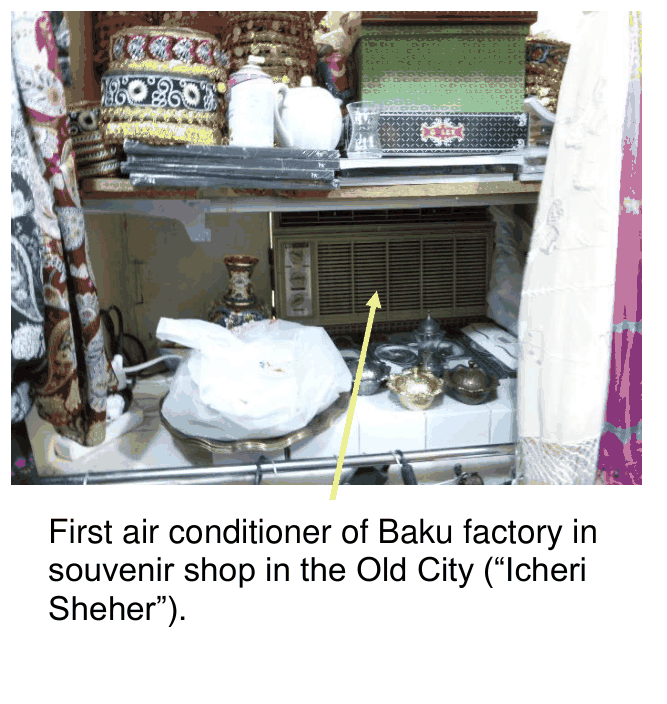
First air conditioner of Baku factory in souvenir shop in the Old City (“Icheri Sheher”).
Thermodynamic properties of various refrigerants:
Refrigerant “Generation” \(\Delta H_{\mathrm{vap}}/\mathrm{kJ\,mol^{-1}}\) (at 280 K) \(C_{V(\mathrm{gas})}/\mathrm{J\,K^{-1}\,mol^{-1}}\) \(\ce{NH3}\) 1 21.3 26.7 Table continued:
\(\ce{CHF2Cl}\) 2 20.0 48.8 \(\ce{CF3CH2F}\) 3 22.1 79 \(\ce{CF3CF=CH2}\) 4 19.1 120 Consider a model refrigeration cycle consisting of 4 steps schematically shown below in the pressure (\(p\)) – internal energy (\(U\)) coordinates.
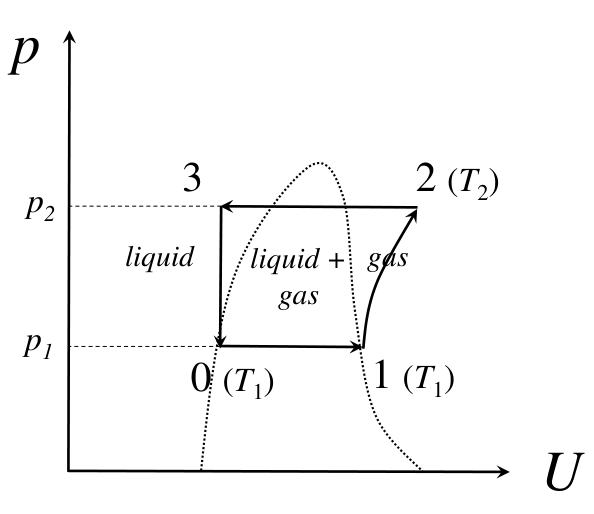
Diagram 1. Dashed line indicates the phase boundaries
During the first step of the cycle (line 0-1 in diagram 1), a liquid refrigerant is boiling at constant pressure \(p_1\) and temperature \(T_1\) (boiling temperature) until it completely evaporates. At this step, the refrigeration unit absorbs heat from surrounding objects. At the second step, the refrigerant undergoes reversible adiabatic compression and heats up to temperature \(T_2\) (line 1-2). After that the compressed refrigerant is cooled in a condenser at constant pressure \(p_2\) (line 2-3) and then returns to the initial state (line 3-0).
Let the cycle involve 1 mole of refrigerant, which is initially (point 0) completely liquid, \(T_1=280\ \mathrm{K}\), \(T_2=380\ \mathrm{K}\), assume that the vapor of any refrigerant behaves like an ideal gas. The thermodynamic characteristics of refrigerants are listed in the table above.
1.1 For each of refrigerants, ammonia and chlorodifluoromethane, calculate the amount of heat \(Q\) absorbed by refrigeration unit during heat exchange (line 0-1) and the work \(W\) required to compress its vapor adiabatically (line 1-2).
1.2. Which quantity(ies) remain(s) constant during the adiabatic compression step? Indicate by the circle(s).
\[ U\qquad H\qquad S\qquad G\qquad V \]
To compare the energy efficiency of refrigeration cycles with different parameters and refrigerants, the coefficient of performance (\(COP\)) is used, which is defined as a ratio of heat removed from a cooled system to the work of compressor: \(COP=Q/W\).
1.3 Calculate the values of \(COP\) in a considered cycle for ammonia and chlorodifluoromethane.
1.4 Why was ammonia replaced by CFCs in household refrigeration units? (Choose only one option)
a) to increase the energy efficiency of refrigeration cycles,
b) because the density of ammonia is less than that of air under the same conditions,
c) for user safety reasons.
A search for replacement of CFCs as refrigerants started when it was shown that their use can cause irreparable damage to the protective ozone layer of the atmosphere. The third, ozone-friendly generation of refrigerants came on the scene. Its typical representatives are fluoroalkanes.
1.5 What is the cause of the damage made by CFCs to the ozone layer? (Choose only one option.)
a) Ozone molecule easily adds to \(\ce{C-F}\) bond,
b) \(\ce{C-F}\) bond is easily broken by radiation, which leads to the formation of free radicals,
c) ozone molecule easily adds to \(\ce{C-Cl}\) bond,
d) \(\ce{C-Cl}\) bond is easily broken by radiation, which leads to the formation of free radicals.
1.6 However, under the 1997 Kyoto Protocol, fluoroalkanes also had to be replaced because they accumulate in the atmosphere and rapidly absorb infrared radiation, causing a rise in temperature of the atmosphere (the greenhouse effect). The refrigerants of the fourth generation such as 2,3,3,3-tetrafluoropropene \(\ce{CF3CF=CH2}\) have been suggested and are coming into use. Why does this compound enhance the greenhouse effect less than fluoroalkanes? (Choose only one option)
a) It is more reactive and easier to decompose,
b) it easily reacts with ozone,
c) it is better soluble in water.
1.7 Calculate the values of the \(COP\) in the refrigeration cycle considered above for two refrigerants of the third and fourth generations – \(\ce{CF3CH2F}\) and \(\ce{CF3CF=CH2}\). Did the energy efficiency improve in comparison with \(\ce{CHF2Cl}\)? Choose “Yes” or “No”.
Unlike household appliances, industrial refrigeration systems are often still using ammonia. It does not contribute to the greenhouse effect nor does it destroy the ozone layer. Industrial units can have a huge size and a large cost. Prior to their construction, they should be carefully modeled taking into account many different factors. In real systems, some part of the refrigerant at the start of the heat exchange with the environment is in the vapor phase (point 0 in the diagram below), and at the end (point 1) it is always overheated above the boiling point.
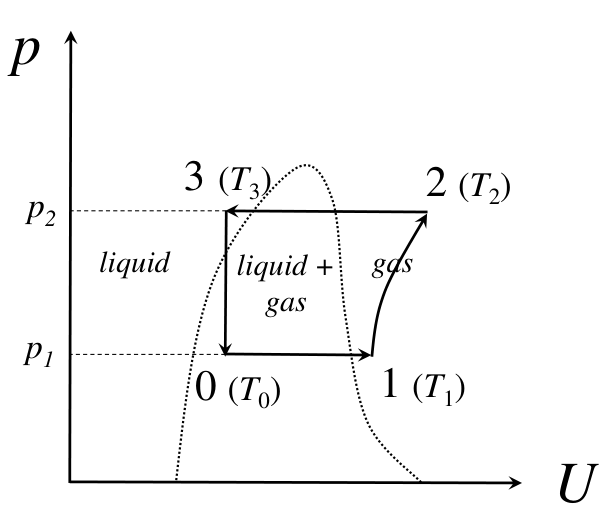
Diagram 2. Dashed line indicates the phase boundaries
Consider a cycle with 1 mole of ammonia. Its thermodynamic properties are the following: enthalpy of vaporization \(\Delta H_{\mathrm{vap}}=23.35\ \mathrm{kJ\,mol^{-1}}\) at \(T_{\mathrm{vap}}=239.8\ \mathrm{K}\) (boiling temperature at 1 bar pressure). Heat capacity of the liquid phase \(C_{V(\mathrm{liq})}=77\ \mathrm{J\,K^{-1}\,mol^{-1}}\), of the gas phase \(C_{V(\mathrm{gas})}=26.7\ \mathrm{J\,K^{-1}\,mol^{-1}}\). Assume that the heat capacities are temperature-independent and the vapor behaves like an ideal gas. The temperature dependence of the saturated vapor pressure of ammonia can be described by the empirical equation
\[ \log(p/\mathrm{bar})=4.87-1114/(T/\mathrm{K}-10.4). \]
During the first step of the cycle (line 0-1 in diagram 2), the equilibrium mixture of liquid refrigerant and its vapor receives heat from the environment at constant pressure \(p_1=3.0\ \mathrm{bar}\). The refrigerant completely evaporates and overheats up to the temperature \(T_1=275\ \mathrm{K}\). In the beginning of the process (point 0), the molar fraction of gaseous ammonia is \(x=0.13\).
1.8 Calculate the initial temperature of refrigerant \(T_0\), its volume change \(\Delta V\) and the amount of heat \(Q\) absorbed by refrigeration unit during this step. Take into account that the dependence of \(\Delta H_{\mathrm{vap}}\) from the temperature cannot be neglected. Then the refrigerant is reversibly and adiabatically compressed. It heats up to the temperature \(T_2=393\ \mathrm{K}\) (line 1-2).
1.9 Find the work \(W\) required for compression and the \(COP\) of the system. If you were not able to find \(Q\) in 4.1, use \(Q=20.15\ \mathrm{kJ}\).
At the next step corresponding to the line 2-3 in diagram, the compressed refrigerant is cooled in a condenser at constant pressure. Then it returns to the initial state through adiabatic expansion with zero work (line 3-0).
1.10 Determine the temperature \(T_3\) at point 3 to which the refrigerant is cooled in a condenser.
In the production of refrigeration units it is necessary to consider climatic factors. If a condenser is cooled by atmospheric air, the temperature \(T_3\) increases as the air temperature increases.
1.11 How will the \(COP\) change if \(T_3\) increases while \(T_0,T_1,T_2\) remain the same?
a) increase,
b) remain the same,
c) decrease.
Official English text of the problem.
Problem 2: Coupling of chemical reactions
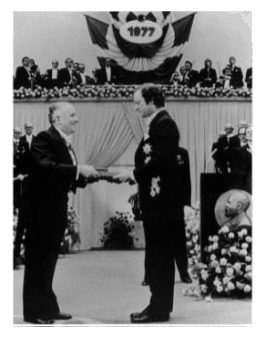
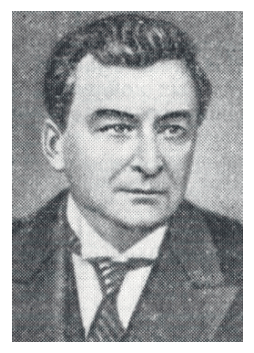
I.Prigogine (left)
N. Shilov
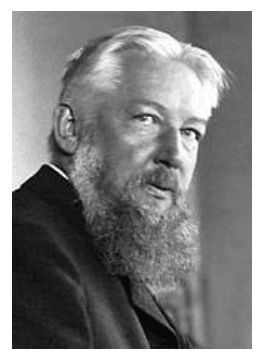
W. Ostwald
When in the system one reaction allows another one to proceed they say that these two reactions are coupled. Ilya Prigogine, Nobel prize winner in chemistry (1977) in his books widely used the concept of “coupled reactions”. Coupling of reactions is an essential feature of living systems, including human body.
How one reaction makes another one to occur? In this problem we are going to discuss several possible mechanisms of coupling.
(I) “Chemical coupling”
On Chemical coupling” was the title of the dissertation defended by Russian chemist N.Shilov in 1905. N. Shilov was the graduate student of famous professor W. Ostwald. Dr. Shilov described the following set of reactions.
The substance \(A\) does not react with \(Ac\). In the presence of the third reagent (called inductor), \(In\), however, the reaction of \(A\) with \(Ac\) takes place:


\(In\) is not a catalyst! Its concentration decreases in the course of the reactions.
According to the scheme proposed by Shilov, \(Ac\) reacts not with \(A\) itself, but with the intermediate product \(R\) of the reaction of \(A\) with \(In\). There is another, competing reaction of \(R\) that forms \(P_2\).
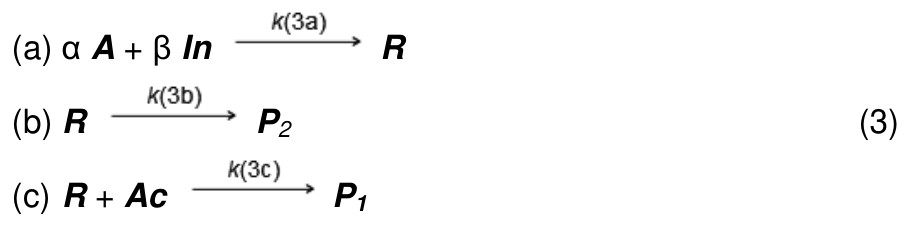
\(\alpha\) and \(\beta\) are stoichiometric coefficients. Other stoichiometric coefficients and reaction order with respect to all reactants in all three reactions are unity.
In the Shilov’s experiments the ratio of the consumed amounts of \(Ac\) and \(In\), \(I=\Delta n_{Ac}/\Delta n_{In}\) increased up to the constant value with the increasing initial concentration \([Ac]_0\) at \([In]_0=\text{const}\).
2.1 What was this limiting constant value of \(I\) at \([Ac]_0\to\infty,\ [In]_0=\text{const}\)?
2.2 Derive an expression for \(I\) using the steady-state approximation if necessary. Plot the graph of \(I\) vs \([In]_0\) at \([Ac]_0=\text{const}\). Assume that \(In\) was completely consumed and \(Ac\) was in excess..
If Shilov’s mechanism is not valid and \(In\) is a conventional catalyst of the reaction (2) then \(In\) reacts simultaneously with \(A\) and its concentration decreases. The reaction scheme in this case is as follows:

2.3 What is the limiting value of \(I\) for the reaction scheme (4) at \([Ac]_0\to\infty,\ [In]_0=\text{const}\)?
(II) “Kinetic coupling”
The standard Gibbs energy of the gas-phase reaction

is positive, \(\Delta G^\circ(5)=66\ \mathrm{kJ\,mol^{-1}}\) at \(T=600\ \mathrm K\).
2.4 What is the ratio of the rates of forward and reverse reactions, \(r_5/r_{-5}\), at this temperature, standard pressures of \(\ce{H2}\) and \(\ce{HBr}\) and equal pressures of \(\ce{H}\) and \(\ce{Br}\)?
(If you could not answer this question, for further calculations use reference value \(r_5/r_{-5}=3.14\times10^{-7}\).)
Reaction (5) proceeds in the forward direction due to the reaction (6) which simultaneously occurs in the system:
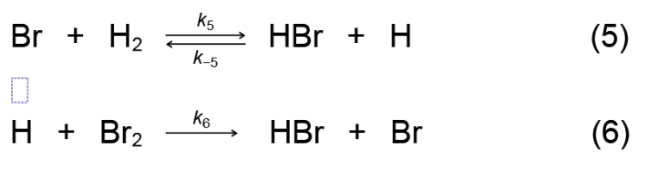
\(k_5,\ k_{-5},\ k_6\) are rate constants of forward and reverse reaction (5) and forward reaction (6), respectively.
This is the kinetic coupling of two reactions.
Let pressures of neutral molecules keep standard values \(p(\ce{H2})=p(\ce{Br2})=p(\ce{HBr})=1\ \mathrm{bar}\), and pressures of radicals \(p(\ce{H}),\ p(\ce{Br})\) reach steady-state values. Rate constant \(k_6\) is 10 times larger than \(k_{-5}\).
2.5 Calculate \(\Delta G(5)\) and \(r_5/r_{-5}\) under such conditions.
(III) ”Second law of thermodynamics restricts coupling”
According to the Second Law of thermodynamics, two simultaneously occurring chemical reactions should decrease the system’s Gibbs energy \(G_{\mathrm{Syst}}\),
\[ \frac{\Delta G_{\mathrm{syst}}}{\Delta t}<0 \]
One of these reactions may have positive Gibbs energy and still proceed in the forward direction due to the coupling with the second reaction. This second reaction must have negative Gibbs energy and the requirements of the Second law must be fulfilled! Consider the example.
The synthesis of urea under specific conditions

\((\Delta G(7)=46.0\ \mathrm{kJ\,mol^{-1}})\)
is supposed to be coupled with the complete oxidation of glucose (under the same conditions)

\(\Delta G(8)=-481.2\ \mathrm{kJ\,mol^{-1}},\)
\(r(8)=6.0\times10^{-8}\ \mathrm{mol\,dm^{-3}\,min^{-1}}.\)
Both reactions are presented schematically. No other reactions are considered.
2.6 What is the maximum rate of the reaction (7) permitted by the Second Law if this reaction is coupled to reaction (8)?
Official English text of the problem.
Problem 3: Two binding centers – competition or cooperation?
Many chemical reactions in living organisms include the formation of “host-guest” complexes where the host molecule reversibly binds one or several guest molecules. Consider a host molecule \(\ce{H}\) with two binding centers – say, \(a\) and \(b\) which have different affinities for the guest molecules \(\ce{G}\):
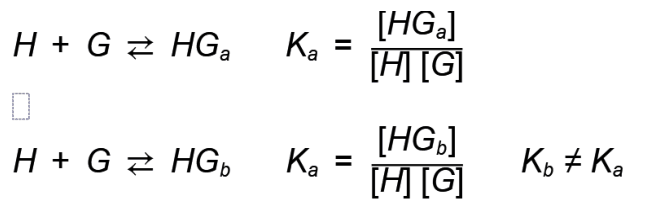
where \(\ce{HG_a}\) and \(\ce{HG_b}\) denote a complex where guest is bound to \(a\) center and \(b\) center, respectively. \(K_a\) and \(K_b\) are the binding constants for the centers \(a\) and \(b\), brackets denote molar concentrations.
Attachment of one \(\ce{G}\) molecule to \(\ce{H}\) can change the binding ability of the second centre. This change is described by the “interaction factor” \(\beta\) which reflects the influence of one binding center on another and is defined as follows:
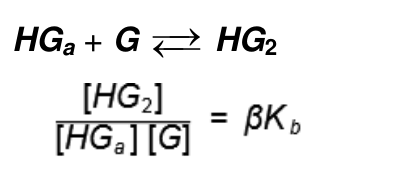
where \(\ce{HG2}\) is the completely bound complex.
3.1 Determine the range of values (or one value, if necessary) of \(\beta\) which correspond to three possible ways of interaction between binding centers: a) cooperation (binding by one center facilitates subsequent binding); b) competition (first binding complicates the second); c) independence (no interaction).
3.2 Find the equilibrium constant for the process:
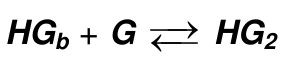
in terms of binding constant(s) and interaction factor.
3.3 The solution was prepared with the initial concentrations \([\ce{H}]_0=1\) and \([\ce{G}]_0=2\). After the reactions were completed, the concentration of \(\ce{H}\) decreased by 10 times and that of \(\ce{G}\) by 4 times. For these host and guest, \(K_b=2K_a\). Determine the concentrations of all other species in the solution and find the binding constant \(K_a\) and the factor \(\beta\).
Note: If you could not answer this question, for further calculations use reference values \(K_a=3.14\) and \(\beta=2.72\).
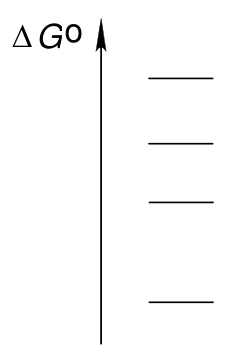
3.4 Find the correct order of standard molar Gibbs energies of formation of host \(\ce{H}\) and all host-guest complexes from \(\ce{H}\) and \(\ce{G}\). In the scheme below, write the corresponding chemical formula near every line.
3.5 Some amount of \(\ce{G}\) was added to 1 mole of \(\ce{H}\) and the mixture was dissolved in water to obtain 1 liter of the solution. The number of the totally bound molecules \(\ce{HG2}\) in the solution is equal to the total number of single-bound molecules \(\ce{HG}\). Find the initial amount of \(\ce{G}\) (in mol). The constants \(K_a\) and \(K_b\) and the factor \(\beta\) are the same as in question 3.3.
3.6 What would be the equilibrium composition of the solution if: a) \(\beta=0\); b) \(\beta\) is very large \((\beta\to\infty)\). The constants \(K_a\) and \(K_b\) as well as the initial concentrations of \(\ce{H}\) and \(\ce{G}\) are the same as in question 2.1.
Official English text of the problem.
Problem 4: From one yellow powder to another: A simple inorganic riddle
The yellow binary compound \(X_1\) was completely dissolved in concentrated nitric acid by heating, the gas evolved is 1.586 times denser than air. Upon adding an excess of barium chloride to the solution formed a white solid \(X_2\) precipitates. It was filtered. The filtrate reacts with an excess of silver sulfate solution forming a precipitate of two solids \(X_2\) and \(X_3\), also separated from solution by filtration. To the new filtrate the solution of sodium hydroxide was being added drop-wise until the solution became nearly neutral (about pH 7). At this time a yellow powder \(X_4\) (77.31 wt.% of \(\ce{Ag}\)) crystallized from the solution. The mass of \(X_4\) is nearly 2.4 times larger than that the mass of the first portion of \(X_2\).
4.1 Determine the chemical formulae of \(X_1\) – \(X_4\).
4.2 Determine the chemical formula of the gas and provide equations for all reactions in ionic or non-ionic form.
4.3 In the structural unit of \(X_1\) all atoms of only one element are in equivalent positions. Draw the structure of \(X_1\).
4.4 Predict the products of \(X_1\) interaction with:
a) excess oxygen;
b) excess of hot concentrated sulfuric acid;
c) solid \(\ce{KClO3}\) with grinding.
Write down the equations of the reactions.
Official English text of the problem.
Problem 5: Indispensable glucose
Carbohydrates are the most important providers of energy for living cells. Monosaccharide glucose is a source of energy for the living cell, but for persons who suffer from diabetes glucose may be dangerous. High level of glucose may lead to cardiovascular diseases and even death. That is why people avoid consuming too much carbohydrates and glucose particularly.
A. Determination of reducing sugars in fruit juice
One of the technique for determination of reducing sugars in different samples includes the use of Fehling's reagent. A \(10.00\ \mathrm{cm^3}\) aliquot of fruit juice (assuming the initial sample contained only glucose and fructose) was transferred into a titration flask and Fehling's reagent was added. This reagent was prepared by mixing \(50.00\ \mathrm{cm^3}\) of copper sulfate solution, \(c = 0.04000\ \mathrm{mol\,dm^{-3}}\) (solution A) and potassium-sodium tartrate and sodium hydroxide (solution B). Solution C thus obtained, was then heated and red precipitate was formed.
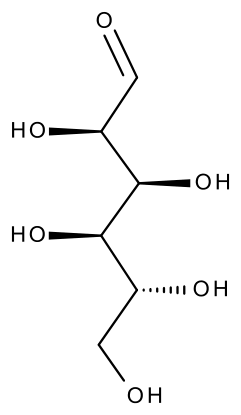
Glucose
5.1 Write the balanced ionic equation of chemical reaction occurring upon heating of the solution C. Use \(\ce{Cu^2+}\) for initial copper solution.
After that \(10\ \mathrm{cm^3}\) of 10% solution of potassium iodide and sulfuric acid solution (\(c = = 1\ \mathrm{mol\,dm^{-3}}\)) were added to the flask. The mixture was covered with watch glass and was then placed in a dark place. An excess of iodine was then titrated with sodium thiosulphate solution (\(c = 0.05078\ \mathrm{mol\,dm^{-3}}\)). A volume of \(11.87\ \mathrm{cm^3}\) of the titrant was required to reach the endpoint.
5.2 Write the balanced equation(s) in molecular or ionic form for all the reactions taking place in the flask.
5.3 Consider that all fructose was transformed into glucose under the experimental conditions. Calculate the total mass concentration of sugars (in \(\mathrm{g\,dm^{-3}}\)) in a fruit juice.
\(M = 180.16\ \mathrm{g\,mol^{-1}}\).
A new \(10.00\ \mathrm{cm^3}\) aliquot of the same juice was treated with a \(10.00\ \mathrm{cm^3}\) portion of acidified potassium iodate(V) solution (\(0.01502\ \mathrm{mol\,dm^{-3}}\)) and \(10\ \mathrm{cm^3}\) of 10 % solution of potassium iodide. After the mixture turned brown, an excess of sodium hydroxide solution was added. The flask was then covered with a watch glass and put into a dark place. The obtained solution was acidified and titrated with a solution of sodium thiosulphate (\(c = 0.01089\ \mathrm{mol\,dm^{-3}}\)). The average titrant volume used for titration was \(23.43\ \mathrm{cm^3}\). Note that fructose is not converted into glucose under these conditions.
5.4 Write all the balanced equations for the described reactions in molecular or ionic form.
5.5 Calculate the mass concentration of each sugar (in \(\mathrm{g\,dm^{-3}}\)) in the juice.
5.6 One bread exchange unit (1 BEU) corresponds to the content of \(12\ \mathrm{g}\) of digestible carbohydrates in a product. How many BEU are in one glass (\(200\ \mathrm{cm^3}\)) of juice?
B. Diagnosis of diseases
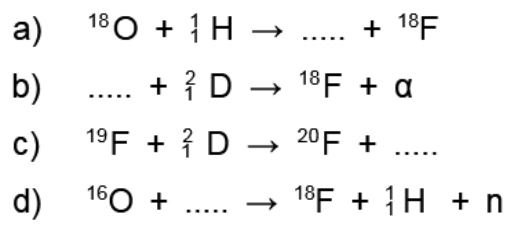
The derivative of glucose, 2-deoxy-2-(\(\ce{^{18}F}\))fluoro-D-glucose (FDG), is the most common radiopharmaceutical for diagnosis of cancer using positron emission tomography. The first step of FDG preparation is to produce a radionuclide fluoro-18 by nuclear reaction in a cyclotron. The next step is the radiochemical synthesis. Fluorine-18 is introduced into D-glucose molecule by nucleophilic substitution. 2-deoxy-2-(\(\ce{^{18}F}\))fluoro-D-glucose once injected into the patient actively accumulates in cells of malignant tumors; this process is accompanied by decomposition of fluorine-18. This radionuclide is a \(\beta^+\) emitter – nucleus emits a positron (anti-electron). Positron interacts with an electron and after that annihilation occurs, which can be detected. This allows determining precisely the tumor sizes and type.
5.7 Complete the nuclear reactions leading to various fluorine isotopes.
5.8 The decay mode of unstable light nuclei depends on the ratio between the number of neutrons and protons in them. If this ratio is greater than that for a stable isotope then the nucleus decays in a \(\beta^-\)-mode, if it is smaller – in a \(\beta^+\)-mode.
Determine the type of decay for the nuclei in the table:
Nucleus \(\ce{^{11}C}\) \(\ce{^{20}F}\) \(\ce{^{17}F}\) \(\ce{^{14}C}\) Decay mode When nuclear reaction (a) is used for fluorine-18 preparation, the target material is presented as water enriched with \(\ce{H2^{18}O}\). The presence of usual water \(\ce{H2^{16}O}\) leads to a side nuclear reaction with \(\ce{^{16}O}\), leading to the formation of isotope \(\ce{^{17}F}\).
5.9 It is known that within five minutes after completion of irradiation of the target the ratio of radioactivities of \(\ce{^{18}F}\) and \(\ce{^{17}F}\) is \(1\cdot10^5\). Assuming that irradiation time is short, the radioactivity of each isotope is proportional to the nuclear reaction yield and the mole fraction of a component in the irradiated target, calculate the mass fraction of \(\ce{H2^{18}O}\) in the target. \(t_{1/2}(\ce{^{18}F}) = 109.7\) minutes, \(t_{1/2}(\ce{^{17}F}) = 65\) seconds. The ratio between nuclear reactions yields is \[ \eta_{\ce{^{18}O}-\ce{^{18}F}}/ \eta_{\ce{^{16}O}-\ce{^{17}F}}=144.7. \]
5.10 Calculate the yield of labeling D-glucose with fluorine-18, if initial radioactivity of a fluorine-18 sample was \(600.0\ \mathrm{MBq}\) and radioactivity of the obtained 2-deoxy-2-(\(\ce{^{18}F}\))fluoro-D-glucose is \(528.2\ \mathrm{MBq}\). Synthesis time is 3.5 minutes.
5.11 Biological half-life (through the excretory organs) of 2-deoxy-2-(\(\ce{^{18}F}\))fluoro-D-glucose is 120.0 minutes. How much radioactivity (in MBq) will remain in the patient ten hours after injection of FDG with the initial radioactivity of \(450.0\ \mathrm{MBq}\).
Official English text of the problem.
Problem 6: Bread is the stuff of life
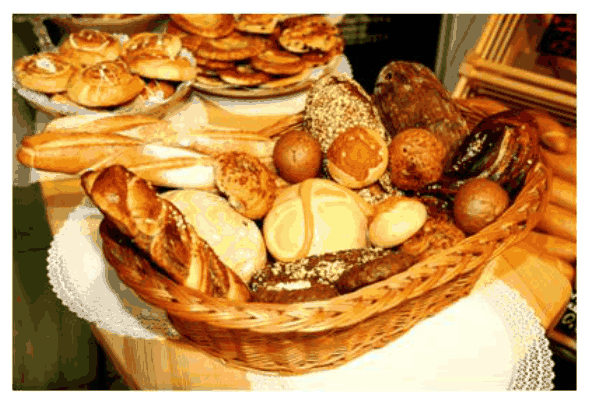
When you pass by the bakery, you are stopped by the smell of freshly baked bread. The hero of one of the novels said on a similar occasion: "If you tell me that this is not perfect, you are my enemy forever." The principle bread flavour component was identified in 1969 as compound X which occurs in equilibrium with its tautomer Y in a 2 : 1 ratio. Unfortunately, both forms are labile, and after some hours bread has no the same nice smell.
This tautomeric mixture of X and Y was synthesized in 1993 from piperidine by the reaction sequence given in Scheme 1. It is noteworthy that the initial ratio of X and Y was 1:4; on standing this ratio gradually changed to an equilibrium one.
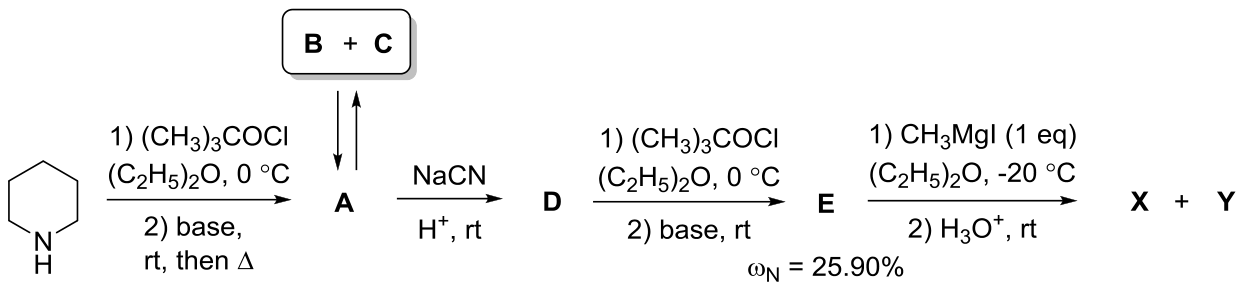
Scheme 1.
Compound B which is characterized by 3-fold axis of symmetry (i.e., rotation by \(120^\circ\) results in a molecule indistinguishable from the original) occurs in equilibrium with its diastereomer C. The interconversion of these two forms proceeds via intermediate A which is also intermediate in B and C formation as well as their transformation to D. Compounds A, B, and C have the same elemental composition: \(w_{\mathrm C}=72.24\%\), \(w_{\mathrm H}=10.91\%\), \(w_{\mathrm N}=16.85\%\).
6.1 Write down the structural formulae of compounds A - E, X, Y.
Treatment of compound E with \(\ce{CH3Li . LiBr}\) complex in \(\ce{(C2H5)2O}\) at \(0\,^\circ\mathrm C\) failed to produce the target products X and Y. Instead, a yellow precipitate F was initially formed. Aqueous workup of this precipitate led to the mixture of compound E and its tautomer G.
6.2 Write down the structural formulae of compounds F and G.
Another approach to compound X is based on the use of pipecolinic acid derivative H. It was shown that X can be synthesized by reaction sequence presented in Scheme 2.
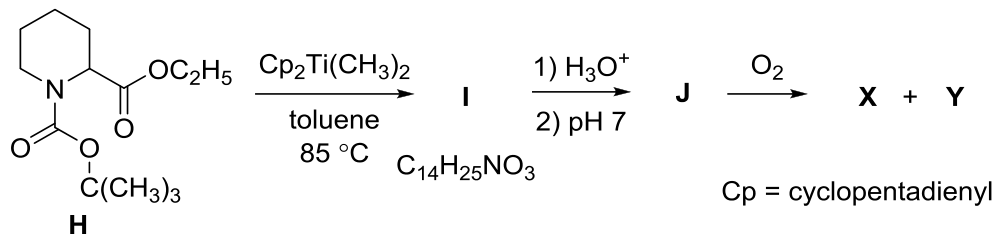
Scheme 2
6.3 Write down the structural formulae of compounds I and J.
Official English text of the problem.
Problem 7: Not by bread alone
Pomegranate is called in Azerbaijan, which is famous for its vegetables, as the “king of all fruits”. Pomegranate is honored in various religions as a “fruit of Paradise”, symbol of righteousness, wealth, hope for eternal life.
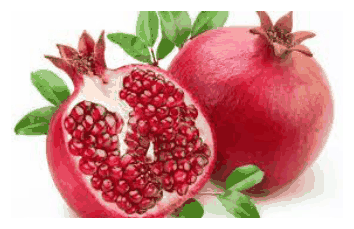
In 1878 alkaloid pelletierine was isolated from the bark of pomegranate tree (Punica granatum L., Lythraceae). This alkaloid is traditionally used as an anti-helminthic drug. Initially \(X_W\) (3-(piperidin-2-yl)propanal) was incorrectly proposed for pelletierine. But now it is accepted that natural pelletierine is (S)-1-(piperidin-2-yl)propan-2-one (\(X_S\)).
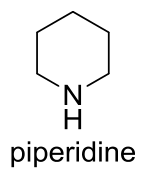
7.1 Write down the structural formulae of \(X_W\) and \(X_S\) (the latter – with the stereochemical information).
The synthesis of natural pelletierine (\(X_S\)) based on the transformation of nortropanol A was recently described.
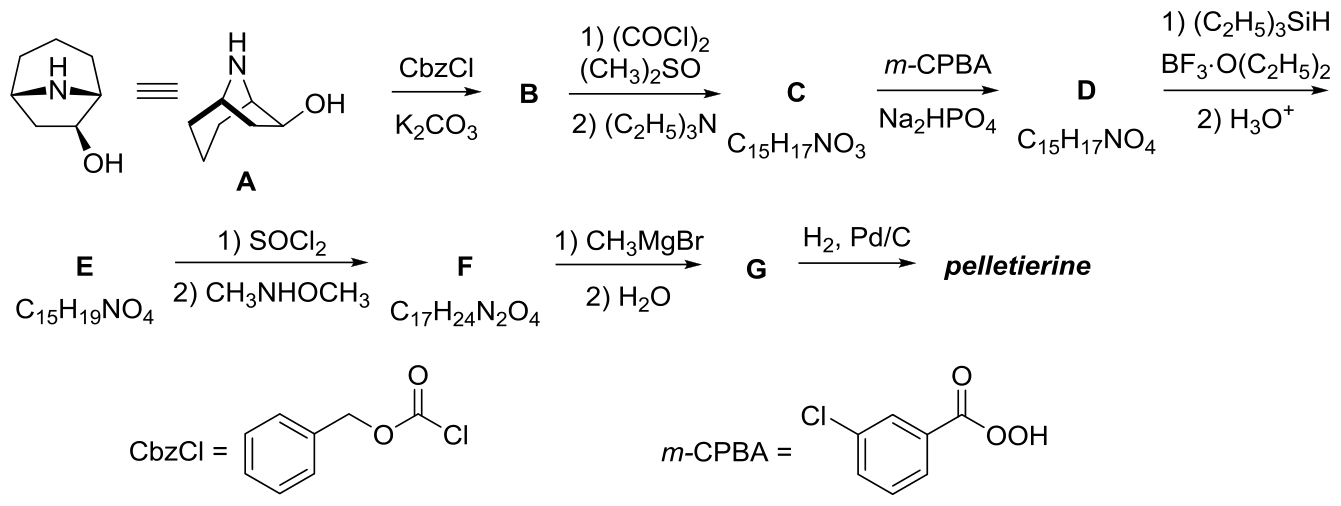
7.2 Write down the structural formulae of compounds B - G with the stereochemical information.
7.3 Nortropanol A was used in this reaction as a single stereoisomer. How many stereoisomers can exist for compound A (including A)? Ignore nitrogen chirality.
Enantiomer of \(X_S\) was synthesized using chiral tert-butanesulfinamide (H):
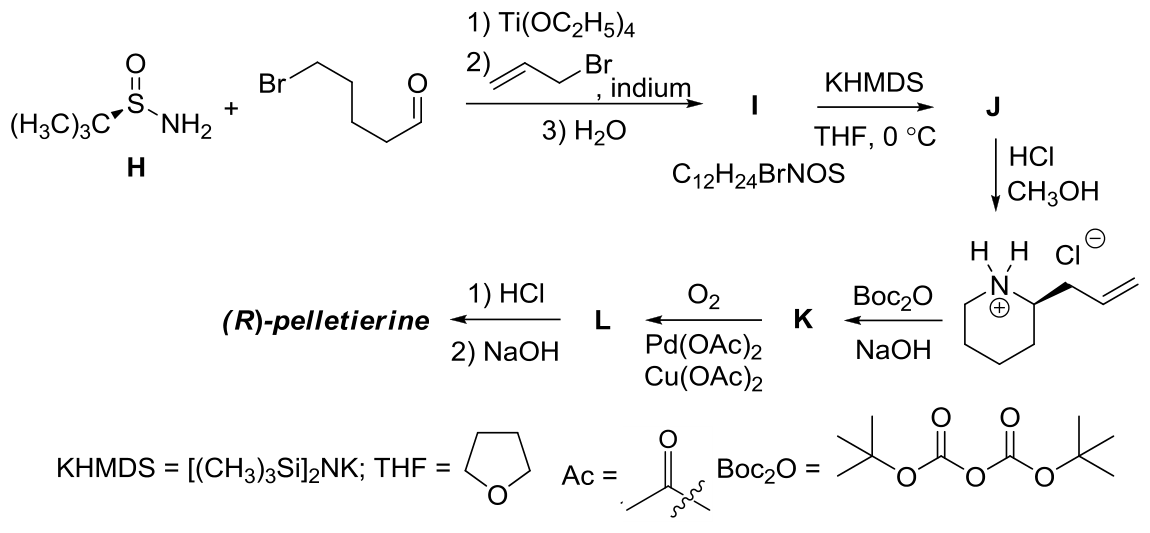
7.4 Write down the structural formulae of compounds I – L with the stereochemical information.
Official English text of the problem.
Problem 8: Oil for Life and Life after Oil
Azerbaijan is known for its vast oil and gas fields. The first drilling for oil was done in Bibi-Heybat in 1846, 13 years before establishment of the first commercial oil well in Pennsylvania (USA). This remarkable date in the history of Azerbaijan is regarded as a starting point of contemporary oil industry, the leading sector of today’s world economy.
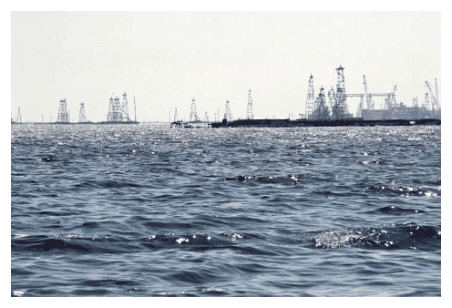
Currently, on-land and shelf sea oil production is being developed in Azerbaijan. Though serious precautions are taken, there is always a risk of hydrocarbon pollution of the environment during production, transportation, and processing of oil. In this task we will consider diverse technologies of oil spills clean up and specific features of metabolic pathways involved.
Application of complex solvents (dispersants) leading to capture of marine oil spills is among most promising clean up approaches. Organic substance X (11.94 % of \(\ce{H}\) by mass) is a typical component of such dispersants. Safety of X to human is fiercely debated. X1 (54.53 % of carbon by mass) composed of three elements and excreted with urine is the major metabolite of X in humans. The numbers of atoms of different elements in X1 are three consecutive terms of a geometric progression \((n,nq,nq^2)\), whereas the sum of these numbers does not exceed 25.
8.1 Decide on the relationship (tick the correct variant) between the numbers of carbon and oxygen atoms in X1.
\(n(\ce{C})>n(\ce{O})\) \(n(\ce{C})<n(\ce{O})\) \(n(\ce{C})=n(\ce{O})\) Data insufficient □ □ □ □ 8.2 Derive the empirical formula of X1 (hereafter always show your work where required). Be sure you prove the answer by calculations.
The biotransformation of X into X1 occurs in two enzymatically catalyzed steps according to the hereunder reaction balanced equations (\(\ce{NAD+}\) and \(\ce{NADH}\) are the oxidized and reduced forms of nicotinamide adenine dinucleotide, respectively):
\[ \ce{X + NAD+ -> X0 + NADH + H+} \tag{1} \]
\[ \ce{X0 + NAD+ + H2O -> X1 + NADH + H+} \tag{2} \]
8.3 Derive the molecular formula of X.
A minor metabolic transformation of X is catalyzed by cytochrome P450-dependent monooxygenase. This reaction leads to two compounds X2 (51.56 % of oxygen and 9.74 % of hydrogen by mass) and X3.
8.4 Derive the molecular formula of X2 and draw its structure.
X contains only primary and secondary carbon atoms. X0 and X3 contain common functional group.
8.5 Draw the structural formulae of X, X1, and X3.
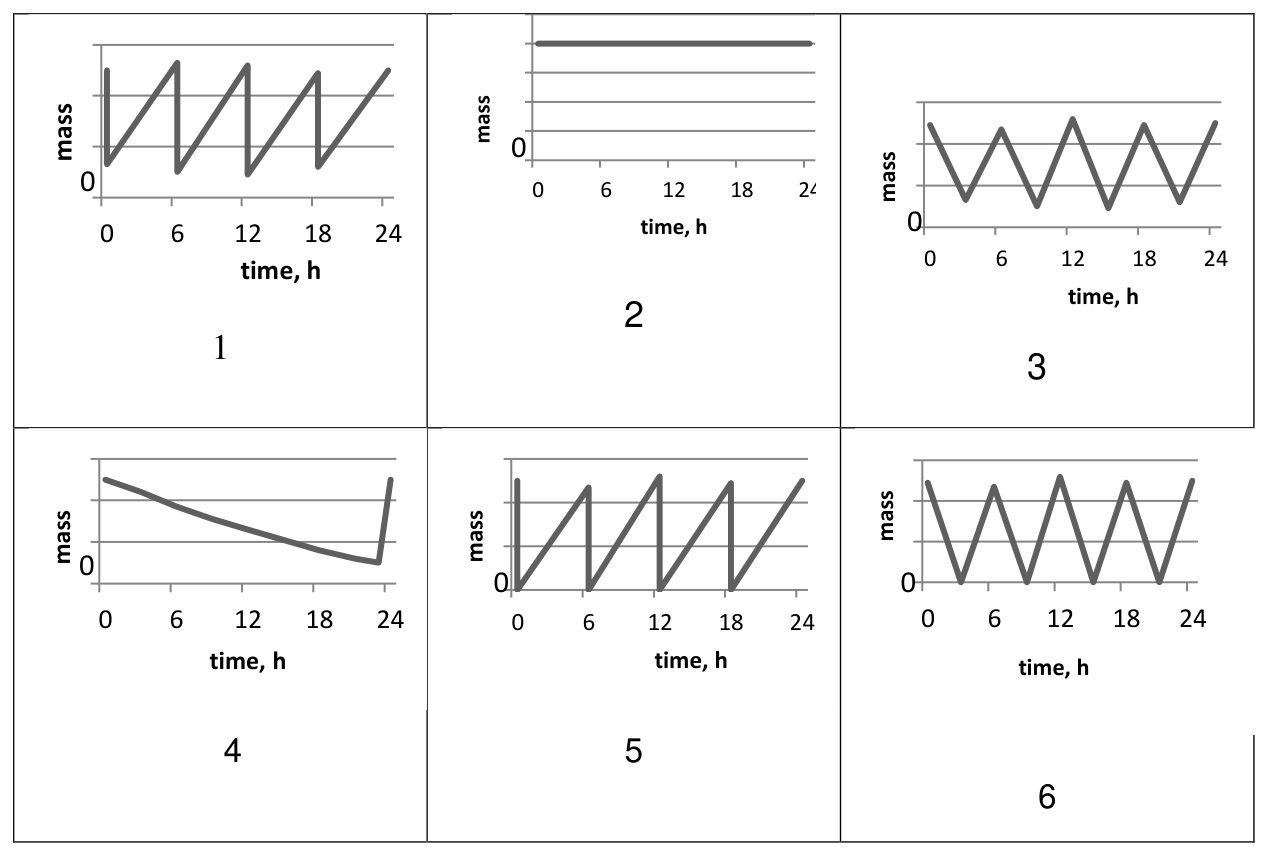
In a medical study, personnel permanently exposed to X-based solvents without proper protection was found to have a stationary concentration of X in blood.
8.6 X1 is excreted with urine. Choose the graph of X1 daily mass content in the body of a volunteer participated in this experiment. Write down the number of the correct graph.
The use of different bacteria is also considered as a promising way for the removal of hydrocarbon (even aromatic) contaminants from sea water and soil. Under aerobic conditions, benzene undergoes biodegradation as follows (first three steps are balanced):

here and hereinafter
D - aromatic dioxygenaseUnder the same conditions, a monocyclic aromatic hydrocarbon P (91.25 % of carbon by mass) undergoes the following transformation (first three steps are balanced):

P3 gives a positive iodoform test. A 100 mg sample of P3 requires 6.41 \(\mathrm{cm^3}\) of \(\ce{KOH}\) \((c=0.100\ \mathrm{mol\,dm^{-3}})\) solution for complete neutralization.
8.7 Derive the structures of P–P3. Give the most stable tautomer of P3.
Microorganisms Alicycliphilus are capable of biodegradation of aromatic hydrocarbons even in soil. The process requires a suitable electron acceptor such as inorganic anion Y1 (first three steps are balanced).
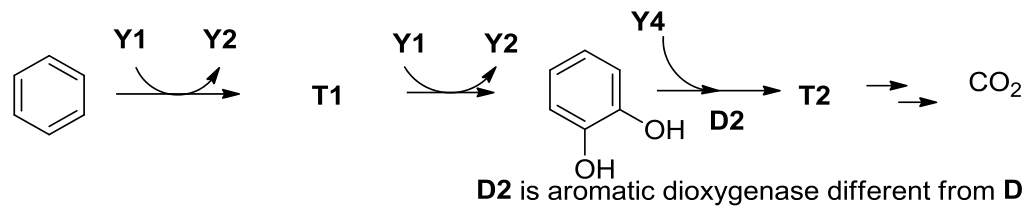
D2 is aromatic dioxygenase different from D
The intermediate anion Y2 is enzymatically decomposed according to the balanced reaction equation:
\[ \ce{Y2(aq) -> Y3(aq) + Y4(g)}, \]
wherein each of Y3 and Y4 is composed of atoms of only one element. T2 does not contain two identical oxygen-containing functional groups. T2 gives a precipitate when treated with the ammonia solution of \(\ce{Ag2O}\), whereas Y3 does not.
8.8 Deduce and give formulas of Y1-Y4. Draw the structures of T1-T2. Give the most stable tautomer of T2.
Official English text of the problem.
Internationale Chemie-Olympiade
IChO 2015
Baku, Aserbaidschan · 8 Theorieaufgaben mit vollständigen Lösungen
Aufgabe 1: Neue und längst vergessene alte Kältemittel
Die Frage nach der Wahl eines Kältemittels für Kälte- und Klimaanlagen beschäftigte Wissenschaftler und Technologen während des gesamten vergangenen Jahrhunderts. Es wurde vorgeschlagen, die Entwicklung der Kältemittel in diesem Zeitraum in vier Generationen einzuteilen.
Ammoniak, das der ersten Generation zugeordnet wurde, wurde in den meisten der ältesten Kälteanlagen verwendet. Später wurde es durch Fluorchlorkohlenwasserstoffe (FCKW) ersetzt – Derivate von Methan und Ethan, bei denen die Wasserstoffatome durch Fluor und Chlor ersetzt sind.
In Baku wurde im Werk „Bakkonditsioner“ die Produktion der ersten sowjetischen serienmäßig hergestellten Haushaltsklimageräte BK-1500 aufgenommen. In ihnen wurde das Kältemittel Chlordifluormethan \(\ce{CHF2Cl}\) aus der zweiten Generation verwendet. In dieser Aufgabe vergleichen wir verschiedene Kältemittel unter thermodynamischen Gesichtspunkten.
Erstes Klimagerät des Werks in Baku in einem Souvenirladen in der Altstadt („Icheri Sheher“).
Thermodynamische Eigenschaften verschiedener Kältemittel:
Kältemittel „Generation“ \(\Delta H_{\mathrm{vap}}/\mathrm{kJ\,mol^{-1}}\) (bei 280 K) \(C_{V(\mathrm{gas})}/\mathrm{J\,K^{-1}\,mol^{-1}}\) \(\ce{NH3}\) 1 21.3 26.7 Fortsetzung der Tabelle:
\(\ce{CHF2Cl}\) 2 20.0 48.8 \(\ce{CF3CH2F}\) 3 22.1 79 \(\ce{CF3CF=CH2}\) 4 19.1 120 Betrachten Sie einen modellhaften Kältekreisprozess aus 4 Schritten, der unten schematisch in Druck-\(p\)–innere-Energie-\(U\)-Koordinaten dargestellt ist.
Diagramm 1. Die gestrichelte Linie kennzeichnet die Phasengrenzen
Während des ersten Schritts des Kreisprozesses (Linie 0-1 in Diagramm 1) siedet ein flüssiges Kältemittel bei konstantem Druck \(p_1\) und konstanter Temperatur \(T_1\) (Siedetemperatur), bis es vollständig verdampft ist. In diesem Schritt nimmt die Kälteanlage Wärme von den umgebenden Gegenständen auf. Im zweiten Schritt wird das Kältemittel reversibel adiabatisch verdichtet und erwärmt sich auf die Temperatur \(T_2\) (Linie 1-2). Danach wird das verdichtete Kältemittel in einem Verflüssiger bei konstantem Druck \(p_2\) abgekühlt (Linie 2-3) und kehrt anschließend in den Ausgangszustand zurück (Linie 3-0).
Am Kreisprozess nehme 1 Mol Kältemittel teil, das zu Beginn (Punkt 0) vollständig flüssig ist; es gelte \(T_1=280\ \mathrm{K}\), \(T_2=380\ \mathrm{K}\). Nehmen Sie an, dass sich der Dampf jedes Kältemittels wie ein ideales Gas verhält. Die thermodynamischen Kenngrößen der Kältemittel sind in der obigen Tabelle aufgeführt.
1.1 Berechnen Sie für die beiden Kältemittel Ammoniak und Chlordifluormethan jeweils die Wärmemenge \(Q\), die die Kälteanlage beim Wärmeaustausch aufnimmt (Linie 0-1), sowie die Arbeit \(W\), die zur adiabatischen Verdichtung ihres Dampfes erforderlich ist (Linie 1-2).
1.2. Welche Größe(n) bleibt (bleiben) während des adiabatischen Verdichtungsschritts konstant? Kennzeichnen Sie diese durch Einkreisen.
\[ U\qquad H\qquad S\qquad G\qquad V \]
Zum Vergleich der Energieeffizienz von Kältekreisprozessen mit unterschiedlichen Parametern und Kältemitteln wird die Leistungszahl (\(COP\)) verwendet. Sie ist als Verhältnis der einem gekühlten System entzogenen Wärme zur Arbeit des Verdichters definiert: \(COP=Q/W\).
1.3 Berechnen Sie die Werte von \(COP\) im betrachteten Kreisprozess für Ammoniak und Chlordifluormethan.
1.4 Warum wurde Ammoniak in Haushaltskältegeräten durch FCKW ersetzt? (Wählen Sie nur eine Antwort aus)
a) um die Energieeffizienz der Kältekreisprozesse zu erhöhen,
b) weil die Dichte von Ammoniak unter gleichen Bedingungen geringer ist als die von Luft,
c) aus Gründen der Sicherheit der Benutzer.
Die Suche nach einem Ersatz für FCKW als Kältemittel begann, als gezeigt wurde, dass ihre Verwendung die schützende Ozonschicht der Atmosphäre irreparabel schädigen kann. Die dritte, ozonfreundliche Generation von Kältemitteln trat auf den Plan. Ihre typischen Vertreter sind Fluoralkane.
1.5 Was ist die Ursache für die Schädigung der Ozonschicht durch FCKW? (Wählen Sie nur eine Antwort aus.)
a) Das Ozonmolekül addiert sich leicht an die \(\ce{C-F}\)-Bindung,
b) die \(\ce{C-F}\)-Bindung wird durch Strahlung leicht gespalten, wodurch freie Radikale entstehen,
c) das Ozonmolekül addiert sich leicht an die \(\ce{C-Cl}\)-Bindung,
d) die \(\ce{C-Cl}\)-Bindung wird durch Strahlung leicht gespalten, wodurch freie Radikale entstehen.
1.6 Nach dem Kyoto-Protokoll von 1997 mussten jedoch auch Fluoralkane ersetzt werden, da sie sich in der Atmosphäre anreichern und rasch Infrarotstrahlung absorbieren, was zu einem Temperaturanstieg in der Atmosphäre führt (Treibhauseffekt). Kältemittel der vierten Generation wie 2,3,3,3-Tetrafluorpropen \(\ce{CF3CF=CH2}\) wurden vorgeschlagen und werden zunehmend eingesetzt. Warum verstärkt diese Verbindung den Treibhauseffekt weniger als Fluoralkane? (Wählen Sie nur eine Antwort aus)
a) Sie ist reaktiver und leichter abbaubar,
b) sie reagiert leicht mit Ozon,
c) sie ist besser in Wasser löslich.
1.7 Berechnen Sie die Werte von \(COP\) im oben betrachteten Kältekreisprozess für zwei Kältemittel der dritten und vierten Generation – \(\ce{CF3CH2F}\) und \(\ce{CF3CF=CH2}\). Hat sich die Energieeffizienz im Vergleich zu \(\ce{CHF2Cl}\) verbessert? Wählen Sie „Ja“ oder „Nein“.
Im Gegensatz zu Haushaltsgeräten verwenden industrielle Kälteanlagen häufig noch immer Ammoniak. Es trägt weder zum Treibhauseffekt bei noch zerstört es die Ozonschicht. Industrieanlagen können sehr groß und kostspielig sein. Vor ihrem Bau sollten sie unter Berücksichtigung vieler verschiedener Faktoren sorgfältig modelliert werden. In realen Systemen befindet sich ein Teil des Kältemittels zu Beginn des Wärmeaustauschs mit der Umgebung in der Dampfphase (Punkt 0 im nachstehenden Diagramm), und am Ende (Punkt 1) ist es stets über die Siedetemperatur hinaus überhitzt.
Diagramm 2. Die gestrichelte Linie kennzeichnet die Phasengrenzen
Betrachten Sie einen Kreisprozess mit 1 Mol Ammoniak. Seine thermodynamischen Eigenschaften sind wie folgt: Verdampfungsenthalpie \(\Delta H_{\mathrm{vap}}=23.35\ \mathrm{kJ\,mol^{-1}}\) bei \(T_{\mathrm{vap}}=239.8\ \mathrm{K}\) (Siedetemperatur bei einem Druck von 1 bar). Wärmekapazität der flüssigen Phase \(C_{V(\mathrm{liq})}=77\ \mathrm{J\,K^{-1}\,mol^{-1}}\), der Gasphase \(C_{V(\mathrm{gas})}=26.7\ \mathrm{J\,K^{-1}\,mol^{-1}}\). Nehmen Sie an, dass die Wärmekapazitäten temperaturunabhängig sind und sich der Dampf wie ein ideales Gas verhält. Die Temperaturabhängigkeit des Sättigungsdampfdrucks von Ammoniak lässt sich durch folgende empirische Gleichung beschreiben:
\[ \log(p/\mathrm{bar})=4.87-1114/(T/\mathrm{K}-10.4). \]
Während des ersten Schritts des Kreisprozesses (Linie 0-1 in Diagramm 2) nimmt das im Gleichgewicht befindliche Gemisch aus flüssigem Kältemittel und seinem Dampf bei konstantem Druck \(p_1=3.0\ \mathrm{bar}\) Wärme aus der Umgebung auf. Das Kältemittel verdampft vollständig und wird bis zur Temperatur \(T_1=275\ \mathrm{K}\) überhitzt. Zu Beginn des Prozesses (Punkt 0) beträgt der Stoffmengenanteil des gasförmigen Ammoniaks \(x=0.13\).
1.8 Berechnen Sie die Anfangstemperatur des Kältemittels \(T_0\), seine Volumenänderung \(\Delta V\) und die Wärmemenge \(Q\), die die Kälteanlage während dieses Schritts aufnimmt. Berücksichtigen Sie, dass die Temperaturabhängigkeit von \(\Delta H_{\mathrm{vap}}\) nicht vernachlässigt werden darf. Anschließend wird das Kältemittel reversibel und adiabatisch verdichtet. Es erwärmt sich auf die Temperatur \(T_2=393\ \mathrm{K}\) (Linie 1-2).
1.9 Bestimmen Sie die zur Verdichtung erforderliche Arbeit \(W\) und die Leistungszahl \(COP\) des Systems. Falls Sie \(Q\) in 4.1 nicht bestimmen konnten, verwenden Sie \(Q=20.15\ \mathrm{kJ}\).
Im nächsten Schritt, der der Linie 2-3 im Diagramm entspricht, wird das verdichtete Kältemittel in einem Verflüssiger bei konstantem Druck abgekühlt. Anschließend kehrt es durch adiabatische Expansion ohne Arbeitsleistung in den Ausgangszustand zurück (Linie 3-0).
1.10 Bestimmen Sie die Temperatur \(T_3\) an Punkt 3, auf die das Kältemittel im Verflüssiger abgekühlt wird.
Bei der Herstellung von Kälteanlagen müssen klimatische Faktoren berücksichtigt werden. Wird ein Verflüssiger durch Umgebungsluft gekühlt, steigt die Temperatur \(T_3\) mit zunehmender Lufttemperatur.
1.11 Wie ändert sich die Leistungszahl \(COP\), wenn \(T_3\) steigt, während \(T_0,T_1,T_2\) gleich bleiben?
a) Sie steigt,
b) sie bleibt gleich,
c) sie sinkt.
Aufgabentext aus dem offiziellen englischen Text übersetzt.
Aufgabe 2: Kopplung chemischer Reaktionen
I.Prigogine (links)
N. Shilov
W. Ostwald
Wenn in einem System eine Reaktion das Ablaufen einer anderen ermöglicht, bezeichnet man diese beiden Reaktionen als gekoppelt. Ilya Prigogine, Nobelpreisträger für Chemie (1977), verwendete in seinen Büchern häufig das Konzept der „gekoppelten Reaktionen“. Die Kopplung von Reaktionen ist ein wesentliches Merkmal lebender Systeme, einschließlich des menschlichen Körpers.
Wie bewirkt eine Reaktion, dass eine andere abläuft? In dieser Aufgabe werden wir mehrere mögliche Kopplungsmechanismen diskutieren.
(I) „Chemische Kopplung“
„Über chemische Kopplung“ lautete der Titel der Dissertation, die der russische Chemiker N.Shilov 1905 verteidigte. N. Shilov war Doktorand des berühmten Professors W. Ostwald. Dr. Shilov beschrieb die folgende Reihe von Reaktionen.
Der Stoff \(A\) reagiert nicht mit \(Ac\). In Gegenwart eines dritten Reagenzes (Induktor genannt), \(In\), findet jedoch die Reaktion von \(A\) mit \(Ac\) statt:
\(In\) ist kein Katalysator! Seine Konzentration nimmt im Verlauf der Reaktionen ab.
Nach dem von Shilov vorgeschlagenen Schema reagiert \(Ac\) nicht mit \(A\) selbst, sondern mit dem Zwischenprodukt \(R\) der Reaktion von \(A\) mit \(In\). Es gibt eine weitere, konkurrierende Reaktion von \(R\), bei der \(P_2\) entsteht.
\(\alpha\) und \(\beta\) sind stöchiometrische Koeffizienten. Die übrigen stöchiometrischen Koeffizienten und die Reaktionsordnungen bezüglich aller Reaktanten in allen drei Reaktionen sind jeweils eins.
In Shilovs Experimenten stieg das Verhältnis der verbrauchten Stoffmengen von \(Ac\) und \(In\), \(I=\Delta n_{Ac}/\Delta n_{In}\), mit zunehmender Anfangskonzentration \([Ac]_0\) bei \([In]_0=\text{const}\) bis zu einem konstanten Grenzwert an.
2.1 Wie groß war dieser konstante Grenzwert von \(I\) für \([Ac]_0\to\infty,\ [In]_0=\text{const}\)?
2.2 Leiten Sie einen Ausdruck für \(I\) her; verwenden Sie bei Bedarf die Quasistationaritätsnäherung. Zeichnen Sie den Graphen von \(I\) in Abhängigkeit von \([In]_0\) bei \([Ac]_0=\text{const}\). Nehmen Sie an, dass \(In\) vollständig verbraucht wurde und \(Ac\) im Überschuss vorlag.
Wenn Shilovs Mechanismus nicht gilt und \(In\) ein herkömmlicher Katalysator der Reaktion (2) ist, reagiert \(In\) gleichzeitig mit \(A\), und seine Konzentration nimmt ab. Das Reaktionsschema lautet in diesem Fall wie folgt:
2.3 Wie groß ist der Grenzwert von \(I\) für das Reaktionsschema (4) bei \([Ac]_0\to\infty,\ [In]_0=\text{const}\)?
(II) „Kinetische Kopplung“
Die Standard-Gibbs-Energie der Gasphasenreaktion
ist positiv: \(\Delta G^\circ(5)=66\ \mathrm{kJ\,mol^{-1}}\) bei \(T=600\ \mathrm K\).
2.4 Wie groß ist das Verhältnis der Geschwindigkeiten der Hin- und Rückreaktion, \(r_5/r_{-5}\), bei dieser Temperatur, bei Standarddrücken von \(\ce{H2}\) und \(\ce{HBr}\) und gleichen Drücken von \(\ce{H}\) und \(\ce{Br}\)?
(Falls Sie diese Frage nicht beantworten konnten, verwenden Sie für die weiteren Berechnungen den Ersatzwert \(r_5/r_{-5}=3.14\times10^{-7}\).)
Reaktion (5) läuft aufgrund der Reaktion (6), die gleichzeitig im System stattfindet, in Hinrichtung ab:
\(k_5,\ k_{-5},\ k_6\) sind die Geschwindigkeitskonstanten der Hin- und Rückreaktion (5) beziehungsweise der Hinreaktion (6).
Dies ist die kinetische Kopplung zweier Reaktionen.
Die Drücke der neutralen Moleküle sollen ihre Standardwerte \(p(\ce{H2})=p(\ce{Br2})=p(\ce{HBr})=1\ \mathrm{bar}\) beibehalten, und die Drücke der Radikale \(p(\ce{H}),\ p(\ce{Br})\) sollen quasistationäre Werte erreichen. Die Geschwindigkeitskonstante \(k_6\) ist 10-mal so groß wie \(k_{-5}\).
2.5 Berechnen Sie \(\Delta G(5)\) und \(r_5/r_{-5}\) unter diesen Bedingungen.
(III) „Der zweite Hauptsatz der Thermodynamik beschränkt die Kopplung“
Nach dem zweiten Hauptsatz der Thermodynamik müssen zwei gleichzeitig ablaufende chemische Reaktionen die Gibbs-Energie des Systems \(G_{\mathrm{Syst}}\) verringern:
\[ \frac{\Delta G_{\mathrm{syst}}}{\Delta t}<0 \]
Eine dieser Reaktionen kann eine positive Gibbs-Energie aufweisen und aufgrund der Kopplung mit der zweiten Reaktion dennoch in Hinrichtung ablaufen. Diese zweite Reaktion muss eine negative Gibbs-Energie aufweisen, und die Anforderungen des zweiten Hauptsatzes müssen erfüllt sein! Betrachten Sie das folgende Beispiel.
Die Synthese von Harnstoff unter bestimmten Bedingungen
\((\Delta G(7)=46.0\ \mathrm{kJ\,mol^{-1}})\)
soll mit der vollständigen Oxidation von Glucose (unter denselben Bedingungen) gekoppelt sein:
\(\Delta G(8)=-481.2\ \mathrm{kJ\,mol^{-1}},\)
\(r(8)=6.0\times10^{-8}\ \mathrm{mol\,dm^{-3}\,min^{-1}}.\)
Beide Reaktionen sind schematisch dargestellt. Es werden keine weiteren Reaktionen berücksichtigt.
2.6 Welche maximale Geschwindigkeit der Reaktion (7) lässt der zweite Hauptsatz zu, wenn diese Reaktion mit Reaktion (8) gekoppelt ist?
Aufgabentext aus dem offiziellen englischen Text übersetzt.
Aufgabe 3: Zwei Bindungszentren – Konkurrenz oder Kooperation?
Viele chemische Reaktionen in lebenden Organismen umfassen die Bildung von „Wirt-Gast“-Komplexen, bei denen das Wirtmolekül ein oder mehrere Gastmoleküle reversibel bindet. Betrachten Sie ein Wirtmolekül \(\ce{H}\) mit zwei Bindungszentren – etwa \(a\) und \(b\), die unterschiedliche Affinitäten zu den Gastmolekülen \(\ce{G}\) aufweisen:
Dabei bezeichnen \(\ce{HG_a}\) und \(\ce{HG_b}\) jeweils einen Komplex, in dem der Gast an das Zentrum \(a\) bzw. an das Zentrum \(b\) gebunden ist. \(K_a\) und \(K_b\) sind die Bindungskonstanten für die Zentren \(a\) und \(b\); die eckigen Klammern bezeichnen Stoffmengenkonzentrationen.
Die Anlagerung eines \(\ce{G}\)-Moleküls an \(\ce{H}\) kann das Bindungsvermögen des zweiten Zentrums verändern. Diese Änderung wird durch den „Wechselwirkungsfaktor“ \(\beta\) beschrieben, der den Einfluss eines Bindungszentrums auf das andere widerspiegelt und wie folgt definiert ist:
Dabei ist \(\ce{HG2}\) der vollständig besetzte Komplex.
3.1 Bestimmen Sie den Wertebereich (oder gegebenenfalls einen einzelnen Wert) von \(\beta\), der den drei möglichen Arten der Wechselwirkung zwischen den Bindungszentren entspricht: a) Kooperation (die Bindung an einem Zentrum erleichtert die anschließende Bindung); b) Konkurrenz (die erste Bindung erschwert die zweite); c) Unabhängigkeit (keine Wechselwirkung).
3.2 Bestimmen Sie die Gleichgewichtskonstante für den Vorgang:
in Abhängigkeit von der Bindungskonstante bzw. den Bindungskonstanten und dem Wechselwirkungsfaktor.
3.3 Die Lösung wurde mit den Anfangskonzentrationen \([\ce{H}]_0=1\) und \([\ce{G}]_0=2\) hergestellt. Nach Abschluss der Reaktionen war die Konzentration von \(\ce{H}\) auf ein Zehntel und die von \(\ce{G}\) auf ein Viertel gesunken. Für diesen Wirt und diesen Gast gilt \(K_b=2K_a\). Bestimmen Sie die Konzentrationen aller anderen Spezies in der Lösung sowie die Bindungskonstante \(K_a\) und den Faktor \(\beta\).
Hinweis: Falls Sie diese Frage nicht beantworten konnten, verwenden Sie für die weiteren Berechnungen die Referenzwerte \(K_a=3.14\) und \(\beta=2.72\).
3.4 Bestimmen Sie die richtige Reihenfolge der molaren Standard-Gibbs-Bildungsenergien des Wirts \(\ce{H}\) und aller Wirt-Gast-Komplexe aus \(\ce{H}\) und \(\ce{G}\). Schreiben Sie im folgenden Schema die entsprechende chemische Formel neben jede Linie.
3.5 Zu 1 Mol \(\ce{H}\) wurde eine gewisse Menge \(\ce{G}\) gegeben und das Gemisch in Wasser gelöst, sodass 1 Liter Lösung entstand. Die Anzahl der vollständig besetzten Moleküle \(\ce{HG2}\) in der Lösung ist gleich der Gesamtzahl der einfach besetzten Moleküle \(\ce{HG}\). Bestimmen Sie die anfängliche Stoffmenge von \(\ce{G}\) (in mol). Die Konstanten \(K_a\) und \(K_b\) sowie der Faktor \(\beta\) sind dieselben wie in Frage 3.3.
3.6 Wie wäre die Gleichgewichtszusammensetzung der Lösung, wenn: a) \(\beta=0\); b) \(\beta\) sehr groß ist \((\beta\to\infty)\). Die Konstanten \(K_a\) und \(K_b\) sowie die Anfangskonzentrationen von \(\ce{H}\) und \(\ce{G}\) sind dieselben wie in Frage 2.1.
Aufgabentext aus dem offiziellen englischen Text übersetzt.
Aufgabe 4: Von einem gelben Pulver zum anderen: Ein einfaches anorganisches Rätsel
Die gelbe binäre Verbindung \(X_1\) wurde unter Erwärmen vollständig in konzentrierter Salpetersäure gelöst; das dabei entwickelte Gas hat die 1.586-fache Dichte von Luft. Bei Zugabe eines Überschusses an Bariumchlorid zu der entstandenen Lösung fällt ein weißer Feststoff \(X_2\) aus. Dieser wurde abfiltriert. Das Filtrat reagiert mit einem Überschuss an Silbersulfatlösung unter Bildung eines Niederschlags aus zwei Feststoffen \(X_2\) und \(X_3\), die ebenfalls durch Filtration von der Lösung getrennt werden. Zu dem neuen Filtrat wurde tropfenweise Natriumhydroxidlösung gegeben, bis die Lösung nahezu neutral war (etwa pH 7). Dabei kristallisierte ein gelbes Pulver \(X_4\) (77.31 Massen-% \(\ce{Ag}\)) aus der Lösung. Die Masse von \(X_4\) beträgt nahezu das 2.4-Fache der Masse der ersten Portion von \(X_2\).
4.1 Bestimmen Sie die chemischen Formeln von \(X_1\) – \(X_4\).
4.2 Bestimmen Sie die chemische Formel des Gases und geben Sie die Gleichungen aller Reaktionen in ionischer oder nichtionischer Form an.
4.3 In der Struktureinheit von \(X_1\) befinden sich sämtliche Atome nur eines Elements in äquivalenten Positionen. Zeichnen Sie die Struktur von \(X_1\).
4.4 Sagen Sie die Produkte der Reaktion von \(X_1\) mit folgenden Stoffen voraus:
a) Sauerstoff im Überschuss;
b) heißer konzentrierter Schwefelsäure im Überschuss;
c) festem \(\ce{KClO3}\) beim Verreiben.
Schreiben Sie die Reaktionsgleichungen auf.
Aufgabentext aus dem offiziellen englischen Text übersetzt.
Aufgabe 5: Unverzichtbare Glucose
Kohlenhydrate sind die wichtigsten Energielieferanten für lebende Zellen. Das Monosaccharid Glucose ist eine Energiequelle für die lebende Zelle, kann jedoch für Menschen, die an Diabetes leiden, gefährlich sein. Ein hoher Glucosespiegel kann zu Herz-Kreislauf-Erkrankungen und sogar zum Tod führen. Deshalb vermeiden es Menschen, zu viele Kohlenhydrate und insbesondere zu viel Glucose zu sich zu nehmen.
A. Bestimmung reduzierender Zucker in Fruchtsaft
Eine der Methoden zur Bestimmung reduzierender Zucker in verschiedenen Proben beruht auf der Verwendung von Fehling-Reagenz. Ein Aliquot von \(10.00\ \mathrm{cm^3}\) Fruchtsaft (unter der Annahme, dass die ursprüngliche Probe nur Glucose und Fructose enthielt) wurde in einen Titrierkolben überführt und mit Fehling-Reagenz versetzt. Dieses Reagenz wurde durch Mischen von \(50.00\ \mathrm{cm^3}\) Kupfersulfatlösung, \(c = 0.04000\ \mathrm{mol\,dm^{-3}}\) (Lösung A), mit Kaliumnatriumtartrat und Natriumhydroxid (Lösung B) hergestellt. Die so erhaltene Lösung C wurde anschließend erhitzt, wobei sich ein roter Niederschlag bildete.
Glucose
5.1 Geben Sie die ausgeglichene Ionengleichung der chemischen Reaktion an, die beim Erhitzen der Lösung C abläuft. Verwenden Sie \(\ce{Cu^2+}\) für die ursprüngliche Kupferlösung.
Anschließend wurden \(10\ \mathrm{cm^3}\) einer 10%igen Kaliumiodidlösung und Schwefelsäurelösung (\(c = = 1\ \mathrm{mol\,dm^{-3}}\)) in den Kolben gegeben. Das Gemisch wurde mit einem Uhrglas abgedeckt und anschließend an einen dunklen Ort gestellt. Das überschüssige Iod wurde anschließend mit Natriumthiosulfatlösung (\(c = 0.05078\ \mathrm{mol\,dm^{-3}}\)) titriert. Zum Erreichen des Endpunkts wurde ein Volumen von \(11.87\ \mathrm{cm^3}\) der Maßlösung benötigt.
5.2 Geben Sie für alle im Kolben ablaufenden Reaktionen die ausgeglichene(n) Gleichung(en) in molekularer oder ionischer Form an.
5.3 Gehen Sie davon aus, dass unter den Versuchsbedingungen die gesamte Fructose in Glucose umgewandelt wurde. Berechnen Sie die gesamte Massenkonzentration der Zucker (in \(\mathrm{g\,dm^{-3}}\)) im Fruchtsaft.
\(M = 180.16\ \mathrm{g\,mol^{-1}}\).
Ein neues Aliquot von \(10.00\ \mathrm{cm^3}\) desselben Safts wurde mit einer Portion von \(10.00\ \mathrm{cm^3}\) angesäuerter Kaliumiodat(V)-Lösung (\(0.01502\ \mathrm{mol\,dm^{-3}}\)) und \(10\ \mathrm{cm^3}\) einer 10%igen Kaliumiodidlösung versetzt. Nachdem sich das Gemisch braun gefärbt hatte, wurde Natriumhydroxidlösung im Überschuss zugegeben. Der Kolben wurde anschließend mit einem Uhrglas abgedeckt und an einen dunklen Ort gestellt. Die erhaltene Lösung wurde angesäuert und mit einer Natriumthiosulfatlösung (\(c = 0.01089\ \mathrm{mol\,dm^{-3}}\)) titriert. Das bei der Titration durchschnittlich verbrauchte Volumen der Maßlösung betrug \(23.43\ \mathrm{cm^3}\). Beachten Sie, dass Fructose unter diesen Bedingungen nicht in Glucose umgewandelt wird.
5.4 Geben Sie alle ausgeglichenen Gleichungen der beschriebenen Reaktionen in molekularer oder ionischer Form an.
5.5 Berechnen Sie die Massenkonzentration jedes Zuckers (in \(\mathrm{g\,dm^{-3}}\)) im Saft.
5.6 Eine Broteinheit (1 BEU) entspricht einem Gehalt von \(12\ \mathrm{g}\) verdaulichen Kohlenhydraten in einem Lebensmittel. Wie viele BEU enthält ein Glas (\(200\ \mathrm{cm^3}\)) Saft?
B. Diagnose von Krankheiten
Das Glucosederivat 2-Desoxy-2-(\(\ce{^{18}F}\))fluor-D-glucose (FDG) ist das am häufigsten verwendete Radiopharmakon zur Krebsdiagnose mittels Positronen-Emissions-Tomographie. Der erste Schritt der FDG-Herstellung besteht in der Erzeugung des Radionuklids Fluor-18 durch eine Kernreaktion in einem Zyklotron. Der nächste Schritt ist die radiochemische Synthese. Fluor-18 wird durch nucleophile Substitution in das D-Glucosemolekül eingeführt. Nach der Injektion in den Patienten reichert sich 2-Desoxy-2-(\(\ce{^{18}F}\))fluor-D-glucose aktiv in den Zellen bösartiger Tumoren an; dieser Vorgang wird vom Zerfall des Fluor-18 begleitet. Dieses Radionuklid ist ein \(\beta^+\)-Strahler – der Kern emittiert ein Positron (Antielektron). Das Positron wechselwirkt mit einem Elektron, woraufhin eine Annihilation stattfindet, die nachgewiesen werden kann. Dadurch lassen sich Größe und Art des Tumors genau bestimmen.
5.7 Vervollständigen Sie die Kernreaktionen, die zu verschiedenen Fluorisotopen führen.
5.8 Die Zerfallsart instabiler leichter Kerne hängt vom Verhältnis der Anzahl ihrer Neutronen zur Anzahl ihrer Protonen ab. Ist dieses Verhältnis größer als das eines stabilen Isotops, so zerfällt der Kern durch \(\beta^-\)-Zerfall; ist es kleiner, so erfolgt ein \(\beta^+\)-Zerfall.
Bestimmen Sie die Zerfallsart für die Kerne in der Tabelle:
Kern \(\ce{^{11}C}\) \(\ce{^{20}F}\) \(\ce{^{17}F}\) \(\ce{^{14}C}\) Zerfallsart Wird die Kernreaktion (a) zur Herstellung von Fluor-18 verwendet, so dient mit \(\ce{H2^{18}O}\) angereichertes Wasser als Targetmaterial. Das Vorhandensein von gewöhnlichem Wasser \(\ce{H2^{16}O}\) führt zu einer Kernnebenreaktion mit \(\ce{^{16}O}\), bei der das Isotop \(\ce{^{17}F}\) entsteht.
5.9 Es ist bekannt, dass fünf Minuten nach Abschluss der Bestrahlung des Targets das Verhältnis der Radioaktivitäten von \(\ce{^{18}F}\) und \(\ce{^{17}F}\) \(1\cdot10^5\) beträgt. Berechnen Sie den Massenanteil von \(\ce{H2^{18}O}\) im Target unter der Annahme, dass die Bestrahlungszeit kurz ist und die Radioaktivität jedes Isotops proportional zur Ausbeute der Kernreaktion und zum Stoffmengenanteil einer Komponente im bestrahlten Target ist. \(t_{1/2}(\ce{^{18}F}) = 109.7\) Minuten, \(t_{1/2}(\ce{^{17}F}) = 65\) Sekunden. Das Verhältnis der Ausbeuten der Kernreaktionen beträgt \[ \eta_{\ce{^{18}O}-\ce{^{18}F}}/ \eta_{\ce{^{16}O}-\ce{^{17}F}}=144.7. \]
5.10 Berechnen Sie die Ausbeute der Markierung von D-Glucose mit Fluor-18, wenn die anfängliche Radioaktivität einer Fluor-18-Probe \(600.0\ \mathrm{MBq}\) betrug und die Radioaktivität der erhaltenen 2-Desoxy-2-(\(\ce{^{18}F}\))fluor-D-glucose \(528.2\ \mathrm{MBq}\) beträgt. Die Synthesezeit beträgt 3,5 Minuten.
5.11 Die biologische Halbwertszeit (durch Ausscheidung über die Ausscheidungsorgane) von 2-Desoxy-2-(\(\ce{^{18}F}\))fluor-D-glucose beträgt 120,0 Minuten. Wie viel Radioaktivität (in MBq) verbleibt zehn Stunden nach der Injektion von FDG mit einer anfänglichen Radioaktivität von \(450.0\ \mathrm{MBq}\) im Patienten?
Aufgabentext aus dem offiziellen englischen Text übersetzt.
Aufgabe 6: Brot ist der Stoff des Lebens
Wenn Sie an einer Bäckerei vorbeigehen, lässt Sie der Duft von frisch gebackenem Brot innehalten. Der Held eines Romans sagte bei einer ähnlichen Gelegenheit: „Wenn du mir sagst, dass das nicht vollkommen ist, bist du für immer mein Feind.“ Die Hauptkomponente des Brotaromas wurde 1969 als Verbindung X identifiziert, die mit ihrem Tautomer Y im Verhältnis 2 : 1 im Gleichgewicht vorliegt. Leider sind beide Formen labil, und nach einigen Stunden hat Brot nicht mehr denselben angenehmen Duft.
Dieses Tautomerengemisch aus X und Y wurde 1993 aus Piperidin über die in Schema 1 angegebene Reaktionsfolge synthetisiert. Bemerkenswert ist, dass das anfängliche Verhältnis von X zu Y 1:4 betrug; beim Stehenlassen stellte sich allmählich das Gleichgewichtsverhältnis ein.
Schema 1.
Verbindung B, die eine dreizählige Symmetrieachse besitzt (d. h., eine Drehung um \(120^\circ\) ergibt ein Molekül, das vom ursprünglichen nicht zu unterscheiden ist), liegt mit ihrem Diastereomer C im Gleichgewicht vor. Die gegenseitige Umwandlung dieser beiden Formen erfolgt über das Zwischenprodukt A, das auch bei der Bildung von B und C sowie bei deren Umwandlung in D als Zwischenprodukt auftritt. Die Verbindungen A, B und C haben dieselbe elementare Zusammensetzung: \(w_{\mathrm C}=72.24\%\), \(w_{\mathrm H}=10.91\%\), \(w_{\mathrm N}=16.85\%\).
6.1 Geben Sie die Strukturformeln der Verbindungen A - E, X, Y an.
Bei der Behandlung von Verbindung E mit dem Komplex \(\ce{CH3Li . LiBr}\) in \(\ce{(C2H5)2O}\) bei \(0\,^\circ\mathrm C\) wurden die Zielprodukte X und Y nicht erhalten. Stattdessen bildete sich zunächst ein gelber Niederschlag F. Die wässrige Aufarbeitung dieses Niederschlags führte zu einem Gemisch aus Verbindung E und ihrem Tautomer G.
6.2 Geben Sie die Strukturformeln der Verbindungen F und G an.
Ein weiterer Zugang zu Verbindung X beruht auf der Verwendung des Pipecolinsäurederivats H. Es wurde gezeigt, dass X über die in Schema 2 dargestellte Reaktionsfolge synthetisiert werden kann.
Schema 2
6.3 Geben Sie die Strukturformeln der Verbindungen I und J an.
Aufgabentext aus dem offiziellen englischen Text übersetzt.
Aufgabe 7: Nicht vom Brot allein
In Aserbaidschan, das für sein Gemüse bekannt ist, wird der Granatapfel als „König aller Früchte“ bezeichnet. In verschiedenen Religionen wird der Granatapfel als „Frucht des Paradieses“ und als Symbol für Rechtschaffenheit, Reichtum und die Hoffnung auf ewiges Leben verehrt.
Im Jahr 1878 wurde das Alkaloid Pelletierin aus der Rinde des Granatapfelbaums (Punica granatum L., Lythraceae) isoliert. Dieses Alkaloid wird traditionell als Anthelminthikum verwendet. Zunächst wurde für Pelletierin fälschlicherweise \(X_W\) (3-(Piperidin-2-yl)propanal) als Struktur vorgeschlagen. Heute gilt jedoch als gesichert, dass natürliches Pelletierin (S)-1-(Piperidin-2-yl)propan-2-on (\(X_S\)) ist.
7.1 Geben Sie die Strukturformeln von \(X_W\) und \(X_S\) an (Letztere mit Angabe der Stereochemie).
Kürzlich wurde eine Synthese von natürlichem Pelletierin (\(X_S\)) beschrieben, die auf der Umwandlung von Nortropanol A beruht.
7.2 Geben Sie die Strukturformeln der Verbindungen B - G mit Angabe der Stereochemie an.
7.3 Nortropanol A wurde in dieser Reaktion als einzelnes Stereoisomer eingesetzt. Wie viele Stereoisomere kann es von Verbindung A geben (einschließlich A)? Vernachlässigen Sie die Chiralität am Stickstoff.
Das Enantiomer von \(X_S\) wurde unter Verwendung von chiralem tert-Butansulfinamid (H) synthetisiert:
7.4 Geben Sie die Strukturformeln der Verbindungen I – L mit Angabe der Stereochemie an.
Aufgabentext aus dem offiziellen englischen Text übersetzt.
Aufgabe 8: Öl fürs Leben und Leben nach dem Öl
Aserbaidschan ist für seine riesigen Öl- und Gasfelder bekannt. Die erste Erdölbohrung wurde 1846 in Bibi-Heybat durchgeführt, 13 Jahre vor der Errichtung der ersten kommerziellen Erdölbohrung in Pennsylvania (USA). Dieses bemerkenswerte Datum in der Geschichte Aserbaidschans gilt als Ausgangspunkt der modernen Erdölindustrie, des führenden Sektors der heutigen Weltwirtschaft.
Derzeit wird die Erdölförderung an Land und im Schelfmeer in Aserbaidschan ausgebaut. Obwohl umfassende Vorsichtsmaßnahmen getroffen werden, besteht bei der Förderung, dem Transport und der Verarbeitung von Erdöl stets das Risiko einer Umweltverschmutzung durch Kohlenwasserstoffe. In dieser Aufgabe betrachten wir verschiedene Technologien zur Beseitigung von Ölverschmutzungen und Besonderheiten der daran beteiligten Stoffwechselwege.
Die Anwendung komplexer Lösungsmittelgemische (Dispergiermittel), mit denen auf dem Meer ausgetretenes Öl gebunden wird, gehört zu den vielversprechendsten Reinigungsverfahren. Die organische Substanz X (Massenanteil von \(\ce{H}\): 11.94 %) ist ein typischer Bestandteil solcher Dispergiermittel. Die Unbedenklichkeit von X für den Menschen wird heftig diskutiert. X1 (Kohlenstoffmassenanteil: 54.53 %) besteht aus drei Elementen, wird mit dem Urin ausgeschieden und ist der Hauptmetabolit von X beim Menschen. Die Anzahlen der Atome der verschiedenen Elemente in X1 sind drei aufeinanderfolgende Glieder einer geometrischen Folge \((n,nq,nq^2)\), wobei die Summe dieser Anzahlen 25 nicht überschreitet.
8.1 Entscheiden Sie, welche Beziehung zwischen den Anzahlen der Kohlenstoff- und Sauerstoffatome in X1 besteht (kreuzen Sie die richtige Variante an).
\(n(\ce{C})>n(\ce{O})\) \(n(\ce{C})<n(\ce{O})\) \(n(\ce{C})=n(\ce{O})\) Angaben nicht ausreichend □ □ □ □ 8.2 Leiten Sie die Verhältnisformel von X1 her (geben Sie im Folgenden stets Ihren Lösungsweg an, wo dies verlangt wird). Belegen Sie Ihre Antwort unbedingt durch Berechnungen.
Die Biotransformation von X zu X1 erfolgt in zwei enzymatisch katalysierten Schritten gemäß den folgenden ausgeglichenen Reaktionsgleichungen (\(\ce{NAD+}\) und \(\ce{NADH}\) sind die oxidierte bzw. reduzierte Form von Nicotinamidadenindinukleotid):
\[ \ce{X + NAD+ -> X0 + NADH + H+} \tag{1} \]
\[ \ce{X0 + NAD+ + H2O -> X1 + NADH + H+} \tag{2} \]
8.3 Leiten Sie die Summenformel von X her.
Eine untergeordnete metabolische Umwandlung von X wird durch eine Cytochrom-P450-abhängige Monooxygenase katalysiert. Diese Reaktion führt zu zwei Verbindungen, X2 (Sauerstoffmassenanteil: 51.56 %, Wasserstoffmassenanteil: 9.74 %) und X3.
8.4 Leiten Sie die Summenformel von X2 her und zeichnen Sie seine Struktur.
X enthält ausschließlich primäre und sekundäre Kohlenstoffatome. X0 und X3 enthalten die gleiche funktionelle Gruppe.
8.5 Zeichnen Sie die Strukturformeln von X, X1 und X3.
In einer medizinischen Studie wurde bei Personal, das dauerhaft Lösungsmitteln auf der Basis von X ohne angemessenen Schutz ausgesetzt war, eine stationäre Konzentration von X im Blut festgestellt.
8.6 X1 wird mit dem Urin ausgeschieden. Wählen Sie den Graphen, der den Verlauf der Masse von X1 im Körper eines freiwilligen Teilnehmers dieses Experiments im Laufe eines Tages zeigt. Notieren Sie die Nummer des richtigen Graphen.
Auch der Einsatz verschiedener Bakterien gilt als vielversprechender Weg zur Entfernung von Kohlenwasserstoffverunreinigungen (auch aromatischen) aus Meerwasser und Böden. Unter aeroben Bedingungen wird Benzol wie folgt biologisch abgebaut (die ersten drei Schritte sind ausgeglichen):
hier und im Folgenden
D - aromatische DioxygenaseUnter denselben Bedingungen durchläuft ein monocyclischer aromatischer Kohlenwasserstoff P (Kohlenstoffmassenanteil: 91.25 %) die folgende Umwandlung (die ersten drei Schritte sind ausgeglichen):
P3 ergibt eine positive Iodoformprobe. Eine Probe von 100 mg P3 benötigt zur vollständigen Neutralisation 6.41 \(\mathrm{cm^3}\) einer \(\ce{KOH}\)-Lösung \((c=0.100\ \mathrm{mol\,dm^{-3}})\).
8.7 Leiten Sie die Strukturen von P–P3 her. Geben Sie das stabilste Tautomer von P3 an.
Mikroorganismen der Gattung Alicycliphilus sind in der Lage, aromatische Kohlenwasserstoffe auch im Boden biologisch abzubauen. Der Prozess erfordert einen geeigneten Elektronenakzeptor, beispielsweise das anorganische Anion Y1 (die ersten drei Schritte sind ausgeglichen).
D2 ist eine aromatische Dioxygenase, die sich von D unterscheidet
Das intermediär gebildete Anion Y2 wird enzymatisch gemäß der folgenden ausgeglichenen Reaktionsgleichung zersetzt:
\[ \ce{Y2(aq) -> Y3(aq) + Y4(g)}, \]
wobei Y3 und Y4 jeweils aus Atomen nur eines Elements bestehen. T2 enthält keine zwei identischen sauerstoffhaltigen funktionellen Gruppen. T2 bildet bei der Behandlung mit einer ammoniakalischen Lösung von \(\ce{Ag2O}\) einen Niederschlag, Y3 hingegen nicht.
8.8 Leiten Sie die Formeln von Y1-Y4 her und geben Sie diese an. Zeichnen Sie die Strukturen von T1-T2. Geben Sie das stabilste Tautomer von T2 an.
Aufgabentext aus dem offiziellen englischen Text übersetzt.
Uluslararası Kimya Olimpiyatı
IChO 2015
Bakü, Azerbaycan · 8 teori sorusu, tam çözümleriyle
Soru 1: Yeni ve çoktan unutulmuş eski soğutucu akışkanlar
Soğutma ve iklimlendirme sistemleri için soğutucu akışkan seçimi sorunu, geçtiğimiz yüzyıl boyunca bilim insanlarının ve teknoloji uzmanlarının ilgisini çekmiştir. Bu süre içinde soğutucu akışkanların dört nesil boyunca geliştiği öne sürülmüştür.
Birinci nesil olarak sınıflandırılan amonyak, en eski soğutma ünitelerinin çoğunda kullanılmıştır. Daha sonra yerini, metan ve etanın hidrojen atomlarının flor ve klor ile yer değiştirdiği türevleri olan kloroflorokarbonlara (CFC'ler) bırakmıştır.
Bakü'deki "Bakkonditsioner" fabrikasında, Sovyetler Birliği'nin seri üretilen ilk ev tipi klimaları olan BK-1500'lerin üretimine başlanmıştır. Bu klimalarda ikinci nesil bir soğutucu akışkan olan klorodiflorometan \(\ce{CHF2Cl}\) kullanılmıştır. Bu soruda çeşitli soğutucu akışkanları termodinamik açıdan karşılaştıracağız.
Eski Şehir'deki (“İçeri Şehir”) bir hediyelik eşya dükkânında, Bakü fabrikasının ilk kliması.
Çeşitli soğutucu akışkanların termodinamik özellikleri:
Soğutucu akışkan “Nesil” \(\Delta H_{\mathrm{vap}}/\mathrm{kJ\,mol^{-1}}\) (280 K'de) \(C_{V(\mathrm{gas})}/\mathrm{J\,K^{-1}\,mol^{-1}}\) \(\ce{NH3}\) 1 21.3 26.7 Tablonun devamı:
\(\ce{CHF2Cl}\) 2 20.0 48.8 \(\ce{CF3CH2F}\) 3 22.1 79 \(\ce{CF3CF=CH2}\) 4 19.1 120 Aşağıda basınç (\(p\)) – iç enerji (\(U\)) koordinatlarında şematik olarak gösterilen, 4 adımdan oluşan bir model soğutma çevrimini ele alalım.
Diyagram 1. Kesikli çizgi faz sınırlarını göstermektedir
Çevrimin ilk adımında (diyagram 1'deki 0-1 çizgisi), sıvı bir soğutucu akışkan, tamamen buharlaşıncaya kadar sabit \(p_1\) basıncında ve \(T_1\) sıcaklığında (kaynama sıcaklığı) kaynar. Bu adımda soğutma ünitesi, çevresindeki cisimlerden ısı alır. İkinci adımda soğutucu akışkan, tersinir adyabatik sıkıştırmaya uğrar ve \(T_2\) sıcaklığına kadar ısınır (1-2 çizgisi). Ardından sıkıştırılmış soğutucu akışkan bir yoğuşturucuda sabit \(p_2\) basıncında soğutulur (2-3 çizgisi) ve daha sonra başlangıç durumuna döner (3-0 çizgisi).
Çevrimde, başlangıçta (0 noktası) tamamen sıvı hâlde olan 1 mol soğutucu akışkan bulunsun; \(T_1=280\ \mathrm{K}\), \(T_2=380\ \mathrm{K}\) olsun ve tüm soğutucu akışkanların buharlarının ideal gaz gibi davrandığını varsayın. Soğutucu akışkanların termodinamik özellikleri yukarıdaki tabloda verilmiştir.
1.1 Amonyak ve klorodiflorometan soğutucu akışkanlarının her biri için, ısı alışverişi sırasında (0-1 çizgisi) soğutma ünitesinin aldığı \(Q\) ısı miktarını ve buharını adyabatik olarak sıkıştırmak için gereken \(W\) işini (1-2 çizgisi) hesaplayın.
1.2. Adyabatik sıkıştırma adımı sırasında hangi nicelik veya nicelikler sabit kalır? Daire içine alarak belirtin.
\[ U\qquad H\qquad S\qquad G\qquad V \]
Farklı parametrelere ve soğutucu akışkanlara sahip soğutma çevrimlerinin enerji verimliliğini karşılaştırmak için, soğutulan bir sistemden uzaklaştırılan ısının kompresörün yaptığı işe oranı olarak tanımlanan performans katsayısı (\(COP\)) kullanılır: \(COP=Q/W\).
1.3 Ele alınan çevrimde amonyak ve klorodiflorometan için \(COP\) değerlerini hesaplayın.
1.4 Ev tipi soğutma ünitelerinde amonyağın yerini neden CFC'ler almıştır? (Yalnızca bir seçeneği işaretleyin)
a) soğutma çevrimlerinin enerji verimliliğini artırmak için,
b) aynı koşullar altında amonyağın yoğunluğu havanınkinden düşük olduğu için,
c) kullanıcı güvenliği nedeniyle.
CFC'lerin kullanımının atmosferin koruyucu ozon tabakasına onarılamaz zarar verebileceği gösterildiğinde, soğutucu akışkan olarak CFC'lerin yerini alacak maddeler aranmaya başlanmıştır. Ozon dostu üçüncü nesil soğutucu akışkanlar ortaya çıkmıştır. Bu neslin tipik temsilcileri floroalkanlardır.
1.5 CFC'lerin ozon tabakasına verdiği zararın nedeni nedir? (Yalnızca bir seçeneği işaretleyin.)
a) Ozon molekülü \(\ce{C-F}\) bağına kolayca katılır,
b) \(\ce{C-F}\) bağı ışınımla kolayca kırılır ve bu durum serbest radikallerin oluşmasına yol açar,
c) ozon molekülü \(\ce{C-Cl}\) bağına kolayca katılır,
d) \(\ce{C-Cl}\) bağı ışınımla kolayca kırılır ve bu durum serbest radikallerin oluşmasına yol açar.
1.6 Ancak, atmosferde birikip kızılötesi ışınımı hızla soğurarak atmosfer sıcaklığının artmasına (sera etkisine) neden olduklarından, 1997 Kyoto Protokolü uyarınca floroalkanların da değiştirilmesi gerekmiştir. 2,3,3,3-tetrafloropropen \(\ce{CF3CF=CH2}\) gibi dördüncü nesil soğutucu akışkanlar önerilmiş ve kullanılmaya başlanmıştır. Bu bileşik sera etkisini neden floroalkanlardan daha az artırır? (Yalnızca bir seçeneği işaretleyin)
a) Daha reaktiftir ve daha kolay bozunur,
b) ozonla kolayca tepkimeye girer,
c) suda daha iyi çözünür.
1.7 Yukarıda ele alınan soğutma çevriminde üçüncü ve dördüncü nesle ait iki soğutucu akışkan olan \(\ce{CF3CH2F}\) ve \(\ce{CF3CF=CH2}\) için \(COP\) değerlerini hesaplayın. \(\ce{CHF2Cl}\) ile karşılaştırıldığında enerji verimliliği artmış mıdır? “Evet” veya “Hayır” seçeneğini işaretleyin.
Ev tipi cihazların aksine, endüstriyel soğutma sistemlerinde hâlâ sıklıkla amonyak kullanılmaktadır. Amonyak ne sera etkisine katkıda bulunur ne de ozon tabakasını tahrip eder. Endüstriyel üniteler çok büyük boyutlara ve yüksek maliyetlere sahip olabilir. Bu üniteler, inşa edilmeden önce pek çok farklı etken dikkate alınarak dikkatle modellenmelidir. Gerçek sistemlerde, çevreyle ısı alışverişinin başlangıcında soğutucu akışkanın bir kısmı buhar fazındadır (aşağıdaki diyagramda 0 noktası) ve sonunda (1 noktası) daima kaynama sıcaklığının üzerine kadar kızdırılmıştır.
Diyagram 2. Kesikli çizgi faz sınırlarını göstermektedir
1 mol amonyak içeren bir çevrimi ele alalım. Amonyağın termodinamik özellikleri şöyledir: \(T_{\mathrm{vap}}=239.8\ \mathrm{K}\) sıcaklığında (1 bar basınçtaki kaynama sıcaklığı) buharlaşma entalpisi \(\Delta H_{\mathrm{vap}}=23.35\ \mathrm{kJ\,mol^{-1}}\). Sıvı fazın ısı kapasitesi \(C_{V(\mathrm{liq})}=77\ \mathrm{J\,K^{-1}\,mol^{-1}}\), gaz fazınınki ise \(C_{V(\mathrm{gas})}=26.7\ \mathrm{J\,K^{-1}\,mol^{-1}}\). Isı kapasitelerinin sıcaklıktan bağımsız olduğunu ve buharın ideal gaz gibi davrandığını varsayın. Amonyağın doymuş buhar basıncının sıcaklığa bağımlılığı aşağıdaki ampirik denklemle ifade edilebilir:
\[ \log(p/\mathrm{bar})=4.87-1114/(T/\mathrm{K}-10.4). \]
Çevrimin ilk adımında (diyagram 2'deki 0-1 çizgisi), sıvı soğutucu akışkan ile buharının denge karışımı, sabit \(p_1=3.0\ \mathrm{bar}\) basıncında çevreden ısı alır. Soğutucu akışkan tamamen buharlaşır ve \(T_1=275\ \mathrm{K}\) sıcaklığına kadar kızdırılır. Sürecin başlangıcında (0 noktası), gaz hâlindeki amonyağın mol kesri \(x=0.13\)'tür.
1.8 Soğutucu akışkanın başlangıç sıcaklığı \(T_0\)'ı, hacim değişimi \(\Delta V\)'yi ve bu adım sırasında soğutma ünitesinin aldığı \(Q\) ısı miktarını hesaplayın. \(\Delta H_{\mathrm{vap}}\)'ın sıcaklığa bağımlılığının ihmal edilemeyeceğini dikkate alın. Ardından soğutucu akışkan tersinir ve adyabatik olarak sıkıştırılır. \(T_2=393\ \mathrm{K}\) sıcaklığına kadar ısınır (1-2 çizgisi).
1.9 Sıkıştırma için gereken \(W\) işini ve sistemin \(COP\) değerini bulun. 4.1'de \(Q\)'yu bulamadıysanız \(Q=20.15\ \mathrm{kJ}\) değerini kullanın.
Diyagramdaki 2-3 çizgisine karşılık gelen bir sonraki adımda, sıkıştırılmış soğutucu akışkan bir yoğuşturucuda sabit basınçta soğutulur. Ardından işin sıfır olduğu adyabatik genleşmeyle başlangıç durumuna döner (3-0 çizgisi).
1.10 Soğutucu akışkanın yoğuşturucuda soğutularak ulaştığı 3 noktasındaki \(T_3\) sıcaklığını belirleyin.
Soğutma ünitelerinin üretiminde iklim etkenlerinin dikkate alınması gerekir. Bir yoğuşturucu atmosfer havasıyla soğutuluyorsa, hava sıcaklığı arttıkça \(T_3\) sıcaklığı da artar.
1.11 \(T_0,T_1,T_2\) aynı kalırken \(T_3\) artarsa \(COP\) nasıl değişir?
a) artar,
b) aynı kalır,
c) azalır.
Soru metni resmi İngilizce metinden çevrilmiştir.
Soru 2: Kimyasal tepkimelerin eşleşmesi
I.Prigogine (solda)
N. Shilov
W. Ostwald
Bir sistemde bir tepkime diğer bir tepkimenin ilerlemesini sağlıyorsa, bu iki tepkimenin eşleşmiş olduğu söylenir. 1977 Nobel Kimya Ödülü sahibi Ilya Prigogine, kitaplarında “eşleşmiş tepkimeler” kavramını yaygın olarak kullanmıştır. Tepkimelerin eşleşmesi, insan vücudu da dahil olmak üzere canlı sistemlerin temel bir özelliğidir.
Bir tepkime, diğer bir tepkimenin gerçekleşmesini nasıl sağlar? Bu soruda, eşleşmenin olası mekanizmalarından birkaçını ele alacağız.
(I) “Kimyasal eşleşme”
Rus kimyacı N.Shilov'un 1905 yılında savunduğu tezin başlığı “Kimyasal eşleşme üzerine” idi. N. Shilov, ünlü profesör W. Ostwald'ın lisansüstü öğrencisiydi. Dr. Shilov aşağıdaki tepkime dizisini tanımlamıştır.
\(A\) maddesi \(Ac\) ile tepkimeye girmez. Ancak, indükleyici adı verilen üçüncü bir reaktifin, \(In\)'nin, varlığında \(A\) ile \(Ac\) arasındaki tepkime gerçekleşir:
\(In\) bir katalizör değildir! Tepkimeler sırasında derişimi azalır.
Shilov'un önerdiği şemaya göre \(Ac\), \(A\)'nın kendisiyle değil, \(A\) ile \(In\) arasındaki tepkimenin ara ürünü olan \(R\) ile tepkimeye girer. \(R\)'nin \(P_2\) oluşturduğu, bununla yarışan başka bir tepkime de vardır.
\(\alpha\) ve \(\beta\) stokiyometrik katsayılardır. Diğer stokiyometrik katsayılar ve her üç tepkimede tüm reaktiflere göre tepkime dereceleri birdir.
Shilov'un deneylerinde, \(Ac\) ve \(In\)'nin tüketilen miktarlarının oranı olan \(I=\Delta n_{Ac}/\Delta n_{In}\), \([In]_0=\text{const}\) koşulunda başlangıç derişimi \([Ac]_0\) arttıkça artarak sabit bir değere yaklaşmıştır.
2.1 \([Ac]_0\to\infty,\ [In]_0=\text{const}\) koşulunda \(I\)'nın bu sabit sınır değeri neydi?
2.2 Gerekirse kararlı durum yaklaşımını kullanarak \(I\) için bir ifade türetiniz. \([Ac]_0=\text{const}\) koşulunda \(I\)'nın \([In]_0\)'a karşı grafiğini çiziniz. \(In\)'nin tamamen tüketildiğini ve \(Ac\)'nin fazlalıkta olduğunu varsayınız.
Shilov'un mekanizması geçerli değilse ve \(In\), (2) tepkimesinin sıradan bir katalizörü ise, \(In\) eş zamanlı olarak \(A\) ile tepkimeye girer ve derişimi azalır. Bu durumda tepkime şeması aşağıdaki gibidir:
2.3 (4) tepkime şeması için \([Ac]_0\to\infty,\ [In]_0=\text{const}\) koşulunda \(I\)'nın sınır değeri nedir?
(II) “Kinetik eşleşme”
Gaz fazındaki
tepkimesinin standart Gibbs enerjisi pozitiftir ve \(\Delta G^\circ(5)=66\ \mathrm{kJ\,mol^{-1}}\) değerindedir; burada \(T=600\ \mathrm K\)'dir.
2.4 Bu sıcaklıkta, \(\ce{H2}\) ve \(\ce{HBr}\)'nin basınçları standart basınçta ve \(\ce{H}\) ile \(\ce{Br}\)'nin basınçları eşit olduğunda, ileri ve geri tepkime hızlarının oranı \(r_5/r_{-5}\) nedir?
(Bu soruyu yanıtlayamadıysanız, sonraki hesaplamalarda \(r_5/r_{-5}=3.14\times10^{-7}\) referans değerini kullanınız.)
(5) tepkimesi, sistemde eş zamanlı olarak gerçekleşen (6) tepkimesi sayesinde ileri yönde ilerler:
\(k_5,\ k_{-5},\ k_6\) sırasıyla (5) tepkimesinin ileri ve geri yönlerinin ve (6) tepkimesinin ileri yönünün hız sabitleridir.
Bu, iki tepkimenin kinetik eşleşmesidir.
Nötr moleküllerin basınçları \(p(\ce{H2})=p(\ce{Br2})=p(\ce{HBr})=1\ \mathrm{bar}\) standart değerlerinde kalsın ve radikallerin \(p(\ce{H}),\ p(\ce{Br})\) basınçları kararlı durum değerlerine ulaşsın. \(k_6\) hız sabiti, \(k_{-5}\)'in 10 katıdır.
2.5 Bu koşullarda \(\Delta G(5)\) ve \(r_5/r_{-5}\) değerlerini hesaplayınız.
(III) “Termodinamiğin ikinci yasası eşleşmeyi sınırlar”
Termodinamiğin ikinci yasasına göre, eş zamanlı olarak gerçekleşen iki kimyasal tepkime sistemin Gibbs enerjisi \(G_{\mathrm{Syst}}\)'i azaltmalıdır:
\[ \frac{\Delta G_{\mathrm{syst}}}{\Delta t}<0 \]
Bu tepkimelerden birinin Gibbs enerjisi pozitif olabilir ve yine de ikinci tepkimeyle eşleşmesi sayesinde ileri yönde ilerleyebilir. Bu ikinci tepkimenin Gibbs enerjisi negatif olmalı ve ikinci yasanın gerekleri yerine getirilmelidir! Aşağıdaki örneği ele alınız.
Belirli koşullar altında üre sentezinin
\((\Delta G(7)=46.0\ \mathrm{kJ\,mol^{-1}})\)
glikozun (aynı koşullar altında) tamamen yükseltgenmesiyle eşleştiği varsayılmaktadır:
\(\Delta G(8)=-481.2\ \mathrm{kJ\,mol^{-1}},\)
\(r(8)=6.0\times10^{-8}\ \mathrm{mol\,dm^{-3}\,min^{-1}}.\)
Her iki tepkime de şematik olarak verilmiştir. Başka hiçbir tepkime dikkate alınmamaktadır.
2.6 (7) tepkimesi (8) tepkimesiyle eşleşmişse, ikinci yasanın izin verdiği en büyük (7) tepkimesi hızı nedir?
Soru metni resmi İngilizce metinden çevrilmiştir.
Soru 3: İki bağlanma merkezi – rekabet mi, iş birliği mi?
Canlı organizmalardaki birçok kimyasal tepkime, konak molekülün bir veya birkaç konuk molekülünü tersinir olarak bağladığı “konak-konuk” komplekslerinin oluşumunu içerir. Konuk moleküllerine \(\ce{G}\) karşı farklı afinitelere sahip, \(a\) ve \(b\) olarak adlandırılan iki bağlanma merkezi bulunan bir konak molekülü \(\ce{H}\) ele alınız:
Burada \(\ce{HG_a}\) ve \(\ce{HG_b}\), konuğun sırasıyla \(a\) merkezine ve \(b\) merkezine bağlandığı kompleksleri gösterir. \(K_a\) ve \(K_b\), \(a\) ve \(b\) merkezlerinin bağlanma sabitleridir; köşeli parantezler molar derişimleri gösterir.
Bir \(\ce{G}\) molekülünün \(\ce{H}\)'ye bağlanması, ikinci merkezin bağlanma yeteneğini değiştirebilir. Bu değişim, bir bağlanma merkezinin diğeri üzerindeki etkisini yansıtan ve aşağıdaki gibi tanımlanan “etkileşim faktörü” \(\beta\) ile ifade edilir:
Burada \(\ce{HG2}\), her iki merkezine de konuk bağlanmış komplekstir.
3.1 Bağlanma merkezleri arasındaki olası üç etkileşim biçimine karşılık gelen \(\beta\) değerlerinin aralığını (veya gerekiyorsa tek bir değerini) belirleyiniz: a) iş birliği (bir merkeze bağlanma, sonraki bağlanmayı kolaylaştırır); b) rekabet (ilk bağlanma, ikinci bağlanmayı zorlaştırır); c) bağımsızlık (etkileşim yoktur).
3.2 Aşağıdaki süreç için denge sabitini:
bağlanma sabiti (veya sabitleri) ve etkileşim faktörü cinsinden bulunuz.
3.3 Çözelti, başlangıç derişimleri \([\ce{H}]_0=1\) ve \([\ce{G}]_0=2\) olacak şekilde hazırlanmıştır. Tepkimeler tamamlandıktan sonra \(\ce{H}\)'nin derişimi başlangıç değerinin onda birine, \(\ce{G}\)'nin derişimi ise dörtte birine düşmüştür. Bu konak ve konuk için \(K_b=2K_a\)'dır. Çözeltideki diğer tüm türlerin derişimlerini belirleyiniz ve bağlanma sabiti \(K_a\) ile \(\beta\) faktörünü bulunuz.
Not: Bu soruyu cevaplayamadıysanız, sonraki hesaplamalarda \(K_a=3.14\) ve \(\beta=2.72\) referans değerlerini kullanınız.
3.4 Konak \(\ce{H}\) ve tüm konak-konuk komplekslerinin \(\ce{H}\) ve \(\ce{G}\)'den oluşumlarına ait standart molar Gibbs enerjilerinin doğru sıralamasını bulunuz. Aşağıdaki şemada her çizginin yanına ilgili kimyasal formülü yazınız.
3.5 1 mol \(\ce{H}\)'ye bir miktar \(\ce{G}\) eklenmiş ve karışım, 1 litre çözelti elde edilecek şekilde suda çözülmüştür. Çözeltideki her iki merkezine de konuk bağlanmış \(\ce{HG2}\) moleküllerinin sayısı, tek bir merkezine konuk bağlanmış \(\ce{HG}\) moleküllerinin toplam sayısına eşittir. Başlangıçtaki \(\ce{G}\) miktarını (mol cinsinden) bulunuz. \(K_a\) ve \(K_b\) sabitleri ile \(\beta\) faktörü, 3.3 sorusundakilerle aynıdır.
3.6 a) \(\beta=0\); b) \(\beta\) çok büyük \((\beta\to\infty)\) olsaydı çözeltinin denge bileşimi ne olurdu? \(K_a\) ve \(K_b\) sabitleri ile \(\ce{H}\) ve \(\ce{G}\)'nin başlangıç derişimleri, 2.1 sorusundakilerle aynıdır.
Soru metni resmi İngilizce metinden çevrilmiştir.
Soru 4: Bir sarı tozdan diğerine: Basit bir anorganik bilmece
Sarı renkli ikili bileşik \(X_1\), derişik nitrik asitte ısıtılarak tamamen çözündürüldü; açığa çıkan gazın yoğunluğu havanın yoğunluğunun 1.586 katıdır. Oluşan çözeltiye fazla miktarda baryum klorür eklendiğinde beyaz bir katı olan \(X_2\) çöker. Bu katı süzülerek ayrıldı. Süzüntü, fazla miktarda gümüş sülfat çözeltisiyle tepkimeye girerek \(X_2\) ve \(X_3\) katılarından oluşan bir çökelek oluşturur; bu katılar da süzülerek çözeltiden ayrıldı. Yeni süzüntüye, çözelti neredeyse nötr hâle gelene kadar (yaklaşık pH 7) damla damla sodyum hidroksit çözeltisi eklendi. Bu sırada çözeltiden sarı bir toz olan \(X_4\) (kütlece %77.31 \(\ce{Ag}\)) kristallendi. \(X_4\)'ün kütlesi, ilk elde edilen \(X_2\) kısmının kütlesinin yaklaşık 2.4 katıdır.
4.1 \(X_1\) – \(X_4\) bileşiklerinin kimyasal formüllerini belirleyiniz.
4.2 Gazın kimyasal formülünü belirleyiniz ve tüm tepkimelerin denklemlerini iyonik veya moleküler biçimde yazınız.
4.3 \(X_1\)'in yapı biriminde yalnızca bir elementin tüm atomları eşdeğer konumlarda bulunur. \(X_1\)'in yapısını çiziniz.
4.4 \(X_1\)'in aşağıdakilerle etkileşiminin ürünlerini öngörünüz:
a) fazla miktarda oksijen;
b) fazla miktarda sıcak derişik sülfürik asit;
c) öğütme sırasında katı \(\ce{KClO3}\).
Tepkimelerin denklemlerini yazınız.
Soru metni resmi İngilizce metinden çevrilmiştir.
Soru 5: Vazgeçilmez glikoz
Karbonhidratlar, canlı hücrelerin en önemli enerji kaynaklarıdır. Bir monosakkarit olan glikoz, canlı hücre için bir enerji kaynağıdır; ancak diyabet hastaları için tehlikeli olabilir. Yüksek glikoz düzeyi, kalp ve damar hastalıklarına ve hatta ölüme yol açabilir. Bu nedenle insanlar fazla miktarda karbonhidrat ve özellikle glikoz tüketmekten kaçınırlar.
A. Meyve suyunda indirgen şekerlerin tayini
Çeşitli örneklerde indirgen şekerlerin tayininde kullanılan tekniklerden biri, Fehling ayıracının kullanımına dayanır. Meyve suyundan alınan \(10.00\ \mathrm{cm^3}\) hacminde bir kısım (başlangıç örneğinin yalnızca glikoz ve fruktoz içerdiği varsayılarak) bir titrasyon erlenine aktarıldı ve üzerine Fehling ayıracı eklendi. Bu ayıraç, \(50.00\ \mathrm{cm^3}\) hacminde, \(c = 0.04000\ \mathrm{mol\,dm^{-3}}\) derişimli bakır sülfat çözeltisi (A çözeltisi) ile potasyum-sodyum tartarat ve sodyum hidroksit (B çözeltisi) karıştırılarak hazırlandı. Böylece elde edilen C çözeltisi daha sonra ısıtıldı ve kırmızı bir çökelek oluştu.
Glikoz
5.1 C çözeltisinin ısıtılması sırasında gerçekleşen kimyasal tepkimenin denkleştirilmiş iyonik denklemini yazınız. Başlangıçtaki bakır çözeltisi için \(\ce{Cu^2+}\) kullanınız.
Ardından erlene \(10\ \mathrm{cm^3}\) hacminde %10'luk potasyum iyodür çözeltisi ve sülfürik asit çözeltisi (\(c = = 1\ \mathrm{mol\,dm^{-3}}\)) eklendi. Karışımın üzeri saat camıyla kapatıldı ve karanlık bir yere konuldu. Daha sonra iyodun fazlası, sodyum tiyosülfat çözeltisi (\(c = 0.05078\ \mathrm{mol\,dm^{-3}}\)) ile titre edildi. Dönüm noktasına ulaşmak için \(11.87\ \mathrm{cm^3}\) hacminde titrant gerekti.
5.2 Erlende gerçekleşen tüm tepkimelerin denkleştirilmiş denklemlerini moleküler veya iyonik biçimde yazınız.
5.3 Deney koşullarında fruktozun tamamının glikoza dönüştüğünü kabul ediniz. Meyve suyundaki şekerlerin toplam kütle derişimini (\(\mathrm{g\,dm^{-3}}\) cinsinden) hesaplayınız.
\(M = 180.16\ \mathrm{g\,mol^{-1}}\).
Aynı meyve suyundan alınan yeni bir \(10.00\ \mathrm{cm^3}\)'lük kısım, \(10.00\ \mathrm{cm^3}\) hacminde asitlendirilmiş potasyum iyodat(V) çözeltisi (\(0.01502\ \mathrm{mol\,dm^{-3}}\)) ve \(10\ \mathrm{cm^3}\) hacminde %10'luk potasyum iyodür çözeltisi ile işleme tabi tutuldu. Karışım kahverengiye döndükten sonra fazla miktarda sodyum hidroksit çözeltisi eklendi. Ardından erlenin üzeri saat camıyla kapatıldı ve karanlık bir yere konuldu. Elde edilen çözelti asitlendirildi ve sodyum tiyosülfat çözeltisi (\(c = 0.01089\ \mathrm{mol\,dm^{-3}}\)) ile titre edildi. Titrasyonda kullanılan ortalama titrant hacmi \(23.43\ \mathrm{cm^3}\) idi. Bu koşullar altında fruktozun glikoza dönüşmediğine dikkat ediniz.
5.4 Açıklanan tepkimelerin tüm denkleştirilmiş denklemlerini moleküler veya iyonik biçimde yazınız.
5.5 Meyve suyundaki her bir şekerin kütle derişimini (\(\mathrm{g\,dm^{-3}}\) cinsinden) hesaplayınız.
5.6 Bir ekmek değişim birimi (1 BEU), bir ürünün \(12\ \mathrm{g}\) sindirilebilir karbonhidrat içeriğine karşılık gelir. Bir bardak (\(200\ \mathrm{cm^3}\)) meyve suyunda kaç BEU vardır?
B. Hastalıkların tanısı
Bir glikoz türevi olan 2-deoksi-2-(\(\ce{^{18}F}\))floro-D-glikoz (FDG), pozitron emisyon tomografisi kullanılarak kanser tanısı konulmasında en yaygın kullanılan radyofarmasötiktir. FDG'nin hazırlanmasındaki ilk adım, bir siklotronda nükleer tepkime yoluyla flor-18 radyonüklidinin üretilmesidir. Bir sonraki adım radyokimyasal sentezdir. Flor-18, nükleofilik yer değiştirme yoluyla D-glikoz molekülüne katılır. Hastaya enjekte edilen 2-deoksi-2-(\(\ce{^{18}F}\))floro-D-glikoz, kötü huylu tümörlerin hücrelerinde aktif olarak birikir; bu sürece flor-18'in bozunması eşlik eder. Bu radyonüklit bir \(\beta^+\) yayıcısıdır; çekirdek bir pozitron (antielektron) yayar. Pozitron bir elektronla etkileşir ve ardından algılanabilen bir yok olma olayı gerçekleşir. Bu, tümörün boyutlarının ve türünün kesin olarak belirlenmesini sağlar.
5.7 Çeşitli flor izotoplarının oluşumuna yol açan nükleer tepkimeleri tamamlayınız.
5.8 Kararsız hafif çekirdeklerin bozunma türü, içerdikleri nötron ve proton sayılarının oranına bağlıdır. Bu oran kararlı bir izotopunkinden büyükse çekirdek \(\beta^-\) bozunmasına, küçükse \(\beta^+\) bozunmasına uğrar.
Tablodaki çekirdeklerin bozunma türünü belirleyiniz:
Çekirdek \(\ce{^{11}C}\) \(\ce{^{20}F}\) \(\ce{^{17}F}\) \(\ce{^{14}C}\) Bozunma türü Flor-18'in hazırlanması için (a) nükleer tepkimesi kullanıldığında, hedef malzeme \(\ce{H2^{18}O}\) bakımından zenginleştirilmiş su biçimindedir. Normal suyun, \(\ce{H2^{16}O}\), bulunması, \(\ce{^{16}O}\) ile bir yan nükleer tepkimeye yol açarak \(\ce{^{17}F}\) izotopunun oluşmasına neden olur.
5.9 Hedefin ışınlanmasının tamamlanmasından beş dakika sonra \(\ce{^{18}F}\) ve \(\ce{^{17}F}\)'nin radyoaktivitelerinin oranının \(1\cdot10^5\) olduğu bilinmektedir. Işınlama süresinin kısa olduğunu ve her bir izotopun radyoaktivitesinin nükleer tepkime verimi ve ışınlanan hedefteki bileşenin mol kesri ile orantılı olduğunu varsayarak, hedefteki \(\ce{H2^{18}O}\)'nun kütle kesrini hesaplayınız. \(t_{1/2}(\ce{^{18}F}) = 109.7\) dakika, \(t_{1/2}(\ce{^{17}F}) = 65\) saniyedir. Nükleer tepkime verimlerinin oranı şöyledir: \[ \eta_{\ce{^{18}O}-\ce{^{18}F}}/ \eta_{\ce{^{16}O}-\ce{^{17}F}}=144.7. \]
5.10 Bir flor-18 örneğinin başlangıç radyoaktivitesi \(600.0\ \mathrm{MBq}\) ve elde edilen 2-deoksi-2-(\(\ce{^{18}F}\))floro-D-glikozun radyoaktivitesi \(528.2\ \mathrm{MBq}\) ise D-glikozun flor-18 ile işaretlenme verimini hesaplayınız. Sentez süresi 3.5 dakikadır.
5.11 2-deoksi-2-(\(\ce{^{18}F}\))floro-D-glikozun biyolojik yarı ömrü (boşaltım organları yoluyla) 120.0 dakikadır. Başlangıç radyoaktivitesi \(450.0\ \mathrm{MBq}\) olan FDG'nin enjeksiyonundan on saat sonra hastada ne kadar radyoaktivite (MBq cinsinden) kalır?
Soru metni resmi İngilizce metinden çevrilmiştir.
Soru 6: Ekmek hayatın özüdür
Fırının önünden geçerken taze pişmiş ekmek kokusu sizi durdurur. Bir romanın kahramanı, benzer bir durumda şöyle demiştir: "Bana bunun mükemmel olmadığını söylersen, sonsuza dek düşmanımsın." Ekmeğin başlıca aroma bileşeninin, tautomeri Y ile 2 : 1 oranında dengede bulunan X bileşiği olduğu 1969 yılında belirlenmiştir. Ne yazık ki her iki form da kararsızdır ve birkaç saat sonra ekmek aynı güzel kokuyu taşımaz.
X ve Y'nin bu tautomerik karışımı, 1993 yılında Şema 1'de verilen tepkime dizisiyle piperidinden sentezlenmiştir. X ve Y'nin başlangıçtaki oranının 1:4 olması dikkat çekicidir; bekletildiğinde bu oran yavaş yavaş denge oranına dönüşmüştür.
Şema 1.
Üç katlı simetri eksenine sahip olan (yani, \(120^\circ\) döndürüldüğünde başlangıçtaki molekülden ayırt edilemeyen bir molekül veren) B bileşiği, diastereomeri C ile dengede bulunur. Bu iki formun birbirine dönüşümü, hem B ve C'nin oluşumunda hem de bunların D'ye dönüşümünde de ara ürün olan A ara ürünü üzerinden gerçekleşir. A, B ve C bileşikleri aynı elementel bileşime sahiptir: \(w_{\mathrm C}=72.24\%\), \(w_{\mathrm H}=10.91\%\), \(w_{\mathrm N}=16.85\%\).
6.1 A - E, X, Y bileşiklerinin yapı formüllerini yazınız.
E bileşiğinin \(\ce{(C2H5)2O}\) içinde \(0\,^\circ\mathrm C\)'de \(\ce{CH3Li . LiBr}\) kompleksiyle tepkimeye sokulması, hedef ürünler X ve Y'yi vermemiştir. Bunun yerine, başlangıçta sarı bir F çökeleği oluşmuştur. Bu çökeleğin sulu ortamda işlenmesi, E bileşiği ile tautomeri G'nin karışımını vermiştir.
6.2 F ve G bileşiklerinin yapı formüllerini yazınız.
X bileşiğine yönelik başka bir yaklaşım, pipekolinik asit türevi H'nin kullanımına dayanır. X'in Şema 2'de sunulan tepkime dizisiyle sentezlenebileceği gösterilmiştir.
Şema 2
6.3 I ve J bileşiklerinin yapı formüllerini yazınız.
Soru metni resmi İngilizce metinden çevrilmiştir.
Soru 7: Yalnızca ekmekle değil
Sebzeleriyle ünlü Azerbaycan'da nar, “tüm meyvelerin kralı” olarak adlandırılır. Nar, çeşitli dinlerde bir “Cennet meyvesi”, erdemin, zenginliğin ve sonsuz yaşam umudunun simgesi olarak yüceltilir.
1878 yılında pelletierin alkaloidi nar ağacının (Punica granatum L., Lythraceae) kabuğundan izole edilmiştir. Bu alkaloit geleneksel olarak bağırsak solucanlarına karşı ilaç olarak kullanılır. Başlangıçta pelletierin için yanlışlıkla \(X_W\) (3-(piperidin-2-il)propanal) yapısı önerilmiştir. Ancak günümüzde doğal pelletierinin (S)-1-(piperidin-2-il)propan-2-on (\(X_S\)) olduğu kabul edilmektedir.
7.1 \(X_W\) ve \(X_S\) bileşiklerinin yapı formüllerini yazınız (ikincisi için stereokimyasal bilgiyi de belirtiniz).
Nortropanol A'nın dönüşümüne dayanan bir doğal pelletierin (\(X_S\)) sentezi yakın zamanda açıklanmıştır.
7.2 B - G bileşiklerinin yapı formüllerini stereokimyasal bilgileriyle birlikte yazınız.
7.3 Nortropanol A, bu tepkimede tek bir stereoizomer olarak kullanılmıştır. A bileşiğinin (A dahil) kaç stereoizomeri olabilir? Azot kiralitesini göz ardı ediniz.
\(X_S\)'nin enantiyomeri, kiral tert-bütansülfinamit (H) kullanılarak sentezlenmiştir:
7.4 I – L bileşiklerinin yapı formüllerini stereokimyasal bilgileriyle birlikte yazınız.
Soru metni resmi İngilizce metinden çevrilmiştir.
Soru 8: Yaşam İçin Petrol ve Petrolden Sonra Yaşam
Azerbaycan, geniş petrol ve doğal gaz yataklarıyla tanınır. İlk petrol sondajı, Pennsylvania'da (ABD) ilk ticari petrol kuyusunun açılmasından 13 yıl önce, 1846 yılında Bibi-Heybat'ta yapılmıştır. Azerbaycan tarihindeki bu önemli tarih, günümüz dünya ekonomisinin öncü sektörü olan modern petrol endüstrisinin başlangıç noktası olarak kabul edilir.
Günümüzde Azerbaycan'da karada ve kıta sahanlığında petrol üretimi geliştirilmektedir. Ciddi önlemler alınmasına rağmen petrolün üretimi, taşınması ve işlenmesi sırasında çevrenin hidrokarbonlarla kirlenmesi riski her zaman vardır. Bu soruda, petrol döküntülerinin temizlenmesine yönelik çeşitli teknolojileri ve bunlarla ilgili metabolik yolakların kendine özgü özelliklerini ele alacağız.
Denizdeki petrol döküntülerinin tutulmasını sağlayan karmaşık çözücülerin (dispersanların) kullanılması, en umut verici temizleme yaklaşımları arasındadır. Organik madde X (kütlece %11.94 \(\ce{H}\)), bu tür dispersanların tipik bir bileşenidir. X'in insanlar açısından güvenli olup olmadığı yoğun biçimde tartışılmaktadır. Üç elementten oluşan ve idrarla atılan X1 (kütlece %54.53 karbon), X'in insanlardaki başlıca metabolitidir. X1'deki farklı elementlerin atom sayıları bir geometrik dizinin ardışık üç terimidir \((n,nq,nq^2)\); bu sayıların toplamı ise 25'i aşmaz.
8.1 X1'deki karbon ve oksijen atomlarının sayıları arasındaki ilişkiyi belirleyiniz (doğru seçeneği işaretleyiniz).
\(n(\ce{C})>n(\ce{O})\) \(n(\ce{C})<n(\ce{O})\) \(n(\ce{C})=n(\ce{O})\) Veriler yetersiz □ □ □ □ 8.2 X1'in basit formülünü türetiniz (bundan sonra, istendiği yerlerde işlem basamaklarınızı her zaman gösteriniz). Yanıtınızı hesaplamalarla kanıtladığınızdan emin olunuz.
X'in X1'e biyotransformasyonu, aşağıdaki denkleştirilmiş tepkime denklemlerine göre enzimlerin katalizlediği iki basamakta gerçekleşir (\(\ce{NAD+}\) ve \(\ce{NADH}\), sırasıyla nikotinamid adenin dinükleotidin yükseltgenmiş ve indirgenmiş biçimleridir):
\[ \ce{X + NAD+ -> X0 + NADH + H+} \tag{1} \]
\[ \ce{X0 + NAD+ + H2O -> X1 + NADH + H+} \tag{2} \]
8.3 X'in molekül formülünü türetiniz.
X'in küçük bir bölümünün metabolik dönüşümü, sitokrom P450'ye bağımlı monooksijenaz tarafından katalizlenir. Bu tepkime iki bileşik oluşturur: X2 (kütlece %51.56 oksijen ve %9.74 hidrojen) ve X3.
8.4 X2'nin molekül formülünü türetiniz ve yapısını çiziniz.
X yalnızca birincil ve ikincil karbon atomları içerir. X0 ve X3 ortak bir fonksiyonel grup içerir.
8.5 X, X1 ve X3'ün yapı formüllerini çiziniz.
Bir tıbbi çalışmada, uygun koruma olmadan sürekli olarak X bazlı çözücülere maruz kalan personelin kanındaki X derişiminin sabit olduğu bulunmuştur.
8.6 X1 idrarla atılır. Bu deneye katılan bir gönüllünün vücudundaki X1 kütlesinin gün içindeki değişimini gösteren grafiği seçiniz. Doğru grafiğin numarasını yazınız.
Deniz suyundan ve topraktan hidrokarbon (aromatik olanlar dâhil) kirleticilerinin uzaklaştırılması için farklı bakterilerin kullanılması da umut verici bir yöntem olarak değerlendirilmektedir. Aerobik koşullarda benzen aşağıdaki şekilde biyolojik bozunmaya uğrar (ilk üç basamak denkleştirilmiştir):
burada ve bundan sonra
D - aromatik dioksijenazAynı koşullarda, tek halkalı bir aromatik hidrokarbon olan P (kütlece %91.25 karbon) aşağıdaki dönüşüme uğrar (ilk üç basamak denkleştirilmiştir):
P3 pozitif iyodoform testi verir. 100 mg'lık bir P3 örneğinin tamamen nötralleştirilmesi için 6.41 \(\mathrm{cm^3}\) \(\ce{KOH}\) \((c=0.100\ \mathrm{mol\,dm^{-3}})\) çözeltisi gerekir.
8.7 P–P3'ün yapılarını türetiniz. P3'ün en kararlı tautomerini veriniz.
Alicycliphilus mikroorganizmaları, toprakta bile aromatik hidrokarbonları biyolojik olarak bozundurabilir. Bu süreç, inorganik anyon Y1 gibi uygun bir elektron alıcısı gerektirir (ilk üç basamak denkleştirilmiştir).
D2, D'den farklı bir aromatik dioksijenazdır
Ara ürün anyonu Y2, aşağıdaki denkleştirilmiş tepkime denklemine göre enzimatik olarak ayrışır:
\[ \ce{Y2(aq) -> Y3(aq) + Y4(g)}, \]
burada Y3 ve Y4'ün her biri yalnızca tek bir elementin atomlarından oluşur. T2, oksijen içeren iki özdeş fonksiyonel grup içermez. T2, amonyaklı \(\ce{Ag2O}\) çözeltisiyle muamele edildiğinde çökelek verirken Y3 vermez.
8.8 Y1-Y4'ün formüllerini çıkarınız ve yazınız. T1-T2'nin yapılarını çiziniz. T2'nin en kararlı tautomerini veriniz.
Soru metni resmi İngilizce metinden çevrilmiştir.
Olimpiada Internacional de Química
IChO 2015
Bakú, Azerbaiyán · 8 problemas teóricos con soluciones completas
Problema 1: Refrigerantes nuevos y antiguos bien olvidados
El problema de elegir un refrigerante para los sistemas de refrigeración y aire acondicionado atrajo la atención de científicos y tecnólogos durante todo el siglo pasado. Se ha sugerido que, durante este tiempo, los refrigerantes evolucionaron a lo largo de cuatro generaciones.
El amoníaco, que se adscribió a la primera generación, se había utilizado en la mayoría de las unidades de refrigeración más antiguas. Posteriormente fue sustituido por clorofluorocarbonos (CFC), derivados del metano y del etano en los que los átomos de hidrógeno se sustituyen por flúor y cloro.
En Bakú, en la fábrica «Bakkonditsioner», se inició la producción de los primeros aparatos de aire acondicionado domésticos soviéticos fabricados en serie, los BK-1500. En ellos se utilizaba un refrigerante de segunda generación, el clorodifluorometano \(\ce{CHF2Cl}\). En este problema, comparamos diversos refrigerantes desde el punto de vista termodinámico.
Primer aparato de aire acondicionado de la fábrica de Bakú en una tienda de recuerdos de la Ciudad Vieja («Icheri Sheher»).
Propiedades termodinámicas de diversos refrigerantes:
Refrigerante «Generación» \(\Delta H_{\mathrm{vap}}/\mathrm{kJ\,mol^{-1}}\) (a 280 K) \(C_{V(\mathrm{gas})}/\mathrm{J\,K^{-1}\,mol^{-1}}\) \(\ce{NH3}\) 1 21.3 26.7 Continuación de la tabla:
\(\ce{CHF2Cl}\) 2 20.0 48.8 \(\ce{CF3CH2F}\) 3 22.1 79 \(\ce{CF3CF=CH2}\) 4 19.1 120 Considere un ciclo modelo de refrigeración que consta de 4 etapas, representado esquemáticamente a continuación en coordenadas de presión (\(p\)) y energía interna (\(U\)).
Diagrama 1. La línea discontinua indica los límites de fase
Durante la primera etapa del ciclo (línea 0-1 del diagrama 1), un refrigerante líquido hierve a presión constante \(p_1\) y temperatura constante \(T_1\) (temperatura de ebullición) hasta evaporarse por completo. En esta etapa, la unidad de refrigeración absorbe calor de los objetos circundantes. En la segunda etapa, el refrigerante experimenta una compresión adiabática reversible y se calienta hasta la temperatura \(T_2\) (línea 1-2). A continuación, el refrigerante comprimido se enfría en un condensador a presión constante \(p_2\) (línea 2-3) y después vuelve al estado inicial (línea 3-0).
Suponga que en el ciclo interviene 1 mol de refrigerante, que inicialmente (punto 0) es completamente líquido, \(T_1=280\ \mathrm{K}\), \(T_2=380\ \mathrm{K}\), y suponga que el vapor de cualquier refrigerante se comporta como un gas ideal. Las características termodinámicas de los refrigerantes figuran en la tabla anterior.
1.1 Para cada uno de los refrigerantes, amoníaco y clorodifluorometano, calcule la cantidad de calor \(Q\) absorbida por la unidad de refrigeración durante el intercambio de calor (línea 0-1) y el trabajo \(W\) necesario para comprimir adiabáticamente su vapor (línea 1-2).
1.2. ¿Qué magnitud o magnitudes permanecen constantes durante la etapa de compresión adiabática? Indíquelas rodeándolas con un círculo.
\[ U\qquad H\qquad S\qquad G\qquad V \]
Para comparar la eficiencia energética de ciclos de refrigeración con distintos parámetros y refrigerantes, se utiliza el coeficiente de rendimiento (\(COP\)), definido como la relación entre el calor extraído de un sistema refrigerado y el trabajo del compresor: \(COP=Q/W\).
1.3 Calcule los valores de \(COP\) en el ciclo considerado para el amoníaco y el clorodifluorometano.
1.4 ¿Por qué se sustituyó el amoníaco por CFC en las unidades de refrigeración domésticas? (Elija solo una opción)
a) para aumentar la eficiencia energética de los ciclos de refrigeración,
b) porque la densidad del amoníaco es menor que la del aire en las mismas condiciones,
c) por motivos de seguridad de los usuarios.
La búsqueda de sustitutos de los CFC como refrigerantes comenzó cuando se demostró que su uso puede causar daños irreparables a la capa protectora de ozono de la atmósfera. Apareció entonces la tercera generación de refrigerantes, inocuos para la capa de ozono. Sus representantes típicos son los fluoroalcanos.
1.5 ¿Cuál es la causa del daño que los CFC causan a la capa de ozono? (Elija solo una opción.)
a) La molécula de ozono se adiciona fácilmente al enlace \(\ce{C-F}\),
b) el enlace \(\ce{C-F}\) se rompe fácilmente por acción de la radiación, lo que da lugar a la formación de radicales libres,
c) la molécula de ozono se adiciona fácilmente al enlace \(\ce{C-Cl}\),
d) el enlace \(\ce{C-Cl}\) se rompe fácilmente por acción de la radiación, lo que da lugar a la formación de radicales libres.
1.6 Sin embargo, en virtud del Protocolo de Kioto de 1997, los fluoroalcanos también debían sustituirse porque se acumulan en la atmósfera y absorben rápidamente la radiación infrarroja, provocando un aumento de la temperatura de la atmósfera (el efecto invernadero). Se han propuesto refrigerantes de cuarta generación, como el 2,3,3,3-tetrafluoropropeno \(\ce{CF3CF=CH2}\), y se está comenzando a utilizarlos. ¿Por qué este compuesto intensifica el efecto invernadero menos que los fluoroalcanos? (Elija solo una opción)
a) Es más reactivo y se descompone con mayor facilidad,
b) reacciona fácilmente con el ozono,
c) es más soluble en agua.
1.7 Calcule los valores del \(COP\) en el ciclo de refrigeración considerado anteriormente para dos refrigerantes de tercera y cuarta generación: \(\ce{CF3CH2F}\) y \(\ce{CF3CF=CH2}\). ¿Mejoró la eficiencia energética en comparación con \(\ce{CHF2Cl}\)? Elija «Sí» o «No».
A diferencia de los electrodomésticos, los sistemas de refrigeración industriales siguen utilizando a menudo amoníaco. Este no contribuye al efecto invernadero ni destruye la capa de ozono. Las unidades industriales pueden tener un tamaño enorme y un coste elevado. Antes de su construcción, deben modelizarse cuidadosamente teniendo en cuenta muchos factores distintos. En los sistemas reales, una parte del refrigerante se encuentra en fase de vapor al inicio del intercambio de calor con el entorno (punto 0 del diagrama siguiente), y al final (punto 1) siempre está sobrecalentado por encima de la temperatura de ebullición.
Diagrama 2. La línea discontinua indica los límites de fase
Considere un ciclo con 1 mol de amoníaco. Sus propiedades termodinámicas son las siguientes: entalpía de vaporización \(\Delta H_{\mathrm{vap}}=23.35\ \mathrm{kJ\,mol^{-1}}\) a \(T_{\mathrm{vap}}=239.8\ \mathrm{K}\) (temperatura de ebullición a una presión de 1 bar). Capacidad calorífica de la fase líquida \(C_{V(\mathrm{liq})}=77\ \mathrm{J\,K^{-1}\,mol^{-1}}\), de la fase gaseosa \(C_{V(\mathrm{gas})}=26.7\ \mathrm{J\,K^{-1}\,mol^{-1}}\). Suponga que las capacidades caloríficas son independientes de la temperatura y que el vapor se comporta como un gas ideal. La dependencia de la presión de vapor saturado del amoníaco con la temperatura puede describirse mediante la ecuación empírica
\[ \log(p/\mathrm{bar})=4.87-1114/(T/\mathrm{K}-10.4). \]
Durante la primera etapa del ciclo (línea 0-1 del diagrama 2), la mezcla en equilibrio de refrigerante líquido y su vapor recibe calor del entorno a presión constante \(p_1=3.0\ \mathrm{bar}\). El refrigerante se evapora por completo y se sobrecalienta hasta la temperatura \(T_1=275\ \mathrm{K}\). Al comienzo del proceso (punto 0), la fracción molar de amoníaco gaseoso es \(x=0.13\).
1.8 Calcule la temperatura inicial del refrigerante \(T_0\), su variación de volumen \(\Delta V\) y la cantidad de calor \(Q\) absorbida por la unidad de refrigeración durante esta etapa. Tenga en cuenta que la dependencia de \(\Delta H_{\mathrm{vap}}\) con la temperatura no puede despreciarse. A continuación, el refrigerante se comprime de forma reversible y adiabática. Se calienta hasta la temperatura \(T_2=393\ \mathrm{K}\) (línea 1-2).
1.9 Determine el trabajo \(W\) necesario para la compresión y el \(COP\) del sistema. Si no ha podido determinar \(Q\) en 4.1, utilice \(Q=20.15\ \mathrm{kJ}\).
En la siguiente etapa, correspondiente a la línea 2-3 del diagrama, el refrigerante comprimido se enfría en un condensador a presión constante. Después vuelve al estado inicial mediante una expansión adiabática con trabajo nulo (línea 3-0).
1.10 Determine la temperatura \(T_3\) en el punto 3 hasta la que se enfría el refrigerante en un condensador.
En la fabricación de unidades de refrigeración es necesario tener en cuenta los factores climáticos. Si un condensador se enfría con aire atmosférico, la temperatura \(T_3\) aumenta a medida que aumenta la temperatura del aire.
1.11 ¿Cómo cambiará el \(COP\) si \(T_3\) aumenta mientras \(T_0,T_1,T_2\) permanecen iguales?
a) aumentará,
b) permanecerá igual,
c) disminuirá.
Enunciado traducido del texto oficial en inglés.
Problema 2: Acoplamiento de reacciones químicas
I.Prigogine (izquierda)
N. Shilov
W. Ostwald
Cuando, en un sistema, una reacción permite que otra tenga lugar, se dice que estas dos reacciones están acopladas. Ilya Prigogine, premio Nobel de Química (1977), utilizó ampliamente en sus libros el concepto de «reacciones acopladas». El acoplamiento de reacciones es una característica esencial de los sistemas vivos, incluido el cuerpo humano.
¿Cómo hace una reacción que otra tenga lugar? En este problema vamos a analizar varios mecanismos posibles de acoplamiento.
(I) «Acoplamiento químico»
«Sobre el acoplamiento químico» fue el título de la tesis defendida por el químico ruso N.Shilov en 1905. N. Shilov fue estudiante de posgrado del famoso profesor W. Ostwald. El Dr. Shilov describió el siguiente conjunto de reacciones.
La sustancia \(A\) no reacciona con \(Ac\). Sin embargo, en presencia de un tercer reactivo (denominado inductor), \(In\), tiene lugar la reacción de \(A\) con \(Ac\):
¡\(In\) no es un catalizador! Su concentración disminuye en el transcurso de las reacciones.
Según el esquema propuesto por Shilov, \(Ac\) no reacciona con el propio \(A\), sino con el producto intermedio \(R\) de la reacción de \(A\) con \(In\). Existe otra reacción de \(R\), que compite con la anterior y forma \(P_2\).
\(\alpha\) y \(\beta\) son coeficientes estequiométricos. Los demás coeficientes estequiométricos y los órdenes de reacción con respecto a todos los reactivos en las tres reacciones son iguales a uno.
En los experimentos de Shilov, el cociente entre las cantidades consumidas de \(Ac\) e \(In\), \(I=\Delta n_{Ac}/\Delta n_{In}\), aumentaba hasta alcanzar un valor constante al aumentar la concentración inicial \([Ac]_0\), con \([In]_0=\text{const}\).
2.1 ¿Cuál era este valor constante límite de \(I\) cuando \([Ac]_0\to\infty,\ [In]_0=\text{const}\)?
2.2 Deduzca una expresión para \(I\), utilizando la aproximación del estado estacionario si es necesario. Represente gráficamente \(I\) frente a \([In]_0\) para \([Ac]_0=\text{const}\). Suponga que \(In\) se consumió por completo y que \(Ac\) estaba en exceso.
Si el mecanismo de Shilov no es válido y \(In\) es un catalizador convencional de la reacción (2), entonces \(In\) reacciona simultáneamente con \(A\) y su concentración disminuye. En este caso, el esquema de reacción es el siguiente:
2.3 ¿Cuál es el valor límite de \(I\) para el esquema de reacción (4) cuando \([Ac]_0\to\infty,\ [In]_0=\text{const}\)?
(II) «Acoplamiento cinético»
La energía de Gibbs estándar de la reacción en fase gaseosa
es positiva, \(\Delta G^\circ(5)=66\ \mathrm{kJ\,mol^{-1}}\) a \(T=600\ \mathrm K\).
2.4 ¿Cuál es el cociente entre las velocidades de las reacciones directa e inversa, \(r_5/r_{-5}\), a esta temperatura, con presiones estándar de \(\ce{H2}\) y \(\ce{HBr}\) y presiones iguales de \(\ce{H}\) y \(\ce{Br}\)?
(Si no ha podido responder a esta pregunta, utilice el valor de referencia \(r_5/r_{-5}=3.14\times10^{-7}\) para los cálculos posteriores.)
La reacción (5) transcurre en el sentido directo gracias a la reacción (6), que tiene lugar simultáneamente en el sistema:
\(k_5,\ k_{-5},\ k_6\) son las constantes de velocidad de las reacciones directa e inversa de (5) y de la reacción directa de (6), respectivamente.
Esto constituye el acoplamiento cinético de dos reacciones.
Suponga que las presiones de las moléculas neutras mantienen los valores estándar \(p(\ce{H2})=p(\ce{Br2})=p(\ce{HBr})=1\ \mathrm{bar}\), y que las presiones de los radicales \(p(\ce{H}),\ p(\ce{Br})\) alcanzan valores de estado estacionario. La constante de velocidad \(k_6\) es 10 veces mayor que \(k_{-5}\).
2.5 Calcule \(\Delta G(5)\) y \(r_5/r_{-5}\) en estas condiciones.
(III) «El segundo principio de la termodinámica limita el acoplamiento»
Según el segundo principio de la termodinámica, dos reacciones químicas que tienen lugar simultáneamente deben disminuir la energía de Gibbs del sistema \(G_{\mathrm{Syst}}\),
\[ \frac{\Delta G_{\mathrm{syst}}}{\Delta t}<0 \]
Una de estas reacciones puede tener una energía de Gibbs positiva y aun así transcurrir en el sentido directo gracias al acoplamiento con la segunda reacción. ¡Esta segunda reacción debe tener una energía de Gibbs negativa y deben cumplirse los requisitos del segundo principio! Considere el siguiente ejemplo.
Se supone que la síntesis de urea en unas condiciones específicas
\((\Delta G(7)=46.0\ \mathrm{kJ\,mol^{-1}})\)
está acoplada a la oxidación completa de la glucosa (en las mismas condiciones)
\(\Delta G(8)=-481.2\ \mathrm{kJ\,mol^{-1}},\)
\(r(8)=6.0\times10^{-8}\ \mathrm{mol\,dm^{-3}\,min^{-1}}.\)
Ambas reacciones se presentan esquemáticamente. No se consideran otras reacciones.
2.6 ¿Cuál es la velocidad máxima de la reacción (7) permitida por el segundo principio si esta reacción está acoplada a la reacción (8)?
Enunciado traducido del texto oficial en inglés.
Problema 3: Dos centros de unión: ¿competencia o cooperación?
Muchas reacciones químicas en los organismos vivos incluyen la formación de complejos «anfitrión-huésped» en los que la molécula anfitriona se une de forma reversible a una o varias moléculas huésped. Consideremos una molécula anfitriona \(\ce{H}\) con dos centros de unión, que llamaremos \(a\) y \(b\), con diferentes afinidades por las moléculas huésped \(\ce{G}\):
donde \(\ce{HG_a}\) y \(\ce{HG_b}\) representan un complejo en el que el huésped está unido al centro \(a\) y al centro \(b\), respectivamente. \(K_a\) y \(K_b\) son las constantes de unión de los centros \(a\) y \(b\); los corchetes indican concentraciones molares.
La unión de una molécula de \(\ce{G}\) a \(\ce{H}\) puede cambiar la capacidad de unión del segundo centro. Este cambio se describe mediante el «factor de interacción» \(\beta\), que refleja la influencia de un centro de unión sobre el otro y se define como sigue:
donde \(\ce{HG2}\) es el complejo con ambos centros ocupados.
3.1 Determine el intervalo de valores (o un único valor, si procede) de \(\beta\) que corresponde a tres posibles formas de interacción entre los centros de unión: a) cooperación (la unión a un centro facilita la unión posterior); b) competencia (la primera unión dificulta la segunda); c) independencia (sin interacción).
3.2 Halle la constante de equilibrio del proceso:
en función de la(s) constante(s) de unión y del factor de interacción.
3.3 La disolución se preparó con las concentraciones iniciales \([\ce{H}]_0=1\) y \([\ce{G}]_0=2\). Una vez completadas las reacciones, la concentración de \(\ce{H}\) se redujo a la décima parte y la de \(\ce{G}\) a la cuarta parte. Para este anfitrión y este huésped, \(K_b=2K_a\). Determine las concentraciones de todas las demás especies presentes en la disolución y halle la constante de unión \(K_a\) y el factor \(\beta\).
Nota: Si no ha podido responder a esta pregunta, utilice los valores de referencia \(K_a=3.14\) y \(\beta=2.72\) para los cálculos posteriores.
3.4 Halle el orden correcto de las energías de Gibbs molares estándar de formación del anfitrión \(\ce{H}\) y de todos los complejos anfitrión-huésped a partir de \(\ce{H}\) y \(\ce{G}\). En el siguiente esquema, escriba la fórmula química correspondiente junto a cada línea.
3.5 Se añadió cierta cantidad de \(\ce{G}\) a 1 mol de \(\ce{H}\) y la mezcla se disolvió en agua para obtener 1 litro de disolución. El número de moléculas \(\ce{HG2}\) con ambos centros ocupados en la disolución es igual al número total de moléculas \(\ce{HG}\) con un solo centro ocupado. Halle la cantidad inicial de \(\ce{G}\) (en mol). Las constantes \(K_a\) y \(K_b\) y el factor \(\beta\) son los mismos que en la pregunta 3.3.
3.6 ¿Cuál sería la composición de equilibrio de la disolución si: a) \(\beta=0\); b) \(\beta\) es muy grande \((\beta\to\infty)\)? Las constantes \(K_a\) y \(K_b\), así como las concentraciones iniciales de \(\ce{H}\) y \(\ce{G}\), son las mismas que en la pregunta 2.1.
Enunciado traducido del texto oficial en inglés.
Problema 4: De un polvo amarillo a otro: Un sencillo acertijo inorgánico
El compuesto binario amarillo \(X_1\) se disolvió por completo en ácido nítrico concentrado mediante calentamiento; el gas desprendido es 1.586 veces más denso que el aire. Al añadir un exceso de cloruro de bario a la disolución obtenida, precipita un sólido blanco \(X_2\). Este se separó por filtración. El filtrado reacciona con un exceso de disolución de sulfato de plata formando un precipitado de dos sólidos, \(X_2\) y \(X_3\), que también se separan de la disolución por filtración. Al nuevo filtrado se le fue añadiendo gota a gota una disolución de hidróxido de sodio hasta que la disolución se volvió casi neutra (aproximadamente pH 7). En ese momento cristalizó de la disolución un polvo amarillo \(X_4\) (77.31 % en masa de \(\ce{Ag}\)). La masa de \(X_4\) es casi 2.4 veces la masa de la primera porción de \(X_2\).
4.1 Determine las fórmulas químicas de \(X_1\) – \(X_4\).
4.2 Determine la fórmula química del gas y escriba las ecuaciones de todas las reacciones en forma iónica o no iónica.
4.3 En la unidad estructural de \(X_1\), todos los átomos de solo uno de los elementos ocupan posiciones equivalentes. Dibuje la estructura de \(X_1\).
4.4 Prediga los productos de la reacción de \(X_1\) con:
a) oxígeno en exceso;
b) ácido sulfúrico concentrado caliente en exceso;
c) \(\ce{KClO3}\) sólido mediante trituración.
Escriba las ecuaciones de las reacciones.
Enunciado traducido del texto oficial en inglés.
Problema 5: La indispensable glucosa
Los carbohidratos son los principales proveedores de energía de las células vivas. El monosacárido glucosa es una fuente de energía para la célula viva, pero para las personas que padecen diabetes la glucosa puede ser peligrosa. Una concentración elevada de glucosa puede provocar enfermedades cardiovasculares e incluso la muerte. Por eso las personas evitan consumir demasiados carbohidratos y, en particular, glucosa.
A. Determinación de azúcares reductores en zumo de frutas
Una de las técnicas para determinar azúcares reductores en distintas muestras utiliza el reactivo de Fehling. Se transfirió una alícuota de \(10.00\ \mathrm{cm^3}\) de zumo de frutas (suponiendo que la muestra inicial contenía únicamente glucosa y fructosa) a un matraz de valoración y se añadió reactivo de Fehling. Este reactivo se preparó mezclando \(50.00\ \mathrm{cm^3}\) de disolución de sulfato de cobre, \(c = 0.04000\ \mathrm{mol\,dm^{-3}}\) (disolución A), con tartrato de potasio y sodio e hidróxido de sodio (disolución B). A continuación, se calentó la disolución C así obtenida y se formó un precipitado rojo.
Glucosa
5.1 Escriba la ecuación iónica ajustada de la reacción química que tiene lugar al calentar la disolución C. Utilice \(\ce{Cu^2+}\) para la disolución inicial de cobre.
Después se añadieron al matraz \(10\ \mathrm{cm^3}\) de disolución de yoduro de potasio al 10% y disolución de ácido sulfúrico (\(c = = 1\ \mathrm{mol\,dm^{-3}}\)). La mezcla se tapó con un vidrio de reloj y se colocó en un lugar oscuro. A continuación, se valoró el exceso de yodo con disolución de tiosulfato de sodio (\(c = 0.05078\ \mathrm{mol\,dm^{-3}}\)). Se necesitó un volumen de \(11.87\ \mathrm{cm^3}\) de valorante para alcanzar el punto final.
5.2 Escriba las ecuaciones ajustadas, en forma molecular o iónica, de todas las reacciones que tienen lugar en el matraz.
5.3 Considere que toda la fructosa se transformó en glucosa en las condiciones experimentales. Calcule la concentración másica total de azúcares (en \(\mathrm{g\,dm^{-3}}\)) en el zumo de frutas.
\(M = 180.16\ \mathrm{g\,mol^{-1}}\).
Una nueva alícuota de \(10.00\ \mathrm{cm^3}\) del mismo zumo se trató con una porción de \(10.00\ \mathrm{cm^3}\) de disolución acidificada de yodato(V) de potasio (\(0.01502\ \mathrm{mol\,dm^{-3}}\)) y \(10\ \mathrm{cm^3}\) de disolución de yoduro de potasio al 10 %. Una vez que la mezcla adquirió un color marrón, se añadió un exceso de disolución de hidróxido de sodio. A continuación, se tapó el matraz con un vidrio de reloj y se colocó en un lugar oscuro. La disolución obtenida se acidificó y se valoró con una disolución de tiosulfato de sodio (\(c = 0.01089\ \mathrm{mol\,dm^{-3}}\)). El volumen medio de valorante empleado en la valoración fue de \(23.43\ \mathrm{cm^3}\). Tenga en cuenta que la fructosa no se convierte en glucosa en estas condiciones.
5.4 Escriba todas las ecuaciones ajustadas de las reacciones descritas, en forma molecular o iónica.
5.5 Calcule la concentración másica de cada azúcar (en \(\mathrm{g\,dm^{-3}}\)) en el zumo.
5.6 Una unidad de intercambio de pan (1 BEU) corresponde a un contenido de \(12\ \mathrm{g}\) de carbohidratos digeribles en un producto. ¿Cuántas BEU contiene un vaso (\(200\ \mathrm{cm^3}\)) de zumo?
B. Diagnóstico de enfermedades
El derivado de la glucosa, 2-desoxi-2-(\(\ce{^{18}F}\))fluoro-D-glucosa (FDG), es el radiofármaco más habitual para el diagnóstico del cáncer mediante tomografía por emisión de positrones. La primera etapa de la preparación de FDG consiste en producir el radionúclido flúor-18 mediante una reacción nuclear en un ciclotrón. La siguiente etapa es la síntesis radioquímica. El flúor-18 se introduce en la molécula de D-glucosa mediante sustitución nucleófila. Una vez inyectada en el paciente, la 2-desoxi-2-(\(\ce{^{18}F}\))fluoro-D-glucosa se acumula activamente en las células de los tumores malignos; este proceso va acompañado de la desintegración del flúor-18. Este radionúclido es un emisor \(\beta^+\): el núcleo emite un positrón (antielectrón). El positrón interacciona con un electrón y después se produce la aniquilación, que puede detectarse. Esto permite determinar con precisión el tamaño y el tipo de tumor.
5.7 Complete las reacciones nucleares que conducen a distintos isótopos del flúor.
5.8 El modo de desintegración de los núcleos ligeros inestables depende de la relación entre el número de neutrones y el de protones que contienen. Si esta relación es mayor que la de un isótopo estable, el núcleo se desintegra mediante el modo \(\beta^-\); si es menor, mediante el modo \(\beta^+\).
Determine el tipo de desintegración de los núcleos de la tabla:
Núcleo \(\ce{^{11}C}\) \(\ce{^{20}F}\) \(\ce{^{17}F}\) \(\ce{^{14}C}\) Modo de desintegración Cuando se utiliza la reacción nuclear (a) para preparar flúor-18, el material del blanco se presenta como agua enriquecida en \(\ce{H2^{18}O}\). La presencia de agua ordinaria \(\ce{H2^{16}O}\) da lugar a una reacción nuclear secundaria con \(\ce{^{16}O}\), que conduce a la formación del isótopo \(\ce{^{17}F}\).
5.9 Se sabe que, cinco minutos después de finalizar la irradiación del blanco, la relación entre las actividades radiactivas de \(\ce{^{18}F}\) y \(\ce{^{17}F}\) es \(1\cdot10^5\). Suponiendo que el tiempo de irradiación es corto y que la actividad radiactiva de cada isótopo es proporcional al rendimiento de la reacción nuclear y a la fracción molar del componente en el blanco irradiado, calcule la fracción másica de \(\ce{H2^{18}O}\) en el blanco. \(t_{1/2}(\ce{^{18}F}) = 109.7\) minutos, \(t_{1/2}(\ce{^{17}F}) = 65\) segundos. La relación entre los rendimientos de las reacciones nucleares es \[ \eta_{\ce{^{18}O}-\ce{^{18}F}}/ \eta_{\ce{^{16}O}-\ce{^{17}F}}=144.7. \]
5.10 Calcule el rendimiento del marcaje de D-glucosa con flúor-18 si la actividad radiactiva inicial de una muestra de flúor-18 era de \(600.0\ \mathrm{MBq}\) y la actividad radiactiva de la 2-desoxi-2-(\(\ce{^{18}F}\))fluoro-D-glucosa obtenida es de \(528.2\ \mathrm{MBq}\). El tiempo de síntesis es de 3.5 minutos.
5.11 El período de semieliminación biológica (a través de los órganos excretores) de la 2-desoxi-2-(\(\ce{^{18}F}\))fluoro-D-glucosa es de 120.0 minutos. ¿Qué actividad radiactiva (en MBq) permanecerá en el paciente diez horas después de la inyección de FDG con una actividad radiactiva inicial de \(450.0\ \mathrm{MBq}\)?
Enunciado traducido del texto oficial en inglés.
Problema 6: El pan es el sustento de la vida
Al pasar por la panadería, le detiene el olor a pan recién horneado. El protagonista de una novela dijo en una ocasión similar: «Si me dices que esto no es perfecto, eres mi enemigo para siempre». El principal componente del aroma del pan se identificó en 1969 como el compuesto X, que se encuentra en equilibrio con su tautómero Y en una proporción de 2 : 1. Desafortunadamente, ambas formas son lábiles y, al cabo de unas horas, el pan ya no tiene el mismo olor agradable.
Esta mezcla tautomérica de X e Y se sintetizó en 1993 a partir de piperidina mediante la secuencia de reacciones que se muestra en el Esquema 1. Cabe destacar que la proporción inicial de X e Y era de 1:4; al dejar reposar la mezcla, esta proporción cambió gradualmente hasta alcanzar la de equilibrio.
Esquema 1.
El compuesto B, que se caracteriza por un eje de simetría de orden 3 (es decir, una rotación de \(120^\circ\) da lugar a una molécula indistinguible de la original), se encuentra en equilibrio con su diastereómero C. La interconversión de estas dos formas transcurre a través del intermedio A, que también es un intermedio en la formación de B y C, así como en su transformación en D. Los compuestos A, B y C tienen la misma composición elemental: \(w_{\mathrm C}=72.24\%\), \(w_{\mathrm H}=10.91\%\), \(w_{\mathrm N}=16.85\%\).
6.1 Escriba las fórmulas estructurales de los compuestos A - E, X, Y.
El tratamiento del compuesto E con el complejo \(\ce{CH3Li . LiBr}\) en \(\ce{(C2H5)2O}\) a \(0\,^\circ\mathrm C\) no produjo los productos deseados X e Y. En su lugar, se formó inicialmente un precipitado amarillo F. El tratamiento acuoso de este precipitado dio lugar a una mezcla del compuesto E y su tautómero G.
6.2 Escriba las fórmulas estructurales de los compuestos F y G.
Otra vía de obtención del compuesto X se basa en el uso del derivado del ácido pipecólico H. Se demostró que X puede sintetizarse mediante la secuencia de reacciones presentada en el Esquema 2.
Esquema 2
6.3 Escriba las fórmulas estructurales de los compuestos I y J.
Enunciado traducido del texto oficial en inglés.
Problema 7: No solo de pan
En Azerbaiyán, país famoso por sus hortalizas, la granada recibe el nombre de «reina de todas las frutas». En diversas religiones, la granada es venerada como «fruto del Paraíso», símbolo de rectitud, riqueza y esperanza de vida eterna.
En 1878 se aisló el alcaloide peletierina de la corteza del granado (Punica granatum L., Lythraceae). Este alcaloide se utiliza tradicionalmente como fármaco antihelmíntico. Inicialmente se propuso de forma incorrecta \(X_W\) (3-(piperidin-2-il)propanal) como estructura de la peletierina. Sin embargo, actualmente se acepta que la peletierina natural es la (S)-1-(piperidin-2-il)propan-2-ona (\(X_S\)).
7.1 Escriba las fórmulas estructurales de \(X_W\) y \(X_S\) (la de esta última, con la información estereoquímica).
Recientemente se ha descrito la síntesis de la peletierina natural (\(X_S\)) basada en la transformación del nortropanol A.
7.2 Escriba las fórmulas estructurales de los compuestos B - G con la información estereoquímica.
7.3 El nortropanol A se utilizó en esta reacción como un único estereoisómero. ¿Cuántos estereoisómeros pueden existir para el compuesto A (incluido A)? Ignore la quiralidad del nitrógeno.
El enantiómero de \(X_S\) se sintetizó utilizando tert-butanosulfinamida quiral (H):
7.4 Escriba las fórmulas estructurales de los compuestos I – L con la información estereoquímica.
Enunciado traducido del texto oficial en inglés.
Problema 8: Petróleo para la vida y vida después del petróleo
Azerbaiyán es conocido por sus vastos yacimientos de petróleo y gas. La primera perforación petrolífera se realizó en Bibi-Heybat en 1846, 13 años antes del establecimiento del primer pozo petrolífero comercial en Pensilvania (EE. UU.). Esta fecha destacada en la historia de Azerbaiyán se considera el punto de partida de la industria petrolera contemporánea, el sector principal de la economía mundial actual.
Actualmente, en Azerbaiyán se está desarrollando la producción de petróleo en tierra y en la plataforma continental. Aunque se toman importantes precauciones, siempre existe un riesgo de contaminación ambiental por hidrocarburos durante la producción, el transporte y el procesamiento del petróleo. En este problema consideraremos diversas tecnologías de limpieza de vertidos de petróleo y las características específicas de las rutas metabólicas implicadas.
La aplicación de mezclas complejas de disolventes (dispersantes) que permiten captar los vertidos marinos de petróleo figura entre los métodos de limpieza más prometedores. La sustancia orgánica X (11.94 % de \(\ce{H}\) en masa) es un componente habitual de estos dispersantes. La seguridad de X para el ser humano es objeto de intenso debate. X1 (54.53 % de carbono en masa), compuesto por tres elementos y excretado con la orina, es el principal metabolito de X en los seres humanos. Los números de átomos de los distintos elementos en X1 son tres términos consecutivos de una progresión geométrica \((n,nq,nq^2)\), y la suma de estos números no supera 25.
8.1 Determine la relación (marque la opción correcta) entre los números de átomos de carbono y oxígeno en X1.
\(n(\ce{C})>n(\ce{O})\) \(n(\ce{C})<n(\ce{O})\) \(n(\ce{C})=n(\ce{O})\) Datos insuficientes □ □ □ □ 8.2 Deduzca la fórmula empírica de X1 (en lo sucesivo, muestre siempre el procedimiento cuando se solicite). Asegúrese de justificar la respuesta mediante cálculos.
La biotransformación de X en X1 tiene lugar en dos etapas catalizadas enzimáticamente, según las ecuaciones de reacción ajustadas que se muestran a continuación (\(\ce{NAD+}\) y \(\ce{NADH}\) son las formas oxidada y reducida del dinucleótido de nicotinamida y adenina, respectivamente):
\[ \ce{X + NAD+ -> X0 + NADH + H+} \tag{1} \]
\[ \ce{X0 + NAD+ + H2O -> X1 + NADH + H+} \tag{2} \]
8.3 Deduzca la fórmula molecular de X.
Una transformación metabólica minoritaria de X está catalizada por una monooxigenasa dependiente del citocromo P450. Esta reacción da lugar a dos compuestos, X2 (51.56 % de oxígeno y 9.74 % de hidrógeno en masa) y X3.
8.4 Deduzca la fórmula molecular de X2 y dibuje su estructura.
X contiene únicamente átomos de carbono primarios y secundarios. X0 y X3 contienen un grupo funcional común.
8.5 Dibuje las fórmulas estructurales de X, X1 y X3.
En un estudio médico se observó que el personal expuesto de forma permanente a disolventes a base de X, sin protección adecuada, presentaba una concentración estacionaria de X en sangre.
8.6 X1 se excreta con la orina. Elija la gráfica de la masa de X1 presente en el organismo a lo largo de un día para un voluntario que participó en este experimento. Escriba el número de la gráfica correcta.
El uso de distintas bacterias también se considera un método prometedor para eliminar contaminantes hidrocarbonados (incluso aromáticos) del agua de mar y del suelo. En condiciones aerobias, el benceno se biodegrada de la siguiente manera (las tres primeras etapas están ajustadas):
aquí y en lo sucesivo
D - dioxigenasa aromáticaEn las mismas condiciones, un hidrocarburo aromático monocíclico P (91.25 % de carbono en masa) experimenta la siguiente transformación (las tres primeras etapas están ajustadas):
P3 da positivo en el ensayo del yodoformo. Una muestra de 100 mg de P3 requiere 6.41 \(\mathrm{cm^3}\) de disolución de \(\ce{KOH}\) \((c=0.100\ \mathrm{mol\,dm^{-3}})\) para su neutralización completa.
8.7 Deduzca las estructuras de P–P3. Indique el tautómero más estable de P3.
Los microorganismos Alicycliphilus son capaces de biodegradar hidrocarburos aromáticos incluso en el suelo. El proceso requiere un aceptor de electrones adecuado, como el anión inorgánico Y1 (las tres primeras etapas están ajustadas).
D2 es una dioxigenasa aromática distinta de D
El anión intermedio Y2 se descompone enzimáticamente según la ecuación de reacción ajustada:
\[ \ce{Y2(aq) -> Y3(aq) + Y4(g)}, \]
donde tanto Y3 como Y4 están compuestos por átomos de un solo elemento. T2 no contiene dos grupos funcionales oxigenados idénticos. T2 forma un precipitado al tratarse con una disolución amoniacal de \(\ce{Ag2O}\), mientras que Y3 no lo hace.
8.8 Deduzca e indique las fórmulas de Y1-Y4. Dibuje las estructuras de T1-T2. Indique el tautómero más estable de T2.
Enunciado traducido del texto oficial en inglés.
国际化学奥林匹克
IChO 2015
阿塞拜疆巴库 · 8 道理论题及完整解答
题目 1:新型制冷剂与早已被遗忘的旧式制冷剂
在整个上个世纪,为制冷和空调系统选择制冷剂的问题一直受到科学家和技术人员的关注。有人提出,在此期间,制冷剂经历了四代发展。
氨被归为第一代制冷剂,曾用于大多数早期制冷装置。后来,氨被氯氟烃(CFCs)取代。氯氟烃是甲烷和乙烷中的氢原子被氟和氯取代后形成的衍生物。
位于巴库的“Bakkonditsioner”工厂投产了苏联首款批量生产的家用空调 BK-1500。这些空调使用第二代制冷剂二氟一氯甲烷 \(\ce{CHF2Cl}\)。本题将从热力学角度比较各种制冷剂。
老城(“Icheri Sheher”)一家纪念品商店中陈列的巴库工厂首款空调。
各种制冷剂的热力学性质:
制冷剂 “代” \(\Delta H_{\mathrm{vap}}/\mathrm{kJ\,mol^{-1}}\)(280 K 时) \(C_{V(\mathrm{gas})}/\mathrm{J\,K^{-1}\,mol^{-1}}\) \(\ce{NH3}\) 1 21.3 26.7 续表:
\(\ce{CHF2Cl}\) 2 20.0 48.8 \(\ce{CF3CH2F}\) 3 22.1 79 \(\ce{CF3CF=CH2}\) 4 19.1 120 考虑一个由 4 个步骤组成的模型制冷循环,其在压力(\(p\))–内能(\(U\))坐标系中的示意图如下。
图 1。虚线表示相界线
在循环的第一步(图 1 中的线段 0-1),液态制冷剂在恒定压力 \(p_1\) 和温度 \(T_1\)(沸腾温度)下沸腾,直至完全汽化。在这一步中,制冷装置从周围物体吸收热量。在第二步中,制冷剂经历可逆绝热压缩,温度升至 \(T_2\)(线段 1-2)。随后,压缩后的制冷剂在冷凝器中于恒定压力 \(p_2\) 下冷却(线段 2-3),再返回初始状态(线段 3-0)。
设循环中有 1 摩尔制冷剂,初始时(点 0)完全为液态,\(T_1=280\ \mathrm{K}\),\(T_2=380\ \mathrm{K}\),并假设所有制冷剂的蒸气均表现为理想气体。各制冷剂的热力学性质列于上表。
1.1 分别计算氨和二氟一氯甲烷这两种制冷剂在换热过程中(线段 0-1)制冷装置吸收的热量 \(Q\),以及对其蒸气进行绝热压缩(线段 1-2)所需的功 \(W\)。
1.2. 在绝热压缩步骤中,哪些量保持不变?请圈出。
\[ U\qquad H\qquad S\qquad G\qquad V \]
为了比较采用不同参数和制冷剂的制冷循环的能效,引入性能系数(\(COP\)),其定义为从被冷却系统移走的热量与压缩机所做功之比:\(COP=Q/W\)。
1.3 计算氨和二氟一氯甲烷在所考虑循环中的 \(COP\) 值。
1.4 为什么家用制冷装置中的氨被氯氟烃取代?(仅选一项)
a) 为了提高制冷循环的能效,
b) 因为在相同条件下,氨的密度小于空气的密度,
c) 出于用户安全方面的考虑。
当人们发现使用氯氟烃会对大气中起保护作用的臭氧层造成不可挽回的破坏后,便开始寻找能够替代氯氟烃的制冷剂。对臭氧层无害的第三代制冷剂随之出现,其典型代表是氟代烷烃。
1.5 氯氟烃破坏臭氧层的原因是什么?(仅选一项。)
a) 臭氧分子容易与 \(\ce{C-F}\) 键发生加成,
b) \(\ce{C-F}\) 键容易在辐射作用下断裂,形成自由基,
c) 臭氧分子容易与 \(\ce{C-Cl}\) 键发生加成,
d) \(\ce{C-Cl}\) 键容易在辐射作用下断裂,形成自由基。
1.6 然而,根据 1997 年《京都议定书》,氟代烷烃也必须被替代,因为它们会在大气中积累并迅速吸收红外辐射,导致大气温度升高(温室效应)。人们已提出使用第四代制冷剂,如 2,3,3,3-四氟丙烯 \(\ce{CF3CF=CH2}\),并正将其投入使用。为什么这种化合物对温室效应的增强作用小于氟代烷烃?(仅选一项)
a) 它的反应活性更高,更容易分解,
b) 它容易与臭氧反应,
c) 它在水中的溶解度更大。
1.7 计算第三代和第四代的两种制冷剂——\(\ce{CF3CH2F}\) 和 \(\ce{CF3CF=CH2}\)——在上述制冷循环中的 \(COP\) 值。与 \(\ce{CHF2Cl}\) 相比,能效是否有所提高?选择“是”或“否”。
与家用电器不同,工业制冷系统通常仍使用氨。氨既不会加剧温室效应,也不会破坏臭氧层。工业装置可能体积庞大且造价高昂。在建造前,应考虑各种因素,对其进行仔细建模。在实际系统中,与环境换热开始时,部分制冷剂处于气相(下图中的点 0);而在换热结束时(点 1),制冷剂的温度总是高于沸点,处于过热状态。
图 2。虚线表示相界线
考虑一个含有 1 摩尔氨的循环。氨的热力学性质如下:汽化焓 \(\Delta H_{\mathrm{vap}}=23.35\ \mathrm{kJ\,mol^{-1}}\),对应温度为 \(T_{\mathrm{vap}}=239.8\ \mathrm{K}\)(1 bar 压力下的沸腾温度)。液相热容为 \(C_{V(\mathrm{liq})}=77\ \mathrm{J\,K^{-1}\,mol^{-1}}\),气相热容为 \(C_{V(\mathrm{gas})}=26.7\ \mathrm{J\,K^{-1}\,mol^{-1}}\)。假设热容与温度无关,且蒸气表现为理想气体。氨的饱和蒸气压与温度的关系可用下列经验方程描述:
\[ \log(p/\mathrm{bar})=4.87-1114/(T/\mathrm{K}-10.4). \]
在循环的第一步(图 2 中的线段 0-1),处于平衡的液态制冷剂及其蒸气的混合物在恒定压力 \(p_1=3.0\ \mathrm{bar}\) 下从环境吸热。制冷剂完全汽化,并过热至温度 \(T_1=275\ \mathrm{K}\)。在过程开始时(点 0),气态氨的摩尔分数为 \(x=0.13\)。
1.8 计算制冷剂的初始温度 \(T_0\)、体积变化 \(\Delta V\) 以及制冷装置在这一步中吸收的热量 \(Q\)。请注意,\(\Delta H_{\mathrm{vap}}\) 随温度的变化不能忽略。随后,制冷剂经历可逆绝热压缩,温度升至 \(T_2=393\ \mathrm{K}\)(线段 1-2)。
1.9 求压缩所需的功 \(W\) 和系统的 \(COP\)。如果你未能在 4.1 中求出 \(Q\),请使用 \(Q=20.15\ \mathrm{kJ}\)。
在下一步,即图中线段 2-3 所对应的过程中,压缩后的制冷剂在冷凝器中恒压冷却。随后,它通过不做功的绝热膨胀返回初始状态(线段 3-0)。
1.10 确定制冷剂在冷凝器中冷却至点 3 时的温度 \(T_3\)。
生产制冷装置时必须考虑气候因素。如果冷凝器由环境空气冷却,则温度 \(T_3\) 会随着空气温度的升高而升高。
1.11 如果 \(T_3\) 升高,而 \(T_0,T_1,T_2\) 保持不变,\(COP\) 将如何变化?
a) 增大,
b) 保持不变,
c) 减小。
题目译自官方英文原文。
题目 2:化学反应的耦合
I.Prigogine(左)
N. Shilov
W. Ostwald
当体系中的一个反应使另一个反应得以进行时,就称这两个反应发生了耦合。1977 年诺贝尔化学奖得主 Ilya Prigogine 在其著作中广泛使用了“耦合反应”这一概念。反应耦合是包括人体在内的生命系统的一个基本特征。
一个反应是如何使另一个反应发生的呢?本题将讨论几种可能的耦合机制。
(I) “化学耦合”
《论化学耦合》是俄罗斯化学家 N.Shilov 于 1905 年通过答辩的学位论文的题目。N. Shilov 是著名教授 W. Ostwald 的研究生。Shilov 博士描述了以下一组反应。
物质 \(A\) 不与 \(Ac\) 反应。然而,在第三种试剂(称为诱导剂)\(In\) 存在时,\(A\) 与 \(Ac\) 会发生反应:
\(In\) 不是催化剂!它的浓度在反应过程中降低。
按照 Shilov 提出的反应机理,\(Ac\) 并不与 \(A\) 本身反应,而是与 \(A\) 和 \(In\) 反应生成的中间产物 \(R\) 反应。\(R\) 还会发生另一竞争反应,生成 \(P_2\)。
\(\alpha\) 和 \(\beta\) 是化学计量系数。其余化学计量系数以及这三个反应中对各反应物的反应级数均为一。
在 Shilov 的实验中,当 \([In]_0=\text{const}\) 时,随着初始浓度 \([Ac]_0\) 增大,\(Ac\) 与 \(In\) 的消耗量之比 \(I=\Delta n_{Ac}/\Delta n_{In}\) 逐渐增大并趋于一个恒定值。
2.1 当 \([Ac]_0\to\infty,\ [In]_0=\text{const}\) 时,\(I\) 的这一极限恒定值是多少?
2.2 推导 \(I\) 的表达式,必要时可采用稳态近似。绘出 \([Ac]_0=\text{const}\) 时 \(I\) 随 \([In]_0\) 变化的曲线。假设 \(In\) 被完全消耗,且 \(Ac\) 过量。
如果 Shilov 的机理不成立,而 \(In\) 是反应 (2) 的常规催化剂,那么 \(In\) 同时与 \(A\) 反应,其浓度降低。此时的反应机理如下:
2.3 对于反应机理 (4),当 \([Ac]_0\to\infty,\ [In]_0=\text{const}\) 时,\(I\) 的极限值是多少?
(II) “动力学耦合”
气相反应
的标准吉布斯能为正,在 \(T=600\ \mathrm K\) 时,\(\Delta G^\circ(5)=66\ \mathrm{kJ\,mol^{-1}}\)。
2.4 在此温度下,当 \(\ce{H2}\) 和 \(\ce{HBr}\) 的分压均为标准压力、\(\ce{H}\) 和 \(\ce{Br}\) 的分压相等时,正、逆反应速率之比 \(r_5/r_{-5}\) 是多少?
(如果你未能回答此问,请在后续计算中使用参考值 \(r_5/r_{-5}=3.14\times10^{-7}\)。)
由于体系中同时发生反应 (6),反应 (5) 得以沿正向进行:
\(k_5,\ k_{-5},\ k_6\) 分别为反应 (5) 的正、逆反应和反应 (6) 的正反应速率常数。
这就是两个反应的动力学耦合。
令中性分子的分压保持标准值 \(p(\ce{H2})=p(\ce{Br2})=p(\ce{HBr})=1\ \mathrm{bar}\),自由基的分压 \(p(\ce{H}),\ p(\ce{Br})\) 达到稳态值。速率常数 \(k_6\) 为 \(k_{-5}\) 的 10 倍。
2.5 计算上述条件下的 \(\Delta G(5)\) 和 \(r_5/r_{-5}\)。
(III) “热力学第二定律对耦合的限制”
根据热力学第二定律,两个同时发生的化学反应应使体系的吉布斯能 \(G_{\mathrm{Syst}}\) 降低,
\[ \frac{\Delta G_{\mathrm{syst}}}{\Delta t}<0 \]
其中一个反应的吉布斯能可以为正,但仍可由于与第二个反应耦合而沿正向进行。第二个反应的吉布斯能必须为负,而且必须满足热力学第二定律的要求!考虑下面的例子。
假设在特定条件下的尿素合成反应
\((\Delta G(7)=46.0\ \mathrm{kJ\,mol^{-1}})\)
与葡萄糖的完全氧化反应(在相同条件下)发生耦合
\(\Delta G(8)=-481.2\ \mathrm{kJ\,mol^{-1}},\)
\(r(8)=6.0\times10^{-8}\ \mathrm{mol\,dm^{-3}\,min^{-1}}.\)
这两个反应均以示意形式给出。不考虑其他反应。
2.6 如果反应 (7) 与反应 (8) 耦合,热力学第二定律所允许的反应 (7) 的最大速率是多少?
题目译自官方英文原文。
题目 3:两个结合中心——竞争还是协同?
生物体内的许多化学反应涉及“主–客体”配合物的形成,其中主体分子可逆地结合一个或多个客体分子。考虑一个具有两个结合中心的主体分子 \(\ce{H}\),将这两个中心记为 \(a\) 和 \(b\),它们对客体分子 \(\ce{G}\) 的亲和力不同:
其中,\(\ce{HG_a}\) 和 \(\ce{HG_b}\) 分别表示客体结合在 \(a\) 中心和 \(b\) 中心的配合物。\(K_a\) 和 \(K_b\) 分别为中心 \(a\) 和 \(b\) 的结合常数,方括号表示物质的量浓度。
一个 \(\ce{G}\) 分子与 \(\ce{H}\) 结合后,可能改变第二个中心的结合能力。这种变化用“相互作用因子”\(\beta\) 描述,它反映一个结合中心对另一个结合中心的影响,定义如下:
其中,\(\ce{HG2}\) 为两个中心均已结合客体的配合物。
3.1 确定与结合中心之间三种可能的相互作用方式对应的 \(\beta\) 取值范围(必要时给出单一数值):a) 协同(一个中心的结合促进后续结合);b) 竞争(第一次结合使第二次结合更困难);c) 独立(无相互作用)。
3.2 求下列过程的平衡常数:
用结合常数和相互作用因子表示结果。
3.3 配制溶液时,初始浓度为 \([\ce{H}]_0=1\) 和 \([\ce{G}]_0=2\)。反应完成后,\(\ce{H}\) 的浓度降至初始值的十分之一,\(\ce{G}\) 的浓度降至初始值的四分之一。对于这对主体和客体,\(K_b=2K_a\)。确定溶液中所有其他物种的浓度,并求出结合常数 \(K_a\) 和因子 \(\beta\)。
注:如果你未能回答本问,在后续计算中使用参考值 \(K_a=3.14\) 和 \(\beta=2.72\)。
3.4 将主体 \(\ce{H}\) 及所有主–客体配合物由 \(\ce{H}\) 和 \(\ce{G}\) 形成时的标准摩尔生成吉布斯能按正确顺序排列。在下图的每条横线旁写出相应的化学式。
3.5 向 1 摩尔 \(\ce{H}\) 中加入一定量的 \(\ce{G}\),将混合物溶于水,得到 1 升溶液。溶液中两个中心均已结合客体的分子 \(\ce{HG2}\) 的数目,等于仅一个中心结合客体的分子 \(\ce{HG}\) 的总数。求 \(\ce{G}\) 的初始物质的量(以 mol 为单位)。常数 \(K_a\)、\(K_b\) 和因子 \(\beta\) 与第 3.3 问相同。
3.6 在以下情况下,溶液的平衡组成如何:a) \(\beta=0\);b) \(\beta\) 非常大 \((\beta\to\infty)\)。常数 \(K_a\)、\(K_b\) 以及 \(\ce{H}\) 和 \(\ce{G}\) 的初始浓度均与第 2.1 问相同。
题目译自官方英文原文。
题目 4:从一种黄色粉末到另一种:一个简单的无机化学谜题
将黄色二元化合物 \(X_1\) 加热,使其完全溶解于浓硝酸中,放出的气体密度为空气的 1.586 倍。向所得溶液中加入过量氯化钡,析出白色固体 \(X_2\)。将其过滤。滤液与过量硫酸银溶液反应,生成由两种固体 \(X_2\) 和 \(X_3\) 组成的沉淀,同样通过过滤将其从溶液中分离。向新的滤液中逐滴加入氢氧化钠溶液,直至溶液接近中性(pH 约为 7)。此时,黄色粉末 \(X_4\)(\(\ce{Ag}\) 的质量分数为 77.31%)从溶液中结晶析出。\(X_4\) 的质量约为第一批 \(X_2\) 质量的 2.4 倍。
4.1 确定 \(X_1\) – \(X_4\) 的化学式。
4.2 确定该气体的化学式,并以离子方程式或非离子方程式的形式写出所有反应的方程式。
4.3 在 \(X_1\) 的结构单元中,只有一种元素的所有原子均处于等价位置。画出 \(X_1\) 的结构。
4.4 预测 \(X_1\) 与下列物质反应的产物:
a) 过量氧气;
b) 过量热浓硫酸;
c) 固体 \(\ce{KClO3}\),研磨。
写出反应方程式。
题目译自官方英文原文。
题目 5:不可或缺的葡萄糖
碳水化合物是活细胞最重要的能量来源。单糖葡萄糖是活细胞的能量来源,但对于糖尿病患者而言,葡萄糖可能带来危险。葡萄糖水平过高可能导致心血管疾病,甚至死亡。因此,人们会避免摄入过多的碳水化合物,尤其是葡萄糖。
A. 果汁中还原糖的测定
测定不同样品中还原糖的一种方法是使用斐林试剂。移取一份 \(10.00\ \mathrm{cm^3}\) 的果汁(假定原始样品中只含葡萄糖和果糖)至滴定瓶中,加入斐林试剂。该试剂由 \(50.00\ \mathrm{cm^3}\) 硫酸铜溶液(\(c = 0.04000\ \mathrm{mol\,dm^{-3}}\),溶液 A)与酒石酸钾钠和氢氧化钠溶液(溶液 B)混合配制而成。随后加热所得的溶液 C,生成红色沉淀。
葡萄糖
5.1 写出加热溶液 C 时发生的化学反应的配平离子方程式。用 \(\ce{Cu^2+}\) 表示初始铜溶液中的铜。
之后,向瓶中加入 \(10\ \mathrm{cm^3}\) 的 10% 碘化钾溶液和硫酸溶液(\(c = = 1\ \mathrm{mol\,dm^{-3}}\))。用表面皿盖住混合物,然后置于暗处。随后用硫代硫酸钠溶液(\(c = 0.05078\ \mathrm{mol\,dm^{-3}}\))滴定过量的碘。达到终点时所需滴定剂的体积为 \(11.87\ \mathrm{cm^3}\)。
5.2 以分子或离子形式写出瓶中发生的所有反应的配平方程式。
5.3 假定在实验条件下,所有果糖均转化为葡萄糖。计算果汁中糖的总质量浓度(以 \(\mathrm{g\,dm^{-3}}\) 表示)。
\(M = 180.16\ \mathrm{g\,mol^{-1}}\)。
另取一份 \(10.00\ \mathrm{cm^3}\) 的同一果汁,加入 \(10.00\ \mathrm{cm^3}\) 酸化的碘酸钾(V)溶液(\(0.01502\ \mathrm{mol\,dm^{-3}}\))和 \(10\ \mathrm{cm^3}\) 的 10 % 碘化钾溶液进行处理。混合物变为棕色后,加入过量氢氧化钠溶液。随后用表面皿盖住瓶口,置于暗处。将所得溶液酸化,并用硫代硫酸钠溶液(\(c = 0.01089\ \mathrm{mol\,dm^{-3}}\))滴定。滴定所用滴定剂的平均体积为 \(23.43\ \mathrm{cm^3}\)。注意,在这些条件下,果糖不会转化为葡萄糖。
5.4 以分子或离子形式写出上述所有反应的配平方程式。
5.5 计算果汁中每种糖的质量浓度(以 \(\mathrm{g\,dm^{-3}}\) 表示)。
5.6 一个面包交换单位(1 BEU)对应于食品中含有 \(12\ \mathrm{g}\) 可消化碳水化合物。一杯(\(200\ \mathrm{cm^3}\))果汁含多少 BEU?
B. 疾病诊断
葡萄糖的衍生物 2-脱氧-2-(\(\ce{^{18}F}\))氟-D-葡萄糖(FDG)是利用正电子发射断层成像诊断癌症时最常用的放射性药物。制备 FDG 的第一步是在回旋加速器中通过核反应产生放射性核素氟-18。下一步是放射化学合成。通过亲核取代将氟-18 引入 D-葡萄糖分子。2-脱氧-2-(\(\ce{^{18}F}\))氟-D-葡萄糖注入患者体内后,会主动积聚在恶性肿瘤细胞中;这一过程伴随着氟-18 的衰变。该放射性核素是 \(\beta^+\) 发射体,即原子核发射一个正电子(电子的反粒子)。正电子与电子相互作用,随后发生可被探测到的湮灭。这使得精确确定肿瘤的大小和类型成为可能。
5.7 补全生成各种氟同位素的核反应。
5.8 不稳定轻核的衰变方式取决于其中中子数与质子数之比。如果该比值大于稳定同位素的相应比值,原子核就发生 \(\beta^-\) 衰变;如果小于该比值,则发生 \(\beta^+\) 衰变。
确定表中各原子核的衰变类型:
原子核 \(\ce{^{11}C}\) \(\ce{^{20}F}\) \(\ce{^{17}F}\) \(\ce{^{14}C}\) 衰变方式 当使用核反应 (a) 制备氟-18 时,靶材为富含 \(\ce{H2^{18}O}\) 的水。普通水 \(\ce{H2^{16}O}\) 的存在会使 \(\ce{^{16}O}\) 发生副核反应,生成同位素 \(\ce{^{17}F}\)。
5.9 已知靶材辐照结束后五分钟时,\(\ce{^{18}F}\) 与 \(\ce{^{17}F}\) 的放射性活度之比为 \(1\cdot10^5\)。假定辐照时间很短,每种同位素的放射性活度正比于核反应产额及受辐照靶材中相应组分的摩尔分数,计算靶材中 \(\ce{H2^{18}O}\) 的质量分数。\(t_{1/2}(\ce{^{18}F}) = 109.7\) 分钟,\(t_{1/2}(\ce{^{17}F}) = 65\) 秒。核反应产额之比为 \[ \eta_{\ce{^{18}O}-\ce{^{18}F}}/ \eta_{\ce{^{16}O}-\ce{^{17}F}}=144.7. \]
5.10 若氟-18 样品的初始放射性活度为 \(600.0\ \mathrm{MBq}\),所得 2-脱氧-2-(\(\ce{^{18}F}\))氟-D-葡萄糖的放射性活度为 \(528.2\ \mathrm{MBq}\),计算用氟-18 标记 D-葡萄糖的标记率。合成时间为 3.5 分钟。
5.11 2-脱氧-2-(\(\ce{^{18}F}\))氟-D-葡萄糖的生物半衰期(经排泄器官排出)为 120.0 分钟。注射初始放射性活度为 \(450.0\ \mathrm{MBq}\) 的 FDG 十小时后,患者体内还剩多少放射性活度(以 MBq 表示)?
题目译自官方英文原文。
题目 6:面包是生命之本
当你经过面包店时,刚出炉的面包香气令你驻足。某部小说的主人公在类似的场合说过:“如果你说这还不完美,那你就永远是我的敌人。”1969 年,人们鉴定出面包香气的主要成分为化合物 X,它与其互变异构体 Y 以 2 : 1 的比例处于平衡状态。遗憾的是,这两种形式都不稳定,几小时后,面包便不再具有原先那样怡人的香气。
1993 年,人们以哌啶为原料,通过方案 1 所示的反应序列合成了 X 和 Y 的这一互变异构混合物。值得注意的是,X 与 Y 的初始比例为 1:4;静置后,这一比例逐渐变为平衡时的比例。
方案 1。
化合物 B 具有三重对称轴(即旋转 \(120^\circ\) 后所得分子与原分子无法区分),它与其非对映异构体 C 处于平衡状态。这两种形式通过中间体 A 相互转化,而 A 也是生成 B 和 C 以及将它们转化为 D 的过程中的中间体。化合物 A、B 和 C 具有相同的元素组成:\(w_{\mathrm C}=72.24\%\)、\(w_{\mathrm H}=10.91\%\)、\(w_{\mathrm N}=16.85\%\)。
6.1 写出化合物 A - E、X、Y 的结构式。
在 \(0\,^\circ\mathrm C\) 下,于 \(\ce{(C2H5)2O}\) 中用 \(\ce{CH3Li . LiBr}\) 配合物处理化合物 E,未能得到目标产物 X 和 Y。相反,反应起初生成了黄色沉淀 F。对该沉淀进行水处理后,得到了化合物 E 及其互变异构体 G 的混合物。
6.2 写出化合物 F 和 G 的结构式。
合成化合物 X 的另一种方法以哌啶-2-甲酸衍生物 H 为原料。研究表明,可通过方案 2 所示的反应序列合成 X。
方案 2
6.3 写出化合物 I 和 J 的结构式。
题目译自官方英文原文。
题目 7:人不能单靠面包生活
在以蔬菜闻名的阿塞拜疆,石榴被称为“百果之王”。在各种宗教中,石榴被尊为“天堂之果”,象征着正义、财富和对永生的希望。
1878 年,人们从石榴树(Punica granatum L.,千屈菜科 Lythraceae)的树皮中分离出了生物碱石榴皮碱。这种生物碱历来被用作驱蠕虫药。最初,人们曾错误地将 \(X_W\)(3-(哌啶-2-基)丙醛)指认为石榴皮碱的结构。但如今已确认,天然石榴皮碱是 (S)-1-(哌啶-2-基)丙-2-酮(\(X_S\))。
7.1 写出 \(X_W\) 和 \(X_S\) 的结构式(后者须标明立体化学信息)。
最近,有文献报道了以去甲托品醇 A 的转化为基础合成天然石榴皮碱(\(X_S\))的方法。
7.2 写出化合物 B - G 的结构式,并标明立体化学信息。
7.3 在该反应中,去甲托品醇 A 以单一立体异构体的形式使用。化合物 A 可以有多少种立体异构体(包括 A 本身)?忽略氮原子的手性。
使用手性叔丁基亚磺酰胺(H)合成了 \(X_S\) 的对映异构体:
7.4 写出化合物 I – L 的结构式,并标明立体化学信息。
题目译自官方英文原文。
题目 8:维系生命的石油与后石油时代的生活
阿塞拜疆以其丰富的油气田闻名。1846 年,人们在比比海巴特首次钻井采油,比美国宾夕法尼亚州第一口商业油井的建立早了 13 年。阿塞拜疆历史上这一重要年份被视为现代石油工业的起点,而石油工业是当今世界经济的主导产业。
目前,阿塞拜疆正在开发陆上和大陆架海域的石油资源。尽管采取了严格的预防措施,在石油开采、运输和加工过程中,仍然存在烃类污染环境的风险。本题将探讨清理溢油的各种技术,以及所涉及代谢途径的具体特征。
使用复合溶剂(分散剂)来捕集海上溢油,是最有前景的清理方法之一。有机物 X(\(\ce{H}\) 的质量分数为 11.94 %)是此类分散剂的典型组分。X 对人体的安全性一直备受争议。由三种元素组成、随尿液排出的 X1(碳的质量分数为 54.53 %)是 X 在人体内的主要代谢产物。X1 中不同元素的原子数是等比数列的三个连续项 \((n,nq,nq^2)\),且这些原子数之和不超过 25。
8.1 判断 X1 中碳原子数与氧原子数之间的关系(在正确选项中打勾)。
\(n(\ce{C})>n(\ce{O})\) \(n(\ce{C})<n(\ce{O})\) \(n(\ce{C})=n(\ce{O})\) 数据不足 □ □ □ □ 8.2 推导 X1 的最简式(此后凡要求写出推导过程之处,均须写出)。务必通过计算证明你的答案。
X 转化为 X1 的生物转化过程包含两个酶催化步骤,对应的配平反应方程式如下(\(\ce{NAD+}\) 和 \(\ce{NADH}\) 分别为烟酰胺腺嘌呤二核苷酸的氧化型和还原型):
\[ \ce{X + NAD+ -> X0 + NADH + H+} \tag{1} \]
\[ \ce{X0 + NAD+ + H2O -> X1 + NADH + H+} \tag{2} \]
8.3 推导 X 的分子式。
X 的一条次要代谢转化途径由依赖细胞色素 P450 的单加氧酶催化。该反应生成两种化合物 X2(氧和氢的质量分数分别为 51.56 % 和 9.74 %)和 X3。
8.4 推导 X2 的分子式,并画出其结构。
X 只含伯碳原子和仲碳原子。X0 和 X3 含有相同的官能团。
8.5 画出 X、X1 和 X3 的结构式。
一项医学研究发现,长期接触以 X 为基础的溶剂而未采取适当防护的人员,其血液中 X 的浓度保持稳定。
8.6 X1 随尿液排出。选择表示参加该实验的一名志愿者体内 X1 质量在一天内变化情况的图。写出正确图的编号。
使用不同的细菌也被认为是清除海水和土壤中烃类(甚至芳香烃)污染物的一种有前景的方法。在有氧条件下,苯按如下途径发生生物降解(前三步已配平):
在此处及下文中
D - 芳香烃双加氧酶在相同条件下,单环芳香烃 P(碳的质量分数为 91.25 %)发生如下转化(前三步已配平):
P3 的碘仿反应呈阳性。完全中和 100 mg 的 P3 样品需要 6.41 \(\mathrm{cm^3}\) 的 \(\ce{KOH}\) \((c=0.100\ \mathrm{mol\,dm^{-3}})\) 溶液。
8.7 推导 P–P3 的结构。给出 P3 最稳定的互变异构体。
微生物 Alicycliphilus 即使在土壤中也能使芳香烃发生生物降解。该过程需要适当的电子受体,例如无机阴离子 Y1(前三步已配平)。
D2 是一种不同于 D 的芳香烃双加氧酶
中间体阴离子 Y2 在酶的作用下按如下配平反应方程式分解:
\[ \ce{Y2(aq) -> Y3(aq) + Y4(g)}, \]
其中,Y3 和 Y4 各自都只由一种元素的原子组成。T2 不含两个相同的含氧官能团。用 \(\ce{Ag2O}\) 的氨溶液处理时,T2 生成沉淀,而 Y3 不生成沉淀。
8.8 推断并写出 Y1-Y4 的化学式。画出 T1-T2 的结构。给出 T2 最稳定的互变异构体。
题目译自官方英文原文。
Международная химическая олимпиада
IChO 2015
Баку, Азербайджан · 8 теоретических задач с полными решениями
Задача 1: Новые и хорошо забытые старые хладагенты
Проблема выбора хладагента для холодильных установок и систем кондиционирования воздуха привлекала внимание учёных и технологов на протяжении всего прошлого столетия. Существует представление, что за это время хладагенты прошли через четыре поколения.
Аммиак, относимый к первому поколению, использовался в большинстве самых ранних холодильных установок. Позднее его заменили хлорфторуглероды (ХФУ) — производные метана и этана, в которых атомы водорода замещены атомами фтора и хлора.
В Баку на заводе «Баккондиционер» было налажено производство первых советских серийных бытовых кондиционеров БК-1500. В них использовался хладагент второго поколения — хлордифторметан \(\ce{CHF2Cl}\). В этой задаче мы сравним различные хладагенты с точки зрения термодинамики.
Первый кондиционер Бакинского завода в сувенирном магазине в Старом городе («Ичери-шехер»).
Термодинамические свойства различных хладагентов:
Хладагент «Поколение» \(\Delta H_{\mathrm{vap}}/\mathrm{kJ\,mol^{-1}}\) (при 280 K) \(C_{V(\mathrm{gas})}/\mathrm{J\,K^{-1}\,mol^{-1}}\) \(\ce{NH3}\) 1 21.3 26.7 Продолжение таблицы:
\(\ce{CHF2Cl}\) 2 20.0 48.8 \(\ce{CF3CH2F}\) 3 22.1 79 \(\ce{CF3CF=CH2}\) 4 19.1 120 Рассмотрим модельный холодильный цикл, состоящий из 4 стадий, схематически представленных ниже в координатах давление (\(p\)) — внутренняя энергия (\(U\)).
Диаграмма 1. Пунктирная линия обозначает границы фазовых областей
На первой стадии цикла (линия 0-1 на диаграмме 1) жидкий хладагент кипит при постоянных давлении \(p_1\) и температуре \(T_1\) (температуре кипения) до полного испарения. На этой стадии холодильная установка поглощает теплоту от окружающих тел. На второй стадии хладагент подвергается обратимому адиабатическому сжатию и нагревается до температуры \(T_2\) (линия 1-2). Затем сжатый хладагент охлаждается в конденсаторе при постоянном давлении \(p_2\) (линия 2-3), после чего возвращается в исходное состояние (линия 3-0).
Пусть в цикле участвует 1 моль хладагента, который первоначально (точка 0) полностью находится в жидком состоянии, \(T_1=280\ \mathrm{K}\), \(T_2=380\ \mathrm{K}\); примем, что пар любого хладагента ведёт себя как идеальный газ. Термодинамические характеристики хладагентов приведены в таблице выше.
1.1 Для каждого из хладагентов — аммиака и хлордифторметана — рассчитайте количество теплоты \(Q\), поглощаемое холодильной установкой при теплообмене (линия 0-1), и работу \(W\), необходимую для адиабатического сжатия его пара (линия 1-2).
1.2. Какая величина (какие величины) остаётся (остаются) постоянной (постоянными) на стадии адиабатического сжатия? Обведите её (их) кружком.
\[ U\qquad H\qquad S\qquad G\qquad V \]
Для сравнения энергетической эффективности холодильных циклов с различными параметрами и хладагентами используется холодильный коэффициент (\(COP\)), определяемый как отношение теплоты, отведённой от охлаждаемой системы, к работе компрессора: \(COP=Q/W\).
1.3 Рассчитайте значения \(COP\) в рассматриваемом цикле для аммиака и хлордифторметана.
1.4 Почему аммиак был заменён на ХФУ в бытовых холодильных установках? (Выберите только один вариант)
a) для повышения энергетической эффективности холодильных циклов,
b) потому что плотность аммиака меньше плотности воздуха при одинаковых условиях,
c) из соображений безопасности пользователей.
Поиски замены ХФУ в качестве хладагентов начались, когда было показано, что их использование может наносить непоправимый ущерб защитному озоновому слою атмосферы. Появилось третье поколение хладагентов, безопасных для озонового слоя. Его типичными представителями являются фторалканы.
1.5 Чем обусловлено повреждение озонового слоя под действием ХФУ? (Выберите только один вариант.)
a) Молекула озона легко присоединяется по связи \(\ce{C-F}\),
b) связь \(\ce{C-F}\) легко разрывается под действием излучения, что приводит к образованию свободных радикалов,
c) молекула озона легко присоединяется по связи \(\ce{C-Cl}\),
d) связь \(\ce{C-Cl}\) легко разрывается под действием излучения, что приводит к образованию свободных радикалов.
1.6 Однако согласно Киотскому протоколу 1997 года фторалканы также подлежали замене, поскольку они накапливаются в атмосфере и интенсивно поглощают инфракрасное излучение, вызывая повышение температуры атмосферы (парниковый эффект). Были предложены и начинают применяться хладагенты четвёртого поколения, такие как 2,3,3,3-тетрафторпропен \(\ce{CF3CF=CH2}\). Почему это соединение усиливает парниковый эффект в меньшей степени, чем фторалканы? (Выберите только один вариант)
a) Оно обладает большей реакционной способностью и легче разлагается,
b) оно легко реагирует с озоном,
c) оно лучше растворяется в воде.
1.7 Рассчитайте значения \(COP\) в рассмотренном выше холодильном цикле для двух хладагентов третьего и четвёртого поколений — \(\ce{CF3CH2F}\) и \(\ce{CF3CF=CH2}\). Повысилась ли энергетическая эффективность по сравнению с \(\ce{CHF2Cl}\)? Выберите «Да» или «Нет».
В отличие от бытовых приборов, в промышленных холодильных системах по-прежнему часто используется аммиак. Он не способствует парниковому эффекту и не разрушает озоновый слой. Промышленные установки могут иметь огромные размеры и высокую стоимость. Перед их сооружением необходимо тщательное моделирование с учётом множества различных факторов. В реальных системах в начале теплообмена с окружающей средой часть хладагента находится в паровой фазе (точка 0 на диаграмме ниже), а в конце (точка 1) его пар всегда перегрет выше температуры кипения.
Диаграмма 2. Пунктирная линия обозначает границы фазовых областей
Рассмотрим цикл с 1 молем аммиака. Его термодинамические свойства следующие: энтальпия испарения \(\Delta H_{\mathrm{vap}}=23.35\ \mathrm{kJ\,mol^{-1}}\) при \(T_{\mathrm{vap}}=239.8\ \mathrm{K}\) (температура кипения при давлении 1 бар). Теплоёмкость жидкой фазы \(C_{V(\mathrm{liq})}=77\ \mathrm{J\,K^{-1}\,mol^{-1}}\), газовой фазы \(C_{V(\mathrm{gas})}=26.7\ \mathrm{J\,K^{-1}\,mol^{-1}}\). Считайте, что теплоёмкости не зависят от температуры, а пар ведёт себя как идеальный газ. Температурная зависимость давления насыщенного пара аммиака может быть описана эмпирическим уравнением
\[ \log(p/\mathrm{bar})=4.87-1114/(T/\mathrm{K}-10.4). \]
На первой стадии цикла (линия 0-1 на диаграмме 2) равновесная смесь жидкого хладагента и его пара получает теплоту от окружающей среды при постоянном давлении \(p_1=3.0\ \mathrm{bar}\). Хладагент полностью испаряется, и его пар перегревается до температуры \(T_1=275\ \mathrm{K}\). В начале процесса (точка 0) мольная доля газообразного аммиака составляет \(x=0.13\).
1.8 Рассчитайте начальную температуру хладагента \(T_0\), изменение его объёма \(\Delta V\) и количество теплоты \(Q\), поглощаемое холодильной установкой на этой стадии. Учтите, что зависимостью \(\Delta H_{\mathrm{vap}}\) от температуры нельзя пренебрегать. Затем хладагент обратимо и адиабатически сжимают. Он нагревается до температуры \(T_2=393\ \mathrm{K}\) (линия 1-2).
1.9 Найдите работу \(W\), необходимую для сжатия, и \(COP\) системы. Если вам не удалось найти \(Q\) в 4.1, используйте \(Q=20.15\ \mathrm{kJ}\).
На следующей стадии, соответствующей линии 2-3 на диаграмме, сжатый хладагент охлаждается в конденсаторе при постоянном давлении. Затем он возвращается в исходное состояние в результате адиабатического расширения с нулевой работой (линия 3-0).
1.10 Определите температуру \(T_3\) в точке 3, до которой хладагент охлаждается в конденсаторе.
При производстве холодильных установок необходимо учитывать климатические факторы. Если конденсатор охлаждается атмосферным воздухом, температура \(T_3\) повышается с повышением температуры воздуха.
1.11 Как изменится \(COP\), если \(T_3\) повысится, а \(T_0,T_1,T_2\) останутся прежними?
a) увеличится,
b) останется прежним,
c) уменьшится.
Условие переведено с официального английского текста.
Задача 2: Сопряжение химических реакций
И. Пригожин (слева)
Н. Шилов
В. Оствальд
Когда в системе одна реакция обеспечивает протекание другой, говорят, что эти две реакции сопряжены. Илья Пригожин, лауреат Нобелевской премии по химии (1977), широко использовал в своих книгах понятие «сопряжённые реакции». Сопряжение реакций — важнейшая особенность живых систем, в том числе организма человека.
Как одна реакция вызывает протекание другой? В этой задаче мы рассмотрим несколько возможных механизмов сопряжения.
(I) «Химическое сопряжение»
«О химическом сопряжении» — так называлась диссертация, которую русский химик Н. Шилов защитил в 1905 году. Н. Шилов был учеником известного профессора В. Оствальда. Шилов описал следующую совокупность реакций.
Вещество \(A\) не реагирует с \(Ac\). Однако в присутствии третьего реагента \(In\) (называемого индуктором) реакция \(A\) с \(Ac\) протекает:
\(In\) не является катализатором! Его концентрация уменьшается в ходе реакций.
Согласно схеме, предложенной Шиловым, \(Ac\) реагирует не с самим \(A\), а с промежуточным продуктом \(R\) реакции \(A\) с \(In\). Существует и другая, конкурирующая реакция \(R\), в которой образуется \(P_2\).
\(\alpha\) и \(\beta\) — стехиометрические коэффициенты. Остальные стехиометрические коэффициенты и порядки реакций по всем реагентам во всех трёх реакциях равны единице.
В опытах Шилова отношение израсходованных количеств \(Ac\) и \(In\), \(I=\Delta n_{Ac}/\Delta n_{In}\), с увеличением начальной концентрации \([Ac]_0\) при \([In]_0=\text{const}\) возрастало, приближаясь к постоянному значению.
2.1 Чему равнялось это предельное постоянное значение \(I\) при \([Ac]_0\to\infty,\ [In]_0=\text{const}\)?
2.2 Выведите выражение для \(I\), при необходимости используя квазистационарное приближение. Постройте график зависимости \(I\) от \([In]_0\) при \([Ac]_0=\text{const}\). Считайте, что \(In\) был полностью израсходован, а \(Ac\) находился в избытке.
Если механизм Шилова неверен и \(In\) является обычным катализатором реакции (2), то \(In\) одновременно реагирует с \(A\), и его концентрация уменьшается. Схема реакций в этом случае имеет следующий вид:
2.3 Чему равно предельное значение \(I\) для схемы реакций (4) при \([Ac]_0\to\infty,\ [In]_0=\text{const}\)?
(II) «Кинетическое сопряжение»
Стандартная энергия Гиббса газофазной реакции
положительна: \(\Delta G^\circ(5)=66\ \mathrm{kJ\,mol^{-1}}\) при \(T=600\ \mathrm K\).
2.4 Чему равно отношение скоростей прямой и обратной реакций, \(r_5/r_{-5}\), при этой температуре, стандартных давлениях \(\ce{H2}\) и \(\ce{HBr}\) и равных давлениях \(\ce{H}\) и \(\ce{Br}\)?
(Если вы не смогли ответить на этот вопрос, используйте в дальнейших расчётах справочное значение \(r_5/r_{-5}=3.14\times10^{-7}\).)
Реакция (5) протекает в прямом направлении благодаря реакции (6), которая одновременно происходит в системе:
\(k_5,\ k_{-5},\ k_6\) — константы скорости прямой и обратной реакции (5) и прямой реакции (6) соответственно.
Это и есть кинетическое сопряжение двух реакций.
Пусть давления нейтральных молекул сохраняют стандартные значения \(p(\ce{H2})=p(\ce{Br2})=p(\ce{HBr})=1\ \mathrm{bar}\), а давления радикалов \(p(\ce{H}),\ p(\ce{Br})\) достигают стационарных значений. Константа скорости \(k_6\) в 10 раз больше \(k_{-5}\).
2.5 Вычислите \(\Delta G(5)\) и \(r_5/r_{-5}\) в этих условиях.
(III) «Второе начало термодинамики ограничивает сопряжение»
Согласно второму началу термодинамики, две одновременно протекающие химические реакции должны приводить к уменьшению энергии Гиббса системы \(G_{\mathrm{Syst}}\),
\[ \frac{\Delta G_{\mathrm{syst}}}{\Delta t}<0 \]
Одна из этих реакций может иметь положительную энергию Гиббса и всё же протекать в прямом направлении благодаря сопряжению со второй реакцией. Энергия Гиббса второй реакции должна быть отрицательной, а требования второго начала должны выполняться! Рассмотрим пример.
Предполагается, что синтез мочевины в определённых условиях
\((\Delta G(7)=46.0\ \mathrm{kJ\,mol^{-1}})\)
сопряжён с полным окислением глюкозы (в тех же условиях)
\(\Delta G(8)=-481.2\ \mathrm{kJ\,mol^{-1}},\)
\(r(8)=6.0\times10^{-8}\ \mathrm{mol\,dm^{-3}\,min^{-1}}.\)
Обе реакции представлены схематически. Никакие другие реакции не рассматриваются.
2.6 Какова максимальная скорость реакции (7), допускаемая вторым началом термодинамики, если эта реакция сопряжена с реакцией (8)?
Условие переведено с официального английского текста.
Задача 3: Два центра связывания — конкуренция или кооперация?
Многие химические реакции в живых организмах включают образование комплексов «хозяин–гость», в которых молекула хозяина обратимо связывает одну или несколько молекул гостя. Рассмотрим молекулу хозяина \(\ce{H}\) с двумя центрами связывания — обозначим их \(a\) и \(b\), — имеющими различное сродство к молекулам гостя \(\ce{G}\):
где \(\ce{HG_a}\) и \(\ce{HG_b}\) обозначают комплексы, в которых гость связан с центром \(a\) и центром \(b\) соответственно. \(K_a\) и \(K_b\) — константы связывания для центров \(a\) и \(b\); квадратные скобки обозначают молярные концентрации.
Присоединение одной молекулы \(\ce{G}\) к \(\ce{H}\) может изменить связывающую способность второго центра. Это изменение описывается «фактором взаимодействия» \(\beta\), который отражает влияние одного центра связывания на другой и определяется следующим образом:
где \(\ce{HG2}\) — комплекс с двумя занятыми центрами связывания.
3.1 Определите диапазон значений (или одно значение, если необходимо) \(\beta\), соответствующий трём возможным типам взаимодействия между центрами связывания: a) кооперация (связывание одним центром облегчает последующее связывание); b) конкуренция (первое связывание затрудняет второе); c) независимость (взаимодействие отсутствует).
3.2 Найдите константу равновесия процесса:
через константу (константы) связывания и фактор взаимодействия.
3.3 Был приготовлен раствор с начальными концентрациями \([\ce{H}]_0=1\) и \([\ce{G}]_0=2\). После завершения реакций концентрация \(\ce{H}\) уменьшилась в 10 раз, а концентрация \(\ce{G}\) — в 4 раза. Для этих хозяина и гостя \(K_b=2K_a\). Определите концентрации всех остальных частиц в растворе и найдите константу связывания \(K_a\) и фактор \(\beta\).
Примечание: Если вы не смогли ответить на этот вопрос, для дальнейших расчётов используйте справочные значения \(K_a=3.14\) и \(\beta=2.72\).
3.4 Установите правильный порядок стандартных молярных энергий Гиббса образования хозяина \(\ce{H}\) и всех комплексов «хозяин–гость» из \(\ce{H}\) и \(\ce{G}\). На приведённой ниже схеме напишите соответствующую химическую формулу рядом с каждой линией.
3.5 К 1 молю \(\ce{H}\) добавили некоторое количество \(\ce{G}\), а затем смесь растворили в воде, получив 1 литр раствора. Число молекул \(\ce{HG2}\) с двумя занятыми центрами связывания в растворе равно общему числу молекул \(\ce{HG}\) с одним занятым центром связывания. Найдите начальное количество \(\ce{G}\) (в молях). Константы \(K_a\) и \(K_b\) и фактор \(\beta\) такие же, как в вопросе 3.3.
3.6 Каким будет равновесный состав раствора, если: a) \(\beta=0\); b) \(\beta\) очень велик \((\beta\to\infty)\). Константы \(K_a\) и \(K_b\), а также начальные концентрации \(\ce{H}\) и \(\ce{G}\) такие же, как в вопросе 2.1.
Условие переведено с официального английского текста.
Задача 4: От одного жёлтого порошка к другому: простая неорганическая загадка
Жёлтое бинарное соединение \(X_1\) полностью растворили в концентрированной азотной кислоте при нагревании; выделившийся газ в 1.586 раза плотнее воздуха. При добавлении избытка хлорида бария к полученному раствору выпадает белый осадок \(X_2\). Его отфильтровали. При взаимодействии фильтрата с избытком раствора сульфата серебра образуется осадок двух веществ \(X_2\) и \(X_3\), который также отделили от раствора фильтрованием. К новому фильтрату по каплям добавляли раствор гидроксида натрия до тех пор, пока раствор не стал почти нейтральным (около pH 7). При этом из раствора выкристаллизовался жёлтый порошок \(X_4\) (77.31 масс.% \(\ce{Ag}\)). Масса \(X_4\) почти в 2.4 раза больше массы первой порции \(X_2\).
4.1 Определите химические формулы \(X_1\) – \(X_4\).
4.2 Определите химическую формулу газа и приведите уравнения всех реакций в ионной или молекулярной форме.
4.3 В структурной единице \(X_1\) все атомы только одного элемента занимают эквивалентные положения. Изобразите структуру \(X_1\).
4.4 Предскажите продукты взаимодействия \(X_1\) с:
a) избытком кислорода;
b) избытком горячей концентрированной серной кислоты;
c) твёрдым \(\ce{KClO3}\) при растирании.
Запишите уравнения реакций.
Условие переведено с официального английского текста.
Задача 5: Незаменимая глюкоза
Углеводы — важнейшие источники энергии для живых клеток. Моносахарид глюкоза служит источником энергии для живой клетки, но для людей, страдающих сахарным диабетом, глюкоза может быть опасна. Высокий уровень глюкозы может привести к сердечно-сосудистым заболеваниям и даже смерти. Именно поэтому люди избегают чрезмерного потребления углеводов и особенно глюкозы.
A. Определение восстанавливающих сахаров во фруктовом соке
Один из методов определения восстанавливающих сахаров в различных образцах основан на использовании реактива Фелинга. Аликвоту фруктового сока объёмом \(10.00\ \mathrm{cm^3}\) (предполагается, что исходный образец содержал только глюкозу и фруктозу) перенесли в колбу для титрования и добавили реактив Фелинга. Этот реактив приготовили смешением \(50.00\ \mathrm{cm^3}\) раствора сульфата меди, \(c = 0.04000\ \mathrm{mol\,dm^{-3}}\) (раствор A), и раствора тартрата калия-натрия и гидроксида натрия (раствор B). Полученный таким образом раствор C затем нагрели, при этом образовался красный осадок.
Глюкоза
5.1 Напишите уравнение химической реакции, протекающей при нагревании раствора C, в ионной форме и расставьте коэффициенты. Для меди в исходном растворе используйте обозначение \(\ce{Cu^2+}\).
После этого в колбу добавили \(10\ \mathrm{cm^3}\) 10%-го раствора иодида калия и раствор серной кислоты (\(c = = 1\ \mathrm{mol\,dm^{-3}}\)). Смесь накрыли часовым стеклом и затем поместили в тёмное место. Затем избыток иода оттитровали раствором тиосульфата натрия (\(c = 0.05078\ \mathrm{mol\,dm^{-3}}\)). Для достижения конечной точки титрования потребовалось \(11.87\ \mathrm{cm^3}\) титранта.
5.2 Напишите уравнения всех реакций, протекающих в колбе, в молекулярной или ионной форме и расставьте коэффициенты.
5.3 Считайте, что в условиях эксперимента вся фруктоза превратилась в глюкозу. Рассчитайте суммарную массовую концентрацию сахаров (в \(\mathrm{g\,dm^{-3}}\)) во фруктовом соке.
\(M = 180.16\ \mathrm{g\,mol^{-1}}\).
Новую аликвоту того же сока объёмом \(10.00\ \mathrm{cm^3}\) обработали порцией подкисленного раствора иодата(V) калия (\(0.01502\ \mathrm{mol\,dm^{-3}}\)) объёмом \(10.00\ \mathrm{cm^3}\) и \(10\ \mathrm{cm^3}\) 10%-го раствора иодида калия. После того как смесь приобрела коричневую окраску, добавили избыток раствора гидроксида натрия. Затем колбу накрыли часовым стеклом и поместили в тёмное место. Полученный раствор подкислили и оттитровали раствором тиосульфата натрия (\(c = 0.01089\ \mathrm{mol\,dm^{-3}}\)). Средний объём титранта, израсходованный на титрование, составил \(23.43\ \mathrm{cm^3}\). Обратите внимание, что в этих условиях фруктоза не превращается в глюкозу.
5.4 Напишите все уравнения описанных реакций в молекулярной или ионной форме и расставьте коэффициенты.
5.5 Рассчитайте массовую концентрацию каждого сахара (в \(\mathrm{g\,dm^{-3}}\)) в соке.
5.6 Одна хлебная единица (1 BEU) соответствует содержанию \(12\ \mathrm{g}\) усвояемых углеводов в продукте. Сколько BEU содержится в одном стакане (\(200\ \mathrm{cm^3}\)) сока?
B. Диагностика заболеваний
Производное глюкозы, 2-дезокси-2-(\(\ce{^{18}F}\))фтор-D-глюкоза (FDG), — наиболее распространённый радиофармацевтический препарат для диагностики рака методом позитронно-эмиссионной томографии. Первый этап получения FDG — получение радионуклида фтора-18 в результате ядерной реакции в циклотроне. Следующий этап — радиохимический синтез. Фтор-18 вводят в молекулу D-глюкозы путём нуклеофильного замещения. После введения пациенту 2-дезокси-2-(\(\ce{^{18}F}\))фтор-D-глюкоза активно накапливается в клетках злокачественных опухолей; этот процесс сопровождается распадом фтора-18. Данный радионуклид является \(\beta^+\)-излучателем: ядро испускает позитрон (антиэлектрон). Позитрон взаимодействует с электроном, после чего происходит аннигиляция, которую можно зарегистрировать. Это позволяет точно определить размеры и тип опухоли.
5.7 Дополните ядерные реакции, приводящие к образованию различных изотопов фтора.
5.8 Тип распада нестабильных лёгких ядер зависит от отношения числа нейтронов к числу протонов в них. Если это отношение больше, чем у стабильного изотопа, то ядро претерпевает \(\beta^-\)-распад, а если меньше — \(\beta^+\)-распад.
Определите тип распада для ядер, приведённых в таблице:
Ядро \(\ce{^{11}C}\) \(\ce{^{20}F}\) \(\ce{^{17}F}\) \(\ce{^{14}C}\) Тип распада При использовании ядерной реакции (a) для получения фтора-18 материалом мишени служит вода, обогащённая \(\ce{H2^{18}O}\). Присутствие обычной воды \(\ce{H2^{16}O}\) приводит к побочной ядерной реакции с \(\ce{^{16}O}\), в результате которой образуется изотоп \(\ce{^{17}F}\).
5.9 Известно, что через пять минут после окончания облучения мишени отношение радиоактивностей \(\ce{^{18}F}\) и \(\ce{^{17}F}\) составляет \(1\cdot10^5\). Считая, что время облучения мало, а радиоактивность каждого изотопа пропорциональна выходу ядерной реакции и мольной доле компонента в облучаемой мишени, рассчитайте массовую долю \(\ce{H2^{18}O}\) в мишени. \(t_{1/2}(\ce{^{18}F}) = 109.7\) минуты, \(t_{1/2}(\ce{^{17}F}) = 65\) секунд. Отношение выходов ядерных реакций равно \[ \eta_{\ce{^{18}O}-\ce{^{18}F}}/ \eta_{\ce{^{16}O}-\ce{^{17}F}}=144.7. \]
5.10 Рассчитайте выход мечения D-глюкозы фтором-18, если начальная радиоактивность образца фтора-18 составляла \(600.0\ \mathrm{MBq}\), а радиоактивность полученной 2-дезокси-2-(\(\ce{^{18}F}\))фтор-D-глюкозы составляет \(528.2\ \mathrm{MBq}\). Время синтеза — 3.5 минуты.
5.11 Биологический период полувыведения (через органы выделения) 2-дезокси-2-(\(\ce{^{18}F}\))фтор-D-глюкозы составляет 120.0 минуты. Какая радиоактивность (в MBq) сохранится в организме пациента через десять часов после введения FDG с начальной радиоактивностью \(450.0\ \mathrm{MBq}\)?
Условие переведено с официального английского текста.
Задача 6: Хлеб — основа жизни
Когда вы проходите мимо пекарни, запах свежеиспечённого хлеба заставляет вас остановиться. Герой одного из романов по похожему поводу сказал: «Если вы скажете мне, что это не совершенство, вы мой враг навеки». Основной компонент аромата хлеба был идентифицирован в 1969 году как соединение X, находящееся в равновесии со своим таутомером Y в соотношении 2 : 1. К сожалению, обе формы неустойчивы, и через несколько часов хлеб уже не обладает прежним приятным запахом.
Эта таутомерная смесь X и Y была синтезирована в 1993 году из пиперидина с помощью последовательности реакций, приведённой на схеме 1. Примечательно, что первоначальное соотношение X и Y составляло 1:4; при выдерживании оно постепенно изменялось до равновесного.
Схема 1.
Соединение B, обладающее осью симметрии третьего порядка (т. е. поворот на \(120^\circ\) приводит к молекуле, неотличимой от исходной), находится в равновесии со своим диастереомером C. Взаимопревращение этих двух форм протекает через промежуточное соединение A, которое также является промежуточным продуктом при образовании B и C, а также при их превращении в D. Соединения A, B и C имеют одинаковый элементный состав: \(w_{\mathrm C}=72.24\%\), \(w_{\mathrm H}=10.91\%\), \(w_{\mathrm N}=16.85\%\).
6.1 Напишите структурные формулы соединений A - E, X, Y.
Обработка соединения E комплексом \(\ce{CH3Li . LiBr}\) в \(\ce{(C2H5)2O}\) при \(0\,^\circ\mathrm C\) не привела к получению целевых продуктов X и Y. Вместо этого сначала образовался жёлтый осадок F. Обработка этого осадка водой привела к смеси соединения E и его таутомера G.
6.2 Напишите структурные формулы соединений F и G.
Другой подход к получению соединения X основан на использовании производного пипеколиновой кислоты H. Было показано, что X можно синтезировать с помощью последовательности реакций, представленной на схеме 2.
Схема 2
6.3 Напишите структурные формулы соединений I и J.
Условие переведено с официального английского текста.
Задача 7: Не хлебом единым
В Азербайджане, который славится своими овощами, гранат называют «королём всех фруктов». В различных религиях гранат почитают как «райский плод», символ праведности, богатства и надежды на вечную жизнь.
В 1878 году из коры гранатового дерева (Punica granatum L., Lythraceae) был выделен алкалоид пеллетьерин. Этот алкалоид традиционно используют как противогельминтное средство. Первоначально для пеллетьерина ошибочно предложили структуру \(X_W\) (3-(пиперидин-2-ил)пропаналь). Однако в настоящее время установлено, что природный пеллетьерин представляет собой (S)-1-(пиперидин-2-ил)пропан-2-он (\(X_S\)).
7.1 Напишите структурные формулы \(X_W\) и \(X_S\) (для последнего — с указанием стереохимии).
Недавно был описан синтез природного пеллетьерина (\(X_S\)), основанный на превращении нортропанола A.
7.2 Напишите структурные формулы соединений B - G с указанием стереохимии.
7.3 Нортропанол A использовали в этой реакции в виде одного стереоизомера. Сколько стереоизомеров может существовать у соединения A (включая A)? Хиральность атома азота не учитывайте.
Энантиомер \(X_S\) был синтезирован с использованием хирального трет-бутансульфинамида (H):
7.4 Напишите структурные формулы соединений I – L с указанием стереохимии.
Условие переведено с официального английского текста.
Задача 8: Нефть для жизни и жизнь после нефти
Азербайджан известен своими обширными месторождениями нефти и газа. Первое бурение на нефть было проведено в Биби-Эйбате в 1846 году, за 13 лет до появления первой промышленной нефтяной скважины в Пенсильвании (США). Эта знаменательная дата в истории Азербайджана считается отправной точкой современной нефтяной промышленности — ведущей отрасли сегодняшней мировой экономики.
В настоящее время в Азербайджане развивается добыча нефти на суше и на морском шельфе. Несмотря на серьёзные меры предосторожности, при добыче, транспортировке и переработке нефти всегда существует риск загрязнения окружающей среды углеводородами. В этой задаче мы рассмотрим различные технологии ликвидации нефтяных разливов и особенности связанных с ними метаболических путей.
Применение сложных смесей растворителей (диспергаторов), обеспечивающих связывание нефти при разливах в море, относится к наиболее перспективным способам очистки. Органическое вещество X (11.94 % \(\ce{H}\) по массе) — типичный компонент таких диспергаторов. Безопасность X для человека является предметом острых споров. X1 (54.53 % углерода по массе), состоящее из трёх элементов и выводимое с мочой, является основным метаболитом X в организме человека. Числа атомов различных элементов в X1 представляют собой три последовательных члена геометрической прогрессии \((n,nq,nq^2)\), причём сумма этих чисел не превышает 25.
8.1 Установите соотношение между числами атомов углерода и кислорода в X1 (отметьте правильный вариант).
| \(n(\ce{C})>n(\ce{O})\) | \(n(\ce{C})<n(\ce{O})\) | \(n(\ce{C})=n(\ce{O})\) | Недостаточно данных | |---|---|---|---|---| | □ | □ | □ | □ |
8.2 Выведите простейшую формулу X1 (здесь и далее обязательно приводите ход решения там, где это требуется). Обязательно подтвердите ответ расчётами.
Биотрансформация X в X1 происходит в две стадии, катализируемые ферментами, согласно приведённым ниже уравнениям реакций с расставленными коэффициентами (\(\ce{NAD+}\) и \(\ce{NADH}\) — соответственно окисленная и восстановленная формы никотинамидадениндинуклеотида):
\[ \ce{X + NAD+ -> X0 + NADH + H+} \tag{1} \]
\[ \ce{X0 + NAD+ + H2O -> X1 + NADH + H+} \tag{2} \]
8.3 Выведите молекулярную формулу X.
Один из второстепенных путей метаболического превращения X катализируется цитохром-P450-зависимой монооксигеназой. Эта реакция приводит к двум соединениям: X2 (51.56 % кислорода и 9.74 % водорода по массе) и X3.
8.4 Выведите молекулярную формулу X2 и изобразите его структуру.
X содержит только первичные и вторичные атомы углерода. X0 и X3 содержат одинаковую функциональную группу.
8.5 Изобразите структурные формулы X, X1 и X3.
В ходе медицинского исследования было установлено, что у работников, постоянно подвергавшихся воздействию растворителей на основе X без надлежащей защиты, концентрация X в крови оставалась постоянной.
8.6 X1 выводится с мочой. Выберите график изменения массы X1 в организме добровольца, участвовавшего в этом эксперименте, в течение суток. Запишите номер правильного графика.
Использование различных бактерий также рассматривается как перспективный способ удаления углеводородных загрязнителей (даже ароматических) из морской воды и почвы. В аэробных условиях бензол подвергается биодеградации следующим образом (для первых трёх стадий расставлены коэффициенты):
здесь и далее
D — ароматическая диоксигеназаВ тех же условиях моноциклический ароматический углеводород P (91.25 % углерода по массе) претерпевает следующее превращение (для первых трёх стадий расставлены коэффициенты):
P3 даёт положительную йодоформную пробу. Для полной нейтрализации образца P3 массой 100 мг требуется 6.41 \(\mathrm{cm^3}\) раствора \(\ce{KOH}\) \((c=0.100\ \mathrm{mol\,dm^{-3}})\).
8.7 Установите структуры P–P3. Приведите наиболее устойчивый таутомер P3.
Микроорганизмы Alicycliphilus способны осуществлять биодеградацию ароматических углеводородов даже в почве. Для этого процесса необходим подходящий акцептор электронов, например неорганический анион Y1 (для первых трёх стадий расставлены коэффициенты).
D2 — ароматическая диоксигеназа, отличная от D
Промежуточный анион Y2 ферментативно разлагается согласно уравнению реакции с расставленными коэффициентами:
\[ \ce{Y2(aq) -> Y3(aq) + Y4(g)}, \]
причём каждое из веществ Y3 и Y4 состоит из атомов только одного элемента. T2 не содержит двух одинаковых кислородсодержащих функциональных групп. При обработке аммиачным раствором \(\ce{Ag2O}\) T2 образует осадок, а Y3 — нет.
8.8 Определите и приведите формулы Y1-Y4. Изобразите структуры T1-T2. Приведите наиболее устойчивый таутомер T2.
Условие переведено с официального английского текста.
الأولمبياد الدولي للكيمياء
IChO 2015
باكو، أذربيجان · 8 مسائل نظرية مع حلول كاملة
المسألة 1: موائع تبريد جديدة وأخرى قديمة طواها النسيان
استأثرت مسألة اختيار مائع تبريد لأنظمة التبريد وتكييف الهواء باهتمام العلماء والتقنيين طوال القرن الماضي. وقد اقتُرح أن موائع التبريد تعاقبت خلال هذه الفترة عبر أربعة أجيال.
كانت الأمونيا، التي صُنِّفت ضمن الجيل الأول، تُستخدم في معظم وحدات التبريد الأقدم. ثم استُعيض عنها لاحقًا بمركبات الكلوروفلوروكربون (CFCs)، وهي مشتقات الميثان والإيثان التي استُبدلت فيها ذرات الهيدروجين بذرات الفلور والكلور.
في باكو، بدأ مصنع «Bakkonditsioner» إنتاج أولى مكيفات الهواء المنزلية السوفيتية المصنَّعة على نطاق تسلسلي، من طراز BK-1500. واستُخدم فيها مائع تبريد من الجيل الثاني هو كلوروديفلوروميثان \(\ce{CHF2Cl}\). في هذه المسألة، نقارن موائع تبريد مختلفة من منظور الديناميكا الحرارية.
أول مكيف هواء من مصنع باكو في متجر للهدايا التذكارية في المدينة القديمة («إيتشيري شهر»).
الخواص الديناميكية الحرارية لموائع تبريد مختلفة:
مائع التبريد «الجيل» \(\Delta H_{\mathrm{vap}}/\mathrm{kJ\,mol^{-1}}\) (عند 280 K) \(C_{V(\mathrm{gas})}/\mathrm{J\,K^{-1}\,mol^{-1}}\) \(\ce{NH3}\) 1 21.3 26.7 تابع الجدول:
\(\ce{CHF2Cl}\) 2 20.0 48.8 \(\ce{CF3CH2F}\) 3 22.1 79 \(\ce{CF3CF=CH2}\) 4 19.1 120 لننظر في دورة تبريد نموذجية تتكون من 4 خطوات، موضحة تخطيطيًا أدناه في إحداثيات الضغط (\(p\)) – الطاقة الداخلية (\(U\)).
المخطط 1. يشير الخط المتقطع إلى حدود الأطوار
خلال الخطوة الأولى من الدورة (الخط 0-1 في المخطط 1)، يغلي مائع التبريد السائل عند ضغط ثابت \(p_1\) ودرجة حرارة ثابتة \(T_1\) (درجة حرارة الغليان) حتى يتبخر تمامًا. في هذه الخطوة، تمتص وحدة التبريد الحرارة من الأجسام المحيطة. وفي الخطوة الثانية، يخضع مائع التبريد لانضغاط أديباتي عكوس وترتفع درجة حرارته إلى \(T_2\) (الخط 1-2). بعد ذلك يُبرَّد مائع التبريد المضغوط في مكثف عند ضغط ثابت \(p_2\) (الخط 2-3)، ثم يعود إلى حالته الابتدائية (الخط 3-0).
لتكن الدورة مشتملة على مول واحد من مائع التبريد، يكون في البداية (النقطة 0) سائلًا بالكامل، ولتكن \(T_1=280\ \mathrm{K}\)، و\(T_2=380\ \mathrm{K}\)، وافترض أن بخار أي مائع تبريد يسلك سلوك الغاز المثالي. الخواص الديناميكية الحرارية لموائع التبريد مُدرجة في الجدول أعلاه.
1.1 لكلٍّ من مائعَي التبريد، الأمونيا وكلوروديفلوروميثان، احسب كمية الحرارة \(Q\) التي تمتصها وحدة التبريد أثناء التبادل الحراري (الخط 0-1)، والشغل \(W\) اللازم لضغط بخاره أديباتيًا (الخط 1-2).
1.2. أي كمية (أو كميات) تبقى ثابتة أثناء خطوة الانضغاط الأديباتي؟ حدِّد ذلك بوضع دائرة (أو دوائر).
\[ U\qquad H\qquad S\qquad G\qquad V \]
لمقارنة كفاءة الطاقة لدورات التبريد ذات المعلمات وموائع التبريد المختلفة، يُستخدم معامل الأداء (\(COP\))، الذي يُعرَّف بأنه نسبة الحرارة المسحوبة من نظام يجري تبريده إلى شغل الضاغط: \(COP=Q/W\).
1.3 احسب قيم \(COP\) في الدورة المدروسة لكلٍّ من الأمونيا وكلوروديفلوروميثان.
1.4 لماذا استُعيض عن الأمونيا بمركبات الكلوروفلوروكربون في وحدات التبريد المنزلية؟ (اختر إجابة واحدة فقط)
a) لزيادة كفاءة الطاقة لدورات التبريد،
b) لأن كثافة الأمونيا أقل من كثافة الهواء في الظروف نفسها،
c) لأسباب تتعلق بسلامة المستخدم.
بدأ البحث عن بدائل لمركبات الكلوروفلوروكربون بوصفها موائع تبريد عندما تبيَّن أن استخدامها قد يُلحق ضررًا لا يمكن إصلاحه بطبقة الأوزون الواقية في الغلاف الجوي. وظهر الجيل الثالث من موائع التبريد، الصديق لطبقة الأوزون. ومن ممثليه النموذجيين الفلوروألكانات.
1.5 ما سبب الضرر الذي تُلحقه مركبات الكلوروفلوروكربون بطبقة الأوزون؟ (اختر إجابة واحدة فقط.)
a) يُضاف جزيء الأوزون بسهولة إلى الرابطة \(\ce{C-F}\)،
b) تنكسر الرابطة \(\ce{C-F}\) بسهولة بفعل الإشعاع، مما يؤدي إلى تكوُّن جذور حرة،
c) يُضاف جزيء الأوزون بسهولة إلى الرابطة \(\ce{C-Cl}\)،
d) تنكسر الرابطة \(\ce{C-Cl}\) بسهولة بفعل الإشعاع، مما يؤدي إلى تكوُّن جذور حرة.
1.6 إلا أنه بموجب بروتوكول كيوتو لعام 1997، كان لا بد من استبدال الفلوروألكانات أيضًا لأنها تتراكم في الغلاف الجوي وتمتص الأشعة تحت الحمراء بسرعة، مما يسبب ارتفاعًا في درجة حرارة الغلاف الجوي (تأثير الدفيئة). وقد اقتُرحت موائع تبريد من الجيل الرابع مثل 2,3,3,3-رباعي فلورو بروبين \(\ce{CF3CF=CH2}\)، وبدأ استخدامها. لماذا يعزِّز هذا المركب تأثير الدفيئة بدرجة أقل من الفلوروألكانات؟ (اختر إجابة واحدة فقط)
a) لأنه أكثر نشاطًا كيميائيًا وأسهل تحللًا،
b) لأنه يتفاعل بسهولة مع الأوزون،
c) لأنه أكثر ذوبانًا في الماء.
1.7 احسب قيم \(COP\) في دورة التبريد المدروسة أعلاه لمائعَي تبريد من الجيلين الثالث والرابع، وهما \(\ce{CF3CH2F}\) و\(\ce{CF3CF=CH2}\). هل تحسنت كفاءة الطاقة مقارنةً بـ \(\ce{CHF2Cl}\)؟ اختر «نعم» أو «لا».
على خلاف الأجهزة المنزلية، لا تزال أنظمة التبريد الصناعية تستخدم الأمونيا في كثير من الأحيان. فهي لا تسهم في تأثير الدفيئة ولا تُدمِّر طبقة الأوزون. وقد تكون الوحدات الصناعية ضخمة الحجم وباهظة التكلفة. وقبل إنشائها، ينبغي نمذجتها بعناية مع مراعاة عوامل مختلفة كثيرة. في الأنظمة الحقيقية، يكون جزء من مائع التبريد في الطور البخاري عند بداية التبادل الحراري مع الوسط المحيط (النقطة 0 في المخطط أدناه)، وفي نهايته (النقطة 1) يكون دائمًا مُحمَّصًا إلى درجة حرارة أعلى من درجة الغليان.
المخطط 2. يشير الخط المتقطع إلى حدود الأطوار
لننظر في دورة تحتوي على مول واحد من الأمونيا. خواصها الديناميكية الحرارية كما يأتي: إنثالبي التبخر \(\Delta H_{\mathrm{vap}}=23.35\ \mathrm{kJ\,mol^{-1}}\) عند \(T_{\mathrm{vap}}=239.8\ \mathrm{K}\) (درجة حرارة الغليان عند ضغط 1 bar). السعة الحرارية للطور السائل \(C_{V(\mathrm{liq})}=77\ \mathrm{J\,K^{-1}\,mol^{-1}}\)، وللطور الغازي \(C_{V(\mathrm{gas})}=26.7\ \mathrm{J\,K^{-1}\,mol^{-1}}\). افترض أن السعات الحرارية لا تعتمد على درجة الحرارة وأن البخار يسلك سلوك الغاز المثالي. يمكن وصف اعتماد ضغط البخار المشبع للأمونيا على درجة الحرارة بالمعادلة التجريبية
\[ \log(p/\mathrm{bar})=4.87-1114/(T/\mathrm{K}-10.4). \]
خلال الخطوة الأولى من الدورة (الخط 0-1 في المخطط 2)، يتلقى المزيج المتزن من مائع التبريد السائل وبخاره حرارةً من الوسط المحيط عند ضغط ثابت \(p_1=3.0\ \mathrm{bar}\). يتبخر مائع التبريد تمامًا ويُحمَّص حتى درجة الحرارة \(T_1=275\ \mathrm{K}\). في بداية العملية (النقطة 0)، يكون الكسر المولي للأمونيا الغازية \(x=0.13\).
1.8 احسب درجة الحرارة الابتدائية لمائع التبريد \(T_0\)، والتغير في حجمه \(\Delta V\)، وكمية الحرارة \(Q\) التي تمتصها وحدة التبريد خلال هذه الخطوة. خذ في الحسبان أنه لا يمكن إهمال اعتماد \(\Delta H_{\mathrm{vap}}\) على درجة الحرارة. ثم يُضغط مائع التبريد ضغطًا عكوسًا وأديباتيًا. وترتفع درجة حرارته إلى \(T_2=393\ \mathrm{K}\) (الخط 1-2).
1.9 أوجد الشغل \(W\) اللازم للضغط ومعامل الأداء \(COP\) للنظام. إذا لم تتمكن من إيجاد \(Q\) في 4.1، فاستخدم \(Q=20.15\ \mathrm{kJ}\).
في الخطوة التالية الموافقة للخط 2-3 في المخطط، يُبرَّد مائع التبريد المضغوط في مكثف عند ضغط ثابت. ثم يعود إلى حالته الابتدائية عبر تمدد أديباتي بشغل يساوي صفرًا (الخط 3-0).
1.10 حدِّد درجة الحرارة \(T_3\) عند النقطة 3 التي يُبرَّد إليها مائع التبريد في المكثف.
عند إنتاج وحدات التبريد، من الضروري مراعاة العوامل المناخية. إذا كان المكثف يُبرَّد بالهواء الجوي، فإن درجة الحرارة \(T_3\) ترتفع مع ارتفاع درجة حرارة الهواء.
1.11 كيف سيتغير \(COP\) إذا ارتفعت \(T_3\) مع بقاء \(T_0,T_1,T_2\) كما هي؟
a) يزداد،
b) يبقى كما هو،
c) ينخفض.
نص المسألة مترجم عن النص الإنجليزي الرسمي.
المسألة 2: اقتران التفاعلات الكيميائية
إيليا بريغوجين (يسارًا)
ن. شيلوف
ف. أوستفالد
عندما يتيح تفاعلٌ في نظامٍ ما حدوثَ تفاعلٍ آخر، يُقال إن هذين التفاعلين مقترنان. وقد استخدم إيليا بريغوجين، الحائز على جائزة نوبل في الكيمياء (1977)، مفهوم «التفاعلات المقترنة» على نطاق واسع في كتبه. ويُعد اقتران التفاعلات سمة أساسية للأنظمة الحية، بما فيها جسم الإنسان.
كيف يجعل تفاعلٌ تفاعلًا آخر يحدث؟ سنناقش في هذه المسألة عدة آليات محتملة للاقتران.
(I) «الاقتران الكيميائي»
«حول الاقتران الكيميائي» هو عنوان الأطروحة التي دافع عنها الكيميائي الروسي ن. شيلوف عام 1905. كان ن. شيلوف طالب دراسات عليا لدى الأستاذ الشهير ف. أوستفالد. وقد وصف الدكتور شيلوف مجموعة التفاعلات الآتية.
لا تتفاعل المادة \(A\) مع \(Ac\). ولكن بوجود كاشف ثالث (يُسمى المُحَثّ)، هو \(In\)، يحدث تفاعل \(A\) مع \(Ac\):
ليس \(In\) حفّازًا! إذ ينخفض تركيزه أثناء سير التفاعلات.
وفقًا للمخطط الذي اقترحه شيلوف، لا يتفاعل \(Ac\) مع \(A\) نفسه، بل مع الناتج الوسيط \(R\) لتفاعل \(A\) مع \(In\). وهناك تفاعل آخر منافس يخضع له \(R\) ويُنتج \(P_2\).
يمثل \(\alpha\) و\(\beta\) معاملين ستوكيومتريين. أما المعاملات الستوكيومترية الأخرى ورتبة التفاعل بالنسبة إلى كل متفاعل في التفاعلات الثلاثة جميعها فتساوي الواحد.
في تجارب شيلوف، كانت نسبة الكميتين المستهلكتين من \(Ac\) و\(In\)، أي \(I=\Delta n_{Ac}/\Delta n_{In}\)، تزداد حتى تبلغ قيمة ثابتة مع ازدياد التركيز الابتدائي \([Ac]_0\) عند \([In]_0=\text{const}\).
2.1 ما هذه القيمة الحدية الثابتة لـ \(I\) عند \([Ac]_0\to\infty,\ [In]_0=\text{const}\)؟
2.2 اشتق تعبيرًا لـ \(I\)، مستخدمًا تقريب الحالة المستقرة إذا لزم الأمر. ارسم منحنى \(I\) بدلالة \([In]_0\) عند \([Ac]_0=\text{const}\). افترض أن \(In\) قد استُهلك بالكامل وأن \(Ac\) موجود بوفرة.
إذا كانت آلية شيلوف غير صحيحة وكان \(In\) حفّازًا تقليديًا للتفاعل (2)، فإن \(In\) يتفاعل في الوقت نفسه مع \(A\) وينخفض تركيزه. ويكون مخطط التفاعل في هذه الحالة كما يأتي:
2.3 ما القيمة الحدية لـ \(I\) لمخطط التفاعل (4) عند \([Ac]_0\to\infty,\ [In]_0=\text{const}\)؟
(II) «الاقتران الحركي»
طاقة غيبس القياسية للتفاعل في الطور الغازي
موجبة، إذ إن \(\Delta G^\circ(5)=66\ \mathrm{kJ\,mol^{-1}}\) عند \(T=600\ \mathrm K\).
2.4 ما نسبة سرعتي التفاعلين الأمامي والعكسي، \(r_5/r_{-5}\)، عند درجة الحرارة هذه، وعند الضغوط القياسية لكل من \(\ce{H2}\) و\(\ce{HBr}\)، وتساوي ضغطي \(\ce{H}\) و\(\ce{Br}\)؟
(إذا لم تتمكن من الإجابة عن هذا السؤال، فاستخدم القيمة المرجعية \(r_5/r_{-5}=3.14\times10^{-7}\) في الحسابات اللاحقة.)
يسير التفاعل (5) في الاتجاه الأمامي بسبب التفاعل (6) الذي يحدث في النظام في الوقت نفسه:
تمثل \(k_5,\ k_{-5},\ k_6\) ثوابت سرعة التفاعل (5) في الاتجاهين الأمامي والعكسي، والتفاعل (6) في الاتجاه الأمامي، على الترتيب.
هذا هو الاقتران الحركي لتفاعلين.
لتبقَ ضغوط الجزيئات المتعادلة عند القيم القياسية \(p(\ce{H2})=p(\ce{Br2})=p(\ce{HBr})=1\ \mathrm{bar}\)، ولتبلغ ضغوط الجذور الحرة \(p(\ce{H}),\ p(\ce{Br})\) قيم الحالة المستقرة. ثابت السرعة \(k_6\) يساوي عشرة أمثال \(k_{-5}\).
2.5 احسب \(\Delta G(5)\) و\(r_5/r_{-5}\) في هذه الظروف.
(III) «القانون الثاني للديناميكا الحرارية يقيّد الاقتران»
وفقًا للقانون الثاني للديناميكا الحرارية، ينبغي لتفاعلين كيميائيين يحدثان في الوقت نفسه أن يخفضا طاقة غيبس للنظام \(G_{\mathrm{Syst}}\)،
\[ \frac{\Delta G_{\mathrm{syst}}}{\Delta t}<0 \]
قد تكون طاقة غيبس لأحد هذين التفاعلين موجبة، ومع ذلك يسير في الاتجاه الأمامي بسبب اقترانه بالتفاعل الثاني. ويجب أن تكون طاقة غيبس لهذا التفاعل الثاني سالبة، وأن تتحقق متطلبات القانون الثاني! تأمل المثال الآتي.
يُفترض أن تخليق اليوريا في ظروف محددة
\((\Delta G(7)=46.0\ \mathrm{kJ\,mol^{-1}})\)
مقترن بالأكسدة الكاملة للغلوكوز (في الظروف نفسها)
\(\Delta G(8)=-481.2\ \mathrm{kJ\,mol^{-1}},\)
\(r(8)=6.0\times10^{-8}\ \mathrm{mol\,dm^{-3}\,min^{-1}}.\)
عُرض كلا التفاعلين بصورة تخطيطية. ولا تؤخذ أي تفاعلات أخرى في الحسبان.
2.6 ما أقصى سرعة للتفاعل (7) يسمح بها القانون الثاني إذا كان هذا التفاعل مقترنًا بالتفاعل (8)؟
نص المسألة مترجم عن النص الإنجليزي الرسمي.
المسألة 3: مركزا ارتباط – تنافس أم تعاون؟
تتضمن تفاعلات كيميائية كثيرة في الكائنات الحية تكوُّن معقّدات «مضيف–ضيف»، يرتبط فيها الجزيء المضيف عكوسًا بجزيء ضيف واحد أو بعدة جزيئات ضيفة. لنتأمل جزيئًا مضيفًا \(\ce{H}\) له مركزا ارتباط، ولنسمِّهما \(a\) و\(b\)، تختلف ألفتاهما للجزيئات الضيفة \(\ce{G}\):
حيث يرمز \(\ce{HG_a}\) و\(\ce{HG_b}\) إلى معقّد يرتبط فيه الضيف بالمركز \(a\) والمركز \(b\)، على الترتيب. و\(K_a\) و\(K_b\) هما ثابتا الارتباط للمركزين \(a\) و\(b\)، وتشير الأقواس المربعة إلى التراكيز المولارية.
يمكن أن يؤدي ارتباط جزيء واحد من \(\ce{G}\) بالجزيء \(\ce{H}\) إلى تغيير قدرة المركز الثاني على الارتباط. ويُوصَف هذا التغيّر بـ«عامل التآثر» \(\beta\)، الذي يعكس تأثير أحد مركزي الارتباط في الآخر، ويُعرَّف كما يأتي:
حيث يمثّل \(\ce{HG2}\) المعقّد كامل الارتباط.
3.1 حدّد مجال قيم \(\beta\) (أو قيمة واحدة، إن لزم الأمر) الذي يقابل كلًّا من أنماط التآثر الثلاثة الممكنة بين مركزي الارتباط: a) التعاون (الارتباط بأحد المركزين يسهّل الارتباط اللاحق)؛ b) التنافس (الارتباط الأول يصعّب الارتباط الثاني)؛ c) الاستقلال (غياب التآثر).
3.2 أوجد ثابت الاتزان للعملية:
بدلالة ثابت الارتباط (أو ثوابته) وعامل التآثر.
3.3 حُضِّر المحلول بتركيزين ابتدائيين \([\ce{H}]_0=1\) و\([\ce{G}]_0=2\). وبعد اكتمال التفاعلات، انخفض تركيز \(\ce{H}\) إلى عُشر قيمته، وتركيز \(\ce{G}\) إلى رُبع قيمته. ولهذا المضيف وهذا الضيف، \(K_b=2K_a\). حدّد تراكيز جميع الأنواع الأخرى في المحلول، وأوجد ثابت الارتباط \(K_a\) والعامل \(\beta\).
ملاحظة: إذا لم تتمكن من الإجابة عن هذا السؤال، فاستخدم القيمتين المرجعيتين \(K_a=3.14\) و\(\beta=2.72\) في الحسابات اللاحقة.
3.4 أوجد الترتيب الصحيح لطاقات غيبس المولية القياسية لتكوين المضيف \(\ce{H}\) وجميع معقّدات المضيف–الضيف من \(\ce{H}\) و\(\ce{G}\). اكتب الصيغة الكيميائية المناسبة بجوار كل خط في المخطط أدناه.
3.5 أُضيفت كمية من \(\ce{G}\) إلى 1 مول من \(\ce{H}\)، وأُذيب المزيج في الماء للحصول على 1 لتر من المحلول. يساوي عدد الجزيئات كاملة الارتباط \(\ce{HG2}\) في المحلول العدد الكلي للجزيئات أحادية الارتباط \(\ce{HG}\). أوجد الكمية الابتدائية من \(\ce{G}\) (بالمول). الثابتان \(K_a\) و\(K_b\) والعامل \(\beta\) هي نفسها في السؤال 3.3.
3.6 ما تركيب المحلول عند الاتزان إذا كان: a) \(\beta=0\)؛ b) \(\beta\) كبيرًا جدًّا \((\beta\to\infty)\). الثابتان \(K_a\) و\(K_b\)، وكذلك التركيزان الابتدائيان لكلٍّ من \(\ce{H}\) و\(\ce{G}\)، هي نفسها في السؤال 2.1.
نص المسألة مترجم عن النص الإنجليزي الرسمي.
المسألة 4: من مسحوق أصفر إلى آخر: لغز بسيط في الكيمياء غير العضوية
أُذيب المركب الثنائي الأصفر \(X_1\) تمامًا في حمض النتريك المركز بالتسخين، وكانت كثافة الغاز المتصاعد تساوي 1.586 مرة كثافة الهواء. وعند إضافة فائض من كلوريد الباريوم إلى المحلول الناتج، ترسّبت مادة صلبة بيضاء \(X_2\). وفُصلت بالترشيح. يتفاعل الراشح مع فائض من محلول كبريتات الفضة، فيتكوّن راسب من مادتين صلبتين \(X_2\) و\(X_3\)، فُصلتا أيضًا عن المحلول بالترشيح. وأُضيف محلول هيدروكسيد الصوديوم إلى الراشح الجديد قطرةً قطرةً حتى أصبح المحلول شبه متعادل (عند pH يقارب 7). عندئذ تبلور من المحلول مسحوق أصفر \(X_4\) (يحتوي على 77.31% كتليًا من \(\ce{Ag}\)). وتساوي كتلة \(X_4\) نحو 2.4 مرة كتلة الدفعة الأولى من \(X_2\).
4.1 حدّد الصيغ الكيميائية للمركبات \(X_1\) – \(X_4\).
4.2 حدّد الصيغة الكيميائية للغاز، واكتب معادلات جميع التفاعلات بالصورة الأيونية أو غير الأيونية.
4.3 في الوحدة البنائية للمركب \(X_1\)، تقع جميع ذرات عنصر واحد فقط في مواضع متكافئة. ارسم بنية \(X_1\).
4.4 توقّع نواتج تفاعل \(X_1\) مع:
a) فائض من الأكسجين؛
b) فائض من حمض الكبريتيك المركز الساخن؛
c) \(\ce{KClO3}\) الصلب مع الطحن.
اكتب معادلات التفاعلات.
نص المسألة مترجم عن النص الإنجليزي الرسمي.
المسألة 5: الغلوكوز الذي لا غنى عنه
الكربوهيدرات هي أهم مصادر الطاقة للخلايا الحية. ويُعدّ الغلوكوز، وهو سكر أحادي، مصدرًا للطاقة في الخلية الحية، لكنه قد يشكّل خطرًا على الأشخاص المصابين بداء السكري. فقد يؤدي ارتفاع مستوى الغلوكوز إلى أمراض القلب والأوعية الدموية، بل وحتى الوفاة. ولهذا يتجنب الناس الإفراط في تناول الكربوهيدرات، والغلوكوز على وجه الخصوص.
A. تقدير السكريات المختزِلة في عصير الفاكهة
تتضمن إحدى طرائق تقدير السكريات المختزِلة في العينات المختلفة استخدام كاشف فهلنغ. نُقلت حصة حجمية مقدارها \(10.00\ \mathrm{cm^3}\) من عصير الفاكهة (بافتراض أن العينة الأصلية لا تحتوي إلا على الغلوكوز والفركتوز) إلى دورق معايرة، وأُضيف إليها كاشف فهلنغ. حُضّر هذا الكاشف بمزج \(50.00\ \mathrm{cm^3}\) من محلول كبريتات النحاس، \(c = 0.04000\ \mathrm{mol\,dm^{-3}}\) (المحلول A)، مع طرطرات البوتاسيوم والصوديوم وهيدروكسيد الصوديوم (المحلول B). ثم سُخّن المحلول C الناتج، فتكوّن راسب أحمر.
الغلوكوز
5.1 اكتب المعادلة الأيونية الموزونة للتفاعل الكيميائي الذي يحدث عند تسخين المحلول C. استخدم \(\ce{Cu^2+}\) للتعبير عن النحاس في المحلول الابتدائي.
بعد ذلك أُضيف إلى الدورق \(10\ \mathrm{cm^3}\) من محلول يوديد البوتاسيوم بتركيز 10% ومحلول حمض الكبريتيك (\(c = = 1\ \mathrm{mol\,dm^{-3}}\)). غُطّي المزيج بزجاجة ساعة، ثم وُضع في مكان مظلم. ثم عُوير اليود الفائض بمحلول ثيوكبريتات الصوديوم (\(c = 0.05078\ \mathrm{mol\,dm^{-3}}\)). وللوصول إلى نقطة النهاية، لزم حجم مقداره \(11.87\ \mathrm{cm^3}\) من المحلول المعايِر.
5.2 اكتب المعادلة (أو المعادلات) الموزونة، بالصيغة الجزيئية أو الأيونية، لجميع التفاعلات التي تحدث في الدورق.
5.3 افترض أن الفركتوز كله قد تحوّل إلى غلوكوز في الظروف التجريبية. احسب التركيز الكتلي الكلي للسكريات (بوحدة \(\mathrm{g\,dm^{-3}}\)) في عصير الفاكهة.
\(M = 180.16\ \mathrm{g\,mol^{-1}}\).
عولجت حصة حجمية جديدة مقدارها \(10.00\ \mathrm{cm^3}\) من العصير نفسه بكمية مقدارها \(10.00\ \mathrm{cm^3}\) من محلول يودات(V) البوتاسيوم المُحمَّض (\(0.01502\ \mathrm{mol\,dm^{-3}}\)) وبـ \(10\ \mathrm{cm^3}\) من محلول يوديد البوتاسيوم بتركيز 10 %. وبعد أن أصبح لون المزيج بنيًا، أُضيف فائض من محلول هيدروكسيد الصوديوم. ثم غُطّي الدورق بزجاجة ساعة ووُضع في مكان مظلم. حُمّض المحلول الناتج وعُوير بمحلول ثيوكبريتات الصوديوم (\(c = 0.01089\ \mathrm{mol\,dm^{-3}}\)). وكان متوسط حجم المحلول المعايِر المستهلك في المعايرة \(23.43\ \mathrm{cm^3}\). لاحظ أن الفركتوز لا يتحوّل إلى غلوكوز في هذه الظروف.
5.4 اكتب جميع المعادلات الموزونة للتفاعلات الموصوفة، بالصيغة الجزيئية أو الأيونية.
5.5 احسب التركيز الكتلي لكل سكر (بوحدة \(\mathrm{g\,dm^{-3}}\)) في العصير.
5.6 تقابل وحدة بدائل خبز واحدة (1 BEU) محتوى مقداره \(12\ \mathrm{g}\) من الكربوهيدرات القابلة للهضم في منتج ما. كم وحدة BEU يحتوي عليها كوب واحد (\(200\ \mathrm{cm^3}\)) من العصير؟
B. تشخيص الأمراض
مشتق الغلوكوز، 2-ديوكسي-2-(\(\ce{^{18}F}\))فلورو-D-غلوكوز (FDG)، هو المستحضر الصيدلاني المشع الأكثر شيوعًا لتشخيص السرطان باستخدام التصوير المقطعي بالإصدار البوزيتروني. تتمثل الخطوة الأولى لتحضير FDG في إنتاج النويدة المشعة فلور-18 بتفاعل نووي في سيكلوترون. أما الخطوة التالية فهي الاصطناع الكيميائي الإشعاعي. يُدخَل الفلور-18 في جزيء D-غلوكوز عن طريق إحلال نوكليوفيلي. وما إن يُحقن 2-ديوكسي-2-(\(\ce{^{18}F}\))فلورو-D-غلوكوز في المريض حتى يتراكم بفاعلية في خلايا الأورام الخبيثة؛ وتترافق هذه العملية مع اضمحلال الفلور-18. وهذه النويدة المشعة باعثة لـ \(\beta^+\)، إذ تُصدر النواة بوزيترونًا (إلكترونًا مضادًا). يتفاعل البوزيترون مع إلكترون، ويحدث بعد ذلك فناء يمكن كشفه. ويتيح ذلك تحديد أحجام الأورام وأنواعها بدقة.
5.7 أكمل التفاعلات النووية التي تؤدي إلى نظائر الفلور المختلفة.
5.8 يعتمد نمط اضمحلال النوى الخفيفة غير المستقرة على النسبة بين عدد النيوترونات وعدد البروتونات فيها. فإذا كانت هذه النسبة أكبر من نظيرتها في نظير مستقر، اضمحلت النواة وفق نمط \(\beta^-\)، وإذا كانت أصغر، اضمحلت وفق نمط \(\beta^+\).
حدّد نمط اضمحلال النوى في الجدول:
النواة \(\ce{^{11}C}\) \(\ce{^{20}F}\) \(\ce{^{17}F}\) \(\ce{^{14}C}\) نمط الاضمحلال عند استخدام التفاعل النووي (a) لتحضير الفلور-18، تكون مادة الهدف على هيئة ماء مُثرى بـ \(\ce{H2^{18}O}\). ويؤدي وجود الماء العادي \(\ce{H2^{16}O}\) إلى تفاعل نووي جانبي مع \(\ce{^{16}O}\)، ينتج عنه تكوّن النظير \(\ce{^{17}F}\).
5.9 من المعلوم أنه بعد خمس دقائق من انتهاء تشعيع الهدف تكون نسبة النشاطين الإشعاعيين لـ \(\ce{^{18}F}\) و\(\ce{^{17}F}\) مساوية لـ \(1\cdot10^5\). بافتراض أن زمن التشعيع قصير، وأن النشاط الإشعاعي لكل نظير يتناسب طرديًا مع مردود التفاعل النووي والكسر المولي لأحد المكونات في الهدف المُشعَّع، احسب الكسر الكتلي لـ \(\ce{H2^{18}O}\) في الهدف. \(t_{1/2}(\ce{^{18}F}) = 109.7\) دقيقة، و\(t_{1/2}(\ce{^{17}F}) = 65\) ثانية. والنسبة بين مردودي التفاعلين النوويين هي \[ \eta_{\ce{^{18}O}-\ce{^{18}F}}/ \eta_{\ce{^{16}O}-\ce{^{17}F}}=144.7. \]
5.10 احسب مردود وسم D-غلوكوز بالفلور-18، إذا كان النشاط الإشعاعي الابتدائي لعينة الفلور-18 يساوي \(600.0\ \mathrm{MBq}\)، وكان النشاط الإشعاعي لـ 2-ديوكسي-2-(\(\ce{^{18}F}\))فلورو-D-غلوكوز الناتج يساوي \(528.2\ \mathrm{MBq}\). زمن الاصطناع هو 3.5 دقيقة.
5.11 عمر النصف البيولوجي (عبر أعضاء الإطراح) لـ 2-ديوكسي-2-(\(\ce{^{18}F}\))فلورو-D-غلوكوز هو 120.0 دقيقة. ما مقدار النشاط الإشعاعي (بوحدة MBq) الذي سيبقى في المريض بعد عشر ساعات من حقن FDG ذي النشاط الإشعاعي الابتدائي البالغ \(450.0\ \mathrm{MBq}\)؟
نص المسألة مترجم عن النص الإنجليزي الرسمي.
المسألة 6: الخبز قوام الحياة
عندما تمر بجوار المخبز، تستوقفك رائحة الخبز الطازج الخارج من الفرن. قال بطل إحدى الروايات في مناسبة مماثلة: «إذا قلت لي إن هذا ليس مثاليًا، فأنت عدوي إلى الأبد». جرى التعرف في عام 1969 على المكوّن الرئيسي لنكهة الخبز بوصفه المركب X، الذي يوجد في حالة اتزان مع متماكبه التوتومري Y بنسبة 2 : 1. وللأسف، فإن كلا الشكلين غير مستقر، وبعد بضع ساعات لا تعود للخبز الرائحة الطيبة نفسها.
حُضّر هذا المزيج التوتومري من X وY في عام 1993 انطلاقًا من البيبيريدين وفق تسلسل التفاعلات الوارد في المخطط 1. ومن الجدير بالذكر أن النسبة الأولية بين X وY كانت 1:4؛ وعند ترك المزيج، تغيرت هذه النسبة تدريجيًا حتى بلغت نسبة الاتزان.
المخطط 1.
يوجد المركب B، الذي يتميز بمحور تناظر ثلاثي (أي إن الدوران بزاوية \(120^\circ\) ينتج جزيئًا لا يمكن تمييزه عن الجزيء الأصلي)، في حالة اتزان مع متماكبه الفراغي غير المرآتي C. ويجري التحول المتبادل بين هذين الشكلين عبر الوسيط A، الذي يُعد أيضًا وسيطًا في تكوّن B وC وكذلك في تحولهما إلى D. وللمركبات A وB وC التركيب العنصري نفسه: \(w_{\mathrm C}=72.24\%\)، \(w_{\mathrm H}=10.91\%\)، \(w_{\mathrm N}=16.85\%\).
6.1 اكتب الصيغ البنائية للمركبات A - E, X, Y.
لم تؤدِّ معالجة المركب E بمعقّد \(\ce{CH3Li . LiBr}\) في \(\ce{(C2H5)2O}\) عند \(0\,^\circ\mathrm C\) إلى الحصول على الناتجين المستهدفين X وY. وبدلًا من ذلك، تكوّن أولًا راسب أصفر F. وأدت المعالجة المائية لهذا الراسب إلى مزيج من المركب E ومتماكبه التوتومري G.
6.2 اكتب الصيغ البنائية للمركبين F وG.
تعتمد طريقة أخرى للحصول على المركب X على استخدام مشتق حمض البيبيكولينيك H. وقد تبيّن أنه يمكن تحضير X وفق تسلسل التفاعلات المعروض في المخطط 2.
المخطط 2
6.3 اكتب الصيغ البنائية للمركبين I وJ.
نص المسألة مترجم عن النص الإنجليزي الرسمي.
المسألة 7: ليس بالخبز وحده
يُسمّى الرمان في أذربيجان، المشهورة بخضرواتها، «ملك الفواكه جميعها». ويُكرَّم الرمان في أديان مختلفة بوصفه «ثمرة من الجنة»، ورمزًا للصلاح والثروة والأمل في الحياة الأبدية.
في عام 1878، عُزل القلويد بيليتيرين من لحاء شجرة الرمان (Punica granatum L.، Lythraceae). ويُستخدم هذا القلويد تقليديًا دواءً طاردًا للديدان. وقد اقتُرحت في البداية البنية \(X_W\) (3-(بيبيريدين-2-يل)بروبانال) للبيليتيرين على نحو خاطئ. ولكن من المقبول الآن أن البيليتيرين الطبيعي هو (S)-1-(بيبيريدين-2-يل)بروبان-2-ون (\(X_S\)).
7.1 اكتب الصيغ البنائية لكلٍّ من \(X_W\) و\(X_S\) (مع بيان المعلومات الكيميائية الفراغية للأخير).
وُصف مؤخرًا اصطناع البيليتيرين الطبيعي (\(X_S\)) اعتمادًا على تحويل النورتروبانول A.
7.2 اكتب الصيغ البنائية للمركبات B - G مع بيان المعلومات الكيميائية الفراغية.
7.3 استُخدم النورتروبانول A في هذا التفاعل على هيئة متماكب فراغي واحد. كم متماكبًا فراغيًا يمكن أن يوجد للمركب A (بما في ذلك A)؟ أهمل كيرالية النيتروجين.
اصطُنع المتماكب المرآتي لـ \(X_S\) باستخدام ثالثي-بيوتان سلفيناميد الكيرالي (H):
7.4 اكتب الصيغ البنائية للمركبات I – L مع بيان المعلومات الكيميائية الفراغية.
نص المسألة مترجم عن النص الإنجليزي الرسمي.
المسألة 8: النفط من أجل الحياة والحياة بعد النفط
تشتهر أذربيجان بحقولها الشاسعة من النفط والغاز. أُجريت أول عملية حفر لاستخراج النفط في بيبي هيبت عام 1846، أي قبل 13 عامًا من إنشاء أول بئر نفط تجارية في بنسلفانيا (الولايات المتحدة الأمريكية). ويُعدّ هذا التاريخ البارز في تاريخ أذربيجان نقطة انطلاق صناعة النفط الحديثة، القطاع الرائد في الاقتصاد العالمي اليوم.
يجري حاليًا تطوير إنتاج النفط في أذربيجان على اليابسة وفي مناطق الجرف القاري البحرية. وعلى الرغم من اتخاذ احتياطات صارمة، يظل خطر تلوث البيئة بالهيدروكربونات قائمًا أثناء إنتاج النفط ونقله ومعالجته. سنتناول في هذه المسألة تقنيات متنوعة لتنظيف الانسكابات النفطية والسمات الخاصة للمسارات الأيضية ذات الصلة.
يُعدّ استخدام المذيبات المركّبة (المشتتات)، التي تؤدي إلى احتواء الانسكابات النفطية البحرية، من أكثر أساليب التنظيف الواعدة. والمادة العضوية X (تبلغ النسبة الكتلية لـ \(\ce{H}\) فيها 11.94 %) مكوّن نموذجي لهذه المشتتات. وتُثار نقاشات حادة حول مأمونية X للإنسان. أما X1 (تبلغ النسبة الكتلية للكربون فيها 54.53 %)، فتتألف من ثلاثة عناصر وتُطرح مع البول، وهي المستقلب الرئيسي للمادة X لدى الإنسان. وتشكل أعداد ذرات العناصر المختلفة في X1 ثلاثة حدود متتالية في متتالية هندسية \((n,nq,nq^2)\)، ولا يتجاوز مجموع هذه الأعداد 25.
8.1 حدّد العلاقة بين عددَي ذرات الكربون والأكسجين في X1 (ضع علامة في خانة الخيار الصحيح).
\(n(\ce{C})>n(\ce{O})\) \(n(\ce{C})<n(\ce{O})\) \(n(\ce{C})=n(\ce{O})\) المعطيات غير كافية □ □ □ □ 8.2 استنتج الصيغة الأولية للمادة X1 (فيما يلي، بيّن دائمًا خطوات عملك حيثما طُلب ذلك). واحرص على إثبات الإجابة بالحسابات.
يحدث التحول الحيوي للمادة X إلى X1 في خطوتين محفَّزتين إنزيميًا، وفق معادلتي التفاعل الموزونتين الآتيتين (\(\ce{NAD+}\) و\(\ce{NADH}\) هما الصورتان المؤكسدة والمختزلة لثنائي نوكليوتيد النيكوتيناميد والأدينين، على الترتيب):
\[ \ce{X + NAD+ -> X0 + NADH + H+} \tag{1} \]
\[ \ce{X0 + NAD+ + H2O -> X1 + NADH + H+} \tag{2} \]
8.3 استنتج الصيغة الجزيئية للمادة X.
يُحفَّز أحد التحولات الأيضية الثانوية للمادة X بواسطة إنزيم أحادي الأكسجيناز المعتمد على السيتوكروم P450. ويؤدي هذا التفاعل إلى مركبين هما X2 (تبلغ النسبتان الكتليتان للأكسجين والهيدروجين فيه 51.56 % و9.74 %، على الترتيب) وX3.
8.4 استنتج الصيغة الجزيئية للمادة X2 وارسم بنيتها.
تحتوي X على ذرات كربون أولية وثانوية فقط. وتحتوي X0 وX3 على مجموعة وظيفية مشتركة.
8.5 ارسم الصيغ البنائية للمواد X وX1 وX3.
في دراسة طبية، تبيّن أن العاملين الذين يتعرضون باستمرار لمذيبات قائمة على X دون حماية مناسبة لديهم تركيز ثابت من X في الدم.
8.6 تُطرح X1 مع البول. اختر الرسم البياني الذي يمثّل كتلة X1 الموجودة في جسم أحد المتطوعين المشاركين في هذه التجربة على مدار اليوم. اكتب رقم الرسم البياني الصحيح.
يُعدّ استخدام أنواع مختلفة من البكتيريا أيضًا وسيلة واعدة لإزالة الملوثات الهيدروكربونية (حتى العطرية منها) من مياه البحر والتربة. وفي الظروف الهوائية، يخضع البنزين للتحلل الحيوي على النحو الآتي (الخطوات الثلاث الأولى موزونة):
هنا وفيما يلي
D - إنزيم ثنائي الأكسجيناز للمركبات العطريةفي الظروف نفسها، يخضع هيدروكربون عطري أحادي الحلقة P (تبلغ النسبة الكتلية للكربون فيه 91.25 %) للتحول الآتي (الخطوات الثلاث الأولى موزونة):
يعطي P3 نتيجة إيجابية في اختبار اليودوفورم. وتتطلب عينة من P3 كتلتها 100 mg حجمًا قدره 6.41 \(\mathrm{cm^3}\) من محلول \(\ce{KOH}\) ذي التركيز \((c=0.100\ \mathrm{mol\,dm^{-3}})\) للتعادل التام.
8.7 استنتج بُنى P–P3. أعطِ الصيغة التوتومرية الأكثر استقرارًا للمادة P3.
تستطيع الكائنات الحية الدقيقة من جنس Alicycliphilus إحداث التحلل الحيوي للهيدروكربونات العطرية حتى في التربة. وتتطلب العملية مستقبِلًا مناسبًا للإلكترونات، مثل الأنيون غير العضوي Y1 (الخطوات الثلاث الأولى موزونة).
D2 إنزيم ثنائي الأكسجيناز للمركبات العطرية يختلف عن D
يتفكك الأنيون الوسيط Y2 إنزيميًا وفق معادلة التفاعل الموزونة:
\[ \ce{Y2(aq) -> Y3(aq) + Y4(g)}, \]
حيث يتألف كل من Y3 وY4 من ذرات عنصر واحد فقط. ولا يحتوي T2 على مجموعتين وظيفيتين متماثلتين تحتويان على الأكسجين. ويعطي T2 راسبًا عند معالجته بالمحلول الأمونياكي لـ \(\ce{Ag2O}\)، في حين لا يعطي Y3 راسبًا.
8.8 استنتج صيغ Y1-Y4 واكتبها. ارسم بُنى T1-T2. أعطِ الصيغة التوتومرية الأكثر استقرارًا للمادة T2.
نص المسألة مترجم عن النص الإنجليزي الرسمي.