International Chemistry Olympiad
IChO 2014
Hanoi, Vietnam · 9 theory problems with complete solutions
Problem 1: Particles in a box: polyenes
In quantum mechanics, the movement of \(\pi\) electrons along a neutral chain of conjugated carbon atoms may be modeled using the ‘particle in a box’ method. The energy of the \(\pi\) electrons is given by the following equation:
\[ E_n=\frac{n^2h^2}{8mL^2} \]
where \(n\) is the quantum number (\(n=1,2,3,\ldots\)), \(h\) is Planck’s constant, \(m\) is the mass of electron, and \(L\) is the length of the box which may be approximated by \(L=(k+2)\times1.40\ \text{Å}\) (\(k\) being the number of conjugated double bonds along the carbon chain in the molecule). A photon with the appropriate wavelength \(\lambda\) may promote a \(\pi\) electron from the highest occupied molecular orbital (HOMO) to the lowest unoccupied molecular orbital (LUMO). An approximate semi-empirical formula based on this model which relates the wavelength \(\lambda\), to the number of double bonds \(k\) and constant \(B\) is as follows:
\[ \lambda(\mathrm{nm})=B\times\frac{(k+2)^2}{(2k+1)} \qquad\text{Equation 1} \]
1.1 Using this semi-empirical formula with \(B=65.01\ \mathrm{nm}\) calculate the value of the wavelength \(\lambda\) (nm) for octatetraene (\(\ce{CH2=CH-CH=CH-CH=CH-CH=CH2}\)).
1.2 Derive equation 1 (an expression for the wavelength \(\lambda\) (nm) corresponding to the transfer of an electron from the HOMO to the LUMO) in terms of \(k\) and the fundamental constants, and hence calculate theoretical value of the constant \(B_{\mathrm{calc.}}\).
1.3 We wish to synthesize a linear polyene for which the excitation of a \(\pi\) electron from the HOMO to the LUMO requires an absorption wavelength of close to 600 nm. Using your expression from part 2, determine the number of conjugated double bonds (\(k\)) in this polyene and give its structure. [If you did not solve Part 2, use the semi-empirical Equation 1 with \(B=65.01\ \mathrm{nm}\) to complete Part 3.]
1.4 For the polyene molecule found in Part 3, calculate the difference in energy between the HOMO and the LUMO, \(\Delta E\), (\(\mathrm{kJ\,mol^{-1}}\)).
In case that Part 3 was not solved, take \(k=5\) to solve this problem.
The model for a particle in a one-dimensional box can be extended to a three dimensional rectangular box of dimensions \(L_x\), \(L_y\) and \(L_z\), yielding the following expression for the allowed energy levels:
\[ E_{n_x,n_y,n_z} =\frac{h^2}{8m} \left( \frac{n_x^2}{L_x^2}+ \frac{n_y^2}{L_y^2}+ \frac{n_z^2}{L_z^2} \right) \]
The three quantum numbers \(n_x\), \(n_y\), and \(n_z\) must be integer values and are independent of each other.
1.5 Give the expressions for the three different lowest energies, assuming that the box is cubic with a length of \(L\).
1.6 Levels with the same energy are said to be degenerate. Draw a sketch showing all the energy levels, including any degenerate levels, that correspond to quantum numbers having values of 1 or 2 for a cubic box.
Official English text of the problem.
Problem 2: Dissociating gas cycle
Dinitrogen tetroxide forms an equilibrium mixture with nitrogen dioxide:
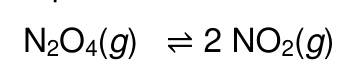
1.00 mol of \(\ce{N2O4}\) was put into an empty vessel with a fixed volume of 24.44 dm\(^{3}\). The equilibrium gas pressure at 298 K was found to be 1.190 bar. When heated to 348 K, the gas pressure increased to its equilibrium value of 1.886 bar.
2.1 Calculate \(\Delta G^0\) of the reaction at 298K, assuming the gases are ideal.
2.2 Calculate \(\Delta H^0\) and \(\Delta S^0\) of the reaction, assuming that they do not change significantly with temperature.
Note: If you cannot calculate \(\Delta H^0\), use \(\Delta H^0 = 30.0\ \mathrm{kJ\,mol^{-1}}\) for further calculations.
The tendency of \(\ce{N2O4}\) to dissociate reversibly into \(\ce{NO2}\) enables its potential use in advanced power generation systems. A simplified scheme for one such system is shown below in Figure (a). Initially, "cool" \(\ce{N2O4}\) is compressed (\(1\to2\)) in a compressor (X), and heated (\(2\to3\)). Some \(\ce{N2O4}\) dissociates into \(\ce{NO2}\). The hot mixture is expanded (\(3\to4\)) through a turbine (Y), resulting in a decrease in both temperature and pressure. The mixture is then cooled further (\(4\to1\)) in a heat sink (Z), to promote the reformation of \(\ce{N2O4}\). This recombination reduces the pressure, thus facilitates the compression of \(\ce{N2O4}\) to start a new cycle. All these processes are assumed to take place reversibly.
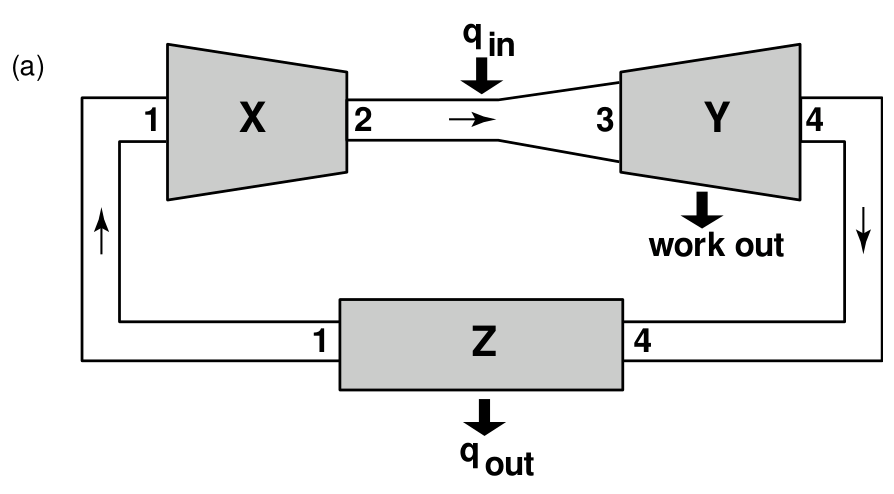
To understand the benefits of using reversible dissociating gases such as \(\ce{N2O4}\), we will focus on step \(3\to4\) and consider an ideal gas turbine working with 1 mole of air (which we assume to be an inert, non-dissociating gas). During the reversible adiabatic expansion in the turbine, no heat is exchanged.
2.3 Give the equation to calculate the work done by the system \(w(\mathrm{air})\) during the reversible adiabatic expansion for 1 mol of air during stage \(3\to4\). Assume that \(C_{v,m}(\mathrm{air})\) (the isochoric molar heat capacity of air) is constant, and the temperature changes from \(T_3\) to \(T_4\).
2.4 Estimate the ratio \(w_{\ce{N2O4})}/w_{(\mathrm{air})}\), in which \(w_{(\ce{N2O4})}\) is the work done by the gas during the reversible adiabatic expansion process \(3\to4\) with the cycle working with 1 mol of \(\ce{N2O4}\), \(T_3\) and \(T_4\) are the same as in part 2. Take the conditions at stage 3 to be \(T_3 = 440\ \mathrm{K}\) and \(p_3 = 12.156\ \mathrm{bar}\) and assume that:
(i) the gas is at its equilibrium composition at stage 3;
(ii) \(C_{v,m}\) for the gas is the same as for air;
(iii) the adiabatic expansion in the turbine takes place in a way that the composition of the gas mixture (\(\ce{N2O4 + NO2}\)) is unchanged until the expansion is completed.
Official English text of the problem.
Problem 3: High-valent silver compounds
Silver chemistry is dominated by \(\ce{Ag}\) (I) compounds. Compounds of silver in higher oxidation state (from +2 to +5) are not very abundant due to their instability with respect to reduction. High-valent silver compounds are very reactive and can be synthesized from \(\ce{Ag}\)(I) compounds in electro-chemical oxidations or in chemical oxidations using powerful oxidizing agents.
In some peroxydisulfate (\(\ce{S2O8^2-}\)) oxidations catalyzed by \(\ce{Ag+}\), black solid (A) with the composition \(\ce{AgO}\) can be isolated.
3.1 Choose the appropriate magnetic behavior of A if it exists as \(\ce{Ag^{II}O}\).
Single crystal X - ray studies reveal that the lattice of A contains two nonequivalent \(\ce{Ag}\) atom sites (in equal proportions) of which one denoted as Ag1 and the other denoted as Ag2. Ag1 shows a linear \(\ce{O}\) atom coordination (\(\ce{O-Ag-O}\)) and Ag2 shows a square-planar \(\ce{O}\) atom coordination. All \(\ce{O}\) atoms are in equivalent environments in the structure. Thus, A should be assigned as \(\ce{Ag^{I}Ag^{III}O2}\) rather than \(\ce{Ag^{II}O}\).
3.2. Assign the oxidation number of Ag1 and Ag2.
3.3 What is the coordination number of \(\ce{O}\) atoms in the lattice of A?
3.4 How many \(\ce{Ag^{I}}\) and \(\ce{Ag^{III}}\) bond to one \(\ce{O}\) atom in the lattice of A?
3.5 Predict the magnetic behavior of A. Check the appropriate box below.
3.6 The compound A can also be formed on warming a solution of \(\ce{Ag+}\) with peroxydisulfate. Write down the equation for the formation of A.
Among the silver oxides which have been crystallographically characterized, the most surprising is probably that compound A is not a \(\ce{Ag^{II}O}\). Thermochemical cycles are useful to understand this fact. Some standard enthalpy changes (at 298 K) are listed:
Atom Standard enthalpy of formation (\(\mathrm{kJ\,mol^{-1}}\)) 1st ionization (\(\mathrm{kJ\,mol^{-1}}\)) 2nd ionization (\(\mathrm{kJ\,mol^{-1}}\)) 3rd ionization (\(\mathrm{kJ\,mol^{-1}}\)) 1st electron affinity (\(\mathrm{kJ\,mol^{-1}}\)) 2nd electron affinity (\(\mathrm{kJ\,mol^{-1}}\)) \(\ce{Cu(g)}\) 337.4 751.7 1964.1 3560.2 \(\ce{Ag(g)}\) 284.9 737.2 2080.2 3367.2 \(\ce{O(g)}\) 249.0 −141.0 844.0 Compounds \(\Delta H_f^\circ\) (\(\mathrm{kJ\,mol^{-1}}\)) \(\ce{Ag^{I}Ag^{III}O2(s)}\) −24.3 \(\ce{Cu^{II}O(s)}\) −157.3 The relationship between the lattice dissociation energy (\(U_{\mathrm{lat}}\)) and the lattice dissociation enthalpy (\(\Delta H_{\mathrm{lat}}\)) for monoatomic ion lattices is: \(\Delta H_{\mathrm{lat}}=U_{\mathrm{lat}}+nRT\), where \(n\) is the number of ions in the formula unit.
3.7 Calculate \(U_{\mathrm{lat}}\) at 298 K of \(\ce{Ag^{I}Ag^{III}O2}\) and \(\ce{Cu^{II}O}\). Assume that they are ionic compounds.
The lattice dissociation energies for a range of compounds may be estimated using this simple formula:
\[ U_{\mathrm{lat}}=C\times\left(\frac{1}{V_m}\right)^{1/3} \]
where: \(V_m\) (\(\mathrm{nm^3}\)) is the volume of the formula unit and \(C\) (\(\mathrm{kJ\,nm\,mol^{-1}}\)) is an empirical constant which has a particular value for each type of lattice with ions of specified charges.
The formula unit volumes of some oxides are calculated from crystallographic data as the ratio between the unit cell volume and the number of formula units in the unit cell and listed as below:
Oxides \(V_m\) (\(\mathrm{nm^3}\)) \(\ce{Cu^{II}O}\) 0.02030 \(\ce{Ag^{III}2O3}\) 0.06182 \(\ce{Ag^{II}Ag^{III}2O4}\) 0.08985 3.8 Calculate \(U_{\mathrm{lat}}\) for the hypothetical compound \(\ce{Ag^{II}O}\). Assume that \(\ce{Ag^{II}O}\) and \(\ce{Cu^{II}O}\) have the same type of lattice, and \(V_m(\ce{Ag^{II}O})=V_m(\ce{Ag^{II}Ag^{III}2O4})-V_m(\ce{Ag^{III}2O3})\).
3.9 By constructing an appropriate thermodynamic cycle or otherwise, estimate the enthalpy change for the solid-state transformation from \(\ce{Ag^{II}O}\) to 1 mole of \(\ce{Ag^{I}Ag^{III}O2}\).
Note: Use \(U_{\mathrm{lat}}(\ce{Ag^{II}O})=3180.0\ \mathrm{kJ\,mol^{-1}}\) and \(U_{\mathrm{lat}}(\ce{Ag^{I}Ag^{III}O2})=8310.0\ \mathrm{kJ\,mol^{-1}}\) if you cannot calculate \(U_{\mathrm{lat}}(\ce{Ag^{II}O})\) in Part 3.8).
3.10 Indicate which compound (\(\ce{Ag^{II}O}\) or \(\ce{Ag^{I}Ag^{III}O2}\)) is thermodynamically more stable.
(Check the corresponding box.)
3.11 When \(\ce{Ag^{I}Ag^{III}O2}\) is dissolved in aqueous \(\ce{HClO4}\) solution, a paramagnetic compound (B) is first formed then slowly decomposes to form a diamagnetic compound (C). Given that B and C are the only compounds containing silver formed in these reactions, write down the equations for the formation of B and C.
Oxidation of \(\ce{Ag+}\) with powerful oxidizing agents in the presence of appropriate ligands can result in the formation of high-valent silver complexes. A complex Z is synthesized and analyzed by the following procedures:
An aqueous solution containing 0.500 g of \(\ce{AgNO3}\) and \(2\ \mathrm{cm^3}\) of pyridine (\(d=0.982\ \mathrm{g\,cm^{-3}}\)) is added to a stirred, ice-cold aqueous solution of 5.000 g of \(\ce{K2S2O8}\). The reaction mixture becomes yellow, then an orange solid (Z) is formed which has a mass of 1.719 g when dried.
Elemental analysis of Z shows the mass percentages of \(\ce{C}\), \(\ce{H}\), \(\ce{N}\) elements are 38.96 %, 3.28 %, 9.09 %, respectively.
A 0.6164 g Z is added to aqueous \(\ce{NH3}\). The suspension is boiled to form a clear solution during which stage the complex is destroyed completely. The solution is acidified with excess aqueous \(\ce{HCl}\) and the resulting suspension is filtered, washed and dried (in darkness) to obtain 0.1433 g of white solid (D). The filtrate is collected and treated with excess \(\ce{BaCl2}\) solution to obtain 0.4668 g (when dry) of white precipitate (E).
3.12 Determine the empirical formula of Z and calculate the percentage yield in the preparation.
3.13 \(\ce{Ag}\) (IV) and \(\ce{Ag}\) (V) compounds are extremely unstable and found only in few fluorides. Thus, the formation of their complexes with organic ligands in water can be discounted. To confirm the oxidation number of silver in Z, the effective magnetic moment (\(\mu_{\mathrm{eff}}\)) of Z was determined and found to be 1.78 BM. Use the spin only formula to determine the number of unpaired electrons in Z and the molecular formula of Z. (Z contains a mononuclear complex with only one species of \(\ce{Ag}\) and only one type of ligand in the ligand sphere.)
3.14 Write down all chemical equations for the preparation of Z, and its analysis.
Official English text of the problem.
Problem 4: Zeise’s salt
Zeise's salt, \(\ce{K[PtCl3C2H4]}\), was one of the first organometallic compounds to be reported. W. C. Zeise, a professor at the University of Copenhagen, prepared this compound in 1827 by reacting \(\ce{PtCl4}\) with boiling ethanol and then adding potassium chloride (Method 1). This compound may also be prepared by refluxing a mixture of \(\ce{K2[PtCl6]}\) and ethanol (Method 2). The commercially available Zeise's salt is commonly prepared from \(\ce{K2[PtCl4]}\) and ethylene (Method 3).
4.1 Write balanced equations for each of the above mentioned preparations of Zeise's salt, given that in methods 1 and 2 the formation of 1 mole of Zeise’s salt consumes 2 moles of ethanol.
4.2 Mass spectrometry of the anion \(\ce{[PtCl3C2H4]-}\) shows one set of peaks with mass numbers 325-337 \(au\) and various intensities. Calculate the mass number of the anion which consists of the largest natural abundance isotopes (using given below data).
Isotope \(\ce{^{192}_{78}Pt}\) \(\ce{^{194}_{78}Pt}\) \(\ce{^{195}_{78}Pt}\) \(\ce{^{196}_{78}Pt}\) \(\ce{^{198}_{78}Pt}\) \(\ce{^{35}_{17}Cl}\) \(\ce{^{37}_{17}Cl}\) \(\ce{^{12}_{6}C}\) \(\ce{^{13}_{6}C}\) \(\ce{^{1}_{1}H}\) Natural abundance, % 0.8 32.9 33.8 25.3 7.2 75.8 24.2 98.9 1.1 99.99 Some early structures proposed for Zeise’s salt anion were:

In structure Z1, Z2, and Z5 both carbons are in the same plane as dashed square.
[You should assume that these structures do not undergo any fluxional process by interchanging two or more sites.]
NMR spectroscopy allowed the structure for Zeise’s salt to be determined as structure Z4.
4.3 For each structure Z1 – Z5, indicate in the table below how many hydrogen atoms are in different environments, and how many different environments of hydrogen atoms there are, and how many different environments of carbon atoms there are?
Structure Number of different environments of hydrogen Number of different environments of carbon Z1 Z2 Z3 Z4 Z5 For substitution reactions of square platinum(II) complexes, ligands may be arranged in order of their tendency to facilitate substitution in the position trans to themselves (the trans effect). The ordering of ligands is:
\[ \ce{CO},\ \ce{CN-},\ \ce{C2H4} > \ce{PR3},\ \ce{H-} > \ce{CH3-},\ \ce{C6H5-},\ \ce{I-},\ \ce{SCN-} > \ce{Br-} > \ce{Cl-} > \mathrm{Py} > \ce{NH3} > \ce{OH-},\ \ce{H2O} \]
In above series a left ligand has a stronger trans effect than that of the right ligand.
Some reactions of Zeise’s salt and the complex \(\ce{[Pt2Cl4(C2H4)2]}\) are given below.
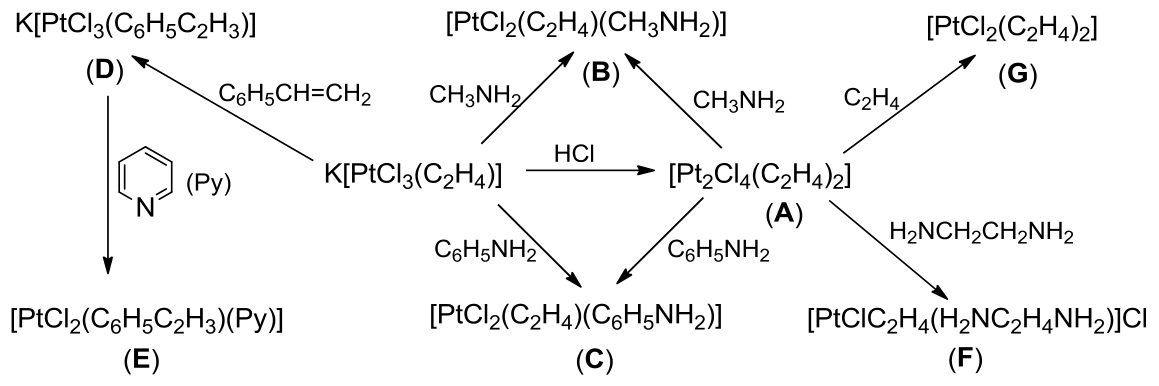
4.4 Draw the structure of A, given that the molecule of this complex has a centre of symmetry, no Pt-Pt bond, and no bridging alkene.
4.5 Draw the structures of B, C, D, E, F and G.
4.6 Suggest the driving force(s) for the formation of D and F by choosing one or more of the following statements (for example, i and ii):
i) formation of gas,
ii) formation of liquid,
iii) trans effect,
iv) chelate effect.Official English text of the problem.
Problem 5: Acid-base equilibria in water
A solution (X) contains two weak monoprotic acids (those having one acidic proton); \(\ce{HA}\) with the acid dissociation constant of \(K_{\ce{HA}}=1.74\times10^{-7}\), and \(\ce{HB}\) with the acid dissociation constant of \(K_{\ce{HB}}=1.34\times10^{-7}\). The solution X has a pH of 3.75.
5.1 Titration of \(100\ \mathrm{cm^3}\) of solution X requires \(100\ \mathrm{cm^3}\) of \(\ce{NaOH}\) solution (\(c=0.220\ \mathrm{mol\cdot dm^{-3}}\)) for completion. Calculate the initial (total) concentration (\(\mathrm{mol\cdot dm^{-3}}\)) of each acid in the solution X.
Use reasonable approximations where appropriate. [\(K_w=1.00\times10^{-14}\) at 298 K]
5.2 Calculate the pH of the solution Y in which the concentration of \(\ce{NaA}\) initially was \(6.00\times10^{-2}\ \mathrm{mol\cdot dm^{-3}}\) and that of \(\ce{NaB}\) \(4.00\times10^{-2}\ \mathrm{mol\cdot dm^{-3}}\).
5.3 Adding large amounts of distilled water to solution X gives a very (infinitely) dilute solution where the total concentrations of the acids are close to zero. Calculate the percentage of dissociation of each acid in this dilute solution.
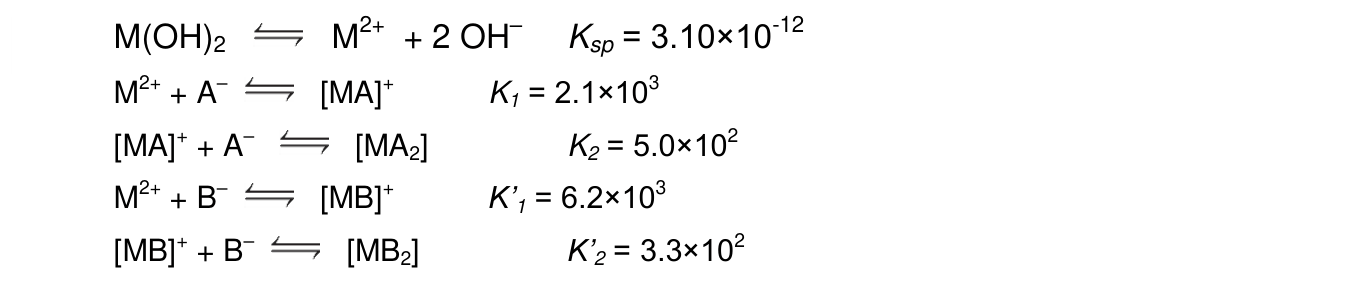
5.4. A buffer solution is added to solution Y to maintain a pH of 10.0. Assume no change in volume of the resulting solution Z. Calculate the solubility (in \(\mathrm{mol\cdot dm^{-3}}\)) of the substance \(\ce{M(OH)2}\) in Z, taking into consideration that the anions \(\ce{A^-}\) and \(\ce{B^-}\) can form complexes with \(\ce{M^{2+}}\):
Official English text of the problem.
Problem 6: Chemical kinetics
The transition-metal-catalyzed amination of aryl halides has become one of the most powerful methods to synthesize arylamines. The overall reaction for the nickel-catalyzed amination of aryl chloride in basic conditions is:

in which \(\ce{NiLL'}\) is the nickel complex catalyst. The reaction goes through several steps in which the catalyst, reactants, and solvent may be involved in elementary steps.
To determine the reaction order with respect to each reactant, the dependence of the initial rate of the reaction on the concentrations of each reagent was carried out with all other reagents present in large excess. Some kinetic data at 298 K are shown in the tables below. (Use the grids if you like.)
\([\ce{ArCl}]\) (\(\mathrm{mol\,dm^{-3}}\)) 0.1 0.2 0.4 0.6 Initial rate (\(\mathrm{mol\,dm^{-3}\,s^{-1}}\)) \(1.88\times10^{-5}\) \(4.13\times10^{-5}\) \(9.42\times10^{-5}\) \(1.50\times10^{-4}\) 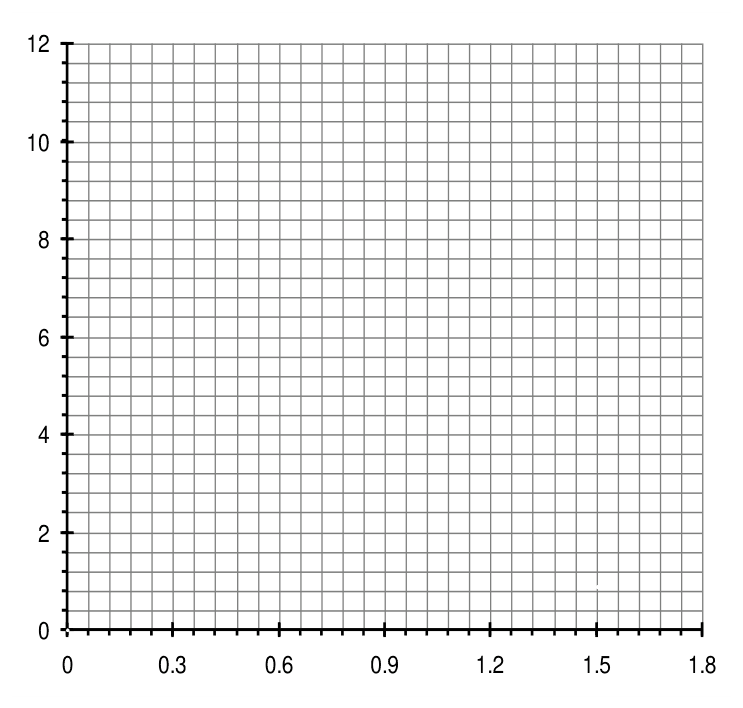
\([\ce{NiLL'}]\) (\(\mathrm{mol\,dm^{-3}}\)) \(6\times10^{-3}\) \(9\times10^{-3}\) \(1.2\times10^{-2}\) \(1.5\times10^{-2}\) Initial rate (\(\mathrm{mol\,dm^{-3}\,s^{-1}}\)) \(4.12\times10^{-5}\) \(6.01\times10^{-5}\) \(7.80\times10^{-5}\) \(1.10\times10^{-4}\) \([\ce{L'}]\) (\(\mathrm{mol\,dm^{-3}}\)) 0.06 0.09 0.12 0.15 Initial rate (\(\mathrm{mol\,dm^{-3}\,s^{-1}}\)) \(5.8\times10^{-5}\) \(4.3\times10^{-5}\) \(3.4\times10^{-5}\) \(2.8\times10^{-5}\) 6.1 Determine the order with respect to the reagents assuming they are integers.
To study the mechanism for this reaction, \(\ce{^1H}\), \(\ce{^{31}P}\), \(\ce{^{19}F}\), and \(\ce{^{13}C}\) NMR spectroscopy have been used to identify the major transition metal complexes in solution, and the initial rates were measured using reaction calorimetry. An intermediate, \(\ce{NiL(Ar)Cl}\), may be isolated at room temperature. The first two steps of the overall reaction involve the dissociation of a ligand from \(\ce{NiLL'}\) (step 1) at \(50\,^\circ\mathrm{C}\), followed by the oxidation addition (step 2) of aryl chloride to the \(\ce{NiL}\) at room temperature (rt):
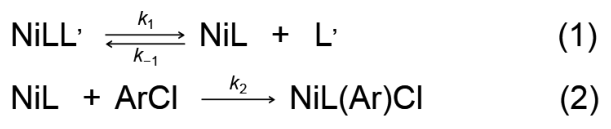
6.2 Using the steady state approximation, derive an expression for the rate equation for the formation of \([\ce{NiL(Ar)Cl}]\).
The next steps in the overall reaction involve the amine (\(\ce{RNH2}\)) and \(\ce{^{t}BuONa}\). To determine the order with respect to \(\ce{RNH2}\) and \(\ce{^{t}BuONa}\), the dependence of the initial rates of the reaction on the concentrations of these two reagents was carried with the other reagents present in large excess. Some results are shown in the tables below.
\([\ce{NaO^{t}Bu}]\) (\(\mathrm{mol\,dm^{-3}}\)) 0.2 0.6 0.9 0.12 Initial rate (\(\mathrm{mol\,dm^{-3}\,s^{-1}}\)) \(4.16\times10^{-5}\) \(4.12\times10^{-5}\) \(4.24\times10^{-5}\) \(4.20\times10^{-5}\) \([\ce{RNH2}]\) (\(\mathrm{mol\,dm^{-3}}\)) 0.3 0.6 0.9 1.2 Initial rate (\(\mathrm{mol\,dm^{-3}\,s^{-1}}\)) \(4.12\times10^{-5}\) \(4.26\times10^{-5}\) \(4.21\times10^{-5}\) \(4.23\times10^{-5}\) 6.3 Determine the order with each of these reagents, assuming each is an integer.
(Use the grids if you like)
During a catalytic cycle, a number of different structures may be involved which include the catalyst. One step in the cycle will be rate-determining. A proposed cycle for the nickel-catalyzed coupling of aryl halides with amines is as follows:

6.4 Use the steady-state approximation and material balance equation to derive the rate law for \(\mathrm{d}[\ce{ArNHR}]/\mathrm{d}t\) for the above mechanism in terms of the initial concentration of the catalyst \([\ce{NiLL'}]_0\) and concentrations of \([\ce{ArCl}]\), \([\ce{NH2R}]\), \([\ce{NaO^{t}Bu}]\), and \([\ce{L'}]\).
6.5 Give the simplified form of the rate equation in 6.4 assuming that \(k_1\) is very small.
Official English text of the problem.
Problem 7: Synthesis of artemisinin
(+)-Artemisinin, isolated from Artemisia annua L. (Qinghao, Compositae) is a potent antimalarial effective against resistant strains of Plasmodium. A simple route for the synthesis of Artemisinin is outlined below.
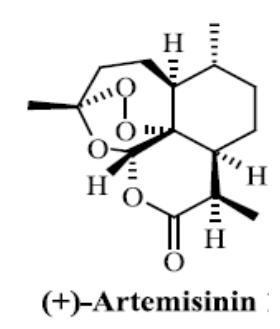
First, pyrolysis of (+)-2-Carene broke the cyclopropane ring forming, among other products, (1R)-(+)-trans-isolimonene A (\(\ce{C10H16}\)), which then was subjected to regioselective hydroboration using dicyclohexylborane to give the required alcohol B in 82% yield as a mixture of diastereoisomers. In the next step, B was converted to the corresponding \(\gamma,\delta\)-unsaturated acid C in 80% yield by Jones’ oxidation.
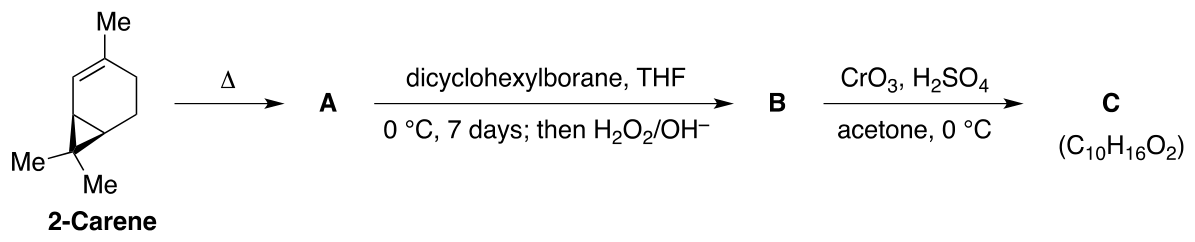
7.1 Draw the structures (with stereochemistry) of the compounds A - C.
The acid C was subjected to iodolactonization using \(\ce{KI}\), \(\ce{I2}\) in aqueous. \(\ce{NaHCO3}\) solution to afford diastereomeric iodolactones D and E (which differ in stereochemistry only at \(C_3\)) in 70% yield.

7.2 Draw the structures (with stereochemistry) of the compounds D and E.
The iodolactone D was subjected to an intermolecular radical reaction with ketone X using tris(trimethylsilyl)silane (TTMSS) and AIBN (azobisisobutyronitrile) in a catalytic amount, refluxing in toluene to yield the corresponding alkylated lactone F in 72% yield as a mixture of diastereoisomers which differ only in stereochemistry at \(C_7\) along with compound G (~10%) and the reduced product H, \(\ce{C10H16O2}\) (<5%).
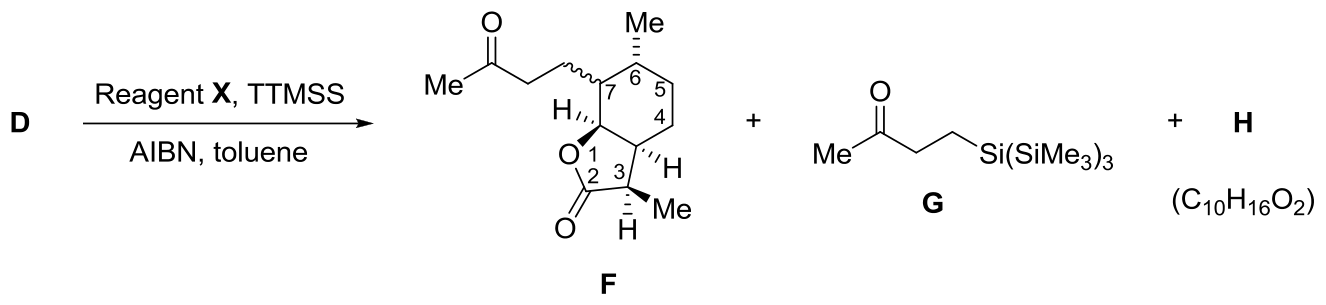
7.3 Draw the structures (with stereochemistry) of compound H and the reagent X.
The keto group of F reacted with ethanedithiol and \(\ce{BF3.Et2O}\) in dichloromethane (DCM) at \(0\,^\circ\mathrm{C}\) to afford two diastereomers: thioketal lactones I and J in nearly quantitative yield (98%). The thioketalization facilitated the separation of the major isomer J in which the thioketal group is on the opposite face of the ring to the adjacent methyl group.

7.4 Draw the structures (with stereochemistry) of the compounds I and J.
The isomer J was further subjected to alkaline hydrolysis followed by esterification with diazomethane providing hydroxy methyl ester K in 50% yield. The hydroxy methyl ester K was transformed into the keto ester L using PCC (Pyridium ChloroChromate) as the oxidizing agent in dichloromethane (DCM).
A two-dimensional NMR study of the compound L revealed that the two protons adjacent to the newly-formed carbonyl group are cis to each other and confirmed the structure of L.

7.5 Draw the structures (with stereochemistry) of the compounds K and L.
The ketone L was subjected to a Wittig reaction with methoxymethyl triphenyl-phosphonium chloride and KHMDS (Potassium HexaMethylDiSilazid - a strong, non-nucleophilic base) to furnish the required methyl vinyl ether M in 45% yield. Deprotection of thioketal using \(\ce{HgCl2}\), \(\ce{CaCO3}\) resulted in the key intermediate N (80%). Finally, the compound N was transformed into the target molecule Artemisinin by photo-oxidation followed followed by acid hydrolysis with 70 % \(\ce{HClO4}\).
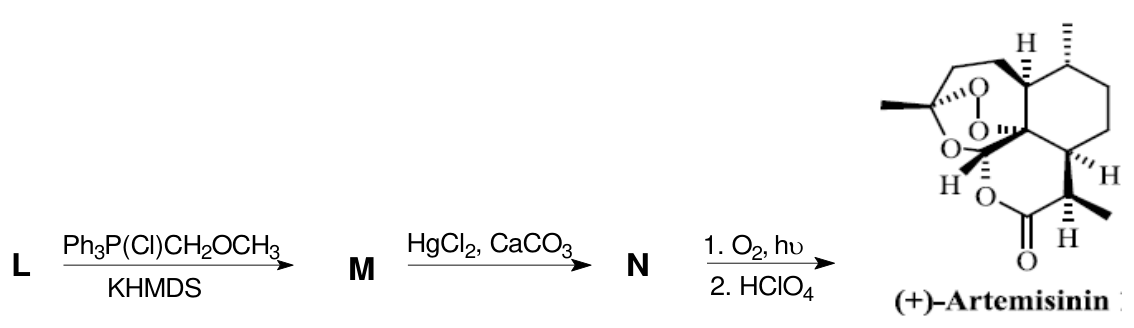
7.6 Draw the structures (with stereochemistry) of the compounds M and N.
Official English text of the problem.
Problem 8: Star anise
Illicium verum, commonly called Star anise, is a small native evergreen tree grown in northeast Vietnam. Star anise fruit is used in traditional Vietnamese medicine. It is also a major ingredient in the making the flavor of ‘phở’, a Vietnamese favorite soup. Acid A is isolated from the star anise fruit. The constitutional formula of A has been deduced from the following sequence of reactions:
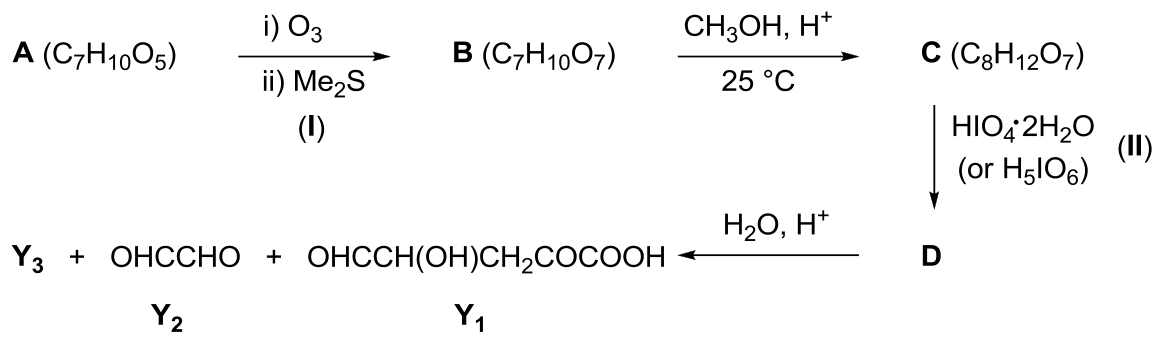
(I): this overall process results in an alkene cleavage at the \(\ce{C=C}\) bond, with each carbon of this becoming doubly bonded to an oxygen atom.
(II): this oxidative cleavage process of 1,2-diols breaks \(\ce{C(OH)-C(OH)}\) bond and produces corresponding carbonyl compounds.
8.1 Draw the structures for the compounds Y₁ and Y₂ and hence deduce the structure of Y₃ and A, B, C, D, given that in A there is only one ethylenic hydrogen atom.
Anethole, a main component of star anise oil, is an inexpensive chemical precursor for the production of many pharmaceutical drugs.
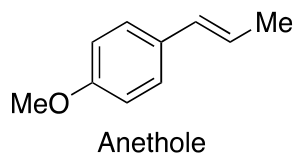
Treating anethole with sodium nitrite in acetic acid gives a crystalline solid E (\(\ce{C10H10N2O3}\)). The IR spectrum of E shows there is no non-aromatic \(\ce{C=C}\) double bond. The \({}^{1}\mathrm{H}\) NMR spectrum of E is given below.
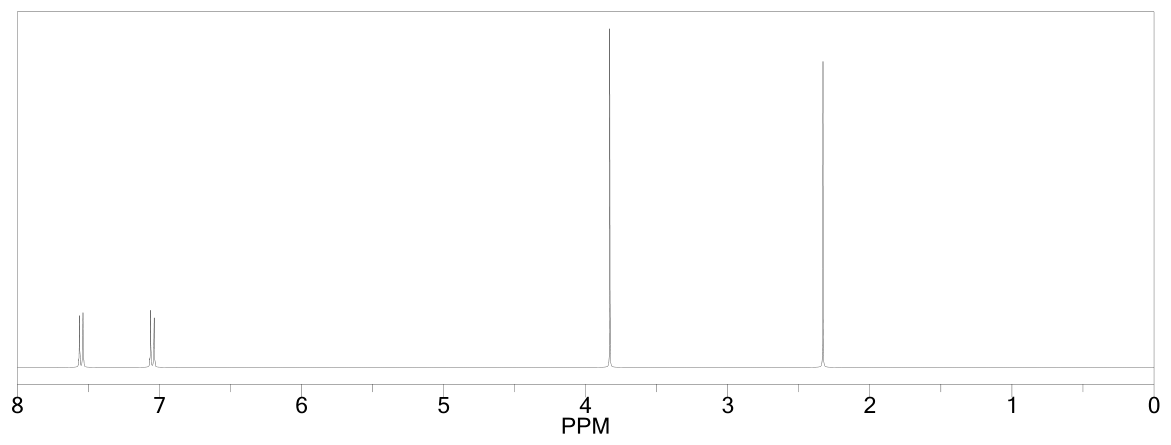
8.2 What differences in the structure between E and anethole can be obtained from the \({}^{1}\mathrm{H}\) NMR data? Pick one of the following statements.
i) E contains a cis-\(\ce{C=C}\) ethylenic bond while that of anethole is trans.
ii) E cannot contain a non-aromatic \(\ce{C=C}\) bond.
iii) E is the adduct of anethole and \(\ce{N2O2}\).
iv) E is the adduct of anethole and \(\ce{N2O3}\).
v) E does not contain two trans ethylenic protons as anethole.
On heating at \(150\,^\circ\mathrm{C}\) for several hours, E is partially isomerized into F. Under the same conditions, F gives the identical equilibrium mixture to that obtained from E. On heating with phosphorus trichloride, both E and F lose one oxygen atom giving compound G. Compounds E and F have the same functional groups.

The chemical shifts of methyl protons in E, F and G are given below.
E F G \(\ce{CH3-O}\) 3.8 ppm 3.8 ppm 3.8 ppm \(\ce{CH3-C}\) 2.3 ppm 2.6 ppm 2.6 ppm 8.3 Suggest structures for E, F and G, assuming that they do NOT contain three-membered rings.
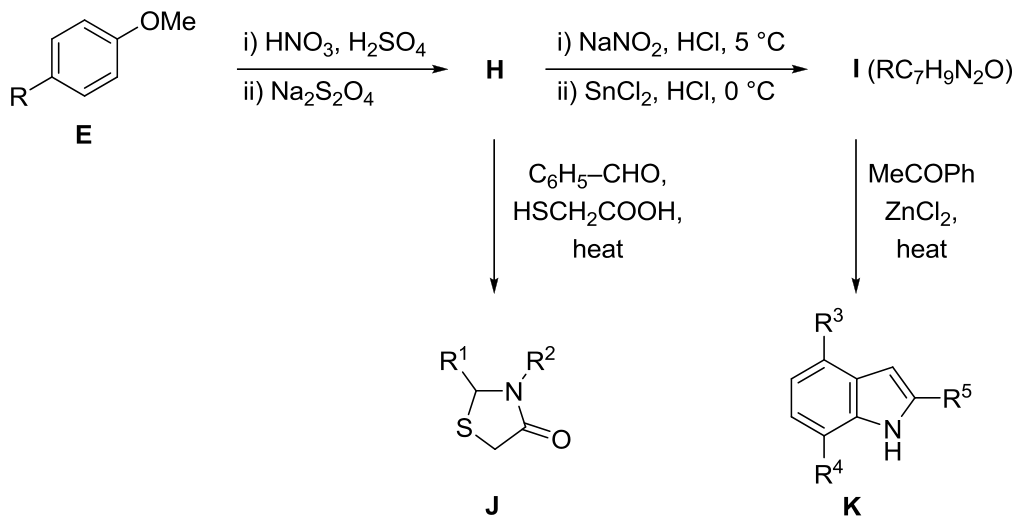
A simplified structure for compound E is shown below; the R group does not change throughout the rest of this question. Compound E is nitrated and subsequently reduced with sodium dithionite to H. Treatment of H with sodium nitrite and hydrochloric acid at \(0\text{–}5\,^\circ\mathrm{C}\) and subsequently reduced with stannous chloride to provide I (\(\ce{R-C7H9N2O}\)). One-pot reaction (three component reaction) of H, benzaldehyde and thioglycolic acid (\(\ce{HSCH2CO2H}\)) leads to the formation of J. Reaction of I and methyl phenyl ketone in the presence of \(\ce{ZnCl2}\) affords K.
8.4 Give the structures for H, I, J and K in the following scheme:
Official English text of the problem.
Problem 9: Heterocycle preparation
Tetramethylthiurame disulfide (TMTD) is emerging as a useful reagent to prepare many sulfur-nitrogen functional groups and heterocycles in organic chemistry. The reactions of TMTD with primary amines, as well some corresponding post-transformations of the resulting product(s) are presented in the following schemes:

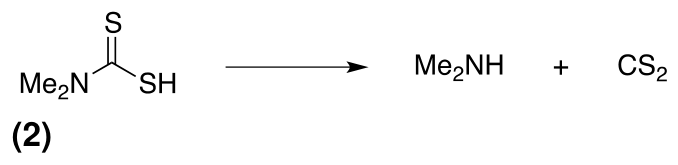



Similar transformations of benzohydrazides (containing nucleophilic \(\ce{NH2}\) group) and TMTD have been observed.
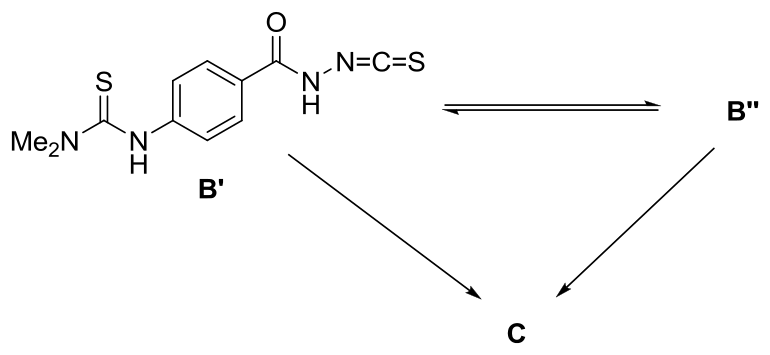
In the synthetic scheme below, the thiocarbamoylation reaction of an aroyl hydrazine with TMTD produces compound C containing a heterocyclic moiety from p-aminobenzoic acid.

During the formation of C from B, an intermediate B′ was observed. This intermediate tautomerizes to B″. C can be formed from B′ or B″.
9.1 Give the structures of A, B, and C.
9.2 Suggest a structure for the tautomer B″ and give a curly-arrow mechanism for the formation of C.
Compound C was then converted to F by the following pathway:

[The group R remains exactly the same throughout the rest of the question.]
9.3 Draw the structures of E, and F. (You do not need to draw the structure for the R group from this point.)
E was only obtained when D was slowly added to the solution of excess \(\ce{N2H4}\) in dioxane. If \(\ce{N2H4}\) was added to the solution of D in dioxane instead, a major side product D′ (\(\ce{R2C14H12N4S2}\)) was formed.
9.4 Give the structure of D′.
Slightly heating of D with ethanolamine (\(\ce{HOCH2CH2NH2}\)) in dioxane for 2 hours yielded G (\(\ce{R-C9H11N2OS}\)).
9.5 Draw the structural formula of G.
9.6 Heating G in the presence of p-toluenesulfonic acid as the catalyst could form a number of different five-membered heterocyclic products:
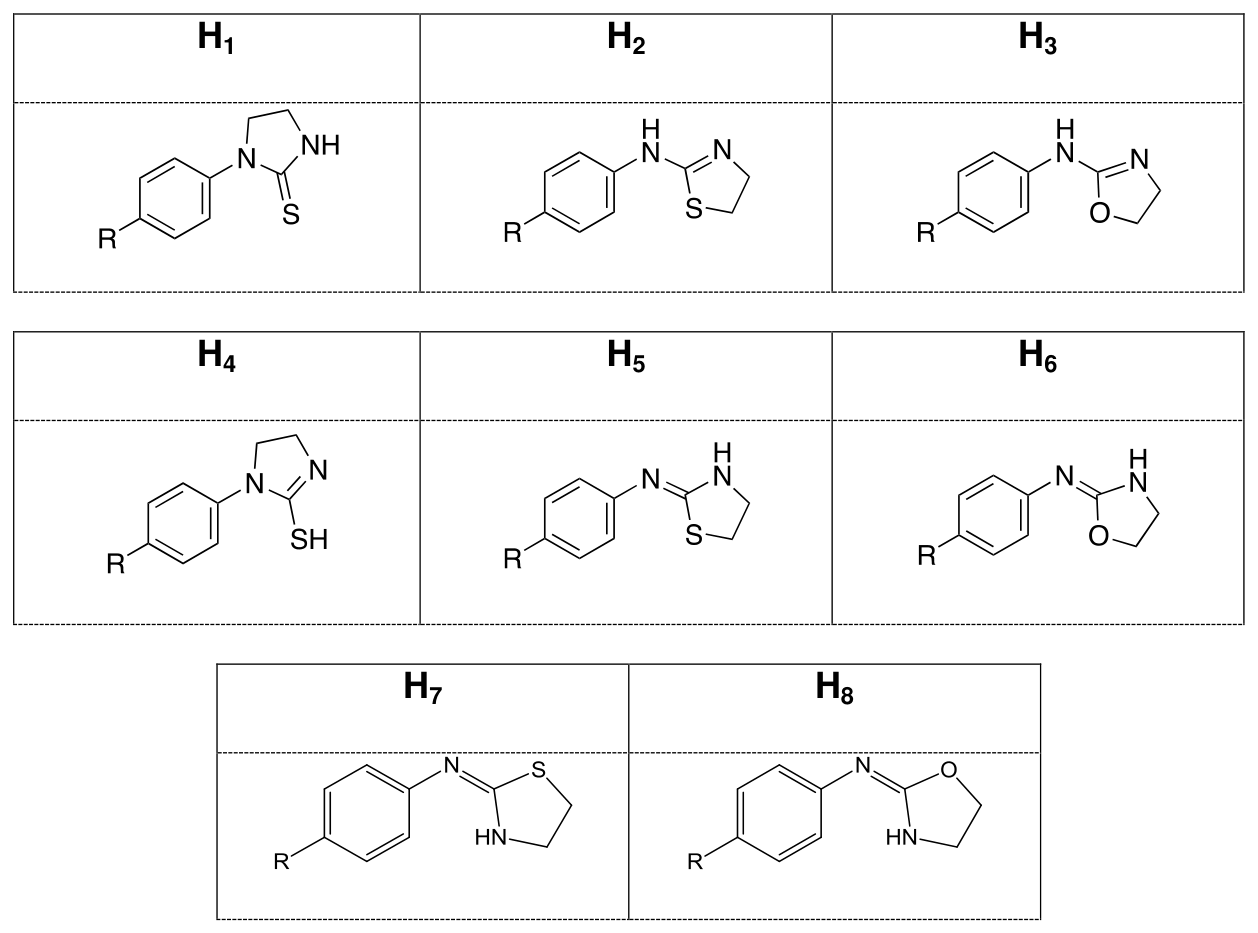
i) Draw 2 structures that have different molecular formulae.
ii) Draw 2 structures that are constitutional isomers.
iii) Draw 2 structures that are stereoisomers.
Official English text of the problem.
Internationale Chemie-Olympiade
IChO 2014
Hanoi, Vietnam · 9 Theorieaufgaben mit vollständigen Lösungen
Aufgabe 1: Teilchen im Kasten: Polyene
In der Quantenmechanik lässt sich die Bewegung von \(\pi\)-Elektronen entlang einer neutralen Kette konjugierter Kohlenstoffatome mithilfe des Modells „Teilchen im Kasten“ beschreiben. Die Energie der \(\pi\)-Elektronen ist durch die folgende Gleichung gegeben:
\[ E_n=\frac{n^2h^2}{8mL^2} \]
Dabei ist \(n\) die Quantenzahl (\(n=1,2,3,\ldots\)), \(h\) die Planck-Konstante, \(m\) die Masse des Elektrons und \(L\) die Länge des Kastens, die durch \(L=(k+2)\times1.40\ \text{Å}\) angenähert werden kann (wobei \(k\) die Anzahl der konjugierten Doppelbindungen entlang der Kohlenstoffkette im Molekül ist). Ein Photon mit der geeigneten Wellenlänge \(\lambda\) kann ein \(\pi\)-Elektron aus dem höchsten besetzten Molekülorbital (HOMO) in das niedrigste unbesetzte Molekülorbital (LUMO) anregen. Eine auf diesem Modell beruhende semiempirische Näherungsformel, die die Wellenlänge \(\lambda\) mit der Anzahl der Doppelbindungen \(k\) und der Konstanten \(B\) verknüpft, lautet:
\[ \lambda(\mathrm{nm})=B\times\frac{(k+2)^2}{(2k+1)} \qquad\text{Gleichung 1} \]
1.1 Berechnen Sie mithilfe dieser semiempirischen Formel mit \(B=65.01\ \mathrm{nm}\) den Wert der Wellenlänge \(\lambda\) (nm) für Octatetraen (\(\ce{CH2=CH-CH=CH-CH=CH-CH=CH2}\)).
1.2 Leiten Sie Gleichung 1 (einen Ausdruck für die Wellenlänge \(\lambda\) (nm), die dem Übergang eines Elektrons vom HOMO zum LUMO entspricht) in Abhängigkeit von \(k\) und den Naturkonstanten her und berechnen Sie daraus den theoretischen Wert der Konstanten \(B_{\mathrm{calc.}}\).
1.3 Wir möchten ein lineares Polyen synthetisieren, bei dem die Anregung eines \(\pi\)-Elektrons vom HOMO zum LUMO eine Absorptionswellenlänge von ungefähr 600 nm erfordert. Bestimmen Sie mithilfe Ihres Ausdrucks aus Teil 2 die Anzahl der konjugierten Doppelbindungen (\(k\)) in diesem Polyen und geben Sie seine Struktur an. [Falls Sie Teil 2 nicht gelöst haben, verwenden Sie die semiempirische Gleichung 1 mit \(B=65.01\ \mathrm{nm}\), um Teil 3 zu bearbeiten.]
1.4 Berechnen Sie für das in Teil 3 ermittelte Polyenmolekül die Energiedifferenz zwischen HOMO und LUMO, \(\Delta E\), (\(\mathrm{kJ\,mol^{-1}}\)).
Falls Teil 3 nicht gelöst wurde, verwenden Sie \(k=5\), um diese Aufgabe zu lösen.
Das Modell eines Teilchens in einem eindimensionalen Kasten lässt sich auf einen dreidimensionalen quaderförmigen Kasten mit den Abmessungen \(L_x\), \(L_y\) und \(L_z\) erweitern. Daraus ergibt sich der folgende Ausdruck für die erlaubten Energieniveaus:
\[ E_{n_x,n_y,n_z} =\frac{h^2}{8m} \left( \frac{n_x^2}{L_x^2}+ \frac{n_y^2}{L_y^2}+ \frac{n_z^2}{L_z^2} \right) \]
Die drei Quantenzahlen \(n_x\), \(n_y\) und \(n_z\) müssen ganzzahlige Werte annehmen und sind voneinander unabhängig.
1.5 Geben Sie die Ausdrücke für die drei niedrigsten unterschiedlichen Energien an, unter der Annahme, dass der Kasten würfelförmig ist und die Kantenlänge \(L\) besitzt.
1.6 Niveaus mit derselben Energie werden als entartet bezeichnet. Zeichnen Sie für einen würfelförmigen Kasten eine Skizze aller Energieniveaus einschließlich sämtlicher entarteter Niveaus, die zu Quantenzahlen mit den Werten 1 oder 2 gehören.
Aufgabentext aus dem offiziellen englischen Text übersetzt.
Aufgabe 2: Kreisprozess mit einem dissoziierenden Gas
Distickstofftetraoxid bildet mit Stickstoffdioxid ein Gleichgewichtsgemisch:
1.00 mol \(\ce{N2O4}\) wurden in ein leeres Gefäß mit einem festen Volumen von 24.44 dm\(^{3}\) eingebracht. Der Gasdruck im Gleichgewicht bei 298 K betrug 1.190 bar. Beim Erwärmen auf 348 K stieg der Gasdruck auf seinen Gleichgewichtswert von 1.886 bar.
2.1 Berechnen Sie \(\Delta G^0\) der Reaktion bei 298K unter der Annahme, dass sich die Gase ideal verhalten.
2.2 Berechnen Sie \(\Delta H^0\) und \(\Delta S^0\) der Reaktion unter der Annahme, dass sie sich mit der Temperatur nicht wesentlich ändern.
Hinweis: Falls Sie \(\Delta H^0\) nicht berechnen können, verwenden Sie für die weiteren Berechnungen \(\Delta H^0 = 30.0\ \mathrm{kJ\,mol^{-1}}\).
Die Neigung von \(\ce{N2O4}\), reversibel zu \(\ce{NO2}\) zu dissoziieren, eröffnet die Möglichkeit seiner Verwendung in fortschrittlichen Energieerzeugungssystemen. Ein vereinfachtes Schema eines solchen Systems ist unten in Abbildung (a) dargestellt. Zunächst wird „kühles“ \(\ce{N2O4}\) in einem Kompressor (X) komprimiert (\(1\to2\)) und erwärmt (\(2\to3\)). Ein Teil des \(\ce{N2O4}\) dissoziiert zu \(\ce{NO2}\). Das heiße Gemisch wird in einer Turbine (Y) entspannt (\(3\to4\)), wodurch sowohl die Temperatur als auch der Druck sinken. Anschließend wird das Gemisch in einer Wärmesenke (Z) weiter abgekühlt (\(4\to1\)), um die Rückbildung von \(\ce{N2O4}\) zu begünstigen. Diese Rekombination senkt den Druck und erleichtert dadurch die Kompression des \(\ce{N2O4}\), mit der ein neuer Kreisprozess beginnt. Es wird angenommen, dass alle diese Prozesse reversibel ablaufen.
Um die Vorteile der Verwendung reversibel dissoziierender Gase wie \(\ce{N2O4}\) zu verstehen, konzentrieren wir uns auf den Schritt \(3\to4\) und betrachten eine ideale Gasturbine, die mit 1 mol Luft arbeitet (die wir als inertes, nicht dissoziierendes Gas annehmen). Während der reversiblen adiabatischen Expansion in der Turbine wird keine Wärme ausgetauscht.
2.3 Geben Sie die Gleichung zur Berechnung der vom System verrichteten Arbeit \(w(\mathrm{air})\) während der reversiblen adiabatischen Expansion von 1 mol Luft im Schritt \(3\to4\) an. Nehmen Sie an, dass \(C_{v,m}(\mathrm{air})\) (die isochore molare Wärmekapazität von Luft) konstant ist und sich die Temperatur von \(T_3\) auf \(T_4\) ändert.
2.4 Schätzen Sie das Verhältnis \(w_{\ce{N2O4})}/w_{(\mathrm{air})}\) ab, wobei \(w_{(\ce{N2O4})}\) die vom Gas während des reversiblen adiabatischen Expansionsprozesses \(3\to4\) verrichtete Arbeit ist, wenn der Kreisprozess mit 1 mol \(\ce{N2O4}\) arbeitet; \(T_3\) und \(T_4\) sind dieselben wie in Teil 2. Setzen Sie für den Zustand 3 die Bedingungen \(T_3 = 440\ \mathrm{K}\) und \(p_3 = 12.156\ \mathrm{bar}\) an und nehmen Sie an, dass:
(i) das Gas im Zustand 3 seine Gleichgewichtszusammensetzung aufweist;
(ii) \(C_{v,m}\) für das Gas denselben Wert wie für Luft hat;
(iii) die adiabatische Expansion in der Turbine so abläuft, dass die Zusammensetzung des Gasgemisches (\(\ce{N2O4 + NO2}\)) bis zum Abschluss der Expansion unverändert bleibt.
Aufgabentext aus dem offiziellen englischen Text übersetzt.
Aufgabe 3: Silberverbindungen in hohen Oxidationsstufen
Die Chemie des Silbers wird von \(\ce{Ag}\)(I)-Verbindungen dominiert. Verbindungen des Silbers in höheren Oxidationsstufen (von +2 bis +5) sind aufgrund ihrer Instabilität gegenüber Reduktion nicht sehr zahlreich. Silberverbindungen in hohen Oxidationsstufen sind sehr reaktiv und können aus \(\ce{Ag}\)(I)-Verbindungen durch elektrochemische Oxidation oder durch chemische Oxidation mit starken Oxidationsmitteln synthetisiert werden.
Bei einigen durch \(\ce{Ag+}\) katalysierten Oxidationen mit Peroxydisulfat (\(\ce{S2O8^2-}\)) lässt sich ein schwarzer Feststoff (A) mit der Zusammensetzung \(\ce{AgO}\) isolieren.
3.1 Wählen Sie das zutreffende magnetische Verhalten von A, falls es als \(\ce{Ag^{II}O}\) vorliegt.
Einkristall-Röntgenstrukturanalysen zeigen, dass das Gitter von A zwei nicht äquivalente \(\ce{Ag}\)-Atomplätze (zu gleichen Anteilen) enthält, von denen der eine als Ag1 und der andere als Ag2 bezeichnet wird. Ag1 weist eine lineare Koordination durch \(\ce{O}\)-Atome (\(\ce{O-Ag-O}\)) auf, Ag2 eine quadratisch-planare Koordination durch \(\ce{O}\)-Atome. Alle \(\ce{O}\)-Atome haben in der Struktur äquivalente Umgebungen. Daher sollte A als \(\ce{Ag^{I}Ag^{III}O2}\) und nicht als \(\ce{Ag^{II}O}\) beschrieben werden.
3.2. Ordnen Sie Ag1 und Ag2 ihre Oxidationszahlen zu.
3.3 Welche Koordinationszahl haben die \(\ce{O}\)-Atome im Gitter von A?
3.4 Wie viele \(\ce{Ag^{I}}\) und \(\ce{Ag^{III}}\) sind im Gitter von A an ein \(\ce{O}\)-Atom gebunden?
3.5 Sagen Sie das magnetische Verhalten von A voraus. Kreuzen Sie unten das zutreffende Kästchen an.
3.6 Die Verbindung A kann auch beim Erwärmen einer Lösung von \(\ce{Ag+}\) mit Peroxydisulfat entstehen. Geben Sie die Gleichung für die Bildung von A an.
Unter den kristallographisch charakterisierten Silberoxiden ist wahrscheinlich am überraschendsten, dass die Verbindung A kein \(\ce{Ag^{II}O}\) ist. Thermochemische Kreisprozesse sind hilfreich, um diese Tatsache zu verstehen. Einige Standardenthalpieänderungen (bei 298 K) sind aufgeführt:
Atom Standardbildungsenthalpie (\(\mathrm{kJ\,mol^{-1}}\)) 1. Ionisierung (\(\mathrm{kJ\,mol^{-1}}\)) 2. Ionisierung (\(\mathrm{kJ\,mol^{-1}}\)) 3. Ionisierung (\(\mathrm{kJ\,mol^{-1}}\)) 1. Elektronenaffinität (\(\mathrm{kJ\,mol^{-1}}\)) 2. Elektronenaffinität (\(\mathrm{kJ\,mol^{-1}}\)) \(\ce{Cu(g)}\) 337.4 751.7 1964.1 3560.2 \(\ce{Ag(g)}\) 284.9 737.2 2080.2 3367.2 \(\ce{O(g)}\) 249.0 −141.0 844.0 Verbindungen \(\Delta H_f^\circ\) (\(\mathrm{kJ\,mol^{-1}}\)) \(\ce{Ag^{I}Ag^{III}O2(s)}\) −24.3 \(\ce{Cu^{II}O(s)}\) −157.3 Der Zusammenhang zwischen der Gitterdissoziationsenergie (\(U_{\mathrm{lat}}\)) und der Gitterdissoziationsenthalpie (\(\Delta H_{\mathrm{lat}}\)) für Gitter aus einatomigen Ionen lautet: \(\Delta H_{\mathrm{lat}}=U_{\mathrm{lat}}+nRT\), wobei \(n\) die Anzahl der Ionen in der Formeleinheit ist.
3.7 Berechnen Sie \(U_{\mathrm{lat}}\) bei 298 K für \(\ce{Ag^{I}Ag^{III}O2}\) und \(\ce{Cu^{II}O}\). Nehmen Sie an, dass es sich um ionische Verbindungen handelt.
Die Gitterdissoziationsenergien einer Reihe von Verbindungen lassen sich mit dieser einfachen Formel abschätzen:
\[ U_{\mathrm{lat}}=C\times\left(\frac{1}{V_m}\right)^{1/3} \]
Dabei ist \(V_m\) (\(\mathrm{nm^3}\)) das Volumen der Formeleinheit und \(C\) (\(\mathrm{kJ\,nm\,mol^{-1}}\)) eine empirische Konstante, die für jeden Gittertyp mit Ionen bestimmter Ladungen einen bestimmten Wert hat.
Die Volumina der Formeleinheiten einiger Oxide wurden aus kristallographischen Daten als Quotient aus dem Volumen der Elementarzelle und der Anzahl der Formeleinheiten in der Elementarzelle berechnet und sind nachfolgend aufgeführt:
Oxide \(V_m\) (\(\mathrm{nm^3}\)) \(\ce{Cu^{II}O}\) 0.02030 \(\ce{Ag^{III}2O3}\) 0.06182 \(\ce{Ag^{II}Ag^{III}2O4}\) 0.08985 3.8 Berechnen Sie \(U_{\mathrm{lat}}\) für die hypothetische Verbindung \(\ce{Ag^{II}O}\). Nehmen Sie an, dass \(\ce{Ag^{II}O}\) und \(\ce{Cu^{II}O}\) denselben Gittertyp haben und dass \(V_m(\ce{Ag^{II}O})=V_m(\ce{Ag^{II}Ag^{III}2O4})-V_m(\ce{Ag^{III}2O3})\) gilt.
3.9 Schätzen Sie durch Aufstellen eines geeigneten thermodynamischen Kreisprozesses oder auf andere Weise die Enthalpieänderung für die Festkörperumwandlung von \(\ce{Ag^{II}O}\) zu 1 Mol \(\ce{Ag^{I}Ag^{III}O2}\) ab.
Hinweis: Verwenden Sie \(U_{\mathrm{lat}}(\ce{Ag^{II}O})=3180.0\ \mathrm{kJ\,mol^{-1}}\) und \(U_{\mathrm{lat}}(\ce{Ag^{I}Ag^{III}O2})=8310.0\ \mathrm{kJ\,mol^{-1}}\), falls Sie \(U_{\mathrm{lat}}(\ce{Ag^{II}O})\) in Teil 3.8) nicht berechnen können.
3.10 Geben Sie an, welche Verbindung (\(\ce{Ag^{II}O}\) oder \(\ce{Ag^{I}Ag^{III}O2}\)) thermodynamisch stabiler ist.
(Kreuzen Sie das entsprechende Kästchen an.)
3.11 Wird \(\ce{Ag^{I}Ag^{III}O2}\) in wässriger \(\ce{HClO4}\)-Lösung gelöst, entsteht zunächst eine paramagnetische Verbindung (B), die sich anschließend langsam unter Bildung einer diamagnetischen Verbindung (C) zersetzt. Geben Sie die Gleichungen für die Bildung von B und C an, wobei B und C die einzigen silberhaltigen Verbindungen sind, die bei diesen Reaktionen entstehen.
Die Oxidation von \(\ce{Ag+}\) mit starken Oxidationsmitteln in Gegenwart geeigneter Liganden kann zur Bildung von Silberkomplexen in hohen Oxidationsstufen führen. Ein Komplex Z wird nach den folgenden Verfahren synthetisiert und analysiert:
Eine wässrige Lösung, die 0.500 g \(\ce{AgNO3}\) und \(2\ \mathrm{cm^3}\) Pyridin (\(d=0.982\ \mathrm{g\,cm^{-3}}\)) enthält, wird unter Rühren zu einer eiskalten wässrigen Lösung von 5.000 g \(\ce{K2S2O8}\) gegeben. Das Reaktionsgemisch wird gelb, anschließend entsteht ein orangefarbener Feststoff (Z), dessen Masse nach dem Trocknen 1.719 g beträgt.
Die Elementaranalyse von Z ergibt für die Elemente \(\ce{C}\), \(\ce{H}\) und \(\ce{N}\) Massenanteile von 38.96 %, 3.28 % bzw. 9.09 %.
0.6164 g Z werden zu wässriger \(\ce{NH3}\)-Lösung gegeben. Die Suspension wird bis zur Bildung einer klaren Lösung gekocht, wobei der Komplex vollständig zerstört wird. Die Lösung wird mit überschüssiger wässriger \(\ce{HCl}\) angesäuert; die entstandene Suspension wird filtriert und der Feststoff gewaschen und (im Dunkeln) getrocknet. Dabei erhält man 0.1433 g eines weißen Feststoffs (D). Das Filtrat wird gesammelt und mit überschüssiger \(\ce{BaCl2}\)-Lösung versetzt, wobei 0.4668 g (nach dem Trocknen) eines weißen Niederschlags (E) erhalten werden.
3.12 Bestimmen Sie die Verhältnisformel von Z und berechnen Sie die prozentuale Ausbeute der Darstellung.
3.13 \(\ce{Ag}\)(IV)- und \(\ce{Ag}\)(V)-Verbindungen sind äußerst instabil und kommen nur in wenigen Fluoriden vor. Daher kann die Bildung ihrer Komplexe mit organischen Liganden in Wasser ausgeschlossen werden. Zur Bestätigung der Oxidationszahl des Silbers in Z wurde das effektive magnetische Moment (\(\mu_{\mathrm{eff}}\)) von Z bestimmt; es beträgt 1.78 BM. Bestimmen Sie mithilfe der Spin-only-Formel die Anzahl der ungepaarten Elektronen in Z und die Molekülformel von Z. (Z enthält einen einkernigen Komplex mit nur einer Spezies von \(\ce{Ag}\) und nur einer Ligandenart in der Ligandensphäre.)
3.14 Geben Sie alle chemischen Gleichungen für die Darstellung und die Analyse von Z an.
Aufgabentext aus dem offiziellen englischen Text übersetzt.
Aufgabe 4: Zeisesches Salz
Das Zeisesche Salz, \(\ce{K[PtCl3C2H4]}\), war eine der ersten beschriebenen metallorganischen Verbindungen. W. C. Zeise, Professor an der Universität Kopenhagen, stellte diese Verbindung 1827 her, indem er \(\ce{PtCl4}\) mit siedendem Ethanol umsetzte und anschließend Kaliumchlorid zugab (Methode 1). Diese Verbindung lässt sich auch durch Erhitzen eines Gemischs aus \(\ce{K2[PtCl6]}\) und Ethanol unter Rückfluss herstellen (Methode 2). Das im Handel erhältliche Zeisesche Salz wird üblicherweise aus \(\ce{K2[PtCl4]}\) und Ethen hergestellt (Methode 3).
4.1 Stellen Sie für jede der oben genannten Methoden zur Herstellung des Zeiseschen Salzes die ausgeglichene Reaktionsgleichung auf. Dabei werden bei den Methoden 1 und 2 zur Bildung von 1 Mol Zeiseschem Salz 2 Mol Ethanol verbraucht.
4.2 Das Massenspektrum des Anions \(\ce{[PtCl3C2H4]-}\) zeigt eine Gruppe von Peaks mit Massenzahlen von 325–337 \(au\) und unterschiedlichen Intensitäten. Berechnen Sie die Massenzahl des Anions, das aus den Isotopen mit der jeweils größten natürlichen Häufigkeit besteht (verwenden Sie die unten angegebenen Daten).
Isotop \(\ce{^{192}_{78}Pt}\) \(\ce{^{194}_{78}Pt}\) \(\ce{^{195}_{78}Pt}\) \(\ce{^{196}_{78}Pt}\) \(\ce{^{198}_{78}Pt}\) \(\ce{^{35}_{17}Cl}\) \(\ce{^{37}_{17}Cl}\) \(\ce{^{12}_{6}C}\) \(\ce{^{13}_{6}C}\) \(\ce{^{1}_{1}H}\) Natürliche Häufigkeit, % 0.8 32.9 33.8 25.3 7.2 75.8 24.2 98.9 1.1 99.99 Einige der früher für das Anion des Zeiseschen Salzes vorgeschlagenen Strukturen waren:
In den Strukturen Z1, Z2 und Z5 liegen beide Kohlenstoffatome in derselben Ebene wie das gestrichelt gezeichnete Quadrat.
[Gehen Sie davon aus, dass diese Strukturen keinen fluktuierenden Prozess durchlaufen, bei dem zwei oder mehr Positionen ausgetauscht werden.]
Mithilfe der NMR-Spektroskopie konnte die Struktur des Zeiseschen Salzes als Struktur Z4 bestimmt werden.
4.3 Geben Sie für jede Struktur Z1 – Z5 in der folgenden Tabelle an, wie viele Wasserstoffatome sich in den jeweiligen unterschiedlichen Umgebungen befinden, wie viele unterschiedliche Umgebungen der Wasserstoffatome es gibt und wie viele unterschiedliche Umgebungen der Kohlenstoffatome es gibt.
Struktur Anzahl unterschiedlicher Umgebungen der Wasserstoffatome Anzahl unterschiedlicher Umgebungen der Kohlenstoffatome Z1 Z2 Z3 Z4 Z5 Bei Substitutionsreaktionen quadratisch-planarer Platin(II)-Komplexe lassen sich die Liganden nach ihrer Fähigkeit ordnen, eine Substitution in der zu ihnen trans-ständigen Position zu erleichtern (der trans-Effekt). Die Reihenfolge der Liganden lautet:
\[ \ce{CO},\ \ce{CN-},\ \ce{C2H4} > \ce{PR3},\ \ce{H-} > \ce{CH3-},\ \ce{C6H5-},\ \ce{I-},\ \ce{SCN-} > \ce{Br-} > \ce{Cl-} > \mathrm{Py} > \ce{NH3} > \ce{OH-},\ \ce{H2O} \]
In der obigen Reihe hat ein links stehender Ligand einen stärkeren trans-Effekt als ein rechts stehender Ligand.
Einige Reaktionen des Zeiseschen Salzes und des Komplexes \(\ce{[Pt2Cl4(C2H4)2]}\) sind unten dargestellt.
4.4 Zeichnen Sie die Struktur von A, wobei gegeben ist, dass das Molekül dieses Komplexes ein Symmetriezentrum, keine Pt-Pt-Bindung und kein verbrückendes Alken besitzt.
4.5 Zeichnen Sie die Strukturen von B, C, D, E, F und G.
4.6 Geben Sie die Triebkraft bzw. die Triebkräfte für die Bildung von D und F an, indem Sie eine oder mehrere der folgenden Aussagen auswählen (zum Beispiel i und ii):
i) Bildung eines Gases,
ii) Bildung einer Flüssigkeit,
iii) trans-Effekt,
iv) Chelateffekt.Aufgabentext aus dem offiziellen englischen Text übersetzt.
Aufgabe 5: Säure-Base-Gleichgewichte in Wasser
Eine Lösung (X) enthält zwei schwache einprotonige Säuren (solche mit einem sauren Proton): \(\ce{HA}\) mit der Säuredissoziationskonstante \(K_{\ce{HA}}=1.74\times10^{-7}\) und \(\ce{HB}\) mit der Säuredissoziationskonstante \(K_{\ce{HB}}=1.34\times10^{-7}\). Die Lösung X hat einen pH-Wert von 3,75.
5.1 Zur vollständigen Titration von \(100\ \mathrm{cm^3}\) der Lösung X werden \(100\ \mathrm{cm^3}\) einer \(\ce{NaOH}\)-Lösung (\(c=0.220\ \mathrm{mol\cdot dm^{-3}}\)) benötigt. Berechnen Sie die anfängliche (Gesamt-)Konzentration (\(\mathrm{mol\cdot dm^{-3}}\)) jeder Säure in der Lösung X.
Verwenden Sie gegebenenfalls sinnvolle Näherungen. [\(K_w=1.00\times10^{-14}\) bei 298 K]
5.2 Berechnen Sie den pH-Wert der Lösung Y, in der die Konzentration von \(\ce{NaA}\) anfangs \(6.00\times10^{-2}\ \mathrm{mol\cdot dm^{-3}}\) und die von \(\ce{NaB}\) \(4.00\times10^{-2}\ \mathrm{mol\cdot dm^{-3}}\) betrug.
5.3 Durch Zugabe großer Mengen destillierten Wassers zur Lösung X entsteht eine sehr (unendlich) verdünnte Lösung, in der die Gesamtkonzentrationen der Säuren nahezu null sind. Berechnen Sie den prozentualen Dissoziationsgrad jeder Säure in dieser verdünnten Lösung.
5.4. Der Lösung Y wird eine Pufferlösung zugesetzt, um einen pH-Wert von 10,0 aufrechtzuerhalten. Nehmen Sie an, dass sich das Volumen der entstehenden Lösung Z nicht ändert. Berechnen Sie die Löslichkeit (in \(\mathrm{mol\cdot dm^{-3}}\)) der Substanz \(\ce{M(OH)2}\) in Z und berücksichtigen Sie dabei, dass die Anionen \(\ce{A^-}\) und \(\ce{B^-}\) mit \(\ce{M^{2+}}\) Komplexe bilden können:
Aufgabentext aus dem offiziellen englischen Text übersetzt.
Aufgabe 6: Chemische Kinetik
Die übergangsmetallkatalysierte Aminierung von Arylhalogeniden hat sich zu einer der leistungsfähigsten Methoden zur Synthese von Arylaminen entwickelt. Die Gesamtreaktion der nickelkatalysierten Aminierung eines Arylchlorids unter basischen Bedingungen lautet:
Darin ist \(\ce{NiLL'}\) der Nickelkomplex-Katalysator. Die Reaktion verläuft über mehrere Schritte, an deren Elementarreaktionen der Katalysator, die Reaktanten und das Lösungsmittel beteiligt sein können.
Zur Bestimmung der Reaktionsordnung bezüglich jedes Reaktanten wurde die Abhängigkeit der Anfangsgeschwindigkeit der Reaktion von der Konzentration des jeweiligen Reagenzes untersucht, wobei alle anderen Reagenzien in großem Überschuss vorlagen. Einige kinetische Daten bei 298 K sind in den folgenden Tabellen angegeben. (Verwenden Sie bei Bedarf die Gitternetze.)
\([\ce{ArCl}]\) (\(\mathrm{mol\,dm^{-3}}\)) 0.1 0.2 0.4 0.6 Anfangsgeschwindigkeit (\(\mathrm{mol\,dm^{-3}\,s^{-1}}\)) \(1.88\times10^{-5}\) \(4.13\times10^{-5}\) \(9.42\times10^{-5}\) \(1.50\times10^{-4}\) \([\ce{NiLL'}]\) (\(\mathrm{mol\,dm^{-3}}\)) \(6\times10^{-3}\) \(9\times10^{-3}\) \(1.2\times10^{-2}\) \(1.5\times10^{-2}\) Anfangsgeschwindigkeit (\(\mathrm{mol\,dm^{-3}\,s^{-1}}\)) \(4.12\times10^{-5}\) \(6.01\times10^{-5}\) \(7.80\times10^{-5}\) \(1.10\times10^{-4}\) \([\ce{L'}]\) (\(\mathrm{mol\,dm^{-3}}\)) 0.06 0.09 0.12 0.15 Anfangsgeschwindigkeit (\(\mathrm{mol\,dm^{-3}\,s^{-1}}\)) \(5.8\times10^{-5}\) \(4.3\times10^{-5}\) \(3.4\times10^{-5}\) \(2.8\times10^{-5}\) 6.1 Bestimmen Sie die Reaktionsordnungen bezüglich der Reagenzien unter der Annahme, dass sie ganzzahlig sind.
Zur Untersuchung des Mechanismus dieser Reaktion wurden mittels \(\ce{^1H}\)-, \(\ce{^{31}P}\)-, \(\ce{^{19}F}\)- und \(\ce{^{13}C}\)-NMR-Spektroskopie die hauptsächlich in Lösung vorliegenden Übergangsmetallkomplexe identifiziert; die Anfangsgeschwindigkeiten wurden mittels Reaktionskalorimetrie gemessen. Ein Zwischenprodukt, \(\ce{NiL(Ar)Cl}\), lässt sich bei Raumtemperatur isolieren. Die ersten beiden Schritte der Gesamtreaktion umfassen die Dissoziation eines Liganden von \(\ce{NiLL'}\) (Schritt 1) bei \(50\,^\circ\mathrm{C}\), gefolgt von der oxidativen Addition (Schritt 2) von Arylchlorid an \(\ce{NiL}\) bei Raumtemperatur (rt):
6.2 Leiten Sie mithilfe der Quasistationaritätsnäherung einen Ausdruck für das Geschwindigkeitsgesetz der Bildung von \([\ce{NiL(Ar)Cl}]\) her.
An den nächsten Schritten der Gesamtreaktion sind das Amin (\(\ce{RNH2}\)) und \(\ce{^{t}BuONa}\) beteiligt. Zur Bestimmung der Reaktionsordnungen bezüglich \(\ce{RNH2}\) und \(\ce{^{t}BuONa}\) wurde die Abhängigkeit der Anfangsgeschwindigkeit der Reaktion von den Konzentrationen dieser beiden Reagenzien untersucht, wobei die anderen Reagenzien in großem Überschuss vorlagen. Einige Ergebnisse sind in den folgenden Tabellen angegeben.
\([\ce{NaO^{t}Bu}]\) (\(\mathrm{mol\,dm^{-3}}\)) 0.2 0.6 0.9 0.12 Anfangsgeschwindigkeit (\(\mathrm{mol\,dm^{-3}\,s^{-1}}\)) \(4.16\times10^{-5}\) \(4.12\times10^{-5}\) \(4.24\times10^{-5}\) \(4.20\times10^{-5}\) \([\ce{RNH2}]\) (\(\mathrm{mol\,dm^{-3}}\)) 0.3 0.6 0.9 1.2 Anfangsgeschwindigkeit (\(\mathrm{mol\,dm^{-3}\,s^{-1}}\)) \(4.12\times10^{-5}\) \(4.26\times10^{-5}\) \(4.21\times10^{-5}\) \(4.23\times10^{-5}\) 6.3 Bestimmen Sie die Reaktionsordnung bezüglich jedes dieser Reagenzien unter der Annahme, dass sie jeweils ganzzahlig ist.
(Verwenden Sie bei Bedarf die Gitternetze)
Während eines Katalysezyklus können verschiedene Strukturen auftreten, die den Katalysator enthalten. Ein Schritt des Zyklus ist geschwindigkeitsbestimmend. Für die nickelkatalysierte Kupplung von Arylhalogeniden mit Aminen wird folgender Zyklus vorgeschlagen:
6.4 Leiten Sie mithilfe der Quasistationaritätsnäherung und der Stoffbilanzgleichung das Geschwindigkeitsgesetz für \(\mathrm{d}[\ce{ArNHR}]/\mathrm{d}t\) für den obigen Mechanismus in Abhängigkeit von der Anfangskonzentration des Katalysators \([\ce{NiLL'}]_0\) und den Konzentrationen \([\ce{ArCl}]\), \([\ce{NH2R}]\), \([\ce{NaO^{t}Bu}]\) und \([\ce{L'}]\) her.
6.5 Geben Sie die vereinfachte Form des Geschwindigkeitsgesetzes aus 6.4 unter der Annahme an, dass \(k_1\) sehr klein ist.
Aufgabentext aus dem offiziellen englischen Text übersetzt.
Aufgabe 7: Synthese von Artemisinin
(+)-Artemisinin, das aus Artemisia annua L. (Qinghao, Compositae) isoliert wird, ist ein hochwirksames Antimalariamittel, das gegen resistente Stämme von Plasmodium wirksam ist. Ein einfacher Syntheseweg zu Artemisinin ist nachstehend skizziert.
Zunächst wurde durch Pyrolyse von (+)-2-Caren der Cyclopropanring gespalten, wobei neben anderen Produkten (1R)-(+)-trans-Isolimonen A (\(\ce{C10H16}\)) entstand. Dieses wurde anschließend einer regioselektiven Hydroborierung mit Dicyclohexylboran unterzogen, wodurch der gewünschte Alkohol B in 82% Ausbeute als Gemisch von Diastereomeren erhalten wurde. Im nächsten Schritt wurde B durch Jones-Oxidation in 80% Ausbeute in die entsprechende \(\gamma,\delta\)-ungesättigte Säure C überführt.
7.1 Zeichnen Sie die Strukturen (mit Stereochemie) der Verbindungen A - C.
Die Säure C wurde mit \(\ce{KI}\) und \(\ce{I2}\) in wässriger \(\ce{NaHCO3}\)-Lösung einer Iodlactonisierung unterzogen, wobei die diastereomeren Iodlactone D und E (die sich nur in der Stereochemie an \(C_3\) unterscheiden) in 70% Ausbeute erhalten wurden.
7.2 Zeichnen Sie die Strukturen (mit Stereochemie) der Verbindungen D und E.
Das Iodlacton D wurde unter Verwendung von Tris(trimethylsilyl)silan (TTMSS) und einer katalytischen Menge AIBN (Azobisisobutyronitril) unter Rückfluss in Toluol einer intermolekularen Radikalreaktion mit dem Keton X unterzogen. Dabei wurde das entsprechende alkylierte Lacton F in 72% Ausbeute als Gemisch von Diastereomeren erhalten, die sich nur in der Stereochemie an \(C_7\) unterscheiden, zusammen mit der Verbindung G (~10%) und dem Reduktionsprodukt H, \(\ce{C10H16O2}\) (<5%).
7.3 Zeichnen Sie die Strukturen (mit Stereochemie) der Verbindung H und des Reagenzes X.
Die Ketogruppe von F reagierte mit Ethandithiol und \(\ce{BF3.Et2O}\) in Dichlormethan (DCM) bei \(0\,^\circ\mathrm{C}\) zu zwei Diastereomeren: den Thioketallactonen I und J, die in nahezu quantitativer Ausbeute (98%) erhalten wurden. Die Thioketalisierung erleichterte die Abtrennung des Hauptisomers J, in dem sich die Thioketalgruppe auf der der benachbarten Methylgruppe entgegengesetzten Seite des Rings befindet.
7.4 Zeichnen Sie die Strukturen (mit Stereochemie) der Verbindungen I und J.
Das Isomer J wurde anschließend einer alkalischen Hydrolyse und danach einer Veresterung mit Diazomethan unterzogen, wodurch der Hydroxymethylester K in 50% Ausbeute erhalten wurde. Der Hydroxymethylester K wurde mit PCC (Pyridiniumchlorochromat) als Oxidationsmittel in Dichlormethan (DCM) in den Ketoester L überführt.
Eine zweidimensionale NMR-Untersuchung der Verbindung L zeigte, dass die beiden Protonen neben der neu gebildeten Carbonylgruppe cis zueinander stehen, und bestätigte die Struktur von L.
7.5 Zeichnen Sie die Strukturen (mit Stereochemie) der Verbindungen K und L.
Das Keton L wurde einer Wittig-Reaktion mit Methoxymethyltriphenylphosphoniumchlorid und KHMDS (Kaliumhexamethyldisilazid – eine starke, nicht nucleophile Base) unterzogen, wobei der gewünschte Methylvinylether M in 45% Ausbeute erhalten wurde. Die Entschützung des Thioketals mit \(\ce{HgCl2}\) und \(\ce{CaCO3}\) ergab das Schlüsselintermediat N (80%). Schließlich wurde die Verbindung N durch Photooxidation mit anschließender saurer Hydrolyse mit 70 % \(\ce{HClO4}\) in das Zielmolekül Artemisinin überführt.
7.6 Zeichnen Sie die Strukturen (mit Stereochemie) der Verbindungen M und N.
Aufgabentext aus dem offiziellen englischen Text übersetzt.
Aufgabe 8: Sternanis
Illicium verum, allgemein als Sternanis bezeichnet, ist ein kleiner, immergrüner Baum, der im Nordosten Vietnams heimisch ist und dort angebaut wird. Die Früchte des Sternanis werden in der traditionellen vietnamesischen Medizin verwendet. Sie sind außerdem eine wesentliche Zutat für den Geschmack von ‚phở‘, einer beliebten vietnamesischen Suppe. Aus den Früchten des Sternanis wird die Säure A isoliert. Die Konstitutionsformel von A wurde anhand der folgenden Reaktionsfolge ermittelt:
(I): Dieser Gesamtprozess führt zur Spaltung eines Alkens an der \(\ce{C=C}\)-Bindung, wobei jedes der beiden Kohlenstoffatome eine Doppelbindung zu einem Sauerstoffatom bildet.
(II): Bei dieser oxidativen Spaltung von 1,2-Diolen wird die \(\ce{C(OH)-C(OH)}\)-Bindung gespalten, und es entstehen die entsprechenden Carbonylverbindungen.
8.1 Zeichnen Sie die Strukturen der Verbindungen Y₁ und Y₂ und leiten Sie daraus die Strukturen von Y₃ und A, B, C, D ab. Dabei ist gegeben, dass A nur ein einziges olefinisches Wasserstoffatom enthält.
Anethol, ein Hauptbestandteil des Sternanisöls, ist ein kostengünstiger chemischer Ausgangsstoff für die Herstellung zahlreicher Arzneistoffe.
Die Behandlung von Anethol mit Natriumnitrit in Essigsäure liefert einen kristallinen Feststoff E (\(\ce{C10H10N2O3}\)). Das IR-Spektrum von E zeigt, dass keine nichtaromatische \(\ce{C=C}\)-Doppelbindung vorhanden ist. Das \({}^{1}\mathrm{H}\)-NMR-Spektrum von E ist unten dargestellt.
8.2 Welche Unterschiede zwischen den Strukturen von E und Anethol lassen sich aus den \({}^{1}\mathrm{H}\)-NMR-Daten ableiten? Wählen Sie eine der folgenden Aussagen aus.
i) E enthält eine olefinische cis-\(\ce{C=C}\)-Bindung, während diejenige in Anethol trans-konfiguriert ist.
ii) E kann keine nichtaromatische \(\ce{C=C}\)-Bindung enthalten.
iii) E ist das Addukt von Anethol und \(\ce{N2O2}\).
iv) E ist das Addukt von Anethol und \(\ce{N2O3}\).
v) E enthält nicht wie Anethol zwei trans-ständige olefinische Protonen.
Beim mehrstündigen Erhitzen auf \(150\,^\circ\mathrm{C}\) isomerisiert E teilweise zu F. Unter denselben Bedingungen liefert F das gleiche Gleichgewichtsgemisch wie E. Beim Erhitzen mit Phosphortrichlorid verlieren sowohl E als auch F ein Sauerstoffatom und ergeben die Verbindung G. Die Verbindungen E und F besitzen dieselben funktionellen Gruppen.
Die chemischen Verschiebungen der Methylprotonen in E, F und G sind unten angegeben.
E F G \(\ce{CH3-O}\) 3.8 ppm 3.8 ppm 3.8 ppm \(\ce{CH3-C}\) 2.3 ppm 2.6 ppm 2.6 ppm 8.3 Schlagen Sie Strukturen für E, F und G vor, unter der Annahme, dass sie KEINE dreigliedrigen Ringe enthalten.
Eine vereinfachte Struktur der Verbindung E ist unten dargestellt; die Gruppe R bleibt im gesamten restlichen Teil dieser Aufgabe unverändert. Die Verbindung E wird nitriert und anschließend mit Natriumdithionit zu H reduziert. Die Behandlung von H mit Natriumnitrit und Salzsäure bei \(0\text{–}5\,^\circ\mathrm{C}\) und die anschließende Reduktion mit Zinn(II)-chlorid liefern I (\(\ce{R-C7H9N2O}\)). Eine Eintopfreaktion (Dreikomponentenreaktion) von H, Benzaldehyd und Thioglycolsäure (\(\ce{HSCH2CO2H}\)) führt zur Bildung von J. Die Reaktion von I mit Methylphenylketon in Gegenwart von \(\ce{ZnCl2}\) liefert K.
8.4 Geben Sie die Strukturen von H, I, J und K im folgenden Schema an:
Aufgabentext aus dem offiziellen englischen Text übersetzt.
Aufgabe 9: Darstellung von Heterocyclen
Tetramethylthiuramdisulfid (TMTD) erweist sich zunehmend als nützliches Reagenz zur Darstellung zahlreicher Schwefel-Stickstoff-funktioneller Gruppen und Heterocyclen in der organischen Chemie. Die Reaktionen von TMTD mit primären Aminen sowie einige entsprechende Folgereaktionen der entstehenden Produkte sind in den folgenden Schemata dargestellt:
Ähnliche Umsetzungen von Benzohydraziden (mit einer nucleophilen \(\ce{NH2}\)-Gruppe) und TMTD wurden ebenfalls beobachtet.
Im folgenden Syntheseschema liefert die Thiocarbamoylierung eines Aroylhydrazins mit TMTD, ausgehend von p-Aminobenzoesäure, die Verbindung C, die einen heterocyclischen Molekülteil enthält.
Bei der Bildung von C aus B wurde eine Zwischenstufe B′ beobachtet. Diese Zwischenstufe tautomerisiert zu B″. C kann aus B′ oder B″ entstehen.
9.1 Geben Sie die Strukturen von A, B und C an.
9.2 Schlagen Sie eine Struktur für das Tautomer B″ vor und geben Sie einen Mechanismus für die Bildung von C mit gebogenen Elektronenverschiebungspfeilen an.
Verbindung C wurde anschließend auf folgendem Weg in F überführt:
[Die Gruppe R bleibt im gesamten restlichen Teil der Aufgabe unverändert.]
9.3 Zeichnen Sie die Strukturen von E und F. (Ab hier brauchen Sie die Struktur der Gruppe R nicht mehr zu zeichnen.)
E wurde nur dann erhalten, wenn D langsam zu einer Lösung von überschüssigem \(\ce{N2H4}\) in Dioxan gegeben wurde. Wurde stattdessen \(\ce{N2H4}\) zur Lösung von D in Dioxan gegeben, entstand als Hauptnebenprodukt D′ (\(\ce{R2C14H12N4S2}\)).
9.4 Geben Sie die Struktur von D′ an.
Leichtes Erwärmen von D mit Ethanolamin (\(\ce{HOCH2CH2NH2}\)) in Dioxan für 2 Stunden lieferte G (\(\ce{R-C9H11N2OS}\)).
9.5 Zeichnen Sie die Strukturformel von G.
9.6 Beim Erhitzen von G in Gegenwart von p-Toluolsulfonsäure als Katalysator können mehrere verschiedene fünfgliedrige heterocyclische Produkte entstehen:
i) Zeichnen Sie 2 Strukturen mit unterschiedlichen Summenformeln.
ii) Zeichnen Sie 2 Strukturen, die Konstitutionsisomere sind.
iii) Zeichnen Sie 2 Strukturen, die Stereoisomere sind.
Aufgabentext aus dem offiziellen englischen Text übersetzt.
Uluslararası Kimya Olimpiyatı
IChO 2014
Hanoi, Vietnam · 9 teori sorusu, tam çözümleriyle
Soru 1: Kutudaki parçacıklar: polienler
Kuantum mekaniğinde, konjuge karbon atomlarından oluşan nötr bir zincir boyunca \(\pi\) elektronlarının hareketi, ‘kutudaki parçacık’ yöntemi kullanılarak modellenebilir. \(\pi\) elektronlarının enerjisi aşağıdaki denklemle verilir:
\[ E_n=\frac{n^2h^2}{8mL^2} \]
Burada \(n\) kuantum sayısıdır (\(n=1,2,3,\ldots\)), \(h\) Planck sabiti, \(m\) elektronun kütlesi ve \(L\) kutunun uzunluğudur; bu uzunluk yaklaşık olarak \(L=(k+2)\times1.40\ \text{Å}\) alınabilir (\(k\), moleküldeki karbon zinciri boyunca bulunan konjuge çift bağların sayısıdır). Uygun dalga boyuna, \(\lambda\), sahip bir foton, bir \(\pi\) elektronunu en yüksek enerjili dolu molekül orbitalinden (HOMO) en düşük enerjili boş molekül orbitaline (LUMO) uyarabilir. Bu modele dayanan ve dalga boyu \(\lambda\) ile çift bağ sayısı \(k\) ve \(B\) sabiti arasında ilişki kuran yaklaşık bir yarı ampirik formül şöyledir:
\[ \lambda(\mathrm{nm})=B\times\frac{(k+2)^2}{(2k+1)} \qquad\text{Denklem 1} \]
1.1 Bu yarı ampirik formülü \(B=65.01\ \mathrm{nm}\) ile kullanarak oktatetraen (\(\ce{CH2=CH-CH=CH-CH=CH-CH=CH2}\)) için dalga boyu \(\lambda\) (nm) değerini hesaplayınız.
1.2 Denklem 1'i (bir elektronun HOMO'dan LUMO'ya geçişine karşılık gelen dalga boyu \(\lambda\) (nm) ifadesini), \(k\) ve temel sabitler cinsinden türetiniz ve buradan \(B_{\mathrm{calc.}}\) sabitinin teorik değerini hesaplayınız.
1.3 Bir \(\pi\) elektronunun HOMO'dan LUMO'ya uyarılması için 600 nm'ye yakın bir dalga boyunda soğurma gerektiren doğrusal bir polien sentezlemek istiyoruz. 2. bölümde elde ettiğiniz ifadeyi kullanarak bu poliendeki konjuge çift bağ sayısını (\(k\)) belirleyiniz ve yapısını veriniz. [Bölüm 2'yi çözemediyseniz, Bölüm 3'ü tamamlamak için yarı ampirik Denklem 1'i \(B=65.01\ \mathrm{nm}\) ile kullanınız.]
1.4 Bölüm 3'te bulunan polien molekülü için HOMO ile LUMO arasındaki enerji farkını, \(\Delta E\), (\(\mathrm{kJ\,mol^{-1}}\)) hesaplayınız.
Bölüm 3 çözülmediyse, bu soruyu çözmek için \(k=5\) alınız.
Tek boyutlu bir kutudaki parçacık modeli, boyutları \(L_x\), \(L_y\) ve \(L_z\) olan üç boyutlu dikdörtgenler prizması biçimindeki bir kutuya genişletilebilir; böylece izin verilen enerji düzeyleri için aşağıdaki ifade elde edilir:
\[ E_{n_x,n_y,n_z} =\frac{h^2}{8m} \left( \frac{n_x^2}{L_x^2}+ \frac{n_y^2}{L_y^2}+ \frac{n_z^2}{L_z^2} \right) \]
Üç kuantum sayısı \(n_x\), \(n_y\) ve \(n_z\) tam sayı değerleri almalıdır ve birbirinden bağımsızdır.
1.5 Kutunun kenar uzunluğu \(L\) olan bir küp olduğunu varsayarak, en düşük üç farklı enerji için ifadeleri veriniz.
1.6 Aynı enerjiye sahip düzeylere dejenere düzeyler denir. Kübik bir kutu için kuantum sayılarının 1 veya 2 değerlerini aldığı durumlara karşılık gelen tüm enerji düzeylerini, dejenere düzeyler de dahil olmak üzere gösteren bir şema çiziniz.
Soru metni resmi İngilizce metinden çevrilmiştir.
Soru 2: Ayrışan gaz çevrimi
Diazot tetraoksit, azot dioksit ile bir denge karışımı oluşturur:
1.00 mol \(\ce{N2O4}\), hacmi sabit ve 24.44 dm\(^{3}\) olan boş bir kaba konulmuştur. 298 K'de denge gaz basıncı 1.190 bar olarak bulunmuştur. 348 K'ye ısıtıldığında gaz basıncı, denge değeri olan 1.886 bar'a yükselmiştir.
2.1 Gazların ideal olduğunu varsayarak tepkimenin 298 K'deki \(\Delta G^0\) değerini hesaplayınız.
2.2 Sıcaklıkla önemli ölçüde değişmediklerini varsayarak tepkimenin \(\Delta H^0\) ve \(\Delta S^0\) değerlerini hesaplayınız.
Not: \(\Delta H^0\) değerini hesaplayamazsanız, sonraki hesaplamalarda \(\Delta H^0 = 30.0\ \mathrm{kJ\,mol^{-1}}\) değerini kullanınız.
\(\ce{N2O4}\)'ün tersinir olarak \(\ce{NO2}\)'ye ayrışma eğilimi, gelişmiş güç üretim sistemlerinde kullanılabilmesine olanak sağlar. Böyle bir sistemin basitleştirilmiş şeması aşağıda Şekil (a)'da gösterilmiştir. Başlangıçta, "soğuk" \(\ce{N2O4}\) bir kompresörde (X) sıkıştırılır (\(1\to2\)) ve ısıtılır (\(2\to3\)). \(\ce{N2O4}\)'ün bir kısmı \(\ce{NO2}\)'ye ayrışır. Sıcak karışım bir türbinden (Y) geçirilerek genleştirilir (\(3\to4\)); bunun sonucunda hem sıcaklık hem de basınç azalır. Ardından karışım, \(\ce{N2O4}\)'ün yeniden oluşumunu desteklemek için bir ısı alıcısında (Z) daha da soğutulur (\(4\to1\)). Bu yeniden birleşme basıncı düşürür ve böylece yeni bir çevrimi başlatmak üzere \(\ce{N2O4}\)'ün sıkıştırılmasını kolaylaştırır. Tüm bu süreçlerin tersinir olarak gerçekleştiği varsayılmaktadır.
\(\ce{N2O4}\) gibi tersinir olarak ayrışan gazların kullanılmasının yararlarını anlamak için \(3\to4\) adımına odaklanacağız ve 1 mol hava ile çalışan ideal bir gaz türbinini ele alacağız (havanın inert, ayrışmayan bir gaz olduğunu varsayıyoruz). Türbindeki tersinir adyabatik genleşme sırasında ısı alışverişi olmaz.
2.3 \(3\to4\) aşamasında 1 mol havanın tersinir adyabatik genleşmesi sırasında sistemin yaptığı işi, \(w(\mathrm{air})\), hesaplamak için kullanılacak denklemi veriniz. \(C_{v,m}(\mathrm{air})\)'nin (havanın sabit hacimdeki molar ısı kapasitesinin) sabit olduğunu ve sıcaklığın \(T_3\)'ten \(T_4\)'e değiştiğini varsayınız.
2.4 \(w_{\ce{N2O4})}/w_{(\mathrm{air})}\) oranını yaklaşık olarak hesaplayınız; burada \(w_{(\ce{N2O4})}\), 1 mol \(\ce{N2O4}\) ile çalışan çevrimde \(3\to4\) tersinir adyabatik genleşme sürecinde gazın yaptığı iştir; \(T_3\) ve \(T_4\), kısım 2'deki ile aynıdır. 3. aşamadaki koşulları \(T_3 = 440\ \mathrm{K}\) ve \(p_3 = 12.156\ \mathrm{bar}\) olarak alınız ve şunları varsayınız:
(i) gaz, 3. aşamada denge bileşimindedir;
(ii) gazın \(C_{v,m}\) değeri havanınkiyle aynıdır;
(iii) türbindeki adyabatik genleşme, genleşme tamamlanana kadar gaz karışımının (\(\ce{N2O4 + NO2}\)) bileşimi değişmeyecek şekilde gerçekleşir.
Soru metni resmi İngilizce metinden çevrilmiştir.
Soru 3: Yüksek değerlikli gümüş bileşikleri
Gümüş kimyasında \(\ce{Ag}\) (I) bileşikleri baskındır. Gümüşün daha yüksek yükseltgenme basamaklarındaki (+2 ile +5 arasındaki) bileşikleri, indirgenmeye karşı kararsız olmaları nedeniyle çok yaygın değildir. Yüksek değerlikli gümüş bileşikleri çok reaktiftir ve \(\ce{Ag}\)(I) bileşiklerinden elektrokimyasal yükseltgenme yoluyla veya güçlü yükseltgenler kullanılarak kimyasal yükseltgenme yoluyla sentezlenebilir.
\(\ce{Ag+}\) ile katalizlenen bazı peroksidisülfat (\(\ce{S2O8^2-}\)) yükseltgenmelerinde, bileşimi \(\ce{AgO}\) olan siyah bir katı (A) izole edilebilir.
3.1 A, \(\ce{Ag^{II}O}\) biçiminde bulunuyorsa uygun manyetik davranışını seçiniz.
Tek kristal X ışını çalışmaları, A'nın örgüsünde (eşit oranlarda) eşdeğer olmayan iki \(\ce{Ag}\) atomu konumu bulunduğunu ortaya koymaktadır; bunlardan biri Ag1, diğeri Ag2 olarak adlandırılmıştır. Ag1, doğrusal bir \(\ce{O}\) atomu koordinasyonu (\(\ce{O-Ag-O}\)) gösterirken Ag2, kare düzlemsel bir \(\ce{O}\) atomu koordinasyonu gösterir. Yapıdaki tüm \(\ce{O}\) atomları eşdeğer çevrelere sahiptir. Bu nedenle A, \(\ce{Ag^{II}O}\) yerine \(\ce{Ag^{I}Ag^{III}O2}\) olarak tanımlanmalıdır.
3.2. Ag1 ve Ag2'nin yükseltgenme sayılarını belirleyiniz.
3.3 A'nın örgüsündeki \(\ce{O}\) atomlarının koordinasyon sayısı kaçtır?
3.4 A'nın örgüsünde bir \(\ce{O}\) atomuna kaç tane \(\ce{Ag^{I}}\) ve \(\ce{Ag^{III}}\) bağlanır?
3.5 A'nın manyetik davranışını öngörünüz. Aşağıdaki uygun kutuyu işaretleyiniz.
3.6 A bileşiği, bir \(\ce{Ag+}\) çözeltisinin peroksidisülfat ile ısıtılmasıyla da oluşturulabilir. A'nın oluşum denklemini yazınız.
Kristalografik olarak karakterize edilmiş gümüş oksitler arasında belki de en şaşırtıcı olan, A bileşiğinin bir \(\ce{Ag^{II}O}\) olmamasıdır. Termokimyasal çevrimler bu olguyu anlamak için yararlıdır. Bazı standart entalpi değişimleri (298 K'de) aşağıda verilmiştir:
Atom Standart oluşum entalpisi (\(\mathrm{kJ\,mol^{-1}}\)) 1. iyonlaşma (\(\mathrm{kJ\,mol^{-1}}\)) 2. iyonlaşma (\(\mathrm{kJ\,mol^{-1}}\)) 3. iyonlaşma (\(\mathrm{kJ\,mol^{-1}}\)) 1. elektron ilgisi (\(\mathrm{kJ\,mol^{-1}}\)) 2. elektron ilgisi (\(\mathrm{kJ\,mol^{-1}}\)) \(\ce{Cu(g)}\) 337.4 751.7 1964.1 3560.2 \(\ce{Ag(g)}\) 284.9 737.2 2080.2 3367.2 \(\ce{O(g)}\) 249.0 −141.0 844.0 Bileşikler \(\Delta H_f^\circ\) (\(\mathrm{kJ\,mol^{-1}}\)) \(\ce{Ag^{I}Ag^{III}O2(s)}\) −24.3 \(\ce{Cu^{II}O(s)}\) −157.3 Tek atomlu iyonlardan oluşan örgüler için örgü ayrışma enerjisi (\(U_{\mathrm{lat}}\)) ile örgü ayrışma entalpisi (\(\Delta H_{\mathrm{lat}}\)) arasındaki ilişki şöyledir: \(\Delta H_{\mathrm{lat}}=U_{\mathrm{lat}}+nRT\); burada \(n\), formül birimindeki iyon sayısıdır.
3.7 \(\ce{Ag^{I}Ag^{III}O2}\) ve \(\ce{Cu^{II}O}\) için 298 K'deki \(U_{\mathrm{lat}}\) değerlerini hesaplayınız. Bunların iyonik bileşikler olduğunu varsayınız.
Çeşitli bileşiklerin örgü ayrışma enerjileri şu basit formül kullanılarak tahmin edilebilir:
\[ U_{\mathrm{lat}}=C\times\left(\frac{1}{V_m}\right)^{1/3} \]
Burada \(V_m\) (\(\mathrm{nm^3}\)), formül biriminin hacmidir ve \(C\) (\(\mathrm{kJ\,nm\,mol^{-1}}\)), belirli yüklere sahip iyonlardan oluşan her örgü türü için kendine özgü bir değeri olan deneysel bir sabittir.
Bazı oksitlerin formül birimi hacimleri, kristalografik verilerden birim hücre hacminin birim hücredeki formül birimi sayısına oranı olarak hesaplanmış ve aşağıda listelenmiştir:
Oksitler \(V_m\) (\(\mathrm{nm^3}\)) \(\ce{Cu^{II}O}\) 0.02030 \(\ce{Ag^{III}2O3}\) 0.06182 \(\ce{Ag^{II}Ag^{III}2O4}\) 0.08985 3.8 Varsayımsal \(\ce{Ag^{II}O}\) bileşiği için \(U_{\mathrm{lat}}\) değerini hesaplayınız. \(\ce{Ag^{II}O}\) ve \(\ce{Cu^{II}O}\)'nun aynı örgü türüne sahip olduğunu ve \(V_m(\ce{Ag^{II}O})=V_m(\ce{Ag^{II}Ag^{III}2O4})-V_m(\ce{Ag^{III}2O3})\) olduğunu varsayınız.
3.9 Uygun bir termodinamik çevrim kurarak veya başka bir yöntemle, \(\ce{Ag^{II}O}\)'nun 1 mol \(\ce{Ag^{I}Ag^{III}O2}\)'ye katı hâlde dönüşümünün entalpi değişimini tahmin ediniz.
Not: \(U_{\mathrm{lat}}(\ce{Ag^{II}O})=3180.0\ \mathrm{kJ\,mol^{-1}}\) ve \(U_{\mathrm{lat}}(\ce{Ag^{I}Ag^{III}O2})=8310.0\ \mathrm{kJ\,mol^{-1}}\) değerlerini, Bölüm 3.8)'de \(U_{\mathrm{lat}}(\ce{Ag^{II}O})\) değerini hesaplayamazsanız kullanınız.
3.10 Hangi bileşiğin (\(\ce{Ag^{II}O}\) veya \(\ce{Ag^{I}Ag^{III}O2}\)) termodinamik olarak daha kararlı olduğunu belirtiniz.
(İlgili kutuyu işaretleyiniz.)
3.11 \(\ce{Ag^{I}Ag^{III}O2}\), sulu \(\ce{HClO4}\) çözeltisinde çözüldüğünde önce paramanyetik bir bileşik (B) oluşur; bu bileşik daha sonra yavaşça bozunarak diyamanyetik bir bileşik (C) oluşturur. B ve C'nin bu tepkimelerde oluşan gümüş içeren tek bileşikler olduğu verildiğine göre, B ve C'nin oluşum denklemlerini yazınız.
\(\ce{Ag+}\)'nın uygun ligandların varlığında güçlü yükseltgenlerle yükseltgenmesi, yüksek değerlikli gümüş komplekslerinin oluşumuyla sonuçlanabilir. Bir Z kompleksi aşağıdaki işlemlerle sentezlenmekte ve analiz edilmektedir:
0.500 g \(\ce{AgNO3}\) ve \(2\ \mathrm{cm^3}\) piridin (\(d=0.982\ \mathrm{g\,cm^{-3}}\)) içeren sulu bir çözelti, 5.000 g \(\ce{K2S2O8}\) içeren, karıştırılmakta olan buz soğukluğundaki sulu çözeltiye eklenir. Tepkime karışımı sarıya döner, ardından kurutulduğunda kütlesi 1.719 g olan turuncu bir katı (Z) oluşur.
Z'nin element analizi, \(\ce{C}\), \(\ce{H}\), \(\ce{N}\) elementlerinin kütlece yüzdelerinin sırasıyla %38.96, %3.28, %9.09 olduğunu göstermektedir.
0.6164 g Z, sulu \(\ce{NH3}\)'e eklenir. Süspansiyon, berrak bir çözelti oluşuncaya kadar kaynatılır; bu aşamada kompleks tamamen parçalanır. Çözelti, fazla miktarda sulu \(\ce{HCl}\) ile asitlendirilir ve oluşan süspansiyon süzülür, yıkanır ve (karanlıkta) kurutularak 0.1433 g beyaz katı (D) elde edilir. Süzüntü toplanır ve fazla miktarda \(\ce{BaCl2}\) çözeltisiyle işleme sokularak (kurutulduğunda) 0.4668 g beyaz çökelek (E) elde edilir.
3.12 Z'nin basit formülünü belirleyiniz ve sentezin yüzde verimini hesaplayınız.
3.13 \(\ce{Ag}\) (IV) ve \(\ce{Ag}\) (V) bileşikleri son derece kararsızdır ve yalnızca birkaç florürde bulunur. Bu nedenle suda organik ligandlarla kompleks oluşturmaları göz ardı edilebilir. Z'deki gümüşün yükseltgenme sayısını doğrulamak için Z'nin etkin manyetik momenti (\(\mu_{\mathrm{eff}}\)) belirlenmiş ve 1.78 BM olarak bulunmuştur. Yalnızca spin katkısını içeren formülü kullanarak Z'deki eşleşmemiş elektron sayısını ve Z'nin molekül formülünü belirleyiniz. (Z, yalnızca tek bir \(\ce{Ag}\) türü içeren ve ligand küresinde yalnızca tek bir ligand türü bulunan tek çekirdekli bir kompleks içerir.)
3.14 Z'nin sentezi ve analizi için tüm kimyasal denklemleri yazınız.
Soru metni resmi İngilizce metinden çevrilmiştir.
Soru 4: Zeise tuzu
Zeise tuzu, \(\ce{K[PtCl3C2H4]}\), bildirilen ilk organometalik bileşiklerden biridir. Kopenhag Üniversitesinde profesör olan W. C. Zeise, bu bileşiği 1827 yılında \(\ce{PtCl4}\)'ü kaynayan etanol ile tepkimeye sokup ardından potasyum klorür ekleyerek hazırlamıştır (Yöntem 1). Bu bileşik, \(\ce{K2[PtCl6]}\) ve etanol karışımının geri soğutucu altında kaynatılmasıyla da hazırlanabilir (Yöntem 2). Ticari olarak temin edilebilen Zeise tuzu genellikle \(\ce{K2[PtCl4]}\) ve etilenden hazırlanır (Yöntem 3).
4.1 1 ve 2 numaralı yöntemlerde 1 mol Zeise tuzu oluşumu için 2 mol etanol tüketildiği bilgisine dayanarak, yukarıda belirtilen Zeise tuzu hazırlama yöntemlerinin her biri için denkleştirilmiş tepkime denklemlerini yazınız.
4.2 \(\ce{[PtCl3C2H4]-}\) anyonunun kütle spektrometrisinde, kütle numaraları 325-337 \(au\) olan ve farklı şiddetlere sahip bir pik grubu görülür. Doğal bolluğu en yüksek izotoplardan oluşan anyonun kütle numarasını hesaplayınız (aşağıda verilen verileri kullanınız).
İzotop \(\ce{^{192}_{78}Pt}\) \(\ce{^{194}_{78}Pt}\) \(\ce{^{195}_{78}Pt}\) \(\ce{^{196}_{78}Pt}\) \(\ce{^{198}_{78}Pt}\) \(\ce{^{35}_{17}Cl}\) \(\ce{^{37}_{17}Cl}\) \(\ce{^{12}_{6}C}\) \(\ce{^{13}_{6}C}\) \(\ce{^{1}_{1}H}\) Doğal bolluk, % 0.8 32.9 33.8 25.3 7.2 75.8 24.2 98.9 1.1 99.99 Zeise tuzu anyonu için ilk dönemlerde önerilen yapılardan bazıları şunlardır:
Z1, Z2 ve Z5 yapılarında her iki karbon da kesikli çizgilerle gösterilen kare ile aynı düzlemdedir.
[Bu yapıların iki veya daha fazla konumun yer değiştirdiği herhangi bir flüksiyonel süreç geçirmediğini varsaymalısınız.]
NMR spektroskopisi, Zeise tuzunun yapısının Z4 olarak belirlenmesini sağlamıştır.
4.3 Z1 – Z5 yapılarının her biri için farklı çevrelerde kaç hidrojen atomu bulunduğunu, hidrojen atomlarının kaç farklı çevreye sahip olduğunu ve karbon atomlarının kaç farklı çevreye sahip olduğunu aşağıdaki tabloda belirtiniz.
Yapı Hidrojenin farklı çevrelerinin sayısı Karbonun farklı çevrelerinin sayısı Z1 Z2 Z3 Z4 Z5 Kare düzlemsel platin(II) komplekslerinin yer değiştirme tepkimelerinde ligandlar, kendilerine göre trans konumdaki yer değiştirmeyi kolaylaştırma eğilimlerine (trans etkisi) göre sıralanabilir. Ligandların sıralaması şöyledir:
\[ \ce{CO},\ \ce{CN-},\ \ce{C2H4} > \ce{PR3},\ \ce{H-} > \ce{CH3-},\ \ce{C6H5-},\ \ce{I-},\ \ce{SCN-} > \ce{Br-} > \ce{Cl-} > \mathrm{Py} > \ce{NH3} > \ce{OH-},\ \ce{H2O} \]
Yukarıdaki sıralamada soldaki bir ligandın trans etkisi, sağındaki ligandınkinden daha güçlüdür.
Zeise tuzunun ve \(\ce{[Pt2Cl4(C2H4)2]}\) kompleksinin bazı tepkimeleri aşağıda verilmiştir.
4.4 Bu kompleksin molekülünün bir simetri merkezine sahip olduğu, Pt-Pt bağı ve köprü oluşturan alken içermediği bilgisine dayanarak A'nın yapısını çiziniz.
4.5 B, C, D, E, F ve G'nin yapılarını çiziniz.
4.6 Aşağıdaki ifadelerden birini veya birkaçını seçerek D ve F'nin oluşumunun itici kuvvetini veya kuvvetlerini öneriniz (örneğin, i ve ii):
i) gaz oluşumu,
ii) sıvı oluşumu,
iii) trans etkisi,
iv) şelat etkisi.Soru metni resmi İngilizce metinden çevrilmiştir.
Soru 5: Suda asit-baz dengeleri
Bir çözelti (X), iki zayıf monoprotik asit (bir asidik protonu olan asitler) içerir: asit ayrışma sabiti \(K_{\ce{HA}}=1.74\times10^{-7}\) olan \(\ce{HA}\) ve asit ayrışma sabiti \(K_{\ce{HB}}=1.34\times10^{-7}\) olan \(\ce{HB}\). X çözeltisinin pH değeri 3.75'tir.
5.1 X çözeltisinin \(100\ \mathrm{cm^3}\) hacmindeki bir örneğinin titrasyonunun tamamlanması için \(100\ \mathrm{cm^3}\) \(\ce{NaOH}\) çözeltisi (\(c=0.220\ \mathrm{mol\cdot dm^{-3}}\)) gereklidir. X çözeltisindeki her bir asidin başlangıç (toplam) derişimini (\(\mathrm{mol\cdot dm^{-3}}\)) hesaplayınız.
Uygun yerlerde makul yaklaşımlar kullanınız. [298 K'de \(K_w=1.00\times10^{-14}\)]
5.2 Başlangıçtaki \(\ce{NaA}\) derişimi \(6.00\times10^{-2}\ \mathrm{mol\cdot dm^{-3}}\) ve \(\ce{NaB}\) derişimi \(4.00\times10^{-2}\ \mathrm{mol\cdot dm^{-3}}\) olan Y çözeltisinin pH değerini hesaplayınız.
5.3 X çözeltisine çok miktarda damıtılmış su eklenmesiyle, asitlerin toplam derişimlerinin sıfıra yakın olduğu çok (sonsuz) seyreltik bir çözelti elde edilir. Bu seyreltik çözeltide her bir asidin ayrışma yüzdesini hesaplayınız.
5.4. pH değerini 10.0'da sabit tutmak için Y çözeltisine bir tampon çözelti eklenir. Oluşan Z çözeltisinin hacminin değişmediğini varsayınız. \(\ce{A^-}\) ve \(\ce{B^-}\) anyonlarının \(\ce{M^{2+}}\) ile kompleks oluşturabildiğini dikkate alarak, \(\ce{M(OH)2}\) maddesinin Z içindeki çözünürlüğünü (\(\mathrm{mol\cdot dm^{-3}}\) cinsinden) hesaplayınız:
Soru metni resmi İngilizce metinden çevrilmiştir.
Soru 6: Kimyasal kinetik
Aril halojenürlerin geçiş metali katalizli aminasyonu, arilaminlerin sentezi için en güçlü yöntemlerden biri hâline gelmiştir. Aril klorürün bazik koşullarda nikel katalizli aminasyonunun toplam tepkimesi şöyledir:
Burada \(\ce{NiLL'}\), nikel kompleksi katalizördür. Tepkime, katalizörün, reaktanların ve çözücünün elementer basamaklara katılabildiği birkaç basamak üzerinden ilerler.
Her bir reaktana göre tepkime derecesini belirlemek için, diğer tüm reaktifler büyük miktarda fazlalıkta bulunurken tepkimenin başlangıç hızının her bir reaktifin derişimine bağımlılığı incelenmiştir. 298 K'deki bazı kinetik veriler aşağıdaki tablolarda gösterilmiştir. (İsterseniz kareli alanları kullanın.)
\([\ce{ArCl}]\) (\(\mathrm{mol\,dm^{-3}}\)) 0.1 0.2 0.4 0.6 Başlangıç hızı (\(\mathrm{mol\,dm^{-3}\,s^{-1}}\)) \(1.88\times10^{-5}\) \(4.13\times10^{-5}\) \(9.42\times10^{-5}\) \(1.50\times10^{-4}\) \([\ce{NiLL'}]\) (\(\mathrm{mol\,dm^{-3}}\)) \(6\times10^{-3}\) \(9\times10^{-3}\) \(1.2\times10^{-2}\) \(1.5\times10^{-2}\) Başlangıç hızı (\(\mathrm{mol\,dm^{-3}\,s^{-1}}\)) \(4.12\times10^{-5}\) \(6.01\times10^{-5}\) \(7.80\times10^{-5}\) \(1.10\times10^{-4}\) \([\ce{L'}]\) (\(\mathrm{mol\,dm^{-3}}\)) 0.06 0.09 0.12 0.15 Başlangıç hızı (\(\mathrm{mol\,dm^{-3}\,s^{-1}}\)) \(5.8\times10^{-5}\) \(4.3\times10^{-5}\) \(3.4\times10^{-5}\) \(2.8\times10^{-5}\) 6.1 Reaktiflere göre tepkime derecelerini, bunların tam sayı olduğunu varsayarak belirleyin.
Bu tepkimenin mekanizmasını incelemek amacıyla, çözeltideki başlıca geçiş metali komplekslerini tanımlamak için \(\ce{^1H}\), \(\ce{^{31}P}\), \(\ce{^{19}F}\) ve \(\ce{^{13}C}\) NMR spektroskopisi kullanılmış ve başlangıç hızları tepkime kalorimetrisiyle ölçülmüştür. Bir ara ürün olan \(\ce{NiL(Ar)Cl}\), oda sıcaklığında izole edilebilir. Toplam tepkimenin ilk iki basamağı, \(50\,^\circ\mathrm{C}\)'de \(\ce{NiLL'}\)'den bir ligandın ayrışmasını (basamak 1) ve ardından oda sıcaklığında (rt) aril klorürün \(\ce{NiL}\)'ye yükseltgen katılmasını (basamak 2) içerir:
6.2 Kararlı hâl yaklaşımını kullanarak \([\ce{NiL(Ar)Cl}]\) oluşumunun hız denklemi için bir ifade türetin.
Toplam tepkimenin sonraki basamaklarına amin (\(\ce{RNH2}\)) ve \(\ce{^{t}BuONa}\) katılır. \(\ce{RNH2}\) ve \(\ce{^{t}BuONa}\)'ya göre tepkime derecelerini belirlemek için, diğer reaktifler büyük miktarda fazlalıkta bulunurken tepkimenin başlangıç hızlarının bu iki reaktifin derişimlerine bağımlılığı incelenmiştir. Bazı sonuçlar aşağıdaki tablolarda gösterilmiştir.
\([\ce{NaO^{t}Bu}]\) (\(\mathrm{mol\,dm^{-3}}\)) 0.2 0.6 0.9 0.12 Başlangıç hızı (\(\mathrm{mol\,dm^{-3}\,s^{-1}}\)) \(4.16\times10^{-5}\) \(4.12\times10^{-5}\) \(4.24\times10^{-5}\) \(4.20\times10^{-5}\) \([\ce{RNH2}]\) (\(\mathrm{mol\,dm^{-3}}\)) 0.3 0.6 0.9 1.2 Başlangıç hızı (\(\mathrm{mol\,dm^{-3}\,s^{-1}}\)) \(4.12\times10^{-5}\) \(4.26\times10^{-5}\) \(4.21\times10^{-5}\) \(4.23\times10^{-5}\) 6.3 Bu reaktiflerin her birine göre tepkime derecesini, her birinin tam sayı olduğunu varsayarak belirleyin.
(İsterseniz kareli alanları kullanın)
Bir katalitik çevrim sırasında, katalizörü içeren bir dizi farklı yapı yer alabilir. Çevrimdeki bir basamak hız belirleyici olacaktır. Aril halojenürlerin aminlerle nikel katalizli kenetlenmesi için önerilen bir çevrim aşağıdaki gibidir:
6.4 Yukarıdaki mekanizma için \(\mathrm{d}[\ce{ArNHR}]/\mathrm{d}t\) hız yasasını, kararlı hâl yaklaşımını ve madde denkliği denklemini kullanarak, katalizörün başlangıç derişimi \([\ce{NiLL'}]_0\) ile \([\ce{ArCl}]\), \([\ce{NH2R}]\), \([\ce{NaO^{t}Bu}]\) ve \([\ce{L'}]\) derişimleri cinsinden türetin.
6.5 \(k_1\)'in çok küçük olduğunu varsayarak 6.4'teki hız denkleminin sadeleştirilmiş biçimini verin.
Soru metni resmi İngilizce metinden çevrilmiştir.
Soru 7: Artemisinin sentezi
Artemisia annua L. (Qinghao, Compositae) bitkisinden izole edilen (+)-artemisinin, dirençli Plasmodium suşlarına karşı etkili, güçlü bir antimalaryal ilaçtır. Artemisinin sentezi için basit bir yol aşağıda özetlenmiştir.
İlk olarak, (+)-2-karenin pirolizi siklopropan halkasını açarak diğer ürünlerin yanı sıra (1R)-(+)-trans-izolimonen A (\(\ce{C10H16}\)) bileşiğini oluşturmuştur. Ardından bu bileşiğe disikloheksilboran kullanılarak bölge seçici hidroborasyon uygulanmış ve istenen alkol B, diastereoizomerlerin bir karışımı olarak %82 verimle elde edilmiştir. Bir sonraki adımda B, Jones yükseltgemesiyle %80 verimle karşılık gelen \(\gamma,\delta\)-doymamış asit C bileşiğine dönüştürülmüştür.
7.1 A - C bileşiklerinin yapılarını (stereokimyalarıyla birlikte) çiziniz.
Asit C, sulu \(\ce{NaHCO3}\) çözeltisinde \(\ce{KI}\), \(\ce{I2}\) kullanılarak iyodolaktonlaştırılmış ve yalnızca \(C_3\)'teki stereokimyaları bakımından farklı olan diastereomerik iyodolaktonlar D ve E, %70 verimle elde edilmiştir.
7.2 D ve E bileşiklerinin yapılarını (stereokimyalarıyla birlikte) çiziniz.
İyodolakton D, tris(trimetilsilil)silan (TTMSS) ve katalitik miktarda AIBN (azobisisobütironitril) kullanılarak toluen içinde geri soğutucu altında kaynatılarak keton X ile moleküller arası bir radikal tepkimesine sokulmuştur. Böylece karşılık gelen alkillenmiş lakton F, yalnızca \(C_7\)'deki stereokimyaları bakımından farklı diastereoizomerlerin bir karışımı olarak %72 verimle, G bileşiği (~%10) ve indirgenmiş ürün H, \(\ce{C10H16O2}\) (<%5) ile birlikte elde edilmiştir.
7.3 H bileşiğinin ve X reaktifinin yapılarını (stereokimyalarıyla birlikte) çiziniz.
F bileşiğinin keto grubu, diklorometan (DCM) içinde \(0\,^\circ\mathrm{C}\)'de etanditiyol ve \(\ce{BF3.Et2O}\) ile tepkimeye girerek iki diastereomer olan tiyoketal laktonlar I ve J'yi neredeyse nicel verimle (%98) vermiştir. Tiyoketalleştirme, tiyoketal grubunun komşu metil grubuna göre halkanın karşı yüzünde bulunduğu ana izomer J'nin ayrılmasını kolaylaştırmıştır.
7.4 I ve J bileşiklerinin yapılarını (stereokimyalarıyla birlikte) çiziniz.
İzomer J, daha sonra bazik hidrolize ve ardından diazometanla esterleştirmeye tabi tutularak %50 verimle hidroksi metil ester K elde edilmiştir. Hidroksi metil ester K, diklorometan (DCM) içinde yükseltgen madde olarak PCC (piridinyum klorokromat) kullanılarak keto ester L'ye dönüştürülmüştür.
L bileşiği üzerinde yapılan iki boyutlu NMR incelemesi, yeni oluşan karbonil grubuna komşu iki protonun birbirine göre cis konumunda olduğunu ortaya koymuş ve L'nin yapısını doğrulamıştır.
7.5 K ve L bileşiklerinin yapılarını (stereokimyalarıyla birlikte) çiziniz.
Keton L, metoksimetil trifenilfosfonyum klorür ve KHMDS (potasyum heksametildisilazid — güçlü, nükleofilik olmayan bir baz) ile Wittig tepkimesine sokularak istenen metil vinil eter M, %45 verimle elde edilmiştir. \(\ce{HgCl2}\), \(\ce{CaCO3}\) kullanılarak tiyoketal koruyucu grubunun uzaklaştırılması, kilit ara ürün N'yi vermiştir (%80). Son olarak N bileşiği, fotoyükseltgeme ve ardından %70'lik \(\ce{HClO4}\) ile asit hidrolizi yoluyla hedef molekül artemisinine dönüştürülmüştür.
7.6 M ve N bileşiklerinin yapılarını (stereokimyalarıyla birlikte) çiziniz.
Soru metni resmi İngilizce metinden çevrilmiştir.
Soru 8: Yıldız anason
Yaygın olarak yıldız anason adıyla bilinen Illicium verum, Vietnam'ın kuzeydoğusunda yetiştirilen, bu bölgeye özgü, küçük ve her dem yeşil bir ağaçtır. Yıldız anason meyvesi geleneksel Vietnam tıbbında kullanılır. Ayrıca Vietnam'ın sevilen çorbalarından ‘phở’ya lezzet veren başlıca malzemelerden biridir. A asidi, yıldız anason meyvesinden izole edilir. A'nın yapı formülü aşağıdaki tepkime dizisinden çıkarılmıştır:
(I): bu işlem bir bütün olarak alkenin \(\ce{C=C}\) bağından parçalanmasıyla sonuçlanır; bu bağdaki karbon atomlarının her biri bir oksijen atomuna çift bağla bağlanır.
(II): 1,2-diollerin bu yükseltgenerek parçalanma işlemi, \(\ce{C(OH)-C(OH)}\) bağını koparır ve karşılık gelen karbonil bileşiklerini oluşturur.
8.1 A'da yalnızca bir etilenik hidrojen atomu bulunduğunu göz önünde bulundurarak Y₁ ve Y₂ bileşiklerinin yapılarını çiziniz ve buradan Y₃ ile A, B, C, D'nin yapılarını belirleyiniz.
Yıldız anason yağının ana bileşenlerinden biri olan anetol, birçok farmasötik ilacın üretiminde kullanılan ucuz bir kimyasal öncüdür.
Anetolün asetik asit içinde sodyum nitrit ile tepkimeye sokulması, kristal bir katı olan E'yi (\(\ce{C10H10N2O3}\)) verir. E'nin IR spektrumu, aromatik olmayan bir \(\ce{C=C}\) çift bağının bulunmadığını göstermektedir. E'nin \({}^{1}\mathrm{H}\) NMR spektrumu aşağıda verilmiştir.
8.2 \({}^{1}\mathrm{H}\) NMR verilerinden E ile anetolün yapıları arasında hangi farklılıklar çıkarılabilir? Aşağıdaki ifadelerden birini seçiniz.
i) E, cis-\(\ce{C=C}\) etilenik bağı içerirken anetoldeki bağ transtır.
ii) E, aromatik olmayan bir \(\ce{C=C}\) bağı içeremez.
iii) E, anetol ile \(\ce{N2O2}\)'nin katılma ürünüdür.
iv) E, anetol ile \(\ce{N2O3}\)'ün katılma ürünüdür.
v) E, anetolde olduğu gibi iki trans etilenik proton içermez.
\(150\,^\circ\mathrm{C}\)'de birkaç saat ısıtıldığında E, kısmen F'ye izomerleşir. Aynı koşullarda F, E'den elde edilenle aynı denge karışımını verir. Fosfor triklorür ile ısıtıldıklarında hem E hem de F bir oksijen atomu kaybederek G bileşiğini verir. E ve F bileşikleri aynı fonksiyonel gruplara sahiptir.
E, F ve G'deki metil protonlarının kimyasal kaymaları aşağıda verilmiştir.
E F G \(\ce{CH3-O}\) 3.8 ppm 3.8 ppm 3.8 ppm \(\ce{CH3-C}\) 2.3 ppm 2.6 ppm 2.6 ppm 8.3 Üç üyeli halkalar İÇERMEDİKLERİNİ varsayarak E, F ve G için yapılar öneriniz.
E bileşiğinin basitleştirilmiş yapısı aşağıda gösterilmiştir; R grubu bu sorunun geri kalanı boyunca değişmez. E bileşiği nitrolanır ve ardından sodyum ditiyonit ile indirgenerek H'ye dönüştürülür. H'nin \(0\text{–}5\,^\circ\mathrm{C}\)'de sodyum nitrit ve hidroklorik asit ile tepkimeye sokulması ve ardından kalay(II) klorür ile indirgenmesi, I'yı (\(\ce{R-C7H9N2O}\)) verir. H, benzaldehit ve tiyoglikolik asidin (\(\ce{HSCH2CO2H}\)) tek kapta tepkimesi (üç bileşenli tepkime), J'nin oluşumuna yol açar. I ile metil fenil ketonun \(\ce{ZnCl2}\) varlığındaki tepkimesi K'yi verir.
8.4 Aşağıdaki şemada H, I, J ve K'nin yapılarını veriniz:
Soru metni resmi İngilizce metinden çevrilmiştir.
Soru 9: Heterosiklik bileşiklerin hazırlanması
Tetrametiltiuram disülfür (TMTD), organik kimyada birçok kükürt-azot fonksiyonel grubunun ve heterosiklik bileşiğin hazırlanmasında yararlı bir reaktif olarak öne çıkmaktadır. TMTD'nin birincil aminlerle tepkimeleri ve oluşan ürünün ya da ürünlerin daha sonra geçirdiği bazı dönüşümler aşağıdaki şemalarda sunulmuştur:
Benzer dönüşümler, benzohidrazitler (nükleofilik \(\ce{NH2}\) grubu içeren) ile TMTD arasında da gözlenmiştir.
Aşağıdaki sentez şemasında, bir aroilhidrazinin TMTD ile tiyokarbamoillenme tepkimesi sonucunda, p-aminobenzoik asitten heterosiklik bir birim içeren C bileşiği elde edilir.
B'den C oluşurken B′ ara ürünü gözlenmiştir. Bu ara ürün, tautomerleşerek B″'ye dönüşür. C, B′'den veya B″'den oluşabilir.
9.1 A, B ve C'nin yapılarını veriniz.
9.2 B″ tautomeri için bir yapı öneriniz ve C'nin oluşum mekanizmasını kıvrımlı oklarla gösteriniz.
Ardından C bileşiği aşağıdaki yolla F'ye dönüştürülmüştür:
[R grubu, sorunun geri kalanı boyunca tamamen aynı kalmaktadır.]
9.3 E ve F'nin yapılarını çiziniz. (Bu noktadan itibaren R grubunun yapısını çizmeniz gerekmez.)
E, yalnızca D'nin dioksan içindeki fazla miktarda \(\ce{N2H4}\) çözeltisine yavaşça eklenmesiyle elde edilmiştir. Bunun yerine \(\ce{N2H4}\), D'nin dioksan içindeki çözeltisine eklendiğinde, başlıca yan ürün olarak D′ (\(\ce{R2C14H12N4S2}\)) oluşmuştur.
9.4 D′'nün yapısını veriniz.
D'nin dioksan içinde etanolamin (\(\ce{HOCH2CH2NH2}\)) ile 2 saat hafifçe ısıtılması sonucunda G (\(\ce{R-C9H11N2OS}\)) elde edilmiştir.
9.5 G'nin yapı formülünü çiziniz.
9.6 G'nin katalizör olarak p-toluensülfonik asit varlığında ısıtılmasıyla, beş üyeli çeşitli heterosiklik ürünler oluşabilir:
i) Molekül formülleri farklı olan 2 yapı çiziniz.
ii) Yapı izomeri olan 2 yapı çiziniz.
iii) Stereoizomer olan 2 yapı çiziniz.
Soru metni resmi İngilizce metinden çevrilmiştir.
Olimpiada Internacional de Química
IChO 2014
Hanói, Vietnam · 9 problemas teóricos con soluciones completas
Problema 1: Partículas en una caja: polienos
En mecánica cuántica, el movimiento de los electrones \(\pi\) a lo largo de una cadena neutra de átomos de carbono conjugados puede modelizarse mediante el método de la «partícula en una caja». La energía de los electrones \(\pi\) viene dada por la siguiente ecuación:
\[ E_n=\frac{n^2h^2}{8mL^2} \]
donde \(n\) es el número cuántico (\(n=1,2,3,\ldots\)), \(h\) es la constante de Planck, \(m\) es la masa del electrón y \(L\) es la longitud de la caja, que puede aproximarse mediante \(L=(k+2)\times1.40\ \text{Å}\) (siendo \(k\) el número de dobles enlaces conjugados a lo largo de la cadena carbonada de la molécula). Un fotón con la longitud de onda adecuada \(\lambda\) puede promover un electrón \(\pi\) desde el orbital molecular ocupado de mayor energía (HOMO) al orbital molecular desocupado de menor energía (LUMO). Una fórmula semiempírica aproximada basada en este modelo que relaciona la longitud de onda \(\lambda\) con el número de dobles enlaces \(k\) y la constante \(B\) es la siguiente:
\[ \lambda(\mathrm{nm})=B\times\frac{(k+2)^2}{(2k+1)} \qquad\text{Ecuación 1} \]
1.1 Utilizando esta fórmula semiempírica con \(B=65.01\ \mathrm{nm}\), calcule el valor de la longitud de onda \(\lambda\) (nm) para el octatetraeno (\(\ce{CH2=CH-CH=CH-CH=CH-CH=CH2}\)).
1.2 Deduzca la ecuación 1 (una expresión para la longitud de onda \(\lambda\) (nm) correspondiente a la transferencia de un electrón del HOMO al LUMO) en función de \(k\) y de las constantes fundamentales y, a partir de ella, calcule el valor teórico de la constante \(B_{\mathrm{calc.}}\).
1.3 Deseamos sintetizar un polieno lineal para el cual la excitación de un electrón \(\pi\) del HOMO al LUMO requiera una longitud de onda de absorción cercana a 600 nm. Utilizando su expresión de la parte 2, determine el número de dobles enlaces conjugados (\(k\)) de este polieno e indique su estructura. [Si no ha resuelto la Parte 2, utilice la Ecuación 1 semiempírica con \(B=65.01\ \mathrm{nm}\) para completar la Parte 3.]
1.4 Para la molécula de polieno obtenida en la Parte 3, calcule la diferencia de energía entre el HOMO y el LUMO, \(\Delta E\), (\(\mathrm{kJ\,mol^{-1}}\)).
Si no ha resuelto la Parte 3, tome \(k=5\) para resolver este problema.
El modelo de una partícula en una caja unidimensional puede extenderse a una caja rectangular tridimensional de dimensiones \(L_x\), \(L_y\) y \(L_z\), lo que da lugar a la siguiente expresión para los niveles de energía permitidos:
\[ E_{n_x,n_y,n_z} =\frac{h^2}{8m} \left( \frac{n_x^2}{L_x^2}+ \frac{n_y^2}{L_y^2}+ \frac{n_z^2}{L_z^2} \right) \]
Los tres números cuánticos \(n_x\), \(n_y\) y \(n_z\) deben tomar valores enteros y son independientes entre sí.
1.5 Escriba las expresiones de las tres energías distintas más bajas, suponiendo que la caja es cúbica y tiene una arista de longitud \(L\).
1.6 Se dice que los niveles con la misma energía son degenerados. Dibuje un esquema que muestre todos los niveles de energía, incluidos los niveles degenerados, que correspondan a números cuánticos con valores de 1 o 2 para una caja cúbica.
Enunciado traducido del texto oficial en inglés.
Problema 2: Ciclo de un gas que se disocia
El tetróxido de dinitrógeno forma una mezcla en equilibrio con el dióxido de nitrógeno:
Se introdujeron 1.00 mol de \(\ce{N2O4}\) en un recipiente vacío de volumen fijo de 24.44 dm\(^{3}\). Se determinó que la presión del gas en equilibrio a 298 K era de 1.190 bar. Al calentarlo hasta 348 K, la presión del gas aumentó hasta su valor de equilibrio de 1.886 bar.
2.1 Calcule \(\Delta G^0\) de la reacción a 298K, suponiendo que los gases son ideales.
2.2 Calcule \(\Delta H^0\) y \(\Delta S^0\) de la reacción, suponiendo que no cambian significativamente con la temperatura.
Nota: Si no puede calcular \(\Delta H^0\), utilice \(\Delta H^0 = 30.0\ \mathrm{kJ\,mol^{-1}}\) para los cálculos posteriores.
La tendencia del \(\ce{N2O4}\) a disociarse reversiblemente en \(\ce{NO2}\) permite su posible uso en sistemas avanzados de generación de energía. A continuación, en la Figura (a), se muestra un esquema simplificado de uno de estos sistemas. Inicialmente, el \(\ce{N2O4}\) «frío» se comprime (\(1\to2\)) en un compresor (X) y se calienta (\(2\to3\)). Parte del \(\ce{N2O4}\) se disocia en \(\ce{NO2}\). La mezcla caliente se expande (\(3\to4\)) a través de una turbina (Y), lo que provoca una disminución tanto de la temperatura como de la presión. A continuación, la mezcla se enfría aún más (\(4\to1\)) en un sumidero de calor (Z), para favorecer la formación de nuevo de \(\ce{N2O4}\). Esta recombinación reduce la presión y, por tanto, facilita la compresión del \(\ce{N2O4}\) para iniciar un nuevo ciclo. Se supone que todos estos procesos tienen lugar de forma reversible.
Para comprender las ventajas de utilizar gases que se disocian reversiblemente, como el \(\ce{N2O4}\), nos centraremos en la etapa \(3\to4\) y consideraremos una turbina de gas ideal que funciona con 1 mol de aire (que suponemos que es un gas inerte que no se disocia). Durante la expansión adiabática reversible en la turbina, no se intercambia calor.
2.3 Escriba la ecuación para calcular el trabajo realizado por el sistema \(w(\mathrm{air})\) durante la expansión adiabática reversible de 1 mol de aire en la etapa \(3\to4\). Suponga que \(C_{v,m}(\mathrm{air})\) (la capacidad calorífica molar isocórica del aire) es constante y que la temperatura cambia de \(T_3\) a \(T_4\).
2.4 Estime la relación \(w_{\ce{N2O4})}/w_{(\mathrm{air})}\), donde \(w_{(\ce{N2O4})}\) es el trabajo realizado por el gas durante el proceso de expansión adiabática reversible \(3\to4\) cuando el ciclo funciona con 1 mol de \(\ce{N2O4}\), y \(T_3\) y \(T_4\) son las mismas que en la parte 2. Considere que las condiciones en la etapa 3 son \(T_3 = 440\ \mathrm{K}\) y \(p_3 = 12.156\ \mathrm{bar}\) y suponga que:
(i) el gas tiene su composición de equilibrio en la etapa 3;
(ii) \(C_{v,m}\) del gas es la misma que la del aire;
(iii) la expansión adiabática en la turbina tiene lugar de modo que la composición de la mezcla gaseosa (\(\ce{N2O4 + NO2}\)) permanece inalterada hasta que se completa la expansión.
Enunciado traducido del texto oficial en inglés.
Problema 3: Compuestos de plata en estados de oxidación elevados
La química de la plata está dominada por los compuestos de \(\ce{Ag}\) (I). Los compuestos de plata en estados de oxidación superiores (de +2 a +5) son poco abundantes debido a su inestabilidad frente a la reducción. Los compuestos de plata en estados de oxidación elevados son muy reactivos y pueden sintetizarse a partir de compuestos de \(\ce{Ag}\)(I) mediante oxidaciones electroquímicas o mediante oxidaciones químicas con agentes oxidantes potentes.
En algunas oxidaciones con peroxodisulfato (\(\ce{S2O8^2-}\)) catalizadas por \(\ce{Ag+}\), puede aislarse un sólido negro (A) de composición \(\ce{AgO}\).
3.1 Elija el comportamiento magnético apropiado de A si existe como \(\ce{Ag^{II}O}\).
Los estudios de difracción de rayos X de monocristal revelan que la red de A contiene dos posiciones no equivalentes de átomos de \(\ce{Ag}\) (en proporciones iguales), una denominada Ag1 y la otra Ag2. Ag1 presenta una coordinación lineal de átomos de \(\ce{O}\) (\(\ce{O-Ag-O}\)) y Ag2 presenta una coordinación cuadrada plana de átomos de \(\ce{O}\). Todos los átomos de \(\ce{O}\) se encuentran en entornos equivalentes en la estructura. Por tanto, a A debe asignársele la fórmula \(\ce{Ag^{I}Ag^{III}O2}\) en lugar de \(\ce{Ag^{II}O}\).
3.2. Asigne el número de oxidación de Ag1 y Ag2.
3.3 ¿Cuál es el número de coordinación de los átomos de \(\ce{O}\) en la red de A?
3.4 ¿Cuántos \(\ce{Ag^{I}}\) y \(\ce{Ag^{III}}\) se enlazan a un átomo de \(\ce{O}\) en la red de A?
3.5 Prediga el comportamiento magnético de A. Marque la casilla apropiada a continuación.
3.6 El compuesto A también puede formarse al calentar una disolución de \(\ce{Ag+}\) con peroxodisulfato. Escriba la ecuación de formación de A.
Entre los óxidos de plata que se han caracterizado cristalográficamente, lo más sorprendente es probablemente que el compuesto A no sea \(\ce{Ag^{II}O}\). Los ciclos termoquímicos son útiles para comprender este hecho. A continuación se indican algunas variaciones de entalpía estándar (a 298 K):
Átomo Entalpía estándar de formación (\(\mathrm{kJ\,mol^{-1}}\)) 1.ª ionización (\(\mathrm{kJ\,mol^{-1}}\)) 2.ª ionización (\(\mathrm{kJ\,mol^{-1}}\)) 3.ª ionización (\(\mathrm{kJ\,mol^{-1}}\)) 1.ª afinidad electrónica (\(\mathrm{kJ\,mol^{-1}}\)) 2.ª afinidad electrónica (\(\mathrm{kJ\,mol^{-1}}\)) \(\ce{Cu(g)}\) 337.4 751.7 1964.1 3560.2 \(\ce{Ag(g)}\) 284.9 737.2 2080.2 3367.2 \(\ce{O(g)}\) 249.0 −141.0 844.0 Compuestos \(\Delta H_f^\circ\) (\(\mathrm{kJ\,mol^{-1}}\)) \(\ce{Ag^{I}Ag^{III}O2(s)}\) −24.3 \(\ce{Cu^{II}O(s)}\) −157.3 La relación entre la energía de disociación reticular (\(U_{\mathrm{lat}}\)) y la entalpía de disociación reticular (\(\Delta H_{\mathrm{lat}}\)) para redes de iones monoatómicos es: \(\Delta H_{\mathrm{lat}}=U_{\mathrm{lat}}+nRT\), donde \(n\) es el número de iones en la unidad fórmula.
3.7 Calcule \(U_{\mathrm{lat}}\) a 298 K de \(\ce{Ag^{I}Ag^{III}O2}\) y \(\ce{Cu^{II}O}\). Suponga que son compuestos iónicos.
Las energías de disociación reticular de diversos compuestos pueden estimarse mediante esta fórmula sencilla:
\[ U_{\mathrm{lat}}=C\times\left(\frac{1}{V_m}\right)^{1/3} \]
donde: \(V_m\) (\(\mathrm{nm^3}\)) es el volumen de la unidad fórmula y \(C\) (\(\mathrm{kJ\,nm\,mol^{-1}}\)) es una constante empírica que tiene un valor particular para cada tipo de red con iones de cargas determinadas.
Los volúmenes de las unidades fórmula de algunos óxidos se calculan a partir de datos cristalográficos como el cociente entre el volumen de la celda unidad y el número de unidades fórmula en ella, y se indican a continuación:
Óxidos \(V_m\) (\(\mathrm{nm^3}\)) \(\ce{Cu^{II}O}\) 0.02030 \(\ce{Ag^{III}2O3}\) 0.06182 \(\ce{Ag^{II}Ag^{III}2O4}\) 0.08985 3.8 Calcule \(U_{\mathrm{lat}}\) para el compuesto hipotético \(\ce{Ag^{II}O}\). Suponga que \(\ce{Ag^{II}O}\) y \(\ce{Cu^{II}O}\) tienen el mismo tipo de red, y que \(V_m(\ce{Ag^{II}O})=V_m(\ce{Ag^{II}Ag^{III}2O4})-V_m(\ce{Ag^{III}2O3})\).
3.9 Construyendo un ciclo termodinámico apropiado o por otro procedimiento, estime la variación de entalpía de la transformación en estado sólido de \(\ce{Ag^{II}O}\) en 1 mol de \(\ce{Ag^{I}Ag^{III}O2}\).
Nota: Utilice \(U_{\mathrm{lat}}(\ce{Ag^{II}O})=3180.0\ \mathrm{kJ\,mol^{-1}}\) y \(U_{\mathrm{lat}}(\ce{Ag^{I}Ag^{III}O2})=8310.0\ \mathrm{kJ\,mol^{-1}}\) si no puede calcular \(U_{\mathrm{lat}}(\ce{Ag^{II}O})\) en la Parte 3.8).
3.10 Indique qué compuesto (\(\ce{Ag^{II}O}\) o \(\ce{Ag^{I}Ag^{III}O2}\)) es termodinámicamente más estable.
(Marque la casilla correspondiente.)
3.11 Cuando \(\ce{Ag^{I}Ag^{III}O2}\) se disuelve en una disolución acuosa de \(\ce{HClO4}\), primero se forma un compuesto paramagnético (B) que después se descompone lentamente para formar un compuesto diamagnético (C). Dado que B y C son los únicos compuestos que contienen plata formados en estas reacciones, escriba las ecuaciones de formación de B y C.
La oxidación de \(\ce{Ag+}\) con agentes oxidantes potentes en presencia de ligandos apropiados puede dar lugar a la formación de complejos de plata en estados de oxidación elevados. Se sintetiza y analiza un complejo Z mediante los siguientes procedimientos:
Se añade una disolución acuosa que contiene 0.500 g de \(\ce{AgNO3}\) y \(2\ \mathrm{cm^3}\) de piridina (\(d=0.982\ \mathrm{g\,cm^{-3}}\)) a una disolución acuosa de 5.000 g de \(\ce{K2S2O8}\), enfriada con hielo y bajo agitación. La mezcla de reacción se vuelve amarilla y después se forma un sólido naranja (Z) cuya masa, una vez seco, es de 1.719 g.
El análisis elemental de Z muestra que los porcentajes en masa de los elementos \(\ce{C}\), \(\ce{H}\) y \(\ce{N}\) son 38.96 %, 3.28 % y 9.09 %, respectivamente.
Se añaden 0.6164 g de Z a una disolución acuosa de \(\ce{NH3}\). La suspensión se hierve hasta formar una disolución límpida; durante esta etapa el complejo se destruye por completo. La disolución se acidifica con un exceso de \(\ce{HCl}\) acuoso y la suspensión resultante se filtra, se lava y se seca (en la oscuridad) para obtener 0.1433 g de un sólido blanco (D). Se recoge el filtrado y se trata con un exceso de disolución de \(\ce{BaCl2}\) para obtener 0.4668 g (una vez seco) de un precipitado blanco (E).
3.12 Determine la fórmula empírica de Z y calcule el rendimiento porcentual de la preparación.
3.13 Los compuestos de \(\ce{Ag}\) (IV) y \(\ce{Ag}\) (V) son extremadamente inestables y solo se encuentran en unos pocos fluoruros. Por tanto, puede descartarse la formación de sus complejos con ligandos orgánicos en agua. Para confirmar el número de oxidación de la plata en Z, se determinó el momento magnético efectivo (\(\mu_{\mathrm{eff}}\)) de Z, que resultó ser 1.78 BM. Utilice la fórmula que considera únicamente el espín para determinar el número de electrones desapareados en Z y la fórmula molecular de Z. (Z contiene un complejo mononuclear con una sola especie de \(\ce{Ag}\) y un solo tipo de ligando en la esfera de coordinación.)
3.14 Escriba todas las ecuaciones químicas de la preparación de Z y de su análisis.
Enunciado traducido del texto oficial en inglés.
Problema 4: La sal de Zeise
La sal de Zeise, \(\ce{K[PtCl3C2H4]}\), fue uno de los primeros compuestos organometálicos descritos. W. C. Zeise, profesor de la Universidad de Copenhague, preparó este compuesto en 1827 haciendo reaccionar \(\ce{PtCl4}\) con etanol en ebullición y añadiendo después cloruro de potasio (Método 1). Este compuesto también puede prepararse calentando a reflujo una mezcla de \(\ce{K2[PtCl6]}\) y etanol (Método 2). La sal de Zeise comercial se prepara habitualmente a partir de \(\ce{K2[PtCl4]}\) y etileno (Método 3).
4.1 Escriba ecuaciones ajustadas para cada una de las preparaciones de la sal de Zeise mencionadas anteriormente, sabiendo que en los métodos 1 y 2 la formación de 1 mol de sal de Zeise consume 2 moles de etanol.
4.2 La espectrometría de masas del anión \(\ce{[PtCl3C2H4]-}\) muestra un conjunto de picos con números másicos de 325-337 \(au\) y diversas intensidades. Calcule el número másico del anión constituido por los isótopos de mayor abundancia natural (utilizando los datos que se dan a continuación).
Isótopo \(\ce{^{192}_{78}Pt}\) \(\ce{^{194}_{78}Pt}\) \(\ce{^{195}_{78}Pt}\) \(\ce{^{196}_{78}Pt}\) \(\ce{^{198}_{78}Pt}\) \(\ce{^{35}_{17}Cl}\) \(\ce{^{37}_{17}Cl}\) \(\ce{^{12}_{6}C}\) \(\ce{^{13}_{6}C}\) \(\ce{^{1}_{1}H}\) Abundancia natural, % 0.8 32.9 33.8 25.3 7.2 75.8 24.2 98.9 1.1 99.99 Algunas de las primeras estructuras propuestas para el anión de la sal de Zeise fueron:
En las estructuras Z1, Z2 y Z5, ambos carbonos se encuentran en el mismo plano que el cuadrado de líneas discontinuas.
[Debe suponer que estas estructuras no experimentan ningún proceso fluxional que intercambie dos o más posiciones.]
La espectroscopia de RMN permitió determinar que la estructura de la sal de Zeise es la estructura Z4.
4.3 Para cada estructura Z1 – Z5, indique en la tabla siguiente cuántos átomos de hidrógeno se encuentran en los distintos entornos, cuántos entornos diferentes de átomos de hidrógeno hay y cuántos entornos diferentes de átomos de carbono hay.
Estructura Número de entornos diferentes de hidrógeno Número de entornos diferentes de carbono Z1 Z2 Z3 Z4 Z5 En las reacciones de sustitución de los complejos planocuadrados de platino(II), los ligandos pueden ordenarse según su tendencia a facilitar la sustitución en la posición trans respecto a ellos mismos (el efecto trans). El orden de los ligandos es:
\[ \ce{CO},\ \ce{CN-},\ \ce{C2H4} > \ce{PR3},\ \ce{H-} > \ce{CH3-},\ \ce{C6H5-},\ \ce{I-},\ \ce{SCN-} > \ce{Br-} > \ce{Cl-} > \mathrm{Py} > \ce{NH3} > \ce{OH-},\ \ce{H2O} \]
En la serie anterior, un ligando situado a la izquierda tiene un efecto trans más fuerte que uno situado a la derecha.
A continuación se muestran algunas reacciones de la sal de Zeise y del complejo \(\ce{[Pt2Cl4(C2H4)2]}\).
4.4 Dibuje la estructura de A, sabiendo que la molécula de este complejo tiene un centro de simetría, no tiene enlace Pt-Pt ni alqueno puente.
4.5 Dibuje las estructuras de B, C, D, E, F y G.
4.6 Proponga la fuerza o las fuerzas impulsoras de la formación de D y F eligiendo una o varias de las siguientes afirmaciones (por ejemplo, i y ii):
i) formación de un gas,
ii) formación de un líquido,
iii) efecto trans,
iv) efecto quelato.Enunciado traducido del texto oficial en inglés.
Problema 5: Equilibrios ácido-base en agua
Una disolución (X) contiene dos ácidos débiles monopróticos (aquellos que tienen un protón ácido); \(\ce{HA}\), con una constante de disociación ácida de \(K_{\ce{HA}}=1.74\times10^{-7}\), y \(\ce{HB}\), con una constante de disociación ácida de \(K_{\ce{HB}}=1.34\times10^{-7}\). La disolución X tiene un pH de 3.75.
5.1 La valoración de \(100\ \mathrm{cm^3}\) de la disolución X requiere \(100\ \mathrm{cm^3}\) de una disolución de \(\ce{NaOH}\) (\(c=0.220\ \mathrm{mol\cdot dm^{-3}}\)) para completarse. Calcule la concentración inicial (total) (\(\mathrm{mol\cdot dm^{-3}}\)) de cada ácido en la disolución X.
Utilice aproximaciones razonables cuando proceda. [\(K_w=1.00\times10^{-14}\) a 298 K]
5.2 Calcule el pH de la disolución Y, en la que la concentración inicial de \(\ce{NaA}\) era \(6.00\times10^{-2}\ \mathrm{mol\cdot dm^{-3}}\) y la de \(\ce{NaB}\), \(4.00\times10^{-2}\ \mathrm{mol\cdot dm^{-3}}\).
5.3 Al añadir grandes cantidades de agua destilada a la disolución X, se obtiene una disolución muy (infinitamente) diluida en la que las concentraciones totales de los ácidos son próximas a cero. Calcule el porcentaje de disociación de cada ácido en esta disolución diluida.
5.4. Se añade una disolución tampón a la disolución Y para mantener un pH de 10.0. Suponga que no cambia el volumen de la disolución resultante Z. Calcule la solubilidad (en \(\mathrm{mol\cdot dm^{-3}}\)) de la sustancia \(\ce{M(OH)2}\) en Z, teniendo en cuenta que los aniones \(\ce{A^-}\) y \(\ce{B^-}\) pueden formar complejos con \(\ce{M^{2+}}\):
Enunciado traducido del texto oficial en inglés.
Problema 6: Cinética química
La aminación de haluros de arilo catalizada por metales de transición se ha convertido en uno de los métodos más eficaces para sintetizar arilaminas. La reacción global de aminación de un cloruro de arilo catalizada por níquel en medio básico es:
donde \(\ce{NiLL'}\) es el complejo de níquel que actúa como catalizador. La reacción transcurre a través de varias etapas elementales en las que pueden intervenir el catalizador, los reactivos y el disolvente.
Para determinar el orden de reacción respecto a cada reactivo, se estudió la dependencia de la velocidad inicial de la reacción con la concentración de cada reactivo, manteniendo todos los demás en gran exceso. En las tablas siguientes se muestran algunos datos cinéticos a 298 K. (Utilice las cuadrículas si lo desea.)
\([\ce{ArCl}]\) (\(\mathrm{mol\,dm^{-3}}\)) 0.1 0.2 0.4 0.6 Velocidad inicial (\(\mathrm{mol\,dm^{-3}\,s^{-1}}\)) \(1.88\times10^{-5}\) \(4.13\times10^{-5}\) \(9.42\times10^{-5}\) \(1.50\times10^{-4}\) \([\ce{NiLL'}]\) (\(\mathrm{mol\,dm^{-3}}\)) \(6\times10^{-3}\) \(9\times10^{-3}\) \(1.2\times10^{-2}\) \(1.5\times10^{-2}\) Velocidad inicial (\(\mathrm{mol\,dm^{-3}\,s^{-1}}\)) \(4.12\times10^{-5}\) \(6.01\times10^{-5}\) \(7.80\times10^{-5}\) \(1.10\times10^{-4}\) \([\ce{L'}]\) (\(\mathrm{mol\,dm^{-3}}\)) 0.06 0.09 0.12 0.15 Velocidad inicial (\(\mathrm{mol\,dm^{-3}\,s^{-1}}\)) \(5.8\times10^{-5}\) \(4.3\times10^{-5}\) \(3.4\times10^{-5}\) \(2.8\times10^{-5}\) 6.1 Determine el orden respecto a los reactivos, suponiendo que los órdenes son números enteros.
Para estudiar el mecanismo de esta reacción, se ha utilizado espectroscopia de RMN de \(\ce{^1H}\), \(\ce{^{31}P}\), \(\ce{^{19}F}\) y \(\ce{^{13}C}\) para identificar los principales complejos del metal de transición en disolución, y se midieron las velocidades iniciales mediante calorimetría de reacción. Se puede aislar un intermedio, \(\ce{NiL(Ar)Cl}\), a temperatura ambiente. Las dos primeras etapas de la reacción global consisten en la disociación de un ligando de \(\ce{NiLL'}\) (etapa 1) a \(50\,^\circ\mathrm{C}\), seguida de la adición oxidante (etapa 2) del cloruro de arilo a \(\ce{NiL}\) a temperatura ambiente (rt):
6.2 Utilizando la aproximación del estado estacionario, deduzca una expresión para la ecuación de velocidad de formación de \([\ce{NiL(Ar)Cl}]\).
En las siguientes etapas de la reacción global intervienen la amina (\(\ce{RNH2}\)) y \(\ce{^{t}BuONa}\). Para determinar el orden respecto a \(\ce{RNH2}\) y \(\ce{^{t}BuONa}\), se estudió la dependencia de las velocidades iniciales de la reacción con las concentraciones de estos dos reactivos, manteniendo los demás en gran exceso. En las tablas siguientes se muestran algunos resultados.
\([\ce{NaO^{t}Bu}]\) (\(\mathrm{mol\,dm^{-3}}\)) 0.2 0.6 0.9 0.12 Velocidad inicial (\(\mathrm{mol\,dm^{-3}\,s^{-1}}\)) \(4.16\times10^{-5}\) \(4.12\times10^{-5}\) \(4.24\times10^{-5}\) \(4.20\times10^{-5}\) \([\ce{RNH2}]\) (\(\mathrm{mol\,dm^{-3}}\)) 0.3 0.6 0.9 1.2 Velocidad inicial (\(\mathrm{mol\,dm^{-3}\,s^{-1}}\)) \(4.12\times10^{-5}\) \(4.26\times10^{-5}\) \(4.21\times10^{-5}\) \(4.23\times10^{-5}\) 6.3 Determine el orden respecto a cada uno de estos reactivos, suponiendo que cada orden es un número entero.
(Utilice las cuadrículas si lo desea)
Durante un ciclo catalítico pueden intervenir diversas estructuras que contienen el catalizador. Una de las etapas del ciclo será la determinante de la velocidad. Se propone el siguiente ciclo para el acoplamiento de haluros de arilo con aminas catalizado por níquel:
6.4 Utilice la aproximación del estado estacionario y la ecuación de balance de materia para deducir la ley de velocidad de \(\mathrm{d}[\ce{ArNHR}]/\mathrm{d}t\) para el mecanismo anterior en función de la concentración inicial del catalizador \([\ce{NiLL'}]_0\) y de las concentraciones \([\ce{ArCl}]\), \([\ce{NH2R}]\), \([\ce{NaO^{t}Bu}]\) y \([\ce{L'}]\).
6.5 Indique la forma simplificada de la ecuación de velocidad de 6.4 suponiendo que \(k_1\) es muy pequeño.
Enunciado traducido del texto oficial en inglés.
Problema 7: Síntesis de la artemisinina
La (+)-artemisinina, aislada de Artemisia annua L. (Qinghao, Compositae), es un potente antipalúdico eficaz contra cepas resistentes de Plasmodium. A continuación se presenta una ruta sencilla para la síntesis de la artemisinina.
En primer lugar, la pirólisis del (+)-2-careno rompió el anillo de ciclopropano y formó, entre otros productos, (1R)-(+)-trans-isolimoneno A (\(\ce{C10H16}\)), que posteriormente se sometió a una hidroboración regioselectiva con diciclohexilborano para obtener el alcohol deseado B, con un rendimiento del 82%, como una mezcla de diastereoisómeros. En la siguiente etapa, B se convirtió en el correspondiente ácido \(\gamma,\delta\)-insaturado C mediante oxidación de Jones, con un rendimiento del 80%.
7.1 Dibuje las estructuras (con su estereoquímica) de los compuestos A - C.
El ácido C se sometió a una yodolactonización con \(\ce{KI}\) y \(\ce{I2}\) en una disolución acuosa de \(\ce{NaHCO3}\), para obtener las yodolactonas diastereoméricas D y E (que difieren en su estereoquímica únicamente en \(C_3\)), con un rendimiento del 70%.
7.2 Dibuje las estructuras (con su estereoquímica) de los compuestos D y E.
La yodolactona D se sometió a una reacción radicalaria intermolecular con la cetona X, utilizando tris(trimetilsilil)silano (TTMSS) y una cantidad catalítica de AIBN (azobisisobutironitrilo), a reflujo en tolueno, para obtener la correspondiente lactona alquilada F, con un rendimiento del 72%, como una mezcla de diastereoisómeros que difieren únicamente en la estereoquímica de \(C_7\), junto con el compuesto G (~10%) y el producto reducido H, \(\ce{C10H16O2}\) (<5%).
7.3 Dibuje las estructuras (con su estereoquímica) del compuesto H y del reactivo X.
El grupo ceto de F reaccionó con etanoditiol y \(\ce{BF3.Et2O}\) en diclorometano (DCM) a \(0\,^\circ\mathrm{C}\), para obtener dos diastereoisómeros: las lactonas tiocetálicas I y J, con un rendimiento casi cuantitativo (98%). La tiocetalización facilitó la separación del isómero mayoritario J, en el que el grupo tiocetal se encuentra en la cara del anillo opuesta a la del grupo metilo adyacente.
7.4 Dibuje las estructuras (con su estereoquímica) de los compuestos I y J.
El isómero J se sometió posteriormente a una hidrólisis alcalina seguida de una esterificación con diazometano, que proporcionó el hidroxiéster metílico K con un rendimiento del 50%. El hidroxiéster metílico K se transformó en el cetoéster L, utilizando PCC (clorocromato de piridinio) como agente oxidante en diclorometano (DCM).
Un estudio de RMN bidimensional del compuesto L reveló que los dos protones adyacentes al grupo carbonilo recién formado son cis entre sí y confirmó la estructura de L.
7.5 Dibuje las estructuras (con su estereoquímica) de los compuestos K y L.
La cetona L se sometió a una reacción de Wittig con cloruro de metoximetiltrifenilfosfonio y KHMDS (hexametildisilazida de potasio, una base fuerte no nucleófila), para obtener el metil vinil éter deseado M con un rendimiento del 45%. La desprotección del tiocetal con \(\ce{HgCl2}\) y \(\ce{CaCO3}\) dio lugar al intermedio clave N (80%). Finalmente, el compuesto N se transformó en la molécula objetivo, la artemisinina, mediante fotooxidación seguida de hidrólisis ácida con \(\ce{HClO4}\) al 70 %.
7.6 Dibuje las estructuras (con su estereoquímica) de los compuestos M y N.
Enunciado traducido del texto oficial en inglés.
Problema 8: Anís estrellado
Illicium verum, comúnmente llamado anís estrellado, es un pequeño árbol perennifolio autóctono que se cultiva en el noreste de Vietnam. El fruto del anís estrellado se utiliza en la medicina tradicional vietnamita. También es uno de los principales ingredientes que aportan sabor al «phở», una de las sopas preferidas en Vietnam. El ácido A se aísla del fruto del anís estrellado. La fórmula constitucional de A se ha deducido a partir de la siguiente secuencia de reacciones:
(I): este proceso global produce la escisión de un alqueno por el enlace \(\ce{C=C}\), de modo que cada uno de sus carbonos queda unido mediante un doble enlace a un átomo de oxígeno.
(II): este proceso de escisión oxidativa de los 1,2-dioles rompe el enlace \(\ce{C(OH)-C(OH)}\) y produce los compuestos carbonílicos correspondientes.
8.1 Dibuje las estructuras de los compuestos Y₁ e Y₂ y deduzca a partir de ellas las estructuras de Y₃ y de A, B, C, D, sabiendo que en A solo hay un átomo de hidrógeno etilénico.
El anetol, uno de los principales componentes del aceite de anís estrellado, es un precursor químico económico para la producción de numerosos fármacos.
El tratamiento del anetol con nitrito de sodio en ácido acético da un sólido cristalino E (\(\ce{C10H10N2O3}\)). El espectro IR de E muestra que no hay ningún doble enlace \(\ce{C=C}\) no aromático. A continuación se presenta el espectro de RMN de \({}^{1}\mathrm{H}\) de E.
8.2 ¿Qué diferencias estructurales entre E y el anetol pueden deducirse de los datos de RMN de \({}^{1}\mathrm{H}\)? Elija una de las siguientes afirmaciones.
i) E contiene un enlace etilénico cis-\(\ce{C=C}\), mientras que el del anetol es trans.
ii) E no puede contener un enlace \(\ce{C=C}\) no aromático.
iii) E es el aducto del anetol y \(\ce{N2O2}\).
iv) E es el aducto del anetol y \(\ce{N2O3}\).
v) E no contiene dos protones etilénicos trans como el anetol.
Al calentarlo a \(150\,^\circ\mathrm{C}\) durante varias horas, E se isomeriza parcialmente a F. En las mismas condiciones, F da una mezcla de equilibrio idéntica a la obtenida a partir de E. Al calentarlos con tricloruro de fósforo, tanto E como F pierden un átomo de oxígeno y dan el compuesto G. Los compuestos E y F tienen los mismos grupos funcionales.
Los desplazamientos químicos de los protones de los grupos metilo en E, F y G se indican a continuación.
E F G \(\ce{CH3-O}\) 3.8 ppm 3.8 ppm 3.8 ppm \(\ce{CH3-C}\) 2.3 ppm 2.6 ppm 2.6 ppm 8.3 Proponga estructuras para E, F y G, suponiendo que NO contienen anillos de tres miembros.
A continuación se muestra una estructura simplificada del compuesto E; el grupo R no cambia durante el resto de esta pregunta. El compuesto E se nitra y posteriormente se reduce con ditionito de sodio para dar H. El tratamiento de H con nitrito de sodio y ácido clorhídrico a \(0\text{–}5\,^\circ\mathrm{C}\), seguido de una reducción con cloruro de estaño(II), proporciona I (\(\ce{R-C7H9N2O}\)). La reacción en un solo recipiente (reacción de tres componentes) de H, benzaldehído y ácido tioglicólico (\(\ce{HSCH2CO2H}\)) conduce a la formación de J. La reacción de I y metil fenil cetona en presencia de \(\ce{ZnCl2}\) proporciona K.
8.4 Indique las estructuras de H, I, J y K en el siguiente esquema:
Enunciado traducido del texto oficial en inglés.
Problema 9: Preparación de heterociclos
El disulfuro de tetrametiltiuram (TMTD) está adquiriendo importancia como reactivo útil para preparar numerosos grupos funcionales de azufre y nitrógeno y heterociclos en química orgánica. Las reacciones del TMTD con aminas primarias, así como algunas transformaciones posteriores de los productos resultantes, se presentan en los siguientes esquemas:
Se han observado transformaciones similares de benzohidrazidas (que contienen un grupo \(\ce{NH2}\) nucleófilo) y TMTD.
En el esquema sintético siguiente, la reacción de tiocarbamoilación de una aroilhidrazina con TMTD produce el compuesto C, que contiene una unidad heterocíclica, a partir del ácido p-aminobenzoico.
Durante la formación de C a partir de B, se observó un intermedio B′. Este intermedio se tautomeriza a B″. C puede formarse a partir de B′ o de B″.
9.1 Dé las estructuras de A, B y C.
9.2 Proponga una estructura para el tautómero B″ e indique un mecanismo con flechas curvas para la formación de C.
El compuesto C se convirtió después en F mediante la siguiente ruta:
[El grupo R permanece exactamente igual durante el resto del problema.]
9.3 Dibuje las estructuras de E y F. (A partir de este punto, no es necesario dibujar la estructura del grupo R.)
E solo se obtuvo cuando D se añadió lentamente a la disolución de un exceso de \(\ce{N2H4}\) en dioxano. Si, en cambio, se añadía \(\ce{N2H4}\) a la disolución de D en dioxano, se formaba un subproducto principal D′ (\(\ce{R2C14H12N4S2}\)).
9.4 Dé la estructura de D′.
El calentamiento suave de D con etanolamina (\(\ce{HOCH2CH2NH2}\)) en dioxano durante 2 horas dio G (\(\ce{R-C9H11N2OS}\)).
9.5 Dibuje la fórmula estructural de G.
9.6 El calentamiento de G en presencia de ácido p-toluenosulfónico como catalizador podría formar varios productos heterocíclicos distintos de cinco miembros:
i) Dibuje 2 estructuras que tengan fórmulas moleculares diferentes.
ii) Dibuje 2 estructuras que sean isómeros constitucionales.
iii) Dibuje 2 estructuras que sean estereoisómeros.
Enunciado traducido del texto oficial en inglés.
国际化学奥林匹克
IChO 2014
越南河内 · 9 道理论题及完整解答
题目 1:箱中粒子:多烯
在量子力学中,中性共轭碳原子链中 \(\pi\) 电子沿链的运动可以用“箱中粒子”模型来描述。\(\pi\) 电子的能量由下式给出:
\[ E_n=\frac{n^2h^2}{8mL^2} \]
其中,\(n\) 为量子数(\(n=1,2,3,\ldots\)),\(h\) 为普朗克常数,\(m\) 为电子质量,\(L\) 为箱的长度,可近似取为 \(L=(k+2)\times1.40\ \text{Å}\)(\(k\) 为分子碳链中共轭双键的数目)。波长 \(\lambda\) 合适的光子可以使一个 \(\pi\) 电子从最高占据分子轨道(HOMO)跃迁至最低未占据分子轨道(LUMO)。基于这一模型,波长 \(\lambda\)、双键数目 \(k\) 与常数 \(B\) 之间的关系可用如下近似半经验公式表示:
\[ \lambda(\mathrm{nm})=B\times\frac{(k+2)^2}{(2k+1)} \qquad\text{公式 1} \]
1.1 使用这一半经验公式,取 \(B=65.01\ \mathrm{nm}\),计算辛四烯(\(\ce{CH2=CH-CH=CH-CH=CH-CH=CH2}\))的波长 \(\lambda\)(nm)。
1.2 用 \(k\) 和基本常数推导公式 1(即电子从 HOMO 跃迁至 LUMO 所对应的波长 \(\lambda\)(nm)的表达式),并由此计算常数 \(B_{\mathrm{calc.}}\) 的理论值。
1.3 我们希望合成一种直链多烯,使其一个 \(\pi\) 电子从 HOMO 激发至 LUMO 所需的吸收波长接近 600 nm。利用你在第 2 部分中得到的表达式,确定该多烯中共轭双键的数目(\(k\)),并给出其结构。[如果你未解出第 2 部分,请使用半经验公式 1,取 \(B=65.01\ \mathrm{nm}\),完成第 3 部分。]
1.4 对于第 3 部分中确定的多烯分子,计算 HOMO 与 LUMO 之间的能量差 \(\Delta E\)(\(\mathrm{kJ\,mol^{-1}}\))。
如果未解出第 3 部分,请取 \(k=5\) 解答本题。
一维箱中粒子模型可以推广至尺寸为 \(L_x\)、\(L_y\) 和 \(L_z\) 的三维长方体箱,所得允许能级的表达式如下:
\[ E_{n_x,n_y,n_z} =\frac{h^2}{8m} \left( \frac{n_x^2}{L_x^2}+ \frac{n_y^2}{L_y^2}+ \frac{n_z^2}{L_z^2} \right) \]
三个量子数 \(n_x\)、\(n_y\) 和 \(n_z\) 必须取整数值,且彼此独立。
1.5 假设箱为边长为 \(L\) 的立方体,给出最低的三个不同能量的表达式。
1.6 能量相同的能级称为简并能级。对于立方体箱,画出各量子数取值为 1 或 2 时所对应的全部能级示意图,包括所有简并能级。
题目译自官方英文原文。
题目 2:解离气体循环
四氧化二氮与二氧化氮形成平衡混合物:
将 1.00 mol 的 \(\ce{N2O4}\) 放入一个体积固定为 24.44 dm\(^{3}\) 的空容器中。测得 298 K 时的平衡气体压力为 1.190 bar。加热至 348 K 时,气体压力升高至其平衡值 1.886 bar。
2.1 假设气体为理想气体,计算该反应在 298K 时的 \(\Delta G^0\)。
2.2 假设该反应的 \(\Delta H^0\) 和 \(\Delta S^0\) 随温度的变化不显著,计算它们的值。
注:如果你无法计算出 \(\Delta H^0\),请在后续计算中使用 \(\Delta H^0 = 30.0\ \mathrm{kJ\,mol^{-1}}\)。
\(\ce{N2O4}\) 可逆解离为 \(\ce{NO2}\) 的特性使其有望用于先进的发电系统。下方图 (a) 给出了其中一种系统的简化示意图。首先,“冷”的 \(\ce{N2O4}\) 在压缩机(X)中被压缩(\(1\to2\)),随后被加热(\(2\to3\))。部分 \(\ce{N2O4}\) 解离为 \(\ce{NO2}\)。高温混合物通过涡轮机(Y)膨胀(\(3\to4\)),使温度和压力均降低。随后,混合物在冷源(Z)中进一步冷却(\(4\to1\)),以促进 \(\ce{N2O4}\) 的重新生成。这一复合过程降低了压力,从而有利于压缩 \(\ce{N2O4}\),开始新的循环。假设所有这些过程均可逆进行。
为了理解使用 \(\ce{N2O4}\) 这类可逆解离气体的优点,我们将重点考察步骤 \(3\to4\),并考虑一台以 1 摩尔空气为工质的理想气体涡轮机(假设空气是惰性且不发生解离的气体)。在涡轮机中的可逆绝热膨胀过程中,没有热量交换。
2.3 写出计算 1 mol 空气在阶段 \(3\to4\) 的可逆绝热膨胀过程中体系所做的功 \(w(\mathrm{air})\) 的方程。假设 \(C_{v,m}(\mathrm{air})\)(空气的定容摩尔热容)为常数,温度由 \(T_3\) 变为 \(T_4\)。
2.4 估算比值 \(w_{\ce{N2O4})}/w_{(\mathrm{air})}\),其中 \(w_{(\ce{N2O4})}\) 是以 1 mol \(\ce{N2O4}\) 为工质的循环在可逆绝热膨胀过程 \(3\to4\) 中气体所做的功,\(T_3\) 和 \(T_4\) 与第 2 部分相同。取阶段 3 的条件为 \(T_3 = 440\ \mathrm{K}\) 和 \(p_3 = 12.156\ \mathrm{bar}\),并假设:
(i) 气体在阶段 3 处于平衡组成;
(ii) 该气体的 \(C_{v,m}\) 与空气相同;
(iii) 涡轮机中的绝热膨胀以如下方式进行:气体混合物(\(\ce{N2O4 + NO2}\))的组成保持不变,直至膨胀完成。
题目译自官方英文原文。
题目 3:高价银化合物
银的化学以 \(\ce{Ag}\) (I) 化合物为主。较高氧化态(从 +2 到 +5)的银化合物并不多见,因为它们容易被还原而不稳定。高价银化合物的反应活性很高,可通过电化学氧化,或使用强氧化剂进行化学氧化,由 \(\ce{Ag}\)(I) 化合物合成。
在某些由 \(\ce{Ag+}\) 催化的过二硫酸根(\(\ce{S2O8^2-}\))氧化反应中,可以分离出组成为 \(\ce{AgO}\) 的黑色固体(A)。
3.1 如果 A 以 \(\ce{Ag^{II}O}\) 的形式存在,请选择其应有的磁性。
单晶 X 射线研究表明,A 的晶格中含有两种不等价的 \(\ce{Ag}\) 原子位点(比例相等),分别记为 Ag1 和 Ag2。Ag1 与 \(\ce{O}\) 原子形成直线形配位(\(\ce{O-Ag-O}\)),Ag2 与 \(\ce{O}\) 原子形成平面正方形配位。结构中所有 \(\ce{O}\) 原子的环境均等价。因此,A 应表示为 \(\ce{Ag^{I}Ag^{III}O2}\),而不是 \(\ce{Ag^{II}O}\)。
3.2. 确定 Ag1 和 Ag2 的氧化数。
3.3 A 的晶格中 \(\ce{O}\) 原子的配位数是多少?
3.4 A 的晶格中,一个 \(\ce{O}\) 原子与多少个 \(\ce{Ag^{I}}\) 和 \(\ce{Ag^{III}}\) 成键?
3.5 预测 A 的磁性。在下方相应的方框中打勾。
3.6 将含有 \(\ce{Ag+}\) 和过二硫酸根的溶液加热,也可生成化合物 A。写出生成 A 的反应方程式。
在已经通过晶体学方法表征的银氧化物中,最令人惊讶的事实或许是化合物 A 并不是 \(\ce{Ag^{II}O}\)。热化学循环有助于理解这一事实。下表列出了一些标准焓变(298 K 下):
原子 标准生成焓(\(\mathrm{kJ\,mol^{-1}}\)) 第一电离焓(\(\mathrm{kJ\,mol^{-1}}\)) 第二电离焓(\(\mathrm{kJ\,mol^{-1}}\)) 第三电离焓(\(\mathrm{kJ\,mol^{-1}}\)) 第一电子亲和焓(\(\mathrm{kJ\,mol^{-1}}\)) 第二电子亲和焓(\(\mathrm{kJ\,mol^{-1}}\)) \(\ce{Cu(g)}\) 337.4 751.7 1964.1 3560.2 \(\ce{Ag(g)}\) 284.9 737.2 2080.2 3367.2 \(\ce{O(g)}\) 249.0 −141.0 844.0 化合物 \(\Delta H_f^\circ\)(\(\mathrm{kJ\,mol^{-1}}\)) \(\ce{Ag^{I}Ag^{III}O2(s)}\) −24.3 \(\ce{Cu^{II}O(s)}\) −157.3 对于由单原子离子构成的晶格,晶格解离能(\(U_{\mathrm{lat}}\))与晶格解离焓(\(\Delta H_{\mathrm{lat}}\))之间的关系为:\(\Delta H_{\mathrm{lat}}=U_{\mathrm{lat}}+nRT\),其中 \(n\) 为每个化学式单位中的离子数。
3.7 计算 298 K 下 \(\ce{Ag^{I}Ag^{III}O2}\) 和 \(\ce{Cu^{II}O}\) 的 \(U_{\mathrm{lat}}\)。假设它们都是离子化合物。
一系列化合物的晶格解离能可用以下简单公式估算:
\[ U_{\mathrm{lat}}=C\times\left(\frac{1}{V_m}\right)^{1/3} \]
其中:\(V_m\)(\(\mathrm{nm^3}\))为化学式单位的体积,\(C\)(\(\mathrm{kJ\,nm\,mol^{-1}}\))为经验常数;对于每一种由指定电荷的离子构成的晶格类型,\(C\) 都具有特定的值。
根据晶体学数据,以晶胞体积除以晶胞内的化学式单位数,计算得到一些氧化物的化学式单位体积,列于下表:
氧化物 \(V_m\)(\(\mathrm{nm^3}\)) \(\ce{Cu^{II}O}\) 0.02030 \(\ce{Ag^{III}2O3}\) 0.06182 \(\ce{Ag^{II}Ag^{III}2O4}\) 0.08985 3.8 计算假想化合物 \(\ce{Ag^{II}O}\) 的 \(U_{\mathrm{lat}}\)。假设 \(\ce{Ag^{II}O}\) 和 \(\ce{Cu^{II}O}\) 具有相同的晶格类型,且 \(V_m(\ce{Ag^{II}O})=V_m(\ce{Ag^{II}Ag^{III}2O4})-V_m(\ce{Ag^{III}2O3})\)。
3.9 构建适当的热力学循环,或使用其他方法,估算由 \(\ce{Ag^{II}O}\) 经固态转变生成 1 摩尔 \(\ce{Ag^{I}Ag^{III}O2}\) 的焓变。
注:如果无法在第 3.8) 部分计算出 \(U_{\mathrm{lat}}(\ce{Ag^{II}O})\),请使用 \(U_{\mathrm{lat}}(\ce{Ag^{II}O})=3180.0\ \mathrm{kJ\,mol^{-1}}\) 和 \(U_{\mathrm{lat}}(\ce{Ag^{I}Ag^{III}O2})=8310.0\ \mathrm{kJ\,mol^{-1}}\)。
3.10 指出哪种化合物(\(\ce{Ag^{II}O}\) 或 \(\ce{Ag^{I}Ag^{III}O2}\))在热力学上更稳定。
(在相应的方框中打勾。)
3.11 将 \(\ce{Ag^{I}Ag^{III}O2}\) 溶于 \(\ce{HClO4}\) 水溶液时,首先生成一种顺磁性化合物(B),随后它缓慢分解,生成一种抗磁性化合物(C)。已知 B 和 C 是这些反应中生成的仅有的含银化合物,写出生成 B 和 C 的反应方程式。
在适当配体存在下,用强氧化剂氧化 \(\ce{Ag+}\),可生成高价银配合物。按以下步骤合成并分析一种配合物 Z:
将含有 0.500 g \(\ce{AgNO3}\) 和 \(2\ \mathrm{cm^3}\) 吡啶(\(d=0.982\ \mathrm{g\,cm^{-3}}\))的水溶液加入搅拌中的冰冷水溶液中,后者含有 5.000 g \(\ce{K2S2O8}\)。反应混合物变为黄色,随后生成橙色固体(Z),干燥后的质量为 1.719 g。
对 Z 的元素分析表明,\(\ce{C}\)、\(\ce{H}\)、\(\ce{N}\) 元素的质量百分数分别为 38.96 %、3.28 %、9.09 %。
将 0.6164 g Z 加入 \(\ce{NH3}\) 水溶液中。将悬浊液煮沸,形成澄清溶液,在此过程中配合物被完全分解。用过量的 \(\ce{HCl}\) 水溶液将该溶液酸化,将所得悬浊液过滤、洗涤,并(在暗处)干燥,得到 0.1433 g 白色固体(D)。收集滤液,加入过量 \(\ce{BaCl2}\) 溶液处理,得到 0.4668 g(干燥后)的白色沉淀(E)。
3.12 确定 Z 的实验式,并计算制备过程的百分产率。
3.13 \(\ce{Ag}\) (IV) 和 \(\ce{Ag}\) (V) 化合物极不稳定,仅见于少数氟化物。因此,可以排除它们在水中与有机配体形成配合物的可能性。为确认 Z 中银的氧化数,测定了 Z 的有效磁矩(\(\mu_{\mathrm{eff}}\)),结果为 1.78 BM。利用仅考虑自旋的公式,确定 Z 中未成对电子的数目及 Z 的分子式。(Z 含有一种单核配合物,其中仅有一种 \(\ce{Ag}\),且配位层中仅有一种配体。)
3.14 写出制备 Z 及其分析过程中所有的化学反应方程式。
题目译自官方英文原文。
题目 4:蔡斯盐
蔡斯盐(Zeise's salt)\(\ce{K[PtCl3C2H4]}\) 是最早被报道的有机金属化合物之一。哥本哈根大学教授 W. C. Zeise 于 1827 年将 \(\ce{PtCl4}\) 与沸腾的乙醇反应,再加入氯化钾,制得了这一化合物(方法 1)。将 \(\ce{K2[PtCl6]}\) 与乙醇的混合物加热回流,也可制得这一化合物(方法 2)。市售蔡斯盐通常由 \(\ce{K2[PtCl4]}\) 与乙烯制备(方法 3)。
4.1 写出上述各制备方法的配平反应方程式。已知在方法 1 和方法 2 中,每生成 1 摩尔蔡斯盐需消耗 2 摩尔乙醇。
4.2 阴离子 \(\ce{[PtCl3C2H4]-}\) 的质谱显示出一组质量数为 325-337 \(au\)、强度各异的峰。利用下表给出的数据,计算由各元素天然丰度最高的同位素组成的阴离子的质量数。
同位素 \(\ce{^{192}_{78}Pt}\) \(\ce{^{194}_{78}Pt}\) \(\ce{^{195}_{78}Pt}\) \(\ce{^{196}_{78}Pt}\) \(\ce{^{198}_{78}Pt}\) \(\ce{^{35}_{17}Cl}\) \(\ce{^{37}_{17}Cl}\) \(\ce{^{12}_{6}C}\) \(\ce{^{13}_{6}C}\) \(\ce{^{1}_{1}H}\) 天然丰度,% 0.8 32.9 33.8 25.3 7.2 75.8 24.2 98.9 1.1 99.99 早期曾为蔡斯盐阴离子提出以下几种结构:
在结构 Z1、Z2 和 Z5 中,两个碳原子均位于虚线正方形所在的平面内。
[你应假定这些结构不会发生使两个或更多位点相互交换的任何流变过程。]
通过核磁共振(NMR)光谱,蔡斯盐的结构被确定为 Z4。
4.3 对于结构 Z1 – Z5,在下表中指出不同环境中各有多少个氢原子、氢原子共有多少种不同的环境,以及碳原子共有多少种不同的环境。
结构 氢原子的不同环境数 碳原子的不同环境数 Z1 Z2 Z3 Z4 Z5 对于平面正方形铂(II)配合物的取代反应,可根据配体促进其自身反位上的配体被取代的倾向(反位效应),将配体按如下顺序排列:
\[ \ce{CO},\ \ce{CN-},\ \ce{C2H4} > \ce{PR3},\ \ce{H-} > \ce{CH3-},\ \ce{C6H5-},\ \ce{I-},\ \ce{SCN-} > \ce{Br-} > \ce{Cl-} > \mathrm{Py} > \ce{NH3} > \ce{OH-},\ \ce{H2O} \]
在上述序列中,左侧配体的反位效应比右侧配体更强。
蔡斯盐及配合物 \(\ce{[Pt2Cl4(C2H4)2]}\) 的一些反应如下所示。
4.4 画出 A 的结构。已知该配合物分子具有对称中心,不含 Pt-Pt 键,也不含桥联烯烃。
4.5 画出 B、C、D、E、F 和 G 的结构。
4.6 从下列选项中选择一个或多个(例如,i 和 ii),指出生成 D 和 F 的驱动力:
i) 生成气体,
ii) 生成液体,
iii) 反位效应,
iv) 螯合效应。题目译自官方英文原文。
题目 5:水中的酸碱平衡
溶液(X)含有两种一元弱酸(即具有一个酸性质子的酸):\(\ce{HA}\),其酸解离常数为 \(K_{\ce{HA}}=1.74\times10^{-7}\);以及 \(\ce{HB}\),其酸解离常数为 \(K_{\ce{HB}}=1.34\times10^{-7}\)。溶液 X 的 pH 为 3.75。
5.1 滴定 \(100\ \mathrm{cm^3}\) 溶液 X 至完全中和,需要 \(100\ \mathrm{cm^3}\) 的 \(\ce{NaOH}\) 溶液(\(c=0.220\ \mathrm{mol\cdot dm^{-3}}\))。计算溶液 X 中每种酸的初始(总)浓度(\(\mathrm{mol\cdot dm^{-3}}\))。
在适当之处采用合理的近似。[298 K 时,\(K_w=1.00\times10^{-14}\)]
5.2 计算溶液 Y 的 pH,其中 \(\ce{NaA}\) 的初始浓度为 \(6.00\times10^{-2}\ \mathrm{mol\cdot dm^{-3}}\),\(\ce{NaB}\) 的初始浓度为 \(4.00\times10^{-2}\ \mathrm{mol\cdot dm^{-3}}\)。
5.3 向溶液 X 中加入大量蒸馏水,得到极稀(无限稀释)的溶液,其中各酸的总浓度均接近零。计算该稀溶液中每种酸的解离百分率。
5.4. 向溶液 Y 中加入缓冲溶液,使 pH 维持在 10.0。假设所得溶液 Z 的体积不变。考虑到阴离子 \(\ce{A^-}\) 和 \(\ce{B^-}\) 可与 \(\ce{M^{2+}}\) 形成配合物,计算物质 \(\ce{M(OH)2}\) 在 Z 中的溶解度(以 \(\mathrm{mol\cdot dm^{-3}}\) 为单位):
题目译自官方英文原文。
题目 6:化学动力学
过渡金属催化的卤代芳烃胺化反应已成为合成芳胺最有效的方法之一。在碱性条件下,镍催化的氯代芳烃胺化反应的总反应为:
其中,\(\ce{NiLL'}\) 为镍配合物催化剂。该反应经历多个步骤,催化剂、反应物和溶剂均可能参与其中的基元步骤。
为确定反应对各反应物的反应级数,在其他所有试剂均大量过量的条件下,研究了反应初始速率对各试剂浓度的依赖关系。下表给出了 298 K 时的部分动力学数据。(如有需要,可使用方格纸。)
\([\ce{ArCl}]\) (\(\mathrm{mol\,dm^{-3}}\)) 0.1 0.2 0.4 0.6 初始速率 (\(\mathrm{mol\,dm^{-3}\,s^{-1}}\)) \(1.88\times10^{-5}\) \(4.13\times10^{-5}\) \(9.42\times10^{-5}\) \(1.50\times10^{-4}\) \([\ce{NiLL'}]\) (\(\mathrm{mol\,dm^{-3}}\)) \(6\times10^{-3}\) \(9\times10^{-3}\) \(1.2\times10^{-2}\) \(1.5\times10^{-2}\) 初始速率 (\(\mathrm{mol\,dm^{-3}\,s^{-1}}\)) \(4.12\times10^{-5}\) \(6.01\times10^{-5}\) \(7.80\times10^{-5}\) \(1.10\times10^{-4}\) \([\ce{L'}]\) (\(\mathrm{mol\,dm^{-3}}\)) 0.06 0.09 0.12 0.15 初始速率 (\(\mathrm{mol\,dm^{-3}\,s^{-1}}\)) \(5.8\times10^{-5}\) \(4.3\times10^{-5}\) \(3.4\times10^{-5}\) \(2.8\times10^{-5}\) 6.1 假设各反应级数均为整数,确定反应对各试剂的反应级数。
为研究该反应的机理,采用 \(\ce{^1H}\)、\(\ce{^{31}P}\)、\(\ce{^{19}F}\) 和 \(\ce{^{13}C}\) 核磁共振(NMR)波谱法鉴定溶液中的主要过渡金属配合物,并采用反应量热法测量初始速率。中间体 \(\ce{NiL(Ar)Cl}\) 可在室温下分离得到。总反应的前两个步骤为:在 \(50\,^\circ\mathrm{C}\) 下,\(\ce{NiLL'}\) 解离出一个配体(步骤 1);随后在室温(rt)下,氯代芳烃与 \(\ce{NiL}\) 发生氧化加成(步骤 2):
6.2 利用稳态近似,推导 \([\ce{NiL(Ar)Cl}]\) 生成的速率方程表达式。
总反应的后续步骤涉及胺(\(\ce{RNH2}\))和 \(\ce{^{t}BuONa}\)。为确定反应对 \(\ce{RNH2}\) 和 \(\ce{^{t}BuONa}\) 的反应级数,在其他试剂均大量过量的条件下,研究了反应初始速率对这两种试剂浓度的依赖关系。下表列出了部分结果。
\([\ce{NaO^{t}Bu}]\) (\(\mathrm{mol\,dm^{-3}}\)) 0.2 0.6 0.9 0.12 初始速率 (\(\mathrm{mol\,dm^{-3}\,s^{-1}}\)) \(4.16\times10^{-5}\) \(4.12\times10^{-5}\) \(4.24\times10^{-5}\) \(4.20\times10^{-5}\) \([\ce{RNH2}]\) (\(\mathrm{mol\,dm^{-3}}\)) 0.3 0.6 0.9 1.2 初始速率 (\(\mathrm{mol\,dm^{-3}\,s^{-1}}\)) \(4.12\times10^{-5}\) \(4.26\times10^{-5}\) \(4.21\times10^{-5}\) \(4.23\times10^{-5}\) 6.3 假设各反应级数均为整数,确定反应对这两种试剂各自的反应级数。
(如有需要,可使用方格纸)
在一个催化循环中,催化剂可能以多种不同的结构形式参与反应。循环中的某一步为速率决定步骤。镍催化的卤代芳烃与胺的偶联反应的一种拟议催化循环如下:
6.4 利用稳态近似和物料衡算方程,推导上述机理的速率方程 \(\mathrm{d}[\ce{ArNHR}]/\mathrm{d}t\),用催化剂的初始浓度 \([\ce{NiLL'}]_0\) 以及浓度 \([\ce{ArCl}]\)、\([\ce{NH2R}]\)、\([\ce{NaO^{t}Bu}]\) 和 \([\ce{L'}]\) 表示。
6.5 假设 \(k_1\) 非常小,给出 6.4 中速率方程的简化形式。
题目译自官方英文原文。
题目 7:青蒿素的合成
从黄花蒿(Artemisia annua L.,青蒿,菊科)中分离得到的 (+)-青蒿素是一种强效抗疟药,对疟原虫属(Plasmodium)的耐药株有效。下面概述了一条合成青蒿素的简便路线。
首先,(+)-2-蒈烯经热解使环丙烷环断裂,在生成的产物中包括 (1R)-(+)-反式-异柠檬烯 A(\(\ce{C10H16}\))。随后用二环己基硼烷对其进行区域选择性硼氢化,以 82% 的产率得到所需的醇 B,其为非对映异构体的混合物。下一步,通过 Jones 氧化,以 80% 的产率将 B 转化为相应的 \(\gamma,\delta\)-不饱和酸 C。
7.1 画出化合物 A - C 的结构(包括立体化学)。
在 \(\ce{NaHCO3}\) 水溶液中,使用 \(\ce{KI}\)、\(\ce{I2}\) 对酸 C 进行碘内酯化反应,以 70% 的产率得到互为非对映异构体的碘代内酯 D 和 E(两者仅在 \(C_3\) 处的立体化学不同)。
7.2 画出化合物 D 和 E 的结构(包括立体化学)。
在甲苯中回流,使用三(三甲基硅基)硅烷(TTMSS)和催化量的 AIBN(偶氮二异丁腈),使碘代内酯 D 与酮 X 发生分子间自由基反应,以 72% 的产率得到相应的烷基化内酯 F。F 为仅在 \(C_7\) 处立体化学不同的非对映异构体混合物,同时还生成化合物 G(约 10%)和还原产物 H,\(\ce{C10H16O2}\)(<5%)。
7.3 画出化合物 H 和试剂 X 的结构(包括立体化学)。
在 \(0\,^\circ\mathrm{C}\) 下,F 的酮基在二氯甲烷(DCM)中与乙二硫醇和 \(\ce{BF3.Et2O}\) 反应,以接近定量的产率(98%)得到两种非对映异构体:硫缩酮内酯 I 和 J。硫缩酮化使主要异构体 J 易于分离,其中硫缩酮基团与相邻的甲基位于环的相反两面。
7.4 画出化合物 I 和 J 的结构(包括立体化学)。
异构体 J 进一步经碱性水解,再用重氮甲烷进行酯化,以 50% 的产率得到羟基甲酯 K。在二氯甲烷(DCM)中,以 PCC(氯铬酸吡啶鎓盐)为氧化剂,将羟基甲酯 K 转化为酮酯 L。
对化合物 L 的二维核磁共振研究表明,与新形成的羰基相邻的两个质子彼此呈顺式关系,并由此确认了 L 的结构。
7.5 画出化合物 K 和 L 的结构(包括立体化学)。
酮 L 与氯化甲氧基甲基三苯基鏻和 KHMDS(六甲基二硅氮烷钾,一种非亲核性强碱)进行 Wittig 反应,以 45% 的产率得到所需的甲基乙烯基醚 M。使用 \(\ce{HgCl2}\)、\(\ce{CaCO3}\) 脱除硫缩酮保护基,得到关键中间体 N(80%)。最后,化合物 N 经光氧化,随后用 70 % \(\ce{HClO4}\) 进行酸性水解,转化为目标分子青蒿素。
7.6 画出化合物 M 和 N 的结构(包括立体化学)。
题目译自官方英文原文。
题目 8:八角
Illicium verum,通常称为八角,是一种原产于越南东北部并在当地栽培的小型常绿乔木。八角的果实用于越南传统医药。它也是赋予越南人喜爱的汤食“phở”(越南河粉)风味的主要配料之一。从八角果实中分离得到酸 A。通过以下反应序列推导出了 A 的构造式:
(I):这一总过程使烯烃的 \(\ce{C=C}\) 键断裂,原双键中的每个碳原子都转而与一个氧原子形成双键。
(II):这一邻二醇的氧化断裂过程使 \(\ce{C(OH)-C(OH)}\) 键断裂,生成相应的羰基化合物。
8.1 画出化合物 Y₁ 和 Y₂ 的结构,并据此推导出 Y₃ 以及 A, B, C, D 的结构,已知 A 中只有一个烯氢原子。
茴香脑是八角油的主要成分之一,是生产多种药物的廉价化学前体。
在乙酸中用亚硝酸钠处理茴香脑,得到晶态固体 E(\(\ce{C10H10N2O3}\))。E 的红外光谱表明其不含非芳香性的 \(\ce{C=C}\) 双键。E 的 \({}^{1}\mathrm{H}\) 核磁共振谱如下所示。
8.2 根据 \({}^{1}\mathrm{H}\) 核磁共振数据,可以得出 E 与茴香脑在结构上有什么差异?从下列陈述中选择一项。
i) E 含有顺式-\(\ce{C=C}\) 烯键,而茴香脑中的烯键为反式。
ii) E 不可能含有非芳香性的 \(\ce{C=C}\) 键。
iii) E 是茴香脑与 \(\ce{N2O2}\) 的加成产物。
iv) E 是茴香脑与 \(\ce{N2O3}\) 的加成产物。
v) E 不像茴香脑那样含有两个互为反式的烯氢。
在 \(150\,^\circ\mathrm{C}\) 下加热数小时,E 部分异构化为 F。在相同条件下,F 得到的平衡混合物与从 E 出发得到的完全相同。与三氯化磷一起加热时,E 和 F 均失去一个氧原子,生成化合物 G。化合物 E 和 F 具有相同的官能团。
E, F 和 G 中甲基质子的化学位移如下。
E F G \(\ce{CH3-O}\) 3.8 ppm 3.8 ppm 3.8 ppm \(\ce{CH3-C}\) 2.3 ppm 2.6 ppm 2.6 ppm 8.3 假设 E, F 和 G 均不含三元环,提出它们的结构。
化合物 E 的简化结构如下所示;在本题余下部分中,R 基团保持不变。化合物 E 经硝化后,再用连二亚硫酸钠还原,得到 H。在 \(0\text{–}5\,^\circ\mathrm{C}\) 下用亚硝酸钠和盐酸处理 H,随后用氯化亚锡还原,得到 I(\(\ce{R-C7H9N2O}\))。H、苯甲醛与巯基乙酸(\(\ce{HSCH2CO2H}\))进行一锅反应(三组分反应),生成 J。I 与苯乙酮在 \(\ce{ZnCl2}\) 存在下反应,得到 K。
8.4 给出下列反应图式中 H, I, J 和 K 的结构:
题目译自官方英文原文。
题目 9:杂环化合物的制备
二硫化四甲基秋兰姆(TMTD)正逐渐成为有机化学中制备多种含硫、氮官能团及杂环化合物的实用试剂。TMTD 与伯胺的反应,以及所得产物的一些相应后续转化如下列反应式所示:
研究发现,苯甲酰肼类化合物(含有亲核性的 \(\ce{NH2}\) 基团)与 TMTD 也会发生类似的转化。
在以下合成路线中,以对氨基苯甲酸为起始原料,芳酰肼与 TMTD 发生硫代氨基甲酰化反应,生成含有杂环结构单元的化合物 C。
在由 B 生成 C 的过程中,观察到了中间体 B′。该中间体通过互变异构转化为 B″。B′ 或 B″ 均可生成 C。
9.1 写出 A、B 和 C 的结构。
9.2 提出互变异构体 B″ 的一种结构,并用弯箭表示生成 C 的反应机理。
随后,化合物 C 经以下路线转化为 F:
[在本题余下部分中,基团 R 始终完全相同。]
9.3 画出 E 和 F 的结构。(从此处开始,无需画出 R 基团的结构。)
只有将 D 缓慢加入过量 \(\ce{N2H4}\) 的二噁烷溶液中,才能得到 E。如果反过来将 \(\ce{N2H4}\) 加入 D 的二噁烷溶液中,则会生成主要副产物 D′(\(\ce{R2C14H12N4S2}\))。
9.4 写出 D′ 的结构。
将 D 与乙醇胺(\(\ce{HOCH2CH2NH2}\))在二噁烷中温和加热 2 小时,得到 G(\(\ce{R-C9H11N2OS}\))。
9.5 画出 G 的结构式。
9.6 以对甲苯磺酸为催化剂加热 G,可生成多种不同的五元杂环产物:
i) 画出 2 个分子式不同的结构。
ii) 画出 2 个互为构造异构体的结构。
iii) 画出 2 个互为立体异构体的结构。
题目译自官方英文原文。
Международная химическая олимпиада
IChO 2014
Ханой, Вьетнам · 9 теоретических задач с полными решениями
Задача 1: Частицы в ящике: полиены
В квантовой механике движение \(\pi\)-электронов вдоль нейтральной цепи сопряжённых атомов углерода можно описать с помощью модели «частица в ящике». Энергия \(\pi\)-электронов задаётся следующим уравнением:
\[ E_n=\frac{n^2h^2}{8mL^2} \]
где \(n\) — квантовое число (\(n=1,2,3,\ldots\)), \(h\) — постоянная Планка, \(m\) — масса электрона, а \(L\) — длина ящика, которую можно приближённо выразить как \(L=(k+2)\times1.40\ \text{Å}\) (\(k\) — число сопряжённых двойных связей вдоль углеродной цепи в молекуле). Фотон с подходящей длиной волны \(\lambda\) может перевести \(\pi\)-электрон с высшей занятой молекулярной орбитали (HOMO) на низшую свободную молекулярную орбиталь (LUMO). Приближённая полуэмпирическая формула, основанная на этой модели и связывающая длину волны \(\lambda\) с числом двойных связей \(k\) и постоянной \(B\), имеет вид:
\[ \lambda(\mathrm{nm})=B\times\frac{(k+2)^2}{(2k+1)} \qquad\text{Уравнение 1} \]
1.1 Используя эту полуэмпирическую формулу с \(B=65.01\ \mathrm{nm}\), рассчитайте значение длины волны \(\lambda\) (нм) для октатетраена (\(\ce{CH2=CH-CH=CH-CH=CH-CH=CH2}\)).
1.2 Выведите уравнение 1 (выражение для длины волны \(\lambda\) (нм), соответствующей переходу электрона с HOMO на LUMO) через \(k\) и фундаментальные постоянные и на его основе рассчитайте теоретическое значение постоянной \(B_{\mathrm{calc.}}\).
1.3 Требуется синтезировать линейный полиен, для которого возбуждение \(\pi\)-электрона с HOMO на LUMO происходит при поглощении излучения с длиной волны, близкой к 600 нм. Используя выражение, полученное в части 2, определите число сопряжённых двойных связей (\(k\)) в этом полиене и приведите его структуру. [Если вы не решили часть 2, используйте полуэмпирическое уравнение 1 с \(B=65.01\ \mathrm{nm}\) для выполнения части 3.]
1.4 Для молекулы полиена, найденной в части 3, рассчитайте разность энергий HOMO и LUMO, \(\Delta E\), (\(\mathrm{kJ\,mol^{-1}}\)).
Если часть 3 не была решена, примите \(k=5\) для решения этой задачи.
Модель частицы в одномерном ящике можно распространить на трёхмерный прямоугольный ящик с размерами \(L_x\), \(L_y\) и \(L_z\), получив следующее выражение для разрешённых уровней энергии:
\[ E_{n_x,n_y,n_z} =\frac{h^2}{8m} \left( \frac{n_x^2}{L_x^2}+ \frac{n_y^2}{L_y^2}+ \frac{n_z^2}{L_z^2} \right) \]
Три квантовых числа \(n_x\), \(n_y\) и \(n_z\) должны принимать целочисленные значения и независимы друг от друга.
1.5 Приведите выражения для трёх наименьших различных значений энергии, предполагая, что ящик имеет форму куба с ребром \(L\).
1.6 Уровни с одинаковой энергией называются вырожденными. Нарисуйте схему, показывающую все уровни энергии, включая вырожденные, которые соответствуют квантовым числам со значениями 1 или 2 для кубического ящика.
Условие переведено с официального английского текста.
Задача 2: Цикл с диссоциирующим газом
Тетраоксид диазота образует равновесную смесь с диоксидом азота:
1.00 моль \(\ce{N2O4}\) поместили в пустой сосуд постоянного объёма 24.44 дм\(^{3}\). Было установлено, что равновесное давление газа при 298 К составляет 1.190 бар. При нагревании до 348 К давление газа возросло до равновесного значения 1.886 бар.
2.1 Рассчитайте \(\Delta G^0\) реакции при 298 К, считая газы идеальными.
2.2 Рассчитайте \(\Delta H^0\) и \(\Delta S^0\) реакции, предполагая, что они незначительно изменяются с температурой.
Примечание: если вы не можете рассчитать \(\Delta H^0\), используйте в дальнейших расчётах \(\Delta H^0 = 30.0\ \mathrm{kJ\,mol^{-1}}\).
Способность \(\ce{N2O4}\) обратимо диссоциировать на \(\ce{NO2}\) позволяет рассматривать его применение в перспективных системах выработки электроэнергии. Упрощённая схема одной из таких систем показана ниже на рисунке (a). Сначала «холодный» \(\ce{N2O4}\) сжимают (\(1\to2\)) в компрессоре (X) и нагревают (\(2\to3\)). Часть \(\ce{N2O4}\) диссоциирует на \(\ce{NO2}\). Горячая смесь расширяется (\(3\to4\)), проходя через турбину (Y), в результате чего снижаются как температура, так и давление. Затем смесь дополнительно охлаждают (\(4\to1\)) в холодильнике (Z), чтобы способствовать повторному образованию \(\ce{N2O4}\). Эта рекомбинация снижает давление и тем самым облегчает сжатие \(\ce{N2O4}\) для начала нового цикла. Предполагается, что все эти процессы протекают обратимо.
Чтобы понять преимущества использования обратимо диссоциирующих газов, таких как \(\ce{N2O4}\), сосредоточимся на стадии \(3\to4\) и рассмотрим идеальную газовую турбину, работающую с 1 молем воздуха (который мы считаем инертным, недиссоциирующим газом). При обратимом адиабатическом расширении в турбине теплообмен отсутствует.
2.3 Приведите уравнение для расчёта работы, совершаемой системой, \(w(\mathrm{air})\), при обратимом адиабатическом расширении 1 моль воздуха на стадии \(3\to4\). Считайте, что \(C_{v,m}(\mathrm{air})\) (изохорная молярная теплоёмкость воздуха) постоянна, а температура изменяется от \(T_3\) до \(T_4\).
2.4 Оцените отношение \(w_{\ce{N2O4})}/w_{(\mathrm{air})}\), в котором \(w_{(\ce{N2O4})}\) — работа, совершаемая газом при обратимом адиабатическом расширении \(3\to4\) в цикле с 1 моль \(\ce{N2O4}\), а \(T_3\) и \(T_4\) такие же, как в части 2. Примите условия на стадии 3 равными \(T_3 = 440\ \mathrm{K}\) и \(p_3 = 12.156\ \mathrm{bar}\) и предположите, что:
(i) на стадии 3 газ имеет равновесный состав;
(ii) \(C_{v,m}\) газа такая же, как у воздуха;
(iii) адиабатическое расширение в турбине протекает таким образом, что состав газовой смеси (\(\ce{N2O4 + NO2}\)) остаётся неизменным до завершения расширения.
Условие переведено с официального английского текста.
Задача 3: Соединения серебра в высоких степенях окисления
В химии серебра преобладают соединения \(\ce{Ag}\) (I). Соединения серебра в более высоких степенях окисления (от +2 до +5) немногочисленны из-за их неустойчивости по отношению к восстановлению. Соединения серебра в высоких степенях окисления обладают высокой реакционной способностью и могут быть синтезированы из соединений \(\ce{Ag}\)(I) электрохимическим окислением или химическим окислением с использованием сильных окислителей.
В некоторых реакциях окисления пероксодисульфатом (\(\ce{S2O8^2-}\)), катализируемых \(\ce{Ag+}\), можно выделить чёрное твёрдое вещество (A) состава \(\ce{AgO}\).
3.1 Выберите подходящий тип магнитных свойств A, если оно существует в виде \(\ce{Ag^{II}O}\).
Рентгеноструктурные исследования монокристаллов показывают, что решётка A содержит два неэквивалентных положения атомов \(\ce{Ag}\) (в равных долях), одно из которых обозначено Ag1, а другое — Ag2. Ag1 имеет линейное координационное окружение из атомов \(\ce{O}\) (\(\ce{O-Ag-O}\)), а Ag2 — плоскоквадратное координационное окружение из атомов \(\ce{O}\). Все атомы \(\ce{O}\) в структуре имеют эквивалентное окружение. Таким образом, A следует описывать формулой \(\ce{Ag^{I}Ag^{III}O2}\), а не \(\ce{Ag^{II}O}\).
3.2. Укажите степени окисления Ag1 и Ag2.
3.3 Каково координационное число атомов \(\ce{O}\) в решётке A?
3.4 Сколько ионов \(\ce{Ag^{I}}\) и \(\ce{Ag^{III}}\) связано с одним атомом \(\ce{O}\) в решётке A?
3.5 Предскажите магнитные свойства A. Отметьте соответствующий вариант ниже.
3.6 Соединение A также можно получить нагреванием раствора \(\ce{Ag+}\) с пероксодисульфатом. Запишите уравнение образования A.
Среди оксидов серебра, структура которых установлена кристаллографически, наиболее удивительным, вероятно, является тот факт, что соединение A не представляет собой \(\ce{Ag^{II}O}\). Термохимические циклы помогают понять этот факт. Ниже приведены некоторые стандартные изменения энтальпии (при 298 K):
Атом Стандартная энтальпия образования (\(\mathrm{kJ\,mol^{-1}}\)) 1-я ионизация (\(\mathrm{kJ\,mol^{-1}}\)) 2-я ионизация (\(\mathrm{kJ\,mol^{-1}}\)) 3-я ионизация (\(\mathrm{kJ\,mol^{-1}}\)) 1-е сродство к электрону (\(\mathrm{kJ\,mol^{-1}}\)) 2-е сродство к электрону (\(\mathrm{kJ\,mol^{-1}}\)) \(\ce{Cu(g)}\) 337.4 751.7 1964.1 3560.2 \(\ce{Ag(g)}\) 284.9 737.2 2080.2 3367.2 \(\ce{O(g)}\) 249.0 −141.0 844.0 Соединения \(\Delta H_f^\circ\) (\(\mathrm{kJ\,mol^{-1}}\)) \(\ce{Ag^{I}Ag^{III}O2(s)}\) −24.3 \(\ce{Cu^{II}O(s)}\) −157.3 Связь между энергией диссоциации решётки (\(U_{\mathrm{lat}}\)) и энтальпией диссоциации решётки (\(\Delta H_{\mathrm{lat}}\)) для решёток из одноатомных ионов имеет вид: \(\Delta H_{\mathrm{lat}}=U_{\mathrm{lat}}+nRT\), где \(n\) — число ионов в формульной единице.
3.7 Рассчитайте \(U_{\mathrm{lat}}\) при 298 K для \(\ce{Ag^{I}Ag^{III}O2}\) и \(\ce{Cu^{II}O}\). Считайте их ионными соединениями.
Энергии диссоциации решётки для ряда соединений можно оценить по следующей простой формуле:
\[ U_{\mathrm{lat}}=C\times\left(\frac{1}{V_m}\right)^{1/3} \]
где \(V_m\) (\(\mathrm{nm^3}\)) — объём формульной единицы, а \(C\) (\(\mathrm{kJ\,nm\,mol^{-1}}\)) — эмпирическая константа, имеющая определённое значение для каждого типа решётки с ионами заданных зарядов.
Объёмы формульных единиц некоторых оксидов, рассчитанные по кристаллографическим данным как отношение объёма элементарной ячейки к числу формульных единиц в ней, приведены ниже:
Оксиды \(V_m\) (\(\mathrm{nm^3}\)) \(\ce{Cu^{II}O}\) 0.02030 \(\ce{Ag^{III}2O3}\) 0.06182 \(\ce{Ag^{II}Ag^{III}2O4}\) 0.08985 3.8 Рассчитайте \(U_{\mathrm{lat}}\) для гипотетического соединения \(\ce{Ag^{II}O}\). Считайте, что \(\ce{Ag^{II}O}\) и \(\ce{Cu^{II}O}\) имеют один и тот же тип решётки и что \(V_m(\ce{Ag^{II}O})=V_m(\ce{Ag^{II}Ag^{III}2O4})-V_m(\ce{Ag^{III}2O3})\).
3.9 Построив соответствующий термодинамический цикл или иным способом, оцените изменение энтальпии при твердофазном превращении \(\ce{Ag^{II}O}\) в 1 моль \(\ce{Ag^{I}Ag^{III}O2}\).
Примечание: Используйте \(U_{\mathrm{lat}}(\ce{Ag^{II}O})=3180.0\ \mathrm{kJ\,mol^{-1}}\) и \(U_{\mathrm{lat}}(\ce{Ag^{I}Ag^{III}O2})=8310.0\ \mathrm{kJ\,mol^{-1}}\), если вы не смогли рассчитать \(U_{\mathrm{lat}}(\ce{Ag^{II}O})\) в части 3.8).
3.10 Укажите, какое соединение (\(\ce{Ag^{II}O}\) или \(\ce{Ag^{I}Ag^{III}O2}\)) термодинамически более устойчиво.
(Отметьте соответствующий вариант.)
3.11 При растворении \(\ce{Ag^{I}Ag^{III}O2}\) в водном растворе \(\ce{HClO4}\) сначала образуется парамагнитное соединение (B), которое затем медленно разлагается с образованием диамагнитного соединения (C). Учитывая, что B и C — единственные содержащие серебро соединения, образующиеся в этих реакциях, запишите уравнения образования B и C.
Окисление \(\ce{Ag+}\) сильными окислителями в присутствии подходящих лигандов может приводить к образованию комплексов серебра в высоких степенях окисления. Комплекс Z синтезируют и анализируют следующим образом:
Водный раствор, содержащий 0.500 г \(\ce{AgNO3}\) и \(2\ \mathrm{cm^3}\) пиридина (\(d=0.982\ \mathrm{g\,cm^{-3}}\)), добавляют при перемешивании к охлаждённому льдом водному раствору 5.000 г \(\ce{K2S2O8}\). Реакционная смесь становится жёлтой, затем образуется оранжевое твёрдое вещество (Z), масса которого после высушивания составляет 1.719 г.
Элементный анализ Z показывает, что массовые доли элементов \(\ce{C}\), \(\ce{H}\), \(\ce{N}\) составляют соответственно 38.96 %, 3.28 %, 9.09 %.
К водному раствору \(\ce{NH3}\) добавляют 0.6164 г Z. Суспензию кипятят до образования прозрачного раствора; на этой стадии комплекс полностью разрушается. Раствор подкисляют избытком водного раствора \(\ce{HCl}\), а образовавшуюся суспензию фильтруют; осадок промывают и высушивают (в темноте), получая 0.1433 г белого твёрдого вещества (D). Фильтрат собирают и обрабатывают избытком раствора \(\ce{BaCl2}\), получая 0.4668 г (после высушивания) белого осадка (E).
3.12 Определите простейшую формулу Z и рассчитайте выход при его получении в процентах.
3.13 Соединения \(\ce{Ag}\) (IV) и \(\ce{Ag}\) (V) крайне неустойчивы и известны лишь среди немногих фторидов. Поэтому образование их комплексов с органическими лигандами в воде можно исключить. Для подтверждения степени окисления серебра в Z был определён эффективный магнитный момент (\(\mu_{\mathrm{eff}}\)) Z, который оказался равным 1.78 BM. Используйте формулу чисто спинового магнитного момента, чтобы определить число неспаренных электронов в Z и молекулярную формулу Z. (Z содержит моноядерный комплекс только с одной формой \(\ce{Ag}\) и только одним типом лигандов во внутренней координационной сфере.)
3.14 Запишите все химические уравнения получения Z и его анализа.
Условие переведено с официального английского текста.
Задача 4: Соль Цейзе
Соль Цейзе, \(\ce{K[PtCl3C2H4]}\), была одним из первых описанных металлоорганических соединений. В. К. Цейзе, профессор Копенгагенского университета, получил это соединение в 1827 году взаимодействием \(\ce{PtCl4}\) с кипящим этанолом с последующим добавлением хлорида калия (метод 1). Это соединение также можно получить кипячением смеси \(\ce{K2[PtCl6]}\) и этанола с обратным холодильником (метод 2). Коммерчески доступную соль Цейзе обычно получают из \(\ce{K2[PtCl4]}\) и этилена (метод 3).
4.1 Напишите уравнения всех упомянутых выше способов получения соли Цейзе, расставив коэффициенты и учитывая, что в методах 1 и 2 на образование 1 моля соли Цейзе расходуется 2 моля этанола.
4.2 Масс-спектр аниона \(\ce{[PtCl3C2H4]-}\) содержит одну группу пиков различной интенсивности с массовыми числами 325-337 \(au\). Рассчитайте массовое число аниона, состоящего из наиболее распространённых в природе изотопов (используя приведённые ниже данные).
Изотоп \(\ce{^{192}_{78}Pt}\) \(\ce{^{194}_{78}Pt}\) \(\ce{^{195}_{78}Pt}\) \(\ce{^{196}_{78}Pt}\) \(\ce{^{198}_{78}Pt}\) \(\ce{^{35}_{17}Cl}\) \(\ce{^{37}_{17}Cl}\) \(\ce{^{12}_{6}C}\) \(\ce{^{13}_{6}C}\) \(\ce{^{1}_{1}H}\) Природная распространённость, % 0.8 32.9 33.8 25.3 7.2 75.8 24.2 98.9 1.1 99.99 Некоторые из первоначально предложенных структур аниона соли Цейзе:
В структурах Z1, Z2 и Z5 оба атома углерода находятся в плоскости квадрата, изображённого штриховыми линиями.
[Следует считать, что в этих структурах не протекают динамические процессы, приводящие к обмену двух или более позиций.]
С помощью ЯМР-спектроскопии было установлено, что соли Цейзе соответствует структура Z4.
4.3 Для каждой из структур Z1 – Z5 укажите в приведённой ниже таблице, сколько атомов водорода находится в каждом из различных окружений, сколько всего различных окружений атомов водорода и сколько различных окружений атомов углерода имеется.
Структура Число различных окружений водорода Число различных окружений углерода Z1 Z2 Z3 Z4 Z5 Для реакций замещения в квадратных комплексах платины(II) лиганды можно расположить в ряд по их способности облегчать замещение в транс-положении по отношению к себе (транс-эффект). Ряд лигандов имеет следующий вид:
\[ \ce{CO},\ \ce{CN-},\ \ce{C2H4} > \ce{PR3},\ \ce{H-} > \ce{CH3-},\ \ce{C6H5-},\ \ce{I-},\ \ce{SCN-} > \ce{Br-} > \ce{Cl-} > \mathrm{Py} > \ce{NH3} > \ce{OH-},\ \ce{H2O} \]
В приведённом ряду лиганд слева обладает более сильным транс-эффектом, чем лиганд справа.
Ниже приведены некоторые реакции соли Цейзе и комплекса \(\ce{[Pt2Cl4(C2H4)2]}\).
4.4 Изобразите структуру A, учитывая, что молекула этого комплекса имеет центр симметрии, не содержит связи Pt-Pt и мостикового алкена.
4.5 Изобразите структуры B, C, D, E, F и G.
4.6 Укажите движущую силу (силы) образования D и F, выбрав одно или несколько из следующих утверждений (например, i и ii):
i) образование газа,
ii) образование жидкости,
iii) транс-эффект,
iv) хелатный эффект.Условие переведено с официального английского текста.
Задача 5: Кислотно-основные равновесия в воде
Раствор (X) содержит две слабые одноосновные кислоты (имеющие один кислотный протон): \(\ce{HA}\) с константой диссоциации кислоты \(K_{\ce{HA}}=1.74\times10^{-7}\) и \(\ce{HB}\) с константой диссоциации кислоты \(K_{\ce{HB}}=1.34\times10^{-7}\). Раствор X имеет pH 3.75.
5.1 Для полного титрования \(100\ \mathrm{cm^3}\) раствора X требуется \(100\ \mathrm{cm^3}\) раствора \(\ce{NaOH}\) (\(c=0.220\ \mathrm{mol\cdot dm^{-3}}\)). Рассчитайте исходную (общую) концентрацию (\(\mathrm{mol\cdot dm^{-3}}\)) каждой кислоты в растворе X.
При необходимости используйте обоснованные приближения. [\(K_w=1.00\times10^{-14}\) при 298 K]
5.2 Рассчитайте pH раствора Y, в котором исходная концентрация \(\ce{NaA}\) составляла \(6.00\times10^{-2}\ \mathrm{mol\cdot dm^{-3}}\), а \(\ce{NaB}\) — \(4.00\times10^{-2}\ \mathrm{mol\cdot dm^{-3}}\).
5.3 При добавлении большого количества дистиллированной воды к раствору X получается очень (бесконечно) разбавленный раствор, в котором общие концентрации кислот близки к нулю. Рассчитайте степень диссоциации каждой кислоты в этом разбавленном растворе в процентах.
5.4. К раствору Y добавляют буферный раствор для поддержания pH 10.0. Считайте, что объём полученного раствора Z не изменяется. Рассчитайте растворимость (в \(\mathrm{mol\cdot dm^{-3}}\)) вещества \(\ce{M(OH)2}\) в Z, учитывая, что анионы \(\ce{A^-}\) и \(\ce{B^-}\) могут образовывать комплексы с \(\ce{M^{2+}}\):
Условие переведено с официального английского текста.
Задача 6: Химическая кинетика
Аминирование арилгалогенидов, катализируемое переходными металлами, стало одним из наиболее эффективных методов синтеза ариламинов. Суммарная реакция аминирования арилхлорида в основных условиях, катализируемая никелем, имеет вид:
где \(\ce{NiLL'}\) — никелевый комплекс, выступающий в роли катализатора. Реакция протекает в несколько стадий, в элементарных актах которых могут участвовать катализатор, реагенты и растворитель.
Для определения порядка реакции по каждому реагенту исследовали зависимость начальной скорости реакции от концентрации каждого реагента при большом избытке всех остальных реагентов. Некоторые кинетические данные при 298 K приведены в таблицах ниже. (При желании воспользуйтесь координатными сетками.)
\([\ce{ArCl}]\) (\(\mathrm{mol\,dm^{-3}}\)) 0.1 0.2 0.4 0.6 Начальная скорость (\(\mathrm{mol\,dm^{-3}\,s^{-1}}\)) \(1.88\times10^{-5}\) \(4.13\times10^{-5}\) \(9.42\times10^{-5}\) \(1.50\times10^{-4}\) \([\ce{NiLL'}]\) (\(\mathrm{mol\,dm^{-3}}\)) \(6\times10^{-3}\) \(9\times10^{-3}\) \(1.2\times10^{-2}\) \(1.5\times10^{-2}\) Начальная скорость (\(\mathrm{mol\,dm^{-3}\,s^{-1}}\)) \(4.12\times10^{-5}\) \(6.01\times10^{-5}\) \(7.80\times10^{-5}\) \(1.10\times10^{-4}\) \([\ce{L'}]\) (\(\mathrm{mol\,dm^{-3}}\)) 0.06 0.09 0.12 0.15 Начальная скорость (\(\mathrm{mol\,dm^{-3}\,s^{-1}}\)) \(5.8\times10^{-5}\) \(4.3\times10^{-5}\) \(3.4\times10^{-5}\) \(2.8\times10^{-5}\) 6.1 Определите порядки реакции по реагентам, считая их целыми числами.
Для изучения механизма этой реакции использовали спектроскопию ЯМР на ядрах \(\ce{^1H}\), \(\ce{^{31}P}\), \(\ce{^{19}F}\) и \(\ce{^{13}C}\), чтобы идентифицировать основные комплексы переходного металла в растворе, а начальные скорости измеряли методом реакционной калориметрии. Промежуточное соединение \(\ce{NiL(Ar)Cl}\) можно выделить при комнатной температуре. Первые две стадии суммарной реакции включают диссоциацию лиганда из \(\ce{NiLL'}\) (стадия 1) при \(50\,^\circ\mathrm{C}\), за которой следует окислительное присоединение (стадия 2) арилхлорида к \(\ce{NiL}\) при комнатной температуре (rt):
6.2 Используя приближение стационарных концентраций, выведите кинетическое уравнение образования \([\ce{NiL(Ar)Cl}]\).
В последующих стадиях суммарной реакции участвуют амин (\(\ce{RNH2}\)) и \(\ce{^{t}BuONa}\). Для определения порядков реакции по \(\ce{RNH2}\) и \(\ce{^{t}BuONa}\) исследовали зависимость начальных скоростей реакции от концентраций этих двух реагентов при большом избытке остальных реагентов. Некоторые результаты приведены в таблицах ниже.
\([\ce{NaO^{t}Bu}]\) (\(\mathrm{mol\,dm^{-3}}\)) 0.2 0.6 0.9 0.12 Начальная скорость (\(\mathrm{mol\,dm^{-3}\,s^{-1}}\)) \(4.16\times10^{-5}\) \(4.12\times10^{-5}\) \(4.24\times10^{-5}\) \(4.20\times10^{-5}\) \([\ce{RNH2}]\) (\(\mathrm{mol\,dm^{-3}}\)) 0.3 0.6 0.9 1.2 Начальная скорость (\(\mathrm{mol\,dm^{-3}\,s^{-1}}\)) \(4.12\times10^{-5}\) \(4.26\times10^{-5}\) \(4.21\times10^{-5}\) \(4.23\times10^{-5}\) 6.3 Определите порядки реакции по каждому из этих реагентов, считая каждый из них целым числом.
(При желании воспользуйтесь координатными сетками)
В ходе каталитического цикла катализатор может входить в состав ряда различных структур. Одна из стадий цикла будет лимитировать скорость реакции. Предлагаемый цикл катализируемого никелем сочетания арилгалогенидов с аминами имеет следующий вид:
6.4 Используя приближение стационарных концентраций и уравнение материального баланса, выведите кинетическое уравнение для \(\mathrm{d}[\ce{ArNHR}]/\mathrm{d}t\) для приведённого выше механизма через начальную концентрацию катализатора \([\ce{NiLL'}]_0\) и концентрации \([\ce{ArCl}]\), \([\ce{NH2R}]\), \([\ce{NaO^{t}Bu}]\) и \([\ce{L'}]\).
6.5 Приведите упрощённый вид кинетического уравнения из пункта 6.4, считая, что \(k_1\) очень мала.
Условие переведено с официального английского текста.
Задача 7: Синтез артемизинина
(+)-Артемизинин, выделенный из Artemisia annua L. (цинхао, Compositae), является сильнодействующим противомалярийным средством, эффективным против устойчивых штаммов Plasmodium. Ниже представлена простая схема синтеза артемизинина.
Сначала при пиролизе (+)-2-карена происходил разрыв циклопропанового кольца с образованием, наряду с другими продуктами, (1R)-(+)-транс-изолимонена A (\(\ce{C10H16}\)), который затем подвергали региоселективному гидроборированию дициклогексилбораном, получая требуемый спирт B с выходом 82% в виде смеси диастереоизомеров. На следующей стадии B превращали в соответствующую \(\gamma,\delta\)-ненасыщенную кислоту C с выходом 80% окислением по Джонсу.
7.1 Изобразите структуры (с указанием стереохимии) соединений A - C.
Кислоту C подвергали йодолактонизации с использованием \(\ce{KI}\), \(\ce{I2}\) в водном растворе \(\ce{NaHCO3}\), получая диастереомерные йодолактоны D и E (различающиеся стереохимией только при \(C_3\)) с выходом 70%.
7.2 Изобразите структуры (с указанием стереохимии) соединений D и E.
Йодолактон D вводили в межмолекулярную радикальную реакцию с кетоном X, используя трис(триметилсилил)силан (TTMSS) и каталитическое количество AIBN (азобисизобутиронитрила) при кипячении в толуоле с обратным холодильником. При этом получали соответствующий алкилированный лактон F с выходом 72% в виде смеси диастереоизомеров, различающихся стереохимией только при \(C_7\), наряду с соединением G (~10%) и продуктом восстановления H, \(\ce{C10H16O2}\) (<5%).
7.3 Изобразите структуры (с указанием стереохимии) соединения H и реагента X.
Кетогруппа F реагировала с этандитиолом и \(\ce{BF3.Et2O}\) в дихлорметане (DCM) при \(0\,^\circ\mathrm{C}\) с образованием двух диастереомеров — тиокетальных лактонов I и J — с практически количественным выходом (98%). Образование тиокеталя облегчало выделение основного изомера J, в котором тиокетальная группа находится по противоположную сторону плоскости кольца относительно соседней метильной группы.
7.4 Изобразите структуры (с указанием стереохимии) соединений I и J.
Изомер J затем подвергали щелочному гидролизу с последующей этерификацией диазометаном, получая метиловый эфир гидроксикислоты K с выходом 50%. Метиловый эфир гидроксикислоты K превращали в кетоэфир L, используя PCC (хлорохромат пиридиния) в качестве окислителя в дихлорметане (DCM).
Исследование соединения L методом двумерной ЯМР-спектроскопии показало, что два протона, соседствующих с вновь образованной карбонильной группой, находятся в цис-положении друг к другу, и подтвердило структуру L.
7.5 Изобразите структуры (с указанием стереохимии) соединений K и L.
Кетон L вводили в реакцию Виттига с хлоридом метоксиметилтрифенилфосфония и KHMDS (гексаметилдисилазидом калия — сильным ненуклеофильным основанием), получая требуемый метилвиниловый эфир M с выходом 45%. Снятие тиокетальной защиты с использованием \(\ce{HgCl2}\), \(\ce{CaCO3}\) приводило к ключевому промежуточному соединению N (80%). Наконец, соединение N превращали в целевую молекулу артемизинина фотоокислением с последующим кислотным гидролизом с использованием 70 % \(\ce{HClO4}\).
7.6 Изобразите структуры (с указанием стереохимии) соединений M и N.
Условие переведено с официального английского текста.
Задача 8: Бадьян настоящий
Illicium verum, широко известный как бадьян настоящий, — небольшое вечнозелёное дерево, произрастающее на северо-востоке Вьетнама и культивируемое в этом регионе. Плоды бадьяна используются в традиционной вьетнамской медицине. Они также являются одним из основных ингредиентов, придающих характерный аромат «фо» — любимому во Вьетнаме супу. Из плодов бадьяна выделена кислота A. Структурная формула A установлена на основании следующей последовательности реакций:
(I): в результате этого процесса происходит расщепление алкена по связи \(\ce{C=C}\), причём каждый из двух атомов углерода этой связи образует двойную связь с атомом кислорода.
(II): в этом процессе окислительного расщепления 1,2-диолов разрывается связь \(\ce{C(OH)-C(OH)}\) и образуются соответствующие карбонильные соединения.
8.1 Изобразите структуры соединений Y₁ и Y₂ и на их основе установите структуры Y₃ и A, B, C, D, учитывая, что в A имеется только один атом водорода при двойной углерод-углеродной связи.
Анетол, основной компонент эфирного масла бадьяна, — недорогое исходное вещество для производства многих лекарственных препаратов.
При обработке анетола нитритом натрия в уксусной кислоте образуется кристаллическое вещество E (\(\ce{C10H10N2O3}\)). ИК-спектр E свидетельствует об отсутствии неароматической двойной связи \(\ce{C=C}\). Спектр ЯМР \({}^{1}\mathrm{H}\) соединения E приведён ниже.
8.2 Какие различия в строении E и анетола можно установить на основании данных ЯМР \({}^{1}\mathrm{H}\)? Выберите одно из следующих утверждений.
i) E содержит этиленовую связь \(\ce{C=C}\) с цис-конфигурацией, тогда как у анетола она имеет транс-конфигурацию.
ii) E не может содержать неароматическую связь \(\ce{C=C}\).
iii) E является аддуктом анетола и \(\ce{N2O2}\).
iv) E является аддуктом анетола и \(\ce{N2O3}\).
v) E не содержит двух этиленовых протонов в транс-положении, как в анетоле.
При нагревании при \(150\,^\circ\mathrm{C}\) в течение нескольких часов E частично изомеризуется в F. В тех же условиях F образует равновесную смесь, идентичную получаемой из E. При нагревании с трихлоридом фосфора и E, и F теряют по одному атому кислорода, образуя соединение G. Соединения E и F имеют одинаковые функциональные группы.
Химические сдвиги протонов метильных групп в E, F и G приведены ниже.
E F G \(\ce{CH3-O}\) 3.8 м.д. 3.8 м.д. 3.8 м.д. \(\ce{CH3-C}\) 2.3 м.д. 2.6 м.д. 2.6 м.д. 8.3 Предложите структуры E, F и G, предполагая, что они НЕ содержат трёхчленных циклов.
Ниже приведена упрощённая структура соединения E; группа R остаётся неизменной во всей оставшейся части задачи. Соединение E нитруют, а затем восстанавливают дитионитом натрия до H. Обработка H нитритом натрия и соляной кислотой при \(0\text{–}5\,^\circ\mathrm{C}\) с последующим восстановлением хлоридом олова(II) даёт I (\(\ce{R-C7H9N2O}\)). Однореакторная реакция (трёхкомпонентная реакция) H, бензальдегида и тиогликолевой кислоты (\(\ce{HSCH2CO2H}\)) приводит к образованию J. Реакция I с метилфенилкетоном в присутствии \(\ce{ZnCl2}\) даёт K.
8.4 Приведите структуры H, I, J и K в следующей схеме:
Условие переведено с официального английского текста.
Задача 9: Получение гетероциклов
Тетраметилтиурамдисульфид (TMTD) находит всё более широкое применение в органической химии как реагент для получения разнообразных сероазотсодержащих функциональных групп и гетероциклов. Реакции TMTD с первичными аминами, а также некоторые последующие превращения образующихся продуктов представлены на следующих схемах:
Аналогичные превращения наблюдались при взаимодействии бензогидразидов (содержащих нуклеофильную группу \(\ce{NH2}\)) с TMTD.
В приведённой ниже схеме синтеза реакция тиокарбамоилирования ароилгидразина с TMTD позволяет получить из п-аминобензойной кислоты соединение C, содержащее гетероциклический фрагмент.
При образовании C из B наблюдался промежуточный продукт B′. Этот промежуточный продукт таутомеризуется в B″. C может образовываться из B′ или B″.
9.1 Приведите структуры A, B и C.
9.2 Предложите структуру таутомера B″ и приведите механизм образования C, используя изогнутые стрелки.
Затем соединение C превращали в F по следующей схеме:
[Группа R остаётся неизменной во всей оставшейся части задачи.]
9.3 Изобразите структуры E и F. (Начиная с этого пункта, изображать структуру группы R не требуется.)
E удавалось получить только при медленном добавлении D к раствору избытка \(\ce{N2H4}\) в диоксане. Если же \(\ce{N2H4}\) добавляли к раствору D в диоксане, образовывался основной побочный продукт D′ (\(\ce{R2C14H12N4S2}\)).
9.4 Приведите структуру D′.
При слабом нагревании D с этаноламином (\(\ce{HOCH2CH2NH2}\)) в диоксане в течение 2 часов получали G (\(\ce{R-C9H11N2OS}\)).
9.5 Изобразите структурную формулу G.
9.6 При нагревании G в присутствии п-толуолсульфокислоты в качестве катализатора может образоваться ряд различных пятичленных гетероциклических продуктов:
i) Изобразите 2 структуры, имеющие разные молекулярные формулы.
ii) Изобразите 2 структуры, являющиеся структурными изомерами.
iii) Изобразите 2 структуры, являющиеся стереоизомерами.
Условие переведено с официального английского текста.
الأولمبياد الدولي للكيمياء
IChO 2014
هانوي، فيتنام · 9 مسائل نظرية مع حلول كاملة
المسألة 1: جسيمات في صندوق: البوليينات
في ميكانيكا الكم، يمكن نمذجة حركة إلكترونات \(\pi\) على امتداد سلسلة متعادلة من ذرات الكربون ذات روابط مترافقة باستخدام طريقة «الجسيم في صندوق». تُعطى طاقة إلكترونات \(\pi\) بالمعادلة الآتية:
\[ E_n=\frac{n^2h^2}{8mL^2} \]
حيث \(n\) هو عدد الكم (\(n=1,2,3,\ldots\))، و\(h\) هو ثابت بلانك، و\(m\) هي كتلة الإلكترون، و\(L\) هو طول الصندوق الذي يمكن تقريبه بالعلاقة \(L=(k+2)\times1.40\ \text{Å}\) (حيث \(k\) هو عدد الروابط المزدوجة المترافقة على امتداد السلسلة الكربونية في الجزيء). يمكن لفوتون ذي طول موجي مناسب \(\lambda\) أن يرفع إلكترون \(\pi\) من أعلى مدار جزيئي مشغول (HOMO) إلى أدنى مدار جزيئي غير مشغول (LUMO). وتُعطى صيغة تقريبية شبه تجريبية قائمة على هذا النموذج، تربط الطول الموجي \(\lambda\) بعدد الروابط المزدوجة \(k\) والثابت \(B\)، كما يأتي:
\[ \lambda(\mathrm{nm})=B\times\frac{(k+2)^2}{(2k+1)} \qquad\text{المعادلة 1} \]
1.1 باستخدام هذه الصيغة شبه التجريبية مع \(B=65.01\ \mathrm{nm}\)، احسب قيمة الطول الموجي \(\lambda\) (nm) للأوكتاتترايين (\(\ce{CH2=CH-CH=CH-CH=CH-CH=CH2}\)).
1.2 اشتق المعادلة 1 (تعبيرًا للطول الموجي \(\lambda\) (nm) الموافق لانتقال إلكترون من HOMO إلى LUMO) بدلالة \(k\) والثوابت الأساسية، ومن ثم احسب القيمة النظرية للثابت \(B_{\mathrm{calc.}}\).
1.3 نرغب في اصطناع بوليين خطي تتطلب فيه إثارة إلكترون \(\pi\) من HOMO إلى LUMO امتصاصًا عند طول موجي قريب من 600 nm. باستخدام التعبير الذي توصلت إليه في الجزء 2، حدد عدد الروابط المزدوجة المترافقة (\(k\)) في هذا البوليين وأعطِ بنيته. [إذا لم تحل الجزء 2، فاستخدم المعادلة شبه التجريبية 1 مع \(B=65.01\ \mathrm{nm}\) لإكمال الجزء 3.]
1.4 لجزيء البوليين الذي توصلت إليه في الجزء 3، احسب فرق الطاقة بين HOMO وLUMO، وهو \(\Delta E\)، بوحدة (\(\mathrm{kJ\,mol^{-1}}\)).
إذا لم تحل الجزء 3، فخذ \(k=5\) لحل هذه المسألة.
يمكن تعميم نموذج الجسيم في صندوق أحادي البعد إلى صندوق مستطيل ثلاثي الأبعاد أبعاده \(L_x\) و\(L_y\) و\(L_z\)، فنحصل على التعبير الآتي لمستويات الطاقة المسموح بها:
\[ E_{n_x,n_y,n_z} =\frac{h^2}{8m} \left( \frac{n_x^2}{L_x^2}+ \frac{n_y^2}{L_y^2}+ \frac{n_z^2}{L_z^2} \right) \]
يجب أن تكون أعداد الكم الثلاثة \(n_x\) و\(n_y\) و\(n_z\) أعدادًا صحيحة، وهي مستقلة بعضها عن بعض.
1.5 أعطِ تعبيرات أدنى ثلاث طاقات مختلفة، بافتراض أن الصندوق مكعب طول حرفه \(L\).
1.6 تُسمّى المستويات التي لها الطاقة نفسها مستويات منحلة. ارسم مخططًا يوضح جميع مستويات الطاقة، بما فيها أي مستويات منحلة، الموافقة لأعداد كم قيمها 1 أو 2 لصندوق مكعب.
نص المسألة مترجم عن النص الإنجليزي الرسمي.
المسألة 2: دورة الغاز المتفكك
يشكّل رباعي أكسيد ثنائي النيتروجين مزيجًا في حالة اتزان مع ثاني أكسيد النيتروجين:
وُضع 1.00 mol من \(\ce{N2O4}\) في وعاء فارغ ذي حجم ثابت مقداره 24.44 dm\(^{3}\). وُجد أن ضغط الغاز عند الاتزان عند 298 K يساوي 1.190 bar. وعند تسخينه إلى 348 K، ارتفع ضغط الغاز إلى قيمته عند الاتزان البالغة 1.886 bar.
2.1 احسب \(\Delta G^0\) للتفاعل عند 298K، بافتراض أن الغازات مثالية.
2.2 احسب \(\Delta H^0\) و\(\Delta S^0\) للتفاعل، بافتراض أنهما لا يتغيران تغيرًا ملحوظًا مع درجة الحرارة.
ملاحظة: إذا لم تتمكن من حساب \(\Delta H^0\)، فاستخدم \(\Delta H^0 = 30.0\ \mathrm{kJ\,mol^{-1}}\) في الحسابات اللاحقة.
يتيح ميل \(\ce{N2O4}\) إلى التفكك عكوسيًا إلى \(\ce{NO2}\) إمكانية استخدامه في أنظمة متقدمة لتوليد الطاقة. يوضّح الشكل (a) أدناه مخططًا مبسطًا لأحد هذه الأنظمة. في البداية، يُضغط \(\ce{N2O4}\) «البارد» (\(1\to2\)) في ضاغط (X)، ثم يُسخّن (\(2\to3\)). ويتفكك بعض \(\ce{N2O4}\) إلى \(\ce{NO2}\). يتمدد المزيج الساخن (\(3\to4\)) عبر عنفة (Y)، مما يؤدي إلى انخفاض كلٍّ من درجة الحرارة والضغط. ثم يُبرّد المزيج أكثر (\(4\to1\)) في مستودع حراري بارد (Z)، لتعزيز إعادة تكوّن \(\ce{N2O4}\). تؤدي إعادة الاتحاد هذه إلى خفض الضغط، مما يسهّل ضغط \(\ce{N2O4}\) لبدء دورة جديدة. يُفترض أن جميع هذه العمليات تجري عكوسيًا.
لفهم فوائد استخدام غازات تتفكك عكوسيًا مثل \(\ce{N2O4}\)، سنركّز على الخطوة \(3\to4\) وننظر في عنفة غازية مثالية تعمل بمول واحد من الهواء (الذي نفترض أنه غاز خامل لا يتفكك). لا يحدث أي تبادل للحرارة أثناء التمدد الكظومي العكوسي في العنفة.
2.3 أعطِ المعادلة اللازمة لحساب الشغل الذي يبذله النظام \(w(\mathrm{air})\) أثناء التمدد الكظومي العكوسي لـ 1 mol من الهواء خلال المرحلة \(3\to4\). افترض أن \(C_{v,m}(\mathrm{air})\) (السعة الحرارية المولية للهواء عند حجم ثابت) ثابتة، وأن درجة الحرارة تتغير من \(T_3\) إلى \(T_4\).
2.4 قدّر النسبة \(w_{\ce{N2O4})}/w_{(\mathrm{air})}\)، حيث \(w_{(\ce{N2O4})}\) هو الشغل الذي يبذله الغاز أثناء عملية التمدد الكظومي العكوسي \(3\to4\) عندما تعمل الدورة باستخدام 1 mol من \(\ce{N2O4}\)، وتكون \(T_3\) و\(T_4\) كما في الجزء 2. اعتبر أن الظروف عند المرحلة 3 هي \(T_3 = 440\ \mathrm{K}\) و\(p_3 = 12.156\ \mathrm{bar}\)، وافترض ما يلي:
(i) يكون الغاز بتركيبه الاتزاني عند المرحلة 3؛
(ii) تكون \(C_{v,m}\) للغاز مساوية لقيمتها للهواء؛
(iii) يجري التمدد الكظومي في العنفة على نحو يبقى معه تركيب المزيج الغازي (\(\ce{N2O4 + NO2}\)) دون تغير حتى اكتمال التمدد.
نص المسألة مترجم عن النص الإنجليزي الرسمي.
المسألة 3: مركبات الفضة عالية التكافؤ
تهيمن مركبات \(\ce{Ag}\) (I) على كيمياء الفضة. وليست مركبات الفضة ذات حالات الأكسدة الأعلى (من +2 إلى +5) وفيرة جدًا، بسبب عدم ثباتها تجاه الاختزال. ومركبات الفضة عالية التكافؤ شديدة التفاعل، ويمكن تحضيرها من مركبات \(\ce{Ag}\)(I) بالأكسدة الكهروكيميائية أو بالأكسدة الكيميائية باستخدام عوامل مؤكسدة قوية.
في بعض تفاعلات الأكسدة بالبيروكسوثنائي كبريتات (\(\ce{S2O8^2-}\)) المحفَّزة بـ \(\ce{Ag+}\)، يمكن عزل مادة صلبة سوداء (A) تركيبها \(\ce{AgO}\).
3.1 اختر السلوك المغناطيسي المناسب للمركب A إذا كان موجودًا على صورة \(\ce{Ag^{II}O}\).
تكشف دراسات البلورة المفردة بالأشعة السينية أن شبكة A تحتوي على موقعين غير متكافئين لذرات \(\ce{Ag}\) (بنسب متساوية)، يُرمز إلى أحدهما بـ Ag1 وإلى الآخر بـ Ag2. يُظهر Ag1 تناسقًا خطيًا مع ذرات \(\ce{O}\) (\(\ce{O-Ag-O}\))، بينما يُظهر Ag2 تناسقًا مربعًا مستويًا مع ذرات \(\ce{O}\). وتقع جميع ذرات \(\ce{O}\) في بيئات متكافئة في البنية. ولذلك ينبغي إسناد الصيغة \(\ce{Ag^{I}Ag^{III}O2}\) إلى A بدلًا من \(\ce{Ag^{II}O}\).
3.2. حدِّد عدد أكسدة كل من Ag1 وAg2.
3.3 ما عدد التناسق لذرات \(\ce{O}\) في شبكة A؟
3.4 كم من \(\ce{Ag^{I}}\) و\(\ce{Ag^{III}}\) يرتبط بذرة \(\ce{O}\) واحدة في شبكة A؟
3.5 توقَّع السلوك المغناطيسي للمركب A. ضع علامة في المربع المناسب أدناه.
3.6 يمكن أيضًا تكوين المركب A بتدفئة محلول من \(\ce{Ag+}\) مع البيروكسوثنائي كبريتات. اكتب معادلة تكوين A.
من بين أكاسيد الفضة التي جرى توصيفها بلوريًا، لعل الأمر الأكثر إثارة للدهشة هو أن المركب A ليس \(\ce{Ag^{II}O}\). وتفيد الدورات الكيميائية الحرارية في فهم هذه الحقيقة. ترد فيما يلي بعض تغيرات الإنثالبي القياسية (عند 298 K):
الذرة إنثالبي التكوين القياسي (\(\mathrm{kJ\,mol^{-1}}\)) التأين الأول (\(\mathrm{kJ\,mol^{-1}}\)) التأين الثاني (\(\mathrm{kJ\,mol^{-1}}\)) التأين الثالث (\(\mathrm{kJ\,mol^{-1}}\)) الألفة الإلكترونية الأولى (\(\mathrm{kJ\,mol^{-1}}\)) الألفة الإلكترونية الثانية (\(\mathrm{kJ\,mol^{-1}}\)) \(\ce{Cu(g)}\) 337.4 751.7 1964.1 3560.2 \(\ce{Ag(g)}\) 284.9 737.2 2080.2 3367.2 \(\ce{O(g)}\) 249.0 −141.0 844.0 المركبات \(\Delta H_f^\circ\) (\(\mathrm{kJ\,mol^{-1}}\)) \(\ce{Ag^{I}Ag^{III}O2(s)}\) −24.3 \(\ce{Cu^{II}O(s)}\) −157.3 العلاقة بين طاقة تفكيك الشبكة (\(U_{\mathrm{lat}}\)) وإنثالبي تفكيك الشبكة (\(\Delta H_{\mathrm{lat}}\)) للشبكات المكوَّنة من أيونات أحادية الذرة هي: \(\Delta H_{\mathrm{lat}}=U_{\mathrm{lat}}+nRT\)، حيث \(n\) هو عدد الأيونات في وحدة الصيغة.
3.7 احسب \(U_{\mathrm{lat}}\) عند 298 K لكل من \(\ce{Ag^{I}Ag^{III}O2}\) و\(\ce{Cu^{II}O}\). افترض أنهما مركبان أيونيان.
يمكن تقدير طاقات تفكيك الشبكة لمجموعة من المركبات باستخدام هذه الصيغة البسيطة:
\[ U_{\mathrm{lat}}=C\times\left(\frac{1}{V_m}\right)^{1/3} \]
حيث: \(V_m\) (\(\mathrm{nm^3}\)) هو حجم وحدة الصيغة، و\(C\) (\(\mathrm{kJ\,nm\,mol^{-1}}\)) ثابت تجريبي له قيمة محددة لكل نوع من الشبكات ذات الأيونات محددة الشحنات.
تُحسب أحجام وحدات الصيغة لبعض الأكاسيد من البيانات البلورية بقسمة حجم خلية الوحدة على عدد وحدات الصيغة فيها، وهي مدرجة أدناه:
الأكاسيد \(V_m\) (\(\mathrm{nm^3}\)) \(\ce{Cu^{II}O}\) 0.02030 \(\ce{Ag^{III}2O3}\) 0.06182 \(\ce{Ag^{II}Ag^{III}2O4}\) 0.08985 3.8 احسب \(U_{\mathrm{lat}}\) للمركب الافتراضي \(\ce{Ag^{II}O}\). افترض أن \(\ce{Ag^{II}O}\) و\(\ce{Cu^{II}O}\) لهما النوع نفسه من الشبكة، وأن \(V_m(\ce{Ag^{II}O})=V_m(\ce{Ag^{II}Ag^{III}2O4})-V_m(\ce{Ag^{III}2O3})\).
3.9 بإنشاء دورة ديناميكية حرارية مناسبة أو بطريقة أخرى، قدِّر تغير الإنثالبي للتحول في الحالة الصلبة من \(\ce{Ag^{II}O}\) إلى 1 مول من \(\ce{Ag^{I}Ag^{III}O2}\).
ملاحظة: استخدم \(U_{\mathrm{lat}}(\ce{Ag^{II}O})=3180.0\ \mathrm{kJ\,mol^{-1}}\) و\(U_{\mathrm{lat}}(\ce{Ag^{I}Ag^{III}O2})=8310.0\ \mathrm{kJ\,mol^{-1}}\) إذا لم تتمكن من حساب \(U_{\mathrm{lat}}(\ce{Ag^{II}O})\) في الجزء 3.8).
3.10 حدِّد أي المركبين (\(\ce{Ag^{II}O}\) أم \(\ce{Ag^{I}Ag^{III}O2}\)) أكثر ثباتًا من الناحية الديناميكية الحرارية.
(ضع علامة في المربع الموافق.)
3.11 عند إذابة \(\ce{Ag^{I}Ag^{III}O2}\) في محلول مائي من \(\ce{HClO4}\)، يتكوَّن أولًا مركب بارامغناطيسي (B)، ثم يتحلل ببطء ليكوِّن مركبًا ديامغناطيسيًا (C). علمًا بأن B وC هما المركبان الوحيدان المحتويان على الفضة اللذان يتكوَّنان في هذه التفاعلات، اكتب معادلتي تكوين B وC.
يمكن أن تؤدي أكسدة \(\ce{Ag+}\) بعوامل مؤكسدة قوية في وجود ربيطات مناسبة إلى تكوين معقَّدات للفضة عالية التكافؤ. يُحضَّر معقَّد Z ويُحلَّل وفق الإجراءات التالية:
يُضاف محلول مائي يحتوي على 0.500 g من \(\ce{AgNO3}\) و\(2\ \mathrm{cm^3}\) من البيريدين (\(d=0.982\ \mathrm{g\,cm^{-3}}\)) إلى محلول مائي من 5.000 g من \(\ce{K2S2O8}\)، مع التحريك والتبريد بالثلج. يصبح مزيج التفاعل أصفر، ثم تتكوَّن مادة صلبة برتقالية (Z) تبلغ كتلتها بعد التجفيف 1.719 g.
يُظهر التحليل العنصري للمركب Z أن النسب المئوية الكتلية لعناصر \(\ce{C}\) و\(\ce{H}\) و\(\ce{N}\) هي 38.96 % و3.28 % و9.09 %، على الترتيب.
تُضاف كتلة مقدارها 0.6164 g من Z إلى محلول مائي من \(\ce{NH3}\). يُغلى المعلَّق لتكوين محلول صافٍ، ويتفكك المعقَّد كليًا خلال هذه المرحلة. يُحمَّض المحلول بفائض من محلول \(\ce{HCl}\) المائي، ويُرشَّح المعلَّق الناتج ويُغسل ويُجفَّف (في الظلام) للحصول على 0.1433 g من مادة صلبة بيضاء (D). يُجمع الراشح ويُعالَج بفائض من محلول \(\ce{BaCl2}\) للحصول على 0.4668 g (بعد التجفيف) من راسب أبيض (E).
3.12 حدِّد الصيغة الأولية للمركب Z واحسب المردود المئوي للتحضير.
3.13 مركبات \(\ce{Ag}\) (IV) و\(\ce{Ag}\) (V) شديدة عدم الثبات، ولا توجد إلا في عدد قليل من الفلوريدات. لذلك يمكن استبعاد تكوُّن معقَّداتها مع الربيطات العضوية في الماء. ولتأكيد عدد أكسدة الفضة في Z، قيس العزم المغناطيسي الفعّال (\(\mu_{\mathrm{eff}}\)) للمركب Z، فكانت قيمته 1.78 BM. استخدم صيغة العزم الناتج عن اللف المغزلي وحده لتحديد عدد الإلكترونات غير المزدوجة في Z وصيغته الجزيئية. (Z يحتوي على معقَّد أحادي النواة يضم نوعًا واحدًا فقط من \(\ce{Ag}\) ونوعًا واحدًا فقط من الربيطات في كرة التناسق.)
3.14 اكتب جميع المعادلات الكيميائية لتحضير Z وتحليله.
نص المسألة مترجم عن النص الإنجليزي الرسمي.
المسألة 4: ملح زايس
كان ملح زايس، \(\ce{K[PtCl3C2H4]}\)، أحد أوائل المركبات العضوية الفلزية التي أُبلغ عنها. حضّر W. C. Zeise، الأستاذ في جامعة كوبنهاغن، هذا المركب عام 1827 بتفاعل \(\ce{PtCl4}\) مع الإيثانول المغلي، ثم إضافة كلوريد البوتاسيوم (الطريقة 1). ويمكن أيضًا تحضير هذا المركب بتسخين مزيج من \(\ce{K2[PtCl6]}\) والإيثانول تحت الارتجاع (الطريقة 2). ويُحضَّر ملح زايس المتاح تجاريًا عادةً من \(\ce{K2[PtCl4]}\) والإيثيلين (الطريقة 3).
4.1 اكتب معادلات موزونة لكل طريقة من طرق تحضير ملح زايس المذكورة أعلاه، علمًا بأن تكوين 1 مول من ملح زايس في الطريقتين 1 و2 يستهلك 2 مول من الإيثانول.
4.2 يُظهر مطياف الكتلة للأنيون \(\ce{[PtCl3C2H4]-}\) مجموعة من القمم ذات أعداد كتلية 325-337 \(au\) وشدّات مختلفة. احسب العدد الكتلي للأنيون المكوَّن من النظائر الأعلى وفرةً في الطبيعة (باستخدام البيانات الواردة أدناه).
النظير \(\ce{^{192}_{78}Pt}\) \(\ce{^{194}_{78}Pt}\) \(\ce{^{195}_{78}Pt}\) \(\ce{^{196}_{78}Pt}\) \(\ce{^{198}_{78}Pt}\) \(\ce{^{35}_{17}Cl}\) \(\ce{^{37}_{17}Cl}\) \(\ce{^{12}_{6}C}\) \(\ce{^{13}_{6}C}\) \(\ce{^{1}_{1}H}\) الوفرة الطبيعية، % 0.8 32.9 33.8 25.3 7.2 75.8 24.2 98.9 1.1 99.99 فيما يلي بعض البنى التي اقتُرحت مبكرًا لأنيون ملح زايس:
في البنى Z1 وZ2 وZ5، تقع ذرتا الكربون كلتاهما في مستوى المربع المرسوم بخطوط متقطعة.
[عليك افتراض أن هذه البنى لا تخضع لأي عملية تبدّل ديناميكي تتبادل فيها موقعين أو أكثر.]
أتاح التحليل الطيفي بالرنين المغناطيسي النووي تحديد بنية ملح زايس على أنها البنية Z4.
4.3 لكل بنية من البنى Z1 – Z5، بيّن في الجدول أدناه عدد ذرات الهيدروجين في البيئات المختلفة، وعدد البيئات المختلفة لذرات الهيدروجين، وعدد البيئات المختلفة لذرات الكربون.
البنية عدد البيئات المختلفة للهيدروجين عدد البيئات المختلفة للكربون Z1 Z2 Z3 Z4 Z5 في تفاعلات الاستبدال لمعقّدات البلاتين(II) المربعة، يمكن ترتيب الربيطات بحسب ميلها إلى تسهيل الاستبدال في الموضع المقابل لها (تأثير ترانس). وترتيب الربيطات هو:
\[ \ce{CO},\ \ce{CN-},\ \ce{C2H4} > \ce{PR3},\ \ce{H-} > \ce{CH3-},\ \ce{C6H5-},\ \ce{I-},\ \ce{SCN-} > \ce{Br-} > \ce{Cl-} > \mathrm{Py} > \ce{NH3} > \ce{OH-},\ \ce{H2O} \]
في السلسلة أعلاه، يكون تأثير ترانس للربيطة الواقعة إلى اليسار أقوى منه للربيطة الواقعة إلى اليمين.
ترد أدناه بعض تفاعلات ملح زايس والمعقّد \(\ce{[Pt2Cl4(C2H4)2]}\).
4.4 ارسم بنية A، علمًا بأن جزيء هذا المعقّد له مركز تناظر، ولا يحتوي على رابطة Pt-Pt، ولا على ألكين جسري.
4.5 ارسم بنى B وC وD وE وF وG.
4.6 اقترح القوة أو القوى الدافعة لتكوين D وF باختيار عبارة أو أكثر من العبارات التالية (مثلًا، i وii):
i) تكوّن غاز،
ii) تكوّن سائل،
iii) تأثير ترانس،
iv) تأثير التمخلب.نص المسألة مترجم عن النص الإنجليزي الرسمي.
المسألة 5: اتزانات الأحماض والقواعد في الماء
يحتوي محلول (X) على حمضين ضعيفين أحاديي البروتون (أي إن لكل منهما بروتونًا حمضيًا واحدًا)؛ هما \(\ce{HA}\) الذي ثابت تفككه الحمضي \(K_{\ce{HA}}=1.74\times10^{-7}\)، و\(\ce{HB}\) الذي ثابت تفككه الحمضي \(K_{\ce{HB}}=1.34\times10^{-7}\). تبلغ قيمة pH للمحلول X مقدار 3.75.
5.1 تتطلب معايرة \(100\ \mathrm{cm^3}\) من المحلول X مقدار \(100\ \mathrm{cm^3}\) من محلول \(\ce{NaOH}\) (\(c=0.220\ \mathrm{mol\cdot dm^{-3}}\)) لإتمامها. احسب التركيز الابتدائي (الكلي) (\(\mathrm{mol\cdot dm^{-3}}\)) لكل حمض في المحلول X.
استخدم تقريبات معقولة حيثما كان ذلك مناسبًا. [\(K_w=1.00\times10^{-14}\) عند 298 K]
5.2 احسب قيمة pH للمحلول Y الذي كان التركيز الابتدائي لـ\(\ce{NaA}\) فيه \(6.00\times10^{-2}\ \mathrm{mol\cdot dm^{-3}}\)، ولـ\(\ce{NaB}\) فيه \(4.00\times10^{-2}\ \mathrm{mol\cdot dm^{-3}}\).
5.3 تؤدي إضافة كميات كبيرة من الماء المقطر إلى المحلول X إلى الحصول على محلول مخفف جدًا (تخفيفًا لا نهائيًا)، تقترب فيه التراكيز الكلية للأحماض من الصفر. احسب النسبة المئوية لتفكك كل حمض في هذا المحلول المخفف.
5.4. يُضاف محلول منظم إلى المحلول Y للحفاظ على قيمة pH عند 10.0. افترض عدم تغير حجم المحلول الناتج Z. احسب ذوبانية المادة \(\ce{M(OH)2}\) في Z (بوحدة \(\mathrm{mol\cdot dm^{-3}}\))، مع الأخذ في الحسبان أن الأنيونين \(\ce{A^-}\) و\(\ce{B^-}\) يمكنهما تكوين معقدات مع \(\ce{M^{2+}}\):
نص المسألة مترجم عن النص الإنجليزي الرسمي.
المسألة 6: الحركية الكيميائية
أصبحت أمينة هاليدات الأريل المحفَّزة بالفلزات الانتقالية واحدة من أقوى طرائق اصطناع أمينات الأريل. والتفاعل الكلي لأمينة كلوريد الأريل المحفَّزة بالنيكل في وسط قاعدي هو:
حيث يمثّل \(\ce{NiLL'}\) حفّازًا من معقّدات النيكل. يمر التفاعل بعدة خطوات قد يشارك فيها الحفّاز والمتفاعلات والمذيب في خطوات أولية.
لتحديد رتبة التفاعل بالنسبة إلى كل متفاعل، دُرس اعتماد السرعة الابتدائية للتفاعل على تركيز كل كاشف، مع وجود جميع الكواشف الأخرى بفائض كبير. ترد بعض البيانات الحركية عند 298 K في الجداول أدناه. (يمكنك استخدام الشبكات البيانية إن شئت.)
\([\ce{ArCl}]\) (\(\mathrm{mol\,dm^{-3}}\)) 0.1 0.2 0.4 0.6 السرعة الابتدائية (\(\mathrm{mol\,dm^{-3}\,s^{-1}}\)) \(1.88\times10^{-5}\) \(4.13\times10^{-5}\) \(9.42\times10^{-5}\) \(1.50\times10^{-4}\) \([\ce{NiLL'}]\) (\(\mathrm{mol\,dm^{-3}}\)) \(6\times10^{-3}\) \(9\times10^{-3}\) \(1.2\times10^{-2}\) \(1.5\times10^{-2}\) السرعة الابتدائية (\(\mathrm{mol\,dm^{-3}\,s^{-1}}\)) \(4.12\times10^{-5}\) \(6.01\times10^{-5}\) \(7.80\times10^{-5}\) \(1.10\times10^{-4}\) \([\ce{L'}]\) (\(\mathrm{mol\,dm^{-3}}\)) 0.06 0.09 0.12 0.15 السرعة الابتدائية (\(\mathrm{mol\,dm^{-3}\,s^{-1}}\)) \(5.8\times10^{-5}\) \(4.3\times10^{-5}\) \(3.4\times10^{-5}\) \(2.8\times10^{-5}\) 6.1 حدّد الرتبة بالنسبة إلى كل كاشف، بافتراض أن الرتب أعداد صحيحة.
لدراسة آلية هذا التفاعل، استُخدم التحليل الطيفي بالرنين المغناطيسي النووي لكل من \(\ce{^1H}\) و\(\ce{^{31}P}\) و\(\ce{^{19}F}\) و\(\ce{^{13}C}\) لتحديد معقّدات الفلزات الانتقالية الرئيسية في المحلول، وقِيست السرعات الابتدائية باستخدام المسعرية التفاعلية. ويمكن عزل وسيط، هو \(\ce{NiL(Ar)Cl}\)، عند درجة حرارة الغرفة. تتضمن الخطوتان الأوليان من التفاعل الكلي انفصال ربيطة عن \(\ce{NiLL'}\) (الخطوة 1) عند \(50\,^\circ\mathrm{C}\)، تليه الإضافة التأكسدية (الخطوة 2) لكلوريد الأريل إلى \(\ce{NiL}\) عند درجة حرارة الغرفة (rt):
6.2 باستخدام تقريب الحالة المستقرة، اشتق تعبيرًا لمعادلة سرعة تكوّن \([\ce{NiL(Ar)Cl}]\).
تتضمن الخطوات التالية في التفاعل الكلي الأمين (\(\ce{RNH2}\)) و\(\ce{^{t}BuONa}\). ولتحديد الرتبة بالنسبة إلى \(\ce{RNH2}\) و\(\ce{^{t}BuONa}\)، دُرس اعتماد السرعات الابتدائية للتفاعل على تركيزي هذين الكاشفين، مع وجود الكواشف الأخرى بفائض كبير. ترد بعض النتائج في الجداول أدناه.
\([\ce{NaO^{t}Bu}]\) (\(\mathrm{mol\,dm^{-3}}\)) 0.2 0.6 0.9 0.12 السرعة الابتدائية (\(\mathrm{mol\,dm^{-3}\,s^{-1}}\)) \(4.16\times10^{-5}\) \(4.12\times10^{-5}\) \(4.24\times10^{-5}\) \(4.20\times10^{-5}\) \([\ce{RNH2}]\) (\(\mathrm{mol\,dm^{-3}}\)) 0.3 0.6 0.9 1.2 السرعة الابتدائية (\(\mathrm{mol\,dm^{-3}\,s^{-1}}\)) \(4.12\times10^{-5}\) \(4.26\times10^{-5}\) \(4.21\times10^{-5}\) \(4.23\times10^{-5}\) 6.3 حدّد الرتبة بالنسبة إلى كل من هذين الكاشفين، بافتراض أن كل رتبة عدد صحيح.
(يمكنك استخدام الشبكات البيانية إن شئت)
خلال دورة حفزية، قد يشارك عدد من البنى المختلفة التي تتضمن الحفّاز. وتكون إحدى خطوات الدورة هي الخطوة المحدِّدة للسرعة. وفيما يلي دورة مقترحة لاقتران هاليدات الأريل بالأمينات بوساطة حفّاز النيكل:
6.4 استخدم تقريب الحالة المستقرة ومعادلة موازنة المادة لاشتقاق قانون السرعة لـ \(\mathrm{d}[\ce{ArNHR}]/\mathrm{d}t\) للآلية أعلاه بدلالة التركيز الابتدائي للحفّاز \([\ce{NiLL'}]_0\) وتراكيز \([\ce{ArCl}]\) و\([\ce{NH2R}]\) و\([\ce{NaO^{t}Bu}]\) و\([\ce{L'}]\).
6.5 أعطِ الصيغة المبسّطة لمعادلة السرعة في 6.4 بافتراض أن \(k_1\) صغير جدًا.
نص المسألة مترجم عن النص الإنجليزي الرسمي.
المسألة 7: اصطناع الأرتيميسينين
الأرتيميسينين (+)، المعزول من نبات Artemisia annua L. (تشينغهاو، الفصيلة المركبة)، مضاد قوي للملاريا وفعّال ضد السلالات المقاومة من المتصورة. يوضَّح أدناه مسار بسيط لاصطناع الأرتيميسينين.
أولًا، أدّى التحلل الحراري لـ (+)-2-كارين إلى فتح حلقة السيكلوبروبان، فتكوّن، من بين نواتج أخرى، (1R)-(+)-ترانس-إيزوليمونين A (\(\ce{C10H16}\))، الذي أُخضع بعد ذلك لتفاعل إضافة البوران بانتقائية موضعية باستخدام ثنائي سيكلوهكسيل البوران، فأعطى الكحول المطلوب B بمردود 82% على هيئة مزيج من المتماكبات الفراغية غير المرآتية. في الخطوة التالية، حُوِّل B إلى الحمض الموافق C غير المشبع في الموضعين \(\gamma,\delta\) بمردود 80% بواسطة أكسدة جونز.
7.1 ارسم بُنى المركبات A - C (مع بيان الكيمياء الفراغية).
أُخضع الحمض C لتفاعل تكوين لاكتون يودي باستخدام \(\ce{KI}\) و\(\ce{I2}\) في محلول مائي من \(\ce{NaHCO3}\)، فأعطى اللاكتونين اليوديين D وE، وهما متماكبان فراغيان غير مرآتيين (يختلفان في الكيمياء الفراغية عند \(C_3\) فقط)، بمردود 70%.
7.2 ارسم بُنى المركبين D وE (مع بيان الكيمياء الفراغية).
أُخضع اللاكتون اليودي D لتفاعل جذري بين الجزيئات مع الكيتون X باستخدام تريس(ثلاثي ميثيل سيليل) سيلان (TTMSS) وكمية حفزية من AIBN (آزوبيس إيزوبوتيرونيتريل)، بالتسخين تحت الارتجاع في التولوين، فأعطى اللاكتون المؤلكل الموافق F بمردود 72% على هيئة مزيج من المتماكبات الفراغية غير المرآتية التي تختلف فقط في الكيمياء الفراغية عند \(C_7\)، إلى جانب المركب G (~10%) والناتج المختزَل H، \(\ce{C10H16O2}\) (<5%).
7.3 ارسم بُنى المركب H والكاشف X (مع بيان الكيمياء الفراغية).
تفاعلت مجموعة الكيتو في F مع الإيثان ثنائي الثيول و\(\ce{BF3.Et2O}\) في ثنائي كلوروميثان (DCM) عند \(0\,^\circ\mathrm{C}\)، فأعطت متماكبين فراغيين غير مرآتيين: لاكتوني الثيوكيتال I وJ بمردود شبه كمي (98%). سهّل تكوين الثيوكيتال فصل المتماكب الرئيسي J، الذي تقع فيه مجموعة الثيوكيتال على وجه الحلقة المقابل لمجموعة الميثيل المجاورة.
7.4 ارسم بُنى المركبين I وJ (مع بيان الكيمياء الفراغية).
أُخضع المتماكب J بعد ذلك للتحلل المائي القلوي، ثم للأسترة بالديازوميثان، فأعطى إستر الميثيل الهيدروكسي K بمردود 50%. حُوِّل إستر الميثيل الهيدروكسي K إلى الإستر الكيتوني L باستخدام PCC (كلوروكرومات البيريدينيوم) عاملًا مؤكسدًا في ثنائي كلوروميثان (DCM).
كشفت دراسة بالرنين المغناطيسي النووي ثنائي الأبعاد للمركب L أن البروتونين المجاورين لمجموعة الكربونيل المتكوِّنة حديثًا في وضعية سيس أحدهما بالنسبة إلى الآخر، وأكّدت بنية L.
7.5 ارسم بُنى المركبين K وL (مع بيان الكيمياء الفراغية).
أُخضع الكيتون L لتفاعل فيتيغ مع كلوريد ميثوكسي ميثيل ثلاثي فينيل الفوسفونيوم وKHMDS (سداسي ميثيل ثنائي سيلازيد البوتاسيوم، وهو قاعدة قوية غير نوكليوفيلية)، فأعطى ميثيل فينيل الإيثر المطلوب M بمردود 45%. أدّت إزالة حماية الثيوكيتال باستخدام \(\ce{HgCl2}\) و\(\ce{CaCO3}\) إلى الوسيط الأساسي N (80%). وأخيرًا، حُوِّل المركب N إلى الجزيء المستهدف، الأرتيميسينين، بالأكسدة الضوئية التي تلاها التحلل المائي الحمضي باستخدام \(\ce{HClO4}\) بتركيز 70 %.
7.6 ارسم بُنى المركبين M وN (مع بيان الكيمياء الفراغية).
نص المسألة مترجم عن النص الإنجليزي الرسمي.
المسألة 8: اليانسون النجمي
Illicium verum، المعروف شائعًا باسم اليانسون النجمي، شجرة صغيرة دائمة الخضرة موطنها الأصلي شمال شرق فيتنام وتُزرع فيه. تُستخدم ثمار اليانسون النجمي في الطب الفيتنامي التقليدي. وهي أيضًا مكوّن رئيسي لإضفاء النكهة على «phở»، وهو حساء محبوب في فيتنام. يُعزل الحمض A من ثمار اليانسون النجمي. وقد استُنتجت الصيغة البنائية للحمض A من تسلسل التفاعلات الآتي:
(I): تؤدي هذه العملية الإجمالية إلى شطر الألكين عند الرابطة \(\ce{C=C}\)، بحيث تصبح كل ذرة كربون فيها مرتبطة برابطة مزدوجة بذرة أكسجين.
(II): تشطر عملية الشطر التأكسدي هذه للديولات-1,2 الرابطة \(\ce{C(OH)-C(OH)}\)، وتنتج مركبات الكربونيل المقابلة.
8.1 ارسم بُنى المركبين Y₁ وY₂، ثم استنتج منها بنية Y₃ وA, B, C, D، علمًا بأن A يحتوي على ذرة هيدروجين إيثيلينية واحدة فقط.
الأنيثول، وهو مكوّن رئيسي لزيت اليانسون النجمي، مادة أولية كيميائية غير مكلفة لإنتاج العديد من العقاقير الصيدلانية.
تؤدي معالجة الأنيثول بنتريت الصوديوم في حمض الأسيتيك إلى إعطاء مادة صلبة بلورية E (\(\ce{C10H10N2O3}\)). يُظهر طيف الأشعة تحت الحمراء للمركب E عدم وجود رابطة مزدوجة \(\ce{C=C}\) غير عطرية. ويرد أدناه طيف الرنين المغناطيسي النووي لـ \({}^{1}\mathrm{H}\) للمركب E.
8.2 ما الاختلافات البنيوية بين E والأنيثول التي يمكن استنتاجها من بيانات الرنين المغناطيسي النووي لـ \({}^{1}\mathrm{H}\)؟ اختر إحدى العبارات الآتية.
i) يحتوي E على رابطة إيثيلينية \(\ce{C=C}\) من النمط مقرون، بينما تكون رابطة الأنيثول من النمط مفروق.
ii) لا يمكن أن يحتوي E على رابطة \(\ce{C=C}\) غير عطرية.
iii) E هو ناتج إضافة الأنيثول و\(\ce{N2O2}\).
iv) E هو ناتج إضافة الأنيثول و\(\ce{N2O3}\).
v) لا يحتوي E على بروتونين إيثيلينيين في وضع مفروق كما في الأنيثول.
عند تسخين E عند \(150\,^\circ\mathrm{C}\) لعدة ساعات، يتماكب جزئيًا إلى F. وفي الظروف نفسها، يعطي F مزيج الاتزان نفسه الذي يُحصل عليه من E. وعند التسخين مع ثلاثي كلوريد الفوسفور، يفقد كل من E وF ذرة أكسجين واحدة ليعطي المركب G. يحتوي المركبان E وF على المجموعات الوظيفية نفسها.
ترد أدناه الإزاحات الكيميائية لبروتونات الميثيل في E, F وG.
E F G \(\ce{CH3-O}\) 3.8 ppm 3.8 ppm 3.8 ppm \(\ce{CH3-C}\) 2.3 ppm 2.6 ppm 2.6 ppm 8.3 اقترح بُنى للمركبات E, F وG، بافتراض أنها لا تحتوي على حلقات ثلاثية الأعضاء.
تُعرض أدناه بنية مبسطة للمركب E؛ ولا تتغير المجموعة R في بقية هذا السؤال. يُنترت المركب E ثم يُختزل بديثيونيت الصوديوم إلى H. تؤدي معالجة H بنتريت الصوديوم وحمض الهيدروكلوريك عند \(0\text{–}5\,^\circ\mathrm{C}\)، ثم الاختزال بكلوريد القصدير الثنائي، إلى إعطاء I (\(\ce{R-C7H9N2O}\)). ويؤدي تفاعل H والبنزالدهيد وحمض الثيوغليكوليك (\(\ce{HSCH2CO2H}\)) في وعاء واحد (تفاعل ثلاثي المكونات) إلى تكوين J. ويعطي تفاعل I مع ميثيل فينيل كيتون بوجود \(\ce{ZnCl2}\) المركب K.
8.4 أعطِ بُنى H, I, J وK في المخطط الآتي:
نص المسألة مترجم عن النص الإنجليزي الرسمي.
المسألة 9: تحضير المركبات الحلقية غير المتجانسة
برز ثنائي كبريتيد رباعي ميثيل الثيورام (TMTD) بوصفه كاشفًا مفيدًا لتحضير العديد من المجموعات الوظيفية المحتوية على الكبريت والنيتروجين والمركبات الحلقية غير المتجانسة في الكيمياء العضوية. تُعرض تفاعلات TMTD مع الأمينات الأولية، وكذلك بعض التحولات اللاحقة الموافقة للناتج أو النواتج المتكوّنة، في المخططات الآتية:
لوحظت تحولات مماثلة للبنزوهيدرازيدات (المحتوية على مجموعة \(\ce{NH2}\) المحبة للنواة) مع TMTD.
في مخطط التحضير أدناه، يُنتج تفاعل الثيوكربموَلة لهيدرازين الأرويل باستخدام TMTD المركب C المحتوي على جزء حلقي غير متجانس، انطلاقًا من حمض p-أمينوبنزويك.
أثناء تكوّن C من B، لوحظ مركب وسيط B′. يخضع هذا الوسيط لتحول توتومري إلى B″. ويمكن أن يتكوّن C من B′ أو B″.
9.1 أعطِ تراكيب A وB وC.
9.2 اقترح تركيبًا للتوتومر B″، وأعطِ آلية بأسهم منحنية لتكوّن C.
حُوِّل المركب C بعد ذلك إلى F وفق المسار الآتي:
[تبقى المجموعة R نفسها تمامًا طوال بقية السؤال.]
9.3 ارسم تركيبي E وF. (لا يلزمك رسم تركيب المجموعة R ابتداءً من هذه النقطة.)
لم يُحصل على E إلا عند إضافة D ببطء إلى محلول فائض من \(\ce{N2H4}\) في الديوكسان. أما عند إضافة \(\ce{N2H4}\) إلى محلول D في الديوكسان بدلًا من ذلك، فقد تكوّن ناتج جانبي رئيسي D′ (\(\ce{R2C14H12N4S2}\)).
9.4 أعطِ تركيب D′.
أدّى تسخين D تسخينًا خفيفًا مع الإيثانول أمين (\(\ce{HOCH2CH2NH2}\)) في الديوكسان لمدة ساعتين إلى الحصول على G (\(\ce{R-C9H11N2OS}\)).
9.5 ارسم الصيغة البنائية للمركب G.
9.6 يمكن أن يؤدي تسخين G بوجود حمض p-تولوين سلفونيك حفّازًا إلى تكوين عدد من النواتج الحلقية غير المتجانسة الخماسية المختلفة:
i) ارسم تركيبين لهما صيغتان جزيئيتان مختلفتان.
ii) ارسم تركيبين يمثّلان متماكبين بنائيين.
iii) ارسم تركيبين يمثّلان متماكبين فراغيين.
نص المسألة مترجم عن النص الإنجليزي الرسمي.