IChO 2014 · Theory problem 6
Chemical kinetics
The transition-metal-catalyzed amination of aryl halides has become one of the most powerful methods to synthesize arylamines. The overall reaction for the nickel-catalyzed amination of aryl chloride in basic conditions is:

in which \(\ce{NiLL'}\) is the nickel complex catalyst. The reaction goes through several steps in which the catalyst, reactants, and solvent may be involved in elementary steps.
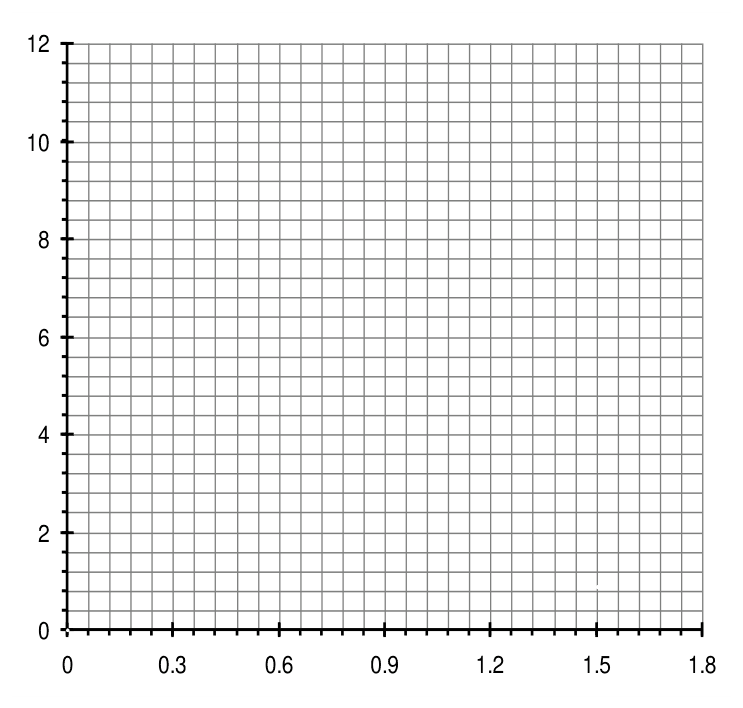
To determine the reaction order with respect to each reactant, the dependence of the initial rate of the reaction on the concentrations of each reagent was carried out with all other reagents present in large excess. Some kinetic data at 298 K are shown in the tables below. (Use the grids if you like.)
| \([\ce{ArCl}]\) (\(\mathrm{mol\,dm^{-3}}\)) | 0.1 | 0.2 | 0.4 | 0.6 |
|---|---|---|---|---|
| Initial rate (\(\mathrm{mol\,dm^{-3}\,s^{-1}}\)) | \(1.88\times10^{-5}\) | \(4.13\times10^{-5}\) | \(9.42\times10^{-5}\) | \(1.50\times10^{-4}\) |
| \([\ce{NiLL'}]\) (\(\mathrm{mol\,dm^{-3}}\)) | \(6\times10^{-3}\) | \(9\times10^{-3}\) | \(1.2\times10^{-2}\) | \(1.5\times10^{-2}\) |
|---|---|---|---|---|
| Initial rate (\(\mathrm{mol\,dm^{-3}\,s^{-1}}\)) | \(4.12\times10^{-5}\) | \(6.01\times10^{-5}\) | \(7.80\times10^{-5}\) | \(1.10\times10^{-4}\) |
| \([\ce{L'}]\) (\(\mathrm{mol\,dm^{-3}}\)) | 0.06 | 0.09 | 0.12 | 0.15 |
|---|---|---|---|---|
| Initial rate (\(\mathrm{mol\,dm^{-3}\,s^{-1}}\)) | \(5.8\times10^{-5}\) | \(4.3\times10^{-5}\) | \(3.4\times10^{-5}\) | \(2.8\times10^{-5}\) |
6.1 Determine the order with respect to the reagents assuming they are integers.
To study the mechanism for this reaction, \(\ce{^1H}\), \(\ce{^{31}P}\), \(\ce{^{19}F}\), and \(\ce{^{13}C}\) NMR spectroscopy have been used to identify the major transition metal complexes in solution, and the initial rates were measured using reaction calorimetry. An intermediate, \(\ce{NiL(Ar)Cl}\), may be isolated at room temperature. The first two steps of the overall reaction involve the dissociation of a ligand from \(\ce{NiLL'}\) (step 1) at \(50\,^\circ\mathrm{C}\), followed by the oxidation addition (step 2) of aryl chloride to the \(\ce{NiL}\) at room temperature (rt):
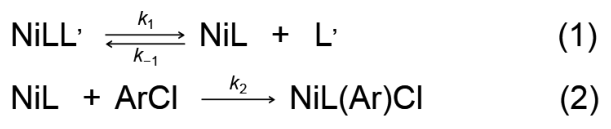
6.2 Using the steady state approximation, derive an expression for the rate equation for the formation of \([\ce{NiL(Ar)Cl}]\).
The next steps in the overall reaction involve the amine (\(\ce{RNH2}\)) and \(\ce{^{t}BuONa}\). To determine the order with respect to \(\ce{RNH2}\) and \(\ce{^{t}BuONa}\), the dependence of the initial rates of the reaction on the concentrations of these two reagents was carried with the other reagents present in large excess. Some results are shown in the tables below.
| \([\ce{NaO^{t}Bu}]\) (\(\mathrm{mol\,dm^{-3}}\)) | 0.2 | 0.6 | 0.9 | 0.12 |
|---|---|---|---|---|
| Initial rate (\(\mathrm{mol\,dm^{-3}\,s^{-1}}\)) | \(4.16\times10^{-5}\) | \(4.12\times10^{-5}\) | \(4.24\times10^{-5}\) | \(4.20\times10^{-5}\) |
| \([\ce{RNH2}]\) (\(\mathrm{mol\,dm^{-3}}\)) | 0.3 | 0.6 | 0.9 | 1.2 |
|---|---|---|---|---|
| Initial rate (\(\mathrm{mol\,dm^{-3}\,s^{-1}}\)) | \(4.12\times10^{-5}\) | \(4.26\times10^{-5}\) | \(4.21\times10^{-5}\) | \(4.23\times10^{-5}\) |
6.3 Determine the order with each of these reagents, assuming each is an integer.
(Use the grids if you like)
During a catalytic cycle, a number of different structures may be involved which include the catalyst. One step in the cycle will be rate-determining. A proposed cycle for the nickel-catalyzed coupling of aryl halides with amines is as follows:

6.4 Use the steady-state approximation and material balance equation to derive the rate law for \(\mathrm{d}[\ce{ArNHR}]/\mathrm{d}t\) for the above mechanism in terms of the initial concentration of the catalyst \([\ce{NiLL'}]_0\) and concentrations of \([\ce{ArCl}]\), \([\ce{NH2R}]\), \([\ce{NaO^{t}Bu}]\), and \([\ce{L'}]\).
6.5 Give the simplified form of the rate equation in 6.4 assuming that \(k_1\) is very small.
Official English text of the problem.
Answers
-
6.1: First order in \(\ce{ArCl}\), first order in \(\ce{NiLL'}\), and order \(-1\) in \(\ce{L'}\).
-
6.2: \[ \boxed{ \frac{\mathrm{d}[\ce{NiL(Ar)Cl}]}{\mathrm{d}t} = \frac{k_1k_2[\ce{NiLL'}][\ce{ArCl}]} {k_{-1}[\ce{L'}]+k_2[\ce{ArCl}]} } \]
-
6.3: Zero order in both \(\ce{RNH2}\) and \(\ce{NaO^{t}Bu}\).
-
6.4: \[ \boxed{ \frac{\mathrm{d}[\ce{ArNHR}]}{\mathrm{d}t} = \frac{ k_1k_2[\ce{NiLL'}]_0[\ce{ArCl}] }{ k_{-1}[\ce{L'}]+ k_1\left( 1+ \dfrac{k_2[\ce{ArCl}]}{k_3[\ce{NH2R}][\ce{NaO^{t}Bu}]} + \dfrac{k_2[\ce{ArCl}]}{k_4} \right) } } \]
-
6.5: When \(k_1\) is sufficiently small that \(k_{-1}[\ce{L'}]\) dominates the denominator, \[ \boxed{ \frac{\mathrm{d}[\ce{ArNHR}]}{\mathrm{d}t} \simeq \frac{k_1k_2}{k_{-1}}\, \frac{[\ce{NiLL'}]_0[\ce{ArCl}]}{[\ce{L'}]} } \]
Solution
The groups \(\ce{Ar}\), \(\ce{R}\), \(\ce{L}\), and \(\ce{L'}\) are unspecified, so unique molecular structures and complete molecular SMILES cannot be assigned. The following wildcard templates identify the species used below. The mapped wildcards [*:1], [*:2], [*:3], and [*:4] represent the unspecified aryl, organic, ligand \(\ce{L}\), and ligand \(\ce{L'}\) fragments, respectively.
| Species | Name or description | SMILES or schematic SMILES template |
|---|---|---|
| \(\ce{ArCl}\) | Aryl chloride | [*:1]Cl |
| \(\ce{RNH2}\), also written \(\ce{NH2R}\) | Primary amine | [*:2]N |
| \(\ce{ArNHR}\) | \(N\)-substituted arylamine | [*:1]N[*:2] |
| \(\ce{L}\), \(\ce{L'}\) | Unspecified ligands | [*:3], [*:4] |
| \(\ce{NiLL'}\) | Nickel catalyst bearing both ligands | [*:3]->[Ni]<-[*:4] |
| \(\ce{NiL}\) | Nickel complex after ligand dissociation | [*:3]->[Ni] |
| \(\ce{NiL(Ar)Cl}\) | Aryl–chlorido nickel intermediate bearing \(\ce{L}\) | [*:3]->[Ni]([*:1])Cl |
| \(\ce{NiL(Ar)NHR}\) | Aryl–amido nickel intermediate bearing \(\ce{L}\) | [*:3]->[Ni]([*:1])N[*:2] |
| \(\ce{NaO^{t}Bu}\) | Sodium tert-butoxide | [Na+].[O-]C(C)(C)C |
| \(\ce{^{t}BuOH}\) | tert-Butanol, or 2-methylpropan-2-ol | CC(C)(C)O |
| \(\ce{NaCl}\) | Sodium chloride | [Na+].[Cl-] |
| \(\ce{HCl}\) | Hydrogen chloride | [H]Cl |
The nickel templates show only schematic connectivity. They do not establish ligand denticity, metal oxidation states, conformation, or coordination geometry. Individual SMILES also do not describe the mechanism’s electron flow.
6.1 — Orders in aryl chloride, catalyst, and free ligand
With all other concentrations fixed, write the initial rate as \[ r=Kc^n. \] For two measurements, \[ n=\frac{\ln(r_2/r_1)}{\ln(c_2/c_1)}. \]
Using the first and last measurements in each table gives:
| Varied reagent | Concentration ratio \(c_2/c_1\) | Rate ratio \(r_2/r_1\) | Calculated \(n\) | Integer assignment |
|---|---|---|---|---|
| \(\ce{ArCl}\) | \(6.00\) | \(7.98\) | \(1.16\) | \(+1\) |
| \(\ce{NiLL'}\) | \(2.50\) | \(2.67\) | \(1.07\) | \(+1\) |
| \(\ce{L'}\) | \(2.50\) | \(0.483\) | \(-0.795\) | \(-1\) |
For example, \[ n_{\ce{ArCl}} = \frac{\ln\!\left[(1.50\times10^{-4})/(1.88\times10^{-5})\right]} {\ln(0.6/0.1)} =1.16. \]
The measurements do not follow exact integer power laws, but under the stipulated integer-order assumption they give \[ \boxed{ n_{\ce{ArCl}}=1,\qquad n_{\ce{NiLL'}}=1,\qquad n_{\ce{L'}}=-1. } \]
Thus, under the measured conditions, \[ r\propto \frac{[\ce{NiLL'}][\ce{ArCl}]}{[\ce{L'}]}. \] The negative order means that adding free ligand inhibits the reaction.
6.2 — Steady-state treatment of the first two steps
Define \[ c=[\ce{NiLL'}],\qquad x=[\ce{NiL}],\qquad a=[\ce{ArCl}],\qquad \ell=[\ce{L'}]. \]
The intermediate \(\ce{NiL}\) is formed by ligand dissociation and consumed by ligand reassociation and oxidative addition. Therefore, \[ \frac{\mathrm{d}x}{\mathrm{d}t} = k_1c-k_{-1}x\ell-k_2xa. \]
Applying the steady-state approximation to \(\ce{NiL}\), \[ 0\simeq k_1c-(k_{-1}\ell+k_2a)x, \] so \[ x\simeq\frac{k_1c}{k_{-1}\ell+k_2a}. \]
The formation rate of the aryl–chlorido nickel intermediate is the rate of step (2): \[ \frac{\mathrm{d}[\ce{NiL(Ar)Cl}]}{\mathrm{d}t}=k_2xa. \]
Consequently, \[ \boxed{ \frac{\mathrm{d}[\ce{NiL(Ar)Cl}]}{\mathrm{d}t} = \frac{k_1k_2[\ce{NiLL'}][\ce{ArCl}]} {k_{-1}[\ce{L'}]+k_2[\ce{ArCl}]}. } \]
Here \([\ce{NiLL'}]\) is the concentration of that particular catalyst species; it has not yet been replaced by the conserved total nickel concentration.
6.3 — Orders in amine and base
Changing the base concentration across the listed values changes the rate only from \(4.12\times10^{-5}\) to \(4.24\times10^{-5}\ \mathrm{mol\,dm^{-3}\,s^{-1}}\), approximately a \(3\%\) variation.
Likewise, a fourfold increase in amine concentration leaves the rate approximately unchanged at \[ r\simeq4.2\times10^{-5}\ \mathrm{mol\,dm^{-3}\,s^{-1}}. \]
Thus neither reagent has an appreciable rate dependence over the measured ranges. The integer orders are \[ \boxed{ n_{\ce{RNH2}}=0,\qquad n_{\ce{NaO^{t}Bu}}=0. } \]
Zero order does not mean these reagents are absent from the mechanism; their concentrations do not control the rate in this kinetic regime.
6.4 — Full catalytic-cycle rate law
In addition to the notation above, define \[ y=[\ce{NiL(Ar)Cl}],\qquad z=[\ce{NiL(Ar)NHR}], \] \[ n=[\ce{NH2R}],\qquad b=[\ce{NaO^{t}Bu}],\qquad C_T=[\ce{NiLL'}]_0. \]
The balanced net reaction obtained by adding steps (2)–(4) is \[ \ce{ArCl + RNH2 + NaO^{t}Bu -> ArNHR + ^{t}BuOH + NaCl}. \]
For the full cycle, the steady-state balances of the three intermediates are \[ \begin{aligned} 0\simeq\frac{\mathrm{d}x}{\mathrm{d}t} &=k_1c-k_{-1}\ell x-k_2ax+k_4z,\\ 0\simeq\frac{\mathrm{d}y}{\mathrm{d}t} &=k_2ax-k_3nby,\\ 0\simeq\frac{\mathrm{d}z}{\mathrm{d}t} &=k_3nby-k_4z. \end{aligned} \]
The term \(+k_4z\) in the first equation is essential: step (4) regenerates \(\ce{NiL}\).
The last two equations show that the forward fluxes through steps (2), (3), and (4) are equal: \[ r=\frac{\mathrm{d}[\ce{ArNHR}]}{\mathrm{d}t} =k_4z=k_3nby=k_2ax. \]
Hence, \[ y=\frac{k_2a}{k_3nb}\,x, \qquad z=\frac{k_2a}{k_4}\,x. \]
Substituting \(k_4z=k_2ax\) into the first steady-state equation gives \[ k_1c=k_{-1}\ell x, \qquad c=\frac{k_{-1}\ell}{k_1}\,x. \]
Each catalyst species contains one nickel atom, so conservation of nickel gives \[ C_T=c+x+y+z. \]
Substitution yields \[ C_T =x\left( \frac{k_{-1}\ell}{k_1} +1 +\frac{k_2a}{k_3nb} +\frac{k_2a}{k_4} \right). \]
Solving for \(x\) and using \(r=k_2ax\), \[ r= \frac{k_1k_2aC_T} {k_{-1}\ell+k_1\left( 1+\dfrac{k_2a}{k_3nb}+\dfrac{k_2a}{k_4} \right)}. \]
Therefore, \[ \boxed{ \frac{\mathrm{d}[\ce{ArNHR}]}{\mathrm{d}t} = \frac{ k_1k_2[\ce{NiLL'}]_0[\ce{ArCl}] }{ k_{-1}[\ce{L'}]+ k_1\left( 1+ \dfrac{k_2[\ce{ArCl}]}{k_3[\ce{NH2R}][\ce{NaO^{t}Bu}]} + \dfrac{k_2[\ce{ArCl}]}{k_4} \right) }. } \]
For the elementary steps as written, the rate-constant units are \[ \begin{aligned} [k_1]=[k_4]&=\mathrm{s^{-1}},\\ [k_{-1}]=[k_2]&=\mathrm{dm^3\,mol^{-1}\,s^{-1}},\\ [k_3]&=\mathrm{dm^6\,mol^{-2}\,s^{-1}}. \end{aligned} \] Every denominator term therefore has units \(\mathrm{s^{-1}}\), and the resulting rate has units \(\mathrm{mol\,dm^{-3}\,s^{-1}}\).
6.5 — Small-\(k_1\) limit
At fixed, nonzero free-ligand concentration, the required approximation is \[ k_1\left( 1+\frac{k_2a}{k_3nb}+\frac{k_2a}{k_4} \right)\ll k_{-1}\ell. \]
The denominator in 6.4 then reduces to \(k_{-1}\ell\), giving \[ \boxed{ r\simeq \frac{k_1k_2}{k_{-1}} \frac{[\ce{NiLL'}]_0[\ce{ArCl}]}{[\ce{L'}]}. } \]
In this limit, most nickel remains as \(\ce{NiLL'}\), and \[ [\ce{NiL}] \simeq \frac{k_1}{k_{-1}} \frac{[\ce{NiLL'}]_0}{[\ce{L'}]}. \]
The simplified rate law predicts precisely the assigned experimental orders:
| Reagent | Predicted order |
|---|---|
| Aryl chloride | \(+1\) |
| Total nickel catalyst | \(+1\) |
| Free ligand | \(-1\) |
| Amine | \(0\) |
| Sodium tert-butoxide | \(0\) |
The effective coefficient \(k_1k_2/k_{-1}\) has units \(\mathrm{s^{-1}}\).
The solution was checked against the official solution.
IChO 2014 · Theorieaufgabe 6
Chemische Kinetik
Die übergangsmetallkatalysierte Aminierung von Arylhalogeniden hat sich zu einer der leistungsfähigsten Methoden zur Synthese von Arylaminen entwickelt. Die Gesamtreaktion der nickelkatalysierten Aminierung eines Arylchlorids unter basischen Bedingungen lautet:
Darin ist \(\ce{NiLL'}\) der Nickelkomplex-Katalysator. Die Reaktion verläuft über mehrere Schritte, an deren Elementarreaktionen der Katalysator, die Reaktanten und das Lösungsmittel beteiligt sein können.
Zur Bestimmung der Reaktionsordnung bezüglich jedes Reaktanten wurde die Abhängigkeit der Anfangsgeschwindigkeit der Reaktion von der Konzentration des jeweiligen Reagenzes untersucht, wobei alle anderen Reagenzien in großem Überschuss vorlagen. Einige kinetische Daten bei 298 K sind in den folgenden Tabellen angegeben. (Verwenden Sie bei Bedarf die Gitternetze.)
| \([\ce{ArCl}]\) (\(\mathrm{mol\,dm^{-3}}\)) | 0.1 | 0.2 | 0.4 | 0.6 |
|---|---|---|---|---|
| Anfangsgeschwindigkeit (\(\mathrm{mol\,dm^{-3}\,s^{-1}}\)) | \(1.88\times10^{-5}\) | \(4.13\times10^{-5}\) | \(9.42\times10^{-5}\) | \(1.50\times10^{-4}\) |
| \([\ce{NiLL'}]\) (\(\mathrm{mol\,dm^{-3}}\)) | \(6\times10^{-3}\) | \(9\times10^{-3}\) | \(1.2\times10^{-2}\) | \(1.5\times10^{-2}\) |
|---|---|---|---|---|
| Anfangsgeschwindigkeit (\(\mathrm{mol\,dm^{-3}\,s^{-1}}\)) | \(4.12\times10^{-5}\) | \(6.01\times10^{-5}\) | \(7.80\times10^{-5}\) | \(1.10\times10^{-4}\) |
| \([\ce{L'}]\) (\(\mathrm{mol\,dm^{-3}}\)) | 0.06 | 0.09 | 0.12 | 0.15 |
|---|---|---|---|---|
| Anfangsgeschwindigkeit (\(\mathrm{mol\,dm^{-3}\,s^{-1}}\)) | \(5.8\times10^{-5}\) | \(4.3\times10^{-5}\) | \(3.4\times10^{-5}\) | \(2.8\times10^{-5}\) |
6.1 Bestimmen Sie die Reaktionsordnungen bezüglich der Reagenzien unter der Annahme, dass sie ganzzahlig sind.
Zur Untersuchung des Mechanismus dieser Reaktion wurden mittels \(\ce{^1H}\)-, \(\ce{^{31}P}\)-, \(\ce{^{19}F}\)- und \(\ce{^{13}C}\)-NMR-Spektroskopie die hauptsächlich in Lösung vorliegenden Übergangsmetallkomplexe identifiziert; die Anfangsgeschwindigkeiten wurden mittels Reaktionskalorimetrie gemessen. Ein Zwischenprodukt, \(\ce{NiL(Ar)Cl}\), lässt sich bei Raumtemperatur isolieren. Die ersten beiden Schritte der Gesamtreaktion umfassen die Dissoziation eines Liganden von \(\ce{NiLL'}\) (Schritt 1) bei \(50\,^\circ\mathrm{C}\), gefolgt von der oxidativen Addition (Schritt 2) von Arylchlorid an \(\ce{NiL}\) bei Raumtemperatur (rt):
6.2 Leiten Sie mithilfe der Quasistationaritätsnäherung einen Ausdruck für das Geschwindigkeitsgesetz der Bildung von \([\ce{NiL(Ar)Cl}]\) her.
An den nächsten Schritten der Gesamtreaktion sind das Amin (\(\ce{RNH2}\)) und \(\ce{^{t}BuONa}\) beteiligt. Zur Bestimmung der Reaktionsordnungen bezüglich \(\ce{RNH2}\) und \(\ce{^{t}BuONa}\) wurde die Abhängigkeit der Anfangsgeschwindigkeit der Reaktion von den Konzentrationen dieser beiden Reagenzien untersucht, wobei die anderen Reagenzien in großem Überschuss vorlagen. Einige Ergebnisse sind in den folgenden Tabellen angegeben.
| \([\ce{NaO^{t}Bu}]\) (\(\mathrm{mol\,dm^{-3}}\)) | 0.2 | 0.6 | 0.9 | 0.12 |
|---|---|---|---|---|
| Anfangsgeschwindigkeit (\(\mathrm{mol\,dm^{-3}\,s^{-1}}\)) | \(4.16\times10^{-5}\) | \(4.12\times10^{-5}\) | \(4.24\times10^{-5}\) | \(4.20\times10^{-5}\) |
| \([\ce{RNH2}]\) (\(\mathrm{mol\,dm^{-3}}\)) | 0.3 | 0.6 | 0.9 | 1.2 |
|---|---|---|---|---|
| Anfangsgeschwindigkeit (\(\mathrm{mol\,dm^{-3}\,s^{-1}}\)) | \(4.12\times10^{-5}\) | \(4.26\times10^{-5}\) | \(4.21\times10^{-5}\) | \(4.23\times10^{-5}\) |
6.3 Bestimmen Sie die Reaktionsordnung bezüglich jedes dieser Reagenzien unter der Annahme, dass sie jeweils ganzzahlig ist.
(Verwenden Sie bei Bedarf die Gitternetze)
Während eines Katalysezyklus können verschiedene Strukturen auftreten, die den Katalysator enthalten. Ein Schritt des Zyklus ist geschwindigkeitsbestimmend. Für die nickelkatalysierte Kupplung von Arylhalogeniden mit Aminen wird folgender Zyklus vorgeschlagen:
6.4 Leiten Sie mithilfe der Quasistationaritätsnäherung und der Stoffbilanzgleichung das Geschwindigkeitsgesetz für \(\mathrm{d}[\ce{ArNHR}]/\mathrm{d}t\) für den obigen Mechanismus in Abhängigkeit von der Anfangskonzentration des Katalysators \([\ce{NiLL'}]_0\) und den Konzentrationen \([\ce{ArCl}]\), \([\ce{NH2R}]\), \([\ce{NaO^{t}Bu}]\) und \([\ce{L'}]\) her.
6.5 Geben Sie die vereinfachte Form des Geschwindigkeitsgesetzes aus 6.4 unter der Annahme an, dass \(k_1\) sehr klein ist.
Aufgabentext aus dem offiziellen englischen Text übersetzt.
Antworten
-
6.1: Erste Ordnung bezüglich \(\ce{ArCl}\), erste Ordnung bezüglich \(\ce{NiLL'}\) und Ordnung \(-1\) bezüglich \(\ce{L'}\).
-
6.2: \[ \boxed{ \frac{\mathrm{d}[\ce{NiL(Ar)Cl}]}{\mathrm{d}t} = \frac{k_1k_2[\ce{NiLL'}][\ce{ArCl}]} {k_{-1}[\ce{L'}]+k_2[\ce{ArCl}]} } \]
-
6.3: Nullte Ordnung sowohl bezüglich \(\ce{RNH2}\) als auch bezüglich \(\ce{NaO^{t}Bu}\).
-
6.4: \[ \boxed{ \frac{\mathrm{d}[\ce{ArNHR}]}{\mathrm{d}t} = \frac{ k_1k_2[\ce{NiLL'}]_0[\ce{ArCl}] }{ k_{-1}[\ce{L'}]+ k_1\left( 1+ \dfrac{k_2[\ce{ArCl}]}{k_3[\ce{NH2R}][\ce{NaO^{t}Bu}]} + \dfrac{k_2[\ce{ArCl}]}{k_4} \right) } } \]
-
6.5: Wenn \(k_1\) so klein ist, dass \(k_{-1}[\ce{L'}]\) den Nenner dominiert, \[ \boxed{ \frac{\mathrm{d}[\ce{ArNHR}]}{\mathrm{d}t} \simeq \frac{k_1k_2}{k_{-1}}\, \frac{[\ce{NiLL'}]_0[\ce{ArCl}]}{[\ce{L'}]} } \]
Lösung
Die Gruppen \(\ce{Ar}\), \(\ce{R}\), \(\ce{L}\) und \(\ce{L'}\) sind nicht näher spezifiziert, sodass keine eindeutigen Molekülstrukturen und vollständigen molekularen SMILES zugeordnet werden können. Die folgenden Vorlagen mit Platzhaltern kennzeichnen die nachstehend verwendeten Spezies. Die mit Zuordnungsnummern versehenen Platzhalter [*:1], [*:2], [*:3] und [*:4] stehen jeweils für die nicht näher spezifizierten Arylfragmente, organischen Fragmente, Ligandenfragmente \(\ce{L}\) und Ligandenfragmente \(\ce{L'}\).
| Spezies | Name oder Beschreibung | SMILES oder schematische SMILES-Vorlage |
|---|---|---|
| \(\ce{ArCl}\) | Arylchlorid | [*:1]Cl |
| \(\ce{RNH2}\), auch als \(\ce{NH2R}\) geschrieben | Primäres Amin | [*:2]N |
| \(\ce{ArNHR}\) | \(N\)-substituiertes Arylamin | [*:1]N[*:2] |
| \(\ce{L}\), \(\ce{L'}\) | Nicht näher spezifizierte Liganden | [*:3], [*:4] |
| \(\ce{NiLL'}\) | Nickelkatalysator mit beiden Liganden | [*:3]->[Ni]<-[*:4] |
| \(\ce{NiL}\) | Nickelkomplex nach der Ligandendissoziation | [*:3]->[Ni] |
| \(\ce{NiL(Ar)Cl}\) | Aryl-Chlorido-Nickel-Zwischenprodukt mit \(\ce{L}\) | [*:3]->[Ni]([*:1])Cl |
| \(\ce{NiL(Ar)NHR}\) | Aryl-Amido-Nickel-Zwischenprodukt mit \(\ce{L}\) | [*:3]->[Ni]([*:1])N[*:2] |
| \(\ce{NaO^{t}Bu}\) | Natrium-tert-butanolat | [Na+].[O-]C(C)(C)C |
| \(\ce{^{t}BuOH}\) | tert-Butanol oder 2-Methylpropan-2-ol | CC(C)(C)O |
| \(\ce{NaCl}\) | Natriumchlorid | [Na+].[Cl-] |
| \(\ce{HCl}\) | Chlorwasserstoff | [H]Cl |
Die Nickelvorlagen zeigen lediglich die schematische Verknüpfung. Sie legen weder die Zähnigkeit der Liganden noch die Oxidationsstufen des Metalls, die Konformation oder die Koordinationsgeometrie fest. Einzelne SMILES beschreiben auch nicht den Elektronenfluss des Mechanismus.
6.1 — Reaktionsordnungen bezüglich Arylchlorid, Katalysator und freiem Liganden
Bei konstanten übrigen Konzentrationen schreiben wir die Anfangsgeschwindigkeit als \[ r=Kc^n. \] Für zwei Messungen gilt \[ n=\frac{\ln(r_2/r_1)}{\ln(c_2/c_1)}. \]
Aus der ersten und der letzten Messung jeder Tabelle ergibt sich:
| Variiertes Reagenz | Konzentrationsverhältnis \(c_2/c_1\) | Geschwindigkeitsverhältnis \(r_2/r_1\) | Berechnetes \(n\) | Ganzzahlige Zuordnung |
|---|---|---|---|---|
| \(\ce{ArCl}\) | \(6.00\) | \(7.98\) | \(1.16\) | \(+1\) |
| \(\ce{NiLL'}\) | \(2.50\) | \(2.67\) | \(1.07\) | \(+1\) |
| \(\ce{L'}\) | \(2.50\) | \(0.483\) | \(-0.795\) | \(-1\) |
Beispielsweise gilt \[ n_{\ce{ArCl}} = \frac{\ln\!\left[(1.50\times10^{-4})/(1.88\times10^{-5})\right]} {\ln(0.6/0.1)} =1.16. \]
Die Messwerte folgen keinen exakten Potenzgesetzen mit ganzzahligen Exponenten, ergeben jedoch unter der vorgegebenen Annahme ganzzahliger Reaktionsordnungen \[ \boxed{ n_{\ce{ArCl}}=1,\qquad n_{\ce{NiLL'}}=1,\qquad n_{\ce{L'}}=-1. } \]
Somit gilt unter den Messbedingungen \[ r\propto \frac{[\ce{NiLL'}][\ce{ArCl}]}{[\ce{L'}]}. \] Die negative Reaktionsordnung bedeutet, dass die Zugabe von freiem Liganden die Reaktion hemmt.
6.2 — Quasistationäre Behandlung der ersten beiden Schritte
Wir definieren \[ c=[\ce{NiLL'}],\qquad x=[\ce{NiL}],\qquad a=[\ce{ArCl}],\qquad \ell=[\ce{L'}]. \]
Das Zwischenprodukt \(\ce{NiL}\) wird durch Ligandendissoziation gebildet und durch erneute Ligandenassoziation sowie oxidative Addition verbraucht. Daher gilt \[ \frac{\mathrm{d}x}{\mathrm{d}t} = k_1c-k_{-1}x\ell-k_2xa. \]
Die Anwendung der Quasistationaritätsnäherung auf \(\ce{NiL}\) ergibt \[ 0\simeq k_1c-(k_{-1}\ell+k_2a)x, \] also \[ x\simeq\frac{k_1c}{k_{-1}\ell+k_2a}. \]
Die Bildungsgeschwindigkeit des Aryl-Chlorido-Nickel-Zwischenprodukts entspricht der Geschwindigkeit von Schritt (2): \[ \frac{\mathrm{d}[\ce{NiL(Ar)Cl}]}{\mathrm{d}t}=k_2xa. \]
Folglich gilt \[ \boxed{ \frac{\mathrm{d}[\ce{NiL(Ar)Cl}]}{\mathrm{d}t} = \frac{k_1k_2[\ce{NiLL'}][\ce{ArCl}]} {k_{-1}[\ce{L'}]+k_2[\ce{ArCl}]}. } \]
Hier ist \([\ce{NiLL'}]\) die Konzentration dieser spezifischen Katalysatorspezies; sie wurde noch nicht durch die erhaltene Gesamtkonzentration an Nickel ersetzt.
6.3 — Reaktionsordnungen bezüglich Amin und Base
Bei Variation der Basenkonzentration über die aufgeführten Werte ändert sich die Geschwindigkeit lediglich von \(4.12\times10^{-5}\) auf \(4.24\times10^{-5}\ \mathrm{mol\,dm^{-3}\,s^{-1}}\), was einer Änderung von etwa \(3\%\) entspricht.
Ebenso bleibt die Geschwindigkeit bei einer Vervierfachung der Aminkonzentration annähernd unverändert bei \[ r\simeq4.2\times10^{-5}\ \mathrm{mol\,dm^{-3}\,s^{-1}}. \]
Somit hängt die Geschwindigkeit in den untersuchten Bereichen von keinem der beiden Reagenzien nennenswert ab. Die ganzzahligen Reaktionsordnungen lauten \[ \boxed{ n_{\ce{RNH2}}=0,\qquad n_{\ce{NaO^{t}Bu}}=0. } \]
Nullte Ordnung bedeutet nicht, dass diese Reagenzien am Mechanismus unbeteiligt sind; ihre Konzentrationen bestimmen in diesem kinetischen Bereich nicht die Geschwindigkeit.
6.4 — Geschwindigkeitsgesetz des vollständigen Katalysezyklus
Zusätzlich zu den obigen Bezeichnungen definieren wir \[ y=[\ce{NiL(Ar)Cl}],\qquad z=[\ce{NiL(Ar)NHR}], \] \[ n=[\ce{NH2R}],\qquad b=[\ce{NaO^{t}Bu}],\qquad C_T=[\ce{NiLL'}]_0. \]
Die ausgeglichene Nettoreaktion, die sich durch Addition der Schritte (2)–(4) ergibt, lautet \[ \ce{ArCl + RNH2 + NaO^{t}Bu -> ArNHR + ^{t}BuOH + NaCl}. \]
Für den vollständigen Zyklus lauten die quasistationären Bilanzen der drei Zwischenprodukte \[ \begin{aligned} 0\simeq\frac{\mathrm{d}x}{\mathrm{d}t} &=k_1c-k_{-1}\ell x-k_2ax+k_4z,\\ 0\simeq\frac{\mathrm{d}y}{\mathrm{d}t} &=k_2ax-k_3nby,\\ 0\simeq\frac{\mathrm{d}z}{\mathrm{d}t} &=k_3nby-k_4z. \end{aligned} \]
Der Term \(+k_4z\) in der ersten Gleichung ist wesentlich: Schritt (4) regeneriert \(\ce{NiL}\).
Die letzten beiden Gleichungen zeigen, dass die Reaktionsflüsse in Vorwärtsrichtung durch die Schritte (2), (3) und (4) gleich sind: \[ r=\frac{\mathrm{d}[\ce{ArNHR}]}{\mathrm{d}t} =k_4z=k_3nby=k_2ax. \]
Daher gilt \[ y=\frac{k_2a}{k_3nb}\,x, \qquad z=\frac{k_2a}{k_4}\,x. \]
Einsetzen von \(k_4z=k_2ax\) in die erste quasistationäre Gleichung ergibt \[ k_1c=k_{-1}\ell x, \qquad c=\frac{k_{-1}\ell}{k_1}\,x. \]
Jede Katalysatorspezies enthält ein Nickelatom, sodass sich aus der Erhaltung der Nickelmenge ergibt: \[ C_T=c+x+y+z. \]
Durch Einsetzen erhält man \[ C_T =x\left( \frac{k_{-1}\ell}{k_1} +1 +\frac{k_2a}{k_3nb} +\frac{k_2a}{k_4} \right). \]
Auflösen nach \(x\) und Verwendung von \(r=k_2ax\) ergibt \[ r= \frac{k_1k_2aC_T} {k_{-1}\ell+k_1\left( 1+\dfrac{k_2a}{k_3nb}+\dfrac{k_2a}{k_4} \right)}. \]
Somit gilt \[ \boxed{ \frac{\mathrm{d}[\ce{ArNHR}]}{\mathrm{d}t} = \frac{ k_1k_2[\ce{NiLL'}]_0[\ce{ArCl}] }{ k_{-1}[\ce{L'}]+ k_1\left( 1+ \dfrac{k_2[\ce{ArCl}]}{k_3[\ce{NH2R}][\ce{NaO^{t}Bu}]} + \dfrac{k_2[\ce{ArCl}]}{k_4} \right) }. } \]
Für die Elementarschritte in der angegebenen Form lauten die Einheiten der Geschwindigkeitskonstanten \[ \begin{aligned} [k_1]=[k_4]&=\mathrm{s^{-1}},\\ [k_{-1}]=[k_2]&=\mathrm{dm^3\,mol^{-1}\,s^{-1}},\\ [k_3]&=\mathrm{dm^6\,mol^{-2}\,s^{-1}}. \end{aligned} \] Jeder Term im Nenner hat daher die Einheit \(\mathrm{s^{-1}}\), und die resultierende Geschwindigkeit hat die Einheit \(\mathrm{mol\,dm^{-3}\,s^{-1}}\).
6.5 — Grenzfall eines kleinen \(k_1\)
Bei konstanter, von null verschiedener Konzentration des freien Liganden lautet die erforderliche Näherungsbedingung \[ k_1\left( 1+\frac{k_2a}{k_3nb}+\frac{k_2a}{k_4} \right)\ll k_{-1}\ell. \]
Der Nenner in 6.4 vereinfacht sich dann zu \(k_{-1}\ell\), sodass sich ergibt: \[ \boxed{ r\simeq \frac{k_1k_2}{k_{-1}} \frac{[\ce{NiLL'}]_0[\ce{ArCl}]}{[\ce{L'}]}. } \]
In diesem Grenzfall liegt der größte Teil des Nickels weiterhin als \(\ce{NiLL'}\) vor, und es gilt \[ [\ce{NiL}] \simeq \frac{k_1}{k_{-1}} \frac{[\ce{NiLL'}]_0}{[\ce{L'}]}. \]
Das vereinfachte Geschwindigkeitsgesetz sagt genau die zugeordneten experimentellen Reaktionsordnungen voraus:
| Reagenz | Vorhergesagte Reaktionsordnung |
|---|---|
| Arylchlorid | \(+1\) |
| Gesamter Nickelkatalysator | \(+1\) |
| Freier Ligand | \(-1\) |
| Amin | \(0\) |
| Natrium-tert-butanolat | \(0\) |
Der effektive Koeffizient \(k_1k_2/k_{-1}\) hat die Einheit \(\mathrm{s^{-1}}\).
Die Lösung wurde mit der offiziellen Lösung abgeglichen.
IChO 2014 · Teori sorusu 6
Kimyasal kinetik
Aril halojenürlerin geçiş metali katalizli aminasyonu, arilaminlerin sentezi için en güçlü yöntemlerden biri hâline gelmiştir. Aril klorürün bazik koşullarda nikel katalizli aminasyonunun toplam tepkimesi şöyledir:
Burada \(\ce{NiLL'}\), nikel kompleksi katalizördür. Tepkime, katalizörün, reaktanların ve çözücünün elementer basamaklara katılabildiği birkaç basamak üzerinden ilerler.
Her bir reaktana göre tepkime derecesini belirlemek için, diğer tüm reaktifler büyük miktarda fazlalıkta bulunurken tepkimenin başlangıç hızının her bir reaktifin derişimine bağımlılığı incelenmiştir. 298 K'deki bazı kinetik veriler aşağıdaki tablolarda gösterilmiştir. (İsterseniz kareli alanları kullanın.)
| \([\ce{ArCl}]\) (\(\mathrm{mol\,dm^{-3}}\)) | 0.1 | 0.2 | 0.4 | 0.6 |
|---|---|---|---|---|
| Başlangıç hızı (\(\mathrm{mol\,dm^{-3}\,s^{-1}}\)) | \(1.88\times10^{-5}\) | \(4.13\times10^{-5}\) | \(9.42\times10^{-5}\) | \(1.50\times10^{-4}\) |
| \([\ce{NiLL'}]\) (\(\mathrm{mol\,dm^{-3}}\)) | \(6\times10^{-3}\) | \(9\times10^{-3}\) | \(1.2\times10^{-2}\) | \(1.5\times10^{-2}\) |
|---|---|---|---|---|
| Başlangıç hızı (\(\mathrm{mol\,dm^{-3}\,s^{-1}}\)) | \(4.12\times10^{-5}\) | \(6.01\times10^{-5}\) | \(7.80\times10^{-5}\) | \(1.10\times10^{-4}\) |
| \([\ce{L'}]\) (\(\mathrm{mol\,dm^{-3}}\)) | 0.06 | 0.09 | 0.12 | 0.15 |
|---|---|---|---|---|
| Başlangıç hızı (\(\mathrm{mol\,dm^{-3}\,s^{-1}}\)) | \(5.8\times10^{-5}\) | \(4.3\times10^{-5}\) | \(3.4\times10^{-5}\) | \(2.8\times10^{-5}\) |
6.1 Reaktiflere göre tepkime derecelerini, bunların tam sayı olduğunu varsayarak belirleyin.
Bu tepkimenin mekanizmasını incelemek amacıyla, çözeltideki başlıca geçiş metali komplekslerini tanımlamak için \(\ce{^1H}\), \(\ce{^{31}P}\), \(\ce{^{19}F}\) ve \(\ce{^{13}C}\) NMR spektroskopisi kullanılmış ve başlangıç hızları tepkime kalorimetrisiyle ölçülmüştür. Bir ara ürün olan \(\ce{NiL(Ar)Cl}\), oda sıcaklığında izole edilebilir. Toplam tepkimenin ilk iki basamağı, \(50\,^\circ\mathrm{C}\)'de \(\ce{NiLL'}\)'den bir ligandın ayrışmasını (basamak 1) ve ardından oda sıcaklığında (rt) aril klorürün \(\ce{NiL}\)'ye yükseltgen katılmasını (basamak 2) içerir:
6.2 Kararlı hâl yaklaşımını kullanarak \([\ce{NiL(Ar)Cl}]\) oluşumunun hız denklemi için bir ifade türetin.
Toplam tepkimenin sonraki basamaklarına amin (\(\ce{RNH2}\)) ve \(\ce{^{t}BuONa}\) katılır. \(\ce{RNH2}\) ve \(\ce{^{t}BuONa}\)'ya göre tepkime derecelerini belirlemek için, diğer reaktifler büyük miktarda fazlalıkta bulunurken tepkimenin başlangıç hızlarının bu iki reaktifin derişimlerine bağımlılığı incelenmiştir. Bazı sonuçlar aşağıdaki tablolarda gösterilmiştir.
| \([\ce{NaO^{t}Bu}]\) (\(\mathrm{mol\,dm^{-3}}\)) | 0.2 | 0.6 | 0.9 | 0.12 |
|---|---|---|---|---|
| Başlangıç hızı (\(\mathrm{mol\,dm^{-3}\,s^{-1}}\)) | \(4.16\times10^{-5}\) | \(4.12\times10^{-5}\) | \(4.24\times10^{-5}\) | \(4.20\times10^{-5}\) |
| \([\ce{RNH2}]\) (\(\mathrm{mol\,dm^{-3}}\)) | 0.3 | 0.6 | 0.9 | 1.2 |
|---|---|---|---|---|
| Başlangıç hızı (\(\mathrm{mol\,dm^{-3}\,s^{-1}}\)) | \(4.12\times10^{-5}\) | \(4.26\times10^{-5}\) | \(4.21\times10^{-5}\) | \(4.23\times10^{-5}\) |
6.3 Bu reaktiflerin her birine göre tepkime derecesini, her birinin tam sayı olduğunu varsayarak belirleyin.
(İsterseniz kareli alanları kullanın)
Bir katalitik çevrim sırasında, katalizörü içeren bir dizi farklı yapı yer alabilir. Çevrimdeki bir basamak hız belirleyici olacaktır. Aril halojenürlerin aminlerle nikel katalizli kenetlenmesi için önerilen bir çevrim aşağıdaki gibidir:
6.4 Yukarıdaki mekanizma için \(\mathrm{d}[\ce{ArNHR}]/\mathrm{d}t\) hız yasasını, kararlı hâl yaklaşımını ve madde denkliği denklemini kullanarak, katalizörün başlangıç derişimi \([\ce{NiLL'}]_0\) ile \([\ce{ArCl}]\), \([\ce{NH2R}]\), \([\ce{NaO^{t}Bu}]\) ve \([\ce{L'}]\) derişimleri cinsinden türetin.
6.5 \(k_1\)'in çok küçük olduğunu varsayarak 6.4'teki hız denkleminin sadeleştirilmiş biçimini verin.
Soru metni resmi İngilizce metinden çevrilmiştir.
Cevaplar
-
6.1: \(\ce{ArCl}\)'ye göre birinci dereceden, \(\ce{NiLL'}\)'ye göre birinci dereceden ve \(\ce{L'}\)'ye göre \(-1\) derecedendir.
-
6.2: \[ \boxed{ \frac{\mathrm{d}[\ce{NiL(Ar)Cl}]}{\mathrm{d}t} = \frac{k_1k_2[\ce{NiLL'}][\ce{ArCl}]} {k_{-1}[\ce{L'}]+k_2[\ce{ArCl}]} } \]
-
6.3: Hem \(\ce{RNH2}\)'ye hem de \(\ce{NaO^{t}Bu}\)'ya göre sıfırıncı derecedendir.
-
6.4: \[ \boxed{ \frac{\mathrm{d}[\ce{ArNHR}]}{\mathrm{d}t} = \frac{ k_1k_2[\ce{NiLL'}]_0[\ce{ArCl}] }{ k_{-1}[\ce{L'}]+ k_1\left( 1+ \dfrac{k_2[\ce{ArCl}]}{k_3[\ce{NH2R}][\ce{NaO^{t}Bu}]} + \dfrac{k_2[\ce{ArCl}]}{k_4} \right) } } \]
-
6.5: \(k_1\), paydada \(k_{-1}[\ce{L'}]\) teriminin baskın olacağı kadar küçük olduğunda, \[ \boxed{ \frac{\mathrm{d}[\ce{ArNHR}]}{\mathrm{d}t} \simeq \frac{k_1k_2}{k_{-1}}\, \frac{[\ce{NiLL'}]_0[\ce{ArCl}]}{[\ce{L'}]} } \]
Çözüm
\(\ce{Ar}\), \(\ce{R}\), \(\ce{L}\) ve \(\ce{L'}\) grupları belirtilmemiştir; dolayısıyla tekil molekül yapıları ve eksiksiz moleküler SMILES gösterimleri atanamaz. Aşağıdaki joker atom şablonları, aşağıda kullanılan türleri tanımlar. Eşleme numarası verilmiş [*:1], [*:2], [*:3] ve [*:4] joker atomları, sırasıyla belirtilmemiş aril, organik grup, \(\ce{L}\) ligandı ve \(\ce{L'}\) ligandı parçalarını temsil eder.
| Tür | Ad veya açıklama | SMILES veya şematik SMILES şablonu |
|---|---|---|
| \(\ce{ArCl}\) | Aril klorür | [*:1]Cl |
| \(\ce{RNH2}\), \(\ce{NH2R}\) olarak da yazılır | Birincil amin | [*:2]N |
| \(\ce{ArNHR}\) | \(N\)-sübstitüe arilamin | [*:1]N[*:2] |
| \(\ce{L}\), \(\ce{L'}\) | Belirtilmemiş ligandlar | [*:3], [*:4] |
| \(\ce{NiLL'}\) | Her iki ligandı da taşıyan nikel katalizör | [*:3]->[Ni]<-[*:4] |
| \(\ce{NiL}\) | Ligand ayrışmasından sonraki nikel kompleksi | [*:3]->[Ni] |
| \(\ce{NiL(Ar)Cl}\) | \(\ce{L}\) taşıyan aril–klorido nikel ara ürünü | [*:3]->[Ni]([*:1])Cl |
| \(\ce{NiL(Ar)NHR}\) | \(\ce{L}\) taşıyan aril–amido nikel ara ürünü | [*:3]->[Ni]([*:1])N[*:2] |
| \(\ce{NaO^{t}Bu}\) | Sodyum tert-bütoksit | [Na+].[O-]C(C)(C)C |
| \(\ce{^{t}BuOH}\) | tert-Bütanol veya 2-metilpropan-2-ol | CC(C)(C)O |
| \(\ce{NaCl}\) | Sodyum klorür | [Na+].[Cl-] |
| \(\ce{HCl}\) | Hidrojen klorür | [H]Cl |
Nikel şablonları yalnızca şematik bağlanmayı gösterir. Ligandların diş sayısını, metalin yükseltgenme basamaklarını, konformasyonu veya koordinasyon geometrisini belirlemezler. Tek tek SMILES gösterimleri de mekanizmanın elektron akışını betimlemez.
6.1 — Aril klorüre, katalizöre ve serbest liganda göre tepkime dereceleri
Diğer tüm derişimler sabitken başlangıç hızını şöyle yazalım: \[ r=Kc^n. \] İki ölçüm için, \[ n=\frac{\ln(r_2/r_1)}{\ln(c_2/c_1)}. \]
Her tablodaki ilk ve son ölçümler kullanıldığında şu sonuçlar elde edilir:
| Derişimi değiştirilen reaktif | Derişim oranı \(c_2/c_1\) | Hız oranı \(r_2/r_1\) | Hesaplanan \(n\) | Atanan tam sayı değeri |
|---|---|---|---|---|
| \(\ce{ArCl}\) | \(6.00\) | \(7.98\) | \(1.16\) | \(+1\) |
| \(\ce{NiLL'}\) | \(2.50\) | \(2.67\) | \(1.07\) | \(+1\) |
| \(\ce{L'}\) | \(2.50\) | \(0.483\) | \(-0.795\) | \(-1\) |
Örneğin, \[ n_{\ce{ArCl}} = \frac{\ln\!\left[(1.50\times10^{-4})/(1.88\times10^{-5})\right]} {\ln(0.6/0.1)} =1.16. \]
Ölçümler, tam sayı üsleri olan kuvvet yasalarına tam olarak uymaz; ancak belirtilen tam sayı derecesi varsayımı altında şu sonuçları verir: \[ \boxed{ n_{\ce{ArCl}}=1,\qquad n_{\ce{NiLL'}}=1,\qquad n_{\ce{L'}}=-1. } \]
Dolayısıyla, ölçümlerin yapıldığı koşullarda, \[ r\propto \frac{[\ce{NiLL'}][\ce{ArCl}]}{[\ce{L'}]}. \] Negatif derece, serbest ligand eklenmesinin tepkimeyi yavaşlattığı anlamına gelir.
6.2 — İlk iki basamağın kararlı hâl yaklaşımıyla incelenmesi
Şu tanımları yapalım: \[ c=[\ce{NiLL'}],\qquad x=[\ce{NiL}],\qquad a=[\ce{ArCl}],\qquad \ell=[\ce{L'}]. \]
\(\ce{NiL}\) ara ürünü ligand ayrışmasıyla oluşur ve ligandın yeniden bağlanmasıyla ve yükseltgen katılmayla tüketilir. Bu nedenle, \[ \frac{\mathrm{d}x}{\mathrm{d}t} = k_1c-k_{-1}x\ell-k_2xa. \]
\(\ce{NiL}\)'ye kararlı hâl yaklaşımı uygulandığında, \[ 0\simeq k_1c-(k_{-1}\ell+k_2a)x, \] böylece \[ x\simeq\frac{k_1c}{k_{-1}\ell+k_2a}. \]
Aril–klorido nikel ara ürününün oluşum hızı, (2) numaralı basamağın hızıdır: \[ \frac{\mathrm{d}[\ce{NiL(Ar)Cl}]}{\mathrm{d}t}=k_2xa. \]
Sonuç olarak, \[ \boxed{ \frac{\mathrm{d}[\ce{NiL(Ar)Cl}]}{\mathrm{d}t} = \frac{k_1k_2[\ce{NiLL'}][\ce{ArCl}]} {k_{-1}[\ce{L'}]+k_2[\ce{ArCl}]}. } \]
Burada \([\ce{NiLL'}]\), söz konusu katalizör türünün derişimidir; henüz korunan toplam nikel derişimiyle değiştirilmemiştir.
6.3 — Amine ve baza göre tepkime dereceleri
Baz derişiminin listelenen değerler arasında değiştirilmesi, hızı yalnızca \(4.12\times10^{-5}\) değerinden \(4.24\times10^{-5}\ \mathrm{mol\,dm^{-3}\,s^{-1}}\) değerine değiştirir; bu, yaklaşık \(3\%\)'lük bir değişimdir.
Benzer şekilde, amin derişiminin dört katına çıkarılması hızı yaklaşık olarak değiştirmez: \[ r\simeq4.2\times10^{-5}\ \mathrm{mol\,dm^{-3}\,s^{-1}}. \]
Dolayısıyla, ölçülen aralıklarda hızın bu reaktiflerden herhangi birinin derişimine kayda değer bir bağımlılığı yoktur. Tam sayı dereceleri şöyledir: \[ \boxed{ n_{\ce{RNH2}}=0,\qquad n_{\ce{NaO^{t}Bu}}=0. } \]
Sıfırıncı derece, bu reaktiflerin mekanizmada yer almadığı anlamına gelmez; bu kinetik rejimde derişimleri hızı belirlemez.
6.4 — Tam katalitik çevrimin hız yasası
Yukarıdaki gösterime ek olarak şu tanımları yapalım: \[ y=[\ce{NiL(Ar)Cl}],\qquad z=[\ce{NiL(Ar)NHR}], \] \[ n=[\ce{NH2R}],\qquad b=[\ce{NaO^{t}Bu}],\qquad C_T=[\ce{NiLL'}]_0. \]
(2)–(4) numaralı basamakların toplanmasıyla elde edilen denkleştirilmiş net tepkime şöyledir: \[ \ce{ArCl + RNH2 + NaO^{t}Bu -> ArNHR + ^{t}BuOH + NaCl}. \]
Tam çevrim için, üç ara ürünün kararlı hâl denklikleri şöyledir: \[ \begin{aligned} 0\simeq\frac{\mathrm{d}x}{\mathrm{d}t} &=k_1c-k_{-1}\ell x-k_2ax+k_4z,\\ 0\simeq\frac{\mathrm{d}y}{\mathrm{d}t} &=k_2ax-k_3nby,\\ 0\simeq\frac{\mathrm{d}z}{\mathrm{d}t} &=k_3nby-k_4z. \end{aligned} \]
İlk denklemdeki \(+k_4z\) terimi zorunludur: (4) numaralı basamak \(\ce{NiL}\)'yi yeniden oluşturur.
Son iki denklem, (2), (3) ve (4) numaralı basamaklardaki ileri yönlü akıların eşit olduğunu gösterir: \[ r=\frac{\mathrm{d}[\ce{ArNHR}]}{\mathrm{d}t} =k_4z=k_3nby=k_2ax. \]
Buradan, \[ y=\frac{k_2a}{k_3nb}\,x, \qquad z=\frac{k_2a}{k_4}\,x. \]
İlk kararlı hâl denkleminde \(k_4z=k_2ax\) yerine konduğunda, \[ k_1c=k_{-1}\ell x, \qquad c=\frac{k_{-1}\ell}{k_1}\,x. \]
Her katalizör türü bir nikel atomu içerir; dolayısıyla nikelin korunumu şu sonucu verir: \[ C_T=c+x+y+z. \]
Yerine koyma işlemiyle, \[ C_T =x\left( \frac{k_{-1}\ell}{k_1} +1 +\frac{k_2a}{k_3nb} +\frac{k_2a}{k_4} \right). \]
\(x\) için çözülüp \(r=k_2ax\) kullanıldığında, \[ r= \frac{k_1k_2aC_T} {k_{-1}\ell+k_1\left( 1+\dfrac{k_2a}{k_3nb}+\dfrac{k_2a}{k_4} \right)}. \]
Dolayısıyla, \[ \boxed{ \frac{\mathrm{d}[\ce{ArNHR}]}{\mathrm{d}t} = \frac{ k_1k_2[\ce{NiLL'}]_0[\ce{ArCl}] }{ k_{-1}[\ce{L'}]+ k_1\left( 1+ \dfrac{k_2[\ce{ArCl}]}{k_3[\ce{NH2R}][\ce{NaO^{t}Bu}]} + \dfrac{k_2[\ce{ArCl}]}{k_4} \right) }. } \]
Elementer basamakların yazıldığı biçimiyle hız sabitlerinin birimleri şöyledir: \[ \begin{aligned} [k_1]=[k_4]&=\mathrm{s^{-1}},\\ [k_{-1}]=[k_2]&=\mathrm{dm^3\,mol^{-1}\,s^{-1}},\\ [k_3]&=\mathrm{dm^6\,mol^{-2}\,s^{-1}}. \end{aligned} \] Bu nedenle paydadaki her terimin birimi \(\mathrm{s^{-1}}\), elde edilen hızın birimi ise \(\mathrm{mol\,dm^{-3}\,s^{-1}}\)'dir.
6.5 — Küçük \(k_1\) limiti
Sabit ve sıfırdan farklı bir serbest ligand derişiminde gerekli yaklaşım şöyledir: \[ k_1\left( 1+\frac{k_2a}{k_3nb}+\frac{k_2a}{k_4} \right)\ll k_{-1}\ell. \]
Bu durumda 6.4'teki payda \(k_{-1}\ell\)'ye indirgenir ve şu sonuç elde edilir: \[ \boxed{ r\simeq \frac{k_1k_2}{k_{-1}} \frac{[\ce{NiLL'}]_0[\ce{ArCl}]}{[\ce{L'}]}. } \]
Bu limitte nikelin büyük bölümü \(\ce{NiLL'}\) olarak kalır ve \[ [\ce{NiL}] \simeq \frac{k_1}{k_{-1}} \frac{[\ce{NiLL'}]_0}{[\ce{L'}]}. \]
Sadeleştirilmiş hız yasası, atanan deneysel dereceleri tam olarak öngörür:
| Reaktif | Öngörülen derece |
|---|---|
| Aril klorür | \(+1\) |
| Toplam nikel katalizör | \(+1\) |
| Serbest ligand | \(-1\) |
| Amin | \(0\) |
| Sodyum tert-bütoksit | \(0\) |
Etkin \(k_1k_2/k_{-1}\) katsayısının birimi \(\mathrm{s^{-1}}\)'dir.
Çözüm, resmi çözümle karşılaştırılarak kontrol edildi.
IChO 2014 · Problema teórico 6
Cinética química
La aminación de haluros de arilo catalizada por metales de transición se ha convertido en uno de los métodos más eficaces para sintetizar arilaminas. La reacción global de aminación de un cloruro de arilo catalizada por níquel en medio básico es:
donde \(\ce{NiLL'}\) es el complejo de níquel que actúa como catalizador. La reacción transcurre a través de varias etapas elementales en las que pueden intervenir el catalizador, los reactivos y el disolvente.
Para determinar el orden de reacción respecto a cada reactivo, se estudió la dependencia de la velocidad inicial de la reacción con la concentración de cada reactivo, manteniendo todos los demás en gran exceso. En las tablas siguientes se muestran algunos datos cinéticos a 298 K. (Utilice las cuadrículas si lo desea.)
| \([\ce{ArCl}]\) (\(\mathrm{mol\,dm^{-3}}\)) | 0.1 | 0.2 | 0.4 | 0.6 |
|---|---|---|---|---|
| Velocidad inicial (\(\mathrm{mol\,dm^{-3}\,s^{-1}}\)) | \(1.88\times10^{-5}\) | \(4.13\times10^{-5}\) | \(9.42\times10^{-5}\) | \(1.50\times10^{-4}\) |
| \([\ce{NiLL'}]\) (\(\mathrm{mol\,dm^{-3}}\)) | \(6\times10^{-3}\) | \(9\times10^{-3}\) | \(1.2\times10^{-2}\) | \(1.5\times10^{-2}\) |
|---|---|---|---|---|
| Velocidad inicial (\(\mathrm{mol\,dm^{-3}\,s^{-1}}\)) | \(4.12\times10^{-5}\) | \(6.01\times10^{-5}\) | \(7.80\times10^{-5}\) | \(1.10\times10^{-4}\) |
| \([\ce{L'}]\) (\(\mathrm{mol\,dm^{-3}}\)) | 0.06 | 0.09 | 0.12 | 0.15 |
|---|---|---|---|---|
| Velocidad inicial (\(\mathrm{mol\,dm^{-3}\,s^{-1}}\)) | \(5.8\times10^{-5}\) | \(4.3\times10^{-5}\) | \(3.4\times10^{-5}\) | \(2.8\times10^{-5}\) |
6.1 Determine el orden respecto a los reactivos, suponiendo que los órdenes son números enteros.
Para estudiar el mecanismo de esta reacción, se ha utilizado espectroscopia de RMN de \(\ce{^1H}\), \(\ce{^{31}P}\), \(\ce{^{19}F}\) y \(\ce{^{13}C}\) para identificar los principales complejos del metal de transición en disolución, y se midieron las velocidades iniciales mediante calorimetría de reacción. Se puede aislar un intermedio, \(\ce{NiL(Ar)Cl}\), a temperatura ambiente. Las dos primeras etapas de la reacción global consisten en la disociación de un ligando de \(\ce{NiLL'}\) (etapa 1) a \(50\,^\circ\mathrm{C}\), seguida de la adición oxidante (etapa 2) del cloruro de arilo a \(\ce{NiL}\) a temperatura ambiente (rt):
6.2 Utilizando la aproximación del estado estacionario, deduzca una expresión para la ecuación de velocidad de formación de \([\ce{NiL(Ar)Cl}]\).
En las siguientes etapas de la reacción global intervienen la amina (\(\ce{RNH2}\)) y \(\ce{^{t}BuONa}\). Para determinar el orden respecto a \(\ce{RNH2}\) y \(\ce{^{t}BuONa}\), se estudió la dependencia de las velocidades iniciales de la reacción con las concentraciones de estos dos reactivos, manteniendo los demás en gran exceso. En las tablas siguientes se muestran algunos resultados.
| \([\ce{NaO^{t}Bu}]\) (\(\mathrm{mol\,dm^{-3}}\)) | 0.2 | 0.6 | 0.9 | 0.12 |
|---|---|---|---|---|
| Velocidad inicial (\(\mathrm{mol\,dm^{-3}\,s^{-1}}\)) | \(4.16\times10^{-5}\) | \(4.12\times10^{-5}\) | \(4.24\times10^{-5}\) | \(4.20\times10^{-5}\) |
| \([\ce{RNH2}]\) (\(\mathrm{mol\,dm^{-3}}\)) | 0.3 | 0.6 | 0.9 | 1.2 |
|---|---|---|---|---|
| Velocidad inicial (\(\mathrm{mol\,dm^{-3}\,s^{-1}}\)) | \(4.12\times10^{-5}\) | \(4.26\times10^{-5}\) | \(4.21\times10^{-5}\) | \(4.23\times10^{-5}\) |
6.3 Determine el orden respecto a cada uno de estos reactivos, suponiendo que cada orden es un número entero.
(Utilice las cuadrículas si lo desea)
Durante un ciclo catalítico pueden intervenir diversas estructuras que contienen el catalizador. Una de las etapas del ciclo será la determinante de la velocidad. Se propone el siguiente ciclo para el acoplamiento de haluros de arilo con aminas catalizado por níquel:
6.4 Utilice la aproximación del estado estacionario y la ecuación de balance de materia para deducir la ley de velocidad de \(\mathrm{d}[\ce{ArNHR}]/\mathrm{d}t\) para el mecanismo anterior en función de la concentración inicial del catalizador \([\ce{NiLL'}]_0\) y de las concentraciones \([\ce{ArCl}]\), \([\ce{NH2R}]\), \([\ce{NaO^{t}Bu}]\) y \([\ce{L'}]\).
6.5 Indique la forma simplificada de la ecuación de velocidad de 6.4 suponiendo que \(k_1\) es muy pequeño.
Enunciado traducido del texto oficial en inglés.
Respuestas
-
6.1: Primer orden respecto a \(\ce{ArCl}\), primer orden respecto a \(\ce{NiLL'}\) y orden \(-1\) respecto a \(\ce{L'}\).
-
6.2: \[ \boxed{ \frac{\mathrm{d}[\ce{NiL(Ar)Cl}]}{\mathrm{d}t} = \frac{k_1k_2[\ce{NiLL'}][\ce{ArCl}]} {k_{-1}[\ce{L'}]+k_2[\ce{ArCl}]} } \]
-
6.3: Orden cero respecto tanto a \(\ce{RNH2}\) como a \(\ce{NaO^{t}Bu}\).
-
6.4: \[ \boxed{ \frac{\mathrm{d}[\ce{ArNHR}]}{\mathrm{d}t} = \frac{ k_1k_2[\ce{NiLL'}]_0[\ce{ArCl}] }{ k_{-1}[\ce{L'}]+ k_1\left( 1+ \dfrac{k_2[\ce{ArCl}]}{k_3[\ce{NH2R}][\ce{NaO^{t}Bu}]} + \dfrac{k_2[\ce{ArCl}]}{k_4} \right) } } \]
-
6.5: Cuando \(k_1\) es lo suficientemente pequeño como para que \(k_{-1}[\ce{L'}]\) domine el denominador, \[ \boxed{ \frac{\mathrm{d}[\ce{ArNHR}]}{\mathrm{d}t} \simeq \frac{k_1k_2}{k_{-1}}\, \frac{[\ce{NiLL'}]_0[\ce{ArCl}]}{[\ce{L'}]} } \]
Solución
Los grupos \(\ce{Ar}\), \(\ce{R}\), \(\ce{L}\) y \(\ce{L'}\) no están especificados, por lo que no se pueden asignar estructuras moleculares únicas ni SMILES moleculares completos. Las siguientes plantillas con comodines identifican las especies utilizadas a continuación. Los comodines etiquetados [*:1], [*:2], [*:3] y [*:4] representan, respectivamente, los fragmentos no especificados de arilo, orgánico, ligando \(\ce{L}\) y ligando \(\ce{L'}\).
| Especie | Nombre o descripción | SMILES o plantilla SMILES esquemática |
|---|---|---|
| \(\ce{ArCl}\) | Cloruro de arilo | [*:1]Cl |
| \(\ce{RNH2}\), también escrita \(\ce{NH2R}\) | Amina primaria | [*:2]N |
| \(\ce{ArNHR}\) | Arilamina \(N\)-sustituida | [*:1]N[*:2] |
| \(\ce{L}\), \(\ce{L'}\) | Ligandos no especificados | [*:3], [*:4] |
| \(\ce{NiLL'}\) | Catalizador de níquel con ambos ligandos | [*:3]->[Ni]<-[*:4] |
| \(\ce{NiL}\) | Complejo de níquel tras la disociación del ligando | [*:3]->[Ni] |
| \(\ce{NiL(Ar)Cl}\) | Intermedio de níquel con ligandos arilo, clorido y \(\ce{L}\) | [*:3]->[Ni]([*:1])Cl |
| \(\ce{NiL(Ar)NHR}\) | Intermedio de níquel con ligandos arilo, amido y \(\ce{L}\) | [*:3]->[Ni]([*:1])N[*:2] |
| \(\ce{NaO^{t}Bu}\) | terc-Butóxido de sodio | [Na+].[O-]C(C)(C)C |
| \(\ce{^{t}BuOH}\) | terc-Butanol o 2-metilpropan-2-ol | CC(C)(C)O |
| \(\ce{NaCl}\) | Cloruro de sodio | [Na+].[Cl-] |
| \(\ce{HCl}\) | Cloruro de hidrógeno | [H]Cl |
Las plantillas de níquel muestran únicamente la conectividad esquemática. No establecen la denticidad de los ligandos, los estados de oxidación del metal, la conformación ni la geometría de coordinación. Los SMILES individuales tampoco describen el flujo de electrones del mecanismo.
6.1 — Órdenes respecto al cloruro de arilo, al catalizador y al ligando libre
Manteniendo fijas todas las demás concentraciones, escribimos la velocidad inicial como \[ r=Kc^n. \] Para dos medidas, \[ n=\frac{\ln(r_2/r_1)}{\ln(c_2/c_1)}. \]
Utilizando la primera y la última medida de cada tabla se obtiene:
| Reactivo cuya concentración se varía | Cociente de concentraciones \(c_2/c_1\) | Cociente de velocidades \(r_2/r_1\) | \(n\) calculado | Valor entero asignado |
|---|---|---|---|---|
| \(\ce{ArCl}\) | \(6.00\) | \(7.98\) | \(1.16\) | \(+1\) |
| \(\ce{NiLL'}\) | \(2.50\) | \(2.67\) | \(1.07\) | \(+1\) |
| \(\ce{L'}\) | \(2.50\) | \(0.483\) | \(-0.795\) | \(-1\) |
Por ejemplo, \[ n_{\ce{ArCl}} = \frac{\ln\!\left[(1.50\times10^{-4})/(1.88\times10^{-5})\right]} {\ln(0.6/0.1)} =1.16. \]
Las medidas no siguen leyes de potencias enteras exactas, pero, bajo la hipótesis estipulada de órdenes enteros, dan \[ \boxed{ n_{\ce{ArCl}}=1,\qquad n_{\ce{NiLL'}}=1,\qquad n_{\ce{L'}}=-1. } \]
Por tanto, en las condiciones de las medidas, \[ r\propto \frac{[\ce{NiLL'}][\ce{ArCl}]}{[\ce{L'}]}. \] El orden negativo significa que añadir ligando libre inhibe la reacción.
6.2 — Tratamiento de las dos primeras etapas mediante el estado estacionario
Definimos \[ c=[\ce{NiLL'}],\qquad x=[\ce{NiL}],\qquad a=[\ce{ArCl}],\qquad \ell=[\ce{L'}]. \]
El intermedio \(\ce{NiL}\) se forma por disociación del ligando y se consume por reasociación del ligando y por adición oxidante. Por tanto, \[ \frac{\mathrm{d}x}{\mathrm{d}t} = k_1c-k_{-1}x\ell-k_2xa. \]
Aplicando la aproximación del estado estacionario a \(\ce{NiL}\), \[ 0\simeq k_1c-(k_{-1}\ell+k_2a)x, \] de modo que \[ x\simeq\frac{k_1c}{k_{-1}\ell+k_2a}. \]
La velocidad de formación del intermedio de níquel con ligandos arilo y clorido es la velocidad de la etapa (2): \[ \frac{\mathrm{d}[\ce{NiL(Ar)Cl}]}{\mathrm{d}t}=k_2xa. \]
En consecuencia, \[ \boxed{ \frac{\mathrm{d}[\ce{NiL(Ar)Cl}]}{\mathrm{d}t} = \frac{k_1k_2[\ce{NiLL'}][\ce{ArCl}]} {k_{-1}[\ce{L'}]+k_2[\ce{ArCl}]}. } \]
Aquí, \([\ce{NiLL'}]\) es la concentración de esa especie concreta del catalizador; aún no se ha sustituido por la concentración total de níquel, que se conserva.
6.3 — Órdenes respecto a la amina y a la base
Al variar la concentración de la base entre los valores indicados, la velocidad solo cambia de \(4.12\times10^{-5}\) a \(4.24\times10^{-5}\ \mathrm{mol\,dm^{-3}\,s^{-1}}\), una variación de aproximadamente el \(3\%\).
Asimismo, al cuadruplicar la concentración de la amina, la velocidad permanece aproximadamente constante en \[ r\simeq4.2\times10^{-5}\ \mathrm{mol\,dm^{-3}\,s^{-1}}. \]
Por tanto, la velocidad no depende apreciablemente de ninguno de los dos reactivos en los intervalos medidos. Los órdenes enteros son \[ \boxed{ n_{\ce{RNH2}}=0,\qquad n_{\ce{NaO^{t}Bu}}=0. } \]
El orden cero no significa que estos reactivos estén ausentes del mecanismo; sus concentraciones no controlan la velocidad en este régimen cinético.
6.4 — Ley de velocidad del ciclo catalítico completo
Además de la notación anterior, definimos \[ y=[\ce{NiL(Ar)Cl}],\qquad z=[\ce{NiL(Ar)NHR}], \] \[ n=[\ce{NH2R}],\qquad b=[\ce{NaO^{t}Bu}],\qquad C_T=[\ce{NiLL'}]_0. \]
La reacción neta ajustada que se obtiene al sumar las etapas (2)–(4) es \[ \ce{ArCl + RNH2 + NaO^{t}Bu -> ArNHR + ^{t}BuOH + NaCl}. \]
Para el ciclo completo, los balances en estado estacionario de los tres intermedios son \[ \begin{aligned} 0\simeq\frac{\mathrm{d}x}{\mathrm{d}t} &=k_1c-k_{-1}\ell x-k_2ax+k_4z,\\ 0\simeq\frac{\mathrm{d}y}{\mathrm{d}t} &=k_2ax-k_3nby,\\ 0\simeq\frac{\mathrm{d}z}{\mathrm{d}t} &=k_3nby-k_4z. \end{aligned} \]
El término \(+k_4z\) de la primera ecuación es esencial: la etapa (4) regenera \(\ce{NiL}\).
Las dos últimas ecuaciones muestran que los flujos en el sentido directo de las etapas (2), (3) y (4) son iguales: \[ r=\frac{\mathrm{d}[\ce{ArNHR}]}{\mathrm{d}t} =k_4z=k_3nby=k_2ax. \]
Así, \[ y=\frac{k_2a}{k_3nb}\,x, \qquad z=\frac{k_2a}{k_4}\,x. \]
Al sustituir \(k_4z=k_2ax\) en la primera ecuación del estado estacionario se obtiene \[ k_1c=k_{-1}\ell x, \qquad c=\frac{k_{-1}\ell}{k_1}\,x. \]
Cada especie del catalizador contiene un átomo de níquel, por lo que la conservación del níquel da \[ C_T=c+x+y+z. \]
La sustitución da \[ C_T =x\left( \frac{k_{-1}\ell}{k_1} +1 +\frac{k_2a}{k_3nb} +\frac{k_2a}{k_4} \right). \]
Despejando \(x\) y utilizando \(r=k_2ax\), \[ r= \frac{k_1k_2aC_T} {k_{-1}\ell+k_1\left( 1+\dfrac{k_2a}{k_3nb}+\dfrac{k_2a}{k_4} \right)}. \]
Por tanto, \[ \boxed{ \frac{\mathrm{d}[\ce{ArNHR}]}{\mathrm{d}t} = \frac{ k_1k_2[\ce{NiLL'}]_0[\ce{ArCl}] }{ k_{-1}[\ce{L'}]+ k_1\left( 1+ \dfrac{k_2[\ce{ArCl}]}{k_3[\ce{NH2R}][\ce{NaO^{t}Bu}]} + \dfrac{k_2[\ce{ArCl}]}{k_4} \right) }. } \]
Para las etapas elementales tal como están escritas, las unidades de las constantes de velocidad son \[ \begin{aligned} [k_1]=[k_4]&=\mathrm{s^{-1}},\\ [k_{-1}]=[k_2]&=\mathrm{dm^3\,mol^{-1}\,s^{-1}},\\ [k_3]&=\mathrm{dm^6\,mol^{-2}\,s^{-1}}. \end{aligned} \] Por tanto, todos los términos del denominador tienen unidades de \(\mathrm{s^{-1}}\), y la velocidad resultante tiene unidades de \(\mathrm{mol\,dm^{-3}\,s^{-1}}\).
6.5 — Límite para \(k_1\) pequeño
A una concentración fija y no nula de ligando libre, la aproximación necesaria es \[ k_1\left( 1+\frac{k_2a}{k_3nb}+\frac{k_2a}{k_4} \right)\ll k_{-1}\ell. \]
El denominador de 6.4 se reduce entonces a \(k_{-1}\ell\), lo que da \[ \boxed{ r\simeq \frac{k_1k_2}{k_{-1}} \frac{[\ce{NiLL'}]_0[\ce{ArCl}]}{[\ce{L'}]}. } \]
En este límite, la mayor parte del níquel permanece como \(\ce{NiLL'}\), y \[ [\ce{NiL}] \simeq \frac{k_1}{k_{-1}} \frac{[\ce{NiLL'}]_0}{[\ce{L'}]}. \]
La ley de velocidad simplificada predice exactamente los órdenes experimentales asignados:
| Reactivo | Orden predicho |
|---|---|
| Cloruro de arilo | \(+1\) |
| Catalizador de níquel total | \(+1\) |
| Ligando libre | \(-1\) |
| Amina | \(0\) |
| terc-Butóxido de sodio | \(0\) |
El coeficiente efectivo \(k_1k_2/k_{-1}\) tiene unidades de \(\mathrm{s^{-1}}\).
La solución se comprobó con la solución oficial.
IChO 2014 · 理论题 6
化学动力学
过渡金属催化的卤代芳烃胺化反应已成为合成芳胺最有效的方法之一。在碱性条件下,镍催化的氯代芳烃胺化反应的总反应为:
其中,\(\ce{NiLL'}\) 为镍配合物催化剂。该反应经历多个步骤,催化剂、反应物和溶剂均可能参与其中的基元步骤。
为确定反应对各反应物的反应级数,在其他所有试剂均大量过量的条件下,研究了反应初始速率对各试剂浓度的依赖关系。下表给出了 298 K 时的部分动力学数据。(如有需要,可使用方格纸。)
| \([\ce{ArCl}]\) (\(\mathrm{mol\,dm^{-3}}\)) | 0.1 | 0.2 | 0.4 | 0.6 |
|---|---|---|---|---|
| 初始速率 (\(\mathrm{mol\,dm^{-3}\,s^{-1}}\)) | \(1.88\times10^{-5}\) | \(4.13\times10^{-5}\) | \(9.42\times10^{-5}\) | \(1.50\times10^{-4}\) |
| \([\ce{NiLL'}]\) (\(\mathrm{mol\,dm^{-3}}\)) | \(6\times10^{-3}\) | \(9\times10^{-3}\) | \(1.2\times10^{-2}\) | \(1.5\times10^{-2}\) |
|---|---|---|---|---|
| 初始速率 (\(\mathrm{mol\,dm^{-3}\,s^{-1}}\)) | \(4.12\times10^{-5}\) | \(6.01\times10^{-5}\) | \(7.80\times10^{-5}\) | \(1.10\times10^{-4}\) |
| \([\ce{L'}]\) (\(\mathrm{mol\,dm^{-3}}\)) | 0.06 | 0.09 | 0.12 | 0.15 |
|---|---|---|---|---|
| 初始速率 (\(\mathrm{mol\,dm^{-3}\,s^{-1}}\)) | \(5.8\times10^{-5}\) | \(4.3\times10^{-5}\) | \(3.4\times10^{-5}\) | \(2.8\times10^{-5}\) |
6.1 假设各反应级数均为整数,确定反应对各试剂的反应级数。
为研究该反应的机理,采用 \(\ce{^1H}\)、\(\ce{^{31}P}\)、\(\ce{^{19}F}\) 和 \(\ce{^{13}C}\) 核磁共振(NMR)波谱法鉴定溶液中的主要过渡金属配合物,并采用反应量热法测量初始速率。中间体 \(\ce{NiL(Ar)Cl}\) 可在室温下分离得到。总反应的前两个步骤为:在 \(50\,^\circ\mathrm{C}\) 下,\(\ce{NiLL'}\) 解离出一个配体(步骤 1);随后在室温(rt)下,氯代芳烃与 \(\ce{NiL}\) 发生氧化加成(步骤 2):
6.2 利用稳态近似,推导 \([\ce{NiL(Ar)Cl}]\) 生成的速率方程表达式。
总反应的后续步骤涉及胺(\(\ce{RNH2}\))和 \(\ce{^{t}BuONa}\)。为确定反应对 \(\ce{RNH2}\) 和 \(\ce{^{t}BuONa}\) 的反应级数,在其他试剂均大量过量的条件下,研究了反应初始速率对这两种试剂浓度的依赖关系。下表列出了部分结果。
| \([\ce{NaO^{t}Bu}]\) (\(\mathrm{mol\,dm^{-3}}\)) | 0.2 | 0.6 | 0.9 | 0.12 |
|---|---|---|---|---|
| 初始速率 (\(\mathrm{mol\,dm^{-3}\,s^{-1}}\)) | \(4.16\times10^{-5}\) | \(4.12\times10^{-5}\) | \(4.24\times10^{-5}\) | \(4.20\times10^{-5}\) |
| \([\ce{RNH2}]\) (\(\mathrm{mol\,dm^{-3}}\)) | 0.3 | 0.6 | 0.9 | 1.2 |
|---|---|---|---|---|
| 初始速率 (\(\mathrm{mol\,dm^{-3}\,s^{-1}}\)) | \(4.12\times10^{-5}\) | \(4.26\times10^{-5}\) | \(4.21\times10^{-5}\) | \(4.23\times10^{-5}\) |
6.3 假设各反应级数均为整数,确定反应对这两种试剂各自的反应级数。
(如有需要,可使用方格纸)
在一个催化循环中,催化剂可能以多种不同的结构形式参与反应。循环中的某一步为速率决定步骤。镍催化的卤代芳烃与胺的偶联反应的一种拟议催化循环如下:
6.4 利用稳态近似和物料衡算方程,推导上述机理的速率方程 \(\mathrm{d}[\ce{ArNHR}]/\mathrm{d}t\),用催化剂的初始浓度 \([\ce{NiLL'}]_0\) 以及浓度 \([\ce{ArCl}]\)、\([\ce{NH2R}]\)、\([\ce{NaO^{t}Bu}]\) 和 \([\ce{L'}]\) 表示。
6.5 假设 \(k_1\) 非常小,给出 6.4 中速率方程的简化形式。
题目译自官方英文原文。
答案
-
6.1: 对 \(\ce{ArCl}\) 为一级,对 \(\ce{NiLL'}\) 为一级,对 \(\ce{L'}\) 为 \(-1\) 级。
-
6.2: \[ \boxed{ \frac{\mathrm{d}[\ce{NiL(Ar)Cl}]}{\mathrm{d}t} = \frac{k_1k_2[\ce{NiLL'}][\ce{ArCl}]} {k_{-1}[\ce{L'}]+k_2[\ce{ArCl}]} } \]
-
6.3: 对 \(\ce{RNH2}\) 和 \(\ce{NaO^{t}Bu}\) 均为零级。
-
6.4: \[ \boxed{ \frac{\mathrm{d}[\ce{ArNHR}]}{\mathrm{d}t} = \frac{ k_1k_2[\ce{NiLL'}]_0[\ce{ArCl}] }{ k_{-1}[\ce{L'}]+ k_1\left( 1+ \dfrac{k_2[\ce{ArCl}]}{k_3[\ce{NH2R}][\ce{NaO^{t}Bu}]} + \dfrac{k_2[\ce{ArCl}]}{k_4} \right) } } \]
-
6.5: 当 \(k_1\) 足够小,以致 \(k_{-1}[\ce{L'}]\) 在分母中占主导时, \[ \boxed{ \frac{\mathrm{d}[\ce{ArNHR}]}{\mathrm{d}t} \simeq \frac{k_1k_2}{k_{-1}}\, \frac{[\ce{NiLL'}]_0[\ce{ArCl}]}{[\ce{L'}]} } \]
解答
基团 \(\ce{Ar}\)、\(\ce{R}\)、\(\ce{L}\) 和 \(\ce{L'}\) 未具体指定,因此无法确定唯一的分子结构和完整的分子 SMILES。以下通配符模板用于标识下文涉及的物种。带映射标记的通配符 [*:1]、[*:2]、[*:3] 和 [*:4] 分别表示未具体指定的芳基、有机基团、配体 \(\ce{L}\) 和配体 \(\ce{L'}\) 片段。
| 物种 | 名称或描述 | SMILES 或示意性 SMILES 模板 |
|---|---|---|
| \(\ce{ArCl}\) | 氯代芳烃 | [*:1]Cl |
| \(\ce{RNH2}\),也写作 \(\ce{NH2R}\) | 伯胺 | [*:2]N |
| \(\ce{ArNHR}\) | \(N\)-取代芳胺 | [*:1]N[*:2] |
| \(\ce{L}\)、\(\ce{L'}\) | 未具体指定的配体 | [*:3]、[*:4] |
| \(\ce{NiLL'}\) | 同时带有两种配体的镍催化剂 | [*:3]->[Ni]<-[*:4] |
| \(\ce{NiL}\) | 配体解离后的镍配合物 | [*:3]->[Ni] |
| \(\ce{NiL(Ar)Cl}\) | 带有 \(\ce{L}\) 的芳基–氯配位镍中间体 | [*:3]->[Ni]([*:1])Cl |
| \(\ce{NiL(Ar)NHR}\) | 带有 \(\ce{L}\) 的芳基–氨基配位镍中间体 | [*:3]->[Ni]([*:1])N[*:2] |
| \(\ce{NaO^{t}Bu}\) | 叔丁醇钠 | [Na+].[O-]C(C)(C)C |
| \(\ce{^{t}BuOH}\) | 叔丁醇,即 2-甲基丙-2-醇 | CC(C)(C)O |
| \(\ce{NaCl}\) | 氯化钠 | [Na+].[Cl-] |
| \(\ce{HCl}\) | 氯化氢 | [H]Cl |
这些镍物种模板仅示意性地表示连接关系,并不确定配体的齿数、金属的氧化态、构象或配位几何构型。单个 SMILES 也不描述反应机理中的电子转移方向。
6.1 — 对氯代芳烃、催化剂和游离配体的反应级数
保持其他所有浓度不变,将初始速率写为 \[ r=Kc^n. \] 对于两次测量, \[ n=\frac{\ln(r_2/r_1)}{\ln(c_2/c_1)}. \]
使用各表中的第一个和最后一个测量值可得:
| 改变浓度的试剂 | 浓度比 \(c_2/c_1\) | 速率比 \(r_2/r_1\) | 计算所得的 \(n\) | 指定的整数级数 |
|---|---|---|---|---|
| \(\ce{ArCl}\) | \(6.00\) | \(7.98\) | \(1.16\) | \(+1\) |
| \(\ce{NiLL'}\) | \(2.50\) | \(2.67\) | \(1.07\) | \(+1\) |
| \(\ce{L'}\) | \(2.50\) | \(0.483\) | \(-0.795\) | \(-1\) |
例如, \[ n_{\ce{ArCl}} = \frac{\ln\!\left[(1.50\times10^{-4})/(1.88\times10^{-5})\right]} {\ln(0.6/0.1)} =1.16. \]
测量结果并不严格遵循整数幂律,但在题目规定的整数级数假设下,可得 \[ \boxed{ n_{\ce{ArCl}}=1,\qquad n_{\ce{NiLL'}}=1,\qquad n_{\ce{L'}}=-1. } \]
因此,在测量条件下, \[ r\propto \frac{[\ce{NiLL'}][\ce{ArCl}]}{[\ce{L'}]}. \] 负级数意味着加入游离配体会抑制反应。
6.2 — 前两个步骤的稳态处理
定义 \[ c=[\ce{NiLL'}],\qquad x=[\ce{NiL}],\qquad a=[\ce{ArCl}],\qquad \ell=[\ce{L'}]. \]
中间体 \(\ce{NiL}\) 由配体解离生成,并通过配体重新缔合和氧化加成而消耗。因此, \[ \frac{\mathrm{d}x}{\mathrm{d}t} = k_1c-k_{-1}x\ell-k_2xa. \]
对 \(\ce{NiL}\) 应用稳态近似, \[ 0\simeq k_1c-(k_{-1}\ell+k_2a)x, \] 因此 \[ x\simeq\frac{k_1c}{k_{-1}\ell+k_2a}. \]
芳基–氯配位镍中间体的生成速率就是步骤 (2) 的速率: \[ \frac{\mathrm{d}[\ce{NiL(Ar)Cl}]}{\mathrm{d}t}=k_2xa. \]
由此可得, \[ \boxed{ \frac{\mathrm{d}[\ce{NiL(Ar)Cl}]}{\mathrm{d}t} = \frac{k_1k_2[\ce{NiLL'}][\ce{ArCl}]} {k_{-1}[\ce{L'}]+k_2[\ce{ArCl}]}. } \]
这里,\([\ce{NiLL'}]\) 是该特定催化剂物种的浓度;尚未将其替换为守恒的总镍浓度。
6.3 — 对胺和碱的反应级数
将碱的浓度在所列数值间改变时,速率仅在 \(4.12\times10^{-5}\) 至 \(4.24\times10^{-5}\ \mathrm{mol\,dm^{-3}\,s^{-1}}\) 之间变化,变化幅度约为 \(3\%\)。
同样,将胺的浓度增至四倍,速率仍基本不变,约为 \[ r\simeq4.2\times10^{-5}\ \mathrm{mol\,dm^{-3}\,s^{-1}}. \]
因此,在测量范围内,速率对这两种试剂的浓度均无明显依赖。整数反应级数为 \[ \boxed{ n_{\ce{RNH2}}=0,\qquad n_{\ce{NaO^{t}Bu}}=0. } \]
零级并不意味着这些试剂不参与反应机理;而是指在此动力学条件下,它们的浓度不控制反应速率。
6.4 — 完整催化循环的速率方程
除上述符号外,定义 \[ y=[\ce{NiL(Ar)Cl}],\qquad z=[\ce{NiL(Ar)NHR}], \] \[ n=[\ce{NH2R}],\qquad b=[\ce{NaO^{t}Bu}],\qquad C_T=[\ce{NiLL'}]_0. \]
将步骤 (2)–(4) 相加,得到配平的净反应为 \[ \ce{ArCl + RNH2 + NaO^{t}Bu -> ArNHR + ^{t}BuOH + NaCl}. \]
对于完整循环,三种中间体的稳态衡算方程为 \[ \begin{aligned} 0\simeq\frac{\mathrm{d}x}{\mathrm{d}t} &=k_1c-k_{-1}\ell x-k_2ax+k_4z,\\ 0\simeq\frac{\mathrm{d}y}{\mathrm{d}t} &=k_2ax-k_3nby,\\ 0\simeq\frac{\mathrm{d}z}{\mathrm{d}t} &=k_3nby-k_4z. \end{aligned} \]
第一个方程中的 \(+k_4z\) 项不可或缺:步骤 (4) 再生 \(\ce{NiL}\)。
后两个方程表明,步骤 (2)、(3) 和 (4) 的正向反应通量相等: \[ r=\frac{\mathrm{d}[\ce{ArNHR}]}{\mathrm{d}t} =k_4z=k_3nby=k_2ax. \]
因此, \[ y=\frac{k_2a}{k_3nb}\,x, \qquad z=\frac{k_2a}{k_4}\,x. \]
将 \(k_4z=k_2ax\) 代入第一个稳态方程,得到 \[ k_1c=k_{-1}\ell x, \qquad c=\frac{k_{-1}\ell}{k_1}\,x. \]
每种催化剂物种均含有一个镍原子,因此由镍的守恒可得 \[ C_T=c+x+y+z. \]
代入可得 \[ C_T =x\left( \frac{k_{-1}\ell}{k_1} +1 +\frac{k_2a}{k_3nb} +\frac{k_2a}{k_4} \right). \]
解出 \(x\),并利用 \(r=k_2ax\),可得 \[ r= \frac{k_1k_2aC_T} {k_{-1}\ell+k_1\left( 1+\dfrac{k_2a}{k_3nb}+\dfrac{k_2a}{k_4} \right)}. \]
因此, \[ \boxed{ \frac{\mathrm{d}[\ce{ArNHR}]}{\mathrm{d}t} = \frac{ k_1k_2[\ce{NiLL'}]_0[\ce{ArCl}] }{ k_{-1}[\ce{L'}]+ k_1\left( 1+ \dfrac{k_2[\ce{ArCl}]}{k_3[\ce{NH2R}][\ce{NaO^{t}Bu}]} + \dfrac{k_2[\ce{ArCl}]}{k_4} \right) }. } \]
对于所写出的各基元步骤,速率常数的单位为 \[ \begin{aligned} [k_1]=[k_4]&=\mathrm{s^{-1}},\\ [k_{-1}]=[k_2]&=\mathrm{dm^3\,mol^{-1}\,s^{-1}},\\ [k_3]&=\mathrm{dm^6\,mol^{-2}\,s^{-1}}. \end{aligned} \] 因此,分母中各项的单位均为 \(\mathrm{s^{-1}}\),所得速率的单位为 \(\mathrm{mol\,dm^{-3}\,s^{-1}}\)。
6.5 — \(k_1\) 很小时的极限
在游离配体浓度固定且非零的条件下,所需的近似条件为 \[ k_1\left( 1+\frac{k_2a}{k_3nb}+\frac{k_2a}{k_4} \right)\ll k_{-1}\ell. \]
此时,6.4 中的分母简化为 \(k_{-1}\ell\),得到 \[ \boxed{ r\simeq \frac{k_1k_2}{k_{-1}} \frac{[\ce{NiLL'}]_0[\ce{ArCl}]}{[\ce{L'}]}. } \]
在此极限下,大部分镍仍以 \(\ce{NiLL'}\) 的形式存在,且 \[ [\ce{NiL}] \simeq \frac{k_1}{k_{-1}} \frac{[\ce{NiLL'}]_0}{[\ce{L'}]}. \]
简化后的速率方程所预测的反应级数与根据实验指定的级数完全一致:
| 试剂 | 预测的反应级数 |
|---|---|
| 氯代芳烃 | \(+1\) |
| 总镍催化剂 | \(+1\) |
| 游离配体 | \(-1\) |
| 胺 | \(0\) |
| 叔丁醇钠 | \(0\) |
有效系数 \(k_1k_2/k_{-1}\) 的单位为 \(\mathrm{s^{-1}}\)。
解答已与官方解答核对。
IChO 2014 · Теоретическая задача 6
Химическая кинетика
Аминирование арилгалогенидов, катализируемое переходными металлами, стало одним из наиболее эффективных методов синтеза ариламинов. Суммарная реакция аминирования арилхлорида в основных условиях, катализируемая никелем, имеет вид:
где \(\ce{NiLL'}\) — никелевый комплекс, выступающий в роли катализатора. Реакция протекает в несколько стадий, в элементарных актах которых могут участвовать катализатор, реагенты и растворитель.
Для определения порядка реакции по каждому реагенту исследовали зависимость начальной скорости реакции от концентрации каждого реагента при большом избытке всех остальных реагентов. Некоторые кинетические данные при 298 K приведены в таблицах ниже. (При желании воспользуйтесь координатными сетками.)
| \([\ce{ArCl}]\) (\(\mathrm{mol\,dm^{-3}}\)) | 0.1 | 0.2 | 0.4 | 0.6 |
|---|---|---|---|---|
| Начальная скорость (\(\mathrm{mol\,dm^{-3}\,s^{-1}}\)) | \(1.88\times10^{-5}\) | \(4.13\times10^{-5}\) | \(9.42\times10^{-5}\) | \(1.50\times10^{-4}\) |
| \([\ce{NiLL'}]\) (\(\mathrm{mol\,dm^{-3}}\)) | \(6\times10^{-3}\) | \(9\times10^{-3}\) | \(1.2\times10^{-2}\) | \(1.5\times10^{-2}\) |
|---|---|---|---|---|
| Начальная скорость (\(\mathrm{mol\,dm^{-3}\,s^{-1}}\)) | \(4.12\times10^{-5}\) | \(6.01\times10^{-5}\) | \(7.80\times10^{-5}\) | \(1.10\times10^{-4}\) |
| \([\ce{L'}]\) (\(\mathrm{mol\,dm^{-3}}\)) | 0.06 | 0.09 | 0.12 | 0.15 |
|---|---|---|---|---|
| Начальная скорость (\(\mathrm{mol\,dm^{-3}\,s^{-1}}\)) | \(5.8\times10^{-5}\) | \(4.3\times10^{-5}\) | \(3.4\times10^{-5}\) | \(2.8\times10^{-5}\) |
6.1 Определите порядки реакции по реагентам, считая их целыми числами.
Для изучения механизма этой реакции использовали спектроскопию ЯМР на ядрах \(\ce{^1H}\), \(\ce{^{31}P}\), \(\ce{^{19}F}\) и \(\ce{^{13}C}\), чтобы идентифицировать основные комплексы переходного металла в растворе, а начальные скорости измеряли методом реакционной калориметрии. Промежуточное соединение \(\ce{NiL(Ar)Cl}\) можно выделить при комнатной температуре. Первые две стадии суммарной реакции включают диссоциацию лиганда из \(\ce{NiLL'}\) (стадия 1) при \(50\,^\circ\mathrm{C}\), за которой следует окислительное присоединение (стадия 2) арилхлорида к \(\ce{NiL}\) при комнатной температуре (rt):
6.2 Используя приближение стационарных концентраций, выведите кинетическое уравнение образования \([\ce{NiL(Ar)Cl}]\).
В последующих стадиях суммарной реакции участвуют амин (\(\ce{RNH2}\)) и \(\ce{^{t}BuONa}\). Для определения порядков реакции по \(\ce{RNH2}\) и \(\ce{^{t}BuONa}\) исследовали зависимость начальных скоростей реакции от концентраций этих двух реагентов при большом избытке остальных реагентов. Некоторые результаты приведены в таблицах ниже.
| \([\ce{NaO^{t}Bu}]\) (\(\mathrm{mol\,dm^{-3}}\)) | 0.2 | 0.6 | 0.9 | 0.12 |
|---|---|---|---|---|
| Начальная скорость (\(\mathrm{mol\,dm^{-3}\,s^{-1}}\)) | \(4.16\times10^{-5}\) | \(4.12\times10^{-5}\) | \(4.24\times10^{-5}\) | \(4.20\times10^{-5}\) |
| \([\ce{RNH2}]\) (\(\mathrm{mol\,dm^{-3}}\)) | 0.3 | 0.6 | 0.9 | 1.2 |
|---|---|---|---|---|
| Начальная скорость (\(\mathrm{mol\,dm^{-3}\,s^{-1}}\)) | \(4.12\times10^{-5}\) | \(4.26\times10^{-5}\) | \(4.21\times10^{-5}\) | \(4.23\times10^{-5}\) |
6.3 Определите порядки реакции по каждому из этих реагентов, считая каждый из них целым числом.
(При желании воспользуйтесь координатными сетками)
В ходе каталитического цикла катализатор может входить в состав ряда различных структур. Одна из стадий цикла будет лимитировать скорость реакции. Предлагаемый цикл катализируемого никелем сочетания арилгалогенидов с аминами имеет следующий вид:
6.4 Используя приближение стационарных концентраций и уравнение материального баланса, выведите кинетическое уравнение для \(\mathrm{d}[\ce{ArNHR}]/\mathrm{d}t\) для приведённого выше механизма через начальную концентрацию катализатора \([\ce{NiLL'}]_0\) и концентрации \([\ce{ArCl}]\), \([\ce{NH2R}]\), \([\ce{NaO^{t}Bu}]\) и \([\ce{L'}]\).
6.5 Приведите упрощённый вид кинетического уравнения из пункта 6.4, считая, что \(k_1\) очень мала.
Условие переведено с официального английского текста.
Ответы
-
6.1: Первый порядок по \(\ce{ArCl}\), первый порядок по \(\ce{NiLL'}\) и порядок \(-1\) по \(\ce{L'}\).
-
6.2: \[ \boxed{ \frac{\mathrm{d}[\ce{NiL(Ar)Cl}]}{\mathrm{d}t} = \frac{k_1k_2[\ce{NiLL'}][\ce{ArCl}]} {k_{-1}[\ce{L'}]+k_2[\ce{ArCl}]} } \]
-
6.3: Нулевой порядок как по \(\ce{RNH2}\), так и по \(\ce{NaO^{t}Bu}\).
-
6.4: \[ \boxed{ \frac{\mathrm{d}[\ce{ArNHR}]}{\mathrm{d}t} = \frac{ k_1k_2[\ce{NiLL'}]_0[\ce{ArCl}] }{ k_{-1}[\ce{L'}]+ k_1\left( 1+ \dfrac{k_2[\ce{ArCl}]}{k_3[\ce{NH2R}][\ce{NaO^{t}Bu}]} + \dfrac{k_2[\ce{ArCl}]}{k_4} \right) } } \]
-
6.5: Когда \(k_1\) настолько мала, что в знаменателе преобладает \(k_{-1}[\ce{L'}]\), \[ \boxed{ \frac{\mathrm{d}[\ce{ArNHR}]}{\mathrm{d}t} \simeq \frac{k_1k_2}{k_{-1}}\, \frac{[\ce{NiLL'}]_0[\ce{ArCl}]}{[\ce{L'}]} } \]
Решение
Группы \(\ce{Ar}\), \(\ce{R}\), \(\ce{L}\) и \(\ce{L'}\) не конкретизированы, поэтому нельзя однозначно задать молекулярные структуры и полные молекулярные записи SMILES. Следующие шаблоны с универсальными атомами-заполнителями обозначают частицы, используемые ниже. Помеченные атомы-заполнители [*:1], [*:2], [*:3] и [*:4] представляют соответственно неуточнённые арильный и органический фрагменты, а также фрагменты лигандов \(\ce{L}\) и \(\ce{L'}\).
| Частица | Название или описание | SMILES или схематический шаблон SMILES |
|---|---|---|
| \(\ce{ArCl}\) | Арилхлорид | [*:1]Cl |
| \(\ce{RNH2}\), также записывается как \(\ce{NH2R}\) | Первичный амин | [*:2]N |
| \(\ce{ArNHR}\) | \(N\)-замещённый ариламин | [*:1]N[*:2] |
| \(\ce{L}\), \(\ce{L'}\) | Неуточнённые лиганды | [*:3], [*:4] |
| \(\ce{NiLL'}\) | Никелевый катализатор с обоими лигандами | [*:3]->[Ni]<-[*:4] |
| \(\ce{NiL}\) | Никелевый комплекс после диссоциации лиганда | [*:3]->[Ni] |
| \(\ce{NiL(Ar)Cl}\) | Промежуточный арилхлоридный комплекс никеля с лигандом \(\ce{L}\) | [*:3]->[Ni]([*:1])Cl |
| \(\ce{NiL(Ar)NHR}\) | Промежуточный ариламидный комплекс никеля с лигандом \(\ce{L}\) | [*:3]->[Ni]([*:1])N[*:2] |
| \(\ce{NaO^{t}Bu}\) | трет-Бутоксид натрия | [Na+].[O-]C(C)(C)C |
| \(\ce{^{t}BuOH}\) | трет-Бутанол, или 2-метилпропан-2-ол | CC(C)(C)O |
| \(\ce{NaCl}\) | Хлорид натрия | [Na+].[Cl-] |
| \(\ce{HCl}\) | Хлороводород | [H]Cl |
Шаблоны никелевых комплексов показывают лишь схематическую связность атомов. Они не задают дентатность лигандов, степени окисления металла, конформацию или координационную геометрию. Отдельные записи SMILES также не описывают перемещение электронов в механизме реакции.
6.1 — Порядки реакции по арилхлориду, катализатору и свободному лиганду
При постоянных концентрациях всех остальных веществ запишем начальную скорость в виде \[ r=Kc^n. \] Для двух измерений \[ n=\frac{\ln(r_2/r_1)}{\ln(c_2/c_1)}. \]
Использование первого и последнего измерений в каждой таблице даёт:
| Реагент с изменяемой концентрацией | Отношение концентраций \(c_2/c_1\) | Отношение скоростей \(r_2/r_1\) | Рассчитанное значение \(n\) | Принятое целочисленное значение |
|---|---|---|---|---|
| \(\ce{ArCl}\) | \(6.00\) | \(7.98\) | \(1.16\) | \(+1\) |
| \(\ce{NiLL'}\) | \(2.50\) | \(2.67\) | \(1.07\) | \(+1\) |
| \(\ce{L'}\) | \(2.50\) | \(0.483\) | \(-0.795\) | \(-1\) |
Например, \[ n_{\ce{ArCl}} = \frac{\ln\!\left[(1.50\times10^{-4})/(1.88\times10^{-5})\right]} {\ln(0.6/0.1)} =1.16. \]
Результаты измерений не подчиняются в точности степенным зависимостям с целочисленными показателями, однако при заданном предположении о целочисленных порядках они дают \[ \boxed{ n_{\ce{ArCl}}=1,\qquad n_{\ce{NiLL'}}=1,\qquad n_{\ce{L'}}=-1. } \]
Таким образом, в условиях измерений \[ r\propto \frac{[\ce{NiLL'}][\ce{ArCl}]}{[\ce{L'}]}. \] Отрицательный порядок означает, что добавление свободного лиганда тормозит реакцию.
6.2 — Применение приближения стационарных концентраций к первым двум стадиям
Введём обозначения \[ c=[\ce{NiLL'}],\qquad x=[\ce{NiL}],\qquad a=[\ce{ArCl}],\qquad \ell=[\ce{L'}]. \]
Промежуточное соединение \(\ce{NiL}\) образуется при диссоциации лиганда и расходуется при обратном присоединении лиганда и окислительном присоединении. Поэтому \[ \frac{\mathrm{d}x}{\mathrm{d}t} = k_1c-k_{-1}x\ell-k_2xa. \]
Применяя приближение стационарных концентраций к \(\ce{NiL}\), получаем \[ 0\simeq k_1c-(k_{-1}\ell+k_2a)x, \] откуда \[ x\simeq\frac{k_1c}{k_{-1}\ell+k_2a}. \]
Скорость образования промежуточного арилхлоридного комплекса никеля равна скорости стадии (2): \[ \frac{\mathrm{d}[\ce{NiL(Ar)Cl}]}{\mathrm{d}t}=k_2xa. \]
Следовательно, \[ \boxed{ \frac{\mathrm{d}[\ce{NiL(Ar)Cl}]}{\mathrm{d}t} = \frac{k_1k_2[\ce{NiLL'}][\ce{ArCl}]} {k_{-1}[\ce{L'}]+k_2[\ce{ArCl}]}. } \]
Здесь \([\ce{NiLL'}]\) — концентрация именно этой формы катализатора; она ещё не заменена сохраняющейся суммарной концентрацией никеля.
6.3 — Порядки реакции по амину и основанию
При изменении концентрации основания в пределах приведённых значений скорость изменяется лишь от \(4.12\times10^{-5}\) до \(4.24\times10^{-5}\ \mathrm{mol\,dm^{-3}\,s^{-1}}\), то есть приблизительно на \(3\%\).
Аналогично, при четырёхкратном увеличении концентрации амина скорость остаётся практически неизменной и составляет \[ r\simeq4.2\times10^{-5}\ \mathrm{mol\,dm^{-3}\,s^{-1}}. \]
Таким образом, в исследованных диапазонах скорость практически не зависит от концентрации ни одного из этих реагентов. Целочисленные порядки равны \[ \boxed{ n_{\ce{RNH2}}=0,\qquad n_{\ce{NaO^{t}Bu}}=0. } \]
Нулевой порядок не означает, что эти реагенты не участвуют в механизме; их концентрации не определяют скорость в данном кинетическом режиме.
6.4 — Кинетическое уравнение полного каталитического цикла
В дополнение к обозначениям выше введём \[ y=[\ce{NiL(Ar)Cl}],\qquad z=[\ce{NiL(Ar)NHR}], \] \[ n=[\ce{NH2R}],\qquad b=[\ce{NaO^{t}Bu}],\qquad C_T=[\ce{NiLL'}]_0. \]
Суммируя стадии (2)–(4), получаем уравненное суммарное уравнение реакции \[ \ce{ArCl + RNH2 + NaO^{t}Bu -> ArNHR + ^{t}BuOH + NaCl}. \]
Для полного цикла уравнения баланса трёх промежуточных соединений в приближении стационарных концентраций имеют вид \[ \begin{aligned} 0\simeq\frac{\mathrm{d}x}{\mathrm{d}t} &=k_1c-k_{-1}\ell x-k_2ax+k_4z,\\ 0\simeq\frac{\mathrm{d}y}{\mathrm{d}t} &=k_2ax-k_3nby,\\ 0\simeq\frac{\mathrm{d}z}{\mathrm{d}t} &=k_3nby-k_4z. \end{aligned} \]
Член \(+k_4z\) в первом уравнении принципиально важен: на стадии (4) регенерируется \(\ce{NiL}\).
Последние два уравнения показывают, что скорости прямых реакций на стадиях (2), (3) и (4) равны: \[ r=\frac{\mathrm{d}[\ce{ArNHR}]}{\mathrm{d}t} =k_4z=k_3nby=k_2ax. \]
Отсюда \[ y=\frac{k_2a}{k_3nb}\,x, \qquad z=\frac{k_2a}{k_4}\,x. \]
Подставляя \(k_4z=k_2ax\) в первое уравнение стационарного состояния, получаем \[ k_1c=k_{-1}\ell x, \qquad c=\frac{k_{-1}\ell}{k_1}\,x. \]
Каждая форма катализатора содержит один атом никеля, поэтому из закона сохранения количества никеля следует \[ C_T=c+x+y+z. \]
Подстановка даёт \[ C_T =x\left( \frac{k_{-1}\ell}{k_1} +1 +\frac{k_2a}{k_3nb} +\frac{k_2a}{k_4} \right). \]
Выражая \(x\) и используя \(r=k_2ax\), получаем \[ r= \frac{k_1k_2aC_T} {k_{-1}\ell+k_1\left( 1+\dfrac{k_2a}{k_3nb}+\dfrac{k_2a}{k_4} \right)}. \]
Следовательно, \[ \boxed{ \frac{\mathrm{d}[\ce{ArNHR}]}{\mathrm{d}t} = \frac{ k_1k_2[\ce{NiLL'}]_0[\ce{ArCl}] }{ k_{-1}[\ce{L'}]+ k_1\left( 1+ \dfrac{k_2[\ce{ArCl}]}{k_3[\ce{NH2R}][\ce{NaO^{t}Bu}]} + \dfrac{k_2[\ce{ArCl}]}{k_4} \right) }. } \]
Для элементарных стадий в приведённой записи единицы измерения констант скорости имеют вид \[ \begin{aligned} [k_1]=[k_4]&=\mathrm{s^{-1}},\\ [k_{-1}]=[k_2]&=\mathrm{dm^3\,mol^{-1}\,s^{-1}},\\ [k_3]&=\mathrm{dm^6\,mol^{-2}\,s^{-1}}. \end{aligned} \] Следовательно, каждый член знаменателя имеет единицы измерения \(\mathrm{s^{-1}}\), а получаемая скорость — \(\mathrm{mol\,dm^{-3}\,s^{-1}}\).
6.5 — Предельный случай малой \(k_1\)
При фиксированной ненулевой концентрации свободного лиганда необходимое приближение имеет вид \[ k_1\left( 1+\frac{k_2a}{k_3nb}+\frac{k_2a}{k_4} \right)\ll k_{-1}\ell. \]
Тогда знаменатель в пункте 6.4 упрощается до \(k_{-1}\ell\), что даёт \[ \boxed{ r\simeq \frac{k_1k_2}{k_{-1}} \frac{[\ce{NiLL'}]_0[\ce{ArCl}]}{[\ce{L'}]}. } \]
В этом предельном случае большая часть никеля остаётся в форме \(\ce{NiLL'}\), и \[ [\ce{NiL}] \simeq \frac{k_1}{k_{-1}} \frac{[\ce{NiLL'}]_0}{[\ce{L'}]}. \]
Упрощённое кинетическое уравнение предсказывает в точности принятые экспериментальные порядки реакции:
| Реагент | Предсказываемый порядок |
|---|---|
| Арилхлорид | \(+1\) |
| Никелевый катализатор, суммарная концентрация | \(+1\) |
| Свободный лиганд | \(-1\) |
| Амин | \(0\) |
| трет-Бутоксид натрия | \(0\) |
Эффективный коэффициент \(k_1k_2/k_{-1}\) имеет единицы измерения \(\mathrm{s^{-1}}\).
Решение проверено по официальному решению.
IChO 2014 · مسألة نظرية 6
الحركية الكيميائية
أصبحت أمينة هاليدات الأريل المحفَّزة بالفلزات الانتقالية واحدة من أقوى طرائق اصطناع أمينات الأريل. والتفاعل الكلي لأمينة كلوريد الأريل المحفَّزة بالنيكل في وسط قاعدي هو:
حيث يمثّل \(\ce{NiLL'}\) حفّازًا من معقّدات النيكل. يمر التفاعل بعدة خطوات قد يشارك فيها الحفّاز والمتفاعلات والمذيب في خطوات أولية.
لتحديد رتبة التفاعل بالنسبة إلى كل متفاعل، دُرس اعتماد السرعة الابتدائية للتفاعل على تركيز كل كاشف، مع وجود جميع الكواشف الأخرى بفائض كبير. ترد بعض البيانات الحركية عند 298 K في الجداول أدناه. (يمكنك استخدام الشبكات البيانية إن شئت.)
| \([\ce{ArCl}]\) (\(\mathrm{mol\,dm^{-3}}\)) | 0.1 | 0.2 | 0.4 | 0.6 |
|---|---|---|---|---|
| السرعة الابتدائية (\(\mathrm{mol\,dm^{-3}\,s^{-1}}\)) | \(1.88\times10^{-5}\) | \(4.13\times10^{-5}\) | \(9.42\times10^{-5}\) | \(1.50\times10^{-4}\) |
| \([\ce{NiLL'}]\) (\(\mathrm{mol\,dm^{-3}}\)) | \(6\times10^{-3}\) | \(9\times10^{-3}\) | \(1.2\times10^{-2}\) | \(1.5\times10^{-2}\) |
|---|---|---|---|---|
| السرعة الابتدائية (\(\mathrm{mol\,dm^{-3}\,s^{-1}}\)) | \(4.12\times10^{-5}\) | \(6.01\times10^{-5}\) | \(7.80\times10^{-5}\) | \(1.10\times10^{-4}\) |
| \([\ce{L'}]\) (\(\mathrm{mol\,dm^{-3}}\)) | 0.06 | 0.09 | 0.12 | 0.15 |
|---|---|---|---|---|
| السرعة الابتدائية (\(\mathrm{mol\,dm^{-3}\,s^{-1}}\)) | \(5.8\times10^{-5}\) | \(4.3\times10^{-5}\) | \(3.4\times10^{-5}\) | \(2.8\times10^{-5}\) |
6.1 حدّد الرتبة بالنسبة إلى كل كاشف، بافتراض أن الرتب أعداد صحيحة.
لدراسة آلية هذا التفاعل، استُخدم التحليل الطيفي بالرنين المغناطيسي النووي لكل من \(\ce{^1H}\) و\(\ce{^{31}P}\) و\(\ce{^{19}F}\) و\(\ce{^{13}C}\) لتحديد معقّدات الفلزات الانتقالية الرئيسية في المحلول، وقِيست السرعات الابتدائية باستخدام المسعرية التفاعلية. ويمكن عزل وسيط، هو \(\ce{NiL(Ar)Cl}\)، عند درجة حرارة الغرفة. تتضمن الخطوتان الأوليان من التفاعل الكلي انفصال ربيطة عن \(\ce{NiLL'}\) (الخطوة 1) عند \(50\,^\circ\mathrm{C}\)، تليه الإضافة التأكسدية (الخطوة 2) لكلوريد الأريل إلى \(\ce{NiL}\) عند درجة حرارة الغرفة (rt):
6.2 باستخدام تقريب الحالة المستقرة، اشتق تعبيرًا لمعادلة سرعة تكوّن \([\ce{NiL(Ar)Cl}]\).
تتضمن الخطوات التالية في التفاعل الكلي الأمين (\(\ce{RNH2}\)) و\(\ce{^{t}BuONa}\). ولتحديد الرتبة بالنسبة إلى \(\ce{RNH2}\) و\(\ce{^{t}BuONa}\)، دُرس اعتماد السرعات الابتدائية للتفاعل على تركيزي هذين الكاشفين، مع وجود الكواشف الأخرى بفائض كبير. ترد بعض النتائج في الجداول أدناه.
| \([\ce{NaO^{t}Bu}]\) (\(\mathrm{mol\,dm^{-3}}\)) | 0.2 | 0.6 | 0.9 | 0.12 |
|---|---|---|---|---|
| السرعة الابتدائية (\(\mathrm{mol\,dm^{-3}\,s^{-1}}\)) | \(4.16\times10^{-5}\) | \(4.12\times10^{-5}\) | \(4.24\times10^{-5}\) | \(4.20\times10^{-5}\) |
| \([\ce{RNH2}]\) (\(\mathrm{mol\,dm^{-3}}\)) | 0.3 | 0.6 | 0.9 | 1.2 |
|---|---|---|---|---|
| السرعة الابتدائية (\(\mathrm{mol\,dm^{-3}\,s^{-1}}\)) | \(4.12\times10^{-5}\) | \(4.26\times10^{-5}\) | \(4.21\times10^{-5}\) | \(4.23\times10^{-5}\) |
6.3 حدّد الرتبة بالنسبة إلى كل من هذين الكاشفين، بافتراض أن كل رتبة عدد صحيح.
(يمكنك استخدام الشبكات البيانية إن شئت)
خلال دورة حفزية، قد يشارك عدد من البنى المختلفة التي تتضمن الحفّاز. وتكون إحدى خطوات الدورة هي الخطوة المحدِّدة للسرعة. وفيما يلي دورة مقترحة لاقتران هاليدات الأريل بالأمينات بوساطة حفّاز النيكل:
6.4 استخدم تقريب الحالة المستقرة ومعادلة موازنة المادة لاشتقاق قانون السرعة لـ \(\mathrm{d}[\ce{ArNHR}]/\mathrm{d}t\) للآلية أعلاه بدلالة التركيز الابتدائي للحفّاز \([\ce{NiLL'}]_0\) وتراكيز \([\ce{ArCl}]\) و\([\ce{NH2R}]\) و\([\ce{NaO^{t}Bu}]\) و\([\ce{L'}]\).
6.5 أعطِ الصيغة المبسّطة لمعادلة السرعة في 6.4 بافتراض أن \(k_1\) صغير جدًا.
نص المسألة مترجم عن النص الإنجليزي الرسمي.
الإجابات
-
6.1: الرتبة الأولى بالنسبة إلى \(\ce{ArCl}\)، والرتبة الأولى بالنسبة إلى \(\ce{NiLL'}\)، والرتبة \(-1\) بالنسبة إلى \(\ce{L'}\).
-
6.2: \[ \boxed{ \frac{\mathrm{d}[\ce{NiL(Ar)Cl}]}{\mathrm{d}t} = \frac{k_1k_2[\ce{NiLL'}][\ce{ArCl}]} {k_{-1}[\ce{L'}]+k_2[\ce{ArCl}]} } \]
-
6.3: الرتبة صفر بالنسبة إلى كل من \(\ce{RNH2}\) و\(\ce{NaO^{t}Bu}\).
-
6.4: \[ \boxed{ \frac{\mathrm{d}[\ce{ArNHR}]}{\mathrm{d}t} = \frac{ k_1k_2[\ce{NiLL'}]_0[\ce{ArCl}] }{ k_{-1}[\ce{L'}]+ k_1\left( 1+ \dfrac{k_2[\ce{ArCl}]}{k_3[\ce{NH2R}][\ce{NaO^{t}Bu}]} + \dfrac{k_2[\ce{ArCl}]}{k_4} \right) } } \]
-
6.5: عندما يكون \(k_1\) صغيرًا بما يكفي ليهيمن \(k_{-1}[\ce{L'}]\) على المقام، \[ \boxed{ \frac{\mathrm{d}[\ce{ArNHR}]}{\mathrm{d}t} \simeq \frac{k_1k_2}{k_{-1}}\, \frac{[\ce{NiLL'}]_0[\ce{ArCl}]}{[\ce{L'}]} } \]
الحل
المجموعات \(\ce{Ar}\) و\(\ce{R}\) و\(\ce{L}\) و\(\ce{L'}\) غير محدّدة، ولذلك لا يمكن تعيين بنى جزيئية وحيدة ولا تمثيلات SMILES جزيئية كاملة. تحدّد القوالب التالية، التي تستخدم رموزًا بديلة عامة، الأنواع الكيميائية المستخدمة أدناه. وتمثّل الرموز البديلة المرقّمة [*:1] و[*:2] و[*:3] و[*:4] الأجزاء غير المحدّدة: الأريل، والمجموعة العضوية، والربيطة \(\ce{L}\)، والربيطة \(\ce{L'}\)، على الترتيب.
| النوع الكيميائي | الاسم أو الوصف | SMILES أو قالب SMILES تخطيطي |
|---|---|---|
| \(\ce{ArCl}\) | كلوريد الأريل | [*:1]Cl |
| \(\ce{RNH2}\)، ويُكتب أيضًا \(\ce{NH2R}\) | أمين أولي | [*:2]N |
| \(\ce{ArNHR}\) | أمين أريل مستبدَل على \(N\) | [*:1]N[*:2] |
| \(\ce{L}\)، \(\ce{L'}\) | ربيطتان غير محدّدتين | [*:3], [*:4] |
| \(\ce{NiLL'}\) | حفّاز نيكل يحمل الربيطتين كلتيهما | [*:3]->[Ni]<-[*:4] |
| \(\ce{NiL}\) | معقّد النيكل بعد انفصال الربيطة | [*:3]->[Ni] |
| \(\ce{NiL(Ar)Cl}\) | وسيط أريل–كلوريدو النيكل الحامل للربيطة \(\ce{L}\) | [*:3]->[Ni]([*:1])Cl |
| \(\ce{NiL(Ar)NHR}\) | وسيط أريل–أميدو النيكل الحامل للربيطة \(\ce{L}\) | [*:3]->[Ni]([*:1])N[*:2] |
| \(\ce{NaO^{t}Bu}\) | ثالثي-بوتوكسيد الصوديوم | [Na+].[O-]C(C)(C)C |
| \(\ce{^{t}BuOH}\) | ثالثي-بوتانول، أو 2-ميثيل بروبان-2-ول | CC(C)(C)O |
| \(\ce{NaCl}\) | كلوريد الصوديوم | [Na+].[Cl-] |
| \(\ce{HCl}\) | كلوريد الهيدروجين | [H]Cl |
لا تُظهر قوالب النيكل سوى ترابط تخطيطي. وهي لا تحدّد سِنّية الربيطات، ولا حالات أكسدة الفلز، ولا التشكل الفراغي، ولا الهندسة التناسقية. كما أن تمثيلات SMILES الفردية لا تصف تدفّق الإلكترونات في الآلية.
6.1 — الرتب بالنسبة إلى كلوريد الأريل والحفّاز والربيطة الحرة
مع تثبيت جميع التراكيز الأخرى، نكتب السرعة الابتدائية على الصورة \[ r=Kc^n. \] ولقياسين، \[ n=\frac{\ln(r_2/r_1)}{\ln(c_2/c_1)}. \]
باستخدام القياسين الأول والأخير في كل جدول نحصل على:
| الكاشف الذي غُيّر تركيزه | نسبة التركيزين \(c_2/c_1\) | نسبة السرعتين \(r_2/r_1\) | قيمة \(n\) المحسوبة | الرتبة الصحيحة المعيّنة |
|---|---|---|---|---|
| \(\ce{ArCl}\) | \(6.00\) | \(7.98\) | \(1.16\) | \(+1\) |
| \(\ce{NiLL'}\) | \(2.50\) | \(2.67\) | \(1.07\) | \(+1\) |
| \(\ce{L'}\) | \(2.50\) | \(0.483\) | \(-0.795\) | \(-1\) |
على سبيل المثال، \[ n_{\ce{ArCl}} = \frac{\ln\!\left[(1.50\times10^{-4})/(1.88\times10^{-5})\right]} {\ln(0.6/0.1)} =1.16. \]
لا تتبع القياسات قوانين قوى ذات أسس صحيحة على نحو دقيق، لكنها تعطي، في ظل الافتراض المنصوص عليه بأن الرتب أعداد صحيحة، \[ \boxed{ n_{\ce{ArCl}}=1,\qquad n_{\ce{NiLL'}}=1,\qquad n_{\ce{L'}}=-1. } \]
إذن، في ظروف القياس، \[ r\propto \frac{[\ce{NiLL'}][\ce{ArCl}]}{[\ce{L'}]}. \] وتعني الرتبة السالبة أن إضافة الربيطة الحرة تثبّط التفاعل.
6.2 — معالجة الخطوتين الأوليين بتقريب الحالة المستقرة
نعرّف \[ c=[\ce{NiLL'}],\qquad x=[\ce{NiL}],\qquad a=[\ce{ArCl}],\qquad \ell=[\ce{L'}]. \]
يتكوّن الوسيط \(\ce{NiL}\) بانفصال الربيطة، ويُستهلك بإعادة ارتباط الربيطة وبالإضافة التأكسدية. ولذلك، \[ \frac{\mathrm{d}x}{\mathrm{d}t} = k_1c-k_{-1}x\ell-k_2xa. \]
بتطبيق تقريب الحالة المستقرة على \(\ce{NiL}\)، \[ 0\simeq k_1c-(k_{-1}\ell+k_2a)x, \] ومن ثم \[ x\simeq\frac{k_1c}{k_{-1}\ell+k_2a}. \]
سرعة تكوّن وسيط أريل–كلوريدو النيكل هي سرعة الخطوة (2): \[ \frac{\mathrm{d}[\ce{NiL(Ar)Cl}]}{\mathrm{d}t}=k_2xa. \]
وبناءً عليه، \[ \boxed{ \frac{\mathrm{d}[\ce{NiL(Ar)Cl}]}{\mathrm{d}t} = \frac{k_1k_2[\ce{NiLL'}][\ce{ArCl}]} {k_{-1}[\ce{L'}]+k_2[\ce{ArCl}]}. } \]
هنا يمثّل \([\ce{NiLL'}]\) تركيز ذلك النوع المحدّد من الحفّاز؛ ولم يُستعَض عنه بعد بالتركيز الكلي المحفوظ للنيكل.
6.3 — الرتب بالنسبة إلى الأمين والقاعدة
إن تغيير تركيز القاعدة بين القيم المدرجة لا يغيّر السرعة إلا من \(4.12\times10^{-5}\) إلى \(4.24\times10^{-5}\ \mathrm{mol\,dm^{-3}\,s^{-1}}\)، أي تغيّر يبلغ نحو \(3\%\).
وبالمثل، فإن زيادة تركيز الأمين إلى أربعة أمثاله تُبقي السرعة دون تغيّر تقريبًا عند \[ r\simeq4.2\times10^{-5}\ \mathrm{mol\,dm^{-3}\,s^{-1}}. \]
إذن لا تعتمد السرعة اعتمادًا ملحوظًا على أي من الكاشفين ضمن مجالات القياس. والرتبتان الصحيحتان هما \[ \boxed{ n_{\ce{RNH2}}=0,\qquad n_{\ce{NaO^{t}Bu}}=0. } \]
لا تعني الرتبة الصفرية أن هذين الكاشفين لا يشاركان في الآلية؛ بل إن تركيزيهما لا يتحكمان في السرعة في هذا النظام الحركي.
6.4 — قانون السرعة للدورة الحفزية الكاملة
بالإضافة إلى الرموز أعلاه، نعرّف \[ y=[\ce{NiL(Ar)Cl}],\qquad z=[\ce{NiL(Ar)NHR}], \] \[ n=[\ce{NH2R}],\qquad b=[\ce{NaO^{t}Bu}],\qquad C_T=[\ce{NiLL'}]_0. \]
التفاعل الصافي الموزون الناتج عن جمع الخطوات (2)–(4) هو \[ \ce{ArCl + RNH2 + NaO^{t}Bu -> ArNHR + ^{t}BuOH + NaCl}. \]
بالنسبة إلى الدورة الكاملة، تكون معادلات الموازنة في الحالة المستقرة للوسائط الثلاثة كما يلي \[ \begin{aligned} 0\simeq\frac{\mathrm{d}x}{\mathrm{d}t} &=k_1c-k_{-1}\ell x-k_2ax+k_4z,\\ 0\simeq\frac{\mathrm{d}y}{\mathrm{d}t} &=k_2ax-k_3nby,\\ 0\simeq\frac{\mathrm{d}z}{\mathrm{d}t} &=k_3nby-k_4z. \end{aligned} \]
الحد \(+k_4z\) في المعادلة الأولى أساسي: فالخطوة (4) تعيد توليد \(\ce{NiL}\).
تبيّن المعادلتان الأخيرتان أن التدفقات في الاتجاه الأمامي عبر الخطوات (2) و(3) و(4) متساوية: \[ r=\frac{\mathrm{d}[\ce{ArNHR}]}{\mathrm{d}t} =k_4z=k_3nby=k_2ax. \]
ومن ثم، \[ y=\frac{k_2a}{k_3nb}\,x, \qquad z=\frac{k_2a}{k_4}\,x. \]
بالتعويض بـ \(k_4z=k_2ax\) في معادلة الحالة المستقرة الأولى نحصل على \[ k_1c=k_{-1}\ell x, \qquad c=\frac{k_{-1}\ell}{k_1}\,x. \]
يحتوي كل نوع من أنواع الحفّاز على ذرة نيكل واحدة، ولذلك يعطي حفظ النيكل \[ C_T=c+x+y+z. \]
بالتعويض نحصل على \[ C_T =x\left( \frac{k_{-1}\ell}{k_1} +1 +\frac{k_2a}{k_3nb} +\frac{k_2a}{k_4} \right). \]
بحل المعادلة لإيجاد \(x\) واستخدام \(r=k_2ax\)، \[ r= \frac{k_1k_2aC_T} {k_{-1}\ell+k_1\left( 1+\dfrac{k_2a}{k_3nb}+\dfrac{k_2a}{k_4} \right)}. \]
وعليه، \[ \boxed{ \frac{\mathrm{d}[\ce{ArNHR}]}{\mathrm{d}t} = \frac{ k_1k_2[\ce{NiLL'}]_0[\ce{ArCl}] }{ k_{-1}[\ce{L'}]+ k_1\left( 1+ \dfrac{k_2[\ce{ArCl}]}{k_3[\ce{NH2R}][\ce{NaO^{t}Bu}]} + \dfrac{k_2[\ce{ArCl}]}{k_4} \right) }. } \]
بالنسبة إلى الخطوات الأولية كما كُتبت، فإن وحدات ثوابت السرعة هي \[ \begin{aligned} [k_1]=[k_4]&=\mathrm{s^{-1}},\\ [k_{-1}]=[k_2]&=\mathrm{dm^3\,mol^{-1}\,s^{-1}},\\ [k_3]&=\mathrm{dm^6\,mol^{-2}\,s^{-1}}. \end{aligned} \] لذلك تكون وحدة كل حد في المقام هي \(\mathrm{s^{-1}}\)، وتكون وحدة السرعة الناتجة هي \(\mathrm{mol\,dm^{-3}\,s^{-1}}\).
6.5 — الحالة الحدّية عندما يكون \(k_1\) صغيرًا
عند تركيز ثابت وغير صفري للربيطة الحرة، يكون التقريب المطلوب هو \[ k_1\left( 1+\frac{k_2a}{k_3nb}+\frac{k_2a}{k_4} \right)\ll k_{-1}\ell. \]
عندئذ يُختزل المقام في 6.4 إلى \(k_{-1}\ell\)، فنحصل على \[ \boxed{ r\simeq \frac{k_1k_2}{k_{-1}} \frac{[\ce{NiLL'}]_0[\ce{ArCl}]}{[\ce{L'}]}. } \]
في هذه الحالة الحدّية، يبقى معظم النيكل على هيئة \(\ce{NiLL'}\)، ويكون \[ [\ce{NiL}] \simeq \frac{k_1}{k_{-1}} \frac{[\ce{NiLL'}]_0}{[\ce{L'}]}. \]
يتنبّأ قانون السرعة المبسّط بالرتب التجريبية المعيّنة على وجه الدقة:
| الكاشف | الرتبة المتوقعة |
|---|---|
| كلوريد الأريل | \(+1\) |
| حفّاز النيكل الكلي | \(+1\) |
| الربيطة الحرة | \(-1\) |
| الأمين | \(0\) |
| ثالثي-بوتوكسيد الصوديوم | \(0\) |
وحدة المعامل الفعّال \(k_1k_2/k_{-1}\) هي \(\mathrm{s^{-1}}\).
تمت مراجعة الحل بمقارنته بالحل الرسمي.