IChO 2014 · Theory problem 5
Acid-base equilibria in water
A solution (X) contains two weak monoprotic acids (those having one acidic proton); \(\ce{HA}\) with the acid dissociation constant of \(K_{\ce{HA}}=1.74\times10^{-7}\), and \(\ce{HB}\) with the acid dissociation constant of \(K_{\ce{HB}}=1.34\times10^{-7}\). The solution X has a pH of 3.75.
5.1 Titration of \(100\ \mathrm{cm^3}\) of solution X requires \(100\ \mathrm{cm^3}\) of \(\ce{NaOH}\) solution (\(c=0.220\ \mathrm{mol\cdot dm^{-3}}\)) for completion. Calculate the initial (total) concentration (\(\mathrm{mol\cdot dm^{-3}}\)) of each acid in the solution X.
Use reasonable approximations where appropriate. [\(K_w=1.00\times10^{-14}\) at 298 K]
5.2 Calculate the pH of the solution Y in which the concentration of \(\ce{NaA}\) initially was \(6.00\times10^{-2}\ \mathrm{mol\cdot dm^{-3}}\) and that of \(\ce{NaB}\) \(4.00\times10^{-2}\ \mathrm{mol\cdot dm^{-3}}\).
5.3 Adding large amounts of distilled water to solution X gives a very (infinitely) dilute solution where the total concentrations of the acids are close to zero. Calculate the percentage of dissociation of each acid in this dilute solution.
5.4. A buffer solution is added to solution Y to maintain a pH of 10.0. Assume no change in volume of the resulting solution Z. Calculate the solubility (in \(\mathrm{mol\cdot dm^{-3}}\)) of the substance \(\ce{M(OH)2}\) in Z, taking into consideration that the anions \(\ce{A^-}\) and \(\ce{B^-}\) can form complexes with \(\ce{M^{2+}}\):
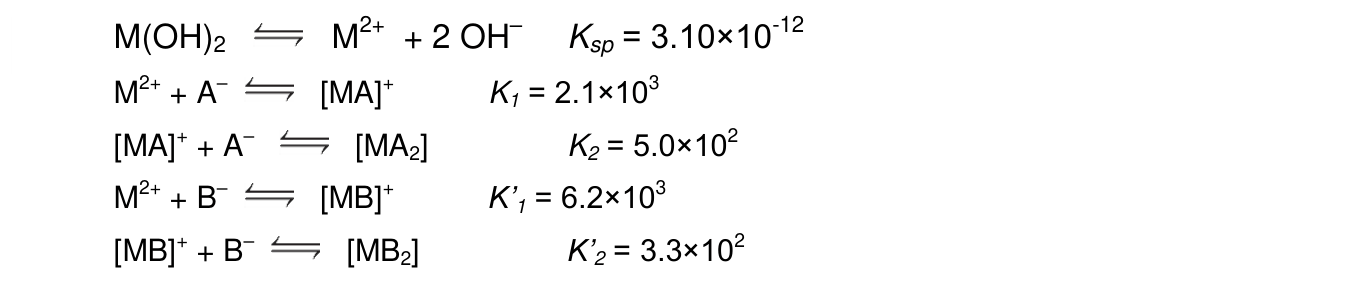
Official English text of the problem.
Answers
- 5.1: Using the full equilibrium balances, \[ C_{\ce{HA}}\approx5.42\times10^{-2}\ \mathrm{mol\,dm^{-3}},\qquad C_{\ce{HB}}\approx1.66\times10^{-1}\ \mathrm{mol\,dm^{-3}}. \] The permitted weak-dissociation approximation gives \(5.36\times10^{-2}\) and \(1.66\times10^{-1}\ \mathrm{mol\,dm^{-3}}\), respectively.
- 5.2: \(\boxed{\mathrm{pH}=9.90}\).
- 5.3: \(\boxed{\ce{HA}:63.5\%,\qquad \ce{HB}:57.3\%}\).
- 5.4: \(\boxed{s\bigl(\ce{M(OH)2}\bigr)\approx5.1\times10^{-2}\ \mathrm{mol\,dm^{-3}}}\).
Solution
The acids, conjugate bases, salts and metal complexes are specified only by generic symbols. Their chemical identities, unique SMILES and coordination geometries cannot be inferred. The explicitly identified species used below are water O, hydronium ion [OH3+], hydroxide ion [OH-], sodium ion [Na+], and sodium hydroxide [Na+].[OH-].
Write \(K_A=K_{\ce{HA}}\), \(K_B=K_{\ce{HB}}\), and \(h=[\ce{H3O+}]\).
5.1 — Initial total concentrations
Both acids are monoprotic, so their neutralization reactions are
\[ \ce{HA + OH^- -> A^- + H2O}, \] \[ \ce{HB + OH^- -> B^- + H2O}. \]
Thus, the amount of hydroxide required equals the combined amount of the two acids:
\[ n_{\text{acids}} =(0.100\ \mathrm{dm^3})(0.220\ \mathrm{mol\,dm^{-3}}) =0.0220\ \mathrm{mol}. \]
Define the analytical concentrations
\[ C_A=[\ce{HA}]+[\ce{A^-}],\qquad C_B=[\ce{HB}]+[\ce{B^-}]. \]
Since the original sample volume is \(0.100\ \mathrm{dm^3}\),
\[ C_A+C_B=0.220\ \mathrm{mol\,dm^{-3}}. \tag{1} \]
The acid equilibria are
\[ \ce{HA + H2O <=> H3O+ + A^-}, \qquad K_A=\frac{h[\ce{A^-}]}{[\ce{HA}]}, \]
\[ \ce{HB + H2O <=> H3O+ + B^-}, \qquad K_B=\frac{h[\ce{B^-}]}{[\ce{HB}]}. \]
The specified pH gives
\[ h=10^{-3.75}=1.77828\times10^{-4}\ \mathrm{mol\,dm^{-3}}. \]
Combining each dissociation equilibrium with its material balance gives
\[ [\ce{A^-}]=\frac{K_A C_A}{h+K_A}, \qquad [\ce{B^-}]=\frac{K_B C_B}{h+K_B}. \]
Electroneutrality requires
\[ h=[\ce{A^-}]+[\ce{B^-}]+[\ce{OH^-}], \]
hence
\[ h-\frac{K_w}{h} =\frac{K_A C_A}{h+K_A} +\frac{K_B C_B}{h+K_B}. \tag{2} \]
Solving (1) and (2) gives
\[ C_A=0.0542179\ \mathrm{mol\,dm^{-3}}, \qquad C_B=0.1657821\ \mathrm{mol\,dm^{-3}}. \]
Therefore,
\[ \boxed{C_{\ce{HA}}\approx5.42\times10^{-2}\ \mathrm{mol\,dm^{-3}}}, \] \[ \boxed{C_{\ce{HB}}\approx1.66\times10^{-1}\ \mathrm{mol\,dm^{-3}}}. \]
For the permitted approximation, \(h\gg K_A,K_B\), so each acid is only slightly dissociated and hydroxide is negligible. Equation (2) then becomes
\[ h^2\approx K_A C_A+K_B C_B. \]
Using \(C_B=0.220-C_A\),
\[ C_A\approx \frac{10^{-7.50}-(1.34\times10^{-7})(0.220)} {1.74\times10^{-7}-1.34\times10^{-7}} =0.0535694\ \mathrm{mol\,dm^{-3}}, \]
\[ C_B\approx0.166431\ \mathrm{mol\,dm^{-3}}. \]
The small difference from the full calculation is amplified because the two acid dissociation constants are close.
5.2 — pH of solution Y
The anions undergo base hydrolysis:
\[ \ce{A^- + H2O <=> HA + OH^-}, \] \[ \ce{B^- + H2O <=> HB + OH^-}. \]
Their base dissociation constants are
\[ K_{b,A}=\frac{K_w}{K_A} =\frac{1.00\times10^{-14}}{1.74\times10^{-7}} =5.7471\times10^{-8}, \]
\[ K_{b,B}=\frac{K_w}{K_B} =\frac{1.00\times10^{-14}}{1.34\times10^{-7}} =7.4627\times10^{-8}. \]
Let \(x=[\ce{OH^-}]\). Because hydrolysis is slight,
\[ [\ce{A^-}]\approx0.0600\ \mathrm{mol\,dm^{-3}}, \qquad [\ce{B^-}]\approx0.0400\ \mathrm{mol\,dm^{-3}}. \]
Both hydrolysis reactions share the same hydroxide concentration:
\[ [\ce{HA}]\approx\frac{K_{b,A}(0.0600)}{x}, \qquad [\ce{HB}]\approx\frac{K_{b,B}(0.0400)}{x}. \]
Material and charge balances give
\[ x=[\ce{HA}]+[\ce{HB}]+h \approx[\ce{HA}]+[\ce{HB}], \]
so
\[ x^2\approx K_{b,A}(0.0600)+K_{b,B}(0.0400). \]
Consequently,
\[ x=\sqrt{(5.7471\times10^{-8})(0.0600) +(7.4627\times10^{-8})(0.0400)} =8.0208\times10^{-5}\ \mathrm{mol\,dm^{-3}}. \]
Thus,
\[ \mathrm{pOH}=4.0958, \qquad \mathrm{pH}=14.0000-4.0958=9.9042, \]
\[ \boxed{\mathrm{pH}=9.90}. \]
Less than \(0.1\%\) of either anion is protonated, validating the approximation.
5.3 — Dissociation at infinite dilution
Water undergoes autoionization:
\[ \ce{2H2O <=> H3O+ + OH^-}. \]
As both acid concentrations approach zero, their contributions to the charge balance vanish. Therefore,
\[ h\longrightarrow\sqrt{K_w} =1.00\times10^{-7}\ \mathrm{mol\,dm^{-3}}. \]
For either acid, the fraction dissociated is
\[ \alpha=\frac{[\text{conjugate base}]} {[\text{acid}]+[\text{conjugate base}]} =\frac{K_a}{K_a+h}. \]
Hence,
\[ 100\alpha_A =100\frac{1.74\times10^{-7}} {1.74\times10^{-7}+1.00\times10^{-7}} =\boxed{63.5\%}, \]
\[ 100\alpha_B =100\frac{1.34\times10^{-7}} {1.34\times10^{-7}+1.00\times10^{-7}} =\boxed{57.3\%}. \]
Neither limiting percentage is \(100\%\), because water maintains a nonzero hydronium concentration comparable to the given acid dissociation constants.
5.4 — Solubility in buffered solution Z
The dissolution equilibrium is
\[ \ce{M(OH)2(s) <=> M^{2+} + 2OH^-}, \]
\[ K_{\mathrm{sp}}=[\ce{M^{2+}}][\ce{OH^-}]^2 =3.10\times10^{-12}. \]
At the maintained pH of 10.0,
\[ h=1.00\times10^{-10}\ \mathrm{mol\,dm^{-3}}, \qquad [\ce{OH^-}]=\frac{K_w}{h} =1.00\times10^{-4}\ \mathrm{mol\,dm^{-3}}. \]
Therefore, the free metal-ion concentration is fixed:
\[ m=[\ce{M^{2+}}] =\frac{3.10\times10^{-12}}{(1.00\times10^{-4})^2} =3.10\times10^{-4}\ \mathrm{mol\,dm^{-3}}. \tag{3} \]
The complex-formation equilibria are
| Reaction | Stepwise formation constant |
|---|---|
| \(\ce{M^{2+} + A^- <=> [MA]^+}\) | \(K_1=2.1\times10^3\) |
| \(\ce{[MA]^+ + A^- <=> [MA2]}\) | \(K_2=5.0\times10^2\) |
| \(\ce{M^{2+} + B^- <=> [MB]^+}\) | \(K'_1=6.2\times10^3\) |
| \(\ce{[MB]^+ + B^- <=> [MB2]}\) | \(K'_2=3.3\times10^2\) |
Let \(a=[\ce{A^-}]\) and \(b=[\ce{B^-}]\). Then
\[ [\ce{[MA]^+}]=K_1ma, \qquad [\ce{[MA2]}]=K_1K_2ma^2, \]
\[ [\ce{[MB]^+}]=K'_1mb, \qquad [\ce{[MB2]}]=K'_1K'_2mb^2. \]
Complex formation consumes substantial quantities of both ligands, so their free concentrations must be obtained from their material balances. With no volume change,
\[ 0.0600=a+[\ce{HA}]+[\ce{[MA]^+}] +2[\ce{[MA2]}], \]
\[ 0.0400=b+[\ce{HB}]+[\ce{[MB]^+}] +2[\ce{[MB2]}]. \]
The factors of two account for the two ligands in each neutral complex. Since
\[ [\ce{HA}]=\frac{h}{K_A}a,\qquad [\ce{HB}]=\frac{h}{K_B}b, \]
the balances become
\[ 2K_1K_2ma^2+ \left(1+\frac{h}{K_A}+K_1m\right)a=0.0600, \]
\[ 2K'_1K'_2mb^2+ \left(1+\frac{h}{K_B}+K'_1m\right)b=0.0400. \]
Numerically, with concentrations entered in \(\mathrm{mol\,dm^{-3}}\),
\[ 651.0a^2+1.651575a-0.0600=0, \]
\[ 1268.52b^2+2.922746b-0.0400=0. \]
The positive roots are
\[ a=8.41526\times10^{-3}\ \mathrm{mol\,dm^{-3}}, \qquad b=4.58033\times10^{-3}\ \mathrm{mol\,dm^{-3}}. \]
Substitution into the formation expressions gives the dissolved metal concentrations below; extra digits are retained for summation.
| Metal-containing species | Concentration \((\mathrm{mol\,dm^{-3}})\) |
|---|---|
| \(\ce{M^{2+}}\) | \(0.000310000\) |
| \(\ce{[MA]^+}\) | \(0.00547833\) |
| \(\ce{[MA2]}\) | \(0.0230508\) |
| \(\ce{[MB]^+}\) | \(0.00880340\) |
| \(\ce{[MB2]}\) | \(0.0133064\) |
Each species contains one metal atom. The solubility is therefore
\[ \begin{aligned} s={}&[\ce{M^{2+}}]+[\ce{[MA]^+}]+[\ce{[MA2]}]\\ &+[\ce{[MB]^+}]+[\ce{[MB2]}]\\ ={}&0.0509489\ \mathrm{mol\,dm^{-3}}. \end{aligned} \]
Thus,
\[ \boxed{s\bigl(\ce{M(OH)2}\bigr)\approx 5.1\times10^{-2}\ \mathrm{mol\,dm^{-3}}}. \]
The solution was checked against the official solution. Where this solution differs from the official solution, the official solution contains an error or a misprint.
IChO 2014 · Theorieaufgabe 5
Säure-Base-Gleichgewichte in Wasser
Eine Lösung (X) enthält zwei schwache einprotonige Säuren (solche mit einem sauren Proton): \(\ce{HA}\) mit der Säuredissoziationskonstante \(K_{\ce{HA}}=1.74\times10^{-7}\) und \(\ce{HB}\) mit der Säuredissoziationskonstante \(K_{\ce{HB}}=1.34\times10^{-7}\). Die Lösung X hat einen pH-Wert von 3,75.
5.1 Zur vollständigen Titration von \(100\ \mathrm{cm^3}\) der Lösung X werden \(100\ \mathrm{cm^3}\) einer \(\ce{NaOH}\)-Lösung (\(c=0.220\ \mathrm{mol\cdot dm^{-3}}\)) benötigt. Berechnen Sie die anfängliche (Gesamt-)Konzentration (\(\mathrm{mol\cdot dm^{-3}}\)) jeder Säure in der Lösung X.
Verwenden Sie gegebenenfalls sinnvolle Näherungen. [\(K_w=1.00\times10^{-14}\) bei 298 K]
5.2 Berechnen Sie den pH-Wert der Lösung Y, in der die Konzentration von \(\ce{NaA}\) anfangs \(6.00\times10^{-2}\ \mathrm{mol\cdot dm^{-3}}\) und die von \(\ce{NaB}\) \(4.00\times10^{-2}\ \mathrm{mol\cdot dm^{-3}}\) betrug.
5.3 Durch Zugabe großer Mengen destillierten Wassers zur Lösung X entsteht eine sehr (unendlich) verdünnte Lösung, in der die Gesamtkonzentrationen der Säuren nahezu null sind. Berechnen Sie den prozentualen Dissoziationsgrad jeder Säure in dieser verdünnten Lösung.
5.4. Der Lösung Y wird eine Pufferlösung zugesetzt, um einen pH-Wert von 10,0 aufrechtzuerhalten. Nehmen Sie an, dass sich das Volumen der entstehenden Lösung Z nicht ändert. Berechnen Sie die Löslichkeit (in \(\mathrm{mol\cdot dm^{-3}}\)) der Substanz \(\ce{M(OH)2}\) in Z und berücksichtigen Sie dabei, dass die Anionen \(\ce{A^-}\) und \(\ce{B^-}\) mit \(\ce{M^{2+}}\) Komplexe bilden können:
Aufgabentext aus dem offiziellen englischen Text übersetzt.
Antworten
- 5.1: Unter Verwendung der vollständigen Gleichgewichtsbilanzen ergibt sich \[ C_{\ce{HA}}\approx5.42\times10^{-2}\ \mathrm{mol\,dm^{-3}},\qquad C_{\ce{HB}}\approx1.66\times10^{-1}\ \mathrm{mol\,dm^{-3}}. \] Die zulässige Näherung einer geringen Dissoziation ergibt \(5.36\times10^{-2}\) bzw. \(1.66\times10^{-1}\ \mathrm{mol\,dm^{-3}}\).
- 5.2: \(\boxed{\mathrm{pH}=9.90}\).
- 5.3: \(\boxed{\ce{HA}:63.5\%,\qquad \ce{HB}:57.3\%}\).
- 5.4: \(\boxed{s\bigl(\ce{M(OH)2}\bigr)\approx5.1\times10^{-2}\ \mathrm{mol\,dm^{-3}}}\).
Lösung
Die Säuren, konjugierten Basen, Salze und Metallkomplexe sind nur durch allgemeine Symbole angegeben. Ihre chemischen Identitäten, eindeutigen SMILES und Koordinationsgeometrien lassen sich daraus nicht ableiten. Die im Folgenden verwendeten, ausdrücklich identifizierten Spezies sind Wasser O, das Oxoniumion [OH3+], das Hydroxidion [OH-], das Natriumion [Na+] und Natriumhydroxid [Na+].[OH-].
Wir schreiben \(K_A=K_{\ce{HA}}\), \(K_B=K_{\ce{HB}}\) und \(h=[\ce{H3O+}]\).
5.1 — Anfängliche Gesamtkonzentrationen
Beide Säuren sind einprotonig, daher lauten ihre Neutralisationsreaktionen
\[ \ce{HA + OH^- -> A^- + H2O}, \] \[ \ce{HB + OH^- -> B^- + H2O}. \]
Somit entspricht die benötigte Stoffmenge an Hydroxid der gesamten Stoffmenge der beiden Säuren:
\[ n_{\text{Säuren}} =(0.100\ \mathrm{dm^3})(0.220\ \mathrm{mol\,dm^{-3}}) =0.0220\ \mathrm{mol}. \]
Wir definieren die analytischen Konzentrationen
\[ C_A=[\ce{HA}]+[\ce{A^-}],\qquad C_B=[\ce{HB}]+[\ce{B^-}]. \]
Da das ursprüngliche Probenvolumen \(0.100\ \mathrm{dm^3}\) beträgt, gilt
\[ C_A+C_B=0.220\ \mathrm{mol\,dm^{-3}}. \tag{1} \]
Die Säuregleichgewichte lauten
\[ \ce{HA + H2O <=> H3O+ + A^-}, \qquad K_A=\frac{h[\ce{A^-}]}{[\ce{HA}]}, \]
\[ \ce{HB + H2O <=> H3O+ + B^-}, \qquad K_B=\frac{h[\ce{B^-}]}{[\ce{HB}]}. \]
Aus dem angegebenen pH-Wert ergibt sich
\[ h=10^{-3.75}=1.77828\times10^{-4}\ \mathrm{mol\,dm^{-3}}. \]
Die Kombination jedes Dissoziationsgleichgewichts mit der zugehörigen Stoffbilanz ergibt
\[ [\ce{A^-}]=\frac{K_A C_A}{h+K_A}, \qquad [\ce{B^-}]=\frac{K_B C_B}{h+K_B}. \]
Die Elektroneutralität erfordert
\[ h=[\ce{A^-}]+[\ce{B^-}]+[\ce{OH^-}], \]
also
\[ h-\frac{K_w}{h} =\frac{K_A C_A}{h+K_A} +\frac{K_B C_B}{h+K_B}. \tag{2} \]
Das Lösen von (1) und (2) ergibt
\[ C_A=0.0542179\ \mathrm{mol\,dm^{-3}}, \qquad C_B=0.1657821\ \mathrm{mol\,dm^{-3}}. \]
Damit gilt
\[ \boxed{C_{\ce{HA}}\approx5.42\times10^{-2}\ \mathrm{mol\,dm^{-3}}}, \] \[ \boxed{C_{\ce{HB}}\approx1.66\times10^{-1}\ \mathrm{mol\,dm^{-3}}}. \]
Für die zulässige Näherung gilt \(h\gg K_A,K_B\), sodass jede Säure nur geringfügig dissoziiert ist und Hydroxid vernachlässigt werden kann. Gleichung (2) wird dann zu
\[ h^2\approx K_A C_A+K_B C_B. \]
Mit \(C_B=0.220-C_A\) erhält man
\[ C_A\approx \frac{10^{-7.50}-(1.34\times10^{-7})(0.220)} {1.74\times10^{-7}-1.34\times10^{-7}} =0.0535694\ \mathrm{mol\,dm^{-3}}, \]
\[ C_B\approx0.166431\ \mathrm{mol\,dm^{-3}}. \]
Der kleine Unterschied zur vollständigen Berechnung wird dadurch verstärkt, dass die beiden Säuredissoziationskonstanten nahe beieinanderliegen.
5.2 — pH-Wert der Lösung Y
Die Anionen unterliegen einer basischen Hydrolyse:
\[ \ce{A^- + H2O <=> HA + OH^-}, \] \[ \ce{B^- + H2O <=> HB + OH^-}. \]
Ihre Basendissoziationskonstanten sind
\[ K_{b,A}=\frac{K_w}{K_A} =\frac{1.00\times10^{-14}}{1.74\times10^{-7}} =5.7471\times10^{-8}, \]
\[ K_{b,B}=\frac{K_w}{K_B} =\frac{1.00\times10^{-14}}{1.34\times10^{-7}} =7.4627\times10^{-8}. \]
Sei \(x=[\ce{OH^-}]\). Da die Hydrolyse nur in geringem Maße erfolgt, gilt
\[ [\ce{A^-}]\approx0.0600\ \mathrm{mol\,dm^{-3}}, \qquad [\ce{B^-}]\approx0.0400\ \mathrm{mol\,dm^{-3}}. \]
Für beide Hydrolysereaktionen gilt dieselbe Hydroxidkonzentration:
\[ [\ce{HA}]\approx\frac{K_{b,A}(0.0600)}{x}, \qquad [\ce{HB}]\approx\frac{K_{b,B}(0.0400)}{x}. \]
Aus den Stoff- und Ladungsbilanzen ergibt sich
\[ x=[\ce{HA}]+[\ce{HB}]+h \approx[\ce{HA}]+[\ce{HB}], \]
also
\[ x^2\approx K_{b,A}(0.0600)+K_{b,B}(0.0400). \]
Folglich gilt
\[ x=\sqrt{(5.7471\times10^{-8})(0.0600) +(7.4627\times10^{-8})(0.0400)} =8.0208\times10^{-5}\ \mathrm{mol\,dm^{-3}}. \]
Somit ist
\[ \mathrm{pOH}=4.0958, \qquad \mathrm{pH}=14.0000-4.0958=9.9042, \]
\[ \boxed{\mathrm{pH}=9.90}. \]
Von jedem der beiden Anionen sind weniger als \(0.1\%\) protoniert, was die Näherung bestätigt.
5.3 — Dissoziation bei unendlicher Verdünnung
Wasser unterliegt der Autoprotolyse:
\[ \ce{2H2O <=> H3O+ + OH^-}. \]
Wenn beide Säurekonzentrationen gegen null gehen, verschwinden ihre Beiträge zur Ladungsbilanz. Daher gilt
\[ h\longrightarrow\sqrt{K_w} =1.00\times10^{-7}\ \mathrm{mol\,dm^{-3}}. \]
Für jede der beiden Säuren beträgt der dissoziierte Anteil
\[ \alpha=\frac{[\text{konjugierte Base}]} {[\text{Säure}]+[\text{konjugierte Base}]} =\frac{K_a}{K_a+h}. \]
Damit ergibt sich
\[ 100\alpha_A =100\frac{1.74\times10^{-7}} {1.74\times10^{-7}+1.00\times10^{-7}} =\boxed{63.5\%}, \]
\[ 100\alpha_B =100\frac{1.34\times10^{-7}} {1.34\times10^{-7}+1.00\times10^{-7}} =\boxed{57.3\%}. \]
Keiner der beiden prozentualen Grenzwerte beträgt \(100\%\), da Wasser eine von null verschiedene Oxoniumionenkonzentration aufrechterhält, die mit den gegebenen Säuredissoziationskonstanten vergleichbar ist.
5.4 — Löslichkeit in der gepufferten Lösung Z
Das Lösungsgleichgewicht lautet
\[ \ce{M(OH)2(s) <=> M^{2+} + 2OH^-}, \]
\[ K_{\mathrm{sp}}=[\ce{M^{2+}}][\ce{OH^-}]^2 =3.10\times10^{-12}. \]
Bei dem konstant gehaltenen pH-Wert von 10,0 gilt
\[ h=1.00\times10^{-10}\ \mathrm{mol\,dm^{-3}}, \qquad [\ce{OH^-}]=\frac{K_w}{h} =1.00\times10^{-4}\ \mathrm{mol\,dm^{-3}}. \]
Damit ist die Konzentration der freien Metallionen festgelegt:
\[ m=[\ce{M^{2+}}] =\frac{3.10\times10^{-12}}{(1.00\times10^{-4})^2} =3.10\times10^{-4}\ \mathrm{mol\,dm^{-3}}. \tag{3} \]
Die Komplexbildungsgleichgewichte lauten
| Reaktion | Stufenweise Bildungskonstante |
|---|---|
| \(\ce{M^{2+} + A^- <=> [MA]^+}\) | \(K_1=2.1\times10^3\) |
| \(\ce{[MA]^+ + A^- <=> [MA2]}\) | \(K_2=5.0\times10^2\) |
| \(\ce{M^{2+} + B^- <=> [MB]^+}\) | \(K'_1=6.2\times10^3\) |
| \(\ce{[MB]^+ + B^- <=> [MB2]}\) | \(K'_2=3.3\times10^2\) |
Seien \(a=[\ce{A^-}]\) und \(b=[\ce{B^-}]\). Dann gilt
\[ [\ce{[MA]^+}]=K_1ma, \qquad [\ce{[MA2]}]=K_1K_2ma^2, \]
\[ [\ce{[MB]^+}]=K'_1mb, \qquad [\ce{[MB2]}]=K'_1K'_2mb^2. \]
Bei der Komplexbildung werden beträchtliche Mengen beider Liganden verbraucht, sodass ihre freien Konzentrationen aus ihren Stoffbilanzen bestimmt werden müssen. Ohne Volumenänderung gilt
\[ 0.0600=a+[\ce{HA}]+[\ce{[MA]^+}] +2[\ce{[MA2]}], \]
\[ 0.0400=b+[\ce{HB}]+[\ce{[MB]^+}] +2[\ce{[MB2]}]. \]
Die Faktoren zwei berücksichtigen die beiden Liganden in jedem neutralen Komplex. Da
\[ [\ce{HA}]=\frac{h}{K_A}a,\qquad [\ce{HB}]=\frac{h}{K_B}b, \]
werden die Bilanzen zu
\[ 2K_1K_2ma^2+ \left(1+\frac{h}{K_A}+K_1m\right)a=0.0600, \]
\[ 2K'_1K'_2mb^2+ \left(1+\frac{h}{K_B}+K'_1m\right)b=0.0400. \]
Numerisch ergibt sich, wenn die Konzentrationen in \(\mathrm{mol\,dm^{-3}}\) eingesetzt werden,
\[ 651.0a^2+1.651575a-0.0600=0, \]
\[ 1268.52b^2+2.922746b-0.0400=0. \]
Die positiven Lösungen sind
\[ a=8.41526\times10^{-3}\ \mathrm{mol\,dm^{-3}}, \qquad b=4.58033\times10^{-3}\ \mathrm{mol\,dm^{-3}}. \]
Durch Einsetzen in die Ausdrücke für die Komplexbildung ergeben sich die nachstehend aufgeführten Konzentrationen der gelösten Metallspezies; für die Summation werden zusätzliche Stellen beibehalten.
| Metallhaltige Spezies | Konzentration \((\mathrm{mol\,dm^{-3}})\) |
|---|---|
| \(\ce{M^{2+}}\) | \(0.000310000\) |
| \(\ce{[MA]^+}\) | \(0.00547833\) |
| \(\ce{[MA2]}\) | \(0.0230508\) |
| \(\ce{[MB]^+}\) | \(0.00880340\) |
| \(\ce{[MB2]}\) | \(0.0133064\) |
Jede Spezies enthält ein Metallatom. Die Löslichkeit beträgt daher
\[ \begin{aligned} s={}&[\ce{M^{2+}}]+[\ce{[MA]^+}]+[\ce{[MA2]}]\\ &+[\ce{[MB]^+}]+[\ce{[MB2]}]\\ ={}&0.0509489\ \mathrm{mol\,dm^{-3}}. \end{aligned} \]
Somit gilt
\[ \boxed{s\bigl(\ce{M(OH)2}\bigr)\approx 5.1\times10^{-2}\ \mathrm{mol\,dm^{-3}}}. \]
Die Lösung wurde mit der offiziellen Lösung abgeglichen. Wo diese Lösung von der offiziellen Lösung abweicht, enthält die offizielle Lösung einen Fehler oder Druckfehler.
IChO 2014 · Teori sorusu 5
Suda asit-baz dengeleri
Bir çözelti (X), iki zayıf monoprotik asit (bir asidik protonu olan asitler) içerir: asit ayrışma sabiti \(K_{\ce{HA}}=1.74\times10^{-7}\) olan \(\ce{HA}\) ve asit ayrışma sabiti \(K_{\ce{HB}}=1.34\times10^{-7}\) olan \(\ce{HB}\). X çözeltisinin pH değeri 3.75'tir.
5.1 X çözeltisinin \(100\ \mathrm{cm^3}\) hacmindeki bir örneğinin titrasyonunun tamamlanması için \(100\ \mathrm{cm^3}\) \(\ce{NaOH}\) çözeltisi (\(c=0.220\ \mathrm{mol\cdot dm^{-3}}\)) gereklidir. X çözeltisindeki her bir asidin başlangıç (toplam) derişimini (\(\mathrm{mol\cdot dm^{-3}}\)) hesaplayınız.
Uygun yerlerde makul yaklaşımlar kullanınız. [298 K'de \(K_w=1.00\times10^{-14}\)]
5.2 Başlangıçtaki \(\ce{NaA}\) derişimi \(6.00\times10^{-2}\ \mathrm{mol\cdot dm^{-3}}\) ve \(\ce{NaB}\) derişimi \(4.00\times10^{-2}\ \mathrm{mol\cdot dm^{-3}}\) olan Y çözeltisinin pH değerini hesaplayınız.
5.3 X çözeltisine çok miktarda damıtılmış su eklenmesiyle, asitlerin toplam derişimlerinin sıfıra yakın olduğu çok (sonsuz) seyreltik bir çözelti elde edilir. Bu seyreltik çözeltide her bir asidin ayrışma yüzdesini hesaplayınız.
5.4. pH değerini 10.0'da sabit tutmak için Y çözeltisine bir tampon çözelti eklenir. Oluşan Z çözeltisinin hacminin değişmediğini varsayınız. \(\ce{A^-}\) ve \(\ce{B^-}\) anyonlarının \(\ce{M^{2+}}\) ile kompleks oluşturabildiğini dikkate alarak, \(\ce{M(OH)2}\) maddesinin Z içindeki çözünürlüğünü (\(\mathrm{mol\cdot dm^{-3}}\) cinsinden) hesaplayınız:
Soru metni resmi İngilizce metinden çevrilmiştir.
Cevaplar
- 5.1: Dengeye ilişkin tüm bilanço denklemleri kullanıldığında, \[ C_{\ce{HA}}\approx5.42\times10^{-2}\ \mathrm{mol\,dm^{-3}},\qquad C_{\ce{HB}}\approx1.66\times10^{-1}\ \mathrm{mol\,dm^{-3}}. \] İzin verilen düşük ayrışma yaklaşımı, sırasıyla \(5.36\times10^{-2}\) ve \(1.66\times10^{-1}\ \mathrm{mol\,dm^{-3}}\) sonuçlarını verir.
- 5.2: \(\boxed{\mathrm{pH}=9.90}\).
- 5.3: \(\boxed{\ce{HA}:63.5\%,\qquad \ce{HB}:57.3\%}\).
- 5.4: \(\boxed{s\bigl(\ce{M(OH)2}\bigr)\approx5.1\times10^{-2}\ \mathrm{mol\,dm^{-3}}}\).
Çözüm
Asitler, eşlenik bazlar, tuzlar ve metal kompleksleri yalnızca genel simgelerle belirtilmiştir. Bunların kimyasal kimlikleri, benzersiz SMILES gösterimleri ve koordinasyon geometrileri çıkarılamaz. Aşağıda kullanılan ve kimliği açıkça belirtilen türler su O, hidronyum iyonu [OH3+], hidroksit iyonu [OH-], sodyum iyonu [Na+] ve sodyum hidroksittir [Na+].[OH-].
\(K_A=K_{\ce{HA}}\), \(K_B=K_{\ce{HB}}\) ve \(h=[\ce{H3O+}]\) olarak yazalım.
5.1 — Başlangıçtaki toplam derişimler
Her iki asit de monoprotik olduğundan, nötralleşme tepkimeleri şöyledir:
\[ \ce{HA + OH^- -> A^- + H2O}, \] \[ \ce{HB + OH^- -> B^- + H2O}. \]
Dolayısıyla, gereken hidroksit miktarı iki asidin toplam miktarına eşittir:
\[ n_{\text{asitler}} =(0.100\ \mathrm{dm^3})(0.220\ \mathrm{mol\,dm^{-3}}) =0.0220\ \mathrm{mol}. \]
Analitik derişimleri şöyle tanımlayalım:
\[ C_A=[\ce{HA}]+[\ce{A^-}],\qquad C_B=[\ce{HB}]+[\ce{B^-}]. \]
Başlangıçtaki örnek hacmi \(0.100\ \mathrm{dm^3}\) olduğundan,
\[ C_A+C_B=0.220\ \mathrm{mol\,dm^{-3}}. \tag{1} \]
Asit dengeleri şöyledir:
\[ \ce{HA + H2O <=> H3O+ + A^-}, \qquad K_A=\frac{h[\ce{A^-}]}{[\ce{HA}]}, \]
\[ \ce{HB + H2O <=> H3O+ + B^-}, \qquad K_B=\frac{h[\ce{B^-}]}{[\ce{HB}]}. \]
Verilen pH değerinden,
\[ h=10^{-3.75}=1.77828\times10^{-4}\ \mathrm{mol\,dm^{-3}}. \]
Her bir ayrışma dengesi, ilgili madde bilançosuyla birleştirildiğinde,
\[ [\ce{A^-}]=\frac{K_A C_A}{h+K_A}, \qquad [\ce{B^-}]=\frac{K_B C_B}{h+K_B}. \]
Elektriksel nötrlük koşulu,
\[ h=[\ce{A^-}]+[\ce{B^-}]+[\ce{OH^-}], \]
olduğundan,
\[ h-\frac{K_w}{h} =\frac{K_A C_A}{h+K_A} +\frac{K_B C_B}{h+K_B}. \tag{2} \]
(1) ve (2) birlikte çözüldüğünde,
\[ C_A=0.0542179\ \mathrm{mol\,dm^{-3}}, \qquad C_B=0.1657821\ \mathrm{mol\,dm^{-3}}. \]
Dolayısıyla,
\[ \boxed{C_{\ce{HA}}\approx5.42\times10^{-2}\ \mathrm{mol\,dm^{-3}}}, \] \[ \boxed{C_{\ce{HB}}\approx1.66\times10^{-1}\ \mathrm{mol\,dm^{-3}}}. \]
İzin verilen yaklaşımda \(h\gg K_A,K_B\) olduğundan, her iki asit de yalnızca çok az ayrışır ve hidroksit ihmal edilebilir. Bu durumda (2) denklemi şu hâle gelir:
\[ h^2\approx K_A C_A+K_B C_B. \]
\(C_B=0.220-C_A\) kullanılarak,
\[ C_A\approx \frac{10^{-7.50}-(1.34\times10^{-7})(0.220)} {1.74\times10^{-7}-1.34\times10^{-7}} =0.0535694\ \mathrm{mol\,dm^{-3}}, \]
\[ C_B\approx0.166431\ \mathrm{mol\,dm^{-3}}. \]
İki asidin ayrışma sabitleri birbirine yakın olduğundan, tam hesaplamaya göre oluşan küçük fark büyür.
5.2 — Y çözeltisinin pH değeri
Anyonlar baz hidrolizine uğrar:
\[ \ce{A^- + H2O <=> HA + OH^-}, \] \[ \ce{B^- + H2O <=> HB + OH^-}. \]
Baz ayrışma sabitleri şöyledir:
\[ K_{b,A}=\frac{K_w}{K_A} =\frac{1.00\times10^{-14}}{1.74\times10^{-7}} =5.7471\times10^{-8}, \]
\[ K_{b,B}=\frac{K_w}{K_B} =\frac{1.00\times10^{-14}}{1.34\times10^{-7}} =7.4627\times10^{-8}. \]
\(x=[\ce{OH^-}]\) olsun. Hidroliz çok az gerçekleştiğinden,
\[ [\ce{A^-}]\approx0.0600\ \mathrm{mol\,dm^{-3}}, \qquad [\ce{B^-}]\approx0.0400\ \mathrm{mol\,dm^{-3}}. \]
Her iki hidroliz tepkimesi için de hidroksit derişimi aynıdır:
\[ [\ce{HA}]\approx\frac{K_{b,A}(0.0600)}{x}, \qquad [\ce{HB}]\approx\frac{K_{b,B}(0.0400)}{x}. \]
Madde ve yük bilançolarından,
\[ x=[\ce{HA}]+[\ce{HB}]+h \approx[\ce{HA}]+[\ce{HB}], \]
dolayısıyla,
\[ x^2\approx K_{b,A}(0.0600)+K_{b,B}(0.0400). \]
Böylece,
\[ x=\sqrt{(5.7471\times10^{-8})(0.0600) +(7.4627\times10^{-8})(0.0400)} =8.0208\times10^{-5}\ \mathrm{mol\,dm^{-3}}. \]
Dolayısıyla,
\[ \mathrm{pOH}=4.0958, \qquad \mathrm{pH}=14.0000-4.0958=9.9042, \]
\[ \boxed{\mathrm{pH}=9.90}. \]
Her iki anyonun da \(0.1\%\)'inden daha azı protonlandığından, kullanılan yaklaşım geçerlidir.
5.3 — Sonsuz seyreltmede ayrışma
Su otoiyonlaşmaya uğrar:
\[ \ce{2H2O <=> H3O+ + OH^-}. \]
Her iki asidin derişimi sıfıra yaklaşırken, yük bilançosuna katkıları ortadan kalkar. Dolayısıyla,
\[ h\longrightarrow\sqrt{K_w} =1.00\times10^{-7}\ \mathrm{mol\,dm^{-3}}. \]
Her bir asit için ayrışan kesir şöyledir:
\[ \alpha=\frac{[\text{eşlenik baz}]} {[\text{asit}]+[\text{eşlenik baz}]} =\frac{K_a}{K_a+h}. \]
Buna göre,
\[ 100\alpha_A =100\frac{1.74\times10^{-7}} {1.74\times10^{-7}+1.00\times10^{-7}} =\boxed{63.5\%}, \]
\[ 100\alpha_B =100\frac{1.34\times10^{-7}} {1.34\times10^{-7}+1.00\times10^{-7}} =\boxed{57.3\%}. \]
Bu sınır yüzdelerinin hiçbiri \(100\%\) değildir; çünkü su, verilen asit ayrışma sabitleriyle karşılaştırılabilir büyüklükte, sıfırdan farklı bir hidronyum derişimi sağlar.
5.4 — Tamponlanmış Z çözeltisinde çözünürlük
Çözünme dengesi şöyledir:
\[ \ce{M(OH)2(s) <=> M^{2+} + 2OH^-}, \]
\[ K_{\mathrm{sp}}=[\ce{M^{2+}}][\ce{OH^-}]^2 =3.10\times10^{-12}. \]
pH değeri 10.0'da sabit tutulduğunda,
\[ h=1.00\times10^{-10}\ \mathrm{mol\,dm^{-3}}, \qquad [\ce{OH^-}]=\frac{K_w}{h} =1.00\times10^{-4}\ \mathrm{mol\,dm^{-3}}. \]
Dolayısıyla, serbest metal iyonu derişimi sabittir:
\[ m=[\ce{M^{2+}}] =\frac{3.10\times10^{-12}}{(1.00\times10^{-4})^2} =3.10\times10^{-4}\ \mathrm{mol\,dm^{-3}}. \tag{3} \]
Kompleks oluşum dengeleri şöyledir:
| Tepkime | Basamaklı oluşum sabiti |
|---|---|
| \(\ce{M^{2+} + A^- <=> [MA]^+}\) | \(K_1=2.1\times10^3\) |
| \(\ce{[MA]^+ + A^- <=> [MA2]}\) | \(K_2=5.0\times10^2\) |
| \(\ce{M^{2+} + B^- <=> [MB]^+}\) | \(K'_1=6.2\times10^3\) |
| \(\ce{[MB]^+ + B^- <=> [MB2]}\) | \(K'_2=3.3\times10^2\) |
\(a=[\ce{A^-}]\) ve \(b=[\ce{B^-}]\) olsun. Bu durumda,
\[ [\ce{[MA]^+}]=K_1ma, \qquad [\ce{[MA2]}]=K_1K_2ma^2, \]
\[ [\ce{[MB]^+}]=K'_1mb, \qquad [\ce{[MB2]}]=K'_1K'_2mb^2. \]
Kompleks oluşumu her iki ligandı da önemli miktarda tüketir; bu nedenle serbest derişimleri madde bilançolarından elde edilmelidir. Hacim değişmediğinden,
\[ 0.0600=a+[\ce{HA}]+[\ce{[MA]^+}] +2[\ce{[MA2]}], \]
\[ 0.0400=b+[\ce{HB}]+[\ce{[MB]^+}] +2[\ce{[MB2]}]. \]
İki çarpanları, her bir nötr kompleksteki iki ligandı hesaba katar.
\[ [\ce{HA}]=\frac{h}{K_A}a,\qquad [\ce{HB}]=\frac{h}{K_B}b, \]
olduğundan, bilançolar şu hâle gelir:
\[ 2K_1K_2ma^2+ \left(1+\frac{h}{K_A}+K_1m\right)a=0.0600, \]
\[ 2K'_1K'_2mb^2+ \left(1+\frac{h}{K_B}+K'_1m\right)b=0.0400. \]
Derişimler \(\mathrm{mol\,dm^{-3}}\) cinsinden yerine konulduğunda sayısal olarak,
\[ 651.0a^2+1.651575a-0.0600=0, \]
\[ 1268.52b^2+2.922746b-0.0400=0. \]
Pozitif kökler şöyledir:
\[ a=8.41526\times10^{-3}\ \mathrm{mol\,dm^{-3}}, \qquad b=4.58033\times10^{-3}\ \mathrm{mol\,dm^{-3}}. \]
Bu değerler oluşum ifadelerinde yerine konulduğunda, aşağıdaki çözünmüş metal derişimleri elde edilir; toplama işlemi için ek basamaklar korunmuştur.
| Metal içeren tür | Derişim \((\mathrm{mol\,dm^{-3}})\) |
|---|---|
| \(\ce{M^{2+}}\) | \(0.000310000\) |
| \(\ce{[MA]^+}\) | \(0.00547833\) |
| \(\ce{[MA2]}\) | \(0.0230508\) |
| \(\ce{[MB]^+}\) | \(0.00880340\) |
| \(\ce{[MB2]}\) | \(0.0133064\) |
Her tür bir metal atomu içerir. Dolayısıyla çözünürlük şöyledir:
\[ \begin{aligned} s={}&[\ce{M^{2+}}]+[\ce{[MA]^+}]+[\ce{[MA2]}]\\ &+[\ce{[MB]^+}]+[\ce{[MB2]}]\\ ={}&0.0509489\ \mathrm{mol\,dm^{-3}}. \end{aligned} \]
Dolayısıyla,
\[ \boxed{s\bigl(\ce{M(OH)2}\bigr)\approx 5.1\times10^{-2}\ \mathrm{mol\,dm^{-3}}}. \]
Çözüm, resmi çözümle karşılaştırılarak kontrol edildi. Bu çözümün resmi çözümden ayrıldığı yerlerde resmi çözümde bir hata ya da baskı hatası vardır.
IChO 2014 · Problema teórico 5
Equilibrios ácido-base en agua
Una disolución (X) contiene dos ácidos débiles monopróticos (aquellos que tienen un protón ácido); \(\ce{HA}\), con una constante de disociación ácida de \(K_{\ce{HA}}=1.74\times10^{-7}\), y \(\ce{HB}\), con una constante de disociación ácida de \(K_{\ce{HB}}=1.34\times10^{-7}\). La disolución X tiene un pH de 3.75.
5.1 La valoración de \(100\ \mathrm{cm^3}\) de la disolución X requiere \(100\ \mathrm{cm^3}\) de una disolución de \(\ce{NaOH}\) (\(c=0.220\ \mathrm{mol\cdot dm^{-3}}\)) para completarse. Calcule la concentración inicial (total) (\(\mathrm{mol\cdot dm^{-3}}\)) de cada ácido en la disolución X.
Utilice aproximaciones razonables cuando proceda. [\(K_w=1.00\times10^{-14}\) a 298 K]
5.2 Calcule el pH de la disolución Y, en la que la concentración inicial de \(\ce{NaA}\) era \(6.00\times10^{-2}\ \mathrm{mol\cdot dm^{-3}}\) y la de \(\ce{NaB}\), \(4.00\times10^{-2}\ \mathrm{mol\cdot dm^{-3}}\).
5.3 Al añadir grandes cantidades de agua destilada a la disolución X, se obtiene una disolución muy (infinitamente) diluida en la que las concentraciones totales de los ácidos son próximas a cero. Calcule el porcentaje de disociación de cada ácido en esta disolución diluida.
5.4. Se añade una disolución tampón a la disolución Y para mantener un pH de 10.0. Suponga que no cambia el volumen de la disolución resultante Z. Calcule la solubilidad (en \(\mathrm{mol\cdot dm^{-3}}\)) de la sustancia \(\ce{M(OH)2}\) en Z, teniendo en cuenta que los aniones \(\ce{A^-}\) y \(\ce{B^-}\) pueden formar complejos con \(\ce{M^{2+}}\):
Enunciado traducido del texto oficial en inglés.
Respuestas
- 5.1: Utilizando los balances completos de equilibrio, \[ C_{\ce{HA}}\approx5.42\times10^{-2}\ \mathrm{mol\,dm^{-3}},\qquad C_{\ce{HB}}\approx1.66\times10^{-1}\ \mathrm{mol\,dm^{-3}}. \] La aproximación permitida de disociación débil da \(5.36\times10^{-2}\) y \(1.66\times10^{-1}\ \mathrm{mol\,dm^{-3}}\), respectivamente.
- 5.2: \(\boxed{\mathrm{pH}=9.90}\).
- 5.3: \(\boxed{\ce{HA}:63.5\%,\qquad \ce{HB}:57.3\%}\).
- 5.4: \(\boxed{s\bigl(\ce{M(OH)2}\bigr)\approx5.1\times10^{-2}\ \mathrm{mol\,dm^{-3}}}\).
Solución
Los ácidos, las bases conjugadas, las sales y los complejos metálicos se especifican únicamente mediante símbolos genéricos. No se pueden deducir sus identidades químicas, sus SMILES únicos ni sus geometrías de coordinación. Las especies identificadas explícitamente que se utilizan a continuación son el agua O, el ion hidronio [OH3+], el ion hidróxido [OH-], el ion sodio [Na+] y el hidróxido de sodio [Na+].[OH-].
Escribamos \(K_A=K_{\ce{HA}}\), \(K_B=K_{\ce{HB}}\) y \(h=[\ce{H3O+}]\).
5.1 — Concentraciones totales iniciales
Ambos ácidos son monopróticos, por lo que sus reacciones de neutralización son
\[ \ce{HA + OH^- -> A^- + H2O}, \] \[ \ce{HB + OH^- -> B^- + H2O}. \]
Por tanto, la cantidad de hidróxido necesaria es igual a la cantidad conjunta de los dos ácidos:
\[ n_{\text{ácidos}} =(0.100\ \mathrm{dm^3})(0.220\ \mathrm{mol\,dm^{-3}}) =0.0220\ \mathrm{mol}. \]
Definimos las concentraciones analíticas
\[ C_A=[\ce{HA}]+[\ce{A^-}],\qquad C_B=[\ce{HB}]+[\ce{B^-}]. \]
Como el volumen de la muestra original es \(0.100\ \mathrm{dm^3}\),
\[ C_A+C_B=0.220\ \mathrm{mol\,dm^{-3}}. \tag{1} \]
Los equilibrios ácidos son
\[ \ce{HA + H2O <=> H3O+ + A^-}, \qquad K_A=\frac{h[\ce{A^-}]}{[\ce{HA}]}, \]
\[ \ce{HB + H2O <=> H3O+ + B^-}, \qquad K_B=\frac{h[\ce{B^-}]}{[\ce{HB}]}. \]
El pH indicado da
\[ h=10^{-3.75}=1.77828\times10^{-4}\ \mathrm{mol\,dm^{-3}}. \]
Al combinar cada equilibrio de disociación con su balance de materia, se obtiene
\[ [\ce{A^-}]=\frac{K_A C_A}{h+K_A}, \qquad [\ce{B^-}]=\frac{K_B C_B}{h+K_B}. \]
La electroneutralidad exige
\[ h=[\ce{A^-}]+[\ce{B^-}]+[\ce{OH^-}], \]
de donde
\[ h-\frac{K_w}{h} =\frac{K_A C_A}{h+K_A} +\frac{K_B C_B}{h+K_B}. \tag{2} \]
Al resolver (1) y (2), se obtiene
\[ C_A=0.0542179\ \mathrm{mol\,dm^{-3}}, \qquad C_B=0.1657821\ \mathrm{mol\,dm^{-3}}. \]
Por tanto,
\[ \boxed{C_{\ce{HA}}\approx5.42\times10^{-2}\ \mathrm{mol\,dm^{-3}}}, \] \[ \boxed{C_{\ce{HB}}\approx1.66\times10^{-1}\ \mathrm{mol\,dm^{-3}}}. \]
Para la aproximación permitida, \(h\gg K_A,K_B\), por lo que cada ácido está solo ligeramente disociado y el hidróxido es despreciable. La ecuación (2) se convierte entonces en
\[ h^2\approx K_A C_A+K_B C_B. \]
Utilizando \(C_B=0.220-C_A\),
\[ C_A\approx \frac{10^{-7.50}-(1.34\times10^{-7})(0.220)} {1.74\times10^{-7}-1.34\times10^{-7}} =0.0535694\ \mathrm{mol\,dm^{-3}}, \]
\[ C_B\approx0.166431\ \mathrm{mol\,dm^{-3}}. \]
La pequeña diferencia respecto al cálculo completo se amplifica porque las dos constantes de disociación ácida tienen valores próximos.
5.2 — pH de la disolución Y
Los aniones experimentan hidrólisis básica:
\[ \ce{A^- + H2O <=> HA + OH^-}, \] \[ \ce{B^- + H2O <=> HB + OH^-}. \]
Sus constantes de disociación básica son
\[ K_{b,A}=\frac{K_w}{K_A} =\frac{1.00\times10^{-14}}{1.74\times10^{-7}} =5.7471\times10^{-8}, \]
\[ K_{b,B}=\frac{K_w}{K_B} =\frac{1.00\times10^{-14}}{1.34\times10^{-7}} =7.4627\times10^{-8}. \]
Sea \(x=[\ce{OH^-}]\). Como la hidrólisis es escasa,
\[ [\ce{A^-}]\approx0.0600\ \mathrm{mol\,dm^{-3}}, \qquad [\ce{B^-}]\approx0.0400\ \mathrm{mol\,dm^{-3}}. \]
Ambas reacciones de hidrólisis comparten la misma concentración de hidróxido:
\[ [\ce{HA}]\approx\frac{K_{b,A}(0.0600)}{x}, \qquad [\ce{HB}]\approx\frac{K_{b,B}(0.0400)}{x}. \]
Los balances de materia y de carga dan
\[ x=[\ce{HA}]+[\ce{HB}]+h \approx[\ce{HA}]+[\ce{HB}], \]
por lo que
\[ x^2\approx K_{b,A}(0.0600)+K_{b,B}(0.0400). \]
En consecuencia,
\[ x=\sqrt{(5.7471\times10^{-8})(0.0600) +(7.4627\times10^{-8})(0.0400)} =8.0208\times10^{-5}\ \mathrm{mol\,dm^{-3}}. \]
Así,
\[ \mathrm{pOH}=4.0958, \qquad \mathrm{pH}=14.0000-4.0958=9.9042, \]
\[ \boxed{\mathrm{pH}=9.90}. \]
Menos del \(0.1\%\) de cada anión está protonado, lo que valida la aproximación.
5.3 — Disociación a dilución infinita
El agua experimenta autoionización:
\[ \ce{2H2O <=> H3O+ + OH^-}. \]
A medida que las concentraciones de ambos ácidos tienden a cero, sus contribuciones al balance de carga desaparecen. Por tanto,
\[ h\longrightarrow\sqrt{K_w} =1.00\times10^{-7}\ \mathrm{mol\,dm^{-3}}. \]
Para cualquiera de los dos ácidos, la fracción disociada es
\[ \alpha=\frac{[\text{base conjugada}]} {[\text{ácido}]+[\text{base conjugada}]} =\frac{K_a}{K_a+h}. \]
Por consiguiente,
\[ 100\alpha_A =100\frac{1.74\times10^{-7}} {1.74\times10^{-7}+1.00\times10^{-7}} =\boxed{63.5\%}, \]
\[ 100\alpha_B =100\frac{1.34\times10^{-7}} {1.34\times10^{-7}+1.00\times10^{-7}} =\boxed{57.3\%}. \]
Ninguno de los porcentajes límite es del \(100\%\), porque el agua mantiene una concentración de hidronio distinta de cero y comparable a las constantes de disociación ácida dadas.
5.4 — Solubilidad en la disolución tamponada Z
El equilibrio de disolución es
\[ \ce{M(OH)2(s) <=> M^{2+} + 2OH^-}, \]
\[ K_{\mathrm{sp}}=[\ce{M^{2+}}][\ce{OH^-}]^2 =3.10\times10^{-12}. \]
Al mantener el pH en 10.0,
\[ h=1.00\times10^{-10}\ \mathrm{mol\,dm^{-3}}, \qquad [\ce{OH^-}]=\frac{K_w}{h} =1.00\times10^{-4}\ \mathrm{mol\,dm^{-3}}. \]
Por tanto, la concentración del ion metálico libre queda fijada:
\[ m=[\ce{M^{2+}}] =\frac{3.10\times10^{-12}}{(1.00\times10^{-4})^2} =3.10\times10^{-4}\ \mathrm{mol\,dm^{-3}}. \tag{3} \]
Los equilibrios de formación de complejos son
| Reacción | Constante de formación sucesiva |
|---|---|
| \(\ce{M^{2+} + A^- <=> [MA]^+}\) | \(K_1=2.1\times10^3\) |
| \(\ce{[MA]^+ + A^- <=> [MA2]}\) | \(K_2=5.0\times10^2\) |
| \(\ce{M^{2+} + B^- <=> [MB]^+}\) | \(K'_1=6.2\times10^3\) |
| \(\ce{[MB]^+ + B^- <=> [MB2]}\) | \(K'_2=3.3\times10^2\) |
Sean \(a=[\ce{A^-}]\) y \(b=[\ce{B^-}]\). Entonces
\[ [\ce{[MA]^+}]=K_1ma, \qquad [\ce{[MA2]}]=K_1K_2ma^2, \]
\[ [\ce{[MB]^+}]=K'_1mb, \qquad [\ce{[MB2]}]=K'_1K'_2mb^2. \]
La formación de complejos consume cantidades considerables de ambos ligandos, por lo que sus concentraciones libres deben obtenerse a partir de sus balances de materia. Sin cambio de volumen,
\[ 0.0600=a+[\ce{HA}]+[\ce{[MA]^+}] +2[\ce{[MA2]}], \]
\[ 0.0400=b+[\ce{HB}]+[\ce{[MB]^+}] +2[\ce{[MB2]}]. \]
Los factores de dos tienen en cuenta los dos ligandos presentes en cada complejo neutro. Dado que
\[ [\ce{HA}]=\frac{h}{K_A}a,\qquad [\ce{HB}]=\frac{h}{K_B}b, \]
los balances se convierten en
\[ 2K_1K_2ma^2+ \left(1+\frac{h}{K_A}+K_1m\right)a=0.0600, \]
\[ 2K'_1K'_2mb^2+ \left(1+\frac{h}{K_B}+K'_1m\right)b=0.0400. \]
Numéricamente, con las concentraciones expresadas en \(\mathrm{mol\,dm^{-3}}\),
\[ 651.0a^2+1.651575a-0.0600=0, \]
\[ 1268.52b^2+2.922746b-0.0400=0. \]
Las raíces positivas son
\[ a=8.41526\times10^{-3}\ \mathrm{mol\,dm^{-3}}, \qquad b=4.58033\times10^{-3}\ \mathrm{mol\,dm^{-3}}. \]
Al sustituir en las expresiones de formación, se obtienen las concentraciones de metal disuelto que se muestran a continuación; se conservan cifras adicionales para efectuar la suma.
| Especie que contiene metal | Concentración \((\mathrm{mol\,dm^{-3}})\) |
|---|---|
| \(\ce{M^{2+}}\) | \(0.000310000\) |
| \(\ce{[MA]^+}\) | \(0.00547833\) |
| \(\ce{[MA2]}\) | \(0.0230508\) |
| \(\ce{[MB]^+}\) | \(0.00880340\) |
| \(\ce{[MB2]}\) | \(0.0133064\) |
Cada especie contiene un átomo de metal. Por tanto, la solubilidad es
\[ \begin{aligned} s={}&[\ce{M^{2+}}]+[\ce{[MA]^+}]+[\ce{[MA2]}]\\ &+[\ce{[MB]^+}]+[\ce{[MB2]}]\\ ={}&0.0509489\ \mathrm{mol\,dm^{-3}}. \end{aligned} \]
Así,
\[ \boxed{s\bigl(\ce{M(OH)2}\bigr)\approx 5.1\times10^{-2}\ \mathrm{mol\,dm^{-3}}}. \]
La solución se comprobó con la solución oficial. Donde esta solución difiere de la solución oficial, la solución oficial contiene un error o una errata.
IChO 2014 · 理论题 5
水中的酸碱平衡
溶液(X)含有两种一元弱酸(即具有一个酸性质子的酸):\(\ce{HA}\),其酸解离常数为 \(K_{\ce{HA}}=1.74\times10^{-7}\);以及 \(\ce{HB}\),其酸解离常数为 \(K_{\ce{HB}}=1.34\times10^{-7}\)。溶液 X 的 pH 为 3.75。
5.1 滴定 \(100\ \mathrm{cm^3}\) 溶液 X 至完全中和,需要 \(100\ \mathrm{cm^3}\) 的 \(\ce{NaOH}\) 溶液(\(c=0.220\ \mathrm{mol\cdot dm^{-3}}\))。计算溶液 X 中每种酸的初始(总)浓度(\(\mathrm{mol\cdot dm^{-3}}\))。
在适当之处采用合理的近似。[298 K 时,\(K_w=1.00\times10^{-14}\)]
5.2 计算溶液 Y 的 pH,其中 \(\ce{NaA}\) 的初始浓度为 \(6.00\times10^{-2}\ \mathrm{mol\cdot dm^{-3}}\),\(\ce{NaB}\) 的初始浓度为 \(4.00\times10^{-2}\ \mathrm{mol\cdot dm^{-3}}\)。
5.3 向溶液 X 中加入大量蒸馏水,得到极稀(无限稀释)的溶液,其中各酸的总浓度均接近零。计算该稀溶液中每种酸的解离百分率。
5.4. 向溶液 Y 中加入缓冲溶液,使 pH 维持在 10.0。假设所得溶液 Z 的体积不变。考虑到阴离子 \(\ce{A^-}\) 和 \(\ce{B^-}\) 可与 \(\ce{M^{2+}}\) 形成配合物,计算物质 \(\ce{M(OH)2}\) 在 Z 中的溶解度(以 \(\mathrm{mol\cdot dm^{-3}}\) 为单位):
题目译自官方英文原文。
答案
- 5.1: 利用完整的平衡关系和守恒方程, \[ C_{\ce{HA}}\approx5.42\times10^{-2}\ \mathrm{mol\,dm^{-3}},\qquad C_{\ce{HB}}\approx1.66\times10^{-1}\ \mathrm{mol\,dm^{-3}}. \] 采用题目允许的弱解离近似,分别得到 \(5.36\times10^{-2}\) 和 \(1.66\times10^{-1}\ \mathrm{mol\,dm^{-3}}\)。
- 5.2: \(\boxed{\mathrm{pH}=9.90}\)。
- 5.3: \(\boxed{\ce{HA}:63.5\%,\qquad \ce{HB}:57.3\%}\)。
- 5.4: \(\boxed{s\bigl(\ce{M(OH)2}\bigr)\approx5.1\times10^{-2}\ \mathrm{mol\,dm^{-3}}}\)。
解答
题目仅用通用符号表示这些酸、共轭碱、盐和金属配合物,无法据此推断其具体化学身份、唯一的 SMILES 表示或配位几何构型。下文所用且已明确具体身份的物种为水 O、水合氢离子 [OH3+]、氢氧根离子 [OH-]、钠离子 [Na+] 和氢氧化钠 [Na+].[OH-]。
记 \(K_A=K_{\ce{HA}}\)、\(K_B=K_{\ce{HB}}\),并令 \(h=[\ce{H3O+}]\)。
5.1 — 初始总浓度
两种酸均为一元酸,因此其中和反应为
\[ \ce{HA + OH^- -> A^- + H2O}, \] \[ \ce{HB + OH^- -> B^- + H2O}. \]
因此,所需氢氧根离子的物质的量等于两种酸的物质的量之和:
\[ n_{\text{酸}} =(0.100\ \mathrm{dm^3})(0.220\ \mathrm{mol\,dm^{-3}}) =0.0220\ \mathrm{mol}. \]
定义分析浓度
\[ C_A=[\ce{HA}]+[\ce{A^-}],\qquad C_B=[\ce{HB}]+[\ce{B^-}]. \]
由于原始样品体积为 \(0.100\ \mathrm{dm^3}\),
\[ C_A+C_B=0.220\ \mathrm{mol\,dm^{-3}}. \tag{1} \]
酸的解离平衡为
\[ \ce{HA + H2O <=> H3O+ + A^-}, \qquad K_A=\frac{h[\ce{A^-}]}{[\ce{HA}]}, \]
\[ \ce{HB + H2O <=> H3O+ + B^-}, \qquad K_B=\frac{h[\ce{B^-}]}{[\ce{HB}]}. \]
由给定的 pH 可得
\[ h=10^{-3.75}=1.77828\times10^{-4}\ \mathrm{mol\,dm^{-3}}. \]
将每种酸的解离平衡与相应的物料守恒方程联立,得
\[ [\ce{A^-}]=\frac{K_A C_A}{h+K_A}, \qquad [\ce{B^-}]=\frac{K_B C_B}{h+K_B}. \]
由电中性条件可得
\[ h=[\ce{A^-}]+[\ce{B^-}]+[\ce{OH^-}], \]
因此
\[ h-\frac{K_w}{h} =\frac{K_A C_A}{h+K_A} +\frac{K_B C_B}{h+K_B}. \tag{2} \]
联立求解式 (1) 和式 (2),得
\[ C_A=0.0542179\ \mathrm{mol\,dm^{-3}}, \qquad C_B=0.1657821\ \mathrm{mol\,dm^{-3}}. \]
因此,
\[ \boxed{C_{\ce{HA}}\approx5.42\times10^{-2}\ \mathrm{mol\,dm^{-3}}}, \] \[ \boxed{C_{\ce{HB}}\approx1.66\times10^{-1}\ \mathrm{mol\,dm^{-3}}}. \]
采用题目允许的近似时,由于 \(h\gg K_A,K_B\),每种酸均仅有少量解离,且氢氧根离子的浓度可以忽略。于是式 (2) 变为
\[ h^2\approx K_A C_A+K_B C_B. \]
利用 \(C_B=0.220-C_A\),得
\[ C_A\approx \frac{10^{-7.50}-(1.34\times10^{-7})(0.220)} {1.74\times10^{-7}-1.34\times10^{-7}} =0.0535694\ \mathrm{mol\,dm^{-3}}, \]
\[ C_B\approx0.166431\ \mathrm{mol\,dm^{-3}}. \]
由于两种酸的解离常数接近,近似计算与完整计算之间的微小差异被放大。
5.2 — 溶液 Y 的 pH
这些阴离子发生碱性水解:
\[ \ce{A^- + H2O <=> HA + OH^-}, \] \[ \ce{B^- + H2O <=> HB + OH^-}. \]
它们的碱解离常数为
\[ K_{b,A}=\frac{K_w}{K_A} =\frac{1.00\times10^{-14}}{1.74\times10^{-7}} =5.7471\times10^{-8}, \]
\[ K_{b,B}=\frac{K_w}{K_B} =\frac{1.00\times10^{-14}}{1.34\times10^{-7}} =7.4627\times10^{-8}. \]
令 \(x=[\ce{OH^-}]\)。由于水解程度很小,
\[ [\ce{A^-}]\approx0.0600\ \mathrm{mol\,dm^{-3}}, \qquad [\ce{B^-}]\approx0.0400\ \mathrm{mol\,dm^{-3}}. \]
两个水解反应中的氢氧根离子浓度相同:
\[ [\ce{HA}]\approx\frac{K_{b,A}(0.0600)}{x}, \qquad [\ce{HB}]\approx\frac{K_{b,B}(0.0400)}{x}. \]
由物料守恒和电荷守恒可得
\[ x=[\ce{HA}]+[\ce{HB}]+h \approx[\ce{HA}]+[\ce{HB}], \]
所以
\[ x^2\approx K_{b,A}(0.0600)+K_{b,B}(0.0400). \]
因此,
\[ x=\sqrt{(5.7471\times10^{-8})(0.0600) +(7.4627\times10^{-8})(0.0400)} =8.0208\times10^{-5}\ \mathrm{mol\,dm^{-3}}. \]
于是,
\[ \mathrm{pOH}=4.0958, \qquad \mathrm{pH}=14.0000-4.0958=9.9042, \]
\[ \boxed{\mathrm{pH}=9.90}. \]
两种阴离子被质子化的比例均小于 \(0.1\%\),说明上述近似成立。
5.3 — 无限稀释时的解离
水发生自偶电离:
\[ \ce{2H2O <=> H3O+ + OH^-}. \]
当两种酸的浓度均趋于零时,它们对电荷平衡的贡献也趋于零。因此,
\[ h\longrightarrow\sqrt{K_w} =1.00\times10^{-7}\ \mathrm{mol\,dm^{-3}}. \]
对于任一种酸,其解离分数为
\[ \alpha=\frac{[\text{共轭碱}]} {[\text{酸}]+[\text{共轭碱}]} =\frac{K_a}{K_a+h}. \]
因此,
\[ 100\alpha_A =100\frac{1.74\times10^{-7}} {1.74\times10^{-7}+1.00\times10^{-7}} =\boxed{63.5\%}, \]
\[ 100\alpha_B =100\frac{1.34\times10^{-7}} {1.34\times10^{-7}+1.00\times10^{-7}} =\boxed{57.3\%}. \]
这两个极限百分率均不是 \(100\%\),因为水使水合氢离子的浓度维持在非零值,且该浓度与给定的酸解离常数相当。
5.4 — 缓冲溶液 Z 中的溶解度
溶解平衡为
\[ \ce{M(OH)2(s) <=> M^{2+} + 2OH^-}, \]
\[ K_{\mathrm{sp}}=[\ce{M^{2+}}][\ce{OH^-}]^2 =3.10\times10^{-12}. \]
当 pH 维持在 10.0 时,
\[ h=1.00\times10^{-10}\ \mathrm{mol\,dm^{-3}}, \qquad [\ce{OH^-}]=\frac{K_w}{h} =1.00\times10^{-4}\ \mathrm{mol\,dm^{-3}}. \]
因此,游离金属离子的浓度固定为:
\[ m=[\ce{M^{2+}}] =\frac{3.10\times10^{-12}}{(1.00\times10^{-4})^2} =3.10\times10^{-4}\ \mathrm{mol\,dm^{-3}}. \tag{3} \]
配合物的形成平衡为
| 反应 | 逐级形成常数 |
|---|---|
| \(\ce{M^{2+} + A^- <=> [MA]^+}\) | \(K_1=2.1\times10^3\) |
| \(\ce{[MA]^+ + A^- <=> [MA2]}\) | \(K_2=5.0\times10^2\) |
| \(\ce{M^{2+} + B^- <=> [MB]^+}\) | \(K'_1=6.2\times10^3\) |
| \(\ce{[MB]^+ + B^- <=> [MB2]}\) | \(K'_2=3.3\times10^2\) |
令 \(a=[\ce{A^-}]\),\(b=[\ce{B^-}]\)。则
\[ [\ce{[MA]^+}]=K_1ma, \qquad [\ce{[MA2]}]=K_1K_2ma^2, \]
\[ [\ce{[MB]^+}]=K'_1mb, \qquad [\ce{[MB2]}]=K'_1K'_2mb^2. \]
配合物的形成消耗了相当数量的两种配体,因此必须由各自的物料守恒方程求出其游离浓度。在体积不变的条件下,
\[ 0.0600=a+[\ce{HA}]+[\ce{[MA]^+}] +2[\ce{[MA2]}], \]
\[ 0.0400=b+[\ce{HB}]+[\ce{[MB]^+}] +2[\ce{[MB2]}]. \]
系数 2 表示每个中性配合物中含有两个配体。由于
\[ [\ce{HA}]=\frac{h}{K_A}a,\qquad [\ce{HB}]=\frac{h}{K_B}b, \]
守恒方程变为
\[ 2K_1K_2ma^2+ \left(1+\frac{h}{K_A}+K_1m\right)a=0.0600, \]
\[ 2K'_1K'_2mb^2+ \left(1+\frac{h}{K_B}+K'_1m\right)b=0.0400. \]
以 \(\mathrm{mol\,dm^{-3}}\) 为浓度单位代入数值,得
\[ 651.0a^2+1.651575a-0.0600=0, \]
\[ 1268.52b^2+2.922746b-0.0400=0. \]
正根为
\[ a=8.41526\times10^{-3}\ \mathrm{mol\,dm^{-3}}, \qquad b=4.58033\times10^{-3}\ \mathrm{mol\,dm^{-3}}. \]
代入配合物形成关系式,得到下列溶解态含金属物种的浓度;为便于求和,保留了额外的位数。
| 含金属物种 | 浓度 \((\mathrm{mol\,dm^{-3}})\) |
|---|---|
| \(\ce{M^{2+}}\) | \(0.000310000\) |
| \(\ce{[MA]^+}\) | \(0.00547833\) |
| \(\ce{[MA2]}\) | \(0.0230508\) |
| \(\ce{[MB]^+}\) | \(0.00880340\) |
| \(\ce{[MB2]}\) | \(0.0133064\) |
每种物种均含有一个金属原子。因此,溶解度为
\[ \begin{aligned} s={}&[\ce{M^{2+}}]+[\ce{[MA]^+}]+[\ce{[MA2]}]\\ &+[\ce{[MB]^+}]+[\ce{[MB2]}]\\ ={}&0.0509489\ \mathrm{mol\,dm^{-3}}. \end{aligned} \]
于是,
\[ \boxed{s\bigl(\ce{M(OH)2}\bigr)\approx 5.1\times10^{-2}\ \mathrm{mol\,dm^{-3}}}. \]
解答已与官方解答核对。本解答与官方解答不同之处,均为官方解答中的错误或印刷错误。
IChO 2014 · Теоретическая задача 5
Кислотно-основные равновесия в воде
Раствор (X) содержит две слабые одноосновные кислоты (имеющие один кислотный протон): \(\ce{HA}\) с константой диссоциации кислоты \(K_{\ce{HA}}=1.74\times10^{-7}\) и \(\ce{HB}\) с константой диссоциации кислоты \(K_{\ce{HB}}=1.34\times10^{-7}\). Раствор X имеет pH 3.75.
5.1 Для полного титрования \(100\ \mathrm{cm^3}\) раствора X требуется \(100\ \mathrm{cm^3}\) раствора \(\ce{NaOH}\) (\(c=0.220\ \mathrm{mol\cdot dm^{-3}}\)). Рассчитайте исходную (общую) концентрацию (\(\mathrm{mol\cdot dm^{-3}}\)) каждой кислоты в растворе X.
При необходимости используйте обоснованные приближения. [\(K_w=1.00\times10^{-14}\) при 298 K]
5.2 Рассчитайте pH раствора Y, в котором исходная концентрация \(\ce{NaA}\) составляла \(6.00\times10^{-2}\ \mathrm{mol\cdot dm^{-3}}\), а \(\ce{NaB}\) — \(4.00\times10^{-2}\ \mathrm{mol\cdot dm^{-3}}\).
5.3 При добавлении большого количества дистиллированной воды к раствору X получается очень (бесконечно) разбавленный раствор, в котором общие концентрации кислот близки к нулю. Рассчитайте степень диссоциации каждой кислоты в этом разбавленном растворе в процентах.
5.4. К раствору Y добавляют буферный раствор для поддержания pH 10.0. Считайте, что объём полученного раствора Z не изменяется. Рассчитайте растворимость (в \(\mathrm{mol\cdot dm^{-3}}\)) вещества \(\ce{M(OH)2}\) в Z, учитывая, что анионы \(\ce{A^-}\) и \(\ce{B^-}\) могут образовывать комплексы с \(\ce{M^{2+}}\):
Условие переведено с официального английского текста.
Ответы
- 5.1: При использовании полных уравнений равновесия и балансов \[ C_{\ce{HA}}\approx5.42\times10^{-2}\ \mathrm{mol\,dm^{-3}},\qquad C_{\ce{HB}}\approx1.66\times10^{-1}\ \mathrm{mol\,dm^{-3}}. \] Допустимое приближение малой степени диссоциации даёт соответственно \(5.36\times10^{-2}\) и \(1.66\times10^{-1}\ \mathrm{mol\,dm^{-3}}\).
- 5.2: \(\boxed{\mathrm{pH}=9.90}\).
- 5.3: \(\boxed{\ce{HA}:63.5\%,\qquad \ce{HB}:57.3\%}\).
- 5.4: \(\boxed{s\bigl(\ce{M(OH)2}\bigr)\approx5.1\times10^{-2}\ \mathrm{mol\,dm^{-3}}}\).
Решение
Кислоты, сопряжённые основания, соли и комплексы металла заданы только общими обозначениями. По ним нельзя установить конкретные вещества, однозначные записи SMILES и координационную геометрию. Явно определённые химические частицы, используемые ниже, — вода O, ион гидроксония [OH3+], гидроксид-ион [OH-], ион натрия [Na+] и гидроксид натрия [Na+].[OH-].
Обозначим \(K_A=K_{\ce{HA}}\), \(K_B=K_{\ce{HB}}\) и \(h=[\ce{H3O+}]\).
5.1 — Исходные общие концентрации
Обе кислоты одноосновные, поэтому реакции их нейтрализации имеют вид
\[ \ce{HA + OH^- -> A^- + H2O}, \] \[ \ce{HB + OH^- -> B^- + H2O}. \]
Таким образом, необходимое количество гидроксид-ионов равно суммарному количеству вещества двух кислот:
\[ n_{\text{кислот}} =(0.100\ \mathrm{dm^3})(0.220\ \mathrm{mol\,dm^{-3}}) =0.0220\ \mathrm{mol}. \]
Определим аналитические концентрации
\[ C_A=[\ce{HA}]+[\ce{A^-}],\qquad C_B=[\ce{HB}]+[\ce{B^-}]. \]
Поскольку исходный объём пробы равен \(0.100\ \mathrm{dm^3}\),
\[ C_A+C_B=0.220\ \mathrm{mol\,dm^{-3}}. \tag{1} \]
Равновесия диссоциации кислот имеют вид
\[ \ce{HA + H2O <=> H3O+ + A^-}, \qquad K_A=\frac{h[\ce{A^-}]}{[\ce{HA}]}, \]
\[ \ce{HB + H2O <=> H3O+ + B^-}, \qquad K_B=\frac{h[\ce{B^-}]}{[\ce{HB}]}. \]
Из заданного значения pH следует
\[ h=10^{-3.75}=1.77828\times10^{-4}\ \mathrm{mol\,dm^{-3}}. \]
Совместное рассмотрение каждого равновесия диссоциации и соответствующего материального баланса даёт
\[ [\ce{A^-}]=\frac{K_A C_A}{h+K_A}, \qquad [\ce{B^-}]=\frac{K_B C_B}{h+K_B}. \]
Условие электронейтральности требует
\[ h=[\ce{A^-}]+[\ce{B^-}]+[\ce{OH^-}], \]
откуда
\[ h-\frac{K_w}{h} =\frac{K_A C_A}{h+K_A} +\frac{K_B C_B}{h+K_B}. \tag{2} \]
Решение уравнений (1) и (2) даёт
\[ C_A=0.0542179\ \mathrm{mol\,dm^{-3}}, \qquad C_B=0.1657821\ \mathrm{mol\,dm^{-3}}. \]
Следовательно,
\[ \boxed{C_{\ce{HA}}\approx5.42\times10^{-2}\ \mathrm{mol\,dm^{-3}}}, \] \[ \boxed{C_{\ce{HB}}\approx1.66\times10^{-1}\ \mathrm{mol\,dm^{-3}}}. \]
В допустимом приближении \(h\gg K_A,K_B\), поэтому каждая кислота диссоциирует лишь в небольшой степени, а концентрацией гидроксид-ионов можно пренебречь. Тогда уравнение (2) принимает вид
\[ h^2\approx K_A C_A+K_B C_B. \]
Используя \(C_B=0.220-C_A\), получаем
\[ C_A\approx \frac{10^{-7.50}-(1.34\times10^{-7})(0.220)} {1.74\times10^{-7}-1.34\times10^{-7}} =0.0535694\ \mathrm{mol\,dm^{-3}}, \]
\[ C_B\approx0.166431\ \mathrm{mol\,dm^{-3}}. \]
Небольшое отличие от полного расчёта усиливается из-за близости констант диссоциации двух кислот.
5.2 — pH раствора Y
Анионы подвергаются гидролизу с образованием щелочной среды:
\[ \ce{A^- + H2O <=> HA + OH^-}, \] \[ \ce{B^- + H2O <=> HB + OH^-}. \]
Их константы основности равны
\[ K_{b,A}=\frac{K_w}{K_A} =\frac{1.00\times10^{-14}}{1.74\times10^{-7}} =5.7471\times10^{-8}, \]
\[ K_{b,B}=\frac{K_w}{K_B} =\frac{1.00\times10^{-14}}{1.34\times10^{-7}} =7.4627\times10^{-8}. \]
Пусть \(x=[\ce{OH^-}]\). Поскольку степень гидролиза мала,
\[ [\ce{A^-}]\approx0.0600\ \mathrm{mol\,dm^{-3}}, \qquad [\ce{B^-}]\approx0.0400\ \mathrm{mol\,dm^{-3}}. \]
В обеих реакциях гидролиза концентрация гидроксид-ионов одна и та же:
\[ [\ce{HA}]\approx\frac{K_{b,A}(0.0600)}{x}, \qquad [\ce{HB}]\approx\frac{K_{b,B}(0.0400)}{x}. \]
Из материального баланса и баланса зарядов следует
\[ x=[\ce{HA}]+[\ce{HB}]+h \approx[\ce{HA}]+[\ce{HB}], \]
поэтому
\[ x^2\approx K_{b,A}(0.0600)+K_{b,B}(0.0400). \]
Следовательно,
\[ x=\sqrt{(5.7471\times10^{-8})(0.0600) +(7.4627\times10^{-8})(0.0400)} =8.0208\times10^{-5}\ \mathrm{mol\,dm^{-3}}. \]
Таким образом,
\[ \mathrm{pOH}=4.0958, \qquad \mathrm{pH}=14.0000-4.0958=9.9042, \]
\[ \boxed{\mathrm{pH}=9.90}. \]
Для каждого аниона доля протонированной формы составляет менее \(0.1\%\), что подтверждает применимость приближения.
5.3 — Диссоциация при бесконечном разбавлении
Вода подвергается автопротолизу:
\[ \ce{2H2O <=> H3O+ + OH^-}. \]
При стремлении концентраций обеих кислот к нулю их вклады в баланс зарядов исчезают. Поэтому
\[ h\longrightarrow\sqrt{K_w} =1.00\times10^{-7}\ \mathrm{mol\,dm^{-3}}. \]
Для каждой кислоты степень диссоциации равна
\[ \alpha=\frac{[\text{сопряжённое основание}]} {[\text{кислота}]+[\text{сопряжённое основание}]} =\frac{K_a}{K_a+h}. \]
Следовательно,
\[ 100\alpha_A =100\frac{1.74\times10^{-7}} {1.74\times10^{-7}+1.00\times10^{-7}} =\boxed{63.5\%}, \]
\[ 100\alpha_B =100\frac{1.34\times10^{-7}} {1.34\times10^{-7}+1.00\times10^{-7}} =\boxed{57.3\%}. \]
Ни одно из предельных значений степени диссоциации не равно \(100\%\), поскольку вода поддерживает ненулевую концентрацию ионов гидроксония, сопоставимую с заданными константами диссоциации кислот.
5.4 — Растворимость в буферном растворе Z
Равновесие растворения имеет вид
\[ \ce{M(OH)2(s) <=> M^{2+} + 2OH^-}, \]
\[ K_{\mathrm{sp}}=[\ce{M^{2+}}][\ce{OH^-}]^2 =3.10\times10^{-12}. \]
При поддерживаемом значении pH 10.0
\[ h=1.00\times10^{-10}\ \mathrm{mol\,dm^{-3}}, \qquad [\ce{OH^-}]=\frac{K_w}{h} =1.00\times10^{-4}\ \mathrm{mol\,dm^{-3}}. \]
Следовательно, концентрация свободных ионов металла фиксирована:
\[ m=[\ce{M^{2+}}] =\frac{3.10\times10^{-12}}{(1.00\times10^{-4})^2} =3.10\times10^{-4}\ \mathrm{mol\,dm^{-3}}. \tag{3} \]
Равновесия комплексообразования имеют вид
| Реакция | Ступенчатая константа образования |
|---|---|
| \(\ce{M^{2+} + A^- <=> [MA]^+}\) | \(K_1=2.1\times10^3\) |
| \(\ce{[MA]^+ + A^- <=> [MA2]}\) | \(K_2=5.0\times10^2\) |
| \(\ce{M^{2+} + B^- <=> [MB]^+}\) | \(K'_1=6.2\times10^3\) |
| \(\ce{[MB]^+ + B^- <=> [MB2]}\) | \(K'_2=3.3\times10^2\) |
Пусть \(a=[\ce{A^-}]\) и \(b=[\ce{B^-}]\). Тогда
\[ [\ce{[MA]^+}]=K_1ma, \qquad [\ce{[MA2]}]=K_1K_2ma^2, \]
\[ [\ce{[MB]^+}]=K'_1mb, \qquad [\ce{[MB2]}]=K'_1K'_2mb^2. \]
При комплексообразовании расходуются значительные количества обоих лигандов, поэтому их свободные концентрации необходимо определять из соответствующих материальных балансов. При неизменном объёме
\[ 0.0600=a+[\ce{HA}]+[\ce{[MA]^+}] +2[\ce{[MA2]}], \]
\[ 0.0400=b+[\ce{HB}]+[\ce{[MB]^+}] +2[\ce{[MB2]}]. \]
Множители 2 учитывают наличие двух лигандов в каждом нейтральном комплексе. Поскольку
\[ [\ce{HA}]=\frac{h}{K_A}a,\qquad [\ce{HB}]=\frac{h}{K_B}b, \]
уравнения баланса принимают вид
\[ 2K_1K_2ma^2+ \left(1+\frac{h}{K_A}+K_1m\right)a=0.0600, \]
\[ 2K'_1K'_2mb^2+ \left(1+\frac{h}{K_B}+K'_1m\right)b=0.0400. \]
После подстановки числовых значений, если концентрации выражены в \(\mathrm{mol\,dm^{-3}}\),
\[ 651.0a^2+1.651575a-0.0600=0, \]
\[ 1268.52b^2+2.922746b-0.0400=0. \]
Положительные корни равны
\[ a=8.41526\times10^{-3}\ \mathrm{mol\,dm^{-3}}, \qquad b=4.58033\times10^{-3}\ \mathrm{mol\,dm^{-3}}. \]
Подстановка в выражения для констант образования даёт приведённые ниже концентрации растворённых форм металла; для суммирования сохранены дополнительные цифры.
| Частица, содержащая металл | Концентрация \((\mathrm{mol\,dm^{-3}})\) |
|---|---|
| \(\ce{M^{2+}}\) | \(0.000310000\) |
| \(\ce{[MA]^+}\) | \(0.00547833\) |
| \(\ce{[MA2]}\) | \(0.0230508\) |
| \(\ce{[MB]^+}\) | \(0.00880340\) |
| \(\ce{[MB2]}\) | \(0.0133064\) |
Каждая частица содержит один атом металла. Поэтому растворимость равна
\[ \begin{aligned} s={}&[\ce{M^{2+}}]+[\ce{[MA]^+}]+[\ce{[MA2]}]\\ &+[\ce{[MB]^+}]+[\ce{[MB2]}]\\ ={}&0.0509489\ \mathrm{mol\,dm^{-3}}. \end{aligned} \]
Таким образом,
\[ \boxed{s\bigl(\ce{M(OH)2}\bigr)\approx 5.1\times10^{-2}\ \mathrm{mol\,dm^{-3}}}. \]
Решение проверено по официальному решению. Там, где это решение расходится с официальным, в официальном решении есть ошибка или опечатка.
IChO 2014 · مسألة نظرية 5
اتزانات الأحماض والقواعد في الماء
يحتوي محلول (X) على حمضين ضعيفين أحاديي البروتون (أي إن لكل منهما بروتونًا حمضيًا واحدًا)؛ هما \(\ce{HA}\) الذي ثابت تفككه الحمضي \(K_{\ce{HA}}=1.74\times10^{-7}\)، و\(\ce{HB}\) الذي ثابت تفككه الحمضي \(K_{\ce{HB}}=1.34\times10^{-7}\). تبلغ قيمة pH للمحلول X مقدار 3.75.
5.1 تتطلب معايرة \(100\ \mathrm{cm^3}\) من المحلول X مقدار \(100\ \mathrm{cm^3}\) من محلول \(\ce{NaOH}\) (\(c=0.220\ \mathrm{mol\cdot dm^{-3}}\)) لإتمامها. احسب التركيز الابتدائي (الكلي) (\(\mathrm{mol\cdot dm^{-3}}\)) لكل حمض في المحلول X.
استخدم تقريبات معقولة حيثما كان ذلك مناسبًا. [\(K_w=1.00\times10^{-14}\) عند 298 K]
5.2 احسب قيمة pH للمحلول Y الذي كان التركيز الابتدائي لـ\(\ce{NaA}\) فيه \(6.00\times10^{-2}\ \mathrm{mol\cdot dm^{-3}}\)، ولـ\(\ce{NaB}\) فيه \(4.00\times10^{-2}\ \mathrm{mol\cdot dm^{-3}}\).
5.3 تؤدي إضافة كميات كبيرة من الماء المقطر إلى المحلول X إلى الحصول على محلول مخفف جدًا (تخفيفًا لا نهائيًا)، تقترب فيه التراكيز الكلية للأحماض من الصفر. احسب النسبة المئوية لتفكك كل حمض في هذا المحلول المخفف.
5.4. يُضاف محلول منظم إلى المحلول Y للحفاظ على قيمة pH عند 10.0. افترض عدم تغير حجم المحلول الناتج Z. احسب ذوبانية المادة \(\ce{M(OH)2}\) في Z (بوحدة \(\mathrm{mol\cdot dm^{-3}}\))، مع الأخذ في الحسبان أن الأنيونين \(\ce{A^-}\) و\(\ce{B^-}\) يمكنهما تكوين معقدات مع \(\ce{M^{2+}}\):
نص المسألة مترجم عن النص الإنجليزي الرسمي.
الإجابات
- 5.1: باستخدام معادلات الموازنة الكاملة عند الاتزان، \[ C_{\ce{HA}}\approx5.42\times10^{-2}\ \mathrm{mol\,dm^{-3}},\qquad C_{\ce{HB}}\approx1.66\times10^{-1}\ \mathrm{mol\,dm^{-3}}. \] يعطي تقريب التفكك الضعيف المسموح به \(5.36\times10^{-2}\) و\(1.66\times10^{-1}\ \mathrm{mol\,dm^{-3}}\)، على الترتيب.
- 5.2: \(\boxed{\mathrm{pH}=9.90}\).
- 5.3: \(\boxed{\ce{HA}:63.5\%,\qquad \ce{HB}:57.3\%}\).
- 5.4: \(\boxed{s\bigl(\ce{M(OH)2}\bigr)\approx5.1\times10^{-2}\ \mathrm{mol\,dm^{-3}}}\).
الحل
لم تُحدَّد الأحماض والقواعد المرافقة والأملاح والمعقدات الفلزية إلا برموز عامة. ولا يمكن استنتاج هوياتها الكيميائية أو تمثيلات SMILES الفريدة لها أو أشكالها الهندسية التناسقية. أما الأنواع الكيميائية المحددة صراحةً والمستخدمة أدناه فهي الماء O، وأيون الهيدرونيوم [OH3+]، وأيون الهيدروكسيد [OH-]، وأيون الصوديوم [Na+]، وهيدروكسيد الصوديوم [Na+].[OH-].
لنكتب \(K_A=K_{\ce{HA}}\)، و\(K_B=K_{\ce{HB}}\)، و\(h=[\ce{H3O+}]\).
5.1 — التراكيز الكلية الابتدائية
كلا الحمضين أحادي البروتون، لذا فإن تفاعلي تعادلهما هما
\[ \ce{HA + OH^- -> A^- + H2O}, \] \[ \ce{HB + OH^- -> B^- + H2O}. \]
وعليه، فإن كمية مادة الهيدروكسيد المطلوبة تساوي مجموع كميتي مادة الحمضين:
\[ n_{\text{الأحماض}} =(0.100\ \mathrm{dm^3})(0.220\ \mathrm{mol\,dm^{-3}}) =0.0220\ \mathrm{mol}. \]
نعرّف التركيزين التحليليين كما يلي
\[ C_A=[\ce{HA}]+[\ce{A^-}],\qquad C_B=[\ce{HB}]+[\ce{B^-}]. \]
بما أن حجم العينة الأصلية يساوي \(0.100\ \mathrm{dm^3}\)، فإن
\[ C_A+C_B=0.220\ \mathrm{mol\,dm^{-3}}. \tag{1} \]
اتزانا الحمضين هما
\[ \ce{HA + H2O <=> H3O+ + A^-}, \qquad K_A=\frac{h[\ce{A^-}]}{[\ce{HA}]}, \]
\[ \ce{HB + H2O <=> H3O+ + B^-}, \qquad K_B=\frac{h[\ce{B^-}]}{[\ce{HB}]}. \]
تعطي قيمة pH المحددة
\[ h=10^{-3.75}=1.77828\times10^{-4}\ \mathrm{mol\,dm^{-3}}. \]
بدمج كل اتزان تفكك مع موازنة المادة الخاصة به نحصل على
\[ [\ce{A^-}]=\frac{K_A C_A}{h+K_A}, \qquad [\ce{B^-}]=\frac{K_B C_B}{h+K_B}. \]
يقتضي التعادل الكهربائي أن يكون
\[ h=[\ce{A^-}]+[\ce{B^-}]+[\ce{OH^-}], \]
ومن ثم
\[ h-\frac{K_w}{h} =\frac{K_A C_A}{h+K_A} +\frac{K_B C_B}{h+K_B}. \tag{2} \]
بحل المعادلتين (1) و(2) نحصل على
\[ C_A=0.0542179\ \mathrm{mol\,dm^{-3}}, \qquad C_B=0.1657821\ \mathrm{mol\,dm^{-3}}. \]
إذن،
\[ \boxed{C_{\ce{HA}}\approx5.42\times10^{-2}\ \mathrm{mol\,dm^{-3}}}, \] \[ \boxed{C_{\ce{HB}}\approx1.66\times10^{-1}\ \mathrm{mol\,dm^{-3}}}. \]
في التقريب المسموح به، \(h\gg K_A,K_B\)، لذا لا يتفكك أي من الحمضين إلا بدرجة ضئيلة، ويمكن إهمال الهيدروكسيد. وتصبح المعادلة (2) عندئذٍ
\[ h^2\approx K_A C_A+K_B C_B. \]
باستخدام \(C_B=0.220-C_A\)،
\[ C_A\approx \frac{10^{-7.50}-(1.34\times10^{-7})(0.220)} {1.74\times10^{-7}-1.34\times10^{-7}} =0.0535694\ \mathrm{mol\,dm^{-3}}, \]
\[ C_B\approx0.166431\ \mathrm{mol\,dm^{-3}}. \]
يتضخم الفرق الصغير عن الحساب الكامل بسبب تقارب ثابتي التفكك الحمضي.
5.2 — قيمة pH للمحلول Y
يخضع الأنيونان للتحلل المائي القاعدي:
\[ \ce{A^- + H2O <=> HA + OH^-}, \] \[ \ce{B^- + H2O <=> HB + OH^-}. \]
ثابتا تفككهما القاعدي هما
\[ K_{b,A}=\frac{K_w}{K_A} =\frac{1.00\times10^{-14}}{1.74\times10^{-7}} =5.7471\times10^{-8}, \]
\[ K_{b,B}=\frac{K_w}{K_B} =\frac{1.00\times10^{-14}}{1.34\times10^{-7}} =7.4627\times10^{-8}. \]
ليكن \(x=[\ce{OH^-}]\). بما أن التحلل المائي ضئيل، فإن
\[ [\ce{A^-}]\approx0.0600\ \mathrm{mol\,dm^{-3}}, \qquad [\ce{B^-}]\approx0.0400\ \mathrm{mol\,dm^{-3}}. \]
يشترك تفاعلا التحلل المائي في تركيز الهيدروكسيد نفسه:
\[ [\ce{HA}]\approx\frac{K_{b,A}(0.0600)}{x}, \qquad [\ce{HB}]\approx\frac{K_{b,B}(0.0400)}{x}. \]
تعطي موازنتا المادة والشحنة
\[ x=[\ce{HA}]+[\ce{HB}]+h \approx[\ce{HA}]+[\ce{HB}], \]
ومن ثم
\[ x^2\approx K_{b,A}(0.0600)+K_{b,B}(0.0400). \]
وبناءً على ذلك،
\[ x=\sqrt{(5.7471\times10^{-8})(0.0600) +(7.4627\times10^{-8})(0.0400)} =8.0208\times10^{-5}\ \mathrm{mol\,dm^{-3}}. \]
إذن،
\[ \mathrm{pOH}=4.0958, \qquad \mathrm{pH}=14.0000-4.0958=9.9042, \]
\[ \boxed{\mathrm{pH}=9.90}. \]
تُبرتن نسبة تقل عن \(0.1\%\) من كل أنيون، مما يؤكد صحة التقريب.
5.3 — التفكك عند التخفيف اللانهائي
يخضع الماء للتأين الذاتي:
\[ \ce{2H2O <=> H3O+ + OH^-}. \]
عندما يقترب تركيزا الحمضين من الصفر، تتلاشى مساهمتاهما في موازنة الشحنة. لذلك،
\[ h\longrightarrow\sqrt{K_w} =1.00\times10^{-7}\ \mathrm{mol\,dm^{-3}}. \]
لكل من الحمضين، يُعطى الكسر المتفكك بالعلاقة
\[ \alpha=\frac{[\text{القاعدة المرافقة}]} {[\text{الحمض}]+[\text{القاعدة المرافقة}]} =\frac{K_a}{K_a+h}. \]
ومن ثم،
\[ 100\alpha_A =100\frac{1.74\times10^{-7}} {1.74\times10^{-7}+1.00\times10^{-7}} =\boxed{63.5\%}, \]
\[ 100\alpha_B =100\frac{1.34\times10^{-7}} {1.34\times10^{-7}+1.00\times10^{-7}} =\boxed{57.3\%}. \]
لا تساوي أي من النسبتين المئويتين الحدّيتين \(100\%\)، لأن الماء يحافظ على تركيز غير صفري للهيدرونيوم مقارب لثابتي التفكك الحمضي المعطيين.
5.4 — الذوبانية في المحلول المنظم Z
اتزان الذوبان هو
\[ \ce{M(OH)2(s) <=> M^{2+} + 2OH^-}, \]
\[ K_{\mathrm{sp}}=[\ce{M^{2+}}][\ce{OH^-}]^2 =3.10\times10^{-12}. \]
عند تثبيت قيمة pH عند 10.0،
\[ h=1.00\times10^{-10}\ \mathrm{mol\,dm^{-3}}, \qquad [\ce{OH^-}]=\frac{K_w}{h} =1.00\times10^{-4}\ \mathrm{mol\,dm^{-3}}. \]
لذلك يكون تركيز أيون الفلز الحر ثابتًا:
\[ m=[\ce{M^{2+}}] =\frac{3.10\times10^{-12}}{(1.00\times10^{-4})^2} =3.10\times10^{-4}\ \mathrm{mol\,dm^{-3}}. \tag{3} \]
اتزانات تكوين المعقدات هي
| التفاعل | ثابت التكوين المرحلي |
|---|---|
| \(\ce{M^{2+} + A^- <=> [MA]^+}\) | \(K_1=2.1\times10^3\) |
| \(\ce{[MA]^+ + A^- <=> [MA2]}\) | \(K_2=5.0\times10^2\) |
| \(\ce{M^{2+} + B^- <=> [MB]^+}\) | \(K'_1=6.2\times10^3\) |
| \(\ce{[MB]^+ + B^- <=> [MB2]}\) | \(K'_2=3.3\times10^2\) |
ليكن \(a=[\ce{A^-}]\) و\(b=[\ce{B^-}]\). عندئذٍ
\[ [\ce{[MA]^+}]=K_1ma, \qquad [\ce{[MA2]}]=K_1K_2ma^2, \]
\[ [\ce{[MB]^+}]=K'_1mb, \qquad [\ce{[MB2]}]=K'_1K'_2mb^2. \]
يستهلك تكوين المعقدات كميات كبيرة من كلتا الربيطتين، لذا يجب إيجاد تركيزيهما الحرين من موازنتي المادة الخاصتين بهما. في غياب تغير الحجم،
\[ 0.0600=a+[\ce{HA}]+[\ce{[MA]^+}] +2[\ce{[MA2]}], \]
\[ 0.0400=b+[\ce{HB}]+[\ce{[MB]^+}] +2[\ce{[MB2]}]. \]
يعبّر معاملا الضرب 2 عن وجود ربيطتين في كل معقد متعادل. وبما أن
\[ [\ce{HA}]=\frac{h}{K_A}a,\qquad [\ce{HB}]=\frac{h}{K_B}b, \]
فإن معادلتي الموازنة تصبحان
\[ 2K_1K_2ma^2+ \left(1+\frac{h}{K_A}+K_1m\right)a=0.0600, \]
\[ 2K'_1K'_2mb^2+ \left(1+\frac{h}{K_B}+K'_1m\right)b=0.0400. \]
عدديًا، عند إدخال التراكيز بوحدة \(\mathrm{mol\,dm^{-3}}\)،
\[ 651.0a^2+1.651575a-0.0600=0, \]
\[ 1268.52b^2+2.922746b-0.0400=0. \]
الجذران الموجبان هما
\[ a=8.41526\times10^{-3}\ \mathrm{mol\,dm^{-3}}, \qquad b=4.58033\times10^{-3}\ \mathrm{mol\,dm^{-3}}. \]
يعطي التعويض في عبارات التكوين تراكيز الفلز الذائب المبينة أدناه؛ وقد احتُفظ بأرقام إضافية لأغراض الجمع.
| النوع الكيميائي المحتوي على الفلز | التركيز \((\mathrm{mol\,dm^{-3}})\) |
|---|---|
| \(\ce{M^{2+}}\) | \(0.000310000\) |
| \(\ce{[MA]^+}\) | \(0.00547833\) |
| \(\ce{[MA2]}\) | \(0.0230508\) |
| \(\ce{[MB]^+}\) | \(0.00880340\) |
| \(\ce{[MB2]}\) | \(0.0133064\) |
يحتوي كل نوع كيميائي على ذرة فلز واحدة. ولذلك تكون الذوبانية
\[ \begin{aligned} s={}&[\ce{M^{2+}}]+[\ce{[MA]^+}]+[\ce{[MA2]}]\\ &+[\ce{[MB]^+}]+[\ce{[MB2]}]\\ ={}&0.0509489\ \mathrm{mol\,dm^{-3}}. \end{aligned} \]
إذن،
\[ \boxed{s\bigl(\ce{M(OH)2}\bigr)\approx 5.1\times10^{-2}\ \mathrm{mol\,dm^{-3}}}. \]
تمت مراجعة الحل بمقارنته بالحل الرسمي. حيثما يختلف هذا الحل عن الحل الرسمي، يحتوي الحل الرسمي على خطأ أو خطأ مطبعي.