IChO 2014 · Theory problem 4
Zeise’s salt
Zeise's salt, \(\ce{K[PtCl3C2H4]}\), was one of the first organometallic compounds to be reported. W. C. Zeise, a professor at the University of Copenhagen, prepared this compound in 1827 by reacting \(\ce{PtCl4}\) with boiling ethanol and then adding potassium chloride (Method 1). This compound may also be prepared by refluxing a mixture of \(\ce{K2[PtCl6]}\) and ethanol (Method 2). The commercially available Zeise's salt is commonly prepared from \(\ce{K2[PtCl4]}\) and ethylene (Method 3).
4.1 Write balanced equations for each of the above mentioned preparations of Zeise's salt, given that in methods 1 and 2 the formation of 1 mole of Zeise’s salt consumes 2 moles of ethanol.
4.2 Mass spectrometry of the anion \(\ce{[PtCl3C2H4]-}\) shows one set of peaks with mass numbers 325-337 \(au\) and various intensities. Calculate the mass number of the anion which consists of the largest natural abundance isotopes (using given below data).
| Isotope | \(\ce{^{192}_{78}Pt}\) | \(\ce{^{194}_{78}Pt}\) | \(\ce{^{195}_{78}Pt}\) | \(\ce{^{196}_{78}Pt}\) | \(\ce{^{198}_{78}Pt}\) | \(\ce{^{35}_{17}Cl}\) | \(\ce{^{37}_{17}Cl}\) | \(\ce{^{12}_{6}C}\) | \(\ce{^{13}_{6}C}\) | \(\ce{^{1}_{1}H}\) |
|---|---|---|---|---|---|---|---|---|---|---|
| Natural abundance, % | 0.8 | 32.9 | 33.8 | 25.3 | 7.2 | 75.8 | 24.2 | 98.9 | 1.1 | 99.99 |
Some early structures proposed for Zeise’s salt anion were:

In structure Z1, Z2, and Z5 both carbons are in the same plane as dashed square.
[You should assume that these structures do not undergo any fluxional process by interchanging two or more sites.]
NMR spectroscopy allowed the structure for Zeise’s salt to be determined as structure Z4.
4.3 For each structure Z1 – Z5, indicate in the table below how many hydrogen atoms are in different environments, and how many different environments of hydrogen atoms there are, and how many different environments of carbon atoms there are?
| Structure | Number of different environments of hydrogen | Number of different environments of carbon |
|---|---|---|
| Z1 | ||
| Z2 | ||
| Z3 | ||
| Z4 | ||
| Z5 |
For substitution reactions of square platinum(II) complexes, ligands may be arranged in order of their tendency to facilitate substitution in the position trans to themselves (the trans effect). The ordering of ligands is:
\[ \ce{CO},\ \ce{CN-},\ \ce{C2H4} > \ce{PR3},\ \ce{H-} > \ce{CH3-},\ \ce{C6H5-},\ \ce{I-},\ \ce{SCN-} > \ce{Br-} > \ce{Cl-} > \mathrm{Py} > \ce{NH3} > \ce{OH-},\ \ce{H2O} \]
In above series a left ligand has a stronger trans effect than that of the right ligand.
Some reactions of Zeise’s salt and the complex \(\ce{[Pt2Cl4(C2H4)2]}\) are given below.
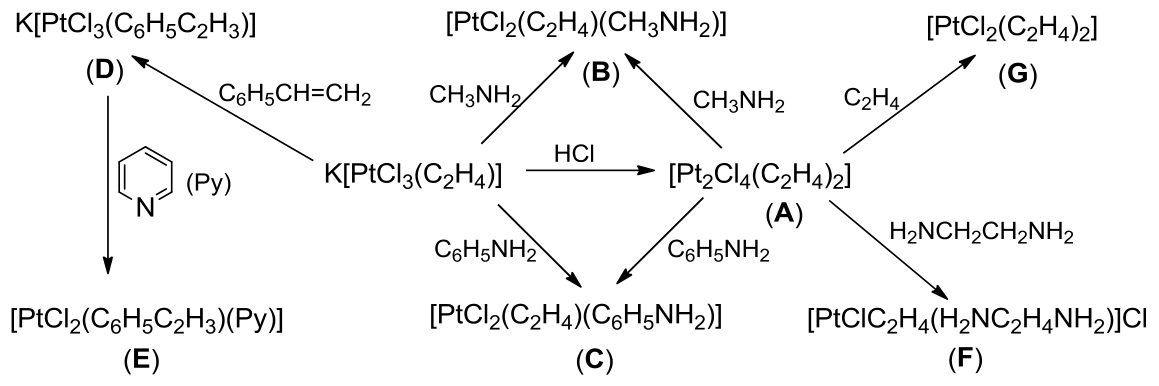
4.4 Draw the structure of A, given that the molecule of this complex has a centre of symmetry, no Pt-Pt bond, and no bridging alkene.
4.5 Draw the structures of B, C, D, E, F and G.
4.6 Suggest the driving force(s) for the formation of D and F by choosing one or more of the following statements (for example, i and ii):
i) formation of gas,
ii) formation of liquid,
iii) trans effect,
iv) chelate effect.
Official English text of the problem.
Answers
- 4.1
Method 1: \[ \ce{PtCl4 + 2C2H5OH + KCl -> K[PtCl3(C2H4)] + CH3CHO + H2O + 2HCl} \]
Method 2: \[ \ce{K2[PtCl6] + 2C2H5OH -> K[PtCl3(C2H4)] + KCl + CH3CHO + H2O + 2HCl} \]
Method 3: \[ \ce{K2[PtCl4] + C2H4 -> K[PtCl3(C2H4)] + KCl} \]
-
4.2 The isotopes are \(\ce{^{195}Pt}\), \(\ce{^{35}Cl}\), \(\ce{^{12}C}\), and \(\ce{^{1}H}\). The mass number is \(328\), corresponding to a nominal mass of \(328\,\mathrm{u}\).
-
4.3
| Structure | Number of H environments | H atoms in each environment | Number of C environments |
|---|---|---|---|
| Z1 | 2 | \(2+2\) | 2 |
| Z2 | 2 | \(3+1\) | 2 |
| Z3 | 2 | \(2+2\) | 2 |
| Z4 | 1 | \(4\) | 1 |
| Z5 | 2 | \(2+2\) | 1 |
-
4.4 A is Zeise’s dimer, \(\ce{[Pt2Cl4(C2H4)2]}\): two chloride bridges join the Pt atoms. Each Pt additionally carries one terminal chloride and one terminal \(\eta^2\)-ethene. The two halves are related by inversion; there is no Pt–Pt bond.
-
4.5 All Pt centers have square-planar arrangements of four ligand sites. Every alkene is coordinated through its double bond, \(\eta^2\).
| Product | Formula | Required arrangement |
|---|---|---|
| B | \(\ce{[PtCl2(C2H4)(CH3NH2)]}\) | Methylamine trans to ethene; chlorides mutually trans |
| C | \(\ce{[PtCl2(C2H4)(C6H5NH2)]}\) | Aniline trans to ethene; chlorides mutually trans |
| D | \(\ce{K[PtCl3(C6H5CH=CH2)]}\) | Styrene occupies the alkene site of Zeise’s salt |
| E | \(\ce{[PtCl2(C6H5CH=CH2)(Py)]}\) | Pyridine trans to styrene; chlorides mutually trans |
| F | \(\ce{[PtCl(C2H4)(H2NCH2CH2NH2)]Cl}\) | The two N donors are cis; ethene and coordinated chloride are cis |
| G | \(\ce{[PtCl2(C2H4)2]}\) | Ethenes mutually trans; chlorides mutually trans |
Names and SMILES are given with the structural explanations below.
- 4.6 D: i only. F: iii and iv.
Solution
The coordination SMILES below use the dative-bond extension -> or <-. Two carbon-to-Pt dative bonds represent an \(\eta^2\)-alkene, which occupies one ligand site. The required coordination geometry is specified in words because these strings do not encode it. Formula-unit SMILES for inorganic compounds do not specify their crystal structures.
4.1 — Preparation of Zeise’s salt
In methods 1 and 2, platinum is reduced from oxidation state \(+4\) to \(+2\). Of the two ethanol molecules consumed:
- One is oxidized to ethanal, supplying the two electrons required for this reduction.
- One supplies ethene by loss of water.
Thus the balanced overall equations are:
\[ \boxed{\ce{ PtCl4 + 2C2H5OH + KCl -> K[PtCl3(C2H4)] + CH3CHO + H2O + 2HCl }} \]
\[ \boxed{\ce{ K2[PtCl6] + 2C2H5OH -> K[PtCl3(C2H4)] + KCl + CH3CHO + H2O + 2HCl }} \]
Each equation consumes exactly two ethanol molecules per formula unit of Zeise’s salt. For example, the twelve ethanol hydrogen atoms appear as four in coordinated ethene, four in ethanal, two in water, and two in hydrogen chloride.
Method 3 is ligand substitution without a change in the platinum oxidation state: ethene replaces one coordinated chloride.
\[ \boxed{\ce{ K2[PtCl4] + C2H4 -> K[PtCl3(C2H4)] + KCl }} \]
The species used in these equations are:
| Species | Name | SMILES |
|---|---|---|
| \(\ce{C2H5OH}\) | Ethanol | CCO |
| \(\ce{C2H4}\) | Ethene, or ethylene | C=C |
| \(\ce{CH3CHO}\) | Ethanal, or acetaldehyde | CC=O |
| \(\ce{H2O}\) | Water | O |
| \(\ce{HCl}\) | Hydrogen chloride | Cl |
| \(\ce{KCl}\) | Potassium chloride | [K+].[Cl-] |
| \(\ce{PtCl4}\) | Platinum(IV) chloride | [Cl-]->[Pt+4](<-[Cl-])(<-[Cl-])<-[Cl-] |
| \(\ce{K2[PtCl6]}\) | Potassium hexachloridoplatinate(IV) | [K+].[K+].[Cl-]->[Pt+4](<-[Cl-])(<-[Cl-])(<-[Cl-])(<-[Cl-])<-[Cl-] |
| \(\ce{K2[PtCl4]}\) | Potassium tetrachloridoplatinate(II) | [K+].[K+].[Cl-]->[Pt+2](<-[Cl-])(<-[Cl-])<-[Cl-] |
| \(\ce{K[PtCl3(C2H4)]}\) | Potassium trichlorido(\(\eta^2\)-ethene)platinate(II), Zeise’s salt | [K+].C1=C->[Pt+2](<-[Cl-])(<-[Cl-])(<-[Cl-])<-1 |
4.2 — Isotopic mass number
Select the most abundant isotope of each element, rather than using abundance-weighted atomic masses:
| Element | Selected isotope | Given abundance |
|---|---|---|
| Pt | \(\ce{^{195}Pt}\) | \(33.8\%\) |
| Cl | \(\ce{^{35}Cl}\) | \(75.8\%\) |
| C | \(\ce{^{12}C}\) | \(98.9\%\) |
| H | \(\ce{^{1}H}\) | \(99.99\%\) |
The mass-number sum is
\[ A=195+3(35)+2(12)+4(1)=\boxed{328}. \]
Mass number is dimensionless; the corresponding nominal ionic mass is \(328\,\mathrm{u}\). An exact isotopic mass cannot be calculated from mass numbers alone.
The selected trichlorido(\(\eta^2\)-ethene)platinate(II) isotopologue anion has the explicitly isotope-labelled SMILES:
[1H][12C]1([1H])=[12C]([1H])([1H])->[195Pt+2](<-[35Cl-])(<-[35Cl-])(<-[35Cl-])<-1
4.3 — NMR environments
Count chemically distinct environments, not the individual lines arising from spin–spin coupling. Symmetry-related nuclei have the same chemical shift in the usual achiral NMR environment.
For reference, the proposed structures have the following connectivity descriptions. In the covalent SMILES for Z1–Z3 and Z5, the Pt formal charge is SMILES bookkeeping, not a statement of its oxidation state.
| Structure | Name or structural description | SMILES |
|---|---|---|
| Z1 | Proposed dichlorido(2-chloroethyl)platinate anion, chelated through carbon and chlorine | C1CCl->[Pt-]1(Cl)Cl |
| Z2 | Proposed trichlorido(ethylidene)platinum anion, with a \(\ce{Pt=CHCH3}\) group | CC=[Pt-](Cl)(Cl)Cl |
| Z3 | Proposed trichlorido(ethane-1,2-diyl)platinate anion; a platinacyclopropane with one carbon basal and one apical | C1C[Pt-]1(Cl)(Cl)Cl |
| Z4 | Trichlorido(\(\eta^2\)-ethene)platinate(II), the Zeise anion | C1=C->[Pt+2](<-[Cl-])(<-[Cl-])(<-[Cl-])<-1 |
| Z5 | Proposed trichlorido(ethane-1,2-diyl)platinate anion; both carbons basal and one chloride apical | C1C[Pt-]1(Cl)(Cl)Cl |
The distinction between Z3 and Z5 is geometrical and therefore is not conveyed by their identical connectivity SMILES.
-
Z1: The two carbons have different connectivities: one is bonded directly to Pt, while the other is bonded to the coordinating chlorine. They therefore give two carbon environments. Reflection in the plane of the heavy-atom framework exchanges the two hydrogens on each methylene, giving two hydrogen environments, \(2+2\).
-
Z2: The methyl carbon and the Pt-bound methine carbon are different. The methyl hydrogens form the usual equivalent three-proton set, while the methine hydrogen is distinct. Thus there are two hydrogen environments, \(3+1\), and two carbon environments. Ordinary methyl-group averaging is used here; distinct coordination sites are not interchanged.
-
Z3: One carbon occupies a basal position and the other an apical position, so the carbons are inequivalent. A mirror plane through Pt and the two carbons exchanges the two hydrogens on each carbon. Thus there are two hydrogen environments, \(2+2\), and two carbon environments.
-
Z4: The ethene C–C axis is perpendicular to the square coordination plane. The symmetry operations exchange the two carbons and also the two hydrogens on each carbon. Consequently, all four hydrogens are equivalent, and both carbons are equivalent.
-
Z5: A symmetry plane exchanges the two carbon positions, so there is one carbon environment. However, the apical chloride distinguishes the two sides of the basal plane. Hydrogens on opposite sides are inequivalent, giving two hydrogen environments, \(2+2\).
Therefore:
| Structure | H environments | H atoms per environment | C environments |
|---|---|---|---|
| Z1 | 2 | \(2+2\) | 2 |
| Z2 | 2 | \(3+1\) | 2 |
| Z3 | 2 | \(2+2\) | 2 |
| Z4 | 1 | \(4\) | 1 |
| Z5 | 2 | \(2+2\) | 1 |
4.4 — Structure of A
Each square-planar Pt center has one ethene ligand and therefore requires three chloride contacts. The two Pt centers require six Pt–Cl contacts in total, but A contains only four chloride atoms.
Let \(b\) be the number of bridging chlorides and \(t\) the number of terminal chlorides. Then
\[ b+t=4,\qquad 2b+t=6, \]
so
\[ b=2,\qquad t=2. \]
Thus A is di-\(\mu\)-chlorido-bis[chlorido(\(\eta^2\)-ethene)platinum(II)], commonly called Zeise’s dimer.
SMILES:
C1=C->[Pt+2]2<-1(<-[Cl-])<-[Cl-]->[Pt+2]3(<-[Cl-])(<-C=C->3)<-[Cl-]->2
To draw it precisely:
- Draw a four-membered ring whose successive vertices are \(\mathrm{Pt}_1\), bridging \(\mathrm{Cl}_a\), \(\mathrm{Pt}_2\), and bridging \(\mathrm{Cl}_b\).
- Attach one terminal chloride and one terminal \(\eta^2\)-ethene to each Pt.
- At \(\mathrm{Pt}_1\), place ethene trans to \(\mathrm{Cl}_a\) and terminal chloride trans to \(\mathrm{Cl}_b\).
- At \(\mathrm{Pt}_2\), place ethene trans to \(\mathrm{Cl}_b\) and terminal chloride trans to \(\mathrm{Cl}_a\).
The center of the ring is then an inversion center. The two ethenes are terminal and inversion-related, as are the two terminal chlorides. Do not draw a Pt–Pt bond.
The balanced net formation reaction is
\[ \ce{ 2K[PtCl3(C2H4)] ->[HCl] [Pt2Cl4(C2H4)2] + 2KCl }. \]
Here \(\ce{HCl}\) is the stated reaction condition and is not consumed in the net equation.
4.5 — Structures of B–G
Ethene has a stronger trans effect than chloride. Consequently, substitution preferentially occurs at the chloride site trans to ethene. In A, this is a bridging Pt–Cl bond; its cleavage allows the incoming ligand to occupy that site.
The incoming molecular ligands are:
| Ligand | Name | SMILES |
|---|---|---|
| \(\ce{CH3NH2}\) | Methylamine | CN |
| \(\ce{C6H5NH2}\) | Aniline | Nc1ccccc1 |
| \(\ce{C6H5CH=CH2}\) | Styrene, or ethenylbenzene | C=Cc1ccccc1 |
| Py, \(\ce{C5H5N}\) | Pyridine | n1ccccc1 |
| \(\ce{H2NCH2CH2NH2}\) | Ethane-1,2-diamine, or ethylenediamine | NCCN |
B — trans-Dichlorido(\(\eta^2\)-ethene)(methylamine)platinum(II)
\[ \ce{[PtCl2(C2H4)(CH3NH2)]} \]
SMILES: CN->[Pt+2]1(<-[Cl-])(<-[Cl-])<-C=C->1
Draw methylamine coordinated through N trans to ethene. The two chlorides occupy the remaining mutually trans sites.
C — trans-Dichlorido(\(\eta^2\)-ethene)(aniline)platinum(II)
\[ \ce{[PtCl2(C2H4)(C6H5NH2)]} \]
SMILES: c1ccccc1N->[Pt+2]2(<-[Cl-])(<-[Cl-])<-C=C->2
Draw aniline coordinated through its amino N trans to ethene, with the two chlorides mutually trans.
Both preparations of B and C are represented by the balanced equations
\[ \ce{ K[PtCl3(C2H4)] + RNH2 -> [PtCl2(C2H4)(RNH2)] + KCl } \]
and
\[ \ce{ [Pt2Cl4(C2H4)2] + 2RNH2 -> 2[PtCl2(C2H4)(RNH2)] }, \]
where \(R=\ce{CH3}\) gives B and \(R=\ce{C6H5}\) gives C.
D — Potassium trichlorido(\(\eta^2\)-styrene)platinate(II)
\[ \ce{K[PtCl3(C6H5CH=CH2)]} \]
SMILES: [K+].c1ccccc1C2=C->[Pt+2](<-[Cl-])(<-[Cl-])(<-[Cl-])<-2
Replace the ethene in Zeise’s salt by styrene, coordinated through the two carbons of its vinyl double bond. The phenyl ring is not the coordinating group. The other three ligand sites remain occupied by chlorides.
\[ \ce{ K[PtCl3(C2H4)] + C6H5CH=CH2 -> K[PtCl3(C6H5CH=CH2)] + C2H4(g) } \]
E — trans-Dichlorido(pyridine)(\(\eta^2\)-styrene)platinum(II)
\[ \ce{[PtCl2(C6H5CH=CH2)(C5H5N)]} \]
SMILES: c1ccccc1C2=C->[Pt+2]<-2(<-[Cl-])(<-[Cl-])<-n3ccccc3
Pyridine coordinates through N at the chloride position trans to styrene. The remaining chlorides are mutually trans.
\[ \ce{ K[PtCl3(C6H5CH=CH2)] + C5H5N -> [PtCl2(C6H5CH=CH2)(C5H5N)] + KCl } \]
F — Chlorido(\(\eta^2\)-ethene)(ethane-1,2-diamine-\(\kappa^2N,N'\))platinum(II) chloride
\[ \ce{[PtCl(C2H4)(H2NCH2CH2NH2)]Cl} \]
SMILES: [Cl-].C1=C->[Pt+2]2<-1(<-[Cl-])<-NCCN->2
Draw both nitrogen atoms of one ethylenediamine coordinated to adjacent Pt sites, producing a five-membered Pt–N–C–C–N chelate ring. Ethene and the coordinated chloride occupy the other two adjacent sites.
Thus:
- One N donor is trans to ethene.
- The other N donor is trans to coordinated chloride.
- The complex ion has charge \(+1\), with one external chloride counterion.
The balanced reaction is
\[ \ce{ [Pt2Cl4(C2H4)2] + 2H2NCH2CH2NH2 -> 2[PtCl(C2H4)(H2NCH2CH2NH2)]Cl }. \]
G — trans-Dichloridobis(\(\eta^2\)-ethene)platinum(II)
\[ \ce{[PtCl2(C2H4)2]} \]
SMILES: C1=C->[Pt+2]2<-1(<-[Cl-])(<-[Cl-])<-C=C->2
Incoming ethene replaces the bridging chloride contact trans to the original ethene. Therefore the two ethene ligands are mutually trans, and the two chlorides are mutually trans.
\[ \ce{ [Pt2Cl4(C2H4)2] + 2C2H4 -> 2[PtCl2(C2H4)2] } \]
4.6 — Driving forces
Formation of D: i only — formation of gas.
Styrene replaces coordinated ethene, releasing \(\ce{C2H4(g)}\). Escape of ethene from the reaction mixture favors formation of D. Thus only i applies to this alkene-exchange reaction.
Formation of F: iii and iv — trans effect and chelate effect.
The strong trans effect of coordinated ethene facilitates cleavage of the Pt–Cl bridge trans to it. One nitrogen of ethylenediamine binds at that position. The second nitrogen then binds at an adjacent site, replacing another chloride contact and closing the five-membered chelate ring.
Thus the trans effect directs the substitution, and the chelate effect favors binding both N donors of the same ligand. In the sense used by the question, both iii and iv apply.
The answers were checked against the official answers published by the organisers.
IChO 2014 · Theorieaufgabe 4
Zeisesches Salz
Das Zeisesche Salz, \(\ce{K[PtCl3C2H4]}\), war eine der ersten beschriebenen metallorganischen Verbindungen. W. C. Zeise, Professor an der Universität Kopenhagen, stellte diese Verbindung 1827 her, indem er \(\ce{PtCl4}\) mit siedendem Ethanol umsetzte und anschließend Kaliumchlorid zugab (Methode 1). Diese Verbindung lässt sich auch durch Erhitzen eines Gemischs aus \(\ce{K2[PtCl6]}\) und Ethanol unter Rückfluss herstellen (Methode 2). Das im Handel erhältliche Zeisesche Salz wird üblicherweise aus \(\ce{K2[PtCl4]}\) und Ethen hergestellt (Methode 3).
4.1 Stellen Sie für jede der oben genannten Methoden zur Herstellung des Zeiseschen Salzes die ausgeglichene Reaktionsgleichung auf. Dabei werden bei den Methoden 1 und 2 zur Bildung von 1 Mol Zeiseschem Salz 2 Mol Ethanol verbraucht.
4.2 Das Massenspektrum des Anions \(\ce{[PtCl3C2H4]-}\) zeigt eine Gruppe von Peaks mit Massenzahlen von 325–337 \(au\) und unterschiedlichen Intensitäten. Berechnen Sie die Massenzahl des Anions, das aus den Isotopen mit der jeweils größten natürlichen Häufigkeit besteht (verwenden Sie die unten angegebenen Daten).
| Isotop | \(\ce{^{192}_{78}Pt}\) | \(\ce{^{194}_{78}Pt}\) | \(\ce{^{195}_{78}Pt}\) | \(\ce{^{196}_{78}Pt}\) | \(\ce{^{198}_{78}Pt}\) | \(\ce{^{35}_{17}Cl}\) | \(\ce{^{37}_{17}Cl}\) | \(\ce{^{12}_{6}C}\) | \(\ce{^{13}_{6}C}\) | \(\ce{^{1}_{1}H}\) |
|---|---|---|---|---|---|---|---|---|---|---|
| Natürliche Häufigkeit, % | 0.8 | 32.9 | 33.8 | 25.3 | 7.2 | 75.8 | 24.2 | 98.9 | 1.1 | 99.99 |
Einige der früher für das Anion des Zeiseschen Salzes vorgeschlagenen Strukturen waren:
In den Strukturen Z1, Z2 und Z5 liegen beide Kohlenstoffatome in derselben Ebene wie das gestrichelt gezeichnete Quadrat.
[Gehen Sie davon aus, dass diese Strukturen keinen fluktuierenden Prozess durchlaufen, bei dem zwei oder mehr Positionen ausgetauscht werden.]
Mithilfe der NMR-Spektroskopie konnte die Struktur des Zeiseschen Salzes als Struktur Z4 bestimmt werden.
4.3 Geben Sie für jede Struktur Z1 – Z5 in der folgenden Tabelle an, wie viele Wasserstoffatome sich in den jeweiligen unterschiedlichen Umgebungen befinden, wie viele unterschiedliche Umgebungen der Wasserstoffatome es gibt und wie viele unterschiedliche Umgebungen der Kohlenstoffatome es gibt.
| Struktur | Anzahl unterschiedlicher Umgebungen der Wasserstoffatome | Anzahl unterschiedlicher Umgebungen der Kohlenstoffatome |
|---|---|---|
| Z1 | ||
| Z2 | ||
| Z3 | ||
| Z4 | ||
| Z5 |
Bei Substitutionsreaktionen quadratisch-planarer Platin(II)-Komplexe lassen sich die Liganden nach ihrer Fähigkeit ordnen, eine Substitution in der zu ihnen trans-ständigen Position zu erleichtern (der trans-Effekt). Die Reihenfolge der Liganden lautet:
\[ \ce{CO},\ \ce{CN-},\ \ce{C2H4} > \ce{PR3},\ \ce{H-} > \ce{CH3-},\ \ce{C6H5-},\ \ce{I-},\ \ce{SCN-} > \ce{Br-} > \ce{Cl-} > \mathrm{Py} > \ce{NH3} > \ce{OH-},\ \ce{H2O} \]
In der obigen Reihe hat ein links stehender Ligand einen stärkeren trans-Effekt als ein rechts stehender Ligand.
Einige Reaktionen des Zeiseschen Salzes und des Komplexes \(\ce{[Pt2Cl4(C2H4)2]}\) sind unten dargestellt.
4.4 Zeichnen Sie die Struktur von A, wobei gegeben ist, dass das Molekül dieses Komplexes ein Symmetriezentrum, keine Pt-Pt-Bindung und kein verbrückendes Alken besitzt.
4.5 Zeichnen Sie die Strukturen von B, C, D, E, F und G.
4.6 Geben Sie die Triebkraft bzw. die Triebkräfte für die Bildung von D und F an, indem Sie eine oder mehrere der folgenden Aussagen auswählen (zum Beispiel i und ii):
i) Bildung eines Gases,
ii) Bildung einer Flüssigkeit,
iii) trans-Effekt,
iv) Chelateffekt.
Aufgabentext aus dem offiziellen englischen Text übersetzt.
Antworten
- 4.1
Methode 1: \[ \ce{PtCl4 + 2C2H5OH + KCl -> K[PtCl3(C2H4)] + CH3CHO + H2O + 2HCl} \]
Methode 2: \[ \ce{K2[PtCl6] + 2C2H5OH -> K[PtCl3(C2H4)] + KCl + CH3CHO + H2O + 2HCl} \]
Methode 3: \[ \ce{K2[PtCl4] + C2H4 -> K[PtCl3(C2H4)] + KCl} \]
-
4.2 Die Isotope sind \(\ce{^{195}Pt}\), \(\ce{^{35}Cl}\), \(\ce{^{12}C}\) und \(\ce{^{1}H}\). Die Massenzahl beträgt \(328\), entsprechend einer Nominalmasse von \(328\,\mathrm{u}\).
-
4.3
| Struktur | Anzahl der H-Umgebungen | H-Atome in jeder Umgebung | Anzahl der C-Umgebungen |
|---|---|---|---|
| Z1 | 2 | \(2+2\) | 2 |
| Z2 | 2 | \(3+1\) | 2 |
| Z3 | 2 | \(2+2\) | 2 |
| Z4 | 1 | \(4\) | 1 |
| Z5 | 2 | \(2+2\) | 1 |
-
4.4 A ist das Zeisesche Dimer, \(\ce{[Pt2Cl4(C2H4)2]}\): Zwei Chloridbrücken verbinden die Pt-Atome. Jedes Pt trägt zusätzlich ein terminales Chlorid und ein terminales \(\eta^2\)-Ethen. Die beiden Hälften gehen durch Inversion ineinander über; es gibt keine Pt–Pt-Bindung.
-
4.5 Alle Pt-Zentren weisen eine quadratisch-planare Anordnung von vier Ligandenpositionen auf. Jedes Alken ist über seine Doppelbindung koordiniert, \(\eta^2\).
| Produkt | Formel | Erforderliche Anordnung |
|---|---|---|
| B | \(\ce{[PtCl2(C2H4)(CH3NH2)]}\) | Methylamin trans zu Ethen; Chloride zueinander trans-ständig |
| C | \(\ce{[PtCl2(C2H4)(C6H5NH2)]}\) | Anilin trans zu Ethen; Chloride zueinander trans-ständig |
| D | \(\ce{K[PtCl3(C6H5CH=CH2)]}\) | Styrol besetzt die Alkenposition des Zeiseschen Salzes |
| E | \(\ce{[PtCl2(C6H5CH=CH2)(Py)]}\) | Pyridin trans zu Styrol; Chloride zueinander trans-ständig |
| F | \(\ce{[PtCl(C2H4)(H2NCH2CH2NH2)]Cl}\) | Die beiden N-Donoren sind cis-ständig; Ethen und koordiniertes Chlorid sind cis-ständig |
| G | \(\ce{[PtCl2(C2H4)2]}\) | Ethenliganden zueinander trans-ständig; Chloride zueinander trans-ständig |
Namen und SMILES sind unten bei den Erläuterungen zu den Strukturen angegeben.
- 4.6 D: nur i. F: iii und iv.
Lösung
Die folgenden Koordinations-SMILES verwenden die Erweiterung für koordinative Bindungen -> oder <-. Zwei koordinative Bindungen von Kohlenstoff zu Pt stellen ein \(\eta^2\)-Alken dar, das eine Ligandenposition besetzt. Die erforderliche Koordinationsgeometrie wird in Worten angegeben, da diese Zeichenfolgen sie nicht codieren. SMILES von Formeleinheiten anorganischer Verbindungen geben deren Kristallstrukturen nicht an.
4.1 — Herstellung des Zeiseschen Salzes
Bei den Methoden 1 und 2 wird Platin von der Oxidationsstufe \(+4\) zur Oxidationsstufe \(+2\) reduziert. Von den beiden verbrauchten Ethanolmolekülen:
- wird eines zu Ethanal oxidiert und liefert dabei die beiden für diese Reduktion erforderlichen Elektronen.
- liefert eines durch Wasserabspaltung Ethen.
Damit lauten die ausgeglichenen Gesamtgleichungen:
\[ \boxed{\ce{ PtCl4 + 2C2H5OH + KCl -> K[PtCl3(C2H4)] + CH3CHO + H2O + 2HCl }} \]
\[ \boxed{\ce{ K2[PtCl6] + 2C2H5OH -> K[PtCl3(C2H4)] + KCl + CH3CHO + H2O + 2HCl }} \]
In jeder Gleichung werden genau zwei Ethanolmoleküle pro Formeleinheit des Zeiseschen Salzes verbraucht. Beispielsweise finden sich die zwölf Wasserstoffatome des Ethanols zu viert im koordinierten Ethen, zu viert im Ethanal, zu zweit im Wasser und zu zweit im Chlorwasserstoff wieder.
Methode 3 ist eine Ligandensubstitution ohne Änderung der Oxidationsstufe des Platins: Ethen ersetzt ein koordiniertes Chlorid.
\[ \boxed{\ce{ K2[PtCl4] + C2H4 -> K[PtCl3(C2H4)] + KCl }} \]
Die in diesen Gleichungen verwendeten Spezies sind:
| Spezies | Name | SMILES |
|---|---|---|
| \(\ce{C2H5OH}\) | Ethanol | CCO |
| \(\ce{C2H4}\) | Ethen oder Ethylen | C=C |
| \(\ce{CH3CHO}\) | Ethanal oder Acetaldehyd | CC=O |
| \(\ce{H2O}\) | Wasser | O |
| \(\ce{HCl}\) | Chlorwasserstoff | Cl |
| \(\ce{KCl}\) | Kaliumchlorid | [K+].[Cl-] |
| \(\ce{PtCl4}\) | Platin(IV)-chlorid | [Cl-]->[Pt+4](<-[Cl-])(<-[Cl-])<-[Cl-] |
| \(\ce{K2[PtCl6]}\) | Kaliumhexachloridoplatinat(IV) | [K+].[K+].[Cl-]->[Pt+4](<-[Cl-])(<-[Cl-])(<-[Cl-])(<-[Cl-])<-[Cl-] |
| \(\ce{K2[PtCl4]}\) | Kaliumtetrachloridoplatinat(II) | [K+].[K+].[Cl-]->[Pt+2](<-[Cl-])(<-[Cl-])<-[Cl-] |
| \(\ce{K[PtCl3(C2H4)]}\) | Kaliumtrichlorido(\(\eta^2\)-ethen)platinat(II), Zeisesches Salz | [K+].C1=C->[Pt+2](<-[Cl-])(<-[Cl-])(<-[Cl-])<-1 |
4.2 — Isotopische Massenzahl
Wählen Sie das häufigste Isotop jedes Elements aus, statt nach der Häufigkeit gewichtete Atommassen zu verwenden:
| Element | Ausgewähltes Isotop | Angegebene Häufigkeit |
|---|---|---|
| Pt | \(\ce{^{195}Pt}\) | \(33.8\%\) |
| Cl | \(\ce{^{35}Cl}\) | \(75.8\%\) |
| C | \(\ce{^{12}C}\) | \(98.9\%\) |
| H | \(\ce{^{1}H}\) | \(99.99\%\) |
Die Summe der Massenzahlen ist
\[ A=195+3(35)+2(12)+4(1)=\boxed{328}. \]
Die Massenzahl ist dimensionslos; die entsprechende nominale Ionenmasse beträgt \(328\,\mathrm{u}\). Eine exakte Isotopenmasse lässt sich nicht allein aus Massenzahlen berechnen.
Das ausgewählte isotopologe Trichlorido(\(\eta^2\)-ethen)platinat(II)-Anion hat den folgenden SMILES mit expliziter Isotopenkennzeichnung:
[1H][12C]1([1H])=[12C]([1H])([1H])->[195Pt+2](<-[35Cl-])(<-[35Cl-])(<-[35Cl-])<-1
4.3 — NMR-Umgebungen
Zählen Sie chemisch unterschiedliche Umgebungen, nicht die einzelnen Linien, die durch Spin-Spin-Kopplung entstehen. Durch Symmetrie ineinander überführbare Kerne haben in der üblichen achiralen NMR-Umgebung dieselbe chemische Verschiebung.
Zur Orientierung sind im Folgenden die Konnektivitäten der vorgeschlagenen Strukturen beschrieben. In den kovalenten SMILES für Z1–Z3 und Z5 dient die Formalladung des Pt der formalen SMILES-Buchführung und ist keine Aussage über seine Oxidationsstufe.
| Struktur | Name oder Strukturbeschreibung | SMILES |
|---|---|---|
| Z1 | Vorgeschlagenes Dichlorido(2-chlorethyl)platinat-Anion, über Kohlenstoff und Chlor chelatisiert | C1CCl->[Pt-]1(Cl)Cl |
| Z2 | Vorgeschlagenes Trichlorido(ethyliden)platin-Anion mit einer \(\ce{Pt=CHCH3}\)-Gruppe | CC=[Pt-](Cl)(Cl)Cl |
| Z3 | Vorgeschlagenes Trichlorido(ethan-1,2-diyl)platinat-Anion; ein Platinacyclopropan mit einem basalen und einem apikalen Kohlenstoffatom | C1C[Pt-]1(Cl)(Cl)Cl |
| Z4 | Trichlorido(\(\eta^2\)-ethen)platinat(II), das Zeise-Anion | C1=C->[Pt+2](<-[Cl-])(<-[Cl-])(<-[Cl-])<-1 |
| Z5 | Vorgeschlagenes Trichlorido(ethan-1,2-diyl)platinat-Anion; beide Kohlenstoffatome basal und ein Chlorid apikal | C1C[Pt-]1(Cl)(Cl)Cl |
Der Unterschied zwischen Z3 und Z5 ist geometrischer Natur und wird daher durch ihre identischen Konnektivitäts-SMILES nicht wiedergegeben.
-
Z1: Die beiden Kohlenstoffatome haben unterschiedliche Konnektivitäten: Eines ist direkt an Pt gebunden, während das andere an das koordinierende Chlor gebunden ist. Daher ergeben sich zwei Kohlenstoffumgebungen. Eine Spiegelung an der Ebene des Schweratomgerüsts vertauscht die beiden Wasserstoffatome jeder Methylengruppe, sodass sich zwei Wasserstoffumgebungen, \(2+2\), ergeben.
-
Z2: Das Methyl-Kohlenstoffatom und das an Pt gebundene Methin-Kohlenstoffatom sind unterschiedlich. Die Methyl-Wasserstoffatome bilden die übliche Gruppe von drei äquivalenten Protonen, während sich das Methin-Wasserstoffatom davon unterscheidet. Somit gibt es zwei Wasserstoffumgebungen, \(3+1\), und zwei Kohlenstoffumgebungen. Hier wird die gewöhnliche Mittelung innerhalb der Methylgruppe zugrunde gelegt; unterschiedliche Koordinationspositionen werden nicht vertauscht.
-
Z3: Ein Kohlenstoffatom besetzt eine basale Position und das andere eine apikale Position, sodass die Kohlenstoffatome nicht äquivalent sind. Eine Spiegelebene durch Pt und die beiden Kohlenstoffatome vertauscht die beiden Wasserstoffatome an jedem Kohlenstoffatom. Somit gibt es zwei Wasserstoffumgebungen, \(2+2\), und zwei Kohlenstoffumgebungen.
-
Z4: Die C–C-Achse des Ethens steht senkrecht zur quadratischen Koordinationsebene. Die Symmetrieoperationen vertauschen sowohl die beiden Kohlenstoffatome als auch die beiden Wasserstoffatome an jedem Kohlenstoffatom. Folglich sind alle vier Wasserstoffatome äquivalent, und beide Kohlenstoffatome sind äquivalent.
-
Z5: Eine Symmetrieebene vertauscht die beiden Kohlenstoffpositionen, sodass es eine Kohlenstoffumgebung gibt. Das apikale Chlorid unterscheidet jedoch die beiden Seiten der Basalebene. Wasserstoffatome auf gegenüberliegenden Seiten sind nicht äquivalent, sodass sich zwei Wasserstoffumgebungen, \(2+2\), ergeben.
Daraus folgt:
| Struktur | H-Umgebungen | H-Atome pro Umgebung | C-Umgebungen |
|---|---|---|---|
| Z1 | 2 | \(2+2\) | 2 |
| Z2 | 2 | \(3+1\) | 2 |
| Z3 | 2 | \(2+2\) | 2 |
| Z4 | 1 | \(4\) | 1 |
| Z5 | 2 | \(2+2\) | 1 |
4.4 — Struktur von A
Jedes quadratisch-planare Pt-Zentrum besitzt einen Ethenliganden und benötigt daher drei Chloridkontakte. Die beiden Pt-Zentren benötigen insgesamt sechs Pt–Cl-Kontakte, aber A enthält nur vier Chloridatome.
Seien \(b\) die Anzahl der verbrückenden Chloride und \(t\) die Anzahl der terminalen Chloride. Dann gilt
\[ b+t=4,\qquad 2b+t=6, \]
also
\[ b=2,\qquad t=2. \]
Somit ist A Di-\(\mu\)-chlorido-bis[chlorido(\(\eta^2\)-ethen)platin(II)], üblicherweise Zeisesches Dimer genannt.
SMILES:
C1=C->[Pt+2]2<-1(<-[Cl-])<-[Cl-]->[Pt+2]3(<-[Cl-])(<-C=C->3)<-[Cl-]->2
So lässt es sich genau zeichnen:
- Zeichnen Sie einen viergliedrigen Ring, dessen aufeinanderfolgende Eckpunkte \(\mathrm{Pt}_1\), verbrückendes \(\mathrm{Cl}_a\), \(\mathrm{Pt}_2\) und verbrückendes \(\mathrm{Cl}_b\) sind.
- Fügen Sie an jedem Pt ein terminales Chlorid und ein terminales \(\eta^2\)-Ethen an.
- Ordnen Sie an \(\mathrm{Pt}_1\) Ethen trans zu \(\mathrm{Cl}_a\) und das terminale Chlorid trans zu \(\mathrm{Cl}_b\) an.
- Ordnen Sie an \(\mathrm{Pt}_2\) Ethen trans zu \(\mathrm{Cl}_b\) und das terminale Chlorid trans zu \(\mathrm{Cl}_a\) an.
Das Zentrum des Rings ist dann ein Inversionszentrum. Die beiden Ethenliganden sind terminal und gehen durch Inversion ineinander über, ebenso die beiden terminalen Chloride. Zeichnen Sie keine Pt–Pt-Bindung.
Die ausgeglichene Nettobildungsreaktion lautet
\[ \ce{ 2K[PtCl3(C2H4)] ->[HCl] [Pt2Cl4(C2H4)2] + 2KCl }. \]
Hier ist \(\ce{HCl}\) die angegebene Reaktionsbedingung und wird in der Nettogleichung nicht verbraucht.
4.5 — Strukturen von B–G
Ethen hat einen stärkeren trans-Effekt als Chlorid. Daher erfolgt die Substitution bevorzugt an der Chloridposition trans zu Ethen. In A ist dies eine verbrückende Pt–Cl-Bindung; ihre Spaltung ermöglicht es dem eintretenden Liganden, diese Position zu besetzen.
Die eintretenden molekularen Liganden sind:
| Ligand | Name | SMILES |
|---|---|---|
| \(\ce{CH3NH2}\) | Methylamin | CN |
| \(\ce{C6H5NH2}\) | Anilin | Nc1ccccc1 |
| \(\ce{C6H5CH=CH2}\) | Styrol oder Ethenylbenzol | C=Cc1ccccc1 |
| Py, \(\ce{C5H5N}\) | Pyridin | n1ccccc1 |
| \(\ce{H2NCH2CH2NH2}\) | Ethan-1,2-diamin oder Ethylendiamin | NCCN |
B — trans-Dichlorido(\(\eta^2\)-ethen)(methylamin)platin(II)
\[ \ce{[PtCl2(C2H4)(CH3NH2)]} \]
SMILES: CN->[Pt+2]1(<-[Cl-])(<-[Cl-])<-C=C->1
Zeichnen Sie Methylamin über N koordiniert trans zu Ethen. Die beiden Chloride besetzen die verbleibenden, zueinander trans-ständigen Positionen.
C — trans-Dichlorido(\(\eta^2\)-ethen)(anilin)platin(II)
\[ \ce{[PtCl2(C2H4)(C6H5NH2)]} \]
SMILES: c1ccccc1N->[Pt+2]2(<-[Cl-])(<-[Cl-])<-C=C->2
Zeichnen Sie Anilin über sein Amino-N koordiniert trans zu Ethen, wobei die beiden Chloride zueinander trans-ständig sind.
Die beiden Herstellungswege für B und C werden durch die ausgeglichenen Gleichungen
\[ \ce{ K[PtCl3(C2H4)] + RNH2 -> [PtCl2(C2H4)(RNH2)] + KCl } \]
und
\[ \ce{ [Pt2Cl4(C2H4)2] + 2RNH2 -> 2[PtCl2(C2H4)(RNH2)] }, \]
dargestellt, wobei \(R=\ce{CH3}\) B und \(R=\ce{C6H5}\) C ergibt.
D — Kaliumtrichlorido(\(\eta^2\)-styrol)platinat(II)
\[ \ce{K[PtCl3(C6H5CH=CH2)]} \]
SMILES: [K+].c1ccccc1C2=C->[Pt+2](<-[Cl-])(<-[Cl-])(<-[Cl-])<-2
Ersetzen Sie das Ethen im Zeiseschen Salz durch Styrol, das über die beiden Kohlenstoffatome seiner Vinyldoppelbindung koordiniert ist. Der Phenylring ist nicht die koordinierende Gruppe. Die anderen drei Ligandenpositionen bleiben mit Chloriden besetzt.
\[ \ce{ K[PtCl3(C2H4)] + C6H5CH=CH2 -> K[PtCl3(C6H5CH=CH2)] + C2H4(g) } \]
E — trans-Dichlorido(pyridin)(\(\eta^2\)-styrol)platin(II)
\[ \ce{[PtCl2(C6H5CH=CH2)(C5H5N)]} \]
SMILES: c1ccccc1C2=C->[Pt+2]<-2(<-[Cl-])(<-[Cl-])<-n3ccccc3
Pyridin koordiniert über N an der Chloridposition trans zu Styrol. Die verbleibenden Chloride sind zueinander trans-ständig.
\[ \ce{ K[PtCl3(C6H5CH=CH2)] + C5H5N -> [PtCl2(C6H5CH=CH2)(C5H5N)] + KCl } \]
F — Chlorido(\(\eta^2\)-ethen)(ethan-1,2-diamin-\(\kappa^2N,N'\))platin(II)-chlorid
\[ \ce{[PtCl(C2H4)(H2NCH2CH2NH2)]Cl} \]
SMILES: [Cl-].C1=C->[Pt+2]2<-1(<-[Cl-])<-NCCN->2
Zeichnen Sie beide Stickstoffatome eines Ethylendiamins an benachbarte Pt-Positionen koordiniert, wodurch ein fünfgliedriger Pt–N–C–C–N-Chelatring entsteht. Ethen und das koordinierte Chlorid besetzen die beiden anderen benachbarten Positionen.
Damit gilt:
- Ein N-Donor steht trans zu Ethen.
- Der andere N-Donor steht trans zum koordinierten Chlorid.
- Das Komplexion hat die Ladung \(+1\) und ein äußeres Chlorid als Gegenion.
Die ausgeglichene Reaktion lautet
\[ \ce{ [Pt2Cl4(C2H4)2] + 2H2NCH2CH2NH2 -> 2[PtCl(C2H4)(H2NCH2CH2NH2)]Cl }. \]
G — trans-Dichloridobis(\(\eta^2\)-ethen)platin(II)
\[ \ce{[PtCl2(C2H4)2]} \]
SMILES: C1=C->[Pt+2]2<-1(<-[Cl-])(<-[Cl-])<-C=C->2
Eintretendes Ethen ersetzt den verbrückenden Chloridkontakt trans zum ursprünglichen Ethen. Daher sind die beiden Ethenliganden zueinander trans-ständig, und die beiden Chloride sind zueinander trans-ständig.
\[ \ce{ [Pt2Cl4(C2H4)2] + 2C2H4 -> 2[PtCl2(C2H4)2] } \]
4.6 — Triebkräfte
Bildung von D: nur i — Bildung eines Gases.
Styrol ersetzt koordiniertes Ethen, wobei \(\ce{C2H4(g)}\) freigesetzt wird. Das Entweichen von Ethen aus dem Reaktionsgemisch begünstigt die Bildung von D. Somit trifft auf diese Alkenaustauschreaktion nur i zu.
Bildung von F: iii und iv — trans-Effekt und Chelateffekt.
Der starke trans-Effekt des koordinierten Ethens erleichtert die Spaltung der dazu trans-ständigen Pt–Cl-Brücke. Ein Stickstoffatom des Ethylendiamins bindet an dieser Position. Das zweite Stickstoffatom bindet anschließend an einer benachbarten Position, ersetzt dabei einen weiteren Chloridkontakt und schließt den fünfgliedrigen Chelatring.
Somit lenkt der trans-Effekt die Substitution, und der Chelateffekt begünstigt die Bindung beider N-Donoren desselben Liganden. Im Sinne der Fragestellung treffen sowohl iii als auch iv zu.
Die Ergebnisse wurden mit den von den Veranstaltern veröffentlichten offiziellen Ergebnissen abgeglichen.
IChO 2014 · Teori sorusu 4
Zeise tuzu
Zeise tuzu, \(\ce{K[PtCl3C2H4]}\), bildirilen ilk organometalik bileşiklerden biridir. Kopenhag Üniversitesinde profesör olan W. C. Zeise, bu bileşiği 1827 yılında \(\ce{PtCl4}\)'ü kaynayan etanol ile tepkimeye sokup ardından potasyum klorür ekleyerek hazırlamıştır (Yöntem 1). Bu bileşik, \(\ce{K2[PtCl6]}\) ve etanol karışımının geri soğutucu altında kaynatılmasıyla da hazırlanabilir (Yöntem 2). Ticari olarak temin edilebilen Zeise tuzu genellikle \(\ce{K2[PtCl4]}\) ve etilenden hazırlanır (Yöntem 3).
4.1 1 ve 2 numaralı yöntemlerde 1 mol Zeise tuzu oluşumu için 2 mol etanol tüketildiği bilgisine dayanarak, yukarıda belirtilen Zeise tuzu hazırlama yöntemlerinin her biri için denkleştirilmiş tepkime denklemlerini yazınız.
4.2 \(\ce{[PtCl3C2H4]-}\) anyonunun kütle spektrometrisinde, kütle numaraları 325-337 \(au\) olan ve farklı şiddetlere sahip bir pik grubu görülür. Doğal bolluğu en yüksek izotoplardan oluşan anyonun kütle numarasını hesaplayınız (aşağıda verilen verileri kullanınız).
| İzotop | \(\ce{^{192}_{78}Pt}\) | \(\ce{^{194}_{78}Pt}\) | \(\ce{^{195}_{78}Pt}\) | \(\ce{^{196}_{78}Pt}\) | \(\ce{^{198}_{78}Pt}\) | \(\ce{^{35}_{17}Cl}\) | \(\ce{^{37}_{17}Cl}\) | \(\ce{^{12}_{6}C}\) | \(\ce{^{13}_{6}C}\) | \(\ce{^{1}_{1}H}\) |
|---|---|---|---|---|---|---|---|---|---|---|
| Doğal bolluk, % | 0.8 | 32.9 | 33.8 | 25.3 | 7.2 | 75.8 | 24.2 | 98.9 | 1.1 | 99.99 |
Zeise tuzu anyonu için ilk dönemlerde önerilen yapılardan bazıları şunlardır:
Z1, Z2 ve Z5 yapılarında her iki karbon da kesikli çizgilerle gösterilen kare ile aynı düzlemdedir.
[Bu yapıların iki veya daha fazla konumun yer değiştirdiği herhangi bir flüksiyonel süreç geçirmediğini varsaymalısınız.]
NMR spektroskopisi, Zeise tuzunun yapısının Z4 olarak belirlenmesini sağlamıştır.
4.3 Z1 – Z5 yapılarının her biri için farklı çevrelerde kaç hidrojen atomu bulunduğunu, hidrojen atomlarının kaç farklı çevreye sahip olduğunu ve karbon atomlarının kaç farklı çevreye sahip olduğunu aşağıdaki tabloda belirtiniz.
| Yapı | Hidrojenin farklı çevrelerinin sayısı | Karbonun farklı çevrelerinin sayısı |
|---|---|---|
| Z1 | ||
| Z2 | ||
| Z3 | ||
| Z4 | ||
| Z5 |
Kare düzlemsel platin(II) komplekslerinin yer değiştirme tepkimelerinde ligandlar, kendilerine göre trans konumdaki yer değiştirmeyi kolaylaştırma eğilimlerine (trans etkisi) göre sıralanabilir. Ligandların sıralaması şöyledir:
\[ \ce{CO},\ \ce{CN-},\ \ce{C2H4} > \ce{PR3},\ \ce{H-} > \ce{CH3-},\ \ce{C6H5-},\ \ce{I-},\ \ce{SCN-} > \ce{Br-} > \ce{Cl-} > \mathrm{Py} > \ce{NH3} > \ce{OH-},\ \ce{H2O} \]
Yukarıdaki sıralamada soldaki bir ligandın trans etkisi, sağındaki ligandınkinden daha güçlüdür.
Zeise tuzunun ve \(\ce{[Pt2Cl4(C2H4)2]}\) kompleksinin bazı tepkimeleri aşağıda verilmiştir.
4.4 Bu kompleksin molekülünün bir simetri merkezine sahip olduğu, Pt-Pt bağı ve köprü oluşturan alken içermediği bilgisine dayanarak A'nın yapısını çiziniz.
4.5 B, C, D, E, F ve G'nin yapılarını çiziniz.
4.6 Aşağıdaki ifadelerden birini veya birkaçını seçerek D ve F'nin oluşumunun itici kuvvetini veya kuvvetlerini öneriniz (örneğin, i ve ii):
i) gaz oluşumu,
ii) sıvı oluşumu,
iii) trans etkisi,
iv) şelat etkisi.
Soru metni resmi İngilizce metinden çevrilmiştir.
Cevaplar
- 4.1
Yöntem 1: \[ \ce{PtCl4 + 2C2H5OH + KCl -> K[PtCl3(C2H4)] + CH3CHO + H2O + 2HCl} \]
Yöntem 2: \[ \ce{K2[PtCl6] + 2C2H5OH -> K[PtCl3(C2H4)] + KCl + CH3CHO + H2O + 2HCl} \]
Yöntem 3: \[ \ce{K2[PtCl4] + C2H4 -> K[PtCl3(C2H4)] + KCl} \]
-
4.2 İzotoplar \(\ce{^{195}Pt}\), \(\ce{^{35}Cl}\), \(\ce{^{12}C}\) ve \(\ce{^{1}H}\)'dir. Kütle numarası \(328\) olup bu, \(328\,\mathrm{u}\) nominal kütleye karşılık gelir.
-
4.3
| Yapı | H çevrelerinin sayısı | Her bir çevredeki H atomları | C çevrelerinin sayısı |
|---|---|---|---|
| Z1 | 2 | \(2+2\) | 2 |
| Z2 | 2 | \(3+1\) | 2 |
| Z3 | 2 | \(2+2\) | 2 |
| Z4 | 1 | \(4\) | 1 |
| Z5 | 2 | \(2+2\) | 1 |
-
4.4 A, Zeise dimeridir, \(\ce{[Pt2Cl4(C2H4)2]}\): iki klorür köprüsü Pt atomlarını birbirine bağlar. Her Pt ayrıca bir uç klorür ve bir uç \(\eta^2\)-eten taşır. İki yarı, inversiyon yoluyla birbiriyle ilişkilidir; Pt–Pt bağı yoktur.
-
4.5 Tüm Pt merkezlerinde dört ligand konumu kare düzlemsel bir düzenlenmeye sahiptir. Her alken, çift bağı üzerinden \(\eta^2\) biçiminde koordine olur.
| Ürün | Formül | Gerekli düzenlenme |
|---|---|---|
| B | \(\ce{[PtCl2(C2H4)(CH3NH2)]}\) | Metilamin etene göre trans; klorürler birbirlerine göre trans |
| C | \(\ce{[PtCl2(C2H4)(C6H5NH2)]}\) | Anilin etene göre trans; klorürler birbirlerine göre trans |
| D | \(\ce{K[PtCl3(C6H5CH=CH2)]}\) | Stiren, Zeise tuzundaki alken konumunu işgal eder |
| E | \(\ce{[PtCl2(C6H5CH=CH2)(Py)]}\) | Piridin stirene göre trans; klorürler birbirlerine göre trans |
| F | \(\ce{[PtCl(C2H4)(H2NCH2CH2NH2)]Cl}\) | İki N donörü birbirlerine göre cis; eten ve koordine klorür birbirlerine göre cis |
| G | \(\ce{[PtCl2(C2H4)2]}\) | Etenler birbirlerine göre trans; klorürler birbirlerine göre trans |
Adlar ve SMILES gösterimleri aşağıdaki yapısal açıklamalarla birlikte verilmiştir.
- 4.6 D: yalnızca i. F: iii ve iv.
Çözüm
Aşağıdaki koordinasyon SMILES gösterimlerinde datif bağ uzantısı -> veya <- kullanılır. Karbondan Pt'ye yönelen iki datif bağ, bir ligand konumunu işgal eden bir \(\eta^2\)-alkeni temsil eder. Bu dizgeler gerekli koordinasyon geometrisini kodlamadığından, geometri sözel olarak belirtilmiştir. İnorganik bileşiklerin formül birimi SMILES gösterimleri, bu bileşiklerin kristal yapılarını belirtmez.
4.1 — Zeise tuzunun hazırlanması
1 ve 2 numaralı yöntemlerde platin, \(+4\) yükseltgenme basamağından \(+2\) yükseltgenme basamağına indirgenir. Tüketilen iki etanol molekülünden:
- Biri etanale yükseltgenerek bu indirgenme için gereken iki elektronu sağlar.
- Biri su kaybederek eten sağlar.
Buna göre denkleştirilmiş toplam tepkime denklemleri şöyledir:
\[ \boxed{\ce{ PtCl4 + 2C2H5OH + KCl -> K[PtCl3(C2H4)] + CH3CHO + H2O + 2HCl }} \]
\[ \boxed{\ce{ K2[PtCl6] + 2C2H5OH -> K[PtCl3(C2H4)] + KCl + CH3CHO + H2O + 2HCl }} \]
Her denklemde Zeise tuzunun formül birimi başına tam olarak iki etanol molekülü tüketilir. Örneğin, etanoldeki on iki hidrojen atomunun dördü koordine etende, dördü etanalde, ikisi suda ve ikisi hidrojen klorürde yer alır.
Yöntem 3, platinin yükseltgenme basamağı değişmeden gerçekleşen bir ligand yer değiştirmesidir: eten, koordine klorürlerden birinin yerini alır.
\[ \boxed{\ce{ K2[PtCl4] + C2H4 -> K[PtCl3(C2H4)] + KCl }} \]
Bu denklemlerde kullanılan türler şunlardır:
| Tür | Ad | SMILES |
|---|---|---|
| \(\ce{C2H5OH}\) | Etanol | CCO |
| \(\ce{C2H4}\) | Eten veya etilen | C=C |
| \(\ce{CH3CHO}\) | Etanal veya asetaldehit | CC=O |
| \(\ce{H2O}\) | Su | O |
| \(\ce{HCl}\) | Hidrojen klorür | Cl |
| \(\ce{KCl}\) | Potasyum klorür | [K+].[Cl-] |
| \(\ce{PtCl4}\) | Platin(IV) klorür | [Cl-]->[Pt+4](<-[Cl-])(<-[Cl-])<-[Cl-] |
| \(\ce{K2[PtCl6]}\) | Potasyum hekzakloridoplatinat(IV) | [K+].[K+].[Cl-]->[Pt+4](<-[Cl-])(<-[Cl-])(<-[Cl-])(<-[Cl-])<-[Cl-] |
| \(\ce{K2[PtCl4]}\) | Potasyum tetrakloridoplatinat(II) | [K+].[K+].[Cl-]->[Pt+2](<-[Cl-])(<-[Cl-])<-[Cl-] |
| \(\ce{K[PtCl3(C2H4)]}\) | Potasyum triklorido(\(\eta^2\)-eten)platinat(II), Zeise tuzu | [K+].C1=C->[Pt+2](<-[Cl-])(<-[Cl-])(<-[Cl-])<-1 |
4.2 — İzotopik kütle numarası
Bolluklarla ağırlıklandırılmış atom kütlelerini kullanmak yerine her bir elementin en bol izotopunu seçiniz:
| Element | Seçilen izotop | Verilen bolluk |
|---|---|---|
| Pt | \(\ce{^{195}Pt}\) | \(33.8\%\) |
| Cl | \(\ce{^{35}Cl}\) | \(75.8\%\) |
| C | \(\ce{^{12}C}\) | \(98.9\%\) |
| H | \(\ce{^{1}H}\) | \(99.99\%\) |
Kütle numaralarının toplamı
\[ A=195+3(35)+2(12)+4(1)=\boxed{328}. \]
Kütle numarası boyutsuzdur; buna karşılık gelen nominal iyon kütlesi \(328\,\mathrm{u}\)'dur. Kesin izotopik kütle, yalnızca kütle numaralarından hesaplanamaz.
Seçilen triklorido(\(\eta^2\)-eten)platinat(II) izotopolog anyonunun, izotopları açıkça etiketlenmiş SMILES gösterimi şöyledir:
[1H][12C]1([1H])=[12C]([1H])([1H])->[195Pt+2](<-[35Cl-])(<-[35Cl-])(<-[35Cl-])<-1
4.3 — NMR çevreleri
Spin–spin eşleşmesinden kaynaklanan tek tek çizgileri değil, kimyasal olarak farklı çevreleri sayınız. Simetriyle ilişkili çekirdekler, olağan akiral NMR ortamında aynı kimyasal kaymaya sahiptir.
Başvuru amacıyla, önerilen yapıların bağlanma düzenleri aşağıda açıklanmıştır. Z1–Z3 ve Z5 için verilen kovalent SMILES gösterimlerinde Pt'nin formal yükü, SMILES yük hesabının bir parçasıdır; yükseltgenme basamağını belirtmez.
| Yapı | Ad veya yapısal açıklama | SMILES |
|---|---|---|
| Z1 | Karbon ve klor üzerinden şelat oluşturan, önerilmiş diklorido(2-kloroetil)platinat anyonu | C1CCl->[Pt-]1(Cl)Cl |
| Z2 | \(\ce{Pt=CHCH3}\) grubu içeren, önerilmiş triklorido(etiliden)platin anyonu | CC=[Pt-](Cl)(Cl)Cl |
| Z3 | Önerilmiş triklorido(etan-1,2-diil)platinat anyonu; bir karbonu taban konumunda, diğeri tepe konumunda olan bir platinasiklopropan | C1C[Pt-]1(Cl)(Cl)Cl |
| Z4 | Triklorido(\(\eta^2\)-eten)platinat(II), Zeise anyonu | C1=C->[Pt+2](<-[Cl-])(<-[Cl-])(<-[Cl-])<-1 |
| Z5 | Önerilmiş triklorido(etan-1,2-diil)platinat anyonu; her iki karbon taban konumunda ve bir klorür tepe konumundadır | C1C[Pt-]1(Cl)(Cl)Cl |
Z3 ile Z5 arasındaki fark geometriktir; dolayısıyla aynı bağlanma düzenini gösteren özdeş SMILES dizgeleriyle ifade edilmez.
-
Z1: İki karbonun bağlanma düzeni farklıdır: biri doğrudan Pt'ye bağlıyken diğeri koordine olan klora bağlıdır. Bu nedenle iki karbon çevresi verirler. Ağır atom iskeletinin düzlemine göre yansıma, her metilen grubundaki iki hidrojeni birbiriyle değiştirir ve \(2+2\) biçiminde iki hidrojen çevresi verir.
-
Z2: Metil karbonu ile Pt'ye bağlı metin karbonu farklıdır. Metil hidrojenleri, olağan eşdeğer üç protonlu kümeyi oluştururken metin hidrojeni farklıdır. Dolayısıyla \(3+1\) biçiminde iki hidrojen çevresi ve iki karbon çevresi vardır. Burada metil grubunun olağan ortalamalanması kullanılır; farklı koordinasyon konumları birbirleriyle yer değiştirmez.
-
Z3: Bir karbon taban konumunu, diğeri ise tepe konumunu işgal ettiğinden karbonlar eşdeğer değildir. Pt'den ve iki karbondan geçen bir ayna düzlemi, her karbondaki iki hidrojeni birbiriyle değiştirir. Dolayısıyla \(2+2\) biçiminde iki hidrojen çevresi ve iki karbon çevresi vardır.
-
Z4: Etenin C–C ekseni kare koordinasyon düzlemine diktir. Simetri işlemleri iki karbonu ve her karbondaki iki hidrojeni birbiriyle değiştirir. Sonuç olarak dört hidrojenin tümü eşdeğerdir ve iki karbon da eşdeğerdir.
-
Z5: Bir simetri düzlemi, iki karbon konumunu birbiriyle değiştirir; bu nedenle bir karbon çevresi vardır. Ancak tepe konumundaki klorür, taban düzleminin iki tarafını birbirinden farklı kılar. Karşı taraflardaki hidrojenler eşdeğer değildir ve \(2+2\) biçiminde iki hidrojen çevresi verir.
Dolayısıyla:
| Yapı | H çevreleri | Çevre başına H atomları | C çevreleri |
|---|---|---|---|
| Z1 | 2 | \(2+2\) | 2 |
| Z2 | 2 | \(3+1\) | 2 |
| Z3 | 2 | \(2+2\) | 2 |
| Z4 | 1 | \(4\) | 1 |
| Z5 | 2 | \(2+2\) | 1 |
4.4 — A'nın yapısı
Her kare düzlemsel Pt merkezi bir eten ligandı içerdiğinden üç klorür bağlantısına ihtiyaç duyar. İki Pt merkezi için toplam altı Pt–Cl bağlantısı gerekir, ancak A yalnızca dört klorür atomu içerir.
Köprü oluşturan klorürlerin sayısı \(b\), uç klorürlerin sayısı ise \(t\) olsun. Bu durumda
\[ b+t=4,\qquad 2b+t=6, \]
dolayısıyla
\[ b=2,\qquad t=2. \]
Böylece A, di-\(\mu\)-klorido-bis[klorido(\(\eta^2\)-eten)platin(II)]'dir; yaygın olarak Zeise dimeri adıyla bilinir.
SMILES:
C1=C->[Pt+2]2<-1(<-[Cl-])<-[Cl-]->[Pt+2]3(<-[Cl-])(<-C=C->3)<-[Cl-]->2
Yapıyı tam olarak çizmek için:
- Ardışık köşeleri \(\mathrm{Pt}_1\), köprü oluşturan \(\mathrm{Cl}_a\), \(\mathrm{Pt}_2\) ve köprü oluşturan \(\mathrm{Cl}_b\) olan dört üyeli bir halka çiziniz.
- Her Pt'ye bir uç klorür ve bir uç \(\eta^2\)-eten bağlayınız.
- \(\mathrm{Pt}_1\)'de eteni \(\mathrm{Cl}_a\)'ya göre trans, uç klorürü ise \(\mathrm{Cl}_b\)'ye göre trans konuma yerleştiriniz.
- \(\mathrm{Pt}_2\)'de eteni \(\mathrm{Cl}_b\)'ye göre trans, uç klorürü ise \(\mathrm{Cl}_a\)'ya göre trans konuma yerleştiriniz.
Böylece halkanın merkezi bir inversiyon merkezi olur. İki eten uç konumdadır ve iki uç klorür gibi birbirleriyle inversiyon yoluyla ilişkilidir. Pt–Pt bağı çizmeyiniz.
Denkleştirilmiş net oluşum tepkimesi şöyledir:
\[ \ce{ 2K[PtCl3(C2H4)] ->[HCl] [Pt2Cl4(C2H4)2] + 2KCl }. \]
Burada \(\ce{HCl}\), belirtilen tepkime koşuludur ve net denklemde tüketilmez.
4.5 — B–G'nin yapıları
Etenin trans etkisi klorürünkinden daha güçlüdür. Bu nedenle yer değiştirme, tercihen etene göre trans konumdaki klorür konumunda gerçekleşir. A'da bu, köprü oluşturan bir Pt–Cl bağıdır; bu bağın kopması, gelen ligandın o konumu işgal etmesini sağlar.
Gelen moleküler ligandlar şunlardır:
| Ligand | Ad | SMILES |
|---|---|---|
| \(\ce{CH3NH2}\) | Metilamin | CN |
| \(\ce{C6H5NH2}\) | Anilin | Nc1ccccc1 |
| \(\ce{C6H5CH=CH2}\) | Stiren veya etenilbenzen | C=Cc1ccccc1 |
| Py, \(\ce{C5H5N}\) | Piridin | n1ccccc1 |
| \(\ce{H2NCH2CH2NH2}\) | Etan-1,2-diamin veya etilendiamin | NCCN |
B — trans-Diklorido(\(\eta^2\)-eten)(metilamin)platin(II)
\[ \ce{[PtCl2(C2H4)(CH3NH2)]} \]
SMILES: CN->[Pt+2]1(<-[Cl-])(<-[Cl-])<-C=C->1
Metilamini N üzerinden etene göre trans konumda koordine olacak şekilde çiziniz. İki klorür, geriye kalan ve birbirlerine göre trans olan konumları işgal eder.
C — trans-Diklorido(\(\eta^2\)-eten)(anilin)platin(II)
\[ \ce{[PtCl2(C2H4)(C6H5NH2)]} \]
SMILES: c1ccccc1N->[Pt+2]2(<-[Cl-])(<-[Cl-])<-C=C->2
Anilini amino grubundaki N üzerinden etene göre trans konumda koordine olacak ve iki klorür birbirlerine göre trans konumda bulunacak şekilde çiziniz.
B ve C'nin her iki hazırlanma yolu da şu denkleştirilmiş denklemlerle gösterilir:
\[ \ce{ K[PtCl3(C2H4)] + RNH2 -> [PtCl2(C2H4)(RNH2)] + KCl } \]
ve
\[ \ce{ [Pt2Cl4(C2H4)2] + 2RNH2 -> 2[PtCl2(C2H4)(RNH2)] }, \]
burada \(R=\ce{CH3}\) için B, \(R=\ce{C6H5}\) için C elde edilir.
D — Potasyum triklorido(\(\eta^2\)-stiren)platinat(II)
\[ \ce{K[PtCl3(C6H5CH=CH2)]} \]
SMILES: [K+].c1ccccc1C2=C->[Pt+2](<-[Cl-])(<-[Cl-])(<-[Cl-])<-2
Zeise tuzundaki etenin yerine, vinil çift bağının iki karbonu üzerinden koordine olan stireni yerleştiriniz. Koordine olan grup fenil halkası değildir. Diğer üç ligand konumu klorürler tarafından işgal edilmeye devam eder.
\[ \ce{ K[PtCl3(C2H4)] + C6H5CH=CH2 -> K[PtCl3(C6H5CH=CH2)] + C2H4(g) } \]
E — trans-Diklorido(piridin)(\(\eta^2\)-stiren)platin(II)
\[ \ce{[PtCl2(C6H5CH=CH2)(C5H5N)]} \]
SMILES: c1ccccc1C2=C->[Pt+2]<-2(<-[Cl-])(<-[Cl-])<-n3ccccc3
Piridin, N üzerinden stirene göre trans konumdaki klorürün yerine koordine olur. Geriye kalan klorürler birbirlerine göre trans konumdadır.
\[ \ce{ K[PtCl3(C6H5CH=CH2)] + C5H5N -> [PtCl2(C6H5CH=CH2)(C5H5N)] + KCl } \]
F — Klorido(\(\eta^2\)-eten)(etan-1,2-diamin-\(\kappa^2N,N'\))platin(II) klorür
\[ \ce{[PtCl(C2H4)(H2NCH2CH2NH2)]Cl} \]
SMILES: [Cl-].C1=C->[Pt+2]2<-1(<-[Cl-])<-NCCN->2
Bir etilendiaminin her iki azot atomunu Pt'nin komşu koordinasyon konumlarına koordine olacak ve beş üyeli bir Pt–N–C–C–N şelat halkası oluşturacak şekilde çiziniz. Eten ve koordine klorür, diğer iki komşu konumu işgal eder.
Buna göre:
- Bir N donörü etene göre trans konumdadır.
- Diğer N donörü koordine klorüre göre trans konumdadır.
- Kompleks iyonunun yükü \(+1\)'dir ve koordinasyon küresi dışında bir klorür karşı iyonu bulunur.
Denkleştirilmiş tepkime şöyledir:
\[ \ce{ [Pt2Cl4(C2H4)2] + 2H2NCH2CH2NH2 -> 2[PtCl(C2H4)(H2NCH2CH2NH2)]Cl }. \]
G — trans-Dikloridobis(\(\eta^2\)-eten)platin(II)
\[ \ce{[PtCl2(C2H4)2]} \]
SMILES: C1=C->[Pt+2]2<-1(<-[Cl-])(<-[Cl-])<-C=C->2
Gelen eten, başlangıçtaki etene göre trans konumdaki köprü klorür bağlantısının yerini alır. Dolayısıyla iki eten ligandı birbirlerine göre trans konumdadır ve iki klorür de birbirlerine göre trans konumdadır.
\[ \ce{ [Pt2Cl4(C2H4)2] + 2C2H4 -> 2[PtCl2(C2H4)2] } \]
4.6 — İtici kuvvetler
D'nin oluşumu: yalnızca i — gaz oluşumu.
Stiren, koordine etenin yerini alarak \(\ce{C2H4(g)}\) açığa çıkarır. Etenin tepkime karışımından uzaklaşması D'nin oluşumunu destekler. Dolayısıyla bu alken değişim tepkimesi için yalnızca i geçerlidir.
F'nin oluşumu: iii ve iv — trans etkisi ve şelat etkisi.
Koordine etenin güçlü trans etkisi, kendisine göre trans konumdaki Pt–Cl köprüsünün kopmasını kolaylaştırır. Etilendiaminin bir azotu bu konuma bağlanır. Ardından ikinci azot, başka bir klorür bağlantısının yerini alarak komşu bir konuma bağlanır ve beş üyeli şelat halkasını kapatır.
Böylece trans etkisi yer değiştirmeyi yönlendirir ve şelat etkisi aynı ligandın her iki N donörünün bağlanmasını destekler. Soruda kullanılan anlamıyla hem iii hem de iv geçerlidir.
Sonuçlar, düzenleyicilerin yayımladığı resmi sonuçlarla karşılaştırılarak kontrol edildi.
IChO 2014 · Problema teórico 4
La sal de Zeise
La sal de Zeise, \(\ce{K[PtCl3C2H4]}\), fue uno de los primeros compuestos organometálicos descritos. W. C. Zeise, profesor de la Universidad de Copenhague, preparó este compuesto en 1827 haciendo reaccionar \(\ce{PtCl4}\) con etanol en ebullición y añadiendo después cloruro de potasio (Método 1). Este compuesto también puede prepararse calentando a reflujo una mezcla de \(\ce{K2[PtCl6]}\) y etanol (Método 2). La sal de Zeise comercial se prepara habitualmente a partir de \(\ce{K2[PtCl4]}\) y etileno (Método 3).
4.1 Escriba ecuaciones ajustadas para cada una de las preparaciones de la sal de Zeise mencionadas anteriormente, sabiendo que en los métodos 1 y 2 la formación de 1 mol de sal de Zeise consume 2 moles de etanol.
4.2 La espectrometría de masas del anión \(\ce{[PtCl3C2H4]-}\) muestra un conjunto de picos con números másicos de 325-337 \(au\) y diversas intensidades. Calcule el número másico del anión constituido por los isótopos de mayor abundancia natural (utilizando los datos que se dan a continuación).
| Isótopo | \(\ce{^{192}_{78}Pt}\) | \(\ce{^{194}_{78}Pt}\) | \(\ce{^{195}_{78}Pt}\) | \(\ce{^{196}_{78}Pt}\) | \(\ce{^{198}_{78}Pt}\) | \(\ce{^{35}_{17}Cl}\) | \(\ce{^{37}_{17}Cl}\) | \(\ce{^{12}_{6}C}\) | \(\ce{^{13}_{6}C}\) | \(\ce{^{1}_{1}H}\) |
|---|---|---|---|---|---|---|---|---|---|---|
| Abundancia natural, % | 0.8 | 32.9 | 33.8 | 25.3 | 7.2 | 75.8 | 24.2 | 98.9 | 1.1 | 99.99 |
Algunas de las primeras estructuras propuestas para el anión de la sal de Zeise fueron:
En las estructuras Z1, Z2 y Z5, ambos carbonos se encuentran en el mismo plano que el cuadrado de líneas discontinuas.
[Debe suponer que estas estructuras no experimentan ningún proceso fluxional que intercambie dos o más posiciones.]
La espectroscopia de RMN permitió determinar que la estructura de la sal de Zeise es la estructura Z4.
4.3 Para cada estructura Z1 – Z5, indique en la tabla siguiente cuántos átomos de hidrógeno se encuentran en los distintos entornos, cuántos entornos diferentes de átomos de hidrógeno hay y cuántos entornos diferentes de átomos de carbono hay.
| Estructura | Número de entornos diferentes de hidrógeno | Número de entornos diferentes de carbono |
|---|---|---|
| Z1 | ||
| Z2 | ||
| Z3 | ||
| Z4 | ||
| Z5 |
En las reacciones de sustitución de los complejos planocuadrados de platino(II), los ligandos pueden ordenarse según su tendencia a facilitar la sustitución en la posición trans respecto a ellos mismos (el efecto trans). El orden de los ligandos es:
\[ \ce{CO},\ \ce{CN-},\ \ce{C2H4} > \ce{PR3},\ \ce{H-} > \ce{CH3-},\ \ce{C6H5-},\ \ce{I-},\ \ce{SCN-} > \ce{Br-} > \ce{Cl-} > \mathrm{Py} > \ce{NH3} > \ce{OH-},\ \ce{H2O} \]
En la serie anterior, un ligando situado a la izquierda tiene un efecto trans más fuerte que uno situado a la derecha.
A continuación se muestran algunas reacciones de la sal de Zeise y del complejo \(\ce{[Pt2Cl4(C2H4)2]}\).
4.4 Dibuje la estructura de A, sabiendo que la molécula de este complejo tiene un centro de simetría, no tiene enlace Pt-Pt ni alqueno puente.
4.5 Dibuje las estructuras de B, C, D, E, F y G.
4.6 Proponga la fuerza o las fuerzas impulsoras de la formación de D y F eligiendo una o varias de las siguientes afirmaciones (por ejemplo, i y ii):
i) formación de un gas,
ii) formación de un líquido,
iii) efecto trans,
iv) efecto quelato.
Enunciado traducido del texto oficial en inglés.
Respuestas
- 4.1
Método 1: \[ \ce{PtCl4 + 2C2H5OH + KCl -> K[PtCl3(C2H4)] + CH3CHO + H2O + 2HCl} \]
Método 2: \[ \ce{K2[PtCl6] + 2C2H5OH -> K[PtCl3(C2H4)] + KCl + CH3CHO + H2O + 2HCl} \]
Método 3: \[ \ce{K2[PtCl4] + C2H4 -> K[PtCl3(C2H4)] + KCl} \]
-
4.2 Los isótopos son \(\ce{^{195}Pt}\), \(\ce{^{35}Cl}\), \(\ce{^{12}C}\) y \(\ce{^{1}H}\). El número másico es \(328\), que corresponde a una masa nominal de \(328\,\mathrm{u}\).
-
4.3
| Estructura | Número de entornos de H | Átomos de H en cada entorno | Número de entornos de C |
|---|---|---|---|
| Z1 | 2 | \(2+2\) | 2 |
| Z2 | 2 | \(3+1\) | 2 |
| Z3 | 2 | \(2+2\) | 2 |
| Z4 | 1 | \(4\) | 1 |
| Z5 | 2 | \(2+2\) | 1 |
-
4.4 A es el dímero de Zeise, \(\ce{[Pt2Cl4(C2H4)2]}\): dos puentes de cloruro unen los átomos de Pt. Cada Pt lleva además un cloruro terminal y un \(\eta^2\)-eteno terminal. Las dos mitades están relacionadas por inversión; no hay enlace Pt–Pt.
-
4.5 Todos los centros de Pt presentan una disposición planocuadrada de cuatro posiciones de ligando. Todos los alquenos se coordinan a través de su doble enlace, \(\eta^2\).
| Producto | Fórmula | Disposición requerida |
|---|---|---|
| B | \(\ce{[PtCl2(C2H4)(CH3NH2)]}\) | Metilamina en trans respecto al eteno; cloruros en trans entre sí |
| C | \(\ce{[PtCl2(C2H4)(C6H5NH2)]}\) | Anilina en trans respecto al eteno; cloruros en trans entre sí |
| D | \(\ce{K[PtCl3(C6H5CH=CH2)]}\) | El estireno ocupa la posición del alqueno de la sal de Zeise |
| E | \(\ce{[PtCl2(C6H5CH=CH2)(Py)]}\) | Piridina en trans respecto al estireno; cloruros en trans entre sí |
| F | \(\ce{[PtCl(C2H4)(H2NCH2CH2NH2)]Cl}\) | Los dos átomos donadores de N están en cis; el eteno y el cloruro coordinado están en cis |
| G | \(\ce{[PtCl2(C2H4)2]}\) | Etenos en trans entre sí; cloruros en trans entre sí |
Los nombres y los SMILES se incluyen junto con las explicaciones estructurales que figuran a continuación.
- 4.6 D: solo i. F: iii y iv.
Solución
Los SMILES de coordinación que aparecen a continuación utilizan la extensión de enlace dativo -> o <-. Dos enlaces dativos carbono–Pt representan un alqueno \(\eta^2\), que ocupa una posición de ligando. La geometría de coordinación requerida se especifica con palabras porque estas cadenas no la codifican. Los SMILES de las unidades fórmula de los compuestos inorgánicos no especifican sus estructuras cristalinas.
4.1 — Preparación de la sal de Zeise
En los métodos 1 y 2, el platino se reduce del estado de oxidación \(+4\) al \(+2\). De las dos moléculas de etanol consumidas:
- Una se oxida a etanal, aportando los dos electrones necesarios para esta reducción.
- Una proporciona eteno por pérdida de agua.
Por tanto, las ecuaciones globales ajustadas son:
\[ \boxed{\ce{ PtCl4 + 2C2H5OH + KCl -> K[PtCl3(C2H4)] + CH3CHO + H2O + 2HCl }} \]
\[ \boxed{\ce{ K2[PtCl6] + 2C2H5OH -> K[PtCl3(C2H4)] + KCl + CH3CHO + H2O + 2HCl }} \]
Cada ecuación consume exactamente dos moléculas de etanol por unidad fórmula de sal de Zeise. Por ejemplo, los doce átomos de hidrógeno del etanol aparecen como cuatro en el eteno coordinado, cuatro en el etanal, dos en el agua y dos en el cloruro de hidrógeno.
El método 3 es una sustitución de ligando sin cambio en el estado de oxidación del platino: el eteno sustituye a un cloruro coordinado.
\[ \boxed{\ce{ K2[PtCl4] + C2H4 -> K[PtCl3(C2H4)] + KCl }} \]
Las especies utilizadas en estas ecuaciones son:
| Especie | Nombre | SMILES |
|---|---|---|
| \(\ce{C2H5OH}\) | Etanol | CCO |
| \(\ce{C2H4}\) | Eteno, o etileno | C=C |
| \(\ce{CH3CHO}\) | Etanal, o acetaldehído | CC=O |
| \(\ce{H2O}\) | Agua | O |
| \(\ce{HCl}\) | Cloruro de hidrógeno | Cl |
| \(\ce{KCl}\) | Cloruro de potasio | [K+].[Cl-] |
| \(\ce{PtCl4}\) | Cloruro de platino(IV) | [Cl-]->[Pt+4](<-[Cl-])(<-[Cl-])<-[Cl-] |
| \(\ce{K2[PtCl6]}\) | Hexacloridoplatinato(IV) de potasio | [K+].[K+].[Cl-]->[Pt+4](<-[Cl-])(<-[Cl-])(<-[Cl-])(<-[Cl-])<-[Cl-] |
| \(\ce{K2[PtCl4]}\) | Tetracloridoplatinato(II) de potasio | [K+].[K+].[Cl-]->[Pt+2](<-[Cl-])(<-[Cl-])<-[Cl-] |
| \(\ce{K[PtCl3(C2H4)]}\) | Triclorido(\(\eta^2\)-eteno)platinato(II) de potasio, sal de Zeise | [K+].C1=C->[Pt+2](<-[Cl-])(<-[Cl-])(<-[Cl-])<-1 |
4.2 — Número másico isotópico
Se selecciona el isótopo más abundante de cada elemento, en lugar de utilizar las masas atómicas ponderadas por la abundancia:
| Elemento | Isótopo seleccionado | Abundancia dada |
|---|---|---|
| Pt | \(\ce{^{195}Pt}\) | \(33.8\%\) |
| Cl | \(\ce{^{35}Cl}\) | \(75.8\%\) |
| C | \(\ce{^{12}C}\) | \(98.9\%\) |
| H | \(\ce{^{1}H}\) | \(99.99\%\) |
La suma de los números másicos es
\[ A=195+3(35)+2(12)+4(1)=\boxed{328}. \]
El número másico es adimensional; la masa iónica nominal correspondiente es \(328\,\mathrm{u}\). No puede calcularse una masa isotópica exacta únicamente a partir de los números másicos.
El anión isotopólogo de triclorido(\(\eta^2\)-eteno)platinato(II) seleccionado tiene el siguiente SMILES con los isótopos indicados explícitamente:
[1H][12C]1([1H])=[12C]([1H])([1H])->[195Pt+2](<-[35Cl-])(<-[35Cl-])(<-[35Cl-])<-1
4.3 — Entornos de RMN
Se cuentan los entornos químicamente distintos, no las líneas individuales debidas al acoplamiento espín–espín. Los núcleos relacionados por simetría tienen el mismo desplazamiento químico en el entorno aquiral habitual de la RMN.
Como referencia, las estructuras propuestas tienen las siguientes descripciones de conectividad. En los SMILES covalentes de Z1–Z3 y Z5, la carga formal del Pt es una convención de representación de SMILES, no una indicación de su estado de oxidación.
| Estructura | Nombre o descripción estructural | SMILES |
|---|---|---|
| Z1 | Anión diclorido(2-cloroetil)platinato propuesto, quelado a través del carbono y del cloro | C1CCl->[Pt-]1(Cl)Cl |
| Z2 | Anión triclorido(etilideno)platino propuesto, con un grupo \(\ce{Pt=CHCH3}\) | CC=[Pt-](Cl)(Cl)Cl |
| Z3 | Anión triclorido(etano-1,2-diil)platinato propuesto; un platinaciclopropano con un carbono basal y otro apical | C1C[Pt-]1(Cl)(Cl)Cl |
| Z4 | Triclorido(\(\eta^2\)-eteno)platinato(II), el anión de Zeise | C1=C->[Pt+2](<-[Cl-])(<-[Cl-])(<-[Cl-])<-1 |
| Z5 | Anión triclorido(etano-1,2-diil)platinato propuesto; ambos carbonos basales y un cloruro apical | C1C[Pt-]1(Cl)(Cl)Cl |
La diferencia entre Z3 y Z5 es geométrica y, por tanto, no queda reflejada en sus SMILES de conectividad idénticos.
-
Z1: Los dos carbonos tienen conectividades diferentes: uno está enlazado directamente al Pt, mientras que el otro está enlazado al cloro coordinante. Por tanto, dan lugar a dos entornos de carbono. La reflexión en el plano del esqueleto de átomos pesados intercambia los dos hidrógenos de cada metileno, dando lugar a dos entornos de hidrógeno, \(2+2\).
-
Z2: El carbono del metilo y el carbono del metino enlazado al Pt son diferentes. Los hidrógenos del metilo forman el conjunto habitual de tres protones equivalentes, mientras que el hidrógeno del metino es distinto. Por tanto, hay dos entornos de hidrógeno, \(3+1\), y dos entornos de carbono. Aquí se utiliza el promediado habitual del grupo metilo; no se intercambian posiciones de coordinación distintas.
-
Z3: Un carbono ocupa una posición basal y el otro una posición apical, de modo que los carbonos no son equivalentes. Un plano de simetría que pasa por el Pt y los dos carbonos intercambia los dos hidrógenos de cada carbono. Por tanto, hay dos entornos de hidrógeno, \(2+2\), y dos entornos de carbono.
-
Z4: El eje C–C del eteno es perpendicular al plano cuadrado de coordinación. Las operaciones de simetría intercambian los dos carbonos y también los dos hidrógenos de cada carbono. En consecuencia, los cuatro hidrógenos son equivalentes y ambos carbonos son equivalentes.
-
Z5: Un plano de simetría intercambia las dos posiciones de carbono, por lo que hay un entorno de carbono. Sin embargo, el cloruro apical distingue los dos lados del plano basal. Los hidrógenos situados en lados opuestos no son equivalentes, lo que da lugar a dos entornos de hidrógeno, \(2+2\).
Por tanto:
| Estructura | Entornos de H | Átomos de H por entorno | Entornos de C |
|---|---|---|---|
| Z1 | 2 | \(2+2\) | 2 |
| Z2 | 2 | \(3+1\) | 2 |
| Z3 | 2 | \(2+2\) | 2 |
| Z4 | 1 | \(4\) | 1 |
| Z5 | 2 | \(2+2\) | 1 |
4.4 — Estructura de A
Cada centro planocuadrado de Pt tiene un ligando eteno y, por tanto, requiere tres contactos con cloruros. Los dos centros de Pt requieren seis contactos Pt–Cl en total, pero A contiene solo cuatro átomos de cloro.
Sean \(b\) el número de cloruros puente y \(t\) el número de cloruros terminales. Entonces
\[ b+t=4,\qquad 2b+t=6, \]
por lo que
\[ b=2,\qquad t=2. \]
Por tanto, A es di-\(\mu\)-clorido-bis[clorido(\(\eta^2\)-eteno)platino(II)], denominado habitualmente dímero de Zeise.
SMILES:
C1=C->[Pt+2]2<-1(<-[Cl-])<-[Cl-]->[Pt+2]3(<-[Cl-])(<-C=C->3)<-[Cl-]->2
Para dibujarlo con precisión:
- Dibuje un anillo de cuatro miembros cuyos vértices sucesivos sean \(\mathrm{Pt}_1\), el \(\mathrm{Cl}_a\) puente, \(\mathrm{Pt}_2\) y el \(\mathrm{Cl}_b\) puente.
- Una un cloruro terminal y un \(\eta^2\)-eteno terminal a cada Pt.
- En \(\mathrm{Pt}_1\), coloque el eteno en trans respecto a \(\mathrm{Cl}_a\) y el cloruro terminal en trans respecto a \(\mathrm{Cl}_b\).
- En \(\mathrm{Pt}_2\), coloque el eteno en trans respecto a \(\mathrm{Cl}_b\) y el cloruro terminal en trans respecto a \(\mathrm{Cl}_a\).
El centro del anillo es entonces un centro de inversión. Los dos etenos son terminales y están relacionados por inversión, al igual que los dos cloruros terminales. No dibuje un enlace Pt–Pt.
La reacción neta de formación ajustada es
\[ \ce{ 2K[PtCl3(C2H4)] ->[HCl] [Pt2Cl4(C2H4)2] + 2KCl }. \]
Aquí, \(\ce{HCl}\) es la condición de reacción indicada y no se consume en la ecuación neta.
4.5 — Estructuras de B–G
El eteno tiene un efecto trans más fuerte que el cloruro. En consecuencia, la sustitución ocurre preferentemente en la posición del cloruro trans respecto al eteno. En A, esta corresponde a un enlace Pt–Cl puente; su ruptura permite que el ligando entrante ocupe esa posición.
Los ligandos moleculares entrantes son:
| Ligando | Nombre | SMILES |
|---|---|---|
| \(\ce{CH3NH2}\) | Metilamina | CN |
| \(\ce{C6H5NH2}\) | Anilina | Nc1ccccc1 |
| \(\ce{C6H5CH=CH2}\) | Estireno, o etenilbenceno | C=Cc1ccccc1 |
| Py, \(\ce{C5H5N}\) | Piridina | n1ccccc1 |
| \(\ce{H2NCH2CH2NH2}\) | Etano-1,2-diamina, o etilendiamina | NCCN |
B — trans-Diclorido(\(\eta^2\)-eteno)(metilamina)platino(II)
\[ \ce{[PtCl2(C2H4)(CH3NH2)]} \]
SMILES: CN->[Pt+2]1(<-[Cl-])(<-[Cl-])<-C=C->1
Dibuje la metilamina coordinada a través del N en trans respecto al eteno. Los dos cloruros ocupan las posiciones restantes, en trans entre sí.
C — trans-Diclorido(\(\eta^2\)-eteno)(anilina)platino(II)
\[ \ce{[PtCl2(C2H4)(C6H5NH2)]} \]
SMILES: c1ccccc1N->[Pt+2]2(<-[Cl-])(<-[Cl-])<-C=C->2
Dibuje la anilina coordinada a través del N de su grupo amino en trans respecto al eteno, con los dos cloruros en trans entre sí.
Las dos preparaciones de B y C se representan mediante las ecuaciones ajustadas
\[ \ce{ K[PtCl3(C2H4)] + RNH2 -> [PtCl2(C2H4)(RNH2)] + KCl } \]
y
\[ \ce{ [Pt2Cl4(C2H4)2] + 2RNH2 -> 2[PtCl2(C2H4)(RNH2)] }, \]
donde \(R=\ce{CH3}\) da B y \(R=\ce{C6H5}\) da C.
D — Triclorido(\(\eta^2\)-estireno)platinato(II) de potasio
\[ \ce{K[PtCl3(C6H5CH=CH2)]} \]
SMILES: [K+].c1ccccc1C2=C->[Pt+2](<-[Cl-])(<-[Cl-])(<-[Cl-])<-2
Sustituya el eteno de la sal de Zeise por estireno, coordinado a través de los dos carbonos de su doble enlace vinílico. El anillo de fenilo no es el grupo coordinante. Las otras tres posiciones de ligando permanecen ocupadas por cloruros.
\[ \ce{ K[PtCl3(C2H4)] + C6H5CH=CH2 -> K[PtCl3(C6H5CH=CH2)] + C2H4(g) } \]
E — trans-Diclorido(piridina)(\(\eta^2\)-estireno)platino(II)
\[ \ce{[PtCl2(C6H5CH=CH2)(C5H5N)]} \]
SMILES: c1ccccc1C2=C->[Pt+2]<-2(<-[Cl-])(<-[Cl-])<-n3ccccc3
La piridina se coordina a través del N en la posición del cloruro trans respecto al estireno. Los cloruros restantes están en trans entre sí.
\[ \ce{ K[PtCl3(C6H5CH=CH2)] + C5H5N -> [PtCl2(C6H5CH=CH2)(C5H5N)] + KCl } \]
F — Cloruro de clorido(\(\eta^2\)-eteno)(etano-1,2-diamina-\(\kappa^2N,N'\))platino(II)
\[ \ce{[PtCl(C2H4)(H2NCH2CH2NH2)]Cl} \]
SMILES: [Cl-].C1=C->[Pt+2]2<-1(<-[Cl-])<-NCCN->2
Dibuje los dos átomos de nitrógeno de una etilendiamina coordinados a posiciones adyacentes del Pt, formando un anillo quelato de cinco miembros Pt–N–C–C–N. El eteno y el cloruro coordinado ocupan las otras dos posiciones adyacentes.
Así:
- Un átomo donador de N está en trans respecto al eteno.
- El otro átomo donador de N está en trans respecto al cloruro coordinado.
- El ion complejo tiene carga \(+1\), con un contraión cloruro externo.
La reacción ajustada es
\[ \ce{ [Pt2Cl4(C2H4)2] + 2H2NCH2CH2NH2 -> 2[PtCl(C2H4)(H2NCH2CH2NH2)]Cl }. \]
G — trans-Dicloridobis(\(\eta^2\)-eteno)platino(II)
\[ \ce{[PtCl2(C2H4)2]} \]
SMILES: C1=C->[Pt+2]2<-1(<-[Cl-])(<-[Cl-])<-C=C->2
El eteno entrante sustituye el contacto con el cloruro puente en trans respecto al eteno original. Por tanto, los dos ligandos eteno están en trans entre sí, y los dos cloruros están en trans entre sí.
\[ \ce{ [Pt2Cl4(C2H4)2] + 2C2H4 -> 2[PtCl2(C2H4)2] } \]
4.6 — Fuerzas impulsoras
Formación de D: solo i — formación de un gas.
El estireno sustituye al eteno coordinado, liberando \(\ce{C2H4(g)}\). El escape de eteno de la mezcla de reacción favorece la formación de D. Por tanto, solo i se aplica a esta reacción de intercambio de alquenos.
Formación de F: iii y iv — efecto trans y efecto quelato.
El fuerte efecto trans del eteno coordinado facilita la ruptura del puente Pt–Cl situado en trans respecto a él. Un nitrógeno de la etilendiamina se enlaza en esa posición. A continuación, el segundo nitrógeno se enlaza en una posición adyacente, sustituyendo otro contacto con un cloruro y cerrando el anillo quelato de cinco miembros.
Por tanto, el efecto trans dirige la sustitución, y el efecto quelato favorece la unión de ambos átomos donadores de N del mismo ligando. En el sentido utilizado en la pregunta, se aplican tanto iii como iv.
Los resultados se comprobaron con los resultados oficiales publicados por los organizadores.
IChO 2014 · 理论题 4
蔡斯盐
蔡斯盐(Zeise's salt)\(\ce{K[PtCl3C2H4]}\) 是最早被报道的有机金属化合物之一。哥本哈根大学教授 W. C. Zeise 于 1827 年将 \(\ce{PtCl4}\) 与沸腾的乙醇反应,再加入氯化钾,制得了这一化合物(方法 1)。将 \(\ce{K2[PtCl6]}\) 与乙醇的混合物加热回流,也可制得这一化合物(方法 2)。市售蔡斯盐通常由 \(\ce{K2[PtCl4]}\) 与乙烯制备(方法 3)。
4.1 写出上述各制备方法的配平反应方程式。已知在方法 1 和方法 2 中,每生成 1 摩尔蔡斯盐需消耗 2 摩尔乙醇。
4.2 阴离子 \(\ce{[PtCl3C2H4]-}\) 的质谱显示出一组质量数为 325-337 \(au\)、强度各异的峰。利用下表给出的数据,计算由各元素天然丰度最高的同位素组成的阴离子的质量数。
| 同位素 | \(\ce{^{192}_{78}Pt}\) | \(\ce{^{194}_{78}Pt}\) | \(\ce{^{195}_{78}Pt}\) | \(\ce{^{196}_{78}Pt}\) | \(\ce{^{198}_{78}Pt}\) | \(\ce{^{35}_{17}Cl}\) | \(\ce{^{37}_{17}Cl}\) | \(\ce{^{12}_{6}C}\) | \(\ce{^{13}_{6}C}\) | \(\ce{^{1}_{1}H}\) |
|---|---|---|---|---|---|---|---|---|---|---|
| 天然丰度,% | 0.8 | 32.9 | 33.8 | 25.3 | 7.2 | 75.8 | 24.2 | 98.9 | 1.1 | 99.99 |
早期曾为蔡斯盐阴离子提出以下几种结构:
在结构 Z1、Z2 和 Z5 中,两个碳原子均位于虚线正方形所在的平面内。
[你应假定这些结构不会发生使两个或更多位点相互交换的任何流变过程。]
通过核磁共振(NMR)光谱,蔡斯盐的结构被确定为 Z4。
4.3 对于结构 Z1 – Z5,在下表中指出不同环境中各有多少个氢原子、氢原子共有多少种不同的环境,以及碳原子共有多少种不同的环境。
| 结构 | 氢原子的不同环境数 | 碳原子的不同环境数 |
|---|---|---|
| Z1 | ||
| Z2 | ||
| Z3 | ||
| Z4 | ||
| Z5 |
对于平面正方形铂(II)配合物的取代反应,可根据配体促进其自身反位上的配体被取代的倾向(反位效应),将配体按如下顺序排列:
\[ \ce{CO},\ \ce{CN-},\ \ce{C2H4} > \ce{PR3},\ \ce{H-} > \ce{CH3-},\ \ce{C6H5-},\ \ce{I-},\ \ce{SCN-} > \ce{Br-} > \ce{Cl-} > \mathrm{Py} > \ce{NH3} > \ce{OH-},\ \ce{H2O} \]
在上述序列中,左侧配体的反位效应比右侧配体更强。
蔡斯盐及配合物 \(\ce{[Pt2Cl4(C2H4)2]}\) 的一些反应如下所示。
4.4 画出 A 的结构。已知该配合物分子具有对称中心,不含 Pt-Pt 键,也不含桥联烯烃。
4.5 画出 B、C、D、E、F 和 G 的结构。
4.6 从下列选项中选择一个或多个(例如,i 和 ii),指出生成 D 和 F 的驱动力:
i) 生成气体,
ii) 生成液体,
iii) 反位效应,
iv) 螯合效应。
题目译自官方英文原文。
答案
- 4.1
方法 1: \[ \ce{PtCl4 + 2C2H5OH + KCl -> K[PtCl3(C2H4)] + CH3CHO + H2O + 2HCl} \]
方法 2: \[ \ce{K2[PtCl6] + 2C2H5OH -> K[PtCl3(C2H4)] + KCl + CH3CHO + H2O + 2HCl} \]
方法 3: \[ \ce{K2[PtCl4] + C2H4 -> K[PtCl3(C2H4)] + KCl} \]
-
4.2 所选同位素为 \(\ce{^{195}Pt}\)、\(\ce{^{35}Cl}\)、\(\ce{^{12}C}\) 和 \(\ce{^{1}H}\)。质量数为 \(328\),对应的标称质量为 \(328\,\mathrm{u}\)。
-
4.3
| 结构 | H 的环境数 | 每种环境中的 H 原子数 | C 的环境数 |
|---|---|---|---|
| Z1 | 2 | \(2+2\) | 2 |
| Z2 | 2 | \(3+1\) | 2 |
| Z3 | 2 | \(2+2\) | 2 |
| Z4 | 1 | \(4\) | 1 |
| Z5 | 2 | \(2+2\) | 1 |
-
4.4 A 为蔡斯二聚体,\(\ce{[Pt2Cl4(C2H4)2]}\):两个桥联氯配体连接两个 Pt 原子。每个 Pt 还连接一个端位氯配体和一个端位 \(\eta^2\)-乙烯配体。分子的两个部分通过反演操作相互对应;不存在 Pt–Pt 键。
-
4.5 所有 Pt 中心的四个配体位点均呈平面正方形排列。每个烯烃均通过其双键以 \(\eta^2\) 方式配位。
| 产物 | 化学式 | 所需排列方式 |
|---|---|---|
| B | \(\ce{[PtCl2(C2H4)(CH3NH2)]}\) | 甲胺与乙烯互为反位;两个氯配体互为反位 |
| C | \(\ce{[PtCl2(C2H4)(C6H5NH2)]}\) | 苯胺与乙烯互为反位;两个氯配体互为反位 |
| D | \(\ce{K[PtCl3(C6H5CH=CH2)]}\) | 苯乙烯占据蔡斯盐中的烯烃位点 |
| E | \(\ce{[PtCl2(C6H5CH=CH2)(Py)]}\) | 吡啶与苯乙烯互为反位;两个氯配体互为反位 |
| F | \(\ce{[PtCl(C2H4)(H2NCH2CH2NH2)]Cl}\) | 两个 N 配位原子互为顺位;乙烯与配位氯互为顺位 |
| G | \(\ce{[PtCl2(C2H4)2]}\) | 两个乙烯互为反位;两个氯配体互为反位 |
名称和 SMILES 在下文的结构说明中给出。
- 4.6 D:仅 i。F:iii 和 iv。
解答
下文的配位 SMILES 使用配位键扩展符号 -> 或 <-。两条从碳指向 Pt 的配位键表示一个 \(\eta^2\)-烯烃,它占据一个配体位点。由于这些字符串不编码配位几何构型,所需的构型用文字说明。无机化合物的化学式单元 SMILES 不指定其晶体结构。
4.1 — 蔡斯盐的制备
在方法 1 和方法 2 中,铂由 \(+4\) 氧化态还原为 \(+2\) 氧化态。消耗的两个乙醇分子中:
- 一个被氧化为乙醛,为该还原过程提供所需的两个电子。
- 一个通过脱水生成乙烯。
因此,配平的总反应方程式为:
\[ \boxed{\ce{ PtCl4 + 2C2H5OH + KCl -> K[PtCl3(C2H4)] + CH3CHO + H2O + 2HCl }} \]
\[ \boxed{\ce{ K2[PtCl6] + 2C2H5OH -> K[PtCl3(C2H4)] + KCl + CH3CHO + H2O + 2HCl }} \]
每个方程式中,每生成一个蔡斯盐化学式单元,恰好消耗两个乙醇分子。例如,乙醇中的十二个氢原子分别成为配位乙烯中的四个、乙醛中的四个、水中的两个以及氯化氢中的两个。
方法 3 是不改变铂氧化态的配体取代反应:乙烯取代一个配位氯。
\[ \boxed{\ce{ K2[PtCl4] + C2H4 -> K[PtCl3(C2H4)] + KCl }} \]
这些方程式中涉及的物种如下:
| 物种 | 名称 | SMILES |
|---|---|---|
| \(\ce{C2H5OH}\) | 乙醇 | CCO |
| \(\ce{C2H4}\) | 乙烯 | C=C |
| \(\ce{CH3CHO}\) | 乙醛 | CC=O |
| \(\ce{H2O}\) | 水 | O |
| \(\ce{HCl}\) | 氯化氢 | Cl |
| \(\ce{KCl}\) | 氯化钾 | [K+].[Cl-] |
| \(\ce{PtCl4}\) | 氯化铂(IV) | [Cl-]->[Pt+4](<-[Cl-])(<-[Cl-])<-[Cl-] |
| \(\ce{K2[PtCl6]}\) | 六氯合铂(IV)酸钾 | [K+].[K+].[Cl-]->[Pt+4](<-[Cl-])(<-[Cl-])(<-[Cl-])(<-[Cl-])<-[Cl-] |
| \(\ce{K2[PtCl4]}\) | 四氯合铂(II)酸钾 | [K+].[K+].[Cl-]->[Pt+2](<-[Cl-])(<-[Cl-])<-[Cl-] |
| \(\ce{K[PtCl3(C2H4)]}\) | 三氯(\(\eta^2\)-乙烯)合铂(II)酸钾,蔡斯盐 | [K+].C1=C->[Pt+2](<-[Cl-])(<-[Cl-])(<-[Cl-])<-1 |
4.2 — 同位素质量数
选取每种元素丰度最高的同位素,而不是使用按丰度加权的原子质量:
| 元素 | 所选同位素 | 给定丰度 |
|---|---|---|
| Pt | \(\ce{^{195}Pt}\) | \(33.8\%\) |
| Cl | \(\ce{^{35}Cl}\) | \(75.8\%\) |
| C | \(\ce{^{12}C}\) | \(98.9\%\) |
| H | \(\ce{^{1}H}\) | \(99.99\%\) |
质量数之和为
\[ A=195+3(35)+2(12)+4(1)=\boxed{328}. \]
质量数是无量纲的;对应的离子标称质量为 \(328\,\mathrm{u}\)。仅凭质量数无法计算精确的同位素质量。
所选的三氯(\(\eta^2\)-乙烯)合铂(II)酸根同位素体阴离子具有如下明确标注同位素的 SMILES:
[1H][12C]1([1H])=[12C]([1H])([1H])->[195Pt+2](<-[35Cl-])(<-[35Cl-])(<-[35Cl-])<-1
4.3 — NMR 环境
应计数化学上不同的环境,而不是自旋–自旋耦合产生的各条谱线。在通常的非手性 NMR 环境中,由对称操作关联的原子核具有相同的化学位移。
为便于参考,下面给出各假设结构的连接关系说明。在 Z1–Z3 和 Z5 的共价键 SMILES 中,Pt 的形式电荷仅用于 SMILES 的形式记账,并不表示其氧化态。
| 结构 | 名称或结构说明 | SMILES |
|---|---|---|
| Z1 | 假设的二氯(2-氯乙基)合铂酸根阴离子,通过碳和氯形成螯合 | C1CCl->[Pt-]1(Cl)Cl |
| Z2 | 假设的三氯(亚乙基)合铂阴离子,含有一个 \(\ce{Pt=CHCH3}\) 基团 | CC=[Pt-](Cl)(Cl)Cl |
| Z3 | 假设的三氯(乙烷-1,2-二基)合铂酸根阴离子;为铂杂环丙烷,其中一个碳位于底面位置,另一个位于顶点位置 | C1C[Pt-]1(Cl)(Cl)Cl |
| Z4 | 三氯(\(\eta^2\)-乙烯)合铂(II)酸根,即蔡斯盐阴离子 | C1=C->[Pt+2](<-[Cl-])(<-[Cl-])(<-[Cl-])<-1 |
| Z5 | 假设的三氯(乙烷-1,2-二基)合铂酸根阴离子;两个碳均位于底面位置,一个氯配体位于顶点位置 | C1C[Pt-]1(Cl)(Cl)Cl |
Z3 与 Z5 的区别在于几何构型,因此它们相同的连接关系 SMILES 无法体现这一区别。
-
Z1: 两个碳的连接关系不同:一个直接与 Pt 成键,另一个与参与配位的氯成键。因此,它们形成两种碳环境。以重原子骨架所在平面进行反射,会交换每个亚甲基上的两个氢,从而得到两种氢环境,\(2+2\)。
-
Z2: 甲基碳与连接 Pt 的次甲基碳不同。甲基上的氢构成通常的三个等价质子组,而次甲基上的氢与它们不同。因此,有两种氢环境,\(3+1\),以及两种碳环境。此处采用通常的甲基平均化处理;不同的配位位点并未相互交换。
-
Z3: 一个碳占据底面位置,另一个占据顶点位置,因此两个碳不等价。通过 Pt 和两个碳的镜面会交换每个碳上的两个氢。因此,有两种氢环境,\(2+2\),以及两种碳环境。
-
Z4: 乙烯的 C–C 轴垂直于正方形配位平面。对称操作既可交换两个碳,也可交换每个碳上的两个氢。因此,四个氢全部等价,且两个碳等价。
-
Z5: 一个对称面可交换两个碳的位置,因此只有一种碳环境。然而,顶点位置的氯配体使底面两侧有所区别。位于相对两侧的氢不等价,从而得到两种氢环境,\(2+2\)。
因此:
| 结构 | H 的环境数 | 每种环境中的 H 原子数 | C 的环境数 |
|---|---|---|---|
| Z1 | 2 | \(2+2\) | 2 |
| Z2 | 2 | \(3+1\) | 2 |
| Z3 | 2 | \(2+2\) | 2 |
| Z4 | 1 | \(4\) | 1 |
| Z5 | 2 | \(2+2\) | 1 |
4.4 — A 的结构
每个平面正方形 Pt 中心均有一个乙烯配体,因此还需要与三个氯配体连接。两个 Pt 中心总共需要六处 Pt–Cl 连接,但 A 仅含四个氯原子。
设桥联氯配体数为 \(b\),端位氯配体数为 \(t\)。则
\[ b+t=4,\qquad 2b+t=6, \]
所以
\[ b=2,\qquad t=2. \]
因此,A 为二-\(\mu\)-氯-双[氯(\(\eta^2\)-乙烯)合铂(II)],通常称为蔡斯二聚体。
SMILES:
C1=C->[Pt+2]2<-1(<-[Cl-])<-[Cl-]->[Pt+2]3(<-[Cl-])(<-C=C->3)<-[Cl-]->2
准确的绘图步骤如下:
- 画一个四元环,其顶点依次为 \(\mathrm{Pt}_1\)、桥联 \(\mathrm{Cl}_a\)、\(\mathrm{Pt}_2\) 和桥联 \(\mathrm{Cl}_b\)。
- 在每个 Pt 上连接一个端位氯配体和一个端位 \(\eta^2\)-乙烯配体。
- 在 \(\mathrm{Pt}_1\) 处,将乙烯置于 \(\mathrm{Cl}_a\) 的反位,将端位氯配体置于 \(\mathrm{Cl}_b\) 的反位。
- 在 \(\mathrm{Pt}_2\) 处,将乙烯置于 \(\mathrm{Cl}_b\) 的反位,将端位氯配体置于 \(\mathrm{Cl}_a\) 的反位。
此时,环中心即为反演中心。两个乙烯均为端位配体,并通过反演操作相互对应,两个端位氯配体也是如此。不要画 Pt–Pt 键。
配平后的净生成反应为
\[ \ce{ 2K[PtCl3(C2H4)] ->[HCl] [Pt2Cl4(C2H4)2] + 2KCl }. \]
这里的 \(\ce{HCl}\) 是题目给定的反应条件,在净反应方程式中并不被消耗。
4.5 — B–G 的结构
乙烯的反位效应比氯配体更强。因此,取代反应优先发生在乙烯反位的氯配体位点。在 A 中,这对应一条桥联 Pt–Cl 键;该键断裂后,进入的配体便可占据这一位点。
进入的分子配体如下:
| 配体 | 名称 | SMILES |
|---|---|---|
| \(\ce{CH3NH2}\) | 甲胺 | CN |
| \(\ce{C6H5NH2}\) | 苯胺 | Nc1ccccc1 |
| \(\ce{C6H5CH=CH2}\) | 苯乙烯,又称乙烯基苯 | C=Cc1ccccc1 |
| Py, \(\ce{C5H5N}\) | 吡啶 | n1ccccc1 |
| \(\ce{H2NCH2CH2NH2}\) | 乙烷-1,2-二胺,又称乙二胺 | NCCN |
B — 反式-二氯(\(\eta^2\)-乙烯)(甲胺)合铂(II)
\[ \ce{[PtCl2(C2H4)(CH3NH2)]} \]
SMILES:CN->[Pt+2]1(<-[Cl-])(<-[Cl-])<-C=C->1
画出甲胺通过 N 配位,并位于乙烯的反位。两个氯配体占据其余两个互为反位的位点。
C — 反式-二氯(\(\eta^2\)-乙烯)(苯胺)合铂(II)
\[ \ce{[PtCl2(C2H4)(C6H5NH2)]} \]
SMILES:c1ccccc1N->[Pt+2]2(<-[Cl-])(<-[Cl-])<-C=C->2
画出苯胺通过其氨基 N 配位,并位于乙烯的反位,两个氯配体互为反位。
B 和 C 的两种制备途径均可用以下配平方程式表示:
\[ \ce{ K[PtCl3(C2H4)] + RNH2 -> [PtCl2(C2H4)(RNH2)] + KCl } \]
以及
\[ \ce{ [Pt2Cl4(C2H4)2] + 2RNH2 -> 2[PtCl2(C2H4)(RNH2)] }, \]
其中,\(R=\ce{CH3}\) 时生成 B,\(R=\ce{C6H5}\) 时生成 C。
D — 三氯(\(\eta^2\)-苯乙烯)合铂(II)酸钾
\[ \ce{K[PtCl3(C6H5CH=CH2)]} \]
SMILES:[K+].c1ccccc1C2=C->[Pt+2](<-[Cl-])(<-[Cl-])(<-[Cl-])<-2
将蔡斯盐中的乙烯替换为苯乙烯,苯乙烯通过其乙烯基双键的两个碳配位。苯环不是参与配位的基团。其余三个配体位点仍由氯配体占据。
\[ \ce{ K[PtCl3(C2H4)] + C6H5CH=CH2 -> K[PtCl3(C6H5CH=CH2)] + C2H4(g) } \]
E — 反式-二氯(吡啶)(\(\eta^2\)-苯乙烯)合铂(II)
\[ \ce{[PtCl2(C6H5CH=CH2)(C5H5N)]} \]
SMILES:c1ccccc1C2=C->[Pt+2]<-2(<-[Cl-])(<-[Cl-])<-n3ccccc3
吡啶通过 N 在苯乙烯反位的氯配体位置配位。剩余的两个氯配体互为反位。
\[ \ce{ K[PtCl3(C6H5CH=CH2)] + C5H5N -> [PtCl2(C6H5CH=CH2)(C5H5N)] + KCl } \]
F — 氯化氯(\(\eta^2\)-乙烯)(乙烷-1,2-二胺-\(\kappa^2N,N'\))合铂(II)
\[ \ce{[PtCl(C2H4)(H2NCH2CH2NH2)]Cl} \]
SMILES:[Cl-].C1=C->[Pt+2]2<-1(<-[Cl-])<-NCCN->2
画出一个乙二胺的两个氮原子均与 Pt 上相邻的位点配位,形成五元 Pt–N–C–C–N 螯合环。乙烯和配位氯占据另外两个相邻的位点。
因此:
- 一个 N 配位原子位于乙烯的反位。
- 另一个 N 配位原子位于配位氯的反位。
- 配离子带有 \(+1\) 电荷,外界有一个氯离子作为抗衡离子。
配平后的反应为
\[ \ce{ [Pt2Cl4(C2H4)2] + 2H2NCH2CH2NH2 -> 2[PtCl(C2H4)(H2NCH2CH2NH2)]Cl }. \]
G — 反式-二氯双(\(\eta^2\)-乙烯)合铂(II)
\[ \ce{[PtCl2(C2H4)2]} \]
SMILES:C1=C->[Pt+2]2<-1(<-[Cl-])(<-[Cl-])<-C=C->2
进入的乙烯取代了原有乙烯反位上的桥联氯连接。因此,两个乙烯配体互为反位,两个氯配体也互为反位。
\[ \ce{ [Pt2Cl4(C2H4)2] + 2C2H4 -> 2[PtCl2(C2H4)2] } \]
4.6 — 驱动力
D 的生成:仅 i — 生成气体。
苯乙烯取代配位乙烯,释放出 \(\ce{C2H4(g)}\)。乙烯从反应混合物中逸出,有利于 D 的生成。因此,对于这一烯烃交换反应,只有 i 适用。
F 的生成:iii 和 iv — 反位效应与螯合效应。
配位乙烯较强的反位效应促进了其反位 Pt–Cl 桥键的断裂。乙二胺的一个氮在该位置配位。随后,第二个氮在相邻位点配位,取代另一处氯配体连接,闭合成五元螯合环。
因此,反位效应决定取代的方向,而螯合效应有利于同一配体的两个 N 配位原子均参与配位。按照本题的含义,iii 和 iv 均适用。
结果已与主办方公布的官方答案核对。
IChO 2014 · Теоретическая задача 4
Соль Цейзе
Соль Цейзе, \(\ce{K[PtCl3C2H4]}\), была одним из первых описанных металлоорганических соединений. В. К. Цейзе, профессор Копенгагенского университета, получил это соединение в 1827 году взаимодействием \(\ce{PtCl4}\) с кипящим этанолом с последующим добавлением хлорида калия (метод 1). Это соединение также можно получить кипячением смеси \(\ce{K2[PtCl6]}\) и этанола с обратным холодильником (метод 2). Коммерчески доступную соль Цейзе обычно получают из \(\ce{K2[PtCl4]}\) и этилена (метод 3).
4.1 Напишите уравнения всех упомянутых выше способов получения соли Цейзе, расставив коэффициенты и учитывая, что в методах 1 и 2 на образование 1 моля соли Цейзе расходуется 2 моля этанола.
4.2 Масс-спектр аниона \(\ce{[PtCl3C2H4]-}\) содержит одну группу пиков различной интенсивности с массовыми числами 325-337 \(au\). Рассчитайте массовое число аниона, состоящего из наиболее распространённых в природе изотопов (используя приведённые ниже данные).
| Изотоп | \(\ce{^{192}_{78}Pt}\) | \(\ce{^{194}_{78}Pt}\) | \(\ce{^{195}_{78}Pt}\) | \(\ce{^{196}_{78}Pt}\) | \(\ce{^{198}_{78}Pt}\) | \(\ce{^{35}_{17}Cl}\) | \(\ce{^{37}_{17}Cl}\) | \(\ce{^{12}_{6}C}\) | \(\ce{^{13}_{6}C}\) | \(\ce{^{1}_{1}H}\) |
|---|---|---|---|---|---|---|---|---|---|---|
| Природная распространённость, % | 0.8 | 32.9 | 33.8 | 25.3 | 7.2 | 75.8 | 24.2 | 98.9 | 1.1 | 99.99 |
Некоторые из первоначально предложенных структур аниона соли Цейзе:
В структурах Z1, Z2 и Z5 оба атома углерода находятся в плоскости квадрата, изображённого штриховыми линиями.
[Следует считать, что в этих структурах не протекают динамические процессы, приводящие к обмену двух или более позиций.]
С помощью ЯМР-спектроскопии было установлено, что соли Цейзе соответствует структура Z4.
4.3 Для каждой из структур Z1 – Z5 укажите в приведённой ниже таблице, сколько атомов водорода находится в каждом из различных окружений, сколько всего различных окружений атомов водорода и сколько различных окружений атомов углерода имеется.
| Структура | Число различных окружений водорода | Число различных окружений углерода |
|---|---|---|
| Z1 | ||
| Z2 | ||
| Z3 | ||
| Z4 | ||
| Z5 |
Для реакций замещения в квадратных комплексах платины(II) лиганды можно расположить в ряд по их способности облегчать замещение в транс-положении по отношению к себе (транс-эффект). Ряд лигандов имеет следующий вид:
\[ \ce{CO},\ \ce{CN-},\ \ce{C2H4} > \ce{PR3},\ \ce{H-} > \ce{CH3-},\ \ce{C6H5-},\ \ce{I-},\ \ce{SCN-} > \ce{Br-} > \ce{Cl-} > \mathrm{Py} > \ce{NH3} > \ce{OH-},\ \ce{H2O} \]
В приведённом ряду лиганд слева обладает более сильным транс-эффектом, чем лиганд справа.
Ниже приведены некоторые реакции соли Цейзе и комплекса \(\ce{[Pt2Cl4(C2H4)2]}\).
4.4 Изобразите структуру A, учитывая, что молекула этого комплекса имеет центр симметрии, не содержит связи Pt-Pt и мостикового алкена.
4.5 Изобразите структуры B, C, D, E, F и G.
4.6 Укажите движущую силу (силы) образования D и F, выбрав одно или несколько из следующих утверждений (например, i и ii):
i) образование газа,
ii) образование жидкости,
iii) транс-эффект,
iv) хелатный эффект.
Условие переведено с официального английского текста.
Ответы
- 4.1
Метод 1: \[ \ce{PtCl4 + 2C2H5OH + KCl -> K[PtCl3(C2H4)] + CH3CHO + H2O + 2HCl} \]
Метод 2: \[ \ce{K2[PtCl6] + 2C2H5OH -> K[PtCl3(C2H4)] + KCl + CH3CHO + H2O + 2HCl} \]
Метод 3: \[ \ce{K2[PtCl4] + C2H4 -> K[PtCl3(C2H4)] + KCl} \]
-
4.2 Это изотопы \(\ce{^{195}Pt}\), \(\ce{^{35}Cl}\), \(\ce{^{12}C}\) и \(\ce{^{1}H}\). Массовое число равно \(328\), что соответствует номинальной массе \(328\,\mathrm{u}\).
-
4.3
| Структура | Число окружений H | Атомы H в каждом окружении | Число окружений C |
|---|---|---|---|
| Z1 | 2 | \(2+2\) | 2 |
| Z2 | 2 | \(3+1\) | 2 |
| Z3 | 2 | \(2+2\) | 2 |
| Z4 | 1 | \(4\) | 1 |
| Z5 | 2 | \(2+2\) | 1 |
-
4.4 A — димер Цейзе, \(\ce{[Pt2Cl4(C2H4)2]}\): два хлоридных мостика соединяют атомы Pt. Каждый атом Pt дополнительно связан с одним концевым хлоридом и одним концевым \(\eta^2\)-этеном. Две половины связаны операцией инверсии; связь Pt–Pt отсутствует.
-
4.5 Все центры Pt имеют квадратно-плоское расположение четырёх лигандных позиций. Каждый алкен координирован по двойной связи, \(\eta^2\).
| Продукт | Формула | Требуемое расположение |
|---|---|---|
| B | \(\ce{[PtCl2(C2H4)(CH3NH2)]}\) | Метиламин в транс-положении к этену; хлориды во взаимном транс-положении |
| C | \(\ce{[PtCl2(C2H4)(C6H5NH2)]}\) | Анилин в транс-положении к этену; хлориды во взаимном транс-положении |
| D | \(\ce{K[PtCl3(C6H5CH=CH2)]}\) | Стирол занимает позицию алкена в соли Цейзе |
| E | \(\ce{[PtCl2(C6H5CH=CH2)(Py)]}\) | Пиридин в транс-положении к стиролу; хлориды во взаимном транс-положении |
| F | \(\ce{[PtCl(C2H4)(H2NCH2CH2NH2)]Cl}\) | Два донорных атома N находятся в цис-положении; этен и координированный хлорид находятся в цис-положении |
| G | \(\ce{[PtCl2(C2H4)2]}\) | Этены во взаимном транс-положении; хлориды во взаимном транс-положении |
Названия и SMILES приведены ниже вместе с пояснениями к структурам.
- 4.6 D: только i. F: iii и iv.
Решение
В приведённых ниже координационных SMILES используется расширение для обозначения донорно-акцепторных связей -> или <-. Две донорно-акцепторные связи от атомов углерода к Pt представляют \(\eta^2\)-алкен, который занимает одну лигандную позицию. Требуемая координационная геометрия описана словами, поскольку эти строки её не кодируют. SMILES формульных единиц неорганических соединений не задают их кристаллические структуры.
4.1 — Получение соли Цейзе
В методах 1 и 2 платина восстанавливается из степени окисления \(+4\) до \(+2\). Из двух расходуемых молекул этанола:
- Одна окисляется до этаналя, отдавая два электрона, необходимых для этого восстановления.
- Одна образует этен путём отщепления воды.
Таким образом, суммарные уравнения с расставленными коэффициентами имеют вид:
\[ \boxed{\ce{ PtCl4 + 2C2H5OH + KCl -> K[PtCl3(C2H4)] + CH3CHO + H2O + 2HCl }} \]
\[ \boxed{\ce{ K2[PtCl6] + 2C2H5OH -> K[PtCl3(C2H4)] + KCl + CH3CHO + H2O + 2HCl }} \]
В каждом уравнении на одну формульную единицу соли Цейзе расходуется ровно две молекулы этанола. Например, двенадцать атомов водорода этанола распределяются следующим образом: четыре — в координированном этене, четыре — в этанале, два — в воде и два — в хлороводороде.
Метод 3 представляет собой замещение лиганда без изменения степени окисления платины: этен замещает один координированный хлорид.
\[ \boxed{\ce{ K2[PtCl4] + C2H4 -> K[PtCl3(C2H4)] + KCl }} \]
В этих уравнениях участвуют следующие вещества:
| Вещество | Название | SMILES |
|---|---|---|
| \(\ce{C2H5OH}\) | Этанол | CCO |
| \(\ce{C2H4}\) | Этен, или этилен | C=C |
| \(\ce{CH3CHO}\) | Этаналь, или ацетальдегид | CC=O |
| \(\ce{H2O}\) | Вода | O |
| \(\ce{HCl}\) | Хлороводород | Cl |
| \(\ce{KCl}\) | Хлорид калия | [K+].[Cl-] |
| \(\ce{PtCl4}\) | Хлорид платины(IV) | [Cl-]->[Pt+4](<-[Cl-])(<-[Cl-])<-[Cl-] |
| \(\ce{K2[PtCl6]}\) | Гексахлороплатинат(IV) калия | [K+].[K+].[Cl-]->[Pt+4](<-[Cl-])(<-[Cl-])(<-[Cl-])(<-[Cl-])<-[Cl-] |
| \(\ce{K2[PtCl4]}\) | Тетрахлороплатинат(II) калия | [K+].[K+].[Cl-]->[Pt+2](<-[Cl-])(<-[Cl-])<-[Cl-] |
| \(\ce{K[PtCl3(C2H4)]}\) | Трихлоро(\(\eta^2\)-этен)платинат(II) калия, соль Цейзе | [K+].C1=C->[Pt+2](<-[Cl-])(<-[Cl-])(<-[Cl-])<-1 |
4.2 — Массовое число изотопного состава
Выберем наиболее распространённый изотоп каждого элемента, а не атомные массы, усреднённые с учётом изотопной распространённости:
| Элемент | Выбранный изотоп | Заданная распространённость |
|---|---|---|
| Pt | \(\ce{^{195}Pt}\) | \(33.8\%\) |
| Cl | \(\ce{^{35}Cl}\) | \(75.8\%\) |
| C | \(\ce{^{12}C}\) | \(98.9\%\) |
| H | \(\ce{^{1}H}\) | \(99.99\%\) |
Сумма массовых чисел равна
\[ A=195+3(35)+2(12)+4(1)=\boxed{328}. \]
Массовое число безразмерно; соответствующая номинальная масса иона равна \(328\,\mathrm{u}\). Точную изотопную массу невозможно рассчитать только по массовым числам.
Выбранный изотополог аниона трихлоро(\(\eta^2\)-этен)платината(II) имеет следующую запись SMILES с явно указанными изотопами:
[1H][12C]1([1H])=[12C]([1H])([1H])->[195Pt+2](<-[35Cl-])(<-[35Cl-])(<-[35Cl-])<-1
4.3 — Окружения в ЯМР
Следует подсчитывать химически различающиеся окружения, а не отдельные линии, возникающие вследствие спин-спинового взаимодействия. Ядра, связанные операциями симметрии, имеют одинаковый химический сдвиг в обычной ахиральной среде при измерении ЯМР.
Для справки ниже приведено описание связности атомов в предложенных структурах. В ковалентных SMILES для Z1–Z3 и Z5 формальный заряд Pt служит для формального учёта в SMILES и не указывает его степень окисления.
| Структура | Название или описание структуры | SMILES |
|---|---|---|
| Z1 | Предложенный анион дихлоро(2-хлорэтил)платината с хелатной координацией через углерод и хлор | C1CCl->[Pt-]1(Cl)Cl |
| Z2 | Предложенный анион трихлоро(этилиден)платины с группой \(\ce{Pt=CHCH3}\) | CC=[Pt-](Cl)(Cl)Cl |
| Z3 | Предложенный анион трихлоро(этан-1,2-диил)платината; платиноциклопропан с одним атомом углерода в базальной позиции и другим в апикальной | C1C[Pt-]1(Cl)(Cl)Cl |
| Z4 | Трихлоро(\(\eta^2\)-этен)платинат(II), анион Цейзе | C1=C->[Pt+2](<-[Cl-])(<-[Cl-])(<-[Cl-])<-1 |
| Z5 | Предложенный анион трихлоро(этан-1,2-диил)платината; оба атома углерода находятся в базальных позициях, а один хлорид — в апикальной | C1C[Pt-]1(Cl)(Cl)Cl |
Различие между Z3 и Z5 является геометрическим и поэтому не отражается в их одинаковых SMILES, описывающих связность атомов.
-
Z1: Два атома углерода имеют различную связность: один непосредственно связан с Pt, а другой — с координирующимся атомом хлора. Поэтому они дают два окружения углерода. Отражение в плоскости каркаса тяжёлых атомов меняет местами два атома водорода каждой метиленовой группы, что даёт два окружения водорода, \(2+2\).
-
Z2: Атом углерода метильной группы и связанный с Pt атом углерода метиновой группы различаются. Атомы водорода метильной группы образуют обычный эквивалентный набор из трёх протонов, тогда как атом водорода метиновой группы отличается от них. Таким образом, имеются два окружения водорода, \(3+1\), и два окружения углерода. Здесь используется обычное усреднение в метильной группе; различные координационные позиции не обмениваются.
-
Z3: Один атом углерода занимает базальную позицию, а другой — апикальную, поэтому атомы углерода неэквивалентны. Плоскость симметрии, проходящая через Pt и два атома углерода, меняет местами два атома водорода при каждом атоме углерода. Таким образом, имеются два окружения водорода, \(2+2\), и два окружения углерода.
-
Z4: Ось C–C этена перпендикулярна квадратной координационной плоскости. Операции симметрии меняют местами два атома углерода, а также два атома водорода при каждом атоме углерода. Следовательно, все четыре атома водорода эквивалентны, и оба атома углерода эквивалентны.
-
Z5: Плоскость симметрии меняет местами две позиции атомов углерода, поэтому имеется одно окружение углерода. Однако апикальный хлорид делает две стороны базальной плоскости различными. Атомы водорода по разные стороны этой плоскости неэквивалентны, что даёт два окружения водорода, \(2+2\).
Следовательно:
| Структура | Окружения H | Атомы H в каждом окружении | Окружения C |
|---|---|---|---|
| Z1 | 2 | \(2+2\) | 2 |
| Z2 | 2 | \(3+1\) | 2 |
| Z3 | 2 | \(2+2\) | 2 |
| Z4 | 1 | \(4\) | 1 |
| Z5 | 2 | \(2+2\) | 1 |
4.4 — Структура A
Каждый квадратно-плоский центр Pt имеет один этеновый лиганд и поэтому требует трёх связей с хлоридами. Для двух центров Pt требуется в общей сложности шесть связей Pt–Cl, но A содержит лишь четыре атома хлора.
Пусть \(b\) — число мостиковых хлоридов, а \(t\) — число концевых хлоридов. Тогда
\[ b+t=4,\qquad 2b+t=6, \]
откуда
\[ b=2,\qquad t=2. \]
Таким образом, A — ди-\(\mu\)-хлоро-бис[хлоро(\(\eta^2\)-этен)платина(II)], обычно называемая димером Цейзе.
SMILES:
C1=C->[Pt+2]2<-1(<-[Cl-])<-[Cl-]->[Pt+2]3(<-[Cl-])(<-C=C->3)<-[Cl-]->2
Чтобы точно изобразить эту структуру:
- Нарисуйте четырёхчленный цикл, последовательными вершинами которого являются \(\mathrm{Pt}_1\), мостиковый \(\mathrm{Cl}_a\), \(\mathrm{Pt}_2\) и мостиковый \(\mathrm{Cl}_b\).
- Присоедините к каждому Pt один концевой хлорид и один концевой \(\eta^2\)-этен.
- При \(\mathrm{Pt}_1\) расположите этен в транс-положении к \(\mathrm{Cl}_a\), а концевой хлорид — в транс-положении к \(\mathrm{Cl}_b\).
- При \(\mathrm{Pt}_2\) расположите этен в транс-положении к \(\mathrm{Cl}_b\), а концевой хлорид — в транс-положении к \(\mathrm{Cl}_a\).
Тогда центр цикла является центром инверсии. Два этена являются концевыми и связаны операцией инверсии, как и два концевых хлорида. Не изображайте связь Pt–Pt.
Суммарное уравнение реакции образования с расставленными коэффициентами имеет вид
\[ \ce{ 2K[PtCl3(C2H4)] ->[HCl] [Pt2Cl4(C2H4)2] + 2KCl }. \]
Здесь \(\ce{HCl}\) обозначает указанное условие реакции и не расходуется в суммарном уравнении.
4.5 — Структуры B–G
Этен обладает более сильным транс-эффектом, чем хлорид. Поэтому замещение преимущественно происходит в позиции хлорида, находящегося в транс-положении к этену. В A это мостиковая связь Pt–Cl; её разрыв позволяет входящему лиганду занять эту позицию.
Входящие молекулярные лиганды:
| Лиганд | Название | SMILES |
|---|---|---|
| \(\ce{CH3NH2}\) | Метиламин | CN |
| \(\ce{C6H5NH2}\) | Анилин | Nc1ccccc1 |
| \(\ce{C6H5CH=CH2}\) | Стирол, или этенилбензол | C=Cc1ccccc1 |
| Py, \(\ce{C5H5N}\) | Пиридин | n1ccccc1 |
| \(\ce{H2NCH2CH2NH2}\) | Этан-1,2-диамин, или этилендиамин | NCCN |
B — транс-Дихлоро(\(\eta^2\)-этен)(метиламин)платина(II)
\[ \ce{[PtCl2(C2H4)(CH3NH2)]} \]
SMILES: CN->[Pt+2]1(<-[Cl-])(<-[Cl-])<-C=C->1
Изобразите метиламин, координированный через N в транс-положении к этену. Два хлорида занимают оставшиеся взаимные транс-позиции.
C — транс-Дихлоро(\(\eta^2\)-этен)(анилин)платина(II)
\[ \ce{[PtCl2(C2H4)(C6H5NH2)]} \]
SMILES: c1ccccc1N->[Pt+2]2(<-[Cl-])(<-[Cl-])<-C=C->2
Изобразите анилин, координированный через атом N аминогруппы в транс-положении к этену, с двумя хлоридами во взаимном транс-положении.
Оба способа получения B и C описываются следующими уравнениями с расставленными коэффициентами
\[ \ce{ K[PtCl3(C2H4)] + RNH2 -> [PtCl2(C2H4)(RNH2)] + KCl } \]
и
\[ \ce{ [Pt2Cl4(C2H4)2] + 2RNH2 -> 2[PtCl2(C2H4)(RNH2)] }, \]
где при \(R=\ce{CH3}\) образуется B, а при \(R=\ce{C6H5}\) — C.
D — Трихлоро(\(\eta^2\)-стирол)платинат(II) калия
\[ \ce{K[PtCl3(C6H5CH=CH2)]} \]
SMILES: [K+].c1ccccc1C2=C->[Pt+2](<-[Cl-])(<-[Cl-])(<-[Cl-])<-2
Замените этен в соли Цейзе стиролом, координированным через два атома углерода его винильной двойной связи. Фенильное кольцо не является координирующей группой. Остальные три лигандные позиции остаются занятыми хлоридами.
\[ \ce{ K[PtCl3(C2H4)] + C6H5CH=CH2 -> K[PtCl3(C6H5CH=CH2)] + C2H4(g) } \]
E — транс-Дихлоро(пиридин)(\(\eta^2\)-стирол)платина(II)
\[ \ce{[PtCl2(C6H5CH=CH2)(C5H5N)]} \]
SMILES: c1ccccc1C2=C->[Pt+2]<-2(<-[Cl-])(<-[Cl-])<-n3ccccc3
Пиридин координируется через N в позиции хлорида, находящегося в транс-положении к стиролу. Оставшиеся хлориды находятся во взаимном транс-положении.
\[ \ce{ K[PtCl3(C6H5CH=CH2)] + C5H5N -> [PtCl2(C6H5CH=CH2)(C5H5N)] + KCl } \]
F — Хлорид хлоро(\(\eta^2\)-этен)(этан-1,2-диамин-\(\kappa^2N,N'\))платины(II)
\[ \ce{[PtCl(C2H4)(H2NCH2CH2NH2)]Cl} \]
SMILES: [Cl-].C1=C->[Pt+2]2<-1(<-[Cl-])<-NCCN->2
Изобразите оба атома азота одной молекулы этилендиамина координированными в соседних позициях при Pt, с образованием пятичленного хелатного цикла Pt–N–C–C–N. Этен и координированный хлорид занимают две другие соседние позиции.
Таким образом:
- Один донорный атом N находится в транс-положении к этену.
- Другой донорный атом N находится в транс-положении к координированному хлориду.
- Комплексный ион имеет заряд \(+1\) и один внешний хлоридный противоион.
Уравнение реакции с расставленными коэффициентами имеет вид
\[ \ce{ [Pt2Cl4(C2H4)2] + 2H2NCH2CH2NH2 -> 2[PtCl(C2H4)(H2NCH2CH2NH2)]Cl }. \]
G — транс-Дихлоробис(\(\eta^2\)-этен)платина(II)
\[ \ce{[PtCl2(C2H4)2]} \]
SMILES: C1=C->[Pt+2]2<-1(<-[Cl-])(<-[Cl-])<-C=C->2
Входящий этен замещает связь с мостиковым хлоридом в транс-положении к исходному этену. Поэтому два этеновых лиганда находятся во взаимном транс-положении, а два хлорида — также во взаимном транс-положении.
\[ \ce{ [Pt2Cl4(C2H4)2] + 2C2H4 -> 2[PtCl2(C2H4)2] } \]
4.6 — Движущие силы
Образование D: только i — образование газа.
Стирол замещает координированный этен с выделением \(\ce{C2H4(g)}\). Удаление этена из реакционной смеси способствует образованию D. Таким образом, к этой реакции обмена алкенов применимо только i.
Образование F: iii и iv — транс-эффект и хелатный эффект.
Сильный транс-эффект координированного этена облегчает разрыв мостиковой связи Pt–Cl в транс-положении к нему. Один атом азота этилендиамина связывается в этой позиции. Затем второй атом азота связывается в соседней позиции, замещая ещё одну связь с хлоридом и замыкая пятичленный хелатный цикл.
Таким образом, транс-эффект определяет направление замещения, а хелатный эффект способствует связыванию обоих донорных атомов N одного и того же лиганда. В смысле, подразумеваемом в вопросе, применимы оба пункта: iii и iv.
Ответы проверены по официальным ответам, опубликованным организаторами.
IChO 2014 · مسألة نظرية 4
ملح زايس
كان ملح زايس، \(\ce{K[PtCl3C2H4]}\)، أحد أوائل المركبات العضوية الفلزية التي أُبلغ عنها. حضّر W. C. Zeise، الأستاذ في جامعة كوبنهاغن، هذا المركب عام 1827 بتفاعل \(\ce{PtCl4}\) مع الإيثانول المغلي، ثم إضافة كلوريد البوتاسيوم (الطريقة 1). ويمكن أيضًا تحضير هذا المركب بتسخين مزيج من \(\ce{K2[PtCl6]}\) والإيثانول تحت الارتجاع (الطريقة 2). ويُحضَّر ملح زايس المتاح تجاريًا عادةً من \(\ce{K2[PtCl4]}\) والإيثيلين (الطريقة 3).
4.1 اكتب معادلات موزونة لكل طريقة من طرق تحضير ملح زايس المذكورة أعلاه، علمًا بأن تكوين 1 مول من ملح زايس في الطريقتين 1 و2 يستهلك 2 مول من الإيثانول.
4.2 يُظهر مطياف الكتلة للأنيون \(\ce{[PtCl3C2H4]-}\) مجموعة من القمم ذات أعداد كتلية 325-337 \(au\) وشدّات مختلفة. احسب العدد الكتلي للأنيون المكوَّن من النظائر الأعلى وفرةً في الطبيعة (باستخدام البيانات الواردة أدناه).
| النظير | \(\ce{^{192}_{78}Pt}\) | \(\ce{^{194}_{78}Pt}\) | \(\ce{^{195}_{78}Pt}\) | \(\ce{^{196}_{78}Pt}\) | \(\ce{^{198}_{78}Pt}\) | \(\ce{^{35}_{17}Cl}\) | \(\ce{^{37}_{17}Cl}\) | \(\ce{^{12}_{6}C}\) | \(\ce{^{13}_{6}C}\) | \(\ce{^{1}_{1}H}\) |
|---|---|---|---|---|---|---|---|---|---|---|
| الوفرة الطبيعية، % | 0.8 | 32.9 | 33.8 | 25.3 | 7.2 | 75.8 | 24.2 | 98.9 | 1.1 | 99.99 |
فيما يلي بعض البنى التي اقتُرحت مبكرًا لأنيون ملح زايس:
في البنى Z1 وZ2 وZ5، تقع ذرتا الكربون كلتاهما في مستوى المربع المرسوم بخطوط متقطعة.
[عليك افتراض أن هذه البنى لا تخضع لأي عملية تبدّل ديناميكي تتبادل فيها موقعين أو أكثر.]
أتاح التحليل الطيفي بالرنين المغناطيسي النووي تحديد بنية ملح زايس على أنها البنية Z4.
4.3 لكل بنية من البنى Z1 – Z5، بيّن في الجدول أدناه عدد ذرات الهيدروجين في البيئات المختلفة، وعدد البيئات المختلفة لذرات الهيدروجين، وعدد البيئات المختلفة لذرات الكربون.
| البنية | عدد البيئات المختلفة للهيدروجين | عدد البيئات المختلفة للكربون |
|---|---|---|
| Z1 | ||
| Z2 | ||
| Z3 | ||
| Z4 | ||
| Z5 |
في تفاعلات الاستبدال لمعقّدات البلاتين(II) المربعة، يمكن ترتيب الربيطات بحسب ميلها إلى تسهيل الاستبدال في الموضع المقابل لها (تأثير ترانس). وترتيب الربيطات هو:
\[ \ce{CO},\ \ce{CN-},\ \ce{C2H4} > \ce{PR3},\ \ce{H-} > \ce{CH3-},\ \ce{C6H5-},\ \ce{I-},\ \ce{SCN-} > \ce{Br-} > \ce{Cl-} > \mathrm{Py} > \ce{NH3} > \ce{OH-},\ \ce{H2O} \]
في السلسلة أعلاه، يكون تأثير ترانس للربيطة الواقعة إلى اليسار أقوى منه للربيطة الواقعة إلى اليمين.
ترد أدناه بعض تفاعلات ملح زايس والمعقّد \(\ce{[Pt2Cl4(C2H4)2]}\).
4.4 ارسم بنية A، علمًا بأن جزيء هذا المعقّد له مركز تناظر، ولا يحتوي على رابطة Pt-Pt، ولا على ألكين جسري.
4.5 ارسم بنى B وC وD وE وF وG.
4.6 اقترح القوة أو القوى الدافعة لتكوين D وF باختيار عبارة أو أكثر من العبارات التالية (مثلًا، i وii):
i) تكوّن غاز،
ii) تكوّن سائل،
iii) تأثير ترانس،
iv) تأثير التمخلب.
نص المسألة مترجم عن النص الإنجليزي الرسمي.
الإجابات
- 4.1
الطريقة 1: \[ \ce{PtCl4 + 2C2H5OH + KCl -> K[PtCl3(C2H4)] + CH3CHO + H2O + 2HCl} \]
الطريقة 2: \[ \ce{K2[PtCl6] + 2C2H5OH -> K[PtCl3(C2H4)] + KCl + CH3CHO + H2O + 2HCl} \]
الطريقة 3: \[ \ce{K2[PtCl4] + C2H4 -> K[PtCl3(C2H4)] + KCl} \]
-
4.2 النظائر هي \(\ce{^{195}Pt}\) و\(\ce{^{35}Cl}\) و\(\ce{^{12}C}\) و\(\ce{^{1}H}\). العدد الكتلي هو \(328\)، وهو يقابل كتلة اسمية مقدارها \(328\,\mathrm{u}\).
-
4.3
| البنية | عدد بيئات H | ذرات H في كل بيئة | عدد بيئات C |
|---|---|---|---|
| Z1 | 2 | \(2+2\) | 2 |
| Z2 | 2 | \(3+1\) | 2 |
| Z3 | 2 | \(2+2\) | 2 |
| Z4 | 1 | \(4\) | 1 |
| Z5 | 2 | \(2+2\) | 1 |
-
4.4 A هو ثنائي زايس، \(\ce{[Pt2Cl4(C2H4)2]}\): يصل جسران من الكلوريد بين ذرتي Pt. وتحمل كل ذرة Pt أيضًا كلوريدًا طرفيًا واحدًا وإيثينًا طرفيًا واحدًا مرتبطًا بالنمط \(\eta^2\). ويرتبط النصفان بعملية انقلاب؛ ولا توجد رابطة Pt–Pt.
-
4.5 تتمتع جميع مراكز Pt بترتيب مربع مستوٍ لأربعة مواقع ربيطية. ويتناسق كل ألكين عبر رابطته المزدوجة، بالنمط \(\eta^2\).
| الناتج | الصيغة | الترتيب المطلوب |
|---|---|---|
| B | \(\ce{[PtCl2(C2H4)(CH3NH2)]}\) | ميثيل أمين في وضع ترانس بالنسبة إلى الإيثين؛ والكلوريدان في وضع ترانس أحدهما بالنسبة إلى الآخر |
| C | \(\ce{[PtCl2(C2H4)(C6H5NH2)]}\) | أنيلين في وضع ترانس بالنسبة إلى الإيثين؛ والكلوريدان في وضع ترانس أحدهما بالنسبة إلى الآخر |
| D | \(\ce{K[PtCl3(C6H5CH=CH2)]}\) | يشغل الستايرين موقع الألكين في ملح زايس |
| E | \(\ce{[PtCl2(C6H5CH=CH2)(Py)]}\) | بيريدين في وضع ترانس بالنسبة إلى الستايرين؛ والكلوريدان في وضع ترانس أحدهما بالنسبة إلى الآخر |
| F | \(\ce{[PtCl(C2H4)(H2NCH2CH2NH2)]Cl}\) | ذرتا N المانحتان في وضع سيس؛ والإيثين والكلوريد المتناسق في وضع سيس |
| G | \(\ce{[PtCl2(C2H4)2]}\) | جزيئا الإيثين في وضع ترانس أحدهما بالنسبة إلى الآخر؛ والكلوريدان في وضع ترانس أحدهما بالنسبة إلى الآخر |
ترد الأسماء وتمثيلات SMILES مع الشروح البنيوية أدناه.
- 4.6 D: i فقط. F: iii وiv.
الحل
تستخدم تمثيلات SMILES التناسقية أدناه امتداد الرابطة التناسقية -> أو <-. وتمثّل رابطتان تناسقيتان من الكربون إلى Pt ألكينًا مرتبطًا بالنمط \(\eta^2\)، يشغل موقعًا ربيطيًا واحدًا. وتُحدَّد الهندسة التناسقية المطلوبة بالكلمات لأن هذه السلاسل لا ترمّزها. ولا تحدّد تمثيلات SMILES للوحدات الصيغية للمركبات غير العضوية بُناها البلورية.
4.1 — تحضير ملح زايس
في الطريقتين 1 و2، يُختزَل البلاتين من حالة الأكسدة \(+4\) إلى \(+2\). ومن جزيئَي الإيثانول المستهلَكين:
- يتأكسد أحدهما إلى إيثانال، موفّرًا الإلكترونين اللازمين لهذا الاختزال.
- يوفّر الآخر الإيثين بفقد الماء.
وعليه، تكون المعادلتان الإجماليتان الموزونتان:
\[ \boxed{\ce{ PtCl4 + 2C2H5OH + KCl -> K[PtCl3(C2H4)] + CH3CHO + H2O + 2HCl }} \]
\[ \boxed{\ce{ K2[PtCl6] + 2C2H5OH -> K[PtCl3(C2H4)] + KCl + CH3CHO + H2O + 2HCl }} \]
تستهلك كل معادلة جزيئَين من الإيثانول بالضبط لكل وحدة صيغية من ملح زايس. فعلى سبيل المثال، تتوزع ذرات الهيدروجين الاثنتا عشرة في الإيثانول إلى أربع في الإيثين المتناسق، وأربع في الإيثانال، واثنتين في الماء، واثنتين في كلوريد الهيدروجين.
الطريقة 3 هي استبدال ربيطي لا يصاحبه تغيّر في حالة أكسدة البلاتين: إذ يحل الإيثين محل كلوريد متناسق واحد.
\[ \boxed{\ce{ K2[PtCl4] + C2H4 -> K[PtCl3(C2H4)] + KCl }} \]
الأنواع الكيميائية المستخدمة في هذه المعادلات هي:
| النوع الكيميائي | الاسم | SMILES |
|---|---|---|
| \(\ce{C2H5OH}\) | إيثانول | CCO |
| \(\ce{C2H4}\) | إيثين، أو إيثيلين | C=C |
| \(\ce{CH3CHO}\) | إيثانال، أو أسيتالدهيد | CC=O |
| \(\ce{H2O}\) | ماء | O |
| \(\ce{HCl}\) | كلوريد الهيدروجين | Cl |
| \(\ce{KCl}\) | كلوريد البوتاسيوم | [K+].[Cl-] |
| \(\ce{PtCl4}\) | كلوريد البلاتين(IV) | [Cl-]->[Pt+4](<-[Cl-])(<-[Cl-])<-[Cl-] |
| \(\ce{K2[PtCl6]}\) | سداسي كلوريدوبلاتينات(IV) البوتاسيوم | [K+].[K+].[Cl-]->[Pt+4](<-[Cl-])(<-[Cl-])(<-[Cl-])(<-[Cl-])<-[Cl-] |
| \(\ce{K2[PtCl4]}\) | رباعي كلوريدوبلاتينات(II) البوتاسيوم | [K+].[K+].[Cl-]->[Pt+2](<-[Cl-])(<-[Cl-])<-[Cl-] |
| \(\ce{K[PtCl3(C2H4)]}\) | ثلاثي كلوريدو(\(\eta^2\)-إيثين)بلاتينات(II) البوتاسيوم، ملح زايس | [K+].C1=C->[Pt+2](<-[Cl-])(<-[Cl-])(<-[Cl-])<-1 |
4.2 — العدد الكتلي للنظائر
اختر النظير الأكثر وفرة لكل عنصر، بدلًا من استخدام الكتل الذرية المرجّحة بالوفرة:
| العنصر | النظير المختار | الوفرة المعطاة |
|---|---|---|
| Pt | \(\ce{^{195}Pt}\) | \(33.8\%\) |
| Cl | \(\ce{^{35}Cl}\) | \(75.8\%\) |
| C | \(\ce{^{12}C}\) | \(98.9\%\) |
| H | \(\ce{^{1}H}\) | \(99.99\%\) |
مجموع الأعداد الكتلية هو
\[ A=195+3(35)+2(12)+4(1)=\boxed{328}. \]
العدد الكتلي كمية بلا أبعاد؛ والكتلة الأيونية الاسمية المقابلة هي \(328\,\mathrm{u}\). ولا يمكن حساب كتلة نظيرية دقيقة من الأعداد الكتلية وحدها.
تمثيل SMILES للأنيون النظيري المختار من ثلاثي كلوريدو(\(\eta^2\)-إيثين)بلاتينات(II)، مع تعيين النظائر صراحةً، هو:
[1H][12C]1([1H])=[12C]([1H])([1H])->[195Pt+2](<-[35Cl-])(<-[35Cl-])(<-[35Cl-])<-1
4.3 — بيئات الرنين المغناطيسي النووي
احسب البيئات المتمايزة كيميائيًا، لا الخطوط المنفردة الناشئة عن اقتران اللف المغزلي–اللف المغزلي. فللنوى المرتبطة بعمليات التناظر الإزاحة الكيميائية نفسها في الوسط المعتاد غير الكيرالي لقياس الرنين المغناطيسي النووي.
للاسترشاد، توصف كيفية اتصال الذرات في البنى المقترحة على النحو الآتي. وفي تمثيلات SMILES التساهمية للبنى Z1–Z3 وZ5، فإن الشحنة الشكلية على Pt هي وسيلة محاسبة في SMILES، وليست تعبيرًا عن حالة أكسدته.
| البنية | الاسم أو الوصف البنيوي | SMILES |
|---|---|---|
| Z1 | أنيون ثنائي كلوريدو(2-كلوروإيثيل)بلاتينات المقترح، المتمخلب عبر الكربون والكلور | C1CCl->[Pt-]1(Cl)Cl |
| Z2 | أنيون ثلاثي كلوريدو(إيثيليدين)بلاتين المقترح، وفيه مجموعة \(\ce{Pt=CHCH3}\) | CC=[Pt-](Cl)(Cl)Cl |
| Z3 | أنيون ثلاثي كلوريدو(إيثان-1,2-دييل)بلاتينات المقترح؛ وهو بلاتيناسيكلوبروبان، تقع فيه ذرة كربون في موضع قاعدي والأخرى في موضع قمّي | C1C[Pt-]1(Cl)(Cl)Cl |
| Z4 | ثلاثي كلوريدو(\(\eta^2\)-إيثين)بلاتينات(II)، أنيون زايس | C1=C->[Pt+2](<-[Cl-])(<-[Cl-])(<-[Cl-])<-1 |
| Z5 | أنيون ثلاثي كلوريدو(إيثان-1,2-دييل)بلاتينات المقترح؛ تقع فيه ذرتا الكربون في موضعين قاعديين وكلوريد واحد في موضع قمّي | C1C[Pt-]1(Cl)(Cl)Cl |
الاختلاف بين Z3 وZ5 هندسي، ولذلك لا يظهر في تمثيلَي SMILES المتطابقين لاتصال الذرات فيهما.
-
Z1: تختلف كيفية اتصال ذرتي الكربون: فإحداهما مرتبطة مباشرةً بـ Pt، في حين ترتبط الأخرى بذرة الكلور المتناسقة. ولذلك تعطيان بيئتين للكربون. ويؤدي الانعكاس في مستوى هيكل الذرات الثقيلة إلى تبادل ذرتي الهيدروجين على كل مجموعة ميثيلين، مما يعطي بيئتين للهيدروجين، \(2+2\).
-
Z2: تختلف ذرة كربون الميثيل عن ذرة كربون الميثين المرتبطة بـ Pt. وتشكّل ذرات هيدروجين الميثيل المجموعة المعتادة المؤلفة من ثلاثة بروتونات متكافئة، في حين يكون هيدروجين الميثين متميزًا. ومن ثم توجد بيئتان للهيدروجين، \(3+1\)، وبيئتان للكربون. ويُعتمد هنا التوسيط المعتاد لمجموعة الميثيل؛ ولا يحدث تبادل بين المواقع التناسقية المتمايزة.
-
Z3: تشغل إحدى ذرتي الكربون موضعًا قاعديًا والأخرى موضعًا قمّيًا، ولذلك فإن ذرتي الكربون غير متكافئتين. ويؤدي مستوى مرآتي يمر عبر Pt وذرتي الكربون إلى تبادل ذرتي الهيدروجين على كل ذرة كربون. ومن ثم توجد بيئتان للهيدروجين، \(2+2\)، وبيئتان للكربون.
-
Z4: يكون محور C–C في الإيثين عموديًا على مستوى التناسق المربع. وتؤدي عمليات التناظر إلى تبادل ذرتي الكربون وكذلك ذرتي الهيدروجين على كل ذرة كربون. ونتيجةً لذلك، تتكافأ ذرات الهيدروجين الأربع جميعها، وتتكافأ ذرتا الكربون كلتاهما.
-
Z5: يؤدي مستوى تناظر إلى تبادل موضعَي ذرتي الكربون، ولذلك توجد بيئة واحدة للكربون. غير أن الكلوريد القمّي يميّز جانبَي المستوى القاعدي. وتكون ذرات الهيدروجين الواقعة على الجانبين المتقابلين غير متكافئة، مما يعطي بيئتين للهيدروجين، \(2+2\).
إذن:
| البنية | بيئات H | ذرات H في كل بيئة | بيئات C |
|---|---|---|---|
| Z1 | 2 | \(2+2\) | 2 |
| Z2 | 2 | \(3+1\) | 2 |
| Z3 | 2 | \(2+2\) | 2 |
| Z4 | 1 | \(4\) | 1 |
| Z5 | 2 | \(2+2\) | 1 |
4.4 — بنية A
يحمل كل مركز Pt ذي هندسة مربعة مستوية ربيطة إيثين واحدة، ولذلك يحتاج إلى ثلاثة اتصالات مع الكلوريد. ويحتاج مركزا Pt إلى ستة اتصالات Pt–Cl إجمالًا، لكن A لا يحتوي إلا على أربع ذرات كلوريد.
لتكن \(b\) عدد الكلوريدات الجسرية و\(t\) عدد الكلوريدات الطرفية. عندئذٍ
\[ b+t=4,\qquad 2b+t=6, \]
ومن ثم
\[ b=2,\qquad t=2. \]
وعليه، فإن A هو ثنائي-\(\mu\)-كلوريدو-بيس[كلوريدو(\(\eta^2\)-إيثين)بلاتين(II)]، المعروف عادةً باسم ثنائي زايس.
SMILES:
C1=C->[Pt+2]2<-1(<-[Cl-])<-[Cl-]->[Pt+2]3(<-[Cl-])(<-C=C->3)<-[Cl-]->2
لرسمه بدقة:
- ارسم حلقة رباعية الأعضاء تكون رؤوسها المتتابعة \(\mathrm{Pt}_1\)، و\(\mathrm{Cl}_a\) الجسري، و\(\mathrm{Pt}_2\)، و\(\mathrm{Cl}_b\) الجسري.
- اربط بكل ذرة Pt كلوريدًا طرفيًا واحدًا وإيثينًا طرفيًا واحدًا بالنمط \(\eta^2\).
- عند \(\mathrm{Pt}_1\)، ضع الإيثين في وضع ترانس بالنسبة إلى \(\mathrm{Cl}_a\)، والكلوريد الطرفي في وضع ترانس بالنسبة إلى \(\mathrm{Cl}_b\).
- عند \(\mathrm{Pt}_2\)، ضع الإيثين في وضع ترانس بالنسبة إلى \(\mathrm{Cl}_b\)، والكلوريد الطرفي في وضع ترانس بالنسبة إلى \(\mathrm{Cl}_a\).
يكون مركز الحلقة عندئذٍ مركز انقلاب. ويكون جزيئا الإيثين طرفيين ويرتبطان بعملية انقلاب، وكذلك الكلوريدان الطرفيان. لا ترسم رابطة Pt–Pt.
تفاعل التكوين الصافي الموزون هو
\[ \ce{ 2K[PtCl3(C2H4)] ->[HCl] [Pt2Cl4(C2H4)2] + 2KCl }. \]
يمثّل \(\ce{HCl}\) هنا شرط التفاعل المذكور، ولا يُستهلك في المعادلة الصافية.
4.5 — بنى B–G
للإيثين تأثير ترانس أقوى من الكلوريد. ونتيجةً لذلك، يحدث الاستبدال تفضيليًا عند موقع الكلوريد الموجود في وضع ترانس بالنسبة إلى الإيثين. وفي A، يكون هذا الموقع رابطة Pt–Cl جسرية؛ ويسمح انشطارها للربيطة الداخلة بشغل ذلك الموقع.
الربيطات الجزيئية الداخلة هي:
| الربيطة | الاسم | SMILES |
|---|---|---|
| \(\ce{CH3NH2}\) | ميثيل أمين | CN |
| \(\ce{C6H5NH2}\) | أنيلين | Nc1ccccc1 |
| \(\ce{C6H5CH=CH2}\) | ستايرين، أو إيثينيل بنزين | C=Cc1ccccc1 |
| Py, \(\ce{C5H5N}\) | بيريدين | n1ccccc1 |
| \(\ce{H2NCH2CH2NH2}\) | إيثان-1,2-ثنائي أمين، أو إيثيلين ثنائي أمين | NCCN |
B — ترانس-ثنائي كلوريدو(\(\eta^2\)-إيثين)(ميثيل أمين)بلاتين(II)
\[ \ce{[PtCl2(C2H4)(CH3NH2)]} \]
SMILES: CN->[Pt+2]1(<-[Cl-])(<-[Cl-])<-C=C->1
ارسم ميثيل أمين متناسقًا عبر N في وضع ترانس بالنسبة إلى الإيثين. ويشغل الكلوريدان الموقعين المتبقيين، اللذين يكونان في وضع ترانس أحدهما بالنسبة إلى الآخر.
C — ترانس-ثنائي كلوريدو(\(\eta^2\)-إيثين)(أنيلين)بلاتين(II)
\[ \ce{[PtCl2(C2H4)(C6H5NH2)]} \]
SMILES: c1ccccc1N->[Pt+2]2(<-[Cl-])(<-[Cl-])<-C=C->2
ارسم الأنيلين متناسقًا عبر ذرة N في مجموعة الأمينو في وضع ترانس بالنسبة إلى الإيثين، مع وجود الكلوريدين في وضع ترانس أحدهما بالنسبة إلى الآخر.
تُمثَّل طريقتا تحضير كلٍّ من B وC بالمعادلتين الموزونتين
\[ \ce{ K[PtCl3(C2H4)] + RNH2 -> [PtCl2(C2H4)(RNH2)] + KCl } \]
و
\[ \ce{ [Pt2Cl4(C2H4)2] + 2RNH2 -> 2[PtCl2(C2H4)(RNH2)] }, \]
حيث يعطي \(R=\ce{CH3}\) المركب B، ويعطي \(R=\ce{C6H5}\) المركب C.
D — ثلاثي كلوريدو(\(\eta^2\)-ستايرين)بلاتينات(II) البوتاسيوم
\[ \ce{K[PtCl3(C6H5CH=CH2)]} \]
SMILES: [K+].c1ccccc1C2=C->[Pt+2](<-[Cl-])(<-[Cl-])(<-[Cl-])<-2
استبدل الإيثين في ملح زايس بالستايرين، على أن يتناسق عبر ذرتي الكربون في الرابطة المزدوجة لمجموعة الإيثينيل. وليست حلقة الفينيل هي المجموعة المتناسقة. وتظل المواقع الربيطية الثلاثة الأخرى مشغولة بالكلوريدات.
\[ \ce{ K[PtCl3(C2H4)] + C6H5CH=CH2 -> K[PtCl3(C6H5CH=CH2)] + C2H4(g) } \]
E — ترانس-ثنائي كلوريدو(بيريدين)(\(\eta^2\)-ستايرين)بلاتين(II)
\[ \ce{[PtCl2(C6H5CH=CH2)(C5H5N)]} \]
SMILES: c1ccccc1C2=C->[Pt+2]<-2(<-[Cl-])(<-[Cl-])<-n3ccccc3
يتناسق البيريدين عبر N عند موضع الكلوريد الموجود في وضع ترانس بالنسبة إلى الستايرين. ويكون الكلوريدان المتبقيان في وضع ترانس أحدهما بالنسبة إلى الآخر.
\[ \ce{ K[PtCl3(C6H5CH=CH2)] + C5H5N -> [PtCl2(C6H5CH=CH2)(C5H5N)] + KCl } \]
F — كلوريد كلوريدو(\(\eta^2\)-إيثين)(إيثان-1,2-ثنائي أمين-\(\kappa^2N,N'\))بلاتين(II)
\[ \ce{[PtCl(C2H4)(H2NCH2CH2NH2)]Cl} \]
SMILES: [Cl-].C1=C->[Pt+2]2<-1(<-[Cl-])<-NCCN->2
ارسم ذرتي النيتروجين في جزيء واحد من إيثيلين ثنائي أمين متناسقتين مع موقعين متجاورين على Pt، مما ينتج حلقة مخلبية خماسية الأعضاء Pt–N–C–C–N. ويشغل الإيثين والكلوريد المتناسق الموقعين المتجاورين الآخرين.
وعليه:
- تقع إحدى ذرتي N المانحتين في وضع ترانس بالنسبة إلى الإيثين.
- تقع ذرة N المانحة الأخرى في وضع ترانس بالنسبة إلى الكلوريد المتناسق.
- يحمل الأيون المعقّد الشحنة \(+1\)، مع أيون كلوريد مقابل واحد خارج المعقّد.
التفاعل الموزون هو
\[ \ce{ [Pt2Cl4(C2H4)2] + 2H2NCH2CH2NH2 -> 2[PtCl(C2H4)(H2NCH2CH2NH2)]Cl }. \]
G — ترانس-ثنائي كلوريدوبيس(\(\eta^2\)-إيثين)بلاتين(II)
\[ \ce{[PtCl2(C2H4)2]} \]
SMILES: C1=C->[Pt+2]2<-1(<-[Cl-])(<-[Cl-])<-C=C->2
يحل الإيثين الداخل محل اتصال الكلوريد الجسري الواقع في وضع ترانس بالنسبة إلى الإيثين الأصلي. ولذلك تكون ربيطتا الإيثين في وضع ترانس إحداهما بالنسبة إلى الأخرى، ويكون الكلوريدان في وضع ترانس أحدهما بالنسبة إلى الآخر.
\[ \ce{ [Pt2Cl4(C2H4)2] + 2C2H4 -> 2[PtCl2(C2H4)2] } \]
4.6 — القوى الدافعة
تكوين D: i فقط — تكوّن غاز.
يحل الستايرين محل الإيثين المتناسق، مطلقًا \(\ce{C2H4(g)}\). ويُرجّح خروج الإيثين من مزيج التفاعل تكوين D. ومن ثم تنطبق i وحدها على تفاعل تبادل الألكينات هذا.
تكوين F: iii وiv — تأثير ترانس وتأثير التمخلب.
يسهّل تأثير ترانس القوي للإيثين المتناسق انشطار جسر Pt–Cl الواقع في وضع ترانس بالنسبة إليه. وترتبط إحدى ذرتي النيتروجين في إيثيلين ثنائي أمين عند ذلك الموضع. ثم ترتبط ذرة النيتروجين الثانية عند موقع مجاور، فتحل محل اتصال آخر مع الكلوريد وتغلق الحلقة المخلبية الخماسية الأعضاء.
وعليه، فإن تأثير ترانس يوجّه الاستبدال، وتأثير التمخلب يرجّح ارتباط ذرتي N المانحتين في الربيطة نفسها. وبالمعنى المقصود في السؤال، تنطبق iii وiv كلتاهما.
تمت مراجعة النتائج بمقارنتها بالنتائج الرسمية التي نشرها المنظمون.