IChO 2014 · Theory problem 7
Synthesis of artemisinin
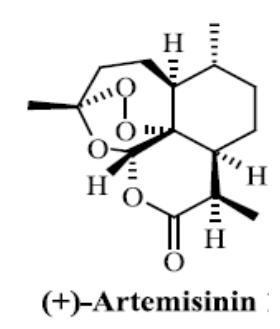
(+)-Artemisinin, isolated from Artemisia annua L. (Qinghao, Compositae) is a potent antimalarial effective against resistant strains of Plasmodium. A simple route for the synthesis of Artemisinin is outlined below.
First, pyrolysis of (+)-2-Carene broke the cyclopropane ring forming, among other products, (1R)-(+)-trans-isolimonene A (\(\ce{C10H16}\)), which then was subjected to regioselective hydroboration using dicyclohexylborane to give the required alcohol B in 82% yield as a mixture of diastereoisomers. In the next step, B was converted to the corresponding \(\gamma,\delta\)-unsaturated acid C in 80% yield by Jones’ oxidation.
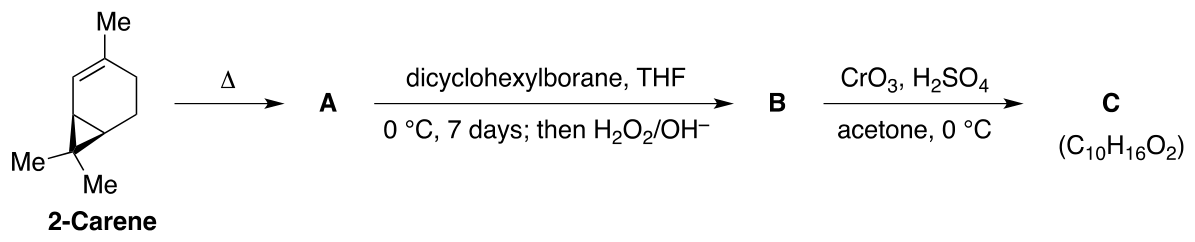
7.1 Draw the structures (with stereochemistry) of the compounds A - C.
The acid C was subjected to iodolactonization using \(\ce{KI}\), \(\ce{I2}\) in aqueous. \(\ce{NaHCO3}\) solution to afford diastereomeric iodolactones D and E (which differ in stereochemistry only at \(C_3\)) in 70% yield.

7.2 Draw the structures (with stereochemistry) of the compounds D and E.
The iodolactone D was subjected to an intermolecular radical reaction with ketone X using tris(trimethylsilyl)silane (TTMSS) and AIBN (azobisisobutyronitrile) in a catalytic amount, refluxing in toluene to yield the corresponding alkylated lactone F in 72% yield as a mixture of diastereoisomers which differ only in stereochemistry at \(C_7\) along with compound G (~10%) and the reduced product H, \(\ce{C10H16O2}\) (<5%).
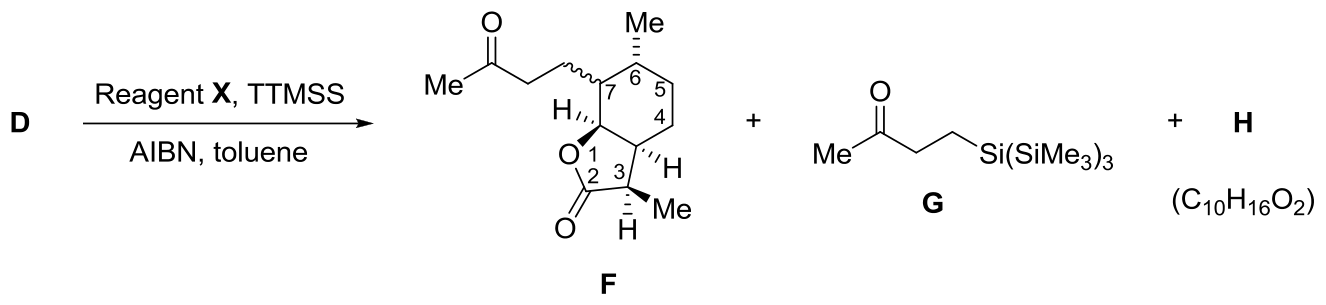
7.3 Draw the structures (with stereochemistry) of compound H and the reagent X.
The keto group of F reacted with ethanedithiol and \(\ce{BF3.Et2O}\) in dichloromethane (DCM) at \(0\,^\circ\mathrm{C}\) to afford two diastereomers: thioketal lactones I and J in nearly quantitative yield (98%). The thioketalization facilitated the separation of the major isomer J in which the thioketal group is on the opposite face of the ring to the adjacent methyl group.

7.4 Draw the structures (with stereochemistry) of the compounds I and J.
The isomer J was further subjected to alkaline hydrolysis followed by esterification with diazomethane providing hydroxy methyl ester K in 50% yield. The hydroxy methyl ester K was transformed into the keto ester L using PCC (Pyridium ChloroChromate) as the oxidizing agent in dichloromethane (DCM).
A two-dimensional NMR study of the compound L revealed that the two protons adjacent to the newly-formed carbonyl group are cis to each other and confirmed the structure of L.

7.5 Draw the structures (with stereochemistry) of the compounds K and L.
The ketone L was subjected to a Wittig reaction with methoxymethyl triphenyl-phosphonium chloride and KHMDS (Potassium HexaMethylDiSilazid - a strong, non-nucleophilic base) to furnish the required methyl vinyl ether M in 45% yield. Deprotection of thioketal using \(\ce{HgCl2}\), \(\ce{CaCO3}\) resulted in the key intermediate N (80%). Finally, the compound N was transformed into the target molecule Artemisinin by photo-oxidation followed followed by acid hydrolysis with 70 % \(\ce{HClO4}\).
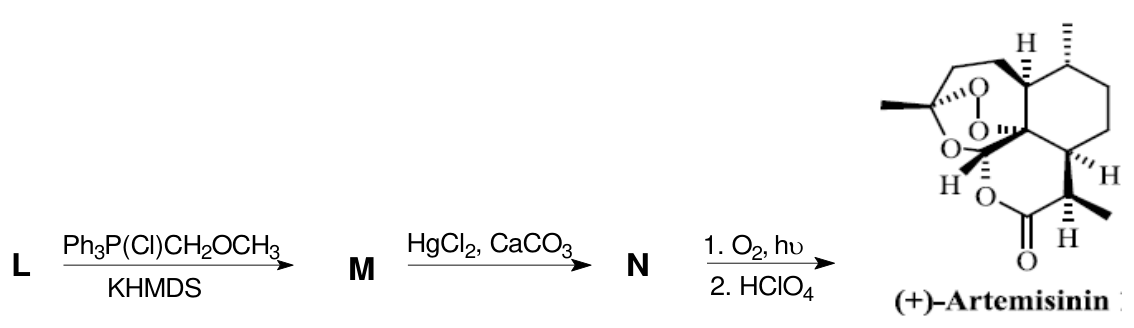
7.6 Draw the structures (with stereochemistry) of the compounds M and N.
Official English text of the problem.
Answers
The lactone names below use the benzofuran numbering shown in F. All specified stereocentres are encoded in the SMILES.
- 7.1 — A, B and C
A: (1R,4R)-trans-isolimonene, or (1R,4R)-\(p\)-mentha-2,8-diene.
C[C@H]1C=C[C@H](C(=C)C)CC1
B: A mixture of the (2S) and (2R) forms of 2-[(1R,4R)-4-methylcyclohex-2-en-1-yl]propan-1-ol.
(2S): C[C@H]1C=C[C@H]([C@H](C)CO)CC1
(2R): C[C@H]1C=C[C@H]([C@@H](C)CO)CC1
C: A mixture of the (2S) and (2R) forms of 2-[(1R,4R)-4-methylcyclohex-2-en-1-yl]propanoic acid.
(2S): C[C@H]1C=C[C@H]([C@H](C)C(=O)O)CC1
(2R): C[C@H]1C=C[C@H]([C@@H](C)C(=O)O)CC1
- 7.2 — D and E
D: (3R,3aS,6R,7R,7aR)-7-Iodo-3,6-dimethylhexahydrobenzofuran-2(3H)-one.
C[C@H]1[C@@H](I)[C@@H]2OC(=O)[C@H](C)[C@@H]2CC1
E: (3S,3aS,6R,7R,7aR)-7-Iodo-3,6-dimethylhexahydrobenzofuran-2(3H)-one.
C[C@H]1[C@@H](I)[C@@H]2OC(=O)[C@@H](C)[C@@H]2CC1
- 7.3 — H and X
H: (3R,3aS,6R,7aS)-3,6-Dimethylhexahydrobenzofuran-2(3H)-one.
C[C@H]1C[C@@H]2OC(=O)[C@H](C)[C@@H]2CC1
X: Methyl vinyl ketone, or but-3-en-2-one.
C=CC(C)=O
- 7.4 — I and J
I: (3R,3aS,6R,7R,7aS)-3,6-Dimethyl-7-[2-(2-methyl-1,3-dithiolan-2-yl)ethyl]hexahydrobenzofuran-2(3H)-one. Its side chain and the \(C_6\) methyl group are cis.
C[C@H]1[C@@H](CCC3(C)SCCS3)[C@@H]2OC(=O)[C@H](C)[C@@H]2CC1
J: (3R,3aS,6R,7S,7aS)-3,6-Dimethyl-7-[2-(2-methyl-1,3-dithiolan-2-yl)ethyl]hexahydrobenzofuran-2(3H)-one. Its side chain and the \(C_6\) methyl group are trans.
C[C@H]1[C@H](CCC3(C)SCCS3)[C@@H]2OC(=O)[C@H](C)[C@@H]2CC1
- 7.5 — K and L
K: Methyl (2R)-2-[(1S,2S,3S,4R)-2-hydroxy-4-methyl-3-[2-(2-methyl-1,3-dithiolan-2-yl)ethyl]cyclohexyl]propanoate.
C[C@H]1[C@H](CCC2(C)SCCS2)[C@H](O)[C@H]([C@@H](C)C(=O)OC)CC1
L: Methyl (2R)-2-[(1S,3S,4R)-4-methyl-3-[2-(2-methyl-1,3-dithiolan-2-yl)ethyl]-2-oxocyclohexyl]propanoate.
C[C@H]1[C@H](CCC2(C)SCCS2)C(=O)[C@H]([C@@H](C)C(=O)OC)CC1
- 7.6 — M and N
M: Methyl (2R)-2-[(1S,3S,4R)-2-(methoxymethylidene)-4-methyl-3-[2-(2-methyl-1,3-dithiolan-2-yl)ethyl]cyclohexyl]propanoate.
C[C@H]1[C@H](CCC2(C)SCCS2)C(=COC)[C@H]([C@@H](C)C(=O)OC)CC1
N: Methyl (2R)-2-[(1S,3S,4R)-2-(methoxymethylidene)-4-methyl-3-(3-oxobutyl)cyclohexyl]propanoate.
C[C@H]1[C@H](CCC(C)=O)C(=COC)[C@H]([C@@H](C)C(=O)OC)CC1
Solution
7.1 — Ring opening, selective hydroboration and oxidation
Opening the cyclopropane ring gives the \(p\)-menthane skeleton of A, with an internal cyclohexene double bond and an isopropenyl substituent. The specified trans relationship places the ring methyl and isopropenyl groups on opposite faces. Together with the stated \(1R\) configuration, this gives the (1R,4R) structure listed above.
To sketch A, use the cyclohexane orientation in F: put the methyl group at the top behind the page and the isopropenyl group at the opposite ring carbon in front. The internal double bond occupies the left-hand ring bond, corresponding to \(C_7=C_{7a}\) in the later lactone numbering.
Dicyclohexylborane preferentially hydroborates the less hindered, terminal double bond. Boron attaches to its terminal carbon, and oxidative workup replaces the C–B bond by C–O with retention. Thus the side-chain transformation is
\[ \ce{-C(CH3)=CH2 -> -CH(CH3)CH2OH}. \]
Hydrogen and boron add syn, but addition can create either configuration at the new side-chain stereocentre. Consequently, B is the stated mixture of two diastereomers; the existing ring stereocentres remain unchanged.
The formal net hydration balance is
\[ \underbrace{\ce{C10H16}}_{\mathbf A}+\ce{H2O} \longrightarrow \underbrace{\ce{C10H18O}}_{\mathbf B}. \]
Jones’ reagent oxidizes the primary alcohol to a carboxylic acid:
\[ \ce{-CH(CH3)CH2OH -> -CH(CH3)CO2H}. \]
A balanced equation using the supplied chromium reagent is
\[ \ce{3C10H18O + 4CrO3 + 6H2SO4 -> 3C10H16O2 + 2Cr2(SO4)3 + 9H2O}. \]
This gives C, retaining the two side-chain configurations. Counting outward from its carboxyl carbon gives
\[ \ce{CO2H-C_{\alpha}-C_{\beta}-C_{\gamma}=C_{\delta}}, \]
so the remaining ring alkene is correctly \(\gamma,\delta\)-unsaturated.
7.2 — Iodolactonization
The carboxylate attacks the nearer carbon of the iodine-activated ring double bond. This forms a five-membered \(\gamma\)-lactone, with oxygen bonded to the former \(\gamma\)-carbon and iodine bonded to the former \(\delta\)-carbon.
Opening of the iodine bridge occurs from the opposite face, so the new C–O and C–I bonds are anti. The side chain already fixes the face from which the intramolecular oxygen attack occurs.
Using the orientation of F, the required drawing has:
- The \(C_6\) methyl group behind the page.
- Both bridgehead hydrogens, at \(C_{3a}\) and \(C_{7a}\), behind the page: the ring fusion is cis.
- The lactone C–O bond at \(C_{7a}\) toward the viewer.
- Iodine at \(C_7\) behind the page.
- The \(C_3\) methyl group toward the viewer in D, and behind the page in E.
The identity of D is fixed by the \(C_3\) stereochemistry subsequently shown in F. Thus D is the \(3R\) isomer and E the \(3S\) isomer.
For either epimer, the balanced net reaction is
\[ \ce{C10H16O2 + I2 + NaHCO3 -> C10H15IO2 + NaI + CO2 + H2O}. \]
7.3 — Radical coupling and reduction
The side chain drawn in F is
\[ \ce{-CH2CH2C(=O)CH3}. \]
It results from addition of the lactone radical to the terminal carbon of methyl vinyl ketone, X, C=CC(C)=O.
A silyl radical abstracts iodine from D, producing a radical at \(C_7\). Addition to X creates a radical adjacent to its carbonyl group; hydrogen-atom transfer from TTMSS then gives F. The approximately planar \(C_7\) radical explains why both configurations at that carbon are obtained.
Writing \(Q=\ce{(Me3Si)3Si}\), the balanced coupling is
\[ \underbrace{\ce{C10H15IO2}}_{\mathbf D} +\underbrace{\ce{C4H6O}}_{\mathbf X} +\ce{Q-H} \longrightarrow \underbrace{\ce{C14H22O3}}_{\mathbf F} +\ce{Q-I}. \]
The two forms of F are the \(7R\) and \(7S\) epimers of (3R,3aS,6R,7aS)-3,6-dimethyl-7-(3-oxobutyl)hexahydrobenzofuran-2(3H)-one:
- \(7R\):
C[C@H]1[C@@H](CCC(C)=O)[C@@H]2OC(=O)[C@H](C)[C@@H]2CC1 - \(7S\):
C[C@H]1[C@H](CCC(C)=O)[C@@H]2OC(=O)[C@H](C)[C@@H]2CC1
Direct hydrogen-atom transfer to the lactone radical instead produces H:
\[ \underbrace{\ce{C10H15IO2}}_{\mathbf D}+\ce{Q-H} \longrightarrow \underbrace{\ce{C10H16O2}}_{\mathbf H}+\ce{Q-I}. \]
Thus H is simply D with iodine replaced by hydrogen. Carbon \(C_7\) becomes a methylene group, and all other stereocentres retain their spatial configurations.
The side product G independently confirms X: it is 4-[tris(trimethylsilyl)silyl]butan-2-one,
CC(=O)CC[Si]([Si](C)(C)C)([Si](C)(C)C)[Si](C)(C)C
formed by net addition of the silane across the double bond:
\[ \ce{CH2=CHC(=O)CH3 + Q-H -> Q-CH2CH2C(=O)CH3}. \]
The change from \(7aR\) in D to \(7aS\) in H reflects a change in CIP priorities after iodine removal, not inversion at that stereocentre.
7.4 — Thioketal formation
Ethane-1,2-dithiol, SCCS, converts the side-chain ketone into a cyclic 1,3-dithiolane. Lewis-acid activation of the carbonyl allows sulfur attack, followed by ring closure and loss of water.
The side-chain change is
\[ \ce{-CH2CH2C(=O)CH3 -> -CH2CH2C(CH3)(SCH2CH2S)}, \]
where both sulfur atoms in the product are bonded to the same former carbonyl carbon, closing the five-membered ring.
The balanced condensation is
\[ \underbrace{\ce{C14H22O3}}_{\mathbf F} +\ce{HSCH2CH2SH} \longrightarrow \underbrace{\ce{C16H26O2S2}}_{\mathbf I\text{ or }\mathbf J} +\ce{H2O}. \]
The thioketal carbon is not a new stereocentre because the two paths through the unsubstituted dithiolane ring are equivalent. I and J therefore retain the \(C_7\) epimerism already present in F.
The stated relationship identifies J:
- In J, draw the protected side chain at \(C_7\) toward the viewer, opposite the backward \(C_6\) methyl group.
- In I, draw that side chain behind the page, on the same face as the \(C_6\) methyl group.
These are respectively the \(7S\) and \(7R\) structures given in the answers.
7.5 — Lactone opening and oxidation
Alkaline hydrolysis cleaves the lactone’s acyl–oxygen bond. It therefore gives a hydroxy carboxylate without breaking the bond between oxygen and the stereogenic ring carbon.
After acidification, diazomethane, C=[N+]=[N-], converts the carboxylic acid into its methyl ester. The net organic balance is
\[ \underbrace{\ce{C16H26O2S2}}_{\mathbf J} +\ce{H2O}+\ce{CH2N2} \longrightarrow \underbrace{\ce{C17H30O3S2}}_{\mathbf K} +\ce{N2}. \]
To draw K, open the five-membered lactone of J:
- Replace the lactone oxygen connection at the former \(C_{7a}\) by an OH group pointing toward the viewer.
- Replace the lactone carbonyl terminus by \(\ce{CO2Me}\).
- Retain the configuration of the adjacent methyl-bearing side-chain carbon and all ring stereocentres.
PCC oxidizes this secondary alcohol to a ring ketone, giving L. Using \([O]\) for one formal oxygen-atom equivalent supplied by the oxidant,
\[ \underbrace{\ce{C17H30O3S2}}_{\mathbf K}+\ce{[O]} \longrightarrow \underbrace{\ce{C17H28O3S2}}_{\mathbf L}+\ce{H2O}. \]
Only the stereocentre bearing OH disappears.
The hydrogens on the two carbons flanking the new carbonyl—the former \(C_{3a}\) and \(C_7\)—both point behind the page. They are therefore cis, exactly as required by the NMR observation. No epimerization is needed to explain the result.
7.6 — Wittig reaction and thioketal deprotection
KHMDS removes a proton from the methoxymethylphosphonium salt to form (methoxymethylene)triphenylphosphorane, represented in its charge-separated form by
CO[CH-][P+](c1ccccc1)(c1ccccc1)c1ccccc1.
Its carbon attacks the ring ketone of L. Collapse of the Wittig intermediate replaces the carbonyl oxygen by \(\ce{=CHOMe}\), producing M:
\[ \ce{R2C=O + Ph3P=CHOMe -> R2C=CHOMe + Ph3P=O}. \]
The phosphorus-containing product is triphenylphosphine oxide, O=P(c1ccccc1)(c1ccccc1)c1ccccc1.
Thus, when drawing M, replace only the ring \(\ce{C=O}\) of L by an exocyclic \(\ce{C=CH-OCH3}\) group. The methyl ester, protected side-chain ketone and existing stereocentres remain as shown in L.
Mercury(II)-assisted deprotection then restores the side-chain ketone:
\[ \ce{-CH2CH2C(CH3)(SCH2CH2S) -> -CH2CH2C(=O)CH3}. \]
This gives N. The formal hydrolysis balance, before accounting for mercury binding to the sulfur-containing product, is
\[ \underbrace{\ce{C19H32O3S2}}_{\mathbf M} +\ce{H2O} \longrightarrow \underbrace{\ce{C17H28O4}}_{\mathbf N} +\ce{HSCH2CH2SH}. \]
The exocyclic enol ether and methyl ester are retained in N, ready for the final photo-oxidation and acid treatment.
The answers were checked against the official answers published by the organisers.
IChO 2014 · Theorieaufgabe 7
Synthese von Artemisinin
(+)-Artemisinin, das aus Artemisia annua L. (Qinghao, Compositae) isoliert wird, ist ein hochwirksames Antimalariamittel, das gegen resistente Stämme von Plasmodium wirksam ist. Ein einfacher Syntheseweg zu Artemisinin ist nachstehend skizziert.
Zunächst wurde durch Pyrolyse von (+)-2-Caren der Cyclopropanring gespalten, wobei neben anderen Produkten (1R)-(+)-trans-Isolimonen A (\(\ce{C10H16}\)) entstand. Dieses wurde anschließend einer regioselektiven Hydroborierung mit Dicyclohexylboran unterzogen, wodurch der gewünschte Alkohol B in 82% Ausbeute als Gemisch von Diastereomeren erhalten wurde. Im nächsten Schritt wurde B durch Jones-Oxidation in 80% Ausbeute in die entsprechende \(\gamma,\delta\)-ungesättigte Säure C überführt.
7.1 Zeichnen Sie die Strukturen (mit Stereochemie) der Verbindungen A - C.
Die Säure C wurde mit \(\ce{KI}\) und \(\ce{I2}\) in wässriger \(\ce{NaHCO3}\)-Lösung einer Iodlactonisierung unterzogen, wobei die diastereomeren Iodlactone D und E (die sich nur in der Stereochemie an \(C_3\) unterscheiden) in 70% Ausbeute erhalten wurden.
7.2 Zeichnen Sie die Strukturen (mit Stereochemie) der Verbindungen D und E.
Das Iodlacton D wurde unter Verwendung von Tris(trimethylsilyl)silan (TTMSS) und einer katalytischen Menge AIBN (Azobisisobutyronitril) unter Rückfluss in Toluol einer intermolekularen Radikalreaktion mit dem Keton X unterzogen. Dabei wurde das entsprechende alkylierte Lacton F in 72% Ausbeute als Gemisch von Diastereomeren erhalten, die sich nur in der Stereochemie an \(C_7\) unterscheiden, zusammen mit der Verbindung G (~10%) und dem Reduktionsprodukt H, \(\ce{C10H16O2}\) (<5%).
7.3 Zeichnen Sie die Strukturen (mit Stereochemie) der Verbindung H und des Reagenzes X.
Die Ketogruppe von F reagierte mit Ethandithiol und \(\ce{BF3.Et2O}\) in Dichlormethan (DCM) bei \(0\,^\circ\mathrm{C}\) zu zwei Diastereomeren: den Thioketallactonen I und J, die in nahezu quantitativer Ausbeute (98%) erhalten wurden. Die Thioketalisierung erleichterte die Abtrennung des Hauptisomers J, in dem sich die Thioketalgruppe auf der der benachbarten Methylgruppe entgegengesetzten Seite des Rings befindet.
7.4 Zeichnen Sie die Strukturen (mit Stereochemie) der Verbindungen I und J.
Das Isomer J wurde anschließend einer alkalischen Hydrolyse und danach einer Veresterung mit Diazomethan unterzogen, wodurch der Hydroxymethylester K in 50% Ausbeute erhalten wurde. Der Hydroxymethylester K wurde mit PCC (Pyridiniumchlorochromat) als Oxidationsmittel in Dichlormethan (DCM) in den Ketoester L überführt.
Eine zweidimensionale NMR-Untersuchung der Verbindung L zeigte, dass die beiden Protonen neben der neu gebildeten Carbonylgruppe cis zueinander stehen, und bestätigte die Struktur von L.
7.5 Zeichnen Sie die Strukturen (mit Stereochemie) der Verbindungen K und L.
Das Keton L wurde einer Wittig-Reaktion mit Methoxymethyltriphenylphosphoniumchlorid und KHMDS (Kaliumhexamethyldisilazid – eine starke, nicht nucleophile Base) unterzogen, wobei der gewünschte Methylvinylether M in 45% Ausbeute erhalten wurde. Die Entschützung des Thioketals mit \(\ce{HgCl2}\) und \(\ce{CaCO3}\) ergab das Schlüsselintermediat N (80%). Schließlich wurde die Verbindung N durch Photooxidation mit anschließender saurer Hydrolyse mit 70 % \(\ce{HClO4}\) in das Zielmolekül Artemisinin überführt.
7.6 Zeichnen Sie die Strukturen (mit Stereochemie) der Verbindungen M und N.
Aufgabentext aus dem offiziellen englischen Text übersetzt.
Antworten
Die nachstehenden Lactonnamen verwenden die in F gezeigte Benzofuran-Nummerierung. Alle angegebenen Stereozentren sind in den SMILES codiert.
- 7.1 — A, B und C
A: (1R,4R)-trans-Isolimonen oder (1R,4R)-\(p\)-Mentha-2,8-dien.
C[C@H]1C=C[C@H](C(=C)C)CC1
B: Ein Gemisch der (2S)- und (2R)-Formen von 2-[(1R,4R)-4-Methylcyclohex-2-en-1-yl]propan-1-ol.
(2S): C[C@H]1C=C[C@H]([C@H](C)CO)CC1
(2R): C[C@H]1C=C[C@H]([C@@H](C)CO)CC1
C: Ein Gemisch der (2S)- und (2R)-Formen von 2-[(1R,4R)-4-Methylcyclohex-2-en-1-yl]propansäure.
(2S): C[C@H]1C=C[C@H]([C@H](C)C(=O)O)CC1
(2R): C[C@H]1C=C[C@H]([C@@H](C)C(=O)O)CC1
- 7.2 — D und E
D: (3R,3aS,6R,7R,7aR)-7-Iod-3,6-dimethylhexahydrobenzofuran-2(3H)-on.
C[C@H]1[C@@H](I)[C@@H]2OC(=O)[C@H](C)[C@@H]2CC1
E: (3S,3aS,6R,7R,7aR)-7-Iod-3,6-dimethylhexahydrobenzofuran-2(3H)-on.
C[C@H]1[C@@H](I)[C@@H]2OC(=O)[C@@H](C)[C@@H]2CC1
- 7.3 — H und X
H: (3R,3aS,6R,7aS)-3,6-Dimethylhexahydrobenzofuran-2(3H)-on.
C[C@H]1C[C@@H]2OC(=O)[C@H](C)[C@@H]2CC1
X: Methylvinylketon oder But-3-en-2-on.
C=CC(C)=O
- 7.4 — I und J
I: (3R,3aS,6R,7R,7aS)-3,6-Dimethyl-7-[2-(2-methyl-1,3-dithiolan-2-yl)ethyl]hexahydrobenzofuran-2(3H)-on. Seine Seitenkette und die Methylgruppe an \(C_6\) stehen cis zueinander.
C[C@H]1[C@@H](CCC3(C)SCCS3)[C@@H]2OC(=O)[C@H](C)[C@@H]2CC1
J: (3R,3aS,6R,7S,7aS)-3,6-Dimethyl-7-[2-(2-methyl-1,3-dithiolan-2-yl)ethyl]hexahydrobenzofuran-2(3H)-on. Seine Seitenkette und die Methylgruppe an \(C_6\) stehen trans zueinander.
C[C@H]1[C@H](CCC3(C)SCCS3)[C@@H]2OC(=O)[C@H](C)[C@@H]2CC1
- 7.5 — K und L
K: Methyl-(2R)-2-[(1S,2S,3S,4R)-2-hydroxy-4-methyl-3-[2-(2-methyl-1,3-dithiolan-2-yl)ethyl]cyclohexyl]propanoat.
C[C@H]1[C@H](CCC2(C)SCCS2)[C@H](O)[C@H]([C@@H](C)C(=O)OC)CC1
L: Methyl-(2R)-2-[(1S,3S,4R)-4-methyl-3-[2-(2-methyl-1,3-dithiolan-2-yl)ethyl]-2-oxocyclohexyl]propanoat.
C[C@H]1[C@H](CCC2(C)SCCS2)C(=O)[C@H]([C@@H](C)C(=O)OC)CC1
- 7.6 — M und N
M: Methyl-(2R)-2-[(1S,3S,4R)-2-(methoxymethyliden)-4-methyl-3-[2-(2-methyl-1,3-dithiolan-2-yl)ethyl]cyclohexyl]propanoat.
C[C@H]1[C@H](CCC2(C)SCCS2)C(=COC)[C@H]([C@@H](C)C(=O)OC)CC1
N: Methyl-(2R)-2-[(1S,3S,4R)-2-(methoxymethyliden)-4-methyl-3-(3-oxobutyl)cyclohexyl]propanoat.
C[C@H]1[C@H](CCC(C)=O)C(=COC)[C@H]([C@@H](C)C(=O)OC)CC1
Lösung
7.1 — Ringöffnung, selektive Hydroborierung und Oxidation
Die Öffnung des Cyclopropanrings ergibt das \(p\)-Menthan-Gerüst von A mit einer internen Cyclohexen-Doppelbindung und einem Isopropenylsubstituenten. Aufgrund der angegebenen trans-Beziehung liegen die Methylgruppe am Ring und die Isopropenylgruppe auf entgegengesetzten Seiten. Zusammen mit der angegebenen \(1R\)-Konfiguration ergibt dies die oben aufgeführte (1R,4R)-Struktur.
Verwenden Sie zum Zeichnen von A die Cyclohexan-Orientierung in F: Platzieren Sie die Methylgruppe oben hinter der Zeichenebene und die Isopropenylgruppe am gegenüberliegenden Ringkohlenstoffatom vor der Zeichenebene. Die interne Doppelbindung liegt an der linken Ringbindung, die in der späteren Lactonnummerierung \(C_7=C_{7a}\) entspricht.
Dicyclohexylboran hydroboriert bevorzugt die sterisch weniger gehinderte, terminale Doppelbindung. Bor bindet an deren terminales Kohlenstoffatom, und bei der oxidativen Aufarbeitung wird die C–B-Bindung unter Retention durch eine C–O-Bindung ersetzt. Die Umwandlung der Seitenkette lautet somit
\[ \ce{-C(CH3)=CH2 -> -CH(CH3)CH2OH}. \]
Wasserstoff und Bor addieren syn, doch durch die Addition kann jede der beiden Konfigurationen am neuen Stereozentrum der Seitenkette entstehen. Daher ist B das angegebene Gemisch zweier Diastereomere; die bereits vorhandenen Stereozentren des Rings bleiben unverändert.
Die formale Nettobilanz der Hydratisierung lautet
\[ \underbrace{\ce{C10H16}}_{\mathbf A}+\ce{H2O} \longrightarrow \underbrace{\ce{C10H18O}}_{\mathbf B}. \]
Das Jones-Reagenz oxidiert den primären Alkohol zu einer Carbonsäure:
\[ \ce{-CH(CH3)CH2OH -> -CH(CH3)CO2H}. \]
Eine ausgeglichene Gleichung mit dem angegebenen Chromreagenz lautet
\[ \ce{3C10H18O + 4CrO3 + 6H2SO4 -> 3C10H16O2 + 2Cr2(SO4)3 + 9H2O}. \]
Dies ergibt C unter Beibehaltung der beiden Seitenkettenkonfigurationen. Zählt man vom Carboxylkohlenstoffatom aus nach außen, erhält man
\[ \ce{CO2H-C_{\alpha}-C_{\beta}-C_{\gamma}=C_{\delta}}, \]
sodass das verbleibende Alken im Ring zutreffend als \(\gamma,\delta\)-ungesättigt bezeichnet wird.
7.2 — Iodlactonisierung
Das Carboxylat greift das näher gelegene Kohlenstoffatom der durch Iod aktivierten Ringdoppelbindung an. Dadurch entsteht ein fünfgliedriges \(\gamma\)-Lacton, wobei der Sauerstoff an das ehemalige \(\gamma\)-Kohlenstoffatom und das Iod an das ehemalige \(\delta\)-Kohlenstoffatom gebunden ist.
Die Öffnung der Iodbrücke erfolgt von der entgegengesetzten Seite, sodass die neuen C–O- und C–I-Bindungen anti zueinander stehen. Die Seitenkette legt bereits die Seite fest, von der der intramolekulare Sauerstoffangriff erfolgt.
Bei Verwendung der Orientierung von F muss die Zeichnung Folgendes zeigen:
- Die Methylgruppe an \(C_6\) liegt hinter der Zeichenebene.
- Beide Brückenkopfwasserstoffatome an \(C_{3a}\) und \(C_{7a}\) liegen hinter der Zeichenebene: Die Ringverknüpfung ist cis.
- Die C–O-Bindung des Lactons an \(C_{7a}\) zeigt zum Betrachter.
- Das Iod an \(C_7\) liegt hinter der Zeichenebene.
- Die Methylgruppe an \(C_3\) zeigt in D zum Betrachter und liegt in E hinter der Zeichenebene.
Die Identität von D wird durch die später in F gezeigte Stereochemie an \(C_3\) festgelegt. Somit ist D das \(3R\)-Isomer und E das \(3S\)-Isomer.
Für jedes der beiden Epimere lautet die ausgeglichene Nettoreaktion
\[ \ce{C10H16O2 + I2 + NaHCO3 -> C10H15IO2 + NaI + CO2 + H2O}. \]
7.3 — Radikalische Kupplung und Reduktion
Die in F gezeichnete Seitenkette lautet
\[ \ce{-CH2CH2C(=O)CH3}. \]
Sie entsteht durch Addition des Lactonradikals an das terminale Kohlenstoffatom von Methylvinylketon, X, C=CC(C)=O.
Ein Silylradikal abstrahiert Iod von D, wodurch ein Radikal an \(C_7\) entsteht. Die Addition an X erzeugt ein Radikal neben dessen Carbonylgruppe; die anschließende Übertragung eines Wasserstoffatoms von TTMSS ergibt F. Das annähernd planare Radikal an \(C_7\) erklärt, warum beide Konfigurationen an diesem Kohlenstoffatom erhalten werden.
Mit der Schreibweise \(Q=\ce{(Me3Si)3Si}\) lautet die ausgeglichene Kupplung
\[ \underbrace{\ce{C10H15IO2}}_{\mathbf D} +\underbrace{\ce{C4H6O}}_{\mathbf X} +\ce{Q-H} \longrightarrow \underbrace{\ce{C14H22O3}}_{\mathbf F} +\ce{Q-I}. \]
Die beiden Formen von F sind die \(7R\)- und \(7S\)-Epimere von (3R,3aS,6R,7aS)-3,6-Dimethyl-7-(3-oxobutyl)hexahydrobenzofuran-2(3H)-on:
- \(7R\):
C[C@H]1[C@@H](CCC(C)=O)[C@@H]2OC(=O)[C@H](C)[C@@H]2CC1 - \(7S\):
C[C@H]1[C@H](CCC(C)=O)[C@@H]2OC(=O)[C@H](C)[C@@H]2CC1
Die direkte Übertragung eines Wasserstoffatoms auf das Lactonradikal erzeugt stattdessen H:
\[ \underbrace{\ce{C10H15IO2}}_{\mathbf D}+\ce{Q-H} \longrightarrow \underbrace{\ce{C10H16O2}}_{\mathbf H}+\ce{Q-I}. \]
Somit entspricht H einfach D, in dem Iod durch Wasserstoff ersetzt ist. Das Kohlenstoffatom \(C_7\) wird zu einer Methylengruppe, und alle anderen Stereozentren behalten ihre räumlichen Konfigurationen bei.
Das Nebenprodukt G bestätigt X unabhängig davon: Es handelt sich um 4-[Tris(trimethylsilyl)silyl]butan-2-on,
CC(=O)CC[Si]([Si](C)(C)C)([Si](C)(C)C)[Si](C)(C)C
das durch die Nettoaddition des Silans an die Doppelbindung entsteht:
\[ \ce{CH2=CHC(=O)CH3 + Q-H -> Q-CH2CH2C(=O)CH3}. \]
Der Wechsel von \(7aR\) in D zu \(7aS\) in H beruht auf einer Änderung der CIP-Prioritäten nach der Entfernung des Iods, nicht auf einer Inversion an diesem Stereozentrum.
7.4 — Thioketalbildung
Ethan-1,2-dithiol, SCCS, wandelt das Seitenkettenketon in ein cyclisches 1,3-Dithiolan um. Die Lewis-Säure-Aktivierung der Carbonylgruppe ermöglicht den Angriff des Schwefels, gefolgt von Ringschluss und Wasserabspaltung.
Die Veränderung der Seitenkette lautet
\[ \ce{-CH2CH2C(=O)CH3 -> -CH2CH2C(CH3)(SCH2CH2S)}, \]
wobei beide Schwefelatome im Produkt an dasselbe ehemalige Carbonylkohlenstoffatom gebunden sind und so den fünfgliedrigen Ring schließen.
Die ausgeglichene Kondensation lautet
\[ \underbrace{\ce{C14H22O3}}_{\mathbf F} +\ce{HSCH2CH2SH} \longrightarrow \underbrace{\ce{C16H26O2S2}}_{\mathbf I\text{ oder }\mathbf J} +\ce{H2O}. \]
Das Thioketalkohlenstoffatom ist kein neues Stereozentrum, da die beiden Wege durch den unsubstituierten Dithiolanring äquivalent sind. I und J behalten daher die bereits in F vorhandene Epimerie an \(C_7\) bei.
Die angegebene räumliche Beziehung identifiziert J:
- Zeichnen Sie in J die geschützte Seitenkette an \(C_7\) zum Betrachter hin, entgegengesetzt zur nach hinten gerichteten Methylgruppe an \(C_6\).
- Zeichnen Sie in I diese Seitenkette hinter der Zeichenebene, auf derselben Seite wie die Methylgruppe an \(C_6\).
Dies sind die in den Antworten angegebenen \(7S\)- bzw. \(7R\)-Strukturen.
7.5 — Lactonöffnung und Oxidation
Die alkalische Hydrolyse spaltet die Acyl–Sauerstoff-Bindung des Lactons. Sie ergibt daher ein Hydroxycarboxylat, ohne die Bindung zwischen dem Sauerstoff und dem stereogenen Ringkohlenstoffatom zu spalten.
Nach dem Ansäuern wandelt Diazomethan, C=[N+]=[N-], die Carbonsäure in ihren Methylester um. Die Nettobilanz der organischen Umsetzung lautet
\[ \underbrace{\ce{C16H26O2S2}}_{\mathbf J} +\ce{H2O}+\ce{CH2N2} \longrightarrow \underbrace{\ce{C17H30O3S2}}_{\mathbf K} +\ce{N2}. \]
Öffnen Sie zum Zeichnen von K den fünfgliedrigen Lactonring von J:
- Ersetzen Sie die Verknüpfung zum Lactonsauerstoff am ehemaligen \(C_{7a}\) durch eine zum Betrachter gerichtete OH-Gruppe.
- Ersetzen Sie das Carbonylende des Lactons durch \(\ce{CO2Me}\).
- Behalten Sie die Konfiguration des benachbarten methyltragenden Seitenkettenkohlenstoffatoms und aller Stereozentren des Rings bei.
PCC oxidiert diesen sekundären Alkohol zu einem Keton im Ring und ergibt so L. Mit \([O]\) als einem formalen Sauerstoffatomäquivalent, das vom Oxidationsmittel bereitgestellt wird, gilt
\[ \underbrace{\ce{C17H30O3S2}}_{\mathbf K}+\ce{[O]} \longrightarrow \underbrace{\ce{C17H28O3S2}}_{\mathbf L}+\ce{H2O}. \]
Nur das OH-tragende Stereozentrum verschwindet.
Die Wasserstoffatome an den beiden Kohlenstoffatomen beiderseits der neuen Carbonylgruppe – den ehemaligen \(C_{3a}\) und \(C_7\) – zeigen beide hinter die Zeichenebene. Sie stehen daher cis zueinander, genau wie es die NMR-Beobachtung verlangt. Zur Erklärung des Ergebnisses ist keine Epimerisierung erforderlich.
7.6 — Wittig-Reaktion und Thioketalentschützung
KHMDS entfernt ein Proton vom Methoxymethylphosphoniumsalz und bildet dadurch (Methoxymethylen)triphenylphosphoran, das in seiner ladungsgetrennten Form wie folgt dargestellt wird:
CO[CH-][P+](c1ccccc1)(c1ccccc1)c1ccccc1.
Sein Kohlenstoffatom greift das Keton im Ring von L an. Beim Zerfall des Wittig-Zwischenprodukts wird der Carbonylsauerstoff durch \(\ce{=CHOMe}\) ersetzt, wodurch M entsteht:
\[ \ce{R2C=O + Ph3P=CHOMe -> R2C=CHOMe + Ph3P=O}. \]
Das phosphorhaltige Produkt ist Triphenylphosphinoxid, O=P(c1ccccc1)(c1ccccc1)c1ccccc1.
Ersetzen Sie daher beim Zeichnen von M nur die \(\ce{C=O}\)-Gruppe im Ring von L durch eine exocyclische \(\ce{C=CH-OCH3}\)-Gruppe. Der Methylester, das geschützte Seitenkettenketon und die vorhandenen Stereozentren bleiben wie in L dargestellt erhalten.
Die durch Quecksilber(II) unterstützte Entschützung stellt anschließend das Seitenkettenketon wieder her:
\[ \ce{-CH2CH2C(CH3)(SCH2CH2S) -> -CH2CH2C(=O)CH3}. \]
Dies ergibt N. Die formale Hydrolysebilanz, ohne Berücksichtigung der Bindung von Quecksilber an das schwefelhaltige Produkt, lautet
\[ \underbrace{\ce{C19H32O3S2}}_{\mathbf M} +\ce{H2O} \longrightarrow \underbrace{\ce{C17H28O4}}_{\mathbf N} +\ce{HSCH2CH2SH}. \]
Der exocyclische Enolether und der Methylester bleiben in N erhalten und stehen für die abschließende Photooxidation und Säurebehandlung bereit.
Die Ergebnisse wurden mit den von den Veranstaltern veröffentlichten offiziellen Ergebnissen abgeglichen.
IChO 2014 · Teori sorusu 7
Artemisinin sentezi
Artemisia annua L. (Qinghao, Compositae) bitkisinden izole edilen (+)-artemisinin, dirençli Plasmodium suşlarına karşı etkili, güçlü bir antimalaryal ilaçtır. Artemisinin sentezi için basit bir yol aşağıda özetlenmiştir.
İlk olarak, (+)-2-karenin pirolizi siklopropan halkasını açarak diğer ürünlerin yanı sıra (1R)-(+)-trans-izolimonen A (\(\ce{C10H16}\)) bileşiğini oluşturmuştur. Ardından bu bileşiğe disikloheksilboran kullanılarak bölge seçici hidroborasyon uygulanmış ve istenen alkol B, diastereoizomerlerin bir karışımı olarak %82 verimle elde edilmiştir. Bir sonraki adımda B, Jones yükseltgemesiyle %80 verimle karşılık gelen \(\gamma,\delta\)-doymamış asit C bileşiğine dönüştürülmüştür.
7.1 A - C bileşiklerinin yapılarını (stereokimyalarıyla birlikte) çiziniz.
Asit C, sulu \(\ce{NaHCO3}\) çözeltisinde \(\ce{KI}\), \(\ce{I2}\) kullanılarak iyodolaktonlaştırılmış ve yalnızca \(C_3\)'teki stereokimyaları bakımından farklı olan diastereomerik iyodolaktonlar D ve E, %70 verimle elde edilmiştir.
7.2 D ve E bileşiklerinin yapılarını (stereokimyalarıyla birlikte) çiziniz.
İyodolakton D, tris(trimetilsilil)silan (TTMSS) ve katalitik miktarda AIBN (azobisisobütironitril) kullanılarak toluen içinde geri soğutucu altında kaynatılarak keton X ile moleküller arası bir radikal tepkimesine sokulmuştur. Böylece karşılık gelen alkillenmiş lakton F, yalnızca \(C_7\)'deki stereokimyaları bakımından farklı diastereoizomerlerin bir karışımı olarak %72 verimle, G bileşiği (~%10) ve indirgenmiş ürün H, \(\ce{C10H16O2}\) (<%5) ile birlikte elde edilmiştir.
7.3 H bileşiğinin ve X reaktifinin yapılarını (stereokimyalarıyla birlikte) çiziniz.
F bileşiğinin keto grubu, diklorometan (DCM) içinde \(0\,^\circ\mathrm{C}\)'de etanditiyol ve \(\ce{BF3.Et2O}\) ile tepkimeye girerek iki diastereomer olan tiyoketal laktonlar I ve J'yi neredeyse nicel verimle (%98) vermiştir. Tiyoketalleştirme, tiyoketal grubunun komşu metil grubuna göre halkanın karşı yüzünde bulunduğu ana izomer J'nin ayrılmasını kolaylaştırmıştır.
7.4 I ve J bileşiklerinin yapılarını (stereokimyalarıyla birlikte) çiziniz.
İzomer J, daha sonra bazik hidrolize ve ardından diazometanla esterleştirmeye tabi tutularak %50 verimle hidroksi metil ester K elde edilmiştir. Hidroksi metil ester K, diklorometan (DCM) içinde yükseltgen madde olarak PCC (piridinyum klorokromat) kullanılarak keto ester L'ye dönüştürülmüştür.
L bileşiği üzerinde yapılan iki boyutlu NMR incelemesi, yeni oluşan karbonil grubuna komşu iki protonun birbirine göre cis konumunda olduğunu ortaya koymuş ve L'nin yapısını doğrulamıştır.
7.5 K ve L bileşiklerinin yapılarını (stereokimyalarıyla birlikte) çiziniz.
Keton L, metoksimetil trifenilfosfonyum klorür ve KHMDS (potasyum heksametildisilazid — güçlü, nükleofilik olmayan bir baz) ile Wittig tepkimesine sokularak istenen metil vinil eter M, %45 verimle elde edilmiştir. \(\ce{HgCl2}\), \(\ce{CaCO3}\) kullanılarak tiyoketal koruyucu grubunun uzaklaştırılması, kilit ara ürün N'yi vermiştir (%80). Son olarak N bileşiği, fotoyükseltgeme ve ardından %70'lik \(\ce{HClO4}\) ile asit hidrolizi yoluyla hedef molekül artemisinine dönüştürülmüştür.
7.6 M ve N bileşiklerinin yapılarını (stereokimyalarıyla birlikte) çiziniz.
Soru metni resmi İngilizce metinden çevrilmiştir.
Cevaplar
Aşağıdaki lakton adlarında, F'de gösterilen benzofuran numaralandırması kullanılmıştır. Belirtilen tüm stereomerkezler SMILES gösterimlerinde kodlanmıştır.
- 7.1 — A, B ve C
A: (1R,4R)-trans-izolimonen veya (1R,4R)-\(p\)-menta-2,8-dien.
C[C@H]1C=C[C@H](C(=C)C)CC1
B: 2-[(1R,4R)-4-metilsikloheks-2-en-1-il]propan-1-olün (2S) ve (2R) biçimlerinin bir karışımı.
(2S): C[C@H]1C=C[C@H]([C@H](C)CO)CC1
(2R): C[C@H]1C=C[C@H]([C@@H](C)CO)CC1
C: 2-[(1R,4R)-4-metilsikloheks-2-en-1-il]propanoik asidin (2S) ve (2R) biçimlerinin bir karışımı.
(2S): C[C@H]1C=C[C@H]([C@H](C)C(=O)O)CC1
(2R): C[C@H]1C=C[C@H]([C@@H](C)C(=O)O)CC1
- 7.2 — D ve E
D: (3R,3aS,6R,7R,7aR)-7-İyodo-3,6-dimetilheksahidrobenzofuran-2(3H)-on.
C[C@H]1[C@@H](I)[C@@H]2OC(=O)[C@H](C)[C@@H]2CC1
E: (3S,3aS,6R,7R,7aR)-7-İyodo-3,6-dimetilheksahidrobenzofuran-2(3H)-on.
C[C@H]1[C@@H](I)[C@@H]2OC(=O)[C@@H](C)[C@@H]2CC1
- 7.3 — H ve X
H: (3R,3aS,6R,7aS)-3,6-Dimetilheksahidrobenzofuran-2(3H)-on.
C[C@H]1C[C@@H]2OC(=O)[C@H](C)[C@@H]2CC1
X: Metil vinil keton veya büt-3-en-2-on.
C=CC(C)=O
- 7.4 — I ve J
I: (3R,3aS,6R,7R,7aS)-3,6-Dimetil-7-[2-(2-metil-1,3-ditiyolan-2-il)etil]heksahidrobenzofuran-2(3H)-on. Yan zinciri ile \(C_6\) metil grubu birbirine göre cis konumundadır.
C[C@H]1[C@@H](CCC3(C)SCCS3)[C@@H]2OC(=O)[C@H](C)[C@@H]2CC1
J: (3R,3aS,6R,7S,7aS)-3,6-Dimetil-7-[2-(2-metil-1,3-ditiyolan-2-il)etil]heksahidrobenzofuran-2(3H)-on. Yan zinciri ile \(C_6\) metil grubu birbirine göre trans konumundadır.
C[C@H]1[C@H](CCC3(C)SCCS3)[C@@H]2OC(=O)[C@H](C)[C@@H]2CC1
- 7.5 — K ve L
K: Metil (2R)-2-[(1S,2S,3S,4R)-2-hidroksi-4-metil-3-[2-(2-metil-1,3-ditiyolan-2-il)etil]sikloheksil]propanoat.
C[C@H]1[C@H](CCC2(C)SCCS2)[C@H](O)[C@H]([C@@H](C)C(=O)OC)CC1
L: Metil (2R)-2-[(1S,3S,4R)-4-metil-3-[2-(2-metil-1,3-ditiyolan-2-il)etil]-2-oksosikloheksil]propanoat.
C[C@H]1[C@H](CCC2(C)SCCS2)C(=O)[C@H]([C@@H](C)C(=O)OC)CC1
- 7.6 — M ve N
M: Metil (2R)-2-[(1S,3S,4R)-2-(metoksimetiliden)-4-metil-3-[2-(2-metil-1,3-ditiyolan-2-il)etil]sikloheksil]propanoat.
C[C@H]1[C@H](CCC2(C)SCCS2)C(=COC)[C@H]([C@@H](C)C(=O)OC)CC1
N: Metil (2R)-2-[(1S,3S,4R)-2-(metoksimetiliden)-4-metil-3-(3-oksobütil)sikloheksil]propanoat.
C[C@H]1[C@H](CCC(C)=O)C(=COC)[C@H]([C@@H](C)C(=O)OC)CC1
Çözüm
7.1 — Halka açılması, seçici hidroborasyon ve yükseltgeme
Siklopropan halkasının açılması, halka içi bir sikloheksen çift bağı ve bir izopropenil sübstitüenti içeren A'nın \(p\)-mentan iskeletini verir. Belirtilen trans ilişkisi, halkadaki metil ve izopropenil gruplarını karşı yüzlere yerleştirir. Bu durum, verilen \(1R\) konfigürasyonuyla birlikte, yukarıda listelenen (1R,4R) yapısını verir.
A'yı çizmek için F'deki sikloheksan yönelimini kullanın: metil grubunu üstte, sayfa düzleminin arkasına; izopropenil grubunu ise karşı halka karbonunda, öne yerleştirin. Halka içi çift bağ, sonraki lakton numaralandırmasında \(C_7=C_{7a}\)'ya karşılık gelen, halkanın sol tarafındaki bağda bulunur.
Disikloheksilboran, sterik engeli daha az olan uç çift bağı tercihli olarak hidroborasyona uğratır. Bor, bu bağın uç karbonuna bağlanır ve yükseltgen işleme sırasında C–B bağının yerini, konfigürasyon korunarak C–O bağı alır. Böylece yan zincirdeki dönüşüm şöyledir:
\[ \ce{-C(CH3)=CH2 -> -CH(CH3)CH2OH}. \]
Hidrojen ve bor syn katılır; ancak katılma, yeni yan zincir stereomerkezinde her iki konfigürasyondan birini oluşturabilir. Dolayısıyla B, belirtilen iki diastereomerin karışımıdır; mevcut halka stereomerkezleri değişmeden kalır.
Biçimsel net hidratasyon denklemi şöyledir:
\[ \underbrace{\ce{C10H16}}_{\mathbf A}+\ce{H2O} \longrightarrow \underbrace{\ce{C10H18O}}_{\mathbf B}. \]
Jones reaktifi, birincil alkolü karboksilik aside yükseltger:
\[ \ce{-CH(CH3)CH2OH -> -CH(CH3)CO2H}. \]
Verilen krom reaktifi kullanılarak yazılan denkleştirilmiş denklem şöyledir:
\[ \ce{3C10H18O + 4CrO3 + 6H2SO4 -> 3C10H16O2 + 2Cr2(SO4)3 + 9H2O}. \]
Bu işlem, iki yan zincir konfigürasyonunu koruyarak C'yi verir. Karboksil karbonundan dışarı doğru sayıldığında şu sıra elde edilir:
\[ \ce{CO2H-C_{\alpha}-C_{\beta}-C_{\gamma}=C_{\delta}}, \]
dolayısıyla geriye kalan halka alkeni gerçekten \(\gamma,\delta\)-doymamıştır.
7.2 — İyodolaktonlaştırma
Karboksilat, iyotla etkinleştirilmiş halka çift bağının daha yakın karbonuna saldırır. Böylece oksijenin önceki \(\gamma\)-karbonuna, iyodun ise önceki \(\delta\)-karbonuna bağlandığı beş üyeli bir \(\gamma\)-lakton oluşur.
İyot köprüsünün açılması karşı yüzden gerçekleştiğinden, yeni C–O ve C–I bağları anti konumundadır. Yan zincir, molekül içi oksijen saldırısının gerçekleşeceği yüzü zaten belirler.
F'nin yönelimi kullanıldığında, istenen çizimde şunlar bulunur:
- \(C_6\) metil grubu sayfa düzleminin arkasındadır.
- \(C_{3a}\) ve \(C_{7a}\)'daki her iki köprübaşı hidrojeni de sayfa düzleminin arkasındadır: halka kaynaşması cis biçimindedir.
- \(C_{7a}\)'daki lakton C–O bağı gözlemciye doğrudur.
- \(C_7\)'deki iyot sayfa düzleminin arkasındadır.
- \(C_3\) metil grubu D'de gözlemciye doğru, E'de ise sayfa düzleminin arkasındadır.
D'nin kimliği, daha sonra F'de gösterilen \(C_3\) stereokimyasıyla belirlenir. Dolayısıyla D, \(3R\) izomeri; E ise \(3S\) izomeridir.
Her iki epimer için de denkleştirilmiş net tepkime şöyledir:
\[ \ce{C10H16O2 + I2 + NaHCO3 -> C10H15IO2 + NaI + CO2 + H2O}. \]
7.3 — Radikal eşleşmesi ve indirgenme
F'de çizilen yan zincir şöyledir:
\[ \ce{-CH2CH2C(=O)CH3}. \]
Bu zincir, lakton radikalinin metil vinil keton, X, C=CC(C)=O bileşiğinin uç karbonuna katılmasıyla oluşur.
Bir silil radikali, D'den iyot kopararak \(C_7\)'de bir radikal oluşturur. X'e katılma, onun karbonil grubuna komşu bir radikal oluşturur; ardından TTMSS'den hidrojen atomu aktarımı F'yi verir. Yaklaşık düzlemsel olan \(C_7\) radikali, bu karbonda neden her iki konfigürasyonun da elde edildiğini açıklar.
\(Q=\ce{(Me3Si)3Si}\) olarak yazıldığında, denkleştirilmiş eşleşme tepkimesi şöyledir:
\[ \underbrace{\ce{C10H15IO2}}_{\mathbf D} +\underbrace{\ce{C4H6O}}_{\mathbf X} +\ce{Q-H} \longrightarrow \underbrace{\ce{C14H22O3}}_{\mathbf F} +\ce{Q-I}. \]
F'nin iki biçimi, (3R,3aS,6R,7aS)-3,6-dimetil-7-(3-oksobütil)heksahidrobenzofuran-2(3H)-onun \(7R\) ve \(7S\) epimerleridir:
- \(7R\):
C[C@H]1[C@@H](CCC(C)=O)[C@@H]2OC(=O)[C@H](C)[C@@H]2CC1 - \(7S\):
C[C@H]1[C@H](CCC(C)=O)[C@@H]2OC(=O)[C@H](C)[C@@H]2CC1
Bunun yerine lakton radikaline doğrudan hidrojen atomu aktarılması H'yi oluşturur:
\[ \underbrace{\ce{C10H15IO2}}_{\mathbf D}+\ce{Q-H} \longrightarrow \underbrace{\ce{C10H16O2}}_{\mathbf H}+\ce{Q-I}. \]
Dolayısıyla H, yalnızca D'deki iyodun hidrojenle yer değiştirmiş hâlidir. \(C_7\) karbonu bir metilen grubuna dönüşür ve diğer tüm stereomerkezler uzaysal konfigürasyonlarını korur.
Yan ürün G, X'i bağımsız olarak doğrular: bu ürün 4-[tris(trimetilsilil)silil]bütan-2-ondur,
CC(=O)CC[Si]([Si](C)(C)C)([Si](C)(C)C)[Si](C)(C)C
ve silanın çift bağa net katılmasıyla oluşur:
\[ \ce{CH2=CHC(=O)CH3 + Q-H -> Q-CH2CH2C(=O)CH3}. \]
D'deki \(7aR\) belirtiminin H'de \(7aS\)'ye dönüşmesi, iyot uzaklaştırıldıktan sonra CIP önceliklerinin değişmesini yansıtır; bu stereomerkezde bir inversiyon gerçekleşmez.
7.4 — Tiyoketal oluşumu
Etan-1,2-ditiyol, SCCS, yan zincirdeki ketonu halkalı bir 1,3-ditiyolana dönüştürür. Karbonilin Lewis asidiyle etkinleştirilmesi kükürdün saldırmasına olanak tanır; bunu halka kapanması ve su ayrılması izler.
Yan zincirdeki değişim şöyledir:
\[ \ce{-CH2CH2C(=O)CH3 -> -CH2CH2C(CH3)(SCH2CH2S)}, \]
burada üründeki her iki kükürt atomu da önceki karbonil karbonuna bağlanarak beş üyeli halkayı kapatır.
Denkleştirilmiş kondenzasyon tepkimesi şöyledir:
\[ \underbrace{\ce{C14H22O3}}_{\mathbf F} +\ce{HSCH2CH2SH} \longrightarrow \underbrace{\ce{C16H26O2S2}}_{\mathbf I\text{ veya }\mathbf J} +\ce{H2O}. \]
Sübstitüe olmamış ditiyolan halkasında iki yönde izlenen yollar eşdeğer olduğundan, tiyoketal karbonu yeni bir stereomerkez değildir. Bu nedenle I ve J, F'de zaten mevcut olan \(C_7\) epimerliğini korur.
Belirtilen ilişki J'yi tanımlar:
- J'de, \(C_7\)'deki korunmuş yan zinciri, arkaya dönük \(C_6\) metil grubunun karşı tarafında, gözlemciye doğru çizin.
- I'de, bu yan zinciri \(C_6\) metil grubuyla aynı yüzde, sayfa düzleminin arkasına çizin.
Bunlar, cevaplarda verilen sırasıyla \(7S\) ve \(7R\) yapılarıdır.
7.5 — Lakton halkasının açılması ve yükseltgeme
Bazik hidroliz, laktonun açil–oksijen bağını koparır. Dolayısıyla oksijen ile stereojenik halka karbonu arasındaki bağı koparmadan bir hidroksi karboksilat verir.
Asitlendirmeden sonra diazometan, C=[N+]=[N-], karboksilik asidi metil esterine dönüştürür. Net organik madde dengesi şöyledir:
\[ \underbrace{\ce{C16H26O2S2}}_{\mathbf J} +\ce{H2O}+\ce{CH2N2} \longrightarrow \underbrace{\ce{C17H30O3S2}}_{\mathbf K} +\ce{N2}. \]
K'yi çizmek için J'nin beş üyeli lakton halkasını açın:
- Önceki \(C_{7a}\)'daki lakton oksijeni bağlantısını, gözlemciye doğru yönelmiş bir OH grubuyla değiştirin.
- Laktonun karbonil ucunu \(\ce{CO2Me}\) ile değiştirin.
- Komşu metil taşıyan yan zincir karbonunun ve tüm halka stereomerkezlerinin konfigürasyonunu koruyun.
PCC, bu ikincil alkolü bir halka ketonuna yükseltgeyerek L'yi verir. Yükseltgenin sağladığı bir biçimsel oksijen atomu eşdeğeri için \([O]\) kullanıldığında,
\[ \underbrace{\ce{C17H30O3S2}}_{\mathbf K}+\ce{[O]} \longrightarrow \underbrace{\ce{C17H28O3S2}}_{\mathbf L}+\ce{H2O}. \]
Yalnızca OH taşıyan stereomerkez ortadan kalkar.
Yeni karbonilin iki yanındaki karbonlarda —önceki \(C_{3a}\) ve \(C_7\)'de— bulunan hidrojenlerin ikisi de sayfa düzleminin arkasına yönelmiştir. Bu nedenle, tam da NMR gözleminin gerektirdiği gibi, birbirlerine göre cis konumundadırlar. Sonucu açıklamak için epimerleşme gerekmez.
7.6 — Wittig tepkimesi ve tiyoketal koruyucu grubunun uzaklaştırılması
KHMDS, metoksimetilfosfonyum tuzundan bir proton kopararak (metoksimetilen)trifenilfosforan oluşturur; bu bileşiğin yükleri ayrılmış biçimi şöyle gösterilir:
CO[CH-][P+](c1ccccc1)(c1ccccc1)c1ccccc1.
Bu bileşiğin karbonu, L'nin halka ketonuna saldırır. Wittig ara ürününün parçalanması, karbonil oksijeninin yerine \(\ce{=CHOMe}\) getirerek M'yi oluşturur:
\[ \ce{R2C=O + Ph3P=CHOMe -> R2C=CHOMe + Ph3P=O}. \]
Fosfor içeren ürün trifenilfosfin oksit, O=P(c1ccccc1)(c1ccccc1)c1ccccc1 bileşiğidir.
Dolayısıyla M'yi çizerken, L'nin yalnızca halkadaki \(\ce{C=O}\) grubunu halka dışı bir \(\ce{C=CH-OCH3}\) grubuyla değiştirin. Metil ester, korunmuş yan zincir ketonu ve mevcut stereomerkezler L'de gösterildiği gibi kalır.
Ardından cıva(II) yardımıyla koruyucu grubun uzaklaştırılması, yan zincir ketonunu yeniden oluşturur:
\[ \ce{-CH2CH2C(CH3)(SCH2CH2S) -> -CH2CH2C(=O)CH3}. \]
Bu işlem N'yi verir. Cıvanın kükürt içeren ürüne bağlanması hesaba katılmadan önceki biçimsel hidroliz denklemi şöyledir:
\[ \underbrace{\ce{C19H32O3S2}}_{\mathbf M} +\ce{H2O} \longrightarrow \underbrace{\ce{C17H28O4}}_{\mathbf N} +\ce{HSCH2CH2SH}. \]
Halka dışı enol eter ve metil ester, son fotoyükseltgeme ve asitle işlem adımlarına hazır olacak şekilde N'de korunur.
Sonuçlar, düzenleyicilerin yayımladığı resmi sonuçlarla karşılaştırılarak kontrol edildi.
IChO 2014 · Problema teórico 7
Síntesis de la artemisinina
La (+)-artemisinina, aislada de Artemisia annua L. (Qinghao, Compositae), es un potente antipalúdico eficaz contra cepas resistentes de Plasmodium. A continuación se presenta una ruta sencilla para la síntesis de la artemisinina.
En primer lugar, la pirólisis del (+)-2-careno rompió el anillo de ciclopropano y formó, entre otros productos, (1R)-(+)-trans-isolimoneno A (\(\ce{C10H16}\)), que posteriormente se sometió a una hidroboración regioselectiva con diciclohexilborano para obtener el alcohol deseado B, con un rendimiento del 82%, como una mezcla de diastereoisómeros. En la siguiente etapa, B se convirtió en el correspondiente ácido \(\gamma,\delta\)-insaturado C mediante oxidación de Jones, con un rendimiento del 80%.
7.1 Dibuje las estructuras (con su estereoquímica) de los compuestos A - C.
El ácido C se sometió a una yodolactonización con \(\ce{KI}\) y \(\ce{I2}\) en una disolución acuosa de \(\ce{NaHCO3}\), para obtener las yodolactonas diastereoméricas D y E (que difieren en su estereoquímica únicamente en \(C_3\)), con un rendimiento del 70%.
7.2 Dibuje las estructuras (con su estereoquímica) de los compuestos D y E.
La yodolactona D se sometió a una reacción radicalaria intermolecular con la cetona X, utilizando tris(trimetilsilil)silano (TTMSS) y una cantidad catalítica de AIBN (azobisisobutironitrilo), a reflujo en tolueno, para obtener la correspondiente lactona alquilada F, con un rendimiento del 72%, como una mezcla de diastereoisómeros que difieren únicamente en la estereoquímica de \(C_7\), junto con el compuesto G (~10%) y el producto reducido H, \(\ce{C10H16O2}\) (<5%).
7.3 Dibuje las estructuras (con su estereoquímica) del compuesto H y del reactivo X.
El grupo ceto de F reaccionó con etanoditiol y \(\ce{BF3.Et2O}\) en diclorometano (DCM) a \(0\,^\circ\mathrm{C}\), para obtener dos diastereoisómeros: las lactonas tiocetálicas I y J, con un rendimiento casi cuantitativo (98%). La tiocetalización facilitó la separación del isómero mayoritario J, en el que el grupo tiocetal se encuentra en la cara del anillo opuesta a la del grupo metilo adyacente.
7.4 Dibuje las estructuras (con su estereoquímica) de los compuestos I y J.
El isómero J se sometió posteriormente a una hidrólisis alcalina seguida de una esterificación con diazometano, que proporcionó el hidroxiéster metílico K con un rendimiento del 50%. El hidroxiéster metílico K se transformó en el cetoéster L, utilizando PCC (clorocromato de piridinio) como agente oxidante en diclorometano (DCM).
Un estudio de RMN bidimensional del compuesto L reveló que los dos protones adyacentes al grupo carbonilo recién formado son cis entre sí y confirmó la estructura de L.
7.5 Dibuje las estructuras (con su estereoquímica) de los compuestos K y L.
La cetona L se sometió a una reacción de Wittig con cloruro de metoximetiltrifenilfosfonio y KHMDS (hexametildisilazida de potasio, una base fuerte no nucleófila), para obtener el metil vinil éter deseado M con un rendimiento del 45%. La desprotección del tiocetal con \(\ce{HgCl2}\) y \(\ce{CaCO3}\) dio lugar al intermedio clave N (80%). Finalmente, el compuesto N se transformó en la molécula objetivo, la artemisinina, mediante fotooxidación seguida de hidrólisis ácida con \(\ce{HClO4}\) al 70 %.
7.6 Dibuje las estructuras (con su estereoquímica) de los compuestos M y N.
Enunciado traducido del texto oficial en inglés.
Respuestas
Los nombres de las lactonas que aparecen a continuación utilizan la numeración del benzofurano mostrada en F. Todos los estereocentros especificados están codificados en los SMILES.
- 7.1 — A, B y C
A: (1R,4R)-trans-isolimoneno, o (1R,4R)-\(p\)-menta-2,8-dieno.
C[C@H]1C=C[C@H](C(=C)C)CC1
B: Una mezcla de las formas (2S) y (2R) del 2-[(1R,4R)-4-metilciclohex-2-en-1-il]propan-1-ol.
(2S): C[C@H]1C=C[C@H]([C@H](C)CO)CC1
(2R): C[C@H]1C=C[C@H]([C@@H](C)CO)CC1
C: Una mezcla de las formas (2S) y (2R) del ácido 2-[(1R,4R)-4-metilciclohex-2-en-1-il]propanoico.
(2S): C[C@H]1C=C[C@H]([C@H](C)C(=O)O)CC1
(2R): C[C@H]1C=C[C@H]([C@@H](C)C(=O)O)CC1
- 7.2 — D y E
D: (3R,3aS,6R,7R,7aR)-7-yodo-3,6-dimetilhexahidrobenzofuran-2(3H)-ona.
C[C@H]1[C@@H](I)[C@@H]2OC(=O)[C@H](C)[C@@H]2CC1
E: (3S,3aS,6R,7R,7aR)-7-yodo-3,6-dimetilhexahidrobenzofuran-2(3H)-ona.
C[C@H]1[C@@H](I)[C@@H]2OC(=O)[C@@H](C)[C@@H]2CC1
- 7.3 — H y X
H: (3R,3aS,6R,7aS)-3,6-dimetilhexahidrobenzofuran-2(3H)-ona.
C[C@H]1C[C@@H]2OC(=O)[C@H](C)[C@@H]2CC1
X: Metil vinil cetona, o but-3-en-2-ona.
C=CC(C)=O
- 7.4 — I y J
I: (3R,3aS,6R,7R,7aS)-3,6-dimetil-7-[2-(2-metil-1,3-ditiolan-2-il)etil]hexahidrobenzofuran-2(3H)-ona. Su cadena lateral y el grupo metilo de \(C_6\) son cis.
C[C@H]1[C@@H](CCC3(C)SCCS3)[C@@H]2OC(=O)[C@H](C)[C@@H]2CC1
J: (3R,3aS,6R,7S,7aS)-3,6-dimetil-7-[2-(2-metil-1,3-ditiolan-2-il)etil]hexahidrobenzofuran-2(3H)-ona. Su cadena lateral y el grupo metilo de \(C_6\) son trans.
C[C@H]1[C@H](CCC3(C)SCCS3)[C@@H]2OC(=O)[C@H](C)[C@@H]2CC1
- 7.5 — K y L
K: (2R)-2-[(1S,2S,3S,4R)-2-hidroxi-4-metil-3-[2-(2-metil-1,3-ditiolan-2-il)etil]ciclohexil]propanoato de metilo.
C[C@H]1[C@H](CCC2(C)SCCS2)[C@H](O)[C@H]([C@@H](C)C(=O)OC)CC1
L: (2R)-2-[(1S,3S,4R)-4-metil-3-[2-(2-metil-1,3-ditiolan-2-il)etil]-2-oxociclohexil]propanoato de metilo.
C[C@H]1[C@H](CCC2(C)SCCS2)C(=O)[C@H]([C@@H](C)C(=O)OC)CC1
- 7.6 — M y N
M: (2R)-2-[(1S,3S,4R)-2-(metoximetilideno)-4-metil-3-[2-(2-metil-1,3-ditiolan-2-il)etil]ciclohexil]propanoato de metilo.
C[C@H]1[C@H](CCC2(C)SCCS2)C(=COC)[C@H]([C@@H](C)C(=O)OC)CC1
N: (2R)-2-[(1S,3S,4R)-2-(metoximetilideno)-4-metil-3-(3-oxobutil)ciclohexil]propanoato de metilo.
C[C@H]1[C@H](CCC(C)=O)C(=COC)[C@H]([C@@H](C)C(=O)OC)CC1
Solución
7.1 — Apertura del anillo, hidroboración selectiva y oxidación
La apertura del anillo de ciclopropano da lugar al esqueleto de \(p\)-mentano de A, con un doble enlace interno de ciclohexeno y un sustituyente isopropenilo. La relación trans especificada sitúa los grupos metilo e isopropenilo del anillo en caras opuestas. Junto con la configuración \(1R\) indicada, esto da lugar a la estructura (1R,4R) indicada anteriormente.
Para dibujar A, utilice la orientación del ciclohexano en F: sitúe el grupo metilo en la parte superior, por detrás del plano del papel, y el grupo isopropenilo en el carbono opuesto del anillo, por delante. El doble enlace interno ocupa el enlace del lado izquierdo del anillo, que corresponde a \(C_7=C_{7a}\) en la numeración posterior de la lactona.
El diciclohexilborano hidrobora preferentemente el doble enlace terminal, menos impedido estéricamente. El boro se une a su carbono terminal, y el tratamiento oxidativo posterior sustituye el enlace C–B por C–O con retención de la configuración. Por tanto, la transformación de la cadena lateral es
\[ \ce{-C(CH3)=CH2 -> -CH(CH3)CH2OH}. \]
El hidrógeno y el boro se adicionan de forma syn, pero la adición puede generar cualquiera de las dos configuraciones en el nuevo estereocentro de la cadena lateral. En consecuencia, B es la mezcla indicada de dos diastereoisómeros; los estereocentros preexistentes del anillo permanecen inalterados.
El balance formal neto de hidratación es
\[ \underbrace{\ce{C10H16}}_{\mathbf A}+\ce{H2O} \longrightarrow \underbrace{\ce{C10H18O}}_{\mathbf B}. \]
El reactivo de Jones oxida el alcohol primario a un ácido carboxílico:
\[ \ce{-CH(CH3)CH2OH -> -CH(CH3)CO2H}. \]
Una ecuación ajustada con el reactivo de cromo proporcionado es
\[ \ce{3C10H18O + 4CrO3 + 6H2SO4 -> 3C10H16O2 + 2Cr2(SO4)3 + 9H2O}. \]
Así se obtiene C, conservando las dos configuraciones de la cadena lateral. Al contar desde el carbono carboxílico hacia el exterior se obtiene
\[ \ce{CO2H-C_{\alpha}-C_{\beta}-C_{\gamma}=C_{\delta}}, \]
por lo que el alqueno que queda en el anillo es, efectivamente, \(\gamma,\delta\)-insaturado.
7.2 — Yodolactonización
El carboxilato ataca al carbono más cercano del doble enlace del anillo activado por el yodo. Así se forma una \(\gamma\)-lactona de cinco miembros, con el oxígeno unido al antiguo carbono \(\gamma\) y el yodo unido al antiguo carbono \(\delta\).
La apertura del puente de yodo se produce desde la cara opuesta, por lo que los nuevos enlaces C–O y C–I son anti. La cadena lateral ya determina la cara desde la que se produce el ataque intramolecular del oxígeno.
Con la orientación de F, el dibujo requerido tiene:
- El grupo metilo de \(C_6\) por detrás del plano del papel.
- Ambos hidrógenos de las cabezas de puente, en \(C_{3a}\) y \(C_{7a}\), por detrás del plano del papel: la fusión de los anillos es cis.
- El enlace C–O de la lactona en \(C_{7a}\) dirigido hacia el observador.
- El yodo de \(C_7\) por detrás del plano del papel.
- El grupo metilo de \(C_3\) dirigido hacia el observador en D, y por detrás del plano del papel en E.
La identidad de D queda determinada por la estereoquímica de \(C_3\) mostrada posteriormente en F. Por tanto, D es el isómero \(3R\) y E el isómero \(3S\).
Para cualquiera de los dos epímeros, la reacción neta ajustada es
\[ \ce{C10H16O2 + I2 + NaHCO3 -> C10H15IO2 + NaI + CO2 + H2O}. \]
7.3 — Acoplamiento radicalario y reducción
La cadena lateral dibujada en F es
\[ \ce{-CH2CH2C(=O)CH3}. \]
Resulta de la adición del radical de la lactona al carbono terminal de la metil vinil cetona, X, C=CC(C)=O.
Un radical sililo abstrae el yodo de D, generando un radical en \(C_7\). La adición a X crea un radical adyacente a su grupo carbonilo; la posterior transferencia de un átomo de hidrógeno desde el TTMSS da lugar a F. El carácter aproximadamente plano del radical en \(C_7\) explica por qué se obtienen ambas configuraciones en ese carbono.
Si se escribe \(Q=\ce{(Me3Si)3Si}\), el acoplamiento ajustado es
\[ \underbrace{\ce{C10H15IO2}}_{\mathbf D} +\underbrace{\ce{C4H6O}}_{\mathbf X} +\ce{Q-H} \longrightarrow \underbrace{\ce{C14H22O3}}_{\mathbf F} +\ce{Q-I}. \]
Las dos formas de F son los epímeros \(7R\) y \(7S\) de la (3R,3aS,6R,7aS)-3,6-dimetil-7-(3-oxobutil)hexahidrobenzofuran-2(3H)-ona:
- \(7R\):
C[C@H]1[C@@H](CCC(C)=O)[C@@H]2OC(=O)[C@H](C)[C@@H]2CC1 - \(7S\):
C[C@H]1[C@H](CCC(C)=O)[C@@H]2OC(=O)[C@H](C)[C@@H]2CC1
La transferencia directa de un átomo de hidrógeno al radical de la lactona produce, en cambio, H:
\[ \underbrace{\ce{C10H15IO2}}_{\mathbf D}+\ce{Q-H} \longrightarrow \underbrace{\ce{C10H16O2}}_{\mathbf H}+\ce{Q-I}. \]
Por tanto, H es simplemente D con el yodo sustituido por hidrógeno. El carbono \(C_7\) se convierte en un grupo metileno, y todos los demás estereocentros conservan sus configuraciones espaciales.
El subproducto G confirma de forma independiente la identidad de X: se trata de la 4-[tris(trimetilsilil)silil]butan-2-ona,
CC(=O)CC[Si]([Si](C)(C)C)([Si](C)(C)C)[Si](C)(C)C
formada por la adición neta del silano al doble enlace:
\[ \ce{CH2=CHC(=O)CH3 + Q-H -> Q-CH2CH2C(=O)CH3}. \]
El cambio de \(7aR\) en D a \(7aS\) en H refleja un cambio en las prioridades CIP tras la eliminación del yodo, no una inversión en ese estereocentro.
7.4 — Formación del tiocetal
El etano-1,2-ditiol, SCCS, convierte la cetona de la cadena lateral en un 1,3-ditiolano cíclico. La activación del carbonilo por un ácido de Lewis permite el ataque del azufre, seguido del cierre del anillo y la pérdida de agua.
El cambio en la cadena lateral es
\[ \ce{-CH2CH2C(=O)CH3 -> -CH2CH2C(CH3)(SCH2CH2S)}, \]
donde ambos átomos de azufre del producto están unidos al mismo carbono que antes pertenecía al carbonilo, cerrando el anillo de cinco miembros.
La condensación ajustada es
\[ \underbrace{\ce{C14H22O3}}_{\mathbf F} +\ce{HSCH2CH2SH} \longrightarrow \underbrace{\ce{C16H26O2S2}}_{\mathbf I\text{ o }\mathbf J} +\ce{H2O}. \]
El carbono del tiocetal no es un nuevo estereocentro porque los dos recorridos a través del anillo de ditiolano no sustituido son equivalentes. Por tanto, I y J conservan la epimería en \(C_7\) ya presente en F.
La relación indicada permite identificar J:
- En J, dibuje la cadena lateral protegida en \(C_7\) dirigida hacia el observador, en la cara opuesta a la del grupo metilo de \(C_6\), que apunta hacia atrás.
- En I, dibuje esa cadena lateral por detrás del plano del papel, en la misma cara que el grupo metilo de \(C_6\).
Estas son, respectivamente, las estructuras \(7S\) y \(7R\) indicadas en las respuestas.
7.5 — Apertura de la lactona y oxidación
La hidrólisis alcalina rompe el enlace acilo–oxígeno de la lactona. Por tanto, da lugar a un hidroxicarboxilato sin romper el enlace entre el oxígeno y el carbono estereogénico del anillo.
Tras la acidificación, el diazometano, C=[N+]=[N-], convierte el ácido carboxílico en su éster metílico. El balance orgánico neto es
\[ \underbrace{\ce{C16H26O2S2}}_{\mathbf J} +\ce{H2O}+\ce{CH2N2} \longrightarrow \underbrace{\ce{C17H30O3S2}}_{\mathbf K} +\ce{N2}. \]
Para dibujar K, abra la lactona de cinco miembros de J:
- Sustituya la unión al oxígeno de la lactona en el antiguo \(C_{7a}\) por un grupo OH dirigido hacia el observador.
- Sustituya el extremo carbonílico de la lactona por \(\ce{CO2Me}\).
- Conserve la configuración del carbono adyacente de la cadena lateral que porta el metilo y la de todos los estereocentros del anillo.
El PCC oxida este alcohol secundario a una cetona en el anillo, dando lugar a L. Utilizando \([O]\) para representar un equivalente formal de átomo de oxígeno aportado por el oxidante,
\[ \underbrace{\ce{C17H30O3S2}}_{\mathbf K}+\ce{[O]} \longrightarrow \underbrace{\ce{C17H28O3S2}}_{\mathbf L}+\ce{H2O}. \]
Solo desaparece el estereocentro que porta el OH.
Los hidrógenos de los dos carbonos situados a ambos lados del nuevo carbonilo —los antiguos \(C_{3a}\) y \(C_7\)— apuntan ambos por detrás del plano del papel. Por tanto, son cis, exactamente como exige la observación por RMN. No es necesaria ninguna epimerización para explicar el resultado.
7.6 — Reacción de Wittig y desprotección del tiocetal
La KHMDS extrae un protón de la sal de metoximetilfosfonio para formar (metoximetileno)trifenilfosforano, representado en su forma con separación de cargas por
CO[CH-][P+](c1ccccc1)(c1ccccc1)c1ccccc1.
Su carbono ataca a la cetona del anillo de L. La descomposición del intermedio de Wittig sustituye el oxígeno carbonílico por \(\ce{=CHOMe}\), produciendo M:
\[ \ce{R2C=O + Ph3P=CHOMe -> R2C=CHOMe + Ph3P=O}. \]
El producto que contiene fósforo es el óxido de trifenilfosfina, O=P(c1ccccc1)(c1ccccc1)c1ccccc1.
Por tanto, al dibujar M, sustituya únicamente el grupo \(\ce{C=O}\) del anillo de L por un grupo exocíclico \(\ce{C=CH-OCH3}\). El éster metílico, la cetona protegida de la cadena lateral y los estereocentros existentes permanecen como se muestran en L.
La desprotección asistida por mercurio(II) regenera entonces la cetona de la cadena lateral:
\[ \ce{-CH2CH2C(CH3)(SCH2CH2S) -> -CH2CH2C(=O)CH3}. \]
Así se obtiene N. El balance formal de hidrólisis, antes de tener en cuenta la unión del mercurio al producto que contiene azufre, es
\[ \underbrace{\ce{C19H32O3S2}}_{\mathbf M} +\ce{H2O} \longrightarrow \underbrace{\ce{C17H28O4}}_{\mathbf N} +\ce{HSCH2CH2SH}. \]
El éter de enol exocíclico y el éster metílico se conservan en N, preparados para la fotooxidación y el tratamiento ácido finales.
Los resultados se comprobaron con los resultados oficiales publicados por los organizadores.
IChO 2014 · 理论题 7
青蒿素的合成
从黄花蒿(Artemisia annua L.,青蒿,菊科)中分离得到的 (+)-青蒿素是一种强效抗疟药,对疟原虫属(Plasmodium)的耐药株有效。下面概述了一条合成青蒿素的简便路线。
首先,(+)-2-蒈烯经热解使环丙烷环断裂,在生成的产物中包括 (1R)-(+)-反式-异柠檬烯 A(\(\ce{C10H16}\))。随后用二环己基硼烷对其进行区域选择性硼氢化,以 82% 的产率得到所需的醇 B,其为非对映异构体的混合物。下一步,通过 Jones 氧化,以 80% 的产率将 B 转化为相应的 \(\gamma,\delta\)-不饱和酸 C。
7.1 画出化合物 A - C 的结构(包括立体化学)。
在 \(\ce{NaHCO3}\) 水溶液中,使用 \(\ce{KI}\)、\(\ce{I2}\) 对酸 C 进行碘内酯化反应,以 70% 的产率得到互为非对映异构体的碘代内酯 D 和 E(两者仅在 \(C_3\) 处的立体化学不同)。
7.2 画出化合物 D 和 E 的结构(包括立体化学)。
在甲苯中回流,使用三(三甲基硅基)硅烷(TTMSS)和催化量的 AIBN(偶氮二异丁腈),使碘代内酯 D 与酮 X 发生分子间自由基反应,以 72% 的产率得到相应的烷基化内酯 F。F 为仅在 \(C_7\) 处立体化学不同的非对映异构体混合物,同时还生成化合物 G(约 10%)和还原产物 H,\(\ce{C10H16O2}\)(<5%)。
7.3 画出化合物 H 和试剂 X 的结构(包括立体化学)。
在 \(0\,^\circ\mathrm{C}\) 下,F 的酮基在二氯甲烷(DCM)中与乙二硫醇和 \(\ce{BF3.Et2O}\) 反应,以接近定量的产率(98%)得到两种非对映异构体:硫缩酮内酯 I 和 J。硫缩酮化使主要异构体 J 易于分离,其中硫缩酮基团与相邻的甲基位于环的相反两面。
7.4 画出化合物 I 和 J 的结构(包括立体化学)。
异构体 J 进一步经碱性水解,再用重氮甲烷进行酯化,以 50% 的产率得到羟基甲酯 K。在二氯甲烷(DCM)中,以 PCC(氯铬酸吡啶鎓盐)为氧化剂,将羟基甲酯 K 转化为酮酯 L。
对化合物 L 的二维核磁共振研究表明,与新形成的羰基相邻的两个质子彼此呈顺式关系,并由此确认了 L 的结构。
7.5 画出化合物 K 和 L 的结构(包括立体化学)。
酮 L 与氯化甲氧基甲基三苯基鏻和 KHMDS(六甲基二硅氮烷钾,一种非亲核性强碱)进行 Wittig 反应,以 45% 的产率得到所需的甲基乙烯基醚 M。使用 \(\ce{HgCl2}\)、\(\ce{CaCO3}\) 脱除硫缩酮保护基,得到关键中间体 N(80%)。最后,化合物 N 经光氧化,随后用 70 % \(\ce{HClO4}\) 进行酸性水解,转化为目标分子青蒿素。
7.6 画出化合物 M 和 N 的结构(包括立体化学)。
题目译自官方英文原文。
答案
以下内酯的名称采用 F 中所示的苯并呋喃编号方式。所有指定的立体中心均已编码在 SMILES 中。
- 7.1 — A、B 和 C
A: (1R,4R)-反式-异柠檬烯,或 (1R,4R)-\(p\)-薄荷-2,8-二烯。
C[C@H]1C=C[C@H](C(=C)C)CC1
B: 2-[(1R,4R)-4-甲基环己-2-烯-1-基]丙-1-醇的 (2S) 和 (2R) 异构体的混合物。
(2S): C[C@H]1C=C[C@H]([C@H](C)CO)CC1
(2R): C[C@H]1C=C[C@H]([C@@H](C)CO)CC1
C: 2-[(1R,4R)-4-甲基环己-2-烯-1-基]丙酸的 (2S) 和 (2R) 异构体的混合物。
(2S): C[C@H]1C=C[C@H]([C@H](C)C(=O)O)CC1
(2R): C[C@H]1C=C[C@H]([C@@H](C)C(=O)O)CC1
- 7.2 — D 和 E
D: (3R,3aS,6R,7R,7aR)-7-碘-3,6-二甲基六氢苯并呋喃-2(3H)-酮。
C[C@H]1[C@@H](I)[C@@H]2OC(=O)[C@H](C)[C@@H]2CC1
E: (3S,3aS,6R,7R,7aR)-7-碘-3,6-二甲基六氢苯并呋喃-2(3H)-酮。
C[C@H]1[C@@H](I)[C@@H]2OC(=O)[C@@H](C)[C@@H]2CC1
- 7.3 — H 和 X
H: (3R,3aS,6R,7aS)-3,6-二甲基六氢苯并呋喃-2(3H)-酮。
C[C@H]1C[C@@H]2OC(=O)[C@H](C)[C@@H]2CC1
X: 甲基乙烯基酮,或丁-3-烯-2-酮。
C=CC(C)=O
- 7.4 — I 和 J
I: (3R,3aS,6R,7R,7aS)-3,6-二甲基-7-[2-(2-甲基-1,3-二硫杂环戊烷-2-基)乙基]六氢苯并呋喃-2(3H)-酮。其侧链与 \(C_6\) 上的甲基呈顺式关系。
C[C@H]1[C@@H](CCC3(C)SCCS3)[C@@H]2OC(=O)[C@H](C)[C@@H]2CC1
J: (3R,3aS,6R,7S,7aS)-3,6-二甲基-7-[2-(2-甲基-1,3-二硫杂环戊烷-2-基)乙基]六氢苯并呋喃-2(3H)-酮。其侧链与 \(C_6\) 上的甲基呈反式关系。
C[C@H]1[C@H](CCC3(C)SCCS3)[C@@H]2OC(=O)[C@H](C)[C@@H]2CC1
- 7.5 — K 和 L
K: (2R)-2-[(1S,2S,3S,4R)-2-羟基-4-甲基-3-[2-(2-甲基-1,3-二硫杂环戊烷-2-基)乙基]环己基]丙酸甲酯。
C[C@H]1[C@H](CCC2(C)SCCS2)[C@H](O)[C@H]([C@@H](C)C(=O)OC)CC1
L: (2R)-2-[(1S,3S,4R)-4-甲基-3-[2-(2-甲基-1,3-二硫杂环戊烷-2-基)乙基]-2-氧代环己基]丙酸甲酯。
C[C@H]1[C@H](CCC2(C)SCCS2)C(=O)[C@H]([C@@H](C)C(=O)OC)CC1
- 7.6 — M 和 N
M: (2R)-2-[(1S,3S,4R)-2-(甲氧基亚甲基)-4-甲基-3-[2-(2-甲基-1,3-二硫杂环戊烷-2-基)乙基]环己基]丙酸甲酯。
C[C@H]1[C@H](CCC2(C)SCCS2)C(=COC)[C@H]([C@@H](C)C(=O)OC)CC1
N: (2R)-2-[(1S,3S,4R)-2-(甲氧基亚甲基)-4-甲基-3-(3-氧代丁基)环己基]丙酸甲酯。
C[C@H]1[C@H](CCC(C)=O)C(=COC)[C@H]([C@@H](C)C(=O)OC)CC1
解答
7.1 — 开环、选择性硼氢化和氧化
环丙烷环开环后,形成 A 的 \(p\)-薄荷烷骨架,其中含有一个环己烯环内双键和一个异丙烯基取代基。题目指定的反式关系使环上的甲基和异丙烯基位于环的相反两面。结合给定的 \(1R\) 构型,即得到上面列出的 (1R,4R) 结构。
绘制 A 时,采用 F 中环己烷的取向:将甲基置于顶端并指向纸面后方,将异丙烯基置于与之相对的环碳原子上并指向纸面前方。环内双键位于环左侧的键上,对应于后续内酯编号中的 \(C_7=C_{7a}\)。
二环己基硼烷优先对位阻较小的末端双键进行硼氢化。硼连接到末端碳原子上,随后经氧化处理,C–B 键被 C–O 键取代,且构型保持。因此,侧链的转化为
\[ \ce{-C(CH3)=CH2 -> -CH(CH3)CH2OH}. \]
氢和硼进行同面加成,但加成可以在侧链上新形成的立体中心产生两种构型中的任意一种。因此,B 是题目所述的两种非对映异构体的混合物;原有的环上立体中心保持不变。
形式上的净水合反应配平式为
\[ \underbrace{\ce{C10H16}}_{\mathbf A}+\ce{H2O} \longrightarrow \underbrace{\ce{C10H18O}}_{\mathbf B}. \]
Jones 试剂将伯醇氧化为羧酸:
\[ \ce{-CH(CH3)CH2OH -> -CH(CH3)CO2H}. \]
使用题目所给铬试剂的配平反应方程式为
\[ \ce{3C10H18O + 4CrO3 + 6H2SO4 -> 3C10H16O2 + 2Cr2(SO4)3 + 9H2O}. \]
由此得到 C,并保留侧链的两种构型。从其羧基碳向外依次编号,得到
\[ \ce{CO2H-C_{\alpha}-C_{\beta}-C_{\gamma}=C_{\delta}}, \]
因此,剩余的环内烯键确实属于 \(\gamma,\delta\)-不饱和结构。
7.2 — 碘内酯化
羧酸根进攻经碘活化的环内双键中距离较近的碳原子。这形成一个五元 \(\gamma\)-内酯,其中氧与原来的 \(\gamma\)-碳成键,碘与原来的 \(\delta\)-碳成键。
碘桥从相反的一面被进攻而打开,因此新形成的 C–O 键和 C–I 键呈异面关系。侧链已限定了分子内氧进攻所来自的一面。
采用 F 的取向,所需结构图应具有以下特征:
- \(C_6\) 上的甲基指向纸面后方。
- 位于 \(C_{3a}\) 和 \(C_{7a}\) 的两个桥头氢均指向纸面后方:两环为顺式稠合。
- \(C_{7a}\) 处的内酯 C–O 键朝向观察者。
- \(C_7\) 上的碘指向纸面后方。
- \(C_3\) 上的甲基在 D 中朝向观察者,在 E 中指向纸面后方。
随后在 F 中所示的 \(C_3\) 立体化学确定了 D 的身份。因此,D 是 \(3R\) 异构体,E 是 \(3S\) 异构体。
对于任一差向异构体,配平的净反应均为
\[ \ce{C10H16O2 + I2 + NaHCO3 -> C10H15IO2 + NaI + CO2 + H2O}. \]
7.3 — 自由基偶联和还原
F 中所画的侧链为
\[ \ce{-CH2CH2C(=O)CH3}. \]
它由内酯自由基加成到甲基乙烯基酮 X(C=CC(C)=O)的末端碳原子上而形成。
硅基自由基从 D 中夺取碘,在 \(C_7\) 处生成自由基。该自由基向 X 加成,在其羰基相邻位置形成自由基;随后从 TTMSS 转移一个氢原子,得到 F。\(C_7\) 自由基近似呈平面结构,这解释了为何会得到该碳原子的两种构型。
令 \(Q=\ce{(Me3Si)3Si}\),配平的偶联反应为
\[ \underbrace{\ce{C10H15IO2}}_{\mathbf D} +\underbrace{\ce{C4H6O}}_{\mathbf X} +\ce{Q-H} \longrightarrow \underbrace{\ce{C14H22O3}}_{\mathbf F} +\ce{Q-I}. \]
F 的两种形式是 (3R,3aS,6R,7aS)-3,6-二甲基-7-(3-氧代丁基)六氢苯并呋喃-2(3H)-酮的 \(7R\) 和 \(7S\) 差向异构体:
- \(7R\):
C[C@H]1[C@@H](CCC(C)=O)[C@@H]2OC(=O)[C@H](C)[C@@H]2CC1 - \(7S\):
C[C@H]1[C@H](CCC(C)=O)[C@@H]2OC(=O)[C@H](C)[C@@H]2CC1
若氢原子直接转移给内酯自由基,则生成 H:
\[ \underbrace{\ce{C10H15IO2}}_{\mathbf D}+\ce{Q-H} \longrightarrow \underbrace{\ce{C10H16O2}}_{\mathbf H}+\ce{Q-I}. \]
因此,H 就是将 D 中的碘替换为氢所得的化合物。碳原子 \(C_7\) 成为亚甲基,所有其他立体中心均保持其空间构型。
副产物 G 独立地证实了 X 的结构:它是 4-[三(三甲基硅基)硅基]丁-2-酮,
CC(=O)CC[Si]([Si](C)(C)C)([Si](C)(C)C)[Si](C)(C)C
由硅烷对双键的净加成形成:
\[ \ce{CH2=CHC(=O)CH3 + Q-H -> Q-CH2CH2C(=O)CH3}. \]
从 D 中的 \(7aR\) 变为 H 中的 \(7aS\),反映的是脱除碘后 CIP 优先顺序的改变,而非该立体中心发生了构型翻转。
7.4 — 硫缩酮的形成
乙烷-1,2-二硫醇(SCCS)将侧链上的酮转化为环状的 1,3-二硫杂环戊烷。羰基经路易斯酸活化后可受到硫原子的进攻,随后闭环并失去水。
侧链的变化为
\[ \ce{-CH2CH2C(=O)CH3 -> -CH2CH2C(CH3)(SCH2CH2S)}, \]
其中,产物中的两个硫原子都与原来的同一个羰基碳成键,从而闭合成五元环。
配平的缩合反应为
\[ \underbrace{\ce{C14H22O3}}_{\mathbf F} +\ce{HSCH2CH2SH} \longrightarrow \underbrace{\ce{C16H26O2S2}}_{\mathbf I\text{ 或 }\mathbf J} +\ce{H2O}. \]
硫缩酮碳不是新的立体中心,因为沿未取代的二硫杂环戊烷环的两条路径是等价的。因此,I 和 J 保留了 F 中已有的 \(C_7\) 差向异构关系。
题目所述的关系确定了 J:
- 在 J 中,将 \(C_7\) 处受保护的侧链画成朝向观察者,与指向后方的 \(C_6\) 甲基位于相反的一面。
- 在 I 中,将该侧链画成指向纸面后方,与 \(C_6\) 甲基位于同一面。
它们分别是答案中给出的 \(7S\) 和 \(7R\) 结构。
7.5 — 内酯开环和氧化
碱性水解使内酯的酰基–氧键断裂。因此,反应生成羟基羧酸盐,而不会断开氧与环上手性碳原子之间的键。
酸化后,重氮甲烷(C=[N+]=[N-])将羧酸转化为其甲酯。涉及有机物的净反应配平式为
\[ \underbrace{\ce{C16H26O2S2}}_{\mathbf J} +\ce{H2O}+\ce{CH2N2} \longrightarrow \underbrace{\ce{C17H30O3S2}}_{\mathbf K} +\ce{N2}. \]
绘制 K 时,将 J 的五元内酯环打开:
- 将原 \(C_{7a}\) 处与内酯氧相连的部分替换为朝向观察者的 OH 基团。
- 将内酯的羰基端替换为 \(\ce{CO2Me}\)。
- 保留相邻的带甲基侧链碳原子以及所有环上立体中心的构型。
PCC 将这个仲醇氧化为环上的酮,得到 L。用 \([O]\) 表示氧化剂形式上提供的一个氧原子当量,
\[ \underbrace{\ce{C17H30O3S2}}_{\mathbf K}+\ce{[O]} \longrightarrow \underbrace{\ce{C17H28O3S2}}_{\mathbf L}+\ce{H2O}. \]
只有带有 OH 的立体中心消失。
新羰基两侧的两个碳原子,即原来的 \(C_{3a}\) 和 \(C_7\),其上的氢均指向纸面后方。因此,它们呈顺式关系,完全符合核磁共振观测结果的要求。无需通过差向异构化来解释这一结果。
7.6 — Wittig 反应和硫缩酮脱保护
KHMDS 从甲氧基甲基鏻盐上夺取一个质子,形成(甲氧基亚甲基)三苯基膦烷,其电荷分离形式表示为
CO[CH-][P+](c1ccccc1)(c1ccccc1)c1ccccc1。
其中的碳原子进攻 L 环上的酮基。Wittig 反应中间体分解,使羰基氧被 \(\ce{=CHOMe}\) 替代,生成 M:
\[ \ce{R2C=O + Ph3P=CHOMe -> R2C=CHOMe + Ph3P=O}. \]
含磷产物为三苯基氧化膦,O=P(c1ccccc1)(c1ccccc1)c1ccccc1。
因此,绘制 M 时,只需将 L 环上的 \(\ce{C=O}\) 替换为环外的 \(\ce{C=CH-OCH3}\) 基团。甲酯、受保护的侧链酮基以及已有的立体中心均保持 L 中所示的状态。
随后,在汞(II)辅助下进行脱保护,恢复侧链酮基:
\[ \ce{-CH2CH2C(CH3)(SCH2CH2S) -> -CH2CH2C(=O)CH3}. \]
由此得到 N。在尚未计入汞与含硫产物结合的情况下,形式上的水解反应配平式为
\[ \underbrace{\ce{C19H32O3S2}}_{\mathbf M} +\ce{H2O} \longrightarrow \underbrace{\ce{C17H28O4}}_{\mathbf N} +\ce{HSCH2CH2SH}. \]
N 中保留了环外烯醇醚和甲酯,为最后的光氧化和酸处理做好了准备。
结果已与主办方公布的官方答案核对。
IChO 2014 · Теоретическая задача 7
Синтез артемизинина
(+)-Артемизинин, выделенный из Artemisia annua L. (цинхао, Compositae), является сильнодействующим противомалярийным средством, эффективным против устойчивых штаммов Plasmodium. Ниже представлена простая схема синтеза артемизинина.
Сначала при пиролизе (+)-2-карена происходил разрыв циклопропанового кольца с образованием, наряду с другими продуктами, (1R)-(+)-транс-изолимонена A (\(\ce{C10H16}\)), который затем подвергали региоселективному гидроборированию дициклогексилбораном, получая требуемый спирт B с выходом 82% в виде смеси диастереоизомеров. На следующей стадии B превращали в соответствующую \(\gamma,\delta\)-ненасыщенную кислоту C с выходом 80% окислением по Джонсу.
7.1 Изобразите структуры (с указанием стереохимии) соединений A - C.
Кислоту C подвергали йодолактонизации с использованием \(\ce{KI}\), \(\ce{I2}\) в водном растворе \(\ce{NaHCO3}\), получая диастереомерные йодолактоны D и E (различающиеся стереохимией только при \(C_3\)) с выходом 70%.
7.2 Изобразите структуры (с указанием стереохимии) соединений D и E.
Йодолактон D вводили в межмолекулярную радикальную реакцию с кетоном X, используя трис(триметилсилил)силан (TTMSS) и каталитическое количество AIBN (азобисизобутиронитрила) при кипячении в толуоле с обратным холодильником. При этом получали соответствующий алкилированный лактон F с выходом 72% в виде смеси диастереоизомеров, различающихся стереохимией только при \(C_7\), наряду с соединением G (~10%) и продуктом восстановления H, \(\ce{C10H16O2}\) (<5%).
7.3 Изобразите структуры (с указанием стереохимии) соединения H и реагента X.
Кетогруппа F реагировала с этандитиолом и \(\ce{BF3.Et2O}\) в дихлорметане (DCM) при \(0\,^\circ\mathrm{C}\) с образованием двух диастереомеров — тиокетальных лактонов I и J — с практически количественным выходом (98%). Образование тиокеталя облегчало выделение основного изомера J, в котором тиокетальная группа находится по противоположную сторону плоскости кольца относительно соседней метильной группы.
7.4 Изобразите структуры (с указанием стереохимии) соединений I и J.
Изомер J затем подвергали щелочному гидролизу с последующей этерификацией диазометаном, получая метиловый эфир гидроксикислоты K с выходом 50%. Метиловый эфир гидроксикислоты K превращали в кетоэфир L, используя PCC (хлорохромат пиридиния) в качестве окислителя в дихлорметане (DCM).
Исследование соединения L методом двумерной ЯМР-спектроскопии показало, что два протона, соседствующих с вновь образованной карбонильной группой, находятся в цис-положении друг к другу, и подтвердило структуру L.
7.5 Изобразите структуры (с указанием стереохимии) соединений K и L.
Кетон L вводили в реакцию Виттига с хлоридом метоксиметилтрифенилфосфония и KHMDS (гексаметилдисилазидом калия — сильным ненуклеофильным основанием), получая требуемый метилвиниловый эфир M с выходом 45%. Снятие тиокетальной защиты с использованием \(\ce{HgCl2}\), \(\ce{CaCO3}\) приводило к ключевому промежуточному соединению N (80%). Наконец, соединение N превращали в целевую молекулу артемизинина фотоокислением с последующим кислотным гидролизом с использованием 70 % \(\ce{HClO4}\).
7.6 Изобразите структуры (с указанием стереохимии) соединений M и N.
Условие переведено с официального английского текста.
Ответы
В приведённых ниже названиях лактонов используется нумерация бензофурана, показанная в F. Все указанные стереоцентры закодированы в SMILES.
- 7.1 — A, B и C
A: (1R,4R)-транс-изолимонен, или (1R,4R)-\(p\)-мента-2,8-диен.
C[C@H]1C=C[C@H](C(=C)C)CC1
B: Смесь (2S)- и (2R)-форм 2-[(1R,4R)-4-метилциклогекс-2-ен-1-ил]пропан-1-ола.
(2S): C[C@H]1C=C[C@H]([C@H](C)CO)CC1
(2R): C[C@H]1C=C[C@H]([C@@H](C)CO)CC1
C: Смесь (2S)- и (2R)-форм 2-[(1R,4R)-4-метилциклогекс-2-ен-1-ил]пропановой кислоты.
(2S): C[C@H]1C=C[C@H]([C@H](C)C(=O)O)CC1
(2R): C[C@H]1C=C[C@H]([C@@H](C)C(=O)O)CC1
- 7.2 — D и E
D: (3R,3aS,6R,7R,7aR)-7-Йод-3,6-диметилгексагидробензофуран-2(3H)-он.
C[C@H]1[C@@H](I)[C@@H]2OC(=O)[C@H](C)[C@@H]2CC1
E: (3S,3aS,6R,7R,7aR)-7-Йод-3,6-диметилгексагидробензофуран-2(3H)-он.
C[C@H]1[C@@H](I)[C@@H]2OC(=O)[C@@H](C)[C@@H]2CC1
- 7.3 — H и X
H: (3R,3aS,6R,7aS)-3,6-Диметилгексагидробензофуран-2(3H)-он.
C[C@H]1C[C@@H]2OC(=O)[C@H](C)[C@@H]2CC1
X: Метилвинилкетон, или бут-3-ен-2-он.
C=CC(C)=O
- 7.4 — I и J
I: (3R,3aS,6R,7R,7aS)-3,6-Диметил-7-[2-(2-метил-1,3-дитиолан-2-ил)этил]гексагидробензофуран-2(3H)-он. Его боковая цепь и метильная группа при \(C_6\) находятся в цис-положении.
C[C@H]1[C@@H](CCC3(C)SCCS3)[C@@H]2OC(=O)[C@H](C)[C@@H]2CC1
J: (3R,3aS,6R,7S,7aS)-3,6-Диметил-7-[2-(2-метил-1,3-дитиолан-2-ил)этил]гексагидробензофуран-2(3H)-он. Его боковая цепь и метильная группа при \(C_6\) находятся в транс-положении.
C[C@H]1[C@H](CCC3(C)SCCS3)[C@@H]2OC(=O)[C@H](C)[C@@H]2CC1
- 7.5 — K и L
K: Метил-(2R)-2-[(1S,2S,3S,4R)-2-гидрокси-4-метил-3-[2-(2-метил-1,3-дитиолан-2-ил)этил]циклогексил]пропаноат.
C[C@H]1[C@H](CCC2(C)SCCS2)[C@H](O)[C@H]([C@@H](C)C(=O)OC)CC1
L: Метил-(2R)-2-[(1S,3S,4R)-4-метил-3-[2-(2-метил-1,3-дитиолан-2-ил)этил]-2-оксоциклогексил]пропаноат.
C[C@H]1[C@H](CCC2(C)SCCS2)C(=O)[C@H]([C@@H](C)C(=O)OC)CC1
- 7.6 — M и N
M: Метил-(2R)-2-[(1S,3S,4R)-2-(метоксиметилиден)-4-метил-3-[2-(2-метил-1,3-дитиолан-2-ил)этил]циклогексил]пропаноат.
C[C@H]1[C@H](CCC2(C)SCCS2)C(=COC)[C@H]([C@@H](C)C(=O)OC)CC1
N: Метил-(2R)-2-[(1S,3S,4R)-2-(метоксиметилиден)-4-метил-3-(3-оксобутил)циклогексил]пропаноат.
C[C@H]1[C@H](CCC(C)=O)C(=COC)[C@H]([C@@H](C)C(=O)OC)CC1
Решение
7.1 — Раскрытие кольца, селективное гидроборирование и окисление
Раскрытие циклопропанового кольца приводит к образованию \(p\)-ментанового скелета A с внутрициклической двойной связью циклогексена и изопропенильным заместителем. Указанное транс-расположение означает, что метильная и изопропенильная группы кольца находятся по разные стороны его плоскости. В сочетании с заданной конфигурацией \(1R\) это даёт приведённую выше структуру (1R,4R).
Чтобы изобразить A, используйте ориентацию циклогексанового кольца в F: расположите метильную группу сверху за плоскостью рисунка, а изопропенильную группу у противоположного атома углерода кольца — перед плоскостью рисунка. Внутрициклическая двойная связь занимает левую связь кольца, соответствующую \(C_7=C_{7a}\) в используемой далее нумерации лактона.
Дициклогексилборан преимущественно гидроборирует менее пространственно затруднённую концевую двойную связь. Бор присоединяется к её концевому атому углерода, а при окислительной обработке связь C–B заменяется связью C–O с сохранением конфигурации. Таким образом, превращение боковой цепи имеет вид
\[ \ce{-C(CH3)=CH2 -> -CH(CH3)CH2OH}. \]
Водород и бор присоединяются син, однако при присоединении может возникнуть любая из двух конфигураций нового стереоцентра боковой цепи. Поэтому B представляет собой указанную смесь двух диастереомеров; существующие стереоцентры кольца остаются неизменными.
Формальное суммарное уравнение гидратации имеет вид
\[ \underbrace{\ce{C10H16}}_{\mathbf A}+\ce{H2O} \longrightarrow \underbrace{\ce{C10H18O}}_{\mathbf B}. \]
Реактив Джонса окисляет первичный спирт до карбоновой кислоты:
\[ \ce{-CH(CH3)CH2OH -> -CH(CH3)CO2H}. \]
Уравнение с расставленными коэффициентами для указанного хромсодержащего реагента имеет вид
\[ \ce{3C10H18O + 4CrO3 + 6H2SO4 -> 3C10H16O2 + 2Cr2(SO4)3 + 9H2O}. \]
В результате образуется C, причём обе конфигурации боковой цепи сохраняются. При отсчёте от карбоксильного атома углерода получаем
\[ \ce{CO2H-C_{\alpha}-C_{\beta}-C_{\gamma}=C_{\delta}}, \]
поэтому оставшаяся двойная связь кольца действительно соответствует \(\gamma,\delta\)-ненасыщенности.
7.2 — Йодолактонизация
Карбоксилат атакует ближайший атом углерода двойной связи кольца, активированной йодом. При этом образуется пятичленный \(\gamma\)-лактон, в котором кислород связан с бывшим \(\gamma\)-атомом углерода, а йод — с бывшим \(\delta\)-атомом углерода.
Раскрытие йодониевого мостика происходит с противоположной стороны, поэтому новые связи C–O и C–I находятся в анти-расположении. Боковая цепь уже задаёт сторону, с которой происходит внутримолекулярная атака кислорода.
При использовании ориентации F требуемый рисунок должен иметь следующие особенности:
- Метильная группа при \(C_6\) направлена за плоскость рисунка.
- Оба атома водорода при узловых атомах \(C_{3a}\) и \(C_{7a}\) направлены за плоскость рисунка: сочленение колец — цис.
- Лактонная связь C–O при \(C_{7a}\) направлена к наблюдателю.
- Йод при \(C_7\) направлен за плоскость рисунка.
- Метильная группа при \(C_3\) направлена к наблюдателю в D и за плоскость рисунка в E.
Структура D однозначно определяется стереохимией \(C_3\), показанной далее в F. Таким образом, D — это \(3R\)-изомер, а E — \(3S\)-изомер.
Для любого из эпимеров суммарное уравнение реакции с расставленными коэффициентами имеет вид
\[ \ce{C10H16O2 + I2 + NaHCO3 -> C10H15IO2 + NaI + CO2 + H2O}. \]
7.3 — Радикальное сочетание и восстановление
Боковая цепь, изображённая в F, имеет вид
\[ \ce{-CH2CH2C(=O)CH3}. \]
Она образуется при присоединении лактонного радикала к концевому атому углерода метилвинилкетона, X, C=CC(C)=O.
Силильный радикал отрывает атом йода от D, образуя радикал при \(C_7\). Присоединение к X создаёт радикал рядом с его карбонильной группой; последующий перенос атома водорода от TTMSS даёт F. Приблизительно плоское строение радикала при \(C_7\) объясняет образование обеих конфигураций при этом атоме углерода.
Обозначив \(Q=\ce{(Me3Si)3Si}\), запишем уравнение сочетания с расставленными коэффициентами:
\[ \underbrace{\ce{C10H15IO2}}_{\mathbf D} +\underbrace{\ce{C4H6O}}_{\mathbf X} +\ce{Q-H} \longrightarrow \underbrace{\ce{C14H22O3}}_{\mathbf F} +\ce{Q-I}. \]
Две формы F представляют собой \(7R\)- и \(7S\)-эпимеры (3R,3aS,6R,7aS)-3,6-диметил-7-(3-оксобутил)гексагидробензофуран-2(3H)-она:
- \(7R\):
C[C@H]1[C@@H](CCC(C)=O)[C@@H]2OC(=O)[C@H](C)[C@@H]2CC1 - \(7S\):
C[C@H]1[C@H](CCC(C)=O)[C@@H]2OC(=O)[C@H](C)[C@@H]2CC1
Непосредственный перенос атома водорода к лактонному радикалу вместо этого приводит к образованию H:
\[ \underbrace{\ce{C10H15IO2}}_{\mathbf D}+\ce{Q-H} \longrightarrow \underbrace{\ce{C10H16O2}}_{\mathbf H}+\ce{Q-I}. \]
Таким образом, H — это просто D, в котором йод заменён водородом. Атом углерода \(C_7\) становится метиленовой группой, а все остальные стереоцентры сохраняют свои пространственные конфигурации.
Побочный продукт G независимо подтверждает структуру X: это 4-[трис(триметилсилил)силил]бутан-2-он,
CC(=O)CC[Si]([Si](C)(C)C)([Si](C)(C)C)[Si](C)(C)C
образующийся в результате суммарного присоединения силана по двойной связи:
\[ \ce{CH2=CHC(=O)CH3 + Q-H -> Q-CH2CH2C(=O)CH3}. \]
Изменение обозначения с \(7aR\) в D на \(7aS\) в H отражает изменение приоритетов по правилам CIP после удаления йода, а не обращение конфигурации этого стереоцентра.
7.4 — Образование тиокеталя
Этан-1,2-дитиол, SCCS, превращает кетогруппу боковой цепи в циклический 1,3-дитиолан. Активация карбонильной группы кислотой Льюиса делает возможной атаку атома серы, за которой следуют замыкание кольца и отщепление воды.
Изменение боковой цепи имеет вид
\[ \ce{-CH2CH2C(=O)CH3 -> -CH2CH2C(CH3)(SCH2CH2S)}, \]
где оба атома серы в продукте связаны с одним и тем же бывшим карбонильным атомом углерода, замыкая пятичленное кольцо.
Уравнение конденсации с расставленными коэффициентами имеет вид
\[ \underbrace{\ce{C14H22O3}}_{\mathbf F} +\ce{HSCH2CH2SH} \longrightarrow \underbrace{\ce{C16H26O2S2}}_{\mathbf I\text{ или }\mathbf J} +\ce{H2O}. \]
Тиокетальный атом углерода не является новым стереоцентром, поскольку два пути обхода незамещённого дитиоланового кольца эквивалентны. Поэтому I и J сохраняют эпимерию при \(C_7\), уже присутствующую в F.
Указанное взаимное расположение позволяет определить J:
- В J изобразите защищённую боковую цепь при \(C_7\) направленной к наблюдателю, с противоположной стороны относительно метильной группы при \(C_6\), направленной назад.
- В I изобразите эту боковую цепь за плоскостью рисунка, с той же стороны, что и метильная группа при \(C_6\).
Это соответственно структуры \(7S\) и \(7R\), приведённые в ответах.
7.5 — Раскрытие лактонного кольца и окисление
Щелочной гидролиз разрывает в лактоне связь ацил–кислород. Поэтому образуется гидроксикарбоксилат без разрыва связи между кислородом и стереогенным атомом углерода кольца.
После подкисления диазометан, C=[N+]=[N-], превращает карбоновую кислоту в её метиловый эфир. Суммарное уравнение превращения органических веществ имеет вид
\[ \underbrace{\ce{C16H26O2S2}}_{\mathbf J} +\ce{H2O}+\ce{CH2N2} \longrightarrow \underbrace{\ce{C17H30O3S2}}_{\mathbf K} +\ce{N2}. \]
Чтобы изобразить K, раскройте пятичленное лактонное кольцо J:
- Замените связь с лактонным кислородом при бывшем \(C_{7a}\) на группу OH, направленную к наблюдателю.
- Замените карбонильный конец лактонного фрагмента на \(\ce{CO2Me}\).
- Сохраните конфигурацию соседнего атома углерода боковой цепи, несущего метильную группу, и всех стереоцентров кольца.
PCC окисляет этот вторичный спирт до циклического кетона, образуя L. Обозначая через \([O]\) один формальный эквивалент атома кислорода, предоставляемый окислителем, получаем
\[ \underbrace{\ce{C17H30O3S2}}_{\mathbf K}+\ce{[O]} \longrightarrow \underbrace{\ce{C17H28O3S2}}_{\mathbf L}+\ce{H2O}. \]
Исчезает только стереоцентр, несущий OH.
Атомы водорода при двух атомах углерода по обе стороны новой карбонильной группы — бывших \(C_{3a}\) и \(C_7\) — оба направлены за плоскость рисунка. Следовательно, они находятся в цис-положении, в точном соответствии с данными ЯМР. Для объяснения результата не требуется эпимеризация.
7.6 — Реакция Виттига и снятие тиокетальной защиты
KHMDS отщепляет протон от метоксиметилфосфониевой соли с образованием (метоксиметилен)трифенилфосфорана, который в форме с разделёнными зарядами записывается как
CO[CH-][P+](c1ccccc1)(c1ccccc1)c1ccccc1.
Его атом углерода атакует кетогруппу кольца L. Распад промежуточного соединения реакции Виттига приводит к замене карбонильного кислорода на \(\ce{=CHOMe}\) с образованием M:
\[ \ce{R2C=O + Ph3P=CHOMe -> R2C=CHOMe + Ph3P=O}. \]
Фосфорсодержащий продукт — оксид трифенилфосфина, O=P(c1ccccc1)(c1ccccc1)c1ccccc1.
Таким образом, при изображении M замените только кольцевую группу \(\ce{C=O}\) в L на экзоциклическую группу \(\ce{C=CH-OCH3}\). Метиловый эфир, защищённая кетогруппа боковой цепи и существующие стереоцентры остаются такими, как показано в L.
Последующее снятие защиты с участием ртути(II) восстанавливает кетогруппу боковой цепи:
\[ \ce{-CH2CH2C(CH3)(SCH2CH2S) -> -CH2CH2C(=O)CH3}. \]
При этом образуется N. Формальное уравнение гидролиза без учёта связывания ртути с серосодержащим продуктом имеет вид
\[ \underbrace{\ce{C19H32O3S2}}_{\mathbf M} +\ce{H2O} \longrightarrow \underbrace{\ce{C17H28O4}}_{\mathbf N} +\ce{HSCH2CH2SH}. \]
Экзоциклический енольный эфир и метиловый эфир сохраняются в N, готовом к заключительному фотоокислению и обработке кислотой.
Ответы проверены по официальным ответам, опубликованным организаторами.
IChO 2014 · مسألة نظرية 7
اصطناع الأرتيميسينين
الأرتيميسينين (+)، المعزول من نبات Artemisia annua L. (تشينغهاو، الفصيلة المركبة)، مضاد قوي للملاريا وفعّال ضد السلالات المقاومة من المتصورة. يوضَّح أدناه مسار بسيط لاصطناع الأرتيميسينين.
أولًا، أدّى التحلل الحراري لـ (+)-2-كارين إلى فتح حلقة السيكلوبروبان، فتكوّن، من بين نواتج أخرى، (1R)-(+)-ترانس-إيزوليمونين A (\(\ce{C10H16}\))، الذي أُخضع بعد ذلك لتفاعل إضافة البوران بانتقائية موضعية باستخدام ثنائي سيكلوهكسيل البوران، فأعطى الكحول المطلوب B بمردود 82% على هيئة مزيج من المتماكبات الفراغية غير المرآتية. في الخطوة التالية، حُوِّل B إلى الحمض الموافق C غير المشبع في الموضعين \(\gamma,\delta\) بمردود 80% بواسطة أكسدة جونز.
7.1 ارسم بُنى المركبات A - C (مع بيان الكيمياء الفراغية).
أُخضع الحمض C لتفاعل تكوين لاكتون يودي باستخدام \(\ce{KI}\) و\(\ce{I2}\) في محلول مائي من \(\ce{NaHCO3}\)، فأعطى اللاكتونين اليوديين D وE، وهما متماكبان فراغيان غير مرآتيين (يختلفان في الكيمياء الفراغية عند \(C_3\) فقط)، بمردود 70%.
7.2 ارسم بُنى المركبين D وE (مع بيان الكيمياء الفراغية).
أُخضع اللاكتون اليودي D لتفاعل جذري بين الجزيئات مع الكيتون X باستخدام تريس(ثلاثي ميثيل سيليل) سيلان (TTMSS) وكمية حفزية من AIBN (آزوبيس إيزوبوتيرونيتريل)، بالتسخين تحت الارتجاع في التولوين، فأعطى اللاكتون المؤلكل الموافق F بمردود 72% على هيئة مزيج من المتماكبات الفراغية غير المرآتية التي تختلف فقط في الكيمياء الفراغية عند \(C_7\)، إلى جانب المركب G (~10%) والناتج المختزَل H، \(\ce{C10H16O2}\) (<5%).
7.3 ارسم بُنى المركب H والكاشف X (مع بيان الكيمياء الفراغية).
تفاعلت مجموعة الكيتو في F مع الإيثان ثنائي الثيول و\(\ce{BF3.Et2O}\) في ثنائي كلوروميثان (DCM) عند \(0\,^\circ\mathrm{C}\)، فأعطت متماكبين فراغيين غير مرآتيين: لاكتوني الثيوكيتال I وJ بمردود شبه كمي (98%). سهّل تكوين الثيوكيتال فصل المتماكب الرئيسي J، الذي تقع فيه مجموعة الثيوكيتال على وجه الحلقة المقابل لمجموعة الميثيل المجاورة.
7.4 ارسم بُنى المركبين I وJ (مع بيان الكيمياء الفراغية).
أُخضع المتماكب J بعد ذلك للتحلل المائي القلوي، ثم للأسترة بالديازوميثان، فأعطى إستر الميثيل الهيدروكسي K بمردود 50%. حُوِّل إستر الميثيل الهيدروكسي K إلى الإستر الكيتوني L باستخدام PCC (كلوروكرومات البيريدينيوم) عاملًا مؤكسدًا في ثنائي كلوروميثان (DCM).
كشفت دراسة بالرنين المغناطيسي النووي ثنائي الأبعاد للمركب L أن البروتونين المجاورين لمجموعة الكربونيل المتكوِّنة حديثًا في وضعية سيس أحدهما بالنسبة إلى الآخر، وأكّدت بنية L.
7.5 ارسم بُنى المركبين K وL (مع بيان الكيمياء الفراغية).
أُخضع الكيتون L لتفاعل فيتيغ مع كلوريد ميثوكسي ميثيل ثلاثي فينيل الفوسفونيوم وKHMDS (سداسي ميثيل ثنائي سيلازيد البوتاسيوم، وهو قاعدة قوية غير نوكليوفيلية)، فأعطى ميثيل فينيل الإيثر المطلوب M بمردود 45%. أدّت إزالة حماية الثيوكيتال باستخدام \(\ce{HgCl2}\) و\(\ce{CaCO3}\) إلى الوسيط الأساسي N (80%). وأخيرًا، حُوِّل المركب N إلى الجزيء المستهدف، الأرتيميسينين، بالأكسدة الضوئية التي تلاها التحلل المائي الحمضي باستخدام \(\ce{HClO4}\) بتركيز 70 %.
7.6 ارسم بُنى المركبين M وN (مع بيان الكيمياء الفراغية).
نص المسألة مترجم عن النص الإنجليزي الرسمي.
الإجابات
تستخدم أسماء اللاكتونات أدناه ترقيم البنزوفوران المبيَّن في F. جميع المراكز الفراغية المحدَّدة مُرمَّزة في صيغ SMILES.
- 7.1 — A وB وC
A: (1R,4R)-ترانس-إيزوليمونين، أو (1R,4R)-\(p\)-منثا-2,8-ديين.
C[C@H]1C=C[C@H](C(=C)C)CC1
B: مزيج من الشكلين (2S) و(2R) للمركب 2-[(1R,4R)-4-ميثيل سيكلوهكس-2-ين-1-يل]بروبان-1-ول.
(2S): C[C@H]1C=C[C@H]([C@H](C)CO)CC1
(2R): C[C@H]1C=C[C@H]([C@@H](C)CO)CC1
C: مزيج من الشكلين (2S) و(2R) لحمض 2-[(1R,4R)-4-ميثيل سيكلوهكس-2-ين-1-يل]البروبانويك.
(2S): C[C@H]1C=C[C@H]([C@H](C)C(=O)O)CC1
(2R): C[C@H]1C=C[C@H]([C@@H](C)C(=O)O)CC1
- 7.2 — D وE
D: (3R,3aS,6R,7R,7aR)-7-يودو-3,6-ثنائي ميثيل سداسي هيدروبنزوفوران-2(3H)-ون.
C[C@H]1[C@@H](I)[C@@H]2OC(=O)[C@H](C)[C@@H]2CC1
E: (3S,3aS,6R,7R,7aR)-7-يودو-3,6-ثنائي ميثيل سداسي هيدروبنزوفوران-2(3H)-ون.
C[C@H]1[C@@H](I)[C@@H]2OC(=O)[C@@H](C)[C@@H]2CC1
- 7.3 — H وX
H: (3R,3aS,6R,7aS)-3,6-ثنائي ميثيل سداسي هيدروبنزوفوران-2(3H)-ون.
C[C@H]1C[C@@H]2OC(=O)[C@H](C)[C@@H]2CC1
X: ميثيل فينيل كيتون، أو بوت-3-ين-2-ون.
C=CC(C)=O
- 7.4 — I وJ
I: (3R,3aS,6R,7R,7aS)-3,6-ثنائي ميثيل-7-[2-(2-ميثيل-1,3-ديثيولان-2-يل)إيثيل]سداسي هيدروبنزوفوران-2(3H)-ون. سلسلته الجانبية ومجموعة الميثيل عند \(C_6\) في وضعية سيس.
C[C@H]1[C@@H](CCC3(C)SCCS3)[C@@H]2OC(=O)[C@H](C)[C@@H]2CC1
J: (3R,3aS,6R,7S,7aS)-3,6-ثنائي ميثيل-7-[2-(2-ميثيل-1,3-ديثيولان-2-يل)إيثيل]سداسي هيدروبنزوفوران-2(3H)-ون. سلسلته الجانبية ومجموعة الميثيل عند \(C_6\) في وضعية ترانس.
C[C@H]1[C@H](CCC3(C)SCCS3)[C@@H]2OC(=O)[C@H](C)[C@@H]2CC1
- 7.5 — K وL
K: (2R)-2-[(1S,2S,3S,4R)-2-هيدروكسي-4-ميثيل-3-[2-(2-ميثيل-1,3-ديثيولان-2-يل)إيثيل]سيكلوهكسيل]بروبانوات الميثيل.
C[C@H]1[C@H](CCC2(C)SCCS2)[C@H](O)[C@H]([C@@H](C)C(=O)OC)CC1
L: (2R)-2-[(1S,3S,4R)-4-ميثيل-3-[2-(2-ميثيل-1,3-ديثيولان-2-يل)إيثيل]-2-أوكسوسيكلوهكسيل]بروبانوات الميثيل.
C[C@H]1[C@H](CCC2(C)SCCS2)C(=O)[C@H]([C@@H](C)C(=O)OC)CC1
- 7.6 — M وN
M: (2R)-2-[(1S,3S,4R)-2-(ميثوكسي ميثيليدين)-4-ميثيل-3-[2-(2-ميثيل-1,3-ديثيولان-2-يل)إيثيل]سيكلوهكسيل]بروبانوات الميثيل.
C[C@H]1[C@H](CCC2(C)SCCS2)C(=COC)[C@H]([C@@H](C)C(=O)OC)CC1
N: (2R)-2-[(1S,3S,4R)-2-(ميثوكسي ميثيليدين)-4-ميثيل-3-(3-أوكسوبوتيل)سيكلوهكسيل]بروبانوات الميثيل.
C[C@H]1[C@H](CCC(C)=O)C(=COC)[C@H]([C@@H](C)C(=O)OC)CC1
الحل
7.1 — فتح الحلقة، وإضافة البوران الانتقائية، والأكسدة
يعطي فتح حلقة السيكلوبروبان الهيكل الأساسي لـ \(p\)-منثان في A، مع رابطة مزدوجة داخل حلقة السيكلوهكسين ومستبدَل إيزوبروبينيل. تضع العلاقة ترانس المحدَّدة مجموعة الميثيل على الحلقة ومجموعة الإيزوبروبينيل على وجهين متقابلين. وبالاقتران مع التشكيل \(1R\) المذكور، ينتج عن ذلك البنية (1R,4R) المدرجة أعلاه.
لرسم A، استخدم اتجاه حلقة السيكلوهكسان في F: ضع مجموعة الميثيل في الأعلى خلف مستوى الصفحة، ومجموعة الإيزوبروبينيل عند ذرة كربون الحلقة المقابلة أمام مستوى الصفحة. تشغل الرابطة المزدوجة الداخلية رابطة الحلقة الواقعة على الجانب الأيسر، الموافقة لـ \(C_7=C_{7a}\) في ترقيم اللاكتون اللاحق.
يضيف ثنائي سيكلوهكسيل البوران البوران تفضيليًا إلى الرابطة المزدوجة الطرفية الأقل إعاقة فراغية. يرتبط البورون بذرة الكربون الطرفية فيها، وتستبدل المعالجة التأكسدية الرابطة C–B بالرابطة C–O مع الاحتفاظ بالتشكيل الفراغي. ومن ثم يكون تحول السلسلة الجانبية كما يلي:
\[ \ce{-C(CH3)=CH2 -> -CH(CH3)CH2OH}. \]
يُضاف الهيدروجين والبورون من الوجه نفسه، إلا أن الإضافة قد تُنشئ أيًّا من التشكيلين عند المركز الفراغي الجديد في السلسلة الجانبية. لذلك يكون B المزيج المذكور من متماكبين فراغيين غير مرآتيين؛ وتبقى المراكز الفراغية الموجودة أصلًا في الحلقة دون تغيير.
الموازنة الشكلية الصافية للإماهة هي:
\[ \underbrace{\ce{C10H16}}_{\mathbf A}+\ce{H2O} \longrightarrow \underbrace{\ce{C10H18O}}_{\mathbf B}. \]
يؤكسد كاشف جونز الكحول الأولي إلى حمض كربوكسيلي:
\[ \ce{-CH(CH3)CH2OH -> -CH(CH3)CO2H}. \]
المعادلة الموزونة باستخدام كاشف الكروم المعطى هي:
\[ \ce{3C10H18O + 4CrO3 + 6H2SO4 -> 3C10H16O2 + 2Cr2(SO4)3 + 9H2O}. \]
ينتج عن ذلك C، مع الاحتفاظ بتشكيلَي السلسلة الجانبية. وبالعدّ بدءًا من ذرة كربون الكربوكسيل باتجاه الخارج، نحصل على:
\[ \ce{CO2H-C_{\alpha}-C_{\beta}-C_{\gamma}=C_{\delta}}, \]
لذا فإن الألكين المتبقي في الحلقة غير مشبع في الموضعين \(\gamma,\delta\) كما هو موصوف بالفعل.
7.2 — تكوين اللاكتون اليودي
تهاجم مجموعة الكربوكسيلات ذرة الكربون الأقرب في الرابطة المزدوجة الحلقية المنشَّطة باليود. ويتكوّن بذلك لاكتون \(\gamma\) خماسي الحلقة، يرتبط فيه الأكسجين بذرة الكربون التي كانت في الموضع \(\gamma\)، ويرتبط اليود بذرة الكربون التي كانت في الموضع \(\delta\).
يحدث فتح الجسر اليودي من الوجه المقابل، لذا تكون رابطتا C–O وC–I الجديدتان في وضعية متعاكسة الوجه. وتحدِّد السلسلة الجانبية مسبقًا الوجه الذي يحدث منه هجوم الأكسجين داخل الجزيء.
عند استخدام اتجاه F، يجب أن يتضمن الرسم المطلوب ما يلي:
- مجموعة الميثيل عند \(C_6\) خلف مستوى الصفحة.
- ذرتا الهيدروجين عند رأسَي الجسر، في الموضعين \(C_{3a}\) و\(C_{7a}\)، خلف مستوى الصفحة: يكون اندماج الحلقتين في وضعية سيس.
- رابطة C–O في اللاكتون عند \(C_{7a}\) متجهة نحو الناظر.
- اليود عند \(C_7\) خلف مستوى الصفحة.
- مجموعة الميثيل عند \(C_3\) متجهة نحو الناظر في D، وخلف مستوى الصفحة في E.
تُحدَّد هوية D بالكيمياء الفراغية عند \(C_3\) المبيَّنة لاحقًا في F. ومن ثم فإن D هو المتماكب \(3R\)، وE هو المتماكب \(3S\).
لكلٍّ من الإبيمرين، يكون التفاعل الصافي الموزون:
\[ \ce{C10H16O2 + I2 + NaHCO3 -> C10H15IO2 + NaI + CO2 + H2O}. \]
7.3 — الاقتران الجذري والاختزال
السلسلة الجانبية المرسومة في F هي:
\[ \ce{-CH2CH2C(=O)CH3}. \]
تنتج هذه السلسلة من إضافة جذر اللاكتون إلى ذرة الكربون الطرفية في ميثيل فينيل كيتون، X، C=CC(C)=O.
ينتزع جذر سيليل اليود من D، مولِّدًا جذرًا عند \(C_7\). وتؤدي الإضافة إلى X إلى تكوين جذر مجاور لمجموعة الكربونيل فيه؛ ثم يعطي انتقال ذرة هيدروجين من TTMSS المركب F. وتفسّر البنية المستوية تقريبًا للجذر عند \(C_7\) الحصول على كلا التشكيلين عند ذرة الكربون تلك.
بوضع \(Q=\ce{(Me3Si)3Si}\)، يكون تفاعل الاقتران الموزون:
\[ \underbrace{\ce{C10H15IO2}}_{\mathbf D} +\underbrace{\ce{C4H6O}}_{\mathbf X} +\ce{Q-H} \longrightarrow \underbrace{\ce{C14H22O3}}_{\mathbf F} +\ce{Q-I}. \]
الشكلان للمركب F هما الإبيمران \(7R\) و\(7S\) للمركب (3R,3aS,6R,7aS)-3,6-ثنائي ميثيل-7-(3-أوكسوبوتيل)سداسي هيدروبنزوفوران-2(3H)-ون:
- \(7R\):
C[C@H]1[C@@H](CCC(C)=O)[C@@H]2OC(=O)[C@H](C)[C@@H]2CC1 - \(7S\):
C[C@H]1[C@H](CCC(C)=O)[C@@H]2OC(=O)[C@H](C)[C@@H]2CC1
أما الانتقال المباشر لذرة هيدروجين إلى جذر اللاكتون فينتج عنه H:
\[ \underbrace{\ce{C10H15IO2}}_{\mathbf D}+\ce{Q-H} \longrightarrow \underbrace{\ce{C10H16O2}}_{\mathbf H}+\ce{Q-I}. \]
إذن، H هو ببساطة D بعد استبدال اليود بالهيدروجين. وتصبح ذرة الكربون \(C_7\) مجموعة ميثيلين، وتحتفظ جميع المراكز الفراغية الأخرى بتشكيلاتها المكانية.
يؤكّد الناتج الجانبي G هوية X بصورة مستقلة: فهو 4-[تريس(ثلاثي ميثيل سيليل)سيليل]بوتان-2-ون،
CC(=O)CC[Si]([Si](C)(C)C)([Si](C)(C)C)[Si](C)(C)C
ويتكوّن من الإضافة الصافية للسيلان عبر الرابطة المزدوجة:
\[ \ce{CH2=CHC(=O)CH3 + Q-H -> Q-CH2CH2C(=O)CH3}. \]
يعكس التغيّر من \(7aR\) في D إلى \(7aS\) في H تغيّرًا في أولويات CIP بعد إزالة اليود، وليس انقلابًا في التشكيل عند ذلك المركز الفراغي.
7.4 — تكوين الثيوكيتال
يحوِّل الإيثان-1,2-ثنائي الثيول، SCCS، كيتون السلسلة الجانبية إلى 1,3-ديثيولان حلقي. يتيح تنشيط الكربونيل بحمض لويس هجوم الكبريت، يليه انغلاق الحلقة وفقد الماء.
يكون التغيّر في السلسلة الجانبية كما يلي:
\[ \ce{-CH2CH2C(=O)CH3 -> -CH2CH2C(CH3)(SCH2CH2S)}, \]
حيث ترتبط ذرتا الكبريت في الناتج بذرة الكربون نفسها التي كانت ذرة كربون الكربونيل، فتُغلقان الحلقة الخماسية.
تفاعل التكاثف الموزون هو:
\[ \underbrace{\ce{C14H22O3}}_{\mathbf F} +\ce{HSCH2CH2SH} \longrightarrow \underbrace{\ce{C16H26O2S2}}_{\mathbf I\text{ أو }\mathbf J} +\ce{H2O}. \]
لا تُعدّ ذرة كربون الثيوكيتال مركزًا فراغيًا جديدًا، لأن المسارين عبر حلقة الديثيولان غير المستبدلة متكافئان. لذلك يحتفظ I وJ بالتصاوغ الإبيمري عند \(C_7\) الموجود أصلًا في F.
تحدِّد العلاقة المذكورة هوية J:
- في J، ارسم السلسلة الجانبية المحمية عند \(C_7\) متجهة نحو الناظر، على الوجه المقابل لمجموعة الميثيل عند \(C_6\) المتجهة إلى الخلف.
- في I، ارسم تلك السلسلة الجانبية خلف مستوى الصفحة، على الوجه نفسه الذي تقع عليه مجموعة الميثيل عند \(C_6\).
هاتان هما، على الترتيب، البنيتان \(7S\) و\(7R\) الواردتان في الإجابات.
7.5 — فتح حلقة اللاكتون والأكسدة
يشطر التحلل المائي القلوي رابطة الأسيل–الأكسجين في اللاكتون. ولذلك يعطي هيدروكسي كربوكسيلات دون كسر الرابطة بين الأكسجين وذرة الكربون الحلقية المولِّدة للتصاوغ الفراغي.
بعد التحميض، يحوِّل الديازوميثان، C=[N+]=[N-]، الحمض الكربوكسيلي إلى إستر الميثيل الخاص به. وتكون الموازنة العضوية الصافية:
\[ \underbrace{\ce{C16H26O2S2}}_{\mathbf J} +\ce{H2O}+\ce{CH2N2} \longrightarrow \underbrace{\ce{C17H30O3S2}}_{\mathbf K} +\ce{N2}. \]
لرسم K، افتح حلقة اللاكتون الخماسية في J:
- استبدل اتصال أكسجين اللاكتون عند الذرة التي كانت \(C_{7a}\) بـ مجموعة OH متجهة نحو الناظر.
- استبدل نهاية كربونيل اللاكتون بـ \(\ce{CO2Me}\).
- احتفظ بتشكيل ذرة الكربون المجاورة في السلسلة الجانبية والحاملة لمجموعة الميثيل، وكذلك بتشكيلات جميع المراكز الفراغية في الحلقة.
يؤكسد PCC هذا الكحول الثانوي إلى كيتون حلقي، معطيًا L. وباستخدام \([O]\) للدلالة على مكافئ شكلي واحد من ذرات الأكسجين يوفّره العامل المؤكسد،
\[ \underbrace{\ce{C17H30O3S2}}_{\mathbf K}+\ce{[O]} \longrightarrow \underbrace{\ce{C17H28O3S2}}_{\mathbf L}+\ce{H2O}. \]
يختفي فقط المركز الفراغي الحامل لمجموعة OH.
تتجه ذرتا الهيدروجين على ذرتَي الكربون المحيطتين بالكربونيل الجديد، وهما الذرتان اللتان كانتا \(C_{3a}\) و\(C_7\)، كلتاهما خلف مستوى الصفحة. ولذلك فهما في وضعية سيس، تمامًا كما تتطلب ملاحظة الرنين المغناطيسي النووي. ولا يلزم حدوث تحوّل إبيمري لتفسير النتيجة.
7.6 — تفاعل فيتيغ وإزالة حماية الثيوكيتال
ينتزع KHMDS بروتونًا من ملح ميثوكسي ميثيل الفوسفونيوم ليكوّن (ميثوكسي ميثيلين)ثلاثي فينيل الفوسفوران، الممثَّل في صيغته ذات الشحنات المنفصلة كما يلي:
CO[CH-][P+](c1ccccc1)(c1ccccc1)c1ccccc1.
تهاجم ذرة الكربون فيه كيتون الحلقة في L. ويؤدي تفكك وسيط فيتيغ إلى استبدال أكسجين الكربونيل بـ \(\ce{=CHOMe}\)، فينتج M:
\[ \ce{R2C=O + Ph3P=CHOMe -> R2C=CHOMe + Ph3P=O}. \]
الناتج المحتوي على الفوسفور هو أكسيد ثلاثي فينيل الفوسفين، O=P(c1ccccc1)(c1ccccc1)c1ccccc1.
لذلك، عند رسم M، استبدل فقط مجموعة \(\ce{C=O}\) الحلقية في L بمجموعة \(\ce{C=CH-OCH3}\) ذات رابطة مزدوجة خارج الحلقة. ويبقى إستر الميثيل وكيتون السلسلة الجانبية المحمي والمراكز الفراغية الموجودة كما هي مبيَّنة في L.
ثم تعيد إزالة الحماية بمساعدة الزئبق(II) تكوين كيتون السلسلة الجانبية:
\[ \ce{-CH2CH2C(CH3)(SCH2CH2S) -> -CH2CH2C(=O)CH3}. \]
ينتج عن ذلك N. وتكون الموازنة الشكلية للتحلل المائي، قبل أخذ ارتباط الزئبق بالناتج المحتوي على الكبريت في الحسبان، كما يلي:
\[ \underbrace{\ce{C19H32O3S2}}_{\mathbf M} +\ce{H2O} \longrightarrow \underbrace{\ce{C17H28O4}}_{\mathbf N} +\ce{HSCH2CH2SH}. \]
يُحتفَظ بإيثر الإينول ذي الرابطة المزدوجة خارج الحلقة وبإستر الميثيل في N، استعدادًا للأكسدة الضوئية النهائية والمعالجة الحمضية.
تمت مراجعة النتائج بمقارنتها بالنتائج الرسمية التي نشرها المنظمون.