IChO 2014 · Theory problem 8
Star anise
Illicium verum, commonly called Star anise, is a small native evergreen tree grown in northeast Vietnam. Star anise fruit is used in traditional Vietnamese medicine. It is also a major ingredient in the making the flavor of ‘phở’, a Vietnamese favorite soup. Acid A is isolated from the star anise fruit. The constitutional formula of A has been deduced from the following sequence of reactions:
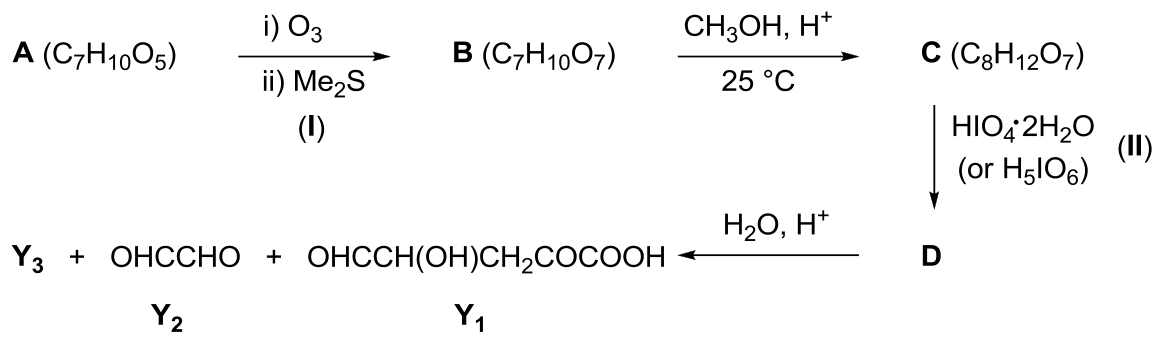
(I): this overall process results in an alkene cleavage at the \(\ce{C=C}\) bond, with each carbon of this becoming doubly bonded to an oxygen atom.
(II): this oxidative cleavage process of 1,2-diols breaks \(\ce{C(OH)-C(OH)}\) bond and produces corresponding carbonyl compounds.
8.1 Draw the structures for the compounds Y₁ and Y₂ and hence deduce the structure of Y₃ and A, B, C, D, given that in A there is only one ethylenic hydrogen atom.
Anethole, a main component of star anise oil, is an inexpensive chemical precursor for the production of many pharmaceutical drugs.
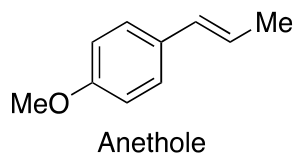
Treating anethole with sodium nitrite in acetic acid gives a crystalline solid E (\(\ce{C10H10N2O3}\)). The IR spectrum of E shows there is no non-aromatic \(\ce{C=C}\) double bond. The \({}^{1}\mathrm{H}\) NMR spectrum of E is given below.
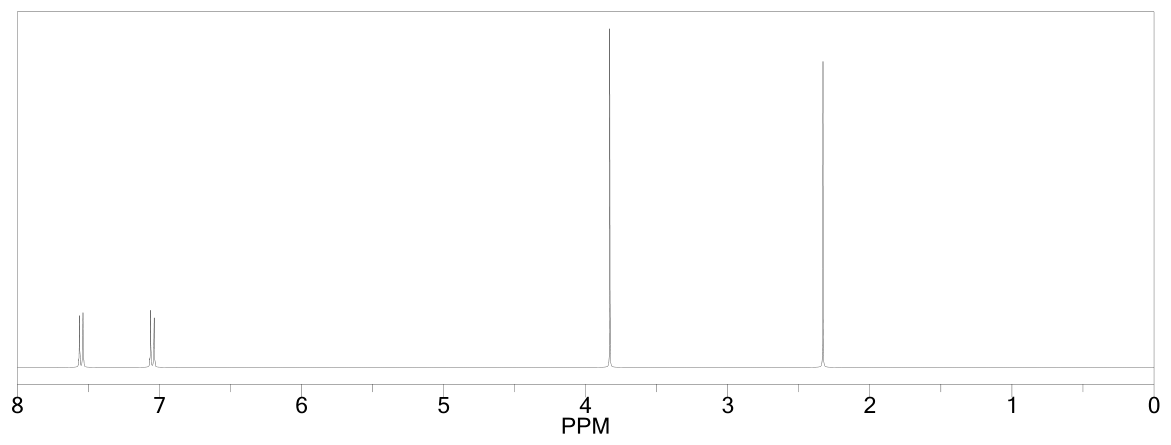
8.2 What differences in the structure between E and anethole can be obtained from the \({}^{1}\mathrm{H}\) NMR data? Pick one of the following statements.
i) E contains a cis-\(\ce{C=C}\) ethylenic bond while that of anethole is trans.
ii) E cannot contain a non-aromatic \(\ce{C=C}\) bond.
iii) E is the adduct of anethole and \(\ce{N2O2}\).
iv) E is the adduct of anethole and \(\ce{N2O3}\).
v) E does not contain two trans ethylenic protons as anethole.
On heating at \(150\,^\circ\mathrm{C}\) for several hours, E is partially isomerized into F. Under the same conditions, F gives the identical equilibrium mixture to that obtained from E. On heating with phosphorus trichloride, both E and F lose one oxygen atom giving compound G. Compounds E and F have the same functional groups.

The chemical shifts of methyl protons in E, F and G are given below.
| E | F | G | |
|---|---|---|---|
| \(\ce{CH3-O}\) | 3.8 ppm | 3.8 ppm | 3.8 ppm |
| \(\ce{CH3-C}\) | 2.3 ppm | 2.6 ppm | 2.6 ppm |
8.3 Suggest structures for E, F and G, assuming that they do NOT contain three-membered rings.
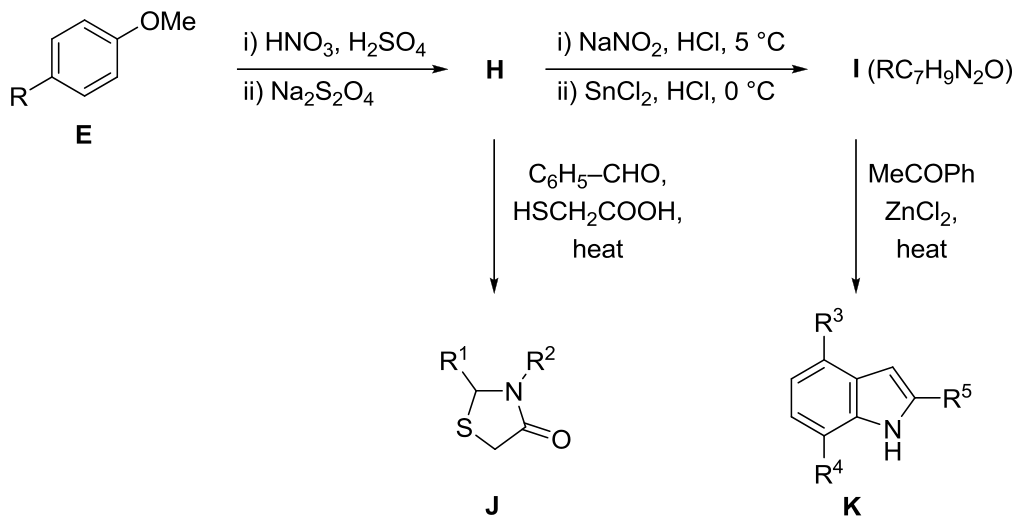
A simplified structure for compound E is shown below; the R group does not change throughout the rest of this question. Compound E is nitrated and subsequently reduced with sodium dithionite to H. Treatment of H with sodium nitrite and hydrochloric acid at \(0\text{–}5\,^\circ\mathrm{C}\) and subsequently reduced with stannous chloride to provide I (\(\ce{R-C7H9N2O}\)). One-pot reaction (three component reaction) of H, benzaldehyde and thioglycolic acid (\(\ce{HSCH2CO2H}\)) leads to the formation of J. Reaction of I and methyl phenyl ketone in the presence of \(\ce{ZnCl2}\) affords K.
8.4 Give the structures for H, I, J and K in the following scheme:
Official English text of the problem.
Answers
- 8.1. The structures are given below. Stereochemistry is left unspecified because the question determines constitution.
| Compound | Name | SMILES |
|---|---|---|
| Y₁ | 4-Hydroxy-2,5-dioxopentanoic acid | O=CC(O)CC(=O)C(=O)O |
| Y₂ | Glyoxal (ethanedial) | O=CC=O |
| Y₃ | Methanol | CO |
| A | 3,4,5-Trihydroxycyclohex-1-ene-1-carboxylic acid—the constitution of shikimic acid | O=C(O)C1=CC(O)C(O)C(O)C1 |
| B, open form | 4,5,6-Trihydroxy-2,7-dioxoheptanoic acid | O=CC(O)C(O)C(O)CC(=O)C(=O)O |
| B, cyclic hemiacetal | 3-(3,4,5-Trihydroxyoxolan-2-yl)-2-oxopropanoic acid | O=C(O)C(=O)CC1OC(O)C(O)C1O |
| C | 3-(3,4-Dihydroxy-5-methoxyoxolan-2-yl)-2-oxopropanoic acid | O=C(O)C(=O)CC1OC(OC)C(O)C1O |
| D | 4-(1-Methoxy-2-oxoethoxy)-2,5-dioxopentanoic acid | O=C(O)C(=O)CC(C=O)OC(OC)C=O |
-
8.2. v) E does not contain two trans ethylenic protons as anethole.
-
8.3. E and F are the two N-oxide regioisomers of the same substituted furazan. Furoxan means 1,2,5-oxadiazole 2-oxide; furazan means 1,2,5-oxadiazole.
| Compound | Name | SMILES |
|---|---|---|
| E | 4-(4-Methoxyphenyl)-3-methylfuroxan | COc1ccc(C2=NO[N+]([O-])=C2C)cc1 |
| F | 3-(4-Methoxyphenyl)-4-methylfuroxan | COc1ccc(C2=[N+]([O-])ON=C2C)cc1 |
| G | 3-(4-Methoxyphenyl)-4-methylfurazan | COc1ccc(C2=NON=C2C)cc1 |
In E, the N-oxide is adjacent to the methyl-bearing ring carbon; in F, it is adjacent to the aryl-bearing ring carbon.
- 8.4. Here \(R\) is 3-methylfuroxan-4-yl, with attachment-point SMILES
*C1=NO[N+]([O-])=C1C;*marks attachment to the aromatic ring.
| Compound | Name | SMILES |
|---|---|---|
| H | 4-(3-Amino-4-methoxyphenyl)-3-methylfuroxan | COc1ccc(C2=NO[N+]([O-])=C2C)cc1N |
| I | 4-(3-Hydrazinyl-4-methoxyphenyl)-3-methylfuroxan | COc1ccc(C2=NO[N+]([O-])=C2C)cc1NN |
| J | 3-[2-Methoxy-5-(3-methylfuroxan-4-yl)phenyl]-2-phenyl-1,3-thiazolidin-4-one | COc1ccc(C2=NO[N+]([O-])=C2C)cc1N1C(=O)CSC1c1ccccc1 |
| K | 7-Methoxy-4-(3-methylfuroxan-4-yl)-2-phenyl-1H-indole | COc1ccc(C2=NO[N+]([O-])=C2C)c2cc(-c3ccccc3)[nH]c12 |
The labels on the printed templates are:
\[ \boxed{ R^1=\text{phenyl},\quad R^2=\text{2-methoxy-5-}R\text{-phenyl},\quad R^3=R,\quad R^4=\text{methoxy},\quad R^5=\text{phenyl}. } \]
J has a new stereocentre at thiazolidinone C2; a racemic product is expected under the stated achiral conditions.
Solution
8.1
The explicitly supplied degradation products are
\[ \begin{aligned} Y_1&:\ \ce{OHC-CH(OH)-CH2-C(=O)-COOH},\\ Y_2&:\ \ce{OHC-CHO}. \end{aligned} \]
Thus Y₁ contains five carbons and Y₂ contains two. Together they account for all seven carbons originally present in A. The additional carbon introduced when B reacts with methanol must therefore leave during hydrolysis as Y₃, methanol.
The important feature of C is its cyclic methyl acetal, which protects both an aldehyde and one hydroxyl group during periodate oxidation.
Reversing the carbon–carbon cleavage that produces Y₁ and Y₂ gives the open-chain structure of B:
\[ \ce{OHC-CH(OH)-CH(OH)-CH(OH)-CH2-C(=O)-COOH}. \]
The aldehyde reacts intramolecularly with the third hydroxyl group counted from the aldehyde end. This forms a five-membered hemiacetal ring: four carbon atoms and one oxygen atom. Methanol then converts the hemiacetal hydroxyl group into a methoxy group, giving C.
Consequently, C has:
- one cyclic acetal carbon bearing hydrogen and methoxy;
- two adjacent, unprotected secondary hydroxyl groups;
- a side chain \(\ce{-CH2-C(=O)-COOH}\).
Periodate cleaves the bond between the two unprotected hydroxyl-bearing carbons. The resulting structure is
\[ \ce{HOOC-C(=O)-CH2-CH(CHO)-O-CH(OCH3)-CHO}, \]
which is D. Its acetal linkage still connects the future five-carbon and two-carbon fragments.
Acidic hydrolysis restores the hydroxyl group of Y₁ and the second aldehyde group of glyoxal, while releasing methanol:
\[ \ce{D + H2O ->[H+] Y1 + Y2 + CH3OH}. \]
To recover A, reverse the ozonolysis of B. The aldehyde carbon at one end and the ketone carbon adjacent to the carboxyl group were the two alkene carbons. Reconnecting them produces a six-membered ring.
The constitution of A is therefore a cyclohexene bearing:
- \(\ce{COOH}\) at alkene carbon C1;
- the sole ethylenic hydrogen at C2;
- hydroxyl groups at C3, C4 and C5;
- a methylene group at C6.
This is the shikimic-acid constitution.
The degree of unsaturation provides a check:
\[ \mathrm{DBE}(A)=\frac{2(7)+2-10}{2}=3, \]
accounted for by one carboxyl carbonyl, one alkene and one ring.
Using the compound labels for the organic structures, the balanced transformations are
\[ \ce{A + O3 + (CH3)2S -> B + (CH3)2SO}, \]
\[ \ce{B + CH3OH <=>[H+] C + H2O}, \]
\[ \ce{C + H5IO6 -> D + HIO3 + 3H2O}, \]
\[ \ce{D + H2O ->[H+] Y1 + Y2 + Y3}. \]
The formulas also agree throughout:
\[ \begin{aligned} B &: \ce{C7H10O7},\\ C &: \ce{C8H12O7},\\ D &: \ce{C8H10O7}. \end{aligned} \]
A methyl ester alone would not provide the required protection of the adjacent hydroxyl groups; the degradation requires the methyl acetal described above.
8.2
The starting material is trans-anethole, or \((E)\)-anethole, COc1ccc(/C=C/C)cc1.
Its side chain contains two ethylenic hydrogens. In E, the displayed spectrum instead shows two aromatic proton sets and the methoxy and carbon-bound methyl signals. Together with the molecular formula, these account for four aromatic hydrogens and two three-hydrogen methyl groups. The original pair of ethylenic proton signals is absent.
Therefore the conclusion supported by the proton NMR is
\[ \boxed{\text{v) E does not contain two trans ethylenic protons as anethole.}} \]
Option ii is stronger than proton NMR alone permits: a double bond bearing no hydrogens need not produce an ethylenic proton signal. The IR observation supplies the separate information about the absence of a non-aromatic alkene.
Options iii and iv also fail as simple addition formulas. Addition of either \(\ce{N2O2}\) or \(\ce{N2O3}\) to anethole would retain twelve hydrogens, whereas E has ten.
8.3
For E,
\[ \mathrm{DBE}(E) =\frac{2(10)+2+2-10}{2} =7. \]
The benzene ring accounts for four degrees of unsaturation. The remaining three can be accommodated by a five-membered ring containing two double bonds.
The retained methoxyphenyl and methyl groups leave two additional carbon atoms, two nitrogen atoms and two oxygen atoms to form the transformed side-chain unit. A furoxan ring satisfies these constraints:
- its ring sequence is \(\ce{O-N-C-C-N}\);
- its Kekulé structure has two \(\ce{C=N}\) bonds;
- one nitrogen bears an exocyclic N-oxide oxygen;
- its two carbon atoms carry methyl and 4-methoxyphenyl substituents.
The SMILES in the answer explicitly show the N-oxide as \(\ce{N^{+}-O^{-}}\).
Removal of the exocyclic oxygen gives the corresponding furazan, G. Because the methyl and aryl substituents make the two nitrogen sites inequivalent, oxidation at either nitrogen gives a different furoxan. These are E and F, and removal of either N-oxide oxygen gives the same G.
The methyl shifts distinguish their assignments. Relative to G,
\[ \Delta\delta_E=2.3-2.6=-0.3\ \mathrm{ppm}, \qquad \Delta\delta_F=2.6-2.6=0.0\ \mathrm{ppm}. \]
The methyl group is appreciably shielded only in E. Accordingly, E is assigned the N-oxide adjacent to the methyl-bearing carbon; F has the N-oxide adjacent to the aryl-bearing carbon.
For a precise drawing, number the furoxan ring consecutively O1–N2–C3–C4–N5, with N2 bearing the exocyclic oxygen:
- E: methyl at C3 and 4-methoxyphenyl at C4.
- F: 4-methoxyphenyl at C3 and methyl at C4.
- G: the corresponding ring without the exocyclic N-oxide oxygen.
The thermal interconversion and deoxygenations are
\[ \ce{E <=> F} \qquad (150\,^\circ\mathrm{C}), \]
\[ \ce{E + PCl3 -> G + POCl3}, \]
\[ \ce{F + PCl3 -> G + POCl3}. \]
A balanced overall equation for formation of E from anethole under the stated nitrite/acetic-acid conditions is
\[ \ce{ C10H12O + 2NaNO2 + 2CH3COOH -> C10H10N2O3 + 2CH3COONa + 2H2O }. \]
This is an overall material balance, rather than an elementary mechanistic step.
8.4
Throughout this part, \(R\) remains the furoxan substituent identified above. For the following equations, let \(\ce{Ar}\) denote 2-methoxy-5-\(R\)-phenyl.
Formation of H. Methoxy directs electrophilic nitration ortho and para. Its para position is occupied by \(R\), and its two ortho positions are equivalent in E. Nitration therefore introduces the nitro group ortho to methoxy.
The intermediate is 4-(4-methoxy-3-nitrophenyl)-3-methylfuroxan, COc1ccc(C2=NO[N+]([O-])=C2C)cc1[N+](=O)[O-].
Its formation is balanced by
\[ \ce{C10H10N2O3 + HNO3 ->[H2SO4] C10H9N3O5 + H2O}. \]
Dithionite reduces the nitro group to an amino group, giving H, equivalently 2-methoxy-5-\(R\)-aniline. A balanced net reduction, expressing the oxidized sulfur product as hydrogen sulfite, is
\[ \ce{ArNO2 + 3S2O4^{2-} + 4H2O -> ArNH2 + 6HSO3^-}. \]
Formation of I. Diazotization replaces the amino group by a diazonium group:
\[ \ce{ArNH2 + NO2^- + 2H+ -> ArN2+ + 2H2O}. \]
The intermediate is the 2-methoxy-5-\(R\)-benzenediazonium ion, COc1ccc(C2=NO[N+]([O-])=C2C)cc1[N+]#N.
Reduction by tin(II) gives the arylhydrazine I:
\[ \ce{ArN2+ + 3H+ + 2Sn^{2+} -> ArNHNH2 + 2Sn^{4+}}. \]
The displayed organic structure is the neutral hydrazine after work-up. Its substituent formula is correctly
\[ \ce{R-C6H3(OCH3)(NHNH2)} =\ce{R-C7H9N2O}. \]
Formation of J. Benzaldehyde, O=Cc1ccccc1, first condenses with H to form its imine. This intermediate is N-benzylidene-2-methoxy-5-\(R\)-aniline, COc1ccc(C2=NO[N+]([O-])=C2C)cc1N=Cc1ccccc1.
The sulfur of thioglycolic acid, O=C(O)CS, adds to the imine carbon. Subsequent intramolecular amide formation closes the five-membered thiazolidin-4-one ring.
Consequently:
- the benzaldehyde-derived phenyl group is attached to ring C2, so \(R^1=\) phenyl;
- the original aryl group of H remains attached to nitrogen, so \(R^2=\) 2-methoxy-5-\(R\)-phenyl;
- the thioglycolic-acid carboxyl group becomes the ring carbonyl;
- its methylene becomes ring C5.
The balanced overall condensation is
\[ \ce{ArNH2 + C6H5CHO + HSCH2COOH -> J + 2H2O}. \]
The product has formula \(\ce{C19H17N3O4S}\). Its newly formed C2 stereocentre is not assigned an absolute configuration.
Formation of K. I reacts with acetophenone, CC(=O)c1ccccc1, through a Fischer indole synthesis.
The initial condensation product is acetophenone (2-methoxy-5-\(R\)-phenyl)hydrazone, COc1ccc(C2=NO[N+]([O-])=C2C)cc1NN=C(C)c1ccccc1. Its geometrical configuration is not specified by the problem.
During indole formation:
- the nitrogen originally bonded to the aromatic ring becomes the indole nitrogen;
- the other nitrogen is eliminated as ammonia;
- the acetophenone carbonyl carbon becomes indole C2 and retains phenyl;
- the acetophenone methyl carbon becomes indole C3.
One position ortho to the hydrazine group is occupied by methoxy. Cyclization therefore occurs at the other, unsubstituted ortho position. Mapping the original aromatic ring onto the indole gives methoxy at C7 and \(R\) at C4.
Thus the printed template requires
\[ \boxed{R^3=R,\qquad R^4=\ce{OCH3},\qquad R^5=\ce{C6H5}.} \]
The balanced overall reaction is
\[ \ce{I + C6H5COCH3 -> K + NH3 + H2O}, \]
with \(\ce{ZnCl2}\) and heat. The resulting formula, \(\ce{C18H15N3O3}\), agrees with the structure given for K.
The answers were checked against the official answers published by the organisers.
IChO 2014 · Theorieaufgabe 8
Sternanis
Illicium verum, allgemein als Sternanis bezeichnet, ist ein kleiner, immergrüner Baum, der im Nordosten Vietnams heimisch ist und dort angebaut wird. Die Früchte des Sternanis werden in der traditionellen vietnamesischen Medizin verwendet. Sie sind außerdem eine wesentliche Zutat für den Geschmack von ‚phở‘, einer beliebten vietnamesischen Suppe. Aus den Früchten des Sternanis wird die Säure A isoliert. Die Konstitutionsformel von A wurde anhand der folgenden Reaktionsfolge ermittelt:
(I): Dieser Gesamtprozess führt zur Spaltung eines Alkens an der \(\ce{C=C}\)-Bindung, wobei jedes der beiden Kohlenstoffatome eine Doppelbindung zu einem Sauerstoffatom bildet.
(II): Bei dieser oxidativen Spaltung von 1,2-Diolen wird die \(\ce{C(OH)-C(OH)}\)-Bindung gespalten, und es entstehen die entsprechenden Carbonylverbindungen.
8.1 Zeichnen Sie die Strukturen der Verbindungen Y₁ und Y₂ und leiten Sie daraus die Strukturen von Y₃ und A, B, C, D ab. Dabei ist gegeben, dass A nur ein einziges olefinisches Wasserstoffatom enthält.
Anethol, ein Hauptbestandteil des Sternanisöls, ist ein kostengünstiger chemischer Ausgangsstoff für die Herstellung zahlreicher Arzneistoffe.
Die Behandlung von Anethol mit Natriumnitrit in Essigsäure liefert einen kristallinen Feststoff E (\(\ce{C10H10N2O3}\)). Das IR-Spektrum von E zeigt, dass keine nichtaromatische \(\ce{C=C}\)-Doppelbindung vorhanden ist. Das \({}^{1}\mathrm{H}\)-NMR-Spektrum von E ist unten dargestellt.
8.2 Welche Unterschiede zwischen den Strukturen von E und Anethol lassen sich aus den \({}^{1}\mathrm{H}\)-NMR-Daten ableiten? Wählen Sie eine der folgenden Aussagen aus.
i) E enthält eine olefinische cis-\(\ce{C=C}\)-Bindung, während diejenige in Anethol trans-konfiguriert ist.
ii) E kann keine nichtaromatische \(\ce{C=C}\)-Bindung enthalten.
iii) E ist das Addukt von Anethol und \(\ce{N2O2}\).
iv) E ist das Addukt von Anethol und \(\ce{N2O3}\).
v) E enthält nicht wie Anethol zwei trans-ständige olefinische Protonen.
Beim mehrstündigen Erhitzen auf \(150\,^\circ\mathrm{C}\) isomerisiert E teilweise zu F. Unter denselben Bedingungen liefert F das gleiche Gleichgewichtsgemisch wie E. Beim Erhitzen mit Phosphortrichlorid verlieren sowohl E als auch F ein Sauerstoffatom und ergeben die Verbindung G. Die Verbindungen E und F besitzen dieselben funktionellen Gruppen.
Die chemischen Verschiebungen der Methylprotonen in E, F und G sind unten angegeben.
| E | F | G | |
|---|---|---|---|
| \(\ce{CH3-O}\) | 3.8 ppm | 3.8 ppm | 3.8 ppm |
| \(\ce{CH3-C}\) | 2.3 ppm | 2.6 ppm | 2.6 ppm |
8.3 Schlagen Sie Strukturen für E, F und G vor, unter der Annahme, dass sie KEINE dreigliedrigen Ringe enthalten.
Eine vereinfachte Struktur der Verbindung E ist unten dargestellt; die Gruppe R bleibt im gesamten restlichen Teil dieser Aufgabe unverändert. Die Verbindung E wird nitriert und anschließend mit Natriumdithionit zu H reduziert. Die Behandlung von H mit Natriumnitrit und Salzsäure bei \(0\text{–}5\,^\circ\mathrm{C}\) und die anschließende Reduktion mit Zinn(II)-chlorid liefern I (\(\ce{R-C7H9N2O}\)). Eine Eintopfreaktion (Dreikomponentenreaktion) von H, Benzaldehyd und Thioglycolsäure (\(\ce{HSCH2CO2H}\)) führt zur Bildung von J. Die Reaktion von I mit Methylphenylketon in Gegenwart von \(\ce{ZnCl2}\) liefert K.
8.4 Geben Sie die Strukturen von H, I, J und K im folgenden Schema an:
Aufgabentext aus dem offiziellen englischen Text übersetzt.
Antworten
- 8.1. Die Strukturen sind unten angegeben. Die Stereochemie bleibt unbestimmt, da die Aufgabe die Konstitution festlegt.
| Verbindung | Name | SMILES |
|---|---|---|
| Y₁ | 4-Hydroxy-2,5-dioxopentansäure | O=CC(O)CC(=O)C(=O)O |
| Y₂ | Glyoxal (Ethandial) | O=CC=O |
| Y₃ | Methanol | CO |
| A | 3,4,5-Trihydroxycyclohex-1-en-1-carbonsäure — die Konstitution der Shikimisäure | O=C(O)C1=CC(O)C(O)C(O)C1 |
| B, offene Form | 4,5,6-Trihydroxy-2,7-dioxoheptansäure | O=CC(O)C(O)C(O)CC(=O)C(=O)O |
| B, cyclisches Halbacetal | 3-(3,4,5-Trihydroxyoxolan-2-yl)-2-oxopropansäure | O=C(O)C(=O)CC1OC(O)C(O)C1O |
| C | 3-(3,4-Dihydroxy-5-methoxyoxolan-2-yl)-2-oxopropansäure | O=C(O)C(=O)CC1OC(OC)C(O)C1O |
| D | 4-(1-Methoxy-2-oxoethoxy)-2,5-dioxopentansäure | O=C(O)C(=O)CC(C=O)OC(OC)C=O |
-
8.2. v) E enthält nicht wie Anethol zwei trans-ständige olefinische Protonen.
-
8.3. E und F sind die beiden N-Oxid-Regioisomere desselben substituierten Furazans. Furoxan bezeichnet 1,2,5-Oxadiazol-2-oxid; Furazan bezeichnet 1,2,5-Oxadiazol.
| Verbindung | Name | SMILES |
|---|---|---|
| E | 4-(4-Methoxyphenyl)-3-methylfuroxan | COc1ccc(C2=NO[N+]([O-])=C2C)cc1 |
| F | 3-(4-Methoxyphenyl)-4-methylfuroxan | COc1ccc(C2=[N+]([O-])ON=C2C)cc1 |
| G | 3-(4-Methoxyphenyl)-4-methylfurazan | COc1ccc(C2=NON=C2C)cc1 |
In E befindet sich das N-Oxid neben dem Ringkohlenstoffatom, das die Methylgruppe trägt; in F befindet es sich neben dem Ringkohlenstoffatom, das die Arylgruppe trägt.
- 8.4. Hier ist \(R\) 3-Methylfuroxan-4-yl, mit dem SMILES-Ausdruck
*C1=NO[N+]([O-])=C1Czur Kennzeichnung der Verknüpfungsstelle;*markiert die Bindung zum aromatischen Ring.
| Verbindung | Name | SMILES |
|---|---|---|
| H | 4-(3-Amino-4-methoxyphenyl)-3-methylfuroxan | COc1ccc(C2=NO[N+]([O-])=C2C)cc1N |
| I | 4-(3-Hydrazinyl-4-methoxyphenyl)-3-methylfuroxan | COc1ccc(C2=NO[N+]([O-])=C2C)cc1NN |
| J | 3-[2-Methoxy-5-(3-methylfuroxan-4-yl)phenyl]-2-phenyl-1,3-thiazolidin-4-on | COc1ccc(C2=NO[N+]([O-])=C2C)cc1N1C(=O)CSC1c1ccccc1 |
| K | 7-Methoxy-4-(3-methylfuroxan-4-yl)-2-phenyl-1H-indol | COc1ccc(C2=NO[N+]([O-])=C2C)c2cc(-c3ccccc3)[nH]c12 |
Die Beschriftungen der gedruckten Strukturvorlagen lauten:
\[ \boxed{ R^1=\text{Phenyl},\quad R^2=\text{2-Methoxy-5-}R\text{-phenyl},\quad R^3=R,\quad R^4=\text{Methoxy},\quad R^5=\text{Phenyl}. } \]
J besitzt ein neues Stereozentrum am C2 des Thiazolidinons; unter den angegebenen achiralen Bedingungen ist ein racemisches Produkt zu erwarten.
Lösung
8.1
Die ausdrücklich angegebenen Abbauprodukte sind
\[ \begin{aligned} Y_1&:\ \ce{OHC-CH(OH)-CH2-C(=O)-COOH},\\ Y_2&:\ \ce{OHC-CHO}. \end{aligned} \]
Somit enthält Y₁ fünf Kohlenstoffatome und Y₂ zwei. Zusammen erfassen sie alle sieben Kohlenstoffatome, die ursprünglich in A vorhanden waren. Das zusätzliche Kohlenstoffatom, das bei der Reaktion von B mit Methanol eingeführt wird, muss daher bei der Hydrolyse als Y₃, Methanol, abgespalten werden.
Das wesentliche Strukturmerkmal von C ist sein cyclisches Methylacetal, das während der Periodatoxidation sowohl eine Aldehydgruppe als auch eine Hydroxygruppe schützt.
Durch Umkehrung der Kohlenstoff-Kohlenstoff-Spaltung, die Y₁ und Y₂ liefert, erhält man die offenkettige Struktur von B:
\[ \ce{OHC-CH(OH)-CH(OH)-CH(OH)-CH2-C(=O)-COOH}. \]
Die Aldehydgruppe reagiert intramolekular mit der vom Aldehydende aus gezählten dritten Hydroxygruppe. Dabei entsteht ein fünfgliedriger Halbacetalring aus vier Kohlenstoffatomen und einem Sauerstoffatom. Methanol wandelt anschließend die Halbacetal-Hydroxygruppe in eine Methoxygruppe um, wodurch C entsteht.
Folglich besitzt C:
- ein cyclisches Acetalkohlenstoffatom, das ein Wasserstoffatom und eine Methoxygruppe trägt;
- zwei benachbarte, ungeschützte sekundäre Hydroxygruppen;
- eine Seitenkette \(\ce{-CH2-C(=O)-COOH}\).
Periodat spaltet die Bindung zwischen den beiden Kohlenstoffatomen, die die ungeschützten Hydroxygruppen tragen. Die entstehende Struktur ist
\[ \ce{HOOC-C(=O)-CH2-CH(CHO)-O-CH(OCH3)-CHO}, \]
also D. Ihre Acetalverknüpfung verbindet weiterhin die späteren Fragmente mit fünf beziehungsweise zwei Kohlenstoffatomen.
Die saure Hydrolyse stellt die Hydroxygruppe von Y₁ und die zweite Aldehydgruppe des Glyoxals wieder her und setzt dabei Methanol frei:
\[ \ce{D + H2O ->[H+] Y1 + Y2 + CH3OH}. \]
Um A zu rekonstruieren, kehrt man die Ozonolyse zu B um. Das Aldehydkohlenstoffatom an einem Ende und das Ketonkohlenstoffatom neben der Carboxygruppe waren die beiden Alkenkohlenstoffatome. Ihre erneute Verknüpfung ergibt einen sechsgliedrigen Ring.
Die Konstitution von A entspricht somit einem Cyclohexen mit:
- \(\ce{COOH}\) am Alkenkohlenstoffatom C1;
- dem einzigen olefinischen Wasserstoffatom an C2;
- Hydroxygruppen an C3, C4 und C5;
- einer Methylengruppe an C6.
Dies ist die Konstitution der Shikimisäure.
Der Doppelbindungsäquivalentwert dient zur Kontrolle:
\[ \mathrm{DBE}(A)=\frac{2(7)+2-10}{2}=3, \]
wobei eine Carboxyl-Carbonylgruppe, eine Alkendoppelbindung und ein Ring jeweils ein Doppelbindungsäquivalent beitragen.
Unter Verwendung der Verbindungsbezeichnungen für die organischen Strukturen lauten die ausgeglichenen Reaktionsgleichungen
\[ \ce{A + O3 + (CH3)2S -> B + (CH3)2SO}, \]
\[ \ce{B + CH3OH <=>[H+] C + H2O}, \]
\[ \ce{C + H5IO6 -> D + HIO3 + 3H2O}, \]
\[ \ce{D + H2O ->[H+] Y1 + Y2 + Y3}. \]
Auch die Summenformeln stimmen durchgehend überein:
\[ \begin{aligned} B &: \ce{C7H10O7},\\ C &: \ce{C8H12O7},\\ D &: \ce{C8H10O7}. \end{aligned} \]
Ein Methylester allein würde den erforderlichen Schutz der benachbarten Hydroxygruppen nicht gewährleisten; der Abbau erfordert das oben beschriebene Methylacetal.
8.2
Der Ausgangsstoff ist trans-Anethol, auch \((E)\)-Anethol, COc1ccc(/C=C/C)cc1.
Seine Seitenkette enthält zwei olefinische Wasserstoffatome. Bei E zeigt das dargestellte Spektrum stattdessen zwei Gruppen aromatischer Protonen sowie die Signale der Methoxygruppe und der an Kohlenstoff gebundenen Methylgruppe. Zusammen mit der Summenformel entsprechen diese vier aromatischen Wasserstoffatomen und zwei Methylgruppen mit jeweils drei Wasserstoffatomen. Das ursprüngliche Paar olefinischer Protonensignale fehlt.
Die durch das Protonen-NMR-Spektrum gestützte Schlussfolgerung lautet daher
\[ \boxed{\text{v) E enthält nicht wie Anethol zwei trans-ständige olefinische Protonen.}} \]
Aussage ii geht über das hinaus, was sich allein aus dem Protonen-NMR-Spektrum ableiten lässt: Eine Doppelbindung ohne Wasserstoffatome muss kein olefinisches Protonensignal erzeugen. Die IR-Beobachtung liefert die gesonderte Information über das Fehlen einer nichtaromatischen Alkendoppelbindung.
Auch die Aussagen iii und iv scheiden als Formeln einfacher Additionsprodukte aus. Die Addition von \(\ce{N2O2}\) oder \(\ce{N2O3}\) an Anethol würde die zwölf Wasserstoffatome erhalten, während E zehn besitzt.
8.3
Für E gilt
\[ \mathrm{DBE}(E) =\frac{2(10)+2+2-10}{2} =7. \]
Der Benzolring trägt vier Doppelbindungsäquivalente bei. Die verbleibenden drei lassen sich durch einen fünfgliedrigen Ring mit zwei Doppelbindungen erklären.
Neben den erhalten gebliebenen Methoxyphenyl- und Methylgruppen verbleiben zwei weitere Kohlenstoffatome, zwei Stickstoffatome und zwei Sauerstoffatome zur Bildung der umgewandelten Seitenketteneinheit. Ein Furoxanring erfüllt diese Bedingungen:
- seine Ringatomfolge ist \(\ce{O-N-C-C-N}\);
- seine Kekulé-Struktur besitzt zwei \(\ce{C=N}\)-Bindungen;
- ein Stickstoffatom trägt ein exocyclisches N-Oxid-Sauerstoffatom;
- seine beiden Kohlenstoffatome tragen Methyl- und 4-Methoxyphenylsubstituenten.
Die SMILES-Ausdrücke in der Antwort zeigen das N-Oxid ausdrücklich als \(\ce{N^{+}-O^{-}}\).
Die Entfernung des exocyclischen Sauerstoffatoms liefert das entsprechende Furazan, G. Da die Methyl- und Arylsubstituenten die beiden Stickstoffpositionen inäquivalent machen, ergibt die Oxidation an jedem der beiden Stickstoffatome ein anderes Furoxan. Dies sind E und F, und die Entfernung des jeweiligen N-Oxid-Sauerstoffatoms liefert dasselbe G.
Die chemischen Verschiebungen der Methylprotonen ermöglichen die Unterscheidung bei der Zuordnung. Bezogen auf G gilt
\[ \Delta\delta_E=2.3-2.6=-0.3\ \mathrm{ppm}, \qquad \Delta\delta_F=2.6-2.6=0.0\ \mathrm{ppm}. \]
Nur in E ist die Methylgruppe merklich abgeschirmt. Dementsprechend wird E das N-Oxid neben dem methylgruppentragenden Kohlenstoffatom zugeordnet; F besitzt das N-Oxid neben dem arylgruppentragenden Kohlenstoffatom.
Für eine genaue Zeichnung nummeriert man den Furoxanring fortlaufend als O1–N2–C3–C4–N5, wobei N2 das exocyclische Sauerstoffatom trägt:
- E: Methyl an C3 und 4-Methoxyphenyl an C4.
- F: 4-Methoxyphenyl an C3 und Methyl an C4.
- G: der entsprechende Ring ohne das exocyclische N-Oxid-Sauerstoffatom.
Die thermische Umwandlung ineinander und die Desoxygenierungen lauten
\[ \ce{E <=> F} \qquad (150\,^\circ\mathrm{C}), \]
\[ \ce{E + PCl3 -> G + POCl3}, \]
\[ \ce{F + PCl3 -> G + POCl3}. \]
Eine ausgeglichene Gesamtgleichung für die Bildung von E aus Anethol unter den angegebenen Nitrit/Essigsäure-Bedingungen lautet
\[ \ce{ C10H12O + 2NaNO2 + 2CH3COOH -> C10H10N2O3 + 2CH3COONa + 2H2O }. \]
Dies ist eine Gesamtstoffbilanz und kein mechanistischer Elementarschritt.
8.4
In diesem gesamten Teil bleibt \(R\) der oben identifizierte Furoxansubstituent. Für die folgenden Gleichungen bezeichne \(\ce{Ar}\) 2-Methoxy-5-\(R\)-phenyl.
Bildung von H. Die Methoxygruppe dirigiert die elektrophile Nitrierung in ortho- und para-Stellung. Ihre para-Position ist durch \(R\) besetzt, und ihre beiden ortho-Positionen sind in E äquivalent. Die Nitrierung führt die Nitrogruppe daher in ortho-Stellung zur Methoxygruppe ein.
Das Zwischenprodukt ist 4-(4-Methoxy-3-nitrophenyl)-3-methylfuroxan, COc1ccc(C2=NO[N+]([O-])=C2C)cc1[N+](=O)[O-].
Seine Bildung wird durch folgende ausgeglichene Gleichung beschrieben:
\[ \ce{C10H10N2O3 + HNO3 ->[H2SO4] C10H9N3O5 + H2O}. \]
Dithionit reduziert die Nitrogruppe zu einer Aminogruppe und liefert H, gleichbedeutend mit 2-Methoxy-5-\(R\)-anilin. Eine ausgeglichene Nettogleichung der Reduktion, in der das oxidierte Schwefelprodukt als Hydrogensulfit angegeben ist, lautet
\[ \ce{ArNO2 + 3S2O4^{2-} + 4H2O -> ArNH2 + 6HSO3^-}. \]
Bildung von I. Die Diazotierung ersetzt die Aminogruppe durch eine Diazoniumgruppe:
\[ \ce{ArNH2 + NO2^- + 2H+ -> ArN2+ + 2H2O}. \]
Das Zwischenprodukt ist das 2-Methoxy-5-\(R\)-benzoldiazonium-Ion, COc1ccc(C2=NO[N+]([O-])=C2C)cc1[N+]#N.
Die Reduktion mit Zinn(II) liefert das Arylhydrazin I:
\[ \ce{ArN2+ + 3H+ + 2Sn^{2+} -> ArNHNH2 + 2Sn^{4+}}. \]
Die dargestellte organische Struktur ist das neutrale Hydrazin nach der Aufarbeitung. Seine Formel mit dem Substituenten R lautet korrekt
\[ \ce{R-C6H3(OCH3)(NHNH2)} =\ce{R-C7H9N2O}. \]
Bildung von J. Benzaldehyd, O=Cc1ccccc1, kondensiert zunächst mit H zum entsprechenden Imin. Dieses Zwischenprodukt ist N-Benzyliden-2-methoxy-5-\(R\)-anilin, COc1ccc(C2=NO[N+]([O-])=C2C)cc1N=Cc1ccccc1.
Das Schwefelatom der Thioglycolsäure, O=C(O)CS, addiert an das Iminkohlenstoffatom. Die anschließende intramolekulare Amidbildung schließt den fünfgliedrigen Thiazolidin-4-on-Ring.
Daraus folgt:
- die aus Benzaldehyd stammende Phenylgruppe ist an C2 des Rings gebunden, also ist \(R^1=\) Phenyl;
- die ursprüngliche Arylgruppe von H bleibt an Stickstoff gebunden, also ist \(R^2=\) 2-Methoxy-5-\(R\)-phenyl;
- die Carboxygruppe der Thioglycolsäure wird zur Carbonylgruppe des Rings;
- ihre Methylengruppe wird zu C5 des Rings.
Die ausgeglichene Gesamtgleichung der Kondensation lautet
\[ \ce{ArNH2 + C6H5CHO + HSCH2COOH -> J + 2H2O}. \]
Das Produkt besitzt die Summenformel \(\ce{C19H17N3O4S}\). Seinem neu gebildeten Stereozentrum C2 wird keine absolute Konfiguration zugeordnet.
Bildung von K. I reagiert mit Acetophenon, CC(=O)c1ccccc1, in einer Fischer-Indolsynthese.
Das anfängliche Kondensationsprodukt ist Acetophenon-(2-methoxy-5-\(R\)-phenyl)hydrazon, COc1ccc(C2=NO[N+]([O-])=C2C)cc1NN=C(C)c1ccccc1. Seine geometrische Konfiguration wird durch die Aufgabe nicht festgelegt.
Während der Indolbildung:
- wird das ursprünglich an den aromatischen Ring gebundene Stickstoffatom zum Indolstickstoff;
- wird das andere Stickstoffatom als Ammoniak abgespalten;
- wird das Carbonylkohlenstoffatom des Acetophenons zu C2 des Indols und behält die Phenylgruppe;
- wird das Methylkohlenstoffatom des Acetophenons zu C3 des Indols.
Eine Position ortho zur Hydrazingruppe ist durch Methoxy besetzt. Die Cyclisierung erfolgt daher an der anderen, unsubstituierten ortho-Position. Die Zuordnung der Atome des ursprünglichen aromatischen Rings zum Indol ergibt Methoxy an C7 und \(R\) an C4.
Somit erfordert die gedruckte Strukturvorlage
\[ \boxed{R^3=R,\qquad R^4=\ce{OCH3},\qquad R^5=\ce{C6H5}.} \]
Die ausgeglichene Gesamtreaktion lautet
\[ \ce{I + C6H5COCH3 -> K + NH3 + H2O}, \]
mit \(\ce{ZnCl2}\) und Wärme. Die resultierende Summenformel, \(\ce{C18H15N3O3}\), stimmt mit der für K angegebenen Struktur überein.
Die Ergebnisse wurden mit den von den Veranstaltern veröffentlichten offiziellen Ergebnissen abgeglichen.
IChO 2014 · Teori sorusu 8
Yıldız anason
Yaygın olarak yıldız anason adıyla bilinen Illicium verum, Vietnam'ın kuzeydoğusunda yetiştirilen, bu bölgeye özgü, küçük ve her dem yeşil bir ağaçtır. Yıldız anason meyvesi geleneksel Vietnam tıbbında kullanılır. Ayrıca Vietnam'ın sevilen çorbalarından ‘phở’ya lezzet veren başlıca malzemelerden biridir. A asidi, yıldız anason meyvesinden izole edilir. A'nın yapı formülü aşağıdaki tepkime dizisinden çıkarılmıştır:
(I): bu işlem bir bütün olarak alkenin \(\ce{C=C}\) bağından parçalanmasıyla sonuçlanır; bu bağdaki karbon atomlarının her biri bir oksijen atomuna çift bağla bağlanır.
(II): 1,2-diollerin bu yükseltgenerek parçalanma işlemi, \(\ce{C(OH)-C(OH)}\) bağını koparır ve karşılık gelen karbonil bileşiklerini oluşturur.
8.1 A'da yalnızca bir etilenik hidrojen atomu bulunduğunu göz önünde bulundurarak Y₁ ve Y₂ bileşiklerinin yapılarını çiziniz ve buradan Y₃ ile A, B, C, D'nin yapılarını belirleyiniz.
Yıldız anason yağının ana bileşenlerinden biri olan anetol, birçok farmasötik ilacın üretiminde kullanılan ucuz bir kimyasal öncüdür.
Anetolün asetik asit içinde sodyum nitrit ile tepkimeye sokulması, kristal bir katı olan E'yi (\(\ce{C10H10N2O3}\)) verir. E'nin IR spektrumu, aromatik olmayan bir \(\ce{C=C}\) çift bağının bulunmadığını göstermektedir. E'nin \({}^{1}\mathrm{H}\) NMR spektrumu aşağıda verilmiştir.
8.2 \({}^{1}\mathrm{H}\) NMR verilerinden E ile anetolün yapıları arasında hangi farklılıklar çıkarılabilir? Aşağıdaki ifadelerden birini seçiniz.
i) E, cis-\(\ce{C=C}\) etilenik bağı içerirken anetoldeki bağ transtır.
ii) E, aromatik olmayan bir \(\ce{C=C}\) bağı içeremez.
iii) E, anetol ile \(\ce{N2O2}\)'nin katılma ürünüdür.
iv) E, anetol ile \(\ce{N2O3}\)'ün katılma ürünüdür.
v) E, anetolde olduğu gibi iki trans etilenik proton içermez.
\(150\,^\circ\mathrm{C}\)'de birkaç saat ısıtıldığında E, kısmen F'ye izomerleşir. Aynı koşullarda F, E'den elde edilenle aynı denge karışımını verir. Fosfor triklorür ile ısıtıldıklarında hem E hem de F bir oksijen atomu kaybederek G bileşiğini verir. E ve F bileşikleri aynı fonksiyonel gruplara sahiptir.
E, F ve G'deki metil protonlarının kimyasal kaymaları aşağıda verilmiştir.
| E | F | G | |
|---|---|---|---|
| \(\ce{CH3-O}\) | 3.8 ppm | 3.8 ppm | 3.8 ppm |
| \(\ce{CH3-C}\) | 2.3 ppm | 2.6 ppm | 2.6 ppm |
8.3 Üç üyeli halkalar İÇERMEDİKLERİNİ varsayarak E, F ve G için yapılar öneriniz.
E bileşiğinin basitleştirilmiş yapısı aşağıda gösterilmiştir; R grubu bu sorunun geri kalanı boyunca değişmez. E bileşiği nitrolanır ve ardından sodyum ditiyonit ile indirgenerek H'ye dönüştürülür. H'nin \(0\text{–}5\,^\circ\mathrm{C}\)'de sodyum nitrit ve hidroklorik asit ile tepkimeye sokulması ve ardından kalay(II) klorür ile indirgenmesi, I'yı (\(\ce{R-C7H9N2O}\)) verir. H, benzaldehit ve tiyoglikolik asidin (\(\ce{HSCH2CO2H}\)) tek kapta tepkimesi (üç bileşenli tepkime), J'nin oluşumuna yol açar. I ile metil fenil ketonun \(\ce{ZnCl2}\) varlığındaki tepkimesi K'yi verir.
8.4 Aşağıdaki şemada H, I, J ve K'nin yapılarını veriniz:
Soru metni resmi İngilizce metinden çevrilmiştir.
Cevaplar
- 8.1. Yapılar aşağıda verilmiştir. Soru atomların bağlanma düzenini belirlediğinden stereokimya belirtilmemiştir.
| Bileşik | Adı | SMILES |
|---|---|---|
| Y₁ | 4-Hidroksi-2,5-dioksopentanoik asit | O=CC(O)CC(=O)C(=O)O |
| Y₂ | Glioksal (etandial) | O=CC=O |
| Y₃ | Metanol | CO |
| A | 3,4,5-Trihidroksisikloheks-1-en-1-karboksilik asit—şikimik asidin bağlanma düzeni | O=C(O)C1=CC(O)C(O)C(O)C1 |
| B, açık biçim | 4,5,6-Trihidroksi-2,7-dioksoheptanoik asit | O=CC(O)C(O)C(O)CC(=O)C(=O)O |
| B, halkalı hemiasetal | 3-(3,4,5-Trihidroksioksolan-2-il)-2-oksopropanoik asit | O=C(O)C(=O)CC1OC(O)C(O)C1O |
| C | 3-(3,4-Dihidroksi-5-metoksioksolan-2-il)-2-oksopropanoik asit | O=C(O)C(=O)CC1OC(OC)C(O)C1O |
| D | 4-(1-Metoksi-2-oksoetoksi)-2,5-dioksopentanoik asit | O=C(O)C(=O)CC(C=O)OC(OC)C=O |
-
8.2. v) E, anetolde olduğu gibi iki trans etilenik proton içermez.
-
8.3. E ve F, aynı sübstitüe furazanın iki N-oksit konum izomeridir. Furoksan, 1,2,5-oksadiazol 2-oksit; furazan ise 1,2,5-oksadiazol anlamına gelir.
| Bileşik | Adı | SMILES |
|---|---|---|
| E | 4-(4-Metoksifenil)-3-metilfuroksan | COc1ccc(C2=NO[N+]([O-])=C2C)cc1 |
| F | 3-(4-Metoksifenil)-4-metilfuroksan | COc1ccc(C2=[N+]([O-])ON=C2C)cc1 |
| G | 3-(4-Metoksifenil)-4-metilfurazan | COc1ccc(C2=NON=C2C)cc1 |
E'de N-oksit, metil taşıyan halka karbonuna komşudur; F'de ise aril taşıyan halka karbonuna komşudur.
- 8.4. Burada \(R\), bağlanma noktasını gösteren SMILES ifadesi
*C1=NO[N+]([O-])=C1Colan 3-metilfuroksan-4-il grubudur;*, aromatik halkaya bağlanma noktasını gösterir.
| Bileşik | Adı | SMILES |
|---|---|---|
| H | 4-(3-Amino-4-metoksifenil)-3-metilfuroksan | COc1ccc(C2=NO[N+]([O-])=C2C)cc1N |
| I | 4-(3-Hidrazinil-4-metoksifenil)-3-metilfuroksan | COc1ccc(C2=NO[N+]([O-])=C2C)cc1NN |
| J | 3-[2-Metoksi-5-(3-metilfuroksan-4-il)fenil]-2-fenil-1,3-tiyazolidin-4-on | COc1ccc(C2=NO[N+]([O-])=C2C)cc1N1C(=O)CSC1c1ccccc1 |
| K | 7-Metoksi-4-(3-metilfuroksan-4-il)-2-fenil-1H-indol | COc1ccc(C2=NO[N+]([O-])=C2C)c2cc(-c3ccccc3)[nH]c12 |
Basılı şablonlardaki etiketler şöyledir:
\[ \boxed{ R^1=\text{fenil},\quad R^2=\text{2-metoksi-5-}R\text{-fenil},\quad R^3=R,\quad R^4=\text{metoksi},\quad R^5=\text{fenil}. } \]
J, tiyazolidinonun C2 atomunda yeni bir stereomerkeze sahiptir; belirtilen akiral koşullarda rasemik bir ürün beklenir.
Çözüm
8.1
Açıkça verilen parçalanma ürünleri şunlardır:
\[ \begin{aligned} Y_1&:\ \ce{OHC-CH(OH)-CH2-C(=O)-COOH},\\ Y_2&:\ \ce{OHC-CHO}. \end{aligned} \]
Dolayısıyla Y₁ beş, Y₂ ise iki karbon içerir. Birlikte, başlangıçta A'da bulunan yedi karbonun tamamını oluştururlar. Bu nedenle B'nin metanol ile tepkimesinde yapıya katılan ek karbon, hidroliz sırasında Y₃, yani metanol olarak ayrılmalıdır.
C'nin önemli özelliği, periyodatla yükseltgenme sırasında hem bir aldehiti hem de bir hidroksil grubunu koruyan halkalı metil asetal yapısıdır.
Y₁ ve Y₂'yi oluşturan karbon–karbon bağı kopmasını tersine çevirmek, B'nin açık zincirli yapısını verir:
\[ \ce{OHC-CH(OH)-CH(OH)-CH(OH)-CH2-C(=O)-COOH}. \]
Aldehit, aldehit ucundan sayıldığında üçüncü hidroksil grubuyla molekül içi tepkimeye girer. Böylece dört karbon atomu ve bir oksijen atomundan oluşan beş üyeli bir hemiasetal halkası oluşur. Ardından metanol, hemiasetalin hidroksil grubunu bir metoksi grubuna dönüştürerek C'yi verir.
Buna göre C'de şunlar bulunur:
- hidrojen ve metoksi taşıyan bir halkalı asetal karbonu;
- birbirine komşu, korunmamış iki sekonder hidroksil grubu;
- bir \(\ce{-CH2-C(=O)-COOH}\) yan zinciri.
Periyodat, korunmamış hidroksil gruplarını taşıyan iki karbon arasındaki bağı koparır. Oluşan yapı
\[ \ce{HOOC-C(=O)-CH2-CH(CHO)-O-CH(OCH3)-CHO}, \]
yani D'dir. Asetal bağlantısı, ileride oluşacak beş karbonlu ve iki karbonlu parçaları hâlâ birbirine bağlamaktadır.
Asidik hidroliz, metanol açığa çıkarırken Y₁'in hidroksil grubunu ve glioksalin ikinci aldehit grubunu yeniden oluşturur:
\[ \ce{D + H2O ->[H+] Y1 + Y2 + CH3OH}. \]
A'nın yapısını yeniden elde etmek için B'yi veren ozonolizi tersine çeviriniz. Bir uçtaki aldehit karbonu ile karboksil grubuna komşu keton karbonu, alkenin iki karbonuydu. Bunların yeniden bağlanması altı üyeli bir halka oluşturur.
Dolayısıyla A'nın bağlanma düzeni, aşağıdaki grupları taşıyan bir sikloheksene karşılık gelir:
- alken karbonu C1'de \(\ce{COOH}\);
- C2'de tek etilenik hidrojen;
- C3, C4 ve C5'te hidroksil grupları;
- C6'da bir metilen grubu.
Bu, şikimik asidin bağlanma düzenidir.
Doymamışlık derecesi bir kontrol sağlar:
\[ \mathrm{DBE}(A)=\frac{2(7)+2-10}{2}=3, \]
bu değer bir karboksil karbonili, bir alken ve bir halkadan kaynaklanır.
Organik yapılar için bileşik etiketleri kullanıldığında, denkleştirilmiş dönüşümler şöyledir:
\[ \ce{A + O3 + (CH3)2S -> B + (CH3)2SO}, \]
\[ \ce{B + CH3OH <=>[H+] C + H2O}, \]
\[ \ce{C + H5IO6 -> D + HIO3 + 3H2O}, \]
\[ \ce{D + H2O ->[H+] Y1 + Y2 + Y3}. \]
Formüller de tüm aşamalarda uyumludur:
\[ \begin{aligned} B &: \ce{C7H10O7},\\ C &: \ce{C8H12O7},\\ D &: \ce{C8H10O7}. \end{aligned} \]
Tek başına bir metil esteri, komşu hidroksil grupları için gereken korumayı sağlayamazdı; parçalanma, yukarıda açıklanan metil asetali gerektirir.
8.2
Başlangıç maddesi trans-anetol, diğer adıyla \((E)\)-anetoldür: COc1ccc(/C=C/C)cc1.
Yan zinciri iki etilenik hidrojen içerir. Buna karşılık E için verilen spektrum, iki aromatik proton grubu ile metoksi ve karbona bağlı metil sinyallerini gösterir. Molekül formülüyle birlikte değerlendirildiğinde bunlar, dört aromatik hidrojene ve her biri üç hidrojen içeren iki metil grubuna karşılık gelir. Başlangıçtaki etilenik proton sinyali çifti bulunmamaktadır.
Bu nedenle proton NMR verilerinin desteklediği sonuç şöyledir:
\[ \boxed{\text{v) E, anetolde olduğu gibi iki trans etilenik proton içermez.}} \]
ii seçeneği, yalnızca proton NMR verilerinin izin verdiğinden daha güçlü bir iddiadır: hidrojen taşımayan bir çift bağın etilenik proton sinyali vermesi gerekmez. IR gözlemi, aromatik olmayan bir alkenin bulunmadığına ilişkin ayrı bilgiyi sağlar.
iii ve iv seçenekleri de basit katılma formülleri olarak geçersizdir. Anetole gerek \(\ce{N2O2}\) gerekse \(\ce{N2O3}\) katılması on iki hidrojenin korunmasını gerektirirken E'de on hidrojen bulunur.
8.3
E için,
\[ \mathrm{DBE}(E) =\frac{2(10)+2+2-10}{2} =7. \]
Benzen halkası dört doymamışlık derecesine karşılık gelir. Kalan üç derece, iki çift bağ içeren beş üyeli bir halkayla karşılanabilir.
Korunan metoksifenil ve metil grupları dışında, dönüşüme uğramış yan zincir birimini oluşturmak üzere iki ek karbon atomu, iki azot atomu ve iki oksijen atomu kalır. Bir furoksan halkası bu koşulları karşılar:
- halkadaki atom dizilimi \(\ce{O-N-C-C-N}\)'dir;
- Kekulé yapısında iki \(\ce{C=N}\) bağı vardır;
- bir azot, halka dışı bir N-oksit oksijeni taşır;
- iki karbon atomu, metil ve 4-metoksifenil sübstitüentlerini taşır.
Cevaptaki SMILES ifadeleri, N-oksiti açıkça \(\ce{N^{+}-O^{-}}\) olarak gösterir.
Halka dışı oksijenin uzaklaştırılması, karşılık gelen furazanı, G'yi verir. Metil ve aril sübstitüentleri iki azot konumunu eşdeğer olmaktan çıkardığından, azotlardan hangisinin yükseltgendiğine bağlı olarak farklı bir furoksan oluşur. Bunlar E ve F'dir ve N-oksit oksijenlerinden hangisi uzaklaştırılırsa uzaklaştırılsın aynı G elde edilir.
Metil grubunun kimyasal kaymaları, yapıların atanmasını sağlar. G'ye göre,
\[ \Delta\delta_E=2.3-2.6=-0.3\ \mathrm{ppm}, \qquad \Delta\delta_F=2.6-2.6=0.0\ \mathrm{ppm}. \]
Metil grubu yalnızca E'de belirgin biçimde perdelenmiştir. Buna göre E, N-oksitin metil taşıyan karbona komşu olduğu yapı olarak atanır; F'de ise N-oksit, aril taşıyan karbona komşudur.
Kesin bir çizim için furoksan halkasını, halka dışı oksijeni N2 taşıyacak şekilde, ardışık olarak O1–N2–C3–C4–N5 biçiminde numaralandırınız:
- E: C3'te metil ve C4'te 4-metoksifenil.
- F: C3'te 4-metoksifenil ve C4'te metil.
- G: halka dışı N-oksit oksijeni bulunmayan karşılık gelen halka.
Isıl olarak birbirine dönüşme ve oksijen uzaklaştırma tepkimeleri şöyledir:
\[ \ce{E <=> F} \qquad (150\,^\circ\mathrm{C}), \]
\[ \ce{E + PCl3 -> G + POCl3}, \]
\[ \ce{F + PCl3 -> G + POCl3}. \]
Belirtilen nitrit/asetik asit koşullarında anetolden E oluşumunun denkleştirilmiş toplam denklemi şöyledir:
\[ \ce{ C10H12O + 2NaNO2 + 2CH3COOH -> C10H10N2O3 + 2CH3COONa + 2H2O }. \]
Bu, mekanizmanın bir elementer basamağı değil, toplam madde bilançosudur.
8.4
Bu kısım boyunca \(R\), yukarıda belirlenen furoksan sübstitüenti olarak kalır. Aşağıdaki denklemlerde \(\ce{Ar}\), 2-metoksi-5-\(R\)-fenil grubunu göstersin.
H'nin oluşumu. Metoksi, elektrofilik nitrolamayı orto ve para konumlarına yönlendirir. Para konumu \(R\) tarafından işgal edilmiştir ve E'deki iki orto konumu eşdeğerdir. Bu nedenle nitrolama, nitro grubunu metoksiye göre orto konumuna yerleştirir.
Ara ürün 4-(4-metoksi-3-nitrofenil)-3-metilfuroksandır: COc1ccc(C2=NO[N+]([O-])=C2C)cc1[N+](=O)[O-].
Oluşumunun denkleştirilmiş denklemi şöyledir:
\[ \ce{C10H10N2O3 + HNO3 ->[H2SO4] C10H9N3O5 + H2O}. \]
Ditiyonit, nitro grubunu amino grubuna indirgeyerek H'yi, eşdeğer adıyla 2-metoksi-5-\(R\)-anilini verir. Yükseltgenmiş kükürt ürünü hidrojen sülfit olarak ifade edildiğinde, denkleştirilmiş net indirgenme tepkimesi şöyledir:
\[ \ce{ArNO2 + 3S2O4^{2-} + 4H2O -> ArNH2 + 6HSO3^-}. \]
I'nın oluşumu. Diazolama, amino grubunun yerine bir diazonyum grubu getirir:
\[ \ce{ArNH2 + NO2^- + 2H+ -> ArN2+ + 2H2O}. \]
Ara ürün 2-metoksi-5-\(R\)-benzendiazonyum iyonudur: COc1ccc(C2=NO[N+]([O-])=C2C)cc1[N+]#N.
Kalay(II) ile indirgenme, arilhidrazin I'yı verir:
\[ \ce{ArN2+ + 3H+ + 2Sn^{2+} -> ArNHNH2 + 2Sn^{4+}}. \]
Gösterilen organik yapı, tepkime sonrası işlemlerin ardından elde edilen nötr hidrazindir. Sübstitüentli formülü doğru olarak şöyledir:
\[ \ce{R-C6H3(OCH3)(NHNH2)} =\ce{R-C7H9N2O}. \]
J'nin oluşumu. Benzaldehit, O=Cc1ccccc1, önce H ile kondenzasyona girerek iminini oluşturur. Bu ara ürün N-benziliden-2-metoksi-5-\(R\)-anilindir: COc1ccc(C2=NO[N+]([O-])=C2C)cc1N=Cc1ccccc1.
Tiyoglikolik asidin, O=C(O)CS, kükürt atomu imin karbonuna katılır. Ardından gerçekleşen molekül içi amit oluşumu, beş üyeli tiyazolidin-4-on halkasını kapatır.
Buna göre:
- benzaldehitten gelen fenil grubu halkanın C2 atomuna bağlanır; dolayısıyla \(R^1=\) fenil;
- H'nin başlangıçtaki aril grubu azota bağlı kalır; dolayısıyla \(R^2=\) 2-metoksi-5-\(R\)-fenil;
- tiyoglikolik asidin karboksil grubu halka karboniline dönüşür;
- metilen grubu ise halkanın C5 atomuna dönüşür.
Denkleştirilmiş toplam kondenzasyon tepkimesi şöyledir:
\[ \ce{ArNH2 + C6H5CHO + HSCH2COOH -> J + 2H2O}. \]
Ürünün formülü \(\ce{C19H17N3O4S}\)'dir. Yeni oluşan C2 stereomerkezine mutlak konfigürasyon atanmamıştır.
K'nin oluşumu. I, asetofenon ile, CC(=O)c1ccccc1, Fischer indol sentezi yoluyla tepkimeye girer.
İlk kondenzasyon ürünü asetofenon (2-metoksi-5-\(R\)-fenil)hidrazondur: COc1ccc(C2=NO[N+]([O-])=C2C)cc1NN=C(C)c1ccccc1. Geometrik konfigürasyonu soruda belirtilmemiştir.
İndol oluşumu sırasında:
- başlangıçta aromatik halkaya bağlı olan azot, indol azotuna dönüşür;
- diğer azot, amonyak olarak ayrılır;
- asetofenonun karbonil karbonu, indolün C2 atomuna dönüşür ve fenili korur;
- asetofenonun metil karbonu, indolün C3 atomuna dönüşür.
Hidrazin grubuna göre orto konumlarından biri metoksi tarafından işgal edilmiştir. Bu nedenle halkalaşma, diğer, sübstitüe olmamış orto konumunda gerçekleşir. Başlangıçtaki aromatik halkanın atomları indol yapısındaki karşılıklarıyla eşleştirildiğinde metoksi C7'de, \(R\) ise C4'te yer alır.
Dolayısıyla basılı şablon için gerekenler şöyledir:
\[ \boxed{R^3=R,\qquad R^4=\ce{OCH3},\qquad R^5=\ce{C6H5}.} \]
Denkleştirilmiş toplam tepkime
\[ \ce{I + C6H5COCH3 -> K + NH3 + H2O}, \]
olup \(\ce{ZnCl2}\) ve ısı varlığında gerçekleşir. Elde edilen \(\ce{C18H15N3O3}\) formülü, K için verilen yapıyla uyumludur.
Sonuçlar, düzenleyicilerin yayımladığı resmi sonuçlarla karşılaştırılarak kontrol edildi.
IChO 2014 · Problema teórico 8
Anís estrellado
Illicium verum, comúnmente llamado anís estrellado, es un pequeño árbol perennifolio autóctono que se cultiva en el noreste de Vietnam. El fruto del anís estrellado se utiliza en la medicina tradicional vietnamita. También es uno de los principales ingredientes que aportan sabor al «phở», una de las sopas preferidas en Vietnam. El ácido A se aísla del fruto del anís estrellado. La fórmula constitucional de A se ha deducido a partir de la siguiente secuencia de reacciones:
(I): este proceso global produce la escisión de un alqueno por el enlace \(\ce{C=C}\), de modo que cada uno de sus carbonos queda unido mediante un doble enlace a un átomo de oxígeno.
(II): este proceso de escisión oxidativa de los 1,2-dioles rompe el enlace \(\ce{C(OH)-C(OH)}\) y produce los compuestos carbonílicos correspondientes.
8.1 Dibuje las estructuras de los compuestos Y₁ e Y₂ y deduzca a partir de ellas las estructuras de Y₃ y de A, B, C, D, sabiendo que en A solo hay un átomo de hidrógeno etilénico.
El anetol, uno de los principales componentes del aceite de anís estrellado, es un precursor químico económico para la producción de numerosos fármacos.
El tratamiento del anetol con nitrito de sodio en ácido acético da un sólido cristalino E (\(\ce{C10H10N2O3}\)). El espectro IR de E muestra que no hay ningún doble enlace \(\ce{C=C}\) no aromático. A continuación se presenta el espectro de RMN de \({}^{1}\mathrm{H}\) de E.
8.2 ¿Qué diferencias estructurales entre E y el anetol pueden deducirse de los datos de RMN de \({}^{1}\mathrm{H}\)? Elija una de las siguientes afirmaciones.
i) E contiene un enlace etilénico cis-\(\ce{C=C}\), mientras que el del anetol es trans.
ii) E no puede contener un enlace \(\ce{C=C}\) no aromático.
iii) E es el aducto del anetol y \(\ce{N2O2}\).
iv) E es el aducto del anetol y \(\ce{N2O3}\).
v) E no contiene dos protones etilénicos trans como el anetol.
Al calentarlo a \(150\,^\circ\mathrm{C}\) durante varias horas, E se isomeriza parcialmente a F. En las mismas condiciones, F da una mezcla de equilibrio idéntica a la obtenida a partir de E. Al calentarlos con tricloruro de fósforo, tanto E como F pierden un átomo de oxígeno y dan el compuesto G. Los compuestos E y F tienen los mismos grupos funcionales.
Los desplazamientos químicos de los protones de los grupos metilo en E, F y G se indican a continuación.
| E | F | G | |
|---|---|---|---|
| \(\ce{CH3-O}\) | 3.8 ppm | 3.8 ppm | 3.8 ppm |
| \(\ce{CH3-C}\) | 2.3 ppm | 2.6 ppm | 2.6 ppm |
8.3 Proponga estructuras para E, F y G, suponiendo que NO contienen anillos de tres miembros.
A continuación se muestra una estructura simplificada del compuesto E; el grupo R no cambia durante el resto de esta pregunta. El compuesto E se nitra y posteriormente se reduce con ditionito de sodio para dar H. El tratamiento de H con nitrito de sodio y ácido clorhídrico a \(0\text{–}5\,^\circ\mathrm{C}\), seguido de una reducción con cloruro de estaño(II), proporciona I (\(\ce{R-C7H9N2O}\)). La reacción en un solo recipiente (reacción de tres componentes) de H, benzaldehído y ácido tioglicólico (\(\ce{HSCH2CO2H}\)) conduce a la formación de J. La reacción de I y metil fenil cetona en presencia de \(\ce{ZnCl2}\) proporciona K.
8.4 Indique las estructuras de H, I, J y K en el siguiente esquema:
Enunciado traducido del texto oficial en inglés.
Respuestas
- 8.1. Las estructuras se indican a continuación. La estereoquímica se deja sin especificar porque la pregunta determina la constitución.
| Compuesto | Nombre | SMILES |
|---|---|---|
| Y₁ | Ácido 4-hidroxi-2,5-dioxopentanoico | O=CC(O)CC(=O)C(=O)O |
| Y₂ | Glioxal (etanodial) | O=CC=O |
| Y₃ | Metanol | CO |
| A | Ácido 3,4,5-trihidroxiciclohex-1-eno-1-carboxílico: la constitución del ácido shikímico | O=C(O)C1=CC(O)C(O)C(O)C1 |
| B, forma abierta | Ácido 4,5,6-trihidroxi-2,7-dioxoheptanoico | O=CC(O)C(O)C(O)CC(=O)C(=O)O |
| B, hemiacetal cíclico | Ácido 3-(3,4,5-trihidroxioxolan-2-il)-2-oxopropanoico | O=C(O)C(=O)CC1OC(O)C(O)C1O |
| C | Ácido 3-(3,4-dihidroxi-5-metoxioxolan-2-il)-2-oxopropanoico | O=C(O)C(=O)CC1OC(OC)C(O)C1O |
| D | Ácido 4-(1-metoxi-2-oxoetoxi)-2,5-dioxopentanoico | O=C(O)C(=O)CC(C=O)OC(OC)C=O |
-
8.2. v) E no contiene dos protones etilénicos trans como el anetol.
-
8.3. E y F son los dos regioisómeros de N-óxido del mismo furazano sustituido. Furoxano significa 2-óxido de 1,2,5-oxadiazol; furazano significa 1,2,5-oxadiazol.
| Compuesto | Nombre | SMILES |
|---|---|---|
| E | 4-(4-Metoxifenil)-3-metilfuroxano | COc1ccc(C2=NO[N+]([O-])=C2C)cc1 |
| F | 3-(4-Metoxifenil)-4-metilfuroxano | COc1ccc(C2=[N+]([O-])ON=C2C)cc1 |
| G | 3-(4-Metoxifenil)-4-metilfurazano | COc1ccc(C2=NON=C2C)cc1 |
En E, el N-óxido es adyacente al carbono del anillo que lleva el grupo metilo; en F, es adyacente al carbono del anillo que lleva el grupo arilo.
- 8.4. Aquí \(R\) es 3-metilfuroxan-4-il, con el SMILES que indica el punto de unión
*C1=NO[N+]([O-])=C1C;*señala la unión al anillo aromático.
| Compuesto | Nombre | SMILES |
|---|---|---|
| H | 4-(3-Amino-4-metoxifenil)-3-metilfuroxano | COc1ccc(C2=NO[N+]([O-])=C2C)cc1N |
| I | 4-(3-Hidrazinil-4-metoxifenil)-3-metilfuroxano | COc1ccc(C2=NO[N+]([O-])=C2C)cc1NN |
| J | 3-[2-Metoxi-5-(3-metilfuroxan-4-il)fenil]-2-fenil-1,3-tiazolidin-4-ona | COc1ccc(C2=NO[N+]([O-])=C2C)cc1N1C(=O)CSC1c1ccccc1 |
| K | 7-Metoxi-4-(3-metilfuroxan-4-il)-2-fenil-1H-indol | COc1ccc(C2=NO[N+]([O-])=C2C)c2cc(-c3ccccc3)[nH]c12 |
Las etiquetas de las plantillas impresas son:
\[ \boxed{ R^1=\text{fenil},\quad R^2=\text{2-metoxi-5-}R\text{-fenil},\quad R^3=R,\quad R^4=\text{metoxi},\quad R^5=\text{fenil}. } \]
J tiene un nuevo estereocentro en el C2 de la tiazolidinona; se espera un producto racémico en las condiciones aquirales indicadas.
Solución
8.1
Los productos de degradación proporcionados explícitamente son
\[ \begin{aligned} Y_1&:\ \ce{OHC-CH(OH)-CH2-C(=O)-COOH},\\ Y_2&:\ \ce{OHC-CHO}. \end{aligned} \]
Por tanto, Y₁ contiene cinco carbonos e Y₂ contiene dos. Juntos dan cuenta de los siete carbonos presentes originalmente en A. El carbono adicional introducido cuando B reacciona con metanol debe, por tanto, salir durante la hidrólisis como Y₃, metanol.
La característica importante de C es su acetal metílico cíclico, que protege tanto un aldehído como un grupo hidroxilo durante la oxidación con peryodato.
Al invertir la escisión carbono–carbono que produce Y₁ e Y₂ se obtiene la estructura de cadena abierta de B:
\[ \ce{OHC-CH(OH)-CH(OH)-CH(OH)-CH2-C(=O)-COOH}. \]
El aldehído reacciona intramolecularmente con el tercer grupo hidroxilo contado desde el extremo del aldehído. Así se forma un anillo hemiacetálico de cinco miembros: cuatro átomos de carbono y un átomo de oxígeno. A continuación, el metanol convierte el grupo hidroxilo hemiacetálico en un grupo metoxi, dando C.
En consecuencia, C tiene:
- un carbono acetálico cíclico que lleva un hidrógeno y un grupo metoxi;
- dos grupos hidroxilo secundarios adyacentes y no protegidos;
- una cadena lateral \(\ce{-CH2-C(=O)-COOH}\).
El peryodato rompe el enlace entre los dos carbonos que llevan grupos hidroxilo no protegidos. La estructura resultante es
\[ \ce{HOOC-C(=O)-CH2-CH(CHO)-O-CH(OCH3)-CHO}, \]
que corresponde a D. Su enlace acetálico sigue conectando los futuros fragmentos de cinco y dos carbonos.
La hidrólisis ácida regenera el grupo hidroxilo de Y₁ y el segundo grupo aldehído del glioxal, al tiempo que libera metanol:
\[ \ce{D + H2O ->[H+] Y1 + Y2 + CH3OH}. \]
Para recuperar A, se invierte la ozonólisis que da B. El carbono del aldehído de un extremo y el carbono cetónico adyacente al grupo carboxilo eran los dos carbonos del alqueno. Al volver a conectarlos se produce un anillo de seis miembros.
La constitución de A es, por tanto, la de un ciclohexeno que lleva:
- \(\ce{COOH}\) en el carbono alquénico C1;
- el único hidrógeno etilénico en C2;
- grupos hidroxilo en C3, C4 y C5;
- un grupo metileno en C6.
Esta es la constitución del ácido shikímico.
El grado de insaturación permite efectuar una comprobación:
\[ \mathrm{DBE}(A)=\frac{2(7)+2-10}{2}=3, \]
que corresponde a un carbonilo carboxílico, un alqueno y un anillo.
Utilizando las etiquetas de los compuestos para las estructuras orgánicas, las transformaciones ajustadas son
\[ \ce{A + O3 + (CH3)2S -> B + (CH3)2SO}, \]
\[ \ce{B + CH3OH <=>[H+] C + H2O}, \]
\[ \ce{C + H5IO6 -> D + HIO3 + 3H2O}, \]
\[ \ce{D + H2O ->[H+] Y1 + Y2 + Y3}. \]
Las fórmulas también concuerdan en todas las etapas:
\[ \begin{aligned} B &: \ce{C7H10O7},\\ C &: \ce{C8H12O7},\\ D &: \ce{C8H10O7}. \end{aligned} \]
Un éster metílico por sí solo no proporcionaría la protección necesaria de los grupos hidroxilo adyacentes; la degradación requiere el acetal metílico descrito anteriormente.
8.2
El material de partida es trans-anetol, o \((E)\)-anetol, COc1ccc(/C=C/C)cc1.
Su cadena lateral contiene dos hidrógenos etilénicos. En E, en cambio, el espectro mostrado presenta dos conjuntos de protones aromáticos y las señales del grupo metoxi y del metilo unido a carbono. Junto con la fórmula molecular, estas señales dan cuenta de cuatro hidrógenos aromáticos y dos grupos metilo de tres hidrógenos cada uno. El par original de señales de protones etilénicos está ausente.
Por tanto, la conclusión respaldada por la RMN de protón es
\[ \boxed{\text{v) E no contiene dos protones etilénicos trans como el anetol.}} \]
La opción ii es más categórica de lo que permite concluir la RMN de protón por sí sola: un doble enlace que no lleva hidrógenos no tiene por qué producir una señal de protón etilénico. La observación por IR proporciona la información independiente sobre la ausencia de un alqueno no aromático.
Las opciones iii y iv tampoco son válidas como fórmulas de adición simple. La adición de \(\ce{N2O2}\) o de \(\ce{N2O3}\) al anetol conservaría doce hidrógenos, mientras que E tiene diez.
8.3
Para E,
\[ \mathrm{DBE}(E) =\frac{2(10)+2+2-10}{2} =7. \]
El anillo bencénico da cuenta de cuatro grados de insaturación. Los tres restantes pueden corresponder a un anillo de cinco miembros que contiene dos dobles enlaces.
Los grupos metoxifenilo y metilo que se conservan dejan dos átomos de carbono adicionales, dos átomos de nitrógeno y dos átomos de oxígeno para formar la unidad de la cadena lateral transformada. Un anillo de furoxano satisface estas restricciones:
- la secuencia de su anillo es \(\ce{O-N-C-C-N}\);
- su estructura de Kekulé tiene dos enlaces \(\ce{C=N}\);
- un nitrógeno lleva un oxígeno exocíclico de N-óxido;
- sus dos átomos de carbono llevan sustituyentes metilo y 4-metoxifenilo.
Los SMILES de la respuesta muestran explícitamente el N-óxido como \(\ce{N^{+}-O^{-}}\).
La eliminación del oxígeno exocíclico da el furazano correspondiente, G. Puesto que los sustituyentes metilo y arilo hacen que las dos posiciones de nitrógeno no sean equivalentes, la oxidación en cada uno de los nitrógenos da un furoxano diferente. Estos son E y F, y la eliminación del oxígeno de cualquiera de los dos N-óxidos da el mismo G.
Los desplazamientos del metilo permiten distinguir sus asignaciones. Con respecto a G,
\[ \Delta\delta_E=2.3-2.6=-0.3\ \mathrm{ppm}, \qquad \Delta\delta_F=2.6-2.6=0.0\ \mathrm{ppm}. \]
El grupo metilo está apreciablemente apantallado solo en E. Por ello, a E se le asigna el N-óxido adyacente al carbono que lleva el metilo; F tiene el N-óxido adyacente al carbono que lleva el arilo.
Para dibujar la estructura con precisión, numere el anillo de furoxano consecutivamente O1–N2–C3–C4–N5, con el oxígeno exocíclico unido a N2:
- E: metilo en C3 y 4-metoxifenilo en C4.
- F: 4-metoxifenilo en C3 y metilo en C4.
- G: el anillo correspondiente sin el oxígeno exocíclico del N-óxido.
La interconversión térmica y las desoxigenaciones son
\[ \ce{E <=> F} \qquad (150\,^\circ\mathrm{C}), \]
\[ \ce{E + PCl3 -> G + POCl3}, \]
\[ \ce{F + PCl3 -> G + POCl3}. \]
Una ecuación global ajustada para la formación de E a partir de anetol en las condiciones indicadas de nitrito/ácido acético es
\[ \ce{ C10H12O + 2NaNO2 + 2CH3COOH -> C10H10N2O3 + 2CH3COONa + 2H2O }. \]
Esto es un balance global de materia, no una etapa elemental del mecanismo.
8.4
En toda esta parte, \(R\) sigue siendo el sustituyente furoxano identificado anteriormente. En las siguientes ecuaciones, \(\ce{Ar}\) representa 2-metoxi-5-\(R\)-fenilo.
Formación de H. El grupo metoxi orienta la nitración electrófila a las posiciones orto y para. Su posición para está ocupada por \(R\), y sus dos posiciones orto son equivalentes en E. Por tanto, la nitración introduce el grupo nitro en posición orto respecto al metoxi.
El intermedio es 4-(4-metoxi-3-nitrofenil)-3-metilfuroxano, COc1ccc(C2=NO[N+]([O-])=C2C)cc1[N+](=O)[O-].
Su formación se expresa mediante la ecuación ajustada
\[ \ce{C10H10N2O3 + HNO3 ->[H2SO4] C10H9N3O5 + H2O}. \]
El ditionito reduce el grupo nitro a un grupo amino, dando H, denominado de forma equivalente 2-metoxi-5-\(R\)-anilina. Una ecuación neta ajustada de la reducción, expresando el producto de oxidación del azufre como hidrogenosulfito, es
\[ \ce{ArNO2 + 3S2O4^{2-} + 4H2O -> ArNH2 + 6HSO3^-}. \]
Formación de I. La diazotación sustituye el grupo amino por un grupo diazonio:
\[ \ce{ArNH2 + NO2^- + 2H+ -> ArN2+ + 2H2O}. \]
El intermedio es el ion 2-metoxi-5-\(R\)-bencenodiazonio, COc1ccc(C2=NO[N+]([O-])=C2C)cc1[N+]#N.
La reducción con estaño(II) da la arilhidrazina I:
\[ \ce{ArN2+ + 3H+ + 2Sn^{2+} -> ArNHNH2 + 2Sn^{4+}}. \]
La estructura orgánica mostrada es la hidrazina neutra tras el tratamiento final de la mezcla de reacción. Su fórmula con el sustituyente es, correctamente,
\[ \ce{R-C6H3(OCH3)(NHNH2)} =\ce{R-C7H9N2O}. \]
Formación de J. El benzaldehído, O=Cc1ccccc1, se condensa primero con H para formar su imina. Este intermedio es N-benciliden-2-metoxi-5-\(R\)-anilina, COc1ccc(C2=NO[N+]([O-])=C2C)cc1N=Cc1ccccc1.
El azufre del ácido tioglicólico, O=C(O)CS, se adiciona al carbono de la imina. La posterior formación intramolecular de una amida cierra el anillo de tiazolidin-4-ona de cinco miembros.
En consecuencia:
- el grupo fenilo procedente del benzaldehído está unido al C2 del anillo, por lo que \(R^1=\) fenilo;
- el grupo arilo original de H permanece unido al nitrógeno, por lo que \(R^2=\) 2-metoxi-5-\(R\)-fenilo;
- el grupo carboxilo del ácido tioglicólico se convierte en el carbonilo del anillo;
- su metileno se convierte en el C5 del anillo.
La condensación global ajustada es
\[ \ce{ArNH2 + C6H5CHO + HSCH2COOH -> J + 2H2O}. \]
El producto tiene la fórmula \(\ce{C19H17N3O4S}\). No se asigna una configuración absoluta a su estereocentro C2 recién formado.
Formación de K. I reacciona con acetofenona, CC(=O)c1ccccc1, mediante una síntesis de indoles de Fischer.
El producto inicial de condensación es la (2-metoxi-5-\(R\)-fenil)hidrazona de la acetofenona, COc1ccc(C2=NO[N+]([O-])=C2C)cc1NN=C(C)c1ccccc1. El problema no especifica su configuración geométrica.
Durante la formación del indol:
- el nitrógeno unido originalmente al anillo aromático se convierte en el nitrógeno del indol;
- el otro nitrógeno se elimina como amoníaco;
- el carbono carbonílico de la acetofenona se convierte en el C2 del indol y conserva el fenilo;
- el carbono metílico de la acetofenona se convierte en el C3 del indol.
Una de las posiciones orto respecto al grupo hidrazina está ocupada por el metoxi. Por tanto, la ciclación se produce en la otra posición orto, no sustituida. Al establecer la correspondencia entre el anillo aromático original y el indol, el metoxi queda en C7 y \(R\) en C4.
Así, la plantilla impresa requiere
\[ \boxed{R^3=R,\qquad R^4=\ce{OCH3},\qquad R^5=\ce{C6H5}.} \]
La reacción global ajustada es
\[ \ce{I + C6H5COCH3 -> K + NH3 + H2O}, \]
con \(\ce{ZnCl2}\) y calor. La fórmula resultante, \(\ce{C18H15N3O3}\), concuerda con la estructura indicada para K.
Los resultados se comprobaron con los resultados oficiales publicados por los organizadores.
IChO 2014 · 理论题 8
八角
Illicium verum,通常称为八角,是一种原产于越南东北部并在当地栽培的小型常绿乔木。八角的果实用于越南传统医药。它也是赋予越南人喜爱的汤食“phở”(越南河粉)风味的主要配料之一。从八角果实中分离得到酸 A。通过以下反应序列推导出了 A 的构造式:
(I):这一总过程使烯烃的 \(\ce{C=C}\) 键断裂,原双键中的每个碳原子都转而与一个氧原子形成双键。
(II):这一邻二醇的氧化断裂过程使 \(\ce{C(OH)-C(OH)}\) 键断裂,生成相应的羰基化合物。
8.1 画出化合物 Y₁ 和 Y₂ 的结构,并据此推导出 Y₃ 以及 A, B, C, D 的结构,已知 A 中只有一个烯氢原子。
茴香脑是八角油的主要成分之一,是生产多种药物的廉价化学前体。
在乙酸中用亚硝酸钠处理茴香脑,得到晶态固体 E(\(\ce{C10H10N2O3}\))。E 的红外光谱表明其不含非芳香性的 \(\ce{C=C}\) 双键。E 的 \({}^{1}\mathrm{H}\) 核磁共振谱如下所示。
8.2 根据 \({}^{1}\mathrm{H}\) 核磁共振数据,可以得出 E 与茴香脑在结构上有什么差异?从下列陈述中选择一项。
i) E 含有顺式-\(\ce{C=C}\) 烯键,而茴香脑中的烯键为反式。
ii) E 不可能含有非芳香性的 \(\ce{C=C}\) 键。
iii) E 是茴香脑与 \(\ce{N2O2}\) 的加成产物。
iv) E 是茴香脑与 \(\ce{N2O3}\) 的加成产物。
v) E 不像茴香脑那样含有两个互为反式的烯氢。
在 \(150\,^\circ\mathrm{C}\) 下加热数小时,E 部分异构化为 F。在相同条件下,F 得到的平衡混合物与从 E 出发得到的完全相同。与三氯化磷一起加热时,E 和 F 均失去一个氧原子,生成化合物 G。化合物 E 和 F 具有相同的官能团。
E, F 和 G 中甲基质子的化学位移如下。
| E | F | G | |
|---|---|---|---|
| \(\ce{CH3-O}\) | 3.8 ppm | 3.8 ppm | 3.8 ppm |
| \(\ce{CH3-C}\) | 2.3 ppm | 2.6 ppm | 2.6 ppm |
8.3 假设 E, F 和 G 均不含三元环,提出它们的结构。
化合物 E 的简化结构如下所示;在本题余下部分中,R 基团保持不变。化合物 E 经硝化后,再用连二亚硫酸钠还原,得到 H。在 \(0\text{–}5\,^\circ\mathrm{C}\) 下用亚硝酸钠和盐酸处理 H,随后用氯化亚锡还原,得到 I(\(\ce{R-C7H9N2O}\))。H、苯甲醛与巯基乙酸(\(\ce{HSCH2CO2H}\))进行一锅反应(三组分反应),生成 J。I 与苯乙酮在 \(\ce{ZnCl2}\) 存在下反应,得到 K。
8.4 给出下列反应图式中 H, I, J 和 K 的结构:
题目译自官方英文原文。
答案
- 8.1. 结构如下。由于本题确定的是构造,因此未指定立体化学。
| 化合物 | 名称 | SMILES |
|---|---|---|
| Y₁ | 4-羟基-2,5-二氧代戊酸 | O=CC(O)CC(=O)C(=O)O |
| Y₂ | 乙二醛 | O=CC=O |
| Y₃ | 甲醇 | CO |
| A | 3,4,5-三羟基环己-1-烯-1-甲酸——莽草酸的构造 | O=C(O)C1=CC(O)C(O)C(O)C1 |
| B,开链形式 | 4,5,6-三羟基-2,7-二氧代庚酸 | O=CC(O)C(O)C(O)CC(=O)C(=O)O |
| B,环状半缩醛 | 3-(3,4,5-三羟基四氢呋喃-2-基)-2-氧代丙酸 | O=C(O)C(=O)CC1OC(O)C(O)C1O |
| C | 3-(3,4-二羟基-5-甲氧基四氢呋喃-2-基)-2-氧代丙酸 | O=C(O)C(=O)CC1OC(OC)C(O)C1O |
| D | 4-(1-甲氧基-2-氧代乙氧基)-2,5-二氧代戊酸 | O=C(O)C(=O)CC(C=O)OC(OC)C=O |
-
8.2. v) E 不像茴香脑那样含有两个互为反式的烯氢。
-
8.3. E 和 F 是同一种取代呋咱的两种 N-氧化物区域异构体。氧化呋咱指 1,2,5-噁二唑-2-氧化物;呋咱指 1,2,5-噁二唑。
| 化合物 | 名称 | SMILES |
|---|---|---|
| E | 4-(4-甲氧基苯基)-3-甲基氧化呋咱 | COc1ccc(C2=NO[N+]([O-])=C2C)cc1 |
| F | 3-(4-甲氧基苯基)-4-甲基氧化呋咱 | COc1ccc(C2=[N+]([O-])ON=C2C)cc1 |
| G | 3-(4-甲氧基苯基)-4-甲基呋咱 | COc1ccc(C2=NON=C2C)cc1 |
在 E 中,N-氧化物基团与连有甲基的环碳原子相邻;在 F 中,它与连有芳基的环碳原子相邻。
- 8.4. 此处 \(R\) 为 3-甲基氧化呋咱-4-基,标示连接点的 SMILES 为
*C1=NO[N+]([O-])=C1C;*表示与芳环连接的位置。
| 化合物 | 名称 | SMILES |
|---|---|---|
| H | 4-(3-氨基-4-甲氧基苯基)-3-甲基氧化呋咱 | COc1ccc(C2=NO[N+]([O-])=C2C)cc1N |
| I | 4-(3-肼基-4-甲氧基苯基)-3-甲基氧化呋咱 | COc1ccc(C2=NO[N+]([O-])=C2C)cc1NN |
| J | 3-[2-甲氧基-5-(3-甲基氧化呋咱-4-基)苯基]-2-苯基-1,3-噻唑烷-4-酮 | COc1ccc(C2=NO[N+]([O-])=C2C)cc1N1C(=O)CSC1c1ccccc1 |
| K | 7-甲氧基-4-(3-甲基氧化呋咱-4-基)-2-苯基-1H-吲哚 | COc1ccc(C2=NO[N+]([O-])=C2C)c2cc(-c3ccccc3)[nH]c12 |
印出的结构模板中的标记为:
\[ \boxed{ R^1=\text{苯基},\quad R^2=\text{2-甲氧基-5-}R\text{-苯基},\quad R^3=R,\quad R^4=\text{甲氧基},\quad R^5=\text{苯基}. } \]
J 在噻唑烷酮的 C2 位具有一个新的立体中心;在所述非手性条件下,预计生成外消旋产物。
解答
8.1
题目明确给出的降解产物为
\[ \begin{aligned} Y_1&:\ \ce{OHC-CH(OH)-CH2-C(=O)-COOH},\\ Y_2&:\ \ce{OHC-CHO}. \end{aligned} \]
因此,Y₁ 含有五个碳原子,Y₂ 含有两个碳原子。它们合计包含了 A 原有的全部七个碳原子。所以,B 与甲醇反应时引入的额外碳原子必定在水解时以 Y₃,即甲醇的形式离去。
C 的重要特征是其环状甲基缩醛结构,它在高碘酸氧化过程中同时保护一个醛基和一个羟基。
逆推生成 Y₁ 和 Y₂ 的碳—碳键断裂过程,得到 B 的开链结构:
\[ \ce{OHC-CH(OH)-CH(OH)-CH(OH)-CH2-C(=O)-COOH}. \]
醛基与从醛基端数起的第三个羟基发生分子内反应。这形成一个五元半缩醛环:包含四个碳原子和一个氧原子。随后,甲醇将半缩醛羟基转化为甲氧基,得到 C。
因此,C 具有:
- 一个连有氢和甲氧基的环状缩醛碳原子;
- 两个相邻且未受保护的仲羟基;
- 一条侧链 \(\ce{-CH2-C(=O)-COOH}\)。
高碘酸使两个连有未受保护羟基的碳原子之间的键断裂。所得结构为
\[ \ce{HOOC-C(=O)-CH2-CH(CHO)-O-CH(OCH3)-CHO}, \]
即 D。其缩醛连接部分仍将之后形成的五碳片段和二碳片段连接在一起。
酸性水解恢复 Y₁ 的羟基和乙二醛的第二个醛基,同时释放甲醇:
\[ \ce{D + H2O ->[H+] Y1 + Y2 + CH3OH}. \]
要还原出 A 的结构,可从 B 逆推臭氧分解过程。一端的醛基碳原子与邻近羧基的酮羰基碳原子原本是烯键的两个碳原子。将它们重新连接起来,形成一个六元环。
因此,A 的构造是具有以下基团的环己烯:
- 烯键碳原子 C1 上连有 \(\ce{COOH}\);
- C2 上连有唯一的烯氢;
- C3、C4 和 C5 上连有羟基;
- C6 为亚甲基。
这就是莽草酸的构造。
可用不饱和度进行检验:
\[ \mathrm{DBE}(A)=\frac{2(7)+2-10}{2}=3, \]
分别对应一个羧基羰基、一个烯键和一个环。
用化合物标记表示有机结构,配平后的转化反应为
\[ \ce{A + O3 + (CH3)2S -> B + (CH3)2SO}, \]
\[ \ce{B + CH3OH <=>[H+] C + H2O}, \]
\[ \ce{C + H5IO6 -> D + HIO3 + 3H2O}, \]
\[ \ce{D + H2O ->[H+] Y1 + Y2 + Y3}. \]
各步的分子式也均相符:
\[ \begin{aligned} B &: \ce{C7H10O7},\\ C &: \ce{C8H12O7},\\ D &: \ce{C8H10O7}. \end{aligned} \]
单靠甲酯不能对相邻羟基提供所需的保护;这一降解过程要求存在上述甲基缩醛结构。
8.2
起始原料是反式茴香脑,即 \((E)\)-茴香脑,COc1ccc(/C=C/C)cc1。
其侧链含有两个烯氢。而对于 E,所给谱图显示的是两组芳香质子信号,以及甲氧基和碳上甲基的信号。结合分子式,这些信号对应四个芳香氢和两个各含三个氢的甲基。原来的那一对烯氢信号已不存在。
因此,质子核磁共振谱所支持的结论为
\[ \boxed{\text{v) E 不像茴香脑那样含有两个互为反式的烯氢。}} \]
选项 ii 的断言超出了仅凭质子核磁共振谱所能得出的结论:不连有氢的双键不一定产生烯氢信号。红外光谱观察结果另行提供了不存在非芳香性烯键的信息。
选项 iii 和 iv 所对应的简单加成产物分子式也不成立。无论是 \(\ce{N2O2}\) 还是 \(\ce{N2O3}\) 与茴香脑加成,都会保留十二个氢原子,而 E 只有十个。
8.3
对于 E,
\[ \mathrm{DBE}(E) =\frac{2(10)+2+2-10}{2} =7. \]
苯环占据四个不饱和度。余下的三个不饱和度可以由一个含两个双键的五元环提供。
除去保留的甲氧基苯基和甲基,尚余两个碳原子、两个氮原子和两个氧原子,用于形成转化后的侧链单元。氧化呋咱环满足这些约束:
- 其环内原子序列为 \(\ce{O-N-C-C-N}\);
- 其凯库勒结构具有两个 \(\ce{C=N}\) 键;
- 一个氮原子连有环外的 N-氧化物氧原子;
- 两个碳原子分别连有甲基和 4-甲氧基苯基取代基。
答案中的 SMILES 将 N-氧化物明确表示为 \(\ce{N^{+}-O^{-}}\)。
除去环外氧原子便得到相应的呋咱 G。由于甲基和芳基取代基使两个氮原子位置不等价,在不同氮原子上氧化会得到不同的氧化呋咱。它们就是 E 和 F,而除去其中任一 N-氧化物的氧原子,都会得到同一个 G。
甲基的化学位移可用于区分二者的结构归属。相对于 G,
\[ \Delta\delta_E=2.3-2.6=-0.3\ \mathrm{ppm}, \qquad \Delta\delta_F=2.6-2.6=0.0\ \mathrm{ppm}. \]
只有 E 中的甲基受到明显屏蔽。因此,将 E 归属为 N-氧化物基团与连有甲基的碳原子相邻的结构;F 中的 N-氧化物基团则与连有芳基的碳原子相邻。
为准确绘制结构,将氧化呋咱环依次编号为 O1–N2–C3–C4–N5,其中 N2 连有环外氧原子:
- E:甲基位于 C3,4-甲氧基苯基位于 C4。
- F:4-甲氧基苯基位于 C3,甲基位于 C4。
- G:不含环外 N-氧化物氧原子的相应环结构。
热致相互转化及脱氧反应为
\[ \ce{E <=> F} \qquad (150\,^\circ\mathrm{C}), \]
\[ \ce{E + PCl3 -> G + POCl3}, \]
\[ \ce{F + PCl3 -> G + POCl3}. \]
在所述亚硝酸盐/乙酸条件下,由茴香脑生成 E 的配平总反应方程式为
\[ \ce{ C10H12O + 2NaNO2 + 2CH3COOH -> C10H10N2O3 + 2CH3COONa + 2H2O }. \]
这表示总的物料衡算,而不是反应机理中的某个基元步骤。
8.4
在本部分中,\(R\) 始终为上文确定的氧化呋咱取代基。在以下方程式中,用 \(\ce{Ar}\) 表示 2-甲氧基-5-\(R\)-苯基。
H 的生成。甲氧基使亲电硝化发生在邻位和对位。其对位已被 \(R\) 占据,而 E 中的两个邻位等价。因此,硝化将硝基引入甲氧基的邻位。
中间体为 4-(4-甲氧基-3-硝基苯基)-3-甲基氧化呋咱,COc1ccc(C2=NO[N+]([O-])=C2C)cc1[N+](=O)[O-]。
其生成反应配平为
\[ \ce{C10H10N2O3 + HNO3 ->[H2SO4] C10H9N3O5 + H2O}. \]
连二亚硫酸根将硝基还原为氨基,得到 H,也可称为 2-甲氧基-5-\(R\)-苯胺。将硫的氧化产物表示为亚硫酸氢根,配平后的净还原反应为
\[ \ce{ArNO2 + 3S2O4^{2-} + 4H2O -> ArNH2 + 6HSO3^-}. \]
I 的生成。重氮化反应将氨基转化为重氮基:
\[ \ce{ArNH2 + NO2^- + 2H+ -> ArN2+ + 2H2O}. \]
中间体为 2-甲氧基-5-\(R\)-苯重氮离子,COc1ccc(C2=NO[N+]([O-])=C2C)cc1[N+]#N。
经锡(II)还原得到芳基肼 I:
\[ \ce{ArN2+ + 3H+ + 2Sn^{2+} -> ArNHNH2 + 2Sn^{4+}}. \]
所示有机结构是后处理后得到的中性肼。其以取代基表示的分子式确为
\[ \ce{R-C6H3(OCH3)(NHNH2)} =\ce{R-C7H9N2O}. \]
J 的生成。苯甲醛 O=Cc1ccccc1 首先与 H 缩合形成相应的亚胺。该中间体为 N-苄叉-2-甲氧基-5-\(R\)-苯胺,COc1ccc(C2=NO[N+]([O-])=C2C)cc1N=Cc1ccccc1。
巯基乙酸 O=C(O)CS 的硫原子加成到亚胺碳原子上。随后通过分子内酰胺形成反应闭合成五元噻唑烷-4-酮环。
因此:
- 来自苯甲醛的苯基连接在环的 C2 上,因此 \(R^1=\) 苯基;
- H 原有的芳基仍与氮原子相连,因此 \(R^2=\) 2-甲氧基-5-\(R\)-苯基;
- 巯基乙酸的羧基变为环上的羰基;
- 其亚甲基变为环的 C5。
配平后的总缩合反应为
\[ \ce{ArNH2 + C6H5CHO + HSCH2COOH -> J + 2H2O}. \]
产物的分子式为 \(\ce{C19H17N3O4S}\)。其新形成的 C2 立体中心未指定绝对构型。
K 的生成。I 与苯乙酮 CC(=O)c1ccccc1 通过 Fischer 吲哚合成反应进行反应。
最初的缩合产物为苯乙酮(2-甲氧基-5-\(R\)-苯基)腙,COc1ccc(C2=NO[N+]([O-])=C2C)cc1NN=C(C)c1ccccc1。题目未指定其几何构型。
在形成吲哚的过程中:
- 最初与芳环相连的氮原子成为吲哚氮原子;
- 另一个氮原子以氨的形式脱除;
- 苯乙酮的羰基碳原子成为吲哚的 C2,并保留苯基;
- 苯乙酮的甲基碳原子成为吲哚的 C3。
肼基的一个邻位已被甲氧基占据。因此,环化发生在另一个未被取代的邻位。将原有芳环上的位置对应到吲哚骨架,可得甲氧基位于 C7,\(R\) 位于 C4。
因此,印出的结构模板要求
\[ \boxed{R^3=R,\qquad R^4=\ce{OCH3},\qquad R^5=\ce{C6H5}.} \]
配平后的总反应为
\[ \ce{I + C6H5COCH3 -> K + NH3 + H2O}, \]
反应在 \(\ce{ZnCl2}\) 存在下加热进行。所得分子式 \(\ce{C18H15N3O3}\) 与所给 K 的结构一致。
结果已与主办方公布的官方答案核对。
IChO 2014 · Теоретическая задача 8
Бадьян настоящий
Illicium verum, широко известный как бадьян настоящий, — небольшое вечнозелёное дерево, произрастающее на северо-востоке Вьетнама и культивируемое в этом регионе. Плоды бадьяна используются в традиционной вьетнамской медицине. Они также являются одним из основных ингредиентов, придающих характерный аромат «фо» — любимому во Вьетнаме супу. Из плодов бадьяна выделена кислота A. Структурная формула A установлена на основании следующей последовательности реакций:
(I): в результате этого процесса происходит расщепление алкена по связи \(\ce{C=C}\), причём каждый из двух атомов углерода этой связи образует двойную связь с атомом кислорода.
(II): в этом процессе окислительного расщепления 1,2-диолов разрывается связь \(\ce{C(OH)-C(OH)}\) и образуются соответствующие карбонильные соединения.
8.1 Изобразите структуры соединений Y₁ и Y₂ и на их основе установите структуры Y₃ и A, B, C, D, учитывая, что в A имеется только один атом водорода при двойной углерод-углеродной связи.
Анетол, основной компонент эфирного масла бадьяна, — недорогое исходное вещество для производства многих лекарственных препаратов.
При обработке анетола нитритом натрия в уксусной кислоте образуется кристаллическое вещество E (\(\ce{C10H10N2O3}\)). ИК-спектр E свидетельствует об отсутствии неароматической двойной связи \(\ce{C=C}\). Спектр ЯМР \({}^{1}\mathrm{H}\) соединения E приведён ниже.
8.2 Какие различия в строении E и анетола можно установить на основании данных ЯМР \({}^{1}\mathrm{H}\)? Выберите одно из следующих утверждений.
i) E содержит этиленовую связь \(\ce{C=C}\) с цис-конфигурацией, тогда как у анетола она имеет транс-конфигурацию.
ii) E не может содержать неароматическую связь \(\ce{C=C}\).
iii) E является аддуктом анетола и \(\ce{N2O2}\).
iv) E является аддуктом анетола и \(\ce{N2O3}\).
v) E не содержит двух этиленовых протонов в транс-положении, как в анетоле.
При нагревании при \(150\,^\circ\mathrm{C}\) в течение нескольких часов E частично изомеризуется в F. В тех же условиях F образует равновесную смесь, идентичную получаемой из E. При нагревании с трихлоридом фосфора и E, и F теряют по одному атому кислорода, образуя соединение G. Соединения E и F имеют одинаковые функциональные группы.
Химические сдвиги протонов метильных групп в E, F и G приведены ниже.
| E | F | G | |
|---|---|---|---|
| \(\ce{CH3-O}\) | 3.8 м.д. | 3.8 м.д. | 3.8 м.д. |
| \(\ce{CH3-C}\) | 2.3 м.д. | 2.6 м.д. | 2.6 м.д. |
8.3 Предложите структуры E, F и G, предполагая, что они НЕ содержат трёхчленных циклов.
Ниже приведена упрощённая структура соединения E; группа R остаётся неизменной во всей оставшейся части задачи. Соединение E нитруют, а затем восстанавливают дитионитом натрия до H. Обработка H нитритом натрия и соляной кислотой при \(0\text{–}5\,^\circ\mathrm{C}\) с последующим восстановлением хлоридом олова(II) даёт I (\(\ce{R-C7H9N2O}\)). Однореакторная реакция (трёхкомпонентная реакция) H, бензальдегида и тиогликолевой кислоты (\(\ce{HSCH2CO2H}\)) приводит к образованию J. Реакция I с метилфенилкетоном в присутствии \(\ce{ZnCl2}\) даёт K.
8.4 Приведите структуры H, I, J и K в следующей схеме:
Условие переведено с официального английского текста.
Ответы
- 8.1. Структуры приведены ниже. Стереохимия не указана, поскольку в задаче определяется порядок соединения атомов.
| Соединение | Название | SMILES |
|---|---|---|
| Y₁ | 4-Гидрокси-2,5-диоксопентановая кислота | O=CC(O)CC(=O)C(=O)O |
| Y₂ | Глиоксаль (этандиаль) | O=CC=O |
| Y₃ | Метанол | CO |
| A | 3,4,5-Тригидроксициклогекс-1-ен-1-карбоновая кислота — структурная формула шикимовой кислоты | O=C(O)C1=CC(O)C(O)C(O)C1 |
| B, открытая форма | 4,5,6-Тригидрокси-2,7-диоксогептановая кислота | O=CC(O)C(O)C(O)CC(=O)C(=O)O |
| B, циклический полуацеталь | 3-(3,4,5-Тригидроксиоксолан-2-ил)-2-оксопропановая кислота | O=C(O)C(=O)CC1OC(O)C(O)C1O |
| C | 3-(3,4-Дигидрокси-5-метоксиоксолан-2-ил)-2-оксопропановая кислота | O=C(O)C(=O)CC1OC(OC)C(O)C1O |
| D | 4-(1-Метокси-2-оксоэтокси)-2,5-диоксопентановая кислота | O=C(O)C(=O)CC(C=O)OC(OC)C=O |
-
8.2. v) E не содержит двух этиленовых протонов в транс-положении, как в анетоле.
-
8.3. E и F — два региоизомерных N-оксида одного и того же замещённого фуразана. Фуроксан — это 2-оксид 1,2,5-оксадиазола; фуразан — это 1,2,5-оксадиазол.
| Соединение | Название | SMILES |
|---|---|---|
| E | 4-(4-Метоксифенил)-3-метилфуроксан | COc1ccc(C2=NO[N+]([O-])=C2C)cc1 |
| F | 3-(4-Метоксифенил)-4-метилфуроксан | COc1ccc(C2=[N+]([O-])ON=C2C)cc1 |
| G | 3-(4-Метоксифенил)-4-метилфуразан | COc1ccc(C2=NON=C2C)cc1 |
В E N-оксидная группа соседствует с атомом углерода цикла, несущим метильную группу; в F — с атомом углерода цикла, несущим арильную группу.
- 8.4. Здесь \(R\) — 3-метилфуроксан-4-ил, со SMILES, указывающим точку присоединения,
*C1=NO[N+]([O-])=C1C;*обозначает место присоединения к ароматическому кольцу.
| Соединение | Название | SMILES |
|---|---|---|
| H | 4-(3-Амино-4-метоксифенил)-3-метилфуроксан | COc1ccc(C2=NO[N+]([O-])=C2C)cc1N |
| I | 4-(3-Гидразинил-4-метоксифенил)-3-метилфуроксан | COc1ccc(C2=NO[N+]([O-])=C2C)cc1NN |
| J | 3-[2-Метокси-5-(3-метилфуроксан-4-ил)фенил]-2-фенил-1,3-тиазолидин-4-он | COc1ccc(C2=NO[N+]([O-])=C2C)cc1N1C(=O)CSC1c1ccccc1 |
| K | 7-Метокси-4-(3-метилфуроксан-4-ил)-2-фенил-1H-индол | COc1ccc(C2=NO[N+]([O-])=C2C)c2cc(-c3ccccc3)[nH]c12 |
Обозначения на приведённых шаблонах:
\[ \boxed{ R^1=\text{фенил},\quad R^2=\text{2-метокси-5-}R\text{-фенил},\quad R^3=R,\quad R^4=\text{метокси},\quad R^5=\text{фенил}. } \]
В J появляется новый стереоцентр при C2 тиазолидинонового цикла; в указанных ахиральных условиях ожидается образование рацемического продукта.
Решение
8.1
Непосредственно заданные продукты расщепления имеют вид
\[ \begin{aligned} Y_1&:\ \ce{OHC-CH(OH)-CH2-C(=O)-COOH},\\ Y_2&:\ \ce{OHC-CHO}. \end{aligned} \]
Таким образом, Y₁ содержит пять атомов углерода, а Y₂ — два. В сумме они составляют все семь атомов углерода, изначально присутствовавших в A. Следовательно, дополнительный атом углерода, вводимый при реакции B с метанолом, должен уходить при гидролизе в составе Y₃ — метанола.
Важная особенность C — наличие циклического метилацеталя, который защищает одновременно альдегидную и одну гидроксильную группу при периодатном окислении.
Восстановление углерод-углеродной связи, расщепление которой даёт Y₁ и Y₂, приводит к структуре B с открытой цепью:
\[ \ce{OHC-CH(OH)-CH(OH)-CH(OH)-CH2-C(=O)-COOH}. \]
Альдегидная группа вступает во внутримолекулярную реакцию с третьей гидроксильной группой, считая от альдегидного конца цепи. При этом образуется пятичленный полуацетальный цикл, состоящий из четырёх атомов углерода и одного атома кислорода. Затем метанол превращает полуацетальную гидроксильную группу в метоксигруппу, образуя C.
Следовательно, C содержит:
- один ацетальный атом углерода в цикле, несущий водород и метоксигруппу;
- две соседние незащищённые вторичные гидроксильные группы;
- боковую цепь \(\ce{-CH2-C(=O)-COOH}\).
Периодат расщепляет связь между двумя атомами углерода, несущими незащищённые гидроксильные группы. Полученная структура
\[ \ce{HOOC-C(=O)-CH2-CH(CHO)-O-CH(OCH3)-CHO}, \]
представляет собой D. Ацетальная связь по-прежнему соединяет будущие пятиуглеродный и двухуглеродный фрагменты.
Кислотный гидролиз восстанавливает гидроксильную группу Y₁ и вторую альдегидную группу глиоксаля, одновременно высвобождая метанол:
\[ \ce{D + H2O ->[H+] Y1 + Y2 + CH3OH}. \]
Чтобы восстановить структуру A, рассмотрим в обратном направлении озонолиз, приводящий к B. Альдегидный атом углерода на одном конце цепи и кетонный атом углерода, соседний с карбоксильной группой, были двумя атомами углерода алкеновой связи. Их повторное соединение образует шестичленный цикл.
Таким образом, A имеет строение циклогексена, содержащего:
- \(\ce{COOH}\) при атоме углерода C1 двойной связи;
- единственный этиленовый атом водорода при C2;
- гидроксильные группы при C3, C4 и C5;
- метиленовую группу в положении C6.
Это структурная формула шикимовой кислоты.
Для проверки можно использовать степень ненасыщенности:
\[ \mathrm{DBE}(A)=\frac{2(7)+2-10}{2}=3, \]
что соответствует одной карбонильной группе в составе карбоксильной группы, одной алкеновой связи и одному циклу.
Используя обозначения соединений для органических структур, получаем следующие уравнения превращений с расставленными коэффициентами:
\[ \ce{A + O3 + (CH3)2S -> B + (CH3)2SO}, \]
\[ \ce{B + CH3OH <=>[H+] C + H2O}, \]
\[ \ce{C + H5IO6 -> D + HIO3 + 3H2O}, \]
\[ \ce{D + H2O ->[H+] Y1 + Y2 + Y3}. \]
Молекулярные формулы также согласуются на всех этапах:
\[ \begin{aligned} B &: \ce{C7H10O7},\\ C &: \ce{C8H12O7},\\ D &: \ce{C8H10O7}. \end{aligned} \]
Один лишь метиловый эфир карбоновой кислоты не обеспечил бы необходимой защиты соседних гидроксильных групп; для указанного расщепления необходим описанный выше метилацеталь.
8.2
Исходное вещество — транс-анетол, или \((E)\)-анетол, COc1ccc(/C=C/C)cc1.
Его боковая цепь содержит два этиленовых атома водорода. В приведённом спектре E вместо этого наблюдаются две группы сигналов ароматических протонов и сигналы метоксигруппы и метильной группы, связанной с углеродом. С учётом молекулярной формулы они соответствуют четырём ароматическим атомам водорода и двум метильным группам по три атома водорода в каждой. Исходная пара сигналов этиленовых протонов отсутствует.
Следовательно, данные протонного ЯМР подтверждают вывод
\[ \boxed{\text{v) E не содержит двух этиленовых протонов в транс-положении, как в анетоле.}} \]
Утверждение ii выходит за пределы того, что можно установить только по протонному ЯМР: двойная связь без атомов водорода не обязана давать сигнал этиленовых протонов. Отдельную информацию об отсутствии неароматической алкеновой связи дают данные ИК-спектроскопии.
Варианты iii и iv также не соответствуют формулам продуктов простого присоединения. При присоединении как \(\ce{N2O2}\), так и \(\ce{N2O3}\) к анетолу сохранились бы двенадцать атомов водорода, тогда как E содержит десять.
8.3
Для E
\[ \mathrm{DBE}(E) =\frac{2(10)+2+2-10}{2} =7. \]
На бензольное кольцо приходятся четыре единицы ненасыщенности. Оставшиеся три могут соответствовать пятичленному циклу, содержащему две двойные связи.
За вычетом сохранившихся метоксифенильной и метильной групп остаются два дополнительных атома углерода, два атома азота и два атома кислорода, которые образуют преобразованный фрагмент боковой цепи. Фуроксановый цикл удовлетворяет этим ограничениям:
- последовательность атомов в его цикле — \(\ce{O-N-C-C-N}\);
- его структура Кекуле содержит две связи \(\ce{C=N}\);
- один атом азота несёт экзоциклический атом кислорода N-оксидной группы;
- два атома углерода цикла несут метильный и 4-метоксифенильный заместители.
В SMILES, приведённых в ответе, N-оксидная группа явно представлена как \(\ce{N^{+}-O^{-}}\).
Удаление экзоциклического атома кислорода даёт соответствующий фуразан G. Поскольку метильный и арильный заместители делают два положения атомов азота неэквивалентными, окисление каждого из них даёт свой фуроксан. Это E и F, причём удаление кислорода любой из двух N-оксидных групп даёт один и тот же G.
Химические сдвиги метильной группы позволяют установить, какая структура соответствует каждому соединению. По отношению к G
\[ \Delta\delta_E=2.3-2.6=-0.3\ \mathrm{ppm}, \qquad \Delta\delta_F=2.6-2.6=0.0\ \mathrm{ppm}. \]
Метильная группа заметно экранирована только в E. Соответственно, E приписывается структура с N-оксидной группой, соседней с атомом углерода, несущим метильную группу; в F N-оксидная группа соседствует с атомом углерода, несущим арильную группу.
Для точного изображения пронумеруем фуроксановый цикл последовательно O1–N2–C3–C4–N5, причём N2 несёт экзоциклический атом кислорода:
- E: метильная группа при C3 и 4-метоксифенильная при C4.
- F: 4-метоксифенильная группа при C3 и метильная при C4.
- G: соответствующий цикл без экзоциклического атома кислорода N-оксидной группы.
Термическое взаимопревращение и реакции деоксигенирования имеют вид
\[ \ce{E <=> F} \qquad (150\,^\circ\mathrm{C}), \]
\[ \ce{E + PCl3 -> G + POCl3}, \]
\[ \ce{F + PCl3 -> G + POCl3}. \]
Суммарное уравнение образования E из анетола в указанных условиях действия нитрита в уксусной кислоте с расставленными коэффициентами:
\[ \ce{ C10H12O + 2NaNO2 + 2CH3COOH -> C10H10N2O3 + 2CH3COONa + 2H2O }. \]
Это суммарный материальный баланс, а не элементарная стадия механизма.
8.4
Во всей этой части \(R\) остаётся установленным выше фуроксановым заместителем. В следующих уравнениях обозначим через \(\ce{Ar}\) 2-метокси-5-\(R\)-фенил.
Образование H. Метоксигруппа направляет электрофильное нитрование в орто- и пара-положения. Её пара-положение занято \(R\), а два орто-положения в E эквивалентны. Поэтому при нитровании нитрогруппа вводится в орто-положение к метоксигруппе.
Промежуточный продукт — 4-(4-метокси-3-нитрофенил)-3-метилфуроксан, COc1ccc(C2=NO[N+]([O-])=C2C)cc1[N+](=O)[O-].
Уравнение его образования с расставленными коэффициентами:
\[ \ce{C10H10N2O3 + HNO3 ->[H2SO4] C10H9N3O5 + H2O}. \]
Дитионит восстанавливает нитрогруппу до аминогруппы, давая H, который также можно назвать 2-метокси-5-\(R\)-анилином. Суммарное уравнение восстановления с расставленными коэффициентами, в котором окисленный серосодержащий продукт представлен в виде гидросульфита, имеет вид
\[ \ce{ArNO2 + 3S2O4^{2-} + 4H2O -> ArNH2 + 6HSO3^-}. \]
Образование I. При диазотировании аминогруппа заменяется диазониевой группой:
\[ \ce{ArNH2 + NO2^- + 2H+ -> ArN2+ + 2H2O}. \]
Промежуточный продукт — ион 2-метокси-5-\(R\)-бензолдиазония, COc1ccc(C2=NO[N+]([O-])=C2C)cc1[N+]#N.
Восстановление оловом(II) даёт арилгидразин I:
\[ \ce{ArN2+ + 3H+ + 2Sn^{2+} -> ArNHNH2 + 2Sn^{4+}}. \]
Приведённая органическая структура представляет собой нейтральный гидразин после обработки реакционной смеси. Его формула с обозначенным заместителем действительно имеет вид
\[ \ce{R-C6H3(OCH3)(NHNH2)} =\ce{R-C7H9N2O}. \]
Образование J. Сначала бензальдегид, O=Cc1ccccc1, конденсируется с H с образованием соответствующего имина. Этот промежуточный продукт — N-бензилиден-2-метокси-5-\(R\)-анилин, COc1ccc(C2=NO[N+]([O-])=C2C)cc1N=Cc1ccccc1.
Атом серы тиогликолевой кислоты, O=C(O)CS, присоединяется к атому углерода иминной группы. Последующее внутримолекулярное образование амидной связи замыкает пятичленный тиазолидин-4-оновый цикл.
Следовательно:
- фенильная группа, происходящая из бензальдегида, присоединена к C2 цикла, поэтому \(R^1=\) фенил;
- исходная арильная группа H остаётся связанной с азотом, поэтому \(R^2=\) 2-метокси-5-\(R\)-фенил;
- карбоксильная группа тиогликолевой кислоты становится карбонильной группой цикла;
- её метиленовая группа становится C5 цикла.
Суммарное уравнение конденсации с расставленными коэффициентами:
\[ \ce{ArNH2 + C6H5CHO + HSCH2COOH -> J + 2H2O}. \]
Продукт имеет формулу \(\ce{C19H17N3O4S}\). Абсолютная конфигурация вновь образованного стереоцентра C2 не задаётся.
Образование K. I реагирует с ацетофеноном, CC(=O)c1ccccc1, в ходе синтеза индолов по Фишеру.
Первичный продукт конденсации — (2-метокси-5-\(R\)-фенил)гидразон ацетофенона, COc1ccc(C2=NO[N+]([O-])=C2C)cc1NN=C(C)c1ccccc1. Его геометрическая конфигурация в условии задачи не указана.
При образовании индола:
- атом азота, первоначально связанный с ароматическим кольцом, становится атомом азота индола;
- другой атом азота отщепляется в виде аммиака;
- карбонильный атом углерода ацетофенона становится C2 индола и сохраняет фенильную группу;
- атом углерода метильной группы ацетофенона становится C3 индола.
Одно из положений орто к гидразиновой группе занято метоксигруппой. Поэтому циклизация происходит по другому, незамещённому орто-положению. При сопоставлении исходного ароматического кольца с индольной системой метоксигруппа оказывается при C7, а \(R\) — при C4.
Таким образом, для приведённого шаблона получаем
\[ \boxed{R^3=R,\qquad R^4=\ce{OCH3},\qquad R^5=\ce{C6H5}.} \]
Суммарное уравнение реакции с расставленными коэффициентами:
\[ \ce{I + C6H5COCH3 -> K + NH3 + H2O}, \]
в присутствии \(\ce{ZnCl2}\) и при нагревании. Полученная формула, \(\ce{C18H15N3O3}\), согласуется со структурой, приведённой для K.
Ответы проверены по официальным ответам, опубликованным организаторами.
IChO 2014 · مسألة نظرية 8
اليانسون النجمي
Illicium verum، المعروف شائعًا باسم اليانسون النجمي، شجرة صغيرة دائمة الخضرة موطنها الأصلي شمال شرق فيتنام وتُزرع فيه. تُستخدم ثمار اليانسون النجمي في الطب الفيتنامي التقليدي. وهي أيضًا مكوّن رئيسي لإضفاء النكهة على «phở»، وهو حساء محبوب في فيتنام. يُعزل الحمض A من ثمار اليانسون النجمي. وقد استُنتجت الصيغة البنائية للحمض A من تسلسل التفاعلات الآتي:
(I): تؤدي هذه العملية الإجمالية إلى شطر الألكين عند الرابطة \(\ce{C=C}\)، بحيث تصبح كل ذرة كربون فيها مرتبطة برابطة مزدوجة بذرة أكسجين.
(II): تشطر عملية الشطر التأكسدي هذه للديولات-1,2 الرابطة \(\ce{C(OH)-C(OH)}\)، وتنتج مركبات الكربونيل المقابلة.
8.1 ارسم بُنى المركبين Y₁ وY₂، ثم استنتج منها بنية Y₃ وA, B, C, D، علمًا بأن A يحتوي على ذرة هيدروجين إيثيلينية واحدة فقط.
الأنيثول، وهو مكوّن رئيسي لزيت اليانسون النجمي، مادة أولية كيميائية غير مكلفة لإنتاج العديد من العقاقير الصيدلانية.
تؤدي معالجة الأنيثول بنتريت الصوديوم في حمض الأسيتيك إلى إعطاء مادة صلبة بلورية E (\(\ce{C10H10N2O3}\)). يُظهر طيف الأشعة تحت الحمراء للمركب E عدم وجود رابطة مزدوجة \(\ce{C=C}\) غير عطرية. ويرد أدناه طيف الرنين المغناطيسي النووي لـ \({}^{1}\mathrm{H}\) للمركب E.
8.2 ما الاختلافات البنيوية بين E والأنيثول التي يمكن استنتاجها من بيانات الرنين المغناطيسي النووي لـ \({}^{1}\mathrm{H}\)؟ اختر إحدى العبارات الآتية.
i) يحتوي E على رابطة إيثيلينية \(\ce{C=C}\) من النمط مقرون، بينما تكون رابطة الأنيثول من النمط مفروق.
ii) لا يمكن أن يحتوي E على رابطة \(\ce{C=C}\) غير عطرية.
iii) E هو ناتج إضافة الأنيثول و\(\ce{N2O2}\).
iv) E هو ناتج إضافة الأنيثول و\(\ce{N2O3}\).
v) لا يحتوي E على بروتونين إيثيلينيين في وضع مفروق كما في الأنيثول.
عند تسخين E عند \(150\,^\circ\mathrm{C}\) لعدة ساعات، يتماكب جزئيًا إلى F. وفي الظروف نفسها، يعطي F مزيج الاتزان نفسه الذي يُحصل عليه من E. وعند التسخين مع ثلاثي كلوريد الفوسفور، يفقد كل من E وF ذرة أكسجين واحدة ليعطي المركب G. يحتوي المركبان E وF على المجموعات الوظيفية نفسها.
ترد أدناه الإزاحات الكيميائية لبروتونات الميثيل في E, F وG.
| E | F | G | |
|---|---|---|---|
| \(\ce{CH3-O}\) | 3.8 ppm | 3.8 ppm | 3.8 ppm |
| \(\ce{CH3-C}\) | 2.3 ppm | 2.6 ppm | 2.6 ppm |
8.3 اقترح بُنى للمركبات E, F وG، بافتراض أنها لا تحتوي على حلقات ثلاثية الأعضاء.
تُعرض أدناه بنية مبسطة للمركب E؛ ولا تتغير المجموعة R في بقية هذا السؤال. يُنترت المركب E ثم يُختزل بديثيونيت الصوديوم إلى H. تؤدي معالجة H بنتريت الصوديوم وحمض الهيدروكلوريك عند \(0\text{–}5\,^\circ\mathrm{C}\)، ثم الاختزال بكلوريد القصدير الثنائي، إلى إعطاء I (\(\ce{R-C7H9N2O}\)). ويؤدي تفاعل H والبنزالدهيد وحمض الثيوغليكوليك (\(\ce{HSCH2CO2H}\)) في وعاء واحد (تفاعل ثلاثي المكونات) إلى تكوين J. ويعطي تفاعل I مع ميثيل فينيل كيتون بوجود \(\ce{ZnCl2}\) المركب K.
8.4 أعطِ بُنى H, I, J وK في المخطط الآتي:
نص المسألة مترجم عن النص الإنجليزي الرسمي.
الإجابات
- 8.1. ترد البُنى أدناه. تُترك الكيمياء الفراغية دون تحديد لأن السؤال يحدد الترابط البنائي.
| المركب | الاسم | SMILES |
|---|---|---|
| Y₁ | حمض 4-هيدروكسي-2,5-ديوكسوبنتانويك | O=CC(O)CC(=O)C(=O)O |
| Y₂ | الغليوكسال (إيثانديال) | O=CC=O |
| Y₃ | الميثانول | CO |
| A | حمض 3,4,5-ثلاثي هيدروكسي سيكلوهكس-1-ين-1-كربوكسيليك — البنية الترابطية لحمض الشيكيميك | O=C(O)C1=CC(O)C(O)C(O)C1 |
| B، الشكل المفتوح | حمض 4,5,6-ثلاثي هيدروكسي-2,7-ديوكسوهبتانويك | O=CC(O)C(O)C(O)CC(=O)C(=O)O |
| B، نصف الأسيتال الحلقي | حمض 3-(3,4,5-ثلاثي هيدروكسي أوكسولان-2-يل)-2-أوكسوبروبانويك | O=C(O)C(=O)CC1OC(O)C(O)C1O |
| C | حمض 3-(3,4-ثنائي هيدروكسي-5-ميثوكسي أوكسولان-2-يل)-2-أوكسوبروبانويك | O=C(O)C(=O)CC1OC(OC)C(O)C1O |
| D | حمض 4-(1-ميثوكسي-2-أوكسوإيثوكسي)-2,5-ديوكسوبنتانويك | O=C(O)C(=O)CC(C=O)OC(OC)C=O |
-
8.2. v) لا يحتوي E على بروتونين إيثيلينيين في وضع مفروق كما في الأنيثول.
-
8.3. المركبان E وF هما المتماكبان الموضعيان لأكسيد N للفورازان المستبدَل نفسه. يعني الفوروكسان أكسيد 1,2,5-أوكساديازول-2؛ ويعني الفورازان 1,2,5-أوكساديازول.
| المركب | الاسم | SMILES |
|---|---|---|
| E | 4-(4-ميثوكسي فينيل)-3-ميثيل فوروكسان | COc1ccc(C2=NO[N+]([O-])=C2C)cc1 |
| F | 3-(4-ميثوكسي فينيل)-4-ميثيل فوروكسان | COc1ccc(C2=[N+]([O-])ON=C2C)cc1 |
| G | 3-(4-ميثوكسي فينيل)-4-ميثيل فورازان | COc1ccc(C2=NON=C2C)cc1 |
في E، يكون أكسيد N مجاورًا لذرة كربون الحلقة الحاملة للميثيل؛ وفي F، يكون مجاورًا لذرة كربون الحلقة الحاملة للأريل.
- 8.4. هنا، \(R\) هو 3-ميثيل فوروكسان-4-يل، وتمثيله بصيغة SMILES مع نقطة الارتباط هو
*C1=NO[N+]([O-])=C1C؛ إذ تشير*إلى موضع الارتباط بالحلقة العطرية.
| المركب | الاسم | SMILES |
|---|---|---|
| H | 4-(3-أمينو-4-ميثوكسي فينيل)-3-ميثيل فوروكسان | COc1ccc(C2=NO[N+]([O-])=C2C)cc1N |
| I | 4-(3-هيدرازينيل-4-ميثوكسي فينيل)-3-ميثيل فوروكسان | COc1ccc(C2=NO[N+]([O-])=C2C)cc1NN |
| J | 3-[2-ميثوكسي-5-(3-ميثيل فوروكسان-4-يل)فينيل]-2-فينيل-1,3-ثيازوليدين-4-ون | COc1ccc(C2=NO[N+]([O-])=C2C)cc1N1C(=O)CSC1c1ccccc1 |
| K | 7-ميثوكسي-4-(3-ميثيل فوروكسان-4-يل)-2-فينيل-1H-إندول | COc1ccc(C2=NO[N+]([O-])=C2C)c2cc(-c3ccccc3)[nH]c12 |
الرموز على القوالب المطبوعة هي:
\[ \boxed{ R^1=\text{فينيل},\quad R^2=\text{2-ميثوكسي-5-}R\text{-فينيل},\quad R^3=R,\quad R^4=\text{ميثوكسي},\quad R^5=\text{فينيل}. } \]
يحتوي J على مركز فراغي جديد عند C2 في حلقة الثيازوليدينون؛ ويُتوقع ناتج راسيمي في الظروف غير الكيرالية المذكورة.
الحل
8.1
نواتج التفكك المعطاة صراحةً هي
\[ \begin{aligned} Y_1&:\ \ce{OHC-CH(OH)-CH2-C(=O)-COOH},\\ Y_2&:\ \ce{OHC-CHO}. \end{aligned} \]
إذن يحتوي Y₁ على خمس ذرات كربون، ويحتوي Y₂ على ذرتي كربون. وهما معًا يستوعبان ذرات الكربون السبع جميعها الموجودة أصلًا في A. ولذلك يجب أن يغادر الكربون الإضافي الذي يُدخل عند تفاعل B مع الميثانول أثناء التحلل المائي على هيئة Y₃، الميثانول.
السمة المهمة في C هي أسيتال الميثيل الحلقي، الذي يحمي كلًا من مجموعة ألدهيد ومجموعة هيدروكسيل واحدة أثناء الأكسدة بالبيريودات.
يعطي عكس شطر الرابطة بين الكربون والكربون، الذي ينتج Y₁ وY₂، بنية B ذات السلسلة المفتوحة:
\[ \ce{OHC-CH(OH)-CH(OH)-CH(OH)-CH2-C(=O)-COOH}. \]
يتفاعل الألدهيد داخل الجزيء مع مجموعة الهيدروكسيل الثالثة عند العد من طرف الألدهيد. ويؤدي ذلك إلى تكوين حلقة نصف أسيتال خماسية الأعضاء: أربع ذرات كربون وذرة أكسجين واحدة. ثم يحوّل الميثانول مجموعة هيدروكسيل نصف الأسيتال إلى مجموعة ميثوكسي، فيعطي C.
وعليه، يحتوي C على:
- ذرة كربون أسيتالية حلقية واحدة تحمل هيدروجينًا وميثوكسي؛
- مجموعتي هيدروكسيل ثانويتين متجاورتين غير محميتين؛
- سلسلة جانبية \(\ce{-CH2-C(=O)-COOH}\).
تشطر البيريودات الرابطة بين ذرتي الكربون الحاملتين لمجموعتي الهيدروكسيل غير المحميتين. والبنية الناتجة هي
\[ \ce{HOOC-C(=O)-CH2-CH(CHO)-O-CH(OCH3)-CHO}, \]
وهي D. ولا تزال رابطتها الأسيتالية تصل بين الجزأين اللذين سيعطيان لاحقًا قطعة من خمس ذرات كربون وقطعة من ذرتي كربون.
يعيد التحلل المائي الحمضي مجموعة الهيدروكسيل في Y₁ ومجموعة الألدهيد الثانية في الغليوكسال، مع تحرير الميثانول:
\[ \ce{D + H2O ->[H+] Y1 + Y2 + CH3OH}. \]
لاستعادة A، نعكس التحلل بالأوزون المؤدي إلى B. فقد كانت ذرة كربون الألدهيد عند أحد الطرفين وذرة كربون الكيتون المجاورة لمجموعة الكربوكسيل ذرتي كربون الألكين. وتنتج عن إعادة وصلهما حلقة سداسية الأعضاء.
إذن، البنية الترابطية لـ A هي سيكلوهكسين يحمل:
- \(\ce{COOH}\) عند ذرة كربون الألكين C1؛
- الهيدروجين الإيثيليني الوحيد عند C2؛
- مجموعات هيدروكسيل عند C3 وC4 وC5؛
- مجموعة ميثيلين عند C6.
وهذه هي البنية الترابطية لحمض الشيكيميك.
تتيح درجة عدم الإشباع التحقق من ذلك:
\[ \mathrm{DBE}(A)=\frac{2(7)+2-10}{2}=3, \]
وتُعزى إلى كربونيل كربوكسيلي واحد، ورابطة ألكين واحدة، وحلقة واحدة.
باستخدام رموز المركبات لتمثيل البُنى العضوية، تكون التحولات الموزونة
\[ \ce{A + O3 + (CH3)2S -> B + (CH3)2SO}, \]
\[ \ce{B + CH3OH <=>[H+] C + H2O}, \]
\[ \ce{C + H5IO6 -> D + HIO3 + 3H2O}, \]
\[ \ce{D + H2O ->[H+] Y1 + Y2 + Y3}. \]
وتتوافق الصيغ أيضًا في جميع المراحل:
\[ \begin{aligned} B &: \ce{C7H10O7},\\ C &: \ce{C8H12O7},\\ D &: \ce{C8H10O7}. \end{aligned} \]
لن يوفّر إستر الميثيل وحده الحماية المطلوبة لمجموعات الهيدروكسيل المتجاورة؛ إذ يتطلب التفكك أسيتال الميثيل الموصوف أعلاه.
8.2
المادة الابتدائية هي مفروق-أنيثول، أو \((E)\)-أنيثول، COc1ccc(/C=C/C)cc1.
تحتوي سلسلته الجانبية على ذرتي هيدروجين إيثيلينيتين. أما في E، فيُظهر الطيف المعروض مجموعتين من البروتونات العطرية وإشارتَي الميثوكسي والميثيل المرتبط بالكربون بدلًا من ذلك. وبالاقتران مع الصيغة الجزيئية، تمثل هذه الإشارات أربع ذرات هيدروجين عطرية ومجموعتي ميثيل تحتوي كل منهما على ثلاث ذرات هيدروجين. ويغيب الزوج الأصلي من إشارات البروتونات الإيثيلينية.
لذلك، فإن الاستنتاج الذي تدعمه بيانات الرنين المغناطيسي النووي للبروتون هو
\[ \boxed{\text{v) لا يحتوي E على بروتونين إيثيلينيين في وضع مفروق كما في الأنيثول.}} \]
الخيار ii أقوى مما تسمح به بيانات الرنين المغناطيسي النووي للبروتون وحدها: فالرابطة المزدوجة التي لا تحمل هيدروجينات لا يلزم أن تعطي إشارة بروتون إيثيليني. وتوفر ملاحظة الأشعة تحت الحمراء المعلومة المنفصلة المتعلقة بغياب ألكين غير عطري.
ولا يصح الخياران iii وiv أيضًا بوصفهما صيغتَي إضافة بسيطة. فإضافة أي من \(\ce{N2O2}\) أو \(\ce{N2O3}\) إلى الأنيثول ستُبقي اثنتي عشرة ذرة هيدروجين، بينما يحتوي E على عشر ذرات.
8.3
بالنسبة إلى E،
\[ \mathrm{DBE}(E) =\frac{2(10)+2+2-10}{2} =7. \]
تمثل حلقة البنزين أربع درجات من عدم الإشباع. ويمكن استيعاب الدرجات الثلاث المتبقية في حلقة خماسية الأعضاء تحتوي على رابطتين مزدوجتين.
بعد احتساب مجموعتي الميثوكسي فينيل والميثيل المحتفَظ بهما، تتبقى ذرتا كربون إضافيتان وذرتا نيتروجين وذرتا أكسجين لتكوين وحدة السلسلة الجانبية المتحوّلة. وتفي حلقة الفوروكسان بهذه القيود:
- تسلسل ذرات حلقتها هو \(\ce{O-N-C-C-N}\)؛
- تحتوي بنية كيكوله لها على رابطتي \(\ce{C=N}\)؛
- تحمل إحدى ذرتي النيتروجين أكسجين أكسيد N خارج الحلقة؛
- تحمل ذرتا الكربون فيها مستبدَلَي ميثيل و4-ميثوكسي فينيل.
تُظهر صيغ SMILES في الإجابة أكسيد N صراحةً على هيئة \(\ce{N^{+}-O^{-}}\).
تعطي إزالة الأكسجين الموجود خارج الحلقة الفورازان المقابل، G. ولأن مستبدَلَي الميثيل والأريل يجعلان موضعي النيتروجين غير متكافئين، فإن الأكسدة عند أي منهما تعطي فوروكسانًا مختلفًا. وهذان هما E وF، وتعطي إزالة أكسجين أكسيد N من أي منهما المركب G نفسه.
تتيح إزاحات الميثيل التمييز بين تعيين بنيتيهما. بالنسبة إلى G،
\[ \Delta\delta_E=2.3-2.6=-0.3\ \mathrm{ppm}, \qquad \Delta\delta_F=2.6-2.6=0.0\ \mathrm{ppm}. \]
تكون مجموعة الميثيل محجوبة بدرجة ملحوظة في E فقط. وبناءً على ذلك، تُعيَّن لـ E البنية التي يكون فيها أكسيد N مجاورًا للكربون الحامل للميثيل؛ أما في F، فيكون أكسيد N مجاورًا للكربون الحامل للأريل.
لرسم دقيق، رقّم حلقة الفوروكسان بالتتابع O1–N2–C3–C4–N5، بحيث تحمل N2 الأكسجين الموجود خارج الحلقة:
- E: ميثيل عند C3 و4-ميثوكسي فينيل عند C4.
- F: 4-ميثوكسي فينيل عند C3 وميثيل عند C4.
- G: الحلقة المقابلة دون أكسجين أكسيد N الموجود خارج الحلقة.
التحول الحراري المتبادل وتفاعلا نزع الأكسجين هي
\[ \ce{E <=> F} \qquad (150\,^\circ\mathrm{C}), \]
\[ \ce{E + PCl3 -> G + POCl3}, \]
\[ \ce{F + PCl3 -> G + POCl3}. \]
المعادلة الإجمالية الموزونة لتكوين E من الأنيثول في ظروف النتريت/حمض الأسيتيك المذكورة هي
\[ \ce{ C10H12O + 2NaNO2 + 2CH3COOH -> C10H10N2O3 + 2CH3COONa + 2H2O }. \]
هذه موازنة إجمالية للمادة، وليست خطوة أولية في آلية التفاعل.
8.4
في هذا الجزء كله، تظل \(R\) مستبدَل الفوروكسان المحدد أعلاه. وفي المعادلات الآتية، ليرمز \(\ce{Ar}\) إلى 2-ميثوكسي-5-\(R\)-فينيل.
تكوين H. توجّه مجموعة الميثوكسي النترتة الإلكتروفيلية إلى موضعي أورثو وبارا. ويشغل \(R\) موضع بارا بالنسبة إليها، كما أن موضعي أورثو بالنسبة إليها متكافئان في E. لذلك تُدخل النترتة مجموعة النيترو في موضع أورثو بالنسبة إلى الميثوكسي.
المركب الوسيط هو 4-(4-ميثوكسي-3-نيتروفينيل)-3-ميثيل فوروكسان، COc1ccc(C2=NO[N+]([O-])=C2C)cc1[N+](=O)[O-].
تُمثَّل عملية تكوينه بالمعادلة الموزونة
\[ \ce{C10H10N2O3 + HNO3 ->[H2SO4] C10H9N3O5 + H2O}. \]
يختزل الديثيونيت مجموعة النيترو إلى مجموعة أمينو، فيعطي H، الذي يُسمى أيضًا 2-ميثوكسي-5-\(R\)-أنيلين. ومع التعبير عن ناتج أكسدة الكبريت على هيئة هيدروجين كبريتيت، تكون معادلة الاختزال الصافية الموزونة
\[ \ce{ArNO2 + 3S2O4^{2-} + 4H2O -> ArNH2 + 6HSO3^-}. \]
تكوين I. تستبدل الديازتة مجموعة الأمينو بمجموعة ديازونيوم:
\[ \ce{ArNH2 + NO2^- + 2H+ -> ArN2+ + 2H2O}. \]
المركب الوسيط هو أيون 2-ميثوكسي-5-\(R\)-بنزين ديازونيوم، COc1ccc(C2=NO[N+]([O-])=C2C)cc1[N+]#N.
يعطي الاختزال بالقصدير(II) أريل هيدرازين I:
\[ \ce{ArN2+ + 3H+ + 2Sn^{2+} -> ArNHNH2 + 2Sn^{4+}}. \]
البنية العضوية المعروضة هي الهيدرازين المتعادل بعد المعالجة النهائية. وصيغته بدلالة المستبدَل هي، على نحو صحيح،
\[ \ce{R-C6H3(OCH3)(NHNH2)} =\ce{R-C7H9N2O}. \]
تكوين J. يتكاثف البنزالدهيد، O=Cc1ccccc1، أولًا مع H لتكوين الإيمين الخاص به. وهذا المركب الوسيط هو N-بنزيليدين-2-ميثوكسي-5-\(R\)-أنيلين، COc1ccc(C2=NO[N+]([O-])=C2C)cc1N=Cc1ccccc1.
تُضاف ذرة الكبريت في حمض الثيوغليكوليك، O=C(O)CS، إلى كربون الإيمين. ثم يؤدي تكوين أميد داخل الجزيء إلى إغلاق حلقة الثيازوليدين-4-ون الخماسية الأعضاء.
وبناءً على ذلك:
- ترتبط مجموعة الفينيل المشتقة من البنزالدهيد بذرة C2 في الحلقة، ولذلك \(R^1=\) فينيل؛
- تظل مجموعة الأريل الأصلية في H مرتبطة بالنيتروجين، ولذلك \(R^2=\) 2-ميثوكسي-5-\(R\)-فينيل؛
- تصبح مجموعة كربوكسيل حمض الثيوغليكوليك كربونيل الحلقة؛
- وتصبح مجموعة الميثيلين فيه C5 في الحلقة.
معادلة التكاثف الإجمالية الموزونة هي
\[ \ce{ArNH2 + C6H5CHO + HSCH2COOH -> J + 2H2O}. \]
صيغة الناتج هي \(\ce{C19H17N3O4S}\). ولا يُعيَّن تكوين مطلق للمركز الفراغي المتكوّن حديثًا عند C2.
تكوين K. يتفاعل I مع الأسيتوفينون، CC(=O)c1ccccc1، عبر اصطناع فيشر للإندول.
ناتج التكاثف الأولي هو (2-ميثوكسي-5-\(R\)-فينيل)هيدرازون الأسيتوفينون، COc1ccc(C2=NO[N+]([O-])=C2C)cc1NN=C(C)c1ccccc1. ولا تحدد المسألة تكوينه الهندسي.
أثناء تكوين الإندول:
- تصبح ذرة النيتروجين المرتبطة أصلًا بالحلقة العطرية ذرة نيتروجين الإندول؛
- تُحذف ذرة النيتروجين الأخرى على هيئة أمونيا؛
- تصبح ذرة كربون كربونيل الأسيتوفينون C2 في الإندول وتحتفظ بالفينيل؛
- تصبح ذرة كربون ميثيل الأسيتوفينون C3 في الإندول.
تشغل الميثوكسي أحد موضعي أورثو بالنسبة إلى مجموعة الهيدرازين. لذلك يحدث التَحلْق عند موضع أورثو الآخر غير المستبدَل. وبمطابقة ذرات الحلقة العطرية الأصلية مع الإندول، تكون الميثوكسي عند C7 و\(R\) عند C4.
وعليه، يتطلب القالب المطبوع
\[ \boxed{R^3=R,\qquad R^4=\ce{OCH3},\qquad R^5=\ce{C6H5}.} \]
التفاعل الإجمالي الموزون هو
\[ \ce{I + C6H5COCH3 -> K + NH3 + H2O}, \]
بوجود \(\ce{ZnCl2}\) ومع التسخين. وتتوافق الصيغة الناتجة، \(\ce{C18H15N3O3}\)، مع البنية المعطاة لـ K.
تمت مراجعة النتائج بمقارنتها بالنتائج الرسمية التي نشرها المنظمون.