IChO 2014 · Theory problem 9
Heterocycle preparation
Tetramethylthiurame disulfide (TMTD) is emerging as a useful reagent to prepare many sulfur-nitrogen functional groups and heterocycles in organic chemistry. The reactions of TMTD with primary amines, as well some corresponding post-transformations of the resulting product(s) are presented in the following schemes:

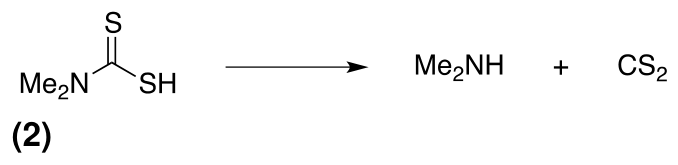



Similar transformations of benzohydrazides (containing nucleophilic \(\ce{NH2}\) group) and TMTD have been observed.
In the synthetic scheme below, the thiocarbamoylation reaction of an aroyl hydrazine with TMTD produces compound C containing a heterocyclic moiety from p-aminobenzoic acid.

During the formation of C from B, an intermediate B′ was observed. This intermediate tautomerizes to B″. C can be formed from B′ or B″.
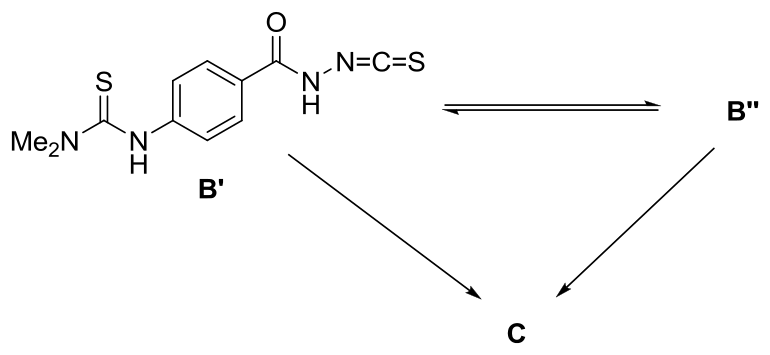
9.1 Give the structures of A, B, and C.
9.2 Suggest a structure for the tautomer B″ and give a curly-arrow mechanism for the formation of C.
Compound C was then converted to F by the following pathway:

[The group R remains exactly the same throughout the rest of the question.]
9.3 Draw the structures of E, and F. (You do not need to draw the structure for the R group from this point.)
E was only obtained when D was slowly added to the solution of excess \(\ce{N2H4}\) in dioxane. If \(\ce{N2H4}\) was added to the solution of D in dioxane instead, a major side product D′ (\(\ce{R2C14H12N4S2}\)) was formed.
9.4 Give the structure of D′.
Slightly heating of D with ethanolamine (\(\ce{HOCH2CH2NH2}\)) in dioxane for 2 hours yielded G (\(\ce{R-C9H11N2OS}\)).
9.5 Draw the structural formula of G.
9.6 Heating G in the presence of p-toluenesulfonic acid as the catalyst could form a number of different five-membered heterocyclic products:
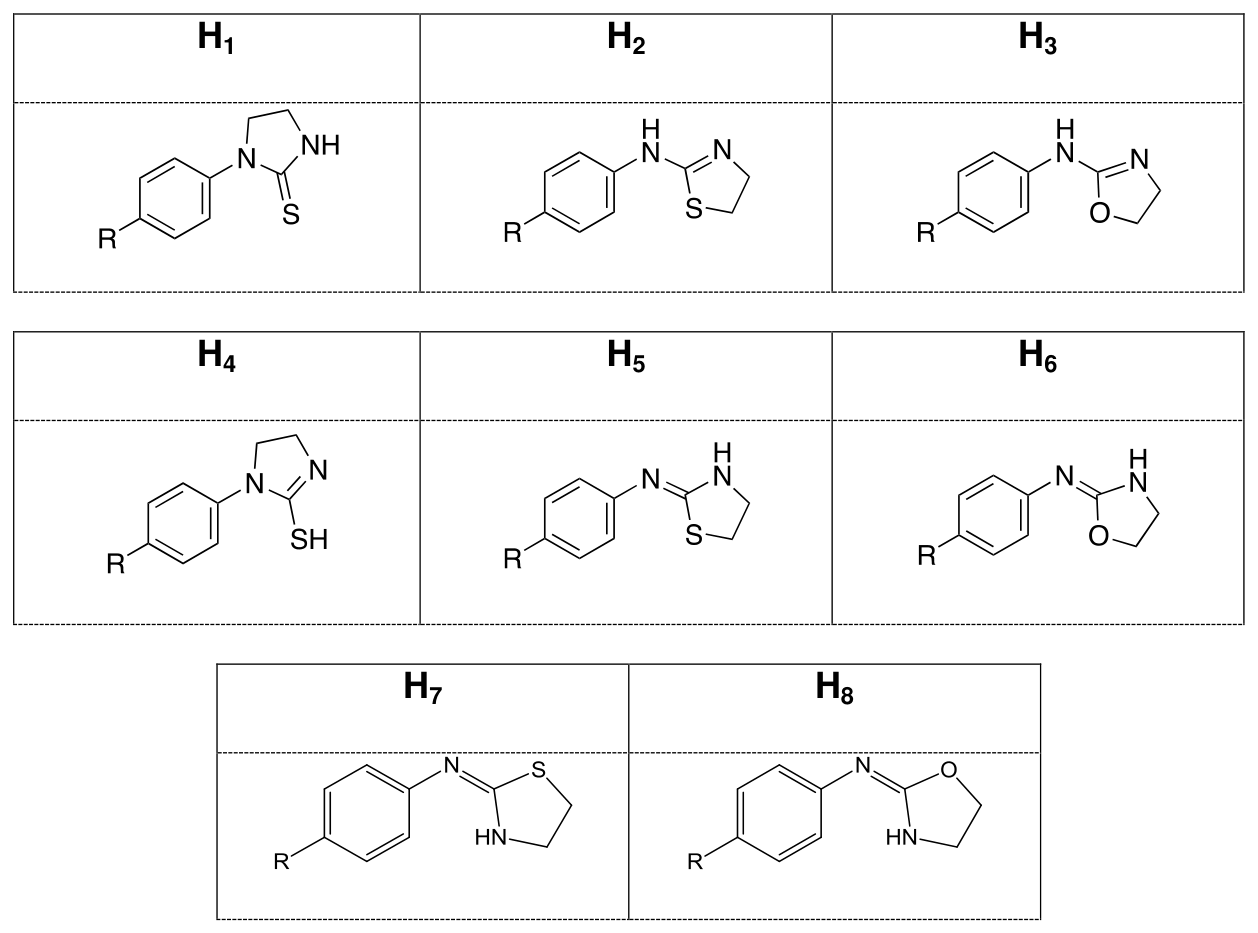
i) Draw 2 structures that have different molecular formulae.
ii) Draw 2 structures that are constitutional isomers.
iii) Draw 2 structures that are stereoisomers.
Official English text of the problem.
Answers
For C and F, the structures below use the thiol tautomer; their thione tautomers are given in the solution. In subsequent abbreviated SMILES, each * represents the same unchanged group R.
-
9.1 — A: Methyl 4-aminobenzoate:
COC(=O)c1ccc(N)cc1. -
9.1 — B: 4-Aminobenzohydrazide:
NNC(=O)c1ccc(N)cc1. -
9.1 — C: 5-[4-(3,3-Dimethylthioureido)phenyl]-1,3,4-oxadiazole-2-thiol:
CN(C)C(=S)Nc1ccc(-c2nnc(S)o2)cc1. -
9.2 — B″: The imidic-acid tautomer of B′, N-isothiocyanato-4-(3,3-dimethylthioureido)benzimidic acid. A geometry suitable for cyclization is:
CN(C)C(=S)Nc1ccc(/C(O)=N/N=C=S)cc1. Intramolecular oxygen attack on the isothiocyanate carbon, followed by proton transfer, gives C. -
9.3 — E: 4-(4-R-Phenyl)thiosemicarbazide:
*c1ccc(NC(=S)NN)cc1. -
9.3 — F: 5-[(4-R-Phenyl)amino]-1,3,4-thiadiazole-2-thiol:
*c1ccc(Nc2nnc(S)s2)cc1. -
9.4 — D′: 1,2-Bis[N-(4-R-phenyl)carbamothioyl]hydrazine:
*c1ccc(NC(=S)NNC(=S)Nc2ccc(*)cc2)cc1. -
9.5 — G: 1-(2-Hydroxyethyl)-3-(4-R-phenyl)thiourea:
*c1ccc(NC(=S)NCCO)cc1. -
9.6(i): H₁ and H₃, with different molecular formulae:
- H₁, 1-(4-R-phenyl)imidazolidine-2-thione:
*c1ccc(N2CCNC2=S)cc1; formula \(\ce{R-C9H9N2S}\). -
H₃, N-(4-R-phenyl)-4,5-dihydro-1,3-oxazol-2-amine:
*c1ccc(NC2=NCCO2)cc1; formula \(\ce{R-C9H9N2O}\). -
9.6(ii): H₁ and H₂, constitutional isomers:
- H₁ is specified above.
- H₂, N-(4-R-phenyl)-4,5-dihydro-1,3-thiazol-2-amine:
*c1ccc(NC2=NCCS2)cc1. -
Both have formula \(\ce{R-C9H9N2S}\).
-
9.6(iii): H₅ and H₇, geometrical stereoisomers:
- H₅, (Z)-N-(4-R-phenyl)-1,3-thiazolidin-2-imine:
*c1ccc(/N=C2\SCCN2)cc1. - H₇, (E)-N-(4-R-phenyl)-1,3-thiazolidin-2-imine:
*c1ccc(/N=C2/SCCN2)cc1.
Solution
9.1 — Identification of A, B, and C
The starting material, 4-aminobenzoic acid, is Nc1ccc(C(=O)O)cc1. Methanol, CO, and sulfuric acid, OS(=O)(=O)O, effect Fischer esterification:
\[ \ce{H2N-C6H4-CO2H + CH3OH <=>[H2SO4] H2N-C6H4-CO2CH3 + H2O}. \]
The amino and carboxyl-derived substituents remain para throughout. Water is O.
Potassium carbonate, [K+].[K+].[O-]C(=O)[O-], neutralizes the acid during work-up, giving the free amino ester A. The acid-neutralization balance is
\[ \ce{H2SO4 + K2CO3 -> K2SO4 + CO2 + H2O}. \]
Here potassium sulfate is [K+].[K+].[O-]S(=O)(=O)[O-], and carbon dioxide is O=C=O.
Hydrazine, NN, then attacks the ester carbonyl. Nucleophilic acyl substitution replaces methoxy by hydrazino, producing B:
\[ \ce{H2N-C6H4-CO2CH3 + N2H4 -> H2N-C6H4-C(=O)-NH-NH2 + CH3OH}. \]
Thus B contains two primary amino groups: the aromatic amino group and the terminal hydrazide amino group.
TMTD, tetramethylthiuram disulfide, has SMILES CN(C)C(=S)SSC(=S)N(C)C. The supplied transformations account for the two different modifications:
- The aromatic amino group becomes \(\ce{-NH-C(=S)-N(CH3)2}\).
- The terminal hydrazide amino group becomes an isothiocyanate group, giving \(\ce{-C(=O)-NH-N=C=S}\).
The resulting B′ is N-isothiocyanato-4-(3,3-dimethylthioureido)benzamide, CN(C)C(=S)Nc1ccc(C(=O)NN=C=S)cc1, exactly matching the supplied intermediate.
For completeness, the supplied reactions give an atom-balanced route to B′, and hence C. At the hydrazide end, reactions (1) and (3) generate the isothiocyanate and two molecules of dimethyldithiocarbamic acid, CN(C)C(=S)S. One acid molecule decomposes by reaction (2), supplying the carbon disulfide needed in reaction (3); the other converts the aromatic amino group into the thiourea by reaction (5).
After cancellation of these intermediates, a balanced net equation is
\[ \ce{C7H9N3O + C6H12N2S4 -> C11H12N4OS2 + (CH3)2NH + H2S + S}. \]
The first reactant is B, and the first product is C. The “2 equiv.” in the experimental scheme specifies reagent loading; the equation above expresses the minimum net consumption along this route.
The small products are dimethylamine, CNC, hydrogen sulfide, S, and elemental sulfur. Carbon disulfide is S=C=S. As in the problem, \(\ce{S}\) denotes an atomic equivalent of elemental sulfur; its usual molecular form, octasulfur, is S1SSSSSSS1.
Cyclization of B′ produces a five-membered ring containing the original carbonyl oxygen, the two hydrazide nitrogens, and the two relevant carbon atoms. This is the 1,3,4-oxadiazole ring in C.
The formula follows directly by adding its structural fragments:
\[ \underbrace{\ce{C6H4}}_{\text{phenylene}} + \underbrace{\ce{C3H7N2S}}_{\text{dimethylthioureido group}} + \underbrace{\ce{C2HN2OS}}_{\text{oxadiazole-thiol group}} = \ce{C11H12N4OS2}. \]
9.2 — Tautomer B″ and electron-flow mechanism
Let \(\ce{X}\) denote the 4-(3,3-dimethylthioureido)phenyl group. The relevant tautomerization is
\[ \ce{X-C(=O)-NH-N=C=S <=> X-C(OH)=N-N=C=S}. \]
This is amide–imidic-acid tautomerism: the acyl nitrogen loses its proton, oxygen gains that proton, and the carbonyl double bond is replaced by a carbon–nitrogen double bond. Acid/base-assisted proton transfer can accomplish this change.
For the cyclization, label the original carbonyl carbon \(C_a\), its adjacent nitrogen \(N_a\), the terminal nitrogen \(N_b\), and the isothiocyanate carbon \(C_b\). The chain in B″ is therefore
\[ \ce{X-C_a(OH)=N_a-N_b=C_b=S}. \]
The precise curly-arrow sequence from B″ is:
-
Ring closure: Draw an arrow from a lone pair on the hydroxyl oxygen to \(C_b\). Simultaneously, draw an arrow from the \(\ce{C_b=S}\) π bond onto sulfur. This forms the five-membered ring with atom order \[ O-C_a-N_a-N_b-C_b. \]
-
The resulting cyclic oxonium–thiolate zwitterion has SMILES
CN(C)C(=S)Nc1ccc(C2=NN=C([S-])[OH+]2)cc1. Oxygen bears a positive charge and still carries hydrogen; the exocyclic sulfur bears a negative charge. -
Proton transfer: Draw an arrow from the negatively charged sulfur to the oxygen-bound hydrogen, and an arrow from the \(\ce{O-H}\) bond back to oxygen. A proton shuttle may mediate this transfer. The product is the neutral oxadiazole-2-thiol C.
The configuration specified for B″ places the hydroxyl oxygen and the continuing nitrogen chain on the same side of the imidic \(\ce{C=N}\) bond, allowing this five-membered closure.
Direct formation from B′ is also possible. The carbonyl oxygen attacks \(C_b\), while the \(\ce{C_b=S}\) π electrons move to sulfur. The resulting carbonyl-derived cyclic oxonium–thiolate is CN(C)C(=S)Nc1ccc(C2=[O+]C([S-])=NN2)cc1.
Transfer of the acyl \(\ce{N-H}\) proton to sulfur, followed by donation of the nitrogen lone pair into the \(C_a-N_a\) bond and movement of the \(C_a=O\) π electrons onto oxygen, gives the same C.
The thiol form of C is tautomeric with 5-[4-(3,3-dimethylthioureido)phenyl]-1,3,4-oxadiazole-2(3H)-thione, CN(C)C(=S)Nc1ccc(C2=NNC(=S)O2)cc1. In that representation, the proton is on ring nitrogen and the exocyclic sulfur is double-bonded to carbon.
9.3 — Identification of E and F
From this point, write \(\ce{Ar}\) for the 4-R-phenyl group. In the thiol representation used above, R is the 5-sulfanyl-1,3,4-oxadiazol-2-yl substituent.
Hydrogen chloride, Cl, promotes cleavage of the dimethylthiourea group in C. Protonation traps the departing dimethylamine as dimethylammonium chloride, C[NH2+]C.[Cl-]:
\[ \ce{ArNH-C(=S)-N(CH3)2 + HCl -> Ar-N=C=S + [(CH3)2NH2]Cl}. \]
Thus D is 5-(4-isothiocyanatophenyl)-1,3,4-oxadiazole-2-thiol, S=C=Nc1ccc(-c2nnc(S)o2)cc1.
Hydrazine attacks the electrophilic carbon of the isothiocyanate. Proton transfer gives the thiosemicarbazide E, without elimination of a small molecule:
\[ \ce{Ar-N=C=S + N2H4 -> ArNH-C(=S)-NH-NH2}. \]
Treatment of E with TMTD converts its terminal \(\ce{-NH2}\) group into \(\ce{-N=C=S}\). The intermediate is N-isothiocyanato-N′-(4-R-phenyl)thiourea, *c1ccc(NC(=S)NN=C=S)cc1.
This intermediate cyclizes analogously to B′, but the original thiocarbonyl sulfur now becomes the ring heteroatom. The product therefore contains a 1,3,4-thiadiazole ring, giving F.
An atom-balanced net equation, with the generated dimethyldithiocarbamic acid written in its decomposed form, is
\[ \ce{R-C7H8N3S + C6H12N2S4 -> R-C8H6N3S2 + 2(CH3)2NH + CS2 + S}. \]
The formula of F, excluding unchanged R, is
\[ \ce{C6H4}+\ce{NH}+\ce{C2HN2S2} = \ce{C8H6N3S2}, \]
as required.
The corresponding thione tautomer is 5-[(4-R-phenyl)amino]-1,3,4-thiadiazole-2(3H)-thione, *c1ccc(NC2=NNC(=S)S2)cc1.
9.4 — Identification of D′ and the addition-order effect
Both nitrogen atoms of hydrazine can react with isothiocyanate molecules. Addition of two equivalents of D gives
\[ \ce{2Ar-N=C=S + N2H4 -> ArNH-C(=S)-NH-NH-C(=S)-NHAr}. \]
This is D′, the bis-adduct specified in the answers.
Its formula contains two para-disubstituted phenyl groups, two thiocarbonyl carbons, and four \(\ce{NH}\) groups:
\[ \ce{R2}+\ce{C12H8}+\ce{C2S2}+\ce{N4H4} = \ce{R2C14H12N4S2}. \]
When D is added slowly to excess hydrazine, an incoming molecule of D preferentially encounters free hydrazine, forming E. When hydrazine is added to a solution rich in D, the initially formed E can react again through its remaining terminal amino group, producing D′.
9.5 — Identification of G
Ethanolamine, 2-aminoethan-1-ol, has SMILES NCCO. Its amino group attacks the isothiocyanate carbon more readily than its hydroxyl group. Addition and proton transfer give G:
\[ \ce{Ar-N=C=S + H2N-CH2-CH2-OH -> ArNH-C(=S)-NH-CH2-CH2-OH}. \]
No atoms are lost. The formula, excluding R, is consequently
\[ \ce{C7H4NS}+\ce{C2H7NO} = \ce{C9H11N2OS}. \]
9.6 — Classification of the heterocyclic products
The catalyst, p-toluenesulfonic acid, has SMILES Cc1ccc(S(=O)(=O)O)cc1.
Formation of the selected sulfur-containing products can be balanced as dehydration:
\[ \ce{R-C9H11N2OS -> R-C9H9N2S + H2O}. \]
Formation of the oxygen-containing product H₃ instead corresponds to loss of hydrogen sulfide:
\[ \ce{R-C9H11N2OS -> R-C9H9N2O + H2S}. \]
9.6(i): Different molecular formulae — H₁ and H₃.
H₁ contains sulfur and has formula \(\ce{R-C9H9N2S}\). H₃ contains oxygen in its place and has formula \(\ce{R-C9H9N2O}\). Their molecular formulae therefore differ.
9.6(ii): Constitutional isomers — H₁ and H₂.
Both have formula \(\ce{R-C9H9N2S}\), but their atom connectivity differs:
- In H₁, both nitrogen atoms are ring members, and sulfur is an exocyclic thione sulfur.
- In H₂, sulfur and one nitrogen are ring members, while the aryl-bearing nitrogen is exocyclic.
They are therefore constitutional isomers.
9.6(iii): Stereoisomers — H₅ and H₇.
Both have the same thiazolidine-ring connectivity and an exocyclic \(\ce{C=N-Ar}\) bond. They differ in configuration about that double bond.
At the imine carbon, sulfur has higher CIP priority than nitrogen. At the imine nitrogen, the aryl group has higher priority than the lone-pair position. In the supplied drawings:
- H₅: The aryl group and ring sulfur are on the same side of the exocyclic double bond, giving the Z configuration.
- H₇: They are on opposite sides, giving the E configuration.
The directional bonds in their answer SMILES encode this distinction.
The answers were checked against the official answers published by the organisers.
IChO 2014 · Theorieaufgabe 9
Darstellung von Heterocyclen
Tetramethylthiuramdisulfid (TMTD) erweist sich zunehmend als nützliches Reagenz zur Darstellung zahlreicher Schwefel-Stickstoff-funktioneller Gruppen und Heterocyclen in der organischen Chemie. Die Reaktionen von TMTD mit primären Aminen sowie einige entsprechende Folgereaktionen der entstehenden Produkte sind in den folgenden Schemata dargestellt:
Ähnliche Umsetzungen von Benzohydraziden (mit einer nucleophilen \(\ce{NH2}\)-Gruppe) und TMTD wurden ebenfalls beobachtet.
Im folgenden Syntheseschema liefert die Thiocarbamoylierung eines Aroylhydrazins mit TMTD, ausgehend von p-Aminobenzoesäure, die Verbindung C, die einen heterocyclischen Molekülteil enthält.
Bei der Bildung von C aus B wurde eine Zwischenstufe B′ beobachtet. Diese Zwischenstufe tautomerisiert zu B″. C kann aus B′ oder B″ entstehen.
9.1 Geben Sie die Strukturen von A, B und C an.
9.2 Schlagen Sie eine Struktur für das Tautomer B″ vor und geben Sie einen Mechanismus für die Bildung von C mit gebogenen Elektronenverschiebungspfeilen an.
Verbindung C wurde anschließend auf folgendem Weg in F überführt:
[Die Gruppe R bleibt im gesamten restlichen Teil der Aufgabe unverändert.]
9.3 Zeichnen Sie die Strukturen von E und F. (Ab hier brauchen Sie die Struktur der Gruppe R nicht mehr zu zeichnen.)
E wurde nur dann erhalten, wenn D langsam zu einer Lösung von überschüssigem \(\ce{N2H4}\) in Dioxan gegeben wurde. Wurde stattdessen \(\ce{N2H4}\) zur Lösung von D in Dioxan gegeben, entstand als Hauptnebenprodukt D′ (\(\ce{R2C14H12N4S2}\)).
9.4 Geben Sie die Struktur von D′ an.
Leichtes Erwärmen von D mit Ethanolamin (\(\ce{HOCH2CH2NH2}\)) in Dioxan für 2 Stunden lieferte G (\(\ce{R-C9H11N2OS}\)).
9.5 Zeichnen Sie die Strukturformel von G.
9.6 Beim Erhitzen von G in Gegenwart von p-Toluolsulfonsäure als Katalysator können mehrere verschiedene fünfgliedrige heterocyclische Produkte entstehen:
i) Zeichnen Sie 2 Strukturen mit unterschiedlichen Summenformeln.
ii) Zeichnen Sie 2 Strukturen, die Konstitutionsisomere sind.
iii) Zeichnen Sie 2 Strukturen, die Stereoisomere sind.
Aufgabentext aus dem offiziellen englischen Text übersetzt.
Antworten
Für C und F zeigen die folgenden Strukturen das Thiol-Tautomer; ihre Thion-Tautomere sind in der Lösung angegeben. In den nachfolgenden abgekürzten SMILES steht jedes * für dieselbe unveränderte Gruppe R.
-
9.1 — A: Methyl-4-aminobenzoat:
COC(=O)c1ccc(N)cc1. -
9.1 — B: 4-Aminobenzohydrazid:
NNC(=O)c1ccc(N)cc1. -
9.1 — C: 5-[4-(3,3-Dimethylthioureido)phenyl]-1,3,4-oxadiazol-2-thiol:
CN(C)C(=S)Nc1ccc(-c2nnc(S)o2)cc1. -
9.2 — B″: Das Imidsäure-Tautomer von B′, N-Isothiocyanato-4-(3,3-dimethylthioureido)benzimidsäure. Eine für die Cyclisierung geeignete Geometrie ist:
CN(C)C(=S)Nc1ccc(/C(O)=N/N=C=S)cc1. Der intramolekulare Angriff des Sauerstoffs am Isothiocyanat-Kohlenstoff liefert nach anschließender Protonenübertragung C. -
9.3 — E: 4-(4-R-Phenyl)thiosemicarbazid:
*c1ccc(NC(=S)NN)cc1. -
9.3 — F: 5-[(4-R-Phenyl)amino]-1,3,4-thiadiazol-2-thiol:
*c1ccc(Nc2nnc(S)s2)cc1. -
9.4 — D′: 1,2-Bis[N-(4-R-phenyl)carbamothioyl]hydrazin:
*c1ccc(NC(=S)NNC(=S)Nc2ccc(*)cc2)cc1. -
9.5 — G: 1-(2-Hydroxyethyl)-3-(4-R-phenyl)thioharnstoff:
*c1ccc(NC(=S)NCCO)cc1. -
9.6(i): H₁ und H₃, mit unterschiedlichen Summenformeln:
- H₁, 1-(4-R-Phenyl)imidazolidin-2-thion:
*c1ccc(N2CCNC2=S)cc1; Summenformel \(\ce{R-C9H9N2S}\). -
H₃, N-(4-R-Phenyl)-4,5-dihydro-1,3-oxazol-2-amin:
*c1ccc(NC2=NCCO2)cc1; Summenformel \(\ce{R-C9H9N2O}\). -
9.6(ii): H₁ und H₂, Konstitutionsisomere:
- H₁ ist oben angegeben.
- H₂, N-(4-R-Phenyl)-4,5-dihydro-1,3-thiazol-2-amin:
*c1ccc(NC2=NCCS2)cc1. -
Beide haben die Summenformel \(\ce{R-C9H9N2S}\).
-
9.6(iii): H₅ und H₇, geometrische Stereoisomere:
- H₅, (Z)-N-(4-R-Phenyl)-1,3-thiazolidin-2-imin:
*c1ccc(/N=C2\SCCN2)cc1. - H₇, (E)-N-(4-R-Phenyl)-1,3-thiazolidin-2-imin:
*c1ccc(/N=C2/SCCN2)cc1.
Lösung
9.1 — Identifizierung von A, B und C
Das Ausgangsmaterial, 4-Aminobenzoesäure, ist Nc1ccc(C(=O)O)cc1. Methanol, CO, und Schwefelsäure, OS(=O)(=O)O, bewirken eine Fischer-Veresterung:
\[ \ce{H2N-C6H4-CO2H + CH3OH <=>[H2SO4] H2N-C6H4-CO2CH3 + H2O}. \]
Die Aminogruppe und der von der Carboxylgruppe abgeleitete Substituent bleiben durchgehend in para-Stellung zueinander. Wasser ist O.
Kaliumcarbonat, [K+].[K+].[O-]C(=O)[O-], neutralisiert die Säure bei der Aufarbeitung und liefert den freien Aminoester A. Die Bilanzgleichung der Säureneutralisation lautet
\[ \ce{H2SO4 + K2CO3 -> K2SO4 + CO2 + H2O}. \]
Hier ist Kaliumsulfat [K+].[K+].[O-]S(=O)(=O)[O-] und Kohlenstoffdioxid O=C=O.
Hydrazin, NN, greift anschließend die Carbonylgruppe des Esters an. Durch nucleophile Acylsubstitution wird die Methoxygruppe durch eine Hydrazinogruppe ersetzt, wobei B entsteht:
\[ \ce{H2N-C6H4-CO2CH3 + N2H4 -> H2N-C6H4-C(=O)-NH-NH2 + CH3OH}. \]
Somit enthält B zwei primäre Aminogruppen: die aromatische Aminogruppe und die endständige Aminogruppe des Hydrazids.
TMTD, Tetramethylthiuramdisulfid, hat die SMILES-Schreibweise CN(C)C(=S)SSC(=S)N(C)C. Die angegebenen Umsetzungen erklären die beiden unterschiedlichen Modifikationen:
- Die aromatische Aminogruppe wird zu \(\ce{-NH-C(=S)-N(CH3)2}\).
- Die endständige Aminogruppe des Hydrazids wird zu einer Isothiocyanatgruppe, sodass \(\ce{-C(=O)-NH-N=C=S}\) entsteht.
Das entstehende B′ ist N-Isothiocyanato-4-(3,3-dimethylthioureido)benzamid, CN(C)C(=S)Nc1ccc(C(=O)NN=C=S)cc1, und entspricht genau der angegebenen Zwischenstufe.
Der Vollständigkeit halber liefern die angegebenen Reaktionen einen hinsichtlich der Atome bilanzierten Reaktionsweg zu B′ und damit zu C. Am Hydrazid-Ende erzeugen die Reaktionen (1) und (3) das Isothiocyanat und zwei Moleküle Dimethyldithiocarbaminsäure, CN(C)C(=S)S. Ein Säuremolekül zerfällt gemäß Reaktion (2) und liefert den in Reaktion (3) benötigten Schwefelkohlenstoff; das andere überführt die aromatische Aminogruppe gemäß Reaktion (5) in den Thioharnstoff.
Nach dem Kürzen dieser Zwischenprodukte ergibt sich die ausgeglichene Nettogleichung
\[ \ce{C7H9N3O + C6H12N2S4 -> C11H12N4OS2 + (CH3)2NH + H2S + S}. \]
Der erste Reaktand ist B, und das erste Produkt ist C. Die Angabe „2 Äquiv.“ im experimentellen Schema bezeichnet die eingesetzte Reagenzmenge; die obige Gleichung beschreibt den minimalen Nettoverbrauch auf diesem Reaktionsweg.
Die niedermolekularen Produkte sind Dimethylamin, CNC, Schwefelwasserstoff, S, und elementarer Schwefel. Schwefelkohlenstoff ist S=C=S. Wie in der Aufgabenstellung bezeichnet \(\ce{S}\) ein Atomäquivalent elementaren Schwefels; seine übliche molekulare Form, Octaschwefel, ist S1SSSSSSS1.
Die Cyclisierung von B′ erzeugt einen fünfgliedrigen Ring, der den ursprünglichen Carbonylsauerstoff, die beiden Hydrazid-Stickstoffatome und die beiden beteiligten Kohlenstoffatome enthält. Dies ist der 1,3,4-Oxadiazol-Ring in C.
Die Summenformel ergibt sich unmittelbar durch Addition seiner Strukturfragmente:
\[ \underbrace{\ce{C6H4}}_{\text{Phenylen}} + \underbrace{\ce{C3H7N2S}}_{\text{Dimethylthioureido-Gruppe}} + \underbrace{\ce{C2HN2OS}}_{\text{Oxadiazol-thiol-Gruppe}} = \ce{C11H12N4OS2}. \]
9.2 — Tautomer B″ und Mechanismus der Elektronenverschiebung
Mit \(\ce{X}\) sei die 4-(3,3-Dimethylthioureido)phenylgruppe bezeichnet. Die betreffende Tautomerisierung lautet
\[ \ce{X-C(=O)-NH-N=C=S <=> X-C(OH)=N-N=C=S}. \]
Hier handelt es sich um Amid–Imidsäure-Tautomerie: Der Acylstickstoff gibt sein Proton ab, der Sauerstoff nimmt dieses Proton auf, und die Carbonyl-Doppelbindung wird durch eine Kohlenstoff–Stickstoff-Doppelbindung ersetzt. Diese Umwandlung kann durch säure- oder basenunterstützte Protonenübertragung erfolgen.
Für die Cyclisierung bezeichnen wir den ursprünglichen Carbonylkohlenstoff mit \(C_a\), das benachbarte Stickstoffatom mit \(N_a\), das endständige Stickstoffatom mit \(N_b\) und den Isothiocyanat-Kohlenstoff mit \(C_b\). Die Kette in B″ lautet daher
\[ \ce{X-C_a(OH)=N_a-N_b=C_b=S}. \]
Die genaue Abfolge der gebogenen Elektronenverschiebungspfeile ausgehend von B″ ist:
-
Ringschluss: Zeichnen Sie einen Pfeil von einem freien Elektronenpaar des Hydroxylsauerstoffs zu \(C_b\). Zeichnen Sie gleichzeitig einen Pfeil von der π-Bindung \(\ce{C_b=S}\) zum Schwefel. Dadurch entsteht der fünfgliedrige Ring mit der Atomreihenfolge \[ O-C_a-N_a-N_b-C_b. \]
-
Das entstehende cyclische Oxonium–Thiolat-Zwitterion hat die SMILES-Schreibweise
CN(C)C(=S)Nc1ccc(C2=NN=C([S-])[OH+]2)cc1. Der Sauerstoff trägt eine positive Ladung und weiterhin ein Wasserstoffatom; der exocyclische Schwefel trägt eine negative Ladung. -
Protonenübertragung: Zeichnen Sie einen Pfeil vom negativ geladenen Schwefel zu dem an Sauerstoff gebundenen Wasserstoff und einen Pfeil von der \(\ce{O-H}\)-Bindung zurück zum Sauerstoff. Ein Protonenüberträger kann diese Übertragung vermitteln. Das Produkt ist das neutrale Oxadiazol-2-thiol C.
In der für B″ angegebenen Konfiguration befinden sich der Hydroxylsauerstoff und die anschließende Stickstoffkette auf derselben Seite der Imidsäure-\(\ce{C=N}\)-Bindung, was diesen fünfgliedrigen Ringschluss ermöglicht.
Auch die direkte Bildung aus B′ ist möglich. Der Carbonylsauerstoff greift \(C_b\) an, während die π-Elektronen der \(\ce{C_b=S}\)-Bindung zum Schwefel verschoben werden. Das entstehende von der Carbonylgruppe abgeleitete cyclische Oxonium–Thiolat ist CN(C)C(=S)Nc1ccc(C2=[O+]C([S-])=NN2)cc1.
Die Übertragung des Protons der Acyl-\(\ce{N-H}\)-Gruppe auf Schwefel, gefolgt vom Einbringen des freien Elektronenpaars am Stickstoff in die \(C_a-N_a\)-Bindung und der Verschiebung der π-Elektronen der \(C_a=O\)-Bindung auf Sauerstoff, liefert dasselbe C.
Die Thiolform von C ist tautomer zu 5-[4-(3,3-Dimethylthioureido)phenyl]-1,3,4-oxadiazol-2(3H)-thion, CN(C)C(=S)Nc1ccc(C2=NNC(=S)O2)cc1. In dieser Darstellung befindet sich das Proton am Ringstickstoff, und der exocyclische Schwefel ist über eine Doppelbindung an Kohlenstoff gebunden.
9.3 — Identifizierung von E und F
Ab hier steht \(\ce{Ar}\) für die 4-R-Phenylgruppe. In der oben verwendeten Thioldarstellung ist R der 5-Sulfanyl-1,3,4-oxadiazol-2-yl-Substituent.
Chlorwasserstoff, Cl, fördert die Spaltung der Dimethylthioharnstoffgruppe in C. Durch Protonierung wird das abgehende Dimethylamin als Dimethylammoniumchlorid, C[NH2+]C.[Cl-], abgefangen:
\[ \ce{ArNH-C(=S)-N(CH3)2 + HCl -> Ar-N=C=S + [(CH3)2NH2]Cl}. \]
Somit ist D 5-(4-Isothiocyanatophenyl)-1,3,4-oxadiazol-2-thiol, S=C=Nc1ccc(-c2nnc(S)o2)cc1.
Hydrazin greift den elektrophilen Kohlenstoff des Isothiocyanats an. Durch Protonenübertragung entsteht das Thiosemicarbazid E, ohne dass ein kleines Molekül abgespalten wird:
\[ \ce{Ar-N=C=S + N2H4 -> ArNH-C(=S)-NH-NH2}. \]
Die Behandlung von E mit TMTD überführt seine endständige \(\ce{-NH2}\)-Gruppe in \(\ce{-N=C=S}\). Die Zwischenstufe ist N-Isothiocyanato-N′-(4-R-phenyl)thioharnstoff, *c1ccc(NC(=S)NN=C=S)cc1.
Diese Zwischenstufe cyclisiert analog zu B′, doch nun wird der ursprüngliche Thiocarbonyl-Schwefel zum Ringheteroatom. Das Produkt enthält daher einen 1,3,4-Thiadiazol-Ring und ist somit F.
Eine hinsichtlich der Atome ausgeglichene Nettogleichung, in der die entstehende Dimethyldithiocarbaminsäure in ihrer zersetzten Form dargestellt ist, lautet
\[ \ce{R-C7H8N3S + C6H12N2S4 -> R-C8H6N3S2 + 2(CH3)2NH + CS2 + S}. \]
Die Summenformel von F, ohne das unveränderte R, lautet
\[ \ce{C6H4}+\ce{NH}+\ce{C2HN2S2} = \ce{C8H6N3S2}, \]
wie gefordert.
Das entsprechende Thion-Tautomer ist 5-[(4-R-Phenyl)amino]-1,3,4-thiadiazol-2(3H)-thion, *c1ccc(NC2=NNC(=S)S2)cc1.
9.4 — Identifizierung von D′ und Einfluss der Zugabereihenfolge
Beide Stickstoffatome des Hydrazins können mit Isothiocyanatmolekülen reagieren. Die Addition von zwei Äquivalenten D ergibt
\[ \ce{2Ar-N=C=S + N2H4 -> ArNH-C(=S)-NH-NH-C(=S)-NHAr}. \]
Dies ist D′, das in den Antworten angegebene Bisaddukt.
Seine Summenformel setzt sich aus zwei para-disubstituierten Phenylgruppen, zwei Thiocarbonyl-Kohlenstoffatomen und vier \(\ce{NH}\)-Gruppen zusammen:
\[ \ce{R2}+\ce{C12H8}+\ce{C2S2}+\ce{N4H4} = \ce{R2C14H12N4S2}. \]
Wird D langsam zu überschüssigem Hydrazin gegeben, trifft ein zugegebenes Molekül D bevorzugt auf freies Hydrazin, wobei E entsteht. Wird Hydrazin zu einer an D reichen Lösung gegeben, kann das zunächst gebildete E über seine verbleibende endständige Aminogruppe erneut reagieren und D′ bilden.
9.5 — Identifizierung von G
Ethanolamin, 2-Aminoethan-1-ol, hat die SMILES-Schreibweise NCCO. Seine Aminogruppe greift den Isothiocyanat-Kohlenstoff leichter an als seine Hydroxylgruppe. Addition und Protonenübertragung liefern G:
\[ \ce{Ar-N=C=S + H2N-CH2-CH2-OH -> ArNH-C(=S)-NH-CH2-CH2-OH}. \]
Es gehen keine Atome verloren. Die Summenformel ohne R lautet folglich
\[ \ce{C7H4NS}+\ce{C2H7NO} = \ce{C9H11N2OS}. \]
9.6 — Einordnung der heterocyclischen Produkte
Der Katalysator, p-Toluolsulfonsäure, hat die SMILES-Schreibweise Cc1ccc(S(=O)(=O)O)cc1.
Die Bildung der ausgewählten schwefelhaltigen Produkte lässt sich als Dehydratisierung bilanzieren:
\[ \ce{R-C9H11N2OS -> R-C9H9N2S + H2O}. \]
Die Bildung des sauerstoffhaltigen Produkts H₃ entspricht dagegen einer Abspaltung von Schwefelwasserstoff:
\[ \ce{R-C9H11N2OS -> R-C9H9N2O + H2S}. \]
9.6(i): Unterschiedliche Summenformeln — H₁ und H₃.
H₁ enthält Schwefel und hat die Summenformel \(\ce{R-C9H9N2S}\). H₃ enthält an dessen Stelle Sauerstoff und hat die Summenformel \(\ce{R-C9H9N2O}\). Ihre Summenformeln unterscheiden sich daher.
9.6(ii): Konstitutionsisomere — H₁ und H₂.
Beide haben die Summenformel \(\ce{R-C9H9N2S}\), unterscheiden sich jedoch in der Verknüpfung ihrer Atome:
- In H₁ sind beide Stickstoffatome Ringglieder, und der Schwefel ist ein exocyclischer Thionschwefel.
- In H₂ sind Schwefel und ein Stickstoffatom Ringglieder, während das Stickstoffatom mit dem Arylrest exocyclisch ist.
Sie sind daher Konstitutionsisomere.
9.6(iii): Stereoisomere — H₅ und H₇.
Beide besitzen dieselbe Atomverknüpfung im Thiazolidinring und eine exocyclische \(\ce{C=N-Ar}\)-Bindung. Sie unterscheiden sich in der Konfiguration an dieser Doppelbindung.
Am Iminkohlenstoff hat Schwefel eine höhere CIP-Priorität als Stickstoff. Am Iminstickstoff hat die Arylgruppe eine höhere Priorität als die Position des freien Elektronenpaars. In den vorgegebenen Zeichnungen gilt:
- H₅: Die Arylgruppe und der Ringschwefel befinden sich auf derselben Seite der exocyclischen Doppelbindung, woraus sich die Z-Konfiguration ergibt.
- H₇: Sie befinden sich auf gegenüberliegenden Seiten, woraus sich die E-Konfiguration ergibt.
Die gerichteten Bindungszeichen in den SMILES der Antworten codieren diesen Unterschied.
Die Ergebnisse wurden mit den von den Veranstaltern veröffentlichten offiziellen Ergebnissen abgeglichen.
IChO 2014 · Teori sorusu 9
Heterosiklik bileşiklerin hazırlanması
Tetrametiltiuram disülfür (TMTD), organik kimyada birçok kükürt-azot fonksiyonel grubunun ve heterosiklik bileşiğin hazırlanmasında yararlı bir reaktif olarak öne çıkmaktadır. TMTD'nin birincil aminlerle tepkimeleri ve oluşan ürünün ya da ürünlerin daha sonra geçirdiği bazı dönüşümler aşağıdaki şemalarda sunulmuştur:
Benzer dönüşümler, benzohidrazitler (nükleofilik \(\ce{NH2}\) grubu içeren) ile TMTD arasında da gözlenmiştir.
Aşağıdaki sentez şemasında, bir aroilhidrazinin TMTD ile tiyokarbamoillenme tepkimesi sonucunda, p-aminobenzoik asitten heterosiklik bir birim içeren C bileşiği elde edilir.
B'den C oluşurken B′ ara ürünü gözlenmiştir. Bu ara ürün, tautomerleşerek B″'ye dönüşür. C, B′'den veya B″'den oluşabilir.
9.1 A, B ve C'nin yapılarını veriniz.
9.2 B″ tautomeri için bir yapı öneriniz ve C'nin oluşum mekanizmasını kıvrımlı oklarla gösteriniz.
Ardından C bileşiği aşağıdaki yolla F'ye dönüştürülmüştür:
[R grubu, sorunun geri kalanı boyunca tamamen aynı kalmaktadır.]
9.3 E ve F'nin yapılarını çiziniz. (Bu noktadan itibaren R grubunun yapısını çizmeniz gerekmez.)
E, yalnızca D'nin dioksan içindeki fazla miktarda \(\ce{N2H4}\) çözeltisine yavaşça eklenmesiyle elde edilmiştir. Bunun yerine \(\ce{N2H4}\), D'nin dioksan içindeki çözeltisine eklendiğinde, başlıca yan ürün olarak D′ (\(\ce{R2C14H12N4S2}\)) oluşmuştur.
9.4 D′'nün yapısını veriniz.
D'nin dioksan içinde etanolamin (\(\ce{HOCH2CH2NH2}\)) ile 2 saat hafifçe ısıtılması sonucunda G (\(\ce{R-C9H11N2OS}\)) elde edilmiştir.
9.5 G'nin yapı formülünü çiziniz.
9.6 G'nin katalizör olarak p-toluensülfonik asit varlığında ısıtılmasıyla, beş üyeli çeşitli heterosiklik ürünler oluşabilir:
i) Molekül formülleri farklı olan 2 yapı çiziniz.
ii) Yapı izomeri olan 2 yapı çiziniz.
iii) Stereoizomer olan 2 yapı çiziniz.
Soru metni resmi İngilizce metinden çevrilmiştir.
Cevaplar
C ve F için aşağıdaki yapılarda tiyol tautomeri kullanılmıştır; bunların tiyon tautomerleri çözümde verilmiştir. Daha sonraki kısaltılmış SMILES gösterimlerinde her *, değişmeden kalan aynı R grubunu temsil eder.
-
9.1 — A: Metil 4-aminobenzoat:
COC(=O)c1ccc(N)cc1. -
9.1 — B: 4-Aminobenzohidrazit:
NNC(=O)c1ccc(N)cc1. -
9.1 — C: 5-[4-(3,3-Dimetiltiyoüreido)fenil]-1,3,4-oksadiazol-2-tiyol:
CN(C)C(=S)Nc1ccc(-c2nnc(S)o2)cc1. -
9.2 — B″: B′'nün imidik asit tautomeri olan N-izotiyosiyanato-4-(3,3-dimetiltiyoüreido)benzimidik asit. Halkalaşmaya uygun bir geometri şöyledir:
CN(C)C(=S)Nc1ccc(/C(O)=N/N=C=S)cc1. Oksijenin izotiyosiyanat karbonuna molekül içi saldırısını izleyen proton aktarımı, C'yi verir. -
9.3 — E: 4-(4-R-Fenil)tiyosemikarbazit:
*c1ccc(NC(=S)NN)cc1. -
9.3 — F: 5-[(4-R-Fenil)amino]-1,3,4-tiyadiazol-2-tiyol:
*c1ccc(Nc2nnc(S)s2)cc1. -
9.4 — D′: 1,2-Bis[N-(4-R-fenil)karbamotiyoil]hidrazin:
*c1ccc(NC(=S)NNC(=S)Nc2ccc(*)cc2)cc1. -
9.5 — G: 1-(2-Hidroksietil)-3-(4-R-fenil)tiyoüre:
*c1ccc(NC(=S)NCCO)cc1. -
9.6(i): H₁ ve H₃, molekül formülleri farklıdır:
- H₁, 1-(4-R-fenil)imidazolidin-2-tiyon:
*c1ccc(N2CCNC2=S)cc1; formülü \(\ce{R-C9H9N2S}\). -
H₃, N-(4-R-fenil)-4,5-dihidro-1,3-oksazol-2-amin:
*c1ccc(NC2=NCCO2)cc1; formülü \(\ce{R-C9H9N2O}\). -
9.6(ii): H₁ ve H₂, yapı izomerleridir:
- H₁ yukarıda belirtilmiştir.
- H₂, N-(4-R-fenil)-4,5-dihidro-1,3-tiyazol-2-amin:
*c1ccc(NC2=NCCS2)cc1. -
Her ikisinin de formülü \(\ce{R-C9H9N2S}\)'dir.
-
9.6(iii): H₅ ve H₇, geometrik stereoizomerlerdir:
- H₅, (Z)-N-(4-R-fenil)-1,3-tiyazolidin-2-imin:
*c1ccc(/N=C2\SCCN2)cc1. - H₇, (E)-N-(4-R-fenil)-1,3-tiyazolidin-2-imin:
*c1ccc(/N=C2/SCCN2)cc1.
Çözüm
9.1 — A, B ve C'nin belirlenmesi
Başlangıç maddesi olan 4-aminobenzoik asidin SMILES gösterimi Nc1ccc(C(=O)O)cc1'dir. Metanol, CO, ve sülfürik asit, OS(=O)(=O)O, Fischer esterleşmesini gerçekleştirir:
\[ \ce{H2N-C6H4-CO2H + CH3OH <=>[H2SO4] H2N-C6H4-CO2CH3 + H2O}. \]
Amino ve karboksilden türeyen sübstitüentler, tüm süreç boyunca birbirlerine göre para konumunda kalır. Suyun SMILES gösterimi O'dur.
Potasyum karbonat, [K+].[K+].[O-]C(=O)[O-], tepkime sonrası işlemler sırasında asidi nötrleştirerek serbest amino ester A'yı verir. Asidin nötrleşmesine ilişkin denkleştirilmiş tepkime şöyledir:
\[ \ce{H2SO4 + K2CO3 -> K2SO4 + CO2 + H2O}. \]
Burada potasyum sülfatın SMILES gösterimi [K+].[K+].[O-]S(=O)(=O)[O-], karbon dioksidinki ise O=C=O'dur.
Ardından hidrazin, NN, ester karboniline saldırır. Nükleofilik açil yer değiştirmesiyle metoksi grubunun yerini hidrazino grubu alır ve B oluşur:
\[ \ce{H2N-C6H4-CO2CH3 + N2H4 -> H2N-C6H4-C(=O)-NH-NH2 + CH3OH}. \]
Dolayısıyla B, iki birincil amino grubu içerir: aromatik amino grubu ve hidrazidin uç amino grubu.
Tetrametiltiuram disülfür olan TMTD'nin SMILES gösterimi CN(C)C(=S)SSC(=S)N(C)C'dir. Verilen dönüşümler, iki farklı değişimi açıklar:
- Aromatik amino grubu, \(\ce{-NH-C(=S)-N(CH3)2}\) grubuna dönüşür.
- Hidrazidin uç amino grubu, bir izotiyosiyanat grubuna dönüşerek \(\ce{-C(=O)-NH-N=C=S}\) birimini verir.
Oluşan B′, N-izotiyosiyanato-4-(3,3-dimetiltiyoüreido)benzamit olup SMILES gösterimi CN(C)C(=S)Nc1ccc(C(=O)NN=C=S)cc1'dir; bu yapı, verilen ara ürünle tam olarak örtüşür.
Açıklamayı tamamlamak için, verilen tepkimeler B′'ye ve dolayısıyla C'ye ulaşan, atom denkliği sağlanmış bir yol sunar. Hidrazit ucunda, (1) ve (3) tepkimeleri izotiyosiyanatı ve iki molekül dimetilditiyokarbamik asidi, CN(C)C(=S)S, oluşturur. Asit moleküllerinden biri (2) tepkimesiyle ayrışarak (3) tepkimesinde gereken karbon disülfürü sağlar; diğeri ise (5) tepkimesiyle aromatik amino grubunu tiyoüreye dönüştürür.
Bu ara ürünler sadeleştirildiğinde, denkleştirilmiş net tepkime şöyledir:
\[ \ce{C7H9N3O + C6H12N2S4 -> C11H12N4OS2 + (CH3)2NH + H2S + S}. \]
İlk reaktif B, ilk ürün ise C'dir. Deneysel şemadaki “2 eşdeğer” ifadesi, kullanılan reaktif miktarını belirtir; yukarıdaki denklem ise bu yol boyunca gerçekleşen en düşük net tüketimi ifade eder.
Küçük moleküllü ürünler dimetilamin, CNC, hidrojen sülfür, S, ve elementel kükürttür. Karbon disülfürün SMILES gösterimi S=C=S'dir. Soruda olduğu gibi, \(\ce{S}\), elementel kükürdün bir atomik eşdeğerini belirtir; yaygın moleküler biçimi olan oktakükürdün SMILES gösterimi S1SSSSSSS1'dir.
B′'nün halkalaşması, başlangıçtaki karbonil oksijenini, hidrazidin iki azotunu ve ilgili iki karbon atomunu içeren beş üyeli bir halka oluşturur. Bu, C'deki 1,3,4-oksadiazol halkasıdır.
Formül, yapısal parçalarının toplanmasıyla doğrudan elde edilir:
\[ \underbrace{\ce{C6H4}}_{\text{fenilen}} + \underbrace{\ce{C3H7N2S}}_{\text{dimetiltiyoüreido grubu}} + \underbrace{\ce{C2HN2OS}}_{\text{oksadiazol-tiyol grubu}} = \ce{C11H12N4OS2}. \]
9.2 — B″ tautomeri ve elektron akışı mekanizması
\(\ce{X}\), 4-(3,3-dimetiltiyoüreido)fenil grubunu göstersin. İlgili tautomerleşme şöyledir:
\[ \ce{X-C(=O)-NH-N=C=S <=> X-C(OH)=N-N=C=S}. \]
Bu, amit–imidik asit tautomerliğidir: açil azotu protonunu kaybeder, oksijen bu protonu alır ve karbonil çift bağının yerini bir karbon–azot çift bağı alır. Asit/baz destekli proton aktarımı bu değişimi sağlayabilir.
Halkalaşma için, başlangıçtaki karbonil karbonunu \(C_a\), ona komşu azotu \(N_a\), uç azotu \(N_b\) ve izotiyosiyanat karbonunu \(C_b\) olarak adlandıralım. Buna göre B″'deki zincir şöyledir:
\[ \ce{X-C_a(OH)=N_a-N_b=C_b=S}. \]
B″'den başlayan kıvrımlı ok gösteriminin ayrıntılı sırası şöyledir:
-
Halka kapanması: Hidroksil oksijeni üzerindeki bir ortaklanmamış elektron çiftinden \(C_b\)'ye bir ok çiziniz. Aynı anda, \(\ce{C_b=S}\) π bağından kükürde bir ok çiziniz. Böylece atom sırası aşağıdaki gibi olan beş üyeli halka oluşur: \[ O-C_a-N_a-N_b-C_b. \]
-
Oluşan halkalı oksonyum–tiyolat zwitteriyonunun SMILES gösterimi
CN(C)C(=S)Nc1ccc(C2=NN=C([S-])[OH+]2)cc1'dir. Oksijen pozitif yük taşır ve hidrojeni hâlâ üzerinde bulundurur; halka dışındaki kükürt ise negatif yük taşır. -
Proton aktarımı: Negatif yüklü kükürtten oksijene bağlı hidrojene bir ok ve \(\ce{O-H}\) bağından tekrar oksijene bir ok çiziniz. Bu aktarım, bir proton taşıyıcısı aracılığıyla gerçekleşebilir. Ürün, nötr oksadiazol-2-tiyol C'dir.
B″ için belirtilen konfigürasyon, hidroksil oksijenini ve devamındaki azot zincirini imidik \(\ce{C=N}\) bağının aynı tarafına yerleştirerek bu beş üyeli halka kapanmasına olanak tanır.
B′'den doğrudan oluşum da mümkündür. Karbonil oksijeni \(C_b\)'ye saldırırken \(\ce{C_b=S}\) bağının π elektronları kükürde kayar. Oluşan karbonilden türeyen halkalı oksonyum–tiyolatın SMILES gösterimi CN(C)C(=S)Nc1ccc(C2=[O+]C([S-])=NN2)cc1'dir.
Açil \(\ce{N-H}\) protonunun kükürde aktarılmasını takiben, azotun ortaklanmamış elektron çiftinin \(C_a-N_a\) bağına katılması ve \(C_a=O\) bağının π elektronlarının oksijene kayması, aynı C'yi verir.
C'nin tiyol biçimi, 5-[4-(3,3-dimetiltiyoüreido)fenil]-1,3,4-oksadiazol-2(3H)-tiyon, CN(C)C(=S)Nc1ccc(C2=NNC(=S)O2)cc1, ile tautomerlik gösterir. Bu gösterimde proton halka azotu üzerindedir ve halka dışındaki kükürt karbona çift bağla bağlıdır.
9.3 — E ve F'nin belirlenmesi
Bu noktadan itibaren 4-R-fenil grubunu \(\ce{Ar}\) ile gösterelim. Yukarıda kullanılan tiyol gösteriminde R, 5-sülfanil-1,3,4-oksadiazol-2-il sübstitüentidir.
Hidrojen klorür, Cl, C'deki dimetiltiyoüre grubunun parçalanmasını kolaylaştırır. Protonlanma, ayrılan dimetilamini dimetilamonyum klorür, C[NH2+]C.[Cl-], biçiminde tutar:
\[ \ce{ArNH-C(=S)-N(CH3)2 + HCl -> Ar-N=C=S + [(CH3)2NH2]Cl}. \]
Dolayısıyla D, 5-(4-izotiyosiyanatofenil)-1,3,4-oksadiazol-2-tiyol, S=C=Nc1ccc(-c2nnc(S)o2)cc1, bileşiğidir.
Hidrazin, izotiyosiyanatın elektrofilik karbonuna saldırır. Proton aktarımı, küçük bir molekül ayrılmadan tiyosemikarbazit E'yi verir:
\[ \ce{Ar-N=C=S + N2H4 -> ArNH-C(=S)-NH-NH2}. \]
E'nin TMTD ile tepkimeye sokulması, uç \(\ce{-NH2}\) grubunu \(\ce{-N=C=S}\) grubuna dönüştürür. Ara ürün N-izotiyosiyanato-N′-(4-R-fenil)tiyoüre, *c1ccc(NC(=S)NN=C=S)cc1, bileşiğidir.
Bu ara ürün, B′'ye benzer biçimde halkalaşır; ancak bu kez başlangıçtaki tiyokarbonil kükürdü halkanın heteroatomu olur. Bu nedenle ürün bir 1,3,4-tiyadiazol halkası içerir ve F elde edilir.
Oluşan dimetilditiyokarbamik asit ayrışmış biçimiyle yazıldığında, atom denkliği sağlanmış net denklem şöyledir:
\[ \ce{R-C7H8N3S + C6H12N2S4 -> R-C8H6N3S2 + 2(CH3)2NH + CS2 + S}. \]
Değişmeden kalan R hariç tutulduğunda, F'nin formülü
\[ \ce{C6H4}+\ce{NH}+\ce{C2HN2S2} = \ce{C8H6N3S2}, \]
olup istenen formülle uyumludur.
Karşılık gelen tiyon tautomeri 5-[(4-R-fenil)amino]-1,3,4-tiyadiazol-2(3H)-tiyon, *c1ccc(NC2=NNC(=S)S2)cc1, bileşiğidir.
9.4 — D′'nün belirlenmesi ve ekleme sırasının etkisi
Hidrazinin her iki azot atomu da izotiyosiyanat molekülleriyle tepkimeye girebilir. İki eşdeğer D'nin katılmasıyla şu ürün elde edilir:
\[ \ce{2Ar-N=C=S + N2H4 -> ArNH-C(=S)-NH-NH-C(=S)-NHAr}. \]
Bu, cevaplarda belirtilen ikili katılma ürünü D′'dür.
Formülü, para konumlarında iki sübstitüent taşıyan iki fenil grubu, iki tiyokarbonil karbonu ve dört \(\ce{NH}\) grubu içerir:
\[ \ce{R2}+\ce{C12H8}+\ce{C2S2}+\ce{N4H4} = \ce{R2C14H12N4S2}. \]
D, fazla miktarda hidrazine yavaşça eklendiğinde, eklenen bir D molekülü öncelikle serbest hidrazinle karşılaşarak E'yi oluşturur. Hidrazin, D bakımından zengin bir çözeltiye eklendiğinde ise başlangıçta oluşan E, geriye kalan uç amino grubu üzerinden yeniden tepkimeye girerek D′'nü oluşturabilir.
9.5 — G'nin belirlenmesi
Etanolaminin, 2-aminoetan-1-ol, SMILES gösterimi NCCO'dur. Amino grubu, izotiyosiyanat karbonuna hidroksil grubundan daha kolay saldırır. Katılma ve proton aktarımı G'yi verir:
\[ \ce{Ar-N=C=S + H2N-CH2-CH2-OH -> ArNH-C(=S)-NH-CH2-CH2-OH}. \]
Hiçbir atom kaybolmaz. Bu nedenle R hariç tutulduğunda formül şöyledir:
\[ \ce{C7H4NS}+\ce{C2H7NO} = \ce{C9H11N2OS}. \]
9.6 — Heterosiklik ürünlerin sınıflandırılması
Katalizör olan p-toluensülfonik asidin SMILES gösterimi Cc1ccc(S(=O)(=O)O)cc1'dir.
Seçilen kükürt içeren ürünlerin oluşumu, su ayrılması olarak denkleştirilebilir:
\[ \ce{R-C9H11N2OS -> R-C9H9N2S + H2O}. \]
Buna karşılık oksijen içeren H₃ ürününün oluşumu, hidrojen sülfür kaybına karşılık gelir:
\[ \ce{R-C9H11N2OS -> R-C9H9N2O + H2S}. \]
9.6(i): Farklı molekül formülleri — H₁ ve H₃.
H₁ kükürt içerir ve formülü \(\ce{R-C9H9N2S}\)'dir. H₃, kükürt yerine oksijen içerir ve formülü \(\ce{R-C9H9N2O}\)'dur. Dolayısıyla molekül formülleri farklıdır.
9.6(ii): Yapı izomerleri — H₁ ve H₂.
Her ikisinin de formülü \(\ce{R-C9H9N2S}\)'dir; ancak atomlarının bağlanma düzeni farklıdır:
- H₁'de her iki azot atomu da halka üyesidir ve kükürt, halka dışındaki bir tiyon kükürdüdür.
- H₂'de kükürt ve bir azot halka üyesiyken, aril grubunu taşıyan azot halka dışındadır.
Dolayısıyla bunlar yapı izomerleridir.
9.6(iii): Stereoizomerler — H₅ ve H₇.
Her ikisi de tiyazolidin halkasında aynı bağlanma düzenine ve halka dışında bir \(\ce{C=N-Ar}\) bağına sahiptir. Bu çift bağ çevresindeki konfigürasyonları farklıdır.
İmin karbonunda kükürdün CIP önceliği azotunkinden yüksektir. İmin azotunda aril grubunun önceliği, ortaklanmamış elektron çiftinin bulunduğu konumunkinden yüksektir. Verilen çizimlerde:
- H₅: Aril grubu ile halka kükürdü, halka dışındaki çift bağın aynı tarafındadır; bu da Z konfigürasyonunu verir.
- H₇: Bunlar zıt taraflardadır; bu da E konfigürasyonunu verir.
Cevaplardaki SMILES gösterimlerinde bulunan yön belirten bağlar bu ayrımı kodlar.
Sonuçlar, düzenleyicilerin yayımladığı resmi sonuçlarla karşılaştırılarak kontrol edildi.
IChO 2014 · Problema teórico 9
Preparación de heterociclos
El disulfuro de tetrametiltiuram (TMTD) está adquiriendo importancia como reactivo útil para preparar numerosos grupos funcionales de azufre y nitrógeno y heterociclos en química orgánica. Las reacciones del TMTD con aminas primarias, así como algunas transformaciones posteriores de los productos resultantes, se presentan en los siguientes esquemas:
Se han observado transformaciones similares de benzohidrazidas (que contienen un grupo \(\ce{NH2}\) nucleófilo) y TMTD.
En el esquema sintético siguiente, la reacción de tiocarbamoilación de una aroilhidrazina con TMTD produce el compuesto C, que contiene una unidad heterocíclica, a partir del ácido p-aminobenzoico.
Durante la formación de C a partir de B, se observó un intermedio B′. Este intermedio se tautomeriza a B″. C puede formarse a partir de B′ o de B″.
9.1 Dé las estructuras de A, B y C.
9.2 Proponga una estructura para el tautómero B″ e indique un mecanismo con flechas curvas para la formación de C.
El compuesto C se convirtió después en F mediante la siguiente ruta:
[El grupo R permanece exactamente igual durante el resto del problema.]
9.3 Dibuje las estructuras de E y F. (A partir de este punto, no es necesario dibujar la estructura del grupo R.)
E solo se obtuvo cuando D se añadió lentamente a la disolución de un exceso de \(\ce{N2H4}\) en dioxano. Si, en cambio, se añadía \(\ce{N2H4}\) a la disolución de D en dioxano, se formaba un subproducto principal D′ (\(\ce{R2C14H12N4S2}\)).
9.4 Dé la estructura de D′.
El calentamiento suave de D con etanolamina (\(\ce{HOCH2CH2NH2}\)) en dioxano durante 2 horas dio G (\(\ce{R-C9H11N2OS}\)).
9.5 Dibuje la fórmula estructural de G.
9.6 El calentamiento de G en presencia de ácido p-toluenosulfónico como catalizador podría formar varios productos heterocíclicos distintos de cinco miembros:
i) Dibuje 2 estructuras que tengan fórmulas moleculares diferentes.
ii) Dibuje 2 estructuras que sean isómeros constitucionales.
iii) Dibuje 2 estructuras que sean estereoisómeros.
Enunciado traducido del texto oficial en inglés.
Respuestas
Para C y F, las estructuras siguientes utilizan el tautómero tiol; sus tautómeros tiona se indican en la solución. En los SMILES abreviados posteriores, cada * representa el mismo grupo R sin modificar.
-
9.1 — A: 4-Aminobenzoato de metilo:
COC(=O)c1ccc(N)cc1. -
9.1 — B: 4-Aminobenzohidrazida:
NNC(=O)c1ccc(N)cc1. -
9.1 — C: 5-[4-(3,3-Dimetiltioureido)fenil]-1,3,4-oxadiazol-2-tiol:
CN(C)C(=S)Nc1ccc(-c2nnc(S)o2)cc1. -
9.2 — B″: El tautómero de ácido imídico de B′, ácido N-isotiocianato-4-(3,3-dimetiltioureido)benzimídico. Una geometría adecuada para la ciclación es:
CN(C)C(=S)Nc1ccc(/C(O)=N/N=C=S)cc1. El ataque intramolecular del oxígeno al carbono del isotiocianato, seguido de una transferencia de protón, da C. -
9.3 — E: 4-(4-R-Fenil)tiosemicarbazida:
*c1ccc(NC(=S)NN)cc1. -
9.3 — F: 5-[(4-R-Fenil)amino]-1,3,4-tiadiazol-2-tiol:
*c1ccc(Nc2nnc(S)s2)cc1. -
9.4 — D′: 1,2-Bis[N-(4-R-fenil)carbamotioil]hidrazina:
*c1ccc(NC(=S)NNC(=S)Nc2ccc(*)cc2)cc1. -
9.5 — G: 1-(2-Hidroxietil)-3-(4-R-fenil)tiourea:
*c1ccc(NC(=S)NCCO)cc1. -
9.6(i): H₁ y H₃, con fórmulas moleculares diferentes:
- H₁, 1-(4-R-fenil)imidazolidina-2-tiona:
*c1ccc(N2CCNC2=S)cc1; fórmula \(\ce{R-C9H9N2S}\). -
H₃, N-(4-R-fenil)-4,5-dihidro-1,3-oxazol-2-amina:
*c1ccc(NC2=NCCO2)cc1; fórmula \(\ce{R-C9H9N2O}\). -
9.6(ii): H₁ y H₂, isómeros constitucionales:
- H₁ se especifica arriba.
- H₂, N-(4-R-fenil)-4,5-dihidro-1,3-tiazol-2-amina:
*c1ccc(NC2=NCCS2)cc1. -
Ambos tienen la fórmula \(\ce{R-C9H9N2S}\).
-
9.6(iii): H₅ y H₇, estereoisómeros geométricos:
- H₅, (Z)-N-(4-R-fenil)-1,3-tiazolidin-2-imina:
*c1ccc(/N=C2\SCCN2)cc1. - H₇, (E)-N-(4-R-fenil)-1,3-tiazolidin-2-imina:
*c1ccc(/N=C2/SCCN2)cc1.
Solución
9.1 — Identificación de A, B y C
El material de partida, el ácido 4-aminobenzoico, es Nc1ccc(C(=O)O)cc1. El metanol, CO, y el ácido sulfúrico, OS(=O)(=O)O, llevan a cabo la esterificación de Fischer:
\[ \ce{H2N-C6H4-CO2H + CH3OH <=>[H2SO4] H2N-C6H4-CO2CH3 + H2O}. \]
Los sustituyentes amino y derivados del carboxilo permanecen en posición para durante todo el proceso. El agua es O.
El carbonato de potasio, [K+].[K+].[O-]C(=O)[O-], neutraliza el ácido durante el tratamiento de la mezcla de reacción, dando el aminoéster libre A. La ecuación ajustada de neutralización del ácido es
\[ \ce{H2SO4 + K2CO3 -> K2SO4 + CO2 + H2O}. \]
Aquí, el sulfato de potasio es [K+].[K+].[O-]S(=O)(=O)[O-] y el dióxido de carbono es O=C=O.
La hidrazina, NN, ataca entonces al carbonilo del éster. La sustitución nucleófila acílica reemplaza el grupo metoxi por el grupo hidrazino, produciendo B:
\[ \ce{H2N-C6H4-CO2CH3 + N2H4 -> H2N-C6H4-C(=O)-NH-NH2 + CH3OH}. \]
Por tanto, B contiene dos grupos amino primarios: el grupo amino aromático y el grupo amino terminal de la hidrazida.
El TMTD, disulfuro de tetrametiltiuram, tiene el SMILES CN(C)C(=S)SSC(=S)N(C)C. Las transformaciones proporcionadas explican las dos modificaciones diferentes:
- El grupo amino aromático se convierte en \(\ce{-NH-C(=S)-N(CH3)2}\).
- El grupo amino terminal de la hidrazida se convierte en un grupo isotiocianato, dando \(\ce{-C(=O)-NH-N=C=S}\).
El B′ resultante es la N-isotiocianato-4-(3,3-dimetiltioureido)benzamida, CN(C)C(=S)Nc1ccc(C(=O)NN=C=S)cc1, que coincide exactamente con el intermedio proporcionado.
Para completar la explicación, las reacciones proporcionadas permiten establecer una ruta hacia B′, y por tanto hacia C, con balance atómico. En el extremo hidrazida, las reacciones (1) y (3) generan el isotiocianato y dos moléculas de ácido dimetilditiocarbámico, CN(C)C(=S)S. Una molécula de ácido se descompone mediante la reacción (2), suministrando el disulfuro de carbono necesario en la reacción (3); la otra convierte el grupo amino aromático en la tiourea mediante la reacción (5).
Tras cancelar estos intermedios, se obtiene la siguiente ecuación neta ajustada:
\[ \ce{C7H9N3O + C6H12N2S4 -> C11H12N4OS2 + (CH3)2NH + H2S + S}. \]
El primer reactivo es B y el primer producto es C. La indicación «2 equiv.» del esquema experimental especifica la cantidad de reactivo utilizada; la ecuación anterior expresa el consumo neto mínimo a lo largo de esta ruta.
Los productos de pequeño tamaño son dimetilamina, CNC, sulfuro de hidrógeno, S, y azufre elemental. El disulfuro de carbono es S=C=S. Como en el enunciado, \(\ce{S}\) denota un equivalente atómico de azufre elemental; su forma molecular habitual, el octaazufre, es S1SSSSSSS1.
La ciclación de B′ produce un anillo de cinco miembros que contiene el oxígeno del carbonilo original, los dos nitrógenos de la hidrazida y los dos átomos de carbono pertinentes. Este es el anillo de 1,3,4-oxadiazol de C.
La fórmula se obtiene directamente sumando sus fragmentos estructurales:
\[ \underbrace{\ce{C6H4}}_{\text{fenileno}} + \underbrace{\ce{C3H7N2S}}_{\text{grupo dimetiltioureido}} + \underbrace{\ce{C2HN2OS}}_{\text{grupo oxadiazol-tiol}} = \ce{C11H12N4OS2}. \]
9.2 — Tautómero B″ y mecanismo de desplazamiento de electrones
Sea \(\ce{X}\) el grupo 4-(3,3-dimetiltioureido)fenilo. La tautomerización pertinente es
\[ \ce{X-C(=O)-NH-N=C=S <=> X-C(OH)=N-N=C=S}. \]
Se trata de una tautomería amida–ácido imídico: el nitrógeno acílico pierde su protón, el oxígeno gana ese protón y el doble enlace del carbonilo se sustituye por un doble enlace carbono–nitrógeno. Una transferencia de protón asistida por un ácido o una base puede producir este cambio.
Para la ciclación, desígnense el carbono del carbonilo original como \(C_a\), su nitrógeno adyacente como \(N_a\), el nitrógeno terminal como \(N_b\) y el carbono del isotiocianato como \(C_b\). Por tanto, la cadena de B″ es
\[ \ce{X-C_a(OH)=N_a-N_b=C_b=S}. \]
La secuencia precisa de flechas curvas a partir de B″ es:
-
Cierre del anillo: Dibuje una flecha desde un par solitario del oxígeno del hidroxilo hasta \(C_b\). Simultáneamente, dibuje una flecha desde el enlace π \(\ce{C_b=S}\) hacia el azufre. Esto forma el anillo de cinco miembros con el siguiente orden de átomos: \[ O-C_a-N_a-N_b-C_b. \]
-
El zwitterion cíclico oxonio–tiolato resultante tiene el SMILES
CN(C)C(=S)Nc1ccc(C2=NN=C([S-])[OH+]2)cc1. El oxígeno tiene una carga positiva y conserva el hidrógeno; el azufre exocíclico tiene una carga negativa. -
Transferencia de protón: Dibuje una flecha desde el azufre con carga negativa hasta el hidrógeno unido al oxígeno y una flecha desde el enlace \(\ce{O-H}\) de vuelta al oxígeno. Un transportador de protones puede mediar esta transferencia. El producto es el oxadiazol-2-tiol neutro C.
La configuración especificada para B″ sitúa el oxígeno del hidroxilo y la cadena de nitrógenos que continúa a partir de él en el mismo lado del enlace imídico \(\ce{C=N}\), lo que permite este cierre de cinco miembros.
La formación directa a partir de B′ también es posible. El oxígeno del carbonilo ataca a \(C_b\), mientras que los electrones π de \(\ce{C_b=S}\) se desplazan hacia el azufre. El oxonio–tiolato cíclico derivado del carbonilo resultante es CN(C)C(=S)Nc1ccc(C2=[O+]C([S-])=NN2)cc1.
La transferencia del protón del grupo \(\ce{N-H}\) acílico al azufre, seguida de la donación del par solitario del nitrógeno al enlace \(C_a-N_a\) y del desplazamiento de los electrones π de \(C_a=O\) hacia el oxígeno, da el mismo C.
La forma tiol de C es tautómera de la 5-[4-(3,3-dimetiltioureido)fenil]-1,3,4-oxadiazol-2(3H)-tiona, CN(C)C(=S)Nc1ccc(C2=NNC(=S)O2)cc1. En esa representación, el protón está en un nitrógeno del anillo y el azufre exocíclico está unido al carbono mediante un doble enlace.
9.3 — Identificación de E y F
A partir de este punto, se emplea \(\ce{Ar}\) para representar el grupo 4-R-fenilo. En la representación tiol utilizada anteriormente, R es el sustituyente 5-sulfanil-1,3,4-oxadiazol-2-ilo.
El cloruro de hidrógeno, Cl, favorece la escisión del grupo dimetiltiourea de C. La protonación captura la dimetilamina saliente en forma de cloruro de dimetilamonio, C[NH2+]C.[Cl-]:
\[ \ce{ArNH-C(=S)-N(CH3)2 + HCl -> Ar-N=C=S + [(CH3)2NH2]Cl}. \]
Así, D es el 5-(4-isotiocianatofenil)-1,3,4-oxadiazol-2-tiol, S=C=Nc1ccc(-c2nnc(S)o2)cc1.
La hidrazina ataca al carbono electrófilo del isotiocianato. La transferencia de protón da la tiosemicarbazida E, sin eliminación de una molécula pequeña:
\[ \ce{Ar-N=C=S + N2H4 -> ArNH-C(=S)-NH-NH2}. \]
El tratamiento de E con TMTD convierte su grupo terminal \(\ce{-NH2}\) en \(\ce{-N=C=S}\). El intermedio es la N-isotiocianato-N′-(4-R-fenil)tiourea, *c1ccc(NC(=S)NN=C=S)cc1.
Este intermedio se cicla de forma análoga a B′, pero ahora el azufre del tiocarbonilo original se convierte en el heteroátomo del anillo. Por tanto, el producto contiene un anillo de 1,3,4-tiadiazol, dando F.
Una ecuación neta con balance atómico, en la que el ácido dimetilditiocarbámico generado se expresa en su forma descompuesta, es
\[ \ce{R-C7H8N3S + C6H12N2S4 -> R-C8H6N3S2 + 2(CH3)2NH + CS2 + S}. \]
La fórmula de F, excluyendo R, que permanece inalterado, es
\[ \ce{C6H4}+\ce{NH}+\ce{C2HN2S2} = \ce{C8H6N3S2}, \]
como se requiere.
El tautómero tiona correspondiente es la 5-[(4-R-fenil)amino]-1,3,4-tiadiazol-2(3H)-tiona, *c1ccc(NC2=NNC(=S)S2)cc1.
9.4 — Identificación de D′ y efecto del orden de adición
Ambos átomos de nitrógeno de la hidrazina pueden reaccionar con moléculas de isotiocianato. La adición de dos equivalentes de D da
\[ \ce{2Ar-N=C=S + N2H4 -> ArNH-C(=S)-NH-NH-C(=S)-NHAr}. \]
Este es D′, el bisaducto especificado en las respuestas.
Su fórmula contiene dos grupos fenilo para-disustituidos, dos carbonos tiocarbonílicos y cuatro grupos \(\ce{NH}\):
\[ \ce{R2}+\ce{C12H8}+\ce{C2S2}+\ce{N4H4} = \ce{R2C14H12N4S2}. \]
Cuando D se añade lentamente a un exceso de hidrazina, una molécula entrante de D encuentra preferentemente hidrazina libre, formando E. Cuando se añade hidrazina a una disolución rica en D, el E formado inicialmente puede reaccionar de nuevo a través del grupo amino terminal que le queda, produciendo D′.
9.5 — Identificación de G
La etanolamina, 2-aminoetan-1-ol, tiene el SMILES NCCO. Su grupo amino ataca al carbono del isotiocianato con mayor facilidad que su grupo hidroxilo. La adición y la transferencia de protón dan G:
\[ \ce{Ar-N=C=S + H2N-CH2-CH2-OH -> ArNH-C(=S)-NH-CH2-CH2-OH}. \]
No se pierde ningún átomo. Por consiguiente, la fórmula, excluyendo R, es
\[ \ce{C7H4NS}+\ce{C2H7NO} = \ce{C9H11N2OS}. \]
9.6 — Clasificación de los productos heterocíclicos
El catalizador, el ácido p-toluenosulfónico, tiene el SMILES Cc1ccc(S(=O)(=O)O)cc1.
La formación de los productos seleccionados que contienen azufre puede expresarse mediante una ecuación ajustada de deshidratación:
\[ \ce{R-C9H11N2OS -> R-C9H9N2S + H2O}. \]
En cambio, la formación del producto H₃, que contiene oxígeno, corresponde a la pérdida de sulfuro de hidrógeno:
\[ \ce{R-C9H11N2OS -> R-C9H9N2O + H2S}. \]
9.6(i): Fórmulas moleculares diferentes — H₁ y H₃.
H₁ contiene azufre y tiene la fórmula \(\ce{R-C9H9N2S}\). H₃ contiene oxígeno en su lugar y tiene la fórmula \(\ce{R-C9H9N2O}\). Por tanto, sus fórmulas moleculares son diferentes.
9.6(ii): Isómeros constitucionales — H₁ y H₂.
Ambos tienen la fórmula \(\ce{R-C9H9N2S}\), pero la conectividad de sus átomos es diferente:
- En H₁, ambos átomos de nitrógeno forman parte del anillo y el azufre es un azufre de tiona exocíclico.
- En H₂, el azufre y un nitrógeno forman parte del anillo, mientras que el nitrógeno unido al grupo arilo es exocíclico.
Por tanto, son isómeros constitucionales.
9.6(iii): Estereoisómeros — H₅ y H₇.
Ambos tienen la misma conectividad del anillo de tiazolidina y un enlace exocíclico \(\ce{C=N-Ar}\). Difieren en la configuración alrededor de ese doble enlace.
En el carbono imínico, el azufre tiene mayor prioridad CIP que el nitrógeno. En el nitrógeno imínico, el grupo arilo tiene mayor prioridad que la posición del par solitario. En los dibujos proporcionados:
- H₅: El grupo arilo y el azufre del anillo están en el mismo lado del doble enlace exocíclico, dando la configuración Z.
- H₇: Están en lados opuestos, dando la configuración E.
Los enlaces direccionales de los SMILES de las respuestas codifican esta distinción.
Los resultados se comprobaron con los resultados oficiales publicados por los organizadores.
IChO 2014 · 理论题 9
杂环化合物的制备
二硫化四甲基秋兰姆(TMTD)正逐渐成为有机化学中制备多种含硫、氮官能团及杂环化合物的实用试剂。TMTD 与伯胺的反应,以及所得产物的一些相应后续转化如下列反应式所示:
研究发现,苯甲酰肼类化合物(含有亲核性的 \(\ce{NH2}\) 基团)与 TMTD 也会发生类似的转化。
在以下合成路线中,以对氨基苯甲酸为起始原料,芳酰肼与 TMTD 发生硫代氨基甲酰化反应,生成含有杂环结构单元的化合物 C。
在由 B 生成 C 的过程中,观察到了中间体 B′。该中间体通过互变异构转化为 B″。B′ 或 B″ 均可生成 C。
9.1 写出 A、B 和 C 的结构。
9.2 提出互变异构体 B″ 的一种结构,并用弯箭表示生成 C 的反应机理。
随后,化合物 C 经以下路线转化为 F:
[在本题余下部分中,基团 R 始终完全相同。]
9.3 画出 E 和 F 的结构。(从此处开始,无需画出 R 基团的结构。)
只有将 D 缓慢加入过量 \(\ce{N2H4}\) 的二噁烷溶液中,才能得到 E。如果反过来将 \(\ce{N2H4}\) 加入 D 的二噁烷溶液中,则会生成主要副产物 D′(\(\ce{R2C14H12N4S2}\))。
9.4 写出 D′ 的结构。
将 D 与乙醇胺(\(\ce{HOCH2CH2NH2}\))在二噁烷中温和加热 2 小时,得到 G(\(\ce{R-C9H11N2OS}\))。
9.5 画出 G 的结构式。
9.6 以对甲苯磺酸为催化剂加热 G,可生成多种不同的五元杂环产物:
i) 画出 2 个分子式不同的结构。
ii) 画出 2 个互为构造异构体的结构。
iii) 画出 2 个互为立体异构体的结构。
题目译自官方英文原文。
答案
对于 C 和 F,下列结构采用硫醇式互变异构体;其硫酮式互变异构体见解答。在后续简写的 SMILES 中,每个 * 均表示同一个保持不变的基团 R。
-
9.1 — A: 4-氨基苯甲酸甲酯:
COC(=O)c1ccc(N)cc1。 -
9.1 — B: 4-氨基苯甲酰肼:
NNC(=O)c1ccc(N)cc1。 -
9.1 — C: 5-[4-(3,3-二甲基硫脲基)苯基]-1,3,4-噁二唑-2-硫醇:
CN(C)C(=S)Nc1ccc(-c2nnc(S)o2)cc1。 -
9.2 — B″: B′ 的亚胺酸式互变异构体,即 N-异硫氰酸基-4-(3,3-二甲基硫脲基)苯甲亚胺酸。适于环化的几何构型为:
CN(C)C(=S)Nc1ccc(/C(O)=N/N=C=S)cc1。分子内的氧进攻异硫氰酸酯基团的碳,随后发生质子转移,生成 C。 -
9.3 — E: 4-(4-R-苯基)氨基硫脲:
*c1ccc(NC(=S)NN)cc1。 -
9.3 — F: 5-[(4-R-苯基)氨基]-1,3,4-噻二唑-2-硫醇:
*c1ccc(Nc2nnc(S)s2)cc1。 -
9.4 — D′: 1,2-双[N-(4-R-苯基)硫代氨基甲酰基]肼:
*c1ccc(NC(=S)NNC(=S)Nc2ccc(*)cc2)cc1。 -
9.5 — G: 1-(2-羟乙基)-3-(4-R-苯基)硫脲:
*c1ccc(NC(=S)NCCO)cc1。 -
9.6(i): H₁ 和 H₃,分子式不同:
- H₁,1-(4-R-苯基)咪唑烷-2-硫酮:
*c1ccc(N2CCNC2=S)cc1;分子式为 \(\ce{R-C9H9N2S}\)。 -
H₃,N-(4-R-苯基)-4,5-二氢-1,3-噁唑-2-胺:
*c1ccc(NC2=NCCO2)cc1;分子式为 \(\ce{R-C9H9N2O}\)。 -
9.6(ii): H₁ 和 H₂,互为构造异构体:
- H₁ 已在上文给出。
- H₂,N-(4-R-苯基)-4,5-二氢-1,3-噻唑-2-胺:
*c1ccc(NC2=NCCS2)cc1。 -
两者的分子式均为 \(\ce{R-C9H9N2S}\)。
-
9.6(iii): H₅ 和 H₇,互为几何立体异构体:
- H₅,(Z)-N-(4-R-苯基)-1,3-噻唑烷-2-亚胺:
*c1ccc(/N=C2\SCCN2)cc1。 - H₇,(E)-N-(4-R-苯基)-1,3-噻唑烷-2-亚胺:
*c1ccc(/N=C2/SCCN2)cc1。
解答
9.1 — 确定 A、B 和 C
起始原料 4-氨基苯甲酸为 Nc1ccc(C(=O)O)cc1。甲醇 CO 和硫酸 OS(=O)(=O)O 使其发生 Fischer 酯化反应:
\[ \ce{H2N-C6H4-CO2H + CH3OH <=>[H2SO4] H2N-C6H4-CO2CH3 + H2O}. \]
氨基与由羧基衍生的取代基始终处于对位。水为 O。
在后处理过程中,碳酸钾 [K+].[K+].[O-]C(=O)[O-] 中和酸,得到氨基呈游离态的酯 A。酸中和反应的配平方程式为
\[ \ce{H2SO4 + K2CO3 -> K2SO4 + CO2 + H2O}. \]
其中,硫酸钾为 [K+].[K+].[O-]S(=O)(=O)[O-],二氧化碳为 O=C=O。
随后,肼 NN 进攻酯羰基。亲核酰基取代使甲氧基被肼基取代,生成 B:
\[ \ce{H2N-C6H4-CO2CH3 + N2H4 -> H2N-C6H4-C(=O)-NH-NH2 + CH3OH}. \]
因此,B 含有两个伯氨基:芳环上的氨基和酰肼末端的氨基。
TMTD,即二硫化四甲基秋兰姆,其 SMILES 为 CN(C)C(=S)SSC(=S)N(C)C。题目给出的转化说明了两处不同的基团变化:
- 芳环上的氨基转化为 \(\ce{-NH-C(=S)-N(CH3)2}\)。
- 酰肼末端的氨基转化为异硫氰酸酯基团,得到 \(\ce{-C(=O)-NH-N=C=S}\)。
所得 B′ 为 N-异硫氰酸基-4-(3,3-二甲基硫脲基)苯甲酰胺,CN(C)C(=S)Nc1ccc(C(=O)NN=C=S)cc1,与题目给出的中间体完全一致。
为完整起见,题目给出的反应可构成一条原子守恒的路线,生成 B′,继而生成 C。在酰肼端,反应 (1) 和 (3) 生成异硫氰酸酯和两分子二甲基二硫代氨基甲酸 CN(C)C(=S)S。其中一分子酸通过反应 (2) 分解,提供反应 (3) 所需的二硫化碳;另一分子则通过反应 (5) 将芳环上的氨基转化为硫脲基。
消去这些中间体后,得到配平的总反应方程式
\[ \ce{C7H9N3O + C6H12N2S4 -> C11H12N4OS2 + (CH3)2NH + H2S + S}. \]
第一个反应物为 B,第一个产物为 C。实验路线中的“2 equiv.”表示试剂的投料当量;上式表示沿该路线的最低净消耗量。
小分子产物为二甲胺 CNC、硫化氢 S 和单质硫。二硫化碳为 S=C=S。与题目中的用法相同,\(\ce{S}\) 表示一个原子当量的单质硫;其通常的分子形式为八硫,S1SSSSSSS1。
B′ 环化生成一个五元环,其中包含原来的羰基氧、酰肼的两个氮原子以及两个相关的碳原子。这就是 C 中的 1,3,4-噁二唑环。
将各结构片段相加,即可直接得到分子式:
\[ \underbrace{\ce{C6H4}}_{\text{亚苯基}} + \underbrace{\ce{C3H7N2S}}_{\text{二甲基硫脲基}} + \underbrace{\ce{C2HN2OS}}_{\text{噁二唑硫醇基团}} = \ce{C11H12N4OS2}. \]
9.2 — 互变异构体 B″ 及电子转移机理
用 \(\ce{X}\) 表示 4-(3,3-二甲基硫脲基)苯基。相关的互变异构过程为
\[ \ce{X-C(=O)-NH-N=C=S <=> X-C(OH)=N-N=C=S}. \]
这是酰胺–亚胺酸互变异构:酰胺氮失去质子,氧获得该质子,同时羰基双键被碳氮双键取代。酸或碱辅助的质子转移可实现这一变化。
为说明环化过程,将原来的羰基碳标记为 \(C_a\),与其相邻的氮标记为 \(N_a\),末端氮标记为 \(N_b\),异硫氰酸酯基团的碳标记为 \(C_b\)。因此,B″ 中的链为
\[ \ce{X-C_a(OH)=N_a-N_b=C_b=S}. \]
由 B″ 出发的具体弯箭顺序如下:
-
闭环: 从羟基氧的一对孤电子对画一支箭头指向 \(C_b\)。同时,从 \(\ce{C_b=S}\) 的 π 键画一支箭头指向硫。由此形成五元环,其原子顺序为 \[ O-C_a-N_a-N_b-C_b. \]
-
所得环状氧鎓–硫醇盐两性离子的 SMILES 为
CN(C)C(=S)Nc1ccc(C2=NN=C([S-])[OH+]2)cc1。氧带正电荷,且仍与氢相连;环外硫带负电荷。 -
质子转移: 从带负电荷的硫画一支箭头指向氧上连接的氢,再从 \(\ce{O-H}\) 键画一支箭头指回氧。该转移可由质子传递体介导。产物为中性的噁二唑-2-硫醇 C。
为 B″ 指定的构型使羟基氧与后续氮链位于亚胺酸 \(\ce{C=N}\) 键的同侧,从而能够形成该五元环。
由 B′ 直接生成 C 也是可能的。羰基氧进攻 \(C_b\),同时 \(\ce{C_b=S}\) 的 π 电子移向硫。所得由羰基衍生的环状氧鎓–硫醇盐为 CN(C)C(=S)Nc1ccc(C2=[O+]C([S-])=NN2)cc1。
酰胺 \(\ce{N-H}\) 的质子转移至硫,随后氮的孤电子对移入 \(C_a-N_a\) 键,且 \(C_a=O\) 的 π 电子移向氧,生成相同的 C。
C 的硫醇式与 5-[4-(3,3-二甲基硫脲基)苯基]-1,3,4-噁二唑-2(3H)-硫酮 CN(C)C(=S)Nc1ccc(C2=NNC(=S)O2)cc1 互为互变异构体。在后一种表示方式中,质子位于环上氮原子,环外硫与碳以双键相连。
9.3 — 确定 E 和 F
从此处开始,用 \(\ce{Ar}\) 表示 4-R-苯基。在上文采用的硫醇式表示中,R 为 5-巯基-1,3,4-噁二唑-2-基取代基。
氯化氢 Cl 促进 C 中二甲基硫脲基的裂解。离去的二甲胺经质子化,以盐酸二甲胺 C[NH2+]C.[Cl-] 的形式被捕获:
\[ \ce{ArNH-C(=S)-N(CH3)2 + HCl -> Ar-N=C=S + [(CH3)2NH2]Cl}. \]
因此,D 为 5-(4-异硫氰酸基苯基)-1,3,4-噁二唑-2-硫醇,S=C=Nc1ccc(-c2nnc(S)o2)cc1。
肼进攻异硫氰酸酯的亲电碳原子。经质子转移得到氨基硫脲 E,不脱去小分子:
\[ \ce{Ar-N=C=S + N2H4 -> ArNH-C(=S)-NH-NH2}. \]
用 TMTD 处理 E,可将其末端的 \(\ce{-NH2}\) 基团转化为 \(\ce{-N=C=S}\)。中间体为 N-异硫氰酸基-N′-(4-R-苯基)硫脲,*c1ccc(NC(=S)NN=C=S)cc1。
该中间体以与 B′ 类似的方式环化,但此时原来硫羰基中的硫成为环上的杂原子。因此,产物含有 1,3,4-噻二唑环,即得到 F。
将生成的二甲基二硫代氨基甲酸写成其分解产物,可得到原子守恒的总反应方程式
\[ \ce{R-C7H8N3S + C6H12N2S4 -> R-C8H6N3S2 + 2(CH3)2NH + CS2 + S}. \]
除去保持不变的 R,F 的分子式为
\[ \ce{C6H4}+\ce{NH}+\ce{C2HN2S2} = \ce{C8H6N3S2}, \]
符合要求。
相应的硫酮式互变异构体为 5-[(4-R-苯基)氨基]-1,3,4-噻二唑-2(3H)-硫酮,*c1ccc(NC2=NNC(=S)S2)cc1。
9.4 — 确定 D′ 及加料顺序的影响
肼的两个氮原子均可与异硫氰酸酯分子反应。与两当量的 D 加成,得到
\[ \ce{2Ar-N=C=S + N2H4 -> ArNH-C(=S)-NH-NH-C(=S)-NHAr}. \]
这就是 D′,即答案中给出的双加成产物。
其分子式包含两个对位二取代苯基、两个硫羰基碳以及四个 \(\ce{NH}\) 基团:
\[ \ce{R2}+\ce{C12H8}+\ce{C2S2}+\ce{N4H4} = \ce{R2C14H12N4S2}. \]
将 D 缓慢加入过量肼中时,新加入的 D 分子优先遇到游离肼,生成 E。将肼加入富含 D 的溶液中时,最初生成的 E 可通过其剩余的末端氨基再次反应,生成 D′。
9.5 — 确定 G
乙醇胺,即 2-氨基乙烷-1-醇,其 SMILES 为 NCCO。其氨基比羟基更容易进攻异硫氰酸酯的碳原子。经加成和质子转移得到 G:
\[ \ce{Ar-N=C=S + H2N-CH2-CH2-OH -> ArNH-C(=S)-NH-CH2-CH2-OH}. \]
没有原子损失。因此,除去 R 后的分子式为
\[ \ce{C7H4NS}+\ce{C2H7NO} = \ce{C9H11N2OS}. \]
9.6 — 杂环产物的分类
催化剂对甲苯磺酸的 SMILES 为 Cc1ccc(S(=O)(=O)O)cc1。
所选含硫产物的生成可按脱水反应配平:
\[ \ce{R-C9H11N2OS -> R-C9H9N2S + H2O}. \]
而含氧产物 H₃ 的生成则对应于脱去硫化氢:
\[ \ce{R-C9H11N2OS -> R-C9H9N2O + H2S}. \]
9.6(i): 分子式不同 — H₁ 和 H₃。
H₁ 含硫,分子式为 \(\ce{R-C9H9N2S}\)。H₃ 在对应位置含氧,分子式为 \(\ce{R-C9H9N2O}\)。因此,两者的分子式不同。
9.6(ii): 构造异构体 — H₁ 和 H₂。
两者的分子式均为 \(\ce{R-C9H9N2S}\),但原子的连接方式不同:
- 在 H₁ 中,两个氮原子均为环上原子,硫为环外的硫酮硫原子。
- 在 H₂ 中,硫和一个氮为环上原子,而与芳基相连的氮位于环外。
因此,两者互为构造异构体。
9.6(iii): 立体异构体 — H₅ 和 H₇。
两者的噻唑烷环具有相同的连接方式,且均含有环外的 \(\ce{C=N-Ar}\) 键。两者在该双键处的构型不同。
在亚胺碳上,硫的 CIP 优先次序高于氮。在亚胺氮上,芳基的优先次序高于孤电子对所占的位置。在题目给出的结构图中:
- H₅: 芳基与环上的硫位于环外双键的同侧,因此为 Z 构型。
- H₇: 两者位于异侧,因此为 E 构型。
答案中 SMILES 的方向键标记表示了这一区别。
结果已与主办方公布的官方答案核对。
IChO 2014 · Теоретическая задача 9
Получение гетероциклов
Тетраметилтиурамдисульфид (TMTD) находит всё более широкое применение в органической химии как реагент для получения разнообразных сероазотсодержащих функциональных групп и гетероциклов. Реакции TMTD с первичными аминами, а также некоторые последующие превращения образующихся продуктов представлены на следующих схемах:
Аналогичные превращения наблюдались при взаимодействии бензогидразидов (содержащих нуклеофильную группу \(\ce{NH2}\)) с TMTD.
В приведённой ниже схеме синтеза реакция тиокарбамоилирования ароилгидразина с TMTD позволяет получить из п-аминобензойной кислоты соединение C, содержащее гетероциклический фрагмент.
При образовании C из B наблюдался промежуточный продукт B′. Этот промежуточный продукт таутомеризуется в B″. C может образовываться из B′ или B″.
9.1 Приведите структуры A, B и C.
9.2 Предложите структуру таутомера B″ и приведите механизм образования C, используя изогнутые стрелки.
Затем соединение C превращали в F по следующей схеме:
[Группа R остаётся неизменной во всей оставшейся части задачи.]
9.3 Изобразите структуры E и F. (Начиная с этого пункта, изображать структуру группы R не требуется.)
E удавалось получить только при медленном добавлении D к раствору избытка \(\ce{N2H4}\) в диоксане. Если же \(\ce{N2H4}\) добавляли к раствору D в диоксане, образовывался основной побочный продукт D′ (\(\ce{R2C14H12N4S2}\)).
9.4 Приведите структуру D′.
При слабом нагревании D с этаноламином (\(\ce{HOCH2CH2NH2}\)) в диоксане в течение 2 часов получали G (\(\ce{R-C9H11N2OS}\)).
9.5 Изобразите структурную формулу G.
9.6 При нагревании G в присутствии п-толуолсульфокислоты в качестве катализатора может образоваться ряд различных пятичленных гетероциклических продуктов:
i) Изобразите 2 структуры, имеющие разные молекулярные формулы.
ii) Изобразите 2 структуры, являющиеся структурными изомерами.
iii) Изобразите 2 структуры, являющиеся стереоизомерами.
Условие переведено с официального английского текста.
Ответы
Для C и F в приведённых ниже структурах использован тиольный таутомер; их тионные таутомеры приведены в решении. В последующих сокращённых записях SMILES каждый символ * обозначает одну и ту же неизменную группу R.
-
9.1 — A: Метил-4-аминобензоат:
COC(=O)c1ccc(N)cc1. -
9.1 — B: 4-Аминобензогидразид:
NNC(=O)c1ccc(N)cc1. -
9.1 — C: 5-[4-(3,3-Диметилтиоуреидо)фенил]-1,3,4-оксадиазол-2-тиол:
CN(C)C(=S)Nc1ccc(-c2nnc(S)o2)cc1. -
9.2 — B″: Таутомер B′ в форме имидовой кислоты, N-изотиоцианато-4-(3,3-диметилтиоуреидо)бензимидовая кислота. Геометрия, подходящая для циклизации:
CN(C)C(=S)Nc1ccc(/C(O)=N/N=C=S)cc1. Внутримолекулярная атака атома кислорода на атом углерода изотиоцианатной группы с последующим переносом протона приводит к C. -
9.3 — E: 4-(4-R-Фенил)тиосемикарбазид:
*c1ccc(NC(=S)NN)cc1. -
9.3 — F: 5-[(4-R-Фенил)амино]-1,3,4-тиадиазол-2-тиол:
*c1ccc(Nc2nnc(S)s2)cc1. -
9.4 — D′: 1,2-Бис[N-(4-R-фенил)карбамотиоил]гидразин:
*c1ccc(NC(=S)NNC(=S)Nc2ccc(*)cc2)cc1. -
9.5 — G: 1-(2-Гидроксиэтил)-3-(4-R-фенил)тиомочевина:
*c1ccc(NC(=S)NCCO)cc1. -
9.6(i): H₁ и H₃, имеющие разные молекулярные формулы:
- H₁, 1-(4-R-фенил)имидазолидин-2-тион:
*c1ccc(N2CCNC2=S)cc1; формула \(\ce{R-C9H9N2S}\). -
H₃, N-(4-R-фенил)-4,5-дигидро-1,3-оксазол-2-амин:
*c1ccc(NC2=NCCO2)cc1; формула \(\ce{R-C9H9N2O}\). -
9.6(ii): H₁ и H₂, структурные изомеры:
- H₁ указан выше.
- H₂, N-(4-R-фенил)-4,5-дигидро-1,3-тиазол-2-амин:
*c1ccc(NC2=NCCS2)cc1. -
Оба имеют формулу \(\ce{R-C9H9N2S}\).
-
9.6(iii): H₅ и H₇, геометрические стереоизомеры:
- H₅, (Z)-N-(4-R-фенил)-1,3-тиазолидин-2-имин:
*c1ccc(/N=C2\SCCN2)cc1. - H₇, (E)-N-(4-R-фенил)-1,3-тиазолидин-2-имин:
*c1ccc(/N=C2/SCCN2)cc1.
Решение
9.1 — Определение структур A, B и C
Исходное вещество, 4-аминобензойная кислота, имеет запись SMILES Nc1ccc(C(=O)O)cc1. Под действием метанола, CO, и серной кислоты, OS(=O)(=O)O, протекает этерификация Фишера:
\[ \ce{H2N-C6H4-CO2H + CH3OH <=>[H2SO4] H2N-C6H4-CO2CH3 + H2O}. \]
Аминогруппа и заместитель, образующийся из карбоксильной группы, на всех стадиях сохраняют взаимное пара-положение. Вода имеет запись SMILES O.
Карбонат калия, [K+].[K+].[O-]C(=O)[O-], нейтрализует кислоту при обработке реакционной смеси, в результате чего получают аминоэфир A в виде свободного основания. Уравнение нейтрализации кислоты:
\[ \ce{H2SO4 + K2CO3 -> K2SO4 + CO2 + H2O}. \]
Здесь сульфат калия имеет запись SMILES [K+].[K+].[O-]S(=O)(=O)[O-], а диоксид углерода — O=C=O.
Затем гидразин, NN, атакует карбонильную группу сложного эфира. В результате нуклеофильного замещения у ацильного атома углерода метоксигруппа замещается гидразиногруппой с образованием B:
\[ \ce{H2N-C6H4-CO2CH3 + N2H4 -> H2N-C6H4-C(=O)-NH-NH2 + CH3OH}. \]
Таким образом, B содержит две первичные аминогруппы: ароматическую аминогруппу и концевую аминогруппу гидразидного фрагмента.
TMTD, тетраметилтиурамдисульфид, имеет запись SMILES CN(C)C(=S)SSC(=S)N(C)C. Приведённые в условии превращения объясняют две различные модификации:
- Ароматическая аминогруппа превращается в \(\ce{-NH-C(=S)-N(CH3)2}\).
- Концевая аминогруппа гидразидного фрагмента превращается в изотиоцианатную группу с образованием \(\ce{-C(=O)-NH-N=C=S}\).
Образующийся B′ представляет собой N-изотиоцианато-4-(3,3-диметилтиоуреидо)бензамид, CN(C)C(=S)Nc1ccc(C(=O)NN=C=S)cc1, что в точности соответствует приведённому в условии промежуточному продукту.
Для полноты рассмотрения отметим, что приведённые реакции позволяют построить путь образования B′, а следовательно, и C, с соблюдением атомного баланса. На гидразидном конце реакции (1) и (3) приводят к образованию изотиоцианатной группы и двух молекул диметилдитиокарбаминовой кислоты, CN(C)C(=S)S. Одна молекула кислоты разлагается по реакции (2), обеспечивая сероуглерод, необходимый для реакции (3); другая превращает ароматическую аминогруппу в тиомочевинный фрагмент по реакции (5).
После сокращения этих промежуточных веществ получаем сбалансированное суммарное уравнение:
\[ \ce{C7H9N3O + C6H12N2S4 -> C11H12N4OS2 + (CH3)2NH + H2S + S}. \]
Первый реагент — B, а первый продукт — C. Обозначение «2 экв.» на экспериментальной схеме указывает количество введённого реагента; приведённое выше уравнение выражает минимальный суммарный расход по этому пути.
Низкомолекулярные продукты — диметиламин, CNC, сероводород, S, и элементная сера. Сероуглерод имеет запись SMILES S=C=S. Как и в условии задачи, \(\ce{S}\) обозначает атомный эквивалент элементной серы; её обычная молекулярная форма, октасера, имеет запись SMILES S1SSSSSSS1.
Циклизация B′ приводит к образованию пятичленного цикла, содержащего исходный карбонильный атом кислорода, два атома азота гидразидного фрагмента и два соответствующих атома углерода. Это 1,3,4-оксадиазольный цикл в C.
Формула непосредственно получается сложением его структурных фрагментов:
\[ \underbrace{\ce{C6H4}}_{\text{фенилен}} + \underbrace{\ce{C3H7N2S}}_{\text{диметилтиоуреидогруппа}} + \underbrace{\ce{C2HN2OS}}_{\text{оксадиазолтиольная группа}} = \ce{C11H12N4OS2}. \]
9.2 — Таутомер B″ и механизм перемещения электронов
Пусть \(\ce{X}\) обозначает 4-(3,3-диметилтиоуреидо)фенильную группу. Соответствующая таутомеризация имеет вид:
\[ \ce{X-C(=O)-NH-N=C=S <=> X-C(OH)=N-N=C=S}. \]
Это таутомерия амид–имидовая кислота: ацильный атом азота теряет протон, кислород присоединяет этот протон, а карбонильная двойная связь заменяется двойной связью углерод–азот. Такое превращение может осуществляться посредством переноса протона при участии кислоты или основания.
Для описания циклизации обозначим исходный карбонильный атом углерода как \(C_a\), соседний с ним атом азота как \(N_a\), концевой атом азота как \(N_b\), а атом углерода изотиоцианатной группы как \(C_b\). Тогда цепь в B″ имеет вид:
\[ \ce{X-C_a(OH)=N_a-N_b=C_b=S}. \]
Точная последовательность изогнутых стрелок для превращения B″ следующая:
-
Замыкание цикла: Проведите стрелку от неподелённой электронной пары гидроксильного атома кислорода к \(C_b\). Одновременно проведите стрелку от π-связи \(\ce{C_b=S}\) к атому серы. При этом образуется пятичленный цикл со следующим порядком атомов: \[ O-C_a-N_a-N_b-C_b. \]
-
Образующийся циклический оксоний-тиолатный цвиттер-ион имеет запись SMILES
CN(C)C(=S)Nc1ccc(C2=NN=C([S-])[OH+]2)cc1. Кислород несёт положительный заряд и по-прежнему связан с водородом; экзоциклический атом серы несёт отрицательный заряд. -
Перенос протона: Проведите стрелку от отрицательно заряженного атома серы к водороду, связанному с кислородом, и стрелку от связи \(\ce{O-H}\) обратно к кислороду. Этот перенос может осуществляться через посредник, переносящий протон. Продуктом является нейтральный оксадиазол-2-тиол C.
В указанной конфигурации B″ гидроксильный атом кислорода и продолжающая цепь азотная часть находятся по одну сторону имидовой связи \(\ce{C=N}\), что позволяет замкнуть этот пятичленный цикл.
Возможно также непосредственное образование из B′. Карбонильный атом кислорода атакует \(C_b\), а π-электроны связи \(\ce{C_b=S}\) смещаются к сере. Образующийся циклический оксоний-тиолат, полученный из карбонильной группы, имеет запись SMILES CN(C)C(=S)Nc1ccc(C2=[O+]C([S-])=NN2)cc1.
Перенос протона ацильной группы \(\ce{N-H}\) на серу с последующим вовлечением неподелённой пары азота в связь \(C_a-N_a\) и смещением π-электронов связи \(C_a=O\) к кислороду приводит к тому же C.
Тиольная форма C находится в таутомерном равновесии с 5-[4-(3,3-диметилтиоуреидо)фенил]-1,3,4-оксадиазол-2(3H)-тионом, CN(C)C(=S)Nc1ccc(C2=NNC(=S)O2)cc1. В этой форме протон находится на атоме азота цикла, а экзоциклический атом серы связан с углеродом двойной связью.
9.3 — Определение структур E и F
Начиная с этого пункта, обозначим 4-R-фенильную группу как \(\ce{Ar}\). В использованной выше тиольной форме R представляет собой 5-сульфанил-1,3,4-оксадиазол-2-ильный заместитель.
Хлороводород, Cl, способствует расщеплению диметилтиомочевинной группы в C. При протонировании отщепляющийся диметиламин связывается в виде хлорида диметиламмония, C[NH2+]C.[Cl-]:
\[ \ce{ArNH-C(=S)-N(CH3)2 + HCl -> Ar-N=C=S + [(CH3)2NH2]Cl}. \]
Таким образом, D — это 5-(4-изотиоцианатофенил)-1,3,4-оксадиазол-2-тиол, S=C=Nc1ccc(-c2nnc(S)o2)cc1.
Гидразин атакует электрофильный атом углерода изотиоцианатной группы. Перенос протона приводит к тиосемикарбазиду E без отщепления низкомолекулярного вещества:
\[ \ce{Ar-N=C=S + N2H4 -> ArNH-C(=S)-NH-NH2}. \]
Обработка E реагентом TMTD превращает его концевую группу \(\ce{-NH2}\) в \(\ce{-N=C=S}\). Промежуточный продукт — N-изотиоцианато-N′-(4-R-фенил)тиомочевина, *c1ccc(NC(=S)NN=C=S)cc1.
Этот промежуточный продукт циклизуется аналогично B′, но теперь гетероатомом цикла становится исходный тиокарбонильный атом серы. Поэтому продукт содержит 1,3,4-тиадиазольный цикл, и образуется F.
Суммарное уравнение с соблюдением атомного баланса, в котором образующаяся диметилдитиокарбаминовая кислота записана в виде продуктов её разложения, имеет вид:
\[ \ce{R-C7H8N3S + C6H12N2S4 -> R-C8H6N3S2 + 2(CH3)2NH + CS2 + S}. \]
Формула F, без учёта неизменной группы R:
\[ \ce{C6H4}+\ce{NH}+\ce{C2HN2S2} = \ce{C8H6N3S2}, \]
что соответствует требуемому составу.
Соответствующий тионный таутомер — 5-[(4-R-фенил)амино]-1,3,4-тиадиазол-2(3H)-тион, *c1ccc(NC2=NNC(=S)S2)cc1.
9.4 — Определение структуры D′ и влияние порядка добавления
Оба атома азота гидразина могут реагировать с молекулами изотиоцианата. Присоединение двух эквивалентов D приводит к следующему продукту:
\[ \ce{2Ar-N=C=S + N2H4 -> ArNH-C(=S)-NH-NH-C(=S)-NHAr}. \]
Это D′, бис-аддукт, указанный в ответах.
Его формула включает две пара-дизамещённые фенильные группы, два тиокарбонильных атома углерода и четыре группы \(\ce{NH}\):
\[ \ce{R2}+\ce{C12H8}+\ce{C2S2}+\ce{N4H4} = \ce{R2C14H12N4S2}. \]
При медленном добавлении D к избытку гидразина поступающая молекула D преимущественно встречается со свободным гидразином, образуя E. При добавлении гидразина к раствору с высоким содержанием D первоначально образующийся E может реагировать повторно по оставшейся концевой аминогруппе с образованием D′.
9.5 — Определение структуры G
Этаноламин, 2-аминоэтан-1-ол, имеет запись SMILES NCCO. Его аминогруппа атакует атом углерода изотиоцианатной группы легче, чем гидроксильная группа. Присоединение и перенос протона приводят к G:
\[ \ce{Ar-N=C=S + H2N-CH2-CH2-OH -> ArNH-C(=S)-NH-CH2-CH2-OH}. \]
Ни один атом не теряется. Следовательно, формула без учёта R имеет вид:
\[ \ce{C7H4NS}+\ce{C2H7NO} = \ce{C9H11N2OS}. \]
9.6 — Классификация гетероциклических продуктов
Катализатор, п-толуолсульфокислота, имеет запись SMILES Cc1ccc(S(=O)(=O)O)cc1.
Образование выбранных серосодержащих продуктов можно описать сбалансированным уравнением дегидратации:
\[ \ce{R-C9H11N2OS -> R-C9H9N2S + H2O}. \]
Образование кислородсодержащего продукта H₃, в свою очередь, соответствует отщеплению сероводорода:
\[ \ce{R-C9H11N2OS -> R-C9H9N2O + H2S}. \]
9.6(i): Разные молекулярные формулы — H₁ и H₃.
H₁ содержит серу и имеет формулу \(\ce{R-C9H9N2S}\). H₃ содержит вместо неё кислород и имеет формулу \(\ce{R-C9H9N2O}\). Следовательно, их молекулярные формулы различаются.
9.6(ii): Структурные изомеры — H₁ и H₂.
Оба имеют формулу \(\ce{R-C9H9N2S}\), но различаются порядком соединения атомов:
- В H₁ оба атома азота входят в цикл, а сера является экзоциклическим тионным атомом серы.
- В H₂ сера и один атом азота входят в цикл, тогда как атом азота, связанный с арильной группой, находится вне цикла.
Следовательно, они являются структурными изомерами.
9.6(iii): Стереоизомеры — H₅ и H₇.
Оба имеют одинаковый порядок соединения атомов тиазолидинового цикла и экзоциклическую связь \(\ce{C=N-Ar}\). Они различаются конфигурацией относительно этой двойной связи.
У иминного атома углерода сера имеет более высокий приоритет по правилам CIP, чем азот. У иминного атома азота арильная группа имеет более высокий приоритет, чем положение, занимаемое неподелённой электронной парой. На приведённых рисунках:
- H₅: Арильная группа и атом серы цикла находятся по одну сторону экзоциклической двойной связи, что соответствует конфигурации Z.
- H₇: Они находятся по разные стороны, что соответствует конфигурации E.
Обозначения направленных связей в их записях SMILES в ответах передают это различие.
Ответы проверены по официальным ответам, опубликованным организаторами.
IChO 2014 · مسألة نظرية 9
تحضير المركبات الحلقية غير المتجانسة
برز ثنائي كبريتيد رباعي ميثيل الثيورام (TMTD) بوصفه كاشفًا مفيدًا لتحضير العديد من المجموعات الوظيفية المحتوية على الكبريت والنيتروجين والمركبات الحلقية غير المتجانسة في الكيمياء العضوية. تُعرض تفاعلات TMTD مع الأمينات الأولية، وكذلك بعض التحولات اللاحقة الموافقة للناتج أو النواتج المتكوّنة، في المخططات الآتية:
لوحظت تحولات مماثلة للبنزوهيدرازيدات (المحتوية على مجموعة \(\ce{NH2}\) المحبة للنواة) مع TMTD.
في مخطط التحضير أدناه، يُنتج تفاعل الثيوكربموَلة لهيدرازين الأرويل باستخدام TMTD المركب C المحتوي على جزء حلقي غير متجانس، انطلاقًا من حمض p-أمينوبنزويك.
أثناء تكوّن C من B، لوحظ مركب وسيط B′. يخضع هذا الوسيط لتحول توتومري إلى B″. ويمكن أن يتكوّن C من B′ أو B″.
9.1 أعطِ تراكيب A وB وC.
9.2 اقترح تركيبًا للتوتومر B″، وأعطِ آلية بأسهم منحنية لتكوّن C.
حُوِّل المركب C بعد ذلك إلى F وفق المسار الآتي:
[تبقى المجموعة R نفسها تمامًا طوال بقية السؤال.]
9.3 ارسم تركيبي E وF. (لا يلزمك رسم تركيب المجموعة R ابتداءً من هذه النقطة.)
لم يُحصل على E إلا عند إضافة D ببطء إلى محلول فائض من \(\ce{N2H4}\) في الديوكسان. أما عند إضافة \(\ce{N2H4}\) إلى محلول D في الديوكسان بدلًا من ذلك، فقد تكوّن ناتج جانبي رئيسي D′ (\(\ce{R2C14H12N4S2}\)).
9.4 أعطِ تركيب D′.
أدّى تسخين D تسخينًا خفيفًا مع الإيثانول أمين (\(\ce{HOCH2CH2NH2}\)) في الديوكسان لمدة ساعتين إلى الحصول على G (\(\ce{R-C9H11N2OS}\)).
9.5 ارسم الصيغة البنائية للمركب G.
9.6 يمكن أن يؤدي تسخين G بوجود حمض p-تولوين سلفونيك حفّازًا إلى تكوين عدد من النواتج الحلقية غير المتجانسة الخماسية المختلفة:
i) ارسم تركيبين لهما صيغتان جزيئيتان مختلفتان.
ii) ارسم تركيبين يمثّلان متماكبين بنائيين.
iii) ارسم تركيبين يمثّلان متماكبين فراغيين.
نص المسألة مترجم عن النص الإنجليزي الرسمي.
الإجابات
بالنسبة إلى C وF، تستخدم التراكيب أدناه التوتومر الثيولي؛ وتُعطى توتومراتهما الثيونية في الحل. وفي صيغ SMILES المختصرة اللاحقة، تمثّل كل * المجموعة R نفسها التي تبقى دون تغيير.
-
9.1 — A: 4-أمينوبنزوات الميثيل:
COC(=O)c1ccc(N)cc1. -
9.1 — B: 4-أمينوبنزوهيدرازيد:
NNC(=O)c1ccc(N)cc1. -
9.1 — C: 5-[4-(3,3-ثنائي ميثيل ثيويوريدو)فينيل]-1,3,4-أوكساديازول-2-ثيول:
CN(C)C(=S)Nc1ccc(-c2nnc(S)o2)cc1. -
9.2 — B″: توتومر الحمض الإيميدي للمركب B′، حمض N-إيزوثيوسياناتو-4-(3,3-ثنائي ميثيل ثيويوريدو)بنزإيميديك. ومن الأشكال الهندسية الملائمة للتَحلْق:
CN(C)C(=S)Nc1ccc(/C(O)=N/N=C=S)cc1. يؤدي هجوم الأكسجين داخل الجزيء على كربون الإيزوثيوسيانات، متبوعًا بانتقال بروتون، إلى إعطاء C. -
9.3 — E: 4-(4-R-فينيل)ثيوسيميكاربازيد:
*c1ccc(NC(=S)NN)cc1. -
9.3 — F: 5-[(4-R-فينيل)أمينو]-1,3,4-ثياديازول-2-ثيول:
*c1ccc(Nc2nnc(S)s2)cc1. -
9.4 — D′: 1,2-بيس[N-(4-R-فينيل)كرباموثيويل]هيدرازين:
*c1ccc(NC(=S)NNC(=S)Nc2ccc(*)cc2)cc1. -
9.5 — G: 1-(2-هيدروكسي إيثيل)-3-(4-R-فينيل)ثيويوريا:
*c1ccc(NC(=S)NCCO)cc1. -
9.6(i): H₁ وH₃، ولهما صيغتان جزيئيتان مختلفتان:
- H₁، 1-(4-R-فينيل)إيميدازوليدين-2-ثيون:
*c1ccc(N2CCNC2=S)cc1؛ الصيغة \(\ce{R-C9H9N2S}\). -
H₃، N-(4-R-فينيل)-4,5-ثنائي هيدرو-1,3-أوكسازول-2-أمين:
*c1ccc(NC2=NCCO2)cc1؛ الصيغة \(\ce{R-C9H9N2O}\). -
9.6(ii): H₁ وH₂، متماكبان بنائيان:
- H₁ محدّد أعلاه.
- H₂، N-(4-R-فينيل)-4,5-ثنائي هيدرو-1,3-ثيازول-2-أمين:
*c1ccc(NC2=NCCS2)cc1. -
لكليهما الصيغة \(\ce{R-C9H9N2S}\).
-
9.6(iii): H₅ وH₇، متماكبان فراغيان هندسيان:
- H₅، (Z)-N-(4-R-فينيل)-1,3-ثيازوليدين-2-إيمين:
*c1ccc(/N=C2\SCCN2)cc1. - H₇، (E)-N-(4-R-فينيل)-1,3-ثيازوليدين-2-إيمين:
*c1ccc(/N=C2/SCCN2)cc1.
الحل
9.1 — تعيين A وB وC
المادة الابتدائية، حمض 4-أمينوبنزويك، هي Nc1ccc(C(=O)O)cc1. يُحدث الميثانول، CO، وحمض الكبريتيك، OS(=O)(=O)O، أسترة فيشر:
\[ \ce{H2N-C6H4-CO2H + CH3OH <=>[H2SO4] H2N-C6H4-CO2CH3 + H2O}. \]
تبقى مجموعة الأمينو والمستبدلات المشتقة من الكربوكسيل في الوضع بارا إحداها بالنسبة إلى الأخرى طوال المسار. وصيغة الماء هي O.
تعادل كربونات البوتاسيوم، [K+].[K+].[O-]C(=O)[O-]، الحمض أثناء معالجة مزيج التفاعل، فتعطي الإستر الأميني الحر A. ومعادلة تعادل الحمض الموزونة هي
\[ \ce{H2SO4 + K2CO3 -> K2SO4 + CO2 + H2O}. \]
هنا، كبريتات البوتاسيوم هي [K+].[K+].[O-]S(=O)(=O)[O-]، وثنائي أكسيد الكربون هو O=C=O.
ثم يهاجم الهيدرازين، NN، كربونيل الإستر. ويستبدل الإحلال الأسيلي المحب للنواة مجموعة الميثوكسي بمجموعة الهيدرازينو، فينتج B:
\[ \ce{H2N-C6H4-CO2CH3 + N2H4 -> H2N-C6H4-C(=O)-NH-NH2 + CH3OH}. \]
وهكذا يحتوي B على مجموعتي أمينو أوليتين: مجموعة الأمينو العطرية ومجموعة الأمينو الطرفية للهيدرازيد.
لـ TMTD، ثنائي كبريتيد رباعي ميثيل الثيورام، صيغة SMILES التالية: CN(C)C(=S)SSC(=S)N(C)C. وتفسّر التحولات المعطاة التعديلين المختلفين:
- تتحول مجموعة الأمينو العطرية إلى \(\ce{-NH-C(=S)-N(CH3)2}\).
- تتحول مجموعة الأمينو الطرفية للهيدرازيد إلى مجموعة إيزوثيوسيانات، فتعطي \(\ce{-C(=O)-NH-N=C=S}\).
المركب B′ الناتج هو N-إيزوثيوسياناتو-4-(3,3-ثنائي ميثيل ثيويوريدو)بنزاميد، CN(C)C(=S)Nc1ccc(C(=O)NN=C=S)cc1، وهو يطابق الوسيط المعطى تمامًا.
استكمالًا للصورة، تتيح التفاعلات المعطاة مسارًا موزونًا ذريًا إلى B′، ومن ثم إلى C. عند طرف الهيدرازيد، يولّد التفاعلان (1) و(3) الإيزوثيوسيانات وجزيئين من حمض ثنائي ميثيل ثنائي ثيوكرباميك، CN(C)C(=S)S. يتحلل أحد جزيئي الحمض وفق التفاعل (2)، موفّرًا ثنائي كبريتيد الكربون اللازم في التفاعل (3)؛ ويحوّل الآخر مجموعة الأمينو العطرية إلى الثيويوريا وفق التفاعل (5).
بعد اختزال هذه المركبات الوسيطة، تكون المعادلة الصافية الموزونة
\[ \ce{C7H9N3O + C6H12N2S4 -> C11H12N4OS2 + (CH3)2NH + H2S + S}. \]
المتفاعل الأول هو B، والناتج الأول هو C. وتحدّد عبارة «2 مكافئ» في المخطط التجريبي كمية الكاشف المستخدمة؛ أما المعادلة أعلاه فتعبّر عن الحد الأدنى للاستهلاك الصافي عبر هذا المسار.
النواتج الصغيرة هي ثنائي ميثيل أمين، CNC، وكبريتيد الهيدروجين، S، والكبريت العنصري. وثنائي كبريتيد الكربون هو S=C=S. وكما في المسألة، يرمز \(\ce{S}\) إلى مكافئ ذري من الكبريت العنصري؛ أما صورته الجزيئية المعتادة، ثماني الكبريت، فهي S1SSSSSSS1.
ينتج عن تحلْق B′ حلقة خماسية تحتوي على أكسجين الكربونيل الأصلي، وذرتي نيتروجين الهيدرازيد، وذرتي الكربون المعنيتين. وهذه هي حلقة 1,3,4-أوكساديازول في C.
تُستنتج الصيغة مباشرةً بجمع أجزائه البنائية:
\[ \underbrace{\ce{C6H4}}_{\text{فينيلين}} + \underbrace{\ce{C3H7N2S}}_{\text{مجموعة ثنائي ميثيل ثيويوريدو}} + \underbrace{\ce{C2HN2OS}}_{\text{مجموعة أوكساديازول-ثيول}} = \ce{C11H12N4OS2}. \]
9.2 — التوتومر B″ وآلية انتقال الإلكترونات
ليرمز \(\ce{X}\) إلى مجموعة 4-(3,3-ثنائي ميثيل ثيويوريدو)فينيل. والتحول التوتومري المعني هو
\[ \ce{X-C(=O)-NH-N=C=S <=> X-C(OH)=N-N=C=S}. \]
هذا توتومر أميد–حمض إيميدي: يفقد نيتروجين الأسيل بروتونه، ويكتسب الأكسجين ذلك البروتون، وتُستبدل رابطة الكربونيل المزدوجة برابطة مزدوجة بين الكربون والنيتروجين. ويمكن أن يحقق انتقال البروتون بمساعدة حمض أو قاعدة هذا التغير.
لتوضيح التحلْق، نرمز إلى كربون الكربونيل الأصلي بـ \(C_a\)، وإلى النيتروجين المجاور له بـ \(N_a\)، وإلى النيتروجين الطرفي بـ \(N_b\)، وإلى كربون الإيزوثيوسيانات بـ \(C_b\). ومن ثم تكون السلسلة في B″
\[ \ce{X-C_a(OH)=N_a-N_b=C_b=S}. \]
التسلسل الدقيق للأسهم المنحنية انطلاقًا من B″ هو:
-
انغلاق الحلقة: ارسم سهمًا من زوج إلكتروني حر على أكسجين الهيدروكسيل إلى \(C_b\). وفي الوقت نفسه، ارسم سهمًا من رابطة π في \(\ce{C_b=S}\) إلى الكبريت. يؤدي ذلك إلى تكوين الحلقة الخماسية بترتيب الذرات \[ O-C_a-N_a-N_b-C_b. \]
-
للأيون المزدوج الناتج، أوكسونيوم–ثيولات حلقي، صيغة SMILES التالية:
CN(C)C(=S)Nc1ccc(C2=NN=C([S-])[OH+]2)cc1. يحمل الأكسجين شحنة موجبة، ويظل مرتبطًا بالهيدروجين؛ ويحمل الكبريت الموجود خارج الحلقة شحنة سالبة. -
انتقال البروتون: ارسم سهمًا من الكبريت ذي الشحنة السالبة إلى الهيدروجين المرتبط بالأكسجين، وسهمًا من رابطة \(\ce{O-H}\) عائدًا إلى الأكسجين. وقد يتوسط ناقل بروتون هذا الانتقال. والناتج هو أوكساديازول-2-ثيول المتعادل C.
يضع التشكيل الفراغي المحدّد للمركب B″ أكسجين الهيدروكسيل وامتداد سلسلة النيتروجين على الجانب نفسه من رابطة \(\ce{C=N}\) الإيميدية، مما يسمح بهذا الانغلاق الخماسي.
التكوّن المباشر من B′ ممكن أيضًا. يهاجم أكسجين الكربونيل \(C_b\)، بينما تنتقل إلكترونات π للرابطة \(\ce{C_b=S}\) إلى الكبريت. ويكون الأوكسونيوم–الثيولات الحلقي المشتق من الكربونيل الناتج هو CN(C)C(=S)Nc1ccc(C2=[O+]C([S-])=NN2)cc1.
يؤدي انتقال بروتون \(\ce{N-H}\) الأسيلي إلى الكبريت، متبوعًا بمنح الزوج الإلكتروني الحر على النيتروجين إلى رابطة \(C_a-N_a\) وانتقال إلكترونات π للرابطة \(C_a=O\) إلى الأكسجين، إلى إعطاء C نفسه.
الصورة الثيولية للمركب C هي توتومر لـ 5-[4-(3,3-ثنائي ميثيل ثيويوريدو)فينيل]-1,3,4-أوكساديازول-2(3H)-ثيون، CN(C)C(=S)Nc1ccc(C2=NNC(=S)O2)cc1. في ذلك التمثيل، يكون البروتون على نيتروجين الحلقة، ويرتبط الكبريت الموجود خارج الحلقة بالكربون برابطة مزدوجة.
9.3 — تعيين E وF
ابتداءً من هذه النقطة، نرمز بـ \(\ce{Ar}\) إلى مجموعة 4-R-فينيل. وفي التمثيل الثيولي المستخدم أعلاه، تكون R هي مستبدل 5-سلفانيل-1,3,4-أوكساديازول-2-يل.
يعزّز كلوريد الهيدروجين، Cl، شطر مجموعة ثنائي ميثيل ثيويوريا في C. وتحتجز البروتنة ثنائي ميثيل أمين المغادر على هيئة كلوريد ثنائي ميثيل الأمونيوم، C[NH2+]C.[Cl-]:
\[ \ce{ArNH-C(=S)-N(CH3)2 + HCl -> Ar-N=C=S + [(CH3)2NH2]Cl}. \]
ومن ثم فإن D هو 5-(4-إيزوثيوسياناتوفينيل)-1,3,4-أوكساديازول-2-ثيول، S=C=Nc1ccc(-c2nnc(S)o2)cc1.
يهاجم الهيدرازين الكربون المحب للإلكترونات في الإيزوثيوسيانات. ويعطي انتقال البروتون الثيوسيميكاربازيد E، دون حذف جزيء صغير:
\[ \ce{Ar-N=C=S + N2H4 -> ArNH-C(=S)-NH-NH2}. \]
تؤدي معالجة E باستخدام TMTD إلى تحويل مجموعة \(\ce{-NH2}\) الطرفية فيه إلى \(\ce{-N=C=S}\). والوسيط هو N-إيزوثيوسياناتو-N′-(4-R-فينيل)ثيويوريا، *c1ccc(NC(=S)NN=C=S)cc1.
يتحلْق هذا الوسيط على نحو مماثل للمركب B′، لكن كبريت الثيوكربونيل الأصلي يصبح الآن الذرة غير المتجانسة في الحلقة. ولذلك يحتوي الناتج على حلقة 1,3,4-ثياديازول، فيعطي F.
المعادلة الصافية الموزونة ذريًا، مع كتابة حمض ثنائي ميثيل ثنائي ثيوكرباميك المتولّد في صورة نواتج تحلله، هي
\[ \ce{R-C7H8N3S + C6H12N2S4 -> R-C8H6N3S2 + 2(CH3)2NH + CS2 + S}. \]
صيغة F، باستثناء R التي لم تتغير، هي
\[ \ce{C6H4}+\ce{NH}+\ce{C2HN2S2} = \ce{C8H6N3S2}, \]
كما هو مطلوب.
التوتومر الثيوني الموافق هو 5-[(4-R-فينيل)أمينو]-1,3,4-ثياديازول-2(3H)-ثيون، *c1ccc(NC2=NNC(=S)S2)cc1.
9.4 — تعيين D′ وتأثير ترتيب الإضافة
يمكن لكلتا ذرتي النيتروجين في الهيدرازين أن تتفاعلا مع جزيئات الإيزوثيوسيانات. وتعطي إضافة مكافئين من D
\[ \ce{2Ar-N=C=S + N2H4 -> ArNH-C(=S)-NH-NH-C(=S)-NHAr}. \]
هذا هو D′، ناتج الإضافة المزدوج المحدّد في الإجابات.
تحتوي صيغته على مجموعتي فينيل ثنائيتَي الاستبدال في الوضع بارا، وذرتي كربون ثيوكربونيل، وأربع مجموعات \(\ce{NH}\):
\[ \ce{R2}+\ce{C12H8}+\ce{C2S2}+\ce{N4H4} = \ce{R2C14H12N4S2}. \]
عندما يُضاف D ببطء إلى فائض من الهيدرازين، يصادف جزيء D المضاف الهيدرازين الحر على نحو تفضيلي، فيتكوّن E. وعندما يُضاف الهيدرازين إلى محلول غني بالمركب D، يمكن للمركب E المتكوّن أولًا أن يتفاعل مجددًا عبر مجموعة الأمينو الطرفية المتبقية فيه، فينتج D′.
9.5 — تعيين G
للإيثانول أمين، 2-أمينوإيثان-1-ول، صيغة SMILES التالية: NCCO. تهاجم مجموعة الأمينو فيه كربون الإيزوثيوسيانات بسهولة أكبر من مجموعة الهيدروكسيل. وتعطي الإضافة وانتقال البروتون G:
\[ \ce{Ar-N=C=S + H2N-CH2-CH2-OH -> ArNH-C(=S)-NH-CH2-CH2-OH}. \]
لا تُفقد أي ذرات. ومن ثم تكون الصيغة، باستثناء R،
\[ \ce{C7H4NS}+\ce{C2H7NO} = \ce{C9H11N2OS}. \]
9.6 — تصنيف النواتج الحلقية غير المتجانسة
للحفّاز، حمض p-تولوين سلفونيك، صيغة SMILES التالية: Cc1ccc(S(=O)(=O)O)cc1.
يمكن موازنة تكوّن النواتج المختارة المحتوية على الكبريت بوصفه نزعًا للماء:
\[ \ce{R-C9H11N2OS -> R-C9H9N2S + H2O}. \]
أما تكوّن الناتج المحتوي على الأكسجين H₃ فيقابل فقدان كبريتيد الهيدروجين:
\[ \ce{R-C9H11N2OS -> R-C9H9N2O + H2S}. \]
9.6(i): صيغتان جزيئيتان مختلفتان — H₁ وH₃.
يحتوي H₁ على الكبريت وصيغته \(\ce{R-C9H9N2S}\). ويحتوي H₃ على الأكسجين بدلًا منه وصيغته \(\ce{R-C9H9N2O}\). ولذلك تختلف صيغتاهما الجزيئيتان.
9.6(ii): متماكبان بنائيان — H₁ وH₂.
لكليهما الصيغة \(\ce{R-C9H9N2S}\)، لكنهما يختلفان في كيفية ترابط الذرات:
- في H₁، تكون كلتا ذرتي النيتروجين ضمن الحلقة، ويكون الكبريت كبريت ثيون خارج الحلقة.
- في H₂، يكون الكبريت وإحدى ذرتي النيتروجين ضمن الحلقة، بينما يكون النيتروجين المرتبط بمجموعة الأريل خارج الحلقة.
ولذلك فهما متماكبان بنائيان.
9.6(iii): متماكبان فراغيان — H₅ وH₇.
لكليهما الترابط الذري نفسه لحلقة الثيازوليدين ورابطة \(\ce{C=N-Ar}\) خارج الحلقة. ويختلفان في التشكيل الفراغي حول تلك الرابطة المزدوجة.
عند كربون الإيمين، تكون أولوية الكبريت وفق قواعد CIP أعلى من أولوية النيتروجين. وعند نيتروجين الإيمين، تكون أولوية مجموعة الأريل أعلى من أولوية موضع الزوج الإلكتروني الحر. في الرسوم المعطاة:
- H₅: تقع مجموعة الأريل وكبريت الحلقة على الجانب نفسه من الرابطة المزدوجة خارج الحلقة، مما يعطي التشكيل Z.
- H₇: يقعان على جانبين متقابلين، مما يعطي التشكيل E.
ترمّز الروابط الاتجاهية في صيغ SMILES الواردة في الإجابات هذا الاختلاف.
تمت مراجعة النتائج بمقارنتها بالنتائج الرسمية التي نشرها المنظمون.