IChO 2014 · Theory problem 2
Dissociating gas cycle
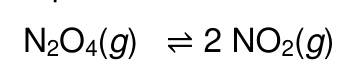
Dinitrogen tetroxide forms an equilibrium mixture with nitrogen dioxide:
1.00 mol of \(\ce{N2O4}\) was put into an empty vessel with a fixed volume of 24.44 dm\(^{3}\). The equilibrium gas pressure at 298 K was found to be 1.190 bar. When heated to 348 K, the gas pressure increased to its equilibrium value of 1.886 bar.
2.1 Calculate \(\Delta G^0\) of the reaction at 298K, assuming the gases are ideal.
2.2 Calculate \(\Delta H^0\) and \(\Delta S^0\) of the reaction, assuming that they do not change significantly with temperature.
Note: If you cannot calculate \(\Delta H^0\), use \(\Delta H^0 = 30.0\ \mathrm{kJ\,mol^{-1}}\) for further calculations.
The tendency of \(\ce{N2O4}\) to dissociate reversibly into \(\ce{NO2}\) enables its potential use in advanced power generation systems. A simplified scheme for one such system is shown below in Figure (a). Initially, "cool" \(\ce{N2O4}\) is compressed (\(1\to2\)) in a compressor (X), and heated (\(2\to3\)). Some \(\ce{N2O4}\) dissociates into \(\ce{NO2}\). The hot mixture is expanded (\(3\to4\)) through a turbine (Y), resulting in a decrease in both temperature and pressure. The mixture is then cooled further (\(4\to1\)) in a heat sink (Z), to promote the reformation of \(\ce{N2O4}\). This recombination reduces the pressure, thus facilitates the compression of \(\ce{N2O4}\) to start a new cycle. All these processes are assumed to take place reversibly.
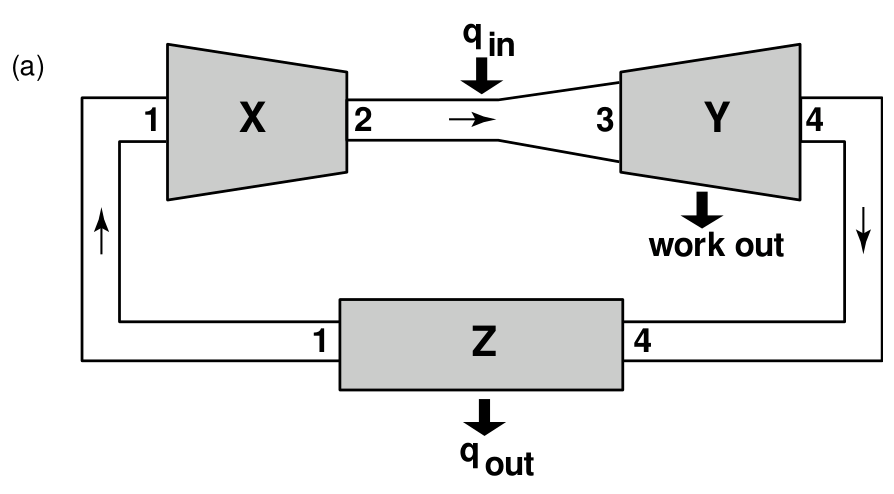
To understand the benefits of using reversible dissociating gases such as \(\ce{N2O4}\), we will focus on step \(3\to4\) and consider an ideal gas turbine working with 1 mole of air (which we assume to be an inert, non-dissociating gas). During the reversible adiabatic expansion in the turbine, no heat is exchanged.
2.3 Give the equation to calculate the work done by the system \(w(\mathrm{air})\) during the reversible adiabatic expansion for 1 mol of air during stage \(3\to4\). Assume that \(C_{v,m}(\mathrm{air})\) (the isochoric molar heat capacity of air) is constant, and the temperature changes from \(T_3\) to \(T_4\).
2.4 Estimate the ratio \(w_{\ce{N2O4})}/w_{(\mathrm{air})}\), in which \(w_{(\ce{N2O4})}\) is the work done by the gas during the reversible adiabatic expansion process \(3\to4\) with the cycle working with 1 mol of \(\ce{N2O4}\), \(T_3\) and \(T_4\) are the same as in part 2. Take the conditions at stage 3 to be \(T_3 = 440\ \mathrm{K}\) and \(p_3 = 12.156\ \mathrm{bar}\) and assume that:
(i) the gas is at its equilibrium composition at stage 3;
(ii) \(C_{v,m}\) for the gas is the same as for air;
(iii) the adiabatic expansion in the turbine takes place in a way that the composition of the gas mixture (\(\ce{N2O4 + NO2}\)) is unchanged until the expansion is completed.
Official English text of the problem.
Answers
- 2.1: \(\boxed{\Delta G^\circ_{298}=+4.73\ \mathrm{kJ\,mol^{-1}}}\).
- 2.2: \(\boxed{\Delta H^\circ=+57.2\ \mathrm{kJ\,mol^{-1}}}\), \(\boxed{\Delta S^\circ=+176\ \mathrm{J\,mol^{-1}\,K^{-1}}}\).
- 2.3: For the closed-system expansion-work interpretation, \[ \boxed{w(\mathrm{air})=(1.00\ \mathrm{mol})\,C_{v,m}(\mathrm{air})(T_3-T_4)}, \] positive for work done by the gas.
- 2.4: \(\boxed{w_{(\ce{N2O4})}/w_{(\mathrm{air})}\approx1.92}\).
Solution
2.1 — Standard Gibbs energy of dissociation
The balanced reaction is
\[ \ce{N2O4(g) <=> 2NO2(g)}. \]
The species are dinitrogen tetroxide, O=[N+]([O-])[N+](=O)[O-], and nitrogen dioxide, O=[N+][O-]. Nitrogen dioxide is an odd-electron radical; its SMILES represents one Lewis form and does not depict resonance delocalization.
Use
\[ R=8.314\ \mathrm{J\,mol^{-1}\,K^{-1}} =0.08314\ \mathrm{bar\,dm^3\,mol^{-1}\,K^{-1}}, \qquad p^\circ=1\ \mathrm{bar}. \]
Let \(\alpha\) be the fraction of the original \(n_0=1.00\ \mathrm{mol}\) of \(\ce{N2O4}\) that dissociates. At equilibrium,
\[ n(\ce{N2O4})=n_0(1-\alpha),\qquad n(\ce{NO2})=2n_0\alpha, \]
so
\[ n_{\mathrm{tot}}=n_0(1+\alpha). \]
The ideal-gas equation therefore gives
\[ \alpha=\frac{pV}{n_0RT}-1. \]
At 298 K,
\[ \alpha_{298} = \frac{(1.190\ \mathrm{bar})(24.44\ \mathrm{dm^3})} {(1.00\ \mathrm{mol})(0.08314\ \mathrm{bar\,dm^3\,mol^{-1}\,K^{-1}}) (298\ \mathrm{K})}-1 =0.173875. \]
The partial pressures are
\[ p(\ce{NO2})=\frac{2\alpha}{1+\alpha}p =0.352527\ \mathrm{bar}, \]
\[ p(\ce{N2O4})=\frac{1-\alpha}{1+\alpha}p =0.837473\ \mathrm{bar}. \]
The dimensionless equilibrium constant is
\[ K_p =\frac{[p(\ce{NO2})/p^\circ]^2}{p(\ce{N2O4})/p^\circ} =\frac{4\alpha^2}{1-\alpha^2}\frac{p}{p^\circ}. \]
Thus,
\[ K_p(298)=\frac{(0.352527)^2}{0.837473}=0.148393. \]
Consequently,
\[ \Delta G^\circ_{298} =-RT\ln K_p(298) =-(8.314)(298)\ln(0.148393)\ \mathrm{J\,mol^{-1}}, \]
\[ \boxed{\Delta G^\circ_{298}=+4.73\ \mathrm{kJ\,mol^{-1}}}. \]
2.2 — Standard enthalpy and entropy of dissociation
At 348 K, the same calculation gives
\[ \alpha_{348} =\frac{(1.886)(24.44)}{(1.00)(0.08314)(348)}-1 =0.593139, \]
and hence
\[ K_p(348) =\frac{4(0.593139)^2}{1-(0.593139)^2} \frac{1.886\ \mathrm{bar}}{1\ \mathrm{bar}} =4.09463. \]
For temperature-independent \(\Delta H^\circ\), the integrated van ’t Hoff equation is
\[ \ln\frac{K_p(T_2)}{K_p(T_1)} = \frac{\Delta H^\circ}{R} \left(\frac1{T_1}-\frac1{T_2}\right). \]
Therefore,
\[ \Delta H^\circ = \frac{(8.314\ \mathrm{J\,mol^{-1}\,K^{-1}}) \ln(4.09463/0.148393)} {\dfrac1{298\ \mathrm{K}}-\dfrac1{348\ \mathrm{K}}} =57207.8\ \mathrm{J\,mol^{-1}}, \]
\[ \boxed{\Delta H^\circ=+57.2\ \mathrm{kJ\,mol^{-1}}}. \]
Using \(\Delta G^\circ=\Delta H^\circ-T\Delta S^\circ\),
\[ \Delta S^\circ =\frac{\Delta H^\circ-\Delta G^\circ_{298}}{298\ \mathrm{K}} =\frac{(57207.8-4726.93)\ \mathrm{J\,mol^{-1}}}{298\ \mathrm{K}}, \]
\[ \boxed{\Delta S^\circ=+176\ \mathrm{J\,mol^{-1}\,K^{-1}}}. \]
Dissociation is endothermic and increases entropy, consistent with converting one gas molecule into two.
2.3 — Adiabatic expansion work
Take \(w>0\) for work done by the gas. For a closed system, the first law is
\[ \Delta U=q-w. \]
Since the expansion is adiabatic, \(q=0\), so \(w=-\Delta U\). For a fixed amount of ideal gas with constant molar heat capacity,
\[ \Delta U=nC_{v,m}(T_4-T_3). \]
For \(n=1.00\ \mathrm{mol}\) of air,
\[ \boxed{ w(\mathrm{air}) =(1.00\ \mathrm{mol})\,C_{v,m}(\mathrm{air})(T_3-T_4) }. \]
The temperature decreases during expansion, so this work is positive.
2.4 — Work ratio for the dissociating gas
First calculate the equilibrium constant at stage 3:
\[ \ln\frac{K_p(440)}{K_p(298)} = \frac{\Delta H^\circ}{R} \left(\frac1{298\ \mathrm{K}}-\frac1{440\ \mathrm{K}}\right). \]
Using the unrounded results above,
\[ K_p(440) = 0.148393\exp\!\left[ \frac{57207.8}{8.314} \left(\frac1{298}-\frac1{440}\right) \right] =255.690. \]
Let \(\alpha_3\) be the dissociation fraction at \(p_3=12.156\ \mathrm{bar}\). From the equilibrium expression derived in 2.1,
\[ K_p(440)=\frac{4\alpha_3^2}{1-\alpha_3^2}\frac{p_3}{p^\circ}. \]
Solving,
\[ \alpha_3 = \sqrt{\frac{K_p(440)} {K_p(440)+4p_3/p^\circ}} = \sqrt{\frac{255.690}{255.690+4(12.156)}} =0.916634. \]
Thus, starting with 1.00 mol of \(\ce{N2O4}\), the stage-3 mixture contains
\[ n(\ce{N2O4})=0.083366\ \mathrm{mol}, \qquad n(\ce{NO2})=1.833268\ \mathrm{mol}, \]
and
\[ n_3=(1.00\ \mathrm{mol})(1+\alpha_3) =1.916634\ \mathrm{mol}. \]
The composition is unchanged during expansion, so there is no reaction contribution to the change in internal energy during \(3\to4\). With the same molar heat capacity and temperature change as for air,
\[ w_{(\ce{N2O4})}=n_3C_{v,m}(\mathrm{air})(T_3-T_4). \]
Therefore,
\[ \frac{w_{(\ce{N2O4})}}{w_{(\mathrm{air})}} = \frac{n_3}{1.00\ \mathrm{mol}} =1+\alpha_3, \]
\[ \boxed{\frac{w_{(\ce{N2O4})}}{w_{(\mathrm{air})}} =1.916634\approx1.92}. \]
The increased work comes from the larger number of gas molecules produced by dissociation.
The solution was checked against the official solution.
IChO 2014 · Theorieaufgabe 2
Kreisprozess mit einem dissoziierenden Gas
Distickstofftetraoxid bildet mit Stickstoffdioxid ein Gleichgewichtsgemisch:
1.00 mol \(\ce{N2O4}\) wurden in ein leeres Gefäß mit einem festen Volumen von 24.44 dm\(^{3}\) eingebracht. Der Gasdruck im Gleichgewicht bei 298 K betrug 1.190 bar. Beim Erwärmen auf 348 K stieg der Gasdruck auf seinen Gleichgewichtswert von 1.886 bar.
2.1 Berechnen Sie \(\Delta G^0\) der Reaktion bei 298K unter der Annahme, dass sich die Gase ideal verhalten.
2.2 Berechnen Sie \(\Delta H^0\) und \(\Delta S^0\) der Reaktion unter der Annahme, dass sie sich mit der Temperatur nicht wesentlich ändern.
Hinweis: Falls Sie \(\Delta H^0\) nicht berechnen können, verwenden Sie für die weiteren Berechnungen \(\Delta H^0 = 30.0\ \mathrm{kJ\,mol^{-1}}\).
Die Neigung von \(\ce{N2O4}\), reversibel zu \(\ce{NO2}\) zu dissoziieren, eröffnet die Möglichkeit seiner Verwendung in fortschrittlichen Energieerzeugungssystemen. Ein vereinfachtes Schema eines solchen Systems ist unten in Abbildung (a) dargestellt. Zunächst wird „kühles“ \(\ce{N2O4}\) in einem Kompressor (X) komprimiert (\(1\to2\)) und erwärmt (\(2\to3\)). Ein Teil des \(\ce{N2O4}\) dissoziiert zu \(\ce{NO2}\). Das heiße Gemisch wird in einer Turbine (Y) entspannt (\(3\to4\)), wodurch sowohl die Temperatur als auch der Druck sinken. Anschließend wird das Gemisch in einer Wärmesenke (Z) weiter abgekühlt (\(4\to1\)), um die Rückbildung von \(\ce{N2O4}\) zu begünstigen. Diese Rekombination senkt den Druck und erleichtert dadurch die Kompression des \(\ce{N2O4}\), mit der ein neuer Kreisprozess beginnt. Es wird angenommen, dass alle diese Prozesse reversibel ablaufen.
Um die Vorteile der Verwendung reversibel dissoziierender Gase wie \(\ce{N2O4}\) zu verstehen, konzentrieren wir uns auf den Schritt \(3\to4\) und betrachten eine ideale Gasturbine, die mit 1 mol Luft arbeitet (die wir als inertes, nicht dissoziierendes Gas annehmen). Während der reversiblen adiabatischen Expansion in der Turbine wird keine Wärme ausgetauscht.
2.3 Geben Sie die Gleichung zur Berechnung der vom System verrichteten Arbeit \(w(\mathrm{air})\) während der reversiblen adiabatischen Expansion von 1 mol Luft im Schritt \(3\to4\) an. Nehmen Sie an, dass \(C_{v,m}(\mathrm{air})\) (die isochore molare Wärmekapazität von Luft) konstant ist und sich die Temperatur von \(T_3\) auf \(T_4\) ändert.
2.4 Schätzen Sie das Verhältnis \(w_{\ce{N2O4})}/w_{(\mathrm{air})}\) ab, wobei \(w_{(\ce{N2O4})}\) die vom Gas während des reversiblen adiabatischen Expansionsprozesses \(3\to4\) verrichtete Arbeit ist, wenn der Kreisprozess mit 1 mol \(\ce{N2O4}\) arbeitet; \(T_3\) und \(T_4\) sind dieselben wie in Teil 2. Setzen Sie für den Zustand 3 die Bedingungen \(T_3 = 440\ \mathrm{K}\) und \(p_3 = 12.156\ \mathrm{bar}\) an und nehmen Sie an, dass:
(i) das Gas im Zustand 3 seine Gleichgewichtszusammensetzung aufweist;
(ii) \(C_{v,m}\) für das Gas denselben Wert wie für Luft hat;
(iii) die adiabatische Expansion in der Turbine so abläuft, dass die Zusammensetzung des Gasgemisches (\(\ce{N2O4 + NO2}\)) bis zum Abschluss der Expansion unverändert bleibt.
Aufgabentext aus dem offiziellen englischen Text übersetzt.
Antworten
- 2.1: \(\boxed{\Delta G^\circ_{298}=+4.73\ \mathrm{kJ\,mol^{-1}}}\).
- 2.2: \(\boxed{\Delta H^\circ=+57.2\ \mathrm{kJ\,mol^{-1}}}\), \(\boxed{\Delta S^\circ=+176\ \mathrm{J\,mol^{-1}\,K^{-1}}}\).
- 2.3: Bei der Interpretation als Expansionsarbeit eines geschlossenen Systems gilt \[ \boxed{w(\mathrm{air})=(1.00\ \mathrm{mol})\,C_{v,m}(\mathrm{air})(T_3-T_4)}, \] wobei vom Gas verrichtete Arbeit positiv gezählt wird.
- 2.4: \(\boxed{w_{(\ce{N2O4})}/w_{(\mathrm{air})}\approx1.92}\).
Lösung
2.1 — Standard-Gibbs-Energie der Dissoziation
Die ausgeglichene Reaktionsgleichung lautet
\[ \ce{N2O4(g) <=> 2NO2(g)}. \]
Die beteiligten Spezies sind Distickstofftetraoxid, O=[N+]([O-])[N+](=O)[O-], und Stickstoffdioxid, O=[N+][O-]. Stickstoffdioxid ist ein Radikal mit einer ungeraden Elektronenzahl; seine SMILES-Darstellung gibt eine Lewis-Grenzstruktur wieder und stellt die mesomere Delokalisierung nicht dar.
Wir verwenden
\[ R=8.314\ \mathrm{J\,mol^{-1}\,K^{-1}} =0.08314\ \mathrm{bar\,dm^3\,mol^{-1}\,K^{-1}}, \qquad p^\circ=1\ \mathrm{bar}. \]
Sei \(\alpha\) der Anteil der ursprünglichen \(n_0=1.00\ \mathrm{mol}\) \(\ce{N2O4}\), der dissoziiert. Im Gleichgewicht gilt
\[ n(\ce{N2O4})=n_0(1-\alpha),\qquad n(\ce{NO2})=2n_0\alpha, \]
also
\[ n_{\mathrm{tot}}=n_0(1+\alpha). \]
Aus der idealen Gasgleichung folgt daher
\[ \alpha=\frac{pV}{n_0RT}-1. \]
Bei 298 K gilt
\[ \alpha_{298} = \frac{(1.190\ \mathrm{bar})(24.44\ \mathrm{dm^3})} {(1.00\ \mathrm{mol})(0.08314\ \mathrm{bar\,dm^3\,mol^{-1}\,K^{-1}}) (298\ \mathrm{K})}-1 =0.173875. \]
Die Partialdrücke betragen
\[ p(\ce{NO2})=\frac{2\alpha}{1+\alpha}p =0.352527\ \mathrm{bar}, \]
\[ p(\ce{N2O4})=\frac{1-\alpha}{1+\alpha}p =0.837473\ \mathrm{bar}. \]
Die dimensionslose Gleichgewichtskonstante ist
\[ K_p =\frac{[p(\ce{NO2})/p^\circ]^2}{p(\ce{N2O4})/p^\circ} =\frac{4\alpha^2}{1-\alpha^2}\frac{p}{p^\circ}. \]
Damit ergibt sich
\[ K_p(298)=\frac{(0.352527)^2}{0.837473}=0.148393. \]
Folglich gilt
\[ \Delta G^\circ_{298} =-RT\ln K_p(298) =-(8.314)(298)\ln(0.148393)\ \mathrm{J\,mol^{-1}}, \]
\[ \boxed{\Delta G^\circ_{298}=+4.73\ \mathrm{kJ\,mol^{-1}}}. \]
2.2 — Standardenthalpie und Standardentropie der Dissoziation
Bei 348 K ergibt dieselbe Rechnung
\[ \alpha_{348} =\frac{(1.886)(24.44)}{(1.00)(0.08314)(348)}-1 =0.593139, \]
und somit
\[ K_p(348) =\frac{4(0.593139)^2}{1-(0.593139)^2} \frac{1.886\ \mathrm{bar}}{1\ \mathrm{bar}} =4.09463. \]
Für ein temperaturunabhängiges \(\Delta H^\circ\) lautet die integrierte van-’t-Hoff-Gleichung
\[ \ln\frac{K_p(T_2)}{K_p(T_1)} = \frac{\Delta H^\circ}{R} \left(\frac1{T_1}-\frac1{T_2}\right). \]
Daraus folgt
\[ \Delta H^\circ = \frac{(8.314\ \mathrm{J\,mol^{-1}\,K^{-1}}) \ln(4.09463/0.148393)} {\dfrac1{298\ \mathrm{K}}-\dfrac1{348\ \mathrm{K}}} =57207.8\ \mathrm{J\,mol^{-1}}, \]
\[ \boxed{\Delta H^\circ=+57.2\ \mathrm{kJ\,mol^{-1}}}. \]
Mit \(\Delta G^\circ=\Delta H^\circ-T\Delta S^\circ\) ergibt sich
\[ \Delta S^\circ =\frac{\Delta H^\circ-\Delta G^\circ_{298}}{298\ \mathrm{K}} =\frac{(57207.8-4726.93)\ \mathrm{J\,mol^{-1}}}{298\ \mathrm{K}}, \]
\[ \boxed{\Delta S^\circ=+176\ \mathrm{J\,mol^{-1}\,K^{-1}}}. \]
Die Dissoziation ist endotherm und erhöht die Entropie, was mit der Umwandlung eines Gasmoleküls in zwei übereinstimmt.
2.3 — Adiabatische Expansionsarbeit
Für vom Gas verrichtete Arbeit sei \(w>0\). Für ein geschlossenes System lautet der erste Hauptsatz
\[ \Delta U=q-w. \]
Da die Expansion adiabatisch ist, gilt \(q=0\), also \(w=-\Delta U\). Für eine feste Stoffmenge eines idealen Gases mit konstanter molarer Wärmekapazität gilt
\[ \Delta U=nC_{v,m}(T_4-T_3). \]
Für \(n=1.00\ \mathrm{mol}\) Luft ergibt sich
\[ \boxed{ w(\mathrm{air}) =(1.00\ \mathrm{mol})\,C_{v,m}(\mathrm{air})(T_3-T_4) }. \]
Während der Expansion sinkt die Temperatur, sodass diese Arbeit positiv ist.
2.4 — Arbeitsverhältnis für das dissoziierende Gas
Zunächst berechnen wir die Gleichgewichtskonstante im Zustand 3:
\[ \ln\frac{K_p(440)}{K_p(298)} = \frac{\Delta H^\circ}{R} \left(\frac1{298\ \mathrm{K}}-\frac1{440\ \mathrm{K}}\right). \]
Mit den obigen ungerundeten Ergebnissen erhält man
\[ K_p(440) = 0.148393\exp\!\left[ \frac{57207.8}{8.314} \left(\frac1{298}-\frac1{440}\right) \right] =255.690. \]
Sei \(\alpha_3\) der Dissoziationsgrad bei \(p_3=12.156\ \mathrm{bar}\). Aus dem in 2.1 hergeleiteten Gleichgewichtsausdruck folgt
\[ K_p(440)=\frac{4\alpha_3^2}{1-\alpha_3^2}\frac{p_3}{p^\circ}. \]
Auflösen ergibt
\[ \alpha_3 = \sqrt{\frac{K_p(440)} {K_p(440)+4p_3/p^\circ}} = \sqrt{\frac{255.690}{255.690+4(12.156)}} =0.916634. \]
Ausgehend von 1.00 mol \(\ce{N2O4}\) enthält das Gemisch im Zustand 3 somit
\[ n(\ce{N2O4})=0.083366\ \mathrm{mol}, \qquad n(\ce{NO2})=1.833268\ \mathrm{mol}, \]
und
\[ n_3=(1.00\ \mathrm{mol})(1+\alpha_3) =1.916634\ \mathrm{mol}. \]
Die Zusammensetzung bleibt während der Expansion unverändert, sodass die Reaktion während \(3\to4\) keinen Beitrag zur Änderung der inneren Energie leistet. Bei gleicher molarer Wärmekapazität und gleicher Temperaturänderung wie für Luft gilt
\[ w_{(\ce{N2O4})}=n_3C_{v,m}(\mathrm{air})(T_3-T_4). \]
Daher gilt
\[ \frac{w_{(\ce{N2O4})}}{w_{(\mathrm{air})}} = \frac{n_3}{1.00\ \mathrm{mol}} =1+\alpha_3, \]
\[ \boxed{\frac{w_{(\ce{N2O4})}}{w_{(\mathrm{air})}} =1.916634\approx1.92}. \]
Die größere Arbeit ergibt sich aus der höheren Zahl an Gasmolekülen, die durch die Dissoziation entstehen.
Die Lösung wurde mit der offiziellen Lösung abgeglichen.
IChO 2014 · Teori sorusu 2
Ayrışan gaz çevrimi
Diazot tetraoksit, azot dioksit ile bir denge karışımı oluşturur:
1.00 mol \(\ce{N2O4}\), hacmi sabit ve 24.44 dm\(^{3}\) olan boş bir kaba konulmuştur. 298 K'de denge gaz basıncı 1.190 bar olarak bulunmuştur. 348 K'ye ısıtıldığında gaz basıncı, denge değeri olan 1.886 bar'a yükselmiştir.
2.1 Gazların ideal olduğunu varsayarak tepkimenin 298 K'deki \(\Delta G^0\) değerini hesaplayınız.
2.2 Sıcaklıkla önemli ölçüde değişmediklerini varsayarak tepkimenin \(\Delta H^0\) ve \(\Delta S^0\) değerlerini hesaplayınız.
Not: \(\Delta H^0\) değerini hesaplayamazsanız, sonraki hesaplamalarda \(\Delta H^0 = 30.0\ \mathrm{kJ\,mol^{-1}}\) değerini kullanınız.
\(\ce{N2O4}\)'ün tersinir olarak \(\ce{NO2}\)'ye ayrışma eğilimi, gelişmiş güç üretim sistemlerinde kullanılabilmesine olanak sağlar. Böyle bir sistemin basitleştirilmiş şeması aşağıda Şekil (a)'da gösterilmiştir. Başlangıçta, "soğuk" \(\ce{N2O4}\) bir kompresörde (X) sıkıştırılır (\(1\to2\)) ve ısıtılır (\(2\to3\)). \(\ce{N2O4}\)'ün bir kısmı \(\ce{NO2}\)'ye ayrışır. Sıcak karışım bir türbinden (Y) geçirilerek genleştirilir (\(3\to4\)); bunun sonucunda hem sıcaklık hem de basınç azalır. Ardından karışım, \(\ce{N2O4}\)'ün yeniden oluşumunu desteklemek için bir ısı alıcısında (Z) daha da soğutulur (\(4\to1\)). Bu yeniden birleşme basıncı düşürür ve böylece yeni bir çevrimi başlatmak üzere \(\ce{N2O4}\)'ün sıkıştırılmasını kolaylaştırır. Tüm bu süreçlerin tersinir olarak gerçekleştiği varsayılmaktadır.
\(\ce{N2O4}\) gibi tersinir olarak ayrışan gazların kullanılmasının yararlarını anlamak için \(3\to4\) adımına odaklanacağız ve 1 mol hava ile çalışan ideal bir gaz türbinini ele alacağız (havanın inert, ayrışmayan bir gaz olduğunu varsayıyoruz). Türbindeki tersinir adyabatik genleşme sırasında ısı alışverişi olmaz.
2.3 \(3\to4\) aşamasında 1 mol havanın tersinir adyabatik genleşmesi sırasında sistemin yaptığı işi, \(w(\mathrm{air})\), hesaplamak için kullanılacak denklemi veriniz. \(C_{v,m}(\mathrm{air})\)'nin (havanın sabit hacimdeki molar ısı kapasitesinin) sabit olduğunu ve sıcaklığın \(T_3\)'ten \(T_4\)'e değiştiğini varsayınız.
2.4 \(w_{\ce{N2O4})}/w_{(\mathrm{air})}\) oranını yaklaşık olarak hesaplayınız; burada \(w_{(\ce{N2O4})}\), 1 mol \(\ce{N2O4}\) ile çalışan çevrimde \(3\to4\) tersinir adyabatik genleşme sürecinde gazın yaptığı iştir; \(T_3\) ve \(T_4\), kısım 2'deki ile aynıdır. 3. aşamadaki koşulları \(T_3 = 440\ \mathrm{K}\) ve \(p_3 = 12.156\ \mathrm{bar}\) olarak alınız ve şunları varsayınız:
(i) gaz, 3. aşamada denge bileşimindedir;
(ii) gazın \(C_{v,m}\) değeri havanınkiyle aynıdır;
(iii) türbindeki adyabatik genleşme, genleşme tamamlanana kadar gaz karışımının (\(\ce{N2O4 + NO2}\)) bileşimi değişmeyecek şekilde gerçekleşir.
Soru metni resmi İngilizce metinden çevrilmiştir.
Cevaplar
- 2.1: \(\boxed{\Delta G^\circ_{298}=+4.73\ \mathrm{kJ\,mol^{-1}}}\).
- 2.2: \(\boxed{\Delta H^\circ=+57.2\ \mathrm{kJ\,mol^{-1}}}\), \(\boxed{\Delta S^\circ=+176\ \mathrm{J\,mol^{-1}\,K^{-1}}}\).
- 2.3: Kapalı sistemde genleşme işi yorumuna göre, \[ \boxed{w(\mathrm{air})=(1.00\ \mathrm{mol})\,C_{v,m}(\mathrm{air})(T_3-T_4)}, \] gazın yaptığı iş pozitiftir.
- 2.4: \(\boxed{w_{(\ce{N2O4})}/w_{(\mathrm{air})}\approx1.92}\).
Çözüm
2.1 — Standart ayrışma Gibbs enerjisi
Denkleştirilmiş tepkime şöyledir:
\[ \ce{N2O4(g) <=> 2NO2(g)}. \]
Kimyasal türler diazot tetraoksit, O=[N+]([O-])[N+](=O)[O-], ve azot dioksittir, O=[N+][O-]. Azot dioksit, tek sayıda elektron içeren bir radikaldir; SMILES gösterimi bir Lewis yapısını temsil eder ve rezonans delokalizasyonunu göstermez.
Şu değerleri kullanalım:
\[ R=8.314\ \mathrm{J\,mol^{-1}\,K^{-1}} =0.08314\ \mathrm{bar\,dm^3\,mol^{-1}\,K^{-1}}, \qquad p^\circ=1\ \mathrm{bar}. \]
Başlangıçtaki \(n_0=1.00\ \mathrm{mol}\) \(\ce{N2O4}\)'ün ayrışan kesri \(\alpha\) olsun. Dengede,
\[ n(\ce{N2O4})=n_0(1-\alpha),\qquad n(\ce{NO2})=2n_0\alpha, \]
dolayısıyla
\[ n_{\mathrm{tot}}=n_0(1+\alpha). \]
Böylece ideal gaz denklemi şu sonucu verir:
\[ \alpha=\frac{pV}{n_0RT}-1. \]
298 K'de,
\[ \alpha_{298} = \frac{(1.190\ \mathrm{bar})(24.44\ \mathrm{dm^3})} {(1.00\ \mathrm{mol})(0.08314\ \mathrm{bar\,dm^3\,mol^{-1}\,K^{-1}}) (298\ \mathrm{K})}-1 =0.173875. \]
Kısmi basınçlar şöyledir:
\[ p(\ce{NO2})=\frac{2\alpha}{1+\alpha}p =0.352527\ \mathrm{bar}, \]
\[ p(\ce{N2O4})=\frac{1-\alpha}{1+\alpha}p =0.837473\ \mathrm{bar}. \]
Boyutsuz denge sabiti şöyledir:
\[ K_p =\frac{[p(\ce{NO2})/p^\circ]^2}{p(\ce{N2O4})/p^\circ} =\frac{4\alpha^2}{1-\alpha^2}\frac{p}{p^\circ}. \]
Böylece,
\[ K_p(298)=\frac{(0.352527)^2}{0.837473}=0.148393. \]
Sonuç olarak,
\[ \Delta G^\circ_{298} =-RT\ln K_p(298) =-(8.314)(298)\ln(0.148393)\ \mathrm{J\,mol^{-1}}, \]
\[ \boxed{\Delta G^\circ_{298}=+4.73\ \mathrm{kJ\,mol^{-1}}}. \]
2.2 — Standart ayrışma entalpisi ve entropisi
348 K'de aynı hesaplama şu sonucu verir:
\[ \alpha_{348} =\frac{(1.886)(24.44)}{(1.00)(0.08314)(348)}-1 =0.593139, \]
ve buradan
\[ K_p(348) =\frac{4(0.593139)^2}{1-(0.593139)^2} \frac{1.886\ \mathrm{bar}}{1\ \mathrm{bar}} =4.09463. \]
Sıcaklıktan bağımsız \(\Delta H^\circ\) için, integrali alınmış van ’t Hoff denklemi şöyledir:
\[ \ln\frac{K_p(T_2)}{K_p(T_1)} = \frac{\Delta H^\circ}{R} \left(\frac1{T_1}-\frac1{T_2}\right). \]
Dolayısıyla,
\[ \Delta H^\circ = \frac{(8.314\ \mathrm{J\,mol^{-1}\,K^{-1}}) \ln(4.09463/0.148393)} {\dfrac1{298\ \mathrm{K}}-\dfrac1{348\ \mathrm{K}}} =57207.8\ \mathrm{J\,mol^{-1}}, \]
\[ \boxed{\Delta H^\circ=+57.2\ \mathrm{kJ\,mol^{-1}}}. \]
\(\Delta G^\circ=\Delta H^\circ-T\Delta S^\circ\) bağıntısı kullanılarak,
\[ \Delta S^\circ =\frac{\Delta H^\circ-\Delta G^\circ_{298}}{298\ \mathrm{K}} =\frac{(57207.8-4726.93)\ \mathrm{J\,mol^{-1}}}{298\ \mathrm{K}}, \]
\[ \boxed{\Delta S^\circ=+176\ \mathrm{J\,mol^{-1}\,K^{-1}}}. \]
Ayrışma endotermiktir ve entropiyi artırır; bu, bir gaz molekülünün iki gaz molekülüne dönüşmesiyle tutarlıdır.
2.3 — Adyabatik genleşme işi
Gazın yaptığı iş için \(w>0\) alalım. Kapalı bir sistem için birinci yasa şöyledir:
\[ \Delta U=q-w. \]
Genleşme adyabatik olduğundan \(q=0\), dolayısıyla \(w=-\Delta U\) olur. Molar ısı kapasitesi sabit olan, sabit miktardaki ideal bir gaz için,
\[ \Delta U=nC_{v,m}(T_4-T_3). \]
\(n=1.00\ \mathrm{mol}\) hava için,
\[ \boxed{ w(\mathrm{air}) =(1.00\ \mathrm{mol})\,C_{v,m}(\mathrm{air})(T_3-T_4) }. \]
Genleşme sırasında sıcaklık azaldığından bu iş pozitiftir.
2.4 — Ayrışan gaz için iş oranı
Önce 3. aşamadaki denge sabitini hesaplayalım:
\[ \ln\frac{K_p(440)}{K_p(298)} = \frac{\Delta H^\circ}{R} \left(\frac1{298\ \mathrm{K}}-\frac1{440\ \mathrm{K}}\right). \]
Yukarıdaki yuvarlanmamış sonuçlar kullanılarak,
\[ K_p(440) = 0.148393\exp\!\left[ \frac{57207.8}{8.314} \left(\frac1{298}-\frac1{440}\right) \right] =255.690. \]
\(p_3=12.156\ \mathrm{bar}\) basıncındaki ayrışma kesri \(\alpha_3\) olsun. 2.1'de türetilen denge ifadesinden,
\[ K_p(440)=\frac{4\alpha_3^2}{1-\alpha_3^2}\frac{p_3}{p^\circ}. \]
Çözüldüğünde,
\[ \alpha_3 = \sqrt{\frac{K_p(440)} {K_p(440)+4p_3/p^\circ}} = \sqrt{\frac{255.690}{255.690+4(12.156)}} =0.916634. \]
Böylece, 1.00 mol \(\ce{N2O4}\) ile başlandığında 3. aşamadaki karışımın içerdiği miktarlar şöyledir:
\[ n(\ce{N2O4})=0.083366\ \mathrm{mol}, \qquad n(\ce{NO2})=1.833268\ \mathrm{mol}, \]
ve
\[ n_3=(1.00\ \mathrm{mol})(1+\alpha_3) =1.916634\ \mathrm{mol}. \]
Genleşme sırasında bileşim değişmediğinden, \(3\to4\) sırasındaki iç enerji değişimine tepkimenin bir katkısı yoktur. Molar ısı kapasitesi ve sıcaklık değişimi havanınkiyle aynı olduğunda,
\[ w_{(\ce{N2O4})}=n_3C_{v,m}(\mathrm{air})(T_3-T_4). \]
Dolayısıyla,
\[ \frac{w_{(\ce{N2O4})}}{w_{(\mathrm{air})}} = \frac{n_3}{1.00\ \mathrm{mol}} =1+\alpha_3, \]
\[ \boxed{\frac{w_{(\ce{N2O4})}}{w_{(\mathrm{air})}} =1.916634\approx1.92}. \]
İşteki artış, ayrışmanın gaz moleküllerinin sayısını artırmasından kaynaklanır.
Çözüm, resmi çözümle karşılaştırılarak kontrol edildi.
IChO 2014 · Problema teórico 2
Ciclo de un gas que se disocia
El tetróxido de dinitrógeno forma una mezcla en equilibrio con el dióxido de nitrógeno:
Se introdujeron 1.00 mol de \(\ce{N2O4}\) en un recipiente vacío de volumen fijo de 24.44 dm\(^{3}\). Se determinó que la presión del gas en equilibrio a 298 K era de 1.190 bar. Al calentarlo hasta 348 K, la presión del gas aumentó hasta su valor de equilibrio de 1.886 bar.
2.1 Calcule \(\Delta G^0\) de la reacción a 298K, suponiendo que los gases son ideales.
2.2 Calcule \(\Delta H^0\) y \(\Delta S^0\) de la reacción, suponiendo que no cambian significativamente con la temperatura.
Nota: Si no puede calcular \(\Delta H^0\), utilice \(\Delta H^0 = 30.0\ \mathrm{kJ\,mol^{-1}}\) para los cálculos posteriores.
La tendencia del \(\ce{N2O4}\) a disociarse reversiblemente en \(\ce{NO2}\) permite su posible uso en sistemas avanzados de generación de energía. A continuación, en la Figura (a), se muestra un esquema simplificado de uno de estos sistemas. Inicialmente, el \(\ce{N2O4}\) «frío» se comprime (\(1\to2\)) en un compresor (X) y se calienta (\(2\to3\)). Parte del \(\ce{N2O4}\) se disocia en \(\ce{NO2}\). La mezcla caliente se expande (\(3\to4\)) a través de una turbina (Y), lo que provoca una disminución tanto de la temperatura como de la presión. A continuación, la mezcla se enfría aún más (\(4\to1\)) en un sumidero de calor (Z), para favorecer la formación de nuevo de \(\ce{N2O4}\). Esta recombinación reduce la presión y, por tanto, facilita la compresión del \(\ce{N2O4}\) para iniciar un nuevo ciclo. Se supone que todos estos procesos tienen lugar de forma reversible.
Para comprender las ventajas de utilizar gases que se disocian reversiblemente, como el \(\ce{N2O4}\), nos centraremos en la etapa \(3\to4\) y consideraremos una turbina de gas ideal que funciona con 1 mol de aire (que suponemos que es un gas inerte que no se disocia). Durante la expansión adiabática reversible en la turbina, no se intercambia calor.
2.3 Escriba la ecuación para calcular el trabajo realizado por el sistema \(w(\mathrm{air})\) durante la expansión adiabática reversible de 1 mol de aire en la etapa \(3\to4\). Suponga que \(C_{v,m}(\mathrm{air})\) (la capacidad calorífica molar isocórica del aire) es constante y que la temperatura cambia de \(T_3\) a \(T_4\).
2.4 Estime la relación \(w_{\ce{N2O4})}/w_{(\mathrm{air})}\), donde \(w_{(\ce{N2O4})}\) es el trabajo realizado por el gas durante el proceso de expansión adiabática reversible \(3\to4\) cuando el ciclo funciona con 1 mol de \(\ce{N2O4}\), y \(T_3\) y \(T_4\) son las mismas que en la parte 2. Considere que las condiciones en la etapa 3 son \(T_3 = 440\ \mathrm{K}\) y \(p_3 = 12.156\ \mathrm{bar}\) y suponga que:
(i) el gas tiene su composición de equilibrio en la etapa 3;
(ii) \(C_{v,m}\) del gas es la misma que la del aire;
(iii) la expansión adiabática en la turbina tiene lugar de modo que la composición de la mezcla gaseosa (\(\ce{N2O4 + NO2}\)) permanece inalterada hasta que se completa la expansión.
Enunciado traducido del texto oficial en inglés.
Respuestas
- 2.1: \(\boxed{\Delta G^\circ_{298}=+4.73\ \mathrm{kJ\,mol^{-1}}}\).
- 2.2: \(\boxed{\Delta H^\circ=+57.2\ \mathrm{kJ\,mol^{-1}}}\), \(\boxed{\Delta S^\circ=+176\ \mathrm{J\,mol^{-1}\,K^{-1}}}\).
- 2.3: Según la interpretación como trabajo de expansión de un sistema cerrado, \[ \boxed{w(\mathrm{air})=(1.00\ \mathrm{mol})\,C_{v,m}(\mathrm{air})(T_3-T_4)}, \] positivo para el trabajo realizado por el gas.
- 2.4: \(\boxed{w_{(\ce{N2O4})}/w_{(\mathrm{air})}\approx1.92}\).
Solución
2.1 — Energía de Gibbs estándar de disociación
La reacción ajustada es
\[ \ce{N2O4(g) <=> 2NO2(g)}. \]
Las especies son el tetróxido de dinitrógeno, O=[N+]([O-])[N+](=O)[O-], y el dióxido de nitrógeno, O=[N+][O-]. El dióxido de nitrógeno es un radical con un número impar de electrones; su SMILES representa una estructura de Lewis y no muestra la deslocalización por resonancia.
Utilizamos
\[ R=8.314\ \mathrm{J\,mol^{-1}\,K^{-1}} =0.08314\ \mathrm{bar\,dm^3\,mol^{-1}\,K^{-1}}, \qquad p^\circ=1\ \mathrm{bar}. \]
Sea \(\alpha\) la fracción de los \(n_0=1.00\ \mathrm{mol}\) iniciales de \(\ce{N2O4}\) que se disocia. En el equilibrio,
\[ n(\ce{N2O4})=n_0(1-\alpha),\qquad n(\ce{NO2})=2n_0\alpha, \]
por lo que
\[ n_{\mathrm{tot}}=n_0(1+\alpha). \]
Por tanto, la ecuación de los gases ideales da
\[ \alpha=\frac{pV}{n_0RT}-1. \]
A 298 K,
\[ \alpha_{298} = \frac{(1.190\ \mathrm{bar})(24.44\ \mathrm{dm^3})} {(1.00\ \mathrm{mol})(0.08314\ \mathrm{bar\,dm^3\,mol^{-1}\,K^{-1}}) (298\ \mathrm{K})}-1 =0.173875. \]
Las presiones parciales son
\[ p(\ce{NO2})=\frac{2\alpha}{1+\alpha}p =0.352527\ \mathrm{bar}, \]
\[ p(\ce{N2O4})=\frac{1-\alpha}{1+\alpha}p =0.837473\ \mathrm{bar}. \]
La constante de equilibrio adimensional es
\[ K_p =\frac{[p(\ce{NO2})/p^\circ]^2}{p(\ce{N2O4})/p^\circ} =\frac{4\alpha^2}{1-\alpha^2}\frac{p}{p^\circ}. \]
Así,
\[ K_p(298)=\frac{(0.352527)^2}{0.837473}=0.148393. \]
En consecuencia,
\[ \Delta G^\circ_{298} =-RT\ln K_p(298) =-(8.314)(298)\ln(0.148393)\ \mathrm{J\,mol^{-1}}, \]
\[ \boxed{\Delta G^\circ_{298}=+4.73\ \mathrm{kJ\,mol^{-1}}}. \]
2.2 — Entalpía y entropía estándar de disociación
A 348 K, el mismo cálculo da
\[ \alpha_{348} =\frac{(1.886)(24.44)}{(1.00)(0.08314)(348)}-1 =0.593139, \]
y, por tanto,
\[ K_p(348) =\frac{4(0.593139)^2}{1-(0.593139)^2} \frac{1.886\ \mathrm{bar}}{1\ \mathrm{bar}} =4.09463. \]
Para una \(\Delta H^\circ\) independiente de la temperatura, la ecuación integrada de van ’t Hoff es
\[ \ln\frac{K_p(T_2)}{K_p(T_1)} = \frac{\Delta H^\circ}{R} \left(\frac1{T_1}-\frac1{T_2}\right). \]
Por tanto,
\[ \Delta H^\circ = \frac{(8.314\ \mathrm{J\,mol^{-1}\,K^{-1}}) \ln(4.09463/0.148393)} {\dfrac1{298\ \mathrm{K}}-\dfrac1{348\ \mathrm{K}}} =57207.8\ \mathrm{J\,mol^{-1}}, \]
\[ \boxed{\Delta H^\circ=+57.2\ \mathrm{kJ\,mol^{-1}}}. \]
Utilizando \(\Delta G^\circ=\Delta H^\circ-T\Delta S^\circ\),
\[ \Delta S^\circ =\frac{\Delta H^\circ-\Delta G^\circ_{298}}{298\ \mathrm{K}} =\frac{(57207.8-4726.93)\ \mathrm{J\,mol^{-1}}}{298\ \mathrm{K}}, \]
\[ \boxed{\Delta S^\circ=+176\ \mathrm{J\,mol^{-1}\,K^{-1}}}. \]
La disociación es endotérmica y aumenta la entropía, en consonancia con la conversión de una molécula de gas en dos.
2.3 — Trabajo de expansión adiabática
Tomamos \(w>0\) para el trabajo realizado por el gas. Para un sistema cerrado, la primera ley es
\[ \Delta U=q-w. \]
Como la expansión es adiabática, \(q=0\), por lo que \(w=-\Delta U\). Para una cantidad fija de gas ideal con capacidad calorífica molar constante,
\[ \Delta U=nC_{v,m}(T_4-T_3). \]
Para \(n=1.00\ \mathrm{mol}\) de aire,
\[ \boxed{ w(\mathrm{air}) =(1.00\ \mathrm{mol})\,C_{v,m}(\mathrm{air})(T_3-T_4) }. \]
La temperatura disminuye durante la expansión, por lo que este trabajo es positivo.
2.4 — Relación de trabajos para el gas que se disocia
Primero calculamos la constante de equilibrio en la etapa 3:
\[ \ln\frac{K_p(440)}{K_p(298)} = \frac{\Delta H^\circ}{R} \left(\frac1{298\ \mathrm{K}}-\frac1{440\ \mathrm{K}}\right). \]
Utilizando los resultados anteriores sin redondear,
\[ K_p(440) = 0.148393\exp\!\left[ \frac{57207.8}{8.314} \left(\frac1{298}-\frac1{440}\right) \right] =255.690. \]
Sea \(\alpha_3\) la fracción disociada a \(p_3=12.156\ \mathrm{bar}\). A partir de la expresión de equilibrio deducida en 2.1,
\[ K_p(440)=\frac{4\alpha_3^2}{1-\alpha_3^2}\frac{p_3}{p^\circ}. \]
Despejando,
\[ \alpha_3 = \sqrt{\frac{K_p(440)} {K_p(440)+4p_3/p^\circ}} = \sqrt{\frac{255.690}{255.690+4(12.156)}} =0.916634. \]
Así, partiendo de 1.00 mol de \(\ce{N2O4}\), la mezcla en la etapa 3 contiene
\[ n(\ce{N2O4})=0.083366\ \mathrm{mol}, \qquad n(\ce{NO2})=1.833268\ \mathrm{mol}, \]
y
\[ n_3=(1.00\ \mathrm{mol})(1+\alpha_3) =1.916634\ \mathrm{mol}. \]
La composición permanece inalterada durante la expansión, por lo que no hay contribución de la reacción al cambio de energía interna durante \(3\to4\). Con la misma capacidad calorífica molar y el mismo cambio de temperatura que para el aire,
\[ w_{(\ce{N2O4})}=n_3C_{v,m}(\mathrm{air})(T_3-T_4). \]
Por tanto,
\[ \frac{w_{(\ce{N2O4})}}{w_{(\mathrm{air})}} = \frac{n_3}{1.00\ \mathrm{mol}} =1+\alpha_3, \]
\[ \boxed{\frac{w_{(\ce{N2O4})}}{w_{(\mathrm{air})}} =1.916634\approx1.92}. \]
El aumento del trabajo se debe al mayor número de moléculas de gas producidas por la disociación.
La solución se comprobó con la solución oficial.
IChO 2014 · 理论题 2
解离气体循环
四氧化二氮与二氧化氮形成平衡混合物:
将 1.00 mol 的 \(\ce{N2O4}\) 放入一个体积固定为 24.44 dm\(^{3}\) 的空容器中。测得 298 K 时的平衡气体压力为 1.190 bar。加热至 348 K 时,气体压力升高至其平衡值 1.886 bar。
2.1 假设气体为理想气体,计算该反应在 298K 时的 \(\Delta G^0\)。
2.2 假设该反应的 \(\Delta H^0\) 和 \(\Delta S^0\) 随温度的变化不显著,计算它们的值。
注:如果你无法计算出 \(\Delta H^0\),请在后续计算中使用 \(\Delta H^0 = 30.0\ \mathrm{kJ\,mol^{-1}}\)。
\(\ce{N2O4}\) 可逆解离为 \(\ce{NO2}\) 的特性使其有望用于先进的发电系统。下方图 (a) 给出了其中一种系统的简化示意图。首先,“冷”的 \(\ce{N2O4}\) 在压缩机(X)中被压缩(\(1\to2\)),随后被加热(\(2\to3\))。部分 \(\ce{N2O4}\) 解离为 \(\ce{NO2}\)。高温混合物通过涡轮机(Y)膨胀(\(3\to4\)),使温度和压力均降低。随后,混合物在冷源(Z)中进一步冷却(\(4\to1\)),以促进 \(\ce{N2O4}\) 的重新生成。这一复合过程降低了压力,从而有利于压缩 \(\ce{N2O4}\),开始新的循环。假设所有这些过程均可逆进行。
为了理解使用 \(\ce{N2O4}\) 这类可逆解离气体的优点,我们将重点考察步骤 \(3\to4\),并考虑一台以 1 摩尔空气为工质的理想气体涡轮机(假设空气是惰性且不发生解离的气体)。在涡轮机中的可逆绝热膨胀过程中,没有热量交换。
2.3 写出计算 1 mol 空气在阶段 \(3\to4\) 的可逆绝热膨胀过程中体系所做的功 \(w(\mathrm{air})\) 的方程。假设 \(C_{v,m}(\mathrm{air})\)(空气的定容摩尔热容)为常数,温度由 \(T_3\) 变为 \(T_4\)。
2.4 估算比值 \(w_{\ce{N2O4})}/w_{(\mathrm{air})}\),其中 \(w_{(\ce{N2O4})}\) 是以 1 mol \(\ce{N2O4}\) 为工质的循环在可逆绝热膨胀过程 \(3\to4\) 中气体所做的功,\(T_3\) 和 \(T_4\) 与第 2 部分相同。取阶段 3 的条件为 \(T_3 = 440\ \mathrm{K}\) 和 \(p_3 = 12.156\ \mathrm{bar}\),并假设:
(i) 气体在阶段 3 处于平衡组成;
(ii) 该气体的 \(C_{v,m}\) 与空气相同;
(iii) 涡轮机中的绝热膨胀以如下方式进行:气体混合物(\(\ce{N2O4 + NO2}\))的组成保持不变,直至膨胀完成。
题目译自官方英文原文。
答案
- 2.1: \(\boxed{\Delta G^\circ_{298}=+4.73\ \mathrm{kJ\,mol^{-1}}}\)。
- 2.2: \(\boxed{\Delta H^\circ=+57.2\ \mathrm{kJ\,mol^{-1}}}\),\(\boxed{\Delta S^\circ=+176\ \mathrm{J\,mol^{-1}\,K^{-1}}}\)。
- 2.3: 按封闭体系膨胀功的理解, \[ \boxed{w(\mathrm{air})=(1.00\ \mathrm{mol})\,C_{v,m}(\mathrm{air})(T_3-T_4)}, \] 气体对外做功时取正值。
- 2.4: \(\boxed{w_{(\ce{N2O4})}/w_{(\mathrm{air})}\approx1.92}\)。
解答
2.1 — 解离反应的标准吉布斯能
配平后的反应为
\[ \ce{N2O4(g) <=> 2NO2(g)}. \]
涉及的物种为四氧化二氮 O=[N+]([O-])[N+](=O)[O-] 和二氧化氮 O=[N+][O-]。二氧化氮是具有奇数个电子的自由基;其 SMILES 表示一种路易斯结构,并未体现共振离域。
取
\[ R=8.314\ \mathrm{J\,mol^{-1}\,K^{-1}} =0.08314\ \mathrm{bar\,dm^3\,mol^{-1}\,K^{-1}}, \qquad p^\circ=1\ \mathrm{bar}. \]
设 \(\alpha\) 为初始 \(n_0=1.00\ \mathrm{mol}\) 的 \(\ce{N2O4}\) 中发生解离的比例。平衡时,
\[ n(\ce{N2O4})=n_0(1-\alpha),\qquad n(\ce{NO2})=2n_0\alpha, \]
因此
\[ n_{\mathrm{tot}}=n_0(1+\alpha). \]
由理想气体状态方程可得
\[ \alpha=\frac{pV}{n_0RT}-1. \]
在 298 K 时,
\[ \alpha_{298} = \frac{(1.190\ \mathrm{bar})(24.44\ \mathrm{dm^3})} {(1.00\ \mathrm{mol})(0.08314\ \mathrm{bar\,dm^3\,mol^{-1}\,K^{-1}}) (298\ \mathrm{K})}-1 =0.173875. \]
各组分的分压为
\[ p(\ce{NO2})=\frac{2\alpha}{1+\alpha}p =0.352527\ \mathrm{bar}, \]
\[ p(\ce{N2O4})=\frac{1-\alpha}{1+\alpha}p =0.837473\ \mathrm{bar}. \]
无量纲平衡常数为
\[ K_p =\frac{[p(\ce{NO2})/p^\circ]^2}{p(\ce{N2O4})/p^\circ} =\frac{4\alpha^2}{1-\alpha^2}\frac{p}{p^\circ}. \]
于是,
\[ K_p(298)=\frac{(0.352527)^2}{0.837473}=0.148393. \]
因此,
\[ \Delta G^\circ_{298} =-RT\ln K_p(298) =-(8.314)(298)\ln(0.148393)\ \mathrm{J\,mol^{-1}}, \]
\[ \boxed{\Delta G^\circ_{298}=+4.73\ \mathrm{kJ\,mol^{-1}}}. \]
2.2 — 解离反应的标准焓和标准熵
在 348 K 时,同样的计算给出
\[ \alpha_{348} =\frac{(1.886)(24.44)}{(1.00)(0.08314)(348)}-1 =0.593139, \]
进而得到
\[ K_p(348) =\frac{4(0.593139)^2}{1-(0.593139)^2} \frac{1.886\ \mathrm{bar}}{1\ \mathrm{bar}} =4.09463. \]
当 \(\Delta H^\circ\) 与温度无关时,积分形式的范特霍夫方程为
\[ \ln\frac{K_p(T_2)}{K_p(T_1)} = \frac{\Delta H^\circ}{R} \left(\frac1{T_1}-\frac1{T_2}\right). \]
因此,
\[ \Delta H^\circ = \frac{(8.314\ \mathrm{J\,mol^{-1}\,K^{-1}}) \ln(4.09463/0.148393)} {\dfrac1{298\ \mathrm{K}}-\dfrac1{348\ \mathrm{K}}} =57207.8\ \mathrm{J\,mol^{-1}}, \]
\[ \boxed{\Delta H^\circ=+57.2\ \mathrm{kJ\,mol^{-1}}}. \]
利用 \(\Delta G^\circ=\Delta H^\circ-T\Delta S^\circ\),
\[ \Delta S^\circ =\frac{\Delta H^\circ-\Delta G^\circ_{298}}{298\ \mathrm{K}} =\frac{(57207.8-4726.93)\ \mathrm{J\,mol^{-1}}}{298\ \mathrm{K}}, \]
\[ \boxed{\Delta S^\circ=+176\ \mathrm{J\,mol^{-1}\,K^{-1}}}. \]
解离过程吸热且熵增,这与一个气体分子转化为两个气体分子相一致。
2.3 — 绝热膨胀功
规定气体对外做功时 \(w>0\)。对于封闭体系,热力学第一定律为
\[ \Delta U=q-w. \]
由于膨胀过程是绝热的,\(q=0\),所以 \(w=-\Delta U\)。对于物质的量固定且摩尔热容恒定的理想气体,
\[ \Delta U=nC_{v,m}(T_4-T_3). \]
对于 \(n=1.00\ \mathrm{mol}\) 的空气,
\[ \boxed{ w(\mathrm{air}) =(1.00\ \mathrm{mol})\,C_{v,m}(\mathrm{air})(T_3-T_4) }. \]
膨胀过程中温度降低,因此该功为正值。
2.4 — 解离气体的做功比值
首先计算阶段 3 的平衡常数:
\[ \ln\frac{K_p(440)}{K_p(298)} = \frac{\Delta H^\circ}{R} \left(\frac1{298\ \mathrm{K}}-\frac1{440\ \mathrm{K}}\right). \]
使用上面未舍入的结果,
\[ K_p(440) = 0.148393\exp\!\left[ \frac{57207.8}{8.314} \left(\frac1{298}-\frac1{440}\right) \right] =255.690. \]
设 \(\alpha_3\) 为 \(p_3=12.156\ \mathrm{bar}\) 时的解离度。由 2.1 中推导的平衡表达式,
\[ K_p(440)=\frac{4\alpha_3^2}{1-\alpha_3^2}\frac{p_3}{p^\circ}. \]
解得,
\[ \alpha_3 = \sqrt{\frac{K_p(440)} {K_p(440)+4p_3/p^\circ}} = \sqrt{\frac{255.690}{255.690+4(12.156)}} =0.916634. \]
因此,从 1.00 mol 的 \(\ce{N2O4}\) 出发,阶段 3 的混合物含有
\[ n(\ce{N2O4})=0.083366\ \mathrm{mol}, \qquad n(\ce{NO2})=1.833268\ \mathrm{mol}, \]
且
\[ n_3=(1.00\ \mathrm{mol})(1+\alpha_3) =1.916634\ \mathrm{mol}. \]
膨胀过程中组成不变,因此在 \(3\to4\) 过程中,反应对内能变化没有贡献。由于摩尔热容和温度变化均与空气相同,
\[ w_{(\ce{N2O4})}=n_3C_{v,m}(\mathrm{air})(T_3-T_4). \]
因此,
\[ \frac{w_{(\ce{N2O4})}}{w_{(\mathrm{air})}} = \frac{n_3}{1.00\ \mathrm{mol}} =1+\alpha_3, \]
\[ \boxed{\frac{w_{(\ce{N2O4})}}{w_{(\mathrm{air})}} =1.916634\approx1.92}. \]
做功增加是因为解离产生了更多的气体分子。
解答已与官方解答核对。
IChO 2014 · Теоретическая задача 2
Цикл с диссоциирующим газом
Тетраоксид диазота образует равновесную смесь с диоксидом азота:
1.00 моль \(\ce{N2O4}\) поместили в пустой сосуд постоянного объёма 24.44 дм\(^{3}\). Было установлено, что равновесное давление газа при 298 К составляет 1.190 бар. При нагревании до 348 К давление газа возросло до равновесного значения 1.886 бар.
2.1 Рассчитайте \(\Delta G^0\) реакции при 298 К, считая газы идеальными.
2.2 Рассчитайте \(\Delta H^0\) и \(\Delta S^0\) реакции, предполагая, что они незначительно изменяются с температурой.
Примечание: если вы не можете рассчитать \(\Delta H^0\), используйте в дальнейших расчётах \(\Delta H^0 = 30.0\ \mathrm{kJ\,mol^{-1}}\).
Способность \(\ce{N2O4}\) обратимо диссоциировать на \(\ce{NO2}\) позволяет рассматривать его применение в перспективных системах выработки электроэнергии. Упрощённая схема одной из таких систем показана ниже на рисунке (a). Сначала «холодный» \(\ce{N2O4}\) сжимают (\(1\to2\)) в компрессоре (X) и нагревают (\(2\to3\)). Часть \(\ce{N2O4}\) диссоциирует на \(\ce{NO2}\). Горячая смесь расширяется (\(3\to4\)), проходя через турбину (Y), в результате чего снижаются как температура, так и давление. Затем смесь дополнительно охлаждают (\(4\to1\)) в холодильнике (Z), чтобы способствовать повторному образованию \(\ce{N2O4}\). Эта рекомбинация снижает давление и тем самым облегчает сжатие \(\ce{N2O4}\) для начала нового цикла. Предполагается, что все эти процессы протекают обратимо.
Чтобы понять преимущества использования обратимо диссоциирующих газов, таких как \(\ce{N2O4}\), сосредоточимся на стадии \(3\to4\) и рассмотрим идеальную газовую турбину, работающую с 1 молем воздуха (который мы считаем инертным, недиссоциирующим газом). При обратимом адиабатическом расширении в турбине теплообмен отсутствует.
2.3 Приведите уравнение для расчёта работы, совершаемой системой, \(w(\mathrm{air})\), при обратимом адиабатическом расширении 1 моль воздуха на стадии \(3\to4\). Считайте, что \(C_{v,m}(\mathrm{air})\) (изохорная молярная теплоёмкость воздуха) постоянна, а температура изменяется от \(T_3\) до \(T_4\).
2.4 Оцените отношение \(w_{\ce{N2O4})}/w_{(\mathrm{air})}\), в котором \(w_{(\ce{N2O4})}\) — работа, совершаемая газом при обратимом адиабатическом расширении \(3\to4\) в цикле с 1 моль \(\ce{N2O4}\), а \(T_3\) и \(T_4\) такие же, как в части 2. Примите условия на стадии 3 равными \(T_3 = 440\ \mathrm{K}\) и \(p_3 = 12.156\ \mathrm{bar}\) и предположите, что:
(i) на стадии 3 газ имеет равновесный состав;
(ii) \(C_{v,m}\) газа такая же, как у воздуха;
(iii) адиабатическое расширение в турбине протекает таким образом, что состав газовой смеси (\(\ce{N2O4 + NO2}\)) остаётся неизменным до завершения расширения.
Условие переведено с официального английского текста.
Ответы
- 2.1: \(\boxed{\Delta G^\circ_{298}=+4.73\ \mathrm{kJ\,mol^{-1}}}\).
- 2.2: \(\boxed{\Delta H^\circ=+57.2\ \mathrm{kJ\,mol^{-1}}}\), \(\boxed{\Delta S^\circ=+176\ \mathrm{J\,mol^{-1}\,K^{-1}}}\).
- 2.3: При трактовке процесса как расширения замкнутой системы \[ \boxed{w(\mathrm{air})=(1.00\ \mathrm{mol})\,C_{v,m}(\mathrm{air})(T_3-T_4)}, \] причём работа, совершаемая газом, положительна.
- 2.4: \(\boxed{w_{(\ce{N2O4})}/w_{(\mathrm{air})}\approx1.92}\).
Решение
2.1 — Стандартная энергия Гиббса диссоциации
Уравнение реакции с расставленными коэффициентами имеет вид
\[ \ce{N2O4(g) <=> 2NO2(g)}. \]
В реакции участвуют тетраоксид диазота, O=[N+]([O-])[N+](=O)[O-], и диоксид азота, O=[N+][O-]. Диоксид азота — радикал с нечётным числом электронов; его запись SMILES представляет одну из структур Льюиса и не отражает резонансную делокализацию.
Используем
\[ R=8.314\ \mathrm{J\,mol^{-1}\,K^{-1}} =0.08314\ \mathrm{bar\,dm^3\,mol^{-1}\,K^{-1}}, \qquad p^\circ=1\ \mathrm{bar}. \]
Пусть \(\alpha\) — доля исходного количества \(n_0=1.00\ \mathrm{mol}\) \(\ce{N2O4}\), которая диссоциирует. При равновесии
\[ n(\ce{N2O4})=n_0(1-\alpha),\qquad n(\ce{NO2})=2n_0\alpha, \]
поэтому
\[ n_{\mathrm{tot}}=n_0(1+\alpha). \]
Таким образом, из уравнения состояния идеального газа получаем
\[ \alpha=\frac{pV}{n_0RT}-1. \]
При 298 К
\[ \alpha_{298} = \frac{(1.190\ \mathrm{bar})(24.44\ \mathrm{dm^3})} {(1.00\ \mathrm{mol})(0.08314\ \mathrm{bar\,dm^3\,mol^{-1}\,K^{-1}}) (298\ \mathrm{K})}-1 =0.173875. \]
Парциальные давления равны
\[ p(\ce{NO2})=\frac{2\alpha}{1+\alpha}p =0.352527\ \mathrm{bar}, \]
\[ p(\ce{N2O4})=\frac{1-\alpha}{1+\alpha}p =0.837473\ \mathrm{bar}. \]
Безразмерная константа равновесия имеет вид
\[ K_p =\frac{[p(\ce{NO2})/p^\circ]^2}{p(\ce{N2O4})/p^\circ} =\frac{4\alpha^2}{1-\alpha^2}\frac{p}{p^\circ}. \]
Таким образом,
\[ K_p(298)=\frac{(0.352527)^2}{0.837473}=0.148393. \]
Следовательно,
\[ \Delta G^\circ_{298} =-RT\ln K_p(298) =-(8.314)(298)\ln(0.148393)\ \mathrm{J\,mol^{-1}}, \]
\[ \boxed{\Delta G^\circ_{298}=+4.73\ \mathrm{kJ\,mol^{-1}}}. \]
2.2 — Стандартные энтальпия и энтропия диссоциации
При 348 К аналогичный расчёт даёт
\[ \alpha_{348} =\frac{(1.886)(24.44)}{(1.00)(0.08314)(348)}-1 =0.593139, \]
откуда
\[ K_p(348) =\frac{4(0.593139)^2}{1-(0.593139)^2} \frac{1.886\ \mathrm{bar}}{1\ \mathrm{bar}} =4.09463. \]
Если \(\Delta H^\circ\) не зависит от температуры, уравнение Вант-Гоффа в интегральной форме имеет вид
\[ \ln\frac{K_p(T_2)}{K_p(T_1)} = \frac{\Delta H^\circ}{R} \left(\frac1{T_1}-\frac1{T_2}\right). \]
Следовательно,
\[ \Delta H^\circ = \frac{(8.314\ \mathrm{J\,mol^{-1}\,K^{-1}}) \ln(4.09463/0.148393)} {\dfrac1{298\ \mathrm{K}}-\dfrac1{348\ \mathrm{K}}} =57207.8\ \mathrm{J\,mol^{-1}}, \]
\[ \boxed{\Delta H^\circ=+57.2\ \mathrm{kJ\,mol^{-1}}}. \]
Используя \(\Delta G^\circ=\Delta H^\circ-T\Delta S^\circ\), получаем
\[ \Delta S^\circ =\frac{\Delta H^\circ-\Delta G^\circ_{298}}{298\ \mathrm{K}} =\frac{(57207.8-4726.93)\ \mathrm{J\,mol^{-1}}}{298\ \mathrm{K}}, \]
\[ \boxed{\Delta S^\circ=+176\ \mathrm{J\,mol^{-1}\,K^{-1}}}. \]
Диссоциация эндотермична и сопровождается увеличением энтропии, что согласуется с превращением одной молекулы газа в две.
2.3 — Работа адиабатического расширения
Примем \(w>0\) для работы, совершаемой газом. Для замкнутой системы первое начало термодинамики имеет вид
\[ \Delta U=q-w. \]
Поскольку расширение адиабатическое, \(q=0\), поэтому \(w=-\Delta U\). Для постоянного количества идеального газа с постоянной молярной теплоёмкостью
\[ \Delta U=nC_{v,m}(T_4-T_3). \]
Для \(n=1.00\ \mathrm{mol}\) воздуха
\[ \boxed{ w(\mathrm{air}) =(1.00\ \mathrm{mol})\,C_{v,m}(\mathrm{air})(T_3-T_4) }. \]
При расширении температура снижается, поэтому эта работа положительна.
2.4 — Отношение работ для диссоциирующего газа
Сначала рассчитаем константу равновесия на стадии 3:
\[ \ln\frac{K_p(440)}{K_p(298)} = \frac{\Delta H^\circ}{R} \left(\frac1{298\ \mathrm{K}}-\frac1{440\ \mathrm{K}}\right). \]
Используя полученные выше неокруглённые результаты, находим
\[ K_p(440) = 0.148393\exp\!\left[ \frac{57207.8}{8.314} \left(\frac1{298}-\frac1{440}\right) \right] =255.690. \]
Пусть \(\alpha_3\) — степень диссоциации при \(p_3=12.156\ \mathrm{bar}\). Из выражения для константы равновесия, выведенного в 2.1,
\[ K_p(440)=\frac{4\alpha_3^2}{1-\alpha_3^2}\frac{p_3}{p^\circ}. \]
Решая это уравнение, получаем
\[ \alpha_3 = \sqrt{\frac{K_p(440)} {K_p(440)+4p_3/p^\circ}} = \sqrt{\frac{255.690}{255.690+4(12.156)}} =0.916634. \]
Таким образом, при исходном количестве 1.00 моль \(\ce{N2O4}\) смесь на стадии 3 содержит
\[ n(\ce{N2O4})=0.083366\ \mathrm{mol}, \qquad n(\ce{NO2})=1.833268\ \mathrm{mol}, \]
и
\[ n_3=(1.00\ \mathrm{mol})(1+\alpha_3) =1.916634\ \mathrm{mol}. \]
При расширении состав остаётся неизменным, поэтому реакция не вносит вклада в изменение внутренней энергии на стадии \(3\to4\). При тех же молярной теплоёмкости и изменении температуры, что и для воздуха,
\[ w_{(\ce{N2O4})}=n_3C_{v,m}(\mathrm{air})(T_3-T_4). \]
Следовательно,
\[ \frac{w_{(\ce{N2O4})}}{w_{(\mathrm{air})}} = \frac{n_3}{1.00\ \mathrm{mol}} =1+\alpha_3, \]
\[ \boxed{\frac{w_{(\ce{N2O4})}}{w_{(\mathrm{air})}} =1.916634\approx1.92}. \]
Увеличение работы обусловлено увеличением числа молекул газа вследствие диссоциации.
Решение проверено по официальному решению.
IChO 2014 · مسألة نظرية 2
دورة الغاز المتفكك
يشكّل رباعي أكسيد ثنائي النيتروجين مزيجًا في حالة اتزان مع ثاني أكسيد النيتروجين:
وُضع 1.00 mol من \(\ce{N2O4}\) في وعاء فارغ ذي حجم ثابت مقداره 24.44 dm\(^{3}\). وُجد أن ضغط الغاز عند الاتزان عند 298 K يساوي 1.190 bar. وعند تسخينه إلى 348 K، ارتفع ضغط الغاز إلى قيمته عند الاتزان البالغة 1.886 bar.
2.1 احسب \(\Delta G^0\) للتفاعل عند 298K، بافتراض أن الغازات مثالية.
2.2 احسب \(\Delta H^0\) و\(\Delta S^0\) للتفاعل، بافتراض أنهما لا يتغيران تغيرًا ملحوظًا مع درجة الحرارة.
ملاحظة: إذا لم تتمكن من حساب \(\Delta H^0\)، فاستخدم \(\Delta H^0 = 30.0\ \mathrm{kJ\,mol^{-1}}\) في الحسابات اللاحقة.
يتيح ميل \(\ce{N2O4}\) إلى التفكك عكوسيًا إلى \(\ce{NO2}\) إمكانية استخدامه في أنظمة متقدمة لتوليد الطاقة. يوضّح الشكل (a) أدناه مخططًا مبسطًا لأحد هذه الأنظمة. في البداية، يُضغط \(\ce{N2O4}\) «البارد» (\(1\to2\)) في ضاغط (X)، ثم يُسخّن (\(2\to3\)). ويتفكك بعض \(\ce{N2O4}\) إلى \(\ce{NO2}\). يتمدد المزيج الساخن (\(3\to4\)) عبر عنفة (Y)، مما يؤدي إلى انخفاض كلٍّ من درجة الحرارة والضغط. ثم يُبرّد المزيج أكثر (\(4\to1\)) في مستودع حراري بارد (Z)، لتعزيز إعادة تكوّن \(\ce{N2O4}\). تؤدي إعادة الاتحاد هذه إلى خفض الضغط، مما يسهّل ضغط \(\ce{N2O4}\) لبدء دورة جديدة. يُفترض أن جميع هذه العمليات تجري عكوسيًا.
لفهم فوائد استخدام غازات تتفكك عكوسيًا مثل \(\ce{N2O4}\)، سنركّز على الخطوة \(3\to4\) وننظر في عنفة غازية مثالية تعمل بمول واحد من الهواء (الذي نفترض أنه غاز خامل لا يتفكك). لا يحدث أي تبادل للحرارة أثناء التمدد الكظومي العكوسي في العنفة.
2.3 أعطِ المعادلة اللازمة لحساب الشغل الذي يبذله النظام \(w(\mathrm{air})\) أثناء التمدد الكظومي العكوسي لـ 1 mol من الهواء خلال المرحلة \(3\to4\). افترض أن \(C_{v,m}(\mathrm{air})\) (السعة الحرارية المولية للهواء عند حجم ثابت) ثابتة، وأن درجة الحرارة تتغير من \(T_3\) إلى \(T_4\).
2.4 قدّر النسبة \(w_{\ce{N2O4})}/w_{(\mathrm{air})}\)، حيث \(w_{(\ce{N2O4})}\) هو الشغل الذي يبذله الغاز أثناء عملية التمدد الكظومي العكوسي \(3\to4\) عندما تعمل الدورة باستخدام 1 mol من \(\ce{N2O4}\)، وتكون \(T_3\) و\(T_4\) كما في الجزء 2. اعتبر أن الظروف عند المرحلة 3 هي \(T_3 = 440\ \mathrm{K}\) و\(p_3 = 12.156\ \mathrm{bar}\)، وافترض ما يلي:
(i) يكون الغاز بتركيبه الاتزاني عند المرحلة 3؛
(ii) تكون \(C_{v,m}\) للغاز مساوية لقيمتها للهواء؛
(iii) يجري التمدد الكظومي في العنفة على نحو يبقى معه تركيب المزيج الغازي (\(\ce{N2O4 + NO2}\)) دون تغير حتى اكتمال التمدد.
نص المسألة مترجم عن النص الإنجليزي الرسمي.
الإجابات
- 2.1: \(\boxed{\Delta G^\circ_{298}=+4.73\ \mathrm{kJ\,mol^{-1}}}\).
- 2.2: \(\boxed{\Delta H^\circ=+57.2\ \mathrm{kJ\,mol^{-1}}}\)، \(\boxed{\Delta S^\circ=+176\ \mathrm{J\,mol^{-1}\,K^{-1}}}\).
- 2.3: وفق تفسير الشغل بوصفه شغل تمدد نظام مغلق، \[ \boxed{w(\mathrm{air})=(1.00\ \mathrm{mol})\,C_{v,m}(\mathrm{air})(T_3-T_4)}, \] وتكون إشارته موجبة للشغل الذي يبذله الغاز.
- 2.4: \(\boxed{w_{(\ce{N2O4})}/w_{(\mathrm{air})}\approx1.92}\).
الحل
2.1 — طاقة غيبس القياسية للتفكك
التفاعل الموزون هو
\[ \ce{N2O4(g) <=> 2NO2(g)}. \]
النوعان الكيميائيان هما رباعي أكسيد ثنائي النيتروجين، O=[N+]([O-])[N+](=O)[O-]، وثاني أكسيد النيتروجين، O=[N+][O-]. ثاني أكسيد النيتروجين جذر حر ذو عدد فردي من الإلكترونات؛ ويمثّل ترميز SMILES الخاص به إحدى صيغ لويس، ولا يصوّر عدم تمركز الإلكترونات الناجم عن الرنين.
نستخدم
\[ R=8.314\ \mathrm{J\,mol^{-1}\,K^{-1}} =0.08314\ \mathrm{bar\,dm^3\,mol^{-1}\,K^{-1}}, \qquad p^\circ=1\ \mathrm{bar}. \]
لتكن \(\alpha\) الكسر الذي يتفكك من الكمية الأصلية \(n_0=1.00\ \mathrm{mol}\) من \(\ce{N2O4}\). عند الاتزان،
\[ n(\ce{N2O4})=n_0(1-\alpha),\qquad n(\ce{NO2})=2n_0\alpha, \]
ومن ثم
\[ n_{\mathrm{tot}}=n_0(1+\alpha). \]
لذلك تعطي معادلة الغاز المثالي
\[ \alpha=\frac{pV}{n_0RT}-1. \]
عند 298 K،
\[ \alpha_{298} = \frac{(1.190\ \mathrm{bar})(24.44\ \mathrm{dm^3})} {(1.00\ \mathrm{mol})(0.08314\ \mathrm{bar\,dm^3\,mol^{-1}\,K^{-1}}) (298\ \mathrm{K})}-1 =0.173875. \]
الضغطان الجزئيان هما
\[ p(\ce{NO2})=\frac{2\alpha}{1+\alpha}p =0.352527\ \mathrm{bar}, \]
\[ p(\ce{N2O4})=\frac{1-\alpha}{1+\alpha}p =0.837473\ \mathrm{bar}. \]
ثابت الاتزان اللابُعدي هو
\[ K_p =\frac{[p(\ce{NO2})/p^\circ]^2}{p(\ce{N2O4})/p^\circ} =\frac{4\alpha^2}{1-\alpha^2}\frac{p}{p^\circ}. \]
وبذلك،
\[ K_p(298)=\frac{(0.352527)^2}{0.837473}=0.148393. \]
وبالتالي،
\[ \Delta G^\circ_{298} =-RT\ln K_p(298) =-(8.314)(298)\ln(0.148393)\ \mathrm{J\,mol^{-1}}, \]
\[ \boxed{\Delta G^\circ_{298}=+4.73\ \mathrm{kJ\,mol^{-1}}}. \]
2.2 — الإنثالبي والإنتروبيا القياسيان للتفكك
عند 348 K، تعطي الحسابات نفسها
\[ \alpha_{348} =\frac{(1.886)(24.44)}{(1.00)(0.08314)(348)}-1 =0.593139, \]
ومن ثم
\[ K_p(348) =\frac{4(0.593139)^2}{1-(0.593139)^2} \frac{1.886\ \mathrm{bar}}{1\ \mathrm{bar}} =4.09463. \]
عندما تكون \(\Delta H^\circ\) مستقلة عن درجة الحرارة، تكون الصيغة المتكاملة لمعادلة فانت هوف
\[ \ln\frac{K_p(T_2)}{K_p(T_1)} = \frac{\Delta H^\circ}{R} \left(\frac1{T_1}-\frac1{T_2}\right). \]
وعليه،
\[ \Delta H^\circ = \frac{(8.314\ \mathrm{J\,mol^{-1}\,K^{-1}}) \ln(4.09463/0.148393)} {\dfrac1{298\ \mathrm{K}}-\dfrac1{348\ \mathrm{K}}} =57207.8\ \mathrm{J\,mol^{-1}}, \]
\[ \boxed{\Delta H^\circ=+57.2\ \mathrm{kJ\,mol^{-1}}}. \]
باستخدام \(\Delta G^\circ=\Delta H^\circ-T\Delta S^\circ\)،
\[ \Delta S^\circ =\frac{\Delta H^\circ-\Delta G^\circ_{298}}{298\ \mathrm{K}} =\frac{(57207.8-4726.93)\ \mathrm{J\,mol^{-1}}}{298\ \mathrm{K}}, \]
\[ \boxed{\Delta S^\circ=+176\ \mathrm{J\,mol^{-1}\,K^{-1}}}. \]
التفكك ماص للحرارة ويزيد الإنتروبيا، وهو ما يتفق مع تحوّل جزيء غازي واحد إلى جزيئين.
2.3 — شغل التمدد الكظومي
نعتمد \(w>0\) للشغل الذي يبذله الغاز. لنظام مغلق، يكون القانون الأول
\[ \Delta U=q-w. \]
بما أن التمدد كظومي، فإن \(q=0\)، ومن ثم \(w=-\Delta U\). ولكمية ثابتة من غاز مثالي ذي سعة حرارية مولية ثابتة،
\[ \Delta U=nC_{v,m}(T_4-T_3). \]
من أجل \(n=1.00\ \mathrm{mol}\) من الهواء،
\[ \boxed{ w(\mathrm{air}) =(1.00\ \mathrm{mol})\,C_{v,m}(\mathrm{air})(T_3-T_4) }. \]
تنخفض درجة الحرارة أثناء التمدد، لذا يكون هذا الشغل موجبًا.
2.4 — نسبة الشغل للغاز المتفكك
نحسب أولًا ثابت الاتزان عند المرحلة 3:
\[ \ln\frac{K_p(440)}{K_p(298)} = \frac{\Delta H^\circ}{R} \left(\frac1{298\ \mathrm{K}}-\frac1{440\ \mathrm{K}}\right). \]
باستخدام النتائج غير المقرّبة أعلاه،
\[ K_p(440) = 0.148393\exp\!\left[ \frac{57207.8}{8.314} \left(\frac1{298}-\frac1{440}\right) \right] =255.690. \]
لتكن \(\alpha_3\) درجة التفكك عند \(p_3=12.156\ \mathrm{bar}\). من عبارة الاتزان المشتقة في 2.1،
\[ K_p(440)=\frac{4\alpha_3^2}{1-\alpha_3^2}\frac{p_3}{p^\circ}. \]
بالحل،
\[ \alpha_3 = \sqrt{\frac{K_p(440)} {K_p(440)+4p_3/p^\circ}} = \sqrt{\frac{255.690}{255.690+4(12.156)}} =0.916634. \]
إذن، عند البدء بـ 1.00 mol من \(\ce{N2O4}\)، يحتوي المزيج عند المرحلة 3 على
\[ n(\ce{N2O4})=0.083366\ \mathrm{mol}, \qquad n(\ce{NO2})=1.833268\ \mathrm{mol}, \]
و
\[ n_3=(1.00\ \mathrm{mol})(1+\alpha_3) =1.916634\ \mathrm{mol}. \]
يبقى التركيب دون تغير أثناء التمدد، لذا لا توجد مساهمة من التفاعل في تغير الطاقة الداخلية خلال \(3\to4\). وبالسعة الحرارية المولية نفسها والتغير نفسه في درجة الحرارة كما للهواء،
\[ w_{(\ce{N2O4})}=n_3C_{v,m}(\mathrm{air})(T_3-T_4). \]
وعليه،
\[ \frac{w_{(\ce{N2O4})}}{w_{(\mathrm{air})}} = \frac{n_3}{1.00\ \mathrm{mol}} =1+\alpha_3, \]
\[ \boxed{\frac{w_{(\ce{N2O4})}}{w_{(\mathrm{air})}} =1.916634\approx1.92}. \]
تنتج الزيادة في الشغل من العدد الأكبر من جزيئات الغاز الناتجة عن التفكك.
تمت مراجعة الحل بمقارنته بالحل الرسمي.