International Chemistry Olympiad
IChO 2013
Moscow, Russia · 8 theory problems with complete solutions
Problem 1: Clathrate gun
The only gun that is able to kill all living people in one shot
On the floors of oceans and seas there are vast reserves of methane in the form of clathrate compounds called methane hydrates. These reserves can be mined and serve as a source of energy or raw materials for organic synthesis. However, scientists are seriously worried about the possibility of spontaneous decomposition of hydrates caused by the raising ocean temperature. It is believed that if a sufficient amount of methane is released into the atmosphere, the oceans will warm up quicker due to the greenhouse effect, further accelerating the decomposition of clathrates. Due to the explosion of the resulting methane-air mixture and/or changes in the composition of the atmosphere, all living creatures may become extinct. This apocalyptic scenario is called a clathrate gun.
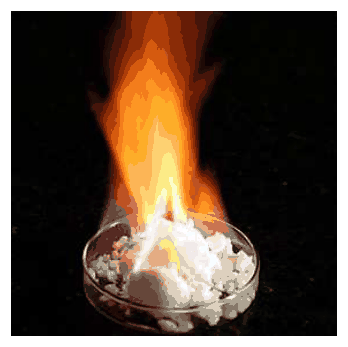
Upon decomposition of \(1.00\ \mathrm{g}\) of a methane hydrate with a fixed composition at \(25\ ^\circ\mathrm{C}\) and atmospheric (\(101.3\ \mathrm{kPa}\)) pressure, \(205\ \mathrm{cm^3}\) of methane is released.
1.1 Determine \(n\) (not necessarily integer) in the formula of methane hydrate, \(\ce{CH4}\cdot n\,\ce{H2O}\).
Real methane hydrate has a non-stoichiometric composition close to \(\ce{CH4 * 6H2O}\). At atmospheric pressure, methane hydrate decomposes at \(-81\ ^\circ\mathrm{C}\). However, under high pressures (e.g. on the ocean floor) it is stable at much higher temperatures.
Decomposition of methane hydrate produces gaseous methane and solid or liquid water depending on temperature.
1.2 Write down the equation of decomposition of \(1\ \mathrm{mol}\) of \(\ce{CH4 * 6H2O}\) producing solid water (ice) \(\ce{H2O(s)}\).
The enthalpy of this process equals \(17.47\ \mathrm{kJ\,mol^{-1}}\). Assume that the enthalpies do not depend on temperature and pressure, the volume change upon decomposition of hydrate is equal to the volume of released methane, and methane is an ideal gas.
1.3 At what external pressure does decomposition of methane hydrate into methane and ice take place at \(-5\ ^\circ\mathrm{C}\)?
1.4 What is the minimum possible depth of pure liquid water at which methane hydrates can be stable?
To answer this question, you should first deduce at which minimum temperature methane hydrate can coexist with liquid water. Choose the correct answer.
\[ \square\ 272.9\ \mathrm{K} \qquad \square\ 273.15\ \mathrm{K} \qquad \square\ 273.4\ \mathrm{K} \]
Large methane hydrate stocks on the floor of Baikal lake, the largest freshwater lake in Russia and in the world, have been discovered in July 2009 by the crew of a deep-submergence vehicle «Mir-2». During the ascent from the depth of \(1400\ \mathrm{m}\) methane hydrate samples started to decompose at the depth of \(372\ \mathrm{m}\).
1.5 Determine the temperature in Baikal lake at the depth of \(372\ \mathrm{m}\). The enthalpy of fusion of ice is equal to \(6.01\ \mathrm{kJ\,mol^{-1}}\).
Total amount of methane in hydrates on the Earth is no less than \(5\cdot10^{11}\) tons.
1.6 By how many degrees would the Earth atmosphere heat up, if such amount of methane is burned by reacting with atmospheric oxygen?
The enthalpy of combustion of methane is \(-889\ \mathrm{kJ\,mol^{-1}}\), the total heat capacity of the Earth’s atmosphere is about \(4\cdot10^{21}\ \mathrm{J\,K^{-1}}\).
Official English text of the problem.
Problem 2: Break down photosynthesis – the Hill reaction
In the history of photosynthesis research, there were some breakthrough experiments which added much to our knowledge of this very complex process. One of such experiments was performed in 1930s by an English biochemist Robert Hill. In this problem, we consider some of his data together with the data of more recent experiments.
2.1 In plants, under illumination, carbon dioxide is reduced to carbohydrates (denote as \(\{\ce{CH2O}\}\)) and oxygen is produced. Write the overall equation of photosynthesis in plants.
Much of the photosynthesis takes place in chloroplasts – organelles found in plant cells and containing chlorophyll – the light-absorbing substance. Hill isolated chloroplasts from the cells by grinding the leaves in the sucrose solutions. The cell-free chloroplasts did not produce oxygen under illumination even in the presence of \(\ce{CO2}\). However, upon adding potassium ferrioxalate \(\ce{K3[Fe(C2O4)3]}\) (with the excess of potassium oxalate) to the chloroplast suspension Hill observed oxygen liberation under illumination even without \(\ce{CO2}\).
2.2 Hill’s experiment enabled to determine the source of oxygen during photosynthesis. Write the formulas of the oxidant and the reducing agent in the photosynthesis inside the plant cells and in the cell-free chloroplasts (the Hill reaction).
Hill measured the amount of evolved oxygen using muscle haemoglobin (Hill denoted it \(\ce{Hb}\)) which binds all molecular oxygen in a 1 : 1 ratio to form \(\ce{HbO2}\). The initial concentration of \(\ce{Hb}\) was \(0.6\cdot10^{-4}\ \mathrm{mol\,dm^{-3}}\). Kinetic curves corresponding to different ferrioxalate concentrations are shown in the figure (the upper curve corresponds to \(2.0\cdot10^{-4}\ \mathrm{mol\,dm^{-3}}\)).
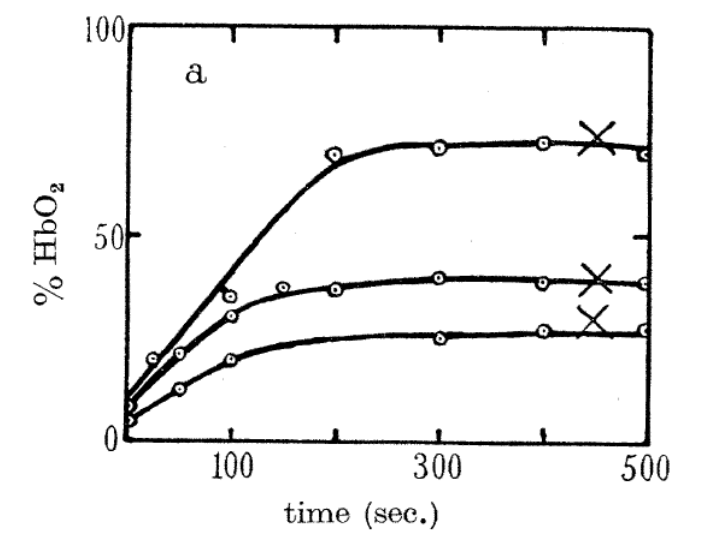
The fraction of bound haemoglobin \(\ce{HbO2}\) (with respect to the initial amount of \(\ce{Hb}\)) as a function of time. Crosses denote the end of the reaction
(Figure 2a from the original Hill’s paper: R. Hill. Oxygen produced by isolated chloroplasts. – Proc. R. Soc. B, 1939, v. 127, pp. 192-210.)
2.3 a. From the figure, estimate the \(\ce{Fe}\) / \(\ce{O2}\) mole ratio at the end of the reaction. Do not take into account the iron from \(\ce{Hb}\).
b. Write the equation of Hill reaction assuming that it proceeds with a high yield.
c. Using the table of standard electrode potentials, determine the Gibbs energy of the Hill reaction at \(T=298\ \mathrm{K}\), oxygen pressure \(1\ \mathrm{mm\,Hg}\), \(\mathrm{pH}=8\) and standard concentrations of other species. Is this reaction spontaneous at such conditions?
Half-reaction \(E^\circ,\ \mathrm{V}\) \(\ce{O2 + 4H+ + 4e -> 2H2O}\) \(+1.23\) \(\ce{CO2 + 4H+ + 8e ->} \{\ce{CH2O}\} + \ce{H2O}\) \(-0.01\) \(\ce{Fe^3+ + e -> Fe^2+}\) \(+0.77\) \(\ce{Fe^3+ + 3e -> Fe^0}\) \(-0.04\) \(\ce{[Fe(C2O4)3]^3- + e -> [Fe(C2O4)3]^4-}\) \(+0.05\) \(\ce{[Fe(C2O4)3]^4- + 2e -> Fe + 3C2O4^2-}\) \(-0.59\) Now, the name “Hill reaction” denotes photochemical oxidation of water by any oxidant other than carbon dioxide which is sensitized by plant cells or isolated chloroplasts.
In another experiment (1952), quinone in an acid solution was used as an oxidant in the Hill reaction initiated by light flashes in the Chlorella algae. Experimental data are shown in the figure. The volume of oxygen (in \(\mathrm{mm^3}\), at temperature \(10\,^\circ\mathrm{C}\) and pressure \(740\ \mathrm{mm\,Hg}\)) per one gram of chlorophyll per one flash was determined as a function of light intensity for natural photosynthesis and for isolated chloroplasts. It was found that the maximum yield of oxygen is the same for natural photosynthesis and the Hill reaction.
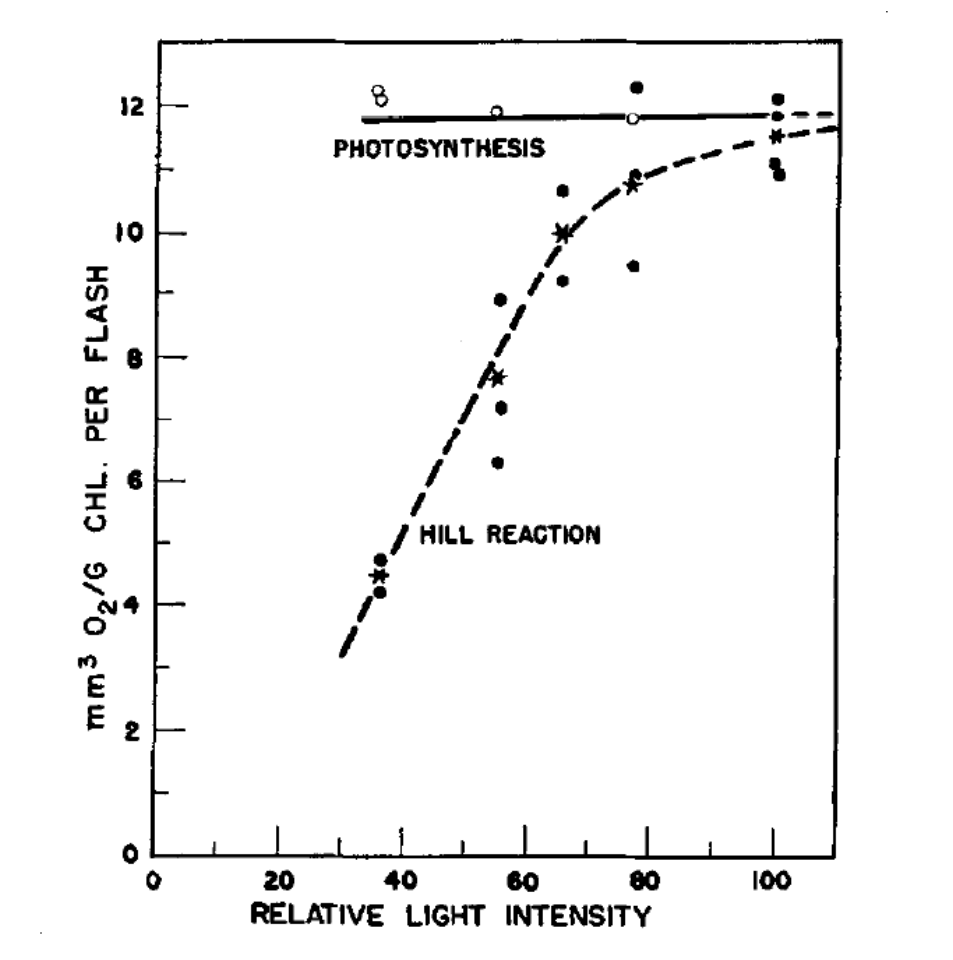
(Figure 1 from: H. Ehrmantraut, E. Rabinovitch. Kinetics of Hill reaction. – Archives of Biochemistry and Biophysics, 1952, v. 38, pp. 67-84)
2.4 a. Determine the reaction order of a photochemical Hill reaction with respect to light intensity at low and high intensity. For each case choose one of the following three values: 0, 1 or 2.
b. How many chlorophyll molecules participate in the formation of one oxygen molecule in the saturation limit of the Hill reaction? (The molecular mass of chlorophyll is about 900 Da).
The quantum requirement of the light redox reactions is defined as the average number of light photons (not necessarily integer) needed for the transfer of one electron from a reducing agent to an oxidant. The isolated chloroplasts were irradiated during 2 hours by a monochromatic light (wavelength \(672\ \mathrm{nm}\)) with the energy input \(0.503\ \mathrm{mJ\,s^{-1}}\), and the total volume of oxygen formed was \(47.6\ \mathrm{mm^3}\) (under the same conditions as in question 4).
2.5 Calculate the quantum requirement for the Hill reaction.
2.6 Try to make conclusions from the above experiments (questions 2.2 – 2.5). Tick the relevant boxes.
Yes No In natural photosynthesis, water oxidation and \(\ce{CO2}\) reduction are separated in space. In chloroplasts, \(\ce{O2}\) is produced from \(\ce{CO2}\). Oxidation of water in chloroplasts requires light illumination. Most of chlorophylls in chloroplasts participate directly in the photochemical \(\ce{O2}\) production. In isolated chloroplasts, every absorbed photon causes transfer of one electron. Official English text of the problem.
Problem 3: Meerwein-Schmidt-Ponndorf-Verley reaction
In the table for 3.3, A–F are editorial labels identifying the six structures in reading order.
PROBLEM 3
Meerwein-Schmidt-Ponndorf-Verley reaction
Meerwein-Schmidt-Ponndorf-Verley (MSPV) reaction is a useful tool for reduction of carbonyl compounds to alcohols. The reaction is the reduction of carbonyl compounds by low molecular weight alcohols in the presence of alkoxides of aluminium or other metals:

The mechanism of the reaction includes coordination of carbonyl compound by aluminium alkoxide, hydride transfer in the inner sphere of the complex and subsequent transalkoxylation. It can be schematically represented as follows (transalkoxylation is shown as a one-step process for brevity):

The reaction is reversible and shifting the equilibrium to the desired product requires some excess of the reductant. In some cases (e. g. in the case of reduction of aromatic aldehydes and ketones) the equilibrium constant is so large that the reverse reaction can be neglected.
The table below contains standard entropies and standard enthalpies of formation of liquid substances at 298 K. The boiling points of the substances at 1 bar are also given.
Substance \(\Delta_{\mathrm f}H^\circ_{298}\), kJ mol\(^{-1}\) \(S^\circ_{298}\), J mol\(^{-1}\) K\(^{-1}\) \(t_{\mathrm{vap}}\), °C Acetone −248.4 200.4 56 Isopropanol −318.1 180.6 82 Cyclohexanone −271.2 229.0 156 Cyclohexanol −348.2 203.4 161 3.1 a Calculate the minimum isopropanol to cyclohexanone mass ratio which is required to reach a 99 % yield of reaction at 298 K. Assume that:
i) the reaction mixture eventually gets at equilibrium,
ii) no products are initially present.
3.1 b Choose the appropriate way(s) to increase the cyclohexanol yield. Tick the relevant boxes.
Increase the temperature up to 50 °C using a reflux Increase the temperature up to 60 °C, evaporating (distilling) the acetone Add some ethanol to the reaction mixture Add some ethanal to the reaction mixture 3.2 Often the rate-limiting step in the MSPV reaction is the hydride transfer or the alcoholysis of the alkoxide after hydride transfer. For these two cases, using the above mechanism (2), derive an expression for the rate of reaction as a function of current concentrations of a carbonyl compound, isopropanol and a catalyst. In both cases determine the rate orders in the reactants and the catalyst. Assume that all reaction steps before the limiting step are fast and reversible. Use equilibrium approximation, if necessary. For brevity use the following notation: A for carbonyl compound, B for isopropanol, C for catalyst. Denote intermediates as you wish.
MSPV reaction can be used to obtain chiral alcohols, if the chiral catalyst is employed. For instance, Campbell et al. used the catalyst based on the chiral 2,2’-dihydroxy-1,1’-binaphtyl (BINOL), which is synthesized in situ from binaphtol and trimethylaluminium:
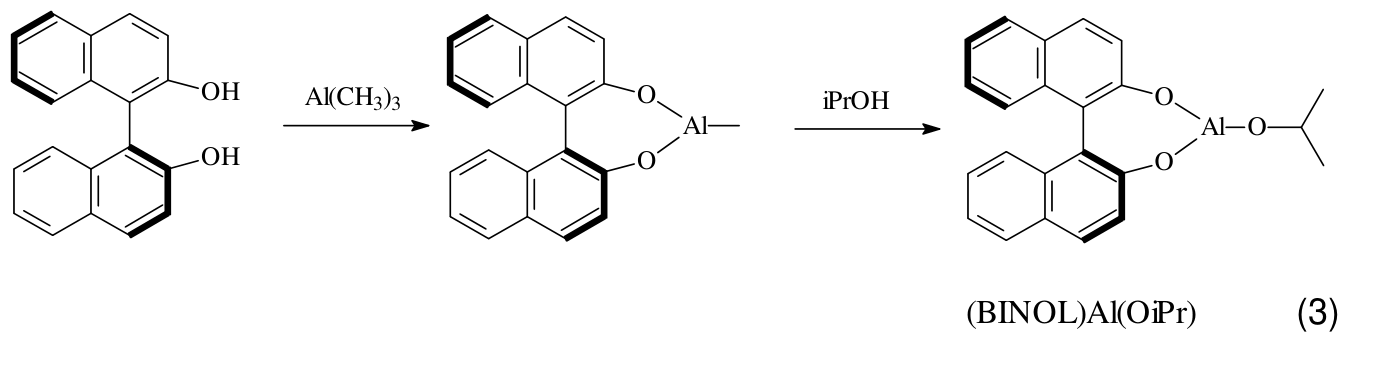
The chirality of BINOL is due to the sterically hindered rotation around the \(\ce{C-C}\) bond. Though perfectly stable at room temperature, BINOL may racemize when heated.
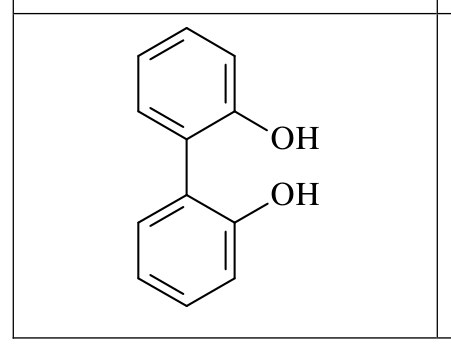
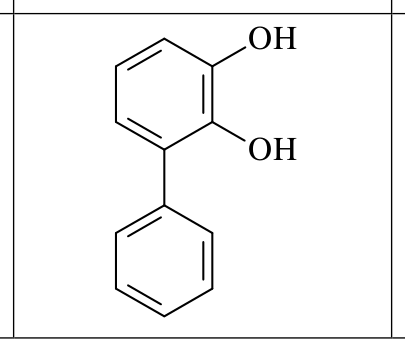
3.3 Which of the phenols below can form stable (at room temperature) enantiomers so that they can be used in the same fashion to produce a chiral catalyst? Tick the relevant boxes.
Substance Can be used Substance Can be used A B C D E F A:
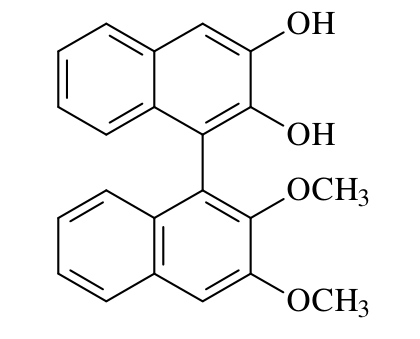
B:
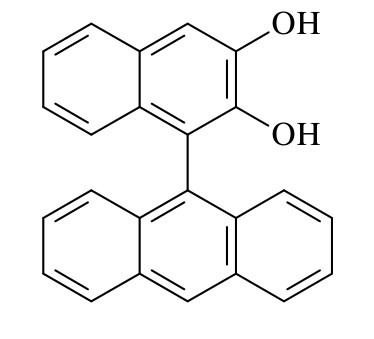
C:
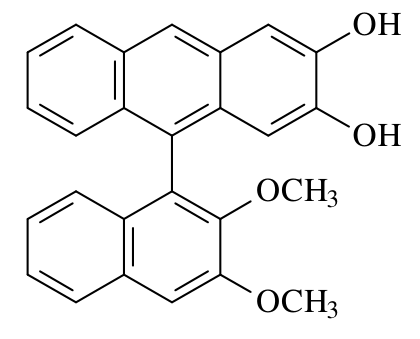
D:
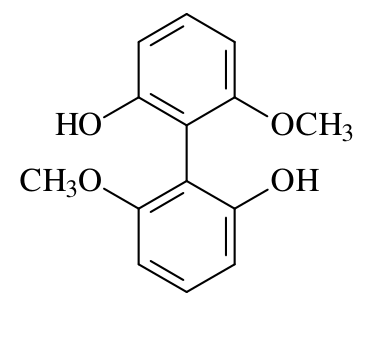
E:
F:
Enantiomeric excess, \(ee\), is used to characterize the enantiomeric purity of the substance. This quantity equals to the ratio of the difference of concentrations of enantiomers \(R\) and \(S\) to their sum:
\[ ee=\frac{[R]-[S]}{[R]+[S]} \]
Enantiomeric excess of the pure \(R\) isomer is unity, \(ee\) of the racemic mixture is zero.
3.4 When using the enantiomerically pure \(\ce{(BINOL)Al(OiPr)}\) as a catalyst for reduction of \(\alpha\)-bromoacetophenone, the \(ee\) of the product equals 81 %. What is the \(ee\) of the product if the catalyst \(ee\) equals 50 %? Provide your calculation with an illustration or derivation of the final formula.
Official English text of the problem.
Problem 4: A simple inorganic experiment
Compound A which contains metal X is a colourless crystalline solid and highly soluble in water. It is used as a reagent in analysis and gives in alkali media a binary compound B containing 6.9 % (mass) of oxygen. Under heating A decomposes with a mass loss of 36.5 %.
4.1 Determine the metal X and compounds A and B.
Upon adding some amount of sodium thiosulfate to the solution of A the colour immediately becomes red, then changes to reddish-brown, and after some minutes a dark-brown precipitate C forms (reaction 1). The solution over it is colourless. Being heated on air at \(600\,^\circ\mathrm{C}\), C gives a grey powder X (reaction 2), so as 0.90 g of residue can be obtained from 1.10 g of C. A gas evolved by heating C in vacuum (reaction 3) can be absorbed by calcium hydroxide suspension (reaction 4). Being stored for a long time under saturated solution of barium perchlorate in \(\ce{HClO4}\) (\(c=0.1\ \mathrm{mol\,dm^{-3}}\)), the colour of the precipitate becomes lighter, while the use of magnesium perchlorate does not give such an effect.
4.2 What is C? Write the equations of the reactions 1 – 4.
The compound C being stored under the mother liquor (containing an excess of A) changes its colour to yellow due to the transformation into D. If barium ions are added to the suspension of C in the mother liquor, a mixture of D and of a white precipitate is formed.
4.3 Propose the formula of D, taking into account that it contains 77.5 mass % of X. Give the equation of D formation.
Official English text of the problem.
Problem 5: Simple estimates of graphene properties
Graphene is a two-dimensional, one atom thick carbon material (Fig. 1 a). Many layers of graphene stack together to form graphite (Fig. 1 b).
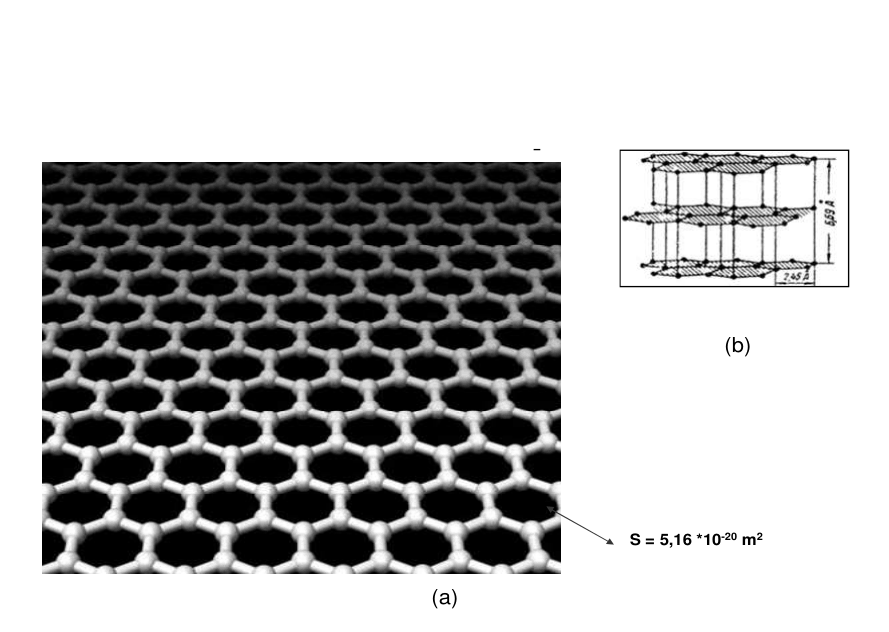
Fig. 1. (a) The structure of graphene. Spheres are carbon atoms. They are arranged in hexagons. The area of one carbon hexagon is \(5.16\cdot10^{-20}\ \mathrm{m^2}\). (b) Crystal lattice of graphite. Three graphene layers are shown.
Such atomic structure was long considered to be unstable. However, in 2004 Andrey Geim and Konstantin Novoselov have reported production of the first samples of this unusual material. This groundbreaking invention was awarded by Nobel prize in 2010.
Experimental studies of graphene are still restricted. Production of massive portions of the new substance still is a challenging synthetic problem. Many properties of graphene were estimated. Usually, there is not enough information for rigorous calculations, so we have to make assumptions and neglect unimportant factors. In this problem, you will estimate the adsorption properties of graphene.
5.1 Estimate the specific surface of graphene open for adsorption in units \(\mathrm{m^2\,g^{-1}}\). Consider that graphene plane is separated from any other solid or liquid substance.
The single layer of nitrogen molecules adsorbed on the outer surface of graphite is shown in Fig. 2. Assume that the same arrangement of nitrogen molecules is formed on a graphene surface.
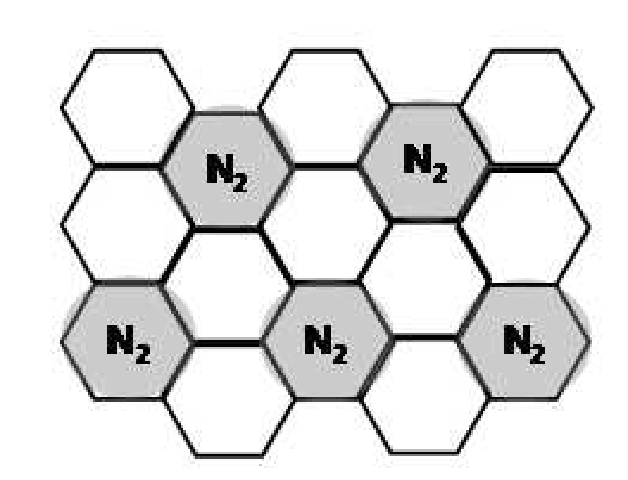
Fig. 2. Nitrogen molecules \(\ce{N2}\) (grey circles) on the outer surface of graphite
5.2 How many grams of nitrogen can be adsorbed on 1 gram of graphene assuming that the graphene layer is placed onto the surface of a solid support? Estimate the volume occupied by these nitrogen molecules after the complete desorption from 1 g of graphene (pressure 1 bar, temperature 298 K).
Let us consider adsorption as a common chemical equilibrium

(\(\ce{A_{gas}}\) are molecules \(\ce{A}\) in the gaseous state, \(\ce{A_{ads}}\) are the same molecules on the surface)
with the equilibrium constant \(K\):
\[ K=\frac{n_{\ce{A_{ads}}}\;(\mathrm{mol\,m^{-2}})} {p_{\ce{A_{gas}}}\;(\mathrm{bar})} \]
(Such an assumption holds if a small number of molecules is adsorbed on the surface.)
Adsorption properties of graphene can be estimated from the data for adsorption on a regular three-dimensional graphite. The enthalpy of adsorption (\(\Delta H^\circ\) of reaction (1)) of any molecule \(\ce{A}\) on graphene is on average by 10 % less negative compared to that on graphite. On graphite, the adsorbed molecule is bound more strongly due to the interaction with the lower graphene layers in the lattice (Fig. 1 b) and hence the enthalpy of adsorption is more negative. The standard entropies of adsorption on graphene and graphite are assumed to be the same.
5.3 How many moles, \(n\), of \(\ce{CCl4}\) are adsorbed on 1 g of graphene at \(p(\ce{CCl4})=10^{-4}\ \mathrm{bar}\) if \(2.0\cdot10^{-7}\ \mathrm{mol}\) of \(\ce{CCl4}\) are adsorbed on \(1\ \mathrm{m^2}\) of graphite at \(p(\ce{CCl4})=6.6\cdot10^{-5}\ \mathrm{bar}\)? Assume that graphene is placed onto the surface of a solid support and the interaction of \(\ce{CCl4}\) with the support does not change the enthalpy of adsorption of \(\ce{CCl4}\) on graphene. The temperature in both cases is 293 K. \(\Delta H^\circ\) of adsorption of \(\ce{CCl4}\) on graphite is \(-35.1\ \mathrm{kJ/mol}\).
The graphene films are expected to be sensitive gas detectors. If \(10^9\) particles of a gas are adsorbed on \(1\ \mathrm{cm^2}\) of a graphene surface this is enough to measure an electrical resistivity change of the graphene layer and to detect the presence of a gas in the environment.
5.4 Determine the minimal content of ethane, \(\ce{C2H6}\), in the air (in mol. %) at atmospheric pressure (\(T=293\ \mathrm{K}\)) at which a graphene sensor will detect this gas. The known data for the adsorption of alkanes on graphite are shown in Fig 3. Assume that air doesn't affect the adsorption properties of ethane.
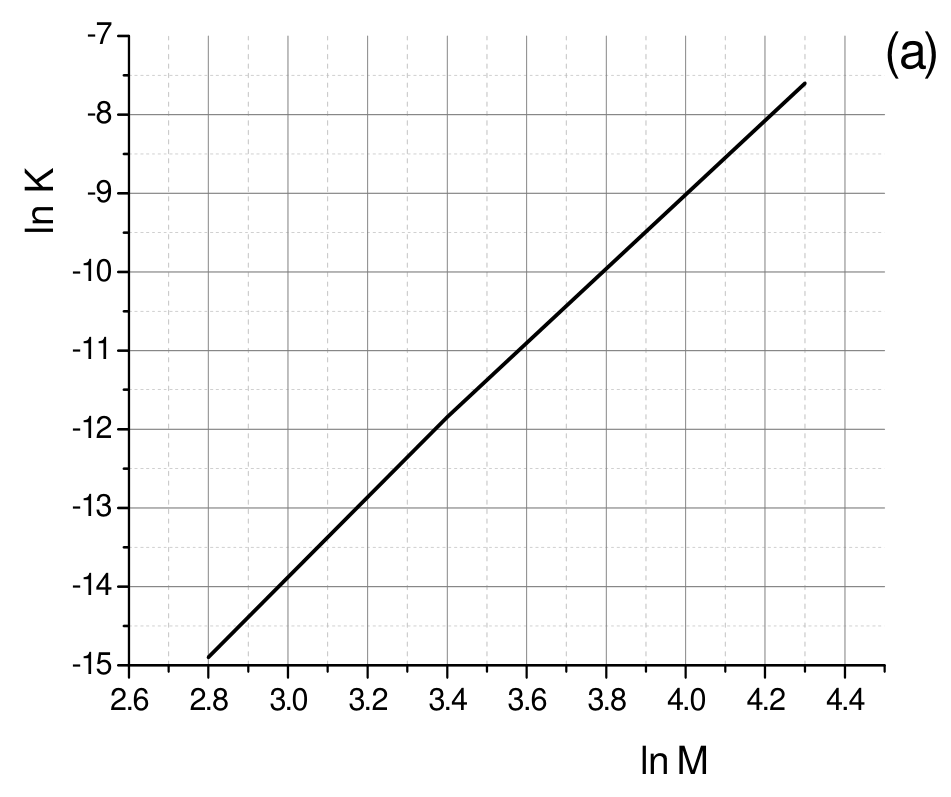
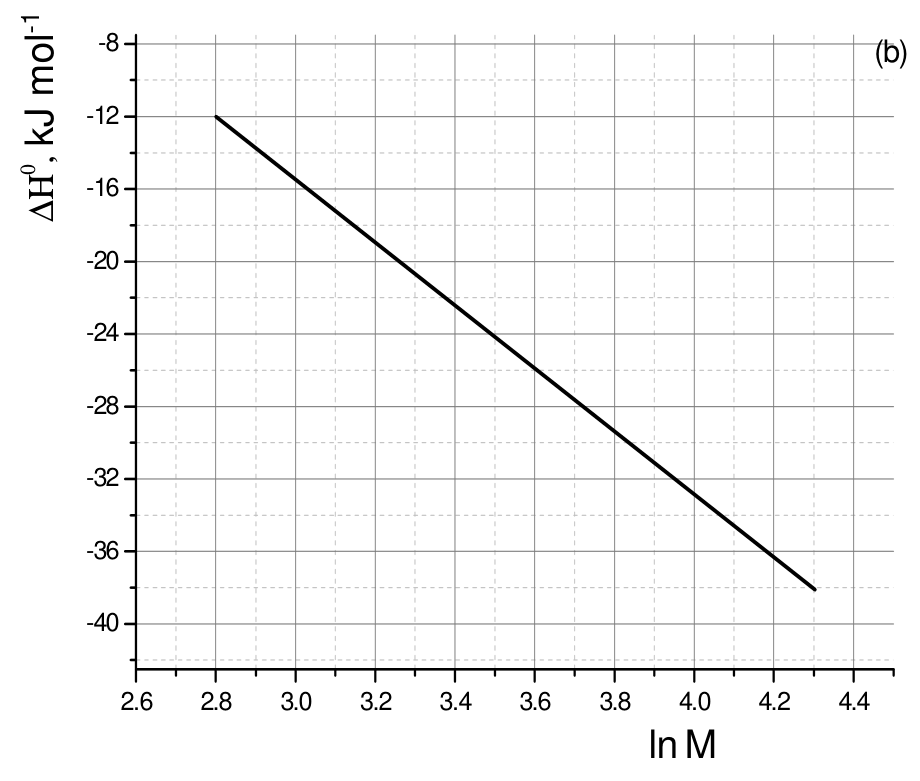
Fig. 3
Thermodynamic properties for adsorption of alkanes on a graphite surface.
(a) \(\ln K\ [\mathrm{mol\,m^{-2}\,bar^{-1}}]\) as a function of \(\ln M\) (\(M\) - molar mass of alkane in \(\mathrm{g\,mol^{-1}}\));
(b) \(\Delta H^\circ\) of adsorption as a function of \(\ln M\).
Linear dependences are assumed in both casesOfficial English text of the problem.
Problem 6: Cyclopropanes. So simple. So fancy…
Cyclopropanes bearing donor and acceptor substituents at the neighbouring C-atoms, for example, A, demonstrate high reactivity behaving similar to 1,3-zwitterion B.
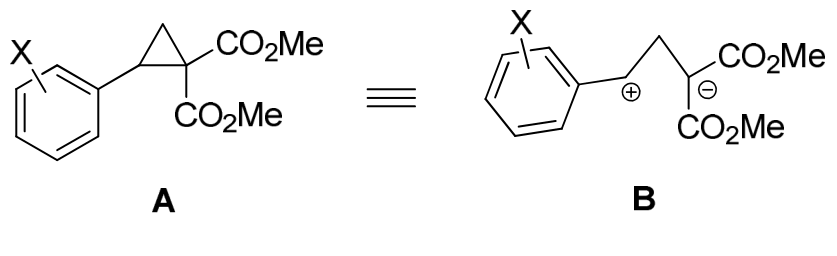
Thus, A1 (\(\ce{X = 4-OMe}\)) undergoes the three-membered ring opening in the Lewis acid-catalyzed reaction with 1,3-dimethoxybenzene as a nucleophile giving the product C.
6.1 Write down structural formula of C.
A1 participates in cycloadditions, annulations, oligomerizations, and other processes. Thus, [3+2]-cycloaddition between A1 and 4-methoxybenzaldehyde leads to a five-membered ring in D. Complete decarboxylation of D produces E (\(\ce{C18H20O3}\)), the molecule of the latter having a plane of symmetry.
6.2 Write down structural formulae of D and E indicating their stereochemistry.
Also, A, can undergo various transformations in the absence of any reaction partners except catalysts. Some transformations typical of A1 are shown in the Scheme below.
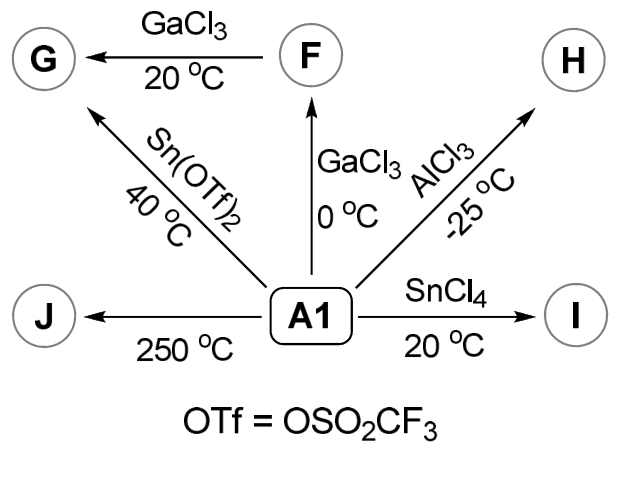
To determine the structures of F – J, a set of physico-chemical data was obtained (see Table for some results). It was found that:
a) F and G are structural isomers of A1;
b) G is formed as the most stable stereoisomer;
c) H and I are structural isomers;
d) H is formed as a single diastereomer with \(C_2\) axis of symmetry (the molecule looks the same after rotation through the angle of 180°);
e) I is formed as a mixture of two diastereomers;
f) J is naphthalene derivative.
In the process leading to I, one molecule of A1 demonstrates the described above common reactivity (analogous to that of B). The other molecule of A1 behaves differently. Also, the latter behaviour is demonstrated by cyclopropane A2 (dimethyl 2-(3,4,5-trimethoxyphenyl)cylopropane-1,1-dicarboxylate) when treated with \(\ce{SnCl4}\) in \(\ce{CH3NO2}\) affording K as a mixture of two diastereomers. The major isomer has the centre of symmetry. Similar reactivity is shown by A2 in \(\ce{Sn(OTf)2}\)-catalyzed reaction with G furnishing L.
6.3 Write down the structural formulae of F – J, and those of L and the major isomer of K.
Ratio of the number of hydrogen-containing groups
Non-aromatic \(\ce{CH}\) Non-aromatic \(\ce{CH2}\) Non-aromatic \(\ce{CH3}\) Non-aromatic \(\ce{OH}\) Aromatic Composition F 1 1 1+1+1 0 4 in total C 63.62%, H 6.11% G 1+1+1 0 2+1 0 4 in total C 63.62%, H 6.11% H 1 1 1+1+1 0 4 in total C 63.62%, H 6.11% I 1+1+1 1+1 2+1+1+1+1 0 7 in total C 63.62%, H 6.11% J 0 0 1+1 1 5 in total C 67.22%, H 5.22% K 1+1 1 2+1+1+1 0 1 C 59.24%, H 6.23% L 1+1+1+1+1 1 2+2+1+1+1+1 0 5 in total C 61.21%, H 6.18% Official English text of the problem.
Problem 7: Diverse permanganatometry
The amount of many reducing agents can be determined by permanganatometric titration in alkaline medium allowing permanganate ion reduction to manganate.
7.1 Write down the ionic reaction equation for titration of formate with permanganate in an aqueous \(\ce{NaOH}\) solution with a concentration of ~0.5 mol dm\(^{-3}\).
Titration with permanganate in alkaline medium is often supplemented by addition of a barium salt, which leads to precipitation of manganate as \(\ce{BaMnO4}\).
7.2 Which side redox processes involving manganate is suppressed by the barium salt? Write down an example of equation of the corresponding reaction.
A volume of 10.00 cm\(^3\) (\(V_{\mathrm{Mn}}\)) of \(\ce{KMnO4}\) solution with a concentration of 0.0400 mol dm\(^{-3}\) (\(c_{\mathrm{Mn}}\)) was placed in each of flasks A, B, and C and different reactions were conducted in each flask.
A sample solution containing crotonic acid (CA) \(\ce{CH3-CH=CH-COOH}\), an alkali and barium nitrate (both in an excess) were added to flask A, and the reaction mixture was incubated for 45 min. It is known that crotonic acid loses 10 electrons under the experiment conditions.
7.3 a Write down the total ionic equation for the reaction.
A volume of 8.00 cm\(^3\) (\(V_{\mathrm{CN}}\)) of potassium cyanide solution (\(c_{\mathrm{CN}}=0.0100\) mol dm\(^{-3}\)) was then added to the incubated mixture. This resulted in completion of the following reaction:

\(\ce{BaMnO4}\) precipitate was then filtered off, and the excess of cyanide in the filtrate was titrated with \(\ce{AgNO3}\) solution (\(c_{\mathrm{Ag}}=0.0050\) mol dm\(^{-3}\)) till detectable precipitation was observed. Note that both \(\ce{CN^-}\) and \(\ce{CNO^-}\) are analogs of halide ions, but \(\ce{CNO^-}\) affords soluble silver salt.
7.3 b Give the formula for the complex formed when \(\ce{Ag+}\) ions were initially added to the cyanide solution (until the precipitate was formed).
7.3 c Give the formula of the precipitate formed.
7.3 d Derive the formula for calculating the amount of substance of crotonic acid in the sample solution. Calculate the mass of crotonic acid (in mg) if 5.40 cm\(^3\) (\(V_{\mathrm{Ag}}\)) of the silver salt solution was consumed for the titration to the endpoint.
Another sample of crotonic acid and alkali (in an excess) were added to flask B, this mixture lacking barium salt. An excess of \(\ce{KI}\) (instead of cyanide) was added as a reducing agent. The mixture was then acidified and the iodine evolved was titrated with a thiosulfate solution (\(c_{\mathrm{S}}=0.1000\) mol dm\(^{-3}\)). 4.90 cm\(^3\) (\(V_{\mathrm{S1}}\)) of the titrant was used to reach the endpoint.
7.4 Derive the formula for calculating the amount of substance of crotonic acid in this experiment. Calculate the mass of crotonic acid (in mg).
A sample containing tin(II) was added to flask C, and the medium was adjusted to weak alkaline. Tin(II) was quantitatively oxidized to \(\ce{Sn(OH)6^2-}\), whereas a precipitate formed as a result of permanganate reduction. The precipitate was isolated, washed off, dried at 250 °C, weighed (the mass of the water-free precipitate (\(m_{\mathrm{prec}}\)), representing a binary compound, was of 28.6 mg), and dissolved in \(\ce{H2SO4}\) in the presence of an excess of potassium iodide. The evolved iodine was titrated with 0.1000 M thiosulfate solution. 2.5 cm\(^3\) (\(V_{\mathrm{S2}}\)) of the latter was consumed to attain the endpoint.
7.5 a Write down the reaction of precipitation. Confirm it with calculations.
7.5 b Calculate the mass of tin in the sample (in mg) referred to the metal.
Official English text of the problem.
Problem 8: Unique life of archaea
Archaea (or archaebacteria) are single-celled microorganisms. They significantly differ from bacteria and eukaryotes at the molecular level.
Enzymatic reaction of methylamine with water is the major energy source for some archaea. In a particular experiment, an archaea strain was cultivated at pH 7 under anaerobic (oxygen free) conditions with the nutrient medium containing \(\ce{^{13}CH3NH2}\) as the only energy source. After a certain incubation period, the gas over the archaea culture was sampled and analyzed. It was found that the gas contains two substances, A and B, in a molar ratio of 1 : 3 correspondingly (the sample density relative to \(\ce{H2}\) is 12.0).
8.1 Calculate the volume fractions (in %) of A and B in the mixture.
8.2 Determine A and B if there are no nitrogen atoms in the gas collected.
8.3 Write down the equation of enzymatic reaction of methylamine with water described in the above experiment using predominant form of each species.
Enzymes containing the residue of α-amino acid X, are found in many archaea capable of methylamine utilization. It is known that X:
- is composed of atoms of 4 elements;
- contains 18.8 mass % of oxygen;
- possesses the single individual tRNA and is incorporated into proteins of archaea during translation.
Amino acid L-lysine (see the structure in scheme below) was identified as the X precursor in archaea. All carbon and nitrogen atoms found in X originate from two starting lysine molecules. Different isotope-labelled L-lysines were introduced into a model system to clarify the biosynthetic pathways of X. The results are summarized in the table.
Isotope composition of L-lysine Molar mass (rounded to integer) of the X residue \(\ce{[RCH(NH2)CO]}\), bound to tRNA, \((\mathrm{g\,mol^{-1}})\) Normal 238 All carbons \(\ce{^{13}C}\), all nitrogens \(\ce{^{15}N}\) 253 ε-amino group with \(\ce{^{15}N}\) 239 8.4 Determine the molecular formula of X.
X is biosynthesized in archaea according to the following scheme (\(E_1\), \(E_2\), and \(E_3\) – enzymes):
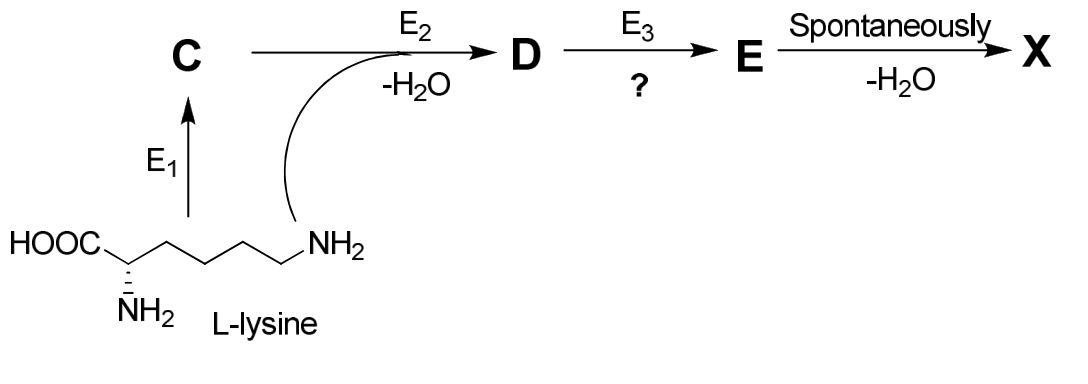
At the first step, lysine is transformed into its structural isomer (α-amino acid, C), whereas D contains a peptide bond, and E a formyl group \(\ce{-CHO}\). All reaction coefficients in the above scheme are equal to 1.
8.5 i) Give the chemical formula of C, D and E.
ii) From the reaction types given hereunder, choose (tick) only one corresponding to the enzyme \(E_3\) catalyzed reaction.
- ☐ Oxidative deamination
- ☐ Decarboxylation
- ☐ Intermolecular deamination
- ☐ Hydroxylation
- ☐ Peptide bond hydrolysis
X contains the following fragment:
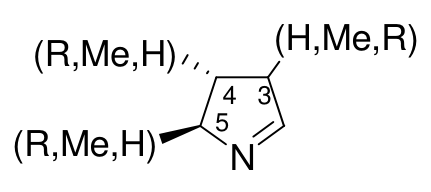
R is a massive substituent (\(M>100\ \mathrm{g\,mol^{-1}}\)). The 3rd carbon atom is non-asymmetric. The 4th and 5th carbon atoms are stereogenic centres. All carbon atoms in the cycle are bound with at least one hydrogen atom. Each substituent (H, Me and R) is found only once.
8.6 Determine the positions of substituents H, Me, and R.
8.7 Draw structural formulae of C and X with stereochemical details. Mark every stereocenter of X with either \(R\) or \(S\).
Only one codon is responsible for the incorporation of X residues into proteins in archaea. The nitrogen bases forming this codon contain two exocyclic amino groups and three exocyclic oxygen atoms in total.
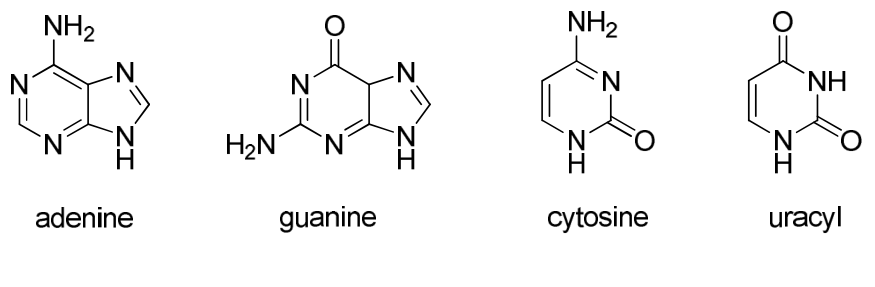
8.8 Determine the nucleotide composition of the codon by filling in the hereunder table. Write down the number of each nitrogen base in the codon encoding X. Tick only one box in each line.
The number of bases in the codon
Nitrogen base 1 2 3 0 or 1 1 or 2 A C G U The fragment of mRNA coding sequence given below contains the codons encoding X residue incorporation into an archaea enzyme:
\(5'\ldots\mathrm{AAUAGAAUUAGCGGAACAGAGGGUGAC}\ldots3'\)
8.9 a Using the table of the genetic code, decide how many amino acid residues are incorporated into the enzyme chain due to this fragment translation.
8.9 b Write down the amino acid sequence translated from this fragment. Note that more than one X residue is found in the fragment.
Fill in the boxes below with the amino acid abbreviations (from N- to C-terminus).
Note that the number of boxes is excessive. If there is more than one possibility, write all separated by “/”. If the translation is stopped in a particular position, write “STOP” and leave all the boxes to the right empty.

(a) RNA codons for the twenty amino acids
Second base
First base U C A G Third base U Phe Ser Tyr Cys U U Phe Ser Tyr Cys C U Leu Ser STOP STOP A U Leu Ser STOP Trp G C Leu Pro His Arg U C Leu Pro His Arg C C Leu Pro Gln Arg A C Leu Pro Gln Arg G A Ile Thr Asn Ser U A Ile Thr Asn Ser C A Ile Thr Lys Arg A A Met (start) Thr Lys Arg G G Val Ala Asp Gly U G Val Ala Asp Gly C G Val Ala Glu Gly A G Val Ala Glu Gly G Amino Acids Abbreviations: Ala = Alanine Arg = Arginine Asp = Aspartic acid Asn = Aaparagine Cys = Cysteine Glu = Glutamic Acid Gln = Glutamine Gly = Glycine His = Histidine Ile = Isoleucine Leu = Leucine Lys = Lysine Met = Methionine Phe = Phenylalanine Pro = Proline Ser = Serine Thr = Threonine Trp = Tryptophan Tyr = Tyrosine Val = Valine Official English text of the problem.
Internationale Chemie-Olympiade
IChO 2013
Moskau, Russland · 8 Theorieaufgaben mit vollständigen Lösungen
Aufgabe 1: Die Clathrat-Kanone
Die einzige Kanone, die mit einem einzigen Schuss alle lebenden Menschen töten kann
Auf dem Grund der Ozeane und Meere gibt es gewaltige Methanvorkommen in Form von Clathratverbindungen, die als Methanhydrate bezeichnet werden. Diese Vorkommen können abgebaut werden und als Energiequelle oder als Rohstoffe für die organische Synthese dienen. Wissenschaftler sind jedoch ernsthaft besorgt über die Möglichkeit einer spontanen Zersetzung der Hydrate infolge steigender Meerestemperaturen. Man nimmt an, dass sich die Ozeane durch den Treibhauseffekt schneller erwärmen würden, wenn eine ausreichende Menge Methan in die Atmosphäre freigesetzt würde, wodurch die Zersetzung der Clathrate weiter beschleunigt würde. Durch die Explosion des entstehenden Methan-Luft-Gemisches und/oder Veränderungen der Zusammensetzung der Atmosphäre könnten alle Lebewesen aussterben. Dieses apokalyptische Szenario wird als Clathrat-Kanone bezeichnet.
Bei der Zersetzung von \(1.00\ \mathrm{g}\) eines Methanhydrats mit fester Zusammensetzung bei \(25\ ^\circ\mathrm{C}\) und Atmosphärendruck (\(101.3\ \mathrm{kPa}\)) werden \(205\ \mathrm{cm^3}\) Methan freigesetzt.
1.1 Bestimmen Sie \(n\) (nicht notwendigerweise ganzzahlig) in der Formel des Methanhydrats, \(\ce{CH4}\cdot n\,\ce{H2O}\).
Reales Methanhydrat hat eine nichtstöchiometrische Zusammensetzung, die näherungsweise \(\ce{CH4 * 6H2O}\) entspricht. Bei Atmosphärendruck zersetzt sich Methanhydrat bei \(-81\ ^\circ\mathrm{C}\). Unter hohen Drücken (z. B. auf dem Meeresgrund) ist es jedoch bei wesentlich höheren Temperaturen stabil.
Bei der Zersetzung von Methanhydrat entstehen gasförmiges Methan und, abhängig von der Temperatur, festes oder flüssiges Wasser.
1.2 Schreiben Sie die Gleichung für die Zersetzung von \(1\ \mathrm{mol}\) \(\ce{CH4 * 6H2O}\) unter Bildung von festem Wasser (Eis) \(\ce{H2O(s)}\) auf.
Die Enthalpie dieses Vorgangs beträgt \(17.47\ \mathrm{kJ\,mol^{-1}}\). Nehmen Sie an, dass die Enthalpien nicht von Temperatur und Druck abhängen, die Volumenänderung bei der Zersetzung des Hydrats gleich dem Volumen des freigesetzten Methans ist und Methan ein ideales Gas ist.
1.3 Bei welchem äußeren Druck findet die Zersetzung von Methanhydrat in Methan und Eis bei \(-5\ ^\circ\mathrm{C}\) statt?
1.4 Wie groß ist die kleinstmögliche Tiefe in reinem flüssigem Wasser, in der Methanhydrate stabil sein können?
Um diese Frage zu beantworten, sollten Sie zunächst herleiten, bei welcher Mindesttemperatur Methanhydrat mit flüssigem Wasser koexistieren kann. Wählen Sie die richtige Antwort aus.
\[ \square\ 272.9\ \mathrm{K} \qquad \square\ 273.15\ \mathrm{K} \qquad \square\ 273.4\ \mathrm{K} \]
Im Juli 2009 entdeckte die Besatzung des Tiefseetauchboots «Mir-2» große Methanhydratvorkommen auf dem Grund des Baikalsees, des größten Süßwassersees Russlands und der Welt. Beim Aufstieg aus einer Tiefe von \(1400\ \mathrm{m}\) begannen Methanhydratproben in einer Tiefe von \(372\ \mathrm{m}\), sich zu zersetzen.
1.5 Bestimmen Sie die Temperatur im Baikalsee in einer Tiefe von \(372\ \mathrm{m}\). Die Schmelzenthalpie von Eis beträgt \(6.01\ \mathrm{kJ\,mol^{-1}}\).
Die Gesamtmenge an Methan in Hydraten auf der Erde beträgt mindestens \(5\cdot10^{11}\) Tonnen.
1.6 Um wie viel Grad würde sich die Erdatmosphäre erwärmen, wenn diese Menge Methan durch Reaktion mit dem Sauerstoff der Atmosphäre verbrannt würde?
Die Verbrennungsenthalpie von Methan beträgt \(-889\ \mathrm{kJ\,mol^{-1}}\), die gesamte Wärmekapazität der Erdatmosphäre beträgt etwa \(4\cdot10^{21}\ \mathrm{J\,K^{-1}}\).
Aufgabentext aus dem offiziellen englischen Text übersetzt.
Aufgabe 2: Die Photosynthese aufschlüsseln – die Hill-Reaktion
In der Geschichte der Photosyntheseforschung gab es einige bahnbrechende Experimente, die wesentlich zu unserem Wissen über diesen sehr komplexen Prozess beigetragen haben. Eines dieser Experimente führte der englische Biochemiker Robert Hill in den 1930er-Jahren durch. In dieser Aufgabe betrachten wir einige seiner Daten zusammen mit Daten aus neueren Experimenten.
2.1 In Pflanzen wird unter Beleuchtung Kohlenstoffdioxid zu Kohlenhydraten (bezeichnet als \(\{\ce{CH2O}\}\)) reduziert, und Sauerstoff entsteht. Geben Sie die Gesamtgleichung der Photosynthese in Pflanzen an.
Ein großer Teil der Photosynthese findet in Chloroplasten statt – Organellen, die in Pflanzenzellen vorkommen und Chlorophyll enthalten, die lichtabsorbierende Substanz. Hill isolierte Chloroplasten aus den Zellen, indem er die Blätter in Saccharoselösungen zerrieb. Die zellfreien Chloroplasten erzeugten unter Beleuchtung selbst in Gegenwart von \(\ce{CO2}\) keinen Sauerstoff. Nach Zugabe von Kaliumferrioxalat \(\ce{K3[Fe(C2O4)3]}\) (mit einem Überschuss an Kaliumoxalat) zur Chloroplastensuspension beobachtete Hill jedoch unter Beleuchtung eine Sauerstofffreisetzung, auch ohne \(\ce{CO2}\).
2.2 Hills Experiment ermöglichte es, die Quelle des Sauerstoffs bei der Photosynthese zu bestimmen. Geben Sie die Formeln des Oxidationsmittels und des Reduktionsmittels bei der Photosynthese innerhalb der Pflanzenzellen und in den zellfreien Chloroplasten (Hill-Reaktion) an.
Hill maß die Menge des entwickelten Sauerstoffs mithilfe von Muskelhämoglobin (von Hill als \(\ce{Hb}\) bezeichnet), das den gesamten molekularen Sauerstoff im Verhältnis 1 : 1 unter Bildung von \(\ce{HbO2}\) bindet. Die Anfangskonzentration von \(\ce{Hb}\) betrug \(0.6\cdot10^{-4}\ \mathrm{mol\,dm^{-3}}\). Kinetische Kurven für verschiedene Ferrioxalatkonzentrationen sind in der Abbildung dargestellt (die obere Kurve entspricht \(2.0\cdot10^{-4}\ \mathrm{mol\,dm^{-3}}\)).
Der Anteil des gebundenen Hämoglobins \(\ce{HbO2}\) (bezogen auf die Anfangsmenge an \(\ce{Hb}\)) als Funktion der Zeit. Kreuze kennzeichnen das Ende der Reaktion
(Abbildung 2a aus Hills Originalarbeit: R. Hill. Von isolierten Chloroplasten erzeugter Sauerstoff. – Proc. R. Soc. B, 1939, Bd. 127, S. 192-210.)
2.3 a. Schätzen Sie anhand der Abbildung das Stoffmengenverhältnis \(\ce{Fe}\) / \(\ce{O2}\) am Ende der Reaktion ab. Berücksichtigen Sie dabei nicht das Eisen aus \(\ce{Hb}\).
b. Geben Sie die Gleichung der Hill-Reaktion unter der Annahme an, dass sie mit hoher Ausbeute abläuft.
c. Bestimmen Sie mithilfe der Tabelle der Standardelektrodenpotentiale die Gibbs-Energie der Hill-Reaktion bei \(T=298\ \mathrm{K}\), einem Sauerstoffdruck von \(1\ \mathrm{mm\,Hg}\), \(\mathrm{pH}=8\) und Standardkonzentrationen der übrigen Spezies. Läuft diese Reaktion unter diesen Bedingungen spontan ab?
Teilreaktion \(E^\circ,\ \mathrm{V}\) \(\ce{O2 + 4H+ + 4e -> 2H2O}\) \(+1.23\) \(\ce{CO2 + 4H+ + 8e ->} \{\ce{CH2O}\} + \ce{H2O}\) \(-0.01\) \(\ce{Fe^3+ + e -> Fe^2+}\) \(+0.77\) \(\ce{Fe^3+ + 3e -> Fe^0}\) \(-0.04\) \(\ce{[Fe(C2O4)3]^3- + e -> [Fe(C2O4)3]^4-}\) \(+0.05\) \(\ce{[Fe(C2O4)3]^4- + 2e -> Fe + 3C2O4^2-}\) \(-0.59\) Heute bezeichnet der Name „Hill-Reaktion“ die durch Pflanzenzellen oder isolierte Chloroplasten sensibilisierte photochemische Oxidation von Wasser durch ein beliebiges anderes Oxidationsmittel als Kohlenstoffdioxid.
In einem weiteren Experiment (1952) wurde Chinon in saurer Lösung als Oxidationsmittel bei der Hill-Reaktion eingesetzt, die durch Lichtblitze in Chlorella-Algen ausgelöst wurde. Die experimentellen Daten sind in der Abbildung dargestellt. Das Sauerstoffvolumen (in \(\mathrm{mm^3}\), bei einer Temperatur von \(10\,^\circ\mathrm{C}\) und einem Druck von \(740\ \mathrm{mm\,Hg}\)) pro Gramm Chlorophyll und pro Lichtblitz wurde als Funktion der Lichtintensität für die natürliche Photosynthese und für isolierte Chloroplasten bestimmt. Es zeigte sich, dass die maximale Sauerstoffausbeute bei der natürlichen Photosynthese und bei der Hill-Reaktion gleich ist.
(Abbildung 1 aus: H. Ehrmantraut, E. Rabinovitch. Kinetik der Hill-Reaktion. – Archives of Biochemistry and Biophysics, 1952, Bd. 38, S. 67-84)
2.4 a. Bestimmen Sie die Reaktionsordnung einer photochemischen Hill-Reaktion bezüglich der Lichtintensität bei niedriger und bei hoher Intensität. Wählen Sie für jeden Fall einen der folgenden drei Werte: 0, 1 oder 2.
b. Wie viele Chlorophyllmoleküle sind im Sättigungsbereich der Hill-Reaktion an der Bildung eines Sauerstoffmoleküls beteiligt? (Die Molekülmasse von Chlorophyll beträgt etwa 900 Da).
Der Quantenbedarf der lichtgetriebenen Redoxreaktionen ist definiert als die durchschnittliche Anzahl von Lichtphotonen (nicht notwendigerweise ganzzahlig), die für die Übertragung eines Elektrons von einem Reduktionsmittel auf ein Oxidationsmittel benötigt wird. Die isolierten Chloroplasten wurden 2 Stunden lang mit monochromatischem Licht (Wellenlänge \(672\ \mathrm{nm}\)) bei einer Energiezufuhr von \(0.503\ \mathrm{mJ\,s^{-1}}\) bestrahlt, und das Gesamtvolumen des gebildeten Sauerstoffs betrug \(47.6\ \mathrm{mm^3}\) (unter denselben Bedingungen wie in Frage 4).
2.5 Berechnen Sie den Quantenbedarf der Hill-Reaktion.
2.6 Versuchen Sie, aus den obigen Experimenten (Fragen 2.2 – 2.5) Schlussfolgerungen zu ziehen. Kreuzen Sie die entsprechenden Kästchen an.
Ja Nein Bei der natürlichen Photosynthese sind die Oxidation von Wasser und die Reduktion von \(\ce{CO2}\) räumlich voneinander getrennt. In Chloroplasten wird \(\ce{O2}\) aus \(\ce{CO2}\) gebildet. Die Oxidation von Wasser in Chloroplasten erfordert Beleuchtung. Die meisten Chlorophyllmoleküle in Chloroplasten sind direkt an der photochemischen Bildung von \(\ce{O2}\) beteiligt. In isolierten Chloroplasten bewirkt jedes absorbierte Photon die Übertragung eines Elektrons. Aufgabentext aus dem offiziellen englischen Text übersetzt.
Aufgabe 3: Meerwein-Schmidt-Ponndorf-Verley-Reaktion
In der Tabelle zu 3.3 sind A–F redaktionelle Bezeichnungen, die die sechs Strukturen in Lesereihenfolge kennzeichnen.
AUFGABE 3
Meerwein-Schmidt-Ponndorf-Verley-Reaktion
Die Meerwein-Schmidt-Ponndorf-Verley-Reaktion (MSPV-Reaktion) ist eine nützliche Methode zur Reduktion von Carbonylverbindungen zu Alkoholen. Bei dieser Reaktion werden Carbonylverbindungen durch niedermolekulare Alkohole in Gegenwart von Aluminiumalkoholaten oder Alkoholaten anderer Metalle reduziert:
Der Reaktionsmechanismus umfasst die Koordination der Carbonylverbindung an das Aluminiumalkoholat, die Hydridübertragung in der inneren Koordinationssphäre des Komplexes und die anschließende Umalkoxylierung. Er lässt sich wie folgt schematisch darstellen (die Umalkoxylierung ist der Kürze halber als einstufiger Prozess dargestellt):
Die Reaktion ist reversibel, und um das Gleichgewicht zum gewünschten Produkt zu verschieben, ist ein gewisser Überschuss des Reduktionsmittels erforderlich. In einigen Fällen (z. B. bei der Reduktion aromatischer Aldehyde und Ketone) ist die Gleichgewichtskonstante so groß, dass die Rückreaktion vernachlässigt werden kann.
Die folgende Tabelle enthält die Standardentropien und Standardbildungsenthalpien flüssiger Stoffe bei 298 K. Auch die Siedepunkte der Stoffe bei 1 bar sind angegeben.
Stoff \(\Delta_{\mathrm f}H^\circ_{298}\), kJ mol\(^{-1}\) \(S^\circ_{298}\), J mol\(^{-1}\) K\(^{-1}\) \(t_{\mathrm{vap}}\), °C Aceton −248.4 200.4 56 Isopropanol −318.1 180.6 82 Cyclohexanon −271.2 229.0 156 Cyclohexanol −348.2 203.4 161 3.1 a Berechnen Sie das minimale Massenverhältnis von Isopropanol zu Cyclohexanon, das erforderlich ist, um bei 298 K eine Reaktionsausbeute von 99 % zu erreichen. Nehmen Sie an, dass:
i) das Reaktionsgemisch schließlich das Gleichgewicht erreicht,
ii) anfangs keine Produkte vorhanden sind.
3.1 b Wählen Sie die geeignete(n) Möglichkeit(en) zur Erhöhung der Cyclohexanolausbeute aus. Kreuzen Sie die entsprechenden Kästchen an.
Die Temperatur unter Rückfluss auf 50 °C erhöhen Die Temperatur auf 60 °C erhöhen und dabei das Aceton verdampfen (abdestillieren) Dem Reaktionsgemisch etwas Ethanol zusetzen Dem Reaktionsgemisch etwas Ethanal zusetzen 3.2 Häufig ist bei der MSPV-Reaktion die Hydridübertragung oder die Alkoholyse des Alkoholats nach der Hydridübertragung der geschwindigkeitsbestimmende Schritt. Leiten Sie für diese beiden Fälle anhand des obigen Mechanismus (2) einen Ausdruck für die Reaktionsgeschwindigkeit als Funktion der momentanen Konzentrationen einer Carbonylverbindung, von Isopropanol und eines Katalysators her. Bestimmen Sie in beiden Fällen die Reaktionsordnungen bezüglich der Reaktanten und des Katalysators. Nehmen Sie an, dass alle Reaktionsschritte vor dem geschwindigkeitsbestimmenden Schritt schnell und reversibel sind. Verwenden Sie gegebenenfalls die Gleichgewichtsnäherung. Verwenden Sie der Kürze halber folgende Bezeichnungen: A für die Carbonylverbindung, B für Isopropanol, C für den Katalysator. Die Zwischenprodukte können Sie beliebig bezeichnen.
Die MSPV-Reaktion kann zur Herstellung chiraler Alkohole verwendet werden, wenn ein chiraler Katalysator eingesetzt wird. Beispielsweise verwendeten Campbell et al. einen Katalysator auf der Grundlage des chiralen 2,2’-Dihydroxy-1,1’-binaphthyls (BINOL), der in situ aus Binaphthol und Trimethylaluminium synthetisiert wird:
Die Chiralität von BINOL beruht auf der sterisch gehinderten Rotation um die \(\ce{C-C}\)-Bindung. Obwohl BINOL bei Raumtemperatur völlig stabil ist, kann es beim Erhitzen racemisieren.
3.3 Welche der folgenden Phenole können (bei Raumtemperatur) stabile Enantiomere bilden, sodass sie auf die gleiche Weise zur Herstellung eines chiralen Katalysators verwendet werden können? Kreuzen Sie die entsprechenden Kästchen an.
Stoff Kann verwendet werden Stoff Kann verwendet werden A B C D E F A:
B:
C:
D:
E:
F:
Der Enantiomerenüberschuss, \(ee\), dient zur Charakterisierung der Enantiomerenreinheit eines Stoffes. Diese Größe ist gleich dem Verhältnis der Differenz der Konzentrationen der Enantiomere \(R\) und \(S\) zu ihrer Summe:
\[ ee=\frac{[R]-[S]}{[R]+[S]} \]
Der Enantiomerenüberschuss des reinen \(R\)-Isomers beträgt eins, der \(ee\) des racemischen Gemisches beträgt null.
3.4 Bei Verwendung von enantiomerenreinem \(\ce{(BINOL)Al(OiPr)}\) als Katalysator zur Reduktion von \(\alpha\)-Bromacetophenon beträgt der \(ee\) des Produkts 81 %. Wie groß ist der \(ee\) des Produkts, wenn der \(ee\) des Katalysators 50 % beträgt? Ergänzen Sie Ihre Berechnung durch eine Veranschaulichung oder Herleitung der endgültigen Formel.
Aufgabentext aus dem offiziellen englischen Text übersetzt.
Aufgabe 4: Ein einfaches anorganisches Experiment
Die Verbindung A, die das Metall X enthält, ist ein farbloser kristalliner Feststoff und sehr gut wasserlöslich. Sie wird als Reagenz in der Analytik verwendet und bildet in alkalischem Milieu eine binäre Verbindung B mit einem Sauerstoff-Massenanteil von 6.9 %. Beim Erhitzen zersetzt sich A unter einem Massenverlust von 36.5 %.
4.1 Bestimmen Sie das Metall X und die Verbindungen A und B.
Bei Zugabe einer gewissen Menge Natriumthiosulfat zur Lösung von A färbt sich diese sofort rot, dann rotbraun, und nach einigen Minuten bildet sich ein dunkelbrauner Niederschlag C (Reaktion 1). Die darüberstehende Lösung ist farblos. Beim Erhitzen an der Luft auf \(600\,^\circ\mathrm{C}\) liefert C ein graues Pulver X (Reaktion 2), wobei aus 1.10 g C 0.90 g Rückstand erhalten werden können. Ein Gas, das beim Erhitzen von C im Vakuum entsteht (Reaktion 3), kann von einer Calciumhydroxid-Suspension absorbiert werden (Reaktion 4). Bei längerer Aufbewahrung unter einer gesättigten Lösung von Bariumperchlorat in \(\ce{HClO4}\) (\(c=0.1\ \mathrm{mol\,dm^{-3}}\)) wird die Farbe des Niederschlags heller, während die Verwendung von Magnesiumperchlorat keinen solchen Effekt hervorruft.
4.2 Was ist C? Geben Sie die Gleichungen der Reaktionen 1 – 4 an.
Wird die Verbindung C unter der Mutterlauge aufbewahrt, die einen Überschuss an A enthält, so färbt sie sich durch die Umwandlung in D gelb. Werden Bariumionen zur Suspension von C in der Mutterlauge gegeben, entsteht ein Gemisch aus D und einem weißen Niederschlag.
4.3 Schlagen Sie eine Formel für D vor und berücksichtigen Sie dabei, dass es 77.5 Massen-% X enthält. Geben Sie die Gleichung für die Bildung von D an.
Aufgabentext aus dem offiziellen englischen Text übersetzt.
Aufgabe 5: Einfache Abschätzungen der Eigenschaften von Graphen
Graphen ist ein zweidimensionales Kohlenstoffmaterial mit einer Dicke von einem Atom (Abb. 1 a). Viele übereinandergestapelte Graphenschichten bilden Graphit (Abb. 1 b).
Abb. 1. (a) Die Struktur von Graphen. Die Kugeln stellen Kohlenstoffatome dar. Sie sind in Sechsecken angeordnet. Die Fläche eines Kohlenstoffsechsecks beträgt \(5.16\cdot10^{-20}\ \mathrm{m^2}\). (b) Kristallgitter von Graphit. Dargestellt sind drei Graphenschichten.
Eine solche atomare Struktur galt lange als instabil. Im Jahr 2004 berichteten Andrey Geim und Konstantin Novoselov jedoch über die Herstellung der ersten Proben dieses ungewöhnlichen Materials. Diese bahnbrechende Erfindung wurde 2010 mit dem Nobelpreis ausgezeichnet.
Experimentelle Untersuchungen von Graphen sind noch immer eingeschränkt. Die Herstellung großer Mengen der neuen Substanz stellt nach wie vor eine anspruchsvolle Syntheseaufgabe dar. Viele Eigenschaften von Graphen wurden abgeschätzt. In der Regel liegen nicht genügend Informationen für exakte Berechnungen vor, sodass wir Annahmen treffen und unwichtige Faktoren vernachlässigen müssen. In dieser Aufgabe werden Sie die Adsorptionseigenschaften von Graphen abschätzen.
5.1 Schätzen Sie die für die Adsorption zugängliche spezifische Oberfläche von Graphen in der Einheit \(\mathrm{m^2\,g^{-1}}\) ab. Gehen Sie davon aus, dass die Graphenebene von allen anderen festen oder flüssigen Substanzen getrennt ist.
Die auf der äußeren Oberfläche von Graphit adsorbierte Monoschicht aus Stickstoffmolekülen ist in Abb. 2 dargestellt. Nehmen Sie an, dass sich auf einer Graphenoberfläche die gleiche Anordnung von Stickstoffmolekülen bildet.
Abb. 2. Stickstoffmoleküle \(\ce{N2}\) (graue Kreise) auf der äußeren Oberfläche von Graphit
5.2 Wie viele Gramm Stickstoff können an 1 Gramm Graphen adsorbiert werden, wenn die Graphenschicht auf der Oberfläche eines festen Trägers aufgebracht ist? Schätzen Sie das Volumen ab, das diese Stickstoffmoleküle nach der vollständigen Desorption von 1 g Graphen einnehmen (Druck 1 bar, Temperatur 298 K).
Betrachten wir die Adsorption als ein gewöhnliches chemisches Gleichgewicht
(\(\ce{A_{gas}}\) bezeichnet Moleküle \(\ce{A}\) im gasförmigen Zustand, \(\ce{A_{ads}}\) dieselben Moleküle auf der Oberfläche)
mit der Gleichgewichtskonstanten \(K\):
\[ K=\frac{n_{\ce{A_{ads}}}\;(\mathrm{mol\,m^{-2}})} {p_{\ce{A_{gas}}}\;(\mathrm{bar})} \]
(Diese Annahme gilt, wenn nur wenige Moleküle auf der Oberfläche adsorbiert sind.)
Die Adsorptionseigenschaften von Graphen lassen sich anhand der Daten für die Adsorption an gewöhnlichem dreidimensionalem Graphit abschätzen. Die Adsorptionsenthalpie (\(\Delta H^\circ\) der Reaktion (1)) eines beliebigen Moleküls \(\ce{A}\) an Graphen ist im Mittel um 10 % weniger negativ als diejenige an Graphit. An Graphit ist das adsorbierte Molekül aufgrund der Wechselwirkung mit den darunterliegenden Graphenschichten im Gitter (Abb. 1 b) stärker gebunden, weshalb die Adsorptionsenthalpie negativer ist. Es wird angenommen, dass die Standardadsorptionsentropien an Graphen und Graphit gleich sind.
5.3 Wie viele Mol, \(n\), \(\ce{CCl4}\) werden bei \(p(\ce{CCl4})=10^{-4}\ \mathrm{bar}\) an 1 g Graphen adsorbiert, wenn \(2.0\cdot10^{-7}\ \mathrm{mol}\) \(\ce{CCl4}\) an \(1\ \mathrm{m^2}\) Graphit bei \(p(\ce{CCl4})=6.6\cdot10^{-5}\ \mathrm{bar}\) adsorbiert werden? Nehmen Sie an, dass Graphen auf der Oberfläche eines festen Trägers aufgebracht ist und die Wechselwirkung von \(\ce{CCl4}\) mit dem Träger die Adsorptionsenthalpie von \(\ce{CCl4}\) an Graphen nicht verändert. Die Temperatur beträgt in beiden Fällen 293 K. \(\Delta H^\circ\) der Adsorption von \(\ce{CCl4}\) an Graphit beträgt \(-35.1\ \mathrm{kJ/mol}\).
Es wird erwartet, dass sich Graphenfilme als empfindliche Gasdetektoren eignen. Wenn \(10^9\) Teilchen eines Gases auf \(1\ \mathrm{cm^2}\) einer Graphenoberfläche adsorbiert werden, reicht dies aus, um eine Änderung des spezifischen elektrischen Widerstands der Graphenschicht zu messen und das Vorhandensein eines Gases in der Umgebung nachzuweisen.
5.4 Bestimmen Sie den minimalen Gehalt an Ethan, \(\ce{C2H6}\), in der Luft (in Mol-%) bei Atmosphärendruck (\(T=293\ \mathrm{K}\)), bei dem ein Graphensensor dieses Gas nachweist. Die bekannten Daten zur Adsorption von Alkanen an Graphit sind in Abb. 3 dargestellt. Nehmen Sie an, dass Luft die Adsorptionseigenschaften von Ethan nicht beeinflusst.
Abb. 3
Thermodynamische Eigenschaften der Adsorption von Alkanen auf einer Graphitoberfläche.
(a) \(\ln K\ [\mathrm{mol\,m^{-2}\,bar^{-1}}]\) als Funktion von \(\ln M\) (\(M\) – molare Masse des Alkans in \(\mathrm{g\,mol^{-1}}\));
(b) \(\Delta H^\circ\) der Adsorption als Funktion von \(\ln M\).
In beiden Fällen werden lineare Abhängigkeiten angenommenAufgabentext aus dem offiziellen englischen Text übersetzt.
Aufgabe 6: Cyclopropane. So einfach. So raffiniert…
Cyclopropane mit Donor- und Akzeptorsubstituenten an benachbarten C-Atomen, beispielsweise A, zeigen eine hohe Reaktivität und verhalten sich ähnlich wie das 1,3-Zwitterion B.
So wird bei A1 (\(\ce{X = 4-OMe}\)) in der Lewis-Säure-katalysierten Reaktion mit 1,3-Dimethoxybenzol als Nucleophil der Dreiring geöffnet, wobei das Produkt C entsteht.
6.1 Geben Sie die Strukturformel von C an.
A1 geht Cycloadditionen, Anellierungen, Oligomerisierungen und andere Reaktionen ein. So führt die [3+2]-Cycloaddition zwischen A1 und 4-Methoxybenzaldehyd zu einem Fünfring in D. Die vollständige Decarboxylierung von D liefert E (\(\ce{C18H20O3}\)), dessen Molekül eine Symmetrieebene besitzt.
6.2 Geben Sie die Strukturformeln von D und E unter Angabe ihrer Stereochemie an.
A kann auch in Abwesenheit jeglicher Reaktionspartner außer Katalysatoren verschiedene Umwandlungen eingehen. Einige für A1 typische Umwandlungen sind im nachstehenden Schema dargestellt.
Zur Bestimmung der Strukturen von F – J wurde eine Reihe physikalisch-chemischer Daten erhoben (einige Ergebnisse sind in der Tabelle aufgeführt). Dabei wurde festgestellt:
a) F und G sind Konstitutionsisomere von A1;
b) G entsteht als das stabilste Stereoisomer;
c) H und I sind Konstitutionsisomere;
d) H entsteht als einziges Diastereomer mit einer \(C_2\)-Symmetrieachse (nach einer Drehung um 180° sieht das Molekül genauso aus);
e) I entsteht als Gemisch zweier Diastereomere;
f) J ist ein Naphthalinderivat.
Bei der Bildung von I zeigt ein Molekül A1 die oben beschriebene übliche Reaktivität (analog zu der von B). Das andere Molekül A1 verhält sich anders. Dieses abweichende Verhalten zeigt auch das Cyclopropan A2 (Dimethyl-2-(3,4,5-trimethoxyphenyl)cyclopropan-1,1-dicarboxylat) bei Behandlung mit \(\ce{SnCl4}\) in \(\ce{CH3NO2}\), wobei K als Gemisch zweier Diastereomere entsteht. Das Hauptisomer besitzt ein Symmetriezentrum. Eine ähnliche Reaktivität zeigt A2 bei der \(\ce{Sn(OTf)2}\)-katalysierten Reaktion mit G, die L liefert.
6.3 Geben Sie die Strukturformeln von F – J sowie die von L und dem Hauptisomer von K an.
Verhältnis der Anzahlen wasserstoffhaltiger Gruppen
Nichtaromatische \(\ce{CH}\) Nichtaromatische \(\ce{CH2}\) Nichtaromatische \(\ce{CH3}\) Nichtaromatische \(\ce{OH}\) Aromatisch Zusammensetzung F 1 1 1+1+1 0 insgesamt 4 C 63.62%, H 6.11% G 1+1+1 0 2+1 0 insgesamt 4 C 63.62%, H 6.11% H 1 1 1+1+1 0 insgesamt 4 C 63.62%, H 6.11% I 1+1+1 1+1 2+1+1+1+1 0 insgesamt 7 C 63.62%, H 6.11% J 0 0 1+1 1 insgesamt 5 C 67.22%, H 5.22% K 1+1 1 2+1+1+1 0 1 C 59.24%, H 6.23% L 1+1+1+1+1 1 2+2+1+1+1+1 0 insgesamt 5 C 61.21%, H 6.18% Aufgabentext aus dem offiziellen englischen Text übersetzt.
Aufgabe 7: Vielseitige Permanganometrie
Die Menge vieler Reduktionsmittel lässt sich durch permanganometrische Titration in alkalischem Medium bestimmen, wobei Permanganationen zu Manganat reduziert werden.
7.1 Stellen Sie die Ionengleichung für die Titration von Formiat mit Permanganat in einer wässrigen \(\ce{NaOH}\)-Lösung mit einer Konzentration von ~0.5 mol dm\(^{-3}\) auf.
Bei der Titration mit Permanganat in alkalischem Medium wird häufig zusätzlich ein Bariumsalz zugegeben, wodurch Manganat als \(\ce{BaMnO4}\) ausgefällt wird.
7.2 Welche Redox-Nebenreaktionen unter Beteiligung von Manganat werden durch das Bariumsalz unterdrückt? Geben Sie als Beispiel eine Gleichung für die entsprechende Reaktion an.
In die Kolben A, B und C wurden jeweils 10.00 cm\(^3\) (\(V_{\mathrm{Mn}}\)) einer \(\ce{KMnO4}\)-Lösung mit einer Konzentration von 0.0400 mol dm\(^{-3}\) (\(c_{\mathrm{Mn}}\)) gegeben, und in jedem Kolben wurden unterschiedliche Reaktionen durchgeführt.
Eine Probelösung mit Crotonsäure (CA) \(\ce{CH3-CH=CH-COOH}\), eine Lauge und Bariumnitrat (beide im Überschuss) wurden in Kolben A gegeben, und das Reaktionsgemisch wurde 45 min lang inkubiert. Es ist bekannt, dass Crotonsäure unter den Versuchsbedingungen 10 Elektronen abgibt.
7.3 a Stellen Sie die gesamte Ionengleichung der Reaktion auf.
Anschließend wurden 8.00 cm\(^3\) (\(V_{\mathrm{CN}}\)) einer Kaliumcyanidlösung (\(c_{\mathrm{CN}}=0.0100\) mol dm\(^{-3}\)) zum inkubierten Gemisch gegeben. Dabei lief die folgende Reaktion vollständig ab:
Der \(\ce{BaMnO4}\)-Niederschlag wurde anschließend abfiltriert, und das überschüssige Cyanid im Filtrat wurde mit einer \(\ce{AgNO3}\)-Lösung (\(c_{\mathrm{Ag}}=0.0050\) mol dm\(^{-3}\)) titriert, bis eine erkennbare Fällung auftrat. Beachten Sie, dass sowohl \(\ce{CN^-}\) als auch \(\ce{CNO^-}\) Analoga der Halogenidionen sind, \(\ce{CNO^-}\) jedoch ein lösliches Silbersalz bildet.
7.3 b Geben Sie die Formel des Komplexes an, der sich bei der anfänglichen Zugabe von \(\ce{Ag+}\)-Ionen zur Cyanidlösung bildete (bis zur Bildung des Niederschlags).
7.3 c Geben Sie die Formel des gebildeten Niederschlags an.
7.3 d Leiten Sie die Formel zur Berechnung der Stoffmenge an Crotonsäure in der Probelösung her. Berechnen Sie die Masse der Crotonsäure (in mg), wenn bei der Titration bis zum Endpunkt 5.40 cm\(^3\) (\(V_{\mathrm{Ag}}\)) der Silbersalzlösung verbraucht wurden.
Eine weitere Probe von Crotonsäure und eine Lauge (im Überschuss) wurden in Kolben B gegeben; dieses Gemisch enthielt kein Bariumsalz. Als Reduktionsmittel wurde ein Überschuss an \(\ce{KI}\) (anstelle von Cyanid) zugegeben. Das Gemisch wurde anschließend angesäuert, und das freigesetzte Iod wurde mit einer Thiosulfatlösung (\(c_{\mathrm{S}}=0.1000\) mol dm\(^{-3}\)) titriert. Bis zum Erreichen des Endpunkts wurden 4.90 cm\(^3\) (\(V_{\mathrm{S1}}\)) der Maßlösung verbraucht.
7.4 Leiten Sie die Formel zur Berechnung der Stoffmenge an Crotonsäure in diesem Versuch her. Berechnen Sie die Masse der Crotonsäure (in mg).
Eine zinn(II)haltige Probe wurde in Kolben C gegeben, und das Medium wurde schwach alkalisch eingestellt. Zinn(II) wurde quantitativ zu \(\ce{Sn(OH)6^2-}\) oxidiert, während sich infolge der Permanganatreduktion ein Niederschlag bildete. Der Niederschlag wurde abgetrennt, gewaschen, bei 250 °C getrocknet, gewogen (die Masse des wasserfreien Niederschlags (\(m_{\mathrm{prec}}\)), einer binären Verbindung, betrug 28.6 mg) und in Gegenwart eines Überschusses an Kaliumiodid in \(\ce{H2SO4}\) gelöst. Das freigesetzte Iod wurde mit einer 0.1000 M Thiosulfatlösung titriert. Bis zum Erreichen des Endpunkts wurden davon 2.5 cm\(^3\) (\(V_{\mathrm{S2}}\)) verbraucht.
7.5 a Stellen Sie die Fällungsreaktion auf. Bestätigen Sie diese durch Berechnungen.
7.5 b Berechnen Sie die auf das Metall bezogene Masse an Zinn in der Probe (in mg).
Aufgabentext aus dem offiziellen englischen Text übersetzt.
Aufgabe 8: Das einzigartige Leben der Archaeen
Archaeen (oder Archaebakterien) sind einzellige Mikroorganismen. Auf molekularer Ebene unterscheiden sie sich erheblich von Bakterien und Eukaryoten.
Die enzymatische Reaktion von Methylamin mit Wasser ist für einige Archaeen die wichtigste Energiequelle. In einem bestimmten Experiment wurde ein Archaeenstamm bei pH 7 unter anaeroben (sauerstofffreien) Bedingungen in einem Nährmedium kultiviert, das \(\ce{^{13}CH3NH2}\) als einzige Energiequelle enthielt. Nach einer gewissen Inkubationszeit wurde eine Probe des Gases über der Archaeenkultur entnommen und analysiert. Dabei wurde festgestellt, dass das Gas zwei Stoffe, A und B, im Stoffmengenverhältnis 1 : 3 enthält (die Dichte der Probe relativ zu \(\ce{H2}\) beträgt 12.0).
8.1 Berechnen Sie die Volumenanteile (in %) von A und B im Gemisch.
8.2 Bestimmen Sie A und B, wenn das aufgefangene Gas keine Stickstoffatome enthält.
8.3 Geben Sie die Gleichung der im obigen Experiment beschriebenen enzymatischen Reaktion von Methylamin mit Wasser an und verwenden Sie dabei die jeweils vorherrschende Form jeder Spezies.
Enzyme, die den Rest der α-Aminosäure X enthalten, kommen in vielen Archaeen vor, die Methylamin verwerten können. Über X ist bekannt:
- Es besteht aus Atomen von 4 Elementen;
- es enthält 18.8 Massen-% Sauerstoff;
- es besitzt eine einzige eigene tRNA und wird während der Translation in Proteine der Archaeen eingebaut.
Die Aminosäure L-Lysin (siehe die Struktur im untenstehenden Schema) wurde als Vorstufe von X in Archaeen identifiziert. Alle in X enthaltenen Kohlenstoff- und Stickstoffatome stammen aus zwei ursprünglichen Lysinmolekülen. Verschiedene isotopenmarkierte L-Lysine wurden in ein Modellsystem eingebracht, um die Biosynthesewege von X aufzuklären. Die Ergebnisse sind in der Tabelle zusammengefasst.
Isotopenzusammensetzung von L-Lysin Molare Masse (auf eine ganze Zahl gerundet) des an tRNA gebundenen X-Restes \(\ce{[RCH(NH2)CO]}\), \((\mathrm{g\,mol^{-1}})\) Normal 238 Alle Kohlenstoffatome \(\ce{^{13}C}\), alle Stickstoffatome \(\ce{^{15}N}\) 253 ε-Aminogruppe mit \(\ce{^{15}N}\) 239 8.4 Bestimmen Sie die Summenformel von X.
X wird in Archaeen nach dem folgenden Schema biosynthetisiert (\(E_1\), \(E_2\) und \(E_3\) – Enzyme):
Im ersten Schritt wird Lysin in sein Strukturisomer (α-Aminosäure, C) umgewandelt, während D eine Peptidbindung und E eine Formylgruppe \(\ce{-CHO}\) enthält. Alle Reaktionskoeffizienten im obigen Schema sind gleich 1.
8.5 i) Geben Sie die chemischen Formeln von C, D und E an.
ii) Wählen Sie aus den unten aufgeführten Reaktionstypen nur einen aus, der der durch das Enzym \(E_3\) katalysierten Reaktion entspricht, und kreuzen Sie ihn an.
- ☐ Oxidative Desaminierung
- ☐ Decarboxylierung
- ☐ Intermolekulare Desaminierung
- ☐ Hydroxylierung
- ☐ Hydrolyse einer Peptidbindung
X enthält das folgende Fragment:
R ist ein Substituent mit großer Masse (\(M>100\ \mathrm{g\,mol^{-1}}\)). Das 3. Kohlenstoffatom ist nicht asymmetrisch. Das 4. und das 5. Kohlenstoffatom sind stereogene Zentren. Alle Kohlenstoffatome im Ring sind an mindestens ein Wasserstoffatom gebunden. Jeder Substituent (H, Me und R) kommt nur einmal vor.
8.6 Bestimmen Sie die Positionen der Substituenten H, Me und R.
8.7 Zeichnen Sie die Strukturformeln von C und X mit stereochemischen Angaben. Kennzeichnen Sie jedes Stereozentrum von X mit \(R\) oder \(S\).
Nur ein Codon ist für den Einbau von X-Resten in Proteine der Archaeen verantwortlich. Die Stickstoffbasen, aus denen dieses Codon besteht, enthalten insgesamt zwei exocyclische Aminogruppen und drei exocyclische Sauerstoffatome.
8.8 Bestimmen Sie die Nukleotidzusammensetzung des Codons, indem Sie die untenstehende Tabelle ausfüllen. Geben Sie die Anzahl jeder Stickstoffbase im Codon an, das X codiert. Kreuzen Sie in jeder Zeile nur ein Kästchen an.
Die Anzahl der Basen im Codon
Stickstoffbase 1 2 3 0 oder 1 1 oder 2 A C G U Das unten angegebene Fragment einer codierenden mRNA-Sequenz enthält die Codons, die den Einbau von X-Resten in ein Enzym der Archaeen codieren:
\(5'\ldots\mathrm{AAUAGAAUUAGCGGAACAGAGGGUGAC}\ldots3'\)
8.9 a Entscheiden Sie mithilfe der Tabelle des genetischen Codes, wie viele Aminosäurereste durch die Translation dieses Fragments in die Enzymkette eingebaut werden.
8.9 b Geben Sie die aus diesem Fragment translatierte Aminosäuresequenz an. Beachten Sie, dass das Fragment mehr als einen X-Rest enthält.
Tragen Sie die Aminosäureabkürzungen in die untenstehenden Kästchen ein (vom N- zum C-Terminus).
Beachten Sie, dass mehr Kästchen als nötig vorhanden sind. Wenn es mehr als eine Möglichkeit gibt, geben Sie alle durch „/“ getrennt an. Wenn die Translation an einer bestimmten Position abgebrochen wird, schreiben Sie „STOP“ und lassen Sie alle Kästchen rechts davon leer.
(a) RNA-Codons für die zwanzig Aminosäuren
Zweite Base
Erste Base U C A G Dritte Base U Phe Ser Tyr Cys U U Phe Ser Tyr Cys C U Leu Ser STOP STOP A U Leu Ser STOP Trp G C Leu Pro His Arg U C Leu Pro His Arg C C Leu Pro Gln Arg A C Leu Pro Gln Arg G A Ile Thr Asn Ser U A Ile Thr Asn Ser C A Ile Thr Lys Arg A A Met (Start) Thr Lys Arg G G Val Ala Asp Gly U G Val Ala Asp Gly C G Val Ala Glu Gly A G Val Ala Glu Gly G Aminosäureabkürzungen: Ala = Alanin Arg = Arginin Asp = Asparaginsäure Asn = Asparagin Cys = Cystein Glu = Glutaminsäure Gln = Glutamin Gly = Glycin His = Histidin Ile = Isoleucin Leu = Leucin Lys = Lysin Met = Methionin Phe = Phenylalanin Pro = Prolin Ser = Serin Thr = Threonin Trp = Tryptophan Tyr = Tyrosin Val = Valin Aufgabentext aus dem offiziellen englischen Text übersetzt.
Uluslararası Kimya Olimpiyatı
IChO 2013
Moskova, Rusya · 8 teori sorusu, tam çözümleriyle
Soru 1: Klatrat silahı
Yaşayan tüm insanları tek atışta öldürebilen tek silah
Okyanusların ve denizlerin tabanlarında, metan hidratlar olarak adlandırılan klatrat bileşikleri hâlinde çok büyük metan rezervleri bulunur. Bu rezervler çıkarılarak enerji kaynağı veya organik sentez için ham madde olarak kullanılabilir. Ancak bilim insanları, okyanus sıcaklığının yükselmesiyle hidratların kendiliğinden bozunması olasılığından ciddi biçimde endişe duymaktadır. Atmosfere yeterli miktarda metan salınırsa, sera etkisi nedeniyle okyanusların daha hızlı ısınacağı ve bunun klatratların bozunmasını daha da hızlandıracağı düşünülmektedir. Oluşan metan-hava karışımının patlaması ve/veya atmosferin bileşimindeki değişiklikler nedeniyle tüm canlıların nesli tükenebilir. Bu kıyamet senaryosuna klatrat silahı adı verilir.
Sabit bileşimli bir metan hidratın \(1.00\ \mathrm{g}\) miktarı, \(25\ ^\circ\mathrm{C}\) sıcaklıkta ve atmosfer basıncında (\(101.3\ \mathrm{kPa}\)) bozunduğunda \(205\ \mathrm{cm^3}\) metan açığa çıkar.
1.1 Metan hidratın \(\ce{CH4}\cdot n\,\ce{H2O}\) formülündeki \(n\) değerini (tam sayı olmak zorunda değildir) belirleyiniz.
Gerçek metan hidrat, \(\ce{CH4 * 6H2O}\) bileşimine yakın, stokiyometrik olmayan bir bileşime sahiptir. Atmosfer basıncında metan hidrat \(-81\ ^\circ\mathrm{C}\) sıcaklıkta bozunur. Ancak yüksek basınçlarda (örneğin okyanus tabanında) çok daha yüksek sıcaklıklarda kararlıdır.
Metan hidratın bozunması sonucunda gaz hâlinde metan ve sıcaklığa bağlı olarak katı veya sıvı su oluşur.
1.2 \(1\ \mathrm{mol}\) \(\ce{CH4 * 6H2O}\)'ın katı su (buz), \(\ce{H2O(s)}\), oluşturarak bozunmasının denklemini yazınız.
Bu sürecin entalpisi \(17.47\ \mathrm{kJ\,mol^{-1}}\) değerindedir. Entalpilerin sıcaklığa ve basınca bağlı olmadığını, hidratın bozunması sırasındaki hacim değişiminin açığa çıkan metanın hacmine eşit olduğunu ve metanın ideal gaz olduğunu varsayınız.
1.3 Metan hidratın metan ve buza bozunması, \(-5\ ^\circ\mathrm{C}\) sıcaklıkta hangi dış basınçta gerçekleşir?
1.4 Metan hidratların saf sıvı suda kararlı olabileceği mümkün olan en küçük derinlik nedir?
Bu soruyu yanıtlamak için önce metan hidratın sıvı suyla bir arada bulunabileceği en düşük sıcaklığı çıkarmalısınız. Doğru cevabı seçiniz.
\[ \square\ 272.9\ \mathrm{K} \qquad \square\ 273.15\ \mathrm{K} \qquad \square\ 273.4\ \mathrm{K} \]
Rusya'nın ve dünyanın en büyük tatlı su gölü olan Baykal Gölü'nün tabanındaki büyük metan hidrat birikimleri, Temmuz 2009'da «Mir-2» adlı derin dalış aracının mürettebatı tarafından keşfedilmiştir. \(1400\ \mathrm{m}\) derinlikten yukarı çıkılırken metan hidrat örnekleri \(372\ \mathrm{m}\) derinlikte bozunmaya başlamıştır.
1.5 Baykal Gölü'nde \(372\ \mathrm{m}\) derinlikteki sıcaklığı belirleyiniz. Buzun erime entalpisi \(6.01\ \mathrm{kJ\,mol^{-1}}\) değerindedir.
Dünya üzerindeki hidratlarda bulunan toplam metan miktarı en az \(5\cdot10^{11}\) tondur.
1.6 Bu miktarda metan atmosferdeki oksijenle tepkimeye girerek yanarsa Dünya atmosferi kaç derece ısınır?
Metanın yanma entalpisi \(-889\ \mathrm{kJ\,mol^{-1}}\), Dünya atmosferinin toplam ısı kapasitesi ise yaklaşık \(4\cdot10^{21}\ \mathrm{J\,K^{-1}}\) değerindedir.
Soru metni resmi İngilizce metinden çevrilmiştir.
Soru 2: Fotosentezi bileşenlerine ayırmak – Hill tepkimesi
Fotosentez araştırmalarının tarihinde, bu çok karmaşık süreç hakkındaki bilgimize büyük katkılar sağlayan çığır açıcı deneyler yapılmıştır. Bu deneylerden biri, 1930'larda İngiliz biyokimyacı Robert Hill tarafından gerçekleştirilmiştir. Bu soruda, onun bazı verilerini daha yakın tarihli deneylerin verileriyle birlikte ele alacağız.
2.1 Bitkilerde, ışık altında, karbon dioksit karbonhidratlara (\(\{\ce{CH2O}\}\) ile gösterilsin) indirgenir ve oksijen üretilir. Bitkilerde fotosentezin toplam denklemini yazınız.
Fotosentezin büyük bir bölümü, bitki hücrelerinde bulunan ve ışığı soğuran madde olan klorofili içeren organellerde, yani kloroplastlarda gerçekleşir. Hill, yaprakları sakkaroz çözeltilerinde öğüterek kloroplastları hücrelerden izole etmiştir. Hücrelerden ayrılmış kloroplastlar, \(\ce{CO2}\) varlığında bile ışık altında oksijen üretmemiştir. Ancak Hill, kloroplast süspansiyonuna potasyum ferrioksalat \(\ce{K3[Fe(C2O4)3]}\) (aşırı miktarda potasyum oksalat ile birlikte) eklediğinde, \(\ce{CO2}\) olmadan bile ışık altında oksijen açığa çıktığını gözlemlemiştir.
2.2 Hill'in deneyi, fotosentez sırasında oksijenin kaynağının belirlenmesini sağlamıştır. Bitki hücrelerindeki fotosentezde ve hücrelerden ayrılmış kloroplastlardaki tepkimede (Hill tepkimesi) yükseltgenin ve indirgenin formüllerini yazınız.
Hill, açığa çıkan oksijenin miktarını, moleküler oksijenin tamamını 1 : 1 oranında bağlayarak \(\ce{HbO2}\) oluşturan kas hemoglobinini (Hill bunu \(\ce{Hb}\) ile göstermiştir) kullanarak ölçmüştür. \(\ce{Hb}\)'nin başlangıç derişimi \(0.6\cdot10^{-4}\ \mathrm{mol\,dm^{-3}}\) idi. Farklı ferrioksalat derişimlerine karşılık gelen kinetik eğriler şekilde gösterilmiştir (üstteki eğri \(2.0\cdot10^{-4}\ \mathrm{mol\,dm^{-3}}\) derişimine karşılık gelmektedir).
Bağlanmış hemoglobinin \(\ce{HbO2}\) payının (başlangıçtaki \(\ce{Hb}\) miktarına göre) zamanın fonksiyonu olarak değişimi. Çarpı işaretleri tepkimenin sonunu göstermektedir
(Hill'in özgün makalesinden Şekil 2a: R. Hill. İzole kloroplastların ürettiği oksijen. – Proc. R. Soc. B, 1939, c. 127, s. 192-210.)
2.3 a. Şekilden, tepkimenin sonundaki \(\ce{Fe}\) / \(\ce{O2}\) mol oranını tahmin ediniz. \(\ce{Hb}\)'den gelen demiri hesaba katmayınız.
b. Yüksek verimle gerçekleştiğini varsayarak Hill tepkimesinin denklemini yazınız.
c. Standart elektrot potansiyelleri tablosunu kullanarak, \(T=298\ \mathrm{K}\), oksijen basıncı \(1\ \mathrm{mm\,Hg}\), \(\mathrm{pH}=8\) ve diğer türlerin standart derişimleri için Hill tepkimesinin Gibbs enerjisini belirleyiniz. Bu tepkime, söz konusu koşullarda kendiliğinden gerçekleşir mi?
Yarı tepkime \(E^\circ,\ \mathrm{V}\) \(\ce{O2 + 4H+ + 4e -> 2H2O}\) \(+1.23\) \(\ce{CO2 + 4H+ + 8e ->} \{\ce{CH2O}\} + \ce{H2O}\) \(-0.01\) \(\ce{Fe^3+ + e -> Fe^2+}\) \(+0.77\) \(\ce{Fe^3+ + 3e -> Fe^0}\) \(-0.04\) \(\ce{[Fe(C2O4)3]^3- + e -> [Fe(C2O4)3]^4-}\) \(+0.05\) \(\ce{[Fe(C2O4)3]^4- + 2e -> Fe + 3C2O4^2-}\) \(-0.59\) Günümüzde “Hill tepkimesi” adı, bitki hücrelerinin veya izole kloroplastların ışığa duyarlılaştırıcı etkisiyle, suyun karbon dioksit dışındaki herhangi bir yükseltgen tarafından fotokimyasal olarak yükseltgenmesini ifade eder.
Başka bir deneyde (1952), Chlorella alglerinde ışık flaşlarıyla başlatılan Hill tepkimesinde yükseltgen olarak asidik çözeltideki kinon kullanılmıştır. Deneysel veriler şekilde gösterilmiştir. Doğal fotosentez ve izole kloroplastlar için, bir gram klorofil başına ve bir flaş başına oksijen hacmi (\(10\,^\circ\mathrm{C}\) sıcaklık ve \(740\ \mathrm{mm\,Hg}\) basınçta, \(\mathrm{mm^3}\) cinsinden), ışık şiddetinin fonksiyonu olarak belirlenmiştir. En yüksek oksijen veriminin doğal fotosentez ve Hill tepkimesi için aynı olduğu bulunmuştur.
(H. Ehrmantraut, E. Rabinovitch. Hill tepkimesinin kinetiği. – Archives of Biochemistry and Biophysics, 1952, c. 38, s. 67-84 kaynağından Şekil 1)
2.4 a. Fotokimyasal Hill tepkimesinin ışık şiddetine göre tepkime derecesini düşük ve yüksek ışık şiddetlerinde belirleyiniz. Her durum için şu üç değerden birini seçiniz: 0, 1 veya 2.
b. Hill tepkimesinin doygunluk sınırında, bir oksijen molekülünün oluşumuna kaç klorofil molekülü katılır? (Klorofilin molekül kütlesi yaklaşık 900 Da'dır).
Işıkla gerçekleşen redoks tepkimelerinin kuantum gereksinimi, bir elektronun indirgenden yükseltgene aktarılması için gereken ortalama ışık fotonu sayısı (tam sayı olmak zorunda değildir) olarak tanımlanır. İzole kloroplastlar, \(0.503\ \mathrm{mJ\,s^{-1}}\) enerji girdisine sahip tek renkli ışıkla (dalga boyu \(672\ \mathrm{nm}\)) 2 saat boyunca ışınlanmış ve oluşan toplam oksijen hacmi \(47.6\ \mathrm{mm^3}\) olmuştur (4. sorudaki koşulların aynısında).
2.5 Hill tepkimesinin kuantum gereksinimini hesaplayınız.
2.6 Yukarıdaki deneylerden (2.2 – 2.5 soruları) sonuçlar çıkarmaya çalışınız. İlgili kutuları işaretleyiniz.
Evet Hayır Doğal fotosentezde, suyun yükseltgenmesi ve \(\ce{CO2}\)'nin indirgenmesi farklı yerlerde gerçekleşir. Kloroplastlarda, \(\ce{O2}\), \(\ce{CO2}\)'den üretilir. Kloroplastlarda suyun yükseltgenmesi, ışıkla aydınlatılmayı gerektirir. Kloroplastlardaki klorofillerin çoğu, fotokimyasal \(\ce{O2}\) üretimine doğrudan katılır. İzole kloroplastlarda, soğurulan her foton bir elektronun aktarılmasına neden olur. Soru metni resmi İngilizce metinden çevrilmiştir.
Soru 3: Meerwein-Schmidt-Ponndorf-Verley tepkimesi
3.3'teki tabloda A–F, altı yapıyı okuma sırasına göre tanımlamak için editör tarafından eklenmiş etiketlerdir.
SORU 3
Meerwein-Schmidt-Ponndorf-Verley tepkimesi
Meerwein-Schmidt-Ponndorf-Verley (MSPV) tepkimesi, karbonil bileşiklerinin alkollere indirgenmesinde yararlı bir yöntemdir. Bu tepkimede karbonil bileşikleri, alüminyum veya diğer metallerin alkoksitleri varlığında düşük molekül kütleli alkollerle indirgenir:
Tepkime mekanizması, karbonil bileşiğinin alüminyum alkoksit tarafından koordine edilmesini, kompleksin iç koordinasyon küresinde hidrür aktarımını ve ardından transalkoksilasyonu içerir. Mekanizma şematik olarak aşağıdaki gibi gösterilebilir (kısalık amacıyla transalkoksilasyon tek basamaklı bir süreç olarak gösterilmiştir):
Tepkime tersinirdir ve dengeyi istenen ürüne doğru kaydırmak için indirgenin bir miktar fazlası gerekir. Bazı durumlarda (örneğin aromatik aldehit ve ketonların indirgenmesinde) denge sabiti o kadar büyüktür ki geri tepkime ihmal edilebilir.
Aşağıdaki tabloda sıvı maddelerin 298 K'deki standart entropileri ve standart oluşum entalpileri verilmiştir. Maddelerin 1 bar basınçtaki kaynama noktaları da verilmiştir.
Madde \(\Delta_{\mathrm f}H^\circ_{298}\), kJ mol\(^{-1}\) \(S^\circ_{298}\), J mol\(^{-1}\) K\(^{-1}\) \(t_{\mathrm{vap}}\), °C Aseton −248.4 200.4 56 İzopropanol −318.1 180.6 82 Siklohekzanon −271.2 229.0 156 Siklohekzanol −348.2 203.4 161 3.1 a 298 K'de %99 tepkime verimine ulaşmak için gereken en küçük izopropanol/siklohekzanon kütle oranını hesaplayınız. Şunları varsayınız:
i) tepkime karışımı sonunda dengeye ulaşır,
ii) başlangıçta hiç ürün bulunmaz.
3.1 b Siklohekzanol verimini artırmak için uygun yolu (yolları) seçiniz. İlgili kutuları işaretleyiniz.
Geri soğutucu kullanarak sıcaklığı 50 °C'ye yükseltmek Asetonu buharlaştırarak (damıtarak) sıcaklığı 60 °C'ye yükseltmek Tepkime karışımına bir miktar etanol eklemek Tepkime karışımına bir miktar etanal eklemek 3.2 MSPV tepkimesinde hız belirleyici basamak çoğunlukla hidrür aktarımı veya hidrür aktarımından sonra alkoksitin alkolizidir. Bu iki durum için yukarıdaki mekanizmayı (2) kullanarak tepkime hızını karbonil bileşiğinin, izopropanolün ve katalizörün anlık derişimlerinin bir fonksiyonu olarak veren bir ifade türetiniz. Her iki durumda da reaktanlara ve katalizöre göre tepkime derecelerini belirleyiniz. Hız belirleyici basamaktan önceki tüm tepkime basamaklarının hızlı ve tersinir olduğunu varsayınız. Gerekirse denge yaklaşımını kullanınız. Kısalık amacıyla şu gösterimleri kullanınız: karbonil bileşiği için A, izopropanol için B, katalizör için C. Ara türleri istediğiniz gibi gösteriniz.
Kiral bir katalizör kullanıldığında MSPV tepkimesi kiral alkoller elde etmek için kullanılabilir. Örneğin Campbell ve arkadaşları, binaftol ve trimetilalüminyumdan in situ sentezlenen, kiral 2,2’-dihidroksi-1,1’-binaftil (BINOL) temelli katalizörü kullanmışlardır:
BINOL'ün kiralliği, \(\ce{C-C}\) bağı etrafındaki dönmenin sterik olarak engellenmesinden kaynaklanır. Oda sıcaklığında tamamen kararlı olmasına karşın BINOL ısıtıldığında rasemleşebilir.
3.3 Aşağıdaki fenollerden hangileri kararlı (oda sıcaklığında) enantiyomerler oluşturabilir ve böylece aynı şekilde kiral bir katalizör üretmek için kullanılabilir? İlgili kutuları işaretleyiniz.
Madde Kullanılabilir Madde Kullanılabilir A B C D E F A:
B:
C:
D:
E:
F:
Enantiyomerik fazlalık, \(ee\), maddenin enantiyomerik saflığını tanımlamak için kullanılır. Bu büyüklük, \(R\) ve \(S\) enantiyomerlerinin derişimleri farkının toplamlarına oranına eşittir:
\[ ee=\frac{[R]-[S]}{[R]+[S]} \]
Saf \(R\) izomerinin enantiyomerik fazlalığı birdir; rasemik karışımın \(ee\) değeri sıfırdır.
3.4 \(\alpha\)-bromoasetofenonun indirgenmesinde katalizör olarak enantiyomerik açıdan saf \(\ce{(BINOL)Al(OiPr)}\) kullanıldığında ürünün \(ee\) değeri %81'dir. Katalizörün \(ee\) değeri %50 ise ürünün \(ee\) değeri nedir? Hesabınızı, son formülü açıklayan bir gösterimle veya formülün türetilişiyle birlikte veriniz.
Soru metni resmi İngilizce metinden çevrilmiştir.
Soru 4: Basit bir anorganik deney
X metalini içeren A bileşiği, suda çok iyi çözünen renksiz kristal bir katıdır. Analizlerde reaktif olarak kullanılır ve bazik ortamda kütlece % 6.9 oksijen içeren, iki elementten oluşan B bileşiğini verir. A, ısıtıldığında % 36.5 kütle kaybıyla bozunur.
4.1 X metalini ve A ile B bileşiklerini belirleyiniz.
A çözeltisine bir miktar sodyum tiyosülfat eklendiğinde renk hemen kırmızıya, ardından kırmızımsı kahverengiye döner ve birkaç dakika sonra koyu kahverengi bir C çökeltisi oluşur (tepkime 1). Çökeltinin üzerindeki çözelti renksizdir. C, havada \(600\,^\circ\mathrm{C}\)'de ısıtıldığında gri bir X tozu verir (tepkime 2); böylece 1.10 g C'den 0.90 g kalıntı elde edilebilir. C'nin vakumda ısıtılmasıyla açığa çıkan gaz (tepkime 3), kalsiyum hidroksit süspansiyonu tarafından soğurulabilir (tepkime 4). Çökelti, \(\ce{HClO4}\) (\(c=0.1\ \mathrm{mol\,dm^{-3}}\)) içindeki doygun baryum perklorat çözeltisinin altında uzun süre bekletildiğinde rengi açılır; magnezyum perklorat kullanıldığında ise böyle bir etki görülmez.
4.2 C nedir? 1 – 4 tepkimelerinin denklemlerini yazınız.
C bileşiği, (aşırı miktarda A içeren) ana çözelti altında bekletildiğinde D'ye dönüşmesi nedeniyle rengi sarıya döner. C'nin ana çözelti içindeki süspansiyonuna baryum iyonları eklenirse D ile beyaz bir çökeltinin karışımı oluşur.
4.3 Kütlece % 77.5 X içerdiğini dikkate alarak D için bir formül öneriniz. D'nin oluşum denklemini veriniz.
Soru metni resmi İngilizce metinden çevrilmiştir.
Soru 5: Grafenin özelliklerine ilişkin basit tahminler
Grafen, iki boyutlu, tek atom kalınlığında bir karbon malzemesidir (Şek. 1 a). Çok sayıda grafen katmanı üst üste yığılarak grafiti oluşturur (Şek. 1 b).
Şek. 1. (a) Grafenin yapısı. Küreler karbon atomlarını göstermektedir. Bu atomlar altıgenler oluşturacak şekilde düzenlenmiştir. Bir karbon altıgeninin alanı \(5.16\cdot10^{-20}\ \mathrm{m^2}\)'dir. (b) Grafitin kristal örgüsü. Üç grafen katmanı gösterilmiştir.
Böyle bir atomik yapının uzun süre kararsız olduğu düşünülmüştür. Ancak 2004 yılında Andrey Geim ve Konstantin Novoselov, bu alışılmadık malzemenin ilk örneklerini ürettiklerini bildirmiştir. Çığır açan bu buluş, 2010 yılında Nobel Ödülü ile ödüllendirilmiştir.
Grafene ilişkin deneysel çalışmalar hâlâ sınırlıdır. Bu yeni maddenin büyük miktarlarda üretilmesi, sentez açısından hâlâ zorlu bir sorundur. Grafenin birçok özelliği tahmin yoluyla belirlenmiştir. Genellikle kesin hesaplamalar için yeterli bilgi bulunmadığından varsayımlarda bulunmamız ve önemsiz etkenleri ihmal etmemiz gerekir. Bu soruda grafenin adsorpsiyon özelliklerini tahmin edeceksiniz.
5.1 Grafenin adsorpsiyona açık özgül yüzey alanını \(\mathrm{m^2\,g^{-1}}\) biriminde tahmin ediniz. Grafen düzleminin diğer tüm katı veya sıvı maddelerden ayrı olduğunu kabul ediniz.
Grafitin dış yüzeyine adsorplanmış tek katmanlı azot molekülleri Şek. 2'de gösterilmiştir. Grafen yüzeyinde de azot moleküllerinin aynı şekilde düzenlendiğini varsayınız.
Şek. 2. Grafitin dış yüzeyindeki azot molekülleri \(\ce{N2}\) (gri daireler)
5.2 Grafen katmanının katı bir desteğin yüzeyine yerleştirildiği varsayılırsa, 1 gram grafen üzerine kaç gram azot adsorplanabilir? Bu azot moleküllerinin 1 g grafenden tamamen desorplandıktan sonra kaplayacağı hacmi tahmin ediniz (basınç 1 bar, sıcaklık 298 K).
Adsorpsiyonu olağan bir kimyasal denge olarak ele alalım:
(\(\ce{A_{gas}}\), gaz hâlindeki \(\ce{A}\) moleküllerini; \(\ce{A_{ads}}\) ise yüzeydeki aynı molekülleri göstermektedir)
Bu dengenin denge sabiti \(K\) şöyledir:
\[ K=\frac{n_{\ce{A_{ads}}}\;(\mathrm{mol\,m^{-2}})} {p_{\ce{A_{gas}}}\;(\mathrm{bar})} \]
(Bu varsayım, yüzeye az sayıda molekül adsorplandığında geçerlidir.)
Grafenin adsorpsiyon özellikleri, sıradan üç boyutlu grafit üzerindeki adsorpsiyon verilerinden tahmin edilebilir. Herhangi bir \(\ce{A}\) molekülünün grafen üzerindeki adsorpsiyon entalpisi ((1) tepkimesinin \(\Delta H^\circ\) değeri), grafit üzerindekine kıyasla ortalama %10 daha az negatiftir. Grafitte adsorplanmış molekül, örgüdeki alt grafen katmanlarıyla etkileşimi nedeniyle daha kuvvetli bağlanır (Şek. 1 b) ve dolayısıyla adsorpsiyon entalpisi daha negatiftir. Grafen ve grafit üzerindeki standart adsorpsiyon entropilerinin aynı olduğu varsayılmaktadır.
5.3 \(p(\ce{CCl4})=6.6\cdot10^{-5}\ \mathrm{bar}\) basıncında \(1\ \mathrm{m^2}\) grafit üzerine \(2.0\cdot10^{-7}\ \mathrm{mol}\) \(\ce{CCl4}\) adsorplanıyorsa, \(p(\ce{CCl4})=10^{-4}\ \mathrm{bar}\) basıncında 1 g grafen üzerine kaç mol, \(n\), \(\ce{CCl4}\) adsorplanır? Grafenin katı bir desteğin yüzeyine yerleştirildiğini ve \(\ce{CCl4}\)'ün destekle etkileşiminin, \(\ce{CCl4}\)'ün grafen üzerindeki adsorpsiyon entalpisini değiştirmediğini varsayınız. Her iki durumda da sıcaklık 293 K'dir. \(\ce{CCl4}\)'ün grafit üzerindeki adsorpsiyonunun \(\Delta H^\circ\) değeri \(-35.1\ \mathrm{kJ/mol}\)'dür.
Grafen filmlerinin hassas gaz dedektörleri olması beklenmektedir. Bir grafen yüzeyinin \(1\ \mathrm{cm^2}\)'lik alanına bir gazın \(10^9\) taneciğinin adsorplanması, grafen katmanının elektriksel özdirencindeki değişimin ölçülmesi ve ortamda gaz bulunduğunun saptanması için yeterlidir.
5.4 Atmosfer basıncında (\(T=293\ \mathrm{K}\)) bir grafen sensörünün etan gazını, \(\ce{C2H6}\), algılayabilmesi için havadaki en düşük etan içeriğini (mol yüzdesi olarak) belirleyiniz. Alkanların grafit üzerindeki adsorpsiyonuna ilişkin bilinen veriler Şek. 3'te gösterilmiştir. Havanın etanın adsorpsiyon özelliklerini etkilemediğini varsayınız.
Şek. 3
Alkanların grafit yüzeyindeki adsorpsiyonuna ilişkin termodinamik özellikler.
(a) \(\ln M\)'nin fonksiyonu olarak \(\ln K\ [\mathrm{mol\,m^{-2}\,bar^{-1}}]\) (\(M\) - alkanın \(\mathrm{g\,mol^{-1}}\) biriminde molar kütlesi);
(b) \(\ln M\)'nin fonksiyonu olarak adsorpsiyonun \(\Delta H^\circ\) değeri.
Her iki durumda da doğrusal bağıntılar varsayılmaktadırSoru metni resmi İngilizce metinden çevrilmiştir.
Soru 6: Siklopropanlar. Çok basit. Çok gösterişli…
Komşu C atomlarında elektron verici ve elektron alıcı sübstitüentler taşıyan siklopropanlar, örneğin A, 1,3-zwitteriyonu B'ye benzer davranarak yüksek reaktivite gösterir.
Böylece A1 (\(\ce{X = 4-OMe}\)), nükleofil olarak 1,3-dimetoksibenzen ile Lewis asidi katalizli tepkimesinde üç üyeli halkasının açılmasıyla C ürününü verir.
6.1 C'nin yapı formülünü yazınız.
A1, siklokatılma, halkalaşma, oligomerleşme ve başka süreçlere katılır. Örneğin A1 ile 4-metoksibenzaldehit arasındaki [3+2]-siklokatılma, D'de beş üyeli bir halka oluşmasına yol açar. D'nin tam dekarboksilasyonu, molekülünde bir simetri düzlemi bulunan E'yi (\(\ce{C18H20O3}\)) verir.
6.2 D ve E'nin yapı formüllerini stereokimyalarını belirterek yazınız.
Ayrıca A, katalizörler dışında herhangi bir tepkime ortağı bulunmadığında da çeşitli dönüşümlere uğrayabilir. A1'e özgü bazı dönüşümler aşağıdaki şemada gösterilmiştir.
F – J'nin yapılarını belirlemek için bir dizi fizikokimyasal veri elde edilmiştir (bazı sonuçlar için tabloya bakınız). Şunlar belirlenmiştir:
a) F ve G, A1'in yapı izomerleridir;
b) G, en kararlı stereoizomer olarak oluşur;
c) H ve I, yapı izomerleridir;
d) H, \(C_2\) simetri eksenine sahip tek bir diastereomer olarak oluşur (molekül 180° döndürüldükten sonra aynı görünür);
e) I, iki diastereomerin karışımı olarak oluşur;
f) J, bir naftalen türevidir.
I'ye giden süreçte bir A1 molekülü, yukarıda açıklanan olağan reaktiviteyi (B'ninkine benzer) gösterir. Diğer A1 molekülü ise farklı davranır. Bu ikinci davranış, siklopropan A2 (dimetil 2-(3,4,5-trimetoksifenil)siklopropan-1,1-dikarboksilat) tarafından da \(\ce{CH3NO2}\) içinde \(\ce{SnCl4}\) ile muamele edildiğinde gösterilir ve K, iki diastereomerin karışımı olarak elde edilir. Ana izomerin bir simetri merkezi vardır. A2, G ile \(\ce{Sn(OTf)2}\) katalizli tepkimesinde de benzer reaktivite göstererek L'yi verir.
6.3 F – J'nin, L'nin ve K'nin ana izomerinin yapı formüllerini yazınız.
Hidrojen içeren grupların sayılarının oranı
Aromatik olmayan \(\ce{CH}\) Aromatik olmayan \(\ce{CH2}\) Aromatik olmayan \(\ce{CH3}\) Aromatik olmayan \(\ce{OH}\) Aromatik Bileşim F 1 1 1+1+1 0 Toplam 4 C 63.62%, H 6.11% G 1+1+1 0 2+1 0 Toplam 4 C 63.62%, H 6.11% H 1 1 1+1+1 0 Toplam 4 C 63.62%, H 6.11% I 1+1+1 1+1 2+1+1+1+1 0 Toplam 7 C 63.62%, H 6.11% J 0 0 1+1 1 Toplam 5 C 67.22%, H 5.22% K 1+1 1 2+1+1+1 0 1 C 59.24%, H 6.23% L 1+1+1+1+1 1 2+2+1+1+1+1 0 Toplam 5 C 61.21%, H 6.18% Soru metni resmi İngilizce metinden çevrilmiştir.
Soru 7: Permanganatometrinin çeşitli uygulamaları
Birçok indirgenin miktarı, permanganat iyonunun manganata indirgenmesine olanak sağlayan bazik ortamda permanganatometrik titrasyonla belirlenebilir.
7.1 Derişimi ~0.5 mol dm\(^{-3}\) olan sulu bir \(\ce{NaOH}\) çözeltisinde formatın permanganatla titrasyonu için iyonik tepkime denklemini yazınız.
Bazik ortamda permanganatla titrasyonda genellikle ayrıca bir baryum tuzu eklenir; bu, manganatın \(\ce{BaMnO4}\) olarak çökmesine yol açar.
7.2 Baryum tuzu, manganatın yer aldığı hangi yan redoks süreçlerini baskılar? İlgili tepkimenin denklemine bir örnek yazınız.
A, B ve C erlenlerinin her birine, derişimi 0.0400 mol dm\(^{-3}\) (\(c_{\mathrm{Mn}}\)) olan \(\ce{KMnO4}\) çözeltisinden 10.00 cm\(^3\) (\(V_{\mathrm{Mn}}\)) konulmuş ve her erlende farklı tepkimeler gerçekleştirilmiştir.
A erlenine krotonik asit (CA) \(\ce{CH3-CH=CH-COOH}\) içeren bir numune çözeltisi, bir alkali ve baryum nitrat (her ikisi de aşırı miktarda) eklenmiş ve tepkime karışımı 45 min bekletilmiştir. Deney koşullarında krotonik asidin 10 elektron verdiği bilinmektedir.
7.3 a Tepkimenin toplam iyonik denklemini yazınız.
Ardından bekletilen karışıma 8.00 cm\(^3\) (\(V_{\mathrm{CN}}\)) potasyum siyanür çözeltisi (\(c_{\mathrm{CN}}=0.0100\) mol dm\(^{-3}\)) eklenmiştir. Bunun sonucunda aşağıdaki tepkime tamamlanmıştır:
Daha sonra \(\ce{BaMnO4}\) çökeltisi süzülerek ayrılmış ve süzüntüdeki siyanürün fazlası, gözlenebilir bir çökelme oluşana kadar \(\ce{AgNO3}\) çözeltisiyle (\(c_{\mathrm{Ag}}=0.0050\) mol dm\(^{-3}\)) titre edilmiştir. Hem \(\ce{CN^-}\) hem de \(\ce{CNO^-}\) iyonlarının halojenür iyonlarına benzer davrandığını, ancak \(\ce{CNO^-}\) iyonunun çözünür bir gümüş tuzu oluşturduğunu dikkate alınız.
7.3 b Siyanür çözeltisine başlangıçta \(\ce{Ag+}\) iyonları eklendiğinde (çökelti oluşana kadar) meydana gelen kompleksin formülünü veriniz.
7.3 c Oluşan çökeltinin formülünü veriniz.
7.3 d Numune çözeltisindeki krotonik asidin madde miktarını hesaplamak için kullanılacak formülü türetiniz. Titrasyonda dönüm noktasına ulaşmak için gümüş tuzu çözeltisinden 5.40 cm\(^3\) (\(V_{\mathrm{Ag}}\)) harcanmışsa, krotonik asidin kütlesini (mg cinsinden) hesaplayınız.
B erlenine başka bir krotonik asit numunesi ve aşırı miktarda alkali eklenmiştir; bu karışım baryum tuzu içermemektedir. İndirgen olarak (siyanür yerine) aşırı miktarda \(\ce{KI}\) eklenmiştir. Daha sonra karışım asitlendirilmiş ve açığa çıkan iyot, bir tiyosülfat çözeltisiyle (\(c_{\mathrm{S}}=0.1000\) mol dm\(^{-3}\)) titre edilmiştir. Dönüm noktasına ulaşmak için 4.90 cm\(^3\) (\(V_{\mathrm{S1}}\)) titrant kullanılmıştır.
7.4 Bu deneydeki krotonik asidin madde miktarını hesaplamak için kullanılacak formülü türetiniz. Krotonik asidin kütlesini (mg cinsinden) hesaplayınız.
C erlenine kalay(II) içeren bir numune eklenmiş ve ortam hafif bazik olacak şekilde ayarlanmıştır. Kalay(II) nicel olarak \(\ce{Sn(OH)6^2-}\) iyonuna yükseltgenirken, permanganatın indirgenmesi sonucunda bir çökelti oluşmuştur. Çökelti ayrılmış, yıkanmış, 250 °C'de kurutulmuş, tartılmış (ikili bir bileşik olan susuz çökeltinin kütlesi (\(m_{\mathrm{prec}}\)) 28.6 mg bulunmuştur) ve aşırı miktarda potasyum iyodür varlığında \(\ce{H2SO4}\) içinde çözülmüştür. Açığa çıkan iyot, 0.1000 M tiyosülfat çözeltisiyle titre edilmiştir. Dönüm noktasına ulaşmak için bu çözeltiden 2.5 cm\(^3\) (\(V_{\mathrm{S2}}\)) harcanmıştır.
7.5 a Çökelme tepkimesini yazınız. Hesaplamalarla doğrulayınız.
7.5 b Numunedeki kalayın metal cinsinden kütlesini (mg olarak) hesaplayınız.
Soru metni resmi İngilizce metinden çevrilmiştir.
Soru 8: Arkelerin benzersiz yaşamı
Arkeler (veya arkebakteriler), tek hücreli mikroorganizmalardır. Moleküler düzeyde bakterilerden ve ökaryotlardan önemli ölçüde farklıdırlar.
Metilaminin suyla enzimatik tepkimesi, bazı arkelerin başlıca enerji kaynağıdır. Bir deneyde, bir arke suşu, tek enerji kaynağı olarak \(\ce{^{13}CH3NH2}\) içeren besiyerinde, pH 7'de ve anaerobik (oksijensiz) koşullarda yetiştirilmiştir. Belirli bir inkübasyon süresinden sonra, arke kültürünün üzerindeki gazdan örnek alınarak analiz edilmiştir. Gazın, sırasıyla 1 : 3 mol oranında A ve B olmak üzere iki madde içerdiği bulunmuştur (örneğin \(\ce{H2}\)'ye göre bağıl yoğunluğu 12.0'dır).
8.1 Karışımdaki A ve B'nin hacim yüzdelerini (%) hesaplayınız.
8.2 Toplanan gazda azot atomu bulunmadığına göre A ve B'yi belirleyiniz.
8.3 Yukarıdaki deneyde açıklanan metilaminin suyla enzimatik tepkimesinin denklemini, her türün baskın biçimini kullanarak yazınız.
Metilamini kullanabilen birçok arkede, α-amino asit X'in kalıntısını içeren enzimler bulunur. X hakkında şunlar bilinmektedir:
- 4 elementin atomlarından oluşur;
- kütlece %18.8 oksijen içerir;
- kendine özgü tek bir tRNA'sı vardır ve translasyon sırasında arkelerin proteinlerine katılır.
L-lizin amino asidinin (aşağıdaki şemada yapısına bakınız), arkelerde X'in öncülü olduğu belirlenmiştir. X'te bulunan tüm karbon ve azot atomları, başlangıçtaki iki lizin molekülünden gelir. X'in biyosentez yollarını aydınlatmak için bir model sisteme farklı izotoplarla işaretlenmiş L-lizinler eklenmiştir. Sonuçlar tabloda özetlenmiştir.
L-lizinin izotop bileşimi tRNA'ya bağlı X kalıntısının \(\ce{[RCH(NH2)CO]}\) molar kütlesi (tam sayıya yuvarlanmış), \((\mathrm{g\,mol^{-1}})\) Normal 238 Tüm karbonlar \(\ce{^{13}C}\), tüm azotlar \(\ce{^{15}N}\) 253 ε-amino grubu \(\ce{^{15}N}\) içerir 239 8.4 X'in molekül formülünü belirleyiniz.
X, arkelerde aşağıdaki şemaya göre biyosentezlenir (\(E_1\), \(E_2\) ve \(E_3\) – enzimler):
İlk basamakta lizin, yapı izomerine (α-amino asit, C) dönüşür; D bir peptit bağı, E ise bir formil grubu \(\ce{-CHO}\) içerir. Yukarıdaki şemada tüm tepkime katsayıları 1'e eşittir.
8.5 i) C, D ve E'nin kimyasal formüllerini veriniz.
ii) Aşağıda verilen tepkime türlerinden, \(E_3\) enziminin katalizlediği tepkimeye karşılık gelen yalnızca birini seçiniz (işaretleyiniz).
- ☐ Oksidatif deaminasyon
- ☐ Dekarboksilasyon
- ☐ Moleküller arası deaminasyon
- ☐ Hidroksilasyon
- ☐ Peptit bağının hidrolizi
X, aşağıdaki yapısal parçayı içerir:
R, kütlesi büyük bir sübstitüenttir (\(M>100\ \mathrm{g\,mol^{-1}}\)). 3. karbon atomu asimetrik değildir. 4. ve 5. karbon atomları stereojenik merkezlerdir. Halkadaki tüm karbon atomları en az bir hidrojen atomuna bağlıdır. Her sübstitüent (H, Me ve R) yalnızca bir kez bulunur.
8.6 H, Me ve R sübstitüentlerinin konumlarını belirleyiniz.
8.7 C ve X'in yapı formüllerini stereokimyasal ayrıntılarıyla çiziniz. X'in her stereomerkezini \(R\) veya \(S\) olarak işaretleyiniz.
Arkelerde X kalıntılarının proteinlere katılmasından yalnızca bir kodon sorumludur. Bu kodonu oluşturan azotlu bazlar, toplam iki halka dışı amino grubu ve üç halka dışı oksijen atomu içerir.
8.8 Aşağıdaki tabloyu doldurarak kodonun nükleotit bileşimini belirleyiniz. X'i kodlayan kodondaki her azotlu bazın sayısını yazınız. Her satırda yalnızca bir kutuyu işaretleyiniz.
Kodondaki baz sayısı
Azotlu baz 1 2 3 0 veya 1 1 veya 2 A C G U Aşağıda verilen mRNA kodlama dizisi parçası, bir arke enzimine X kalıntısının katılmasını kodlayan kodonları içerir:
\(5'\ldots\mathrm{AAUAGAAUUAGCGGAACAGAGGGUGAC}\ldots3'\)
8.9 a Genetik kod tablosunu kullanarak, bu parçanın translasyonu sonucunda enzim zincirine kaç amino asit kalıntısının katıldığını belirleyiniz.
8.9 b Bu parçadan translasyonla elde edilen amino asit dizisini yazınız. Parçada birden fazla X kalıntısı bulunduğuna dikkat ediniz.
Aşağıdaki kutuları amino asit kısaltmalarıyla doldurunuz (N-ucundan C-ucuna doğru).
Kutu sayısının gerekenden fazla olduğuna dikkat ediniz. Birden fazla olasılık varsa, hepsini “/” ile ayırarak yazınız. Translasyon belirli bir konumda duruyorsa, “STOP” yazınız ve sağındaki tüm kutuları boş bırakınız.
(a) Yirmi amino asit için RNA kodonları
İkinci baz
Birinci baz U C A G Üçüncü baz U Phe Ser Tyr Cys U U Phe Ser Tyr Cys C U Leu Ser STOP STOP A U Leu Ser STOP Trp G C Leu Pro His Arg U C Leu Pro His Arg C C Leu Pro Gln Arg A C Leu Pro Gln Arg G A Ile Thr Asn Ser U A Ile Thr Asn Ser C A Ile Thr Lys Arg A A Met (başlangıç) Thr Lys Arg G G Val Ala Asp Gly U G Val Ala Asp Gly C G Val Ala Glu Gly A G Val Ala Glu Gly G Amino Asit Kısaltmaları: Ala = Alanin Arg = Arjinin Asp = Aspartik asit Asn = Asparajin Cys = Sistein Glu = Glutamik asit Gln = Glutamin Gly = Glisin His = Histidin Ile = İzolösin Leu = Lösin Lys = Lizin Met = Metiyonin Phe = Fenilalanin Pro = Prolin Ser = Serin Thr = Treonin Trp = Triptofan Tyr = Tirozin Val = Valin Soru metni resmi İngilizce metinden çevrilmiştir.
Olimpiada Internacional de Química
IChO 2013
Moscú, Rusia · 8 problemas teóricos con soluciones completas
Problema 1: El fusil de clatratos
El único fusil capaz de matar a todas las personas vivas de un solo disparo
En los fondos de océanos y mares existen vastas reservas de metano en forma de compuestos de clatrato denominados hidratos de metano. Estas reservas pueden explotarse y servir como fuente de energía o de materias primas para la síntesis orgánica. Sin embargo, a los científicos les preocupa seriamente la posibilidad de que los hidratos se descompongan espontáneamente debido al aumento de la temperatura de los océanos. Se cree que, si se libera una cantidad suficiente de metano a la atmósfera, los océanos se calentarán más rápidamente debido al efecto invernadero, lo que acelerará aún más la descomposición de los clatratos. Debido a la explosión de la mezcla de metano y aire resultante y/o a los cambios en la composición de la atmósfera, todos los seres vivos podrían extinguirse. Este escenario apocalíptico se denomina fusil de clatratos.
Al descomponerse \(1.00\ \mathrm{g}\) de un hidrato de metano de composición fija a \(25\ ^\circ\mathrm{C}\) y presión atmosférica (\(101.3\ \mathrm{kPa}\)), se liberan \(205\ \mathrm{cm^3}\) de metano.
1.1 Determine \(n\) (no necesariamente entero) en la fórmula del hidrato de metano, \(\ce{CH4}\cdot n\,\ce{H2O}\).
El hidrato de metano real tiene una composición no estequiométrica próxima a \(\ce{CH4 * 6H2O}\). A presión atmosférica, el hidrato de metano se descompone a \(-81\ ^\circ\mathrm{C}\). Sin embargo, a presiones elevadas (por ejemplo, en el fondo oceánico) es estable a temperaturas mucho más altas.
La descomposición del hidrato de metano produce metano gaseoso y agua sólida o líquida, dependiendo de la temperatura.
1.2 Escriba la ecuación de descomposición de \(1\ \mathrm{mol}\) de \(\ce{CH4 * 6H2O}\) que produce agua sólida (hielo) \(\ce{H2O(s)}\).
La entalpía de este proceso es igual a \(17.47\ \mathrm{kJ\,mol^{-1}}\). Suponga que las entalpías no dependen de la temperatura ni de la presión, que la variación de volumen durante la descomposición del hidrato es igual al volumen del metano liberado y que el metano es un gas ideal.
1.3 ¿A qué presión externa tiene lugar la descomposición del hidrato de metano en metano y hielo a \(-5\ ^\circ\mathrm{C}\)?
1.4 ¿Cuál es la profundidad mínima posible en agua líquida pura a la que los hidratos de metano pueden ser estables?
Para responder a esta pregunta, primero debe deducir a qué temperatura mínima puede coexistir el hidrato de metano con agua líquida. Elija la respuesta correcta.
\[ \square\ 272.9\ \mathrm{K} \qquad \square\ 273.15\ \mathrm{K} \qquad \square\ 273.4\ \mathrm{K} \]
En julio de 2009, la tripulación del vehículo de inmersión profunda «Mir-2» descubrió grandes reservas de hidrato de metano en el fondo del lago Baikal, el mayor lago de agua dulce de Rusia y del mundo. Durante el ascenso desde una profundidad de \(1400\ \mathrm{m}\), las muestras de hidrato de metano comenzaron a descomponerse a una profundidad de \(372\ \mathrm{m}\).
1.5 Determine la temperatura del lago Baikal a una profundidad de \(372\ \mathrm{m}\). La entalpía de fusión del hielo es igual a \(6.01\ \mathrm{kJ\,mol^{-1}}\).
La cantidad total de metano contenido en los hidratos de la Tierra no es inferior a \(5\cdot10^{11}\) toneladas.
1.6 ¿Cuántos grados se calentaría la atmósfera terrestre si esta cantidad de metano se quemara al reaccionar con el oxígeno atmosférico?
La entalpía de combustión del metano es \(-889\ \mathrm{kJ\,mol^{-1}}\), y la capacidad calorífica total de la atmósfera terrestre es de aproximadamente \(4\cdot10^{21}\ \mathrm{J\,K^{-1}}\).
Enunciado traducido del texto oficial en inglés.
Problema 2: Desentrañar la fotosíntesis – la reacción de Hill
En la historia de la investigación sobre la fotosíntesis, hubo algunos experimentos decisivos que contribuyeron enormemente a nuestro conocimiento de este proceso tan complejo. Uno de estos experimentos fue realizado en la década de 1930 por el bioquímico inglés Robert Hill. En este problema, consideramos algunos de sus datos junto con los de experimentos más recientes.
2.1 En las plantas, bajo iluminación, el dióxido de carbono se reduce a hidratos de carbono (representados como \(\{\ce{CH2O}\}\)) y se produce oxígeno. Escriba la ecuación global de la fotosíntesis en las plantas.
Gran parte de la fotosíntesis tiene lugar en los cloroplastos, orgánulos presentes en las células vegetales que contienen clorofila, la sustancia que absorbe la luz. Hill aisló los cloroplastos de las células triturando las hojas en disoluciones de sacarosa. Los cloroplastos aislados de las células no producían oxígeno bajo iluminación, ni siquiera en presencia de \(\ce{CO2}\). Sin embargo, al añadir ferrioxalato de potasio \(\ce{K3[Fe(C2O4)3]}\) (con un exceso de oxalato de potasio) a la suspensión de cloroplastos, Hill observó un desprendimiento de oxígeno bajo iluminación incluso en ausencia de \(\ce{CO2}\).
2.2 El experimento de Hill permitió determinar la fuente del oxígeno durante la fotosíntesis. Escriba las fórmulas del oxidante y del agente reductor en la fotosíntesis dentro de las células vegetales y en los cloroplastos aislados de las células (la reacción de Hill).
Hill midió la cantidad de oxígeno desprendido utilizando hemoglobina muscular (Hill la representó como \(\ce{Hb}\)), que fija todo el oxígeno molecular en una proporción 1 : 1 para formar \(\ce{HbO2}\). La concentración inicial de \(\ce{Hb}\) era de \(0.6\cdot10^{-4}\ \mathrm{mol\,dm^{-3}}\). En la figura se muestran las curvas cinéticas correspondientes a distintas concentraciones de ferrioxalato (la curva superior corresponde a \(2.0\cdot10^{-4}\ \mathrm{mol\,dm^{-3}}\)).
Fracción de hemoglobina unida al oxígeno, \(\ce{HbO2}\) (respecto a la cantidad inicial de \(\ce{Hb}\)), en función del tiempo. Las cruces indican el final de la reacción
(Figura 2a del artículo original de Hill: R. Hill. Oxígeno producido por cloroplastos aislados. – Proc. R. Soc. B, 1939, v. 127, pp. 192-210.)
2.3 a. A partir de la figura, estime la relación molar \(\ce{Fe}\) / \(\ce{O2}\) al final de la reacción. No tenga en cuenta el hierro de la \(\ce{Hb}\).
b. Escriba la ecuación de la reacción de Hill suponiendo que transcurre con un rendimiento elevado.
c. Utilizando la tabla de potenciales estándar de electrodo, determine la energía de Gibbs de la reacción de Hill a \(T=298\ \mathrm{K}\), una presión de oxígeno de \(1\ \mathrm{mm\,Hg}\), \(\mathrm{pH}=8\) y concentraciones estándar de las demás especies. ¿Es espontánea esta reacción en tales condiciones?
Semirreacción \(E^\circ,\ \mathrm{V}\) \(\ce{O2 + 4H+ + 4e -> 2H2O}\) \(+1.23\) \(\ce{CO2 + 4H+ + 8e ->} \{\ce{CH2O}\} + \ce{H2O}\) \(-0.01\) \(\ce{Fe^3+ + e -> Fe^2+}\) \(+0.77\) \(\ce{Fe^3+ + 3e -> Fe^0}\) \(-0.04\) \(\ce{[Fe(C2O4)3]^3- + e -> [Fe(C2O4)3]^4-}\) \(+0.05\) \(\ce{[Fe(C2O4)3]^4- + 2e -> Fe + 3C2O4^2-}\) \(-0.59\) Actualmente, el nombre «reacción de Hill» designa la oxidación fotoquímica del agua por cualquier oxidante distinto del dióxido de carbono, sensibilizada por células vegetales o cloroplastos aislados.
En otro experimento (1952), se utilizó quinona en una disolución ácida como oxidante en la reacción de Hill iniciada por destellos de luz en algas Chlorella. Los datos experimentales se muestran en la figura. Se determinó el volumen de oxígeno (en \(\mathrm{mm^3}\), a una temperatura de \(10\,^\circ\mathrm{C}\) y una presión de \(740\ \mathrm{mm\,Hg}\)) por gramo de clorofila y por destello en función de la intensidad luminosa, tanto para la fotosíntesis natural como para los cloroplastos aislados. Se observó que el rendimiento máximo de oxígeno es el mismo para la fotosíntesis natural y para la reacción de Hill.
(Figura 1 de: H. Ehrmantraut, E. Rabinovitch. Cinética de la reacción de Hill. – Archives of Biochemistry and Biophysics, 1952, v. 38, pp. 67-84)
2.4 a. Determine el orden de reacción de una reacción fotoquímica de Hill con respecto a la intensidad luminosa a intensidades bajas y altas. Para cada caso, elija uno de los tres valores siguientes: 0, 1 o 2.
b. ¿Cuántas moléculas de clorofila participan en la formación de una molécula de oxígeno en el límite de saturación de la reacción de Hill? (La masa molecular de la clorofila es de aproximadamente 900 Da).
El requerimiento cuántico de las reacciones de oxidación-reducción inducidas por la luz se define como el número medio de fotones de luz (no necesariamente entero) necesarios para transferir un electrón de un agente reductor a un oxidante. Los cloroplastos aislados se irradiaron durante 2 horas con luz monocromática (longitud de onda de \(672\ \mathrm{nm}\)) con un aporte de energía de \(0.503\ \mathrm{mJ\,s^{-1}}\), y el volumen total de oxígeno formado fue de \(47.6\ \mathrm{mm^3}\) (en las mismas condiciones que en la pregunta 4).
2.5 Calcule el requerimiento cuántico de la reacción de Hill.
2.6 Intente extraer conclusiones de los experimentos anteriores (preguntas 2.2 – 2.5). Marque las casillas correspondientes.
Sí No En la fotosíntesis natural, la oxidación del agua y la reducción del \(\ce{CO2}\) están separadas espacialmente. En los cloroplastos, el \(\ce{O2}\) se produce a partir del \(\ce{CO2}\). La oxidación del agua en los cloroplastos requiere iluminación. La mayoría de las clorofilas de los cloroplastos participan directamente en la producción fotoquímica de \(\ce{O2}\). En los cloroplastos aislados, cada fotón absorbido provoca la transferencia de un electrón. Enunciado traducido del texto oficial en inglés.
Problema 3: Reacción de Meerwein-Schmidt-Ponndorf-Verley
En la tabla de 3.3, A–F son etiquetas editoriales que identifican las seis estructuras en orden de lectura.
PROBLEMA 3
Reacción de Meerwein-Schmidt-Ponndorf-Verley
La reacción de Meerwein-Schmidt-Ponndorf-Verley (MSPV) es una herramienta útil para reducir compuestos carbonílicos a alcoholes. La reacción consiste en la reducción de compuestos carbonílicos mediante alcoholes de baja masa molecular en presencia de alcóxidos de aluminio u otros metales:
El mecanismo de la reacción comprende la coordinación del compuesto carbonílico al alcóxido de aluminio, la transferencia de hidruro en la esfera interna del complejo y la posterior transalcoxilación. Puede representarse esquemáticamente como sigue (por brevedad, la transalcoxilación se muestra como un proceso de una sola etapa):
La reacción es reversible y, para desplazar el equilibrio hacia el producto deseado, se requiere cierto exceso del reductor. En algunos casos (por ejemplo, en la reducción de aldehídos y cetonas aromáticos), la constante de equilibrio es tan grande que la reacción inversa puede despreciarse.
La siguiente tabla contiene las entropías estándar y las entalpías estándar de formación de las sustancias líquidas a 298 K. También se indican los puntos de ebullición de las sustancias a 1 bar.
Sustancia \(\Delta_{\mathrm f}H^\circ_{298}\), kJ mol\(^{-1}\) \(S^\circ_{298}\), J mol\(^{-1}\) K\(^{-1}\) \(t_{\mathrm{vap}}\), °C Acetona −248.4 200.4 56 Isopropanol −318.1 180.6 82 Ciclohexanona −271.2 229.0 156 Ciclohexanol −348.2 203.4 161 3.1 a Calcule la relación másica mínima de isopropanol a ciclohexanona necesaria para alcanzar un rendimiento de reacción del 99 % a 298 K. Suponga que:
i) la mezcla de reacción acaba alcanzando el equilibrio,
ii) inicialmente no hay productos presentes.
3.1 b Elija la forma o formas adecuadas de aumentar el rendimiento en ciclohexanol. Marque las casillas correspondientes.
Aumentar la temperatura hasta 50 °C utilizando reflujo Aumentar la temperatura hasta 60 °C, evaporando (destilando) la acetona Añadir algo de etanol a la mezcla de reacción Añadir algo de etanal a la mezcla de reacción 3.2 A menudo, la etapa limitante de la velocidad de la reacción MSPV es la transferencia de hidruro o la alcohólisis del alcóxido después de la transferencia de hidruro. Para estos dos casos, utilizando el mecanismo (2) anterior, deduzca una expresión de la velocidad de reacción en función de las concentraciones instantáneas del compuesto carbonílico, el isopropanol y el catalizador. En ambos casos, determine los órdenes de reacción respecto de los reactivos y del catalizador. Suponga que todas las etapas de reacción anteriores a la etapa limitante son rápidas y reversibles. Utilice la aproximación de equilibrio si es necesario. Por brevedad, utilice la siguiente notación: A para el compuesto carbonílico, B para el isopropanol, C para el catalizador. Designe los intermedios como desee.
La reacción MSPV puede utilizarse para obtener alcoholes quirales si se emplea un catalizador quiral. Por ejemplo, Campbell et al. utilizaron un catalizador basado en el 2,2’-dihidroxi-1,1’-binaftilo (BINOL) quiral, que se sintetiza in situ a partir de binaftol y trimetilaluminio:
La quiralidad del BINOL se debe a la rotación impedida estéricamente alrededor del enlace \(\ce{C-C}\). Aunque es perfectamente estable a temperatura ambiente, el BINOL puede racemizarse al calentarlo.
3.3 ¿Cuáles de los siguientes fenoles pueden formar enantiómeros estables (a temperatura ambiente), de modo que puedan utilizarse de la misma manera para producir un catalizador quiral? Marque las casillas correspondientes.
Sustancia Puede utilizarse Sustancia Puede utilizarse A B C D E F A:
B:
C:
D:
E:
F:
El exceso enantiomérico, \(ee\), se utiliza para caracterizar la pureza enantiomérica de una sustancia. Esta magnitud es igual al cociente entre la diferencia de las concentraciones de los enantiómeros \(R\) y \(S\) y su suma:
\[ ee=\frac{[R]-[S]}{[R]+[S]} \]
El exceso enantiomérico del isómero \(R\) puro es la unidad; el \(ee\) de la mezcla racémica es cero.
3.4 Al utilizar \(\ce{(BINOL)Al(OiPr)}\) enantioméricamente puro como catalizador para la reducción de la \(\alpha\)-bromoacetofenona, el \(ee\) del producto es del 81 %. ¿Cuál es el \(ee\) del producto si el \(ee\) del catalizador es del 50 %? Presente sus cálculos junto con una ilustración o una deducción de la fórmula final.
Enunciado traducido del texto oficial en inglés.
Problema 4: Un experimento inorgánico sencillo
El compuesto A, que contiene el metal X, es un sólido cristalino incoloro y muy soluble en agua. Se utiliza como reactivo en análisis y, en medio alcalino, da un compuesto binario B que contiene un 6.9 % de oxígeno en masa. Al calentarlo, A se descompone con una pérdida de masa del 36.5 %.
4.1 Determine el metal X y los compuestos A y B.
Al añadir cierta cantidad de tiosulfato de sodio a la disolución de A, esta adquiere inmediatamente un color rojo, que después cambia a marrón rojizo, y al cabo de unos minutos se forma un precipitado C de color marrón oscuro (reacción 1). La disolución sobrenadante es incolora. Al calentarlo al aire a \(600\,^\circ\mathrm{C}\), C da un polvo gris X (reacción 2), de modo que a partir de 1.10 g de C pueden obtenerse 0.90 g de residuo. El gas que se desprende al calentar C en el vacío (reacción 3) puede absorberse en una suspensión de hidróxido de calcio (reacción 4). Al conservar el precipitado durante mucho tiempo bajo una disolución saturada de perclorato de bario en \(\ce{HClO4}\) (\(c=0.1\ \mathrm{mol\,dm^{-3}}\)), su color se aclara, mientras que el uso de perclorato de magnesio no produce tal efecto.
4.2 ¿Qué es C? Escriba las ecuaciones de las reacciones 1 – 4.
Al conservar el compuesto C bajo las aguas madres (que contienen un exceso de A), su color cambia a amarillo debido a su transformación en D. Si se añaden iones bario a la suspensión de C en las aguas madres, se forma una mezcla de D y de un precipitado blanco.
4.3 Proponga la fórmula de D, teniendo en cuenta que contiene un 77.5 % en masa de X. Escriba la ecuación de formación de D.
Enunciado traducido del texto oficial en inglés.
Problema 5: Estimaciones sencillas de las propiedades del grafeno
El grafeno es un material de carbono bidimensional con un espesor de un átomo (Fig. 1 a). Muchas capas de grafeno se apilan para formar grafito (Fig. 1 b).
Fig. 1. (a) La estructura del grafeno. Las esferas son átomos de carbono. Están dispuestos en hexágonos. El área de un hexágono de carbono es \(5.16\cdot10^{-20}\ \mathrm{m^2}\). (b) Red cristalina del grafito. Se muestran tres capas de grafeno.
Durante mucho tiempo se consideró que esta estructura atómica era inestable. Sin embargo, en 2004 Andrey Geim y Konstantin Novoselov comunicaron la obtención de las primeras muestras de este material inusual. Esta invención revolucionaria fue galardonada con el premio Nobel en 2010.
Los estudios experimentales del grafeno siguen siendo limitados. La producción de grandes cantidades de la nueva sustancia sigue siendo un difícil problema de síntesis. Muchas propiedades del grafeno se han estimado. Por lo general, no se dispone de información suficiente para realizar cálculos rigurosos, por lo que debemos hacer suposiciones y despreciar los factores poco importantes. En este problema, estimará las propiedades de adsorción del grafeno.
5.1 Estime la superficie específica del grafeno accesible a la adsorción en unidades de \(\mathrm{m^2\,g^{-1}}\). Considere que el plano de grafeno está separado de cualquier otra sustancia sólida o líquida.
La monocapa de moléculas de nitrógeno adsorbidas sobre la superficie exterior del grafito se muestra en la Fig. 2. Suponga que sobre una superficie de grafeno se forma la misma disposición de moléculas de nitrógeno.
Fig. 2. Moléculas de nitrógeno \(\ce{N2}\) (círculos grises) sobre la superficie exterior del grafito
5.2 ¿Cuántos gramos de nitrógeno pueden adsorberse sobre 1 gramo de grafeno suponiendo que la capa de grafeno está colocada sobre la superficie de un soporte sólido? Estime el volumen ocupado por estas moléculas de nitrógeno tras la desorción completa de 1 g de grafeno (presión de 1 bar, temperatura de 298 K).
Consideremos la adsorción como un equilibrio químico ordinario
(\(\ce{A_{gas}}\) son moléculas \(\ce{A}\) en estado gaseoso, \(\ce{A_{ads}}\) son las mismas moléculas sobre la superficie)
con la constante de equilibrio \(K\):
\[ K=\frac{n_{\ce{A_{ads}}}\;(\mathrm{mol\,m^{-2}})} {p_{\ce{A_{gas}}}\;(\mathrm{bar})} \]
(Esta suposición es válida si se adsorbe un número pequeño de moléculas sobre la superficie.)
Las propiedades de adsorción del grafeno pueden estimarse a partir de los datos de adsorción sobre grafito tridimensional ordinario. La entalpía de adsorción (\(\Delta H^\circ\) de la reacción (1)) de cualquier molécula \(\ce{A}\) sobre el grafeno es, en promedio, un 10 % menos negativa que sobre el grafito. Sobre el grafito, la molécula adsorbida está unida más fuertemente debido a la interacción con las capas inferiores de grafeno de la red (Fig. 1 b) y, por tanto, la entalpía de adsorción es más negativa. Se supone que las entropías estándar de adsorción sobre el grafeno y el grafito son iguales.
5.3 ¿Cuántos moles, \(n\), de \(\ce{CCl4}\) se adsorben sobre 1 g de grafeno a \(p(\ce{CCl4})=10^{-4}\ \mathrm{bar}\) si se adsorben \(2.0\cdot10^{-7}\ \mathrm{mol}\) de \(\ce{CCl4}\) sobre \(1\ \mathrm{m^2}\) de grafito a \(p(\ce{CCl4})=6.6\cdot10^{-5}\ \mathrm{bar}\)? Suponga que el grafeno está colocado sobre la superficie de un soporte sólido y que la interacción del \(\ce{CCl4}\) con el soporte no modifica la entalpía de adsorción del \(\ce{CCl4}\) sobre el grafeno. La temperatura en ambos casos es de 293 K. La \(\Delta H^\circ\) de adsorción del \(\ce{CCl4}\) sobre el grafito es \(-35.1\ \mathrm{kJ/mol}\).
Se espera que las películas de grafeno sean detectores de gases sensibles. Si se adsorben \(10^9\) partículas de un gas sobre \(1\ \mathrm{cm^2}\) de una superficie de grafeno, esto basta para medir un cambio en la resistividad eléctrica de la capa de grafeno y detectar la presencia de un gas en el entorno.
5.4 Determine el contenido mínimo de etano, \(\ce{C2H6}\), en el aire (en % molar) a presión atmosférica (\(T=293\ \mathrm{K}\)) para el que un sensor de grafeno detectará este gas. Los datos conocidos de adsorción de alcanos sobre grafito se muestran en la Fig. 3. Suponga que el aire no afecta a las propiedades de adsorción del etano.
Fig. 3
Propiedades termodinámicas de la adsorción de alcanos sobre una superficie de grafito.
(a) \(\ln K\ [\mathrm{mol\,m^{-2}\,bar^{-1}}]\) en función de \(\ln M\) (\(M\) - masa molar del alcano en \(\mathrm{g\,mol^{-1}}\));
(b) \(\Delta H^\circ\) de adsorción en función de \(\ln M\).
Se suponen dependencias lineales en ambos casosEnunciado traducido del texto oficial en inglés.
Problema 6: Ciclopropanos. Tan sencillos. Tan sofisticados…
Los ciclopropanos que presentan sustituyentes dadores y aceptores en átomos de C vecinos, por ejemplo, A, muestran una elevada reactividad y se comportan de forma similar al zwitterión 1,3 B.
Así, A1 (\(\ce{X = 4-OMe}\)) experimenta la apertura del anillo de tres miembros en la reacción catalizada por un ácido de Lewis con 1,3-dimetoxibenceno como nucleófilo, dando el producto C.
6.1 Escriba la fórmula estructural de C.
A1 participa en cicloadiciones, anulaciones, oligomerizaciones y otros procesos. Así, la cicloadición [3+2] entre A1 y el 4-metoxibenzaldehído da lugar a un anillo de cinco miembros en D. La descarboxilación completa de D produce E (\(\ce{C18H20O3}\)), cuya molécula posee un plano de simetría.
6.2 Escriba las fórmulas estructurales de D y E, indicando su estereoquímica.
Además, A puede experimentar diversas transformaciones en ausencia de otros reactivos, salvo los catalizadores. En el esquema siguiente se muestran algunas transformaciones típicas de A1.
Para determinar las estructuras de F – J, se obtuvo un conjunto de datos fisicoquímicos (véanse algunos resultados en la tabla). Se encontró que:
a) F y G son isómeros estructurales de A1;
b) G se forma como el estereoisómero más estable;
c) H e I son isómeros estructurales;
d) H se forma como un único diastereómero con un eje de simetría \(C_2\) (la molécula presenta el mismo aspecto tras una rotación de 180°);
e) I se forma como una mezcla de dos diastereómeros;
f) J es un derivado del naftaleno.
En el proceso que conduce a I, una molécula de A1 muestra la reactividad habitual descrita anteriormente (análoga a la de B). La otra molécula de A1 se comporta de manera diferente. Este último comportamiento también lo presenta el ciclopropano A2 (2-(3,4,5-trimetoxifenil)ciclopropano-1,1-dicarboxilato de dimetilo) cuando se trata con \(\ce{SnCl4}\) en \(\ce{CH3NO2}\), dando K como una mezcla de dos diastereómeros. El isómero mayoritario posee un centro de simetría. A2 muestra una reactividad similar en la reacción con G catalizada por \(\ce{Sn(OTf)2}\), que proporciona L.
6.3 Escriba las fórmulas estructurales de F – J, así como las de L y del isómero mayoritario de K.
Proporción del número de grupos que contienen hidrógeno
\(\ce{CH}\) no aromático \(\ce{CH2}\) no aromático \(\ce{CH3}\) no aromático \(\ce{OH}\) no aromático Aromáticos Composición F 1 1 1+1+1 0 4 en total C 63.62%, H 6.11% G 1+1+1 0 2+1 0 4 en total C 63.62%, H 6.11% H 1 1 1+1+1 0 4 en total C 63.62%, H 6.11% I 1+1+1 1+1 2+1+1+1+1 0 7 en total C 63.62%, H 6.11% J 0 0 1+1 1 5 en total C 67.22%, H 5.22% K 1+1 1 2+1+1+1 0 1 C 59.24%, H 6.23% L 1+1+1+1+1 1 2+2+1+1+1+1 0 5 en total C 61.21%, H 6.18% Enunciado traducido del texto oficial en inglés.
Problema 7: Diversidad en la permanganatometría
La cantidad de muchos agentes reductores puede determinarse mediante valoración permanganatométrica en medio alcalino, que permite la reducción del ion permanganato a manganato.
7.1 Escriba la ecuación iónica de la reacción de valoración del formiato con permanganato en una disolución acuosa de \(\ce{NaOH}\) de concentración ~0.5 mol dm\(^{-3}\).
La valoración con permanganato en medio alcalino suele complementarse con la adición de una sal de bario, que provoca la precipitación del manganato como \(\ce{BaMnO4}\).
7.2 ¿Qué procesos redox secundarios en los que interviene el manganato quedan suprimidos por la sal de bario? Escriba un ejemplo de ecuación de la reacción correspondiente.
Se introdujo un volumen de 10.00 cm\(^3\) (\(V_{\mathrm{Mn}}\)) de una disolución de \(\ce{KMnO4}\) de concentración 0.0400 mol dm\(^{-3}\) (\(c_{\mathrm{Mn}}\)) en cada uno de los matraces A, B y C, y se llevaron a cabo distintas reacciones en cada matraz.
Al matraz A se añadieron una disolución de muestra que contenía ácido crotónico (CA) \(\ce{CH3-CH=CH-COOH}\), un álcali y nitrato de bario (ambos en exceso), y la mezcla de reacción se incubó durante 45 min. Se sabe que el ácido crotónico pierde 10 electrones en las condiciones del experimento.
7.3 a Escriba la ecuación iónica global de la reacción.
A continuación, se añadió a la mezcla incubada un volumen de 8.00 cm\(^3\) (\(V_{\mathrm{CN}}\)) de disolución de cianuro de potasio (\(c_{\mathrm{CN}}=0.0100\) mol dm\(^{-3}\)). Esto hizo que la siguiente reacción transcurriera hasta completarse:
Después se separó por filtración el precipitado de \(\ce{BaMnO4}\), y el exceso de cianuro en el filtrado se valoró con una disolución de \(\ce{AgNO3}\) (\(c_{\mathrm{Ag}}=0.0050\) mol dm\(^{-3}\)) hasta observar una precipitación detectable. Tenga en cuenta que tanto \(\ce{CN^-}\) como \(\ce{CNO^-}\) son análogos de los iones haluro, pero \(\ce{CNO^-}\) forma una sal de plata soluble.
7.3 b Indique la fórmula del complejo formado al añadir inicialmente iones \(\ce{Ag+}\) a la disolución de cianuro (hasta la formación del precipitado).
7.3 c Indique la fórmula del precipitado formado.
7.3 d Deduzca la fórmula para calcular la cantidad de sustancia de ácido crotónico en la disolución de muestra. Calcule la masa de ácido crotónico (en mg) si se consumieron 5.40 cm\(^3\) (\(V_{\mathrm{Ag}}\)) de la disolución de la sal de plata en la valoración hasta el punto final.
Al matraz B se añadieron otra muestra de ácido crotónico y álcali (en exceso); esta mezcla no contenía sal de bario. Se añadió un exceso de \(\ce{KI}\) (en lugar de cianuro) como agente reductor. A continuación, se acidificó la mezcla y el yodo liberado se valoró con una disolución de tiosulfato (\(c_{\mathrm{S}}=0.1000\) mol dm\(^{-3}\)). Se emplearon 4.90 cm\(^3\) (\(V_{\mathrm{S1}}\)) del valorante para alcanzar el punto final.
7.4 Deduzca la fórmula para calcular la cantidad de sustancia de ácido crotónico en este experimento. Calcule la masa de ácido crotónico (en mg).
Se añadió al matraz C una muestra que contenía estaño(II), y se ajustó el medio para que fuera débilmente alcalino. El estaño(II) se oxidó cuantitativamente a \(\ce{Sn(OH)6^2-}\), mientras que se formó un precipitado como resultado de la reducción del permanganato. El precipitado se separó, se lavó, se secó a 250 °C, se pesó (la masa del precipitado exento de agua (\(m_{\mathrm{prec}}\)), que era un compuesto binario, fue de 28.6 mg) y se disolvió en \(\ce{H2SO4}\) en presencia de un exceso de yoduro de potasio. El yodo liberado se valoró con una disolución de tiosulfato 0.1000 M. Se consumieron 2.5 cm\(^3\) (\(V_{\mathrm{S2}}\)) de esta última para alcanzar el punto final.
7.5 a Escriba la reacción de precipitación. Confírmela mediante cálculos.
7.5 b Calcule la masa de estaño en la muestra (en mg), expresada como metal.
Enunciado traducido del texto oficial en inglés.
Problema 8: La singular vida de las arqueas
Las arqueas (o arqueobacterias) son microorganismos unicelulares. Difieren considerablemente de las bacterias y los eucariotas a nivel molecular.
La reacción enzimática de la metilamina con el agua es la principal fuente de energía para algunas arqueas. En un experimento concreto, se cultivó una cepa de arqueas a pH 7 en condiciones anaerobias (sin oxígeno) en un medio nutritivo que contenía \(\ce{^{13}CH3NH2}\) como única fuente de energía. Tras un cierto período de incubación, se tomó y analizó una muestra del gas situado sobre el cultivo de arqueas. Se encontró que el gas contenía dos sustancias, A y B, en una proporción molar de 1 : 3, respectivamente (la densidad de la muestra con respecto a \(\ce{H2}\) es 12.0).
8.1 Calcule las fracciones en volumen (en %) de A y B en la mezcla.
8.2 Determine A y B si el gas recogido no contiene átomos de nitrógeno.
8.3 Escriba la ecuación de la reacción enzimática de la metilamina con el agua descrita en el experimento anterior utilizando la forma predominante de cada especie.
En muchas arqueas capaces de utilizar metilamina se encuentran enzimas que contienen el residuo del α-aminoácido X. Se sabe que X:
- está compuesto por átomos de 4 elementos;
- contiene un 18.8 % en masa de oxígeno;
- posee un único ARNt específico y se incorpora a las proteínas de las arqueas durante la traducción.
Se identificó el aminoácido L-lisina (véase la estructura en el esquema siguiente) como precursor de X en las arqueas. Todos los átomos de carbono y nitrógeno presentes en X proceden de dos moléculas iniciales de lisina. Se introdujeron distintas L-lisinas marcadas isotópicamente en un sistema modelo para esclarecer las rutas biosintéticas de X. Los resultados se resumen en la tabla.
Composición isotópica de la L-lisina Masa molar (redondeada a un número entero) del residuo de X \(\ce{[RCH(NH2)CO]}\), unido al ARNt, \((\mathrm{g\,mol^{-1}})\) Normal 238 Todos los carbonos \(\ce{^{13}C}\), todos los nitrógenos \(\ce{^{15}N}\) 253 Grupo ε-amino con \(\ce{^{15}N}\) 239 8.4 Determine la fórmula molecular de X.
X se biosintetiza en las arqueas según el siguiente esquema (\(E_1\), \(E_2\) y \(E_3\): enzimas):
En la primera etapa, la lisina se transforma en su isómero estructural (un α-aminoácido, C), mientras que D contiene un enlace peptídico y E, un grupo formilo \(\ce{-CHO}\). Todos los coeficientes de reacción del esquema anterior son iguales a 1.
8.5 i) Indique la fórmula química de C, D y E.
ii) Entre los tipos de reacción indicados a continuación, elija (marque) solo uno que corresponda a la reacción catalizada por la enzima \(E_3\).
- ☐ Desaminación oxidativa
- ☐ Descarboxilación
- ☐ Desaminación intermolecular
- ☐ Hidroxilación
- ☐ Hidrólisis del enlace peptídico
X contiene el siguiente fragmento:
R es un sustituyente de gran masa (\(M>100\ \mathrm{g\,mol^{-1}}\)). El tercer átomo de carbono no es asimétrico. Los átomos de carbono cuarto y quinto son centros estereogénicos. Todos los átomos de carbono del ciclo están unidos al menos a un átomo de hidrógeno. Cada sustituyente (H, Me y R) aparece una sola vez.
8.6 Determine las posiciones de los sustituyentes H, Me y R.
8.7 Dibuje las fórmulas estructurales de C y X con los detalles estereoquímicos. Marque cada estereocentro de X con \(R\) o \(S\).
Solo un codón es responsable de la incorporación de los residuos de X a las proteínas de las arqueas. Las bases nitrogenadas que forman este codón contienen en total dos grupos amino exocíclicos y tres átomos de oxígeno exocíclicos.
8.8 Determine la composición nucleotídica del codón completando la tabla siguiente. Escriba el número de cada base nitrogenada en el codón que codifica X. Marque solo una casilla en cada fila.
Número de bases en el codón
Base nitrogenada 1 2 3 0 o 1 1 o 2 A C G U El fragmento de la secuencia codificante de ARNm que se muestra a continuación contiene los codones que codifican la incorporación del residuo de X a una enzima de arqueas:
\(5'\ldots\mathrm{AAUAGAAUUAGCGGAACAGAGGGUGAC}\ldots3'\)
8.9 a Utilizando la tabla del código genético, determine cuántos residuos de aminoácidos se incorporan a la cadena de la enzima como resultado de la traducción de este fragmento.
8.9 b Escriba la secuencia de aminoácidos traducida a partir de este fragmento. Tenga en cuenta que en el fragmento se encuentra más de un residuo de X.
Complete las casillas siguientes con las abreviaturas de los aminoácidos (del extremo N al extremo C).
Tenga en cuenta que hay más casillas de las necesarias. Si hay más de una posibilidad, escríbalas todas separadas por «/». Si la traducción se detiene en una posición concreta, escriba «STOP» y deje vacías todas las casillas situadas a la derecha.
(a) Codones de ARN para los veinte aminoácidos
Segunda base
Primera base U C A G Tercera base U Phe Ser Tyr Cys U U Phe Ser Tyr Cys C U Leu Ser STOP STOP A U Leu Ser STOP Trp G C Leu Pro His Arg U C Leu Pro His Arg C C Leu Pro Gln Arg A C Leu Pro Gln Arg G A Ile Thr Asn Ser U A Ile Thr Asn Ser C A Ile Thr Lys Arg A A Met (inicio) Thr Lys Arg G G Val Ala Asp Gly U G Val Ala Asp Gly C G Val Ala Glu Gly A G Val Ala Glu Gly G Abreviaturas de los aminoácidos: Ala = Alanina Arg = Arginina Asp = Ácido aspártico Asn = Asparagina Cys = Cisteína Glu = Ácido glutámico Gln = Glutamina Gly = Glicina His = Histidina Ile = Isoleucina Leu = Leucina Lys = Lisina Met = Metionina Phe = Fenilalanina Pro = Prolina Ser = Serina Thr = Treonina Trp = Triptófano Tyr = Tirosina Val = Valina Enunciado traducido del texto oficial en inglés.
国际化学奥林匹克
IChO 2013
俄罗斯莫斯科 · 8 道理论题及完整解答
题目 1:笼形水合物枪
唯一能够一枪杀死所有活人的枪
海洋底部蕴藏着大量以笼形化合物形式存在的甲烷,这类化合物称为甲烷水合物。这些储藏可以开采,用作能源或有机合成原料。然而,科学家们非常担忧海洋温度升高可能导致水合物自发分解。人们认为,如果有足够多的甲烷释放到大气中,温室效应将使海洋更快变暖,从而进一步加速笼形化合物的分解。由于所形成的甲烷与空气的混合物发生爆炸和/或大气组成发生变化,所有生物都可能灭绝。这种末日情景被称为笼形水合物枪。
在 \(25\ ^\circ\mathrm{C}\) 和大气压(\(101.3\ \mathrm{kPa}\))下,\(1.00\ \mathrm{g}\) 组成固定的甲烷水合物分解时,释放出 \(205\ \mathrm{cm^3}\) 甲烷。
1.1 确定甲烷水合物化学式 \(\ce{CH4}\cdot n\,\ce{H2O}\) 中的 \(n\)(不一定为整数)。
实际的甲烷水合物具有非化学计量组成,其组成接近 \(\ce{CH4 * 6H2O}\)。在大气压下,甲烷水合物在 \(-81\ ^\circ\mathrm{C}\) 时分解。然而,在高压下(例如海底),它在高得多的温度下仍然稳定。
甲烷水合物分解生成气态甲烷,以及固态或液态的水,水的状态取决于温度。
1.2 写出 \(1\ \mathrm{mol}\) \(\ce{CH4 * 6H2O}\) 分解生成固态水(冰)\(\ce{H2O(s)}\) 的反应方程式。
该过程的焓变为 \(17.47\ \mathrm{kJ\,mol^{-1}}\)。假设焓变不随温度和压力变化,水合物分解时的体积变化等于所释放甲烷的体积,且甲烷为理想气体。
1.3 在多大的外压下,甲烷水合物会在 \(-5\ ^\circ\mathrm{C}\) 分解为甲烷和冰?
1.4 甲烷水合物能够稳定存在于纯液态水中的最小可能深度是多少?
要回答这一问题,应首先推断甲烷水合物能够与液态水共存的最低温度。选择正确答案。
\[ \square\ 272.9\ \mathrm{K} \qquad \square\ 273.15\ \mathrm{K} \qquad \square\ 273.4\ \mathrm{K} \]
2009 年 7 月,“Mir-2”号深潜器的乘员在俄罗斯乃至世界最大的淡水湖——贝加尔湖的湖底发现了大量甲烷水合物。在从 \(1400\ \mathrm{m}\) 深处上浮的过程中,甲烷水合物样品在 \(372\ \mathrm{m}\) 深处开始分解。
1.5 确定贝加尔湖 \(372\ \mathrm{m}\) 深处的温度。冰的熔化焓为 \(6.01\ \mathrm{kJ\,mol^{-1}}\)。
地球上以水合物形式存在的甲烷总量不少于 \(5\cdot10^{11}\) 吨。
1.6 如果这些甲烷与大气中的氧气反应而燃烧,地球大气的温度会升高多少度?
甲烷的燃烧焓为 \(-889\ \mathrm{kJ\,mol^{-1}}\),地球大气的总热容约为 \(4\cdot10^{21}\ \mathrm{J\,K^{-1}}\)。
题目译自官方英文原文。
题目 2:解析光合作用——希尔反应
在光合作用研究史上,一些突破性的实验极大地增进了我们对这一非常复杂的过程的认识。其中一个实验由英国生物化学家罗伯特·希尔(Robert Hill)于 20 世纪 30 年代完成。本题将结合他的一些数据与较近期实验的数据进行讨论。
2.1 在光照下,植物中的二氧化碳被还原为碳水化合物(记作 \(\{\ce{CH2O}\}\)),同时产生氧气。写出植物光合作用的总反应方程式。
光合作用大部分发生在叶绿体中。叶绿体是植物细胞中的细胞器,其中含有吸收光的物质——叶绿素。希尔在蔗糖溶液中研磨叶片,从而将叶绿体从细胞中分离出来。离体叶绿体在光照下不产生氧气,即使存在 \(\ce{CO2}\) 也是如此。然而,当向叶绿体悬浮液中加入三草酸合铁(III)酸钾 \(\ce{K3[Fe(C2O4)3]}\)(同时加入过量草酸钾)后,希尔观察到,即使没有 \(\ce{CO2}\),光照下也会释放氧气。
2.2 希尔的实验使人们能够确定光合作用中氧气的来源。写出植物细胞内光合作用以及离体叶绿体中反应(希尔反应)的氧化剂和还原剂的化学式。
希尔使用肌红蛋白(希尔将其记作 \(\ce{Hb}\))测量所释放的氧气量。肌红蛋白能以 1 : 1 的比例结合全部分子氧,形成 \(\ce{HbO2}\)。\(\ce{Hb}\) 的初始浓度为 \(0.6\cdot10^{-4}\ \mathrm{mol\,dm^{-3}}\)。不同三草酸合铁(III)酸根浓度所对应的动力学曲线如图所示(最上方的曲线对应于 \(2.0\cdot10^{-4}\ \mathrm{mol\,dm^{-3}}\))。
结合氧的肌红蛋白 \(\ce{HbO2}\) 的比例(相对于 \(\ce{Hb}\) 的初始量)随时间的变化。叉号表示反应结束
(图取自希尔原论文中的图 2a:R. Hill. 分离叶绿体产生的氧气。– Proc. R. Soc. B, 1939, 第 127 卷,第 192-210 页。)
2.3 a. 根据图估算反应结束时的 \(\ce{Fe}\) / \(\ce{O2}\) 物质的量之比。不计 \(\ce{Hb}\) 中的铁。
b. 假设希尔反应以高产率进行,写出其反应方程式。
c. 利用标准电极电势表,确定希尔反应在 \(T=298\ \mathrm{K}\)、氧气压力为 \(1\ \mathrm{mm\,Hg}\)、\(\mathrm{pH}=8\) 且其他物种均处于标准浓度时的吉布斯能。在这些条件下,该反应是否自发进行?
半反应 \(E^\circ,\ \mathrm{V}\) \(\ce{O2 + 4H+ + 4e -> 2H2O}\) \(+1.23\) \(\ce{CO2 + 4H+ + 8e ->} \{\ce{CH2O}\} + \ce{H2O}\) \(-0.01\) \(\ce{Fe^3+ + e -> Fe^2+}\) \(+0.77\) \(\ce{Fe^3+ + 3e -> Fe^0}\) \(-0.04\) \(\ce{[Fe(C2O4)3]^3- + e -> [Fe(C2O4)3]^4-}\) \(+0.05\) \(\ce{[Fe(C2O4)3]^4- + 2e -> Fe + 3C2O4^2-}\) \(-0.59\) 如今,“希尔反应”指由植物细胞或分离的叶绿体敏化、以二氧化碳以外的任何氧化剂氧化水的光化学反应。
在另一个实验(1952 年)中,研究人员以酸性溶液中的醌为氧化剂,利用闪光在小球藻中引发希尔反应。实验数据如图所示。研究人员测定了天然光合作用及分离叶绿体中,每克叶绿素每次闪光产生的氧气体积(单位为 \(\mathrm{mm^3}\),温度为 \(10\,^\circ\mathrm{C}\),压力为 \(740\ \mathrm{mm\,Hg}\))随光强的变化。结果发现,天然光合作用与希尔反应的最大氧气产量相同。
(图取自以下文献的图 1:H. Ehrmantraut, E. Rabinovitch. 希尔反应动力学。– Archives of Biochemistry and Biophysics, 1952, 第 38 卷,第 67-84 页)
2.4 a. 确定光化学希尔反应在低光强和高光强下相对于光强的反应级数。每种情况从以下三个值中选择一个:0、1 或 2。
b. 在希尔反应达到饱和极限时,形成一个氧分子有多少个叶绿素分子参与?(叶绿素的分子质量约为 900 Da)。
光氧化还原反应的量子需求量定义为将一个电子从还原剂转移到氧化剂所需的平均光子数(不一定为整数)。以能量输入速率为 \(0.503\ \mathrm{mJ\,s^{-1}}\) 的单色光(波长为 \(672\ \mathrm{nm}\))照射分离的叶绿体 2 小时,所生成氧气的总体积为 \(47.6\ \mathrm{mm^3}\)(条件与第 4 问相同)。
2.5 计算希尔反应的量子需求量。
2.6 尝试根据上述实验(第 2.2 – 2.5 问)得出结论。在相应的方框内打勾。
是 否 在天然光合作用中,水的氧化与 \(\ce{CO2}\) 的还原在空间上彼此分离。 在叶绿体中,\(\ce{O2}\) 由 \(\ce{CO2}\) 产生。 叶绿体中水的氧化需要光照。 叶绿体中的大多数叶绿素直接参与光化学产 \(\ce{O2}\) 过程。 在分离的叶绿体中,每个被吸收的光子都会引起一个电子的转移。 题目译自官方英文原文。
题目 3:Meerwein-Schmidt-Ponndorf-Verley 反应
在 3.3 的表格中,A–F 是编辑添加的标记,用于按阅读顺序标识六个结构。
题目 3
Meerwein-Schmidt-Ponndorf-Verley 反应
Meerwein-Schmidt-Ponndorf-Verley(MSPV)反应是将羰基化合物还原为醇的一种有效方法。该反应是在醇铝或其他金属醇盐存在下,利用低分子量的醇还原羰基化合物:
该反应的机理包括羰基化合物与醇铝的配位、配合物内配位层中的氢负离子转移,以及随后的烷氧基交换。其示意如下(为简洁起见,将烷氧基交换表示为一步过程):
该反应是可逆的,要使平衡向目标产物方向移动,需要使用一定过量的还原剂。在某些情况下(例如还原芳香醛和芳香酮时),平衡常数很大,逆反应可以忽略。
下表列出了各液态物质在 298 K 时的标准熵和标准生成焓,同时给出了这些物质在 1 bar 下的沸点。
物质 \(\Delta_{\mathrm f}H^\circ_{298}\), kJ mol\(^{-1}\) \(S^\circ_{298}\), J mol\(^{-1}\) K\(^{-1}\) \(t_{\mathrm{vap}}\), °C 丙酮 −248.4 200.4 56 异丙醇 −318.1 180.6 82 环己酮 −271.2 229.0 156 环己醇 −348.2 203.4 161 3.1 a 计算在 298 K 时使反应收率达到 99 % 所需的异丙醇与环己酮的最小质量比。假设:
i) 反应混合物最终达到平衡,
ii) 初始时不存在任何产物。
3.1 b 选择能提高环己醇收率的适当方法。在相应方框内打勾。
在回流条件下将温度升至 50 °C 将温度升至 60 °C,使丙酮蒸发(蒸馏)出去 向反应混合物中加入一些乙醇 向反应混合物中加入一些乙醛 3.2 MSPV 反应的速率决定步骤通常是氢负离子转移,或氢负离子转移后醇盐的醇解。对于这两种情况,利用上述机理(2),推导反应速率与羰基化合物、异丙醇和催化剂的瞬时浓度之间的关系式。分别确定这两种情况下反应对各反应物及催化剂的级数。假设速率决定步骤之前的所有反应步骤均为快速可逆过程。必要时使用平衡近似。为简洁起见,采用以下符号:用 A 表示羰基化合物,B 表示异丙醇,C 表示催化剂。中间体的符号可自行选定。
使用手性催化剂时,MSPV 反应可用于制备手性醇。例如,Campbell 等人使用了基于手性 2,2′-二羟基-1,1′-联萘(BINOL)的催化剂,该催化剂由联萘酚和三甲基铝原位合成:
BINOL 的手性源于绕 \(\ce{C-C}\) 键旋转时受到的空间位阻。尽管 BINOL 在室温下完全稳定,但加热时可能发生外消旋化。
3.3 下列哪些酚能够形成(在室温下)稳定的对映异构体,从而可以用同样的方式制备手性催化剂?在相应方框内打勾。
物质 可以使用 物质 可以使用 A B C D E F A:
B:
C:
D:
E:
F:
对映体过量 \(ee\) 用于表征物质的对映体纯度。该量等于对映异构体 \(R\) 和 \(S\) 的浓度之差与其浓度之和的比值:
\[ ee=\frac{[R]-[S]}{[R]+[S]} \]
纯 \(R\) 异构体的对映体过量为 1,外消旋混合物的 \(ee\) 为零。
3.4 使用对映体纯的 \(\ce{(BINOL)Al(OiPr)}\) 作为催化剂还原 \(\alpha\)-溴代苯乙酮时,产物的 \(ee\) 为 81 %。如果催化剂的 \(ee\) 为 50 %,产物的 \(ee\) 是多少?给出计算过程,并用图示说明或推导最终公式。
题目译自官方英文原文。
题目 4:一个简单的无机化学实验
含有金属 X 的化合物 A 是一种无色晶体,极易溶于水。它用作分析试剂,在碱性介质中生成含氧量为 6.9 %(质量分数)的二元化合物 B。加热时,A 分解,质量损失为 36.5 %。
4.1 确定金属 X 以及化合物 A 和 B。
向 A 的溶液中加入一定量的硫代硫酸钠后,溶液立即变为红色,随后变为红棕色,几分钟后形成深棕色沉淀 C(反应 1)。沉淀上方的溶液无色。在空气中于 \(600\,^\circ\mathrm{C}\) 加热时,C 生成灰色粉末 X(反应 2),1.10 g 的 C 可得到 0.90 g 残留物。在真空中加热 C(反应 3)时释放的气体可被氢氧化钙悬浊液吸收(反应 4)。将沉淀长期保存在以 \(\ce{HClO4}\)(\(c=0.1\ \mathrm{mol\,dm^{-3}}\))为介质的高氯酸钡饱和溶液中,沉淀的颜色会变浅,而使用高氯酸镁则无此现象。
4.2 C 是什么?写出反应 1 – 4 的方程式。
将化合物 C 保存在母液(含有过量的 A)中时,它会因转化为 D 而变为黄色。若向 C 在母液中形成的悬浊液中加入钡离子,则生成 D 与一种白色沉淀的混合物。
4.3 已知 D 中 X 的质量分数为 77.5 %,推断 D 的化学式。写出生成 D 的反应方程式。
题目译自官方英文原文。
题目 5:石墨烯性质的简单估算
石墨烯是一种厚度仅为一个原子的二维碳材料(图 1 a)。许多层石墨烯堆叠在一起形成石墨(图 1 b)。
图 1. (a) 石墨烯的结构。球体表示碳原子,它们排列成六边形。一个碳六边形的面积为 \(5.16\cdot10^{-20}\ \mathrm{m^2}\)。 (b) 石墨的晶格。图中显示了三层石墨烯。
长期以来,人们认为这种原子结构是不稳定的。然而,2004 年,安德烈·盖姆和康斯坦丁·诺沃肖洛夫报道了这种特殊材料首批样品的制备。这一开创性的发明获得了 2010 年诺贝尔奖。
对石墨烯的实验研究仍然受到限制。大量制备这种新物质仍是一个具有挑战性的合成问题。石墨烯的许多性质都是通过估算得到的。通常,用于严格计算的信息不足,因此我们必须作出假设,并忽略不重要的因素。在本题中,你将估算石墨烯的吸附性质。
5.1 估算石墨烯可用于吸附的比表面积,以 \(\mathrm{m^2\,g^{-1}}\) 为单位。假定石墨烯平面不与任何其他固体或液体物质接触。
图 2 显示了吸附在石墨外表面上的单层氮分子。假设氮分子在石墨烯表面上也形成相同的排列。
图 2. 石墨外表面上的氮分子 \(\ce{N2}\)(灰色圆圈)
5.2 假设将石墨烯层置于固体载体表面上,1 克石墨烯能吸附多少克氮气?估算这些氮分子从 1 g 石墨烯上完全脱附后所占的体积(压力为 1 bar,温度为 298 K)。
将吸附视为一个普通的化学平衡
(\(\ce{A_{gas}}\) 表示气态的 \(\ce{A}\) 分子,\(\ce{A_{ads}}\) 表示表面上的同种分子)
其平衡常数为 \(K\):
\[ K=\frac{n_{\ce{A_{ads}}}\;(\mathrm{mol\,m^{-2}})} {p_{\ce{A_{gas}}}\;(\mathrm{bar})} \]
(当表面上吸附的分子数较少时,这一假设成立。)
石墨烯的吸附性质可以根据普通三维石墨上的吸附数据来估算。任意分子 \(\ce{A}\) 在石墨烯上的吸附焓(反应 (1) 的 \(\Delta H^\circ\))与在石墨上的吸附焓相比,平均负值的绝对值小 10 %。在石墨上,由于吸附分子与晶格中下方的石墨烯层之间存在相互作用(图 1 b),分子结合得更牢固,因此吸附焓更负。假设石墨烯和石墨上的标准吸附熵相同。
5.3 在 \(p(\ce{CCl4})=10^{-4}\ \mathrm{bar}\) 时,1 g 石墨烯上吸附的 \(\ce{CCl4}\) 的物质的量 \(n\) 为多少摩尔?已知在 \(p(\ce{CCl4})=6.6\cdot10^{-5}\ \mathrm{bar}\) 时,\(1\ \mathrm{m^2}\) 石墨上吸附了 \(2.0\cdot10^{-7}\ \mathrm{mol}\) 的 \(\ce{CCl4}\)。假设石墨烯置于固体载体表面上,且 \(\ce{CCl4}\) 与载体的相互作用不改变 \(\ce{CCl4}\) 在石墨烯上的吸附焓。两种情况下的温度均为 293 K。\(\ce{CCl4}\) 在石墨上的吸附焓 \(\Delta H^\circ\) 为 \(-35.1\ \mathrm{kJ/mol}\)。
石墨烯薄膜有望用作灵敏的气体检测器。如果在 \(1\ \mathrm{cm^2}\) 的石墨烯表面上吸附了 \(10^9\) 个气体粒子,就足以测得石墨烯层电阻率的变化,从而检测出环境中该气体的存在。
5.4 确定在大气压下(\(T=293\ \mathrm{K}\)),石墨烯传感器能够检测到乙烷 \(\ce{C2H6}\) 时,空气中乙烷的最低含量(以摩尔百分数表示)。图 3 给出了烷烃在石墨上吸附的已知数据。假设空气不影响乙烷的吸附性质。
图 3
烷烃在石墨表面上吸附的热力学性质。
(a) \(\ln K\ [\mathrm{mol\,m^{-2}\,bar^{-1}}]\) 随 \(\ln M\) 的变化关系(\(M\) 为烷烃的摩尔质量,单位为 \(\mathrm{g\,mol^{-1}}\));
(b) 吸附焓 \(\Delta H^\circ\) 随 \(\ln M\) 的变化关系。
两种情况下均假定为线性关系题目译自官方英文原文。
题目 6:环丙烷。如此简单。如此奇妙……
在相邻碳原子上分别带有给电子和吸电子取代基的环丙烷,例如 A,具有很高的反应活性,其反应行为类似于1,3-两性离子 B。
因此,在路易斯酸催化下,A1(\(\ce{X = 4-OMe}\))与作为亲核试剂的1,3-二甲氧基苯反应,发生三元环开环,生成产物 C。
6.1 写出 C 的结构式。
A1 可参与环加成、成环、低聚等反应。例如,A1 与4-甲氧基苯甲醛发生[3+2]-环加成,在 D 中形成五元环。D 完全脱羧生成 E(\(\ce{C18H20O3}\)),后者的分子具有一个对称面。
6.2 写出 D 和 E 的结构式,并标明其立体化学。
此外,在除催化剂外不存在其他反应物的情况下,A 也能发生多种转化。下图列出了 A1 的一些典型转化。
为确定 F – J 的结构,测得了一组物理化学数据(部分结果见表)。已知:
a) F 和 G 是 A1 的构造异构体;
b) G 以最稳定的立体异构体形式生成;
c) H 和 I 是构造异构体;
d) H 以单一非对映异构体形式生成,具有 \(C_2\) 对称轴(分子旋转180°后与原来重合);
e) I 以两种非对映异构体的混合物形式生成;
f) J 是萘的衍生物。
在生成 I 的过程中,一个 A1 分子表现出上述常见的反应活性(类似于 B 的反应活性),另一个 A1 分子则表现出不同的反应行为。环丙烷 A2(2-(3,4,5-三甲氧基苯基)环丙烷-1,1-二甲酸二甲酯)在 \(\ce{CH3NO2}\) 中用 \(\ce{SnCl4}\) 处理时,也表现出后一种反应行为,生成两种非对映异构体的混合物 K。其中主要异构体具有对称中心。A2 在 \(\ce{Sn(OTf)2}\) 催化下与 G 反应生成 L 时,也表现出类似的反应活性。
6.3 写出 F – J、L 以及 K 的主要异构体的结构式。
含氢基团的数目比
非芳香族 \(\ce{CH}\) 非芳香族 \(\ce{CH2}\) 非芳香族 \(\ce{CH3}\) 非芳香族 \(\ce{OH}\) 芳香族 组成 F 1 1 1+1+1 0 共4个 C 63.62%, H 6.11% G 1+1+1 0 2+1 0 共4个 C 63.62%, H 6.11% H 1 1 1+1+1 0 共4个 C 63.62%, H 6.11% I 1+1+1 1+1 2+1+1+1+1 0 共7个 C 63.62%, H 6.11% J 0 0 1+1 1 共5个 C 67.22%, H 5.22% K 1+1 1 2+1+1+1 0 1 C 59.24%, H 6.23% L 1+1+1+1+1 1 2+2+1+1+1+1 0 共5个 C 61.21%, H 6.18% 题目译自官方英文原文。
题目 7:多样的高锰酸钾滴定法
在碱性介质中,高锰酸根离子可被还原为锰酸根离子,因此可以利用高锰酸钾滴定法测定多种还原剂的含量。
7.1 写出在浓度约为 0.5 mol dm\(^{-3}\) 的 \(\ce{NaOH}\) 水溶液中,用高锰酸根滴定甲酸根的离子反应方程式。
在碱性介质中进行高锰酸钾滴定时,常加入钡盐,使锰酸根以 \(\ce{BaMnO4}\) 的形式沉淀。
7.2 钡盐抑制了哪些涉及锰酸根的氧化还原副反应?写出一个相应反应的方程式作为例子。
在烧瓶 A、B 和 C 中各加入 10.00 cm\(^3\)(\(V_{\mathrm{Mn}}\))浓度为 0.0400 mol dm\(^{-3}\)(\(c_{\mathrm{Mn}}\))的 \(\ce{KMnO4}\) 溶液,并在各烧瓶中进行不同的反应。
向烧瓶 A 中加入含有巴豆酸(CA)\(\ce{CH3-CH=CH-COOH}\) 的试样溶液、碱和硝酸钡(后两者均过量),将反应混合物放置 45 min。已知巴豆酸在该实验条件下失去 10 个电子。
7.3 a 写出该反应的总离子方程式。
随后,向放置后的混合物中加入 8.00 cm\(^3\)(\(V_{\mathrm{CN}}\))氰化钾溶液(\(c_{\mathrm{CN}}=0.0100\) mol dm\(^{-3}\))。这使下列反应进行完全:
然后滤去 \(\ce{BaMnO4}\) 沉淀,用 \(\ce{AgNO3}\) 溶液(\(c_{\mathrm{Ag}}=0.0050\) mol dm\(^{-3}\))滴定滤液中过量的氰根,直至观察到可辨认的沉淀。注意,\(\ce{CN^-}\) 和 \(\ce{CNO^-}\) 均与卤离子类似,但 \(\ce{CNO^-}\) 形成的银盐可溶。
7.3 b 写出最初向氰化物溶液中加入 \(\ce{Ag+}\) 离子时(直至沉淀形成为止)所形成配合物的化学式。
7.3 c 写出所形成沉淀的化学式。
7.3 d 推导计算试样溶液中巴豆酸物质的量的公式。若滴定至终点消耗了 5.40 cm\(^3\)(\(V_{\mathrm{Ag}}\))银盐溶液,计算巴豆酸的质量(以 mg 为单位)。
向烧瓶 B 中加入另一份巴豆酸试样及过量的碱,该混合物中不含钡盐。加入过量的 \(\ce{KI}\)(代替氰化物)作为还原剂。随后将混合物酸化,用硫代硫酸盐溶液(\(c_{\mathrm{S}}=0.1000\) mol dm\(^{-3}\))滴定生成的碘。到达终点时消耗了 4.90 cm\(^3\)(\(V_{\mathrm{S1}}\))滴定剂。
7.4 推导本实验中计算巴豆酸物质的量的公式。计算巴豆酸的质量(以 mg 为单位)。
向烧瓶 C 中加入含锡(II)的试样,并将介质调至弱碱性。锡(II)被定量氧化为 \(\ce{Sn(OH)6^2-}\),同时高锰酸根被还原而生成沉淀。将沉淀分离、洗涤,在 250 °C 下干燥后称量(该无水沉淀为一种二元化合物,其质量(\(m_{\mathrm{prec}}\))为 28.6 mg),然后在过量碘化钾存在下将其溶于 \(\ce{H2SO4}\)。用 0.1000 M 硫代硫酸盐溶液滴定生成的碘,到达终点时消耗了 2.5 cm\(^3\)(\(V_{\mathrm{S2}}\))该溶液。
7.5 a 写出生成沉淀的反应方程式。通过计算加以验证。
7.5 b 计算试样中以金属计的锡的质量(以 mg 为单位)。
题目译自官方英文原文。
题目 8:古菌独特的生命活动
古菌(或古细菌)是单细胞微生物。它们在分子水平上与细菌和真核生物存在显著差异。
甲胺与水的酶促反应是某些古菌的主要能量来源。在一项实验中,将一株古菌置于 pH 7 的厌氧(无氧)条件下培养,培养基以 \(\ce{^{13}CH3NH2}\) 为唯一能量来源。培养一段时间后,对古菌培养物上方的气体取样并进行分析。发现气体含有两种物质 A 和 B,二者的物质的量之比为 1 : 3(样品相对于 \(\ce{H2}\) 的密度为 12.0)。
8.1 计算混合物中 A 和 B 的体积分数(以 % 表示)。
8.2 若收集到的气体中不含氮原子,确定 A 和 B。
8.3 用各物种的主要存在形式,写出上述实验中甲胺与水发生酶促反应的方程式。
在许多能够利用甲胺的古菌中,发现了含有 α-氨基酸 X 残基的酶。已知 X:
- 由 4 种元素的原子组成;
- 氧的质量分数为 18.8%;
- 具有唯一一种专属的 tRNA,并在翻译过程中掺入古菌的蛋白质。
已确定氨基酸 L-赖氨酸(结构见下方反应示意图)是古菌中 X 的前体。X 中的所有碳原子和氮原子均来自两个起始赖氨酸分子。为阐明 X 的生物合成途径,将不同同位素标记的 L-赖氨酸引入一个模型体系。结果汇总于下表。
L-赖氨酸的同位素组成 与 tRNA 结合的 X 残基 \(\ce{[RCH(NH2)CO]}\) 的摩尔质量(取整),\((\mathrm{g\,mol^{-1}})\) 正常 238 所有碳均为 \(\ce{^{13}C}\),所有氮均为 \(\ce{^{15}N}\) 253 ε-氨基中的氮为 \(\ce{^{15}N}\) 239 8.4 确定 X 的分子式。
X 在古菌中按以下反应示意图进行生物合成(\(E_1\)、\(E_2\) 和 \(E_3\) 为酶):
第一步中,赖氨酸转化为其构造异构体(α-氨基酸 C);D 含有一个肽键,E 含有一个甲酰基 \(\ce{-CHO}\)。上述反应示意图中的所有反应系数均为 1。
8.5 i) 写出 C、D 和 E 的化学式。
ii) 从下列反应类型中选择(打勾)与酶 \(E_3\) 催化的反应相对应的唯一一项。
- ☐ 氧化脱氨
- ☐ 脱羧
- ☐ 分子间脱氨
- ☐ 羟基化
- ☐ 肽键水解
X 含有以下片段:
R 是一个质量较大的取代基(\(M>100\ \mathrm{g\,mol^{-1}}\))。第 3 个碳原子不是不对称碳原子。第 4 和第 5 个碳原子为立体中心。环中的所有碳原子都至少连接一个氢原子。每种取代基(H、Me 和 R)都只出现一次。
8.6 确定取代基 H、Me 和 R 的位置。
8.7 画出 C 和 X 的结构式,并标明立体化学细节。用 \(R\) 或 \(S\) 标注 X 的每个立体中心。
在古菌中,只有一个密码子负责将 X 残基掺入蛋白质。构成该密码子的含氮碱基共含有两个环外氨基和三个环外氧原子。
8.8 填写下表,确定该密码子的核苷酸组成。写出编码 X 的密码子中各含氮碱基的数目。每行仅在一个方框内打勾。
密码子中碱基的数目
含氮碱基 1 2 3 0 或 1 1 或 2 A C G U 下列 mRNA 编码序列片段含有使 X 残基掺入一种古菌酶的密码子:
\(5'\ldots\mathrm{AAUAGAAUUAGCGGAACAGAGGGUGAC}\ldots3'\)
8.9 a 利用遗传密码表,判断翻译此片段会使多少个氨基酸残基掺入该酶的肽链。
8.9 b 写出由此片段翻译得到的氨基酸序列。注意,该片段中含有不止一个 X 残基。
在下方方框中填写氨基酸缩写(从 N 端到 C 端)。
注意,方框数多于所需数量。若存在多种可能性,请全部写出,并用“/”分隔。若翻译在某个位置终止,请填写“STOP”,并将其右侧所有方框留空。
(a) 二十种氨基酸的 RNA 密码子
第二个碱基
第一个碱基 U C A G 第三个碱基 U Phe Ser Tyr Cys U U Phe Ser Tyr Cys C U Leu Ser STOP STOP A U Leu Ser STOP Trp G C Leu Pro His Arg U C Leu Pro His Arg C C Leu Pro Gln Arg A C Leu Pro Gln Arg G A Ile Thr Asn Ser U A Ile Thr Asn Ser C A Ile Thr Lys Arg A A Met(起始) Thr Lys Arg G G Val Ala Asp Gly U G Val Ala Asp Gly C G Val Ala Glu Gly A G Val Ala Glu Gly G 氨基酸缩写: Ala = 丙氨酸 Arg = 精氨酸 Asp = 天冬氨酸 Asn = 天冬酰胺 Cys = 半胱氨酸 Glu = 谷氨酸 Gln = 谷氨酰胺 Gly = 甘氨酸 His = 组氨酸 Ile = 异亮氨酸 Leu = 亮氨酸 Lys = 赖氨酸 Met = 甲硫氨酸 Phe = 苯丙氨酸 Pro = 脯氨酸 Ser = 丝氨酸 Thr = 苏氨酸 Trp = 色氨酸 Tyr = 酪氨酸 Val = 缬氨酸 题目译自官方英文原文。
Международная химическая олимпиада
IChO 2013
Москва, Россия · 8 теоретических задач с полными решениями
Задача 1: Клатратное ружьё
Единственное ружьё, способное убить всех живущих людей одним выстрелом
На дне океанов и морей имеются огромные запасы метана в виде клатратных соединений, называемых гидратами метана. Эти запасы можно добывать и использовать в качестве источника энергии или сырья для органического синтеза. Однако учёные серьёзно обеспокоены возможностью самопроизвольного разложения гидратов вследствие повышения температуры океана. Считается, что при выделении в атмосферу достаточного количества метана океаны будут прогреваться быстрее из-за парникового эффекта, что ещё сильнее ускорит разложение клатратов. В результате взрыва образовавшейся метановоздушной смеси и/или изменения состава атмосферы все живые существа могут вымереть. Этот апокалиптический сценарий называют клатратным ружьём.
При разложении \(1.00\ \mathrm{g}\) гидрата метана фиксированного состава при \(25\ ^\circ\mathrm{C}\) и атмосферном давлении (\(101.3\ \mathrm{kPa}\)) выделяется \(205\ \mathrm{cm^3}\) метана.
1.1 Определите \(n\) (не обязательно целое число) в формуле гидрата метана \(\ce{CH4}\cdot n\,\ce{H2O}\).
Реальный гидрат метана имеет нестехиометрический состав, близкий к \(\ce{CH4 * 6H2O}\). При атмосферном давлении гидрат метана разлагается при \(-81\ ^\circ\mathrm{C}\). Однако при высоких давлениях (например, на дне океана) он устойчив при значительно более высоких температурах.
При разложении гидрата метана образуются газообразный метан и, в зависимости от температуры, твёрдая или жидкая вода.
1.2 Запишите уравнение разложения \(1\ \mathrm{mol}\) \(\ce{CH4 * 6H2O}\) с образованием твёрдой воды (льда) \(\ce{H2O(s)}\).
Энтальпия этого процесса равна \(17.47\ \mathrm{kJ\,mol^{-1}}\). Считайте, что энтальпии не зависят от температуры и давления, изменение объёма при разложении гидрата равно объёму выделившегося метана, а метан является идеальным газом.
1.3 При каком внешнем давлении разложение гидрата метана на метан и лёд происходит при \(-5\ ^\circ\mathrm{C}\)?
1.4 Какова минимально возможная глубина в чистой жидкой воде, на которой гидраты метана могут быть устойчивы?
Чтобы ответить на этот вопрос, сначала определите, при какой минимальной температуре гидрат метана может сосуществовать с жидкой водой. Выберите правильный ответ.
\[ \square\ 272.9\ \mathrm{K} \qquad \square\ 273.15\ \mathrm{K} \qquad \square\ 273.4\ \mathrm{K} \]
В июле 2009 года экипаж глубоководного аппарата «Мир-2» обнаружил крупные запасы гидрата метана на дне озера Байкал — крупнейшего пресноводного озера России и мира. При подъёме с глубины \(1400\ \mathrm{m}\) образцы гидрата метана начали разлагаться на глубине \(372\ \mathrm{m}\).
1.5 Определите температуру в озере Байкал на глубине \(372\ \mathrm{m}\). Энтальпия плавления льда равна \(6.01\ \mathrm{kJ\,mol^{-1}}\).
Общая масса метана в составе гидратов на Земле составляет не менее \(5\cdot10^{11}\) тонн.
1.6 На сколько градусов нагрелась бы атмосфера Земли, если бы такое количество метана сгорело в результате реакции с кислородом атмосферы?
Энтальпия сгорания метана равна \(-889\ \mathrm{kJ\,mol^{-1}}\), полная теплоёмкость атмосферы Земли составляет около \(4\cdot10^{21}\ \mathrm{J\,K^{-1}}\).
Условие переведено с официального английского текста.
Задача 2: Разбираемся в фотосинтезе — реакция Хилла
В истории исследования фотосинтеза были прорывные эксперименты, которые существенно расширили наши знания об этом весьма сложном процессе. Один из таких экспериментов провёл в 1930-х годах английский биохимик Роберт Хилл. В этой задаче мы рассмотрим некоторые из полученных им данных вместе с данными более поздних экспериментов.
2.1 В растениях при освещении углекислый газ восстанавливается до углеводов (обозначим их как \(\{\ce{CH2O}\}\)), и образуется кислород. Напишите суммарное уравнение фотосинтеза в растениях.
Большая часть процессов фотосинтеза протекает в хлоропластах — органеллах растительных клеток, содержащих хлорофилл — вещество, поглощающее свет. Хилл выделял хлоропласты из клеток, растирая листья в растворах сахарозы. Изолированные хлоропласты при освещении не выделяли кислород даже в присутствии \(\ce{CO2}\). Однако после добавления ферриоксалата калия \(\ce{K3[Fe(C2O4)3]}\) (с избытком оксалата калия) к суспензии хлоропластов Хилл наблюдал выделение кислорода при освещении даже в отсутствие \(\ce{CO2}\).
2.2 Эксперимент Хилла позволил установить источник кислорода при фотосинтезе. Напишите формулы окислителя и восстановителя при фотосинтезе внутри растительных клеток и в изолированных хлоропластах (реакция Хилла).
Хилл измерял количество выделившегося кислорода с помощью мышечного гемоглобина (Хилл обозначал его \(\ce{Hb}\)), который связывает весь молекулярный кислород в соотношении 1 : 1 с образованием \(\ce{HbO2}\). Начальная концентрация \(\ce{Hb}\) составляла \(0.6\cdot10^{-4}\ \mathrm{mol\,dm^{-3}}\). На рисунке показаны кинетические кривые, соответствующие различным концентрациям ферриоксалата (верхняя кривая соответствует \(2.0\cdot10^{-4}\ \mathrm{mol\,dm^{-3}}\)).
Доля связанного гемоглобина \(\ce{HbO2}\) (по отношению к начальному количеству \(\ce{Hb}\)) в зависимости от времени. Крестиками обозначено окончание реакции
(Рисунок 2a из оригинальной статьи Хилла: R. Hill. Кислород, образуемый изолированными хлоропластами. — Proc. R. Soc. B, 1939, т. 127, с. 192-210.)
2.3 a. По рисунку оцените мольное отношение \(\ce{Fe}\) / \(\ce{O2}\) в конце реакции. Не учитывайте железо, входящее в состав \(\ce{Hb}\).
b. Напишите уравнение реакции Хилла, предполагая, что она протекает с высоким выходом.
c. Используя таблицу стандартных электродных потенциалов, определите энергию Гиббса реакции Хилла при \(T=298\ \mathrm{K}\), давлении кислорода \(1\ \mathrm{mm\,Hg}\), \(\mathrm{pH}=8\) и стандартных концентрациях остальных частиц. Является ли эта реакция самопроизвольной при таких условиях?
Полуреакция \(E^\circ,\ \mathrm{V}\) \(\ce{O2 + 4H+ + 4e -> 2H2O}\) \(+1.23\) \(\ce{CO2 + 4H+ + 8e ->} \{\ce{CH2O}\} + \ce{H2O}\) \(-0.01\) \(\ce{Fe^3+ + e -> Fe^2+}\) \(+0.77\) \(\ce{Fe^3+ + 3e -> Fe^0}\) \(-0.04\) \(\ce{[Fe(C2O4)3]^3- + e -> [Fe(C2O4)3]^4-}\) \(+0.05\) \(\ce{[Fe(C2O4)3]^4- + 2e -> Fe + 3C2O4^2-}\) \(-0.59\) В настоящее время названием «реакция Хилла» обозначают фотохимическое окисление воды любым окислителем, кроме углекислого газа, сенсибилизируемое растительными клетками или изолированными хлоропластами.
В другом эксперименте (1952 г.) в качестве окислителя в реакции Хилла, инициируемой вспышками света в водорослях Chlorella, использовали хинон в кислом растворе. Экспериментальные данные представлены на рисунке. Для естественного фотосинтеза и для изолированных хлоропластов определяли зависимость объёма кислорода (в \(\mathrm{mm^3}\), при температуре \(10\,^\circ\mathrm{C}\) и давлении \(740\ \mathrm{mm\,Hg}\)) на один грамм хлорофилла за одну вспышку от интенсивности света. Было установлено, что максимальный выход кислорода одинаков для естественного фотосинтеза и реакции Хилла.
(Рисунок 1 из статьи: H. Ehrmantraut, E. Rabinovitch. Кинетика реакции Хилла. — Archives of Biochemistry and Biophysics, 1952, т. 38, с. 67-84)
2.4 a. Определите порядок фотохимической реакции Хилла по интенсивности света при низкой и высокой интенсивности. Для каждого случая выберите одно из трёх значений: 0, 1 или 2.
b. Сколько молекул хлорофилла участвует в образовании одной молекулы кислорода в пределе насыщения реакции Хилла? (Молекулярная масса хлорофилла составляет около 900 Да).
Квантовую потребность окислительно-восстановительных реакций под действием света определяют как среднее число фотонов света (не обязательно целое), необходимое для переноса одного электрона от восстановителя к окислителю. Изолированные хлоропласты облучали в течение 2 часов монохроматическим светом (длина волны \(672\ \mathrm{nm}\)) при мощности подводимого излучения \(0.503\ \mathrm{mJ\,s^{-1}}\), и суммарный объём образовавшегося кислорода составил \(47.6\ \mathrm{mm^3}\) (при тех же условиях, что и в вопросе 4).
2.5 Рассчитайте квантовую потребность реакции Хилла.
2.6 Попробуйте сделать выводы из приведённых выше экспериментов (вопросы 2.2 – 2.5). Отметьте соответствующие клетки.
Да Нет При естественном фотосинтезе окисление воды и восстановление \(\ce{CO2}\) разделены в пространстве. В хлоропластах \(\ce{O2}\) образуется из \(\ce{CO2}\). Для окисления воды в хлоропластах необходимо освещение. Большинство молекул хлорофилла в хлоропластах непосредственно участвует в фотохимическом образовании \(\ce{O2}\). В изолированных хлоропластах каждый поглощённый фотон вызывает перенос одного электрона. Условие переведено с официального английского текста.
Задача 3: Реакция Меервейна—Шмидта—Понндорфа—Верлея
В таблице к пункту 3.3 A–F — редакционные обозначения шести структур в порядке чтения.
ЗАДАЧА 3
Реакция Меервейна—Шмидта—Понндорфа—Верлея
Реакция Меервейна—Шмидта—Понндорфа—Верлея (MSPV) — полезный метод восстановления карбонильных соединений до спиртов. Эта реакция представляет собой восстановление карбонильных соединений низкомолекулярными спиртами в присутствии алкоголятов алюминия или других металлов:
Механизм реакции включает координацию карбонильного соединения алкоголятом алюминия, перенос гидрида во внутренней сфере комплекса и последующее переалкоголирование. Его можно схематически представить следующим образом (для краткости переалкоголирование показано как одностадийный процесс):
Реакция обратима, и для смещения равновесия в сторону желаемого продукта требуется некоторый избыток восстановителя. В некоторых случаях (например, при восстановлении ароматических альдегидов и кетонов) константа равновесия настолько велика, что обратной реакцией можно пренебречь.
В приведённой ниже таблице указаны стандартные энтропии и стандартные энтальпии образования веществ в жидком состоянии при 298 K. Также приведены температуры кипения веществ при давлении 1 бар.
Вещество \(\Delta_{\mathrm f}H^\circ_{298}\), кДж моль\(^{-1}\) \(S^\circ_{298}\), Дж моль\(^{-1}\) K\(^{-1}\) \(t_{\mathrm{vap}}\), °C Ацетон −248.4 200.4 56 Изопропанол −318.1 180.6 82 Циклогексанон −271.2 229.0 156 Циклогексанол −348.2 203.4 161 3.1 a Рассчитайте минимальное массовое отношение изопропанола к циклогексанону, необходимое для достижения выхода реакции 99 % при 298 K. Примите, что:
i) в реакционной смеси в конечном итоге устанавливается равновесие,
ii) продукты вначале отсутствуют.
3.1 b Выберите подходящий способ (способы) увеличения выхода циклогексанола. Отметьте соответствующие клетки.
Повысить температуру до 50 °C, используя обратный холодильник Повысить температуру до 60 °C, испаряя (отгоняя) ацетон Добавить в реакционную смесь некоторое количество этанола Добавить в реакционную смесь некоторое количество этаналя 3.2 Часто лимитирующей стадией реакции MSPV является перенос гидрида или алкоголиз алкоголята после переноса гидрида. Для этих двух случаев, используя приведённый выше механизм (2), выведите выражение для скорости реакции как функции текущих концентраций карбонильного соединения, изопропанола и катализатора. В обоих случаях определите порядки реакции по реагентам и катализатору. Примите, что все стадии реакции, предшествующие лимитирующей, являются быстрыми и обратимыми. При необходимости используйте приближение равновесия. Для краткости используйте следующие обозначения: A — карбонильное соединение, B — изопропанол, C — катализатор. Промежуточные соединения обозначьте по своему усмотрению.
Реакцию MSPV можно использовать для получения хиральных спиртов, если применять хиральный катализатор. Например, Кэмпбелл и соавторы использовали катализатор на основе хирального 2,2′-дигидрокси-1,1′-бинафтила (BINOL), который синтезируют in situ из бинафтола и триметилалюминия:
Хиральность BINOL обусловлена стерически затруднённым вращением вокруг связи \(\ce{C-C}\). Хотя BINOL совершенно устойчив при комнатной температуре, при нагревании он может рацемизоваться.
3.3 Какие из приведённых ниже фенолов могут образовывать устойчивые (при комнатной температуре) энантиомеры, так что их можно аналогичным образом использовать для получения хирального катализатора? Отметьте соответствующие клетки.
Вещество Можно использовать Вещество Можно использовать A B C D E F A:
B:
C:
D:
E:
F:
Энантиомерный избыток, \(ee\), используют для характеристики энантиомерной чистоты вещества. Эта величина равна отношению разности концентраций энантиомеров \(R\) и \(S\) к их сумме:
\[ ee=\frac{[R]-[S]}{[R]+[S]} \]
Энантиомерный избыток чистого \(R\)-изомера равен единице, а \(ee\) рацемической смеси равен нулю.
3.4 При использовании энантиомерно чистого \(\ce{(BINOL)Al(OiPr)}\) в качестве катализатора восстановления \(\alpha\)-бромацетофенона \(ee\) продукта составляет 81 %. Каким будет \(ee\) продукта, если \(ee\) катализатора равен 50 %? Сопроводите расчёт иллюстрацией или выводом итоговой формулы.
Условие переведено с официального английского текста.
Задача 4: Простой неорганический эксперимент
Соединение A, содержащее металл X, представляет собой бесцветное кристаллическое вещество, хорошо растворимое в воде. Оно используется в качестве реагента в аналитической химии и в щелочной среде образует бинарное соединение B, содержащее 6.9 % кислорода по массе. При нагревании A разлагается с потерей массы 36.5 %.
4.1 Определите металл X и соединения A и B.
При добавлении некоторого количества тиосульфата натрия к раствору A раствор немедленно окрашивается в красный цвет, затем окраска становится красно-коричневой, а через несколько минут образуется тёмно-коричневый осадок C (реакция 1). Раствор над ним бесцветен. При нагревании на воздухе при \(600\,^\circ\mathrm{C}\) C даёт серый порошок X (реакция 2), причём из 1.10 г C можно получить 0.90 г остатка. Газ, выделяющийся при нагревании C в вакууме (реакция 3), может быть поглощён суспензией гидроксида кальция (реакция 4). При длительном хранении под насыщенным раствором перхлората бария в \(\ce{HClO4}\) (\(c=0.1\ \mathrm{mol\,dm^{-3}}\)) окраска осадка становится светлее, тогда как использование перхлората магния не даёт такого эффекта.
4.2 Что представляет собой C? Напишите уравнения реакций 1 – 4.
При хранении под маточным раствором (содержащим избыток A) соединение C меняет цвет на жёлтый вследствие превращения в D. Если к суспензии C в маточном растворе добавить ионы бария, образуется смесь D и белого осадка.
4.3 Предложите формулу D, учитывая, что оно содержит 77.5 % X по массе. Приведите уравнение образования D.
Условие переведено с официального английского текста.
Задача 5: Простые оценки свойств графена
Графен — это двумерный углеродный материал толщиной в один атом (рис. 1 a). Множество слоёв графена, уложенных друг на друга, образуют графит (рис. 1 b).
Рис. 1. (a) Структура графена. Шарики обозначают атомы углерода. Они расположены в вершинах шестиугольников. Площадь одного углеродного шестиугольника составляет \(5.16\cdot10^{-20}\ \mathrm{m^2}\). (b) Кристаллическая решётка графита. Показаны три слоя графена.
Такую атомную структуру долгое время считали неустойчивой. Однако в 2004 году Андрей Гейм и Константин Новосёлов сообщили о получении первых образцов этого необычного материала. Это выдающееся изобретение было отмечено Нобелевской премией в 2010 году.
Экспериментальные исследования графена пока ограничены. Получение больших количеств нового вещества всё ещё представляет собой сложную задачу синтеза. Многие свойства графена были оценены расчётным путём. Обычно для строгих расчётов недостаточно информации, поэтому приходится делать допущения и пренебрегать несущественными факторами. В этой задаче вы оцените адсорбционные свойства графена.
5.1 Оцените удельную поверхность графена, доступную для адсорбции, в единицах \(\mathrm{m^2\,g^{-1}}\). Считайте, что плоскость графена не соприкасается с каким-либо другим твёрдым или жидким веществом.
Монослой молекул азота, адсорбированных на внешней поверхности графита, показан на рис. 2. Предположите, что на поверхности графена молекулы азота располагаются так же.
Рис. 2. Молекулы азота \(\ce{N2}\) (серые кружки) на внешней поверхности графита
5.2 Сколько граммов азота может адсорбироваться на 1 грамме графена, если слой графена нанесён на поверхность твёрдой подложки? Оцените объём, занимаемый этими молекулами азота после полной десорбции с 1 г графена (давление 1 бар, температура 298 К).
Рассмотрим адсорбцию как обычное химическое равновесие
(\(\ce{A_{gas}}\) — молекулы \(\ce{A}\) в газообразном состоянии, \(\ce{A_{ads}}\) — те же молекулы на поверхности)
с константой равновесия \(K\):
\[ K=\frac{n_{\ce{A_{ads}}}\;(\mathrm{mol\,m^{-2}})} {p_{\ce{A_{gas}}}\;(\mathrm{bar})} \]
(Такое допущение справедливо, если на поверхности адсорбируется небольшое число молекул.)
Адсорбционные свойства графена можно оценить по данным об адсорбции на обычном трёхмерном графите. Энтальпия адсорбции (\(\Delta H^\circ\) реакции (1)) любой молекулы \(\ce{A}\) на графене в среднем на 10 % менее отрицательна, чем на графите. На графите адсорбированная молекула связана сильнее благодаря взаимодействию с нижележащими слоями графена в решётке (рис. 1 b), и поэтому энтальпия адсорбции более отрицательна. Стандартные энтропии адсорбции на графене и графите считаются одинаковыми.
5.3 Какое количество вещества, \(n\), \(\ce{CCl4}\) в молях адсорбируется на 1 г графена при \(p(\ce{CCl4})=10^{-4}\ \mathrm{bar}\), если на \(1\ \mathrm{m^2}\) графита при \(p(\ce{CCl4})=6.6\cdot10^{-5}\ \mathrm{bar}\) адсорбируется \(2.0\cdot10^{-7}\ \mathrm{mol}\) \(\ce{CCl4}\)? Предположите, что графен нанесён на поверхность твёрдой подложки и взаимодействие \(\ce{CCl4}\) с подложкой не изменяет энтальпию адсорбции \(\ce{CCl4}\) на графене. Температура в обоих случаях равна 293 К. \(\Delta H^\circ\) адсорбции \(\ce{CCl4}\) на графите составляет \(-35.1\ \mathrm{kJ/mol}\).
Ожидается, что графеновые плёнки будут чувствительными газовыми датчиками. Если на \(1\ \mathrm{cm^2}\) поверхности графена адсорбируется \(10^9\) частиц газа, этого достаточно, чтобы измерить изменение удельного электрического сопротивления слоя графена и обнаружить присутствие газа в окружающей среде.
5.4 Определите минимальное содержание этана, \(\ce{C2H6}\), в воздухе (в мол. %) при атмосферном давлении (\(T=293\ \mathrm{K}\)), при котором графеновый датчик обнаружит этот газ. Известные данные об адсорбции алканов на графите представлены на рис. 3. Предположите, что воздух не влияет на адсорбционные свойства этана.
Рис. 3
Термодинамические характеристики адсорбции алканов на поверхности графита.
(a) \(\ln K\ [\mathrm{mol\,m^{-2}\,bar^{-1}}]\) в зависимости от \(\ln M\) (\(M\) — молярная масса алкана в \(\mathrm{g\,mol^{-1}}\));
(b) \(\Delta H^\circ\) адсорбции в зависимости от \(\ln M\).
В обоих случаях предполагаются линейные зависимостиУсловие переведено с официального английского текста.
Задача 6: Циклопропаны. Такие простые. Такие необычные…
Циклопропаны с донорными и акцепторными заместителями при соседних атомах углерода, например A, обладают высокой реакционной способностью, проявляя свойства, сходные со свойствами 1,3-цвиттер-иона B.
Так, A1 (\(\ce{X = 4-OMe}\)) вступает в катализируемую кислотой Льюиса реакцию с 1,3-диметоксибензолом в качестве нуклеофила, сопровождающуюся раскрытием трёхчленного цикла и образованием продукта C.
6.1 Напишите структурную формулу C.
A1 участвует в реакциях циклоприсоединения, аннелирования, олигомеризации и других процессах. Так, [3+2]-циклоприсоединение A1 к 4-метоксибензальдегиду приводит к образованию пятичленного цикла в D. Полное декарбоксилирование D даёт E (\(\ce{C18H20O3}\)), молекула которого имеет плоскость симметрии.
6.2 Напишите структурные формулы D и E, указав их стереохимию.
Кроме того, A может претерпевать различные превращения в отсутствие каких-либо других реагентов, кроме катализаторов. Некоторые характерные для A1 превращения показаны на схеме ниже.
Для установления структур F – J был получен набор физико-химических данных (некоторые результаты приведены в таблице). Было установлено, что:
a) F и G — структурные изомеры A1;
b) G образуется в виде наиболее устойчивого стереоизомера;
c) H и I — структурные изомеры;
d) H образуется в виде единственного диастереомера с осью симметрии \(C_2\) (при повороте на угол 180° молекула совмещается сама с собой);
e) I образуется в виде смеси двух диастереомеров;
f) J — производное нафталина.
В процессе, приводящем к I, одна молекула A1 проявляет описанную выше обычную реакционную способность (аналогичную реакционной способности B). Другая молекула A1 ведёт себя иначе. Такое же поведение проявляет циклопропан A2 (диметил-2-(3,4,5-триметоксифенил)циклопропан-1,1-дикарбоксилат) при обработке \(\ce{SnCl4}\) в \(\ce{CH3NO2}\), давая K в виде смеси двух диастереомеров. Преобладающий изомер имеет центр симметрии. Аналогичную реакционную способность A2 проявляет в катализируемой \(\ce{Sn(OTf)2}\) реакции с G, приводящей к L.
6.3 Напишите структурные формулы F – J, а также L и преобладающего изомера K.
Соотношение числа водородсодержащих групп
Неароматические \(\ce{CH}\) Неароматические \(\ce{CH2}\) Неароматические \(\ce{CH3}\) Неароматические \(\ce{OH}\) Ароматические Состав F 1 1 1+1+1 0 Всего 4 C 63.62%, H 6.11% G 1+1+1 0 2+1 0 Всего 4 C 63.62%, H 6.11% H 1 1 1+1+1 0 Всего 4 C 63.62%, H 6.11% I 1+1+1 1+1 2+1+1+1+1 0 Всего 7 C 63.62%, H 6.11% J 0 0 1+1 1 Всего 5 C 67.22%, H 5.22% K 1+1 1 2+1+1+1 0 1 C 59.24%, H 6.23% L 1+1+1+1+1 1 2+2+1+1+1+1 0 Всего 5 C 61.21%, H 6.18% Условие переведено с официального английского текста.
Задача 7: Многообразие перманганатометрии
Содержание многих восстановителей можно определить перманганатометрическим титрованием в щелочной среде, в которой перманганат-ион восстанавливается до манганат-иона.
7.1 Запишите ионное уравнение реакции титрования формиата перманганатом в водном растворе \(\ce{NaOH}\) с концентрацией ~0.5 моль дм\(^{-3}\).
При титровании перманганатом в щелочной среде часто дополнительно вводят соль бария, что приводит к осаждению манганата в виде \(\ce{BaMnO4}\).
7.2 Какие побочные окислительно-восстановительные процессы с участием манганата подавляются солью бария? Приведите пример уравнения соответствующей реакции.
В каждую из колб A, B и C поместили по 10.00 см\(^3\) (\(V_{\mathrm{Mn}}\)) раствора \(\ce{KMnO4}\) с концентрацией 0.0400 моль дм\(^{-3}\) (\(c_{\mathrm{Mn}}\)) и провели в них различные реакции.
В колбу A добавили анализируемый раствор, содержащий кротоновую кислоту (CA) \(\ce{CH3-CH=CH-COOH}\), щёлочь и нитрат бария (оба в избытке), после чего реакционную смесь выдерживали в течение 45 мин. Известно, что в условиях эксперимента кротоновая кислота отдаёт 10 электронов.
7.3 a Запишите суммарное ионное уравнение реакции.
Затем к выдержанной смеси добавили 8.00 см\(^3\) (\(V_{\mathrm{CN}}\)) раствора цианида калия (\(c_{\mathrm{CN}}=0.0100\) моль дм\(^{-3}\)). При этом до конца протекала следующая реакция:
Затем осадок \(\ce{BaMnO4}\) отфильтровали, а избыток цианида в фильтрате оттитровали раствором \(\ce{AgNO3}\) (\(c_{\mathrm{Ag}}=0.0050\) моль дм\(^{-3}\)) до появления заметного осадка. Обратите внимание, что как \(\ce{CN^-}\), так и \(\ce{CNO^-}\) являются аналогами галогенид-ионов, однако \(\ce{CNO^-}\) образует растворимую соль серебра.
7.3 b Приведите формулу комплекса, образующегося при первоначальном добавлении ионов \(\ce{Ag+}\) к раствору цианида (до образования осадка).
7.3 c Приведите формулу образовавшегося осадка.
7.3 d Выведите формулу для расчёта количества вещества кротоновой кислоты в анализируемом растворе. Рассчитайте массу кротоновой кислоты (в мг), если на титрование до конечной точки израсходовано 5.40 см\(^3\) (\(V_{\mathrm{Ag}}\)) раствора соли серебра.
В колбу B добавили другую пробу кротоновой кислоты и щёлочь (в избытке); соль бария в этой смеси отсутствовала. В качестве восстановителя добавили избыток \(\ce{KI}\) (вместо цианида). Затем смесь подкислили, а выделившийся иод оттитровали раствором тиосульфата (\(c_{\mathrm{S}}=0.1000\) моль дм\(^{-3}\)). Для достижения конечной точки потребовалось 4.90 см\(^3\) (\(V_{\mathrm{S1}}\)) титранта.
7.4 Выведите формулу для расчёта количества вещества кротоновой кислоты в этом эксперименте. Рассчитайте массу кротоновой кислоты (в мг).
В колбу C добавили пробу, содержащую олово(II), и создали слабощелочную среду. Олово(II) количественно окислилось до \(\ce{Sn(OH)6^2-}\), а в результате восстановления перманганата образовался осадок. Осадок отделили, промыли, высушили при 250 °C, взвесили (масса безводного осадка (\(m_{\mathrm{prec}}\)), представляющего собой бинарное соединение, составила 28.6 мг) и растворили в \(\ce{H2SO4}\) в присутствии избытка иодида калия. Выделившийся иод оттитровали 0.1000 М раствором тиосульфата. Для достижения конечной точки израсходовано 2.5 см\(^3\) (\(V_{\mathrm{S2}}\)) этого раствора.
7.5 a Запишите уравнение реакции образования осадка. Подтвердите его расчётами.
7.5 b Рассчитайте массу олова в пробе (в мг) в пересчёте на металл.
Условие переведено с официального английского текста.
Задача 8: Уникальная жизнь архей
Археи (или архебактерии) — одноклеточные микроорганизмы. На молекулярном уровне они существенно отличаются от бактерий и эукариот.
Ферментативная реакция метиламина с водой служит основным источником энергии для некоторых архей. В одном эксперименте штамм архей культивировали при pH 7 в анаэробных (бескислородных) условиях на питательной среде, содержащей \(\ce{^{13}CH3NH2}\) в качестве единственного источника энергии. После определённого периода инкубации отобрали и проанализировали пробу газа над культурой архей. Было установлено, что газ содержит два вещества, A и B, в молярном отношении 1 : 3 соответственно (плотность пробы относительно \(\ce{H2}\) равна 12.0).
8.1 Рассчитайте объёмные доли (в %) A и B в смеси.
8.2 Определите A и B, если в собранном газе нет атомов азота.
8.3 Запишите уравнение ферментативной реакции метиламина с водой, описанной в приведённом выше эксперименте, используя преобладающую форму каждого химического вида.
У многих архей, способных использовать метиламин, обнаружены ферменты, содержащие остаток α-аминокислоты X. Известно, что X:
- состоит из атомов 4 элементов;
- содержит 18.8 массовых % кислорода;
- имеет единственную собственную тРНК и включается в белки архей в ходе трансляции.
В качестве предшественника X у архей была идентифицирована аминокислота L-лизин (см. структуру на схеме ниже). Все атомы углерода и азота в X происходят из двух исходных молекул лизина. Для выяснения путей биосинтеза X в модельную систему вводили различные изотопно-меченые L-лизины. Результаты приведены в таблице.
Изотопный состав L-лизина Молярная масса (округлённая до целого числа) остатка X \(\ce{[RCH(NH2)CO]}\), связанного с тРНК, \((\mathrm{g\,mol^{-1}})\) Обычный 238 Все атомы углерода — \(\ce{^{13}C}\), все атомы азота — \(\ce{^{15}N}\) 253 ε-Аминогруппа с \(\ce{^{15}N}\) 239 8.4 Определите молекулярную формулу X.
Биосинтез X у архей происходит по следующей схеме (\(E_1\), \(E_2\) и \(E_3\) — ферменты):
На первой стадии лизин превращается в свой структурный изомер (α-аминокислоту C), при этом D содержит пептидную связь, а E — формильную группу \(\ce{-CHO}\). Все коэффициенты реакций на приведённой выше схеме равны 1.
8.5 i) Приведите химические формулы C, D и E.
ii) Из приведённых ниже типов реакций выберите (отметьте галочкой) только один, соответствующий реакции, катализируемой ферментом \(E_3\).
- ☐ Окислительное дезаминирование
- ☐ Декарбоксилирование
- ☐ Межмолекулярное дезаминирование
- ☐ Гидроксилирование
- ☐ Гидролиз пептидной связи
X содержит следующий фрагмент:
R — заместитель с большой молярной массой (\(M>100\ \mathrm{g\,mol^{-1}}\)). 3-й атом углерода не является асимметрическим. 4-й и 5-й атомы углерода являются стереогенными центрами. Все атомы углерода в цикле связаны по меньшей мере с одним атомом водорода. Каждый заместитель (H, Me и R) встречается только один раз.
8.6 Определите положения заместителей H, Me и R.
8.7 Изобразите структурные формулы C и X с указанием стереохимии. Обозначьте каждый стереоцентр X как \(R\) или \(S\).
Только один кодон отвечает за включение остатков X в белки архей. Азотистые основания, образующие этот кодон, содержат в общей сложности две экзоциклические аминогруппы и три экзоциклических атома кислорода.
8.8 Определите нуклеотидный состав кодона, заполнив приведённую ниже таблицу. Запишите число каждого азотистого основания в кодоне, кодирующем X. Отметьте галочкой только одну клетку в каждой строке.
Число оснований в кодоне
Азотистое основание 1 2 3 0 или 1 1 или 2 A C G U Приведённый ниже фрагмент кодирующей последовательности мРНК содержит кодоны, кодирующие включение остатков X в фермент архей:
\(5'\ldots\mathrm{AAUAGAAUUAGCGGAACAGAGGGUGAC}\ldots3'\)
8.9 a Используя таблицу генетического кода, определите, сколько аминокислотных остатков включается в цепь фермента в результате трансляции этого фрагмента.
8.9 b Запишите аминокислотную последовательность, получаемую при трансляции этого фрагмента. Учтите, что во фрагменте присутствует более одного остатка X.
Заполните приведённые ниже клетки сокращёнными обозначениями аминокислот (от N-конца к C-концу).
Учтите, что число клеток избыточно. Если существует более одного варианта, запишите все варианты через «/». Если в определённом положении трансляция прекращается, напишите «STOP» и оставьте все клетки справа пустыми.
(a) Кодоны РНК для двадцати аминокислот
Второе основание
Первое основание U C A G Третье основание U Phe Ser Tyr Cys U U Phe Ser Tyr Cys C U Leu Ser STOP STOP A U Leu Ser STOP Trp G C Leu Pro His Arg U C Leu Pro His Arg C C Leu Pro Gln Arg A C Leu Pro Gln Arg G A Ile Thr Asn Ser U A Ile Thr Asn Ser C A Ile Thr Lys Arg A A Met (старт) Thr Lys Arg G G Val Ala Asp Gly U G Val Ala Asp Gly C G Val Ala Glu Gly A G Val Ala Glu Gly G Сокращённые обозначения аминокислот: Ala = Аланин Arg = Аргинин Asp = Аспарагиновая кислота Asn = Аспарагин Cys = Цистеин Glu = Глутаминовая кислота Gln = Глутамин Gly = Глицин His = Гистидин Ile = Изолейцин Leu = Лейцин Lys = Лизин Met = Метионин Phe = Фенилаланин Pro = Пролин Ser = Серин Thr = Треонин Trp = Триптофан Tyr = Тирозин Val = Валин Условие переведено с официального английского текста.
الأولمبياد الدولي للكيمياء
IChO 2013
موسكو، روسيا · 8 مسائل نظرية مع حلول كاملة
المسألة 1: مدفع الكلاثرات
المدفع الوحيد القادر على قتل جميع البشر الأحياء بطلقة واحدة
توجد في قيعان المحيطات والبحار احتياطيات هائلة من الميثان على هيئة مركبات كلاثرات تُسمّى هيدرات الميثان. ويمكن استخراج هذه الاحتياطيات واستخدامها مصدرًا للطاقة أو موادَّ أولية للتخليق العضوي. غير أن العلماء يشعرون بقلق بالغ إزاء احتمال التحلل التلقائي للهيدرات بسبب ارتفاع درجة حرارة المحيطات. ويُعتقد أنه إذا انطلقت كمية كافية من الميثان إلى الغلاف الجوي، فسترتفع درجة حرارة المحيطات بوتيرة أسرع بفعل الاحتباس الحراري، مما يزيد من تسارع تحلل الكلاثرات. وقد تنقرض جميع الكائنات الحية نتيجة انفجار مزيج الميثان والهواء الناتج و/أو التغيرات في تركيب الغلاف الجوي. ويُسمّى هذا السيناريو الكارثي مدفع الكلاثرات.
عند تحلل \(1.00\ \mathrm{g}\) من هيدرات الميثان ذات تركيب ثابت عند درجة حرارة \(25\ ^\circ\mathrm{C}\) والضغط الجوي (\(101.3\ \mathrm{kPa}\))، ينطلق \(205\ \mathrm{cm^3}\) من الميثان.
1.1 حدّد \(n\) (وهو ليس بالضرورة عددًا صحيحًا) في صيغة هيدرات الميثان، \(\ce{CH4}\cdot n\,\ce{H2O}\).
لهيدرات الميثان الحقيقية تركيب غير ستوكيومتري قريب من \(\ce{CH4 * 6H2O}\). وعند الضغط الجوي، تتحلل هيدرات الميثان عند \(-81\ ^\circ\mathrm{C}\). لكنها تكون مستقرة عند درجات حرارة أعلى بكثير تحت ضغوط مرتفعة (كما في قاع المحيط مثلًا).
ينتج عن تحلل هيدرات الميثان ميثان غازي وماء صلب أو سائل، تبعًا لدرجة الحرارة.
1.2 اكتب معادلة تحلل \(1\ \mathrm{mol}\) من \(\ce{CH4 * 6H2O}\) مع تكوّن الماء الصلب (الجليد) \(\ce{H2O(s)}\).
يساوي تغير الإنثالبي لهذه العملية \(17.47\ \mathrm{kJ\,mol^{-1}}\). افترض أن تغيرات الإنثالبي لا تعتمد على درجة الحرارة والضغط، وأن تغير الحجم عند تحلل الهيدرات يساوي حجم الميثان المنطلق، وأن الميثان غاز مثالي.
1.3 عند أي ضغط خارجي يحدث تحلل هيدرات الميثان إلى ميثان وجليد عند \(-5\ ^\circ\mathrm{C}\)؟
1.4 ما أقل عمق ممكن في الماء السائل النقي يمكن أن تكون عنده هيدرات الميثان مستقرة؟
للإجابة عن هذا السؤال، ينبغي أولًا استنتاج أدنى درجة حرارة يمكن عندها لهيدرات الميثان أن تتعايش مع الماء السائل. اختر الإجابة الصحيحة.
\[ \square\ 272.9\ \mathrm{K} \qquad \square\ 273.15\ \mathrm{K} \qquad \square\ 273.4\ \mathrm{K} \]
اكتشف طاقم مركبة الغوص العميق «Mir-2» في يوليو 2009 مخزونات كبيرة من هيدرات الميثان في قاع بحيرة بايكال، أكبر بحيرة للمياه العذبة في روسيا والعالم. وأثناء الصعود من عمق \(1400\ \mathrm{m}\)، بدأت عينات هيدرات الميثان بالتحلل عند عمق \(372\ \mathrm{m}\).
1.5 حدّد درجة الحرارة في بحيرة بايكال عند عمق \(372\ \mathrm{m}\). إنثالبي انصهار الجليد يساوي \(6.01\ \mathrm{kJ\,mol^{-1}}\).
لا تقل الكمية الإجمالية للميثان الموجود في الهيدرات على الأرض عن \(5\cdot10^{11}\) طن.
1.6 بمقدار كم درجة سترتفع درجة حرارة الغلاف الجوي للأرض إذا احترقت هذه الكمية من الميثان بتفاعلها مع أكسجين الغلاف الجوي؟
إنثالبي احتراق الميثان هو \(-889\ \mathrm{kJ\,mol^{-1}}\)، وتبلغ السعة الحرارية الكلية للغلاف الجوي للأرض نحو \(4\cdot10^{21}\ \mathrm{J\,K^{-1}}\).
نص المسألة مترجم عن النص الإنجليزي الرسمي.
المسألة 2: تفكيك عملية البناء الضوئي – تفاعل هيل
شهد تاريخ أبحاث البناء الضوئي بعض التجارب الرائدة التي أضافت الكثير إلى معرفتنا بهذه العملية البالغة التعقيد. وقد أجرى عالم الكيمياء الحيوية الإنجليزي روبرت هيل إحدى هذه التجارب في ثلاثينيات القرن العشرين. في هذه المسألة، نتناول بعض بياناته إلى جانب بيانات تجارب أحدث.
2.1 في النباتات، يُختزل ثنائي أكسيد الكربون تحت الإضاءة إلى كربوهيدرات (يُرمز إليها بـ \(\{\ce{CH2O}\}\))، وينتج الأكسجين. اكتب المعادلة الإجمالية للبناء الضوئي في النباتات.
يحدث جزء كبير من البناء الضوئي في البلاستيدات الخضراء، وهي عضيات موجودة في الخلايا النباتية وتحتوي على الكلوروفيل، المادة الماصّة للضوء. عزل هيل البلاستيدات الخضراء من الخلايا بطحن الأوراق في محاليل السكروز. ولم تُنتج البلاستيدات الخضراء المعزولة عن الخلايا أكسجينًا تحت الإضاءة، حتى في وجود \(\ce{CO2}\). ولكن عند إضافة ثلاثي(أوكسالاتو)فيرات(III) البوتاسيوم \(\ce{K3[Fe(C2O4)3]}\) (مع فائض من أوكسالات البوتاسيوم) إلى معلّق البلاستيدات الخضراء، لاحظ هيل انطلاق الأكسجين تحت الإضاءة حتى في غياب \(\ce{CO2}\).
2.2 أتاحت تجربة هيل تحديد مصدر الأكسجين أثناء البناء الضوئي. اكتب صيغ العامل المؤكسد والعامل المختزل في البناء الضوئي داخل الخلايا النباتية وفي البلاستيدات الخضراء المعزولة عن الخلايا (تفاعل هيل).
قاس هيل كمية الأكسجين المنطلق باستخدام الهيموغلوبين العضلي (الذي رمز إليه هيل بـ \(\ce{Hb}\))، الذي يرتبط بكل الأكسجين الجزيئي بنسبة 1 : 1 ليكوّن \(\ce{HbO2}\). كان التركيز الابتدائي لـ \(\ce{Hb}\) يساوي \(0.6\cdot10^{-4}\ \mathrm{mol\,dm^{-3}}\). ويُظهر الشكل منحنيات حركية تقابل تراكيز مختلفة من الفيريوكسالات (يقابل المنحنى العلوي التركيز \(2.0\cdot10^{-4}\ \mathrm{mol\,dm^{-3}}\)).
نسبة الهيموغلوبين المرتبط \(\ce{HbO2}\) (إلى الكمية الابتدائية من \(\ce{Hb}\)) بدلالة الزمن. تشير علامات التقاطع إلى نهاية التفاعل
(الشكل 2a من بحث هيل الأصلي: R. Hill. الأكسجين الذي تنتجه البلاستيدات الخضراء المعزولة. – Proc. R. Soc. B، 1939، المجلد 127، ص. 192-210.)
2.3 a. قدّر من الشكل النسبة المولية \(\ce{Fe}\) / \(\ce{O2}\) عند نهاية التفاعل. لا تأخذ الحديد الموجود في \(\ce{Hb}\) في الحسبان.
b. اكتب معادلة تفاعل هيل بافتراض أنه يجري بمردود مرتفع.
c. باستخدام جدول جهود الأقطاب القياسية، حدّد طاقة غيبس لتفاعل هيل عند \(T=298\ \mathrm{K}\)، وضغط أكسجين \(1\ \mathrm{mm\,Hg}\)، و\(\mathrm{pH}=8\)، وتراكيز قياسية للأنواع الكيميائية الأخرى. هل هذا التفاعل تلقائي في هذه الظروف؟
نصف التفاعل \(E^\circ,\ \mathrm{V}\) \(\ce{O2 + 4H+ + 4e -> 2H2O}\) \(+1.23\) \(\ce{CO2 + 4H+ + 8e ->} \{\ce{CH2O}\} + \ce{H2O}\) \(-0.01\) \(\ce{Fe^3+ + e -> Fe^2+}\) \(+0.77\) \(\ce{Fe^3+ + 3e -> Fe^0}\) \(-0.04\) \(\ce{[Fe(C2O4)3]^3- + e -> [Fe(C2O4)3]^4-}\) \(+0.05\) \(\ce{[Fe(C2O4)3]^4- + 2e -> Fe + 3C2O4^2-}\) \(-0.59\) يُطلق اسم «تفاعل هيل» الآن على الأكسدة الكيميائية الضوئية للماء بأي عامل مؤكسد غير ثنائي أكسيد الكربون، والتي تُحسَّس ضوئيًا بواسطة الخلايا النباتية أو البلاستيدات الخضراء المعزولة.
في تجربة أخرى (1952)، استُخدم الكينون في محلول حمضي عاملًا مؤكسدًا في تفاعل هيل الذي بُدئ بومضات ضوئية في طحالب الكلوريلا. وتُعرض البيانات التجريبية في الشكل. حُدّد حجم الأكسجين (بوحدة \(\mathrm{mm^3}\)، عند درجة حرارة \(10\,^\circ\mathrm{C}\) وضغط \(740\ \mathrm{mm\,Hg}\)) لكل غرام من الكلوروفيل ولكل ومضة، بدلالة شدة الضوء، لكلٍّ من البناء الضوئي الطبيعي والبلاستيدات الخضراء المعزولة. ووُجد أن المردود الأقصى للأكسجين متساوٍ في البناء الضوئي الطبيعي وتفاعل هيل.
(الشكل 1 من: H. Ehrmantraut, E. Rabinovitch. حركية تفاعل هيل. – Archives of Biochemistry and Biophysics، 1952، المجلد 38، ص. 67-84)
2.4 a. حدّد رتبة تفاعل هيل الكيميائي الضوئي بالنسبة إلى شدة الضوء عند الشدة المنخفضة والشدة المرتفعة. اختر لكل حالة إحدى القيم الثلاث الآتية: 0 أو 1 أو 2.
b. كم جزيئًا من الكلوروفيل يشارك في تكوّن جزيء أكسجين واحد عند حد الإشباع لتفاعل هيل؟ (الكتلة الجزيئية للكلوروفيل نحو 900 Da).
يُعرَّف المتطلب الكمّي لتفاعلات الأكسدة والاختزال الضوئية بأنه متوسط عدد الفوتونات الضوئية (وليس بالضرورة عددًا صحيحًا) اللازمة لنقل إلكترون واحد من عامل مختزل إلى عامل مؤكسد. عُرّضت البلاستيدات الخضراء المعزولة للإشعاع مدة ساعتين بضوء أحادي اللون (طوله الموجي \(672\ \mathrm{nm}\)) بمعدل إمداد بالطاقة قدره \(0.503\ \mathrm{mJ\,s^{-1}}\)، وكان الحجم الكلي للأكسجين المتكوّن \(47.6\ \mathrm{mm^3}\) (في الظروف نفسها الواردة في السؤال 4).
2.5 احسب المتطلب الكمّي لتفاعل هيل.
2.6 حاول استخلاص استنتاجات من التجارب السابقة (الأسئلة 2.2 – 2.5). ضع علامة في الخانات المناسبة.
نعم لا في البناء الضوئي الطبيعي، تكون أكسدة الماء واختزال \(\ce{CO2}\) منفصلتين مكانيًا. في البلاستيدات الخضراء، يُنتج \(\ce{O2}\) من \(\ce{CO2}\). تتطلب أكسدة الماء في البلاستيدات الخضراء التعرض للضوء. تشارك معظم جزيئات الكلوروفيل في البلاستيدات الخضراء مباشرةً في الإنتاج الكيميائي الضوئي لـ \(\ce{O2}\). في البلاستيدات الخضراء المعزولة، يتسبب كل فوتون ممتص في نقل إلكترون واحد. نص المسألة مترجم عن النص الإنجليزي الرسمي.
المسألة 3: تفاعل Meerwein-Schmidt-Ponndorf-Verley
في جدول 3.3، تمثل A–F تسميات تحريرية تحدد البنى الست بحسب ترتيب قراءتها.
المسألة 3
تفاعل Meerwein-Schmidt-Ponndorf-Verley
يُعد تفاعل Meerwein-Schmidt-Ponndorf-Verley (MSPV) وسيلة مفيدة لاختزال المركبات الكربونيلية إلى كحولات. ويتمثل هذا التفاعل في اختزال المركبات الكربونيلية بكحولات منخفضة الكتلة الجزيئية بوجود ألكوكسيدات الألومنيوم أو فلزات أخرى:
تتضمن آلية التفاعل تناسق المركب الكربونيلي مع ألكوكسيد الألومنيوم، وانتقال الهيدريد داخل كرة التناسق الداخلية للمعقد، ثم تبادل مجموعات الألكوكسيد. ويمكن تمثيلها تخطيطيًا كما يلي (يُعرض تبادل مجموعات الألكوكسيد كعملية من خطوة واحدة للاختصار):
التفاعل عكوس، وتتطلب إزاحة الاتزان نحو الناتج المطلوب وجود فائض من العامل المختزل. وفي بعض الحالات (مثل اختزال الألدهيدات والكيتونات العطرية)، يكون ثابت الاتزان كبيرًا إلى حد يمكن معه إهمال التفاعل العكسي.
يتضمن الجدول أدناه قيم الإنتروبيا القياسية وإنثالبي التكوين القياسي للمواد السائلة عند 298 K. كما يورد درجات غليان هذه المواد عند 1 bar.
المادة \(\Delta_{\mathrm f}H^\circ_{298}\)، kJ mol\(^{-1}\) \(S^\circ_{298}\)، J mol\(^{-1}\) K\(^{-1}\) \(t_{\mathrm{vap}}\)، °C الأسيتون −248.4 200.4 56 الأيزوبروبانول −318.1 180.6 82 الهكسانون الحلقي −271.2 229.0 156 الهكسانول الحلقي −348.2 203.4 161 3.1 a احسب الحد الأدنى لنسبة كتلة الأيزوبروبانول إلى كتلة الهكسانون الحلقي اللازمة للوصول إلى مردود تفاعل قدره 99 % عند 298 K. افترض أن:
i) مزيج التفاعل يصل في النهاية إلى الاتزان،
ii) لا توجد أي نواتج في البداية.
3.1 b اختر الطريقة أو الطرق المناسبة لزيادة مردود الهكسانول الحلقي. ضع علامة في المربعات المناسبة.
رفع درجة الحرارة إلى 50 °C مع التكثيف الراجع رفع درجة الحرارة إلى 60 °C مع تبخير الأسيتون (تقطيره) إضافة بعض الإيثانول إلى مزيج التفاعل إضافة بعض الإيثانال إلى مزيج التفاعل 3.2 غالبًا ما تكون الخطوة المحددة لسرعة تفاعل MSPV هي انتقال الهيدريد أو التحلل الكحولي للألكوكسيد بعد انتقال الهيدريد. باستخدام الآلية (2) أعلاه، اشتق لكل من هاتين الحالتين تعبيرًا لسرعة التفاعل بدلالة التراكيز الآنية للمركب الكربونيلي والأيزوبروبانول والحفاز. وحدد في كلتا الحالتين رتب التفاعل بالنسبة إلى المتفاعلات والحفاز. افترض أن جميع خطوات التفاعل السابقة للخطوة المحددة للسرعة سريعة وعكوسة. استخدم تقريب الاتزان عند الحاجة. وللاختصار، استخدم الترميز التالي: A للمركب الكربونيلي، وB للأيزوبروبانول، وC للحفاز. ورمز للوسائط كما تشاء.
يمكن استخدام تفاعل MSPV للحصول على كحولات كيرالية إذا استُخدم حفاز كيرالي. فعلى سبيل المثال، استخدم Campbell وزملاؤه حفازًا قائمًا على 2,2′-ثنائي هيدروكسي-1,1′-ثنائي النفثيل الكيرالي (BINOL)، ويُحضَّر هذا الحفاز في موضع التفاعل من ثنائي النفثول وثلاثي ميثيل الألومنيوم:
تعود كيرالية BINOL إلى إعاقة الدوران فراغيًا حول الرابطة \(\ce{C-C}\). وعلى الرغم من ثباته التام عند درجة حرارة الغرفة، فقد يتحول BINOL إلى مزيج راسيمي عند تسخينه.
3.3 أي من الفينولات أدناه يمكنه تكوين متماكبات مرآتية ثابتة (عند درجة حرارة الغرفة)، بحيث يمكن استخدامه بالطريقة نفسها لإنتاج حفاز كيرالي؟ ضع علامة في المربعات المناسبة.
المادة يمكن استخدامها المادة يمكن استخدامها A B C D E F A:
B:
C:
D:
E:
F:
يُستخدم الفائض الإنانيوميري، \(ee\)، لوصف النقاوة الإنانيوميرية للمادة. وتساوي هذه الكمية نسبة الفرق بين تركيزي المتماكبين المرآتيين \(R\) و\(S\) إلى مجموعهما:
\[ ee=\frac{[R]-[S]}{[R]+[S]} \]
الفائض الإنانيوميري للمتماكب \(R\) النقي يساوي الواحد، أما \(ee\) للمزيج الراسيمي فيساوي صفرًا.
3.4 عند استخدام \(\ce{(BINOL)Al(OiPr)}\) النقي إنانيوميريًا حفازًا لاختزال \(\alpha\)-بروموأسيتوفينون، فإن \(ee\) للناتج يساوي 81 %. فما قيمة \(ee\) للناتج إذا كان \(ee\) للحفاز يساوي 50 %؟ قدِّم حساباتك مع توضيح الصيغة النهائية أو اشتقاقها.
نص المسألة مترجم عن النص الإنجليزي الرسمي.
المسألة 4: تجربة بسيطة في الكيمياء غير العضوية
المركب A، الذي يحتوي على الفلز X، مادة صلبة بلورية عديمة اللون وشديدة الذوبان في الماء. يُستخدم كاشفًا في التحليل، ويعطي في الأوساط القلوية مركبًا ثنائي العناصر B يحتوي على 6.9 % من الأكسجين كتليًا. يتحلل A بالتسخين مع فقدان 36.5 % من كتلته.
4.1 حدِّد الفلز X والمركبين A وB.
عند إضافة كمية من ثيوكبريتات الصوديوم إلى محلول A، يصبح اللون أحمر فورًا، ثم يتحول إلى بني محمر، وبعد بضع دقائق يتكوَّن راسب بني داكن C (التفاعل 1). ويكون المحلول الذي يعلوه عديم اللون. عند تسخين C في الهواء عند \(600\,^\circ\mathrm{C}\)، فإنه يعطي مسحوقًا رماديًا X (التفاعل 2)، بحيث يمكن الحصول على 0.90 g من المتبقي من 1.10 g من C. ويمكن امتصاص الغاز المنطلق عند تسخين C في الفراغ (التفاعل 3) بواسطة معلَّق هيدروكسيد الكالسيوم (التفاعل 4). عند حفظ الراسب مدة طويلة تحت محلول مشبع من بيركلورات الباريوم في \(\ce{HClO4}\) (\(c=0.1\ \mathrm{mol\,dm^{-3}}\))، يصبح لون الراسب أفتح، بينما لا يؤدي استخدام بيركلورات المغنيسيوم إلى هذا التأثير.
4.2 ما هو C؟ اكتب معادلات التفاعلات 1 – 4.
عند حفظ المركب C تحت المحلول الأم (الذي يحتوي على فائض من A)، يتغير لونه إلى الأصفر نتيجة تحوله إلى D. وإذا أُضيفت أيونات الباريوم إلى معلَّق C في المحلول الأم، يتكوَّن مزيج من D وراسب أبيض.
4.3 اقترح صيغة D، مع مراعاة أنه يحتوي على 77.5 % كتليًا من X. اكتب معادلة تكوُّن D.
نص المسألة مترجم عن النص الإنجليزي الرسمي.
المسألة 5: تقديرات بسيطة لخصائص الغرافين
الغرافين مادة كربونية ثنائية الأبعاد بسماكة ذرة واحدة (الشكل 1 a). وتتراص طبقات عديدة من الغرافين معًا لتكوّن الغرافيت (الشكل 1 b).
الشكل 1. (a) بنية الغرافين. تمثل الكرات ذرات الكربون، وهي مرتبة في سداسيات. تبلغ مساحة سداسي كربوني واحد \(5.16\cdot10^{-20}\ \mathrm{m^2}\). (b) الشبكة البلورية للغرافيت. تظهر ثلاث طبقات من الغرافين.
لطالما عُدّت هذه البنية الذرية غير مستقرة. غير أن Andrey Geim وKonstantin Novoselov أعلنا في عام 2004 عن إنتاج أولى عينات هذه المادة غير المألوفة. وقد مُنح هذا الابتكار الرائد جائزة نوبل في عام 2010.
لا تزال الدراسات التجريبية للغرافين محدودة. ولا يزال إنتاج كميات كبيرة من هذه المادة الجديدة يمثل تحديًا في التحضير. وقد قُدّرت خصائص عديدة للغرافين. وعادةً لا تتوافر معلومات كافية لإجراء حسابات دقيقة، لذا يتعين علينا وضع افتراضات وإهمال العوامل غير المهمة. في هذه المسألة، ستقدّر خصائص امتزاز الغرافين.
5.1 قدّر المساحة السطحية النوعية للغرافين المتاحة للامتزاز بوحدات \(\mathrm{m^2\,g^{-1}}\). اعتبر أن مستوى الغرافين منفصل عن أي مادة صلبة أو سائلة أخرى.
يوضح الشكل 2 الطبقة الأحادية من جزيئات النيتروجين الممتزة على السطح الخارجي للغرافيت. افترض أن جزيئات النيتروجين تتخذ الترتيب نفسه على سطح الغرافين.
الشكل 2. جزيئات النيتروجين \(\ce{N2}\) (الدوائر الرمادية) على السطح الخارجي للغرافيت
5.2 كم غرامًا من النيتروجين يمكن امتزازه على 1 غرام من الغرافين، بافتراض أن طبقة الغرافين موضوعة على سطح دعامة صلبة؟ قدّر الحجم الذي تشغله جزيئات النيتروجين هذه بعد انتزازها الكامل من 1 g من الغرافين (الضغط 1 bar، ودرجة الحرارة 298 K).
لنعتبر الامتزاز اتزانًا كيميائيًا اعتياديًا
(\(\ce{A_{gas}}\) هي جزيئات \(\ce{A}\) في الحالة الغازية، و\(\ce{A_{ads}}\) هي الجزيئات نفسها على السطح)
بثابت اتزان \(K\):
\[ K=\frac{n_{\ce{A_{ads}}}\;(\mathrm{mol\,m^{-2}})} {p_{\ce{A_{gas}}}\;(\mathrm{bar})} \]
(يصح هذا الافتراض إذا امتُزّ عدد قليل من الجزيئات على السطح.)
يمكن تقدير خصائص امتزاز الغرافين من بيانات الامتزاز على الغرافيت العادي ثلاثي الأبعاد. تكون إنثالبيّة امتزاز أي جزيء \(\ce{A}\) على الغرافين (\(\Delta H^\circ\) للتفاعل (1)) أقل سلبيةً في المتوسط بنسبة 10 % مقارنةً بامتزازه على الغرافيت. فعلى الغرافيت، يرتبط الجزيء الممتز بقوة أكبر بسبب التآثر مع طبقات الغرافين السفلى في الشبكة (الشكل 1 b)، ومن ثم تكون إنثالبيّة الامتزاز أكثر سلبيةً. ويُفترض أن إنتروبيتي الامتزاز القياسيتين على الغرافين والغرافيت متساويتان.
5.3 ما عدد مولات \(\ce{CCl4}\)، \(n\)، الممتزة على 1 g من الغرافين عند \(p(\ce{CCl4})=10^{-4}\ \mathrm{bar}\)، إذا كان \(2.0\cdot10^{-7}\ \mathrm{mol}\) من \(\ce{CCl4}\) يُمتزّ على \(1\ \mathrm{m^2}\) من الغرافيت عند \(p(\ce{CCl4})=6.6\cdot10^{-5}\ \mathrm{bar}\)؟ افترض أن الغرافين موضوع على سطح دعامة صلبة، وأن تآثر \(\ce{CCl4}\) مع الدعامة لا يغيّر إنثالبيّة امتزاز \(\ce{CCl4}\) على الغرافين. تبلغ درجة الحرارة في الحالتين 293 K. وتبلغ \(\Delta H^\circ\) لامتزاز \(\ce{CCl4}\) على الغرافيت \(-35.1\ \mathrm{kJ/mol}\).
من المتوقع أن تكون أغشية الغرافين كواشف حساسة للغازات. فإذا امتُزّ \(10^9\) جسيمًا من غاز على \(1\ \mathrm{cm^2}\) من سطح الغرافين، كان ذلك كافيًا لقياس تغير في المقاومية الكهربائية لطبقة الغرافين والكشف عن وجود غاز في الوسط المحيط.
5.4 حدّد أدنى محتوى من الإيثان، \(\ce{C2H6}\)، في الهواء (بالنسبة المئوية المولية) عند الضغط الجوي (\(T=293\ \mathrm{K}\)) يمكن عنده لمستشعر من الغرافين أن يكشف هذا الغاز. يوضح الشكل 3 البيانات المعروفة لامتزاز الألكانات على الغرافيت. افترض أن الهواء لا يؤثر في خصائص امتزاز الإيثان.
الشكل 3
الخصائص الديناميكية الحرارية لامتزاز الألكانات على سطح الغرافيت.
(a) \(\ln K\ [\mathrm{mol\,m^{-2}\,bar^{-1}}]\) بدلالة \(\ln M\) (\(M\) - الكتلة المولية للألكان بوحدة \(\mathrm{g\,mol^{-1}}\))؛
(b) \(\Delta H^\circ\) للامتزاز بدلالة \(\ln M\).
يُفترض أن العلاقتين خطيتان في كلتا الحالتيننص المسألة مترجم عن النص الإنجليزي الرسمي.
المسألة 6: السيكلوبروبانات. ما أبسطها. وما أروعها…
تُظهر السيكلوبروبانات الحاملة لمستبدلات مانحة ومستقبلة على ذرات الكربون المتجاورة، مثل A، تفاعلية عالية، إذ تسلك سلوكًا مشابهًا لسلوك الأيون المزدوج 1,3 B.
وهكذا، يخضع A1 (\(\ce{X = 4-OMe}\)) لانفتاح الحلقة الثلاثية في تفاعله المحفَّز بحمض لويس مع 1,3-ثنائي ميثوكسي بنزين بوصفه كاشفًا محبًّا للنواة، معطيًا الناتج C.
6.1 اكتب الصيغة البنائية للمركب C.
يشارك A1 في تفاعلات الإضافة الحلقية، وبناء الحلقات، وتكوين قليلات القسيمات، وغيرها من العمليات. وهكذا، تؤدي الإضافة الحلقية [3+2] بين A1 و4-ميثوكسي بنزالدهيد إلى تكوّن حلقة خماسية في D. وينتج عن نزع الكربوكسيل الكامل من D المركب E (\(\ce{C18H20O3}\))، الذي يمتلك جزيئه مستوى تناظر.
6.2 اكتب الصيغتين البنائيتين للمركبين D وE، مع توضيح كيميائهما الفراغية.
يمكن أيضًا أن يخضع A لتحولات مختلفة في غياب أي مواد متفاعلة أخرى باستثناء الحفازات. ويبيّن المخطط أدناه بعض التحولات النموذجية للمركب A1.
لتحديد بنى المركبات F – J، جُمعت مجموعة من البيانات الفيزيائية والكيميائية (انظر الجدول للاطلاع على بعض النتائج). وقد تبيّن ما يأتي:
a) F وG متماكبان بنائيان للمركب A1؛
b) يتكوّن G في صورة المتماكب الفراغي الأكثر استقرارًا؛
c) H وI متماكبان بنائيان؛
d) يتكوّن H في صورة متماكب غير مرآتي واحد ذي محور تناظر \(C_2\) (يبدو الجزيء كما هو بعد تدويره بزاوية 180°)؛
e) يتكوّن I في صورة مزيج من متماكبين غير مرآتيين؛
f) J مشتق من النفثالين.
في العملية المؤدية إلى I، يُظهر أحد جزيئي A1 التفاعلية المعتادة الموصوفة أعلاه (المشابهة لتفاعلية B). أما جزيء A1 الآخر فيسلك سلوكًا مختلفًا. ويُظهر السيكلوبروبان A2 (2-(3,4,5-ثلاثي ميثوكسي فينيل)سيكلوبروبان-1,1-ثنائي كربوكسيلات ثنائي الميثيل) هذا السلوك الأخير أيضًا عند معالجته بـ\(\ce{SnCl4}\) في \(\ce{CH3NO2}\)، فيعطي K في صورة مزيج من متماكبين غير مرآتيين. ويمتلك المتماكب الرئيسي مركز تناظر. ويُظهر A2 تفاعلية مشابهة في التفاعل مع G المحفَّز بـ\(\ce{Sn(OTf)2}\)، فيعطي L.
6.3 اكتب الصيغ البنائية للمركبات F – J، وللمركب L وللمتماكب الرئيسي من K.
نسبة أعداد المجموعات المحتوية على الهيدروجين
\(\ce{CH}\) غير عطرية \(\ce{CH2}\) غير عطرية \(\ce{CH3}\) غير عطرية \(\ce{OH}\) غير عطرية عطرية التركيب F 1 1 1+1+1 0 4 إجمالًا C 63.62%, H 6.11% G 1+1+1 0 2+1 0 4 إجمالًا C 63.62%, H 6.11% H 1 1 1+1+1 0 4 إجمالًا C 63.62%, H 6.11% I 1+1+1 1+1 2+1+1+1+1 0 7 إجمالًا C 63.62%, H 6.11% J 0 0 1+1 1 5 إجمالًا C 67.22%, H 5.22% K 1+1 1 2+1+1+1 0 1 C 59.24%, H 6.23% L 1+1+1+1+1 1 2+2+1+1+1+1 0 5 إجمالًا C 61.21%, H 6.18% نص المسألة مترجم عن النص الإنجليزي الرسمي.
المسألة 7: معايرات متنوعة بالبرمنغنات
يمكن تحديد كمية العديد من العوامل المختزلة بالمعايرة بالبرمنغنات في وسط قلوي يسمح باختزال أيون البرمنغنات إلى منغنات.
7.1 اكتب المعادلة الأيونية لتفاعل معايرة الفورمات بالبرمنغنات في محلول مائي من \(\ce{NaOH}\) بتركيز يقارب 0.5 mol dm\(^{-3}\).
غالبًا ما تُستكمل المعايرة بالبرمنغنات في وسط قلوي بإضافة ملح باريوم، مما يؤدي إلى ترسيب المنغنات على هيئة \(\ce{BaMnO4}\).
7.2 ما عمليات الأكسدة والاختزال الجانبية التي تشارك فيها المنغنات ويثبطها ملح الباريوم؟ اكتب مثالًا لمعادلة التفاعل الموافق.
وُضع حجم مقداره 10.00 cm\(^3\) (\(V_{\mathrm{Mn}}\)) من محلول \(\ce{KMnO4}\) بتركيز 0.0400 mol dm\(^{-3}\) (\(c_{\mathrm{Mn}}\)) في كل من الدوارق A وB وC، وأُجريت تفاعلات مختلفة في كل دورق.
أُضيف إلى الدورق A محلول عينة يحتوي على حمض الكروتونيك (CA) \(\ce{CH3-CH=CH-COOH}\)، وقلوي ونترات الباريوم (كلاهما بكمية فائضة)، وتُرك مزيج التفاعل لمدة 45 min. ومن المعلوم أن حمض الكروتونيك يفقد 10 إلكترونات في ظروف التجربة.
7.3 a اكتب المعادلة الأيونية الكلية للتفاعل.
ثم أُضيف حجم مقداره 8.00 cm\(^3\) (\(V_{\mathrm{CN}}\)) من محلول سيانيد البوتاسيوم (\(c_{\mathrm{CN}}=0.0100\) mol dm\(^{-3}\)) إلى المزيج بعد انقضاء هذه المدة. وقد أدى ذلك إلى اكتمال التفاعل الآتي:
ثم فُصل راسب \(\ce{BaMnO4}\) بالترشيح، وعُوير فائض السيانيد في الرشاحة بمحلول \(\ce{AgNO3}\) (\(c_{\mathrm{Ag}}=0.0050\) mol dm\(^{-3}\)) حتى لوحظ تشكّل راسب يمكن كشفه. لاحظ أن كلًّا من \(\ce{CN^-}\) و\(\ce{CNO^-}\) نظير لأيونات الهاليدات، لكن \(\ce{CNO^-}\) يُكوِّن ملح فضة ذائبًا.
7.3 b أعطِ صيغة المعقّد المتكوّن عند إضافة أيونات \(\ce{Ag+}\) في البداية إلى محلول السيانيد (حتى تشكّل الراسب).
7.3 c أعطِ صيغة الراسب المتكوّن.
7.3 d اشتق الصيغة اللازمة لحساب كمية مادة حمض الكروتونيك في محلول العينة. احسب كتلة حمض الكروتونيك (بوحدة mg) إذا استُهلك 5.40 cm\(^3\) (\(V_{\mathrm{Ag}}\)) من محلول ملح الفضة في المعايرة حتى نقطة النهاية.
أُضيفت عينة أخرى من حمض الكروتونيك وكمية فائضة من القلوي إلى الدورق B، ولم يحتوِ هذا المزيج على ملح الباريوم. وأُضيف فائض من \(\ce{KI}\) (بدلًا من السيانيد) بوصفه عاملًا مختزلًا. ثم حُمِّض المزيج، وعُوير اليود المتحرر بمحلول ثيوكبريتات (\(c_{\mathrm{S}}=0.1000\) mol dm\(^{-3}\)). واستُخدم 4.90 cm\(^3\) (\(V_{\mathrm{S1}}\)) من محلول المعايِر للوصول إلى نقطة النهاية.
7.4 اشتق الصيغة اللازمة لحساب كمية مادة حمض الكروتونيك في هذه التجربة. احسب كتلة حمض الكروتونيك (بوحدة mg).
أُضيفت عينة تحتوي على القصدير(II) إلى الدورق C، وضُبط الوسط ليصبح ضعيف القلوية. تأكسد القصدير(II) كمّيًّا إلى \(\ce{Sn(OH)6^2-}\)، في حين تشكّل راسب نتيجة اختزال البرمنغنات. عُزل الراسب وغُسل وجُفف عند 250 °C ووُزن (كانت كتلة الراسب الخالي من الماء (\(m_{\mathrm{prec}}\))، وهو مركّب ثنائي العناصر، 28.6 mg)، ثم أُذيب في \(\ce{H2SO4}\) بوجود فائض من يوديد البوتاسيوم. وعُوير اليود المتحرر بمحلول ثيوكبريتات تركيزه 0.1000 M. واستُهلك 2.5 cm\(^3\) (\(V_{\mathrm{S2}}\)) من هذا المحلول للوصول إلى نقطة النهاية.
7.5 a اكتب تفاعل الترسيب. وأكِّده بالحسابات.
7.5 b احسب كتلة القصدير في العينة (بوحدة mg) محسوبةً على أساس الفلز.
نص المسألة مترجم عن النص الإنجليزي الرسمي.
المسألة 8: الحياة الفريدة للعتائق
العتائق (أو البكتيريا القديمة) كائنات حية دقيقة وحيدة الخلية. وهي تختلف اختلافًا كبيرًا عن البكتيريا وحقيقيات النوى على المستوى الجزيئي.
يُعد التفاعل الإنزيمي لميثيل أمين مع الماء مصدر الطاقة الرئيسي لبعض العتائق. في تجربة معينة، نُمّيت سلالة من العتائق عند pH 7 في ظروف لاهوائية (خالية من الأكسجين)، في وسط غذائي يحتوي على \(\ce{^{13}CH3NH2}\) بوصفه المصدر الوحيد للطاقة. وبعد فترة حضانة معينة، أُخذت عينة من الغاز الموجود فوق مزرعة العتائق وحُلّلت. وتبيّن أن الغاز يحتوي على مادتين، A وB، بنسبة مولية 1 : 3 على الترتيب (كثافة العينة بالنسبة إلى \(\ce{H2}\) تساوي 12.0).
8.1 احسب الكسرين الحجميين (بالنسبة المئوية) للمادتين A وB في المزيج.
8.2 حدّد A وB إذا كان الغاز المجمّع لا يحتوي على ذرات نيتروجين.
8.3 اكتب معادلة التفاعل الإنزيمي لميثيل أمين مع الماء الموصوف في التجربة أعلاه، مستخدمًا الصورة السائدة لكل نوع كيميائي.
توجد إنزيمات تحتوي على بقية الحمض الأميني α المرموز إليه بـ X في كثير من العتائق القادرة على الاستفادة من ميثيل أمين. ومن المعروف أن X:
- يتكوّن من ذرات 4 عناصر؛
- يحتوي على 18.8% كتليًا من الأكسجين؛
- له جزيء tRNA نوعي واحد خاص به، ويُدمج في بروتينات العتائق أثناء الترجمة.
حُدّد الحمض الأميني L-ليسين (انظر البنية في المخطط أدناه) بوصفه سلف X في العتائق. وتنشأ جميع ذرات الكربون والنيتروجين الموجودة في X من جزيئَي ليسين ابتدائيين. وأُدخلت أشكال مختلفة من L-ليسين الموسوم بالنظائر إلى نظام نموذجي لتوضيح مسارات التخليق الحيوي لـ X. وتُلخّص النتائج في الجدول.
التركيب النظائري لـ L-ليسين الكتلة المولية (مقرّبة إلى عدد صحيح) لبقية X، \(\ce{[RCH(NH2)CO]}\)، المرتبطة بـ tRNA، \((\mathrm{g\,mol^{-1}})\) طبيعي 238 جميع ذرات الكربون \(\ce{^{13}C}\)، وجميع ذرات النيتروجين \(\ce{^{15}N}\) 253 مجموعة الأمينو ε موسومة بـ \(\ce{^{15}N}\) 239 8.4 حدّد الصيغة الجزيئية لـ X.
يُخلّق X حيويًا في العتائق وفق المخطط الآتي (\(E_1\) و\(E_2\) و\(E_3\) إنزيمات):
في الخطوة الأولى، يتحوّل الليسين إلى متماكبه البنيوي (حمض أميني α، C)، بينما يحتوي D على رابطة ببتيدية، ويحتوي E على مجموعة فورميل \(\ce{-CHO}\). وجميع معاملات التفاعل في المخطط أعلاه تساوي 1.
8.5 i) أعطِ الصيغ الكيميائية لكل من C وD وE.
ii) من أنواع التفاعلات الواردة أدناه، اختر (بوضع علامة) نوعًا واحدًا فقط يوافق التفاعل الذي يحفّزه الإنزيم \(E_3\).
- ☐ نزع الأمين التأكسدي
- ☐ نزع الكربوكسيل
- ☐ نزع الأمين بين الجزيئات
- ☐ الهيدروكسلة
- ☐ التحلّل المائي للرابطة الببتيدية
يحتوي X على الجزء الآتي:
R مستبدَل ذو كتلة كبيرة (\(M>100\ \mathrm{g\,mol^{-1}}\)). ذرة الكربون الثالثة ليست غير متناظرة. وذرتا الكربون الرابعة والخامسة مركزان مولّدان للتصاوغ الفراغي. وترتبط جميع ذرات الكربون في الحلقة بذرة هيدروجين واحدة على الأقل. ويوجد كل مستبدَل (H وMe وR) مرة واحدة فقط.
8.6 حدّد مواضع المستبدَلات H وMe وR.
8.7 ارسم الصيغ البنيوية لـ C وX مع تفاصيل الكيمياء الفراغية. وعيّن كل مركز فراغي في X بالرمز \(R\) أو \(S\).
كودون واحد فقط مسؤول عن إدماج بقايا X في البروتينات لدى العتائق. وتحتوي القواعد النيتروجينية التي تكوّن هذا الكودون، في مجموعها، على مجموعتَي أمينو خارج الحلقة وثلاث ذرات أكسجين خارج الحلقة.
8.8 حدّد التركيب النيوكليوتيدي للكودون بملء الجدول أدناه. اكتب عدد كل قاعدة نيتروجينية في الكودون المشفّر لـ X. ضع علامة في خانة واحدة فقط في كل سطر.
عدد القواعد في الكودون
القاعدة النيتروجينية 1 2 3 0 أو 1 1 أو 2 A C G U يحتوي مقطع التسلسل المشفّر من mRNA الوارد أدناه على الكودونات التي تشفّر إدماج بقية X في أحد إنزيمات العتائق:
\(5'\ldots\mathrm{AAUAGAAUUAGCGGAACAGAGGGUGAC}\ldots3'\)
8.9 a باستخدام جدول الشفرة الوراثية، حدّد عدد بقايا الأحماض الأمينية التي تُدمج في سلسلة الإنزيم نتيجة ترجمة هذا المقطع.
8.9 b اكتب تسلسل الأحماض الأمينية الناتج عن ترجمة هذا المقطع. لاحظ أن المقطع يحتوي على أكثر من بقية واحدة من X.
املأ الخانات أدناه باختصارات الأحماض الأمينية (من النهاية N إلى النهاية C).
لاحظ أن عدد الخانات أكبر من المطلوب. إذا وُجد أكثر من احتمال، فاكتبها جميعًا مفصولة بالرمز «/». وإذا توقفت الترجمة عند موضع معين، فاكتب «STOP» واترك جميع الخانات الواقعة إلى يمينه فارغة.
(a) كودونات RNA للأحماض الأمينية العشرين
القاعدة الثانية
القاعدة الأولى U C A G القاعدة الثالثة U Phe Ser Tyr Cys U U Phe Ser Tyr Cys C U Leu Ser STOP STOP A U Leu Ser STOP Trp G C Leu Pro His Arg U C Leu Pro His Arg C C Leu Pro Gln Arg A C Leu Pro Gln Arg G A Ile Thr Asn Ser U A Ile Thr Asn Ser C A Ile Thr Lys Arg A A Met (بدء) Thr Lys Arg G G Val Ala Asp Gly U G Val Ala Asp Gly C G Val Ala Glu Gly A G Val Ala Glu Gly G اختصارات الأحماض الأمينية: Ala = ألانين Arg = أرجينين Asp = حمض الأسبارتيك Asn = أسباراجين Cys = سيستئين Glu = حمض الغلوتاميك Gln = غلوتامين Gly = غليسين His = هيستيدين Ile = آيزوليوسين Leu = ليوسين Lys = ليسين Met = ميثيونين Phe = فينيل ألانين Pro = برولين Ser = سيرين Thr = ثريونين Trp = تريبتوفان Tyr = تيروزين Val = فالين نص المسألة مترجم عن النص الإنجليزي الرسمي.