IChO 2013 · Theory problem 3
Meerwein-Schmidt-Ponndorf-Verley reaction
In the table for 3.3, A–F are editorial labels identifying the six structures in reading order.
PROBLEM 3
Meerwein-Schmidt-Ponndorf-Verley reaction
Meerwein-Schmidt-Ponndorf-Verley (MSPV) reaction is a useful tool for reduction of carbonyl compounds to alcohols. The reaction is the reduction of carbonyl compounds by low molecular weight alcohols in the presence of alkoxides of aluminium or other metals:

The mechanism of the reaction includes coordination of carbonyl compound by aluminium alkoxide, hydride transfer in the inner sphere of the complex and subsequent transalkoxylation. It can be schematically represented as follows (transalkoxylation is shown as a one-step process for brevity):

The reaction is reversible and shifting the equilibrium to the desired product requires some excess of the reductant. In some cases (e. g. in the case of reduction of aromatic aldehydes and ketones) the equilibrium constant is so large that the reverse reaction can be neglected.
The table below contains standard entropies and standard enthalpies of formation of liquid substances at 298 K. The boiling points of the substances at 1 bar are also given.
| Substance | \(\Delta_{\mathrm f}H^\circ_{298}\), kJ mol\(^{-1}\) | \(S^\circ_{298}\), J mol\(^{-1}\) K\(^{-1}\) | \(t_{\mathrm{vap}}\), °C |
|---|---|---|---|
| Acetone | −248.4 | 200.4 | 56 |
| Isopropanol | −318.1 | 180.6 | 82 |
| Cyclohexanone | −271.2 | 229.0 | 156 |
| Cyclohexanol | −348.2 | 203.4 | 161 |
3.1 a Calculate the minimum isopropanol to cyclohexanone mass ratio which is required to reach a 99 % yield of reaction at 298 K. Assume that:
i) the reaction mixture eventually gets at equilibrium,
ii) no products are initially present.
3.1 b Choose the appropriate way(s) to increase the cyclohexanol yield. Tick the relevant boxes.
| Increase the temperature up to 50 °C using a reflux | |
| Increase the temperature up to 60 °C, evaporating (distilling) the acetone | |
| Add some ethanol to the reaction mixture | |
| Add some ethanal to the reaction mixture |
3.2 Often the rate-limiting step in the MSPV reaction is the hydride transfer or the alcoholysis of the alkoxide after hydride transfer. For these two cases, using the above mechanism (2), derive an expression for the rate of reaction as a function of current concentrations of a carbonyl compound, isopropanol and a catalyst. In both cases determine the rate orders in the reactants and the catalyst. Assume that all reaction steps before the limiting step are fast and reversible. Use equilibrium approximation, if necessary. For brevity use the following notation: A for carbonyl compound, B for isopropanol, C for catalyst. Denote intermediates as you wish.
MSPV reaction can be used to obtain chiral alcohols, if the chiral catalyst is employed. For instance, Campbell et al. used the catalyst based on the chiral 2,2’-dihydroxy-1,1’-binaphtyl (BINOL), which is synthesized in situ from binaphtol and trimethylaluminium:
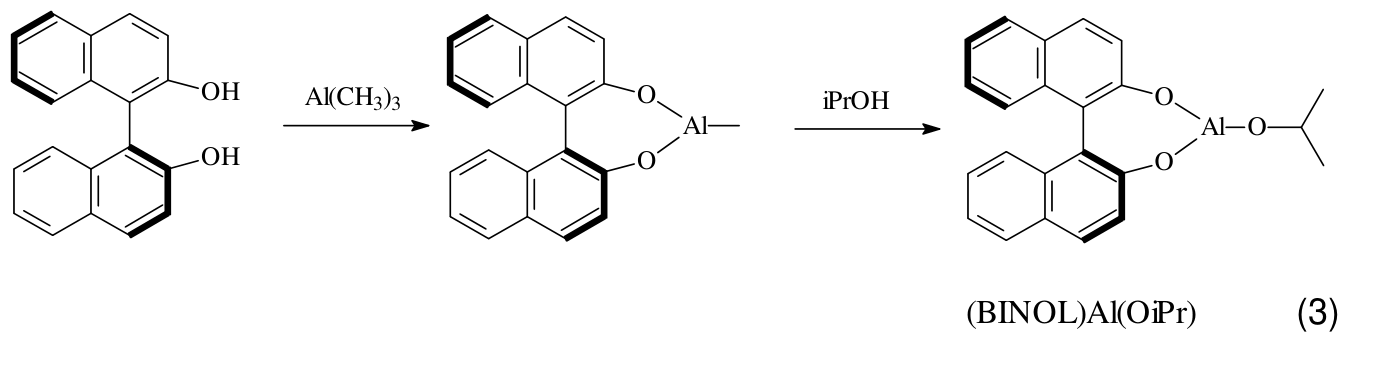
The chirality of BINOL is due to the sterically hindered rotation around the \(\ce{C-C}\) bond. Though perfectly stable at room temperature, BINOL may racemize when heated.
3.3 Which of the phenols below can form stable (at room temperature) enantiomers so that they can be used in the same fashion to produce a chiral catalyst? Tick the relevant boxes.
| Substance | Can be used | Substance | Can be used |
|---|---|---|---|
| A | B | ||
| C | D | ||
| E | F |
A:
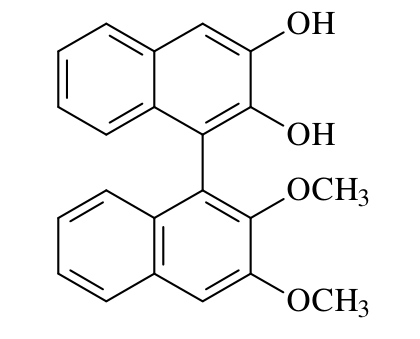
B:
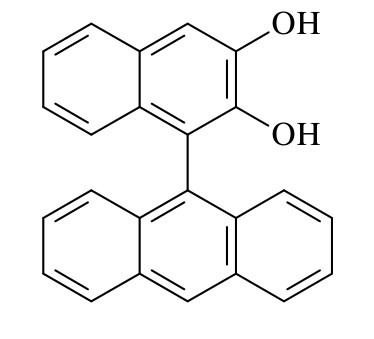
C:
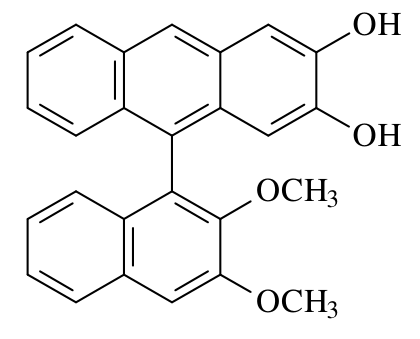
D:
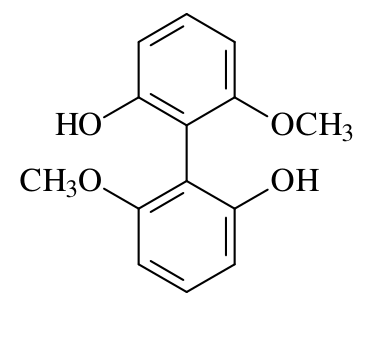
E:
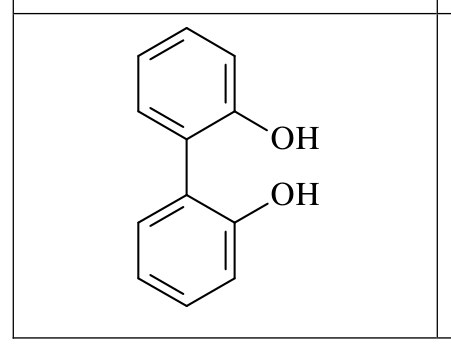
F:
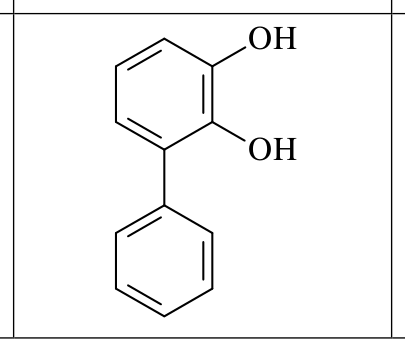
Enantiomeric excess, \(ee\), is used to characterize the enantiomeric purity of the substance. This quantity equals to the ratio of the difference of concentrations of enantiomers \(R\) and \(S\) to their sum:
\[ ee=\frac{[R]-[S]}{[R]+[S]} \]
Enantiomeric excess of the pure \(R\) isomer is unity, \(ee\) of the racemic mixture is zero.
3.4 When using the enantiomerically pure \(\ce{(BINOL)Al(OiPr)}\) as a catalyst for reduction of \(\alpha\)-bromoacetophenone, the \(ee\) of the product equals 81 %. What is the \(ee\) of the product if the catalyst \(ee\) equals 50 %? Provide your calculation with an illustration or derivation of the final formula.
Official English text of the problem.
Answers
-
3.1 a: The minimum initial mass ratio is \[ \boxed{\frac{m(\text{isopropanol})}{m(\text{cyclohexanone})}\approx6.94:1}. \]
-
3.1 b: Tick distilling off acetone at 60 °C and adding ethanol. Leave the other two boxes unticked.
-
3.2: With \([C]\) denoting free catalyst:
- Hydride transfer limiting: \[ \boxed{v=k_{\mathrm H}K_1[A][C]},\qquad \boxed{(n_A,n_B,n_C)=(1,0,1)}. \]
-
Alcoholysis limiting: \[ \boxed{v=k_{\mathrm{alc}}K_1K_2[A][B][C]},\qquad \boxed{(n_A,n_B,n_C)=(1,1,1)}. \]
-
3.3: Tick A, C and D: the top-left, middle-left and middle-right structures.
-
3.4: \[ \boxed{ee_{\mathrm{product}}=0.81(0.50)=0.405=40.5\%}. \]
Solution
3.1 a
The reacting substances are:
- Cyclohexanone:
O=C1CCCCC1 - Isopropanol, or propan-2-ol:
CC(O)C - Cyclohexanol:
OC1CCCCC1 - Acetone, or propan-2-one:
CC(=O)C
The balanced reaction is
\[ \ce{C6H10O(l) + C3H8O(l) <=> C6H12O(l) + C3H6O(l)}. \]
From the supplied formation enthalpies,
\[ \begin{aligned} \Delta_{\mathrm r}H^\circ &=(-348.2-248.4)-(-271.2-318.1)\\ &=-7.3\ \mathrm{kJ\,mol^{-1}}. \end{aligned} \]
Similarly,
\[ \begin{aligned} \Delta_{\mathrm r}S^\circ &=(203.4+200.4)-(229.0+180.6)\\ &=-5.8\ \mathrm{J\,mol^{-1}\,K^{-1}}. \end{aligned} \]
Consequently, at 298 K,
\[ \begin{aligned} \Delta_{\mathrm r}G^\circ &=\Delta_{\mathrm r}H^\circ-T\Delta_{\mathrm r}S^\circ\\ &=-7.300-298(-0.0058)\\ &=-5.5716\ \mathrm{kJ\,mol^{-1}}. \end{aligned} \]
Using \(R=8.314\ \mathrm{J\,mol^{-1}\,K^{-1}}\),
\[ K=\exp\left(-\frac{\Delta_{\mathrm r}G^\circ}{RT}\right) =\exp\left(\frac{5571.6}{8.314(298)}\right) =9.4765. \]
Assume ideal liquid-mixture behaviour, so activities can be represented by mole fractions. Because the reaction has equal total stoichiometric coefficients on both sides, the total-mole factors cancel.
Take initially \(1.000\) mol cyclohexanone and \(b\) mol isopropanol. At 99 % conversion:
| Substance | Initial amount / mol | Equilibrium amount / mol |
|---|---|---|
| Cyclohexanone | 1.000 | 0.010 |
| Isopropanol | \(b\) | \(b-0.990\) |
| Cyclohexanol | 0 | 0.990 |
| Acetone | 0 | 0.990 |
Thus,
\[ K=\frac{(0.990)^2}{0.010(b-0.990)}. \]
Solving,
\[ b=0.990+\frac{0.990^2}{0.010(9.4765)} =11.3324. \]
Using molar masses \(60.10\ \mathrm{g\,mol^{-1}}\) for isopropanol and \(98.15\ \mathrm{g\,mol^{-1}}\) for cyclohexanone,
\[ \frac{m(\text{isopropanol})}{m(\text{cyclohexanone})} =\frac{11.3324(60.10)}{1.000(98.15)} =6.939. \]
Therefore,
\[ \boxed{m(\text{isopropanol}):m(\text{cyclohexanone})\approx6.94:1}. \]
This is the minimum because any smaller initial isopropanol charge gives an equilibrium conversion below 99 %.
3.1 b
| Proposed change | Tick? | Reason |
|---|---|---|
| Heat to 50 °C under reflux | No | The forward reaction is exothermic, so heating decreases its equilibrium constant. Reflux returns volatile substances to the mixture. |
| Heat to 60 °C while distilling acetone | Yes | Removing acetone, a reaction product, shifts the reaction towards cyclohexanol. Acetone has the lowest listed boiling point, 56 °C. |
| Add ethanol | Yes | Ethanol supplies an additional reducing alcohol and is oxidized to ethanal. |
| Add ethanal | No | Ethanal is a hydrogen acceptor and promotes oxidation of alcohols, opposing the desired reduction. |
The additional substances are ethanol CCO and ethanal, or acetaldehyde, CC=O.
Their coupled transfer-hydrogenation reaction is
\[ \ce{C6H10O + CH3CH2OH <=> C6H11OH + CH3CHO}. \]
Adding ethanol favours the forward direction. Adding ethanal favours the reverse direction, consuming cyclohexanol.
For heating alone, the sign also follows from the van ’t Hoff equation:
\[ \frac{\mathrm d\ln K}{\mathrm dT} =\frac{\Delta_{\mathrm r}H^\circ}{RT^2}<0. \]
3.2
Let \(P\) denote the product alcohol and \(Q\) acetone. The mechanism can be written schematically as
\[ \ce{A + C <=> I_1}, \]
\[ \ce{I_1 <=> I_2}, \]
\[ \ce{I_2 + B <=> C + P + Q}. \]
Here:
- \(A\) is the carbonyl substrate, generic SMILES
[*:1]C(=O)[*:2]. - \(B\) is isopropanol,
CC(O)C. - \(C\) is aluminium triisopropoxide,
CC(C)O[Al](OC(C)C)OC(C)C. - \(P\) is the corresponding alcohol, generic SMILES
[*:1]C(O)[*:2]. - \(Q\) is acetone,
CC(=O)C. - \(I_1\) is the carbonyl–aluminium coordination complex, represented schematically by
CC(C)O[Al](OC(C)C)(OC(C)C)<-O=C([*:1])[*:2]. - \(I_2\) is the mixed aluminium alkoxide with coordinated acetone after hydride transfer, represented by
CC(C)O[Al](OC(C)C)(OC([*:1])[*:2])<-O=C(C)C.
The wildcard groups denote the substrate substituents. These SMILES describe the monomeric connectivity used in the problem; <- denotes oxygen-to-aluminium coordination. They do not show the cyclic arrangement during hydride transfer.
In that transfer, the coordinated isopropoxide donates its carbon-bound hydrogen to the substrate carbonyl carbon while becoming acetone. The substrate carbonyl oxygen becomes an alkoxide oxygen. Free hydride need not be released.
Define the pre-equilibrium constants
\[ K_1=\frac{[I_1]}{[A][C]}, \qquad K_2=\frac{[I_2]}{[I_1]}. \]
Hydride transfer is rate-limiting.
The first coordination step is at equilibrium:
\[ [I_1]=K_1[A][C]. \]
Hydride transfer occurs within \(I_1\), so its forward rate is
\[ v=k_{\mathrm H}[I_1] =k_{\mathrm H}K_1[A][C]. \]
Hence the orders are
\[ \boxed{n_A=1,\qquad n_B=0,\qquad n_C=1}. \]
Free isopropanol does not participate in this limiting step: the hydrogen donor is already an isopropoxide ligand on the catalyst.
Alcoholysis is rate-limiting.
Both preceding steps are at equilibrium:
\[ [I_2]=K_2[I_1]=K_1K_2[A][C]. \]
The limiting step involves \(I_2\) and one molecule of isopropanol:
\[ v=k_{\mathrm{alc}}[I_2][B] =k_{\mathrm{alc}}K_1K_2[A][B][C]. \]
Therefore,
\[ \boxed{n_A=1,\qquad n_B=1,\qquad n_C=1}. \]
These expressions refer to free catalyst concentration and to forward rates, or net rates when the reverse reaction is negligible.
If catalyst concentration instead means total catalyst loading \(C_T\), binding can produce saturation. For hydride transfer limiting, neglecting the rapidly consumed downstream intermediate,
\[ C_T\simeq[C]+[I_1], \qquad v=\frac{k_{\mathrm H}K_1[A]C_T}{1+K_1[A]}. \]
For alcoholysis limiting,
\[ C_T=[C]+[I_1]+[I_2], \qquad v=\frac{k_{\mathrm{alc}}K_1K_2[A][B]C_T} {1+K_1[A](1+K_2)}. \]
Thus the reaction remains first order in total catalyst, while its apparent substrate order can decrease from one towards zero as binding saturates.
3.3
Stable biaryl enantiomers require both:
- A stereogenic axis: the two paths around the aromatic framework at each end of the axis must be distinguishable.
- Sufficiently hindered rotation to prevent rapid interconversion at room temperature.
The following SMILES specify connectivity. Ordinary SMILES do not reliably distinguish these biaryl axial configurations; the two stable atropisomers must additionally be designated \((R_a)\) and \((S_a)\). The flat drawings do not select one of them.
-
A — top left: tick.
2′,3′-Dimethoxy-[1,1′-binaphthalene]-2,3-diol,c1(-c2c(OC)c(OC)cc3ccccc23)c(O)c(O)cc2ccccc12.
Both ends of the binaphthyl axis have distinguishable ring paths. The crowded ortho and peri environments strongly hinder rotation, allowing stable atropisomers. -
B — top right: leave unticked.
1-(Anthracen-9-yl)naphthalene-2,3-diol,c1(-c2c3ccccc3cc3ccccc23)c(O)c(O)cc2ccccc12.
The two paths through the unsubstituted anthracen-9-yl group are symmetry-equivalent. Thus the connecting bond does not constitute a stereogenic axis, despite its steric crowding. -
C — middle left: tick.
9-(2,3-Dimethoxynaphthalen-1-yl)anthracene-2,3-diol,c1(-c2c(OC)c(OC)cc3ccccc23)c2cc(O)c(O)cc2cc2ccccc12.
Unlike B, the anthracene fragment has hydroxyl substituents on only one terminal ring, making its two paths different. The naphthalene end also has distinct paths, and rotation is strongly hindered. -
D — middle right: tick.
6,6′-Dimethoxy-[1,1′-biphenyl]-2,2′-diol,COc1cccc(O)c1-c1c(O)cccc1OC.
Each ring has different ortho substituents, hydroxyl and methoxy, so the axis is stereogenic. Occupation of all four ortho positions provides the rotational hindrance needed for stable enantiomers. -
E — bottom left: leave unticked.
[1,1′-Biphenyl]-2,2′-diol,Oc1ccccc1-c1ccccc1O.
Twisted conformations can be chiral, but the two hydroxyl groups alone do not sufficiently hinder rotation. The mirror-image conformations interconvert too readily at room temperature. -
F — bottom right: leave unticked.
[1,1′-Biphenyl]-2,3-diol,c1(-c2ccccc2)c(O)c(O)ccc1.
The unsubstituted phenyl end has equivalent ring paths, so the connecting bond is not a stereogenic axis.
The completed answer-sheet pattern is therefore
| Row | Left box | Right box |
|---|---|---|
| Top | ✓ | |
| Middle | ✓ | ✓ |
| Bottom |
3.4
The substrate is 2-bromo-1-phenylethan-1-one, commonly called \(\alpha\)-bromoacetophenone or phenacyl bromide: O=C(CBr)c1ccccc1.
Reduction gives 2-bromo-1-phenylethan-1-ol:
- \((R)\)-enantiomer:
O[C@@H](CBr)c1ccccc1 - \((S)\)-enantiomer:
O[C@H](CBr)c1ccccc1
The balanced reaction is
\[ \ce{C6H5COCH2Br + (CH3)2CHOH <=> C6H5CH(OH)CH2Br + (CH3)2CO}. \]
BINOL is [1,1′-binaphthalene]-2,2′-diol, Oc1ccc2ccccc2c1-c1c(O)ccc2ccccc12.
Its catalyst is aluminium isopropoxide chelated by binaphthalene-2,2′-diolate, represented by CC(C)O[Al]1Oc2ccc3ccccc3c2-c2c(O1)ccc3ccccc23. Its axial configuration must additionally be specified as discussed in 3.3.
Assume the two catalyst enantiomers act independently and have equal total activity. They then give equal and opposite product selectivities.
Call the catalyst enantiomer that favours \(R\) \(C_+\), and its mirror image \(C_-\). With pure \(C_+\), the product fractions satisfy
\[ f_R+f_S=1,\qquad f_R-f_S=0.81. \]
Therefore,
\[ f_R=\frac{1+0.81}{2}=0.905, \qquad f_S=\frac{1-0.81}{2}=0.095. \]
Pure \(C_-\) gives the reversed proportions.
A catalyst \(ee\) of 50 % means
\[ f_{C_+}=\frac{1+0.50}{2}=0.75, \qquad f_{C_-}=\frac{1-0.50}{2}=0.25. \]
The product fractions are consequently
\[ f_R=0.75(0.905)+0.25(0.095)=0.7025, \]
\[ f_S=0.75(0.095)+0.25(0.905)=0.2975. \]
Thus,
\[ ee_{\mathrm{product}} =\frac{0.7025-0.2975}{0.7025+0.2975} =0.405. \]
More generally, if \(e_0\) is the product \(ee\) obtained with pure catalyst and \(e_C\) is the catalyst \(ee\),
\[ \begin{aligned} f_R&=\frac{1+e_C}{2}\frac{1+e_0}{2} +\frac{1-e_C}{2}\frac{1-e_0}{2} =\frac{1+e_Ce_0}{2},\\ f_S&=\frac{1-e_Ce_0}{2}. \end{aligned} \]
Hence
\[ \boxed{ee_{\mathrm{product}}=e_Ce_0=40.5\%}. \]
The solution was checked against the official solution.
IChO 2013 · Theorieaufgabe 3
Meerwein-Schmidt-Ponndorf-Verley-Reaktion
In der Tabelle zu 3.3 sind A–F redaktionelle Bezeichnungen, die die sechs Strukturen in Lesereihenfolge kennzeichnen.
AUFGABE 3
Meerwein-Schmidt-Ponndorf-Verley-Reaktion
Die Meerwein-Schmidt-Ponndorf-Verley-Reaktion (MSPV-Reaktion) ist eine nützliche Methode zur Reduktion von Carbonylverbindungen zu Alkoholen. Bei dieser Reaktion werden Carbonylverbindungen durch niedermolekulare Alkohole in Gegenwart von Aluminiumalkoholaten oder Alkoholaten anderer Metalle reduziert:
Der Reaktionsmechanismus umfasst die Koordination der Carbonylverbindung an das Aluminiumalkoholat, die Hydridübertragung in der inneren Koordinationssphäre des Komplexes und die anschließende Umalkoxylierung. Er lässt sich wie folgt schematisch darstellen (die Umalkoxylierung ist der Kürze halber als einstufiger Prozess dargestellt):
Die Reaktion ist reversibel, und um das Gleichgewicht zum gewünschten Produkt zu verschieben, ist ein gewisser Überschuss des Reduktionsmittels erforderlich. In einigen Fällen (z. B. bei der Reduktion aromatischer Aldehyde und Ketone) ist die Gleichgewichtskonstante so groß, dass die Rückreaktion vernachlässigt werden kann.
Die folgende Tabelle enthält die Standardentropien und Standardbildungsenthalpien flüssiger Stoffe bei 298 K. Auch die Siedepunkte der Stoffe bei 1 bar sind angegeben.
| Stoff | \(\Delta_{\mathrm f}H^\circ_{298}\), kJ mol\(^{-1}\) | \(S^\circ_{298}\), J mol\(^{-1}\) K\(^{-1}\) | \(t_{\mathrm{vap}}\), °C |
|---|---|---|---|
| Aceton | −248.4 | 200.4 | 56 |
| Isopropanol | −318.1 | 180.6 | 82 |
| Cyclohexanon | −271.2 | 229.0 | 156 |
| Cyclohexanol | −348.2 | 203.4 | 161 |
3.1 a Berechnen Sie das minimale Massenverhältnis von Isopropanol zu Cyclohexanon, das erforderlich ist, um bei 298 K eine Reaktionsausbeute von 99 % zu erreichen. Nehmen Sie an, dass:
i) das Reaktionsgemisch schließlich das Gleichgewicht erreicht,
ii) anfangs keine Produkte vorhanden sind.
3.1 b Wählen Sie die geeignete(n) Möglichkeit(en) zur Erhöhung der Cyclohexanolausbeute aus. Kreuzen Sie die entsprechenden Kästchen an.
| Die Temperatur unter Rückfluss auf 50 °C erhöhen | |
| Die Temperatur auf 60 °C erhöhen und dabei das Aceton verdampfen (abdestillieren) | |
| Dem Reaktionsgemisch etwas Ethanol zusetzen | |
| Dem Reaktionsgemisch etwas Ethanal zusetzen |
3.2 Häufig ist bei der MSPV-Reaktion die Hydridübertragung oder die Alkoholyse des Alkoholats nach der Hydridübertragung der geschwindigkeitsbestimmende Schritt. Leiten Sie für diese beiden Fälle anhand des obigen Mechanismus (2) einen Ausdruck für die Reaktionsgeschwindigkeit als Funktion der momentanen Konzentrationen einer Carbonylverbindung, von Isopropanol und eines Katalysators her. Bestimmen Sie in beiden Fällen die Reaktionsordnungen bezüglich der Reaktanten und des Katalysators. Nehmen Sie an, dass alle Reaktionsschritte vor dem geschwindigkeitsbestimmenden Schritt schnell und reversibel sind. Verwenden Sie gegebenenfalls die Gleichgewichtsnäherung. Verwenden Sie der Kürze halber folgende Bezeichnungen: A für die Carbonylverbindung, B für Isopropanol, C für den Katalysator. Die Zwischenprodukte können Sie beliebig bezeichnen.
Die MSPV-Reaktion kann zur Herstellung chiraler Alkohole verwendet werden, wenn ein chiraler Katalysator eingesetzt wird. Beispielsweise verwendeten Campbell et al. einen Katalysator auf der Grundlage des chiralen 2,2’-Dihydroxy-1,1’-binaphthyls (BINOL), der in situ aus Binaphthol und Trimethylaluminium synthetisiert wird:
Die Chiralität von BINOL beruht auf der sterisch gehinderten Rotation um die \(\ce{C-C}\)-Bindung. Obwohl BINOL bei Raumtemperatur völlig stabil ist, kann es beim Erhitzen racemisieren.
3.3 Welche der folgenden Phenole können (bei Raumtemperatur) stabile Enantiomere bilden, sodass sie auf die gleiche Weise zur Herstellung eines chiralen Katalysators verwendet werden können? Kreuzen Sie die entsprechenden Kästchen an.
| Stoff | Kann verwendet werden | Stoff | Kann verwendet werden |
|---|---|---|---|
| A | B | ||
| C | D | ||
| E | F |
A:
B:
C:
D:
E:
F:
Der Enantiomerenüberschuss, \(ee\), dient zur Charakterisierung der Enantiomerenreinheit eines Stoffes. Diese Größe ist gleich dem Verhältnis der Differenz der Konzentrationen der Enantiomere \(R\) und \(S\) zu ihrer Summe:
\[ ee=\frac{[R]-[S]}{[R]+[S]} \]
Der Enantiomerenüberschuss des reinen \(R\)-Isomers beträgt eins, der \(ee\) des racemischen Gemisches beträgt null.
3.4 Bei Verwendung von enantiomerenreinem \(\ce{(BINOL)Al(OiPr)}\) als Katalysator zur Reduktion von \(\alpha\)-Bromacetophenon beträgt der \(ee\) des Produkts 81 %. Wie groß ist der \(ee\) des Produkts, wenn der \(ee\) des Katalysators 50 % beträgt? Ergänzen Sie Ihre Berechnung durch eine Veranschaulichung oder Herleitung der endgültigen Formel.
Aufgabentext aus dem offiziellen englischen Text übersetzt.
Antworten
-
3.1 a: Das minimale anfängliche Massenverhältnis beträgt \[ \boxed{\frac{m(\text{Isopropanol})}{m(\text{Cyclohexanon})}\approx6.94:1}. \]
-
3.1 b: Kreuzen Sie Abdestillieren von Aceton bei 60 °C und Zugabe von Ethanol an. Lassen Sie die anderen beiden Kästchen frei.
-
3.2: Wenn \([C]\) den freien Katalysator bezeichnet:
- Hydridübertragung geschwindigkeitsbestimmend: \[ \boxed{v=k_{\mathrm H}K_1[A][C]},\qquad \boxed{(n_A,n_B,n_C)=(1,0,1)}. \]
-
Alkoholyse geschwindigkeitsbestimmend: \[ \boxed{v=k_{\mathrm{alc}}K_1K_2[A][B][C]},\qquad \boxed{(n_A,n_B,n_C)=(1,1,1)}. \]
-
3.3: Kreuzen Sie A, C und D an: die Strukturen oben links, in der Mitte links und in der Mitte rechts.
-
3.4: \[ \boxed{ee_{\mathrm{product}}=0.81(0.50)=0.405=40.5\%}. \]
Lösung
3.1 a
Die an der Reaktion beteiligten Stoffe sind:
- Cyclohexanon:
O=C1CCCCC1 - Isopropanol oder Propan-2-ol:
CC(O)C - Cyclohexanol:
OC1CCCCC1 - Aceton oder Propan-2-on:
CC(=O)C
Die ausgeglichene Reaktionsgleichung lautet
\[ \ce{C6H10O(l) + C3H8O(l) <=> C6H12O(l) + C3H6O(l)}. \]
Aus den angegebenen Bildungsenthalpien folgt
\[ \begin{aligned} \Delta_{\mathrm r}H^\circ &=(-348.2-248.4)-(-271.2-318.1)\\ &=-7.3\ \mathrm{kJ\,mol^{-1}}. \end{aligned} \]
Entsprechend gilt
\[ \begin{aligned} \Delta_{\mathrm r}S^\circ &=(203.4+200.4)-(229.0+180.6)\\ &=-5.8\ \mathrm{J\,mol^{-1}\,K^{-1}}. \end{aligned} \]
Folglich ergibt sich bei 298 K
\[ \begin{aligned} \Delta_{\mathrm r}G^\circ &=\Delta_{\mathrm r}H^\circ-T\Delta_{\mathrm r}S^\circ\\ &=-7.300-298(-0.0058)\\ &=-5.5716\ \mathrm{kJ\,mol^{-1}}. \end{aligned} \]
Mit \(R=8.314\ \mathrm{J\,mol^{-1}\,K^{-1}}\) erhält man
\[ K=\exp\left(-\frac{\Delta_{\mathrm r}G^\circ}{RT}\right) =\exp\left(\frac{5571.6}{8.314(298)}\right) =9.4765. \]
Es wird ideales Verhalten des flüssigen Gemisches angenommen, sodass die Aktivitäten durch Stoffmengenanteile dargestellt werden können. Da die Summe der stöchiometrischen Koeffizienten auf beiden Seiten der Reaktionsgleichung gleich ist, kürzen sich die Faktoren für die Gesamtstoffmenge heraus.
Anfangs werden \(1.000\) mol Cyclohexanon und \(b\) mol Isopropanol eingesetzt. Bei 99 % Umsatz gilt:
| Stoff | Anfängliche Stoffmenge / mol | Stoffmenge im Gleichgewicht / mol |
|---|---|---|
| Cyclohexanon | 1.000 | 0.010 |
| Isopropanol | \(b\) | \(b-0.990\) |
| Cyclohexanol | 0 | 0.990 |
| Aceton | 0 | 0.990 |
Somit gilt
\[ K=\frac{(0.990)^2}{0.010(b-0.990)}. \]
Auflösen ergibt
\[ b=0.990+\frac{0.990^2}{0.010(9.4765)} =11.3324. \]
Mit den molaren Massen \(60.10\ \mathrm{g\,mol^{-1}}\) für Isopropanol und \(98.15\ \mathrm{g\,mol^{-1}}\) für Cyclohexanon erhält man
\[ \frac{m(\text{Isopropanol})}{m(\text{Cyclohexanon})} =\frac{11.3324(60.10)}{1.000(98.15)} =6.939. \]
Daher gilt
\[ \boxed{m(\text{Isopropanol}):m(\text{Cyclohexanon})\approx6.94:1}. \]
Dies ist das Minimum, da jede geringere anfänglich eingesetzte Isopropanolmenge zu einem Gleichgewichtsumsatz unter 99 % führt.
3.1 b
| Vorgeschlagene Änderung | Ankreuzen? | Begründung |
|---|---|---|
| Unter Rückfluss auf 50 °C erhitzen | Nein | Die Hinreaktion ist exotherm, daher verringert Erhitzen ihre Gleichgewichtskonstante. Unter Rückfluss werden flüchtige Stoffe in das Gemisch zurückgeführt. |
| Auf 60 °C erhitzen und dabei Aceton abdestillieren | Ja | Das Entfernen von Aceton, einem Reaktionsprodukt, verschiebt die Reaktion in Richtung Cyclohexanol. Aceton hat mit 56 °C den niedrigsten der angegebenen Siedepunkte. |
| Ethanol zusetzen | Ja | Ethanol liefert einen zusätzlichen reduzierenden Alkohol und wird zu Ethanal oxidiert. |
| Ethanal zusetzen | Nein | Ethanal ist ein Wasserstoffakzeptor und begünstigt die Oxidation von Alkoholen, wirkt also der gewünschten Reduktion entgegen. |
Die zusätzlichen Stoffe sind Ethanol CCO und Ethanal oder Acetaldehyd CC=O.
Die gekoppelte Transferhydrierung mit diesen Stoffen lautet
\[ \ce{C6H10O + CH3CH2OH <=> C6H11OH + CH3CHO}. \]
Die Zugabe von Ethanol begünstigt die Hinreaktion. Die Zugabe von Ethanal begünstigt die Rückreaktion, wobei Cyclohexanol verbraucht wird.
Für das alleinige Erhitzen folgt das Vorzeichen auch aus der van-’t-Hoff-Gleichung:
\[ \frac{\mathrm d\ln K}{\mathrm dT} =\frac{\Delta_{\mathrm r}H^\circ}{RT^2}<0. \]
3.2
Es bezeichne \(P\) den Produktalkohol und \(Q\) Aceton. Der Mechanismus lässt sich schematisch wie folgt schreiben:
\[ \ce{A + C <=> I_1}, \]
\[ \ce{I_1 <=> I_2}, \]
\[ \ce{I_2 + B <=> C + P + Q}. \]
Dabei gilt:
- \(A\) ist das Carbonylsubstrat, allgemeine SMILES:
[*:1]C(=O)[*:2]. - \(B\) ist Isopropanol,
CC(O)C. - \(C\) ist Aluminiumtriisopropanolat,
CC(C)O[Al](OC(C)C)OC(C)C. - \(P\) ist der entsprechende Alkohol, allgemeine SMILES:
[*:1]C(O)[*:2]. - \(Q\) ist Aceton,
CC(=O)C. - \(I_1\) ist der Carbonyl–Aluminium-Koordinationskomplex, schematisch dargestellt durch
CC(C)O[Al](OC(C)C)(OC(C)C)<-O=C([*:1])[*:2]. - \(I_2\) ist das gemischte Aluminiumalkoholat mit koordiniertem Aceton nach der Hydridübertragung, dargestellt durch
CC(C)O[Al](OC(C)C)(OC([*:1])[*:2])<-O=C(C)C.
Die Platzhaltergruppen bezeichnen die Substituenten des Substrats. Diese SMILES beschreiben die in der Aufgabe verwendete monomere Konnektivität; <- bezeichnet die Koordination von Sauerstoff an Aluminium. Sie zeigen nicht die cyclische Anordnung während der Hydridübertragung.
Bei dieser Übertragung gibt das koordinierte Isopropanolat seinen an Kohlenstoff gebundenen Wasserstoff an das Carbonylkohlenstoffatom des Substrats ab und wird dabei zu Aceton. Der Carbonylsauerstoff des Substrats wird zu einem Alkoholatsauerstoff. Dabei muss kein freies Hydrid freigesetzt werden.
Die Konstanten der vorgelagerten Gleichgewichte werden definiert als
\[ K_1=\frac{[I_1]}{[A][C]}, \qquad K_2=\frac{[I_2]}{[I_1]}. \]
Die Hydridübertragung ist geschwindigkeitsbestimmend.
Der erste Koordinationsschritt befindet sich im Gleichgewicht:
\[ [I_1]=K_1[A][C]. \]
Die Hydridübertragung erfolgt innerhalb von \(I_1\), daher beträgt die Geschwindigkeit der Hinreaktion
\[ v=k_{\mathrm H}[I_1] =k_{\mathrm H}K_1[A][C]. \]
Damit ergeben sich die Reaktionsordnungen
\[ \boxed{n_A=1,\qquad n_B=0,\qquad n_C=1}. \]
Freies Isopropanol ist an diesem geschwindigkeitsbestimmenden Schritt nicht beteiligt: Der Wasserstoffdonor ist bereits als Isopropanolatligand am Katalysator gebunden.
Die Alkoholyse ist geschwindigkeitsbestimmend.
Beide vorangehenden Schritte befinden sich im Gleichgewicht:
\[ [I_2]=K_2[I_1]=K_1K_2[A][C]. \]
Am geschwindigkeitsbestimmenden Schritt sind \(I_2\) und ein Molekül Isopropanol beteiligt:
\[ v=k_{\mathrm{alc}}[I_2][B] =k_{\mathrm{alc}}K_1K_2[A][B][C]. \]
Daher gilt
\[ \boxed{n_A=1,\qquad n_B=1,\qquad n_C=1}. \]
Diese Ausdrücke beziehen sich auf die Konzentration des freien Katalysators und auf die Geschwindigkeiten der Hinreaktion beziehungsweise auf die Nettogeschwindigkeiten, wenn die Rückreaktion vernachlässigbar ist.
Wenn mit der Katalysatorkonzentration stattdessen die gesamte eingesetzte Katalysatorkonzentration \(C_T\) gemeint ist, kann die Bindung zu einer Sättigung führen. Bei geschwindigkeitsbestimmender Hydridübertragung gilt unter Vernachlässigung des rasch verbrauchten nachfolgenden Zwischenprodukts
\[ C_T\simeq[C]+[I_1], \qquad v=\frac{k_{\mathrm H}K_1[A]C_T}{1+K_1[A]}. \]
Bei geschwindigkeitsbestimmender Alkoholyse gilt
\[ C_T=[C]+[I_1]+[I_2], \qquad v=\frac{k_{\mathrm{alc}}K_1K_2[A][B]C_T} {1+K_1[A](1+K_2)}. \]
Die Reaktion bleibt somit erster Ordnung bezüglich des gesamten Katalysators, während ihre scheinbare Reaktionsordnung bezüglich des Substrats mit zunehmender Sättigung der Bindung von eins gegen null abnehmen kann.
3.3
Stabile Biaryl-Enantiomere erfordern beides:
- Eine stereogene Achse: Die beiden Wege entlang des aromatischen Gerüsts müssen an jedem Ende der Achse unterscheidbar sein.
- Eine ausreichend gehinderte Rotation, um eine schnelle gegenseitige Umwandlung bei Raumtemperatur zu verhindern.
Die folgenden SMILES geben die Konnektivität an. Gewöhnliche SMILES unterscheiden diese axialen Konfigurationen von Biarylen nicht zuverlässig; die beiden stabilen Atropisomere müssen zusätzlich als \((R_a)\) und \((S_a)\) bezeichnet werden. Die ebenen Zeichnungen legen keines der beiden fest.
-
A — oben links: ankreuzen.
2′,3′-Dimethoxy-[1,1′-binaphthalin]-2,3-diol,c1(-c2c(OC)c(OC)cc3ccccc23)c(O)c(O)cc2ccccc12.
An beiden Enden der Binaphthylachse sind die Ringwege unterscheidbar. Die sterisch überfüllten ortho- und peri-Umgebungen behindern die Rotation stark und ermöglichen dadurch stabile Atropisomere. -
B — oben rechts: nicht ankreuzen.
1-(Anthracen-9-yl)naphthalin-2,3-diol,c1(-c2c3ccccc3cc3ccccc23)c(O)c(O)cc2ccccc12.
Die beiden Wege durch die unsubstituierte Anthracen-9-yl-Gruppe sind symmetrieäquivalent. Daher bildet die verbindende Bindung trotz ihrer sterisch überfüllten Umgebung keine stereogene Achse. -
C — in der Mitte links: ankreuzen.
9-(2,3-Dimethoxynaphthalin-1-yl)anthracen-2,3-diol,c1(-c2c(OC)c(OC)cc3ccccc23)c2cc(O)c(O)cc2cc2ccccc12.
Anders als bei B trägt das Anthracenfragment nur an einem endständigen Ring Hydroxylsubstituenten, wodurch seine beiden Wege unterschiedlich sind. Auch am Naphthalinende sind die Wege verschieden, und die Rotation ist stark gehindert. -
D — in der Mitte rechts: ankreuzen.
6,6′-Dimethoxy-[1,1′-biphenyl]-2,2′-diol,COc1cccc(O)c1-c1c(O)cccc1OC.
Jeder Ring hat unterschiedliche ortho-Substituenten, Hydroxyl und Methoxy, sodass die Achse stereogen ist. Die Besetzung aller vier ortho-Positionen sorgt für die Rotationshinderung, die für stabile Enantiomere erforderlich ist. -
E — unten links: nicht ankreuzen.
[1,1′-Biphenyl]-2,2′-diol,Oc1ccccc1-c1ccccc1O.
Verdrillte Konformationen können chiral sein, aber die beiden Hydroxylgruppen allein behindern die Rotation nicht ausreichend. Die spiegelbildlichen Konformationen wandeln sich bei Raumtemperatur zu leicht ineinander um. -
F — unten rechts: nicht ankreuzen.
[1,1′-Biphenyl]-2,3-diol,c1(-c2ccccc2)c(O)c(O)ccc1.
Das unsubstituierte Phenylende besitzt äquivalente Ringwege, sodass die verbindende Bindung keine stereogene Achse ist.
Das ausgefüllte Antwortschema lautet daher
| Zeile | Linkes Kästchen | Rechtes Kästchen |
|---|---|---|
| Oben | ✓ | |
| Mitte | ✓ | ✓ |
| Unten |
3.4
Das Substrat ist 2-Brom-1-phenylethan-1-on, üblicherweise als \(\alpha\)-Bromacetophenon oder Phenacylbromid bezeichnet: O=C(CBr)c1ccccc1.
Die Reduktion ergibt 2-Brom-1-phenylethan-1-ol:
- \((R)\)-Enantiomer:
O[C@@H](CBr)c1ccccc1 - \((S)\)-Enantiomer:
O[C@H](CBr)c1ccccc1
Die ausgeglichene Reaktionsgleichung lautet
\[ \ce{C6H5COCH2Br + (CH3)2CHOH <=> C6H5CH(OH)CH2Br + (CH3)2CO}. \]
BINOL ist [1,1′-Binaphthalin]-2,2′-diol, Oc1ccc2ccccc2c1-c1c(O)ccc2ccccc12.
Der daraus gebildete Katalysator ist durch Binaphthalin-2,2′-diolat chelatisiertes Aluminiumisopropanolat, dargestellt durch CC(C)O[Al]1Oc2ccc3ccccc3c2-c2c(O1)ccc3ccccc23. Seine axiale Konfiguration muss zusätzlich wie in 3.3 erläutert angegeben werden.
Es wird angenommen, dass die beiden Katalysatorenantiomere unabhängig voneinander wirken und die gleiche Gesamtaktivität besitzen. Sie ergeben dann gleich große und entgegengesetzte Produktselektivitäten.
Das Katalysatorenantiomer, das \(R\) bevorzugt, werde mit \(C_+\) bezeichnet und sein Spiegelbild mit \(C_-\). Mit reinem \(C_+\) erfüllen die Produktanteile die Beziehungen
\[ f_R+f_S=1,\qquad f_R-f_S=0.81. \]
Daher gilt
\[ f_R=\frac{1+0.81}{2}=0.905, \qquad f_S=\frac{1-0.81}{2}=0.095. \]
Reines \(C_-\) ergibt die umgekehrten Anteile.
Ein \(ee\) des Katalysators von 50 % bedeutet
\[ f_{C_+}=\frac{1+0.50}{2}=0.75, \qquad f_{C_-}=\frac{1-0.50}{2}=0.25. \]
Die Produktanteile betragen folglich
\[ f_R=0.75(0.905)+0.25(0.095)=0.7025, \]
\[ f_S=0.75(0.095)+0.25(0.905)=0.2975. \]
Somit gilt
\[ ee_{\mathrm{product}} =\frac{0.7025-0.2975}{0.7025+0.2975} =0.405. \]
Allgemeiner gilt, wenn \(e_0\) der mit reinem Katalysator erhaltene \(ee\) des Produkts und \(e_C\) der \(ee\) des Katalysators ist,
\[ \begin{aligned} f_R&=\frac{1+e_C}{2}\frac{1+e_0}{2} +\frac{1-e_C}{2}\frac{1-e_0}{2} =\frac{1+e_Ce_0}{2},\\ f_S&=\frac{1-e_Ce_0}{2}. \end{aligned} \]
Daraus folgt
\[ \boxed{ee_{\mathrm{product}}=e_Ce_0=40.5\%}. \]
Die Lösung wurde mit der offiziellen Lösung abgeglichen.
IChO 2013 · Teori sorusu 3
Meerwein-Schmidt-Ponndorf-Verley tepkimesi
3.3'teki tabloda A–F, altı yapıyı okuma sırasına göre tanımlamak için editör tarafından eklenmiş etiketlerdir.
SORU 3
Meerwein-Schmidt-Ponndorf-Verley tepkimesi
Meerwein-Schmidt-Ponndorf-Verley (MSPV) tepkimesi, karbonil bileşiklerinin alkollere indirgenmesinde yararlı bir yöntemdir. Bu tepkimede karbonil bileşikleri, alüminyum veya diğer metallerin alkoksitleri varlığında düşük molekül kütleli alkollerle indirgenir:
Tepkime mekanizması, karbonil bileşiğinin alüminyum alkoksit tarafından koordine edilmesini, kompleksin iç koordinasyon küresinde hidrür aktarımını ve ardından transalkoksilasyonu içerir. Mekanizma şematik olarak aşağıdaki gibi gösterilebilir (kısalık amacıyla transalkoksilasyon tek basamaklı bir süreç olarak gösterilmiştir):
Tepkime tersinirdir ve dengeyi istenen ürüne doğru kaydırmak için indirgenin bir miktar fazlası gerekir. Bazı durumlarda (örneğin aromatik aldehit ve ketonların indirgenmesinde) denge sabiti o kadar büyüktür ki geri tepkime ihmal edilebilir.
Aşağıdaki tabloda sıvı maddelerin 298 K'deki standart entropileri ve standart oluşum entalpileri verilmiştir. Maddelerin 1 bar basınçtaki kaynama noktaları da verilmiştir.
| Madde | \(\Delta_{\mathrm f}H^\circ_{298}\), kJ mol\(^{-1}\) | \(S^\circ_{298}\), J mol\(^{-1}\) K\(^{-1}\) | \(t_{\mathrm{vap}}\), °C |
|---|---|---|---|
| Aseton | −248.4 | 200.4 | 56 |
| İzopropanol | −318.1 | 180.6 | 82 |
| Siklohekzanon | −271.2 | 229.0 | 156 |
| Siklohekzanol | −348.2 | 203.4 | 161 |
3.1 a 298 K'de %99 tepkime verimine ulaşmak için gereken en küçük izopropanol/siklohekzanon kütle oranını hesaplayınız. Şunları varsayınız:
i) tepkime karışımı sonunda dengeye ulaşır,
ii) başlangıçta hiç ürün bulunmaz.
3.1 b Siklohekzanol verimini artırmak için uygun yolu (yolları) seçiniz. İlgili kutuları işaretleyiniz.
| Geri soğutucu kullanarak sıcaklığı 50 °C'ye yükseltmek | |
| Asetonu buharlaştırarak (damıtarak) sıcaklığı 60 °C'ye yükseltmek | |
| Tepkime karışımına bir miktar etanol eklemek | |
| Tepkime karışımına bir miktar etanal eklemek |
3.2 MSPV tepkimesinde hız belirleyici basamak çoğunlukla hidrür aktarımı veya hidrür aktarımından sonra alkoksitin alkolizidir. Bu iki durum için yukarıdaki mekanizmayı (2) kullanarak tepkime hızını karbonil bileşiğinin, izopropanolün ve katalizörün anlık derişimlerinin bir fonksiyonu olarak veren bir ifade türetiniz. Her iki durumda da reaktanlara ve katalizöre göre tepkime derecelerini belirleyiniz. Hız belirleyici basamaktan önceki tüm tepkime basamaklarının hızlı ve tersinir olduğunu varsayınız. Gerekirse denge yaklaşımını kullanınız. Kısalık amacıyla şu gösterimleri kullanınız: karbonil bileşiği için A, izopropanol için B, katalizör için C. Ara türleri istediğiniz gibi gösteriniz.
Kiral bir katalizör kullanıldığında MSPV tepkimesi kiral alkoller elde etmek için kullanılabilir. Örneğin Campbell ve arkadaşları, binaftol ve trimetilalüminyumdan in situ sentezlenen, kiral 2,2’-dihidroksi-1,1’-binaftil (BINOL) temelli katalizörü kullanmışlardır:
BINOL'ün kiralliği, \(\ce{C-C}\) bağı etrafındaki dönmenin sterik olarak engellenmesinden kaynaklanır. Oda sıcaklığında tamamen kararlı olmasına karşın BINOL ısıtıldığında rasemleşebilir.
3.3 Aşağıdaki fenollerden hangileri kararlı (oda sıcaklığında) enantiyomerler oluşturabilir ve böylece aynı şekilde kiral bir katalizör üretmek için kullanılabilir? İlgili kutuları işaretleyiniz.
| Madde | Kullanılabilir | Madde | Kullanılabilir |
|---|---|---|---|
| A | B | ||
| C | D | ||
| E | F |
A:
B:
C:
D:
E:
F:
Enantiyomerik fazlalık, \(ee\), maddenin enantiyomerik saflığını tanımlamak için kullanılır. Bu büyüklük, \(R\) ve \(S\) enantiyomerlerinin derişimleri farkının toplamlarına oranına eşittir:
\[ ee=\frac{[R]-[S]}{[R]+[S]} \]
Saf \(R\) izomerinin enantiyomerik fazlalığı birdir; rasemik karışımın \(ee\) değeri sıfırdır.
3.4 \(\alpha\)-bromoasetofenonun indirgenmesinde katalizör olarak enantiyomerik açıdan saf \(\ce{(BINOL)Al(OiPr)}\) kullanıldığında ürünün \(ee\) değeri %81'dir. Katalizörün \(ee\) değeri %50 ise ürünün \(ee\) değeri nedir? Hesabınızı, son formülü açıklayan bir gösterimle veya formülün türetilişiyle birlikte veriniz.
Soru metni resmi İngilizce metinden çevrilmiştir.
Cevaplar
-
3.1 a: Başlangıçtaki en küçük kütle oranı \[ \boxed{\frac{m(\text{izopropanol})}{m(\text{siklohekzanon})}\approx6.94:1}. \]
-
3.1 b: 60 °C'de asetonu damıtarak uzaklaştırma ve etanol ekleme seçeneklerini işaretleyiniz. Diğer iki kutuyu boş bırakınız.
-
3.2: \([C]\) serbest katalizörü göstermek üzere:
- Hidrür aktarımı hız belirleyici olduğunda: \[ \boxed{v=k_{\mathrm H}K_1[A][C]},\qquad \boxed{(n_A,n_B,n_C)=(1,0,1)}. \]
-
Alkoliz hız belirleyici olduğunda: \[ \boxed{v=k_{\mathrm{alc}}K_1K_2[A][B][C]},\qquad \boxed{(n_A,n_B,n_C)=(1,1,1)}. \]
-
3.3: A, C ve D'yi işaretleyiniz: sol üst, sol orta ve sağ orta yapılar.
-
3.4: \[ \boxed{ee_{\mathrm{product}}=0.81(0.50)=0.405=40.5\%}. \]
Çözüm
3.1 a
Tepkimeye katılan maddeler şunlardır:
- Siklohekzanon:
O=C1CCCCC1 - İzopropanol veya propan-2-ol:
CC(O)C - Siklohekzanol:
OC1CCCCC1 - Aseton veya propan-2-on:
CC(=O)C
Denkleştirilmiş tepkime şöyledir:
\[ \ce{C6H10O(l) + C3H8O(l) <=> C6H12O(l) + C3H6O(l)}. \]
Verilen oluşum entalpilerinden,
\[ \begin{aligned} \Delta_{\mathrm r}H^\circ &=(-348.2-248.4)-(-271.2-318.1)\\ &=-7.3\ \mathrm{kJ\,mol^{-1}}. \end{aligned} \]
Benzer şekilde,
\[ \begin{aligned} \Delta_{\mathrm r}S^\circ &=(203.4+200.4)-(229.0+180.6)\\ &=-5.8\ \mathrm{J\,mol^{-1}\,K^{-1}}. \end{aligned} \]
Buna göre, 298 K'de,
\[ \begin{aligned} \Delta_{\mathrm r}G^\circ &=\Delta_{\mathrm r}H^\circ-T\Delta_{\mathrm r}S^\circ\\ &=-7.300-298(-0.0058)\\ &=-5.5716\ \mathrm{kJ\,mol^{-1}}. \end{aligned} \]
\(R=8.314\ \mathrm{J\,mol^{-1}\,K^{-1}}\) kullanılarak,
\[ K=\exp\left(-\frac{\Delta_{\mathrm r}G^\circ}{RT}\right) =\exp\left(\frac{5571.6}{8.314(298)}\right) =9.4765. \]
İdeal sıvı karışımı davranışı varsayılsın; böylece aktiviteler mol kesirleriyle ifade edilebilir. Tepkimenin her iki tarafındaki toplam stokiyometrik katsayılar eşit olduğundan, toplam mol sayısına ait çarpanlar sadeleşir.
Başlangıçta \(1.000\) mol siklohekzanon ve \(b\) mol izopropanol alınsın. %99 dönüşümde:
| Madde | Başlangıç miktarı / mol | Dengedeki miktar / mol |
|---|---|---|
| Siklohekzanon | 1.000 | 0.010 |
| İzopropanol | \(b\) | \(b-0.990\) |
| Siklohekzanol | 0 | 0.990 |
| Aseton | 0 | 0.990 |
Böylece,
\[ K=\frac{(0.990)^2}{0.010(b-0.990)}. \]
Çözüldüğünde,
\[ b=0.990+\frac{0.990^2}{0.010(9.4765)} =11.3324. \]
İzopropanol için \(60.10\ \mathrm{g\,mol^{-1}}\) ve siklohekzanon için \(98.15\ \mathrm{g\,mol^{-1}}\) molar kütleleri kullanılarak,
\[ \frac{m(\text{izopropanol})}{m(\text{siklohekzanon})} =\frac{11.3324(60.10)}{1.000(98.15)} =6.939. \]
Dolayısıyla,
\[ \boxed{m(\text{izopropanol}):m(\text{siklohekzanon})\approx6.94:1}. \]
Bu, en küçük orandır; çünkü başlangıçta daha az izopropanol kullanılması, dengedeki dönüşümün %99'un altında kalmasına yol açar.
3.1 b
| Önerilen değişiklik | İşaretlensin mi? | Gerekçe |
|---|---|---|
| Geri soğutucu altında 50 °C'ye ısıtmak | Hayır | İleri tepkime ekzotermiktir; dolayısıyla ısıtma denge sabitini azaltır. Geri soğutucu, uçucu maddeleri karışıma geri döndürür. |
| Asetonu damıtırken 60 °C'ye ısıtmak | Evet | Tepkime ürünü olan asetonun uzaklaştırılması, tepkimeyi siklohekzanol yönüne kaydırır. Verilen maddeler arasında en düşük kaynama noktasına, 56 °C ile aseton sahiptir. |
| Etanol eklemek | Evet | Etanol, ilave bir indirgen alkol sağlar ve etanale yükseltgenir. |
| Etanal eklemek | Hayır | Etanal bir hidrojen alıcısıdır ve alkollerin yükseltgenmesini destekleyerek istenen indirgenmeye karşı etki eder. |
İlave maddeler etanol CCO ve etanal, diğer adıyla asetaldehit, CC=O bileşikleridir.
Bunların eşleşmiş hidrojen aktarımıyla indirgenme tepkimesi şöyledir:
\[ \ce{C6H10O + CH3CH2OH <=> C6H11OH + CH3CHO}. \]
Etanol eklenmesi ileri yönü destekler. Etanal eklenmesi ise ters yönü destekleyerek siklohekzanolün tüketilmesine yol açar.
Yalnızca ısıtma yapıldığında değişimin işareti van ’t Hoff denkleminden de bulunur:
\[ \frac{\mathrm d\ln K}{\mathrm dT} =\frac{\Delta_{\mathrm r}H^\circ}{RT^2}<0. \]
3.2
\(P\) ürün alkolü, \(Q\) ise asetonu göstersin. Mekanizma şematik olarak şöyle yazılabilir:
\[ \ce{A + C <=> I_1}, \]
\[ \ce{I_1 <=> I_2}, \]
\[ \ce{I_2 + B <=> C + P + Q}. \]
Burada:
- \(A\), genel SMILES gösterimi
[*:1]C(=O)[*:2]olan karbonil substratıdır. - \(B\), izopropanoldür,
CC(O)C. - \(C\), alüminyum triizopropoksittir,
CC(C)O[Al](OC(C)C)OC(C)C. - \(P\), genel SMILES gösterimi
[*:1]C(O)[*:2]olan, substrata karşılık gelen alkoldür. - \(Q\), asetondur,
CC(=O)C. - \(I_1\), şematik olarak
CC(C)O[Al](OC(C)C)(OC(C)C)<-O=C([*:1])[*:2]ile gösterilen karbonil–alüminyum koordinasyon kompleksidir. - \(I_2\), hidrür aktarımından sonra oluşan, koordine aseton içeren ve
CC(C)O[Al](OC(C)C)(OC([*:1])[*:2])<-O=C(C)Cile gösterilen karışık alüminyum alkoksittir.
Joker gruplar substratın sübstitüentlerini gösterir. Bu SMILES gösterimleri, soruda kullanılan monomerik bağlanma düzenini tanımlar; <-, oksijenden alüminyuma koordinasyonu gösterir. Hidrür aktarımı sırasındaki halkalı düzeni göstermezler.
Bu aktarımda, koordine izopropoksit karbona bağlı hidrojenini substratın karbonil karbonuna verirken asetona dönüşür. Substratın karbonil oksijeni bir alkoksit oksijenine dönüşür. Serbest hidrürün açığa çıkması gerekmez.
Ön denge sabitlerini tanımlayalım:
\[ K_1=\frac{[I_1]}{[A][C]}, \qquad K_2=\frac{[I_2]}{[I_1]}. \]
Hidrür aktarımı hız belirleyicidir.
İlk koordinasyon basamağı dengededir:
\[ [I_1]=K_1[A][C]. \]
Hidrür aktarımı \(I_1\) içinde gerçekleşir; dolayısıyla ileri tepkime hızı şöyledir:
\[ v=k_{\mathrm H}[I_1] =k_{\mathrm H}K_1[A][C]. \]
Buna göre tepkime dereceleri şöyledir:
\[ \boxed{n_A=1,\qquad n_B=0,\qquad n_C=1}. \]
Serbest izopropanol bu hız belirleyici basamağa katılmaz: hidrojen vericisi zaten katalizör üzerindeki bir izopropoksit ligandıdır.
Alkoliz hız belirleyicidir.
Önceki iki basamak da dengededir:
\[ [I_2]=K_2[I_1]=K_1K_2[A][C]. \]
Hız belirleyici basamağa \(I_2\) ve bir izopropanol molekülü katılır:
\[ v=k_{\mathrm{alc}}[I_2][B] =k_{\mathrm{alc}}K_1K_2[A][B][C]. \]
Dolayısıyla,
\[ \boxed{n_A=1,\qquad n_B=1,\qquad n_C=1}. \]
Bu ifadeler serbest katalizör derişimi ve ileri tepkime hızları için ya da geri tepkimenin ihmal edilebildiği durumlarda net hızlar için geçerlidir.
Katalizör derişimiyle bunun yerine toplam katalizör derişimi \(C_T\) kastediliyorsa, bağlanma doygunluğa yol açabilir. Hidrür aktarımı hız belirleyici olduğunda, sonraki basamakta hızla tüketilen ara tür ihmal edilirse,
\[ C_T\simeq[C]+[I_1], \qquad v=\frac{k_{\mathrm H}K_1[A]C_T}{1+K_1[A]}. \]
Alkoliz hız belirleyici olduğunda,
\[ C_T=[C]+[I_1]+[I_2], \qquad v=\frac{k_{\mathrm{alc}}K_1K_2[A][B]C_T} {1+K_1[A](1+K_2)}. \]
Böylece tepkime, toplam katalizöre göre birinci dereceden kalırken bağlanma doygunluğa ulaştıkça substrata göre görünür derecesi birden sıfıra doğru azalabilir.
3.3
Kararlı biaril enantiyomerleri için aşağıdaki iki koşulun da sağlanması gerekir:
- Stereojenik bir eksen: eksenin her bir ucunda, aromatik yapı boyunca izlenen iki yol birbirinden ayırt edilebilir olmalıdır.
- Oda sıcaklığında hızlı karşılıklı dönüşümü önleyecek ölçüde engellenmiş dönme.
Aşağıdaki SMILES gösterimleri bağlanma düzenini belirtir. Olağan SMILES gösterimleri bu biarillerin eksenel konfigürasyonlarını güvenilir biçimde ayırt etmez; iki kararlı atropizomer ayrıca \((R_a)\) ve \((S_a)\) olarak belirtilmelidir. Düzlemsel çizimler bunlardan birini seçmez.
-
A — sol üst: işaretleyiniz.
2′,3′-Dimetoksi-[1,1′-binaftalen]-2,3-diol,c1(-c2c(OC)c(OC)cc3ccccc23)c(O)c(O)cc2ccccc12.
Binaftil ekseninin her iki ucunda da halka boyunca izlenen yollar birbirinden ayırt edilebilir. Kalabalık orto ve peri çevreleri dönmeyi güçlü biçimde engelleyerek kararlı atropizomerlerin oluşmasına olanak tanır. -
B — sağ üst: boş bırakınız.
1-(Antrasen-9-il)naftalen-2,3-diol,c1(-c2c3ccccc3cc3ccccc23)c(O)c(O)cc2ccccc12.
Sübstitüe edilmemiş antrasen-9-il grubu boyunca izlenen iki yol simetri bakımından eşdeğerdir. Dolayısıyla bağlayıcı bağ, sterik kalabalıklığına rağmen stereojenik bir eksen oluşturmaz. -
C — sol orta: işaretleyiniz.
9-(2,3-Dimetoksinaftalen-1-il)antrasen-2,3-diol,c1(-c2c(OC)c(OC)cc3ccccc23)c2cc(O)c(O)cc2cc2ccccc12.
B'nin aksine, antrasen parçasında yalnızca bir uç halkada hidroksil sübstitüentleri bulunur; bu da iki yolu farklı kılar. Naftalen ucundaki yollar da birbirinden farklıdır ve dönme güçlü biçimde engellenmiştir. -
D — sağ orta: işaretleyiniz.
6,6′-Dimetoksi-[1,1′-bifenil]-2,2′-diol,COc1cccc(O)c1-c1c(O)cccc1OC.
Her halkada hidroksil ve metoksi olmak üzere farklı orto sübstitüentleri bulunur; dolayısıyla eksen stereojeniktir. Dört orto konumunun tamamının dolu olması, kararlı enantiyomerler için gereken dönme engelini sağlar. -
E — sol alt: boş bırakınız.
[1,1′-Bifenil]-2,2′-diol,Oc1ccccc1-c1ccccc1O.
Burulmuş konformasyonlar kiral olabilir, ancak iki hidroksil grubu tek başına dönmeyi yeterince engellemez. Birbirinin ayna görüntüsü olan konformasyonlar oda sıcaklığında birbirine çok kolay dönüşür. -
F — sağ alt: boş bırakınız.
[1,1′-Bifenil]-2,3-diol,c1(-c2ccccc2)c(O)c(O)ccc1.
Sübstitüe edilmemiş fenil ucunda halka boyunca izlenen yollar eşdeğerdir; dolayısıyla bağlayıcı bağ stereojenik bir eksen değildir.
Buna göre cevap kâğıdındaki işaretleme düzeni şöyledir:
| Satır | Sol kutu | Sağ kutu |
|---|---|---|
| Üst | ✓ | |
| Orta | ✓ | ✓ |
| Alt |
3.4
Substrat, yaygın olarak \(\alpha\)-bromoasetofenon veya fenasil bromür adıyla bilinen 2-bromo-1-feniletan-1-on bileşiğidir: O=C(CBr)c1ccccc1.
İndirgenmeyle 2-bromo-1-feniletan-1-ol oluşur:
- \((R)\)-enantiyomeri:
O[C@@H](CBr)c1ccccc1 - \((S)\)-enantiyomeri:
O[C@H](CBr)c1ccccc1
Denkleştirilmiş tepkime şöyledir:
\[ \ce{C6H5COCH2Br + (CH3)2CHOH <=> C6H5CH(OH)CH2Br + (CH3)2CO}. \]
BINOL, [1,1′-binaftalen]-2,2′-diol bileşiğidir, Oc1ccc2ccccc2c1-c1c(O)ccc2ccccc12.
Buna dayalı katalizör, CC(C)O[Al]1Oc2ccc3ccccc3c2-c2c(O1)ccc3ccccc23 ile gösterilen, binaftalen-2,2′-diolat tarafından şelatlanmış alüminyum izopropoksit bileşiğidir. Eksenel konfigürasyonu, 3.3'te ele alındığı gibi ayrıca belirtilmelidir.
İki katalizör enantiyomerinin bağımsız olarak etki ettiğini ve toplam aktivitelerinin eşit olduğunu varsayalım. Bu durumda eşit büyüklükte ve zıt yönde ürün seçicilikleri verirler.
\(R\) oluşumunu tercihli kılan katalizör enantiyomerini \(C_+\), onun ayna görüntüsünü ise \(C_-\) olarak adlandıralım. Saf \(C_+\) ile ürün kesirleri şu bağıntıları sağlar:
\[ f_R+f_S=1,\qquad f_R-f_S=0.81. \]
Dolayısıyla,
\[ f_R=\frac{1+0.81}{2}=0.905, \qquad f_S=\frac{1-0.81}{2}=0.095. \]
Saf \(C_-\) bu oranların tersini verir.
Katalizörün \(ee\) değerinin %50 olması şu anlama gelir:
\[ f_{C_+}=\frac{1+0.50}{2}=0.75, \qquad f_{C_-}=\frac{1-0.50}{2}=0.25. \]
Buna göre ürün kesirleri şöyledir:
\[ f_R=0.75(0.905)+0.25(0.095)=0.7025, \]
\[ f_S=0.75(0.095)+0.25(0.905)=0.2975. \]
Böylece,
\[ ee_{\mathrm{product}} =\frac{0.7025-0.2975}{0.7025+0.2975} =0.405. \]
Daha genel olarak, \(e_0\) saf katalizörle elde edilen ürünün \(ee\) değeri ve \(e_C\) katalizörün \(ee\) değeri ise,
\[ \begin{aligned} f_R&=\frac{1+e_C}{2}\frac{1+e_0}{2} +\frac{1-e_C}{2}\frac{1-e_0}{2} =\frac{1+e_Ce_0}{2},\\ f_S&=\frac{1-e_Ce_0}{2}. \end{aligned} \]
Dolayısıyla
\[ \boxed{ee_{\mathrm{product}}=e_Ce_0=40.5\%}. \]
Çözüm, resmi çözümle karşılaştırılarak kontrol edildi.
IChO 2013 · Problema teórico 3
Reacción de Meerwein-Schmidt-Ponndorf-Verley
En la tabla de 3.3, A–F son etiquetas editoriales que identifican las seis estructuras en orden de lectura.
PROBLEMA 3
Reacción de Meerwein-Schmidt-Ponndorf-Verley
La reacción de Meerwein-Schmidt-Ponndorf-Verley (MSPV) es una herramienta útil para reducir compuestos carbonílicos a alcoholes. La reacción consiste en la reducción de compuestos carbonílicos mediante alcoholes de baja masa molecular en presencia de alcóxidos de aluminio u otros metales:
El mecanismo de la reacción comprende la coordinación del compuesto carbonílico al alcóxido de aluminio, la transferencia de hidruro en la esfera interna del complejo y la posterior transalcoxilación. Puede representarse esquemáticamente como sigue (por brevedad, la transalcoxilación se muestra como un proceso de una sola etapa):
La reacción es reversible y, para desplazar el equilibrio hacia el producto deseado, se requiere cierto exceso del reductor. En algunos casos (por ejemplo, en la reducción de aldehídos y cetonas aromáticos), la constante de equilibrio es tan grande que la reacción inversa puede despreciarse.
La siguiente tabla contiene las entropías estándar y las entalpías estándar de formación de las sustancias líquidas a 298 K. También se indican los puntos de ebullición de las sustancias a 1 bar.
| Sustancia | \(\Delta_{\mathrm f}H^\circ_{298}\), kJ mol\(^{-1}\) | \(S^\circ_{298}\), J mol\(^{-1}\) K\(^{-1}\) | \(t_{\mathrm{vap}}\), °C |
|---|---|---|---|
| Acetona | −248.4 | 200.4 | 56 |
| Isopropanol | −318.1 | 180.6 | 82 |
| Ciclohexanona | −271.2 | 229.0 | 156 |
| Ciclohexanol | −348.2 | 203.4 | 161 |
3.1 a Calcule la relación másica mínima de isopropanol a ciclohexanona necesaria para alcanzar un rendimiento de reacción del 99 % a 298 K. Suponga que:
i) la mezcla de reacción acaba alcanzando el equilibrio,
ii) inicialmente no hay productos presentes.
3.1 b Elija la forma o formas adecuadas de aumentar el rendimiento en ciclohexanol. Marque las casillas correspondientes.
| Aumentar la temperatura hasta 50 °C utilizando reflujo | |
| Aumentar la temperatura hasta 60 °C, evaporando (destilando) la acetona | |
| Añadir algo de etanol a la mezcla de reacción | |
| Añadir algo de etanal a la mezcla de reacción |
3.2 A menudo, la etapa limitante de la velocidad de la reacción MSPV es la transferencia de hidruro o la alcohólisis del alcóxido después de la transferencia de hidruro. Para estos dos casos, utilizando el mecanismo (2) anterior, deduzca una expresión de la velocidad de reacción en función de las concentraciones instantáneas del compuesto carbonílico, el isopropanol y el catalizador. En ambos casos, determine los órdenes de reacción respecto de los reactivos y del catalizador. Suponga que todas las etapas de reacción anteriores a la etapa limitante son rápidas y reversibles. Utilice la aproximación de equilibrio si es necesario. Por brevedad, utilice la siguiente notación: A para el compuesto carbonílico, B para el isopropanol, C para el catalizador. Designe los intermedios como desee.
La reacción MSPV puede utilizarse para obtener alcoholes quirales si se emplea un catalizador quiral. Por ejemplo, Campbell et al. utilizaron un catalizador basado en el 2,2’-dihidroxi-1,1’-binaftilo (BINOL) quiral, que se sintetiza in situ a partir de binaftol y trimetilaluminio:
La quiralidad del BINOL se debe a la rotación impedida estéricamente alrededor del enlace \(\ce{C-C}\). Aunque es perfectamente estable a temperatura ambiente, el BINOL puede racemizarse al calentarlo.
3.3 ¿Cuáles de los siguientes fenoles pueden formar enantiómeros estables (a temperatura ambiente), de modo que puedan utilizarse de la misma manera para producir un catalizador quiral? Marque las casillas correspondientes.
| Sustancia | Puede utilizarse | Sustancia | Puede utilizarse |
|---|---|---|---|
| A | B | ||
| C | D | ||
| E | F |
A:
B:
C:
D:
E:
F:
El exceso enantiomérico, \(ee\), se utiliza para caracterizar la pureza enantiomérica de una sustancia. Esta magnitud es igual al cociente entre la diferencia de las concentraciones de los enantiómeros \(R\) y \(S\) y su suma:
\[ ee=\frac{[R]-[S]}{[R]+[S]} \]
El exceso enantiomérico del isómero \(R\) puro es la unidad; el \(ee\) de la mezcla racémica es cero.
3.4 Al utilizar \(\ce{(BINOL)Al(OiPr)}\) enantioméricamente puro como catalizador para la reducción de la \(\alpha\)-bromoacetofenona, el \(ee\) del producto es del 81 %. ¿Cuál es el \(ee\) del producto si el \(ee\) del catalizador es del 50 %? Presente sus cálculos junto con una ilustración o una deducción de la fórmula final.
Enunciado traducido del texto oficial en inglés.
Respuestas
-
3.1 a: La relación másica inicial mínima es \[ \boxed{\frac{m(\text{isopropanol})}{m(\text{ciclohexanona})}\approx6.94:1}. \]
-
3.1 b: Marque destilar y retirar la acetona a 60 °C y añadir etanol. Deje las otras dos casillas sin marcar.
-
3.2: Si \([C]\) representa el catalizador libre:
- Transferencia de hidruro como etapa limitante: \[ \boxed{v=k_{\mathrm H}K_1[A][C]},\qquad \boxed{(n_A,n_B,n_C)=(1,0,1)}. \]
-
Alcohólisis como etapa limitante: \[ \boxed{v=k_{\mathrm{alc}}K_1K_2[A][B][C]},\qquad \boxed{(n_A,n_B,n_C)=(1,1,1)}. \]
-
3.3: Marque A, C y D: las estructuras superior izquierda, central izquierda y central derecha.
-
3.4: \[ \boxed{ee_{\mathrm{product}}=0.81(0.50)=0.405=40.5\%}. \]
Solución
3.1 a
Las sustancias que intervienen en la reacción son:
- Ciclohexanona:
O=C1CCCCC1 - Isopropanol, o propan-2-ol:
CC(O)C - Ciclohexanol:
OC1CCCCC1 - Acetona, o propan-2-ona:
CC(=O)C
La reacción ajustada es
\[ \ce{C6H10O(l) + C3H8O(l) <=> C6H12O(l) + C3H6O(l)}. \]
A partir de las entalpías de formación proporcionadas,
\[ \begin{aligned} \Delta_{\mathrm r}H^\circ &=(-348.2-248.4)-(-271.2-318.1)\\ &=-7.3\ \mathrm{kJ\,mol^{-1}}. \end{aligned} \]
Análogamente,
\[ \begin{aligned} \Delta_{\mathrm r}S^\circ &=(203.4+200.4)-(229.0+180.6)\\ &=-5.8\ \mathrm{J\,mol^{-1}\,K^{-1}}. \end{aligned} \]
Por consiguiente, a 298 K,
\[ \begin{aligned} \Delta_{\mathrm r}G^\circ &=\Delta_{\mathrm r}H^\circ-T\Delta_{\mathrm r}S^\circ\\ &=-7.300-298(-0.0058)\\ &=-5.5716\ \mathrm{kJ\,mol^{-1}}. \end{aligned} \]
Utilizando \(R=8.314\ \mathrm{J\,mol^{-1}\,K^{-1}}\),
\[ K=\exp\left(-\frac{\Delta_{\mathrm r}G^\circ}{RT}\right) =\exp\left(\frac{5571.6}{8.314(298)}\right) =9.4765. \]
Supongamos que la mezcla líquida presenta un comportamiento ideal, de modo que las actividades pueden representarse mediante fracciones molares. Como la suma de los coeficientes estequiométricos es igual en ambos lados de la reacción, los factores correspondientes al número total de moles se cancelan.
Tomemos inicialmente \(1.000\) mol de ciclohexanona y \(b\) mol de isopropanol. Para una conversión del 99 %:
| Sustancia | Cantidad inicial / mol | Cantidad en el equilibrio / mol |
|---|---|---|
| Ciclohexanona | 1.000 | 0.010 |
| Isopropanol | \(b\) | \(b-0.990\) |
| Ciclohexanol | 0 | 0.990 |
| Acetona | 0 | 0.990 |
Por tanto,
\[ K=\frac{(0.990)^2}{0.010(b-0.990)}. \]
Despejando,
\[ b=0.990+\frac{0.990^2}{0.010(9.4765)} =11.3324. \]
Utilizando las masas molares de \(60.10\ \mathrm{g\,mol^{-1}}\) para el isopropanol y de \(98.15\ \mathrm{g\,mol^{-1}}\) para la ciclohexanona,
\[ \frac{m(\text{isopropanol})}{m(\text{ciclohexanona})} =\frac{11.3324(60.10)}{1.000(98.15)} =6.939. \]
Por lo tanto,
\[ \boxed{m(\text{isopropanol}):m(\text{ciclohexanona})\approx6.94:1}. \]
Este es el mínimo porque cualquier cantidad inicial menor de isopropanol da lugar a una conversión en el equilibrio inferior al 99 %.
3.1 b
| Cambio propuesto | ¿Marcar? | Motivo |
|---|---|---|
| Calentar a 50 °C a reflujo | No | La reacción directa es exotérmica, por lo que el calentamiento disminuye su constante de equilibrio. El reflujo devuelve las sustancias volátiles a la mezcla. |
| Calentar a 60 °C mientras se destila la acetona | Sí | La eliminación de la acetona, un producto de reacción, desplaza la reacción hacia el ciclohexanol. La acetona tiene el punto de ebullición más bajo de los indicados, 56 °C. |
| Añadir etanol | Sí | El etanol aporta un alcohol reductor adicional y se oxida a etanal. |
| Añadir etanal | No | El etanal es un aceptor de hidrógeno y favorece la oxidación de los alcoholes, oponiéndose a la reducción deseada. |
Las sustancias adicionales son el etanol CCO y el etanal, o acetaldehído, CC=O.
La reacción acoplada de hidrogenación por transferencia es
\[ \ce{C6H10O + CH3CH2OH <=> C6H11OH + CH3CHO}. \]
La adición de etanol favorece el sentido directo. La adición de etanal favorece el sentido inverso, consumiendo ciclohexanol.
Para el calentamiento por sí solo, el signo también se deduce de la ecuación de van ’t Hoff:
\[ \frac{\mathrm d\ln K}{\mathrm dT} =\frac{\Delta_{\mathrm r}H^\circ}{RT^2}<0. \]
3.2
Sean \(P\) el alcohol producto y \(Q\) la acetona. El mecanismo puede escribirse esquemáticamente como
\[ \ce{A + C <=> I_1}, \]
\[ \ce{I_1 <=> I_2}, \]
\[ \ce{I_2 + B <=> C + P + Q}. \]
Aquí:
- \(A\) es el sustrato carbonílico, con SMILES genérico
[*:1]C(=O)[*:2]. - \(B\) es el isopropanol,
CC(O)C. - \(C\) es el triisopropóxido de aluminio,
CC(C)O[Al](OC(C)C)OC(C)C. - \(P\) es el alcohol correspondiente, con SMILES genérico
[*:1]C(O)[*:2]. - \(Q\) es la acetona,
CC(=O)C. - \(I_1\) es el complejo de coordinación carbonilo–aluminio, representado esquemáticamente por
CC(C)O[Al](OC(C)C)(OC(C)C)<-O=C([*:1])[*:2]. - \(I_2\) es el alcóxido mixto de aluminio con acetona coordinada después de la transferencia de hidruro, representado por
CC(C)O[Al](OC(C)C)(OC([*:1])[*:2])<-O=C(C)C.
Los grupos comodín representan los sustituyentes del sustrato. Estos SMILES describen la conectividad monomérica utilizada en el problema; <- representa la coordinación del oxígeno al aluminio. No muestran la disposición cíclica durante la transferencia de hidruro.
En esa transferencia, el isopropóxido coordinado cede su hidrógeno unido al carbono al carbono carbonílico del sustrato, al tiempo que se convierte en acetona. El oxígeno carbonílico del sustrato se convierte en un oxígeno de alcóxido. No es necesario que se libere hidruro libre.
Definimos las constantes de preequilibrio
\[ K_1=\frac{[I_1]}{[A][C]}, \qquad K_2=\frac{[I_2]}{[I_1]}. \]
La transferencia de hidruro es la etapa limitante de la velocidad.
La primera etapa de coordinación está en equilibrio:
\[ [I_1]=K_1[A][C]. \]
La transferencia de hidruro tiene lugar dentro de \(I_1\), por lo que su velocidad en el sentido directo es
\[ v=k_{\mathrm H}[I_1] =k_{\mathrm H}K_1[A][C]. \]
Por tanto, los órdenes son
\[ \boxed{n_A=1,\qquad n_B=0,\qquad n_C=1}. \]
El isopropanol libre no participa en esta etapa limitante: el donante de hidrógeno ya es un ligando isopropóxido del catalizador.
La alcohólisis es la etapa limitante de la velocidad.
Las dos etapas anteriores están en equilibrio:
\[ [I_2]=K_2[I_1]=K_1K_2[A][C]. \]
En la etapa limitante intervienen \(I_2\) y una molécula de isopropanol:
\[ v=k_{\mathrm{alc}}[I_2][B] =k_{\mathrm{alc}}K_1K_2[A][B][C]. \]
Por lo tanto,
\[ \boxed{n_A=1,\qquad n_B=1,\qquad n_C=1}. \]
Estas expresiones se refieren a la concentración de catalizador libre y a las velocidades en el sentido directo, o a las velocidades netas cuando la reacción inversa es despreciable.
Si, en cambio, la concentración de catalizador se refiere a la concentración total de catalizador añadido \(C_T\), la unión puede producir saturación. Cuando la transferencia de hidruro es la etapa limitante, despreciando el intermedio posterior que se consume rápidamente,
\[ C_T\simeq[C]+[I_1], \qquad v=\frac{k_{\mathrm H}K_1[A]C_T}{1+K_1[A]}. \]
Cuando la alcohólisis es la etapa limitante,
\[ C_T=[C]+[I_1]+[I_2], \qquad v=\frac{k_{\mathrm{alc}}K_1K_2[A][B]C_T} {1+K_1[A](1+K_2)}. \]
Así, la reacción sigue siendo de primer orden respecto del catalizador total, mientras que su orden aparente respecto del sustrato puede disminuir de uno hacia cero a medida que se satura la unión.
3.3
Para que los enantiómeros de un biarilo sean estables, se requieren ambas condiciones:
- Un eje estereogénico: los dos recorridos por la estructura aromática en cada extremo del eje deben ser distinguibles.
- Una rotación suficientemente impedida para evitar una interconversión rápida a temperatura ambiente.
Los siguientes SMILES especifican la conectividad. Los SMILES ordinarios no distinguen de manera fiable estas configuraciones axiales de los biarilos; los dos atropisómeros estables deben designarse además como \((R_a)\) y \((S_a)\). Los dibujos planos no especifican uno de ellos.
-
A — superior izquierda: marcar.
2′,3′-Dimetoxi-[1,1′-binaftaleno]-2,3-diol,c1(-c2c(OC)c(OC)cc3ccccc23)c(O)c(O)cc2ccccc12.
Ambos extremos del eje binaftílico presentan recorridos distinguibles por los anillos. La congestión estérica en los entornos orto y peri dificulta fuertemente la rotación, lo que permite la existencia de atropisómeros estables. -
B — superior derecha: dejar sin marcar.
1-(Antracen-9-il)naftaleno-2,3-diol,c1(-c2c3ccccc3cc3ccccc23)c(O)c(O)cc2ccccc12.
Los dos recorridos por el grupo antracen-9-ilo no sustituido son equivalentes por simetría. Por tanto, el enlace que une los dos grupos no constituye un eje estereogénico, a pesar de su congestión estérica. -
C — central izquierda: marcar.
9-(2,3-Dimetoxinaftalen-1-il)antraceno-2,3-diol,c1(-c2c(OC)c(OC)cc3ccccc23)c2cc(O)c(O)cc2cc2ccccc12.
A diferencia de B, el fragmento de antraceno tiene sustituyentes hidroxilo en solo uno de los anillos terminales, lo que hace que sus dos recorridos sean diferentes. El extremo de naftaleno también presenta recorridos distintos, y la rotación está fuertemente impedida. -
D — central derecha: marcar.
6,6′-Dimetoxi-[1,1′-bifenilo]-2,2′-diol,COc1cccc(O)c1-c1c(O)cccc1OC.
Cada anillo tiene sustituyentes orto diferentes, hidroxilo y metoxi, por lo que el eje es estereogénico. La ocupación de las cuatro posiciones orto proporciona el impedimento a la rotación necesario para que los enantiómeros sean estables. -
E — inferior izquierda: dejar sin marcar.
[1,1′-Bifenilo]-2,2′-diol,Oc1ccccc1-c1ccccc1O.
Las conformaciones torsionadas pueden ser quirales, pero los dos grupos hidroxilo por sí solos no dificultan suficientemente la rotación. Las conformaciones que son imágenes especulares se interconvierten con demasiada facilidad a temperatura ambiente. -
F — inferior derecha: dejar sin marcar.
[1,1′-Bifenilo]-2,3-diol,c1(-c2ccccc2)c(O)c(O)ccc1.
El extremo de fenilo no sustituido presenta recorridos equivalentes por el anillo, por lo que el enlace que une los dos grupos no es un eje estereogénico.
Por tanto, las casillas de la hoja de respuestas quedan así
| Fila | Casilla izquierda | Casilla derecha |
|---|---|---|
| Superior | ✓ | |
| Central | ✓ | ✓ |
| Inferior |
3.4
El sustrato es la 2-bromo-1-feniletan-1-ona, denominada habitualmente \(\alpha\)-bromoacetofenona o bromuro de fenacilo: O=C(CBr)c1ccccc1.
La reducción da 2-bromo-1-feniletan-1-ol:
- Enantiómero \((R)\):
O[C@@H](CBr)c1ccccc1 - Enantiómero \((S)\):
O[C@H](CBr)c1ccccc1
La reacción ajustada es
\[ \ce{C6H5COCH2Br + (CH3)2CHOH <=> C6H5CH(OH)CH2Br + (CH3)2CO}. \]
El BINOL es el [1,1′-binaftaleno]-2,2′-diol, Oc1ccc2ccccc2c1-c1c(O)ccc2ccccc12.
Su catalizador es el isopropóxido de aluminio quelado por binaftaleno-2,2′-diolato, representado por CC(C)O[Al]1Oc2ccc3ccccc3c2-c2c(O1)ccc3ccccc23. Su configuración axial debe especificarse además como se ha explicado en 3.3.
Supongamos que los dos enantiómeros del catalizador actúan de forma independiente y tienen la misma actividad total. En ese caso, dan selectividades iguales y opuestas hacia los productos.
Denominemos \(C_+\) al enantiómero del catalizador que favorece \(R\), y \(C_-\) a su imagen especular. Con \(C_+\) puro, las fracciones de los productos satisfacen
\[ f_R+f_S=1,\qquad f_R-f_S=0.81. \]
Por lo tanto,
\[ f_R=\frac{1+0.81}{2}=0.905, \qquad f_S=\frac{1-0.81}{2}=0.095. \]
El \(C_-\) puro da las proporciones inversas.
Un \(ee\) del catalizador del 50 % significa
\[ f_{C_+}=\frac{1+0.50}{2}=0.75, \qquad f_{C_-}=\frac{1-0.50}{2}=0.25. \]
Por consiguiente, las fracciones de los productos son
\[ f_R=0.75(0.905)+0.25(0.095)=0.7025, \]
\[ f_S=0.75(0.095)+0.25(0.905)=0.2975. \]
Así,
\[ ee_{\mathrm{product}} =\frac{0.7025-0.2975}{0.7025+0.2975} =0.405. \]
De forma más general, si \(e_0\) es el \(ee\) del producto obtenido con el catalizador puro y \(e_C\) es el \(ee\) del catalizador,
\[ \begin{aligned} f_R&=\frac{1+e_C}{2}\frac{1+e_0}{2} +\frac{1-e_C}{2}\frac{1-e_0}{2} =\frac{1+e_Ce_0}{2},\\ f_S&=\frac{1-e_Ce_0}{2}. \end{aligned} \]
Por tanto,
\[ \boxed{ee_{\mathrm{product}}=e_Ce_0=40.5\%}. \]
La solución se comprobó con la solución oficial.
IChO 2013 · 理论题 3
Meerwein-Schmidt-Ponndorf-Verley 反应
在 3.3 的表格中,A–F 是编辑添加的标记,用于按阅读顺序标识六个结构。
题目 3
Meerwein-Schmidt-Ponndorf-Verley 反应
Meerwein-Schmidt-Ponndorf-Verley(MSPV)反应是将羰基化合物还原为醇的一种有效方法。该反应是在醇铝或其他金属醇盐存在下,利用低分子量的醇还原羰基化合物:
该反应的机理包括羰基化合物与醇铝的配位、配合物内配位层中的氢负离子转移,以及随后的烷氧基交换。其示意如下(为简洁起见,将烷氧基交换表示为一步过程):
该反应是可逆的,要使平衡向目标产物方向移动,需要使用一定过量的还原剂。在某些情况下(例如还原芳香醛和芳香酮时),平衡常数很大,逆反应可以忽略。
下表列出了各液态物质在 298 K 时的标准熵和标准生成焓,同时给出了这些物质在 1 bar 下的沸点。
| 物质 | \(\Delta_{\mathrm f}H^\circ_{298}\), kJ mol\(^{-1}\) | \(S^\circ_{298}\), J mol\(^{-1}\) K\(^{-1}\) | \(t_{\mathrm{vap}}\), °C |
|---|---|---|---|
| 丙酮 | −248.4 | 200.4 | 56 |
| 异丙醇 | −318.1 | 180.6 | 82 |
| 环己酮 | −271.2 | 229.0 | 156 |
| 环己醇 | −348.2 | 203.4 | 161 |
3.1 a 计算在 298 K 时使反应收率达到 99 % 所需的异丙醇与环己酮的最小质量比。假设:
i) 反应混合物最终达到平衡,
ii) 初始时不存在任何产物。
3.1 b 选择能提高环己醇收率的适当方法。在相应方框内打勾。
| 在回流条件下将温度升至 50 °C | |
| 将温度升至 60 °C,使丙酮蒸发(蒸馏)出去 | |
| 向反应混合物中加入一些乙醇 | |
| 向反应混合物中加入一些乙醛 |
3.2 MSPV 反应的速率决定步骤通常是氢负离子转移,或氢负离子转移后醇盐的醇解。对于这两种情况,利用上述机理(2),推导反应速率与羰基化合物、异丙醇和催化剂的瞬时浓度之间的关系式。分别确定这两种情况下反应对各反应物及催化剂的级数。假设速率决定步骤之前的所有反应步骤均为快速可逆过程。必要时使用平衡近似。为简洁起见,采用以下符号:用 A 表示羰基化合物,B 表示异丙醇,C 表示催化剂。中间体的符号可自行选定。
使用手性催化剂时,MSPV 反应可用于制备手性醇。例如,Campbell 等人使用了基于手性 2,2′-二羟基-1,1′-联萘(BINOL)的催化剂,该催化剂由联萘酚和三甲基铝原位合成:
BINOL 的手性源于绕 \(\ce{C-C}\) 键旋转时受到的空间位阻。尽管 BINOL 在室温下完全稳定,但加热时可能发生外消旋化。
3.3 下列哪些酚能够形成(在室温下)稳定的对映异构体,从而可以用同样的方式制备手性催化剂?在相应方框内打勾。
| 物质 | 可以使用 | 物质 | 可以使用 |
|---|---|---|---|
| A | B | ||
| C | D | ||
| E | F |
A:
B:
C:
D:
E:
F:
对映体过量 \(ee\) 用于表征物质的对映体纯度。该量等于对映异构体 \(R\) 和 \(S\) 的浓度之差与其浓度之和的比值:
\[ ee=\frac{[R]-[S]}{[R]+[S]} \]
纯 \(R\) 异构体的对映体过量为 1,外消旋混合物的 \(ee\) 为零。
3.4 使用对映体纯的 \(\ce{(BINOL)Al(OiPr)}\) 作为催化剂还原 \(\alpha\)-溴代苯乙酮时,产物的 \(ee\) 为 81 %。如果催化剂的 \(ee\) 为 50 %,产物的 \(ee\) 是多少?给出计算过程,并用图示说明或推导最终公式。
题目译自官方英文原文。
答案
-
3.1 a: 最小初始质量比为 \[ \boxed{\frac{m(\text{异丙醇})}{m(\text{环己酮})}\approx6.94:1}. \]
-
3.1 b: 勾选在 60 °C 下蒸馏除去丙酮和加入乙醇。其余两个方框不勾选。
-
3.2: 以 \([C]\) 表示游离催化剂的浓度:
- 氢负离子转移为速率决定步骤: \[ \boxed{v=k_{\mathrm H}K_1[A][C]},\qquad \boxed{(n_A,n_B,n_C)=(1,0,1)}. \]
-
醇解为速率决定步骤: \[ \boxed{v=k_{\mathrm{alc}}K_1K_2[A][B][C]},\qquad \boxed{(n_A,n_B,n_C)=(1,1,1)}. \]
-
3.3: 勾选 A、C 和 D:即左上、左中和右中的结构。
-
3.4: \[ \boxed{ee_{\mathrm{product}}=0.81(0.50)=0.405=40.5\%}. \]
解答
3.1 a
参与反应的物质为:
- 环己酮:
O=C1CCCCC1 - 异丙醇,即 2-丙醇:
CC(O)C - 环己醇:
OC1CCCCC1 - 丙酮,即 2-丙酮:
CC(=O)C
配平后的反应式为
\[ \ce{C6H10O(l) + C3H8O(l) <=> C6H12O(l) + C3H6O(l)}. \]
由所给的生成焓可得,
\[ \begin{aligned} \Delta_{\mathrm r}H^\circ &=(-348.2-248.4)-(-271.2-318.1)\\ &=-7.3\ \mathrm{kJ\,mol^{-1}}. \end{aligned} \]
同理,
\[ \begin{aligned} \Delta_{\mathrm r}S^\circ &=(203.4+200.4)-(229.0+180.6)\\ &=-5.8\ \mathrm{J\,mol^{-1}\,K^{-1}}. \end{aligned} \]
因此,在 298 K 时,
\[ \begin{aligned} \Delta_{\mathrm r}G^\circ &=\Delta_{\mathrm r}H^\circ-T\Delta_{\mathrm r}S^\circ\\ &=-7.300-298(-0.0058)\\ &=-5.5716\ \mathrm{kJ\,mol^{-1}}. \end{aligned} \]
取 \(R=8.314\ \mathrm{J\,mol^{-1}\,K^{-1}}\),
\[ K=\exp\left(-\frac{\Delta_{\mathrm r}G^\circ}{RT}\right) =\exp\left(\frac{5571.6}{8.314(298)}\right) =9.4765. \]
假设液体混合物具有理想行为,因而可用摩尔分数表示活度。由于反应两侧的化学计量数之和相等,总物质的量因子相互抵消。
设初始有 \(1.000\) mol 环己酮和 \(b\) mol 异丙醇。转化率为 99 % 时:
| 物质 | 初始物质的量 / mol | 平衡物质的量 / mol |
|---|---|---|
| 环己酮 | 1.000 | 0.010 |
| 异丙醇 | \(b\) | \(b-0.990\) |
| 环己醇 | 0 | 0.990 |
| 丙酮 | 0 | 0.990 |
因此,
\[ K=\frac{(0.990)^2}{0.010(b-0.990)}. \]
解得,
\[ b=0.990+\frac{0.990^2}{0.010(9.4765)} =11.3324. \]
取异丙醇的摩尔质量为 \(60.10\ \mathrm{g\,mol^{-1}}\),环己酮的摩尔质量为 \(98.15\ \mathrm{g\,mol^{-1}}\),
\[ \frac{m(\text{异丙醇})}{m(\text{环己酮})} =\frac{11.3324(60.10)}{1.000(98.15)} =6.939. \]
因此,
\[ \boxed{m(\text{异丙醇}):m(\text{环己酮})\approx6.94:1}. \]
这是最小值,因为任何更小的异丙醇初始加入量都会使平衡转化率低于 99 %。
3.1 b
| 拟采取的改变 | 是否勾选? | 原因 |
|---|---|---|
| 在回流条件下加热至 50 °C | 否 | 正反应是放热反应,因此升温会使其平衡常数减小。回流会使挥发性物质返回混合物。 |
| 加热至 60 °C,同时蒸馏除去丙酮 | 是 | 除去反应产物丙酮,会使反应向生成环己醇的方向移动。丙酮的沸点为 56 °C,是所列物质中最低的。 |
| 加入乙醇 | 是 | 乙醇提供额外的还原性醇,并被氧化为乙醛。 |
| 加入乙醛 | 否 | 乙醛是氢受体,会促进醇的氧化,不利于所需的还原反应。 |
额外加入的物质为乙醇 CCO 和乙醛(亦称醋醛)CC=O。
它们所参与的耦合转移氢化反应为
\[ \ce{C6H10O + CH3CH2OH <=> C6H11OH + CH3CHO}. \]
加入乙醇有利于正反应。加入乙醛则有利于逆反应,从而消耗环己醇。
对于单纯加热的情况,也可由 van ’t Hoff 方程判断其影响的方向:
\[ \frac{\mathrm d\ln K}{\mathrm dT} =\frac{\Delta_{\mathrm r}H^\circ}{RT^2}<0. \]
3.2
用 \(P\) 表示产物醇,\(Q\) 表示丙酮。该机理可示意为
\[ \ce{A + C <=> I_1}, \]
\[ \ce{I_1 <=> I_2}, \]
\[ \ce{I_2 + B <=> C + P + Q}. \]
其中:
- \(A\) 为羰基底物,其通用 SMILES 为
[*:1]C(=O)[*:2]。 - \(B\) 为异丙醇,
CC(O)C。 - \(C\) 为三异丙醇铝,
CC(C)O[Al](OC(C)C)OC(C)C。 - \(P\) 为相应的醇,其通用 SMILES 为
[*:1]C(O)[*:2]。 - \(Q\) 为丙酮,
CC(=O)C。 - \(I_1\) 为羰基–铝配位形成的配合物,可用
CC(C)O[Al](OC(C)C)(OC(C)C)<-O=C([*:1])[*:2]示意表示。 - \(I_2\) 为氢负离子转移后形成的、配位有丙酮的混合醇铝,用
CC(C)O[Al](OC(C)C)(OC([*:1])[*:2])<-O=C(C)C表示。
通配符基团表示底物的取代基。这些 SMILES 描述的是题目采用的单体连接关系;<- 表示氧向铝的配位。它们未表示氢负离子转移时的环状排列。
在该转移过程中,已配位的异丙氧基将其碳上连接的氢转移给底物的羰基碳,同时自身转变为丙酮。底物的羰基氧则转变为醇盐的氧。该过程不需要释放游离的氢负离子。
定义预平衡常数
\[ K_1=\frac{[I_1]}{[A][C]}, \qquad K_2=\frac{[I_2]}{[I_1]}. \]
氢负离子转移为速率决定步骤。
第一步配位过程处于平衡:
\[ [I_1]=K_1[A][C]. \]
氢负离子转移在 \(I_1\) 内部发生,因此其正向速率为
\[ v=k_{\mathrm H}[I_1] =k_{\mathrm H}K_1[A][C]. \]
所以各反应级数为
\[ \boxed{n_A=1,\qquad n_B=0,\qquad n_C=1}. \]
游离异丙醇不参与这一步速率决定步骤:氢供体已经以异丙氧基配体的形式存在于催化剂上。
醇解为速率决定步骤。
之前的两个步骤均处于平衡:
\[ [I_2]=K_2[I_1]=K_1K_2[A][C]. \]
速率决定步骤涉及 \(I_2\) 和一个异丙醇分子:
\[ v=k_{\mathrm{alc}}[I_2][B] =k_{\mathrm{alc}}K_1K_2[A][B][C]. \]
因此,
\[ \boxed{n_A=1,\qquad n_B=1,\qquad n_C=1}. \]
这些表达式中的浓度是游离催化剂浓度,速率是正向速率,或在逆反应可忽略时的净速率。
如果催化剂浓度指的是催化剂的总投料浓度 \(C_T\),则结合过程可能导致饱和。对于氢负离子转移为速率决定步骤的情况,忽略后续迅速被消耗的中间体,有
\[ C_T\simeq[C]+[I_1], \qquad v=\frac{k_{\mathrm H}K_1[A]C_T}{1+K_1[A]}. \]
对于醇解为速率决定步骤的情况,
\[ C_T=[C]+[I_1]+[I_2], \qquad v=\frac{k_{\mathrm{alc}}K_1K_2[A][B]C_T} {1+K_1[A](1+K_2)}. \]
因此,反应对总催化剂浓度仍为一级,而随着结合趋于饱和,其对底物的表观级数可由一级逐渐降至零级。
3.3
稳定的联芳基对映异构体必须同时满足以下两点:
- 具有立体异构轴:在该轴的每一端,沿芳香骨架延伸的两条路径必须可区分。
- 旋转受到足够大的阻碍,使其在室温下不能快速相互转化。
以下 SMILES 指明了连接关系。普通 SMILES 不能可靠地区分这些联芳基的轴构型;还必须用 \((R_a)\) 和 \((S_a)\) 标明两个稳定的阻转异构体。平面结构图并未指定其中的某一个。
-
A — 左上:勾选。
2′,3′-二甲氧基-[1,1′-联萘]-2,3-二醇,c1(-c2c(OC)c(OC)cc3ccccc23)c(O)c(O)cc2ccccc12。
联萘轴两端沿环延伸的路径均可区分。拥挤的邻位和周位环境强烈阻碍旋转,使稳定的阻转异构体得以存在。 -
B — 右上:不勾选。
1-(蒽-9-基)萘-2,3-二醇,c1(-c2c3ccccc3cc3ccccc23)c(O)c(O)cc2ccccc12。
在未取代的蒽-9-基中,两条路径在对称性上等价。因此,尽管连接键周围存在空间拥挤,该键仍不构成立体异构轴。 -
C — 左中:勾选。
9-(2,3-二甲氧基萘-1-基)蒽-2,3-二醇,c1(-c2c(OC)c(OC)cc3ccccc23)c2cc(O)c(O)cc2cc2ccccc12。
与 B 不同,蒽片段仅在一个末端环上带有羟基取代基,使其两条路径不同。萘的一端也具有不同的路径,而且旋转受到强烈阻碍。 -
D — 右中:勾选。
6,6′-二甲氧基-[1,1′-联苯]-2,2′-二醇,COc1cccc(O)c1-c1c(O)cccc1OC。
每个环的两个邻位取代基不同,分别为羟基和甲氧基,因此该轴是立体异构轴。四个邻位均被占据,提供了形成稳定对映异构体所需的旋转阻碍。 -
E — 左下:不勾选。
[1,1′-联苯]-2,2′-二醇,Oc1ccccc1-c1ccccc1O。
扭转构象可以具有手性,但仅有两个羟基不足以充分阻碍旋转。互为镜像的构象在室温下很容易相互转化。 -
F — 右下:不勾选。
[1,1′-联苯]-2,3-二醇,c1(-c2ccccc2)c(O)c(O)ccc1。
未取代的苯基一端具有等价的环路径,因此连接键不是立体异构轴。
因此,填好的答题表格应为
| 行 | 左侧方框 | 右侧方框 |
|---|---|---|
| 上 | ✓ | |
| 中 | ✓ | ✓ |
| 下 |
3.4
底物为 2-溴-1-苯基乙-1-酮,通常称为 \(\alpha\)-溴代苯乙酮或溴化苯甲酰甲基:O=C(CBr)c1ccccc1。
还原得到 2-溴-1-苯基乙-1-醇:
- \((R)\)-对映异构体:
O[C@@H](CBr)c1ccccc1 - \((S)\)-对映异构体:
O[C@H](CBr)c1ccccc1
配平后的反应式为
\[ \ce{C6H5COCH2Br + (CH3)2CHOH <=> C6H5CH(OH)CH2Br + (CH3)2CO}. \]
BINOL 是 [1,1′-联萘]-2,2′-二醇,Oc1ccc2ccccc2c1-c1c(O)ccc2ccccc12。
由其形成的催化剂为联萘-2,2′-二醇双负离子螯合的异丙醇铝,用 CC(C)O[Al]1Oc2ccc3ccccc3c2-c2c(O1)ccc3ccccc23 表示。如 3.3 中所述,还必须另行指明其轴构型。
假设催化剂的两个对映异构体独立发挥作用,且总活性相同。那么,它们给出的产物选择性大小相等、方向相反。
将有利于生成 \(R\) 的催化剂对映异构体记为 \(C_+\),其镜像异构体记为 \(C_-\)。使用纯 \(C_+\) 时,产物的分数满足
\[ f_R+f_S=1,\qquad f_R-f_S=0.81. \]
因此,
\[ f_R=\frac{1+0.81}{2}=0.905, \qquad f_S=\frac{1-0.81}{2}=0.095. \]
纯 \(C_-\) 给出的比例恰好相反。
催化剂的 \(ee\) 为 50 % 意味着
\[ f_{C_+}=\frac{1+0.50}{2}=0.75, \qquad f_{C_-}=\frac{1-0.50}{2}=0.25. \]
因此,产物的分数为
\[ f_R=0.75(0.905)+0.25(0.095)=0.7025, \]
\[ f_S=0.75(0.095)+0.25(0.905)=0.2975. \]
所以,
\[ ee_{\mathrm{product}} =\frac{0.7025-0.2975}{0.7025+0.2975} =0.405. \]
更一般地,若 \(e_0\) 为使用纯催化剂时得到的产物 \(ee\),\(e_C\) 为催化剂的 \(ee\),则
\[ \begin{aligned} f_R&=\frac{1+e_C}{2}\frac{1+e_0}{2} +\frac{1-e_C}{2}\frac{1-e_0}{2} =\frac{1+e_Ce_0}{2},\\ f_S&=\frac{1-e_Ce_0}{2}. \end{aligned} \]
因此
\[ \boxed{ee_{\mathrm{product}}=e_Ce_0=40.5\%}. \]
解答已与官方解答核对。
IChO 2013 · Теоретическая задача 3
Реакция Меервейна—Шмидта—Понндорфа—Верлея
В таблице к пункту 3.3 A–F — редакционные обозначения шести структур в порядке чтения.
ЗАДАЧА 3
Реакция Меервейна—Шмидта—Понндорфа—Верлея
Реакция Меервейна—Шмидта—Понндорфа—Верлея (MSPV) — полезный метод восстановления карбонильных соединений до спиртов. Эта реакция представляет собой восстановление карбонильных соединений низкомолекулярными спиртами в присутствии алкоголятов алюминия или других металлов:
Механизм реакции включает координацию карбонильного соединения алкоголятом алюминия, перенос гидрида во внутренней сфере комплекса и последующее переалкоголирование. Его можно схематически представить следующим образом (для краткости переалкоголирование показано как одностадийный процесс):
Реакция обратима, и для смещения равновесия в сторону желаемого продукта требуется некоторый избыток восстановителя. В некоторых случаях (например, при восстановлении ароматических альдегидов и кетонов) константа равновесия настолько велика, что обратной реакцией можно пренебречь.
В приведённой ниже таблице указаны стандартные энтропии и стандартные энтальпии образования веществ в жидком состоянии при 298 K. Также приведены температуры кипения веществ при давлении 1 бар.
| Вещество | \(\Delta_{\mathrm f}H^\circ_{298}\), кДж моль\(^{-1}\) | \(S^\circ_{298}\), Дж моль\(^{-1}\) K\(^{-1}\) | \(t_{\mathrm{vap}}\), °C |
|---|---|---|---|
| Ацетон | −248.4 | 200.4 | 56 |
| Изопропанол | −318.1 | 180.6 | 82 |
| Циклогексанон | −271.2 | 229.0 | 156 |
| Циклогексанол | −348.2 | 203.4 | 161 |
3.1 a Рассчитайте минимальное массовое отношение изопропанола к циклогексанону, необходимое для достижения выхода реакции 99 % при 298 K. Примите, что:
i) в реакционной смеси в конечном итоге устанавливается равновесие,
ii) продукты вначале отсутствуют.
3.1 b Выберите подходящий способ (способы) увеличения выхода циклогексанола. Отметьте соответствующие клетки.
| Повысить температуру до 50 °C, используя обратный холодильник | |
| Повысить температуру до 60 °C, испаряя (отгоняя) ацетон | |
| Добавить в реакционную смесь некоторое количество этанола | |
| Добавить в реакционную смесь некоторое количество этаналя |
3.2 Часто лимитирующей стадией реакции MSPV является перенос гидрида или алкоголиз алкоголята после переноса гидрида. Для этих двух случаев, используя приведённый выше механизм (2), выведите выражение для скорости реакции как функции текущих концентраций карбонильного соединения, изопропанола и катализатора. В обоих случаях определите порядки реакции по реагентам и катализатору. Примите, что все стадии реакции, предшествующие лимитирующей, являются быстрыми и обратимыми. При необходимости используйте приближение равновесия. Для краткости используйте следующие обозначения: A — карбонильное соединение, B — изопропанол, C — катализатор. Промежуточные соединения обозначьте по своему усмотрению.
Реакцию MSPV можно использовать для получения хиральных спиртов, если применять хиральный катализатор. Например, Кэмпбелл и соавторы использовали катализатор на основе хирального 2,2′-дигидрокси-1,1′-бинафтила (BINOL), который синтезируют in situ из бинафтола и триметилалюминия:
Хиральность BINOL обусловлена стерически затруднённым вращением вокруг связи \(\ce{C-C}\). Хотя BINOL совершенно устойчив при комнатной температуре, при нагревании он может рацемизоваться.
3.3 Какие из приведённых ниже фенолов могут образовывать устойчивые (при комнатной температуре) энантиомеры, так что их можно аналогичным образом использовать для получения хирального катализатора? Отметьте соответствующие клетки.
| Вещество | Можно использовать | Вещество | Можно использовать |
|---|---|---|---|
| A | B | ||
| C | D | ||
| E | F |
A:
B:
C:
D:
E:
F:
Энантиомерный избыток, \(ee\), используют для характеристики энантиомерной чистоты вещества. Эта величина равна отношению разности концентраций энантиомеров \(R\) и \(S\) к их сумме:
\[ ee=\frac{[R]-[S]}{[R]+[S]} \]
Энантиомерный избыток чистого \(R\)-изомера равен единице, а \(ee\) рацемической смеси равен нулю.
3.4 При использовании энантиомерно чистого \(\ce{(BINOL)Al(OiPr)}\) в качестве катализатора восстановления \(\alpha\)-бромацетофенона \(ee\) продукта составляет 81 %. Каким будет \(ee\) продукта, если \(ee\) катализатора равен 50 %? Сопроводите расчёт иллюстрацией или выводом итоговой формулы.
Условие переведено с официального английского текста.
Ответы
-
3.1 a: Минимальное исходное массовое отношение равно \[ \boxed{\frac{m(\text{изопропанол})}{m(\text{циклогексанон})}\approx6.94:1}. \]
-
3.1 b: Отметьте отгонку ацетона при 60 °C и добавление этанола. Две остальные клетки оставьте неотмеченными.
-
3.2: Если \([C]\) обозначает концентрацию свободного катализатора:
- Лимитирующая стадия — перенос гидрида: \[ \boxed{v=k_{\mathrm H}K_1[A][C]},\qquad \boxed{(n_A,n_B,n_C)=(1,0,1)}. \]
-
Лимитирующая стадия — алкоголиз: \[ \boxed{v=k_{\mathrm{alc}}K_1K_2[A][B][C]},\qquad \boxed{(n_A,n_B,n_C)=(1,1,1)}. \]
-
3.3: Отметьте A, C и D: структуры слева вверху, слева посередине и справа посередине.
-
3.4: \[ \boxed{ee_{\mathrm{product}}=0.81(0.50)=0.405=40.5\%}. \]
Решение
3.1 a
В реакции участвуют следующие вещества:
- Циклогексанон:
O=C1CCCCC1 - Изопропанол, или пропан-2-ол:
CC(O)C - Циклогексанол:
OC1CCCCC1 - Ацетон, или пропан-2-он:
CC(=O)C
Уравнение реакции с расставленными коэффициентами:
\[ \ce{C6H10O(l) + C3H8O(l) <=> C6H12O(l) + C3H6O(l)}. \]
Из приведённых энтальпий образования получаем
\[ \begin{aligned} \Delta_{\mathrm r}H^\circ &=(-348.2-248.4)-(-271.2-318.1)\\ &=-7.3\ \mathrm{kJ\,mol^{-1}}. \end{aligned} \]
Аналогично,
\[ \begin{aligned} \Delta_{\mathrm r}S^\circ &=(203.4+200.4)-(229.0+180.6)\\ &=-5.8\ \mathrm{J\,mol^{-1}\,K^{-1}}. \end{aligned} \]
Следовательно, при 298 K
\[ \begin{aligned} \Delta_{\mathrm r}G^\circ &=\Delta_{\mathrm r}H^\circ-T\Delta_{\mathrm r}S^\circ\\ &=-7.300-298(-0.0058)\\ &=-5.5716\ \mathrm{kJ\,mol^{-1}}. \end{aligned} \]
Используя \(R=8.314\ \mathrm{J\,mol^{-1}\,K^{-1}}\), получаем
\[ K=\exp\left(-\frac{\Delta_{\mathrm r}G^\circ}{RT}\right) =\exp\left(\frac{5571.6}{8.314(298)}\right) =9.4765. \]
Примем, что жидкая смесь идеальна, так что активности можно выразить через мольные доли. Поскольку суммы стехиометрических коэффициентов по обе стороны уравнения реакции одинаковы, множители, соответствующие общему количеству вещества, сокращаются.
Пусть исходно взяты \(1.000\) моль циклогексанона и \(b\) моль изопропанола. При степени превращения 99 %:
| Вещество | Исходное количество / моль | Равновесное количество / моль |
|---|---|---|
| Циклогексанон | 1.000 | 0.010 |
| Изопропанол | \(b\) | \(b-0.990\) |
| Циклогексанол | 0 | 0.990 |
| Ацетон | 0 | 0.990 |
Таким образом,
\[ K=\frac{(0.990)^2}{0.010(b-0.990)}. \]
Решая это уравнение, получаем
\[ b=0.990+\frac{0.990^2}{0.010(9.4765)} =11.3324. \]
Используя молярные массы \(60.10\ \mathrm{g\,mol^{-1}}\) для изопропанола и \(98.15\ \mathrm{g\,mol^{-1}}\) для циклогексанона, получаем
\[ \frac{m(\text{изопропанол})}{m(\text{циклогексанон})} =\frac{11.3324(60.10)}{1.000(98.15)} =6.939. \]
Следовательно,
\[ \boxed{m(\text{изопропанол}):m(\text{циклогексанон})\approx6.94:1}. \]
Это минимальное значение, поскольку при любом меньшем исходном количестве изопропанола равновесная степень превращения будет ниже 99 %.
3.1 b
| Предлагаемое изменение | Отметить? | Обоснование |
|---|---|---|
| Нагреть до 50 °C с обратным холодильником | Нет | Прямая реакция экзотермична, поэтому нагревание уменьшает её константу равновесия. Обратный холодильник возвращает летучие вещества в смесь. |
| Нагреть до 60 °C, отгоняя ацетон | Да | Удаление ацетона, продукта реакции, смещает реакцию в сторону циклогексанола. У ацетона самая низкая из приведённых температур кипения: 56 °C. |
| Добавить этанол | Да | Этанол служит дополнительным спиртом-восстановителем и окисляется до этаналя. |
| Добавить этаналь | Нет | Этаналь является акцептором водорода и способствует окислению спиртов, противодействуя желаемому восстановлению. |
Дополнительные вещества — этанол CCO и этаналь, или ацетальдегид, CC=O.
Сопряжённая реакция переноса водорода с их участием имеет вид
\[ \ce{C6H10O + CH3CH2OH <=> C6H11OH + CH3CHO}. \]
Добавление этанола благоприятствует прямой реакции. Добавление этаналя благоприятствует обратной реакции, в которой расходуется циклогексанол.
Для одного лишь нагревания знак изменения также следует из уравнения Вант-Гоффа:
\[ \frac{\mathrm d\ln K}{\mathrm dT} =\frac{\Delta_{\mathrm r}H^\circ}{RT^2}<0. \]
3.2
Обозначим спирт-продукт через \(P\), а ацетон — через \(Q\). Механизм можно схематически записать как
\[ \ce{A + C <=> I_1}, \]
\[ \ce{I_1 <=> I_2}, \]
\[ \ce{I_2 + B <=> C + P + Q}. \]
Здесь:
- \(A\) — карбонильный субстрат, обобщённая запись SMILES:
[*:1]C(=O)[*:2]. - \(B\) — изопропанол,
CC(O)C. - \(C\) — триизопропилат алюминия,
CC(C)O[Al](OC(C)C)OC(C)C. - \(P\) — соответствующий спирт, обобщённая запись SMILES:
[*:1]C(O)[*:2]. - \(Q\) — ацетон,
CC(=O)C. - \(I_1\) — координационный комплекс карбонильного соединения с алюминием, схематически представленный записью
CC(C)O[Al](OC(C)C)(OC(C)C)<-O=C([*:1])[*:2]. - \(I_2\) — смешанный алкоголят алюминия с координированным ацетоном после переноса гидрида, представленный записью
CC(C)O[Al](OC(C)C)(OC([*:1])[*:2])<-O=C(C)C.
Группы, обозначенные звёздочками, соответствуют заместителям субстрата. Эти записи SMILES описывают связи в мономерных структурах, используемых в задаче; <- обозначает координационную связь от кислорода к алюминию. Они не показывают циклическое расположение атомов при переносе гидрида.
При этом переносе координированный изопропилат передаёт свой связанный с углеродом атом водорода карбонильному атому углерода субстрата, превращаясь в ацетон. Карбонильный атом кислорода субстрата становится атомом кислорода алкоголятной группы. Высвобождение свободного гидрид-иона не требуется.
Определим константы предварительных равновесий:
\[ K_1=\frac{[I_1]}{[A][C]}, \qquad K_2=\frac{[I_2]}{[I_1]}. \]
Лимитирующая стадия — перенос гидрида.
На первой стадии координации устанавливается равновесие:
\[ [I_1]=K_1[A][C]. \]
Перенос гидрида происходит внутри \(I_1\), поэтому скорость этой стадии в прямом направлении равна
\[ v=k_{\mathrm H}[I_1] =k_{\mathrm H}K_1[A][C]. \]
Следовательно, порядки реакции равны
\[ \boxed{n_A=1,\qquad n_B=0,\qquad n_C=1}. \]
Свободный изопропанол не участвует в этой лимитирующей стадии: донор водорода уже присутствует в виде изопропилатного лиганда катализатора.
Лимитирующая стадия — алкоголиз.
На обеих предшествующих стадиях устанавливается равновесие:
\[ [I_2]=K_2[I_1]=K_1K_2[A][C]. \]
В лимитирующей стадии участвуют \(I_2\) и одна молекула изопропанола:
\[ v=k_{\mathrm{alc}}[I_2][B] =k_{\mathrm{alc}}K_1K_2[A][B][C]. \]
Следовательно,
\[ \boxed{n_A=1,\qquad n_B=1,\qquad n_C=1}. \]
Эти выражения относятся к концентрации свободного катализатора и к скоростям прямой реакции либо к результирующим скоростям, когда обратной реакцией можно пренебречь.
Если же под концентрацией катализатора понимается общая концентрация введённого катализатора \(C_T\), связывание может приводить к насыщению. Когда лимитирует перенос гидрида, пренебрегая быстро расходующимся промежуточным соединением последующей стадии, получаем
\[ C_T\simeq[C]+[I_1], \qquad v=\frac{k_{\mathrm H}K_1[A]C_T}{1+K_1[A]}. \]
Когда лимитирует алкоголиз,
\[ C_T=[C]+[I_1]+[I_2], \qquad v=\frac{k_{\mathrm{alc}}K_1K_2[A][B]C_T} {1+K_1[A](1+K_2)}. \]
Таким образом, реакция сохраняет первый порядок по общей концентрации катализатора, тогда как её кажущийся порядок по субстрату может уменьшаться от единицы к нулю по мере насыщения связывания.
3.3
Для существования устойчивых энантиомеров биарилов необходимы оба условия:
- Стереогенная ось: два пути обхода ароматического каркаса на каждом конце оси должны различаться.
- Достаточно затруднённое вращение, препятствующее быстрому взаимопревращению при комнатной температуре.
Следующие записи SMILES задают порядок соединения атомов. Обычные записи SMILES не позволяют надёжно различать эти аксиальные конфигурации биарилов; два устойчивых атропоизомера необходимо дополнительно обозначать как \((R_a)\) и \((S_a)\). Плоские изображения не указывают, какой из них представлен.
-
A — слева вверху: отметить.
2′,3′-Диметокси-[1,1′-бинафталин]-2,3-диол,c1(-c2c(OC)c(OC)cc3ccccc23)c(O)c(O)cc2ccccc12.
На обоих концах бинафтильной оси пути обхода колец различаются. Стерическая загруженность в орто- и пери-положениях сильно затрудняет вращение, обеспечивая существование устойчивых атропоизомеров. -
B — справа вверху: не отмечать.
1-(Антрацен-9-ил)нафталин-2,3-диол,c1(-c2c3ccccc3cc3ccccc23)c(O)c(O)cc2ccccc12.
Два пути обхода незамещённой антрацен-9-ильной группы эквивалентны в силу симметрии. Поэтому соединяющая связь не является стереогенной осью, несмотря на её стерическую загруженность. -
C — слева посередине: отметить.
9-(2,3-Диметоксинафталин-1-ил)антрацен-2,3-диол,c1(-c2c(OC)c(OC)cc3ccccc23)c2cc(O)c(O)cc2cc2ccccc12.
В отличие от B, антраценовый фрагмент имеет гидроксильные заместители только в одном из крайних колец, поэтому два пути его обхода различаются. На нафталиновом конце пути также различаются, а вращение сильно затруднено. -
D — справа посередине: отметить.
6,6′-Диметокси-[1,1′-бифенил]-2,2′-диол,COc1cccc(O)c1-c1c(O)cccc1OC.
Каждое кольцо имеет разные орто-заместители — гидроксильную и метоксигруппу, поэтому ось является стереогенной. Занятость всех четырёх орто-положений обеспечивает затруднение вращения, необходимое для существования устойчивых энантиомеров. -
E — слева внизу: не отмечать.
[1,1′-Бифенил]-2,2′-диол,Oc1ccccc1-c1ccccc1O.
Конформации с повёрнутыми относительно друг друга кольцами могут быть хиральными, но двух гидроксильных групп недостаточно для существенного затруднения вращения. Зеркальные конформации слишком легко взаимопревращаются при комнатной температуре. -
F — справа внизу: не отмечать.
[1,1′-Бифенил]-2,3-диол,c1(-c2ccccc2)c(O)c(O)ccc1.
На незамещённом фенильном конце пути обхода кольца эквивалентны, поэтому соединяющая связь не является стереогенной осью.
Таким образом, клетки в бланке ответов следует отметить следующим образом:
| Ряд | Левая клетка | Правая клетка |
|---|---|---|
| Верхний | ✓ | |
| Средний | ✓ | ✓ |
| Нижний |
3.4
Субстрат — 2-бром-1-фенилэтан-1-он, обычно называемый \(\alpha\)-бромацетофеноном или фенацилбромидом: O=C(CBr)c1ccccc1.
При восстановлении образуется 2-бром-1-фенилэтан-1-ол:
- \((R)\)-энантиомер:
O[C@@H](CBr)c1ccccc1 - \((S)\)-энантиомер:
O[C@H](CBr)c1ccccc1
Уравнение реакции с расставленными коэффициентами:
\[ \ce{C6H5COCH2Br + (CH3)2CHOH <=> C6H5CH(OH)CH2Br + (CH3)2CO}. \]
BINOL — это [1,1′-бинафталин]-2,2′-диол, Oc1ccc2ccccc2c1-c1c(O)ccc2ccccc12.
Катализатор на его основе — изопропилат алюминия, хелатированный бинафталин-2,2′-диолятом, представленный записью CC(C)O[Al]1Oc2ccc3ccccc3c2-c2c(O1)ccc3ccccc23. Его аксиальную конфигурацию необходимо указать дополнительно, как обсуждалось в пункте 3.3.
Предположим, что два энантиомера катализатора действуют независимо и обладают одинаковой общей активностью. Тогда они обеспечивают равную по величине и противоположную по знаку селективность образования энантиомеров продукта.
Обозначим энантиомер катализатора, способствующий образованию \(R\), через \(C_+\), а его зеркальный изомер — через \(C_-\). При использовании чистого \(C_+\) доли продуктов удовлетворяют соотношениям
\[ f_R+f_S=1,\qquad f_R-f_S=0.81. \]
Следовательно,
\[ f_R=\frac{1+0.81}{2}=0.905, \qquad f_S=\frac{1-0.81}{2}=0.095. \]
Чистый \(C_-\) даёт обратное соотношение долей.
Значение \(ee\) катализатора 50 % означает, что
\[ f_{C_+}=\frac{1+0.50}{2}=0.75, \qquad f_{C_-}=\frac{1-0.50}{2}=0.25. \]
Следовательно, доли продуктов равны
\[ f_R=0.75(0.905)+0.25(0.095)=0.7025, \]
\[ f_S=0.75(0.095)+0.25(0.905)=0.2975. \]
Таким образом,
\[ ee_{\mathrm{product}} =\frac{0.7025-0.2975}{0.7025+0.2975} =0.405. \]
В общем случае, если \(e_0\) — это \(ee\) продукта, полученного с чистым катализатором, а \(e_C\) — \(ee\) катализатора, то
\[ \begin{aligned} f_R&=\frac{1+e_C}{2}\frac{1+e_0}{2} +\frac{1-e_C}{2}\frac{1-e_0}{2} =\frac{1+e_Ce_0}{2},\\ f_S&=\frac{1-e_Ce_0}{2}. \end{aligned} \]
Отсюда
\[ \boxed{ee_{\mathrm{product}}=e_Ce_0=40.5\%}. \]
Решение проверено по официальному решению.
IChO 2013 · مسألة نظرية 3
تفاعل Meerwein-Schmidt-Ponndorf-Verley
في جدول 3.3، تمثل A–F تسميات تحريرية تحدد البنى الست بحسب ترتيب قراءتها.
المسألة 3
تفاعل Meerwein-Schmidt-Ponndorf-Verley
يُعد تفاعل Meerwein-Schmidt-Ponndorf-Verley (MSPV) وسيلة مفيدة لاختزال المركبات الكربونيلية إلى كحولات. ويتمثل هذا التفاعل في اختزال المركبات الكربونيلية بكحولات منخفضة الكتلة الجزيئية بوجود ألكوكسيدات الألومنيوم أو فلزات أخرى:
تتضمن آلية التفاعل تناسق المركب الكربونيلي مع ألكوكسيد الألومنيوم، وانتقال الهيدريد داخل كرة التناسق الداخلية للمعقد، ثم تبادل مجموعات الألكوكسيد. ويمكن تمثيلها تخطيطيًا كما يلي (يُعرض تبادل مجموعات الألكوكسيد كعملية من خطوة واحدة للاختصار):
التفاعل عكوس، وتتطلب إزاحة الاتزان نحو الناتج المطلوب وجود فائض من العامل المختزل. وفي بعض الحالات (مثل اختزال الألدهيدات والكيتونات العطرية)، يكون ثابت الاتزان كبيرًا إلى حد يمكن معه إهمال التفاعل العكسي.
يتضمن الجدول أدناه قيم الإنتروبيا القياسية وإنثالبي التكوين القياسي للمواد السائلة عند 298 K. كما يورد درجات غليان هذه المواد عند 1 bar.
| المادة | \(\Delta_{\mathrm f}H^\circ_{298}\)، kJ mol\(^{-1}\) | \(S^\circ_{298}\)، J mol\(^{-1}\) K\(^{-1}\) | \(t_{\mathrm{vap}}\)، °C |
|---|---|---|---|
| الأسيتون | −248.4 | 200.4 | 56 |
| الأيزوبروبانول | −318.1 | 180.6 | 82 |
| الهكسانون الحلقي | −271.2 | 229.0 | 156 |
| الهكسانول الحلقي | −348.2 | 203.4 | 161 |
3.1 a احسب الحد الأدنى لنسبة كتلة الأيزوبروبانول إلى كتلة الهكسانون الحلقي اللازمة للوصول إلى مردود تفاعل قدره 99 % عند 298 K. افترض أن:
i) مزيج التفاعل يصل في النهاية إلى الاتزان،
ii) لا توجد أي نواتج في البداية.
3.1 b اختر الطريقة أو الطرق المناسبة لزيادة مردود الهكسانول الحلقي. ضع علامة في المربعات المناسبة.
| رفع درجة الحرارة إلى 50 °C مع التكثيف الراجع | |
| رفع درجة الحرارة إلى 60 °C مع تبخير الأسيتون (تقطيره) | |
| إضافة بعض الإيثانول إلى مزيج التفاعل | |
| إضافة بعض الإيثانال إلى مزيج التفاعل |
3.2 غالبًا ما تكون الخطوة المحددة لسرعة تفاعل MSPV هي انتقال الهيدريد أو التحلل الكحولي للألكوكسيد بعد انتقال الهيدريد. باستخدام الآلية (2) أعلاه، اشتق لكل من هاتين الحالتين تعبيرًا لسرعة التفاعل بدلالة التراكيز الآنية للمركب الكربونيلي والأيزوبروبانول والحفاز. وحدد في كلتا الحالتين رتب التفاعل بالنسبة إلى المتفاعلات والحفاز. افترض أن جميع خطوات التفاعل السابقة للخطوة المحددة للسرعة سريعة وعكوسة. استخدم تقريب الاتزان عند الحاجة. وللاختصار، استخدم الترميز التالي: A للمركب الكربونيلي، وB للأيزوبروبانول، وC للحفاز. ورمز للوسائط كما تشاء.
يمكن استخدام تفاعل MSPV للحصول على كحولات كيرالية إذا استُخدم حفاز كيرالي. فعلى سبيل المثال، استخدم Campbell وزملاؤه حفازًا قائمًا على 2,2′-ثنائي هيدروكسي-1,1′-ثنائي النفثيل الكيرالي (BINOL)، ويُحضَّر هذا الحفاز في موضع التفاعل من ثنائي النفثول وثلاثي ميثيل الألومنيوم:
تعود كيرالية BINOL إلى إعاقة الدوران فراغيًا حول الرابطة \(\ce{C-C}\). وعلى الرغم من ثباته التام عند درجة حرارة الغرفة، فقد يتحول BINOL إلى مزيج راسيمي عند تسخينه.
3.3 أي من الفينولات أدناه يمكنه تكوين متماكبات مرآتية ثابتة (عند درجة حرارة الغرفة)، بحيث يمكن استخدامه بالطريقة نفسها لإنتاج حفاز كيرالي؟ ضع علامة في المربعات المناسبة.
| المادة | يمكن استخدامها | المادة | يمكن استخدامها |
|---|---|---|---|
| A | B | ||
| C | D | ||
| E | F |
A:
B:
C:
D:
E:
F:
يُستخدم الفائض الإنانيوميري، \(ee\)، لوصف النقاوة الإنانيوميرية للمادة. وتساوي هذه الكمية نسبة الفرق بين تركيزي المتماكبين المرآتيين \(R\) و\(S\) إلى مجموعهما:
\[ ee=\frac{[R]-[S]}{[R]+[S]} \]
الفائض الإنانيوميري للمتماكب \(R\) النقي يساوي الواحد، أما \(ee\) للمزيج الراسيمي فيساوي صفرًا.
3.4 عند استخدام \(\ce{(BINOL)Al(OiPr)}\) النقي إنانيوميريًا حفازًا لاختزال \(\alpha\)-بروموأسيتوفينون، فإن \(ee\) للناتج يساوي 81 %. فما قيمة \(ee\) للناتج إذا كان \(ee\) للحفاز يساوي 50 %؟ قدِّم حساباتك مع توضيح الصيغة النهائية أو اشتقاقها.
نص المسألة مترجم عن النص الإنجليزي الرسمي.
الإجابات
-
3.1 a: الحد الأدنى لنسبة الكتلتين الابتدائيتين هو \[ \boxed{\frac{m(\text{الأيزوبروبانول})}{m(\text{الهكسانون الحلقي})}\approx6.94:1}. \]
-
3.1 b: ضع علامة أمام فصل الأسيتون بالتقطير عند 60 °C وإضافة الإيثانول. واترك المربعين الآخرين دون علامة.
-
3.2: عندما يرمز \([C]\) إلى الحفاز الحر:
- إذا كان انتقال الهيدريد هو المحدد للسرعة: \[ \boxed{v=k_{\mathrm H}K_1[A][C]},\qquad \boxed{(n_A,n_B,n_C)=(1,0,1)}. \]
-
إذا كان التحلل الكحولي هو المحدد للسرعة: \[ \boxed{v=k_{\mathrm{alc}}K_1K_2[A][B][C]},\qquad \boxed{(n_A,n_B,n_C)=(1,1,1)}. \]
-
3.3: ضع علامة أمام A وC وD: أي البنى العلوية اليسرى والوسطى اليسرى والوسطى اليمنى.
-
3.4: \[ \boxed{ee_{\mathrm{product}}=0.81(0.50)=0.405=40.5\%}. \]
الحل
3.1 a
المواد المتفاعلة هي:
- الهكسانون الحلقي:
O=C1CCCCC1 - الأيزوبروبانول، أو بروبان-2-ول:
CC(O)C - الهكسانول الحلقي:
OC1CCCCC1 - الأسيتون، أو بروبان-2-ون:
CC(=O)C
معادلة التفاعل الموزونة هي
\[ \ce{C6H10O(l) + C3H8O(l) <=> C6H12O(l) + C3H6O(l)}. \]
من قيم إنثالبي التكوين المعطاة،
\[ \begin{aligned} \Delta_{\mathrm r}H^\circ &=(-348.2-248.4)-(-271.2-318.1)\\ &=-7.3\ \mathrm{kJ\,mol^{-1}}. \end{aligned} \]
وبالمثل،
\[ \begin{aligned} \Delta_{\mathrm r}S^\circ &=(203.4+200.4)-(229.0+180.6)\\ &=-5.8\ \mathrm{J\,mol^{-1}\,K^{-1}}. \end{aligned} \]
وعليه، عند 298 K،
\[ \begin{aligned} \Delta_{\mathrm r}G^\circ &=\Delta_{\mathrm r}H^\circ-T\Delta_{\mathrm r}S^\circ\\ &=-7.300-298(-0.0058)\\ &=-5.5716\ \mathrm{kJ\,mol^{-1}}. \end{aligned} \]
باستخدام \(R=8.314\ \mathrm{J\,mol^{-1}\,K^{-1}}\)،
\[ K=\exp\left(-\frac{\Delta_{\mathrm r}G^\circ}{RT}\right) =\exp\left(\frac{5571.6}{8.314(298)}\right) =9.4765. \]
نفترض أن المزيج السائل يسلك سلوكًا مثاليًا، بحيث يمكن تمثيل الفعاليات بالكسور المولية. ولأن مجموع المعاملات الستوكيومترية متساوٍ على جانبي معادلة التفاعل، فإن العوامل المتعلقة بالعدد الكلي للمولات تُختزل.
لنأخذ في البداية \(1.000\) mol من الهكسانون الحلقي و\(b\) mol من الأيزوبروبانول. عند نسبة تحول تبلغ 99 %:
| المادة | الكمية الابتدائية / mol | الكمية عند الاتزان / mol |
|---|---|---|
| الهكسانون الحلقي | 1.000 | 0.010 |
| الأيزوبروبانول | \(b\) | \(b-0.990\) |
| الهكسانول الحلقي | 0 | 0.990 |
| الأسيتون | 0 | 0.990 |
إذن،
\[ K=\frac{(0.990)^2}{0.010(b-0.990)}. \]
وبالحل،
\[ b=0.990+\frac{0.990^2}{0.010(9.4765)} =11.3324. \]
باستخدام الكتلتين الموليتين \(60.10\ \mathrm{g\,mol^{-1}}\) للأيزوبروبانول و\(98.15\ \mathrm{g\,mol^{-1}}\) للهكسانون الحلقي،
\[ \frac{m(\text{الأيزوبروبانول})}{m(\text{الهكسانون الحلقي})} =\frac{11.3324(60.10)}{1.000(98.15)} =6.939. \]
وعليه،
\[ \boxed{m(\text{الأيزوبروبانول}):m(\text{الهكسانون الحلقي})\approx6.94:1}. \]
وهذا هو الحد الأدنى، لأن أي كمية ابتدائية أصغر من الأيزوبروبانول تعطي نسبة تحول عند الاتزان أقل من 99 %.
3.1 b
| التغيير المقترح | هل توضع علامة؟ | السبب |
|---|---|---|
| التسخين إلى 50 °C مع التكثيف الراجع | لا | التفاعل الأمامي طارد للحرارة، لذا يقل ثابت اتزانه بالتسخين. ويعيد التكثيف الراجع المواد المتطايرة إلى المزيج. |
| التسخين إلى 60 °C مع تقطير الأسيتون | نعم | تؤدي إزالة الأسيتون، وهو أحد نواتج التفاعل، إلى إزاحة التفاعل نحو الهكسانول الحلقي. وللأسيتون أدنى درجة غليان مدرجة، وهي 56 °C. |
| إضافة الإيثانول | نعم | يوفر الإيثانول كحولًا مختزلًا إضافيًا ويتأكسد إلى الإيثانال. |
| إضافة الإيثانال | لا | الإيثانال مستقبل للهيدروجين ويعزز أكسدة الكحولات، مما يعاكس الاختزال المطلوب. |
المادتان الإضافيتان هما الإيثانول CCO والإيثانال، أو الأسيتالدهيد، CC=O.
وتفاعل الهدرجة بنقل الهيدروجين المقترن الخاص بهما هو
\[ \ce{C6H10O + CH3CH2OH <=> C6H11OH + CH3CHO}. \]
تُرجح إضافة الإيثانول الاتجاه الأمامي. وتُرجح إضافة الإيثانال الاتجاه العكسي، مما يستهلك الهكسانول الحلقي.
أما عند التسخين وحده، فيمكن أيضًا استنتاج الإشارة من معادلة فان ’ت هوف:
\[ \frac{\mathrm d\ln K}{\mathrm dT} =\frac{\Delta_{\mathrm r}H^\circ}{RT^2}<0. \]
3.2
لنرمز بـ\(P\) إلى الكحول الناتج وبـ\(Q\) إلى الأسيتون. يمكن كتابة الآلية تخطيطيًا كما يلي
\[ \ce{A + C <=> I_1}, \]
\[ \ce{I_1 <=> I_2}, \]
\[ \ce{I_2 + B <=> C + P + Q}. \]
حيث:
- \(A\) هو الركيزة الكربونيلية، وصيغة SMILES العامة له هي
[*:1]C(=O)[*:2]. - \(B\) هو الأيزوبروبانول،
CC(O)C. - \(C\) هو ثلاثي أيزوبروبوكسيد الألومنيوم،
CC(C)O[Al](OC(C)C)OC(C)C. - \(P\) هو الكحول الموافق، وصيغة SMILES العامة له هي
[*:1]C(O)[*:2]. - \(Q\) هو الأسيتون،
CC(=O)C. - \(I_1\) هو معقد تناسق الكربونيل–الألومنيوم، ويُمثَّل تخطيطيًا بالصيغة
CC(C)O[Al](OC(C)C)(OC(C)C)<-O=C([*:1])[*:2]. - \(I_2\) هو ألكوكسيد الألومنيوم المختلط مع الأسيتون المتناسق بعد انتقال الهيدريد، ويُمثَّل بالصيغة
CC(C)O[Al](OC(C)C)(OC([*:1])[*:2])<-O=C(C)C.
تشير المجموعات ذات الرموز البديلة العامة إلى مستبدلات الركيزة. وتصف صيغ SMILES هذه ترابط الذرات في الوحدة الأحادية المستخدم في المسألة؛ ويشير <- إلى التناسق من الأكسجين إلى الألومنيوم. وهي لا تُظهر الترتيب الحلقي أثناء انتقال الهيدريد.
في هذا الانتقال، يمنح الأيزوبروبوكسيد المتناسق هيدروجينه المرتبط بالكربون إلى كربون مجموعة الكربونيل في الركيزة، ويتحول في الوقت نفسه إلى أسيتون. ويصبح أكسجين كربونيل الركيزة أكسجين ألكوكسيد. ولا يلزم تحرر هيدريد حر.
نعرِّف ثابتي الاتزان السابق للخطوة المحددة للسرعة كما يلي
\[ K_1=\frac{[I_1]}{[A][C]}, \qquad K_2=\frac{[I_2]}{[I_1]}. \]
انتقال الهيدريد هو الخطوة المحددة للسرعة.
تكون خطوة التناسق الأولى في حالة اتزان:
\[ [I_1]=K_1[A][C]. \]
يحدث انتقال الهيدريد داخل \(I_1\)، لذا فإن سرعته في الاتجاه الأمامي هي
\[ v=k_{\mathrm H}[I_1] =k_{\mathrm H}K_1[A][C]. \]
ومن ثم تكون الرتب
\[ \boxed{n_A=1,\qquad n_B=0,\qquad n_C=1}. \]
لا يشارك الأيزوبروبانول الحر في هذه الخطوة المحددة للسرعة: فمانح الهيدروجين موجود بالفعل على هيئة ربيطة أيزوبروبوكسيد على الحفاز.
التحلل الكحولي هو الخطوة المحددة للسرعة.
تكون كلتا الخطوتين السابقتين في حالة اتزان:
\[ [I_2]=K_2[I_1]=K_1K_2[A][C]. \]
تتضمن الخطوة المحددة للسرعة \(I_2\) وجزيئًا واحدًا من الأيزوبروبانول:
\[ v=k_{\mathrm{alc}}[I_2][B] =k_{\mathrm{alc}}K_1K_2[A][B][C]. \]
وعليه،
\[ \boxed{n_A=1,\qquad n_B=1,\qquad n_C=1}. \]
تشير هذه التعابير إلى تركيز الحفاز الحر وإلى السرعات في الاتجاه الأمامي، أو السرعات الصافية عندما يكون التفاعل العكسي مهملًا.
أما إذا كان المقصود بتركيز الحفاز هو التركيز الكلي للحفاز المضاف \(C_T\)، فقد يؤدي الارتباط إلى التشبع. وعندما يكون انتقال الهيدريد هو المحدد للسرعة، وبإهمال الوسيط اللاحق الذي يُستهلك سريعًا،
\[ C_T\simeq[C]+[I_1], \qquad v=\frac{k_{\mathrm H}K_1[A]C_T}{1+K_1[A]}. \]
وعندما يكون التحلل الكحولي هو المحدد للسرعة،
\[ C_T=[C]+[I_1]+[I_2], \qquad v=\frac{k_{\mathrm{alc}}K_1K_2[A][B]C_T} {1+K_1[A](1+K_2)}. \]
وهكذا يبقى التفاعل من الرتبة الأولى بالنسبة إلى الحفاز الكلي، بينما قد تنخفض رتبته الظاهرية بالنسبة إلى الركيزة من الواحد نحو الصفر مع بلوغ الارتباط حالة التشبع.
3.3
يتطلب وجود متماكبات مرآتية ثابتة لثنائيات الأريل تحقق الشرطين التاليين معًا:
- محور مولِّد للتماكب الفراغي: يجب أن يكون المساران حول الهيكل العطري عند كل طرف من طرفي المحور قابلين للتمييز.
- إعاقة كافية للدوران تحول دون التحول المتبادل السريع عند درجة حرارة الغرفة.
تحدد صيغ SMILES التالية ترابط الذرات. ولا تميز صيغ SMILES العادية بصورة موثوقة بين هذه التشكيلات المحورية لثنائيات الأريل؛ لذلك يجب تعيين المتماكبين الدورانيين المقيدين الثابتين، إضافة إلى ذلك، بالرمزين \((R_a)\) و\((S_a)\). ولا تحدد الرسوم المستوية أيًا منهما.
-
A — أعلى اليسار: ضع علامة.
2′,3′-ثنائي ميثوكسي-[1,1′-ثنائي النفثالين]-2,3-ديول،c1(-c2c(OC)c(OC)cc3ccccc23)c(O)c(O)cc2ccccc12.
يوجد عند طرفي محور ثنائي النفثيل مساران حلقيان قابلان للتمييز. وتعيق البيئات المزدحمة في مواضع أورثو وبيري الدوران بشدة، مما يسمح بوجود متماكبات دورانية مقيدة ثابتة. -
B — أعلى اليمين: اتركه دون علامة.
1-(أنثراسين-9-يل)نفثالين-2,3-ديول،c1(-c2c3ccccc3cc3ccccc23)c(O)c(O)cc2ccccc12.
المساران عبر مجموعة أنثراسين-9-يل غير المستبدلة متكافئان بالتناظر. لذا لا تشكل الرابطة الواصلة محورًا مولِّدًا للتماكب الفراغي، على الرغم من الازدحام الفراغي حولها. -
C — وسط اليسار: ضع علامة.
9-(2,3-ثنائي ميثوكسي نفثالين-1-يل)أنثراسين-2,3-ديول،c1(-c2c(OC)c(OC)cc3ccccc23)c2cc(O)c(O)cc2cc2ccccc12.
بخلاف B، تحمل وحدة الأنثراسين مستبدلات هيدروكسيل على حلقة طرفية واحدة فقط، مما يجعل مساريها مختلفين. كما أن لطرف النفثالين مسارين متميزين، والدوران معاق بشدة. -
D — وسط اليمين: ضع علامة.
6,6′-ثنائي ميثوكسي-[1,1′-ثنائي الفينيل]-2,2′-ديول،COc1cccc(O)c1-c1c(O)cccc1OC.
تحمل كل حلقة مستبدلين مختلفين في موضعي أورثو، هما الهيدروكسيل والميثوكسي، لذا يكون المحور مولِّدًا للتماكب الفراغي. ويؤمن إشغال مواضع أورثو الأربعة جميعها إعاقة الدوران اللازمة لوجود متماكبات مرآتية ثابتة. -
E — أسفل اليسار: اتركه دون علامة.
[1,1′-ثنائي الفينيل]-2,2′-ديول،Oc1ccccc1-c1ccccc1O.
يمكن أن تكون الهيئات الملتوية كيرالية، لكن مجموعتي الهيدروكسيل وحدهما لا تعيقان الدوران بالقدر الكافي. وتتحول الهيئات المتناظرة مرآتيًا بعضها إلى بعض بسهولة كبيرة عند درجة حرارة الغرفة. -
F — أسفل اليمين: اتركه دون علامة.
[1,1′-ثنائي الفينيل]-2,3-ديول،c1(-c2ccccc2)c(O)c(O)ccc1.
لطرف الفينيل غير المستبدل مساران حلقيان متكافئان، لذا لا تمثل الرابطة الواصلة محورًا مولِّدًا للتماكب الفراغي.
وعليه يكون نمط العلامات في ورقة الإجابة المكتملة كما يلي
| الصف | المربع الأيسر | المربع الأيمن |
|---|---|---|
| العلوي | ✓ | |
| الأوسط | ✓ | ✓ |
| السفلي |
3.4
الركيزة هي 2-برومو-1-فينيل إيثان-1-ون، المعروف شائعًا باسم \(\alpha\)-بروموأسيتوفينون أو بروميد الفيناسيل: O=C(CBr)c1ccccc1.
يعطي الاختزال 2-برومو-1-فينيل إيثان-1-ول:
- المتماكب المرآتي \((R)\):
O[C@@H](CBr)c1ccccc1 - المتماكب المرآتي \((S)\):
O[C@H](CBr)c1ccccc1
معادلة التفاعل الموزونة هي
\[ \ce{C6H5COCH2Br + (CH3)2CHOH <=> C6H5CH(OH)CH2Br + (CH3)2CO}. \]
BINOL هو [1,1′-ثنائي النفثالين]-2,2′-ديول، Oc1ccc2ccccc2c1-c1c(O)ccc2ccccc12.
وحفازه هو أيزوبروبوكسيد الألومنيوم المخلَّب بثنائي النفثالين-2,2′-ديولات، ويُمثَّل بالصيغة CC(C)O[Al]1Oc2ccc3ccccc3c2-c2c(O1)ccc3ccccc23. ويجب كذلك تحديد تشكيله المحوري كما نوقش في 3.3.
نفترض أن المتماكبين المرآتيين للحفاز يعملان بصورة مستقلة ولهما نشاط كلي متساوٍ. وعندئذ يعطيان انتقائيتين للناتج متساويتين في المقدار ومتعاكستين في الاتجاه.
لنسمِّ المتماكب المرآتي للحفاز الذي يُرجح \(R\) بالرمز \(C_+\)، وصورته المرآتية بالرمز \(C_-\). عند استخدام \(C_+\) النقي، تحقق كسور الناتج
\[ f_R+f_S=1,\qquad f_R-f_S=0.81. \]
وعليه،
\[ f_R=\frac{1+0.81}{2}=0.905, \qquad f_S=\frac{1-0.81}{2}=0.095. \]
يعطي \(C_-\) النقي النسب المعكوسة.
تعني قيمة \(ee\) للحفاز البالغة 50 % أن
\[ f_{C_+}=\frac{1+0.50}{2}=0.75, \qquad f_{C_-}=\frac{1-0.50}{2}=0.25. \]
وعليه تكون كسور الناتج
\[ f_R=0.75(0.905)+0.25(0.095)=0.7025, \]
\[ f_S=0.75(0.095)+0.25(0.905)=0.2975. \]
إذن،
\[ ee_{\mathrm{product}} =\frac{0.7025-0.2975}{0.7025+0.2975} =0.405. \]
وبصورة أعم، إذا كان \(e_0\) هو \(ee\) للناتج المحصَّل باستخدام حفاز نقي، وكان \(e_C\) هو \(ee\) للحفاز،
\[ \begin{aligned} f_R&=\frac{1+e_C}{2}\frac{1+e_0}{2} +\frac{1-e_C}{2}\frac{1-e_0}{2} =\frac{1+e_Ce_0}{2},\\ f_S&=\frac{1-e_Ce_0}{2}. \end{aligned} \]
ومن ثم
\[ \boxed{ee_{\mathrm{product}}=e_Ce_0=40.5\%}. \]
تمت مراجعة الحل بمقارنته بالحل الرسمي.