IChO 2013 · Theory problem 2
Break down photosynthesis – the Hill reaction
In the history of photosynthesis research, there were some breakthrough experiments which added much to our knowledge of this very complex process. One of such experiments was performed in 1930s by an English biochemist Robert Hill. In this problem, we consider some of his data together with the data of more recent experiments.
2.1 In plants, under illumination, carbon dioxide is reduced to carbohydrates (denote as \(\{\ce{CH2O}\}\)) and oxygen is produced. Write the overall equation of photosynthesis in plants.
Much of the photosynthesis takes place in chloroplasts – organelles found in plant cells and containing chlorophyll – the light-absorbing substance. Hill isolated chloroplasts from the cells by grinding the leaves in the sucrose solutions. The cell-free chloroplasts did not produce oxygen under illumination even in the presence of \(\ce{CO2}\). However, upon adding potassium ferrioxalate \(\ce{K3[Fe(C2O4)3]}\) (with the excess of potassium oxalate) to the chloroplast suspension Hill observed oxygen liberation under illumination even without \(\ce{CO2}\).
2.2 Hill’s experiment enabled to determine the source of oxygen during photosynthesis. Write the formulas of the oxidant and the reducing agent in the photosynthesis inside the plant cells and in the cell-free chloroplasts (the Hill reaction).
Hill measured the amount of evolved oxygen using muscle haemoglobin (Hill denoted it \(\ce{Hb}\)) which binds all molecular oxygen in a 1 : 1 ratio to form \(\ce{HbO2}\). The initial concentration of \(\ce{Hb}\) was \(0.6\cdot10^{-4}\ \mathrm{mol\,dm^{-3}}\). Kinetic curves corresponding to different ferrioxalate concentrations are shown in the figure (the upper curve corresponds to \(2.0\cdot10^{-4}\ \mathrm{mol\,dm^{-3}}\)).
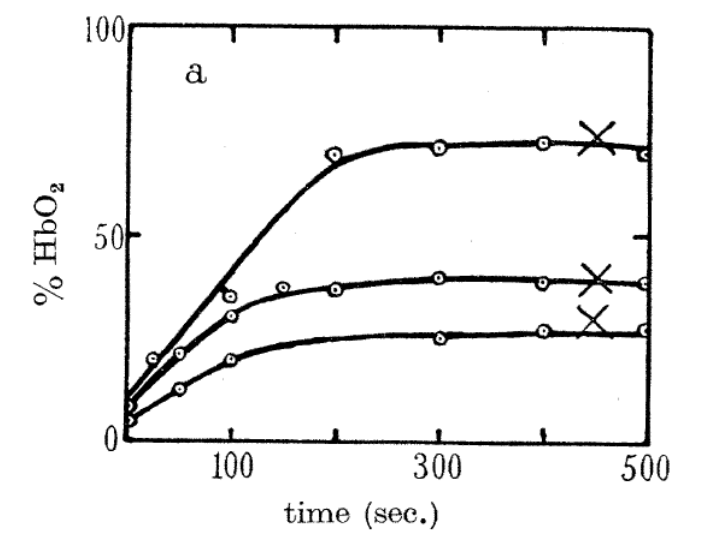
The fraction of bound haemoglobin \(\ce{HbO2}\) (with respect to the initial amount of \(\ce{Hb}\)) as a function of time. Crosses denote the end of the reaction
(Figure 2a from the original Hill’s paper: R. Hill. Oxygen produced by isolated chloroplasts. – Proc. R. Soc. B, 1939, v. 127, pp. 192-210.)
2.3 a. From the figure, estimate the \(\ce{Fe}\) / \(\ce{O2}\) mole ratio at the end of the reaction. Do not take into account the iron from \(\ce{Hb}\).
b. Write the equation of Hill reaction assuming that it proceeds with a high yield.
c. Using the table of standard electrode potentials, determine the Gibbs energy of the Hill reaction at \(T=298\ \mathrm{K}\), oxygen pressure \(1\ \mathrm{mm\,Hg}\), \(\mathrm{pH}=8\) and standard concentrations of other species. Is this reaction spontaneous at such conditions?
| Half-reaction | \(E^\circ,\ \mathrm{V}\) |
|---|---|
| \(\ce{O2 + 4H+ + 4e -> 2H2O}\) | \(+1.23\) |
| \(\ce{CO2 + 4H+ + 8e ->} \{\ce{CH2O}\} + \ce{H2O}\) | \(-0.01\) |
| \(\ce{Fe^3+ + e -> Fe^2+}\) | \(+0.77\) |
| \(\ce{Fe^3+ + 3e -> Fe^0}\) | \(-0.04\) |
| \(\ce{[Fe(C2O4)3]^3- + e -> [Fe(C2O4)3]^4-}\) | \(+0.05\) |
| \(\ce{[Fe(C2O4)3]^4- + 2e -> Fe + 3C2O4^2-}\) | \(-0.59\) |
Now, the name “Hill reaction” denotes photochemical oxidation of water by any oxidant other than carbon dioxide which is sensitized by plant cells or isolated chloroplasts.
In another experiment (1952), quinone in an acid solution was used as an oxidant in the Hill reaction initiated by light flashes in the Chlorella algae. Experimental data are shown in the figure. The volume of oxygen (in \(\mathrm{mm^3}\), at temperature \(10\,^\circ\mathrm{C}\) and pressure \(740\ \mathrm{mm\,Hg}\)) per one gram of chlorophyll per one flash was determined as a function of light intensity for natural photosynthesis and for isolated chloroplasts. It was found that the maximum yield of oxygen is the same for natural photosynthesis and the Hill reaction.
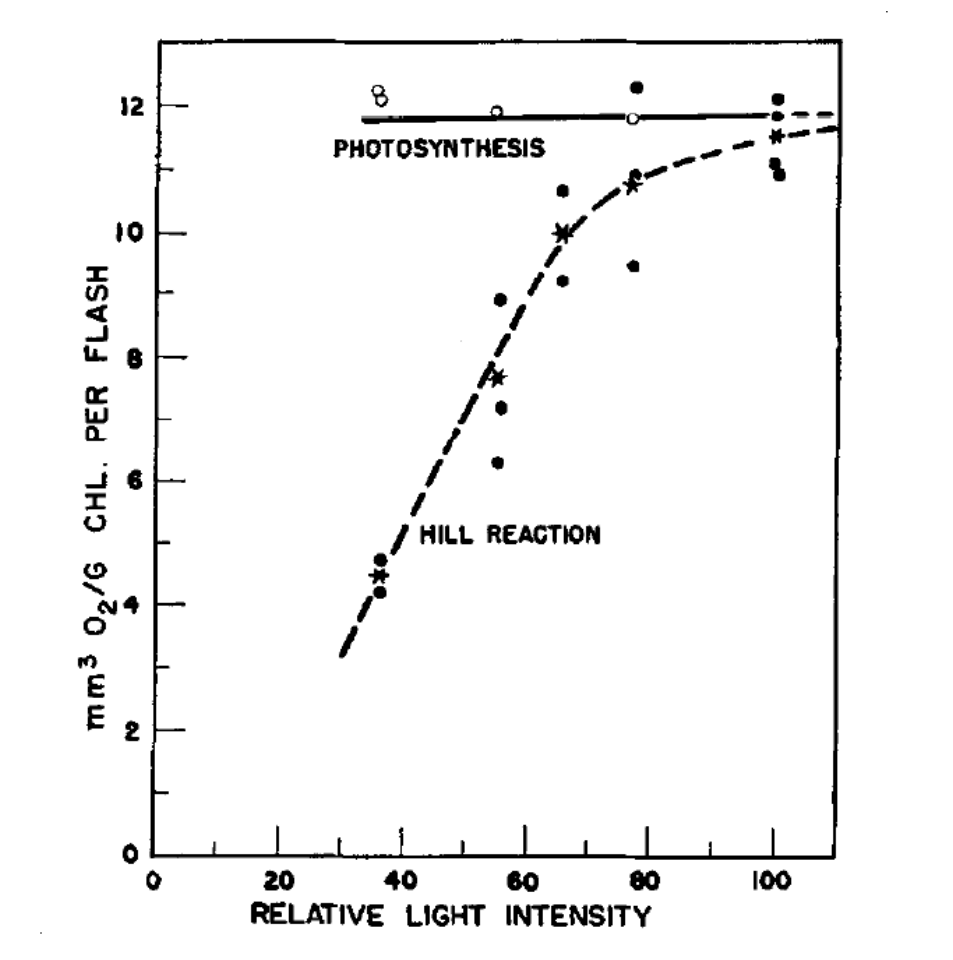
(Figure 1 from: H. Ehrmantraut, E. Rabinovitch. Kinetics of Hill reaction. – Archives of Biochemistry and Biophysics, 1952, v. 38, pp. 67-84)
2.4 a. Determine the reaction order of a photochemical Hill reaction with respect to light intensity at low and high intensity. For each case choose one of the following three values: 0, 1 or 2.
b. How many chlorophyll molecules participate in the formation of one oxygen molecule in the saturation limit of the Hill reaction? (The molecular mass of chlorophyll is about 900 Da).
The quantum requirement of the light redox reactions is defined as the average number of light photons (not necessarily integer) needed for the transfer of one electron from a reducing agent to an oxidant. The isolated chloroplasts were irradiated during 2 hours by a monochromatic light (wavelength \(672\ \mathrm{nm}\)) with the energy input \(0.503\ \mathrm{mJ\,s^{-1}}\), and the total volume of oxygen formed was \(47.6\ \mathrm{mm^3}\) (under the same conditions as in question 4).
2.5 Calculate the quantum requirement for the Hill reaction.
2.6 Try to make conclusions from the above experiments (questions 2.2 – 2.5). Tick the relevant boxes.
| Yes | No | |
|---|---|---|
| In natural photosynthesis, water oxidation and \(\ce{CO2}\) reduction are separated in space. | ||
| In chloroplasts, \(\ce{O2}\) is produced from \(\ce{CO2}\). | ||
| Oxidation of water in chloroplasts requires light illumination. | ||
| Most of chlorophylls in chloroplasts participate directly in the photochemical \(\ce{O2}\) production. | ||
| In isolated chloroplasts, every absorbed photon causes transfer of one electron. |
Official English text of the problem.
Answers
-
2.1 \[ \boxed{\ce{CO2 + H2O ->[light]} \{\ce{CH2O}\}+\ce{O2}} \]
-
2.2 In plant cells: oxidant \(\ce{CO2}\), reducing agent \(\ce{H2O}\). In Hill’s experiment: oxidant \(\ce{[Fe(C2O4)3]^3-}\), reducing agent \(\ce{H2O}\).
-
2.3(a) The graph gives approximately \(\boxed{n(\ce{Fe})/n(\ce{O2})=4.4}\). The ideal stoichiometric ratio is \(4:1\).
-
2.3(b) \[ \boxed{\ce{4[Fe(C2O4)3]^3- + 2H2O ->[light] 4[Fe(C2O4)3]^4- + O2 + 4H+}} \]
-
2.3(c) \(\boxed{\Delta_{\mathrm r}G\approx+256\ \mathrm{kJ\,mol^{-1}}}\), per mole of reaction as written, producing one mole of \(\ce{O2}\). The reaction is not thermodynamically spontaneous under the stated conditions.
-
2.4(a) Low light intensity: \(\boxed{1}\). High light intensity: \(\boxed{0}\).
-
2.4(b) Approximately \(\boxed{2.2\times10^3}\) chlorophyll molecules per oxygen molecule produced per saturating flash.
-
2.5 \(\boxed{2.55\ \text{photons per transferred electron}}\), interpreting the stated energy input as absorbed light energy.
-
2.6 In the order printed: \(\boxed{\text{Yes; No; Yes; No; No}}\), with the interpretive qualifications stated below.
Names and SMILES for the molecular species in these answers are provided at the start of the solution.
Solution
The relevant species are:
| Formula | Name | SMILES |
|---|---|---|
| \(\ce{CO2}\) | Carbon dioxide | O=C=O |
| \(\ce{H2O}\) | Water | O |
| \(\ce{O2}\) | Dioxygen | O=O |
| \(\ce{H+}\) | Hydrogen ion, or proton | [H+] |
| \(\ce{C2O4^2-}\) | Oxalate ion | [O-]C(=O)C(=O)[O-] |
| \(\ce{[Fe(C2O4)3]^3-}\) | Tris(oxalato)ferrate(III), or ferrioxalate | [Fe+3]123(<-[O-]C(=O)C(=O)[O-]->1)(<-[O-]C(=O)C(=O)[O-]->2)<-[O-]C(=O)C(=O)[O-]->3 |
| \(\ce{[Fe(C2O4)3]^4-}\) | Tris(oxalato)ferrate(II) | [Fe+2]123(<-[O-]C(=O)C(=O)[O-]->1)(<-[O-]C(=O)C(=O)[O-]->2)<-[O-]C(=O)C(=O)[O-]->3 |
The extended SMILES for the iron complexes use arrows for oxygen-to-iron coordinate bonds. Each oxalate ligand is bidentate, giving six oxygen donors in an approximately octahedral arrangement. Neither a particular \(\Delta\) nor \(\Lambda\) configuration is specified by the problem or encoded here. These bond arrows do not represent the electron flow of the redox reaction.
The notation \(\{\ce{CH2O}\}\) is a carbohydrate composition unit, not a uniquely specified molecule, so it has no unique SMILES. Likewise, the unspecified chlorophyll of approximate molecular mass \(900\ \mathrm{Da}\) does not identify a unique molecular structure.
2.1 — Overall photosynthesis equation
Carbon dioxide is reduced to carbohydrate, while water is oxidized to oxygen. The balanced half-reactions are
\[ \ce{CO2 + 4H+ + 4e^- ->} \{\ce{CH2O}\}+\ce{H2O} \]
and
\[ \ce{2H2O -> O2 + 4H+ + 4e^-}. \]
Adding them and cancelling the electrons, protons and one water molecule gives
\[ \boxed{\ce{CO2 + H2O ->[light]} \{\ce{CH2O}\}+\ce{O2}}. \]
This equation is written per carbon atom incorporated into carbohydrate.
2.2 — Oxidants and reducing agents
An oxidant accepts electrons and is reduced; a reducing agent supplies electrons and is oxidized.
| System | Oxidant | Reducing agent |
|---|---|---|
| Overall photosynthesis in plant cells | \(\ce{CO2}\) | \(\ce{H2O}\) |
| Hill reaction with ferrioxalate | \(\ce{[Fe(C2O4)3]^3-}\) | \(\ce{H2O}\) |
In photosynthesis, carbon’s average oxidation state decreases from \(+4\) in carbon dioxide to \(0\) in the carbohydrate composition unit. Oxygen in water increases in oxidation state from \(-2\) to \(0\).
In Hill’s experiment, the iron centre in ferrioxalate accepts an electron, changing from oxidation state \(+3\) to \(+2\). Water still supplies the electrons and the evolved oxygen. Oxygen evolution without carbon dioxide shows that carbon dioxide is not required as the oxygen source.
2.3(a) — Experimental iron-to-oxygen ratio
At the endpoint, the upper curve shows approximately \(75\%\) of the initial haemoglobin bound to oxygen. Because binding is \(1:1\),
\[ c(\ce{O2}) \approx0.75\,c_0(\ce{Hb}) =0.75(0.6\times10^{-4}) =4.5\times10^{-5}\ \mathrm{mol\,dm^{-3}}. \]
Each ferrioxalate ion contains one iron atom, so the initial concentration of iron supplied by ferrioxalate is
\[ c(\ce{Fe})=2.0\times10^{-4}\ \mathrm{mol\,dm^{-3}}. \]
Thus
\[ \boxed{ \frac{n(\ce{Fe})}{n(\ce{O2})} \approx \frac{2.0\times10^{-4}}{4.5\times10^{-5}} =4.4 }. \]
The graph therefore supports an ideal ratio of approximately four iron centres per oxygen molecule. For a \(4:1\) stoichiometry, the theoretical oxygen concentration is \(5.0\times10^{-5}\ \mathrm{mol\,dm^{-3}}\); the graph corresponds to about \(90\%\) of that amount.
2.3(b) — Balanced Hill reaction
Formation of one oxygen molecule from water releases four electrons:
\[ \ce{2H2O -> O2 + 4H+ + 4e^-}. \]
The inferred four iron centres per oxygen molecule therefore each accept one electron:
\[ \ce{[Fe(C2O4)3]^3- + e^- -> [Fe(C2O4)3]^4-}. \]
Multiplying this reduction half-reaction by four and adding gives
\[ \boxed{ \ce{4[Fe(C2O4)3]^3- + 2H2O ->[light] 4[Fe(C2O4)3]^4- + O2 + 4H+} }. \]
Both sides have total charge \(-12\), and all atoms are balanced.
2.3(c) — Gibbs energy under the specified conditions
The relevant standard reduction potentials are
\[ E^\circ_{\text{ferrioxalate}}=+0.05\ \mathrm{V}, \qquad E^\circ_{\ce{O2}/\ce{H2O}}=+1.23\ \mathrm{V}. \]
For ferrioxalate reduction coupled to water oxidation,
\[ E^\circ_{\mathrm{cell}}=0.05-1.23=-1.18\ \mathrm{V}. \]
Four electrons are transferred per reaction as written. Using \(F=96485\ \mathrm{C\,mol^{-1}}\),
\[ \Delta_{\mathrm r}G^\circ =-4FE^\circ_{\mathrm{cell}} =+455.4\ \mathrm{kJ\,mol^{-1}}. \]
The reaction quotient is
\[ Q= \frac{ a(\ce{[Fe(C2O4)3]^4-})^4 a(\ce{H+})^4 (p_{\ce{O2}}/p^\circ) }{ a(\ce{[Fe(C2O4)3]^3-})^4 a(\ce{H2O})^2 }. \]
Under the stated conditions, the complex activities and water activity are unity, while
\[ a(\ce{H+})=10^{-8}, \qquad \frac{p_{\ce{O2}}}{p^\circ}=\frac{1}{760} \]
using \(p^\circ=1\ \mathrm{atm}\). Therefore,
\[ Q=\frac{10^{-32}}{760}. \]
With \(R=8.314\ \mathrm{J\,mol^{-1}\,K^{-1}}\),
\[ \begin{aligned} \Delta_{\mathrm r}G &=\Delta_{\mathrm r}G^\circ+RT\ln Q\\ &=455.4+ \frac{8.314(298)}{1000} \ln\left(\frac{10^{-32}}{760}\right)\\ &=\boxed{+256.4\ \mathrm{kJ\,mol^{-1}}}. \end{aligned} \]
The positive Gibbs energy means that the chemical reaction is not spontaneous under these conditions. Light supplies energy to drive it.
2.4(a) — Dependence on light intensity
For flashes of fixed duration, the oxygen yield indicates how the photochemical reaction responds to intensity \(I\).
At low intensity, the rising portion of the Hill-reaction curve is approximately linear:
\[ Y_{\ce{O2}}\propto I, \]
so the apparent order is 1.
At high intensity, the curve approaches a plateau. Increasing intensity produces essentially no further increase in oxygen yield:
\[ Y_{\ce{O2}}\propto I^0, \]
so the apparent order is 0.
2.4(b) — Chlorophyll molecules per oxygen molecule
The saturation yield is approximately
\[ V_{\ce{O2}}=12\ \mathrm{mm^3} \]
per gram of chlorophyll per flash.
Convert the experimental conditions:
\[ T=283.15\ \mathrm{K}, \qquad p=\frac{740}{760}(101325) =9.866\times10^4\ \mathrm{Pa}, \]
\[ V_{\ce{O2}}=12\times10^{-9}\ \mathrm{m^3}. \]
The ideal-gas equation gives
\[ n(\ce{O2}) =\frac{pV}{RT} = \frac{(9.866\times10^4)(12\times10^{-9})} {8.314(283.15)} =5.03\times10^{-7}\ \mathrm{mol}. \]
One gram of chlorophyll contains approximately
\[ n(\text{chlorophyll}) =\frac{1\ \mathrm{g}}{900\ \mathrm{g\,mol^{-1}}} =1.11\times10^{-3}\ \mathrm{mol}. \]
The molecular ratio equals the molar ratio:
\[ \frac{N(\text{chlorophyll})}{N(\ce{O2})} = \frac{1.11\times10^{-3}}{5.03\times10^{-7}} \approx \boxed{2.2\times10^3}. \]
Thus about \(2200\) chlorophyll molecules are associated with the production of one oxygen molecule per saturating flash. This is an effective pigment-to-output ratio; it does not mean that all these pigments directly perform the oxygen-forming redox chemistry.
2.5 — Quantum requirement
The total light energy supplied is
\[ E_{\mathrm{light}} =(0.503\times10^{-3}\ \mathrm{J\,s^{-1}}) (2\times3600\ \mathrm{s}) =3.6216\ \mathrm{J}. \]
Using
\[ h=6.626\times10^{-34}\ \mathrm{J\,s}, \quad c=2.998\times10^8\ \mathrm{m\,s^{-1}}, \quad N_{\mathrm A}=6.022\times10^{23}\ \mathrm{mol^{-1}}, \]
the energy of one \(672\ \mathrm{nm}\) photon is
\[ \varepsilon_\gamma =\frac{hc}{\lambda} = \frac{(6.626\times10^{-34})(2.998\times10^8)} {672\times10^{-9}} =2.956\times10^{-19}\ \mathrm{J}. \]
The amount of photons is consequently
\[ n_\gamma =\frac{E_{\mathrm{light}}}{N_{\mathrm A}\varepsilon_\gamma} =2.034\times10^{-5}\ \mathrm{mol}. \]
At the same pressure and temperature as in 2.4,
\[ n(\ce{O2}) = \frac{(9.866\times10^4)(47.6\times10^{-9})} {8.314(283.15)} =1.995\times10^{-6}\ \mathrm{mol}. \]
Each oxygen molecule corresponds to four electrons transferred from water:
\[ n_e=4n(\ce{O2}) =7.979\times10^{-6}\ \mathrm{mol}. \]
Hence the quantum requirement is
\[ q=\frac{n_\gamma}{n_e} = \frac{2.034\times10^{-5}}{7.979\times10^{-6}} = \boxed{2.55\ \text{photons per electron}}. \]
Equivalently, approximately \(10.2\) photons are required per oxygen molecule formed. The reciprocal electron yield is about \(0.392\) net electrons transferred per photon.
2.6 — Conclusions
| Statement | Box to tick | Reason |
|---|---|---|
| In natural photosynthesis, water oxidation and \(\ce{CO2}\) reduction are separated in space. | Yes | This is the intended biological interpretation: water oxidation occurs at the thylakoid membrane, while carbon fixation occurs in the stroma. Hill’s experiment demonstrates that oxygen evolution can operate with an alternative electron acceptor. |
| In chloroplasts, \(\ce{O2}\) is produced from \(\ce{CO2}\). | No | Oxygen evolution occurs without carbon dioxide. Water is the oxygen source and electron donor. |
| Oxidation of water in chloroplasts requires light illumination. | Yes | The observed process is photochemical; the positive Gibbs energy calculated in 2.3(c) is consistent with its need for an energy input. |
| Most of chlorophylls in chloroplasts participate directly in the photochemical \(\ce{O2}\) production. | No | The large pigment-to-oxygen ratio is consistent with many chlorophyll molecules collecting and transferring excitation energy to a much smaller number of reaction centres. |
| In isolated chloroplasts, every absorbed photon causes transfer of one electron. | No | On the absorbed-energy interpretation of 2.5, approximately \(2.55\) photons are required per net electron transferred, giving only about \(0.392\) electron per photon. |
The solution was checked against the official solution.
IChO 2013 · Theorieaufgabe 2
Die Photosynthese aufschlüsseln – die Hill-Reaktion
In der Geschichte der Photosyntheseforschung gab es einige bahnbrechende Experimente, die wesentlich zu unserem Wissen über diesen sehr komplexen Prozess beigetragen haben. Eines dieser Experimente führte der englische Biochemiker Robert Hill in den 1930er-Jahren durch. In dieser Aufgabe betrachten wir einige seiner Daten zusammen mit Daten aus neueren Experimenten.
2.1 In Pflanzen wird unter Beleuchtung Kohlenstoffdioxid zu Kohlenhydraten (bezeichnet als \(\{\ce{CH2O}\}\)) reduziert, und Sauerstoff entsteht. Geben Sie die Gesamtgleichung der Photosynthese in Pflanzen an.
Ein großer Teil der Photosynthese findet in Chloroplasten statt – Organellen, die in Pflanzenzellen vorkommen und Chlorophyll enthalten, die lichtabsorbierende Substanz. Hill isolierte Chloroplasten aus den Zellen, indem er die Blätter in Saccharoselösungen zerrieb. Die zellfreien Chloroplasten erzeugten unter Beleuchtung selbst in Gegenwart von \(\ce{CO2}\) keinen Sauerstoff. Nach Zugabe von Kaliumferrioxalat \(\ce{K3[Fe(C2O4)3]}\) (mit einem Überschuss an Kaliumoxalat) zur Chloroplastensuspension beobachtete Hill jedoch unter Beleuchtung eine Sauerstofffreisetzung, auch ohne \(\ce{CO2}\).
2.2 Hills Experiment ermöglichte es, die Quelle des Sauerstoffs bei der Photosynthese zu bestimmen. Geben Sie die Formeln des Oxidationsmittels und des Reduktionsmittels bei der Photosynthese innerhalb der Pflanzenzellen und in den zellfreien Chloroplasten (Hill-Reaktion) an.
Hill maß die Menge des entwickelten Sauerstoffs mithilfe von Muskelhämoglobin (von Hill als \(\ce{Hb}\) bezeichnet), das den gesamten molekularen Sauerstoff im Verhältnis 1 : 1 unter Bildung von \(\ce{HbO2}\) bindet. Die Anfangskonzentration von \(\ce{Hb}\) betrug \(0.6\cdot10^{-4}\ \mathrm{mol\,dm^{-3}}\). Kinetische Kurven für verschiedene Ferrioxalatkonzentrationen sind in der Abbildung dargestellt (die obere Kurve entspricht \(2.0\cdot10^{-4}\ \mathrm{mol\,dm^{-3}}\)).
Der Anteil des gebundenen Hämoglobins \(\ce{HbO2}\) (bezogen auf die Anfangsmenge an \(\ce{Hb}\)) als Funktion der Zeit. Kreuze kennzeichnen das Ende der Reaktion
(Abbildung 2a aus Hills Originalarbeit: R. Hill. Von isolierten Chloroplasten erzeugter Sauerstoff. – Proc. R. Soc. B, 1939, Bd. 127, S. 192-210.)
2.3 a. Schätzen Sie anhand der Abbildung das Stoffmengenverhältnis \(\ce{Fe}\) / \(\ce{O2}\) am Ende der Reaktion ab. Berücksichtigen Sie dabei nicht das Eisen aus \(\ce{Hb}\).
b. Geben Sie die Gleichung der Hill-Reaktion unter der Annahme an, dass sie mit hoher Ausbeute abläuft.
c. Bestimmen Sie mithilfe der Tabelle der Standardelektrodenpotentiale die Gibbs-Energie der Hill-Reaktion bei \(T=298\ \mathrm{K}\), einem Sauerstoffdruck von \(1\ \mathrm{mm\,Hg}\), \(\mathrm{pH}=8\) und Standardkonzentrationen der übrigen Spezies. Läuft diese Reaktion unter diesen Bedingungen spontan ab?
| Teilreaktion | \(E^\circ,\ \mathrm{V}\) |
|---|---|
| \(\ce{O2 + 4H+ + 4e -> 2H2O}\) | \(+1.23\) |
| \(\ce{CO2 + 4H+ + 8e ->} \{\ce{CH2O}\} + \ce{H2O}\) | \(-0.01\) |
| \(\ce{Fe^3+ + e -> Fe^2+}\) | \(+0.77\) |
| \(\ce{Fe^3+ + 3e -> Fe^0}\) | \(-0.04\) |
| \(\ce{[Fe(C2O4)3]^3- + e -> [Fe(C2O4)3]^4-}\) | \(+0.05\) |
| \(\ce{[Fe(C2O4)3]^4- + 2e -> Fe + 3C2O4^2-}\) | \(-0.59\) |
Heute bezeichnet der Name „Hill-Reaktion“ die durch Pflanzenzellen oder isolierte Chloroplasten sensibilisierte photochemische Oxidation von Wasser durch ein beliebiges anderes Oxidationsmittel als Kohlenstoffdioxid.
In einem weiteren Experiment (1952) wurde Chinon in saurer Lösung als Oxidationsmittel bei der Hill-Reaktion eingesetzt, die durch Lichtblitze in Chlorella-Algen ausgelöst wurde. Die experimentellen Daten sind in der Abbildung dargestellt. Das Sauerstoffvolumen (in \(\mathrm{mm^3}\), bei einer Temperatur von \(10\,^\circ\mathrm{C}\) und einem Druck von \(740\ \mathrm{mm\,Hg}\)) pro Gramm Chlorophyll und pro Lichtblitz wurde als Funktion der Lichtintensität für die natürliche Photosynthese und für isolierte Chloroplasten bestimmt. Es zeigte sich, dass die maximale Sauerstoffausbeute bei der natürlichen Photosynthese und bei der Hill-Reaktion gleich ist.
(Abbildung 1 aus: H. Ehrmantraut, E. Rabinovitch. Kinetik der Hill-Reaktion. – Archives of Biochemistry and Biophysics, 1952, Bd. 38, S. 67-84)
2.4 a. Bestimmen Sie die Reaktionsordnung einer photochemischen Hill-Reaktion bezüglich der Lichtintensität bei niedriger und bei hoher Intensität. Wählen Sie für jeden Fall einen der folgenden drei Werte: 0, 1 oder 2.
b. Wie viele Chlorophyllmoleküle sind im Sättigungsbereich der Hill-Reaktion an der Bildung eines Sauerstoffmoleküls beteiligt? (Die Molekülmasse von Chlorophyll beträgt etwa 900 Da).
Der Quantenbedarf der lichtgetriebenen Redoxreaktionen ist definiert als die durchschnittliche Anzahl von Lichtphotonen (nicht notwendigerweise ganzzahlig), die für die Übertragung eines Elektrons von einem Reduktionsmittel auf ein Oxidationsmittel benötigt wird. Die isolierten Chloroplasten wurden 2 Stunden lang mit monochromatischem Licht (Wellenlänge \(672\ \mathrm{nm}\)) bei einer Energiezufuhr von \(0.503\ \mathrm{mJ\,s^{-1}}\) bestrahlt, und das Gesamtvolumen des gebildeten Sauerstoffs betrug \(47.6\ \mathrm{mm^3}\) (unter denselben Bedingungen wie in Frage 4).
2.5 Berechnen Sie den Quantenbedarf der Hill-Reaktion.
2.6 Versuchen Sie, aus den obigen Experimenten (Fragen 2.2 – 2.5) Schlussfolgerungen zu ziehen. Kreuzen Sie die entsprechenden Kästchen an.
| Ja | Nein | |
|---|---|---|
| Bei der natürlichen Photosynthese sind die Oxidation von Wasser und die Reduktion von \(\ce{CO2}\) räumlich voneinander getrennt. | ||
| In Chloroplasten wird \(\ce{O2}\) aus \(\ce{CO2}\) gebildet. | ||
| Die Oxidation von Wasser in Chloroplasten erfordert Beleuchtung. | ||
| Die meisten Chlorophyllmoleküle in Chloroplasten sind direkt an der photochemischen Bildung von \(\ce{O2}\) beteiligt. | ||
| In isolierten Chloroplasten bewirkt jedes absorbierte Photon die Übertragung eines Elektrons. |
Aufgabentext aus dem offiziellen englischen Text übersetzt.
Antworten
-
2.1 \[ \boxed{\ce{CO2 + H2O ->[light]} \{\ce{CH2O}\}+\ce{O2}} \]
-
2.2 In Pflanzenzellen: Oxidationsmittel \(\ce{CO2}\), Reduktionsmittel \(\ce{H2O}\). In Hills Experiment: Oxidationsmittel \(\ce{[Fe(C2O4)3]^3-}\), Reduktionsmittel \(\ce{H2O}\).
-
2.3(a) Aus dem Diagramm ergibt sich näherungsweise \(\boxed{n(\ce{Fe})/n(\ce{O2})=4.4}\). Das ideale stöchiometrische Verhältnis beträgt \(4:1\).
-
2.3(b) \[ \boxed{\ce{4[Fe(C2O4)3]^3- + 2H2O ->[light] 4[Fe(C2O4)3]^4- + O2 + 4H+}} \]
-
2.3(c) \(\boxed{\Delta_{\mathrm r}G\approx+256\ \mathrm{kJ\,mol^{-1}}}\), pro Mol der Reaktion in der angegebenen Form, bei der ein Mol \(\ce{O2}\) entsteht. Die Reaktion läuft unter den angegebenen Bedingungen thermodynamisch nicht spontan ab.
-
2.4(a) Niedrige Lichtintensität: \(\boxed{1}\). Hohe Lichtintensität: \(\boxed{0}\).
-
2.4(b) Ungefähr \(\boxed{2.2\times10^3}\) Chlorophyllmoleküle pro Sauerstoffmolekül, das pro sättigendem Lichtblitz gebildet wird.
-
2.5 \(\boxed{2.55\ \text{Photonen pro übertragenem Elektron}}\), wenn die angegebene Energiezufuhr als absorbierte Lichtenergie interpretiert wird.
-
2.6 In der angegebenen Reihenfolge: \(\boxed{\text{Ja; Nein; Ja; Nein; Nein}}\), mit den unten genannten Einschränkungen der Interpretation.
Namen und SMILES der molekularen Spezies in diesen Antworten sind am Anfang der Lösung angegeben.
Lösung
Die relevanten Spezies sind:
| Formel | Name | SMILES |
|---|---|---|
| \(\ce{CO2}\) | Kohlenstoffdioxid | O=C=O |
| \(\ce{H2O}\) | Wasser | O |
| \(\ce{O2}\) | Disauerstoff | O=O |
| \(\ce{H+}\) | Wasserstoffion oder Proton | [H+] |
| \(\ce{C2O4^2-}\) | Oxalat-Ion | [O-]C(=O)C(=O)[O-] |
| \(\ce{[Fe(C2O4)3]^3-}\) | Tris(oxalato)ferrat(III) oder Ferrioxalat | [Fe+3]123(<-[O-]C(=O)C(=O)[O-]->1)(<-[O-]C(=O)C(=O)[O-]->2)<-[O-]C(=O)C(=O)[O-]->3 |
| \(\ce{[Fe(C2O4)3]^4-}\) | Tris(oxalato)ferrat(II) | [Fe+2]123(<-[O-]C(=O)C(=O)[O-]->1)(<-[O-]C(=O)C(=O)[O-]->2)<-[O-]C(=O)C(=O)[O-]->3 |
Die erweiterten SMILES für die Eisenkomplexe verwenden Pfeile für koordinative Bindungen vom Sauerstoff zum Eisen. Jeder Oxalatligand ist zweizähnig, sodass sechs Sauerstoffdonoren in einer annähernd oktaedrischen Anordnung vorliegen. Weder eine bestimmte \(\Delta\)- noch eine \(\Lambda\)-Konfiguration wird in der Aufgabe vorgegeben oder hier codiert. Diese Bindungspfeile stellen nicht den Elektronenfluss der Redoxreaktion dar.
Die Schreibweise \(\{\ce{CH2O}\}\) bezeichnet eine Zusammensetzungseinheit eines Kohlenhydrats, kein eindeutig festgelegtes Molekül; daher gibt es dafür keinen eindeutigen SMILES. Ebenso legt das nicht näher spezifizierte Chlorophyll mit einer ungefähren Molekülmasse von \(900\ \mathrm{Da}\) keine eindeutige Molekülstruktur fest.
2.1 — Gesamtgleichung der Photosynthese
Kohlenstoffdioxid wird zu Kohlenhydrat reduziert, während Wasser zu Sauerstoff oxidiert wird. Die ausgeglichenen Teilreaktionen lauten
\[ \ce{CO2 + 4H+ + 4e^- ->} \{\ce{CH2O}\}+\ce{H2O} \]
und
\[ \ce{2H2O -> O2 + 4H+ + 4e^-}. \]
Durch Addition und Kürzen der Elektronen, Protonen und eines Wassermoleküls ergibt sich
\[ \boxed{\ce{CO2 + H2O ->[light]} \{\ce{CH2O}\}+\ce{O2}}. \]
Diese Gleichung ist pro Kohlenstoffatom angegeben, das in ein Kohlenhydrat eingebaut wird.
2.2 — Oxidationsmittel und Reduktionsmittel
Ein Oxidationsmittel nimmt Elektronen auf und wird reduziert; ein Reduktionsmittel gibt Elektronen ab und wird oxidiert.
| System | Oxidationsmittel | Reduktionsmittel |
|---|---|---|
| Gesamte Photosynthese in Pflanzenzellen | \(\ce{CO2}\) | \(\ce{H2O}\) |
| Hill-Reaktion mit Ferrioxalat | \(\ce{[Fe(C2O4)3]^3-}\) | \(\ce{H2O}\) |
Bei der Photosynthese sinkt die mittlere Oxidationszahl des Kohlenstoffs von \(+4\) im Kohlenstoffdioxid auf \(0\) in der Zusammensetzungseinheit des Kohlenhydrats. Die Oxidationszahl des Sauerstoffs im Wasser steigt von \(-2\) auf \(0\).
In Hills Experiment nimmt das Eisenzentrum im Ferrioxalat ein Elektron auf, wobei sich seine Oxidationszahl von \(+3\) auf \(+2\) ändert. Wasser liefert weiterhin die Elektronen und den freigesetzten Sauerstoff. Die Sauerstoffentwicklung ohne Kohlenstoffdioxid zeigt, dass Kohlenstoffdioxid nicht als Sauerstoffquelle erforderlich ist.
2.3(a) — Experimentelles Eisen-Sauerstoff-Verhältnis
Am Endpunkt zeigt die obere Kurve, dass ungefähr \(75\%\) des anfänglich vorhandenen Hämoglobins an Sauerstoff gebunden sind. Da die Bindung im Verhältnis \(1:1\) erfolgt, gilt
\[ c(\ce{O2}) \approx0.75\,c_0(\ce{Hb}) =0.75(0.6\times10^{-4}) =4.5\times10^{-5}\ \mathrm{mol\,dm^{-3}}. \]
Jedes Ferrioxalat-Ion enthält ein Eisenatom, daher beträgt die Anfangskonzentration des durch Ferrioxalat eingebrachten Eisens
\[ c(\ce{Fe})=2.0\times10^{-4}\ \mathrm{mol\,dm^{-3}}. \]
Somit gilt
\[ \boxed{ \frac{n(\ce{Fe})}{n(\ce{O2})} \approx \frac{2.0\times10^{-4}}{4.5\times10^{-5}} =4.4 }. \]
Das Diagramm stützt somit ein ideales Verhältnis von ungefähr vier Eisenzentren pro Sauerstoffmolekül. Bei einer Stöchiometrie von \(4:1\) beträgt die theoretische Sauerstoffkonzentration \(5.0\times10^{-5}\ \mathrm{mol\,dm^{-3}}\); das Diagramm entspricht etwa \(90\%\) dieser Menge.
2.3(b) — Ausgeglichene Hill-Reaktion
Bei der Bildung eines Sauerstoffmoleküls aus Wasser werden vier Elektronen freigesetzt:
\[ \ce{2H2O -> O2 + 4H+ + 4e^-}. \]
Die aus dem Experiment erschlossenen vier Eisenzentren pro Sauerstoffmolekül nehmen daher jeweils ein Elektron auf:
\[ \ce{[Fe(C2O4)3]^3- + e^- -> [Fe(C2O4)3]^4-}. \]
Die Multiplikation dieser Reduktionshalbgleichung mit vier und die anschließende Addition ergeben
\[ \boxed{ \ce{4[Fe(C2O4)3]^3- + 2H2O ->[light] 4[Fe(C2O4)3]^4- + O2 + 4H+} }. \]
Beide Seiten haben die Gesamtladung \(-12\), und die Bilanz aller Atome ist ausgeglichen.
2.3(c) — Gibbs-Energie unter den angegebenen Bedingungen
Die relevanten Standardreduktionspotentiale sind
\[ E^\circ_{\text{Ferrioxalat}}=+0.05\ \mathrm{V}, \qquad E^\circ_{\ce{O2}/\ce{H2O}}=+1.23\ \mathrm{V}. \]
Für die mit der Wasseroxidation gekoppelte Ferrioxalatreduktion gilt
\[ E^\circ_{\mathrm{cell}}=0.05-1.23=-1.18\ \mathrm{V}. \]
Pro Reaktion in der angegebenen Form werden vier Elektronen übertragen. Mit \(F=96485\ \mathrm{C\,mol^{-1}}\) ergibt sich
\[ \Delta_{\mathrm r}G^\circ =-4FE^\circ_{\mathrm{cell}} =+455.4\ \mathrm{kJ\,mol^{-1}}. \]
Der Reaktionsquotient lautet
\[ Q= \frac{ a(\ce{[Fe(C2O4)3]^4-})^4 a(\ce{H+})^4 (p_{\ce{O2}}/p^\circ) }{ a(\ce{[Fe(C2O4)3]^3-})^4 a(\ce{H2O})^2 }. \]
Unter den angegebenen Bedingungen sind die Aktivitäten der Komplexe und des Wassers gleich eins, während
\[ a(\ce{H+})=10^{-8}, \qquad \frac{p_{\ce{O2}}}{p^\circ}=\frac{1}{760} \]
bei Verwendung von \(p^\circ=1\ \mathrm{atm}\) gilt. Daher ist
\[ Q=\frac{10^{-32}}{760}. \]
Mit \(R=8.314\ \mathrm{J\,mol^{-1}\,K^{-1}}\) ergibt sich
\[ \begin{aligned} \Delta_{\mathrm r}G &=\Delta_{\mathrm r}G^\circ+RT\ln Q\\ &=455.4+ \frac{8.314(298)}{1000} \ln\left(\frac{10^{-32}}{760}\right)\\ &=\boxed{+256.4\ \mathrm{kJ\,mol^{-1}}}. \end{aligned} \]
Die positive Gibbs-Energie bedeutet, dass die chemische Reaktion unter diesen Bedingungen nicht spontan abläuft. Licht liefert die Energie, um sie anzutreiben.
2.4(a) — Abhängigkeit von der Lichtintensität
Bei Lichtblitzen fester Dauer zeigt die Sauerstoffausbeute, wie die photochemische Reaktion auf die Intensität \(I\) reagiert.
Bei niedriger Intensität ist der ansteigende Abschnitt der Kurve für die Hill-Reaktion annähernd linear:
\[ Y_{\ce{O2}}\propto I, \]
also beträgt die scheinbare Reaktionsordnung 1.
Bei hoher Intensität nähert sich die Kurve einem Plateau. Eine Erhöhung der Intensität führt praktisch zu keiner weiteren Zunahme der Sauerstoffausbeute:
\[ Y_{\ce{O2}}\propto I^0, \]
also beträgt die scheinbare Reaktionsordnung 0.
2.4(b) — Chlorophyllmoleküle pro Sauerstoffmolekül
Die Sättigungsausbeute beträgt ungefähr
\[ V_{\ce{O2}}=12\ \mathrm{mm^3} \]
pro Gramm Chlorophyll und pro Lichtblitz.
Die experimentellen Bedingungen werden umgerechnet:
\[ T=283.15\ \mathrm{K}, \qquad p=\frac{740}{760}(101325) =9.866\times10^4\ \mathrm{Pa}, \]
\[ V_{\ce{O2}}=12\times10^{-9}\ \mathrm{m^3}. \]
Die ideale Gasgleichung ergibt
\[ n(\ce{O2}) =\frac{pV}{RT} = \frac{(9.866\times10^4)(12\times10^{-9})} {8.314(283.15)} =5.03\times10^{-7}\ \mathrm{mol}. \]
Ein Gramm Chlorophyll enthält ungefähr
\[ n(\text{Chlorophyll}) =\frac{1\ \mathrm{g}}{900\ \mathrm{g\,mol^{-1}}} =1.11\times10^{-3}\ \mathrm{mol}. \]
Das Verhältnis der Molekülzahlen entspricht dem Stoffmengenverhältnis:
\[ \frac{N(\text{Chlorophyll})}{N(\ce{O2})} = \frac{1.11\times10^{-3}}{5.03\times10^{-7}} \approx \boxed{2.2\times10^3}. \]
Somit entfallen etwa \(2200\) Chlorophyllmoleküle auf die Bildung eines Sauerstoffmoleküls pro sättigendem Lichtblitz. Dies ist ein effektives Verhältnis von Pigmentmenge zu Produktausbeute; es bedeutet nicht, dass all diese Pigmente direkt die sauerstoffbildende Redoxreaktion durchführen.
2.5 — Quantenbedarf
Die insgesamt zugeführte Lichtenergie beträgt
\[ E_{\mathrm{light}} =(0.503\times10^{-3}\ \mathrm{J\,s^{-1}}) (2\times3600\ \mathrm{s}) =3.6216\ \mathrm{J}. \]
Mit
\[ h=6.626\times10^{-34}\ \mathrm{J\,s}, \quad c=2.998\times10^8\ \mathrm{m\,s^{-1}}, \quad N_{\mathrm A}=6.022\times10^{23}\ \mathrm{mol^{-1}}, \]
beträgt die Energie eines Photons mit einer Wellenlänge von \(672\ \mathrm{nm}\)
\[ \varepsilon_\gamma =\frac{hc}{\lambda} = \frac{(6.626\times10^{-34})(2.998\times10^8)} {672\times10^{-9}} =2.956\times10^{-19}\ \mathrm{J}. \]
Die Stoffmenge der Photonen beträgt folglich
\[ n_\gamma =\frac{E_{\mathrm{light}}}{N_{\mathrm A}\varepsilon_\gamma} =2.034\times10^{-5}\ \mathrm{mol}. \]
Bei demselben Druck und derselben Temperatur wie in 2.4 gilt
\[ n(\ce{O2}) = \frac{(9.866\times10^4)(47.6\times10^{-9})} {8.314(283.15)} =1.995\times10^{-6}\ \mathrm{mol}. \]
Jedes Sauerstoffmolekül entspricht vier aus Wasser übertragenen Elektronen:
\[ n_e=4n(\ce{O2}) =7.979\times10^{-6}\ \mathrm{mol}. \]
Damit beträgt der Quantenbedarf
\[ q=\frac{n_\gamma}{n_e} = \frac{2.034\times10^{-5}}{7.979\times10^{-6}} = \boxed{2.55\ \text{Photonen pro Elektron}}. \]
Gleichbedeutend damit werden ungefähr \(10.2\) Photonen pro gebildetem Sauerstoffmolekül benötigt. Die als Kehrwert erhaltene Elektronenausbeute beträgt etwa \(0.392\) netto übertragene Elektronen pro Photon.
2.6 — Schlussfolgerungen
| Aussage | Anzukreuzendes Kästchen | Begründung |
|---|---|---|
| Bei der natürlichen Photosynthese sind die Oxidation von Wasser und die Reduktion von \(\ce{CO2}\) räumlich voneinander getrennt. | Ja | Dies ist die beabsichtigte biologische Interpretation: Die Wasseroxidation findet an der Thylakoidmembran statt, während die Kohlenstofffixierung im Stroma erfolgt. Hills Experiment zeigt, dass die Sauerstoffentwicklung mit einem alternativen Elektronenakzeptor ablaufen kann. |
| In Chloroplasten wird \(\ce{O2}\) aus \(\ce{CO2}\) gebildet. | Nein | Die Sauerstoffentwicklung erfolgt ohne Kohlenstoffdioxid. Wasser ist die Sauerstoffquelle und der Elektronendonator. |
| Die Oxidation von Wasser in Chloroplasten erfordert Beleuchtung. | Ja | Der beobachtete Prozess ist photochemisch; die in 2.3(c) berechnete positive Gibbs-Energie steht im Einklang mit der erforderlichen Energiezufuhr. |
| Die meisten Chlorophyllmoleküle in Chloroplasten sind direkt an der photochemischen Bildung von \(\ce{O2}\) beteiligt. | Nein | Das große Verhältnis von Pigmentmenge zu Sauerstoffmenge steht im Einklang damit, dass viele Chlorophyllmoleküle Anregungsenergie sammeln und an eine wesentlich kleinere Zahl von Reaktionszentren weiterleiten. |
| In isolierten Chloroplasten bewirkt jedes absorbierte Photon die Übertragung eines Elektrons. | Nein | Bei der Interpretation der Energie in 2.5 als absorbierte Energie werden ungefähr \(2.55\) Photonen pro netto übertragenem Elektron benötigt, was nur etwa \(0.392\) Elektronen pro Photon ergibt. |
Die Lösung wurde mit der offiziellen Lösung abgeglichen.
IChO 2013 · Teori sorusu 2
Fotosentezi bileşenlerine ayırmak – Hill tepkimesi
Fotosentez araştırmalarının tarihinde, bu çok karmaşık süreç hakkındaki bilgimize büyük katkılar sağlayan çığır açıcı deneyler yapılmıştır. Bu deneylerden biri, 1930'larda İngiliz biyokimyacı Robert Hill tarafından gerçekleştirilmiştir. Bu soruda, onun bazı verilerini daha yakın tarihli deneylerin verileriyle birlikte ele alacağız.
2.1 Bitkilerde, ışık altında, karbon dioksit karbonhidratlara (\(\{\ce{CH2O}\}\) ile gösterilsin) indirgenir ve oksijen üretilir. Bitkilerde fotosentezin toplam denklemini yazınız.
Fotosentezin büyük bir bölümü, bitki hücrelerinde bulunan ve ışığı soğuran madde olan klorofili içeren organellerde, yani kloroplastlarda gerçekleşir. Hill, yaprakları sakkaroz çözeltilerinde öğüterek kloroplastları hücrelerden izole etmiştir. Hücrelerden ayrılmış kloroplastlar, \(\ce{CO2}\) varlığında bile ışık altında oksijen üretmemiştir. Ancak Hill, kloroplast süspansiyonuna potasyum ferrioksalat \(\ce{K3[Fe(C2O4)3]}\) (aşırı miktarda potasyum oksalat ile birlikte) eklediğinde, \(\ce{CO2}\) olmadan bile ışık altında oksijen açığa çıktığını gözlemlemiştir.
2.2 Hill'in deneyi, fotosentez sırasında oksijenin kaynağının belirlenmesini sağlamıştır. Bitki hücrelerindeki fotosentezde ve hücrelerden ayrılmış kloroplastlardaki tepkimede (Hill tepkimesi) yükseltgenin ve indirgenin formüllerini yazınız.
Hill, açığa çıkan oksijenin miktarını, moleküler oksijenin tamamını 1 : 1 oranında bağlayarak \(\ce{HbO2}\) oluşturan kas hemoglobinini (Hill bunu \(\ce{Hb}\) ile göstermiştir) kullanarak ölçmüştür. \(\ce{Hb}\)'nin başlangıç derişimi \(0.6\cdot10^{-4}\ \mathrm{mol\,dm^{-3}}\) idi. Farklı ferrioksalat derişimlerine karşılık gelen kinetik eğriler şekilde gösterilmiştir (üstteki eğri \(2.0\cdot10^{-4}\ \mathrm{mol\,dm^{-3}}\) derişimine karşılık gelmektedir).
Bağlanmış hemoglobinin \(\ce{HbO2}\) payının (başlangıçtaki \(\ce{Hb}\) miktarına göre) zamanın fonksiyonu olarak değişimi. Çarpı işaretleri tepkimenin sonunu göstermektedir
(Hill'in özgün makalesinden Şekil 2a: R. Hill. İzole kloroplastların ürettiği oksijen. – Proc. R. Soc. B, 1939, c. 127, s. 192-210.)
2.3 a. Şekilden, tepkimenin sonundaki \(\ce{Fe}\) / \(\ce{O2}\) mol oranını tahmin ediniz. \(\ce{Hb}\)'den gelen demiri hesaba katmayınız.
b. Yüksek verimle gerçekleştiğini varsayarak Hill tepkimesinin denklemini yazınız.
c. Standart elektrot potansiyelleri tablosunu kullanarak, \(T=298\ \mathrm{K}\), oksijen basıncı \(1\ \mathrm{mm\,Hg}\), \(\mathrm{pH}=8\) ve diğer türlerin standart derişimleri için Hill tepkimesinin Gibbs enerjisini belirleyiniz. Bu tepkime, söz konusu koşullarda kendiliğinden gerçekleşir mi?
| Yarı tepkime | \(E^\circ,\ \mathrm{V}\) |
|---|---|
| \(\ce{O2 + 4H+ + 4e -> 2H2O}\) | \(+1.23\) |
| \(\ce{CO2 + 4H+ + 8e ->} \{\ce{CH2O}\} + \ce{H2O}\) | \(-0.01\) |
| \(\ce{Fe^3+ + e -> Fe^2+}\) | \(+0.77\) |
| \(\ce{Fe^3+ + 3e -> Fe^0}\) | \(-0.04\) |
| \(\ce{[Fe(C2O4)3]^3- + e -> [Fe(C2O4)3]^4-}\) | \(+0.05\) |
| \(\ce{[Fe(C2O4)3]^4- + 2e -> Fe + 3C2O4^2-}\) | \(-0.59\) |
Günümüzde “Hill tepkimesi” adı, bitki hücrelerinin veya izole kloroplastların ışığa duyarlılaştırıcı etkisiyle, suyun karbon dioksit dışındaki herhangi bir yükseltgen tarafından fotokimyasal olarak yükseltgenmesini ifade eder.
Başka bir deneyde (1952), Chlorella alglerinde ışık flaşlarıyla başlatılan Hill tepkimesinde yükseltgen olarak asidik çözeltideki kinon kullanılmıştır. Deneysel veriler şekilde gösterilmiştir. Doğal fotosentez ve izole kloroplastlar için, bir gram klorofil başına ve bir flaş başına oksijen hacmi (\(10\,^\circ\mathrm{C}\) sıcaklık ve \(740\ \mathrm{mm\,Hg}\) basınçta, \(\mathrm{mm^3}\) cinsinden), ışık şiddetinin fonksiyonu olarak belirlenmiştir. En yüksek oksijen veriminin doğal fotosentez ve Hill tepkimesi için aynı olduğu bulunmuştur.
(H. Ehrmantraut, E. Rabinovitch. Hill tepkimesinin kinetiği. – Archives of Biochemistry and Biophysics, 1952, c. 38, s. 67-84 kaynağından Şekil 1)
2.4 a. Fotokimyasal Hill tepkimesinin ışık şiddetine göre tepkime derecesini düşük ve yüksek ışık şiddetlerinde belirleyiniz. Her durum için şu üç değerden birini seçiniz: 0, 1 veya 2.
b. Hill tepkimesinin doygunluk sınırında, bir oksijen molekülünün oluşumuna kaç klorofil molekülü katılır? (Klorofilin molekül kütlesi yaklaşık 900 Da'dır).
Işıkla gerçekleşen redoks tepkimelerinin kuantum gereksinimi, bir elektronun indirgenden yükseltgene aktarılması için gereken ortalama ışık fotonu sayısı (tam sayı olmak zorunda değildir) olarak tanımlanır. İzole kloroplastlar, \(0.503\ \mathrm{mJ\,s^{-1}}\) enerji girdisine sahip tek renkli ışıkla (dalga boyu \(672\ \mathrm{nm}\)) 2 saat boyunca ışınlanmış ve oluşan toplam oksijen hacmi \(47.6\ \mathrm{mm^3}\) olmuştur (4. sorudaki koşulların aynısında).
2.5 Hill tepkimesinin kuantum gereksinimini hesaplayınız.
2.6 Yukarıdaki deneylerden (2.2 – 2.5 soruları) sonuçlar çıkarmaya çalışınız. İlgili kutuları işaretleyiniz.
| Evet | Hayır | |
|---|---|---|
| Doğal fotosentezde, suyun yükseltgenmesi ve \(\ce{CO2}\)'nin indirgenmesi farklı yerlerde gerçekleşir. | ||
| Kloroplastlarda, \(\ce{O2}\), \(\ce{CO2}\)'den üretilir. | ||
| Kloroplastlarda suyun yükseltgenmesi, ışıkla aydınlatılmayı gerektirir. | ||
| Kloroplastlardaki klorofillerin çoğu, fotokimyasal \(\ce{O2}\) üretimine doğrudan katılır. | ||
| İzole kloroplastlarda, soğurulan her foton bir elektronun aktarılmasına neden olur. |
Soru metni resmi İngilizce metinden çevrilmiştir.
Cevaplar
-
2.1 \[ \boxed{\ce{CO2 + H2O ->[light]} \{\ce{CH2O}\}+\ce{O2}} \]
-
2.2 Bitki hücrelerinde: yükseltgen \(\ce{CO2}\), indirgen \(\ce{H2O}\). Hill'in deneyinde: yükseltgen \(\ce{[Fe(C2O4)3]^3-}\), indirgen \(\ce{H2O}\).
-
2.3(a) Grafik yaklaşık olarak \(\boxed{n(\ce{Fe})/n(\ce{O2})=4.4}\) verir. İdeal stokiyometrik oran \(4:1\)'dir.
-
2.3(b) \[ \boxed{\ce{4[Fe(C2O4)3]^3- + 2H2O ->[light] 4[Fe(C2O4)3]^4- + O2 + 4H+}} \]
-
2.3(c) Yazıldığı biçimiyle bir mol \(\ce{O2}\) üreten tepkimenin molü başına \(\boxed{\Delta_{\mathrm r}G\approx+256\ \mathrm{kJ\,mol^{-1}}}\). Tepkime, belirtilen koşullarda termodinamik olarak kendiliğinden gerçekleşmez.
-
2.4(a) Düşük ışık şiddeti: \(\boxed{1}\). Yüksek ışık şiddeti: \(\boxed{0}\).
-
2.4(b) Doygunluk sağlayan her flaşta üretilen oksijen molekülü başına yaklaşık \(\boxed{2.2\times10^3}\) klorofil molekülü.
-
2.5 Belirtilen enerji girdisi soğurulan ışık enerjisi olarak yorumlandığında, \(\boxed{2.55\ \text{aktarılan elektron başına foton}}\).
-
2.6 Verilen sırayla: \(\boxed{\text{Evet; Hayır; Evet; Hayır; Hayır}}\); yorumlamaya ilişkin aşağıda belirtilen sınırlamalar geçerlidir.
Bu cevaplardaki moleküler türlerin adları ve SMILES gösterimleri çözümün başında verilmiştir.
Çözüm
İlgili türler şunlardır:
| Formül | Ad | SMILES |
|---|---|---|
| \(\ce{CO2}\) | Karbon dioksit | O=C=O |
| \(\ce{H2O}\) | Su | O |
| \(\ce{O2}\) | Dioksijen | O=O |
| \(\ce{H+}\) | Hidrojen iyonu veya proton | [H+] |
| \(\ce{C2O4^2-}\) | Oksalat iyonu | [O-]C(=O)C(=O)[O-] |
| \(\ce{[Fe(C2O4)3]^3-}\) | Tris(oksalato)ferrat(III) veya ferrioksalat | [Fe+3]123(<-[O-]C(=O)C(=O)[O-]->1)(<-[O-]C(=O)C(=O)[O-]->2)<-[O-]C(=O)C(=O)[O-]->3 |
| \(\ce{[Fe(C2O4)3]^4-}\) | Tris(oksalato)ferrat(II) | [Fe+2]123(<-[O-]C(=O)C(=O)[O-]->1)(<-[O-]C(=O)C(=O)[O-]->2)<-[O-]C(=O)C(=O)[O-]->3 |
Demir komplekslerinin genişletilmiş SMILES gösterimlerinde, oksijenden demire doğru koordinatif bağlar için oklar kullanılmıştır. Her oksalat ligandı iki dişlidir ve yaklaşık oktahedral bir düzende altı oksijen donörü sağlar. Soruda belirli bir \(\Delta\) veya \(\Lambda\) konfigürasyonu belirtilmemiştir ve burada da kodlanmamıştır. Bu bağ okları, redoks tepkimesindeki elektron akışını göstermez.
\(\{\ce{CH2O}\}\) gösterimi, tek bir molekülü değil, karbonhidratın bileşim birimini ifade eder; dolayısıyla tek bir SMILES gösterimi yoktur. Benzer şekilde, yaklaşık molekül kütlesi \(900\ \mathrm{Da}\) olan, türü belirtilmemiş klorofil de tek bir moleküler yapıyı tanımlamaz.
2.1 — Fotosentezin toplam denklemi
Karbon dioksit karbonhidrata indirgenirken su oksijene yükseltgenir. Denkleştirilmiş yarı tepkimeler şunlardır:
\[ \ce{CO2 + 4H+ + 4e^- ->} \{\ce{CH2O}\}+\ce{H2O} \]
ve
\[ \ce{2H2O -> O2 + 4H+ + 4e^-}. \]
Bu tepkimeler toplanıp elektronlar, protonlar ve bir su molekülü sadeleştirildiğinde şu denklem elde edilir:
\[ \boxed{\ce{CO2 + H2O ->[light]} \{\ce{CH2O}\}+\ce{O2}}. \]
Bu denklem, karbonhidrata katılan karbon atomu başına yazılmıştır.
2.2 — Yükseltgenler ve indirgenler
Yükseltgen elektron alır ve indirgenir; indirgen ise elektron verir ve yükseltgenir.
| Sistem | Yükseltgen | İndirgen |
|---|---|---|
| Bitki hücrelerindeki toplam fotosentez | \(\ce{CO2}\) | \(\ce{H2O}\) |
| Ferrioksalat ile Hill tepkimesi | \(\ce{[Fe(C2O4)3]^3-}\) | \(\ce{H2O}\) |
Fotosentezde karbonun ortalama yükseltgenme basamağı, karbon dioksitteki \(+4\)'ten karbonhidrat bileşim birimindeki \(0\)'a düşer. Sudaki oksijenin yükseltgenme basamağı \(-2\)'den \(0\)'a çıkar.
Hill'in deneyinde ferrioksalattaki demir merkezi bir elektron alarak \(+3\) yükseltgenme basamağından \(+2\)'ye geçer. Elektronların ve açığa çıkan oksijenin kaynağı yine sudur. Karbon dioksit olmadan oksijen açığa çıkması, oksijen kaynağı olarak karbon dioksitin gerekli olmadığını gösterir.
2.3(a) — Deneysel demir/oksijen oranı
Tepkimenin sonunda üstteki eğri, başlangıçtaki hemoglobinin yaklaşık \(75\%\)'inin oksijene bağlandığını göstermektedir. Bağlanma oranı \(1:1\) olduğundan,
\[ c(\ce{O2}) \approx0.75\,c_0(\ce{Hb}) =0.75(0.6\times10^{-4}) =4.5\times10^{-5}\ \mathrm{mol\,dm^{-3}}. \]
Her ferrioksalat iyonu bir demir atomu içerdiğinden, ferrioksalatın sağladığı demirin başlangıç derişimi
\[ c(\ce{Fe})=2.0\times10^{-4}\ \mathrm{mol\,dm^{-3}}. \]
Böylece
\[ \boxed{ \frac{n(\ce{Fe})}{n(\ce{O2})} \approx \frac{2.0\times10^{-4}}{4.5\times10^{-5}} =4.4 }. \]
Dolayısıyla grafik, oksijen molekülü başına yaklaşık dört demir merkezinden oluşan ideal bir oranı destekler. \(4:1\) stokiyometri için teorik oksijen derişimi \(5.0\times10^{-5}\ \mathrm{mol\,dm^{-3}}\)'tür; grafik bu miktarın yaklaşık \(90\%\)'ına karşılık gelir.
2.3(b) — Denkleştirilmiş Hill tepkimesi
Sudan bir oksijen molekülünün oluşması dört elektron açığa çıkarır:
\[ \ce{2H2O -> O2 + 4H+ + 4e^-}. \]
Bu nedenle, oksijen molekülü başına bulunduğu çıkarımı yapılan dört demir merkezinin her biri bir elektron alır:
\[ \ce{[Fe(C2O4)3]^3- + e^- -> [Fe(C2O4)3]^4-}. \]
Bu indirgenme yarı tepkimesi dört ile çarpılıp toplandığında şu denklem elde edilir:
\[ \boxed{ \ce{4[Fe(C2O4)3]^3- + 2H2O ->[light] 4[Fe(C2O4)3]^4- + O2 + 4H+} }. \]
Her iki tarafın toplam yükü \(-12\)'dir ve bütün atomlar denkleştirilmiştir.
2.3(c) — Belirtilen koşullarda Gibbs enerjisi
İlgili standart indirgenme potansiyelleri
\[ E^\circ_{\text{ferrioksalat}}=+0.05\ \mathrm{V}, \qquad E^\circ_{\ce{O2}/\ce{H2O}}=+1.23\ \mathrm{V}. \]
Suyun yükseltgenmesiyle eşleşen ferrioksalat indirgenmesi için,
\[ E^\circ_{\mathrm{cell}}=0.05-1.23=-1.18\ \mathrm{V}. \]
Yazıldığı biçimiyle tepkime başına dört elektron aktarılır. \(F=96485\ \mathrm{C\,mol^{-1}}\) kullanıldığında,
\[ \Delta_{\mathrm r}G^\circ =-4FE^\circ_{\mathrm{cell}} =+455.4\ \mathrm{kJ\,mol^{-1}}. \]
Tepkime bölümü
\[ Q= \frac{ a(\ce{[Fe(C2O4)3]^4-})^4 a(\ce{H+})^4 (p_{\ce{O2}}/p^\circ) }{ a(\ce{[Fe(C2O4)3]^3-})^4 a(\ce{H2O})^2 }. \]
Belirtilen koşullarda komplekslerin aktiviteleri ve suyun aktivitesi birdir; ayrıca
\[ a(\ce{H+})=10^{-8}, \qquad \frac{p_{\ce{O2}}}{p^\circ}=\frac{1}{760} \]
olup burada \(p^\circ=1\ \mathrm{atm}\) kullanılmıştır. Dolayısıyla,
\[ Q=\frac{10^{-32}}{760}. \]
\(R=8.314\ \mathrm{J\,mol^{-1}\,K^{-1}}\) ile,
\[ \begin{aligned} \Delta_{\mathrm r}G &=\Delta_{\mathrm r}G^\circ+RT\ln Q\\ &=455.4+ \frac{8.314(298)}{1000} \ln\left(\frac{10^{-32}}{760}\right)\\ &=\boxed{+256.4\ \mathrm{kJ\,mol^{-1}}}. \end{aligned} \]
Gibbs enerjisinin pozitif olması, kimyasal tepkimenin bu koşullarda kendiliğinden gerçekleşmediği anlamına gelir. Işık, tepkimeyi gerçekleştirmek için enerji sağlar.
2.4(a) — Işık şiddetine bağımlılık
Sabit süreli flaşlar için oksijen verimi, fotokimyasal tepkimenin \(I\) şiddetine nasıl yanıt verdiğini gösterir.
Düşük şiddette, Hill tepkimesi eğrisinin yükselen bölümü yaklaşık olarak doğrusaldır:
\[ Y_{\ce{O2}}\propto I, \]
dolayısıyla görünür tepkime derecesi 1'dir.
Yüksek şiddette eğri bir platoya yaklaşır. Şiddetin artırılması, oksijen veriminde esasen daha fazla artış sağlamaz:
\[ Y_{\ce{O2}}\propto I^0, \]
dolayısıyla görünür tepkime derecesi 0'dır.
2.4(b) — Oksijen molekülü başına klorofil molekülü sayısı
Doygunluk verimi yaklaşık olarak
\[ V_{\ce{O2}}=12\ \mathrm{mm^3} \]
olup bu değer, gram klorofil başına ve flaş başınadır.
Deney koşullarının birimlerini dönüştürelim:
\[ T=283.15\ \mathrm{K}, \qquad p=\frac{740}{760}(101325) =9.866\times10^4\ \mathrm{Pa}, \]
\[ V_{\ce{O2}}=12\times10^{-9}\ \mathrm{m^3}. \]
İdeal gaz denkleminden
\[ n(\ce{O2}) =\frac{pV}{RT} = \frac{(9.866\times10^4)(12\times10^{-9})} {8.314(283.15)} =5.03\times10^{-7}\ \mathrm{mol}. \]
Bir gram klorofilin içerdiği klorofil miktarı yaklaşık olarak şöyledir:
\[ n(\text{klorofil}) =\frac{1\ \mathrm{g}}{900\ \mathrm{g\,mol^{-1}}} =1.11\times10^{-3}\ \mathrm{mol}. \]
Molekül sayılarının oranı, mol miktarlarının oranına eşittir:
\[ \frac{N(\text{klorofil})}{N(\ce{O2})} = \frac{1.11\times10^{-3}}{5.03\times10^{-7}} \approx \boxed{2.2\times10^3}. \]
Dolayısıyla, doygunluk sağlayan her flaşta bir oksijen molekülünün üretilmesiyle yaklaşık \(2200\) klorofil molekülü ilişkilidir. Bu, etkin bir pigment/ürün oranıdır; bütün bu pigmentlerin oksijen oluşturan redoks kimyasını doğrudan gerçekleştirdiği anlamına gelmez.
2.5 — Kuantum gereksinimi
Sağlanan toplam ışık enerjisi
\[ E_{\mathrm{light}} =(0.503\times10^{-3}\ \mathrm{J\,s^{-1}}) (2\times3600\ \mathrm{s}) =3.6216\ \mathrm{J}. \]
Şu değerler kullanıldığında,
\[ h=6.626\times10^{-34}\ \mathrm{J\,s}, \quad c=2.998\times10^8\ \mathrm{m\,s^{-1}}, \quad N_{\mathrm A}=6.022\times10^{23}\ \mathrm{mol^{-1}}, \]
bir \(672\ \mathrm{nm}\) fotonunun enerjisi
\[ \varepsilon_\gamma =\frac{hc}{\lambda} = \frac{(6.626\times10^{-34})(2.998\times10^8)} {672\times10^{-9}} =2.956\times10^{-19}\ \mathrm{J}. \]
Buna göre fotonların mol miktarı
\[ n_\gamma =\frac{E_{\mathrm{light}}}{N_{\mathrm A}\varepsilon_\gamma} =2.034\times10^{-5}\ \mathrm{mol}. \]
2.4'tekiyle aynı basınç ve sıcaklıkta,
\[ n(\ce{O2}) = \frac{(9.866\times10^4)(47.6\times10^{-9})} {8.314(283.15)} =1.995\times10^{-6}\ \mathrm{mol}. \]
Her oksijen molekülü, sudan aktarılan dört elektrona karşılık gelir:
\[ n_e=4n(\ce{O2}) =7.979\times10^{-6}\ \mathrm{mol}. \]
Böylece kuantum gereksinimi
\[ q=\frac{n_\gamma}{n_e} = \frac{2.034\times10^{-5}}{7.979\times10^{-6}} = \boxed{2.55\ \text{elektron başına foton}}. \]
Eşdeğer olarak, oluşan oksijen molekülü başına yaklaşık \(10.2\) foton gerekir. Bunun tersi olan elektron verimi, foton başına net aktarılan yaklaşık \(0.392\) elektrondur.
2.6 — Sonuçlar
| İfade | İşaretlenecek kutu | Gerekçe |
|---|---|---|
| Doğal fotosentezde, suyun yükseltgenmesi ve \(\ce{CO2}\)'nin indirgenmesi farklı yerlerde gerçekleşir. | Evet | Amaçlanan biyolojik yorum budur: suyun yükseltgenmesi tilakoit zarında, karbon fiksasyonu ise stromada gerçekleşir. Hill'in deneyi, oksijen açığa çıkışının alternatif bir elektron alıcısıyla gerçekleşebildiğini gösterir. |
| Kloroplastlarda, \(\ce{O2}\), \(\ce{CO2}\)'den üretilir. | Hayır | Karbon dioksit olmadan oksijen açığa çıkar. Su, oksijen kaynağı ve elektron vericisidir. |
| Kloroplastlarda suyun yükseltgenmesi, ışıkla aydınlatılmayı gerektirir. | Evet | Gözlemlenen süreç fotokimyasaldır; 2.3(c)'de hesaplanan pozitif Gibbs enerjisi, sürecin enerji girdisine gereksinimiyle tutarlıdır. |
| Kloroplastlardaki klorofillerin çoğu, fotokimyasal \(\ce{O2}\) üretimine doğrudan katılır. | Hayır | Büyük pigment/oksijen oranı, çok sayıda klorofil molekülünün uyarılma enerjisini toplayıp çok daha az sayıdaki tepkime merkezine aktarmasıyla tutarlıdır. |
| İzole kloroplastlarda, soğurulan her foton bir elektronun aktarılmasına neden olur. | Hayır | 2.5'teki enerjinin soğurulan enerji olarak yorumlanması durumunda, net aktarılan elektron başına yaklaşık \(2.55\) foton gerekir; bu da foton başına yalnızca yaklaşık \(0.392\) elektron verir. |
Çözüm, resmi çözümle karşılaştırılarak kontrol edildi.
IChO 2013 · Problema teórico 2
Desentrañar la fotosíntesis – la reacción de Hill
En la historia de la investigación sobre la fotosíntesis, hubo algunos experimentos decisivos que contribuyeron enormemente a nuestro conocimiento de este proceso tan complejo. Uno de estos experimentos fue realizado en la década de 1930 por el bioquímico inglés Robert Hill. En este problema, consideramos algunos de sus datos junto con los de experimentos más recientes.
2.1 En las plantas, bajo iluminación, el dióxido de carbono se reduce a hidratos de carbono (representados como \(\{\ce{CH2O}\}\)) y se produce oxígeno. Escriba la ecuación global de la fotosíntesis en las plantas.
Gran parte de la fotosíntesis tiene lugar en los cloroplastos, orgánulos presentes en las células vegetales que contienen clorofila, la sustancia que absorbe la luz. Hill aisló los cloroplastos de las células triturando las hojas en disoluciones de sacarosa. Los cloroplastos aislados de las células no producían oxígeno bajo iluminación, ni siquiera en presencia de \(\ce{CO2}\). Sin embargo, al añadir ferrioxalato de potasio \(\ce{K3[Fe(C2O4)3]}\) (con un exceso de oxalato de potasio) a la suspensión de cloroplastos, Hill observó un desprendimiento de oxígeno bajo iluminación incluso en ausencia de \(\ce{CO2}\).
2.2 El experimento de Hill permitió determinar la fuente del oxígeno durante la fotosíntesis. Escriba las fórmulas del oxidante y del agente reductor en la fotosíntesis dentro de las células vegetales y en los cloroplastos aislados de las células (la reacción de Hill).
Hill midió la cantidad de oxígeno desprendido utilizando hemoglobina muscular (Hill la representó como \(\ce{Hb}\)), que fija todo el oxígeno molecular en una proporción 1 : 1 para formar \(\ce{HbO2}\). La concentración inicial de \(\ce{Hb}\) era de \(0.6\cdot10^{-4}\ \mathrm{mol\,dm^{-3}}\). En la figura se muestran las curvas cinéticas correspondientes a distintas concentraciones de ferrioxalato (la curva superior corresponde a \(2.0\cdot10^{-4}\ \mathrm{mol\,dm^{-3}}\)).
Fracción de hemoglobina unida al oxígeno, \(\ce{HbO2}\) (respecto a la cantidad inicial de \(\ce{Hb}\)), en función del tiempo. Las cruces indican el final de la reacción
(Figura 2a del artículo original de Hill: R. Hill. Oxígeno producido por cloroplastos aislados. – Proc. R. Soc. B, 1939, v. 127, pp. 192-210.)
2.3 a. A partir de la figura, estime la relación molar \(\ce{Fe}\) / \(\ce{O2}\) al final de la reacción. No tenga en cuenta el hierro de la \(\ce{Hb}\).
b. Escriba la ecuación de la reacción de Hill suponiendo que transcurre con un rendimiento elevado.
c. Utilizando la tabla de potenciales estándar de electrodo, determine la energía de Gibbs de la reacción de Hill a \(T=298\ \mathrm{K}\), una presión de oxígeno de \(1\ \mathrm{mm\,Hg}\), \(\mathrm{pH}=8\) y concentraciones estándar de las demás especies. ¿Es espontánea esta reacción en tales condiciones?
| Semirreacción | \(E^\circ,\ \mathrm{V}\) |
|---|---|
| \(\ce{O2 + 4H+ + 4e -> 2H2O}\) | \(+1.23\) |
| \(\ce{CO2 + 4H+ + 8e ->} \{\ce{CH2O}\} + \ce{H2O}\) | \(-0.01\) |
| \(\ce{Fe^3+ + e -> Fe^2+}\) | \(+0.77\) |
| \(\ce{Fe^3+ + 3e -> Fe^0}\) | \(-0.04\) |
| \(\ce{[Fe(C2O4)3]^3- + e -> [Fe(C2O4)3]^4-}\) | \(+0.05\) |
| \(\ce{[Fe(C2O4)3]^4- + 2e -> Fe + 3C2O4^2-}\) | \(-0.59\) |
Actualmente, el nombre «reacción de Hill» designa la oxidación fotoquímica del agua por cualquier oxidante distinto del dióxido de carbono, sensibilizada por células vegetales o cloroplastos aislados.
En otro experimento (1952), se utilizó quinona en una disolución ácida como oxidante en la reacción de Hill iniciada por destellos de luz en algas Chlorella. Los datos experimentales se muestran en la figura. Se determinó el volumen de oxígeno (en \(\mathrm{mm^3}\), a una temperatura de \(10\,^\circ\mathrm{C}\) y una presión de \(740\ \mathrm{mm\,Hg}\)) por gramo de clorofila y por destello en función de la intensidad luminosa, tanto para la fotosíntesis natural como para los cloroplastos aislados. Se observó que el rendimiento máximo de oxígeno es el mismo para la fotosíntesis natural y para la reacción de Hill.
(Figura 1 de: H. Ehrmantraut, E. Rabinovitch. Cinética de la reacción de Hill. – Archives of Biochemistry and Biophysics, 1952, v. 38, pp. 67-84)
2.4 a. Determine el orden de reacción de una reacción fotoquímica de Hill con respecto a la intensidad luminosa a intensidades bajas y altas. Para cada caso, elija uno de los tres valores siguientes: 0, 1 o 2.
b. ¿Cuántas moléculas de clorofila participan en la formación de una molécula de oxígeno en el límite de saturación de la reacción de Hill? (La masa molecular de la clorofila es de aproximadamente 900 Da).
El requerimiento cuántico de las reacciones de oxidación-reducción inducidas por la luz se define como el número medio de fotones de luz (no necesariamente entero) necesarios para transferir un electrón de un agente reductor a un oxidante. Los cloroplastos aislados se irradiaron durante 2 horas con luz monocromática (longitud de onda de \(672\ \mathrm{nm}\)) con un aporte de energía de \(0.503\ \mathrm{mJ\,s^{-1}}\), y el volumen total de oxígeno formado fue de \(47.6\ \mathrm{mm^3}\) (en las mismas condiciones que en la pregunta 4).
2.5 Calcule el requerimiento cuántico de la reacción de Hill.
2.6 Intente extraer conclusiones de los experimentos anteriores (preguntas 2.2 – 2.5). Marque las casillas correspondientes.
| Sí | No | |
|---|---|---|
| En la fotosíntesis natural, la oxidación del agua y la reducción del \(\ce{CO2}\) están separadas espacialmente. | ||
| En los cloroplastos, el \(\ce{O2}\) se produce a partir del \(\ce{CO2}\). | ||
| La oxidación del agua en los cloroplastos requiere iluminación. | ||
| La mayoría de las clorofilas de los cloroplastos participan directamente en la producción fotoquímica de \(\ce{O2}\). | ||
| En los cloroplastos aislados, cada fotón absorbido provoca la transferencia de un electrón. |
Enunciado traducido del texto oficial en inglés.
Respuestas
-
2.1 \[ \boxed{\ce{CO2 + H2O ->[light]} \{\ce{CH2O}\}+\ce{O2}} \]
-
2.2 En las células vegetales: oxidante \(\ce{CO2}\), agente reductor \(\ce{H2O}\). En el experimento de Hill: oxidante \(\ce{[Fe(C2O4)3]^3-}\), agente reductor \(\ce{H2O}\).
-
2.3(a) La gráfica proporciona aproximadamente \(\boxed{n(\ce{Fe})/n(\ce{O2})=4.4}\). La relación estequiométrica ideal es \(4:1\).
-
2.3(b) \[ \boxed{\ce{4[Fe(C2O4)3]^3- + 2H2O ->[light] 4[Fe(C2O4)3]^4- + O2 + 4H+}} \]
-
2.3(c) \(\boxed{\Delta_{\mathrm r}G\approx+256\ \mathrm{kJ\,mol^{-1}}}\), por mol de reacción tal como está escrita, que produce un mol de \(\ce{O2}\). La reacción no es termodinámicamente espontánea en las condiciones indicadas.
-
2.4(a) Intensidad luminosa baja: \(\boxed{1}\). Intensidad luminosa alta: \(\boxed{0}\).
-
2.4(b) Aproximadamente \(\boxed{2.2\times10^3}\) moléculas de clorofila por molécula de oxígeno producida por destello saturante.
-
2.5 \(\boxed{2.55\ \text{fotones por electrón transferido}}\), interpretando el aporte de energía indicado como energía luminosa absorbida.
-
2.6 En el orden en que aparecen: \(\boxed{\text{Sí; No; Sí; No; No}}\), con las salvedades de interpretación indicadas a continuación.
Los nombres y los SMILES de las especies moleculares de estas respuestas se proporcionan al comienzo de la solución.
Solución
Las especies pertinentes son:
| Fórmula | Nombre | SMILES |
|---|---|---|
| \(\ce{CO2}\) | Dióxido de carbono | O=C=O |
| \(\ce{H2O}\) | Agua | O |
| \(\ce{O2}\) | Dioxígeno | O=O |
| \(\ce{H+}\) | Ion hidrógeno, o protón | [H+] |
| \(\ce{C2O4^2-}\) | Ion oxalato | [O-]C(=O)C(=O)[O-] |
| \(\ce{[Fe(C2O4)3]^3-}\) | Tris(oxalato)ferrato(III), o ferrioxalato | [Fe+3]123(<-[O-]C(=O)C(=O)[O-]->1)(<-[O-]C(=O)C(=O)[O-]->2)<-[O-]C(=O)C(=O)[O-]->3 |
| \(\ce{[Fe(C2O4)3]^4-}\) | Tris(oxalato)ferrato(II) | [Fe+2]123(<-[O-]C(=O)C(=O)[O-]->1)(<-[O-]C(=O)C(=O)[O-]->2)<-[O-]C(=O)C(=O)[O-]->3 |
Los SMILES extendidos de los complejos de hierro utilizan flechas para los enlaces de coordinación del oxígeno al hierro. Cada ligando oxalato es bidentado, lo que da lugar a seis átomos de oxígeno donadores en una disposición aproximadamente octaédrica. El problema no especifica una configuración \(\Delta\) ni \(\Lambda\) concreta, y tampoco se codifica ninguna aquí. Estas flechas de enlace no representan el flujo de electrones de la reacción de oxidación-reducción.
La notación \(\{\ce{CH2O}\}\) es una unidad de composición de un hidrato de carbono, no una molécula definida de forma unívoca, por lo que no tiene un SMILES único. Del mismo modo, la clorofila no especificada de masa molecular aproximada \(900\ \mathrm{Da}\) no identifica una estructura molecular única.
2.1 — Ecuación global de la fotosíntesis
El dióxido de carbono se reduce a un hidrato de carbono, mientras que el agua se oxida a oxígeno. Las semirreacciones ajustadas son
\[ \ce{CO2 + 4H+ + 4e^- ->} \{\ce{CH2O}\}+\ce{H2O} \]
y
\[ \ce{2H2O -> O2 + 4H+ + 4e^-}. \]
Al sumarlas y cancelar los electrones, los protones y una molécula de agua, se obtiene
\[ \boxed{\ce{CO2 + H2O ->[light]} \{\ce{CH2O}\}+\ce{O2}}. \]
Esta ecuación está escrita por átomo de carbono incorporado al hidrato de carbono.
2.2 — Oxidantes y agentes reductores
Un oxidante acepta electrones y se reduce; un agente reductor aporta electrones y se oxida.
| Sistema | Oxidante | Agente reductor |
|---|---|---|
| Fotosíntesis global en las células vegetales | \(\ce{CO2}\) | \(\ce{H2O}\) |
| Reacción de Hill con ferrioxalato | \(\ce{[Fe(C2O4)3]^3-}\) | \(\ce{H2O}\) |
En la fotosíntesis, el estado de oxidación medio del carbono disminuye de \(+4\) en el dióxido de carbono a \(0\) en la unidad de composición del hidrato de carbono. El estado de oxidación del oxígeno del agua aumenta de \(-2\) a \(0\).
En el experimento de Hill, el centro de hierro del ferrioxalato acepta un electrón y pasa del estado de oxidación \(+3\) al \(+2\). El agua sigue aportando los electrones y el oxígeno desprendido. El desprendimiento de oxígeno en ausencia de dióxido de carbono demuestra que este último no es necesario como fuente de oxígeno.
2.3(a) — Relación experimental entre hierro y oxígeno
Al final de la reacción, la curva superior indica que aproximadamente el \(75\%\) de la hemoglobina inicial está unida al oxígeno. Como la unión se produce en una proporción \(1:1\),
\[ c(\ce{O2}) \approx0.75\,c_0(\ce{Hb}) =0.75(0.6\times10^{-4}) =4.5\times10^{-5}\ \mathrm{mol\,dm^{-3}}. \]
Cada ion ferrioxalato contiene un átomo de hierro, por lo que la concentración inicial de hierro aportado por el ferrioxalato es
\[ c(\ce{Fe})=2.0\times10^{-4}\ \mathrm{mol\,dm^{-3}}. \]
Por tanto,
\[ \boxed{ \frac{n(\ce{Fe})}{n(\ce{O2})} \approx \frac{2.0\times10^{-4}}{4.5\times10^{-5}} =4.4 }. \]
La gráfica respalda, por tanto, una relación ideal de aproximadamente cuatro centros de hierro por molécula de oxígeno. Para una estequiometría \(4:1\), la concentración teórica de oxígeno es de \(5.0\times10^{-5}\ \mathrm{mol\,dm^{-3}}\); la gráfica corresponde a alrededor del \(90\%\) de esa cantidad.
2.3(b) — Reacción de Hill ajustada
La formación de una molécula de oxígeno a partir del agua libera cuatro electrones:
\[ \ce{2H2O -> O2 + 4H+ + 4e^-}. \]
Por tanto, cada uno de los cuatro centros de hierro por molécula de oxígeno que se han deducido acepta un electrón:
\[ \ce{[Fe(C2O4)3]^3- + e^- -> [Fe(C2O4)3]^4-}. \]
Al multiplicar esta semirreacción de reducción por cuatro y sumar, se obtiene
\[ \boxed{ \ce{4[Fe(C2O4)3]^3- + 2H2O ->[light] 4[Fe(C2O4)3]^4- + O2 + 4H+} }. \]
Ambos miembros tienen una carga total de \(-12\), y todos los átomos están ajustados.
2.3(c) — Energía de Gibbs en las condiciones especificadas
Los potenciales estándar de reducción pertinentes son
\[ E^\circ_{\text{ferrioxalato}}=+0.05\ \mathrm{V}, \qquad E^\circ_{\ce{O2}/\ce{H2O}}=+1.23\ \mathrm{V}. \]
Para la reducción del ferrioxalato acoplada a la oxidación del agua,
\[ E^\circ_{\mathrm{cell}}=0.05-1.23=-1.18\ \mathrm{V}. \]
Se transfieren cuatro electrones por reacción tal como está escrita. Utilizando \(F=96485\ \mathrm{C\,mol^{-1}}\),
\[ \Delta_{\mathrm r}G^\circ =-4FE^\circ_{\mathrm{cell}} =+455.4\ \mathrm{kJ\,mol^{-1}}. \]
El cociente de reacción es
\[ Q= \frac{ a(\ce{[Fe(C2O4)3]^4-})^4 a(\ce{H+})^4 (p_{\ce{O2}}/p^\circ) }{ a(\ce{[Fe(C2O4)3]^3-})^4 a(\ce{H2O})^2 }. \]
En las condiciones indicadas, las actividades de los complejos y la actividad del agua son iguales a la unidad, mientras que
\[ a(\ce{H+})=10^{-8}, \qquad \frac{p_{\ce{O2}}}{p^\circ}=\frac{1}{760} \]
utilizando \(p^\circ=1\ \mathrm{atm}\). Por tanto,
\[ Q=\frac{10^{-32}}{760}. \]
Con \(R=8.314\ \mathrm{J\,mol^{-1}\,K^{-1}}\),
\[ \begin{aligned} \Delta_{\mathrm r}G &=\Delta_{\mathrm r}G^\circ+RT\ln Q\\ &=455.4+ \frac{8.314(298)}{1000} \ln\left(\frac{10^{-32}}{760}\right)\\ &=\boxed{+256.4\ \mathrm{kJ\,mol^{-1}}}. \end{aligned} \]
La energía de Gibbs positiva significa que la reacción química no es espontánea en estas condiciones. La luz aporta la energía necesaria para que tenga lugar.
2.4(a) — Dependencia de la intensidad luminosa
Para destellos de duración fija, el rendimiento de oxígeno indica cómo responde la reacción fotoquímica a la intensidad \(I\).
A baja intensidad, el tramo ascendente de la curva de la reacción de Hill es aproximadamente lineal:
\[ Y_{\ce{O2}}\propto I, \]
por lo que el orden aparente es 1.
A alta intensidad, la curva se aproxima a una meseta. El aumento de la intensidad prácticamente no produce ningún incremento adicional del rendimiento de oxígeno:
\[ Y_{\ce{O2}}\propto I^0, \]
por lo que el orden aparente es 0.
2.4(b) — Moléculas de clorofila por molécula de oxígeno
El rendimiento en condiciones de saturación es aproximadamente
\[ V_{\ce{O2}}=12\ \mathrm{mm^3} \]
por gramo de clorofila y por destello.
Convertimos las condiciones experimentales:
\[ T=283.15\ \mathrm{K}, \qquad p=\frac{740}{760}(101325) =9.866\times10^4\ \mathrm{Pa}, \]
\[ V_{\ce{O2}}=12\times10^{-9}\ \mathrm{m^3}. \]
La ecuación de los gases ideales da
\[ n(\ce{O2}) =\frac{pV}{RT} = \frac{(9.866\times10^4)(12\times10^{-9})} {8.314(283.15)} =5.03\times10^{-7}\ \mathrm{mol}. \]
Un gramo de clorofila contiene aproximadamente
\[ n(\text{clorofila}) =\frac{1\ \mathrm{g}}{900\ \mathrm{g\,mol^{-1}}} =1.11\times10^{-3}\ \mathrm{mol}. \]
La relación entre los números de moléculas es igual a la relación molar:
\[ \frac{N(\text{clorofila})}{N(\ce{O2})} = \frac{1.11\times10^{-3}}{5.03\times10^{-7}} \approx \boxed{2.2\times10^3}. \]
Así, unas \(2200\) moléculas de clorofila están asociadas a la producción de una molécula de oxígeno por destello saturante. Esta es una relación efectiva entre pigmento y producto obtenido; no significa que todos estos pigmentos lleven a cabo directamente las reacciones de oxidación-reducción que forman el oxígeno.
2.5 — Requerimiento cuántico
La energía luminosa total suministrada es
\[ E_{\mathrm{light}} =(0.503\times10^{-3}\ \mathrm{J\,s^{-1}}) (2\times3600\ \mathrm{s}) =3.6216\ \mathrm{J}. \]
Utilizando
\[ h=6.626\times10^{-34}\ \mathrm{J\,s}, \quad c=2.998\times10^8\ \mathrm{m\,s^{-1}}, \quad N_{\mathrm A}=6.022\times10^{23}\ \mathrm{mol^{-1}}, \]
la energía de un fotón de \(672\ \mathrm{nm}\) es
\[ \varepsilon_\gamma =\frac{hc}{\lambda} = \frac{(6.626\times10^{-34})(2.998\times10^8)} {672\times10^{-9}} =2.956\times10^{-19}\ \mathrm{J}. \]
Por consiguiente, la cantidad de fotones es
\[ n_\gamma =\frac{E_{\mathrm{light}}}{N_{\mathrm A}\varepsilon_\gamma} =2.034\times10^{-5}\ \mathrm{mol}. \]
A la misma presión y temperatura que en 2.4,
\[ n(\ce{O2}) = \frac{(9.866\times10^4)(47.6\times10^{-9})} {8.314(283.15)} =1.995\times10^{-6}\ \mathrm{mol}. \]
Cada molécula de oxígeno corresponde a cuatro electrones transferidos desde el agua:
\[ n_e=4n(\ce{O2}) =7.979\times10^{-6}\ \mathrm{mol}. \]
Por tanto, el requerimiento cuántico es
\[ q=\frac{n_\gamma}{n_e} = \frac{2.034\times10^{-5}}{7.979\times10^{-6}} = \boxed{2.55\ \text{fotones por electrón}}. \]
Equivalentemente, se requieren aproximadamente \(10.2\) fotones por molécula de oxígeno formada. El rendimiento electrónico recíproco es de aproximadamente \(0.392\) electrones netos transferidos por fotón.
2.6 — Conclusiones
| Afirmación | Casilla que debe marcarse | Justificación |
|---|---|---|
| En la fotosíntesis natural, la oxidación del agua y la reducción del \(\ce{CO2}\) están separadas espacialmente. | Sí | Esta es la interpretación biológica que se pretende: la oxidación del agua tiene lugar en la membrana de los tilacoides, mientras que la fijación del carbono tiene lugar en el estroma. El experimento de Hill demuestra que el desprendimiento de oxígeno puede funcionar con un aceptor de electrones alternativo. |
| En los cloroplastos, el \(\ce{O2}\) se produce a partir del \(\ce{CO2}\). | No | El desprendimiento de oxígeno tiene lugar en ausencia de dióxido de carbono. El agua es la fuente de oxígeno y el donador de electrones. |
| La oxidación del agua en los cloroplastos requiere iluminación. | Sí | El proceso observado es fotoquímico; la energía de Gibbs positiva calculada en 2.3(c) es coherente con su necesidad de un aporte de energía. |
| La mayoría de las clorofilas de los cloroplastos participan directamente en la producción fotoquímica de \(\ce{O2}\). | No | La elevada relación entre pigmento y oxígeno es coherente con que muchas moléculas de clorofila capten y transfieran energía de excitación a un número mucho menor de centros de reacción. |
| En los cloroplastos aislados, cada fotón absorbido provoca la transferencia de un electrón. | No | Según la interpretación de 2.5 basada en la energía absorbida, se requieren aproximadamente \(2.55\) fotones por electrón neto transferido, lo que da solo unos \(0.392\) electrones por fotón. |
La solución se comprobó con la solución oficial.
IChO 2013 · 理论题 2
解析光合作用——希尔反应
在光合作用研究史上,一些突破性的实验极大地增进了我们对这一非常复杂的过程的认识。其中一个实验由英国生物化学家罗伯特·希尔(Robert Hill)于 20 世纪 30 年代完成。本题将结合他的一些数据与较近期实验的数据进行讨论。
2.1 在光照下,植物中的二氧化碳被还原为碳水化合物(记作 \(\{\ce{CH2O}\}\)),同时产生氧气。写出植物光合作用的总反应方程式。
光合作用大部分发生在叶绿体中。叶绿体是植物细胞中的细胞器,其中含有吸收光的物质——叶绿素。希尔在蔗糖溶液中研磨叶片,从而将叶绿体从细胞中分离出来。离体叶绿体在光照下不产生氧气,即使存在 \(\ce{CO2}\) 也是如此。然而,当向叶绿体悬浮液中加入三草酸合铁(III)酸钾 \(\ce{K3[Fe(C2O4)3]}\)(同时加入过量草酸钾)后,希尔观察到,即使没有 \(\ce{CO2}\),光照下也会释放氧气。
2.2 希尔的实验使人们能够确定光合作用中氧气的来源。写出植物细胞内光合作用以及离体叶绿体中反应(希尔反应)的氧化剂和还原剂的化学式。
希尔使用肌红蛋白(希尔将其记作 \(\ce{Hb}\))测量所释放的氧气量。肌红蛋白能以 1 : 1 的比例结合全部分子氧,形成 \(\ce{HbO2}\)。\(\ce{Hb}\) 的初始浓度为 \(0.6\cdot10^{-4}\ \mathrm{mol\,dm^{-3}}\)。不同三草酸合铁(III)酸根浓度所对应的动力学曲线如图所示(最上方的曲线对应于 \(2.0\cdot10^{-4}\ \mathrm{mol\,dm^{-3}}\))。
结合氧的肌红蛋白 \(\ce{HbO2}\) 的比例(相对于 \(\ce{Hb}\) 的初始量)随时间的变化。叉号表示反应结束
(图取自希尔原论文中的图 2a:R. Hill. 分离叶绿体产生的氧气。– Proc. R. Soc. B, 1939, 第 127 卷,第 192-210 页。)
2.3 a. 根据图估算反应结束时的 \(\ce{Fe}\) / \(\ce{O2}\) 物质的量之比。不计 \(\ce{Hb}\) 中的铁。
b. 假设希尔反应以高产率进行,写出其反应方程式。
c. 利用标准电极电势表,确定希尔反应在 \(T=298\ \mathrm{K}\)、氧气压力为 \(1\ \mathrm{mm\,Hg}\)、\(\mathrm{pH}=8\) 且其他物种均处于标准浓度时的吉布斯能。在这些条件下,该反应是否自发进行?
| 半反应 | \(E^\circ,\ \mathrm{V}\) |
|---|---|
| \(\ce{O2 + 4H+ + 4e -> 2H2O}\) | \(+1.23\) |
| \(\ce{CO2 + 4H+ + 8e ->} \{\ce{CH2O}\} + \ce{H2O}\) | \(-0.01\) |
| \(\ce{Fe^3+ + e -> Fe^2+}\) | \(+0.77\) |
| \(\ce{Fe^3+ + 3e -> Fe^0}\) | \(-0.04\) |
| \(\ce{[Fe(C2O4)3]^3- + e -> [Fe(C2O4)3]^4-}\) | \(+0.05\) |
| \(\ce{[Fe(C2O4)3]^4- + 2e -> Fe + 3C2O4^2-}\) | \(-0.59\) |
如今,“希尔反应”指由植物细胞或分离的叶绿体敏化、以二氧化碳以外的任何氧化剂氧化水的光化学反应。
在另一个实验(1952 年)中,研究人员以酸性溶液中的醌为氧化剂,利用闪光在小球藻中引发希尔反应。实验数据如图所示。研究人员测定了天然光合作用及分离叶绿体中,每克叶绿素每次闪光产生的氧气体积(单位为 \(\mathrm{mm^3}\),温度为 \(10\,^\circ\mathrm{C}\),压力为 \(740\ \mathrm{mm\,Hg}\))随光强的变化。结果发现,天然光合作用与希尔反应的最大氧气产量相同。
(图取自以下文献的图 1:H. Ehrmantraut, E. Rabinovitch. 希尔反应动力学。– Archives of Biochemistry and Biophysics, 1952, 第 38 卷,第 67-84 页)
2.4 a. 确定光化学希尔反应在低光强和高光强下相对于光强的反应级数。每种情况从以下三个值中选择一个:0、1 或 2。
b. 在希尔反应达到饱和极限时,形成一个氧分子有多少个叶绿素分子参与?(叶绿素的分子质量约为 900 Da)。
光氧化还原反应的量子需求量定义为将一个电子从还原剂转移到氧化剂所需的平均光子数(不一定为整数)。以能量输入速率为 \(0.503\ \mathrm{mJ\,s^{-1}}\) 的单色光(波长为 \(672\ \mathrm{nm}\))照射分离的叶绿体 2 小时,所生成氧气的总体积为 \(47.6\ \mathrm{mm^3}\)(条件与第 4 问相同)。
2.5 计算希尔反应的量子需求量。
2.6 尝试根据上述实验(第 2.2 – 2.5 问)得出结论。在相应的方框内打勾。
| 是 | 否 | |
|---|---|---|
| 在天然光合作用中,水的氧化与 \(\ce{CO2}\) 的还原在空间上彼此分离。 | ||
| 在叶绿体中,\(\ce{O2}\) 由 \(\ce{CO2}\) 产生。 | ||
| 叶绿体中水的氧化需要光照。 | ||
| 叶绿体中的大多数叶绿素直接参与光化学产 \(\ce{O2}\) 过程。 | ||
| 在分离的叶绿体中,每个被吸收的光子都会引起一个电子的转移。 |
题目译自官方英文原文。
答案
-
2.1 \[ \boxed{\ce{CO2 + H2O ->[light]} \{\ce{CH2O}\}+\ce{O2}} \]
-
2.2 在植物细胞中:氧化剂为 \(\ce{CO2}\),还原剂为 \(\ce{H2O}\)。在希尔的实验中:氧化剂为 \(\ce{[Fe(C2O4)3]^3-}\),还原剂为 \(\ce{H2O}\)。
-
2.3(a) 由图可得近似值 \(\boxed{n(\ce{Fe})/n(\ce{O2})=4.4}\)。理想的化学计量比为 \(4:1\)。
-
2.3(b) \[ \boxed{\ce{4[Fe(C2O4)3]^3- + 2H2O ->[light] 4[Fe(C2O4)3]^4- + O2 + 4H+}} \]
-
2.3(c) \(\boxed{\Delta_{\mathrm r}G\approx+256\ \mathrm{kJ\,mol^{-1}}}\),以所写反应进行一摩尔计,即生成一摩尔 \(\ce{O2}\)。在给定条件下,该反应在热力学上不自发。
-
2.4(a) 低光强:\(\boxed{1}\)。高光强:\(\boxed{0}\)。
-
2.4(b) 每次饱和闪光中,每产生一个氧分子约对应 \(\boxed{2.2\times10^3}\) 个叶绿素分子。
-
2.5 \(\boxed{2.55\ \text{个光子/每个转移的电子}}\),此处将给定的能量输入解释为吸收的光能。
-
2.6 按题目所列顺序:\(\boxed{\text{是;否;是;否;否}}\),解释时需注意下文所述的限定条件。
这些答案中涉及的分子物种的名称和 SMILES 列于解答开头。
解答
相关物种如下:
| 化学式 | 名称 | SMILES |
|---|---|---|
| \(\ce{CO2}\) | 二氧化碳 | O=C=O |
| \(\ce{H2O}\) | 水 | O |
| \(\ce{O2}\) | 氧气 | O=O |
| \(\ce{H+}\) | 氢离子,或质子 | [H+] |
| \(\ce{C2O4^2-}\) | 草酸根离子 | [O-]C(=O)C(=O)[O-] |
| \(\ce{[Fe(C2O4)3]^3-}\) | 三草酸合铁(III)酸根离子,或草酸铁络离子 | [Fe+3]123(<-[O-]C(=O)C(=O)[O-]->1)(<-[O-]C(=O)C(=O)[O-]->2)<-[O-]C(=O)C(=O)[O-]->3 |
| \(\ce{[Fe(C2O4)3]^4-}\) | 三草酸合铁(II)酸根离子 | [Fe+2]123(<-[O-]C(=O)C(=O)[O-]->1)(<-[O-]C(=O)C(=O)[O-]->2)<-[O-]C(=O)C(=O)[O-]->3 |
铁配合物的扩展 SMILES 使用箭头表示由氧指向铁的配位键。每个草酸根配体均为双齿配体,使六个配位氧原子呈近似八面体排列。题目并未指定某一特定的 \(\Delta\) 或 \(\Lambda\) 构型,此处也未对构型进行编码。这些化学键箭头不表示氧化还原反应中的电子流向。
符号 \(\{\ce{CH2O}\}\) 表示碳水化合物的组成单元,并非唯一确定的分子,因此没有唯一的 SMILES。同样,分子质量约为 \(900\ \mathrm{Da}\) 而未具体指明的叶绿素,也不能确定唯一的分子结构。
2.1 — 光合作用总反应方程式
二氧化碳被还原为碳水化合物,而水被氧化为氧气。配平的半反应为
\[ \ce{CO2 + 4H+ + 4e^- ->} \{\ce{CH2O}\}+\ce{H2O} \]
和
\[ \ce{2H2O -> O2 + 4H+ + 4e^-}. \]
将二者相加,并消去电子、质子和一个水分子,得到
\[ \boxed{\ce{CO2 + H2O ->[light]} \{\ce{CH2O}\}+\ce{O2}}. \]
此方程式以每个被纳入碳水化合物的碳原子为基准书写。
2.2 — 氧化剂和还原剂
氧化剂接受电子并被还原;还原剂提供电子并被氧化。
| 体系 | 氧化剂 | 还原剂 |
|---|---|---|
| 植物细胞中的光合作用总过程 | \(\ce{CO2}\) | \(\ce{H2O}\) |
| 以三草酸合铁(III)酸根为氧化剂的希尔反应 | \(\ce{[Fe(C2O4)3]^3-}\) | \(\ce{H2O}\) |
在光合作用中,碳的平均氧化数由二氧化碳中的 \(+4\) 降低到碳水化合物组成单元中的 \(0\)。水中氧的氧化数由 \(-2\) 升高到 \(0\)。
在希尔的实验中,三草酸合铁(III)酸根中的铁中心接受一个电子,其氧化数由 \(+3\) 变为 \(+2\)。水仍然提供电子和所释放的氧气。在没有二氧化碳的情况下也能释放氧气,表明不需要二氧化碳作为氧气的来源。
2.3(a) — 实验测得的铁与氧气之比
最上方曲线的终点表明,初始肌红蛋白约有 \(75\%\) 与氧结合。由于结合比例为 \(1:1\),
\[ c(\ce{O2}) \approx0.75\,c_0(\ce{Hb}) =0.75(0.6\times10^{-4}) =4.5\times10^{-5}\ \mathrm{mol\,dm^{-3}}. \]
每个三草酸合铁(III)酸根离子含有一个铁原子,因此由三草酸合铁(III)酸根提供的铁的初始浓度为
\[ c(\ce{Fe})=2.0\times10^{-4}\ \mathrm{mol\,dm^{-3}}. \]
因此
\[ \boxed{ \frac{n(\ce{Fe})}{n(\ce{O2})} \approx \frac{2.0\times10^{-4}}{4.5\times10^{-5}} =4.4 }. \]
因此,图像支持每个氧分子约对应四个铁中心这一理想比例。对于 \(4:1\) 的化学计量比,理论氧气浓度为 \(5.0\times10^{-5}\ \mathrm{mol\,dm^{-3}}\);图中所对应的量约为该理论量的 \(90\%\)。
2.3(b) — 配平的希尔反应
由水形成一个氧分子会释放四个电子:
\[ \ce{2H2O -> O2 + 4H+ + 4e^-}. \]
由此推得,每个氧分子对应的四个铁中心各接受一个电子:
\[ \ce{[Fe(C2O4)3]^3- + e^- -> [Fe(C2O4)3]^4-}. \]
将这一还原半反应乘以四后相加,得到
\[ \boxed{ \ce{4[Fe(C2O4)3]^3- + 2H2O ->[light] 4[Fe(C2O4)3]^4- + O2 + 4H+} }. \]
两侧的总电荷均为 \(-12\),且所有原子均已配平。
2.3(c) — 给定条件下的吉布斯能
相关的标准还原电势为
\[ E^\circ_{\text{三草酸合铁(III)酸根}}=+0.05\ \mathrm{V}, \qquad E^\circ_{\ce{O2}/\ce{H2O}}=+1.23\ \mathrm{V}. \]
对于三草酸合铁(III)酸根的还原与水的氧化相耦合的反应,
\[ E^\circ_{\mathrm{cell}}=0.05-1.23=-1.18\ \mathrm{V}. \]
按所写反应,每次反应转移四个电子。采用 \(F=96485\ \mathrm{C\,mol^{-1}}\),
\[ \Delta_{\mathrm r}G^\circ =-4FE^\circ_{\mathrm{cell}} =+455.4\ \mathrm{kJ\,mol^{-1}}. \]
反应商为
\[ Q= \frac{ a(\ce{[Fe(C2O4)3]^4-})^4 a(\ce{H+})^4 (p_{\ce{O2}}/p^\circ) }{ a(\ce{[Fe(C2O4)3]^3-})^4 a(\ce{H2O})^2 }. \]
在给定条件下,配合物的活度和水的活度均为一,而
\[ a(\ce{H+})=10^{-8}, \qquad \frac{p_{\ce{O2}}}{p^\circ}=\frac{1}{760} \]
其中采用 \(p^\circ=1\ \mathrm{atm}\)。因此,
\[ Q=\frac{10^{-32}}{760}. \]
取 \(R=8.314\ \mathrm{J\,mol^{-1}\,K^{-1}}\),
\[ \begin{aligned} \Delta_{\mathrm r}G &=\Delta_{\mathrm r}G^\circ+RT\ln Q\\ &=455.4+ \frac{8.314(298)}{1000} \ln\left(\frac{10^{-32}}{760}\right)\\ &=\boxed{+256.4\ \mathrm{kJ\,mol^{-1}}}. \end{aligned} \]
吉布斯能为正意味着该化学反应在这些条件下不自发进行。光提供能量来驱动该反应。
2.4(a) — 对光强的依赖关系
对于持续时间固定的闪光,氧气产量反映了光化学反应对光强 \(I\) 的响应。
在低光强下,希尔反应曲线的上升部分近似呈线性:
\[ Y_{\ce{O2}}\propto I, \]
因此表观级数为 1。
在高光强下,曲线趋于平台。增大光强基本上不再使氧气产量增加:
\[ Y_{\ce{O2}}\propto I^0, \]
因此表观级数为 0。
2.4(b) — 每个氧分子对应的叶绿素分子数
饱和产量约为
\[ V_{\ce{O2}}=12\ \mathrm{mm^3} \]
以每克叶绿素每次闪光计。
换算实验条件:
\[ T=283.15\ \mathrm{K}, \qquad p=\frac{740}{760}(101325) =9.866\times10^4\ \mathrm{Pa}, \]
\[ V_{\ce{O2}}=12\times10^{-9}\ \mathrm{m^3}. \]
由理想气体状态方程可得
\[ n(\ce{O2}) =\frac{pV}{RT} = \frac{(9.866\times10^4)(12\times10^{-9})} {8.314(283.15)} =5.03\times10^{-7}\ \mathrm{mol}. \]
一克叶绿素所含的物质的量约为
\[ n(\text{叶绿素}) =\frac{1\ \mathrm{g}}{900\ \mathrm{g\,mol^{-1}}} =1.11\times10^{-3}\ \mathrm{mol}. \]
分子数之比等于物质的量之比:
\[ \frac{N(\text{叶绿素})}{N(\ce{O2})} = \frac{1.11\times10^{-3}}{5.03\times10^{-7}} \approx \boxed{2.2\times10^3}. \]
因此,每次饱和闪光中产生一个氧分子约对应 \(2200\) 个叶绿素分子。这是一个有效的色素量与产出量之比,并不意味着所有这些色素都直接参与生成氧气的氧化还原反应。
2.5 — 量子需求量
提供的总光能为
\[ E_{\mathrm{light}} =(0.503\times10^{-3}\ \mathrm{J\,s^{-1}}) (2\times3600\ \mathrm{s}) =3.6216\ \mathrm{J}. \]
采用
\[ h=6.626\times10^{-34}\ \mathrm{J\,s}, \quad c=2.998\times10^8\ \mathrm{m\,s^{-1}}, \quad N_{\mathrm A}=6.022\times10^{23}\ \mathrm{mol^{-1}}, \]
一个 \(672\ \mathrm{nm}\) 光子的能量为
\[ \varepsilon_\gamma =\frac{hc}{\lambda} = \frac{(6.626\times10^{-34})(2.998\times10^8)} {672\times10^{-9}} =2.956\times10^{-19}\ \mathrm{J}. \]
因此,光子的物质的量为
\[ n_\gamma =\frac{E_{\mathrm{light}}}{N_{\mathrm A}\varepsilon_\gamma} =2.034\times10^{-5}\ \mathrm{mol}. \]
在与 2.4 相同的压力和温度下,
\[ n(\ce{O2}) = \frac{(9.866\times10^4)(47.6\times10^{-9})} {8.314(283.15)} =1.995\times10^{-6}\ \mathrm{mol}. \]
每个氧分子对应从水中转移的四个电子:
\[ n_e=4n(\ce{O2}) =7.979\times10^{-6}\ \mathrm{mol}. \]
因此,量子需求量为
\[ q=\frac{n_\gamma}{n_e} = \frac{2.034\times10^{-5}}{7.979\times10^{-6}} = \boxed{2.55\ \text{个光子/每个电子}}. \]
等价地,每生成一个氧分子约需 \(10.2\) 个光子。取倒数得到的电子产额约为每个光子净转移 \(0.392\) 个电子。
2.6 — 结论
| 陈述 | 应勾选的方框 | 理由 |
|---|---|---|
| 在天然光合作用中,水的氧化与 \(\ce{CO2}\) 的还原在空间上彼此分离。 | 是 | 这是题目预期的生物学解释:水的氧化发生在类囊体膜上,而碳固定发生在叶绿体基质中。希尔的实验证明,使用其他电子受体也可以进行氧气释放过程。 |
| 在叶绿体中,\(\ce{O2}\) 由 \(\ce{CO2}\) 产生。 | 否 | 没有二氧化碳时也会释放氧气。水是氧气的来源和电子供体。 |
| 叶绿体中水的氧化需要光照。 | 是 | 所观察到的过程是光化学过程;2.3(c) 中计算得到的正吉布斯能与该过程需要能量输入相一致。 |
| 叶绿体中的大多数叶绿素直接参与光化学产 \(\ce{O2}\) 过程。 | 否 | 色素与氧气之比很大,这与以下情况相符:许多叶绿素分子收集激发能,并将其传递给数量少得多的反应中心。 |
| 在分离的叶绿体中,每个被吸收的光子都会引起一个电子的转移。 | 否 | 按 2.5 中将能量解释为吸收能量的方式,每净转移一个电子约需 \(2.55\) 个光子,即每个光子仅对应约 \(0.392\) 个电子。 |
解答已与官方解答核对。
IChO 2013 · Теоретическая задача 2
Разбираемся в фотосинтезе — реакция Хилла
В истории исследования фотосинтеза были прорывные эксперименты, которые существенно расширили наши знания об этом весьма сложном процессе. Один из таких экспериментов провёл в 1930-х годах английский биохимик Роберт Хилл. В этой задаче мы рассмотрим некоторые из полученных им данных вместе с данными более поздних экспериментов.
2.1 В растениях при освещении углекислый газ восстанавливается до углеводов (обозначим их как \(\{\ce{CH2O}\}\)), и образуется кислород. Напишите суммарное уравнение фотосинтеза в растениях.
Большая часть процессов фотосинтеза протекает в хлоропластах — органеллах растительных клеток, содержащих хлорофилл — вещество, поглощающее свет. Хилл выделял хлоропласты из клеток, растирая листья в растворах сахарозы. Изолированные хлоропласты при освещении не выделяли кислород даже в присутствии \(\ce{CO2}\). Однако после добавления ферриоксалата калия \(\ce{K3[Fe(C2O4)3]}\) (с избытком оксалата калия) к суспензии хлоропластов Хилл наблюдал выделение кислорода при освещении даже в отсутствие \(\ce{CO2}\).
2.2 Эксперимент Хилла позволил установить источник кислорода при фотосинтезе. Напишите формулы окислителя и восстановителя при фотосинтезе внутри растительных клеток и в изолированных хлоропластах (реакция Хилла).
Хилл измерял количество выделившегося кислорода с помощью мышечного гемоглобина (Хилл обозначал его \(\ce{Hb}\)), который связывает весь молекулярный кислород в соотношении 1 : 1 с образованием \(\ce{HbO2}\). Начальная концентрация \(\ce{Hb}\) составляла \(0.6\cdot10^{-4}\ \mathrm{mol\,dm^{-3}}\). На рисунке показаны кинетические кривые, соответствующие различным концентрациям ферриоксалата (верхняя кривая соответствует \(2.0\cdot10^{-4}\ \mathrm{mol\,dm^{-3}}\)).
Доля связанного гемоглобина \(\ce{HbO2}\) (по отношению к начальному количеству \(\ce{Hb}\)) в зависимости от времени. Крестиками обозначено окончание реакции
(Рисунок 2a из оригинальной статьи Хилла: R. Hill. Кислород, образуемый изолированными хлоропластами. — Proc. R. Soc. B, 1939, т. 127, с. 192-210.)
2.3 a. По рисунку оцените мольное отношение \(\ce{Fe}\) / \(\ce{O2}\) в конце реакции. Не учитывайте железо, входящее в состав \(\ce{Hb}\).
b. Напишите уравнение реакции Хилла, предполагая, что она протекает с высоким выходом.
c. Используя таблицу стандартных электродных потенциалов, определите энергию Гиббса реакции Хилла при \(T=298\ \mathrm{K}\), давлении кислорода \(1\ \mathrm{mm\,Hg}\), \(\mathrm{pH}=8\) и стандартных концентрациях остальных частиц. Является ли эта реакция самопроизвольной при таких условиях?
| Полуреакция | \(E^\circ,\ \mathrm{V}\) |
|---|---|
| \(\ce{O2 + 4H+ + 4e -> 2H2O}\) | \(+1.23\) |
| \(\ce{CO2 + 4H+ + 8e ->} \{\ce{CH2O}\} + \ce{H2O}\) | \(-0.01\) |
| \(\ce{Fe^3+ + e -> Fe^2+}\) | \(+0.77\) |
| \(\ce{Fe^3+ + 3e -> Fe^0}\) | \(-0.04\) |
| \(\ce{[Fe(C2O4)3]^3- + e -> [Fe(C2O4)3]^4-}\) | \(+0.05\) |
| \(\ce{[Fe(C2O4)3]^4- + 2e -> Fe + 3C2O4^2-}\) | \(-0.59\) |
В настоящее время названием «реакция Хилла» обозначают фотохимическое окисление воды любым окислителем, кроме углекислого газа, сенсибилизируемое растительными клетками или изолированными хлоропластами.
В другом эксперименте (1952 г.) в качестве окислителя в реакции Хилла, инициируемой вспышками света в водорослях Chlorella, использовали хинон в кислом растворе. Экспериментальные данные представлены на рисунке. Для естественного фотосинтеза и для изолированных хлоропластов определяли зависимость объёма кислорода (в \(\mathrm{mm^3}\), при температуре \(10\,^\circ\mathrm{C}\) и давлении \(740\ \mathrm{mm\,Hg}\)) на один грамм хлорофилла за одну вспышку от интенсивности света. Было установлено, что максимальный выход кислорода одинаков для естественного фотосинтеза и реакции Хилла.
(Рисунок 1 из статьи: H. Ehrmantraut, E. Rabinovitch. Кинетика реакции Хилла. — Archives of Biochemistry and Biophysics, 1952, т. 38, с. 67-84)
2.4 a. Определите порядок фотохимической реакции Хилла по интенсивности света при низкой и высокой интенсивности. Для каждого случая выберите одно из трёх значений: 0, 1 или 2.
b. Сколько молекул хлорофилла участвует в образовании одной молекулы кислорода в пределе насыщения реакции Хилла? (Молекулярная масса хлорофилла составляет около 900 Да).
Квантовую потребность окислительно-восстановительных реакций под действием света определяют как среднее число фотонов света (не обязательно целое), необходимое для переноса одного электрона от восстановителя к окислителю. Изолированные хлоропласты облучали в течение 2 часов монохроматическим светом (длина волны \(672\ \mathrm{nm}\)) при мощности подводимого излучения \(0.503\ \mathrm{mJ\,s^{-1}}\), и суммарный объём образовавшегося кислорода составил \(47.6\ \mathrm{mm^3}\) (при тех же условиях, что и в вопросе 4).
2.5 Рассчитайте квантовую потребность реакции Хилла.
2.6 Попробуйте сделать выводы из приведённых выше экспериментов (вопросы 2.2 – 2.5). Отметьте соответствующие клетки.
| Да | Нет | |
|---|---|---|
| При естественном фотосинтезе окисление воды и восстановление \(\ce{CO2}\) разделены в пространстве. | ||
| В хлоропластах \(\ce{O2}\) образуется из \(\ce{CO2}\). | ||
| Для окисления воды в хлоропластах необходимо освещение. | ||
| Большинство молекул хлорофилла в хлоропластах непосредственно участвует в фотохимическом образовании \(\ce{O2}\). | ||
| В изолированных хлоропластах каждый поглощённый фотон вызывает перенос одного электрона. |
Условие переведено с официального английского текста.
Ответы
-
2.1 \[ \boxed{\ce{CO2 + H2O ->[light]} \{\ce{CH2O}\}+\ce{O2}} \]
-
2.2 В растительных клетках: окислитель \(\ce{CO2}\), восстановитель \(\ce{H2O}\). В эксперименте Хилла: окислитель \(\ce{[Fe(C2O4)3]^3-}\), восстановитель \(\ce{H2O}\).
-
2.3(a) По графику получаем приблизительно \(\boxed{n(\ce{Fe})/n(\ce{O2})=4.4}\). Идеальное стехиометрическое отношение равно \(4:1\).
-
2.3(b) \[ \boxed{\ce{4[Fe(C2O4)3]^3- + 2H2O ->[light] 4[Fe(C2O4)3]^4- + O2 + 4H+}} \]
-
2.3(c) \(\boxed{\Delta_{\mathrm r}G\approx+256\ \mathrm{kJ\,mol^{-1}}}\) на моль реакции в записанном виде, при которой образуется один моль \(\ce{O2}\). При указанных условиях реакция не является термодинамически самопроизвольной.
-
2.4(a) Низкая интенсивность света: \(\boxed{1}\). Высокая интенсивность света: \(\boxed{0}\).
-
2.4(b) Приблизительно \(\boxed{2.2\times10^3}\) молекул хлорофилла на одну молекулу кислорода, образующуюся за одну насыщающую вспышку.
-
2.5 \(\boxed{2.55\ \text{фотона на перенесённый электрон}}\), если считать указанную подводимую энергию энергией поглощённого света.
-
2.6 В приведённом порядке: \(\boxed{\text{Да; Нет; Да; Нет; Нет}}\), с оговорками относительно интерпретации, приведёнными ниже.
Названия и SMILES для химических частиц, встречающихся в этих ответах, приведены в начале решения.
Решение
Рассматриваемые химические частицы:
| Формула | Название | SMILES |
|---|---|---|
| \(\ce{CO2}\) | Диоксид углерода | O=C=O |
| \(\ce{H2O}\) | Вода | O |
| \(\ce{O2}\) | Молекулярный кислород | O=O |
| \(\ce{H+}\) | Ион водорода, или протон | [H+] |
| \(\ce{C2O4^2-}\) | Оксалат-ион | [O-]C(=O)C(=O)[O-] |
| \(\ce{[Fe(C2O4)3]^3-}\) | Трис(оксалато)феррат(III), или ферриоксалат | [Fe+3]123(<-[O-]C(=O)C(=O)[O-]->1)(<-[O-]C(=O)C(=O)[O-]->2)<-[O-]C(=O)C(=O)[O-]->3 |
| \(\ce{[Fe(C2O4)3]^4-}\) | Трис(оксалато)феррат(II) | [Fe+2]123(<-[O-]C(=O)C(=O)[O-]->1)(<-[O-]C(=O)C(=O)[O-]->2)<-[O-]C(=O)C(=O)[O-]->3 |
В расширенных записях SMILES комплексов железа стрелками обозначены координационные связи от кислорода к железу. Каждый оксалатный лиганд бидентатен, поэтому шесть донорных атомов кислорода образуют приблизительно октаэдрическое окружение. Ни конкретная \(\Delta\)-, ни \(\Lambda\)-конфигурация не заданы в условии задачи и не закодированы здесь. Эти стрелки связей не обозначают перенос электронов в окислительно-восстановительной реакции.
Обозначение \(\{\ce{CH2O}\}\) представляет единицу состава углевода, а не однозначно заданную молекулу, поэтому ему не соответствует единственная запись SMILES. Аналогично, неуточнённый хлорофилл с приблизительной молекулярной массой \(900\ \mathrm{Da}\) не задаёт однозначную молекулярную структуру.
2.1 — Суммарное уравнение фотосинтеза
Углекислый газ восстанавливается до углевода, а вода окисляется до кислорода. Уравнения полуреакций с расставленными коэффициентами имеют вид
\[ \ce{CO2 + 4H+ + 4e^- ->} \{\ce{CH2O}\}+\ce{H2O} \]
и
\[ \ce{2H2O -> O2 + 4H+ + 4e^-}. \]
Складывая их и сокращая электроны, протоны и одну молекулу воды, получаем
\[ \boxed{\ce{CO2 + H2O ->[light]} \{\ce{CH2O}\}+\ce{O2}}. \]
Это уравнение записано в расчёте на один атом углерода, включаемый в состав углевода.
2.2 — Окислители и восстановители
Окислитель принимает электроны и восстанавливается; восстановитель отдаёт электроны и окисляется.
| Система | Окислитель | Восстановитель |
|---|---|---|
| Суммарный процесс фотосинтеза в растительных клетках | \(\ce{CO2}\) | \(\ce{H2O}\) |
| Реакция Хилла с ферриоксалатом | \(\ce{[Fe(C2O4)3]^3-}\) | \(\ce{H2O}\) |
При фотосинтезе средняя степень окисления углерода понижается с \(+4\) в углекислом газе до \(0\) в единице состава углевода. Степень окисления кислорода воды повышается с \(-2\) до \(0\).
В эксперименте Хилла атом железа в ферриоксалате принимает электрон, переходя из степени окисления \(+3\) в \(+2\). Источником электронов и выделяющегося кислорода по-прежнему служит вода. Выделение кислорода в отсутствие углекислого газа показывает, что углекислый газ не требуется в качестве источника кислорода.
2.3(a) — Экспериментальное отношение железа к кислороду
В конечной точке верхняя кривая показывает, что с кислородом связано приблизительно \(75\%\) исходного гемоглобина. Поскольку связывание происходит в соотношении \(1:1\),
\[ c(\ce{O2}) \approx0.75\,c_0(\ce{Hb}) =0.75(0.6\times10^{-4}) =4.5\times10^{-5}\ \mathrm{mol\,dm^{-3}}. \]
Каждый ферриоксалат-ион содержит один атом железа, поэтому начальная концентрация железа, введённого в составе ферриоксалата, равна
\[ c(\ce{Fe})=2.0\times10^{-4}\ \mathrm{mol\,dm^{-3}}. \]
Таким образом,
\[ \boxed{ \frac{n(\ce{Fe})}{n(\ce{O2})} \approx \frac{2.0\times10^{-4}}{4.5\times10^{-5}} =4.4 }. \]
Следовательно, график согласуется с идеальным отношением, составляющим приблизительно четыре атома железа на одну молекулу кислорода. При стехиометрии \(4:1\) теоретическая концентрация кислорода равна \(5.0\times10^{-5}\ \mathrm{mol\,dm^{-3}}\); график соответствует примерно \(90\%\) этого количества.
2.3(b) — Уравнение реакции Хилла с расставленными коэффициентами
При образовании одной молекулы кислорода из воды высвобождаются четыре электрона:
\[ \ce{2H2O -> O2 + 4H+ + 4e^-}. \]
Следовательно, каждый из четырёх атомов железа, которые, согласно полученному соотношению, приходятся на одну молекулу кислорода, принимает один электрон:
\[ \ce{[Fe(C2O4)3]^3- + e^- -> [Fe(C2O4)3]^4-}. \]
Умножая эту полуреакцию восстановления на четыре и складывая полуреакции, получаем
\[ \boxed{ \ce{4[Fe(C2O4)3]^3- + 2H2O ->[light] 4[Fe(C2O4)3]^4- + O2 + 4H+} }. \]
Суммарный заряд обеих частей равен \(-12\), и баланс всех атомов соблюдён.
2.3(c) — Энергия Гиббса при заданных условиях
Соответствующие стандартные потенциалы восстановления равны
\[ E^\circ_{\text{ферриоксалат}}=+0.05\ \mathrm{V}, \qquad E^\circ_{\ce{O2}/\ce{H2O}}=+1.23\ \mathrm{V}. \]
Для восстановления ферриоксалата, сопряжённого с окислением воды,
\[ E^\circ_{\mathrm{cell}}=0.05-1.23=-1.18\ \mathrm{V}. \]
В реакции в записанном виде переносятся четыре электрона. Используя \(F=96485\ \mathrm{C\,mol^{-1}}\), получаем
\[ \Delta_{\mathrm r}G^\circ =-4FE^\circ_{\mathrm{cell}} =+455.4\ \mathrm{kJ\,mol^{-1}}. \]
Реакционное отношение имеет вид
\[ Q= \frac{ a(\ce{[Fe(C2O4)3]^4-})^4 a(\ce{H+})^4 (p_{\ce{O2}}/p^\circ) }{ a(\ce{[Fe(C2O4)3]^3-})^4 a(\ce{H2O})^2 }. \]
При заданных условиях активности комплексов и активность воды равны единице, а
\[ a(\ce{H+})=10^{-8}, \qquad \frac{p_{\ce{O2}}}{p^\circ}=\frac{1}{760} \]
при использовании \(p^\circ=1\ \mathrm{atm}\). Поэтому
\[ Q=\frac{10^{-32}}{760}. \]
При \(R=8.314\ \mathrm{J\,mol^{-1}\,K^{-1}}\)
\[ \begin{aligned} \Delta_{\mathrm r}G &=\Delta_{\mathrm r}G^\circ+RT\ln Q\\ &=455.4+ \frac{8.314(298)}{1000} \ln\left(\frac{10^{-32}}{760}\right)\\ &=\boxed{+256.4\ \mathrm{kJ\,mol^{-1}}}. \end{aligned} \]
Положительное изменение энергии Гиббса означает, что при этих условиях химическая реакция не является самопроизвольной. Энергию для её протекания обеспечивает свет.
2.4(a) — Зависимость от интенсивности света
Для вспышек фиксированной длительности выход кислорода показывает, как фотохимическая реакция зависит от интенсивности \(I\).
При низкой интенсивности восходящий участок кривой реакции Хилла приблизительно линеен:
\[ Y_{\ce{O2}}\propto I, \]
поэтому кажущийся порядок равен 1.
При высокой интенсивности кривая выходит на плато. Увеличение интенсивности практически не приводит к дальнейшему росту выхода кислорода:
\[ Y_{\ce{O2}}\propto I^0, \]
поэтому кажущийся порядок равен 0.
2.4(b) — Число молекул хлорофилла на одну молекулу кислорода
Выход в условиях насыщения составляет приблизительно
\[ V_{\ce{O2}}=12\ \mathrm{mm^3} \]
на грамм хлорофилла за одну вспышку.
Переведём экспериментальные условия в соответствующие единицы:
\[ T=283.15\ \mathrm{K}, \qquad p=\frac{740}{760}(101325) =9.866\times10^4\ \mathrm{Pa}, \]
\[ V_{\ce{O2}}=12\times10^{-9}\ \mathrm{m^3}. \]
Из уравнения идеального газа получаем
\[ n(\ce{O2}) =\frac{pV}{RT} = \frac{(9.866\times10^4)(12\times10^{-9})} {8.314(283.15)} =5.03\times10^{-7}\ \mathrm{mol}. \]
Один грамм хлорофилла содержит приблизительно
\[ n(\text{хлорофилл}) =\frac{1\ \mathrm{g}}{900\ \mathrm{g\,mol^{-1}}} =1.11\times10^{-3}\ \mathrm{mol}. \]
Отношение числа молекул равно отношению количеств вещества:
\[ \frac{N(\text{хлорофилл})}{N(\ce{O2})} = \frac{1.11\times10^{-3}}{5.03\times10^{-7}} \approx \boxed{2.2\times10^3}. \]
Таким образом, на образование одной молекулы кислорода за одну насыщающую вспышку приходится около \(2200\) молекул хлорофилла. Это эффективное отношение количества пигмента к количеству продукта; оно не означает, что все эти пигменты непосредственно осуществляют окислительно-восстановительные превращения, приводящие к образованию кислорода.
2.5 — Квантовая потребность
Суммарная подведённая энергия света равна
\[ E_{\mathrm{light}} =(0.503\times10^{-3}\ \mathrm{J\,s^{-1}}) (2\times3600\ \mathrm{s}) =3.6216\ \mathrm{J}. \]
Используя
\[ h=6.626\times10^{-34}\ \mathrm{J\,s}, \quad c=2.998\times10^8\ \mathrm{m\,s^{-1}}, \quad N_{\mathrm A}=6.022\times10^{23}\ \mathrm{mol^{-1}}, \]
для энергии одного фотона с длиной волны \(672\ \mathrm{nm}\) получаем
\[ \varepsilon_\gamma =\frac{hc}{\lambda} = \frac{(6.626\times10^{-34})(2.998\times10^8)} {672\times10^{-9}} =2.956\times10^{-19}\ \mathrm{J}. \]
Следовательно, количество вещества фотонов равно
\[ n_\gamma =\frac{E_{\mathrm{light}}}{N_{\mathrm A}\varepsilon_\gamma} =2.034\times10^{-5}\ \mathrm{mol}. \]
При тех же давлении и температуре, что и в 2.4,
\[ n(\ce{O2}) = \frac{(9.866\times10^4)(47.6\times10^{-9})} {8.314(283.15)} =1.995\times10^{-6}\ \mathrm{mol}. \]
Каждой молекуле кислорода соответствует перенос четырёх электронов от воды:
\[ n_e=4n(\ce{O2}) =7.979\times10^{-6}\ \mathrm{mol}. \]
Поэтому квантовая потребность равна
\[ q=\frac{n_\gamma}{n_e} = \frac{2.034\times10^{-5}}{7.979\times10^{-6}} = \boxed{2.55\ \text{фотона на электрон}}. \]
Иными словами, на одну образовавшуюся молекулу кислорода требуется приблизительно \(10.2\) фотона. Обратная величина — выход переноса электронов — составляет около \(0.392\) результирующего перенесённого электрона на фотон.
2.6 — Выводы
| Утверждение | Клетка для отметки | Обоснование |
|---|---|---|
| При естественном фотосинтезе окисление воды и восстановление \(\ce{CO2}\) разделены в пространстве. | Да | Это предполагаемая биологическая интерпретация: окисление воды происходит на мембране тилакоида, а фиксация углерода — в строме. Эксперимент Хилла показывает, что выделение кислорода может происходить при использовании другого акцептора электронов. |
| В хлоропластах \(\ce{O2}\) образуется из \(\ce{CO2}\). | Нет | Выделение кислорода происходит в отсутствие углекислого газа. Вода служит источником кислорода и донором электронов. |
| Для окисления воды в хлоропластах необходимо освещение. | Да | Наблюдаемый процесс является фотохимическим; положительное изменение энергии Гиббса, рассчитанное в 2.3(c), согласуется с необходимостью подвода энергии. |
| Большинство молекул хлорофилла в хлоропластах непосредственно участвует в фотохимическом образовании \(\ce{O2}\). | Нет | Большое отношение количества пигмента к количеству кислорода согласуется с тем, что множество молекул хлорофилла собирает и передаёт энергию возбуждения значительно меньшему числу реакционных центров. |
| В изолированных хлоропластах каждый поглощённый фотон вызывает перенос одного электрона. | Нет | Если в 2.5 считать указанную энергию поглощённой, на один результирующий перенесённый электрон требуется приблизительно \(2.55\) фотона, что даёт лишь около \(0.392\) электрона на фотон. |
Решение проверено по официальному решению.
IChO 2013 · مسألة نظرية 2
تفكيك عملية البناء الضوئي – تفاعل هيل
شهد تاريخ أبحاث البناء الضوئي بعض التجارب الرائدة التي أضافت الكثير إلى معرفتنا بهذه العملية البالغة التعقيد. وقد أجرى عالم الكيمياء الحيوية الإنجليزي روبرت هيل إحدى هذه التجارب في ثلاثينيات القرن العشرين. في هذه المسألة، نتناول بعض بياناته إلى جانب بيانات تجارب أحدث.
2.1 في النباتات، يُختزل ثنائي أكسيد الكربون تحت الإضاءة إلى كربوهيدرات (يُرمز إليها بـ \(\{\ce{CH2O}\}\))، وينتج الأكسجين. اكتب المعادلة الإجمالية للبناء الضوئي في النباتات.
يحدث جزء كبير من البناء الضوئي في البلاستيدات الخضراء، وهي عضيات موجودة في الخلايا النباتية وتحتوي على الكلوروفيل، المادة الماصّة للضوء. عزل هيل البلاستيدات الخضراء من الخلايا بطحن الأوراق في محاليل السكروز. ولم تُنتج البلاستيدات الخضراء المعزولة عن الخلايا أكسجينًا تحت الإضاءة، حتى في وجود \(\ce{CO2}\). ولكن عند إضافة ثلاثي(أوكسالاتو)فيرات(III) البوتاسيوم \(\ce{K3[Fe(C2O4)3]}\) (مع فائض من أوكسالات البوتاسيوم) إلى معلّق البلاستيدات الخضراء، لاحظ هيل انطلاق الأكسجين تحت الإضاءة حتى في غياب \(\ce{CO2}\).
2.2 أتاحت تجربة هيل تحديد مصدر الأكسجين أثناء البناء الضوئي. اكتب صيغ العامل المؤكسد والعامل المختزل في البناء الضوئي داخل الخلايا النباتية وفي البلاستيدات الخضراء المعزولة عن الخلايا (تفاعل هيل).
قاس هيل كمية الأكسجين المنطلق باستخدام الهيموغلوبين العضلي (الذي رمز إليه هيل بـ \(\ce{Hb}\))، الذي يرتبط بكل الأكسجين الجزيئي بنسبة 1 : 1 ليكوّن \(\ce{HbO2}\). كان التركيز الابتدائي لـ \(\ce{Hb}\) يساوي \(0.6\cdot10^{-4}\ \mathrm{mol\,dm^{-3}}\). ويُظهر الشكل منحنيات حركية تقابل تراكيز مختلفة من الفيريوكسالات (يقابل المنحنى العلوي التركيز \(2.0\cdot10^{-4}\ \mathrm{mol\,dm^{-3}}\)).
نسبة الهيموغلوبين المرتبط \(\ce{HbO2}\) (إلى الكمية الابتدائية من \(\ce{Hb}\)) بدلالة الزمن. تشير علامات التقاطع إلى نهاية التفاعل
(الشكل 2a من بحث هيل الأصلي: R. Hill. الأكسجين الذي تنتجه البلاستيدات الخضراء المعزولة. – Proc. R. Soc. B، 1939، المجلد 127، ص. 192-210.)
2.3 a. قدّر من الشكل النسبة المولية \(\ce{Fe}\) / \(\ce{O2}\) عند نهاية التفاعل. لا تأخذ الحديد الموجود في \(\ce{Hb}\) في الحسبان.
b. اكتب معادلة تفاعل هيل بافتراض أنه يجري بمردود مرتفع.
c. باستخدام جدول جهود الأقطاب القياسية، حدّد طاقة غيبس لتفاعل هيل عند \(T=298\ \mathrm{K}\)، وضغط أكسجين \(1\ \mathrm{mm\,Hg}\)، و\(\mathrm{pH}=8\)، وتراكيز قياسية للأنواع الكيميائية الأخرى. هل هذا التفاعل تلقائي في هذه الظروف؟
| نصف التفاعل | \(E^\circ,\ \mathrm{V}\) |
|---|---|
| \(\ce{O2 + 4H+ + 4e -> 2H2O}\) | \(+1.23\) |
| \(\ce{CO2 + 4H+ + 8e ->} \{\ce{CH2O}\} + \ce{H2O}\) | \(-0.01\) |
| \(\ce{Fe^3+ + e -> Fe^2+}\) | \(+0.77\) |
| \(\ce{Fe^3+ + 3e -> Fe^0}\) | \(-0.04\) |
| \(\ce{[Fe(C2O4)3]^3- + e -> [Fe(C2O4)3]^4-}\) | \(+0.05\) |
| \(\ce{[Fe(C2O4)3]^4- + 2e -> Fe + 3C2O4^2-}\) | \(-0.59\) |
يُطلق اسم «تفاعل هيل» الآن على الأكسدة الكيميائية الضوئية للماء بأي عامل مؤكسد غير ثنائي أكسيد الكربون، والتي تُحسَّس ضوئيًا بواسطة الخلايا النباتية أو البلاستيدات الخضراء المعزولة.
في تجربة أخرى (1952)، استُخدم الكينون في محلول حمضي عاملًا مؤكسدًا في تفاعل هيل الذي بُدئ بومضات ضوئية في طحالب الكلوريلا. وتُعرض البيانات التجريبية في الشكل. حُدّد حجم الأكسجين (بوحدة \(\mathrm{mm^3}\)، عند درجة حرارة \(10\,^\circ\mathrm{C}\) وضغط \(740\ \mathrm{mm\,Hg}\)) لكل غرام من الكلوروفيل ولكل ومضة، بدلالة شدة الضوء، لكلٍّ من البناء الضوئي الطبيعي والبلاستيدات الخضراء المعزولة. ووُجد أن المردود الأقصى للأكسجين متساوٍ في البناء الضوئي الطبيعي وتفاعل هيل.
(الشكل 1 من: H. Ehrmantraut, E. Rabinovitch. حركية تفاعل هيل. – Archives of Biochemistry and Biophysics، 1952، المجلد 38، ص. 67-84)
2.4 a. حدّد رتبة تفاعل هيل الكيميائي الضوئي بالنسبة إلى شدة الضوء عند الشدة المنخفضة والشدة المرتفعة. اختر لكل حالة إحدى القيم الثلاث الآتية: 0 أو 1 أو 2.
b. كم جزيئًا من الكلوروفيل يشارك في تكوّن جزيء أكسجين واحد عند حد الإشباع لتفاعل هيل؟ (الكتلة الجزيئية للكلوروفيل نحو 900 Da).
يُعرَّف المتطلب الكمّي لتفاعلات الأكسدة والاختزال الضوئية بأنه متوسط عدد الفوتونات الضوئية (وليس بالضرورة عددًا صحيحًا) اللازمة لنقل إلكترون واحد من عامل مختزل إلى عامل مؤكسد. عُرّضت البلاستيدات الخضراء المعزولة للإشعاع مدة ساعتين بضوء أحادي اللون (طوله الموجي \(672\ \mathrm{nm}\)) بمعدل إمداد بالطاقة قدره \(0.503\ \mathrm{mJ\,s^{-1}}\)، وكان الحجم الكلي للأكسجين المتكوّن \(47.6\ \mathrm{mm^3}\) (في الظروف نفسها الواردة في السؤال 4).
2.5 احسب المتطلب الكمّي لتفاعل هيل.
2.6 حاول استخلاص استنتاجات من التجارب السابقة (الأسئلة 2.2 – 2.5). ضع علامة في الخانات المناسبة.
| نعم | لا | |
|---|---|---|
| في البناء الضوئي الطبيعي، تكون أكسدة الماء واختزال \(\ce{CO2}\) منفصلتين مكانيًا. | ||
| في البلاستيدات الخضراء، يُنتج \(\ce{O2}\) من \(\ce{CO2}\). | ||
| تتطلب أكسدة الماء في البلاستيدات الخضراء التعرض للضوء. | ||
| تشارك معظم جزيئات الكلوروفيل في البلاستيدات الخضراء مباشرةً في الإنتاج الكيميائي الضوئي لـ \(\ce{O2}\). | ||
| في البلاستيدات الخضراء المعزولة، يتسبب كل فوتون ممتص في نقل إلكترون واحد. |
نص المسألة مترجم عن النص الإنجليزي الرسمي.
الإجابات
-
2.1 \[ \boxed{\ce{CO2 + H2O ->[light]} \{\ce{CH2O}\}+\ce{O2}} \]
-
2.2 في الخلايا النباتية: العامل المؤكسد \(\ce{CO2}\)، والعامل المختزل \(\ce{H2O}\). في تجربة هيل: العامل المؤكسد \(\ce{[Fe(C2O4)3]^3-}\)، والعامل المختزل \(\ce{H2O}\).
-
2.3(a) يعطي الرسم البياني تقريبًا \(\boxed{n(\ce{Fe})/n(\ce{O2})=4.4}\). والنسبة الستوكيومترية المثالية هي \(4:1\).
-
2.3(b) \[ \boxed{\ce{4[Fe(C2O4)3]^3- + 2H2O ->[light] 4[Fe(C2O4)3]^4- + O2 + 4H+}} \]
-
2.3(c) \(\boxed{\Delta_{\mathrm r}G\approx+256\ \mathrm{kJ\,mol^{-1}}}\)، لكل مول من التفاعل كما هو مكتوب، مع إنتاج مول واحد من \(\ce{O2}\). التفاعل غير تلقائي ترموديناميكيًا في الظروف المذكورة.
-
2.4(a) عند شدة الضوء المنخفضة: \(\boxed{1}\). وعند شدة الضوء المرتفعة: \(\boxed{0}\).
-
2.4(b) نحو \(\boxed{2.2\times10^3}\) جزيء كلوروفيل لكل جزيء أكسجين يُنتج في كل ومضة تحقق الإشباع.
-
2.5 \(\boxed{2.55\ \text{فوتون لكل إلكترون منقول}}\)، بتفسير الطاقة الواردة المذكورة على أنها طاقة ضوئية ممتصة.
-
2.6 بالترتيب الوارد: \(\boxed{\text{نعم؛ لا؛ نعم؛ لا؛ لا}}\)، مع مراعاة التحفظات التفسيرية المذكورة أدناه.
ترد أسماء الأنواع الجزيئية الواردة في هذه الإجابات وتمثيلاتها بصيغة SMILES في بداية الحل.
الحل
الأنواع الكيميائية ذات الصلة هي:
| الصيغة | الاسم | SMILES |
|---|---|---|
| \(\ce{CO2}\) | ثنائي أكسيد الكربون | O=C=O |
| \(\ce{H2O}\) | الماء | O |
| \(\ce{O2}\) | ثنائي الأكسجين | O=O |
| \(\ce{H+}\) | أيون الهيدروجين، أو البروتون | [H+] |
| \(\ce{C2O4^2-}\) | أيون الأوكسالات | [O-]C(=O)C(=O)[O-] |
| \(\ce{[Fe(C2O4)3]^3-}\) | ثلاثي(أوكسالاتو)فيرات(III)، أو الفيريوكسالات | [Fe+3]123(<-[O-]C(=O)C(=O)[O-]->1)(<-[O-]C(=O)C(=O)[O-]->2)<-[O-]C(=O)C(=O)[O-]->3 |
| \(\ce{[Fe(C2O4)3]^4-}\) | ثلاثي(أوكسالاتو)فيرات(II) | [Fe+2]123(<-[O-]C(=O)C(=O)[O-]->1)(<-[O-]C(=O)C(=O)[O-]->2)<-[O-]C(=O)C(=O)[O-]->3 |
تستخدم تمثيلات SMILES الموسّعة لمعقّدات الحديد أسهمًا للدلالة على الروابط التناسقية من الأكسجين إلى الحديد. كل ربيطة أوكسالات ثنائية السن، مما يعطي ست ذرات أكسجين مانحة في ترتيب ثماني السطوح تقريبًا. ولا تحدّد المسألة تشكيلًا معيّنًا من نوع \(\Delta\) أو \(\Lambda\)، كما لا يُرمَّز أيٌّ منهما هنا. ولا تمثّل أسهم الروابط هذه تدفق الإلكترونات في تفاعل الأكسدة والاختزال.
يمثّل الرمز \(\{\ce{CH2O}\}\) وحدة تركيب للكربوهيدرات، وليس جزيئًا محددًا على نحو فريد، لذلك ليس له تمثيل SMILES وحيد. وبالمثل، فإن الكلوروفيل غير المحدد، الذي تبلغ كتلته الجزيئية التقريبية \(900\ \mathrm{Da}\)، لا يحدّد بنية جزيئية وحيدة.
2.1 — المعادلة الإجمالية للبناء الضوئي
يُختزل ثنائي أكسيد الكربون إلى كربوهيدرات، بينما يتأكسد الماء إلى أكسجين. ونصفا التفاعل الموزونان هما
\[ \ce{CO2 + 4H+ + 4e^- ->} \{\ce{CH2O}\}+\ce{H2O} \]
و
\[ \ce{2H2O -> O2 + 4H+ + 4e^-}. \]
بجمعهما وحذف الإلكترونات والبروتونات وجزيء ماء واحد من الطرفين نحصل على
\[ \boxed{\ce{CO2 + H2O ->[light]} \{\ce{CH2O}\}+\ce{O2}}. \]
تُكتب هذه المعادلة لكل ذرة كربون تُدمج في الكربوهيدرات.
2.2 — العوامل المؤكسدة والعوامل المختزلة
يستقبل العامل المؤكسد الإلكترونات ويُختزل؛ ويمنح العامل المختزل الإلكترونات ويتأكسد.
| النظام | العامل المؤكسد | العامل المختزل |
|---|---|---|
| البناء الضوئي الإجمالي في الخلايا النباتية | \(\ce{CO2}\) | \(\ce{H2O}\) |
| تفاعل هيل باستخدام الفيريوكسالات | \(\ce{[Fe(C2O4)3]^3-}\) | \(\ce{H2O}\) |
في البناء الضوئي، ينخفض متوسط عدد تأكسد الكربون من \(+4\) في ثنائي أكسيد الكربون إلى \(0\) في وحدة تركيب الكربوهيدرات. ويرتفع عدد تأكسد الأكسجين في الماء من \(-2\) إلى \(0\).
في تجربة هيل، يستقبل مركز الحديد في الفيريوكسالات إلكترونًا، فيتغير عدد تأكسده من \(+3\) إلى \(+2\). ويظل الماء مصدر الإلكترونات والأكسجين المنطلق. ويبيّن انطلاق الأكسجين في غياب ثنائي أكسيد الكربون أن ثنائي أكسيد الكربون ليس ضروريًا بوصفه مصدرًا للأكسجين.
2.3(a) — النسبة التجريبية للحديد إلى الأكسجين
عند نقطة النهاية، يبيّن المنحنى العلوي أن نحو \(75\%\) من الهيموغلوبين الابتدائي قد ارتبط بالأكسجين. وبما أن الارتباط يتم بنسبة \(1:1\)، فإن
\[ c(\ce{O2}) \approx0.75\,c_0(\ce{Hb}) =0.75(0.6\times10^{-4}) =4.5\times10^{-5}\ \mathrm{mol\,dm^{-3}}. \]
يحتوي كل أيون فيريوكسالات على ذرة حديد واحدة، لذا فإن التركيز الابتدائي للحديد الذي توفره الفيريوكسالات هو
\[ c(\ce{Fe})=2.0\times10^{-4}\ \mathrm{mol\,dm^{-3}}. \]
ومن ثم
\[ \boxed{ \frac{n(\ce{Fe})}{n(\ce{O2})} \approx \frac{2.0\times10^{-4}}{4.5\times10^{-5}} =4.4 }. \]
إذن يدعم الرسم البياني نسبة مثالية تقارب أربعة مراكز حديد لكل جزيء أكسجين. وعند نسبة ستوكيومترية \(4:1\)، يكون التركيز النظري للأكسجين \(5.0\times10^{-5}\ \mathrm{mol\,dm^{-3}}\)؛ ويقابل الرسم البياني نحو \(90\%\) من تلك الكمية.
2.3(b) — تفاعل هيل الموزون
يحرّر تكوّن جزيء أكسجين واحد من الماء أربعة إلكترونات:
\[ \ce{2H2O -> O2 + 4H+ + 4e^-}. \]
وعليه، فإن كلًّا من مراكز الحديد الأربعة المستنتجة لكل جزيء أكسجين يستقبل إلكترونًا واحدًا:
\[ \ce{[Fe(C2O4)3]^3- + e^- -> [Fe(C2O4)3]^4-}. \]
بضرب نصف تفاعل الاختزال هذا في أربعة ثم الجمع نحصل على
\[ \boxed{ \ce{4[Fe(C2O4)3]^3- + 2H2O ->[light] 4[Fe(C2O4)3]^4- + O2 + 4H+} }. \]
تبلغ الشحنة الكلية في كل طرف \(-12\)، وجميع الذرات موزونة.
2.3(c) — طاقة غيبس في الظروف المحددة
جهود الاختزال القياسية ذات الصلة هي
\[ E^\circ_{\text{الفيريوكسالات}}=+0.05\ \mathrm{V}, \qquad E^\circ_{\ce{O2}/\ce{H2O}}=+1.23\ \mathrm{V}. \]
لاختزال الفيريوكسالات المقترن بأكسدة الماء،
\[ E^\circ_{\mathrm{cell}}=0.05-1.23=-1.18\ \mathrm{V}. \]
تُنقل أربعة إلكترونات لكل تفاعل كما هو مكتوب. وباستخدام \(F=96485\ \mathrm{C\,mol^{-1}}\)،
\[ \Delta_{\mathrm r}G^\circ =-4FE^\circ_{\mathrm{cell}} =+455.4\ \mathrm{kJ\,mol^{-1}}. \]
حاصل التفاعل هو
\[ Q= \frac{ a(\ce{[Fe(C2O4)3]^4-})^4 a(\ce{H+})^4 (p_{\ce{O2}}/p^\circ) }{ a(\ce{[Fe(C2O4)3]^3-})^4 a(\ce{H2O})^2 }. \]
في الظروف المذكورة، تساوي فعاليات المعقّدات وفعالية الماء الواحد، بينما
\[ a(\ce{H+})=10^{-8}, \qquad \frac{p_{\ce{O2}}}{p^\circ}=\frac{1}{760} \]
باستخدام \(p^\circ=1\ \mathrm{atm}\). ولذلك،
\[ Q=\frac{10^{-32}}{760}. \]
وبأخذ \(R=8.314\ \mathrm{J\,mol^{-1}\,K^{-1}}\)،
\[ \begin{aligned} \Delta_{\mathrm r}G &=\Delta_{\mathrm r}G^\circ+RT\ln Q\\ &=455.4+ \frac{8.314(298)}{1000} \ln\left(\frac{10^{-32}}{760}\right)\\ &=\boxed{+256.4\ \mathrm{kJ\,mol^{-1}}}. \end{aligned} \]
تعني طاقة غيبس الموجبة أن التفاعل الكيميائي غير تلقائي في هذه الظروف. ويزوّده الضوء بالطاقة اللازمة لدفعه.
2.4(a) — الاعتماد على شدة الضوء
بالنسبة إلى ومضات ثابتة المدة، يبيّن مردود الأكسجين كيفية استجابة التفاعل الكيميائي الضوئي للشدة \(I\).
عند الشدة المنخفضة، يكون الجزء الصاعد من منحنى تفاعل هيل خطيًا تقريبًا:
\[ Y_{\ce{O2}}\propto I, \]
لذا تكون الرتبة الظاهرية 1.
عند الشدة المرتفعة، يقترب المنحنى من منطقة ثبات. ولا تؤدي زيادة الشدة عمليًا إلى أي زيادة إضافية في مردود الأكسجين:
\[ Y_{\ce{O2}}\propto I^0, \]
لذا تكون الرتبة الظاهرية 0.
2.4(b) — جزيئات الكلوروفيل لكل جزيء أكسجين
يبلغ مردود الإشباع تقريبًا
\[ V_{\ce{O2}}=12\ \mathrm{mm^3} \]
لكل غرام من الكلوروفيل ولكل ومضة.
نحوّل وحدات الظروف التجريبية:
\[ T=283.15\ \mathrm{K}, \qquad p=\frac{740}{760}(101325) =9.866\times10^4\ \mathrm{Pa}, \]
\[ V_{\ce{O2}}=12\times10^{-9}\ \mathrm{m^3}. \]
تعطي معادلة الغاز المثالي
\[ n(\ce{O2}) =\frac{pV}{RT} = \frac{(9.866\times10^4)(12\times10^{-9})} {8.314(283.15)} =5.03\times10^{-7}\ \mathrm{mol}. \]
يحتوي غرام واحد من الكلوروفيل على نحو
\[ n(\text{الكلوروفيل}) =\frac{1\ \mathrm{g}}{900\ \mathrm{g\,mol^{-1}}} =1.11\times10^{-3}\ \mathrm{mol}. \]
تساوي النسبة الجزيئية النسبة المولية:
\[ \frac{N(\text{الكلوروفيل})}{N(\ce{O2})} = \frac{1.11\times10^{-3}}{5.03\times10^{-7}} \approx \boxed{2.2\times10^3}. \]
إذن يرتبط نحو \(2200\) جزيء كلوروفيل بإنتاج جزيء أكسجين واحد في كل ومضة تحقق الإشباع. وهذه نسبة فعالة للصبغة إلى الناتج؛ ولا تعني أن جميع هذه الأصباغ تنفّذ مباشرةً كيمياء الأكسدة والاختزال المكوِّنة للأكسجين.
2.5 — المتطلب الكمّي
الطاقة الضوئية الكلية المقدَّمة هي
\[ E_{\mathrm{light}} =(0.503\times10^{-3}\ \mathrm{J\,s^{-1}}) (2\times3600\ \mathrm{s}) =3.6216\ \mathrm{J}. \]
باستخدام
\[ h=6.626\times10^{-34}\ \mathrm{J\,s}, \quad c=2.998\times10^8\ \mathrm{m\,s^{-1}}, \quad N_{\mathrm A}=6.022\times10^{23}\ \mathrm{mol^{-1}}, \]
تكون طاقة فوتون واحد طوله الموجي \(672\ \mathrm{nm}\) هي
\[ \varepsilon_\gamma =\frac{hc}{\lambda} = \frac{(6.626\times10^{-34})(2.998\times10^8)} {672\times10^{-9}} =2.956\times10^{-19}\ \mathrm{J}. \]
وعليه، فإن كمية الفوتونات هي
\[ n_\gamma =\frac{E_{\mathrm{light}}}{N_{\mathrm A}\varepsilon_\gamma} =2.034\times10^{-5}\ \mathrm{mol}. \]
عند الضغط ودرجة الحرارة نفسيهما الواردين في 2.4،
\[ n(\ce{O2}) = \frac{(9.866\times10^4)(47.6\times10^{-9})} {8.314(283.15)} =1.995\times10^{-6}\ \mathrm{mol}. \]
يقابل كل جزيء أكسجين أربعة إلكترونات منقولة من الماء:
\[ n_e=4n(\ce{O2}) =7.979\times10^{-6}\ \mathrm{mol}. \]
ومن ثم فإن المتطلب الكمّي هو
\[ q=\frac{n_\gamma}{n_e} = \frac{2.034\times10^{-5}}{7.979\times10^{-6}} = \boxed{2.55\ \text{فوتون لكل إلكترون}}. \]
وبصورة مكافئة، يلزم نحو \(10.2\) فوتون لكل جزيء أكسجين يتكوّن. ويبلغ مردود الإلكترونات، وهو مقلوب هذه النسبة، نحو \(0.392\) إلكترون منقول صافيًا لكل فوتون.
2.6 — الاستنتاجات
| العبارة | الخانة التي توضع فيها العلامة | السبب |
|---|---|---|
| في البناء الضوئي الطبيعي، تكون أكسدة الماء واختزال \(\ce{CO2}\) منفصلتين مكانيًا. | نعم | هذا هو التفسير البيولوجي المقصود: تحدث أكسدة الماء عند غشاء الثايلاكويد، بينما يحدث تثبيت الكربون في الحشوة. وتُظهر تجربة هيل أن انطلاق الأكسجين يمكن أن يحدث باستخدام مستقبِل بديل للإلكترونات. |
| في البلاستيدات الخضراء، يُنتج \(\ce{O2}\) من \(\ce{CO2}\). | لا | يحدث انطلاق الأكسجين في غياب ثنائي أكسيد الكربون. والماء هو مصدر الأكسجين ومانح الإلكترونات. |
| تتطلب أكسدة الماء في البلاستيدات الخضراء التعرض للضوء. | نعم | العملية المرصودة كيميائية ضوئية؛ وتتفق طاقة غيبس الموجبة المحسوبة في 2.3(c) مع حاجتها إلى إمداد بالطاقة. |
| تشارك معظم جزيئات الكلوروفيل في البلاستيدات الخضراء مباشرةً في الإنتاج الكيميائي الضوئي لـ \(\ce{O2}\). | لا | تتفق النسبة الكبيرة للصبغة إلى الأكسجين مع قيام جزيئات كثيرة من الكلوروفيل بجمع طاقة الإثارة ونقلها إلى عدد أقل بكثير من مراكز التفاعل. |
| في البلاستيدات الخضراء المعزولة، يتسبب كل فوتون ممتص في نقل إلكترون واحد. | لا | وفق تفسير الطاقة في 2.5 على أنها طاقة ممتصة، يلزم نحو \(2.55\) فوتون لكل إلكترون منقول صافيًا، مما يعطي نحو \(0.392\) إلكترون فقط لكل فوتون. |
تمت مراجعة الحل بمقارنته بالحل الرسمي.