IChO 2013 · Theory problem 1
Clathrate gun
The only gun that is able to kill all living people in one shot
On the floors of oceans and seas there are vast reserves of methane in the form of clathrate compounds called methane hydrates. These reserves can be mined and serve as a source of energy or raw materials for organic synthesis. However, scientists are seriously worried about the possibility of spontaneous decomposition of hydrates caused by the raising ocean temperature. It is believed that if a sufficient amount of methane is released into the atmosphere, the oceans will warm up quicker due to the greenhouse effect, further accelerating the decomposition of clathrates. Due to the explosion of the resulting methane-air mixture and/or changes in the composition of the atmosphere, all living creatures may become extinct. This apocalyptic scenario is called a clathrate gun.
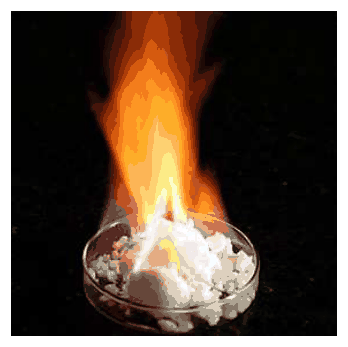
Upon decomposition of \(1.00\ \mathrm{g}\) of a methane hydrate with a fixed composition at \(25\ ^\circ\mathrm{C}\) and atmospheric (\(101.3\ \mathrm{kPa}\)) pressure, \(205\ \mathrm{cm^3}\) of methane is released.
1.1 Determine \(n\) (not necessarily integer) in the formula of methane hydrate, \(\ce{CH4}\cdot n\,\ce{H2O}\).
Real methane hydrate has a non-stoichiometric composition close to \(\ce{CH4 * 6H2O}\). At atmospheric pressure, methane hydrate decomposes at \(-81\ ^\circ\mathrm{C}\). However, under high pressures (e.g. on the ocean floor) it is stable at much higher temperatures.
Decomposition of methane hydrate produces gaseous methane and solid or liquid water depending on temperature.
1.2 Write down the equation of decomposition of \(1\ \mathrm{mol}\) of \(\ce{CH4 * 6H2O}\) producing solid water (ice) \(\ce{H2O(s)}\).
The enthalpy of this process equals \(17.47\ \mathrm{kJ\,mol^{-1}}\). Assume that the enthalpies do not depend on temperature and pressure, the volume change upon decomposition of hydrate is equal to the volume of released methane, and methane is an ideal gas.
1.3 At what external pressure does decomposition of methane hydrate into methane and ice take place at \(-5\ ^\circ\mathrm{C}\)?
1.4 What is the minimum possible depth of pure liquid water at which methane hydrates can be stable?
To answer this question, you should first deduce at which minimum temperature methane hydrate can coexist with liquid water. Choose the correct answer.
\[ \square\ 272.9\ \mathrm{K} \qquad \square\ 273.15\ \mathrm{K} \qquad \square\ 273.4\ \mathrm{K} \]
Large methane hydrate stocks on the floor of Baikal lake, the largest freshwater lake in Russia and in the world, have been discovered in July 2009 by the crew of a deep-submergence vehicle «Mir-2». During the ascent from the depth of \(1400\ \mathrm{m}\) methane hydrate samples started to decompose at the depth of \(372\ \mathrm{m}\).
1.5 Determine the temperature in Baikal lake at the depth of \(372\ \mathrm{m}\). The enthalpy of fusion of ice is equal to \(6.01\ \mathrm{kJ\,mol^{-1}}\).
Total amount of methane in hydrates on the Earth is no less than \(5\cdot10^{11}\) tons.
1.6 By how many degrees would the Earth atmosphere heat up, if such amount of methane is burned by reacting with atmospheric oxygen?
The enthalpy of combustion of methane is \(-889\ \mathrm{kJ\,mol^{-1}}\), the total heat capacity of the Earth’s atmosphere is about \(4\cdot10^{21}\ \mathrm{J\,K^{-1}}\).
Official English text of the problem.
Answers
- 1.1: \(\boxed{n\approx5.74}\).
- 1.2: \(\boxed{\ce{CH4 * 6H2O(s) -> CH4(g) + 6H2O(s)}}\).
- 1.3: \(\boxed{P\approx2.25\ \mathrm{MPa}}\), absolute pressure.
- 1.4: Tick \(272.9\ \mathrm{K}\). The minimum depth is \(\boxed{h_{\min}\approx252\ \mathrm{m}}\), or approximately \(250\ \mathrm{m}\).
- 1.5: \(\boxed{T\approx277.3\ \mathrm{K}\approx4.2\ ^\circ\mathrm{C}}\).
- 1.6: \(\boxed{\Delta T\approx7\ \mathrm{K}}\), equivalent to a temperature rise of approximately \(7\ ^\circ\mathrm{C}\).
Solution
The molecular species used below are methane C, water O, dioxygen O=O, and carbon dioxide O=C=O. Methane hydrate is an extended clathrate lattice rather than a discrete molecule. The disconnected SMILES C.O.O.O.O.O.O records its approximate \(\ce{CH4 * 6H2O}\) composition, but does not describe the water cages or hydrogen bonding. SMILES also does not distinguish liquid water from ice.
Use the standard constants and approximations \[ R=8.31446\ \mathrm{J\,mol^{-1}\,K^{-1}},\qquad \rho_{\mathrm{water}}=1.00\times10^3\ \mathrm{kg\,m^{-3}}, \qquad g=9.81\ \mathrm{m\,s^{-2}}, \] with molar masses \(M(\ce{CH4})=16.04\ \mathrm{g\,mol^{-1}}\) and \(M(\ce{H2O})=18.015\ \mathrm{g\,mol^{-1}}\). All pressures below are absolute.
1.1
The amount of methane released is obtained from the ideal-gas equation: \[ \nu_{\ce{CH4}} =\frac{PV}{RT} =\frac{(101.3\times10^3\ \mathrm{Pa})(205\times10^{-6}\ \mathrm{m^3})} {(8.31446\ \mathrm{J\,mol^{-1}\,K^{-1}})(298.15\ \mathrm{K})} =8.3771\times10^{-3}\ \mathrm{mol}. \]
Each formula unit of hydrate contains one methane molecule. Hence its mass satisfies \[ 1.00\ \mathrm{g} =\nu_{\ce{CH4}} \left[M(\ce{CH4})+nM(\ce{H2O})\right]. \]
Therefore, \[ n= \frac{\dfrac{1.00}{8.3771\times10^{-3}}-16.04}{18.015} =5.7359, \] so \[ \boxed{n=5.74}. \]
1.2
One mole of hydrate releases one mole of methane and six moles of water: \[ \boxed{\ce{CH4 * 6H2O(s) -> CH4(g) + 6H2O(s)}}. \]
For this decomposition into methane and ice, \[ \Delta_{\mathrm r}H_{\mathrm{ice}} =+17.47\ \mathrm{kJ\,mol^{-1}}. \]
1.3
Along the decomposition-equilibrium curve, the Clapeyron equation gives \[ \frac{dP}{dT} =\frac{\Delta_{\mathrm r}H}{T\Delta_{\mathrm r}V}. \]
For one mole of hydrate, one mole of methane is released. Under the stated volume approximation, \[ \Delta_{\mathrm r}V=\frac{RT}{P}. \] Thus, \[ \frac{dP}{P} =\frac{\Delta_{\mathrm r}H}{R}\frac{dT}{T^2}. \]
Integrating with constant enthalpy, \[ \boxed{ \ln\frac{P}{P_0} =\frac{\Delta_{\mathrm r}H}{R} \left(\frac1{T_0}-\frac1T\right) }. \]
The known equilibrium point is \[ T_0=273.15-81=192.15\ \mathrm{K}, \qquad P_0=101.3\ \mathrm{kPa}. \]
At \(-5\ ^\circ\mathrm{C}\), \(T=268.15\ \mathrm{K}\), so \[ P=(101.3\ \mathrm{kPa}) \exp\!\left[ \frac{17470}{8.31446} \left(\frac1{192.15}-\frac1{268.15}\right) \right]. \]
Therefore, \[ \boxed{P=2.247\times10^3\ \mathrm{kPa}\approx2.25\ \mathrm{MPa}}. \]
A pressure above this equilibrium value favors the hydrate, which occupies much less volume than its gaseous decomposition product.
1.4
The minimum depth occurs where the hydrate-decomposition boundary meets the ice–liquid-water melting boundary. At lower pressures, the temperatures required to stabilize hydrate would leave the water frozen.
Ice occupies more volume than the same amount of liquid water. Consequently, \[ \Delta V_{\mathrm{fus}}=V_{\mathrm{liquid}}-V_{\mathrm{ice}}<0, \] and the melting-curve slope is \[ \frac{dT_{\mathrm m}}{dP} =\frac{T_{\mathrm m}\Delta V_{\mathrm{fus}}} {\Delta H_{\mathrm{fus}}}<0. \]
Pressure therefore lowers the melting temperature below \(273.15\ \mathrm{K}\). The appropriate choice is \[ \boxed{T_{\mathrm m}=272.9\ \mathrm{K}}. \]
At this boundary, the equilibrium pressure can be calculated using decomposition into ice: \[ P_{\mathrm m} =(101.3\ \mathrm{kPa}) \exp\!\left[ \frac{17470}{8.31446} \left(\frac1{192.15}-\frac1{272.9}\right) \right] =2.5753\times10^6\ \mathrm{Pa}. \]
Hydrostatic pressure includes the atmospheric pressure at the surface: \[ P_{\mathrm m}=P_{\mathrm{atm}}+\rho gh_{\min}. \]
Hence, \[ h_{\min} =\frac{2.5753\times10^6-1.013\times10^5} {(1.00\times10^3)(9.81)} \ \mathrm{m} =252.2\ \mathrm{m}. \]
Thus, \[ \boxed{h_{\min}\approx252\ \mathrm{m}\approx250\ \mathrm{m}}. \]
1.5
At \(372\ \mathrm{m}\), the external pressure is \[ P_{372}=P_{\mathrm{atm}}+\rho gh =101300+(1000)(9.81)(372) =3.75062\times10^6\ \mathrm{Pa}. \]
Here the decomposition products contain liquid water: \[ \ce{CH4 * 6H2O(s) -> CH4(g) + 6H2O(l)}. \]
To obtain its enthalpy, add the melting of six moles of ice to the reaction in 1.2: \[ \ce{6H2O(s) -> 6H2O(l)}. \]
By Hess’s law, per mole of hydrate, \[ \Delta_{\mathrm r}H_{\mathrm{liquid}} =17.47+6(6.01) =\boxed{53.53\ \mathrm{kJ\,mol^{-1}}}. \]
The ice and liquid-water decomposition branches meet at the boundary used in 1.4: \[ T_{\mathrm m}=272.9\ \mathrm{K}, \qquad P_{\mathrm m}=2.5753\times10^6\ \mathrm{Pa}. \]
Integrating along the liquid-water branch, \[ \ln\frac{P_{372}}{P_{\mathrm m}} =\frac{\Delta_{\mathrm r}H_{\mathrm{liquid}}}{R} \left(\frac1{T_{\mathrm m}}-\frac1T\right). \]
Solving for \(T\), \[ T= \left[ \frac1{272.9} -\frac{8.31446}{53530} \ln\!\left(\frac{3.75062\times10^6}{2.5753\times10^6}\right) \right]^{-1} \approx277.32\ \mathrm{K}. \]
Therefore, \[ \boxed{t=T-273.15\approx4.17\ ^\circ\mathrm{C}\approx4.2\ ^\circ\mathrm{C}}. \]
1.6
The balanced combustion equation, with liquid water as product, is \[ \ce{CH4(g) + 2O2(g) -> CO2(g) + 2H2O(l)}. \]
The stated methane mass is \[ m=5\times10^{11}\ \mathrm{tons} =5\times10^{17}\ \mathrm{g}. \]
Its amount is \[ \nu_{\ce{CH4}} =\frac{5\times10^{17}\ \mathrm{g}} {16.04\ \mathrm{g\,mol^{-1}}} =3.1172\times10^{16}\ \mathrm{mol}. \]
The heat released is \[ Q=\nu_{\ce{CH4}}\left|\Delta_{\mathrm c}H\right| =(3.1172\times10^{16})(889\times10^3) =2.7712\times10^{22}\ \mathrm{J}. \]
Assigning this heat to the atmosphere gives \[ \Delta T =\frac{Q}{C_{\mathrm{atm}}} =\frac{2.7712\times10^{22}\ \mathrm{J}} {4\times10^{21}\ \mathrm{J\,K^{-1}}} =6.93\ \mathrm{K}. \]
Given the approximate inventory and heat capacity, \[ \boxed{\Delta T\approx7\ \mathrm{K}}, \] equivalent to a rise of approximately \(7\ ^\circ\mathrm{C}\) for the quoted methane amount.
The solution was checked against the official solution.
IChO 2013 · Theorieaufgabe 1
Die Clathrat-Kanone
Die einzige Kanone, die mit einem einzigen Schuss alle lebenden Menschen töten kann
Auf dem Grund der Ozeane und Meere gibt es gewaltige Methanvorkommen in Form von Clathratverbindungen, die als Methanhydrate bezeichnet werden. Diese Vorkommen können abgebaut werden und als Energiequelle oder als Rohstoffe für die organische Synthese dienen. Wissenschaftler sind jedoch ernsthaft besorgt über die Möglichkeit einer spontanen Zersetzung der Hydrate infolge steigender Meerestemperaturen. Man nimmt an, dass sich die Ozeane durch den Treibhauseffekt schneller erwärmen würden, wenn eine ausreichende Menge Methan in die Atmosphäre freigesetzt würde, wodurch die Zersetzung der Clathrate weiter beschleunigt würde. Durch die Explosion des entstehenden Methan-Luft-Gemisches und/oder Veränderungen der Zusammensetzung der Atmosphäre könnten alle Lebewesen aussterben. Dieses apokalyptische Szenario wird als Clathrat-Kanone bezeichnet.
Bei der Zersetzung von \(1.00\ \mathrm{g}\) eines Methanhydrats mit fester Zusammensetzung bei \(25\ ^\circ\mathrm{C}\) und Atmosphärendruck (\(101.3\ \mathrm{kPa}\)) werden \(205\ \mathrm{cm^3}\) Methan freigesetzt.
1.1 Bestimmen Sie \(n\) (nicht notwendigerweise ganzzahlig) in der Formel des Methanhydrats, \(\ce{CH4}\cdot n\,\ce{H2O}\).
Reales Methanhydrat hat eine nichtstöchiometrische Zusammensetzung, die näherungsweise \(\ce{CH4 * 6H2O}\) entspricht. Bei Atmosphärendruck zersetzt sich Methanhydrat bei \(-81\ ^\circ\mathrm{C}\). Unter hohen Drücken (z. B. auf dem Meeresgrund) ist es jedoch bei wesentlich höheren Temperaturen stabil.
Bei der Zersetzung von Methanhydrat entstehen gasförmiges Methan und, abhängig von der Temperatur, festes oder flüssiges Wasser.
1.2 Schreiben Sie die Gleichung für die Zersetzung von \(1\ \mathrm{mol}\) \(\ce{CH4 * 6H2O}\) unter Bildung von festem Wasser (Eis) \(\ce{H2O(s)}\) auf.
Die Enthalpie dieses Vorgangs beträgt \(17.47\ \mathrm{kJ\,mol^{-1}}\). Nehmen Sie an, dass die Enthalpien nicht von Temperatur und Druck abhängen, die Volumenänderung bei der Zersetzung des Hydrats gleich dem Volumen des freigesetzten Methans ist und Methan ein ideales Gas ist.
1.3 Bei welchem äußeren Druck findet die Zersetzung von Methanhydrat in Methan und Eis bei \(-5\ ^\circ\mathrm{C}\) statt?
1.4 Wie groß ist die kleinstmögliche Tiefe in reinem flüssigem Wasser, in der Methanhydrate stabil sein können?
Um diese Frage zu beantworten, sollten Sie zunächst herleiten, bei welcher Mindesttemperatur Methanhydrat mit flüssigem Wasser koexistieren kann. Wählen Sie die richtige Antwort aus.
\[ \square\ 272.9\ \mathrm{K} \qquad \square\ 273.15\ \mathrm{K} \qquad \square\ 273.4\ \mathrm{K} \]
Im Juli 2009 entdeckte die Besatzung des Tiefseetauchboots «Mir-2» große Methanhydratvorkommen auf dem Grund des Baikalsees, des größten Süßwassersees Russlands und der Welt. Beim Aufstieg aus einer Tiefe von \(1400\ \mathrm{m}\) begannen Methanhydratproben in einer Tiefe von \(372\ \mathrm{m}\), sich zu zersetzen.
1.5 Bestimmen Sie die Temperatur im Baikalsee in einer Tiefe von \(372\ \mathrm{m}\). Die Schmelzenthalpie von Eis beträgt \(6.01\ \mathrm{kJ\,mol^{-1}}\).
Die Gesamtmenge an Methan in Hydraten auf der Erde beträgt mindestens \(5\cdot10^{11}\) Tonnen.
1.6 Um wie viel Grad würde sich die Erdatmosphäre erwärmen, wenn diese Menge Methan durch Reaktion mit dem Sauerstoff der Atmosphäre verbrannt würde?
Die Verbrennungsenthalpie von Methan beträgt \(-889\ \mathrm{kJ\,mol^{-1}}\), die gesamte Wärmekapazität der Erdatmosphäre beträgt etwa \(4\cdot10^{21}\ \mathrm{J\,K^{-1}}\).
Aufgabentext aus dem offiziellen englischen Text übersetzt.
Antworten
- 1.1: \(\boxed{n\approx5.74}\).
- 1.2: \(\boxed{\ce{CH4 * 6H2O(s) -> CH4(g) + 6H2O(s)}}\).
- 1.3: \(\boxed{P\approx2.25\ \mathrm{MPa}}\), absoluter Druck.
- 1.4: Kreuzen Sie \(272.9\ \mathrm{K}\) an. Die Mindesttiefe beträgt \(\boxed{h_{\min}\approx252\ \mathrm{m}}\), also ungefähr \(250\ \mathrm{m}\).
- 1.5: \(\boxed{T\approx277.3\ \mathrm{K}\approx4.2\ ^\circ\mathrm{C}}\).
- 1.6: \(\boxed{\Delta T\approx7\ \mathrm{K}}\), entsprechend einem Temperaturanstieg von ungefähr \(7\ ^\circ\mathrm{C}\).
Lösung
Die im Folgenden verwendeten molekularen Spezies sind Methan C, Wasser O, Disauerstoff O=O und Kohlenstoffdioxid O=C=O. Methanhydrat bildet ein ausgedehntes Clathratgitter und liegt nicht als diskretes Molekül vor. Die SMILES-Zeichenfolge C.O.O.O.O.O.O mit unverbundenen Komponenten gibt seine ungefähre Zusammensetzung \(\ce{CH4 * 6H2O}\) wieder, beschreibt jedoch weder die Wasserkäfige noch die Wasserstoffbrückenbindungen. SMILES unterscheidet auch nicht zwischen flüssigem Wasser und Eis.
Wir verwenden die üblichen Konstanten und Näherungen \[ R=8.31446\ \mathrm{J\,mol^{-1}\,K^{-1}},\qquad \rho_{\mathrm{water}}=1.00\times10^3\ \mathrm{kg\,m^{-3}}, \qquad g=9.81\ \mathrm{m\,s^{-2}}, \] mit den molaren Massen \(M(\ce{CH4})=16.04\ \mathrm{g\,mol^{-1}}\) und \(M(\ce{H2O})=18.015\ \mathrm{g\,mol^{-1}}\). Alle nachfolgend angegebenen Drücke sind Absolutdrücke.
1.1
Die Stoffmenge des freigesetzten Methans ergibt sich aus der idealen Gasgleichung: \[ \nu_{\ce{CH4}} =\frac{PV}{RT} =\frac{(101.3\times10^3\ \mathrm{Pa})(205\times10^{-6}\ \mathrm{m^3})} {(8.31446\ \mathrm{J\,mol^{-1}\,K^{-1}})(298.15\ \mathrm{K})} =8.3771\times10^{-3}\ \mathrm{mol}. \]
Jede Formeleinheit des Hydrats enthält ein Methanmolekül. Daher gilt für die Masse des Hydrats \[ 1.00\ \mathrm{g} =\nu_{\ce{CH4}} \left[M(\ce{CH4})+nM(\ce{H2O})\right]. \]
Damit ergibt sich \[ n= \frac{\dfrac{1.00}{8.3771\times10^{-3}}-16.04}{18.015} =5.7359, \] also \[ \boxed{n=5.74}. \]
1.2
Ein Mol Hydrat setzt ein Mol Methan und sechs Mol Wasser frei: \[ \boxed{\ce{CH4 * 6H2O(s) -> CH4(g) + 6H2O(s)}}. \]
Für diese Zersetzung in Methan und Eis gilt \[ \Delta_{\mathrm r}H_{\mathrm{ice}} =+17.47\ \mathrm{kJ\,mol^{-1}}. \]
1.3
Entlang der Zersetzungsgleichgewichtskurve liefert die Clapeyron-Gleichung \[ \frac{dP}{dT} =\frac{\Delta_{\mathrm r}H}{T\Delta_{\mathrm r}V}. \]
Pro Mol Hydrat wird ein Mol Methan freigesetzt. Mit der angegebenen Näherung für das Volumen gilt \[ \Delta_{\mathrm r}V=\frac{RT}{P}. \] Somit folgt \[ \frac{dP}{P} =\frac{\Delta_{\mathrm r}H}{R}\frac{dT}{T^2}. \]
Die Integration bei konstanter Enthalpie ergibt \[ \boxed{ \ln\frac{P}{P_0} =\frac{\Delta_{\mathrm r}H}{R} \left(\frac1{T_0}-\frac1T\right) }. \]
Der bekannte Gleichgewichtspunkt ist \[ T_0=273.15-81=192.15\ \mathrm{K}, \qquad P_0=101.3\ \mathrm{kPa}. \]
Bei \(-5\ ^\circ\mathrm{C}\) gilt \(T=268.15\ \mathrm{K}\), sodass \[ P=(101.3\ \mathrm{kPa}) \exp\!\left[ \frac{17470}{8.31446} \left(\frac1{192.15}-\frac1{268.15}\right) \right]. \]
Daraus folgt \[ \boxed{P=2.247\times10^3\ \mathrm{kPa}\approx2.25\ \mathrm{MPa}}. \]
Ein Druck oberhalb dieses Gleichgewichtswerts begünstigt das Hydrat, das ein wesentlich kleineres Volumen einnimmt als sein gasförmiges Zersetzungsprodukt.
1.4
Die Mindesttiefe liegt dort, wo die Zersetzungsgrenze des Hydrats auf die Schmelzgrenze zwischen Eis und flüssigem Wasser trifft. Bei niedrigeren Drücken wäre das Wasser bei den zur Stabilisierung des Hydrats erforderlichen Temperaturen gefroren.
Eis nimmt ein größeres Volumen ein als dieselbe Menge flüssigen Wassers. Folglich gilt \[ \Delta V_{\mathrm{fus}}=V_{\mathrm{liquid}}-V_{\mathrm{ice}}<0, \] und die Steigung der Schmelzkurve ist \[ \frac{dT_{\mathrm m}}{dP} =\frac{T_{\mathrm m}\Delta V_{\mathrm{fus}}} {\Delta H_{\mathrm{fus}}}<0. \]
Der Druck senkt die Schmelztemperatur daher unter \(273.15\ \mathrm{K}\). Die passende Antwort ist \[ \boxed{T_{\mathrm m}=272.9\ \mathrm{K}}. \]
An dieser Grenze lässt sich der Gleichgewichtsdruck anhand der Zersetzung unter Bildung von Eis berechnen: \[ P_{\mathrm m} =(101.3\ \mathrm{kPa}) \exp\!\left[ \frac{17470}{8.31446} \left(\frac1{192.15}-\frac1{272.9}\right) \right] =2.5753\times10^6\ \mathrm{Pa}. \]
Der hydrostatische Druck schließt den Atmosphärendruck an der Oberfläche ein: \[ P_{\mathrm m}=P_{\mathrm{atm}}+\rho gh_{\min}. \]
Daher gilt \[ h_{\min} =\frac{2.5753\times10^6-1.013\times10^5} {(1.00\times10^3)(9.81)} \ \mathrm{m} =252.2\ \mathrm{m}. \]
Somit ergibt sich \[ \boxed{h_{\min}\approx252\ \mathrm{m}\approx250\ \mathrm{m}}. \]
1.5
In \(372\ \mathrm{m}\) Tiefe beträgt der äußere Druck \[ P_{372}=P_{\mathrm{atm}}+\rho gh =101300+(1000)(9.81)(372) =3.75062\times10^6\ \mathrm{Pa}. \]
Hier enthalten die Zersetzungsprodukte flüssiges Wasser: \[ \ce{CH4 * 6H2O(s) -> CH4(g) + 6H2O(l)}. \]
Um die zugehörige Enthalpie zu erhalten, wird das Schmelzen von sechs Mol Eis zur Reaktion in 1.2 addiert: \[ \ce{6H2O(s) -> 6H2O(l)}. \]
Nach dem Satz von Hess gilt pro Mol Hydrat \[ \Delta_{\mathrm r}H_{\mathrm{liquid}} =17.47+6(6.01) =\boxed{53.53\ \mathrm{kJ\,mol^{-1}}}. \]
Die Kurvenzweige für die Zersetzung unter Bildung von Eis beziehungsweise flüssigem Wasser treffen an der in 1.4 verwendeten Grenze zusammen: \[ T_{\mathrm m}=272.9\ \mathrm{K}, \qquad P_{\mathrm m}=2.5753\times10^6\ \mathrm{Pa}. \]
Die Integration entlang des Kurvenzweigs für flüssiges Wasser ergibt \[ \ln\frac{P_{372}}{P_{\mathrm m}} =\frac{\Delta_{\mathrm r}H_{\mathrm{liquid}}}{R} \left(\frac1{T_{\mathrm m}}-\frac1T\right). \]
Auflösen nach \(T\) liefert \[ T= \left[ \frac1{272.9} -\frac{8.31446}{53530} \ln\!\left(\frac{3.75062\times10^6}{2.5753\times10^6}\right) \right]^{-1} \approx277.32\ \mathrm{K}. \]
Daher gilt \[ \boxed{t=T-273.15\approx4.17\ ^\circ\mathrm{C}\approx4.2\ ^\circ\mathrm{C}}. \]
1.6
Die ausgeglichene Verbrennungsgleichung mit flüssigem Wasser als Produkt lautet \[ \ce{CH4(g) + 2O2(g) -> CO2(g) + 2H2O(l)}. \]
Die angegebene Methanmasse beträgt \[ m=5\times10^{11}\ \mathrm{tons} =5\times10^{17}\ \mathrm{g}. \]
Ihre Stoffmenge beträgt \[ \nu_{\ce{CH4}} =\frac{5\times10^{17}\ \mathrm{g}} {16.04\ \mathrm{g\,mol^{-1}}} =3.1172\times10^{16}\ \mathrm{mol}. \]
Die freigesetzte Wärme beträgt \[ Q=\nu_{\ce{CH4}}\left|\Delta_{\mathrm c}H\right| =(3.1172\times10^{16})(889\times10^3) =2.7712\times10^{22}\ \mathrm{J}. \]
Wird diese Wärme der Atmosphäre zugeführt, ergibt sich \[ \Delta T =\frac{Q}{C_{\mathrm{atm}}} =\frac{2.7712\times10^{22}\ \mathrm{J}} {4\times10^{21}\ \mathrm{J\,K^{-1}}} =6.93\ \mathrm{K}. \]
Angesichts der nur näherungsweise bekannten Vorratsmenge und Wärmekapazität gilt \[ \boxed{\Delta T\approx7\ \mathrm{K}}, \] entsprechend einem Anstieg um ungefähr \(7\ ^\circ\mathrm{C}\) für die angegebene Methanmenge.
Die Lösung wurde mit der offiziellen Lösung abgeglichen.
IChO 2013 · Teori sorusu 1
Klatrat silahı
Yaşayan tüm insanları tek atışta öldürebilen tek silah
Okyanusların ve denizlerin tabanlarında, metan hidratlar olarak adlandırılan klatrat bileşikleri hâlinde çok büyük metan rezervleri bulunur. Bu rezervler çıkarılarak enerji kaynağı veya organik sentez için ham madde olarak kullanılabilir. Ancak bilim insanları, okyanus sıcaklığının yükselmesiyle hidratların kendiliğinden bozunması olasılığından ciddi biçimde endişe duymaktadır. Atmosfere yeterli miktarda metan salınırsa, sera etkisi nedeniyle okyanusların daha hızlı ısınacağı ve bunun klatratların bozunmasını daha da hızlandıracağı düşünülmektedir. Oluşan metan-hava karışımının patlaması ve/veya atmosferin bileşimindeki değişiklikler nedeniyle tüm canlıların nesli tükenebilir. Bu kıyamet senaryosuna klatrat silahı adı verilir.
Sabit bileşimli bir metan hidratın \(1.00\ \mathrm{g}\) miktarı, \(25\ ^\circ\mathrm{C}\) sıcaklıkta ve atmosfer basıncında (\(101.3\ \mathrm{kPa}\)) bozunduğunda \(205\ \mathrm{cm^3}\) metan açığa çıkar.
1.1 Metan hidratın \(\ce{CH4}\cdot n\,\ce{H2O}\) formülündeki \(n\) değerini (tam sayı olmak zorunda değildir) belirleyiniz.
Gerçek metan hidrat, \(\ce{CH4 * 6H2O}\) bileşimine yakın, stokiyometrik olmayan bir bileşime sahiptir. Atmosfer basıncında metan hidrat \(-81\ ^\circ\mathrm{C}\) sıcaklıkta bozunur. Ancak yüksek basınçlarda (örneğin okyanus tabanında) çok daha yüksek sıcaklıklarda kararlıdır.
Metan hidratın bozunması sonucunda gaz hâlinde metan ve sıcaklığa bağlı olarak katı veya sıvı su oluşur.
1.2 \(1\ \mathrm{mol}\) \(\ce{CH4 * 6H2O}\)'ın katı su (buz), \(\ce{H2O(s)}\), oluşturarak bozunmasının denklemini yazınız.
Bu sürecin entalpisi \(17.47\ \mathrm{kJ\,mol^{-1}}\) değerindedir. Entalpilerin sıcaklığa ve basınca bağlı olmadığını, hidratın bozunması sırasındaki hacim değişiminin açığa çıkan metanın hacmine eşit olduğunu ve metanın ideal gaz olduğunu varsayınız.
1.3 Metan hidratın metan ve buza bozunması, \(-5\ ^\circ\mathrm{C}\) sıcaklıkta hangi dış basınçta gerçekleşir?
1.4 Metan hidratların saf sıvı suda kararlı olabileceği mümkün olan en küçük derinlik nedir?
Bu soruyu yanıtlamak için önce metan hidratın sıvı suyla bir arada bulunabileceği en düşük sıcaklığı çıkarmalısınız. Doğru cevabı seçiniz.
\[ \square\ 272.9\ \mathrm{K} \qquad \square\ 273.15\ \mathrm{K} \qquad \square\ 273.4\ \mathrm{K} \]
Rusya'nın ve dünyanın en büyük tatlı su gölü olan Baykal Gölü'nün tabanındaki büyük metan hidrat birikimleri, Temmuz 2009'da «Mir-2» adlı derin dalış aracının mürettebatı tarafından keşfedilmiştir. \(1400\ \mathrm{m}\) derinlikten yukarı çıkılırken metan hidrat örnekleri \(372\ \mathrm{m}\) derinlikte bozunmaya başlamıştır.
1.5 Baykal Gölü'nde \(372\ \mathrm{m}\) derinlikteki sıcaklığı belirleyiniz. Buzun erime entalpisi \(6.01\ \mathrm{kJ\,mol^{-1}}\) değerindedir.
Dünya üzerindeki hidratlarda bulunan toplam metan miktarı en az \(5\cdot10^{11}\) tondur.
1.6 Bu miktarda metan atmosferdeki oksijenle tepkimeye girerek yanarsa Dünya atmosferi kaç derece ısınır?
Metanın yanma entalpisi \(-889\ \mathrm{kJ\,mol^{-1}}\), Dünya atmosferinin toplam ısı kapasitesi ise yaklaşık \(4\cdot10^{21}\ \mathrm{J\,K^{-1}}\) değerindedir.
Soru metni resmi İngilizce metinden çevrilmiştir.
Cevaplar
- 1.1: \(\boxed{n\approx5.74}\).
- 1.2: \(\boxed{\ce{CH4 * 6H2O(s) -> CH4(g) + 6H2O(s)}}\).
- 1.3: \(\boxed{P\approx2.25\ \mathrm{MPa}}\), mutlak basınç.
- 1.4: \(272.9\ \mathrm{K}\) seçeneğini işaretleyiniz. En küçük derinlik \(\boxed{h_{\min}\approx252\ \mathrm{m}}\), yani yaklaşık \(250\ \mathrm{m}\)'dir.
- 1.5: \(\boxed{T\approx277.3\ \mathrm{K}\approx4.2\ ^\circ\mathrm{C}}\).
- 1.6: \(\boxed{\Delta T\approx7\ \mathrm{K}}\), yaklaşık \(7\ ^\circ\mathrm{C}\) sıcaklık artışına eşdeğerdir.
Çözüm
Aşağıda kullanılan moleküler türler metan C, su O, dioksijen O=O ve karbondioksit O=C=O'dur. Metan hidrat, ayrı bir molekül değil, uzanımlı bir klatrat örgüsüdür. Bağlantısız SMILES gösterimi C.O.O.O.O.O.O, yaklaşık \(\ce{CH4 * 6H2O}\) bileşimini belirtir; ancak su kafeslerini veya hidrojen bağlarını betimlemez. SMILES ayrıca sıvı su ile buzu birbirinden ayırt etmez.
Standart sabitleri ve yaklaşımları \[ R=8.31446\ \mathrm{J\,mol^{-1}\,K^{-1}},\qquad \rho_{\mathrm{water}}=1.00\times10^3\ \mathrm{kg\,m^{-3}}, \qquad g=9.81\ \mathrm{m\,s^{-2}}, \] \(M(\ce{CH4})=16.04\ \mathrm{g\,mol^{-1}}\) ve \(M(\ce{H2O})=18.015\ \mathrm{g\,mol^{-1}}\) molar kütleleriyle birlikte kullanınız. Aşağıdaki tüm basınçlar mutlaktır.
1.1
Açığa çıkan metanın madde miktarı ideal gaz denkleminden elde edilir: \[ \nu_{\ce{CH4}} =\frac{PV}{RT} =\frac{(101.3\times10^3\ \mathrm{Pa})(205\times10^{-6}\ \mathrm{m^3})} {(8.31446\ \mathrm{J\,mol^{-1}\,K^{-1}})(298.15\ \mathrm{K})} =8.3771\times10^{-3}\ \mathrm{mol}. \]
Hidratın her formül birimi bir metan molekülü içerir. Dolayısıyla kütlesi şu eşitliği sağlar: \[ 1.00\ \mathrm{g} =\nu_{\ce{CH4}} \left[M(\ce{CH4})+nM(\ce{H2O})\right]. \]
Buna göre, \[ n= \frac{\dfrac{1.00}{8.3771\times10^{-3}}-16.04}{18.015} =5.7359, \] dolayısıyla \[ \boxed{n=5.74}. \]
1.2
Bir mol hidrat, bir mol metan ve altı mol su açığa çıkarır: \[ \boxed{\ce{CH4 * 6H2O(s) -> CH4(g) + 6H2O(s)}}. \]
Metan ve buz oluşturan bu bozunma için, \[ \Delta_{\mathrm r}H_{\mathrm{ice}} =+17.47\ \mathrm{kJ\,mol^{-1}}. \]
1.3
Bozunma dengesi eğrisi boyunca Clapeyron denklemi şu bağıntıyı verir: \[ \frac{dP}{dT} =\frac{\Delta_{\mathrm r}H}{T\Delta_{\mathrm r}V}. \]
Bir mol hidrat için bir mol metan açığa çıkar. Belirtilen hacim yaklaşımı altında, \[ \Delta_{\mathrm r}V=\frac{RT}{P}. \] Böylece, \[ \frac{dP}{P} =\frac{\Delta_{\mathrm r}H}{R}\frac{dT}{T^2}. \]
Entalpi sabit alınarak integral alındığında, \[ \boxed{ \ln\frac{P}{P_0} =\frac{\Delta_{\mathrm r}H}{R} \left(\frac1{T_0}-\frac1T\right) }. \]
Bilinen denge noktası şöyledir: \[ T_0=273.15-81=192.15\ \mathrm{K}, \qquad P_0=101.3\ \mathrm{kPa}. \]
\(-5\ ^\circ\mathrm{C}\) sıcaklıkta \(T=268.15\ \mathrm{K}\) olduğundan, \[ P=(101.3\ \mathrm{kPa}) \exp\!\left[ \frac{17470}{8.31446} \left(\frac1{192.15}-\frac1{268.15}\right) \right]. \]
Buna göre, \[ \boxed{P=2.247\times10^3\ \mathrm{kPa}\approx2.25\ \mathrm{MPa}}. \]
Bu denge değerinin üzerindeki bir basınç, gaz hâlindeki bozunma ürününe göre çok daha az hacim kaplayan hidratın oluşumunu destekler.
1.4
En küçük derinlik, hidratın bozunma sınırının buz–sıvı su erime sınırıyla kesiştiği yerde ortaya çıkar. Daha düşük basınçlarda, hidratı kararlı kılmak için gereken sıcaklıklarda su donmuş hâlde kalır.
Buz, aynı miktardaki sıvı sudan daha fazla hacim kaplar. Bu nedenle, \[ \Delta V_{\mathrm{fus}}=V_{\mathrm{liquid}}-V_{\mathrm{ice}}<0, \] ve erime eğrisinin eğimi şöyledir: \[ \frac{dT_{\mathrm m}}{dP} =\frac{T_{\mathrm m}\Delta V_{\mathrm{fus}}} {\Delta H_{\mathrm{fus}}}<0. \]
Dolayısıyla basınç, erime sıcaklığını \(273.15\ \mathrm{K}\)'nin altına düşürür. Uygun seçenek şudur: \[ \boxed{T_{\mathrm m}=272.9\ \mathrm{K}}. \]
Bu sınırda denge basıncı, buz oluşturan bozunma kullanılarak hesaplanabilir: \[ P_{\mathrm m} =(101.3\ \mathrm{kPa}) \exp\!\left[ \frac{17470}{8.31446} \left(\frac1{192.15}-\frac1{272.9}\right) \right] =2.5753\times10^6\ \mathrm{Pa}. \]
Hidrostatik basınç, yüzeydeki atmosfer basıncını da içerir: \[ P_{\mathrm m}=P_{\mathrm{atm}}+\rho gh_{\min}. \]
Buradan, \[ h_{\min} =\frac{2.5753\times10^6-1.013\times10^5} {(1.00\times10^3)(9.81)} \ \mathrm{m} =252.2\ \mathrm{m}. \]
Böylece, \[ \boxed{h_{\min}\approx252\ \mathrm{m}\approx250\ \mathrm{m}}. \]
1.5
\(372\ \mathrm{m}\) derinlikte dış basınç şöyledir: \[ P_{372}=P_{\mathrm{atm}}+\rho gh =101300+(1000)(9.81)(372) =3.75062\times10^6\ \mathrm{Pa}. \]
Burada bozunma ürünleri sıvı su içerir: \[ \ce{CH4 * 6H2O(s) -> CH4(g) + 6H2O(l)}. \]
Bu bozunmanın entalpisini elde etmek için 1.2'deki tepkimeye altı mol buzun erimesini ekleyiniz: \[ \ce{6H2O(s) -> 6H2O(l)}. \]
Hess yasasına göre, bir mol hidrat başına, \[ \Delta_{\mathrm r}H_{\mathrm{liquid}} =17.47+6(6.01) =\boxed{53.53\ \mathrm{kJ\,mol^{-1}}}. \]
Buz ve sıvı su oluşturan bozunma eğrisinin kolları, 1.4'te kullanılan sınırda birleşir: \[ T_{\mathrm m}=272.9\ \mathrm{K}, \qquad P_{\mathrm m}=2.5753\times10^6\ \mathrm{Pa}. \]
Sıvı su kolu boyunca integral alındığında, \[ \ln\frac{P_{372}}{P_{\mathrm m}} =\frac{\Delta_{\mathrm r}H_{\mathrm{liquid}}}{R} \left(\frac1{T_{\mathrm m}}-\frac1T\right). \]
\(T\) için çözüldüğünde, \[ T= \left[ \frac1{272.9} -\frac{8.31446}{53530} \ln\!\left(\frac{3.75062\times10^6}{2.5753\times10^6}\right) \right]^{-1} \approx277.32\ \mathrm{K}. \]
Buna göre, \[ \boxed{t=T-273.15\approx4.17\ ^\circ\mathrm{C}\approx4.2\ ^\circ\mathrm{C}}. \]
1.6
Ürün olarak sıvı suyun oluştuğu denkleştirilmiş yanma denklemi şöyledir: \[ \ce{CH4(g) + 2O2(g) -> CO2(g) + 2H2O(l)}. \]
Verilen metan kütlesi şöyledir: \[ m=5\times10^{11}\ \mathrm{tons} =5\times10^{17}\ \mathrm{g}. \]
Madde miktarı şöyledir: \[ \nu_{\ce{CH4}} =\frac{5\times10^{17}\ \mathrm{g}} {16.04\ \mathrm{g\,mol^{-1}}} =3.1172\times10^{16}\ \mathrm{mol}. \]
Açığa çıkan ısı şöyledir: \[ Q=\nu_{\ce{CH4}}\left|\Delta_{\mathrm c}H\right| =(3.1172\times10^{16})(889\times10^3) =2.7712\times10^{22}\ \mathrm{J}. \]
Bu ısının atmosfere aktarıldığı kabul edilirse, \[ \Delta T =\frac{Q}{C_{\mathrm{atm}}} =\frac{2.7712\times10^{22}\ \mathrm{J}} {4\times10^{21}\ \mathrm{J\,K^{-1}}} =6.93\ \mathrm{K}. \]
Toplam metan miktarının ve ısı kapasitesinin yaklaşık değerler olduğu göz önüne alındığında, \[ \boxed{\Delta T\approx7\ \mathrm{K}}, \] bu, belirtilen metan miktarı için yaklaşık \(7\ ^\circ\mathrm{C}\) sıcaklık artışına eşdeğerdir.
Çözüm, resmi çözümle karşılaştırılarak kontrol edildi.
IChO 2013 · Problema teórico 1
El fusil de clatratos
El único fusil capaz de matar a todas las personas vivas de un solo disparo
En los fondos de océanos y mares existen vastas reservas de metano en forma de compuestos de clatrato denominados hidratos de metano. Estas reservas pueden explotarse y servir como fuente de energía o de materias primas para la síntesis orgánica. Sin embargo, a los científicos les preocupa seriamente la posibilidad de que los hidratos se descompongan espontáneamente debido al aumento de la temperatura de los océanos. Se cree que, si se libera una cantidad suficiente de metano a la atmósfera, los océanos se calentarán más rápidamente debido al efecto invernadero, lo que acelerará aún más la descomposición de los clatratos. Debido a la explosión de la mezcla de metano y aire resultante y/o a los cambios en la composición de la atmósfera, todos los seres vivos podrían extinguirse. Este escenario apocalíptico se denomina fusil de clatratos.
Al descomponerse \(1.00\ \mathrm{g}\) de un hidrato de metano de composición fija a \(25\ ^\circ\mathrm{C}\) y presión atmosférica (\(101.3\ \mathrm{kPa}\)), se liberan \(205\ \mathrm{cm^3}\) de metano.
1.1 Determine \(n\) (no necesariamente entero) en la fórmula del hidrato de metano, \(\ce{CH4}\cdot n\,\ce{H2O}\).
El hidrato de metano real tiene una composición no estequiométrica próxima a \(\ce{CH4 * 6H2O}\). A presión atmosférica, el hidrato de metano se descompone a \(-81\ ^\circ\mathrm{C}\). Sin embargo, a presiones elevadas (por ejemplo, en el fondo oceánico) es estable a temperaturas mucho más altas.
La descomposición del hidrato de metano produce metano gaseoso y agua sólida o líquida, dependiendo de la temperatura.
1.2 Escriba la ecuación de descomposición de \(1\ \mathrm{mol}\) de \(\ce{CH4 * 6H2O}\) que produce agua sólida (hielo) \(\ce{H2O(s)}\).
La entalpía de este proceso es igual a \(17.47\ \mathrm{kJ\,mol^{-1}}\). Suponga que las entalpías no dependen de la temperatura ni de la presión, que la variación de volumen durante la descomposición del hidrato es igual al volumen del metano liberado y que el metano es un gas ideal.
1.3 ¿A qué presión externa tiene lugar la descomposición del hidrato de metano en metano y hielo a \(-5\ ^\circ\mathrm{C}\)?
1.4 ¿Cuál es la profundidad mínima posible en agua líquida pura a la que los hidratos de metano pueden ser estables?
Para responder a esta pregunta, primero debe deducir a qué temperatura mínima puede coexistir el hidrato de metano con agua líquida. Elija la respuesta correcta.
\[ \square\ 272.9\ \mathrm{K} \qquad \square\ 273.15\ \mathrm{K} \qquad \square\ 273.4\ \mathrm{K} \]
En julio de 2009, la tripulación del vehículo de inmersión profunda «Mir-2» descubrió grandes reservas de hidrato de metano en el fondo del lago Baikal, el mayor lago de agua dulce de Rusia y del mundo. Durante el ascenso desde una profundidad de \(1400\ \mathrm{m}\), las muestras de hidrato de metano comenzaron a descomponerse a una profundidad de \(372\ \mathrm{m}\).
1.5 Determine la temperatura del lago Baikal a una profundidad de \(372\ \mathrm{m}\). La entalpía de fusión del hielo es igual a \(6.01\ \mathrm{kJ\,mol^{-1}}\).
La cantidad total de metano contenido en los hidratos de la Tierra no es inferior a \(5\cdot10^{11}\) toneladas.
1.6 ¿Cuántos grados se calentaría la atmósfera terrestre si esta cantidad de metano se quemara al reaccionar con el oxígeno atmosférico?
La entalpía de combustión del metano es \(-889\ \mathrm{kJ\,mol^{-1}}\), y la capacidad calorífica total de la atmósfera terrestre es de aproximadamente \(4\cdot10^{21}\ \mathrm{J\,K^{-1}}\).
Enunciado traducido del texto oficial en inglés.
Respuestas
- 1.1: \(\boxed{n\approx5.74}\).
- 1.2: \(\boxed{\ce{CH4 * 6H2O(s) -> CH4(g) + 6H2O(s)}}\).
- 1.3: \(\boxed{P\approx2.25\ \mathrm{MPa}}\), presión absoluta.
- 1.4: Marque \(272.9\ \mathrm{K}\). La profundidad mínima es \(\boxed{h_{\min}\approx252\ \mathrm{m}}\), o aproximadamente \(250\ \mathrm{m}\).
- 1.5: \(\boxed{T\approx277.3\ \mathrm{K}\approx4.2\ ^\circ\mathrm{C}}\).
- 1.6: \(\boxed{\Delta T\approx7\ \mathrm{K}}\), equivalente a un aumento de temperatura de aproximadamente \(7\ ^\circ\mathrm{C}\).
Solución
Las especies moleculares utilizadas a continuación son metano C, agua O, dioxígeno O=O y dióxido de carbono O=C=O. El hidrato de metano es una red extendida de clatrato, en lugar de una molécula discreta. El SMILES con componentes desconectados C.O.O.O.O.O.O representa su composición aproximada \(\ce{CH4 * 6H2O}\), pero no describe las jaulas de agua ni los enlaces de hidrógeno. SMILES tampoco distingue el agua líquida del hielo.
Utilizamos las constantes y aproximaciones estándar \[ R=8.31446\ \mathrm{J\,mol^{-1}\,K^{-1}},\qquad \rho_{\mathrm{water}}=1.00\times10^3\ \mathrm{kg\,m^{-3}}, \qquad g=9.81\ \mathrm{m\,s^{-2}}, \] con masas molares \(M(\ce{CH4})=16.04\ \mathrm{g\,mol^{-1}}\) y \(M(\ce{H2O})=18.015\ \mathrm{g\,mol^{-1}}\). Todas las presiones que aparecen a continuación son absolutas.
1.1
La cantidad de sustancia de metano liberado se obtiene de la ecuación de los gases ideales: \[ \nu_{\ce{CH4}} =\frac{PV}{RT} =\frac{(101.3\times10^3\ \mathrm{Pa})(205\times10^{-6}\ \mathrm{m^3})} {(8.31446\ \mathrm{J\,mol^{-1}\,K^{-1}})(298.15\ \mathrm{K})} =8.3771\times10^{-3}\ \mathrm{mol}. \]
Cada unidad fórmula del hidrato contiene una molécula de metano. Por tanto, su masa satisface \[ 1.00\ \mathrm{g} =\nu_{\ce{CH4}} \left[M(\ce{CH4})+nM(\ce{H2O})\right]. \]
Por lo tanto, \[ n= \frac{\dfrac{1.00}{8.3771\times10^{-3}}-16.04}{18.015} =5.7359, \] de modo que \[ \boxed{n=5.74}. \]
1.2
Un mol de hidrato libera un mol de metano y seis moles de agua: \[ \boxed{\ce{CH4 * 6H2O(s) -> CH4(g) + 6H2O(s)}}. \]
Para esta descomposición en metano y hielo, \[ \Delta_{\mathrm r}H_{\mathrm{ice}} =+17.47\ \mathrm{kJ\,mol^{-1}}. \]
1.3
A lo largo de la curva de equilibrio de descomposición, la ecuación de Clapeyron da \[ \frac{dP}{dT} =\frac{\Delta_{\mathrm r}H}{T\Delta_{\mathrm r}V}. \]
Por cada mol de hidrato se libera un mol de metano. Con la aproximación de volumen indicada, \[ \Delta_{\mathrm r}V=\frac{RT}{P}. \] Así, \[ \frac{dP}{P} =\frac{\Delta_{\mathrm r}H}{R}\frac{dT}{T^2}. \]
Integrando con entalpía constante, \[ \boxed{ \ln\frac{P}{P_0} =\frac{\Delta_{\mathrm r}H}{R} \left(\frac1{T_0}-\frac1T\right) }. \]
El punto de equilibrio conocido es \[ T_0=273.15-81=192.15\ \mathrm{K}, \qquad P_0=101.3\ \mathrm{kPa}. \]
A \(-5\ ^\circ\mathrm{C}\), \(T=268.15\ \mathrm{K}\), de modo que \[ P=(101.3\ \mathrm{kPa}) \exp\!\left[ \frac{17470}{8.31446} \left(\frac1{192.15}-\frac1{268.15}\right) \right]. \]
Por lo tanto, \[ \boxed{P=2.247\times10^3\ \mathrm{kPa}\approx2.25\ \mathrm{MPa}}. \]
Una presión superior a este valor de equilibrio favorece al hidrato, que ocupa un volumen mucho menor que su producto gaseoso de descomposición.
1.4
La profundidad mínima se alcanza donde el límite de descomposición del hidrato se encuentra con el límite de fusión entre el hielo y el agua líquida. A presiones inferiores, las temperaturas necesarias para estabilizar el hidrato mantendrían el agua congelada.
El hielo ocupa más volumen que la misma cantidad de agua líquida. En consecuencia, \[ \Delta V_{\mathrm{fus}}=V_{\mathrm{liquid}}-V_{\mathrm{ice}}<0, \] y la pendiente de la curva de fusión es \[ \frac{dT_{\mathrm m}}{dP} =\frac{T_{\mathrm m}\Delta V_{\mathrm{fus}}} {\Delta H_{\mathrm{fus}}}<0. \]
Por tanto, la presión reduce la temperatura de fusión por debajo de \(273.15\ \mathrm{K}\). La opción adecuada es \[ \boxed{T_{\mathrm m}=272.9\ \mathrm{K}}. \]
En este límite, la presión de equilibrio puede calcularse utilizando la descomposición que produce hielo: \[ P_{\mathrm m} =(101.3\ \mathrm{kPa}) \exp\!\left[ \frac{17470}{8.31446} \left(\frac1{192.15}-\frac1{272.9}\right) \right] =2.5753\times10^6\ \mathrm{Pa}. \]
La presión hidrostática incluye la presión atmosférica en la superficie: \[ P_{\mathrm m}=P_{\mathrm{atm}}+\rho gh_{\min}. \]
Por tanto, \[ h_{\min} =\frac{2.5753\times10^6-1.013\times10^5} {(1.00\times10^3)(9.81)} \ \mathrm{m} =252.2\ \mathrm{m}. \]
Así, \[ \boxed{h_{\min}\approx252\ \mathrm{m}\approx250\ \mathrm{m}}. \]
1.5
A \(372\ \mathrm{m}\), la presión externa es \[ P_{372}=P_{\mathrm{atm}}+\rho gh =101300+(1000)(9.81)(372) =3.75062\times10^6\ \mathrm{Pa}. \]
En este caso, los productos de descomposición contienen agua líquida: \[ \ce{CH4 * 6H2O(s) -> CH4(g) + 6H2O(l)}. \]
Para obtener su entalpía, sumamos la fusión de seis moles de hielo a la reacción de 1.2: \[ \ce{6H2O(s) -> 6H2O(l)}. \]
Por la ley de Hess, por mol de hidrato, \[ \Delta_{\mathrm r}H_{\mathrm{liquid}} =17.47+6(6.01) =\boxed{53.53\ \mathrm{kJ\,mol^{-1}}}. \]
Las ramas de descomposición que producen hielo y agua líquida se encuentran en el límite utilizado en 1.4: \[ T_{\mathrm m}=272.9\ \mathrm{K}, \qquad P_{\mathrm m}=2.5753\times10^6\ \mathrm{Pa}. \]
Integrando a lo largo de la rama correspondiente al agua líquida, \[ \ln\frac{P_{372}}{P_{\mathrm m}} =\frac{\Delta_{\mathrm r}H_{\mathrm{liquid}}}{R} \left(\frac1{T_{\mathrm m}}-\frac1T\right). \]
Despejando \(T\), \[ T= \left[ \frac1{272.9} -\frac{8.31446}{53530} \ln\!\left(\frac{3.75062\times10^6}{2.5753\times10^6}\right) \right]^{-1} \approx277.32\ \mathrm{K}. \]
Por lo tanto, \[ \boxed{t=T-273.15\approx4.17\ ^\circ\mathrm{C}\approx4.2\ ^\circ\mathrm{C}}. \]
1.6
La ecuación ajustada de combustión, con agua líquida como producto, es \[ \ce{CH4(g) + 2O2(g) -> CO2(g) + 2H2O(l)}. \]
La masa de metano indicada es \[ m=5\times10^{11}\ \mathrm{tons} =5\times10^{17}\ \mathrm{g}. \]
Su cantidad de sustancia es \[ \nu_{\ce{CH4}} =\frac{5\times10^{17}\ \mathrm{g}} {16.04\ \mathrm{g\,mol^{-1}}} =3.1172\times10^{16}\ \mathrm{mol}. \]
El calor liberado es \[ Q=\nu_{\ce{CH4}}\left|\Delta_{\mathrm c}H\right| =(3.1172\times10^{16})(889\times10^3) =2.7712\times10^{22}\ \mathrm{J}. \]
Asignando este calor a la atmósfera se obtiene \[ \Delta T =\frac{Q}{C_{\mathrm{atm}}} =\frac{2.7712\times10^{22}\ \mathrm{J}} {4\times10^{21}\ \mathrm{J\,K^{-1}}} =6.93\ \mathrm{K}. \]
Dado el carácter aproximado de las reservas y de la capacidad calorífica, \[ \boxed{\Delta T\approx7\ \mathrm{K}}, \] equivalente a un aumento de aproximadamente \(7\ ^\circ\mathrm{C}\) para la cantidad de metano indicada.
La solución se comprobó con la solución oficial.
IChO 2013 · 理论题 1
笼形水合物枪
唯一能够一枪杀死所有活人的枪
海洋底部蕴藏着大量以笼形化合物形式存在的甲烷,这类化合物称为甲烷水合物。这些储藏可以开采,用作能源或有机合成原料。然而,科学家们非常担忧海洋温度升高可能导致水合物自发分解。人们认为,如果有足够多的甲烷释放到大气中,温室效应将使海洋更快变暖,从而进一步加速笼形化合物的分解。由于所形成的甲烷与空气的混合物发生爆炸和/或大气组成发生变化,所有生物都可能灭绝。这种末日情景被称为笼形水合物枪。
在 \(25\ ^\circ\mathrm{C}\) 和大气压(\(101.3\ \mathrm{kPa}\))下,\(1.00\ \mathrm{g}\) 组成固定的甲烷水合物分解时,释放出 \(205\ \mathrm{cm^3}\) 甲烷。
1.1 确定甲烷水合物化学式 \(\ce{CH4}\cdot n\,\ce{H2O}\) 中的 \(n\)(不一定为整数)。
实际的甲烷水合物具有非化学计量组成,其组成接近 \(\ce{CH4 * 6H2O}\)。在大气压下,甲烷水合物在 \(-81\ ^\circ\mathrm{C}\) 时分解。然而,在高压下(例如海底),它在高得多的温度下仍然稳定。
甲烷水合物分解生成气态甲烷,以及固态或液态的水,水的状态取决于温度。
1.2 写出 \(1\ \mathrm{mol}\) \(\ce{CH4 * 6H2O}\) 分解生成固态水(冰)\(\ce{H2O(s)}\) 的反应方程式。
该过程的焓变为 \(17.47\ \mathrm{kJ\,mol^{-1}}\)。假设焓变不随温度和压力变化,水合物分解时的体积变化等于所释放甲烷的体积,且甲烷为理想气体。
1.3 在多大的外压下,甲烷水合物会在 \(-5\ ^\circ\mathrm{C}\) 分解为甲烷和冰?
1.4 甲烷水合物能够稳定存在于纯液态水中的最小可能深度是多少?
要回答这一问题,应首先推断甲烷水合物能够与液态水共存的最低温度。选择正确答案。
\[ \square\ 272.9\ \mathrm{K} \qquad \square\ 273.15\ \mathrm{K} \qquad \square\ 273.4\ \mathrm{K} \]
2009 年 7 月,“Mir-2”号深潜器的乘员在俄罗斯乃至世界最大的淡水湖——贝加尔湖的湖底发现了大量甲烷水合物。在从 \(1400\ \mathrm{m}\) 深处上浮的过程中,甲烷水合物样品在 \(372\ \mathrm{m}\) 深处开始分解。
1.5 确定贝加尔湖 \(372\ \mathrm{m}\) 深处的温度。冰的熔化焓为 \(6.01\ \mathrm{kJ\,mol^{-1}}\)。
地球上以水合物形式存在的甲烷总量不少于 \(5\cdot10^{11}\) 吨。
1.6 如果这些甲烷与大气中的氧气反应而燃烧,地球大气的温度会升高多少度?
甲烷的燃烧焓为 \(-889\ \mathrm{kJ\,mol^{-1}}\),地球大气的总热容约为 \(4\cdot10^{21}\ \mathrm{J\,K^{-1}}\)。
题目译自官方英文原文。
答案
- 1.1: \(\boxed{n\approx5.74}\)。
- 1.2: \(\boxed{\ce{CH4 * 6H2O(s) -> CH4(g) + 6H2O(s)}}\)。
- 1.3: \(\boxed{P\approx2.25\ \mathrm{MPa}}\),为绝对压力。
- 1.4: 勾选 \(272.9\ \mathrm{K}\)。最小深度为 \(\boxed{h_{\min}\approx252\ \mathrm{m}}\),或约 \(250\ \mathrm{m}\)。
- 1.5: \(\boxed{T\approx277.3\ \mathrm{K}\approx4.2\ ^\circ\mathrm{C}}\)。
- 1.6: \(\boxed{\Delta T\approx7\ \mathrm{K}}\),相当于温度升高约 \(7\ ^\circ\mathrm{C}\)。
解答
下文涉及的分子种类为甲烷 C、水 O、氧气 O=O 和二氧化碳 O=C=O。甲烷水合物是延展的笼形晶格,而非独立的分子。不连通的 SMILES C.O.O.O.O.O.O 记录了其近似组成 \(\ce{CH4 * 6H2O}\),但并未描述水分子形成的笼或氢键。SMILES 也不区分液态水和冰。
采用以下标准常数和近似值 \[ R=8.31446\ \mathrm{J\,mol^{-1}\,K^{-1}},\qquad \rho_{\mathrm{water}}=1.00\times10^3\ \mathrm{kg\,m^{-3}}, \qquad g=9.81\ \mathrm{m\,s^{-2}}, \] 以及摩尔质量 \(M(\ce{CH4})=16.04\ \mathrm{g\,mol^{-1}}\) 和 \(M(\ce{H2O})=18.015\ \mathrm{g\,mol^{-1}}\)。下文所有压力均为绝对压力。
1.1
由理想气体状态方程求得释放的甲烷的物质的量: \[ \nu_{\ce{CH4}} =\frac{PV}{RT} =\frac{(101.3\times10^3\ \mathrm{Pa})(205\times10^{-6}\ \mathrm{m^3})} {(8.31446\ \mathrm{J\,mol^{-1}\,K^{-1}})(298.15\ \mathrm{K})} =8.3771\times10^{-3}\ \mathrm{mol}. \]
水合物的每个化学式单位含有一个甲烷分子。因此,其质量满足 \[ 1.00\ \mathrm{g} =\nu_{\ce{CH4}} \left[M(\ce{CH4})+nM(\ce{H2O})\right]. \]
因此, \[ n= \frac{\dfrac{1.00}{8.3771\times10^{-3}}-16.04}{18.015} =5.7359, \] 所以 \[ \boxed{n=5.74}. \]
1.2
一摩尔水合物释放一摩尔甲烷和六摩尔水: \[ \boxed{\ce{CH4 * 6H2O(s) -> CH4(g) + 6H2O(s)}}. \]
对于这一分解生成甲烷和冰的过程, \[ \Delta_{\mathrm r}H_{\mathrm{ice}} =+17.47\ \mathrm{kJ\,mol^{-1}}. \]
1.3
沿分解平衡曲线,由克拉佩龙方程可得 \[ \frac{dP}{dT} =\frac{\Delta_{\mathrm r}H}{T\Delta_{\mathrm r}V}. \]
一摩尔水合物释放一摩尔甲烷。根据题设的体积近似, \[ \Delta_{\mathrm r}V=\frac{RT}{P}. \] 于是, \[ \frac{dP}{P} =\frac{\Delta_{\mathrm r}H}{R}\frac{dT}{T^2}. \]
在焓变为常数的条件下积分,得到 \[ \boxed{ \ln\frac{P}{P_0} =\frac{\Delta_{\mathrm r}H}{R} \left(\frac1{T_0}-\frac1T\right) }. \]
已知的平衡点为 \[ T_0=273.15-81=192.15\ \mathrm{K}, \qquad P_0=101.3\ \mathrm{kPa}. \]
在 \(-5\ ^\circ\mathrm{C}\) 时,\(T=268.15\ \mathrm{K}\),所以 \[ P=(101.3\ \mathrm{kPa}) \exp\!\left[ \frac{17470}{8.31446} \left(\frac1{192.15}-\frac1{268.15}\right) \right]. \]
因此, \[ \boxed{P=2.247\times10^3\ \mathrm{kPa}\approx2.25\ \mathrm{MPa}}. \]
高于这一平衡值的压力有利于水合物稳定存在,因为水合物所占的体积远小于其气态分解产物的体积。
1.4
最小深度对应于水合物分解相界线与冰–液态水熔化相界线的交点。在更低的压力下,使水合物稳定所需的温度会使水处于冻结状态。
冰所占的体积大于等量液态水的体积。因此, \[ \Delta V_{\mathrm{fus}}=V_{\mathrm{liquid}}-V_{\mathrm{ice}}<0, \] 而熔化曲线的斜率为 \[ \frac{dT_{\mathrm m}}{dP} =\frac{T_{\mathrm m}\Delta V_{\mathrm{fus}}} {\Delta H_{\mathrm{fus}}}<0. \]
因此,压力使熔化温度降至 \(273.15\ \mathrm{K}\) 以下。正确的选项是 \[ \boxed{T_{\mathrm m}=272.9\ \mathrm{K}}. \]
在这一相界处,可根据分解生成冰的过程计算平衡压力: \[ P_{\mathrm m} =(101.3\ \mathrm{kPa}) \exp\!\left[ \frac{17470}{8.31446} \left(\frac1{192.15}-\frac1{272.9}\right) \right] =2.5753\times10^6\ \mathrm{Pa}. \]
静水压力包括水面处的大气压: \[ P_{\mathrm m}=P_{\mathrm{atm}}+\rho gh_{\min}. \]
因此, \[ h_{\min} =\frac{2.5753\times10^6-1.013\times10^5} {(1.00\times10^3)(9.81)} \ \mathrm{m} =252.2\ \mathrm{m}. \]
于是, \[ \boxed{h_{\min}\approx252\ \mathrm{m}\approx250\ \mathrm{m}}. \]
1.5
在 \(372\ \mathrm{m}\) 深处,外压为 \[ P_{372}=P_{\mathrm{atm}}+\rho gh =101300+(1000)(9.81)(372) =3.75062\times10^6\ \mathrm{Pa}. \]
此处分解产物中含有液态水: \[ \ce{CH4 * 6H2O(s) -> CH4(g) + 6H2O(l)}. \]
为求得这一过程的焓变,将六摩尔冰的熔化过程与 1.2 中的反应相加: \[ \ce{6H2O(s) -> 6H2O(l)}. \]
根据盖斯定律,每摩尔水合物的分解焓变为 \[ \Delta_{\mathrm r}H_{\mathrm{liquid}} =17.47+6(6.01) =\boxed{53.53\ \mathrm{kJ\,mol^{-1}}}. \]
生成冰和生成液态水的两条分解曲线分支在 1.4 所用的相界点相交: \[ T_{\mathrm m}=272.9\ \mathrm{K}, \qquad P_{\mathrm m}=2.5753\times10^6\ \mathrm{Pa}. \]
沿生成液态水的分支积分,得到 \[ \ln\frac{P_{372}}{P_{\mathrm m}} =\frac{\Delta_{\mathrm r}H_{\mathrm{liquid}}}{R} \left(\frac1{T_{\mathrm m}}-\frac1T\right). \]
解出 \(T\),得 \[ T= \left[ \frac1{272.9} -\frac{8.31446}{53530} \ln\!\left(\frac{3.75062\times10^6}{2.5753\times10^6}\right) \right]^{-1} \approx277.32\ \mathrm{K}. \]
因此, \[ \boxed{t=T-273.15\approx4.17\ ^\circ\mathrm{C}\approx4.2\ ^\circ\mathrm{C}}. \]
1.6
以液态水为产物的配平燃烧方程式为 \[ \ce{CH4(g) + 2O2(g) -> CO2(g) + 2H2O(l)}. \]
题给的甲烷质量为 \[ m=5\times10^{11}\ \mathrm{tons} =5\times10^{17}\ \mathrm{g}. \]
其物质的量为 \[ \nu_{\ce{CH4}} =\frac{5\times10^{17}\ \mathrm{g}} {16.04\ \mathrm{g\,mol^{-1}}} =3.1172\times10^{16}\ \mathrm{mol}. \]
释放的热量为 \[ Q=\nu_{\ce{CH4}}\left|\Delta_{\mathrm c}H\right| =(3.1172\times10^{16})(889\times10^3) =2.7712\times10^{22}\ \mathrm{J}. \]
将这些热量全部用于加热大气,可得 \[ \Delta T =\frac{Q}{C_{\mathrm{atm}}} =\frac{2.7712\times10^{22}\ \mathrm{J}} {4\times10^{21}\ \mathrm{J\,K^{-1}}} =6.93\ \mathrm{K}. \]
考虑到甲烷储量和热容均为近似值, \[ \boxed{\Delta T\approx7\ \mathrm{K}}, \] 对于题给的甲烷总量,这相当于温度升高约 \(7\ ^\circ\mathrm{C}\)。
解答已与官方解答核对。
IChO 2013 · Теоретическая задача 1
Клатратное ружьё
Единственное ружьё, способное убить всех живущих людей одним выстрелом
На дне океанов и морей имеются огромные запасы метана в виде клатратных соединений, называемых гидратами метана. Эти запасы можно добывать и использовать в качестве источника энергии или сырья для органического синтеза. Однако учёные серьёзно обеспокоены возможностью самопроизвольного разложения гидратов вследствие повышения температуры океана. Считается, что при выделении в атмосферу достаточного количества метана океаны будут прогреваться быстрее из-за парникового эффекта, что ещё сильнее ускорит разложение клатратов. В результате взрыва образовавшейся метановоздушной смеси и/или изменения состава атмосферы все живые существа могут вымереть. Этот апокалиптический сценарий называют клатратным ружьём.
При разложении \(1.00\ \mathrm{g}\) гидрата метана фиксированного состава при \(25\ ^\circ\mathrm{C}\) и атмосферном давлении (\(101.3\ \mathrm{kPa}\)) выделяется \(205\ \mathrm{cm^3}\) метана.
1.1 Определите \(n\) (не обязательно целое число) в формуле гидрата метана \(\ce{CH4}\cdot n\,\ce{H2O}\).
Реальный гидрат метана имеет нестехиометрический состав, близкий к \(\ce{CH4 * 6H2O}\). При атмосферном давлении гидрат метана разлагается при \(-81\ ^\circ\mathrm{C}\). Однако при высоких давлениях (например, на дне океана) он устойчив при значительно более высоких температурах.
При разложении гидрата метана образуются газообразный метан и, в зависимости от температуры, твёрдая или жидкая вода.
1.2 Запишите уравнение разложения \(1\ \mathrm{mol}\) \(\ce{CH4 * 6H2O}\) с образованием твёрдой воды (льда) \(\ce{H2O(s)}\).
Энтальпия этого процесса равна \(17.47\ \mathrm{kJ\,mol^{-1}}\). Считайте, что энтальпии не зависят от температуры и давления, изменение объёма при разложении гидрата равно объёму выделившегося метана, а метан является идеальным газом.
1.3 При каком внешнем давлении разложение гидрата метана на метан и лёд происходит при \(-5\ ^\circ\mathrm{C}\)?
1.4 Какова минимально возможная глубина в чистой жидкой воде, на которой гидраты метана могут быть устойчивы?
Чтобы ответить на этот вопрос, сначала определите, при какой минимальной температуре гидрат метана может сосуществовать с жидкой водой. Выберите правильный ответ.
\[ \square\ 272.9\ \mathrm{K} \qquad \square\ 273.15\ \mathrm{K} \qquad \square\ 273.4\ \mathrm{K} \]
В июле 2009 года экипаж глубоководного аппарата «Мир-2» обнаружил крупные запасы гидрата метана на дне озера Байкал — крупнейшего пресноводного озера России и мира. При подъёме с глубины \(1400\ \mathrm{m}\) образцы гидрата метана начали разлагаться на глубине \(372\ \mathrm{m}\).
1.5 Определите температуру в озере Байкал на глубине \(372\ \mathrm{m}\). Энтальпия плавления льда равна \(6.01\ \mathrm{kJ\,mol^{-1}}\).
Общая масса метана в составе гидратов на Земле составляет не менее \(5\cdot10^{11}\) тонн.
1.6 На сколько градусов нагрелась бы атмосфера Земли, если бы такое количество метана сгорело в результате реакции с кислородом атмосферы?
Энтальпия сгорания метана равна \(-889\ \mathrm{kJ\,mol^{-1}}\), полная теплоёмкость атмосферы Земли составляет около \(4\cdot10^{21}\ \mathrm{J\,K^{-1}}\).
Условие переведено с официального английского текста.
Ответы
- 1.1: \(\boxed{n\approx5.74}\).
- 1.2: \(\boxed{\ce{CH4 * 6H2O(s) -> CH4(g) + 6H2O(s)}}\).
- 1.3: \(\boxed{P\approx2.25\ \mathrm{MPa}}\), абсолютное давление.
- 1.4: Отметьте \(272.9\ \mathrm{K}\). Минимальная глубина равна \(\boxed{h_{\min}\approx252\ \mathrm{m}}\), или приблизительно \(250\ \mathrm{m}\).
- 1.5: \(\boxed{T\approx277.3\ \mathrm{K}\approx4.2\ ^\circ\mathrm{C}}\).
- 1.6: \(\boxed{\Delta T\approx7\ \mathrm{K}}\), что соответствует повышению температуры приблизительно на \(7\ ^\circ\mathrm{C}\).
Решение
Ниже используются следующие молекулярные вещества: метан C, вода O, молекулярный кислород O=O и диоксид углерода O=C=O. Гидрат метана представляет собой протяжённую клатратную решётку, а не отдельную молекулу. Запись SMILES с несвязанными компонентами C.O.O.O.O.O.O отражает его приблизительный состав \(\ce{CH4 * 6H2O}\), но не описывает ни полости из молекул воды, ни водородные связи. SMILES также не позволяет отличить жидкую воду от льда.
Используем стандартные константы и приближения \[ R=8.31446\ \mathrm{J\,mol^{-1}\,K^{-1}},\qquad \rho_{\mathrm{water}}=1.00\times10^3\ \mathrm{kg\,m^{-3}}, \qquad g=9.81\ \mathrm{m\,s^{-2}}, \] а также молярные массы \(M(\ce{CH4})=16.04\ \mathrm{g\,mol^{-1}}\) и \(M(\ce{H2O})=18.015\ \mathrm{g\,mol^{-1}}\). Все приведённые ниже давления являются абсолютными.
1.1
Количество вещества выделившегося метана находим из уравнения состояния идеального газа: \[ \nu_{\ce{CH4}} =\frac{PV}{RT} =\frac{(101.3\times10^3\ \mathrm{Pa})(205\times10^{-6}\ \mathrm{m^3})} {(8.31446\ \mathrm{J\,mol^{-1}\,K^{-1}})(298.15\ \mathrm{K})} =8.3771\times10^{-3}\ \mathrm{mol}. \]
Каждая формульная единица гидрата содержит одну молекулу метана. Следовательно, для массы гидрата выполняется соотношение \[ 1.00\ \mathrm{g} =\nu_{\ce{CH4}} \left[M(\ce{CH4})+nM(\ce{H2O})\right]. \]
Поэтому \[ n= \frac{\dfrac{1.00}{8.3771\times10^{-3}}-16.04}{18.015} =5.7359, \] откуда \[ \boxed{n=5.74}. \]
1.2
Из одного моля гидрата выделяются один моль метана и шесть молей воды: \[ \boxed{\ce{CH4 * 6H2O(s) -> CH4(g) + 6H2O(s)}}. \]
Для этого разложения на метан и лёд \[ \Delta_{\mathrm r}H_{\mathrm{ice}} =+17.47\ \mathrm{kJ\,mol^{-1}}. \]
1.3
Вдоль кривой равновесия разложения уравнение Клапейрона даёт \[ \frac{dP}{dT} =\frac{\Delta_{\mathrm r}H}{T\Delta_{\mathrm r}V}. \]
При разложении одного моля гидрата выделяется один моль метана. В соответствии с указанным приближением для изменения объёма \[ \Delta_{\mathrm r}V=\frac{RT}{P}. \] Таким образом, \[ \frac{dP}{P} =\frac{\Delta_{\mathrm r}H}{R}\frac{dT}{T^2}. \]
Интегрируя при постоянной энтальпии, получаем \[ \boxed{ \ln\frac{P}{P_0} =\frac{\Delta_{\mathrm r}H}{R} \left(\frac1{T_0}-\frac1T\right) }. \]
Известная точка равновесия имеет координаты \[ T_0=273.15-81=192.15\ \mathrm{K}, \qquad P_0=101.3\ \mathrm{kPa}. \]
При \(-5\ ^\circ\mathrm{C}\) температура \(T=268.15\ \mathrm{K}\), поэтому \[ P=(101.3\ \mathrm{kPa}) \exp\!\left[ \frac{17470}{8.31446} \left(\frac1{192.15}-\frac1{268.15}\right) \right]. \]
Следовательно, \[ \boxed{P=2.247\times10^3\ \mathrm{kPa}\approx2.25\ \mathrm{MPa}}. \]
Давление выше этого равновесного значения способствует устойчивости гидрата, который занимает значительно меньший объём, чем газообразный продукт его разложения.
1.4
Минимальная глубина соответствует пересечению границы разложения гидрата с границей плавления льда, разделяющей области льда и жидкой воды. При более низких давлениях температуры, необходимые для устойчивости гидрата, соответствовали бы замёрзшему состоянию воды.
Лёд занимает больший объём, чем такое же количество жидкой воды. Следовательно, \[ \Delta V_{\mathrm{fus}}=V_{\mathrm{liquid}}-V_{\mathrm{ice}}<0, \] а наклон кривой плавления равен \[ \frac{dT_{\mathrm m}}{dP} =\frac{T_{\mathrm m}\Delta V_{\mathrm{fus}}} {\Delta H_{\mathrm{fus}}}<0. \]
Таким образом, давление понижает температуру плавления ниже \(273.15\ \mathrm{K}\). Правильный вариант ответа: \[ \boxed{T_{\mathrm m}=272.9\ \mathrm{K}}. \]
На этой границе равновесное давление можно рассчитать для разложения с образованием льда: \[ P_{\mathrm m} =(101.3\ \mathrm{kPa}) \exp\!\left[ \frac{17470}{8.31446} \left(\frac1{192.15}-\frac1{272.9}\right) \right] =2.5753\times10^6\ \mathrm{Pa}. \]
Гидростатическое давление включает атмосферное давление на поверхности: \[ P_{\mathrm m}=P_{\mathrm{atm}}+\rho gh_{\min}. \]
Отсюда \[ h_{\min} =\frac{2.5753\times10^6-1.013\times10^5} {(1.00\times10^3)(9.81)} \ \mathrm{m} =252.2\ \mathrm{m}. \]
Таким образом, \[ \boxed{h_{\min}\approx252\ \mathrm{m}\approx250\ \mathrm{m}}. \]
1.5
На глубине \(372\ \mathrm{m}\) внешнее давление равно \[ P_{372}=P_{\mathrm{atm}}+\rho gh =101300+(1000)(9.81)(372) =3.75062\times10^6\ \mathrm{Pa}. \]
В этом случае среди продуктов разложения присутствует жидкая вода: \[ \ce{CH4 * 6H2O(s) -> CH4(g) + 6H2O(l)}. \]
Чтобы найти энтальпию этого процесса, добавим к реакции из пункта 1.2 плавление шести молей льда: \[ \ce{6H2O(s) -> 6H2O(l)}. \]
По закону Гесса, в расчёте на один моль гидрата, \[ \Delta_{\mathrm r}H_{\mathrm{liquid}} =17.47+6(6.01) =\boxed{53.53\ \mathrm{kJ\,mol^{-1}}}. \]
Ветви кривой разложения с образованием льда и жидкой воды сходятся на границе, использованной в пункте 1.4: \[ T_{\mathrm m}=272.9\ \mathrm{K}, \qquad P_{\mathrm m}=2.5753\times10^6\ \mathrm{Pa}. \]
Интегрируя вдоль ветви, соответствующей жидкой воде, получаем \[ \ln\frac{P_{372}}{P_{\mathrm m}} =\frac{\Delta_{\mathrm r}H_{\mathrm{liquid}}}{R} \left(\frac1{T_{\mathrm m}}-\frac1T\right). \]
Решая относительно \(T\), получаем \[ T= \left[ \frac1{272.9} -\frac{8.31446}{53530} \ln\!\left(\frac{3.75062\times10^6}{2.5753\times10^6}\right) \right]^{-1} \approx277.32\ \mathrm{K}. \]
Следовательно, \[ \boxed{t=T-273.15\approx4.17\ ^\circ\mathrm{C}\approx4.2\ ^\circ\mathrm{C}}. \]
1.6
Уравнение реакции горения с расставленными коэффициентами и жидкой водой в качестве продукта имеет вид \[ \ce{CH4(g) + 2O2(g) -> CO2(g) + 2H2O(l)}. \]
Указанная масса метана равна \[ m=5\times10^{11}\ \mathrm{tons} =5\times10^{17}\ \mathrm{g}. \]
Количество вещества метана составляет \[ \nu_{\ce{CH4}} =\frac{5\times10^{17}\ \mathrm{g}} {16.04\ \mathrm{g\,mol^{-1}}} =3.1172\times10^{16}\ \mathrm{mol}. \]
Выделившееся количество теплоты равно \[ Q=\nu_{\ce{CH4}}\left|\Delta_{\mathrm c}H\right| =(3.1172\times10^{16})(889\times10^3) =2.7712\times10^{22}\ \mathrm{J}. \]
Считая, что вся эта теплота передаётся атмосфере, получаем \[ \Delta T =\frac{Q}{C_{\mathrm{atm}}} =\frac{2.7712\times10^{22}\ \mathrm{J}} {4\times10^{21}\ \mathrm{J\,K^{-1}}} =6.93\ \mathrm{K}. \]
С учётом приблизительных значений запасов метана и теплоёмкости \[ \boxed{\Delta T\approx7\ \mathrm{K}}, \] что соответствует повышению температуры приблизительно на \(7\ ^\circ\mathrm{C}\) для указанного количества метана.
Решение проверено по официальному решению.
IChO 2013 · مسألة نظرية 1
مدفع الكلاثرات
المدفع الوحيد القادر على قتل جميع البشر الأحياء بطلقة واحدة
توجد في قيعان المحيطات والبحار احتياطيات هائلة من الميثان على هيئة مركبات كلاثرات تُسمّى هيدرات الميثان. ويمكن استخراج هذه الاحتياطيات واستخدامها مصدرًا للطاقة أو موادَّ أولية للتخليق العضوي. غير أن العلماء يشعرون بقلق بالغ إزاء احتمال التحلل التلقائي للهيدرات بسبب ارتفاع درجة حرارة المحيطات. ويُعتقد أنه إذا انطلقت كمية كافية من الميثان إلى الغلاف الجوي، فسترتفع درجة حرارة المحيطات بوتيرة أسرع بفعل الاحتباس الحراري، مما يزيد من تسارع تحلل الكلاثرات. وقد تنقرض جميع الكائنات الحية نتيجة انفجار مزيج الميثان والهواء الناتج و/أو التغيرات في تركيب الغلاف الجوي. ويُسمّى هذا السيناريو الكارثي مدفع الكلاثرات.
عند تحلل \(1.00\ \mathrm{g}\) من هيدرات الميثان ذات تركيب ثابت عند درجة حرارة \(25\ ^\circ\mathrm{C}\) والضغط الجوي (\(101.3\ \mathrm{kPa}\))، ينطلق \(205\ \mathrm{cm^3}\) من الميثان.
1.1 حدّد \(n\) (وهو ليس بالضرورة عددًا صحيحًا) في صيغة هيدرات الميثان، \(\ce{CH4}\cdot n\,\ce{H2O}\).
لهيدرات الميثان الحقيقية تركيب غير ستوكيومتري قريب من \(\ce{CH4 * 6H2O}\). وعند الضغط الجوي، تتحلل هيدرات الميثان عند \(-81\ ^\circ\mathrm{C}\). لكنها تكون مستقرة عند درجات حرارة أعلى بكثير تحت ضغوط مرتفعة (كما في قاع المحيط مثلًا).
ينتج عن تحلل هيدرات الميثان ميثان غازي وماء صلب أو سائل، تبعًا لدرجة الحرارة.
1.2 اكتب معادلة تحلل \(1\ \mathrm{mol}\) من \(\ce{CH4 * 6H2O}\) مع تكوّن الماء الصلب (الجليد) \(\ce{H2O(s)}\).
يساوي تغير الإنثالبي لهذه العملية \(17.47\ \mathrm{kJ\,mol^{-1}}\). افترض أن تغيرات الإنثالبي لا تعتمد على درجة الحرارة والضغط، وأن تغير الحجم عند تحلل الهيدرات يساوي حجم الميثان المنطلق، وأن الميثان غاز مثالي.
1.3 عند أي ضغط خارجي يحدث تحلل هيدرات الميثان إلى ميثان وجليد عند \(-5\ ^\circ\mathrm{C}\)؟
1.4 ما أقل عمق ممكن في الماء السائل النقي يمكن أن تكون عنده هيدرات الميثان مستقرة؟
للإجابة عن هذا السؤال، ينبغي أولًا استنتاج أدنى درجة حرارة يمكن عندها لهيدرات الميثان أن تتعايش مع الماء السائل. اختر الإجابة الصحيحة.
\[ \square\ 272.9\ \mathrm{K} \qquad \square\ 273.15\ \mathrm{K} \qquad \square\ 273.4\ \mathrm{K} \]
اكتشف طاقم مركبة الغوص العميق «Mir-2» في يوليو 2009 مخزونات كبيرة من هيدرات الميثان في قاع بحيرة بايكال، أكبر بحيرة للمياه العذبة في روسيا والعالم. وأثناء الصعود من عمق \(1400\ \mathrm{m}\)، بدأت عينات هيدرات الميثان بالتحلل عند عمق \(372\ \mathrm{m}\).
1.5 حدّد درجة الحرارة في بحيرة بايكال عند عمق \(372\ \mathrm{m}\). إنثالبي انصهار الجليد يساوي \(6.01\ \mathrm{kJ\,mol^{-1}}\).
لا تقل الكمية الإجمالية للميثان الموجود في الهيدرات على الأرض عن \(5\cdot10^{11}\) طن.
1.6 بمقدار كم درجة سترتفع درجة حرارة الغلاف الجوي للأرض إذا احترقت هذه الكمية من الميثان بتفاعلها مع أكسجين الغلاف الجوي؟
إنثالبي احتراق الميثان هو \(-889\ \mathrm{kJ\,mol^{-1}}\)، وتبلغ السعة الحرارية الكلية للغلاف الجوي للأرض نحو \(4\cdot10^{21}\ \mathrm{J\,K^{-1}}\).
نص المسألة مترجم عن النص الإنجليزي الرسمي.
الإجابات
- 1.1: \(\boxed{n\approx5.74}\).
- 1.2: \(\boxed{\ce{CH4 * 6H2O(s) -> CH4(g) + 6H2O(s)}}\).
- 1.3: \(\boxed{P\approx2.25\ \mathrm{MPa}}\)، وهو ضغط مطلق.
- 1.4: ضع علامة عند \(272.9\ \mathrm{K}\). أقل عمق هو \(\boxed{h_{\min}\approx252\ \mathrm{m}}\)، أو نحو \(250\ \mathrm{m}\).
- 1.5: \(\boxed{T\approx277.3\ \mathrm{K}\approx4.2\ ^\circ\mathrm{C}}\).
- 1.6: \(\boxed{\Delta T\approx7\ \mathrm{K}}\)، وهو ما يعادل ارتفاعًا في درجة الحرارة بنحو \(7\ ^\circ\mathrm{C}\).
الحل
الأنواع الجزيئية المستخدمة أدناه هي الميثان C، والماء O، وثنائي الأكسجين O=O، وثاني أكسيد الكربون O=C=O. وهيدرات الميثان شبكة كلاثرات ممتدة وليست جزيئًا منفردًا. ويعبّر ترميز SMILES غير المتصل C.O.O.O.O.O.O عن تركيبها التقريبي \(\ce{CH4 * 6H2O}\)، لكنه لا يصف الأقفاص المائية أو الروابط الهيدروجينية. كذلك لا يميّز ترميز SMILES بين الماء السائل والجليد.
نستخدم الثوابت والتقريبات القياسية \[ R=8.31446\ \mathrm{J\,mol^{-1}\,K^{-1}},\qquad \rho_{\mathrm{water}}=1.00\times10^3\ \mathrm{kg\,m^{-3}}, \qquad g=9.81\ \mathrm{m\,s^{-2}}, \] مع الكتلتين الموليتين \(M(\ce{CH4})=16.04\ \mathrm{g\,mol^{-1}}\) و\(M(\ce{H2O})=18.015\ \mathrm{g\,mol^{-1}}\). جميع الضغوط الواردة أدناه مطلقة.
1.1
نحسب كمية مادة الميثان المنطلقة من معادلة الغاز المثالي: \[ \nu_{\ce{CH4}} =\frac{PV}{RT} =\frac{(101.3\times10^3\ \mathrm{Pa})(205\times10^{-6}\ \mathrm{m^3})} {(8.31446\ \mathrm{J\,mol^{-1}\,K^{-1}})(298.15\ \mathrm{K})} =8.3771\times10^{-3}\ \mathrm{mol}. \]
تحتوي كل وحدة صيغة من الهيدرات على جزيء ميثان واحد. ومن ثم فإن كتلتها تحقق العلاقة \[ 1.00\ \mathrm{g} =\nu_{\ce{CH4}} \left[M(\ce{CH4})+nM(\ce{H2O})\right]. \]
لذلك، \[ n= \frac{\dfrac{1.00}{8.3771\times10^{-3}}-16.04}{18.015} =5.7359, \] وعليه، \[ \boxed{n=5.74}. \]
1.2
ينطلق من مول واحد من الهيدرات مول واحد من الميثان وستة مولات من الماء: \[ \boxed{\ce{CH4 * 6H2O(s) -> CH4(g) + 6H2O(s)}}. \]
لهذا التحلل إلى ميثان وجليد، \[ \Delta_{\mathrm r}H_{\mathrm{ice}} =+17.47\ \mathrm{kJ\,mol^{-1}}. \]
1.3
على طول منحنى اتزان التحلل، تعطي معادلة كلابيرون \[ \frac{dP}{dT} =\frac{\Delta_{\mathrm r}H}{T\Delta_{\mathrm r}V}. \]
ينطلق مول واحد من الميثان لكل مول من الهيدرات. وباستخدام التقريب المذكور للحجم، \[ \Delta_{\mathrm r}V=\frac{RT}{P}. \] إذن، \[ \frac{dP}{P} =\frac{\Delta_{\mathrm r}H}{R}\frac{dT}{T^2}. \]
بالتكامل مع ثبات تغير الإنثالبي، \[ \boxed{ \ln\frac{P}{P_0} =\frac{\Delta_{\mathrm r}H}{R} \left(\frac1{T_0}-\frac1T\right) }. \]
نقطة الاتزان المعروفة هي \[ T_0=273.15-81=192.15\ \mathrm{K}, \qquad P_0=101.3\ \mathrm{kPa}. \]
عند \(-5\ ^\circ\mathrm{C}\)، تكون \(T=268.15\ \mathrm{K}\)، ومن ثم \[ P=(101.3\ \mathrm{kPa}) \exp\!\left[ \frac{17470}{8.31446} \left(\frac1{192.15}-\frac1{268.15}\right) \right]. \]
لذلك، \[ \boxed{P=2.247\times10^3\ \mathrm{kPa}\approx2.25\ \mathrm{MPa}}. \]
يرجّح الضغط الأعلى من قيمة الاتزان هذه تكوّن الهيدرات، التي تشغل حجمًا أقل بكثير من ناتج تحللها الغازي.
1.4
يتحقق أقل عمق عند التقاء حد تحلل الهيدرات بحد الانصهار الفاصل بين الجليد والماء السائل. وعند ضغوط أقل، تكون درجات الحرارة اللازمة لاستقرار الهيدرات منخفضة بحيث يبقى الماء متجمدًا.
يشغل الجليد حجمًا أكبر من حجم الكمية نفسها من الماء السائل. وبناءً على ذلك، \[ \Delta V_{\mathrm{fus}}=V_{\mathrm{liquid}}-V_{\mathrm{ice}}<0, \] ويكون ميل منحنى الانصهار \[ \frac{dT_{\mathrm m}}{dP} =\frac{T_{\mathrm m}\Delta V_{\mathrm{fus}}} {\Delta H_{\mathrm{fus}}}<0. \]
إذن يخفض الضغط درجة حرارة الانصهار إلى ما دون \(273.15\ \mathrm{K}\). والاختيار المناسب هو \[ \boxed{T_{\mathrm m}=272.9\ \mathrm{K}}. \]
عند هذا الحد، يمكن حساب ضغط الاتزان باستخدام التحلل الذي ينتج عنه الجليد: \[ P_{\mathrm m} =(101.3\ \mathrm{kPa}) \exp\!\left[ \frac{17470}{8.31446} \left(\frac1{192.15}-\frac1{272.9}\right) \right] =2.5753\times10^6\ \mathrm{Pa}. \]
يشمل الضغط الهيدروستاتيكي الضغط الجوي عند السطح: \[ P_{\mathrm m}=P_{\mathrm{atm}}+\rho gh_{\min}. \]
ومن ثم، \[ h_{\min} =\frac{2.5753\times10^6-1.013\times10^5} {(1.00\times10^3)(9.81)} \ \mathrm{m} =252.2\ \mathrm{m}. \]
إذن، \[ \boxed{h_{\min}\approx252\ \mathrm{m}\approx250\ \mathrm{m}}. \]
1.5
عند عمق \(372\ \mathrm{m}\)، يكون الضغط الخارجي \[ P_{372}=P_{\mathrm{atm}}+\rho gh =101300+(1000)(9.81)(372) =3.75062\times10^6\ \mathrm{Pa}. \]
تحتوي نواتج التحلل هنا على الماء السائل: \[ \ce{CH4 * 6H2O(s) -> CH4(g) + 6H2O(l)}. \]
لحساب تغير الإنثالبي لهذا التحلل، نضيف انصهار ستة مولات من الجليد إلى التفاعل في 1.2: \[ \ce{6H2O(s) -> 6H2O(l)}. \]
وفقًا لقانون هس، لكل مول من الهيدرات، \[ \Delta_{\mathrm r}H_{\mathrm{liquid}} =17.47+6(6.01) =\boxed{53.53\ \mathrm{kJ\,mol^{-1}}}. \]
يلتقي فرعا التحلل المؤديان إلى الجليد والماء السائل عند الحد المستخدم في 1.4: \[ T_{\mathrm m}=272.9\ \mathrm{K}, \qquad P_{\mathrm m}=2.5753\times10^6\ \mathrm{Pa}. \]
بالتكامل على طول فرع الماء السائل، \[ \ln\frac{P_{372}}{P_{\mathrm m}} =\frac{\Delta_{\mathrm r}H_{\mathrm{liquid}}}{R} \left(\frac1{T_{\mathrm m}}-\frac1T\right). \]
بحل المعادلة لإيجاد \(T\)، \[ T= \left[ \frac1{272.9} -\frac{8.31446}{53530} \ln\!\left(\frac{3.75062\times10^6}{2.5753\times10^6}\right) \right]^{-1} \approx277.32\ \mathrm{K}. \]
لذلك، \[ \boxed{t=T-273.15\approx4.17\ ^\circ\mathrm{C}\approx4.2\ ^\circ\mathrm{C}}. \]
1.6
معادلة الاحتراق الموزونة، مع تكوّن الماء السائل، هي \[ \ce{CH4(g) + 2O2(g) -> CO2(g) + 2H2O(l)}. \]
كتلة الميثان المذكورة هي \[ m=5\times10^{11}\ \mathrm{tons} =5\times10^{17}\ \mathrm{g}. \]
وكمية مادته هي \[ \nu_{\ce{CH4}} =\frac{5\times10^{17}\ \mathrm{g}} {16.04\ \mathrm{g\,mol^{-1}}} =3.1172\times10^{16}\ \mathrm{mol}. \]
الحرارة المنطلقة هي \[ Q=\nu_{\ce{CH4}}\left|\Delta_{\mathrm c}H\right| =(3.1172\times10^{16})(889\times10^3) =2.7712\times10^{22}\ \mathrm{J}. \]
بافتراض انتقال هذه الحرارة إلى الغلاف الجوي، نحصل على \[ \Delta T =\frac{Q}{C_{\mathrm{atm}}} =\frac{2.7712\times10^{22}\ \mathrm{J}} {4\times10^{21}\ \mathrm{J\,K^{-1}}} =6.93\ \mathrm{K}. \]
نظرًا إلى أن المخزون والسعة الحرارية قيمتان تقريبيتان، \[ \boxed{\Delta T\approx7\ \mathrm{K}}, \] وهو ما يعادل ارتفاعًا بنحو \(7\ ^\circ\mathrm{C}\) لكمية الميثان المذكورة.
تمت مراجعة الحل بمقارنته بالحل الرسمي.