International Chemistry Olympiad
IChO 2012
Washington, D.C., United States · 8 theory problems with complete solutions
Problem 1: Boron hydrides and other boron compounds
A. Boron Hydrides and Other Boron Compounds
Boron hydride chemistry was first developed by Alfred Stock (1876 - 1946). More than 20 neutral molecular boron hydrides with the general formula \(\ce{B_xH_y}\) have been characterized. The simplest boron hydride is \(\ce{B2H6}\), diborane.
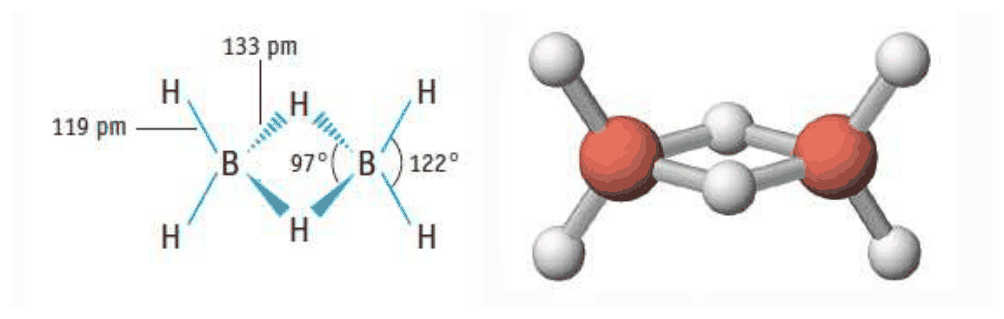
1.1 Using the data below derive the molecular formulae for two other members of this series of boron hydrides, A and B.
Substance State (25 °C, 1 bar) Mass Percent of Boron Molar mass (\(\mathrm{g\,mol^{-1}}\)) A Liquid 83.1 65.1 B Solid 88.5 122.2 William Lipscomb received the Nobel Prize in Chemistry in 1976 for “studies on the structures of boron hydrides illuminating the problems of chemical bonding.” Lipscomb recognized that, in all boron hydrides, each B atom has a normal 2-electron bond to at least one H atom (\(\ce{B-H}\)). However, additional bonds of several types occur, and he developed a scheme for describing the structure of a borane by giving it a styx number where:
s = number of \(\ce{B-H-B}\) bridges in the molecule,
t = the number of 3-center BBB bonds in the molecule,
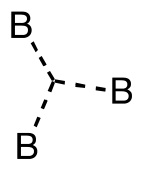
y = the number of two-center \(\ce{B-B}\) bonds in the molecule,
x = the number of \(\ce{BH2}\) groups in the molecule.
The styx number for \(\ce{B2H6}\) is 2002.
1.2 Propose a structure for tetraborane, \(\ce{B4H10}\), with a styx number of 4012.
1.3 A boron-based compound is composed of boron, carbon, chlorine, and oxygen. Spectral measurements indicate that the molecule has two types of B atoms, with tetrahedral and trigonal planar geometry, in a 1 : 3 ratio, respectively. These spectra are also consistent with a \(\ce{CO}\) triple bond. The molecular formula of the compound is \(\ce{B4CCl6O}\). Suggest a structure for its molecule.
B. Thermochemistry of Boron Compounds
1.4 Estimate the B-B single bond dissociation enthalpy in \(\ce{B2Cl4(g)}\) using the following information:
Bond Bond dissociation enthalpy (\(\mathrm{kJ\,mol^{-1}}\)) \(\ce{B-Cl}\) 443 \(\ce{Cl-Cl}\) 242 Compound \(\Delta_\mathrm{f}H^\circ\;(\mathrm{kJ\,mol^{-1}})\) \(\ce{BCl3(g)}\) −403 \(\ce{B2Cl4(g)}\) −489 C. Chemistry of Diborane
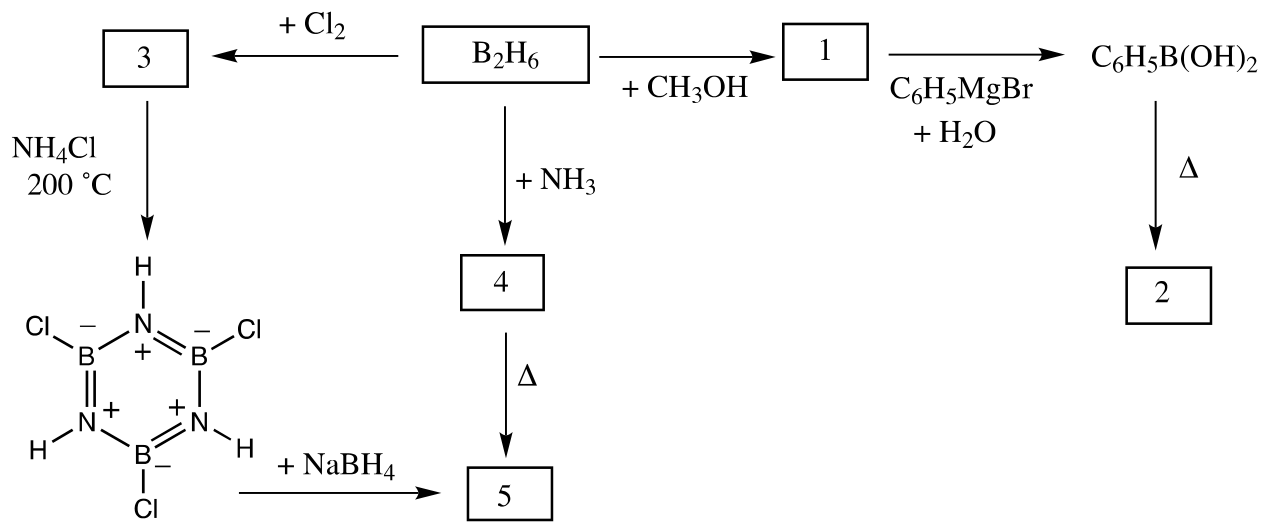
1.5 Give the structure for each numbered compound in the scheme below. Each numbered compound is a boron-containing compound.
NOTES:
i. The boiling point of compound 5 is 55 °C.
ii. Excess reagents used in all reactions.
iii. The freezing point depression for 0.312 g of compound 2 in 25.0 g of benzene, is 0.205 °C. The freezing point depression constant for benzene is \(5.12\ \mathrm{kg\,K\,mol^{-1}}\).
Official English text of the problem.
Problem 2: Platinum(II) compounds, isomers and the trans effect
A. Platinum(II) Compounds, Isomers, and the Trans Effect.
Platinum and other Group 10 metals form square planar complexes and the mechanisms of their reactions have been studied extensively. For example, it is known that substitution reactions of these complexes proceed with retention of stereochemistry.
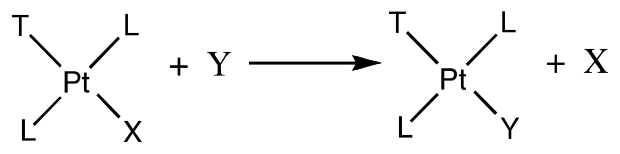
It is also known that the rate of substitution of ligand X by Y depends on the nature of the ligand trans to X, that is, on ligand T. This is known as the trans effect. When T is one of the molecules or ions in the following list, the rate of substitution at the trans position decreases from left to right.
\[ \ce{CN^-}>\ce{H^-}>\ce{NO2^-},\ \ce{I^-}> \ce{Br^-},\ \ce{Cl^-}> \text{pyridine},\ \ce{NH3},\ \ce{OH^-},\ \ce{H2O} \]
The preparations of cis- and trans-\(\ce{Pt(NH3)2Cl2}\) depend on the trans affect. The preparation of the cis isomer, a cancer chemotherapy agent commonly called cisplatin, involves the reaction of \(\ce{K2PtCl4}\) with ammonia.

2.1 Draw all possible stereoisomers for square planar platinum(II) compounds with the formula \(\ce{Pt(py)(NH3)BrCl}\) (where py = pyridine, \(\ce{C5H5N}\)).
2.2 Write reaction schemes including intermediate(s), if any, to show the preparation in aqueous solution for each of the stereoisomers of \(\ce{[Pt(NH3)(NO2)Cl2]^-}\) using, as reagents, \(\ce{PtCl4^2-}\), \(\ce{NH3}\), and \(\ce{NO2^-}\). The reactions are controlled kinetically by the trans effect.
B. Kinetic Studies of Substitution Reactions of Square Planar Complexes
Substitutions of the ligand X by Y in square planar complexes
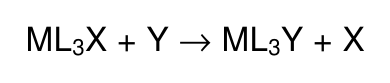
can occur in either or both of two ways:
i) Direct substitution: The incoming ligand Y attaches to the central metal, forming a five-coordinate complex, which then rapidly eliminates a ligand, X, to give the product, \(\ce{ML3Y}\).

\(\ast\ast\) = rate determining step, rate constant = \(k_{\mathrm Y}\)
ii) Solvent-assisted substitution: A solvent molecule S attaches to the central metal to give \(\ce{ML3XS}\), which eliminates the X to give \(\ce{ML3S}\). Y rapidly displaces S to give \(\ce{ML3Y}\).

\(\ast\ast\) = rate determining step, \(k_{\mathrm S}\) = rate constant
The overall rate law for such substitutions is
\[ \mathrm{Rate} =k_s[\ce{ML3X}]+k_{\mathrm Y}[\ce{Y}][\ce{ML3X}] \]
When \([\ce{Y}]\gg[\ce{ML3X}]\), then \(\mathrm{Rate}=k_{\mathrm{obs}}[\ce{ML3X}]\).
The values of \(k_s\) and \(k_{\mathrm Y}\) depend on the reactants and solvent involved. One example is the displacement of the \(\ce{Cl^-}\) ligand in a square planar platinum(II) complex, \(\ce{ML2X2}\), by pyridine (\(\ce{C5H5N}\)). (The \(\ce{ML3X}\) scheme above applies to \(\ce{ML2X2}\).)
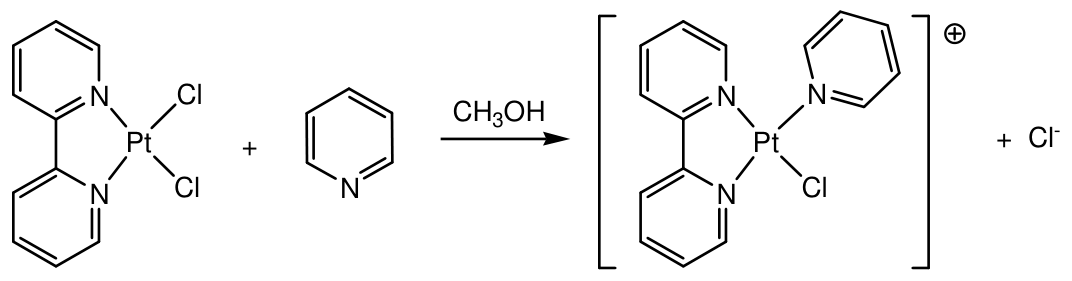
Data for reaction at \(25\,^\circ\mathrm C\) in methanol where \([\text{pyridine}]\gg\) the concentration of the platinum complex, are given in the table below.
Concentration of pyridine (\(\mathrm{mol\,dm^{-3}}\)) \(k_{\mathrm{obs}}\) (\(\mathrm{s^{-1}}\)) 0.122 \(7.20\cdot10^{-4}\) 0.061 \(3.45\cdot10^{-4}\) 0.030 \(1.75\cdot10^{-4}\) 2.3 Calculate the values of \(k_s\) and \(k_{\mathrm Y}\). Give the proper unit for each constant.
(A grid is given if you wish to use it.)
2.4 When [pyridine] = \(0.10\ \mathrm{mol\,dm^{-3}}\), which of the following is true? (Tick the box next to the correct answer.)
☐ Most pyridine product is formed by the solvent-assisted (\(k_s\)) substitution pathway.
☐ Most pyridine product is formed by the direct substitution (\(k_{\mathrm Y}\)) pathway
☐ Comparable amounts of product are formed by the two pathways.
☐ No conclusions may be drawn regarding the relative amounts of product produced by the two pathways.
C. A chemotherapy agent
In an effort to better target cisplatin to cancer cells, Professor Lippard’s group at MIT attached a platinum(IV) complex to oligonucleotides bound to gold nanoparticles.
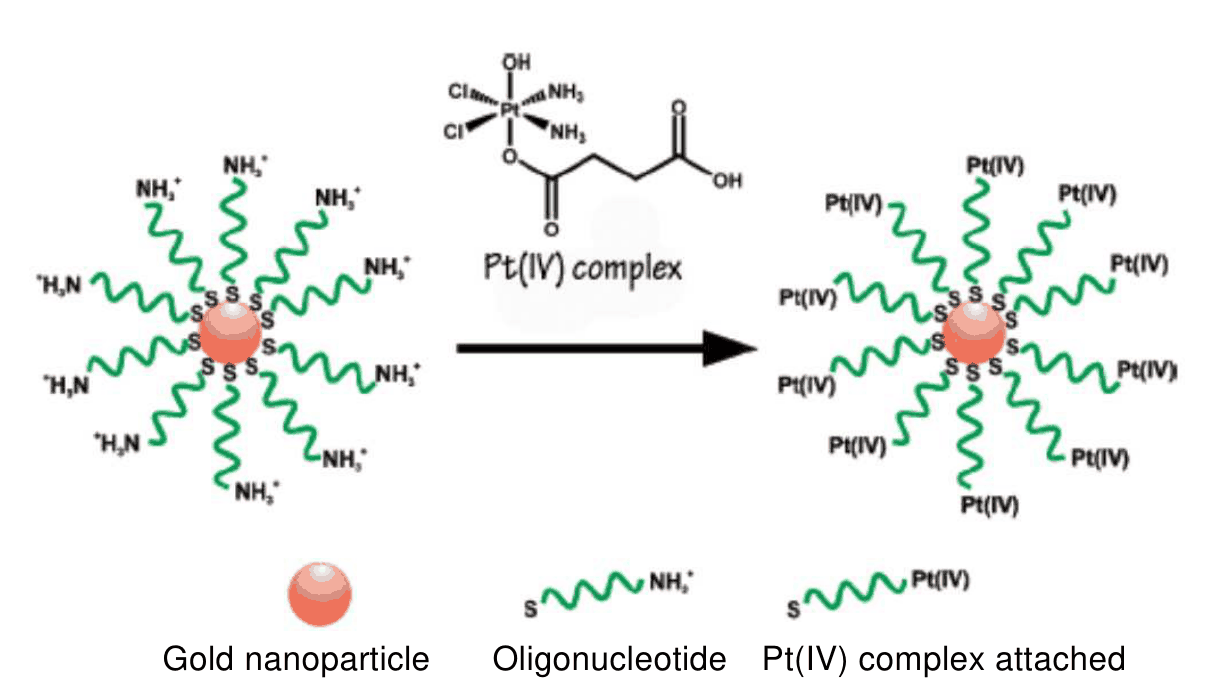
2.5 Experiments showed that the diameter of a gold nanoparticle was 13 nm. Attached to this nanoparticle are 90 oligonucleotide groups, with 98 % of them being bound to a Pt(IV) complex. Suppose that the reaction vessel used for treating cells with the Pt(IV) nanoparticle reagent had a volume of \(1.0\ \mathrm{cm^3}\) and the concentration of the solution was \(1.0\cdot10^{-6}\ \mathrm{mol\,dm^{-3}}\) in \(\ce{Pt}\). Calculate the mass of platinum and that of gold used in this experiment.
(The density of gold = \(19.3\ \mathrm{g\,cm^{-3}}\), the volume of a sphere = \((4/3)\pi r^3=4.18879\,r^3\).)
Official English text of the problem.
Problem 3: Thiomolybdate ions
Thiomolybdate ions are derived from molybdate ions, \(\ce{MoO4^2-}\), by replacing oxygen atoms with sulfur atoms. In nature, thiomolybdate ions are found in such places as the deep waters of the Black Sea, where biological sulfate reduction generates \(\ce{H2S}\). The molybdate to thiomolybdate transformation leads to rapid loss of dissolved \(\ce{Mo}\) from seawater to underlying sediments, depleting the ocean in \(\ce{Mo}\), a trace element essential for life.
The following equilibria control the relative concentrations of molybdate and thiomolybdate ions in dilute aqueous solution:
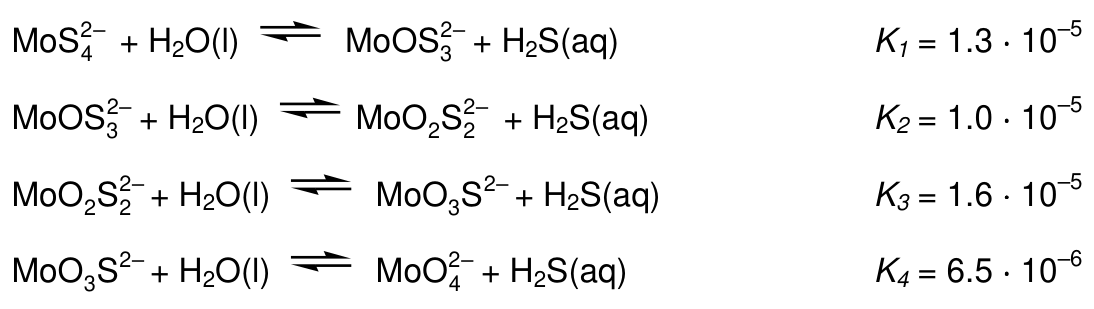
3.1 If at equilibrium the concentrations of \(\ce{MoO4^2-}\) and \(\ce{H2S(aq)}\) are equal to \(1\cdot10^{-7}\) and \(1\cdot10^{-6}\), respectively, what would be the equilibrium concentration of \(\ce{MoS4^2-}\)?
Solutions containing \(\ce{MoO2S2^2-}\), \(\ce{MoOS3^2-}\) and \(\ce{MoS4^2-}\) display absorption peaks in the visible wavelength range at 395 and 468 nm. The other ions, as well as \(\ce{H2S}\), absorb negligibly in the visible wavelength range. The molar absorptivities (\(\varepsilon\)) at these two wavelengths are given in the following table:
\(\varepsilon\) at 468 nm
\(\mathrm{dm^3\,mol^{-1}\,cm^{-1}}\)\(\varepsilon\) at 395 nm
\(\mathrm{dm^3\,mol^{-1}\,cm^{-1}}\)\(\ce{MoS4^2-}\) 11870 120 \(\ce{MoOS3^2-}\) 0 9030 \(\ce{MoO2S2^2-}\) 0 3230 3.2 A solution not at equilibrium contains a mixture of \(\ce{MoS4^2-}\), \(\ce{MoOS3^2-}\) and \(\ce{MoO2S2^2-}\) and no other \(\ce{Mo}\)-containing species. The total concentration of all species containing \(\ce{Mo}\) is \(6.0\cdot10^{-6}\ \mathrm{mol\,dm^{-3}}\). In a 10.0 cm absorption cell, the absorbance of the solution at 468 nm is 0.365 and that at 395 nm is 0.213. Calculate the concentrations of all three \(\ce{Mo}\)-containing anions in this mixture.
A solution with initial concentration of \(\ce{MoS4^2-}\) equal to \(2.0\cdot10^{-7}\ \mathrm{mol\,dm^{-3}}\) hydrolyzes in a closed system. The \(\ce{H2S}\) product accumulates until equilibrium is reached. When calculating the final equilibrium concentrations of \(\ce{H2S(aq)}\), and all five \(\ce{Mo}\)-containing anions (that is, \(\ce{MoO4^2-}\), \(\ce{MoO3S^2-}\), \(\ce{MoO2S2^2-}\), \(\ce{MoOS3^2-}\) and \(\ce{MoS4^2-}\)) ignore the possibility that \(\ce{H2S}\) might ionize to \(\ce{HS-}\) under certain pH conditions.
3.3 Write the six independent equations that determine the system.
3.4 Calculate the above mentioned six concentrations making reasonable approximations, giving your answers to two significant figures.
Official English text of the problem.
Problem 4: The superconductor YBCO
In the 1980’s a class of ceramic materials was discovered that exhibits superconductivity at the unusually high temperature of 90 K. One such material contains yttrium, barium, copper and oxygen and is called “YBCO”. It has a nominal composition of \(\ce{YBa2Cu3O7}\), but its actual composition is variable according to the formula \(\ce{YBa2Cu3O_{7-\delta}}\) \((0 < \delta < 0.5)\).
4.1 One unit cell of the idealized crystal structure of YBCO is shown below. Identify which circles correspond to which elements in the structure.
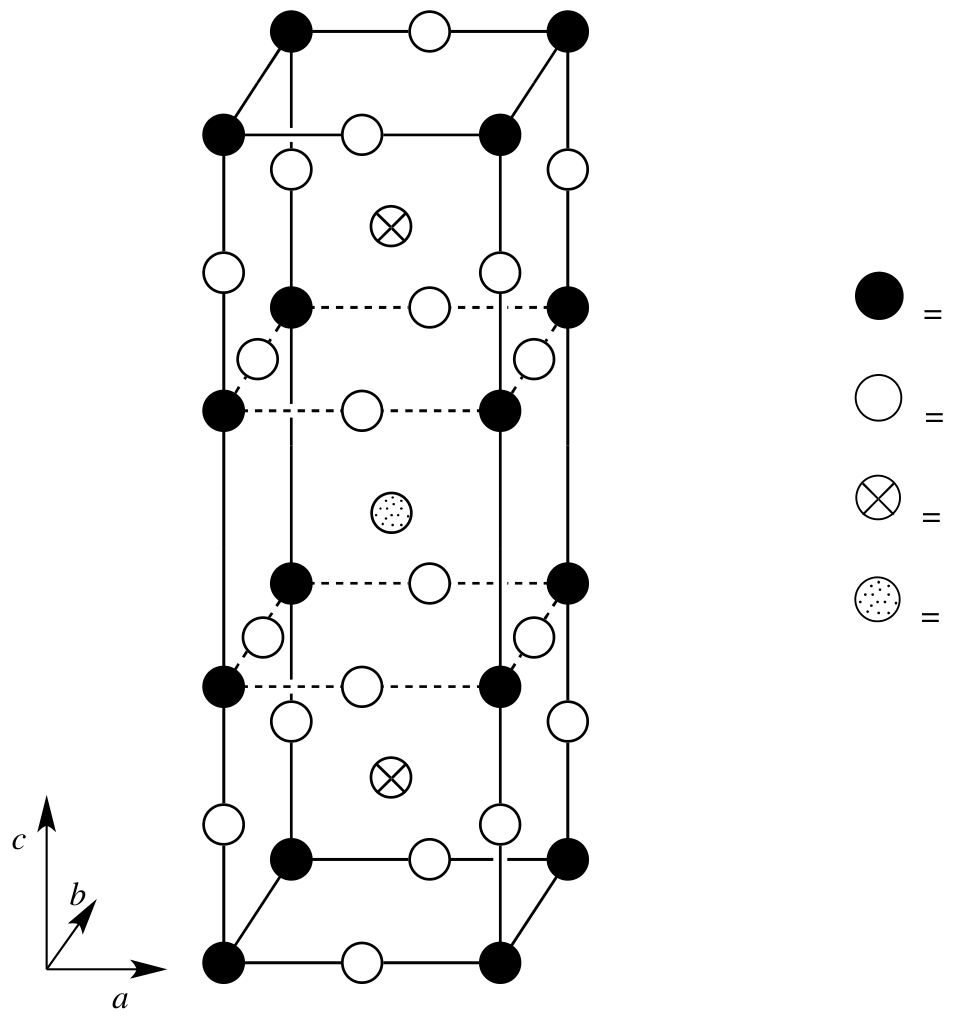
The true structure is actually orthorhombic \((a \ne b \ne c)\), but it is approximately tetragonal, with \(a \approx b \approx (c/3)\).
4.2 A sample of YBCO with \(\delta = 0.25\) was subjected to X-ray diffraction using \(\ce{Cu}\mathrm{K}\alpha\) radiation \((\lambda = 154.2\ \mathrm{pm})\). The lowest-angle diffraction peak was observed at \(2\theta = 7.450^\circ\). Assuming that \(a = b = (c/3)\), calculate the values of \(a\) and \(c\).
4.3 Estimate the density of this sample of YBCO (with \(\delta = 0.25\)) in \(\mathrm{g\,cm^{-3}}\). If you were unable to calculate the values for \(a\) and \(c\) from part 4.2, then use \(a = 500\ \mathrm{pm}\) and \(c = 1500\ \mathrm{pm}\).
When YBCO is dissolved in aqueous \(\ce{HCl}\) \((c = 1.0\ \mathrm{mol\,dm^{-3}})\) bubbles of gas are observed (identified as \(\ce{O2}\) by gas chromatography). After boiling for 10 min to expel the dissolved gases, the solution reacts with excess \(\ce{KI}\) solution, turning yellow-brown. This solution can be titrated with thiosulfate solution to a starch endpoint. If YBCO is added under \(\ce{Ar}\) directly to a solution in which concentrations of both \(\ce{KI}\) and \(\ce{HCl}\) are equal to \(1.0\ \mathrm{mol\,dm^{-3}}\), the solution turns yellow-brown but no gas evolution is observed.
4.4 Write a balanced net ionic equation for the reaction when solid \(\ce{YBa2Cu3O_{7-\delta}}\) dissolves in aqueous \(\ce{HCl}\) with evolution of \(\ce{O2}\).
4.5 Write a balanced net ionic equation for the reaction when the solution from 4.4 reacts with excess \(\ce{KI}\) in acidic solution after the dissolved oxygen is expelled.
4.6 Write a balanced net ionic equation for the reaction when the solution from 4.5 is titrated with thiosulfate \((\ce{S2O3^2-})\).
4.7 Write a balanced net ionic equation for the reaction when solid \(\ce{YBa2Cu3O_{7-\delta}}\) dissolves in aqueous \(\ce{HCl}\) containing excess \(\ce{KI}\) in an \(\ce{Ar}\) atmosphere.
Two identical samples of YBCO with an unknown value of \(\delta\) were prepared. The first sample was dissolved in \(5\ \mathrm{cm^3}\) of aqueous \(\ce{HCl}\) \((c = 1.0\ \mathrm{mol\,dm^{-3}})\), evolving \(\ce{O2}\). After boiling to expel gases, cooling, and addition of \(10\ \mathrm{cm^3}\) of \(\ce{KI}\) solution \((c = 0.7\ \mathrm{mol\,dm^{-3}})\) under \(\ce{Ar}\), titration with thiosulfate to the starch endpoint required \(1.542 \cdot 10^{-4}\ \mathrm{mol}\) thiosulfate. The second sample of YBCO was added under \(\ce{Ar}\) directly to \(7\ \mathrm{cm^3}\) of a solution in which \(c(\ce{KI}) = 1.0\ \mathrm{mol\,dm^{-3}}\) and \(c(\ce{HCl}) = 0.7\ \mathrm{mol\,dm^{-3}}\). Titration of this solution required \(1.696 \cdot 10^{-4}\ \mathrm{mol}\) thiosulfate to reach the endpoint.
4.8 Calculate the amount of substance of \(\ce{Cu}\) (in mol) in each of these samples of YBCO.
4.9 Calculate the value of \(\delta\) for these samples of YBCO.
Official English text of the problem.
Problem 5: Chemical modification of DNA
Deoxyribonucleic Acid (DNA) is one of the fundamental molecules of life. This question will consider ways that DNA’s molecular structure may be modified, both naturally and in ways devised by humankind.
Consider the pyrimidine bases, cytosine (C) and thymine (T). The N-3 atom (indicated by *) of one of these bases is a common nucleophilic site in single strand DNA alkylation, while the other is not.
5.1 Select (circle) which base, C or T, has the more nucleophilic N-3 atom.
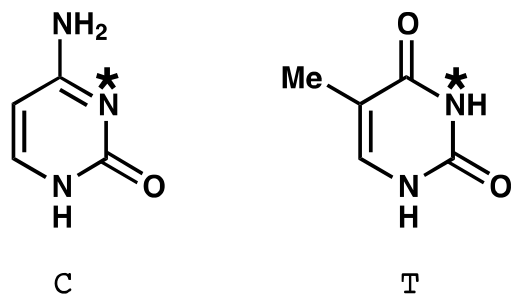
5.2. Draw two complementary resonance structures of the molecule you select to justify your answer.
One common modification of DNA in nature is methylation of the indicated (*) position of guanine (G) by S-adenosyl methionine (SAM).
5.3 Draw the structures of both of the products of the reaction between guanine and SAM.
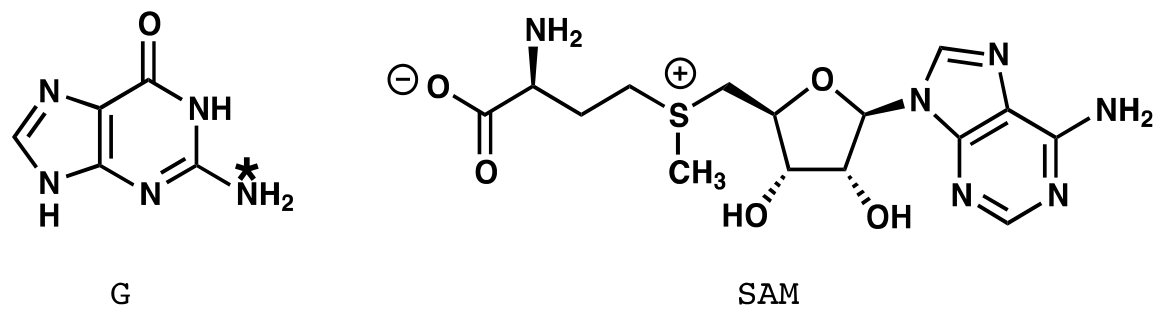
One of the earliest man-made DNA alkylating agents was mustard gas. Mustard gas acts by first undergoing an intramolecular reaction to form intermediate A which directly alkylates DNA, to give a nucleic acid product such as that shown in the part above.

5.4 Draw the structure for reactive intermediate A.
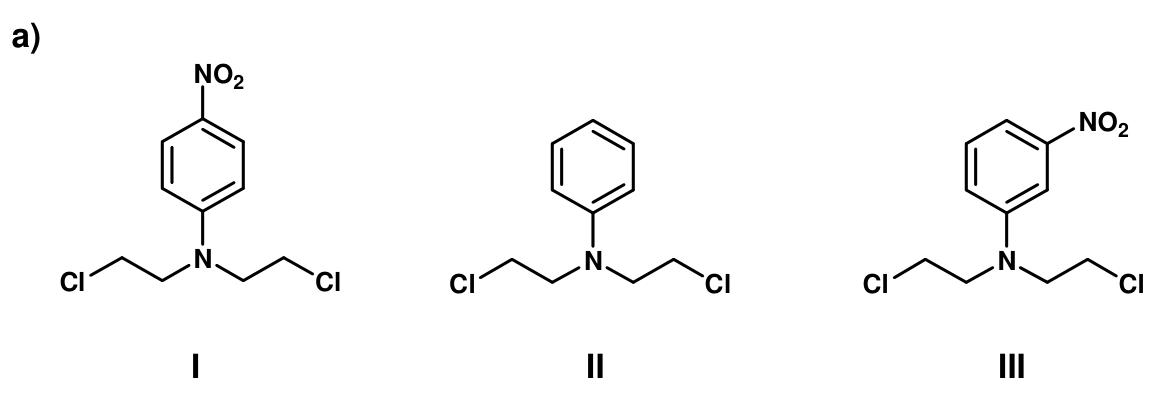
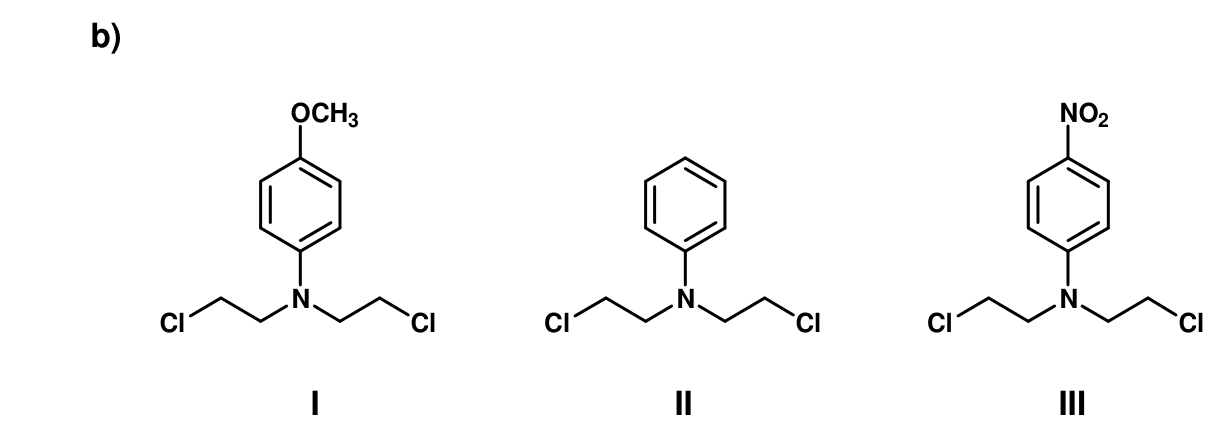
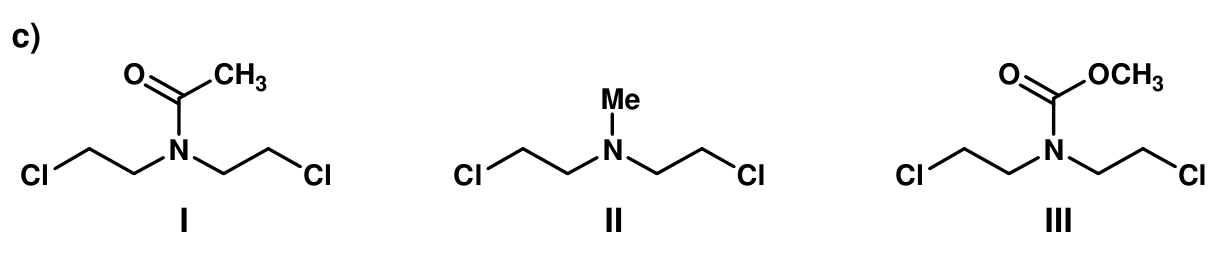
The nitrogen mustards react via an analogous pathway to the sulfur mustard of previous part. The reactivity of the compound may be modified depending on the third substituent on the nitrogen atom. The reactivity of nitrogen mustards increases with increasing nucleophilicity of the central nitrogen atom.
5.5 Select the most and least reactive from each of following groups of nitrogen mustards.
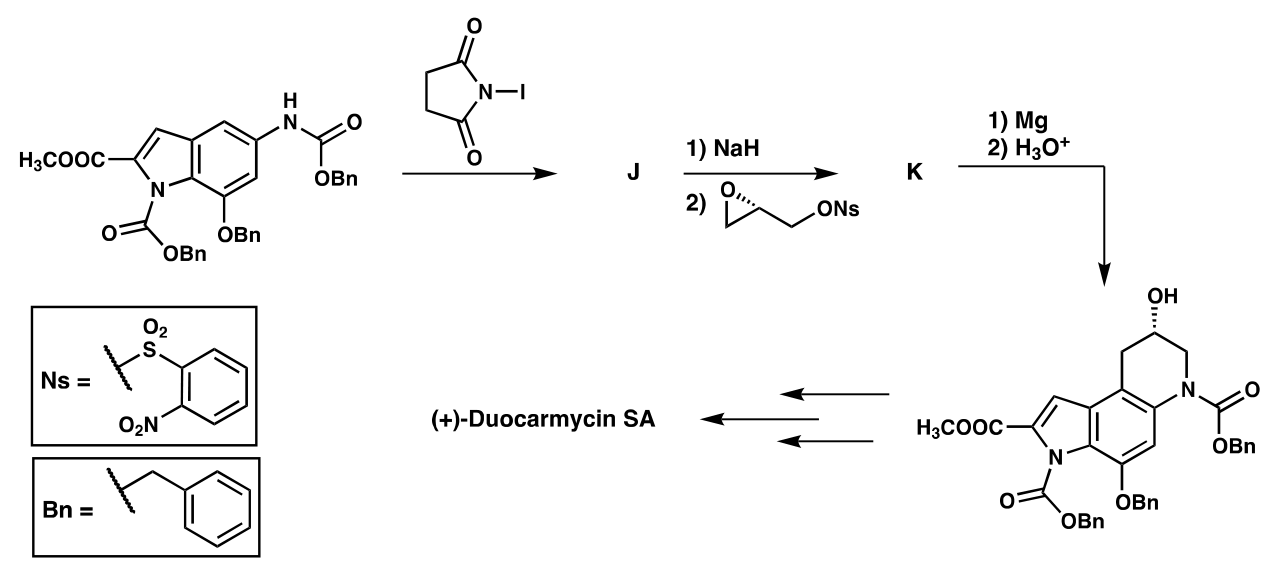
Some classes of natural products act as DNA alkylators, and in this way, they have the potential to serve as cancer therapies due to their antitumor activity. One such class is the duocarmycins. Shown below are steps from an asymmetric total synthesis of the natural product.
5.6 Draw the structures of isolable compounds J and K in the following scheme:
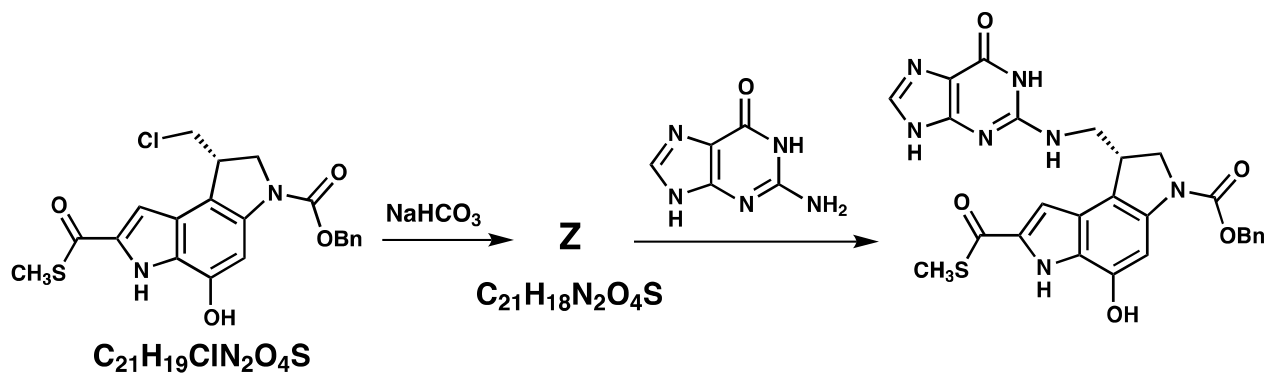
Related small molecules were synthesized to study the way in which the duocarmycins work. One such example is the thioester shown below.
5.7 Draw the structure of reactive intermediate Z.
Official English text of the problem.
Problem 6: Synthesis of varenicline
Varenicline has been developed as an oral treatment for smoking addiction and can be synthesized by the route shown below. All compounds indicated by a letter (A – H) are uncharged, isolable species.
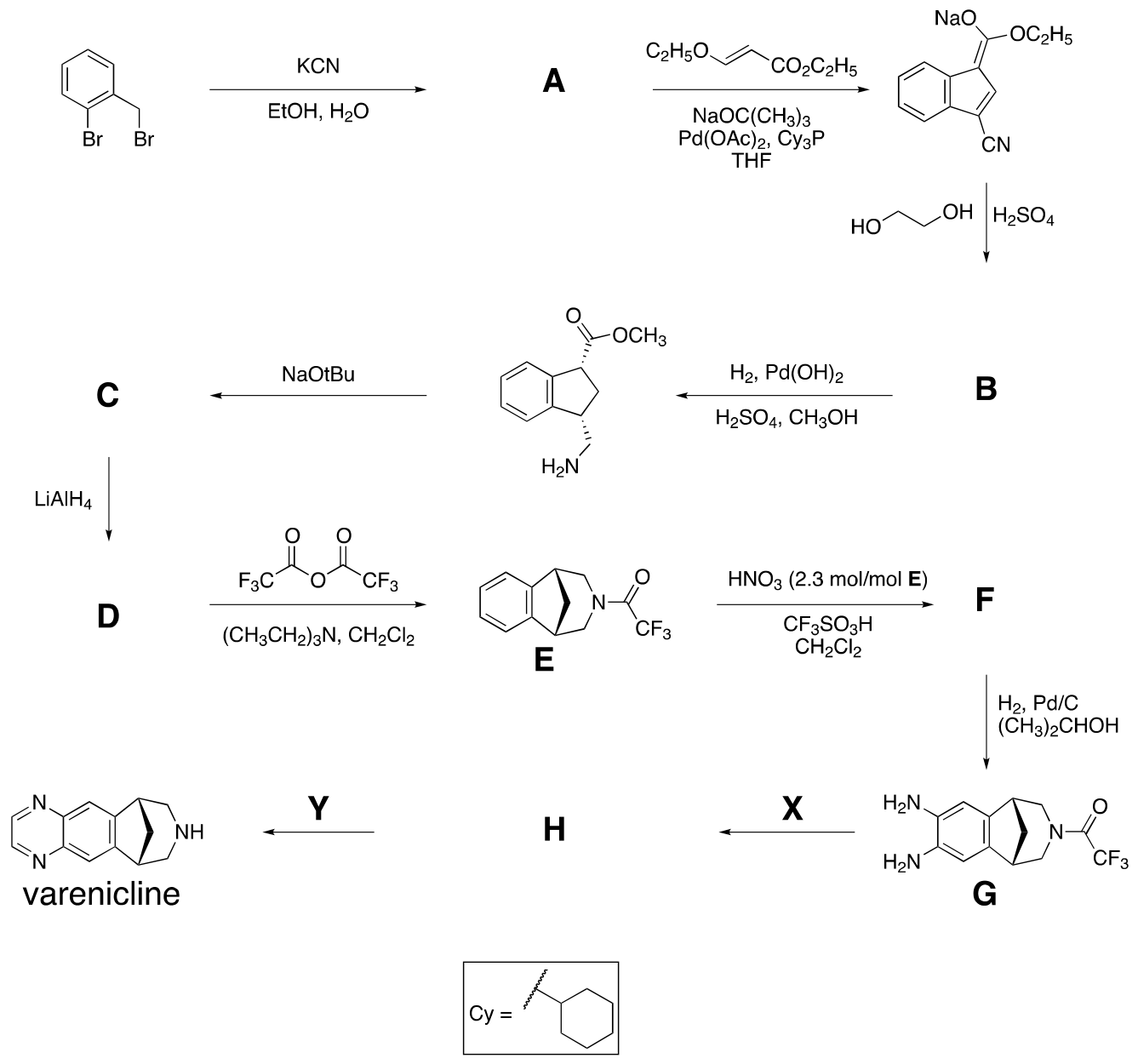
6.1 Suggest a structure for compound A.
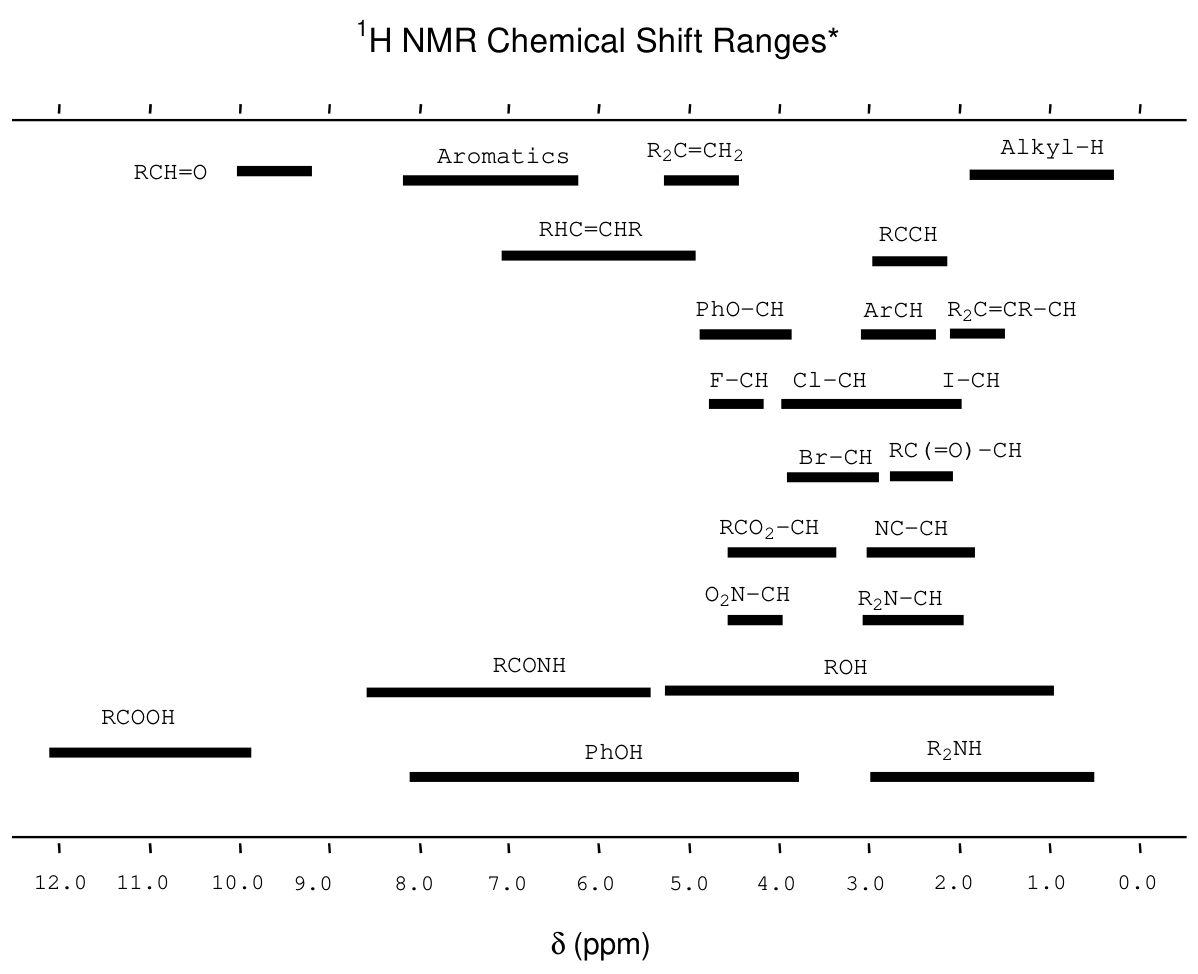
6.2 Suggest a structure for compound B consistent with the following \(\ce{^1H}\)-NMR data:
\(\delta\) 7.75 (singlet, 1H), 7.74 (doublet, 1H, \(J = 7.9\ \mathrm{Hz}\)), 7.50 (doublet, 1H, \(J = 7.1\ \mathrm{Hz}\)), 7.22 (multiplet, 2 nonequivalent H), 4.97 (triplet, 2H, \(J = 7.8\ \mathrm{Hz}\)), 4.85 (triplet, 2H, \(J = 7.8\ \mathrm{Hz}\)).
6.3 Suggest a structure for compounds C, D, and F.
6.4 Suggest reagents X and Y to convert compound G into varenicline, and provide the isolable intermediate H along this route.
Official English text of the problem.
Problem 7: An artificial enzyme for a Diels–Alder reaction
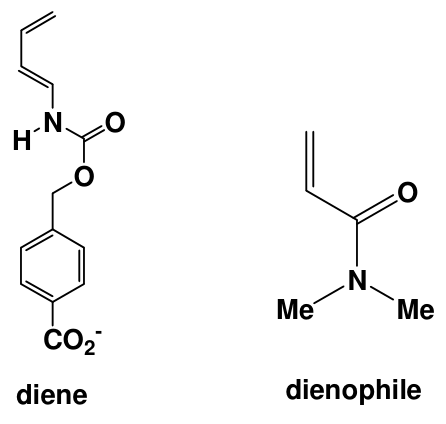
An artificial enzyme was designed to bind the two substrate molecules shown below (diene and dienophile) and catalyze a Diels-Alder reaction between them.
a. There are eight potential products from a Diels-Alder reaction involving these two molecules in the reaction without any enzyme.
7.1 Draw the structures of any two of the potential products that are regioisomers of each other, in the boxes that are given below. Use wedges (\(\blacktriangleleft\)) and dashes (\(\cdots\)) to show the stereochemistry of each product in your drawings. Use R and R′ shown below to represent the substituents in the molecules that are not directly involved in the reaction.
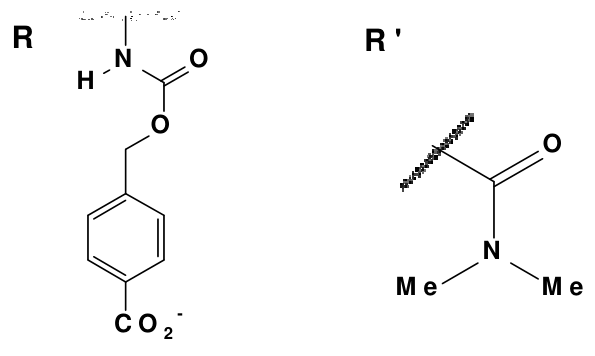
7.2 Draw the structures of any two of the potential products that are enantiomers of each other, in the boxes that are given below. Use wedges (\(\blacktriangleleft\)) and dashes (\(\cdots\)) to show the stereochemistry of each product in your drawings. Use R and R′ as in part (7.1).
7.3 Draw the structures of any two of the potential products that are diastereomers of each other, in the boxes that are given below. Use wedges (\(\blacktriangleleft\)) and dashes (\(\cdots\)) to show the stereochemistry of each product in your drawings. Use R and R′ as in part (7.1).
b. The rate and regioselectivity of a Diels-Alder reaction depend on the degree of electronic complementarity between the two reactants. The structures of the diene and the dienophile from part a are given below.
7.4 Circle the carbon atom in the diene that has increased electron density and therefore can act as an electron donor during the reaction. Draw one resonance structure of the diene in the box to support your answer. Indicate all non-zero formal charges on the atoms in the resonance structure that you draw.
7.5 Circle the carbon atom in the dienophile that has decreased electron density and therefore can act as an electron acceptor during the reaction. Draw one resonance structure of the dienophile in the box to support your answer. Indicate all non-zero formal charges on the atoms in the resonance structure that you draw.
7.6 Based on your assignments in parts (7.4) and (7.5), predict the regiochemistry of the uncatalyzed Diels-Alder reaction of the diene and dienophile by drawing the major product. You need not show the stereochemistry of the product in your drawing.
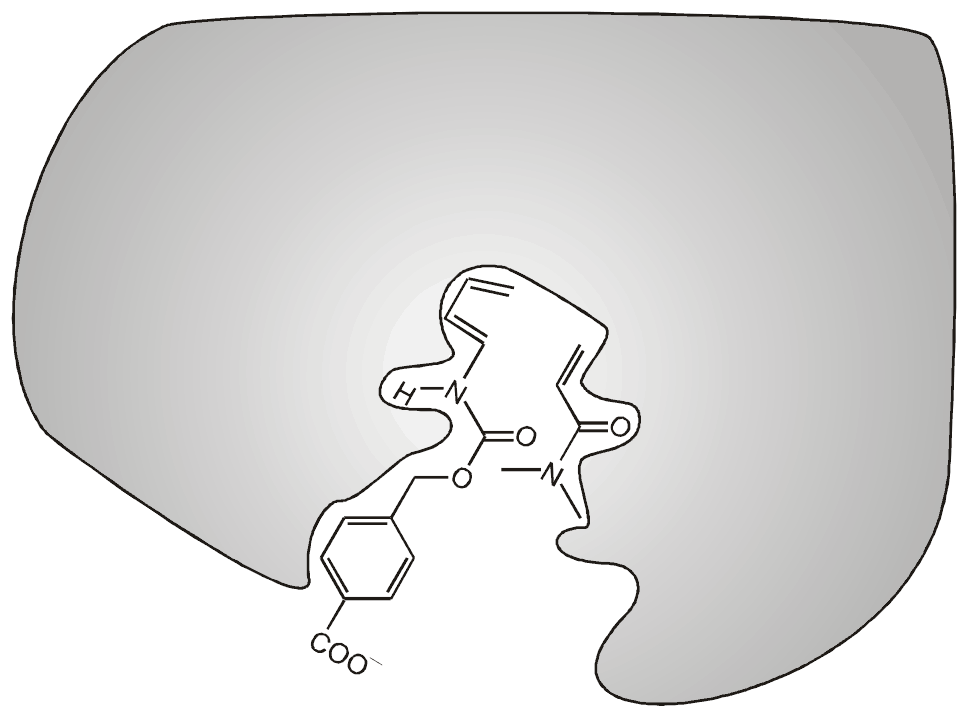
c. The figure below shows the Diels-Alder reactants as they are bound before they enter the transition state for product formation in the active site of the artificial enzyme. The gray area represents a cross-section through the enzyme. The dienophile is below the cross-section plane whereas the diene is above the cross-section plane, when the two molecules are bound in the active site that is shown.
7.7 Draw the structure of the product of the enzyme-catalyzed reaction in the box given below. Show the stereochemistry of the product in your drawing and use R and R′ as you did for question a.
d. Consider the following statements about enzymes (artificial or natural). For each statement, indicate whether that statement is True or False (draw a circle around “True” or “False”).
7.8 Enzymes bind more tightly to the transition state than to the reactants or products of the reaction.
True False
7.9 Enzymes alter the equilibrium constant of the reaction to favour the product.
True False
7.10 Enzymatic catalysis always increases the entropy of activation of the reaction compared to the uncatalyzed reaction.
True False
e. Modified versions of the artificial enzymes with different catalytic activities were prepared (enzymes I, II, III, and IV, shown in the figure below).
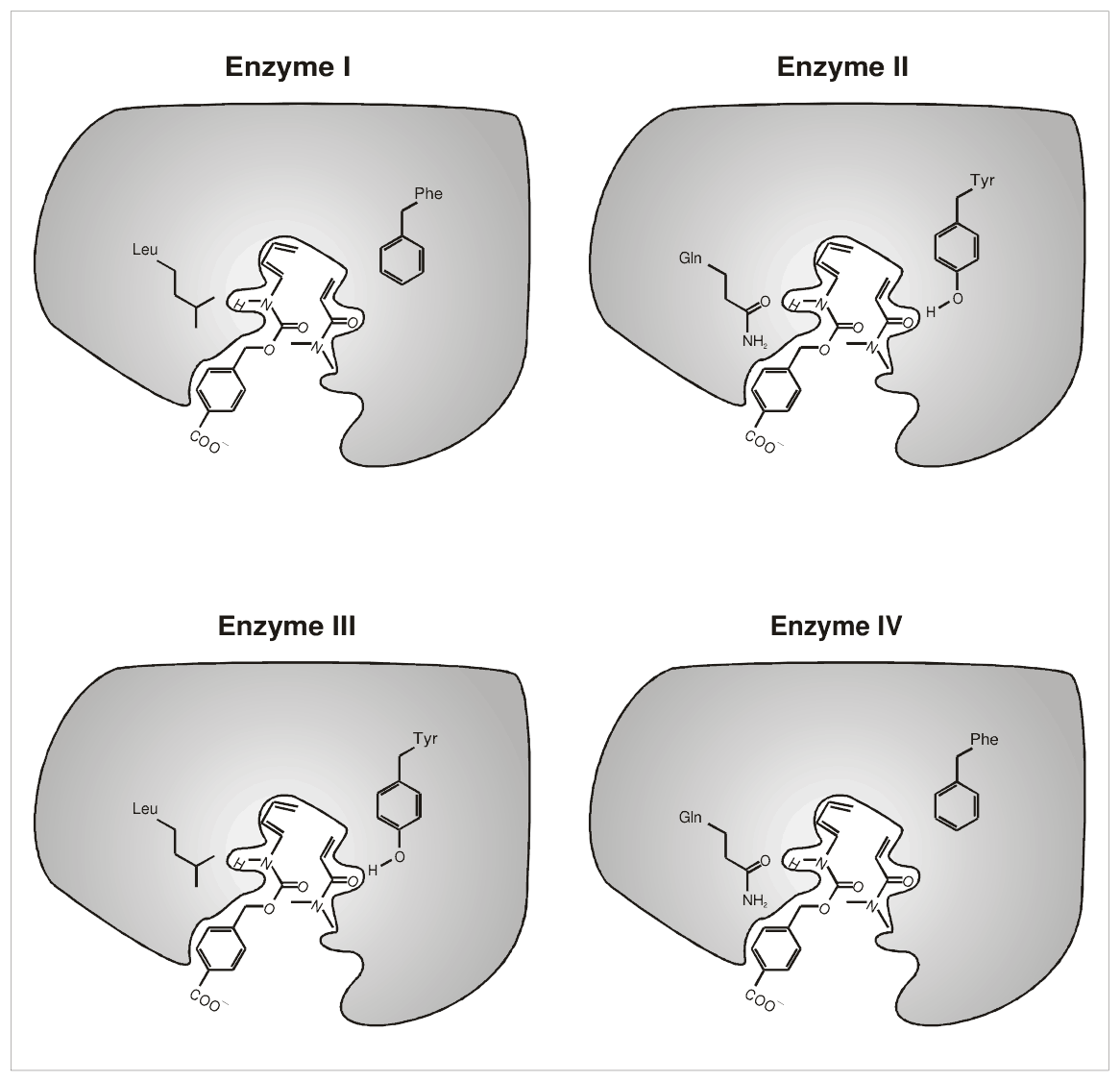
Two amino acid residues that differ among the different enzymes are shown. Assume that the enzyme functional groups shown are located in close proximity to the matching fragments of the reagents when they form the transition state in the enzyme active site.
7.11 Of these four enzymes which one would cause the greatest increase in the rate of the Diels-Alder reaction compared to the uncatalyzed reaction?
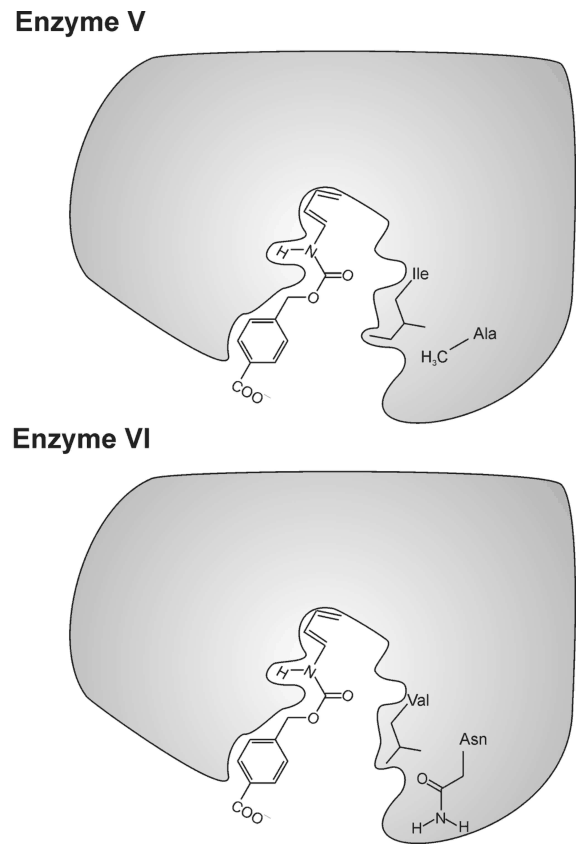
f. The substrate specificity of the artificial enzymes V and VI (see below) was tested by using the dienophile reactants 1 - 6, shown below.
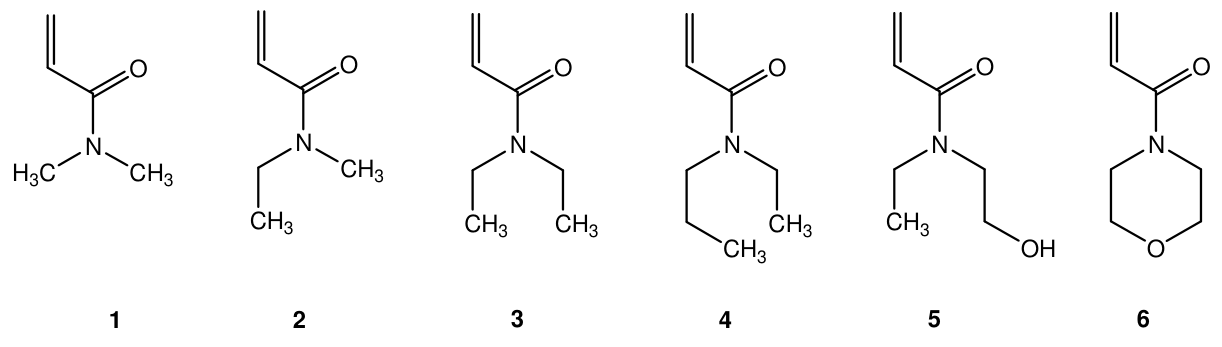
7.12 Dienophile #1 reacted most rapidly in the reaction catalyzed by artificial enzyme V (see below). However, artificial enzyme VI catalyzed the reaction most rapidly with a different dienophile. Of the six dienophiles shown above, which one would react most rapidly in the Diels-Alder reaction catalyzed by enzyme VI?
Official English text of the problem.
Problem 8: Linear polycyclic aromatic hydrocarbons
Polycyclic aromatic hydrocarbons (PAHs) are atmospheric pollutants, components of organic light emitting diodes and components of the interstellar medium. This problem deals with so-called linear PAHs, i.e., those being just one benzene ring wide whereas the length is varied. Specific examples are benzene, anthracene and pentacene whose structures are shown below. Their physical and chemical properties depend on the extent to which the \(\pi\) electron cloud is delocalized over the molecule.
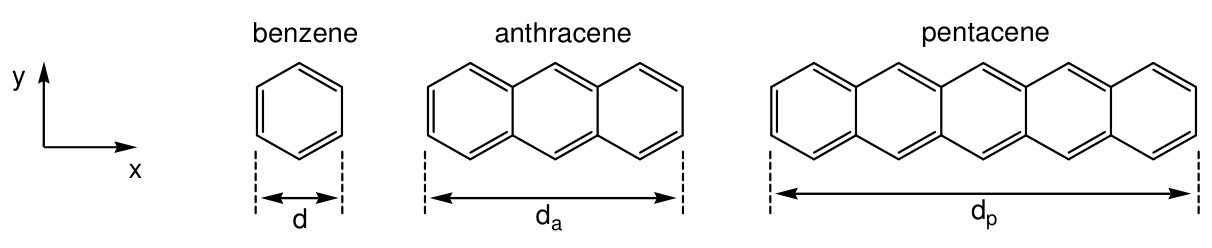
8.1 The distance across the benzene ring is \(d = 240\ \mathrm{pm}\). Use this information to estimate the distances along the horizontal (\(x\)) axis for anthracene and pentacene, \(d_a\) and \(d_p\), respectively.
Assume for simplicity that the \(\pi\) electrons of benzene can be modelled as being confined to a square. Within this model, the conjugated \(\pi\) electrons of PAHs may be considered as free particles in a two dimensional rectangular box in the \(x\)-\(y\) plane.
For electrons in a two-dimensional box along the \(x\)- and \(y\)-axes, the quantized energy states of the electrons are given by
\[ E=\left(\frac{n_x^2}{L_x^2}+\frac{n_y^2}{L_y^2}\right)\frac{h^2}{8m_e} \]
In this equation, \(n_x\) and \(n_y\) are the quantum numbers for the energy state and are integers between 1 and \(\infty\), \(h\) is Planck’s constant, \(m_e\) is the mass of the electron and \(L_x\) and \(L_y\) are the dimensions of the box.
For this problem, treat the \(\pi\) electrons of the PAHs as particles in a two dimensional box. In this case, the quantum numbers \(n_x\) and \(n_y\) are independent.
8.2 Assume that the benzene unit has \(x\) and \(y\) dimensions that are each of length \(d\). Derive a general formula for the quantized energies of linear PAHs as a function of quantum numbers \(n_x\) and \(n_y\), the length \(d\), the number of fused rings \(w\), and the fundamental constants \(h\) and \(m_e\).
The energy level diagram below for pentacene shows qualitatively the energies and quantum numbers \(n_x\), \(n_y\), for all levels occupied by \(\pi\) electrons and the lowest unoccupied energy level, with the electrons of opposite spins represented as the arrows pointing up or down. The levels are labelled with quantum numbers \((n_x; n_y)\).
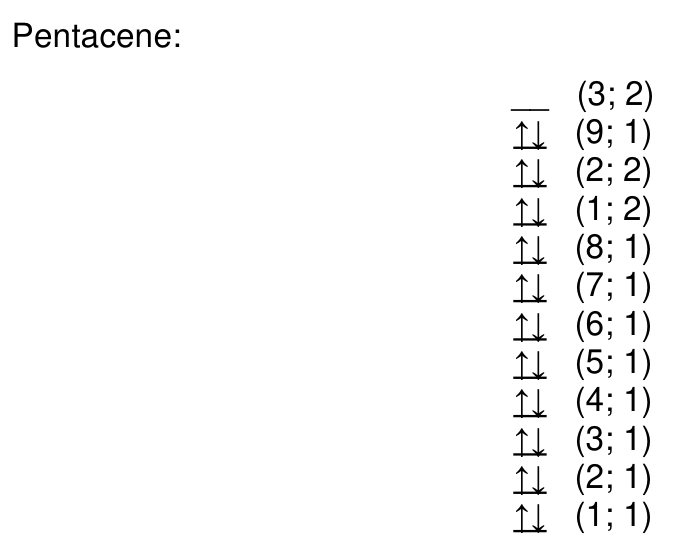
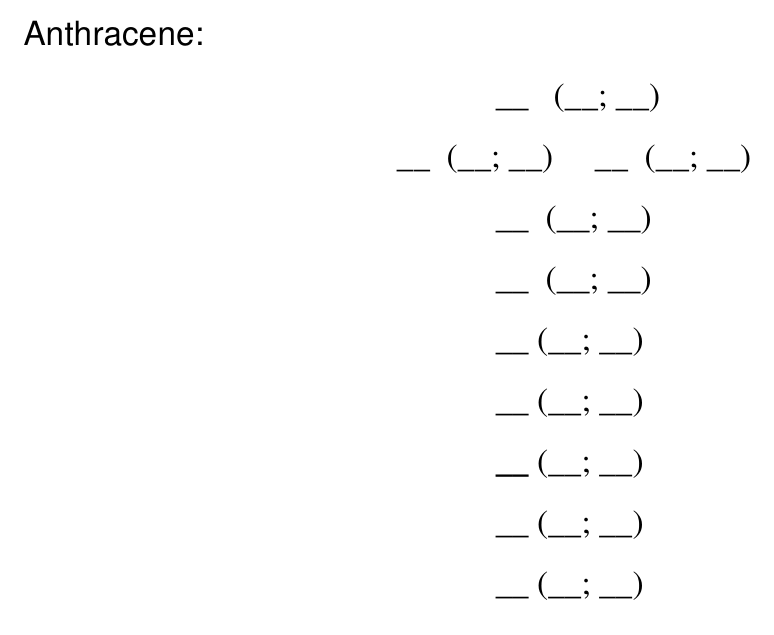
8.3 The energy level diagram for anthracene is shown below. Note that some energy levels may have the same energy. Draw the correct number of up and down arrows to represent the \(\pi\) electrons in this diagram. Also, the blanks in parentheses within this diagram are the quantum numbers \(n_x\), \(n_y\), which you need to determine. Fill these blanks with the pertinent values of \(n_x\), \(n_y\) for each filled and the lowest unfilled energy level(s).
8.4 Use this model to create an energy level diagram for benzene and fill the pertinent energy levels with electrons. Include energy levels up to an including the lowest unoccupied energy level. Label each energy level in your diagrams with the corresponding \(n_x\), \(n_y\). Do not assume that the particle-in-a-square-box model used here gives the same energy levels as other models.
Often the reactivity of PAHs correlates inversely with the energy gap \(\Delta E\) between the highest energy level occupied by \(\pi\) electrons and the lowest unoccupied energy level.
8.5 Calculate the energy gap \(\Delta E\) (in joules) between the highest occupied and lowest unoccupied energy levels for benzene, anthracene and pentacene. Use your result from parts 8.3 and 8.4 for anthracene or benzene, respectively, or use \((2, 2)\) for the highest occupied energy level and \((3, 2)\) for the lowest unoccupied energy level for these two molecules (these may not be the true values).
8.6 Rank benzene (B), anthracene (A), and pentacene (P) in order of increasing reactivity by placing the corresponding letters from left to right in the box below.
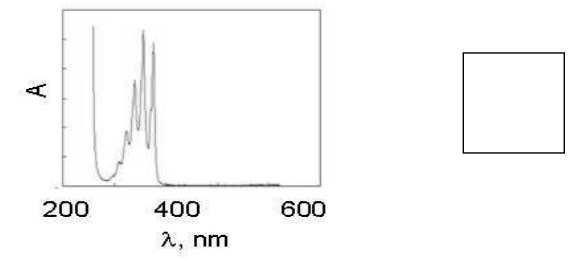
8.7 The electronic absorption spectra (molar absorptivity vs. wavelength) for anthracene (A), benzene (B), and pentacene (P) are shown below. Based on a qualitative understanding of the particle in the box model, indicate which molecule corresponds to which spectrum by writing the appropriate letter in the box to its right.
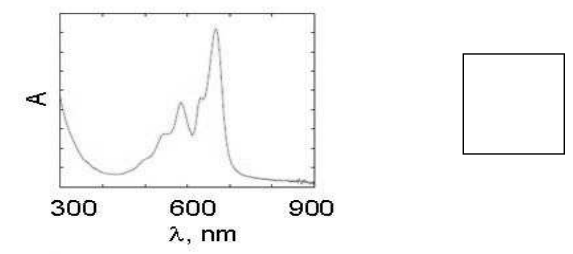
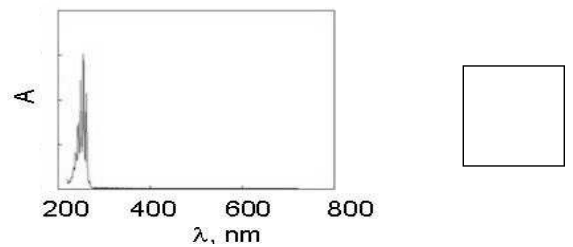
Graphene is a sheet of carbon atoms arranged in a two-dimensional honeycomb pattern. It can be considered as an extreme case of a polyaromatic hydrocarbon with essentially infinite length in the two dimensions. The Nobel Prize for Physics was awarded in 2010 to Andrei Geim and Konstantin Novoselov for groundbreaking experiments on graphene.
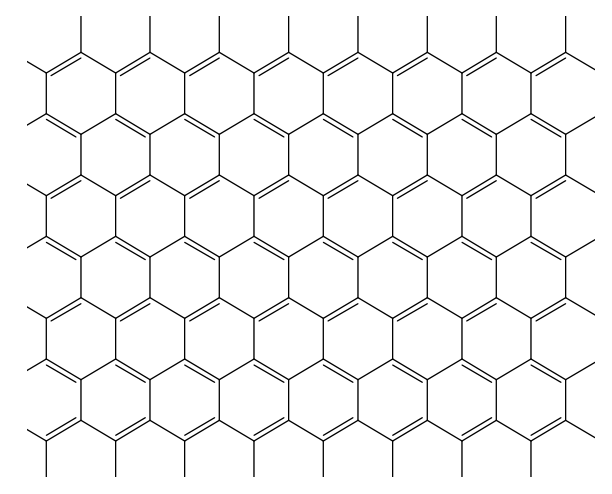
Consider a sheet of graphene with planar dimensions of \(L_x = 25\ \mathrm{nm}\) by \(L_y = 25\ \mathrm{nm}\). A section of this sheet is shown below. The area of one hexagonal 6-carbon unit is \(\sim52\,400\ \mathrm{pm^2}\).
8.8 Calculate the number of \(\pi\) electrons in a \((25\ \mathrm{nm}\times25\ \mathrm{nm})\) sheet of graphene. For this problem you can ignore edge electrons (i.e. those outside the full hexagons in the picture).
We can think about the \(\pi\) electrons in graphene as being free electrons in a 2-dimensional box. In systems containing large numbers of electrons, there is no single highest occupied energy level. Instead, there are many states of nearly the same energy above which the remaining are empty. These highest occupied states determine the so-called Fermi level. The Fermi level in graphene consists of multiple combinations of \(n_x\) and \(n_y\) quantum numbers.
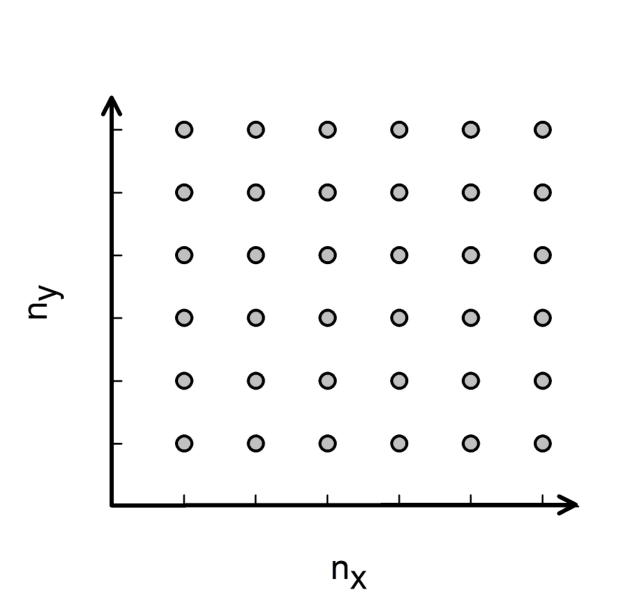
8.9 Determine the energy of the Fermi level for the \(25\ \mathrm{nm}\times25\ \mathrm{nm}\) square of graphene relative to the lowest filled level. The lowest filled level has a non-zero energy; however, it is negligible, and can be assumed to be zero. To solve this problem it might be helpful to represent the \((n_x, n_y)\) quantum states as points on a 2-D grid (as shown below) and consider how the energy levels are filled with pairs of electrons. For the number of electrons use your result from part 8.8 or use a value of 1000 (this may not be the true value).
8.10 The conductivity of graphene-like materials correlates inversely with the energy gap between the lowest unoccupied and highest occupied energy levels. Use your analysis and understanding of \(\pi\) electrons in PAHs and graphene to predict whether the conductivity of a \(25\ \mathrm{nm}\times25\ \mathrm{nm}\) square of graphene, at a given temperature, is less than, equal to or greater than the conductivity of a \(1\ \mathrm{m}\times1\ \mathrm{m}\) square of graphene (which is the largest obtained to date). Circle the correct answer:

Official English text of the problem.
Internationale Chemie-Olympiade
IChO 2012
Washington, D.C., Vereinigte Staaten · 8 Theorieaufgaben mit vollständigen Lösungen
Aufgabe 1: Borhydride und andere Borverbindungen
A. Borhydride und andere Borverbindungen
Die Chemie der Borhydride wurde erstmals von Alfred Stock (1876 - 1946) entwickelt. Mehr als 20 neutrale molekulare Borhydride mit der allgemeinen Formel \(\ce{B_xH_y}\) wurden charakterisiert. Das einfachste Borhydrid ist \(\ce{B2H6}\), Diboran.
1.1 Leiten Sie anhand der folgenden Daten die Summenformeln zweier weiterer Vertreter dieser Reihe von Borhydriden, A und B, her.
Stoff Aggregatzustand (25 °C, 1 bar) Massenanteil an Bor in Prozent Molare Masse (\(\mathrm{g\,mol^{-1}}\)) A Flüssig 83.1 65.1 B Fest 88.5 122.2 William Lipscomb erhielt 1976 den Nobelpreis für Chemie für „Untersuchungen zur Struktur von Borhydriden, die Probleme der chemischen Bindung erhellen“. Lipscomb erkannte, dass in allen Borhydriden jedes B-Atom über eine normale 2-Elektronen-Bindung mit mindestens einem H-Atom verbunden ist (\(\ce{B-H}\)). Es treten jedoch zusätzliche Bindungen verschiedener Typen auf, und er entwickelte ein Schema zur Beschreibung der Struktur eines Borans durch Angabe einer styx-Zahl, wobei gilt:
s = Anzahl der \(\ce{B-H-B}\)-Brücken im Molekül,
t = Anzahl der 3-Zentren-BBB-Bindungen im Molekül,
y = Anzahl der Zweizentren-\(\ce{B-B}\)-Bindungen im Molekül,
x = Anzahl der \(\ce{BH2}\)-Gruppen im Molekül.
Die styx-Zahl von \(\ce{B2H6}\) ist 2002.
1.2 Schlagen Sie eine Struktur für Tetraboran, \(\ce{B4H10}\), mit der styx-Zahl 4012 vor.
1.3 Eine borbasierte Verbindung besteht aus Bor, Kohlenstoff, Chlor und Sauerstoff. Spektroskopische Messungen zeigen, dass das Molekül zwei Arten von B-Atomen mit tetraedrischer beziehungsweise trigonal-planarer Geometrie im Verhältnis 1 : 3 aufweist. Diese Spektren sind auch mit einer \(\ce{CO}\)-Dreifachbindung vereinbar. Die Summenformel der Verbindung lautet \(\ce{B4CCl6O}\). Schlagen Sie eine Struktur für ihr Molekül vor.
B. Thermochemie von Borverbindungen
1.4 Schätzen Sie mithilfe der folgenden Angaben die Dissoziationsenthalpie der B-B-Einfachbindung in \(\ce{B2Cl4(g)}\) ab:
Bindung Bindungsdissoziationsenthalpie (\(\mathrm{kJ\,mol^{-1}}\)) \(\ce{B-Cl}\) 443 \(\ce{Cl-Cl}\) 242 Verbindung \(\Delta_\mathrm{f}H^\circ\;(\mathrm{kJ\,mol^{-1}})\) \(\ce{BCl3(g)}\) −403 \(\ce{B2Cl4(g)}\) −489 C. Chemie des Diborans
1.5 Geben Sie die Struktur jeder nummerierten Verbindung im folgenden Schema an. Jede nummerierte Verbindung enthält Bor.
HINWEISE:
i. Der Siedepunkt der Verbindung 5 beträgt 55 °C.
ii. Bei allen Reaktionen werden die Reagenzien im Überschuss eingesetzt.
iii. Die Gefrierpunktserniedrigung für 0.312 g der Verbindung 2 in 25.0 g Benzol beträgt 0.205 °C. Die kryoskopische Konstante von Benzol beträgt \(5.12\ \mathrm{kg\,K\,mol^{-1}}\).
Aufgabentext aus dem offiziellen englischen Text übersetzt.
Aufgabe 2: Platin(II)-Verbindungen, Isomere und der trans-Effekt
A. Platin(II)-Verbindungen, Isomere und der trans-Effekt.
Platin und andere Metalle der Gruppe 10 bilden quadratisch-planare Komplexe, und die Mechanismen ihrer Reaktionen wurden eingehend untersucht. Beispielsweise ist bekannt, dass Substitutionsreaktionen dieser Komplexe unter Erhaltung der Stereochemie ablaufen.
Es ist auch bekannt, dass die Geschwindigkeit der Substitution des Liganden X durch Y von der Art des zu X trans-ständigen Liganden, also vom Liganden T, abhängt. Dies wird als trans-Effekt bezeichnet. Wenn T eines der Moleküle oder Ionen in der folgenden Liste ist, nimmt die Geschwindigkeit der Substitution an der trans-Position von links nach rechts ab.
\[ \ce{CN^-}>\ce{H^-}>\ce{NO2^-},\ \ce{I^-}> \ce{Br^-},\ \ce{Cl^-}> \text{Pyridin},\ \ce{NH3},\ \ce{OH^-},\ \ce{H2O} \]
Die Herstellung von cis- und trans-\(\ce{Pt(NH3)2Cl2}\) beruht auf dem trans-Effekt. Die Herstellung des cis-Isomers, eines üblicherweise als Cisplatin bezeichneten Chemotherapeutikums zur Krebsbehandlung, erfolgt durch die Reaktion von \(\ce{K2PtCl4}\) mit Ammoniak.
2.1 Zeichnen Sie alle möglichen Stereoisomere quadratisch-planarer Platin(II)-Verbindungen mit der Formel \(\ce{Pt(py)(NH3)BrCl}\) (wobei py = Pyridin, \(\ce{C5H5N}\)).
2.2 Geben Sie Reaktionsschemata einschließlich etwaiger Zwischenprodukte an, die die Herstellung jedes der Stereoisomere von \(\ce{[Pt(NH3)(NO2)Cl2]^-}\) in wässriger Lösung unter Verwendung der Reagenzien \(\ce{PtCl4^2-}\), \(\ce{NH3}\) und \(\ce{NO2^-}\) zeigen. Die Reaktionen werden durch den trans-Effekt kinetisch gesteuert.
B. Kinetische Untersuchungen von Substitutionsreaktionen quadratisch-planarer Komplexe
Die Substitution des Liganden X durch Y in quadratisch-planaren Komplexen
kann über einen der beiden folgenden Wege oder über beide erfolgen:
i) Direkte Substitution: Der eintretende Ligand Y bindet an das Zentralmetall und bildet einen fünffach koordinierten Komplex, der anschließend rasch einen Liganden X abspaltet, wobei das Produkt \(\ce{ML3Y}\) entsteht.
\(\ast\ast\) = geschwindigkeitsbestimmender Schritt, Geschwindigkeitskonstante = \(k_{\mathrm Y}\)
ii) Lösungsmittelunterstützte Substitution: Ein Lösungsmittelmolekül S bindet an das Zentralmetall, wobei \(\ce{ML3XS}\) entsteht, das X abspaltet und \(\ce{ML3S}\) bildet. Y verdrängt S rasch unter Bildung von \(\ce{ML3Y}\).
\(\ast\ast\) = geschwindigkeitsbestimmender Schritt, \(k_{\mathrm S}\) = Geschwindigkeitskonstante
Das gesamte Geschwindigkeitsgesetz für solche Substitutionen lautet
\[ \mathrm{Rate} =k_s[\ce{ML3X}]+k_{\mathrm Y}[\ce{Y}][\ce{ML3X}] \]
Wenn \([\ce{Y}]\gg[\ce{ML3X}]\), dann gilt \(\mathrm{Rate}=k_{\mathrm{obs}}[\ce{ML3X}]\).
Die Werte von \(k_s\) und \(k_{\mathrm Y}\) hängen von den beteiligten Reaktanten und dem Lösungsmittel ab. Ein Beispiel ist die Verdrängung des \(\ce{Cl^-}\)-Liganden in einem quadratisch-planaren Platin(II)-Komplex, \(\ce{ML2X2}\), durch Pyridin (\(\ce{C5H5N}\)). (Das obige \(\ce{ML3X}\)-Schema gilt auch für \(\ce{ML2X2}\).)
Die folgende Tabelle enthält Daten für die Reaktion bei \(25\,^\circ\mathrm C\) in Methanol, wobei \([\text{Pyridin}]\gg\) die Konzentration des Platinkomplexes ist.
Pyridinkonzentration (\(\mathrm{mol\,dm^{-3}}\)) \(k_{\mathrm{obs}}\) (\(\mathrm{s^{-1}}\)) 0.122 \(7.20\cdot10^{-4}\) 0.061 \(3.45\cdot10^{-4}\) 0.030 \(1.75\cdot10^{-4}\) 2.3 Berechnen Sie die Werte von \(k_s\) und \(k_{\mathrm Y}\). Geben Sie für jede Konstante die richtige Einheit an.
(Ein Koordinatengitter steht Ihnen zur Verfügung, falls Sie es verwenden möchten.)
2.4 Welche der folgenden Aussagen trifft zu, wenn [Pyridin] = \(0.10\ \mathrm{mol\,dm^{-3}}\) ist? (Kreuzen Sie das Kästchen neben der richtigen Antwort an.)
☐ Der größte Teil des pyridinhaltigen Produkts entsteht über den lösungsmittelunterstützten Substitutionsweg (\(k_s\)).
☐ Der größte Teil des pyridinhaltigen Produkts entsteht über den direkten Substitutionsweg (\(k_{\mathrm Y}\))
☐ Über die beiden Wege entstehen vergleichbare Produktmengen.
☐ Über die relativen Produktmengen, die über die beiden Wege entstehen, lassen sich keine Schlussfolgerungen ziehen.
C. Ein Chemotherapeutikum
Um Cisplatin gezielter zu Krebszellen zu transportieren, koppelte die Arbeitsgruppe von Professor Lippard am MIT einen Platin(IV)-Komplex an Oligonukleotide, die an Goldnanopartikel gebunden waren.
2.5 Experimente zeigten, dass der Durchmesser eines Goldnanopartikels 13 nm betrug. An dieses Nanopartikel sind 90 Oligonukleotidgruppen gebunden, von denen 98 % an einen Pt(IV)-Komplex gebunden sind. Nehmen Sie an, dass das Reaktionsgefäß, in dem Zellen mit dem Pt(IV)-Nanopartikelreagenz behandelt wurden, ein Volumen von \(1.0\ \mathrm{cm^3}\) hatte und die Konzentration der Lösung bezüglich \(\ce{Pt}\) \(1.0\cdot10^{-6}\ \mathrm{mol\,dm^{-3}}\) betrug. Berechnen Sie die Masse des Platins und die des Goldes, die in diesem Experiment verwendet wurden.
(Die Dichte von Gold = \(19.3\ \mathrm{g\,cm^{-3}}\), das Volumen einer Kugel = \((4/3)\pi r^3=4.18879\,r^3\).)
Aufgabentext aus dem offiziellen englischen Text übersetzt.
Aufgabe 3: Thiomolybdat-Ionen
Thiomolybdat-Ionen leiten sich von Molybdat-Ionen, \(\ce{MoO4^2-}\), ab, indem Sauerstoffatome durch Schwefelatome ersetzt werden. In der Natur kommen Thiomolybdat-Ionen beispielsweise im Tiefenwasser des Schwarzen Meeres vor, wo durch biologische Sulfatreduktion \(\ce{H2S}\) entsteht. Die Umwandlung von Molybdat in Thiomolybdat führt dazu, dass gelöstes \(\ce{Mo}\) rasch aus dem Meerwasser in die darunterliegenden Sedimente übergeht. Dadurch verarmt der Ozean an \(\ce{Mo}\), einem lebensnotwendigen Spurenelement.
Die folgenden Gleichgewichte bestimmen die relativen Konzentrationen der Molybdat- und Thiomolybdat-Ionen in verdünnter wässriger Lösung:
3.1 Wenn im Gleichgewicht die Konzentrationen von \(\ce{MoO4^2-}\) und \(\ce{H2S(aq)}\) gleich \(1\cdot10^{-7}\) bzw. \(1\cdot10^{-6}\) sind, wie groß ist dann die Gleichgewichtskonzentration von \(\ce{MoS4^2-}\)?
Lösungen, die \(\ce{MoO2S2^2-}\), \(\ce{MoOS3^2-}\) und \(\ce{MoS4^2-}\) enthalten, zeigen im sichtbaren Wellenlängenbereich Absorptionsmaxima bei 395 und 468 nm. Die Absorption der anderen Ionen sowie von \(\ce{H2S}\) im sichtbaren Wellenlängenbereich ist vernachlässigbar. Die molaren Extinktionskoeffizienten (\(\varepsilon\)) bei diesen beiden Wellenlängen sind in der folgenden Tabelle angegeben:
\(\varepsilon\) bei 468 nm
\(\mathrm{dm^3\,mol^{-1}\,cm^{-1}}\)\(\varepsilon\) bei 395 nm
\(\mathrm{dm^3\,mol^{-1}\,cm^{-1}}\)\(\ce{MoS4^2-}\) 11870 120 \(\ce{MoOS3^2-}\) 0 9030 \(\ce{MoO2S2^2-}\) 0 3230 3.2 Eine Lösung, die sich nicht im Gleichgewicht befindet, enthält ein Gemisch aus \(\ce{MoS4^2-}\), \(\ce{MoOS3^2-}\) und \(\ce{MoO2S2^2-}\) und keine anderen \(\ce{Mo}\)-haltigen Spezies. Die Gesamtkonzentration aller \(\ce{Mo}\)-haltigen Spezies beträgt \(6.0\cdot10^{-6}\ \mathrm{mol\,dm^{-3}}\). In einer Absorptionsküvette mit einer Schichtdicke von 10.0 cm beträgt die Extinktion der Lösung bei 468 nm 0.365 und bei 395 nm 0.213. Berechnen Sie die Konzentrationen aller drei \(\ce{Mo}\)-haltigen Anionen in diesem Gemisch.
Eine Lösung mit einer Anfangskonzentration von \(\ce{MoS4^2-}\) von \(2.0\cdot10^{-7}\ \mathrm{mol\,dm^{-3}}\) hydrolysiert in einem geschlossenen System. Das Produkt \(\ce{H2S}\) reichert sich an, bis das Gleichgewicht erreicht ist. Vernachlässigen Sie bei der Berechnung der endgültigen Gleichgewichtskonzentrationen von \(\ce{H2S(aq)}\) und allen fünf \(\ce{Mo}\)-haltigen Anionen (also \(\ce{MoO4^2-}\), \(\ce{MoO3S^2-}\), \(\ce{MoO2S2^2-}\), \(\ce{MoOS3^2-}\) und \(\ce{MoS4^2-}\)) die Möglichkeit, dass \(\ce{H2S}\) bei bestimmten pH-Werten zu \(\ce{HS-}\) dissoziieren könnte.
3.3 Stellen Sie die sechs unabhängigen Gleichungen auf, die das System bestimmen.
3.4 Berechnen Sie die oben genannten sechs Konzentrationen unter Verwendung sinnvoller Näherungen und geben Sie Ihre Ergebnisse mit zwei signifikanten Stellen an.
Aufgabentext aus dem offiziellen englischen Text übersetzt.
Aufgabe 4: Der Supraleiter YBCO
In den 1980er-Jahren wurde eine Klasse keramischer Materialien entdeckt, die bei der ungewöhnlich hohen Temperatur von 90 K Supraleitung zeigen. Eines dieser Materialien enthält Yttrium, Barium, Kupfer und Sauerstoff und wird als „YBCO“ bezeichnet. Seine nominelle Zusammensetzung ist \(\ce{YBa2Cu3O7}\), seine tatsächliche Zusammensetzung ist jedoch gemäß der Formel \(\ce{YBa2Cu3O_{7-\delta}}\) \((0 < \delta < 0.5)\) variabel.
4.1 Eine Elementarzelle der idealisierten Kristallstruktur von YBCO ist unten dargestellt. Ordnen Sie die Kreise den jeweiligen Elementen in der Struktur zu.
Die tatsächliche Struktur ist orthorhombisch \((a \ne b \ne c)\), lässt sich jedoch näherungsweise als tetragonal beschreiben, wobei \(a \approx b \approx (c/3)\) gilt.
4.2 Eine Probe von YBCO mit \(\delta = 0.25\) wurde mittels Röntgenbeugung unter Verwendung von \(\ce{Cu}\mathrm{K}\alpha\)-Strahlung \((\lambda = 154.2\ \mathrm{pm})\) untersucht. Der Beugungspeak beim kleinsten Winkel wurde bei \(2\theta = 7.450^\circ\) beobachtet. Berechnen Sie unter der Annahme \(a = b = (c/3)\) die Werte von \(a\) und \(c\).
4.3 Schätzen Sie die Dichte dieser YBCO-Probe (mit \(\delta = 0.25\)) in \(\mathrm{g\,cm^{-3}}\) ab. Falls Sie die Werte für \(a\) und \(c\) in Teil 4.2 nicht berechnen konnten, verwenden Sie \(a = 500\ \mathrm{pm}\) und \(c = 1500\ \mathrm{pm}\).
Beim Auflösen von YBCO in wässriger \(\ce{HCl}\) \((c = 1.0\ \mathrm{mol\,dm^{-3}})\) werden Gasblasen beobachtet (das Gas wurde mittels Gaschromatographie als \(\ce{O2}\) identifiziert). Nach 10 min Sieden zum Austreiben der gelösten Gase reagiert die Lösung mit überschüssiger \(\ce{KI}\)-Lösung und färbt sich dabei gelbbraun. Diese Lösung kann mit Thiosulfatlösung unter Verwendung von Stärke zur Endpunkterkennung titriert werden. Wird YBCO unter \(\ce{Ar}\) direkt zu einer Lösung gegeben, in der die Konzentrationen von \(\ce{KI}\) und \(\ce{HCl}\) jeweils \(1.0\ \mathrm{mol\,dm^{-3}}\) betragen, färbt sich die Lösung gelbbraun, es wird jedoch keine Gasentwicklung beobachtet.
4.4 Stellen Sie eine ausgeglichene Netto-Ionengleichung für die Reaktion auf, bei der sich festes \(\ce{YBa2Cu3O_{7-\delta}}\) unter Entwicklung von \(\ce{O2}\) in wässriger \(\ce{HCl}\) löst.
4.5 Stellen Sie eine ausgeglichene Netto-Ionengleichung für die Reaktion auf, bei der die Lösung aus 4.4 nach dem Austreiben des gelösten Sauerstoffs in saurer Lösung mit überschüssigem \(\ce{KI}\) reagiert.
4.6 Stellen Sie eine ausgeglichene Netto-Ionengleichung für die Reaktion auf, bei der die Lösung aus 4.5 mit Thiosulfat \((\ce{S2O3^2-})\) titriert wird.
4.7 Stellen Sie eine ausgeglichene Netto-Ionengleichung für die Reaktion auf, bei der sich festes \(\ce{YBa2Cu3O_{7-\delta}}\) in einer \(\ce{Ar}\)-Atmosphäre in wässriger \(\ce{HCl}\) mit überschüssigem \(\ce{KI}\) löst.
Zwei identische Proben von YBCO mit einem unbekannten Wert von \(\delta\) wurden hergestellt. Die erste Probe wurde unter Entwicklung von \(\ce{O2}\) in \(5\ \mathrm{cm^3}\) wässriger \(\ce{HCl}\) \((c = 1.0\ \mathrm{mol\,dm^{-3}})\) gelöst. Nach dem Sieden zum Austreiben der Gase, dem Abkühlen und der Zugabe von \(10\ \mathrm{cm^3}\) \(\ce{KI}\)-Lösung \((c = 0.7\ \mathrm{mol\,dm^{-3}})\) unter \(\ce{Ar}\) wurden bei der Titration bis zum mit Stärke angezeigten Endpunkt \(1.542 \cdot 10^{-4}\ \mathrm{mol}\) Thiosulfat benötigt. Die zweite YBCO-Probe wurde unter \(\ce{Ar}\) direkt zu \(7\ \mathrm{cm^3}\) einer Lösung gegeben, in der \(c(\ce{KI}) = 1.0\ \mathrm{mol\,dm^{-3}}\) und \(c(\ce{HCl}) = 0.7\ \mathrm{mol\,dm^{-3}}\) waren. Bei der Titration dieser Lösung wurden bis zum Endpunkt \(1.696 \cdot 10^{-4}\ \mathrm{mol}\) Thiosulfat benötigt.
4.8 Berechnen Sie die Stoffmenge an \(\ce{Cu}\) (in mol) in jeder dieser YBCO-Proben.
4.9 Berechnen Sie den Wert von \(\delta\) für diese YBCO-Proben.
Aufgabentext aus dem offiziellen englischen Text übersetzt.
Aufgabe 5: Chemische Modifikation der DNA
Desoxyribonukleinsäure (DNA) ist eines der grundlegenden Moleküle des Lebens. In dieser Aufgabe werden Möglichkeiten betrachtet, die Molekülstruktur der DNA zu verändern, sowohl auf natürliche Weise als auch durch vom Menschen entwickelte Verfahren.
Betrachten Sie die Pyrimidinbasen Cytosin (C) und Thymin (T). Das (durch * gekennzeichnete) N-3-Atom einer dieser Basen ist eine häufige nukleophile Angriffsstelle bei der Alkylierung einzelsträngiger DNA, während dies für die andere Base nicht gilt.
5.1 Wählen Sie aus (durch Einkreisen), welche Base, C oder T, das stärker nukleophile N-3-Atom besitzt.
5.2. Zeichnen Sie zwei einander ergänzende mesomere Grenzstrukturen des ausgewählten Moleküls, um Ihre Antwort zu begründen.
Eine häufige natürliche Modifikation der DNA ist die Methylierung der gekennzeichneten (*) Position von Guanin (G) durch S-Adenosylmethionin (SAM).
5.3 Zeichnen Sie die Strukturen beider Produkte der Reaktion zwischen Guanin und SAM.
Eines der frühesten vom Menschen hergestellten DNA-Alkylierungsmittel war Senfgas. Senfgas wirkt, indem es zunächst in einer intramolekularen Reaktion die Zwischenstufe A bildet, die DNA direkt alkyliert, wobei ein Nukleinsäureprodukt entsteht, wie es im vorherigen Aufgabenteil gezeigt ist.
5.4 Zeichnen Sie die Struktur der reaktiven Zwischenstufe A.
Die Stickstoffloste reagieren über einen analogen Reaktionsweg wie der Schwefellost im vorherigen Aufgabenteil. Die Reaktivität der Verbindung lässt sich durch den dritten Substituenten am Stickstoffatom verändern. Die Reaktivität von Stickstofflosten steigt mit zunehmender Nukleophilie des zentralen Stickstoffatoms.
5.5 Wählen Sie aus jeder der folgenden Gruppen von Stickstofflosten die reaktivste und die am wenigsten reaktive Verbindung aus.
Einige Naturstoffklassen wirken als DNA-Alkylierungsmittel und besitzen dadurch aufgrund ihrer Antitumoraktivität Potenzial für die Krebstherapie. Eine solche Klasse sind die Duocarmycine. Im Folgenden sind Schritte einer asymmetrischen Totalsynthese des Naturstoffs dargestellt.
5.6 Zeichnen Sie die Strukturen der isolierbaren Verbindungen J und K im folgenden Schema:
Verwandte kleine Moleküle wurden synthetisiert, um die Wirkungsweise der Duocarmycine zu untersuchen. Ein solches Beispiel ist der unten dargestellte Thioester.
5.7 Zeichnen Sie die Struktur der reaktiven Zwischenstufe Z.
Aufgabentext aus dem offiziellen englischen Text übersetzt.
Aufgabe 6: Synthese von Vareniclin
Vareniclin wurde als oral einzunehmendes Arzneimittel zur Behandlung der Nikotinabhängigkeit entwickelt und kann über den unten dargestellten Syntheseweg hergestellt werden. Alle mit einem Buchstaben (A – H) bezeichneten Verbindungen sind ungeladene, isolierbare Spezies.
6.1 Schlagen Sie eine Struktur für Verbindung A vor.
6.2 Schlagen Sie eine Struktur für Verbindung B vor, die mit den folgenden \(\ce{^1H}\)-NMR-Daten übereinstimmt:
\(\delta\) 7.75 (Singulett, 1H), 7.74 (Dublett, 1H, \(J = 7.9\ \mathrm{Hz}\)), 7.50 (Dublett, 1H, \(J = 7.1\ \mathrm{Hz}\)), 7.22 (Multiplett, 2 nicht äquivalente H), 4.97 (Triplett, 2H, \(J = 7.8\ \mathrm{Hz}\)), 4.85 (Triplett, 2H, \(J = 7.8\ \mathrm{Hz}\)).
6.3 Schlagen Sie Strukturen für die Verbindungen C, D und F vor.
6.4 Schlagen Sie Reagenzien X und Y vor, um Verbindung G in Vareniclin umzuwandeln, und geben Sie das auf diesem Syntheseweg isolierbare Zwischenprodukt H an.
Aufgabentext aus dem offiziellen englischen Text übersetzt.
Aufgabe 7: Ein künstliches Enzym für eine Diels–Alder-Reaktion
Ein künstliches Enzym wurde so entworfen, dass es die beiden unten gezeigten Substratmoleküle (Dien und Dienophil) bindet und eine Diels-Alder-Reaktion zwischen ihnen katalysiert.
a. Bei einer Diels-Alder-Reaktion dieser beiden Moleküle ohne Enzym sind acht Produkte möglich.
7.1 Zeichnen Sie die Strukturen zweier beliebiger möglicher Produkte, die zueinander Regioisomere sind, in die unten vorgesehenen Kästchen. Verwenden Sie Keile (\(\blacktriangleleft\)) und gestrichelte Bindungen (\(\cdots\)), um in Ihren Zeichnungen die Stereochemie jedes Produkts darzustellen. Verwenden Sie die unten gezeigten Bezeichnungen R und R′ für die Substituenten der Moleküle, die nicht unmittelbar an der Reaktion beteiligt sind.
7.2 Zeichnen Sie die Strukturen zweier beliebiger möglicher Produkte, die zueinander Enantiomere sind, in die unten vorgesehenen Kästchen. Verwenden Sie Keile (\(\blacktriangleleft\)) und gestrichelte Bindungen (\(\cdots\)), um in Ihren Zeichnungen die Stereochemie jedes Produkts darzustellen. Verwenden Sie R und R′ wie in Teil (7.1).
7.3 Zeichnen Sie die Strukturen zweier beliebiger möglicher Produkte, die zueinander Diastereomere sind, in die unten vorgesehenen Kästchen. Verwenden Sie Keile (\(\blacktriangleleft\)) und gestrichelte Bindungen (\(\cdots\)), um in Ihren Zeichnungen die Stereochemie jedes Produkts darzustellen. Verwenden Sie R und R′ wie in Teil (7.1).
b. Die Geschwindigkeit und die Regioselektivität einer Diels-Alder-Reaktion hängen vom Grad der elektronischen Komplementarität der beiden Reaktanten ab. Die Strukturen des Diens und des Dienophils aus Teil a sind unten angegeben.
7.4 Kreisen Sie das Kohlenstoffatom im Dien ein, das eine erhöhte Elektronendichte aufweist und daher während der Reaktion als Elektronendonator wirken kann. Zeichnen Sie zur Begründung Ihrer Antwort eine mesomere Grenzstruktur des Diens in das Kästchen. Geben Sie in der von Ihnen gezeichneten mesomeren Grenzstruktur alle von null verschiedenen Formalladungen an den Atomen an.
7.5 Kreisen Sie das Kohlenstoffatom im Dienophil ein, das eine verringerte Elektronendichte aufweist und daher während der Reaktion als Elektronenakzeptor wirken kann. Zeichnen Sie zur Begründung Ihrer Antwort eine mesomere Grenzstruktur des Dienophils in das Kästchen. Geben Sie in der von Ihnen gezeichneten mesomeren Grenzstruktur alle von null verschiedenen Formalladungen an den Atomen an.
7.6 Sagen Sie auf Grundlage Ihrer Zuordnungen in den Teilen (7.4) und (7.5) die Regiochemie der unkatalysierten Diels-Alder-Reaktion des Diens mit dem Dienophil voraus, indem Sie das Hauptprodukt zeichnen. Die Stereochemie des Produkts müssen Sie in Ihrer Zeichnung nicht angeben.
c. Die folgende Abbildung zeigt die Diels-Alder-Reaktanten in ihrer gebundenen Anordnung im aktiven Zentrum des künstlichen Enzyms, bevor sie den Übergangszustand für die Produktbildung erreichen. Der graue Bereich stellt einen Querschnitt durch das Enzym dar. Das Dienophil befindet sich unterhalb der Schnittebene, während sich das Dien oberhalb der Schnittebene befindet, wenn die beiden Moleküle im dargestellten aktiven Zentrum gebunden sind.
7.7 Zeichnen Sie die Struktur des Produkts der enzymkatalysierten Reaktion in das unten vorgesehene Kästchen. Geben Sie in Ihrer Zeichnung die Stereochemie des Produkts an und verwenden Sie R und R′ wie bei Frage a.
d. Betrachten Sie die folgenden Aussagen über Enzyme (künstliche oder natürliche). Geben Sie für jede Aussage an, ob sie richtig oder falsch ist (kreisen Sie „Richtig“ oder „Falsch“ ein).
7.8 Enzyme binden stärker an den Übergangszustand als an die Reaktanten oder Produkte der Reaktion.
Richtig Falsch
7.9 Enzyme verändern die Gleichgewichtskonstante der Reaktion zugunsten des Produkts.
Richtig Falsch
7.10 Die enzymatische Katalyse erhöht stets die Aktivierungsentropie der Reaktion im Vergleich zur unkatalysierten Reaktion.
Richtig Falsch
e. Modifizierte Varianten der künstlichen Enzyme mit unterschiedlichen katalytischen Aktivitäten wurden hergestellt (Enzyme I, II, III und IV, dargestellt in der folgenden Abbildung).
Gezeigt sind zwei Aminosäurereste, die sich zwischen den verschiedenen Enzymen unterscheiden. Nehmen Sie an, dass sich die gezeigten funktionellen Gruppen der Enzyme in unmittelbarer Nähe der jeweils zugehörigen Fragmente der Reaktanten befinden, wenn diese im aktiven Zentrum des Enzyms den Übergangszustand bilden.
7.11 Welches dieser vier Enzyme würde die Geschwindigkeit der Diels-Alder-Reaktion im Vergleich zur unkatalysierten Reaktion am stärksten erhöhen?
f. Die Substratspezifität der künstlichen Enzyme V und VI (siehe unten) wurde mit den unten gezeigten Dienophilen 1 - 6 als Reaktanten untersucht.
7.12 Dienophil #1 reagierte bei der durch das künstliche Enzym V katalysierten Reaktion am schnellsten (siehe unten). Das künstliche Enzym VI katalysierte die Reaktion jedoch mit einem anderen Dienophil am schnellsten. Welches der sechs oben gezeigten Dienophile würde bei der durch Enzym VI katalysierten Diels-Alder-Reaktion am schnellsten reagieren?
Aufgabentext aus dem offiziellen englischen Text übersetzt.
Aufgabe 8: Lineare polycyclische aromatische Kohlenwasserstoffe
Polycyclische aromatische Kohlenwasserstoffe (PAK) sind Luftschadstoffe, Bestandteile organischer Leuchtdioden und Bestandteile des interstellaren Mediums. Diese Aufgabe behandelt sogenannte lineare PAK, d. h. solche, die nur einen Benzolring breit sind, während ihre Länge variiert. Konkrete Beispiele sind Benzol, Anthracen und Pentacen, deren Strukturen unten gezeigt sind. Ihre physikalischen und chemischen Eigenschaften hängen davon ab, in welchem Ausmaß die \(\pi\)-Elektronenwolke über das Molekül delokalisiert ist.
8.1 Der Abstand quer durch den Benzolring beträgt \(d = 240\ \mathrm{pm}\). Schätzen Sie anhand dieser Angabe die Abstände entlang der horizontalen (\(x\))-Achse für Anthracen und Pentacen, also \(d_a\) bzw. \(d_p\), ab.
Nehmen Sie vereinfachend an, dass die \(\pi\)-Elektronen des Benzols als auf ein Quadrat beschränkt modelliert werden können. In diesem Modell können die konjugierten \(\pi\)-Elektronen der PAK als freie Teilchen in einem zweidimensionalen rechteckigen Kasten in der \(x\)-\(y\)-Ebene betrachtet werden.
Für Elektronen in einem zweidimensionalen Kasten entlang der \(x\)- und \(y\)-Achse sind die quantisierten Energiezustände der Elektronen gegeben durch
\[ E=\left(\frac{n_x^2}{L_x^2}+\frac{n_y^2}{L_y^2}\right)\frac{h^2}{8m_e} \]
In dieser Gleichung sind \(n_x\) und \(n_y\) die Quantenzahlen des Energiezustands und ganzzahlige Werte zwischen 1 und \(\infty\), \(h\) ist das Plancksche Wirkungsquantum, \(m_e\) ist die Masse des Elektrons, und \(L_x\) und \(L_y\) sind die Abmessungen des Kastens.
Behandeln Sie in dieser Aufgabe die \(\pi\)-Elektronen der PAK als Teilchen in einem zweidimensionalen Kasten. In diesem Fall sind die Quantenzahlen \(n_x\) und \(n_y\) unabhängig voneinander.
8.2 Nehmen Sie an, dass die Benzoleinheit in \(x\)- und \(y\)-Richtung jeweils die Länge \(d\) hat. Leiten Sie eine allgemeine Formel für die quantisierten Energien linearer PAK als Funktion der Quantenzahlen \(n_x\) und \(n_y\), der Länge \(d\), der Anzahl anellierter Ringe \(w\) und der Naturkonstanten \(h\) und \(m_e\) her.
Das unten stehende Energieniveaudiagramm für Pentacen zeigt qualitativ die Energien und Quantenzahlen \(n_x\), \(n_y\) aller mit \(\pi\)-Elektronen besetzten Niveaus sowie des niedrigsten unbesetzten Energieniveaus. Dabei werden Elektronen mit entgegengesetztem Spin durch nach oben oder unten gerichtete Pfeile dargestellt. Die Niveaus sind mit den Quantenzahlen \((n_x; n_y)\) beschriftet.
8.3 Das Energieniveaudiagramm für Anthracen ist unten gezeigt. Beachten Sie, dass einige Energieniveaus die gleiche Energie haben können. Zeichnen Sie die korrekte Anzahl nach oben und unten gerichteter Pfeile zur Darstellung der \(\pi\)-Elektronen in dieses Diagramm ein. Außerdem stehen die Leerstellen in den Klammern innerhalb dieses Diagramms für die Quantenzahlen \(n_x\), \(n_y\), die Sie bestimmen sollen. Tragen Sie in diese Leerstellen die entsprechenden Werte von \(n_x\), \(n_y\) für jedes besetzte und das niedrigste unbesetzte Energieniveau bzw. die niedrigsten unbesetzten Energieniveaus ein.
8.4 Erstellen Sie mithilfe dieses Modells ein Energieniveaudiagramm für Benzol und besetzen Sie die entsprechenden Energieniveaus mit Elektronen. Berücksichtigen Sie die Energieniveaus bis einschließlich des niedrigsten unbesetzten Energieniveaus. Beschriften Sie jedes Energieniveau in Ihren Diagrammen mit den zugehörigen \(n_x\), \(n_y\). Nehmen Sie nicht an, dass das hier verwendete Modell eines Teilchens im quadratischen Kasten dieselben Energieniveaus wie andere Modelle liefert.
Die Reaktivität von PAK korreliert häufig invers mit der Energielücke \(\Delta E\) zwischen dem höchsten mit \(\pi\)-Elektronen besetzten Energieniveau und dem niedrigsten unbesetzten Energieniveau.
8.5 Berechnen Sie die Energielücke \(\Delta E\) (in Joule) zwischen dem höchsten besetzten und dem niedrigsten unbesetzten Energieniveau für Benzol, Anthracen und Pentacen. Verwenden Sie für Anthracen bzw. Benzol Ihr Ergebnis aus den Teilen 8.3 bzw. 8.4, oder verwenden Sie für diese beiden Moleküle \((2, 2)\) für das höchste besetzte Energieniveau und \((3, 2)\) für das niedrigste unbesetzte Energieniveau (dies sind möglicherweise nicht die tatsächlichen Werte).
8.6 Ordnen Sie Benzol (B), Anthracen (A) und Pentacen (P) nach zunehmender Reaktivität, indem Sie die entsprechenden Buchstaben von links nach rechts in das unten stehende Kästchen eintragen.
8.7 Die elektronischen Absorptionsspektren (molarer Absorptionskoeffizient gegen Wellenlänge) von Anthracen (A), Benzol (B) und Pentacen (P) sind unten gezeigt. Geben Sie anhand eines qualitativen Verständnisses des Modells eines Teilchens im Kasten an, welches Molekül zu welchem Spektrum gehört, indem Sie den entsprechenden Buchstaben in das Kästchen rechts daneben schreiben.
Graphen ist eine Schicht aus Kohlenstoffatomen, die in einem zweidimensionalen Wabenmuster angeordnet sind. Es kann als Extremfall eines polyaromatischen Kohlenwasserstoffs mit praktisch unendlicher Ausdehnung in beiden Dimensionen betrachtet werden. Der Nobelpreis für Physik wurde 2010 an Andrei Geim und Konstantin Novoselov für bahnbrechende Experimente mit Graphen verliehen.
Betrachten Sie eine Graphenschicht mit den Abmessungen \(L_x = 25\ \mathrm{nm}\) mal \(L_y = 25\ \mathrm{nm}\) in der Ebene. Ein Ausschnitt dieser Schicht ist unten gezeigt. Die Fläche einer hexagonalen Einheit aus 6 Kohlenstoffatomen beträgt \(\sim52\,400\ \mathrm{pm^2}\).
8.8 Berechnen Sie die Anzahl der \(\pi\)-Elektronen in einer \((25\ \mathrm{nm}\times25\ \mathrm{nm})\) großen Graphenschicht. In dieser Aufgabe können Sie Randelektronen (d. h. diejenigen außerhalb der vollständigen Sechsecke in der Abbildung) vernachlässigen.
Wir können uns die \(\pi\)-Elektronen in Graphen als freie Elektronen in einem zweidimensionalen Kasten vorstellen. In Systemen mit einer großen Anzahl von Elektronen gibt es kein einzelnes höchstes besetztes Energieniveau. Stattdessen gibt es viele Zustände mit nahezu gleicher Energie, oberhalb derer die übrigen Zustände unbesetzt sind. Diese höchsten besetzten Zustände bestimmen das sogenannte Fermi-Niveau. Das Fermi-Niveau in Graphen besteht aus mehreren Kombinationen der Quantenzahlen \(n_x\) und \(n_y\).
8.9 Bestimmen Sie die Energie des Fermi-Niveaus für das \(25\ \mathrm{nm}\times25\ \mathrm{nm}\) große Graphenquadrat relativ zum niedrigsten besetzten Niveau. Das niedrigste besetzte Niveau hat eine von null verschiedene Energie; diese ist jedoch vernachlässigbar und kann als null angenommen werden. Zur Lösung dieser Aufgabe kann es hilfreich sein, die Quantenzustände \((n_x, n_y)\) als Punkte auf einem zweidimensionalen Gitter darzustellen (wie unten gezeigt) und zu betrachten, wie die Energieniveaus mit Elektronenpaaren besetzt werden. Verwenden Sie für die Anzahl der Elektronen Ihr Ergebnis aus Teil 8.8 oder einen Wert von 1000 (dies ist möglicherweise nicht der tatsächliche Wert).
8.10 Die Leitfähigkeit graphenartiger Materialien korreliert invers mit der Energielücke zwischen dem niedrigsten unbesetzten und dem höchsten besetzten Energieniveau. Sagen Sie anhand Ihrer Analyse und Ihres Verständnisses der \(\pi\)-Elektronen in PAK und Graphen voraus, ob die Leitfähigkeit eines \(25\ \mathrm{nm}\times25\ \mathrm{nm}\) großen Graphenquadrats bei einer gegebenen Temperatur kleiner, gleich oder größer ist als die Leitfähigkeit eines \(1\ \mathrm{m}\times1\ \mathrm{m}\) großen Graphenquadrats (des größten bisher hergestellten). Kreisen Sie die richtige Antwort ein:
Aufgabentext aus dem offiziellen englischen Text übersetzt.
Uluslararası Kimya Olimpiyatı
IChO 2012
Washington, D.C., Amerika Birleşik Devletleri · 8 teori sorusu, tam çözümleriyle
Soru 1: Bor hidrürleri ve diğer bor bileşikleri
A. Bor Hidrürleri ve Diğer Bor Bileşikleri
Bor hidrürlerinin kimyası ilk olarak Alfred Stock (1876 - 1946) tarafından geliştirilmiştir. Genel formülü \(\ce{B_xH_y}\) olan 20'den fazla nötr moleküler bor hidrür karakterize edilmiştir. En basit bor hidrür, diboran, \(\ce{B2H6}\)'dır.
1.1 Aşağıdaki verileri kullanarak bu bor hidrürleri serisinin diğer iki üyesi olan A ve B'nin molekül formüllerini türetiniz.
Madde Hâl (25 °C, 1 bar) Borun Kütlece Yüzdesi Molar kütle (\(\mathrm{g\,mol^{-1}}\)) A Sıvı 83.1 65.1 B Katı 88.5 122.2 William Lipscomb, “kimyasal bağlanma sorunlarına ışık tutan bor hidrürlerinin yapıları üzerine çalışmaları” nedeniyle 1976 yılında Nobel Kimya Ödülü'nü almıştır. Lipscomb, tüm bor hidrürlerinde her B atomunun en az bir H atomuyla normal bir 2 elektronlu bağ (\(\ce{B-H}\)) yaptığını fark etmiştir. Bununla birlikte, çeşitli türlerde ek bağlar da bulunur ve Lipscomb, bir boranın yapısını ona bir styx sayısı vererek tanımlayan bir yöntem geliştirmiştir. Burada:
s = moleküldeki \(\ce{B-H-B}\) köprülerinin sayısı,
t = moleküldeki 3 merkezli BBB bağlarının sayısı,
y = moleküldeki iki merkezli \(\ce{B-B}\) bağlarının sayısı,
x = moleküldeki \(\ce{BH2}\) gruplarının sayısıdır.
\(\ce{B2H6}\) için styx sayısı 2002'dir.
1.2 styx sayısı 4012 olan tetraboran, \(\ce{B4H10}\), için bir yapı öneriniz.
1.3 Bor esaslı bir bileşik; bor, karbon, klor ve oksijenden oluşmaktadır. Spektral ölçümler, molekülde sırasıyla 1 : 3 oranında, tetrahedral ve üçgen düzlemsel geometriye sahip iki tür B atomu bulunduğunu göstermektedir. Bu spektrumlar aynı zamanda bir \(\ce{CO}\) üçlü bağıyla da uyumludur. Bileşiğin molekül formülü \(\ce{B4CCl6O}\)'dur. Molekülü için bir yapı öneriniz.
B. Bor Bileşiklerinin Termokimyası
1.4 Aşağıdaki bilgileri kullanarak \(\ce{B2Cl4(g)}\)'deki B-B tek bağının bağ ayrışma entalpisini tahmin ediniz:
Bağ Bağ ayrışma entalpisi (\(\mathrm{kJ\,mol^{-1}}\)) \(\ce{B-Cl}\) 443 \(\ce{Cl-Cl}\) 242 Bileşik \(\Delta_\mathrm{f}H^\circ\;(\mathrm{kJ\,mol^{-1}})\) \(\ce{BCl3(g)}\) −403 \(\ce{B2Cl4(g)}\) −489 C. Diboranın Kimyası
1.5 Aşağıdaki şemada numaralandırılmış her bileşiğin yapısını veriniz. Numaralandırılmış bileşiklerin her biri bor içeren bir bileşiktir.
NOTLAR:
i. 5 bileşiğinin kaynama noktası 55 °C'dir.
ii. Tüm tepkimelerde reaktifler aşırı miktarda kullanılmıştır.
iii. 25.0 g benzende çözünmüş 0.312 g 2 bileşiği için donma noktası alçalması 0.205 °C'dir. Benzenin donma noktası alçalması sabiti \(5.12\ \mathrm{kg\,K\,mol^{-1}}\)'dir.
Soru metni resmi İngilizce metinden çevrilmiştir.
Soru 2: Platin(II) bileşikleri, izomerler ve trans etkisi
A. Platin(II) Bileşikleri, İzomerler ve Trans Etkisi.
Platin ve diğer 10. grup metalleri kare düzlemsel kompleksler oluşturur ve bu komplekslerin tepkime mekanizmaları kapsamlı biçimde incelenmiştir. Örneğin, bu komplekslerin yer değiştirme tepkimelerinin stereokimya korunarak gerçekleştiği bilinmektedir.
X ligandının Y ile yer değiştirme hızının, X'e trans konumda bulunan ligandın, yani T ligandının türüne bağlı olduğu da bilinmektedir. Bu olgu trans etkisi olarak bilinir. T, aşağıdaki listede yer alan molekül veya iyonlardan biri olduğunda, trans konumundaki yer değiştirme hızı soldan sağa doğru azalır.
\[ \ce{CN^-}>\ce{H^-}>\ce{NO2^-},\ \ce{I^-}> \ce{Br^-},\ \ce{Cl^-}> \text{piridin},\ \ce{NH3},\ \ce{OH^-},\ \ce{H2O} \]
cis- ve trans-\(\ce{Pt(NH3)2Cl2}\) bileşiklerinin hazırlanması trans etkisine dayanır. Yaygın olarak sisplatin adıyla bilinen bir kanser kemoterapi ajanı olan cis izomerinin hazırlanmasında, \(\ce{K2PtCl4}\) ile amonyak tepkimeye sokulur.
2.1 \(\ce{Pt(py)(NH3)BrCl}\) formülüne sahip kare düzlemsel platin(II) bileşiklerinin olası tüm stereoizomerlerini çiziniz (burada py = piridin, \(\ce{C5H5N}\)).
2.2 Tepkime maddeleri olarak \(\ce{PtCl4^2-}\), \(\ce{NH3}\) ve \(\ce{NO2^-}\) kullanarak, \(\ce{[Pt(NH3)(NO2)Cl2]^-}\) iyonunun her bir stereoizomerinin sulu çözeltide hazırlanmasını gösteren tepkime şemalarını, varsa ara ürünleri de içerecek biçimde yazınız. Tepkimeler, trans etkisiyle kinetik olarak kontrol edilir.
B. Kare Düzlemsel Komplekslerin Yer Değiştirme Tepkimelerinin Kinetik İncelenmesi
Kare düzlemsel komplekslerde X ligandının Y ile yer değiştirmesi
iki yoldan biriyle veya her ikisiyle gerçekleşebilir:
i) Doğrudan yer değiştirme: Gelen Y ligandı merkez metale bağlanarak beş koordinasyonlu bir kompleks oluşturur; bu kompleks daha sonra hızla bir X ligandını kaybederek \(\ce{ML3Y}\) ürününü verir.
\(\ast\ast\) = hız belirleyici basamak, hız sabiti = \(k_{\mathrm Y}\)
ii) Çözücü destekli yer değiştirme: Bir S çözücü molekülü merkez metale bağlanarak \(\ce{ML3XS}\) oluşturur; bu kompleks X'i kaybederek \(\ce{ML3S}\) verir. Y, S'nin yerini hızla alarak \(\ce{ML3Y}\) oluşturur.
\(\ast\ast\) = hız belirleyici basamak, \(k_{\mathrm S}\) = hız sabiti
Bu tür yer değiştirmeler için toplam hız yasası şöyledir:
\[ \mathrm{Rate} =k_s[\ce{ML3X}]+k_{\mathrm Y}[\ce{Y}][\ce{ML3X}] \]
\([\ce{Y}]\gg[\ce{ML3X}]\) olduğunda, \(\mathrm{Rate}=k_{\mathrm{obs}}[\ce{ML3X}]\) olur.
\(k_s\) ve \(k_{\mathrm Y}\) değerleri, kullanılan tepkime maddelerine ve çözücüye bağlıdır. Bunun bir örneği, kare düzlemsel bir platin(II) kompleksi olan \(\ce{ML2X2}\)'deki \(\ce{Cl^-}\) ligandının piridin (\(\ce{C5H5N}\)) ile yer değiştirmesidir. (Yukarıdaki \(\ce{ML3X}\) şeması \(\ce{ML2X2}\) için de geçerlidir.)
Metanolde \(25\,^\circ\mathrm C\)'de, \([\text{piridin}]\gg\) platin kompleksinin derişimi koşulunda gerçekleşen tepkimeye ilişkin veriler aşağıdaki tabloda verilmiştir.
Piridin derişimi (\(\mathrm{mol\,dm^{-3}}\)) \(k_{\mathrm{obs}}\) (\(\mathrm{s^{-1}}\)) 0.122 \(7.20\cdot10^{-4}\) 0.061 \(3.45\cdot10^{-4}\) 0.030 \(1.75\cdot10^{-4}\) 2.3 \(k_s\) ve \(k_{\mathrm Y}\) değerlerini hesaplayınız. Her bir sabit için uygun birimi belirtiniz.
(Kullanmak isterseniz bir kareli alan verilmiştir.)
2.4 [piridin] = \(0.10\ \mathrm{mol\,dm^{-3}}\) olduğunda, aşağıdakilerden hangisi doğrudur? (Doğru cevabın yanındaki kutuyu işaretleyiniz.)
☐ Piridin içeren ürünün büyük kısmı çözücü destekli (\(k_s\)) yer değiştirme yolu ile oluşur.
☐ Piridin içeren ürünün büyük kısmı doğrudan yer değiştirme (\(k_{\mathrm Y}\)) yolu ile oluşur
☐ İki yoldan birbirine yakın miktarlarda ürün oluşur.
☐ İki yoldan oluşan ürünlerin bağıl miktarlarına ilişkin bir sonuca varılamaz.
C. Bir kemoterapi ajanı
MIT'de Profesör Lippard'ın grubu, sisplatini kanser hücrelerine daha iyi hedeflemek amacıyla, bir platin(IV) kompleksini altın nanoparçacıklara bağlı oligonükleotitlere bağlamıştır.
2.5 Deneyler, bir altın nanoparçacığın çapının 13 nm olduğunu göstermiştir. Bu nanoparçacığa 90 oligonükleotit grubu bağlıdır ve bunların %98'i bir Pt(IV) kompleksine bağlıdır. Hücrelerin Pt(IV) nanoparçacık reaktifi ile muamele edilmesinde kullanılan tepkime kabının hacminin \(1.0\ \mathrm{cm^3}\) ve çözeltinin \(\ce{Pt}\) cinsinden derişiminin \(1.0\cdot10^{-6}\ \mathrm{mol\,dm^{-3}}\) olduğunu varsayınız. Bu deneyde kullanılan platinin ve altının kütlelerini hesaplayınız.
(Altının yoğunluğu = \(19.3\ \mathrm{g\,cm^{-3}}\), kürenin hacmi = \((4/3)\pi r^3=4.18879\,r^3\).)
Soru metni resmi İngilizce metinden çevrilmiştir.
Soru 3: Tiyomolibdat iyonları
Tiyomolibdat iyonları, molibdat iyonlarındaki, \(\ce{MoO4^2-}\), oksijen atomlarının kükürt atomlarıyla yer değiştirmesiyle türetilir. Doğada tiyomolibdat iyonları, biyolojik sülfat indirgenmesinin \(\ce{H2S}\) oluşturduğu Karadeniz'in derin suları gibi yerlerde bulunur. Molibdatın tiyomolibdata dönüşümü, çözünmüş \(\ce{Mo}\)'nun deniz suyundan alttaki çökeltilere hızla geçmesine yol açarak okyanusu yaşam için gerekli bir eser element olan \(\ce{Mo}\) bakımından fakirleştirir.
Aşağıdaki dengeler, seyreltik sulu çözeltide molibdat ve tiyomolibdat iyonlarının bağıl derişimlerini belirler:
3.1 Dengede \(\ce{MoO4^2-}\) ve \(\ce{H2S(aq)}\) derişimleri sırasıyla \(1\cdot10^{-7}\) ve \(1\cdot10^{-6}\) ise \(\ce{MoS4^2-}\)'nin denge derişimi ne olur?
\(\ce{MoO2S2^2-}\), \(\ce{MoOS3^2-}\) ve \(\ce{MoS4^2-}\) içeren çözeltiler, görünür dalga boyu aralığında 395 ve 468 nm'de soğurma pikleri gösterir. Diğer iyonların ve \(\ce{H2S}\)'nin görünür dalga boyu aralığındaki soğurması ihmal edilebilir düzeydedir. Bu iki dalga boyundaki molar soğurma katsayıları (\(\varepsilon\)) aşağıdaki tabloda verilmiştir:
468 nm'de \(\varepsilon\)
\(\mathrm{dm^3\,mol^{-1}\,cm^{-1}}\)395 nm'de \(\varepsilon\)
\(\mathrm{dm^3\,mol^{-1}\,cm^{-1}}\)\(\ce{MoS4^2-}\) 11870 120 \(\ce{MoOS3^2-}\) 0 9030 \(\ce{MoO2S2^2-}\) 0 3230 3.2 Dengede olmayan bir çözelti, \(\ce{MoS4^2-}\), \(\ce{MoOS3^2-}\) ve \(\ce{MoO2S2^2-}\) karışımı içermekte ve \(\ce{Mo}\) içeren başka hiçbir tür içermemektedir. \(\ce{Mo}\) içeren tüm türlerin toplam derişimi \(6.0\cdot10^{-6}\ \mathrm{mol\,dm^{-3}}\)'tür. 10.0 cm'lik bir soğurma hücresinde çözeltinin 468 nm'deki absorbansı 0.365, 395 nm'deki absorbansı ise 0.213'tür. Bu karışımdaki \(\ce{Mo}\) içeren üç anyonun da derişimlerini hesaplayınız.
Başlangıç \(\ce{MoS4^2-}\) derişimi \(2.0\cdot10^{-7}\ \mathrm{mol\,dm^{-3}}\) olan bir çözelti, kapalı bir sistemde hidrolize uğrar. Ürün olarak oluşan \(\ce{H2S}\), dengeye ulaşılıncaya kadar birikir. \(\ce{H2S(aq)}\)'nin ve \(\ce{Mo}\) içeren beş anyonun tümünün (yani \(\ce{MoO4^2-}\), \(\ce{MoO3S^2-}\), \(\ce{MoO2S2^2-}\), \(\ce{MoOS3^2-}\) ve \(\ce{MoS4^2-}\)'nin) son denge derişimlerini hesaplarken, \(\ce{H2S}\)'nin belirli pH koşullarında \(\ce{HS-}\)'ye iyonlaşabileceğini göz ardı ediniz.
3.3 Sistemi belirleyen altı bağımsız denklemi yazınız.
3.4 Makul yaklaşımlar yaparak yukarıda belirtilen altı derişimi hesaplayınız ve cevaplarınızı iki anlamlı basamakla veriniz.
Soru metni resmi İngilizce metinden çevrilmiştir.
Soru 4: Süperiletken YBCO
1980’lerde, alışılmadık derecede yüksek bir sıcaklık olan 90 K’de süperiletkenlik gösteren bir seramik malzeme sınıfı keşfedildi. Bu malzemelerden biri itriyum, baryum, bakır ve oksijen içerir ve “YBCO” olarak adlandırılır. Nominal bileşimi \(\ce{YBa2Cu3O7}\) olmakla birlikte, gerçek bileşimi \(\ce{YBa2Cu3O_{7-\delta}}\) \((0 < \delta < 0.5)\) formülüne göre değişkendir.
4.1 YBCO’nun idealleştirilmiş kristal yapısının bir birim hücresi aşağıda gösterilmiştir. Yapıdaki dairelerin hangi elementlere karşılık geldiğini belirleyiniz.
Gerçek yapı aslında ortorombiktir \((a \ne b \ne c)\), ancak \(a \approx b \approx (c/3)\) olduğundan yaklaşık olarak tetragonaldir.
4.2 \(\delta = 0.25\) olan bir YBCO örneği, \(\ce{Cu}\mathrm{K}\alpha\) ışınımı \((\lambda = 154.2\ \mathrm{pm})\) kullanılarak X-ışını kırınımına tabi tutulmuştur. En küçük açılı kırınım piki \(2\theta = 7.450^\circ\) değerinde gözlenmiştir. \(a = b = (c/3)\) olduğunu varsayarak \(a\) ve \(c\) değerlerini hesaplayınız.
4.3 Bu YBCO örneğinin (\(\delta = 0.25\) için) yoğunluğunu \(\mathrm{g\,cm^{-3}}\) cinsinden tahmin ediniz. 4.2 kısmında \(a\) ve \(c\) değerlerini hesaplayamadıysanız, \(a = 500\ \mathrm{pm}\) ve \(c = 1500\ \mathrm{pm}\) değerlerini kullanınız.
YBCO, sulu \(\ce{HCl}\) \((c = 1.0\ \mathrm{mol\,dm^{-3}})\) içinde çözündürüldüğünde gaz kabarcıkları gözlenir (gaz kromatografisiyle \(\ce{O2}\) olduğu belirlenmiştir). Çözünmüş gazları uzaklaştırmak için 10 dakika kaynatıldıktan sonra çözelti, aşırı miktarda \(\ce{KI}\) çözeltisiyle tepkimeye girerek sarı-kahverengi bir renk alır. Bu çözelti, nişasta indikatörüyle belirlenen dönüm noktasına kadar tiyosülfat çözeltisiyle titre edilebilir. YBCO, \(\ce{Ar}\) atmosferinde doğrudan hem \(\ce{KI}\) hem de \(\ce{HCl}\) derişimlerinin \(1.0\ \mathrm{mol\,dm^{-3}}\) olduğu bir çözeltiye eklenirse çözelti sarı-kahverengi bir renk alır, ancak gaz çıkışı gözlenmez.
4.4 Katı \(\ce{YBa2Cu3O_{7-\delta}}\), sulu \(\ce{HCl}\) içinde \(\ce{O2}\) çıkışıyla çözündüğünde gerçekleşen tepkimenin denkleştirilmiş net iyon denklemini yazınız.
4.5 4.4’teki çözelti, çözünmüş oksijen uzaklaştırıldıktan sonra asidik çözeltide aşırı miktarda \(\ce{KI}\) ile tepkimeye girdiğinde gerçekleşen tepkimenin denkleştirilmiş net iyon denklemini yazınız.
4.6 4.5’teki çözelti tiyosülfat \((\ce{S2O3^2-})\) ile titre edildiğinde gerçekleşen tepkimenin denkleştirilmiş net iyon denklemini yazınız.
4.7 Katı \(\ce{YBa2Cu3O_{7-\delta}}\), \(\ce{Ar}\) atmosferinde aşırı miktarda \(\ce{KI}\) içeren sulu \(\ce{HCl}\) içinde çözündüğünde gerçekleşen tepkimenin denkleştirilmiş net iyon denklemini yazınız.
\(\delta\) değeri bilinmeyen iki özdeş YBCO örneği hazırlanmıştır. İlk örnek, \(5\ \mathrm{cm^3}\) sulu \(\ce{HCl}\) \((c = 1.0\ \mathrm{mol\,dm^{-3}})\) içinde \(\ce{O2}\) çıkışıyla çözündürülmüştür. Gazları uzaklaştırmak için kaynatma, soğutma ve \(\ce{Ar}\) atmosferinde \(10\ \mathrm{cm^3}\) \(\ce{KI}\) çözeltisi \((c = 0.7\ \mathrm{mol\,dm^{-3}})\) eklenmesinden sonra, nişasta indikatörüyle belirlenen dönüm noktasına kadar yapılan titrasyonda \(1.542 \cdot 10^{-4}\ \mathrm{mol}\) tiyosülfat gerekmiştir. İkinci YBCO örneği, \(\ce{Ar}\) atmosferinde doğrudan \(c(\ce{KI}) = 1.0\ \mathrm{mol\,dm^{-3}}\) ve \(c(\ce{HCl}) = 0.7\ \mathrm{mol\,dm^{-3}}\) olan bir çözeltinin \(7\ \mathrm{cm^3}\)’üne eklenmiştir. Bu çözeltinin titrasyonunda dönüm noktasına ulaşmak için \(1.696 \cdot 10^{-4}\ \mathrm{mol}\) tiyosülfat gerekmiştir.
4.8 Bu YBCO örneklerinin her birindeki \(\ce{Cu}\) madde miktarını (mol cinsinden) hesaplayınız.
4.9 Bu YBCO örnekleri için \(\delta\) değerini hesaplayınız.
Soru metni resmi İngilizce metinden çevrilmiştir.
Soru 5: DNA'nın kimyasal modifikasyonu
Deoksiribonükleik asit (DNA), yaşamın temel moleküllerinden biridir. Bu soruda, DNA'nın moleküler yapısının hem doğal yollarla hem de insanların geliştirdiği yöntemlerle nasıl değiştirilebileceği ele alınacaktır.
Pirimidin bazları olan sitozin (C) ve timini (T) ele alınız. Bu bazlardan birinin N-3 atomu (* ile gösterilmiştir), tek iplikli DNA'nın alkilasyonunda yaygın bir nükleofilik merkezken diğerininki değildir.
5.1 C veya T bazlarından hangisinin N-3 atomunun daha nükleofilik olduğunu seçiniz (daire içine alınız).
5.2. Yanıtınızı gerekçelendirmek için seçtiğiniz molekülün birbirini tamamlayan iki rezonans yapısını çiziniz.
DNA'nın doğada yaygın olarak görülen bir modifikasyonu, guaninin (G) belirtilen (*) konumunun S-adenozil metiyonin (SAM) tarafından metillenmesidir.
5.3 Guanin ile SAM arasındaki tepkimenin her iki ürününün yapısını çiziniz.
İnsanların geliştirdiği ilk DNA alkilleyici ajanlardan biri hardal gazıdır. Hardal gazı, önce molekül içi bir tepkime geçirerek A ara ürününü oluşturur; bu ara ürün DNA'yı doğrudan alkilleyerek yukarıdaki kısımda gösterilene benzer bir nükleik asit ürünü verir.
5.4 Reaktif A ara ürününün yapısını çiziniz.
Azot hardalları, önceki kısımdaki kükürtlü hardala benzer bir yol üzerinden tepkimeye girer. Bileşiğin reaktivitesi, azot atomundaki üçüncü sübstitüente bağlı olarak değiştirilebilir. Merkezî azot atomunun nükleofilikliği arttıkça azot hardallarının reaktivitesi artar.
5.5 Aşağıdaki azot hardalı gruplarının her birinden en reaktif ve en az reaktif olanı seçiniz.
Bazı doğal ürün sınıfları DNA alkilleyicileri olarak etki gösterir ve bu sayede antitümör etkinlikleri nedeniyle kanser tedavisinde kullanılma potansiyeline sahiptir. Bu sınıflardan biri duokarmisinlerdir. Aşağıda doğal ürünün asimetrik total sentezinden bazı basamaklar gösterilmiştir.
5.6 Aşağıdaki şemada yer alan, izole edilebilir J ve K bileşiklerinin yapılarını çiziniz:
Duokarmisinlerin etki mekanizmasını incelemek için bunlarla ilişkili küçük moleküller sentezlenmiştir. Aşağıda gösterilen tiyoester bunlara bir örnektir.
5.7 Reaktif Z ara ürününün yapısını çiziniz.
Soru metni resmi İngilizce metinden çevrilmiştir.
Soru 6: Vareniklin sentezi
Vareniklin, sigara bağımlılığının ağız yoluyla tedavisi için geliştirilmiştir ve aşağıda gösterilen yolla sentezlenebilir. Bir harfle (A – H) belirtilen tüm bileşikler yüksüz, izole edilebilir türlerdir.
6.1 A bileşiği için bir yapı öneriniz.
6.2 Aşağıdaki \(\ce{^1H}\)-NMR verileriyle uyumlu olacak şekilde B bileşiği için bir yapı öneriniz:
\(\delta\) 7.75 (singlet, 1H), 7.74 (dublet, 1H, \(J = 7.9\ \mathrm{Hz}\)), 7.50 (dublet, 1H, \(J = 7.1\ \mathrm{Hz}\)), 7.22 (multiplet, eşdeğer olmayan 2 H), 4.97 (triplet, 2H, \(J = 7.8\ \mathrm{Hz}\)), 4.85 (triplet, 2H, \(J = 7.8\ \mathrm{Hz}\)).
6.3 C, D ve F bileşikleri için birer yapı öneriniz.
6.4 G bileşiğini varenikline dönüştürmek için X ve Y reaktiflerini öneriniz ve bu yolda izole edilebilir H ara ürününü belirtiniz.
Soru metni resmi İngilizce metinden çevrilmiştir.
Soru 7: Bir Diels–Alder tepkimesi için yapay bir enzim
Aşağıda gösterilen iki substrat molekülünü (dien ve dienofil) bağlamak ve aralarındaki Diels-Alder tepkimesini katalizlemek üzere yapay bir enzim tasarlanmıştır.
a. Bu iki molekülün herhangi bir enzim bulunmadan gerçekleşen Diels-Alder tepkimesinde sekiz olası ürün vardır.
7.1 Birbirinin bölge izomeri olan olası ürünlerden herhangi ikisinin yapılarını aşağıda verilen kutulara çiziniz. Çizimlerinizde her ürünün stereokimyasını göstermek için kama (\(\blacktriangleleft\)) ve kesikli çizgi (\(\cdots\)) kullanınız. Moleküllerde tepkimeye doğrudan katılmayan sübstitüentleri temsil etmek için aşağıda gösterilen R ve R′ simgelerini kullanınız.
7.2 Birbirinin enantiyomeri olan olası ürünlerden herhangi ikisinin yapılarını aşağıda verilen kutulara çiziniz. Çizimlerinizde her ürünün stereokimyasını göstermek için kama (\(\blacktriangleleft\)) ve kesikli çizgi (\(\cdots\)) kullanınız. R ve R′ simgelerini (7.1) kısmındaki gibi kullanınız.
7.3 Birbirinin diastereomeri olan olası ürünlerden herhangi ikisinin yapılarını aşağıda verilen kutulara çiziniz. Çizimlerinizde her ürünün stereokimyasını göstermek için kama (\(\blacktriangleleft\)) ve kesikli çizgi (\(\cdots\)) kullanınız. R ve R′ simgelerini (7.1) kısmındaki gibi kullanınız.
b. Bir Diels-Alder tepkimesinin hızı ve bölge seçiciliği, iki reaktanın elektronik açıdan birbirini ne ölçüde tamamladığına bağlıdır. a kısmındaki dienin ve dienofilin yapıları aşağıda verilmiştir.
7.4 Diende elektron yoğunluğu artmış olan ve bu nedenle tepkime sırasında elektron vericisi olarak davranabilen karbon atomunu daire içine alınız. Cevabınızı desteklemek için kutuya dienin bir rezonans yapısını çiziniz. Çizdiğiniz rezonans yapısındaki atomların sıfırdan farklı tüm formal yüklerini belirtiniz.
7.5 Dienofilde elektron yoğunluğu azalmış olan ve bu nedenle tepkime sırasında elektron alıcısı olarak davranabilen karbon atomunu daire içine alınız. Cevabınızı desteklemek için kutuya dienofilin bir rezonans yapısını çiziniz. Çizdiğiniz rezonans yapısındaki atomların sıfırdan farklı tüm formal yüklerini belirtiniz.
7.6 (7.4) ve (7.5) kısımlarındaki belirlemelerinize dayanarak, ana ürünü çizip dien ile dienofilin katalizlenmemiş Diels-Alder tepkimesinin bölgesel yönelimini öngörünüz. Çiziminizde ürünün stereokimyasını göstermeniz gerekmez.
c. Aşağıdaki şekil, yapay enzimin aktif bölgesinde ürün oluşumuna yönelik geçiş durumuna girmeden önce bağlanmış hâlleriyle Diels-Alder reaktanlarını göstermektedir. Gri alan, enzimden alınmış bir kesiti temsil etmektedir. İki molekül gösterilen aktif bölgeye bağlandığında, dienofil kesit düzleminin altında, dien ise kesit düzleminin üstünde bulunur.
7.7 Enzimle katalizlenen tepkimenin ürününün yapısını aşağıda verilen kutuya çiziniz. Çiziminizde ürünün stereokimyasını gösteriniz ve R ile R′ simgelerini a sorusunda kullandığınız gibi kullanınız.
d. Enzimlerle (yapay veya doğal) ilgili aşağıdaki ifadeleri değerlendiriniz. Her ifadenin Doğru mu Yanlış mı olduğunu belirtiniz (“Doğru” veya “Yanlış” sözcüğünü daire içine alınız).
7.8 Enzimler, geçiş durumuna tepkimenin reaktanlarına veya ürünlerine bağlandıklarından daha sıkı bağlanır.
Doğru Yanlış
7.9 Enzimler, tepkimenin denge sabitini ürün lehine değiştirir.
Doğru Yanlış
7.10 Enzimatik kataliz, katalizlenmemiş tepkimeye kıyasla tepkimenin aktivasyon entropisini her zaman artırır.
Doğru Yanlış
e. Yapay enzimlerin farklı katalitik etkinliklere sahip değiştirilmiş biçimleri hazırlanmıştır (aşağıdaki şekilde gösterilen I, II, III ve IV enzimleri).
Farklı enzimler arasında değişiklik gösteren iki amino asit kalıntısı gösterilmiştir. Reaktanlar enzimin aktif bölgesinde geçiş durumunu oluşturduklarında, gösterilen enzim fonksiyonel gruplarının reaktanların karşılık gelen bölümlerine çok yakın konumlandığını varsayınız.
7.11 Bu dört enzimden hangisi, katalizlenmemiş tepkimeye kıyasla Diels-Alder tepkimesinin hızında en büyük artışı sağlar?
f. Yapay V ve VI enzimlerinin (aşağıya bakınız) substrat özgüllüğü, aşağıda gösterilen 1 - 6 dienofil reaktanları kullanılarak sınanmıştır.
7.12 Yapay V enzimi ile katalizlenen tepkimede (aşağıya bakınız) en hızlı tepkimeye giren dienofil #1 olmuştur. Ancak yapay VI enzimi, farklı bir dienofilin tepkimesini en hızlı biçimde katalizlemiştir. Yukarıda gösterilen altı dienofilden hangisi, VI enzimi ile katalizlenen Diels-Alder tepkimesinde en hızlı tepkimeye girer?
Soru metni resmi İngilizce metinden çevrilmiştir.
Soru 8: Doğrusal polisiklik aromatik hidrokarbonlar
Polisiklik aromatik hidrokarbonlar (PAH'lar), atmosfer kirleticileri, organik ışık yayan diyotların bileşenleri ve yıldızlararası ortamın bileşenleridir. Bu soru, doğrusal PAH olarak adlandırılan, yani genişliği yalnızca bir benzen halkası kadar olan, uzunluğu ise değişen bileşikleri ele almaktadır. Yapıları aşağıda gösterilen benzen, antrasen ve pentasen bunların belirli örnekleridir. Bu bileşiklerin fiziksel ve kimyasal özellikleri, \(\pi\) elektron bulutunun molekül boyunca ne ölçüde delokalize olduğuna bağlıdır.
8.1 Benzen halkasının bir ucundan diğer ucuna olan uzaklık \(d = 240\ \mathrm{pm}\)'dir. Bu bilgiyi kullanarak antrasen ve pentasen için yatay (\(x\)) eksen boyunca olan uzaklıkları, sırasıyla \(d_a\) ve \(d_p\)'yi tahmin edin.
Basitlik açısından, benzenin \(\pi\) elektronlarının bir kare içine hapsedilmiş olarak modellenebileceğini varsayın. Bu modelde PAH'ların konjuge \(\pi\) elektronları, \(x\)-\(y\) düzlemindeki iki boyutlu dikdörtgen bir kutuda bulunan serbest parçacıklar olarak düşünülebilir.
\(x\) ve \(y\) eksenleri boyunca uzanan iki boyutlu bir kutudaki elektronların kuantalanmış enerji durumları şu şekilde verilir:
\[ E=\left(\frac{n_x^2}{L_x^2}+\frac{n_y^2}{L_y^2}\right)\frac{h^2}{8m_e} \]
Bu denklemde \(n_x\) ve \(n_y\), enerji durumuna ait kuantum sayılarıdır ve 1 ile \(\infty\) arasındaki tam sayılardır; \(h\) Planck sabiti, \(m_e\) elektronun kütlesi, \(L_x\) ve \(L_y\) ise kutunun boyutlarıdır.
Bu soruda PAH'ların \(\pi\) elektronlarını iki boyutlu bir kutudaki parçacıklar olarak ele alın. Bu durumda \(n_x\) ve \(n_y\) kuantum sayıları birbirinden bağımsızdır.
8.2 Benzen biriminin \(x\) ve \(y\) boyutlarının her birinin \(d\) uzunluğunda olduğunu varsayın. Doğrusal PAH'ların kuantalanmış enerjileri için \(n_x\) ve \(n_y\) kuantum sayılarının, \(d\) uzunluğunun, kaynaşmış halka sayısı \(w\)'nin ve \(h\) ile \(m_e\) temel sabitlerinin fonksiyonu olan genel bir formül türetin.
Pentasene ait aşağıdaki enerji düzeyi diyagramı, \(\pi\) elektronlarının bulunduğu tüm düzeylerin ve en düşük boş enerji düzeyinin enerjileri ile \(n_x\), \(n_y\) kuantum sayılarını nitel olarak göstermektedir; zıt spinli elektronlar yukarı veya aşağı yönelen oklarla gösterilmiştir. Düzeyler \((n_x; n_y)\) kuantum sayılarıyla etiketlenmiştir.
8.3 Antrasenin enerji düzeyi diyagramı aşağıda gösterilmiştir. Bazı enerji düzeylerinin aynı enerjiye sahip olabileceğine dikkat edin. Bu diyagramdaki \(\pi\) elektronlarını göstermek için doğru sayıda yukarı ve aşağı yönlü ok çizin. Ayrıca bu diyagramda parantez içindeki boşluklar, belirlemeniz gereken \(n_x\), \(n_y\) kuantum sayılarıdır. Bu boşlukları, her dolu enerji düzeyi ve en düşük boş enerji düzeyi (veya düzeyleri) için uygun \(n_x\), \(n_y\) değerleriyle doldurun.
8.4 Bu modeli kullanarak benzen için bir enerji düzeyi diyagramı oluşturun ve uygun enerji düzeylerini elektronlarla doldurun. En düşük boş enerji düzeyi de dahil olmak üzere bu düzeye kadar olan enerji düzeylerini gösterin. Diyagramlarınızdaki her enerji düzeyini ilgili \(n_x\), \(n_y\) değerleriyle etiketleyin. Burada kullanılan kare kutudaki parçacık modelinin diğer modellerle aynı enerji düzeylerini verdiğini varsaymayın.
PAH'ların tepkimeye girme eğilimi, çoğu zaman \(\pi\) elektronlarının bulunduğu en yüksek enerji düzeyi ile en düşük boş enerji düzeyi arasındaki \(\Delta E\) enerji farkıyla ters ilişkilidir.
8.5 Benzen, antrasen ve pentasen için en yüksek dolu ve en düşük boş enerji düzeyleri arasındaki \(\Delta E\) enerji farkını (joule cinsinden) hesaplayın. Antrasen veya benzen için sırasıyla 8.3 ve 8.4 kısımlarındaki sonuçlarınızı kullanın ya da bu iki molekül için en yüksek dolu enerji düzeyini \((2, 2)\), en düşük boş enerji düzeyini ise \((3, 2)\) olarak alın (bunlar gerçek değerler olmayabilir).
8.6 Benzen (B), antrasen (A) ve pentaseni (P), ilgili harfleri aşağıdaki kutuya soldan sağa yerleştirerek artan tepkimeye girme eğilimine göre sıralayın.
8.7 Antrasen (A), benzen (B) ve pentasenin (P) elektronik soğurma spektrumları (dalga boyuna karşı molar soğurma katsayısı) aşağıda gösterilmiştir. Kutudaki parçacık modeline ilişkin nitel anlayışınıza dayanarak, her spektrumun sağındaki kutuya uygun harfi yazarak hangi moleküle karşılık geldiğini belirtin.
Grafen, karbon atomlarının iki boyutlu bir bal peteği düzeninde dizildiği bir tabakadır. Her iki boyutta da esasen sonsuz uzunluğa sahip bir poliaromatik hidrokarbonun uç bir örneği olarak düşünülebilir. 2010 Nobel Fizik Ödülü, grafen üzerine çığır açan deneyleri nedeniyle Andrei Geim ve Konstantin Novoselov'a verilmiştir.
Düzlemsel boyutları \(L_x = 25\ \mathrm{nm}\) ve \(L_y = 25\ \mathrm{nm}\) olan bir grafen tabakasını ele alın. Bu tabakanın bir bölümü aşağıda gösterilmiştir. Altı karbonlu bir altıgen birimin alanı \(\sim52\,400\ \mathrm{pm^2}\)'dir.
8.8 \((25\ \mathrm{nm}\times25\ \mathrm{nm})\) boyutlarındaki bir grafen tabakasında bulunan \(\pi\) elektronlarının sayısını hesaplayın. Bu soruda kenar elektronlarını (yani şekildeki tam altıgenlerin dışında kalanları) ihmal edebilirsiniz.
Grafendeki \(\pi\) elektronlarını iki boyutlu bir kutuda bulunan serbest elektronlar olarak düşünebiliriz. Çok sayıda elektron içeren sistemlerde tek bir en yüksek dolu enerji düzeyi yoktur. Bunun yerine, hemen hemen aynı enerjiye sahip çok sayıda durum vardır ve bunların üzerindeki diğer durumlar boştur. Bu en yüksek dolu durumlar, Fermi düzeyi olarak adlandırılan düzeyi belirler. Grafendeki Fermi düzeyi, \(n_x\) ve \(n_y\) kuantum sayılarının birden fazla birleşiminden oluşur.
8.9 \(25\ \mathrm{nm}\times25\ \mathrm{nm}\) boyutlarındaki kare grafen tabakası için Fermi düzeyinin enerjisini en düşük dolu düzeye göre belirleyin. En düşük dolu düzeyin enerjisi sıfırdan farklıdır; ancak bu enerji ihmal edilebilir ve sıfır kabul edilebilir. Bu soruyu çözmek için \((n_x, n_y)\) kuantum durumlarını iki boyutlu bir ızgara üzerinde noktalar olarak göstermek (aşağıdaki gibi) ve enerji düzeylerinin elektron çiftleriyle nasıl dolduğunu düşünmek yararlı olabilir. Elektron sayısı için 8.8 kısmındaki sonucunuzu veya 1000 değerini kullanın (bu, gerçek değer olmayabilir).
8.10 Grafen benzeri malzemelerin iletkenliği, en düşük boş ve en yüksek dolu enerji düzeyleri arasındaki enerji farkıyla ters ilişkilidir. PAH'lardaki ve grafendeki \(\pi\) elektronlarına ilişkin analizinizden ve anlayışınızdan yararlanarak, belirli bir sıcaklıkta \(25\ \mathrm{nm}\times25\ \mathrm{nm}\) boyutlarındaki kare bir grafen tabakasının iletkenliğinin, \(1\ \mathrm{m}\times1\ \mathrm{m}\) boyutlarındaki kare bir grafen tabakasının (bugüne kadar elde edilen en büyük tabakanın) iletkenliğinden daha az mı, ona eşit mi yoksa ondan daha fazla mı olduğunu öngörün. Doğru cevabı daire içine alın:
Soru metni resmi İngilizce metinden çevrilmiştir.
Olimpiada Internacional de Química
IChO 2012
Washington D. C., Estados Unidos · 8 problemas teóricos con soluciones completas
Problema 1: Hidruros de boro y otros compuestos de boro
A. Hidruros de boro y otros compuestos de boro
La química de los hidruros de boro fue desarrollada por primera vez por Alfred Stock (1876 - 1946). Se han caracterizado más de 20 hidruros de boro moleculares neutros con la fórmula general \(\ce{B_xH_y}\). El hidruro de boro más sencillo es \(\ce{B2H6}\), el diborano.
1.1 Utilizando los datos siguientes, deduzca las fórmulas moleculares de otros dos miembros de esta serie de hidruros de boro, A y B.
Sustancia Estado (25 °C, 1 bar) Porcentaje en masa de boro Masa molar (\(\mathrm{g\,mol^{-1}}\)) A Líquido 83.1 65.1 B Sólido 88.5 122.2 William Lipscomb recibió el Premio Nobel de Química en 1976 por sus «estudios sobre las estructuras de los hidruros de boro que esclarecen los problemas del enlace químico». Lipscomb reconoció que, en todos los hidruros de boro, cada átomo de B tiene un enlace normal de 2 electrones con al menos un átomo de H (\(\ce{B-H}\)). Sin embargo, existen enlaces adicionales de varios tipos, y desarrolló un esquema para describir la estructura de un borano asignándole un número styx, donde:
s = número de puentes \(\ce{B-H-B}\) en la molécula,
t = número de enlaces BBB de 3 centros en la molécula,
y = número de enlaces \(\ce{B-B}\) de dos centros en la molécula,
x = número de grupos \(\ce{BH2}\) en la molécula.
El número styx de \(\ce{B2H6}\) es 2002.
1.2 Proponga una estructura para el tetraborano, \(\ce{B4H10}\), con un número styx de 4012.
1.3 Un compuesto a base de boro está formado por boro, carbono, cloro y oxígeno. Las mediciones espectrales indican que la molécula tiene dos tipos de átomos de B, con geometría tetraédrica y trigonal plana, en una proporción de 1 : 3, respectivamente. Estos espectros también son compatibles con un enlace triple \(\ce{CO}\). La fórmula molecular del compuesto es \(\ce{B4CCl6O}\). Sugiera una estructura para su molécula.
B. Termoquímica de los compuestos de boro
1.4 Estime la entalpía de disociación del enlace sencillo B-B en \(\ce{B2Cl4(g)}\) utilizando la siguiente información:
Enlace Entalpía de disociación del enlace (\(\mathrm{kJ\,mol^{-1}}\)) \(\ce{B-Cl}\) 443 \(\ce{Cl-Cl}\) 242 Compuesto \(\Delta_\mathrm{f}H^\circ\;(\mathrm{kJ\,mol^{-1}})\) \(\ce{BCl3(g)}\) −403 \(\ce{B2Cl4(g)}\) −489 C. Química del diborano
1.5 Indique la estructura de cada compuesto numerado en el esquema siguiente. Cada compuesto numerado contiene boro.
NOTAS:
i. El punto de ebullición del compuesto 5 es 55 °C.
ii. En todas las reacciones se utilizan reactivos en exceso.
iii. El descenso del punto de congelación para 0.312 g del compuesto 2 en 25.0 g de benceno es 0.205 °C. La constante crioscópica del benceno es \(5.12\ \mathrm{kg\,K\,mol^{-1}}\).
Enunciado traducido del texto oficial en inglés.
Problema 2: Compuestos de platino(II), isómeros y el efecto trans
A. Compuestos de platino(II), isómeros y el efecto trans.
El platino y otros metales del grupo 10 forman complejos de geometría cuadrada plana y los mecanismos de sus reacciones se han estudiado ampliamente. Por ejemplo, se sabe que las reacciones de sustitución de estos complejos transcurren con retención de la estereoquímica.
También se sabe que la velocidad de sustitución del ligando X por Y depende de la naturaleza del ligando situado en posición trans respecto a X, es decir, del ligando T. Esto se conoce como el efecto trans. Cuando T es una de las moléculas o iones de la siguiente lista, la velocidad de sustitución en la posición trans disminuye de izquierda a derecha.
\[ \ce{CN^-}>\ce{H^-}>\ce{NO2^-},\ \ce{I^-}> \ce{Br^-},\ \ce{Cl^-}> \text{piridina},\ \ce{NH3},\ \ce{OH^-},\ \ce{H2O} \]
Las preparaciones de cis- y trans-\(\ce{Pt(NH3)2Cl2}\) dependen del efecto trans. La preparación del isómero cis, un agente quimioterapéutico contra el cáncer comúnmente llamado cisplatino, implica la reacción de \(\ce{K2PtCl4}\) con amoníaco.
2.1 Dibuje todos los estereoisómeros posibles de los compuestos de platino(II) de geometría cuadrada plana con fórmula \(\ce{Pt(py)(NH3)BrCl}\) (donde py = piridina, \(\ce{C5H5N}\)).
2.2 Escriba esquemas de reacción que incluyan los intermedios, si los hay, para mostrar la preparación en disolución acuosa de cada uno de los estereoisómeros de \(\ce{[Pt(NH3)(NO2)Cl2]^-}\) utilizando como reactivos \(\ce{PtCl4^2-}\), \(\ce{NH3}\) y \(\ce{NO2^-}\). Las reacciones están controladas cinéticamente por el efecto trans.
B. Estudios cinéticos de las reacciones de sustitución de complejos de geometría cuadrada plana
Las sustituciones del ligando X por Y en complejos de geometría cuadrada plana
pueden producirse por cualquiera de las dos vías siguientes o por ambas:
i) Sustitución directa: El ligando entrante Y se une al metal central y forma un complejo pentacoordinado, que después elimina rápidamente un ligando, X, para dar el producto, \(\ce{ML3Y}\).
\(\ast\ast\) = etapa determinante de la velocidad, constante de velocidad = \(k_{\mathrm Y}\)
ii) Sustitución asistida por el disolvente: Una molécula de disolvente S se une al metal central para dar \(\ce{ML3XS}\), que elimina X para dar \(\ce{ML3S}\). Y desplaza rápidamente a S para dar \(\ce{ML3Y}\).
\(\ast\ast\) = etapa determinante de la velocidad, \(k_{\mathrm S}\) = constante de velocidad
La ley de velocidad global de estas sustituciones es
\[ \mathrm{Rate} =k_s[\ce{ML3X}]+k_{\mathrm Y}[\ce{Y}][\ce{ML3X}] \]
Cuando \([\ce{Y}]\gg[\ce{ML3X}]\), entonces \(\mathrm{Rate}=k_{\mathrm{obs}}[\ce{ML3X}]\).
Los valores de \(k_s\) y \(k_{\mathrm Y}\) dependen de los reactivos y del disolvente utilizados. Un ejemplo es el desplazamiento del ligando \(\ce{Cl^-}\) en un complejo de platino(II) de geometría cuadrada plana, \(\ce{ML2X2}\), por piridina (\(\ce{C5H5N}\)). (El esquema anterior de \(\ce{ML3X}\) es aplicable a \(\ce{ML2X2}\).)
En la tabla siguiente se presentan los datos de la reacción a \(25\,^\circ\mathrm C\) en metanol, donde \([\text{piridina}]\gg\) la concentración del complejo de platino.
Concentración de piridina (\(\mathrm{mol\,dm^{-3}}\)) \(k_{\mathrm{obs}}\) (\(\mathrm{s^{-1}}\)) 0.122 \(7.20\cdot10^{-4}\) 0.061 \(3.45\cdot10^{-4}\) 0.030 \(1.75\cdot10^{-4}\) 2.3 Calcule los valores de \(k_s\) y \(k_{\mathrm Y}\). Indique la unidad adecuada para cada constante.
(Se proporciona una cuadrícula por si desea utilizarla.)
2.4 Cuando [piridina] = \(0.10\ \mathrm{mol\,dm^{-3}}\), ¿cuál de las siguientes afirmaciones es verdadera? (Marque la casilla situada junto a la respuesta correcta.)
☐ La mayor parte del producto con piridina se forma por la vía de sustitución asistida por el disolvente (\(k_s\)).
☐ La mayor parte del producto con piridina se forma por la vía de sustitución directa (\(k_{\mathrm Y}\))
☐ Se forman cantidades comparables de producto por las dos vías.
☐ No se pueden extraer conclusiones sobre las cantidades relativas de producto generadas por las dos vías.
C. Un agente quimioterapéutico
Con el objetivo de dirigir mejor el cisplatino hacia las células cancerosas, el grupo del profesor Lippard en el MIT unió un complejo de platino(IV) a oligonucleótidos unidos a nanopartículas de oro.
2.5 Los experimentos mostraron que el diámetro de una nanopartícula de oro era de 13 nm. A esta nanopartícula están unidos 90 grupos de oligonucleótidos, de los cuales el 98 % está unido a un complejo de Pt(IV). Suponga que el recipiente de reacción utilizado para tratar las células con el reactivo de nanopartículas de Pt(IV) tenía un volumen de \(1.0\ \mathrm{cm^3}\) y que la concentración de la disolución era de \(1.0\cdot10^{-6}\ \mathrm{mol\,dm^{-3}}\) en \(\ce{Pt}\). Calcule la masa de platino y la de oro utilizadas en este experimento.
(La densidad del oro = \(19.3\ \mathrm{g\,cm^{-3}}\), el volumen de una esfera = \((4/3)\pi r^3=4.18879\,r^3\).)
Enunciado traducido del texto oficial en inglés.
Problema 3: Iones tiomolibdato
Los iones tiomolibdato se derivan de los iones molibdato, \(\ce{MoO4^2-}\), mediante la sustitución de átomos de oxígeno por átomos de azufre. En la naturaleza, los iones tiomolibdato se encuentran en lugares como las aguas profundas del mar Negro, donde la reducción biológica del sulfato genera \(\ce{H2S}\). La transformación de molibdato en tiomolibdato provoca una rápida pérdida de \(\ce{Mo}\) disuelto del agua de mar hacia los sedimentos subyacentes, empobreciendo el océano en \(\ce{Mo}\), un oligoelemento esencial para la vida.
Los siguientes equilibrios controlan las concentraciones relativas de los iones molibdato y tiomolibdato en disolución acuosa diluida:
3.1 Si en el equilibrio las concentraciones de \(\ce{MoO4^2-}\) y \(\ce{H2S(aq)}\) son iguales a \(1\cdot10^{-7}\) y \(1\cdot10^{-6}\), respectivamente, ¿cuál sería la concentración de equilibrio de \(\ce{MoS4^2-}\)?
Las disoluciones que contienen \(\ce{MoO2S2^2-}\), \(\ce{MoOS3^2-}\) y \(\ce{MoS4^2-}\) presentan picos de absorción en el intervalo de longitudes de onda del visible a 395 y 468 nm. Los demás iones, así como el \(\ce{H2S}\), presentan una absorción despreciable en el intervalo de longitudes de onda del visible. Las absortividades molares (\(\varepsilon\)) a estas dos longitudes de onda se indican en la siguiente tabla:
\(\varepsilon\) a 468 nm
\(\mathrm{dm^3\,mol^{-1}\,cm^{-1}}\)\(\varepsilon\) a 395 nm
\(\mathrm{dm^3\,mol^{-1}\,cm^{-1}}\)\(\ce{MoS4^2-}\) 11870 120 \(\ce{MoOS3^2-}\) 0 9030 \(\ce{MoO2S2^2-}\) 0 3230 3.2 Una disolución que no está en equilibrio contiene una mezcla de \(\ce{MoS4^2-}\), \(\ce{MoOS3^2-}\) y \(\ce{MoO2S2^2-}\) y ninguna otra especie que contenga \(\ce{Mo}\). La concentración total de todas las especies que contienen \(\ce{Mo}\) es \(6.0\cdot10^{-6}\ \mathrm{mol\,dm^{-3}}\). En una cubeta de absorción de 10.0 cm, la absorbancia de la disolución a 468 nm es 0.365 y a 395 nm es 0.213. Calcule las concentraciones de los tres aniones que contienen \(\ce{Mo}\) en esta mezcla.
Una disolución con una concentración inicial de \(\ce{MoS4^2-}\) igual a \(2.0\cdot10^{-7}\ \mathrm{mol\,dm^{-3}}\) se hidroliza en un sistema cerrado. El \(\ce{H2S}\) producido se acumula hasta que se alcanza el equilibrio. Al calcular las concentraciones finales de equilibrio de \(\ce{H2S(aq)}\) y de los cinco aniones que contienen \(\ce{Mo}\) (es decir, \(\ce{MoO4^2-}\), \(\ce{MoO3S^2-}\), \(\ce{MoO2S2^2-}\), \(\ce{MoOS3^2-}\) y \(\ce{MoS4^2-}\)), ignore la posibilidad de que el \(\ce{H2S}\) pueda ionizarse para formar \(\ce{HS-}\) en determinadas condiciones de pH.
3.3 Escriba las seis ecuaciones independientes que determinan el sistema.
3.4 Calcule las seis concentraciones mencionadas anteriormente utilizando aproximaciones razonables y exprese sus respuestas con dos cifras significativas.
Enunciado traducido del texto oficial en inglés.
Problema 4: El superconductor YBCO
En la década de 1980 se descubrió una clase de materiales cerámicos que presenta superconductividad a la temperatura inusualmente alta de 90 K. Uno de estos materiales contiene itrio, bario, cobre y oxígeno y se denomina «YBCO». Tiene una composición nominal de \(\ce{YBa2Cu3O7}\), pero su composición real es variable según la fórmula \(\ce{YBa2Cu3O_{7-\delta}}\) \((0 < \delta < 0.5)\).
4.1 A continuación se muestra una celda unidad de la estructura cristalina idealizada del YBCO. Identifique a qué elementos corresponden los distintos círculos de la estructura.
La estructura real es ortorrómbica \((a \ne b \ne c)\), pero es aproximadamente tetragonal, con \(a \approx b \approx (c/3)\).
4.2 Se sometió una muestra de YBCO con \(\delta = 0.25\) a difracción de rayos X utilizando radiación \(\ce{Cu}\mathrm{K}\alpha\) \((\lambda = 154.2\ \mathrm{pm})\). El pico de difracción de menor ángulo se observó a \(2\theta = 7.450^\circ\). Suponiendo que \(a = b = (c/3)\), calcule los valores de \(a\) y \(c\).
4.3 Estime la densidad de esta muestra de YBCO (con \(\delta = 0.25\)) en \(\mathrm{g\,cm^{-3}}\). Si no ha podido calcular los valores de \(a\) y \(c\) en el apartado 4.2, utilice \(a = 500\ \mathrm{pm}\) y \(c = 1500\ \mathrm{pm}\).
Cuando el YBCO se disuelve en \(\ce{HCl}\) acuoso \((c = 1.0\ \mathrm{mol\,dm^{-3}})\), se observan burbujas de gas (identificado como \(\ce{O2}\) mediante cromatografía de gases). Después de hervir durante 10 min para expulsar los gases disueltos, la disolución reacciona con un exceso de disolución de \(\ce{KI}\) y adquiere un color amarillo parduzco. Esta disolución puede valorarse con una disolución de tiosulfato hasta el punto final indicado por el almidón. Si se añade YBCO bajo \(\ce{Ar}\) directamente a una disolución en la que las concentraciones tanto de \(\ce{KI}\) como de \(\ce{HCl}\) son iguales a \(1.0\ \mathrm{mol\,dm^{-3}}\), la disolución adquiere un color amarillo parduzco, pero no se observa desprendimiento de gas.
4.4 Escriba una ecuación iónica neta ajustada para la reacción que tiene lugar cuando el sólido \(\ce{YBa2Cu3O_{7-\delta}}\) se disuelve en \(\ce{HCl}\) acuoso con desprendimiento de \(\ce{O2}\).
4.5 Escriba una ecuación iónica neta ajustada para la reacción que tiene lugar cuando la disolución de 4.4 reacciona con un exceso de \(\ce{KI}\) en disolución ácida después de expulsar el oxígeno disuelto.
4.6 Escriba una ecuación iónica neta ajustada para la reacción que tiene lugar cuando la disolución de 4.5 se valora con tiosulfato \((\ce{S2O3^2-})\).
4.7 Escriba una ecuación iónica neta ajustada para la reacción que tiene lugar cuando el sólido \(\ce{YBa2Cu3O_{7-\delta}}\) se disuelve en \(\ce{HCl}\) acuoso que contiene un exceso de \(\ce{KI}\) en una atmósfera de \(\ce{Ar}\).
Se prepararon dos muestras idénticas de YBCO con un valor desconocido de \(\delta\). La primera muestra se disolvió en \(5\ \mathrm{cm^3}\) de \(\ce{HCl}\) acuoso \((c = 1.0\ \mathrm{mol\,dm^{-3}})\), con desprendimiento de \(\ce{O2}\). Después de hervir para expulsar los gases, enfriar y añadir \(10\ \mathrm{cm^3}\) de disolución de \(\ce{KI}\) \((c = 0.7\ \mathrm{mol\,dm^{-3}})\) bajo \(\ce{Ar}\), la valoración con tiosulfato hasta el punto final indicado por el almidón requirió \(1.542 \cdot 10^{-4}\ \mathrm{mol}\) de tiosulfato. La segunda muestra de YBCO se añadió bajo \(\ce{Ar}\) directamente a \(7\ \mathrm{cm^3}\) de una disolución en la que \(c(\ce{KI}) = 1.0\ \mathrm{mol\,dm^{-3}}\) y \(c(\ce{HCl}) = 0.7\ \mathrm{mol\,dm^{-3}}\). La valoración de esta disolución requirió \(1.696 \cdot 10^{-4}\ \mathrm{mol}\) de tiosulfato para alcanzar el punto final.
4.8 Calcule la cantidad de sustancia de \(\ce{Cu}\) (en mol) en cada una de estas muestras de YBCO.
4.9 Calcule el valor de \(\delta\) para estas muestras de YBCO.
Enunciado traducido del texto oficial en inglés.
Problema 5: Modificación química del ADN
El ácido desoxirribonucleico (ADN) es una de las moléculas fundamentales de la vida. En este problema se estudiarán formas de modificar la estructura molecular del ADN, tanto naturales como ideadas por el ser humano.
Considere las bases pirimidínicas citosina (C) y timina (T). El átomo N-3 (indicado con *) de una de estas bases es un centro nucleófilo habitual en la alquilación del ADN monocatenario, mientras que el de la otra no lo es.
5.1 Seleccione (rodeando con un círculo) qué base, C o T, tiene el átomo N-3 más nucleófilo.
5.2. Dibuje dos estructuras de resonancia complementarias de la molécula que haya seleccionado para justificar su respuesta.
Una modificación habitual del ADN en la naturaleza es la metilación de la posición indicada (*) de la guanina (G) por la S-adenosilmetionina (SAM).
5.3 Dibuje las estructuras de ambos productos de la reacción entre la guanina y la SAM.
Uno de los primeros agentes alquilantes del ADN creados por el ser humano fue el gas mostaza. El gas mostaza actúa experimentando primero una reacción intramolecular para formar el intermedio A, que alquila directamente el ADN y da lugar a un producto de ácido nucleico como el mostrado en el apartado anterior.
5.4 Dibuje la estructura del intermedio reactivo A.
Las mostazas nitrogenadas reaccionan por una vía análoga a la de la mostaza azufrada del apartado anterior. La reactividad del compuesto puede modificarse en función del tercer sustituyente del átomo de nitrógeno. La reactividad de las mostazas nitrogenadas aumenta al aumentar la nucleofilia del átomo de nitrógeno central.
5.5 Seleccione la mostaza nitrogenada más reactiva y la menos reactiva de cada uno de los siguientes grupos.
Algunas clases de productos naturales actúan como agentes alquilantes del ADN y, de este modo, tienen potencial para utilizarse en tratamientos contra el cáncer debido a su actividad antitumoral. Una de estas clases es la de las duocarmicinas. A continuación se muestran etapas de una síntesis total asimétrica del producto natural.
5.6 Dibuje las estructuras de los compuestos aislables J y K del siguiente esquema:
Se sintetizaron pequeñas moléculas relacionadas para estudiar el modo de acción de las duocarmicinas. Un ejemplo de ellas es el tioéster que se muestra a continuación.
5.7 Dibuje la estructura del intermedio reactivo Z.
Enunciado traducido del texto oficial en inglés.
Problema 6: Síntesis de vareniclina
La vareniclina se ha desarrollado como tratamiento oral de la adicción al tabaco y puede sintetizarse mediante la ruta que se muestra a continuación. Todos los compuestos indicados con una letra (A – H) son especies sin carga que pueden aislarse.
6.1 Proponga una estructura para el compuesto A.
6.2 Proponga una estructura para el compuesto B compatible con los siguientes datos de RMN de \(\ce{^1H}\):
\(\delta\) 7.75 (singlete, 1H), 7.74 (doblete, 1H, \(J = 7.9\ \mathrm{Hz}\)), 7.50 (doblete, 1H, \(J = 7.1\ \mathrm{Hz}\)), 7.22 (multiplete, 2 H no equivalentes), 4.97 (triplete, 2H, \(J = 7.8\ \mathrm{Hz}\)), 4.85 (triplete, 2H, \(J = 7.8\ \mathrm{Hz}\)).
6.3 Proponga una estructura para los compuestos C, D y F.
6.4 Proponga los reactivos X e Y para convertir el compuesto G en vareniclina e indique el intermedio aislable H de esta ruta.
Enunciado traducido del texto oficial en inglés.
Problema 7: Una enzima artificial para una reacción de Diels–Alder
Se diseñó una enzima artificial para unir las dos moléculas de sustrato que se muestran a continuación (dieno y dienófilo) y catalizar una reacción de Diels-Alder entre ellas.
a. Existen ocho productos posibles de la reacción de Diels-Alder entre estas dos moléculas en ausencia de enzimas.
7.1 Dibuje las estructuras de dos cualesquiera de los productos posibles que sean regioisómeros entre sí, en los recuadros que se proporcionan a continuación. Utilice cuñas (\(\blacktriangleleft\)) y trazos (\(\cdots\)) para mostrar la estereoquímica de cada producto en sus dibujos. Utilice R y R′, que se muestran a continuación, para representar los sustituyentes de las moléculas que no intervienen directamente en la reacción.
7.2 Dibuje las estructuras de dos cualesquiera de los productos posibles que sean enantiómeros entre sí, en los recuadros que se proporcionan a continuación. Utilice cuñas (\(\blacktriangleleft\)) y trazos (\(\cdots\)) para mostrar la estereoquímica de cada producto en sus dibujos. Utilice R y R′ como en el apartado (7.1).
7.3 Dibuje las estructuras de dos cualesquiera de los productos posibles que sean diastereómeros entre sí, en los recuadros que se proporcionan a continuación. Utilice cuñas (\(\blacktriangleleft\)) y trazos (\(\cdots\)) para mostrar la estereoquímica de cada producto en sus dibujos. Utilice R y R′ como en el apartado (7.1).
b. La velocidad y la regioselectividad de una reacción de Diels-Alder dependen del grado de complementariedad electrónica entre los dos reactivos. Las estructuras del dieno y del dienófilo del apartado a se muestran a continuación.
7.4 Rodee con un círculo el átomo de carbono del dieno que presenta una mayor densidad electrónica y que, por tanto, puede actuar como donador de electrones durante la reacción. Dibuje una estructura de resonancia del dieno en el recuadro para justificar su respuesta. Indique todas las cargas formales distintas de cero de los átomos en la estructura de resonancia que dibuje.
7.5 Rodee con un círculo el átomo de carbono del dienófilo que presenta una menor densidad electrónica y que, por tanto, puede actuar como aceptor de electrones durante la reacción. Dibuje una estructura de resonancia del dienófilo en el recuadro para justificar su respuesta. Indique todas las cargas formales distintas de cero de los átomos en la estructura de resonancia que dibuje.
7.6 Basándose en sus asignaciones de los apartados (7.4) y (7.5), prediga la regioquímica de la reacción de Diels-Alder no catalizada entre el dieno y el dienófilo dibujando el producto mayoritario. No es necesario mostrar la estereoquímica del producto en su dibujo.
c. La figura siguiente muestra los reactivos de Diels-Alder tal como se encuentran unidos antes de alcanzar el estado de transición para la formación del producto en el centro activo de la enzima artificial. La zona gris representa una sección transversal de la enzima. El dienófilo se encuentra por debajo del plano de la sección transversal, mientras que el dieno se encuentra por encima de dicho plano, cuando las dos moléculas están unidas en el centro activo que se muestra.
7.7 Dibuje la estructura del producto de la reacción catalizada por la enzima en el recuadro que se proporciona a continuación. Muestre la estereoquímica del producto en su dibujo y utilice R y R′ como lo hizo en la pregunta a.
d. Considere las siguientes afirmaciones sobre las enzimas (artificiales o naturales). Para cada afirmación, indique si es verdadera o falsa (rodee con un círculo «Verdadero» o «Falso»).
7.8 Las enzimas se unen con mayor afinidad al estado de transición que a los reactivos o productos de la reacción.
Verdadero Falso
7.9 Las enzimas modifican la constante de equilibrio de la reacción para favorecer el producto.
Verdadero Falso
7.10 La catálisis enzimática siempre aumenta la entropía de activación de la reacción en comparación con la reacción no catalizada.
Verdadero Falso
e. Se prepararon versiones modificadas de las enzimas artificiales con diferentes actividades catalíticas (enzimas I, II, III y IV, que se muestran en la figura siguiente).
Se muestran dos residuos de aminoácidos que varían entre las distintas enzimas. Suponga que los grupos funcionales de las enzimas que se muestran están situados muy cerca de los fragmentos correspondientes de los reactivos cuando estos forman el estado de transición en el centro activo de la enzima.
7.11 ¿Cuál de estas cuatro enzimas produciría el mayor aumento de la velocidad de la reacción de Diels-Alder en comparación con la reacción no catalizada?
f. Se evaluó la especificidad de sustrato de las enzimas artificiales V y VI (véase más abajo) utilizando como reactivos los dienófilos 1 - 6, que se muestran a continuación.
7.12 El dienófilo #1 reaccionó más rápidamente en la reacción catalizada por la enzima V artificial (véase más abajo). Sin embargo, la enzima VI artificial catalizó la reacción con mayor rapidez con un dienófilo diferente. De los seis dienófilos que se muestran arriba, ¿cuál reaccionaría más rápidamente en la reacción de Diels-Alder catalizada por la enzima VI?
Enunciado traducido del texto oficial en inglés.
Problema 8: Hidrocarburos aromáticos policíclicos lineales
Los hidrocarburos aromáticos policíclicos (HAP) son contaminantes atmosféricos, componentes de diodos orgánicos emisores de luz y componentes del medio interestelar. Este problema trata de los denominados HAP lineales, es decir, aquellos cuya anchura es de un solo anillo de benceno, mientras que su longitud varía. Algunos ejemplos concretos son el benceno, el antraceno y el pentaceno, cuyas estructuras se muestran a continuación. Sus propiedades físicas y químicas dependen del grado de deslocalización de la nube de electrones \(\pi\) en la molécula.
8.1 La distancia de un extremo al otro del anillo de benceno es \(d = 240\ \mathrm{pm}\). Utilice esta información para estimar las distancias a lo largo del eje horizontal (\(x\)) del antraceno y del pentaceno, \(d_a\) y \(d_p\), respectivamente.
Suponga, para simplificar, que los electrones \(\pi\) del benceno pueden modelizarse como si estuvieran confinados en un cuadrado. Dentro de este modelo, los electrones \(\pi\) conjugados de los HAP pueden considerarse partículas libres en una caja rectangular bidimensional situada en el plano \(x\)-\(y\).
Para los electrones en una caja bidimensional a lo largo de los ejes \(x\) e \(y\), los estados de energía cuantizados de los electrones vienen dados por
\[ E=\left(\frac{n_x^2}{L_x^2}+\frac{n_y^2}{L_y^2}\right)\frac{h^2}{8m_e} \]
En esta ecuación, \(n_x\) y \(n_y\) son los números cuánticos del estado de energía y son números enteros comprendidos entre 1 e \(\infty\), \(h\) es la constante de Planck, \(m_e\) es la masa del electrón y \(L_x\) y \(L_y\) son las dimensiones de la caja.
En este problema, trate los electrones \(\pi\) de los HAP como partículas en una caja bidimensional. En este caso, los números cuánticos \(n_x\) y \(n_y\) son independientes.
8.2 Suponga que la unidad de benceno tiene dimensiones \(x\) e \(y\) de longitud \(d\) cada una. Deduzca una fórmula general para las energías cuantizadas de los HAP lineales en función de los números cuánticos \(n_x\) y \(n_y\), la longitud \(d\), el número de anillos fusionados \(w\) y las constantes fundamentales \(h\) y \(m_e\).
El diagrama de niveles de energía del pentaceno que aparece a continuación muestra cualitativamente las energías y los números cuánticos \(n_x\), \(n_y\) de todos los niveles ocupados por electrones \(\pi\) y del nivel de energía desocupado más bajo; los electrones de espines opuestos se representan mediante flechas que apuntan hacia arriba o hacia abajo. Los niveles están etiquetados con los números cuánticos \((n_x; n_y)\).
8.3 A continuación se muestra el diagrama de niveles de energía del antraceno. Tenga en cuenta que algunos niveles pueden tener la misma energía. Dibuje el número correcto de flechas hacia arriba y hacia abajo para representar los electrones \(\pi\) en este diagrama. Además, los espacios en blanco entre paréntesis del diagrama corresponden a los números cuánticos \(n_x\), \(n_y\), que debe determinar. Rellene estos espacios con los valores pertinentes de \(n_x\), \(n_y\) para cada nivel de energía ocupado y para el nivel o los niveles de energía desocupados más bajos.
8.4 Utilice este modelo para crear un diagrama de niveles de energía del benceno y llene los niveles de energía pertinentes con electrones. Incluya los niveles de energía hasta el nivel de energía desocupado más bajo, incluido este. Etiquete cada nivel de energía de sus diagramas con los valores correspondientes de \(n_x\), \(n_y\). No suponga que el modelo de partícula en una caja cuadrada utilizado aquí proporciona los mismos niveles de energía que otros modelos.
A menudo, la reactividad de los HAP se correlaciona inversamente con la diferencia de energía \(\Delta E\) entre el nivel de energía más alto ocupado por electrones \(\pi\) y el nivel de energía desocupado más bajo.
8.5 Calcule la diferencia de energía \(\Delta E\) (en julios) entre los niveles de energía ocupado más alto y desocupado más bajo del benceno, el antraceno y el pentaceno. Utilice su resultado de los apartados 8.3 y 8.4 para el antraceno o el benceno, respectivamente, o utilice \((2, 2)\) para el nivel de energía ocupado más alto y \((3, 2)\) para el nivel de energía desocupado más bajo de estas dos moléculas (puede que estos no sean los valores verdaderos).
8.6 Ordene el benceno (B), el antraceno (A) y el pentaceno (P) por orden de reactividad creciente, colocando las letras correspondientes de izquierda a derecha en el recuadro siguiente.
8.7 A continuación se muestran los espectros de absorción electrónica (absortividad molar frente a longitud de onda) del antraceno (A), el benceno (B) y el pentaceno (P). Basándose en una comprensión cualitativa del modelo de la partícula en una caja, indique qué molécula corresponde a cada espectro escribiendo la letra adecuada en el recuadro situado a su derecha.
El grafeno es una lámina de átomos de carbono dispuestos en una estructura bidimensional de panal de abeja. Puede considerarse un caso extremo de hidrocarburo poliaromático con una longitud esencialmente infinita en las dos dimensiones. El Premio Nobel de Física de 2010 se concedió a Andrei Geim y Konstantin Novoselov por sus experimentos pioneros sobre el grafeno.
Considere una lámina de grafeno con dimensiones en el plano de \(L_x = 25\ \mathrm{nm}\) por \(L_y = 25\ \mathrm{nm}\). A continuación se muestra una sección de esta lámina. El área de una unidad hexagonal de 6 átomos de carbono es \(\sim52\,400\ \mathrm{pm^2}\).
8.8 Calcule el número de electrones \(\pi\) en una lámina de grafeno de \((25\ \mathrm{nm}\times25\ \mathrm{nm})\). En este problema puede ignorar los electrones de los bordes (es decir, los que se encuentran fuera de los hexágonos completos de la imagen).
Podemos considerar los electrones \(\pi\) del grafeno como electrones libres en una caja bidimensional. En los sistemas que contienen un gran número de electrones, no existe un único nivel de energía ocupado más alto. En su lugar, hay muchos estados de energía casi idéntica por encima de los cuales los restantes están vacíos. Estos estados ocupados más altos determinan el denominado nivel de Fermi. El nivel de Fermi del grafeno consta de múltiples combinaciones de los números cuánticos \(n_x\) y \(n_y\).
8.9 Determine la energía del nivel de Fermi del cuadrado de grafeno de \(25\ \mathrm{nm}\times25\ \mathrm{nm}\) con respecto al nivel ocupado más bajo. El nivel ocupado más bajo tiene una energía distinta de cero; sin embargo, es despreciable y puede suponerse igual a cero. Para resolver este problema, puede resultar útil representar los estados cuánticos \((n_x, n_y)\) como puntos de una cuadrícula bidimensional (como se muestra a continuación) y considerar cómo se llenan los niveles de energía con pares de electrones. Para el número de electrones, utilice su resultado del apartado 8.8 o un valor de 1000 (puede que este no sea el valor verdadero).
8.10 La conductividad de los materiales similares al grafeno se correlaciona inversamente con la diferencia de energía entre los niveles de energía desocupado más bajo y ocupado más alto. Utilice su análisis y su comprensión de los electrones \(\pi\) en los HAP y en el grafeno para predecir si la conductividad de un cuadrado de grafeno de \(25\ \mathrm{nm}\times25\ \mathrm{nm}\), a una temperatura dada, es menor que, igual a o mayor que la conductividad de un cuadrado de grafeno de \(1\ \mathrm{m}\times1\ \mathrm{m}\) (que es el más grande obtenido hasta la fecha). Rodee con un círculo la respuesta correcta:
Enunciado traducido del texto oficial en inglés.
国际化学奥林匹克
IChO 2012
美国华盛顿哥伦比亚特区 · 8 道理论题及完整解答
题目 1:硼氢化物及其他硼化合物
A. 硼氢化物及其他硼化合物
硼氢化物化学最早由阿尔弗雷德·施托克(Alfred Stock,1876 - 1946)开创。迄今已表征了 20 多种通式为 \(\ce{B_xH_y}\) 的中性分子型硼氢化物。最简单的硼氢化物是 \(\ce{B2H6}\),即乙硼烷。
1.1 利用下表中的数据,推导这一硼氢化物系列中另外两个成员 A 和 B 的分子式。
物质 状态(25 °C,1 bar) 硼的质量百分数 摩尔质量(\(\mathrm{g\,mol^{-1}}\)) A 液态 83.1 65.1 B 固态 88.5 122.2 威廉·利普斯科姆(William Lipscomb)因“对硼氢化物结构的研究,阐明了化学键问题”而获得 1976 年诺贝尔化学奖。利普斯科姆认识到,在所有硼氢化物中,每个 B 原子都至少与一个 H 原子形成普通的双电子键(\(\ce{B-H}\))。然而,其中还存在几种其他类型的键;他因此提出了一种用 styx 数描述硼烷结构的方法,其中:
s = 分子中 \(\ce{B-H-B}\) 桥的数目,
t = 分子中三中心 BBB 键的数目,
y = 分子中双中心 \(\ce{B-B}\) 键的数目,
x = 分子中 \(\ce{BH2}\) 基团的数目。
\(\ce{B2H6}\) 的 styx 数为 2002。
1.2 提出 styx 数为 4012 的四硼烷 \(\ce{B4H10}\) 的结构。
1.3 一种硼基化合物由硼、碳、氯和氧组成。光谱测量表明,该分子中存在两类 B 原子,分别具有四面体和平面三角形几何构型,两者的比例为 1 : 3。这些光谱也与存在 \(\ce{CO}\) 三键相符。该化合物的分子式为 \(\ce{B4CCl6O}\)。提出其分子的结构。
B. 硼化合物的热化学
1.4 利用以下信息估算 \(\ce{B2Cl4(g)}\) 中 B-B 单键的键解离焓:
键 键解离焓(\(\mathrm{kJ\,mol^{-1}}\)) \(\ce{B-Cl}\) 443 \(\ce{Cl-Cl}\) 242 化合物 \(\Delta_\mathrm{f}H^\circ\;(\mathrm{kJ\,mol^{-1}})\) \(\ce{BCl3(g)}\) −403 \(\ce{B2Cl4(g)}\) −489 C. 乙硼烷的化学性质
1.5 写出下列反应图式中各编号化合物的结构。每个编号化合物都含有硼。
注:
i. 化合物 5 的沸点为 55 °C。
ii. 所有反应中所用试剂均过量。
iii. 将 0.312 g 化合物 2 溶于 25.0 g 苯中,凝固点降低值为 0.205 °C。苯的凝固点降低常数为 \(5.12\ \mathrm{kg\,K\,mol^{-1}}\)。
题目译自官方英文原文。
题目 2:铂(II)化合物、异构体与反位效应
A. 铂(II)化合物、异构体与反位效应。
铂和其他第10族金属可形成平面正方形配合物,其反应机理已得到广泛研究。例如,已知这类配合物的取代反应在保持立体构型的情况下进行。
还已知,配体 X 被 Y 取代的速率取决于与 X 处于反位的配体,即配体 T 的性质。这称为反位效应。当 T 为下列分子或离子之一时,反位位置上的取代速率从左到右依次降低。
\[ \ce{CN^-}>\ce{H^-}>\ce{NO2^-},\ \ce{I^-}> \ce{Br^-},\ \ce{Cl^-}> \text{吡啶},\ \ce{NH3},\ \ce{OH^-},\ \ce{H2O} \]
顺式和反式\(\ce{Pt(NH3)2Cl2}\)的制备利用了反位效应。顺式异构体是一种通常称为顺铂的癌症化疗药物,其制备涉及\(\ce{K2PtCl4}\)与氨的反应。
2.1 画出化学式为\(\ce{Pt(py)(NH3)BrCl}\)的平面正方形铂(II)化合物的所有可能立体异构体(其中 py = 吡啶,\(\ce{C5H5N}\))。
2.2 以\(\ce{PtCl4^2-}\)、\(\ce{NH3}\)和\(\ce{NO2^-}\)为试剂,写出在水溶液中制备\(\ce{[Pt(NH3)(NO2)Cl2]^-}\)各立体异构体的反应路线,如有中间体,也应写出。这些反应在动力学上受反位效应控制。
B. 平面正方形配合物取代反应的动力学研究
在平面正方形配合物中,配体 X 被 Y 取代的反应
可通过以下两种途径之一或同时通过两种途径发生:
i) 直接取代:进入的配体 Y 与中心金属结合,形成五配位配合物,随后该配合物迅速脱去配体 X,生成产物\(\ce{ML3Y}\)。
\(\ast\ast\) = 速率决定步骤,速率常数 = \(k_{\mathrm Y}\)
ii) 溶剂辅助取代:溶剂分子 S 与中心金属结合,生成\(\ce{ML3XS}\),后者脱去 X,生成\(\ce{ML3S}\)。Y 迅速取代 S,生成\(\ce{ML3Y}\)。
\(\ast\ast\) = 速率决定步骤,\(k_{\mathrm S}\) = 速率常数
这类取代反应的总速率方程为
\[ \mathrm{Rate} =k_s[\ce{ML3X}]+k_{\mathrm Y}[\ce{Y}][\ce{ML3X}] \]
当\([\ce{Y}]\gg[\ce{ML3X}]\)时,\(\mathrm{Rate}=k_{\mathrm{obs}}[\ce{ML3X}]\)。
\(k_s\)和\(k_{\mathrm Y}\)的值取决于所涉及的反应物和溶剂。一个例子是平面正方形铂(II)配合物\(\ce{ML2X2}\)中的\(\ce{Cl^-}\)配体被吡啶(\(\ce{C5H5N}\))取代。(上述\(\ce{ML3X}\)反应路线也适用于\(\ce{ML2X2}\)。)
在甲醇中、\(25\,^\circ\mathrm C\)下,且\([\text{吡啶}]\gg\)铂配合物浓度时的反应数据见下表。
吡啶浓度(\(\mathrm{mol\,dm^{-3}}\)) \(k_{\mathrm{obs}}\)(\(\mathrm{s^{-1}}\)) 0.122 \(7.20\cdot10^{-4}\) 0.061 \(3.45\cdot10^{-4}\) 0.030 \(1.75\cdot10^{-4}\) 2.3 计算\(k_s\)和\(k_{\mathrm Y}\)的值。给出各常数的正确单位。
(如需作图,可使用所提供的网格。)
2.4 当[吡啶] = \(0.10\ \mathrm{mol\,dm^{-3}}\)时,以下哪一项正确?(在正确答案旁的方框内打勾。)
☐ 大部分含吡啶产物通过溶剂辅助(\(k_s\))取代途径生成。
☐ 大部分含吡啶产物通过直接取代(\(k_{\mathrm Y}\))途径生成
☐ 两种途径生成的产物量相当。
☐ 无法对两种途径生成的产物的相对量作出判断。
C. 一种化疗药物
为了使顺铂更好地靶向癌细胞,麻省理工学院 Lippard 教授的研究组将一种铂(IV)配合物连接到与金纳米颗粒结合的寡核苷酸上。
2.5 实验表明,金纳米颗粒的直径为13 nm。该纳米颗粒上连接有90个寡核苷酸基团,其中98 %与Pt(IV)配合物结合。假设用Pt(IV)纳米颗粒试剂处理细胞的反应容器体积为\(1.0\ \mathrm{cm^3}\),溶液中以\(\ce{Pt}\)计的浓度为\(1.0\cdot10^{-6}\ \mathrm{mol\,dm^{-3}}\)。计算本实验中所用铂和金的质量。
(金的密度 = \(19.3\ \mathrm{g\,cm^{-3}}\),球的体积 = \((4/3)\pi r^3=4.18879\,r^3\)。)
题目译自官方英文原文。
题目 3:硫代钼酸根离子
硫代钼酸根离子是由钼酸根离子 \(\ce{MoO4^2-}\) 中的氧原子被硫原子取代而形成的。在自然界中,硫代钼酸根离子存在于黑海深层水域等环境中,这些环境中的生物硫酸盐还原过程会产生 \(\ce{H2S}\)。钼酸根向硫代钼酸根的转化使海水中溶解的 \(\ce{Mo}\) 迅速迁移至下方的沉积物中,导致海洋中的 \(\ce{Mo}\) 贫化,而钼是生命必需的微量元素。
在稀水溶液中,以下平衡控制着钼酸根离子与硫代钼酸根离子的相对浓度:
3.1 若平衡时 \(\ce{MoO4^2-}\) 和 \(\ce{H2S(aq)}\) 的浓度分别为 \(1\cdot10^{-7}\) 和 \(1\cdot10^{-6}\),则 \(\ce{MoS4^2-}\) 的平衡浓度是多少?
含有 \(\ce{MoO2S2^2-}\)、\(\ce{MoOS3^2-}\) 和 \(\ce{MoS4^2-}\) 的溶液在可见光波长范围内的 395 和 468 nm 处出现吸收峰。其他离子以及 \(\ce{H2S}\) 在可见光波长范围内的吸收可以忽略不计。这两个波长处的摩尔吸光系数(\(\varepsilon\))列于下表:
468 nm 处的 \(\varepsilon\)
\(\mathrm{dm^3\,mol^{-1}\,cm^{-1}}\)395 nm 处的 \(\varepsilon\)
\(\mathrm{dm^3\,mol^{-1}\,cm^{-1}}\)\(\ce{MoS4^2-}\) 11870 120 \(\ce{MoOS3^2-}\) 0 9030 \(\ce{MoO2S2^2-}\) 0 3230 3.2 某未达到平衡的溶液含有 \(\ce{MoS4^2-}\)、\(\ce{MoOS3^2-}\) 和 \(\ce{MoO2S2^2-}\) 的混合物,不含其他含 \(\ce{Mo}\) 物种。所有含 \(\ce{Mo}\) 物种的总浓度为 \(6.0\cdot10^{-6}\ \mathrm{mol\,dm^{-3}}\)。使用 10.0 cm 的吸收池测得,该溶液在 468 nm 处的吸光度为 0.365,在 395 nm 处的吸光度为 0.213。计算此混合物中全部三种含 \(\ce{Mo}\) 阴离子的浓度。
某溶液中 \(\ce{MoS4^2-}\) 的初始浓度为 \(2.0\cdot10^{-7}\ \mathrm{mol\,dm^{-3}}\),该溶液在封闭体系中发生水解。产物 \(\ce{H2S}\) 不断积累,直至达到平衡。在计算 \(\ce{H2S(aq)}\) 以及全部五种含 \(\ce{Mo}\) 阴离子(即 \(\ce{MoO4^2-}\)、\(\ce{MoO3S^2-}\)、\(\ce{MoO2S2^2-}\)、\(\ce{MoOS3^2-}\) 和 \(\ce{MoS4^2-}\))的最终平衡浓度时,忽略 \(\ce{H2S}\) 在某些 pH 条件下可能电离生成 \(\ce{HS-}\) 的情况。
3.3 写出确定该体系的六个独立方程。
3.4 作出合理近似,计算上述六种物种的浓度,答案保留两位有效数字。
题目译自官方英文原文。
题目 4:超导体 YBCO
20 世纪 80 年代,人们发现了一类陶瓷材料,它们在 90 K 这一异乎寻常的高温下表现出超导性。其中一种材料含有钇、钡、铜和氧,称为“YBCO”。其名义组成为 \(\ce{YBa2Cu3O7}\),但实际组成可变,符合化学式 \(\ce{YBa2Cu3O_{7-\delta}}\) \((0 < \delta < 0.5)\)。
4.1 下图给出了 YBCO 理想化晶体结构的一个晶胞。指出结构中各类圆圈分别对应哪种元素。
实际结构属于正交晶系 \((a \ne b \ne c)\),但近似为四方晶系,且 \(a \approx b \approx (c/3)\)。
4.2 使用 \(\ce{Cu}\mathrm{K}\alpha\) 辐射 \((\lambda = 154.2\ \mathrm{pm})\) 对一份 \(\delta = 0.25\) 的 YBCO 样品进行 X 射线衍射测量。在 \(2\theta = 7.450^\circ\) 处观测到角度最低的衍射峰。假设 \(a = b = (c/3)\),计算 \(a\) 和 \(c\) 的值。
4.3 估算这份 YBCO 样品(\(\delta = 0.25\))的密度,以 \(\mathrm{g\,cm^{-3}}\) 为单位。如果你未能在第 4.2 问中算出 \(a\) 和 \(c\) 的值,则使用 \(a = 500\ \mathrm{pm}\) 和 \(c = 1500\ \mathrm{pm}\)。
当 YBCO 溶于 \(\ce{HCl}\) 水溶液 \((c = 1.0\ \mathrm{mol\,dm^{-3}})\) 时,可观察到气泡产生(经气相色谱法鉴定,该气体为 \(\ce{O2}\))。煮沸 10 min 以除去溶解的气体后,该溶液与过量的 \(\ce{KI}\) 溶液反应,变为黄褐色。此溶液可用硫代硫酸盐溶液滴定,以淀粉指示终点。如果在 \(\ce{Ar}\) 气氛下,将 YBCO 直接加入 \(\ce{KI}\) 和 \(\ce{HCl}\) 浓度均为 \(1.0\ \mathrm{mol\,dm^{-3}}\) 的溶液中,溶液会变为黄褐色,但未观察到气体逸出。
4.4 写出固体 \(\ce{YBa2Cu3O_{7-\delta}}\) 溶于 \(\ce{HCl}\) 水溶液并放出 \(\ce{O2}\) 时发生反应的配平净离子方程式。
4.5 在除去溶解氧后,第 4.4 问所得溶液在酸性条件下与过量 \(\ce{KI}\) 反应。写出该反应的配平净离子方程式。
4.6 写出用硫代硫酸根 \((\ce{S2O3^2-})\) 滴定第 4.5 问所得溶液时发生反应的配平净离子方程式。
4.7 写出在 \(\ce{Ar}\) 气氛下,固体 \(\ce{YBa2Cu3O_{7-\delta}}\) 溶于含过量 \(\ce{KI}\) 的 \(\ce{HCl}\) 水溶液时发生反应的配平净离子方程式。
制备了两份完全相同、\(\delta\) 值未知的 YBCO 样品。将第一份样品溶于 \(5\ \mathrm{cm^3}\) 的 \(\ce{HCl}\) 水溶液 \((c = 1.0\ \mathrm{mol\,dm^{-3}})\) 中,放出 \(\ce{O2}\)。煮沸除去气体、冷却,并在 \(\ce{Ar}\) 气氛下加入 \(10\ \mathrm{cm^3}\) 的 \(\ce{KI}\) 溶液 \((c = 0.7\ \mathrm{mol\,dm^{-3}})\) 后,用硫代硫酸盐滴定至淀粉指示的终点,消耗了 \(1.542 \cdot 10^{-4}\ \mathrm{mol}\) 硫代硫酸根。将第二份 YBCO 样品在 \(\ce{Ar}\) 气氛下直接加入 \(7\ \mathrm{cm^3}\) 的溶液中,其中 \(c(\ce{KI}) = 1.0\ \mathrm{mol\,dm^{-3}}\),\(c(\ce{HCl}) = 0.7\ \mathrm{mol\,dm^{-3}}\)。将此溶液滴定至终点,消耗了 \(1.696 \cdot 10^{-4}\ \mathrm{mol}\) 硫代硫酸根。
4.8 计算每份 YBCO 样品中 \(\ce{Cu}\) 的物质的量(以 mol 为单位)。
4.9 计算这些 YBCO 样品的 \(\delta\) 值。
题目译自官方英文原文。
题目 5:DNA 的化学修饰
脱氧核糖核酸(DNA)是生命的基本分子之一。本题将探讨 DNA 分子结构发生修饰的方式,包括天然发生的修饰和人类设计的修饰。
考虑嘧啶碱基胞嘧啶(C)和胸腺嘧啶(T)。其中一种碱基的 N-3 原子(以 * 标出)是单链 DNA 烷基化反应中常见的亲核位点,而另一种则不是。
5.1 选择(圈出)N-3 原子亲核性更强的碱基,C 或 T。
5.2. 画出你所选分子的两个互补的共振结构,以说明你的答案。
自然界中一种常见的 DNA 修饰是由 S-腺苷甲硫氨酸(SAM)使鸟嘌呤(G)上标出的(*)位置发生甲基化。
5.3 画出鸟嘌呤与 SAM 反应所得两种产物的结构。
芥子气是最早的人造 DNA 烷基化剂之一。芥子气首先发生分子内反应,生成中间体 A;A 直接使 DNA 烷基化,得到如上一部分所示的核酸产物。
5.4 画出活性中间体 A 的结构。
氮芥通过与上一部分的硫芥类似的途径发生反应。氮原子上的第三个取代基不同,可改变该化合物的反应活性。氮芥的反应活性随中心氮原子亲核性的增强而增大。
5.5 从以下各组氮芥中,分别选出反应活性最高和最低的化合物。
某些类别的天然产物可作为 DNA 烷基化剂,并由此表现出抗肿瘤活性,因而有望用于癌症治疗。杜卡霉素类就是其中一类。下图展示了该天然产物不对称全合成中的若干步骤。
5.6 画出下列反应路线中可分离得到的化合物 J 和 K 的结构:
为了研究杜卡霉素类的作用方式,人们合成了相关的小分子。下图所示的硫酯就是其中一例。
5.7 画出活性中间体 Z 的结构。
题目译自官方英文原文。
题目 6:伐尼克兰的合成
伐尼克兰已被开发为治疗烟草成瘾的口服药物,可通过下图所示路线合成。所有用字母(A – H)标示的化合物均为不带电荷、可分离的物种。
6.1 推测化合物 A 的结构。
6.2 推测与下列 \(\ce{^1H}\)-NMR 数据相符的化合物 B 的结构:
\(\delta\) 7.75(单峰,1H),7.74(双重峰,1H,\(J = 7.9\ \mathrm{Hz}\)),7.50(双重峰,1H,\(J = 7.1\ \mathrm{Hz}\)),7.22(多重峰,2 个不等价的 H),4.97(三重峰,2H,\(J = 7.8\ \mathrm{Hz}\)),4.85(三重峰,2H,\(J = 7.8\ \mathrm{Hz}\))。
6.3 推测化合物 C、D 和 F 的结构。
6.4 提出将化合物 G 转化为伐尼克兰所需的试剂 X 和 Y,并给出该路线中可分离的中间体 H。
题目译自官方英文原文。
题目 7:用于狄尔斯–阿尔德反应的人工酶
设计了一种人工酶,使其能够结合下图所示的两个底物分子(二烯和亲二烯体),并催化它们之间的狄尔斯–阿尔德反应。
a. 在没有任何酶的情况下,这两个分子发生狄尔斯–阿尔德反应可能生成八种产物。
7.1 在下方给出的方框中,画出任意两种互为区域异构体的可能产物的结构。在图中用楔形线(\(\blacktriangleleft\))和虚线(\(\cdots\))表示各产物的立体化学。用下图所示的 R 和 R′ 表示分子中不直接参与反应的取代基。
7.2 在下方给出的方框中,画出任意两种互为对映异构体的可能产物的结构。在图中用楔形线(\(\blacktriangleleft\))和虚线(\(\cdots\))表示各产物的立体化学。使用与 (7.1) 中相同的 R 和 R′。
7.3 在下方给出的方框中,画出任意两种互为非对映异构体的可能产物的结构。在图中用楔形线(\(\blacktriangleleft\))和虚线(\(\cdots\))表示各产物的立体化学。使用与 (7.1) 中相同的 R 和 R′。
b. 狄尔斯–阿尔德反应的速率和区域选择性取决于两种反应物之间电子性质的互补程度。a 部分中的二烯和亲二烯体的结构如下所示。
7.4 圈出二烯中电子密度增大、因而能在反应过程中充当电子给体的碳原子。在方框中画出二烯的一个共振式,以支持你的答案。在所画的共振式中标明原子上所有非零的形式电荷。
7.5 圈出亲二烯体中电子密度减小、因而能在反应过程中充当电子受体的碳原子。在方框中画出亲二烯体的一个共振式,以支持你的答案。在所画的共振式中标明原子上所有非零的形式电荷。
7.6 根据你在 (7.4) 和 (7.5) 中的判断,画出主要产物,预测该二烯与亲二烯体在无催化条件下发生狄尔斯–阿尔德反应时的区域化学。图中不必表示产物的立体化学。
c. 下图显示了狄尔斯–阿尔德反应的反应物在人工酶活性位点中结合后、进入生成产物的过渡态之前的状态。灰色区域表示酶的一个截面。当这两个分子结合在图示的活性位点中时,亲二烯体位于截面平面的下方,而二烯位于截面平面的上方。
7.7 在下方给出的方框中画出酶催化反应的产物结构。在图中表示产物的立体化学,并像回答问题 a 时一样使用 R 和 R′。
d. 考虑下列关于酶(人工酶或天然酶)的陈述。对于每条陈述,指出其正确与否(圈出“正确”或“错误”)。
7.8 酶与过渡态的结合比与反应物或产物的结合更紧密。
正确 错误
7.9 酶改变反应的平衡常数,使其有利于产物。
正确 错误
7.10 与无催化反应相比,酶催化总会增大反应的活化熵。
正确 错误
e. 制备了具有不同催化活性的人工酶变体(酶 I、II、III 和 IV,如下图所示)。
图中显示了在这些不同酶之间存在差异的两个氨基酸残基。假定反应物在酶活性位点中形成过渡态时,图示的酶官能团与反应物中相匹配的片段彼此十分接近。
7.11 与无催化反应相比,这四种酶中哪一种能使狄尔斯–阿尔德反应的速率提高最多?
f. 使用下图所示的亲二烯体反应物 1 - 6,测试了人工酶 V 和 VI(见下文)的底物特异性。
7.12 在人工酶 V(见下文)催化的反应中,亲二烯体 #1 反应最快。然而,在人工酶 VI 催化时,另一种亲二烯体的反应最快。在上图所示的六种亲二烯体中,哪一种在酶 VI 催化的狄尔斯–阿尔德反应中反应最快?
题目译自官方英文原文。
题目 8:线性多环芳烃
多环芳烃(PAHs)是大气污染物,也是有机发光二极管和星际介质的组成成分。本题讨论所谓的线性多环芳烃,即宽度仅为一个苯环、而长度可以变化的多环芳烃。具体例子包括苯、蒽和并五苯,其结构如下所示。它们的物理和化学性质取决于 \(\pi\) 电子云在整个分子上的离域程度。
8.1 苯环两侧之间的距离为 \(d = 240\ \mathrm{pm}\)。利用这一信息,估算蒽和并五苯沿水平(\(x\))轴方向的长度,分别记为 \(d_a\) 和 \(d_p\)。
为简单起见,假设可将苯中的 \(\pi\) 电子建模为被限制在一个正方形内的粒子。在这一模型中,多环芳烃的共轭 \(\pi\) 电子可视为处于 \(x\)-\(y\) 平面内二维矩形势箱中的自由粒子。
对于处于沿 \(x\) 轴和 \(y\) 轴方向的二维势箱中的电子,其量子化能态的能量为
\[ E=\left(\frac{n_x^2}{L_x^2}+\frac{n_y^2}{L_y^2}\right)\frac{h^2}{8m_e} \]
在此式中,\(n_x\) 和 \(n_y\) 为能态的量子数,取值为 1 到 \(\infty\) 之间的整数;\(h\) 为普朗克常数,\(m_e\) 为电子质量,\(L_x\) 和 \(L_y\) 为势箱的尺寸。
在本题中,将多环芳烃的 \(\pi\) 电子视为二维势箱中的粒子。在这种情况下,量子数 \(n_x\) 和 \(n_y\) 彼此独立。
8.2 假设苯单元在 \(x\) 和 \(y\) 方向上的尺寸均为 \(d\)。推导线性多环芳烃量子化能量的通式,将其表示为量子数 \(n_x\) 和 \(n_y\)、长度 \(d\)、稠合环数 \(w\) 以及基本常数 \(h\) 和 \(m_e\) 的函数。
下方的并五苯能级图定性地给出了所有被 \(\pi\) 电子占据的能级以及最低未占据能级的能量和量子数 \(n_x\)、\(n_y\),其中自旋相反的电子用向上或向下的箭头表示。各能级以量子数 \((n_x; n_y)\) 标注。
8.3 蒽的能级图如下所示。注意,某些能级可能具有相同的能量。在图中画出正确数量的向上和向下箭头,以表示 \(\pi\) 电子。此外,图中括号内的空白处为需要你确定的量子数 \(n_x\)、\(n_y\)。对于每个已占据能级以及最低未占据能级,在这些空白处填入相应的 \(n_x\)、\(n_y\) 值。
8.4 利用这一模型绘制苯的能级图,并在相应能级上填入电子。所画能级应包括从最低能级到最低未占据能级的所有能级。在图中为每个能级标注相应的 \(n_x\)、\(n_y\)。不要假定此处采用的正方形势箱中粒子模型给出的能级与其他模型相同。
多环芳烃的反应活性通常与被 \(\pi\) 电子占据的最高能级和最低未占据能级之间的能隙 \(\Delta E\) 呈负相关。
8.5 计算苯、蒽和并五苯的最高占据能级与最低未占据能级之间的能隙 \(\Delta E\)(单位为焦耳)。对于蒽和苯,分别使用你在 8.3 和 8.4 中得到的结果,或者对这两种分子均采用 \((2, 2)\) 作为最高占据能级、\((3, 2)\) 作为最低未占据能级(这些可能并非真实值)。
8.6 将苯(B)、蒽(A)和并五苯(P)按反应活性递增的顺序排列,在下方方框中从左到右填入相应字母。
8.7 蒽(A)、苯(B)和并五苯(P)的电子吸收光谱(摩尔吸光系数随波长的变化)如下所示。根据对势箱中粒子模型的定性理解,判断各光谱对应的分子,并在光谱右侧的方框中填入相应字母。
石墨烯是由碳原子排列成二维蜂窝状结构的片层。它可以看作多环芳烃的一种极限情形,其在两个维度上的长度实际上均趋于无穷大。2010 年诺贝尔物理学奖授予了安德烈·盖姆和康斯坦丁·诺沃肖洛夫,以表彰他们在石墨烯方面开展的开创性实验。
考虑一片平面尺寸为 \(L_x = 25\ \mathrm{nm}\) 乘 \(L_y = 25\ \mathrm{nm}\) 的石墨烯。下图展示了该片层的一部分。一个由 6 个碳原子组成的六边形单元的面积为 \(\sim52\,400\ \mathrm{pm^2}\)。
8.8 计算一片 \((25\ \mathrm{nm}\times25\ \mathrm{nm})\) 石墨烯中的 \(\pi\) 电子数。在本题中,可以忽略边缘电子(即图中完整六边形之外的电子)。
我们可以将石墨烯中的 \(\pi\) 电子视为二维势箱中的自由电子。在含有大量电子的体系中,不存在单一的最高占据能级,而是存在许多能量几乎相同的态,在这些态之上的其余态均为空态。这些最高占据态决定了所谓的费米能级。石墨烯的费米能级包含多种量子数 \(n_x\) 和 \(n_y\) 的组合。
8.9 确定 \(25\ \mathrm{nm}\times25\ \mathrm{nm}\) 正方形石墨烯的费米能级相对于最低已占据能级的能量。最低已占据能级的能量不为零,但其值很小,可以忽略并视为零。为求解本题,可将 \((n_x, n_y)\) 量子态表示为二维网格上的点(如下图所示),并考虑成对电子如何填充各能级,这可能会有所帮助。电子数可采用你在 8.8 中得到的结果,或采用 1000(这可能并非真实值)。
8.10 类石墨烯材料的电导率与最低未占据能级和最高占据能级之间的能隙呈负相关。利用你对多环芳烃和石墨烯中 \(\pi\) 电子的分析与理解,预测在给定温度下,一片 \(25\ \mathrm{nm}\times25\ \mathrm{nm}\) 正方形石墨烯的电导率是小于、等于还是大于一片 \(1\ \mathrm{m}\times1\ \mathrm{m}\) 正方形石墨烯(这是迄今获得的最大尺寸)的电导率。圈出正确答案:
题目译自官方英文原文。
Международная химическая олимпиада
IChO 2012
Вашингтон, США · 8 теоретических задач с полными решениями
Задача 1: Гидриды бора и другие соединения бора
A. Гидриды бора и другие соединения бора
Основы химии гидридов бора впервые заложил Альфред Шток (1876 - 1946). Охарактеризовано более 20 нейтральных молекулярных гидридов бора с общей формулой \(\ce{B_xH_y}\). Простейший гидрид бора — диборан, \(\ce{B2H6}\).
1.1 Используя приведённые ниже данные, выведите молекулярные формулы двух других представителей этого ряда гидридов бора, A и B.
Вещество Агрегатное состояние (25 °C, 1 бар) Массовая доля бора, % Молярная масса (\(\mathrm{g\,mol^{-1}}\)) A Жидкость 83.1 65.1 B Твёрдое вещество 88.5 122.2 Уильям Липскомб получил Нобелевскую премию по химии в 1976 году за «исследования структуры гидридов бора, проясняющие проблемы химической связи». Липскомб установил, что во всех гидридах бора каждый атом B образует обычную двухэлектронную связь по крайней мере с одним атомом H (\(\ce{B-H}\)). Однако существуют и дополнительные связи нескольких типов, и он разработал схему описания структуры борана путём присвоения ему числа styx, где:
s = число мостиков \(\ce{B-H-B}\) в молекуле,
t = число трёхцентровых связей BBB в молекуле,
y = число двухцентровых связей \(\ce{B-B}\) в молекуле,
x = число групп \(\ce{BH2}\) в молекуле.
Число styx для \(\ce{B2H6}\) равно 2002.
1.2 Предложите структуру тетраборана \(\ce{B4H10}\) с числом styx 4012.
1.3 Соединение на основе бора состоит из бора, углерода, хлора и кислорода. Спектральные измерения показывают, что молекула содержит атомы B двух типов, с тетраэдрическим и плоским тригональным окружением, в соотношении 1 : 3 соответственно. Эти спектры также согласуются с наличием тройной связи \(\ce{CO}\). Молекулярная формула соединения — \(\ce{B4CCl6O}\). Предложите структуру его молекулы.
B. Термохимия соединений бора
1.4 Оцените энтальпию диссоциации одинарной связи B-B в \(\ce{B2Cl4(g)}\), используя следующую информацию:
Связь Энтальпия диссоциации связи (\(\mathrm{kJ\,mol^{-1}}\)) \(\ce{B-Cl}\) 443 \(\ce{Cl-Cl}\) 242 Соединение \(\Delta_\mathrm{f}H^\circ\;(\mathrm{kJ\,mol^{-1}})\) \(\ce{BCl3(g)}\) −403 \(\ce{B2Cl4(g)}\) −489 C. Химия диборана
1.5 Приведите структуру каждого пронумерованного соединения в представленной ниже схеме. Каждое пронумерованное соединение содержит бор.
ПРИМЕЧАНИЯ:
i. Температура кипения соединения 5 составляет 55 °C.
ii. Во всех реакциях реагенты используются в избытке.
iii. Понижение температуры замерзания раствора 0.312 г соединения 2 в 25.0 г бензола составляет 0.205 °C. Криоскопическая постоянная бензола равна \(5.12\ \mathrm{kg\,K\,mol^{-1}}\).
Условие переведено с официального английского текста.
Задача 2: Соединения платины(II), изомеры и транс-эффект
A. Соединения платины(II), изомеры и транс-эффект.
Платина и другие металлы группы 10 образуют плоские квадратные комплексы, механизмы реакций которых подробно изучены. Например, известно, что реакции замещения в этих комплексах протекают с сохранением стереохимии.
Также известно, что скорость замещения лиганда X на Y зависит от природы лиганда, находящегося в транс-положении к X, то есть от лиганда T. Это явление известно как транс-эффект. Если T представляет собой одну из молекул или один из ионов в приведённом ниже ряду, скорость замещения в транс-положении уменьшается слева направо.
\[ \ce{CN^-}>\ce{H^-}>\ce{NO2^-},\ \ce{I^-}> \ce{Br^-},\ \ce{Cl^-}> \text{пиридин},\ \ce{NH3},\ \ce{OH^-},\ \ce{H2O} \]
Получение цис- и транс-\(\ce{Pt(NH3)2Cl2}\) основано на транс-эффекте. Получение цис-изомера, противоопухолевого химиотерапевтического препарата, обычно называемого цисплатином, включает реакцию \(\ce{K2PtCl4}\) с аммиаком.
2.1 Изобразите все возможные стереоизомеры плоских квадратных соединений платины(II) с формулой \(\ce{Pt(py)(NH3)BrCl}\) (где py = пиридин, \(\ce{C5H5N}\)).
2.2 Напишите схемы реакций, включая промежуточные соединения, если они образуются, для получения в водном растворе каждого из стереоизомеров \(\ce{[Pt(NH3)(NO2)Cl2]^-}\), используя в качестве реагентов \(\ce{PtCl4^2-}\), \(\ce{NH3}\) и \(\ce{NO2^-}\). Реакции протекают в условиях кинетического контроля, определяемого транс-эффектом.
B. Кинетические исследования реакций замещения в плоских квадратных комплексах
Замещение лиганда X на Y в плоских квадратных комплексах
может происходить по одному из двух путей или по обоим одновременно:
i) Прямое замещение: Вступающий лиганд Y присоединяется к центральному атому металла с образованием пятикоординационного комплекса, который затем быстро отщепляет лиганд X с образованием продукта \(\ce{ML3Y}\).
\(\ast\ast\) = стадия, определяющая скорость реакции, константа скорости = \(k_{\mathrm Y}\)
ii) Замещение с участием растворителя: Молекула растворителя S присоединяется к центральному атому металла с образованием \(\ce{ML3XS}\), который отщепляет X с образованием \(\ce{ML3S}\). Y быстро вытесняет S с образованием \(\ce{ML3Y}\).
\(\ast\ast\) = стадия, определяющая скорость реакции, \(k_{\mathrm S}\) = константа скорости
Общее кинетическое уравнение такого замещения имеет вид
\[ \mathrm{Rate} =k_s[\ce{ML3X}]+k_{\mathrm Y}[\ce{Y}][\ce{ML3X}] \]
Если \([\ce{Y}]\gg[\ce{ML3X}]\), то \(\mathrm{Rate}=k_{\mathrm{obs}}[\ce{ML3X}]\).
Значения \(k_s\) и \(k_{\mathrm Y}\) зависят от реагентов и используемого растворителя. Одним из примеров служит вытеснение лиганда \(\ce{Cl^-}\) в плоском квадратном комплексе платины(II) \(\ce{ML2X2}\) пиридином (\(\ce{C5H5N}\)). (Приведённая выше схема для \(\ce{ML3X}\) применима к \(\ce{ML2X2}\).)
В таблице ниже приведены данные для реакции при \(25\,^\circ\mathrm C\) в метаноле, когда \([\text{пиридин}]\gg\) концентрации комплекса платины.
Концентрация пиридина (\(\mathrm{mol\,dm^{-3}}\)) \(k_{\mathrm{obs}}\) (\(\mathrm{s^{-1}}\)) 0.122 \(7.20\cdot10^{-4}\) 0.061 \(3.45\cdot10^{-4}\) 0.030 \(1.75\cdot10^{-4}\) 2.3 Рассчитайте значения \(k_s\) и \(k_{\mathrm Y}\). Укажите соответствующие единицы измерения для каждой константы.
(При желании вы можете воспользоваться приведённой координатной сеткой.)
2.4 Какое из следующих утверждений верно при [пиридин] = \(0.10\ \mathrm{mol\,dm^{-3}}\)? (Отметьте галочкой клетку рядом с правильным ответом.)
☐ Большая часть продукта, содержащего пиридин, образуется по пути замещения с участием растворителя (\(k_s\)).
☐ Большая часть продукта, содержащего пиридин, образуется по пути прямого замещения (\(k_{\mathrm Y}\))
☐ По обоим путям образуются сопоставимые количества продукта.
☐ Нельзя сделать никаких выводов об относительных количествах продукта, образующегося по двум путям.
C. Химиотерапевтический препарат
Чтобы повысить адресность доставки цисплатина к раковым клеткам, группа профессора Липпарда в Массачусетском технологическом институте (MIT) присоединила комплекс платины(IV) к олигонуклеотидам, связанным с наночастицами золота.
2.5 Эксперименты показали, что диаметр наночастицы золота составляет 13 нм. К этой наночастице присоединены 90 олигонуклеотидных групп, 98 % которых связаны с комплексом Pt(IV). Предположим, что реакционный сосуд, использовавшийся для обработки клеток реагентом на основе наночастиц с Pt(IV), имел объём \(1.0\ \mathrm{cm^3}\), а концентрация раствора по \(\ce{Pt}\) составляла \(1.0\cdot10^{-6}\ \mathrm{mol\,dm^{-3}}\). Рассчитайте массы платины и золота, использованных в этом эксперименте.
(Плотность золота = \(19.3\ \mathrm{g\,cm^{-3}}\), объём шара = \((4/3)\pi r^3=4.18879\,r^3\).)
Условие переведено с официального английского текста.
Задача 3: Тиомолибдат-ионы
Тиомолибдат-ионы образуются из молибдат-ионов, \(\ce{MoO4^2-}\), при замещении атомов кислорода атомами серы. В природе тиомолибдат-ионы встречаются, например, в глубинных водах Чёрного моря, где в результате биологического восстановления сульфатов образуется \(\ce{H2S}\). Превращение молибдата в тиомолибдат приводит к быстрому переходу растворённого \(\ce{Mo}\) из морской воды в донные отложения, обедняя океан \(\ce{Mo}\) — микроэлементом, необходимым для жизни.
Следующие равновесия определяют соотношение концентраций молибдат- и тиомолибдат-ионов в разбавленном водном растворе:
3.1 Если при равновесии концентрации \(\ce{MoO4^2-}\) и \(\ce{H2S(aq)}\) равны соответственно \(1\cdot10^{-7}\) и \(1\cdot10^{-6}\), какова будет равновесная концентрация \(\ce{MoS4^2-}\)?
Растворы, содержащие \(\ce{MoO2S2^2-}\), \(\ce{MoOS3^2-}\) и \(\ce{MoS4^2-}\), имеют максимумы поглощения в видимой области спектра при 395 и 468 нм. Поглощение остальных ионов, а также \(\ce{H2S}\), в видимой области спектра пренебрежимо мало. Молярные коэффициенты поглощения (\(\varepsilon\)) при этих двух длинах волн приведены в следующей таблице:
\(\varepsilon\) при 468 нм
\(\mathrm{dm^3\,mol^{-1}\,cm^{-1}}\)\(\varepsilon\) при 395 нм
\(\mathrm{dm^3\,mol^{-1}\,cm^{-1}}\)\(\ce{MoS4^2-}\) 11870 120 \(\ce{MoOS3^2-}\) 0 9030 \(\ce{MoO2S2^2-}\) 0 3230 3.2 Раствор, не находящийся в равновесии, содержит смесь \(\ce{MoS4^2-}\), \(\ce{MoOS3^2-}\) и \(\ce{MoO2S2^2-}\) и не содержит других частиц, в состав которых входит \(\ce{Mo}\). Суммарная концентрация всех частиц, содержащих \(\ce{Mo}\), составляет \(6.0\cdot10^{-6}\ \mathrm{mol\,dm^{-3}}\). В кювете с длиной оптического пути 10.0 см оптическая плотность раствора при 468 нм равна 0.365, а при 395 нм — 0.213. Рассчитайте концентрации всех трёх содержащих \(\ce{Mo}\) анионов в этой смеси.
В растворе с начальной концентрацией \(\ce{MoS4^2-}\), равной \(2.0\cdot10^{-7}\ \mathrm{mol\,dm^{-3}}\), в замкнутой системе протекает гидролиз. Образующийся \(\ce{H2S}\) накапливается до достижения равновесия. При расчёте конечных равновесных концентраций \(\ce{H2S(aq)}\) и всех пяти содержащих \(\ce{Mo}\) анионов (то есть \(\ce{MoO4^2-}\), \(\ce{MoO3S^2-}\), \(\ce{MoO2S2^2-}\), \(\ce{MoOS3^2-}\) и \(\ce{MoS4^2-}\)) пренебрегите возможностью ионизации \(\ce{H2S}\) с образованием \(\ce{HS-}\) при определённых значениях pH.
3.3 Запишите шесть независимых уравнений, определяющих эту систему.
3.4 Рассчитайте шесть указанных выше концентраций, используя обоснованные приближения, и приведите ответы с двумя значащими цифрами.
Условие переведено с официального английского текста.
Задача 4: Сверхпроводник YBCO
В 1980-х годах был открыт класс керамических материалов, проявляющих сверхпроводимость при необычно высокой температуре 90 K. Один из таких материалов содержит иттрий, барий, медь и кислород и называется «YBCO». Его номинальный состав — \(\ce{YBa2Cu3O7}\), однако фактический состав изменяется в соответствии с формулой \(\ce{YBa2Cu3O_{7-\delta}}\) \((0 < \delta < 0.5)\).
4.1 Ниже показана одна элементарная ячейка идеализированной кристаллической структуры YBCO. Определите, каким элементам соответствуют различные кружки в этой структуре.
В действительности структура является ромбической \((a \ne b \ne c)\), однако приближённо её можно считать тетрагональной, причём \(a \approx b \approx (c/3)\).
4.2 Образец YBCO с \(\delta = 0.25\) исследовали методом рентгеновской дифракции с использованием излучения \(\ce{Cu}\mathrm{K}\alpha\) \((\lambda = 154.2\ \mathrm{pm})\). Дифракционный пик при наименьшем угле наблюдался при \(2\theta = 7.450^\circ\). Принимая, что \(a = b = (c/3)\), рассчитайте значения \(a\) и \(c\).
4.3 Оцените плотность этого образца YBCO (с \(\delta = 0.25\)) в \(\mathrm{g\,cm^{-3}}\). Если вам не удалось рассчитать значения \(a\) и \(c\) в пункте 4.2, используйте \(a = 500\ \mathrm{pm}\) и \(c = 1500\ \mathrm{pm}\).
При растворении YBCO в водном растворе \(\ce{HCl}\) \((c = 1.0\ \mathrm{mol\,dm^{-3}})\) наблюдается выделение пузырьков газа (методом газовой хроматографии установлено, что это \(\ce{O2}\)). После кипячения в течение 10 мин для удаления растворённых газов раствор реагирует с избытком раствора \(\ce{KI}\), приобретая жёлто-коричневую окраску. Этот раствор можно титровать раствором тиосульфата до конечной точки, определяемой с помощью крахмала. Если YBCO добавляют в атмосфере \(\ce{Ar}\) непосредственно в раствор, в котором концентрации как \(\ce{KI}\), так и \(\ce{HCl}\) равны \(1.0\ \mathrm{mol\,dm^{-3}}\), раствор приобретает жёлто-коричневую окраску, но выделения газа не наблюдается.
4.4 Напишите сокращённое ионное уравнение реакции с расставленными коэффициентами для растворения твёрдого \(\ce{YBa2Cu3O_{7-\delta}}\) в водном растворе \(\ce{HCl}\) с выделением \(\ce{O2}\).
4.5 Напишите сокращённое ионное уравнение реакции с расставленными коэффициентами для взаимодействия раствора из пункта 4.4 с избытком \(\ce{KI}\) в кислой среде после удаления растворённого кислорода.
4.6 Напишите сокращённое ионное уравнение реакции с расставленными коэффициентами для титрования раствора из пункта 4.5 тиосульфатом \((\ce{S2O3^2-})\).
4.7 Напишите сокращённое ионное уравнение реакции с расставленными коэффициентами для растворения твёрдого \(\ce{YBa2Cu3O_{7-\delta}}\) в водном растворе \(\ce{HCl}\), содержащем избыток \(\ce{KI}\), в атмосфере \(\ce{Ar}\).
Были приготовлены два одинаковых образца YBCO с неизвестным значением \(\delta\). Первый образец растворили в \(5\ \mathrm{cm^3}\) водного раствора \(\ce{HCl}\) \((c = 1.0\ \mathrm{mol\,dm^{-3}})\), при этом выделился \(\ce{O2}\). После кипячения для удаления газов, охлаждения и добавления \(10\ \mathrm{cm^3}\) раствора \(\ce{KI}\) \((c = 0.7\ \mathrm{mol\,dm^{-3}})\) в атмосфере \(\ce{Ar}\) на титрование тиосульфатом до конечной точки, определяемой с помощью крахмала, потребовалось \(1.542 \cdot 10^{-4}\ \mathrm{mol}\) тиосульфата. Второй образец YBCO добавили в атмосфере \(\ce{Ar}\) непосредственно в \(7\ \mathrm{cm^3}\) раствора, в котором \(c(\ce{KI}) = 1.0\ \mathrm{mol\,dm^{-3}}\) и \(c(\ce{HCl}) = 0.7\ \mathrm{mol\,dm^{-3}}\). На титрование этого раствора до конечной точки потребовалось \(1.696 \cdot 10^{-4}\ \mathrm{mol}\) тиосульфата.
4.8 Рассчитайте количество вещества \(\ce{Cu}\) (в моль) в каждом из этих образцов YBCO.
4.9 Рассчитайте значение \(\delta\) для этих образцов YBCO.
Условие переведено с официального английского текста.
Задача 5: Химическая модификация ДНК
Дезоксирибонуклеиновая кислота (ДНК) — одна из основных молекул жизни. В этой задаче рассматриваются способы изменения молекулярной структуры ДНК — как природные, так и разработанные человеком.
Рассмотрим пиримидиновые основания цитозин (C) и тимин (T). Атом N-3 (отмеченный символом *) одного из этих оснований часто выступает нуклеофильным центром при алкилировании одноцепочечной ДНК, тогда как у другого основания это не так.
5.1 Выберите (обведите кружком) основание, C или T, у которого атом N-3 более нуклеофилен.
5.2. Изобразите две дополняющие друг друга резонансные структуры выбранной молекулы, чтобы обосновать свой ответ.
Одна из распространённых природных модификаций ДНК — метилирование указанного (*) положения гуанина (G) S-аденозилметионином (SAM).
5.3 Изобразите структуры обоих продуктов реакции гуанина с SAM.
Одним из первых искусственно полученных агентов, алкилирующих ДНК, был иприт. Его действие начинается с внутримолекулярной реакции, в результате которой образуется промежуточное соединение A. Оно непосредственно алкилирует ДНК с образованием производного нуклеиновой кислоты, подобного показанному в предыдущем пункте.
5.4 Изобразите структуру реакционноспособного промежуточного соединения A.
Азотистые иприты реагируют по механизму, аналогичному механизму действия сернистого иприта из предыдущего пункта. Реакционную способность соединения можно изменять, варьируя третий заместитель при атоме азота. Реакционная способность азотистых ипритов возрастает с увеличением нуклеофильности центрального атома азота.
5.5 Выберите наиболее и наименее реакционноспособные соединения в каждой из следующих групп азотистых ипритов.
Некоторые классы природных соединений действуют как агенты, алкилирующие ДНК, и благодаря своей противоопухолевой активности потенциально могут применяться для лечения рака. Один из таких классов — дуокармицины. Ниже показаны стадии асимметрического полного синтеза этого природного соединения.
5.6 Изобразите структуры соединений J и K, которые могут быть выделены, в следующей схеме:
Для изучения механизма действия дуокармицинов были синтезированы родственные низкомолекулярные соединения. Один из таких примеров — показанный ниже тиоэфир карбоновой кислоты.
5.7 Изобразите структуру реакционноспособного промежуточного соединения Z.
Условие переведено с официального английского текста.
Задача 6: Синтез варениклина
Варениклин разработан как препарат для приёма внутрь для лечения никотиновой зависимости; его можно синтезировать по приведённой ниже схеме. Все соединения, обозначенные буквами (A – H), являются незаряженными веществами, которые можно выделить в индивидуальном виде.
6.1 Предложите структуру соединения A.
6.2 Предложите структуру соединения B, согласующуюся со следующими данными ЯМР \(\ce{^1H}\):
\(\delta\) 7.75 (синглет, 1H), 7.74 (дублет, 1H, \(J = 7.9\ \mathrm{Hz}\)), 7.50 (дублет, 1H, \(J = 7.1\ \mathrm{Hz}\)), 7.22 (мультиплет, 2 неэквивалентных H), 4.97 (триплет, 2H, \(J = 7.8\ \mathrm{Hz}\)), 4.85 (триплет, 2H, \(J = 7.8\ \mathrm{Hz}\)).
6.3 Предложите структуры соединений C, D и F.
6.4 Предложите реагенты X и Y для превращения соединения G в варениклин и укажите промежуточное соединение H, которое можно выделить в ходе этого превращения.
Условие переведено с официального английского текста.
Задача 7: Искусственный фермент для реакции Дильса–Альдера
Был разработан искусственный фермент, связывающий две показанные ниже молекулы субстратов (диен и диенофил) и катализирующий реакцию Дильса–Альдера между ними.
a. В реакции Дильса–Альдера между этими двумя молекулами в отсутствие фермента возможно образование восьми продуктов.
7.1 Изобразите в приведённых ниже рамках структуры любых двух возможных продуктов, являющихся региоизомерами друг друга. Используйте клиновидные (\(\blacktriangleleft\)) и штриховые (\(\cdots\)) связи, чтобы показать стереохимию каждого продукта на своих рисунках. Используйте показанные ниже обозначения R и R′ для заместителей в молекулах, которые непосредственно не участвуют в реакции.
7.2 Изобразите в приведённых ниже рамках структуры любых двух возможных продуктов, являющихся энантиомерами друг друга. Используйте клиновидные (\(\blacktriangleleft\)) и штриховые (\(\cdots\)) связи, чтобы показать стереохимию каждого продукта на своих рисунках. Используйте обозначения R и R′, как в пункте (7.1).
7.3 Изобразите в приведённых ниже рамках структуры любых двух возможных продуктов, являющихся диастереомерами друг друга. Используйте клиновидные (\(\blacktriangleleft\)) и штриховые (\(\cdots\)) связи, чтобы показать стереохимию каждого продукта на своих рисунках. Используйте обозначения R и R′, как в пункте (7.1).
b. Скорость и региоселективность реакции Дильса–Альдера зависят от степени электронной комплементарности двух реагентов. Ниже приведены структуры диена и диенофила из части a.
7.4 Обведите кружком атом углерода диена, имеющий повышенную электронную плотность и поэтому способный выступать донором электронов в ходе реакции. В подтверждение своего ответа изобразите в рамке одну резонансную структуру диена. Укажите все ненулевые формальные заряды на атомах в изображённой вами резонансной структуре.
7.5 Обведите кружком атом углерода диенофила, имеющий пониженную электронную плотность и поэтому способный выступать акцептором электронов в ходе реакции. В подтверждение своего ответа изобразите в рамке одну резонансную структуру диенофила. Укажите все ненулевые формальные заряды на атомах в изображённой вами резонансной структуре.
7.6 На основании ваших выводов в пунктах (7.4) и (7.5) предскажите региохимию некатализируемой реакции Дильса–Альдера между диеном и диенофилом, изобразив основной продукт. Показывать стереохимию продукта на рисунке не требуется.
c. На рисунке ниже показаны реагенты реакции Дильса–Альдера, связанные в активном центре искусственного фермента до перехода в переходное состояние, ведущее к образованию продукта. Серая область представляет собой поперечное сечение фермента. Когда две молекулы связаны в показанном активном центре, диенофил находится ниже плоскости сечения, а диен — выше плоскости сечения.
7.7 Изобразите в приведённой ниже рамке структуру продукта реакции, катализируемой ферментом. Покажите стереохимию продукта на рисунке и используйте обозначения R и R′, как в вопросе a.
d. Рассмотрите следующие утверждения о ферментах (искусственных или природных). Для каждого утверждения укажите, верно оно или неверно (обведите кружком «Верно» или «Неверно»).
7.8 Ферменты прочнее связываются с переходным состоянием, чем с реагентами или продуктами реакции.
Верно Неверно
7.9 Ферменты изменяют константу равновесия реакции в пользу образования продукта.
Верно Неверно
7.10 Ферментативный катализ всегда увеличивает энтропию активации реакции по сравнению с некатализируемой реакцией.
Верно Неверно
e. Были получены модифицированные варианты искусственных ферментов с различной каталитической активностью (ферменты I, II, III и IV, показанные на рисунке ниже).
Показаны два аминокислотных остатка, различающиеся у разных ферментов. Считайте, что показанные функциональные группы фермента расположены в непосредственной близости от соответствующих фрагментов реагентов при образовании переходного состояния в активном центре фермента.
7.11 Какой из этих четырёх ферментов вызовет наибольшее увеличение скорости реакции Дильса–Альдера по сравнению с некатализируемой реакцией?
f. Субстратную специфичность искусственных ферментов V и VI (см. ниже) исследовали с использованием показанных ниже диенофилов 1 - 6.
7.12 Диенофил #1 реагировал быстрее всего в реакции, катализируемой искусственным ферментом V (см. ниже). Однако искусственный фермент VI наиболее быстро катализировал реакцию с другим диенофилом. Какой из шести показанных выше диенофилов будет реагировать быстрее всего в реакции Дильса–Альдера, катализируемой ферментом VI?
Условие переведено с официального английского текста.
Задача 8: Линейные полициклические ароматические углеводороды
Полициклические ароматические углеводороды (ПАУ) являются загрязнителями атмосферы, компонентами органических светоизлучающих диодов и компонентами межзвёздной среды. В этой задаче рассматриваются так называемые линейные ПАУ, то есть соединения, ширина которых составляет всего одно бензольное кольцо, а длина может быть различной. Примерами служат бензол, антрацен и пентацен, структуры которых показаны ниже. Их физические и химические свойства зависят от степени делокализации облака \(\pi\)-электронов по молекуле.
8.1 Размер бензольного кольца составляет \(d = 240\ \mathrm{pm}\). Используя эту информацию, оцените размеры антрацена и пентацена вдоль горизонтальной оси (\(x\)), обозначенные соответственно \(d_a\) и \(d_p\).
Для простоты предположим, что \(\pi\)-электроны бензола можно моделировать как частицы, заключённые в квадрате. В рамках этой модели сопряжённые \(\pi\)-электроны ПАУ можно рассматривать как свободные частицы в двумерном прямоугольном потенциальном ящике в плоскости \(x\)-\(y\).
Для электронов в двумерном ящике, ориентированном вдоль осей \(x\) и \(y\), квантованные значения энергии задаются выражением
\[ E=\left(\frac{n_x^2}{L_x^2}+\frac{n_y^2}{L_y^2}\right)\frac{h^2}{8m_e} \]
В этом уравнении \(n_x\) и \(n_y\) — квантовые числа энергетического состояния, принимающие целые значения от 1 до \(\infty\), \(h\) — постоянная Планка, \(m_e\) — масса электрона, а \(L_x\) и \(L_y\) — размеры ящика.
В этой задаче рассматривайте \(\pi\)-электроны ПАУ как частицы в двумерном ящике. В этом случае квантовые числа \(n_x\) и \(n_y\) независимы.
8.2 Предположим, что размеры бензольного звена вдоль осей \(x\) и \(y\) равны \(d\). Выведите общую формулу для квантованных значений энергии линейных ПАУ как функции квантовых чисел \(n_x\) и \(n_y\), длины \(d\), числа конденсированных колец \(w\) и фундаментальных постоянных \(h\) и \(m_e\).
На приведённой ниже диаграмме энергетических уровней пентацена качественно показаны энергии и квантовые числа \(n_x\), \(n_y\) всех уровней, занятых \(\pi\)-электронами, и самого низкого незанятого энергетического уровня; электроны с противоположными спинами обозначены стрелками, направленными вверх или вниз. Уровни обозначены квантовыми числами \((n_x; n_y)\).
8.3 Ниже показана диаграмма энергетических уровней антрацена. Обратите внимание, что некоторые энергетические уровни могут иметь одинаковую энергию. Нарисуйте правильное число стрелок вверх и вниз, изображающих \(\pi\)-электроны на этой диаграмме. Кроме того, пропуски в скобках на диаграмме соответствуют квантовым числам \(n_x\), \(n_y\), которые вам необходимо определить. Заполните эти пропуски соответствующими значениями \(n_x\), \(n_y\) для каждого занятого и самого низкого незанятого энергетического уровня (или уровней).
8.4 Используя эту модель, постройте диаграмму энергетических уровней бензола и заполните соответствующие энергетические уровни электронами. Включите энергетические уровни вплоть до самого низкого незанятого уровня включительно. Обозначьте каждый энергетический уровень на ваших диаграммах соответствующими значениями \(n_x\), \(n_y\). Не предполагайте, что используемая здесь модель частицы в квадратном потенциальном ящике даёт те же энергетические уровни, что и другие модели.
Реакционная способность ПАУ часто находится в обратной зависимости от энергетического зазора \(\Delta E\) между самым высоким энергетическим уровнем, занятым \(\pi\)-электронами, и самым низким незанятым энергетическим уровнем.
8.5 Рассчитайте энергетический зазор \(\Delta E\) (в джоулях) между самым высоким занятым и самым низким незанятым энергетическими уровнями для бензола, антрацена и пентацена. Используйте результаты пунктов 8.3 и 8.4 для антрацена и бензола соответственно либо используйте \((2, 2)\) для самого высокого занятого энергетического уровня и \((3, 2)\) для самого низкого незанятого энергетического уровня этих двух молекул (эти значения могут не соответствовать действительности).
8.6 Расположите бензол (B), антрацен (A) и пентацен (P) в порядке возрастания реакционной способности, вписав соответствующие буквы слева направо в рамку ниже.
8.7 Ниже приведены электронные спектры поглощения (зависимость молярного коэффициента поглощения от длины волны) антрацена (A), бензола (B) и пентацена (P). На основании качественного понимания модели частицы в потенциальном ящике укажите, какой молекуле соответствует каждый спектр, вписав соответствующую букву в рамку справа от него.
Графен представляет собой лист атомов углерода, образующих двумерную сотовую структуру. Его можно рассматривать как предельный случай полиароматического углеводорода с практически бесконечной протяжённостью в двух измерениях. Нобелевская премия по физике за 2010 год была присуждена Андрею Гейму и Константину Новосёлову за новаторские эксперименты с графеном.
Рассмотрим лист графена с размерами в плоскости \(L_x = 25\ \mathrm{nm}\) на \(L_y = 25\ \mathrm{nm}\). Ниже показан участок этого листа. Площадь одного шестиугольного звена из 6 атомов углерода составляет \(\sim52\,400\ \mathrm{pm^2}\).
8.8 Рассчитайте число \(\pi\)-электронов в листе графена размером \((25\ \mathrm{nm}\times25\ \mathrm{nm})\). В этой задаче можно пренебречь краевыми электронами (то есть электронами за пределами полных шестиугольников на рисунке).
Можно рассматривать \(\pi\)-электроны в графене как свободные электроны в двумерном ящике. В системах, содержащих большое число электронов, нет единственного самого высокого занятого энергетического уровня. Вместо этого имеется множество состояний с почти одинаковой энергией, выше которых остальные состояния пусты. Эти самые высокие занятые состояния определяют так называемый уровень Ферми. Уровню Ферми в графене соответствует множество сочетаний квантовых чисел \(n_x\) и \(n_y\).
8.9 Определите энергию уровня Ферми для квадрата графена размером \(25\ \mathrm{nm}\times25\ \mathrm{nm}\) относительно самого низкого занятого уровня. Самый низкий занятый уровень имеет ненулевую энергию; однако она пренебрежимо мала, и её можно принять равной нулю. Для решения этой задачи может быть полезно представить квантовые состояния \((n_x, n_y)\) в виде точек на двумерной сетке (как показано ниже) и рассмотреть, как энергетические уровни заполняются парами электронов. В качестве числа электронов используйте результат пункта 8.8 либо значение 1000 (оно может не соответствовать действительности).
8.10 Электропроводность графеноподобных материалов находится в обратной зависимости от энергетического зазора между самым низким незанятым и самым высоким занятым энергетическими уровнями. Используя проведённый анализ и ваше понимание поведения \(\pi\)-электронов в ПАУ и графене, предскажите, будет ли электропроводность квадрата графена размером \(25\ \mathrm{nm}\times25\ \mathrm{nm}\) при заданной температуре меньше, равна или больше электропроводности квадрата графена размером \(1\ \mathrm{m}\times1\ \mathrm{m}\) (самого большого из полученных на сегодняшний день). Обведите правильный ответ:
Условие переведено с официального английского текста.
الأولمبياد الدولي للكيمياء
IChO 2012
واشنطن العاصمة، الولايات المتحدة · 8 مسائل نظرية مع حلول كاملة
المسألة 1: هيدريدات البورون ومركبات البورون الأخرى
A. هيدريدات البورون ومركبات البورون الأخرى
كان ألفرد شتوك (1876 - 1946) أول من طوّر كيمياء هيدريدات البورون. وقد جرى توصيف أكثر من 20 هيدريد بورون جزيئيًا متعادلًا ذا الصيغة العامة \(\ce{B_xH_y}\). وأبسط هيدريدات البورون هو \(\ce{B2H6}\)، ثنائي البوران.
1.1 باستخدام البيانات أدناه، استنتج الصيغتين الجزيئيتين لمركبين آخرين من سلسلة هيدريدات البورون هذه، هما A وB.
المادة الحالة (25 °C، 1 bar) النسبة المئوية الكتلية للبورون الكتلة المولية (\(\mathrm{g\,mol^{-1}}\)) A سائل 83.1 65.1 B صلب 88.5 122.2 حصل وليام ليبسكومب على جائزة نوبل في الكيمياء عام 1976 عن «دراسات حول بُنى هيدريدات البورون تلقي الضوء على مسائل الترابط الكيميائي». وقد أدرك ليبسكومب أن كل ذرة B، في جميع هيدريدات البورون، ترتبط بذرة H واحدة على الأقل برابطة عادية ذات إلكترونين (\(\ce{B-H}\)). إلا أن روابط إضافية من عدة أنواع توجد أيضًا، وقد وضع طريقة لوصف بنية البوران بإسناد عدد styx إليه، حيث:
s = عدد جسور \(\ce{B-H-B}\) في الجزيء،
t = عدد روابط BBB ثلاثية المراكز في الجزيء،
y = عدد روابط \(\ce{B-B}\) ثنائية المركز في الجزيء،
x = عدد مجموعات \(\ce{BH2}\) في الجزيء.
عدد styx للمركب \(\ce{B2H6}\) هو 2002.
1.2 اقترح بنية لرباعي البوران، \(\ce{B4H10}\)، ذي عدد styx البالغ 4012.
1.3 يتكوّن مركب قائم على البورون من البورون والكربون والكلور والأكسجين. تشير القياسات الطيفية إلى أن الجزيء يحتوي على نوعين من ذرات B، ذي هندسة رباعية السطوح وذي هندسة مثلثية مستوية، بنسبة 1 : 3، على الترتيب. وتتوافق هذه الأطياف أيضًا مع وجود رابطة \(\ce{CO}\) ثلاثية. الصيغة الجزيئية للمركب هي \(\ce{B4CCl6O}\). اقترح بنية لجزيئه.
B. الكيمياء الحرارية لمركبات البورون
1.4 قدّر إنثالبي تفكك الرابطة الأحادية B-B في \(\ce{B2Cl4(g)}\) باستخدام المعلومات الآتية:
الرابطة إنثالبي تفكك الرابطة (\(\mathrm{kJ\,mol^{-1}}\)) \(\ce{B-Cl}\) 443 \(\ce{Cl-Cl}\) 242 المركب \(\Delta_\mathrm{f}H^\circ\;(\mathrm{kJ\,mol^{-1}})\) \(\ce{BCl3(g)}\) −403 \(\ce{B2Cl4(g)}\) −489 C. كيمياء ثنائي البوران
1.5 أعطِ بنية كل مركب مرقّم في المخطط أدناه. كل مركب مرقّم هو مركب يحتوي على البورون.
ملاحظات:
i. درجة غليان المركب 5 هي 55 °C.
ii. تُستخدم كميات فائضة من الكواشف في جميع التفاعلات.
iii. يبلغ الانخفاض في درجة التجمد عند إذابة 0.312 g من المركب 2 في 25.0 g من البنزين مقدار 0.205 °C. وثابت انخفاض درجة التجمد للبنزين هو \(5.12\ \mathrm{kg\,K\,mol^{-1}}\).
نص المسألة مترجم عن النص الإنجليزي الرسمي.
المسألة 2: مركبات البلاتين(II)، والمتماكبات، والتأثير ترانس
A. مركبات البلاتين(II)، والمتماكبات، والتأثير ترانس.
يشكّل البلاتين وغيره من فلزات المجموعة 10 معقّدات مربعة مستوية، وقد دُرست آليات تفاعلاتها على نطاق واسع. فعلى سبيل المثال، من المعروف أن تفاعلات الاستبدال في هذه المعقّدات تجري مع الاحتفاظ بالكيمياء الفراغية.
ومن المعروف أيضًا أن سرعة استبدال الربيطة X بالربيطة Y تعتمد على طبيعة الربيطة الواقعة في الوضع ترانس بالنسبة إلى X، أي على الربيطة T. ويُعرف هذا باسم التأثير ترانس. عندما تكون T أحد الجزيئات أو الأيونات الواردة في القائمة التالية، تتناقص سرعة الاستبدال في الموضع ترانس من اليسار إلى اليمين.
\[ \ce{CN^-}>\ce{H^-}>\ce{NO2^-},\ \ce{I^-}> \ce{Br^-},\ \ce{Cl^-}> \text{البيريدين},\ \ce{NH3},\ \ce{OH^-},\ \ce{H2O} \]
يعتمد تحضير كلٍّ من سيس- وترانس-\(\ce{Pt(NH3)2Cl2}\) على التأثير ترانس. ويتضمن تحضير المتماكب سيس، وهو عامل للعلاج الكيميائي للسرطان يُسمّى عادةً سيسبلاتين، تفاعل \(\ce{K2PtCl4}\) مع الأمونيا.
2.1 ارسم جميع المتماكبات الفراغية الممكنة لمركبات البلاتين(II) المربعة المستوية ذات الصيغة \(\ce{Pt(py)(NH3)BrCl}\) (حيث py = البيريدين، \(\ce{C5H5N}\)).
2.2 اكتب مخططات تفاعل تتضمن المركّبات الوسيطة، إن وُجدت، لتوضيح تحضير كل متماكب فراغي من متماكبات \(\ce{[Pt(NH3)(NO2)Cl2]^-}\) في محلول مائي، باستخدام \(\ce{PtCl4^2-}\) و\(\ce{NH3}\) و\(\ce{NO2^-}\) كواشفَ. تخضع التفاعلات للتحكم الحركي بفعل التأثير ترانس.
B. دراسات حركية لتفاعلات الاستبدال في المعقّدات المربعة المستوية
يمكن أن يحدث استبدال الربيطة X بالربيطة Y في المعقّدات المربعة المستوية
بإحدى طريقتين أو بكلتيهما:
i) الاستبدال المباشر: ترتبط الربيطة الداخلة Y بالفلز المركزي، فتشكّل معقّدًا خماسي التناسق، ثم يطرد هذا المعقّد سريعًا الربيطة X ليعطي الناتج، \(\ce{ML3Y}\).
\(\ast\ast\) = الخطوة المحدِّدة للسرعة، ثابت السرعة = \(k_{\mathrm Y}\)
ii) الاستبدال بمساعدة المذيب: يرتبط جزيء مذيب S بالفلز المركزي ليعطي \(\ce{ML3XS}\)، الذي يطرد X ليعطي \(\ce{ML3S}\). وتحلّ Y سريعًا محل S لتعطي \(\ce{ML3Y}\).
\(\ast\ast\) = الخطوة المحدِّدة للسرعة، \(k_{\mathrm S}\) = ثابت السرعة
قانون السرعة الكلي لمثل هذه الاستبدالات هو
\[ \mathrm{Rate} =k_s[\ce{ML3X}]+k_{\mathrm Y}[\ce{Y}][\ce{ML3X}] \]
عندما يكون \([\ce{Y}]\gg[\ce{ML3X}]\)، فإن \(\mathrm{Rate}=k_{\mathrm{obs}}[\ce{ML3X}]\).
تعتمد قيمتا \(k_s\) و\(k_{\mathrm Y}\) على المتفاعلات والمذيب المستخدم. ومن الأمثلة على ذلك إحلال البيريدين (\(\ce{C5H5N}\)) محل الربيطة \(\ce{Cl^-}\) في معقّد بلاتين(II) مربع مستوٍ، \(\ce{ML2X2}\). (ينطبق مخطط \(\ce{ML3X}\) أعلاه على \(\ce{ML2X2}\).)
يرد في الجدول أدناه ما يخصّ التفاعل من بيانات عند \(25\,^\circ\mathrm C\) في الميثانول، حيث \([\text{البيريدين}]\gg\) تركيز معقّد البلاتين.
تركيز البيريدين (\(\mathrm{mol\,dm^{-3}}\)) \(k_{\mathrm{obs}}\) (\(\mathrm{s^{-1}}\)) 0.122 \(7.20\cdot10^{-4}\) 0.061 \(3.45\cdot10^{-4}\) 0.030 \(1.75\cdot10^{-4}\) 2.3 احسب قيمتي \(k_s\) و\(k_{\mathrm Y}\). أعطِ الوحدة المناسبة لكل ثابت.
(أُرفقت شبكة للرسم البياني إن رغبت في استخدامها.)
2.4 عندما يكون [البيريدين] = \(0.10\ \mathrm{mol\,dm^{-3}}\)، أيّ العبارات التالية صحيحة؟ (ضع علامة في المربع المجاور للإجابة الصحيحة.)
☐ يتكوّن معظم الناتج المحتوي على البيريدين عبر مسار الاستبدال بمساعدة المذيب (\(k_s\)).
☐ يتكوّن معظم الناتج المحتوي على البيريدين عبر مسار الاستبدال المباشر (\(k_{\mathrm Y}\))
☐ تتكوّن كميات متقاربة من الناتج عبر المسارين.
☐ لا يمكن استخلاص أي استنتاج بشأن الكميات النسبية للناتج المتكوّن عبر المسارين.
C. عامل للعلاج الكيميائي
سعيًا إلى تحسين توجيه السيسبلاتين إلى الخلايا السرطانية، ربطت مجموعة الأستاذ ليبارد في معهد ماساتشوستس للتكنولوجيا (MIT) معقّد بلاتين(IV) بقليلات النوكليوتيد المرتبطة بجسيمات الذهب النانوية.
2.5 أظهرت التجارب أن قطر جسيم الذهب النانوي كان 13 nm. وترتبط بهذا الجسيم النانوي 90 مجموعة من قليلات النوكليوتيد، يرتبط 98 % منها بمعقّد Pt(IV). افترض أن حجم وعاء التفاعل المستخدم لمعالجة الخلايا بكاشف الجسيمات النانوية الحاملة لـ Pt(IV) كان \(1.0\ \mathrm{cm^3}\)، وأن تركيز المحلول من \(\ce{Pt}\) كان \(1.0\cdot10^{-6}\ \mathrm{mol\,dm^{-3}}\). احسب كتلة البلاتين وكتلة الذهب المستخدمتين في هذه التجربة.
(كثافة الذهب = \(19.3\ \mathrm{g\,cm^{-3}}\)، وحجم الكرة = \((4/3)\pi r^3=4.18879\,r^3\).)
نص المسألة مترجم عن النص الإنجليزي الرسمي.
المسألة 3: أيونات الثيوموليبدات
تُشتق أيونات الثيوموليبدات من أيونات الموليبدات، \(\ce{MoO4^2-}\)، بإحلال ذرات الكبريت محل ذرات الأكسجين. وتوجد أيونات الثيوموليبدات في الطبيعة في أماكن مثل المياه العميقة للبحر الأسود، حيث يولّد الاختزال الحيوي للكبريتات \(\ce{H2S}\). ويؤدي تحوّل الموليبدات إلى ثيوموليبدات إلى انتقال سريع لـ \(\ce{Mo}\) المذاب من مياه البحر إلى الرواسب الواقعة تحتها، مما يستنزف من المحيط عنصر \(\ce{Mo}\)، وهو عنصر نزر ضروري للحياة.
تتحكم الاتزانات الآتية في التراكيز النسبية لأيونات الموليبدات والثيوموليبدات في محلول مائي مخفف:
3.1 إذا كان تركيزا \(\ce{MoO4^2-}\) و\(\ce{H2S(aq)}\) عند الاتزان يساويان \(1\cdot10^{-7}\) و\(1\cdot10^{-6}\)، على الترتيب، فما تركيز \(\ce{MoS4^2-}\) عند الاتزان؟
تُظهر المحاليل المحتوية على \(\ce{MoO2S2^2-}\) و\(\ce{MoOS3^2-}\) و\(\ce{MoS4^2-}\) قمم امتصاص في نطاق الأطوال الموجية المرئية عند 395 و468 نانومتر. أما الأيونات الأخرى، وكذلك \(\ce{H2S}\)، فامتصاصها في نطاق الأطوال الموجية المرئية مهمل. ويرد في الجدول الآتي معاملا الامتصاص المولي (\(\varepsilon\)) عند هذين الطولين الموجيين:
\(\varepsilon\) عند 468 نانومتر
\(\mathrm{dm^3\,mol^{-1}\,cm^{-1}}\)\(\varepsilon\) عند 395 نانومتر
\(\mathrm{dm^3\,mol^{-1}\,cm^{-1}}\)\(\ce{MoS4^2-}\) 11870 120 \(\ce{MoOS3^2-}\) 0 9030 \(\ce{MoO2S2^2-}\) 0 3230 3.2 يحتوي محلول ليس في حالة اتزان على مزيج من \(\ce{MoS4^2-}\) و\(\ce{MoOS3^2-}\) و\(\ce{MoO2S2^2-}\)، ولا يحتوي على أي أنواع كيميائية أخرى تحتوي على \(\ce{Mo}\). ويبلغ التركيز الكلي لجميع الأنواع الكيميائية المحتوية على \(\ce{Mo}\) مقدار \(6.0\cdot10^{-6}\ \mathrm{mol\,dm^{-3}}\). في خلية امتصاص طولها 10.0 سم، تبلغ امتصاصية المحلول عند 468 نانومتر 0.365، وعند 395 نانومتر 0.213. احسب تراكيز الأنيونات الثلاثة المحتوية على \(\ce{Mo}\) في هذا المزيج.
يخضع محلول تركيزه الابتدائي من \(\ce{MoS4^2-}\) يساوي \(2.0\cdot10^{-7}\ \mathrm{mol\,dm^{-3}}\) للتحلل المائي في نظام مغلق. ويتراكم الناتج \(\ce{H2S}\) حتى بلوغ الاتزان. عند حساب تراكيز الاتزان النهائية لـ \(\ce{H2S(aq)}\) ولجميع الأنيونات الخمسة المحتوية على \(\ce{Mo}\) (أي \(\ce{MoO4^2-}\) و\(\ce{MoO3S^2-}\) و\(\ce{MoO2S2^2-}\) و\(\ce{MoOS3^2-}\) و\(\ce{MoS4^2-}\))، أهمل احتمال تأيّن \(\ce{H2S}\) إلى \(\ce{HS-}\) عند قيم معينة للأس الهيدروجيني.
3.3 اكتب المعادلات الست المستقلة التي تحدد النظام.
3.4 احسب التراكيز الستة المذكورة أعلاه باستخدام تقريبات معقولة، مع إعطاء إجاباتك برقمين معنويين.
نص المسألة مترجم عن النص الإنجليزي الرسمي.
المسألة 4: الموصل الفائق YBCO
اكتُشفت في ثمانينيات القرن العشرين فئة من المواد الخزفية تُظهر الموصلية الفائقة عند درجة حرارة مرتفعة على نحو غير معتاد، تبلغ 90 K. وتحتوي إحدى هذه المواد على الإيتريوم والباريوم والنحاس والأكسجين، وتُسمّى «YBCO». تركيبها الاسمي هو \(\ce{YBa2Cu3O7}\)، لكن تركيبها الفعلي متغير وفق الصيغة \(\ce{YBa2Cu3O_{7-\delta}}\) \((0 < \delta < 0.5)\).
4.1 تُعرض أدناه خلية وحدة واحدة للبنية البلورية المثالية لمادة YBCO. حدّد العناصر التي تقابلها الدوائر المختلفة في البنية.
البنية الحقيقية معيّنية قائمة في الواقع \((a \ne b \ne c)\)، لكنها رباعية تقريبًا، حيث \(a \approx b \approx (c/3)\).
4.2 أُخضعت عينة من YBCO ذات \(\delta = 0.25\) لحيود الأشعة السينية باستخدام إشعاع \(\ce{Cu}\mathrm{K}\alpha\) \((\lambda = 154.2\ \mathrm{pm})\). ورُصدت قمة الحيود ذات الزاوية الأصغر عند \(2\theta = 7.450^\circ\). بافتراض أن \(a = b = (c/3)\)، احسب قيمتي \(a\) و\(c\).
4.3 قدّر كثافة هذه العينة من YBCO (ذات \(\delta = 0.25\)) بوحدة \(\mathrm{g\,cm^{-3}}\). إذا لم تتمكن من حساب قيمتي \(a\) و\(c\) في الجزء 4.2، فاستخدم \(a = 500\ \mathrm{pm}\) و\(c = 1500\ \mathrm{pm}\).
عند إذابة YBCO في محلول مائي من \(\ce{HCl}\) \((c = 1.0\ \mathrm{mol\,dm^{-3}})\)، تُلاحظ فقاعات غاز (حُدّد أنه \(\ce{O2}\) بواسطة الاستشراب الغازي). وبعد الغليان لمدة 10 min لطرد الغازات الذائبة، يتفاعل المحلول مع فائض من محلول \(\ce{KI}\)، فيتحول لونه إلى بني مصفر. ويمكن معايرة هذا المحلول بمحلول الثيوكبريتات حتى نقطة النهاية باستخدام النشا دليلًا. وإذا أُضيف YBCO تحت جو من \(\ce{Ar}\) مباشرة إلى محلول يساوي فيه تركيز كل من \(\ce{KI}\) و\(\ce{HCl}\) القيمة \(1.0\ \mathrm{mol\,dm^{-3}}\)، يتحول لون المحلول إلى بني مصفر، ولكن لا يُلاحظ تصاعد أي غاز.
4.4 اكتب معادلة أيونية صافية موزونة للتفاعل الذي يحدث عند ذوبان \(\ce{YBa2Cu3O_{7-\delta}}\) الصلب في محلول مائي من \(\ce{HCl}\) مع تصاعد \(\ce{O2}\).
4.5 اكتب معادلة أيونية صافية موزونة للتفاعل الذي يحدث عندما يتفاعل المحلول الناتج من 4.4 مع فائض من \(\ce{KI}\) في محلول حمضي بعد طرد الأكسجين الذائب.
4.6 اكتب معادلة أيونية صافية موزونة للتفاعل الذي يحدث عند معايرة المحلول الناتج من 4.5 بالثيوكبريتات \((\ce{S2O3^2-})\).
4.7 اكتب معادلة أيونية صافية موزونة للتفاعل الذي يحدث عند ذوبان \(\ce{YBa2Cu3O_{7-\delta}}\) الصلب في محلول مائي من \(\ce{HCl}\) يحتوي على فائض من \(\ce{KI}\) في جو من \(\ce{Ar}\).
حُضّرت عينتان متطابقتان من YBCO ذي قيمة مجهولة لـ\(\delta\). أُذيبت العينة الأولى في \(5\ \mathrm{cm^3}\) من محلول مائي من \(\ce{HCl}\) \((c = 1.0\ \mathrm{mol\,dm^{-3}})\)، فتصاعد \(\ce{O2}\). وبعد الغليان لطرد الغازات، والتبريد، وإضافة \(10\ \mathrm{cm^3}\) من محلول \(\ce{KI}\) \((c = 0.7\ \mathrm{mol\,dm^{-3}})\) تحت جو من \(\ce{Ar}\)، تطلبت المعايرة بالثيوكبريتات حتى نقطة النهاية باستخدام النشا دليلًا \(1.542 \cdot 10^{-4}\ \mathrm{mol}\) من الثيوكبريتات. وأُضيفت العينة الثانية من YBCO تحت جو من \(\ce{Ar}\) مباشرة إلى \(7\ \mathrm{cm^3}\) من محلول فيه \(c(\ce{KI}) = 1.0\ \mathrm{mol\,dm^{-3}}\) و\(c(\ce{HCl}) = 0.7\ \mathrm{mol\,dm^{-3}}\). وتطلبت معايرة هذا المحلول \(1.696 \cdot 10^{-4}\ \mathrm{mol}\) من الثيوكبريتات للوصول إلى نقطة النهاية.
4.8 احسب كمية مادة \(\ce{Cu}\) (بوحدة mol) في كل من هاتين العينتين من YBCO.
4.9 احسب قيمة \(\delta\) لهاتين العينتين من YBCO.
نص المسألة مترجم عن النص الإنجليزي الرسمي.
المسألة 5: التعديل الكيميائي للدنا
الحمض النووي الريبي منقوص الأكسجين (DNA) هو أحد الجزيئات الأساسية للحياة. تتناول هذه المسألة الطرق التي يمكن بها تعديل البنية الجزيئية للدنا، سواء في الطبيعة أو بطرق ابتكرها الإنسان.
تأمل قاعدتي البيريميدين، السيتوزين (C) والثايمين (T). تُعد ذرة N-3 (المشار إليها بالعلامة *) في إحدى هاتين القاعدتين موضعًا شائعًا للهجوم النوكليوفيلي في ألكلة الدنا أحادي السلسلة، بينما لا تكون كذلك في القاعدة الأخرى.
5.1 اختر (بوضع دائرة) القاعدة، C أو T، التي تكون ذرة N-3 فيها أكثر نوكليوفيلية.
5.2. ارسم بنيتي رنين متكاملتين للجزيء الذي اخترته لتبرير إجابتك.
من التعديلات الشائعة للدنا في الطبيعة مثيلة الموضع المشار إليه (*) في الغوانين (G) بواسطة S-أدينوزيل ميثيونين (SAM).
5.3 ارسم بنيتي ناتجي التفاعل بين الغوانين وSAM.
كان غاز الخردل من أوائل عوامل ألكلة الدنا التي صنعها الإنسان. يبدأ تأثير غاز الخردل بخضوعه لتفاعل داخل الجزيء لتكوين الوسيط A، الذي يؤلكل الدنا مباشرةً، ليعطي ناتجًا من الحمض النووي مثل الناتج الموضح في الجزء السابق.
5.4 ارسم بنية الوسيط التفاعلي A.
تتفاعل خردلات النيتروجين عبر مسار مماثل لمسار خردل الكبريت في الجزء السابق. ويمكن تعديل تفاعلية المركب بحسب المستبدل الثالث على ذرة النيتروجين. وتزداد تفاعلية خردلات النيتروجين بزيادة نوكليوفيلية ذرة النيتروجين المركزية.
5.5 اختر المركب الأكثر تفاعلية والمركب الأقل تفاعلية من كل مجموعة من مجموعات خردلات النيتروجين الآتية.
تعمل بعض فئات المنتجات الطبيعية عواملَ لألكلة الدنا، وبذلك يمكن استخدامها علاجاتٍ للسرطان بسبب نشاطها المضاد للأورام. ومن هذه الفئات الدوكارمايسينات. وترد أدناه خطوات من اصطناع كلي غير متناظر للمنتج الطبيعي.
5.6 ارسم بنيتي المركبين القابلين للعزل J وK في المخطط الآتي:
اصطُنعت جزيئات صغيرة ذات صلة لدراسة كيفية عمل الدوكارمايسينات. ومن أمثلتها الثيوإستر الموضح أدناه.
5.7 ارسم بنية الوسيط التفاعلي Z.
نص المسألة مترجم عن النص الإنجليزي الرسمي.
المسألة 6: اصطناع الفارينيكلين
طُوِّر الفارينيكلين علاجًا يُؤخذ عن طريق الفم لإدمان التدخين، ويمكن اصطناعه باتباع المسار الموضح أدناه. جميع المركبات المشار إليها بحرف (A – H) أنواع كيميائية غير مشحونة وقابلة للعزل.
6.1 اقترح بنية للمركب A.
6.2 اقترح بنية للمركب B تتفق مع بيانات طيف الرنين المغناطيسي النووي لـ \(\ce{^1H}\) الآتية:
\(\delta\) 7.75 (إشارة مفردة، 1H)، 7.74 (إشارة مزدوجة، 1H، \(J = 7.9\ \mathrm{Hz}\))، 7.50 (إشارة مزدوجة، 1H، \(J = 7.1\ \mathrm{Hz}\))، 7.22 (إشارة متعددة، 2 H غير متكافئتين)، 4.97 (إشارة ثلاثية، 2H، \(J = 7.8\ \mathrm{Hz}\))، 4.85 (إشارة ثلاثية، 2H، \(J = 7.8\ \mathrm{Hz}\)).
6.3 اقترح بنية لكل من المركبات C وD وF.
6.4 اقترح الكاشفين X وY لتحويل المركب G إلى الفارينيكلين، وحدد المركب الوسيط القابل للعزل H في هذا المسار.
نص المسألة مترجم عن النص الإنجليزي الرسمي.
المسألة 7: إنزيم اصطناعي لتفاعل ديلز–ألدر
صُمِّم إنزيم اصطناعي ليرتبط بجزيئَي الركيزة الموضَّحين أدناه (الديين ومحبّ الديين) ويحفِّز تفاعل ديلز–ألدر بينهما.
a. توجد ثمانية نواتج محتملة لتفاعل ديلز–ألدر بين هذين الجزيئين عند إجراء التفاعل من دون أي إنزيم.
7.1 ارسم في المربعات المعطاة أدناه بُنى أي اثنين من النواتج المحتملة يكونان متماكبين موضعيين أحدهما للآخر. استخدم الأوتاد (\(\blacktriangleleft\)) والخطوط المتقطعة (\(\cdots\)) لإظهار الكيمياء الفراغية لكل ناتج في رسوماتك. استخدم R وR′ الموضَّحين أدناه لتمثيل المستبدلات في الجزيئات التي لا تشارك مباشرةً في التفاعل.
7.2 ارسم في المربعات المعطاة أدناه بُنى أي اثنين من النواتج المحتملة يكونان متماكبين مرآتيين أحدهما للآخر. استخدم الأوتاد (\(\blacktriangleleft\)) والخطوط المتقطعة (\(\cdots\)) لإظهار الكيمياء الفراغية لكل ناتج في رسوماتك. استخدم R وR′ كما في الجزء (7.1).
7.3 ارسم في المربعات المعطاة أدناه بُنى أي اثنين من النواتج المحتملة يكونان متماكبين فراغيين غير مرآتيين أحدهما للآخر. استخدم الأوتاد (\(\blacktriangleleft\)) والخطوط المتقطعة (\(\cdots\)) لإظهار الكيمياء الفراغية لكل ناتج في رسوماتك. استخدم R وR′ كما في الجزء (7.1).
b. تعتمد سرعة تفاعل ديلز–ألدر وانتقائيته الموضعية على درجة التكامل الإلكتروني بين المتفاعلين. ترد أدناه بُنيتا الديين ومحبّ الديين من الجزء a.
7.4 ضع دائرة حول ذرة الكربون في الديين التي تزداد كثافتها الإلكترونية، ومن ثم يمكنها أن تعمل مانحًا للإلكترونات أثناء التفاعل. ارسم بنية رنين واحدة للديين في المربع لدعم إجابتك. بيِّن جميع الشحنات الشكلية غير الصفرية على الذرات في بنية الرنين التي ترسمها.
7.5 ضع دائرة حول ذرة الكربون في محبّ الديين التي تنخفض كثافتها الإلكترونية، ومن ثم يمكنها أن تعمل مستقبِلًا للإلكترونات أثناء التفاعل. ارسم بنية رنين واحدة لمحبّ الديين في المربع لدعم إجابتك. بيِّن جميع الشحنات الشكلية غير الصفرية على الذرات في بنية الرنين التي ترسمها.
7.6 بناءً على ما حدَّدته في الجزأين (7.4) و(7.5)، تنبَّأ بالكيمياء الموضعية لتفاعل ديلز–ألدر غير المحفَّز بين الديين ومحبّ الديين برسم الناتج الرئيس. لا يلزم إظهار الكيمياء الفراغية للناتج في رسمك.
c. يوضِّح الشكل أدناه متفاعلات ديلز–ألدر وهي مرتبطة في الموقع النشط للإنزيم الاصطناعي قبل دخولها الحالة الانتقالية المؤدية إلى تكوُّن الناتج. تمثِّل المنطقة الرمادية مقطعًا عرضيًا في الإنزيم. يقع محبّ الديين أسفل مستوى المقطع العرضي، بينما يقع الديين أعلى مستوى المقطع العرضي، عندما يكون الجزيئان مرتبطين في الموقع النشط الموضَّح.
7.7 ارسم بنية ناتج التفاعل المحفَّز بالإنزيم في المربع المعطى أدناه. أظهر الكيمياء الفراغية للناتج في رسمك، واستخدم R وR′ كما فعلت في السؤال a.
d. تأمَّل العبارات الآتية عن الإنزيمات (الاصطناعية أو الطبيعية). حدِّد لكل عبارة ما إذا كانت صحيحة أم خاطئة (ضع دائرة حول «صحيح» أو «خطأ»).
7.8 ترتبط الإنزيمات بالحالة الانتقالية ارتباطًا أقوى من ارتباطها بمتفاعلات التفاعل أو نواتجه.
صحيح خطأ
7.9 تغيِّر الإنزيمات ثابت اتزان التفاعل لصالح الناتج.
صحيح خطأ
7.10 يزيد التحفيز الإنزيمي دائمًا إنتروبيا تنشيط التفاعل مقارنةً بالتفاعل غير المحفَّز.
صحيح خطأ
e. حُضِّرت نسخ معدَّلة من الإنزيمات الاصطناعية ذات أنشطة تحفيزية مختلفة (الإنزيمات I وII وIII وIV، الموضَّحة في الشكل أدناه).
تُظهَر بقايا حمضين أمينيين تختلف بين الإنزيمات المختلفة. افترض أن المجموعات الوظيفية الإنزيمية الموضَّحة تقع على مقربة شديدة من الأجزاء المقابلة لها من المتفاعلات عند تكوينها الحالة الانتقالية في الموقع النشط للإنزيم.
7.11 أيٌّ من هذه الإنزيمات الأربعة يُحدِث أكبر زيادة في سرعة تفاعل ديلز–ألدر مقارنةً بالتفاعل غير المحفَّز؟
f. اختُبرت نوعية الإنزيمين الاصطناعيين V وVI تجاه الركائز (انظر أدناه) باستخدام متفاعلات محبّ الديين 1 - 6 الموضَّحة أدناه.
7.12 كان محبّ الديين #1 الأسرع تفاعلًا في التفاعل المحفَّز بواسطة الإنزيم الاصطناعي V (انظر أدناه). لكن الإنزيم الاصطناعي VI حفَّز التفاعل بأعلى سرعة مع محبّ ديين مختلف. أيٌّ من محبّات الديين الستة الموضَّحة أعلاه يتفاعل بأعلى سرعة في تفاعل ديلز–ألدر المحفَّز بواسطة الإنزيم VI؟
نص المسألة مترجم عن النص الإنجليزي الرسمي.
المسألة 8: الهيدروكربونات العطرية متعددة الحلقات الخطية
الهيدروكربونات العطرية متعددة الحلقات (PAHs) هي ملوِّثات جوية، ومكوِّنات للثنائيات العضوية الباعثة للضوء، ومكوِّنات للوسط بين النجمي. تتناول هذه المسألة ما يُسمّى الهيدروكربونات العطرية متعددة الحلقات الخطية، أي تلك التي لا يتجاوز عرضها حلقة بنزين واحدة، بينما يتغيّر طولها. ومن أمثلتها المحددة البنزين والأنثراسين والبنتاسين، التي تظهر تراكيبها أدناه. وتعتمد خواصها الفيزيائية والكيميائية على مدى عدم تمركز سحابة إلكترونات \(\pi\) على امتداد الجزيء.
8.1 المسافة عبر حلقة البنزين هي \(d = 240\ \mathrm{pm}\). استخدم هذه المعلومة لتقدير المسافتين على طول المحور الأفقي (\(x\)) للأنثراسين والبنتاسين، \(d_a\) و\(d_p\)، على الترتيب.
افترض، للتبسيط، أنه يمكن نمذجة إلكترونات \(\pi\) في البنزين على أنها محصورة في مربع. وضمن هذا النموذج، يمكن اعتبار إلكترونات \(\pi\) المترافقة في الهيدروكربونات العطرية متعددة الحلقات جسيمات حرة في صندوق مستطيل ثنائي الأبعاد في المستوى \(x\)-\(y\).
بالنسبة إلى الإلكترونات في صندوق ثنائي الأبعاد على امتداد المحورين \(x\) و\(y\)، تُعطى حالات الطاقة المكمّاة للإلكترونات بالعلاقة
\[ E=\left(\frac{n_x^2}{L_x^2}+\frac{n_y^2}{L_y^2}\right)\frac{h^2}{8m_e} \]
في هذه المعادلة، \(n_x\) و\(n_y\) هما العددان الكمّيان لحالة الطاقة، وهما عددان صحيحان بين 1 و\(\infty\)، و\(h\) هو ثابت بلانك، و\(m_e\) هي كتلة الإلكترون، و\(L_x\) و\(L_y\) هما بُعدا الصندوق.
في هذه المسألة، تعامل مع إلكترونات \(\pi\) في الهيدروكربونات العطرية متعددة الحلقات على أنها جسيمات في صندوق ثنائي الأبعاد. وفي هذه الحالة، يكون العددان الكمّيان \(n_x\) و\(n_y\) مستقلين.
8.2 افترض أن بُعدَي وحدة البنزين في اتجاهَي \(x\) و\(y\) يساوي طول كل منهما \(d\). اشتق صيغة عامة للطاقات المكمّاة للهيدروكربونات العطرية متعددة الحلقات الخطية بدلالة العددين الكمّيين \(n_x\) و\(n_y\)، والطول \(d\)، وعدد الحلقات المندمجة \(w\)، والثابتين الأساسيين \(h\) و\(m_e\).
يوضح مخطط مستويات الطاقة للبنتاسين أدناه، بصورة نوعية، الطاقات والأعداد الكمّية \(n_x\)، \(n_y\)، لجميع المستويات المشغولة بإلكترونات \(\pi\) وأدنى مستوى طاقة غير مشغول، وتُمثَّل الإلكترونات ذات اللفّين المغزليين المتعاكسين بأسهم تشير إلى أعلى أو إلى أسفل. وقد وُسِمت المستويات بالأعداد الكمّية \((n_x; n_y)\).
8.3 يظهر مخطط مستويات الطاقة للأنثراسين أدناه. لاحظ أن بعض مستويات الطاقة قد تكون لها الطاقة نفسها. ارسم العدد الصحيح من الأسهم المتجهة إلى أعلى وإلى أسفل لتمثيل إلكترونات \(\pi\) في هذا المخطط. كذلك، تمثل الفراغات بين القوسين في هذا المخطط العددين الكمّيين \(n_x\)، \(n_y\)، اللذين عليك تحديدهما. املأ هذه الفراغات بالقيم المناسبة لـ\(n_x\)، \(n_y\) لكل مستوى طاقة ممتلئ ولأدنى مستوى أو مستويات طاقة غير ممتلئة.
8.4 استخدم هذا النموذج لإنشاء مخطط لمستويات الطاقة للبنزين، واملأ مستويات الطاقة المناسبة بالإلكترونات. أدرج مستويات الطاقة حتى أدنى مستوى طاقة غير مشغول، شاملًا إياه. سَمِّ كل مستوى طاقة في مخططاتك بالعددين \(n_x\)، \(n_y\) الموافقين له. لا تفترض أن نموذج الجسيم في صندوق مربع المستخدم هنا يعطي مستويات الطاقة نفسها التي تعطيها النماذج الأخرى.
غالبًا ما ترتبط تفاعلية الهيدروكربونات العطرية متعددة الحلقات عكسيًا بفجوة الطاقة \(\Delta E\) بين أعلى مستوى طاقة مشغول بإلكترونات \(\pi\) وأدنى مستوى طاقة غير مشغول.
8.5 احسب فجوة الطاقة \(\Delta E\) (بالجول) بين أعلى مستوى طاقة مشغول وأدنى مستوى طاقة غير مشغول للبنزين والأنثراسين والبنتاسين. استخدم نتيجتك من الجزأين 8.3 و8.4 للأنثراسين أو البنزين، على الترتيب، أو استخدم \((2, 2)\) لأعلى مستوى طاقة مشغول و\((3, 2)\) لأدنى مستوى طاقة غير مشغول لهذين الجزيئين (قد لا تكون هذه هي القيم الحقيقية).
8.6 رتّب البنزين (B)، والأنثراسين (A)، والبنتاسين (P) بحسب تزايد التفاعلية، بوضع الحروف الموافقة من اليسار إلى اليمين في المربع أدناه.
8.7 تظهر أدناه أطياف الامتصاص الإلكتروني (الامتصاصية المولارية بدلالة الطول الموجي) للأنثراسين (A)، والبنزين (B)، والبنتاسين (P). استنادًا إلى فهم نوعي لنموذج الجسيم في صندوق، حدّد الجزيء الموافق لكل طيف بكتابة الحرف المناسب في المربع الموجود على يمينه.
الغرافين صفيحة من ذرات الكربون المرتبة في نمط ثنائي الأبعاد يشبه قرص العسل. ويمكن اعتباره حالة حدّية لهيدروكربون متعدد الحلقات العطرية ذي طول لا نهائي عمليًا في كلا البُعدين. مُنحت جائزة نوبل في الفيزياء لعام 2010 إلى أندريه غيم وكونستانتين نوفوسيلوف عن تجاربهما الرائدة على الغرافين.
اعتبر صفيحة غرافين ذات أبعاد مستوية مقدارها \(L_x = 25\ \mathrm{nm}\) في \(L_y = 25\ \mathrm{nm}\). يظهر جزء من هذه الصفيحة أدناه. وتبلغ مساحة وحدة سداسية واحدة مكوّنة من 6 ذرات كربون \(\sim52\,400\ \mathrm{pm^2}\).
8.8 احسب عدد إلكترونات \(\pi\) في صفيحة غرافين أبعادها \((25\ \mathrm{nm}\times25\ \mathrm{nm})\). في هذه المسألة، يمكنك إهمال إلكترونات الحواف (أي تلك الموجودة خارج السداسيات الكاملة في الصورة).
يمكننا النظر إلى إلكترونات \(\pi\) في الغرافين على أنها إلكترونات حرة في صندوق ثنائي الأبعاد. في الأنظمة التي تحتوي على أعداد كبيرة من الإلكترونات، لا يوجد مستوى طاقة مشغول أعلى وحيد. بل توجد حالات كثيرة ذات طاقات متقاربة جدًا، وتكون الحالات المتبقية فوقها فارغة. وتحدّد هذه الحالات المشغولة العليا ما يُسمّى مستوى فيرمي. ويتألف مستوى فيرمي في الغرافين من توليفات متعددة من العددين الكمّيين \(n_x\) و\(n_y\).
8.9 حدّد طاقة مستوى فيرمي لمربع الغرافين ذي الأبعاد \(25\ \mathrm{nm}\times25\ \mathrm{nm}\) بالنسبة إلى أدنى مستوى ممتلئ. لأدنى مستوى ممتلئ طاقة غير صفرية؛ لكنها مهملة، ويمكن افتراض أنها صفر. لحل هذه المسألة، قد يكون من المفيد تمثيل الحالات الكمّية \((n_x, n_y)\) بنقاط على شبكة ثنائية الأبعاد (كما هو موضح أدناه)، والنظر في كيفية امتلاء مستويات الطاقة بأزواج الإلكترونات. بالنسبة إلى عدد الإلكترونات، استخدم نتيجتك من الجزء 8.8 أو استخدم القيمة 1000 (قد لا تكون هذه هي القيمة الحقيقية).
8.10 ترتبط الموصلية في المواد الشبيهة بالغرافين عكسيًا بفجوة الطاقة بين أدنى مستوى طاقة غير مشغول وأعلى مستوى طاقة مشغول. استخدم تحليلك وفهمك لإلكترونات \(\pi\) في الهيدروكربونات العطرية متعددة الحلقات والغرافين لتتنبأ بما إذا كانت موصلية مربع غرافين أبعاده \(25\ \mathrm{nm}\times25\ \mathrm{nm}\)، عند درجة حرارة معيّنة، أقل من موصلية مربع غرافين أبعاده \(1\ \mathrm{m}\times1\ \mathrm{m}\) (وهو أكبر مربع تم الحصول عليه حتى الآن)، أو مساوية لها، أو أكبر منها. ضع دائرة حول الإجابة الصحيحة:
نص المسألة مترجم عن النص الإنجليزي الرسمي.