IChO 2012 · Theory problem 8
Linear polycyclic aromatic hydrocarbons
Polycyclic aromatic hydrocarbons (PAHs) are atmospheric pollutants, components of organic light emitting diodes and components of the interstellar medium. This problem deals with so-called linear PAHs, i.e., those being just one benzene ring wide whereas the length is varied. Specific examples are benzene, anthracene and pentacene whose structures are shown below. Their physical and chemical properties depend on the extent to which the \(\pi\) electron cloud is delocalized over the molecule.
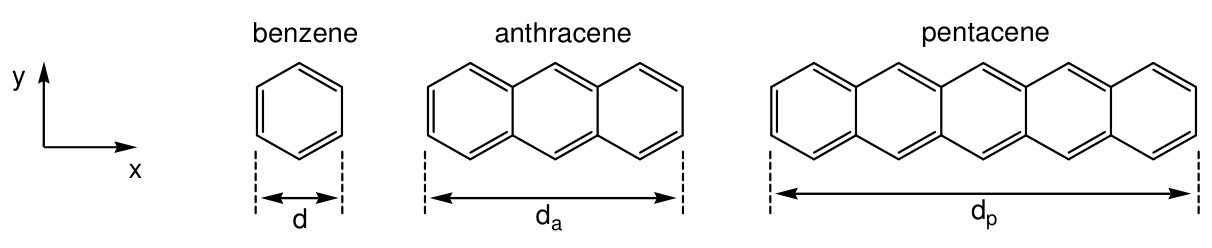
8.1 The distance across the benzene ring is \(d = 240\ \mathrm{pm}\). Use this information to estimate the distances along the horizontal (\(x\)) axis for anthracene and pentacene, \(d_a\) and \(d_p\), respectively.
Assume for simplicity that the \(\pi\) electrons of benzene can be modelled as being confined to a square. Within this model, the conjugated \(\pi\) electrons of PAHs may be considered as free particles in a two dimensional rectangular box in the \(x\)-\(y\) plane.
For electrons in a two-dimensional box along the \(x\)- and \(y\)-axes, the quantized energy states of the electrons are given by
\[ E=\left(\frac{n_x^2}{L_x^2}+\frac{n_y^2}{L_y^2}\right)\frac{h^2}{8m_e} \]
In this equation, \(n_x\) and \(n_y\) are the quantum numbers for the energy state and are integers between 1 and \(\infty\), \(h\) is Planck’s constant, \(m_e\) is the mass of the electron and \(L_x\) and \(L_y\) are the dimensions of the box.
For this problem, treat the \(\pi\) electrons of the PAHs as particles in a two dimensional box. In this case, the quantum numbers \(n_x\) and \(n_y\) are independent.
8.2 Assume that the benzene unit has \(x\) and \(y\) dimensions that are each of length \(d\). Derive a general formula for the quantized energies of linear PAHs as a function of quantum numbers \(n_x\) and \(n_y\), the length \(d\), the number of fused rings \(w\), and the fundamental constants \(h\) and \(m_e\).
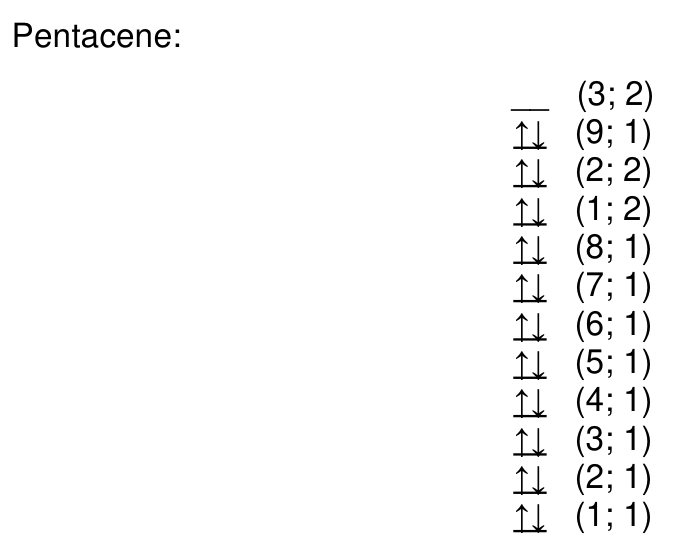
The energy level diagram below for pentacene shows qualitatively the energies and quantum numbers \(n_x\), \(n_y\), for all levels occupied by \(\pi\) electrons and the lowest unoccupied energy level, with the electrons of opposite spins represented as the arrows pointing up or down. The levels are labelled with quantum numbers \((n_x; n_y)\).
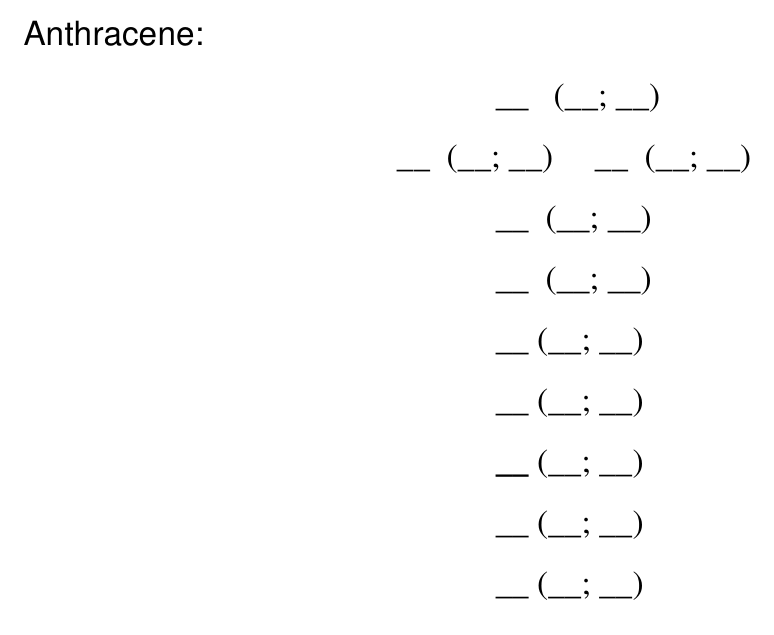
8.3 The energy level diagram for anthracene is shown below. Note that some energy levels may have the same energy. Draw the correct number of up and down arrows to represent the \(\pi\) electrons in this diagram. Also, the blanks in parentheses within this diagram are the quantum numbers \(n_x\), \(n_y\), which you need to determine. Fill these blanks with the pertinent values of \(n_x\), \(n_y\) for each filled and the lowest unfilled energy level(s).
8.4 Use this model to create an energy level diagram for benzene and fill the pertinent energy levels with electrons. Include energy levels up to an including the lowest unoccupied energy level. Label each energy level in your diagrams with the corresponding \(n_x\), \(n_y\). Do not assume that the particle-in-a-square-box model used here gives the same energy levels as other models.
Often the reactivity of PAHs correlates inversely with the energy gap \(\Delta E\) between the highest energy level occupied by \(\pi\) electrons and the lowest unoccupied energy level.
8.5 Calculate the energy gap \(\Delta E\) (in joules) between the highest occupied and lowest unoccupied energy levels for benzene, anthracene and pentacene. Use your result from parts 8.3 and 8.4 for anthracene or benzene, respectively, or use \((2, 2)\) for the highest occupied energy level and \((3, 2)\) for the lowest unoccupied energy level for these two molecules (these may not be the true values).
8.6 Rank benzene (B), anthracene (A), and pentacene (P) in order of increasing reactivity by placing the corresponding letters from left to right in the box below.
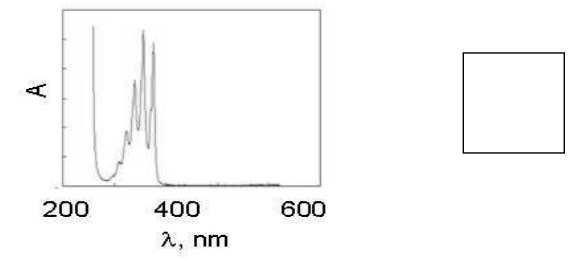
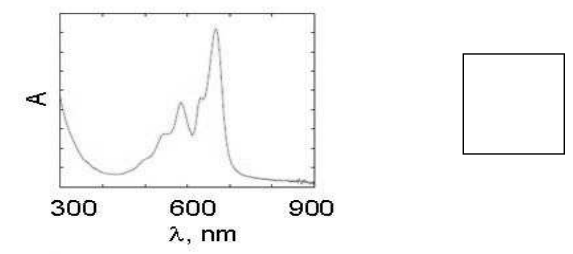
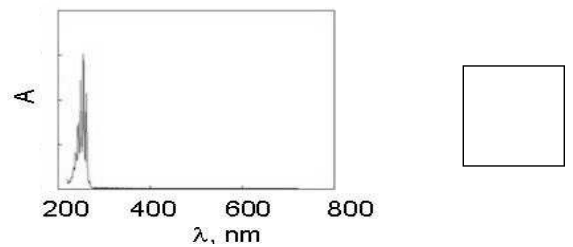
8.7 The electronic absorption spectra (molar absorptivity vs. wavelength) for anthracene (A), benzene (B), and pentacene (P) are shown below. Based on a qualitative understanding of the particle in the box model, indicate which molecule corresponds to which spectrum by writing the appropriate letter in the box to its right.
Graphene is a sheet of carbon atoms arranged in a two-dimensional honeycomb pattern. It can be considered as an extreme case of a polyaromatic hydrocarbon with essentially infinite length in the two dimensions. The Nobel Prize for Physics was awarded in 2010 to Andrei Geim and Konstantin Novoselov for groundbreaking experiments on graphene.
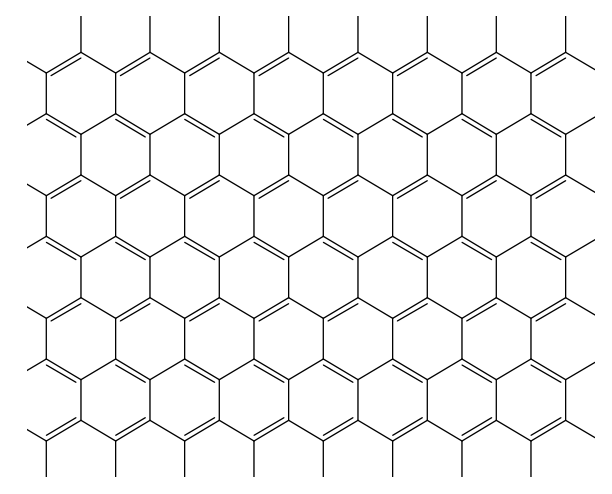
Consider a sheet of graphene with planar dimensions of \(L_x = 25\ \mathrm{nm}\) by \(L_y = 25\ \mathrm{nm}\). A section of this sheet is shown below. The area of one hexagonal 6-carbon unit is \(\sim52\,400\ \mathrm{pm^2}\).
8.8 Calculate the number of \(\pi\) electrons in a \((25\ \mathrm{nm}\times25\ \mathrm{nm})\) sheet of graphene. For this problem you can ignore edge electrons (i.e. those outside the full hexagons in the picture).
We can think about the \(\pi\) electrons in graphene as being free electrons in a 2-dimensional box. In systems containing large numbers of electrons, there is no single highest occupied energy level. Instead, there are many states of nearly the same energy above which the remaining are empty. These highest occupied states determine the so-called Fermi level. The Fermi level in graphene consists of multiple combinations of \(n_x\) and \(n_y\) quantum numbers.
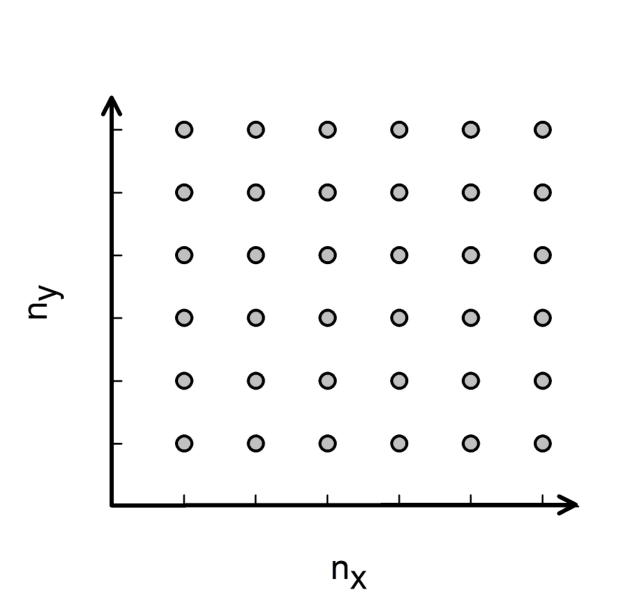
8.9 Determine the energy of the Fermi level for the \(25\ \mathrm{nm}\times25\ \mathrm{nm}\) square of graphene relative to the lowest filled level. The lowest filled level has a non-zero energy; however, it is negligible, and can be assumed to be zero. To solve this problem it might be helpful to represent the \((n_x, n_y)\) quantum states as points on a 2-D grid (as shown below) and consider how the energy levels are filled with pairs of electrons. For the number of electrons use your result from part 8.8 or use a value of 1000 (this may not be the true value).
8.10 The conductivity of graphene-like materials correlates inversely with the energy gap between the lowest unoccupied and highest occupied energy levels. Use your analysis and understanding of \(\pi\) electrons in PAHs and graphene to predict whether the conductivity of a \(25\ \mathrm{nm}\times25\ \mathrm{nm}\) square of graphene, at a given temperature, is less than, equal to or greater than the conductivity of a \(1\ \mathrm{m}\times1\ \mathrm{m}\) square of graphene (which is the largest obtained to date). Circle the correct answer:

Official English text of the problem.
Answers
Molecular identifiers used throughout: benzene (B), c1ccccc1; anthracene (A), c1ccc2cc3ccccc3cc2c1; pentacene (P), c1ccc2cc3cc4cc5ccccc5cc4cc3cc2c1.
Define \(E_0=h^2/(8m_ed^2)\).
- 8.1: \(\boxed{d_a=720\ \mathrm{pm},\quad d_p=1200\ \mathrm{pm}}\).
- 8.2: \(\displaystyle \boxed{E_{n_x,n_y}=\frac{h^2}{8m_ed^2}\left(\frac{n_x^2}{w^2}+n_y^2\right)}\).
- 8.3: In increasing energy, the doubly occupied states are \[ (1,1),\ (2,1),\ (3,1),\ (4,1),\ (5,1),\ (1,2),\ (2,2). \] The lowest unoccupied states are the degenerate pair \(\boxed{(6,1),\ (3,2)}\). The additional uppermost line in the printed diagram is \((4,2)\), also empty.
- 8.4: \((1,1)\) at \(2E_0\) contains \(\uparrow\downarrow\); the degenerate states \((1,2)\) and \((2,1)\) at \(5E_0\) each contain \(\uparrow\downarrow\); \((2,2)\) at \(8E_0\) is empty.
- 8.5: \(\boxed{\Delta E_B=3.14\times10^{-18}\ \mathrm{J}}\), \(\boxed{\Delta E_A=5.81\times10^{-19}\ \mathrm{J}}\), \(\boxed{\Delta E_P=1.26\times10^{-19}\ \mathrm{J}}\).
- 8.6: Increasing reactivity: \(\boxed{\mathrm{B<A<P}}\).
- 8.7: Spectra from top to bottom: \(\boxed{\mathrm{A,\ P,\ B}}\).
- 8.8: \(\boxed{N_\pi\approx2.4\times10^4\text{ electrons}}\).
- 8.9: \(\boxed{E_F-E_{1,1}\approx1.46\times10^{-18}\ \mathrm{J}}\).
- 8.10: Circle \(\boxed{\text{less}}\).
Solution
8.1
Adjacent rings share a vertical edge, so each additional ring adds another horizontal distance \(d\). Therefore,
\[ d_a=3d=3(240\ \mathrm{pm})=\boxed{720\ \mathrm{pm}}, \]
\[ d_p=5d=5(240\ \mathrm{pm})=\boxed{1200\ \mathrm{pm}}. \]
8.2
For a linear PAH containing \(w\) rings, the stipulated box dimensions are
\[ L_x=wd,\qquad L_y=d. \]
Substituting into the given energy expression gives
\[ E_{n_x,n_y} =\frac{h^2}{8m_e} \left(\frac{n_x^2}{w^2d^2}+\frac{n_y^2}{d^2}\right) =\boxed{\frac{h^2}{8m_ed^2} \left(\frac{n_x^2}{w^2}+n_y^2\right)}. \]
Thus, with \(E_0=h^2/(8m_ed^2)\),
\[ \frac{E_{n_x,n_y}}{E_0}=\frac{n_x^2}{w^2}+n_y^2. \]
8.3
Each carbon atom contributes one \(\pi\) electron. The first ring contains six carbon atoms, and each additional fused ring adds four, so
\[ N_\pi=6+4(w-1)=4w+2. \]
Anthracene, \(\ce{C14H10}\), has \(w=3\) and therefore 14 \(\pi\) electrons. Each spatial state holds two electrons of opposite spin, so the seven lowest spatial states are doubly occupied.
For anthracene,
\[ \frac{E}{E_0}=\frac{n_x^2}{9}+n_y^2. \]
Fill the printed diagram as follows, reading this table from top to bottom:
| \(E/E_0\) | State \((n_x,n_y)\) | Electron arrows |
|---|---|---|
| \(52/9\) | \((4,2)\) | Empty |
| \(5\) | \((6,1)\) and \((3,2)\), side by side | Both empty |
| \(40/9\) | \((2,2)\) | \(\uparrow\downarrow\) |
| \(37/9\) | \((1,2)\) | \(\uparrow\downarrow\) |
| \(34/9\) | \((5,1)\) | \(\uparrow\downarrow\) |
| \(25/9\) | \((4,1)\) | \(\uparrow\downarrow\) |
| \(2\) | \((3,1)\) | \(\uparrow\downarrow\) |
| \(13/9\) | \((2,1)\) | \(\uparrow\downarrow\) |
| \(10/9\) | \((1,1)\) | \(\uparrow\downarrow\) |
The two lowest empty states have equal energy because
\[ \frac{E_{6,1}}{E_0}=\frac{36}{9}+1=5, \qquad \frac{E_{3,2}}{E_0}=\frac{9}{9}+4=5. \]
Hence the highest occupied state is \((2,2)\), and the lowest unoccupied states are \((6,1)\) and \((3,2)\). Their left–right order in the diagram is interchangeable.
8.4
Benzene, \(\ce{C6H6}\), has six \(\pi\) electrons. Since \(w=1\),
\[ \frac{E}{E_0}=n_x^2+n_y^2. \]
The required diagram has three energy heights:
| \(E/E_0\) | State(s) | Electron arrows |
|---|---|---|
| \(8\) | \((2,2)\) | Empty |
| \(5\) | \((1,2)\) and \((2,1)\), side by side | \(\uparrow\downarrow\) in each |
| \(2\) | \((1,1)\) | \(\uparrow\downarrow\) |
Draw one occupied line at \(2E_0\), two occupied lines at the same height \(5E_0\), and one empty line at \(8E_0\). The six electrons completely fill the first three spatial states.
8.5
Using the standard constants
\[ h=6.626\times10^{-34}\ \mathrm{J\,s}, \qquad m_e=9.109\times10^{-31}\ \mathrm{kg}, \]
and \(d=240\times10^{-12}\ \mathrm{m}\),
\[ E_0=\frac{h^2}{8m_ed^2} \approx1.046\times10^{-18}\ \mathrm{J}. \]
For benzene, the highest occupied energy is \(5E_0\), and the lowest unoccupied energy is \(8E_0\). Thus,
\[ \Delta E_B=(8-5)E_0=3E_0 =\boxed{3.14\times10^{-18}\ \mathrm{J}}. \]
For anthracene, the highest occupied energy is \((40/9)E_0\), and the lowest unoccupied energy is \(5E_0\). Therefore,
\[ \Delta E_A=\left(5-\frac{40}{9}\right)E_0 =\frac{5}{9}E_0 =\boxed{5.81\times10^{-19}\ \mathrm{J}}. \]
Pentacene, \(\ce{C22H14}\), has \(w=5\). Its supplied diagram identifies the highest occupied state as \((9,1)\) and the lowest unoccupied state as \((3,2)\):
\[ E_{\mathrm{H},P} =\left(\frac{81}{25}+1\right)E_0 =\frac{106}{25}E_0, \]
\[ E_{\mathrm{L},P} =\left(\frac{9}{25}+4\right)E_0 =\frac{109}{25}E_0. \]
Hence,
\[ \Delta E_P =\left(\frac{109-106}{25}\right)E_0 =\frac{3}{25}E_0 =\boxed{1.26\times10^{-19}\ \mathrm{J}}. \]
8.6
The calculated gaps satisfy
\[ \Delta E_B>\Delta E_A>\Delta E_P. \]
Using the stated inverse correlation between reactivity and the energy gap, the order of increasing reactivity is
\[ \boxed{\text{benzene}<\text{anthracene}<\text{pentacene}}. \]
Write B A P from left to right.
8.7
Increasing the extent of the conjugated system generally reduces the relevant excitation energies. Since the energy of an absorbed photon is
\[ E_{\mathrm{photon}}=\frac{hc}{\lambda}, \]
smaller excitation energies correspond to longer wavelengths.
The spectra therefore have the following assignments:
| Spectrum | Assignment | Reason |
|---|---|---|
| Top | A — anthracene | Absorption extends to intermediate wavelengths, approximately \(300\)–\(400\ \mathrm{nm}\). |
| Middle | P — pentacene | Absorption extends farthest into the visible region, approximately \(600\)–\(700\ \mathrm{nm}\). |
| Bottom | B — benzene | Absorption occurs at the shortest wavelengths, in the ultraviolet. |
Thus the letters from top to bottom are \(\boxed{\mathrm{A,\ P,\ B}}\).
8.8
Graphene is an extended planar honeycomb network of carbon atoms. The problem does not specify a finite molecular boundary, so there is no unique finite molecular SMILES for the sheet.
Each interior carbon atom belongs to three hexagons. Consequently, each hexagon accounts for
\[ 6\left(\frac13\right)=2 \]
carbon atoms, and hence two \(\pi\) electrons.
The sheet area is
\[ A=(25\,000\ \mathrm{pm})^2 =6.25\times10^8\ \mathrm{pm^2}. \]
The approximate number of hexagons is
\[ N_{\mathrm{hex}} =\frac{6.25\times10^8\ \mathrm{pm^2}} {52\,400\ \mathrm{pm^2}} =1.19275\times10^4. \]
Therefore,
\[ N_\pi=2N_{\mathrm{hex}} =2.38550\times10^4 \approx\boxed{2.4\times10^4\text{ electrons}}. \]
8.9
For a square of side \(L\),
\[ E_{n_x,n_y} =\frac{h^2}{8m_eL^2}(n_x^2+n_y^2). \]
Thus equal-energy states lie on circles in the \((n_x,n_y)\) plane. Because both quantum numbers are positive, the occupied states lie in the positive quadrant.
Define the radius of the occupied region by
\[ R_F^2=n_x^2+n_y^2 \]
at the Fermi energy. For many occupied states, their number is approximately the area of a quarter-circle:
\[ N_{\mathrm{spatial}}\approx\frac{\pi R_F^2}{4}. \]
Each spatial state accommodates two electrons, so
\[ N_\pi\approx2\frac{\pi R_F^2}{4} =\frac{\pi R_F^2}{2}, \]
and therefore
\[ R_F^2\approx\frac{2N_\pi}{\pi}. \]
Substitution into the energy expression gives
\[ E_F\approx \frac{h^2}{8m_eL^2}\frac{2N_\pi}{\pi} =\boxed{\frac{h^2N_\pi}{4\pi m_eL^2}}. \]
Using the electron count before rounding,
\[ E_F\approx \frac{(6.626\times10^{-34}\ \mathrm{J\,s})^2 (2.38550\times10^4)} {4\pi(9.109\times10^{-31}\ \mathrm{kg}) (25\times10^{-9}\ \mathrm{m})^2} \approx1.464\times10^{-18}\ \mathrm{J}. \]
The lowest state is \((1,1)\), with energy
\[ E_{1,1}=\frac{h^2}{4m_eL^2} \approx1.93\times10^{-22}\ \mathrm{J}. \]
This is negligible compared with \(E_F\), as stipulated. Thus,
\[ \boxed{E_F-E_{1,1}\approx1.46\times10^{-18}\ \mathrm{J}}. \]
8.10
The state-counting result in 8.9 can be written as
\[ N(E)\approx\frac{4\pi m_eA}{h^2}E. \]
The density of available states is therefore proportional to the sheet area. A larger sheet has much more closely spaced levels near the Fermi energy and a smaller characteristic gap between occupied and unoccupied levels.
Although the Fermi energy remains approximately constant at fixed electron density, the level spacing decreases as the sheet grows. Under the inverse relationship between gap and conductivity specified in the question, the smaller sheet has lower conductivity:
\[ \boxed{ \sigma_{25\,\mathrm{nm}\times25\,\mathrm{nm}} < \sigma_{1\,\mathrm{m}\times1\,\mathrm{m}} }. \]
Circle less.
The solution was checked against the official solution.
IChO 2012 · Theorieaufgabe 8
Lineare polycyclische aromatische Kohlenwasserstoffe
Polycyclische aromatische Kohlenwasserstoffe (PAK) sind Luftschadstoffe, Bestandteile organischer Leuchtdioden und Bestandteile des interstellaren Mediums. Diese Aufgabe behandelt sogenannte lineare PAK, d. h. solche, die nur einen Benzolring breit sind, während ihre Länge variiert. Konkrete Beispiele sind Benzol, Anthracen und Pentacen, deren Strukturen unten gezeigt sind. Ihre physikalischen und chemischen Eigenschaften hängen davon ab, in welchem Ausmaß die \(\pi\)-Elektronenwolke über das Molekül delokalisiert ist.
8.1 Der Abstand quer durch den Benzolring beträgt \(d = 240\ \mathrm{pm}\). Schätzen Sie anhand dieser Angabe die Abstände entlang der horizontalen (\(x\))-Achse für Anthracen und Pentacen, also \(d_a\) bzw. \(d_p\), ab.
Nehmen Sie vereinfachend an, dass die \(\pi\)-Elektronen des Benzols als auf ein Quadrat beschränkt modelliert werden können. In diesem Modell können die konjugierten \(\pi\)-Elektronen der PAK als freie Teilchen in einem zweidimensionalen rechteckigen Kasten in der \(x\)-\(y\)-Ebene betrachtet werden.
Für Elektronen in einem zweidimensionalen Kasten entlang der \(x\)- und \(y\)-Achse sind die quantisierten Energiezustände der Elektronen gegeben durch
\[ E=\left(\frac{n_x^2}{L_x^2}+\frac{n_y^2}{L_y^2}\right)\frac{h^2}{8m_e} \]
In dieser Gleichung sind \(n_x\) und \(n_y\) die Quantenzahlen des Energiezustands und ganzzahlige Werte zwischen 1 und \(\infty\), \(h\) ist das Plancksche Wirkungsquantum, \(m_e\) ist die Masse des Elektrons, und \(L_x\) und \(L_y\) sind die Abmessungen des Kastens.
Behandeln Sie in dieser Aufgabe die \(\pi\)-Elektronen der PAK als Teilchen in einem zweidimensionalen Kasten. In diesem Fall sind die Quantenzahlen \(n_x\) und \(n_y\) unabhängig voneinander.
8.2 Nehmen Sie an, dass die Benzoleinheit in \(x\)- und \(y\)-Richtung jeweils die Länge \(d\) hat. Leiten Sie eine allgemeine Formel für die quantisierten Energien linearer PAK als Funktion der Quantenzahlen \(n_x\) und \(n_y\), der Länge \(d\), der Anzahl anellierter Ringe \(w\) und der Naturkonstanten \(h\) und \(m_e\) her.
Das unten stehende Energieniveaudiagramm für Pentacen zeigt qualitativ die Energien und Quantenzahlen \(n_x\), \(n_y\) aller mit \(\pi\)-Elektronen besetzten Niveaus sowie des niedrigsten unbesetzten Energieniveaus. Dabei werden Elektronen mit entgegengesetztem Spin durch nach oben oder unten gerichtete Pfeile dargestellt. Die Niveaus sind mit den Quantenzahlen \((n_x; n_y)\) beschriftet.
8.3 Das Energieniveaudiagramm für Anthracen ist unten gezeigt. Beachten Sie, dass einige Energieniveaus die gleiche Energie haben können. Zeichnen Sie die korrekte Anzahl nach oben und unten gerichteter Pfeile zur Darstellung der \(\pi\)-Elektronen in dieses Diagramm ein. Außerdem stehen die Leerstellen in den Klammern innerhalb dieses Diagramms für die Quantenzahlen \(n_x\), \(n_y\), die Sie bestimmen sollen. Tragen Sie in diese Leerstellen die entsprechenden Werte von \(n_x\), \(n_y\) für jedes besetzte und das niedrigste unbesetzte Energieniveau bzw. die niedrigsten unbesetzten Energieniveaus ein.
8.4 Erstellen Sie mithilfe dieses Modells ein Energieniveaudiagramm für Benzol und besetzen Sie die entsprechenden Energieniveaus mit Elektronen. Berücksichtigen Sie die Energieniveaus bis einschließlich des niedrigsten unbesetzten Energieniveaus. Beschriften Sie jedes Energieniveau in Ihren Diagrammen mit den zugehörigen \(n_x\), \(n_y\). Nehmen Sie nicht an, dass das hier verwendete Modell eines Teilchens im quadratischen Kasten dieselben Energieniveaus wie andere Modelle liefert.
Die Reaktivität von PAK korreliert häufig invers mit der Energielücke \(\Delta E\) zwischen dem höchsten mit \(\pi\)-Elektronen besetzten Energieniveau und dem niedrigsten unbesetzten Energieniveau.
8.5 Berechnen Sie die Energielücke \(\Delta E\) (in Joule) zwischen dem höchsten besetzten und dem niedrigsten unbesetzten Energieniveau für Benzol, Anthracen und Pentacen. Verwenden Sie für Anthracen bzw. Benzol Ihr Ergebnis aus den Teilen 8.3 bzw. 8.4, oder verwenden Sie für diese beiden Moleküle \((2, 2)\) für das höchste besetzte Energieniveau und \((3, 2)\) für das niedrigste unbesetzte Energieniveau (dies sind möglicherweise nicht die tatsächlichen Werte).
8.6 Ordnen Sie Benzol (B), Anthracen (A) und Pentacen (P) nach zunehmender Reaktivität, indem Sie die entsprechenden Buchstaben von links nach rechts in das unten stehende Kästchen eintragen.
8.7 Die elektronischen Absorptionsspektren (molarer Absorptionskoeffizient gegen Wellenlänge) von Anthracen (A), Benzol (B) und Pentacen (P) sind unten gezeigt. Geben Sie anhand eines qualitativen Verständnisses des Modells eines Teilchens im Kasten an, welches Molekül zu welchem Spektrum gehört, indem Sie den entsprechenden Buchstaben in das Kästchen rechts daneben schreiben.
Graphen ist eine Schicht aus Kohlenstoffatomen, die in einem zweidimensionalen Wabenmuster angeordnet sind. Es kann als Extremfall eines polyaromatischen Kohlenwasserstoffs mit praktisch unendlicher Ausdehnung in beiden Dimensionen betrachtet werden. Der Nobelpreis für Physik wurde 2010 an Andrei Geim und Konstantin Novoselov für bahnbrechende Experimente mit Graphen verliehen.
Betrachten Sie eine Graphenschicht mit den Abmessungen \(L_x = 25\ \mathrm{nm}\) mal \(L_y = 25\ \mathrm{nm}\) in der Ebene. Ein Ausschnitt dieser Schicht ist unten gezeigt. Die Fläche einer hexagonalen Einheit aus 6 Kohlenstoffatomen beträgt \(\sim52\,400\ \mathrm{pm^2}\).
8.8 Berechnen Sie die Anzahl der \(\pi\)-Elektronen in einer \((25\ \mathrm{nm}\times25\ \mathrm{nm})\) großen Graphenschicht. In dieser Aufgabe können Sie Randelektronen (d. h. diejenigen außerhalb der vollständigen Sechsecke in der Abbildung) vernachlässigen.
Wir können uns die \(\pi\)-Elektronen in Graphen als freie Elektronen in einem zweidimensionalen Kasten vorstellen. In Systemen mit einer großen Anzahl von Elektronen gibt es kein einzelnes höchstes besetztes Energieniveau. Stattdessen gibt es viele Zustände mit nahezu gleicher Energie, oberhalb derer die übrigen Zustände unbesetzt sind. Diese höchsten besetzten Zustände bestimmen das sogenannte Fermi-Niveau. Das Fermi-Niveau in Graphen besteht aus mehreren Kombinationen der Quantenzahlen \(n_x\) und \(n_y\).
8.9 Bestimmen Sie die Energie des Fermi-Niveaus für das \(25\ \mathrm{nm}\times25\ \mathrm{nm}\) große Graphenquadrat relativ zum niedrigsten besetzten Niveau. Das niedrigste besetzte Niveau hat eine von null verschiedene Energie; diese ist jedoch vernachlässigbar und kann als null angenommen werden. Zur Lösung dieser Aufgabe kann es hilfreich sein, die Quantenzustände \((n_x, n_y)\) als Punkte auf einem zweidimensionalen Gitter darzustellen (wie unten gezeigt) und zu betrachten, wie die Energieniveaus mit Elektronenpaaren besetzt werden. Verwenden Sie für die Anzahl der Elektronen Ihr Ergebnis aus Teil 8.8 oder einen Wert von 1000 (dies ist möglicherweise nicht der tatsächliche Wert).
8.10 Die Leitfähigkeit graphenartiger Materialien korreliert invers mit der Energielücke zwischen dem niedrigsten unbesetzten und dem höchsten besetzten Energieniveau. Sagen Sie anhand Ihrer Analyse und Ihres Verständnisses der \(\pi\)-Elektronen in PAK und Graphen voraus, ob die Leitfähigkeit eines \(25\ \mathrm{nm}\times25\ \mathrm{nm}\) großen Graphenquadrats bei einer gegebenen Temperatur kleiner, gleich oder größer ist als die Leitfähigkeit eines \(1\ \mathrm{m}\times1\ \mathrm{m}\) großen Graphenquadrats (des größten bisher hergestellten). Kreisen Sie die richtige Antwort ein:
Aufgabentext aus dem offiziellen englischen Text übersetzt.
Antworten
Durchgängig verwendete Molekülkennungen: Benzol (B), c1ccccc1; Anthracen (A), c1ccc2cc3ccccc3cc2c1; Pentacen (P), c1ccc2cc3cc4cc5ccccc5cc4cc3cc2c1.
Es sei \(E_0=h^2/(8m_ed^2)\).
- 8.1: \(\boxed{d_a=720\ \mathrm{pm},\quad d_p=1200\ \mathrm{pm}}\).
- 8.2: \(\displaystyle \boxed{E_{n_x,n_y}=\frac{h^2}{8m_ed^2}\left(\frac{n_x^2}{w^2}+n_y^2\right)}\).
- 8.3: Nach steigender Energie geordnet sind die doppelt besetzten Zustände \[ (1,1),\ (2,1),\ (3,1),\ (4,1),\ (5,1),\ (1,2),\ (2,2). \] Die niedrigsten unbesetzten Zustände sind das entartete Paar \(\boxed{(6,1),\ (3,2)}\). Die zusätzliche oberste Linie im abgedruckten Diagramm ist \((4,2)\), ebenfalls unbesetzt.
- 8.4: \((1,1)\) bei \(2E_0\) enthält \(\uparrow\downarrow\); die entarteten Zustände \((1,2)\) und \((2,1)\) bei \(5E_0\) enthalten jeweils \(\uparrow\downarrow\); \((2,2)\) bei \(8E_0\) ist unbesetzt.
- 8.5: \(\boxed{\Delta E_B=3.14\times10^{-18}\ \mathrm{J}}\), \(\boxed{\Delta E_A=5.81\times10^{-19}\ \mathrm{J}}\), \(\boxed{\Delta E_P=1.26\times10^{-19}\ \mathrm{J}}\).
- 8.6: Zunehmende Reaktivität: \(\boxed{\mathrm{B<A<P}}\).
- 8.7: Spektren von oben nach unten: \(\boxed{\mathrm{A,\ P,\ B}}\).
- 8.8: \(\boxed{N_\pi\approx2.4\times10^4\text{ Elektronen}}\).
- 8.9: \(\boxed{E_F-E_{1,1}\approx1.46\times10^{-18}\ \mathrm{J}}\).
- 8.10: Kreisen Sie \(\boxed{\text{kleiner}}\) ein.
Lösung
8.1
Benachbarte Ringe haben eine gemeinsame vertikale Kante, sodass jeder zusätzliche Ring einen weiteren horizontalen Abstand \(d\) hinzufügt. Daher gilt
\[ d_a=3d=3(240\ \mathrm{pm})=\boxed{720\ \mathrm{pm}}, \]
\[ d_p=5d=5(240\ \mathrm{pm})=\boxed{1200\ \mathrm{pm}}. \]
8.2
Für einen linearen PAK mit \(w\) Ringen lauten die vorgegebenen Kastenabmessungen
\[ L_x=wd,\qquad L_y=d. \]
Einsetzen in den angegebenen Energieausdruck ergibt
\[ E_{n_x,n_y} =\frac{h^2}{8m_e} \left(\frac{n_x^2}{w^2d^2}+\frac{n_y^2}{d^2}\right) =\boxed{\frac{h^2}{8m_ed^2} \left(\frac{n_x^2}{w^2}+n_y^2\right)}. \]
Mit \(E_0=h^2/(8m_ed^2)\) gilt somit
\[ \frac{E_{n_x,n_y}}{E_0}=\frac{n_x^2}{w^2}+n_y^2. \]
8.3
Jedes Kohlenstoffatom trägt ein \(\pi\)-Elektron bei. Der erste Ring enthält sechs Kohlenstoffatome, und jeder weitere anellierte Ring fügt vier hinzu, sodass
\[ N_\pi=6+4(w-1)=4w+2. \]
Anthracen, \(\ce{C14H10}\), hat \(w=3\) und daher 14 \(\pi\)-Elektronen. Jeder räumliche Zustand nimmt zwei Elektronen mit entgegengesetztem Spin auf, sodass die sieben niedrigsten räumlichen Zustände doppelt besetzt sind.
Für Anthracen gilt
\[ \frac{E}{E_0}=\frac{n_x^2}{9}+n_y^2. \]
Ergänzen Sie das abgedruckte Diagramm wie folgt, indem Sie diese Tabelle von oben nach unten lesen:
| \(E/E_0\) | Zustand \((n_x,n_y)\) | Elektronenpfeile |
|---|---|---|
| \(52/9\) | \((4,2)\) | Unbesetzt |
| \(5\) | \((6,1)\) und \((3,2)\), nebeneinander | Beide unbesetzt |
| \(40/9\) | \((2,2)\) | \(\uparrow\downarrow\) |
| \(37/9\) | \((1,2)\) | \(\uparrow\downarrow\) |
| \(34/9\) | \((5,1)\) | \(\uparrow\downarrow\) |
| \(25/9\) | \((4,1)\) | \(\uparrow\downarrow\) |
| \(2\) | \((3,1)\) | \(\uparrow\downarrow\) |
| \(13/9\) | \((2,1)\) | \(\uparrow\downarrow\) |
| \(10/9\) | \((1,1)\) | \(\uparrow\downarrow\) |
Die beiden niedrigsten unbesetzten Zustände haben die gleiche Energie, denn
\[ \frac{E_{6,1}}{E_0}=\frac{36}{9}+1=5, \qquad \frac{E_{3,2}}{E_0}=\frac{9}{9}+4=5. \]
Somit ist der höchste besetzte Zustand \((2,2)\), und die niedrigsten unbesetzten Zustände sind \((6,1)\) und \((3,2)\). Ihre Reihenfolge von links nach rechts im Diagramm ist austauschbar.
8.4
Benzol, \(\ce{C6H6}\), hat sechs \(\pi\)-Elektronen. Da \(w=1\), gilt
\[ \frac{E}{E_0}=n_x^2+n_y^2. \]
Das geforderte Diagramm hat drei Energiehöhen:
| \(E/E_0\) | Zustand/Zustände | Elektronenpfeile |
|---|---|---|
| \(8\) | \((2,2)\) | Unbesetzt |
| \(5\) | \((1,2)\) und \((2,1)\), nebeneinander | Jeweils \(\uparrow\downarrow\) |
| \(2\) | \((1,1)\) | \(\uparrow\downarrow\) |
Zeichnen Sie eine besetzte Linie bei \(2E_0\), zwei besetzte Linien auf derselben Höhe \(5E_0\) und eine unbesetzte Linie bei \(8E_0\). Die sechs Elektronen besetzen die ersten drei räumlichen Zustände vollständig.
8.5
Mit den Standardwerten der Konstanten
\[ h=6.626\times10^{-34}\ \mathrm{J\,s}, \qquad m_e=9.109\times10^{-31}\ \mathrm{kg}, \]
und \(d=240\times10^{-12}\ \mathrm{m}\) gilt
\[ E_0=\frac{h^2}{8m_ed^2} \approx1.046\times10^{-18}\ \mathrm{J}. \]
Für Benzol beträgt die höchste besetzte Energie \(5E_0\), und die niedrigste unbesetzte Energie beträgt \(8E_0\). Somit gilt
\[ \Delta E_B=(8-5)E_0=3E_0 =\boxed{3.14\times10^{-18}\ \mathrm{J}}. \]
Für Anthracen beträgt die höchste besetzte Energie \((40/9)E_0\), und die niedrigste unbesetzte Energie beträgt \(5E_0\). Daher gilt
\[ \Delta E_A=\left(5-\frac{40}{9}\right)E_0 =\frac{5}{9}E_0 =\boxed{5.81\times10^{-19}\ \mathrm{J}}. \]
Pentacen, \(\ce{C22H14}\), hat \(w=5\). Das vorgegebene Diagramm weist \((9,1)\) als höchsten besetzten Zustand und \((3,2)\) als niedrigsten unbesetzten Zustand aus:
\[ E_{\mathrm{H},P} =\left(\frac{81}{25}+1\right)E_0 =\frac{106}{25}E_0, \]
\[ E_{\mathrm{L},P} =\left(\frac{9}{25}+4\right)E_0 =\frac{109}{25}E_0. \]
Daraus folgt
\[ \Delta E_P =\left(\frac{109-106}{25}\right)E_0 =\frac{3}{25}E_0 =\boxed{1.26\times10^{-19}\ \mathrm{J}}. \]
8.6
Für die berechneten Energielücken gilt
\[ \Delta E_B>\Delta E_A>\Delta E_P. \]
Aus der angegebenen inversen Korrelation zwischen Reaktivität und Energielücke ergibt sich die Reihenfolge zunehmender Reaktivität
\[ \boxed{\text{Benzol}<\text{Anthracen}<\text{Pentacen}}. \]
Schreiben Sie B A P von links nach rechts.
8.7
Eine größere Ausdehnung des konjugierten Systems verringert im Allgemeinen die relevanten Anregungsenergien. Da die Energie eines absorbierten Photons
\[ E_{\mathrm{photon}}=\frac{hc}{\lambda}, \]
beträgt, entsprechen kleinere Anregungsenergien längeren Wellenlängen.
Die Spektren werden daher wie folgt zugeordnet:
| Spektrum | Zuordnung | Begründung |
|---|---|---|
| Oben | A — Anthracen | Die Absorption erstreckt sich bis zu mittleren Wellenlängen, etwa \(300\)–\(400\ \mathrm{nm}\). |
| Mitte | P — Pentacen | Die Absorption reicht am weitesten in den sichtbaren Bereich hinein, etwa bis \(600\)–\(700\ \mathrm{nm}\). |
| Unten | B — Benzol | Die Absorption erfolgt bei den kürzesten Wellenlängen, im Ultraviolett. |
Somit lauten die Buchstaben von oben nach unten \(\boxed{\mathrm{A,\ P,\ B}}\).
8.8
Graphen ist ein ausgedehntes planares Wabennetzwerk aus Kohlenstoffatomen. Die Aufgabe gibt keine endliche molekulare Begrenzung vor, sodass es für die Schicht keine eindeutige endliche molekulare SMILES-Darstellung gibt.
Jedes Kohlenstoffatom im Inneren gehört zu drei Sechsecken. Daher entfallen auf jedes Sechseck
\[ 6\left(\frac13\right)=2 \]
Kohlenstoffatome und somit zwei \(\pi\)-Elektronen.
Die Fläche der Schicht beträgt
\[ A=(25\,000\ \mathrm{pm})^2 =6.25\times10^8\ \mathrm{pm^2}. \]
Die ungefähre Anzahl der Sechsecke beträgt
\[ N_{\mathrm{hex}} =\frac{6.25\times10^8\ \mathrm{pm^2}} {52\,400\ \mathrm{pm^2}} =1.19275\times10^4. \]
Daher gilt
\[ N_\pi=2N_{\mathrm{hex}} =2.38550\times10^4 \approx\boxed{2.4\times10^4\text{ Elektronen}}. \]
8.9
Für ein Quadrat mit der Seitenlänge \(L\) gilt
\[ E_{n_x,n_y} =\frac{h^2}{8m_eL^2}(n_x^2+n_y^2). \]
Zustände gleicher Energie liegen somit auf Kreisen in der \((n_x,n_y)\)-Ebene. Da beide Quantenzahlen positiv sind, liegen die besetzten Zustände im positiven Quadranten.
Der Radius des besetzten Bereichs sei definiert durch
\[ R_F^2=n_x^2+n_y^2 \]
bei der Fermi-Energie. Bei vielen besetzten Zuständen entspricht ihre Anzahl näherungsweise der Fläche eines Viertelkreises:
\[ N_{\mathrm{spatial}}\approx\frac{\pi R_F^2}{4}. \]
Jeder räumliche Zustand nimmt zwei Elektronen auf, sodass
\[ N_\pi\approx2\frac{\pi R_F^2}{4} =\frac{\pi R_F^2}{2}, \]
und daher
\[ R_F^2\approx\frac{2N_\pi}{\pi}. \]
Einsetzen in den Energieausdruck ergibt
\[ E_F\approx \frac{h^2}{8m_eL^2}\frac{2N_\pi}{\pi} =\boxed{\frac{h^2N_\pi}{4\pi m_eL^2}}. \]
Mit der Elektronenanzahl vor der Rundung ergibt sich
\[ E_F\approx \frac{(6.626\times10^{-34}\ \mathrm{J\,s})^2 (2.38550\times10^4)} {4\pi(9.109\times10^{-31}\ \mathrm{kg}) (25\times10^{-9}\ \mathrm{m})^2} \approx1.464\times10^{-18}\ \mathrm{J}. \]
Der niedrigste Zustand ist \((1,1)\) mit der Energie
\[ E_{1,1}=\frac{h^2}{4m_eL^2} \approx1.93\times10^{-22}\ \mathrm{J}. \]
Diese ist, wie vorgegeben, gegenüber \(E_F\) vernachlässigbar. Somit gilt
\[ \boxed{E_F-E_{1,1}\approx1.46\times10^{-18}\ \mathrm{J}}. \]
8.10
Das Ergebnis der Zustandszählung in 8.9 lässt sich schreiben als
\[ N(E)\approx\frac{4\pi m_eA}{h^2}E. \]
Die Dichte der verfügbaren Zustände ist daher proportional zur Fläche der Schicht. Eine größere Schicht hat in der Nähe der Fermi-Energie wesentlich dichter beieinanderliegende Niveaus und eine kleinere charakteristische Lücke zwischen besetzten und unbesetzten Niveaus.
Obwohl die Fermi-Energie bei fester Elektronendichte näherungsweise konstant bleibt, nimmt der Niveauabstand mit zunehmender Größe der Schicht ab. Aufgrund des in der Aufgabe angegebenen inversen Zusammenhangs zwischen Energielücke und Leitfähigkeit hat die kleinere Schicht die geringere Leitfähigkeit:
\[ \boxed{ \sigma_{25\,\mathrm{nm}\times25\,\mathrm{nm}} < \sigma_{1\,\mathrm{m}\times1\,\mathrm{m}} }. \]
Kreisen Sie kleiner ein.
Die Lösung wurde mit der offiziellen Lösung abgeglichen.
IChO 2012 · Teori sorusu 8
Doğrusal polisiklik aromatik hidrokarbonlar
Polisiklik aromatik hidrokarbonlar (PAH'lar), atmosfer kirleticileri, organik ışık yayan diyotların bileşenleri ve yıldızlararası ortamın bileşenleridir. Bu soru, doğrusal PAH olarak adlandırılan, yani genişliği yalnızca bir benzen halkası kadar olan, uzunluğu ise değişen bileşikleri ele almaktadır. Yapıları aşağıda gösterilen benzen, antrasen ve pentasen bunların belirli örnekleridir. Bu bileşiklerin fiziksel ve kimyasal özellikleri, \(\pi\) elektron bulutunun molekül boyunca ne ölçüde delokalize olduğuna bağlıdır.
8.1 Benzen halkasının bir ucundan diğer ucuna olan uzaklık \(d = 240\ \mathrm{pm}\)'dir. Bu bilgiyi kullanarak antrasen ve pentasen için yatay (\(x\)) eksen boyunca olan uzaklıkları, sırasıyla \(d_a\) ve \(d_p\)'yi tahmin edin.
Basitlik açısından, benzenin \(\pi\) elektronlarının bir kare içine hapsedilmiş olarak modellenebileceğini varsayın. Bu modelde PAH'ların konjuge \(\pi\) elektronları, \(x\)-\(y\) düzlemindeki iki boyutlu dikdörtgen bir kutuda bulunan serbest parçacıklar olarak düşünülebilir.
\(x\) ve \(y\) eksenleri boyunca uzanan iki boyutlu bir kutudaki elektronların kuantalanmış enerji durumları şu şekilde verilir:
\[ E=\left(\frac{n_x^2}{L_x^2}+\frac{n_y^2}{L_y^2}\right)\frac{h^2}{8m_e} \]
Bu denklemde \(n_x\) ve \(n_y\), enerji durumuna ait kuantum sayılarıdır ve 1 ile \(\infty\) arasındaki tam sayılardır; \(h\) Planck sabiti, \(m_e\) elektronun kütlesi, \(L_x\) ve \(L_y\) ise kutunun boyutlarıdır.
Bu soruda PAH'ların \(\pi\) elektronlarını iki boyutlu bir kutudaki parçacıklar olarak ele alın. Bu durumda \(n_x\) ve \(n_y\) kuantum sayıları birbirinden bağımsızdır.
8.2 Benzen biriminin \(x\) ve \(y\) boyutlarının her birinin \(d\) uzunluğunda olduğunu varsayın. Doğrusal PAH'ların kuantalanmış enerjileri için \(n_x\) ve \(n_y\) kuantum sayılarının, \(d\) uzunluğunun, kaynaşmış halka sayısı \(w\)'nin ve \(h\) ile \(m_e\) temel sabitlerinin fonksiyonu olan genel bir formül türetin.
Pentasene ait aşağıdaki enerji düzeyi diyagramı, \(\pi\) elektronlarının bulunduğu tüm düzeylerin ve en düşük boş enerji düzeyinin enerjileri ile \(n_x\), \(n_y\) kuantum sayılarını nitel olarak göstermektedir; zıt spinli elektronlar yukarı veya aşağı yönelen oklarla gösterilmiştir. Düzeyler \((n_x; n_y)\) kuantum sayılarıyla etiketlenmiştir.
8.3 Antrasenin enerji düzeyi diyagramı aşağıda gösterilmiştir. Bazı enerji düzeylerinin aynı enerjiye sahip olabileceğine dikkat edin. Bu diyagramdaki \(\pi\) elektronlarını göstermek için doğru sayıda yukarı ve aşağı yönlü ok çizin. Ayrıca bu diyagramda parantez içindeki boşluklar, belirlemeniz gereken \(n_x\), \(n_y\) kuantum sayılarıdır. Bu boşlukları, her dolu enerji düzeyi ve en düşük boş enerji düzeyi (veya düzeyleri) için uygun \(n_x\), \(n_y\) değerleriyle doldurun.
8.4 Bu modeli kullanarak benzen için bir enerji düzeyi diyagramı oluşturun ve uygun enerji düzeylerini elektronlarla doldurun. En düşük boş enerji düzeyi de dahil olmak üzere bu düzeye kadar olan enerji düzeylerini gösterin. Diyagramlarınızdaki her enerji düzeyini ilgili \(n_x\), \(n_y\) değerleriyle etiketleyin. Burada kullanılan kare kutudaki parçacık modelinin diğer modellerle aynı enerji düzeylerini verdiğini varsaymayın.
PAH'ların tepkimeye girme eğilimi, çoğu zaman \(\pi\) elektronlarının bulunduğu en yüksek enerji düzeyi ile en düşük boş enerji düzeyi arasındaki \(\Delta E\) enerji farkıyla ters ilişkilidir.
8.5 Benzen, antrasen ve pentasen için en yüksek dolu ve en düşük boş enerji düzeyleri arasındaki \(\Delta E\) enerji farkını (joule cinsinden) hesaplayın. Antrasen veya benzen için sırasıyla 8.3 ve 8.4 kısımlarındaki sonuçlarınızı kullanın ya da bu iki molekül için en yüksek dolu enerji düzeyini \((2, 2)\), en düşük boş enerji düzeyini ise \((3, 2)\) olarak alın (bunlar gerçek değerler olmayabilir).
8.6 Benzen (B), antrasen (A) ve pentaseni (P), ilgili harfleri aşağıdaki kutuya soldan sağa yerleştirerek artan tepkimeye girme eğilimine göre sıralayın.
8.7 Antrasen (A), benzen (B) ve pentasenin (P) elektronik soğurma spektrumları (dalga boyuna karşı molar soğurma katsayısı) aşağıda gösterilmiştir. Kutudaki parçacık modeline ilişkin nitel anlayışınıza dayanarak, her spektrumun sağındaki kutuya uygun harfi yazarak hangi moleküle karşılık geldiğini belirtin.
Grafen, karbon atomlarının iki boyutlu bir bal peteği düzeninde dizildiği bir tabakadır. Her iki boyutta da esasen sonsuz uzunluğa sahip bir poliaromatik hidrokarbonun uç bir örneği olarak düşünülebilir. 2010 Nobel Fizik Ödülü, grafen üzerine çığır açan deneyleri nedeniyle Andrei Geim ve Konstantin Novoselov'a verilmiştir.
Düzlemsel boyutları \(L_x = 25\ \mathrm{nm}\) ve \(L_y = 25\ \mathrm{nm}\) olan bir grafen tabakasını ele alın. Bu tabakanın bir bölümü aşağıda gösterilmiştir. Altı karbonlu bir altıgen birimin alanı \(\sim52\,400\ \mathrm{pm^2}\)'dir.
8.8 \((25\ \mathrm{nm}\times25\ \mathrm{nm})\) boyutlarındaki bir grafen tabakasında bulunan \(\pi\) elektronlarının sayısını hesaplayın. Bu soruda kenar elektronlarını (yani şekildeki tam altıgenlerin dışında kalanları) ihmal edebilirsiniz.
Grafendeki \(\pi\) elektronlarını iki boyutlu bir kutuda bulunan serbest elektronlar olarak düşünebiliriz. Çok sayıda elektron içeren sistemlerde tek bir en yüksek dolu enerji düzeyi yoktur. Bunun yerine, hemen hemen aynı enerjiye sahip çok sayıda durum vardır ve bunların üzerindeki diğer durumlar boştur. Bu en yüksek dolu durumlar, Fermi düzeyi olarak adlandırılan düzeyi belirler. Grafendeki Fermi düzeyi, \(n_x\) ve \(n_y\) kuantum sayılarının birden fazla birleşiminden oluşur.
8.9 \(25\ \mathrm{nm}\times25\ \mathrm{nm}\) boyutlarındaki kare grafen tabakası için Fermi düzeyinin enerjisini en düşük dolu düzeye göre belirleyin. En düşük dolu düzeyin enerjisi sıfırdan farklıdır; ancak bu enerji ihmal edilebilir ve sıfır kabul edilebilir. Bu soruyu çözmek için \((n_x, n_y)\) kuantum durumlarını iki boyutlu bir ızgara üzerinde noktalar olarak göstermek (aşağıdaki gibi) ve enerji düzeylerinin elektron çiftleriyle nasıl dolduğunu düşünmek yararlı olabilir. Elektron sayısı için 8.8 kısmındaki sonucunuzu veya 1000 değerini kullanın (bu, gerçek değer olmayabilir).
8.10 Grafen benzeri malzemelerin iletkenliği, en düşük boş ve en yüksek dolu enerji düzeyleri arasındaki enerji farkıyla ters ilişkilidir. PAH'lardaki ve grafendeki \(\pi\) elektronlarına ilişkin analizinizden ve anlayışınızdan yararlanarak, belirli bir sıcaklıkta \(25\ \mathrm{nm}\times25\ \mathrm{nm}\) boyutlarındaki kare bir grafen tabakasının iletkenliğinin, \(1\ \mathrm{m}\times1\ \mathrm{m}\) boyutlarındaki kare bir grafen tabakasının (bugüne kadar elde edilen en büyük tabakanın) iletkenliğinden daha az mı, ona eşit mi yoksa ondan daha fazla mı olduğunu öngörün. Doğru cevabı daire içine alın:
Soru metni resmi İngilizce metinden çevrilmiştir.
Cevaplar
Metin boyunca kullanılan molekül tanımlayıcıları: benzen (B), c1ccccc1; antrasen (A), c1ccc2cc3ccccc3cc2c1; pentasen (P), c1ccc2cc3cc4cc5ccccc5cc4cc3cc2c1.
\(E_0=h^2/(8m_ed^2)\) olarak tanımlayalım.
- 8.1: \(\boxed{d_a=720\ \mathrm{pm},\quad d_p=1200\ \mathrm{pm}}\).
- 8.2: \(\displaystyle \boxed{E_{n_x,n_y}=\frac{h^2}{8m_ed^2}\left(\frac{n_x^2}{w^2}+n_y^2\right)}\).
- 8.3: Artan enerji sırasına göre, ikişer elektronla dolu durumlar şunlardır: \[ (1,1),\ (2,1),\ (3,1),\ (4,1),\ (5,1),\ (1,2),\ (2,2). \] En düşük boş durumlar, dejenere \(\boxed{(6,1),\ (3,2)}\) çiftidir. Basılı diyagramdaki en üstte bulunan ek çizgi \((4,2)\) durumudur ve o da boştur.
- 8.4: \(2E_0\) enerjisindeki \((1,1)\) durumu \(\uparrow\downarrow\) içerir; \(5E_0\) enerjisindeki dejenere \((1,2)\) ve \((2,1)\) durumlarının her biri \(\uparrow\downarrow\) içerir; \(8E_0\) enerjisindeki \((2,2)\) durumu boştur.
- 8.5: \(\boxed{\Delta E_B=3.14\times10^{-18}\ \mathrm{J}}\), \(\boxed{\Delta E_A=5.81\times10^{-19}\ \mathrm{J}}\), \(\boxed{\Delta E_P=1.26\times10^{-19}\ \mathrm{J}}\).
- 8.6: Artan tepkimeye girme eğilimi: \(\boxed{\mathrm{B<A<P}}\).
- 8.7: Yukarıdan aşağıya spektrumlar: \(\boxed{\mathrm{A,\ P,\ B}}\).
- 8.8: \(\boxed{N_\pi\approx2.4\times10^4\text{ elektron}}\).
- 8.9: \(\boxed{E_F-E_{1,1}\approx1.46\times10^{-18}\ \mathrm{J}}\).
- 8.10: \(\boxed{\text{daha az}}\) seçeneğini daire içine alın.
Çözüm
8.1
Komşu halkalar dikey bir kenarı ortak kullandığından, eklenen her halka yatay uzunluğu \(d\) kadar artırır. Dolayısıyla,
\[ d_a=3d=3(240\ \mathrm{pm})=\boxed{720\ \mathrm{pm}}, \]
\[ d_p=5d=5(240\ \mathrm{pm})=\boxed{1200\ \mathrm{pm}}. \]
8.2
\(w\) halka içeren doğrusal bir PAH için öngörülen kutu boyutları şöyledir:
\[ L_x=wd,\qquad L_y=d. \]
Verilen enerji ifadesinde yerine koyulduğunda şu sonuç elde edilir:
\[ E_{n_x,n_y} =\frac{h^2}{8m_e} \left(\frac{n_x^2}{w^2d^2}+\frac{n_y^2}{d^2}\right) =\boxed{\frac{h^2}{8m_ed^2} \left(\frac{n_x^2}{w^2}+n_y^2\right)}. \]
Böylece, \(E_0=h^2/(8m_ed^2)\) olmak üzere,
\[ \frac{E_{n_x,n_y}}{E_0}=\frac{n_x^2}{w^2}+n_y^2. \]
8.3
Her karbon atomu bir \(\pi\) elektronu sağlar. İlk halka altı karbon atomu içerir ve kaynaşmış her ek halka dört karbon atomu ekler; dolayısıyla,
\[ N_\pi=6+4(w-1)=4w+2. \]
Antrasen, \(\ce{C14H10}\), için \(w=3\)'tür ve dolayısıyla 14 \(\pi\) elektronu vardır. Her uzaysal durum zıt spinli iki elektron barındırır; bu nedenle en düşük enerjili yedi uzaysal durum ikişer elektronla doludur.
Antrasen için,
\[ \frac{E}{E_0}=\frac{n_x^2}{9}+n_y^2. \]
Bu tabloyu yukarıdan aşağıya okuyarak basılı diyagramı aşağıdaki gibi doldurun:
| \(E/E_0\) | Durum \((n_x,n_y)\) | Elektron okları |
|---|---|---|
| \(52/9\) | \((4,2)\) | Boş |
| \(5\) | \((6,1)\) ve \((3,2)\), yan yana | İkisi de boş |
| \(40/9\) | \((2,2)\) | \(\uparrow\downarrow\) |
| \(37/9\) | \((1,2)\) | \(\uparrow\downarrow\) |
| \(34/9\) | \((5,1)\) | \(\uparrow\downarrow\) |
| \(25/9\) | \((4,1)\) | \(\uparrow\downarrow\) |
| \(2\) | \((3,1)\) | \(\uparrow\downarrow\) |
| \(13/9\) | \((2,1)\) | \(\uparrow\downarrow\) |
| \(10/9\) | \((1,1)\) | \(\uparrow\downarrow\) |
En düşük enerjili iki boş durumun enerjileri eşittir, çünkü
\[ \frac{E_{6,1}}{E_0}=\frac{36}{9}+1=5, \qquad \frac{E_{3,2}}{E_0}=\frac{9}{9}+4=5. \]
Dolayısıyla en yüksek dolu durum \((2,2)\), en düşük boş durumlar ise \((6,1)\) ve \((3,2)\)'dir. Diyagramda bunların soldan sağa sıralaması değiştirilebilir.
8.4
Benzenin, \(\ce{C6H6}\), altı \(\pi\) elektronu vardır. \(w=1\) olduğundan,
\[ \frac{E}{E_0}=n_x^2+n_y^2. \]
İstenen diyagramda üç farklı enerji yüksekliği bulunur:
| \(E/E_0\) | Durum(lar) | Elektron okları |
|---|---|---|
| \(8\) | \((2,2)\) | Boş |
| \(5\) | \((1,2)\) ve \((2,1)\), yan yana | Her birinde \(\uparrow\downarrow\) |
| \(2\) | \((1,1)\) | \(\uparrow\downarrow\) |
\(2E_0\)'da bir dolu çizgi, aynı \(5E_0\) yüksekliğinde iki dolu çizgi ve \(8E_0\)'da bir boş çizgi çizin. Altı elektron, ilk üç uzaysal durumu tamamen doldurur.
8.5
Standart sabitler
\[ h=6.626\times10^{-34}\ \mathrm{J\,s}, \qquad m_e=9.109\times10^{-31}\ \mathrm{kg}, \]
ve \(d=240\times10^{-12}\ \mathrm{m}\) kullanıldığında,
\[ E_0=\frac{h^2}{8m_ed^2} \approx1.046\times10^{-18}\ \mathrm{J}. \]
Benzen için en yüksek dolu düzeyin enerjisi \(5E_0\), en düşük boş düzeyin enerjisi ise \(8E_0\)'dır. Böylece,
\[ \Delta E_B=(8-5)E_0=3E_0 =\boxed{3.14\times10^{-18}\ \mathrm{J}}. \]
Antrasen için en yüksek dolu düzeyin enerjisi \((40/9)E_0\), en düşük boş düzeyin enerjisi ise \(5E_0\)'dır. Dolayısıyla,
\[ \Delta E_A=\left(5-\frac{40}{9}\right)E_0 =\frac{5}{9}E_0 =\boxed{5.81\times10^{-19}\ \mathrm{J}}. \]
Pentasen, \(\ce{C22H14}\), için \(w=5\)'tir. Verilen diyagramında en yüksek dolu durum \((9,1)\), en düşük boş durum ise \((3,2)\) olarak gösterilmiştir:
\[ E_{\mathrm{H},P} =\left(\frac{81}{25}+1\right)E_0 =\frac{106}{25}E_0, \]
\[ E_{\mathrm{L},P} =\left(\frac{9}{25}+4\right)E_0 =\frac{109}{25}E_0. \]
Dolayısıyla,
\[ \Delta E_P =\left(\frac{109-106}{25}\right)E_0 =\frac{3}{25}E_0 =\boxed{1.26\times10^{-19}\ \mathrm{J}}. \]
8.6
Hesaplanan enerji farkları şu bağıntıyı sağlar:
\[ \Delta E_B>\Delta E_A>\Delta E_P. \]
Tepkimeye girme eğilimi ile enerji farkı arasında belirtilen ters ilişki kullanıldığında, artan tepkimeye girme eğilimine göre sıralama şöyledir:
\[ \boxed{\text{benzen}<\text{antrasen}<\text{pentasen}}. \]
Soldan sağa B A P yazın.
8.7
Konjuge sistemin boyutunun artması, genellikle ilgili uyarılma enerjilerini azaltır. Soğurulan bir fotonun enerjisi
\[ E_{\mathrm{photon}}=\frac{hc}{\lambda}, \]
olduğundan, daha küçük uyarılma enerjileri daha uzun dalga boylarına karşılık gelir.
Bu nedenle spektrumlar aşağıdaki şekilde eşleştirilir:
| Spektrum | Eşleştirme | Gerekçe |
|---|---|---|
| Üst | A — antrasen | Soğurma, yaklaşık \(300\)–\(400\ \mathrm{nm}\) olmak üzere orta uzunluktaki dalga boylarına kadar uzanır. |
| Orta | P — pentasen | Soğurma, görünür bölgede en uzağa, yaklaşık \(600\)–\(700\ \mathrm{nm}\)'ye kadar uzanır. |
| Alt | B — benzen | Soğurma en kısa dalga boylarında, morötesi bölgede gerçekleşir. |
Böylece yukarıdan aşağıya harfler \(\boxed{\mathrm{A,\ P,\ B}}\) olur.
8.8
Grafen, karbon atomlarından oluşan geniş bir düzlemsel bal peteği ağıdır. Soruda sonlu bir moleküler sınır belirtilmediğinden, tabaka için tek bir sonlu moleküler SMILES gösterimi yoktur.
İç kısımdaki her karbon atomu üç altıgene aittir. Bu nedenle her altıgene
\[ 6\left(\frac13\right)=2 \]
karbon atomu ve dolayısıyla iki \(\pi\) elektronu düşer.
Tabakanın alanı şöyledir:
\[ A=(25\,000\ \mathrm{pm})^2 =6.25\times10^8\ \mathrm{pm^2}. \]
Yaklaşık altıgen sayısı şöyledir:
\[ N_{\mathrm{hex}} =\frac{6.25\times10^8\ \mathrm{pm^2}} {52\,400\ \mathrm{pm^2}} =1.19275\times10^4. \]
Dolayısıyla,
\[ N_\pi=2N_{\mathrm{hex}} =2.38550\times10^4 \approx\boxed{2.4\times10^4\text{ elektron}}. \]
8.9
Kenar uzunluğu \(L\) olan bir kare için,
\[ E_{n_x,n_y} =\frac{h^2}{8m_eL^2}(n_x^2+n_y^2). \]
Dolayısıyla eş enerjili durumlar \((n_x,n_y)\) düzleminde çemberler üzerinde yer alır. Her iki kuantum sayısı da pozitif olduğundan, dolu durumlar düzlemin pozitif çeyreğinde bulunur.
Fermi enerjisinde dolu bölgenin yarıçapını
\[ R_F^2=n_x^2+n_y^2 \]
ile tanımlayalım. Çok sayıda dolu durum olduğunda, bunların sayısı yaklaşık olarak bir çeyrek dairenin alanına eşittir:
\[ N_{\mathrm{spatial}}\approx\frac{\pi R_F^2}{4}. \]
Her uzaysal durum iki elektron barındırdığından,
\[ N_\pi\approx2\frac{\pi R_F^2}{4} =\frac{\pi R_F^2}{2}, \]
ve dolayısıyla,
\[ R_F^2\approx\frac{2N_\pi}{\pi}. \]
Enerji ifadesinde yerine koyulduğunda şu sonuç elde edilir:
\[ E_F\approx \frac{h^2}{8m_eL^2}\frac{2N_\pi}{\pi} =\boxed{\frac{h^2N_\pi}{4\pi m_eL^2}}. \]
Yuvarlanmamış elektron sayısı kullanıldığında,
\[ E_F\approx \frac{(6.626\times10^{-34}\ \mathrm{J\,s})^2 (2.38550\times10^4)} {4\pi(9.109\times10^{-31}\ \mathrm{kg}) (25\times10^{-9}\ \mathrm{m})^2} \approx1.464\times10^{-18}\ \mathrm{J}. \]
En düşük durum \((1,1)\)'dir ve enerjisi şöyledir:
\[ E_{1,1}=\frac{h^2}{4m_eL^2} \approx1.93\times10^{-22}\ \mathrm{J}. \]
Bu değer, belirtildiği gibi \(E_F\)'ye kıyasla ihmal edilebilir. Böylece,
\[ \boxed{E_F-E_{1,1}\approx1.46\times10^{-18}\ \mathrm{J}}. \]
8.10
8.9'daki durum sayımı sonucu şu şekilde yazılabilir:
\[ N(E)\approx\frac{4\pi m_eA}{h^2}E. \]
Dolayısıyla mevcut durumların yoğunluğu tabaka alanıyla orantılıdır. Daha büyük bir tabakada Fermi enerjisi yakınındaki düzeyler birbirine çok daha yakındır ve dolu ile boş düzeyler arasındaki karakteristik enerji farkı daha küçüktür.
Sabit elektron yoğunluğunda Fermi enerjisi yaklaşık olarak sabit kalsa da tabaka büyüdükçe düzeyler arasındaki aralık azalır. Soruda belirtilen enerji farkı ile iletkenlik arasındaki ters ilişkiye göre, daha küçük tabakanın iletkenliği daha düşüktür:
\[ \boxed{ \sigma_{25\,\mathrm{nm}\times25\,\mathrm{nm}} < \sigma_{1\,\mathrm{m}\times1\,\mathrm{m}} }. \]
Daha az seçeneğini daire içine alın.
Çözüm, resmi çözümle karşılaştırılarak kontrol edildi.
IChO 2012 · Problema teórico 8
Hidrocarburos aromáticos policíclicos lineales
Los hidrocarburos aromáticos policíclicos (HAP) son contaminantes atmosféricos, componentes de diodos orgánicos emisores de luz y componentes del medio interestelar. Este problema trata de los denominados HAP lineales, es decir, aquellos cuya anchura es de un solo anillo de benceno, mientras que su longitud varía. Algunos ejemplos concretos son el benceno, el antraceno y el pentaceno, cuyas estructuras se muestran a continuación. Sus propiedades físicas y químicas dependen del grado de deslocalización de la nube de electrones \(\pi\) en la molécula.
8.1 La distancia de un extremo al otro del anillo de benceno es \(d = 240\ \mathrm{pm}\). Utilice esta información para estimar las distancias a lo largo del eje horizontal (\(x\)) del antraceno y del pentaceno, \(d_a\) y \(d_p\), respectivamente.
Suponga, para simplificar, que los electrones \(\pi\) del benceno pueden modelizarse como si estuvieran confinados en un cuadrado. Dentro de este modelo, los electrones \(\pi\) conjugados de los HAP pueden considerarse partículas libres en una caja rectangular bidimensional situada en el plano \(x\)-\(y\).
Para los electrones en una caja bidimensional a lo largo de los ejes \(x\) e \(y\), los estados de energía cuantizados de los electrones vienen dados por
\[ E=\left(\frac{n_x^2}{L_x^2}+\frac{n_y^2}{L_y^2}\right)\frac{h^2}{8m_e} \]
En esta ecuación, \(n_x\) y \(n_y\) son los números cuánticos del estado de energía y son números enteros comprendidos entre 1 e \(\infty\), \(h\) es la constante de Planck, \(m_e\) es la masa del electrón y \(L_x\) y \(L_y\) son las dimensiones de la caja.
En este problema, trate los electrones \(\pi\) de los HAP como partículas en una caja bidimensional. En este caso, los números cuánticos \(n_x\) y \(n_y\) son independientes.
8.2 Suponga que la unidad de benceno tiene dimensiones \(x\) e \(y\) de longitud \(d\) cada una. Deduzca una fórmula general para las energías cuantizadas de los HAP lineales en función de los números cuánticos \(n_x\) y \(n_y\), la longitud \(d\), el número de anillos fusionados \(w\) y las constantes fundamentales \(h\) y \(m_e\).
El diagrama de niveles de energía del pentaceno que aparece a continuación muestra cualitativamente las energías y los números cuánticos \(n_x\), \(n_y\) de todos los niveles ocupados por electrones \(\pi\) y del nivel de energía desocupado más bajo; los electrones de espines opuestos se representan mediante flechas que apuntan hacia arriba o hacia abajo. Los niveles están etiquetados con los números cuánticos \((n_x; n_y)\).
8.3 A continuación se muestra el diagrama de niveles de energía del antraceno. Tenga en cuenta que algunos niveles pueden tener la misma energía. Dibuje el número correcto de flechas hacia arriba y hacia abajo para representar los electrones \(\pi\) en este diagrama. Además, los espacios en blanco entre paréntesis del diagrama corresponden a los números cuánticos \(n_x\), \(n_y\), que debe determinar. Rellene estos espacios con los valores pertinentes de \(n_x\), \(n_y\) para cada nivel de energía ocupado y para el nivel o los niveles de energía desocupados más bajos.
8.4 Utilice este modelo para crear un diagrama de niveles de energía del benceno y llene los niveles de energía pertinentes con electrones. Incluya los niveles de energía hasta el nivel de energía desocupado más bajo, incluido este. Etiquete cada nivel de energía de sus diagramas con los valores correspondientes de \(n_x\), \(n_y\). No suponga que el modelo de partícula en una caja cuadrada utilizado aquí proporciona los mismos niveles de energía que otros modelos.
A menudo, la reactividad de los HAP se correlaciona inversamente con la diferencia de energía \(\Delta E\) entre el nivel de energía más alto ocupado por electrones \(\pi\) y el nivel de energía desocupado más bajo.
8.5 Calcule la diferencia de energía \(\Delta E\) (en julios) entre los niveles de energía ocupado más alto y desocupado más bajo del benceno, el antraceno y el pentaceno. Utilice su resultado de los apartados 8.3 y 8.4 para el antraceno o el benceno, respectivamente, o utilice \((2, 2)\) para el nivel de energía ocupado más alto y \((3, 2)\) para el nivel de energía desocupado más bajo de estas dos moléculas (puede que estos no sean los valores verdaderos).
8.6 Ordene el benceno (B), el antraceno (A) y el pentaceno (P) por orden de reactividad creciente, colocando las letras correspondientes de izquierda a derecha en el recuadro siguiente.
8.7 A continuación se muestran los espectros de absorción electrónica (absortividad molar frente a longitud de onda) del antraceno (A), el benceno (B) y el pentaceno (P). Basándose en una comprensión cualitativa del modelo de la partícula en una caja, indique qué molécula corresponde a cada espectro escribiendo la letra adecuada en el recuadro situado a su derecha.
El grafeno es una lámina de átomos de carbono dispuestos en una estructura bidimensional de panal de abeja. Puede considerarse un caso extremo de hidrocarburo poliaromático con una longitud esencialmente infinita en las dos dimensiones. El Premio Nobel de Física de 2010 se concedió a Andrei Geim y Konstantin Novoselov por sus experimentos pioneros sobre el grafeno.
Considere una lámina de grafeno con dimensiones en el plano de \(L_x = 25\ \mathrm{nm}\) por \(L_y = 25\ \mathrm{nm}\). A continuación se muestra una sección de esta lámina. El área de una unidad hexagonal de 6 átomos de carbono es \(\sim52\,400\ \mathrm{pm^2}\).
8.8 Calcule el número de electrones \(\pi\) en una lámina de grafeno de \((25\ \mathrm{nm}\times25\ \mathrm{nm})\). En este problema puede ignorar los electrones de los bordes (es decir, los que se encuentran fuera de los hexágonos completos de la imagen).
Podemos considerar los electrones \(\pi\) del grafeno como electrones libres en una caja bidimensional. En los sistemas que contienen un gran número de electrones, no existe un único nivel de energía ocupado más alto. En su lugar, hay muchos estados de energía casi idéntica por encima de los cuales los restantes están vacíos. Estos estados ocupados más altos determinan el denominado nivel de Fermi. El nivel de Fermi del grafeno consta de múltiples combinaciones de los números cuánticos \(n_x\) y \(n_y\).
8.9 Determine la energía del nivel de Fermi del cuadrado de grafeno de \(25\ \mathrm{nm}\times25\ \mathrm{nm}\) con respecto al nivel ocupado más bajo. El nivel ocupado más bajo tiene una energía distinta de cero; sin embargo, es despreciable y puede suponerse igual a cero. Para resolver este problema, puede resultar útil representar los estados cuánticos \((n_x, n_y)\) como puntos de una cuadrícula bidimensional (como se muestra a continuación) y considerar cómo se llenan los niveles de energía con pares de electrones. Para el número de electrones, utilice su resultado del apartado 8.8 o un valor de 1000 (puede que este no sea el valor verdadero).
8.10 La conductividad de los materiales similares al grafeno se correlaciona inversamente con la diferencia de energía entre los niveles de energía desocupado más bajo y ocupado más alto. Utilice su análisis y su comprensión de los electrones \(\pi\) en los HAP y en el grafeno para predecir si la conductividad de un cuadrado de grafeno de \(25\ \mathrm{nm}\times25\ \mathrm{nm}\), a una temperatura dada, es menor que, igual a o mayor que la conductividad de un cuadrado de grafeno de \(1\ \mathrm{m}\times1\ \mathrm{m}\) (que es el más grande obtenido hasta la fecha). Rodee con un círculo la respuesta correcta:
Enunciado traducido del texto oficial en inglés.
Respuestas
Identificadores moleculares utilizados en todo el texto: benceno (B), c1ccccc1; antraceno (A), c1ccc2cc3ccccc3cc2c1; pentaceno (P), c1ccc2cc3cc4cc5ccccc5cc4cc3cc2c1.
Definimos \(E_0=h^2/(8m_ed^2)\).
- 8.1: \(\boxed{d_a=720\ \mathrm{pm},\quad d_p=1200\ \mathrm{pm}}\).
- 8.2: \(\displaystyle \boxed{E_{n_x,n_y}=\frac{h^2}{8m_ed^2}\left(\frac{n_x^2}{w^2}+n_y^2\right)}\).
- 8.3: En orden de energía creciente, los estados doblemente ocupados son \[ (1,1),\ (2,1),\ (3,1),\ (4,1),\ (5,1),\ (1,2),\ (2,2). \] Los estados desocupados más bajos son el par degenerado \(\boxed{(6,1),\ (3,2)}\). La línea adicional situada más arriba en el diagrama impreso es \((4,2)\), también vacía.
- 8.4: \((1,1)\), a \(2E_0\), contiene \(\uparrow\downarrow\); los estados degenerados \((1,2)\) y \((2,1)\), a \(5E_0\), contienen cada uno \(\uparrow\downarrow\); \((2,2)\), a \(8E_0\), está vacío.
- 8.5: \(\boxed{\Delta E_B=3.14\times10^{-18}\ \mathrm{J}}\), \(\boxed{\Delta E_A=5.81\times10^{-19}\ \mathrm{J}}\), \(\boxed{\Delta E_P=1.26\times10^{-19}\ \mathrm{J}}\).
- 8.6: Reactividad creciente: \(\boxed{\mathrm{B<A<P}}\).
- 8.7: Espectros de arriba abajo: \(\boxed{\mathrm{A,\ P,\ B}}\).
- 8.8: \(\boxed{N_\pi\approx2.4\times10^4\text{ electrones}}\).
- 8.9: \(\boxed{E_F-E_{1,1}\approx1.46\times10^{-18}\ \mathrm{J}}\).
- 8.10: Rodee con un círculo \(\boxed{\text{menor}}\).
Solución
8.1
Los anillos adyacentes comparten una arista vertical, por lo que cada anillo adicional añade otra distancia horizontal \(d\). Por tanto,
\[ d_a=3d=3(240\ \mathrm{pm})=\boxed{720\ \mathrm{pm}}, \]
\[ d_p=5d=5(240\ \mathrm{pm})=\boxed{1200\ \mathrm{pm}}. \]
8.2
Para un HAP lineal que contiene \(w\) anillos, las dimensiones estipuladas de la caja son
\[ L_x=wd,\qquad L_y=d. \]
Al sustituir en la expresión de la energía dada se obtiene
\[ E_{n_x,n_y} =\frac{h^2}{8m_e} \left(\frac{n_x^2}{w^2d^2}+\frac{n_y^2}{d^2}\right) =\boxed{\frac{h^2}{8m_ed^2} \left(\frac{n_x^2}{w^2}+n_y^2\right)}. \]
Así, con \(E_0=h^2/(8m_ed^2)\),
\[ \frac{E_{n_x,n_y}}{E_0}=\frac{n_x^2}{w^2}+n_y^2. \]
8.3
Cada átomo de carbono aporta un electrón \(\pi\). El primer anillo contiene seis átomos de carbono y cada anillo fusionado adicional añade cuatro, por lo que
\[ N_\pi=6+4(w-1)=4w+2. \]
El antraceno, \(\ce{C14H10}\), tiene \(w=3\) y, por tanto, 14 electrones \(\pi\). Cada estado espacial admite dos electrones de espines opuestos, por lo que los siete estados espaciales más bajos están doblemente ocupados.
Para el antraceno,
\[ \frac{E}{E_0}=\frac{n_x^2}{9}+n_y^2. \]
Complete el diagrama impreso como se indica a continuación, leyendo esta tabla de arriba abajo:
| \(E/E_0\) | Estado \((n_x,n_y)\) | Flechas de los electrones |
|---|---|---|
| \(52/9\) | \((4,2)\) | Vacío |
| \(5\) | \((6,1)\) y \((3,2)\), uno al lado del otro | Ambos vacíos |
| \(40/9\) | \((2,2)\) | \(\uparrow\downarrow\) |
| \(37/9\) | \((1,2)\) | \(\uparrow\downarrow\) |
| \(34/9\) | \((5,1)\) | \(\uparrow\downarrow\) |
| \(25/9\) | \((4,1)\) | \(\uparrow\downarrow\) |
| \(2\) | \((3,1)\) | \(\uparrow\downarrow\) |
| \(13/9\) | \((2,1)\) | \(\uparrow\downarrow\) |
| \(10/9\) | \((1,1)\) | \(\uparrow\downarrow\) |
Los dos estados vacíos más bajos tienen la misma energía porque
\[ \frac{E_{6,1}}{E_0}=\frac{36}{9}+1=5, \qquad \frac{E_{3,2}}{E_0}=\frac{9}{9}+4=5. \]
Por consiguiente, el estado ocupado más alto es \((2,2)\) y los estados desocupados más bajos son \((6,1)\) y \((3,2)\). Sus posiciones a izquierda y derecha en el diagrama son intercambiables.
8.4
El benceno, \(\ce{C6H6}\), tiene seis electrones \(\pi\). Puesto que \(w=1\),
\[ \frac{E}{E_0}=n_x^2+n_y^2. \]
El diagrama requerido tiene tres alturas de energía:
| \(E/E_0\) | Estado(s) | Flechas de los electrones |
|---|---|---|
| \(8\) | \((2,2)\) | Vacío |
| \(5\) | \((1,2)\) y \((2,1)\), uno al lado del otro | \(\uparrow\downarrow\) en cada uno |
| \(2\) | \((1,1)\) | \(\uparrow\downarrow\) |
Dibuje una línea ocupada a \(2E_0\), dos líneas ocupadas a la misma altura \(5E_0\) y una línea vacía a \(8E_0\). Los seis electrones llenan por completo los tres primeros estados espaciales.
8.5
Utilizando las constantes habituales
\[ h=6.626\times10^{-34}\ \mathrm{J\,s}, \qquad m_e=9.109\times10^{-31}\ \mathrm{kg}, \]
y \(d=240\times10^{-12}\ \mathrm{m}\),
\[ E_0=\frac{h^2}{8m_ed^2} \approx1.046\times10^{-18}\ \mathrm{J}. \]
Para el benceno, la energía ocupada más alta es \(5E_0\) y la energía desocupada más baja es \(8E_0\). Así,
\[ \Delta E_B=(8-5)E_0=3E_0 =\boxed{3.14\times10^{-18}\ \mathrm{J}}. \]
Para el antraceno, la energía ocupada más alta es \((40/9)E_0\) y la energía desocupada más baja es \(5E_0\). Por tanto,
\[ \Delta E_A=\left(5-\frac{40}{9}\right)E_0 =\frac{5}{9}E_0 =\boxed{5.81\times10^{-19}\ \mathrm{J}}. \]
El pentaceno, \(\ce{C22H14}\), tiene \(w=5\). El diagrama proporcionado identifica el estado ocupado más alto como \((9,1)\) y el estado desocupado más bajo como \((3,2)\):
\[ E_{\mathrm{H},P} =\left(\frac{81}{25}+1\right)E_0 =\frac{106}{25}E_0, \]
\[ E_{\mathrm{L},P} =\left(\frac{9}{25}+4\right)E_0 =\frac{109}{25}E_0. \]
Por consiguiente,
\[ \Delta E_P =\left(\frac{109-106}{25}\right)E_0 =\frac{3}{25}E_0 =\boxed{1.26\times10^{-19}\ \mathrm{J}}. \]
8.6
Las diferencias de energía calculadas cumplen
\[ \Delta E_B>\Delta E_A>\Delta E_P. \]
Utilizando la correlación inversa indicada entre la reactividad y la diferencia de energía, el orden de reactividad creciente es
\[ \boxed{\text{benceno}<\text{antraceno}<\text{pentaceno}}. \]
Escriba B A P de izquierda a derecha.
8.7
El aumento de la extensión del sistema conjugado reduce, por lo general, las energías de excitación pertinentes. Puesto que la energía de un fotón absorbido es
\[ E_{\mathrm{photon}}=\frac{hc}{\lambda}, \]
las energías de excitación menores corresponden a longitudes de onda mayores.
Por tanto, los espectros tienen las siguientes asignaciones:
| Espectro | Asignación | Motivo |
|---|---|---|
| Superior | A — antraceno | La absorción se extiende hasta longitudes de onda intermedias, aproximadamente \(300\)–\(400\ \mathrm{nm}\). |
| Central | P — pentaceno | La absorción se extiende más hacia la región visible, aproximadamente \(600\)–\(700\ \mathrm{nm}\). |
| Inferior | B — benceno | La absorción se produce a las longitudes de onda más cortas, en el ultravioleta. |
Así, las letras de arriba abajo son \(\boxed{\mathrm{A,\ P,\ B}}\).
8.8
El grafeno es una red plana extendida de átomos de carbono con estructura de panal de abeja. El problema no especifica un contorno molecular finito, por lo que no existe un SMILES molecular finito único para la lámina.
Cada átomo de carbono interior pertenece a tres hexágonos. En consecuencia, a cada hexágono le corresponden
\[ 6\left(\frac13\right)=2 \]
átomos de carbono y, por tanto, dos electrones \(\pi\).
El área de la lámina es
\[ A=(25\,000\ \mathrm{pm})^2 =6.25\times10^8\ \mathrm{pm^2}. \]
El número aproximado de hexágonos es
\[ N_{\mathrm{hex}} =\frac{6.25\times10^8\ \mathrm{pm^2}} {52\,400\ \mathrm{pm^2}} =1.19275\times10^4. \]
Por tanto,
\[ N_\pi=2N_{\mathrm{hex}} =2.38550\times10^4 \approx\boxed{2.4\times10^4\text{ electrones}}. \]
8.9
Para un cuadrado de lado \(L\),
\[ E_{n_x,n_y} =\frac{h^2}{8m_eL^2}(n_x^2+n_y^2). \]
Así, los estados de igual energía se encuentran sobre circunferencias en el plano \((n_x,n_y)\). Puesto que ambos números cuánticos son positivos, los estados ocupados se encuentran en el cuadrante positivo.
Definimos el radio de la región ocupada mediante
\[ R_F^2=n_x^2+n_y^2 \]
a la energía de Fermi. Para un gran número de estados ocupados, su número es aproximadamente el área de un cuarto de círculo:
\[ N_{\mathrm{spatial}}\approx\frac{\pi R_F^2}{4}. \]
Cada estado espacial admite dos electrones, por lo que
\[ N_\pi\approx2\frac{\pi R_F^2}{4} =\frac{\pi R_F^2}{2}, \]
y, por tanto,
\[ R_F^2\approx\frac{2N_\pi}{\pi}. \]
Al sustituir en la expresión de la energía se obtiene
\[ E_F\approx \frac{h^2}{8m_eL^2}\frac{2N_\pi}{\pi} =\boxed{\frac{h^2N_\pi}{4\pi m_eL^2}}. \]
Utilizando el número de electrones antes del redondeo,
\[ E_F\approx \frac{(6.626\times10^{-34}\ \mathrm{J\,s})^2 (2.38550\times10^4)} {4\pi(9.109\times10^{-31}\ \mathrm{kg}) (25\times10^{-9}\ \mathrm{m})^2} \approx1.464\times10^{-18}\ \mathrm{J}. \]
El estado más bajo es \((1,1)\), con energía
\[ E_{1,1}=\frac{h^2}{4m_eL^2} \approx1.93\times10^{-22}\ \mathrm{J}. \]
Esta es despreciable en comparación con \(E_F\), tal como se estipula. Así,
\[ \boxed{E_F-E_{1,1}\approx1.46\times10^{-18}\ \mathrm{J}}. \]
8.10
El resultado del recuento de estados del apartado 8.9 puede escribirse como
\[ N(E)\approx\frac{4\pi m_eA}{h^2}E. \]
Por tanto, la densidad de estados disponibles es proporcional al área de la lámina. Una lámina más grande tiene niveles mucho más próximos entre sí cerca de la energía de Fermi y una diferencia de energía característica menor entre los niveles ocupados y desocupados.
Aunque la energía de Fermi permanece aproximadamente constante a una densidad electrónica fija, la separación entre niveles disminuye a medida que aumenta el tamaño de la lámina. De acuerdo con la relación inversa entre la diferencia de energía y la conductividad especificada en la pregunta, la lámina más pequeña tiene una conductividad menor:
\[ \boxed{ \sigma_{25\,\mathrm{nm}\times25\,\mathrm{nm}} < \sigma_{1\,\mathrm{m}\times1\,\mathrm{m}} }. \]
Rodee con un círculo menor.
La solución se comprobó con la solución oficial.
IChO 2012 · 理论题 8
线性多环芳烃
多环芳烃(PAHs)是大气污染物,也是有机发光二极管和星际介质的组成成分。本题讨论所谓的线性多环芳烃,即宽度仅为一个苯环、而长度可以变化的多环芳烃。具体例子包括苯、蒽和并五苯,其结构如下所示。它们的物理和化学性质取决于 \(\pi\) 电子云在整个分子上的离域程度。
8.1 苯环两侧之间的距离为 \(d = 240\ \mathrm{pm}\)。利用这一信息,估算蒽和并五苯沿水平(\(x\))轴方向的长度,分别记为 \(d_a\) 和 \(d_p\)。
为简单起见,假设可将苯中的 \(\pi\) 电子建模为被限制在一个正方形内的粒子。在这一模型中,多环芳烃的共轭 \(\pi\) 电子可视为处于 \(x\)-\(y\) 平面内二维矩形势箱中的自由粒子。
对于处于沿 \(x\) 轴和 \(y\) 轴方向的二维势箱中的电子,其量子化能态的能量为
\[ E=\left(\frac{n_x^2}{L_x^2}+\frac{n_y^2}{L_y^2}\right)\frac{h^2}{8m_e} \]
在此式中,\(n_x\) 和 \(n_y\) 为能态的量子数,取值为 1 到 \(\infty\) 之间的整数;\(h\) 为普朗克常数,\(m_e\) 为电子质量,\(L_x\) 和 \(L_y\) 为势箱的尺寸。
在本题中,将多环芳烃的 \(\pi\) 电子视为二维势箱中的粒子。在这种情况下,量子数 \(n_x\) 和 \(n_y\) 彼此独立。
8.2 假设苯单元在 \(x\) 和 \(y\) 方向上的尺寸均为 \(d\)。推导线性多环芳烃量子化能量的通式,将其表示为量子数 \(n_x\) 和 \(n_y\)、长度 \(d\)、稠合环数 \(w\) 以及基本常数 \(h\) 和 \(m_e\) 的函数。
下方的并五苯能级图定性地给出了所有被 \(\pi\) 电子占据的能级以及最低未占据能级的能量和量子数 \(n_x\)、\(n_y\),其中自旋相反的电子用向上或向下的箭头表示。各能级以量子数 \((n_x; n_y)\) 标注。
8.3 蒽的能级图如下所示。注意,某些能级可能具有相同的能量。在图中画出正确数量的向上和向下箭头,以表示 \(\pi\) 电子。此外,图中括号内的空白处为需要你确定的量子数 \(n_x\)、\(n_y\)。对于每个已占据能级以及最低未占据能级,在这些空白处填入相应的 \(n_x\)、\(n_y\) 值。
8.4 利用这一模型绘制苯的能级图,并在相应能级上填入电子。所画能级应包括从最低能级到最低未占据能级的所有能级。在图中为每个能级标注相应的 \(n_x\)、\(n_y\)。不要假定此处采用的正方形势箱中粒子模型给出的能级与其他模型相同。
多环芳烃的反应活性通常与被 \(\pi\) 电子占据的最高能级和最低未占据能级之间的能隙 \(\Delta E\) 呈负相关。
8.5 计算苯、蒽和并五苯的最高占据能级与最低未占据能级之间的能隙 \(\Delta E\)(单位为焦耳)。对于蒽和苯,分别使用你在 8.3 和 8.4 中得到的结果,或者对这两种分子均采用 \((2, 2)\) 作为最高占据能级、\((3, 2)\) 作为最低未占据能级(这些可能并非真实值)。
8.6 将苯(B)、蒽(A)和并五苯(P)按反应活性递增的顺序排列,在下方方框中从左到右填入相应字母。
8.7 蒽(A)、苯(B)和并五苯(P)的电子吸收光谱(摩尔吸光系数随波长的变化)如下所示。根据对势箱中粒子模型的定性理解,判断各光谱对应的分子,并在光谱右侧的方框中填入相应字母。
石墨烯是由碳原子排列成二维蜂窝状结构的片层。它可以看作多环芳烃的一种极限情形,其在两个维度上的长度实际上均趋于无穷大。2010 年诺贝尔物理学奖授予了安德烈·盖姆和康斯坦丁·诺沃肖洛夫,以表彰他们在石墨烯方面开展的开创性实验。
考虑一片平面尺寸为 \(L_x = 25\ \mathrm{nm}\) 乘 \(L_y = 25\ \mathrm{nm}\) 的石墨烯。下图展示了该片层的一部分。一个由 6 个碳原子组成的六边形单元的面积为 \(\sim52\,400\ \mathrm{pm^2}\)。
8.8 计算一片 \((25\ \mathrm{nm}\times25\ \mathrm{nm})\) 石墨烯中的 \(\pi\) 电子数。在本题中,可以忽略边缘电子(即图中完整六边形之外的电子)。
我们可以将石墨烯中的 \(\pi\) 电子视为二维势箱中的自由电子。在含有大量电子的体系中,不存在单一的最高占据能级,而是存在许多能量几乎相同的态,在这些态之上的其余态均为空态。这些最高占据态决定了所谓的费米能级。石墨烯的费米能级包含多种量子数 \(n_x\) 和 \(n_y\) 的组合。
8.9 确定 \(25\ \mathrm{nm}\times25\ \mathrm{nm}\) 正方形石墨烯的费米能级相对于最低已占据能级的能量。最低已占据能级的能量不为零,但其值很小,可以忽略并视为零。为求解本题,可将 \((n_x, n_y)\) 量子态表示为二维网格上的点(如下图所示),并考虑成对电子如何填充各能级,这可能会有所帮助。电子数可采用你在 8.8 中得到的结果,或采用 1000(这可能并非真实值)。
8.10 类石墨烯材料的电导率与最低未占据能级和最高占据能级之间的能隙呈负相关。利用你对多环芳烃和石墨烯中 \(\pi\) 电子的分析与理解,预测在给定温度下,一片 \(25\ \mathrm{nm}\times25\ \mathrm{nm}\) 正方形石墨烯的电导率是小于、等于还是大于一片 \(1\ \mathrm{m}\times1\ \mathrm{m}\) 正方形石墨烯(这是迄今获得的最大尺寸)的电导率。圈出正确答案:
题目译自官方英文原文。
答案
全文使用的分子标识:苯(B),c1ccccc1;蒽(A),c1ccc2cc3ccccc3cc2c1;并五苯(P),c1ccc2cc3cc4cc5ccccc5cc4cc3cc2c1。
定义 \(E_0=h^2/(8m_ed^2)\)。
- 8.1: \(\boxed{d_a=720\ \mathrm{pm},\quad d_p=1200\ \mathrm{pm}}\)。
- 8.2: \(\displaystyle \boxed{E_{n_x,n_y}=\frac{h^2}{8m_ed^2}\left(\frac{n_x^2}{w^2}+n_y^2\right)}\)。
- 8.3: 按能量递增顺序,双占据态为 \[ (1,1),\ (2,1),\ (3,1),\ (4,1),\ (5,1),\ (1,2),\ (2,2). \] 最低未占据态为一对简并态 \(\boxed{(6,1),\ (3,2)}\)。印制图中额外给出的最上方能级线为 \((4,2)\),也为空态。
- 8.4: 位于 \(2E_0\) 的 \((1,1)\) 含有 \(\uparrow\downarrow\);位于 \(5E_0\) 的简并态 \((1,2)\) 和 \((2,1)\) 各含有 \(\uparrow\downarrow\);位于 \(8E_0\) 的 \((2,2)\) 为空态。
- 8.5: \(\boxed{\Delta E_B=3.14\times10^{-18}\ \mathrm{J}}\),\(\boxed{\Delta E_A=5.81\times10^{-19}\ \mathrm{J}}\),\(\boxed{\Delta E_P=1.26\times10^{-19}\ \mathrm{J}}\)。
- 8.6: 反应活性递增顺序:\(\boxed{\mathrm{B<A<P}}\)。
- 8.7: 光谱从上到下依次为:\(\boxed{\mathrm{A,\ P,\ B}}\)。
- 8.8: \(\boxed{N_\pi\approx2.4\times10^4\text{ 个电子}}\)。
- 8.9: \(\boxed{E_F-E_{1,1}\approx1.46\times10^{-18}\ \mathrm{J}}\)。
- 8.10: 圈出 \(\boxed{\text{小于}}\)。
解答
8.1
相邻环共用一条竖直边,因此每增加一个环,水平方向的长度就增加 \(d\)。因此,
\[ d_a=3d=3(240\ \mathrm{pm})=\boxed{720\ \mathrm{pm}}, \]
\[ d_p=5d=5(240\ \mathrm{pm})=\boxed{1200\ \mathrm{pm}}. \]
8.2
对于含有 \(w\) 个环的线性多环芳烃,规定的势箱尺寸为
\[ L_x=wd,\qquad L_y=d. \]
代入给定的能量表达式,得到
\[ E_{n_x,n_y} =\frac{h^2}{8m_e} \left(\frac{n_x^2}{w^2d^2}+\frac{n_y^2}{d^2}\right) =\boxed{\frac{h^2}{8m_ed^2} \left(\frac{n_x^2}{w^2}+n_y^2\right)}. \]
因此,令 \(E_0=h^2/(8m_ed^2)\),则
\[ \frac{E_{n_x,n_y}}{E_0}=\frac{n_x^2}{w^2}+n_y^2. \]
8.3
每个碳原子贡献一个 \(\pi\) 电子。第一个环含有六个碳原子,每增加一个稠合环就增加四个碳原子,因此
\[ N_\pi=6+4(w-1)=4w+2. \]
蒽(\(\ce{C14H10}\))的 \(w=3\),因此具有 14 个 \(\pi\) 电子。每个空间态容纳两个自旋相反的电子,所以能量最低的七个空间态均为双占据态。
对于蒽,
\[ \frac{E}{E_0}=\frac{n_x^2}{9}+n_y^2. \]
按照下表从上到下的顺序,填写印制的能级图:
| \(E/E_0\) | 态 \((n_x,n_y)\) | 电子箭头 |
|---|---|---|
| \(52/9\) | \((4,2)\) | 空 |
| \(5\) | \((6,1)\) 和 \((3,2)\),并列 | 均为空 |
| \(40/9\) | \((2,2)\) | \(\uparrow\downarrow\) |
| \(37/9\) | \((1,2)\) | \(\uparrow\downarrow\) |
| \(34/9\) | \((5,1)\) | \(\uparrow\downarrow\) |
| \(25/9\) | \((4,1)\) | \(\uparrow\downarrow\) |
| \(2\) | \((3,1)\) | \(\uparrow\downarrow\) |
| \(13/9\) | \((2,1)\) | \(\uparrow\downarrow\) |
| \(10/9\) | \((1,1)\) | \(\uparrow\downarrow\) |
两个最低空态的能量相等,因为
\[ \frac{E_{6,1}}{E_0}=\frac{36}{9}+1=5, \qquad \frac{E_{3,2}}{E_0}=\frac{9}{9}+4=5. \]
因此,最高占据态为 \((2,2)\),最低未占据态为 \((6,1)\) 和 \((3,2)\)。它们在图中的左右顺序可以互换。
8.4
苯(\(\ce{C6H6}\))具有六个 \(\pi\) 电子。由于 \(w=1\),
\[ \frac{E}{E_0}=n_x^2+n_y^2. \]
所需能级图包含三个能量高度:
| \(E/E_0\) | 态 | 电子箭头 |
|---|---|---|
| \(8\) | \((2,2)\) | 空 |
| \(5\) | \((1,2)\) 和 \((2,1)\),并列 | 各有 \(\uparrow\downarrow\) |
| \(2\) | \((1,1)\) | \(\uparrow\downarrow\) |
在 \(2E_0\) 处画一条已占据能级线,在同一高度 \(5E_0\) 处画两条已占据能级线,并在 \(8E_0\) 处画一条空能级线。六个电子完全填满前三个空间态。
8.5
使用标准常数
\[ h=6.626\times10^{-34}\ \mathrm{J\,s}, \qquad m_e=9.109\times10^{-31}\ \mathrm{kg}, \]
以及 \(d=240\times10^{-12}\ \mathrm{m}\),
\[ E_0=\frac{h^2}{8m_ed^2} \approx1.046\times10^{-18}\ \mathrm{J}. \]
对于苯,最高占据能量为 \(5E_0\),最低未占据能量为 \(8E_0\)。因此,
\[ \Delta E_B=(8-5)E_0=3E_0 =\boxed{3.14\times10^{-18}\ \mathrm{J}}. \]
对于蒽,最高占据能量为 \((40/9)E_0\),最低未占据能量为 \(5E_0\)。因此,
\[ \Delta E_A=\left(5-\frac{40}{9}\right)E_0 =\frac{5}{9}E_0 =\boxed{5.81\times10^{-19}\ \mathrm{J}}. \]
并五苯(\(\ce{C22H14}\))的 \(w=5\)。题目所给的能级图表明,其最高占据态为 \((9,1)\),最低未占据态为 \((3,2)\):
\[ E_{\mathrm{H},P} =\left(\frac{81}{25}+1\right)E_0 =\frac{106}{25}E_0, \]
\[ E_{\mathrm{L},P} =\left(\frac{9}{25}+4\right)E_0 =\frac{109}{25}E_0. \]
因此,
\[ \Delta E_P =\left(\frac{109-106}{25}\right)E_0 =\frac{3}{25}E_0 =\boxed{1.26\times10^{-19}\ \mathrm{J}}. \]
8.6
计算得到的能隙满足
\[ \Delta E_B>\Delta E_A>\Delta E_P. \]
根据题目所述的反应活性与能隙之间的负相关关系,反应活性递增的顺序为
\[ \boxed{\text{苯}<\text{蒽}<\text{并五苯}}. \]
从左到右填写 B A P。
8.7
增大共轭体系的范围通常会降低相关的激发能。由于被吸收光子的能量为
\[ E_{\mathrm{photon}}=\frac{hc}{\lambda}, \]
较小的激发能对应较长的波长。
因此,各光谱的归属如下:
| 光谱 | 归属 | 原因 |
|---|---|---|
| 上方 | A — 蒽 | 吸收延伸至中等波长,约为 \(300\)–\(400\ \mathrm{nm}\)。 |
| 中间 | P — 并五苯 | 吸收延伸至可见光区中最远的位置,约为 \(600\)–\(700\ \mathrm{nm}\)。 |
| 下方 | B — 苯 | 吸收发生在最短波长处,位于紫外区。 |
因此,从上到下的字母依次为 \(\boxed{\mathrm{A,\ P,\ B}}\)。
8.8
石墨烯是由碳原子构成的延展平面蜂窝状网络。题目未指定有限的分子边界,因此该片层没有唯一的有限分子 SMILES 表示。
每个内部碳原子属于三个六边形。因此,每个六边形所分摊的碳原子数为
\[ 6\left(\frac13\right)=2 \]
因此对应两个 \(\pi\) 电子。
片层的面积为
\[ A=(25\,000\ \mathrm{pm})^2 =6.25\times10^8\ \mathrm{pm^2}. \]
六边形的近似数量为
\[ N_{\mathrm{hex}} =\frac{6.25\times10^8\ \mathrm{pm^2}} {52\,400\ \mathrm{pm^2}} =1.19275\times10^4. \]
因此,
\[ N_\pi=2N_{\mathrm{hex}} =2.38550\times10^4 \approx\boxed{2.4\times10^4\text{ 个电子}}. \]
8.9
对于边长为 \(L\) 的正方形,
\[ E_{n_x,n_y} =\frac{h^2}{8m_eL^2}(n_x^2+n_y^2). \]
因此,等能态位于 \((n_x,n_y)\) 平面内的圆周上。由于两个量子数均为正,已占据态位于第一象限。
在费米能量处,将已占据区域的半径定义为
\[ R_F^2=n_x^2+n_y^2 \]
当已占据态很多时,其数量近似等于四分之一圆的面积:
\[ N_{\mathrm{spatial}}\approx\frac{\pi R_F^2}{4}. \]
每个空间态容纳两个电子,因此
\[ N_\pi\approx2\frac{\pi R_F^2}{4} =\frac{\pi R_F^2}{2}, \]
从而
\[ R_F^2\approx\frac{2N_\pi}{\pi}. \]
代入能量表达式,得到
\[ E_F\approx \frac{h^2}{8m_eL^2}\frac{2N_\pi}{\pi} =\boxed{\frac{h^2N_\pi}{4\pi m_eL^2}}. \]
使用舍入前的电子数,
\[ E_F\approx \frac{(6.626\times10^{-34}\ \mathrm{J\,s})^2 (2.38550\times10^4)} {4\pi(9.109\times10^{-31}\ \mathrm{kg}) (25\times10^{-9}\ \mathrm{m})^2} \approx1.464\times10^{-18}\ \mathrm{J}. \]
最低态为 \((1,1)\),其能量为
\[ E_{1,1}=\frac{h^2}{4m_eL^2} \approx1.93\times10^{-22}\ \mathrm{J}. \]
正如题目所规定的,与 \(E_F\) 相比,该能量可以忽略。因此,
\[ \boxed{E_F-E_{1,1}\approx1.46\times10^{-18}\ \mathrm{J}}. \]
8.10
8.9 中对态数的计数结果可写为
\[ N(E)\approx\frac{4\pi m_eA}{h^2}E. \]
因此,可用态的密度与片层面积成正比。较大片层在费米能量附近的能级间距要小得多,已占据能级与未占据能级之间的特征能隙也更小。
虽然在电子密度固定时,费米能量近似保持不变,但随着片层增大,能级间距会减小。根据题目指定的能隙与电导率之间的负相关关系,较小片层的电导率更低:
\[ \boxed{ \sigma_{25\,\mathrm{nm}\times25\,\mathrm{nm}} < \sigma_{1\,\mathrm{m}\times1\,\mathrm{m}} }. \]
圈出小于。
解答已与官方解答核对。
IChO 2012 · Теоретическая задача 8
Линейные полициклические ароматические углеводороды
Полициклические ароматические углеводороды (ПАУ) являются загрязнителями атмосферы, компонентами органических светоизлучающих диодов и компонентами межзвёздной среды. В этой задаче рассматриваются так называемые линейные ПАУ, то есть соединения, ширина которых составляет всего одно бензольное кольцо, а длина может быть различной. Примерами служат бензол, антрацен и пентацен, структуры которых показаны ниже. Их физические и химические свойства зависят от степени делокализации облака \(\pi\)-электронов по молекуле.
8.1 Размер бензольного кольца составляет \(d = 240\ \mathrm{pm}\). Используя эту информацию, оцените размеры антрацена и пентацена вдоль горизонтальной оси (\(x\)), обозначенные соответственно \(d_a\) и \(d_p\).
Для простоты предположим, что \(\pi\)-электроны бензола можно моделировать как частицы, заключённые в квадрате. В рамках этой модели сопряжённые \(\pi\)-электроны ПАУ можно рассматривать как свободные частицы в двумерном прямоугольном потенциальном ящике в плоскости \(x\)-\(y\).
Для электронов в двумерном ящике, ориентированном вдоль осей \(x\) и \(y\), квантованные значения энергии задаются выражением
\[ E=\left(\frac{n_x^2}{L_x^2}+\frac{n_y^2}{L_y^2}\right)\frac{h^2}{8m_e} \]
В этом уравнении \(n_x\) и \(n_y\) — квантовые числа энергетического состояния, принимающие целые значения от 1 до \(\infty\), \(h\) — постоянная Планка, \(m_e\) — масса электрона, а \(L_x\) и \(L_y\) — размеры ящика.
В этой задаче рассматривайте \(\pi\)-электроны ПАУ как частицы в двумерном ящике. В этом случае квантовые числа \(n_x\) и \(n_y\) независимы.
8.2 Предположим, что размеры бензольного звена вдоль осей \(x\) и \(y\) равны \(d\). Выведите общую формулу для квантованных значений энергии линейных ПАУ как функции квантовых чисел \(n_x\) и \(n_y\), длины \(d\), числа конденсированных колец \(w\) и фундаментальных постоянных \(h\) и \(m_e\).
На приведённой ниже диаграмме энергетических уровней пентацена качественно показаны энергии и квантовые числа \(n_x\), \(n_y\) всех уровней, занятых \(\pi\)-электронами, и самого низкого незанятого энергетического уровня; электроны с противоположными спинами обозначены стрелками, направленными вверх или вниз. Уровни обозначены квантовыми числами \((n_x; n_y)\).
8.3 Ниже показана диаграмма энергетических уровней антрацена. Обратите внимание, что некоторые энергетические уровни могут иметь одинаковую энергию. Нарисуйте правильное число стрелок вверх и вниз, изображающих \(\pi\)-электроны на этой диаграмме. Кроме того, пропуски в скобках на диаграмме соответствуют квантовым числам \(n_x\), \(n_y\), которые вам необходимо определить. Заполните эти пропуски соответствующими значениями \(n_x\), \(n_y\) для каждого занятого и самого низкого незанятого энергетического уровня (или уровней).
8.4 Используя эту модель, постройте диаграмму энергетических уровней бензола и заполните соответствующие энергетические уровни электронами. Включите энергетические уровни вплоть до самого низкого незанятого уровня включительно. Обозначьте каждый энергетический уровень на ваших диаграммах соответствующими значениями \(n_x\), \(n_y\). Не предполагайте, что используемая здесь модель частицы в квадратном потенциальном ящике даёт те же энергетические уровни, что и другие модели.
Реакционная способность ПАУ часто находится в обратной зависимости от энергетического зазора \(\Delta E\) между самым высоким энергетическим уровнем, занятым \(\pi\)-электронами, и самым низким незанятым энергетическим уровнем.
8.5 Рассчитайте энергетический зазор \(\Delta E\) (в джоулях) между самым высоким занятым и самым низким незанятым энергетическими уровнями для бензола, антрацена и пентацена. Используйте результаты пунктов 8.3 и 8.4 для антрацена и бензола соответственно либо используйте \((2, 2)\) для самого высокого занятого энергетического уровня и \((3, 2)\) для самого низкого незанятого энергетического уровня этих двух молекул (эти значения могут не соответствовать действительности).
8.6 Расположите бензол (B), антрацен (A) и пентацен (P) в порядке возрастания реакционной способности, вписав соответствующие буквы слева направо в рамку ниже.
8.7 Ниже приведены электронные спектры поглощения (зависимость молярного коэффициента поглощения от длины волны) антрацена (A), бензола (B) и пентацена (P). На основании качественного понимания модели частицы в потенциальном ящике укажите, какой молекуле соответствует каждый спектр, вписав соответствующую букву в рамку справа от него.
Графен представляет собой лист атомов углерода, образующих двумерную сотовую структуру. Его можно рассматривать как предельный случай полиароматического углеводорода с практически бесконечной протяжённостью в двух измерениях. Нобелевская премия по физике за 2010 год была присуждена Андрею Гейму и Константину Новосёлову за новаторские эксперименты с графеном.
Рассмотрим лист графена с размерами в плоскости \(L_x = 25\ \mathrm{nm}\) на \(L_y = 25\ \mathrm{nm}\). Ниже показан участок этого листа. Площадь одного шестиугольного звена из 6 атомов углерода составляет \(\sim52\,400\ \mathrm{pm^2}\).
8.8 Рассчитайте число \(\pi\)-электронов в листе графена размером \((25\ \mathrm{nm}\times25\ \mathrm{nm})\). В этой задаче можно пренебречь краевыми электронами (то есть электронами за пределами полных шестиугольников на рисунке).
Можно рассматривать \(\pi\)-электроны в графене как свободные электроны в двумерном ящике. В системах, содержащих большое число электронов, нет единственного самого высокого занятого энергетического уровня. Вместо этого имеется множество состояний с почти одинаковой энергией, выше которых остальные состояния пусты. Эти самые высокие занятые состояния определяют так называемый уровень Ферми. Уровню Ферми в графене соответствует множество сочетаний квантовых чисел \(n_x\) и \(n_y\).
8.9 Определите энергию уровня Ферми для квадрата графена размером \(25\ \mathrm{nm}\times25\ \mathrm{nm}\) относительно самого низкого занятого уровня. Самый низкий занятый уровень имеет ненулевую энергию; однако она пренебрежимо мала, и её можно принять равной нулю. Для решения этой задачи может быть полезно представить квантовые состояния \((n_x, n_y)\) в виде точек на двумерной сетке (как показано ниже) и рассмотреть, как энергетические уровни заполняются парами электронов. В качестве числа электронов используйте результат пункта 8.8 либо значение 1000 (оно может не соответствовать действительности).
8.10 Электропроводность графеноподобных материалов находится в обратной зависимости от энергетического зазора между самым низким незанятым и самым высоким занятым энергетическими уровнями. Используя проведённый анализ и ваше понимание поведения \(\pi\)-электронов в ПАУ и графене, предскажите, будет ли электропроводность квадрата графена размером \(25\ \mathrm{nm}\times25\ \mathrm{nm}\) при заданной температуре меньше, равна или больше электропроводности квадрата графена размером \(1\ \mathrm{m}\times1\ \mathrm{m}\) (самого большого из полученных на сегодняшний день). Обведите правильный ответ:
Условие переведено с официального английского текста.
Ответы
Идентификаторы молекул, используемые во всём тексте: бензол (B), c1ccccc1; антрацен (A), c1ccc2cc3ccccc3cc2c1; пентацен (P), c1ccc2cc3cc4cc5ccccc5cc4cc3cc2c1.
Обозначим \(E_0=h^2/(8m_ed^2)\).
- 8.1: \(\boxed{d_a=720\ \mathrm{pm},\quad d_p=1200\ \mathrm{pm}}\).
- 8.2: \(\displaystyle \boxed{E_{n_x,n_y}=\frac{h^2}{8m_ed^2}\left(\frac{n_x^2}{w^2}+n_y^2\right)}\).
- 8.3: В порядке возрастания энергии состояния, занятые двумя электронами, имеют вид \[ (1,1),\ (2,1),\ (3,1),\ (4,1),\ (5,1),\ (1,2),\ (2,2). \] Самые низкие незанятые состояния образуют вырожденную пару \(\boxed{(6,1),\ (3,2)}\). Дополнительная самая верхняя линия на напечатанной диаграмме соответствует состоянию \((4,2)\), которое также пусто.
- 8.4: Состояние \((1,1)\) с энергией \(2E_0\) содержит \(\uparrow\downarrow\); вырожденные состояния \((1,2)\) и \((2,1)\) с энергией \(5E_0\) каждое содержат \(\uparrow\downarrow\); состояние \((2,2)\) с энергией \(8E_0\) пусто.
- 8.5: \(\boxed{\Delta E_B=3.14\times10^{-18}\ \mathrm{J}}\), \(\boxed{\Delta E_A=5.81\times10^{-19}\ \mathrm{J}}\), \(\boxed{\Delta E_P=1.26\times10^{-19}\ \mathrm{J}}\).
- 8.6: Возрастание реакционной способности: \(\boxed{\mathrm{B<A<P}}\).
- 8.7: Спектры сверху вниз: \(\boxed{\mathrm{A,\ P,\ B}}\).
- 8.8: \(\boxed{N_\pi\approx2.4\times10^4\text{ электронов}}\).
- 8.9: \(\boxed{E_F-E_{1,1}\approx1.46\times10^{-18}\ \mathrm{J}}\).
- 8.10: Обведите \(\boxed{\text{меньше}}\).
Решение
8.1
Соседние кольца имеют общее вертикальное ребро, поэтому каждое дополнительное кольцо увеличивает горизонтальный размер на \(d\). Следовательно,
\[ d_a=3d=3(240\ \mathrm{pm})=\boxed{720\ \mathrm{pm}}, \]
\[ d_p=5d=5(240\ \mathrm{pm})=\boxed{1200\ \mathrm{pm}}. \]
8.2
Для линейного ПАУ, содержащего \(w\) колец, заданные размеры ящика равны
\[ L_x=wd,\qquad L_y=d. \]
Подстановка в данное выражение для энергии даёт
\[ E_{n_x,n_y} =\frac{h^2}{8m_e} \left(\frac{n_x^2}{w^2d^2}+\frac{n_y^2}{d^2}\right) =\boxed{\frac{h^2}{8m_ed^2} \left(\frac{n_x^2}{w^2}+n_y^2\right)}. \]
Таким образом, при \(E_0=h^2/(8m_ed^2)\)
\[ \frac{E_{n_x,n_y}}{E_0}=\frac{n_x^2}{w^2}+n_y^2. \]
8.3
Каждый атом углерода даёт один \(\pi\)-электрон. Первое кольцо содержит шесть атомов углерода, а каждое дополнительное конденсированное кольцо добавляет четыре, поэтому
\[ N_\pi=6+4(w-1)=4w+2. \]
Для антрацена, \(\ce{C14H10}\), \(w=3\), и, следовательно, он имеет 14 \(\pi\)-электронов. Каждое пространственное состояние вмещает два электрона с противоположными спинами, поэтому семь самых низких пространственных состояний заняты двумя электронами каждое.
Для антрацена
\[ \frac{E}{E_0}=\frac{n_x^2}{9}+n_y^2. \]
Заполните напечатанную диаграмму следующим образом, читая эту таблицу сверху вниз:
| \(E/E_0\) | Состояние \((n_x,n_y)\) | Стрелки, обозначающие электроны |
|---|---|---|
| \(52/9\) | \((4,2)\) | Пусто |
| \(5\) | \((6,1)\) и \((3,2)\), рядом | Оба пусты |
| \(40/9\) | \((2,2)\) | \(\uparrow\downarrow\) |
| \(37/9\) | \((1,2)\) | \(\uparrow\downarrow\) |
| \(34/9\) | \((5,1)\) | \(\uparrow\downarrow\) |
| \(25/9\) | \((4,1)\) | \(\uparrow\downarrow\) |
| \(2\) | \((3,1)\) | \(\uparrow\downarrow\) |
| \(13/9\) | \((2,1)\) | \(\uparrow\downarrow\) |
| \(10/9\) | \((1,1)\) | \(\uparrow\downarrow\) |
Два самых низких пустых состояния имеют одинаковую энергию, поскольку
\[ \frac{E_{6,1}}{E_0}=\frac{36}{9}+1=5, \qquad \frac{E_{3,2}}{E_0}=\frac{9}{9}+4=5. \]
Следовательно, самое высокое занятое состояние — \((2,2)\), а самые низкие незанятые состояния — \((6,1)\) и \((3,2)\). Их расположение слева и справа на диаграмме можно поменять местами.
8.4
Бензол, \(\ce{C6H6}\), имеет шесть \(\pi\)-электронов. Поскольку \(w=1\),
\[ \frac{E}{E_0}=n_x^2+n_y^2. \]
На требуемой диаграмме имеются три значения энергии:
| \(E/E_0\) | Состояние (состояния) | Стрелки, обозначающие электроны |
|---|---|---|
| \(8\) | \((2,2)\) | Пусто |
| \(5\) | \((1,2)\) и \((2,1)\), рядом | \(\uparrow\downarrow\) в каждом |
| \(2\) | \((1,1)\) | \(\uparrow\downarrow\) |
Нарисуйте одну занятую линию на уровне \(2E_0\), две занятые линии на одинаковой высоте \(5E_0\) и одну пустую линию на уровне \(8E_0\). Шесть электронов полностью заполняют первые три пространственных состояния.
8.5
Используя стандартные значения постоянных
\[ h=6.626\times10^{-34}\ \mathrm{J\,s}, \qquad m_e=9.109\times10^{-31}\ \mathrm{kg}, \]
и \(d=240\times10^{-12}\ \mathrm{m}\), получаем
\[ E_0=\frac{h^2}{8m_ed^2} \approx1.046\times10^{-18}\ \mathrm{J}. \]
Для бензола энергия самого высокого занятого уровня равна \(5E_0\), а энергия самого низкого незанятого уровня — \(8E_0\). Таким образом,
\[ \Delta E_B=(8-5)E_0=3E_0 =\boxed{3.14\times10^{-18}\ \mathrm{J}}. \]
Для антрацена энергия самого высокого занятого уровня равна \((40/9)E_0\), а энергия самого низкого незанятого уровня — \(5E_0\). Следовательно,
\[ \Delta E_A=\left(5-\frac{40}{9}\right)E_0 =\frac{5}{9}E_0 =\boxed{5.81\times10^{-19}\ \mathrm{J}}. \]
Для пентацена, \(\ce{C22H14}\), \(w=5\). На приведённой для него диаграмме самое высокое занятое состояние обозначено как \((9,1)\), а самое низкое незанятое — как \((3,2)\):
\[ E_{\mathrm{H},P} =\left(\frac{81}{25}+1\right)E_0 =\frac{106}{25}E_0, \]
\[ E_{\mathrm{L},P} =\left(\frac{9}{25}+4\right)E_0 =\frac{109}{25}E_0. \]
Следовательно,
\[ \Delta E_P =\left(\frac{109-106}{25}\right)E_0 =\frac{3}{25}E_0 =\boxed{1.26\times10^{-19}\ \mathrm{J}}. \]
8.6
Рассчитанные зазоры удовлетворяют неравенству
\[ \Delta E_B>\Delta E_A>\Delta E_P. \]
С учётом указанной обратной зависимости между реакционной способностью и энергетическим зазором порядок возрастания реакционной способности имеет вид
\[ \boxed{\text{бензол}<\text{антрацен}<\text{пентацен}}. \]
Запишите B A P слева направо.
8.7
Увеличение протяжённости сопряжённой системы обычно уменьшает соответствующие энергии возбуждения. Поскольку энергия поглощённого фотона равна
\[ E_{\mathrm{photon}}=\frac{hc}{\lambda}, \]
меньшим энергиям возбуждения соответствуют большие длины волн.
Поэтому спектры относятся к молекулам следующим образом:
| Спектр | Соответствующая молекула | Обоснование |
|---|---|---|
| Верхний | A — антрацен | Поглощение простирается до промежуточных длин волн, приблизительно \(300\)–\(400\ \mathrm{nm}\). |
| Средний | P — пентацен | Поглощение простирается дальше всего в видимую область, приблизительно до \(600\)–\(700\ \mathrm{nm}\). |
| Нижний | B — бензол | Поглощение происходит при самых коротких длинах волн, в ультрафиолетовой области. |
Таким образом, буквы сверху вниз: \(\boxed{\mathrm{A,\ P,\ B}}\).
8.8
Графен представляет собой протяжённую плоскую сотовую сетку атомов углерода. В условии задачи не задана конечная граница молекулы, поэтому для листа не существует единственной записи SMILES конечной молекулы.
Каждый внутренний атом углерода принадлежит трём шестиугольникам. Следовательно, на каждый шестиугольник приходится
\[ 6\left(\frac13\right)=2 \]
атома углерода, а значит, два \(\pi\)-электрона.
Площадь листа равна
\[ A=(25\,000\ \mathrm{pm})^2 =6.25\times10^8\ \mathrm{pm^2}. \]
Приблизительное число шестиугольников равно
\[ N_{\mathrm{hex}} =\frac{6.25\times10^8\ \mathrm{pm^2}} {52\,400\ \mathrm{pm^2}} =1.19275\times10^4. \]
Следовательно,
\[ N_\pi=2N_{\mathrm{hex}} =2.38550\times10^4 \approx\boxed{2.4\times10^4\text{ электронов}}. \]
8.9
Для квадрата со стороной \(L\)
\[ E_{n_x,n_y} =\frac{h^2}{8m_eL^2}(n_x^2+n_y^2). \]
Таким образом, состояния с одинаковой энергией лежат на окружностях в плоскости \((n_x,n_y)\). Поскольку оба квантовых числа положительны, занятые состояния лежат в первой четверти координатной плоскости.
Определим радиус занятой области соотношением
\[ R_F^2=n_x^2+n_y^2 \]
при энергии Ферми. Для большого числа занятых состояний их количество приблизительно равно площади четверти круга:
\[ N_{\mathrm{spatial}}\approx\frac{\pi R_F^2}{4}. \]
Каждое пространственное состояние вмещает два электрона, поэтому
\[ N_\pi\approx2\frac{\pi R_F^2}{4} =\frac{\pi R_F^2}{2}, \]
и, следовательно,
\[ R_F^2\approx\frac{2N_\pi}{\pi}. \]
Подстановка в выражение для энергии даёт
\[ E_F\approx \frac{h^2}{8m_eL^2}\frac{2N_\pi}{\pi} =\boxed{\frac{h^2N_\pi}{4\pi m_eL^2}}. \]
Используя число электронов до округления, получаем
\[ E_F\approx \frac{(6.626\times10^{-34}\ \mathrm{J\,s})^2 (2.38550\times10^4)} {4\pi(9.109\times10^{-31}\ \mathrm{kg}) (25\times10^{-9}\ \mathrm{m})^2} \approx1.464\times10^{-18}\ \mathrm{J}. \]
Самое низкое состояние — \((1,1)\), его энергия равна
\[ E_{1,1}=\frac{h^2}{4m_eL^2} \approx1.93\times10^{-22}\ \mathrm{J}. \]
Как и указано в условии, эта величина пренебрежимо мала по сравнению с \(E_F\). Таким образом,
\[ \boxed{E_F-E_{1,1}\approx1.46\times10^{-18}\ \mathrm{J}}. \]
8.10
Результат подсчёта состояний в пункте 8.9 можно записать в виде
\[ N(E)\approx\frac{4\pi m_eA}{h^2}E. \]
Следовательно, плотность доступных состояний пропорциональна площади листа. У более крупного листа уровни вблизи энергии Ферми расположены гораздо теснее, а характерный зазор между занятыми и незанятыми уровнями меньше.
Хотя при постоянной плотности электронов энергия Ферми остаётся приблизительно постоянной, расстояние между уровнями уменьшается с увеличением размеров листа. В соответствии с указанной в условии обратной зависимостью между зазором и электропроводностью меньший лист имеет меньшую электропроводность:
\[ \boxed{ \sigma_{25\,\mathrm{nm}\times25\,\mathrm{nm}} < \sigma_{1\,\mathrm{m}\times1\,\mathrm{m}} }. \]
Обведите меньше.
Решение проверено по официальному решению.
IChO 2012 · مسألة نظرية 8
الهيدروكربونات العطرية متعددة الحلقات الخطية
الهيدروكربونات العطرية متعددة الحلقات (PAHs) هي ملوِّثات جوية، ومكوِّنات للثنائيات العضوية الباعثة للضوء، ومكوِّنات للوسط بين النجمي. تتناول هذه المسألة ما يُسمّى الهيدروكربونات العطرية متعددة الحلقات الخطية، أي تلك التي لا يتجاوز عرضها حلقة بنزين واحدة، بينما يتغيّر طولها. ومن أمثلتها المحددة البنزين والأنثراسين والبنتاسين، التي تظهر تراكيبها أدناه. وتعتمد خواصها الفيزيائية والكيميائية على مدى عدم تمركز سحابة إلكترونات \(\pi\) على امتداد الجزيء.
8.1 المسافة عبر حلقة البنزين هي \(d = 240\ \mathrm{pm}\). استخدم هذه المعلومة لتقدير المسافتين على طول المحور الأفقي (\(x\)) للأنثراسين والبنتاسين، \(d_a\) و\(d_p\)، على الترتيب.
افترض، للتبسيط، أنه يمكن نمذجة إلكترونات \(\pi\) في البنزين على أنها محصورة في مربع. وضمن هذا النموذج، يمكن اعتبار إلكترونات \(\pi\) المترافقة في الهيدروكربونات العطرية متعددة الحلقات جسيمات حرة في صندوق مستطيل ثنائي الأبعاد في المستوى \(x\)-\(y\).
بالنسبة إلى الإلكترونات في صندوق ثنائي الأبعاد على امتداد المحورين \(x\) و\(y\)، تُعطى حالات الطاقة المكمّاة للإلكترونات بالعلاقة
\[ E=\left(\frac{n_x^2}{L_x^2}+\frac{n_y^2}{L_y^2}\right)\frac{h^2}{8m_e} \]
في هذه المعادلة، \(n_x\) و\(n_y\) هما العددان الكمّيان لحالة الطاقة، وهما عددان صحيحان بين 1 و\(\infty\)، و\(h\) هو ثابت بلانك، و\(m_e\) هي كتلة الإلكترون، و\(L_x\) و\(L_y\) هما بُعدا الصندوق.
في هذه المسألة، تعامل مع إلكترونات \(\pi\) في الهيدروكربونات العطرية متعددة الحلقات على أنها جسيمات في صندوق ثنائي الأبعاد. وفي هذه الحالة، يكون العددان الكمّيان \(n_x\) و\(n_y\) مستقلين.
8.2 افترض أن بُعدَي وحدة البنزين في اتجاهَي \(x\) و\(y\) يساوي طول كل منهما \(d\). اشتق صيغة عامة للطاقات المكمّاة للهيدروكربونات العطرية متعددة الحلقات الخطية بدلالة العددين الكمّيين \(n_x\) و\(n_y\)، والطول \(d\)، وعدد الحلقات المندمجة \(w\)، والثابتين الأساسيين \(h\) و\(m_e\).
يوضح مخطط مستويات الطاقة للبنتاسين أدناه، بصورة نوعية، الطاقات والأعداد الكمّية \(n_x\)، \(n_y\)، لجميع المستويات المشغولة بإلكترونات \(\pi\) وأدنى مستوى طاقة غير مشغول، وتُمثَّل الإلكترونات ذات اللفّين المغزليين المتعاكسين بأسهم تشير إلى أعلى أو إلى أسفل. وقد وُسِمت المستويات بالأعداد الكمّية \((n_x; n_y)\).
8.3 يظهر مخطط مستويات الطاقة للأنثراسين أدناه. لاحظ أن بعض مستويات الطاقة قد تكون لها الطاقة نفسها. ارسم العدد الصحيح من الأسهم المتجهة إلى أعلى وإلى أسفل لتمثيل إلكترونات \(\pi\) في هذا المخطط. كذلك، تمثل الفراغات بين القوسين في هذا المخطط العددين الكمّيين \(n_x\)، \(n_y\)، اللذين عليك تحديدهما. املأ هذه الفراغات بالقيم المناسبة لـ\(n_x\)، \(n_y\) لكل مستوى طاقة ممتلئ ولأدنى مستوى أو مستويات طاقة غير ممتلئة.
8.4 استخدم هذا النموذج لإنشاء مخطط لمستويات الطاقة للبنزين، واملأ مستويات الطاقة المناسبة بالإلكترونات. أدرج مستويات الطاقة حتى أدنى مستوى طاقة غير مشغول، شاملًا إياه. سَمِّ كل مستوى طاقة في مخططاتك بالعددين \(n_x\)، \(n_y\) الموافقين له. لا تفترض أن نموذج الجسيم في صندوق مربع المستخدم هنا يعطي مستويات الطاقة نفسها التي تعطيها النماذج الأخرى.
غالبًا ما ترتبط تفاعلية الهيدروكربونات العطرية متعددة الحلقات عكسيًا بفجوة الطاقة \(\Delta E\) بين أعلى مستوى طاقة مشغول بإلكترونات \(\pi\) وأدنى مستوى طاقة غير مشغول.
8.5 احسب فجوة الطاقة \(\Delta E\) (بالجول) بين أعلى مستوى طاقة مشغول وأدنى مستوى طاقة غير مشغول للبنزين والأنثراسين والبنتاسين. استخدم نتيجتك من الجزأين 8.3 و8.4 للأنثراسين أو البنزين، على الترتيب، أو استخدم \((2, 2)\) لأعلى مستوى طاقة مشغول و\((3, 2)\) لأدنى مستوى طاقة غير مشغول لهذين الجزيئين (قد لا تكون هذه هي القيم الحقيقية).
8.6 رتّب البنزين (B)، والأنثراسين (A)، والبنتاسين (P) بحسب تزايد التفاعلية، بوضع الحروف الموافقة من اليسار إلى اليمين في المربع أدناه.
8.7 تظهر أدناه أطياف الامتصاص الإلكتروني (الامتصاصية المولارية بدلالة الطول الموجي) للأنثراسين (A)، والبنزين (B)، والبنتاسين (P). استنادًا إلى فهم نوعي لنموذج الجسيم في صندوق، حدّد الجزيء الموافق لكل طيف بكتابة الحرف المناسب في المربع الموجود على يمينه.
الغرافين صفيحة من ذرات الكربون المرتبة في نمط ثنائي الأبعاد يشبه قرص العسل. ويمكن اعتباره حالة حدّية لهيدروكربون متعدد الحلقات العطرية ذي طول لا نهائي عمليًا في كلا البُعدين. مُنحت جائزة نوبل في الفيزياء لعام 2010 إلى أندريه غيم وكونستانتين نوفوسيلوف عن تجاربهما الرائدة على الغرافين.
اعتبر صفيحة غرافين ذات أبعاد مستوية مقدارها \(L_x = 25\ \mathrm{nm}\) في \(L_y = 25\ \mathrm{nm}\). يظهر جزء من هذه الصفيحة أدناه. وتبلغ مساحة وحدة سداسية واحدة مكوّنة من 6 ذرات كربون \(\sim52\,400\ \mathrm{pm^2}\).
8.8 احسب عدد إلكترونات \(\pi\) في صفيحة غرافين أبعادها \((25\ \mathrm{nm}\times25\ \mathrm{nm})\). في هذه المسألة، يمكنك إهمال إلكترونات الحواف (أي تلك الموجودة خارج السداسيات الكاملة في الصورة).
يمكننا النظر إلى إلكترونات \(\pi\) في الغرافين على أنها إلكترونات حرة في صندوق ثنائي الأبعاد. في الأنظمة التي تحتوي على أعداد كبيرة من الإلكترونات، لا يوجد مستوى طاقة مشغول أعلى وحيد. بل توجد حالات كثيرة ذات طاقات متقاربة جدًا، وتكون الحالات المتبقية فوقها فارغة. وتحدّد هذه الحالات المشغولة العليا ما يُسمّى مستوى فيرمي. ويتألف مستوى فيرمي في الغرافين من توليفات متعددة من العددين الكمّيين \(n_x\) و\(n_y\).
8.9 حدّد طاقة مستوى فيرمي لمربع الغرافين ذي الأبعاد \(25\ \mathrm{nm}\times25\ \mathrm{nm}\) بالنسبة إلى أدنى مستوى ممتلئ. لأدنى مستوى ممتلئ طاقة غير صفرية؛ لكنها مهملة، ويمكن افتراض أنها صفر. لحل هذه المسألة، قد يكون من المفيد تمثيل الحالات الكمّية \((n_x, n_y)\) بنقاط على شبكة ثنائية الأبعاد (كما هو موضح أدناه)، والنظر في كيفية امتلاء مستويات الطاقة بأزواج الإلكترونات. بالنسبة إلى عدد الإلكترونات، استخدم نتيجتك من الجزء 8.8 أو استخدم القيمة 1000 (قد لا تكون هذه هي القيمة الحقيقية).
8.10 ترتبط الموصلية في المواد الشبيهة بالغرافين عكسيًا بفجوة الطاقة بين أدنى مستوى طاقة غير مشغول وأعلى مستوى طاقة مشغول. استخدم تحليلك وفهمك لإلكترونات \(\pi\) في الهيدروكربونات العطرية متعددة الحلقات والغرافين لتتنبأ بما إذا كانت موصلية مربع غرافين أبعاده \(25\ \mathrm{nm}\times25\ \mathrm{nm}\)، عند درجة حرارة معيّنة، أقل من موصلية مربع غرافين أبعاده \(1\ \mathrm{m}\times1\ \mathrm{m}\) (وهو أكبر مربع تم الحصول عليه حتى الآن)، أو مساوية لها، أو أكبر منها. ضع دائرة حول الإجابة الصحيحة:
نص المسألة مترجم عن النص الإنجليزي الرسمي.
الإجابات
المعرِّفات الجزيئية المستخدمة في جميع أجزاء النص: البنزين (B)، c1ccccc1؛ الأنثراسين (A)، c1ccc2cc3ccccc3cc2c1؛ البنتاسين (P)، c1ccc2cc3cc4cc5ccccc5cc4cc3cc2c1.
نعرّف \(E_0=h^2/(8m_ed^2)\).
- 8.1: \(\boxed{d_a=720\ \mathrm{pm},\quad d_p=1200\ \mathrm{pm}}\).
- 8.2: \(\displaystyle \boxed{E_{n_x,n_y}=\frac{h^2}{8m_ed^2}\left(\frac{n_x^2}{w^2}+n_y^2\right)}\).
- 8.3: بترتيب تزايد الطاقة، تكون الحالات المشغولة بإلكترونين هي \[ (1,1),\ (2,1),\ (3,1),\ (4,1),\ (5,1),\ (1,2),\ (2,2). \] أدنى الحالات غير المشغولة هي الزوج المنحلّ \(\boxed{(6,1),\ (3,2)}\). أما الخط الإضافي الأعلى في المخطط المطبوع فهو \((4,2)\)، وهو فارغ أيضًا.
- 8.4: تحتوي الحالة \((1,1)\) عند \(2E_0\) على \(\uparrow\downarrow\)؛ وتحتوي كل من الحالتين المنحلّتين \((1,2)\) و\((2,1)\) عند \(5E_0\) على \(\uparrow\downarrow\)؛ أما الحالة \((2,2)\) عند \(8E_0\) فهي فارغة.
- 8.5: \(\boxed{\Delta E_B=3.14\times10^{-18}\ \mathrm{J}}\)، \(\boxed{\Delta E_A=5.81\times10^{-19}\ \mathrm{J}}\)، \(\boxed{\Delta E_P=1.26\times10^{-19}\ \mathrm{J}}\).
- 8.6: ترتيب تزايد التفاعلية: \(\boxed{\mathrm{B<A<P}}\).
- 8.7: الأطياف من الأعلى إلى الأسفل: \(\boxed{\mathrm{A,\ P,\ B}}\).
- 8.8: \(\boxed{N_\pi\approx2.4\times10^4\text{ إلكترون}}\).
- 8.9: \(\boxed{E_F-E_{1,1}\approx1.46\times10^{-18}\ \mathrm{J}}\).
- 8.10: ضع دائرة حول \(\boxed{\text{أقل}}\).
الحل
8.1
تشترك الحلقات المتجاورة في ضلع رأسي، لذا تضيف كل حلقة إضافية مسافة أفقية أخرى مقدارها \(d\). ومن ثم،
\[ d_a=3d=3(240\ \mathrm{pm})=\boxed{720\ \mathrm{pm}}, \]
\[ d_p=5d=5(240\ \mathrm{pm})=\boxed{1200\ \mathrm{pm}}. \]
8.2
لهيدروكربون عطري متعدد الحلقات خطي يحتوي على \(w\) حلقات، يكون بُعدا الصندوق المفترضان هما
\[ L_x=wd,\qquad L_y=d. \]
بالتعويض في عبارة الطاقة المعطاة نحصل على
\[ E_{n_x,n_y} =\frac{h^2}{8m_e} \left(\frac{n_x^2}{w^2d^2}+\frac{n_y^2}{d^2}\right) =\boxed{\frac{h^2}{8m_ed^2} \left(\frac{n_x^2}{w^2}+n_y^2\right)}. \]
إذن، مع \(E_0=h^2/(8m_ed^2)\)،
\[ \frac{E_{n_x,n_y}}{E_0}=\frac{n_x^2}{w^2}+n_y^2. \]
8.3
تُسهم كل ذرة كربون بإلكترون \(\pi\) واحد. تحتوي الحلقة الأولى على ست ذرات كربون، وتضيف كل حلقة مندمجة إضافية أربع ذرات، لذا
\[ N_\pi=6+4(w-1)=4w+2. \]
للأنثراسين، \(\ce{C14H10}\)، قيمة \(w=3\)، ومن ثم يحتوي على 14 إلكترون \(\pi\). تتسع كل حالة مكانية لإلكترونين متعاكسي اللفّ المغزلي، لذا تكون الحالات المكانية السبع الأدنى مشغولة بإلكترونين لكل منها.
بالنسبة إلى الأنثراسين،
\[ \frac{E}{E_0}=\frac{n_x^2}{9}+n_y^2. \]
املأ المخطط المطبوع كما يلي، بقراءة هذا الجدول من الأعلى إلى الأسفل:
| \(E/E_0\) | الحالة \((n_x,n_y)\) | أسهم الإلكترونات |
|---|---|---|
| \(52/9\) | \((4,2)\) | فارغة |
| \(5\) | \((6,1)\) و\((3,2)\)، جنبًا إلى جنب | كلتاهما فارغة |
| \(40/9\) | \((2,2)\) | \(\uparrow\downarrow\) |
| \(37/9\) | \((1,2)\) | \(\uparrow\downarrow\) |
| \(34/9\) | \((5,1)\) | \(\uparrow\downarrow\) |
| \(25/9\) | \((4,1)\) | \(\uparrow\downarrow\) |
| \(2\) | \((3,1)\) | \(\uparrow\downarrow\) |
| \(13/9\) | \((2,1)\) | \(\uparrow\downarrow\) |
| \(10/9\) | \((1,1)\) | \(\uparrow\downarrow\) |
للحالتين الفارغتين الأدنى الطاقة نفسها لأن
\[ \frac{E_{6,1}}{E_0}=\frac{36}{9}+1=5, \qquad \frac{E_{3,2}}{E_0}=\frac{9}{9}+4=5. \]
ومن ثم، فإن أعلى حالة مشغولة هي \((2,2)\)، وأدنى حالتين غير مشغولتين هما \((6,1)\) و\((3,2)\). ويمكن تبديل ترتيبهما يسارًا ويمينًا في المخطط.
8.4
يحتوي البنزين، \(\ce{C6H6}\)، على ستة إلكترونات \(\pi\). وبما أن \(w=1\)،
\[ \frac{E}{E_0}=n_x^2+n_y^2. \]
يتضمن المخطط المطلوب ثلاثة ارتفاعات للطاقة:
| \(E/E_0\) | الحالة أو الحالات | أسهم الإلكترونات |
|---|---|---|
| \(8\) | \((2,2)\) | فارغة |
| \(5\) | \((1,2)\) و\((2,1)\)، جنبًا إلى جنب | \(\uparrow\downarrow\) في كل منهما |
| \(2\) | \((1,1)\) | \(\uparrow\downarrow\) |
ارسم خطًا مشغولًا واحدًا عند \(2E_0\)، وخطين مشغولين عند الارتفاع نفسه \(5E_0\)، وخطًا فارغًا واحدًا عند \(8E_0\). تملأ الإلكترونات الستة الحالات المكانية الثلاث الأولى تمامًا.
8.5
باستخدام الثابتين القياسيين
\[ h=6.626\times10^{-34}\ \mathrm{J\,s}, \qquad m_e=9.109\times10^{-31}\ \mathrm{kg}, \]
و\(d=240\times10^{-12}\ \mathrm{m}\)،
\[ E_0=\frac{h^2}{8m_ed^2} \approx1.046\times10^{-18}\ \mathrm{J}. \]
بالنسبة إلى البنزين، أعلى طاقة مشغولة هي \(5E_0\)، وأدنى طاقة غير مشغولة هي \(8E_0\). إذن،
\[ \Delta E_B=(8-5)E_0=3E_0 =\boxed{3.14\times10^{-18}\ \mathrm{J}}. \]
بالنسبة إلى الأنثراسين، أعلى طاقة مشغولة هي \((40/9)E_0\)، وأدنى طاقة غير مشغولة هي \(5E_0\). ولذلك،
\[ \Delta E_A=\left(5-\frac{40}{9}\right)E_0 =\frac{5}{9}E_0 =\boxed{5.81\times10^{-19}\ \mathrm{J}}. \]
للبنتاسين، \(\ce{C22H14}\)، قيمة \(w=5\). ويحدّد مخططه المعطى أعلى حالة مشغولة بأنها \((9,1)\)، وأدنى حالة غير مشغولة بأنها \((3,2)\):
\[ E_{\mathrm{H},P} =\left(\frac{81}{25}+1\right)E_0 =\frac{106}{25}E_0, \]
\[ E_{\mathrm{L},P} =\left(\frac{9}{25}+4\right)E_0 =\frac{109}{25}E_0. \]
ومن ثم،
\[ \Delta E_P =\left(\frac{109-106}{25}\right)E_0 =\frac{3}{25}E_0 =\boxed{1.26\times10^{-19}\ \mathrm{J}}. \]
8.6
تحقق الفجوات المحسوبة العلاقة
\[ \Delta E_B>\Delta E_A>\Delta E_P. \]
باستخدام الارتباط العكسي المذكور بين التفاعلية وفجوة الطاقة، يكون ترتيب تزايد التفاعلية هو
\[ \boxed{\text{البنزين}<\text{الأنثراسين}<\text{البنتاسين}}. \]
اكتب B A P من اليسار إلى اليمين.
8.7
تؤدي زيادة امتداد النظام المترافق عمومًا إلى خفض طاقات الإثارة المعنية. وبما أن طاقة الفوتون الممتص هي
\[ E_{\mathrm{photon}}=\frac{hc}{\lambda}, \]
فإن طاقات الإثارة الأصغر تقابل أطوالًا موجية أطول.
وعليه، تُنسب الأطياف على النحو الآتي:
| الطيف | الجزيء المنسوب إليه | السبب |
|---|---|---|
| العلوي | A — الأنثراسين | يمتد الامتصاص إلى أطوال موجية متوسطة، نحو \(300\)–\(400\ \mathrm{nm}\). |
| الأوسط | P — البنتاسين | يمتد الامتصاص إلى أبعد مدى في المنطقة المرئية، نحو \(600\)–\(700\ \mathrm{nm}\). |
| السفلي | B — البنزين | يحدث الامتصاص عند أقصر الأطوال الموجية، في منطقة الأشعة فوق البنفسجية. |
إذن، الحروف من الأعلى إلى الأسفل هي \(\boxed{\mathrm{A,\ P,\ B}}\).
8.8
الغرافين شبكة مستوية ممتدة من ذرات الكربون ذات بنية تشبه قرص العسل. لا تحدّد المسألة حدًّا جزيئيًا محدودًا، لذا لا توجد صيغة SMILES جزيئية محدودة وحيدة للصفيحة.
تنتمي كل ذرة كربون داخلية إلى ثلاثة سداسيات. وبناءً على ذلك، يقابل كل سداسي
\[ 6\left(\frac13\right)=2 \]
من ذرات الكربون، ومن ثم إلكترونان من نوع \(\pi\).
مساحة الصفيحة هي
\[ A=(25\,000\ \mathrm{pm})^2 =6.25\times10^8\ \mathrm{pm^2}. \]
العدد التقريبي للسداسيات هو
\[ N_{\mathrm{hex}} =\frac{6.25\times10^8\ \mathrm{pm^2}} {52\,400\ \mathrm{pm^2}} =1.19275\times10^4. \]
ولذلك،
\[ N_\pi=2N_{\mathrm{hex}} =2.38550\times10^4 \approx\boxed{2.4\times10^4\text{ إلكترون}}. \]
8.9
لمربع طول ضلعه \(L\)،
\[ E_{n_x,n_y} =\frac{h^2}{8m_eL^2}(n_x^2+n_y^2). \]
إذن، تقع الحالات متساوية الطاقة على دوائر في المستوى \((n_x,n_y)\). وبما أن كلا العددين الكمّيين موجب، فإن الحالات المشغولة تقع في الربع الموجب.
نعرّف نصف قطر المنطقة المشغولة بالعلاقة
\[ R_F^2=n_x^2+n_y^2 \]
عند طاقة فيرمي. عندما يكون عدد الحالات المشغولة كبيرًا، يكون عددها مساويًا تقريبًا لمساحة ربع دائرة:
\[ N_{\mathrm{spatial}}\approx\frac{\pi R_F^2}{4}. \]
تتسع كل حالة مكانية لإلكترونين، لذا
\[ N_\pi\approx2\frac{\pi R_F^2}{4} =\frac{\pi R_F^2}{2}, \]
وبالتالي
\[ R_F^2\approx\frac{2N_\pi}{\pi}. \]
بالتعويض في عبارة الطاقة نحصل على
\[ E_F\approx \frac{h^2}{8m_eL^2}\frac{2N_\pi}{\pi} =\boxed{\frac{h^2N_\pi}{4\pi m_eL^2}}. \]
باستخدام عدد الإلكترونات قبل التقريب،
\[ E_F\approx \frac{(6.626\times10^{-34}\ \mathrm{J\,s})^2 (2.38550\times10^4)} {4\pi(9.109\times10^{-31}\ \mathrm{kg}) (25\times10^{-9}\ \mathrm{m})^2} \approx1.464\times10^{-18}\ \mathrm{J}. \]
أدنى حالة هي \((1,1)\)، وطاقتها
\[ E_{1,1}=\frac{h^2}{4m_eL^2} \approx1.93\times10^{-22}\ \mathrm{J}. \]
هذه الطاقة مهملة مقارنةً بـ\(E_F\)، كما هو مفترض. إذن،
\[ \boxed{E_F-E_{1,1}\approx1.46\times10^{-18}\ \mathrm{J}}. \]
8.10
يمكن كتابة نتيجة عدّ الحالات في 8.9 على الصورة
\[ N(E)\approx\frac{4\pi m_eA}{h^2}E. \]
ومن ثم، فإن كثافة الحالات المتاحة تتناسب طرديًا مع مساحة الصفيحة. في الصفيحة الأكبر، تكون المستويات أكثر تقاربًا بكثير قرب طاقة فيرمي، وتكون الفجوة المميزة بين المستويات المشغولة وغير المشغولة أصغر.
على الرغم من أن طاقة فيرمي تظل ثابتة تقريبًا عند ثبات كثافة الإلكترونات، فإن التباعد بين المستويات يتناقص مع ازدياد حجم الصفيحة. وبموجب العلاقة العكسية بين الفجوة والموصلية المحدّدة في السؤال، تكون موصلية الصفيحة الأصغر أقل:
\[ \boxed{ \sigma_{25\,\mathrm{nm}\times25\,\mathrm{nm}} < \sigma_{1\,\mathrm{m}\times1\,\mathrm{m}} }. \]
ضع دائرة حول أقل.
تمت مراجعة الحل بمقارنته بالحل الرسمي.