IChO 2012 · Theory problem 3
Thiomolybdate ions
Thiomolybdate ions are derived from molybdate ions, \(\ce{MoO4^2-}\), by replacing oxygen atoms with sulfur atoms. In nature, thiomolybdate ions are found in such places as the deep waters of the Black Sea, where biological sulfate reduction generates \(\ce{H2S}\). The molybdate to thiomolybdate transformation leads to rapid loss of dissolved \(\ce{Mo}\) from seawater to underlying sediments, depleting the ocean in \(\ce{Mo}\), a trace element essential for life.
The following equilibria control the relative concentrations of molybdate and thiomolybdate ions in dilute aqueous solution:
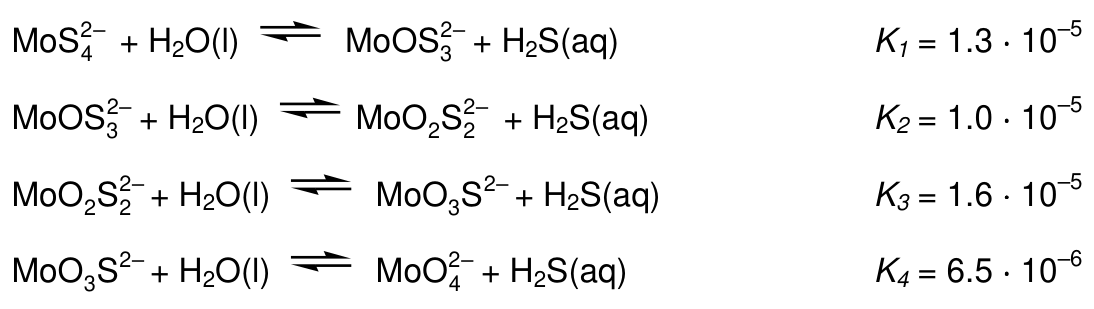
3.1 If at equilibrium the concentrations of \(\ce{MoO4^2-}\) and \(\ce{H2S(aq)}\) are equal to \(1\cdot10^{-7}\) and \(1\cdot10^{-6}\), respectively, what would be the equilibrium concentration of \(\ce{MoS4^2-}\)?
Solutions containing \(\ce{MoO2S2^2-}\), \(\ce{MoOS3^2-}\) and \(\ce{MoS4^2-}\) display absorption peaks in the visible wavelength range at 395 and 468 nm. The other ions, as well as \(\ce{H2S}\), absorb negligibly in the visible wavelength range. The molar absorptivities (\(\varepsilon\)) at these two wavelengths are given in the following table:
| \(\varepsilon\) at 468 nm \(\mathrm{dm^3\,mol^{-1}\,cm^{-1}}\) |
\(\varepsilon\) at 395 nm \(\mathrm{dm^3\,mol^{-1}\,cm^{-1}}\) |
|
|---|---|---|
| \(\ce{MoS4^2-}\) | 11870 | 120 |
| \(\ce{MoOS3^2-}\) | 0 | 9030 |
| \(\ce{MoO2S2^2-}\) | 0 | 3230 |
3.2 A solution not at equilibrium contains a mixture of \(\ce{MoS4^2-}\), \(\ce{MoOS3^2-}\) and \(\ce{MoO2S2^2-}\) and no other \(\ce{Mo}\)-containing species. The total concentration of all species containing \(\ce{Mo}\) is \(6.0\cdot10^{-6}\ \mathrm{mol\,dm^{-3}}\). In a 10.0 cm absorption cell, the absorbance of the solution at 468 nm is 0.365 and that at 395 nm is 0.213. Calculate the concentrations of all three \(\ce{Mo}\)-containing anions in this mixture.
A solution with initial concentration of \(\ce{MoS4^2-}\) equal to \(2.0\cdot10^{-7}\ \mathrm{mol\,dm^{-3}}\) hydrolyzes in a closed system. The \(\ce{H2S}\) product accumulates until equilibrium is reached. When calculating the final equilibrium concentrations of \(\ce{H2S(aq)}\), and all five \(\ce{Mo}\)-containing anions (that is, \(\ce{MoO4^2-}\), \(\ce{MoO3S^2-}\), \(\ce{MoO2S2^2-}\), \(\ce{MoOS3^2-}\) and \(\ce{MoS4^2-}\)) ignore the possibility that \(\ce{H2S}\) might ionize to \(\ce{HS-}\) under certain pH conditions.
3.3 Write the six independent equations that determine the system.
3.4 Calculate the above mentioned six concentrations making reasonable approximations, giving your answers to two significant figures.
Official English text of the problem.
Answers
-
3.1 \[ \boxed{[\ce{MoS4^2-}]=7.4\times10^{-12}\ \mathrm{mol\,dm^{-3}}} \]
-
3.2 To two significant figures: \[ \boxed{ \begin{aligned} [\ce{MoS4^2-}]&=3.1\times10^{-6}\ \mathrm{mol\,dm^{-3}},\\ [\ce{MoOS3^2-}]&=2.0\times10^{-6}\ \mathrm{mol\,dm^{-3}},\\ [\ce{MoO2S2^2-}]&=9.5\times10^{-7}\ \mathrm{mol\,dm^{-3}}. \end{aligned}} \]
-
3.3 Let \(h=[\ce{H2S(aq)}]\), and let \(x_0,x_1,x_2,x_3,x_4\) denote the concentrations of \(\ce{MoO4^2-}\), \(\ce{MoO3S^2-}\), \(\ce{MoO2S2^2-}\), \(\ce{MoOS3^2-}\), and \(\ce{MoS4^2-}\), respectively. With \(C=2.0\times10^{-7}\ \mathrm{mol\,dm^{-3}}\), the six equations are \[ \boxed{ \begin{aligned} \frac{x_3h}{x_4}&=K_1,& \frac{x_2h}{x_3}&=K_2,\\ \frac{x_1h}{x_2}&=K_3,& \frac{x_0h}{x_1}&=K_4,\\ x_0+x_1+x_2+x_3+x_4&=C,\\ h+x_1+2x_2+3x_3+4x_4&=4C. \end{aligned}} \]
-
3.4 \[ \boxed{ \begin{aligned} [\ce{H2S(aq)}]&=7.8\times10^{-7}\ \mathrm{mol\,dm^{-3}},\\ [\ce{MoO4^2-}]&=1.8\times10^{-7}\ \mathrm{mol\,dm^{-3}},\\ [\ce{MoO3S^2-}]&=2.1\times10^{-8}\ \mathrm{mol\,dm^{-3}},\\ [\ce{MoO2S2^2-}]&=1.0\times10^{-9}\ \mathrm{mol\,dm^{-3}},\\ [\ce{MoOS3^2-}]&=8.0\times10^{-11}\ \mathrm{mol\,dm^{-3}},\\ [\ce{MoS4^2-}]&=4.8\times10^{-12}\ \mathrm{mol\,dm^{-3}}. \end{aligned}} \]
Solution
The species and notation used throughout are:
| Concentration | Ion | SMILES |
|---|---|---|
| \(x_0\) | Molybdate, \(\ce{MoO4^2-}\) | [O-][Mo](=O)(=O)[O-] |
| \(x_1\) | Monothiomolybdate, \(\ce{MoO3S^2-}\) | [O-][Mo](=O)(=S)[O-] |
| \(x_2\) | Dithiomolybdate, \(\ce{MoO2S2^2-}\) | [S-][Mo](=O)(=O)[S-] |
| \(x_3\) | Trithiomolybdate, \(\ce{MoOS3^2-}\) | [S-][Mo](=O)(=S)[S-] |
| \(x_4\) | Tetrathiomolybdate, \(\ce{MoS4^2-}\) | [S-][Mo](=S)(=S)[S-] |
These SMILES give formal Lewis representations; the placement of localized bonds and charges is not unique because of resonance. The four oxygen/sulfur ligands have approximately tetrahedral coordination around molybdenum(VI), which these SMILES do not explicitly specify.
Water, \(\ce{H2O}\), has SMILES O; hydrogen sulfide, \(\ce{H2S}\), has SMILES S; and hydrosulfide, \(\ce{HS-}\), has SMILES [SH-]. Hydrosulfide formation is excluded as instructed.
The given equilibrium constants are used in their dilute-solution concentration form, with liquid water omitted from the expressions.
3.1
Adding the four hydrolysis reactions cancels the intermediate ions:
\[ \ce{MoS4^2- + 4H2O(l) <=> MoO4^2- + 4H2S(aq)}. \]
The equilibrium constant for this overall reaction is the product of the four constants:
\[ K_1K_2K_3K_4 =(1.3\times10^{-5})(1.0\times10^{-5}) (1.6\times10^{-5})(6.5\times10^{-6}) =1.352\times10^{-20}. \]
Consequently,
\[ K_1K_2K_3K_4 =\frac{[\ce{MoO4^2-}][\ce{H2S}]^4} {[\ce{MoS4^2-}]}. \]
Rearranging and substituting the specified concentrations gives
\[ [\ce{MoS4^2-}] =\frac{(1\times10^{-7})(1\times10^{-6})^4} {1.352\times10^{-20}} =7.396\times10^{-12}\ \mathrm{mol\,dm^{-3}}. \]
Thus,
\[ \boxed{[\ce{MoS4^2-}]\approx7.4\times10^{-12}\ \mathrm{mol\,dm^{-3}}}. \]
3.2
For a mixture, the Beer–Lambert law is
\[ A_\lambda=l\sum_i\varepsilon_{i,\lambda}c_i. \]
At 468 nm, only tetrathiomolybdate absorbs appreciably. Hence,
\[ 0.365=(10.0)(11870)x_4, \]
so
\[ x_4=3.0749789\times10^{-6}\ \mathrm{mol\,dm^{-3}}. \]
The molybdenum balance gives
\[ x_3+x_2=6.0\times10^{-6}-x_4. \]
At 395 nm, all three species contribute:
\[ 0.213=10.0(120x_4+9030x_3+3230x_2). \]
Substituting \(x_2=6.0\times10^{-6}-x_4-x_3\),
\[ x_3= \frac{0.213/10.0-120x_4-3230(6.0\times10^{-6}-x_4)} {9030-3230} =1.9798594\times10^{-6}\ \mathrm{mol\,dm^{-3}}. \]
Therefore,
\[ x_2=6.0\times10^{-6}-x_4-x_3 =9.4516167\times10^{-7}\ \mathrm{mol\,dm^{-3}}. \]
Rounded to two significant figures, these are \(3.1\times10^{-6}\), \(2.0\times10^{-6}\), and \(9.5\times10^{-7}\ \mathrm{mol\,dm^{-3}}\), respectively. No equilibrium relations are used because this mixture is explicitly not at equilibrium.
3.3
There are six unknown concentrations: \(x_0,x_1,x_2,x_3,x_4,h\).
The four equilibrium relations are
\[ \begin{aligned} K_1&=\frac{x_3h}{x_4}=1.3\times10^{-5},\\ K_2&=\frac{x_2h}{x_3}=1.0\times10^{-5},\\ K_3&=\frac{x_1h}{x_2}=1.6\times10^{-5},\\ K_4&=\frac{x_0h}{x_1}=6.5\times10^{-6}. \end{aligned} \]
Each anion contains one molybdenum atom, so conservation of molybdenum gives
\[ \boxed{x_0+x_1+x_2+x_3+x_4=C =2.0\times10^{-7}\ \mathrm{mol\,dm^{-3}}}. \]
Initially, every molybdenum atom is associated with four sulfur atoms. At equilibrium, sulfur is distributed between the anions and dissolved hydrogen sulfide. Thus,
\[ \boxed{h+x_1+2x_2+3x_3+4x_4 =4C=8.0\times10^{-7}\ \mathrm{mol\,dm^{-3}}}. \]
These are the required six independent equations. Combining the two elemental balances also gives the useful equivalent relation
\[ \boxed{h=4x_0+3x_1+2x_2+x_3}. \]
The coefficients count the number of hydrogen sulfide molecules released when one initial tetrathiomolybdate ion reaches each hydrolysis state.
3.4
The sulfur balance bounds the hydrogen sulfide concentration:
\[ 0<h\leq4C=8.0\times10^{-7}\ \mathrm{mol\,dm^{-3}}. \]
The equilibrium relations give the successive concentration ratios
\[ \frac{x_1}{x_0}=\frac{h}{K_4},\qquad \frac{x_2}{x_1}=\frac{h}{K_3},\qquad \frac{x_3}{x_2}=\frac{h}{K_2},\qquad \frac{x_4}{x_3}=\frac{h}{K_1}. \]
Even at the upper bound for \(h\), these ratios are only approximately \(0.12\), \(0.050\), \(0.080\), and \(0.062\). Molybdate therefore predominates, and nearly complete hydrolysis provides a reasonable first approximation:
\[ h^{(0)}=4C=8.0\times10^{-7}\ \mathrm{mol\,dm^{-3}}. \]
To obtain reliable two-significant-figure results for the minor species, refine this approximation using both balances. Express every molybdenum concentration in terms of \(x_0\) and \(h\):
\[ \begin{aligned} x_1&=x_0\frac{h}{K_4},\\ x_2&=x_0\frac{h^2}{K_3K_4},\\ x_3&=x_0\frac{h^3}{K_2K_3K_4},\\ x_4&=x_0\frac{h^4}{K_1K_2K_3K_4}. \end{aligned} \]
The molybdenum balance then gives
\[ x_0= \frac{C}{ 1+\dfrac{h}{K_4} +\dfrac{h^2}{K_3K_4} +\dfrac{h^3}{K_2K_3K_4} +\dfrac{h^4}{K_1K_2K_3K_4} }. \]
For each estimate of \(h\), calculate these concentrations and update \(h\) from
\[ h_{\mathrm{new}}=4C-x_1-2x_2-3x_3-4x_4. \]
Successive approximations are
\[ \begin{aligned} h^{(0)}&=8.0000000\times10^{-7},\\ h^{(1)}&=7.7574998\times10^{-7},\\ h^{(2)}&=7.7647978\times10^{-7},\\ h^{(3)}&=7.7645781\times10^{-7}, \end{aligned} \qquad \mathrm{mol\,dm^{-3}}. \]
The concentrations have stabilized sufficiently for the requested rounding:
| Species | Value before final rounding \((\mathrm{mol\,dm^{-3}})\) | Two significant figures \((\mathrm{mol\,dm^{-3}})\) |
|---|---|---|
| \(\ce{H2S(aq)}\) | \(7.7646\times10^{-7}\) | \(\boxed{7.8\times10^{-7}}\) |
| \(\ce{MoO4^2-}\) | \(1.7766\times10^{-7}\) | \(\boxed{1.8\times10^{-7}}\) |
| \(\ce{MoO3S^2-}\) | \(2.1223\times10^{-8}\) | \(\boxed{2.1\times10^{-8}}\) |
| \(\ce{MoO2S2^2-}\) | \(1.0299\times10^{-9}\) | \(\boxed{1.0\times10^{-9}}\) |
| \(\ce{MoOS3^2-}\) | \(7.9968\times10^{-11}\) | \(\boxed{8.0\times10^{-11}}\) |
| \(\ce{MoS4^2-}\) | \(4.7763\times10^{-12}\) | \(\boxed{4.8\times10^{-12}}\) |
Using unrounded values, the molybdenum concentrations sum to \(2.0\times10^{-7}\ \mathrm{mol\,dm^{-3}}\), and the total sulfur concentration is \(8.0\times10^{-7}\ \mathrm{mol\,dm^{-3}}\), as required.
The solution was checked against the official solution.
IChO 2012 · Theorieaufgabe 3
Thiomolybdat-Ionen
Thiomolybdat-Ionen leiten sich von Molybdat-Ionen, \(\ce{MoO4^2-}\), ab, indem Sauerstoffatome durch Schwefelatome ersetzt werden. In der Natur kommen Thiomolybdat-Ionen beispielsweise im Tiefenwasser des Schwarzen Meeres vor, wo durch biologische Sulfatreduktion \(\ce{H2S}\) entsteht. Die Umwandlung von Molybdat in Thiomolybdat führt dazu, dass gelöstes \(\ce{Mo}\) rasch aus dem Meerwasser in die darunterliegenden Sedimente übergeht. Dadurch verarmt der Ozean an \(\ce{Mo}\), einem lebensnotwendigen Spurenelement.
Die folgenden Gleichgewichte bestimmen die relativen Konzentrationen der Molybdat- und Thiomolybdat-Ionen in verdünnter wässriger Lösung:
3.1 Wenn im Gleichgewicht die Konzentrationen von \(\ce{MoO4^2-}\) und \(\ce{H2S(aq)}\) gleich \(1\cdot10^{-7}\) bzw. \(1\cdot10^{-6}\) sind, wie groß ist dann die Gleichgewichtskonzentration von \(\ce{MoS4^2-}\)?
Lösungen, die \(\ce{MoO2S2^2-}\), \(\ce{MoOS3^2-}\) und \(\ce{MoS4^2-}\) enthalten, zeigen im sichtbaren Wellenlängenbereich Absorptionsmaxima bei 395 und 468 nm. Die Absorption der anderen Ionen sowie von \(\ce{H2S}\) im sichtbaren Wellenlängenbereich ist vernachlässigbar. Die molaren Extinktionskoeffizienten (\(\varepsilon\)) bei diesen beiden Wellenlängen sind in der folgenden Tabelle angegeben:
| \(\varepsilon\) bei 468 nm \(\mathrm{dm^3\,mol^{-1}\,cm^{-1}}\) |
\(\varepsilon\) bei 395 nm \(\mathrm{dm^3\,mol^{-1}\,cm^{-1}}\) |
|
|---|---|---|
| \(\ce{MoS4^2-}\) | 11870 | 120 |
| \(\ce{MoOS3^2-}\) | 0 | 9030 |
| \(\ce{MoO2S2^2-}\) | 0 | 3230 |
3.2 Eine Lösung, die sich nicht im Gleichgewicht befindet, enthält ein Gemisch aus \(\ce{MoS4^2-}\), \(\ce{MoOS3^2-}\) und \(\ce{MoO2S2^2-}\) und keine anderen \(\ce{Mo}\)-haltigen Spezies. Die Gesamtkonzentration aller \(\ce{Mo}\)-haltigen Spezies beträgt \(6.0\cdot10^{-6}\ \mathrm{mol\,dm^{-3}}\). In einer Absorptionsküvette mit einer Schichtdicke von 10.0 cm beträgt die Extinktion der Lösung bei 468 nm 0.365 und bei 395 nm 0.213. Berechnen Sie die Konzentrationen aller drei \(\ce{Mo}\)-haltigen Anionen in diesem Gemisch.
Eine Lösung mit einer Anfangskonzentration von \(\ce{MoS4^2-}\) von \(2.0\cdot10^{-7}\ \mathrm{mol\,dm^{-3}}\) hydrolysiert in einem geschlossenen System. Das Produkt \(\ce{H2S}\) reichert sich an, bis das Gleichgewicht erreicht ist. Vernachlässigen Sie bei der Berechnung der endgültigen Gleichgewichtskonzentrationen von \(\ce{H2S(aq)}\) und allen fünf \(\ce{Mo}\)-haltigen Anionen (also \(\ce{MoO4^2-}\), \(\ce{MoO3S^2-}\), \(\ce{MoO2S2^2-}\), \(\ce{MoOS3^2-}\) und \(\ce{MoS4^2-}\)) die Möglichkeit, dass \(\ce{H2S}\) bei bestimmten pH-Werten zu \(\ce{HS-}\) dissoziieren könnte.
3.3 Stellen Sie die sechs unabhängigen Gleichungen auf, die das System bestimmen.
3.4 Berechnen Sie die oben genannten sechs Konzentrationen unter Verwendung sinnvoller Näherungen und geben Sie Ihre Ergebnisse mit zwei signifikanten Stellen an.
Aufgabentext aus dem offiziellen englischen Text übersetzt.
Antworten
-
3.1 \[ \boxed{[\ce{MoS4^2-}]=7.4\times10^{-12}\ \mathrm{mol\,dm^{-3}}} \]
-
3.2 Mit zwei signifikanten Stellen: \[ \boxed{ \begin{aligned} [\ce{MoS4^2-}]&=3.1\times10^{-6}\ \mathrm{mol\,dm^{-3}},\\ [\ce{MoOS3^2-}]&=2.0\times10^{-6}\ \mathrm{mol\,dm^{-3}},\\ [\ce{MoO2S2^2-}]&=9.5\times10^{-7}\ \mathrm{mol\,dm^{-3}}. \end{aligned}} \]
-
3.3 Es sei \(h=[\ce{H2S(aq)}]\), und \(x_0,x_1,x_2,x_3,x_4\) bezeichnen die Konzentrationen von \(\ce{MoO4^2-}\), \(\ce{MoO3S^2-}\), \(\ce{MoO2S2^2-}\), \(\ce{MoOS3^2-}\) bzw. \(\ce{MoS4^2-}\). Mit \(C=2.0\times10^{-7}\ \mathrm{mol\,dm^{-3}}\) lauten die sechs Gleichungen \[ \boxed{ \begin{aligned} \frac{x_3h}{x_4}&=K_1,& \frac{x_2h}{x_3}&=K_2,\\ \frac{x_1h}{x_2}&=K_3,& \frac{x_0h}{x_1}&=K_4,\\ x_0+x_1+x_2+x_3+x_4&=C,\\ h+x_1+2x_2+3x_3+4x_4&=4C. \end{aligned}} \]
-
3.4 \[ \boxed{ \begin{aligned} [\ce{H2S(aq)}]&=7.8\times10^{-7}\ \mathrm{mol\,dm^{-3}},\\ [\ce{MoO4^2-}]&=1.8\times10^{-7}\ \mathrm{mol\,dm^{-3}},\\ [\ce{MoO3S^2-}]&=2.1\times10^{-8}\ \mathrm{mol\,dm^{-3}},\\ [\ce{MoO2S2^2-}]&=1.0\times10^{-9}\ \mathrm{mol\,dm^{-3}},\\ [\ce{MoOS3^2-}]&=8.0\times10^{-11}\ \mathrm{mol\,dm^{-3}},\\ [\ce{MoS4^2-}]&=4.8\times10^{-12}\ \mathrm{mol\,dm^{-3}}. \end{aligned}} \]
Lösung
Die durchgehend verwendeten Spezies und Bezeichnungen sind:
| Konzentration | Ion | SMILES |
|---|---|---|
| \(x_0\) | Molybdat, \(\ce{MoO4^2-}\) | [O-][Mo](=O)(=O)[O-] |
| \(x_1\) | Monothiomolybdat, \(\ce{MoO3S^2-}\) | [O-][Mo](=O)(=S)[O-] |
| \(x_2\) | Dithiomolybdat, \(\ce{MoO2S2^2-}\) | [S-][Mo](=O)(=O)[S-] |
| \(x_3\) | Trithiomolybdat, \(\ce{MoOS3^2-}\) | [S-][Mo](=O)(=S)[S-] |
| \(x_4\) | Tetrathiomolybdat, \(\ce{MoS4^2-}\) | [S-][Mo](=S)(=S)[S-] |
Diese SMILES geben formale Lewis-Strukturen wieder; die Anordnung lokalisierter Bindungen und Ladungen ist aufgrund der Mesomerie nicht eindeutig. Die vier Sauerstoff-/Schwefelliganden sind annähernd tetraedrisch um Molybdän(VI) koordiniert, was diese SMILES nicht ausdrücklich angeben.
Wasser, \(\ce{H2O}\), hat den SMILES-Code O; Schwefelwasserstoff, \(\ce{H2S}\), hat den SMILES-Code S; und Hydrogensulfid, \(\ce{HS-}\), hat den SMILES-Code [SH-]. Die Bildung von Hydrogensulfid wird wie vorgegeben ausgeschlossen.
Die gegebenen Gleichgewichtskonstanten werden in ihrer Konzentrationsform für verdünnte Lösungen verwendet, wobei flüssiges Wasser in den Ausdrücken weggelassen wird.
3.1
Bei der Addition der vier Hydrolysereaktionen kürzen sich die intermediären Ionen heraus:
\[ \ce{MoS4^2- + 4H2O(l) <=> MoO4^2- + 4H2S(aq)}. \]
Die Gleichgewichtskonstante dieser Gesamtreaktion ist das Produkt der vier Konstanten:
\[ K_1K_2K_3K_4 =(1.3\times10^{-5})(1.0\times10^{-5}) (1.6\times10^{-5})(6.5\times10^{-6}) =1.352\times10^{-20}. \]
Folglich gilt
\[ K_1K_2K_3K_4 =\frac{[\ce{MoO4^2-}][\ce{H2S}]^4} {[\ce{MoS4^2-}]}. \]
Umstellen und Einsetzen der angegebenen Konzentrationen ergibt
\[ [\ce{MoS4^2-}] =\frac{(1\times10^{-7})(1\times10^{-6})^4} {1.352\times10^{-20}} =7.396\times10^{-12}\ \mathrm{mol\,dm^{-3}}. \]
Damit ist
\[ \boxed{[\ce{MoS4^2-}]\approx7.4\times10^{-12}\ \mathrm{mol\,dm^{-3}}}. \]
3.2
Für ein Gemisch lautet das Lambert-Beer-Gesetz
\[ A_\lambda=l\sum_i\varepsilon_{i,\lambda}c_i. \]
Bei 468 nm absorbiert nur Tetrathiomolybdat in nennenswertem Maße. Daher gilt
\[ 0.365=(10.0)(11870)x_4, \]
also
\[ x_4=3.0749789\times10^{-6}\ \mathrm{mol\,dm^{-3}}. \]
Die Molybdänbilanz ergibt
\[ x_3+x_2=6.0\times10^{-6}-x_4. \]
Bei 395 nm tragen alle drei Spezies zur Extinktion bei:
\[ 0.213=10.0(120x_4+9030x_3+3230x_2). \]
Durch Einsetzen von \(x_2=6.0\times10^{-6}-x_4-x_3\) erhält man
\[ x_3= \frac{0.213/10.0-120x_4-3230(6.0\times10^{-6}-x_4)} {9030-3230} =1.9798594\times10^{-6}\ \mathrm{mol\,dm^{-3}}. \]
Daraus folgt
\[ x_2=6.0\times10^{-6}-x_4-x_3 =9.4516167\times10^{-7}\ \mathrm{mol\,dm^{-3}}. \]
Auf zwei signifikante Stellen gerundet sind dies \(3.1\times10^{-6}\), \(2.0\times10^{-6}\) bzw. \(9.5\times10^{-7}\ \mathrm{mol\,dm^{-3}}\). Es werden keine Gleichgewichtsbeziehungen verwendet, da sich dieses Gemisch ausdrücklich nicht im Gleichgewicht befindet.
3.3
Es gibt sechs unbekannte Konzentrationen: \(x_0,x_1,x_2,x_3,x_4,h\).
Die vier Gleichgewichtsbeziehungen lauten
\[ \begin{aligned} K_1&=\frac{x_3h}{x_4}=1.3\times10^{-5},\\ K_2&=\frac{x_2h}{x_3}=1.0\times10^{-5},\\ K_3&=\frac{x_1h}{x_2}=1.6\times10^{-5},\\ K_4&=\frac{x_0h}{x_1}=6.5\times10^{-6}. \end{aligned} \]
Jedes Anion enthält ein Molybdänatom, sodass sich aus der Erhaltung des Molybdäns ergibt:
\[ \boxed{x_0+x_1+x_2+x_3+x_4=C =2.0\times10^{-7}\ \mathrm{mol\,dm^{-3}}}. \]
Zu Beginn ist jedes Molybdänatom mit vier Schwefelatomen verbunden. Im Gleichgewicht verteilt sich der Schwefel auf die Anionen und den gelösten Schwefelwasserstoff. Somit gilt
\[ \boxed{h+x_1+2x_2+3x_3+4x_4 =4C=8.0\times10^{-7}\ \mathrm{mol\,dm^{-3}}}. \]
Dies sind die gesuchten sechs unabhängigen Gleichungen. Die Kombination der beiden Elementbilanzen liefert außerdem die nützliche äquivalente Beziehung
\[ \boxed{h=4x_0+3x_1+2x_2+x_3}. \]
Die Koeffizienten geben die Anzahl der Schwefelwasserstoffmoleküle an, die freigesetzt werden, wenn ein ursprünglich vorhandenes Tetrathiomolybdat-Ion die jeweilige Hydrolysestufe erreicht.
3.4
Die Schwefelbilanz begrenzt die Schwefelwasserstoffkonzentration:
\[ 0<h\leq4C=8.0\times10^{-7}\ \mathrm{mol\,dm^{-3}}. \]
Die Gleichgewichtsbeziehungen liefern die aufeinanderfolgenden Konzentrationsverhältnisse
\[ \frac{x_1}{x_0}=\frac{h}{K_4},\qquad \frac{x_2}{x_1}=\frac{h}{K_3},\qquad \frac{x_3}{x_2}=\frac{h}{K_2},\qquad \frac{x_4}{x_3}=\frac{h}{K_1}. \]
Selbst an der oberen Grenze für \(h\) betragen diese Verhältnisse nur ungefähr \(0.12\), \(0.050\), \(0.080\) bzw. \(0.062\). Molybdat überwiegt daher, und eine nahezu vollständige Hydrolyse liefert eine sinnvolle erste Näherung:
\[ h^{(0)}=4C=8.0\times10^{-7}\ \mathrm{mol\,dm^{-3}}. \]
Um für die in geringeren Konzentrationen vorliegenden Spezies zuverlässige Ergebnisse mit zwei signifikanten Stellen zu erhalten, wird diese Näherung mithilfe beider Bilanzen verfeinert. Jede Konzentration einer Molybdänspezies wird durch \(x_0\) und \(h\) ausgedrückt:
\[ \begin{aligned} x_1&=x_0\frac{h}{K_4},\\ x_2&=x_0\frac{h^2}{K_3K_4},\\ x_3&=x_0\frac{h^3}{K_2K_3K_4},\\ x_4&=x_0\frac{h^4}{K_1K_2K_3K_4}. \end{aligned} \]
Die Molybdänbilanz ergibt dann
\[ x_0= \frac{C}{ 1+\dfrac{h}{K_4} +\dfrac{h^2}{K_3K_4} +\dfrac{h^3}{K_2K_3K_4} +\dfrac{h^4}{K_1K_2K_3K_4} }. \]
Für jeden Näherungswert von \(h\) werden diese Konzentrationen berechnet und \(h\) anhand der folgenden Gleichung aktualisiert:
\[ h_{\mathrm{new}}=4C-x_1-2x_2-3x_3-4x_4. \]
Die aufeinanderfolgenden Näherungswerte sind
\[ \begin{aligned} h^{(0)}&=8.0000000\times10^{-7},\\ h^{(1)}&=7.7574998\times10^{-7},\\ h^{(2)}&=7.7647978\times10^{-7},\\ h^{(3)}&=7.7645781\times10^{-7}, \end{aligned} \qquad \mathrm{mol\,dm^{-3}}. \]
Die Konzentrationen haben sich für die geforderte Rundung hinreichend stabilisiert:
| Spezies | Wert vor der abschließenden Rundung \((\mathrm{mol\,dm^{-3}})\) | Zwei signifikante Stellen \((\mathrm{mol\,dm^{-3}})\) |
|---|---|---|
| \(\ce{H2S(aq)}\) | \(7.7646\times10^{-7}\) | \(\boxed{7.8\times10^{-7}}\) |
| \(\ce{MoO4^2-}\) | \(1.7766\times10^{-7}\) | \(\boxed{1.8\times10^{-7}}\) |
| \(\ce{MoO3S^2-}\) | \(2.1223\times10^{-8}\) | \(\boxed{2.1\times10^{-8}}\) |
| \(\ce{MoO2S2^2-}\) | \(1.0299\times10^{-9}\) | \(\boxed{1.0\times10^{-9}}\) |
| \(\ce{MoOS3^2-}\) | \(7.9968\times10^{-11}\) | \(\boxed{8.0\times10^{-11}}\) |
| \(\ce{MoS4^2-}\) | \(4.7763\times10^{-12}\) | \(\boxed{4.8\times10^{-12}}\) |
Mit ungerundeten Werten summieren sich die Konzentrationen der Molybdänspezies wie gefordert zu \(2.0\times10^{-7}\ \mathrm{mol\,dm^{-3}}\), und die Gesamtschwefelkonzentration beträgt \(8.0\times10^{-7}\ \mathrm{mol\,dm^{-3}}\).
Die Lösung wurde mit der offiziellen Lösung abgeglichen.
IChO 2012 · Teori sorusu 3
Tiyomolibdat iyonları
Tiyomolibdat iyonları, molibdat iyonlarındaki, \(\ce{MoO4^2-}\), oksijen atomlarının kükürt atomlarıyla yer değiştirmesiyle türetilir. Doğada tiyomolibdat iyonları, biyolojik sülfat indirgenmesinin \(\ce{H2S}\) oluşturduğu Karadeniz'in derin suları gibi yerlerde bulunur. Molibdatın tiyomolibdata dönüşümü, çözünmüş \(\ce{Mo}\)'nun deniz suyundan alttaki çökeltilere hızla geçmesine yol açarak okyanusu yaşam için gerekli bir eser element olan \(\ce{Mo}\) bakımından fakirleştirir.
Aşağıdaki dengeler, seyreltik sulu çözeltide molibdat ve tiyomolibdat iyonlarının bağıl derişimlerini belirler:
3.1 Dengede \(\ce{MoO4^2-}\) ve \(\ce{H2S(aq)}\) derişimleri sırasıyla \(1\cdot10^{-7}\) ve \(1\cdot10^{-6}\) ise \(\ce{MoS4^2-}\)'nin denge derişimi ne olur?
\(\ce{MoO2S2^2-}\), \(\ce{MoOS3^2-}\) ve \(\ce{MoS4^2-}\) içeren çözeltiler, görünür dalga boyu aralığında 395 ve 468 nm'de soğurma pikleri gösterir. Diğer iyonların ve \(\ce{H2S}\)'nin görünür dalga boyu aralığındaki soğurması ihmal edilebilir düzeydedir. Bu iki dalga boyundaki molar soğurma katsayıları (\(\varepsilon\)) aşağıdaki tabloda verilmiştir:
| 468 nm'de \(\varepsilon\) \(\mathrm{dm^3\,mol^{-1}\,cm^{-1}}\) |
395 nm'de \(\varepsilon\) \(\mathrm{dm^3\,mol^{-1}\,cm^{-1}}\) |
|
|---|---|---|
| \(\ce{MoS4^2-}\) | 11870 | 120 |
| \(\ce{MoOS3^2-}\) | 0 | 9030 |
| \(\ce{MoO2S2^2-}\) | 0 | 3230 |
3.2 Dengede olmayan bir çözelti, \(\ce{MoS4^2-}\), \(\ce{MoOS3^2-}\) ve \(\ce{MoO2S2^2-}\) karışımı içermekte ve \(\ce{Mo}\) içeren başka hiçbir tür içermemektedir. \(\ce{Mo}\) içeren tüm türlerin toplam derişimi \(6.0\cdot10^{-6}\ \mathrm{mol\,dm^{-3}}\)'tür. 10.0 cm'lik bir soğurma hücresinde çözeltinin 468 nm'deki absorbansı 0.365, 395 nm'deki absorbansı ise 0.213'tür. Bu karışımdaki \(\ce{Mo}\) içeren üç anyonun da derişimlerini hesaplayınız.
Başlangıç \(\ce{MoS4^2-}\) derişimi \(2.0\cdot10^{-7}\ \mathrm{mol\,dm^{-3}}\) olan bir çözelti, kapalı bir sistemde hidrolize uğrar. Ürün olarak oluşan \(\ce{H2S}\), dengeye ulaşılıncaya kadar birikir. \(\ce{H2S(aq)}\)'nin ve \(\ce{Mo}\) içeren beş anyonun tümünün (yani \(\ce{MoO4^2-}\), \(\ce{MoO3S^2-}\), \(\ce{MoO2S2^2-}\), \(\ce{MoOS3^2-}\) ve \(\ce{MoS4^2-}\)'nin) son denge derişimlerini hesaplarken, \(\ce{H2S}\)'nin belirli pH koşullarında \(\ce{HS-}\)'ye iyonlaşabileceğini göz ardı ediniz.
3.3 Sistemi belirleyen altı bağımsız denklemi yazınız.
3.4 Makul yaklaşımlar yaparak yukarıda belirtilen altı derişimi hesaplayınız ve cevaplarınızı iki anlamlı basamakla veriniz.
Soru metni resmi İngilizce metinden çevrilmiştir.
Cevaplar
-
3.1 \[ \boxed{[\ce{MoS4^2-}]=7.4\times10^{-12}\ \mathrm{mol\,dm^{-3}}} \]
-
3.2 İki anlamlı basamakla: \[ \boxed{ \begin{aligned} [\ce{MoS4^2-}]&=3.1\times10^{-6}\ \mathrm{mol\,dm^{-3}},\\ [\ce{MoOS3^2-}]&=2.0\times10^{-6}\ \mathrm{mol\,dm^{-3}},\\ [\ce{MoO2S2^2-}]&=9.5\times10^{-7}\ \mathrm{mol\,dm^{-3}}. \end{aligned}} \]
-
3.3 \(h=[\ce{H2S(aq)}]\) olsun ve \(x_0,x_1,x_2,x_3,x_4\), sırasıyla \(\ce{MoO4^2-}\), \(\ce{MoO3S^2-}\), \(\ce{MoO2S2^2-}\), \(\ce{MoOS3^2-}\) ve \(\ce{MoS4^2-}\) derişimlerini göstersin. \(C=2.0\times10^{-7}\ \mathrm{mol\,dm^{-3}}\) olmak üzere, altı denklem şöyledir: \[ \boxed{ \begin{aligned} \frac{x_3h}{x_4}&=K_1,& \frac{x_2h}{x_3}&=K_2,\\ \frac{x_1h}{x_2}&=K_3,& \frac{x_0h}{x_1}&=K_4,\\ x_0+x_1+x_2+x_3+x_4&=C,\\ h+x_1+2x_2+3x_3+4x_4&=4C. \end{aligned}} \]
-
3.4 \[ \boxed{ \begin{aligned} [\ce{H2S(aq)}]&=7.8\times10^{-7}\ \mathrm{mol\,dm^{-3}},\\ [\ce{MoO4^2-}]&=1.8\times10^{-7}\ \mathrm{mol\,dm^{-3}},\\ [\ce{MoO3S^2-}]&=2.1\times10^{-8}\ \mathrm{mol\,dm^{-3}},\\ [\ce{MoO2S2^2-}]&=1.0\times10^{-9}\ \mathrm{mol\,dm^{-3}},\\ [\ce{MoOS3^2-}]&=8.0\times10^{-11}\ \mathrm{mol\,dm^{-3}},\\ [\ce{MoS4^2-}]&=4.8\times10^{-12}\ \mathrm{mol\,dm^{-3}}. \end{aligned}} \]
Çözüm
Çözüm boyunca kullanılan türler ve gösterimler şöyledir:
| Derişim | İyon | SMILES |
|---|---|---|
| \(x_0\) | Molibdat, \(\ce{MoO4^2-}\) | [O-][Mo](=O)(=O)[O-] |
| \(x_1\) | Monotiyomolibdat, \(\ce{MoO3S^2-}\) | [O-][Mo](=O)(=S)[O-] |
| \(x_2\) | Ditiyomolibdat, \(\ce{MoO2S2^2-}\) | [S-][Mo](=O)(=O)[S-] |
| \(x_3\) | Tritiyomolibdat, \(\ce{MoOS3^2-}\) | [S-][Mo](=O)(=S)[S-] |
| \(x_4\) | Tetratiyomolibdat, \(\ce{MoS4^2-}\) | [S-][Mo](=S)(=S)[S-] |
Bu SMILES dizgeleri biçimsel Lewis gösterimleridir; rezonans nedeniyle yerelleştirilmiş bağların ve yüklerin yerleşimi tek bir şekilde belirlenmez. Dört oksijen/kükürt ligandı, molibden(VI) çevresinde yaklaşık olarak tetrahedral koordinasyona sahiptir; bu SMILES dizgeleri bunu açıkça belirtmez.
Suyun, \(\ce{H2O}\), SMILES dizgesi O; hidrojen sülfürün, \(\ce{H2S}\), SMILES dizgesi S; hidrojensülfür iyonunun, \(\ce{HS-}\), SMILES dizgesi ise [SH-]'dir. Yönerge gereği hidrojensülfür iyonu oluşumu dikkate alınmaz.
Verilen denge sabitleri, ifadelerde sıvı suya yer verilmeden, seyreltik çözeltiler için derişim cinsinden yazılmış biçimleriyle kullanılır.
3.1
Dört hidroliz tepkimesi toplandığında ara iyonlar sadeleşir:
\[ \ce{MoS4^2- + 4H2O(l) <=> MoO4^2- + 4H2S(aq)}. \]
Bu toplam tepkimenin denge sabiti, dört sabitin çarpımıdır:
\[ K_1K_2K_3K_4 =(1.3\times10^{-5})(1.0\times10^{-5}) (1.6\times10^{-5})(6.5\times10^{-6}) =1.352\times10^{-20}. \]
Dolayısıyla,
\[ K_1K_2K_3K_4 =\frac{[\ce{MoO4^2-}][\ce{H2S}]^4} {[\ce{MoS4^2-}]}. \]
İfade yeniden düzenlenip belirtilen derişimler yerine konulduğunda şu sonuç elde edilir:
\[ [\ce{MoS4^2-}] =\frac{(1\times10^{-7})(1\times10^{-6})^4} {1.352\times10^{-20}} =7.396\times10^{-12}\ \mathrm{mol\,dm^{-3}}. \]
Böylece,
\[ \boxed{[\ce{MoS4^2-}]\approx7.4\times10^{-12}\ \mathrm{mol\,dm^{-3}}}. \]
3.2
Bir karışım için Beer–Lambert yasası şöyledir:
\[ A_\lambda=l\sum_i\varepsilon_{i,\lambda}c_i. \]
468 nm'de yalnızca tetratiyomolibdat kayda değer ölçüde soğurma yapar. Bu nedenle,
\[ 0.365=(10.0)(11870)x_4, \]
buradan
\[ x_4=3.0749789\times10^{-6}\ \mathrm{mol\,dm^{-3}}. \]
Molibden denkliği şu bağıntıyı verir:
\[ x_3+x_2=6.0\times10^{-6}-x_4. \]
395 nm'de her üç tür de katkıda bulunur:
\[ 0.213=10.0(120x_4+9030x_3+3230x_2). \]
\(x_2=6.0\times10^{-6}-x_4-x_3\) yerine konulduğunda,
\[ x_3= \frac{0.213/10.0-120x_4-3230(6.0\times10^{-6}-x_4)} {9030-3230} =1.9798594\times10^{-6}\ \mathrm{mol\,dm^{-3}}. \]
Dolayısıyla,
\[ x_2=6.0\times10^{-6}-x_4-x_3 =9.4516167\times10^{-7}\ \mathrm{mol\,dm^{-3}}. \]
İki anlamlı basamağa yuvarlandığında bunlar sırasıyla \(3.1\times10^{-6}\), \(2.0\times10^{-6}\) ve \(9.5\times10^{-7}\ \mathrm{mol\,dm^{-3}}\) olur. Bu karışımın dengede olmadığı açıkça belirtildiği için hiçbir denge bağıntısı kullanılmaz.
3.3
Altı bilinmeyen derişim vardır: \(x_0,x_1,x_2,x_3,x_4,h\).
Dört denge bağıntısı şöyledir:
\[ \begin{aligned} K_1&=\frac{x_3h}{x_4}=1.3\times10^{-5},\\ K_2&=\frac{x_2h}{x_3}=1.0\times10^{-5},\\ K_3&=\frac{x_1h}{x_2}=1.6\times10^{-5},\\ K_4&=\frac{x_0h}{x_1}=6.5\times10^{-6}. \end{aligned} \]
Her anyon bir molibden atomu içerdiğinden, molibdenin korunumu şu bağıntıyı verir:
\[ \boxed{x_0+x_1+x_2+x_3+x_4=C =2.0\times10^{-7}\ \mathrm{mol\,dm^{-3}}}. \]
Başlangıçta her molibden atomuna dört kükürt atomu bağlıdır. Dengede kükürt, anyonlar ve çözünmüş hidrojen sülfür arasında dağılır. Böylece,
\[ \boxed{h+x_1+2x_2+3x_3+4x_4 =4C=8.0\times10^{-7}\ \mathrm{mol\,dm^{-3}}}. \]
Bunlar istenen altı bağımsız denklemdir. İki element denkliği birleştirildiğinde, kullanışlı ve eşdeğer olan şu bağıntı da elde edilir:
\[ \boxed{h=4x_0+3x_1+2x_2+x_3}. \]
Katsayılar, başlangıçtaki bir tetratiyomolibdat iyonu her bir hidroliz durumuna ulaştığında açığa çıkan hidrojen sülfür moleküllerinin sayısını gösterir.
3.4
Kükürt denkliği, hidrojen sülfür derişimini sınırlar:
\[ 0<h\leq4C=8.0\times10^{-7}\ \mathrm{mol\,dm^{-3}}. \]
Denge bağıntıları, ardışık derişim oranlarını verir:
\[ \frac{x_1}{x_0}=\frac{h}{K_4},\qquad \frac{x_2}{x_1}=\frac{h}{K_3},\qquad \frac{x_3}{x_2}=\frac{h}{K_2},\qquad \frac{x_4}{x_3}=\frac{h}{K_1}. \]
\(h\)'nin üst sınırında bile bu oranlar yalnızca yaklaşık \(0.12\), \(0.050\), \(0.080\) ve \(0.062\)'dir. Bu nedenle molibdat baskın türdür ve neredeyse tam hidroliz, makul bir ilk yaklaşım sağlar:
\[ h^{(0)}=4C=8.0\times10^{-7}\ \mathrm{mol\,dm^{-3}}. \]
Az miktarda bulunan türler için iki anlamlı basamakla güvenilir sonuçlar elde etmek üzere, her iki denkliği de kullanarak bu yaklaşımı iyileştiriniz. Molibden içeren her türün derişimini \(x_0\) ve \(h\) cinsinden ifade ediniz:
\[ \begin{aligned} x_1&=x_0\frac{h}{K_4},\\ x_2&=x_0\frac{h^2}{K_3K_4},\\ x_3&=x_0\frac{h^3}{K_2K_3K_4},\\ x_4&=x_0\frac{h^4}{K_1K_2K_3K_4}. \end{aligned} \]
Molibden denkliği daha sonra şu ifadeyi verir:
\[ x_0= \frac{C}{ 1+\dfrac{h}{K_4} +\dfrac{h^2}{K_3K_4} +\dfrac{h^3}{K_2K_3K_4} +\dfrac{h^4}{K_1K_2K_3K_4} }. \]
\(h\)'nin her bir tahmini değeri için bu derişimleri hesaplayınız ve \(h\)'yi şu bağıntıdan güncelleyiniz:
\[ h_{\mathrm{new}}=4C-x_1-2x_2-3x_3-4x_4. \]
Ardışık yaklaşımlar şöyledir:
\[ \begin{aligned} h^{(0)}&=8.0000000\times10^{-7},\\ h^{(1)}&=7.7574998\times10^{-7},\\ h^{(2)}&=7.7647978\times10^{-7},\\ h^{(3)}&=7.7645781\times10^{-7}, \end{aligned} \qquad \mathrm{mol\,dm^{-3}}. \]
Derişimler, istenen yuvarlama için yeterince kararlı değerlere ulaşmıştır:
| Tür | Son yuvarlamadan önceki değer \((\mathrm{mol\,dm^{-3}})\) | İki anlamlı basamakla \((\mathrm{mol\,dm^{-3}})\) |
|---|---|---|
| \(\ce{H2S(aq)}\) | \(7.7646\times10^{-7}\) | \(\boxed{7.8\times10^{-7}}\) |
| \(\ce{MoO4^2-}\) | \(1.7766\times10^{-7}\) | \(\boxed{1.8\times10^{-7}}\) |
| \(\ce{MoO3S^2-}\) | \(2.1223\times10^{-8}\) | \(\boxed{2.1\times10^{-8}}\) |
| \(\ce{MoO2S2^2-}\) | \(1.0299\times10^{-9}\) | \(\boxed{1.0\times10^{-9}}\) |
| \(\ce{MoOS3^2-}\) | \(7.9968\times10^{-11}\) | \(\boxed{8.0\times10^{-11}}\) |
| \(\ce{MoS4^2-}\) | \(4.7763\times10^{-12}\) | \(\boxed{4.8\times10^{-12}}\) |
Yuvarlanmamış değerler kullanıldığında, molibden içeren türlerin derişimleri toplamı \(2.0\times10^{-7}\ \mathrm{mol\,dm^{-3}}\), toplam kükürt derişimi ise beklendiği gibi \(8.0\times10^{-7}\ \mathrm{mol\,dm^{-3}}\) olur.
Çözüm, resmi çözümle karşılaştırılarak kontrol edildi.
IChO 2012 · Problema teórico 3
Iones tiomolibdato
Los iones tiomolibdato se derivan de los iones molibdato, \(\ce{MoO4^2-}\), mediante la sustitución de átomos de oxígeno por átomos de azufre. En la naturaleza, los iones tiomolibdato se encuentran en lugares como las aguas profundas del mar Negro, donde la reducción biológica del sulfato genera \(\ce{H2S}\). La transformación de molibdato en tiomolibdato provoca una rápida pérdida de \(\ce{Mo}\) disuelto del agua de mar hacia los sedimentos subyacentes, empobreciendo el océano en \(\ce{Mo}\), un oligoelemento esencial para la vida.
Los siguientes equilibrios controlan las concentraciones relativas de los iones molibdato y tiomolibdato en disolución acuosa diluida:
3.1 Si en el equilibrio las concentraciones de \(\ce{MoO4^2-}\) y \(\ce{H2S(aq)}\) son iguales a \(1\cdot10^{-7}\) y \(1\cdot10^{-6}\), respectivamente, ¿cuál sería la concentración de equilibrio de \(\ce{MoS4^2-}\)?
Las disoluciones que contienen \(\ce{MoO2S2^2-}\), \(\ce{MoOS3^2-}\) y \(\ce{MoS4^2-}\) presentan picos de absorción en el intervalo de longitudes de onda del visible a 395 y 468 nm. Los demás iones, así como el \(\ce{H2S}\), presentan una absorción despreciable en el intervalo de longitudes de onda del visible. Las absortividades molares (\(\varepsilon\)) a estas dos longitudes de onda se indican en la siguiente tabla:
| \(\varepsilon\) a 468 nm \(\mathrm{dm^3\,mol^{-1}\,cm^{-1}}\) |
\(\varepsilon\) a 395 nm \(\mathrm{dm^3\,mol^{-1}\,cm^{-1}}\) |
|
|---|---|---|
| \(\ce{MoS4^2-}\) | 11870 | 120 |
| \(\ce{MoOS3^2-}\) | 0 | 9030 |
| \(\ce{MoO2S2^2-}\) | 0 | 3230 |
3.2 Una disolución que no está en equilibrio contiene una mezcla de \(\ce{MoS4^2-}\), \(\ce{MoOS3^2-}\) y \(\ce{MoO2S2^2-}\) y ninguna otra especie que contenga \(\ce{Mo}\). La concentración total de todas las especies que contienen \(\ce{Mo}\) es \(6.0\cdot10^{-6}\ \mathrm{mol\,dm^{-3}}\). En una cubeta de absorción de 10.0 cm, la absorbancia de la disolución a 468 nm es 0.365 y a 395 nm es 0.213. Calcule las concentraciones de los tres aniones que contienen \(\ce{Mo}\) en esta mezcla.
Una disolución con una concentración inicial de \(\ce{MoS4^2-}\) igual a \(2.0\cdot10^{-7}\ \mathrm{mol\,dm^{-3}}\) se hidroliza en un sistema cerrado. El \(\ce{H2S}\) producido se acumula hasta que se alcanza el equilibrio. Al calcular las concentraciones finales de equilibrio de \(\ce{H2S(aq)}\) y de los cinco aniones que contienen \(\ce{Mo}\) (es decir, \(\ce{MoO4^2-}\), \(\ce{MoO3S^2-}\), \(\ce{MoO2S2^2-}\), \(\ce{MoOS3^2-}\) y \(\ce{MoS4^2-}\)), ignore la posibilidad de que el \(\ce{H2S}\) pueda ionizarse para formar \(\ce{HS-}\) en determinadas condiciones de pH.
3.3 Escriba las seis ecuaciones independientes que determinan el sistema.
3.4 Calcule las seis concentraciones mencionadas anteriormente utilizando aproximaciones razonables y exprese sus respuestas con dos cifras significativas.
Enunciado traducido del texto oficial en inglés.
Respuestas
-
3.1 \[ \boxed{[\ce{MoS4^2-}]=7.4\times10^{-12}\ \mathrm{mol\,dm^{-3}}} \]
-
3.2 Con dos cifras significativas: \[ \boxed{ \begin{aligned} [\ce{MoS4^2-}]&=3.1\times10^{-6}\ \mathrm{mol\,dm^{-3}},\\ [\ce{MoOS3^2-}]&=2.0\times10^{-6}\ \mathrm{mol\,dm^{-3}},\\ [\ce{MoO2S2^2-}]&=9.5\times10^{-7}\ \mathrm{mol\,dm^{-3}}. \end{aligned}} \]
-
3.3 Sea \(h=[\ce{H2S(aq)}]\), y sean \(x_0,x_1,x_2,x_3,x_4\) las concentraciones de \(\ce{MoO4^2-}\), \(\ce{MoO3S^2-}\), \(\ce{MoO2S2^2-}\), \(\ce{MoOS3^2-}\) y \(\ce{MoS4^2-}\), respectivamente. Con \(C=2.0\times10^{-7}\ \mathrm{mol\,dm^{-3}}\), las seis ecuaciones son \[ \boxed{ \begin{aligned} \frac{x_3h}{x_4}&=K_1,& \frac{x_2h}{x_3}&=K_2,\\ \frac{x_1h}{x_2}&=K_3,& \frac{x_0h}{x_1}&=K_4,\\ x_0+x_1+x_2+x_3+x_4&=C,\\ h+x_1+2x_2+3x_3+4x_4&=4C. \end{aligned}} \]
-
3.4 \[ \boxed{ \begin{aligned} [\ce{H2S(aq)}]&=7.8\times10^{-7}\ \mathrm{mol\,dm^{-3}},\\ [\ce{MoO4^2-}]&=1.8\times10^{-7}\ \mathrm{mol\,dm^{-3}},\\ [\ce{MoO3S^2-}]&=2.1\times10^{-8}\ \mathrm{mol\,dm^{-3}},\\ [\ce{MoO2S2^2-}]&=1.0\times10^{-9}\ \mathrm{mol\,dm^{-3}},\\ [\ce{MoOS3^2-}]&=8.0\times10^{-11}\ \mathrm{mol\,dm^{-3}},\\ [\ce{MoS4^2-}]&=4.8\times10^{-12}\ \mathrm{mol\,dm^{-3}}. \end{aligned}} \]
Solución
Las especies y la notación utilizadas en todo el texto son:
| Concentración | Ion | SMILES |
|---|---|---|
| \(x_0\) | Molibdato, \(\ce{MoO4^2-}\) | [O-][Mo](=O)(=O)[O-] |
| \(x_1\) | Monotiomolibdato, \(\ce{MoO3S^2-}\) | [O-][Mo](=O)(=S)[O-] |
| \(x_2\) | Ditiomolibdato, \(\ce{MoO2S2^2-}\) | [S-][Mo](=O)(=O)[S-] |
| \(x_3\) | Tritiomolibdato, \(\ce{MoOS3^2-}\) | [S-][Mo](=O)(=S)[S-] |
| \(x_4\) | Tetratiomolibdato, \(\ce{MoS4^2-}\) | [S-][Mo](=S)(=S)[S-] |
Estos SMILES proporcionan representaciones formales de Lewis; la ubicación de los enlaces y las cargas localizados no es única debido a la resonancia. Los cuatro ligandos de oxígeno/azufre presentan una coordinación aproximadamente tetraédrica alrededor del molibdeno(VI), que estos SMILES no especifican explícitamente.
El agua, \(\ce{H2O}\), tiene el SMILES O; el sulfuro de hidrógeno, \(\ce{H2S}\), tiene el SMILES S; y el ion hidrogenosulfuro, \(\ce{HS-}\), tiene el SMILES [SH-]. La formación de hidrogenosulfuro se excluye según lo indicado.
Las constantes de equilibrio dadas se utilizan en su forma expresada en concentraciones para disoluciones diluidas, omitiendo el agua líquida de las expresiones.
3.1
Al sumar las cuatro reacciones de hidrólisis, se cancelan los iones intermedios:
\[ \ce{MoS4^2- + 4H2O(l) <=> MoO4^2- + 4H2S(aq)}. \]
La constante de equilibrio de esta reacción global es el producto de las cuatro constantes:
\[ K_1K_2K_3K_4 =(1.3\times10^{-5})(1.0\times10^{-5}) (1.6\times10^{-5})(6.5\times10^{-6}) =1.352\times10^{-20}. \]
Por consiguiente,
\[ K_1K_2K_3K_4 =\frac{[\ce{MoO4^2-}][\ce{H2S}]^4} {[\ce{MoS4^2-}]}. \]
Al despejar y sustituir las concentraciones especificadas, se obtiene
\[ [\ce{MoS4^2-}] =\frac{(1\times10^{-7})(1\times10^{-6})^4} {1.352\times10^{-20}} =7.396\times10^{-12}\ \mathrm{mol\,dm^{-3}}. \]
Así,
\[ \boxed{[\ce{MoS4^2-}]\approx7.4\times10^{-12}\ \mathrm{mol\,dm^{-3}}}. \]
3.2
Para una mezcla, la ley de Beer–Lambert es
\[ A_\lambda=l\sum_i\varepsilon_{i,\lambda}c_i. \]
A 468 nm, solo el tetratiomolibdato absorbe de manera apreciable. Por tanto,
\[ 0.365=(10.0)(11870)x_4, \]
de modo que
\[ x_4=3.0749789\times10^{-6}\ \mathrm{mol\,dm^{-3}}. \]
El balance de molibdeno da
\[ x_3+x_2=6.0\times10^{-6}-x_4. \]
A 395 nm, las tres especies contribuyen:
\[ 0.213=10.0(120x_4+9030x_3+3230x_2). \]
Sustituyendo \(x_2=6.0\times10^{-6}-x_4-x_3\),
\[ x_3= \frac{0.213/10.0-120x_4-3230(6.0\times10^{-6}-x_4)} {9030-3230} =1.9798594\times10^{-6}\ \mathrm{mol\,dm^{-3}}. \]
Por lo tanto,
\[ x_2=6.0\times10^{-6}-x_4-x_3 =9.4516167\times10^{-7}\ \mathrm{mol\,dm^{-3}}. \]
Redondeados a dos cifras significativas, estos valores son \(3.1\times10^{-6}\), \(2.0\times10^{-6}\) y \(9.5\times10^{-7}\ \mathrm{mol\,dm^{-3}}\), respectivamente. No se utiliza ninguna relación de equilibrio porque se indica explícitamente que esta mezcla no está en equilibrio.
3.3
Hay seis concentraciones desconocidas: \(x_0,x_1,x_2,x_3,x_4,h\).
Las cuatro relaciones de equilibrio son
\[ \begin{aligned} K_1&=\frac{x_3h}{x_4}=1.3\times10^{-5},\\ K_2&=\frac{x_2h}{x_3}=1.0\times10^{-5},\\ K_3&=\frac{x_1h}{x_2}=1.6\times10^{-5},\\ K_4&=\frac{x_0h}{x_1}=6.5\times10^{-6}. \end{aligned} \]
Cada anión contiene un átomo de molibdeno, por lo que la conservación del molibdeno da
\[ \boxed{x_0+x_1+x_2+x_3+x_4=C =2.0\times10^{-7}\ \mathrm{mol\,dm^{-3}}}. \]
Inicialmente, cada átomo de molibdeno está asociado a cuatro átomos de azufre. En el equilibrio, el azufre se distribuye entre los aniones y el sulfuro de hidrógeno disuelto. Así,
\[ \boxed{h+x_1+2x_2+3x_3+4x_4 =4C=8.0\times10^{-7}\ \mathrm{mol\,dm^{-3}}}. \]
Estas son las seis ecuaciones independientes requeridas. Al combinar los dos balances elementales, también se obtiene la siguiente relación equivalente útil:
\[ \boxed{h=4x_0+3x_1+2x_2+x_3}. \]
Los coeficientes indican el número de moléculas de sulfuro de hidrógeno liberadas cuando un ion tetratiomolibdato inicial alcanza cada estado de hidrólisis.
3.4
El balance de azufre acota la concentración de sulfuro de hidrógeno:
\[ 0<h\leq4C=8.0\times10^{-7}\ \mathrm{mol\,dm^{-3}}. \]
Las relaciones de equilibrio dan los cocientes de concentraciones sucesivas
\[ \frac{x_1}{x_0}=\frac{h}{K_4},\qquad \frac{x_2}{x_1}=\frac{h}{K_3},\qquad \frac{x_3}{x_2}=\frac{h}{K_2},\qquad \frac{x_4}{x_3}=\frac{h}{K_1}. \]
Incluso en la cota superior de \(h\), estos cocientes son tan solo de aproximadamente \(0.12\), \(0.050\), \(0.080\) y \(0.062\). Por tanto, el molibdato predomina, y una hidrólisis casi completa proporciona una primera aproximación razonable:
\[ h^{(0)}=4C=8.0\times10^{-7}\ \mathrm{mol\,dm^{-3}}. \]
Para obtener resultados fiables con dos cifras significativas para las especies minoritarias, refine esta aproximación utilizando ambos balances. Exprese cada concentración de molibdeno en función de \(x_0\) y \(h\):
\[ \begin{aligned} x_1&=x_0\frac{h}{K_4},\\ x_2&=x_0\frac{h^2}{K_3K_4},\\ x_3&=x_0\frac{h^3}{K_2K_3K_4},\\ x_4&=x_0\frac{h^4}{K_1K_2K_3K_4}. \end{aligned} \]
El balance de molibdeno da entonces
\[ x_0= \frac{C}{ 1+\dfrac{h}{K_4} +\dfrac{h^2}{K_3K_4} +\dfrac{h^3}{K_2K_3K_4} +\dfrac{h^4}{K_1K_2K_3K_4} }. \]
Para cada estimación de \(h\), calcule estas concentraciones y actualice \(h\) a partir de
\[ h_{\mathrm{new}}=4C-x_1-2x_2-3x_3-4x_4. \]
Las aproximaciones sucesivas son
\[ \begin{aligned} h^{(0)}&=8.0000000\times10^{-7},\\ h^{(1)}&=7.7574998\times10^{-7},\\ h^{(2)}&=7.7647978\times10^{-7},\\ h^{(3)}&=7.7645781\times10^{-7}, \end{aligned} \qquad \mathrm{mol\,dm^{-3}}. \]
Las concentraciones se han estabilizado lo suficiente para el redondeo solicitado:
| Especie | Valor antes del redondeo final \((\mathrm{mol\,dm^{-3}})\) | Dos cifras significativas \((\mathrm{mol\,dm^{-3}})\) |
|---|---|---|
| \(\ce{H2S(aq)}\) | \(7.7646\times10^{-7}\) | \(\boxed{7.8\times10^{-7}}\) |
| \(\ce{MoO4^2-}\) | \(1.7766\times10^{-7}\) | \(\boxed{1.8\times10^{-7}}\) |
| \(\ce{MoO3S^2-}\) | \(2.1223\times10^{-8}\) | \(\boxed{2.1\times10^{-8}}\) |
| \(\ce{MoO2S2^2-}\) | \(1.0299\times10^{-9}\) | \(\boxed{1.0\times10^{-9}}\) |
| \(\ce{MoOS3^2-}\) | \(7.9968\times10^{-11}\) | \(\boxed{8.0\times10^{-11}}\) |
| \(\ce{MoS4^2-}\) | \(4.7763\times10^{-12}\) | \(\boxed{4.8\times10^{-12}}\) |
Utilizando los valores sin redondear, las concentraciones de molibdeno suman \(2.0\times10^{-7}\ \mathrm{mol\,dm^{-3}}\), y la concentración total de azufre es \(8.0\times10^{-7}\ \mathrm{mol\,dm^{-3}}\), tal como se requiere.
La solución se comprobó con la solución oficial.
IChO 2012 · 理论题 3
硫代钼酸根离子
硫代钼酸根离子是由钼酸根离子 \(\ce{MoO4^2-}\) 中的氧原子被硫原子取代而形成的。在自然界中,硫代钼酸根离子存在于黑海深层水域等环境中,这些环境中的生物硫酸盐还原过程会产生 \(\ce{H2S}\)。钼酸根向硫代钼酸根的转化使海水中溶解的 \(\ce{Mo}\) 迅速迁移至下方的沉积物中,导致海洋中的 \(\ce{Mo}\) 贫化,而钼是生命必需的微量元素。
在稀水溶液中,以下平衡控制着钼酸根离子与硫代钼酸根离子的相对浓度:
3.1 若平衡时 \(\ce{MoO4^2-}\) 和 \(\ce{H2S(aq)}\) 的浓度分别为 \(1\cdot10^{-7}\) 和 \(1\cdot10^{-6}\),则 \(\ce{MoS4^2-}\) 的平衡浓度是多少?
含有 \(\ce{MoO2S2^2-}\)、\(\ce{MoOS3^2-}\) 和 \(\ce{MoS4^2-}\) 的溶液在可见光波长范围内的 395 和 468 nm 处出现吸收峰。其他离子以及 \(\ce{H2S}\) 在可见光波长范围内的吸收可以忽略不计。这两个波长处的摩尔吸光系数(\(\varepsilon\))列于下表:
| 468 nm 处的 \(\varepsilon\) \(\mathrm{dm^3\,mol^{-1}\,cm^{-1}}\) |
395 nm 处的 \(\varepsilon\) \(\mathrm{dm^3\,mol^{-1}\,cm^{-1}}\) |
|
|---|---|---|
| \(\ce{MoS4^2-}\) | 11870 | 120 |
| \(\ce{MoOS3^2-}\) | 0 | 9030 |
| \(\ce{MoO2S2^2-}\) | 0 | 3230 |
3.2 某未达到平衡的溶液含有 \(\ce{MoS4^2-}\)、\(\ce{MoOS3^2-}\) 和 \(\ce{MoO2S2^2-}\) 的混合物,不含其他含 \(\ce{Mo}\) 物种。所有含 \(\ce{Mo}\) 物种的总浓度为 \(6.0\cdot10^{-6}\ \mathrm{mol\,dm^{-3}}\)。使用 10.0 cm 的吸收池测得,该溶液在 468 nm 处的吸光度为 0.365,在 395 nm 处的吸光度为 0.213。计算此混合物中全部三种含 \(\ce{Mo}\) 阴离子的浓度。
某溶液中 \(\ce{MoS4^2-}\) 的初始浓度为 \(2.0\cdot10^{-7}\ \mathrm{mol\,dm^{-3}}\),该溶液在封闭体系中发生水解。产物 \(\ce{H2S}\) 不断积累,直至达到平衡。在计算 \(\ce{H2S(aq)}\) 以及全部五种含 \(\ce{Mo}\) 阴离子(即 \(\ce{MoO4^2-}\)、\(\ce{MoO3S^2-}\)、\(\ce{MoO2S2^2-}\)、\(\ce{MoOS3^2-}\) 和 \(\ce{MoS4^2-}\))的最终平衡浓度时,忽略 \(\ce{H2S}\) 在某些 pH 条件下可能电离生成 \(\ce{HS-}\) 的情况。
3.3 写出确定该体系的六个独立方程。
3.4 作出合理近似,计算上述六种物种的浓度,答案保留两位有效数字。
题目译自官方英文原文。
答案
-
3.1 \[ \boxed{[\ce{MoS4^2-}]=7.4\times10^{-12}\ \mathrm{mol\,dm^{-3}}} \]
-
3.2 保留两位有效数字: \[ \boxed{ \begin{aligned} [\ce{MoS4^2-}]&=3.1\times10^{-6}\ \mathrm{mol\,dm^{-3}},\\ [\ce{MoOS3^2-}]&=2.0\times10^{-6}\ \mathrm{mol\,dm^{-3}},\\ [\ce{MoO2S2^2-}]&=9.5\times10^{-7}\ \mathrm{mol\,dm^{-3}}. \end{aligned}} \]
-
3.3 令 \(h=[\ce{H2S(aq)}]\),并令 \(x_0,x_1,x_2,x_3,x_4\) 分别表示 \(\ce{MoO4^2-}\)、\(\ce{MoO3S^2-}\)、\(\ce{MoO2S2^2-}\)、\(\ce{MoOS3^2-}\) 和 \(\ce{MoS4^2-}\) 的浓度。取 \(C=2.0\times10^{-7}\ \mathrm{mol\,dm^{-3}}\),六个方程为 \[ \boxed{ \begin{aligned} \frac{x_3h}{x_4}&=K_1,& \frac{x_2h}{x_3}&=K_2,\\ \frac{x_1h}{x_2}&=K_3,& \frac{x_0h}{x_1}&=K_4,\\ x_0+x_1+x_2+x_3+x_4&=C,\\ h+x_1+2x_2+3x_3+4x_4&=4C. \end{aligned}} \]
-
3.4 \[ \boxed{ \begin{aligned} [\ce{H2S(aq)}]&=7.8\times10^{-7}\ \mathrm{mol\,dm^{-3}},\\ [\ce{MoO4^2-}]&=1.8\times10^{-7}\ \mathrm{mol\,dm^{-3}},\\ [\ce{MoO3S^2-}]&=2.1\times10^{-8}\ \mathrm{mol\,dm^{-3}},\\ [\ce{MoO2S2^2-}]&=1.0\times10^{-9}\ \mathrm{mol\,dm^{-3}},\\ [\ce{MoOS3^2-}]&=8.0\times10^{-11}\ \mathrm{mol\,dm^{-3}},\\ [\ce{MoS4^2-}]&=4.8\times10^{-12}\ \mathrm{mol\,dm^{-3}}. \end{aligned}} \]
解答
全文使用的物种及符号如下:
| 浓度 | 离子 | SMILES |
|---|---|---|
| \(x_0\) | 钼酸根,\(\ce{MoO4^2-}\) | [O-][Mo](=O)(=O)[O-] |
| \(x_1\) | 一硫代钼酸根,\(\ce{MoO3S^2-}\) | [O-][Mo](=O)(=S)[O-] |
| \(x_2\) | 二硫代钼酸根,\(\ce{MoO2S2^2-}\) | [S-][Mo](=O)(=O)[S-] |
| \(x_3\) | 三硫代钼酸根,\(\ce{MoOS3^2-}\) | [S-][Mo](=O)(=S)[S-] |
| \(x_4\) | 四硫代钼酸根,\(\ce{MoS4^2-}\) | [S-][Mo](=S)(=S)[S-] |
这些 SMILES 给出的是形式上的路易斯结构表示;由于存在共振,定域键和电荷的位置并不唯一。四个氧/硫配体在钼(VI)周围呈近似四面体配位构型,而这些 SMILES 并未明确指定这一构型。
水 \(\ce{H2O}\) 的 SMILES 为 O;硫化氢 \(\ce{H2S}\) 的 SMILES 为 S;硫氢根 \(\ce{HS-}\) 的 SMILES 为 [SH-]。按题目要求,不考虑硫氢根的生成。
给定的平衡常数采用稀溶液中的浓度形式,表达式中省略液态水。
3.1
将四个水解反应相加,消去中间离子:
\[ \ce{MoS4^2- + 4H2O(l) <=> MoO4^2- + 4H2S(aq)}. \]
该总反应的平衡常数为四个平衡常数的乘积:
\[ K_1K_2K_3K_4 =(1.3\times10^{-5})(1.0\times10^{-5}) (1.6\times10^{-5})(6.5\times10^{-6}) =1.352\times10^{-20}. \]
因此,
\[ K_1K_2K_3K_4 =\frac{[\ce{MoO4^2-}][\ce{H2S}]^4} {[\ce{MoS4^2-}]}. \]
整理并代入给定浓度,得
\[ [\ce{MoS4^2-}] =\frac{(1\times10^{-7})(1\times10^{-6})^4} {1.352\times10^{-20}} =7.396\times10^{-12}\ \mathrm{mol\,dm^{-3}}. \]
于是,
\[ \boxed{[\ce{MoS4^2-}]\approx7.4\times10^{-12}\ \mathrm{mol\,dm^{-3}}}. \]
3.2
对于混合物,比尔–朗伯定律为
\[ A_\lambda=l\sum_i\varepsilon_{i,\lambda}c_i. \]
在 468 nm 处,只有四硫代钼酸根有显著吸收。因此,
\[ 0.365=(10.0)(11870)x_4, \]
所以
\[ x_4=3.0749789\times10^{-6}\ \mathrm{mol\,dm^{-3}}. \]
由钼的物料衡算得
\[ x_3+x_2=6.0\times10^{-6}-x_4. \]
在 395 nm 处,三种物种均对吸光度有贡献:
\[ 0.213=10.0(120x_4+9030x_3+3230x_2). \]
代入 \(x_2=6.0\times10^{-6}-x_4-x_3\),
\[ x_3= \frac{0.213/10.0-120x_4-3230(6.0\times10^{-6}-x_4)} {9030-3230} =1.9798594\times10^{-6}\ \mathrm{mol\,dm^{-3}}. \]
因此,
\[ x_2=6.0\times10^{-6}-x_4-x_3 =9.4516167\times10^{-7}\ \mathrm{mol\,dm^{-3}}. \]
保留两位有效数字,结果分别为 \(3.1\times10^{-6}\)、\(2.0\times10^{-6}\) 和 \(9.5\times10^{-7}\ \mathrm{mol\,dm^{-3}}\)。由于题目明确指出该混合物未达到平衡,因此不使用任何平衡关系式。
3.3
共有六个未知浓度:\(x_0,x_1,x_2,x_3,x_4,h\)。
四个平衡关系式为
\[ \begin{aligned} K_1&=\frac{x_3h}{x_4}=1.3\times10^{-5},\\ K_2&=\frac{x_2h}{x_3}=1.0\times10^{-5},\\ K_3&=\frac{x_1h}{x_2}=1.6\times10^{-5},\\ K_4&=\frac{x_0h}{x_1}=6.5\times10^{-6}. \end{aligned} \]
每个阴离子含有一个钼原子,因此由钼元素守恒得
\[ \boxed{x_0+x_1+x_2+x_3+x_4=C =2.0\times10^{-7}\ \mathrm{mol\,dm^{-3}}}. \]
初始时,每个钼原子都与四个硫原子相连。达到平衡时,硫分布于各阴离子和溶解的硫化氢中。因此,
\[ \boxed{h+x_1+2x_2+3x_3+4x_4 =4C=8.0\times10^{-7}\ \mathrm{mol\,dm^{-3}}}. \]
以上即为所需的六个独立方程。联立两个元素守恒方程,还可得到一个有用的等价关系式
\[ \boxed{h=4x_0+3x_1+2x_2+x_3}. \]
各系数表示一个初始的四硫代钼酸根离子达到相应水解状态时释放的硫化氢分子数。
3.4
硫的物料衡算给出了硫化氢浓度的范围:
\[ 0<h\leq4C=8.0\times10^{-7}\ \mathrm{mol\,dm^{-3}}. \]
由平衡关系式可得相邻物种的浓度比
\[ \frac{x_1}{x_0}=\frac{h}{K_4},\qquad \frac{x_2}{x_1}=\frac{h}{K_3},\qquad \frac{x_3}{x_2}=\frac{h}{K_2},\qquad \frac{x_4}{x_3}=\frac{h}{K_1}. \]
即使 \(h\) 取其上限,这些比值也分别仅约为 \(0.12\)、\(0.050\)、\(0.080\) 和 \(0.062\)。因此,钼酸根占主导地位,将水解视为近乎完全可给出合理的初始近似:
\[ h^{(0)}=4C=8.0\times10^{-7}\ \mathrm{mol\,dm^{-3}}. \]
为使含量较少的物种也能得到可靠的两位有效数字结果,利用两个物料衡算关系对这一近似加以改进。将每种含钼物种的浓度均用 \(x_0\) 和 \(h\) 表示:
\[ \begin{aligned} x_1&=x_0\frac{h}{K_4},\\ x_2&=x_0\frac{h^2}{K_3K_4},\\ x_3&=x_0\frac{h^3}{K_2K_3K_4},\\ x_4&=x_0\frac{h^4}{K_1K_2K_3K_4}. \end{aligned} \]
于是,由钼的物料衡算得
\[ x_0= \frac{C}{ 1+\dfrac{h}{K_4} +\dfrac{h^2}{K_3K_4} +\dfrac{h^3}{K_2K_3K_4} +\dfrac{h^4}{K_1K_2K_3K_4} }. \]
对于 \(h\) 的每一个估计值,计算上述浓度,并根据下式更新 \(h\):
\[ h_{\mathrm{new}}=4C-x_1-2x_2-3x_3-4x_4. \]
逐次近似的结果为
\[ \begin{aligned} h^{(0)}&=8.0000000\times10^{-7},\\ h^{(1)}&=7.7574998\times10^{-7},\\ h^{(2)}&=7.7647978\times10^{-7},\\ h^{(3)}&=7.7645781\times10^{-7}, \end{aligned} \qquad \mathrm{mol\,dm^{-3}}. \]
各浓度已足够稳定,可以按要求保留有效数字:
| 物种 | 最终修约前的数值 \((\mathrm{mol\,dm^{-3}})\) | 两位有效数字 \((\mathrm{mol\,dm^{-3}})\) |
|---|---|---|
| \(\ce{H2S(aq)}\) | \(7.7646\times10^{-7}\) | \(\boxed{7.8\times10^{-7}}\) |
| \(\ce{MoO4^2-}\) | \(1.7766\times10^{-7}\) | \(\boxed{1.8\times10^{-7}}\) |
| \(\ce{MoO3S^2-}\) | \(2.1223\times10^{-8}\) | \(\boxed{2.1\times10^{-8}}\) |
| \(\ce{MoO2S2^2-}\) | \(1.0299\times10^{-9}\) | \(\boxed{1.0\times10^{-9}}\) |
| \(\ce{MoOS3^2-}\) | \(7.9968\times10^{-11}\) | \(\boxed{8.0\times10^{-11}}\) |
| \(\ce{MoS4^2-}\) | \(4.7763\times10^{-12}\) | \(\boxed{4.8\times10^{-12}}\) |
使用未经修约的数值,含钼物种的浓度之和为 \(2.0\times10^{-7}\ \mathrm{mol\,dm^{-3}}\),硫的总浓度为 \(8.0\times10^{-7}\ \mathrm{mol\,dm^{-3}}\),符合要求。
解答已与官方解答核对。
IChO 2012 · Теоретическая задача 3
Тиомолибдат-ионы
Тиомолибдат-ионы образуются из молибдат-ионов, \(\ce{MoO4^2-}\), при замещении атомов кислорода атомами серы. В природе тиомолибдат-ионы встречаются, например, в глубинных водах Чёрного моря, где в результате биологического восстановления сульфатов образуется \(\ce{H2S}\). Превращение молибдата в тиомолибдат приводит к быстрому переходу растворённого \(\ce{Mo}\) из морской воды в донные отложения, обедняя океан \(\ce{Mo}\) — микроэлементом, необходимым для жизни.
Следующие равновесия определяют соотношение концентраций молибдат- и тиомолибдат-ионов в разбавленном водном растворе:
3.1 Если при равновесии концентрации \(\ce{MoO4^2-}\) и \(\ce{H2S(aq)}\) равны соответственно \(1\cdot10^{-7}\) и \(1\cdot10^{-6}\), какова будет равновесная концентрация \(\ce{MoS4^2-}\)?
Растворы, содержащие \(\ce{MoO2S2^2-}\), \(\ce{MoOS3^2-}\) и \(\ce{MoS4^2-}\), имеют максимумы поглощения в видимой области спектра при 395 и 468 нм. Поглощение остальных ионов, а также \(\ce{H2S}\), в видимой области спектра пренебрежимо мало. Молярные коэффициенты поглощения (\(\varepsilon\)) при этих двух длинах волн приведены в следующей таблице:
| \(\varepsilon\) при 468 нм \(\mathrm{dm^3\,mol^{-1}\,cm^{-1}}\) |
\(\varepsilon\) при 395 нм \(\mathrm{dm^3\,mol^{-1}\,cm^{-1}}\) |
|
|---|---|---|
| \(\ce{MoS4^2-}\) | 11870 | 120 |
| \(\ce{MoOS3^2-}\) | 0 | 9030 |
| \(\ce{MoO2S2^2-}\) | 0 | 3230 |
3.2 Раствор, не находящийся в равновесии, содержит смесь \(\ce{MoS4^2-}\), \(\ce{MoOS3^2-}\) и \(\ce{MoO2S2^2-}\) и не содержит других частиц, в состав которых входит \(\ce{Mo}\). Суммарная концентрация всех частиц, содержащих \(\ce{Mo}\), составляет \(6.0\cdot10^{-6}\ \mathrm{mol\,dm^{-3}}\). В кювете с длиной оптического пути 10.0 см оптическая плотность раствора при 468 нм равна 0.365, а при 395 нм — 0.213. Рассчитайте концентрации всех трёх содержащих \(\ce{Mo}\) анионов в этой смеси.
В растворе с начальной концентрацией \(\ce{MoS4^2-}\), равной \(2.0\cdot10^{-7}\ \mathrm{mol\,dm^{-3}}\), в замкнутой системе протекает гидролиз. Образующийся \(\ce{H2S}\) накапливается до достижения равновесия. При расчёте конечных равновесных концентраций \(\ce{H2S(aq)}\) и всех пяти содержащих \(\ce{Mo}\) анионов (то есть \(\ce{MoO4^2-}\), \(\ce{MoO3S^2-}\), \(\ce{MoO2S2^2-}\), \(\ce{MoOS3^2-}\) и \(\ce{MoS4^2-}\)) пренебрегите возможностью ионизации \(\ce{H2S}\) с образованием \(\ce{HS-}\) при определённых значениях pH.
3.3 Запишите шесть независимых уравнений, определяющих эту систему.
3.4 Рассчитайте шесть указанных выше концентраций, используя обоснованные приближения, и приведите ответы с двумя значащими цифрами.
Условие переведено с официального английского текста.
Ответы
-
3.1 \[ \boxed{[\ce{MoS4^2-}]=7.4\times10^{-12}\ \mathrm{mol\,dm^{-3}}} \]
-
3.2 С двумя значащими цифрами: \[ \boxed{ \begin{aligned} [\ce{MoS4^2-}]&=3.1\times10^{-6}\ \mathrm{mol\,dm^{-3}},\\ [\ce{MoOS3^2-}]&=2.0\times10^{-6}\ \mathrm{mol\,dm^{-3}},\\ [\ce{MoO2S2^2-}]&=9.5\times10^{-7}\ \mathrm{mol\,dm^{-3}}. \end{aligned}} \]
-
3.3 Пусть \(h=[\ce{H2S(aq)}]\), а \(x_0,x_1,x_2,x_3,x_4\) обозначают концентрации \(\ce{MoO4^2-}\), \(\ce{MoO3S^2-}\), \(\ce{MoO2S2^2-}\), \(\ce{MoOS3^2-}\) и \(\ce{MoS4^2-}\) соответственно. При \(C=2.0\times10^{-7}\ \mathrm{mol\,dm^{-3}}\) шесть уравнений имеют вид \[ \boxed{ \begin{aligned} \frac{x_3h}{x_4}&=K_1,& \frac{x_2h}{x_3}&=K_2,\\ \frac{x_1h}{x_2}&=K_3,& \frac{x_0h}{x_1}&=K_4,\\ x_0+x_1+x_2+x_3+x_4&=C,\\ h+x_1+2x_2+3x_3+4x_4&=4C. \end{aligned}} \]
-
3.4 \[ \boxed{ \begin{aligned} [\ce{H2S(aq)}]&=7.8\times10^{-7}\ \mathrm{mol\,dm^{-3}},\\ [\ce{MoO4^2-}]&=1.8\times10^{-7}\ \mathrm{mol\,dm^{-3}},\\ [\ce{MoO3S^2-}]&=2.1\times10^{-8}\ \mathrm{mol\,dm^{-3}},\\ [\ce{MoO2S2^2-}]&=1.0\times10^{-9}\ \mathrm{mol\,dm^{-3}},\\ [\ce{MoOS3^2-}]&=8.0\times10^{-11}\ \mathrm{mol\,dm^{-3}},\\ [\ce{MoS4^2-}]&=4.8\times10^{-12}\ \mathrm{mol\,dm^{-3}}. \end{aligned}} \]
Решение
Ниже приведены частицы и обозначения, используемые во всём решении:
| Концентрация | Ион | SMILES |
|---|---|---|
| \(x_0\) | Молибдат, \(\ce{MoO4^2-}\) | [O-][Mo](=O)(=O)[O-] |
| \(x_1\) | Монотиомолибдат, \(\ce{MoO3S^2-}\) | [O-][Mo](=O)(=S)[O-] |
| \(x_2\) | Дитиомолибдат, \(\ce{MoO2S2^2-}\) | [S-][Mo](=O)(=O)[S-] |
| \(x_3\) | Тритиомолибдат, \(\ce{MoOS3^2-}\) | [S-][Mo](=O)(=S)[S-] |
| \(x_4\) | Тетратиомолибдат, \(\ce{MoS4^2-}\) | [S-][Mo](=S)(=S)[S-] |
Эти записи SMILES задают формальные структуры Льюиса; расположение локализованных связей и зарядов не является единственным из-за резонанса. Четыре кислородных/серных лиганда образуют приблизительно тетраэдрическое координационное окружение молибдена(VI), которое в этих записях SMILES явно не задано.
Воде, \(\ce{H2O}\), соответствует SMILES O; сероводороду, \(\ce{H2S}\), — SMILES S; гидросульфид-иону, \(\ce{HS-}\), — SMILES [SH-]. Образование гидросульфид-иона не учитывается согласно условию.
Приведённые константы равновесия используются в концентрационной форме для разбавленных растворов; жидкая вода в выражения не включается.
3.1
При сложении четырёх реакций гидролиза промежуточные ионы сокращаются:
\[ \ce{MoS4^2- + 4H2O(l) <=> MoO4^2- + 4H2S(aq)}. \]
Константа равновесия этой суммарной реакции равна произведению четырёх констант:
\[ K_1K_2K_3K_4 =(1.3\times10^{-5})(1.0\times10^{-5}) (1.6\times10^{-5})(6.5\times10^{-6}) =1.352\times10^{-20}. \]
Следовательно,
\[ K_1K_2K_3K_4 =\frac{[\ce{MoO4^2-}][\ce{H2S}]^4} {[\ce{MoS4^2-}]}. \]
Преобразуя выражение и подставляя заданные концентрации, получаем
\[ [\ce{MoS4^2-}] =\frac{(1\times10^{-7})(1\times10^{-6})^4} {1.352\times10^{-20}} =7.396\times10^{-12}\ \mathrm{mol\,dm^{-3}}. \]
Таким образом,
\[ \boxed{[\ce{MoS4^2-}]\approx7.4\times10^{-12}\ \mathrm{mol\,dm^{-3}}}. \]
3.2
Для смеси закон Бугера — Ламберта — Бера имеет вид
\[ A_\lambda=l\sum_i\varepsilon_{i,\lambda}c_i. \]
При 468 нм заметно поглощает только тетратиомолибдат. Поэтому
\[ 0.365=(10.0)(11870)x_4, \]
откуда
\[ x_4=3.0749789\times10^{-6}\ \mathrm{mol\,dm^{-3}}. \]
Из баланса молибдена следует
\[ x_3+x_2=6.0\times10^{-6}-x_4. \]
При 395 нм вклад в поглощение вносят все три частицы:
\[ 0.213=10.0(120x_4+9030x_3+3230x_2). \]
Подставляя \(x_2=6.0\times10^{-6}-x_4-x_3\), получаем
\[ x_3= \frac{0.213/10.0-120x_4-3230(6.0\times10^{-6}-x_4)} {9030-3230} =1.9798594\times10^{-6}\ \mathrm{mol\,dm^{-3}}. \]
Следовательно,
\[ x_2=6.0\times10^{-6}-x_4-x_3 =9.4516167\times10^{-7}\ \mathrm{mol\,dm^{-3}}. \]
После округления до двух значащих цифр получаем соответственно \(3.1\times10^{-6}\), \(2.0\times10^{-6}\) и \(9.5\times10^{-7}\ \mathrm{mol\,dm^{-3}}\). Равновесные соотношения не используются, поскольку в условии явно указано, что эта смесь не находится в равновесии.
3.3
Имеются шесть неизвестных концентраций: \(x_0,x_1,x_2,x_3,x_4,h\).
Четыре равновесных соотношения имеют вид
\[ \begin{aligned} K_1&=\frac{x_3h}{x_4}=1.3\times10^{-5},\\ K_2&=\frac{x_2h}{x_3}=1.0\times10^{-5},\\ K_3&=\frac{x_1h}{x_2}=1.6\times10^{-5},\\ K_4&=\frac{x_0h}{x_1}=6.5\times10^{-6}. \end{aligned} \]
Каждый анион содержит один атом молибдена, поэтому из закона сохранения молибдена следует
\[ \boxed{x_0+x_1+x_2+x_3+x_4=C =2.0\times10^{-7}\ \mathrm{mol\,dm^{-3}}}. \]
Изначально с каждым атомом молибдена связаны четыре атома серы. При равновесии сера распределена между анионами и растворённым сероводородом. Таким образом,
\[ \boxed{h+x_1+2x_2+3x_3+4x_4 =4C=8.0\times10^{-7}\ \mathrm{mol\,dm^{-3}}}. \]
Это и есть искомые шесть независимых уравнений. Объединение двух уравнений баланса элементов также даёт полезное эквивалентное соотношение
\[ \boxed{h=4x_0+3x_1+2x_2+x_3}. \]
Коэффициенты показывают число молекул сероводорода, высвобождающихся при превращении одного исходного тетратиомолибдат-иона в продукт каждой ступени гидролиза.
3.4
Баланс серы задаёт границы концентрации сероводорода:
\[ 0<h\leq4C=8.0\times10^{-7}\ \mathrm{mol\,dm^{-3}}. \]
Из равновесных соотношений получаем отношения концентраций последовательных форм
\[ \frac{x_1}{x_0}=\frac{h}{K_4},\qquad \frac{x_2}{x_1}=\frac{h}{K_3},\qquad \frac{x_3}{x_2}=\frac{h}{K_2},\qquad \frac{x_4}{x_3}=\frac{h}{K_1}. \]
Даже при верхнем предельном значении \(h\) эти отношения составляют лишь приблизительно \(0.12\), \(0.050\), \(0.080\) и \(0.062\). Поэтому преобладает молибдат, и предположение о почти полном гидролизе даёт обоснованное первое приближение:
\[ h^{(0)}=4C=8.0\times10^{-7}\ \mathrm{mol\,dm^{-3}}. \]
Чтобы получить надёжные результаты с двумя значащими цифрами для частиц с малыми концентрациями, уточним это приближение с помощью обоих уравнений баланса. Выразим концентрацию каждой формы молибдена через \(x_0\) и \(h\):
\[ \begin{aligned} x_1&=x_0\frac{h}{K_4},\\ x_2&=x_0\frac{h^2}{K_3K_4},\\ x_3&=x_0\frac{h^3}{K_2K_3K_4},\\ x_4&=x_0\frac{h^4}{K_1K_2K_3K_4}. \end{aligned} \]
Тогда из баланса молибдена получаем
\[ x_0= \frac{C}{ 1+\dfrac{h}{K_4} +\dfrac{h^2}{K_3K_4} +\dfrac{h^3}{K_2K_3K_4} +\dfrac{h^4}{K_1K_2K_3K_4} }. \]
Для каждого приближённого значения \(h\) рассчитаем эти концентрации и уточним \(h\) по формуле
\[ h_{\mathrm{new}}=4C-x_1-2x_2-3x_3-4x_4. \]
Последовательные приближения имеют вид
\[ \begin{aligned} h^{(0)}&=8.0000000\times10^{-7},\\ h^{(1)}&=7.7574998\times10^{-7},\\ h^{(2)}&=7.7647978\times10^{-7},\\ h^{(3)}&=7.7645781\times10^{-7}, \end{aligned} \qquad \mathrm{mol\,dm^{-3}}. \]
Значения концентраций стабилизировались в достаточной степени для требуемого округления:
| Частица | Значение до окончательного округления \((\mathrm{mol\,dm^{-3}})\) | Две значащие цифры \((\mathrm{mol\,dm^{-3}})\) |
|---|---|---|
| \(\ce{H2S(aq)}\) | \(7.7646\times10^{-7}\) | \(\boxed{7.8\times10^{-7}}\) |
| \(\ce{MoO4^2-}\) | \(1.7766\times10^{-7}\) | \(\boxed{1.8\times10^{-7}}\) |
| \(\ce{MoO3S^2-}\) | \(2.1223\times10^{-8}\) | \(\boxed{2.1\times10^{-8}}\) |
| \(\ce{MoO2S2^2-}\) | \(1.0299\times10^{-9}\) | \(\boxed{1.0\times10^{-9}}\) |
| \(\ce{MoOS3^2-}\) | \(7.9968\times10^{-11}\) | \(\boxed{8.0\times10^{-11}}\) |
| \(\ce{MoS4^2-}\) | \(4.7763\times10^{-12}\) | \(\boxed{4.8\times10^{-12}}\) |
При использовании неокруглённых значений сумма концентраций всех форм молибдена равна \(2.0\times10^{-7}\ \mathrm{mol\,dm^{-3}}\), а суммарная концентрация серы составляет \(8.0\times10^{-7}\ \mathrm{mol\,dm^{-3}}\), как и требуется.
Решение проверено по официальному решению.
IChO 2012 · مسألة نظرية 3
أيونات الثيوموليبدات
تُشتق أيونات الثيوموليبدات من أيونات الموليبدات، \(\ce{MoO4^2-}\)، بإحلال ذرات الكبريت محل ذرات الأكسجين. وتوجد أيونات الثيوموليبدات في الطبيعة في أماكن مثل المياه العميقة للبحر الأسود، حيث يولّد الاختزال الحيوي للكبريتات \(\ce{H2S}\). ويؤدي تحوّل الموليبدات إلى ثيوموليبدات إلى انتقال سريع لـ \(\ce{Mo}\) المذاب من مياه البحر إلى الرواسب الواقعة تحتها، مما يستنزف من المحيط عنصر \(\ce{Mo}\)، وهو عنصر نزر ضروري للحياة.
تتحكم الاتزانات الآتية في التراكيز النسبية لأيونات الموليبدات والثيوموليبدات في محلول مائي مخفف:
3.1 إذا كان تركيزا \(\ce{MoO4^2-}\) و\(\ce{H2S(aq)}\) عند الاتزان يساويان \(1\cdot10^{-7}\) و\(1\cdot10^{-6}\)، على الترتيب، فما تركيز \(\ce{MoS4^2-}\) عند الاتزان؟
تُظهر المحاليل المحتوية على \(\ce{MoO2S2^2-}\) و\(\ce{MoOS3^2-}\) و\(\ce{MoS4^2-}\) قمم امتصاص في نطاق الأطوال الموجية المرئية عند 395 و468 نانومتر. أما الأيونات الأخرى، وكذلك \(\ce{H2S}\)، فامتصاصها في نطاق الأطوال الموجية المرئية مهمل. ويرد في الجدول الآتي معاملا الامتصاص المولي (\(\varepsilon\)) عند هذين الطولين الموجيين:
| \(\varepsilon\) عند 468 نانومتر \(\mathrm{dm^3\,mol^{-1}\,cm^{-1}}\) |
\(\varepsilon\) عند 395 نانومتر \(\mathrm{dm^3\,mol^{-1}\,cm^{-1}}\) |
|
|---|---|---|
| \(\ce{MoS4^2-}\) | 11870 | 120 |
| \(\ce{MoOS3^2-}\) | 0 | 9030 |
| \(\ce{MoO2S2^2-}\) | 0 | 3230 |
3.2 يحتوي محلول ليس في حالة اتزان على مزيج من \(\ce{MoS4^2-}\) و\(\ce{MoOS3^2-}\) و\(\ce{MoO2S2^2-}\)، ولا يحتوي على أي أنواع كيميائية أخرى تحتوي على \(\ce{Mo}\). ويبلغ التركيز الكلي لجميع الأنواع الكيميائية المحتوية على \(\ce{Mo}\) مقدار \(6.0\cdot10^{-6}\ \mathrm{mol\,dm^{-3}}\). في خلية امتصاص طولها 10.0 سم، تبلغ امتصاصية المحلول عند 468 نانومتر 0.365، وعند 395 نانومتر 0.213. احسب تراكيز الأنيونات الثلاثة المحتوية على \(\ce{Mo}\) في هذا المزيج.
يخضع محلول تركيزه الابتدائي من \(\ce{MoS4^2-}\) يساوي \(2.0\cdot10^{-7}\ \mathrm{mol\,dm^{-3}}\) للتحلل المائي في نظام مغلق. ويتراكم الناتج \(\ce{H2S}\) حتى بلوغ الاتزان. عند حساب تراكيز الاتزان النهائية لـ \(\ce{H2S(aq)}\) ولجميع الأنيونات الخمسة المحتوية على \(\ce{Mo}\) (أي \(\ce{MoO4^2-}\) و\(\ce{MoO3S^2-}\) و\(\ce{MoO2S2^2-}\) و\(\ce{MoOS3^2-}\) و\(\ce{MoS4^2-}\))، أهمل احتمال تأيّن \(\ce{H2S}\) إلى \(\ce{HS-}\) عند قيم معينة للأس الهيدروجيني.
3.3 اكتب المعادلات الست المستقلة التي تحدد النظام.
3.4 احسب التراكيز الستة المذكورة أعلاه باستخدام تقريبات معقولة، مع إعطاء إجاباتك برقمين معنويين.
نص المسألة مترجم عن النص الإنجليزي الرسمي.
الإجابات
-
3.1 \[ \boxed{[\ce{MoS4^2-}]=7.4\times10^{-12}\ \mathrm{mol\,dm^{-3}}} \]
-
3.2 برقمين معنويين: \[ \boxed{ \begin{aligned} [\ce{MoS4^2-}]&=3.1\times10^{-6}\ \mathrm{mol\,dm^{-3}},\\ [\ce{MoOS3^2-}]&=2.0\times10^{-6}\ \mathrm{mol\,dm^{-3}},\\ [\ce{MoO2S2^2-}]&=9.5\times10^{-7}\ \mathrm{mol\,dm^{-3}}. \end{aligned}} \]
-
3.3 ليكن \(h=[\ce{H2S(aq)}]\)، ولتكن \(x_0,x_1,x_2,x_3,x_4\) رموزًا لتراكيز \(\ce{MoO4^2-}\) و\(\ce{MoO3S^2-}\) و\(\ce{MoO2S2^2-}\) و\(\ce{MoOS3^2-}\) و\(\ce{MoS4^2-}\)، على الترتيب. بوضع \(C=2.0\times10^{-7}\ \mathrm{mol\,dm^{-3}}\)، تكون المعادلات الست: \[ \boxed{ \begin{aligned} \frac{x_3h}{x_4}&=K_1,& \frac{x_2h}{x_3}&=K_2,\\ \frac{x_1h}{x_2}&=K_3,& \frac{x_0h}{x_1}&=K_4,\\ x_0+x_1+x_2+x_3+x_4&=C,\\ h+x_1+2x_2+3x_3+4x_4&=4C. \end{aligned}} \]
-
3.4 \[ \boxed{ \begin{aligned} [\ce{H2S(aq)}]&=7.8\times10^{-7}\ \mathrm{mol\,dm^{-3}},\\ [\ce{MoO4^2-}]&=1.8\times10^{-7}\ \mathrm{mol\,dm^{-3}},\\ [\ce{MoO3S^2-}]&=2.1\times10^{-8}\ \mathrm{mol\,dm^{-3}},\\ [\ce{MoO2S2^2-}]&=1.0\times10^{-9}\ \mathrm{mol\,dm^{-3}},\\ [\ce{MoOS3^2-}]&=8.0\times10^{-11}\ \mathrm{mol\,dm^{-3}},\\ [\ce{MoS4^2-}]&=4.8\times10^{-12}\ \mathrm{mol\,dm^{-3}}. \end{aligned}} \]
الحل
الأنواع الكيميائية والرموز المستخدمة في جميع ما يأتي هي:
| التركيز | الأيون | SMILES |
|---|---|---|
| \(x_0\) | الموليبدات، \(\ce{MoO4^2-}\) | [O-][Mo](=O)(=O)[O-] |
| \(x_1\) | أحادي الثيوموليبدات، \(\ce{MoO3S^2-}\) | [O-][Mo](=O)(=S)[O-] |
| \(x_2\) | ثنائي الثيوموليبدات، \(\ce{MoO2S2^2-}\) | [S-][Mo](=O)(=O)[S-] |
| \(x_3\) | ثلاثي الثيوموليبدات، \(\ce{MoOS3^2-}\) | [S-][Mo](=O)(=S)[S-] |
| \(x_4\) | رباعي الثيوموليبدات، \(\ce{MoS4^2-}\) | [S-][Mo](=S)(=S)[S-] |
تعطي صيغ SMILES هذه تمثيلات لويس الشكلية؛ ولا يوجد توزيع وحيد للروابط والشحنات الموضعية بسبب الرنين. وتتخذ ربيطات الأكسجين/الكبريت الأربع ترتيبًا تناسقيًا رباعي السطوح تقريبًا حول الموليبدينوم(VI)، وهو ما لا تحدده صيغ SMILES هذه صراحةً.
صيغة SMILES للماء، \(\ce{H2O}\)، هي O؛ ولكبريتيد الهيدروجين، \(\ce{H2S}\)، هي S؛ ولأيون الهيدروجين كبريتيد، \(\ce{HS-}\)، هي [SH-]. ويُستبعد تكوّن أيون الهيدروجين كبريتيد وفقًا للتعليمات.
تُستخدم ثوابت الاتزان المعطاة بصيغتها المعتمدة على التراكيز في المحاليل المخففة، مع حذف الماء السائل من تعابيرها.
3.1
يؤدي جمع تفاعلات التحلل المائي الأربعة إلى حذف الأيونات الوسيطة:
\[ \ce{MoS4^2- + 4H2O(l) <=> MoO4^2- + 4H2S(aq)}. \]
ثابت الاتزان لهذا التفاعل الكلي هو حاصل ضرب الثوابت الأربعة:
\[ K_1K_2K_3K_4 =(1.3\times10^{-5})(1.0\times10^{-5}) (1.6\times10^{-5})(6.5\times10^{-6}) =1.352\times10^{-20}. \]
وبالتالي،
\[ K_1K_2K_3K_4 =\frac{[\ce{MoO4^2-}][\ce{H2S}]^4} {[\ce{MoS4^2-}]}. \]
بإعادة الترتيب والتعويض بالتراكيز المحددة نحصل على
\[ [\ce{MoS4^2-}] =\frac{(1\times10^{-7})(1\times10^{-6})^4} {1.352\times10^{-20}} =7.396\times10^{-12}\ \mathrm{mol\,dm^{-3}}. \]
إذن،
\[ \boxed{[\ce{MoS4^2-}]\approx7.4\times10^{-12}\ \mathrm{mol\,dm^{-3}}}. \]
3.2
يُكتب قانون بير–لامبرت لمزيج كما يأتي:
\[ A_\lambda=l\sum_i\varepsilon_{i,\lambda}c_i. \]
عند 468 نانومتر، يمتص رباعي الثيوموليبدات وحده بدرجة ملحوظة. ومن ثم،
\[ 0.365=(10.0)(11870)x_4, \]
فيكون
\[ x_4=3.0749789\times10^{-6}\ \mathrm{mol\,dm^{-3}}. \]
يعطي ميزان الموليبدينوم
\[ x_3+x_2=6.0\times10^{-6}-x_4. \]
عند 395 نانومتر، تسهم الأنواع الكيميائية الثلاثة جميعها في الامتصاص:
\[ 0.213=10.0(120x_4+9030x_3+3230x_2). \]
بالتعويض بـ \(x_2=6.0\times10^{-6}-x_4-x_3\)،
\[ x_3= \frac{0.213/10.0-120x_4-3230(6.0\times10^{-6}-x_4)} {9030-3230} =1.9798594\times10^{-6}\ \mathrm{mol\,dm^{-3}}. \]
ولذلك،
\[ x_2=6.0\times10^{-6}-x_4-x_3 =9.4516167\times10^{-7}\ \mathrm{mol\,dm^{-3}}. \]
بعد التقريب إلى رقمين معنويين، تكون هذه القيم \(3.1\times10^{-6}\) و\(2.0\times10^{-6}\) و\(9.5\times10^{-7}\ \mathrm{mol\,dm^{-3}}\)، على الترتيب. ولا تُستخدم أي علاقات اتزان لأن النص يذكر صراحةً أن هذا المزيج ليس في حالة اتزان.
3.3
توجد ستة تراكيز مجهولة: \(x_0,x_1,x_2,x_3,x_4,h\).
علاقات الاتزان الأربع هي
\[ \begin{aligned} K_1&=\frac{x_3h}{x_4}=1.3\times10^{-5},\\ K_2&=\frac{x_2h}{x_3}=1.0\times10^{-5},\\ K_3&=\frac{x_1h}{x_2}=1.6\times10^{-5},\\ K_4&=\frac{x_0h}{x_1}=6.5\times10^{-6}. \end{aligned} \]
يحتوي كل أنيون على ذرة موليبدينوم واحدة، لذا يعطي انحفاظ الموليبدينوم
\[ \boxed{x_0+x_1+x_2+x_3+x_4=C =2.0\times10^{-7}\ \mathrm{mol\,dm^{-3}}}. \]
في البداية، ترتبط كل ذرة موليبدينوم بأربع ذرات كبريت. وعند الاتزان، يتوزع الكبريت بين الأنيونات وكبريتيد الهيدروجين المذاب. ومن ثم،
\[ \boxed{h+x_1+2x_2+3x_3+4x_4 =4C=8.0\times10^{-7}\ \mathrm{mol\,dm^{-3}}}. \]
هذه هي المعادلات الست المستقلة المطلوبة. ويعطي الجمع بين ميزاني العنصرين أيضًا العلاقة المكافئة المفيدة
\[ \boxed{h=4x_0+3x_1+2x_2+x_3}. \]
تعدّ المعاملات عدد جزيئات كبريتيد الهيدروجين المنطلقة عندما يصل أيون واحد من رباعي الثيوموليبدات الموجود ابتداءً إلى كل حالة من حالات التحلل المائي.
3.4
يحدد ميزان الكبريت حدود تركيز كبريتيد الهيدروجين:
\[ 0<h\leq4C=8.0\times10^{-7}\ \mathrm{mol\,dm^{-3}}. \]
تعطي علاقات الاتزان نسب التراكيز المتتالية
\[ \frac{x_1}{x_0}=\frac{h}{K_4},\qquad \frac{x_2}{x_1}=\frac{h}{K_3},\qquad \frac{x_3}{x_2}=\frac{h}{K_2},\qquad \frac{x_4}{x_3}=\frac{h}{K_1}. \]
حتى عند الحد الأعلى لـ \(h\)، لا تتجاوز هذه النسب تقريبًا \(0.12\) و\(0.050\) و\(0.080\) و\(0.062\). ولذلك تسود الموليبدات، ويوفر افتراض التحلل المائي شبه الكامل تقريبًا أوليًا معقولًا:
\[ h^{(0)}=4C=8.0\times10^{-7}\ \mathrm{mol\,dm^{-3}}. \]
للحصول على نتائج موثوقة برقمين معنويين للأنواع الكيميائية الأقل وفرة، نُحسّن هذا التقريب باستخدام الميزانين كليهما. نعبّر عن تركيز كل نوع يحتوي على الموليبدينوم بدلالة \(x_0\) و\(h\):
\[ \begin{aligned} x_1&=x_0\frac{h}{K_4},\\ x_2&=x_0\frac{h^2}{K_3K_4},\\ x_3&=x_0\frac{h^3}{K_2K_3K_4},\\ x_4&=x_0\frac{h^4}{K_1K_2K_3K_4}. \end{aligned} \]
عندئذ يعطي ميزان الموليبدينوم
\[ x_0= \frac{C}{ 1+\dfrac{h}{K_4} +\dfrac{h^2}{K_3K_4} +\dfrac{h^3}{K_2K_3K_4} +\dfrac{h^4}{K_1K_2K_3K_4} }. \]
لكل قيمة تقديرية لـ \(h\)، نحسب هذه التراكيز ونحدّث \(h\) من العلاقة
\[ h_{\mathrm{new}}=4C-x_1-2x_2-3x_3-4x_4. \]
التقريبات المتتالية هي
\[ \begin{aligned} h^{(0)}&=8.0000000\times10^{-7},\\ h^{(1)}&=7.7574998\times10^{-7},\\ h^{(2)}&=7.7647978\times10^{-7},\\ h^{(3)}&=7.7645781\times10^{-7}, \end{aligned} \qquad \mathrm{mol\,dm^{-3}}. \]
لقد استقرت التراكيز بما يكفي للتقريب المطلوب:
| النوع الكيميائي | القيمة قبل التقريب النهائي \((\mathrm{mol\,dm^{-3}})\) | برقمين معنويين \((\mathrm{mol\,dm^{-3}})\) |
|---|---|---|
| \(\ce{H2S(aq)}\) | \(7.7646\times10^{-7}\) | \(\boxed{7.8\times10^{-7}}\) |
| \(\ce{MoO4^2-}\) | \(1.7766\times10^{-7}\) | \(\boxed{1.8\times10^{-7}}\) |
| \(\ce{MoO3S^2-}\) | \(2.1223\times10^{-8}\) | \(\boxed{2.1\times10^{-8}}\) |
| \(\ce{MoO2S2^2-}\) | \(1.0299\times10^{-9}\) | \(\boxed{1.0\times10^{-9}}\) |
| \(\ce{MoOS3^2-}\) | \(7.9968\times10^{-11}\) | \(\boxed{8.0\times10^{-11}}\) |
| \(\ce{MoS4^2-}\) | \(4.7763\times10^{-12}\) | \(\boxed{4.8\times10^{-12}}\) |
باستخدام القيم غير المقرّبة، يبلغ مجموع تراكيز الأنواع المحتوية على الموليبدينوم \(2.0\times10^{-7}\ \mathrm{mol\,dm^{-3}}\)، ويبلغ التركيز الكلي للكبريت \(8.0\times10^{-7}\ \mathrm{mol\,dm^{-3}}\)، كما هو مطلوب.
تمت مراجعة الحل بمقارنته بالحل الرسمي.