IChO 2012 · Theory problem 4
The superconductor YBCO
In the 1980’s a class of ceramic materials was discovered that exhibits superconductivity at the unusually high temperature of 90 K. One such material contains yttrium, barium, copper and oxygen and is called “YBCO”. It has a nominal composition of \(\ce{YBa2Cu3O7}\), but its actual composition is variable according to the formula \(\ce{YBa2Cu3O_{7-\delta}}\) \((0 < \delta < 0.5)\).
4.1 One unit cell of the idealized crystal structure of YBCO is shown below. Identify which circles correspond to which elements in the structure.
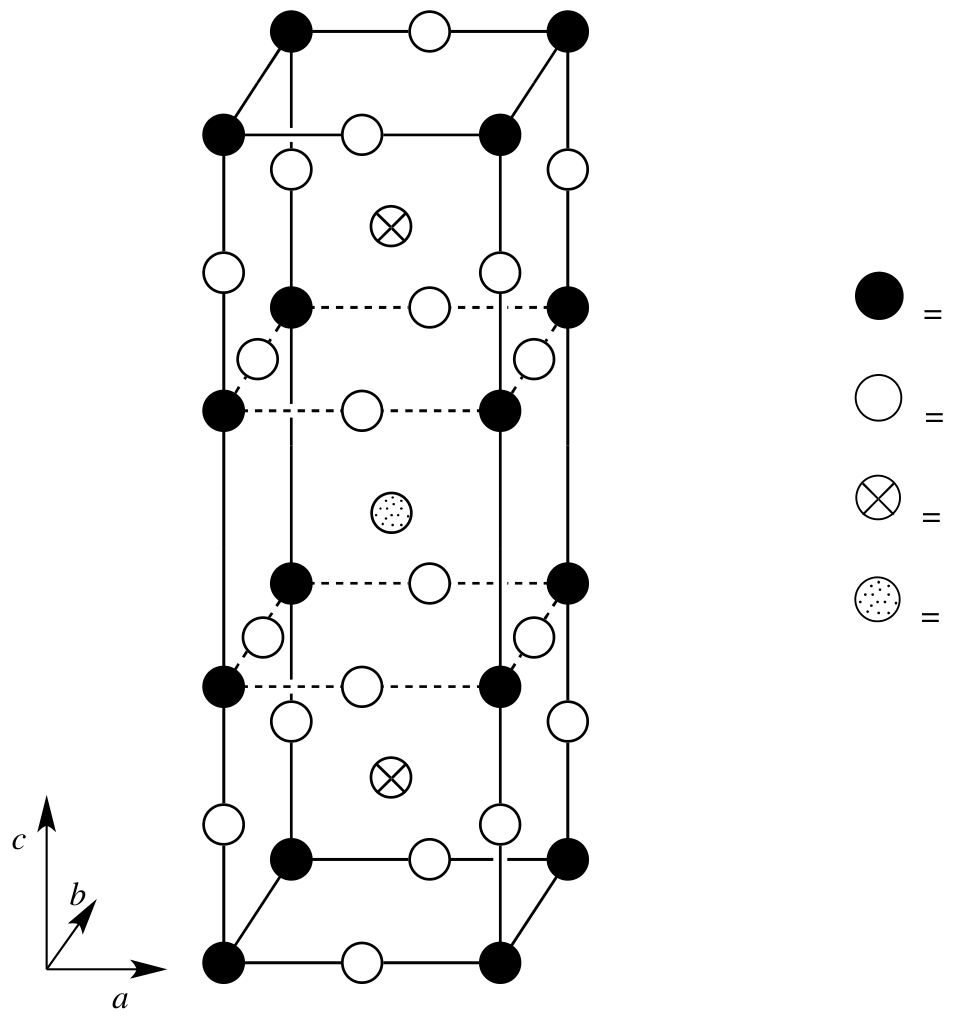
The true structure is actually orthorhombic \((a \ne b \ne c)\), but it is approximately tetragonal, with \(a \approx b \approx (c/3)\).
4.2 A sample of YBCO with \(\delta = 0.25\) was subjected to X-ray diffraction using \(\ce{Cu}\mathrm{K}\alpha\) radiation \((\lambda = 154.2\ \mathrm{pm})\). The lowest-angle diffraction peak was observed at \(2\theta = 7.450^\circ\). Assuming that \(a = b = (c/3)\), calculate the values of \(a\) and \(c\).
4.3 Estimate the density of this sample of YBCO (with \(\delta = 0.25\)) in \(\mathrm{g\,cm^{-3}}\). If you were unable to calculate the values for \(a\) and \(c\) from part 4.2, then use \(a = 500\ \mathrm{pm}\) and \(c = 1500\ \mathrm{pm}\).
When YBCO is dissolved in aqueous \(\ce{HCl}\) \((c = 1.0\ \mathrm{mol\,dm^{-3}})\) bubbles of gas are observed (identified as \(\ce{O2}\) by gas chromatography). After boiling for 10 min to expel the dissolved gases, the solution reacts with excess \(\ce{KI}\) solution, turning yellow-brown. This solution can be titrated with thiosulfate solution to a starch endpoint. If YBCO is added under \(\ce{Ar}\) directly to a solution in which concentrations of both \(\ce{KI}\) and \(\ce{HCl}\) are equal to \(1.0\ \mathrm{mol\,dm^{-3}}\), the solution turns yellow-brown but no gas evolution is observed.
4.4 Write a balanced net ionic equation for the reaction when solid \(\ce{YBa2Cu3O_{7-\delta}}\) dissolves in aqueous \(\ce{HCl}\) with evolution of \(\ce{O2}\).
4.5 Write a balanced net ionic equation for the reaction when the solution from 4.4 reacts with excess \(\ce{KI}\) in acidic solution after the dissolved oxygen is expelled.
4.6 Write a balanced net ionic equation for the reaction when the solution from 4.5 is titrated with thiosulfate \((\ce{S2O3^2-})\).
4.7 Write a balanced net ionic equation for the reaction when solid \(\ce{YBa2Cu3O_{7-\delta}}\) dissolves in aqueous \(\ce{HCl}\) containing excess \(\ce{KI}\) in an \(\ce{Ar}\) atmosphere.
Two identical samples of YBCO with an unknown value of \(\delta\) were prepared. The first sample was dissolved in \(5\ \mathrm{cm^3}\) of aqueous \(\ce{HCl}\) \((c = 1.0\ \mathrm{mol\,dm^{-3}})\), evolving \(\ce{O2}\). After boiling to expel gases, cooling, and addition of \(10\ \mathrm{cm^3}\) of \(\ce{KI}\) solution \((c = 0.7\ \mathrm{mol\,dm^{-3}})\) under \(\ce{Ar}\), titration with thiosulfate to the starch endpoint required \(1.542 \cdot 10^{-4}\ \mathrm{mol}\) thiosulfate. The second sample of YBCO was added under \(\ce{Ar}\) directly to \(7\ \mathrm{cm^3}\) of a solution in which \(c(\ce{KI}) = 1.0\ \mathrm{mol\,dm^{-3}}\) and \(c(\ce{HCl}) = 0.7\ \mathrm{mol\,dm^{-3}}\). Titration of this solution required \(1.696 \cdot 10^{-4}\ \mathrm{mol}\) thiosulfate to reach the endpoint.
4.8 Calculate the amount of substance of \(\ce{Cu}\) (in mol) in each of these samples of YBCO.
4.9 Calculate the value of \(\delta\) for these samples of YBCO.
Official English text of the problem.
Answers
Iodine in excess iodide is represented as triiodide, \(\ce{I3-}\). Names and SMILES for the reaction species are provided in the Solution.
- 4.1 Filled black circles: copper; empty circles: oxygen; crossed circles: barium; dotted circle: yttrium.
- 4.2 \(\boxed{a=b=395.6\ \mathrm{pm},\qquad c=1.187\times10^3\ \mathrm{pm}}\).
- 4.3 \(\boxed{\rho=5.92\ \mathrm{g\,cm^{-3}}}\).
- 4.4 \[ \begin{aligned} &\ce{YBa2Cu3O_{7-\delta}(s) + 13H+}\\ &\quad\ce{-> Y^3+ + 2Ba^2+ + 3Cu^2+} +\frac{13}{2}\ce{H2O} +\frac{1-2\delta}{4}\ce{O2(g)}. \end{aligned} \]
- 4.5 \[ \boxed{\ce{2Cu^2+ + 5I- -> 2CuI(s) + I3-}} \]
- 4.6 \[ \boxed{\ce{I3- + 2S2O3^2- -> 3I- + S4O6^2-}} \]
- 4.7 \[ \begin{aligned} &\ce{YBa2Cu3O_{7-\delta}(s)} +(14-2\delta)\ce{H+} +(9-3\delta)\ce{I-}\\ &\quad\ce{-> Y^3+ + 2Ba^2+ + 3CuI(s)} +(7-\delta)\ce{H2O} +(2-\delta)\ce{I3-}. \end{aligned} \]
- 4.8 \(\boxed{n(\ce{Cu})=1.542\times10^{-4}\ \mathrm{mol}}\) in each sample.
- 4.9 \(\boxed{\delta\approx0.350}\).
Solution
4.1 — Identifying the atoms
An atom at a unit-cell corner contributes \(1/8\) to that cell; one on an edge contributes \(1/4\); one on a face contributes \(1/2\); and one inside contributes \(1\).
| Circle type | Positions in the drawing | Effective number per cell | Element |
|---|---|---|---|
| Filled black | 8 corners and 8 other positions on vertical edges | \(8/8+8/4=3\) | Copper, \(\ce{Cu}\) |
| Empty | 12 edge positions and 8 face positions | \(12/4+8/2=7\) | Oxygen, \(\ce{O}\) |
| Crossed | 2 interior positions | \(2\) | Barium, \(\ce{Ba}\) |
| Dotted | 1 interior position | \(1\) | Yttrium, \(\ce{Y}\) |
These counts give exactly one nominal formula unit of \(\ce{YBa2Cu3O7}\) per unit cell, so \(Z=1\). Oxygen vacancies change the oxygen content to \(7-\delta\).
YBCO is an extended crystal, so no discrete molecular SMILES represents its structure. The figure specifies its periodic arrangement.
4.2 — Lattice parameters
For a tetragonal lattice, \[ \frac{1}{d_{hkl}^{\,2}} =\frac{h^2+k^2}{a^2}+\frac{l^2}{c^2}. \]
Because \(c=3a\), the largest interplanar spacing is \(d_{001}=c\). It produces the lowest-angle reflection.
Bragg’s law for this reflection is \[ \lambda=2c\sin\theta, \qquad \theta=\frac{7.450^\circ}{2}=3.725^\circ. \]
Thus \[ c=\frac{154.2\ \mathrm{pm}}{2\sin3.725^\circ} =1186.743\ \mathrm{pm}, \] and \[ a=b=\frac{c}{3}=395.581\ \mathrm{pm}. \]
Therefore, \[ \boxed{a=b=395.6\ \mathrm{pm},\qquad c=1187\ \mathrm{pm}}. \]
4.3 — Density
For \(\delta=0.25\), the composition is \(\ce{YBa2Cu3O6.75}\). Using standard atomic molar masses in \(\mathrm{g\,mol^{-1}}\), \[ \begin{aligned} M &=88.91+2(137.33)+3(63.55)+6.75(16.00)\\ &=662.22\ \mathrm{g\,mol^{-1}}. \end{aligned} \]
Since \(1\ \mathrm{pm}=10^{-10}\ \mathrm{cm}\), the cell volume, retaining unrounded lattice parameters, is \[ V=a^2c =1.8570673\times10^{-22}\ \mathrm{cm^3}. \]
With one formula unit per cell, \[ \rho=\frac{ZM}{N_{\mathrm A}V} =\frac{662.22} {(6.02214076\times10^{23})(1.8570673\times10^{-22})} \ \mathrm{g\,cm^{-3}}. \]
Hence \[ \boxed{\rho=5.92\ \mathrm{g\,cm^{-3}}}. \]
Species names and SMILES for parts 4.4–4.9
The following representations apply to every occurrence of these species in the equations.
| Species | Name | SMILES |
|---|---|---|
| \(\ce{H+}\) | Proton | [H+] |
| \(\ce{Y^3+}\) | Yttrium(III) ion | [Y+3] |
| \(\ce{Ba^2+}\) | Barium(II) ion | [Ba+2] |
| \(\ce{Cu^2+}\) | Copper(II) ion | [Cu+2] |
| \(\ce{Cu+}\) | Copper(I) ion | [Cu+] |
| \(\ce{I-}\) | Iodide ion | [I-] |
| \(\ce{I2}\) | Molecular iodine | II |
| \(\ce{I3-}\) | Triiodide ion | I[I-]I |
| \(\ce{H2O}\) | Water | O |
| \(\ce{O2}\) | Dioxygen | O=O |
| \(\ce{CuI}\) | Copper(I) iodide, ionic formula unit | [Cu+].[I-] |
| \(\ce{S2O3^2-}\) | Thiosulfate ion | [O-]S(=O)(=O)[S-] |
| \(\ce{S4O6^2-}\) | Tetrathionate ion | [O-]S(=O)(=O)SSS(=O)(=O)[O-] |
Triiodide is linear; its SMILES is a formal connectivity representation and does not describe its three-centre bonding. The copper(I) iodide representation does not encode the extended solid lattice. The sulfur oxyanion SMILES show individual resonance representations.
4.4 — Dissolution in acid with oxygen evolution
Using formal oxidation states \(+3\) for yttrium, \(+2\) for barium and \(-2\) for oxygen, charge neutrality gives \[ 3+2(2)+3\overline v_{\mathrm{Cu}}-2(7-\delta)=0. \] Consequently, \[ 3\overline v_{\mathrm{Cu}}=7-2\delta. \]
After dissolution in acid, the three copper atoms are present as copper(II), with total oxidation number \(6\). Their reduction therefore consumes \[ (7-2\delta)-6=1-2\delta \] electrons per formula unit.
Oxidation of lattice oxygen from oxidation state \(-2\) to dioxygen supplies four electrons per molecule of \(\ce{O2}\). Thus the oxygen yield is \[ \frac{1-2\delta}{4} \] molecules per formula unit.
The dissolved cations have total charge \[ 3+2(2)+3(2)=13, \] so \(13\) protons are required. Balancing hydrogen and oxygen gives \[ \begin{aligned} &\ce{YBa2Cu3O_{7-\delta}(s) + 13H+}\\ &\quad\ce{-> Y^3+ + 2Ba^2+ + 3Cu^2+} +\frac{13}{2}\ce{H2O} +\frac{1-2\delta}{4}\ce{O2(g)}. \end{aligned} \]
4.5 — Reaction of dissolved copper with iodide
Copper(II) oxidizes iodide to iodine while being reduced to copper(I), which precipitates as copper(I) iodide: \[ \ce{2Cu^2+ + 4I- -> 2CuI(s) + I2}. \]
In excess iodide, \[ \ce{I2 + I- <=> I3-}. \]
Adding these equations gives \[ \boxed{\ce{2Cu^2+ + 5I- -> 2CuI(s) + I3-}}. \]
Thus two moles of copper produce one mole of triiodide. Removing dissolved oxygen beforehand prevents it from producing additional iodine.
4.6 — Titration with thiosulfate
Thiosulfate reduces triiodide to iodide and is oxidized to tetrathionate: \[ \boxed{\ce{I3- + 2S2O3^2- -> 3I- + S4O6^2-}}. \]
One mole of triiodide therefore consumes two moles of thiosulfate.
4.7 — Direct dissolution in acid containing iodide
Here iodide supplies the electrons needed to reduce all copper to copper(I). The total copper oxidation number decreases from \(7-2\delta\) to \(3\), requiring \[ (7-2\delta)-3=4-2\delta \] electrons per formula unit.
Formation of one triiodide ion releases two electrons: \[ \ce{3I- -> I3- + 2e-}. \]
Therefore, each formula unit produces \[ \frac{4-2\delta}{2}=2-\delta \] triiodide ions. Three additional iodide ions enter the three formula units of copper(I) iodide, so the total iodide requirement is \[ 3+3(2-\delta)=9-3\delta. \]
All \(7-\delta\) oxygen atoms become water, requiring \(14-2\delta\) protons. The balanced equation is \[ \begin{aligned} &\ce{YBa2Cu3O_{7-\delta}(s)} +(14-2\delta)\ce{H+} +(9-3\delta)\ce{I-}\\ &\quad\ce{-> Y^3+ + 2Ba^2+ + 3CuI(s)} +(7-\delta)\ce{H2O} +(2-\delta)\ce{I3-}. \end{aligned} \]
Iodide oxidation accounts for the electron transfer, consistent with the absence of oxygen evolution.
4.8 — Amount of copper
In the first procedure, all copper becomes copper(II) before iodide is added. Combining the stoichiometries of 4.5 and 4.6, \[ 2\ \mathrm{mol\ copper} \longrightarrow 1\ \mathrm{mol\ triiodide} \longrightarrow 2\ \mathrm{mol\ thiosulfate}. \]
Hence the mole ratio of copper to thiosulfate is \(1:1\): \[ n(\ce{Cu})=1.542\times10^{-4}\ \mathrm{mol}. \]
The samples are identical, so \[ \boxed{n(\ce{Cu})=1.542\times10^{-4}\ \mathrm{mol}\text{ in each sample}}. \]
The corresponding amount of YBCO formula units in each sample is \[ n_0=\frac{n(\ce{Cu})}{3} =\frac{1.542\times10^{-4}}{3} =5.140\times10^{-5}\ \mathrm{mol}. \]
4.9 — Oxygen deficiency
The direct-dissolution procedure produces \(2-\delta\) moles of triiodide per mole of YBCO. Each mole of triiodide consumes two moles of thiosulfate, giving \[ n_{\mathrm{thio},2}=(4-2\delta)n_0. \]
Therefore, \[ 1.696\times10^{-4} =(4-2\delta)(5.140\times10^{-5}), \] and \[ \begin{aligned} \delta &=\frac12\left( 4-\frac{1.696\times10^{-4}}{5.140\times10^{-5}} \right)\\ &=0.3501945\ldots. \end{aligned} \]
Thus \[ \boxed{\delta\approx0.350}. \]
This lies within the stated range \(0<\delta<0.5\). The supplied acid and iodide are in excess: each procedure requires less than \(7\times10^{-4}\ \mathrm{mol}\) of protons and \(4.1\times10^{-4}\ \mathrm{mol}\) of iodide, compared with the supplied \(4.9\)–\(5.0\times10^{-3}\ \mathrm{mol}\) of acid and \(7.0\times10^{-3}\ \mathrm{mol}\) of iodide.
The solution was checked against the official solution.
IChO 2012 · Theorieaufgabe 4
Der Supraleiter YBCO
In den 1980er-Jahren wurde eine Klasse keramischer Materialien entdeckt, die bei der ungewöhnlich hohen Temperatur von 90 K Supraleitung zeigen. Eines dieser Materialien enthält Yttrium, Barium, Kupfer und Sauerstoff und wird als „YBCO“ bezeichnet. Seine nominelle Zusammensetzung ist \(\ce{YBa2Cu3O7}\), seine tatsächliche Zusammensetzung ist jedoch gemäß der Formel \(\ce{YBa2Cu3O_{7-\delta}}\) \((0 < \delta < 0.5)\) variabel.
4.1 Eine Elementarzelle der idealisierten Kristallstruktur von YBCO ist unten dargestellt. Ordnen Sie die Kreise den jeweiligen Elementen in der Struktur zu.
Die tatsächliche Struktur ist orthorhombisch \((a \ne b \ne c)\), lässt sich jedoch näherungsweise als tetragonal beschreiben, wobei \(a \approx b \approx (c/3)\) gilt.
4.2 Eine Probe von YBCO mit \(\delta = 0.25\) wurde mittels Röntgenbeugung unter Verwendung von \(\ce{Cu}\mathrm{K}\alpha\)-Strahlung \((\lambda = 154.2\ \mathrm{pm})\) untersucht. Der Beugungspeak beim kleinsten Winkel wurde bei \(2\theta = 7.450^\circ\) beobachtet. Berechnen Sie unter der Annahme \(a = b = (c/3)\) die Werte von \(a\) und \(c\).
4.3 Schätzen Sie die Dichte dieser YBCO-Probe (mit \(\delta = 0.25\)) in \(\mathrm{g\,cm^{-3}}\) ab. Falls Sie die Werte für \(a\) und \(c\) in Teil 4.2 nicht berechnen konnten, verwenden Sie \(a = 500\ \mathrm{pm}\) und \(c = 1500\ \mathrm{pm}\).
Beim Auflösen von YBCO in wässriger \(\ce{HCl}\) \((c = 1.0\ \mathrm{mol\,dm^{-3}})\) werden Gasblasen beobachtet (das Gas wurde mittels Gaschromatographie als \(\ce{O2}\) identifiziert). Nach 10 min Sieden zum Austreiben der gelösten Gase reagiert die Lösung mit überschüssiger \(\ce{KI}\)-Lösung und färbt sich dabei gelbbraun. Diese Lösung kann mit Thiosulfatlösung unter Verwendung von Stärke zur Endpunkterkennung titriert werden. Wird YBCO unter \(\ce{Ar}\) direkt zu einer Lösung gegeben, in der die Konzentrationen von \(\ce{KI}\) und \(\ce{HCl}\) jeweils \(1.0\ \mathrm{mol\,dm^{-3}}\) betragen, färbt sich die Lösung gelbbraun, es wird jedoch keine Gasentwicklung beobachtet.
4.4 Stellen Sie eine ausgeglichene Netto-Ionengleichung für die Reaktion auf, bei der sich festes \(\ce{YBa2Cu3O_{7-\delta}}\) unter Entwicklung von \(\ce{O2}\) in wässriger \(\ce{HCl}\) löst.
4.5 Stellen Sie eine ausgeglichene Netto-Ionengleichung für die Reaktion auf, bei der die Lösung aus 4.4 nach dem Austreiben des gelösten Sauerstoffs in saurer Lösung mit überschüssigem \(\ce{KI}\) reagiert.
4.6 Stellen Sie eine ausgeglichene Netto-Ionengleichung für die Reaktion auf, bei der die Lösung aus 4.5 mit Thiosulfat \((\ce{S2O3^2-})\) titriert wird.
4.7 Stellen Sie eine ausgeglichene Netto-Ionengleichung für die Reaktion auf, bei der sich festes \(\ce{YBa2Cu3O_{7-\delta}}\) in einer \(\ce{Ar}\)-Atmosphäre in wässriger \(\ce{HCl}\) mit überschüssigem \(\ce{KI}\) löst.
Zwei identische Proben von YBCO mit einem unbekannten Wert von \(\delta\) wurden hergestellt. Die erste Probe wurde unter Entwicklung von \(\ce{O2}\) in \(5\ \mathrm{cm^3}\) wässriger \(\ce{HCl}\) \((c = 1.0\ \mathrm{mol\,dm^{-3}})\) gelöst. Nach dem Sieden zum Austreiben der Gase, dem Abkühlen und der Zugabe von \(10\ \mathrm{cm^3}\) \(\ce{KI}\)-Lösung \((c = 0.7\ \mathrm{mol\,dm^{-3}})\) unter \(\ce{Ar}\) wurden bei der Titration bis zum mit Stärke angezeigten Endpunkt \(1.542 \cdot 10^{-4}\ \mathrm{mol}\) Thiosulfat benötigt. Die zweite YBCO-Probe wurde unter \(\ce{Ar}\) direkt zu \(7\ \mathrm{cm^3}\) einer Lösung gegeben, in der \(c(\ce{KI}) = 1.0\ \mathrm{mol\,dm^{-3}}\) und \(c(\ce{HCl}) = 0.7\ \mathrm{mol\,dm^{-3}}\) waren. Bei der Titration dieser Lösung wurden bis zum Endpunkt \(1.696 \cdot 10^{-4}\ \mathrm{mol}\) Thiosulfat benötigt.
4.8 Berechnen Sie die Stoffmenge an \(\ce{Cu}\) (in mol) in jeder dieser YBCO-Proben.
4.9 Berechnen Sie den Wert von \(\delta\) für diese YBCO-Proben.
Aufgabentext aus dem offiziellen englischen Text übersetzt.
Antworten
Iod wird bei einem Überschuss an Iodid als Triiodid, \(\ce{I3-}\), dargestellt. Namen und SMILES der an den Reaktionen beteiligten Spezies sind in der Lösung angegeben.
- 4.1 Schwarz ausgefüllte Kreise: Kupfer; leere Kreise: Sauerstoff; mit einem Kreuz markierte Kreise: Barium; mit einem Punkt markierter Kreis: Yttrium.
- 4.2 \(\boxed{a=b=395.6\ \mathrm{pm},\qquad c=1.187\times10^3\ \mathrm{pm}}\).
- 4.3 \(\boxed{\rho=5.92\ \mathrm{g\,cm^{-3}}}\).
- 4.4 \[ \begin{aligned} &\ce{YBa2Cu3O_{7-\delta}(s) + 13H+}\\ &\quad\ce{-> Y^3+ + 2Ba^2+ + 3Cu^2+} +\frac{13}{2}\ce{H2O} +\frac{1-2\delta}{4}\ce{O2(g)}. \end{aligned} \]
- 4.5 \[ \boxed{\ce{2Cu^2+ + 5I- -> 2CuI(s) + I3-}} \]
- 4.6 \[ \boxed{\ce{I3- + 2S2O3^2- -> 3I- + S4O6^2-}} \]
- 4.7 \[ \begin{aligned} &\ce{YBa2Cu3O_{7-\delta}(s)} +(14-2\delta)\ce{H+} +(9-3\delta)\ce{I-}\\ &\quad\ce{-> Y^3+ + 2Ba^2+ + 3CuI(s)} +(7-\delta)\ce{H2O} +(2-\delta)\ce{I3-}. \end{aligned} \]
- 4.8 \(\boxed{n(\ce{Cu})=1.542\times10^{-4}\ \mathrm{mol}}\) in jeder Probe.
- 4.9 \(\boxed{\delta\approx0.350}\).
Lösung
4.1 — Zuordnung der Atome
Ein Atom an einer Ecke der Elementarzelle trägt mit \(1/8\) zu dieser Zelle bei; eines auf einer Kante mit \(1/4\); eines auf einer Fläche mit \(1/2\); und eines im Inneren mit \(1\).
| Kreistyp | Positionen in der Zeichnung | Effektive Anzahl pro Zelle | Element |
|---|---|---|---|
| Schwarz ausgefüllt | 8 Ecken und 8 weitere Positionen auf senkrechten Kanten | \(8/8+8/4=3\) | Kupfer, \(\ce{Cu}\) |
| Leer | 12 Kantenpositionen und 8 Flächenpositionen | \(12/4+8/2=7\) | Sauerstoff, \(\ce{O}\) |
| Mit einem Kreuz markiert | 2 Positionen im Inneren | \(2\) | Barium, \(\ce{Ba}\) |
| Mit einem Punkt markiert | 1 Position im Inneren | \(1\) | Yttrium, \(\ce{Y}\) |
Diese Anzahlen ergeben genau eine nominelle Formeleinheit von \(\ce{YBa2Cu3O7}\) pro Elementarzelle, also \(Z=1\). Sauerstoffleerstellen verändern den Sauerstoffgehalt auf \(7-\delta\).
YBCO bildet einen ausgedehnten Kristall, sodass seine Struktur nicht durch eine SMILES-Zeichenfolge für ein diskretes Molekül dargestellt werden kann. Die Abbildung legt seine periodische Anordnung fest.
4.2 — Gitterparameter
Für ein tetragonales Gitter gilt \[ \frac{1}{d_{hkl}^{\,2}} =\frac{h^2+k^2}{a^2}+\frac{l^2}{c^2}. \]
Da \(c=3a\) ist, beträgt der größte Netzebenenabstand \(d_{001}=c\). Er führt zum Reflex beim kleinsten Winkel.
Für diesen Reflex lautet das Braggsche Gesetz \[ \lambda=2c\sin\theta, \qquad \theta=\frac{7.450^\circ}{2}=3.725^\circ. \]
Damit ergibt sich \[ c=\frac{154.2\ \mathrm{pm}}{2\sin3.725^\circ} =1186.743\ \mathrm{pm}, \] und \[ a=b=\frac{c}{3}=395.581\ \mathrm{pm}. \]
Somit gilt \[ \boxed{a=b=395.6\ \mathrm{pm},\qquad c=1187\ \mathrm{pm}}. \]
4.3 — Dichte
Für \(\delta=0.25\) ist die Zusammensetzung \(\ce{YBa2Cu3O6.75}\). Mit den üblichen molaren Atommassen in \(\mathrm{g\,mol^{-1}}\) ergibt sich \[ \begin{aligned} M &=88.91+2(137.33)+3(63.55)+6.75(16.00)\\ &=662.22\ \mathrm{g\,mol^{-1}}. \end{aligned} \]
Da \(1\ \mathrm{pm}=10^{-10}\ \mathrm{cm}\) ist, beträgt das Zellvolumen unter Verwendung der ungerundeten Gitterparameter \[ V=a^2c =1.8570673\times10^{-22}\ \mathrm{cm^3}. \]
Bei einer Formeleinheit pro Zelle gilt \[ \rho=\frac{ZM}{N_{\mathrm A}V} =\frac{662.22} {(6.02214076\times10^{23})(1.8570673\times10^{-22})} \ \mathrm{g\,cm^{-3}}. \]
Daraus folgt \[ \boxed{\rho=5.92\ \mathrm{g\,cm^{-3}}}. \]
Namen und SMILES der Spezies für die Teile 4.4–4.9
Die folgenden Darstellungen gelten für jedes Vorkommen dieser Spezies in den Gleichungen.
| Spezies | Name | SMILES |
|---|---|---|
| \(\ce{H+}\) | Proton | [H+] |
| \(\ce{Y^3+}\) | Yttrium(III)-Ion | [Y+3] |
| \(\ce{Ba^2+}\) | Barium(II)-Ion | [Ba+2] |
| \(\ce{Cu^2+}\) | Kupfer(II)-Ion | [Cu+2] |
| \(\ce{Cu+}\) | Kupfer(I)-Ion | [Cu+] |
| \(\ce{I-}\) | Iodid-Ion | [I-] |
| \(\ce{I2}\) | Molekulares Iod | II |
| \(\ce{I3-}\) | Triiodid-Ion | I[I-]I |
| \(\ce{H2O}\) | Wasser | O |
| \(\ce{O2}\) | Disauerstoff | O=O |
| \(\ce{CuI}\) | Kupfer(I)-iodid, ionische Formeleinheit | [Cu+].[I-] |
| \(\ce{S2O3^2-}\) | Thiosulfat-Ion | [O-]S(=O)(=O)[S-] |
| \(\ce{S4O6^2-}\) | Tetrathionat-Ion | [O-]S(=O)(=O)SSS(=O)(=O)[O-] |
Triiodid ist linear; seine SMILES-Zeichenfolge ist eine formale Darstellung der Konnektivität und beschreibt nicht seine Dreizentrenbindung. Die Darstellung von Kupfer(I)-iodid bildet das ausgedehnte Festkörpergitter nicht ab. Die SMILES-Zeichenfolgen der Schwefel-Sauerstoff-Anionen zeigen jeweils einzelne mesomere Grenzstrukturen.
4.4 — Auflösen in Säure unter Sauerstoffentwicklung
Mit den formalen Oxidationszahlen \(+3\) für Yttrium, \(+2\) für Barium und \(-2\) für Sauerstoff ergibt sich aus der Elektroneutralität \[ 3+2(2)+3\overline v_{\mathrm{Cu}}-2(7-\delta)=0. \] Folglich gilt \[ 3\overline v_{\mathrm{Cu}}=7-2\delta. \]
Nach dem Auflösen in Säure liegen die drei Kupferatome als Kupfer(II) vor, wobei die Summe ihrer Oxidationszahlen \(6\) beträgt. Ihre Reduktion verbraucht daher \[ (7-2\delta)-6=1-2\delta \] Elektronen pro Formeleinheit.
Die Oxidation von Gittersauerstoff mit der Oxidationszahl \(-2\) zu Disauerstoff liefert vier Elektronen pro Molekül \(\ce{O2}\). Die Sauerstoffausbeute beträgt somit \[ \frac{1-2\delta}{4} \] Moleküle pro Formeleinheit.
Die gelösten Kationen haben die Gesamtladung \[ 3+2(2)+3(2)=13, \] weshalb \(13\) Protonen benötigt werden. Durch Ausgleichen von Wasserstoff und Sauerstoff erhält man \[ \begin{aligned} &\ce{YBa2Cu3O_{7-\delta}(s) + 13H+}\\ &\quad\ce{-> Y^3+ + 2Ba^2+ + 3Cu^2+} +\frac{13}{2}\ce{H2O} +\frac{1-2\delta}{4}\ce{O2(g)}. \end{aligned} \]
4.5 — Reaktion des gelösten Kupfers mit Iodid
Kupfer(II) oxidiert Iodid zu Iod und wird dabei zu Kupfer(I) reduziert, das als Kupfer(I)-iodid ausfällt: \[ \ce{2Cu^2+ + 4I- -> 2CuI(s) + I2}. \]
Bei einem Überschuss an Iodid gilt \[ \ce{I2 + I- <=> I3-}. \]
Durch Addition dieser Gleichungen erhält man \[ \boxed{\ce{2Cu^2+ + 5I- -> 2CuI(s) + I3-}}. \]
Somit entstehen aus zwei Mol Kupfer ein Mol Triiodid. Das vorherige Entfernen des gelösten Sauerstoffs verhindert, dass dieser zusätzliches Iod erzeugt.
4.6 — Titration mit Thiosulfat
Thiosulfat reduziert Triiodid zu Iodid und wird zu Tetrathionat oxidiert: \[ \boxed{\ce{I3- + 2S2O3^2- -> 3I- + S4O6^2-}}. \]
Ein Mol Triiodid verbraucht daher zwei Mol Thiosulfat.
4.7 — Direktes Auflösen in iodidhaltiger Säure
Hier liefert Iodid die Elektronen, die benötigt werden, um das gesamte Kupfer zu Kupfer(I) zu reduzieren. Die Summe der Oxidationszahlen des Kupfers sinkt von \(7-2\delta\) auf \(3\), wofür \[ (7-2\delta)-3=4-2\delta \] Elektronen pro Formeleinheit benötigt werden.
Bei der Bildung eines Triiodid-Ions werden zwei Elektronen freigesetzt: \[ \ce{3I- -> I3- + 2e-}. \]
Daher entstehen aus jeder Formeleinheit \[ \frac{4-2\delta}{2}=2-\delta \] Triiodid-Ionen. Drei weitere Iodid-Ionen werden in die drei Formeleinheiten Kupfer(I)-iodid eingebaut, sodass der gesamte Iodidbedarf \[ 3+3(2-\delta)=9-3\delta \] beträgt.
Alle \(7-\delta\) Sauerstoffatome werden zu Wasser, wofür \(14-2\delta\) Protonen benötigt werden. Die ausgeglichene Gleichung lautet \[ \begin{aligned} &\ce{YBa2Cu3O_{7-\delta}(s)} +(14-2\delta)\ce{H+} +(9-3\delta)\ce{I-}\\ &\quad\ce{-> Y^3+ + 2Ba^2+ + 3CuI(s)} +(7-\delta)\ce{H2O} +(2-\delta)\ce{I3-}. \end{aligned} \]
Die Elektronenübertragung erfolgt durch die Oxidation von Iodid, was mit dem Ausbleiben einer Sauerstoffentwicklung übereinstimmt.
4.8 — Stoffmenge an Kupfer
Beim ersten Verfahren wird das gesamte Kupfer zu Kupfer(II), bevor Iodid zugegeben wird. Durch Kombination der stöchiometrischen Verhältnisse aus 4.5 und 4.6 erhält man \[ 2\ \mathrm{mol\ copper} \longrightarrow 1\ \mathrm{mol\ triiodide} \longrightarrow 2\ \mathrm{mol\ thiosulfate}. \]
Das Stoffmengenverhältnis von Kupfer zu Thiosulfat beträgt daher \(1:1\): \[ n(\ce{Cu})=1.542\times10^{-4}\ \mathrm{mol}. \]
Die Proben sind identisch, also gilt \[ \boxed{n(\ce{Cu})=1.542\times10^{-4}\ \mathrm{mol}\text{ in jeder Probe}}. \]
Die entsprechende Stoffmenge an YBCO-Formeleinheiten in jeder Probe beträgt \[ n_0=\frac{n(\ce{Cu})}{3} =\frac{1.542\times10^{-4}}{3} =5.140\times10^{-5}\ \mathrm{mol}. \]
4.9 — Sauerstoffdefizit
Beim direkten Auflösen entstehen \(2-\delta\) Mol Triiodid pro Mol YBCO. Jedes Mol Triiodid verbraucht zwei Mol Thiosulfat, sodass gilt \[ n_{\mathrm{thio},2}=(4-2\delta)n_0. \]
Daher gilt \[ 1.696\times10^{-4} =(4-2\delta)(5.140\times10^{-5}), \] und \[ \begin{aligned} \delta &=\frac12\left( 4-\frac{1.696\times10^{-4}}{5.140\times10^{-5}} \right)\\ &=0.3501945\ldots. \end{aligned} \]
Somit ergibt sich \[ \boxed{\delta\approx0.350}. \]
Dies liegt innerhalb des angegebenen Bereichs \(0<\delta<0.5\). Die zugesetzte Säure und das zugesetzte Iodid liegen im Überschuss vor: Jedes Verfahren benötigt weniger als \(7\times10^{-4}\ \mathrm{mol}\) Protonen und \(4.1\times10^{-4}\ \mathrm{mol}\) Iodid, verglichen mit den zugesetzten \(4.9\)–\(5.0\times10^{-3}\ \mathrm{mol}\) Säure und \(7.0\times10^{-3}\ \mathrm{mol}\) Iodid.
Die Lösung wurde mit der offiziellen Lösung abgeglichen.
IChO 2012 · Teori sorusu 4
Süperiletken YBCO
1980’lerde, alışılmadık derecede yüksek bir sıcaklık olan 90 K’de süperiletkenlik gösteren bir seramik malzeme sınıfı keşfedildi. Bu malzemelerden biri itriyum, baryum, bakır ve oksijen içerir ve “YBCO” olarak adlandırılır. Nominal bileşimi \(\ce{YBa2Cu3O7}\) olmakla birlikte, gerçek bileşimi \(\ce{YBa2Cu3O_{7-\delta}}\) \((0 < \delta < 0.5)\) formülüne göre değişkendir.
4.1 YBCO’nun idealleştirilmiş kristal yapısının bir birim hücresi aşağıda gösterilmiştir. Yapıdaki dairelerin hangi elementlere karşılık geldiğini belirleyiniz.
Gerçek yapı aslında ortorombiktir \((a \ne b \ne c)\), ancak \(a \approx b \approx (c/3)\) olduğundan yaklaşık olarak tetragonaldir.
4.2 \(\delta = 0.25\) olan bir YBCO örneği, \(\ce{Cu}\mathrm{K}\alpha\) ışınımı \((\lambda = 154.2\ \mathrm{pm})\) kullanılarak X-ışını kırınımına tabi tutulmuştur. En küçük açılı kırınım piki \(2\theta = 7.450^\circ\) değerinde gözlenmiştir. \(a = b = (c/3)\) olduğunu varsayarak \(a\) ve \(c\) değerlerini hesaplayınız.
4.3 Bu YBCO örneğinin (\(\delta = 0.25\) için) yoğunluğunu \(\mathrm{g\,cm^{-3}}\) cinsinden tahmin ediniz. 4.2 kısmında \(a\) ve \(c\) değerlerini hesaplayamadıysanız, \(a = 500\ \mathrm{pm}\) ve \(c = 1500\ \mathrm{pm}\) değerlerini kullanınız.
YBCO, sulu \(\ce{HCl}\) \((c = 1.0\ \mathrm{mol\,dm^{-3}})\) içinde çözündürüldüğünde gaz kabarcıkları gözlenir (gaz kromatografisiyle \(\ce{O2}\) olduğu belirlenmiştir). Çözünmüş gazları uzaklaştırmak için 10 dakika kaynatıldıktan sonra çözelti, aşırı miktarda \(\ce{KI}\) çözeltisiyle tepkimeye girerek sarı-kahverengi bir renk alır. Bu çözelti, nişasta indikatörüyle belirlenen dönüm noktasına kadar tiyosülfat çözeltisiyle titre edilebilir. YBCO, \(\ce{Ar}\) atmosferinde doğrudan hem \(\ce{KI}\) hem de \(\ce{HCl}\) derişimlerinin \(1.0\ \mathrm{mol\,dm^{-3}}\) olduğu bir çözeltiye eklenirse çözelti sarı-kahverengi bir renk alır, ancak gaz çıkışı gözlenmez.
4.4 Katı \(\ce{YBa2Cu3O_{7-\delta}}\), sulu \(\ce{HCl}\) içinde \(\ce{O2}\) çıkışıyla çözündüğünde gerçekleşen tepkimenin denkleştirilmiş net iyon denklemini yazınız.
4.5 4.4’teki çözelti, çözünmüş oksijen uzaklaştırıldıktan sonra asidik çözeltide aşırı miktarda \(\ce{KI}\) ile tepkimeye girdiğinde gerçekleşen tepkimenin denkleştirilmiş net iyon denklemini yazınız.
4.6 4.5’teki çözelti tiyosülfat \((\ce{S2O3^2-})\) ile titre edildiğinde gerçekleşen tepkimenin denkleştirilmiş net iyon denklemini yazınız.
4.7 Katı \(\ce{YBa2Cu3O_{7-\delta}}\), \(\ce{Ar}\) atmosferinde aşırı miktarda \(\ce{KI}\) içeren sulu \(\ce{HCl}\) içinde çözündüğünde gerçekleşen tepkimenin denkleştirilmiş net iyon denklemini yazınız.
\(\delta\) değeri bilinmeyen iki özdeş YBCO örneği hazırlanmıştır. İlk örnek, \(5\ \mathrm{cm^3}\) sulu \(\ce{HCl}\) \((c = 1.0\ \mathrm{mol\,dm^{-3}})\) içinde \(\ce{O2}\) çıkışıyla çözündürülmüştür. Gazları uzaklaştırmak için kaynatma, soğutma ve \(\ce{Ar}\) atmosferinde \(10\ \mathrm{cm^3}\) \(\ce{KI}\) çözeltisi \((c = 0.7\ \mathrm{mol\,dm^{-3}})\) eklenmesinden sonra, nişasta indikatörüyle belirlenen dönüm noktasına kadar yapılan titrasyonda \(1.542 \cdot 10^{-4}\ \mathrm{mol}\) tiyosülfat gerekmiştir. İkinci YBCO örneği, \(\ce{Ar}\) atmosferinde doğrudan \(c(\ce{KI}) = 1.0\ \mathrm{mol\,dm^{-3}}\) ve \(c(\ce{HCl}) = 0.7\ \mathrm{mol\,dm^{-3}}\) olan bir çözeltinin \(7\ \mathrm{cm^3}\)’üne eklenmiştir. Bu çözeltinin titrasyonunda dönüm noktasına ulaşmak için \(1.696 \cdot 10^{-4}\ \mathrm{mol}\) tiyosülfat gerekmiştir.
4.8 Bu YBCO örneklerinin her birindeki \(\ce{Cu}\) madde miktarını (mol cinsinden) hesaplayınız.
4.9 Bu YBCO örnekleri için \(\delta\) değerini hesaplayınız.
Soru metni resmi İngilizce metinden çevrilmiştir.
Cevaplar
Aşırı miktarda iyodür bulunan ortamda iyot, triiyodür, \(\ce{I3-}\), olarak gösterilmiştir. Tepkimelerde yer alan türlerin adları ve SMILES gösterimleri Çözüm bölümünde verilmiştir.
- 4.1 İçi dolu siyah daireler: bakır; boş daireler: oksijen; çarpı işaretli daireler: baryum; noktalı daire: itriyum.
- 4.2 \(\boxed{a=b=395.6\ \mathrm{pm},\qquad c=1.187\times10^3\ \mathrm{pm}}\).
- 4.3 \(\boxed{\rho=5.92\ \mathrm{g\,cm^{-3}}}\).
- 4.4 \[ \begin{aligned} &\ce{YBa2Cu3O_{7-\delta}(s) + 13H+}\\ &\quad\ce{-> Y^3+ + 2Ba^2+ + 3Cu^2+} +\frac{13}{2}\ce{H2O} +\frac{1-2\delta}{4}\ce{O2(g)}. \end{aligned} \]
- 4.5 \[ \boxed{\ce{2Cu^2+ + 5I- -> 2CuI(s) + I3-}} \]
- 4.6 \[ \boxed{\ce{I3- + 2S2O3^2- -> 3I- + S4O6^2-}} \]
- 4.7 \[ \begin{aligned} &\ce{YBa2Cu3O_{7-\delta}(s)} +(14-2\delta)\ce{H+} +(9-3\delta)\ce{I-}\\ &\quad\ce{-> Y^3+ + 2Ba^2+ + 3CuI(s)} +(7-\delta)\ce{H2O} +(2-\delta)\ce{I3-}. \end{aligned} \]
- 4.8 Her bir örnekte \(\boxed{n(\ce{Cu})=1.542\times10^{-4}\ \mathrm{mol}}\).
- 4.9 \(\boxed{\delta\approx0.350}\).
Çözüm
4.1 — Atomların belirlenmesi
Birim hücrenin bir köşesindeki atom o hücreye \(1/8\); bir kenarındaki atom \(1/4\); bir yüzündeki atom \(1/2\); içindeki atom ise \(1\) katkıda bulunur.
| Daire türü | Çizimdeki konumlar | Hücre başına etkin sayı | Element |
|---|---|---|---|
| İçi dolu siyah | 8 köşe ve düşey kenarlardaki diğer 8 konum | \(8/8+8/4=3\) | Bakır, \(\ce{Cu}\) |
| Boş | Kenarlarda 12 konum ve yüzlerde 8 konum | \(12/4+8/2=7\) | Oksijen, \(\ce{O}\) |
| Çarpı işaretli | İç kısımda 2 konum | \(2\) | Baryum, \(\ce{Ba}\) |
| Noktalı | İç kısımda 1 konum | \(1\) | İtriyum, \(\ce{Y}\) |
Bu sayılar, birim hücre başına tam olarak bir nominal \(\ce{YBa2Cu3O7}\) formül birimi verir; dolayısıyla \(Z=1\) olur. Oksijen boşlukları, oksijen içeriğini \(7-\delta\) olarak değiştirir.
YBCO, sürekli bir kristal örgüsü oluşturduğundan, yapısını temsil eden ayrık bir moleküler SMILES gösterimi yoktur. Şekil, periyodik düzenini belirtir.
4.2 — Örgü parametreleri
Tetragonal bir örgü için, \[ \frac{1}{d_{hkl}^{\,2}} =\frac{h^2+k^2}{a^2}+\frac{l^2}{c^2}. \]
\(c=3a\) olduğundan, düzlemler arası en büyük uzaklık \(d_{001}=c\) olur. Bu, en küçük açılı yansımayı oluşturur.
Bu yansıma için Bragg yasası şöyledir: \[ \lambda=2c\sin\theta, \qquad \theta=\frac{7.450^\circ}{2}=3.725^\circ. \]
Böylece \[ c=\frac{154.2\ \mathrm{pm}}{2\sin3.725^\circ} =1186.743\ \mathrm{pm}, \] ve \[ a=b=\frac{c}{3}=395.581\ \mathrm{pm}. \]
Dolayısıyla, \[ \boxed{a=b=395.6\ \mathrm{pm},\qquad c=1187\ \mathrm{pm}}. \]
4.3 — Yoğunluk
\(\delta=0.25\) için bileşim \(\ce{YBa2Cu3O6.75}\) olur. \(\mathrm{g\,mol^{-1}}\) cinsinden standart atomik molar kütleler kullanıldığında, \[ \begin{aligned} M &=88.91+2(137.33)+3(63.55)+6.75(16.00)\\ &=662.22\ \mathrm{g\,mol^{-1}}. \end{aligned} \]
\(1\ \mathrm{pm}=10^{-10}\ \mathrm{cm}\) olduğundan, örgü parametrelerinin yuvarlanmamış değerleri korunarak hesaplanan hücre hacmi şöyledir: \[ V=a^2c =1.8570673\times10^{-22}\ \mathrm{cm^3}. \]
Hücre başına bir formül birimi bulunduğundan, \[ \rho=\frac{ZM}{N_{\mathrm A}V} =\frac{662.22} {(6.02214076\times10^{23})(1.8570673\times10^{-22})} \ \mathrm{g\,cm^{-3}}. \]
Böylece \[ \boxed{\rho=5.92\ \mathrm{g\,cm^{-3}}}. \]
4.4–4.9 kısımları için türlerin adları ve SMILES gösterimleri
Aşağıdaki gösterimler, bu türlerin denklemlerde geçtiği her yerde geçerlidir.
| Tür | Adı | SMILES |
|---|---|---|
| \(\ce{H+}\) | Proton | [H+] |
| \(\ce{Y^3+}\) | İtriyum(III) iyonu | [Y+3] |
| \(\ce{Ba^2+}\) | Baryum(II) iyonu | [Ba+2] |
| \(\ce{Cu^2+}\) | Bakır(II) iyonu | [Cu+2] |
| \(\ce{Cu+}\) | Bakır(I) iyonu | [Cu+] |
| \(\ce{I-}\) | İyodür iyonu | [I-] |
| \(\ce{I2}\) | Moleküler iyot | II |
| \(\ce{I3-}\) | Triiyodür iyonu | I[I-]I |
| \(\ce{H2O}\) | Su | O |
| \(\ce{O2}\) | Dioksijen | O=O |
| \(\ce{CuI}\) | Bakır(I) iyodür, iyonik formül birimi | [Cu+].[I-] |
| \(\ce{S2O3^2-}\) | Tiyosülfat iyonu | [O-]S(=O)(=O)[S-] |
| \(\ce{S4O6^2-}\) | Tetratiyonat iyonu | [O-]S(=O)(=O)SSS(=O)(=O)[O-] |
Triiyodür doğrusaldır; SMILES gösterimi biçimsel bir bağlanma düzeni gösterimidir ve üç merkezli bağlanmasını betimlemez. Bakır(I) iyodür gösterimi, sürekli katı örgüsünü kodlamaz. Kükürt oksianyonlarının SMILES gösterimleri, tek tek rezonans yapılarını gösterir.
4.4 — Oksijen çıkışıyla asitte çözünme
İtriyum için \(+3\), baryum için \(+2\) ve oksijen için \(-2\) biçimsel yükseltgenme basamakları kullanıldığında, yük nötrlüğünden \[ 3+2(2)+3\overline v_{\mathrm{Cu}}-2(7-\delta)=0. \] elde edilir. Dolayısıyla, \[ 3\overline v_{\mathrm{Cu}}=7-2\delta. \]
Asitte çözünmeden sonra üç bakır atomu, toplam yükseltgenme sayısı \(6\) olan bakır(II) hâlinde bulunur. Bu nedenle indirgenmeleri, formül birimi başına \[ (7-2\delta)-6=1-2\delta \] elektron tüketir.
Örgü oksijeninin \(-2\) yükseltgenme basamağından dioksijene yükseltgenmesi, \(\ce{O2}\) molekülü başına dört elektron sağlar. Böylece oluşan oksijen miktarı, formül birimi başına \[ \frac{1-2\delta}{4} \] moleküldür.
Çözünmüş katyonların toplam yükü \[ 3+2(2)+3(2)=13, \] olduğundan \(13\) proton gerekir. Hidrojen ve oksijen denkleştirildiğinde şu denklem elde edilir: \[ \begin{aligned} &\ce{YBa2Cu3O_{7-\delta}(s) + 13H+}\\ &\quad\ce{-> Y^3+ + 2Ba^2+ + 3Cu^2+} +\frac{13}{2}\ce{H2O} +\frac{1-2\delta}{4}\ce{O2(g)}. \end{aligned} \]
4.5 — Çözünmüş bakırın iyodürle tepkimesi
Bakır(II), iyodürü iyoda yükseltgerken kendisi bakır(I)’e indirgenir; bakır(I) ise bakır(I) iyodür olarak çöker: \[ \ce{2Cu^2+ + 4I- -> 2CuI(s) + I2}. \]
Aşırı miktarda iyodür bulunan ortamda, \[ \ce{I2 + I- <=> I3-}. \]
Bu denklemler toplandığında \[ \boxed{\ce{2Cu^2+ + 5I- -> 2CuI(s) + I3-}}. \] elde edilir.
Böylece iki mol bakır bir mol triiyodür oluşturur. Çözünmüş oksijenin önceden uzaklaştırılması, ilave iyot oluşturmasını önler.
4.6 — Tiyosülfatla titrasyon
Tiyosülfat, triiyodürü iyodüre indirger ve kendisi tetratiyonata yükseltgenir: \[ \boxed{\ce{I3- + 2S2O3^2- -> 3I- + S4O6^2-}}. \]
Bu nedenle bir mol triiyodür iki mol tiyosülfat tüketir.
4.7 — İyodür içeren asitte doğrudan çözünme
Burada iyodür, bakırın tamamını bakır(I)’e indirgemek için gereken elektronları sağlar. Bakırın toplam yükseltgenme sayısı \(7-2\delta\) değerinden \(3\) değerine düşer; bunun için formül birimi başına \[ (7-2\delta)-3=4-2\delta \] elektron gerekir.
Bir triiyodür iyonunun oluşması iki elektron açığa çıkarır: \[ \ce{3I- -> I3- + 2e-}. \]
Bu nedenle her formül birimi \[ \frac{4-2\delta}{2}=2-\delta \] triiyodür iyonu oluşturur. Üç ilave iyodür iyonu, üç bakır(I) iyodür formül biriminin yapısına girer; dolayısıyla toplam iyodür gereksinimi şöyledir: \[ 3+3(2-\delta)=9-3\delta. \]
\(7-\delta\) oksijen atomunun tamamı suya dönüşür ve bunun için \(14-2\delta\) proton gerekir. Denkleştirilmiş denklem şöyledir: \[ \begin{aligned} &\ce{YBa2Cu3O_{7-\delta}(s)} +(14-2\delta)\ce{H+} +(9-3\delta)\ce{I-}\\ &\quad\ce{-> Y^3+ + 2Ba^2+ + 3CuI(s)} +(7-\delta)\ce{H2O} +(2-\delta)\ce{I3-}. \end{aligned} \]
Elektron aktarımı iyodürün yükseltgenmesiyle sağlanır; bu, oksijen çıkışının olmamasıyla tutarlıdır.
4.8 — Bakır miktarı
İlk işlemde, iyodür eklenmeden önce bakırın tamamı bakır(II)’ye dönüşür. 4.5 ve 4.6’nın stokiyometrileri birleştirildiğinde, \[ 2\ \mathrm{mol\ copper} \longrightarrow 1\ \mathrm{mol\ triiodide} \longrightarrow 2\ \mathrm{mol\ thiosulfate}. \]
Dolayısıyla bakırın tiyosülfata mol oranı \(1:1\) olur: \[ n(\ce{Cu})=1.542\times10^{-4}\ \mathrm{mol}. \]
Örnekler özdeş olduğundan, \[ \boxed{n(\ce{Cu})=1.542\times10^{-4}\ \mathrm{mol}\text{ her bir örnekte}}. \]
Her bir örnekte buna karşılık gelen YBCO formül birimlerinin madde miktarı şöyledir: \[ n_0=\frac{n(\ce{Cu})}{3} =\frac{1.542\times10^{-4}}{3} =5.140\times10^{-5}\ \mathrm{mol}. \]
4.9 — Oksijen eksikliği
Doğrudan çözündürme işlemi, YBCO’nun molü başına \(2-\delta\) mol triiyodür oluşturur. Her bir mol triiyodür iki mol tiyosülfat tüketir ve böylece \[ n_{\mathrm{thio},2}=(4-2\delta)n_0. \] elde edilir.
Dolayısıyla, \[ 1.696\times10^{-4} =(4-2\delta)(5.140\times10^{-5}), \] ve \[ \begin{aligned} \delta &=\frac12\left( 4-\frac{1.696\times10^{-4}}{5.140\times10^{-5}} \right)\\ &=0.3501945\ldots. \end{aligned} \]
Böylece \[ \boxed{\delta\approx0.350}. \]
Bu değer, belirtilen \(0<\delta<0.5\) aralığındadır. Eklenen asit ve iyodür aşırı miktardadır: her bir işlemde, eklenen \(4.9\)–\(5.0\times10^{-3}\ \mathrm{mol}\) asit ve \(7.0\times10^{-3}\ \mathrm{mol}\) iyodüre karşılık, \(7\times10^{-4}\ \mathrm{mol}\)’den az proton ve \(4.1\times10^{-4}\ \mathrm{mol}\)’den az iyodür gerekir.
Çözüm, resmi çözümle karşılaştırılarak kontrol edildi.
IChO 2012 · Problema teórico 4
El superconductor YBCO
En la década de 1980 se descubrió una clase de materiales cerámicos que presenta superconductividad a la temperatura inusualmente alta de 90 K. Uno de estos materiales contiene itrio, bario, cobre y oxígeno y se denomina «YBCO». Tiene una composición nominal de \(\ce{YBa2Cu3O7}\), pero su composición real es variable según la fórmula \(\ce{YBa2Cu3O_{7-\delta}}\) \((0 < \delta < 0.5)\).
4.1 A continuación se muestra una celda unidad de la estructura cristalina idealizada del YBCO. Identifique a qué elementos corresponden los distintos círculos de la estructura.
La estructura real es ortorrómbica \((a \ne b \ne c)\), pero es aproximadamente tetragonal, con \(a \approx b \approx (c/3)\).
4.2 Se sometió una muestra de YBCO con \(\delta = 0.25\) a difracción de rayos X utilizando radiación \(\ce{Cu}\mathrm{K}\alpha\) \((\lambda = 154.2\ \mathrm{pm})\). El pico de difracción de menor ángulo se observó a \(2\theta = 7.450^\circ\). Suponiendo que \(a = b = (c/3)\), calcule los valores de \(a\) y \(c\).
4.3 Estime la densidad de esta muestra de YBCO (con \(\delta = 0.25\)) en \(\mathrm{g\,cm^{-3}}\). Si no ha podido calcular los valores de \(a\) y \(c\) en el apartado 4.2, utilice \(a = 500\ \mathrm{pm}\) y \(c = 1500\ \mathrm{pm}\).
Cuando el YBCO se disuelve en \(\ce{HCl}\) acuoso \((c = 1.0\ \mathrm{mol\,dm^{-3}})\), se observan burbujas de gas (identificado como \(\ce{O2}\) mediante cromatografía de gases). Después de hervir durante 10 min para expulsar los gases disueltos, la disolución reacciona con un exceso de disolución de \(\ce{KI}\) y adquiere un color amarillo parduzco. Esta disolución puede valorarse con una disolución de tiosulfato hasta el punto final indicado por el almidón. Si se añade YBCO bajo \(\ce{Ar}\) directamente a una disolución en la que las concentraciones tanto de \(\ce{KI}\) como de \(\ce{HCl}\) son iguales a \(1.0\ \mathrm{mol\,dm^{-3}}\), la disolución adquiere un color amarillo parduzco, pero no se observa desprendimiento de gas.
4.4 Escriba una ecuación iónica neta ajustada para la reacción que tiene lugar cuando el sólido \(\ce{YBa2Cu3O_{7-\delta}}\) se disuelve en \(\ce{HCl}\) acuoso con desprendimiento de \(\ce{O2}\).
4.5 Escriba una ecuación iónica neta ajustada para la reacción que tiene lugar cuando la disolución de 4.4 reacciona con un exceso de \(\ce{KI}\) en disolución ácida después de expulsar el oxígeno disuelto.
4.6 Escriba una ecuación iónica neta ajustada para la reacción que tiene lugar cuando la disolución de 4.5 se valora con tiosulfato \((\ce{S2O3^2-})\).
4.7 Escriba una ecuación iónica neta ajustada para la reacción que tiene lugar cuando el sólido \(\ce{YBa2Cu3O_{7-\delta}}\) se disuelve en \(\ce{HCl}\) acuoso que contiene un exceso de \(\ce{KI}\) en una atmósfera de \(\ce{Ar}\).
Se prepararon dos muestras idénticas de YBCO con un valor desconocido de \(\delta\). La primera muestra se disolvió en \(5\ \mathrm{cm^3}\) de \(\ce{HCl}\) acuoso \((c = 1.0\ \mathrm{mol\,dm^{-3}})\), con desprendimiento de \(\ce{O2}\). Después de hervir para expulsar los gases, enfriar y añadir \(10\ \mathrm{cm^3}\) de disolución de \(\ce{KI}\) \((c = 0.7\ \mathrm{mol\,dm^{-3}})\) bajo \(\ce{Ar}\), la valoración con tiosulfato hasta el punto final indicado por el almidón requirió \(1.542 \cdot 10^{-4}\ \mathrm{mol}\) de tiosulfato. La segunda muestra de YBCO se añadió bajo \(\ce{Ar}\) directamente a \(7\ \mathrm{cm^3}\) de una disolución en la que \(c(\ce{KI}) = 1.0\ \mathrm{mol\,dm^{-3}}\) y \(c(\ce{HCl}) = 0.7\ \mathrm{mol\,dm^{-3}}\). La valoración de esta disolución requirió \(1.696 \cdot 10^{-4}\ \mathrm{mol}\) de tiosulfato para alcanzar el punto final.
4.8 Calcule la cantidad de sustancia de \(\ce{Cu}\) (en mol) en cada una de estas muestras de YBCO.
4.9 Calcule el valor de \(\delta\) para estas muestras de YBCO.
Enunciado traducido del texto oficial en inglés.
Respuestas
El yodo en presencia de un exceso de yoduro se representa como triyoduro, \(\ce{I3-}\). Los nombres y los SMILES de las especies que intervienen en las reacciones se proporcionan en la Solución.
- 4.1 Círculos negros rellenos: cobre; círculos vacíos: oxígeno; círculos con una cruz: bario; círculo con un punto: itrio.
- 4.2 \(\boxed{a=b=395.6\ \mathrm{pm},\qquad c=1.187\times10^3\ \mathrm{pm}}\).
- 4.3 \(\boxed{\rho=5.92\ \mathrm{g\,cm^{-3}}}\).
- 4.4 \[ \begin{aligned} &\ce{YBa2Cu3O_{7-\delta}(s) + 13H+}\\ &\quad\ce{-> Y^3+ + 2Ba^2+ + 3Cu^2+} +\frac{13}{2}\ce{H2O} +\frac{1-2\delta}{4}\ce{O2(g)}. \end{aligned} \]
- 4.5 \[ \boxed{\ce{2Cu^2+ + 5I- -> 2CuI(s) + I3-}} \]
- 4.6 \[ \boxed{\ce{I3- + 2S2O3^2- -> 3I- + S4O6^2-}} \]
- 4.7 \[ \begin{aligned} &\ce{YBa2Cu3O_{7-\delta}(s)} +(14-2\delta)\ce{H+} +(9-3\delta)\ce{I-}\\ &\quad\ce{-> Y^3+ + 2Ba^2+ + 3CuI(s)} +(7-\delta)\ce{H2O} +(2-\delta)\ce{I3-}. \end{aligned} \]
- 4.8 \(\boxed{n(\ce{Cu})=1.542\times10^{-4}\ \mathrm{mol}}\) en cada muestra.
- 4.9 \(\boxed{\delta\approx0.350}\).
Solución
4.1 — Identificación de los átomos
Un átomo situado en un vértice de una celda unidad contribuye con \(1/8\) a esa celda; uno situado en una arista contribuye con \(1/4\); uno situado en una cara contribuye con \(1/2\); y uno situado en el interior contribuye con \(1\).
| Tipo de círculo | Posiciones en el dibujo | Número efectivo por celda | Elemento |
|---|---|---|---|
| Negro relleno | 8 vértices y otras 8 posiciones en aristas verticales | \(8/8+8/4=3\) | Cobre, \(\ce{Cu}\) |
| Vacío | 12 posiciones en aristas y 8 posiciones en caras | \(12/4+8/2=7\) | Oxígeno, \(\ce{O}\) |
| Con una cruz | 2 posiciones interiores | \(2\) | Bario, \(\ce{Ba}\) |
| Con un punto | 1 posición interior | \(1\) | Itrio, \(\ce{Y}\) |
Estos recuentos dan exactamente una unidad fórmula nominal de \(\ce{YBa2Cu3O7}\) por celda unidad, por lo que \(Z=1\). Las vacantes de oxígeno modifican el contenido de oxígeno a \(7-\delta\).
El YBCO es un cristal de estructura extendida, por lo que ningún SMILES molecular discreto representa su estructura. La figura especifica su disposición periódica.
4.2 — Parámetros de red
Para una red tetragonal, \[ \frac{1}{d_{hkl}^{\,2}} =\frac{h^2+k^2}{a^2}+\frac{l^2}{c^2}. \]
Como \(c=3a\), la mayor distancia interplanar es \(d_{001}=c\). Esta produce la reflexión de menor ángulo.
La ley de Bragg para esta reflexión es \[ \lambda=2c\sin\theta, \qquad \theta=\frac{7.450^\circ}{2}=3.725^\circ. \]
Así, \[ c=\frac{154.2\ \mathrm{pm}}{2\sin3.725^\circ} =1186.743\ \mathrm{pm}, \] y \[ a=b=\frac{c}{3}=395.581\ \mathrm{pm}. \]
Por tanto, \[ \boxed{a=b=395.6\ \mathrm{pm},\qquad c=1187\ \mathrm{pm}}. \]
4.3 — Densidad
Para \(\delta=0.25\), la composición es \(\ce{YBa2Cu3O6.75}\). Utilizando las masas molares atómicas estándar en \(\mathrm{g\,mol^{-1}}\), \[ \begin{aligned} M &=88.91+2(137.33)+3(63.55)+6.75(16.00)\\ &=662.22\ \mathrm{g\,mol^{-1}}. \end{aligned} \]
Puesto que \(1\ \mathrm{pm}=10^{-10}\ \mathrm{cm}\), el volumen de la celda, conservando los parámetros de red sin redondear, es \[ V=a^2c =1.8570673\times10^{-22}\ \mathrm{cm^3}. \]
Con una unidad fórmula por celda, \[ \rho=\frac{ZM}{N_{\mathrm A}V} =\frac{662.22} {(6.02214076\times10^{23})(1.8570673\times10^{-22})} \ \mathrm{g\,cm^{-3}}. \]
Por consiguiente, \[ \boxed{\rho=5.92\ \mathrm{g\,cm^{-3}}}. \]
Nombres de las especies y SMILES para los apartados 4.4–4.9
Las siguientes representaciones se aplican a todas las apariciones de estas especies en las ecuaciones.
| Especie | Nombre | SMILES |
|---|---|---|
| \(\ce{H+}\) | Protón | [H+] |
| \(\ce{Y^3+}\) | Ion itrio(III) | [Y+3] |
| \(\ce{Ba^2+}\) | Ion bario(II) | [Ba+2] |
| \(\ce{Cu^2+}\) | Ion cobre(II) | [Cu+2] |
| \(\ce{Cu+}\) | Ion cobre(I) | [Cu+] |
| \(\ce{I-}\) | Ion yoduro | [I-] |
| \(\ce{I2}\) | Yodo molecular | II |
| \(\ce{I3-}\) | Ion triyoduro | I[I-]I |
| \(\ce{H2O}\) | Agua | O |
| \(\ce{O2}\) | Dioxígeno | O=O |
| \(\ce{CuI}\) | Yoduro de cobre(I), unidad fórmula iónica | [Cu+].[I-] |
| \(\ce{S2O3^2-}\) | Ion tiosulfato | [O-]S(=O)(=O)[S-] |
| \(\ce{S4O6^2-}\) | Ion tetrationato | [O-]S(=O)(=O)SSS(=O)(=O)[O-] |
El triyoduro es lineal; su SMILES es una representación formal de la conectividad y no describe su enlace de tres centros. La representación del yoduro de cobre(I) no codifica la red sólida extendida. Los SMILES de los oxoaniones de azufre muestran representaciones individuales de resonancia.
4.4 — Disolución en ácido con desprendimiento de oxígeno
Utilizando los estados de oxidación formales \(+3\) para el itrio, \(+2\) para el bario y \(-2\) para el oxígeno, la neutralidad eléctrica da \[ 3+2(2)+3\overline v_{\mathrm{Cu}}-2(7-\delta)=0. \] En consecuencia, \[ 3\overline v_{\mathrm{Cu}}=7-2\delta. \]
Después de la disolución en ácido, los tres átomos de cobre se encuentran como cobre(II), con un número de oxidación total de \(6\). Por tanto, su reducción consume \[ (7-2\delta)-6=1-2\delta \] electrones por unidad fórmula.
La oxidación del oxígeno de la red desde el estado de oxidación \(-2\) hasta dioxígeno aporta cuatro electrones por molécula de \(\ce{O2}\). Así, la cantidad de oxígeno producida es de \[ \frac{1-2\delta}{4} \] moléculas por unidad fórmula.
Los cationes disueltos tienen una carga total de \[ 3+2(2)+3(2)=13, \] por lo que se necesitan \(13\) protones. Al ajustar el hidrógeno y el oxígeno se obtiene \[ \begin{aligned} &\ce{YBa2Cu3O_{7-\delta}(s) + 13H+}\\ &\quad\ce{-> Y^3+ + 2Ba^2+ + 3Cu^2+} +\frac{13}{2}\ce{H2O} +\frac{1-2\delta}{4}\ce{O2(g)}. \end{aligned} \]
4.5 — Reacción del cobre disuelto con yoduro
El cobre(II) oxida el yoduro a yodo mientras se reduce a cobre(I), que precipita como yoduro de cobre(I): \[ \ce{2Cu^2+ + 4I- -> 2CuI(s) + I2}. \]
En presencia de un exceso de yoduro, \[ \ce{I2 + I- <=> I3-}. \]
Al sumar estas ecuaciones se obtiene \[ \boxed{\ce{2Cu^2+ + 5I- -> 2CuI(s) + I3-}}. \]
Así, dos moles de cobre producen un mol de triyoduro. La eliminación previa del oxígeno disuelto impide que este produzca yodo adicional.
4.6 — Valoración con tiosulfato
El tiosulfato reduce el triyoduro a yoduro y se oxida a tetrationato: \[ \boxed{\ce{I3- + 2S2O3^2- -> 3I- + S4O6^2-}}. \]
Por tanto, un mol de triyoduro consume dos moles de tiosulfato.
4.7 — Disolución directa en ácido que contiene yoduro
En este caso, el yoduro aporta los electrones necesarios para reducir todo el cobre a cobre(I). El número de oxidación total del cobre disminuye de \(7-2\delta\) a \(3\), lo que requiere \[ (7-2\delta)-3=4-2\delta \] electrones por unidad fórmula.
La formación de un ion triyoduro libera dos electrones: \[ \ce{3I- -> I3- + 2e-}. \]
Por tanto, cada unidad fórmula produce \[ \frac{4-2\delta}{2}=2-\delta \] iones triyoduro. Tres iones yoduro adicionales se incorporan a las tres unidades fórmula de yoduro de cobre(I), por lo que la cantidad total de yoduro necesaria es \[ 3+3(2-\delta)=9-3\delta. \]
Los \(7-\delta\) átomos de oxígeno se convierten íntegramente en agua, lo que requiere \(14-2\delta\) protones. La ecuación ajustada es \[ \begin{aligned} &\ce{YBa2Cu3O_{7-\delta}(s)} +(14-2\delta)\ce{H+} +(9-3\delta)\ce{I-}\\ &\quad\ce{-> Y^3+ + 2Ba^2+ + 3CuI(s)} +(7-\delta)\ce{H2O} +(2-\delta)\ce{I3-}. \end{aligned} \]
La oxidación del yoduro explica la transferencia de electrones, en consonancia con la ausencia de desprendimiento de oxígeno.
4.8 — Cantidad de cobre
En el primer procedimiento, todo el cobre se convierte en cobre(II) antes de añadir el yoduro. Combinando las estequiometrías de 4.5 y 4.6, \[ 2\ \mathrm{mol\ copper} \longrightarrow 1\ \mathrm{mol\ triiodide} \longrightarrow 2\ \mathrm{mol\ thiosulfate}. \]
Por consiguiente, la relación molar entre el cobre y el tiosulfato es \(1:1\): \[ n(\ce{Cu})=1.542\times10^{-4}\ \mathrm{mol}. \]
Las muestras son idénticas, por lo que \[ \boxed{n(\ce{Cu})=1.542\times10^{-4}\ \mathrm{mol}\text{ en cada muestra}}. \]
La cantidad correspondiente de unidades fórmula de YBCO en cada muestra es \[ n_0=\frac{n(\ce{Cu})}{3} =\frac{1.542\times10^{-4}}{3} =5.140\times10^{-5}\ \mathrm{mol}. \]
4.9 — Deficiencia de oxígeno
El procedimiento de disolución directa produce \(2-\delta\) moles de triyoduro por mol de YBCO. Cada mol de triyoduro consume dos moles de tiosulfato, lo que da \[ n_{\mathrm{thio},2}=(4-2\delta)n_0. \]
Por tanto, \[ 1.696\times10^{-4} =(4-2\delta)(5.140\times10^{-5}), \] y \[ \begin{aligned} \delta &=\frac12\left( 4-\frac{1.696\times10^{-4}}{5.140\times10^{-5}} \right)\\ &=0.3501945\ldots. \end{aligned} \]
Así, \[ \boxed{\delta\approx0.350}. \]
Este valor se encuentra dentro del intervalo indicado \(0<\delta<0.5\). El ácido y el yoduro suministrados están en exceso: cada procedimiento requiere menos de \(7\times10^{-4}\ \mathrm{mol}\) de protones y \(4.1\times10^{-4}\ \mathrm{mol}\) de yoduro, frente a los \(4.9\)–\(5.0\times10^{-3}\ \mathrm{mol}\) de ácido y \(7.0\times10^{-3}\ \mathrm{mol}\) de yoduro suministrados.
La solución se comprobó con la solución oficial.
IChO 2012 · 理论题 4
超导体 YBCO
20 世纪 80 年代,人们发现了一类陶瓷材料,它们在 90 K 这一异乎寻常的高温下表现出超导性。其中一种材料含有钇、钡、铜和氧,称为“YBCO”。其名义组成为 \(\ce{YBa2Cu3O7}\),但实际组成可变,符合化学式 \(\ce{YBa2Cu3O_{7-\delta}}\) \((0 < \delta < 0.5)\)。
4.1 下图给出了 YBCO 理想化晶体结构的一个晶胞。指出结构中各类圆圈分别对应哪种元素。
实际结构属于正交晶系 \((a \ne b \ne c)\),但近似为四方晶系,且 \(a \approx b \approx (c/3)\)。
4.2 使用 \(\ce{Cu}\mathrm{K}\alpha\) 辐射 \((\lambda = 154.2\ \mathrm{pm})\) 对一份 \(\delta = 0.25\) 的 YBCO 样品进行 X 射线衍射测量。在 \(2\theta = 7.450^\circ\) 处观测到角度最低的衍射峰。假设 \(a = b = (c/3)\),计算 \(a\) 和 \(c\) 的值。
4.3 估算这份 YBCO 样品(\(\delta = 0.25\))的密度,以 \(\mathrm{g\,cm^{-3}}\) 为单位。如果你未能在第 4.2 问中算出 \(a\) 和 \(c\) 的值,则使用 \(a = 500\ \mathrm{pm}\) 和 \(c = 1500\ \mathrm{pm}\)。
当 YBCO 溶于 \(\ce{HCl}\) 水溶液 \((c = 1.0\ \mathrm{mol\,dm^{-3}})\) 时,可观察到气泡产生(经气相色谱法鉴定,该气体为 \(\ce{O2}\))。煮沸 10 min 以除去溶解的气体后,该溶液与过量的 \(\ce{KI}\) 溶液反应,变为黄褐色。此溶液可用硫代硫酸盐溶液滴定,以淀粉指示终点。如果在 \(\ce{Ar}\) 气氛下,将 YBCO 直接加入 \(\ce{KI}\) 和 \(\ce{HCl}\) 浓度均为 \(1.0\ \mathrm{mol\,dm^{-3}}\) 的溶液中,溶液会变为黄褐色,但未观察到气体逸出。
4.4 写出固体 \(\ce{YBa2Cu3O_{7-\delta}}\) 溶于 \(\ce{HCl}\) 水溶液并放出 \(\ce{O2}\) 时发生反应的配平净离子方程式。
4.5 在除去溶解氧后,第 4.4 问所得溶液在酸性条件下与过量 \(\ce{KI}\) 反应。写出该反应的配平净离子方程式。
4.6 写出用硫代硫酸根 \((\ce{S2O3^2-})\) 滴定第 4.5 问所得溶液时发生反应的配平净离子方程式。
4.7 写出在 \(\ce{Ar}\) 气氛下,固体 \(\ce{YBa2Cu3O_{7-\delta}}\) 溶于含过量 \(\ce{KI}\) 的 \(\ce{HCl}\) 水溶液时发生反应的配平净离子方程式。
制备了两份完全相同、\(\delta\) 值未知的 YBCO 样品。将第一份样品溶于 \(5\ \mathrm{cm^3}\) 的 \(\ce{HCl}\) 水溶液 \((c = 1.0\ \mathrm{mol\,dm^{-3}})\) 中,放出 \(\ce{O2}\)。煮沸除去气体、冷却,并在 \(\ce{Ar}\) 气氛下加入 \(10\ \mathrm{cm^3}\) 的 \(\ce{KI}\) 溶液 \((c = 0.7\ \mathrm{mol\,dm^{-3}})\) 后,用硫代硫酸盐滴定至淀粉指示的终点,消耗了 \(1.542 \cdot 10^{-4}\ \mathrm{mol}\) 硫代硫酸根。将第二份 YBCO 样品在 \(\ce{Ar}\) 气氛下直接加入 \(7\ \mathrm{cm^3}\) 的溶液中,其中 \(c(\ce{KI}) = 1.0\ \mathrm{mol\,dm^{-3}}\),\(c(\ce{HCl}) = 0.7\ \mathrm{mol\,dm^{-3}}\)。将此溶液滴定至终点,消耗了 \(1.696 \cdot 10^{-4}\ \mathrm{mol}\) 硫代硫酸根。
4.8 计算每份 YBCO 样品中 \(\ce{Cu}\) 的物质的量(以 mol 为单位)。
4.9 计算这些 YBCO 样品的 \(\delta\) 值。
题目译自官方英文原文。
答案
在过量碘离子存在时,碘以三碘离子 \(\ce{I3-}\) 表示。反应中各物种的名称和 SMILES 见解答部分。
- 4.1 黑色实心圆:铜;空心圆:氧;带叉圆:钡;带点圆:钇。
- 4.2 \(\boxed{a=b=395.6\ \mathrm{pm},\qquad c=1.187\times10^3\ \mathrm{pm}}\)。
- 4.3 \(\boxed{\rho=5.92\ \mathrm{g\,cm^{-3}}}\)。
- 4.4 \[ \begin{aligned} &\ce{YBa2Cu3O_{7-\delta}(s) + 13H+}\\ &\quad\ce{-> Y^3+ + 2Ba^2+ + 3Cu^2+} +\frac{13}{2}\ce{H2O} +\frac{1-2\delta}{4}\ce{O2(g)}. \end{aligned} \]
- 4.5 \[ \boxed{\ce{2Cu^2+ + 5I- -> 2CuI(s) + I3-}} \]
- 4.6 \[ \boxed{\ce{I3- + 2S2O3^2- -> 3I- + S4O6^2-}} \]
- 4.7 \[ \begin{aligned} &\ce{YBa2Cu3O_{7-\delta}(s)} +(14-2\delta)\ce{H+} +(9-3\delta)\ce{I-}\\ &\quad\ce{-> Y^3+ + 2Ba^2+ + 3CuI(s)} +(7-\delta)\ce{H2O} +(2-\delta)\ce{I3-}. \end{aligned} \]
- 4.8 每份样品中均有 \(\boxed{n(\ce{Cu})=1.542\times10^{-4}\ \mathrm{mol}}\)。
- 4.9 \(\boxed{\delta\approx0.350}\)。
解答
4.1 — 确定原子的种类
位于晶胞顶点的原子对该晶胞的贡献为 \(1/8\);位于棱上的原子贡献为 \(1/4\);位于面上的原子贡献为 \(1/2\);位于晶胞内部的原子贡献为 \(1\)。
| 圆圈类型 | 图中的位置 | 每个晶胞中的有效数目 | 元素 |
|---|---|---|---|
| 黑色实心圆 | 8 个顶点及竖直棱上的另外 8 个位置 | \(8/8+8/4=3\) | 铜,\(\ce{Cu}\) |
| 空心圆 | 棱上的 12 个位置及面上的 8 个位置 | \(12/4+8/2=7\) | 氧,\(\ce{O}\) |
| 带叉圆 | 内部的 2 个位置 | \(2\) | 钡,\(\ce{Ba}\) |
| 带点圆 | 内部的 1 个位置 | \(1\) | 钇,\(\ce{Y}\) |
上述计数表明,每个晶胞恰好含有一个名义化学式单位 \(\ce{YBa2Cu3O7}\),因此 \(Z=1\)。氧空位使氧含量变为 \(7-\delta\)。
YBCO 是具有无限延伸结构的晶体,因此不能用离散分子的 SMILES 表示其结构。图中给出了其周期性排列。
4.2 — 晶格参数
对于四方晶格, \[ \frac{1}{d_{hkl}^{\,2}} =\frac{h^2+k^2}{a^2}+\frac{l^2}{c^2}. \]
由于 \(c=3a\),最大的晶面间距为 \(d_{001}=c\)。它产生角度最低的衍射反射。
该反射所满足的布拉格定律为 \[ \lambda=2c\sin\theta, \qquad \theta=\frac{7.450^\circ}{2}=3.725^\circ. \]
因此 \[ c=\frac{154.2\ \mathrm{pm}}{2\sin3.725^\circ} =1186.743\ \mathrm{pm}, \] 并且 \[ a=b=\frac{c}{3}=395.581\ \mathrm{pm}. \]
所以, \[ \boxed{a=b=395.6\ \mathrm{pm},\qquad c=1187\ \mathrm{pm}}. \]
4.3 — 密度
当 \(\delta=0.25\) 时,组成为 \(\ce{YBa2Cu3O6.75}\)。采用以 \(\mathrm{g\,mol^{-1}}\) 为单位的标准原子摩尔质量, \[ \begin{aligned} M &=88.91+2(137.33)+3(63.55)+6.75(16.00)\\ &=662.22\ \mathrm{g\,mol^{-1}}. \end{aligned} \]
由于 \(1\ \mathrm{pm}=10^{-10}\ \mathrm{cm}\),保留未经舍入的晶格参数,所得晶胞体积为 \[ V=a^2c =1.8570673\times10^{-22}\ \mathrm{cm^3}. \]
每个晶胞含有一个化学式单位,因此 \[ \rho=\frac{ZM}{N_{\mathrm A}V} =\frac{662.22} {(6.02214076\times10^{23})(1.8570673\times10^{-22})} \ \mathrm{g\,cm^{-3}}. \]
于是 \[ \boxed{\rho=5.92\ \mathrm{g\,cm^{-3}}}. \]
第 4.4–4.9 问中各物种的名称和 SMILES
下列表示适用于这些物种在各方程式中出现的所有情形。
| 物种 | 名称 | SMILES |
|---|---|---|
| \(\ce{H+}\) | 质子 | [H+] |
| \(\ce{Y^3+}\) | 钇(III)离子 | [Y+3] |
| \(\ce{Ba^2+}\) | 钡(II)离子 | [Ba+2] |
| \(\ce{Cu^2+}\) | 铜(II)离子 | [Cu+2] |
| \(\ce{Cu+}\) | 铜(I)离子 | [Cu+] |
| \(\ce{I-}\) | 碘离子 | [I-] |
| \(\ce{I2}\) | 碘分子 | II |
| \(\ce{I3-}\) | 三碘离子 | I[I-]I |
| \(\ce{H2O}\) | 水 | O |
| \(\ce{O2}\) | 氧分子 | O=O |
| \(\ce{CuI}\) | 碘化亚铜,离子化学式单位 | [Cu+].[I-] |
| \(\ce{S2O3^2-}\) | 硫代硫酸根离子 | [O-]S(=O)(=O)[S-] |
| \(\ce{S4O6^2-}\) | 连四硫酸根离子 | [O-]S(=O)(=O)SSS(=O)(=O)[O-] |
三碘离子呈直线形;其 SMILES 仅是形式上的连接关系表示,并不描述其三中心成键。碘化亚铜的表示不包含固体晶格的无限延伸结构。含硫含氧阴离子的 SMILES 各自表示一个共振式。
4.4 — 在酸中溶解并放出氧气
取钇、钡和氧的形式氧化态分别为 \(+3\)、\(+2\) 和 \(-2\),由电中性条件可得 \[ 3+2(2)+3\overline v_{\mathrm{Cu}}-2(7-\delta)=0. \] 因此, \[ 3\overline v_{\mathrm{Cu}}=7-2\delta. \]
在酸中溶解后,三个铜原子均以铜(II)形式存在,氧化数总和为 \(6\)。因此,每个化学式单位中的铜被还原时消耗的电子数为 \[ (7-2\delta)-6=1-2\delta \] 。
晶格中的氧从氧化态 \(-2\) 被氧化为氧分子,每生成一个 \(\ce{O2}\) 分子可提供四个电子。因此,每个化学式单位产生的氧分子数为 \[ \frac{1-2\delta}{4} \] 。
溶解所得阳离子的总电荷为 \[ 3+2(2)+3(2)=13, \] 因此需要 \(13\) 个质子。配平氢和氧可得 \[ \begin{aligned} &\ce{YBa2Cu3O_{7-\delta}(s) + 13H+}\\ &\quad\ce{-> Y^3+ + 2Ba^2+ + 3Cu^2+} +\frac{13}{2}\ce{H2O} +\frac{1-2\delta}{4}\ce{O2(g)}. \end{aligned} \]
4.5 — 溶解的铜与碘离子的反应
铜(II)将碘离子氧化为碘,同时自身被还原为铜(I),并以碘化亚铜的形式沉淀: \[ \ce{2Cu^2+ + 4I- -> 2CuI(s) + I2}. \]
在过量碘离子存在时, \[ \ce{I2 + I- <=> I3-}. \]
将这两个方程式相加可得 \[ \boxed{\ce{2Cu^2+ + 5I- -> 2CuI(s) + I3-}}. \]
因此,两摩尔铜产生一摩尔三碘离子。预先除去溶解氧可防止其生成额外的碘。
4.6 — 用硫代硫酸盐滴定
硫代硫酸根将三碘离子还原为碘离子,自身则被氧化为连四硫酸根: \[ \boxed{\ce{I3- + 2S2O3^2- -> 3I- + S4O6^2-}}. \]
因此,一摩尔三碘离子消耗两摩尔硫代硫酸根。
4.7 — 在含碘离子的酸中直接溶解
在此过程中,碘离子提供将所有铜还原为铜(I)所需的电子。铜的氧化数总和从 \(7-2\delta\) 降至 \(3\),因此每个化学式单位所需的电子数为 \[ (7-2\delta)-3=4-2\delta \] 。
每生成一个三碘离子会释放两个电子: \[ \ce{3I- -> I3- + 2e-}. \]
因此,每个化学式单位产生的三碘离子数为 \[ \frac{4-2\delta}{2}=2-\delta \] 。另外三个碘离子进入三个碘化亚铜化学式单位,因此所需碘离子的总数为 \[ 3+3(2-\delta)=9-3\delta. \]
全部 \(7-\delta\) 个氧原子均转化为水,需要 \(14-2\delta\) 个质子。配平后的方程式为 \[ \begin{aligned} &\ce{YBa2Cu3O_{7-\delta}(s)} +(14-2\delta)\ce{H+} +(9-3\delta)\ce{I-}\\ &\quad\ce{-> Y^3+ + 2Ba^2+ + 3CuI(s)} +(7-\delta)\ce{H2O} +(2-\delta)\ce{I3-}. \end{aligned} \]
电子转移由碘离子的氧化提供,这与没有氧气逸出的现象一致。
4.8 — 铜的物质的量
在第一种操作中,加入碘离子之前,所有铜均转化为铜(II)。结合第 4.5 和 4.6 问的化学计量关系, \[ 2\ \mathrm{mol\ copper} \longrightarrow 1\ \mathrm{mol\ triiodide} \longrightarrow 2\ \mathrm{mol\ thiosulfate}. \]
因此,铜与硫代硫酸根的物质的量之比为 \(1:1\): \[ n(\ce{Cu})=1.542\times10^{-4}\ \mathrm{mol}. \]
两份样品完全相同,因此 \[ \boxed{n(\ce{Cu})=1.542\times10^{-4}\ \mathrm{mol}\text{,每份样品中均如此}}. \]
每份样品中相应的 YBCO 化学式单位的物质的量为 \[ n_0=\frac{n(\ce{Cu})}{3} =\frac{1.542\times10^{-4}}{3} =5.140\times10^{-5}\ \mathrm{mol}. \]
4.9 — 氧缺失量
在直接溶解的操作中,每摩尔 YBCO 产生 \(2-\delta\) 摩尔三碘离子。每摩尔三碘离子消耗两摩尔硫代硫酸根,因此 \[ n_{\mathrm{thio},2}=(4-2\delta)n_0. \]
所以, \[ 1.696\times10^{-4} =(4-2\delta)(5.140\times10^{-5}), \] 并且 \[ \begin{aligned} \delta &=\frac12\left( 4-\frac{1.696\times10^{-4}}{5.140\times10^{-5}} \right)\\ &=0.3501945\ldots. \end{aligned} \]
于是 \[ \boxed{\delta\approx0.350}. \]
该值处于给定范围 \(0<\delta<0.5\) 内。所加入的酸和碘离子均过量:每种操作所需的质子少于 \(7\times10^{-4}\ \mathrm{mol}\),所需的碘离子少于 \(4.1\times10^{-4}\ \mathrm{mol}\),而实际加入的酸为 \(4.9\)–\(5.0\times10^{-3}\ \mathrm{mol}\),碘离子为 \(7.0\times10^{-3}\ \mathrm{mol}\)。
解答已与官方解答核对。
IChO 2012 · Теоретическая задача 4
Сверхпроводник YBCO
В 1980-х годах был открыт класс керамических материалов, проявляющих сверхпроводимость при необычно высокой температуре 90 K. Один из таких материалов содержит иттрий, барий, медь и кислород и называется «YBCO». Его номинальный состав — \(\ce{YBa2Cu3O7}\), однако фактический состав изменяется в соответствии с формулой \(\ce{YBa2Cu3O_{7-\delta}}\) \((0 < \delta < 0.5)\).
4.1 Ниже показана одна элементарная ячейка идеализированной кристаллической структуры YBCO. Определите, каким элементам соответствуют различные кружки в этой структуре.
В действительности структура является ромбической \((a \ne b \ne c)\), однако приближённо её можно считать тетрагональной, причём \(a \approx b \approx (c/3)\).
4.2 Образец YBCO с \(\delta = 0.25\) исследовали методом рентгеновской дифракции с использованием излучения \(\ce{Cu}\mathrm{K}\alpha\) \((\lambda = 154.2\ \mathrm{pm})\). Дифракционный пик при наименьшем угле наблюдался при \(2\theta = 7.450^\circ\). Принимая, что \(a = b = (c/3)\), рассчитайте значения \(a\) и \(c\).
4.3 Оцените плотность этого образца YBCO (с \(\delta = 0.25\)) в \(\mathrm{g\,cm^{-3}}\). Если вам не удалось рассчитать значения \(a\) и \(c\) в пункте 4.2, используйте \(a = 500\ \mathrm{pm}\) и \(c = 1500\ \mathrm{pm}\).
При растворении YBCO в водном растворе \(\ce{HCl}\) \((c = 1.0\ \mathrm{mol\,dm^{-3}})\) наблюдается выделение пузырьков газа (методом газовой хроматографии установлено, что это \(\ce{O2}\)). После кипячения в течение 10 мин для удаления растворённых газов раствор реагирует с избытком раствора \(\ce{KI}\), приобретая жёлто-коричневую окраску. Этот раствор можно титровать раствором тиосульфата до конечной точки, определяемой с помощью крахмала. Если YBCO добавляют в атмосфере \(\ce{Ar}\) непосредственно в раствор, в котором концентрации как \(\ce{KI}\), так и \(\ce{HCl}\) равны \(1.0\ \mathrm{mol\,dm^{-3}}\), раствор приобретает жёлто-коричневую окраску, но выделения газа не наблюдается.
4.4 Напишите сокращённое ионное уравнение реакции с расставленными коэффициентами для растворения твёрдого \(\ce{YBa2Cu3O_{7-\delta}}\) в водном растворе \(\ce{HCl}\) с выделением \(\ce{O2}\).
4.5 Напишите сокращённое ионное уравнение реакции с расставленными коэффициентами для взаимодействия раствора из пункта 4.4 с избытком \(\ce{KI}\) в кислой среде после удаления растворённого кислорода.
4.6 Напишите сокращённое ионное уравнение реакции с расставленными коэффициентами для титрования раствора из пункта 4.5 тиосульфатом \((\ce{S2O3^2-})\).
4.7 Напишите сокращённое ионное уравнение реакции с расставленными коэффициентами для растворения твёрдого \(\ce{YBa2Cu3O_{7-\delta}}\) в водном растворе \(\ce{HCl}\), содержащем избыток \(\ce{KI}\), в атмосфере \(\ce{Ar}\).
Были приготовлены два одинаковых образца YBCO с неизвестным значением \(\delta\). Первый образец растворили в \(5\ \mathrm{cm^3}\) водного раствора \(\ce{HCl}\) \((c = 1.0\ \mathrm{mol\,dm^{-3}})\), при этом выделился \(\ce{O2}\). После кипячения для удаления газов, охлаждения и добавления \(10\ \mathrm{cm^3}\) раствора \(\ce{KI}\) \((c = 0.7\ \mathrm{mol\,dm^{-3}})\) в атмосфере \(\ce{Ar}\) на титрование тиосульфатом до конечной точки, определяемой с помощью крахмала, потребовалось \(1.542 \cdot 10^{-4}\ \mathrm{mol}\) тиосульфата. Второй образец YBCO добавили в атмосфере \(\ce{Ar}\) непосредственно в \(7\ \mathrm{cm^3}\) раствора, в котором \(c(\ce{KI}) = 1.0\ \mathrm{mol\,dm^{-3}}\) и \(c(\ce{HCl}) = 0.7\ \mathrm{mol\,dm^{-3}}\). На титрование этого раствора до конечной точки потребовалось \(1.696 \cdot 10^{-4}\ \mathrm{mol}\) тиосульфата.
4.8 Рассчитайте количество вещества \(\ce{Cu}\) (в моль) в каждом из этих образцов YBCO.
4.9 Рассчитайте значение \(\delta\) для этих образцов YBCO.
Условие переведено с официального английского текста.
Ответы
Йод в избытке йодида представлен в виде трийодид-иона \(\ce{I3-}\). Названия и SMILES частиц, участвующих в реакциях, приведены в разделе «Решение».
- 4.1 Закрашенные чёрные кружки: медь; пустые кружки: кислород; кружки с крестиком: барий; кружок с точкой: иттрий.
- 4.2 \(\boxed{a=b=395.6\ \mathrm{pm},\qquad c=1.187\times10^3\ \mathrm{pm}}\).
- 4.3 \(\boxed{\rho=5.92\ \mathrm{g\,cm^{-3}}}\).
- 4.4 \[ \begin{aligned} &\ce{YBa2Cu3O_{7-\delta}(s) + 13H+}\\ &\quad\ce{-> Y^3+ + 2Ba^2+ + 3Cu^2+} +\frac{13}{2}\ce{H2O} +\frac{1-2\delta}{4}\ce{O2(g)}. \end{aligned} \]
- 4.5 \[ \boxed{\ce{2Cu^2+ + 5I- -> 2CuI(s) + I3-}} \]
- 4.6 \[ \boxed{\ce{I3- + 2S2O3^2- -> 3I- + S4O6^2-}} \]
- 4.7 \[ \begin{aligned} &\ce{YBa2Cu3O_{7-\delta}(s)} +(14-2\delta)\ce{H+} +(9-3\delta)\ce{I-}\\ &\quad\ce{-> Y^3+ + 2Ba^2+ + 3CuI(s)} +(7-\delta)\ce{H2O} +(2-\delta)\ce{I3-}. \end{aligned} \]
- 4.8 \(\boxed{n(\ce{Cu})=1.542\times10^{-4}\ \mathrm{mol}}\) в каждом образце.
- 4.9 \(\boxed{\delta\approx0.350}\).
Решение
4.1 — Определение атомов
Атом в вершине элементарной ячейки вносит в эту ячейку вклад \(1/8\); атом на ребре — \(1/4\); атом на грани — \(1/2\); атом внутри ячейки — \(1\).
| Тип кружка | Положения на рисунке | Число атомов, приходящихся на ячейку | Элемент |
|---|---|---|---|
| Закрашенный чёрный | 8 вершин и 8 других положений на вертикальных рёбрах | \(8/8+8/4=3\) | Медь, \(\ce{Cu}\) |
| Пустой | 12 положений на рёбрах и 8 положений на гранях | \(12/4+8/2=7\) | Кислород, \(\ce{O}\) |
| С крестиком | 2 положения внутри ячейки | \(2\) | Барий, \(\ce{Ba}\) |
| С точкой | 1 положение внутри ячейки | \(1\) | Иттрий, \(\ce{Y}\) |
Этот подсчёт даёт ровно одну номинальную формульную единицу \(\ce{YBa2Cu3O7}\) на элементарную ячейку, поэтому \(Z=1\). Кислородные вакансии изменяют содержание кислорода до \(7-\delta\).
YBCO имеет протяжённую кристаллическую структуру, поэтому её нельзя представить с помощью SMILES отдельной молекулы. Периодическое расположение атомов задано на рисунке.
4.2 — Параметры решётки
Для тетрагональной решётки \[ \frac{1}{d_{hkl}^{\,2}} =\frac{h^2+k^2}{a^2}+\frac{l^2}{c^2}. \]
Поскольку \(c=3a\), наибольшее межплоскостное расстояние равно \(d_{001}=c\). Ему соответствует отражение при наименьшем угле.
Закон Брэгга для этого отражения имеет вид \[ \lambda=2c\sin\theta, \qquad \theta=\frac{7.450^\circ}{2}=3.725^\circ. \]
Таким образом, \[ c=\frac{154.2\ \mathrm{pm}}{2\sin3.725^\circ} =1186.743\ \mathrm{pm}, \] а \[ a=b=\frac{c}{3}=395.581\ \mathrm{pm}. \]
Следовательно, \[ \boxed{a=b=395.6\ \mathrm{pm},\qquad c=1187\ \mathrm{pm}}. \]
4.3 — Плотность
При \(\delta=0.25\) состав имеет вид \(\ce{YBa2Cu3O6.75}\). Используя стандартные молярные массы атомов в \(\mathrm{g\,mol^{-1}}\), получаем \[ \begin{aligned} M &=88.91+2(137.33)+3(63.55)+6.75(16.00)\\ &=662.22\ \mathrm{g\,mol^{-1}}. \end{aligned} \]
Поскольку \(1\ \mathrm{pm}=10^{-10}\ \mathrm{cm}\), объём ячейки, рассчитанный без округления параметров решётки, равен \[ V=a^2c =1.8570673\times10^{-22}\ \mathrm{cm^3}. \]
При одной формульной единице на ячейку \[ \rho=\frac{ZM}{N_{\mathrm A}V} =\frac{662.22} {(6.02214076\times10^{23})(1.8570673\times10^{-22})} \ \mathrm{g\,cm^{-3}}. \]
Отсюда \[ \boxed{\rho=5.92\ \mathrm{g\,cm^{-3}}}. \]
Названия частиц и SMILES для пунктов 4.4–4.9
Следующие представления применимы ко всем вхождениям этих частиц в уравнения.
| Частица | Название | SMILES |
|---|---|---|
| \(\ce{H+}\) | Протон | [H+] |
| \(\ce{Y^3+}\) | Ион иттрия(III) | [Y+3] |
| \(\ce{Ba^2+}\) | Ион бария(II) | [Ba+2] |
| \(\ce{Cu^2+}\) | Ион меди(II) | [Cu+2] |
| \(\ce{Cu+}\) | Ион меди(I) | [Cu+] |
| \(\ce{I-}\) | Йодид-ион | [I-] |
| \(\ce{I2}\) | Молекулярный йод | II |
| \(\ce{I3-}\) | Трийодид-ион | I[I-]I |
| \(\ce{H2O}\) | Вода | O |
| \(\ce{O2}\) | Молекулярный кислород | O=O |
| \(\ce{CuI}\) | Йодид меди(I), ионная формульная единица | [Cu+].[I-] |
| \(\ce{S2O3^2-}\) | Тиосульфат-ион | [O-]S(=O)(=O)[S-] |
| \(\ce{S4O6^2-}\) | Тетратионат-ион | [O-]S(=O)(=O)SSS(=O)(=O)[O-] |
Трийодид-ион имеет линейное строение; его SMILES формально отражает порядок соединения атомов и не описывает трёхцентровую связь. Представление йодида меди(I) не описывает протяжённую решётку твёрдого вещества. SMILES кислородсодержащих анионов серы показывают отдельные резонансные структуры.
4.4 — Растворение в кислоте с выделением кислорода
При формальных степенях окисления \(+3\) для иттрия, \(+2\) для бария и \(-2\) для кислорода условие электронейтральности даёт \[ 3+2(2)+3\overline v_{\mathrm{Cu}}-2(7-\delta)=0. \] Следовательно, \[ 3\overline v_{\mathrm{Cu}}=7-2\delta. \]
После растворения в кислоте три атома меди присутствуют в виде меди(II), и сумма их степеней окисления равна \(6\). Поэтому на их восстановление расходуется \[ (7-2\delta)-6=1-2\delta \] электронов на формульную единицу.
При окислении кислорода решётки со степенью окисления \(-2\) до молекулярного кислорода высвобождаются четыре электрона на молекулу \(\ce{O2}\). Таким образом, выход кислорода составляет \[ \frac{1-2\delta}{4} \] молекул на формульную единицу.
Суммарный заряд растворённых катионов равен \[ 3+2(2)+3(2)=13, \] поэтому требуется \(13\) протонов. Уравнивание числа атомов водорода и кислорода даёт \[ \begin{aligned} &\ce{YBa2Cu3O_{7-\delta}(s) + 13H+}\\ &\quad\ce{-> Y^3+ + 2Ba^2+ + 3Cu^2+} +\frac{13}{2}\ce{H2O} +\frac{1-2\delta}{4}\ce{O2(g)}. \end{aligned} \]
4.5 — Реакция растворённой меди с йодидом
Медь(II) окисляет йодид до йода, восстанавливаясь до меди(I), которая выпадает в осадок в виде йодида меди(I): \[ \ce{2Cu^2+ + 4I- -> 2CuI(s) + I2}. \]
В избытке йодида \[ \ce{I2 + I- <=> I3-}. \]
Сложение этих уравнений даёт \[ \boxed{\ce{2Cu^2+ + 5I- -> 2CuI(s) + I3-}}. \]
Таким образом, из двух молей меди образуется один моль трийодид-ионов. Предварительное удаление растворённого кислорода предотвращает образование дополнительного йода под его действием.
4.6 — Титрование тиосульфатом
Тиосульфат восстанавливает трийодид до йодида и окисляется до тетратионата: \[ \boxed{\ce{I3- + 2S2O3^2- -> 3I- + S4O6^2-}}. \]
Следовательно, на один моль трийодида расходуются два моля тиосульфата.
4.7 — Непосредственное растворение в кислоте, содержащей йодид
В этом случае йодид отдаёт электроны, необходимые для восстановления всей меди до меди(I). Сумма степеней окисления атомов меди уменьшается с \(7-2\delta\) до \(3\), для чего требуется \[ (7-2\delta)-3=4-2\delta \] электронов на формульную единицу.
При образовании одного трийодид-иона высвобождаются два электрона: \[ \ce{3I- -> I3- + 2e-}. \]
Следовательно, из каждой формульной единицы образуется \[ \frac{4-2\delta}{2}=2-\delta \] трийодид-ионов. Ещё три йодид-иона входят в состав трёх формульных единиц йодида меди(I), поэтому суммарный расход йодида составляет \[ 3+3(2-\delta)=9-3\delta. \]
Все \(7-\delta\) атомов кислорода переходят в воду, для чего требуется \(14-2\delta\) протонов. Уравнение с расставленными коэффициентами имеет вид \[ \begin{aligned} &\ce{YBa2Cu3O_{7-\delta}(s)} +(14-2\delta)\ce{H+} +(9-3\delta)\ce{I-}\\ &\quad\ce{-> Y^3+ + 2Ba^2+ + 3CuI(s)} +(7-\delta)\ce{H2O} +(2-\delta)\ce{I3-}. \end{aligned} \]
Перенос электронов обеспечивается окислением йодида, что согласуется с отсутствием выделения кислорода.
4.8 — Количество вещества меди
В первом способе вся медь превращается в медь(II) до добавления йодида. Объединяя стехиометрические соотношения из пунктов 4.5 и 4.6, получаем \[ 2\ \mathrm{mol\ copper} \longrightarrow 1\ \mathrm{mol\ triiodide} \longrightarrow 2\ \mathrm{mol\ thiosulfate}. \]
Следовательно, молярное соотношение меди и тиосульфата равно \(1:1\): \[ n(\ce{Cu})=1.542\times10^{-4}\ \mathrm{mol}. \]
Образцы одинаковы, поэтому \[ \boxed{n(\ce{Cu})=1.542\times10^{-4}\ \mathrm{mol}\text{ в каждом образце}}. \]
Соответствующее количество вещества формульных единиц YBCO в каждом образце равно \[ n_0=\frac{n(\ce{Cu})}{3} =\frac{1.542\times10^{-4}}{3} =5.140\times10^{-5}\ \mathrm{mol}. \]
4.9 — Дефицит кислорода
При непосредственном растворении образуется \(2-\delta\) молей трийодида на моль YBCO. На каждый моль трийодида расходуются два моля тиосульфата, откуда \[ n_{\mathrm{thio},2}=(4-2\delta)n_0. \]
Следовательно, \[ 1.696\times10^{-4} =(4-2\delta)(5.140\times10^{-5}), \] и \[ \begin{aligned} \delta &=\frac12\left( 4-\frac{1.696\times10^{-4}}{5.140\times10^{-5}} \right)\\ &=0.3501945\ldots. \end{aligned} \]
Таким образом, \[ \boxed{\delta\approx0.350}. \]
Это значение находится в указанном диапазоне \(0<\delta<0.5\). Добавленные кислота и йодид находятся в избытке: для каждого способа требуется менее \(7\times10^{-4}\ \mathrm{mol}\) протонов и \(4.1\times10^{-4}\ \mathrm{mol}\) йодида, тогда как добавлено \(4.9\)–\(5.0\times10^{-3}\ \mathrm{mol}\) кислоты и \(7.0\times10^{-3}\ \mathrm{mol}\) йодида.
Решение проверено по официальному решению.
IChO 2012 · مسألة نظرية 4
الموصل الفائق YBCO
اكتُشفت في ثمانينيات القرن العشرين فئة من المواد الخزفية تُظهر الموصلية الفائقة عند درجة حرارة مرتفعة على نحو غير معتاد، تبلغ 90 K. وتحتوي إحدى هذه المواد على الإيتريوم والباريوم والنحاس والأكسجين، وتُسمّى «YBCO». تركيبها الاسمي هو \(\ce{YBa2Cu3O7}\)، لكن تركيبها الفعلي متغير وفق الصيغة \(\ce{YBa2Cu3O_{7-\delta}}\) \((0 < \delta < 0.5)\).
4.1 تُعرض أدناه خلية وحدة واحدة للبنية البلورية المثالية لمادة YBCO. حدّد العناصر التي تقابلها الدوائر المختلفة في البنية.
البنية الحقيقية معيّنية قائمة في الواقع \((a \ne b \ne c)\)، لكنها رباعية تقريبًا، حيث \(a \approx b \approx (c/3)\).
4.2 أُخضعت عينة من YBCO ذات \(\delta = 0.25\) لحيود الأشعة السينية باستخدام إشعاع \(\ce{Cu}\mathrm{K}\alpha\) \((\lambda = 154.2\ \mathrm{pm})\). ورُصدت قمة الحيود ذات الزاوية الأصغر عند \(2\theta = 7.450^\circ\). بافتراض أن \(a = b = (c/3)\)، احسب قيمتي \(a\) و\(c\).
4.3 قدّر كثافة هذه العينة من YBCO (ذات \(\delta = 0.25\)) بوحدة \(\mathrm{g\,cm^{-3}}\). إذا لم تتمكن من حساب قيمتي \(a\) و\(c\) في الجزء 4.2، فاستخدم \(a = 500\ \mathrm{pm}\) و\(c = 1500\ \mathrm{pm}\).
عند إذابة YBCO في محلول مائي من \(\ce{HCl}\) \((c = 1.0\ \mathrm{mol\,dm^{-3}})\)، تُلاحظ فقاعات غاز (حُدّد أنه \(\ce{O2}\) بواسطة الاستشراب الغازي). وبعد الغليان لمدة 10 min لطرد الغازات الذائبة، يتفاعل المحلول مع فائض من محلول \(\ce{KI}\)، فيتحول لونه إلى بني مصفر. ويمكن معايرة هذا المحلول بمحلول الثيوكبريتات حتى نقطة النهاية باستخدام النشا دليلًا. وإذا أُضيف YBCO تحت جو من \(\ce{Ar}\) مباشرة إلى محلول يساوي فيه تركيز كل من \(\ce{KI}\) و\(\ce{HCl}\) القيمة \(1.0\ \mathrm{mol\,dm^{-3}}\)، يتحول لون المحلول إلى بني مصفر، ولكن لا يُلاحظ تصاعد أي غاز.
4.4 اكتب معادلة أيونية صافية موزونة للتفاعل الذي يحدث عند ذوبان \(\ce{YBa2Cu3O_{7-\delta}}\) الصلب في محلول مائي من \(\ce{HCl}\) مع تصاعد \(\ce{O2}\).
4.5 اكتب معادلة أيونية صافية موزونة للتفاعل الذي يحدث عندما يتفاعل المحلول الناتج من 4.4 مع فائض من \(\ce{KI}\) في محلول حمضي بعد طرد الأكسجين الذائب.
4.6 اكتب معادلة أيونية صافية موزونة للتفاعل الذي يحدث عند معايرة المحلول الناتج من 4.5 بالثيوكبريتات \((\ce{S2O3^2-})\).
4.7 اكتب معادلة أيونية صافية موزونة للتفاعل الذي يحدث عند ذوبان \(\ce{YBa2Cu3O_{7-\delta}}\) الصلب في محلول مائي من \(\ce{HCl}\) يحتوي على فائض من \(\ce{KI}\) في جو من \(\ce{Ar}\).
حُضّرت عينتان متطابقتان من YBCO ذي قيمة مجهولة لـ\(\delta\). أُذيبت العينة الأولى في \(5\ \mathrm{cm^3}\) من محلول مائي من \(\ce{HCl}\) \((c = 1.0\ \mathrm{mol\,dm^{-3}})\)، فتصاعد \(\ce{O2}\). وبعد الغليان لطرد الغازات، والتبريد، وإضافة \(10\ \mathrm{cm^3}\) من محلول \(\ce{KI}\) \((c = 0.7\ \mathrm{mol\,dm^{-3}})\) تحت جو من \(\ce{Ar}\)، تطلبت المعايرة بالثيوكبريتات حتى نقطة النهاية باستخدام النشا دليلًا \(1.542 \cdot 10^{-4}\ \mathrm{mol}\) من الثيوكبريتات. وأُضيفت العينة الثانية من YBCO تحت جو من \(\ce{Ar}\) مباشرة إلى \(7\ \mathrm{cm^3}\) من محلول فيه \(c(\ce{KI}) = 1.0\ \mathrm{mol\,dm^{-3}}\) و\(c(\ce{HCl}) = 0.7\ \mathrm{mol\,dm^{-3}}\). وتطلبت معايرة هذا المحلول \(1.696 \cdot 10^{-4}\ \mathrm{mol}\) من الثيوكبريتات للوصول إلى نقطة النهاية.
4.8 احسب كمية مادة \(\ce{Cu}\) (بوحدة mol) في كل من هاتين العينتين من YBCO.
4.9 احسب قيمة \(\delta\) لهاتين العينتين من YBCO.
نص المسألة مترجم عن النص الإنجليزي الرسمي.
الإجابات
يُمثّل اليود في وجود فائض من اليوديد على هيئة ثلاثي اليوديد، \(\ce{I3-}\). وترد أسماء الأنواع الكيميائية المشاركة في التفاعلات وتمثيلاتها بصيغة SMILES في الحل.
- 4.1 الدوائر السوداء المصمتة: النحاس؛ الدوائر الفارغة: الأكسجين؛ الدوائر ذات علامة التقاطع: الباريوم؛ الدائرة ذات النقطة: الإيتريوم.
- 4.2 \(\boxed{a=b=395.6\ \mathrm{pm},\qquad c=1.187\times10^3\ \mathrm{pm}}\).
- 4.3 \(\boxed{\rho=5.92\ \mathrm{g\,cm^{-3}}}\).
- 4.4 \[ \begin{aligned} &\ce{YBa2Cu3O_{7-\delta}(s) + 13H+}\\ &\quad\ce{-> Y^3+ + 2Ba^2+ + 3Cu^2+} +\frac{13}{2}\ce{H2O} +\frac{1-2\delta}{4}\ce{O2(g)}. \end{aligned} \]
- 4.5 \[ \boxed{\ce{2Cu^2+ + 5I- -> 2CuI(s) + I3-}} \]
- 4.6 \[ \boxed{\ce{I3- + 2S2O3^2- -> 3I- + S4O6^2-}} \]
- 4.7 \[ \begin{aligned} &\ce{YBa2Cu3O_{7-\delta}(s)} +(14-2\delta)\ce{H+} +(9-3\delta)\ce{I-}\\ &\quad\ce{-> Y^3+ + 2Ba^2+ + 3CuI(s)} +(7-\delta)\ce{H2O} +(2-\delta)\ce{I3-}. \end{aligned} \]
- 4.8 \(\boxed{n(\ce{Cu})=1.542\times10^{-4}\ \mathrm{mol}}\) في كل عينة.
- 4.9 \(\boxed{\delta\approx0.350}\).
الحل
4.1 — تحديد الذرات
تسهم الذرة الواقعة عند رأس خلية الوحدة بمقدار \(1/8\) في تلك الخلية؛ والذرة الواقعة على حرف بمقدار \(1/4\)؛ والذرة الواقعة على وجه بمقدار \(1/2\)؛ والذرة الواقعة في الداخل بمقدار \(1\).
| نوع الدائرة | المواضع في الرسم | العدد الفعلي في كل خلية | العنصر |
|---|---|---|---|
| سوداء مصمتة | 8 رؤوس و8 مواضع أخرى على الأحرف الرأسية | \(8/8+8/4=3\) | النحاس، \(\ce{Cu}\) |
| فارغة | 12 موضعًا على الأحرف و8 مواضع على الأوجه | \(12/4+8/2=7\) | الأكسجين، \(\ce{O}\) |
| ذات علامة تقاطع | موضعان داخليان | \(2\) | الباريوم، \(\ce{Ba}\) |
| ذات نقطة | موضع داخلي واحد | \(1\) | الإيتريوم، \(\ce{Y}\) |
تعطي هذه الأعداد وحدة صيغة اسمية واحدة بالضبط من \(\ce{YBa2Cu3O7}\) في كل خلية وحدة، ومن ثم \(Z=1\). وتغيّر شواغر الأكسجين محتوى الأكسجين إلى \(7-\delta\).
YBCO بلورة ممتدة، ولذلك لا يوجد تمثيل SMILES لجزيء منفصل يعبّر عن بنيتها. ويحدّد الشكل ترتيبها الدوري.
4.2 — ثوابت الشبكة البلورية
بالنسبة إلى شبكة بلورية رباعية، \[ \frac{1}{d_{hkl}^{\,2}} =\frac{h^2+k^2}{a^2}+\frac{l^2}{c^2}. \]
بما أن \(c=3a\)، فإن أكبر مسافة بين المستويات هي \(d_{001}=c\). وهي تعطي الانعكاس ذا الزاوية الأصغر.
قانون براغ لهذا الانعكاس هو \[ \lambda=2c\sin\theta, \qquad \theta=\frac{7.450^\circ}{2}=3.725^\circ. \]
إذن \[ c=\frac{154.2\ \mathrm{pm}}{2\sin3.725^\circ} =1186.743\ \mathrm{pm}, \] و \[ a=b=\frac{c}{3}=395.581\ \mathrm{pm}. \]
وعليه، \[ \boxed{a=b=395.6\ \mathrm{pm},\qquad c=1187\ \mathrm{pm}}. \]
4.3 — الكثافة
عندما تكون \(\delta=0.25\)، يكون التركيب \(\ce{YBa2Cu3O6.75}\). وباستخدام الكتل المولية الذرية القياسية بوحدة \(\mathrm{g\,mol^{-1}}\)، \[ \begin{aligned} M &=88.91+2(137.33)+3(63.55)+6.75(16.00)\\ &=662.22\ \mathrm{g\,mol^{-1}}. \end{aligned} \]
بما أن \(1\ \mathrm{pm}=10^{-10}\ \mathrm{cm}\)، فإن حجم الخلية، مع الاحتفاظ بثوابت الشبكة دون تقريب، هو \[ V=a^2c =1.8570673\times10^{-22}\ \mathrm{cm^3}. \]
بوجود وحدة صيغة واحدة في كل خلية، \[ \rho=\frac{ZM}{N_{\mathrm A}V} =\frac{662.22} {(6.02214076\times10^{23})(1.8570673\times10^{-22})} \ \mathrm{g\,cm^{-3}}. \]
ومن ثم \[ \boxed{\rho=5.92\ \mathrm{g\,cm^{-3}}}. \]
أسماء الأنواع الكيميائية وتمثيلاتها بصيغة SMILES للأجزاء 4.4–4.9
تنطبق التمثيلات الآتية على كل ورود لهذه الأنواع الكيميائية في المعادلات.
| النوع الكيميائي | الاسم | SMILES |
|---|---|---|
| \(\ce{H+}\) | بروتون | [H+] |
| \(\ce{Y^3+}\) | أيون الإيتريوم(III) | [Y+3] |
| \(\ce{Ba^2+}\) | أيون الباريوم(II) | [Ba+2] |
| \(\ce{Cu^2+}\) | أيون النحاس(II) | [Cu+2] |
| \(\ce{Cu+}\) | أيون النحاس(I) | [Cu+] |
| \(\ce{I-}\) | أيون اليوديد | [I-] |
| \(\ce{I2}\) | اليود الجزيئي | II |
| \(\ce{I3-}\) | أيون ثلاثي اليوديد | I[I-]I |
| \(\ce{H2O}\) | الماء | O |
| \(\ce{O2}\) | ثنائي الأكسجين | O=O |
| \(\ce{CuI}\) | يوديد النحاس(I)، وحدة صيغة أيونية | [Cu+].[I-] |
| \(\ce{S2O3^2-}\) | أيون الثيوكبريتات | [O-]S(=O)(=O)[S-] |
| \(\ce{S4O6^2-}\) | أيون رباعي الثيونات | [O-]S(=O)(=O)SSS(=O)(=O)[O-] |
ثلاثي اليوديد خطي؛ وتمثيله بصيغة SMILES هو تمثيل صوري لاتصال الذرات، ولا يصف ترابطه ثلاثي المراكز. ولا يتضمن تمثيل يوديد النحاس(I) ترميزًا للشبكة الصلبة الممتدة. وتُظهر تمثيلات SMILES للأنيونات الأكسجينية للكبريت صيغ رنين منفردة.
4.4 — الذوبان في الحمض مع تصاعد الأكسجين
باستخدام حالات الأكسدة الصورية \(+3\) للإيتريوم و\(+2\) للباريوم و\(-2\) للأكسجين، يعطي التعادل الكهربائي \[ 3+2(2)+3\overline v_{\mathrm{Cu}}-2(7-\delta)=0. \] وبالتالي، \[ 3\overline v_{\mathrm{Cu}}=7-2\delta. \]
بعد الذوبان في الحمض، توجد ذرات النحاس الثلاث على هيئة نحاس(II)، بمجموع أعداد أكسدة يساوي \(6\). ولذلك يستهلك اختزالها \[ (7-2\delta)-6=1-2\delta \] إلكترونًا لكل وحدة صيغة.
توفر أكسدة أكسجين الشبكة من حالة الأكسدة \(-2\) إلى ثنائي الأكسجين أربعة إلكترونات لكل جزيء من \(\ce{O2}\). ومن ثم يكون مقدار الأكسجين الناتج \[ \frac{1-2\delta}{4} \] جزيئًا لكل وحدة صيغة.
يبلغ مجموع شحنات الكاتيونات الذائبة \[ 3+2(2)+3(2)=13, \] ولذلك يلزم \(13\) بروتونًا. وتعطي موازنة الهيدروجين والأكسجين \[ \begin{aligned} &\ce{YBa2Cu3O_{7-\delta}(s) + 13H+}\\ &\quad\ce{-> Y^3+ + 2Ba^2+ + 3Cu^2+} +\frac{13}{2}\ce{H2O} +\frac{1-2\delta}{4}\ce{O2(g)}. \end{aligned} \]
4.5 — تفاعل النحاس الذائب مع اليوديد
يؤكسد النحاس(II) اليوديد إلى يود، بينما يُختزل إلى نحاس(I)، الذي يترسب على هيئة يوديد النحاس(I): \[ \ce{2Cu^2+ + 4I- -> 2CuI(s) + I2}. \]
في وجود فائض من اليوديد، \[ \ce{I2 + I- <=> I3-}. \]
يعطي جمع هاتين المعادلتين \[ \boxed{\ce{2Cu^2+ + 5I- -> 2CuI(s) + I3-}}. \]
وهكذا ينتج مولان من النحاس مولًا واحدًا من ثلاثي اليوديد. وتمنع إزالة الأكسجين الذائب مسبقًا إنتاجه كمية إضافية من اليود.
4.6 — المعايرة بالثيوكبريتات
تختزل الثيوكبريتات ثلاثي اليوديد إلى يوديد، وتتأكسد إلى رباعي الثيونات: \[ \boxed{\ce{I3- + 2S2O3^2- -> 3I- + S4O6^2-}}. \]
ولذلك يستهلك مول واحد من ثلاثي اليوديد مولين من الثيوكبريتات.
4.7 — الذوبان المباشر في حمض يحتوي على اليوديد
يوفر اليوديد هنا الإلكترونات اللازمة لاختزال النحاس كله إلى نحاس(I). وينخفض مجموع أعداد أكسدة النحاس من \(7-2\delta\) إلى \(3\)، مما يتطلب \[ (7-2\delta)-3=4-2\delta \] إلكترونًا لكل وحدة صيغة.
يحرر تكوّن أيون واحد من ثلاثي اليوديد إلكترونين: \[ \ce{3I- -> I3- + 2e-}. \]
وعليه، تنتج كل وحدة صيغة \[ \frac{4-2\delta}{2}=2-\delta \] أيونًا من ثلاثي اليوديد. وتدخل ثلاثة أيونات إضافية من اليوديد في وحدات الصيغة الثلاث ليوديد النحاس(I)، ومن ثم يكون إجمالي مقدار اليوديد اللازم \[ 3+3(2-\delta)=9-3\delta. \]
تتحول ذرات الأكسجين جميعها، وعددها \(7-\delta\)، إلى ماء، مما يتطلب \(14-2\delta\) بروتونًا. والمعادلة الموزونة هي \[ \begin{aligned} &\ce{YBa2Cu3O_{7-\delta}(s)} +(14-2\delta)\ce{H+} +(9-3\delta)\ce{I-}\\ &\quad\ce{-> Y^3+ + 2Ba^2+ + 3CuI(s)} +(7-\delta)\ce{H2O} +(2-\delta)\ce{I3-}. \end{aligned} \]
تفسّر أكسدة اليوديد انتقال الإلكترونات، بما يتفق مع عدم تصاعد الأكسجين.
4.8 — كمية النحاس
في الإجراء الأول، يتحول النحاس كله إلى نحاس(II) قبل إضافة اليوديد. وبالجمع بين النسب الستوكيومترية في 4.5 و4.6، \[ 2\ \mathrm{mol\ copper} \longrightarrow 1\ \mathrm{mol\ triiodide} \longrightarrow 2\ \mathrm{mol\ thiosulfate}. \]
ومن ثم فإن النسبة المولية للنحاس إلى الثيوكبريتات هي \(1:1\): \[ n(\ce{Cu})=1.542\times10^{-4}\ \mathrm{mol}. \]
العينتان متطابقتان، ولذلك \[ \boxed{n(\ce{Cu})=1.542\times10^{-4}\ \mathrm{mol}\text{ في كل عينة}}. \]
كمية وحدات صيغة YBCO المقابلة في كل عينة هي \[ n_0=\frac{n(\ce{Cu})}{3} =\frac{1.542\times10^{-4}}{3} =5.140\times10^{-5}\ \mathrm{mol}. \]
4.9 — نقص الأكسجين
ينتج إجراء الذوبان المباشر \(2-\delta\) مولًا من ثلاثي اليوديد لكل مول من YBCO. ويستهلك كل مول من ثلاثي اليوديد مولين من الثيوكبريتات، مما يعطي \[ n_{\mathrm{thio},2}=(4-2\delta)n_0. \]
وعليه، \[ 1.696\times10^{-4} =(4-2\delta)(5.140\times10^{-5}), \] و \[ \begin{aligned} \delta &=\frac12\left( 4-\frac{1.696\times10^{-4}}{5.140\times10^{-5}} \right)\\ &=0.3501945\ldots. \end{aligned} \]
إذن \[ \boxed{\delta\approx0.350}. \]
تقع هذه القيمة ضمن المجال المحدد \(0<\delta<0.5\). والحمض واليوديد المضافان موجودان بكمية فائضة: إذ يتطلب كل إجراء أقل من \(7\times10^{-4}\ \mathrm{mol}\) من البروتونات و\(4.1\times10^{-4}\ \mathrm{mol}\) من اليوديد، مقارنة بالكميات المضافة البالغة \(4.9\)–\(5.0\times10^{-3}\ \mathrm{mol}\) من الحمض و\(7.0\times10^{-3}\ \mathrm{mol}\) من اليوديد.
تمت مراجعة الحل بمقارنته بالحل الرسمي.