IChO 2012 · Theory problem 5
Chemical modification of DNA
Deoxyribonucleic Acid (DNA) is one of the fundamental molecules of life. This question will consider ways that DNA’s molecular structure may be modified, both naturally and in ways devised by humankind.
Consider the pyrimidine bases, cytosine (C) and thymine (T). The N-3 atom (indicated by *) of one of these bases is a common nucleophilic site in single strand DNA alkylation, while the other is not.
5.1 Select (circle) which base, C or T, has the more nucleophilic N-3 atom.
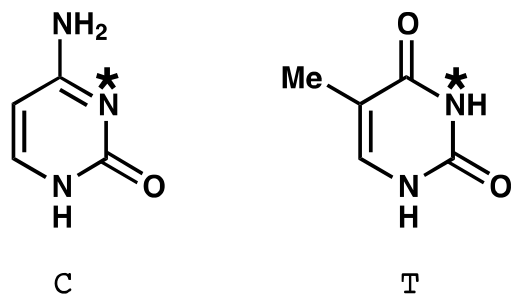
5.2. Draw two complementary resonance structures of the molecule you select to justify your answer.
One common modification of DNA in nature is methylation of the indicated (*) position of guanine (G) by S-adenosyl methionine (SAM).
5.3 Draw the structures of both of the products of the reaction between guanine and SAM.
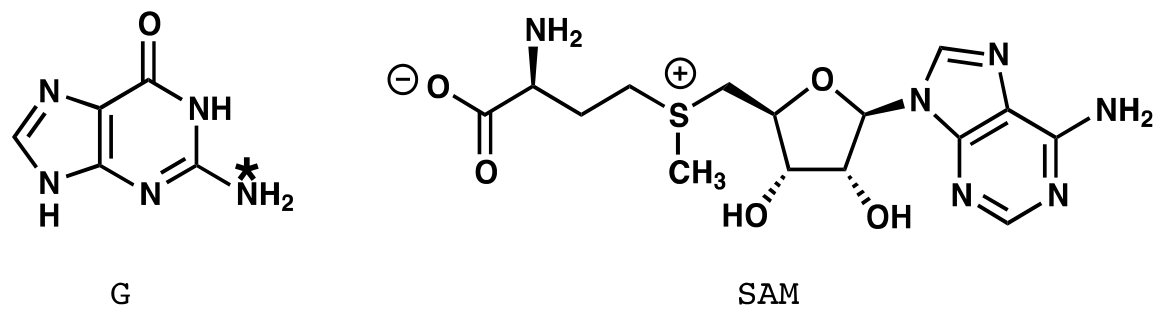
One of the earliest man-made DNA alkylating agents was mustard gas. Mustard gas acts by first undergoing an intramolecular reaction to form intermediate A which directly alkylates DNA, to give a nucleic acid product such as that shown in the part above.

5.4 Draw the structure for reactive intermediate A.
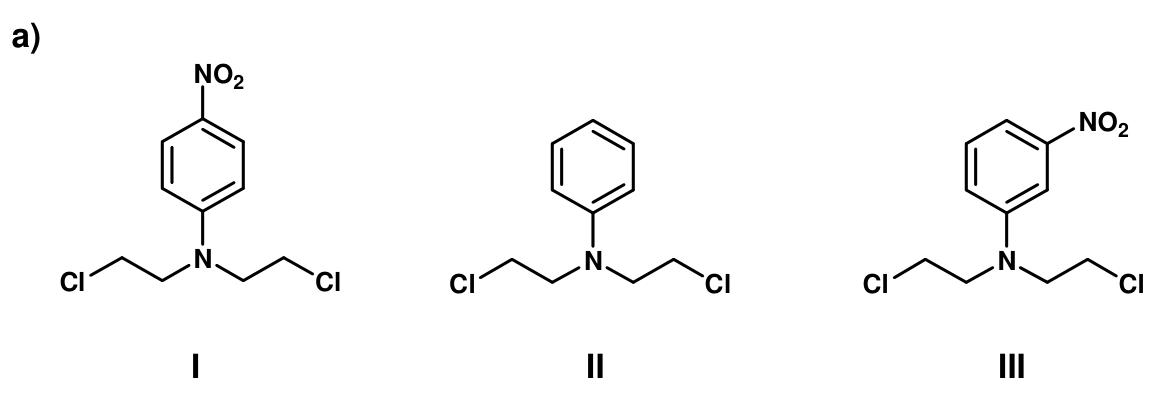
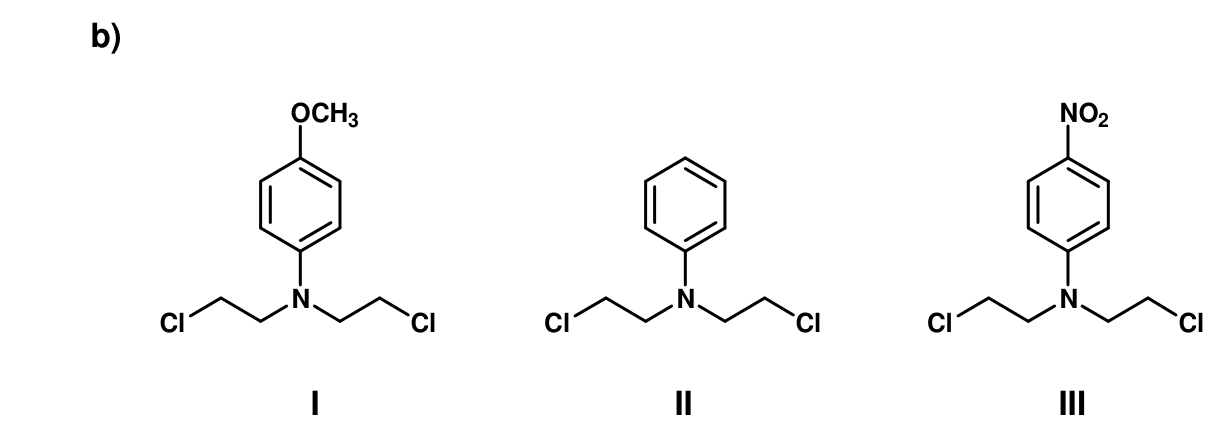
The nitrogen mustards react via an analogous pathway to the sulfur mustard of previous part. The reactivity of the compound may be modified depending on the third substituent on the nitrogen atom. The reactivity of nitrogen mustards increases with increasing nucleophilicity of the central nitrogen atom.
5.5 Select the most and least reactive from each of following groups of nitrogen mustards.
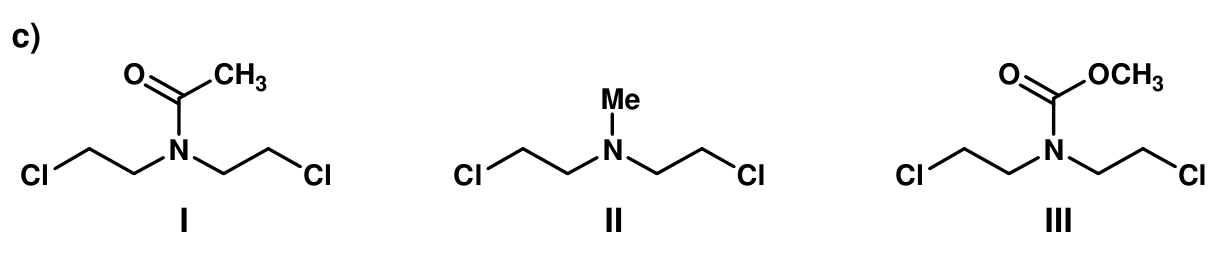
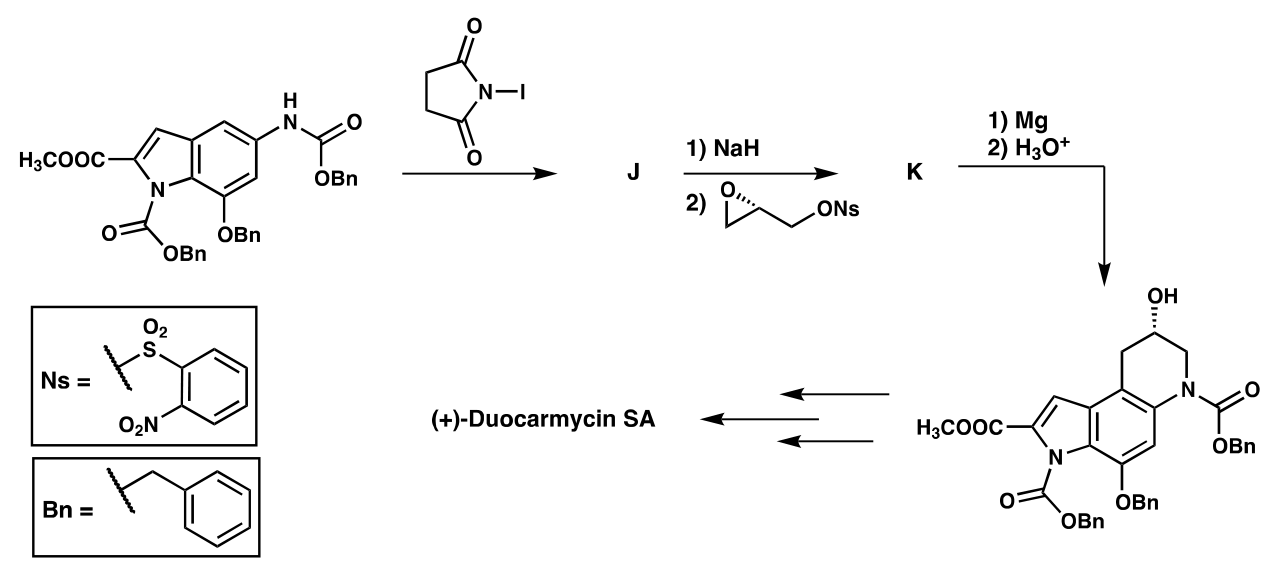
Some classes of natural products act as DNA alkylators, and in this way, they have the potential to serve as cancer therapies due to their antitumor activity. One such class is the duocarmycins. Shown below are steps from an asymmetric total synthesis of the natural product.
5.6 Draw the structures of isolable compounds J and K in the following scheme:
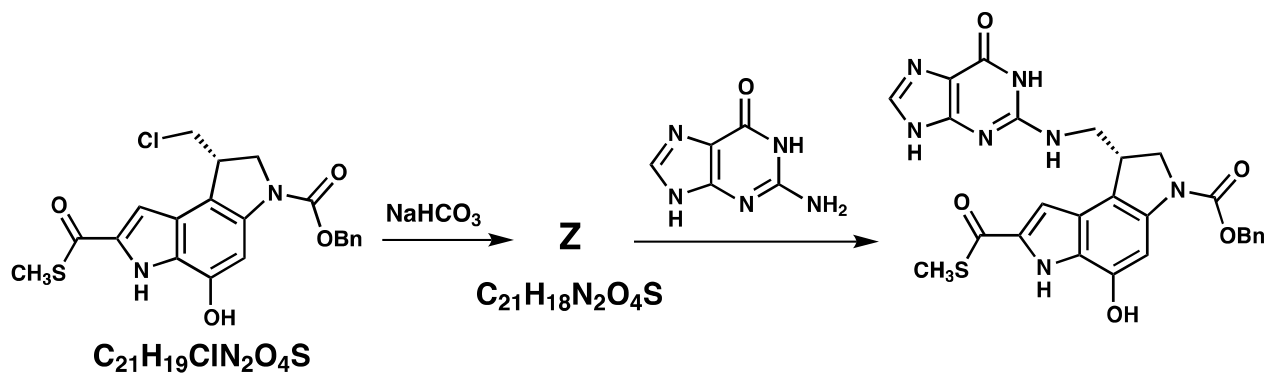
Related small molecules were synthesized to study the way in which the duocarmycins work. One such example is the thioester shown below.
5.7 Draw the structure of reactive intermediate Z.
Official English text of the problem.
Answers
-
5.1 — C, cytosine:
NC1=NC(=O)NC=C1. -
5.2 — Two charge-separated resonance contributors of cytosine, supplementary to its neutral structure above:
- Exocyclic amino nitrogen positive; N-3 negative:
[NH2+]=C1[N-]C(=O)NC=C1. - Ring N-1 positive; N-3 negative:
NC1=CC=[NH+]C(=O)[N-]1.
- 5.3 — The products are:
\(N^2\)-Methylguanine: CNc1nc2[nH]cnc2c(=O)[nH]1.
S-Adenosyl-L-homocysteine (SAH), shown as its zwitterion: Nc1ncnc2c1ncn2[C@@H]1O[C@H](CSCC[C@H]([NH3+])C(=O)[O-])[C@@H](O)[C@H]1O.
-
5.4 — A is the 1-(2-chloroethyl)thiiran-1-ium ion, a three-membered cyclic sulfonium ion:
ClCC[S+]1CC1. Its counterion is chloride,[Cl-]. -
5.5 — Reactivity selections:
| Group | Most reactive | Least reactive |
|---|---|---|
| a | II: N,N-bis(2-chloroethyl)aniline, ClCCN(CCCl)c1ccccc1 |
I: N,N-bis(2-chloroethyl)-4-nitroaniline, ClCCN(CCCl)c1ccc([N+](=O)[O-])cc1 |
| b | I: N,N-bis(2-chloroethyl)-4-methoxyaniline, COc1ccc(N(CCCl)CCCl)cc1 |
III: N,N-bis(2-chloroethyl)-4-nitroaniline, ClCCN(CCCl)c1ccc([N+](=O)[O-])cc1 |
| c | II: mechlorethamine, CN(CCCl)CCCl |
I: N,N-bis(2-chloroethyl)acetamide, CC(=O)N(CCCl)CCCl |
- 5.6 — J and K:
J: methyl 7-benzyloxy-1-(benzyloxycarbonyl)-5-[(benzyloxycarbonyl)amino]-4-iodo-1H-indole-2-carboxylate. It is the starting compound with iodine replacing hydrogen at indole C-4.
COC(=O)c1cc2c(I)c(NC(=O)OCc3ccccc3)cc(OCc3ccccc3)c2n1C(=O)OCc1ccccc1
K: the 5-carbamate N-[(2R)-oxiran-2-ylmethyl] derivative of J. The aryl iodine and epoxide are both retained.
COC(=O)c1cc2c(I)c(N(C[C@@H]3CO3)C(=O)OCc3ccccc3)cc(OCc3ccccc3)c2n1C(=O)OCc1ccccc1
- 5.7 — Z: the cyclopropane-fused cyclohexadienone thioester obtained by cyclization of the depicted seco precursor, with formula \(\ce{C21H18N2O4S}\).
CSC(=O)c1cc2c([nH]1)C(=O)C=C1N(C(=O)OCc3ccccc3)C[C@H]3C[C@@]213
In Z, the pre-existing methine stereocenter is \(S\), and the newly tetrahedral carbon shared by the cyclopropane and cyclohexadienone rings is \(R\).
Solution
5.1
Cytosine has the more nucleophilic N-3 atom.
In the neutral cytosine structure, N-3 is an imine-like nitrogen: its lone pair is available for bonding to an electrophile. Electron donation from the amino group and through the ring further supports electron density at this position.
In thymine, CC1=CNC(=O)NC1=O, N-3 is an imide nitrogen situated between two carbonyl groups. Its lone pair is strongly delocalized into those carbonyl groups and is consequently much less available for alkylation.
5.2
The two charge-separated contributors listed in the Answers can be obtained from neutral cytosine without moving any atoms or protons.
For the first contributor:
- Donate the exocyclic amino nitrogen’s lone pair into its bond to C-4.
- Move the C-4=N-3 \(\pi\)-electron pair onto N-3.
The exocyclic nitrogen becomes positively charged, and N-3 becomes negatively charged:
[NH2+]=C1[N-]C(=O)NC=C1.
For the second contributor:
- Donate the N-1 lone pair to form N-1=C-6.
- Shift the C-6=C-5 electrons to form C-5=C-4.
- Shift the C-4=N-3 electrons onto N-3.
This gives:
NC1=CC=[NH+]C(=O)[N-]1.
Both contributors place additional electron density at N-3. They are resonance contributors of the same molecule, not separate species or tautomers.
5.3
The marked atom is guanine’s exocyclic amino nitrogen at C-2, not a ring nitrogen.
Guanine is Nc1nc2[nH]cnc2c(=O)[nH]1. SAM, in the protonation state drawn in the question, is:
Nc1ncnc2c1ncn2[C@@H]1O[C@H](C[S+](C)CC[C@H](N)C(=O)[O-])[C@@H](O)[C@H]1O.
The guanine amino nitrogen attacks the methyl carbon attached to positively charged sulfur in an \(S_\mathrm{N}2\) displacement. The methyl–sulfur bond breaks, leaving a neutral thioether sulfur. Subsequent proton transfer gives \(N^2\)-methylguanine and SAH.
To draw the products:
- Replace guanine’s exocyclic \(\ce{-NH2}\) group by \(\ce{-NHCH3}\).
- Remove the sulfur-bound methyl group from SAM, leaving the adenosyl–sulfur–homocysteine linkage intact.
- Preserve all amino-acid and ribose stereochemistry.
With SAH represented as the zwitterion given in the Answers, the balanced equation is
\[ \ce{C5H5N5O + C15H22N6O5S -> C6H7N5O + C14H20N6O5S}. \]
This representation accounts for the proton lost from guanine’s nitrogen: the SAH amino group is \(\ce{-NH3+}\), while its carboxylate remains negatively charged.
5.4
Sulfur mustard, or bis(2-chloroethyl) sulfide, is ClCCSCCCl.
A sulfur lone pair attacks the terminal carbon of one of its own chloroethyl groups. Chloride leaves, forming a three-membered ring consisting of sulfur and the two carbon atoms of that arm. Sulfur now has three carbon–sulfur bonds and carries a positive charge.
Thus A is ClCC[S+]1CC1, and its formation is balanced as
\[ \ce{C4H8Cl2S -> C4H8ClS+ + Cl-}. \]
For the requested drawing, make a triangle with \(\ce{S+}\) at one vertex and \(\ce{CH2}\) at each of the other two vertices. Attach the remaining \(\ce{-CH2CH2Cl}\) arm to sulfur.
Guanine can attack a ring carbon, opening the strained ring. After deprotonation, this gives the depicted \(N^2\)-{2-[(2-chloroethyl)sulfanyl]ethyl}guanine:
ClCCSCCNc1nc2[nH]cnc2c(=O)[nH]1.
The overall substitution is
\[ \ce{C4H8Cl2S + C5H5N5O -> C9H12ClN5OS + HCl}. \]
Hydrogen chloride has SMILES [H]Cl.
5.5
The central nitrogen must use its lone pair for intramolecular displacement of chloride. Substituents that make this lone pair more available increase reactivity; substituents that withdraw or delocalize it decrease reactivity.
(a) The order is
\[ \boxed{\mathrm{II>III>I}}. \]
II has no nitro substituent. In III, the meta nitro group withdraws mainly through its inductive effect. In I, the para nitro group additionally allows strong resonance withdrawal through the aromatic ring, reducing the availability of the mustard nitrogen lone pair.
The meta compound III is N,N-bis(2-chloroethyl)-3-nitroaniline, ClCCN(CCCl)c1cccc([N+](=O)[O-])c1.
Therefore II is most reactive and I least reactive.
(b) The order is
\[ \boxed{\mathrm{I>II>III}}. \]
The para methoxy group in I donates electron density by resonance, increasing nitrogen nucleophilicity. The unsubstituted compound II is intermediate. The para nitro group in III strongly withdraws electron density.
Therefore I is most reactive and III least reactive.
(c) The order is
\[ \boxed{\mathrm{II>III>I}}. \]
II is a tertiary alkylamine, so its nitrogen lone pair is readily available.
I is an amide: the nitrogen lone pair is strongly delocalized into the adjacent carbonyl group. III is methyl N,N-bis(2-chloroethyl)carbamate, COC(=O)N(CCCl)CCCl. In III, the methoxy oxygen also donates into the carbonyl system, reducing the carbonyl’s resonance withdrawal from nitrogen relative to I.
Therefore II is most reactive and I least reactive.
5.6
Use ordinary indole numbering: the methyl ester is at C-2, the protected amino group at C-5, and the benzyloxy group at C-7. Here Cbz denotes benzyloxycarbonyl, represented as the substituent *C(=O)OCc1ccccc1, where * is the attachment point.
Formation of J. N-Iodosuccinimide, O=C1CCC(=O)N1I, effects electrophilic aromatic iodination.
C-4 is ortho to the protected amino substituent and para to the benzyloxy substituent. It is also less crowded than C-6, which lies between those substituents. Iodination at C-4 supplies the aryl iodide required for the later ring closure.
Thus, to draw J, copy the starting structure and replace its C-4 hydrogen by iodine.
For reference, the uniodinated starting indole is:
COC(=O)c1cc2cc(NC(=O)OCc3ccccc3)cc(OCc3ccccc3)c2n1C(=O)OCc1ccccc1.
The other iodination product is succinimide, O=C1CCC(=O)N1. The balanced equation is
\[ \ce{C33H28N2O7 + C4H4INO2 -> C33H27IN2O7 + C4H5NO2}. \]
Formation of K. Sodium hydride removes the proton from the exocyclic carbamate nitrogen, releasing hydrogen. The resulting nitrogen nucleophile displaces the nosylate group from the primary carbon of the glycidyl reagent.
The reagent is (S)-oxiran-2-ylmethyl 2-nitrobenzenesulfonate, or (S)-glycidyl nosylate:
O=[N+]([O-])c1ccccc1S(=O)(=O)OC[C@@H]1CO1.
The epoxide remains intact. Thus the change from J to K is precisely
\[ \ce{Ar-NH-C(=O)-OBn -> Ar-N(CH2\text{-}oxiranyl)-C(=O)-OBn}, \]
with the complete connectivity and stereochemistry specified by K’s SMILES in the Answers.
The displaced group forms sodium 2-nitrobenzenesulfonate:
[Na+].[O-]S(=O)(=O)c1ccccc1[N+](=O)[O-].
The balanced overall alkylation is
\[ \ce{C33H27IN2O7 + NaH + C9H9NO6S -> C36H31IN2O8 + C6H4NNaO5S + H2}. \]
The substitution occurs at the primary carbon bearing the sulfonate, so there is no inversion at the epoxide stereocenter. Its descriptor changes from \(S\) in the reagent to \(R\) in K because replacing the oxygen-containing substituent by a nitrogen-containing substituent changes the CIP priorities.
Consistency with the final cyclization. Magnesium inserts into the aryl carbon–iodine bond. The resulting carbon nucleophile attacks the less substituted epoxide carbon intramolecularly, opening the epoxide and forming a six-membered ring fused across indole C-4 and C-5. Acid workup protonates the alkoxide.
The resulting \(S\)-configured cyclic secondary alcohol, as drawn in the question, is:
COC(=O)c1cc2c(n1C(=O)OCc1ccccc1)c(OCc1ccccc1)cc1c2C[C@H](O)CN1C(=O)OCc1ccccc1.
The bond between the stereocenter and oxygen is retained throughout ring opening. Its \(S\) descriptor in the alcohol again reflects the changed CIP priorities.
A balanced net ionic equation for this sequence is
\[ \ce{C36H31IN2O8 + Mg + H3O+ -> C36H32N2O8 + Mg^{2+} + I- + H2O}. \]
The small species used here are sodium hydride, [Na+].[H-]; hydrogen, [H][H]; magnesium, [Mg]; hydronium, [OH3+]; magnesium(II), [Mg+2]; iodide, [I-]; and water, O.
5.7
The starting chloromethyl phenol, or seco thioester precursor, is:
CSC(=O)c1cc2c([nH]1)c(O)cc1c2[C@H](CCl)CN1C(=O)OCc1ccccc1.
Use the underlying indole numbering to describe the changes. The phenolic oxygen is attached at C-7, and C-4 is para to it. Let the existing stereogenic carbon bearing the chloromethyl substituent be \(C^*\).
Bicarbonate removes the phenolic proton. Electron donation from oxygen through the aromatic ring permits intramolecular carbon alkylation at C-4:
- The original phenolic C-7–O bond becomes a carbonyl bond.
- C-4 forms a new bond to the terminal carbon of the chloromethyl substituent.
- Chloride leaves.
- The existing C-4–\(C^*\) and \(C^*\)–methylene bonds, together with the new bond, form a cyclopropane.
Consequently, Z is a cyclopropane-fused cyclohexadienone, not an oxygen-cyclized ether.
To draw Z precisely:
- Replace the phenolic \(\ce{-OH}\) by \(\ce{=O}\).
- Remove chlorine.
- Join the carbon that formerly bore chlorine to C-4.
- Make C-4 tetrahedral.
- In a Kekulé representation, place the cyclohexadienone double bonds at C-5=C-6 and C-3a=C-7a.
- Preserve the pre-existing stereochemistry and use the \(S,R\) configuration encoded in Z’s SMILES.
The net cyclization is
\[ \ce{C21H19ClN2O4S + NaHCO3 -> C21H18N2O4S + NaCl + CO2 + H2O}. \]
This gives exactly the molecular formula printed for Z: \(\ce{C21H18N2O4S}\).
The additional small species are sodium hydrogen carbonate, [Na+].O=C(O)[O-]; sodium chloride, [Na+].[Cl-]; and carbon dioxide, O=C=O.
Finally, guanine’s exocyclic amino nitrogen attacks the less substituted cyclopropane carbon—the carbon originally bearing chlorine. Cleavage of its bond to C-4 allows the six-membered ring to regain aromaticity. Proton transfer restores the phenolic hydroxyl group and gives the depicted \(N^2\)-guanine adduct of the seco thioester:
CSC(=O)c1cc2c([nH]1)c(O)cc1c2[C@H](CNc2nc3[nH]cnc3c(=O)[nH]2)CN1C(=O)OCc1ccccc1.
This addition is balanced without a separate coproduct:
\[ \ce{C21H18N2O4S + C5H5N5O -> C26H23N7O5S}. \]
Cyclopropane strain relief and restoration of aromaticity explain why Z is the reactive alkylating intermediate.
The answers were checked against the official answers published by the organisers.
IChO 2012 · Theorieaufgabe 5
Chemische Modifikation der DNA
Desoxyribonukleinsäure (DNA) ist eines der grundlegenden Moleküle des Lebens. In dieser Aufgabe werden Möglichkeiten betrachtet, die Molekülstruktur der DNA zu verändern, sowohl auf natürliche Weise als auch durch vom Menschen entwickelte Verfahren.
Betrachten Sie die Pyrimidinbasen Cytosin (C) und Thymin (T). Das (durch * gekennzeichnete) N-3-Atom einer dieser Basen ist eine häufige nukleophile Angriffsstelle bei der Alkylierung einzelsträngiger DNA, während dies für die andere Base nicht gilt.
5.1 Wählen Sie aus (durch Einkreisen), welche Base, C oder T, das stärker nukleophile N-3-Atom besitzt.
5.2. Zeichnen Sie zwei einander ergänzende mesomere Grenzstrukturen des ausgewählten Moleküls, um Ihre Antwort zu begründen.
Eine häufige natürliche Modifikation der DNA ist die Methylierung der gekennzeichneten (*) Position von Guanin (G) durch S-Adenosylmethionin (SAM).
5.3 Zeichnen Sie die Strukturen beider Produkte der Reaktion zwischen Guanin und SAM.
Eines der frühesten vom Menschen hergestellten DNA-Alkylierungsmittel war Senfgas. Senfgas wirkt, indem es zunächst in einer intramolekularen Reaktion die Zwischenstufe A bildet, die DNA direkt alkyliert, wobei ein Nukleinsäureprodukt entsteht, wie es im vorherigen Aufgabenteil gezeigt ist.
5.4 Zeichnen Sie die Struktur der reaktiven Zwischenstufe A.
Die Stickstoffloste reagieren über einen analogen Reaktionsweg wie der Schwefellost im vorherigen Aufgabenteil. Die Reaktivität der Verbindung lässt sich durch den dritten Substituenten am Stickstoffatom verändern. Die Reaktivität von Stickstofflosten steigt mit zunehmender Nukleophilie des zentralen Stickstoffatoms.
5.5 Wählen Sie aus jeder der folgenden Gruppen von Stickstofflosten die reaktivste und die am wenigsten reaktive Verbindung aus.
Einige Naturstoffklassen wirken als DNA-Alkylierungsmittel und besitzen dadurch aufgrund ihrer Antitumoraktivität Potenzial für die Krebstherapie. Eine solche Klasse sind die Duocarmycine. Im Folgenden sind Schritte einer asymmetrischen Totalsynthese des Naturstoffs dargestellt.
5.6 Zeichnen Sie die Strukturen der isolierbaren Verbindungen J und K im folgenden Schema:
Verwandte kleine Moleküle wurden synthetisiert, um die Wirkungsweise der Duocarmycine zu untersuchen. Ein solches Beispiel ist der unten dargestellte Thioester.
5.7 Zeichnen Sie die Struktur der reaktiven Zwischenstufe Z.
Aufgabentext aus dem offiziellen englischen Text übersetzt.
Antworten
-
5.1 — C, Cytosin:
NC1=NC(=O)NC=C1. -
5.2 — Zwei ladungsgetrennte mesomere Grenzstrukturen von Cytosin, ergänzend zu seiner oben dargestellten neutralen Struktur:
- Exocyclischer Aminostickstoff positiv; N-3 negativ:
[NH2+]=C1[N-]C(=O)NC=C1. - Ringstickstoff N-1 positiv; N-3 negativ:
NC1=CC=[NH+]C(=O)[N-]1.
- 5.3 — Die Produkte sind:
\(N^2\)-Methylguanin: CNc1nc2[nH]cnc2c(=O)[nH]1.
S-Adenosyl-L-homocystein (SAH), als Zwitterion dargestellt: Nc1ncnc2c1ncn2[C@@H]1O[C@H](CSCC[C@H]([NH3+])C(=O)[O-])[C@@H](O)[C@H]1O.
-
5.4 — A ist das 1-(2-Chlorethyl)thiiran-1-ium-Ion, ein dreigliedriges cyclisches Sulfoniumion:
ClCC[S+]1CC1. Sein Gegenion ist Chlorid,[Cl-]. -
5.5 — Auswahl nach Reaktivität:
| Gruppe | Am reaktivsten | Am wenigsten reaktiv |
|---|---|---|
| a | II: N,N-Bis(2-chlorethyl)anilin, ClCCN(CCCl)c1ccccc1 |
I: N,N-Bis(2-chlorethyl)-4-nitroanilin, ClCCN(CCCl)c1ccc([N+](=O)[O-])cc1 |
| b | I: N,N-Bis(2-chlorethyl)-4-methoxyanilin, COc1ccc(N(CCCl)CCCl)cc1 |
III: N,N-Bis(2-chlorethyl)-4-nitroanilin, ClCCN(CCCl)c1ccc([N+](=O)[O-])cc1 |
| c | II: Mechlorethamin, CN(CCCl)CCCl |
I: N,N-Bis(2-chlorethyl)acetamid, CC(=O)N(CCCl)CCCl |
- 5.6 — J und K:
J: Methyl-7-benzyloxy-1-(benzyloxycarbonyl)-5-[(benzyloxycarbonyl)amino]-4-iod-1H-indol-2-carboxylat. Es handelt sich um die Ausgangsverbindung, bei der Wasserstoff an C-4 des Indols durch Iod ersetzt ist.
COC(=O)c1cc2c(I)c(NC(=O)OCc3ccccc3)cc(OCc3ccccc3)c2n1C(=O)OCc1ccccc1
K: das am 5-Carbamat N-[(2R)-Oxiran-2-ylmethyl]-substituierte Derivat von J. Sowohl das Aryl-Iod als auch das Epoxid bleiben erhalten.
COC(=O)c1cc2c(I)c(N(C[C@@H]3CO3)C(=O)OCc3ccccc3)cc(OCc3ccccc3)c2n1C(=O)OCc1ccccc1
- 5.7 — Z: der durch Cyclisierung der dargestellten seco-Vorstufe erhaltene Thioester eines mit einem Cyclopropanring anellierten Cyclohexadienons mit der Formel \(\ce{C21H18N2O4S}\).
CSC(=O)c1cc2c([nH]1)C(=O)C=C1N(C(=O)OCc3ccccc3)C[C@H]3C[C@@]213
In Z besitzt das bereits vorhandene Methin-Stereozentrum die Konfiguration \(S\), und das neu entstandene tetraedrische Kohlenstoffatom, das dem Cyclopropan- und dem Cyclohexadienonring gemeinsam ist, besitzt die Konfiguration \(R\).
Lösung
5.1
Cytosin besitzt das stärker nukleophile N-3-Atom.
In der neutralen Cytosinstruktur ist N-3 ein iminartiger Stickstoff: Sein freies Elektronenpaar steht für die Bindung an ein Elektrophil zur Verfügung. Die Elektronendonationen von der Aminogruppe und über den Ring begünstigen zusätzlich die Elektronendichte an dieser Position.
In Thymin, CC1=CNC(=O)NC1=O, ist N-3 ein Imidstickstoff zwischen zwei Carbonylgruppen. Sein freies Elektronenpaar ist stark in diese Carbonylgruppen delokalisiert und steht daher für eine Alkylierung wesentlich weniger zur Verfügung.
5.2
Die beiden unter Antworten aufgeführten ladungsgetrennten Grenzstrukturen lassen sich aus neutralem Cytosin ableiten, ohne Atome oder Protonen zu verschieben.
Für die erste Grenzstruktur:
- Verschieben Sie das freie Elektronenpaar des exocyclischen Aminostickstoffs in seine Bindung zu C-4.
- Verschieben Sie das \(\pi\)-Elektronenpaar von C-4=N-3 auf N-3.
Der exocyclische Stickstoff wird positiv geladen, und N-3 wird negativ geladen:
[NH2+]=C1[N-]C(=O)NC=C1.
Für die zweite Grenzstruktur:
- Verschieben Sie das freie Elektronenpaar von N-1 so, dass N-1=C-6 entsteht.
- Verschieben Sie die Elektronen von C-6=C-5 so, dass C-5=C-4 entsteht.
- Verschieben Sie die Elektronen von C-4=N-3 auf N-3.
Dies ergibt:
NC1=CC=[NH+]C(=O)[N-]1.
Beide Grenzstrukturen weisen zusätzliche Elektronendichte an N-3 auf. Sie sind mesomere Grenzstrukturen desselben Moleküls, keine eigenständigen Spezies oder Tautomere.
5.3
Das markierte Atom ist der exocyclische Aminostickstoff an C-2 des Guanins, kein Ringstickstoff.
Guanin ist Nc1nc2[nH]cnc2c(=O)[nH]1. SAM liegt in dem in der Aufgabe dargestellten Protonierungszustand wie folgt vor:
Nc1ncnc2c1ncn2[C@@H]1O[C@H](C[S+](C)CC[C@H](N)C(=O)[O-])[C@@H](O)[C@H]1O.
Der Aminostickstoff des Guanins greift in einer \(S_\mathrm{N}2\)-Substitution das an den positiv geladenen Schwefel gebundene Methylkohlenstoffatom an. Die Methyl–Schwefel-Bindung wird gespalten, wobei ein neutrales Thioether-Schwefelatom zurückbleibt. Eine anschließende Protonenübertragung liefert \(N^2\)-Methylguanin und SAH.
Zum Zeichnen der Produkte:
- Ersetzen Sie die exocyclische \(\ce{-NH2}\)-Gruppe des Guanins durch \(\ce{-NHCH3}\).
- Entfernen Sie die schwefelgebundene Methylgruppe aus SAM und lassen Sie dabei die Adenosyl–Schwefel–Homocystein-Verknüpfung unverändert.
- Behalten Sie die gesamte Stereochemie der Aminosäure und der Ribose bei.
Wenn SAH als das unter Antworten angegebene Zwitterion dargestellt wird, lautet die ausgeglichene Gleichung
\[ \ce{C5H5N5O + C15H22N6O5S -> C6H7N5O + C14H20N6O5S}. \]
Diese Darstellung berücksichtigt das vom Stickstoff des Guanins abgegebene Proton: Die Aminogruppe von SAH liegt als \(\ce{-NH3+}\) vor, während seine Carboxylatgruppe negativ geladen bleibt.
5.4
Schwefellost, auch Bis(2-chlorethyl)sulfid genannt, ist ClCCSCCCl.
Ein freies Elektronenpaar des Schwefels greift das endständige Kohlenstoffatom einer seiner eigenen Chlorethylgruppen an. Chlorid wird abgespalten, und es entsteht ein dreigliedriger Ring aus Schwefel und den beiden Kohlenstoffatomen dieser Seitenkette. Schwefel besitzt nun drei Kohlenstoff–Schwefel-Bindungen und trägt eine positive Ladung.
Somit ist A ClCC[S+]1CC1, und seine Bildung lässt sich durch folgende ausgeglichene Gleichung beschreiben:
\[ \ce{C4H8Cl2S -> C4H8ClS+ + Cl-}. \]
Zeichnen Sie für die verlangte Struktur ein Dreieck mit \(\ce{S+}\) an einer Ecke und jeweils \(\ce{CH2}\) an den beiden anderen Ecken. Binden Sie die verbleibende \(\ce{-CH2CH2Cl}\)-Seitenkette an den Schwefel.
Guanin kann ein Ringkohlenstoffatom angreifen und dabei den gespannten Ring öffnen. Nach Deprotonierung entsteht das dargestellte \(N^2\)-{2-[(2-Chlorethyl)sulfanyl]ethyl}guanin:
ClCCSCCNc1nc2[nH]cnc2c(=O)[nH]1.
Die gesamte Substitution lautet
\[ \ce{C4H8Cl2S + C5H5N5O -> C9H12ClN5OS + HCl}. \]
Chlorwasserstoff hat die SMILES-Schreibweise [H]Cl.
5.5
Der zentrale Stickstoff muss sein freies Elektronenpaar für die intramolekulare Verdrängung von Chlorid einsetzen. Substituenten, die die Verfügbarkeit dieses freien Elektronenpaars erhöhen, steigern die Reaktivität; Substituenten, die es abziehen oder delokalisieren, verringern die Reaktivität.
(a) Die Reihenfolge lautet
\[ \boxed{\mathrm{II>III>I}}. \]
II besitzt keinen Nitrosubstituenten. In III wirkt die meta-Nitrogruppe hauptsächlich durch ihren induktiven Effekt elektronenziehend. In I ermöglicht die para-Nitrogruppe zusätzlich einen starken mesomeren Elektronenentzug über den aromatischen Ring, wodurch die Verfügbarkeit des freien Elektronenpaars am Lost-Stickstoff verringert wird.
Die meta-Verbindung III ist N,N-Bis(2-chlorethyl)-3-nitroanilin, ClCCN(CCCl)c1cccc([N+](=O)[O-])c1.
Daher ist II am reaktivsten und I am wenigsten reaktiv.
(b) Die Reihenfolge lautet
\[ \boxed{\mathrm{I>II>III}}. \]
Die para-Methoxygruppe in I spendet durch Mesomerie Elektronendichte und erhöht dadurch die Nukleophilie des Stickstoffs. Die unsubstituierte Verbindung II nimmt eine Zwischenstellung ein. Die para-Nitrogruppe in III entzieht stark Elektronendichte.
Daher ist I am reaktivsten und III am wenigsten reaktiv.
(c) Die Reihenfolge lautet
\[ \boxed{\mathrm{II>III>I}}. \]
II ist ein tertiäres Alkylamin, sodass sein freies Stickstoffelektronenpaar gut verfügbar ist.
I ist ein Amid: Das freie Elektronenpaar des Stickstoffs ist stark in die benachbarte Carbonylgruppe delokalisiert. III ist Methyl-N,N-bis(2-chlorethyl)carbamat, COC(=O)N(CCCl)CCCl. In III spendet auch der Methoxysauerstoff Elektronendichte in das Carbonylsystem, wodurch der mesomere Elektronenentzug der Carbonylgruppe vom Stickstoff gegenüber I verringert wird.
Daher ist II am reaktivsten und I am wenigsten reaktiv.
5.6
Verwenden Sie die übliche Indolnummerierung: Der Methylester befindet sich an C-2, die geschützte Aminogruppe an C-5 und die Benzyloxygruppe an C-7. Hier bezeichnet Cbz Benzyloxycarbonyl, dargestellt als Substituent *C(=O)OCc1ccccc1, wobei * die Bindungsstelle angibt.
Bildung von J. N-Iodsuccinimid, O=C1CCC(=O)N1I, bewirkt eine elektrophile aromatische Iodierung.
C-4 liegt ortho zum geschützten Aminosubstituenten und para zum Benzyloxysubstituenten. Es ist außerdem sterisch weniger gehindert als C-6, das zwischen diesen Substituenten liegt. Die Iodierung an C-4 liefert das für den späteren Ringschluss erforderliche Aryliodid.
Um J zu zeichnen, übernehmen Sie daher die Ausgangsstruktur und ersetzen Sie ihren Wasserstoff an C-4 durch Iod.
Zum Vergleich ist das nicht iodierte Ausgangsindol:
COC(=O)c1cc2cc(NC(=O)OCc3ccccc3)cc(OCc3ccccc3)c2n1C(=O)OCc1ccccc1.
Das andere Produkt der Iodierung ist Succinimid, O=C1CCC(=O)N1. Die ausgeglichene Gleichung lautet
\[ \ce{C33H28N2O7 + C4H4INO2 -> C33H27IN2O7 + C4H5NO2}. \]
Bildung von K. Natriumhydrid entfernt das Proton vom exocyclischen Carbamatstickstoff unter Freisetzung von Wasserstoff. Das entstehende Stickstoffnukleophil verdrängt die Nosylatgruppe vom primären Kohlenstoffatom des Glycidylreagenzes.
Das Reagenz ist (S)-Oxiran-2-ylmethyl-2-nitrobenzolsulfonat, auch (S)-Glycidylnosylat genannt:
O=[N+]([O-])c1ccccc1S(=O)(=O)OC[C@@H]1CO1.
Das Epoxid bleibt intakt. Die Veränderung von J zu K entspricht somit genau
\[ \ce{Ar-NH-C(=O)-OBn -> Ar-N(CH2\text{-}oxiranyl)-C(=O)-OBn}, \]
wobei die vollständige Konnektivität und Stereochemie durch die SMILES-Schreibweise von K unter Antworten angegeben sind.
Die verdrängte Gruppe bildet Natrium-2-nitrobenzolsulfonat:
[Na+].[O-]S(=O)(=O)c1ccccc1[N+](=O)[O-].
Die ausgeglichene Gesamtgleichung der Alkylierung lautet
\[ \ce{C33H27IN2O7 + NaH + C9H9NO6S -> C36H31IN2O8 + C6H4NNaO5S + H2}. \]
Die Substitution erfolgt am primären Kohlenstoffatom, das die Sulfonatgruppe trägt, sodass am Epoxid-Stereozentrum keine Inversion stattfindet. Sein Deskriptor ändert sich von \(S\) im Reagenz zu \(R\) in K, weil der Austausch des sauerstoffhaltigen Substituenten gegen einen stickstoffhaltigen Substituenten die CIP-Prioritäten verändert.
Übereinstimmung mit der abschließenden Cyclisierung. Magnesium insertiert in die Aryl-Kohlenstoff–Iod-Bindung. Das entstehende Kohlenstoffnukleophil greift intramolekular das weniger substituierte Epoxidkohlenstoffatom an, öffnet dabei das Epoxid und bildet einen sechsgliedrigen Ring, der über C-4 und C-5 des Indols anelliert ist. Die saure Aufarbeitung protoniert das Alkoholat.
Der entstehende \(S\)-konfigurierte cyclische sekundäre Alkohol, wie er in der Aufgabe dargestellt ist, lautet:
COC(=O)c1cc2c(n1C(=O)OCc1ccccc1)c(OCc1ccccc1)cc1c2C[C@H](O)CN1C(=O)OCc1ccccc1.
Die Bindung zwischen dem Stereozentrum und dem Sauerstoff bleibt während der gesamten Ringöffnung erhalten. Sein \(S\)-Deskriptor im Alkohol spiegelt wiederum die veränderten CIP-Prioritäten wider.
Eine ausgeglichene Netto-Ionengleichung für diese Reaktionsfolge lautet
\[ \ce{C36H31IN2O8 + Mg + H3O+ -> C36H32N2O8 + Mg^{2+} + I- + H2O}. \]
Die hier verwendeten kleinen Spezies sind Natriumhydrid, [Na+].[H-]; Wasserstoff, [H][H]; Magnesium, [Mg]; Oxonium, [OH3+]; Magnesium(II), [Mg+2]; Iodid, [I-]; und Wasser, O.
5.7
Das als Ausgangsstoff dienende Chlormethylphenol, die seco-Thioestervorstufe, ist:
CSC(=O)c1cc2c([nH]1)c(O)cc1c2[C@H](CCl)CN1C(=O)OCc1ccccc1.
Verwenden Sie zur Beschreibung der Veränderungen die Nummerierung des zugrunde liegenden Indols. Der phenolische Sauerstoff ist an C-7 gebunden, und C-4 liegt para dazu. Das bereits vorhandene stereogene Kohlenstoffatom, das den Chlormethylsubstituenten trägt, sei \(C^*\).
Hydrogencarbonat entfernt das phenolische Proton. Die Elektronendonationswirkung des Sauerstoffs über den aromatischen Ring ermöglicht eine intramolekulare Kohlenstoffalkylierung an C-4:
- Die ursprüngliche phenolische C-7–O-Bindung wird zu einer Carbonylbindung.
- C-4 bildet eine neue Bindung zum endständigen Kohlenstoffatom des Chlormethylsubstituenten.
- Chlorid wird abgespalten.
- Die vorhandenen C-4–\(C^*\)- und \(C^*\)–Methylen-Bindungen bilden zusammen mit der neuen Bindung einen Cyclopropanring.
Folglich ist Z ein mit einem Cyclopropanring anelliertes Cyclohexadienon, kein durch Cyclisierung über Sauerstoff gebildeter Ether.
Um Z präzise zu zeichnen:
- Ersetzen Sie die phenolische \(\ce{-OH}\)-Gruppe durch \(\ce{=O}\).
- Entfernen Sie Chlor.
- Verbinden Sie das Kohlenstoffatom, das zuvor Chlor trug, mit C-4.
- Zeichnen Sie C-4 tetraedrisch.
- Platzieren Sie in einer Kekulé-Darstellung die Doppelbindungen des Cyclohexadienons bei C-5=C-6 und C-3a=C-7a.
- Behalten Sie die bereits vorhandene Stereochemie bei und verwenden Sie die in der SMILES-Schreibweise von Z codierte \(S,R\)-Konfiguration.
Die Nettogleichung der Cyclisierung lautet
\[ \ce{C21H19ClN2O4S + NaHCO3 -> C21H18N2O4S + NaCl + CO2 + H2O}. \]
Dies ergibt genau die für Z angegebene Summenformel: \(\ce{C21H18N2O4S}\).
Die zusätzlichen kleinen Spezies sind Natriumhydrogencarbonat, [Na+].O=C(O)[O-]; Natriumchlorid, [Na+].[Cl-]; und Kohlenstoffdioxid, O=C=O.
Schließlich greift der exocyclische Aminostickstoff des Guanins das weniger substituierte Cyclopropankohlenstoffatom an – das Kohlenstoffatom, das ursprünglich Chlor trug. Die Spaltung seiner Bindung zu C-4 ermöglicht es dem sechsgliedrigen Ring, seine Aromatizität wiederzuerlangen. Eine Protonenübertragung stellt die phenolische Hydroxygruppe wieder her und liefert das dargestellte \(N^2\)-Guanin-Addukt des seco-Thioesters:
CSC(=O)c1cc2c([nH]1)c(O)cc1c2[C@H](CNc2nc3[nH]cnc3c(=O)[nH]2)CN1C(=O)OCc1ccccc1.
Diese Addition ist ohne ein separates Nebenprodukt ausgeglichen:
\[ \ce{C21H18N2O4S + C5H5N5O -> C26H23N7O5S}. \]
Der Abbau der Cyclopropan-Ringspannung und die Wiederherstellung der Aromatizität erklären, warum Z die reaktive alkylierende Zwischenstufe ist.
Die Ergebnisse wurden mit den von den Veranstaltern veröffentlichten offiziellen Ergebnissen abgeglichen.
IChO 2012 · Teori sorusu 5
DNA'nın kimyasal modifikasyonu
Deoksiribonükleik asit (DNA), yaşamın temel moleküllerinden biridir. Bu soruda, DNA'nın moleküler yapısının hem doğal yollarla hem de insanların geliştirdiği yöntemlerle nasıl değiştirilebileceği ele alınacaktır.
Pirimidin bazları olan sitozin (C) ve timini (T) ele alınız. Bu bazlardan birinin N-3 atomu (* ile gösterilmiştir), tek iplikli DNA'nın alkilasyonunda yaygın bir nükleofilik merkezken diğerininki değildir.
5.1 C veya T bazlarından hangisinin N-3 atomunun daha nükleofilik olduğunu seçiniz (daire içine alınız).
5.2. Yanıtınızı gerekçelendirmek için seçtiğiniz molekülün birbirini tamamlayan iki rezonans yapısını çiziniz.
DNA'nın doğada yaygın olarak görülen bir modifikasyonu, guaninin (G) belirtilen (*) konumunun S-adenozil metiyonin (SAM) tarafından metillenmesidir.
5.3 Guanin ile SAM arasındaki tepkimenin her iki ürününün yapısını çiziniz.
İnsanların geliştirdiği ilk DNA alkilleyici ajanlardan biri hardal gazıdır. Hardal gazı, önce molekül içi bir tepkime geçirerek A ara ürününü oluşturur; bu ara ürün DNA'yı doğrudan alkilleyerek yukarıdaki kısımda gösterilene benzer bir nükleik asit ürünü verir.
5.4 Reaktif A ara ürününün yapısını çiziniz.
Azot hardalları, önceki kısımdaki kükürtlü hardala benzer bir yol üzerinden tepkimeye girer. Bileşiğin reaktivitesi, azot atomundaki üçüncü sübstitüente bağlı olarak değiştirilebilir. Merkezî azot atomunun nükleofilikliği arttıkça azot hardallarının reaktivitesi artar.
5.5 Aşağıdaki azot hardalı gruplarının her birinden en reaktif ve en az reaktif olanı seçiniz.
Bazı doğal ürün sınıfları DNA alkilleyicileri olarak etki gösterir ve bu sayede antitümör etkinlikleri nedeniyle kanser tedavisinde kullanılma potansiyeline sahiptir. Bu sınıflardan biri duokarmisinlerdir. Aşağıda doğal ürünün asimetrik total sentezinden bazı basamaklar gösterilmiştir.
5.6 Aşağıdaki şemada yer alan, izole edilebilir J ve K bileşiklerinin yapılarını çiziniz:
Duokarmisinlerin etki mekanizmasını incelemek için bunlarla ilişkili küçük moleküller sentezlenmiştir. Aşağıda gösterilen tiyoester bunlara bir örnektir.
5.7 Reaktif Z ara ürününün yapısını çiziniz.
Soru metni resmi İngilizce metinden çevrilmiştir.
Cevaplar
-
5.1 — C, sitozin:
NC1=NC(=O)NC=C1. -
5.2 — Sitozinin yük ayrışması içeren iki rezonans katkı yapısı, yukarıdaki nötr yapısına ek olarak:
- Halkaya dıştan bağlı amino azotu pozitif; N-3 negatif:
[NH2+]=C1[N-]C(=O)NC=C1. - Halkadaki N-1 pozitif; N-3 negatif:
NC1=CC=[NH+]C(=O)[N-]1.
- 5.3 — Ürünler şunlardır:
\(N^2\)-Metilguanin: CNc1nc2[nH]cnc2c(=O)[nH]1.
Zwitteriyon hâlinde gösterilen S-adenozil-L-homosistein (SAH): Nc1ncnc2c1ncn2[C@@H]1O[C@H](CSCC[C@H]([NH3+])C(=O)[O-])[C@@H](O)[C@H]1O.
-
5.4 — A, 1-(2-kloroetil)tiiran-1-iyum iyonudur, üç üyeli halkalı bir sülfonyum iyonudur:
ClCC[S+]1CC1. Karşı iyonu klorürdür,[Cl-]. -
5.5 — Reaktivite seçimleri:
| Grup | En reaktif | En az reaktif |
|---|---|---|
| a | II: N,N-bis(2-kloroetil)anilin, ClCCN(CCCl)c1ccccc1 |
I: N,N-bis(2-kloroetil)-4-nitroanilin, ClCCN(CCCl)c1ccc([N+](=O)[O-])cc1 |
| b | I: N,N-bis(2-kloroetil)-4-metoksianilin, COc1ccc(N(CCCl)CCCl)cc1 |
III: N,N-bis(2-kloroetil)-4-nitroanilin, ClCCN(CCCl)c1ccc([N+](=O)[O-])cc1 |
| c | II: mekloretamin, CN(CCCl)CCCl |
I: N,N-bis(2-kloroetil)asetamid, CC(=O)N(CCCl)CCCl |
- 5.6 — J ve K:
J: metil 7-benziloksi-1-(benziloksikarbonil)-5-[(benziloksikarbonil)amino]-4-iyodo-1H-indol-2-karboksilat. Başlangıç bileşiğinde indolün C-4 konumundaki hidrojenin yerini iyodun aldığı bileşiktir.
COC(=O)c1cc2c(I)c(NC(=O)OCc3ccccc3)cc(OCc3ccccc3)c2n1C(=O)OCc1ccccc1
K: J'nin 5-karbamat grubundaki N-[(2R)-oksiran-2-ilmetil] türevi. Hem aril iyodu hem de epoksit korunur.
COC(=O)c1cc2c(I)c(N(C[C@@H]3CO3)C(=O)OCc3ccccc3)cc(OCc3ccccc3)c2n1C(=O)OCc1ccccc1
- 5.7 — Z: gösterilen seko öncülünün halkalaşmasıyla elde edilen, formülü \(\ce{C21H18N2O4S}\) olan, siklopropanla kaynaşmış siklohekzadienon tiyoesteri.
CSC(=O)c1cc2c([nH]1)C(=O)C=C1N(C(=O)OCc3ccccc3)C[C@H]3C[C@@]213
Z'de önceden mevcut olan metin stereomerkezi \(S\), siklopropan ve siklohekzadienon halkalarının ortak, yeni tetrahedral karbonu ise \(R\) konfigürasyonundadır.
Çözüm
5.1
Sitozinin N-3 atomu daha nükleofiliktir.
Nötr sitozin yapısında N-3, imin benzeri bir azottur: ortaklanmamış elektron çifti bir elektrofile bağlanmak için kullanılabilir durumdadır. Amino grubundan ve halka üzerinden elektron verilmesi, bu konumdaki elektron yoğunluğunu daha da destekler.
Timinde, CC1=CNC(=O)NC1=O, N-3, iki karbonil grubu arasında yer alan bir imit azotudur. Ortaklanmamış elektron çifti bu karbonil gruplarına güçlü biçimde delokalize olduğundan alkilasyon için çok daha az kullanılabilir durumdadır.
5.2
Cevaplar bölümünde verilen, yük ayrışması içeren iki katkı yapısı, hiçbir atom veya protonun yeri değiştirilmeden nötr sitozinden elde edilebilir.
Birinci katkı yapısı için:
- Halkaya dıştan bağlı amino azotunun ortaklanmamış elektron çiftini C-4 ile yaptığı bağa aktarınız.
- C-4=N-3 bağının \(\pi\)-elektron çiftini N-3 üzerine taşıyınız.
Halkaya dıştan bağlı azot pozitif, N-3 ise negatif yüklü hâle gelir:
[NH2+]=C1[N-]C(=O)NC=C1.
İkinci katkı yapısı için:
- N-1'in ortaklanmamış elektron çiftini aktararak N-1=C-6 bağını oluşturunuz.
- C-6=C-5 elektronlarını kaydırarak C-5=C-4 bağını oluşturunuz.
- C-4=N-3 elektronlarını N-3 üzerine kaydırınız.
Böylece şu yapı elde edilir:
NC1=CC=[NH+]C(=O)[N-]1.
Her iki katkı yapısı da N-3 üzerinde ek elektron yoğunluğu oluşturur. Bunlar ayrı türler veya tautomerler değil, aynı molekülün rezonans katkı yapılarıdır.
5.3
İşaretli atom, bir halka azotu değil, guaninin C-2 konumunda halkaya dıştan bağlı amino azotudur.
Guanin Nc1nc2[nH]cnc2c(=O)[nH]1 yapısındadır. Soruda çizilen protonlanma durumundaki SAM şöyledir:
Nc1ncnc2c1ncn2[C@@H]1O[C@H](C[S+](C)CC[C@H](N)C(=O)[O-])[C@@H](O)[C@H]1O.
Guaninin amino azotu, bir \(S_\mathrm{N}2\) yer değiştirme tepkimesinde pozitif yüklü kükürde bağlı metil karbonuna saldırır. Metil–kükürt bağı kırılır ve geride nötr bir tiyoeter kükürdü kalır. Ardından gerçekleşen proton aktarımıyla \(N^2\)-metilguanin ve SAH oluşur.
Ürünleri çizmek için:
- Guaninin halkaya dıştan bağlı \(\ce{-NH2}\) grubunu \(\ce{-NHCH3}\) ile değiştiriniz.
- Adenozil–kükürt–homosistein bağlantısını koruyarak SAM'den kükürde bağlı metil grubunu çıkarınız.
- Amino asidin ve ribozun tüm stereokimyasını koruyunuz.
SAH, Cevaplar bölümünde verilen zwitteriyon biçiminde gösterildiğinde denkleştirilmiş denklem şöyledir:
\[ \ce{C5H5N5O + C15H22N6O5S -> C6H7N5O + C14H20N6O5S}. \]
Bu gösterim, guaninin azotundan ayrılan protonu da hesaba katar: SAH'nin amino grubu \(\ce{-NH3+}\) biçimindeyken karboksilat grubu negatif yüklü kalır.
5.4
Kükürtlü hardal, diğer adıyla bis(2-kloroetil) sülfür, ClCCSCCCl yapısındadır.
Kükürdün ortaklanmamış bir elektron çifti, kendi kloroetil gruplarından birinin uç karbonuna saldırır. Klorür ayrılır ve kükürt ile bu kolun iki karbon atomundan oluşan üç üyeli bir halka meydana gelir. Kükürt artık üç karbon–kükürt bağına sahiptir ve pozitif yük taşır.
Dolayısıyla A, ClCC[S+]1CC1 yapısındadır ve oluşumu şu şekilde denkleştirilir:
\[ \ce{C4H8Cl2S -> C4H8ClS+ + Cl-}. \]
İstenen çizim için bir köşesinde \(\ce{S+}\), diğer iki köşesinin her birinde \(\ce{CH2}\) bulunan bir üçgen çiziniz. Geriye kalan \(\ce{-CH2CH2Cl}\) kolunu kükürde bağlayınız.
Guanin, bir halka karbonuna saldırarak gerilimli halkayı açabilir. Deprotonlanmanın ardından, gösterilen \(N^2\)-{2-[(2-kloroetil)sülfanil]etil}guanin oluşur:
ClCCSCCNc1nc2[nH]cnc2c(=O)[nH]1.
Toplam yer değiştirme tepkimesi şöyledir:
\[ \ce{C4H8Cl2S + C5H5N5O -> C9H12ClN5OS + HCl}. \]
Hidrojen klorürün SMILES gösterimi [H]Cl şeklindedir.
5.5
Merkezî azot, klorürün molekül içi yer değiştirmesi için ortaklanmamış elektron çiftini kullanmalıdır. Bu elektron çiftini daha kullanılabilir hâle getiren sübstitüentler reaktiviteyi artırır; elektron çiftini çeken veya delokalize eden sübstitüentler ise reaktiviteyi azaltır.
(a) Sıralama şöyledir:
\[ \boxed{\mathrm{II>III>I}}. \]
II'de nitro sübstitüenti yoktur. III'te meta konumundaki nitro grubu, esas olarak indüktif etkisiyle elektron çeker. I'de para konumundaki nitro grubu ayrıca aromatik halka üzerinden güçlü bir rezonansla elektron çekilmesine olanak tanıyarak hardal azotunun ortaklanmamış elektron çiftinin kullanılabilirliğini azaltır.
Meta bileşiği III, N,N-bis(2-kloroetil)-3-nitroanilindir, ClCCN(CCCl)c1cccc([N+](=O)[O-])c1.
Bu nedenle en reaktif II, en az reaktif ise I'dir.
(b) Sıralama şöyledir:
\[ \boxed{\mathrm{I>II>III}}. \]
I'deki para metoksi grubu, rezonans yoluyla elektron yoğunluğu vererek azotun nükleofilikliğini artırır. Sübstitüe edilmemiş II bileşiği arada yer alır. III'teki para nitro grubu elektron yoğunluğunu güçlü biçimde çeker.
Bu nedenle en reaktif I, en az reaktif ise III'tür.
(c) Sıralama şöyledir:
\[ \boxed{\mathrm{II>III>I}}. \]
II bir tersiyer alkilamindir; dolayısıyla azotun ortaklanmamış elektron çifti kolayca kullanılabilir durumdadır.
I bir amittir: azotun ortaklanmamış elektron çifti komşu karbonil grubuna güçlü biçimde delokalize olur. III, metil N,N-bis(2-kloroetil)karbamattır, COC(=O)N(CCCl)CCCl. III'te metoksi oksijeni de karbonil sistemine elektron verir; bu, I'e kıyasla karbonilin azottan rezonans yoluyla elektron çekmesini azaltır.
Bu nedenle en reaktif II, en az reaktif ise I'dir.
5.6
Standart indol numaralandırmasını kullanınız: metil ester C-2'de, korunmuş amino grubu C-5'te ve benziloksi grubu C-7'dedir. Burada Cbz, *C(=O)OCc1ccccc1 sübstitüentiyle gösterilen benziloksikarbonili ifade eder; * bağlanma noktasıdır.
J'nin oluşumu. N-İyodosüksinimit, O=C1CCC(=O)N1I, elektrofilik aromatik iyotlanmayı gerçekleştirir.
C-4, korunmuş amino sübstitüentine göre orto, benziloksi sübstitüentine göre para konumundadır. Ayrıca bu sübstitüentler arasında yer alan C-6'ya göre sterik engeli daha azdır. C-4'te iyotlanma, sonraki halka kapanması için gerekli aril iyodürü sağlar.
Dolayısıyla J'yi çizmek için başlangıç yapısını kopyalayınız ve C-4 hidrojenini iyotla değiştiriniz.
Başvuru amacıyla, iyotlanmamış başlangıç indolü şöyledir:
COC(=O)c1cc2cc(NC(=O)OCc3ccccc3)cc(OCc3ccccc3)c2n1C(=O)OCc1ccccc1.
İyotlanmanın diğer ürünü süksinimittir, O=C1CCC(=O)N1. Denkleştirilmiş denklem şöyledir:
\[ \ce{C33H28N2O7 + C4H4INO2 -> C33H27IN2O7 + C4H5NO2}. \]
K'nin oluşumu. Sodyum hidrür, halkaya dıştan bağlı karbamat azotundan protonu uzaklaştırır ve hidrojen açığa çıkar. Oluşan azot nükleofili, glisidil reaktifinin primer karbonundaki nosilat grubunun yerini alır.
Reaktif, (S)-oksiran-2-ilmetil 2-nitrobenzensülfonat, diğer adıyla (S)-glisidil nosilattır:
O=[N+]([O-])c1ccccc1S(=O)(=O)OC[C@@H]1CO1.
Epoksit bozulmadan kalır. Dolayısıyla J'den K'ye geçişteki değişim tam olarak şöyledir:
\[ \ce{Ar-NH-C(=O)-OBn -> Ar-N(CH2\text{-}oxiranyl)-C(=O)-OBn}, \]
burada bağlanma düzeni ve stereokimya, Cevaplar bölümündeki K'nin SMILES gösterimiyle eksiksiz olarak belirtilmiştir.
Ayrılan grup sodyum 2-nitrobenzensülfonatı oluşturur:
[Na+].[O-]S(=O)(=O)c1ccccc1[N+](=O)[O-].
Denkleştirilmiş toplam alkilasyon tepkimesi şöyledir:
\[ \ce{C33H27IN2O7 + NaH + C9H9NO6S -> C36H31IN2O8 + C6H4NNaO5S + H2}. \]
Yer değiştirme, sülfonatı taşıyan primer karbonda gerçekleştiğinden epoksit stereomerkezinde inversiyon olmaz. Oksijen içeren sübstitüentin yerini azot içeren bir sübstitüentin alması CIP önceliklerini değiştirdiği için bu merkezin tanımlayıcısı reaktifte \(S\) iken K'de \(R\) olur.
Son halkalaşmayla tutarlılık. Magnezyum, aril karbon–iyot bağına girer. Oluşan karbon nükleofili, daha az sübstitüe epoksit karbonuna molekül içi saldırarak epoksiti açar ve indolün C-4 ve C-5 konumları boyunca kaynaşmış altı üyeli bir halka oluşturur. Asitle son işlem, alkoksiti protonlar.
Soruda çizildiği şekliyle oluşan \(S\) konfigürasyonlu halkalı sekonder alkol şöyledir:
COC(=O)c1cc2c(n1C(=O)OCc1ccccc1)c(OCc1ccccc1)cc1c2C[C@H](O)CN1C(=O)OCc1ccccc1.
Stereomerkez ile oksijen arasındaki bağ, halka açılması boyunca korunur. Alkoldeki \(S\) tanımlayıcısı da değişen CIP önceliklerini yansıtır.
Bu tepkime dizisi için denkleştirilmiş net iyon denklemi şöyledir:
\[ \ce{C36H31IN2O8 + Mg + H3O+ -> C36H32N2O8 + Mg^{2+} + I- + H2O}. \]
Burada kullanılan küçük türler sodyum hidrür, [Na+].[H-]; hidrojen, [H][H]; magnezyum, [Mg]; hidronyum, [OH3+]; magnezyum(II), [Mg+2]; iyodür, [I-]; ve su, O şeklindedir.
5.7
Başlangıçtaki klorometil fenol, diğer adıyla seko tiyoester öncülü, şöyledir:
CSC(=O)c1cc2c([nH]1)c(O)cc1c2[C@H](CCl)CN1C(=O)OCc1ccccc1.
Değişimleri tanımlamak için temel indol iskeletinin numaralandırmasını kullanınız. Fenolik oksijen C-7'ye bağlıdır ve C-4 buna göre para konumundadır. Klorometil sübstitüentini taşıyan mevcut stereojenik karbonu \(C^*\) ile gösterelim.
Bikarbonat, fenolik protonu uzaklaştırır. Oksijenden aromatik halka üzerinden elektron verilmesi, C-4'te molekül içi karbon alkilasyonuna olanak tanır:
- Başlangıçtaki fenolik C-7–O bağı bir karbonil bağına dönüşür.
- C-4, klorometil sübstitüentinin uç karbonuyla yeni bir bağ oluşturur.
- Klorür ayrılır.
- Mevcut C-4–\(C^*\) ve \(C^*\)–metilen bağları, yeni bağla birlikte bir siklopropan oluşturur.
Sonuç olarak Z, siklopropanla kaynaşmış bir siklohekzadienondur; oksijen üzerinden halkalaşmış bir eter değildir.
Z'yi tam olarak çizmek için:
- Fenolik \(\ce{-OH}\) grubunu \(\ce{=O}\) ile değiştiriniz.
- Kloru çıkarınız.
- Önceden klor taşıyan karbonu C-4'e bağlayınız.
- C-4'ü tetrahedral hâle getiriniz.
- Kekulé gösteriminde siklohekzadienon çift bağlarını C-5=C-6 ve C-3a=C-7a konumlarına yerleştiriniz.
- Önceden mevcut stereokimyayı koruyunuz ve Z'nin SMILES gösteriminde kodlanan \(S,R\) konfigürasyonunu kullanınız.
Net halkalaşma tepkimesi şöyledir:
\[ \ce{C21H19ClN2O4S + NaHCO3 -> C21H18N2O4S + NaCl + CO2 + H2O}. \]
Bu, Z için verilen molekül formülünü tam olarak verir: \(\ce{C21H18N2O4S}\).
Diğer küçük türler sodyum hidrojen karbonat, [Na+].O=C(O)[O-]; sodyum klorür, [Na+].[Cl-]; ve karbon dioksit, O=C=O şeklindedir.
Son olarak guaninin halkaya dıştan bağlı amino azotu, daha az sübstitüe siklopropan karbonuna, yani başlangıçta klor taşıyan karbona saldırır. Bu karbonun C-4 ile olan bağının kırılması, altı üyeli halkanın yeniden aromatiklik kazanmasını sağlar. Proton aktarımı fenolik hidroksil grubunu yeniden oluşturur ve gösterilen seko tiyoesterin \(N^2\)-guanin katılma ürününü verir:
CSC(=O)c1cc2c([nH]1)c(O)cc1c2[C@H](CNc2nc3[nH]cnc3c(=O)[nH]2)CN1C(=O)OCc1ccccc1.
Bu katılma tepkimesi, ayrı bir yan ürün olmadan denkleştirilir:
\[ \ce{C21H18N2O4S + C5H5N5O -> C26H23N7O5S}. \]
Siklopropan halka geriliminin giderilmesi ve aromatikliğin yeniden kazanılması, Z'nin neden reaktif alkilleyici ara ürün olduğunu açıklar.
Sonuçlar, düzenleyicilerin yayımladığı resmi sonuçlarla karşılaştırılarak kontrol edildi.
IChO 2012 · Problema teórico 5
Modificación química del ADN
El ácido desoxirribonucleico (ADN) es una de las moléculas fundamentales de la vida. En este problema se estudiarán formas de modificar la estructura molecular del ADN, tanto naturales como ideadas por el ser humano.
Considere las bases pirimidínicas citosina (C) y timina (T). El átomo N-3 (indicado con *) de una de estas bases es un centro nucleófilo habitual en la alquilación del ADN monocatenario, mientras que el de la otra no lo es.
5.1 Seleccione (rodeando con un círculo) qué base, C o T, tiene el átomo N-3 más nucleófilo.
5.2. Dibuje dos estructuras de resonancia complementarias de la molécula que haya seleccionado para justificar su respuesta.
Una modificación habitual del ADN en la naturaleza es la metilación de la posición indicada (*) de la guanina (G) por la S-adenosilmetionina (SAM).
5.3 Dibuje las estructuras de ambos productos de la reacción entre la guanina y la SAM.
Uno de los primeros agentes alquilantes del ADN creados por el ser humano fue el gas mostaza. El gas mostaza actúa experimentando primero una reacción intramolecular para formar el intermedio A, que alquila directamente el ADN y da lugar a un producto de ácido nucleico como el mostrado en el apartado anterior.
5.4 Dibuje la estructura del intermedio reactivo A.
Las mostazas nitrogenadas reaccionan por una vía análoga a la de la mostaza azufrada del apartado anterior. La reactividad del compuesto puede modificarse en función del tercer sustituyente del átomo de nitrógeno. La reactividad de las mostazas nitrogenadas aumenta al aumentar la nucleofilia del átomo de nitrógeno central.
5.5 Seleccione la mostaza nitrogenada más reactiva y la menos reactiva de cada uno de los siguientes grupos.
Algunas clases de productos naturales actúan como agentes alquilantes del ADN y, de este modo, tienen potencial para utilizarse en tratamientos contra el cáncer debido a su actividad antitumoral. Una de estas clases es la de las duocarmicinas. A continuación se muestran etapas de una síntesis total asimétrica del producto natural.
5.6 Dibuje las estructuras de los compuestos aislables J y K del siguiente esquema:
Se sintetizaron pequeñas moléculas relacionadas para estudiar el modo de acción de las duocarmicinas. Un ejemplo de ellas es el tioéster que se muestra a continuación.
5.7 Dibuje la estructura del intermedio reactivo Z.
Enunciado traducido del texto oficial en inglés.
Respuestas
-
5.1 — C, citosina:
NC1=NC(=O)NC=C1. -
5.2 — Dos formas contribuyentes de resonancia de la citosina con separación de cargas, complementarias a su estructura neutra anterior:
- Nitrógeno del grupo amino exocíclico positivo; N-3 negativo:
[NH2+]=C1[N-]C(=O)NC=C1. - N-1 del anillo positivo; N-3 negativo:
NC1=CC=[NH+]C(=O)[N-]1.
- 5.3 — Los productos son:
\(N^2\)-Metilguanina: CNc1nc2[nH]cnc2c(=O)[nH]1.
S-Adenosil-L-homocisteína (SAH), representada como zwitterión: Nc1ncnc2c1ncn2[C@@H]1O[C@H](CSCC[C@H]([NH3+])C(=O)[O-])[C@@H](O)[C@H]1O.
-
5.4 — A es el ion 1-(2-cloroetil)tiiran-1-io, un ion sulfonio cíclico de tres miembros:
ClCC[S+]1CC1. Su contraión es el cloruro,[Cl-]. -
5.5 — Selecciones de reactividad:
| Grupo | Más reactiva | Menos reactiva |
|---|---|---|
| a | II: N,N-bis(2-cloroetil)anilina, ClCCN(CCCl)c1ccccc1 |
I: N,N-bis(2-cloroetil)-4-nitroanilina, ClCCN(CCCl)c1ccc([N+](=O)[O-])cc1 |
| b | I: N,N-bis(2-cloroetil)-4-metoxianilina, COc1ccc(N(CCCl)CCCl)cc1 |
III: N,N-bis(2-cloroetil)-4-nitroanilina, ClCCN(CCCl)c1ccc([N+](=O)[O-])cc1 |
| c | II: mecloretamina, CN(CCCl)CCCl |
I: N,N-bis(2-cloroetil)acetamida, CC(=O)N(CCCl)CCCl |
- 5.6 — J y K:
J: 7-benciloxi-1-(benciloxicarbonil)-5-[(benciloxicarbonil)amino]-4-yodo-1H-indol-2-carboxilato de metilo. Es el compuesto de partida con yodo en lugar de hidrógeno en el C-4 del indol.
COC(=O)c1cc2c(I)c(NC(=O)OCc3ccccc3)cc(OCc3ccccc3)c2n1C(=O)OCc1ccccc1
K: el derivado N-[(2R)-oxiran-2-ilmetilo] de J en el carbamato de la posición 5. Se conservan tanto el yodo arílico como el epóxido.
COC(=O)c1cc2c(I)c(N(C[C@@H]3CO3)C(=O)OCc3ccccc3)cc(OCc3ccccc3)c2n1C(=O)OCc1ccccc1
- 5.7 — Z: el tioéster de ciclohexadienona fusionada con un ciclopropano obtenido por ciclación del precursor seco representado, de fórmula \(\ce{C21H18N2O4S}\).
CSC(=O)c1cc2c([nH]1)C(=O)C=C1N(C(=O)OCc3ccccc3)C[C@H]3C[C@@]213
En Z, el estereocentro metínico preexistente es \(S\), y el carbono que adquiere geometría tetraédrica, compartido por los anillos de ciclopropano y ciclohexadienona, es \(R\).
Solución
5.1
La citosina tiene el átomo N-3 más nucleófilo.
En la estructura neutra de la citosina, N-3 es un nitrógeno de tipo imínico: su par de electrones no enlazantes está disponible para formar un enlace con un electrófilo. La donación electrónica desde el grupo amino y a través del anillo favorece aún más la densidad electrónica en esta posición.
En la timina, CC1=CNC(=O)NC1=O, N-3 es un nitrógeno imídico situado entre dos grupos carbonilo. Su par de electrones no enlazantes está fuertemente deslocalizado hacia esos grupos carbonilo y, en consecuencia, está mucho menos disponible para la alquilación.
5.2
Las dos formas contribuyentes con separación de cargas indicadas en las Respuestas pueden obtenerse a partir de la citosina neutra sin mover ningún átomo ni protón.
Para la primera forma contribuyente:
- Done el par de electrones no enlazantes del nitrógeno del grupo amino exocíclico hacia su enlace con C-4.
- Desplace el par de electrones \(\pi\) de C-4=N-3 hacia N-3.
El nitrógeno exocíclico adquiere carga positiva y N-3 adquiere carga negativa:
[NH2+]=C1[N-]C(=O)NC=C1.
Para la segunda forma contribuyente:
- Done el par de electrones no enlazantes de N-1 para formar N-1=C-6.
- Desplace los electrones de C-6=C-5 para formar C-5=C-4.
- Desplace los electrones de C-4=N-3 hacia N-3.
Esto da:
NC1=CC=[NH+]C(=O)[N-]1.
Ambas formas contribuyentes sitúan densidad electrónica adicional en N-3. Son formas contribuyentes de resonancia de la misma molécula, no especies distintas ni tautómeros.
5.3
El átomo señalado es el nitrógeno del grupo amino exocíclico de la guanina en C-2, no un nitrógeno del anillo.
La guanina es Nc1nc2[nH]cnc2c(=O)[nH]1. La SAM, en el estado de protonación representado en el enunciado, es:
Nc1ncnc2c1ncn2[C@@H]1O[C@H](C[S+](C)CC[C@H](N)C(=O)[O-])[C@@H](O)[C@H]1O.
El nitrógeno del grupo amino de la guanina ataca al carbono del metilo unido al azufre con carga positiva mediante un desplazamiento \(S_\mathrm{N}2\). El enlace metilo–azufre se rompe y deja un azufre de tioéter neutro. Una transferencia posterior de protón da lugar a \(N^2\)-metilguanina y SAH.
Para dibujar los productos:
- Sustituya el grupo exocíclico \(\ce{-NH2}\) de la guanina por \(\ce{-NHCH3}\).
- Elimine de la SAM el grupo metilo unido al azufre, dejando intacta la conexión adenosilo–azufre–homocisteína.
- Conserve toda la estereoquímica del aminoácido y de la ribosa.
Con la SAH representada como el zwitterión indicado en las Respuestas, la ecuación ajustada es
\[ \ce{C5H5N5O + C15H22N6O5S -> C6H7N5O + C14H20N6O5S}. \]
Esta representación tiene en cuenta el protón que pierde el nitrógeno de la guanina: el grupo amino de la SAH es \(\ce{-NH3+}\), mientras que su carboxilato sigue teniendo carga negativa.
5.4
La mostaza azufrada, o sulfuro de bis(2-cloroetilo), es ClCCSCCCl.
Un par de electrones no enlazantes del azufre ataca al carbono terminal de uno de sus propios grupos cloroetilo. Se libera cloruro y se forma un anillo de tres miembros constituido por el azufre y los dos átomos de carbono de esa cadena lateral. El azufre tiene ahora tres enlaces carbono–azufre y presenta una carga positiva.
Por tanto, A es ClCC[S+]1CC1, y su formación se expresa mediante la ecuación ajustada
\[ \ce{C4H8Cl2S -> C4H8ClS+ + Cl-}. \]
Para realizar el dibujo solicitado, trace un triángulo con \(\ce{S+}\) en un vértice y \(\ce{CH2}\) en cada uno de los otros dos vértices. Una la cadena lateral restante \(\ce{-CH2CH2Cl}\) al azufre.
La guanina puede atacar a un carbono del anillo y abrir el anillo tensionado. Tras la desprotonación, se obtiene la \(N^2\)-{2-[(2-cloroetil)sulfanil]etil}guanina representada:
ClCCSCCNc1nc2[nH]cnc2c(=O)[nH]1.
La sustitución global es
\[ \ce{C4H8Cl2S + C5H5N5O -> C9H12ClN5OS + HCl}. \]
El cloruro de hidrógeno tiene el SMILES [H]Cl.
5.5
El nitrógeno central debe utilizar su par de electrones no enlazantes para el desplazamiento intramolecular del cloruro. Los sustituyentes que hacen que este par esté más disponible aumentan la reactividad; los sustituyentes que lo atraen o deslocalizan disminuyen la reactividad.
(a) El orden es
\[ \boxed{\mathrm{II>III>I}}. \]
II no tiene ningún sustituyente nitro. En III, el grupo nitro en meta atrae electrones principalmente mediante su efecto inductivo. En I, el grupo nitro en para permite además una fuerte atracción electrónica por resonancia a través del anillo aromático, lo que reduce la disponibilidad del par de electrones no enlazantes del nitrógeno de la mostaza.
El compuesto meta III es la N,N-bis(2-cloroetil)-3-nitroanilina, ClCCN(CCCl)c1cccc([N+](=O)[O-])c1.
Por tanto, II es la más reactiva e I la menos reactiva.
(b) El orden es
\[ \boxed{\mathrm{I>II>III}}. \]
El grupo metoxi en para de I dona densidad electrónica por resonancia, aumentando la nucleofilia del nitrógeno. El compuesto no sustituido II presenta una reactividad intermedia. El grupo nitro en para de III atrae fuertemente la densidad electrónica.
Por tanto, I es la más reactiva y III la menos reactiva.
(c) El orden es
\[ \boxed{\mathrm{II>III>I}}. \]
II es una alquilamina terciaria, por lo que el par de electrones no enlazantes de su nitrógeno está fácilmente disponible.
I es una amida: el par de electrones no enlazantes del nitrógeno está fuertemente deslocalizado hacia el grupo carbonilo adyacente. III es el N,N-bis(2-cloroetil)carbamato de metilo, COC(=O)N(CCCl)CCCl. En III, el oxígeno del grupo metoxi también dona electrones al sistema carbonílico, lo que reduce la atracción electrónica por resonancia que ejerce el carbonilo sobre el nitrógeno en comparación con I.
Por tanto, II es la más reactiva e I la menos reactiva.
5.6
Utilice la numeración habitual del indol: el éster metílico está en C-2, el grupo amino protegido en C-5 y el grupo benciloxi en C-7. Aquí Cbz denota benciloxicarbonilo, representado como el sustituyente *C(=O)OCc1ccccc1, donde * es el punto de unión.
Formación de J. La N-yodosuccinimida, O=C1CCC(=O)N1I, produce una yodación aromática electrófila.
C-4 está en posición orto respecto al sustituyente amino protegido y en posición para respecto al sustituyente benciloxi. Además, presenta menos impedimento estérico que C-6, que se encuentra entre esos sustituyentes. La yodación en C-4 proporciona el yoduro de arilo necesario para el posterior cierre del anillo.
Por tanto, para dibujar J, copie la estructura de partida y sustituya su hidrógeno de C-4 por yodo.
Como referencia, el indol de partida sin yodar es:
COC(=O)c1cc2cc(NC(=O)OCc3ccccc3)cc(OCc3ccccc3)c2n1C(=O)OCc1ccccc1.
El otro producto de la yodación es la succinimida, O=C1CCC(=O)N1. La ecuación ajustada es
\[ \ce{C33H28N2O7 + C4H4INO2 -> C33H27IN2O7 + C4H5NO2}. \]
Formación de K. El hidruro de sodio elimina el protón del nitrógeno del carbamato exocíclico, liberando hidrógeno. El nucleófilo nitrogenado resultante desplaza el grupo nosilato del carbono primario del reactivo glicidílico.
El reactivo es el 2-nitrobencenosulfonato de (S)-oxiran-2-ilmetilo, o nosilato de (S)-glicidilo:
O=[N+]([O-])c1ccccc1S(=O)(=O)OC[C@@H]1CO1.
El epóxido permanece intacto. Por tanto, el cambio de J a K es exactamente
\[ \ce{Ar-NH-C(=O)-OBn -> Ar-N(CH2\text{-}oxiranyl)-C(=O)-OBn}, \]
con la conectividad y la estereoquímica completas especificadas por el SMILES de K en las Respuestas.
El grupo desplazado forma 2-nitrobencenosulfonato de sodio:
[Na+].[O-]S(=O)(=O)c1ccccc1[N+](=O)[O-].
La ecuación global ajustada de la alquilación es
\[ \ce{C33H27IN2O7 + NaH + C9H9NO6S -> C36H31IN2O8 + C6H4NNaO5S + H2}. \]
La sustitución se produce en el carbono primario que lleva el sulfonato, por lo que no hay inversión en el estereocentro del epóxido. Su descriptor cambia de \(S\) en el reactivo a \(R\) en K porque la sustitución del sustituyente que contiene oxígeno por otro que contiene nitrógeno cambia las prioridades CIP.
Coherencia con la ciclación final. El magnesio se inserta en el enlace carbono arílico–yodo. El nucleófilo carbonado resultante ataca intramolecularmente al carbono menos sustituido del epóxido, abriendo el epóxido y formando un anillo de seis miembros fusionado a través de C-4 y C-5 del indol. El tratamiento final ácido protona el alcóxido.
El alcohol secundario cíclico de configuración \(S\) resultante, tal como se representa en el enunciado, es:
COC(=O)c1cc2c(n1C(=O)OCc1ccccc1)c(OCc1ccccc1)cc1c2C[C@H](O)CN1C(=O)OCc1ccccc1.
El enlace entre el estereocentro y el oxígeno se conserva durante toda la apertura del anillo. Su descriptor \(S\) en el alcohol refleja de nuevo el cambio de las prioridades CIP.
Una ecuación iónica neta ajustada para esta secuencia es
\[ \ce{C36H31IN2O8 + Mg + H3O+ -> C36H32N2O8 + Mg^{2+} + I- + H2O}. \]
Las especies pequeñas utilizadas aquí son hidruro de sodio, [Na+].[H-]; hidrógeno, [H][H]; magnesio, [Mg]; hidronio, [OH3+]; magnesio(II), [Mg+2]; yoduro, [I-]; y agua, O.
5.7
El fenol con un sustituyente clorometilo, o precursor seco del tioéster, de partida es:
CSC(=O)c1cc2c([nH]1)c(O)cc1c2[C@H](CCl)CN1C(=O)OCc1ccccc1.
Utilice la numeración del esqueleto de indol para describir los cambios. El oxígeno fenólico está unido a C-7, y C-4 está en posición para respecto a él. Denominemos \(C^*\) al carbono estereogénico existente que lleva el sustituyente clorometilo.
El bicarbonato elimina el protón fenólico. La donación electrónica desde el oxígeno a través del anillo aromático permite la alquilación intramolecular del carbono en C-4:
- El enlace fenólico original C-7–O se convierte en un enlace carbonílico.
- C-4 forma un nuevo enlace con el carbono terminal del sustituyente clorometilo.
- Se libera cloruro.
- Los enlaces existentes C-4–\(C^*\) y \(C^*\)–metileno, junto con el nuevo enlace, forman un ciclopropano.
En consecuencia, Z es una ciclohexadienona fusionada con un ciclopropano, no un éter formado por ciclación a través del oxígeno.
Para dibujar Z con precisión:
- Sustituya el \(\ce{-OH}\) fenólico por \(\ce{=O}\).
- Elimine el cloro.
- Una el carbono que antes llevaba el cloro a C-4.
- Haga que C-4 sea tetraédrico.
- En una representación de Kekulé, sitúe los dobles enlaces de la ciclohexadienona en C-5=C-6 y C-3a=C-7a.
- Conserve la estereoquímica preexistente y utilice la configuración \(S,R\) codificada en el SMILES de Z.
La reacción neta de ciclación es
\[ \ce{C21H19ClN2O4S + NaHCO3 -> C21H18N2O4S + NaCl + CO2 + H2O}. \]
Esto da exactamente la fórmula molecular indicada para Z: \(\ce{C21H18N2O4S}\).
Las especies pequeñas adicionales son hidrogenocarbonato de sodio, [Na+].O=C(O)[O-]; cloruro de sodio, [Na+].[Cl-]; y dióxido de carbono, O=C=O.
Por último, el nitrógeno del grupo amino exocíclico de la guanina ataca al carbono menos sustituido del ciclopropano: el carbono que originalmente llevaba el cloro. La ruptura de su enlace con C-4 permite que el anillo de seis miembros recupere la aromaticidad. La transferencia de un protón restablece el grupo hidroxilo fenólico y da lugar al aducto del tioéster seco con la guanina en \(N^2\) representado:
CSC(=O)c1cc2c([nH]1)c(O)cc1c2[C@H](CNc2nc3[nH]cnc3c(=O)[nH]2)CN1C(=O)OCc1ccccc1.
Esta adición queda ajustada sin un coproducto independiente:
\[ \ce{C21H18N2O4S + C5H5N5O -> C26H23N7O5S}. \]
La liberación de la tensión del ciclopropano y la recuperación de la aromaticidad explican por qué Z es el intermedio alquilante reactivo.
Los resultados se comprobaron con los resultados oficiales publicados por los organizadores.
IChO 2012 · 理论题 5
DNA 的化学修饰
脱氧核糖核酸(DNA)是生命的基本分子之一。本题将探讨 DNA 分子结构发生修饰的方式,包括天然发生的修饰和人类设计的修饰。
考虑嘧啶碱基胞嘧啶(C)和胸腺嘧啶(T)。其中一种碱基的 N-3 原子(以 * 标出)是单链 DNA 烷基化反应中常见的亲核位点,而另一种则不是。
5.1 选择(圈出)N-3 原子亲核性更强的碱基,C 或 T。
5.2. 画出你所选分子的两个互补的共振结构,以说明你的答案。
自然界中一种常见的 DNA 修饰是由 S-腺苷甲硫氨酸(SAM)使鸟嘌呤(G)上标出的(*)位置发生甲基化。
5.3 画出鸟嘌呤与 SAM 反应所得两种产物的结构。
芥子气是最早的人造 DNA 烷基化剂之一。芥子气首先发生分子内反应,生成中间体 A;A 直接使 DNA 烷基化,得到如上一部分所示的核酸产物。
5.4 画出活性中间体 A 的结构。
氮芥通过与上一部分的硫芥类似的途径发生反应。氮原子上的第三个取代基不同,可改变该化合物的反应活性。氮芥的反应活性随中心氮原子亲核性的增强而增大。
5.5 从以下各组氮芥中,分别选出反应活性最高和最低的化合物。
某些类别的天然产物可作为 DNA 烷基化剂,并由此表现出抗肿瘤活性,因而有望用于癌症治疗。杜卡霉素类就是其中一类。下图展示了该天然产物不对称全合成中的若干步骤。
5.6 画出下列反应路线中可分离得到的化合物 J 和 K 的结构:
为了研究杜卡霉素类的作用方式,人们合成了相关的小分子。下图所示的硫酯就是其中一例。
5.7 画出活性中间体 Z 的结构。
题目译自官方英文原文。
答案
-
5.1 — C,胞嘧啶:
NC1=NC(=O)NC=C1。 -
5.2 — 胞嘧啶的两个电荷分离式共振贡献结构,作为上述中性结构的补充:
- 环外氨基氮带正电荷;N-3 带负电荷:
[NH2+]=C1[N-]C(=O)NC=C1。 - 环内 N-1 带正电荷;N-3 带负电荷:
NC1=CC=[NH+]C(=O)[N-]1。
- 5.3 — 产物为:
\(N^2\)-甲基鸟嘌呤: CNc1nc2[nH]cnc2c(=O)[nH]1。
S-腺苷-L-同型半胱氨酸(SAH),以两性离子形式表示: Nc1ncnc2c1ncn2[C@@H]1O[C@H](CSCC[C@H]([NH3+])C(=O)[O-])[C@@H](O)[C@H]1O。
-
5.4 — A 是 1-(2-氯乙基)硫杂环丙烷-1-鎓离子,即一种三元环状锍离子:
ClCC[S+]1CC1。其反离子为氯离子,[Cl-]。 -
5.5 — 反应活性的选择:
| 组别 | 反应活性最高 | 反应活性最低 |
|---|---|---|
| a | II: N,N-双(2-氯乙基)苯胺,ClCCN(CCCl)c1ccccc1 |
I: N,N-双(2-氯乙基)-4-硝基苯胺,ClCCN(CCCl)c1ccc([N+](=O)[O-])cc1 |
| b | I: N,N-双(2-氯乙基)-4-甲氧基苯胺,COc1ccc(N(CCCl)CCCl)cc1 |
III: N,N-双(2-氯乙基)-4-硝基苯胺,ClCCN(CCCl)c1ccc([N+](=O)[O-])cc1 |
| c | II: 氮芥,CN(CCCl)CCCl |
I: N,N-双(2-氯乙基)乙酰胺,CC(=O)N(CCCl)CCCl |
- 5.6 — J 和 K:
J: 7-苄氧基-1-(苄氧羰基)-5-[(苄氧羰基)氨基]-4-碘-1H-吲哚-2-甲酸甲酯。它由起始化合物的吲哚 C-4 位上的氢被碘取代而得。
COC(=O)c1cc2c(I)c(NC(=O)OCc3ccccc3)cc(OCc3ccccc3)c2n1C(=O)OCc1ccccc1
K: J 的 5 位氨基甲酸酯基团上的 N-[(2R)-环氧乙烷-2-基甲基]衍生物。芳基上的碘和环氧基均保留。
COC(=O)c1cc2c(I)c(N(C[C@@H]3CO3)C(=O)OCc3ccccc3)cc(OCc3ccccc3)c2n1C(=O)OCc1ccccc1
- 5.7 — Z: 由图示的开环(seco)前体环化而得的环丙烷稠合环己二烯酮硫酯,分子式为 \(\ce{C21H18N2O4S}\)。
CSC(=O)c1cc2c([nH]1)C(=O)C=C1N(C(=O)OCc3ccccc3)C[C@H]3C[C@@]213
在 Z 中,原有的次甲基立体中心为 \(S\) 构型,而环丙烷环与环己二烯酮环共用的、新形成四面体构型的碳原子为 \(R\) 构型。
解答
5.1
胞嘧啶的 N-3 原子亲核性更强。
在胞嘧啶的中性结构中,N-3 是类似亚胺氮的氮原子:其孤电子对可用于与亲电试剂成键。氨基的给电子作用以及经环传递的给电子作用进一步提高了该位置的电子密度。
在胸腺嘧啶 CC1=CNC(=O)NC1=O 中,N-3 是位于两个羰基之间的酰亚胺氮。其孤电子对强烈离域到这两个羰基中,因此可用于烷基化的程度低得多。
5.2
答案中列出的两个电荷分离式贡献结构,均可由中性胞嘧啶在不移动任何原子或质子的情况下得到。
对于第一个贡献结构:
- 将环外氨基氮的孤电子对用于形成其与 C-4 之间的键。
- 将 C-4=N-3 的 \(\pi\) 电子对移至 N-3 上。
环外氮带上正电荷,N-3 带上负电荷:
[NH2+]=C1[N-]C(=O)NC=C1。
对于第二个贡献结构:
- 将 N-1 的孤电子对用于形成 N-1=C-6。
- 将 C-6=C-5 的电子移位,形成 C-5=C-4。
- 将 C-4=N-3 的电子移至 N-3 上。
由此得到:
NC1=CC=[NH+]C(=O)[N-]1。
这两个贡献结构都使 N-3 上的电子密度增加。它们是同一分子的共振贡献结构,而不是不同的化学物种或互变异构体。
5.3
标出的原子是鸟嘌呤 C-2 位的环外氨基氮,而不是环内氮。
鸟嘌呤为 Nc1nc2[nH]cnc2c(=O)[nH]1。按题图所示的质子化状态,SAM 为:
Nc1ncnc2c1ncn2[C@@H]1O[C@H](C[S+](C)CC[C@H](N)C(=O)[O-])[C@@H](O)[C@H]1O。
鸟嘌呤的氨基氮通过 \(S_\mathrm{N}2\) 取代反应进攻与带正电荷的硫相连的甲基碳。甲基与硫之间的键断裂,留下中性的硫醚硫原子。随后的质子转移生成 \(N^2\)-甲基鸟嘌呤和 SAH。
绘制产物时:
- 将鸟嘌呤的环外 \(\ce{-NH2}\) 基团替换为 \(\ce{-NHCH3}\)。
- 从 SAM 上移去与硫相连的甲基,保持腺苷基–硫–同型半胱氨酸的连接方式不变。
- 保留氨基酸和核糖的所有立体化学信息。
将 SAH 表示为答案中给出的两性离子时,配平的反应方程式为
\[ \ce{C5H5N5O + C15H22N6O5S -> C6H7N5O + C14H20N6O5S}. \]
这种表示方式计入了鸟嘌呤氮原子失去的质子:SAH 的氨基为 \(\ce{-NH3+}\),而其羧酸根仍带负电荷。
5.4
硫芥,即双(2-氯乙基)硫醚,为 ClCCSCCCl。
硫的一对孤电子进攻其自身一个氯乙基的末端碳原子。氯离子离去,形成由硫和该侧链上的两个碳原子组成的三元环。此时硫形成三个碳–硫键,并带正电荷。
因此,A 为 ClCC[S+]1CC1,其生成反应配平为
\[ \ce{C4H8Cl2S -> C4H8ClS+ + Cl-}. \]
按题目要求绘图时,画一个三角形,在一个顶点放置 \(\ce{S+}\),在另外两个顶点各放置一个 \(\ce{CH2}\)。将剩余的 \(\ce{-CH2CH2Cl}\) 侧链连在硫上。
鸟嘌呤可进攻环上的一个碳原子,使具有张力的环开环。去质子化后,得到图示的 \(N^2\)-{2-[(2-氯乙基)硫基]乙基}鸟嘌呤:
ClCCSCCNc1nc2[nH]cnc2c(=O)[nH]1。
总取代反应为
\[ \ce{C4H8Cl2S + C5H5N5O -> C9H12ClN5OS + HCl}. \]
氯化氢的 SMILES 为 [H]Cl。
5.5
中心氮必须利用其孤电子对,通过分子内取代使氯离子离去。使该孤电子对更易参与反应的取代基会提高反应活性;吸引该孤电子对或使其离域的取代基则会降低反应活性。
(a) 顺序为
\[ \boxed{\mathrm{II>III>I}}. \]
II 没有硝基取代基。在 III 中,间位硝基主要通过诱导效应吸电子。在 I 中,对位硝基还可通过芳环产生强烈的共振吸电子作用,降低氮芥氮原子孤电子对参与反应的能力。
间位化合物 III 为 N,N-双(2-氯乙基)-3-硝基苯胺,ClCCN(CCCl)c1cccc([N+](=O)[O-])c1。
因此,II 的反应活性最高,I 的反应活性最低。
(b) 顺序为
\[ \boxed{\mathrm{I>II>III}}. \]
I 中的对位甲氧基通过共振给电子,增强氮的亲核性。未取代的化合物 II 居中。III 中的对位硝基具有强烈的吸电子作用。
因此,I 的反应活性最高,III 的反应活性最低。
(c) 顺序为
\[ \boxed{\mathrm{II>III>I}}. \]
II 是叔烷基胺,因此其氮孤电子对很容易参与反应。
I 是酰胺:氮的孤电子对强烈离域到相邻羰基中。III 为 N,N-双(2-氯乙基)氨基甲酸甲酯,COC(=O)N(CCCl)CCCl。在 III 中,甲氧基氧也向羰基体系给电子,使羰基对氮的共振吸电子作用弱于 I。
因此,II 的反应活性最高,I 的反应活性最低。
5.6
采用常规吲哚编号:甲酯基位于 C-2,受保护的氨基位于 C-5,苄氧基位于 C-7。这里 Cbz 表示苄氧羰基,该取代基表示为 *C(=O)OCc1ccccc1,其中 * 为连接点。
J 的生成。 N-碘代丁二酰亚胺 O=C1CCC(=O)N1I 引发芳香亲电碘化反应。
C-4 位于受保护氨基取代基的邻位和苄氧基取代基的对位。与位于这两个取代基之间的 C-6 相比,C-4 的空间拥挤程度也更低。C-4 位的碘化提供了后续关环所需的芳基碘化物。
因此,绘制 J 时,照画起始结构,并将其 C-4 位的氢替换为碘。
作为参考,未碘化的起始吲哚为:
COC(=O)c1cc2cc(NC(=O)OCc3ccccc3)cc(OCc3ccccc3)c2n1C(=O)OCc1ccccc1。
碘化反应的另一产物是丁二酰亚胺,O=C1CCC(=O)N1。配平的反应方程式为
\[ \ce{C33H28N2O7 + C4H4INO2 -> C33H27IN2O7 + C4H5NO2}. \]
K 的生成。 氢化钠移去环外氨基甲酸酯氮上的质子,释放氢气。生成的氮亲核试剂在缩水甘油基试剂的伯碳上取代邻硝基苯磺酸酯基。
该试剂为 2-硝基苯磺酸 (S)-环氧乙烷-2-基甲酯,也称 2-硝基苯磺酸 (S)-缩水甘油酯:
O=[N+]([O-])c1ccccc1S(=O)(=O)OC[C@@H]1CO1。
环氧基保持完整。因此,从 J 到 K 的变化恰好为
\[ \ce{Ar-NH-C(=O)-OBn -> Ar-N(CH2\text{-}oxiranyl)-C(=O)-OBn}, \]
其完整的连接方式和立体化学由答案中 K 的 SMILES 指定。
被取代的基团形成 2-硝基苯磺酸钠:
[Na+].[O-]S(=O)(=O)c1ccccc1[N+](=O)[O-]。
配平的总烷基化反应为
\[ \ce{C33H27IN2O7 + NaH + C9H9NO6S -> C36H31IN2O8 + C6H4NNaO5S + H2}. \]
取代发生在连有磺酸酯基的伯碳上,因此环氧基立体中心不发生构型反转。其构型描述符由试剂中的 \(S\) 变为 K 中的 \(R\),是因为含氧取代基被含氮取代基替换后,CIP 优先顺序发生了改变。
与最后环化步骤的一致性。 镁插入芳基碳–碘键。所形成的碳亲核试剂在分子内进攻取代较少的环氧基碳,使环氧环开环,并形成一个在吲哚 C-4 和 C-5 处稠合的六元环。酸性后处理使醇盐质子化。
所得的 \(S\) 构型环状仲醇,如题图所示,为:
COC(=O)c1cc2c(n1C(=O)OCc1ccccc1)c(OCc1ccccc1)cc1c2C[C@H](O)CN1C(=O)OCc1ccccc1。
立体中心与氧之间的键在整个开环过程中均保留。该醇的 \(S\) 描述符同样反映了 CIP 优先顺序的改变。
这一反应序列配平后的净离子方程式为
\[ \ce{C36H31IN2O8 + Mg + H3O+ -> C36H32N2O8 + Mg^{2+} + I- + H2O}. \]
这里涉及的小物种为氢化钠,[Na+].[H-];氢气,[H][H];镁,[Mg];水合氢离子,[OH3+];镁(II)离子,[Mg+2];碘离子,[I-];以及水,O。
5.7
起始的氯甲基取代酚,即开环(seco)硫酯前体,为:
CSC(=O)c1cc2c([nH]1)c(O)cc1c2[C@H](CCl)CN1C(=O)OCc1ccccc1。
用其基本吲哚骨架的编号描述这些变化。酚氧连接在 C-7 上,C-4 位于其对位。将原有的、带有氯甲基取代基的手性碳记为 \(C^*\)。
碳酸氢根移去酚羟基的质子。氧经芳环给电子,使 C-4 位能够发生分子内碳烷基化:
- 原有的酚 C-7–O 键变为羰基键。
- C-4 与氯甲基取代基的末端碳形成新键。
- 氯离子离去。
- 原有的 C-4–\(C^*\) 键和 \(C^*\)–亚甲基键与新键一起构成一个环丙烷环。
因此,Z 是环丙烷稠合的环己二烯酮,而不是经氧环化形成的醚。
准确绘制 Z 时:
- 将酚羟基 \(\ce{-OH}\) 替换为 \(\ce{=O}\)。
- 移去氯。
- 将原先与氯相连的碳连接到 C-4。
- 使 C-4 呈四面体构型。
- 在凯库勒式中,将环己二烯酮的双键置于 C-5=C-6 和 C-3a=C-7a。
- 保留原有的立体化学,并采用 Z 的 SMILES 所编码的 \(S,R\) 构型。
净环化反应为
\[ \ce{C21H19ClN2O4S + NaHCO3 -> C21H18N2O4S + NaCl + CO2 + H2O}. \]
由此得到的分子式与 Z 所标注的分子式完全一致:\(\ce{C21H18N2O4S}\)。
另外涉及的小物种为碳酸氢钠,[Na+].O=C(O)[O-];氯化钠,[Na+].[Cl-];以及二氧化碳,O=C=O。
最后,鸟嘌呤的环外氨基氮进攻取代较少的环丙烷碳,即原先与氯相连的碳。该碳与 C-4 之间的键断裂,使六元环恢复芳香性。质子转移恢复酚羟基,并生成图示的开环硫酯的 \(N^2\)-鸟嘌呤加合物:
CSC(=O)c1cc2c([nH]1)c(O)cc1c2[C@H](CNc2nc3[nH]cnc3c(=O)[nH]2)CN1C(=O)OCc1ccccc1。
该加成反应无需另有副产物即可配平:
\[ \ce{C21H18N2O4S + C5H5N5O -> C26H23N7O5S}. \]
环丙烷张力的释放和芳香性的恢复解释了 Z 为何是活性的烷基化中间体。
结果已与主办方公布的官方答案核对。
IChO 2012 · Теоретическая задача 5
Химическая модификация ДНК
Дезоксирибонуклеиновая кислота (ДНК) — одна из основных молекул жизни. В этой задаче рассматриваются способы изменения молекулярной структуры ДНК — как природные, так и разработанные человеком.
Рассмотрим пиримидиновые основания цитозин (C) и тимин (T). Атом N-3 (отмеченный символом *) одного из этих оснований часто выступает нуклеофильным центром при алкилировании одноцепочечной ДНК, тогда как у другого основания это не так.
5.1 Выберите (обведите кружком) основание, C или T, у которого атом N-3 более нуклеофилен.
5.2. Изобразите две дополняющие друг друга резонансные структуры выбранной молекулы, чтобы обосновать свой ответ.
Одна из распространённых природных модификаций ДНК — метилирование указанного (*) положения гуанина (G) S-аденозилметионином (SAM).
5.3 Изобразите структуры обоих продуктов реакции гуанина с SAM.
Одним из первых искусственно полученных агентов, алкилирующих ДНК, был иприт. Его действие начинается с внутримолекулярной реакции, в результате которой образуется промежуточное соединение A. Оно непосредственно алкилирует ДНК с образованием производного нуклеиновой кислоты, подобного показанному в предыдущем пункте.
5.4 Изобразите структуру реакционноспособного промежуточного соединения A.
Азотистые иприты реагируют по механизму, аналогичному механизму действия сернистого иприта из предыдущего пункта. Реакционную способность соединения можно изменять, варьируя третий заместитель при атоме азота. Реакционная способность азотистых ипритов возрастает с увеличением нуклеофильности центрального атома азота.
5.5 Выберите наиболее и наименее реакционноспособные соединения в каждой из следующих групп азотистых ипритов.
Некоторые классы природных соединений действуют как агенты, алкилирующие ДНК, и благодаря своей противоопухолевой активности потенциально могут применяться для лечения рака. Один из таких классов — дуокармицины. Ниже показаны стадии асимметрического полного синтеза этого природного соединения.
5.6 Изобразите структуры соединений J и K, которые могут быть выделены, в следующей схеме:
Для изучения механизма действия дуокармицинов были синтезированы родственные низкомолекулярные соединения. Один из таких примеров — показанный ниже тиоэфир карбоновой кислоты.
5.7 Изобразите структуру реакционноспособного промежуточного соединения Z.
Условие переведено с официального английского текста.
Ответы
-
5.1 — C, цитозин:
NC1=NC(=O)NC=C1. -
5.2 — Две резонансные структуры цитозина с разделёнными зарядами, дополняющие приведённую выше нейтральную структуру:
- Экзоциклический атом азота аминогруппы заряжен положительно; N-3 — отрицательно:
[NH2+]=C1[N-]C(=O)NC=C1. - Атом N-1 в кольце заряжен положительно; N-3 — отрицательно:
NC1=CC=[NH+]C(=O)[N-]1.
- 5.3 — Продукты реакции:
\(N^2\)-Метилгуанин: CNc1nc2[nH]cnc2c(=O)[nH]1.
S-Аденозил-L-гомоцистеин (SAH), представленный в виде цвиттер-иона: Nc1ncnc2c1ncn2[C@@H]1O[C@H](CSCC[C@H]([NH3+])C(=O)[O-])[C@@H](O)[C@H]1O.
-
5.4 — A представляет собой ион 1-(2-хлорэтил)тииран-1-ия, трёхчленный циклический сульфониевый ион:
ClCC[S+]1CC1. Его противоион — хлорид,[Cl-]. -
5.5 — Выбор по реакционной способности:
| Группа | Наиболее реакционноспособное соединение | Наименее реакционноспособное соединение |
|---|---|---|
| a | II: N,N-бис(2-хлорэтил)анилин, ClCCN(CCCl)c1ccccc1 |
I: N,N-бис(2-хлорэтил)-4-нитроанилин, ClCCN(CCCl)c1ccc([N+](=O)[O-])cc1 |
| b | I: N,N-бис(2-хлорэтил)-4-метоксианилин, COc1ccc(N(CCCl)CCCl)cc1 |
III: N,N-бис(2-хлорэтил)-4-нитроанилин, ClCCN(CCCl)c1ccc([N+](=O)[O-])cc1 |
| c | II: мехлорэтамин, CN(CCCl)CCCl |
I: N,N-бис(2-хлорэтил)ацетамид, CC(=O)N(CCCl)CCCl |
- 5.6 — J и K:
J: метил-7-бензилокси-1-(бензилоксикарбонил)-5-[(бензилоксикарбонил)амино]-4-иод-1H-индол-2-карбоксилат. Это исходное соединение, в котором водород при C-4 индола заменён на иод.
COC(=O)c1cc2c(I)c(NC(=O)OCc3ccccc3)cc(OCc3ccccc3)c2n1C(=O)OCc1ccccc1
K: N-[(2R)-оксиран-2-илметильное] производное J по карбаматной группе в положении 5. И арильный иод, и эпоксидная группа сохраняются.
COC(=O)c1cc2c(I)c(N(C[C@@H]3CO3)C(=O)OCc3ccccc3)cc(OCc3ccccc3)c2n1C(=O)OCc1ccccc1
- 5.7 — Z: тиоэфир карбоновой кислоты с циклогексадиеноновым кольцом, конденсированным с циклопропановым кольцом, полученный циклизацией изображённого секо-предшественника и имеющий формулу \(\ce{C21H18N2O4S}\).
CSC(=O)c1cc2c([nH]1)C(=O)C=C1N(C(=O)OCc3ccccc3)C[C@H]3C[C@@]213
В Z исходный метиновый стереоцентр имеет конфигурацию \(S\), а атом углерода, ставший тетраэдрическим и общий для циклопропанового и циклогексадиенонового колец, — конфигурацию \(R\).
Решение
5.1
Более нуклеофильный атом N-3 имеет цитозин.
В нейтральной структуре цитозина N-3 — атом азота иминного типа: его неподелённая электронная пара доступна для образования связи с электрофилом. Донорное действие аминогруппы и передача электронной плотности через кольцо дополнительно повышают электронную плотность в этом положении.
В тимине, CC1=CNC(=O)NC1=O, N-3 — имидный атом азота, расположенный между двумя карбонильными группами. Его неподелённая пара сильно делокализована на эти карбонильные группы и поэтому значительно менее доступна для алкилирования.
5.2
Две приведённые в разделе «Ответы» структуры с разделёнными зарядами можно получить из нейтральной структуры цитозина без перемещения каких-либо атомов или протонов.
Для первой резонансной структуры:
- Направьте неподелённую пару экзоциклического атома азота аминогруппы на образование связи с C-4.
- Переместите \(\pi\)-электронную пару связи C-4=N-3 на N-3.
Экзоциклический атом азота приобретает положительный заряд, а N-3 — отрицательный:
[NH2+]=C1[N-]C(=O)NC=C1.
Для второй резонансной структуры:
- Направьте неподелённую пару N-1 на образование связи N-1=C-6.
- Сместите электроны связи C-6=C-5 для образования связи C-5=C-4.
- Сместите электроны связи C-4=N-3 на N-3.
Получается:
NC1=CC=[NH+]C(=O)[N-]1.
В обеих резонансных структурах на N-3 появляется дополнительная электронная плотность. Это резонансные структуры одной и той же молекулы, а не отдельные частицы или таутомеры.
5.3
Отмеченный атом — экзоциклический атом азота аминогруппы при C-2 гуанина, а не атом азота в кольце.
Гуанин имеет структуру Nc1nc2[nH]cnc2c(=O)[nH]1. SAM в состоянии протонирования, показанном в условии, имеет структуру:
Nc1ncnc2c1ncn2[C@@H]1O[C@H](C[S+](C)CC[C@H](N)C(=O)[O-])[C@@H](O)[C@H]1O.
Атом азота аминогруппы гуанина атакует атом углерода метильной группы, связанной с положительно заряженным атомом серы, в реакции замещения по механизму \(S_\mathrm{N}2\). Связь метил–сера разрывается, и атом серы становится нейтральным атомом серы тиоэфира. Последующий перенос протона приводит к образованию \(N^2\)-метилгуанина и SAH.
Чтобы изобразить продукты:
- Замените экзоциклическую группу \(\ce{-NH2}\) гуанина на \(\ce{-NHCH3}\).
- Удалите метильную группу, связанную с серой в SAM, сохранив связь аденозил–сера–гомоцистеин.
- Сохраните всю стереохимию аминокислотного фрагмента и рибозы.
Если представить SAH в виде цвиттер-иона, приведённого в разделе «Ответы», уравнение реакции с расставленными коэффициентами имеет вид
\[ \ce{C5H5N5O + C15H22N6O5S -> C6H7N5O + C14H20N6O5S}. \]
Такое представление учитывает протон, потерянный атомом азота гуанина: аминогруппа SAH имеет вид \(\ce{-NH3+}\), тогда как его карбоксилатная группа остаётся отрицательно заряженной.
5.4
Сернистый иприт, или бис(2-хлорэтил)сульфид, имеет структуру ClCCSCCCl.
Неподелённая пара атома серы атакует концевой атом углерода одной из хлорэтильных групп той же молекулы. Хлорид отщепляется, и образуется трёхчленное кольцо, состоящее из атома серы и двух атомов углерода этой цепи. Теперь атом серы образует три связи углерод–сера и несёт положительный заряд.
Таким образом, A имеет структуру ClCC[S+]1CC1, а уравнение его образования с расставленными коэффициентами имеет вид
\[ \ce{C4H8Cl2S -> C4H8ClS+ + Cl-}. \]
Чтобы изобразить требуемую структуру, нарисуйте треугольник с \(\ce{S+}\) в одной вершине и \(\ce{CH2}\) в каждой из двух других вершин. Присоедините оставшуюся цепь \(\ce{-CH2CH2Cl}\) к атому серы.
Гуанин может атаковать атом углерода кольца, раскрывая напряжённый цикл. После депротонирования образуется изображённый \(N^2\)-{2-[(2-хлорэтил)сульфанил]этил}гуанин:
ClCCSCCNc1nc2[nH]cnc2c(=O)[nH]1.
Суммарная реакция замещения имеет вид
\[ \ce{C4H8Cl2S + C5H5N5O -> C9H12ClN5OS + HCl}. \]
SMILES хлороводорода — [H]Cl.
5.5
Для внутримолекулярного замещения хлорида центральный атом азота должен использовать свою неподелённую пару. Заместители, повышающие доступность этой пары, увеличивают реакционную способность; заместители, оттягивающие её электронную плотность или способствующие её делокализации, снижают реакционную способность.
(a) Порядок реакционной способности:
\[ \boxed{\mathrm{II>III>I}}. \]
В II нитрогруппа отсутствует. В III нитрогруппа в мета-положении оттягивает электронную плотность главным образом за счёт индуктивного эффекта. В I нитрогруппа в пара-положении дополнительно обеспечивает сильное оттягивание электронной плотности за счёт сопряжения через ароматическое кольцо, уменьшая доступность неподелённой пары атома азота иприта.
Мета-изомер III — N,N-бис(2-хлорэтил)-3-нитроанилин, ClCCN(CCCl)c1cccc([N+](=O)[O-])c1.
Следовательно, II наиболее реакционноспособен, а I — наименее.
(b) Порядок реакционной способности:
\[ \boxed{\mathrm{I>II>III}}. \]
Метоксигруппа в пара-положении в I отдаёт электронную плотность за счёт сопряжения, увеличивая нуклеофильность азота. Незамещённое соединение II занимает промежуточное положение. Нитрогруппа в пара-положении в III сильно оттягивает электронную плотность.
Следовательно, I наиболее реакционноспособен, а III — наименее.
(c) Порядок реакционной способности:
\[ \boxed{\mathrm{II>III>I}}. \]
II — третичный алкиламин, поэтому неподелённая пара его атома азота легко доступна.
I — амид: неподелённая пара атома азота сильно делокализована на соседнюю карбонильную группу. III — метил-N,N-бис(2-хлорэтил)карбамат, COC(=O)N(CCCl)CCCl. В III кислород метоксигруппы также отдаёт электронную плотность в карбонильную систему, ослабляя оттягивание электронной плотности от азота карбонильной группой за счёт сопряжения по сравнению с I.
Следовательно, II наиболее реакционноспособен, а I — наименее.
5.6
Используем обычную нумерацию индола: метилэфирная группа находится при C-2, защищённая аминогруппа — при C-5, а бензилоксигруппа — при C-7. Здесь Cbz обозначает бензилоксикарбонил, представленный заместителем *C(=O)OCc1ccccc1, где * — точка присоединения.
Образование J. N-Иодсукцинимид, O=C1CCC(=O)N1I, осуществляет электрофильное иодирование ароматического кольца.
C-4 находится в орто-положении к защищённой аминогруппе и в пара-положении к бензилоксигруппе. Это положение также менее стерически затруднено, чем C-6, расположенный между этими заместителями. Иодирование при C-4 даёт арилиодид, необходимый для последующего замыкания кольца.
Таким образом, чтобы изобразить J, скопируйте исходную структуру и замените водород при C-4 на иод.
Для справки, исходный неиодированный индол имеет структуру:
COC(=O)c1cc2cc(NC(=O)OCc3ccccc3)cc(OCc3ccccc3)c2n1C(=O)OCc1ccccc1.
Другой продукт иодирования — сукцинимид, O=C1CCC(=O)N1. Уравнение реакции с расставленными коэффициентами имеет вид
\[ \ce{C33H28N2O7 + C4H4INO2 -> C33H27IN2O7 + C4H5NO2}. \]
Образование K. Гидрид натрия отщепляет протон от экзоциклического атома азота карбаматной группы с выделением водорода. Образовавшийся азотный нуклеофил замещает нозилатную группу при первичном атоме углерода глицидильного реагента.
Этот реагент — (S)-оксиран-2-илметил-2-нитробензолсульфонат, или (S)-глицидилнозилат:
O=[N+]([O-])c1ccccc1S(=O)(=O)OC[C@@H]1CO1.
Эпоксидное кольцо сохраняется. Таким образом, превращение J в K заключается именно в следующем:
\[ \ce{Ar-NH-C(=O)-OBn -> Ar-N(CH2\text{-}oxiranyl)-C(=O)-OBn}, \]
причём полный порядок соединения атомов и стереохимия заданы SMILES соединения K в разделе «Ответы».
Отщепившаяся группа образует 2-нитробензолсульфонат натрия:
[Na+].[O-]S(=O)(=O)c1ccccc1[N+](=O)[O-].
Суммарное уравнение алкилирования с расставленными коэффициентами имеет вид
\[ \ce{C33H27IN2O7 + NaH + C9H9NO6S -> C36H31IN2O8 + C6H4NNaO5S + H2}. \]
Замещение происходит при первичном атоме углерода, несущем сульфонатную группу, поэтому обращения конфигурации эпоксидного стереоцентра не происходит. Его дескриптор меняется с \(S\) в реагенте на \(R\) в K, поскольку замена кислородсодержащего заместителя на азотсодержащий изменяет приоритеты по правилам Кана—Ингольда—Прелога (CIP).
Согласованность с заключительной циклизацией. Магний внедряется в связь арильный углерод–иод. Образующийся углеродный нуклеофил внутримолекулярно атакует менее замещённый атом углерода эпоксидного кольца, раскрывая его и образуя шестичленное кольцо, конденсированное с индолом по связи C-4–C-5. Кислотная обработка приводит к протонированию алкоголята.
Полученный циклический вторичный спирт с конфигурацией \(S\), изображённый в условии, имеет структуру:
COC(=O)c1cc2c(n1C(=O)OCc1ccccc1)c(OCc1ccccc1)cc1c2C[C@H](O)CN1C(=O)OCc1ccccc1.
Связь между стереоцентром и кислородом сохраняется на протяжении всего раскрытия кольца. Дескриптор \(S\) в спирте вновь отражает изменение приоритетов CIP.
Суммарное сокращённое ионное уравнение этой последовательности с расставленными коэффициентами имеет вид
\[ \ce{C36H31IN2O8 + Mg + H3O+ -> C36H32N2O8 + Mg^{2+} + I- + H2O}. \]
Используемые здесь простые частицы: гидрид натрия, [Na+].[H-]; водород, [H][H]; магний, [Mg]; ион гидроксония, [OH3+]; ион магния(II), [Mg+2]; иодид, [I-]; и вода, O.
5.7
Исходный хлорметилзамещённый фенол, или секо-предшественник тиоэфира карбоновой кислоты, имеет структуру:
CSC(=O)c1cc2c([nH]1)c(O)cc1c2[C@H](CCl)CN1C(=O)OCc1ccccc1.
Для описания изменений используем нумерацию лежащего в основе структуры индола. Фенольный атом кислорода присоединён к C-7, а C-4 находится в пара-положении к нему. Обозначим уже имеющийся стереогенный атом углерода, несущий хлорметильный заместитель, как \(C^*\).
Гидрокарбонат отщепляет фенольный протон. Передача электронной плотности от кислорода через ароматическое кольцо делает возможным внутримолекулярное алкилирование по атому углерода C-4:
- Исходная фенольная связь C-7–O превращается в карбонильную связь.
- C-4 образует новую связь с концевым атомом углерода хлорметильного заместителя.
- Хлорид отщепляется.
- Уже имеющиеся связи C-4–\(C^*\) и \(C^*\)–метилен вместе с новой связью образуют циклопропановое кольцо.
Следовательно, Z — циклогексадиенон, конденсированный с циклопропановым кольцом, а не простой эфир, образованный циклизацией с участием кислорода.
Чтобы точно изобразить Z:
- Замените фенольную группу \(\ce{-OH}\) на \(\ce{=O}\).
- Удалите хлор.
- Соедините атом углерода, ранее несший хлор, с C-4.
- Сделайте C-4 тетраэдрическим.
- В представлении Кекуле расположите двойные связи циклогексадиенона в положениях C-5=C-6 и C-3a=C-7a.
- Сохраните исходную стереохимию и используйте конфигурацию \(S,R\), закодированную в SMILES соединения Z.
Суммарная реакция циклизации имеет вид
\[ \ce{C21H19ClN2O4S + NaHCO3 -> C21H18N2O4S + NaCl + CO2 + H2O}. \]
Это даёт в точности молекулярную формулу, указанную для Z: \(\ce{C21H18N2O4S}\).
Дополнительные простые вещества и соединения: гидрокарбонат натрия, [Na+].O=C(O)[O-]; хлорид натрия, [Na+].[Cl-]; и диоксид углерода, O=C=O.
Наконец, экзоциклический атом азота аминогруппы гуанина атакует менее замещённый атом углерода циклопропанового кольца — тот атом углерода, который первоначально был связан с хлором. Разрыв его связи с C-4 позволяет шестичленному кольцу восстановить ароматичность. Перенос протона восстанавливает фенольную гидроксильную группу и приводит к образованию изображённого аддукта секо-тиоэфира карбоновой кислоты с гуанином по \(N^2\):
CSC(=O)c1cc2c([nH]1)c(O)cc1c2[C@H](CNc2nc3[nH]cnc3c(=O)[nH]2)CN1C(=O)OCc1ccccc1.
Уравнение этого присоединения сбалансировано без образования отдельного побочного продукта:
\[ \ce{C21H18N2O4S + C5H5N5O -> C26H23N7O5S}. \]
Снятие напряжения циклопропанового кольца и восстановление ароматичности объясняют, почему Z является реакционноспособным алкилирующим промежуточным соединением.
Ответы проверены по официальным ответам, опубликованным организаторами.
IChO 2012 · مسألة نظرية 5
التعديل الكيميائي للدنا
الحمض النووي الريبي منقوص الأكسجين (DNA) هو أحد الجزيئات الأساسية للحياة. تتناول هذه المسألة الطرق التي يمكن بها تعديل البنية الجزيئية للدنا، سواء في الطبيعة أو بطرق ابتكرها الإنسان.
تأمل قاعدتي البيريميدين، السيتوزين (C) والثايمين (T). تُعد ذرة N-3 (المشار إليها بالعلامة *) في إحدى هاتين القاعدتين موضعًا شائعًا للهجوم النوكليوفيلي في ألكلة الدنا أحادي السلسلة، بينما لا تكون كذلك في القاعدة الأخرى.
5.1 اختر (بوضع دائرة) القاعدة، C أو T، التي تكون ذرة N-3 فيها أكثر نوكليوفيلية.
5.2. ارسم بنيتي رنين متكاملتين للجزيء الذي اخترته لتبرير إجابتك.
من التعديلات الشائعة للدنا في الطبيعة مثيلة الموضع المشار إليه (*) في الغوانين (G) بواسطة S-أدينوزيل ميثيونين (SAM).
5.3 ارسم بنيتي ناتجي التفاعل بين الغوانين وSAM.
كان غاز الخردل من أوائل عوامل ألكلة الدنا التي صنعها الإنسان. يبدأ تأثير غاز الخردل بخضوعه لتفاعل داخل الجزيء لتكوين الوسيط A، الذي يؤلكل الدنا مباشرةً، ليعطي ناتجًا من الحمض النووي مثل الناتج الموضح في الجزء السابق.
5.4 ارسم بنية الوسيط التفاعلي A.
تتفاعل خردلات النيتروجين عبر مسار مماثل لمسار خردل الكبريت في الجزء السابق. ويمكن تعديل تفاعلية المركب بحسب المستبدل الثالث على ذرة النيتروجين. وتزداد تفاعلية خردلات النيتروجين بزيادة نوكليوفيلية ذرة النيتروجين المركزية.
5.5 اختر المركب الأكثر تفاعلية والمركب الأقل تفاعلية من كل مجموعة من مجموعات خردلات النيتروجين الآتية.
تعمل بعض فئات المنتجات الطبيعية عواملَ لألكلة الدنا، وبذلك يمكن استخدامها علاجاتٍ للسرطان بسبب نشاطها المضاد للأورام. ومن هذه الفئات الدوكارمايسينات. وترد أدناه خطوات من اصطناع كلي غير متناظر للمنتج الطبيعي.
5.6 ارسم بنيتي المركبين القابلين للعزل J وK في المخطط الآتي:
اصطُنعت جزيئات صغيرة ذات صلة لدراسة كيفية عمل الدوكارمايسينات. ومن أمثلتها الثيوإستر الموضح أدناه.
5.7 ارسم بنية الوسيط التفاعلي Z.
نص المسألة مترجم عن النص الإنجليزي الرسمي.
الإجابات
-
5.1 — C، السيتوزين:
NC1=NC(=O)NC=C1. -
5.2 — صيغتا رنين مساهمتان للسيتوزين منفصلتا الشحنة، تكمّلان بنيته المتعادلة أعلاه:
- نيتروجين مجموعة الأمينو خارج الحلقة موجب الشحنة؛ وN-3 سالب الشحنة:
[NH2+]=C1[N-]C(=O)NC=C1. - ذرة N-1 في الحلقة موجبة الشحنة؛ وN-3 سالب الشحنة:
NC1=CC=[NH+]C(=O)[N-]1.
- 5.3 — الناتجان هما:
\(N^2\)-ميثيل غوانين: CNc1nc2[nH]cnc2c(=O)[nH]1.
S-أدينوزيل-L-هوموسيستئين (SAH)، ممثلًا في صورة أيونه المزدوج: Nc1ncnc2c1ncn2[C@@H]1O[C@H](CSCC[C@H]([NH3+])C(=O)[O-])[C@@H](O)[C@H]1O.
-
5.4 — A هو أيون 1-(2-كلوروإيثيل)ثيران-1-يوم، وهو أيون سلفونيوم حلقي ثلاثي الأعضاء:
ClCC[S+]1CC1. وأيونه المقابل هو الكلوريد،[Cl-]. -
5.5 — اختيارات التفاعلية:
| المجموعة | الأكثر تفاعلية | الأقل تفاعلية |
|---|---|---|
| a | II: N,N-ثنائي(2-كلوروإيثيل)أنيلين، ClCCN(CCCl)c1ccccc1 |
I: N,N-ثنائي(2-كلوروإيثيل)-4-نيتروأنيلين، ClCCN(CCCl)c1ccc([N+](=O)[O-])cc1 |
| b | I: N,N-ثنائي(2-كلوروإيثيل)-4-ميثوكسي أنيلين، COc1ccc(N(CCCl)CCCl)cc1 |
III: N,N-ثنائي(2-كلوروإيثيل)-4-نيتروأنيلين، ClCCN(CCCl)c1ccc([N+](=O)[O-])cc1 |
| c | II: ميكلوريثامين، CN(CCCl)CCCl |
I: N,N-ثنائي(2-كلوروإيثيل)أسيتاميد، CC(=O)N(CCCl)CCCl |
- 5.6 — J وK:
J: 7-بنزيلوكسي-1-(بنزيلوكسي كربونيل)-5-[(بنزيلوكسي كربونيل)أمينو]-4-يودو-1H-إندول-2-كربوكسيلات الميثيل. وهو المركب الابتدائي بعد استبدال اليود بالهيدروجين عند C-4 في الإندول.
COC(=O)c1cc2c(I)c(NC(=O)OCc3ccccc3)cc(OCc3ccccc3)c2n1C(=O)OCc1ccccc1
K: مشتق N-[(2R)-أوكسيران-2-يل ميثيل] للمركب J عند مجموعة الكربامات في الموضع 5. ويُحتفظ بكلٍّ من اليود المرتبط بالأريل والإيبوكسيد.
COC(=O)c1cc2c(I)c(N(C[C@@H]3CO3)C(=O)OCc3ccccc3)cc(OCc3ccccc3)c2n1C(=O)OCc1ccccc1
- 5.7 — Z: ثيوإستر السيكلوهكساديينون المندمج مع حلقة سيكلوبروبان، الناتج من تحلّق الطليعة مفتوحة الحلقة (سيكو) المرسومة، وصيغته \(\ce{C21H18N2O4S}\).
CSC(=O)c1cc2c([nH]1)C(=O)C=C1N(C(=O)OCc3ccccc3)C[C@H]3C[C@@]213
في Z، يكون التشكيل الفراغي لمركز الميثين الموجود مسبقًا هو \(S\)، ويكون التشكيل الفراغي لذرة الكربون التي أصبحت رباعية السطوح والمشتركة بين حلقتي السيكلوبروبان والسيكلوهكساديينون هو \(R\).
الحل
5.1
ذرة N-3 في السيتوزين هي الأكثر نوكليوفيلية.
في بنية السيتوزين المتعادلة، تكون N-3 ذرة نيتروجين شبيهة بنيتروجين الإيمين: فزوجها الإلكتروني الحر متاح لتكوين رابطة مع كاشف إلكتروفيلي. ويعزز منح الإلكترونات من مجموعة الأمينو وعبر الحلقة الكثافة الإلكترونية في هذا الموضع.
أما في الثايمين، CC1=CNC(=O)NC1=O، فإن N-3 هي ذرة نيتروجين إيميد تقع بين مجموعتي كربونيل. ويكون زوجها الإلكتروني الحر غير متمركز بدرجة كبيرة في هاتين المجموعتين، ومن ثم يكون أقل إتاحةً بكثير للألكلة.
5.2
يمكن الحصول على صيغتي الرنين المساهمتين منفصلتي الشحنة المذكورتين في الإجابات انطلاقًا من السيتوزين المتعادل دون تحريك أي ذرات أو بروتونات.
بالنسبة إلى الصيغة المساهمة الأولى:
- امنح الزوج الإلكتروني الحر لنيتروجين مجموعة الأمينو خارج الحلقة إلى رابطته مع C-4.
- انقل زوج إلكترونات \(\pi\) في الرابطة C-4=N-3 إلى N-3.
يصبح النيتروجين خارج الحلقة موجب الشحنة، وتصبح N-3 سالبة الشحنة:
[NH2+]=C1[N-]C(=O)NC=C1.
بالنسبة إلى الصيغة المساهمة الثانية:
- امنح الزوج الإلكتروني الحر على N-1 لتكوين N-1=C-6.
- انقل إلكترونات C-6=C-5 لتكوين C-5=C-4.
- انقل إلكترونات C-4=N-3 إلى N-3.
ينتج عن ذلك:
NC1=CC=[NH+]C(=O)[N-]1.
تضع كلتا الصيغتين المساهمتين كثافة إلكترونية إضافية عند N-3. وهما صيغتا رنين مساهمتان للجزيء نفسه، وليستا نوعين كيميائيين منفصلين أو متماكبين توتومريين.
5.3
الذرة المعلَّمة هي نيتروجين مجموعة الأمينو خارج الحلقة عند C-2 في الغوانين، وليست ذرة نيتروجين في الحلقة.
الغوانين هو Nc1nc2[nH]cnc2c(=O)[nH]1. أما SAM، في حالة البروتنة المرسومة في المسألة، فهو:
Nc1ncnc2c1ncn2[C@@H]1O[C@H](C[S+](C)CC[C@H](N)C(=O)[O-])[C@@H](O)[C@H]1O.
تهاجم ذرة نيتروجين مجموعة الأمينو في الغوانين كربون مجموعة الميثيل المرتبطة بالكبريت الموجب الشحنة في تفاعل إحلال \(S_\mathrm{N}2\). وتنكسر رابطة الميثيل–الكبريت، فتتبقى ذرة كبريت ثيوإيثر متعادلة. ويؤدي انتقال بروتون لاحقًا إلى تكوّن \(N^2\)-ميثيل غوانين وSAH.
لرسم الناتجين:
- استبدل بمجموعة \(\ce{-NH2}\) خارج الحلقة في الغوانين المجموعة \(\ce{-NHCH3}\).
- أزل مجموعة الميثيل المرتبطة بالكبريت من SAM، مع إبقاء الوصلة أدينوزيل–كبريت–هوموسيستئين سليمة.
- حافظ على الكيمياء الفراغية للحمض الأميني والريبوز كاملةً.
عند تمثيل SAH في صورة الأيون المزدوج الواردة في الإجابات، تكون المعادلة الموزونة
\[ \ce{C5H5N5O + C15H22N6O5S -> C6H7N5O + C14H20N6O5S}. \]
يراعي هذا التمثيل البروتون الذي فقده نيتروجين الغوانين: فمجموعة الأمينو في SAH هي \(\ce{-NH3+}\)، بينما تظل مجموعة الكربوكسيلات سالبة الشحنة.
5.4
خردل الكبريت، أو كبريتيد ثنائي(2-كلوروإيثيل)، هو ClCCSCCCl.
يهاجم زوج إلكتروني حر على الكبريت ذرة الكربون الطرفية في إحدى مجموعتي الكلوروإيثيل التابعتين للجزيء نفسه. ويغادر الكلوريد، فتتكون حلقة ثلاثية الأعضاء تتألف من الكبريت وذرتي الكربون في تلك السلسلة الجانبية. ويصبح للكبريت عندئذ ثلاث روابط كربون–كبريت ويحمل شحنة موجبة.
إذن A هو ClCC[S+]1CC1، وتكون معادلة تكوّنه الموزونة
\[ \ce{C4H8Cl2S -> C4H8ClS+ + Cl-}. \]
لإعداد الرسم المطلوب، ارسم مثلثًا توجد عند أحد رؤوسه \(\ce{S+}\)، وعند كل من رأسيه الآخرين \(\ce{CH2}\). واربط السلسلة الجانبية المتبقية \(\ce{-CH2CH2Cl}\) بالكبريت.
يمكن للغوانين أن يهاجم ذرة كربون في الحلقة، فيفتح الحلقة المجهدة. وبعد نزع البروتون، ينتج \(N^2\)-{2-[(2-كلوروإيثيل)سلفانيل]إيثيل}غوانين المرسوم:
ClCCSCCNc1nc2[nH]cnc2c(=O)[nH]1.
تفاعل الإحلال الكلي هو
\[ \ce{C4H8Cl2S + C5H5N5O -> C9H12ClN5OS + HCl}. \]
تمثيل كلوريد الهيدروجين بصيغة SMILES هو [H]Cl.
5.5
يجب أن تستخدم ذرة النيتروجين المركزية زوجها الإلكتروني الحر لإزاحة الكلوريد داخل الجزيء. وتزيد المستبدلات التي تجعل هذا الزوج الحر أكثر إتاحةً من التفاعلية؛ أما المستبدلات التي تسحبه أو تجعله غير متمركز فتقلل التفاعلية.
(a) الترتيب هو
\[ \boxed{\mathrm{II>III>I}}. \]
لا يحتوي II على مستبدل نيترو. وفي III، تسحب مجموعة النيترو في موضع ميتا الإلكترونات أساسًا بتأثيرها الحثّي. أما في I، فتتيح مجموعة النيترو في موضع بارا، إضافةً إلى ذلك، سحبًا رنينيًا قويًا عبر الحلقة العطرية، مما يقلل إتاحة الزوج الإلكتروني الحر على نيتروجين الخردل.
مركب ميتا III هو N,N-ثنائي(2-كلوروإيثيل)-3-نيتروأنيلين، ClCCN(CCCl)c1cccc([N+](=O)[O-])c1.
لذلك II هو الأكثر تفاعلية وI هو الأقل تفاعلية.
(b) الترتيب هو
\[ \boxed{\mathrm{I>II>III}}. \]
تمنح مجموعة الميثوكسي في موضع بارا في I كثافة إلكترونية بالرنين، فتزيد نوكليوفيلية النيتروجين. ويقع المركب غير المستبدل II في منزلة وسطى. وتسحب مجموعة النيترو في موضع بارا في III الكثافة الإلكترونية بقوة.
لذلك I هو الأكثر تفاعلية وIII هو الأقل تفاعلية.
(c) الترتيب هو
\[ \boxed{\mathrm{II>III>I}}. \]
المركب II ألكيل أمين ثالثي، ولذلك يكون الزوج الإلكتروني الحر على نيتروجينه متاحًا بسهولة.
المركب I أميد: يكون الزوج الإلكتروني الحر على النيتروجين غير متمركز بدرجة كبيرة في مجموعة الكربونيل المجاورة. والمركب III هو N,N-ثنائي(2-كلوروإيثيل)كربامات الميثيل، COC(=O)N(CCCl)CCCl. وفي III، يمنح أكسجين الميثوكسي أيضًا إلكترونات إلى منظومة الكربونيل، مما يقلل سحب الكربونيل للإلكترونات من النيتروجين بالرنين مقارنةً بالمركب I.
لذلك II هو الأكثر تفاعلية وI هو الأقل تفاعلية.
5.6
استخدم الترقيم المعتاد للإندول: يقع إستر الميثيل عند C-2، ومجموعة الأمينو المحمية عند C-5، ومجموعة البنزيلوكسي عند C-7. ويرمز Cbz هنا إلى بنزيلوكسي كربونيل، الممثل بالمستبدل *C(=O)OCc1ccccc1، حيث تمثل * موضع الارتباط.
تكوّن J. يُحدث N-يودوسكسينيميد، O=C1CCC(=O)N1I، يودنة عطرية إلكتروفيلية.
يقع C-4 في موضع أورثو بالنسبة إلى مستبدل الأمينو المحمي وفي موضع بارا بالنسبة إلى مستبدل البنزيلوكسي. كما أنه أقل ازدحامًا من C-6، الذي يقع بين هذين المستبدلين. وتوفر اليودنة عند C-4 يوديد الأريل اللازم لإغلاق الحلقة لاحقًا.
إذن، لرسم J، انسخ البنية الابتدائية واستبدل اليود بهيدروجينها عند C-4.
للمرجع، الإندول الابتدائي غير الميودن هو:
COC(=O)c1cc2cc(NC(=O)OCc3ccccc3)cc(OCc3ccccc3)c2n1C(=O)OCc1ccccc1.
ناتج اليودنة الآخر هو السكسينيميد، O=C1CCC(=O)N1. والمعادلة الموزونة هي
\[ \ce{C33H28N2O7 + C4H4INO2 -> C33H27IN2O7 + C4H5NO2}. \]
تكوّن K. ينزع هيدريد الصوديوم البروتون من نيتروجين الكربامات خارج الحلقة، مطلقًا الهيدروجين. ويزيح النيتروجين النوكليوفيلي الناتج مجموعة النوسيلات من ذرة الكربون الأولية في كاشف الغليسيديل.
الكاشف هو 2-نيتروبنزين سلفونات (S)-أوكسيران-2-يل ميثيل، أو نوسيلات (S)-غليسيديل:
O=[N+]([O-])c1ccccc1S(=O)(=O)OC[C@@H]1CO1.
يبقى الإيبوكسيد سليمًا. ومن ثم فإن التغير من J إلى K هو تحديدًا
\[ \ce{Ar-NH-C(=O)-OBn -> Ar-N(CH2\text{-}oxiranyl)-C(=O)-OBn}, \]
مع تحديد الترابط الكامل والكيمياء الفراغية بواسطة صيغة SMILES للمركب K في الإجابات.
تكوّن المجموعة المزاحة 2-نيتروبنزين سلفونات الصوديوم:
[Na+].[O-]S(=O)(=O)c1ccccc1[N+](=O)[O-].
معادلة الألكلة الكلية الموزونة هي
\[ \ce{C33H27IN2O7 + NaH + C9H9NO6S -> C36H31IN2O8 + C6H4NNaO5S + H2}. \]
يحدث الإحلال عند ذرة الكربون الأولية الحاملة للسلفونات، ولذلك لا يحدث انقلاب في المركز الفراغي للإيبوكسيد. ويتغير واصفه من \(S\) في الكاشف إلى \(R\) في K لأن استبدال مستبدل يحتوي على النيتروجين بالمستبدل المحتوي على الأكسجين يغير أولويات CIP.
الاتساق مع التحلّق النهائي. يندرج المغنيسيوم في رابطة كربون الأريل–اليود. وتهاجم ذرة الكربون النوكليوفيلية الناتجة كربون الإيبوكسيد الأقل استبدالًا داخل الجزيء، فتفتح الإيبوكسيد وتكوّن حلقة سداسية الأعضاء مندمجة عند C-4 وC-5 من الإندول. وتؤدي المعالجة الحمضية اللاحقة إلى بروتنة الألكوكسيد.
الكحول الثانوي الحلقي ذو التشكيل \(S\) الناتج، كما هو مرسوم في المسألة، هو:
COC(=O)c1cc2c(n1C(=O)OCc1ccccc1)c(OCc1ccccc1)cc1c2C[C@H](O)CN1C(=O)OCc1ccccc1.
تُحفظ الرابطة بين المركز الفراغي والأكسجين طوال فتح الحلقة. ويعكس واصفه \(S\) في الكحول، مرة أخرى، تغير أولويات CIP.
المعادلة الأيونية الصافية الموزونة لهذا التسلسل هي
\[ \ce{C36H31IN2O8 + Mg + H3O+ -> C36H32N2O8 + Mg^{2+} + I- + H2O}. \]
الأنواع الكيميائية الصغيرة المستخدمة هنا هي هيدريد الصوديوم، [Na+].[H-]؛ والهيدروجين، [H][H]؛ والمغنيسيوم، [Mg]؛ والهيدرونيوم، [OH3+]؛ والمغنيسيوم(II)، [Mg+2]؛ واليوديد، [I-]؛ والماء، O.
5.7
المركب الابتدائي، فينول الكلوروميثيل، أو طليعة الثيوإستر مفتوحة الحلقة (سيكو)، هو:
CSC(=O)c1cc2c([nH]1)c(O)cc1c2[C@H](CCl)CN1C(=O)OCc1ccccc1.
استخدم ترقيم الإندول الأساسي لوصف التغيرات. يرتبط الأكسجين الفينولي عند C-7، ويقع C-4 في موضع بارا بالنسبة إليه. ولنرمز إلى ذرة الكربون المولّدة للتصاوغ الفراغي الموجودة مسبقًا والحاملة لمستبدل الكلوروميثيل بالرمز \(C^*\).
تنزع البيكربونات البروتون الفينولي. ويتيح منح الإلكترونات من الأكسجين عبر الحلقة العطرية ألكلة الكربون داخل الجزيء عند C-4:
- تتحول الرابطة الفينولية الأصلية C-7–O إلى رابطة كربونيل.
- يكوّن C-4 رابطة جديدة مع ذرة الكربون الطرفية لمستبدل الكلوروميثيل.
- يغادر الكلوريد.
- تكوّن الرابطتان الموجودتان C-4–\(C^*\) و\(C^*\)–ميثيلين، مع الرابطة الجديدة، حلقة سيكلوبروبان.
وبالتالي، Z هو سيكلوهكساديينون مندمج مع حلقة سيكلوبروبان، وليس إيثرًا ناتجًا من التحلّق عبر الأكسجين.
لرسم Z بدقة:
- استبدل بالمجموعة الفينولية \(\ce{-OH}\) المجموعة \(\ce{=O}\).
- أزل الكلور.
- صِل ذرة الكربون التي كانت تحمل الكلور بـ C-4.
- اجعل C-4 رباعي السطوح.
- في تمثيل كيكوله، ضع الرابطتين المزدوجتين للسيكلوهكساديينون عند C-5=C-6 وC-3a=C-7a.
- حافظ على الكيمياء الفراغية الموجودة مسبقًا واستخدم التشكيل \(S,R\) المرمَّز في صيغة SMILES للمركب Z.
تفاعل التحلّق الصافي هو
\[ \ce{C21H19ClN2O4S + NaHCO3 -> C21H18N2O4S + NaCl + CO2 + H2O}. \]
يعطي هذا بالضبط الصيغة الجزيئية المطبوعة للمركب Z: \(\ce{C21H18N2O4S}\).
الأنواع الكيميائية الصغيرة الإضافية هي هيدروجين كربونات الصوديوم، [Na+].O=C(O)[O-]؛ وكلوريد الصوديوم، [Na+].[Cl-]؛ وثاني أكسيد الكربون، O=C=O.
أخيرًا، تهاجم ذرة نيتروجين مجموعة الأمينو خارج الحلقة في الغوانين ذرة كربون السيكلوبروبان الأقل استبدالًا، وهي ذرة الكربون التي كانت تحمل الكلور أصلًا. ويسمح انشطار رابطتها مع C-4 للحلقة السداسية باستعادة العطرية. ويعيد انتقال البروتون تكوين مجموعة الهيدروكسيل الفينولية ويعطي ناتج إضافة الغوانين عند \(N^2\) إلى الثيوإستر مفتوح الحلقة (سيكو) المرسوم:
CSC(=O)c1cc2c([nH]1)c(O)cc1c2[C@H](CNc2nc3[nH]cnc3c(=O)[nH]2)CN1C(=O)OCc1ccccc1.
تكون معادلة هذه الإضافة موزونة دون ناتج مرافق منفصل:
\[ \ce{C21H18N2O4S + C5H5N5O -> C26H23N7O5S}. \]
يفسر زوال إجهاد حلقة السيكلوبروبان واستعادة العطرية سبب كون Z هو الوسيط التفاعلي المؤلكِل.
تمت مراجعة النتائج بمقارنتها بالنتائج الرسمية التي نشرها المنظمون.