IChO 2012 · Theory problem 6
Synthesis of varenicline
Varenicline has been developed as an oral treatment for smoking addiction and can be synthesized by the route shown below. All compounds indicated by a letter (A – H) are uncharged, isolable species.
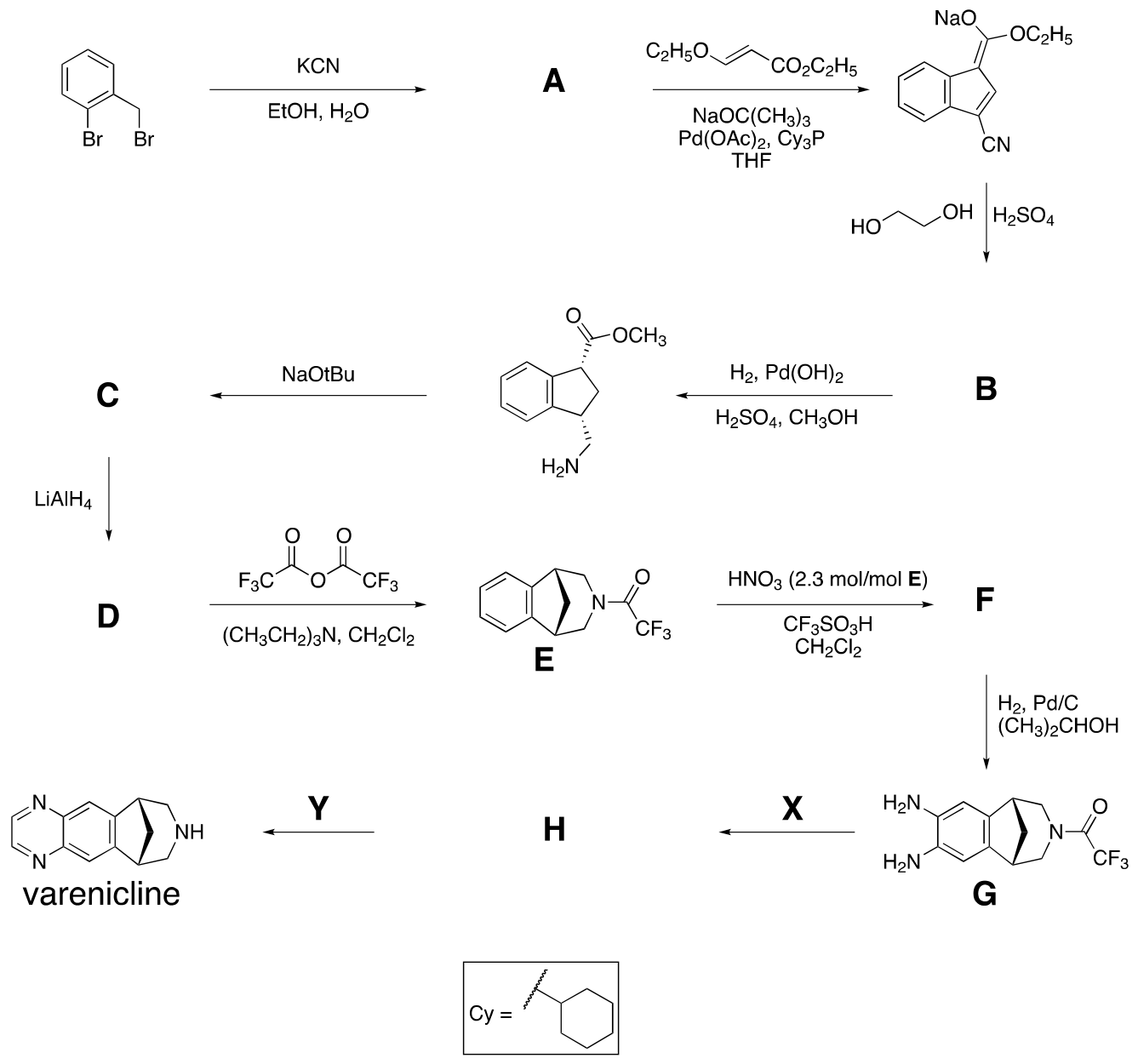
6.1 Suggest a structure for compound A.
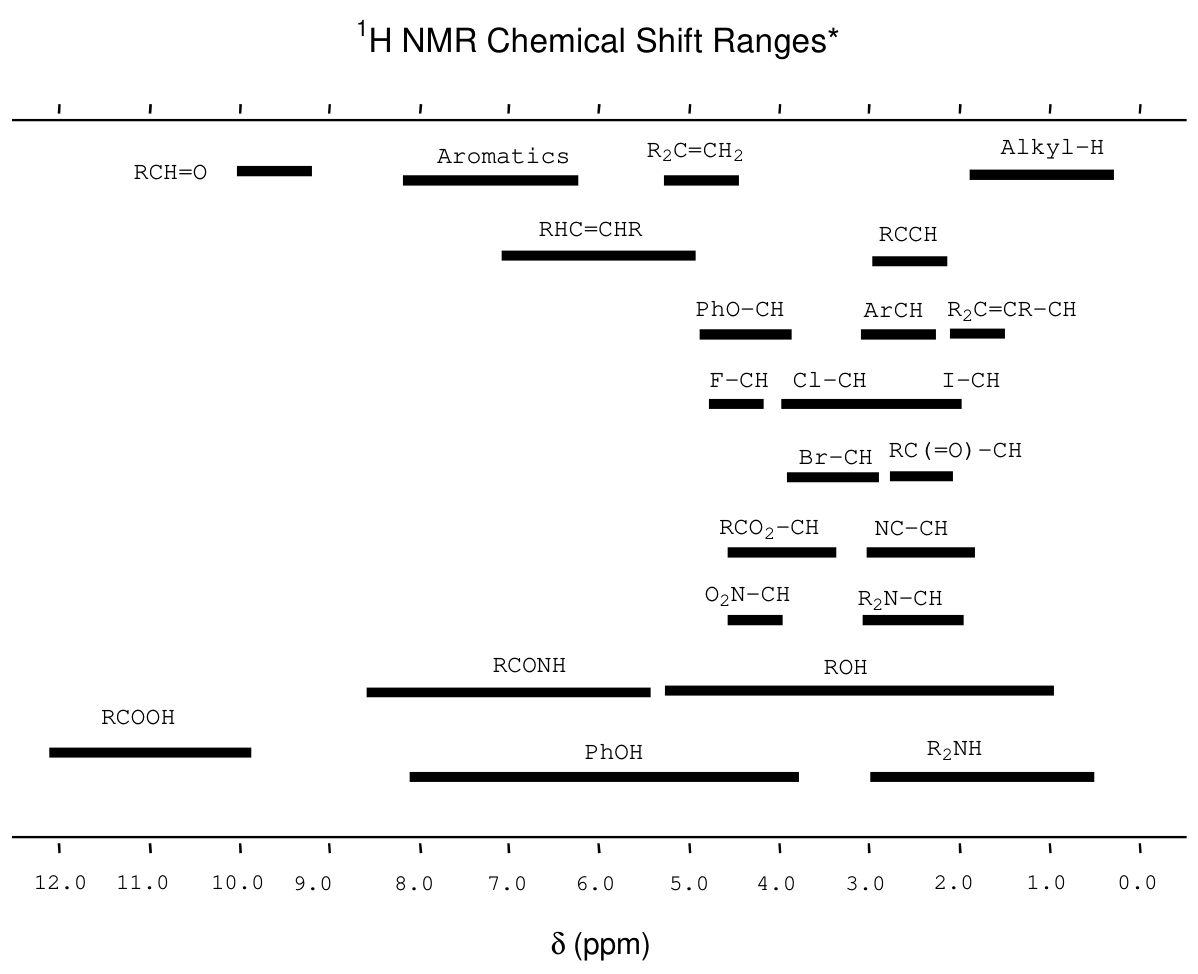
6.2 Suggest a structure for compound B consistent with the following \(\ce{^1H}\)-NMR data:
\(\delta\) 7.75 (singlet, 1H), 7.74 (doublet, 1H, \(J = 7.9\ \mathrm{Hz}\)), 7.50 (doublet, 1H, \(J = 7.1\ \mathrm{Hz}\)), 7.22 (multiplet, 2 nonequivalent H), 4.97 (triplet, 2H, \(J = 7.8\ \mathrm{Hz}\)), 4.85 (triplet, 2H, \(J = 7.8\ \mathrm{Hz}\)).
6.3 Suggest a structure for compounds C, D, and F.
6.4 Suggest reagents X and Y to convert compound G into varenicline, and provide the isolable intermediate H along this route.
Official English text of the problem.
Answers
-
6.1 — A: 2-(2-Bromophenyl)acetonitrile,
N#CCc1ccccc1Br. -
6.2 — B: 3-(1,3-Dioxolan-2-ylidene)-3H-indene-1-carbonitrile, a cyclic ketene acetal:
N#CC1=CC(=C2OCCO2)c2ccccc21. -
6.3:
- C: The bridged lactam, namely the 2-oxo derivative of D:
O=C1NC[C@H]2C[C@@H]1c1ccccc12. - D: 2,3,4,5-Tetrahydro-1H-1,5-methano-3-benzazepine:
c1ccc2c(c1)[C@H]1CNC[C@@H]2C1. -
F: 7,8-Dinitro-N-trifluoroacetyl-D, with adjacent nitro groups at the positions occupied by the amino groups in G:
O=C(C(F)(F)F)N1C[C@H]2C[C@@H](C1)c1cc([N+](=O)[O-])c([N+](=O)[O-])cc12. -
6.4:
- X: Glyoxal (ethanedial),
O=CC=O, for example aqueous glyoxal in ethanol. - H: N-Trifluoroacetylvarenicline:
O=C(C(F)(F)F)N1C[C@H]2C[C@@H](C1)c1cc3nccnc3cc12. - Y: Aqueous sodium hydroxide,
[Na+].[OH-], with warming, to hydrolyse the trifluoroacetamide and isolate varenicline as its free base.
The stereochemical SMILES specify the required cis bridge arrangement. For the chiral amino ester and C, one enantiomer is represented; the achiral synthesis gives racemic material at these stages.
Solution
The equations below describe net transformations, with neutral organic products understood to be isolated after workup. Common species appearing in the balances are water O, methanol CO, ethanol CCO, molecular hydrogen [H][H], and the proton [H+].
6.1 — Identification of A
The starting material is 1-bromo-2-(bromomethyl)benzene, BrCc1ccccc1Br.
Potassium cyanide, [K+].[C-]#N, supplies a carbon nucleophile that substitutes the benzylic bromide by an \(\mathrm{S_N2}\) reaction. The unactivated aromatic carbon–bromine bond remains available for the subsequent palladium-mediated reaction.
\[ \ce{BrC6H4CH2Br + KCN -> BrC6H4CH2CN + KBr} \]
The two substituents on the benzene ring remain ortho. Thus A is 2-(2-bromophenyl)acetonitrile, with molecular formula \(\ce{C8H6BrN}\). The salt byproduct is potassium bromide, [K+].[Br-].
6.2 — Identification of B
The intermediate drawn immediately before B is the sodium enolate of ethyl 3-cyano-1H-indene-1-carboxylate:
CCOC([O-])=C1C=C(C#N)c2ccccc21.[Na+]
Treatment with ethylene glycol (ethane-1,2-diol), OCCO, and acid incorporates both glycol oxygen atoms into a five-membered dioxolane ring. Its acetal carbon retains an exocyclic double bond to the indene skeleton, giving the cyclic ketene acetal B.
Omitting the sodium counterion, the balanced condensation is
\[ \ce{C13H10NO2^- + H+ + HOCH2CH2OH -> C13H9NO2 + C2H5OH + H2O}. \]
To sketch B precisely, draw the benzene-fused five-membered carbocycle with the sequence
\[ \ce{C(CN)=CH-C} \]
between its two benzene fusion atoms. The final carbon in this sequence has an exocyclic double bond to the carbon of a \(\ce{-O-CH2-CH2-O-}\) ring.
The NMR data account for every hydrogen:
| Observed signal | Assignment in B |
|---|---|
| \(\delta 7.75\), singlet, 1H | The five-membered ring’s vinylic \(\ce{CH}\); neither adjacent ring carbon bears hydrogen |
| \(\delta 7.74\), doublet, 1H, and \(7.50\), doublet, 1H | Two benzene-ring hydrogens, each with a dominant ortho coupling |
| \(\delta 7.22\), multiplet, 2 nonequivalent H | The remaining two benzene-ring hydrogens |
| \(\delta 4.97\) and \(4.85\), triplets, 2H each | The two distinct \(\ce{OCH2}\) groups of the dioxolane ring |
The two glycol methylene groups occupy different environments relative to the unsymmetrical indene fragment. Each couples to the two hydrogens of the neighboring methylene group, consistent with the matching \(J=7.8\ \mathrm{Hz}\) triplets.
The total integration is
\[ 1+1+1+2+2+2=9\ \text{hydrogens}, \]
consistent with \(\ce{C13H9NO2}\).
6.3 — Identification of C, D, and F
Formation of the amino ester shown before C. Acidic methanol converts B’s cyclic ketene acetal into a methyl ester. Hydrogenation reduces the remaining carbocyclic double bond and converts the nitrile into an aminomethyl group.
The displayed product is methyl cis-3-(aminomethyl)indane-1-carboxylate:
COC(=O)[C@@H]1C[C@H](CN)c2ccccc21
The net balance is
\[ \ce{C13H9NO2 + CH3OH + H2O + 3H2 -> C12H15NO2 + HOCH2CH2OH}. \]
One equivalent of hydrogen reduces the ring double bond, and two equivalents reduce the nitrile.
C: intramolecular lactam formation. The ester and aminomethyl substituents are cis, as indicated by their dashed bonds in the problem. This places them suitably for cyclization.
Sodium tert-butoxide, CC(C)(C)[O-].[Na+], promotes intramolecular aminolysis of the methyl ester. The amino nitrogen bonds to the ester carbonyl carbon, and methanol is eliminated:
\[ \ce{C12H15NO2 -> C11H11NO + CH3OH}. \]
C therefore contains a six-membered lactam ring. To draw it, retain the indane skeleton and connect its two substituted benzylic carbons through
\[ \ce{-C(=O)-NH-CH2-}. \]
The existing one-carbon bridge between those benzylic carbons remains intact. This gives the bridged lactam specified in the Answers.
D: reduction of the lactam. Lithium aluminium hydride, [Li+].[AlH4-], reduces the amide carbonyl to a methylene group while preserving the carbon–nitrogen framework:
\[ \ce{C11H11NO + 4[H] -> C11H13N + H2O}. \]
Here \([H]\) denotes a formal reducing hydrogen equivalent supplied by the reduction and workup.
Thus the bridge
\[ \ce{-C(=O)-NH-CH2-} \]
becomes
\[ \ce{-CH2-NH-CH2-}, \]
giving the secondary amine D.
F: aromatic dinitration. The next displayed compound, E, is N-trifluoroacetyl-D:
O=C(C(F)(F)F)N1C[C@H]2C[C@@H](C1)c1ccccc12
Its subsequent hydrogenation product, G, is 7,8-diamino-N-trifluoroacetyl-D:
O=C(C(F)(F)F)N1C[C@H]2C[C@@H](C1)c1cc(N)c(N)cc12
Catalytic hydrogenation converts aromatic nitro groups into amino groups. Consequently, F must contain two adjacent nitro groups at exactly the aromatic positions bearing amino groups in G: positions 7 and 8 of the benzazepine parent.
The nitration with nitric acid, O=[N+]([O-])O, has the balance
\[ \ce{C13H12F3NO + 2HNO3 -> C13H10F3N3O5 + 2H2O}. \]
The supplied \(2.3\ \mathrm{mol}\) of nitric acid per mole of E is consistent with this two-equivalent requirement.
Reduction of F then gives the depicted G:
\[ \ce{C13H10F3N3O5 + 6H2 -> C13H14F3N3O + 4H2O}. \]
For the drawing of F, retain E’s entire bridged framework and its N-trifluoroacetyl group, and place \(\ce{NO2}\) groups on the two adjacent aromatic carbons opposite the fused saturated ring.
6.4 — Reagents X and Y, and intermediate H
X: construct the quinoxaline ring with glyoxal.
G contains an ortho aromatic diamine. Each amino group condenses with one aldehyde group of glyoxal, producing two imine bonds and eliminating two water molecules:
\[ \ce{C13H14F3N3O + OHCCHO -> C15H12F3N3O + 2H2O}. \]
The two nitrogen atoms and glyoxal’s two carbon atoms complete the new six-membered aromatic ring. In a drawing, the two adjacent amino substituents become the ring path
\[ \ce{-N=CH-CH=N-}, \]
whose ends remain attached to the adjacent benzene carbons.
The bridged nitrogen retains its trifluoroacetyl protecting group, so the isolable product H is N-trifluoroacetylvarenicline.
Y: remove the trifluoroacetyl group.
Aqueous sodium hydroxide hydrolyses the activated trifluoroacetamide, restoring the secondary amine:
\[ \ce{C15H12F3N3O + NaOH -> C13H13N3 + CF3CO2Na}. \]
The coproduct is sodium trifluoroacetate, O=C([O-])C(F)(F)F.[Na+].
The resulting varenicline is
N1C[C@H]2C[C@@H](C1)c1cc3nccnc3cc12
and has molecular formula \(\ce{C13H13N3}\), consistent with the final structure in the problem.
The answers were checked against the official answers published by the organisers.
IChO 2012 · Theorieaufgabe 6
Synthese von Vareniclin
Vareniclin wurde als oral einzunehmendes Arzneimittel zur Behandlung der Nikotinabhängigkeit entwickelt und kann über den unten dargestellten Syntheseweg hergestellt werden. Alle mit einem Buchstaben (A – H) bezeichneten Verbindungen sind ungeladene, isolierbare Spezies.
6.1 Schlagen Sie eine Struktur für Verbindung A vor.
6.2 Schlagen Sie eine Struktur für Verbindung B vor, die mit den folgenden \(\ce{^1H}\)-NMR-Daten übereinstimmt:
\(\delta\) 7.75 (Singulett, 1H), 7.74 (Dublett, 1H, \(J = 7.9\ \mathrm{Hz}\)), 7.50 (Dublett, 1H, \(J = 7.1\ \mathrm{Hz}\)), 7.22 (Multiplett, 2 nicht äquivalente H), 4.97 (Triplett, 2H, \(J = 7.8\ \mathrm{Hz}\)), 4.85 (Triplett, 2H, \(J = 7.8\ \mathrm{Hz}\)).
6.3 Schlagen Sie Strukturen für die Verbindungen C, D und F vor.
6.4 Schlagen Sie Reagenzien X und Y vor, um Verbindung G in Vareniclin umzuwandeln, und geben Sie das auf diesem Syntheseweg isolierbare Zwischenprodukt H an.
Aufgabentext aus dem offiziellen englischen Text übersetzt.
Antworten
-
6.1 — A: 2-(2-Bromphenyl)acetonitril,
N#CCc1ccccc1Br. -
6.2 — B: 3-(1,3-Dioxolan-2-yliden)-3H-inden-1-carbonitril, ein cyclisches Ketenacetal:
N#CC1=CC(=C2OCCO2)c2ccccc21. -
6.3:
- C: Das verbrückte Lactam, nämlich das 2-Oxo-Derivat von D:
O=C1NC[C@H]2C[C@@H]1c1ccccc12. - D: 2,3,4,5-Tetrahydro-1H-1,5-methano-3-benzazepin:
c1ccc2c(c1)[C@H]1CNC[C@@H]2C1. -
F: 7,8-Dinitro-N-trifluoracetyl-D, mit benachbarten Nitrogruppen an den Positionen, die in G von den Aminogruppen besetzt sind:
O=C(C(F)(F)F)N1C[C@H]2C[C@@H](C1)c1cc([N+](=O)[O-])c([N+](=O)[O-])cc12. -
6.4:
- X: Glyoxal (Ethandial),
O=CC=O, beispielsweise wässriges Glyoxal in Ethanol. - H: N-Trifluoracetylvareniclin:
O=C(C(F)(F)F)N1C[C@H]2C[C@@H](C1)c1cc3nccnc3cc12. - Y: Wässrige Natriumhydroxidlösung,
[Na+].[OH-], unter Erwärmen, um das Trifluoracetamid zu hydrolysieren und Vareniclin als freie Base zu isolieren.
Die stereochemischen SMILES legen die erforderliche cis-Anordnung der Brücke fest. Für den chiralen Aminoester und C ist jeweils ein Enantiomer dargestellt; die achirale Synthese liefert auf diesen Stufen racemisches Material.
Lösung
Die folgenden Gleichungen beschreiben Nettoumwandlungen, wobei die neutralen organischen Produkte als nach der Aufarbeitung isoliert zu verstehen sind. Häufig in den Bilanzgleichungen auftretende Spezies sind Wasser O, Methanol CO, Ethanol CCO, molekularer Wasserstoff [H][H] und das Proton [H+].
6.1 — Identifizierung von A
Der Ausgangsstoff ist 1-Brom-2-(brommethyl)benzol, BrCc1ccccc1Br.
Kaliumcyanid, [K+].[C-]#N, liefert ein Kohlenstoffnukleophil, das das benzylische Bromid in einer \(\mathrm{S_N2}\)-Reaktion substituiert. Die nicht aktivierte aromatische Kohlenstoff–Brom-Bindung bleibt für die anschließende palladiumvermittelte Reaktion erhalten.
\[ \ce{BrC6H4CH2Br + KCN -> BrC6H4CH2CN + KBr} \]
Die beiden Substituenten am Benzolring bleiben in ortho-Stellung zueinander. Somit ist A 2-(2-Bromphenyl)acetonitril mit der Summenformel \(\ce{C8H6BrN}\). Das als Nebenprodukt entstehende Salz ist Kaliumbromid, [K+].[Br-].
6.2 — Identifizierung von B
Das unmittelbar vor B gezeichnete Zwischenprodukt ist das Natriumenolat von Ethyl-3-cyan-1H-inden-1-carboxylat:
CCOC([O-])=C1C=C(C#N)c2ccccc21.[Na+]
Bei der Behandlung mit Ethylenglykol (Ethan-1,2-diol), OCCO, und Säure werden beide Sauerstoffatome des Glykols in einen fünfgliedrigen Dioxolanring eingebaut. Dessen Acetalkohlenstoff behält eine exocyclische Doppelbindung zum Indengerüst, wodurch das cyclische Ketenacetal B entsteht.
Unter Weglassung des Natriumgegenions lautet die ausgeglichene Kondensationsgleichung
\[ \ce{C13H10NO2^- + H+ + HOCH2CH2OH -> C13H9NO2 + C2H5OH + H2O}. \]
Um B genau zu skizzieren, zeichnen Sie den an den Benzolring anellierten fünfgliedrigen Carbocyclus mit der Abfolge
\[ \ce{C(CN)=CH-C} \]
zwischen den beiden mit dem Benzolring gemeinsamen Atomen. Das letzte Kohlenstoffatom dieser Abfolge besitzt eine exocyclische Doppelbindung zum Kohlenstoffatom eines \(\ce{-O-CH2-CH2-O-}\)-Rings.
Die NMR-Daten erfassen sämtliche Wasserstoffatome:
| Beobachtetes Signal | Zuordnung in B |
|---|---|
| \(\delta 7.75\), Singulett, 1H | Die vinylische \(\ce{CH}\)-Gruppe des fünfgliedrigen Rings; keines der benachbarten Ringkohlenstoffatome trägt Wasserstoff |
| \(\delta 7.74\), Dublett, 1H, und \(7.50\), Dublett, 1H | Zwei Wasserstoffatome am Benzolring mit jeweils einer dominierenden ortho-Kopplung |
| \(\delta 7.22\), Multiplett, 2 nicht äquivalente H | Die übrigen beiden Wasserstoffatome am Benzolring |
| \(\delta 4.97\) und \(4.85\), Tripletts, jeweils 2H | Die beiden unterschiedlichen \(\ce{OCH2}\)-Gruppen des Dioxolanrings |
Die beiden Methylengruppen des Glykols befinden sich relativ zum unsymmetrischen Indenfragment in unterschiedlichen Umgebungen. Jede koppelt mit den beiden Wasserstoffatomen der benachbarten Methylengruppe, was mit den Tripletts mit übereinstimmendem \(J=7.8\ \mathrm{Hz}\) vereinbar ist.
Die Gesamtintegration beträgt
\[ 1+1+1+2+2+2=9\ \text{Wasserstoffatome}, \]
in Übereinstimmung mit \(\ce{C13H9NO2}\).
6.3 — Identifizierung von C, D und F
Bildung des vor C dargestellten Aminoesters. Methanol unter sauren Bedingungen wandelt das cyclische Ketenacetal von B in einen Methylester um. Durch Hydrierung wird die verbleibende carbocyclische Doppelbindung reduziert und das Nitril in eine Aminomethylgruppe umgewandelt.
Das dargestellte Produkt ist Methyl-cis-3-(aminomethyl)indan-1-carboxylat:
COC(=O)[C@@H]1C[C@H](CN)c2ccccc21
Die Nettobilanz lautet
\[ \ce{C13H9NO2 + CH3OH + H2O + 3H2 -> C12H15NO2 + HOCH2CH2OH}. \]
Ein Äquivalent Wasserstoff reduziert die Doppelbindung im Ring, und zwei Äquivalente reduzieren das Nitril.
C: intramolekulare Lactambildung. Die Ester- und Aminomethylsubstituenten stehen cis zueinander, wie durch ihre gestrichelten Bindungen in der Aufgabenstellung angegeben. Dadurch sind sie für die Cyclisierung günstig angeordnet.
Natrium-tert-butanolat, CC(C)(C)[O-].[Na+], fördert die intramolekulare Aminolyse des Methylesters. Der Aminostickstoff bindet an das Carbonylkohlenstoffatom des Esters, und Methanol wird abgespalten:
\[ \ce{C12H15NO2 -> C11H11NO + CH3OH}. \]
C enthält daher einen sechsgliedrigen Lactamring. Um ihn zu zeichnen, behalten Sie das Indangerüst bei und verbinden Sie dessen beide substituierten benzylischen Kohlenstoffatome über
\[ \ce{-C(=O)-NH-CH2-}. \]
Die bestehende Brücke aus einem Kohlenstoffatom zwischen diesen benzylischen Kohlenstoffatomen bleibt intakt. So entsteht das unter Antworten angegebene verbrückte Lactam.
D: Reduktion des Lactams. Lithiumaluminiumhydrid, [Li+].[AlH4-], reduziert die Amidcarbonylgruppe zu einer Methylengruppe, wobei das Kohlenstoff–Stickstoff-Gerüst erhalten bleibt:
\[ \ce{C11H11NO + 4[H] -> C11H13N + H2O}. \]
Hier bezeichnet \([H]\) ein formales reduzierendes Wasserstoffäquivalent, das durch die Reduktion und Aufarbeitung bereitgestellt wird.
Somit wird die Brücke
\[ \ce{-C(=O)-NH-CH2-} \]
zu
\[ \ce{-CH2-NH-CH2-}, \]
wodurch das sekundäre Amin D entsteht.
F: aromatische Dinitrierung. Die nächste dargestellte Verbindung, E, ist N-Trifluoracetyl-D:
O=C(C(F)(F)F)N1C[C@H]2C[C@@H](C1)c1ccccc12
Ihr anschließendes Hydrierungsprodukt, G, ist 7,8-Diamino-N-trifluoracetyl-D:
O=C(C(F)(F)F)N1C[C@H]2C[C@@H](C1)c1cc(N)c(N)cc12
Die katalytische Hydrierung wandelt aromatische Nitrogruppen in Aminogruppen um. Folglich muss F zwei benachbarte Nitrogruppen an genau den aromatischen Positionen enthalten, die in G Aminogruppen tragen: an den Positionen 7 und 8 des Benzazepin-Grundgerüsts.
Die Bilanz der Nitrierung mit Salpetersäure, O=[N+]([O-])O, lautet
\[ \ce{C13H12F3NO + 2HNO3 -> C13H10F3N3O5 + 2H2O}. \]
Die eingesetzten \(2.3\ \mathrm{mol}\) Salpetersäure pro Mol E sind mit diesem Bedarf von zwei Äquivalenten vereinbar.
Die Reduktion von F liefert anschließend das dargestellte G:
\[ \ce{C13H10F3N3O5 + 6H2 -> C13H14F3N3O + 4H2O}. \]
Behalten Sie beim Zeichnen von F das gesamte verbrückte Gerüst von E und dessen N-Trifluoracetylgruppe bei und setzen Sie \(\ce{NO2}\)-Gruppen an die beiden benachbarten aromatischen Kohlenstoffatome, die dem anellierten gesättigten Ring gegenüberliegen.
6.4 — Reagenzien X und Y und Zwischenprodukt H
X: Aufbau des Chinoxalinrings mit Glyoxal.
G enthält ein aromatisches ortho-Diamin. Jede Aminogruppe kondensiert mit einer Aldehydgruppe des Glyoxals, wobei zwei Iminbindungen entstehen und zwei Wassermoleküle abgespalten werden:
\[ \ce{C13H14F3N3O + OHCCHO -> C15H12F3N3O + 2H2O}. \]
Die beiden Stickstoffatome und die beiden Kohlenstoffatome des Glyoxals vervollständigen den neuen sechsgliedrigen aromatischen Ring. In einer Zeichnung werden die beiden benachbarten Aminosubstituenten zum Ringabschnitt
\[ \ce{-N=CH-CH=N-}, \]
dessen Enden an die benachbarten Kohlenstoffatome des Benzolrings gebunden bleiben.
Der Brückenstickstoff behält seine Trifluoracetylschutzgruppe, sodass das isolierbare Produkt H N-Trifluoracetylvareniclin ist.
Y: Abspaltung der Trifluoracetylgruppe.
Wässrige Natriumhydroxidlösung hydrolysiert das aktivierte Trifluoracetamid, wobei das sekundäre Amin wiederhergestellt wird:
\[ \ce{C15H12F3N3O + NaOH -> C13H13N3 + CF3CO2Na}. \]
Das Koppelprodukt ist Natriumtrifluoracetat, O=C([O-])C(F)(F)F.[Na+].
Das entstehende Vareniclin ist
N1C[C@H]2C[C@@H](C1)c1cc3nccnc3cc12
und hat die Summenformel \(\ce{C13H13N3}\), in Übereinstimmung mit der endgültigen Struktur in der Aufgabenstellung.
Die Ergebnisse wurden mit den von den Veranstaltern veröffentlichten offiziellen Ergebnissen abgeglichen.
IChO 2012 · Teori sorusu 6
Vareniklin sentezi
Vareniklin, sigara bağımlılığının ağız yoluyla tedavisi için geliştirilmiştir ve aşağıda gösterilen yolla sentezlenebilir. Bir harfle (A – H) belirtilen tüm bileşikler yüksüz, izole edilebilir türlerdir.
6.1 A bileşiği için bir yapı öneriniz.
6.2 Aşağıdaki \(\ce{^1H}\)-NMR verileriyle uyumlu olacak şekilde B bileşiği için bir yapı öneriniz:
\(\delta\) 7.75 (singlet, 1H), 7.74 (dublet, 1H, \(J = 7.9\ \mathrm{Hz}\)), 7.50 (dublet, 1H, \(J = 7.1\ \mathrm{Hz}\)), 7.22 (multiplet, eşdeğer olmayan 2 H), 4.97 (triplet, 2H, \(J = 7.8\ \mathrm{Hz}\)), 4.85 (triplet, 2H, \(J = 7.8\ \mathrm{Hz}\)).
6.3 C, D ve F bileşikleri için birer yapı öneriniz.
6.4 G bileşiğini varenikline dönüştürmek için X ve Y reaktiflerini öneriniz ve bu yolda izole edilebilir H ara ürününü belirtiniz.
Soru metni resmi İngilizce metinden çevrilmiştir.
Cevaplar
-
6.1 — A: 2-(2-Bromofenil)asetonitril,
N#CCc1ccccc1Br. -
6.2 — B: 3-(1,3-Dioksolan-2-iliden)-3H-inden-1-karbonitril, halkalı bir keten asetali:
N#CC1=CC(=C2OCCO2)c2ccccc21. -
6.3:
- C: Köprülü laktam, yani D'nin 2-okso türevi:
O=C1NC[C@H]2C[C@@H]1c1ccccc12. - D: 2,3,4,5-Tetrahidro-1H-1,5-metano-3-benzazepin:
c1ccc2c(c1)[C@H]1CNC[C@@H]2C1. -
F: G'deki amino gruplarının bulunduğu konumlarda komşu nitro grupları taşıyan 7,8-dinitro-N-trifloroasetil-D:
O=C(C(F)(F)F)N1C[C@H]2C[C@@H](C1)c1cc([N+](=O)[O-])c([N+](=O)[O-])cc12. -
6.4:
- X: Glioksal (etandial),
O=CC=O; örneğin etanol içinde sulu glioksal çözeltisi. - H: N-Trifloroasetilvareniklin:
O=C(C(F)(F)F)N1C[C@H]2C[C@@H](C1)c1cc3nccnc3cc12. - Y: Trifloroasetamidi hidroliz etmek ve vareniklini serbest baz olarak izole etmek için ısıtılarak uygulanan sulu sodyum hidroksit,
[Na+].[OH-].
Stereokimyasal SMILES gösterimleri, gerekli cis köprü düzenini belirtir. Kiral amino ester ve C için birer enantiyomer gösterilmiştir; akiral sentez, bu aşamalarda rasemik ürün verir.
Çözüm
Aşağıdaki denklemler net dönüşümleri betimler; nötr organik ürünlerin reaksiyon sonrası işlemlerden sonra izole edildiği kabul edilir. Denkleştirmelerde yer alan yaygın türler su O, metanol CO, etanol CCO, moleküler hidrojen [H][H] ve proton [H+] türleridir.
6.1 — A'nın belirlenmesi
Başlangıç maddesi 1-bromo-2-(bromometil)benzen, BrCc1ccccc1Br, bileşiğidir.
Potasyum siyanür, [K+].[C-]#N, benzilik bromürün bir \(\mathrm{S_N2}\) reaksiyonuyla yer değiştirmesini sağlayan bir karbon nükleofili sağlar. Aktifleştirilmemiş aromatik karbon–brom bağı, sonraki paladyum aracılı reaksiyonda kullanılmak üzere korunur.
\[ \ce{BrC6H4CH2Br + KCN -> BrC6H4CH2CN + KBr} \]
Benzen halkasındaki iki sübstitüent orto konumunda kalır. Dolayısıyla A, molekül formülü \(\ce{C8H6BrN}\) olan 2-(2-bromofenil)asetonitril bileşiğidir. Tuz yan ürünü potasyum bromürdür, [K+].[Br-].
6.2 — B'nin belirlenmesi
B'den hemen önce çizilen ara ürün, etil 3-siyano-1H-inden-1-karboksilatın sodyum enolatıdır:
CCOC([O-])=C1C=C(C#N)c2ccccc21.[Na+]
Etilen glikol (etan-1,2-diol), OCCO, ve asitle muamele, glikolün her iki oksijen atomunu beş üyeli bir dioksolan halkasına dahil eder. Asetal karbonu, inden iskeletine bağlı ekzosiklik bir çift bağı koruyarak halkalı keten asetali B'yi oluşturur.
Sodyum karşı iyonu gösterilmediğinde, denkleştirilmiş kondenzasyon reaksiyonu şöyledir:
\[ \ce{C13H10NO2^- + H+ + HOCH2CH2OH -> C13H9NO2 + C2H5OH + H2O}. \]
B'yi tam olarak çizmek için, benzenle kaynaşmış beş üyeli karbosiklik halkayı, benzenle ortak olan iki kaynaşma atomu arasında
\[ \ce{C(CN)=CH-C} \]
dizisi bulunacak şekilde çiziniz. Bu dizideki son karbon, bir \(\ce{-O-CH2-CH2-O-}\) halkasının karbonuna ekzosiklik bir çift bağla bağlıdır.
NMR verileri her bir hidrojeni açıklar:
| Gözlenen sinyal | B'deki ataması |
|---|---|
| \(\delta 7.75\), singlet, 1H | Beş üyeli halkanın vinilik \(\ce{CH}\) grubu; komşu halka karbonlarının hiçbiri hidrojen taşımaz |
| \(\delta 7.74\), dublet, 1H ve \(7.50\), dublet, 1H | Her biri baskın bir orto eşleşmesi gösteren iki benzen halkası hidrojeni |
| \(\delta 7.22\), multiplet, eşdeğer olmayan 2 H | Benzen halkasının kalan iki hidrojeni |
| \(\delta 4.97\) ve \(4.85\), her biri 2H olan tripletler | Dioksolan halkasının iki farklı \(\ce{OCH2}\) grubu |
Glikolün iki metilen grubu, simetrik olmayan inden parçasına göre farklı ortamlarda bulunur. Her biri komşu metilen grubunun iki hidrojeniyle eşleşir; bu durum, eşleşme sabitleri aynı olan \(J=7.8\ \mathrm{Hz}\) tripletleriyle uyumludur.
Toplam integral
\[ 1+1+1+2+2+2=9\ \text{hidrojen}, \]
olup \(\ce{C13H9NO2}\) ile uyumludur.
6.3 — C, D ve F'nin belirlenmesi
C'den önce gösterilen amino esterin oluşumu. Asidik metanol, B'nin halkalı keten asetalini bir metil estere dönüştürür. Hidrojenasyon, kalan karbosiklik çift bağı indirger ve nitrili bir aminometil grubuna dönüştürür.
Gösterilen ürün metil cis-3-(aminometil)indan-1-karboksilattır:
COC(=O)[C@@H]1C[C@H](CN)c2ccccc21
Net denkleştirilmiş reaksiyon şöyledir:
\[ \ce{C13H9NO2 + CH3OH + H2O + 3H2 -> C12H15NO2 + HOCH2CH2OH}. \]
Bir eşdeğer hidrojen halkadaki çift bağı, iki eşdeğer hidrojen ise nitrili indirger.
C: molekül içi laktam oluşumu. Ester ve aminometil sübstitüentleri, soruda kesikli çizgili bağlarla belirtildiği gibi cis konumundadır. Bu durum onları halkalaşma için uygun bir konuma getirir.
Sodyum tert-bütoksit, CC(C)(C)[O-].[Na+], metil esterin molekül içi aminolizini sağlar. Amino azotu, esterin karbonil karbonuna bağlanır ve metanol ayrılır:
\[ \ce{C12H15NO2 -> C11H11NO + CH3OH}. \]
Dolayısıyla C, altı üyeli bir laktam halkası içerir. Bunu çizmek için indan iskeletini koruyunuz ve sübstitüent taşıyan iki benzilik karbonunu
\[ \ce{-C(=O)-NH-CH2-}. \]
üzerinden birbirine bağlayınız. Bu benzilik karbonlar arasındaki mevcut tek karbonlu köprü korunur. Böylece Cevaplar bölümünde belirtilen köprülü laktam elde edilir.
D: laktamın indirgenmesi. Lityum alüminyum hidrür, [Li+].[AlH4-], karbon–azot iskeletini koruyarak amid karbonilini bir metilen grubuna indirger:
\[ \ce{C11H11NO + 4[H] -> C11H13N + H2O}. \]
Burada \([H]\), indirgeme ve reaksiyon sonrası işlemlerle sağlanan biçimsel bir indirgeyici hidrojen eşdeğerini belirtir.
Böylece
\[ \ce{-C(=O)-NH-CH2-} \]
köprüsü
\[ \ce{-CH2-NH-CH2-}, \]
köprüsüne dönüşerek sekonder amin D'yi verir.
F: aromatik dinitrolama. Gösterilen bir sonraki bileşik olan E, N-trifloroasetil-D'dir:
O=C(C(F)(F)F)N1C[C@H]2C[C@@H](C1)c1ccccc12
Bunun sonraki hidrojenasyon ürünü olan G, 7,8-diamino-N-trifloroasetil-D'dir:
O=C(C(F)(F)F)N1C[C@H]2C[C@@H](C1)c1cc(N)c(N)cc12
Katalitik hidrojenasyon, aromatik nitro gruplarını amino gruplarına dönüştürür. Dolayısıyla F, tam olarak G'de amino gruplarını taşıyan aromatik konumlarda iki komşu nitro grubu içermelidir: benzazepin ana yapısının 7 ve 8 konumları.
Nitrik asitle, O=[N+]([O-])O, gerçekleştirilen nitrolamanın denkleştirilmiş reaksiyonu şöyledir:
\[ \ce{C13H12F3NO + 2HNO3 -> C13H10F3N3O5 + 2H2O}. \]
E'nin molü başına verilen \(2.3\ \mathrm{mol}\) nitrik asit, bu iki eşdeğerlik gereksinimle uyumludur.
Ardından F'nin indirgenmesi, gösterilen G'yi verir:
\[ \ce{C13H10F3N3O5 + 6H2 -> C13H14F3N3O + 4H2O}. \]
F'yi çizmek için E'nin köprülü iskeletinin tamamını ve N-trifloroasetil grubunu koruyunuz; kaynaşmış doymuş halkanın karşı tarafındaki iki komşu aromatik karbona \(\ce{NO2}\) grupları yerleştiriniz.
6.4 — X ve Y reaktifleri ve H ara ürünü
X: glioksal ile kinoksalin halkasının oluşturulması.
G, bir orto aromatik diamin içerir. Her amino grubu, glioksalın bir aldehit grubuyla kondenzasyona girerek iki imin bağı oluşturur ve iki su molekülü ayrılır:
\[ \ce{C13H14F3N3O + OHCCHO -> C15H12F3N3O + 2H2O}. \]
İki azot atomu ve glioksalın iki karbon atomu, yeni altı üyeli aromatik halkayı tamamlar. Çizimde, iki komşu amino sübstitüenti, uçları komşu benzen karbonlarına bağlı kalacak şekilde
\[ \ce{-N=CH-CH=N-}, \]
halka yoluna dönüşür.
Köprüdeki azot, trifloroasetil koruyucu grubunu korur; dolayısıyla izole edilebilir ürün H, N-trifloroasetilvareniklindir.
Y: trifloroasetil grubunun uzaklaştırılması.
Sulu sodyum hidroksit, aktifleştirilmiş trifloroasetamidi hidroliz ederek sekonder amini yeniden oluşturur:
\[ \ce{C15H12F3N3O + NaOH -> C13H13N3 + CF3CO2Na}. \]
Birlikte oluşan ürün sodyum trifloroasetattır, O=C([O-])C(F)(F)F.[Na+].
Elde edilen vareniklin
N1C[C@H]2C[C@@H](C1)c1cc3nccnc3cc12
yapısındadır ve sorudaki son yapıyla uyumlu olarak \(\ce{C13H13N3}\) molekül formülüne sahiptir.
Sonuçlar, düzenleyicilerin yayımladığı resmi sonuçlarla karşılaştırılarak kontrol edildi.
IChO 2012 · Problema teórico 6
Síntesis de vareniclina
La vareniclina se ha desarrollado como tratamiento oral de la adicción al tabaco y puede sintetizarse mediante la ruta que se muestra a continuación. Todos los compuestos indicados con una letra (A – H) son especies sin carga que pueden aislarse.
6.1 Proponga una estructura para el compuesto A.
6.2 Proponga una estructura para el compuesto B compatible con los siguientes datos de RMN de \(\ce{^1H}\):
\(\delta\) 7.75 (singlete, 1H), 7.74 (doblete, 1H, \(J = 7.9\ \mathrm{Hz}\)), 7.50 (doblete, 1H, \(J = 7.1\ \mathrm{Hz}\)), 7.22 (multiplete, 2 H no equivalentes), 4.97 (triplete, 2H, \(J = 7.8\ \mathrm{Hz}\)), 4.85 (triplete, 2H, \(J = 7.8\ \mathrm{Hz}\)).
6.3 Proponga una estructura para los compuestos C, D y F.
6.4 Proponga los reactivos X e Y para convertir el compuesto G en vareniclina e indique el intermedio aislable H de esta ruta.
Enunciado traducido del texto oficial en inglés.
Respuestas
-
6.1 — A: 2-(2-Bromofenil)acetonitrilo,
N#CCc1ccccc1Br. -
6.2 — B: 3-(1,3-Dioxolan-2-iliden)-3H-indeno-1-carbonitrilo, un acetal de cetena cíclico:
N#CC1=CC(=C2OCCO2)c2ccccc21. -
6.3:
- C: La lactama puenteada, concretamente el derivado 2-oxo de D:
O=C1NC[C@H]2C[C@@H]1c1ccccc12. - D: 2,3,4,5-Tetrahidro-1H-1,5-metano-3-benzazepina:
c1ccc2c(c1)[C@H]1CNC[C@@H]2C1. -
F: 7,8-Dinitro-N-trifluoroacetil-D, con grupos nitro adyacentes en las posiciones ocupadas por los grupos amino en G:
O=C(C(F)(F)F)N1C[C@H]2C[C@@H](C1)c1cc([N+](=O)[O-])c([N+](=O)[O-])cc12. -
6.4:
- X: Glioxal (etanodial),
O=CC=O, por ejemplo, glioxal acuoso en etanol. - H: N-Trifluoroacetilvareniclina:
O=C(C(F)(F)F)N1C[C@H]2C[C@@H](C1)c1cc3nccnc3cc12. - Y: Hidróxido de sodio acuoso,
[Na+].[OH-], con calentamiento, para hidrolizar la trifluoroacetamida y aislar la vareniclina en forma de base libre.
Los SMILES estereoquímicos especifican la disposición cis requerida del puente. Para el aminoéster quiral y C, se representa un enantiómero; la síntesis aquiral da material racémico en estas etapas.
Solución
Las ecuaciones siguientes describen transformaciones netas; se entiende que los productos orgánicos neutros se aíslan tras el tratamiento de la mezcla de reacción. Las especies comunes que aparecen en los balances son agua O, metanol CO, etanol CCO, hidrógeno molecular [H][H] y el protón [H+].
6.1 — Identificación de A
El material de partida es 1-bromo-2-(bromometil)benceno, BrCc1ccccc1Br.
El cianuro de potasio, [K+].[C-]#N, aporta un nucleófilo carbonado que sustituye al bromuro bencílico mediante una reacción \(\mathrm{S_N2}\). El enlace carbono–bromo aromático no activado queda disponible para la posterior reacción mediada por paladio.
\[ \ce{BrC6H4CH2Br + KCN -> BrC6H4CH2CN + KBr} \]
Los dos sustituyentes del anillo bencénico permanecen en posición orto. Por tanto, A es 2-(2-bromofenil)acetonitrilo, con fórmula molecular \(\ce{C8H6BrN}\). El subproducto salino es bromuro de potasio, [K+].[Br-].
6.2 — Identificación de B
El intermedio representado inmediatamente antes de B es el enolato de sodio del 3-ciano-1H-indeno-1-carboxilato de etilo:
CCOC([O-])=C1C=C(C#N)c2ccccc21.[Na+]
El tratamiento con etilenglicol (etano-1,2-diol), OCCO, y ácido incorpora ambos átomos de oxígeno del glicol a un anillo de dioxolano de cinco miembros. Su carbono acetálico conserva un doble enlace exocíclico con el esqueleto de indeno, lo que da el acetal de cetena cíclico B.
Omitiendo el contraión sodio, la condensación ajustada es
\[ \ce{C13H10NO2^- + H+ + HOCH2CH2OH -> C13H9NO2 + C2H5OH + H2O}. \]
Para dibujar B con precisión, represente el carbociclo de cinco miembros fusionado al benceno con la secuencia
\[ \ce{C(CN)=CH-C} \]
entre sus dos átomos de fusión con el benceno. El último carbono de esta secuencia tiene un doble enlace exocíclico con el carbono de un anillo \(\ce{-O-CH2-CH2-O-}\).
Los datos de RMN permiten asignar todos los hidrógenos:
| Señal observada | Asignación en B |
|---|---|
| \(\delta 7.75\), singlete, 1H | El \(\ce{CH}\) vinílico del anillo de cinco miembros; ninguno de los carbonos adyacentes del anillo lleva hidrógeno |
| \(\delta 7.74\), doblete, 1H, y \(7.50\), doblete, 1H | Dos hidrógenos del anillo bencénico, cada uno con un acoplamiento orto dominante |
| \(\delta 7.22\), multiplete, 2 H no equivalentes | Los otros dos hidrógenos del anillo bencénico |
| \(\delta 4.97\) y \(4.85\), tripletes, 2H cada uno | Los dos grupos \(\ce{OCH2}\) distintos del anillo de dioxolano |
Los dos grupos metileno del glicol se encuentran en entornos diferentes con respecto al fragmento de indeno asimétrico. Cada uno se acopla con los dos hidrógenos del grupo metileno vecino, en concordancia con los tripletes de igual \(J=7.8\ \mathrm{Hz}\).
La integración total es
\[ 1+1+1+2+2+2=9\ \text{hidrógenos}, \]
en concordancia con \(\ce{C13H9NO2}\).
6.3 — Identificación de C, D y F
Formación del aminoéster mostrado antes de C. El metanol en medio ácido convierte el acetal de cetena cíclico de B en un éster metílico. La hidrogenación reduce el doble enlace carbocíclico restante y convierte el nitrilo en un grupo aminometilo.
El producto representado es cis-3-(aminometil)indano-1-carboxilato de metilo:
COC(=O)[C@@H]1C[C@H](CN)c2ccccc21
El balance neto es
\[ \ce{C13H9NO2 + CH3OH + H2O + 3H2 -> C12H15NO2 + HOCH2CH2OH}. \]
Un equivalente de hidrógeno reduce el doble enlace del anillo, y dos equivalentes reducen el nitrilo.
C: formación intramolecular de la lactama. Los sustituyentes éster y aminometilo son cis, como indican sus enlaces discontinuos en el enunciado. Esto los sitúa adecuadamente para la ciclación.
El terc-butóxido de sodio, CC(C)(C)[O-].[Na+], promueve la aminólisis intramolecular del éster metílico. El nitrógeno del grupo amino se enlaza con el carbono carbonílico del éster y se elimina metanol:
\[ \ce{C12H15NO2 -> C11H11NO + CH3OH}. \]
Por tanto, C contiene un anillo de lactama de seis miembros. Para dibujarlo, conserve el esqueleto de indano y conecte sus dos carbonos bencílicos sustituidos mediante
\[ \ce{-C(=O)-NH-CH2-}. \]
El puente de un carbono que ya existe entre esos carbonos bencílicos permanece intacto. Así se obtiene la lactama puenteada especificada en las Respuestas.
D: reducción de la lactama. El hidruro de litio y aluminio, [Li+].[AlH4-], reduce el carbonilo de la amida a un grupo metileno conservando el esqueleto de carbono–nitrógeno:
\[ \ce{C11H11NO + 4[H] -> C11H13N + H2O}. \]
Aquí, \([H]\) denota un equivalente formal de hidrógeno reductor aportado por la reducción y el tratamiento posterior de la mezcla de reacción.
Así, el puente
\[ \ce{-C(=O)-NH-CH2-} \]
se convierte en
\[ \ce{-CH2-NH-CH2-}, \]
lo que da la amina secundaria D.
F: dinitración aromática. El siguiente compuesto representado, E, es N-trifluoroacetil-D:
O=C(C(F)(F)F)N1C[C@H]2C[C@@H](C1)c1ccccc12
El producto de su posterior hidrogenación, G, es 7,8-diamino-N-trifluoroacetil-D:
O=C(C(F)(F)F)N1C[C@H]2C[C@@H](C1)c1cc(N)c(N)cc12
La hidrogenación catalítica convierte los grupos nitro aromáticos en grupos amino. Por consiguiente, F debe contener dos grupos nitro adyacentes exactamente en las posiciones aromáticas que llevan grupos amino en G: las posiciones 7 y 8 de la benzazepina de referencia.
La nitración con ácido nítrico, O=[N+]([O-])O, tiene el balance
\[ \ce{C13H12F3NO + 2HNO3 -> C13H10F3N3O5 + 2H2O}. \]
Los \(2.3\ \mathrm{mol}\) de ácido nítrico aportados por mol de E concuerdan con este requisito de dos equivalentes.
La reducción de F da entonces el compuesto G representado:
\[ \ce{C13H10F3N3O5 + 6H2 -> C13H14F3N3O + 4H2O}. \]
Para dibujar F, conserve todo el esqueleto puenteado de E y su grupo N-trifluoroacetilo, y coloque grupos \(\ce{NO2}\) en los dos carbonos aromáticos adyacentes opuestos al anillo saturado fusionado.
6.4 — Reactivos X e Y e intermedio H
X: construcción del anillo de quinoxalina con glioxal.
G contiene una diamina aromática orto. Cada grupo amino se condensa con un grupo aldehído del glioxal, formando dos enlaces imina y eliminando dos moléculas de agua:
\[ \ce{C13H14F3N3O + OHCCHO -> C15H12F3N3O + 2H2O}. \]
Los dos átomos de nitrógeno y los dos átomos de carbono del glioxal completan el nuevo anillo aromático de seis miembros. En un dibujo, los dos sustituyentes amino adyacentes se convierten en el segmento del anillo
\[ \ce{-N=CH-CH=N-}, \]
cuyos extremos permanecen unidos a los carbonos adyacentes del benceno.
El nitrógeno del puente conserva su grupo protector trifluoroacetilo, por lo que el producto aislable H es N-trifluoroacetilvareniclina.
Y: eliminación del grupo trifluoroacetilo.
El hidróxido de sodio acuoso hidroliza la trifluoroacetamida activada y regenera la amina secundaria:
\[ \ce{C15H12F3N3O + NaOH -> C13H13N3 + CF3CO2Na}. \]
El coproducto es trifluoroacetato de sodio, O=C([O-])C(F)(F)F.[Na+].
La vareniclina resultante es
N1C[C@H]2C[C@@H](C1)c1cc3nccnc3cc12
y tiene la fórmula molecular \(\ce{C13H13N3}\), en concordancia con la estructura final del enunciado.
Los resultados se comprobaron con los resultados oficiales publicados por los organizadores.
IChO 2012 · 理论题 6
伐尼克兰的合成
伐尼克兰已被开发为治疗烟草成瘾的口服药物,可通过下图所示路线合成。所有用字母(A – H)标示的化合物均为不带电荷、可分离的物种。
6.1 推测化合物 A 的结构。
6.2 推测与下列 \(\ce{^1H}\)-NMR 数据相符的化合物 B 的结构:
\(\delta\) 7.75(单峰,1H),7.74(双重峰,1H,\(J = 7.9\ \mathrm{Hz}\)),7.50(双重峰,1H,\(J = 7.1\ \mathrm{Hz}\)),7.22(多重峰,2 个不等价的 H),4.97(三重峰,2H,\(J = 7.8\ \mathrm{Hz}\)),4.85(三重峰,2H,\(J = 7.8\ \mathrm{Hz}\))。
6.3 推测化合物 C、D 和 F 的结构。
6.4 提出将化合物 G 转化为伐尼克兰所需的试剂 X 和 Y,并给出该路线中可分离的中间体 H。
题目译自官方英文原文。
答案
-
6.1 — A: 2-(2-溴苯基)乙腈,
N#CCc1ccccc1Br。 -
6.2 — B: 3-(1,3-二氧戊环-2-亚基)-3H-茚-1-甲腈,一种环状烯酮缩醛:
N#CC1=CC(=C2OCCO2)c2ccccc21。 -
6.3:
- C: 桥环内酰胺,即 D 的 2-氧代衍生物:
O=C1NC[C@H]2C[C@@H]1c1ccccc12。 - D: 2,3,4,5-四氢-1H-1,5-亚甲基-3-苯并氮杂䓬:
c1ccc2c(c1)[C@H]1CNC[C@@H]2C1。 -
F: 7,8-二硝基-N-三氟乙酰基-D,相邻的两个硝基位于 G 中氨基所占据的位置:
O=C(C(F)(F)F)N1C[C@H]2C[C@@H](C1)c1cc([N+](=O)[O-])c([N+](=O)[O-])cc12。 -
6.4:
- X: 乙二醛,
O=CC=O,例如在乙醇中使用乙二醛水溶液。 - H: N-三氟乙酰基伐尼克兰:
O=C(C(F)(F)F)N1C[C@H]2C[C@@H](C1)c1cc3nccnc3cc12。 - Y: 氢氧化钠水溶液,
[Na+].[OH-],温热以水解三氟乙酰胺,并以游离碱形式分离伐尼克兰。
这些立体化学 SMILES 指定了所需的顺式桥连构型。对于手性氨基酯和 C,所表示的是其中一个对映异构体;该非手性合成在这些阶段得到的是外消旋产物。
解答
下列方程式描述的是净转化,其中的中性有机产物均理解为经后处理后分离得到的产物。配平式中出现的常见物种有水 O、甲醇 CO、乙醇 CCO、氢分子 [H][H] 和质子 [H+]。
6.1 — A 的鉴定
起始原料为 1-溴-2-(溴甲基)苯,BrCc1ccccc1Br。
氰化钾 [K+].[C-]#N 提供碳亲核试剂,通过 \(\mathrm{S_N2}\) 反应取代苄位的溴。未经活化的芳香碳–溴键保留下来,可供后续钯介导的反应使用。
\[ \ce{BrC6H4CH2Br + KCN -> BrC6H4CH2CN + KBr} \]
苯环上的两个取代基仍处于邻位。因此,A 是 2-(2-溴苯基)乙腈,分子式为 \(\ce{C8H6BrN}\)。盐类副产物为溴化钾,[K+].[Br-]。
6.2 — B 的鉴定
图中紧接在 B 之前的中间体是 3-氰基-1H-茚-1-甲酸乙酯的烯醇钠盐:
CCOC([O-])=C1C=C(C#N)c2ccccc21.[Na+]
用乙二醇(1,2-乙二醇) OCCO 和酸处理,使乙二醇的两个氧原子都并入一个五元二氧戊环中。其缩醛碳保留了与茚骨架相连的环外双键,生成环状烯酮缩醛 B。
省略钠抗衡离子后,配平的缩合反应式为
\[ \ce{C13H10NO2^- + H+ + HOCH2CH2OH -> C13H9NO2 + C2H5OH + H2O}. \]
要准确画出 B,应画出与苯环稠合的五元碳环,其两个与苯环共用的稠合原子之间的原子连接顺序为
\[ \ce{C(CN)=CH-C} \]
该序列中的最后一个碳通过环外双键与 \(\ce{-O-CH2-CH2-O-}\) 环的缩醛碳相连。
NMR 数据可以归属全部氢原子:
| 观测到的信号 | 在 B 中的归属 |
|---|---|
| \(\delta 7.75\),单峰,1H | 五元环中的烯属 \(\ce{CH}\);相邻的两个环碳原子均不带氢 |
| \(\delta 7.74\),双重峰,1H,以及 \(7.50\),双重峰,1H | 两个苯环氢,各自均以邻位偶合为主 |
| \(\delta 7.22\),多重峰,2 个不等价的 H | 其余两个苯环氢 |
| \(\delta 4.97\) 和 \(4.85\),三重峰,各为 2H | 二氧戊环中两个不同的 \(\ce{OCH2}\) 基团 |
相对于不对称的茚片段,来自乙二醇的两个亚甲基所处的环境不同。每个亚甲基均与相邻亚甲基上的两个氢偶合,这与偶合常数均为 \(J=7.8\ \mathrm{Hz}\) 的两个三重峰相符。
总积分为
\[ 1+1+1+2+2+2=9\ \text{个氢原子}, \]
与 \(\ce{C13H9NO2}\) 相符。
6.3 — C、D 和 F 的鉴定
C 之前所示氨基酯的形成。 酸性甲醇将 B 的环状烯酮缩醛转化为甲酯。氢化反应还原剩余的碳环双键,并将腈基转化为氨甲基。
图示产物为顺式-3-(氨甲基)茚满-1-甲酸甲酯:
COC(=O)[C@@H]1C[C@H](CN)c2ccccc21
净反应的配平式为
\[ \ce{C13H9NO2 + CH3OH + H2O + 3H2 -> C12H15NO2 + HOCH2CH2OH}. \]
一当量氢用于还原环内双键,两当量氢用于还原腈基。
C:分子内成环生成内酰胺。 酯基和氨甲基取代基为顺式关系,如题目中它们的虚线键所示。这使它们处于适宜环化的位置。
叔丁醇钠 CC(C)(C)[O-].[Na+] 促进甲酯的分子内氨解。氨基氮与酯羰基碳成键,并脱去甲醇:
\[ \ce{C12H15NO2 -> C11H11NO + CH3OH}. \]
因此,C 含有一个六元内酰胺环。画出其结构时,保留茚满骨架,并通过以下片段连接两个带有取代基的苄位碳:
\[ \ce{-C(=O)-NH-CH2-}. \]
这些苄位碳之间原有的单碳桥保持完整。由此得到答案中指定的桥环内酰胺。
D:内酰胺的还原。 氢化铝锂 [Li+].[AlH4-] 将酰胺羰基还原为亚甲基,同时保留碳–氮骨架:
\[ \ce{C11H11NO + 4[H] -> C11H13N + H2O}. \]
这里,\([H]\) 表示还原反应及后处理所提供的形式上的还原性氢当量。
因此,桥连片段
\[ \ce{-C(=O)-NH-CH2-} \]
变为
\[ \ce{-CH2-NH-CH2-}, \]
得到仲胺 D。
F:芳环的二硝化。 图中接下来所示的化合物 E 为 N-三氟乙酰基-D:
O=C(C(F)(F)F)N1C[C@H]2C[C@@H](C1)c1ccccc12
其后续氢化产物 G 为 7,8-二氨基-N-三氟乙酰基-D:
O=C(C(F)(F)F)N1C[C@H]2C[C@@H](C1)c1cc(N)c(N)cc12
催化氢化将芳环上的硝基转化为氨基。因此,F 必须在 G 中带有氨基的那两个芳环位置上含有两个相邻的硝基,即苯并氮杂䓬母体的 7 位和 8 位。
用硝酸 O=[N+]([O-])O 进行硝化的配平式为
\[ \ce{C13H12F3NO + 2HNO3 -> C13H10F3N3O5 + 2H2O}. \]
题目给出的每摩尔 E 使用 \(2.3\ \mathrm{mol}\) 硝酸,与这一两当量的需求相符。
随后还原 F,得到图示的 G:
\[ \ce{C13H10F3N3O5 + 6H2 -> C13H14F3N3O + 4H2O}. \]
画出 F 的结构时,保留 E 的整个桥环骨架及其 N-三氟乙酰基,并在与稠合饱和环相对的两个相邻芳环碳上各接一个 \(\ce{NO2}\) 基团。
6.4 — 试剂 X 和 Y,以及中间体 H
X:用乙二醛构建喹喔啉环。
G 含有一个芳香邻二胺结构单元。每个氨基与乙二醛的一个醛基缩合,形成两个亚胺键并脱去两个水分子:
\[ \ce{C13H14F3N3O + OHCCHO -> C15H12F3N3O + 2H2O}. \]
两个氮原子和乙二醛的两个碳原子共同构成新的六元芳香环。在结构图中,两个相邻的氨基取代基变为以下环内连接片段:
\[ \ce{-N=CH-CH=N-}, \]
其两端仍分别与相邻的苯环碳原子相连。
桥上的氮原子保留其三氟乙酰基保护基,因此可分离的产物 H 是 N-三氟乙酰基伐尼克兰。
Y:脱除三氟乙酰基。
氢氧化钠水溶液使活化的三氟乙酰胺水解,恢复仲胺:
\[ \ce{C15H12F3N3O + NaOH -> C13H13N3 + CF3CO2Na}. \]
另一产物为三氟乙酸钠,O=C([O-])C(F)(F)F.[Na+]。
所得伐尼克兰为
N1C[C@H]2C[C@@H](C1)c1cc3nccnc3cc12
其分子式为 \(\ce{C13H13N3}\),与题目中的最终结构相符。
结果已与主办方公布的官方答案核对。
IChO 2012 · Теоретическая задача 6
Синтез варениклина
Варениклин разработан как препарат для приёма внутрь для лечения никотиновой зависимости; его можно синтезировать по приведённой ниже схеме. Все соединения, обозначенные буквами (A – H), являются незаряженными веществами, которые можно выделить в индивидуальном виде.
6.1 Предложите структуру соединения A.
6.2 Предложите структуру соединения B, согласующуюся со следующими данными ЯМР \(\ce{^1H}\):
\(\delta\) 7.75 (синглет, 1H), 7.74 (дублет, 1H, \(J = 7.9\ \mathrm{Hz}\)), 7.50 (дублет, 1H, \(J = 7.1\ \mathrm{Hz}\)), 7.22 (мультиплет, 2 неэквивалентных H), 4.97 (триплет, 2H, \(J = 7.8\ \mathrm{Hz}\)), 4.85 (триплет, 2H, \(J = 7.8\ \mathrm{Hz}\)).
6.3 Предложите структуры соединений C, D и F.
6.4 Предложите реагенты X и Y для превращения соединения G в варениклин и укажите промежуточное соединение H, которое можно выделить в ходе этого превращения.
Условие переведено с официального английского текста.
Ответы
-
6.1 — A: 2-(2-Бромфенил)ацетонитрил,
N#CCc1ccccc1Br. -
6.2 — B: 3-(1,3-Диоксолан-2-илиден)-3H-инден-1-карбонитрил, циклический кетенацеталь:
N#CC1=CC(=C2OCCO2)c2ccccc21. -
6.3:
- C: Мостиковый лактам, а именно 2-оксопроизводное D:
O=C1NC[C@H]2C[C@@H]1c1ccccc12. - D: 2,3,4,5-Тетрагидро-1H-1,5-метано-3-бензазепин:
c1ccc2c(c1)[C@H]1CNC[C@@H]2C1. -
F: 7,8-Динитро-N-трифторацетил-D, с соседними нитрогруппами в положениях, занимаемых аминогруппами в G:
O=C(C(F)(F)F)N1C[C@H]2C[C@@H](C1)c1cc([N+](=O)[O-])c([N+](=O)[O-])cc12. -
6.4:
- X: Глиоксаль (этандиаль),
O=CC=O, например водный раствор глиоксаля в этаноле. - H: N-Трифторацетилварениклин:
O=C(C(F)(F)F)N1C[C@H]2C[C@@H](C1)c1cc3nccnc3cc12. - Y: Водный раствор гидроксида натрия,
[Na+].[OH-], при нагревании, для гидролиза трифторацетамида и выделения варениклина в виде свободного основания.
Стереохимические SMILES задают требуемое цис-расположение мостиков. Для хирального аминоэфира и C изображён один энантиомер; при ахиральном синтезе на этих стадиях образуются рацемические вещества.
Решение
Приведённые ниже уравнения описывают суммарные превращения; подразумевается, что нейтральные органические продукты выделяют после обработки реакционной смеси. В уравнениях материального баланса встречаются следующие распространённые частицы и вещества: вода O, метанол CO, этанол CCO, молекулярный водород [H][H] и протон [H+].
6.1 — Определение структуры A
Исходное вещество — 1-бром-2-(бромметил)бензол, BrCc1ccccc1Br.
Цианид калия, [K+].[C-]#N, служит источником углеродного нуклеофила, который замещает атом брома в бензильном положении по механизму \(\mathrm{S_N2}\). Неактивированная связь ароматического атома углерода с бромом сохраняется для последующей реакции с участием палладия.
\[ \ce{BrC6H4CH2Br + KCN -> BrC6H4CH2CN + KBr} \]
Два заместителя в бензольном кольце остаются в орто-положениях друг относительно друга. Таким образом, A — 2-(2-бромфенил)ацетонитрил с молекулярной формулой \(\ce{C8H6BrN}\). Побочный солевой продукт — бромид калия, [K+].[Br-].
6.2 — Определение структуры B
Промежуточное соединение, изображённое непосредственно перед B, — енолят натрия, образованный из этил-3-циано-1H-инден-1-карбоксилата:
CCOC([O-])=C1C=C(C#N)c2ccccc21.[Na+]
При обработке этиленгликолем (этан-1,2-диолом), OCCO, и кислотой оба атома кислорода гликоля включаются в пятичленное диоксолановое кольцо. Его ацетальный атом углерода сохраняет экзоциклическую двойную связь с инденовым скелетом, в результате чего образуется циклический кетенацеталь B.
Если опустить противоион натрия, уравнение конденсации с расставленными коэффициентами имеет вид
\[ \ce{C13H10NO2^- + H+ + HOCH2CH2OH -> C13H9NO2 + C2H5OH + H2O}. \]
Чтобы точно изобразить B, нарисуйте пятичленный карбоцикл, конденсированный с бензольным кольцом, с последовательностью
\[ \ce{C(CN)=CH-C} \]
между двумя его атомами, общими с бензольным кольцом. Последний атом углерода в этой последовательности соединён экзоциклической двойной связью с атомом углерода кольца \(\ce{-O-CH2-CH2-O-}\).
Данные ЯМР позволяют отнести каждый атом водорода:
| Наблюдаемый сигнал | Отнесение в B |
|---|---|
| \(\delta 7.75\), синглет, 1H | Винильная группа \(\ce{CH}\) пятичленного кольца; ни один из соседних атомов углерода кольца не несёт атома водорода |
| \(\delta 7.74\), дублет, 1H, и \(7.50\), дублет, 1H | Два атома водорода бензольного кольца, для каждого из которых преобладает орто-спин-спиновое взаимодействие |
| \(\delta 7.22\), мультиплет, 2 неэквивалентных H | Два оставшихся атома водорода бензольного кольца |
| \(\delta 4.97\) и \(4.85\), триплеты, по 2H | Две различные группы \(\ce{OCH2}\) диоксоланового кольца |
Две метиленовые группы гликоля находятся в разном окружении относительно несимметричного инденового фрагмента. Каждая из них испытывает спин-спиновое взаимодействие с двумя атомами водорода соседней метиленовой группы, что согласуется с триплетами с одинаковой константой \(J=7.8\ \mathrm{Hz}\).
Суммарная интегральная интенсивность соответствует
\[ 1+1+1+2+2+2=9\ \text{атомам водорода}, \]
что согласуется с формулой \(\ce{C13H9NO2}\).
6.3 — Определение структур C, D и F
Образование аминоэфира, изображённого перед C. Метанол в кислой среде превращает циклический кетенацеталь B в метиловый эфир. При гидрировании восстанавливается оставшаяся двойная связь карбоцикла, а нитрильная группа превращается в аминометильную.
Изображённый продукт — метил-цис-3-(аминометил)индан-1-карбоксилат:
COC(=O)[C@@H]1C[C@H](CN)c2ccccc21
Суммарное уравнение имеет вид
\[ \ce{C13H9NO2 + CH3OH + H2O + 3H2 -> C12H15NO2 + HOCH2CH2OH}. \]
Один эквивалент водорода расходуется на восстановление двойной связи кольца, а два эквивалента — на восстановление нитрильной группы.
C: внутримолекулярное образование лактама. Сложноэфирный и аминометильный заместители находятся в цис-положении, что обозначено штриховыми связями в условии задачи. Такое расположение благоприятно для циклизации.
Трет-бутоксид натрия, CC(C)(C)[O-].[Na+], способствует внутримолекулярному аминолизу метилового эфира. Атом азота аминогруппы образует связь с карбонильным атомом углерода сложноэфирной группы, при этом отщепляется метанол:
\[ \ce{C12H15NO2 -> C11H11NO + CH3OH}. \]
Следовательно, C содержит шестичленное лактамное кольцо. Чтобы изобразить его, сохраните индановый скелет и соедините два его замещённых бензильных атома углерода фрагментом
\[ \ce{-C(=O)-NH-CH2-}. \]
Имеющийся одноуглеродный мостик между этими бензильными атомами углерода сохраняется. Так получается мостиковый лактам, указанный в разделе «Ответы».
D: восстановление лактама. Алюмогидрид лития, [Li+].[AlH4-], восстанавливает амидную карбонильную группу до метиленовой группы с сохранением углерод-азотного скелета:
\[ \ce{C11H11NO + 4[H] -> C11H13N + H2O}. \]
Здесь \([H]\) обозначает формальный восстановительный эквивалент водорода, поступающий при восстановлении и последующей обработке реакционной смеси.
Таким образом, мостик
\[ \ce{-C(=O)-NH-CH2-} \]
превращается в
\[ \ce{-CH2-NH-CH2-}, \]
в результате чего образуется вторичный амин D.
F: динитрование ароматического кольца. Следующее изображённое соединение, E, — N-трифторацетил-D:
O=C(C(F)(F)F)N1C[C@H]2C[C@@H](C1)c1ccccc12
Продукт его последующего гидрирования, G, — 7,8-диамино-N-трифторацетил-D:
O=C(C(F)(F)F)N1C[C@H]2C[C@@H](C1)c1cc(N)c(N)cc12
Каталитическое гидрирование превращает ароматические нитрогруппы в аминогруппы. Следовательно, F должно содержать две соседние нитрогруппы именно в тех положениях ароматического кольца, которые в G заняты аминогруппами: в положениях 7 и 8 бензазепиновой основы.
Нитрование азотной кислотой, O=[N+]([O-])O, описывается уравнением
\[ \ce{C13H12F3NO + 2HNO3 -> C13H10F3N3O5 + 2H2O}. \]
Указанное количество азотной кислоты, \(2.3\ \mathrm{mol}\) на моль E, согласуется с необходимостью использования двух эквивалентов.
При последующем восстановлении F образуется изображённое соединение G:
\[ \ce{C13H10F3N3O5 + 6H2 -> C13H14F3N3O + 4H2O}. \]
Чтобы изобразить F, сохраните весь мостиковый скелет E и его N-трифторацетильную группу, а группы \(\ce{NO2}\) разместите у двух соседних ароматических атомов углерода напротив конденсированного насыщенного кольца.
6.4 — Реагенты X и Y и промежуточное соединение H
X: построение хиноксалинового кольца с помощью глиоксаля.
G содержит ароматический орто-диаминный фрагмент. Каждая аминогруппа конденсируется с одной альдегидной группой глиоксаля с образованием двух иминных связей и отщеплением двух молекул воды:
\[ \ce{C13H14F3N3O + OHCCHO -> C15H12F3N3O + 2H2O}. \]
Два атома азота и два атома углерода глиоксаля достраивают новое шестичленное ароматическое кольцо. На рисунке два соседних аминозаместителя превращаются во фрагмент кольца
\[ \ce{-N=CH-CH=N-}, \]
концы которого остаются связанными с соседними атомами углерода бензольного кольца.
Атом азота в мостике сохраняет трифторацетильную защитную группу, поэтому выделяемый продукт H — N-трифторацетилварениклин.
Y: удаление трифторацетильной группы.
Водный раствор гидроксида натрия гидролизует активированную трифторацетамидную группу, регенерируя вторичный амин:
\[ \ce{C15H12F3N3O + NaOH -> C13H13N3 + CF3CO2Na}. \]
Сопутствующий продукт — трифторацетат натрия, O=C([O-])C(F)(F)F.[Na+].
Образующийся варениклин имеет структуру
N1C[C@H]2C[C@@H](C1)c1cc3nccnc3cc12
и молекулярную формулу \(\ce{C13H13N3}\), что согласуется с конечной структурой в условии задачи.
Ответы проверены по официальным ответам, опубликованным организаторами.
IChO 2012 · مسألة نظرية 6
اصطناع الفارينيكلين
طُوِّر الفارينيكلين علاجًا يُؤخذ عن طريق الفم لإدمان التدخين، ويمكن اصطناعه باتباع المسار الموضح أدناه. جميع المركبات المشار إليها بحرف (A – H) أنواع كيميائية غير مشحونة وقابلة للعزل.
6.1 اقترح بنية للمركب A.
6.2 اقترح بنية للمركب B تتفق مع بيانات طيف الرنين المغناطيسي النووي لـ \(\ce{^1H}\) الآتية:
\(\delta\) 7.75 (إشارة مفردة، 1H)، 7.74 (إشارة مزدوجة، 1H، \(J = 7.9\ \mathrm{Hz}\))، 7.50 (إشارة مزدوجة، 1H، \(J = 7.1\ \mathrm{Hz}\))، 7.22 (إشارة متعددة، 2 H غير متكافئتين)، 4.97 (إشارة ثلاثية، 2H، \(J = 7.8\ \mathrm{Hz}\))، 4.85 (إشارة ثلاثية، 2H، \(J = 7.8\ \mathrm{Hz}\)).
6.3 اقترح بنية لكل من المركبات C وD وF.
6.4 اقترح الكاشفين X وY لتحويل المركب G إلى الفارينيكلين، وحدد المركب الوسيط القابل للعزل H في هذا المسار.
نص المسألة مترجم عن النص الإنجليزي الرسمي.
الإجابات
-
6.1 — A: 2-(2-بروموفينيل)أسيتونيتريل،
N#CCc1ccccc1Br. -
6.2 — B: 3-(1,3-ديوكسولان-2-يليدين)-3H-إندين-1-كربونيتريل، وهو أسيتال كيتين حلقي:
N#CC1=CC(=C2OCCO2)c2ccccc21. -
6.3:
- C: اللاكتام الجسري، أي مشتق 2-أوكسو للمركب D:
O=C1NC[C@H]2C[C@@H]1c1ccccc12. - D: 2,3,4,5-رباعي هيدرو-1H-1,5-ميثانو-3-بنزازيبين:
c1ccc2c(c1)[C@H]1CNC[C@@H]2C1. -
F: 7,8-ثنائي نيترو-N-ثلاثي فلوروأسيتيل-D، وتوجد فيه مجموعتا نيترو متجاورتان في الموضعين اللذين تشغلهما مجموعتا الأمينو في G:
O=C(C(F)(F)F)N1C[C@H]2C[C@@H](C1)c1cc([N+](=O)[O-])c([N+](=O)[O-])cc12. -
6.4:
- X: الغليوكسال (الإيثانديال)،
O=CC=O، مثل محلول الغليوكسال المائي في الإيثانول. - H: N-ثلاثي فلوروأسيتيل فارينيكلين:
O=C(C(F)(F)F)N1C[C@H]2C[C@@H](C1)c1cc3nccnc3cc12. - Y: محلول هيدروكسيد الصوديوم المائي،
[Na+].[OH-]، مع التسخين المعتدل، لحلمهة ثلاثي فلوروأسيتاميد وعزل الفارينيكلين في صورة القاعدة الحرة.
تحدد صيغ SMILES الكيميائية الفراغية الترتيب المقرون المطلوب للجسر. وبالنسبة إلى الإستر الأميني الكيرالي والمركب C، يُمثَّل أحد المتماكبين المرآتيين؛ ويعطي الاصطناع غير الكيرالي مادة راسيمية في هذه المراحل.
الحل
تصف المعادلات أدناه التحولات الصافية، على أن يُفهم أن النواتج العضوية المتعادلة تُعزل بعد المعالجة النهائية لمزيج التفاعل. ومن الأنواع الكيميائية الشائعة الواردة في موازين التفاعل الماء O، والميثانول CO، والإيثانول CCO، والهيدروجين الجزيئي [H][H]، والبروتون [H+].
6.1 — تحديد هوية A
المادة الابتدائية هي 1-برومو-2-(بروموميثيل)بنزين، BrCc1ccccc1Br.
يوفر سيانيد البوتاسيوم، [K+].[C-]#N، كاشفًا محبًا للنواة يكون مركزه الكربون، ويحل محل البروميد البنزيلي بتفاعل \(\mathrm{S_N2}\). وتبقى رابطة الكربون العطري–البروم غير المنشَّطة متاحة للتفاعل اللاحق بوساطة البلاديوم.
\[ \ce{BrC6H4CH2Br + KCN -> BrC6H4CH2CN + KBr} \]
تبقى المجموعتان المستبدلتان على حلقة البنزين في وضع أورثو. ومن ثم فإن A هو 2-(2-بروموفينيل)أسيتونيتريل، وصيغته الجزيئية \(\ce{C8H6BrN}\). والناتج الجانبي الملحي هو بروميد البوتاسيوم، [K+].[Br-].
6.2 — تحديد هوية B
المركب الوسيط المرسوم قبل B مباشرةً هو إينولات الصوديوم لـ 3-سيانو-1H-إندين-1-كربوكسيلات الإيثيل:
CCOC([O-])=C1C=C(C#N)c2ccccc21.[Na+]
تؤدي المعالجة بـ الإيثيلين غليكول (إيثان-1,2-ديول)، OCCO، وبحمض إلى إدماج ذرتي أكسجين الغليكول في حلقة ديوكسولان خماسية الأعضاء. وتحتفظ ذرة كربون الأسيتال فيها بـ رابطة مزدوجة خارج الحلقة تصلها بهيكل الإندين، مما يعطي أسيتال الكيتين الحلقي B.
عند إغفال أيون الصوديوم المقابل، تكون معادلة التكاثف الموزونة
\[ \ce{C13H10NO2^- + H+ + HOCH2CH2OH -> C13H9NO2 + C2H5OH + H2O}. \]
لرسم B بدقة، ارسم الحلقة الكربونية الخماسية المندمجة مع البنزين بحيث يكون التسلسل
\[ \ce{C(CN)=CH-C} \]
بين ذرتيها المشتركتين مع حلقة البنزين عند الاندماج. وترتبط ذرة الكربون الأخيرة في هذا التسلسل برابطة مزدوجة خارج الحلقة بذرة الكربون في حلقة \(\ce{-O-CH2-CH2-O-}\).
تفسر بيانات الرنين المغناطيسي النووي جميع ذرات الهيدروجين:
| الإشارة المرصودة | تعيينها في B |
|---|---|
| \(\delta 7.75\)، إشارة مفردة، 1H | مجموعة \(\ce{CH}\) الفينيلية في الحلقة الخماسية؛ لا تحمل أيٌّ من ذرتي كربون الحلقة المجاورتين لها هيدروجينًا |
| \(\delta 7.74\)، إشارة مزدوجة، 1H، و\(7.50\)، إشارة مزدوجة، 1H | ذرتا هيدروجين على حلقة البنزين، لكل منهما اقتران أورثو سائد |
| \(\delta 7.22\)، إشارة متعددة، 2 H غير متكافئتين | ذرتا الهيدروجين المتبقيتان على حلقة البنزين |
| \(\delta 4.97\) و\(4.85\)، إشارتان ثلاثيتان، 2H لكل منهما | مجموعتا \(\ce{OCH2}\) المتميزتان في حلقة الديوكسولان |
تشغل مجموعتا الميثيلين المشتقتان من الغليكول بيئتين مختلفتين بالنسبة إلى جزء الإندين غير المتناظر. وتقترن كل منهما بذرتي هيدروجين مجموعة الميثيلين المجاورة، بما يتفق مع الإشارتين الثلاثيتين ذواتي ثابت الاقتران المتطابق \(J=7.8\ \mathrm{Hz}\).
مجموع التكامل هو
\[ 1+1+1+2+2+2=9\ \text{ذرات هيدروجين}, \]
وهو ما يتفق مع \(\ce{C13H9NO2}\).
6.3 — تحديد هوية C وD وF
تكوُّن الإستر الأميني الموضح قبل C. يحوّل الميثانول في وسط حمضي أسيتال الكيتين الحلقي في B إلى إستر ميثيلي. وتختزل الهدرجة الرابطة المزدوجة المتبقية في الحلقة الكربونية، وتحوّل مجموعة النتريل إلى مجموعة أمينوميثيل.
الناتج الموضح هو مقرون-3-(أمينوميثيل)إندان-1-كربوكسيلات الميثيل:
COC(=O)[C@@H]1C[C@H](CN)c2ccccc21
المعادلة الصافية الموزونة هي
\[ \ce{C13H9NO2 + CH3OH + H2O + 3H2 -> C12H15NO2 + HOCH2CH2OH}. \]
يختزل مكافئ واحد من الهيدروجين الرابطة المزدوجة في الحلقة، ويختزل مكافئان مجموعة النتريل.
C: تكوُّن اللاكتام داخل الجزيء. تتخذ مجموعتا الإستر والأمينوميثيل وضعًا مقرونًا، كما تشير رابطتاهما المتقطعتان في المسألة. وهذا يضعهما في ترتيب ملائم لتكوين الحلقة.
يعزز ثالثي-بوتوكسيد الصوديوم، CC(C)(C)[O-].[Na+]، التحلل الأميني للإستر الميثيلي داخل الجزيء. وترتبط ذرة نيتروجين مجموعة الأمينو بذرة كربون كربونيل الإستر، ويُطرَد الميثانول:
\[ \ce{C12H15NO2 -> C11H11NO + CH3OH}. \]
لذلك يحتوي C على حلقة لاكتام سداسية الأعضاء. ولرسمه، احتفظ بهيكل الإندان وصِل ذرتي الكربون البنزيليتين الحاملتين للمجموعتين المستبدلتين عبر
\[ \ce{-C(=O)-NH-CH2-}. \]
يبقى الجسر القائم المكوَّن من ذرة كربون واحدة بين ذرتي الكربون البنزيليتين دون تغيير. وينتج من ذلك اللاكتام الجسري المحدد في الإجابات.
D: اختزال اللاكتام. يختزل هيدريد ألومنيوم الليثيوم، [Li+].[AlH4-]، مجموعة كربونيل الأميد إلى مجموعة ميثيلين مع الحفاظ على هيكل الكربون–النيتروجين:
\[ \ce{C11H11NO + 4[H] -> C11H13N + H2O}. \]
يرمز \([H]\) هنا إلى مكافئ صوري من الهيدروجين المختزِل توفره عملية الاختزال والمعالجة النهائية لمزيج التفاعل.
وهكذا يتحول الجسر
\[ \ce{-C(=O)-NH-CH2-} \]
إلى
\[ \ce{-CH2-NH-CH2-}, \]
فيعطي الأمين الثانوي D.
F: النترتة العطرية الثنائية. المركب التالي الموضح، E، هو N-ثلاثي فلوروأسيتيل-D:
O=C(C(F)(F)F)N1C[C@H]2C[C@@H](C1)c1ccccc12
وناتج هدرجته اللاحقة، G، هو 7,8-ثنائي أمينو-N-ثلاثي فلوروأسيتيل-D:
O=C(C(F)(F)F)N1C[C@H]2C[C@@H](C1)c1cc(N)c(N)cc12
تحوّل الهدرجة الحفزية مجموعات النيترو العطرية إلى مجموعات أمينو. وبناءً على ذلك، يجب أن يحتوي F على مجموعتي نيترو متجاورتين في الموضعين العطريين نفسيهما اللذين يحملان مجموعتي الأمينو في G: الموضعين 7 و8 من البنزازيبين الأم.
تكون المعادلة الموزونة للنترتة بحمض النتريك، O=[N+]([O-])O، كما يأتي
\[ \ce{C13H12F3NO + 2HNO3 -> C13H10F3N3O5 + 2H2O}. \]
تتفق كمية حمض النتريك المضافة، وهي \(2.3\ \mathrm{mol}\) لكل مول من E، مع الحاجة إلى هذين المكافئين.
ثم يعطي اختزال F المركب G المرسوم:
\[ \ce{C13H10F3N3O5 + 6H2 -> C13H14F3N3O + 4H2O}. \]
لرسم F، احتفظ بكامل الهيكل الجسري للمركب E وبمجموعة N-ثلاثي فلوروأسيتيل فيه، وضع مجموعتي \(\ce{NO2}\) على ذرتي الكربون العطريتين المتجاورتين المقابلتين للحلقة المشبعة المندمجة.
6.4 — الكاشفان X وY، والمركب الوسيط H
X: بناء حلقة الكينوكسالين باستخدام الغليوكسال.
يحتوي G على ثنائي أمين عطري في وضع أورثو. وتتكاثف كل مجموعة أمينو مع إحدى مجموعتي الألدهيد في الغليوكسال، فتتكون رابطتا إيمين ويُطرَد جزيئان من الماء:
\[ \ce{C13H14F3N3O + OHCCHO -> C15H12F3N3O + 2H2O}. \]
تُكمل ذرتا النيتروجين وذرتا الكربون في الغليوكسال الحلقة العطرية الجديدة سداسية الأعضاء. وفي الرسم، تتحول مجموعتا الأمينو المتجاورتان إلى المسار الحلقي
\[ \ce{-N=CH-CH=N-}, \]
الذي يبقى طرفاه مرتبطين بذرتي الكربون المتجاورتين في البنزين.
تحتفظ ذرة النيتروجين الجسرية بمجموعة ثلاثي فلوروأسيتيل الواقية، ولذلك فإن الناتج القابل للعزل H هو N-ثلاثي فلوروأسيتيل فارينيكلين.
Y: إزالة مجموعة ثلاثي فلوروأسيتيل.
يُحلمِه محلول هيدروكسيد الصوديوم المائي ثلاثي فلوروأسيتاميد المنشَّط، فيستعيد الأمين الثانوي:
\[ \ce{C15H12F3N3O + NaOH -> C13H13N3 + CF3CO2Na}. \]
الناتج المرافق هو ثلاثي فلوروأسيتات الصوديوم، O=C([O-])C(F)(F)F.[Na+].
وتكون بنية الفارينيكلين الناتج
N1C[C@H]2C[C@@H](C1)c1cc3nccnc3cc12
وصيغته الجزيئية \(\ce{C13H13N3}\)، بما يتفق مع البنية النهائية في المسألة.
تمت مراجعة النتائج بمقارنتها بالنتائج الرسمية التي نشرها المنظمون.