IChO 2012 · Theory problem 2
Platinum(II) compounds, isomers and the trans effect
A. Platinum(II) Compounds, Isomers, and the Trans Effect.
Platinum and other Group 10 metals form square planar complexes and the mechanisms of their reactions have been studied extensively. For example, it is known that substitution reactions of these complexes proceed with retention of stereochemistry.
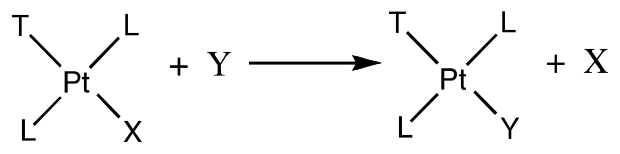
It is also known that the rate of substitution of ligand X by Y depends on the nature of the ligand trans to X, that is, on ligand T. This is known as the trans effect. When T is one of the molecules or ions in the following list, the rate of substitution at the trans position decreases from left to right.
\[ \ce{CN^-}>\ce{H^-}>\ce{NO2^-},\ \ce{I^-}> \ce{Br^-},\ \ce{Cl^-}> \text{pyridine},\ \ce{NH3},\ \ce{OH^-},\ \ce{H2O} \]
The preparations of cis- and trans-\(\ce{Pt(NH3)2Cl2}\) depend on the trans affect. The preparation of the cis isomer, a cancer chemotherapy agent commonly called cisplatin, involves the reaction of \(\ce{K2PtCl4}\) with ammonia.

2.1 Draw all possible stereoisomers for square planar platinum(II) compounds with the formula \(\ce{Pt(py)(NH3)BrCl}\) (where py = pyridine, \(\ce{C5H5N}\)).
2.2 Write reaction schemes including intermediate(s), if any, to show the preparation in aqueous solution for each of the stereoisomers of \(\ce{[Pt(NH3)(NO2)Cl2]^-}\) using, as reagents, \(\ce{PtCl4^2-}\), \(\ce{NH3}\), and \(\ce{NO2^-}\). The reactions are controlled kinetically by the trans effect.
B. Kinetic Studies of Substitution Reactions of Square Planar Complexes
Substitutions of the ligand X by Y in square planar complexes
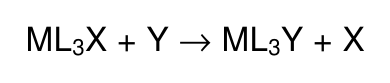
can occur in either or both of two ways:
i) Direct substitution: The incoming ligand Y attaches to the central metal, forming a five-coordinate complex, which then rapidly eliminates a ligand, X, to give the product, \(\ce{ML3Y}\).

\(\ast\ast\) = rate determining step, rate constant = \(k_{\mathrm Y}\)
ii) Solvent-assisted substitution: A solvent molecule S attaches to the central metal to give \(\ce{ML3XS}\), which eliminates the X to give \(\ce{ML3S}\). Y rapidly displaces S to give \(\ce{ML3Y}\).

\(\ast\ast\) = rate determining step, \(k_{\mathrm S}\) = rate constant
The overall rate law for such substitutions is
\[ \mathrm{Rate} =k_s[\ce{ML3X}]+k_{\mathrm Y}[\ce{Y}][\ce{ML3X}] \]
When \([\ce{Y}]\gg[\ce{ML3X}]\), then \(\mathrm{Rate}=k_{\mathrm{obs}}[\ce{ML3X}]\).
The values of \(k_s\) and \(k_{\mathrm Y}\) depend on the reactants and solvent involved. One example is the displacement of the \(\ce{Cl^-}\) ligand in a square planar platinum(II) complex, \(\ce{ML2X2}\), by pyridine (\(\ce{C5H5N}\)). (The \(\ce{ML3X}\) scheme above applies to \(\ce{ML2X2}\).)
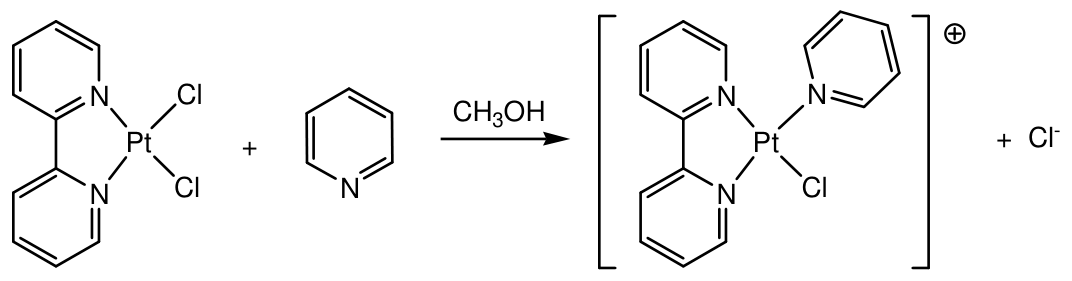
Data for reaction at \(25\,^\circ\mathrm C\) in methanol where \([\text{pyridine}]\gg\) the concentration of the platinum complex, are given in the table below.
| Concentration of pyridine (\(\mathrm{mol\,dm^{-3}}\)) | \(k_{\mathrm{obs}}\) (\(\mathrm{s^{-1}}\)) |
|---|---|
| 0.122 | \(7.20\cdot10^{-4}\) |
| 0.061 | \(3.45\cdot10^{-4}\) |
| 0.030 | \(1.75\cdot10^{-4}\) |
2.3 Calculate the values of \(k_s\) and \(k_{\mathrm Y}\). Give the proper unit for each constant.
(A grid is given if you wish to use it.)
2.4 When [pyridine] = \(0.10\ \mathrm{mol\,dm^{-3}}\), which of the following is true? (Tick the box next to the correct answer.)
☐ Most pyridine product is formed by the solvent-assisted (\(k_s\)) substitution pathway.
☐ Most pyridine product is formed by the direct substitution (\(k_{\mathrm Y}\)) pathway
☐ Comparable amounts of product are formed by the two pathways.
☐ No conclusions may be drawn regarding the relative amounts of product produced by the two pathways.
C. A chemotherapy agent
In an effort to better target cisplatin to cancer cells, Professor Lippard’s group at MIT attached a platinum(IV) complex to oligonucleotides bound to gold nanoparticles.
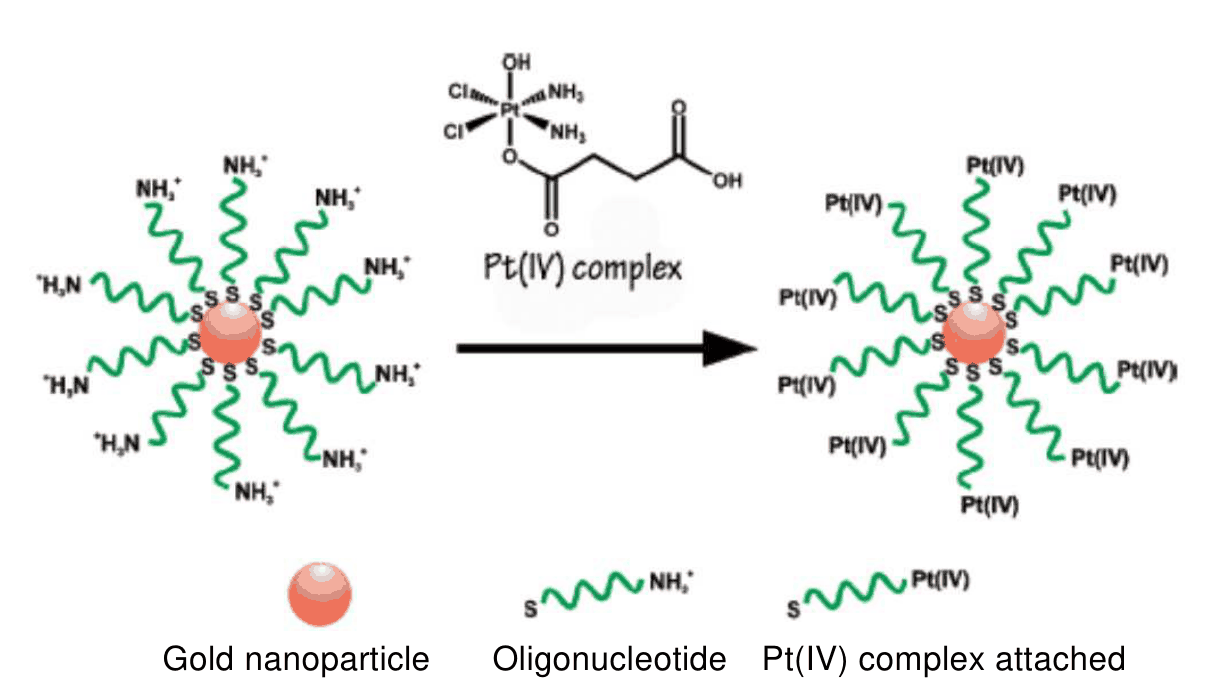
2.5 Experiments showed that the diameter of a gold nanoparticle was 13 nm. Attached to this nanoparticle are 90 oligonucleotide groups, with 98 % of them being bound to a Pt(IV) complex. Suppose that the reaction vessel used for treating cells with the Pt(IV) nanoparticle reagent had a volume of \(1.0\ \mathrm{cm^3}\) and the concentration of the solution was \(1.0\cdot10^{-6}\ \mathrm{mol\,dm^{-3}}\) in \(\ce{Pt}\). Calculate the mass of platinum and that of gold used in this experiment.
(The density of gold = \(19.3\ \mathrm{g\,cm^{-3}}\), the volume of a sphere = \((4/3)\pi r^3=4.18879\,r^3\).)
Official English text of the problem.
Answers
The coordination SMILES below use dative bonds and @SP descriptors for square-planar stereochemistry. The ligand positions are also specified in words in the solution.
- 2.1: There are three stereoisomers of amminebromidochlorido(pyridine)platinum(II):
I — pyridine trans to ammonia: [NH3]->[Pt@SP3+2](<-[Cl-])(<-[Br-])<-n1ccccc1
II — pyridine trans to bromido: [NH3]->[Pt@SP2+2](<-[Cl-])(<-[Br-])<-n1ccccc1
III — pyridine trans to chlorido: [NH3]->[Pt@SP1+2](<-[Cl-])(<-[Br-])<-n1ccccc1
- 2.2: There are two stereoisomers:
cis-Amminedichlorido(nitro)platinate(II), obtained by adding ammonia first, then nitrite: [NH3]->[Pt@SP1+2](<-[Cl-])(<-[Cl-])<-N(=O)[O-]
trans-Amminedichlorido(nitro)platinate(II), obtained by adding nitrite first, then ammonia: [NH3]->[Pt@SP3+2](<-[Cl-])(<-[Cl-])<-N(=O)[O-]
-
2.3: \(\boxed{k_s\approx0\ \mathrm{s^{-1}}}\), \(\boxed{k_{\mathrm Y}\approx5.9\times10^{-3}\ \mathrm{dm^3\,mol^{-1}\,s^{-1}}}\).
-
2.4: Tick the second box: most product is formed by the direct substitution pathway.
-
2.5: To two significant figures, \[ \boxed{m(\ce{Pt})=2.0\times10^{-7}\ \mathrm g=0.20\ \mathrm{\mu g}} \] \[ \boxed{m(\ce{Au})=1.5\times10^{-4}\ \mathrm g=0.15\ \mathrm{mg}}. \]
Solution
The simple molecular and ionic species used below are:
| Name | Formula | SMILES |
|---|---|---|
| Ammonia | \(\ce{NH3}\) | [NH3] |
| Pyridine | \(\ce{C5H5N}\) | n1ccccc1 |
| Bromide ion | \(\ce{Br^-}\) | [Br-] |
| Chloride ion | \(\ce{Cl^-}\) | [Cl-] |
| Nitrite ion | \(\ce{NO2^-}\) | O=N[O-] |
For the complexes containing nitrite, the structural SMILES represent N-bound nitro coordination. All platinum(II) complexes considered here have square-planar coordination. The SMILES encode connectivity and the indicated stereochemistry; they do not depict the electron flow during substitution.
2.1 — All square-planar stereoisomers
Fix pyridine at one position. The ligand opposite it can be ammonia, bromido, or chlorido, giving three possibilities. Once this opposite ligand is chosen, exchanging the remaining two positions gives a superposable arrangement after rotation in three-dimensional space.
Thus there are exactly three geometrical isomers, with these pairs of opposite ligands:
| Isomer | First trans pair | Second trans pair |
|---|---|---|
| I | Pyridine–ammonia | Bromido–chlorido |
| II | Pyridine–bromido | Ammonia–chlorido |
| III | Pyridine–chlorido | Ammonia–bromido |
To draw them precisely, put platinum at the centre of a cross and pyridine above it. Place the other ligands as follows:
| Isomer | Below platinum | Left of platinum | Right of platinum |
|---|---|---|---|
| I | \(\ce{NH3}\) | \(\ce{Br}\) | \(\ce{Cl}\) |
| II | \(\ce{Br}\) | \(\ce{NH3}\) | \(\ce{Cl}\) |
| III | \(\ce{Cl}\) | \(\ce{NH3}\) | \(\ce{Br}\) |
The corresponding names and stereochemical SMILES are given in Answers 2.1. These ideal square-planar arrangements do not generate additional enantiomeric pairs.
2.2 — Preparation of both stereoisomers
The relevant trans-effect order is
\[ \ce{NO2^-}>\ce{Cl^-}>\ce{NH3}. \]
The starting ion and the two monosubstituted intermediates are:
| Name | Formula | SMILES |
|---|---|---|
| Tetrachloridoplatinate(II) ion | \(\ce{[PtCl4]^2-}\) | [Cl-]->[Pt+2](<-[Cl-])(<-[Cl-])<-[Cl-] |
| Amminetrichloridoplatinate(II) ion | \(\ce{[PtCl3(NH3)]^-}\) | [NH3]->[Pt+2](<-[Cl-])(<-[Cl-])<-[Cl-] |
| Trichlorido(nitro)platinate(II) ion | \(\ce{[PtCl3(NO2)]^2-}\) | O=N([O-])->[Pt+2](<-[Cl-])(<-[Cl-])<-[Cl-] |
Each has square-planar geometry; three identical chlorido ligands mean that no distinct geometrical isomers need to be specified for these intermediates.
Preparation of the cis isomer: ammonia first
First replace one chlorido ligand with ammonia:
\[ \ce{[PtCl4]^2- + NH3 -> [PtCl3(NH3)]^- + Cl^-}. \]
Then introduce nitrite:
\[ \ce{[PtCl3(NH3)]^- + NO2^- -> [Pt(NH3)(NO2)Cl2]^- + Cl^-} \qquad(\textit{cis}\text{ product}). \]
In the intermediate, one chlorido ligand is trans to ammonia, while the other two are trans to each other. Because chloride has a stronger trans effect than ammonia, nitrite preferentially replaces a chlorido ligand trans to another chlorido ligand.
Consequently, the incoming nitro ligand is cis to ammonia, and the two remaining chlorido ligands are also cis.
A precise drawing of the product has ammonia above platinum, nitro to the right, and chlorido ligands below and to the left. Its trans pairs are ammonia–chlorido and nitro–chlorido.
Preparation of the trans isomer: nitrite first
First introduce nitrite:
\[ \ce{[PtCl4]^2- + NO2^- -> [PtCl3(NO2)]^2- + Cl^-}. \]
Then introduce ammonia:
\[ \ce{[PtCl3(NO2)]^2- + NH3 -> [Pt(NH3)(NO2)Cl2]^- + Cl^-} \qquad(\textit{trans}\text{ product}). \]
The nitro ligand has a stronger trans effect than chloride. Ammonia therefore preferentially replaces the chlorido ligand trans to nitro.
The resulting ammonia and nitro ligands are opposite each other, as are the two remaining chlorido ligands. Draw ammonia above platinum, nitro below it, and the chlorido ligands to the left and right.
All four substitution equations conserve both atoms and charge.
2.3 — Determination of the rate constants
From the supplied rate law,
\[ \mathrm{Rate} =\left(k_s+k_{\mathrm Y}[\text{pyridine}]\right) [\text{platinum complex}], \]
so
\[ \boxed{k_{\mathrm{obs}} =k_s+k_{\mathrm Y}[\text{pyridine}]}. \]
Therefore, a plot of \(k_{\mathrm{obs}}\) against pyridine concentration has:
- intercept \(k_s\), with units \(\mathrm{s^{-1}}\);
- slope \(k_{\mathrm Y}\), with units \(\mathrm{dm^3\,mol^{-1}\,s^{-1}}\).
The three values of \(k_{\mathrm{obs}}/[\text{pyridine}]\) are
\[ 5.902\times10^{-3},\quad 5.656\times10^{-3},\quad 5.833\times10^{-3} \quad\mathrm{dm^3\,mol^{-1}\,s^{-1}}. \]
They are approximately constant, so the plotted line passes approximately through the origin.
The data are not exactly collinear: an unconstrained least-squares fit gives an intercept of \(-9.47\times10^{-6}\ \mathrm{s^{-1}}\), which cannot be a physical rate constant. Constraining both rate constants to be nonnegative gives the best fit at \(k_s=0\). The corresponding slope is
\[ k_{\mathrm Y} =\frac{\sum_i[\text{pyridine}]_i k_{\mathrm{obs},i}} {\sum_i[\text{pyridine}]_i^2} =5.8516\times10^{-3}\ \mathrm{dm^3\,mol^{-1}\,s^{-1}}. \]
Thus the appropriate approximate results are
\[ \boxed{k_s\approx0\ \mathrm{s^{-1}}}, \qquad \boxed{k_{\mathrm Y}\approx5.9\times10^{-3}\ \mathrm{dm^3\,mol^{-1}\,s^{-1}}}. \]
Here \(k_s\) is the effective first-order constant in the given rate law, which already incorporates the constant solvent concentration.
2.4 — Dominant substitution pathway
At \([\text{pyridine}]=0.10\ \mathrm{mol\,dm^{-3}}\), the direct pathway contributes
\[ k_{\mathrm Y}[\text{pyridine}] \approx \left(5.9\times10^{-3}\ \mathrm{dm^3\,mol^{-1}\,s^{-1}}\right) \left(0.10\ \mathrm{mol\,dm^{-3}}\right) =5.9\times10^{-4}\ \mathrm{s^{-1}}. \]
This greatly exceeds the approximately zero solvent-assisted contribution.
Equivalently, the fraction formed through direct substitution is
\[ f_{\mathrm{direct}} =\frac{k_{\mathrm Y}[\text{pyridine}]} {k_s+k_{\mathrm Y}[\text{pyridine}]} \approx1. \]
Therefore, most pyridine product is formed by direct substitution: the second box is correct.
2.5 — Masses of platinum and gold
Use the standard constants
\[ M(\ce{Pt})=195.08\ \mathrm{g\,mol^{-1}}, \qquad N_{\mathrm A}=6.022\times10^{23}\ \mathrm{mol^{-1}}, \]
which are not printed in the problem.
The solution volume is
\[ 1.0\ \mathrm{cm^3}=1.0\times10^{-3}\ \mathrm{dm^3}. \]
Thus the amount of platinum is
\[ n(\ce{Pt}) =\left(1.0\times10^{-6}\ \mathrm{mol\,dm^{-3}}\right) \left(1.0\times10^{-3}\ \mathrm{dm^3}\right) =1.0\times10^{-9}\ \mathrm{mol}. \]
Its mass is
\[ m(\ce{Pt}) =n(\ce{Pt})M(\ce{Pt}) =1.9508\times10^{-7}\ \mathrm g, \]
or, to two significant figures,
\[ \boxed{m(\ce{Pt})=2.0\times10^{-7}\ \mathrm g =0.20\ \mathrm{\mu g}}. \]
Each nanoparticle carries, on average,
\[ 90(0.98)=88.2 \]
platinum complexes, each containing one platinum atom. Therefore, the number of gold nanoparticles is
\[ N_{\mathrm{particles}} =\frac{n(\ce{Pt})N_{\mathrm A}}{88.2} =\frac{(1.0\times10^{-9})(6.022\times10^{23})}{88.2} =6.83\times10^{12}. \]
The radius of one particle is
\[ r=\frac{13}{2}\ \mathrm{nm} =6.5\times10^{-7}\ \mathrm{cm}. \]
Using the given sphere-volume expression,
\[ V_{\mathrm{particle}} =4.18879r^3 =4.18879(6.5\times10^{-7}\ \mathrm{cm})^3 =1.15035\times10^{-18}\ \mathrm{cm^3}. \]
The gold mass per particle is
\[ m_{\mathrm{particle}} =\rho V_{\mathrm{particle}} =(19.3\ \mathrm{g\,cm^{-3}}) (1.15035\times10^{-18}\ \mathrm{cm^3}) =2.22017\times10^{-17}\ \mathrm g. \]
Consequently,
\[ m(\ce{Au}) =N_{\mathrm{particles}}m_{\mathrm{particle}} =1.5159\times10^{-4}\ \mathrm g, \]
giving
\[ \boxed{m(\ce{Au})=1.5\times10^{-4}\ \mathrm g =0.15\ \mathrm{mg}}. \]
The solution was checked against the official solution.
IChO 2012 · Theorieaufgabe 2
Platin(II)-Verbindungen, Isomere und der trans-Effekt
A. Platin(II)-Verbindungen, Isomere und der trans-Effekt.
Platin und andere Metalle der Gruppe 10 bilden quadratisch-planare Komplexe, und die Mechanismen ihrer Reaktionen wurden eingehend untersucht. Beispielsweise ist bekannt, dass Substitutionsreaktionen dieser Komplexe unter Erhaltung der Stereochemie ablaufen.
Es ist auch bekannt, dass die Geschwindigkeit der Substitution des Liganden X durch Y von der Art des zu X trans-ständigen Liganden, also vom Liganden T, abhängt. Dies wird als trans-Effekt bezeichnet. Wenn T eines der Moleküle oder Ionen in der folgenden Liste ist, nimmt die Geschwindigkeit der Substitution an der trans-Position von links nach rechts ab.
\[ \ce{CN^-}>\ce{H^-}>\ce{NO2^-},\ \ce{I^-}> \ce{Br^-},\ \ce{Cl^-}> \text{Pyridin},\ \ce{NH3},\ \ce{OH^-},\ \ce{H2O} \]
Die Herstellung von cis- und trans-\(\ce{Pt(NH3)2Cl2}\) beruht auf dem trans-Effekt. Die Herstellung des cis-Isomers, eines üblicherweise als Cisplatin bezeichneten Chemotherapeutikums zur Krebsbehandlung, erfolgt durch die Reaktion von \(\ce{K2PtCl4}\) mit Ammoniak.
2.1 Zeichnen Sie alle möglichen Stereoisomere quadratisch-planarer Platin(II)-Verbindungen mit der Formel \(\ce{Pt(py)(NH3)BrCl}\) (wobei py = Pyridin, \(\ce{C5H5N}\)).
2.2 Geben Sie Reaktionsschemata einschließlich etwaiger Zwischenprodukte an, die die Herstellung jedes der Stereoisomere von \(\ce{[Pt(NH3)(NO2)Cl2]^-}\) in wässriger Lösung unter Verwendung der Reagenzien \(\ce{PtCl4^2-}\), \(\ce{NH3}\) und \(\ce{NO2^-}\) zeigen. Die Reaktionen werden durch den trans-Effekt kinetisch gesteuert.
B. Kinetische Untersuchungen von Substitutionsreaktionen quadratisch-planarer Komplexe
Die Substitution des Liganden X durch Y in quadratisch-planaren Komplexen
kann über einen der beiden folgenden Wege oder über beide erfolgen:
i) Direkte Substitution: Der eintretende Ligand Y bindet an das Zentralmetall und bildet einen fünffach koordinierten Komplex, der anschließend rasch einen Liganden X abspaltet, wobei das Produkt \(\ce{ML3Y}\) entsteht.
\(\ast\ast\) = geschwindigkeitsbestimmender Schritt, Geschwindigkeitskonstante = \(k_{\mathrm Y}\)
ii) Lösungsmittelunterstützte Substitution: Ein Lösungsmittelmolekül S bindet an das Zentralmetall, wobei \(\ce{ML3XS}\) entsteht, das X abspaltet und \(\ce{ML3S}\) bildet. Y verdrängt S rasch unter Bildung von \(\ce{ML3Y}\).
\(\ast\ast\) = geschwindigkeitsbestimmender Schritt, \(k_{\mathrm S}\) = Geschwindigkeitskonstante
Das gesamte Geschwindigkeitsgesetz für solche Substitutionen lautet
\[ \mathrm{Rate} =k_s[\ce{ML3X}]+k_{\mathrm Y}[\ce{Y}][\ce{ML3X}] \]
Wenn \([\ce{Y}]\gg[\ce{ML3X}]\), dann gilt \(\mathrm{Rate}=k_{\mathrm{obs}}[\ce{ML3X}]\).
Die Werte von \(k_s\) und \(k_{\mathrm Y}\) hängen von den beteiligten Reaktanten und dem Lösungsmittel ab. Ein Beispiel ist die Verdrängung des \(\ce{Cl^-}\)-Liganden in einem quadratisch-planaren Platin(II)-Komplex, \(\ce{ML2X2}\), durch Pyridin (\(\ce{C5H5N}\)). (Das obige \(\ce{ML3X}\)-Schema gilt auch für \(\ce{ML2X2}\).)
Die folgende Tabelle enthält Daten für die Reaktion bei \(25\,^\circ\mathrm C\) in Methanol, wobei \([\text{Pyridin}]\gg\) die Konzentration des Platinkomplexes ist.
| Pyridinkonzentration (\(\mathrm{mol\,dm^{-3}}\)) | \(k_{\mathrm{obs}}\) (\(\mathrm{s^{-1}}\)) |
|---|---|
| 0.122 | \(7.20\cdot10^{-4}\) |
| 0.061 | \(3.45\cdot10^{-4}\) |
| 0.030 | \(1.75\cdot10^{-4}\) |
2.3 Berechnen Sie die Werte von \(k_s\) und \(k_{\mathrm Y}\). Geben Sie für jede Konstante die richtige Einheit an.
(Ein Koordinatengitter steht Ihnen zur Verfügung, falls Sie es verwenden möchten.)
2.4 Welche der folgenden Aussagen trifft zu, wenn [Pyridin] = \(0.10\ \mathrm{mol\,dm^{-3}}\) ist? (Kreuzen Sie das Kästchen neben der richtigen Antwort an.)
☐ Der größte Teil des pyridinhaltigen Produkts entsteht über den lösungsmittelunterstützten Substitutionsweg (\(k_s\)).
☐ Der größte Teil des pyridinhaltigen Produkts entsteht über den direkten Substitutionsweg (\(k_{\mathrm Y}\))
☐ Über die beiden Wege entstehen vergleichbare Produktmengen.
☐ Über die relativen Produktmengen, die über die beiden Wege entstehen, lassen sich keine Schlussfolgerungen ziehen.
C. Ein Chemotherapeutikum
Um Cisplatin gezielter zu Krebszellen zu transportieren, koppelte die Arbeitsgruppe von Professor Lippard am MIT einen Platin(IV)-Komplex an Oligonukleotide, die an Goldnanopartikel gebunden waren.
2.5 Experimente zeigten, dass der Durchmesser eines Goldnanopartikels 13 nm betrug. An dieses Nanopartikel sind 90 Oligonukleotidgruppen gebunden, von denen 98 % an einen Pt(IV)-Komplex gebunden sind. Nehmen Sie an, dass das Reaktionsgefäß, in dem Zellen mit dem Pt(IV)-Nanopartikelreagenz behandelt wurden, ein Volumen von \(1.0\ \mathrm{cm^3}\) hatte und die Konzentration der Lösung bezüglich \(\ce{Pt}\) \(1.0\cdot10^{-6}\ \mathrm{mol\,dm^{-3}}\) betrug. Berechnen Sie die Masse des Platins und die des Goldes, die in diesem Experiment verwendet wurden.
(Die Dichte von Gold = \(19.3\ \mathrm{g\,cm^{-3}}\), das Volumen einer Kugel = \((4/3)\pi r^3=4.18879\,r^3\).)
Aufgabentext aus dem offiziellen englischen Text übersetzt.
Antworten
Die folgenden Koordinations-SMILES verwenden dative Bindungen und @SP-Deskriptoren für die quadratisch-planare Stereochemie. Die Positionen der Liganden werden in der Lösung auch in Worten angegeben.
- 2.1: Es gibt drei Stereoisomere von Amminbromidochlorido(pyridin)platin(II):
I — Pyridin trans zu Ammoniak: [NH3]->[Pt@SP3+2](<-[Cl-])(<-[Br-])<-n1ccccc1
II — Pyridin trans zu Bromido: [NH3]->[Pt@SP2+2](<-[Cl-])(<-[Br-])<-n1ccccc1
III — Pyridin trans zu Chlorido: [NH3]->[Pt@SP1+2](<-[Cl-])(<-[Br-])<-n1ccccc1
- 2.2: Es gibt zwei Stereoisomere:
cis-Ammindichlorido(nitro)platinat(II), erhalten durch Zugabe von zunächst Ammoniak, dann Nitrit: [NH3]->[Pt@SP1+2](<-[Cl-])(<-[Cl-])<-N(=O)[O-]
trans-Ammindichlorido(nitro)platinat(II), erhalten durch Zugabe von zunächst Nitrit, dann Ammoniak: [NH3]->[Pt@SP3+2](<-[Cl-])(<-[Cl-])<-N(=O)[O-]
-
2.3: \(\boxed{k_s\approx0\ \mathrm{s^{-1}}}\), \(\boxed{k_{\mathrm Y}\approx5.9\times10^{-3}\ \mathrm{dm^3\,mol^{-1}\,s^{-1}}}\).
-
2.4: Kreuzen Sie das zweite Kästchen an: Der größte Teil des Produkts entsteht über den direkten Substitutionsweg.
-
2.5: Auf zwei signifikante Stellen gerundet, \[ \boxed{m(\ce{Pt})=2.0\times10^{-7}\ \mathrm g=0.20\ \mathrm{\mu g}} \] \[ \boxed{m(\ce{Au})=1.5\times10^{-4}\ \mathrm g=0.15\ \mathrm{mg}}. \]
Lösung
Die im Folgenden verwendeten einfachen molekularen und ionischen Spezies sind:
| Name | Formel | SMILES |
|---|---|---|
| Ammoniak | \(\ce{NH3}\) | [NH3] |
| Pyridin | \(\ce{C5H5N}\) | n1ccccc1 |
| Bromidion | \(\ce{Br^-}\) | [Br-] |
| Chloridion | \(\ce{Cl^-}\) | [Cl-] |
| Nitrition | \(\ce{NO2^-}\) | O=N[O-] |
Bei den nitrithaltigen Komplexen stellen die Struktur-SMILES eine N-gebundene Nitro-Koordination dar. Alle hier betrachteten Platin(II)-Komplexe weisen eine quadratisch-planare Koordination auf. Die SMILES kodieren die Konnektivität und die angegebene Stereochemie; sie stellen nicht den Elektronenfluss während der Substitution dar.
2.1 — Alle quadratisch-planaren Stereoisomere
Man legt Pyridin an einer Position fest. Der gegenüberliegende Ligand kann Ammoniak, Bromido oder Chlorido sein, sodass sich drei Möglichkeiten ergeben. Sobald dieser gegenüberliegende Ligand gewählt ist, ergibt ein Vertauschen der beiden verbleibenden Positionen eine Anordnung, die sich durch Drehung im dreidimensionalen Raum zur Deckung bringen lässt.
Somit gibt es genau drei geometrische Isomere mit den folgenden Paaren gegenüberliegender Liganden:
| Isomer | Erstes trans-Paar | Zweites trans-Paar |
|---|---|---|
| I | Pyridin–Ammoniak | Bromido–Chlorido |
| II | Pyridin–Bromido | Ammoniak–Chlorido |
| III | Pyridin–Chlorido | Ammoniak–Bromido |
Um sie eindeutig zu zeichnen, setzt man Platin in die Mitte eines Kreuzes und Pyridin darüber. Die übrigen Liganden werden wie folgt angeordnet:
| Isomer | Unterhalb von Platin | Links von Platin | Rechts von Platin |
|---|---|---|---|
| I | \(\ce{NH3}\) | \(\ce{Br}\) | \(\ce{Cl}\) |
| II | \(\ce{Br}\) | \(\ce{NH3}\) | \(\ce{Cl}\) |
| III | \(\ce{Cl}\) | \(\ce{NH3}\) | \(\ce{Br}\) |
Die entsprechenden Namen und stereochemischen SMILES sind unter Antworten 2.1 angegeben. Diese idealen quadratisch-planaren Anordnungen ergeben keine zusätzlichen Enantiomerenpaare.
2.2 — Herstellung beider Stereoisomere
Die relevante Reihenfolge des trans-Effekts lautet
\[ \ce{NO2^-}>\ce{Cl^-}>\ce{NH3}. \]
Das Ausgangsion und die beiden monosubstituierten Zwischenprodukte sind:
| Name | Formel | SMILES |
|---|---|---|
| Tetrachloridoplatinat(II)-Ion | \(\ce{[PtCl4]^2-}\) | [Cl-]->[Pt+2](<-[Cl-])(<-[Cl-])<-[Cl-] |
| Ammintrichloridoplatinat(II)-Ion | \(\ce{[PtCl3(NH3)]^-}\) | [NH3]->[Pt+2](<-[Cl-])(<-[Cl-])<-[Cl-] |
| Trichlorido(nitro)platinat(II)-Ion | \(\ce{[PtCl3(NO2)]^2-}\) | O=N([O-])->[Pt+2](<-[Cl-])(<-[Cl-])<-[Cl-] |
Alle weisen eine quadratisch-planare Geometrie auf; aufgrund der drei identischen Chlorido-Liganden müssen für diese Zwischenprodukte keine unterschiedlichen geometrischen Isomere angegeben werden.
Herstellung des cis-Isomers: zuerst Ammoniak
Zunächst wird ein Chlorido-Ligand durch Ammoniak ersetzt:
\[ \ce{[PtCl4]^2- + NH3 -> [PtCl3(NH3)]^- + Cl^-}. \]
Anschließend wird Nitrit zugegeben:
\[ \ce{[PtCl3(NH3)]^- + NO2^- -> [Pt(NH3)(NO2)Cl2]^- + Cl^-} \qquad(\textit{cis}\text{-Produkt}). \]
Im Zwischenprodukt steht ein Chlorido-Ligand trans zu Ammoniak, während die beiden anderen trans zueinander stehen. Da Chlorid einen stärkeren trans-Effekt als Ammoniak aufweist, ersetzt Nitrit bevorzugt einen Chlorido-Liganden trans zu einem anderen Chlorido-Liganden.
Folglich steht der eintretende Nitro-Ligand cis zu Ammoniak, und die beiden verbleibenden Chlorido-Liganden stehen ebenfalls cis zueinander.
In einer eindeutigen Zeichnung des Produkts steht Ammoniak oberhalb von Platin, Nitro rechts davon und die Chlorido-Liganden unterhalb und links davon. Seine trans-Paare sind Ammoniak–Chlorido und Nitro–Chlorido.
Herstellung des trans-Isomers: zuerst Nitrit
Zunächst wird Nitrit zugegeben:
\[ \ce{[PtCl4]^2- + NO2^- -> [PtCl3(NO2)]^2- + Cl^-}. \]
Anschließend wird Ammoniak zugegeben:
\[ \ce{[PtCl3(NO2)]^2- + NH3 -> [Pt(NH3)(NO2)Cl2]^- + Cl^-} \qquad(\textit{trans}\text{-Produkt}). \]
Der Nitro-Ligand weist einen stärkeren trans-Effekt als Chlorid auf. Ammoniak ersetzt daher bevorzugt den Chlorido-Liganden trans zu Nitro.
Die resultierenden Ammoniak- und Nitro-Liganden stehen einander gegenüber, ebenso wie die beiden verbleibenden Chlorido-Liganden. Man zeichnet Ammoniak oberhalb von Platin, Nitro darunter und die Chlorido-Liganden links und rechts davon.
In allen vier Substitutionsgleichungen bleiben sowohl die Atome als auch die Ladung erhalten.
2.3 — Bestimmung der Geschwindigkeitskonstanten
Aus dem angegebenen Geschwindigkeitsgesetz folgt
\[ \mathrm{Rate} =\left(k_s+k_{\mathrm Y}[\text{Pyridin}]\right) [\text{Platinkomplex}], \]
also
\[ \boxed{k_{\mathrm{obs}} =k_s+k_{\mathrm Y}[\text{Pyridin}]}. \]
Daher besitzt eine Auftragung von \(k_{\mathrm{obs}}\) gegen die Pyridinkonzentration:
- den Ordinatenabschnitt \(k_s\) mit der Einheit \(\mathrm{s^{-1}}\);
- die Steigung \(k_{\mathrm Y}\) mit der Einheit \(\mathrm{dm^3\,mol^{-1}\,s^{-1}}\).
Die drei Werte von \(k_{\mathrm{obs}}/[\text{Pyridin}]\) sind
\[ 5.902\times10^{-3},\quad 5.656\times10^{-3},\quad 5.833\times10^{-3} \quad\mathrm{dm^3\,mol^{-1}\,s^{-1}}. \]
Sie sind näherungsweise konstant, sodass die aufgetragene Gerade näherungsweise durch den Ursprung verläuft.
Die Datenpunkte liegen nicht exakt auf einer Geraden: Eine Anpassung nach der Methode der kleinsten Quadrate ohne Nebenbedingungen ergibt einen Ordinatenabschnitt von \(-9.47\times10^{-6}\ \mathrm{s^{-1}}\), der keine physikalisch sinnvolle Geschwindigkeitskonstante sein kann. Unter der Nebenbedingung, dass beide Geschwindigkeitskonstanten nichtnegativ sind, ergibt sich die beste Anpassung bei \(k_s=0\). Die entsprechende Steigung ist
\[ k_{\mathrm Y} =\frac{\sum_i[\text{Pyridin}]_i k_{\mathrm{obs},i}} {\sum_i[\text{Pyridin}]_i^2} =5.8516\times10^{-3}\ \mathrm{dm^3\,mol^{-1}\,s^{-1}}. \]
Die geeigneten Näherungsergebnisse lauten somit
\[ \boxed{k_s\approx0\ \mathrm{s^{-1}}}, \qquad \boxed{k_{\mathrm Y}\approx5.9\times10^{-3}\ \mathrm{dm^3\,mol^{-1}\,s^{-1}}}. \]
Hier ist \(k_s\) die effektive Konstante erster Ordnung im angegebenen Geschwindigkeitsgesetz, in der die konstante Lösungsmittelkonzentration bereits enthalten ist.
2.4 — Vorherrschender Substitutionsweg
Bei \([\text{Pyridin}]=0.10\ \mathrm{mol\,dm^{-3}}\) liefert der direkte Weg den Beitrag
\[ k_{\mathrm Y}[\text{Pyridin}] \approx \left(5.9\times10^{-3}\ \mathrm{dm^3\,mol^{-1}\,s^{-1}}\right) \left(0.10\ \mathrm{mol\,dm^{-3}}\right) =5.9\times10^{-4}\ \mathrm{s^{-1}}. \]
Dieser übersteigt den näherungsweise null betragenden lösungsmittelunterstützten Beitrag bei Weitem.
Gleichwertig lässt sich der durch direkte Substitution gebildete Anteil angeben als
\[ f_{\mathrm{direct}} =\frac{k_{\mathrm Y}[\text{Pyridin}]} {k_s+k_{\mathrm Y}[\text{Pyridin}]} \approx1. \]
Daher gilt: Der größte Teil des pyridinhaltigen Produkts entsteht durch direkte Substitution: Das zweite Kästchen ist richtig.
2.5 — Massen von Platin und Gold
Man verwendet die Standardkonstanten
\[ M(\ce{Pt})=195.08\ \mathrm{g\,mol^{-1}}, \qquad N_{\mathrm A}=6.022\times10^{23}\ \mathrm{mol^{-1}}, \]
die in der Aufgabenstellung nicht angegeben sind.
Das Volumen der Lösung beträgt
\[ 1.0\ \mathrm{cm^3}=1.0\times10^{-3}\ \mathrm{dm^3}. \]
Somit beträgt die Stoffmenge an Platin
\[ n(\ce{Pt}) =\left(1.0\times10^{-6}\ \mathrm{mol\,dm^{-3}}\right) \left(1.0\times10^{-3}\ \mathrm{dm^3}\right) =1.0\times10^{-9}\ \mathrm{mol}. \]
Seine Masse beträgt
\[ m(\ce{Pt}) =n(\ce{Pt})M(\ce{Pt}) =1.9508\times10^{-7}\ \mathrm g, \]
oder, auf zwei signifikante Stellen gerundet,
\[ \boxed{m(\ce{Pt})=2.0\times10^{-7}\ \mathrm g =0.20\ \mathrm{\mu g}}. \]
Jedes Nanopartikel trägt im Mittel
\[ 90(0.98)=88.2 \]
Platinkomplexe, die jeweils ein Platinatom enthalten. Daher beträgt die Anzahl der Goldnanopartikel
\[ N_{\mathrm{particles}} =\frac{n(\ce{Pt})N_{\mathrm A}}{88.2} =\frac{(1.0\times10^{-9})(6.022\times10^{23})}{88.2} =6.83\times10^{12}. \]
Der Radius eines Partikels beträgt
\[ r=\frac{13}{2}\ \mathrm{nm} =6.5\times10^{-7}\ \mathrm{cm}. \]
Mit dem angegebenen Ausdruck für das Kugelvolumen ergibt sich
\[ V_{\mathrm{particle}} =4.18879r^3 =4.18879(6.5\times10^{-7}\ \mathrm{cm})^3 =1.15035\times10^{-18}\ \mathrm{cm^3}. \]
Die Goldmasse pro Partikel beträgt
\[ m_{\mathrm{particle}} =\rho V_{\mathrm{particle}} =(19.3\ \mathrm{g\,cm^{-3}}) (1.15035\times10^{-18}\ \mathrm{cm^3}) =2.22017\times10^{-17}\ \mathrm g. \]
Folglich gilt
\[ m(\ce{Au}) =N_{\mathrm{particles}}m_{\mathrm{particle}} =1.5159\times10^{-4}\ \mathrm g, \]
woraus sich ergibt
\[ \boxed{m(\ce{Au})=1.5\times10^{-4}\ \mathrm g =0.15\ \mathrm{mg}}. \]
Die Lösung wurde mit der offiziellen Lösung abgeglichen.
IChO 2012 · Teori sorusu 2
Platin(II) bileşikleri, izomerler ve trans etkisi
A. Platin(II) Bileşikleri, İzomerler ve Trans Etkisi.
Platin ve diğer 10. grup metalleri kare düzlemsel kompleksler oluşturur ve bu komplekslerin tepkime mekanizmaları kapsamlı biçimde incelenmiştir. Örneğin, bu komplekslerin yer değiştirme tepkimelerinin stereokimya korunarak gerçekleştiği bilinmektedir.
X ligandının Y ile yer değiştirme hızının, X'e trans konumda bulunan ligandın, yani T ligandının türüne bağlı olduğu da bilinmektedir. Bu olgu trans etkisi olarak bilinir. T, aşağıdaki listede yer alan molekül veya iyonlardan biri olduğunda, trans konumundaki yer değiştirme hızı soldan sağa doğru azalır.
\[ \ce{CN^-}>\ce{H^-}>\ce{NO2^-},\ \ce{I^-}> \ce{Br^-},\ \ce{Cl^-}> \text{piridin},\ \ce{NH3},\ \ce{OH^-},\ \ce{H2O} \]
cis- ve trans-\(\ce{Pt(NH3)2Cl2}\) bileşiklerinin hazırlanması trans etkisine dayanır. Yaygın olarak sisplatin adıyla bilinen bir kanser kemoterapi ajanı olan cis izomerinin hazırlanmasında, \(\ce{K2PtCl4}\) ile amonyak tepkimeye sokulur.
2.1 \(\ce{Pt(py)(NH3)BrCl}\) formülüne sahip kare düzlemsel platin(II) bileşiklerinin olası tüm stereoizomerlerini çiziniz (burada py = piridin, \(\ce{C5H5N}\)).
2.2 Tepkime maddeleri olarak \(\ce{PtCl4^2-}\), \(\ce{NH3}\) ve \(\ce{NO2^-}\) kullanarak, \(\ce{[Pt(NH3)(NO2)Cl2]^-}\) iyonunun her bir stereoizomerinin sulu çözeltide hazırlanmasını gösteren tepkime şemalarını, varsa ara ürünleri de içerecek biçimde yazınız. Tepkimeler, trans etkisiyle kinetik olarak kontrol edilir.
B. Kare Düzlemsel Komplekslerin Yer Değiştirme Tepkimelerinin Kinetik İncelenmesi
Kare düzlemsel komplekslerde X ligandının Y ile yer değiştirmesi
iki yoldan biriyle veya her ikisiyle gerçekleşebilir:
i) Doğrudan yer değiştirme: Gelen Y ligandı merkez metale bağlanarak beş koordinasyonlu bir kompleks oluşturur; bu kompleks daha sonra hızla bir X ligandını kaybederek \(\ce{ML3Y}\) ürününü verir.
\(\ast\ast\) = hız belirleyici basamak, hız sabiti = \(k_{\mathrm Y}\)
ii) Çözücü destekli yer değiştirme: Bir S çözücü molekülü merkez metale bağlanarak \(\ce{ML3XS}\) oluşturur; bu kompleks X'i kaybederek \(\ce{ML3S}\) verir. Y, S'nin yerini hızla alarak \(\ce{ML3Y}\) oluşturur.
\(\ast\ast\) = hız belirleyici basamak, \(k_{\mathrm S}\) = hız sabiti
Bu tür yer değiştirmeler için toplam hız yasası şöyledir:
\[ \mathrm{Rate} =k_s[\ce{ML3X}]+k_{\mathrm Y}[\ce{Y}][\ce{ML3X}] \]
\([\ce{Y}]\gg[\ce{ML3X}]\) olduğunda, \(\mathrm{Rate}=k_{\mathrm{obs}}[\ce{ML3X}]\) olur.
\(k_s\) ve \(k_{\mathrm Y}\) değerleri, kullanılan tepkime maddelerine ve çözücüye bağlıdır. Bunun bir örneği, kare düzlemsel bir platin(II) kompleksi olan \(\ce{ML2X2}\)'deki \(\ce{Cl^-}\) ligandının piridin (\(\ce{C5H5N}\)) ile yer değiştirmesidir. (Yukarıdaki \(\ce{ML3X}\) şeması \(\ce{ML2X2}\) için de geçerlidir.)
Metanolde \(25\,^\circ\mathrm C\)'de, \([\text{piridin}]\gg\) platin kompleksinin derişimi koşulunda gerçekleşen tepkimeye ilişkin veriler aşağıdaki tabloda verilmiştir.
| Piridin derişimi (\(\mathrm{mol\,dm^{-3}}\)) | \(k_{\mathrm{obs}}\) (\(\mathrm{s^{-1}}\)) |
|---|---|
| 0.122 | \(7.20\cdot10^{-4}\) |
| 0.061 | \(3.45\cdot10^{-4}\) |
| 0.030 | \(1.75\cdot10^{-4}\) |
2.3 \(k_s\) ve \(k_{\mathrm Y}\) değerlerini hesaplayınız. Her bir sabit için uygun birimi belirtiniz.
(Kullanmak isterseniz bir kareli alan verilmiştir.)
2.4 [piridin] = \(0.10\ \mathrm{mol\,dm^{-3}}\) olduğunda, aşağıdakilerden hangisi doğrudur? (Doğru cevabın yanındaki kutuyu işaretleyiniz.)
☐ Piridin içeren ürünün büyük kısmı çözücü destekli (\(k_s\)) yer değiştirme yolu ile oluşur.
☐ Piridin içeren ürünün büyük kısmı doğrudan yer değiştirme (\(k_{\mathrm Y}\)) yolu ile oluşur
☐ İki yoldan birbirine yakın miktarlarda ürün oluşur.
☐ İki yoldan oluşan ürünlerin bağıl miktarlarına ilişkin bir sonuca varılamaz.
C. Bir kemoterapi ajanı
MIT'de Profesör Lippard'ın grubu, sisplatini kanser hücrelerine daha iyi hedeflemek amacıyla, bir platin(IV) kompleksini altın nanoparçacıklara bağlı oligonükleotitlere bağlamıştır.
2.5 Deneyler, bir altın nanoparçacığın çapının 13 nm olduğunu göstermiştir. Bu nanoparçacığa 90 oligonükleotit grubu bağlıdır ve bunların %98'i bir Pt(IV) kompleksine bağlıdır. Hücrelerin Pt(IV) nanoparçacık reaktifi ile muamele edilmesinde kullanılan tepkime kabının hacminin \(1.0\ \mathrm{cm^3}\) ve çözeltinin \(\ce{Pt}\) cinsinden derişiminin \(1.0\cdot10^{-6}\ \mathrm{mol\,dm^{-3}}\) olduğunu varsayınız. Bu deneyde kullanılan platinin ve altının kütlelerini hesaplayınız.
(Altının yoğunluğu = \(19.3\ \mathrm{g\,cm^{-3}}\), kürenin hacmi = \((4/3)\pi r^3=4.18879\,r^3\).)
Soru metni resmi İngilizce metinden çevrilmiştir.
Cevaplar
Aşağıdaki koordinasyon SMILES gösterimlerinde, kare düzlemsel stereokimya için koordinatif bağlar ve @SP tanımlayıcıları kullanılmıştır. Ligandların konumları çözümde sözel olarak da belirtilmiştir.
- 2.1: Amminbromidoklorido(piridin)platin(II) bileşiğinin üç stereoizomeri vardır:
I — piridin amonyağa trans konumda: [NH3]->[Pt@SP3+2](<-[Cl-])(<-[Br-])<-n1ccccc1
II — piridin bromidoya trans konumda: [NH3]->[Pt@SP2+2](<-[Cl-])(<-[Br-])<-n1ccccc1
III — piridin kloridoya trans konumda: [NH3]->[Pt@SP1+2](<-[Cl-])(<-[Br-])<-n1ccccc1
- 2.2: İki stereoizomer vardır:
Önce amonyak, ardından nitrit eklenerek elde edilen cis-ammindiklorido(nitro)platinat(II): [NH3]->[Pt@SP1+2](<-[Cl-])(<-[Cl-])<-N(=O)[O-]
Önce nitrit, ardından amonyak eklenerek elde edilen trans-ammindiklorido(nitro)platinat(II): [NH3]->[Pt@SP3+2](<-[Cl-])(<-[Cl-])<-N(=O)[O-]
-
2.3: \(\boxed{k_s\approx0\ \mathrm{s^{-1}}}\), \(\boxed{k_{\mathrm Y}\approx5.9\times10^{-3}\ \mathrm{dm^3\,mol^{-1}\,s^{-1}}}\).
-
2.4: İkinci kutuyu işaretleyiniz: ürünün büyük kısmı doğrudan yer değiştirme yolu ile oluşur.
-
2.5: İki anlamlı basamakla, \[ \boxed{m(\ce{Pt})=2.0\times10^{-7}\ \mathrm g=0.20\ \mathrm{\mu g}} \] \[ \boxed{m(\ce{Au})=1.5\times10^{-4}\ \mathrm g=0.15\ \mathrm{mg}}. \]
Çözüm
Aşağıda kullanılan basit moleküler ve iyonik türler şunlardır:
| Ad | Formül | SMILES |
|---|---|---|
| Amonyak | \(\ce{NH3}\) | [NH3] |
| Piridin | \(\ce{C5H5N}\) | n1ccccc1 |
| Bromür iyonu | \(\ce{Br^-}\) | [Br-] |
| Klorür iyonu | \(\ce{Cl^-}\) | [Cl-] |
| Nitrit iyonu | \(\ce{NO2^-}\) | O=N[O-] |
Nitrit içeren kompleksler için yapısal SMILES gösterimleri, N üzerinden bağlı nitro koordinasyonunu temsil eder. Burada ele alınan tüm platin(II) kompleksleri kare düzlemsel koordinasyona sahiptir. SMILES gösterimleri bağlanma düzenini ve belirtilen stereokimyayı kodlar; yer değiştirme sırasında elektron akışını göstermez.
2.1 — Tüm kare düzlemsel stereoizomerler
Piridini bir konumda sabitleyelim. Karşısındaki ligand amonyak, bromido veya klorido olabilir; böylece üç olasılık elde edilir. Karşıdaki bu ligand seçildikten sonra, kalan iki konumun yer değiştirmesi, üç boyutlu uzayda döndürme yoluyla önceki düzenlemeyle üst üste çakıştırılabilen bir düzenleme verir.
Dolayısıyla, karşılıklı ligand çiftleri aşağıdaki gibi olan tam olarak üç geometrik izomer vardır:
| İzomer | Birinci trans çifti | İkinci trans çifti |
|---|---|---|
| I | Piridin–amonyak | Bromido–klorido |
| II | Piridin–bromido | Amonyak–klorido |
| III | Piridin–klorido | Amonyak–bromido |
Bunları doğru biçimde çizmek için platini bir artı işaretinin merkezine, piridini ise üstüne yerleştiriniz. Diğer ligandları aşağıdaki gibi yerleştiriniz:
| İzomer | Platinin altında | Platinin solunda | Platinin sağında |
|---|---|---|---|
| I | \(\ce{NH3}\) | \(\ce{Br}\) | \(\ce{Cl}\) |
| II | \(\ce{Br}\) | \(\ce{NH3}\) | \(\ce{Cl}\) |
| III | \(\ce{Cl}\) | \(\ce{NH3}\) | \(\ce{Br}\) |
Bunlara karşılık gelen adlar ve stereokimyasal SMILES gösterimleri Cevaplar 2.1'de verilmiştir. Bu ideal kare düzlemsel düzenlemeler ek enantiyomer çiftleri oluşturmaz.
2.2 — Her iki stereoizomerin hazırlanması
İlgili trans etkisi sıralaması şöyledir:
\[ \ce{NO2^-}>\ce{Cl^-}>\ce{NH3}. \]
Başlangıç iyonu ve tek yer değiştirme sonucu oluşan iki ara ürün şunlardır:
| Ad | Formül | SMILES |
|---|---|---|
| Tetrakloridoplatinat(II) iyonu | \(\ce{[PtCl4]^2-}\) | [Cl-]->[Pt+2](<-[Cl-])(<-[Cl-])<-[Cl-] |
| Ammintrikloridoplatinat(II) iyonu | \(\ce{[PtCl3(NH3)]^-}\) | [NH3]->[Pt+2](<-[Cl-])(<-[Cl-])<-[Cl-] |
| Triklorido(nitro)platinat(II) iyonu | \(\ce{[PtCl3(NO2)]^2-}\) | O=N([O-])->[Pt+2](<-[Cl-])(<-[Cl-])<-[Cl-] |
Her biri kare düzlemsel geometriye sahiptir; üç özdeş klorido ligandının bulunması, bu ara ürünler için farklı geometrik izomerlerin belirtilmesine gerek olmadığı anlamına gelir.
cis izomerinin hazırlanması: önce amonyak
Önce bir klorido ligandını amonyakla değiştirelim:
\[ \ce{[PtCl4]^2- + NH3 -> [PtCl3(NH3)]^- + Cl^-}. \]
Ardından nitrit ekleyelim:
\[ \ce{[PtCl3(NH3)]^- + NO2^- -> [Pt(NH3)(NO2)Cl2]^- + Cl^-} \qquad(\textit{cis}\text{ ürün}). \]
Ara üründe, bir klorido ligandı amonyağa trans konumdayken diğer ikisi birbirine trans konumdadır. Klorürün trans etkisi amonyağınkinden daha güçlü olduğundan, nitrit tercihen başka bir klorido ligandına trans konumdaki klorido ligandının yerini alır.
Sonuç olarak, gelen nitro ligandı amonyağa cis konumdadır ve kalan iki klorido ligandı da birbirine cis konumdadır.
Ürünün doğru çiziminde amonyak platinin üstünde, nitro sağında, klorido ligandları ise altında ve solunda bulunur. Trans çiftleri amonyak–klorido ve nitro–kloridodur.
trans izomerinin hazırlanması: önce nitrit
Önce nitrit ekleyelim:
\[ \ce{[PtCl4]^2- + NO2^- -> [PtCl3(NO2)]^2- + Cl^-}. \]
Ardından amonyak ekleyelim:
\[ \ce{[PtCl3(NO2)]^2- + NH3 -> [Pt(NH3)(NO2)Cl2]^- + Cl^-} \qquad(\textit{trans}\text{ ürün}). \]
Nitro ligandının trans etkisi klorürünkinden daha güçlüdür. Bu nedenle amonyak tercihen nitroya trans konumdaki klorido ligandının yerini alır.
Oluşan komplekste amonyak ve nitro ligandları birbirinin karşısındadır; kalan iki klorido ligandı da birbirinin karşısındadır. Amonyağı platinin üstünde, nitroyu altında, klorido ligandlarını ise solda ve sağda çiziniz.
Dört yer değiştirme denkleminin tümünde hem atomlar hem de yük korunur.
2.3 — Hız sabitlerinin belirlenmesi
Verilen hız yasasından,
\[ \mathrm{Rate} =\left(k_s+k_{\mathrm Y}[\text{piridin}]\right) [\text{platin kompleksi}], \]
dolayısıyla
\[ \boxed{k_{\mathrm{obs}} =k_s+k_{\mathrm Y}[\text{piridin}]}. \]
Bu nedenle, \(k_{\mathrm{obs}}\)'un piridin derişimine karşı çizilen grafiğinde:
- düşey ekseni kesme değeri \(k_s\), birimi \(\mathrm{s^{-1}}\);
- eğim \(k_{\mathrm Y}\), birimi \(\mathrm{dm^3\,mol^{-1}\,s^{-1}}\) olur.
\(k_{\mathrm{obs}}/[\text{piridin}]\) oranının üç değeri şöyledir:
\[ 5.902\times10^{-3},\quad 5.656\times10^{-3},\quad 5.833\times10^{-3} \quad\mathrm{dm^3\,mol^{-1}\,s^{-1}}. \]
Bu değerler yaklaşık olarak sabittir; dolayısıyla çizilen doğru yaklaşık olarak orijinden geçer.
Veri noktaları tam olarak aynı doğru üzerinde değildir: kısıtsız bir en küçük kareler uyumu, düşey ekseni kesme değeri olarak \(-9.47\times10^{-6}\ \mathrm{s^{-1}}\) verir; bu değer fiziksel bir hız sabiti olamaz. Her iki hız sabitinin de negatif olmaması koşulu getirildiğinde, en iyi uyum \(k_s=0\) değerinde elde edilir. Buna karşılık gelen eğim şöyledir:
\[ k_{\mathrm Y} =\frac{\sum_i[\text{piridin}]_i k_{\mathrm{obs},i}} {\sum_i[\text{piridin}]_i^2} =5.8516\times10^{-3}\ \mathrm{dm^3\,mol^{-1}\,s^{-1}}. \]
Dolayısıyla uygun yaklaşık sonuçlar şunlardır:
\[ \boxed{k_s\approx0\ \mathrm{s^{-1}}}, \qquad \boxed{k_{\mathrm Y}\approx5.9\times10^{-3}\ \mathrm{dm^3\,mol^{-1}\,s^{-1}}}. \]
Burada \(k_s\), verilen hız yasasındaki etkin birinci dereceden hız sabitidir ve sabit çözücü derişimini zaten içerir.
2.4 — Baskın yer değiştirme yolu
\([\text{piridin}]=0.10\ \mathrm{mol\,dm^{-3}}\) olduğunda, doğrudan yolun katkısı şöyledir:
\[ k_{\mathrm Y}[\text{piridin}] \approx \left(5.9\times10^{-3}\ \mathrm{dm^3\,mol^{-1}\,s^{-1}}\right) \left(0.10\ \mathrm{mol\,dm^{-3}}\right) =5.9\times10^{-4}\ \mathrm{s^{-1}}. \]
Bu değer, yaklaşık sıfır olan çözücü destekli katkıdan çok daha büyüktür.
Eşdeğer biçimde, doğrudan yer değiştirme yoluyla oluşan ürünün kesri şöyledir:
\[ f_{\mathrm{direct}} =\frac{k_{\mathrm Y}[\text{piridin}]} {k_s+k_{\mathrm Y}[\text{piridin}]} \approx1. \]
Dolayısıyla, piridin içeren ürünün büyük kısmı doğrudan yer değiştirme yoluyla oluşur: ikinci kutu doğrudur.
2.5 — Platin ve altının kütleleri
Şu standart sabitleri kullanalım:
\[ M(\ce{Pt})=195.08\ \mathrm{g\,mol^{-1}}, \qquad N_{\mathrm A}=6.022\times10^{23}\ \mathrm{mol^{-1}}, \]
Bu sabitler soru metninde yer almamaktadır.
Çözelti hacmi şöyledir:
\[ 1.0\ \mathrm{cm^3}=1.0\times10^{-3}\ \mathrm{dm^3}. \]
Böylece platinin madde miktarı:
\[ n(\ce{Pt}) =\left(1.0\times10^{-6}\ \mathrm{mol\,dm^{-3}}\right) \left(1.0\times10^{-3}\ \mathrm{dm^3}\right) =1.0\times10^{-9}\ \mathrm{mol}. \]
Kütlesi ise:
\[ m(\ce{Pt}) =n(\ce{Pt})M(\ce{Pt}) =1.9508\times10^{-7}\ \mathrm g, \]
ya da iki anlamlı basamakla:
\[ \boxed{m(\ce{Pt})=2.0\times10^{-7}\ \mathrm g =0.20\ \mathrm{\mu g}}. \]
Her nanoparçacık, her biri bir platin atomu içeren ortalama
\[ 90(0.98)=88.2 \]
platin kompleksi taşır. Dolayısıyla altın nanoparçacıkların sayısı şöyledir:
\[ N_{\mathrm{particles}} =\frac{n(\ce{Pt})N_{\mathrm A}}{88.2} =\frac{(1.0\times10^{-9})(6.022\times10^{23})}{88.2} =6.83\times10^{12}. \]
Bir parçacığın yarıçapı:
\[ r=\frac{13}{2}\ \mathrm{nm} =6.5\times10^{-7}\ \mathrm{cm}. \]
Verilen küre hacmi ifadesi kullanıldığında:
\[ V_{\mathrm{particle}} =4.18879r^3 =4.18879(6.5\times10^{-7}\ \mathrm{cm})^3 =1.15035\times10^{-18}\ \mathrm{cm^3}. \]
Parçacık başına altın kütlesi:
\[ m_{\mathrm{particle}} =\rho V_{\mathrm{particle}} =(19.3\ \mathrm{g\,cm^{-3}}) (1.15035\times10^{-18}\ \mathrm{cm^3}) =2.22017\times10^{-17}\ \mathrm g. \]
Sonuç olarak,
\[ m(\ce{Au}) =N_{\mathrm{particles}}m_{\mathrm{particle}} =1.5159\times10^{-4}\ \mathrm g, \]
buradan
\[ \boxed{m(\ce{Au})=1.5\times10^{-4}\ \mathrm g =0.15\ \mathrm{mg}}. \]
Çözüm, resmi çözümle karşılaştırılarak kontrol edildi.
IChO 2012 · Problema teórico 2
Compuestos de platino(II), isómeros y el efecto trans
A. Compuestos de platino(II), isómeros y el efecto trans.
El platino y otros metales del grupo 10 forman complejos de geometría cuadrada plana y los mecanismos de sus reacciones se han estudiado ampliamente. Por ejemplo, se sabe que las reacciones de sustitución de estos complejos transcurren con retención de la estereoquímica.
También se sabe que la velocidad de sustitución del ligando X por Y depende de la naturaleza del ligando situado en posición trans respecto a X, es decir, del ligando T. Esto se conoce como el efecto trans. Cuando T es una de las moléculas o iones de la siguiente lista, la velocidad de sustitución en la posición trans disminuye de izquierda a derecha.
\[ \ce{CN^-}>\ce{H^-}>\ce{NO2^-},\ \ce{I^-}> \ce{Br^-},\ \ce{Cl^-}> \text{piridina},\ \ce{NH3},\ \ce{OH^-},\ \ce{H2O} \]
Las preparaciones de cis- y trans-\(\ce{Pt(NH3)2Cl2}\) dependen del efecto trans. La preparación del isómero cis, un agente quimioterapéutico contra el cáncer comúnmente llamado cisplatino, implica la reacción de \(\ce{K2PtCl4}\) con amoníaco.
2.1 Dibuje todos los estereoisómeros posibles de los compuestos de platino(II) de geometría cuadrada plana con fórmula \(\ce{Pt(py)(NH3)BrCl}\) (donde py = piridina, \(\ce{C5H5N}\)).
2.2 Escriba esquemas de reacción que incluyan los intermedios, si los hay, para mostrar la preparación en disolución acuosa de cada uno de los estereoisómeros de \(\ce{[Pt(NH3)(NO2)Cl2]^-}\) utilizando como reactivos \(\ce{PtCl4^2-}\), \(\ce{NH3}\) y \(\ce{NO2^-}\). Las reacciones están controladas cinéticamente por el efecto trans.
B. Estudios cinéticos de las reacciones de sustitución de complejos de geometría cuadrada plana
Las sustituciones del ligando X por Y en complejos de geometría cuadrada plana
pueden producirse por cualquiera de las dos vías siguientes o por ambas:
i) Sustitución directa: El ligando entrante Y se une al metal central y forma un complejo pentacoordinado, que después elimina rápidamente un ligando, X, para dar el producto, \(\ce{ML3Y}\).
\(\ast\ast\) = etapa determinante de la velocidad, constante de velocidad = \(k_{\mathrm Y}\)
ii) Sustitución asistida por el disolvente: Una molécula de disolvente S se une al metal central para dar \(\ce{ML3XS}\), que elimina X para dar \(\ce{ML3S}\). Y desplaza rápidamente a S para dar \(\ce{ML3Y}\).
\(\ast\ast\) = etapa determinante de la velocidad, \(k_{\mathrm S}\) = constante de velocidad
La ley de velocidad global de estas sustituciones es
\[ \mathrm{Rate} =k_s[\ce{ML3X}]+k_{\mathrm Y}[\ce{Y}][\ce{ML3X}] \]
Cuando \([\ce{Y}]\gg[\ce{ML3X}]\), entonces \(\mathrm{Rate}=k_{\mathrm{obs}}[\ce{ML3X}]\).
Los valores de \(k_s\) y \(k_{\mathrm Y}\) dependen de los reactivos y del disolvente utilizados. Un ejemplo es el desplazamiento del ligando \(\ce{Cl^-}\) en un complejo de platino(II) de geometría cuadrada plana, \(\ce{ML2X2}\), por piridina (\(\ce{C5H5N}\)). (El esquema anterior de \(\ce{ML3X}\) es aplicable a \(\ce{ML2X2}\).)
En la tabla siguiente se presentan los datos de la reacción a \(25\,^\circ\mathrm C\) en metanol, donde \([\text{piridina}]\gg\) la concentración del complejo de platino.
| Concentración de piridina (\(\mathrm{mol\,dm^{-3}}\)) | \(k_{\mathrm{obs}}\) (\(\mathrm{s^{-1}}\)) |
|---|---|
| 0.122 | \(7.20\cdot10^{-4}\) |
| 0.061 | \(3.45\cdot10^{-4}\) |
| 0.030 | \(1.75\cdot10^{-4}\) |
2.3 Calcule los valores de \(k_s\) y \(k_{\mathrm Y}\). Indique la unidad adecuada para cada constante.
(Se proporciona una cuadrícula por si desea utilizarla.)
2.4 Cuando [piridina] = \(0.10\ \mathrm{mol\,dm^{-3}}\), ¿cuál de las siguientes afirmaciones es verdadera? (Marque la casilla situada junto a la respuesta correcta.)
☐ La mayor parte del producto con piridina se forma por la vía de sustitución asistida por el disolvente (\(k_s\)).
☐ La mayor parte del producto con piridina se forma por la vía de sustitución directa (\(k_{\mathrm Y}\))
☐ Se forman cantidades comparables de producto por las dos vías.
☐ No se pueden extraer conclusiones sobre las cantidades relativas de producto generadas por las dos vías.
C. Un agente quimioterapéutico
Con el objetivo de dirigir mejor el cisplatino hacia las células cancerosas, el grupo del profesor Lippard en el MIT unió un complejo de platino(IV) a oligonucleótidos unidos a nanopartículas de oro.
2.5 Los experimentos mostraron que el diámetro de una nanopartícula de oro era de 13 nm. A esta nanopartícula están unidos 90 grupos de oligonucleótidos, de los cuales el 98 % está unido a un complejo de Pt(IV). Suponga que el recipiente de reacción utilizado para tratar las células con el reactivo de nanopartículas de Pt(IV) tenía un volumen de \(1.0\ \mathrm{cm^3}\) y que la concentración de la disolución era de \(1.0\cdot10^{-6}\ \mathrm{mol\,dm^{-3}}\) en \(\ce{Pt}\). Calcule la masa de platino y la de oro utilizadas en este experimento.
(La densidad del oro = \(19.3\ \mathrm{g\,cm^{-3}}\), el volumen de una esfera = \((4/3)\pi r^3=4.18879\,r^3\).)
Enunciado traducido del texto oficial en inglés.
Respuestas
Los SMILES de coordinación que aparecen a continuación utilizan enlaces dativos y descriptores @SP para la estereoquímica cuadrada plana. Las posiciones de los ligandos también se especifican con palabras en la solución.
- 2.1: Hay tres estereoisómeros del aminobromidoclorido(piridina)platino(II):
I — piridina trans al amoníaco: [NH3]->[Pt@SP3+2](<-[Cl-])(<-[Br-])<-n1ccccc1
II — piridina trans al bromido: [NH3]->[Pt@SP2+2](<-[Cl-])(<-[Br-])<-n1ccccc1
III — piridina trans al clorido: [NH3]->[Pt@SP1+2](<-[Cl-])(<-[Br-])<-n1ccccc1
- 2.2: Hay dos estereoisómeros:
cis-Aminodiclorido(nitro)platinato(II), obtenido añadiendo primero amoníaco y después nitrito: [NH3]->[Pt@SP1+2](<-[Cl-])(<-[Cl-])<-N(=O)[O-]
trans-Aminodiclorido(nitro)platinato(II), obtenido añadiendo primero nitrito y después amoníaco: [NH3]->[Pt@SP3+2](<-[Cl-])(<-[Cl-])<-N(=O)[O-]
-
2.3: \(\boxed{k_s\approx0\ \mathrm{s^{-1}}}\), \(\boxed{k_{\mathrm Y}\approx5.9\times10^{-3}\ \mathrm{dm^3\,mol^{-1}\,s^{-1}}}\).
-
2.4: Marque la segunda casilla: la mayor parte del producto se forma por la vía de sustitución directa.
-
2.5: Con dos cifras significativas, \[ \boxed{m(\ce{Pt})=2.0\times10^{-7}\ \mathrm g=0.20\ \mathrm{\mu g}} \] \[ \boxed{m(\ce{Au})=1.5\times10^{-4}\ \mathrm g=0.15\ \mathrm{mg}}. \]
Solución
Las especies moleculares e iónicas simples que se utilizan a continuación son:
| Nombre | Fórmula | SMILES |
|---|---|---|
| Amoníaco | \(\ce{NH3}\) | [NH3] |
| Piridina | \(\ce{C5H5N}\) | n1ccccc1 |
| Ion bromuro | \(\ce{Br^-}\) | [Br-] |
| Ion cloruro | \(\ce{Cl^-}\) | [Cl-] |
| Ion nitrito | \(\ce{NO2^-}\) | O=N[O-] |
Para los complejos que contienen nitrito, los SMILES estructurales representan la coordinación nitro a través del átomo de N. Todos los complejos de platino(II) considerados aquí presentan coordinación cuadrada plana. Los SMILES codifican la conectividad y la estereoquímica indicada; no representan el flujo de electrones durante la sustitución.
2.1 — Todos los estereoisómeros de geometría cuadrada plana
Fijemos la piridina en una posición. El ligando situado frente a ella puede ser amoníaco, bromido o clorido, lo que da tres posibilidades. Una vez elegido este ligando opuesto, intercambiar las otras dos posiciones da una disposición superponible tras una rotación en el espacio tridimensional.
Por tanto, hay exactamente tres isómeros geométricos, con los siguientes pares de ligandos opuestos:
| Isómero | Primer par trans | Segundo par trans |
|---|---|---|
| I | Piridina–amoníaco | Bromido–clorido |
| II | Piridina–bromido | Amoníaco–clorido |
| III | Piridina–clorido | Amoníaco–bromido |
Para dibujarlos con precisión, sitúe el platino en el centro de una cruz y la piridina encima. Coloque los demás ligandos de la siguiente manera:
| Isómero | Debajo del platino | A la izquierda del platino | A la derecha del platino |
|---|---|---|---|
| I | \(\ce{NH3}\) | \(\ce{Br}\) | \(\ce{Cl}\) |
| II | \(\ce{Br}\) | \(\ce{NH3}\) | \(\ce{Cl}\) |
| III | \(\ce{Cl}\) | \(\ce{NH3}\) | \(\ce{Br}\) |
Los nombres y los SMILES estereoquímicos correspondientes se indican en Respuestas 2.1. Estas disposiciones ideales de geometría cuadrada plana no generan pares adicionales de enantiómeros.
2.2 — Preparación de ambos estereoisómeros
El orden pertinente del efecto trans es
\[ \ce{NO2^-}>\ce{Cl^-}>\ce{NH3}. \]
El ion de partida y los dos intermedios monosustituidos son:
| Nombre | Fórmula | SMILES |
|---|---|---|
| Ion tetracloridoplatinato(II) | \(\ce{[PtCl4]^2-}\) | [Cl-]->[Pt+2](<-[Cl-])(<-[Cl-])<-[Cl-] |
| Ion aminotricloridoplatinato(II) | \(\ce{[PtCl3(NH3)]^-}\) | [NH3]->[Pt+2](<-[Cl-])(<-[Cl-])<-[Cl-] |
| Ion triclorido(nitro)platinato(II) | \(\ce{[PtCl3(NO2)]^2-}\) | O=N([O-])->[Pt+2](<-[Cl-])(<-[Cl-])<-[Cl-] |
Cada uno presenta geometría cuadrada plana; la presencia de tres ligandos clorido idénticos implica que no es necesario especificar distintos isómeros geométricos para estos intermedios.
Preparación del isómero cis: primero amoníaco
Primero se sustituye un ligando clorido por amoníaco:
\[ \ce{[PtCl4]^2- + NH3 -> [PtCl3(NH3)]^- + Cl^-}. \]
Después se introduce nitrito:
\[ \ce{[PtCl3(NH3)]^- + NO2^- -> [Pt(NH3)(NO2)Cl2]^- + Cl^-} \qquad(\textit{cis}\text{ producto}). \]
En el intermedio, un ligando clorido está en posición trans respecto al amoníaco, mientras que los otros dos están en posición trans entre sí. Como el cloruro tiene un efecto trans más intenso que el amoníaco, el nitrito sustituye preferentemente a un ligando clorido en posición trans respecto a otro ligando clorido.
En consecuencia, el ligando nitro entrante queda en posición cis respecto al amoníaco, y los dos ligandos clorido restantes también quedan en posición cis.
Un dibujo preciso del producto sitúa el amoníaco encima del platino, el nitro a la derecha y los ligandos clorido debajo y a la izquierda. Sus pares trans son amoníaco–clorido y nitro–clorido.
Preparación del isómero trans: primero nitrito
Primero se introduce nitrito:
\[ \ce{[PtCl4]^2- + NO2^- -> [PtCl3(NO2)]^2- + Cl^-}. \]
Después se introduce amoníaco:
\[ \ce{[PtCl3(NO2)]^2- + NH3 -> [Pt(NH3)(NO2)Cl2]^- + Cl^-} \qquad(\textit{trans}\text{ producto}). \]
El ligando nitro tiene un efecto trans más intenso que el cloruro. Por ello, el amoníaco sustituye preferentemente al ligando clorido en posición trans respecto al nitro.
Los ligandos amoníaco y nitro resultantes quedan uno frente al otro, al igual que los dos ligandos clorido restantes. Dibuje el amoníaco encima del platino, el nitro debajo y los ligandos clorido a la izquierda y a la derecha.
Las cuatro ecuaciones de sustitución conservan tanto los átomos como la carga.
2.3 — Determinación de las constantes de velocidad
A partir de la ley de velocidad proporcionada,
\[ \mathrm{Rate} =\left(k_s+k_{\mathrm Y}[\text{piridina}]\right) [\text{complejo de platino}], \]
por lo que
\[ \boxed{k_{\mathrm{obs}} =k_s+k_{\mathrm Y}[\text{piridina}]}. \]
Por tanto, una gráfica de \(k_{\mathrm{obs}}\) frente a la concentración de piridina tiene:
- ordenada en el origen \(k_s\), con unidades \(\mathrm{s^{-1}}\);
- pendiente \(k_{\mathrm Y}\), con unidades \(\mathrm{dm^3\,mol^{-1}\,s^{-1}}\).
Los tres valores de \(k_{\mathrm{obs}}/[\text{piridina}]\) son
\[ 5.902\times10^{-3},\quad 5.656\times10^{-3},\quad 5.833\times10^{-3} \quad\mathrm{dm^3\,mol^{-1}\,s^{-1}}. \]
Son aproximadamente constantes, de modo que la recta representada pasa aproximadamente por el origen.
Los datos no son exactamente colineales: un ajuste por mínimos cuadrados sin restricciones da una ordenada en el origen de \(-9.47\times10^{-6}\ \mathrm{s^{-1}}\), que no puede ser una constante de velocidad físicamente válida. Al imponer que ambas constantes de velocidad sean no negativas, el mejor ajuste se obtiene con \(k_s=0\). La pendiente correspondiente es
\[ k_{\mathrm Y} =\frac{\sum_i[\text{piridina}]_i k_{\mathrm{obs},i}} {\sum_i[\text{piridina}]_i^2} =5.8516\times10^{-3}\ \mathrm{dm^3\,mol^{-1}\,s^{-1}}. \]
Así, los resultados aproximados adecuados son
\[ \boxed{k_s\approx0\ \mathrm{s^{-1}}}, \qquad \boxed{k_{\mathrm Y}\approx5.9\times10^{-3}\ \mathrm{dm^3\,mol^{-1}\,s^{-1}}}. \]
Aquí \(k_s\) es la constante efectiva de primer orden en la ley de velocidad dada, que ya incorpora la concentración constante del disolvente.
2.4 — Vía de sustitución predominante
Para \([\text{piridina}]=0.10\ \mathrm{mol\,dm^{-3}}\), la vía directa contribuye con
\[ k_{\mathrm Y}[\text{piridina}] \approx \left(5.9\times10^{-3}\ \mathrm{dm^3\,mol^{-1}\,s^{-1}}\right) \left(0.10\ \mathrm{mol\,dm^{-3}}\right) =5.9\times10^{-4}\ \mathrm{s^{-1}}. \]
Esta contribución supera ampliamente la de la vía asistida por el disolvente, que es aproximadamente nula.
De manera equivalente, la fracción formada mediante sustitución directa es
\[ f_{\mathrm{direct}} =\frac{k_{\mathrm Y}[\text{piridina}]} {k_s+k_{\mathrm Y}[\text{piridina}]} \approx1. \]
Por tanto, la mayor parte del producto con piridina se forma por sustitución directa: la segunda casilla es la correcta.
2.5 — Masas de platino y oro
Utilizamos las constantes estándar
\[ M(\ce{Pt})=195.08\ \mathrm{g\,mol^{-1}}, \qquad N_{\mathrm A}=6.022\times10^{23}\ \mathrm{mol^{-1}}, \]
que no aparecen en el enunciado.
El volumen de la disolución es
\[ 1.0\ \mathrm{cm^3}=1.0\times10^{-3}\ \mathrm{dm^3}. \]
Por tanto, la cantidad de sustancia de platino es
\[ n(\ce{Pt}) =\left(1.0\times10^{-6}\ \mathrm{mol\,dm^{-3}}\right) \left(1.0\times10^{-3}\ \mathrm{dm^3}\right) =1.0\times10^{-9}\ \mathrm{mol}. \]
Su masa es
\[ m(\ce{Pt}) =n(\ce{Pt})M(\ce{Pt}) =1.9508\times10^{-7}\ \mathrm g, \]
o, con dos cifras significativas,
\[ \boxed{m(\ce{Pt})=2.0\times10^{-7}\ \mathrm g =0.20\ \mathrm{\mu g}}. \]
Cada nanopartícula lleva, en promedio,
\[ 90(0.98)=88.2 \]
complejos de platino, cada uno de los cuales contiene un átomo de platino. Por tanto, el número de nanopartículas de oro es
\[ N_{\mathrm{particles}} =\frac{n(\ce{Pt})N_{\mathrm A}}{88.2} =\frac{(1.0\times10^{-9})(6.022\times10^{23})}{88.2} =6.83\times10^{12}. \]
El radio de una partícula es
\[ r=\frac{13}{2}\ \mathrm{nm} =6.5\times10^{-7}\ \mathrm{cm}. \]
Utilizando la expresión dada para el volumen de una esfera,
\[ V_{\mathrm{particle}} =4.18879r^3 =4.18879(6.5\times10^{-7}\ \mathrm{cm})^3 =1.15035\times10^{-18}\ \mathrm{cm^3}. \]
La masa de oro por partícula es
\[ m_{\mathrm{particle}} =\rho V_{\mathrm{particle}} =(19.3\ \mathrm{g\,cm^{-3}}) (1.15035\times10^{-18}\ \mathrm{cm^3}) =2.22017\times10^{-17}\ \mathrm g. \]
En consecuencia,
\[ m(\ce{Au}) =N_{\mathrm{particles}}m_{\mathrm{particle}} =1.5159\times10^{-4}\ \mathrm g, \]
lo que da
\[ \boxed{m(\ce{Au})=1.5\times10^{-4}\ \mathrm g =0.15\ \mathrm{mg}}. \]
La solución se comprobó con la solución oficial.
IChO 2012 · 理论题 2
铂(II)化合物、异构体与反位效应
A. 铂(II)化合物、异构体与反位效应。
铂和其他第10族金属可形成平面正方形配合物,其反应机理已得到广泛研究。例如,已知这类配合物的取代反应在保持立体构型的情况下进行。
还已知,配体 X 被 Y 取代的速率取决于与 X 处于反位的配体,即配体 T 的性质。这称为反位效应。当 T 为下列分子或离子之一时,反位位置上的取代速率从左到右依次降低。
\[ \ce{CN^-}>\ce{H^-}>\ce{NO2^-},\ \ce{I^-}> \ce{Br^-},\ \ce{Cl^-}> \text{吡啶},\ \ce{NH3},\ \ce{OH^-},\ \ce{H2O} \]
顺式和反式\(\ce{Pt(NH3)2Cl2}\)的制备利用了反位效应。顺式异构体是一种通常称为顺铂的癌症化疗药物,其制备涉及\(\ce{K2PtCl4}\)与氨的反应。
2.1 画出化学式为\(\ce{Pt(py)(NH3)BrCl}\)的平面正方形铂(II)化合物的所有可能立体异构体(其中 py = 吡啶,\(\ce{C5H5N}\))。
2.2 以\(\ce{PtCl4^2-}\)、\(\ce{NH3}\)和\(\ce{NO2^-}\)为试剂,写出在水溶液中制备\(\ce{[Pt(NH3)(NO2)Cl2]^-}\)各立体异构体的反应路线,如有中间体,也应写出。这些反应在动力学上受反位效应控制。
B. 平面正方形配合物取代反应的动力学研究
在平面正方形配合物中,配体 X 被 Y 取代的反应
可通过以下两种途径之一或同时通过两种途径发生:
i) 直接取代:进入的配体 Y 与中心金属结合,形成五配位配合物,随后该配合物迅速脱去配体 X,生成产物\(\ce{ML3Y}\)。
\(\ast\ast\) = 速率决定步骤,速率常数 = \(k_{\mathrm Y}\)
ii) 溶剂辅助取代:溶剂分子 S 与中心金属结合,生成\(\ce{ML3XS}\),后者脱去 X,生成\(\ce{ML3S}\)。Y 迅速取代 S,生成\(\ce{ML3Y}\)。
\(\ast\ast\) = 速率决定步骤,\(k_{\mathrm S}\) = 速率常数
这类取代反应的总速率方程为
\[ \mathrm{Rate} =k_s[\ce{ML3X}]+k_{\mathrm Y}[\ce{Y}][\ce{ML3X}] \]
当\([\ce{Y}]\gg[\ce{ML3X}]\)时,\(\mathrm{Rate}=k_{\mathrm{obs}}[\ce{ML3X}]\)。
\(k_s\)和\(k_{\mathrm Y}\)的值取决于所涉及的反应物和溶剂。一个例子是平面正方形铂(II)配合物\(\ce{ML2X2}\)中的\(\ce{Cl^-}\)配体被吡啶(\(\ce{C5H5N}\))取代。(上述\(\ce{ML3X}\)反应路线也适用于\(\ce{ML2X2}\)。)
在甲醇中、\(25\,^\circ\mathrm C\)下,且\([\text{吡啶}]\gg\)铂配合物浓度时的反应数据见下表。
| 吡啶浓度(\(\mathrm{mol\,dm^{-3}}\)) | \(k_{\mathrm{obs}}\)(\(\mathrm{s^{-1}}\)) |
|---|---|
| 0.122 | \(7.20\cdot10^{-4}\) |
| 0.061 | \(3.45\cdot10^{-4}\) |
| 0.030 | \(1.75\cdot10^{-4}\) |
2.3 计算\(k_s\)和\(k_{\mathrm Y}\)的值。给出各常数的正确单位。
(如需作图,可使用所提供的网格。)
2.4 当[吡啶] = \(0.10\ \mathrm{mol\,dm^{-3}}\)时,以下哪一项正确?(在正确答案旁的方框内打勾。)
☐ 大部分含吡啶产物通过溶剂辅助(\(k_s\))取代途径生成。
☐ 大部分含吡啶产物通过直接取代(\(k_{\mathrm Y}\))途径生成
☐ 两种途径生成的产物量相当。
☐ 无法对两种途径生成的产物的相对量作出判断。
C. 一种化疗药物
为了使顺铂更好地靶向癌细胞,麻省理工学院 Lippard 教授的研究组将一种铂(IV)配合物连接到与金纳米颗粒结合的寡核苷酸上。
2.5 实验表明,金纳米颗粒的直径为13 nm。该纳米颗粒上连接有90个寡核苷酸基团,其中98 %与Pt(IV)配合物结合。假设用Pt(IV)纳米颗粒试剂处理细胞的反应容器体积为\(1.0\ \mathrm{cm^3}\),溶液中以\(\ce{Pt}\)计的浓度为\(1.0\cdot10^{-6}\ \mathrm{mol\,dm^{-3}}\)。计算本实验中所用铂和金的质量。
(金的密度 = \(19.3\ \mathrm{g\,cm^{-3}}\),球的体积 = \((4/3)\pi r^3=4.18879\,r^3\)。)
题目译自官方英文原文。
答案
下列配位化合物的 SMILES 使用配位键和表示平面正方形立体构型的 @SP 描述符。解答中也用文字说明了配体的位置。
- 2.1: 一溴一氯一氨一吡啶合铂(II)有三种立体异构体:
I — 吡啶与氨处于反位: [NH3]->[Pt@SP3+2](<-[Cl-])(<-[Br-])<-n1ccccc1
II — 吡啶与溴配体处于反位: [NH3]->[Pt@SP2+2](<-[Cl-])(<-[Br-])<-n1ccccc1
III — 吡啶与氯配体处于反位: [NH3]->[Pt@SP1+2](<-[Cl-])(<-[Br-])<-n1ccccc1
- 2.2: 有两种立体异构体:
顺式二氯一氨一硝基合铂(II)酸根离子,先加入氨,再加入亚硝酸根制得:[NH3]->[Pt@SP1+2](<-[Cl-])(<-[Cl-])<-N(=O)[O-]
反式二氯一氨一硝基合铂(II)酸根离子,先加入亚硝酸根,再加入氨制得:[NH3]->[Pt@SP3+2](<-[Cl-])(<-[Cl-])<-N(=O)[O-]
-
2.3: \(\boxed{k_s\approx0\ \mathrm{s^{-1}}}\),\(\boxed{k_{\mathrm Y}\approx5.9\times10^{-3}\ \mathrm{dm^3\,mol^{-1}\,s^{-1}}}\)。
-
2.4: 勾选第二个方框:大部分产物通过直接取代途径生成。
-
2.5: 保留两位有效数字, \[ \boxed{m(\ce{Pt})=2.0\times10^{-7}\ \mathrm g=0.20\ \mathrm{\mu g}} \] \[ \boxed{m(\ce{Au})=1.5\times10^{-4}\ \mathrm g=0.15\ \mathrm{mg}}. \]
解答
下文使用的简单分子和离子如下:
| 名称 | 化学式 | SMILES |
|---|---|---|
| 氨 | \(\ce{NH3}\) | [NH3] |
| 吡啶 | \(\ce{C5H5N}\) | n1ccccc1 |
| 溴离子 | \(\ce{Br^-}\) | [Br-] |
| 氯离子 | \(\ce{Cl^-}\) | [Cl-] |
| 亚硝酸根离子 | \(\ce{NO2^-}\) | O=N[O-] |
对于含亚硝酸根的配合物,结构 SMILES 表示通过 N 原子配位的硝基配位形式。这里讨论的所有铂(II)配合物均采用平面正方形配位构型。SMILES 编码了原子连接关系及所标示的立体构型;它们并不表示取代过程中的电子流动。
2.1 — 所有平面正方形立体异构体
将吡啶固定在一个位置。与其相对的配体可以是氨、溴配体或氯配体,因此有三种可能。一旦选定这个相对的配体,交换其余两个位置所得的排列,经三维空间旋转后可与原排列重合。
因此,恰好有三种几何异构体,其相对配体对如下:
| 异构体 | 第一对反位配体 | 第二对反位配体 |
|---|---|---|
| I | 吡啶–氨 | 溴配体–氯配体 |
| II | 吡啶–溴配体 | 氨–氯配体 |
| III | 吡啶–氯配体 | 氨–溴配体 |
要准确画出它们,可将铂置于十字形的中心,将吡啶置于其上方。其余配体按下表放置:
| 异构体 | 铂的下方 | 铂的左侧 | 铂的右侧 |
|---|---|---|---|
| I | \(\ce{NH3}\) | \(\ce{Br}\) | \(\ce{Cl}\) |
| II | \(\ce{Br}\) | \(\ce{NH3}\) | \(\ce{Cl}\) |
| III | \(\ce{Cl}\) | \(\ce{NH3}\) | \(\ce{Br}\) |
相应名称和立体化学 SMILES 见答案2.1。这些理想的平面正方形排列不会产生额外的对映异构体对。
2.2 — 两种立体异构体的制备
相关配体的反位效应强弱顺序为
\[ \ce{NO2^-}>\ce{Cl^-}>\ce{NH3}. \]
起始离子和两种单取代中间体如下:
| 名称 | 化学式 | SMILES |
|---|---|---|
| 四氯合铂(II)酸根离子 | \(\ce{[PtCl4]^2-}\) | [Cl-]->[Pt+2](<-[Cl-])(<-[Cl-])<-[Cl-] |
| 三氯一氨合铂(II)酸根离子 | \(\ce{[PtCl3(NH3)]^-}\) | [NH3]->[Pt+2](<-[Cl-])(<-[Cl-])<-[Cl-] |
| 三氯一硝基合铂(II)酸根离子 | \(\ce{[PtCl3(NO2)]^2-}\) | O=N([O-])->[Pt+2](<-[Cl-])(<-[Cl-])<-[Cl-] |
它们均具有平面正方形构型;由于这些中间体具有三个相同的氯配体,无需为其指定不同的几何异构体。
顺式异构体的制备:先加入氨
首先用氨取代一个氯配体:
\[ \ce{[PtCl4]^2- + NH3 -> [PtCl3(NH3)]^- + Cl^-}. \]
然后引入亚硝酸根:
\[ \ce{[PtCl3(NH3)]^- + NO2^- -> [Pt(NH3)(NO2)Cl2]^- + Cl^-} \qquad(\textit{cis}\text{ 产物}). \]
在中间体中,一个氯配体与氨处于反位,另外两个氯配体则互为反位。由于氯离子的反位效应强于氨,亚硝酸根优先取代与另一个氯配体处于反位的氯配体。
因此,进入的硝基配体与氨处于顺位,剩余的两个氯配体也互为顺位。
准确的产物结构图应将氨置于铂的上方,硝基置于右侧,氯配体置于下方和左侧。其反位配体对为氨–氯配体和硝基–氯配体。
反式异构体的制备:先加入亚硝酸根
首先引入亚硝酸根:
\[ \ce{[PtCl4]^2- + NO2^- -> [PtCl3(NO2)]^2- + Cl^-}. \]
然后引入氨:
\[ \ce{[PtCl3(NO2)]^2- + NH3 -> [Pt(NH3)(NO2)Cl2]^- + Cl^-} \qquad(\textit{trans}\text{ 产物}). \]
硝基配体的反位效应强于氯离子。因此,氨优先取代与硝基处于反位的氯配体。
所得产物中的氨和硝基配体彼此相对,剩余的两个氯配体也彼此相对。作图时,将氨置于铂的上方,硝基置于下方,氯配体置于左右两侧。
上述四个取代反应方程式均满足原子和电荷守恒。
2.3 — 速率常数的确定
由给定的速率方程,
\[ \mathrm{Rate} =\left(k_s+k_{\mathrm Y}[\text{吡啶}]\right) [\text{铂配合物}], \]
因此
\[ \boxed{k_{\mathrm{obs}} =k_s+k_{\mathrm Y}[\text{吡啶}]}. \]
所以,以\(k_{\mathrm{obs}}\)对吡啶浓度作图,所得直线具有:
- 截距\(k_s\),单位为\(\mathrm{s^{-1}}\);
- 斜率\(k_{\mathrm Y}\),单位为\(\mathrm{dm^3\,mol^{-1}\,s^{-1}}\)。
三个\(k_{\mathrm{obs}}/[\text{吡啶}]\)值分别为
\[ 5.902\times10^{-3},\quad 5.656\times10^{-3},\quad 5.833\times10^{-3} \quad\mathrm{dm^3\,mol^{-1}\,s^{-1}}. \]
它们近似恒定,因此所绘直线近似通过原点。
这些数据点并不严格共线:无约束最小二乘拟合给出的截距为\(-9.47\times10^{-6}\ \mathrm{s^{-1}}\),这不可能是具有物理意义的速率常数。将两个速率常数均约束为非负值时,最佳拟合在\(k_s=0\)处取得。相应斜率为
\[ k_{\mathrm Y} =\frac{\sum_i[\text{吡啶}]_i k_{\mathrm{obs},i}} {\sum_i[\text{吡啶}]_i^2} =5.8516\times10^{-3}\ \mathrm{dm^3\,mol^{-1}\,s^{-1}}. \]
因此,合适的近似结果为
\[ \boxed{k_s\approx0\ \mathrm{s^{-1}}}, \qquad \boxed{k_{\mathrm Y}\approx5.9\times10^{-3}\ \mathrm{dm^3\,mol^{-1}\,s^{-1}}}. \]
这里,\(k_s\)是给定速率方程中的有效一级速率常数,已包含恒定的溶剂浓度。
2.4 — 占主导地位的取代途径
当\([\text{吡啶}]=0.10\ \mathrm{mol\,dm^{-3}}\)时,直接取代途径的贡献为
\[ k_{\mathrm Y}[\text{吡啶}] \approx \left(5.9\times10^{-3}\ \mathrm{dm^3\,mol^{-1}\,s^{-1}}\right) \left(0.10\ \mathrm{mol\,dm^{-3}}\right) =5.9\times10^{-4}\ \mathrm{s^{-1}}. \]
这远大于近似为零的溶剂辅助取代贡献。
等价地,通过直接取代生成的产物所占比例为
\[ f_{\mathrm{direct}} =\frac{k_{\mathrm Y}[\text{吡啶}]} {k_s+k_{\mathrm Y}[\text{吡啶}]} \approx1. \]
因此,大部分含吡啶产物通过直接取代生成:第二个方框中的选项正确。
2.5 — 铂和金的质量
使用标准常数
\[ M(\ce{Pt})=195.08\ \mathrm{g\,mol^{-1}}, \qquad N_{\mathrm A}=6.022\times10^{23}\ \mathrm{mol^{-1}}, \]
这些常数未在题目中列出。
溶液体积为
\[ 1.0\ \mathrm{cm^3}=1.0\times10^{-3}\ \mathrm{dm^3}. \]
因此,铂的物质的量为
\[ n(\ce{Pt}) =\left(1.0\times10^{-6}\ \mathrm{mol\,dm^{-3}}\right) \left(1.0\times10^{-3}\ \mathrm{dm^3}\right) =1.0\times10^{-9}\ \mathrm{mol}. \]
其质量为
\[ m(\ce{Pt}) =n(\ce{Pt})M(\ce{Pt}) =1.9508\times10^{-7}\ \mathrm g, \]
或者,保留两位有效数字,
\[ \boxed{m(\ce{Pt})=2.0\times10^{-7}\ \mathrm g =0.20\ \mathrm{\mu g}}. \]
每个纳米颗粒平均携带
\[ 90(0.98)=88.2 \]
个铂配合物,每个配合物含一个铂原子。因此,金纳米颗粒的数目为
\[ N_{\mathrm{particles}} =\frac{n(\ce{Pt})N_{\mathrm A}}{88.2} =\frac{(1.0\times10^{-9})(6.022\times10^{23})}{88.2} =6.83\times10^{12}. \]
单个颗粒的半径为
\[ r=\frac{13}{2}\ \mathrm{nm} =6.5\times10^{-7}\ \mathrm{cm}. \]
使用给定的球体积公式,
\[ V_{\mathrm{particle}} =4.18879r^3 =4.18879(6.5\times10^{-7}\ \mathrm{cm})^3 =1.15035\times10^{-18}\ \mathrm{cm^3}. \]
每个颗粒中金的质量为
\[ m_{\mathrm{particle}} =\rho V_{\mathrm{particle}} =(19.3\ \mathrm{g\,cm^{-3}}) (1.15035\times10^{-18}\ \mathrm{cm^3}) =2.22017\times10^{-17}\ \mathrm g. \]
因此,
\[ m(\ce{Au}) =N_{\mathrm{particles}}m_{\mathrm{particle}} =1.5159\times10^{-4}\ \mathrm g, \]
得到
\[ \boxed{m(\ce{Au})=1.5\times10^{-4}\ \mathrm g =0.15\ \mathrm{mg}}. \]
解答已与官方解答核对。
IChO 2012 · Теоретическая задача 2
Соединения платины(II), изомеры и транс-эффект
A. Соединения платины(II), изомеры и транс-эффект.
Платина и другие металлы группы 10 образуют плоские квадратные комплексы, механизмы реакций которых подробно изучены. Например, известно, что реакции замещения в этих комплексах протекают с сохранением стереохимии.
Также известно, что скорость замещения лиганда X на Y зависит от природы лиганда, находящегося в транс-положении к X, то есть от лиганда T. Это явление известно как транс-эффект. Если T представляет собой одну из молекул или один из ионов в приведённом ниже ряду, скорость замещения в транс-положении уменьшается слева направо.
\[ \ce{CN^-}>\ce{H^-}>\ce{NO2^-},\ \ce{I^-}> \ce{Br^-},\ \ce{Cl^-}> \text{пиридин},\ \ce{NH3},\ \ce{OH^-},\ \ce{H2O} \]
Получение цис- и транс-\(\ce{Pt(NH3)2Cl2}\) основано на транс-эффекте. Получение цис-изомера, противоопухолевого химиотерапевтического препарата, обычно называемого цисплатином, включает реакцию \(\ce{K2PtCl4}\) с аммиаком.
2.1 Изобразите все возможные стереоизомеры плоских квадратных соединений платины(II) с формулой \(\ce{Pt(py)(NH3)BrCl}\) (где py = пиридин, \(\ce{C5H5N}\)).
2.2 Напишите схемы реакций, включая промежуточные соединения, если они образуются, для получения в водном растворе каждого из стереоизомеров \(\ce{[Pt(NH3)(NO2)Cl2]^-}\), используя в качестве реагентов \(\ce{PtCl4^2-}\), \(\ce{NH3}\) и \(\ce{NO2^-}\). Реакции протекают в условиях кинетического контроля, определяемого транс-эффектом.
B. Кинетические исследования реакций замещения в плоских квадратных комплексах
Замещение лиганда X на Y в плоских квадратных комплексах
может происходить по одному из двух путей или по обоим одновременно:
i) Прямое замещение: Вступающий лиганд Y присоединяется к центральному атому металла с образованием пятикоординационного комплекса, который затем быстро отщепляет лиганд X с образованием продукта \(\ce{ML3Y}\).
\(\ast\ast\) = стадия, определяющая скорость реакции, константа скорости = \(k_{\mathrm Y}\)
ii) Замещение с участием растворителя: Молекула растворителя S присоединяется к центральному атому металла с образованием \(\ce{ML3XS}\), который отщепляет X с образованием \(\ce{ML3S}\). Y быстро вытесняет S с образованием \(\ce{ML3Y}\).
\(\ast\ast\) = стадия, определяющая скорость реакции, \(k_{\mathrm S}\) = константа скорости
Общее кинетическое уравнение такого замещения имеет вид
\[ \mathrm{Rate} =k_s[\ce{ML3X}]+k_{\mathrm Y}[\ce{Y}][\ce{ML3X}] \]
Если \([\ce{Y}]\gg[\ce{ML3X}]\), то \(\mathrm{Rate}=k_{\mathrm{obs}}[\ce{ML3X}]\).
Значения \(k_s\) и \(k_{\mathrm Y}\) зависят от реагентов и используемого растворителя. Одним из примеров служит вытеснение лиганда \(\ce{Cl^-}\) в плоском квадратном комплексе платины(II) \(\ce{ML2X2}\) пиридином (\(\ce{C5H5N}\)). (Приведённая выше схема для \(\ce{ML3X}\) применима к \(\ce{ML2X2}\).)
В таблице ниже приведены данные для реакции при \(25\,^\circ\mathrm C\) в метаноле, когда \([\text{пиридин}]\gg\) концентрации комплекса платины.
| Концентрация пиридина (\(\mathrm{mol\,dm^{-3}}\)) | \(k_{\mathrm{obs}}\) (\(\mathrm{s^{-1}}\)) |
|---|---|
| 0.122 | \(7.20\cdot10^{-4}\) |
| 0.061 | \(3.45\cdot10^{-4}\) |
| 0.030 | \(1.75\cdot10^{-4}\) |
2.3 Рассчитайте значения \(k_s\) и \(k_{\mathrm Y}\). Укажите соответствующие единицы измерения для каждой константы.
(При желании вы можете воспользоваться приведённой координатной сеткой.)
2.4 Какое из следующих утверждений верно при [пиридин] = \(0.10\ \mathrm{mol\,dm^{-3}}\)? (Отметьте галочкой клетку рядом с правильным ответом.)
☐ Большая часть продукта, содержащего пиридин, образуется по пути замещения с участием растворителя (\(k_s\)).
☐ Большая часть продукта, содержащего пиридин, образуется по пути прямого замещения (\(k_{\mathrm Y}\))
☐ По обоим путям образуются сопоставимые количества продукта.
☐ Нельзя сделать никаких выводов об относительных количествах продукта, образующегося по двум путям.
C. Химиотерапевтический препарат
Чтобы повысить адресность доставки цисплатина к раковым клеткам, группа профессора Липпарда в Массачусетском технологическом институте (MIT) присоединила комплекс платины(IV) к олигонуклеотидам, связанным с наночастицами золота.
2.5 Эксперименты показали, что диаметр наночастицы золота составляет 13 нм. К этой наночастице присоединены 90 олигонуклеотидных групп, 98 % которых связаны с комплексом Pt(IV). Предположим, что реакционный сосуд, использовавшийся для обработки клеток реагентом на основе наночастиц с Pt(IV), имел объём \(1.0\ \mathrm{cm^3}\), а концентрация раствора по \(\ce{Pt}\) составляла \(1.0\cdot10^{-6}\ \mathrm{mol\,dm^{-3}}\). Рассчитайте массы платины и золота, использованных в этом эксперименте.
(Плотность золота = \(19.3\ \mathrm{g\,cm^{-3}}\), объём шара = \((4/3)\pi r^3=4.18879\,r^3\).)
Условие переведено с официального английского текста.
Ответы
В приведённых ниже координационных SMILES используются дативные связи и дескрипторы @SP для обозначения плоской квадратной стереохимии. Расположение лигандов также описано словами в решении.
- 2.1: Существует три стереоизомера амминбромидохлоридо(пиридин)платины(II):
I — пиридин в транс-положении к аммиаку: [NH3]->[Pt@SP3+2](<-[Cl-])(<-[Br-])<-n1ccccc1
II — пиридин в транс-положении к бромидо-лиганду: [NH3]->[Pt@SP2+2](<-[Cl-])(<-[Br-])<-n1ccccc1
III — пиридин в транс-положении к хлоридо-лиганду: [NH3]->[Pt@SP1+2](<-[Cl-])(<-[Br-])<-n1ccccc1
- 2.2: Существует два стереоизомера:
цис-Амминдихлоридо(нитро)платинат(II), получаемый при добавлении сначала аммиака, а затем нитрита: [NH3]->[Pt@SP1+2](<-[Cl-])(<-[Cl-])<-N(=O)[O-]
транс-Амминдихлоридо(нитро)платинат(II), получаемый при добавлении сначала нитрита, а затем аммиака: [NH3]->[Pt@SP3+2](<-[Cl-])(<-[Cl-])<-N(=O)[O-]
-
2.3: \(\boxed{k_s\approx0\ \mathrm{s^{-1}}}\), \(\boxed{k_{\mathrm Y}\approx5.9\times10^{-3}\ \mathrm{dm^3\,mol^{-1}\,s^{-1}}}\).
-
2.4: Отметьте вторую клетку: большая часть продукта образуется по пути прямого замещения.
-
2.5: С точностью до двух значащих цифр, \[ \boxed{m(\ce{Pt})=2.0\times10^{-7}\ \mathrm g=0.20\ \mathrm{\mu g}} \] \[ \boxed{m(\ce{Au})=1.5\times10^{-4}\ \mathrm g=0.15\ \mathrm{mg}}. \]
Решение
Ниже используются следующие простые молекулы и ионы:
| Название | Формула | SMILES |
|---|---|---|
| Аммиак | \(\ce{NH3}\) | [NH3] |
| Пиридин | \(\ce{C5H5N}\) | n1ccccc1 |
| Бромид-ион | \(\ce{Br^-}\) | [Br-] |
| Хлорид-ион | \(\ce{Cl^-}\) | [Cl-] |
| Нитрит-ион | \(\ce{NO2^-}\) | O=N[O-] |
Для комплексов, содержащих нитрит, структурные SMILES отображают координацию нитро-лиганда через атом N. Все рассматриваемые здесь комплексы платины(II) имеют плоское квадратное координационное окружение. SMILES кодируют порядок соединения атомов и указанную стереохимию; они не изображают перемещение электронов при замещении.
2.1 — Все плоские квадратные стереоизомеры
Зафиксируем пиридин в одном положении. Противоположный ему лиганд может быть аммиаком, бромидо- или хлоридо-лигандом, что даёт три возможности. После выбора этого противоположного лиганда перестановка двух оставшихся лигандов даёт расположение, совмещающееся с исходным при вращении в трёхмерном пространстве.
Таким образом, существует ровно три геометрических изомера со следующими парами противоположных лигандов:
| Изомер | Первая транс-пара | Вторая транс-пара |
|---|---|---|
| I | Пиридин–аммиак | Бромидо–хлоридо |
| II | Пиридин–бромидо | Аммиак–хлоридо |
| III | Пиридин–хлоридо | Аммиак–бромидо |
Чтобы точно изобразить их, поместите платину в центр креста, а пиридин — над ней. Остальные лиганды расположите следующим образом:
| Изомер | Под платиной | Слева от платины | Справа от платины |
|---|---|---|---|
| I | \(\ce{NH3}\) | \(\ce{Br}\) | \(\ce{Cl}\) |
| II | \(\ce{Br}\) | \(\ce{NH3}\) | \(\ce{Cl}\) |
| III | \(\ce{Cl}\) | \(\ce{NH3}\) | \(\ce{Br}\) |
Соответствующие названия и стереохимические SMILES приведены в ответах к пункту 2.1. Эти идеальные плоские квадратные расположения не дают дополнительных пар энантиомеров.
2.2 — Получение обоих стереоизомеров
Для рассматриваемых лигандов ряд транс-эффекта имеет вид
\[ \ce{NO2^-}>\ce{Cl^-}>\ce{NH3}. \]
Исходный ион и два монозамещённых промежуточных соединения:
| Название | Формула | SMILES |
|---|---|---|
| Тетрахлоридоплатинат(II)-ион | \(\ce{[PtCl4]^2-}\) | [Cl-]->[Pt+2](<-[Cl-])(<-[Cl-])<-[Cl-] |
| Амминтрихлоридоплатинат(II)-ион | \(\ce{[PtCl3(NH3)]^-}\) | [NH3]->[Pt+2](<-[Cl-])(<-[Cl-])<-[Cl-] |
| Трихлоридо(нитро)платинат(II)-ион | \(\ce{[PtCl3(NO2)]^2-}\) | O=N([O-])->[Pt+2](<-[Cl-])(<-[Cl-])<-[Cl-] |
Каждое из них имеет плоскую квадратную геометрию; наличие трёх одинаковых хлоридо-лигандов означает, что для этих промежуточных соединений не требуется указывать различные геометрические изомеры.
Получение цис-изомера: сначала аммиак
Сначала заменим один хлоридо-лиганд аммиаком:
\[ \ce{[PtCl4]^2- + NH3 -> [PtCl3(NH3)]^- + Cl^-}. \]
Затем введём нитрит:
\[ \ce{[PtCl3(NH3)]^- + NO2^- -> [Pt(NH3)(NO2)Cl2]^- + Cl^-} \qquad(\textit{cis}\text{ продукт}). \]
В промежуточном соединении один хлоридо-лиганд находится в транс-положении к аммиаку, а два других — в транс-положении друг к другу. Поскольку хлорид обладает более сильным транс-эффектом, чем аммиак, нитрит преимущественно замещает хлоридо-лиганд, находящийся в транс-положении к другому хлоридо-лиганду.
Следовательно, вступающий нитро-лиганд оказывается в цис-положении к аммиаку, а два оставшихся хлоридо-лиганда также находятся в цис-положении друг к другу.
На точном рисунке продукта аммиак расположен над платиной, нитро-лиганд — справа, а хлоридо-лиганды — снизу и слева. Его транс-пары — аммиак–хлоридо и нитро–хлоридо.
Получение транс-изомера: сначала нитрит
Сначала введём нитрит:
\[ \ce{[PtCl4]^2- + NO2^- -> [PtCl3(NO2)]^2- + Cl^-}. \]
Затем введём аммиак:
\[ \ce{[PtCl3(NO2)]^2- + NH3 -> [Pt(NH3)(NO2)Cl2]^- + Cl^-} \qquad(\textit{trans}\text{ продукт}). \]
Нитро-лиганд обладает более сильным транс-эффектом, чем хлорид. Поэтому аммиак преимущественно замещает хлоридо-лиганд, находящийся в транс-положении к нитро-лиганду.
В результате аммиак и нитро-лиганд располагаются напротив друг друга, как и два оставшихся хлоридо-лиганда. Изобразите аммиак над платиной, нитро-лиганд — под ней, а хлоридо-лиганды — слева и справа.
Во всех четырёх уравнениях замещения соблюдается баланс как атомов, так и заряда.
2.3 — Определение констант скорости
Из приведённого кинетического уравнения
\[ \mathrm{Rate} =\left(k_s+k_{\mathrm Y}[\text{пиридин}]\right) [\text{комплекс платины}], \]
следует
\[ \boxed{k_{\mathrm{obs}} =k_s+k_{\mathrm Y}[\text{пиридин}]}. \]
Поэтому график зависимости \(k_{\mathrm{obs}}\) от концентрации пиридина имеет:
- отрезок, отсекаемый на оси ординат, \(k_s\), с единицами измерения \(\mathrm{s^{-1}}\);
- угловой коэффициент \(k_{\mathrm Y}\), с единицами измерения \(\mathrm{dm^3\,mol^{-1}\,s^{-1}}\).
Три значения \(k_{\mathrm{obs}}/[\text{пиридин}]\) равны
\[ 5.902\times10^{-3},\quad 5.656\times10^{-3},\quad 5.833\times10^{-3} \quad\mathrm{dm^3\,mol^{-1}\,s^{-1}}. \]
Они приблизительно одинаковы, поэтому построенная прямая проходит приблизительно через начало координат.
Точки данных не лежат строго на одной прямой: аппроксимация методом наименьших квадратов без ограничений даёт свободный член \(-9.47\times10^{-6}\ \mathrm{s^{-1}}\), который не может быть физически допустимой константой скорости. При ограничении обеих констант скорости неотрицательными значениями наилучшая аппроксимация достигается при \(k_s=0\). Соответствующий угловой коэффициент равен
\[ k_{\mathrm Y} =\frac{\sum_i[\text{пиридин}]_i k_{\mathrm{obs},i}} {\sum_i[\text{пиридин}]_i^2} =5.8516\times10^{-3}\ \mathrm{dm^3\,mol^{-1}\,s^{-1}}. \]
Таким образом, подходящие приближённые результаты имеют вид
\[ \boxed{k_s\approx0\ \mathrm{s^{-1}}}, \qquad \boxed{k_{\mathrm Y}\approx5.9\times10^{-3}\ \mathrm{dm^3\,mol^{-1}\,s^{-1}}}. \]
Здесь \(k_s\) — эффективная константа первого порядка в данном кинетическом уравнении, которая уже учитывает постоянную концентрацию растворителя.
2.4 — Преобладающий путь замещения
При \([\text{пиридин}]=0.10\ \mathrm{mol\,dm^{-3}}\) вклад прямого пути составляет
\[ k_{\mathrm Y}[\text{пиридин}] \approx \left(5.9\times10^{-3}\ \mathrm{dm^3\,mol^{-1}\,s^{-1}}\right) \left(0.10\ \mathrm{mol\,dm^{-3}}\right) =5.9\times10^{-4}\ \mathrm{s^{-1}}. \]
Он значительно превышает приблизительно нулевой вклад пути с участием растворителя.
То же самое можно выразить через долю продукта, образующегося путём прямого замещения:
\[ f_{\mathrm{direct}} =\frac{k_{\mathrm Y}[\text{пиридин}]} {k_s+k_{\mathrm Y}[\text{пиридин}]} \approx1. \]
Следовательно, большая часть продукта, содержащего пиридин, образуется путём прямого замещения: верна вторая клетка.
2.5 — Массы платины и золота
Используем стандартные константы
\[ M(\ce{Pt})=195.08\ \mathrm{g\,mol^{-1}}, \qquad N_{\mathrm A}=6.022\times10^{23}\ \mathrm{mol^{-1}}, \]
которые не приведены в условии задачи.
Объём раствора равен
\[ 1.0\ \mathrm{cm^3}=1.0\times10^{-3}\ \mathrm{dm^3}. \]
Таким образом, количество вещества платины составляет
\[ n(\ce{Pt}) =\left(1.0\times10^{-6}\ \mathrm{mol\,dm^{-3}}\right) \left(1.0\times10^{-3}\ \mathrm{dm^3}\right) =1.0\times10^{-9}\ \mathrm{mol}. \]
Её масса равна
\[ m(\ce{Pt}) =n(\ce{Pt})M(\ce{Pt}) =1.9508\times10^{-7}\ \mathrm g, \]
или, с точностью до двух значащих цифр,
\[ \boxed{m(\ce{Pt})=2.0\times10^{-7}\ \mathrm g =0.20\ \mathrm{\mu g}}. \]
Каждая наночастица несёт в среднем
\[ 90(0.98)=88.2 \]
комплексов платины, каждый из которых содержит один атом платины. Поэтому число наночастиц золота равно
\[ N_{\mathrm{particles}} =\frac{n(\ce{Pt})N_{\mathrm A}}{88.2} =\frac{(1.0\times10^{-9})(6.022\times10^{23})}{88.2} =6.83\times10^{12}. \]
Радиус одной частицы равен
\[ r=\frac{13}{2}\ \mathrm{nm} =6.5\times10^{-7}\ \mathrm{cm}. \]
Используя приведённое выражение для объёма шара, получаем
\[ V_{\mathrm{particle}} =4.18879r^3 =4.18879(6.5\times10^{-7}\ \mathrm{cm})^3 =1.15035\times10^{-18}\ \mathrm{cm^3}. \]
Масса золота в одной частице равна
\[ m_{\mathrm{particle}} =\rho V_{\mathrm{particle}} =(19.3\ \mathrm{g\,cm^{-3}}) (1.15035\times10^{-18}\ \mathrm{cm^3}) =2.22017\times10^{-17}\ \mathrm g. \]
Следовательно,
\[ m(\ce{Au}) =N_{\mathrm{particles}}m_{\mathrm{particle}} =1.5159\times10^{-4}\ \mathrm g, \]
откуда
\[ \boxed{m(\ce{Au})=1.5\times10^{-4}\ \mathrm g =0.15\ \mathrm{mg}}. \]
Решение проверено по официальному решению.
IChO 2012 · مسألة نظرية 2
مركبات البلاتين(II)، والمتماكبات، والتأثير ترانس
A. مركبات البلاتين(II)، والمتماكبات، والتأثير ترانس.
يشكّل البلاتين وغيره من فلزات المجموعة 10 معقّدات مربعة مستوية، وقد دُرست آليات تفاعلاتها على نطاق واسع. فعلى سبيل المثال، من المعروف أن تفاعلات الاستبدال في هذه المعقّدات تجري مع الاحتفاظ بالكيمياء الفراغية.
ومن المعروف أيضًا أن سرعة استبدال الربيطة X بالربيطة Y تعتمد على طبيعة الربيطة الواقعة في الوضع ترانس بالنسبة إلى X، أي على الربيطة T. ويُعرف هذا باسم التأثير ترانس. عندما تكون T أحد الجزيئات أو الأيونات الواردة في القائمة التالية، تتناقص سرعة الاستبدال في الموضع ترانس من اليسار إلى اليمين.
\[ \ce{CN^-}>\ce{H^-}>\ce{NO2^-},\ \ce{I^-}> \ce{Br^-},\ \ce{Cl^-}> \text{البيريدين},\ \ce{NH3},\ \ce{OH^-},\ \ce{H2O} \]
يعتمد تحضير كلٍّ من سيس- وترانس-\(\ce{Pt(NH3)2Cl2}\) على التأثير ترانس. ويتضمن تحضير المتماكب سيس، وهو عامل للعلاج الكيميائي للسرطان يُسمّى عادةً سيسبلاتين، تفاعل \(\ce{K2PtCl4}\) مع الأمونيا.
2.1 ارسم جميع المتماكبات الفراغية الممكنة لمركبات البلاتين(II) المربعة المستوية ذات الصيغة \(\ce{Pt(py)(NH3)BrCl}\) (حيث py = البيريدين، \(\ce{C5H5N}\)).
2.2 اكتب مخططات تفاعل تتضمن المركّبات الوسيطة، إن وُجدت، لتوضيح تحضير كل متماكب فراغي من متماكبات \(\ce{[Pt(NH3)(NO2)Cl2]^-}\) في محلول مائي، باستخدام \(\ce{PtCl4^2-}\) و\(\ce{NH3}\) و\(\ce{NO2^-}\) كواشفَ. تخضع التفاعلات للتحكم الحركي بفعل التأثير ترانس.
B. دراسات حركية لتفاعلات الاستبدال في المعقّدات المربعة المستوية
يمكن أن يحدث استبدال الربيطة X بالربيطة Y في المعقّدات المربعة المستوية
بإحدى طريقتين أو بكلتيهما:
i) الاستبدال المباشر: ترتبط الربيطة الداخلة Y بالفلز المركزي، فتشكّل معقّدًا خماسي التناسق، ثم يطرد هذا المعقّد سريعًا الربيطة X ليعطي الناتج، \(\ce{ML3Y}\).
\(\ast\ast\) = الخطوة المحدِّدة للسرعة، ثابت السرعة = \(k_{\mathrm Y}\)
ii) الاستبدال بمساعدة المذيب: يرتبط جزيء مذيب S بالفلز المركزي ليعطي \(\ce{ML3XS}\)، الذي يطرد X ليعطي \(\ce{ML3S}\). وتحلّ Y سريعًا محل S لتعطي \(\ce{ML3Y}\).
\(\ast\ast\) = الخطوة المحدِّدة للسرعة، \(k_{\mathrm S}\) = ثابت السرعة
قانون السرعة الكلي لمثل هذه الاستبدالات هو
\[ \mathrm{Rate} =k_s[\ce{ML3X}]+k_{\mathrm Y}[\ce{Y}][\ce{ML3X}] \]
عندما يكون \([\ce{Y}]\gg[\ce{ML3X}]\)، فإن \(\mathrm{Rate}=k_{\mathrm{obs}}[\ce{ML3X}]\).
تعتمد قيمتا \(k_s\) و\(k_{\mathrm Y}\) على المتفاعلات والمذيب المستخدم. ومن الأمثلة على ذلك إحلال البيريدين (\(\ce{C5H5N}\)) محل الربيطة \(\ce{Cl^-}\) في معقّد بلاتين(II) مربع مستوٍ، \(\ce{ML2X2}\). (ينطبق مخطط \(\ce{ML3X}\) أعلاه على \(\ce{ML2X2}\).)
يرد في الجدول أدناه ما يخصّ التفاعل من بيانات عند \(25\,^\circ\mathrm C\) في الميثانول، حيث \([\text{البيريدين}]\gg\) تركيز معقّد البلاتين.
| تركيز البيريدين (\(\mathrm{mol\,dm^{-3}}\)) | \(k_{\mathrm{obs}}\) (\(\mathrm{s^{-1}}\)) |
|---|---|
| 0.122 | \(7.20\cdot10^{-4}\) |
| 0.061 | \(3.45\cdot10^{-4}\) |
| 0.030 | \(1.75\cdot10^{-4}\) |
2.3 احسب قيمتي \(k_s\) و\(k_{\mathrm Y}\). أعطِ الوحدة المناسبة لكل ثابت.
(أُرفقت شبكة للرسم البياني إن رغبت في استخدامها.)
2.4 عندما يكون [البيريدين] = \(0.10\ \mathrm{mol\,dm^{-3}}\)، أيّ العبارات التالية صحيحة؟ (ضع علامة في المربع المجاور للإجابة الصحيحة.)
☐ يتكوّن معظم الناتج المحتوي على البيريدين عبر مسار الاستبدال بمساعدة المذيب (\(k_s\)).
☐ يتكوّن معظم الناتج المحتوي على البيريدين عبر مسار الاستبدال المباشر (\(k_{\mathrm Y}\))
☐ تتكوّن كميات متقاربة من الناتج عبر المسارين.
☐ لا يمكن استخلاص أي استنتاج بشأن الكميات النسبية للناتج المتكوّن عبر المسارين.
C. عامل للعلاج الكيميائي
سعيًا إلى تحسين توجيه السيسبلاتين إلى الخلايا السرطانية، ربطت مجموعة الأستاذ ليبارد في معهد ماساتشوستس للتكنولوجيا (MIT) معقّد بلاتين(IV) بقليلات النوكليوتيد المرتبطة بجسيمات الذهب النانوية.
2.5 أظهرت التجارب أن قطر جسيم الذهب النانوي كان 13 nm. وترتبط بهذا الجسيم النانوي 90 مجموعة من قليلات النوكليوتيد، يرتبط 98 % منها بمعقّد Pt(IV). افترض أن حجم وعاء التفاعل المستخدم لمعالجة الخلايا بكاشف الجسيمات النانوية الحاملة لـ Pt(IV) كان \(1.0\ \mathrm{cm^3}\)، وأن تركيز المحلول من \(\ce{Pt}\) كان \(1.0\cdot10^{-6}\ \mathrm{mol\,dm^{-3}}\). احسب كتلة البلاتين وكتلة الذهب المستخدمتين في هذه التجربة.
(كثافة الذهب = \(19.3\ \mathrm{g\,cm^{-3}}\)، وحجم الكرة = \((4/3)\pi r^3=4.18879\,r^3\).)
نص المسألة مترجم عن النص الإنجليزي الرسمي.
الإجابات
تستخدم تمثيلات SMILES التناسقية أدناه روابط تناسقية وواصفات @SP للكيمياء الفراغية المربعة المستوية. وتُحدَّد مواضع الربيطات أيضًا بالكلمات في الحل.
- 2.1: توجد ثلاثة متماكبات فراغية لـ أمين بروميدو كلوريدو(بيريدين)البلاتين(II):
I — البيريدين في الوضع ترانس بالنسبة إلى الأمونيا: [NH3]->[Pt@SP3+2](<-[Cl-])(<-[Br-])<-n1ccccc1
II — البيريدين في الوضع ترانس بالنسبة إلى البروميدو: [NH3]->[Pt@SP2+2](<-[Cl-])(<-[Br-])<-n1ccccc1
III — البيريدين في الوضع ترانس بالنسبة إلى الكلوريدو: [NH3]->[Pt@SP1+2](<-[Cl-])(<-[Br-])<-n1ccccc1
- 2.2: يوجد متماكبان فراغيان:
سيس-أمين ثنائي كلوريدو(نيترو)بلاتينات(II)، ويُحضَّر بإضافة الأمونيا أولًا، ثم النتريت: [NH3]->[Pt@SP1+2](<-[Cl-])(<-[Cl-])<-N(=O)[O-]
ترانس-أمين ثنائي كلوريدو(نيترو)بلاتينات(II)، ويُحضَّر بإضافة النتريت أولًا، ثم الأمونيا: [NH3]->[Pt@SP3+2](<-[Cl-])(<-[Cl-])<-N(=O)[O-]
-
2.3: \(\boxed{k_s\approx0\ \mathrm{s^{-1}}}\)، \(\boxed{k_{\mathrm Y}\approx5.9\times10^{-3}\ \mathrm{dm^3\,mol^{-1}\,s^{-1}}}\).
-
2.4: ضع علامة في المربع الثاني: يتكوّن معظم الناتج عبر مسار الاستبدال المباشر.
-
2.5: إلى رقمين معنويين، \[ \boxed{m(\ce{Pt})=2.0\times10^{-7}\ \mathrm g=0.20\ \mathrm{\mu g}} \] \[ \boxed{m(\ce{Au})=1.5\times10^{-4}\ \mathrm g=0.15\ \mathrm{mg}}. \]
الحل
الأنواع الجزيئية والأيونية البسيطة المستخدمة أدناه هي:
| الاسم | الصيغة | SMILES |
|---|---|---|
| الأمونيا | \(\ce{NH3}\) | [NH3] |
| البيريدين | \(\ce{C5H5N}\) | n1ccccc1 |
| أيون البروميد | \(\ce{Br^-}\) | [Br-] |
| أيون الكلوريد | \(\ce{Cl^-}\) | [Cl-] |
| أيون النتريت | \(\ce{NO2^-}\) | O=N[O-] |
بالنسبة إلى المعقّدات المحتوية على النتريت، تمثّل صيغ SMILES البنيوية تناسق النيترو المرتبط عبر N. وتتميز جميع معقّدات البلاتين(II) المدروسة هنا بتناسق مربع مستوٍ. وترمّز صيغ SMILES اتصال الذرات والكيمياء الفراغية المشار إليها؛ ولا تصوّر تدفّق الإلكترونات أثناء الاستبدال.
2.1 — جميع المتماكبات الفراغية المربعة المستوية
ثبّت البيريدين في موضع واحد. يمكن أن تكون الربيطة المقابلة له أمونيا أو بروميدو أو كلوريدو، مما يعطي ثلاثة احتمالات. وبمجرد اختيار هذه الربيطة المقابلة، فإن تبادل الموضعين المتبقيين يعطي ترتيبًا قابلًا للتطابق بعد الدوران في الفضاء ثلاثي الأبعاد.
إذن توجد ثلاثة متماكبات هندسية بالضبط، ولها أزواج الربيطات المتقابلة التالية:
| المتماكب | الزوج الأول في الوضع ترانس | الزوج الثاني في الوضع ترانس |
|---|---|---|
| I | البيريدين–الأمونيا | البروميدو–الكلوريدو |
| II | البيريدين–البروميدو | الأمونيا–الكلوريدو |
| III | البيريدين–الكلوريدو | الأمونيا–البروميدو |
لرسمها بدقة، ضع البلاتين في مركز علامة زائد والبيريدين فوقه. وضع الربيطات الأخرى على النحو التالي:
| المتماكب | أسفل البلاتين | يسار البلاتين | يمين البلاتين |
|---|---|---|---|
| I | \(\ce{NH3}\) | \(\ce{Br}\) | \(\ce{Cl}\) |
| II | \(\ce{Br}\) | \(\ce{NH3}\) | \(\ce{Cl}\) |
| III | \(\ce{Cl}\) | \(\ce{NH3}\) | \(\ce{Br}\) |
ترد الأسماء المقابلة وصيغ SMILES المبيّنة للكيمياء الفراغية في الإجابات 2.1. ولا تنتج عن هذه الترتيبات المثالية المربعة المستوية أزواج إضافية من المتماكبات المرآتية.
2.2 — تحضير كلا المتماكبين الفراغيين
ترتيب التأثير ترانس ذي الصلة هو
\[ \ce{NO2^-}>\ce{Cl^-}>\ce{NH3}. \]
أيون البداية والمركّبان الوسيطان أحاديا الاستبدال هما:
| الاسم | الصيغة | SMILES |
|---|---|---|
| أيون رباعي كلوريدوبلاتينات(II) | \(\ce{[PtCl4]^2-}\) | [Cl-]->[Pt+2](<-[Cl-])(<-[Cl-])<-[Cl-] |
| أيون أمين ثلاثي كلوريدوبلاتينات(II) | \(\ce{[PtCl3(NH3)]^-}\) | [NH3]->[Pt+2](<-[Cl-])(<-[Cl-])<-[Cl-] |
| أيون ثلاثي كلوريدو(نيترو)بلاتينات(II) | \(\ce{[PtCl3(NO2)]^2-}\) | O=N([O-])->[Pt+2](<-[Cl-])(<-[Cl-])<-[Cl-] |
لكلٍّ منها هندسة مربعة مستوية؛ ويعني وجود ثلاث ربيطات كلوريدو متطابقة أنه لا يلزم تحديد متماكبات هندسية متميزة لهذه المركّبات الوسيطة.
تحضير المتماكب سيس: الأمونيا أولًا
استبدل أولًا إحدى ربيطات الكلوريدو بالأمونيا:
\[ \ce{[PtCl4]^2- + NH3 -> [PtCl3(NH3)]^- + Cl^-}. \]
ثم أضف النتريت:
\[ \ce{[PtCl3(NH3)]^- + NO2^- -> [Pt(NH3)(NO2)Cl2]^- + Cl^-} \qquad(\textit{cis}\text{ ناتج}). \]
في المركّب الوسيط، تقع إحدى ربيطات الكلوريدو في الوضع ترانس بالنسبة إلى الأمونيا، بينما تقع الربيطتان الأخريان في الوضع ترانس إحداهما بالنسبة إلى الأخرى. ولأن التأثير ترانس للكلوريد أقوى منه للأمونيا، فإن النتريت يستبدل تفضيليًا ربيطة كلوريدو واقعة في الوضع ترانس بالنسبة إلى ربيطة كلوريدو أخرى.
ونتيجة لذلك، تكون ربيطة النيترو الداخلة في الوضع سيس بالنسبة إلى الأمونيا، وتكون ربيطتا الكلوريدو المتبقيتان أيضًا في الوضع سيس.
في الرسم الدقيق للناتج، توضع الأمونيا فوق البلاتين، والنيترو إلى اليمين، وربيطتا الكلوريدو أسفله وإلى اليسار. وزوجا الربيطات في الوضع ترانس هما الأمونيا–الكلوريدو والنيترو–الكلوريدو.
تحضير المتماكب ترانس: النتريت أولًا
أضف النتريت أولًا:
\[ \ce{[PtCl4]^2- + NO2^- -> [PtCl3(NO2)]^2- + Cl^-}. \]
ثم أضف الأمونيا:
\[ \ce{[PtCl3(NO2)]^2- + NH3 -> [Pt(NH3)(NO2)Cl2]^- + Cl^-} \qquad(\textit{trans}\text{ ناتج}). \]
لربيطة النيترو تأثير ترانس أقوى من تأثير الكلوريد. ولذلك تستبدل الأمونيا تفضيليًا ربيطة الكلوريدو الواقعة في الوضع ترانس بالنسبة إلى النيترو.
تكون ربيطتا الأمونيا والنيترو في الناتج متقابلتين، وكذلك ربيطتا الكلوريدو المتبقيتان. ارسم الأمونيا فوق البلاتين، والنيترو أسفله، وربيطتي الكلوريدو إلى اليسار واليمين.
تحافظ معادلات الاستبدال الأربع جميعها على كلٍّ من الذرات والشحنة.
2.3 — تحديد ثوابـت السرعة
من قانون السرعة المعطى،
\[ \mathrm{Rate} =\left(k_s+k_{\mathrm Y}[\text{البيريدين}]\right) [\text{معقّد البلاتين}], \]
إذن
\[ \boxed{k_{\mathrm{obs}} =k_s+k_{\mathrm Y}[\text{البيريدين}]}. \]
وعليه، فإن الرسم البياني لـ \(k_{\mathrm{obs}}\) بدلالة تركيز البيريدين له:
- مقطع على المحور الرأسي مقداره \(k_s\)، بوحدة \(\mathrm{s^{-1}}\)؛
- ميل مقداره \(k_{\mathrm Y}\)، بوحدة \(\mathrm{dm^3\,mol^{-1}\,s^{-1}}\).
القيم الثلاث لـ \(k_{\mathrm{obs}}/[\text{البيريدين}]\) هي
\[ 5.902\times10^{-3},\quad 5.656\times10^{-3},\quad 5.833\times10^{-3} \quad\mathrm{dm^3\,mol^{-1}\,s^{-1}}. \]
وهي ثابتة تقريبًا، لذا يمر الخط المرسوم بنقطة الأصل تقريبًا.
لا تقع البيانات على خط مستقيم واحد تمامًا: إذ تعطي ملاءمة غير مقيّدة بطريقة المربعات الصغرى مقطعًا مقداره \(-9.47\times10^{-6}\ \mathrm{s^{-1}}\)، وهو ما لا يمكن أن يكون ثابت سرعة ذا معنى فيزيائي. وعند تقييد ثابتي السرعة كليهما بأن يكونا غير سالبين، تتحقق أفضل ملاءمة عند \(k_s=0\). والميل المقابل هو
\[ k_{\mathrm Y} =\frac{\sum_i[\text{البيريدين}]_i k_{\mathrm{obs},i}} {\sum_i[\text{البيريدين}]_i^2} =5.8516\times10^{-3}\ \mathrm{dm^3\,mol^{-1}\,s^{-1}}. \]
إذن النتائج التقريبية المناسبة هي
\[ \boxed{k_s\approx0\ \mathrm{s^{-1}}}, \qquad \boxed{k_{\mathrm Y}\approx5.9\times10^{-3}\ \mathrm{dm^3\,mol^{-1}\,s^{-1}}}. \]
هنا يمثّل \(k_s\) ثابت الرتبة الأولى الفعّال في قانون السرعة المعطى، وهو يتضمن بالفعل تركيز المذيب الثابت.
2.4 — مسار الاستبدال السائد
عند \([\text{البيريدين}]=0.10\ \mathrm{mol\,dm^{-3}}\)، يسهم المسار المباشر بمقدار
\[ k_{\mathrm Y}[\text{البيريدين}] \approx \left(5.9\times10^{-3}\ \mathrm{dm^3\,mol^{-1}\,s^{-1}}\right) \left(0.10\ \mathrm{mol\,dm^{-3}}\right) =5.9\times10^{-4}\ \mathrm{s^{-1}}. \]
وهذا يفوق بكثير مساهمة المسار بمساعدة المذيب، التي تساوي صفرًا تقريبًا.
وبصورة مكافئة، فإن الكسر المتكوّن عبر الاستبدال المباشر هو
\[ f_{\mathrm{direct}} =\frac{k_{\mathrm Y}[\text{البيريدين}]} {k_s+k_{\mathrm Y}[\text{البيريدين}]} \approx1. \]
ولذلك، يتكوّن معظم الناتج المحتوي على البيريدين بالاستبدال المباشر: المربع الثاني هو الصحيح.
2.5 — كتلتا البلاتين والذهب
استخدم الثوابت القياسية
\[ M(\ce{Pt})=195.08\ \mathrm{g\,mol^{-1}}, \qquad N_{\mathrm A}=6.022\times10^{23}\ \mathrm{mol^{-1}}, \]
وهي غير مطبوعة في نص المسألة.
حجم المحلول هو
\[ 1.0\ \mathrm{cm^3}=1.0\times10^{-3}\ \mathrm{dm^3}. \]
إذن كمية مادة البلاتين هي
\[ n(\ce{Pt}) =\left(1.0\times10^{-6}\ \mathrm{mol\,dm^{-3}}\right) \left(1.0\times10^{-3}\ \mathrm{dm^3}\right) =1.0\times10^{-9}\ \mathrm{mol}. \]
وكتلته هي
\[ m(\ce{Pt}) =n(\ce{Pt})M(\ce{Pt}) =1.9508\times10^{-7}\ \mathrm g, \]
أو، إلى رقمين معنويين،
\[ \boxed{m(\ce{Pt})=2.0\times10^{-7}\ \mathrm g =0.20\ \mathrm{\mu g}}. \]
يحمل كل جسيم نانوي، في المتوسط،
\[ 90(0.98)=88.2 \]
معقّدًا من معقّدات البلاتين، يحتوي كل منها على ذرة بلاتين واحدة. وعليه، فإن عدد جسيمات الذهب النانوية هو
\[ N_{\mathrm{particles}} =\frac{n(\ce{Pt})N_{\mathrm A}}{88.2} =\frac{(1.0\times10^{-9})(6.022\times10^{23})}{88.2} =6.83\times10^{12}. \]
نصف قطر الجسيم الواحد هو
\[ r=\frac{13}{2}\ \mathrm{nm} =6.5\times10^{-7}\ \mathrm{cm}. \]
باستخدام العلاقة المعطاة لحجم الكرة،
\[ V_{\mathrm{particle}} =4.18879r^3 =4.18879(6.5\times10^{-7}\ \mathrm{cm})^3 =1.15035\times10^{-18}\ \mathrm{cm^3}. \]
كتلة الذهب في الجسيم الواحد هي
\[ m_{\mathrm{particle}} =\rho V_{\mathrm{particle}} =(19.3\ \mathrm{g\,cm^{-3}}) (1.15035\times10^{-18}\ \mathrm{cm^3}) =2.22017\times10^{-17}\ \mathrm g. \]
وبالتالي،
\[ m(\ce{Au}) =N_{\mathrm{particles}}m_{\mathrm{particle}} =1.5159\times10^{-4}\ \mathrm g, \]
مما يعطي
\[ \boxed{m(\ce{Au})=1.5\times10^{-4}\ \mathrm g =0.15\ \mathrm{mg}}. \]
تمت مراجعة الحل بمقارنته بالحل الرسمي.