IChO 2012 · Theory problem 1
Boron hydrides and other boron compounds
A. Boron Hydrides and Other Boron Compounds
Boron hydride chemistry was first developed by Alfred Stock (1876 - 1946). More than 20 neutral molecular boron hydrides with the general formula \(\ce{B_xH_y}\) have been characterized. The simplest boron hydride is \(\ce{B2H6}\), diborane.
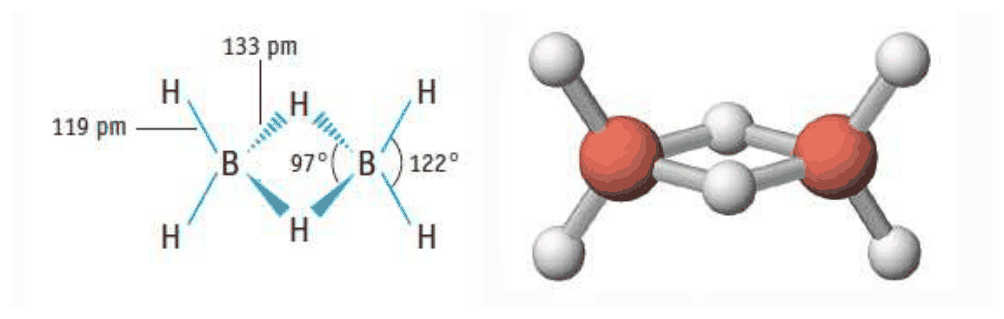
1.1 Using the data below derive the molecular formulae for two other members of this series of boron hydrides, A and B.
| Substance | State (25 °C, 1 bar) | Mass Percent of Boron | Molar mass (\(\mathrm{g\,mol^{-1}}\)) |
|---|---|---|---|
| A | Liquid | 83.1 | 65.1 |
| B | Solid | 88.5 | 122.2 |
William Lipscomb received the Nobel Prize in Chemistry in 1976 for “studies on the structures of boron hydrides illuminating the problems of chemical bonding.” Lipscomb recognized that, in all boron hydrides, each B atom has a normal 2-electron bond to at least one H atom (\(\ce{B-H}\)). However, additional bonds of several types occur, and he developed a scheme for describing the structure of a borane by giving it a styx number where:
s = number of \(\ce{B-H-B}\) bridges in the molecule,
t = the number of 3-center BBB bonds in the molecule,
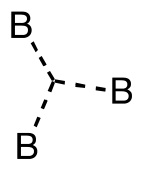
y = the number of two-center \(\ce{B-B}\) bonds in the molecule,
x = the number of \(\ce{BH2}\) groups in the molecule.
The styx number for \(\ce{B2H6}\) is 2002.
1.2 Propose a structure for tetraborane, \(\ce{B4H10}\), with a styx number of 4012.
1.3 A boron-based compound is composed of boron, carbon, chlorine, and oxygen. Spectral measurements indicate that the molecule has two types of B atoms, with tetrahedral and trigonal planar geometry, in a 1 : 3 ratio, respectively. These spectra are also consistent with a \(\ce{CO}\) triple bond. The molecular formula of the compound is \(\ce{B4CCl6O}\). Suggest a structure for its molecule.
B. Thermochemistry of Boron Compounds
1.4 Estimate the B-B single bond dissociation enthalpy in \(\ce{B2Cl4(g)}\) using the following information:
| Bond | Bond dissociation enthalpy (\(\mathrm{kJ\,mol^{-1}}\)) |
|---|---|
| \(\ce{B-Cl}\) | 443 |
| \(\ce{Cl-Cl}\) | 242 |
| Compound | \(\Delta_\mathrm{f}H^\circ\;(\mathrm{kJ\,mol^{-1}})\) |
|---|---|
| \(\ce{BCl3(g)}\) | −403 |
| \(\ce{B2Cl4(g)}\) | −489 |
C. Chemistry of Diborane
1.5 Give the structure for each numbered compound in the scheme below. Each numbered compound is a boron-containing compound.
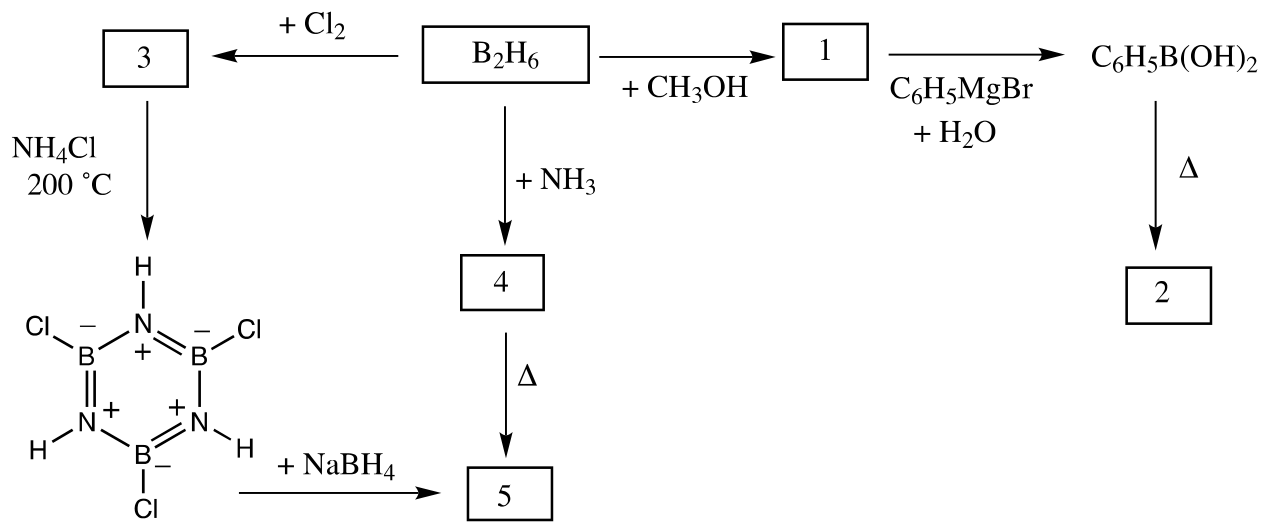
NOTES:
i. The boiling point of compound 5 is 55 °C.
ii. Excess reagents used in all reactions.
iii. The freezing point depression for 0.312 g of compound 2 in 25.0 g of benzene, is 0.205 °C. The freezing point depression constant for benzene is \(5.12\ \mathrm{kg\,K\,mol^{-1}}\).
Official English text of the problem.
Answers
Ordinary SMILES cannot directly encode a three-centre two-electron bond. For the explicitly specified borane connectivities below, extended connectivity SMILES use ~ for contacts belonging to such bonds. These strings require the accompanying bonding description. Part 1.1 determines molecular formulae, not unique cage connectivities, so assigning structural SMILES there would require additional information.
-
1.1: A is pentaborane(11), \(\boxed{\ce{B5H11}}\); B is decaborane(14), \(\boxed{\ce{B10H14}}\).
-
1.2: Tetraborane(10), \(\ce{B4H10}\), has a folded, butterfly-shaped boron framework: two \(\ce{BH}\) hinge atoms joined by one ordinary \(\ce{B-B}\) bond, two \(\ce{BH2}\) wing-tip atoms, and four hydrogen bridges connecting the hinge atoms to the wing tips. Extended connectivity SMILES:
[BH]12~[H]~[BH2]~[H]~[BH]1~[H]~[BH2]~[H]~2. -
1.3: The carbon monoxide adduct of tris(dichloroboryl)borane, \(\boxed{\ce{(Cl2B)3B <- CO}}\), with carbon bonded to the central boron and a \(\ce{C#O}\) bond. SMILES:
ClB(Cl)[B-](B(Cl)Cl)(B(Cl)Cl)C#[O+]. -
1.4: \(\boxed{D(\ce{B-B})\approx327\ \mathrm{kJ\,mol^{-1}}}\).
-
1.5: The numbered compounds are:
| Number | Identification and structure | SMILES |
|---|---|---|
| 1 | Trimethyl borate, \(\ce{B(OCH3)3}\) | COB(OC)OC |
| 2 | Triphenylboroxine, \(\ce{(C6H5BO)3}\): a six-membered alternating B–O ring, with one phenyl group on each boron | c1ccccc1B1OB(c2ccccc2)OB(c2ccccc2)O1 |
| 3 | Boron trichloride, \(\ce{BCl3}\) | ClB(Cl)Cl |
| 4 | Diammoniate of diborane, \(\ce{[BH2(NH3)2]+[BH4]-}\), also called diammineboronium borohydride; see the condition-dependent alternative below | [BH2-]([NH3+])[NH3+].[BH4-] |
| 5 | Borazine, \(\ce{B3N3H6}\): a planar alternating B–N ring with one hydrogen on every ring atom | [BH-]1=[NH+][BH-]=[NH+][BH-]=[NH+]1 |
For 4, molecular ammonia–borane, \(\ce{NH3BH3}\), SMILES [NH3+][BH3-], is another possible product of diborane and ammonia under different conditions. The supplied scheme does not specify those conditions; both routes to 5 are balanced below.
Solution
1.1 — Molecular formulae
For a borane \(\ce{B_xH_y}\) of molar mass \(M\) and boron mass fraction \(w_\mathrm B\),
\[ x=\frac{w_\mathrm B M}{M_\mathrm B}, \qquad y=\frac{(1-w_\mathrm B)M}{M_\mathrm H}. \]
Using the conventional atomic molar masses \(M_\mathrm B=10.81\ \mathrm{g\,mol^{-1}}\) and \(M_\mathrm H=1.008\ \mathrm{g\,mol^{-1}}\):
For A,
\[ x=\frac{0.831(65.1)}{10.81}=5.00, \qquad y=\frac{0.169(65.1)}{1.008}=10.9\approx11. \]
Thus,
\[ \boxed{\text{A: }\ce{B5H11}\text{, pentaborane(11).}} \]
For B,
\[ x=\frac{0.885(122.2)}{10.81}=10.0, \qquad y=\frac{0.115(122.2)}{1.008}=13.9\approx14. \]
Thus,
\[ \boxed{\text{B: }\ce{B10H14}\text{, decaborane(14).}} \]
The approximately integral atom counts identify the formulae despite the limited precision of the tabulated data.
1.2 — Tetraborane with styx number 4012
The four digits require:
\[ s=4,\qquad t=0,\qquad y=1,\qquad x=2. \]
Label the boron atoms \(B_1,B_2,B_3,B_4\). A precise description of the required drawing is:
- Join \(B_1\) and \(B_2\) by an ordinary two-centre, two-electron bond. These are the hinge atoms, each carrying one terminal hydrogen.
- Place \(B_3\) and \(B_4\) at the two wing tips of a folded butterfly framework. Each carries two terminal hydrogens.
- Add one hydrogen bridge on each of the four connections \(B_1\!-\!B_3\), \(B_2\!-\!B_3\), \(B_1\!-\!B_4\), and \(B_2\!-\!B_4\).
- Include no three-centre BBB bonds.
Each bridge is a single three-centre, two-electron \(\ce{B-H-B}\) bond. The butterfly is folded about the central \(B_1\!-\!B_2\) bond; the connectivity string does not specify this conformation.
The hydrogen count is
\[ 2(1)+2(2)+4=10. \]
The structure therefore has four bridges, zero BBB bonds, one ordinary B–B bond, and two terminal \(\ce{BH2}\) groups: exactly 4012.
An electron-count check gives
\[ 3(4)+10=22 \]
valence electrons, accounted for by six terminal B–H bonds, four hydrogen-bridge bonds, and one B–B bond:
\[ 6(2)+4(2)+1(2)=22. \]
1.3 — Structure of \(\ce{B4CCl6O}\)
Four boron atoms in a tetrahedral-to-trigonal-planar ratio of \(1:3\) require one four-coordinate boron and three three-coordinate borons.
Place one boron at the centre, bonded to three peripheral borons. Attach two chlorine atoms to each peripheral boron. Each peripheral boron then has three bonds—two B–Cl bonds and one B–B bond—and is trigonal planar.
The remaining carbon monoxide unit coordinates through carbon to the central boron. This supplies the central boron’s fourth bond and gives approximately tetrahedral coordination:
\[ \boxed{\ce{(Cl2B)3B <- CO}}. \]
Carbon monoxide is named carbon monoxide, SMILES [C-]#[O+]. Its carbon lone pair supplies the donor–acceptor bond.
In an ordinary covalent Lewis representation of the adduct, the central boron carries formal charge \(-1\), oxygen carries \(+1\), and carbon has one B–C bond plus a C–O triple bond. This is the representation encoded by
ClB(Cl)[B-](B(Cl)Cl)(B(Cl)Cl)C#[O+].
It has the required composition, three trigonal-planar peripheral borons, one tetrahedral central boron, and a retained C–O triple bond.
1.4 — B–B bond dissociation enthalpy
Consider the balanced reaction
\[ \ce{B2Cl4(g) + Cl2(g) -> 2 BCl3(g)}. \]
Here \(\ce{B2Cl4}\) is tetrachlorodiborane(4), with structure \(\ce{Cl2B-BCl2}\), SMILES ClB(Cl)B(Cl)Cl.
Because chlorine gas is an element in its standard state,
\[ \Delta_\mathrm fH^\circ\bigl(\ce{Cl2(g)}\bigr)=0. \]
Hence
\[ \begin{aligned} \Delta_\mathrm rH^\circ &=2\Delta_\mathrm fH^\circ(\ce{BCl3(g)}) -\Delta_\mathrm fH^\circ(\ce{B2Cl4(g)})\\ &=2(-403)-(-489)\\ &=-317\ \mathrm{kJ\,mol^{-1}}. \end{aligned} \]
In the net bond accounting, one B–B bond and one Cl–Cl bond are broken, and two additional B–Cl bonds are formed:
\[ \Delta_\mathrm rH^\circ \approx D(\ce{B-B})+D(\ce{Cl-Cl})-2D(\ce{B-Cl}). \]
Therefore,
\[ -317=D(\ce{B-B})+242-2(443), \]
so
\[ \boxed{D(\ce{B-B})\approx327\ \mathrm{kJ\,mol^{-1}}}. \]
This is an estimate because it treats the supplied B–Cl bond enthalpy as transferable between the compounds.
1.5 — Identification of the numbered compounds
Compound 1: trimethyl borate
Methanol replaces the hydridic hydrogens of diborane with methoxy groups, releasing hydrogen. With excess methanol, the balanced reaction is
\[ \ce{B2H6 + 6 CH3OH -> 2 B(OCH3)3 + 6 H2}. \]
Thus 1 is trimethyl borate, COB(OC)OC. Its boron is trigonal planar.
Reaction with phenylmagnesium bromide, followed by hydrolysis, gives the phenylboronic acid shown in the scheme. Phenylboronic acid has SMILES OB(O)c1ccccc1.
A balanced overall equation, representing the magnesium-containing hydrolysis product as magnesium bromide hydroxide, is
\[ \ce{ B(OCH3)3 + C6H5MgBr + 3 H2O -> C6H5B(OH)2 + 3 CH3OH + Mg(OH)Br }. \]
The phenyl group becomes bonded directly to boron, while hydrolysis replaces the remaining methoxy-derived ligands with hydroxyl groups.
Compound 2: triphenylboroxine
Heating phenylboronic acid causes condensation through B–O–B linkages. The freezing-point measurement determines the size of the product.
For a neutral, nondissociating solute,
\[ \Delta T_\mathrm f=K_\mathrm f m. \]
Consequently,
\[ m=\frac{0.205\ \mathrm K} {5.12\ \mathrm{kg\,K\,mol^{-1}}} =0.0400\ \mathrm{mol\,kg^{-1}}. \]
The solvent mass is \(0.0250\ \mathrm{kg}\), giving
\[ n_2=(0.0400\ \mathrm{mol\,kg^{-1}})(0.0250\ \mathrm{kg}) =1.00\times10^{-3}\ \mathrm{mol}. \]
Using unrounded intermediate values,
\[ M_2 =\frac{0.312\ \mathrm g}{n_2} =311.7\ \mathrm{g\,mol^{-1}} \approx312\ \mathrm{g\,mol^{-1}}. \]
Loss of one water molecule per phenylboronic acid unit leaves the repeat composition \(\ce{C6H5BO}\). Its molar mass is approximately
\[ M(\ce{C6H5BO}) =6(12.01)+5(1.008)+10.81+16.00 =103.91\ \mathrm{g\,mol^{-1}}. \]
Thus the number of repeat units is
\[ \frac{311.7}{103.91}=3.00. \]
Therefore 2 is the cyclic trimer, triphenylboroxine:
\[ \boxed{\ce{(C6H5BO)3}}. \]
The balanced condensation is
\[ \ce{3 C6H5B(OH)2 ->[\Delta] (C6H5BO)3 + 3 H2O}. \]
Draw a six-membered, approximately planar ring with alternating boron and oxygen atoms, placing one phenyl substituent on each boron. Each boron is trigonal planar. Its SMILES is
c1ccccc1B1OB(c2ccccc2)OB(c2ccccc2)O1.
Compound 3: boron trichloride
Excess chlorine converts diborane to boron trichloride:
\[ \ce{B2H6 + 6 Cl2 -> 2 BCl3 + 6 HCl}. \]
Thus 3 is \(\ce{BCl3}\), ClB(Cl)Cl, with trigonal-planar geometry.
Its reaction with ammonium chloride at \(200\,^\circ\mathrm C\) produces the B-trichloroborazine drawn in the scheme:
\[ \ce{ 3 BCl3 + 3 NH4Cl ->[200\,^\circ C] B3N3H3Cl3 + 9 HCl }. \]
B-Trichloroborazine has an alternating B–N six-membered ring, with chlorine on each boron and hydrogen on each nitrogen. A charge-separated resonance-form SMILES matching the type of drawing in the question is
Cl[B-]1=[NH+][B-](Cl)=[NH+][B-](Cl)=[NH+]1.
The formal charges and alternating double bonds describe a Lewis resonance form; they do not imply isolated ions.
Compound 4: the ammonia adduct
A conventional product of the diborane–ammonia reaction is diammoniate of diborane, the salt
\[ \ce{[BH2(NH3)2]+[BH4]-}. \]
Its formation is balanced as
\[ \ce{B2H6 + 2 NH3 -> [BH2(NH3)2][BH4]}. \]
The cation is diammineboronium, [BH2-]([NH3+])[NH3+], with two terminal hydrogens and two ammonia ligands arranged approximately tetrahedrally around boron. The anion is borohydride, [BH4-], also tetrahedral.
The covalent SMILES representation places formal positive charges on the coordinated nitrogen atoms and a negative charge on the cation’s boron; their sum is the required \(+1\) cation charge.
On heating, the balanced overall conversion to borazine is
\[ \ce{ 3 [BH2(NH3)2][BH4] ->[\Delta] 2 B3N3H6 + 12 H2 }. \]
The ammonia-reaction conditions are unspecified. A molecular alternative is ammonia–borane, \(\ce{H3N -> BH3}\), [NH3+][BH3-], in which nitrogen donates its lone pair to boron. Both atoms have approximately tetrahedral coordination. Its corresponding reactions are
\[ \ce{B2H6 + 2 NH3 -> 2 NH3BH3} \]
and
\[ \ce{3 NH3BH3 ->[\Delta] B3N3H6 + 6 H2}. \]
Both formulations therefore give the same overall diborane/ammonia-to-borazine stoichiometry.
Compound 5: borazine
Sodium borohydride replaces the three B–Cl substituents of B-trichloroborazine with B–H groups. The ring product is therefore borazine, \(\ce{B3N3H6}\), consistent with the stated boiling point of \(55\,^\circ\mathrm C\).
A balanced equation, with the borane byproduct represented as diborane, is
\[ \ce{ 2 B3N3H3Cl3 + 6 NaBH4 -> 2 B3N3H6 + 6 NaCl + 3 B2H6 }. \]
Draw a planar six-membered ring with alternating B and N atoms and one hydrogen attached to every ring atom. Each ring atom is approximately trigonal planar. Nitrogen-to-boron electron donation produces delocalized bonding; a charge-separated resonance-form SMILES is
[BH-]1=[NH+][BH-]=[NH+][BH-]=[NH+]1.
For completeness, the other species used in these equations have the following names and SMILES. Ionic salts are represented by disconnected ionic components; the Grignard representation omits solvent coordination and aggregation.
| Species | Name | SMILES |
|---|---|---|
| \(\ce{B2H6}\) | Diborane(6), with two three-centre hydrogen bridges | Extended connectivity: [BH2]1~[H]~[BH2]~[H]~1 |
| \(\ce{CH3OH}\) | Methanol | CO |
| \(\ce{H2}\) | Molecular hydrogen | [H][H] |
| \(\ce{H2O}\) | Water | O |
| \(\ce{C6H5MgBr}\) | Phenylmagnesium bromide | c1ccccc1[Mg]Br |
| \(\ce{Mg(OH)Br}\) | Magnesium bromide hydroxide | [Mg+2].[OH-].[Br-] |
| \(\ce{C6H6}\) | Benzene | c1ccccc1 |
| \(\ce{Cl2}\) | Chlorine | ClCl |
| \(\ce{HCl}\) | Hydrogen chloride | [H]Cl |
| \(\ce{NH3}\) | Ammonia | N |
| \(\ce{NH4Cl}\) | Ammonium chloride | [NH4+].[Cl-] |
| \(\ce{NaBH4}\) | Sodium borohydride | [Na+].[BH4-] |
| \(\ce{NaCl}\) | Sodium chloride | [Na+].[Cl-] |
The solution was checked against the official solution.
IChO 2012 · Theorieaufgabe 1
Borhydride und andere Borverbindungen
A. Borhydride und andere Borverbindungen
Die Chemie der Borhydride wurde erstmals von Alfred Stock (1876 - 1946) entwickelt. Mehr als 20 neutrale molekulare Borhydride mit der allgemeinen Formel \(\ce{B_xH_y}\) wurden charakterisiert. Das einfachste Borhydrid ist \(\ce{B2H6}\), Diboran.
1.1 Leiten Sie anhand der folgenden Daten die Summenformeln zweier weiterer Vertreter dieser Reihe von Borhydriden, A und B, her.
| Stoff | Aggregatzustand (25 °C, 1 bar) | Massenanteil an Bor in Prozent | Molare Masse (\(\mathrm{g\,mol^{-1}}\)) |
|---|---|---|---|
| A | Flüssig | 83.1 | 65.1 |
| B | Fest | 88.5 | 122.2 |
William Lipscomb erhielt 1976 den Nobelpreis für Chemie für „Untersuchungen zur Struktur von Borhydriden, die Probleme der chemischen Bindung erhellen“. Lipscomb erkannte, dass in allen Borhydriden jedes B-Atom über eine normale 2-Elektronen-Bindung mit mindestens einem H-Atom verbunden ist (\(\ce{B-H}\)). Es treten jedoch zusätzliche Bindungen verschiedener Typen auf, und er entwickelte ein Schema zur Beschreibung der Struktur eines Borans durch Angabe einer styx-Zahl, wobei gilt:
s = Anzahl der \(\ce{B-H-B}\)-Brücken im Molekül,
t = Anzahl der 3-Zentren-BBB-Bindungen im Molekül,
y = Anzahl der Zweizentren-\(\ce{B-B}\)-Bindungen im Molekül,
x = Anzahl der \(\ce{BH2}\)-Gruppen im Molekül.
Die styx-Zahl von \(\ce{B2H6}\) ist 2002.
1.2 Schlagen Sie eine Struktur für Tetraboran, \(\ce{B4H10}\), mit der styx-Zahl 4012 vor.
1.3 Eine borbasierte Verbindung besteht aus Bor, Kohlenstoff, Chlor und Sauerstoff. Spektroskopische Messungen zeigen, dass das Molekül zwei Arten von B-Atomen mit tetraedrischer beziehungsweise trigonal-planarer Geometrie im Verhältnis 1 : 3 aufweist. Diese Spektren sind auch mit einer \(\ce{CO}\)-Dreifachbindung vereinbar. Die Summenformel der Verbindung lautet \(\ce{B4CCl6O}\). Schlagen Sie eine Struktur für ihr Molekül vor.
B. Thermochemie von Borverbindungen
1.4 Schätzen Sie mithilfe der folgenden Angaben die Dissoziationsenthalpie der B-B-Einfachbindung in \(\ce{B2Cl4(g)}\) ab:
| Bindung | Bindungsdissoziationsenthalpie (\(\mathrm{kJ\,mol^{-1}}\)) |
|---|---|
| \(\ce{B-Cl}\) | 443 |
| \(\ce{Cl-Cl}\) | 242 |
| Verbindung | \(\Delta_\mathrm{f}H^\circ\;(\mathrm{kJ\,mol^{-1}})\) |
|---|---|
| \(\ce{BCl3(g)}\) | −403 |
| \(\ce{B2Cl4(g)}\) | −489 |
C. Chemie des Diborans
1.5 Geben Sie die Struktur jeder nummerierten Verbindung im folgenden Schema an. Jede nummerierte Verbindung enthält Bor.
HINWEISE:
i. Der Siedepunkt der Verbindung 5 beträgt 55 °C.
ii. Bei allen Reaktionen werden die Reagenzien im Überschuss eingesetzt.
iii. Die Gefrierpunktserniedrigung für 0.312 g der Verbindung 2 in 25.0 g Benzol beträgt 0.205 °C. Die kryoskopische Konstante von Benzol beträgt \(5.12\ \mathrm{kg\,K\,mol^{-1}}\).
Aufgabentext aus dem offiziellen englischen Text übersetzt.
Antworten
Gewöhnliche SMILES können eine Dreizentren-Zweielektronen-Bindung nicht direkt codieren. Für die nachstehend ausdrücklich angegebenen Boran-Konnektivitäten verwenden erweiterte Konnektivitäts-SMILES das Zeichen ~ für Kontakte, die zu solchen Bindungen gehören. Diese Zeichenfolgen erfordern die zugehörige Beschreibung der Bindungsverhältnisse. In Teil 1.1 werden Summenformeln bestimmt, keine eindeutigen Käfigkonnektivitäten; die Zuordnung von Struktur-SMILES würde dort daher zusätzliche Informationen erfordern.
-
1.1: A ist Pentaboran(11), \(\boxed{\ce{B5H11}}\); B ist Decaboran(14), \(\boxed{\ce{B10H14}}\).
-
1.2: Tetraboran(10), \(\ce{B4H10}\), besitzt ein gefaltetes, schmetterlingsförmiges Borgerüst: zwei \(\ce{BH}\)-Atome an der Faltkante, die durch eine gewöhnliche \(\ce{B-B}\)-Bindung verbunden sind, zwei \(\ce{BH2}\)-Atome an den Flügelspitzen und vier Wasserstoffbrücken, die die Atome an der Faltkante mit den Flügelspitzen verbinden. Erweiterte Konnektivitäts-SMILES:
[BH]12~[H]~[BH2]~[H]~[BH]1~[H]~[BH2]~[H]~2. -
1.3: Das Kohlenstoffmonoxid-Addukt von Tris(dichlorboryl)boran, \(\boxed{\ce{(Cl2B)3B <- CO}}\), bei dem Kohlenstoff an das zentrale Bor gebunden ist und eine \(\ce{C#O}\)-Bindung vorliegt. SMILES:
ClB(Cl)[B-](B(Cl)Cl)(B(Cl)Cl)C#[O+]. -
1.4: \(\boxed{D(\ce{B-B})\approx327\ \mathrm{kJ\,mol^{-1}}}\).
-
1.5: Die nummerierten Verbindungen sind:
| Nummer | Identifizierung und Struktur | SMILES |
|---|---|---|
| 1 | Borsäuretrimethylester, \(\ce{B(OCH3)3}\) | COB(OC)OC |
| 2 | Triphenylboroxin, \(\ce{(C6H5BO)3}\): ein sechsgliedriger Ring aus abwechselnden B- und O-Atomen mit einer Phenylgruppe an jedem Boratom | c1ccccc1B1OB(c2ccccc2)OB(c2ccccc2)O1 |
| 3 | Bortrichlorid, \(\ce{BCl3}\) | ClB(Cl)Cl |
| 4 | Diammoniakat des Diborans, \(\ce{[BH2(NH3)2]+[BH4]-}\), auch Diamminboroniumborhydrid genannt; siehe die von den Bedingungen abhängige Alternative unten | [BH2-]([NH3+])[NH3+].[BH4-] |
| 5 | Borazin, \(\ce{B3N3H6}\): ein planarer Ring aus abwechselnden B- und N-Atomen mit einem Wasserstoffatom an jedem Ringatom | [BH-]1=[NH+][BH-]=[NH+][BH-]=[NH+]1 |
Für 4 ist molekulares Ammoniak–Boran, \(\ce{NH3BH3}\), SMILES [NH3+][BH3-], unter anderen Bedingungen ein weiteres mögliches Produkt aus Diboran und Ammoniak. Das vorgegebene Schema legt diese Bedingungen nicht fest; beide Reaktionswege zu 5 werden unten durch ausgeglichene Gleichungen beschrieben.
Lösung
1.1 — Summenformeln
Für ein Boran \(\ce{B_xH_y}\) mit der molaren Masse \(M\) und dem Bormassenanteil \(w_\mathrm B\) gilt:
\[ x=\frac{w_\mathrm B M}{M_\mathrm B}, \qquad y=\frac{(1-w_\mathrm B)M}{M_\mathrm H}. \]
Mit den konventionellen molaren Atommassen \(M_\mathrm B=10.81\ \mathrm{g\,mol^{-1}}\) und \(M_\mathrm H=1.008\ \mathrm{g\,mol^{-1}}\):
Für A gilt:
\[ x=\frac{0.831(65.1)}{10.81}=5.00, \qquad y=\frac{0.169(65.1)}{1.008}=10.9\approx11. \]
Somit:
\[ \boxed{\text{A: }\ce{B5H11}\text{, Pentaboran(11).}} \]
Für B gilt:
\[ x=\frac{0.885(122.2)}{10.81}=10.0, \qquad y=\frac{0.115(122.2)}{1.008}=13.9\approx14. \]
Somit:
\[ \boxed{\text{B: }\ce{B10H14}\text{, Decaboran(14).}} \]
Die annähernd ganzzahligen Atomzahlen erlauben trotz der begrenzten Genauigkeit der tabellierten Daten die Bestimmung der Summenformeln.
1.2 — Tetraboran mit der styx-Zahl 4012
Die vier Ziffern verlangen:
\[ s=4,\qquad t=0,\qquad y=1,\qquad x=2. \]
Bezeichnen Sie die Boratome mit \(B_1,B_2,B_3,B_4\). Eine genaue Beschreibung der geforderten Zeichnung lautet:
- Verbinden Sie \(B_1\) und \(B_2\) durch eine gewöhnliche Zweizentren-Zweielektronen-Bindung. Dies sind die Atome an der Faltkante, die jeweils ein terminales Wasserstoffatom tragen.
- Platzieren Sie \(B_3\) und \(B_4\) an den beiden Flügelspitzen eines gefalteten Schmetterlingsgerüsts. Jedes trägt zwei terminale Wasserstoffatome.
- Fügen Sie an jeder der vier Verbindungen \(B_1\!-\!B_3\), \(B_2\!-\!B_3\), \(B_1\!-\!B_4\) und \(B_2\!-\!B_4\) eine Wasserstoffbrücke hinzu.
- Zeichnen Sie keine Dreizentren-BBB-Bindungen ein.
Jede Brücke ist eine einzelne Dreizentren-Zweielektronen-\(\ce{B-H-B}\)-Bindung. Der Schmetterling ist entlang der zentralen \(B_1\!-\!B_2\)-Bindung gefaltet; die Konnektivitätszeichenfolge legt diese Konformation nicht fest.
Die Anzahl der Wasserstoffatome beträgt
\[ 2(1)+2(2)+4=10. \]
Die Struktur besitzt somit vier Brücken, keine BBB-Bindung, eine gewöhnliche B–B-Bindung und zwei terminale \(\ce{BH2}\)-Gruppen: genau 4012.
Eine Überprüfung der Elektronenzahl ergibt
\[ 3(4)+10=22 \]
Valenzelektronen, die auf sechs terminale B–H-Bindungen, vier Wasserstoffbrückenbindungen und eine B–B-Bindung verteilt sind:
\[ 6(2)+4(2)+1(2)=22. \]
1.3 — Struktur von \(\ce{B4CCl6O}\)
Vier Boratome mit einem Verhältnis von tetraedrischer zu trigonal-planarer Geometrie von \(1:3\) erfordern ein vierfach koordiniertes Boratom und drei dreifach koordinierte Boratome.
Platzieren Sie ein Boratom im Zentrum, gebunden an drei periphere Boratome. Binden Sie an jedes periphere Boratom zwei Chloratome. Jedes periphere Boratom besitzt dann drei Bindungen – zwei B–Cl-Bindungen und eine B–B-Bindung – und ist trigonal-planar koordiniert.
Die verbleibende Kohlenstoffmonoxid-Einheit koordiniert über Kohlenstoff an das zentrale Boratom. Dadurch erhält das zentrale Boratom seine vierte Bindung und eine annähernd tetraedrische Koordination:
\[ \boxed{\ce{(Cl2B)3B <- CO}}. \]
Kohlenstoffmonoxid wird als Kohlenstoffmonoxid bezeichnet, SMILES [C-]#[O+]. Das freie Elektronenpaar des Kohlenstoffatoms bildet die Donator-Akzeptor-Bindung.
In einer gewöhnlichen kovalenten Lewis-Darstellung des Addukts trägt das zentrale Boratom die Formalladung \(-1\), das Sauerstoffatom die Formalladung \(+1\), und das Kohlenstoffatom besitzt eine B–C-Bindung sowie eine C–O-Dreifachbindung. Diese Darstellung wird durch folgende SMILES codiert:
ClB(Cl)[B-](B(Cl)Cl)(B(Cl)Cl)C#[O+].
Sie weist die geforderte Zusammensetzung, drei trigonal-planare periphere Boratome, ein tetraedrisches zentrales Boratom und eine erhaltene C–O-Dreifachbindung auf.
1.4 — Dissoziationsenthalpie der B–B-Bindung
Betrachten Sie die ausgeglichene Reaktion
\[ \ce{B2Cl4(g) + Cl2(g) -> 2 BCl3(g)}. \]
Dabei ist \(\ce{B2Cl4}\) Tetrachlordiboran(4) mit der Struktur \(\ce{Cl2B-BCl2}\), SMILES ClB(Cl)B(Cl)Cl.
Da Chlorgas ein Element in seinem Standardzustand ist, gilt:
\[ \Delta_\mathrm fH^\circ\bigl(\ce{Cl2(g)}\bigr)=0. \]
Daher gilt:
\[ \begin{aligned} \Delta_\mathrm rH^\circ &=2\Delta_\mathrm fH^\circ(\ce{BCl3(g)}) -\Delta_\mathrm fH^\circ(\ce{B2Cl4(g)})\\ &=2(-403)-(-489)\\ &=-317\ \mathrm{kJ\,mol^{-1}}. \end{aligned} \]
In der Nettobindungsbilanz werden eine B–B-Bindung und eine Cl–Cl-Bindung gespalten und zwei zusätzliche B–Cl-Bindungen gebildet:
\[ \Delta_\mathrm rH^\circ \approx D(\ce{B-B})+D(\ce{Cl-Cl})-2D(\ce{B-Cl}). \]
Folglich gilt:
\[ -317=D(\ce{B-B})+242-2(443), \]
also
\[ \boxed{D(\ce{B-B})\approx327\ \mathrm{kJ\,mol^{-1}}}. \]
Dies ist eine Abschätzung, da die angegebene B–Cl-Bindungsenthalpie als zwischen den Verbindungen übertragbar behandelt wird.
1.5 — Identifizierung der nummerierten Verbindungen
Verbindung 1: Borsäuretrimethylester
Methanol ersetzt die hydridischen Wasserstoffatome des Diborans durch Methoxygruppen, wobei Wasserstoff freigesetzt wird. Mit überschüssigem Methanol lautet die ausgeglichene Reaktion
\[ \ce{B2H6 + 6 CH3OH -> 2 B(OCH3)3 + 6 H2}. \]
Somit ist 1 Borsäuretrimethylester, COB(OC)OC. Sein Boratom ist trigonal-planar koordiniert.
Die Reaktion mit Phenylmagnesiumbromid und anschließende Hydrolyse ergibt die im Schema gezeigte Phenylboronsäure. Phenylboronsäure hat die SMILES OB(O)c1ccccc1.
Eine ausgeglichene Gesamtgleichung, in der das magnesiumhaltige Hydrolyseprodukt als Magnesiumbromidhydroxid dargestellt wird, lautet
\[ \ce{ B(OCH3)3 + C6H5MgBr + 3 H2O -> C6H5B(OH)2 + 3 CH3OH + Mg(OH)Br }. \]
Die Phenylgruppe wird direkt an Bor gebunden, während die Hydrolyse die verbleibenden von Methoxygruppen abgeleiteten Liganden durch Hydroxygruppen ersetzt.
Verbindung 2: Triphenylboroxin
Das Erhitzen von Phenylboronsäure führt zur Kondensation unter Bildung von B–O–B-Verknüpfungen. Die Gefrierpunktsmessung bestimmt die Größe des Produkts.
Für einen neutralen, nicht dissoziierenden gelösten Stoff gilt:
\[ \Delta T_\mathrm f=K_\mathrm f m. \]
Folglich gilt:
\[ m=\frac{0.205\ \mathrm K} {5.12\ \mathrm{kg\,K\,mol^{-1}}} =0.0400\ \mathrm{mol\,kg^{-1}}. \]
Die Masse des Lösungsmittels beträgt \(0.0250\ \mathrm{kg}\), woraus folgt:
\[ n_2=(0.0400\ \mathrm{mol\,kg^{-1}})(0.0250\ \mathrm{kg}) =1.00\times10^{-3}\ \mathrm{mol}. \]
Mit ungerundeten Zwischenwerten ergibt sich:
\[ M_2 =\frac{0.312\ \mathrm g}{n_2} =311.7\ \mathrm{g\,mol^{-1}} \approx312\ \mathrm{g\,mol^{-1}}. \]
Nach Abspaltung eines Wassermoleküls pro Phenylboronsäureeinheit verbleibt die Zusammensetzung \(\ce{C6H5BO}\) als Wiederholungseinheit. Ihre molare Masse beträgt ungefähr
\[ M(\ce{C6H5BO}) =6(12.01)+5(1.008)+10.81+16.00 =103.91\ \mathrm{g\,mol^{-1}}. \]
Somit beträgt die Anzahl der Wiederholungseinheiten
\[ \frac{311.7}{103.91}=3.00. \]
Daher ist 2 das cyclische Trimer, Triphenylboroxin:
\[ \boxed{\ce{(C6H5BO)3}}. \]
Die ausgeglichene Kondensationsreaktion lautet
\[ \ce{3 C6H5B(OH)2 ->[\Delta] (C6H5BO)3 + 3 H2O}. \]
Zeichnen Sie einen sechsgliedrigen, annähernd planaren Ring aus abwechselnden Bor- und Sauerstoffatomen mit einem Phenylsubstituenten an jedem Boratom. Jedes Boratom ist trigonal-planar koordiniert. Seine SMILES lautet
c1ccccc1B1OB(c2ccccc2)OB(c2ccccc2)O1.
Verbindung 3: Bortrichlorid
Überschüssiges Chlor wandelt Diboran in Bortrichlorid um:
\[ \ce{B2H6 + 6 Cl2 -> 2 BCl3 + 6 HCl}. \]
Somit ist 3 \(\ce{BCl3}\), ClB(Cl)Cl, mit trigonal-planarer Geometrie.
Seine Reaktion mit Ammoniumchlorid bei \(200\,^\circ\mathrm C\) liefert das im Schema gezeichnete B-Trichlorborazin:
\[ \ce{ 3 BCl3 + 3 NH4Cl ->[200\,^\circ C] B3N3H3Cl3 + 9 HCl }. \]
B-Trichlorborazin besitzt einen sechsgliedrigen Ring aus abwechselnden B- und N-Atomen, mit Chlor an jedem Boratom und Wasserstoff an jedem Stickstoffatom. Eine SMILES einer ladungsgetrennten mesomeren Grenzstruktur, die dem Darstellungstyp in der Aufgabe entspricht, lautet
Cl[B-]1=[NH+][B-](Cl)=[NH+][B-](Cl)=[NH+]1.
Die Formalladungen und alternierenden Doppelbindungen beschreiben eine Lewis-Grenzstruktur; sie bedeuten nicht, dass isolierte Ionen vorliegen.
Verbindung 4: das Ammoniak-Addukt
Ein übliches Produkt der Reaktion von Diboran mit Ammoniak ist das Diammoniakat des Diborans, das Salz
\[ \ce{[BH2(NH3)2]+[BH4]-}. \]
Seine Bildung wird durch folgende ausgeglichene Gleichung beschrieben:
\[ \ce{B2H6 + 2 NH3 -> [BH2(NH3)2][BH4]}. \]
Das Kation ist Diamminboronium, [BH2-]([NH3+])[NH3+], mit zwei terminalen Wasserstoffatomen und zwei Ammoniakliganden, die annähernd tetraedrisch um das Boratom angeordnet sind. Das Anion ist Borhydrid, [BH4-], ebenfalls tetraedrisch.
Die kovalente SMILES-Darstellung weist den koordinierten Stickstoffatomen positive Formalladungen und dem Boratom des Kations eine negative Ladung zu; ihre Summe ergibt die erforderliche Kationenladung \(+1\).
Beim Erhitzen lautet die ausgeglichene Gesamtumwandlung zu Borazin
\[ \ce{ 3 [BH2(NH3)2][BH4] ->[\Delta] 2 B3N3H6 + 12 H2 }. \]
Die Bedingungen der Ammoniakreaktion sind nicht angegeben. Eine molekulare Alternative ist Ammoniak–Boran, \(\ce{H3N -> BH3}\), [NH3+][BH3-], in dem Stickstoff sein freies Elektronenpaar dem Bor zur Verfügung stellt. Beide Atome sind annähernd tetraedrisch koordiniert. Die entsprechenden Reaktionen lauten
\[ \ce{B2H6 + 2 NH3 -> 2 NH3BH3} \]
und
\[ \ce{3 NH3BH3 ->[\Delta] B3N3H6 + 6 H2}. \]
Beide Formulierungen ergeben somit dieselbe Gesamtstöchiometrie der Umsetzung von Diboran und Ammoniak zu Borazin.
Verbindung 5: Borazin
Natriumborhydrid ersetzt die drei B–Cl-Substituenten des B-Trichlorborazins durch B–H-Gruppen. Das Ringprodukt ist daher Borazin, \(\ce{B3N3H6}\), im Einklang mit dem angegebenen Siedepunkt von \(55\,^\circ\mathrm C\).
Eine ausgeglichene Gleichung, in der das Boran-Nebenprodukt als Diboran dargestellt wird, lautet
\[ \ce{ 2 B3N3H3Cl3 + 6 NaBH4 -> 2 B3N3H6 + 6 NaCl + 3 B2H6 }. \]
Zeichnen Sie einen planaren sechsgliedrigen Ring aus abwechselnden B- und N-Atomen mit einem Wasserstoffatom an jedem Ringatom. Jedes Ringatom ist annähernd trigonal-planar koordiniert. Elektronendonationen vom Stickstoff zum Bor führen zu delokalisierten Bindungen; eine SMILES einer ladungsgetrennten mesomeren Grenzstruktur lautet
[BH-]1=[NH+][BH-]=[NH+][BH-]=[NH+]1.
Der Vollständigkeit halber sind nachstehend die Namen und SMILES der anderen in diesen Gleichungen verwendeten Spezies angegeben. Ionische Salze werden durch unverbundene ionische Komponenten dargestellt; die Grignard-Darstellung lässt Lösungsmittelkoordination und Aggregation unberücksichtigt.
| Spezies | Name | SMILES |
|---|---|---|
| \(\ce{B2H6}\) | Diboran(6), mit zwei Dreizentren-Wasserstoffbrücken | Erweiterte Konnektivität: [BH2]1~[H]~[BH2]~[H]~1 |
| \(\ce{CH3OH}\) | Methanol | CO |
| \(\ce{H2}\) | Molekularer Wasserstoff | [H][H] |
| \(\ce{H2O}\) | Wasser | O |
| \(\ce{C6H5MgBr}\) | Phenylmagnesiumbromid | c1ccccc1[Mg]Br |
| \(\ce{Mg(OH)Br}\) | Magnesiumbromidhydroxid | [Mg+2].[OH-].[Br-] |
| \(\ce{C6H6}\) | Benzol | c1ccccc1 |
| \(\ce{Cl2}\) | Chlor | ClCl |
| \(\ce{HCl}\) | Chlorwasserstoff | [H]Cl |
| \(\ce{NH3}\) | Ammoniak | N |
| \(\ce{NH4Cl}\) | Ammoniumchlorid | [NH4+].[Cl-] |
| \(\ce{NaBH4}\) | Natriumborhydrid | [Na+].[BH4-] |
| \(\ce{NaCl}\) | Natriumchlorid | [Na+].[Cl-] |
Die Lösung wurde mit der offiziellen Lösung abgeglichen.
IChO 2012 · Teori sorusu 1
Bor hidrürleri ve diğer bor bileşikleri
A. Bor Hidrürleri ve Diğer Bor Bileşikleri
Bor hidrürlerinin kimyası ilk olarak Alfred Stock (1876 - 1946) tarafından geliştirilmiştir. Genel formülü \(\ce{B_xH_y}\) olan 20'den fazla nötr moleküler bor hidrür karakterize edilmiştir. En basit bor hidrür, diboran, \(\ce{B2H6}\)'dır.
1.1 Aşağıdaki verileri kullanarak bu bor hidrürleri serisinin diğer iki üyesi olan A ve B'nin molekül formüllerini türetiniz.
| Madde | Hâl (25 °C, 1 bar) | Borun Kütlece Yüzdesi | Molar kütle (\(\mathrm{g\,mol^{-1}}\)) |
|---|---|---|---|
| A | Sıvı | 83.1 | 65.1 |
| B | Katı | 88.5 | 122.2 |
William Lipscomb, “kimyasal bağlanma sorunlarına ışık tutan bor hidrürlerinin yapıları üzerine çalışmaları” nedeniyle 1976 yılında Nobel Kimya Ödülü'nü almıştır. Lipscomb, tüm bor hidrürlerinde her B atomunun en az bir H atomuyla normal bir 2 elektronlu bağ (\(\ce{B-H}\)) yaptığını fark etmiştir. Bununla birlikte, çeşitli türlerde ek bağlar da bulunur ve Lipscomb, bir boranın yapısını ona bir styx sayısı vererek tanımlayan bir yöntem geliştirmiştir. Burada:
s = moleküldeki \(\ce{B-H-B}\) köprülerinin sayısı,
t = moleküldeki 3 merkezli BBB bağlarının sayısı,
y = moleküldeki iki merkezli \(\ce{B-B}\) bağlarının sayısı,
x = moleküldeki \(\ce{BH2}\) gruplarının sayısıdır.
\(\ce{B2H6}\) için styx sayısı 2002'dir.
1.2 styx sayısı 4012 olan tetraboran, \(\ce{B4H10}\), için bir yapı öneriniz.
1.3 Bor esaslı bir bileşik; bor, karbon, klor ve oksijenden oluşmaktadır. Spektral ölçümler, molekülde sırasıyla 1 : 3 oranında, tetrahedral ve üçgen düzlemsel geometriye sahip iki tür B atomu bulunduğunu göstermektedir. Bu spektrumlar aynı zamanda bir \(\ce{CO}\) üçlü bağıyla da uyumludur. Bileşiğin molekül formülü \(\ce{B4CCl6O}\)'dur. Molekülü için bir yapı öneriniz.
B. Bor Bileşiklerinin Termokimyası
1.4 Aşağıdaki bilgileri kullanarak \(\ce{B2Cl4(g)}\)'deki B-B tek bağının bağ ayrışma entalpisini tahmin ediniz:
| Bağ | Bağ ayrışma entalpisi (\(\mathrm{kJ\,mol^{-1}}\)) |
|---|---|
| \(\ce{B-Cl}\) | 443 |
| \(\ce{Cl-Cl}\) | 242 |
| Bileşik | \(\Delta_\mathrm{f}H^\circ\;(\mathrm{kJ\,mol^{-1}})\) |
|---|---|
| \(\ce{BCl3(g)}\) | −403 |
| \(\ce{B2Cl4(g)}\) | −489 |
C. Diboranın Kimyası
1.5 Aşağıdaki şemada numaralandırılmış her bileşiğin yapısını veriniz. Numaralandırılmış bileşiklerin her biri bor içeren bir bileşiktir.
NOTLAR:
i. 5 bileşiğinin kaynama noktası 55 °C'dir.
ii. Tüm tepkimelerde reaktifler aşırı miktarda kullanılmıştır.
iii. 25.0 g benzende çözünmüş 0.312 g 2 bileşiği için donma noktası alçalması 0.205 °C'dir. Benzenin donma noktası alçalması sabiti \(5.12\ \mathrm{kg\,K\,mol^{-1}}\)'dir.
Soru metni resmi İngilizce metinden çevrilmiştir.
Cevaplar
Standart SMILES, üç merkezli iki elektronlu bir bağı doğrudan kodlayamaz. Aşağıda açıkça belirtilen boran bağlanma düzenleri için genişletilmiş bağlanma SMILES gösterimleri, bu tür bağlara ait temasları belirtmek üzere ~ kullanır. Bu dizgeler, beraberlerinde verilen bağlanma açıklamasını gerektirir. Bölüm 1.1, tek bir kafes bağlanma düzenini değil, molekül formüllerini belirler; dolayısıyla orada yapısal SMILES atamak ek bilgi gerektirir.
-
1.1: A, pentaboran(11), \(\boxed{\ce{B5H11}}\); B ise dekaboran(14), \(\boxed{\ce{B10H14}}\)'tür.
-
1.2: Tetraboran(10), \(\ce{B4H10}\), katlanmış, kelebek biçimli bir bor iskeletine sahiptir: bir normal \(\ce{B-B}\) bağıyla birbirine bağlanmış iki \(\ce{BH}\) menteşe atomu, iki \(\ce{BH2}\) kanat ucu atomu ve menteşe atomlarını kanat uçlarına bağlayan dört hidrojen köprüsü. Genişletilmiş bağlanma SMILES gösterimi:
[BH]12~[H]~[BH2]~[H]~[BH]1~[H]~[BH2]~[H]~2. -
1.3: Tris(dikloroboril)boranın karbon monoksit katılma bileşiği, \(\boxed{\ce{(Cl2B)3B <- CO}}\); karbon merkezdeki bora bağlıdır ve bir \(\ce{C#O}\) bağı bulunur. SMILES:
ClB(Cl)[B-](B(Cl)Cl)(B(Cl)Cl)C#[O+]. -
1.4: \(\boxed{D(\ce{B-B})\approx327\ \mathrm{kJ\,mol^{-1}}}\).
-
1.5: Numaralandırılmış bileşikler şunlardır:
| Numara | Tanımlama ve yapı | SMILES |
|---|---|---|
| 1 | Trimetil borat, \(\ce{B(OCH3)3}\) | COB(OC)OC |
| 2 | Trifenilboroksin, \(\ce{(C6H5BO)3}\): B ve O atomlarının dönüşümlü olarak yer aldığı, her bor üzerinde bir fenil grubu bulunan altı üyeli bir halka | c1ccccc1B1OB(c2ccccc2)OB(c2ccccc2)O1 |
| 3 | Bor triklorür, \(\ce{BCl3}\) | ClB(Cl)Cl |
| 4 | Diboranın diamonyağı, \(\ce{[BH2(NH3)2]+[BH4]-}\), diaminboronyum borohidrür olarak da adlandırılır; aşağıdaki koşullara bağlı alternatife bakınız | [BH2-]([NH3+])[NH3+].[BH4-] |
| 5 | Borazin, \(\ce{B3N3H6}\): B ve N atomlarının dönüşümlü olarak yer aldığı, her halka atomu üzerinde bir hidrojen bulunan düzlemsel bir halka | [BH-]1=[NH+][BH-]=[NH+][BH-]=[NH+]1 |
4 için moleküler amonyak–boran, \(\ce{NH3BH3}\), SMILES [NH3+][BH3-], farklı koşullar altında diboran ve amonyağın oluşturabileceği bir başka üründür. Verilen şemada bu koşullar belirtilmemiştir; 5'e giden her iki yol da aşağıda denkleştirilmiştir.
Çözüm
1.1 — Molekül formülleri
Molar kütlesi \(M\) ve borun kütle kesri \(w_\mathrm B\) olan bir \(\ce{B_xH_y}\) boranı için,
\[ x=\frac{w_\mathrm B M}{M_\mathrm B}, \qquad y=\frac{(1-w_\mathrm B)M}{M_\mathrm H}. \]
Yaygın olarak kullanılan atomik molar kütleler \(M_\mathrm B=10.81\ \mathrm{g\,mol^{-1}}\) ve \(M_\mathrm H=1.008\ \mathrm{g\,mol^{-1}}\) kullanıldığında:
A için,
\[ x=\frac{0.831(65.1)}{10.81}=5.00, \qquad y=\frac{0.169(65.1)}{1.008}=10.9\approx11. \]
Böylece,
\[ \boxed{\text{A: }\ce{B5H11}\text{, pentaboran(11).}} \]
B için,
\[ x=\frac{0.885(122.2)}{10.81}=10.0, \qquad y=\frac{0.115(122.2)}{1.008}=13.9\approx14. \]
Böylece,
\[ \boxed{\text{B: }\ce{B10H14}\text{, dekaboran(14).}} \]
Yaklaşık olarak tam sayı olan atom sayıları, tablodaki verilerin sınırlı kesinliğine rağmen formülleri belirler.
1.2 — styx sayısı 4012 olan tetraboran
Dört rakam şunları gerektirir:
\[ s=4,\qquad t=0,\qquad y=1,\qquad x=2. \]
Bor atomlarını \(B_1,B_2,B_3,B_4\) olarak etiketleyelim. İstenen çizimin kesin bir tarifi şöyledir:
- \(B_1\) ile \(B_2\)'yi normal bir iki merkezli, iki elektronlu bağla birleştiriniz. Bunlar, her biri bir uç hidrojen taşıyan menteşe atomlarıdır.
- \(B_3\) ve \(B_4\)'ü katlanmış bir kelebek iskeletinin iki kanat ucuna yerleştiriniz. Her biri iki uç hidrojen taşır.
- \(B_1\!-\!B_3\), \(B_2\!-\!B_3\), \(B_1\!-\!B_4\) ve \(B_2\!-\!B_4\) bağlantılarının her birine bir hidrojen köprüsü ekleyiniz.
- Hiçbir üç merkezli BBB bağı eklemeyiniz.
Her köprü, tek bir üç merkezli, iki elektronlu \(\ce{B-H-B}\) bağıdır. Kelebek, merkezdeki \(B_1\!-\!B_2\) bağı etrafında katlanmıştır; bağlanma dizgesi bu konformasyonu belirtmez.
Hidrojen sayısı şöyledir:
\[ 2(1)+2(2)+4=10. \]
Dolayısıyla yapıda dört köprü, sıfır BBB bağı, bir normal B–B bağı ve iki uç \(\ce{BH2}\) grubu bulunur: tam olarak 4012.
Elektron sayımı kontrolü,
\[ 3(4)+10=22 \]
değerlik elektronu verir; bunlar altı uç B–H bağı, dört hidrojen köprüsü bağı ve bir B–B bağıyla açıklanır:
\[ 6(2)+4(2)+1(2)=22. \]
1.3 — \(\ce{B4CCl6O}\)'nun yapısı
Tetrahedral geometriye sahip olanların üçgen düzlemsel geometriye sahip olanlara oranı \(1:3\) olan dört bor atomu, koordinasyon sayısı dört olan bir bor ve koordinasyon sayısı üç olan üç bor gerektirir.
Merkeze, çevredeki üç bora bağlı bir bor yerleştiriniz. Çevredeki her bora iki klor atomu bağlayınız. Böylece çevredeki her borun üç bağı —iki B–Cl bağı ve bir B–B bağı— olur ve geometrisi üçgen düzlemseldir.
Geriye kalan karbon monoksit birimi, karbon üzerinden merkezdeki bora koordine olur. Bu, merkezdeki borun dördüncü bağını sağlar ve yaklaşık tetrahedral koordinasyon oluşturur:
\[ \boxed{\ce{(Cl2B)3B <- CO}}. \]
Karbon monoksit, karbon monoksit olarak adlandırılır; SMILES gösterimi [C-]#[O+] şeklindedir. Karbon üzerindeki ortaklanmamış elektron çifti, verici–alıcı bağını oluşturur.
Katılma bileşiğinin normal bir kovalent Lewis gösteriminde merkezdeki bor \(-1\), oksijen \(+1\) formal yük taşır; karbonun ise bir B–C bağı ve bir C–O üçlü bağı vardır. Bu gösterim şu dizgeyle kodlanır:
ClB(Cl)[B-](B(Cl)Cl)(B(Cl)Cl)C#[O+].
Bu yapı, gerekli bileşime, çevrede üç üçgen düzlemsel bora, merkezde bir tetrahedral bora ve korunmuş bir C–O üçlü bağına sahiptir.
1.4 — B–B bağ ayrışma entalpisi
Şu denkleştirilmiş tepkimeyi ele alalım:
\[ \ce{B2Cl4(g) + Cl2(g) -> 2 BCl3(g)}. \]
Burada \(\ce{B2Cl4}\), yapısı \(\ce{Cl2B-BCl2}\) ve SMILES gösterimi ClB(Cl)B(Cl)Cl olan tetraklorodiboran(4)'tür.
Klor gazı standart hâlindeki bir element olduğundan,
\[ \Delta_\mathrm fH^\circ\bigl(\ce{Cl2(g)}\bigr)=0. \]
Dolayısıyla
\[ \begin{aligned} \Delta_\mathrm rH^\circ &=2\Delta_\mathrm fH^\circ(\ce{BCl3(g)}) -\Delta_\mathrm fH^\circ(\ce{B2Cl4(g)})\\ &=2(-403)-(-489)\\ &=-317\ \mathrm{kJ\,mol^{-1}}. \end{aligned} \]
Net bağ hesabında bir B–B bağı ve bir Cl–Cl bağı kırılır, iki ek B–Cl bağı oluşur:
\[ \Delta_\mathrm rH^\circ \approx D(\ce{B-B})+D(\ce{Cl-Cl})-2D(\ce{B-Cl}). \]
Bu nedenle,
\[ -317=D(\ce{B-B})+242-2(443), \]
buradan
\[ \boxed{D(\ce{B-B})\approx327\ \mathrm{kJ\,mol^{-1}}}. \]
Bu bir tahmindir; çünkü verilen B–Cl bağ entalpisinin farklı bileşikler için de kullanılabileceğini varsayar.
1.5 — Numaralandırılmış bileşiklerin belirlenmesi
Bileşik 1: trimetil borat
Metanol, diboranın hidrür niteliğindeki hidrojenlerinin yerine metoksi gruplarını geçirerek hidrojen açığa çıkarır. Aşırı miktarda metanol kullanıldığında denkleştirilmiş tepkime şöyledir:
\[ \ce{B2H6 + 6 CH3OH -> 2 B(OCH3)3 + 6 H2}. \]
Dolayısıyla 1, trimetil borattır, COB(OC)OC. Bor atomu üçgen düzlemsel geometriye sahiptir.
Fenilmagnezyum bromürle tepkime ve ardından hidroliz, şemada gösterilen fenilboronik asidi verir. Fenilboronik asidin SMILES gösterimi OB(O)c1ccccc1 şeklindedir.
Magnezyum içeren hidroliz ürününün magnezyum bromür hidroksit olarak gösterildiği denkleştirilmiş toplam denklem şöyledir:
\[ \ce{ B(OCH3)3 + C6H5MgBr + 3 H2O -> C6H5B(OH)2 + 3 CH3OH + Mg(OH)Br }. \]
Fenil grubu doğrudan bora bağlanırken hidroliz, geriye kalan metoksi kökenli ligandların yerine hidroksil gruplarını geçirir.
Bileşik 2: trifenilboroksin
Fenilboronik asidin ısıtılması, B–O–B bağlantıları üzerinden kondenzasyona yol açar. Donma noktası ölçümü ürünün büyüklüğünü belirler.
Nötr, ayrışmayan bir çözünen için,
\[ \Delta T_\mathrm f=K_\mathrm f m. \]
Buna göre,
\[ m=\frac{0.205\ \mathrm K} {5.12\ \mathrm{kg\,K\,mol^{-1}}} =0.0400\ \mathrm{mol\,kg^{-1}}. \]
Çözücünün kütlesi \(0.0250\ \mathrm{kg}\) olduğundan,
\[ n_2=(0.0400\ \mathrm{mol\,kg^{-1}})(0.0250\ \mathrm{kg}) =1.00\times10^{-3}\ \mathrm{mol}. \]
Yuvarlanmamış ara değerler kullanıldığında,
\[ M_2 =\frac{0.312\ \mathrm g}{n_2} =311.7\ \mathrm{g\,mol^{-1}} \approx312\ \mathrm{g\,mol^{-1}}. \]
Her fenilboronik asit biriminden bir su molekülünün ayrılması, \(\ce{C6H5BO}\) bileşiminde bir tekrar birimi bırakır. Bunun molar kütlesi yaklaşık olarak şöyledir:
\[ M(\ce{C6H5BO}) =6(12.01)+5(1.008)+10.81+16.00 =103.91\ \mathrm{g\,mol^{-1}}. \]
Böylece tekrar birimi sayısı
\[ \frac{311.7}{103.91}=3.00. \]
Dolayısıyla 2, halkalı trimer olan trifenilboroksindir:
\[ \boxed{\ce{(C6H5BO)3}}. \]
Denkleştirilmiş kondenzasyon tepkimesi şöyledir:
\[ \ce{3 C6H5B(OH)2 ->[\Delta] (C6H5BO)3 + 3 H2O}. \]
Bor ve oksijen atomlarının dönüşümlü olarak yer aldığı, yaklaşık düzlemsel, altı üyeli bir halka çiziniz ve her bora bir fenil sübstitüenti yerleştiriniz. Her bor üçgen düzlemsel geometriye sahiptir. SMILES gösterimi şöyledir:
c1ccccc1B1OB(c2ccccc2)OB(c2ccccc2)O1.
Bileşik 3: bor triklorür
Aşırı miktarda klor, diboranı bor triklorüre dönüştürür:
\[ \ce{B2H6 + 6 Cl2 -> 2 BCl3 + 6 HCl}. \]
Dolayısıyla 3, üçgen düzlemsel geometriye sahip \(\ce{BCl3}\), ClB(Cl)Cl, bileşiğidir.
Amonyum klorürle \(200\,^\circ\mathrm C\)'de tepkimesi, şemada çizilen B-trikloroborazini oluşturur:
\[ \ce{ 3 BCl3 + 3 NH4Cl ->[200\,^\circ C] B3N3H3Cl3 + 9 HCl }. \]
B-Trikloroborazin, B ve N atomlarının dönüşümlü olarak yer aldığı, her bor üzerinde klor ve her azot üzerinde hidrojen bulunan altı üyeli bir halkaya sahiptir. Sorudaki çizim türüne uyan, yük ayrışmalı bir rezonans biçiminin SMILES gösterimi şöyledir:
Cl[B-]1=[NH+][B-](Cl)=[NH+][B-](Cl)=[NH+]1.
Formal yükler ve dönüşümlü çift bağlar bir Lewis rezonans biçimini tanımlar; ayrı iyonların bulunduğu anlamına gelmez.
Bileşik 4: amonyak katılma bileşiği
Diboran–amonyak tepkimesinin yaygın bir ürünü, diboranın diamonyağı olan şu tuzdur:
\[ \ce{[BH2(NH3)2]+[BH4]-}. \]
Oluşum tepkimesi şu şekilde denkleştirilir:
\[ \ce{B2H6 + 2 NH3 -> [BH2(NH3)2][BH4]}. \]
Katyon, bor etrafında yaklaşık tetrahedral biçimde düzenlenmiş iki uç hidrojen ve iki amonyak ligandı içeren diaminboronyumdur, [BH2-]([NH3+])[NH3+]. Anyon ise yine tetrahedral olan borohidrürdür, [BH4-].
Kovalent SMILES gösterimi, koordine olmuş azot atomlarına formal pozitif yükler ve katyonun bor atomuna negatif bir yük yerleştirir; bunların toplamı, gerekli \(+1\) katyon yükünü verir.
Isıtıldığında borazine dönüşümün denkleştirilmiş toplam tepkimesi şöyledir:
\[ \ce{ 3 [BH2(NH3)2][BH4] ->[\Delta] 2 B3N3H6 + 12 H2 }. \]
Amonyakla tepkimenin koşulları belirtilmemiştir. Moleküler bir alternatif, azotun ortaklanmamış elektron çiftini bora verdiği amonyak–borandır, \(\ce{H3N -> BH3}\), [NH3+][BH3-]. Her iki atom da yaklaşık tetrahedral koordinasyona sahiptir. Buna karşılık gelen tepkimeler şöyledir:
\[ \ce{B2H6 + 2 NH3 -> 2 NH3BH3} \]
ve
\[ \ce{3 NH3BH3 ->[\Delta] B3N3H6 + 6 H2}. \]
Dolayısıyla her iki gösterim de diboran ve amonyaktan borazine dönüşüm için aynı toplam stokiyometriyi verir.
Bileşik 5: borazin
Sodyum borohidrür, B-trikloroborazindeki üç B–Cl sübstitüentinin yerine B–H gruplarını geçirir. Dolayısıyla halkalı ürün, belirtilen \(55\,^\circ\mathrm C\) kaynama noktasıyla uyumlu olan borazin, \(\ce{B3N3H6}\), bileşiğidir.
Boran yan ürününün diboran olarak gösterildiği denkleştirilmiş denklem şöyledir:
\[ \ce{ 2 B3N3H3Cl3 + 6 NaBH4 -> 2 B3N3H6 + 6 NaCl + 3 B2H6 }. \]
B ve N atomlarının dönüşümlü olarak yer aldığı, her halka atomuna bir hidrojenin bağlı olduğu düzlemsel, altı üyeli bir halka çiziniz. Her halka atomu yaklaşık üçgen düzlemsel geometriye sahiptir. Azottan bora elektron verilmesi delokalize bağlanma oluşturur; yük ayrışmalı bir rezonans biçiminin SMILES gösterimi şöyledir:
[BH-]1=[NH+][BH-]=[NH+][BH-]=[NH+]1.
Eksiksiz olması için, bu denklemlerde kullanılan diğer türlerin adları ve SMILES gösterimleri aşağıda verilmiştir. İyonik tuzlar, birbirine bağlı olmayan iyonik bileşenlerle gösterilmiştir; Grignard gösteriminde çözücü koordinasyonu ve agregasyon yer almamaktadır.
| Tür | Adı | SMILES |
|---|---|---|
| \(\ce{B2H6}\) | İki adet üç merkezli hidrojen köprüsü içeren diboran(6) | Genişletilmiş bağlanma: [BH2]1~[H]~[BH2]~[H]~1 |
| \(\ce{CH3OH}\) | Metanol | CO |
| \(\ce{H2}\) | Moleküler hidrojen | [H][H] |
| \(\ce{H2O}\) | Su | O |
| \(\ce{C6H5MgBr}\) | Fenilmagnezyum bromür | c1ccccc1[Mg]Br |
| \(\ce{Mg(OH)Br}\) | Magnezyum bromür hidroksit | [Mg+2].[OH-].[Br-] |
| \(\ce{C6H6}\) | Benzen | c1ccccc1 |
| \(\ce{Cl2}\) | Klor | ClCl |
| \(\ce{HCl}\) | Hidrojen klorür | [H]Cl |
| \(\ce{NH3}\) | Amonyak | N |
| \(\ce{NH4Cl}\) | Amonyum klorür | [NH4+].[Cl-] |
| \(\ce{NaBH4}\) | Sodyum borohidrür | [Na+].[BH4-] |
| \(\ce{NaCl}\) | Sodyum klorür | [Na+].[Cl-] |
Çözüm, resmi çözümle karşılaştırılarak kontrol edildi.
IChO 2012 · Problema teórico 1
Hidruros de boro y otros compuestos de boro
A. Hidruros de boro y otros compuestos de boro
La química de los hidruros de boro fue desarrollada por primera vez por Alfred Stock (1876 - 1946). Se han caracterizado más de 20 hidruros de boro moleculares neutros con la fórmula general \(\ce{B_xH_y}\). El hidruro de boro más sencillo es \(\ce{B2H6}\), el diborano.
1.1 Utilizando los datos siguientes, deduzca las fórmulas moleculares de otros dos miembros de esta serie de hidruros de boro, A y B.
| Sustancia | Estado (25 °C, 1 bar) | Porcentaje en masa de boro | Masa molar (\(\mathrm{g\,mol^{-1}}\)) |
|---|---|---|---|
| A | Líquido | 83.1 | 65.1 |
| B | Sólido | 88.5 | 122.2 |
William Lipscomb recibió el Premio Nobel de Química en 1976 por sus «estudios sobre las estructuras de los hidruros de boro que esclarecen los problemas del enlace químico». Lipscomb reconoció que, en todos los hidruros de boro, cada átomo de B tiene un enlace normal de 2 electrones con al menos un átomo de H (\(\ce{B-H}\)). Sin embargo, existen enlaces adicionales de varios tipos, y desarrolló un esquema para describir la estructura de un borano asignándole un número styx, donde:
s = número de puentes \(\ce{B-H-B}\) en la molécula,
t = número de enlaces BBB de 3 centros en la molécula,
y = número de enlaces \(\ce{B-B}\) de dos centros en la molécula,
x = número de grupos \(\ce{BH2}\) en la molécula.
El número styx de \(\ce{B2H6}\) es 2002.
1.2 Proponga una estructura para el tetraborano, \(\ce{B4H10}\), con un número styx de 4012.
1.3 Un compuesto a base de boro está formado por boro, carbono, cloro y oxígeno. Las mediciones espectrales indican que la molécula tiene dos tipos de átomos de B, con geometría tetraédrica y trigonal plana, en una proporción de 1 : 3, respectivamente. Estos espectros también son compatibles con un enlace triple \(\ce{CO}\). La fórmula molecular del compuesto es \(\ce{B4CCl6O}\). Sugiera una estructura para su molécula.
B. Termoquímica de los compuestos de boro
1.4 Estime la entalpía de disociación del enlace sencillo B-B en \(\ce{B2Cl4(g)}\) utilizando la siguiente información:
| Enlace | Entalpía de disociación del enlace (\(\mathrm{kJ\,mol^{-1}}\)) |
|---|---|
| \(\ce{B-Cl}\) | 443 |
| \(\ce{Cl-Cl}\) | 242 |
| Compuesto | \(\Delta_\mathrm{f}H^\circ\;(\mathrm{kJ\,mol^{-1}})\) |
|---|---|
| \(\ce{BCl3(g)}\) | −403 |
| \(\ce{B2Cl4(g)}\) | −489 |
C. Química del diborano
1.5 Indique la estructura de cada compuesto numerado en el esquema siguiente. Cada compuesto numerado contiene boro.
NOTAS:
i. El punto de ebullición del compuesto 5 es 55 °C.
ii. En todas las reacciones se utilizan reactivos en exceso.
iii. El descenso del punto de congelación para 0.312 g del compuesto 2 en 25.0 g de benceno es 0.205 °C. La constante crioscópica del benceno es \(5.12\ \mathrm{kg\,K\,mol^{-1}}\).
Enunciado traducido del texto oficial en inglés.
Respuestas
Los SMILES convencionales no pueden codificar directamente un enlace de tres centros y dos electrones. Para las conectividades de los boranos especificadas explícitamente a continuación, los SMILES de conectividad extendida utilizan ~ para los contactos que pertenecen a tales enlaces. Estas cadenas requieren la descripción de los enlaces que las acompaña. La parte 1.1 determina fórmulas moleculares, no conectividades únicas de las jaulas, por lo que asignar allí SMILES estructurales requeriría información adicional.
-
1.1: A es pentaborano(11), \(\boxed{\ce{B5H11}}\); B es decaborano(14), \(\boxed{\ce{B10H14}}\).
-
1.2: El tetraborano(10), \(\ce{B4H10}\), tiene un esqueleto de boro plegado en forma de mariposa: dos átomos \(\ce{BH}\) de la bisagra unidos por un enlace \(\ce{B-B}\) convencional, dos átomos \(\ce{BH2}\) en los extremos de las alas y cuatro puentes de hidrógeno que conectan los átomos de la bisagra con los extremos de las alas. SMILES de conectividad extendida:
[BH]12~[H]~[BH2]~[H]~[BH]1~[H]~[BH2]~[H]~2. -
1.3: El aducto de monóxido de carbono del tris(dicloroboril)borano, \(\boxed{\ce{(Cl2B)3B <- CO}}\), con el carbono unido al boro central y un enlace \(\ce{C#O}\). SMILES:
ClB(Cl)[B-](B(Cl)Cl)(B(Cl)Cl)C#[O+]. -
1.4: \(\boxed{D(\ce{B-B})\approx327\ \mathrm{kJ\,mol^{-1}}}\).
-
1.5: Los compuestos numerados son:
| Número | Identificación y estructura | SMILES |
|---|---|---|
| 1 | Borato de trimetilo, \(\ce{B(OCH3)3}\) | COB(OC)OC |
| 2 | Trifenilboroxina, \(\ce{(C6H5BO)3}\): un anillo de seis miembros con B y O alternados, con un grupo fenilo en cada boro | c1ccccc1B1OB(c2ccccc2)OB(c2ccccc2)O1 |
| 3 | Tricloruro de boro, \(\ce{BCl3}\) | ClB(Cl)Cl |
| 4 | Diamoniato de diborano, \(\ce{[BH2(NH3)2]+[BH4]-}\), también llamado borohidruro de diaminoboronio; véase más abajo la alternativa que depende de las condiciones | [BH2-]([NH3+])[NH3+].[BH4-] |
| 5 | Borazina, \(\ce{B3N3H6}\): un anillo plano con B y N alternados y un hidrógeno en cada átomo del anillo | [BH-]1=[NH+][BH-]=[NH+][BH-]=[NH+]1 |
Para 4, el amoniaco–borano molecular, \(\ce{NH3BH3}\), SMILES [NH3+][BH3-], es otro producto posible del diborano y el amoniaco en condiciones diferentes. El esquema proporcionado no especifica esas condiciones; ambas rutas hacia 5 se presentan ajustadas más abajo.
Solución
1.1 — Fórmulas moleculares
Para un borano \(\ce{B_xH_y}\) de masa molar \(M\) y fracción másica de boro \(w_\mathrm B\),
\[ x=\frac{w_\mathrm B M}{M_\mathrm B}, \qquad y=\frac{(1-w_\mathrm B)M}{M_\mathrm H}. \]
Utilizando las masas molares atómicas convencionales \(M_\mathrm B=10.81\ \mathrm{g\,mol^{-1}}\) y \(M_\mathrm H=1.008\ \mathrm{g\,mol^{-1}}\):
Para A,
\[ x=\frac{0.831(65.1)}{10.81}=5.00, \qquad y=\frac{0.169(65.1)}{1.008}=10.9\approx11. \]
Por tanto,
\[ \boxed{\text{A: }\ce{B5H11}\text{, pentaborano(11).}} \]
Para B,
\[ x=\frac{0.885(122.2)}{10.81}=10.0, \qquad y=\frac{0.115(122.2)}{1.008}=13.9\approx14. \]
Por tanto,
\[ \boxed{\text{B: }\ce{B10H14}\text{, decaborano(14).}} \]
Los números de átomos aproximadamente enteros permiten identificar las fórmulas a pesar de la precisión limitada de los datos tabulados.
1.2 — Tetraborano con número styx 4012
Los cuatro dígitos exigen:
\[ s=4,\qquad t=0,\qquad y=1,\qquad x=2. \]
Designe los átomos de boro como \(B_1,B_2,B_3,B_4\). Una descripción precisa del dibujo requerido es:
- Una \(B_1\) y \(B_2\) mediante un enlace convencional de dos centros y dos electrones. Estos son los átomos de la bisagra, cada uno con un hidrógeno terminal.
- Sitúe \(B_3\) y \(B_4\) en los dos extremos de las alas de un esqueleto plegado en forma de mariposa. Cada uno lleva dos hidrógenos terminales.
- Añada un puente de hidrógeno en cada una de las cuatro conexiones \(B_1\!-\!B_3\), \(B_2\!-\!B_3\), \(B_1\!-\!B_4\) y \(B_2\!-\!B_4\).
- No incluya ningún enlace BBB de tres centros.
Cada puente es un único enlace \(\ce{B-H-B}\) de tres centros y dos electrones. La mariposa está plegada en torno al enlace central \(B_1\!-\!B_2\); la cadena de conectividad no especifica esta conformación.
El número de hidrógenos es
\[ 2(1)+2(2)+4=10. \]
Por lo tanto, la estructura tiene cuatro puentes, cero enlaces BBB, un enlace B–B convencional y dos grupos \(\ce{BH2}\) terminales: exactamente 4012.
Una comprobación del recuento de electrones da
\[ 3(4)+10=22 \]
electrones de valencia, distribuidos en seis enlaces B–H terminales, cuatro enlaces de puente de hidrógeno y un enlace B–B:
\[ 6(2)+4(2)+1(2)=22. \]
1.3 — Estructura de \(\ce{B4CCl6O}\)
Cuatro átomos de boro en una proporción entre geometría tetraédrica y trigonal plana de \(1:3\) requieren un boro tetracoordinado y tres boros tricoordinados.
Sitúe un boro en el centro, unido a tres boros periféricos. Una dos átomos de cloro a cada boro periférico. Cada boro periférico tiene entonces tres enlaces —dos enlaces B–Cl y un enlace B–B— y presenta geometría trigonal plana.
La unidad de monóxido de carbono restante se coordina al boro central a través del carbono. Esto proporciona el cuarto enlace del boro central y da lugar a una coordinación aproximadamente tetraédrica:
\[ \boxed{\ce{(Cl2B)3B <- CO}}. \]
El monóxido de carbono se denomina monóxido de carbono, SMILES [C-]#[O+]. El par solitario del carbono proporciona el enlace donador–aceptor.
En una representación covalente de Lewis convencional del aducto, el boro central tiene una carga formal de \(-1\), el oxígeno tiene \(+1\) y el carbono tiene un enlace B–C más un enlace triple C–O. Esta es la representación codificada por
ClB(Cl)[B-](B(Cl)Cl)(B(Cl)Cl)C#[O+].
Tiene la composición requerida, tres boros periféricos con geometría trigonal plana, un boro central tetraédrico y un enlace triple C–O que se conserva.
1.4 — Entalpía de disociación del enlace B–B
Considere la reacción ajustada
\[ \ce{B2Cl4(g) + Cl2(g) -> 2 BCl3(g)}. \]
Aquí, \(\ce{B2Cl4}\) es tetraclorodiborano(4), con estructura \(\ce{Cl2B-BCl2}\), SMILES ClB(Cl)B(Cl)Cl.
Como el cloro gaseoso es un elemento en su estado estándar,
\[ \Delta_\mathrm fH^\circ\bigl(\ce{Cl2(g)}\bigr)=0. \]
Por consiguiente,
\[ \begin{aligned} \Delta_\mathrm rH^\circ &=2\Delta_\mathrm fH^\circ(\ce{BCl3(g)}) -\Delta_\mathrm fH^\circ(\ce{B2Cl4(g)})\\ &=2(-403)-(-489)\\ &=-317\ \mathrm{kJ\,mol^{-1}}. \end{aligned} \]
En el balance neto de enlaces, se rompen un enlace B–B y un enlace Cl–Cl, y se forman dos enlaces B–Cl adicionales:
\[ \Delta_\mathrm rH^\circ \approx D(\ce{B-B})+D(\ce{Cl-Cl})-2D(\ce{B-Cl}). \]
Por lo tanto,
\[ -317=D(\ce{B-B})+242-2(443), \]
de modo que
\[ \boxed{D(\ce{B-B})\approx327\ \mathrm{kJ\,mol^{-1}}}. \]
Se trata de una estimación porque considera que la entalpía de enlace B–Cl proporcionada es transferible entre los compuestos.
1.5 — Identificación de los compuestos numerados
Compuesto 1: borato de trimetilo
El metanol sustituye los hidrógenos hidrídicos del diborano por grupos metoxi, liberando hidrógeno. Con metanol en exceso, la reacción ajustada es
\[ \ce{B2H6 + 6 CH3OH -> 2 B(OCH3)3 + 6 H2}. \]
Por tanto, 1 es borato de trimetilo, COB(OC)OC. Su boro presenta geometría trigonal plana.
La reacción con bromuro de fenilmagnesio, seguida de hidrólisis, da el ácido fenilborónico mostrado en el esquema. El ácido fenilborónico tiene el SMILES OB(O)c1ccccc1.
Una ecuación global ajustada, que representa el producto de hidrólisis que contiene magnesio como hidroxibromuro de magnesio, es
\[ \ce{ B(OCH3)3 + C6H5MgBr + 3 H2O -> C6H5B(OH)2 + 3 CH3OH + Mg(OH)Br }. \]
El grupo fenilo queda unido directamente al boro, mientras que la hidrólisis sustituye los ligandos restantes derivados de los grupos metoxi por grupos hidroxilo.
Compuesto 2: trifenilboroxina
El calentamiento del ácido fenilborónico provoca su condensación mediante enlaces B–O–B. La medición del punto de congelación determina el tamaño del producto.
Para un soluto neutro que no se disocia,
\[ \Delta T_\mathrm f=K_\mathrm f m. \]
En consecuencia,
\[ m=\frac{0.205\ \mathrm K} {5.12\ \mathrm{kg\,K\,mol^{-1}}} =0.0400\ \mathrm{mol\,kg^{-1}}. \]
La masa de disolvente es \(0.0250\ \mathrm{kg}\), lo que da
\[ n_2=(0.0400\ \mathrm{mol\,kg^{-1}})(0.0250\ \mathrm{kg}) =1.00\times10^{-3}\ \mathrm{mol}. \]
Utilizando valores intermedios sin redondear,
\[ M_2 =\frac{0.312\ \mathrm g}{n_2} =311.7\ \mathrm{g\,mol^{-1}} \approx312\ \mathrm{g\,mol^{-1}}. \]
La pérdida de una molécula de agua por cada unidad de ácido fenilborónico deja una unidad repetitiva de composición \(\ce{C6H5BO}\). Su masa molar es aproximadamente
\[ M(\ce{C6H5BO}) =6(12.01)+5(1.008)+10.81+16.00 =103.91\ \mathrm{g\,mol^{-1}}. \]
Por tanto, el número de unidades repetitivas es
\[ \frac{311.7}{103.91}=3.00. \]
Por lo tanto, 2 es el trímero cíclico, trifenilboroxina:
\[ \boxed{\ce{(C6H5BO)3}}. \]
La condensación ajustada es
\[ \ce{3 C6H5B(OH)2 ->[\Delta] (C6H5BO)3 + 3 H2O}. \]
Dibuje un anillo de seis miembros aproximadamente plano con átomos de boro y oxígeno alternados, colocando un sustituyente fenilo en cada boro. Cada boro presenta geometría trigonal plana. Su SMILES es
c1ccccc1B1OB(c2ccccc2)OB(c2ccccc2)O1.
Compuesto 3: tricloruro de boro
El cloro en exceso convierte el diborano en tricloruro de boro:
\[ \ce{B2H6 + 6 Cl2 -> 2 BCl3 + 6 HCl}. \]
Por tanto, 3 es \(\ce{BCl3}\), ClB(Cl)Cl, con geometría trigonal plana.
Su reacción con cloruro de amonio a \(200\,^\circ\mathrm C\) produce la B-tricloroborazina dibujada en el esquema:
\[ \ce{ 3 BCl3 + 3 NH4Cl ->[200\,^\circ C] B3N3H3Cl3 + 9 HCl }. \]
La B-tricloroborazina tiene un anillo de seis miembros con B y N alternados, con cloro en cada boro e hidrógeno en cada nitrógeno. Un SMILES de una forma resonante con separación de cargas que corresponde al tipo de dibujo del enunciado es
Cl[B-]1=[NH+][B-](Cl)=[NH+][B-](Cl)=[NH+]1.
Las cargas formales y los dobles enlaces alternados describen una forma resonante de Lewis; no implican iones aislados.
Compuesto 4: el aducto de amoniaco
Un producto habitual de la reacción entre diborano y amoniaco es el diamoniato de diborano, la sal
\[ \ce{[BH2(NH3)2]+[BH4]-}. \]
Su formación se ajusta como
\[ \ce{B2H6 + 2 NH3 -> [BH2(NH3)2][BH4]}. \]
El catión es diaminoboronio, [BH2-]([NH3+])[NH3+], con dos hidrógenos terminales y dos ligandos amoniaco dispuestos de forma aproximadamente tetraédrica alrededor del boro. El anión es borohidruro, [BH4-], también tetraédrico.
La representación SMILES covalente sitúa cargas formales positivas en los átomos de nitrógeno coordinados y una carga negativa en el boro del catión; su suma es la carga catiónica requerida de \(+1\).
Al calentar, la conversión global ajustada a borazina es
\[ \ce{ 3 [BH2(NH3)2][BH4] ->[\Delta] 2 B3N3H6 + 12 H2 }. \]
Las condiciones de la reacción con amoniaco no se especifican. Una alternativa molecular es el amoniaco–borano, \(\ce{H3N -> BH3}\), [NH3+][BH3-], en el que el nitrógeno dona su par solitario al boro. Ambos átomos tienen una coordinación aproximadamente tetraédrica. Sus reacciones correspondientes son
\[ \ce{B2H6 + 2 NH3 -> 2 NH3BH3} \]
y
\[ \ce{3 NH3BH3 ->[\Delta] B3N3H6 + 6 H2}. \]
Por lo tanto, ambas formulaciones dan la misma estequiometría global para la conversión de diborano y amoniaco en borazina.
Compuesto 5: borazina
El borohidruro de sodio sustituye los tres sustituyentes B–Cl de la B-tricloroborazina por grupos B–H. El producto cíclico es, por tanto, borazina, \(\ce{B3N3H6}\), lo que concuerda con el punto de ebullición indicado de \(55\,^\circ\mathrm C\).
Una ecuación ajustada, con el subproducto borano representado como diborano, es
\[ \ce{ 2 B3N3H3Cl3 + 6 NaBH4 -> 2 B3N3H6 + 6 NaCl + 3 B2H6 }. \]
Dibuje un anillo plano de seis miembros con átomos de B y N alternados y un hidrógeno unido a cada átomo del anillo. Cada átomo del anillo presenta una geometría aproximadamente trigonal plana. La donación electrónica del nitrógeno al boro produce enlaces deslocalizados; un SMILES de una forma resonante con separación de cargas es
[BH-]1=[NH+][BH-]=[NH+][BH-]=[NH+]1.
Para completar la información, las otras especies utilizadas en estas ecuaciones tienen los siguientes nombres y SMILES. Las sales iónicas se representan mediante componentes iónicos desconectados; la representación del reactivo de Grignard omite la coordinación del disolvente y la agregación.
| Especie | Nombre | SMILES |
|---|---|---|
| \(\ce{B2H6}\) | Diborano(6), con dos puentes de hidrógeno de tres centros | Conectividad extendida: [BH2]1~[H]~[BH2]~[H]~1 |
| \(\ce{CH3OH}\) | Metanol | CO |
| \(\ce{H2}\) | Hidrógeno molecular | [H][H] |
| \(\ce{H2O}\) | Agua | O |
| \(\ce{C6H5MgBr}\) | Bromuro de fenilmagnesio | c1ccccc1[Mg]Br |
| \(\ce{Mg(OH)Br}\) | Hidroxibromuro de magnesio | [Mg+2].[OH-].[Br-] |
| \(\ce{C6H6}\) | Benceno | c1ccccc1 |
| \(\ce{Cl2}\) | Cloro | ClCl |
| \(\ce{HCl}\) | Cloruro de hidrógeno | [H]Cl |
| \(\ce{NH3}\) | Amoniaco | N |
| \(\ce{NH4Cl}\) | Cloruro de amonio | [NH4+].[Cl-] |
| \(\ce{NaBH4}\) | Borohidruro de sodio | [Na+].[BH4-] |
| \(\ce{NaCl}\) | Cloruro de sodio | [Na+].[Cl-] |
La solución se comprobó con la solución oficial.
IChO 2012 · 理论题 1
硼氢化物及其他硼化合物
A. 硼氢化物及其他硼化合物
硼氢化物化学最早由阿尔弗雷德·施托克(Alfred Stock,1876 - 1946)开创。迄今已表征了 20 多种通式为 \(\ce{B_xH_y}\) 的中性分子型硼氢化物。最简单的硼氢化物是 \(\ce{B2H6}\),即乙硼烷。
1.1 利用下表中的数据,推导这一硼氢化物系列中另外两个成员 A 和 B 的分子式。
| 物质 | 状态(25 °C,1 bar) | 硼的质量百分数 | 摩尔质量(\(\mathrm{g\,mol^{-1}}\)) |
|---|---|---|---|
| A | 液态 | 83.1 | 65.1 |
| B | 固态 | 88.5 | 122.2 |
威廉·利普斯科姆(William Lipscomb)因“对硼氢化物结构的研究,阐明了化学键问题”而获得 1976 年诺贝尔化学奖。利普斯科姆认识到,在所有硼氢化物中,每个 B 原子都至少与一个 H 原子形成普通的双电子键(\(\ce{B-H}\))。然而,其中还存在几种其他类型的键;他因此提出了一种用 styx 数描述硼烷结构的方法,其中:
s = 分子中 \(\ce{B-H-B}\) 桥的数目,
t = 分子中三中心 BBB 键的数目,
y = 分子中双中心 \(\ce{B-B}\) 键的数目,
x = 分子中 \(\ce{BH2}\) 基团的数目。
\(\ce{B2H6}\) 的 styx 数为 2002。
1.2 提出 styx 数为 4012 的四硼烷 \(\ce{B4H10}\) 的结构。
1.3 一种硼基化合物由硼、碳、氯和氧组成。光谱测量表明,该分子中存在两类 B 原子,分别具有四面体和平面三角形几何构型,两者的比例为 1 : 3。这些光谱也与存在 \(\ce{CO}\) 三键相符。该化合物的分子式为 \(\ce{B4CCl6O}\)。提出其分子的结构。
B. 硼化合物的热化学
1.4 利用以下信息估算 \(\ce{B2Cl4(g)}\) 中 B-B 单键的键解离焓:
| 键 | 键解离焓(\(\mathrm{kJ\,mol^{-1}}\)) |
|---|---|
| \(\ce{B-Cl}\) | 443 |
| \(\ce{Cl-Cl}\) | 242 |
| 化合物 | \(\Delta_\mathrm{f}H^\circ\;(\mathrm{kJ\,mol^{-1}})\) |
|---|---|
| \(\ce{BCl3(g)}\) | −403 |
| \(\ce{B2Cl4(g)}\) | −489 |
C. 乙硼烷的化学性质
1.5 写出下列反应图式中各编号化合物的结构。每个编号化合物都含有硼。
注:
i. 化合物 5 的沸点为 55 °C。
ii. 所有反应中所用试剂均过量。
iii. 将 0.312 g 化合物 2 溶于 25.0 g 苯中,凝固点降低值为 0.205 °C。苯的凝固点降低常数为 \(5.12\ \mathrm{kg\,K\,mol^{-1}}\)。
题目译自官方英文原文。
答案
普通 SMILES 无法直接编码三中心双电子键。对于下文明确指定的硼烷连接关系,扩展连接关系 SMILES 用 ~ 表示属于此类键的原子间连接。这些字符串须结合随附的成键说明理解。第 1.1 部分确定的是分子式,而非唯一的笼状连接关系,因此若要为其指定结构 SMILES,还需要额外信息。
-
1.1: A 为五硼烷(11),\(\boxed{\ce{B5H11}}\);B 为十硼烷(14),\(\boxed{\ce{B10H14}}\)。
-
1.2: 四硼烷(10) \(\ce{B4H10}\) 具有折叠的蝶形硼骨架:两个 \(\ce{BH}\) 铰链原子以一个普通 \(\ce{B-B}\) 键相连,另有两个 \(\ce{BH2}\) 翼尖原子,以及连接铰链原子与翼尖原子的四个氢桥。扩展连接关系 SMILES:
[BH]12~[H]~[BH2]~[H]~[BH]1~[H]~[BH2]~[H]~2。 -
1.3: 三(二氯硼基)硼烷的一氧化碳加合物,\(\boxed{\ce{(Cl2B)3B <- CO}}\),其中碳与中心硼成键,并存在一个 \(\ce{C#O}\) 键。SMILES:
ClB(Cl)[B-](B(Cl)Cl)(B(Cl)Cl)C#[O+]。 -
1.4: \(\boxed{D(\ce{B-B})\approx327\ \mathrm{kJ\,mol^{-1}}}\)。
-
1.5: 各编号化合物如下:
| 编号 | 名称与结构 | SMILES |
|---|---|---|
| 1 | 硼酸三甲酯,\(\ce{B(OCH3)3}\) | COB(OC)OC |
| 2 | 三苯基环硼氧烷,\(\ce{(C6H5BO)3}\):由 B–O 交替排列组成的六元环,每个硼上连有一个苯基 | c1ccccc1B1OB(c2ccccc2)OB(c2ccccc2)O1 |
| 3 | 三氯化硼,\(\ce{BCl3}\) | ClB(Cl)Cl |
| 4 | 乙硼烷二氨合物,\(\ce{[BH2(NH3)2]+[BH4]-}\),也称硼氢化二氨合二氢硼阳离子;另见下文随条件而异的另一种可能产物 | [BH2-]([NH3+])[NH3+].[BH4-] |
| 5 | 硼嗪,\(\ce{B3N3H6}\):由 B–N 交替排列组成的平面环,每个环原子上均连有一个氢 | [BH-]1=[NH+][BH-]=[NH+][BH-]=[NH+]1 |
对于 4,在不同条件下,乙硼烷与氨还可能生成分子型的氨硼烷 \(\ce{NH3BH3}\),其 SMILES 为 [NH3+][BH3-]。给出的反应图式未指明这些条件;下文给出了这两条生成 5 的途径的配平反应式。
解答
1.1 — 分子式
对于摩尔质量为 \(M\)、硼的质量分数为 \(w_\mathrm B\) 的硼烷 \(\ce{B_xH_y}\),
\[ x=\frac{w_\mathrm B M}{M_\mathrm B}, \qquad y=\frac{(1-w_\mathrm B)M}{M_\mathrm H}. \]
采用常用的原子摩尔质量 \(M_\mathrm B=10.81\ \mathrm{g\,mol^{-1}}\) 和 \(M_\mathrm H=1.008\ \mathrm{g\,mol^{-1}}\):
对于 A,
\[ x=\frac{0.831(65.1)}{10.81}=5.00, \qquad y=\frac{0.169(65.1)}{1.008}=10.9\approx11. \]
因此,
\[ \boxed{\text{A: }\ce{B5H11}\text{, 五硼烷(11).}} \]
对于 B,
\[ x=\frac{0.885(122.2)}{10.81}=10.0, \qquad y=\frac{0.115(122.2)}{1.008}=13.9\approx14. \]
因此,
\[ \boxed{\text{B: }\ce{B10H14}\text{, 十硼烷(14).}} \]
尽管表中数据的精度有限,所得原子数近似为整数,仍可据此确定分子式。
1.2 — styx 数为 4012 的四硼烷
这四位数字要求:
\[ s=4,\qquad t=0,\qquad y=1,\qquad x=2. \]
将硼原子标记为 \(B_1,B_2,B_3,B_4\)。所需结构图的准确描述如下:
- 用一个普通的双中心双电子键连接 \(B_1\) 和 \(B_2\)。这两个原子是铰链原子,各连有一个端位氢。
- 将 \(B_3\) 和 \(B_4\) 置于折叠蝶形骨架的两个翼尖。每个原子各连有两个端位氢。
- 在 \(B_1\!-\!B_3\)、\(B_2\!-\!B_3\)、\(B_1\!-\!B_4\) 和 \(B_2\!-\!B_4\) 这四对原子之间各添加一个氢桥。
- 不包含任何三中心 BBB 键。
每个氢桥都是一个三中心双电子 \(\ce{B-H-B}\) 键。蝶形骨架沿中心 \(B_1\!-\!B_2\) 键折叠;连接关系字符串并未指定这一构象。
氢原子的总数为
\[ 2(1)+2(2)+4=10. \]
因此,该结构具有四个氢桥、零个 BBB 键、一个普通 B–B 键以及两个端位 \(\ce{BH2}\) 基团:恰好对应 4012。
通过电子计数核验,价电子数为
\[ 3(4)+10=22 \]
这些价电子分布于六个端位 B–H 键、四个氢桥键和一个 B–B 键中:
\[ 6(2)+4(2)+1(2)=22. \]
1.3 — \(\ce{B4CCl6O}\) 的结构
四个硼原子中,四面体构型与平面三角形构型的比例为 \(1:3\),因此必须有一个四配位硼和三个三配位硼。
将一个硼置于中心,与三个外围硼成键。每个外围硼上连接两个氯原子。这样,每个外围硼都形成三个键——两个 B–Cl 键和一个 B–B 键——并呈平面三角形构型。
剩余的一氧化碳单元通过碳与中心硼配位。这为中心硼提供了第四个键,使其具有近似四面体的配位构型:
\[ \boxed{\ce{(Cl2B)3B <- CO}}. \]
一氧化碳的名称为一氧化碳,其 SMILES 为 [C-]#[O+]。碳上的孤电子对用于形成该配位键。
在该加合物的普通共价路易斯结构表示中,中心硼带有 \(-1\) 的形式电荷,氧带有 \(+1\) 的形式电荷,而碳形成一个 B–C 键和一个 C–O 三键。下列字符串编码的正是这一表示:
ClB(Cl)[B-](B(Cl)Cl)(B(Cl)Cl)C#[O+]。
它具有所要求的组成、三个平面三角形的外围硼、一个四面体的中心硼,并保留了 C–O 三键。
1.4 — B–B 键的键解离焓
考虑配平的反应
\[ \ce{B2Cl4(g) + Cl2(g) -> 2 BCl3(g)}. \]
这里的 \(\ce{B2Cl4}\) 是四氯二硼烷(4),其结构为 \(\ce{Cl2B-BCl2}\),SMILES 为 ClB(Cl)B(Cl)Cl。
由于氯气是处于标准态的单质,
\[ \Delta_\mathrm fH^\circ\bigl(\ce{Cl2(g)}\bigr)=0. \]
因此
\[ \begin{aligned} \Delta_\mathrm rH^\circ &=2\Delta_\mathrm fH^\circ(\ce{BCl3(g)}) -\Delta_\mathrm fH^\circ(\ce{B2Cl4(g)})\\ &=2(-403)-(-489)\\ &=-317\ \mathrm{kJ\,mol^{-1}}. \end{aligned} \]
按化学键的净变化计,断裂了一个 B–B 键和一个 Cl–Cl 键,并额外形成两个 B–Cl 键:
\[ \Delta_\mathrm rH^\circ \approx D(\ce{B-B})+D(\ce{Cl-Cl})-2D(\ce{B-Cl}). \]
因此,
\[ -317=D(\ce{B-B})+242-2(443), \]
所以
\[ \boxed{D(\ce{B-B})\approx327\ \mathrm{kJ\,mol^{-1}}}. \]
这是一个估算值,因为这里假定给定的 B–Cl 键焓可用于不同化合物中的 B–Cl 键。
1.5 — 各编号化合物的鉴定
化合物 1:硼酸三甲酯
甲醇将乙硼烷中具有氢负离子性质的氢替换为甲氧基,同时释放氢气。甲醇过量时,配平的反应为
\[ \ce{B2H6 + 6 CH3OH -> 2 B(OCH3)3 + 6 H2}. \]
因此,1 是硼酸三甲酯,COB(OC)OC。其中的硼呈平面三角形构型。
与苯基溴化镁反应后再水解,可得到反应图式中所示的苯硼酸。苯硼酸的 SMILES 为 OB(O)c1ccccc1。
将含镁的水解产物表示为羟基溴化镁,可得配平的总反应式
\[ \ce{ B(OCH3)3 + C6H5MgBr + 3 H2O -> C6H5B(OH)2 + 3 CH3OH + Mg(OH)Br }. \]
苯基直接与硼成键,而水解使剩余的甲氧基来源配体被羟基取代。
化合物 2:三苯基环硼氧烷
加热苯硼酸会通过形成 B–O–B 连接而发生缩合。凝固点测量可确定产物分子的大小。
对于中性且不发生解离的溶质,
\[ \Delta T_\mathrm f=K_\mathrm f m. \]
因此,
\[ m=\frac{0.205\ \mathrm K} {5.12\ \mathrm{kg\,K\,mol^{-1}}} =0.0400\ \mathrm{mol\,kg^{-1}}. \]
溶剂质量为 \(0.0250\ \mathrm{kg}\),由此得到
\[ n_2=(0.0400\ \mathrm{mol\,kg^{-1}})(0.0250\ \mathrm{kg}) =1.00\times10^{-3}\ \mathrm{mol}. \]
采用未舍入的中间值,
\[ M_2 =\frac{0.312\ \mathrm g}{n_2} =311.7\ \mathrm{g\,mol^{-1}} \approx312\ \mathrm{g\,mol^{-1}}. \]
每个苯硼酸单元失去一个水分子后,留下的重复单元组成为 \(\ce{C6H5BO}\)。其摩尔质量约为
\[ M(\ce{C6H5BO}) =6(12.01)+5(1.008)+10.81+16.00 =103.91\ \mathrm{g\,mol^{-1}}. \]
因此,重复单元数为
\[ \frac{311.7}{103.91}=3.00. \]
所以 2 是环状三聚体,即三苯基环硼氧烷:
\[ \boxed{\ce{(C6H5BO)3}}. \]
配平的缩合反应为
\[ \ce{3 C6H5B(OH)2 ->[\Delta] (C6H5BO)3 + 3 H2O}. \]
画出一个由硼、氧原子交替排列组成的近似平面六元环,每个硼上连接一个苯基取代基。每个硼均呈平面三角形构型。其 SMILES 为
c1ccccc1B1OB(c2ccccc2)OB(c2ccccc2)O1。
化合物 3:三氯化硼
过量氯气将乙硼烷转化为三氯化硼:
\[ \ce{B2H6 + 6 Cl2 -> 2 BCl3 + 6 HCl}. \]
因此,3 是 \(\ce{BCl3}\),ClB(Cl)Cl,呈平面三角形几何构型。
它在 \(200\,^\circ\mathrm C\) 下与氯化铵反应,生成反应图式中所示的 B-三氯硼嗪:
\[ \ce{ 3 BCl3 + 3 NH4Cl ->[200\,^\circ C] B3N3H3Cl3 + 9 HCl }. \]
B-三氯硼嗪具有由 B–N 交替排列组成的六元环,每个硼上连接一个氯,每个氮上连接一个氢。与题目中所用结构图类型相符的一种电荷分离共振式的 SMILES 为
Cl[B-]1=[NH+][B-](Cl)=[NH+][B-](Cl)=[NH+]1。
形式电荷和交替双键描述的是一个路易斯共振式,并不意味着存在彼此分离的离子。
化合物 4:氨加合物
乙硼烷与氨反应的一种常见产物是乙硼烷二氨合物,即下列盐:
\[ \ce{[BH2(NH3)2]+[BH4]-}. \]
其生成反应配平为
\[ \ce{B2H6 + 2 NH3 -> [BH2(NH3)2][BH4]}. \]
阳离子为二氨合二氢硼阳离子,[BH2-]([NH3+])[NH3+],两个端位氢和两个氨配体围绕硼近似按四面体排列。阴离子为硼氢根,[BH4-],也呈四面体构型。
共价 SMILES 表示法将形式正电荷置于配位氮原子上,将负电荷置于阳离子中的硼上;这些电荷之和为所要求的阳离子电荷 \(+1\)。
加热时,转化为硼嗪的配平总反应为
\[ \ce{ 3 [BH2(NH3)2][BH4] ->[\Delta] 2 B3N3H6 + 12 H2 }. \]
题目未指明与氨反应的条件。另一种可能的分子型产物是氨硼烷,\(\ce{H3N -> BH3}\),[NH3+][BH3-],其中氮将其孤电子对提供给硼。两个原子均具有近似四面体的配位构型。相应的反应为
\[ \ce{B2H6 + 2 NH3 -> 2 NH3BH3} \]
以及
\[ \ce{3 NH3BH3 ->[\Delta] B3N3H6 + 6 H2}. \]
因此,这两种产物形式对应的乙硼烷与氨转化为硼嗪的总化学计量关系相同。
化合物 5:硼嗪
硼氢化钠将 B-三氯硼嗪的三个 B–Cl 取代基转化为 B–H 基团。因此,该环状产物为硼嗪 \(\ce{B3N3H6}\),与题给的 \(55\,^\circ\mathrm C\) 沸点相符。
将硼烷副产物表示为乙硼烷,可得配平的反应式
\[ \ce{ 2 B3N3H3Cl3 + 6 NaBH4 -> 2 B3N3H6 + 6 NaCl + 3 B2H6 }. \]
画出一个由 B 和 N 原子交替排列组成的平面六元环,每个环原子上连接一个氢。每个环原子均近似呈平面三角形构型。氮向硼提供电子,产生离域成键;一种电荷分离共振式的 SMILES 为
[BH-]1=[NH+][BH-]=[NH+][BH-]=[NH+]1。
为完整起见,这些反应式中使用的其他物种的名称和 SMILES 如下。离子盐用彼此不连接的离子组分表示;格氏试剂的表示省略了溶剂配位和聚集状态。
| 物种 | 名称 | SMILES |
|---|---|---|
| \(\ce{B2H6}\) | 乙硼烷(6),具有两个三中心氢桥 | 扩展连接关系:[BH2]1~[H]~[BH2]~[H]~1 |
| \(\ce{CH3OH}\) | 甲醇 | CO |
| \(\ce{H2}\) | 氢分子 | [H][H] |
| \(\ce{H2O}\) | 水 | O |
| \(\ce{C6H5MgBr}\) | 苯基溴化镁 | c1ccccc1[Mg]Br |
| \(\ce{Mg(OH)Br}\) | 羟基溴化镁 | [Mg+2].[OH-].[Br-] |
| \(\ce{C6H6}\) | 苯 | c1ccccc1 |
| \(\ce{Cl2}\) | 氯气 | ClCl |
| \(\ce{HCl}\) | 氯化氢 | [H]Cl |
| \(\ce{NH3}\) | 氨 | N |
| \(\ce{NH4Cl}\) | 氯化铵 | [NH4+].[Cl-] |
| \(\ce{NaBH4}\) | 硼氢化钠 | [Na+].[BH4-] |
| \(\ce{NaCl}\) | 氯化钠 | [Na+].[Cl-] |
解答已与官方解答核对。
IChO 2012 · Теоретическая задача 1
Гидриды бора и другие соединения бора
A. Гидриды бора и другие соединения бора
Основы химии гидридов бора впервые заложил Альфред Шток (1876 - 1946). Охарактеризовано более 20 нейтральных молекулярных гидридов бора с общей формулой \(\ce{B_xH_y}\). Простейший гидрид бора — диборан, \(\ce{B2H6}\).
1.1 Используя приведённые ниже данные, выведите молекулярные формулы двух других представителей этого ряда гидридов бора, A и B.
| Вещество | Агрегатное состояние (25 °C, 1 бар) | Массовая доля бора, % | Молярная масса (\(\mathrm{g\,mol^{-1}}\)) |
|---|---|---|---|
| A | Жидкость | 83.1 | 65.1 |
| B | Твёрдое вещество | 88.5 | 122.2 |
Уильям Липскомб получил Нобелевскую премию по химии в 1976 году за «исследования структуры гидридов бора, проясняющие проблемы химической связи». Липскомб установил, что во всех гидридах бора каждый атом B образует обычную двухэлектронную связь по крайней мере с одним атомом H (\(\ce{B-H}\)). Однако существуют и дополнительные связи нескольких типов, и он разработал схему описания структуры борана путём присвоения ему числа styx, где:
s = число мостиков \(\ce{B-H-B}\) в молекуле,
t = число трёхцентровых связей BBB в молекуле,
y = число двухцентровых связей \(\ce{B-B}\) в молекуле,
x = число групп \(\ce{BH2}\) в молекуле.
Число styx для \(\ce{B2H6}\) равно 2002.
1.2 Предложите структуру тетраборана \(\ce{B4H10}\) с числом styx 4012.
1.3 Соединение на основе бора состоит из бора, углерода, хлора и кислорода. Спектральные измерения показывают, что молекула содержит атомы B двух типов, с тетраэдрическим и плоским тригональным окружением, в соотношении 1 : 3 соответственно. Эти спектры также согласуются с наличием тройной связи \(\ce{CO}\). Молекулярная формула соединения — \(\ce{B4CCl6O}\). Предложите структуру его молекулы.
B. Термохимия соединений бора
1.4 Оцените энтальпию диссоциации одинарной связи B-B в \(\ce{B2Cl4(g)}\), используя следующую информацию:
| Связь | Энтальпия диссоциации связи (\(\mathrm{kJ\,mol^{-1}}\)) |
|---|---|
| \(\ce{B-Cl}\) | 443 |
| \(\ce{Cl-Cl}\) | 242 |
| Соединение | \(\Delta_\mathrm{f}H^\circ\;(\mathrm{kJ\,mol^{-1}})\) |
|---|---|
| \(\ce{BCl3(g)}\) | −403 |
| \(\ce{B2Cl4(g)}\) | −489 |
C. Химия диборана
1.5 Приведите структуру каждого пронумерованного соединения в представленной ниже схеме. Каждое пронумерованное соединение содержит бор.
ПРИМЕЧАНИЯ:
i. Температура кипения соединения 5 составляет 55 °C.
ii. Во всех реакциях реагенты используются в избытке.
iii. Понижение температуры замерзания раствора 0.312 г соединения 2 в 25.0 г бензола составляет 0.205 °C. Криоскопическая постоянная бензола равна \(5.12\ \mathrm{kg\,K\,mol^{-1}}\).
Условие переведено с официального английского текста.
Ответы
Обычная запись SMILES не позволяет непосредственно кодировать трёхцентровую двухэлектронную связь. В приведённых ниже расширенных записях связности SMILES для явно заданной связности боранов символ ~ обозначает контакты, относящиеся к таким связям. Эти строки требуют сопроводительного описания связей. В пункте 1.1 определяются молекулярные формулы, а не однозначная связность каркасов, поэтому для присвоения структурных записей SMILES в этом пункте потребовалась бы дополнительная информация.
-
1.1: A — пентаборан(11), \(\boxed{\ce{B5H11}}\); B — декаборан(14), \(\boxed{\ce{B10H14}}\).
-
1.2: Тетраборан(10), \(\ce{B4H10}\), имеет неплоский борный каркас в форме сложенной бабочки: два атома в группах \(\ce{BH}\) на линии сгиба соединены одной обычной связью \(\ce{B-B}\), два атома в группах \(\ce{BH2}\) находятся на концах крыльев, а четыре водородных мостика соединяют атомы на линии сгиба с концами крыльев. Расширенная запись связности SMILES:
[BH]12~[H]~[BH2]~[H]~[BH]1~[H]~[BH2]~[H]~2. -
1.3: Аддукт монооксида углерода с трис(дихлорборил)бораном, \(\boxed{\ce{(Cl2B)3B <- CO}}\), в котором углерод связан с центральным атомом бора и присутствует связь \(\ce{C#O}\). SMILES:
ClB(Cl)[B-](B(Cl)Cl)(B(Cl)Cl)C#[O+]. -
1.4: \(\boxed{D(\ce{B-B})\approx327\ \mathrm{kJ\,mol^{-1}}}\).
-
1.5: Пронумерованные соединения:
| Номер | Название и структура | SMILES |
|---|---|---|
| 1 | Триметилборат, \(\ce{B(OCH3)3}\) | COB(OC)OC |
| 2 | Трифенилбороксин, \(\ce{(C6H5BO)3}\): шестичленный цикл с чередующимися атомами B и O и одной фенильной группой при каждом атоме бора | c1ccccc1B1OB(c2ccccc2)OB(c2ccccc2)O1 |
| 3 | Трихлорид бора, \(\ce{BCl3}\) | ClB(Cl)Cl |
| 4 | Диаммиакат диборана, \(\ce{[BH2(NH3)2]+[BH4]-}\), также называемый борогидридом диамминборония; см. ниже альтернативный продукт, образование которого зависит от условий | [BH2-]([NH3+])[NH3+].[BH4-] |
| 5 | Боразин, \(\ce{B3N3H6}\): плоский цикл с чередующимися атомами B и N и одним атомом водорода при каждом атоме цикла | [BH-]1=[NH+][BH-]=[NH+][BH-]=[NH+]1 |
Для 4 другим возможным продуктом реакции диборана с аммиаком при иных условиях является молекулярный аммиак–боран, \(\ce{NH3BH3}\), SMILES [NH3+][BH3-]. В приведённой схеме эти условия не указаны; ниже даны уравнения обоих путей получения 5 с расставленными коэффициентами.
Решение
1.1 — Молекулярные формулы
Для борана \(\ce{B_xH_y}\) с молярной массой \(M\) и массовой долей бора \(w_\mathrm B\)
\[ x=\frac{w_\mathrm B M}{M_\mathrm B}, \qquad y=\frac{(1-w_\mathrm B)M}{M_\mathrm H}. \]
Используем общепринятые атомные молярные массы \(M_\mathrm B=10.81\ \mathrm{g\,mol^{-1}}\) и \(M_\mathrm H=1.008\ \mathrm{g\,mol^{-1}}\):
Для A
\[ x=\frac{0.831(65.1)}{10.81}=5.00, \qquad y=\frac{0.169(65.1)}{1.008}=10.9\approx11. \]
Таким образом,
\[ \boxed{\text{A: }\ce{B5H11}\text{, пентаборан(11).}} \]
Для B
\[ x=\frac{0.885(122.2)}{10.81}=10.0, \qquad y=\frac{0.115(122.2)}{1.008}=13.9\approx14. \]
Таким образом,
\[ \boxed{\text{B: }\ce{B10H14}\text{, декаборан(14).}} \]
Близкие к целым значения числа атомов позволяют установить формулы, несмотря на ограниченную точность табличных данных.
1.2 — Тетраборан с числом styx 4012
Четыре цифры задают следующие значения:
\[ s=4,\qquad t=0,\qquad y=1,\qquad x=2. \]
Обозначим атомы бора \(B_1,B_2,B_3,B_4\). Точное описание требуемого рисунка:
- Соедините \(B_1\) и \(B_2\) обычной двухцентровой двухэлектронной связью. Это атомы на линии сгиба, каждый из которых связан с одним концевым атомом водорода.
- Расположите \(B_3\) и \(B_4\) на двух концах крыльев каркаса в форме сложенной бабочки. Каждый из них связан с двумя концевыми атомами водорода.
- Добавьте по одному водородному мостику на каждом из четырёх соединений \(B_1\!-\!B_3\), \(B_2\!-\!B_3\), \(B_1\!-\!B_4\) и \(B_2\!-\!B_4\).
- Не включайте трёхцентровые связи BBB.
Каждый мостик представляет собой одну трёхцентровую двухэлектронную связь \(\ce{B-H-B}\). Бабочка сложена вдоль центральной связи \(B_1\!-\!B_2\); строка связности не задаёт эту конформацию.
Число атомов водорода равно
\[ 2(1)+2(2)+4=10. \]
Таким образом, структура содержит четыре мостика, ноль связей BBB, одну обычную связь B–B и две концевые группы \(\ce{BH2}\): в точности 4012.
Проверка числа электронов даёт
\[ 3(4)+10=22 \]
валентных электрона, которые приходятся на шесть концевых связей B–H, четыре водородные мостиковые связи и одну связь B–B:
\[ 6(2)+4(2)+1(2)=22. \]
1.3 — Структура \(\ce{B4CCl6O}\)
Для четырёх атомов бора соотношение атомов с тетраэдрическим и плоским тригональным окружением \(1:3\) означает наличие одного четырёхкоординированного атома бора и трёх трёхкоординированных атомов бора.
Поместим один атом бора в центр и свяжем его с тремя периферическими атомами бора. Присоединим к каждому периферическому атому бора по два атома хлора. Тогда каждый периферический атом бора образует три связи — две связи B–Cl и одну связь B–B — и имеет плоское тригональное окружение.
Оставшаяся молекула монооксида углерода координируется с центральным атомом бора через углерод. Это создаёт четвёртую связь центрального атома бора и обеспечивает приблизительно тетраэдрическую координацию:
\[ \boxed{\ce{(Cl2B)3B <- CO}}. \]
Название оксида углерода(II) — монооксид углерода, SMILES [C-]#[O+]. Неподелённая электронная пара его атома углерода образует донорно-акцепторную связь.
В обычной ковалентной структуре Льюиса для этого аддукта центральный атом бора несёт формальный заряд \(-1\), кислород — \(+1\), а углерод образует одну связь B–C и тройную связь C–O. Именно такое представление закодировано строкой
ClB(Cl)[B-](B(Cl)Cl)(B(Cl)Cl)C#[O+].
Оно соответствует требуемому составу, содержит три периферических атома бора с плоским тригональным окружением, один центральный атом бора с тетраэдрическим окружением и сохраняет тройную связь C–O.
1.4 — Энтальпия диссоциации связи B–B
Рассмотрим уравнение реакции с расставленными коэффициентами
\[ \ce{B2Cl4(g) + Cl2(g) -> 2 BCl3(g)}. \]
Здесь \(\ce{B2Cl4}\) — тетрахлордиборан(4) со структурой \(\ce{Cl2B-BCl2}\), SMILES ClB(Cl)B(Cl)Cl.
Поскольку газообразный хлор является простым веществом в стандартном состоянии,
\[ \Delta_\mathrm fH^\circ\bigl(\ce{Cl2(g)}\bigr)=0. \]
Следовательно,
\[ \begin{aligned} \Delta_\mathrm rH^\circ &=2\Delta_\mathrm fH^\circ(\ce{BCl3(g)}) -\Delta_\mathrm fH^\circ(\ce{B2Cl4(g)})\\ &=2(-403)-(-489)\\ &=-317\ \mathrm{kJ\,mol^{-1}}. \end{aligned} \]
В суммарном балансе связей разрываются одна связь B–B и одна связь Cl–Cl и образуются две дополнительные связи B–Cl:
\[ \Delta_\mathrm rH^\circ \approx D(\ce{B-B})+D(\ce{Cl-Cl})-2D(\ce{B-Cl}). \]
Поэтому
\[ -317=D(\ce{B-B})+242-2(443), \]
откуда
\[ \boxed{D(\ce{B-B})\approx327\ \mathrm{kJ\,mol^{-1}}}. \]
Это оценка, поскольку предполагается, что приведённое значение энтальпии связи B–Cl применимо к обоим соединениям.
1.5 — Определение пронумерованных соединений
Соединение 1: триметилборат
Метанол замещает гидридные атомы водорода в диборане метоксигруппами с выделением водорода. При избытке метанола уравнение реакции с расставленными коэффициентами имеет вид
\[ \ce{B2H6 + 6 CH3OH -> 2 B(OCH3)3 + 6 H2}. \]
Таким образом, 1 — триметилборат, COB(OC)OC. Его атом бора имеет плоское тригональное окружение.
Реакция с фенилмагнийбромидом с последующим гидролизом даёт показанную на схеме фенилбороновую кислоту. SMILES фенилбороновой кислоты — OB(O)c1ccccc1.
Суммарное уравнение с расставленными коэффициентами, в котором магнийсодержащий продукт гидролиза представлен в виде гидроксобромида магния:
\[ \ce{ B(OCH3)3 + C6H5MgBr + 3 H2O -> C6H5B(OH)2 + 3 CH3OH + Mg(OH)Br }. \]
Фенильная группа связывается непосредственно с бором, а при гидролизе оставшиеся лиганды, образованные из метоксигрупп, замещаются гидроксильными группами.
Соединение 2: трифенилбороксин
Нагревание фенилбороновой кислоты вызывает конденсацию с образованием связей B–O–B. Измерение температуры замерзания позволяет определить размер молекулы продукта.
Для нейтрального недиссоциирующего растворённого вещества
\[ \Delta T_\mathrm f=K_\mathrm f m. \]
Следовательно,
\[ m=\frac{0.205\ \mathrm K} {5.12\ \mathrm{kg\,K\,mol^{-1}}} =0.0400\ \mathrm{mol\,kg^{-1}}. \]
Масса растворителя составляет \(0.0250\ \mathrm{kg}\), откуда
\[ n_2=(0.0400\ \mathrm{mol\,kg^{-1}})(0.0250\ \mathrm{kg}) =1.00\times10^{-3}\ \mathrm{mol}. \]
Используя неокруглённые промежуточные значения, получаем
\[ M_2 =\frac{0.312\ \mathrm g}{n_2} =311.7\ \mathrm{g\,mol^{-1}} \approx312\ \mathrm{g\,mol^{-1}}. \]
При отщеплении одной молекулы воды от каждой молекулы фенилбороновой кислоты остаётся повторяющееся звено состава \(\ce{C6H5BO}\). Его молярная масса приблизительно равна
\[ M(\ce{C6H5BO}) =6(12.01)+5(1.008)+10.81+16.00 =103.91\ \mathrm{g\,mol^{-1}}. \]
Таким образом, число повторяющихся звеньев равно
\[ \frac{311.7}{103.91}=3.00. \]
Следовательно, 2 — циклический тример, трифенилбороксин:
\[ \boxed{\ce{(C6H5BO)3}}. \]
Уравнение конденсации с расставленными коэффициентами:
\[ \ce{3 C6H5B(OH)2 ->[\Delta] (C6H5BO)3 + 3 H2O}. \]
Изобразите шестичленный приблизительно плоский цикл с чередующимися атомами бора и кислорода, поместив по одному фенильному заместителю при каждом атоме бора. Каждый атом бора имеет плоское тригональное окружение. SMILES этого соединения:
c1ccccc1B1OB(c2ccccc2)OB(c2ccccc2)O1.
Соединение 3: трихлорид бора
Избыток хлора превращает диборан в трихлорид бора:
\[ \ce{B2H6 + 6 Cl2 -> 2 BCl3 + 6 HCl}. \]
Таким образом, 3 — \(\ce{BCl3}\), ClB(Cl)Cl, с плоской тригональной геометрией.
Его реакция с хлоридом аммония при \(200\,^\circ\mathrm C\) приводит к образованию B-трихлорборазина, изображённого на схеме:
\[ \ce{ 3 BCl3 + 3 NH4Cl ->[200\,^\circ C] B3N3H3Cl3 + 9 HCl }. \]
B-Трихлорборазин имеет шестичленный цикл с чередующимися атомами B и N, с атомом хлора при каждом атоме бора и атомом водорода при каждом атоме азота. Запись SMILES резонансной формы с разделением зарядов, соответствующей типу рисунка в условии:
Cl[B-]1=[NH+][B-](Cl)=[NH+][B-](Cl)=[NH+]1.
Формальные заряды и чередующиеся двойные связи описывают резонансную структуру Льюиса; они не означают наличия отдельных ионов.
Соединение 4: аддукт с аммиаком
Обычным продуктом реакции диборана с аммиаком является диаммиакат диборана, соль
\[ \ce{[BH2(NH3)2]+[BH4]-}. \]
Уравнение его образования с расставленными коэффициентами:
\[ \ce{B2H6 + 2 NH3 -> [BH2(NH3)2][BH4]}. \]
Катион — диамминбороний, [BH2-]([NH3+])[NH3+], в котором два концевых атома водорода и два аммиачных лиганда расположены приблизительно тетраэдрически вокруг атома бора. Анион — борогидрид, [BH4-], также имеющий тетраэдрическую геометрию.
В ковалентном представлении SMILES формальные положительные заряды находятся на координированных атомах азота, а отрицательный заряд — на атоме бора катиона; их сумма даёт требуемый заряд катиона \(+1\).
При нагревании суммарное превращение в боразин описывается следующим уравнением с расставленными коэффициентами:
\[ \ce{ 3 [BH2(NH3)2][BH4] ->[\Delta] 2 B3N3H6 + 12 H2 }. \]
Условия реакции с аммиаком не указаны. Альтернативным молекулярным продуктом является аммиак–боран, \(\ce{H3N -> BH3}\), [NH3+][BH3-], в котором азот предоставляет свою неподелённую электронную пару бору. Оба атома имеют приблизительно тетраэдрическую координацию. Соответствующие реакции:
\[ \ce{B2H6 + 2 NH3 -> 2 NH3BH3} \]
и
\[ \ce{3 NH3BH3 ->[\Delta] B3N3H6 + 6 H2}. \]
Таким образом, оба варианта состава приводят к одной и той же суммарной стехиометрии превращения диборана и аммиака в боразин.
Соединение 5: боразин
Борогидрид натрия заменяет три фрагмента B–Cl в B-трихлорборазине группами B–H. Поэтому циклическим продуктом является боразин, \(\ce{B3N3H6}\), что согласуется с указанной температурой кипения \(55\,^\circ\mathrm C\).
Уравнение с расставленными коэффициентами, в котором побочный борановый продукт представлен в виде диборана:
\[ \ce{ 2 B3N3H3Cl3 + 6 NaBH4 -> 2 B3N3H6 + 6 NaCl + 3 B2H6 }. \]
Изобразите плоский шестичленный цикл с чередующимися атомами B и N и одним атомом водорода, присоединённым к каждому атому цикла. Каждый атом цикла имеет приблизительно плоское тригональное окружение. Передача электронной плотности от азота к бору приводит к делокализации связей; запись SMILES резонансной формы с разделением зарядов:
[BH-]1=[NH+][BH-]=[NH+][BH-]=[NH+]1.
Для полноты ниже приведены названия и SMILES остальных химических частиц, участвующих в этих уравнениях. Ионные соли представлены в виде несвязанных ионных компонентов; в представлении реактива Гриньяра не учитываются координация растворителя и агрегация.
| Химическая частица | Название | SMILES |
|---|---|---|
| \(\ce{B2H6}\) | Диборан(6), с двумя трёхцентровыми водородными мостиками | Расширенная запись связности: [BH2]1~[H]~[BH2]~[H]~1 |
| \(\ce{CH3OH}\) | Метанол | CO |
| \(\ce{H2}\) | Молекулярный водород | [H][H] |
| \(\ce{H2O}\) | Вода | O |
| \(\ce{C6H5MgBr}\) | Фенилмагнийбромид | c1ccccc1[Mg]Br |
| \(\ce{Mg(OH)Br}\) | Гидроксобромид магния | [Mg+2].[OH-].[Br-] |
| \(\ce{C6H6}\) | Бензол | c1ccccc1 |
| \(\ce{Cl2}\) | Хлор | ClCl |
| \(\ce{HCl}\) | Хлороводород | [H]Cl |
| \(\ce{NH3}\) | Аммиак | N |
| \(\ce{NH4Cl}\) | Хлорид аммония | [NH4+].[Cl-] |
| \(\ce{NaBH4}\) | Борогидрид натрия | [Na+].[BH4-] |
| \(\ce{NaCl}\) | Хлорид натрия | [Na+].[Cl-] |
Решение проверено по официальному решению.
IChO 2012 · مسألة نظرية 1
هيدريدات البورون ومركبات البورون الأخرى
A. هيدريدات البورون ومركبات البورون الأخرى
كان ألفرد شتوك (1876 - 1946) أول من طوّر كيمياء هيدريدات البورون. وقد جرى توصيف أكثر من 20 هيدريد بورون جزيئيًا متعادلًا ذا الصيغة العامة \(\ce{B_xH_y}\). وأبسط هيدريدات البورون هو \(\ce{B2H6}\)، ثنائي البوران.
1.1 باستخدام البيانات أدناه، استنتج الصيغتين الجزيئيتين لمركبين آخرين من سلسلة هيدريدات البورون هذه، هما A وB.
| المادة | الحالة (25 °C، 1 bar) | النسبة المئوية الكتلية للبورون | الكتلة المولية (\(\mathrm{g\,mol^{-1}}\)) |
|---|---|---|---|
| A | سائل | 83.1 | 65.1 |
| B | صلب | 88.5 | 122.2 |
حصل وليام ليبسكومب على جائزة نوبل في الكيمياء عام 1976 عن «دراسات حول بُنى هيدريدات البورون تلقي الضوء على مسائل الترابط الكيميائي». وقد أدرك ليبسكومب أن كل ذرة B، في جميع هيدريدات البورون، ترتبط بذرة H واحدة على الأقل برابطة عادية ذات إلكترونين (\(\ce{B-H}\)). إلا أن روابط إضافية من عدة أنواع توجد أيضًا، وقد وضع طريقة لوصف بنية البوران بإسناد عدد styx إليه، حيث:
s = عدد جسور \(\ce{B-H-B}\) في الجزيء،
t = عدد روابط BBB ثلاثية المراكز في الجزيء،
y = عدد روابط \(\ce{B-B}\) ثنائية المركز في الجزيء،
x = عدد مجموعات \(\ce{BH2}\) في الجزيء.
عدد styx للمركب \(\ce{B2H6}\) هو 2002.
1.2 اقترح بنية لرباعي البوران، \(\ce{B4H10}\)، ذي عدد styx البالغ 4012.
1.3 يتكوّن مركب قائم على البورون من البورون والكربون والكلور والأكسجين. تشير القياسات الطيفية إلى أن الجزيء يحتوي على نوعين من ذرات B، ذي هندسة رباعية السطوح وذي هندسة مثلثية مستوية، بنسبة 1 : 3، على الترتيب. وتتوافق هذه الأطياف أيضًا مع وجود رابطة \(\ce{CO}\) ثلاثية. الصيغة الجزيئية للمركب هي \(\ce{B4CCl6O}\). اقترح بنية لجزيئه.
B. الكيمياء الحرارية لمركبات البورون
1.4 قدّر إنثالبي تفكك الرابطة الأحادية B-B في \(\ce{B2Cl4(g)}\) باستخدام المعلومات الآتية:
| الرابطة | إنثالبي تفكك الرابطة (\(\mathrm{kJ\,mol^{-1}}\)) |
|---|---|
| \(\ce{B-Cl}\) | 443 |
| \(\ce{Cl-Cl}\) | 242 |
| المركب | \(\Delta_\mathrm{f}H^\circ\;(\mathrm{kJ\,mol^{-1}})\) |
|---|---|
| \(\ce{BCl3(g)}\) | −403 |
| \(\ce{B2Cl4(g)}\) | −489 |
C. كيمياء ثنائي البوران
1.5 أعطِ بنية كل مركب مرقّم في المخطط أدناه. كل مركب مرقّم هو مركب يحتوي على البورون.
ملاحظات:
i. درجة غليان المركب 5 هي 55 °C.
ii. تُستخدم كميات فائضة من الكواشف في جميع التفاعلات.
iii. يبلغ الانخفاض في درجة التجمد عند إذابة 0.312 g من المركب 2 في 25.0 g من البنزين مقدار 0.205 °C. وثابت انخفاض درجة التجمد للبنزين هو \(5.12\ \mathrm{kg\,K\,mol^{-1}}\).
نص المسألة مترجم عن النص الإنجليزي الرسمي.
الإجابات
لا يمكن لصيغة SMILES العادية أن ترمّز مباشرةً رابطة ثلاثية المراكز ذات إلكترونين. وفي أنماط اتصال ذرات البورانات المحددة صراحةً أدناه، تستخدم صيغة SMILES الموسّعة لاتصال الذرات الرمز ~ لتمثيل الاتصالات التي تنتمي إلى مثل هذه الروابط. وتتطلب هذه السلاسل الوصف المصاحب للترابط. يحدد الجزء 1.1 الصيغ الجزيئية، ولا يحدد أنماطًا فريدة لاتصال ذرات الأقفاص؛ لذا فإن إسناد صيغ SMILES بنيوية فيه يتطلب معلومات إضافية.
-
1.1: A هو خماسي البوران(11)، \(\boxed{\ce{B5H11}}\)؛ وB هو عشاري البوران(14)، \(\boxed{\ce{B10H14}}\).
-
1.2: لرباعي البوران(10)، \(\ce{B4H10}\)، هيكل بوروني مطوي على شكل فراشة: ذرتا \(\ce{BH}\) عند المفصل تصل بينهما رابطة \(\ce{B-B}\) عادية واحدة، وذرتا \(\ce{BH2}\) عند طرفي الجناحين، وأربعة جسور هيدروجينية تصل ذرتي المفصل بطرفي الجناحين. صيغة SMILES الموسّعة لاتصال الذرات:
[BH]12~[H]~[BH2]~[H]~[BH]1~[H]~[BH2]~[H]~2. -
1.3: ناتج إضافة أحادي أكسيد الكربون إلى ثلاثي(ثنائي كلورو بوريل) البوران، \(\boxed{\ce{(Cl2B)3B <- CO}}\)، وفيه يرتبط الكربون بالبورون المركزي وتوجد رابطة \(\ce{C#O}\). صيغة SMILES:
ClB(Cl)[B-](B(Cl)Cl)(B(Cl)Cl)C#[O+]. -
1.4: \(\boxed{D(\ce{B-B})\approx327\ \mathrm{kJ\,mol^{-1}}}\).
-
1.5: المركبات المرقّمة هي:
| الرقم | التعريف والبنية | SMILES |
|---|---|---|
| 1 | بورات ثلاثي الميثيل، \(\ce{B(OCH3)3}\) | COB(OC)OC |
| 2 | ثلاثي فينيل البوروكسين، \(\ce{(C6H5BO)3}\): حلقة سداسية الأعضاء تتناوب فيها ذرات B–O، مع مجموعة فينيل واحدة على كل ذرة بورون | c1ccccc1B1OB(c2ccccc2)OB(c2ccccc2)O1 |
| 3 | ثلاثي كلوريد البورون، \(\ce{BCl3}\) | ClB(Cl)Cl |
| 4 | ناتج إضافة جزيئَي أمونيا إلى ثنائي البوران، \(\ce{[BH2(NH3)2]+[BH4]-}\)، ويُسمّى أيضًا بوروهيدريد ثنائي أمين البورونيوم؛ انظر البديل المعتمد على الظروف أدناه | [BH2-]([NH3+])[NH3+].[BH4-] |
| 5 | البورازين، \(\ce{B3N3H6}\): حلقة مستوية تتناوب فيها ذرات B–N، مع ذرة هيدروجين واحدة على كل ذرة في الحلقة | [BH-]1=[NH+][BH-]=[NH+][BH-]=[NH+]1 |
بالنسبة إلى 4، يُعدّ الأمونيا–بوران الجزيئي، \(\ce{NH3BH3}\)، ذو صيغة SMILES [NH3+][BH3-]، ناتجًا آخر ممكنًا لتفاعل ثنائي البوران والأمونيا في ظروف مختلفة. ولا يحدد المخطط المعطى تلك الظروف؛ وقد وُزنت معادلات كلا المسارين المؤديين إلى 5 أدناه.
الحل
1.1 — الصيغ الجزيئية
لبوران \(\ce{B_xH_y}\) كتلته المولية \(M\) وكسره الكتلي من البورون \(w_\mathrm B\)،
\[ x=\frac{w_\mathrm B M}{M_\mathrm B}, \qquad y=\frac{(1-w_\mathrm B)M}{M_\mathrm H}. \]
باستخدام الكتلتين الموليتين الذريتين المتعارف عليهما \(M_\mathrm B=10.81\ \mathrm{g\,mol^{-1}}\) و \(M_\mathrm H=1.008\ \mathrm{g\,mol^{-1}}\):
بالنسبة إلى A،
\[ x=\frac{0.831(65.1)}{10.81}=5.00, \qquad y=\frac{0.169(65.1)}{1.008}=10.9\approx11. \]
إذن،
\[ \boxed{\text{A: }\ce{B5H11}\text{, خماسي البوران(11).}} \]
بالنسبة إلى B،
\[ x=\frac{0.885(122.2)}{10.81}=10.0, \qquad y=\frac{0.115(122.2)}{1.008}=13.9\approx14. \]
إذن،
\[ \boxed{\text{B: }\ce{B10H14}\text{, عشاري البوران(14).}} \]
تحدد أعداد الذرات القريبة من الأعداد الصحيحة الصيغتين، على الرغم من الدقة المحدودة للبيانات الواردة في الجدول.
1.2 — رباعي البوران ذو عدد styx البالغ 4012
تقتضي الأرقام الأربعة ما يأتي:
\[ s=4,\qquad t=0,\qquad y=1,\qquad x=2. \]
سمِّ ذرات البورون \(B_1,B_2,B_3,B_4\). وفيما يأتي وصف دقيق للرسم المطلوب:
- صِل \(B_1\) و\(B_2\) برابطة عادية ثنائية المركز ذات إلكترونين. وهاتان هما ذرتا المفصل، وتحمل كل منهما ذرة هيدروجين طرفية واحدة.
- ضع \(B_3\) و\(B_4\) عند طرفي جناحي هيكل فراشة مطوي. وتحمل كل منهما ذرتي هيدروجين طرفيتين.
- أضف جسرًا هيدروجينيًا واحدًا على كل من الوصلات الأربع \(B_1\!-\!B_3\)، و\(B_2\!-\!B_3\)، و\(B_1\!-\!B_4\)، و\(B_2\!-\!B_4\).
- لا تُدرج أي روابط BBB ثلاثية المراكز.
كل جسر هو رابطة \(\ce{B-H-B}\) واحدة ثلاثية المراكز ذات إلكترونين. وتكون الفراشة مطوية حول الرابطة المركزية \(B_1\!-\!B_2\)؛ ولا تحدد سلسلة اتصال الذرات هذا التشكّل الفراغي.
عدد ذرات الهيدروجين هو
\[ 2(1)+2(2)+4=10. \]
وعليه، تحتوي البنية على أربعة جسور، ولا تحتوي على أي رابطة BBB، وتحتوي على رابطة B–B عادية واحدة ومجموعتي \(\ce{BH2}\) طرفيتين: أي 4012 تمامًا.
يعطي التحقق من عدد الإلكترونات
\[ 3(4)+10=22 \]
إلكترون تكافؤ، تتوزع على ست روابط B–H طرفية، وأربع روابط جسور هيدروجينية، ورابطة B–B واحدة:
\[ 6(2)+4(2)+1(2)=22. \]
1.3 — بنية \(\ce{B4CCl6O}\)
يتطلب وجود أربع ذرات بورون بنسبة \(1:3\) بين الهندسة رباعية السطوح والهندسة المثلثية المستوية وجود ذرة بورون واحدة رباعية التناسق وثلاث ذرات بورون ثلاثية التناسق.
ضع ذرة بورون واحدة في المركز مرتبطة بثلاث ذرات بورون محيطية. واربط ذرتي كلور بكل ذرة بورون محيطية. عندئذ تكون لكل ذرة بورون محيطية ثلاث روابط — رابطتا B–Cl ورابطة B–B واحدة — وتكون هندستها مثلثية مستوية.
تتناسق وحدة أحادي أكسيد الكربون المتبقية عبر الكربون مع البورون المركزي. وهذا يوفر الرابطة الرابعة للبورون المركزي ويعطي تناسقًا رباعي السطوح تقريبًا:
\[ \boxed{\ce{(Cl2B)3B <- CO}}. \]
يُسمّى أحادي أكسيد الكربون أحادي أكسيد الكربون، وصيغة SMILES له هي [C-]#[O+]. ويوفر الزوج الإلكتروني الحر على الكربون الرابطة بين المانح والمستقبِل.
في تمثيل لويس التساهمي العادي لناتج الإضافة، يحمل البورون المركزي شحنة صورية \(-1\)، ويحمل الأكسجين شحنة \(+1\)، وتكون للكربون رابطة B–C واحدة إلى جانب رابطة C–O ثلاثية. وهذا هو التمثيل الذي ترمّزه الصيغة
ClB(Cl)[B-](B(Cl)Cl)(B(Cl)Cl)C#[O+].
وله التركيب المطلوب، وثلاث ذرات بورون محيطية ذات هندسة مثلثية مستوية، وذرة بورون مركزية واحدة ذات هندسة رباعية السطوح، مع احتفاظه برابطة C–O ثلاثية.
1.4 — إنثالبي تفكك رابطة B–B
لننظر في التفاعل الموزون
\[ \ce{B2Cl4(g) + Cl2(g) -> 2 BCl3(g)}. \]
هنا، \(\ce{B2Cl4}\) هو رباعي كلورو ثنائي البوران(4)، وبنيته \(\ce{Cl2B-BCl2}\)، وصيغة SMILES له هي ClB(Cl)B(Cl)Cl.
بما أن غاز الكلور عنصر في حالته القياسية، فإن
\[ \Delta_\mathrm fH^\circ\bigl(\ce{Cl2(g)}\bigr)=0. \]
ومن ثم
\[ \begin{aligned} \Delta_\mathrm rH^\circ &=2\Delta_\mathrm fH^\circ(\ce{BCl3(g)}) -\Delta_\mathrm fH^\circ(\ce{B2Cl4(g)})\\ &=2(-403)-(-489)\\ &=-317\ \mathrm{kJ\,mol^{-1}}. \end{aligned} \]
في الحصيلة الصافية لحساب الروابط، تُكسر رابطة B–B واحدة ورابطة Cl–Cl واحدة، وتتكوّن رابطتا B–Cl إضافيتان:
\[ \Delta_\mathrm rH^\circ \approx D(\ce{B-B})+D(\ce{Cl-Cl})-2D(\ce{B-Cl}). \]
لذلك،
\[ -317=D(\ce{B-B})+242-2(443), \]
ومن ثم
\[ \boxed{D(\ce{B-B})\approx327\ \mathrm{kJ\,mol^{-1}}}. \]
هذه قيمة تقديرية لأنها تفترض إمكان استخدام إنثالبي رابطة B–Cl المعطى نفسه في المركبات المختلفة.
1.5 — تحديد المركبات المرقّمة
المركب 1: بورات ثلاثي الميثيل
يستبدل الميثانول ذرات الهيدروجين ذات الطبيعة الهيدريدية في ثنائي البوران بمجموعات ميثوكسي، مع انطلاق الهيدروجين. وفي وجود فائض من الميثانول، يكون التفاعل الموزون
\[ \ce{B2H6 + 6 CH3OH -> 2 B(OCH3)3 + 6 H2}. \]
إذن 1 هو بورات ثلاثي الميثيل، COB(OC)OC. وتكون هندسة ذرة البورون فيه مثلثية مستوية.
يعطي التفاعل مع بروميد فينيل المغنيسيوم، متبوعًا بالتحلل المائي، حمض فينيل البورونيك الموضح في المخطط. وصيغة SMILES لحمض فينيل البورونيك هي OB(O)c1ccccc1.
المعادلة الكلية الموزونة، مع تمثيل ناتج التحلل المائي المحتوي على المغنيسيوم بهيدروكسيد بروميد المغنيسيوم، هي
\[ \ce{ B(OCH3)3 + C6H5MgBr + 3 H2O -> C6H5B(OH)2 + 3 CH3OH + Mg(OH)Br }. \]
تصبح مجموعة الفينيل مرتبطة مباشرةً بالبورون، بينما يستبدل التحلل المائي الربيطات المتبقية المشتقة من الميثوكسي بمجموعات هيدروكسيل.
المركب 2: ثلاثي فينيل البوروكسين
يؤدي تسخين حمض فينيل البورونيك إلى تكاثفه عبر وصلات B–O–B. ويحدد قياس درجة التجمد حجم الناتج.
بالنسبة إلى مذاب متعادل غير متفكك،
\[ \Delta T_\mathrm f=K_\mathrm f m. \]
وعليه،
\[ m=\frac{0.205\ \mathrm K} {5.12\ \mathrm{kg\,K\,mol^{-1}}} =0.0400\ \mathrm{mol\,kg^{-1}}. \]
كتلة المذيب هي \(0.0250\ \mathrm{kg}\)، مما يعطي
\[ n_2=(0.0400\ \mathrm{mol\,kg^{-1}})(0.0250\ \mathrm{kg}) =1.00\times10^{-3}\ \mathrm{mol}. \]
باستخدام قيم وسيطة غير مقرّبة،
\[ M_2 =\frac{0.312\ \mathrm g}{n_2} =311.7\ \mathrm{g\,mol^{-1}} \approx312\ \mathrm{g\,mol^{-1}}. \]
يترك فقدان جزيء ماء واحد من كل وحدة حمض فينيل البورونيك وحدةً متكررة تركيبها \(\ce{C6H5BO}\). وتبلغ كتلتها المولية تقريبًا
\[ M(\ce{C6H5BO}) =6(12.01)+5(1.008)+10.81+16.00 =103.91\ \mathrm{g\,mol^{-1}}. \]
إذن عدد الوحدات المتكررة هو
\[ \frac{311.7}{103.91}=3.00. \]
وعليه فإن 2 هو الثلاثي الوحدات الحلقي، ثلاثي فينيل البوروكسين:
\[ \boxed{\ce{(C6H5BO)3}}. \]
معادلة التكاثف الموزونة هي
\[ \ce{3 C6H5B(OH)2 ->[\Delta] (C6H5BO)3 + 3 H2O}. \]
ارسم حلقة سداسية الأعضاء مستوية تقريبًا، تتناوب فيها ذرات البورون والأكسجين، مع وضع مستبدَل فينيل واحد على كل ذرة بورون. وتكون هندسة كل ذرة بورون مثلثية مستوية. وصيغة SMILES للمركب هي
c1ccccc1B1OB(c2ccccc2)OB(c2ccccc2)O1.
المركب 3: ثلاثي كلوريد البورون
يحوّل فائض الكلور ثنائي البوران إلى ثلاثي كلوريد البورون:
\[ \ce{B2H6 + 6 Cl2 -> 2 BCl3 + 6 HCl}. \]
إذن 3 هو \(\ce{BCl3}\)، ClB(Cl)Cl، ذو الهندسة المثلثية المستوية.
ينتج عن تفاعله مع كلوريد الأمونيوم عند \(200\,^\circ\mathrm C\) مركب B-ثلاثي كلورو البورازين المرسوم في المخطط:
\[ \ce{ 3 BCl3 + 3 NH4Cl ->[200\,^\circ C] B3N3H3Cl3 + 9 HCl }. \]
يحتوي B-ثلاثي كلورو البورازين على حلقة سداسية الأعضاء تتناوب فيها ذرات B–N، مع ذرة كلور على كل ذرة بورون وذرة هيدروجين على كل ذرة نيتروجين. وصيغة SMILES لصيغة رنين مفصولة الشحنات توافق نوع الرسم في السؤال هي
Cl[B-]1=[NH+][B-](Cl)=[NH+][B-](Cl)=[NH+]1.
تصف الشحنات الصورية والروابط المزدوجة المتناوبة صيغة رنين وفق لويس؛ ولا تدل على وجود أيونات منفصلة.
المركب 4: ناتج إضافة الأمونيا
أحد النواتج المعتادة لتفاعل ثنائي البوران مع الأمونيا هو ناتج إضافة جزيئَي أمونيا إلى ثنائي البوران، وهو الملح
\[ \ce{[BH2(NH3)2]+[BH4]-}. \]
معادلة تكوّنه الموزونة هي
\[ \ce{B2H6 + 2 NH3 -> [BH2(NH3)2][BH4]}. \]
الكاتيون هو ثنائي أمين البورونيوم، [BH2-]([NH3+])[NH3+]، وفيه ذرتا هيدروجين طرفيتان وربيطتا أمونيا مرتبة حول البورون ترتيبًا رباعي السطوح تقريبًا. والأنيون هو البوروهيدريد، [BH4-]، وهو أيضًا رباعي السطوح.
يضع تمثيل SMILES التساهمي شحنات صورية موجبة على ذرتي النيتروجين المتناسقتين وشحنة سالبة على بورون الكاتيون؛ ويكون مجموعها شحنة الكاتيون المطلوبة \(+1\).
عند التسخين، تكون معادلة التحول الكلي الموزونة إلى البورازين
\[ \ce{ 3 [BH2(NH3)2][BH4] ->[\Delta] 2 B3N3H6 + 12 H2 }. \]
لم تُحدَّد ظروف التفاعل مع الأمونيا. وأحد البدائل الجزيئية هو الأمونيا–بوران، \(\ce{H3N -> BH3}\)، [NH3+][BH3-]، الذي يمنح فيه النيتروجين زوجه الإلكتروني الحر للبورون. وتكون كلتا الذرتين ذواتي تناسق رباعي السطوح تقريبًا. والتفاعلان المقابلان له هما
\[ \ce{B2H6 + 2 NH3 -> 2 NH3BH3} \]
و
\[ \ce{3 NH3BH3 ->[\Delta] B3N3H6 + 6 H2}. \]
وعليه، تعطي الصيغتان النسب الستوكيومترية الكلية نفسها لتحول ثنائي البوران والأمونيا إلى البورازين.
المركب 5: البورازين
يستبدل بوروهيدريد الصوديوم مستبدلات B–Cl الثلاثة في B-ثلاثي كلورو البورازين بمجموعات B–H. ولذلك يكون الناتج الحلقي هو البورازين، \(\ce{B3N3H6}\)، بما يتفق مع درجة الغليان المذكورة البالغة \(55\,^\circ\mathrm C\).
المعادلة الموزونة، مع تمثيل البوران الناتج جانبيًا بثنائي البوران، هي
\[ \ce{ 2 B3N3H3Cl3 + 6 NaBH4 -> 2 B3N3H6 + 6 NaCl + 3 B2H6 }. \]
ارسم حلقة مستوية سداسية الأعضاء تتناوب فيها ذرات B وN، وترتبط فيها ذرة هيدروجين واحدة بكل ذرة في الحلقة. وتكون هندسة كل ذرة في الحلقة مثلثية مستوية تقريبًا. يؤدي منح الإلكترونات من النيتروجين إلى البورون إلى ترابط غير متمركز؛ وصيغة SMILES لصيغة رنين مفصولة الشحنات هي
[BH-]1=[NH+][BH-]=[NH+][BH-]=[NH+]1.
استكمالًا للمعلومات، ترد فيما يأتي أسماء الأنواع الكيميائية الأخرى المستخدمة في هذه المعادلات وصيغ SMILES لها. تُمثَّل الأملاح الأيونية بمكونات أيونية غير متصلة؛ ويُغفل تمثيل كاشف غرينيار تناسق المذيب والتجمّع.
| النوع الكيميائي | الاسم | SMILES |
|---|---|---|
| \(\ce{B2H6}\) | ثنائي البوران(6)، ذو جسرين هيدروجينيين ثلاثيي المراكز | اتصال الذرات الموسّع: [BH2]1~[H]~[BH2]~[H]~1 |
| \(\ce{CH3OH}\) | الميثانول | CO |
| \(\ce{H2}\) | الهيدروجين الجزيئي | [H][H] |
| \(\ce{H2O}\) | الماء | O |
| \(\ce{C6H5MgBr}\) | بروميد فينيل المغنيسيوم | c1ccccc1[Mg]Br |
| \(\ce{Mg(OH)Br}\) | هيدروكسيد بروميد المغنيسيوم | [Mg+2].[OH-].[Br-] |
| \(\ce{C6H6}\) | البنزين | c1ccccc1 |
| \(\ce{Cl2}\) | الكلور | ClCl |
| \(\ce{HCl}\) | كلوريد الهيدروجين | [H]Cl |
| \(\ce{NH3}\) | الأمونيا | N |
| \(\ce{NH4Cl}\) | كلوريد الأمونيوم | [NH4+].[Cl-] |
| \(\ce{NaBH4}\) | بوروهيدريد الصوديوم | [Na+].[BH4-] |
| \(\ce{NaCl}\) | كلوريد الصوديوم | [Na+].[Cl-] |
تمت مراجعة الحل بمقارنته بالحل الرسمي.