International Chemistry Olympiad
IChO 2011
Ankara, Turkey · 8 theory problems with complete solutions
Problem 1: Kinetics of the reaction of nitric oxide with hydrogen
Nitrogen oxides, common pollutants in the ambient air, are primarily nitric oxide, \(\ce{NO}\), and nitrogen dioxide, \(\ce{NO2}\). Atmospheric nitric oxide is produced mainly during thunderstorms and in the internal combustion engines. At high temperatures \(\ce{NO}\) reacts with \(\ce{H2}\) to produce nitrous oxide, \(\ce{N2O}\), a greenhouse gas.

To study the kinetics of this reaction at \(820\,^\circ\mathrm{C}\), initial rates for the formation of \(\ce{N2O}\) were measured using various initial partial pressures of \(\ce{NO}\) and \(\ce{H2}\).
Exp. Initial pressure, torr: \(p_{\ce{NO}}\) Initial pressure, torr: \(p_{\ce{H2}}\) Initial rate of production of \(\ce{N2O}\), torr \(\mathrm{s^{-1}}\) 1 120.0 60.0 \(8.66\cdot10^{-2}\) 2 60.0 60.0 \(2.17\cdot10^{-2}\) 3 60.0 180.0 \(6.62\cdot10^{-2}\) Throughout this problem do not use concentrations. Use units of pressure (torr) and time in seconds.
1.1 Determine the experimental rate law and calculate the rate constant.
1.2 Calculate the initial rate of disappearance of \(\ce{NO}\), if \(\ce{NO}\) with a pressure of \(2.00\cdot10^{2}\) torr and \(\ce{H2}\) with \(1.00\cdot10^{2}\) torr are mixed at \(820\,^\circ\mathrm{C}\).
(If you have been unable to calculate the value for the rate constant, you can use the value of \(2\cdot10^{-7}\) in appropriate unit.)
1.3 Calculate the time elapsed to reduce the partial pressure of \(\ce{H2}\) to the half of its initial value, if \(\ce{NO}\) with a pressure of \(8.00\cdot10^{2}\) torr and \(\ce{H2}\) with \(1.0\) torr are mixed at \(820\,^\circ\mathrm{C}\).
(If you have been unable to calculate the value for the rate constant, you can use the value of \(2\cdot10^{-7}\) in appropriate unit.)
A proposed mechanism for the reaction between \(\ce{NO}\) and \(\ce{H2}\) is given below:
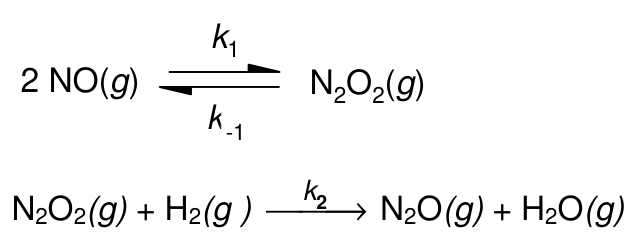
1.4 Derive the rate law for the formation of \(\ce{N2O}\) from the proposed mechanism using the steady-state approximation for the intermediate.
1.5 Under what condition does this rate law reduce to the experimentally determined rate law found in Part 1.1? Tick the relevant answer.
- \(\square\) If \(k_{-1}\ll k_2p_{\ce{H2}}\)
- \(\square\) If \(k_{-1}\gg k_2p_{\ce{H2}}\)
- \(\square\) If \(k_{-1}>k_2\)
- \(\square\) If \(k_1>k_{-1}\)
1.6 Express the experimentally determined rate constant \(k\) in terms of \(k_1\), \(k_{-1}\) and \(k_2\).
1.7 Select the schematic energy diagram that is consistent with the proposed reaction mechanism and experimental rate law.
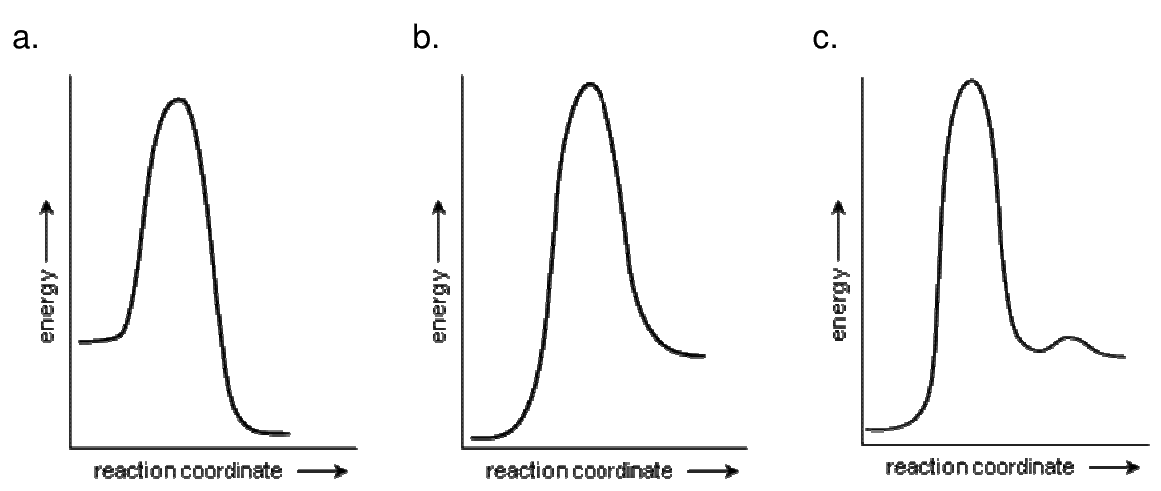
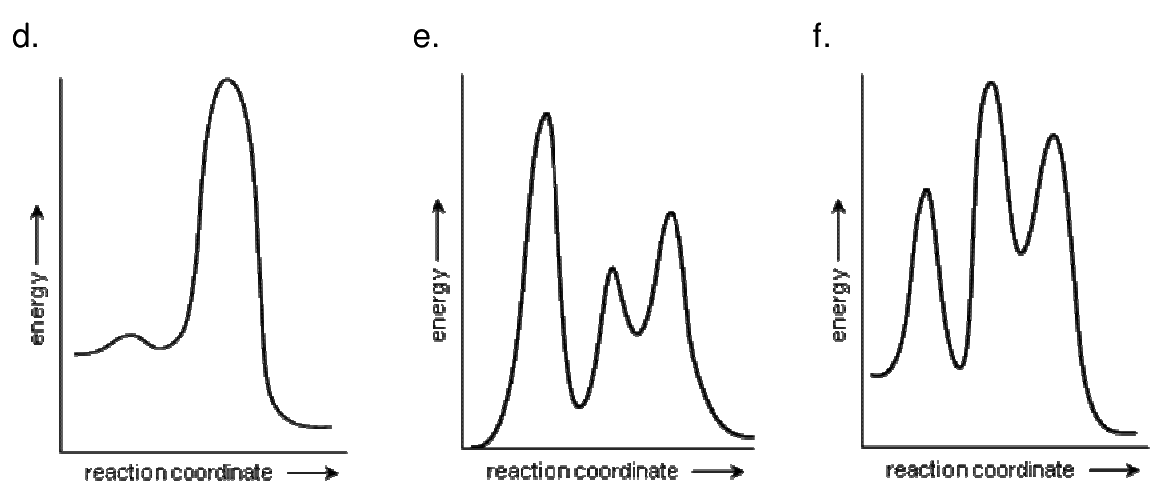
Official English text of the problem.
Problem 2: Combustion of ammonia
Anhydrous ammonia is an ultra-clean, energy-dense alternative liquid fuel. It produces no greenhouse gases on combustion.
In an experiment, gaseous \(\ce{NH3}\) is burned with \(\ce{O2}\) in a container of fixed volume according to the equation given below.

The initial and final states are at 298 K. After combustion with 14.40 g of \(\ce{O2}\), some of \(\ce{NH3}\) remains unreacted.
2.1 Calculate the heat released during the process.
\[ \Delta_{\mathrm f}H^\circ(\ce{NH3(g)})=-46.11\ \mathrm{kJ\,mol^{-1}} \quad\text{and}\quad \Delta_{\mathrm f}H^\circ(\ce{H2O(l)})=-285.83\ \mathrm{kJ\,mol^{-1}} \]
To determine the amount of \(\ce{NH3}\) gas dissolved in water, produced during the combustion process, a 10.00 \(\mathrm{cm^3}\) sample of the aqueous solution was withdrawn from the reaction vessel and added to 15.0 \(\mathrm{cm^3}\) of a \(\ce{H2SO4}\) solution (\(c=0.0100\ \mathrm{mol\,dm^{-3}}\)). The resulting solution was titrated with a standard \(\ce{NaOH}\) solution (\(c=0.0200\ \mathrm{mol\,dm^{-3}}\)) and the equivalence point was reached at 10.64 \(\mathrm{cm^3}\).
\[ \left(K_b(\ce{NH3})=1.8\cdot10^{-5};\quad K_a(\ce{HSO4-})=1.1\cdot10^{-2}\right) \]
2.2 Calculate pH of the solution in the container after combustion.
2.3 At the end point of titration, \(\ce{NH4+}\) and \(\ce{SO4^2-}\) ions are present in the solution. Write the equations for the relevant equilibria to show how the presence of these two ions affects the pH and calculate their equilibrium constant(s).
2.4 Tick the correct statement for the pH of the solution at the equivalence point.
\[ \square\ \mathrm{pH}>7 \qquad \square\ \mathrm{pH}=7 \qquad \square\ \mathrm{pH}<7 \]
Official English text of the problem.
Problem 3: Isotope effects in diatomic molecules
At a temperature of 0 K, the total energy of a gaseous diatomic molecule \(\ce{AB}\) is approximately given by:
\[ E=E_{\mathrm{o}}+E_{\mathrm{vib}} \]
where \(E_{\mathrm{o}}\) is the electronic energy of the ground state, and \(E_{\mathrm{vib}}\) is the vibrational energy.
Allowed values of the vibrational energies are given by the expression:
\[ E_{\mathrm{vib}}=\left(\nu+\frac12\right)\varepsilon \qquad \nu=0,1,2,\ldots \qquad \varepsilon=\frac{h}{2\pi}\sqrt{\frac{k}{\mu}} \qquad \mu(\ce{AB})=\frac{m_A m_B}{m_A+m_B} \]
where \(h\) is the Planck’s constant, \(\nu\) is the vibrational quantum number, \(k\) is the force constant, and \(\mu\) is the reduced mass of the molecule. At 0 K, it may be safely assumed that \(\nu\) is zero, and \(E_{\mathrm{o}}\) and \(k\) are independent of isotopic substitution in the molecule.
Deuterium, D, is an isotope of hydrogen atom with mass number 2. For the \(\ce{H2}\) molecule, \(k\) is \(575.11\ \mathrm{N\,m^{-1}}\), and the isotopic molar masses of H and D are 1.0078 and \(2.0141\ \mathrm{g\,mol^{-1}}\), respectively.
At a temperature of 0 K: \(\varepsilon_{\ce{H2}}=1.1546\,\varepsilon_{\ce{HD}}\) and \(\varepsilon_{\ce{D2}}=0.8167\,\varepsilon_{\ce{HD}}\).
3.1 Calculate the enthalpy change, \(\Delta H\), in \(\mathrm{kJ\cdot mol^{-1}}\) for the following reaction at 0 K:

3.2 Calculate the frequency in \(\mathrm{s^{-1}}\) of infrared photons that can be absorbed by \(\ce{HD}\) molecule.
(If you have been unable to calculate the value for \(\varepsilon_{\ce{HD}}\) then use \(8.000\cdot10^{-20}\ \mathrm{J}\) for the calculation.)
The allowed electronic energies of H atom are given by the expression:
\[ E=-\frac{R_H}{n^2},\quad n=1,2,\ldots \qquad \text{where }R_H=13.5984\ \mathrm{eV}, \text{ and }1\ \mathrm{eV}=1.602\cdot10^{-19}\ \mathrm{J} \]
The total energy of \(\ce{H2}\) molecule in its ground state is \(-31.675\ \mathrm{eV}\), relative to the same reference as that of hydrogen atom.
3.3 Calculate the dissociation energy, DE, in eV of a hydrogen molecule in its ground state such that both H atoms are produced in their ground states.
3.4 A molecule \(\ce{H2}\) in the ground state dissociates into its atoms after absorbing a photon of wavelength 77.0 nm. Determine all possibilities for the electronic states of hydrogen atoms produced. For each case calculate the total kinetic energy, KE, in eV of the dissociated hydrogen atoms.
3.5 Calculate the electron affinity, EA, of \(\ce{H2+}\) ion in eV if its dissociation energy is 2.650 eV. If you have been unable to calculate the value for the dissociation energy of \(\ce{H2}\) then use 4.500 eV for the calculation.)
Official English text of the problem.
Problem 4: Hydrogen storage in sodium borohydride
For sustainable energy, hydrogen appears to be the best energy carrier. The most efficient way of using hydrogen is generation of electrical energy in a fuel cell. However, storing hydrogen in large quantities is a challenge in fuel cell applications. Among the chemical hydrides considered as solid hydrogen storage materials, sodium borohydride (\(\ce{NaBH4}\)), being non-toxic, stable and environmentally benign, appears to be the most promising one. The hydrolysis of sodium borohydride that releases \(\ce{H2}\) gas is a slow reaction at ambient temperature and, therefore, needs to be catalyzed.

Colloidal ruthenium(0) nanoclusters are the most active catalysts in this hydrolysis even at room temperature and lead to a complete \(\ce{H2}\) release from sodium borohydride. Kinetic studies show that the catalytic hydrolysis of \(\ce{NaBH4}\) is a first order reaction with respect to the catalyst, but a zero order with respect to the substrate. The rate of hydrogen production per mole of ruthenium is \(92\ \mathrm{mol}\,\ce{H2}\cdot(\mathrm{mol}\,\ce{Ru})^{-1}\cdot\mathrm{min}^{-1}\) at \(25\,^\circ\mathrm{C}\).
4.1 Calculate the amount of ruthenium catalyst (in mg) which must be added to \(0.100\ \mathrm{dm^3}\) of \(\ce{NaBH4}\) solution with a concentration of \(1.0\ \mathrm{mol\,dm^{-3}}\) to supply the hydrogen gas at a rate of \(0.100\ \mathrm{dm^3\,min^{-1}}\) at \(25\,^\circ\mathrm{C}\) and \(1.0\ \mathrm{atm}\), that is required for a portable fuel cell.
4.2 For how many minutes will this system supply hydrogen gas at this rate?
4.3 The Arrhenius activation energy for this catalytic hydrolysis of sodium borohydride is \(E_{\mathrm a}=42.0\ \mathrm{kJ\,mol^{-1}}\). Calculate the temperature required to achieve the same rate of hydrogen evolution by using a half of the amount of ruthenium catalyst used at \(25.0\,^\circ\mathrm{C}\).
4.4 A fuel cell (see figure) is made up of three segments sandwiched together: the anode, the electrolyte, and the cathode. Hydrogen is used as fuel and oxygen as oxidant. Two chemical reactions occur at the interfaces of the three different segments:
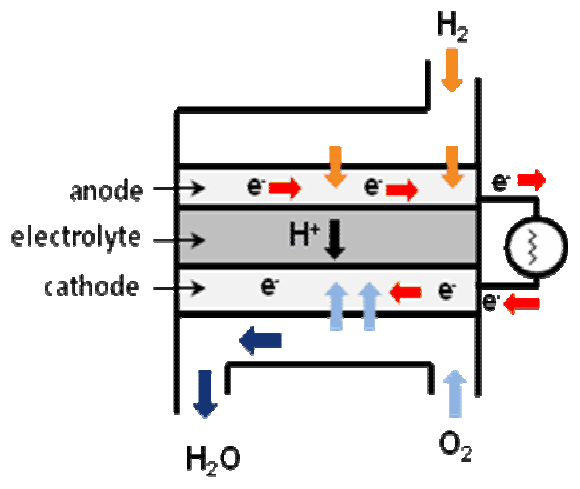


The net result of the two reactions is

The hydrogen for the fuel cell is supplied from the hydrolysis of sodium borohydride. Calculate the standard potential for the cathode half reaction if the standard reduction potential for the anode half reaction is \(-0.83\ \mathrm{V}\) and \(\Delta_{\mathrm f}G^\circ(\ce{H2O(l)})\) is \(-237\ \mathrm{kJ\,mol^{-1}}\).
4.5 Calculate the volume of air at a temperature of \(25\,^\circ\mathrm{C}\) and a pressure of \(1.0\ \mathrm{atm}\) needed to generate a constant current of \(2.5\ \mathrm{A}\) for \(3.0\) hours in this fuel cell. Assume that air contains \(20\,\%\) by volume \(\ce{O2(g)}\).
4.6 The efficiency of a fuel cell is given by the ratio of the work produced to the heat dissipated by the cell reaction. Thus, the maximum efficiency for a fuel cell is given by:
\[ \eta_{\text{fuel cell}}=\frac{\text{work}}{\text{heat}} \]
Calculate the maximum efficiency for the fuel cell using the data given below at \(25\,^\circ\mathrm{C}\) and a standard pressure.
\(S^\circ\ (\mathrm{J\,mol^{-1}\,K^{-1}})\) \(\ce{H2(g)}\) 130.7 \(\ce{O2(g)}\) 205.2 \(\ce{H2O(l)}\) 70.0 The second law of thermodynamics states that it is impossible to convert all of the heat, \(q_{\mathrm H}\), from a high-temperature reservoir at \(T_{\mathrm H}\) into work. At least, some of the energy, \(q_{\mathrm C}\), must be transferred to a low-temperature reservoir at \(T_{\mathrm C}\). Thus, a heat engine with 100% efficiency is thermodynamically impossible. When the heat engine is working reversibly, as in a Carnot cycle, the efficiency will be a maximum.
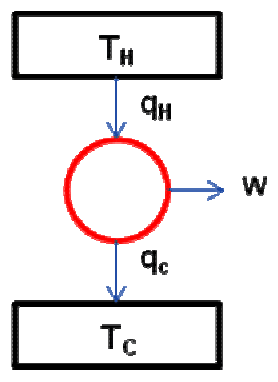
For a heat engine working reversibly between two reservoirs the following relations are applied:
\[ q_{\mathrm H}=w+q_{\mathrm C} \]
and
\[ \frac{q_{\mathrm H}}{T_{\mathrm H}} = \frac{q_{\mathrm C}}{T_{\mathrm C}} \]
4.7 What should be the temperature of the hot reservoir, \(T_{\mathrm H}\), of a Carnot heat engine to maintain the efficiency of the fuel cell calculated in part 4.6, if the temperature of cold reservoir \(T_{\mathrm C}\) is \(40\,^\circ\mathrm{C}\)?
(If you have been unable to calculate the value for the efficiency then use the value 0.80 for the calculation.)
Official English text of the problem.
Problem 5: Polynitrogen compounds
Polynitrogen compounds have great potential for being used as high energy density materials. They are thermodynamically unstable. Huge amount of energy is released from their decomposition or reactions leading to more stable products. The only known polynitrogen species are \(\ce{N2}\), \(\ce{N3-}\) and \(\ce{N5+}\), isolated in 1772, 1890 and 1999, respectively, and recently reported cyclic anion, \(\ce{N5-}\).
5.1 Write the Lewis structure for \(\ce{N5+}\) with three energetically favourable resonance forms. Indicate the lone pairs and formal charges. Draw the molecular geometry of \(\ce{N5+}\).
5.2 Write the Lewis structures for cyclic \(\ce{N5-}\) with five energetically favourable resonance forms. Indicate the lone pairs and formal charges. Draw the molecular geometry of cyclic \(\ce{N5-}\).
5.3 The synthesis of \(\ce{[N5+][AsF6-]}\), a white ionic solid, was achieved by reacting \(\ce{[N2F+][AsF6-]}\) with hydrazoic acid, \(\ce{HN3}\), in liquid \(\ce{HF}\) at \(-78\,^\circ\mathrm{C}\). Write the balanced chemical equation for this reaction.
The preparation of \(\ce{[N2F+][AsF6-]}\) requires the reaction of \(\ce{N2F2}\) with strong Lewis acid \(\ce{AsF5}\) as follows:

In the synthesis of \(\ce{N2F2}\), the trans isomer is formed which is thermodynamically less stable than cis-\(\ce{N2F2}\). However, conversion of trans-\(\ce{N2F2}\) to cis-\(\ce{N2F2}\) requires surmounting a high energy barrier of \(251\ \mathrm{kJ\,mol^{-1}}\), so that equilibration between the cis and the trans isomers does not significantly take place without a suitable catalyst.
When trans-\(\ce{N2F2}\) is maintained in a closed container for six days at room temperature in the presence of a small amount of \(\ce{SbF5}\) as a catalyst, cis-trans thermal equilibrium is established.
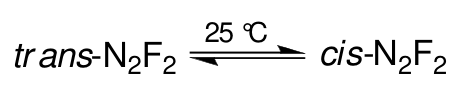
The standard enthalpies of formation of trans- and cis-\(\ce{N2F2}\) are 67.31 and \(62.03\ \mathrm{kJ\,mol^{-1}}\), respectively, and their standard entropies at \(25\,^\circ\mathrm{C}\) are 262.10 and \(266.50\ \mathrm{J\,K^{-1}\,mol^{-1}}\), respectively.
5.4 Find the ratio of the number of cis-\(\ce{N2F2}\) molecules over that of the trans-\(\ce{N2F2}\) molecules in an equilibrium mixture at \(25\,^\circ\mathrm{C}\).
5.5 Write the Lewis structures showing the geometry of \(\ce{N2F+}\) ion and those of trans- and cis-isomers of \(\ce{N2F2}\). Include all lone pairs and formal charges. Suggest an appropriate hybridization for each nitrogen atom in \(\ce{N2F2}\) and \(\ce{N2F+}\).
Solid \(\ce{[N5+][AsF6-]}\) is marginally stable at room temperature but reacts explosively with water to produce arsenic pentafluoride, hydrogen fluoride, molecular nitrogen and oxygen.
5.6 Write a balanced equation for the reaction between \(\ce{[N5+][AsF6-]}\) and water.
Conversion of \(\ce{[N5+][SbF6-]}\) into other \(\ce{N5+}\) salts can be achieved by a metathesis reaction:

where \(\ce{M+} = \ce{Na+}, \ce{K+}, \ce{Cs+}\), and \(\ce{X-}\) = large anion such as \(\ce{SnF6^2-}\) and \(\ce{B(CF3)4-}\).
Since \(\ce{[Cs+][SbF6-]}\) has a low solubility in anhydrous \(\ce{HF}\), and \(\ce{[K+][SbF6-]}\) has a low solubility in \(\ce{SO2}\), these two solvents were used extensively to carry out metathesis reactions at \(-78\,^\circ\mathrm{C}\) and \(-64\,^\circ\mathrm{C}\), respectively.
5.7 Write the balanced equation for the preparation of \(\ce{[N5+]2[SnF6^2-]}\) and \(\ce{[N5+][B(CF3)4-]}\) in solution starting with \(\ce{[Cs+]2[SnF6^2-]}\) and \(\ce{[K+][B(CF3)4-]}\), respectively. Indicate the appropriate solvent.
When \(\ce{[N5+]2[SnF6^2-]}\) decomposes under carefully controlled conditions at \(25\text{–}30\,^\circ\mathrm{C}\), \(\ce{[N5+][SnF5-]}\) and \(\ce{N5F}\) are formed. The \(\ce{[N5+][SnF5-]}\) salt is a white solid and has a thermal stability comparable to that of \(\ce{[N5+][SbF6-]}\) (\(50\text{–}60\,^\circ\mathrm{C}\)). The solution \(\ce{^119Sn}\) NMR spectrum has shown that the \(\ce{SnF5-}\) anion in this compound is, in fact, a mixture of dimeric and tetrameric polyanions. In both of these polyanions the coordination number of Sn atom is 6 and there are bridging fluorine atoms.
5.8 Draw the structures of dimeric and tetrameric polyanions.
Official English text of the problem.
Problem 6: Thiosulfate leaching of gold
Extraction of gold using sodium cyanide, a very poisonous chemical, causes environmental problems and gives rise to serious public concern about the use of this so called “cyanide process”. Thiosulfate leaching of gold has been considered as an alternative. In this process, the main reagent is ammonium thiosulfate, \(\ce{(NH4)2S2O3}\), which is relatively non-toxic. Although this process appears to be environmentally benign, the chemistry involved is very complex and needs to be studied thoroughly. The solution used for leaching gold contains \(\ce{S2O3^2-}\), \(\ce{Cu^2+}\), \(\ce{NH3}\), and dissolved \(\ce{O2}\). The solution must have a pH greater than 8.5 to allow free ammonia to be present.
According to the proposed mechanism, a local voltaic micro-cell is formed on the surface of gold particles during the leaching process and operates as follows:
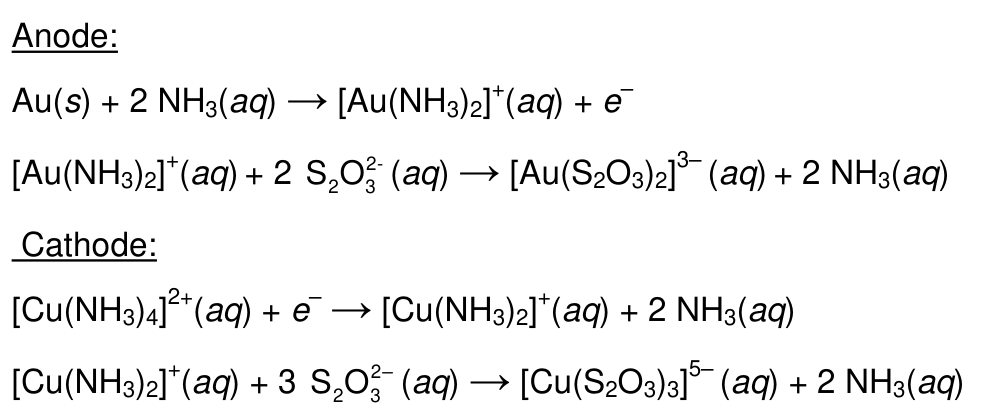
6.1 Write the overall cell reaction for this voltaic cell.
6.2 In the presence of ammonia \(\ce{[Cu(S2O3)3]^5-}\) is oxidized by \(\ce{O2}\) back to \(\ce{[Cu(NH3)4]^2+}\). Write a balanced equation for this oxidation-reduction reaction in basic solution.
6.3 In this leaching process, the \(\ce{[Cu(NH3)4]^2+}\) complex ion functions as catalyst and speeds up the dissolution of gold. Write the net overall oxidation-reduction reaction for dissolution of the gold metal, which is catalyzed by \(\ce{[Cu(NH3)4]^2+}\) complex ion.
6.4 Draw the coordination geometries of the metal in \(\ce{[Au(NH3)2]+}\) and \(\ce{[Au(S2O3)2]^3-}\) complex ions, indicating the coordinating atoms.
The formation constants, \(K_f\), of \(\ce{[Au(NH3)2]+}\) and \(\ce{[Au(S2O3)2]^3-}\) complexes are \(1.00\cdot10^{26}\) and \(1.00\cdot10^{28}\), respectively. Consider a leaching solution in which the equilibrium concentrations of the species are as follows:
\([\ce{S2O3^2-}]=0.100;\quad[\ce{NH3}]=0.100\) and the total concentration of gold(I) species = \(5.50\cdot10^{-5}\ \mathrm{mol\,dm^{-3}}\).
6.5 Calculate the percentage of gold(I) ion that exists in the form of thiosulfate complex.
When the concentration of \(\ce{O2}\) is not high enough and pH > 10, \(\ce{S2O3^2-}\) reduces \(\ce{[Cu(NH3)4]^2+}\) to \(\ce{[Cu(S2O3)3]^5-}\) with the formation of tetrathionate ion \(\ce{S4O6^2-}\):

In basic solution tetrathionate disproportionates to trithionate, \(\ce{S3O6^2-}\), and thiosulfate.
6.6 Write a balanced equation for this disproportionation reaction.
6.7 When the \(\ce{O2}\) concentration is too high, \(\ce{S2O3^2-}\) is oxidized by oxygen to yield trithionate and sulfate ions. Write a balanced equation for this reaction.
Official English text of the problem.
Problem 7: Synthesis of a carbasugar
Carbohydrates are essential components of living cells and a source of energy for animals. They include simple sugars with small molecules as well as macromolecular substances. When the ring oxygen (endocyclic oxygen) in sugars is replaced by a methylene group, the compounds formed are called as pseudosugars or carbasugars. Since carbasugars are hydrolytically stable towards acids and enzymes, several carbasugars have found application in the field of glycosidase inhibition.
The total syntheses of two isomeric carbasugars having skeleton 1 are described below.
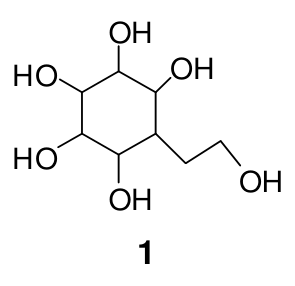
The total synthesis of 1 starts with a reduction of benzene by sodium in liquid ammonia to give A. The C-13 NMR spectrum of A consists of two signals at 124.0 and 26.0 ppm.
Trichloroacetyl chloride in the presence of Zn gives a reactive species S (see the Scheme 7.1). One equivalent of S undergoes [2+2]cycloaddition with A to form a racemic product B. The reaction of B with Zn in acetic acid gives C. Compound C contains only carbon, hydrogen and oxygen. The C-13 NMR spectrum of C exhibits three \(\mathrm{sp^2}\) carbon signals at 210.0, 126.5 and 125.3 ppm.
The reaction of C with one equivalent \(m\)-chloroperbenzoic acid (\(m\)-CPBA) in methylene chloride gives D as a major product. The C-13 NMR spectrum of D exhibits also three signals in the \(\mathrm{sp^2}\) region at 177.0, 125.8, 124.0 ppm.
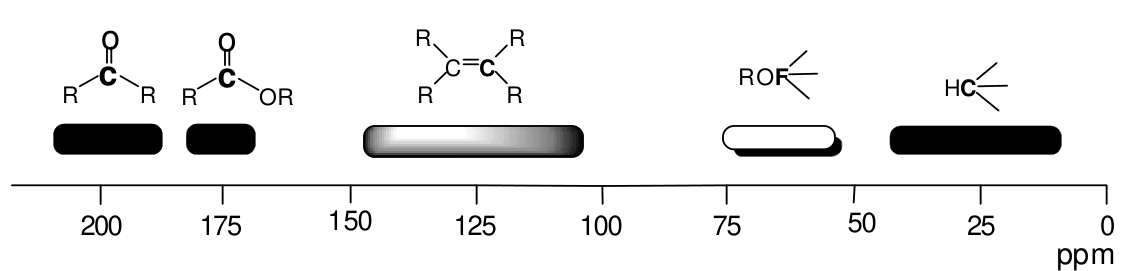
\({}^{13}\mathrm{C}\)-NMR chemical shift ranges of typical functional groups
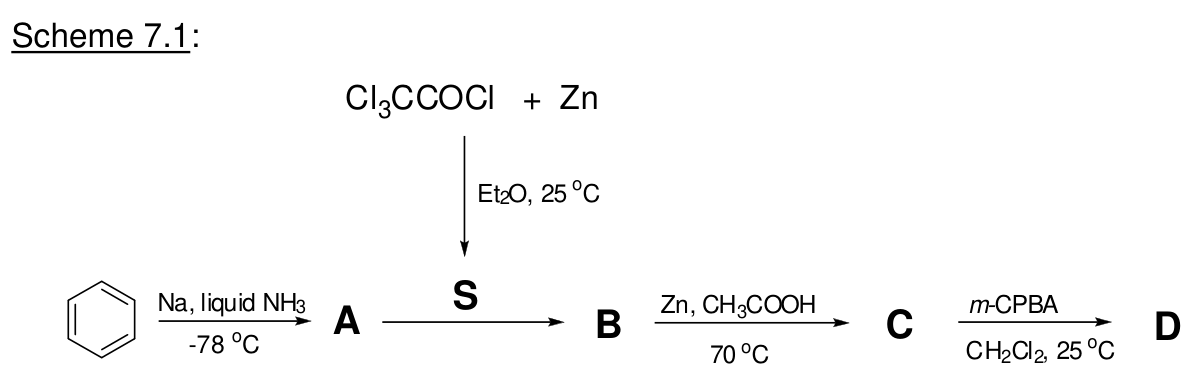
Scheme 7.1:
7.1 Draw the structures of A, B, C, D, and the intermediate S.
Reduction of D with \(\ce{LiAlH4}\) yields E which reacts with an excess of acetyl chloride in pyridine to give F (Scheme 7.2).

Scheme 7.2:
7.2 Draw the structures (use one enantiomer) of E and F using dashed-wedged line notation. Assign the configurations (\(R\) or \(S\)) at the asymmetric carbon atoms in E.
The compound F (use the drawn enantiomer) reacts with bromine to give the stereoisomers G₁ and G₂.
7.3 Draw the structures of G₁and G₂ using dashed-wedged line notation.
A mixture of G₁ and G₂ reacts with two equivalents of 1,8-diazabicyclo- [5.4.0]undec-7-ene (DBU), which is a strong amine base, to afford H.
7.4 Draw the structure of H using dashed-wedged line notation.
Reaction of H with singlet oxygen (in situ generated) affords I. Although two isomers are theoretically possible, I is formed as the single isomer due to steric hindrance and electronic repulsion.
The reaction of I with excess of \(\ce{LiAlH4}\) results in the formation of J (see the Scheme 7.3). The C-13 NMR spectrum of J shows 8 signals, two in the \(\mathrm{sp^2}\) region.
Reaction of J with excess acetyl chloride in the presence of pyridine yields K. Subsequent reaction of K with \(\ce{OsO4}\) in the presence of 4-methylmorpholine 4-oxide (NMO) gives stereoisomers L and M. Upon reduction with excess \(\ce{LiAlH4}\), L and M give the stereoisomers 1a and 1b, respectively.
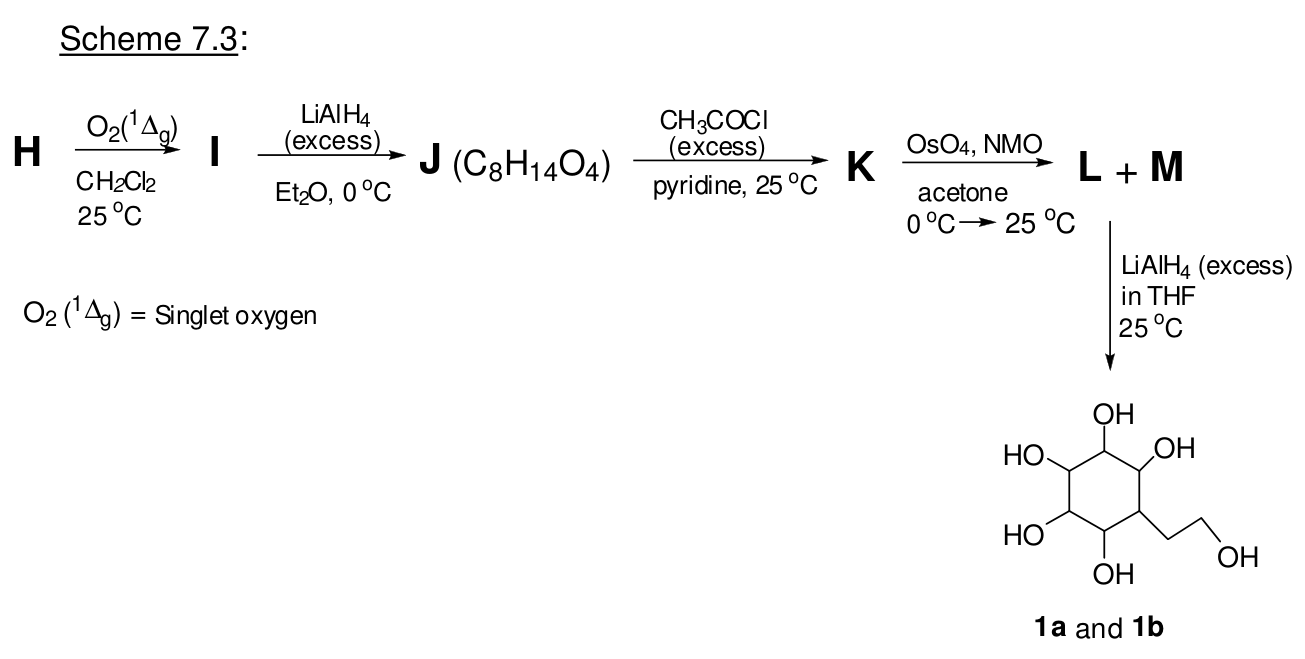
Scheme 7.3:
7.5 Draw the structures of I, J, K, L, M, 1a, and 1b using dashed-wedged line notation.
Official English text of the problem.
Problem 8: Click chemistry
Click chemistry is a chemical concept introduced by K. B. Sharpless in 2001 and describes a set of chemical reactions that generate substances quickly, reliably and quantitatively by joining molecules through small units under mild conditions. This methodology has recently been applied as a key step in the following synthesis of bicyclic compounds.
Mandelic acid is a versatile natural compound and widely used as a “chiral pool” in synthesis. The reduction of \((R)\)-mandelic acid with \(\ce{LiBH4}\) affords A.
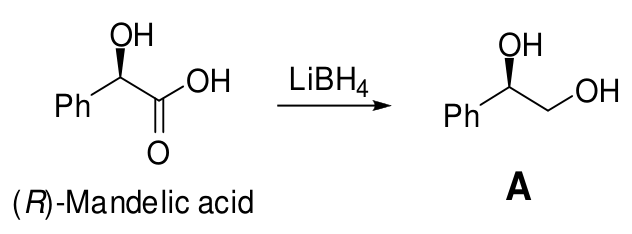
Reaction of A with one equivalent of \(p\)-toluenesulfonyl chloride gives B (Scheme 8.1). Heating B in pyridine yields C. During this transformation, compounds B and C retain their absolute configurations.

Scheme 8.1:
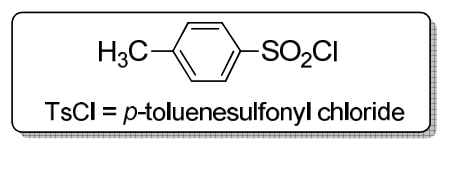
8.1 Draw the structures of B and C with the correct stereochemistry. Use dashed-wedged line notation throughout this problem.
Reaction of C with sodium azide in aqueous acetonitrile gives a mixture of enantiopure regioisomers D and E in a ratio of 3 : 1 (Scheme 8.2). On the other hand, the compound B affords E as the sole product under the same condition.
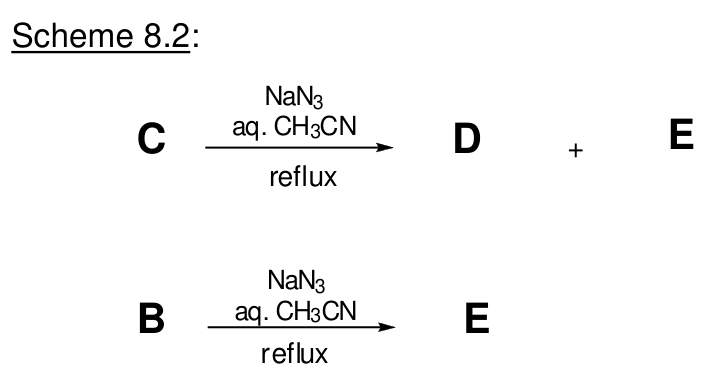
Scheme 8.2:
8.2 Draw the structures of D and E with the correct stereochemistry.
Part I: Compounds D and E are separately subjected to \(\ce{NaH}\) mediated reaction with 3-bromoprop-1-yne to afford F and G, respectively (Scheme 8.3). Heating F and G separately in toluene gives the bicyclic products H and I, respectively.
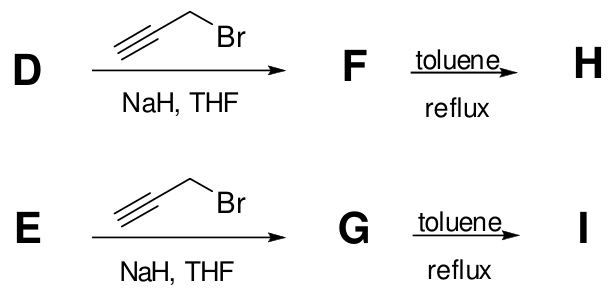
Scheme 8.3:
8.3 Draw the structure of compounds F, G, H and I with the correct stereochemistry.
Part II: Reaction of D and E separately with dimethyl acetylenedicarboxylate in water at \(70\,^\circ\mathrm{C}\) forms the optically active monocyclic regioisomers J and K, respectively (Scheme 8.4). Subsequent treatment of J and K with \(\ce{NaH}\) gives final bicyclic products L and M, respectively, both having the formula \(\ce{C13H11N3O4}\).
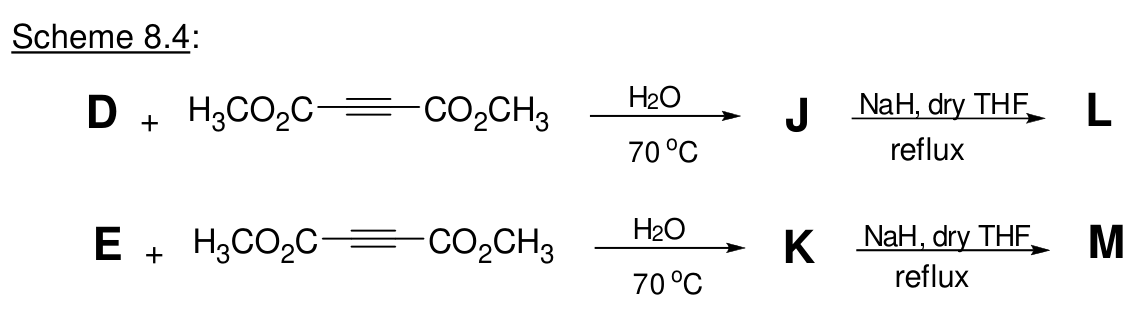
Scheme 8.4:
8.4 Draw the structures of compounds J, K, L and M with the correct stereochemistry.
Official English text of the problem.
Internationale Chemie-Olympiade
IChO 2011
Ankara, Türkei · 8 Theorieaufgaben mit vollständigen Lösungen
Aufgabe 1: Kinetik der Reaktion von Stickstoffmonoxid mit Wasserstoff
Stickstoffoxide, häufige Schadstoffe in der Umgebungsluft, sind hauptsächlich Stickstoffmonoxid, \(\ce{NO}\), und Stickstoffdioxid, \(\ce{NO2}\). Atmosphärisches Stickstoffmonoxid entsteht vor allem bei Gewittern und in Verbrennungsmotoren. Bei hohen Temperaturen reagiert \(\ce{NO}\) mit \(\ce{H2}\) zu Distickstoffmonoxid, \(\ce{N2O}\), einem Treibhausgas.
Zur Untersuchung der Kinetik dieser Reaktion bei \(820\,^\circ\mathrm{C}\) wurden die Anfangsgeschwindigkeiten der Bildung von \(\ce{N2O}\) bei verschiedenen Anfangspartialdrücken von \(\ce{NO}\) und \(\ce{H2}\) gemessen.
Versuch Anfangsdruck, torr: \(p_{\ce{NO}}\) Anfangsdruck, torr: \(p_{\ce{H2}}\) Anfangsgeschwindigkeit der Bildung von \(\ce{N2O}\), torr \(\mathrm{s^{-1}}\) 1 120.0 60.0 \(8.66\cdot10^{-2}\) 2 60.0 60.0 \(2.17\cdot10^{-2}\) 3 60.0 180.0 \(6.62\cdot10^{-2}\) Verwenden Sie in dieser gesamten Aufgabe keine Konzentrationen. Verwenden Sie Druckeinheiten (torr) und geben Sie die Zeit in Sekunden an.
1.1 Bestimmen Sie das experimentelle Geschwindigkeitsgesetz und berechnen Sie die Geschwindigkeitskonstante.
1.2 Berechnen Sie die Anfangsgeschwindigkeit des Verbrauchs von \(\ce{NO}\), wenn \(\ce{NO}\) mit einem Druck von \(2.00\cdot10^{2}\) torr und \(\ce{H2}\) mit \(1.00\cdot10^{2}\) torr bei \(820\,^\circ\mathrm{C}\) gemischt werden.
(Falls Sie den Wert der Geschwindigkeitskonstante nicht berechnen konnten, können Sie den Wert \(2\cdot10^{-7}\) in der geeigneten Einheit verwenden.)
1.3 Berechnen Sie die Zeit, die vergeht, bis der Partialdruck von \(\ce{H2}\) auf die Hälfte seines Anfangswerts gesunken ist, wenn \(\ce{NO}\) mit einem Druck von \(8.00\cdot10^{2}\) torr und \(\ce{H2}\) mit \(1.0\) torr bei \(820\,^\circ\mathrm{C}\) gemischt werden.
(Falls Sie den Wert der Geschwindigkeitskonstante nicht berechnen konnten, können Sie den Wert \(2\cdot10^{-7}\) in der geeigneten Einheit verwenden.)
Ein vorgeschlagener Mechanismus für die Reaktion zwischen \(\ce{NO}\) und \(\ce{H2}\) ist im Folgenden dargestellt:
1.4 Leiten Sie aus dem vorgeschlagenen Mechanismus das Geschwindigkeitsgesetz für die Bildung von \(\ce{N2O}\) unter Verwendung der Quasistationaritätsnäherung für das Zwischenprodukt her.
1.5 Unter welcher Bedingung geht dieses Geschwindigkeitsgesetz in das in Teil 1.1 experimentell bestimmte Geschwindigkeitsgesetz über? Kreuzen Sie die zutreffende Antwort an.
- \(\square\) Wenn \(k_{-1}\ll k_2p_{\ce{H2}}\)
- \(\square\) Wenn \(k_{-1}\gg k_2p_{\ce{H2}}\)
- \(\square\) Wenn \(k_{-1}>k_2\)
- \(\square\) Wenn \(k_1>k_{-1}\)
1.6 Drücken Sie die experimentell bestimmte Geschwindigkeitskonstante \(k\) durch \(k_1\), \(k_{-1}\) und \(k_2\) aus.
1.7 Wählen Sie das schematische Energiediagramm aus, das mit dem vorgeschlagenen Reaktionsmechanismus und dem experimentellen Geschwindigkeitsgesetz übereinstimmt.
Aufgabentext aus dem offiziellen englischen Text übersetzt.
Aufgabe 2: Verbrennung von Ammoniak
Wasserfreies Ammoniak ist ein äußerst sauberer alternativer Flüssigbrennstoff mit hoher Energiedichte. Bei seiner Verbrennung entstehen keine Treibhausgase.
In einem Experiment wird gasförmiges \(\ce{NH3}\) mit \(\ce{O2}\) in einem Behälter mit konstantem Volumen gemäß der unten angegebenen Gleichung verbrannt.
Anfangs- und Endzustand liegen bei 298 K vor. Nach der Verbrennung mit 14.40 g \(\ce{O2}\) bleibt ein Teil des \(\ce{NH3}\) unumgesetzt.
2.1 Berechnen Sie die während des Vorgangs freigesetzte Wärme.
\[ \Delta_{\mathrm f}H^\circ(\ce{NH3(g)})=-46.11\ \mathrm{kJ\,mol^{-1}} \quad\text{und}\quad \Delta_{\mathrm f}H^\circ(\ce{H2O(l)})=-285.83\ \mathrm{kJ\,mol^{-1}} \]
Um die Menge des im Verbrennungswasser gelösten \(\ce{NH3}\)-Gases zu bestimmen, wurde dem Reaktionsgefäß eine Probe von 10.00 \(\mathrm{cm^3}\) der wässrigen Lösung entnommen und zu 15.0 \(\mathrm{cm^3}\) einer \(\ce{H2SO4}\)-Lösung (\(c=0.0100\ \mathrm{mol\,dm^{-3}}\)) gegeben. Die erhaltene Lösung wurde mit einer \(\ce{NaOH}\)-Maßlösung (\(c=0.0200\ \mathrm{mol\,dm^{-3}}\)) titriert; der Äquivalenzpunkt wurde bei 10.64 \(\mathrm{cm^3}\) erreicht.
\[ \left(K_b(\ce{NH3})=1.8\cdot10^{-5};\quad K_a(\ce{HSO4-})=1.1\cdot10^{-2}\right) \]
2.2 Berechnen Sie den pH-Wert der Lösung im Behälter nach der Verbrennung.
2.3 Am Endpunkt der Titration sind \(\ce{NH4+}\)- und \(\ce{SO4^2-}\)-Ionen in der Lösung vorhanden. Stellen Sie die Gleichungen für die relevanten Gleichgewichte auf, um zu zeigen, wie die Anwesenheit dieser beiden Ionen den pH-Wert beeinflusst, und berechnen Sie ihre Gleichgewichtskonstante(n).
2.4 Kreuzen Sie die richtige Aussage zum pH-Wert der Lösung am Äquivalenzpunkt an.
\[ \square\ \mathrm{pH}>7 \qquad \square\ \mathrm{pH}=7 \qquad \square\ \mathrm{pH}<7 \]
Aufgabentext aus dem offiziellen englischen Text übersetzt.
Aufgabe 3: Isotopeneffekte in zweiatomigen Molekülen
Bei einer Temperatur von 0 K ist die Gesamtenergie eines gasförmigen zweiatomigen Moleküls \(\ce{AB}\) näherungsweise gegeben durch:
\[ E=E_{\mathrm{o}}+E_{\mathrm{vib}} \]
wobei \(E_{\mathrm{o}}\) die elektronische Energie des Grundzustands und \(E_{\mathrm{vib}}\) die Schwingungsenergie ist.
Die erlaubten Werte der Schwingungsenergie sind durch folgenden Ausdruck gegeben:
\[ E_{\mathrm{vib}}=\left(\nu+\frac12\right)\varepsilon \qquad \nu=0,1,2,\ldots \qquad \varepsilon=\frac{h}{2\pi}\sqrt{\frac{k}{\mu}} \qquad \mu(\ce{AB})=\frac{m_A m_B}{m_A+m_B} \]
wobei \(h\) die Planck-Konstante, \(\nu\) die Schwingungsquantenzahl, \(k\) die Kraftkonstante und \(\mu\) die reduzierte Masse des Moleküls ist. Bei 0 K kann ohne Weiteres angenommen werden, dass \(\nu\) null ist und dass \(E_{\mathrm{o}}\) und \(k\) unabhängig von einer Isotopensubstitution im Molekül sind.
Deuterium, D, ist ein Isotop des Wasserstoffatoms mit der Massenzahl 2. Für das Molekül \(\ce{H2}\) beträgt \(k\) \(575.11\ \mathrm{N\,m^{-1}}\), und die molaren Massen der Isotope H und D betragen 1.0078 bzw. \(2.0141\ \mathrm{g\,mol^{-1}}\).
Bei einer Temperatur von 0 K gilt: \(\varepsilon_{\ce{H2}}=1.1546\,\varepsilon_{\ce{HD}}\) und \(\varepsilon_{\ce{D2}}=0.8167\,\varepsilon_{\ce{HD}}\).
3.1 Berechnen Sie die Enthalpieänderung \(\Delta H\) in \(\mathrm{kJ\cdot mol^{-1}}\) für die folgende Reaktion bei 0 K:
3.2 Berechnen Sie die Frequenz in \(\mathrm{s^{-1}}\) der Infrarotphotonen, die vom Molekül \(\ce{HD}\) absorbiert werden können.
(Falls Sie den Wert für \(\varepsilon_{\ce{HD}}\) nicht berechnen konnten, verwenden Sie für die Berechnung \(8.000\cdot10^{-20}\ \mathrm{J}\).)
Die erlaubten elektronischen Energien des H-Atoms sind durch folgenden Ausdruck gegeben:
\[ E=-\frac{R_H}{n^2},\quad n=1,2,\ldots \qquad \text{wobei }R_H=13.5984\ \mathrm{eV}, \text{ und }1\ \mathrm{eV}=1.602\cdot10^{-19}\ \mathrm{J} \]
Die Gesamtenergie des Moleküls \(\ce{H2}\) in seinem Grundzustand beträgt \(-31.675\ \mathrm{eV}\), bezogen auf denselben Referenzwert wie beim Wasserstoffatom.
3.3 Berechnen Sie die Dissoziationsenergie DE in eV eines Wasserstoffmoleküls in seinem Grundzustand, wobei beide H-Atome in ihren Grundzuständen entstehen.
3.4 Ein Molekül \(\ce{H2}\) im Grundzustand dissoziiert nach der Absorption eines Photons mit einer Wellenlänge von 77.0 nm in seine Atome. Bestimmen Sie alle Möglichkeiten für die elektronischen Zustände der entstehenden Wasserstoffatome. Berechnen Sie für jeden Fall die gesamte kinetische Energie KE der durch Dissoziation entstandenen Wasserstoffatome in eV.
3.5 Berechnen Sie die Elektronenaffinität EA des Ions \(\ce{H2+}\) in eV, wenn seine Dissoziationsenergie 2.650 eV beträgt. Falls Sie den Wert für die Dissoziationsenergie von \(\ce{H2}\) nicht berechnen konnten, verwenden Sie für die Berechnung 4.500 eV.)
Aufgabentext aus dem offiziellen englischen Text übersetzt.
Aufgabe 4: Wasserstoffspeicherung in Natriumborhydrid
Für eine nachhaltige Energieversorgung scheint Wasserstoff der beste Energieträger zu sein. Die effizienteste Art, Wasserstoff zu nutzen, ist die Erzeugung elektrischer Energie in einer Brennstoffzelle. Die Speicherung großer Wasserstoffmengen stellt jedoch eine Herausforderung für den Einsatz von Brennstoffzellen dar. Unter den chemischen Hydriden, die als feste Wasserstoffspeichermaterialien in Betracht gezogen werden, erscheint Natriumborhydrid (\(\ce{NaBH4}\)) aufgrund seiner Ungiftigkeit, Stabilität und Umweltverträglichkeit am vielversprechendsten. Die Hydrolyse von Natriumborhydrid, bei der gasförmiger Wasserstoff \(\ce{H2}\) freigesetzt wird, verläuft bei Umgebungstemperatur langsam und muss daher katalysiert werden.
Kolloidale Ruthenium(0)-Nanocluster sind selbst bei Raumtemperatur die aktivsten Katalysatoren für diese Hydrolyse und führen zu einer vollständigen Freisetzung von \(\ce{H2}\) aus Natriumborhydrid. Kinetische Untersuchungen zeigen, dass die katalytische Hydrolyse von \(\ce{NaBH4}\) bezüglich des Katalysators eine Reaktion erster Ordnung, bezüglich des Substrats jedoch eine Reaktion nullter Ordnung ist. Die Wasserstoffbildungsrate pro Mol Ruthenium beträgt \(92\ \mathrm{mol}\,\ce{H2}\cdot(\mathrm{mol}\,\ce{Ru})^{-1}\cdot\mathrm{min}^{-1}\) bei \(25\,^\circ\mathrm{C}\).
4.1 Berechnen Sie die Masse des Rutheniumkatalysators (in mg), die zu \(0.100\ \mathrm{dm^3}\) einer \(\ce{NaBH4}\)-Lösung mit einer Konzentration von \(1.0\ \mathrm{mol\,dm^{-3}}\) gegeben werden muss, um Wasserstoffgas mit dem für eine tragbare Brennstoffzelle erforderlichen Volumenstrom von \(0.100\ \mathrm{dm^3\,min^{-1}}\) bei \(25\,^\circ\mathrm{C}\) und \(1.0\ \mathrm{atm}\) bereitzustellen.
4.2 Wie viele Minuten lang liefert dieses System Wasserstoffgas mit diesem Volumenstrom?
4.3 Die Arrhenius-Aktivierungsenergie für diese katalytische Hydrolyse von Natriumborhydrid beträgt \(E_{\mathrm a}=42.0\ \mathrm{kJ\,mol^{-1}}\). Berechnen Sie die Temperatur, die erforderlich ist, um mit der Hälfte der bei \(25.0\,^\circ\mathrm{C}\) eingesetzten Menge an Rutheniumkatalysator dieselbe Wasserstoffentwicklungsrate zu erreichen.
4.4 Eine Brennstoffzelle (siehe Abbildung) besteht aus drei schichtweise zusammengefügten Bereichen: der Anode, dem Elektrolyten und der Kathode. Wasserstoff wird als Brennstoff und Sauerstoff als Oxidationsmittel verwendet. An den Grenzflächen der drei verschiedenen Bereiche finden zwei chemische Reaktionen statt:
Die Gesamtreaktion der beiden Reaktionen lautet
Der Wasserstoff für die Brennstoffzelle wird durch die Hydrolyse von Natriumborhydrid bereitgestellt. Berechnen Sie das Standardpotential der Kathodenhalbreaktion, wenn das Standardreduktionspotential der Anodenhalbreaktion \(-0.83\ \mathrm{V}\) und \(\Delta_{\mathrm f}G^\circ(\ce{H2O(l)})\) \(-237\ \mathrm{kJ\,mol^{-1}}\) betragen.
4.5 Berechnen Sie das Luftvolumen bei einer Temperatur von \(25\,^\circ\mathrm{C}\) und einem Druck von \(1.0\ \mathrm{atm}\), das benötigt wird, um in dieser Brennstoffzelle einen konstanten Strom von \(2.5\ \mathrm{A}\) über \(3.0\) Stunden zu erzeugen. Nehmen Sie an, dass Luft \(20\,\%\) Volumenanteil \(\ce{O2(g)}\) enthält.
4.6 Der Wirkungsgrad einer Brennstoffzelle ist durch das Verhältnis der geleisteten Arbeit zur bei der Zellreaktion abgegebenen Wärme gegeben. Der maximale Wirkungsgrad einer Brennstoffzelle ist somit gegeben durch:
\[ \eta_{\text{Brennstoffzelle}}=\frac{\text{Arbeit}}{\text{Wärme}} \]
Berechnen Sie den maximalen Wirkungsgrad der Brennstoffzelle anhand der unten angegebenen Daten bei \(25\,^\circ\mathrm{C}\) und Standarddruck.
\(S^\circ\ (\mathrm{J\,mol^{-1}\,K^{-1}})\) \(\ce{H2(g)}\) 130.7 \(\ce{O2(g)}\) 205.2 \(\ce{H2O(l)}\) 70.0 Der zweite Hauptsatz der Thermodynamik besagt, dass es unmöglich ist, die gesamte Wärme \(q_{\mathrm H}\) aus einem Hochtemperaturreservoir bei \(T_{\mathrm H}\) in Arbeit umzuwandeln. Zumindest ein Teil der Energie, \(q_{\mathrm C}\), muss auf ein Niedertemperaturreservoir bei \(T_{\mathrm C}\) übertragen werden. Eine Wärmekraftmaschine mit einem Wirkungsgrad von 100% ist daher thermodynamisch unmöglich. Arbeitet die Wärmekraftmaschine reversibel, wie in einem Carnot-Kreisprozess, ist der Wirkungsgrad maximal.
Für eine Wärmekraftmaschine, die reversibel zwischen zwei Reservoiren arbeitet, gelten die folgenden Beziehungen:
\[ q_{\mathrm H}=w+q_{\mathrm C} \]
und
\[ \frac{q_{\mathrm H}}{T_{\mathrm H}} = \frac{q_{\mathrm C}}{T_{\mathrm C}} \]
4.7 Welche Temperatur muss das heiße Reservoir \(T_{\mathrm H}\) einer Carnot-Wärmekraftmaschine haben, um den in Teil 4.6 berechneten Wirkungsgrad der Brennstoffzelle zu erreichen, wenn die Temperatur des kalten Reservoirs \(T_{\mathrm C}\) \(40\,^\circ\mathrm{C}\) beträgt?
(Falls Sie den Wirkungsgrad nicht berechnen konnten, verwenden Sie für die Berechnung den Wert 0.80.)
Aufgabentext aus dem offiziellen englischen Text übersetzt.
Aufgabe 5: Polystickstoffverbindungen
Polystickstoffverbindungen haben großes Potenzial für den Einsatz als Materialien mit hoher Energiedichte. Sie sind thermodynamisch instabil. Bei ihrer Zersetzung oder bei Reaktionen, die zu stabileren Produkten führen, werden enorme Energiemengen freigesetzt. Die einzigen bekannten Polystickstoffspezies sind \(\ce{N2}\), \(\ce{N3-}\) und \(\ce{N5+}\), die 1772, 1890 beziehungsweise 1999 isoliert wurden, sowie das kürzlich beschriebene cyclische Anion \(\ce{N5-}\).
5.1 Geben Sie die Lewis-Struktur von \(\ce{N5+}\) mit drei energetisch günstigen mesomeren Grenzstrukturen an. Kennzeichnen Sie die freien Elektronenpaare und die Formalladungen. Zeichnen Sie die Molekülgeometrie von \(\ce{N5+}\).
5.2 Geben Sie die Lewis-Strukturen des cyclischen \(\ce{N5-}\) mit fünf energetisch günstigen mesomeren Grenzstrukturen an. Kennzeichnen Sie die freien Elektronenpaare und die Formalladungen. Zeichnen Sie die Molekülgeometrie des cyclischen \(\ce{N5-}\).
5.3 Die Synthese von \(\ce{[N5+][AsF6-]}\), einem weißen ionischen Feststoff, gelang durch die Reaktion von \(\ce{[N2F+][AsF6-]}\) mit Stickstoffwasserstoffsäure, \(\ce{HN3}\), in flüssigem \(\ce{HF}\) bei \(-78\,^\circ\mathrm{C}\). Geben Sie die ausgeglichene Reaktionsgleichung für diese Reaktion an.
Zur Herstellung von \(\ce{[N2F+][AsF6-]}\) muss \(\ce{N2F2}\) mit der starken Lewis-Säure \(\ce{AsF5}\) wie folgt umgesetzt werden:
Bei der Synthese von \(\ce{N2F2}\) entsteht das trans-Isomer, das thermodynamisch weniger stabil ist als cis-\(\ce{N2F2}\). Die Umwandlung von trans-\(\ce{N2F2}\) in cis-\(\ce{N2F2}\) erfordert jedoch die Überwindung einer hohen Energiebarriere von \(251\ \mathrm{kJ\,mol^{-1}}\), sodass sich ohne einen geeigneten Katalysator zwischen dem cis- und dem trans-Isomer praktisch kein Gleichgewicht einstellt.
Wird trans-\(\ce{N2F2}\) in einem geschlossenen Gefäß sechs Tage lang bei Raumtemperatur in Gegenwart einer kleinen Menge \(\ce{SbF5}\) als Katalysator aufbewahrt, stellt sich ein thermisches cis-trans-Gleichgewicht ein.
Die Standardbildungsenthalpien von trans- und cis-\(\ce{N2F2}\) betragen 67.31 beziehungsweise \(62.03\ \mathrm{kJ\,mol^{-1}}\), und ihre Standardentropien bei \(25\,^\circ\mathrm{C}\) betragen 262.10 beziehungsweise \(266.50\ \mathrm{J\,K^{-1}\,mol^{-1}}\).
5.4 Bestimmen Sie das Verhältnis der Anzahl der cis-\(\ce{N2F2}\)-Moleküle zur Anzahl der trans-\(\ce{N2F2}\)-Moleküle in einem Gleichgewichtsgemisch bei \(25\,^\circ\mathrm{C}\).
5.5 Geben Sie die Lewis-Strukturen unter Darstellung der Geometrie des \(\ce{N2F+}\)-Ions sowie des trans- und des cis-Isomers von \(\ce{N2F2}\) an. Tragen Sie alle freien Elektronenpaare und Formalladungen ein. Schlagen Sie eine geeignete Hybridisierung für jedes Stickstoffatom in \(\ce{N2F2}\) und \(\ce{N2F+}\) vor.
Festes \(\ce{[N5+][AsF6-]}\) ist bei Raumtemperatur nur begrenzt stabil, reagiert jedoch explosionsartig mit Wasser unter Bildung von Arsenpentafluorid, Fluorwasserstoff, molekularem Stickstoff und Sauerstoff.
5.6 Geben Sie eine ausgeglichene Gleichung für die Reaktion zwischen \(\ce{[N5+][AsF6-]}\) und Wasser an.
Die Umwandlung von \(\ce{[N5+][SbF6-]}\) in andere \(\ce{N5+}\)-Salze kann durch eine Metathesereaktion erfolgen:
wobei \(\ce{M+} = \ce{Na+}, \ce{K+}, \ce{Cs+}\) und \(\ce{X-}\) = großes Anion wie \(\ce{SnF6^2-}\) und \(\ce{B(CF3)4-}\).
Da \(\ce{[Cs+][SbF6-]}\) in wasserfreiem \(\ce{HF}\) und \(\ce{[K+][SbF6-]}\) in \(\ce{SO2}\) nur gering löslich sind, wurden diese beiden Lösungsmittel vielfach zur Durchführung von Metathesereaktionen bei \(-78\,^\circ\mathrm{C}\) beziehungsweise \(-64\,^\circ\mathrm{C}\) verwendet.
5.7 Geben Sie die ausgeglichenen Gleichungen für die Herstellung von \(\ce{[N5+]2[SnF6^2-]}\) und \(\ce{[N5+][B(CF3)4-]}\) in Lösung ausgehend von \(\ce{[Cs+]2[SnF6^2-]}\) beziehungsweise \(\ce{[K+][B(CF3)4-]}\) an. Geben Sie das geeignete Lösungsmittel an.
Wenn sich \(\ce{[N5+]2[SnF6^2-]}\) unter sorgfältig kontrollierten Bedingungen bei \(25\text{–}30\,^\circ\mathrm{C}\) zersetzt, entstehen \(\ce{[N5+][SnF5-]}\) und \(\ce{N5F}\). Das Salz \(\ce{[N5+][SnF5-]}\) ist ein weißer Feststoff und besitzt eine thermische Stabilität, die mit der von \(\ce{[N5+][SbF6-]}\) vergleichbar ist (\(50\text{–}60\,^\circ\mathrm{C}\)). Das \(\ce{^119Sn}\)-NMR-Spektrum in Lösung hat gezeigt, dass das \(\ce{SnF5-}\)-Anion in dieser Verbindung tatsächlich als Gemisch dimerer und tetramerer Polyanionen vorliegt. In beiden Polyanionen beträgt die Koordinationszahl des Sn-Atoms 6, und es sind verbrückende Fluoratome vorhanden.
5.8 Zeichnen Sie die Strukturen der dimeren und tetrameren Polyanionen.
Aufgabentext aus dem offiziellen englischen Text übersetzt.
Aufgabe 6: Thiosulfatlaugung von Gold
Die Gewinnung von Gold mithilfe von Natriumcyanid, einer sehr giftigen Chemikalie, verursacht Umweltprobleme und führt in der Öffentlichkeit zu erheblichen Bedenken hinsichtlich der Anwendung dieses sogenannten „Cyanidverfahrens“. Als Alternative wurde die Thiosulfatlaugung von Gold in Betracht gezogen. Bei diesem Verfahren ist das Hauptreagenz Ammoniumthiosulfat, \(\ce{(NH4)2S2O3}\), das vergleichsweise ungiftig ist. Obwohl dieses Verfahren umweltverträglich erscheint, ist die zugrunde liegende Chemie sehr komplex und muss gründlich untersucht werden. Die zur Goldlaugung verwendete Lösung enthält \(\ce{S2O3^2-}\), \(\ce{Cu^2+}\), \(\ce{NH3}\) und gelösten \(\ce{O2}\). Der pH-Wert der Lösung muss größer als 8.5 sein, damit freies Ammoniak vorliegen kann.
Dem vorgeschlagenen Mechanismus zufolge bildet sich während des Laugungsvorgangs auf der Oberfläche der Goldpartikel ein lokales galvanisches Mikroelement, das wie folgt funktioniert:
6.1 Geben Sie die Gesamtreaktion dieses galvanischen Elements an.
6.2 In Gegenwart von Ammoniak wird \(\ce{[Cu(S2O3)3]^5-}\) durch \(\ce{O2}\) wieder zu \(\ce{[Cu(NH3)4]^2+}\) oxidiert. Stellen Sie eine ausgeglichene Gleichung für diese Redoxreaktion in basischer Lösung auf.
6.3 Bei diesem Laugungsverfahren wirkt das Komplexion \(\ce{[Cu(NH3)4]^2+}\) als Katalysator und beschleunigt die Auflösung von Gold. Geben Sie die Nettogesamtreaktion der Redoxreaktion zur Auflösung des metallischen Goldes an, die durch das Komplexion \(\ce{[Cu(NH3)4]^2+}\) katalysiert wird.
6.4 Zeichnen Sie die Koordinationsgeometrien des Metalls in den Komplexionen \(\ce{[Au(NH3)2]+}\) und \(\ce{[Au(S2O3)2]^3-}\) und kennzeichnen Sie die koordinierenden Atome.
Die Bildungskonstanten \(K_f\) der Komplexe \(\ce{[Au(NH3)2]+}\) und \(\ce{[Au(S2O3)2]^3-}\) betragen \(1.00\cdot10^{26}\) bzw. \(1.00\cdot10^{28}\). Betrachten Sie eine Laugungslösung, in der die Gleichgewichtskonzentrationen der Spezies wie folgt sind:
\([\ce{S2O3^2-}]=0.100;\quad[\ce{NH3}]=0.100\) und die Gesamtkonzentration der Gold(I)-Spezies = \(5.50\cdot10^{-5}\ \mathrm{mol\,dm^{-3}}\).
6.5 Berechnen Sie den prozentualen Anteil der Gold(I)-Ionen, der in Form des Thiosulfatkomplexes vorliegt.
Wenn die Konzentration von \(\ce{O2}\) nicht hoch genug ist und pH > 10 gilt, reduziert \(\ce{S2O3^2-}\) den Komplex \(\ce{[Cu(NH3)4]^2+}\) zu \(\ce{[Cu(S2O3)3]^5-}\), wobei das Tetrathionation \(\ce{S4O6^2-}\) entsteht:
In basischer Lösung disproportioniert Tetrathionat zu Trithionat, \(\ce{S3O6^2-}\), und Thiosulfat.
6.6 Stellen Sie eine ausgeglichene Gleichung für diese Disproportionierungsreaktion auf.
6.7 Wenn die Konzentration von \(\ce{O2}\) zu hoch ist, wird \(\ce{S2O3^2-}\) durch Sauerstoff unter Bildung von Trithionat- und Sulfationen oxidiert. Stellen Sie eine ausgeglichene Gleichung für diese Reaktion auf.
Aufgabentext aus dem offiziellen englischen Text übersetzt.
Aufgabe 7: Synthese eines Carbazuckers
Kohlenhydrate sind wesentliche Bestandteile lebender Zellen und eine Energiequelle für Tiere. Sie umfassen sowohl einfache Zucker mit kleinen Molekülen als auch makromolekulare Stoffe. Wird der Ringsauerstoff (endocyclischer Sauerstoff) in Zuckern durch eine Methylengruppe ersetzt, so werden die entstehenden Verbindungen als Pseudozucker oder Carbazucker bezeichnet. Da Carbazucker gegenüber der Hydrolyse durch Säuren und Enzyme beständig sind, haben mehrere Carbazucker Anwendung als Glycosidase-Inhibitoren gefunden.
Im Folgenden werden die Totalsynthesen zweier isomerer Carbazucker mit dem Grundgerüst 1 beschrieben.
Die Totalsynthese von 1 beginnt mit einer Reduktion von Benzol durch Natrium in flüssigem Ammoniak zu A. Das C-13-NMR-Spektrum von A besteht aus zwei Signalen bei 124.0 und 26.0 ppm.
Trichloracetylchlorid bildet in Gegenwart von Zn eine reaktive Spezies S (siehe Schema 7.1). Ein Äquivalent S geht mit A eine [2+2]-Cycloaddition ein, wobei ein racemisches Produkt B entsteht. Die Reaktion von B mit Zn in Essigsäure ergibt C. Die Verbindung C enthält nur Kohlenstoff, Wasserstoff und Sauerstoff. Das C-13-NMR-Spektrum von C zeigt drei Signale von \(\mathrm{sp^2}\)-Kohlenstoffatomen bei 210.0, 126.5 und 125.3 ppm.
Die Reaktion von C mit einem Äquivalent \(m\)-Chlorperbenzoesäure (\(m\)-CPBA) in Methylenchlorid ergibt D als Hauptprodukt. Das C-13-NMR-Spektrum von D zeigt ebenfalls drei Signale im \(\mathrm{sp^2}\)-Bereich bei 177.0, 125.8, 124.0 ppm.
Bereiche der chemischen Verschiebung typischer funktioneller Gruppen im \({}^{13}\mathrm{C}\)-NMR-Spektrum
Schema 7.1:
7.1 Zeichnen Sie die Strukturen von A, B, C, D und der Zwischenstufe S.
Die Reduktion von D mit \(\ce{LiAlH4}\) liefert E, das mit einem Überschuss an Acetylchlorid in Pyridin zu F reagiert (Schema 7.2).
Schema 7.2:
7.2 Zeichnen Sie die Strukturen (verwenden Sie ein Enantiomer) von E und F in Keilstrichschreibweise. Bestimmen Sie die Konfigurationen (\(R\) oder \(S\)) an den asymmetrischen Kohlenstoffatomen in E.
Die Verbindung F (verwenden Sie das gezeichnete Enantiomer) reagiert mit Brom zu den Stereoisomeren G₁ und G₂.
7.3 Zeichnen Sie die Strukturen von G₁ und G₂ in Keilstrichschreibweise.
Ein Gemisch aus G₁ und G₂ reagiert mit zwei Äquivalenten 1,8-Diazabicyclo[5.4.0]undec-7-en (DBU), einer starken Aminbase, zu H.
7.4 Zeichnen Sie die Struktur von H in Keilstrichschreibweise.
Die Reaktion von H mit Singulett-Sauerstoff (in situ erzeugt) liefert I. Obwohl theoretisch zwei Isomere möglich sind, entsteht I aufgrund sterischer Hinderung und elektronischer Abstoßung als einziges Isomer.
Die Reaktion von I mit einem Überschuss an \(\ce{LiAlH4}\) führt zur Bildung von J (siehe Schema 7.3). Das C-13-NMR-Spektrum von J zeigt 8 Signale, davon zwei im \(\mathrm{sp^2}\)-Bereich.
Die Reaktion von J mit überschüssigem Acetylchlorid in Gegenwart von Pyridin liefert K. Die anschließende Reaktion von K mit \(\ce{OsO4}\) in Gegenwart von 4-Methylmorpholin-4-oxid (NMO) ergibt die Stereoisomere L und M. Bei der Reduktion mit überschüssigem \(\ce{LiAlH4}\) liefern L und M die Stereoisomere 1a bzw. 1b.
Schema 7.3:
7.5 Zeichnen Sie die Strukturen von I, J, K, L, M, 1a und 1b in Keilstrichschreibweise.
Aufgabentext aus dem offiziellen englischen Text übersetzt.
Aufgabe 8: Click-Chemie
Die Click-Chemie ist ein chemisches Konzept, das 2001 von K. B. Sharpless eingeführt wurde, und beschreibt eine Gruppe chemischer Reaktionen, die durch die Verknüpfung von Molekülen über kleine Einheiten unter milden Bedingungen schnell, zuverlässig und quantitativ Substanzen erzeugen. Diese Methodik wurde kürzlich als Schlüsselschritt in der folgenden Synthese bicyclischer Verbindungen eingesetzt.
Mandelsäure ist eine vielseitige natürliche Verbindung und wird in der Synthese häufig als „Chiral Pool“ genutzt. Die Reduktion von \((R)\)-Mandelsäure mit \(\ce{LiBH4}\) liefert A.
Die Reaktion von A mit einem Äquivalent \(p\)-Toluolsulfonylchlorid ergibt B (Schema 8.1). Das Erhitzen von B in Pyridin liefert C. Bei dieser Umwandlung behalten die Verbindungen B und C ihre absoluten Konfigurationen bei.
Schema 8.1:
8.1 Zeichnen Sie die Strukturen von B und C mit der korrekten Stereochemie. Verwenden Sie in dieser gesamten Aufgabe die Keilstrichnotation mit ausgefüllten und gestrichelten Keilen.
Die Reaktion von C mit Natriumazid in wässrigem Acetonitril ergibt ein Gemisch der enantiomerenreinen Regioisomere D und E im Verhältnis 3 : 1 (Schema 8.2). Dagegen liefert die Verbindung B unter denselben Bedingungen E als einziges Produkt.
Schema 8.2:
8.2 Zeichnen Sie die Strukturen von D und E mit der korrekten Stereochemie.
Teil I: Die Verbindungen D und E werden getrennt einer durch \(\ce{NaH}\) vermittelten Reaktion mit 3-Bromprop-1-in unterzogen, wobei F bzw. G entstehen (Schema 8.3). Das getrennte Erhitzen von F und G in Toluol ergibt die bicyclischen Produkte H bzw. I.
Schema 8.3:
8.3 Zeichnen Sie die Strukturen der Verbindungen F, G, H und I mit der korrekten Stereochemie.
Teil II: Die getrennte Reaktion von D und E mit Acetylendicarbonsäuredimethylester in Wasser bei \(70\,^\circ\mathrm{C}\) bildet die optisch aktiven monocyclischen Regioisomere J bzw. K (Schema 8.4). Die anschließende Behandlung von J und K mit \(\ce{NaH}\) ergibt die bicyclischen Endprodukte L bzw. M, die beide die Summenformel \(\ce{C13H11N3O4}\) besitzen.
Schema 8.4:
8.4 Zeichnen Sie die Strukturen der Verbindungen J, K, L und M mit der korrekten Stereochemie.
Aufgabentext aus dem offiziellen englischen Text übersetzt.
Uluslararası Kimya Olimpiyatı
IChO 2011
Ankara, Türkiye · 8 teori sorusu, tam çözümleriyle
Soru 1: Azot monoksitin hidrojenle tepkimesinin kinetiği
Ortam havasında yaygın olarak bulunan kirleticilerden azot oksitler, başlıca azot monoksit, \(\ce{NO}\), ve azot dioksittir, \(\ce{NO2}\). Atmosferdeki azot monoksit esas olarak gök gürültülü fırtınalar sırasında ve içten yanmalı motorlarda oluşur. Yüksek sıcaklıklarda \(\ce{NO}\), \(\ce{H2}\) ile tepkimeye girerek bir sera gazı olan diazot monoksiti, \(\ce{N2O}\), oluşturur.
Bu tepkimenin \(820\,^\circ\mathrm{C}\) sıcaklıktaki kinetiğini incelemek için, \(\ce{NO}\) ve \(\ce{H2}\) gazlarının farklı başlangıç kısmi basınçları kullanılarak \(\ce{N2O}\) oluşumunun başlangıç hızları ölçülmüştür.
Deney Başlangıç basıncı, torr: \(p_{\ce{NO}}\) Başlangıç basıncı, torr: \(p_{\ce{H2}}\) \(\ce{N2O}\) oluşumunun başlangıç hızı, torr \(\mathrm{s^{-1}}\) 1 120.0 60.0 \(8.66\cdot10^{-2}\) 2 60.0 60.0 \(2.17\cdot10^{-2}\) 3 60.0 180.0 \(6.62\cdot10^{-2}\) Bu soru boyunca derişimleri kullanmayınız. Basınç birimi olarak torr, zaman birimi olarak saniye kullanınız.
1.1 Deneysel hız bağıntısını belirleyiniz ve hız sabitini hesaplayınız.
1.2 Basıncı \(2.00\cdot10^{2}\) torr olan \(\ce{NO}\) ile basıncı \(1.00\cdot10^{2}\) torr olan \(\ce{H2}\), \(820\,^\circ\mathrm{C}\) sıcaklıkta karıştırılırsa \(\ce{NO}\) gazının başlangıçtaki tükenme hızını hesaplayınız.
(Hız sabitinin değerini hesaplayamadıysanız, uygun birimle \(2\cdot10^{-7}\) değerini kullanabilirsiniz.)
1.3 Basıncı \(8.00\cdot10^{2}\) torr olan \(\ce{NO}\) ile basıncı \(1.0\) torr olan \(\ce{H2}\), \(820\,^\circ\mathrm{C}\) sıcaklıkta karıştırılırsa \(\ce{H2}\) gazının kısmi basıncının başlangıç değerinin yarısına düşmesi için geçen süreyi hesaplayınız.
(Hız sabitinin değerini hesaplayamadıysanız, uygun birimle \(2\cdot10^{-7}\) değerini kullanabilirsiniz.)
\(\ce{NO}\) ile \(\ce{H2}\) arasındaki tepkime için önerilen bir mekanizma aşağıda verilmiştir:
1.4 Ara ürüne kararlı hâl yaklaşımını uygulayarak önerilen mekanizmadan \(\ce{N2O}\) oluşumunun hız bağıntısını türetiniz.
1.5 Bu hız bağıntısı hangi koşulda Bölüm 1.1'de deneysel olarak belirlenen hız bağıntısına indirgenir? İlgili seçeneği işaretleyiniz.
- \(\square\) \(k_{-1}\ll k_2p_{\ce{H2}}\) ise
- \(\square\) \(k_{-1}\gg k_2p_{\ce{H2}}\) ise
- \(\square\) \(k_{-1}>k_2\) ise
- \(\square\) \(k_1>k_{-1}\) ise
1.6 Deneysel olarak belirlenen hız sabiti \(k\)'yı \(k_1\), \(k_{-1}\) ve \(k_2\) cinsinden ifade ediniz.
1.7 Önerilen tepkime mekanizması ve deneysel hız bağıntısıyla uyumlu olan şematik enerji diyagramını seçiniz.
Soru metni resmi İngilizce metinden çevrilmiştir.
Soru 2: Amonyağın yanması
Susuz amonyak, son derece temiz, enerji yoğunluğu yüksek bir alternatif sıvı yakıttır. Yanması sırasında sera gazı oluşmaz.
Bir deneyde, gaz hâlindeki \(\ce{NH3}\), sabit hacimli bir kapta aşağıda verilen denkleme göre \(\ce{O2}\) ile yakılmaktadır.
Başlangıç ve son durumlarda sıcaklık 298 K'dir. 14.40 g \(\ce{O2}\) ile yanma sonrasında \(\ce{NH3}\)'ün bir kısmı tepkimeye girmeden kalmaktadır.
2.1 Bu süreçte açığa çıkan ısıyı hesaplayınız.
\[ \Delta_{\mathrm f}H^\circ(\ce{NH3(g)})=-46.11\ \mathrm{kJ\,mol^{-1}} \quad\text{ve}\quad \Delta_{\mathrm f}H^\circ(\ce{H2O(l)})=-285.83\ \mathrm{kJ\,mol^{-1}} \]
Yanma sırasında oluşan suda çözünmüş \(\ce{NH3}\) gazının miktarını belirlemek için, tepkime kabındaki sulu çözeltiden 10.00 \(\mathrm{cm^3}\) örnek alınarak 15.0 \(\mathrm{cm^3}\) \(\ce{H2SO4}\) çözeltisine (\(c=0.0100\ \mathrm{mol\,dm^{-3}}\)) eklenmiştir. Elde edilen çözelti, standart bir \(\ce{NaOH}\) çözeltisi (\(c=0.0200\ \mathrm{mol\,dm^{-3}}\)) ile titre edilmiş ve 10.64 \(\mathrm{cm^3}\) eklendiğinde eşdeğerlik noktasına ulaşılmıştır.
\[ \left(K_b(\ce{NH3})=1.8\cdot10^{-5};\quad K_a(\ce{HSO4-})=1.1\cdot10^{-2}\right) \]
2.2 Yanma sonrasında kaptaki çözeltinin pH değerini hesaplayınız.
2.3 Titrasyonun dönüm noktasında çözeltide \(\ce{NH4+}\) ve \(\ce{SO4^2-}\) iyonları bulunmaktadır. Bu iki iyonun varlığının pH'ı nasıl etkilediğini göstermek için ilgili denge denklemlerini yazınız ve denge sabitlerini hesaplayınız.
2.4 Eşdeğerlik noktasındaki çözeltinin pH değeri için doğru ifadeyi işaretleyiniz.
\[ \square\ \mathrm{pH}>7 \qquad \square\ \mathrm{pH}=7 \qquad \square\ \mathrm{pH}<7 \]
Soru metni resmi İngilizce metinden çevrilmiştir.
Soru 3: İki atomlu moleküllerde izotop etkileri
0 K sıcaklıkta, gaz hâlindeki iki atomlu bir \(\ce{AB}\) molekülünün toplam enerjisi yaklaşık olarak şöyle verilir:
\[ E=E_{\mathrm{o}}+E_{\mathrm{vib}} \]
Burada \(E_{\mathrm{o}}\) temel hâlin elektronik enerjisi, \(E_{\mathrm{vib}}\) ise titreşim enerjisidir.
Titreşim enerjilerinin izin verilen değerleri şu ifadeyle verilir:
\[ E_{\mathrm{vib}}=\left(\nu+\frac12\right)\varepsilon \qquad \nu=0,1,2,\ldots \qquad \varepsilon=\frac{h}{2\pi}\sqrt{\frac{k}{\mu}} \qquad \mu(\ce{AB})=\frac{m_A m_B}{m_A+m_B} \]
Burada \(h\) Planck sabiti, \(\nu\) titreşim kuantum sayısı, \(k\) kuvvet sabiti ve \(\mu\) molekülün indirgenmiş kütlesidir. 0 K'de, \(\nu\)'nün sıfır olduğu ve \(E_{\mathrm{o}}\) ile \(k\)'nın moleküldeki izotop değişiminden bağımsız olduğu güvenle varsayılabilir.
Döteryum, D, hidrojen atomunun kütle numarası 2 olan bir izotopudur. \(\ce{H2}\) molekülü için \(k\), \(575.11\ \mathrm{N\,m^{-1}}\) değerindedir; H ve D'nin izotopik molar kütleleri ise sırasıyla 1.0078 ve \(2.0141\ \mathrm{g\,mol^{-1}}\)'dir.
0 K sıcaklıkta: \(\varepsilon_{\ce{H2}}=1.1546\,\varepsilon_{\ce{HD}}\) ve \(\varepsilon_{\ce{D2}}=0.8167\,\varepsilon_{\ce{HD}}\).
3.1 Aşağıdaki tepkimenin 0 K'deki entalpi değişimini, \(\Delta H\), \(\mathrm{kJ\cdot mol^{-1}}\) cinsinden hesaplayınız:
3.2 \(\ce{HD}\) molekülünün soğurabileceği kızılötesi fotonların frekansını \(\mathrm{s^{-1}}\) cinsinden hesaplayınız.
(\(\varepsilon_{\ce{HD}}\) değerini hesaplayamadıysanız, hesaplamada \(8.000\cdot10^{-20}\ \mathrm{J}\) değerini kullanınız.)
H atomunun izin verilen elektronik enerjileri şu ifadeyle verilir:
\[ E=-\frac{R_H}{n^2},\quad n=1,2,\ldots \qquad \text{burada }R_H=13.5984\ \mathrm{eV}, \text{ ve }1\ \mathrm{eV}=1.602\cdot10^{-19}\ \mathrm{J} \]
\(\ce{H2}\) molekülünün temel hâldeki toplam enerjisi, hidrojen atomunun enerjisiyle aynı referansa göre \(-31.675\ \mathrm{eV}\)'tur.
3.3 Temel hâldeki bir hidrojen molekülünün, her iki H atomu da temel hâlde oluşacak şekilde ayrışma enerjisini, DE, eV cinsinden hesaplayınız.
3.4 Temel hâldeki bir \(\ce{H2}\) molekülü, dalga boyu 77.0 nm olan bir fotonu soğurduktan sonra atomlarına ayrışır. Oluşan hidrojen atomlarının elektronik hâlleri için tüm olasılıkları belirleyiniz. Her bir durum için ayrışma sonucu oluşan hidrojen atomlarının toplam kinetik enerjisini, KE, eV cinsinden hesaplayınız.
3.5 Ayrışma enerjisi 2.650 eV olan \(\ce{H2+}\) iyonunun elektron ilgisini, EA, eV cinsinden hesaplayınız. \(\ce{H2}\)'nin ayrışma enerjisini hesaplayamadıysanız, hesaplamada 4.500 eV değerini kullanınız.)
Soru metni resmi İngilizce metinden çevrilmiştir.
Soru 4: Sodyum borohidrürde hidrojen depolama
Sürdürülebilir enerji için hidrojen en iyi enerji taşıyıcısı olarak görünmektedir. Hidrojeni kullanmanın en verimli yolu, bir yakıt hücresinde elektrik enerjisi üretmektir. Ancak, büyük miktarlarda hidrojen depolamak yakıt hücresi uygulamalarında bir güçlük oluşturmaktadır. Katı hidrojen depolama malzemeleri olarak değerlendirilen kimyasal hidrürler arasında sodyum borohidrür (\(\ce{NaBH4}\)), zehirli olmaması, kararlı olması ve çevreye zarar vermemesi nedeniyle en umut verici seçenek olarak görünmektedir. Sodyum borohidrürün \(\ce{H2}\) gazı açığa çıkaran hidrolizi, ortam sıcaklığında yavaş bir tepkimedir ve bu nedenle katalizlenmesi gerekir.
Kolloidal rutenyum(0) nanokümeleri, oda sıcaklığında bile bu hidroliz için en etkin katalizörlerdir ve sodyum borohidrürden \(\ce{H2}\)'nin tamamen açığa çıkmasını sağlar. Kinetik çalışmalar, \(\ce{NaBH4}\)'ün katalitik hidrolizinin katalizöre göre birinci dereceden, ancak substrata göre sıfırıncı dereceden bir tepkime olduğunu göstermektedir. Rutenyumun molü başına hidrojen üretim hızı, \(25\,^\circ\mathrm{C}\)'de \(92\ \mathrm{mol}\,\ce{H2}\cdot(\mathrm{mol}\,\ce{Ru})^{-1}\cdot\mathrm{min}^{-1}\)'dir.
4.1 Taşınabilir bir yakıt hücresi için gerekli hidrojen gazını \(25\,^\circ\mathrm{C}\) ve \(1.0\ \mathrm{atm}\)'de \(0.100\ \mathrm{dm^3\,min^{-1}}\) hızla sağlamak üzere, derişimi \(1.0\ \mathrm{mol\,dm^{-3}}\) olan \(0.100\ \mathrm{dm^3}\) \(\ce{NaBH4}\) çözeltisine eklenmesi gereken rutenyum katalizörünün miktarını (mg cinsinden) hesaplayınız.
4.2 Bu sistem, bu hızda kaç dakika boyunca hidrojen gazı sağlar?
4.3 Sodyum borohidrürün bu katalitik hidrolizi için Arrhenius etkinleşme enerjisi \(E_{\mathrm a}=42.0\ \mathrm{kJ\,mol^{-1}}\)'dir. \(25.0\,^\circ\mathrm{C}\)'de kullanılan rutenyum katalizörü miktarının yarısını kullanarak aynı hidrojen açığa çıkış hızına ulaşmak için gerekli sıcaklığı hesaplayınız.
4.4 Bir yakıt hücresi (şekle bakınız), sandviç biçiminde bir araya getirilmiş üç bölümden oluşur: anot, elektrolit ve katot. Hidrojen yakıt, oksijen ise yükseltgen olarak kullanılır. Bu üç farklı bölümün ara yüzlerinde iki kimyasal tepkime gerçekleşir:
İki tepkimenin net sonucu şöyledir:
Yakıt hücresinin hidrojeni, sodyum borohidrürün hidrolizinden sağlanır. Anot yarı tepkimesinin standart indirgenme potansiyeli \(-0.83\ \mathrm{V}\) ve \(\Delta_{\mathrm f}G^\circ(\ce{H2O(l)})\) değeri \(-237\ \mathrm{kJ\,mol^{-1}}\) ise katot yarı tepkimesinin standart potansiyelini hesaplayınız.
4.5 Bu yakıt hücresinde \(3.0\) saat boyunca \(2.5\ \mathrm{A}\)'lik sabit bir akım üretmek için gereken havanın \(25\,^\circ\mathrm{C}\) sıcaklık ve \(1.0\ \mathrm{atm}\) basınçtaki hacmini hesaplayınız. Havanın hacimce \(20\,\%\) oranında \(\ce{O2(g)}\) içerdiğini varsayınız.
4.6 Bir yakıt hücresinin verimi, üretilen işin hücre tepkimesinde açığa çıkan ısıya oranıyla verilir. Dolayısıyla, bir yakıt hücresinin maksimum verimi şu şekilde verilir:
\[ \eta_{\text{yakıt hücresi}}=\frac{\text{iş}}{\text{ısı}} \]
\(25\,^\circ\mathrm{C}\) ve standart basınç için aşağıda verilen verileri kullanarak yakıt hücresinin maksimum verimini hesaplayınız.
\(S^\circ\ (\mathrm{J\,mol^{-1}\,K^{-1}})\) \(\ce{H2(g)}\) 130.7 \(\ce{O2(g)}\) 205.2 \(\ce{H2O(l)}\) 70.0 Termodinamiğin ikinci yasası, \(T_{\mathrm H}\) sıcaklığındaki yüksek sıcaklıklı bir ısı deposundan alınan \(q_{\mathrm H}\) ısısının tamamını işe dönüştürmenin imkânsız olduğunu belirtir. Enerjinin en azından bir kısmının, \(q_{\mathrm C}\)'nin, \(T_{\mathrm C}\) sıcaklığındaki düşük sıcaklıklı bir ısı deposuna aktarılması gerekir. Dolayısıyla, %100 verimli bir ısı makinesi termodinamik açıdan imkânsızdır. Isı makinesi, Carnot çevriminde olduğu gibi tersinir olarak çalıştığında verim maksimum olur.
İki ısı deposu arasında tersinir olarak çalışan bir ısı makinesi için aşağıdaki bağıntılar geçerlidir:
\[ q_{\mathrm H}=w+q_{\mathrm C} \]
ve
\[ \frac{q_{\mathrm H}}{T_{\mathrm H}} = \frac{q_{\mathrm C}}{T_{\mathrm C}} \]
4.7 Soğuk ısı deposunun sıcaklığı \(T_{\mathrm C}\), \(40\,^\circ\mathrm{C}\) ise, bir Carnot ısı makinesinin 4.6 kısmında hesaplanan yakıt hücresi verimine ulaşabilmesi için sıcak ısı deposunun sıcaklığı \(T_{\mathrm H}\) ne olmalıdır?
(Verim değerini hesaplayamadıysanız, hesaplamada 0.80 değerini kullanınız.)
Soru metni resmi İngilizce metinden çevrilmiştir.
Soru 5: Poliazot bileşikleri
Poliazot bileşikleri, yüksek enerji yoğunluklu malzemeler olarak kullanılma açısından büyük bir potansiyele sahiptir. Termodinamik olarak kararsızdırlar. Bozunmaları veya daha kararlı ürünlere yol açan tepkimeleri sonucunda çok büyük miktarda enerji açığa çıkar. Bilinen tek poliazot türleri, sırasıyla 1772, 1890 ve 1999 yıllarında izole edilen \(\ce{N2}\), \(\ce{N3-}\) ve \(\ce{N5+}\) ile yakın zamanda bildirilen halkalı anyon \(\ce{N5-}\)'tir.
5.1 \(\ce{N5+}\) için enerji bakımından elverişli üç rezonans biçimini içeren Lewis yapısını yazınız. Ortaklanmamış elektron çiftlerini ve formal yükleri belirtiniz. \(\ce{N5+}\)'nın molekül geometrisini çiziniz.
5.2 Halkalı \(\ce{N5-}\) için enerji bakımından elverişli beş rezonans biçimini içeren Lewis yapılarını yazınız. Ortaklanmamış elektron çiftlerini ve formal yükleri belirtiniz. Halkalı \(\ce{N5-}\)'in molekül geometrisini çiziniz.
5.3 Beyaz iyonik bir katı olan \(\ce{[N5+][AsF6-]}\)'nın sentezi, \(\ce{[N2F+][AsF6-]}\)'nın hidrazoik asit, \(\ce{HN3}\), ile sıvı \(\ce{HF}\) içinde \(-78\,^\circ\mathrm{C}\)'de tepkimeye sokulmasıyla gerçekleştirilmiştir. Bu tepkimenin denkleştirilmiş kimyasal denklemini yazınız.
\(\ce{[N2F+][AsF6-]}\)'nın hazırlanması, \(\ce{N2F2}\)'nin kuvvetli Lewis asidi \(\ce{AsF5}\) ile aşağıdaki gibi tepkimeye girmesini gerektirir:
\(\ce{N2F2}\)'nin sentezinde, termodinamik olarak cis-\(\ce{N2F2}\)'den daha az kararlı olan trans izomeri oluşur. Ancak trans-\(\ce{N2F2}\)'nin cis-\(\ce{N2F2}\)'ye dönüşmesi, \(251\ \mathrm{kJ\,mol^{-1}}\)'lik yüksek bir enerji engelinin aşılmasını gerektirir; bu nedenle uygun bir katalizör olmadan cis ve trans izomerleri arasında önemli ölçüde bir denge kurulmaz.
trans-\(\ce{N2F2}\), katalizör olarak az miktarda \(\ce{SbF5}\) varlığında, oda sıcaklığında kapalı bir kapta altı gün tutulduğunda cis-trans termal dengesi kurulur.
trans- ve cis-\(\ce{N2F2}\)'nin standart oluşum entalpileri sırasıyla 67.31 ve \(62.03\ \mathrm{kJ\,mol^{-1}}\), \(25\,^\circ\mathrm{C}\)'deki standart entropileri ise sırasıyla 262.10 ve \(266.50\ \mathrm{J\,K^{-1}\,mol^{-1}}\)'dir.
5.4 \(25\,^\circ\mathrm{C}\)'deki bir denge karışımında cis-\(\ce{N2F2}\) moleküllerinin sayısının trans-\(\ce{N2F2}\) moleküllerinin sayısına oranını bulunuz.
5.5 \(\ce{N2F+}\) iyonunun ve \(\ce{N2F2}\)'nin trans ve cis izomerlerinin geometrilerini gösteren Lewis yapılarını yazınız. Tüm ortaklanmamış elektron çiftlerini ve formal yükleri gösteriniz. \(\ce{N2F2}\) ve \(\ce{N2F+}\)'daki her azot atomu için uygun bir hibritleşme öneriniz.
Katı \(\ce{[N5+][AsF6-]}\), oda sıcaklığında ancak sınırlı bir kararlılığa sahiptir; fakat suyla patlayıcı biçimde tepkimeye girerek arsenik pentaflorür, hidrojen florür, moleküler azot ve oksijen oluşturur.
5.6 \(\ce{[N5+][AsF6-]}\) ile su arasındaki tepkimenin denkleştirilmiş denklemini yazınız.
\(\ce{[N5+][SbF6-]}\)'nın diğer \(\ce{N5+}\) tuzlarına dönüşümü bir metatez tepkimesiyle gerçekleştirilebilir:
Burada \(\ce{M+} = \ce{Na+}, \ce{K+}, \ce{Cs+}\) ve \(\ce{X-}\) = \(\ce{SnF6^2-}\) ve \(\ce{B(CF3)4-}\) gibi büyük bir anyondur.
\(\ce{[Cs+][SbF6-]}\)'nın susuz \(\ce{HF}\) içindeki çözünürlüğü ve \(\ce{[K+][SbF6-]}\)'nın \(\ce{SO2}\) içindeki çözünürlüğü düşük olduğundan, bu iki çözücü metatez tepkimelerini sırasıyla \(-78\,^\circ\mathrm{C}\) ve \(-64\,^\circ\mathrm{C}\)'de gerçekleştirmek için yaygın olarak kullanılmıştır.
5.7 Sırasıyla \(\ce{[Cs+]2[SnF6^2-]}\) ve \(\ce{[K+][B(CF3)4-]}\)'ten başlayarak çözeltide \(\ce{[N5+]2[SnF6^2-]}\) ve \(\ce{[N5+][B(CF3)4-]}\) hazırlanmasına ilişkin denkleştirilmiş denklemleri yazınız. Uygun çözücüyü belirtiniz.
\(\ce{[N5+]2[SnF6^2-]}\), dikkatle kontrol edilen koşullar altında \(25\text{–}30\,^\circ\mathrm{C}\)'de bozunduğunda \(\ce{[N5+][SnF5-]}\) ve \(\ce{N5F}\) oluşur. \(\ce{[N5+][SnF5-]}\) tuzu beyaz bir katıdır ve \(\ce{[N5+][SbF6-]}\)'nınkine benzer bir termal kararlılığa sahiptir (\(50\text{–}60\,^\circ\mathrm{C}\)). Çözeltide alınan \(\ce{^119Sn}\) NMR spektrumu, bu bileşikteki \(\ce{SnF5-}\) anyonunun aslında dimerik ve tetramerik polianyonların bir karışımı olduğunu göstermiştir. Bu polianyonların her ikisinde de Sn atomunun koordinasyon sayısı 6'dır ve köprü oluşturan flor atomları bulunur.
5.8 Dimerik ve tetramerik polianyonların yapılarını çiziniz.
Soru metni resmi İngilizce metinden çevrilmiştir.
Soru 6: Altının tiyosülfatla liçi
Çok zehirli bir kimyasal olan sodyum siyanür kullanılarak altının elde edilmesi çevre sorunlarına yol açmakta ve “siyanür prosesi” olarak adlandırılan bu yöntemin kullanımı konusunda kamuoyunda ciddi kaygılar doğurmaktadır. Altının tiyosülfatla liçi bir alternatif olarak değerlendirilmiştir. Bu proseste temel reaktif, nispeten toksik olmayan amonyum tiyosülfattır, \(\ce{(NH4)2S2O3}\). Bu proses çevreye zararsız görünse de içerdiği kimyasal süreçler çok karmaşıktır ve kapsamlı biçimde incelenmesi gerekir. Altının liçinde kullanılan çözelti \(\ce{S2O3^2-}\), \(\ce{Cu^2+}\), \(\ce{NH3}\) ve çözünmüş \(\ce{O2}\) içerir. Serbest amonyağın bulunabilmesi için çözeltinin pH değeri 8.5'ten büyük olmalıdır.
Önerilen mekanizmaya göre, liç işlemi sırasında altın taneciklerinin yüzeyinde yerel bir voltaik mikro hücre oluşur ve aşağıdaki gibi çalışır:
6.1 Bu voltaik hücrenin toplam hücre tepkimesini yazınız.
6.2 Amonyak varlığında \(\ce{[Cu(S2O3)3]^5-}\), \(\ce{O2}\) tarafından yükseltgenerek yeniden \(\ce{[Cu(NH3)4]^2+}\) hâline dönüşür. Bazik çözeltide gerçekleşen bu yükseltgenme-indirgenme tepkimesinin denkleştirilmiş denklemini yazınız.
6.3 Bu liç prosesinde \(\ce{[Cu(NH3)4]^2+}\) kompleks iyonu katalizör olarak işlev görür ve altının çözünmesini hızlandırır. \(\ce{[Cu(NH3)4]^2+}\) kompleks iyonunun katalizlediği, altın metalinin çözünmesine ait net toplam yükseltgenme-indirgenme tepkimesini yazınız.
6.4 \(\ce{[Au(NH3)2]+}\) ve \(\ce{[Au(S2O3)2]^3-}\) kompleks iyonlarında metalin koordinasyon geometrilerini, koordinasyona katılan atomları belirterek çiziniz.
\(\ce{[Au(NH3)2]+}\) ve \(\ce{[Au(S2O3)2]^3-}\) komplekslerinin oluşum sabitleri, \(K_f\), sırasıyla \(1.00\cdot10^{26}\) ve \(1.00\cdot10^{28}\)'dir. Türlerin denge derişimlerinin aşağıdaki gibi olduğu bir liç çözeltisini ele alınız:
\([\ce{S2O3^2-}]=0.100;\quad[\ce{NH3}]=0.100\) ve altın(I) türlerinin toplam derişimi = \(5.50\cdot10^{-5}\ \mathrm{mol\,dm^{-3}}\).
6.5 Altın(I) iyonunun tiyosülfat kompleksi hâlinde bulunan yüzdesini hesaplayınız.
\(\ce{O2}\) derişimi yeterince yüksek olmadığında ve pH > 10 olduğunda, \(\ce{S2O3^2-}\), \(\ce{[Cu(NH3)4]^2+}\) iyonunu \(\ce{[Cu(S2O3)3]^5-}\) iyonuna indirger ve tetratiyonat iyonu \(\ce{S4O6^2-}\) oluşur:
Bazik çözeltide tetratiyonat, tritiyonat, \(\ce{S3O6^2-}\), ve tiyosülfat oluşturacak şekilde disproporsiyonlaşır.
6.6 Bu disproporsiyonlaşma tepkimesinin denkleştirilmiş denklemini yazınız.
6.7 \(\ce{O2}\) derişimi çok yüksek olduğunda, \(\ce{S2O3^2-}\) oksijen tarafından yükseltgenerek tritiyonat ve sülfat iyonlarını oluşturur. Bu tepkimenin denkleştirilmiş denklemini yazınız.
Soru metni resmi İngilizce metinden çevrilmiştir.
Soru 7: Bir karbaşekerin sentezi
Karbohidratlar, canlı hücrelerin temel bileşenleri ve hayvanlar için bir enerji kaynağıdır. Küçük moleküllü basit şekerlerin yanı sıra makromoleküler maddeleri de kapsarlar. Şekerlerdeki halka oksijeninin (endosiklik oksijenin) bir metilen grubuyla değiştirilmesiyle oluşan bileşiklere psödoşekerler veya karbaşekerler denir. Karbaşekerler, asitlere ve enzimlere karşı hidrolitik olarak kararlı olduklarından, çeşitli karbaşekerler glikozidaz inhibisyonu alanında uygulama bulmuştur.
Aşağıda, 1 iskeletine sahip iki izomerik karbaşekerin total sentezleri açıklanmaktadır.
1'in total sentezi, benzenin sıvı amonyak içinde sodyumla indirgenerek A'yı vermesiyle başlar. A'nın C-13 NMR spektrumu, 124.0 ve 26.0 ppm'de iki sinyalden oluşur.
Trikloroasetil klorür, Zn varlığında reaktif bir S türü verir (bkz. Şema 7.1). Bir eşdeğer S, A ile [2+2] siklokatılma tepkimesine girerek rasemik bir B ürünü oluşturur. B'nin asetik asit içinde Zn ile tepkimesi C'yi verir. C bileşiği yalnızca karbon, hidrojen ve oksijen içerir. C'nin C-13 NMR spektrumu, 210.0, 126.5 ve 125.3 ppm'de üç \(\mathrm{sp^2}\) karbon sinyali gösterir.
C'nin metilen klorür içinde bir eşdeğer \(m\)-kloroperbenzoik asitle (\(m\)-CPBA) tepkimesi, ana ürün olarak D'yi verir. D'nin C-13 NMR spektrumu da \(\mathrm{sp^2}\) bölgesinde 177.0, 125.8, 124.0 ppm'de üç sinyal gösterir.
Tipik fonksiyonel grupların \({}^{13}\mathrm{C}\)-NMR kimyasal kayma aralıkları
Şema 7.1:
7.1 A, B, C, D'nin ve S ara türünün yapılarını çiziniz.
D'nin \(\ce{LiAlH4}\) ile indirgenmesi E'yi verir; E, piridin içinde aşırı miktarda asetil klorürle tepkimeye girerek F'yi oluşturur (Şema 7.2).
Şema 7.2:
7.2 Kesik ve dolu kama gösterimini kullanarak E ve F'nin yapılarını (bir enantiyomeri kullanınız) çiziniz. E'deki asimetrik karbon atomlarının konfigürasyonlarını (\(R\) veya \(S\)) belirleyiniz.
F bileşiği (çizdiğiniz enantiyomeri kullanınız), bromla tepkimeye girerek G₁ ve G₂ stereoizomerlerini verir.
7.3 Kesik ve dolu kama gösterimini kullanarak G₁ ve G₂'nin yapılarını çiziniz.
G₁ ve G₂ karışımı, kuvvetli bir amin bazı olan 1,8-diazabisiklo[5.4.0]undek-7-enin (DBU) iki eşdeğeriyle tepkimeye girerek H'yi verir.
7.4 Kesik ve dolu kama gösterimini kullanarak H'nin yapısını çiziniz.
H'nin singlet oksijenle (tepkime ortamında üretilen) tepkimesi I'yı verir. Kuramsal olarak iki izomer mümkün olsa da sterik engel ve elektronik itme nedeniyle I tek izomer olarak oluşur.
I'nın aşırı miktarda \(\ce{LiAlH4}\) ile tepkimesi sonucunda J oluşur (bkz. Şema 7.3). J'nin C-13 NMR spektrumu, ikisi \(\mathrm{sp^2}\) bölgesinde olmak üzere 8 sinyal gösterir.
J'nin piridin varlığında aşırı miktarda asetil klorürle tepkimesi K'yı verir. Ardından K'nın 4-metilmorfolin 4-oksit (NMO) varlığında \(\ce{OsO4}\) ile tepkimesi L ve M stereoizomerlerini verir. Aşırı miktarda \(\ce{LiAlH4}\) ile indirgendiklerinde L ve M, sırasıyla 1a ve 1b stereoizomerlerini verir.
Şema 7.3:
7.5 Kesik ve dolu kama gösterimini kullanarak I, J, K, L, M, 1a ve 1b'nin yapılarını çiziniz.
Soru metni resmi İngilizce metinden çevrilmiştir.
Soru 8: Klik kimyası
Klik kimyası, K. B. Sharpless tarafından 2001 yılında ortaya atılan bir kimya kavramıdır ve ılımlı koşullarda molekülleri küçük birimler aracılığıyla birleştirerek maddeleri hızlı, güvenilir ve nicel olarak oluşturan bir dizi kimyasal tepkimeyi tanımlar. Bu yöntem, yakın zamanda bisiklik bileşiklerin aşağıdaki sentezinde temel bir basamak olarak uygulanmıştır.
Mandelik asit, çok yönlü bir doğal bileşiktir ve sentezlerde yaygın olarak bir “kiral havuz” olarak kullanılır. \((R)\)-mandelik asidin \(\ce{LiBH4}\) ile indirgenmesi A bileşiğini verir.
A bileşiğinin bir eşdeğer \(p\)-toluensülfonil klorür ile tepkimesi B bileşiğini verir (Şema 8.1). B bileşiğinin piridin içinde ısıtılması C bileşiğini verir. Bu dönüşüm sırasında B ve C bileşikleri mutlak konfigürasyonlarını korur.
Şema 8.1:
8.1 B ve C bileşiklerinin yapılarını doğru stereokimya ile çiziniz. Bu sorunun tamamında kesikli ve dolu kama bağ gösterimini kullanınız.
C bileşiğinin sulu asetonitril içinde sodyum azür ile tepkimesi, enantiyomerik olarak saf D ve E rejiyoizomerlerinin 3 : 1 oranındaki karışımını verir (Şema 8.2). Öte yandan, B bileşiği aynı koşullarda tek ürün olarak E bileşiğini verir.
Şema 8.2:
8.2 D ve E bileşiklerinin yapılarını doğru stereokimya ile çiziniz.
Bölüm I: D ve E bileşikleri, \(\ce{NaH}\) aracılığıyla 3-bromoprop-1-in ile ayrı ayrı tepkimeye sokularak sırasıyla F ve G bileşikleri elde edilir (Şema 8.3). F ve G bileşiklerinin toluen içinde ayrı ayrı ısıtılması, sırasıyla bisiklik H ve I ürünlerini verir.
Şema 8.3:
8.3 F, G, H ve I bileşiklerinin yapılarını doğru stereokimya ile çiziniz.
Bölüm II: D ve E bileşiklerinin dimetil asetilendikarboksilat ile su içinde \(70\,^\circ\mathrm{C}\) sıcaklıkta ayrı ayrı tepkimesi, sırasıyla optikçe aktif monosiklik J ve K rejiyoizomerlerini oluşturur (Şema 8.4). Ardından J ve K bileşiklerinin \(\ce{NaH}\) ile muamele edilmesi, sırasıyla her ikisi de \(\ce{C13H11N3O4}\) formülüne sahip olan bisiklik son ürünler L ve M bileşiklerini verir.
Şema 8.4:
8.4 J, K, L ve M bileşiklerinin yapılarını doğru stereokimya ile çiziniz.
Soru metni resmi İngilizce metinden çevrilmiştir.
Olimpiada Internacional de Química
IChO 2011
Ankara, Turquía · 8 problemas teóricos con soluciones completas
Problema 1: Cinética de la reacción del óxido nítrico con hidrógeno
Los óxidos de nitrógeno, contaminantes habituales del aire ambiente, son principalmente el óxido nítrico, \(\ce{NO}\), y el dióxido de nitrógeno, \(\ce{NO2}\). El óxido nítrico atmosférico se produce principalmente durante las tormentas eléctricas y en los motores de combustión interna. A altas temperaturas, el \(\ce{NO}\) reacciona con el \(\ce{H2}\) para producir óxido nitroso, \(\ce{N2O}\), un gas de efecto invernadero.
Para estudiar la cinética de esta reacción a \(820\,^\circ\mathrm{C}\), se midieron las velocidades iniciales de formación de \(\ce{N2O}\) utilizando diversas presiones parciales iniciales de \(\ce{NO}\) y \(\ce{H2}\).
Exp. Presión inicial, torr: \(p_{\ce{NO}}\) Presión inicial, torr: \(p_{\ce{H2}}\) Velocidad inicial de producción de \(\ce{N2O}\), torr \(\mathrm{s^{-1}}\) 1 120.0 60.0 \(8.66\cdot10^{-2}\) 2 60.0 60.0 \(2.17\cdot10^{-2}\) 3 60.0 180.0 \(6.62\cdot10^{-2}\) No utilice concentraciones en ningún apartado de este problema. Utilice unidades de presión (torr) y el tiempo en segundos.
1.1 Determine la ley de velocidad experimental y calcule la constante de velocidad.
1.2 Calcule la velocidad inicial de desaparición del \(\ce{NO}\), si se mezclan \(\ce{NO}\) a una presión de \(2.00\cdot10^{2}\) torr y \(\ce{H2}\) a \(1.00\cdot10^{2}\) torr a \(820\,^\circ\mathrm{C}\).
(Si no ha podido calcular el valor de la constante de velocidad, puede utilizar el valor de \(2\cdot10^{-7}\) en las unidades apropiadas.)
1.3 Calcule el tiempo transcurrido hasta que la presión parcial del \(\ce{H2}\) se reduzca a la mitad de su valor inicial, si se mezclan \(\ce{NO}\) a una presión de \(8.00\cdot10^{2}\) torr y \(\ce{H2}\) a \(1.0\) torr a \(820\,^\circ\mathrm{C}\).
(Si no ha podido calcular el valor de la constante de velocidad, puede utilizar el valor de \(2\cdot10^{-7}\) en las unidades apropiadas.)
A continuación se presenta un mecanismo propuesto para la reacción entre el \(\ce{NO}\) y el \(\ce{H2}\):
1.4 Deduzca la ley de velocidad de formación del \(\ce{N2O}\) a partir del mecanismo propuesto, utilizando la aproximación del estado estacionario para el intermedio.
1.5 ¿En qué condición se reduce esta ley de velocidad a la ley de velocidad determinada experimentalmente en la Parte 1.1? Marque la respuesta correspondiente.
- \(\square\) Si \(k_{-1}\ll k_2p_{\ce{H2}}\)
- \(\square\) Si \(k_{-1}\gg k_2p_{\ce{H2}}\)
- \(\square\) Si \(k_{-1}>k_2\)
- \(\square\) Si \(k_1>k_{-1}\)
1.6 Exprese la constante de velocidad determinada experimentalmente, \(k\), en función de \(k_1\), \(k_{-1}\) y \(k_2\).
1.7 Seleccione el diagrama esquemático de energía que sea compatible con el mecanismo de reacción propuesto y la ley de velocidad experimental.
Enunciado traducido del texto oficial en inglés.
Problema 2: Combustión del amoníaco
El amoníaco anhidro es un combustible líquido alternativo ultralimpio y de alta densidad energética. No produce gases de efecto invernadero al quemarse.
En un experimento, se quema \(\ce{NH3}\) gaseoso con \(\ce{O2}\) en un recipiente de volumen fijo según la ecuación que se muestra a continuación.
Los estados inicial y final se encuentran a 298 K. Tras la combustión con 14.40 g de \(\ce{O2}\), parte del \(\ce{NH3}\) queda sin reaccionar.
2.1 Calcule el calor liberado durante el proceso.
\[ \Delta_{\mathrm f}H^\circ(\ce{NH3(g)})=-46.11\ \mathrm{kJ\,mol^{-1}} \quad\text{y}\quad \Delta_{\mathrm f}H^\circ(\ce{H2O(l)})=-285.83\ \mathrm{kJ\,mol^{-1}} \]
Para determinar la cantidad de gas \(\ce{NH3}\) disuelto en el agua producida durante el proceso de combustión, se extrajo del recipiente de reacción una muestra de 10.00 \(\mathrm{cm^3}\) de la disolución acuosa y se añadió a 15.0 \(\mathrm{cm^3}\) de una disolución de \(\ce{H2SO4}\) (\(c=0.0100\ \mathrm{mol\,dm^{-3}}\)). La disolución resultante se valoró con una disolución patrón de \(\ce{NaOH}\) (\(c=0.0200\ \mathrm{mol\,dm^{-3}}\)) y se alcanzó el punto de equivalencia a los 10.64 \(\mathrm{cm^3}\).
\[ \left(K_b(\ce{NH3})=1.8\cdot10^{-5};\quad K_a(\ce{HSO4-})=1.1\cdot10^{-2}\right) \]
2.2 Calcule el pH de la disolución en el recipiente después de la combustión.
2.3 En el punto final de la valoración, los iones \(\ce{NH4+}\) y \(\ce{SO4^2-}\) están presentes en la disolución. Escriba las ecuaciones de los equilibrios pertinentes para mostrar cómo afecta la presencia de estos dos iones al pH y calcule su(s) constante(s) de equilibrio.
2.4 Marque la afirmación correcta sobre el pH de la disolución en el punto de equivalencia.
\[ \square\ \mathrm{pH}>7 \qquad \square\ \mathrm{pH}=7 \qquad \square\ \mathrm{pH}<7 \]
Enunciado traducido del texto oficial en inglés.
Problema 3: Efectos isotópicos en moléculas diatómicas
A una temperatura de 0 K, la energía total de una molécula diatómica gaseosa \(\ce{AB}\) viene dada aproximadamente por:
\[ E=E_{\mathrm{o}}+E_{\mathrm{vib}} \]
donde \(E_{\mathrm{o}}\) es la energía electrónica del estado fundamental y \(E_{\mathrm{vib}}\) es la energía vibracional.
Los valores permitidos de las energías vibracionales vienen dados por la expresión:
\[ E_{\mathrm{vib}}=\left(\nu+\frac12\right)\varepsilon \qquad \nu=0,1,2,\ldots \qquad \varepsilon=\frac{h}{2\pi}\sqrt{\frac{k}{\mu}} \qquad \mu(\ce{AB})=\frac{m_A m_B}{m_A+m_B} \]
donde \(h\) es la constante de Planck, \(\nu\) es el número cuántico vibracional, \(k\) es la constante de fuerza y \(\mu\) es la masa reducida de la molécula. A 0 K, puede suponerse con seguridad que \(\nu\) es cero y que \(E_{\mathrm{o}}\) y \(k\) son independientes de la sustitución isotópica en la molécula.
El deuterio, D, es un isótopo del átomo de hidrógeno con número másico 2. Para la molécula de \(\ce{H2}\), \(k\) es \(575.11\ \mathrm{N\,m^{-1}}\), y las masas molares isotópicas de H y D son 1.0078 y \(2.0141\ \mathrm{g\,mol^{-1}}\), respectivamente.
A una temperatura de 0 K: \(\varepsilon_{\ce{H2}}=1.1546\,\varepsilon_{\ce{HD}}\) y \(\varepsilon_{\ce{D2}}=0.8167\,\varepsilon_{\ce{HD}}\).
3.1 Calcule la variación de entalpía, \(\Delta H\), en \(\mathrm{kJ\cdot mol^{-1}}\) para la siguiente reacción a 0 K:
3.2 Calcule la frecuencia, en \(\mathrm{s^{-1}}\), de los fotones infrarrojos que puede absorber la molécula de \(\ce{HD}\).
(Si no ha podido calcular el valor de \(\varepsilon_{\ce{HD}}\), utilice \(8.000\cdot10^{-20}\ \mathrm{J}\) para el cálculo.)
Las energías electrónicas permitidas del átomo de H vienen dadas por la expresión:
\[ E=-\frac{R_H}{n^2},\quad n=1,2,\ldots \qquad \text{donde }R_H=13.5984\ \mathrm{eV}, \text{ y }1\ \mathrm{eV}=1.602\cdot10^{-19}\ \mathrm{J} \]
La energía total de la molécula de \(\ce{H2}\) en su estado fundamental es \(-31.675\ \mathrm{eV}\), respecto a la misma referencia que la del átomo de hidrógeno.
3.3 Calcule la energía de disociación, DE, en eV de una molécula de hidrógeno en su estado fundamental de modo que ambos átomos de H se produzcan en sus estados fundamentales.
3.4 Una molécula de \(\ce{H2}\) en el estado fundamental se disocia en sus átomos tras absorber un fotón de longitud de onda 77.0 nm. Determine todas las posibilidades para los estados electrónicos de los átomos de hidrógeno producidos. Para cada caso, calcule la energía cinética total, KE, en eV de los átomos de hidrógeno disociados.
3.5 Calcule la afinidad electrónica, EA, del ion \(\ce{H2+}\) en eV si su energía de disociación es 2.650 eV. Si no ha podido calcular el valor de la energía de disociación de \(\ce{H2}\), utilice 4.500 eV para el cálculo.)
Enunciado traducido del texto oficial en inglés.
Problema 4: Almacenamiento de hidrógeno en borohidruro de sodio
En el contexto de la energía sostenible, el hidrógeno parece ser el mejor vector energético. La forma más eficiente de utilizar el hidrógeno es generar energía eléctrica en una pila de combustible. Sin embargo, almacenar hidrógeno en grandes cantidades constituye un reto para las aplicaciones de las pilas de combustible. Entre los hidruros químicos considerados como materiales sólidos para el almacenamiento de hidrógeno, el borohidruro de sodio (\(\ce{NaBH4}\)), por ser no tóxico, estable e inocuo para el medio ambiente, parece ser el más prometedor. La hidrólisis del borohidruro de sodio, que libera \(\ce{H2}\) gaseoso, es una reacción lenta a temperatura ambiente y, por tanto, requiere catálisis.
Los nanoagregados coloidales de rutenio(0) son los catalizadores más activos en esta hidrólisis, incluso a temperatura ambiente, y permiten la liberación completa de \(\ce{H2}\) a partir del borohidruro de sodio. Los estudios cinéticos muestran que la hidrólisis catalítica del \(\ce{NaBH4}\) es una reacción de primer orden respecto al catalizador, pero de orden cero respecto al sustrato. La velocidad de producción de hidrógeno por mol de rutenio es de \(92\ \mathrm{mol}\,\ce{H2}\cdot(\mathrm{mol}\,\ce{Ru})^{-1}\cdot\mathrm{min}^{-1}\) a \(25\,^\circ\mathrm{C}\).
4.1 Calcule la cantidad de catalizador de rutenio (en mg) que debe añadirse a \(0.100\ \mathrm{dm^3}\) de una disolución de \(\ce{NaBH4}\) con una concentración de \(1.0\ \mathrm{mol\,dm^{-3}}\) para suministrar hidrógeno gaseoso a un caudal de \(0.100\ \mathrm{dm^3\,min^{-1}}\) a \(25\,^\circ\mathrm{C}\) y \(1.0\ \mathrm{atm}\), necesario para una pila de combustible portátil.
4.2 ¿Durante cuántos minutos suministrará este sistema hidrógeno gaseoso a este caudal?
4.3 La energía de activación de Arrhenius para esta hidrólisis catalítica del borohidruro de sodio es \(E_{\mathrm a}=42.0\ \mathrm{kJ\,mol^{-1}}\). Calcule la temperatura necesaria para alcanzar la misma velocidad de desprendimiento de hidrógeno utilizando la mitad de la cantidad de catalizador de rutenio empleada a \(25.0\,^\circ\mathrm{C}\).
4.4 Una pila de combustible (véase la figura) está formada por tres componentes dispuestos en capas: el ánodo, el electrolito y el cátodo. Se utiliza hidrógeno como combustible y oxígeno como oxidante. En las interfaces entre los tres componentes tienen lugar dos reacciones químicas:
El resultado neto de las dos reacciones es
El hidrógeno para la pila de combustible se suministra mediante la hidrólisis del borohidruro de sodio. Calcule el potencial estándar de la semirreacción catódica si el potencial estándar de reducción de la semirreacción anódica es \(-0.83\ \mathrm{V}\) y \(\Delta_{\mathrm f}G^\circ(\ce{H2O(l)})\) es \(-237\ \mathrm{kJ\,mol^{-1}}\).
4.5 Calcule el volumen de aire a una temperatura de \(25\,^\circ\mathrm{C}\) y una presión de \(1.0\ \mathrm{atm}\) necesario para generar una corriente constante de \(2.5\ \mathrm{A}\) durante \(3.0\) horas en esta pila de combustible. Suponga que el aire contiene un \(20\,\%\) en volumen de \(\ce{O2(g)}\).
4.6 El rendimiento de una pila de combustible viene dado por el cociente entre el trabajo producido y el calor disipado por la reacción de la pila. Por tanto, el rendimiento máximo de una pila de combustible viene dado por:
\[ \eta_{\text{pila de combustible}}=\frac{\text{trabajo}}{\text{calor}} \]
Calcule el rendimiento máximo de la pila de combustible utilizando los datos que se indican a continuación a \(25\,^\circ\mathrm{C}\) y a presión estándar.
\(S^\circ\ (\mathrm{J\,mol^{-1}\,K^{-1}})\) \(\ce{H2(g)}\) 130.7 \(\ce{O2(g)}\) 205.2 \(\ce{H2O(l)}\) 70.0 El segundo principio de la termodinámica establece que es imposible convertir en trabajo todo el calor, \(q_{\mathrm H}\), procedente de un foco a alta temperatura \(T_{\mathrm H}\). Al menos una parte de la energía, \(q_{\mathrm C}\), debe transferirse a un foco a baja temperatura \(T_{\mathrm C}\). Por tanto, una máquina térmica con un rendimiento del 100% es termodinámicamente imposible. Cuando la máquina térmica funciona de manera reversible, como en un ciclo de Carnot, el rendimiento es máximo.
Para una máquina térmica que funciona de manera reversible entre dos focos, se aplican las siguientes relaciones:
\[ q_{\mathrm H}=w+q_{\mathrm C} \]
y
\[ \frac{q_{\mathrm H}}{T_{\mathrm H}} = \frac{q_{\mathrm C}}{T_{\mathrm C}} \]
4.7 ¿Cuál debe ser la temperatura del foco caliente, \(T_{\mathrm H}\), de una máquina térmica de Carnot para alcanzar el rendimiento de la pila de combustible calculado en el apartado 4.6, si la temperatura del foco frío \(T_{\mathrm C}\) es de \(40\,^\circ\mathrm{C}\)?
(Si no ha podido calcular el valor del rendimiento, utilice el valor 0.80 para el cálculo.)
Enunciado traducido del texto oficial en inglés.
Problema 5: Compuestos polinitrogenados
Los compuestos polinitrogenados tienen un gran potencial para su uso como materiales de alta densidad energética. Son termodinámicamente inestables. Su descomposición o sus reacciones que dan lugar a productos más estables liberan una enorme cantidad de energía. Las únicas especies polinitrogenadas conocidas son \(\ce{N2}\), \(\ce{N3-}\) y \(\ce{N5+}\), aisladas en 1772, 1890 y 1999, respectivamente, y el anión cíclico \(\ce{N5-}\), descrito recientemente.
5.1 Escriba la estructura de Lewis de \(\ce{N5+}\) con tres formas de resonancia energéticamente favorables. Indique los pares de electrones no enlazantes y las cargas formales. Dibuje la geometría molecular de \(\ce{N5+}\).
5.2 Escriba las estructuras de Lewis del \(\ce{N5-}\) cíclico con cinco formas de resonancia energéticamente favorables. Indique los pares de electrones no enlazantes y las cargas formales. Dibuje la geometría molecular del \(\ce{N5-}\) cíclico.
5.3 La síntesis de \(\ce{[N5+][AsF6-]}\), un sólido iónico blanco, se logró haciendo reaccionar \(\ce{[N2F+][AsF6-]}\) con ácido hidrazoico, \(\ce{HN3}\), en \(\ce{HF}\) líquido a \(-78\,^\circ\mathrm{C}\). Escriba la ecuación química ajustada de esta reacción.
La preparación de \(\ce{[N2F+][AsF6-]}\) requiere la reacción de \(\ce{N2F2}\) con el ácido de Lewis fuerte \(\ce{AsF5}\), como se indica a continuación:
En la síntesis de \(\ce{N2F2}\) se forma el isómero trans, que es termodinámicamente menos estable que el cis-\(\ce{N2F2}\). Sin embargo, la conversión de trans-\(\ce{N2F2}\) en cis-\(\ce{N2F2}\) requiere superar una elevada barrera energética de \(251\ \mathrm{kJ\,mol^{-1}}\), de modo que el establecimiento del equilibrio entre los isómeros cis y trans no tiene lugar de forma significativa sin un catalizador adecuado.
Cuando se mantiene trans-\(\ce{N2F2}\) en un recipiente cerrado durante seis días a temperatura ambiente en presencia de una pequeña cantidad de \(\ce{SbF5}\) como catalizador, se establece el equilibrio térmico cis-trans.
Las entalpías estándar de formación de trans- y cis-\(\ce{N2F2}\) son 67.31 y \(62.03\ \mathrm{kJ\,mol^{-1}}\), respectivamente, y sus entropías estándar a \(25\,^\circ\mathrm{C}\) son 262.10 y \(266.50\ \mathrm{J\,K^{-1}\,mol^{-1}}\), respectivamente.
5.4 Calcule la razón entre el número de moléculas de cis-\(\ce{N2F2}\) y el de moléculas de trans-\(\ce{N2F2}\) en una mezcla en equilibrio a \(25\,^\circ\mathrm{C}\).
5.5 Escriba las estructuras de Lewis que muestren la geometría del ion \(\ce{N2F+}\) y las de los isómeros trans y cis de \(\ce{N2F2}\). Incluya todos los pares de electrones no enlazantes y las cargas formales. Proponga una hibridación adecuada para cada átomo de nitrógeno en \(\ce{N2F2}\) y \(\ce{N2F+}\).
El \(\ce{[N5+][AsF6-]}\) sólido es apenas estable a temperatura ambiente, pero reacciona de forma explosiva con el agua para producir pentafluoruro de arsénico, fluoruro de hidrógeno, nitrógeno molecular y oxígeno.
5.6 Escriba una ecuación ajustada para la reacción entre \(\ce{[N5+][AsF6-]}\) y el agua.
La conversión de \(\ce{[N5+][SbF6-]}\) en otras sales de \(\ce{N5+}\) puede lograrse mediante una reacción de metátesis:
donde \(\ce{M+} = \ce{Na+}, \ce{K+}, \ce{Cs+}\), y \(\ce{X-}\) = anión de gran tamaño, como \(\ce{SnF6^2-}\) y \(\ce{B(CF3)4-}\).
Dado que \(\ce{[Cs+][SbF6-]}\) tiene una solubilidad baja en \(\ce{HF}\) anhidro y \(\ce{[K+][SbF6-]}\) tiene una solubilidad baja en \(\ce{SO2}\), estos dos disolventes se utilizaron ampliamente para llevar a cabo reacciones de metátesis a \(-78\,^\circ\mathrm{C}\) y \(-64\,^\circ\mathrm{C}\), respectivamente.
5.7 Escriba las ecuaciones ajustadas para la preparación de \(\ce{[N5+]2[SnF6^2-]}\) y \(\ce{[N5+][B(CF3)4-]}\) en disolución, partiendo de \(\ce{[Cs+]2[SnF6^2-]}\) y \(\ce{[K+][B(CF3)4-]}\), respectivamente. Indique el disolvente adecuado.
Cuando \(\ce{[N5+]2[SnF6^2-]}\) se descompone en condiciones cuidadosamente controladas a \(25\text{–}30\,^\circ\mathrm{C}\), se forman \(\ce{[N5+][SnF5-]}\) y \(\ce{N5F}\). La sal \(\ce{[N5+][SnF5-]}\) es un sólido blanco y tiene una estabilidad térmica comparable a la de \(\ce{[N5+][SbF6-]}\) (\(50\text{–}60\,^\circ\mathrm{C}\)). El espectro de RMN de \(\ce{^119Sn}\) en disolución ha mostrado que el anión \(\ce{SnF5-}\) de este compuesto es, en realidad, una mezcla de polianiones diméricos y tetraméricos. En ambos polianiones, el número de coordinación del átomo de Sn es 6 y hay átomos de flúor puente.
5.8 Dibuje las estructuras de los polianiones diméricos y tetraméricos.
Enunciado traducido del texto oficial en inglés.
Problema 6: Lixiviación del oro con tiosulfato
La extracción de oro mediante cianuro de sodio, una sustancia química muy venenosa, causa problemas ambientales y suscita una seria preocupación pública por el uso de este denominado «proceso de cianuración». La lixiviación del oro con tiosulfato se ha considerado como una alternativa. En este proceso, el reactivo principal es el tiosulfato de amonio, \(\ce{(NH4)2S2O3}\), que es relativamente poco tóxico. Aunque este proceso parece respetuoso con el medio ambiente, la química implicada es muy compleja y debe estudiarse a fondo. La disolución utilizada para lixiviar el oro contiene \(\ce{S2O3^2-}\), \(\ce{Cu^2+}\), \(\ce{NH3}\) y \(\ce{O2}\) disuelto. La disolución debe tener un pH superior a 8.5 para permitir la presencia de amoníaco libre.
Según el mecanismo propuesto, durante el proceso de lixiviación se forma una microcelda galvánica local en la superficie de las partículas de oro, que funciona de la siguiente manera:
6.1 Escriba la reacción global de esta celda galvánica.
6.2 En presencia de amoníaco, el \(\ce{[Cu(S2O3)3]^5-}\) es oxidado por el \(\ce{O2}\) para formar de nuevo \(\ce{[Cu(NH3)4]^2+}\). Escriba una ecuación ajustada para esta reacción de oxidación-reducción en disolución básica.
6.3 En este proceso de lixiviación, el ion complejo \(\ce{[Cu(NH3)4]^2+}\) actúa como catalizador y acelera la disolución del oro. Escriba la reacción global neta de oxidación-reducción de la disolución del oro metálico, catalizada por el ion complejo \(\ce{[Cu(NH3)4]^2+}\).
6.4 Dibuje las geometrías de coordinación del metal en los iones complejos \(\ce{[Au(NH3)2]+}\) y \(\ce{[Au(S2O3)2]^3-}\), indicando los átomos que se coordinan al metal.
Las constantes de formación, \(K_f\), de los complejos \(\ce{[Au(NH3)2]+}\) y \(\ce{[Au(S2O3)2]^3-}\) son \(1.00\cdot10^{26}\) y \(1.00\cdot10^{28}\), respectivamente. Considere una disolución de lixiviación en la que las concentraciones de equilibrio de las especies son las siguientes:
\([\ce{S2O3^2-}]=0.100;\quad[\ce{NH3}]=0.100\) y la concentración total de especies de oro(I) = \(5.50\cdot10^{-5}\ \mathrm{mol\,dm^{-3}}\).
6.5 Calcule el porcentaje de ion oro(I) que se encuentra en forma de complejo con tiosulfato.
Cuando la concentración de \(\ce{O2}\) no es suficientemente alta y el pH > 10, el \(\ce{S2O3^2-}\) reduce el \(\ce{[Cu(NH3)4]^2+}\) a \(\ce{[Cu(S2O3)3]^5-}\), con formación del ion tetrationato \(\ce{S4O6^2-}\):
En disolución básica, el tetrationato se desproporciona para formar tritionato, \(\ce{S3O6^2-}\), y tiosulfato.
6.6 Escriba una ecuación ajustada para esta reacción de desproporción.
6.7 Cuando la concentración de \(\ce{O2}\) es demasiado alta, el \(\ce{S2O3^2-}\) es oxidado por el oxígeno para dar iones tritionato y sulfato. Escriba una ecuación ajustada para esta reacción.
Enunciado traducido del texto oficial en inglés.
Problema 7: Síntesis de un carbaazúcar
Los carbohidratos son componentes esenciales de las células vivas y una fuente de energía para los animales. Incluyen tanto azúcares simples de moléculas pequeñas como sustancias macromoleculares. Cuando el oxígeno del anillo (oxígeno endocíclico) de los azúcares se sustituye por un grupo metileno, los compuestos formados se denominan pseudoazúcares o carbaazúcares. Dado que los carbaazúcares son estables frente a la hidrólisis por ácidos y enzimas, varios de ellos han encontrado aplicación en el campo de la inhibición de las glicosidasas.
A continuación se describen las síntesis totales de dos carbaazúcares isoméricos con el esqueleto 1.
La síntesis total de 1 comienza con una reducción del benceno mediante sodio en amoníaco líquido para dar A. El espectro de RMN de C-13 de A consta de dos señales a 124.0 y 26.0 ppm.
El cloruro de tricloroacetilo, en presencia de Zn, da una especie reactiva S (véase el Esquema 7.1). Un equivalente de S experimenta una cicloadición [2+2] con A para formar un producto racémico B. La reacción de B con Zn en ácido acético da C. El compuesto C contiene únicamente carbono, hidrógeno y oxígeno. El espectro de RMN de C-13 de C presenta tres señales de carbonos \(\mathrm{sp^2}\) a 210.0, 126.5 y 125.3 ppm.
La reacción de C con un equivalente de ácido \(m\)-cloroperbenzoico (\(m\)-CPBA) en cloruro de metileno da D como producto mayoritario. El espectro de RMN de C-13 de D también presenta tres señales en la región \(\mathrm{sp^2}\) a 177.0, 125.8, 124.0 ppm.
Intervalos de desplazamiento químico en RMN de \({}^{13}\mathrm{C}\) de grupos funcionales típicos
Esquema 7.1:
7.1 Dibuje las estructuras de A, B, C, D y del intermedio S.
La reducción de D con \(\ce{LiAlH4}\) produce E, que reacciona con un exceso de cloruro de acetilo en piridina para dar F (Esquema 7.2).
Esquema 7.2:
7.2 Dibuje las estructuras (utilice un enantiómero) de E y F empleando la notación de cuñas sólidas y discontinuas. Asigne las configuraciones (\(R\) o \(S\)) de los átomos de carbono asimétricos de E.
El compuesto F (utilice el enantiómero dibujado) reacciona con bromo para dar los estereoisómeros G₁ y G₂.
7.3 Dibuje las estructuras de G₁ y G₂ empleando la notación de cuñas sólidas y discontinuas.
Una mezcla de G₁ y G₂ reacciona con dos equivalentes de 1,8-diazabiciclo[5.4.0]undec-7-eno (DBU), que es una base amínica fuerte, para dar H.
7.4 Dibuje la estructura de H empleando la notación de cuñas sólidas y discontinuas.
La reacción de H con oxígeno singlete (generado in situ) da I. Aunque teóricamente son posibles dos isómeros, I se forma como único isómero debido al impedimento estérico y a la repulsión electrónica.
La reacción de I con un exceso de \(\ce{LiAlH4}\) da lugar a la formación de J (véase el Esquema 7.3). El espectro de RMN de C-13 de J muestra 8 señales, dos de ellas en la región \(\mathrm{sp^2}\).
La reacción de J con un exceso de cloruro de acetilo en presencia de piridina produce K. La reacción posterior de K con \(\ce{OsO4}\) en presencia de 4-óxido de 4-metilmorfolina (NMO) da los estereoisómeros L y M. Al reducirse con un exceso de \(\ce{LiAlH4}\), L y M dan los estereoisómeros 1a y 1b, respectivamente.
Esquema 7.3:
7.5 Dibuje las estructuras de I, J, K, L, M, 1a y 1b empleando la notación de cuñas sólidas y discontinuas.
Enunciado traducido del texto oficial en inglés.
Problema 8: Química clic
La química clic es un concepto químico introducido por K. B. Sharpless en 2001 que describe un conjunto de reacciones químicas que generan sustancias de forma rápida, fiable y cuantitativa mediante la unión de moléculas a través de pequeñas unidades en condiciones suaves. Esta metodología se ha aplicado recientemente como etapa clave en la siguiente síntesis de compuestos bicíclicos.
El ácido mandélico es un compuesto natural versátil que se utiliza ampliamente como fuente de quiralidad («chiral pool») en síntesis. La reducción del ácido \((R)\)-mandélico con \(\ce{LiBH4}\) proporciona A.
La reacción de A con un equivalente de cloruro de \(p\)-toluenosulfonilo da B (Esquema 8.1). El calentamiento de B en piridina produce C. Durante esta transformación, los compuestos B y C conservan sus configuraciones absolutas.
Esquema 8.1:
8.1 Dibuje las estructuras de B y C con la estereoquímica correcta. Utilice la notación de cuñas sólidas y discontinuas en todo este problema.
La reacción de C con azida de sodio en acetonitrilo acuoso da una mezcla de regioisómeros enantiopuros D y E en una proporción de 3 : 1 (Esquema 8.2). Por otro lado, el compuesto B proporciona E como único producto en las mismas condiciones.
Esquema 8.2:
8.2 Dibuje las estructuras de D y E con la estereoquímica correcta.
Parte I: Los compuestos D y E se someten por separado a una reacción con 3-bromoprop-1-ino mediada por \(\ce{NaH}\) para obtener F y G, respectivamente (Esquema 8.3). El calentamiento de F y G por separado en tolueno da los productos bicíclicos H e I, respectivamente.
Esquema 8.3:
8.3 Dibuje la estructura de los compuestos F, G, H e I con la estereoquímica correcta.
Parte II: La reacción de D y E por separado con acetilenodicarboxilato de dimetilo en agua a \(70\,^\circ\mathrm{C}\) forma los regioisómeros monocíclicos ópticamente activos J y K, respectivamente (Esquema 8.4). El tratamiento posterior de J y K con \(\ce{NaH}\) da los productos bicíclicos finales L y M, respectivamente, ambos de fórmula \(\ce{C13H11N3O4}\).
Esquema 8.4:
8.4 Dibuje las estructuras de los compuestos J, K, L y M con la estereoquímica correcta.
Enunciado traducido del texto oficial en inglés.
国际化学奥林匹克
IChO 2011
土耳其安卡拉 · 8 道理论题及完整解答
题目 1:一氧化氮与氢气反应的动力学
氮氧化物是环境空气中常见的污染物,主要包括一氧化氮(\(\ce{NO}\))和二氧化氮(\(\ce{NO2}\))。大气中的一氧化氮主要产生于雷暴过程和内燃机中。在高温下,\(\ce{NO}\) 与 \(\ce{H2}\) 反应,生成温室气体一氧化二氮(\(\ce{N2O}\))。
为研究该反应在 \(820\,^\circ\mathrm{C}\) 下的动力学,采用不同的 \(\ce{NO}\) 和 \(\ce{H2}\) 初始分压,测定了 \(\ce{N2O}\) 生成的初始速率。
实验 初始压强,torr:\(p_{\ce{NO}}\) 初始压强,torr:\(p_{\ce{H2}}\) \(\ce{N2O}\) 生成的初始速率,torr \(\mathrm{s^{-1}}\) 1 120.0 60.0 \(8.66\cdot10^{-2}\) 2 60.0 60.0 \(2.17\cdot10^{-2}\) 3 60.0 180.0 \(6.62\cdot10^{-2}\) 本题中一律不要使用浓度。使用压强单位(torr),时间以秒为单位。
1.1 确定实验速率方程,并计算速率常数。
1.2 若将压强为 \(2.00\cdot10^{2}\) torr 的 \(\ce{NO}\) 与压强为 \(1.00\cdot10^{2}\) torr 的 \(\ce{H2}\) 在 \(820\,^\circ\mathrm{C}\) 下混合,计算 \(\ce{NO}\) 消耗的初始速率。
(若你未能计算出速率常数的值,可以使用 \(2\cdot10^{-7}\),并配以适当的单位。)
1.3 若将压强为 \(8.00\cdot10^{2}\) torr 的 \(\ce{NO}\) 与压强为 \(1.0\) torr 的 \(\ce{H2}\) 在 \(820\,^\circ\mathrm{C}\) 下混合,计算 \(\ce{H2}\) 的分压降至初始值一半所需的时间。
(若你未能计算出速率常数的值,可以使用 \(2\cdot10^{-7}\),并配以适当的单位。)
\(\ce{NO}\) 与 \(\ce{H2}\) 反应的一种拟议机理如下:
1.4 对中间体采用稳态近似,根据拟议机理推导 \(\ce{N2O}\) 生成的速率方程。
1.5 在什么条件下,这一速率方程可简化为第 1.1 部分中由实验确定的速率方程?勾选相应答案。
- \(\square\) 若 \(k_{-1}\ll k_2p_{\ce{H2}}\)
- \(\square\) 若 \(k_{-1}\gg k_2p_{\ce{H2}}\)
- \(\square\) 若 \(k_{-1}>k_2\)
- \(\square\) 若 \(k_1>k_{-1}\)
1.6 用 \(k_1\)、\(k_{-1}\) 和 \(k_2\) 表示实验测得的速率常数 \(k\)。
1.7 选择与拟议反应机理及实验速率方程相符的能量示意图。
题目译自官方英文原文。
题目 2:氨的燃烧
无水氨是一种超清洁、高能量密度的替代液体燃料。其燃烧时不产生温室气体。
在一项实验中,气态 \(\ce{NH3}\) 在固定容积的容器中与 \(\ce{O2}\) 按照下列方程式燃烧。
初态和终态的温度均为 298 K。与 14.40 g 的 \(\ce{O2}\) 燃烧反应后,仍有部分 \(\ce{NH3}\) 未反应。
2.1 计算该过程中放出的热量。
\[ \Delta_{\mathrm f}H^\circ(\ce{NH3(g)})=-46.11\ \mathrm{kJ\,mol^{-1}} \quad\text{和}\quad \Delta_{\mathrm f}H^\circ(\ce{H2O(l)})=-285.83\ \mathrm{kJ\,mol^{-1}} \]
为测定溶解在燃烧过程中生成的水中的 \(\ce{NH3}\) 气体的量,从反应容器中取出 10.00 \(\mathrm{cm^3}\) 水溶液试样,加入 15.0 \(\mathrm{cm^3}\) 的 \(\ce{H2SO4}\) 溶液(\(c=0.0100\ \mathrm{mol\,dm^{-3}}\))中。用标准 \(\ce{NaOH}\) 溶液(\(c=0.0200\ \mathrm{mol\,dm^{-3}}\))滴定所得溶液,消耗 10.64 \(\mathrm{cm^3}\) 时达到化学计量点。
\[ \left(K_b(\ce{NH3})=1.8\cdot10^{-5};\quad K_a(\ce{HSO4-})=1.1\cdot10^{-2}\right) \]
2.2 计算燃烧后容器内溶液的 pH。
2.3 在滴定终点,溶液中存在 \(\ce{NH4+}\) 和 \(\ce{SO4^2-}\) 离子。写出相关的平衡方程式,说明这两种离子的存在如何影响 pH,并计算相应的平衡常数。
2.4 勾选关于化学计量点时溶液 pH 的正确表述。
\[ \square\ \mathrm{pH}>7 \qquad \square\ \mathrm{pH}=7 \qquad \square\ \mathrm{pH}<7 \]
题目译自官方英文原文。
题目 3:双原子分子中的同位素效应
在 0 K 时,气态双原子分子 \(\ce{AB}\) 的总能量近似为:
\[ E=E_{\mathrm{o}}+E_{\mathrm{vib}} \]
其中,\(E_{\mathrm{o}}\) 为基态电子能量,\(E_{\mathrm{vib}}\) 为振动能量。
振动能量的允许值由下式给出:
\[ E_{\mathrm{vib}}=\left(\nu+\frac12\right)\varepsilon \qquad \nu=0,1,2,\ldots \qquad \varepsilon=\frac{h}{2\pi}\sqrt{\frac{k}{\mu}} \qquad \mu(\ce{AB})=\frac{m_A m_B}{m_A+m_B} \]
其中,\(h\) 为普朗克常量,\(\nu\) 为振动量子数,\(k\) 为力常数,\(\mu\) 为分子的约化质量。在 0 K 时,可以合理地假定 \(\nu\) 为零,且 \(E_{\mathrm{o}}\) 和 \(k\) 不受分子中同位素取代的影响。
氘(D)是氢原子的一种同位素,质量数为 2。对于 \(\ce{H2}\) 分子,\(k\) 为 \(575.11\ \mathrm{N\,m^{-1}}\),H 和 D 的同位素摩尔质量分别为 1.0078 和 \(2.0141\ \mathrm{g\,mol^{-1}}\)。
在 0 K 时:\(\varepsilon_{\ce{H2}}=1.1546\,\varepsilon_{\ce{HD}}\),且 \(\varepsilon_{\ce{D2}}=0.8167\,\varepsilon_{\ce{HD}}\)。
3.1 计算下列反应在 0 K 时的焓变 \(\Delta H\),以 \(\mathrm{kJ\cdot mol^{-1}}\) 为单位:
3.2 计算 \(\ce{HD}\) 分子能够吸收的红外光子的频率,以 \(\mathrm{s^{-1}}\) 为单位。
(如果你未能算出 \(\varepsilon_{\ce{HD}}\) 的值,则使用 \(8.000\cdot10^{-20}\ \mathrm{J}\) 进行计算。)
H 原子的允许电子能量由下式给出:
\[ E=-\frac{R_H}{n^2},\quad n=1,2,\ldots \qquad \text{其中 }R_H=13.5984\ \mathrm{eV}, \text{ 且 }1\ \mathrm{eV}=1.602\cdot10^{-19}\ \mathrm{J} \]
以与氢原子相同的能量参考点为基准,基态 \(\ce{H2}\) 分子的总能量为 \(-31.675\ \mathrm{eV}\)。
3.3 计算基态氢分子解离生成两个均处于基态的 H 原子所需的解离能 DE,以 eV 为单位。
3.4 一个处于基态的 \(\ce{H2}\) 分子吸收波长为 77.0 nm 的光子后解离成原子。确定所生成氢原子的电子态的所有可能情况。对每种情况,计算解离后氢原子的总动能 KE,以 eV 为单位。
3.5 已知 \(\ce{H2+}\) 离子的解离能为 2.650 eV,计算其电子亲和能 EA,以 eV 为单位。如果你未能算出 \(\ce{H2}\) 的解离能,则使用 4.500 eV 进行计算。)
题目译自官方英文原文。
题目 4:硼氢化钠储氢
在可持续能源领域,氢似乎是最佳的能量载体。利用氢的最高效方式是在燃料电池中发电。然而,大量储存氢是燃料电池应用中的一项挑战。在被考虑用作固态储氢材料的化学氢化物中,硼氢化钠(\(\ce{NaBH4}\))无毒、稳定且对环境友好,似乎是最有前景的一种。硼氢化钠水解释放 \(\ce{H2}\) 气体的反应在环境温度下进行缓慢,因此需要催化。
胶体钌(0)纳米簇即使在室温下也是这一水解反应中活性最高的催化剂,能够使硼氢化钠中的 \(\ce{H2}\) 完全释放。动力学研究表明,\(\ce{NaBH4}\) 的催化水解反应对催化剂为一级,对底物则为零级。在 \(25\,^\circ\mathrm{C}\) 下,每摩尔钌的产氢速率为 \(92\ \mathrm{mol}\,\ce{H2}\cdot(\mathrm{mol}\,\ce{Ru})^{-1}\cdot\mathrm{min}^{-1}\)。
4.1 为满足便携式燃料电池的需求,需要在 \(25\,^\circ\mathrm{C}\) 和 \(1.0\ \mathrm{atm}\) 下以 \(0.100\ \mathrm{dm^3\,min^{-1}}\) 的速率供应氢气。计算必须向 \(0.100\ \mathrm{dm^3}\)、浓度为 \(1.0\ \mathrm{mol\,dm^{-3}}\) 的 \(\ce{NaBH4}\) 溶液中加入的钌催化剂的质量(以 mg 为单位)。
4.2 该体系能以这一速率供应氢气多少分钟?
4.3 硼氢化钠这一催化水解反应的阿伦尼乌斯活化能为 \(E_{\mathrm a}=42.0\ \mathrm{kJ\,mol^{-1}}\)。若钌催化剂的用量减至 \(25.0\,^\circ\mathrm{C}\) 时用量的一半,计算达到相同析氢速率所需的温度。
4.4 燃料电池(见图)由叠合在一起的三部分组成:阳极、电解质和阴极。氢用作燃料,氧用作氧化剂。在这三个不同部分的界面处发生两个化学反应:
这两个反应的净结果为
燃料电池所需的氢由硼氢化钠水解提供。已知阳极半反应的标准还原电势为 \(-0.83\ \mathrm{V}\),且 \(\Delta_{\mathrm f}G^\circ(\ce{H2O(l)})\) 为 \(-237\ \mathrm{kJ\,mol^{-1}}\),计算阴极半反应的标准电势。
4.5 计算该燃料电池以 \(2.5\ \mathrm{A}\) 的恒定电流工作 \(3.0\) 小时所需的空气在温度为 \(25\,^\circ\mathrm{C}\)、压力为 \(1.0\ \mathrm{atm}\) 时的体积。假设空气中 \(\ce{O2(g)}\) 的体积分数为 \(20\,\%\)。
4.6 燃料电池的效率定义为所做的功与电池反应所放出的热量之比。因此,燃料电池的最大效率为:
\[ \eta_{\text{燃料电池}}=\frac{\text{功}}{\text{热量}} \]
利用下列 \(25\,^\circ\mathrm{C}\) 和标准压力下的数据,计算该燃料电池的最大效率。
\(S^\circ\ (\mathrm{J\,mol^{-1}\,K^{-1}})\) \(\ce{H2(g)}\) 130.7 \(\ce{O2(g)}\) 205.2 \(\ce{H2O(l)}\) 70.0 热力学第二定律指出,不可能将从温度为 \(T_{\mathrm H}\) 的高温热源吸收的全部热量 \(q_{\mathrm H}\) 转化为功。至少有一部分能量 \(q_{\mathrm C}\) 必须传递给温度为 \(T_{\mathrm C}\) 的低温热源。因此,从热力学上说,效率为 100% 的热机是不可能的。当热机像卡诺循环那样可逆运行时,其效率达到最大值。
对于在两个热源之间可逆运行的热机,以下关系成立:
\[ q_{\mathrm H}=w+q_{\mathrm C} \]
以及
\[ \frac{q_{\mathrm H}}{T_{\mathrm H}} = \frac{q_{\mathrm C}}{T_{\mathrm C}} \]
4.7 若低温热源的温度 \(T_{\mathrm C}\) 为 \(40\,^\circ\mathrm{C}\),要使卡诺热机的效率与第 4.6 问计算得到的燃料电池效率相同,其高温热源的温度 \(T_{\mathrm H}\) 应为多少?
(如果你未能计算出效率值,则使用 0.80 进行计算。)
题目译自官方英文原文。
题目 5:多氮化合物
多氮化合物具有用作高能量密度材料的巨大潜力。它们在热力学上不稳定。它们分解或反应生成更稳定的产物时,会释放大量能量。已知的多氮物种仅有分别于 1772 年、1890 年和 1999 年分离得到的 \(\ce{N2}\)、\(\ce{N3-}\) 和 \(\ce{N5+}\),以及最近报道的环状阴离子 \(\ce{N5-}\)。
5.1 写出 \(\ce{N5+}\) 的路易斯结构,给出三种能量上有利的共振式。标明孤电子对和形式电荷。画出 \(\ce{N5+}\) 的分子几何构型。
5.2 写出环状 \(\ce{N5-}\) 的路易斯结构,给出五种能量上有利的共振式。标明孤电子对和形式电荷。画出环状 \(\ce{N5-}\) 的分子几何构型。
5.3 在 \(-78\,^\circ\mathrm{C}\) 下,使 \(\ce{[N2F+][AsF6-]}\) 与叠氮酸 \(\ce{HN3}\) 在液态 \(\ce{HF}\) 中反应,可合成白色离子固体 \(\ce{[N5+][AsF6-]}\)。写出该反应配平后的化学方程式。
制备 \(\ce{[N2F+][AsF6-]}\) 需要使 \(\ce{N2F2}\) 与强路易斯酸 \(\ce{AsF5}\) 发生如下反应:
合成 \(\ce{N2F2}\) 时,生成的是热力学稳定性低于 顺式-\(\ce{N2F2}\) 的 反式异构体。然而,反式-\(\ce{N2F2}\) 转化为 顺式-\(\ce{N2F2}\) 需要克服高达 \(251\ \mathrm{kJ\,mol^{-1}}\) 的能垒,因此,在没有合适催化剂的情况下,顺式与反式异构体之间不会显著地趋于平衡。
在少量 \(\ce{SbF5}\) 作为催化剂的条件下,将 反式-\(\ce{N2F2}\) 置于密闭容器中,在室温下保持六天,即可建立顺反热平衡。
反式-和顺式-\(\ce{N2F2}\) 的标准生成焓分别为 67.31 和 \(62.03\ \mathrm{kJ\,mol^{-1}}\),它们在 \(25\,^\circ\mathrm{C}\) 下的标准熵分别为 262.10 和 \(266.50\ \mathrm{J\,K^{-1}\,mol^{-1}}\)。
5.4 求 \(25\,^\circ\mathrm{C}\) 下平衡混合物中 顺式-\(\ce{N2F2}\) 分子数与 反式-\(\ce{N2F2}\) 分子数之比。
5.5 写出能表示 \(\ce{N2F+}\) 离子以及 \(\ce{N2F2}\) 的反式和顺式异构体几何构型的路易斯结构。标出所有孤电子对和形式电荷。为 \(\ce{N2F2}\) 和 \(\ce{N2F+}\) 中的每个氮原子提出适当的杂化方式。
固态 \(\ce{[N5+][AsF6-]}\) 在室温下仅勉强稳定,但与水反应时会发生爆炸,生成五氟化砷、氟化氢、氮气和氧气。
5.6 写出 \(\ce{[N5+][AsF6-]}\) 与水反应的配平方程式。
通过复分解反应,可以将 \(\ce{[N5+][SbF6-]}\) 转化为其他 \(\ce{N5+}\) 盐:
其中,\(\ce{M+} = \ce{Na+}, \ce{K+}, \ce{Cs+}\),而 \(\ce{X-}\) = 体积较大的阴离子,如 \(\ce{SnF6^2-}\) 和 \(\ce{B(CF3)4-}\)。
由于 \(\ce{[Cs+][SbF6-]}\) 在无水 \(\ce{HF}\) 中的溶解度较低,而 \(\ce{[K+][SbF6-]}\) 在 \(\ce{SO2}\) 中的溶解度较低,因此这两种溶剂被广泛用于分别在 \(-78\,^\circ\mathrm{C}\) 和 \(-64\,^\circ\mathrm{C}\) 下进行复分解反应。
5.7 写出在溶液中分别以 \(\ce{[Cs+]2[SnF6^2-]}\) 和 \(\ce{[K+][B(CF3)4-]}\) 为原料制备 \(\ce{[N5+]2[SnF6^2-]}\) 和 \(\ce{[N5+][B(CF3)4-]}\) 的配平方程式。指出适当的溶剂。
在严格控制的条件下,\(\ce{[N5+]2[SnF6^2-]}\) 于 \(25\text{–}30\,^\circ\mathrm{C}\) 分解时,生成 \(\ce{[N5+][SnF5-]}\) 和 \(\ce{N5F}\)。\(\ce{[N5+][SnF5-]}\) 盐是白色固体,其热稳定性与 \(\ce{[N5+][SbF6-]}\) 相近(\(50\text{–}60\,^\circ\mathrm{C}\))。溶液的 \(\ce{^119Sn}\) 核磁共振谱表明,该化合物中的 \(\ce{SnF5-}\) 阴离子实际上是二聚多阴离子和四聚多阴离子的混合物。在这两种多阴离子中,Sn 原子的配位数均为 6,且均存在桥联氟原子。
5.8 画出二聚多阴离子和四聚多阴离子的结构。
题目译自官方英文原文。
题目 6:硫代硫酸盐浸金
使用剧毒化学品氰化钠提取金会造成环境问题,也使公众对这种所谓的“氰化法”的使用产生严重担忧。硫代硫酸盐浸金已被视为一种替代方法。在这一过程中,主要试剂是毒性相对较低的硫代硫酸铵,\(\ce{(NH4)2S2O3}\)。尽管这一过程似乎对环境无害,但其中涉及的化学过程非常复杂,需要深入研究。用于浸金的溶液含有 \(\ce{S2O3^2-}\)、\(\ce{Cu^2+}\)、\(\ce{NH3}\) 和溶解的 \(\ce{O2}\)。溶液的 pH 必须大于 8.5,以使游离氨能够存在。
根据所提出的机理,浸出过程中金颗粒表面会形成局部微原电池,其工作过程如下:
6.1 写出该原电池的总电池反应。
6.2 在氨存在下,\(\ce{[Cu(S2O3)3]^5-}\) 被 \(\ce{O2}\) 氧化,重新生成 \(\ce{[Cu(NH3)4]^2+}\)。写出这一氧化还原反应在碱性溶液中的配平方程式。
6.3 在这一浸出过程中,\(\ce{[Cu(NH3)4]^2+}\) 配离子起催化剂的作用,加快金的溶解。写出由 \(\ce{[Cu(NH3)4]^2+}\) 配离子催化的金属金溶解的净氧化还原总反应。
6.4 画出 \(\ce{[Au(NH3)2]+}\) 和 \(\ce{[Au(S2O3)2]^3-}\) 配离子中金属的配位几何构型,并标明配位原子。
\(\ce{[Au(NH3)2]+}\) 和 \(\ce{[Au(S2O3)2]^3-}\) 配合物的形成常数 \(K_f\) 分别为 \(1.00\cdot10^{26}\) 和 \(1.00\cdot10^{28}\)。考虑一种浸出溶液,其中各物种的平衡浓度如下:
\([\ce{S2O3^2-}]=0.100;\quad[\ce{NH3}]=0.100\),金(I) 物种的总浓度 = \(5.50\cdot10^{-5}\ \mathrm{mol\,dm^{-3}}\)。
6.5 计算以硫代硫酸根配合物形式存在的金(I) 离子的百分比。
当 \(\ce{O2}\) 浓度不够高且 pH > 10 时,\(\ce{S2O3^2-}\) 将 \(\ce{[Cu(NH3)4]^2+}\) 还原为 \(\ce{[Cu(S2O3)3]^5-}\),同时生成连四硫酸根离子 \(\ce{S4O6^2-}\):
在碱性溶液中,连四硫酸根歧化生成连三硫酸根 \(\ce{S3O6^2-}\) 和硫代硫酸根。
6.6 写出这一歧化反应的配平方程式。
6.7 当 \(\ce{O2}\) 浓度过高时,\(\ce{S2O3^2-}\) 被氧气氧化,生成连三硫酸根和硫酸根离子。写出这一反应的配平方程式。
题目译自官方英文原文。
题目 7:碳糖的合成
糖类是活细胞的重要组成成分,也是动物的能量来源。糖类既包括小分子的单糖,也包括大分子物质。糖分子中的环氧原子(环内氧原子)被亚甲基取代后,所得化合物称为假糖或碳糖。由于碳糖在酸和酶的作用下具有水解稳定性,多种碳糖已在糖苷酶抑制领域得到应用。
下面介绍具有骨架 1 的两种异构碳糖的全合成。
1 的全合成首先用钠在液氨中还原苯,得到 A。A 的 C-13 NMR 谱仅含两个信号,分别位于 124.0 和 26.0 ppm。
三氯乙酰氯在 Zn 存在下生成活性物种 S(见反应路线 7.1)。一当量的 S 与 A 发生 [2+2] 环加成,形成外消旋产物 B。B 在乙酸中与 Zn 反应,得到 C。化合物 C 仅含碳、氢和氧。C 的 C-13 NMR 谱显示三个 \(\mathrm{sp^2}\) 碳信号,分别位于 210.0、126.5 和 125.3 ppm。
C 在二氯甲烷中与一当量的 \(m\)-氯过氧苯甲酸(\(m\)-CPBA)反应,得到主要产物 D。D 的 C-13 NMR 谱在 \(\mathrm{sp^2}\) 区域也显示三个信号,分别位于 177.0、125.8、124.0 ppm。
典型官能团的 \({}^{13}\mathrm{C}\)-NMR 化学位移范围
反应路线 7.1:
7.1 画出 A、B、C、D 以及中间体 S 的结构。
用 \(\ce{LiAlH4}\) 还原 D 得到 E,后者在吡啶中与过量乙酰氯反应,得到 F(反应路线 7.2)。
反应路线 7.2:
7.2 用虚线楔形键和实心楔形键画出 E 和 F 的结构(选用其中一个对映体)。标明 E 中不对称碳原子的构型(\(R\) 或 \(S\))。
化合物 F(使用所画出的对映体)与溴反应,得到立体异构体 G₁ 和 G₂。
7.3 用虚线楔形键和实心楔形键画出 G₁ 和 G₂ 的结构。
G₁ 和 G₂ 的混合物与两当量的强胺碱 1,8-二氮杂双环[5.4.0]十一碳-7-烯(DBU)反应,得到 H。
7.4 用虚线楔形键和实心楔形键画出 H 的结构。
H 与原位生成的单线态氧反应,得到 I。尽管理论上可能形成两种异构体,但由于空间位阻和电子排斥,只生成单一异构体 I。
I 与过量 \(\ce{LiAlH4}\) 反应,生成 J(见反应路线 7.3)。J 的 C-13 NMR 谱显示 8 个信号,其中两个位于 \(\mathrm{sp^2}\) 区域。
J 在吡啶存在下与过量乙酰氯反应,得到 K。随后,K 在 4-甲基吗啉-4-氧化物(NMO)存在下与 \(\ce{OsO4}\) 反应,得到立体异构体 L 和 M。用过量 \(\ce{LiAlH4}\) 还原 L 和 M,分别得到立体异构体 1a 和 1b。
反应路线 7.3:
7.5 用虚线楔形键和实心楔形键画出 I、J、K、L、M、1a 和 1b 的结构。
题目译自官方英文原文。
题目 8:点击化学
点击化学是 K. B. Sharpless 于 2001 年提出的一个化学概念,指一类在温和条件下,通过小单元将分子连接起来,从而快速、可靠且定量地生成物质的化学反应。最近,这一方法已作为关键步骤应用于以下双环化合物的合成。
扁桃酸是一种用途广泛的天然化合物,在合成中广泛用作“手性源”。用 \(\ce{LiBH4}\) 还原 \((R)\)-扁桃酸可得到 A。
A 与一当量的 \(p\)-甲苯磺酰氯反应得到 B(反应式 8.1)。在吡啶中加热 B 得到 C。在此转化过程中,化合物 B 和 C 均保持其绝对构型。
反应式 8.1:
8.1 画出 B 和 C 的结构,并表示正确的立体化学。本题中均须使用楔线与虚楔线表示法。
C 与叠氮化钠在乙腈水溶液中反应,得到对映体纯的区域异构体 D 和 E 的混合物,二者的比例为 3 : 1(反应式 8.2)。另一方面,在相同条件下,化合物 B 仅生成产物 E。
反应式 8.2:
8.2 画出 D 和 E 的结构,并表示正确的立体化学。
部分 I: 化合物 D 和 E 分别在 \(\ce{NaH}\) 作用下与 3-溴丙-1-炔反应,得到 F 和 G(反应式 8.3)。分别在甲苯中加热 F 和 G,得到双环产物 H 和 I。
反应式 8.3:
8.3 画出化合物 F、G、H 和 I 的结构,并表示正确的立体化学。
部分 II: D 和 E 分别与乙炔二羧酸二甲酯在 \(70\,^\circ\mathrm{C}\) 的水中反应,生成具有旋光性的单环区域异构体 J 和 K(反应式 8.4)。随后用 \(\ce{NaH}\) 处理 J 和 K,分别得到最终的双环产物 L 和 M,二者的分子式均为 \(\ce{C13H11N3O4}\)。
反应式 8.4:
8.4 画出化合物 J、K、L 和 M 的结构,并表示正确的立体化学。
题目译自官方英文原文。
Международная химическая олимпиада
IChO 2011
Анкара, Турция · 8 теоретических задач с полными решениями
Задача 1: Кинетика реакции оксида азота(II) с водородом
Оксиды азота — распространённые загрязнители атмосферного воздуха — представлены главным образом оксидом азота(II), \(\ce{NO}\), и диоксидом азота, \(\ce{NO2}\). Оксид азота(II) в атмосфере образуется преимущественно во время гроз и в двигателях внутреннего сгорания. При высоких температурах \(\ce{NO}\) реагирует с \(\ce{H2}\) с образованием оксида азота(I), \(\ce{N2O}\), который является парниковым газом.
Для изучения кинетики этой реакции при \(820\,^\circ\mathrm{C}\) были измерены начальные скорости образования \(\ce{N2O}\) при различных начальных парциальных давлениях \(\ce{NO}\) и \(\ce{H2}\).
Опыт Начальное давление, торр: \(p_{\ce{NO}}\) Начальное давление, торр: \(p_{\ce{H2}}\) Начальная скорость образования \(\ce{N2O}\), торр \(\mathrm{s^{-1}}\) 1 120.0 60.0 \(8.66\cdot10^{-2}\) 2 60.0 60.0 \(2.17\cdot10^{-2}\) 3 60.0 180.0 \(6.62\cdot10^{-2}\) Во всей задаче не используйте концентрации. Выражайте давление в торр, а время — в секундах.
1.1 Определите экспериментальное кинетическое уравнение и рассчитайте константу скорости.
1.2 Рассчитайте начальную скорость расходования \(\ce{NO}\), если при \(820\,^\circ\mathrm{C}\) смешивают \(\ce{NO}\) с давлением \(2.00\cdot10^{2}\) торр и \(\ce{H2}\) с давлением \(1.00\cdot10^{2}\) торр.
(Если вам не удалось рассчитать константу скорости, можно использовать значение \(2\cdot10^{-7}\) в соответствующих единицах.)
1.3 Рассчитайте время, за которое парциальное давление \(\ce{H2}\) уменьшится до половины начального значения, если при \(820\,^\circ\mathrm{C}\) смешивают \(\ce{NO}\) с давлением \(8.00\cdot10^{2}\) торр и \(\ce{H2}\) с давлением \(1.0\) торр.
(Если вам не удалось рассчитать константу скорости, можно использовать значение \(2\cdot10^{-7}\) в соответствующих единицах.)
Ниже приведён предполагаемый механизм реакции между \(\ce{NO}\) и \(\ce{H2}\):
1.4 Выведите кинетическое уравнение образования \(\ce{N2O}\) на основе предложенного механизма, используя приближение квазистационарности для промежуточного вещества.
1.5 При каком условии это кинетическое уравнение сводится к экспериментальному кинетическому уравнению, найденному в части 1.1? Отметьте соответствующий ответ.
- \(\square\) Если \(k_{-1}\ll k_2p_{\ce{H2}}\)
- \(\square\) Если \(k_{-1}\gg k_2p_{\ce{H2}}\)
- \(\square\) Если \(k_{-1}>k_2\)
- \(\square\) Если \(k_1>k_{-1}\)
1.6 Выразите экспериментально определённую константу скорости \(k\) через \(k_1\), \(k_{-1}\) и \(k_2\).
1.7 Выберите схематическую энергетическую диаграмму, согласующуюся с предложенным механизмом реакции и экспериментальным кинетическим уравнением.
Условие переведено с официального английского текста.
Задача 2: Горение аммиака
Безводный аммиак — сверхчистое альтернативное жидкое топливо с высокой плотностью энергии. При его сгорании не образуются парниковые газы.
В эксперименте газообразный \(\ce{NH3}\) сжигают в \(\ce{O2}\) в сосуде постоянного объёма в соответствии с приведённым ниже уравнением.
Температура в начальном и конечном состояниях составляет 298 K. После сжигания с 14.40 g \(\ce{O2}\) часть \(\ce{NH3}\) остаётся непрореагировавшей.
2.1 Рассчитайте количество теплоты, выделившейся в ходе процесса.
\[ \Delta_{\mathrm f}H^\circ(\ce{NH3(g)})=-46.11\ \mathrm{kJ\,mol^{-1}} \quad\text{и}\quad \Delta_{\mathrm f}H^\circ(\ce{H2O(l)})=-285.83\ \mathrm{kJ\,mol^{-1}} \]
Для определения количества газообразного \(\ce{NH3}\), растворившегося в воде, образовавшейся в процессе горения, из реакционного сосуда отобрали пробу водного раствора объёмом 10.00 \(\mathrm{cm^3}\) и добавили её к 15.0 \(\mathrm{cm^3}\) раствора \(\ce{H2SO4}\) (\(c=0.0100\ \mathrm{mol\,dm^{-3}}\)). Полученный раствор титровали стандартным раствором \(\ce{NaOH}\) (\(c=0.0200\ \mathrm{mol\,dm^{-3}}\)); точка эквивалентности была достигнута при добавлении 10.64 \(\mathrm{cm^3}\).
\[ \left(K_b(\ce{NH3})=1.8\cdot10^{-5};\quad K_a(\ce{HSO4-})=1.1\cdot10^{-2}\right) \]
2.2 Рассчитайте pH раствора в сосуде после горения.
2.3 В конечной точке титрования в растворе присутствуют ионы \(\ce{NH4+}\) и \(\ce{SO4^2-}\). Запишите уравнения соответствующих равновесий, чтобы показать, как присутствие этих двух ионов влияет на pH, и рассчитайте константу (константы) этих равновесий.
2.4 Отметьте правильное утверждение о pH раствора в точке эквивалентности.
\[ \square\ \mathrm{pH}>7 \qquad \square\ \mathrm{pH}=7 \qquad \square\ \mathrm{pH}<7 \]
Условие переведено с официального английского текста.
Задача 3: Изотопные эффекты в двухатомных молекулах
При температуре 0 K полная энергия газообразной двухатомной молекулы \(\ce{AB}\) приближённо определяется выражением:
\[ E=E_{\mathrm{o}}+E_{\mathrm{vib}} \]
где \(E_{\mathrm{o}}\) — электронная энергия основного состояния, а \(E_{\mathrm{vib}}\) — колебательная энергия.
Допустимые значения колебательной энергии задаются выражением:
\[ E_{\mathrm{vib}}=\left(\nu+\frac12\right)\varepsilon \qquad \nu=0,1,2,\ldots \qquad \varepsilon=\frac{h}{2\pi}\sqrt{\frac{k}{\mu}} \qquad \mu(\ce{AB})=\frac{m_A m_B}{m_A+m_B} \]
где \(h\) — постоянная Планка, \(\nu\) — колебательное квантовое число, \(k\) — силовая постоянная, а \(\mu\) — приведённая масса молекулы. При 0 K можно с уверенностью считать, что \(\nu\) равно нулю, а \(E_{\mathrm{o}}\) и \(k\) не зависят от изотопного замещения в молекуле.
Дейтерий, D, — изотоп водорода с массовым числом 2. Для молекулы \(\ce{H2}\) величина \(k\) равна \(575.11\ \mathrm{N\,m^{-1}}\), а молярные массы изотопов H и D равны соответственно 1.0078 и \(2.0141\ \mathrm{g\,mol^{-1}}\).
При температуре 0 K: \(\varepsilon_{\ce{H2}}=1.1546\,\varepsilon_{\ce{HD}}\) и \(\varepsilon_{\ce{D2}}=0.8167\,\varepsilon_{\ce{HD}}\).
3.1 Рассчитайте изменение энтальпии \(\Delta H\) в \(\mathrm{kJ\cdot mol^{-1}}\) для следующей реакции при 0 K:
3.2 Рассчитайте частоту в \(\mathrm{s^{-1}}\) инфракрасных фотонов, которые может поглощать молекула \(\ce{HD}\).
(Если вам не удалось рассчитать значение \(\varepsilon_{\ce{HD}}\), используйте для расчёта \(8.000\cdot10^{-20}\ \mathrm{J}\).)
Допустимые значения электронной энергии атома H задаются выражением:
\[ E=-\frac{R_H}{n^2},\quad n=1,2,\ldots \qquad \text{где }R_H=13.5984\ \mathrm{eV}, \text{ а }1\ \mathrm{eV}=1.602\cdot10^{-19}\ \mathrm{J} \]
Полная энергия молекулы \(\ce{H2}\) в основном состоянии равна \(-31.675\ \mathrm{eV}\) относительно того же начала отсчёта, что и для атома водорода.
3.3 Рассчитайте энергию диссоциации DE в eV молекулы водорода в основном состоянии, при которой оба атома H образуются в основных состояниях.
3.4 Молекула \(\ce{H2}\) в основном состоянии диссоциирует на атомы после поглощения фотона с длиной волны 77.0 nm. Определите все возможные электронные состояния образующихся атомов водорода. Для каждого случая рассчитайте суммарную кинетическую энергию KE в eV атомов водорода, образовавшихся при диссоциации.
3.5 Рассчитайте сродство к электрону EA иона \(\ce{H2+}\) в eV, если его энергия диссоциации равна 2.650 eV. Если вам не удалось рассчитать энергию диссоциации \(\ce{H2}\), используйте для расчёта 4.500 eV.)
Условие переведено с официального английского текста.
Задача 4: Хранение водорода в борогидриде натрия
Для устойчивой энергетики водород представляется наилучшим энергоносителем. Наиболее эффективный способ использования водорода — получение электрической энергии в топливном элементе. Однако хранение больших количеств водорода представляет собой сложную задачу при применении топливных элементов. Среди химических гидридов, рассматриваемых в качестве твёрдых материалов для хранения водорода, борогидрид натрия (\(\ce{NaBH4}\)), нетоксичный, устойчивый и экологически безопасный, представляется наиболее перспективным. Гидролиз борогидрида натрия, сопровождающийся выделением газообразного \(\ce{H2}\), при температуре окружающей среды протекает медленно и поэтому требует применения катализатора.
Коллоидные нанокластеры рутения(0) являются наиболее активными катализаторами этого гидролиза даже при комнатной температуре и обеспечивают полное выделение \(\ce{H2}\) из борогидрида натрия. Кинетические исследования показывают, что каталитический гидролиз \(\ce{NaBH4}\) является реакцией первого порядка по катализатору, но нулевого порядка по субстрату. Скорость образования водорода в расчёте на один моль рутения составляет \(92\ \mathrm{mol}\,\ce{H2}\cdot(\mathrm{mol}\,\ce{Ru})^{-1}\cdot\mathrm{min}^{-1}\) при \(25\,^\circ\mathrm{C}\).
4.1 Рассчитайте массу рутениевого катализатора (в мг), которую необходимо добавить к \(0.100\ \mathrm{dm^3}\) раствора \(\ce{NaBH4}\) с концентрацией \(1.0\ \mathrm{mol\,dm^{-3}}\), чтобы обеспечить подачу газообразного водорода со скоростью \(0.100\ \mathrm{dm^3\,min^{-1}}\) при \(25\,^\circ\mathrm{C}\) и \(1.0\ \mathrm{atm}\), необходимой для портативного топливного элемента.
4.2 В течение скольких минут эта система будет подавать газообразный водород с указанной скоростью?
4.3 Энергия активации Аррениуса для этого каталитического гидролиза борогидрида натрия составляет \(E_{\mathrm a}=42.0\ \mathrm{kJ\,mol^{-1}}\). Рассчитайте температуру, необходимую для достижения той же скорости выделения водорода при использовании половины количества рутениевого катализатора, использованного при \(25.0\,^\circ\mathrm{C}\).
4.4 Топливный элемент (см. рисунок) состоит из трёх последовательно расположенных слоёв: анода, электролита и катода. Водород используется в качестве топлива, а кислород — в качестве окислителя. На границах раздела этих трёх различных слоёв протекают две химические реакции:
Суммарный результат этих двух реакций:
Водород для топливного элемента получают гидролизом борогидрида натрия. Рассчитайте стандартный потенциал катодной полуреакции, если стандартный восстановительный потенциал анодной полуреакции равен \(-0.83\ \mathrm{V}\), а \(\Delta_{\mathrm f}G^\circ(\ce{H2O(l)})\) составляет \(-237\ \mathrm{kJ\,mol^{-1}}\).
4.5 Рассчитайте объём воздуха при температуре \(25\,^\circ\mathrm{C}\) и давлении \(1.0\ \mathrm{atm}\), необходимый для получения постоянного тока силой \(2.5\ \mathrm{A}\) в течение \(3.0\) часов в этом топливном элементе. Считайте, что воздух содержит \(20\,\%\) по объёму \(\ce{O2(g)}\).
4.6 КПД топливного элемента определяется отношением произведённой работы к теплоте, выделяемой в реакции, протекающей в элементе. Таким образом, максимальный КПД топливного элемента определяется выражением:
\[ \eta_{\text{топливный элемент}}=\frac{\text{работа}}{\text{теплота}} \]
Рассчитайте максимальный КПД топливного элемента, используя приведённые ниже данные при \(25\,^\circ\mathrm{C}\) и стандартном давлении.
\(S^\circ\ (\mathrm{J\,mol^{-1}\,K^{-1}})\) \(\ce{H2(g)}\) 130.7 \(\ce{O2(g)}\) 205.2 \(\ce{H2O(l)}\) 70.0 Второй закон термодинамики утверждает, что невозможно превратить в работу всю теплоту \(q_{\mathrm H}\), полученную от высокотемпературного резервуара при \(T_{\mathrm H}\). По крайней мере часть энергии, \(q_{\mathrm C}\), должна быть передана низкотемпературному резервуару при \(T_{\mathrm C}\). Таким образом, тепловая машина с КПД 100% термодинамически невозможна. Когда тепловая машина работает обратимо, как в цикле Карно, её КПД максимален.
Для тепловой машины, работающей обратимо между двумя резервуарами, справедливы следующие соотношения:
\[ q_{\mathrm H}=w+q_{\mathrm C} \]
и
\[ \frac{q_{\mathrm H}}{T_{\mathrm H}} = \frac{q_{\mathrm C}}{T_{\mathrm C}} \]
4.7 Какой должна быть температура горячего резервуара \(T_{\mathrm H}\) тепловой машины Карно, чтобы её КПД был равен КПД топливного элемента, рассчитанному в пункте 4.6, если температура холодного резервуара \(T_{\mathrm C}\) составляет \(40\,^\circ\mathrm{C}\)?
(Если вам не удалось рассчитать значение КПД, используйте для расчёта значение 0.80.)
Условие переведено с официального английского текста.
Задача 5: Полиазотные соединения
Полиазотные соединения обладают большим потенциалом для использования в качестве материалов с высокой плотностью энергии. Они термодинамически неустойчивы. При их разложении или в реакциях, приводящих к более устойчивым продуктам, выделяется огромное количество энергии. Единственными известными полиазотными частицами являются \(\ce{N2}\), \(\ce{N3-}\) и \(\ce{N5+}\), выделенные в 1772, 1890 и 1999 годах соответственно, а также циклический анион \(\ce{N5-}\), о котором было сообщено недавно.
5.1 Запишите структуру Льюиса для \(\ce{N5+}\), представив три энергетически выгодные резонансные формы. Укажите неподелённые электронные пары и формальные заряды. Изобразите геометрию \(\ce{N5+}\).
5.2 Запишите структуры Льюиса для циклического \(\ce{N5-}\), представив пять энергетически выгодных резонансных форм. Укажите неподелённые электронные пары и формальные заряды. Изобразите геометрию циклического \(\ce{N5-}\).
5.3 Синтез \(\ce{[N5+][AsF6-]}\), белого твёрдого ионного вещества, был осуществлён взаимодействием \(\ce{[N2F+][AsF6-]}\) с азотистоводородной кислотой \(\ce{HN3}\) в жидком \(\ce{HF}\) при \(-78\,^\circ\mathrm{C}\). Запишите уравнение этой реакции с расставленными коэффициентами.
Для получения \(\ce{[N2F+][AsF6-]}\) необходимо провести реакцию \(\ce{N2F2}\) с сильной кислотой Льюиса \(\ce{AsF5}\), как показано ниже:
При синтезе \(\ce{N2F2}\) образуется транс-изомер, который термодинамически менее устойчив, чем цис-\(\ce{N2F2}\). Однако превращение транс-\(\ce{N2F2}\) в цис-\(\ce{N2F2}\) требует преодоления высокого энергетического барьера, равного \(251\ \mathrm{kJ\,mol^{-1}}\), поэтому без подходящего катализатора установление равновесия между цис- и транс-изомерами практически не происходит.
Если транс-\(\ce{N2F2}\) выдерживать в закрытом сосуде в течение шести дней при комнатной температуре в присутствии небольшого количества \(\ce{SbF5}\) в качестве катализатора, устанавливается термическое цис-транс-равновесие.
Стандартные энтальпии образования транс- и цис-\(\ce{N2F2}\) равны 67.31 и \(62.03\ \mathrm{kJ\,mol^{-1}}\) соответственно, а их стандартные энтропии при \(25\,^\circ\mathrm{C}\) равны 262.10 и \(266.50\ \mathrm{J\,K^{-1}\,mol^{-1}}\) соответственно.
5.4 Найдите отношение числа молекул цис-\(\ce{N2F2}\) к числу молекул транс-\(\ce{N2F2}\) в равновесной смеси при \(25\,^\circ\mathrm{C}\).
5.5 Запишите структуры Льюиса, отражающие геометрию иона \(\ce{N2F+}\), а также транс- и цис-изомеров \(\ce{N2F2}\). Укажите все неподелённые электронные пары и формальные заряды. Предложите подходящий тип гибридизации для каждого атома азота в \(\ce{N2F2}\) и \(\ce{N2F+}\).
Твёрдый \(\ce{[N5+][AsF6-]}\) обладает лишь небольшой устойчивостью при комнатной температуре, но реагирует с водой со взрывом с образованием пентафторида мышьяка, фтороводорода, молекулярного азота и кислорода.
5.6 Запишите уравнение реакции между \(\ce{[N5+][AsF6-]}\) и водой с расставленными коэффициентами.
Превращение \(\ce{[N5+][SbF6-]}\) в другие соли \(\ce{N5+}\) можно осуществить реакцией обмена:
где \(\ce{M+} = \ce{Na+}, \ce{K+}, \ce{Cs+}\), а \(\ce{X-}\) — крупный анион, например \(\ce{SnF6^2-}\) или \(\ce{B(CF3)4-}\).
Поскольку \(\ce{[Cs+][SbF6-]}\) имеет низкую растворимость в безводном \(\ce{HF}\), а \(\ce{[K+][SbF6-]}\) — в \(\ce{SO2}\), эти два растворителя широко использовали для проведения реакций обмена при \(-78\,^\circ\mathrm{C}\) и \(-64\,^\circ\mathrm{C}\) соответственно.
5.7 Запишите уравнения получения \(\ce{[N5+]2[SnF6^2-]}\) и \(\ce{[N5+][B(CF3)4-]}\) в растворе с расставленными коэффициентами, используя в качестве исходных веществ \(\ce{[Cs+]2[SnF6^2-]}\) и \(\ce{[K+][B(CF3)4-]}\) соответственно. Укажите подходящий растворитель.
При разложении \(\ce{[N5+]2[SnF6^2-]}\) в тщательно контролируемых условиях при \(25\text{–}30\,^\circ\mathrm{C}\) образуются \(\ce{[N5+][SnF5-]}\) и \(\ce{N5F}\). Соль \(\ce{[N5+][SnF5-]}\) представляет собой белое твёрдое вещество и имеет термическую устойчивость, сопоставимую с устойчивостью \(\ce{[N5+][SbF6-]}\) (\(50\text{–}60\,^\circ\mathrm{C}\)). Спектр ЯМР на ядрах \(\ce{^119Sn}\) в растворе показал, что анион \(\ce{SnF5-}\) в этом соединении в действительности представляет собой смесь димерных и тетрамерных полианионов. В обоих полианионах координационное число атома Sn равно 6 и имеются мостиковые атомы фтора.
5.8 Изобразите структуры димерного и тетрамерного полианионов.
Условие переведено с официального английского текста.
Задача 6: Тиосульфатное выщелачивание золота
Извлечение золота с использованием цианида натрия, очень ядовитого вещества, вызывает экологические проблемы и серьёзную обеспокоенность общественности применением этого так называемого «цианидного процесса». В качестве альтернативы рассматривается тиосульфатное выщелачивание золота. Основным реагентом в этом процессе является тиосульфат аммония, \(\ce{(NH4)2S2O3}\), который относительно нетоксичен. Хотя этот процесс представляется экологически безопасным, лежащие в его основе химические превращения очень сложны и требуют тщательного изучения. Раствор, используемый для выщелачивания золота, содержит \(\ce{S2O3^2-}\), \(\ce{Cu^2+}\), \(\ce{NH3}\) и растворённый \(\ce{O2}\). Для присутствия свободного аммиака pH раствора должен быть выше 8.5.
Согласно предложенному механизму, в процессе выщелачивания на поверхности частиц золота образуется локальный гальванический микроэлемент, который работает следующим образом:
6.1 Напишите суммарное уравнение реакции в этом гальваническом элементе.
6.2 В присутствии аммиака \(\ce{[Cu(S2O3)3]^5-}\) окисляется кислородом \(\ce{O2}\) обратно до \(\ce{[Cu(NH3)4]^2+}\). Напишите уравнение этой окислительно-восстановительной реакции в щелочном растворе и расставьте коэффициенты.
6.3 В этом процессе выщелачивания комплексный ион \(\ce{[Cu(NH3)4]^2+}\) выполняет функцию катализатора и ускоряет растворение золота. Напишите итоговое суммарное уравнение окислительно-восстановительной реакции растворения металлического золота, катализируемой комплексным ионом \(\ce{[Cu(NH3)4]^2+}\).
6.4 Изобразите геометрию координационного окружения металла в комплексных ионах \(\ce{[Au(NH3)2]+}\) и \(\ce{[Au(S2O3)2]^3-}\), указав координирующие атомы.
Константы образования, \(K_f\), комплексов \(\ce{[Au(NH3)2]+}\) и \(\ce{[Au(S2O3)2]^3-}\) равны соответственно \(1.00\cdot10^{26}\) и \(1.00\cdot10^{28}\). Рассмотрим раствор для выщелачивания, в котором равновесные концентрации частиц имеют следующие значения:
\([\ce{S2O3^2-}]=0.100;\quad[\ce{NH3}]=0.100\), а суммарная концентрация частиц золота(I) = \(5.50\cdot10^{-5}\ \mathrm{mol\,dm^{-3}}\).
6.5 Рассчитайте процентную долю ионов золота(I), находящихся в форме тиосульфатного комплекса.
Если концентрация \(\ce{O2}\) недостаточно высока и pH > 10, \(\ce{S2O3^2-}\) восстанавливает \(\ce{[Cu(NH3)4]^2+}\) до \(\ce{[Cu(S2O3)3]^5-}\) с образованием тетратионат-иона \(\ce{S4O6^2-}\):
В щелочном растворе тетратионат диспропорционирует с образованием тритионата, \(\ce{S3O6^2-}\), и тиосульфата.
6.6 Напишите уравнение этой реакции диспропорционирования и расставьте коэффициенты.
6.7 При слишком высокой концентрации \(\ce{O2}\) тиосульфат \(\ce{S2O3^2-}\) окисляется кислородом с образованием тритионат- и сульфат-ионов. Напишите уравнение этой реакции и расставьте коэффициенты.
Условие переведено с официального английского текста.
Задача 7: Синтез карбасахара
Углеводы являются важнейшими компонентами живых клеток и источником энергии для животных. К ним относятся как простые сахара с небольшими молекулами, так и высокомолекулярные вещества. Соединения, образующиеся при замене атома кислорода в цикле сахара (эндоциклического атома кислорода) метиленовой группой, называют псевдосахарами или карбасахарами. Поскольку карбасахара устойчивы к гидролизу под действием кислот и ферментов, некоторые из них нашли применение в качестве ингибиторов гликозидаз.
Ниже описаны полные синтезы двух изомерных карбасахаров со скелетом 1.
Полный синтез 1 начинается с восстановления бензола натрием в жидком аммиаке с образованием A. Спектр ЯМР C-13 соединения A состоит из двух сигналов при 124.0 и 26.0 м. д.
Трихлорацетилхлорид в присутствии Zn образует реакционноспособную частицу S (см. схему 7.1). Один эквивалент S вступает в [2+2]-циклоприсоединение с A, образуя рацемический продукт B. Реакция B с Zn в уксусной кислоте даёт C. Соединение C содержит только углерод, водород и кислород. В спектре ЯМР C-13 соединения C наблюдаются три сигнала \(\mathrm{sp^2}\)-гибридизованных атомов углерода при 210.0, 126.5 и 125.3 м. д.
Реакция C с одним эквивалентом \(m\)-хлорпербензойной кислоты (\(m\)-CPBA) в хлористом метилене даёт D в качестве основного продукта. В спектре ЯМР C-13 соединения D также наблюдаются три сигнала в области \(\mathrm{sp^2}\) при 177.0, 125.8, 124.0 м. д.
Диапазоны химических сдвигов типичных функциональных групп в спектрах ЯМР \({}^{13}\mathrm{C}\)
Схема 7.1:
7.1 Изобразите структуры A, B, C, D и промежуточной частицы S.
Восстановление D с помощью \(\ce{LiAlH4}\) приводит к E, которое реагирует с избытком ацетилхлорида в пиридине с образованием F (схема 7.2).
Схема 7.2:
7.2 Изобразите структуры E и F (используйте один энантиомер), обозначая пространственное расположение связей сплошными и штриховыми клиньями. Определите конфигурации (\(R\) или \(S\)) асимметрических атомов углерода в E.
Соединение F (используйте изображённый энантиомер) реагирует с бромом с образованием стереоизомеров G₁ и G₂.
7.3 Изобразите структуры G₁ и G₂, обозначая пространственное расположение связей сплошными и штриховыми клиньями.
Смесь G₁ и G₂ реагирует с двумя эквивалентами 1,8-диазабицикло[5.4.0]ундец-7-ена (DBU), сильного аминного основания, с образованием H.
7.4 Изобразите структуру H, обозначая пространственное расположение связей сплошными и штриховыми клиньями.
Реакция H с синглетным кислородом (генерируемым in situ) даёт I. Хотя теоретически возможны два изомера, вследствие стерических затруднений и электронного отталкивания I образуется в виде единственного изомера.
Реакция I с избытком \(\ce{LiAlH4}\) приводит к образованию J (см. схему 7.3). В спектре ЯМР C-13 соединения J наблюдаются 8 сигналов, два из которых находятся в области \(\mathrm{sp^2}\).
Реакция J с избытком ацетилхлорида в присутствии пиридина даёт K. Последующая реакция K с \(\ce{OsO4}\) в присутствии 4-оксида 4-метилморфолина (NMO) даёт стереоизомеры L и M. При восстановлении избытком \(\ce{LiAlH4}\) соединения L и M дают стереоизомеры 1a и 1b соответственно.
Схема 7.3:
7.5 Изобразите структуры I, J, K, L, M, 1a и 1b, обозначая пространственное расположение связей сплошными и штриховыми клиньями.
Условие переведено с официального английского текста.
Задача 8: Клик-химия
Клик-химия — это химическая концепция, предложенная K. B. Sharpless в 2001 году и описывающая совокупность химических реакций, которые позволяют быстро, надёжно и с количественным выходом получать вещества путём соединения молекул через небольшие фрагменты в мягких условиях. Недавно эта методология была использована на ключевой стадии следующего синтеза бициклических соединений.
Миндальная кислота — природное соединение с широкими синтетическими возможностями, широко используемое в синтезе в качестве источника хиральности («хирального пула»). Восстановление \((R)\)-миндальной кислоты с помощью \(\ce{LiBH4}\) приводит к образованию A.
Реакция A с одним эквивалентом \(p\)-толуолсульфонилхлорида даёт B (схема 8.1). Нагревание B в пиридине приводит к образованию C. В ходе этого превращения соединения B и C сохраняют свои абсолютные конфигурации.
Схема 8.1:
8.1 Изобразите структуры B и C с правильной стереохимией. Во всей этой задаче используйте обозначение связей сплошными и штриховыми клиньями.
Реакция C с азидом натрия в водном ацетонитриле даёт смесь энантиомерно чистых региоизомеров D и E в соотношении 3 : 1 (схема 8.2). В то же время соединение B в тех же условиях даёт E в качестве единственного продукта.
Схема 8.2:
8.2 Изобразите структуры D и E с правильной стереохимией.
Часть I: Соединения D и E по отдельности вводят в реакцию с 3-бромпроп-1-ином в присутствии \(\ce{NaH}\), получая соответственно F и G (схема 8.3). Нагревание F и G по отдельности в толуоле даёт бициклические продукты H и I соответственно.
Схема 8.3:
8.3 Изобразите структуры соединений F, G, H и I с правильной стереохимией.
Часть II: При раздельном взаимодействии D и E с диметилацетилендикарбоксилатом в воде при \(70\,^\circ\mathrm{C}\) образуются оптически активные моноциклические региоизомеры J и K соответственно (схема 8.4). Последующая обработка J и K с помощью \(\ce{NaH}\) даёт конечные бициклические продукты L и M соответственно, оба из которых имеют формулу \(\ce{C13H11N3O4}\).
Схема 8.4:
8.4 Изобразите структуры соединений J, K, L и M с правильной стереохимией.
Условие переведено с официального английского текста.
الأولمبياد الدولي للكيمياء
IChO 2011
أنقرة، تركيا · 8 مسائل نظرية مع حلول كاملة
المسألة 1: حركية تفاعل أحادي أكسيد النيتروجين مع الهيدروجين
تتمثل أكاسيد النيتروجين، وهي من الملوثات الشائعة في الهواء المحيط، أساسًا في أحادي أكسيد النيتروجين، \(\ce{NO}\)، وثنائي أكسيد النيتروجين، \(\ce{NO2}\). ويتكوّن أحادي أكسيد النيتروجين في الغلاف الجوي أساسًا أثناء العواصف الرعدية وفي محركات الاحتراق الداخلي. وعند درجات الحرارة المرتفعة، يتفاعل \(\ce{NO}\) مع \(\ce{H2}\) ليُنتج أكسيد النيتروز، \(\ce{N2O}\)، وهو أحد غازات الدفيئة.
لدراسة حركية هذا التفاعل عند \(820\,^\circ\mathrm{C}\)، قِيست السرعات الابتدائية لتكوّن \(\ce{N2O}\) باستخدام ضغوط جزئية ابتدائية مختلفة لكلٍّ من \(\ce{NO}\) و\(\ce{H2}\).
التجربة الضغط الابتدائي، تور: \(p_{\ce{NO}}\) الضغط الابتدائي، تور: \(p_{\ce{H2}}\) السرعة الابتدائية لإنتاج \(\ce{N2O}\)، تور \(\mathrm{s^{-1}}\) 1 120.0 60.0 \(8.66\cdot10^{-2}\) 2 60.0 60.0 \(2.17\cdot10^{-2}\) 3 60.0 180.0 \(6.62\cdot10^{-2}\) لا تستخدم التراكيز في أيٍّ من أجزاء هذه المسألة. استخدم وحدات الضغط (تور) والزمن بالثواني.
1.1 حدّد قانون السرعة التجريبي واحسب ثابت السرعة.
1.2 احسب السرعة الابتدائية لاختفاء \(\ce{NO}\)، إذا مُزج \(\ce{NO}\) بضغط قدره \(2.00\cdot10^{2}\) تور مع \(\ce{H2}\) بضغط قدره \(1.00\cdot10^{2}\) تور عند \(820\,^\circ\mathrm{C}\).
(إذا لم تتمكن من حساب قيمة ثابت السرعة، فيمكنك استخدام القيمة \(2\cdot10^{-7}\) بالوحدة المناسبة.)
1.3 احسب الزمن اللازم لانخفاض الضغط الجزئي لـ\(\ce{H2}\) إلى نصف قيمته الابتدائية، إذا مُزج \(\ce{NO}\) بضغط قدره \(8.00\cdot10^{2}\) تور مع \(\ce{H2}\) بضغط قدره \(1.0\) تور عند \(820\,^\circ\mathrm{C}\).
(إذا لم تتمكن من حساب قيمة ثابت السرعة، فيمكنك استخدام القيمة \(2\cdot10^{-7}\) بالوحدة المناسبة.)
تُعرض أدناه آلية مقترحة للتفاعل بين \(\ce{NO}\) و\(\ce{H2}\):
1.4 اشتق قانون سرعة تكوّن \(\ce{N2O}\) من الآلية المقترحة باستخدام تقريب الحالة المستقرة للمركّب الوسيط.
1.5 تحت أي شرط يُختزل قانون السرعة هذا إلى قانون السرعة المحدّد تجريبيًا في الجزء 1.1؟ ضع علامة في المربع المقابل للإجابة المناسبة.
- \(\square\) إذا كان \(k_{-1}\ll k_2p_{\ce{H2}}\)
- \(\square\) إذا كان \(k_{-1}\gg k_2p_{\ce{H2}}\)
- \(\square\) إذا كان \(k_{-1}>k_2\)
- \(\square\) إذا كان \(k_1>k_{-1}\)
1.6 عبّر عن ثابت السرعة المحدّد تجريبيًا \(k\) بدلالة \(k_1\) و\(k_{-1}\) و\(k_2\).
1.7 اختر مخطط الطاقة التخطيطي الذي يتوافق مع آلية التفاعل المقترحة وقانون السرعة التجريبي.
نص المسألة مترجم عن النص الإنجليزي الرسمي.
المسألة 2: احتراق الأمونيا
الأمونيا اللامائية وقود سائل بديل فائق النظافة وعالي كثافة الطاقة. ولا تنتج أي غازات دفيئة عند احتراقها.
في تجربة، يُحرق غاز \(\ce{NH3}\) مع \(\ce{O2}\) في وعاء ثابت الحجم وفقًا للمعادلة الواردة أدناه.
تكون درجتا الحرارة في الحالتين الابتدائية والنهائية 298 K. وبعد الاحتراق باستخدام 14.40 g من \(\ce{O2}\)، تبقى كمية من \(\ce{NH3}\) دون تفاعل.
2.1 احسب الحرارة المنطلقة أثناء العملية.
\[ \Delta_{\mathrm f}H^\circ(\ce{NH3(g)})=-46.11\ \mathrm{kJ\,mol^{-1}} \quad\text{و}\quad \Delta_{\mathrm f}H^\circ(\ce{H2O(l)})=-285.83\ \mathrm{kJ\,mol^{-1}} \]
لتحديد كمية غاز \(\ce{NH3}\) الذائب في الماء الناتج أثناء عملية الاحتراق، سُحبت عينة حجمها 10.00 \(\mathrm{cm^3}\) من المحلول المائي من وعاء التفاعل وأُضيفت إلى 15.0 \(\mathrm{cm^3}\) من محلول \(\ce{H2SO4}\) (\(c=0.0100\ \mathrm{mol\,dm^{-3}}\)). عُويِر المحلول الناتج بمحلول قياسي من \(\ce{NaOH}\) (\(c=0.0200\ \mathrm{mol\,dm^{-3}}\))، وبُلغت نقطة التكافؤ عند 10.64 \(\mathrm{cm^3}\).
\[ \left(K_b(\ce{NH3})=1.8\cdot10^{-5};\quad K_a(\ce{HSO4-})=1.1\cdot10^{-2}\right) \]
2.2 احسب الأس الهيدروجيني للمحلول في الوعاء بعد الاحتراق.
2.3 عند نقطة نهاية المعايرة، توجد أيونات \(\ce{NH4+}\) و\(\ce{SO4^2-}\) في المحلول. اكتب معادلات الاتزانات ذات الصلة لتوضيح كيفية تأثير وجود هذين الأيونين في الأس الهيدروجيني، واحسب ثابت اتزانها أو ثوابت اتزانها.
2.4 ضع علامة في المربع المقابل للعبارة الصحيحة بشأن الأس الهيدروجيني للمحلول عند نقطة التكافؤ.
\[ \square\ \mathrm{pH}>7 \qquad \square\ \mathrm{pH}=7 \qquad \square\ \mathrm{pH}<7 \]
نص المسألة مترجم عن النص الإنجليزي الرسمي.
المسألة 3: تأثيرات النظائر في الجزيئات ثنائية الذرة
عند درجة حرارة 0 K، تُعطى الطاقة الكلية لجزيء غازي ثنائي الذرة \(\ce{AB}\) تقريبًا بالعلاقة:
\[ E=E_{\mathrm{o}}+E_{\mathrm{vib}} \]
حيث \(E_{\mathrm{o}}\) هي الطاقة الإلكترونية للحالة الأساسية، و\(E_{\mathrm{vib}}\) هي الطاقة الاهتزازية.
تُعطى القيم المسموح بها للطاقات الاهتزازية بالعلاقة:
\[ E_{\mathrm{vib}}=\left(\nu+\frac12\right)\varepsilon \qquad \nu=0,1,2,\ldots \qquad \varepsilon=\frac{h}{2\pi}\sqrt{\frac{k}{\mu}} \qquad \mu(\ce{AB})=\frac{m_A m_B}{m_A+m_B} \]
حيث \(h\) هو ثابت بلانك، و\(\nu\) هو عدد الكم الاهتزازي، و\(k\) هو ثابت القوة، و\(\mu\) هي الكتلة المختزلة للجزيء. عند 0 K، يمكن الاطمئنان إلى افتراض أن \(\nu\) يساوي صفرًا، وأن \(E_{\mathrm{o}}\) و\(k\) لا يعتمدان على الاستبدال النظائري في الجزيء.
الديوتيريوم، D، نظير لذرة الهيدروجين عدده الكتلي 2. بالنسبة إلى جزيء \(\ce{H2}\)، تبلغ قيمة \(k\) مقدار \(575.11\ \mathrm{N\,m^{-1}}\)، وتبلغ الكتلتان الموليتان النظائريتان لكل من H وD مقدار 1.0078 و\(2.0141\ \mathrm{g\,mol^{-1}}\)، على الترتيب.
عند درجة حرارة 0 K: \(\varepsilon_{\ce{H2}}=1.1546\,\varepsilon_{\ce{HD}}\) و\(\varepsilon_{\ce{D2}}=0.8167\,\varepsilon_{\ce{HD}}\).
3.1 احسب التغير في الإنثالبي، \(\Delta H\)، بوحدة \(\mathrm{kJ\cdot mol^{-1}}\) للتفاعل الآتي عند 0 K:
3.2 احسب تردد فوتونات الأشعة تحت الحمراء التي يمكن أن يمتصها جزيء \(\ce{HD}\)، بوحدة \(\mathrm{s^{-1}}\).
(إذا لم تتمكن من حساب قيمة \(\varepsilon_{\ce{HD}}\)، فاستخدم \(8.000\cdot10^{-20}\ \mathrm{J}\) في الحساب.)
تُعطى الطاقات الإلكترونية المسموح بها لذرة H بالعلاقة:
\[ E=-\frac{R_H}{n^2},\quad n=1,2,\ldots \qquad \text{حيث }R_H=13.5984\ \mathrm{eV}, \text{ و }1\ \mathrm{eV}=1.602\cdot10^{-19}\ \mathrm{J} \]
تبلغ الطاقة الكلية لجزيء \(\ce{H2}\) في حالته الأساسية \(-31.675\ \mathrm{eV}\)، بالنسبة إلى المرجع نفسه المستخدم لذرة الهيدروجين.
3.3 احسب طاقة التفكك، DE، بوحدة eV لجزيء هيدروجين في حالته الأساسية، بحيث تتكون ذرتا H كلتاهما في حالتيهما الأساسيتين.
3.4 يتفكك جزيء \(\ce{H2}\) في الحالة الأساسية إلى ذرتيه بعد امتصاص فوتون طوله الموجي 77.0 nm. حدّد جميع الاحتمالات للحالات الإلكترونية لذرتي الهيدروجين الناتجتين. واحسب، لكل حالة، الطاقة الحركية الكلية، KE، بوحدة eV لذرتي الهيدروجين الناتجتين عن التفكك.
3.5 احسب الألفة الإلكترونية، EA، لأيون \(\ce{H2+}\) بوحدة eV إذا كانت طاقة تفككه 2.650 eV. إذا لم تتمكن من حساب قيمة طاقة تفكك \(\ce{H2}\)، فاستخدم 4.500 eV في الحساب.)
نص المسألة مترجم عن النص الإنجليزي الرسمي.
المسألة 4: تخزين الهيدروجين في بوروهيدريد الصوديوم
يبدو الهيدروجين أفضل حامل للطاقة لتحقيق استدامة الطاقة. وأكثر طرق استخدام الهيدروجين كفاءة هي توليد الطاقة الكهربائية في خلية وقود. غير أن تخزين الهيدروجين بكميات كبيرة يمثل تحديًا في تطبيقات خلايا الوقود. ومن بين الهيدريدات الكيميائية التي تُدرس بوصفها مواد صلبة لتخزين الهيدروجين، يبدو بوروهيدريد الصوديوم (\(\ce{NaBH4}\)) أكثرها وعدًا، لكونه غير سام ومستقرًا وغير ضار بالبيئة. والتحلل المائي لبوروهيدريد الصوديوم، الذي يحرر غاز \(\ce{H2}\)، تفاعل بطيء عند درجة حرارة الوسط المحيط، ولذلك يحتاج إلى حفز.
تُعد العناقيد النانوية الغروية للروثينيوم(0) أكثر الحفازات نشاطًا في هذا التحلل المائي حتى عند درجة حرارة الغرفة، وتؤدي إلى تحرير \(\ce{H2}\) بالكامل من بوروهيدريد الصوديوم. وتُظهر الدراسات الحركية أن التحلل المائي الحفزي لـ \(\ce{NaBH4}\) تفاعل من الرتبة الأولى بالنسبة إلى الحفاز، ومن الرتبة الصفرية بالنسبة إلى الركيزة. ويبلغ معدل إنتاج الهيدروجين لكل مول من الروثينيوم \(92\ \mathrm{mol}\,\ce{H2}\cdot(\mathrm{mol}\,\ce{Ru})^{-1}\cdot\mathrm{min}^{-1}\) عند \(25\,^\circ\mathrm{C}\).
4.1 احسب كمية حفاز الروثينيوم (بوحدة mg) التي يجب إضافتها إلى \(0.100\ \mathrm{dm^3}\) من محلول \(\ce{NaBH4}\) بتركيز \(1.0\ \mathrm{mol\,dm^{-3}}\) لتوفير غاز الهيدروجين بمعدل \(0.100\ \mathrm{dm^3\,min^{-1}}\) عند \(25\,^\circ\mathrm{C}\) و\(1.0\ \mathrm{atm}\)، وهو المعدل اللازم لخلية وقود محمولة.
4.2 كم دقيقة سيستمر هذا النظام في توفير غاز الهيدروجين بهذا المعدل؟
4.3 طاقة تنشيط أرهينيوس لهذا التحلل المائي الحفزي لبوروهيدريد الصوديوم هي \(E_{\mathrm a}=42.0\ \mathrm{kJ\,mol^{-1}}\). احسب درجة الحرارة اللازمة لتحقيق معدل انطلاق الهيدروجين نفسه باستخدام نصف كمية حفاز الروثينيوم المستخدمة عند \(25.0\,^\circ\mathrm{C}\).
4.4 تتكون خلية الوقود (انظر الشكل) من ثلاثة أجزاء متراصة معًا: المصعد، والإلكتروليت، والمهبط. ويُستخدم الهيدروجين وقودًا والأكسجين عاملًا مؤكسدًا. ويحدث تفاعلان كيميائيان عند السطوح الفاصلة بين الأجزاء الثلاثة المختلفة:
المحصلة النهائية للتفاعلين هي
يُزوَّد الهيدروجين اللازم لخلية الوقود من التحلل المائي لبوروهيدريد الصوديوم. احسب الجهد القياسي لنصف تفاعل المهبط إذا كان جهد الاختزال القياسي لنصف تفاعل المصعد يساوي \(-0.83\ \mathrm{V}\)، وكانت \(\Delta_{\mathrm f}G^\circ(\ce{H2O(l)})\) تساوي \(-237\ \mathrm{kJ\,mol^{-1}}\).
4.5 احسب حجم الهواء عند درجة حرارة \(25\,^\circ\mathrm{C}\) وضغط \(1.0\ \mathrm{atm}\) اللازم لتوليد تيار ثابت مقداره \(2.5\ \mathrm{A}\) مدة \(3.0\) ساعات في خلية الوقود هذه. افترض أن الهواء يحتوي على \(20\,\%\) حجميًا من \(\ce{O2(g)}\).
4.6 تُعطى كفاءة خلية الوقود بنسبة الشغل الناتج إلى الحرارة المبددة بفعل تفاعل الخلية. ومن ثم، تُعطى الكفاءة القصوى لخلية الوقود بالعلاقة:
\[ \eta_{\text{خلية الوقود}}=\frac{\text{الشغل}}{\text{الحرارة}} \]
احسب الكفاءة القصوى لخلية الوقود باستخدام البيانات المعطاة أدناه عند \(25\,^\circ\mathrm{C}\) وضغط قياسي.
\(S^\circ\ (\mathrm{J\,mol^{-1}\,K^{-1}})\) \(\ce{H2(g)}\) 130.7 \(\ce{O2(g)}\) 205.2 \(\ce{H2O(l)}\) 70.0 ينص القانون الثاني للديناميكا الحرارية على استحالة تحويل كل الحرارة، \(q_{\mathrm H}\)، الآتية من خزان مرتفع الحرارة عند \(T_{\mathrm H}\) إلى شغل. فلا بد من انتقال جزء من الطاقة على الأقل، \(q_{\mathrm C}\)، إلى خزان منخفض الحرارة عند \(T_{\mathrm C}\). ولذلك، فإن محركًا حراريًا بكفاءة 100% مستحيل من منظور الديناميكا الحرارية. وعندما يعمل المحرك الحراري بصورة عكوسة، كما في دورة كارنو، تكون الكفاءة عند قيمتها القصوى.
تُطبَّق العلاقات الآتية على محرك حراري يعمل بصورة عكوسة بين خزانين:
\[ q_{\mathrm H}=w+q_{\mathrm C} \]
و
\[ \frac{q_{\mathrm H}}{T_{\mathrm H}} = \frac{q_{\mathrm C}}{T_{\mathrm C}} \]
4.7 ما درجة حرارة الخزان الساخن، \(T_{\mathrm H}\)، التي يجب أن تكون لمحرك كارنو الحراري كي يحقق كفاءة خلية الوقود المحسوبة في الجزء 4.6، إذا كانت درجة حرارة الخزان البارد \(T_{\mathrm C}\) تساوي \(40\,^\circ\mathrm{C}\)؟
(إذا لم تتمكن من حساب قيمة الكفاءة، فاستخدم القيمة 0.80 في الحساب.)
نص المسألة مترجم عن النص الإنجليزي الرسمي.
المسألة 5: مركبات متعددة النيتروجين
تتمتع المركبات متعددة النيتروجين بإمكانات كبيرة لاستخدامها موادَّ ذات كثافة طاقة عالية. وهي غير مستقرة ديناميكيًا حراريًا. وتتحرر كمية هائلة من الطاقة عند تفككها أو دخولها في تفاعلات تؤدي إلى نواتج أكثر استقرارًا. والأنواع الكيميائية الوحيدة المعروفة متعددة النيتروجين هي \(\ce{N2}\) و\(\ce{N3-}\) و\(\ce{N5+}\)، التي عُزلت في الأعوام 1772 و1890 و1999، على الترتيب، والأنيون الحلقي \(\ce{N5-}\) الذي أُبلغ عنه مؤخرًا.
5.1 اكتب بنية لويس لـ \(\ce{N5+}\) مع ثلاث صيغ رنين مفضلة من حيث الطاقة. بيّن الأزواج الإلكترونية الحرة والشحنات الصورية. ارسم الشكل الهندسي الجزيئي لـ \(\ce{N5+}\).
5.2 اكتب بنى لويس لـ \(\ce{N5-}\) الحلقي مع خمس صيغ رنين مفضلة من حيث الطاقة. بيّن الأزواج الإلكترونية الحرة والشحنات الصورية. ارسم الشكل الهندسي الجزيئي لـ \(\ce{N5-}\) الحلقي.
5.3 أُنجز اصطناع \(\ce{[N5+][AsF6-]}\)، وهو صلب أيوني أبيض، بتفاعل \(\ce{[N2F+][AsF6-]}\) مع حمض الهيدرازويك، \(\ce{HN3}\)، في \(\ce{HF}\) السائل عند \(-78\,^\circ\mathrm{C}\). اكتب المعادلة الكيميائية الموزونة لهذا التفاعل.
يتطلب تحضير \(\ce{[N2F+][AsF6-]}\) تفاعل \(\ce{N2F2}\) مع حمض لويس القوي \(\ce{AsF5}\) كما يأتي:
عند اصطناع \(\ce{N2F2}\)، يتكوّن المتماكب ترانس، وهو أقل استقرارًا ديناميكيًا حراريًا من سيس-\(\ce{N2F2}\). غير أن تحويل ترانس-\(\ce{N2F2}\) إلى سيس-\(\ce{N2F2}\) يتطلب تجاوز حاجز طاقة مرتفع مقداره \(251\ \mathrm{kJ\,mol^{-1}}\)، ولذلك لا يحدث الوصول إلى الاتزان بين المتماكبين سيس وترانس بدرجة ملحوظة دون حفاز مناسب.
عندما يُحفظ ترانس-\(\ce{N2F2}\) في وعاء مغلق لمدة ستة أيام عند درجة حرارة الغرفة بوجود كمية صغيرة من \(\ce{SbF5}\) بوصفه حفازًا، يتحقق الاتزان الحراري بين سيس وترانس.
إنثالبيتا التكوين القياسيتان لكل من ترانس- وسيس-\(\ce{N2F2}\) هما 67.31 و\(62.03\ \mathrm{kJ\,mol^{-1}}\)، على الترتيب، وإنتروبيتاهما القياسيتان عند \(25\,^\circ\mathrm{C}\) هما 262.10 و\(266.50\ \mathrm{J\,K^{-1}\,mol^{-1}}\)، على الترتيب.
5.4 أوجد نسبة عدد جزيئات سيس-\(\ce{N2F2}\) إلى عدد جزيئات ترانس-\(\ce{N2F2}\) في مزيج متزن عند \(25\,^\circ\mathrm{C}\).
5.5 اكتب بنى لويس التي تبيّن الشكل الهندسي لأيون \(\ce{N2F+}\) وللمتماكبين ترانس وسيس من \(\ce{N2F2}\). أدرج جميع الأزواج الإلكترونية الحرة والشحنات الصورية. اقترح تهجينًا مناسبًا لكل ذرة نيتروجين في \(\ce{N2F2}\) و\(\ce{N2F+}\).
يتمتع الصلب \(\ce{[N5+][AsF6-]}\) باستقرار محدود عند درجة حرارة الغرفة، لكنه يتفاعل انفجاريًا مع الماء لينتج خماسي فلوريد الزرنيخ وفلوريد الهيدروجين والنيتروجين الجزيئي والأكسجين.
5.6 اكتب معادلة موزونة للتفاعل بين \(\ce{[N5+][AsF6-]}\) والماء.
يمكن تحويل \(\ce{[N5+][SbF6-]}\) إلى أملاح أخرى لـ \(\ce{N5+}\) بتفاعل تبادل مزدوج:
حيث \(\ce{M+} = \ce{Na+}, \ce{K+}, \ce{Cs+}\)، و\(\ce{X-}\) = أنيون كبير مثل \(\ce{SnF6^2-}\) و\(\ce{B(CF3)4-}\).
نظرًا إلى انخفاض ذوبانية \(\ce{[Cs+][SbF6-]}\) في \(\ce{HF}\) اللامائي، وانخفاض ذوبانية \(\ce{[K+][SbF6-]}\) في \(\ce{SO2}\)، استُخدم هذان المذيبان على نطاق واسع لإجراء تفاعلات التبادل المزدوج عند \(-78\,^\circ\mathrm{C}\) و\(-64\,^\circ\mathrm{C}\)، على الترتيب.
5.7 اكتب المعادلة الموزونة لتحضير \(\ce{[N5+]2[SnF6^2-]}\) و\(\ce{[N5+][B(CF3)4-]}\) في المحلول انطلاقًا من \(\ce{[Cs+]2[SnF6^2-]}\) و\(\ce{[K+][B(CF3)4-]}\)، على الترتيب. حدّد المذيب المناسب.
عندما يتفكك \(\ce{[N5+]2[SnF6^2-]}\) تحت ظروف مضبوطة بعناية عند \(25\text{–}30\,^\circ\mathrm{C}\)، يتكوّن \(\ce{[N5+][SnF5-]}\) و\(\ce{N5F}\). وملح \(\ce{[N5+][SnF5-]}\) صلب أبيض، وله استقرار حراري مماثل لاستقرار \(\ce{[N5+][SbF6-]}\) (\(50\text{–}60\,^\circ\mathrm{C}\)). وقد أظهر طيف الرنين المغناطيسي النووي للنظير \(\ce{^119Sn}\) في المحلول أن أنيون \(\ce{SnF5-}\) في هذا المركب هو في الواقع مزيج من أنيونات متعددة الوحدات ثنائية ورباعية الوحدات. وفي كلا هذين الأنيونين متعددي الوحدات، يكون عدد تناسق ذرة Sn هو 6، وتوجد ذرات فلور جسرية.
5.8 ارسم بنيتي الأنيونين متعددي الوحدات الثنائي والرباعي.
نص المسألة مترجم عن النص الإنجليزي الرسمي.
المسألة 6: استخلاص الذهب بالنضّ باستخدام الثيوكبريتات
يسبب استخلاص الذهب باستخدام سيانيد الصوديوم، وهو مادة كيميائية شديدة السمية، مشكلات بيئية ويثير قلقًا بالغًا لدى الجمهور بشأن استخدام ما يُسمّى «عملية السيانيد». وقد طُرح استخلاص الذهب بالنضّ باستخدام الثيوكبريتات بديلًا لهذه العملية. والكاشف الرئيسي في هذه العملية هو ثيوكبريتات الأمونيوم، \(\ce{(NH4)2S2O3}\)، وهي مادة غير سامة نسبيًا. وعلى الرغم من أن هذه العملية تبدو غير ضارة بالبيئة، فإن الكيمياء التي تنطوي عليها معقدة جدًا وتحتاج إلى دراسة مستفيضة. يحتوي المحلول المستخدم لنضّ الذهب على \(\ce{S2O3^2-}\) و\(\ce{Cu^2+}\) و\(\ce{NH3}\) و\(\ce{O2}\) المذاب. ويجب أن تكون قيمة pH للمحلول أكبر من 8.5 حتى تتوافر الأمونيا الحرة.
وفقًا للآلية المقترحة، تتكوّن خلية فولتية مجهرية موضعية على سطح جسيمات الذهب أثناء عملية النضّ، وتعمل على النحو الآتي:
6.1 اكتب التفاعل الكلي لهذه الخلية الفولتية.
6.2 في وجود الأمونيا، يتأكسد \(\ce{[Cu(S2O3)3]^5-}\) بفعل \(\ce{O2}\) ليعود إلى \(\ce{[Cu(NH3)4]^2+}\). اكتب معادلة موزونة لتفاعل الأكسدة والاختزال هذا في محلول قاعدي.
6.3 في عملية النضّ هذه، يعمل الأيون المعقّد \(\ce{[Cu(NH3)4]^2+}\) حفّازًا ويسرّع ذوبان الذهب. اكتب تفاعل الأكسدة والاختزال الكلي الصافي لذوبان فلز الذهب الذي يحفّزه الأيون المعقّد \(\ce{[Cu(NH3)4]^2+}\).
6.4 ارسم الأشكال الهندسية التناسقية حول الفلز في الأيونين المعقّدين \(\ce{[Au(NH3)2]+}\) و\(\ce{[Au(S2O3)2]^3-}\)، مع تحديد الذرات المتناسقة.
ثابتا التكوّن، \(K_f\)، للمعقّدين \(\ce{[Au(NH3)2]+}\) و\(\ce{[Au(S2O3)2]^3-}\) هما \(1.00\cdot10^{26}\) و\(1.00\cdot10^{28}\)، على الترتيب. اعتبر محلول نضّ تكون فيه تراكيز الأنواع الكيميائية عند الاتزان كما يأتي:
\([\ce{S2O3^2-}]=0.100;\quad[\ce{NH3}]=0.100\) والتركيز الكلي لأنواع الذهب(I) = \(5.50\cdot10^{-5}\ \mathrm{mol\,dm^{-3}}\).
6.5 احسب النسبة المئوية لأيون الذهب(I) الموجود على هيئة معقّد الثيوكبريتات.
عندما لا يكون تركيز \(\ce{O2}\) مرتفعًا بما يكفي وتكون pH > 10، يختزل \(\ce{S2O3^2-}\) الأيون \(\ce{[Cu(NH3)4]^2+}\) إلى \(\ce{[Cu(S2O3)3]^5-}\) مع تكوّن أيون رباعي الثيونات \(\ce{S4O6^2-}\):
في المحلول القاعدي، يخضع رباعي الثيونات لتفاعل عدم تناسب منتجًا ثلاثي الثيونات، \(\ce{S3O6^2-}\)، والثيوكبريتات.
6.6 اكتب معادلة موزونة لتفاعل عدم التناسب هذا.
6.7 عندما يكون تركيز \(\ce{O2}\) مرتفعًا جدًا، يتأكسد \(\ce{S2O3^2-}\) بفعل الأكسجين ليعطي أيونات ثلاثي الثيونات والكبريتات. اكتب معادلة موزونة لهذا التفاعل.
نص المسألة مترجم عن النص الإنجليزي الرسمي.
المسألة 7: اصطناع سكر كربوني
الكربوهيدرات مكوّنات أساسية للخلايا الحية ومصدر للطاقة لدى الحيوانات. وهي تشمل السكريات البسيطة ذات الجزيئات الصغيرة، وكذلك المواد ذات الجزيئات الضخمة. عندما تُستبدل ذرة الأكسجين الحلقية (الأكسجين داخل الحلقة) في السكريات بمجموعة ميثيلين، تُسمّى المركّبات الناتجة سكريات زائفة أو سكريات كربونية. ونظرًا إلى مقاومة السكريات الكربونية للتحلّل المائي بفعل الأحماض والإنزيمات، فقد استُخدم عدد منها في مجال تثبيط إنزيمات الغليكوزيداز.
فيما يلي وصف للاصطناع الكلي لسكرين كربونيين متماكبين لهما الهيكل 1.
يبدأ الاصطناع الكلي للمركّب 1 باختزال البنزين بالصوديوم في الأمونيا السائلة لإعطاء A. ويتكوّن طيف الرنين المغناطيسي النووي للكربون-13 للمركّب A من إشارتين عند 124.0 و26.0 جزء في المليون.
يعطي كلوريد ثلاثي كلورو الأسيتيل، بوجود Zn، نوعًا كيميائيًا نشطًا S (انظر المخطّط 7.1). ويخضع مكافئ واحد من S لإضافة حلقية [2+2] مع A لتكوين ناتج راسيمي B. ويعطي تفاعل B مع Zn في حمض الأسيتيك المركّب C. لا يحتوي المركّب C إلا على الكربون والهيدروجين والأكسجين. ويُظهر طيف الرنين المغناطيسي النووي للكربون-13 للمركّب C ثلاث إشارات لكربون \(\mathrm{sp^2}\) عند 210.0 و126.5 و125.3 جزء في المليون.
يعطي تفاعل C مع مكافئ واحد من حمض \(m\)-كلورو فوق البنزويك (\(m\)-CPBA) في كلوريد الميثيلين المركّب D بوصفه الناتج الرئيسي. ويُظهر طيف الرنين المغناطيسي النووي للكربون-13 للمركّب D أيضًا ثلاث إشارات في منطقة \(\mathrm{sp^2}\) عند 177.0 و125.8 و124.0 جزء في المليون.
مجالات الإزاحة الكيميائية في طيف الرنين المغناطيسي النووي لـ \({}^{13}\mathrm{C}\) للمجموعات الوظيفية الشائعة
المخطّط 7.1:
7.1 ارسم بُنى A, B, C, D والوسيط S.
ينتج عن اختزال D باستخدام \(\ce{LiAlH4}\) المركّب E، الذي يتفاعل مع فائض من كلوريد الأسيتيل في البيريدين ليعطي F (المخطّط 7.2).
المخطّط 7.2:
7.2 ارسم بُنيتي E وF (استخدم أحد المتماكبين المرآتيين) باستعمال تمثيل الروابط بالأوتاد الممتلئة والمتقطّعة. عيّن التشكيلات (\(R\) أو \(S\)) عند ذرات الكربون غير المتناظرة في E.
يتفاعل المركّب F (استخدم المتماكب المرآتي المرسوم) مع البروم ليعطي المتماكبين الفراغيين G₁ وG₂.
7.3 ارسم بُنيتي G₁ وG₂ باستعمال تمثيل الروابط بالأوتاد الممتلئة والمتقطّعة.
يتفاعل مزيج من G₁ وG₂ مع مكافئين من 1,8-ديازابيسيكلو[5.4.0]أنديك-7-ين (DBU)، وهو قاعدة أمينية قوية، ليعطي H.
7.4 ارسم بنية H باستعمال تمثيل الروابط بالأوتاد الممتلئة والمتقطّعة.
يعطي تفاعل H مع الأكسجين الأحادي (المولَّد في وسط التفاعل) المركّب I. وعلى الرغم من إمكان وجود متماكبين نظريًا، يتكوّن I بوصفه المتماكب الوحيد بسبب الإعاقة الفراغية والتنافر الإلكتروني.
يؤدّي تفاعل I مع فائض من \(\ce{LiAlH4}\) إلى تكوين J (انظر المخطّط 7.3). ويُظهر طيف الرنين المغناطيسي النووي للكربون-13 للمركّب J ثماني إشارات، اثنتان منها في منطقة \(\mathrm{sp^2}\).
يعطي تفاعل J مع فائض من كلوريد الأسيتيل بوجود البيريدين المركّب K. ويعطي التفاعل اللاحق للمركّب K مع \(\ce{OsO4}\) بوجود أكسيد 4-ميثيل مورفولين عند الموضع 4 (NMO) المتماكبين الفراغيين L وM. وعند اختزالهما بفائض من \(\ce{LiAlH4}\)، يعطي L وM المتماكبين الفراغيين 1a و1b، على الترتيب.
المخطّط 7.3:
7.5 ارسم بُنى I, J, K, L, M, 1a و1b باستعمال تمثيل الروابط بالأوتاد الممتلئة والمتقطّعة.
نص المسألة مترجم عن النص الإنجليزي الرسمي.
المسألة 8: كيمياء النقر
كيمياء النقر مفهوم كيميائي قدّمه K. B. Sharpless في عام 2001، ويصف مجموعة من التفاعلات الكيميائية التي تُنتج مواد بسرعة وموثوقية وبمردود كمي، عن طريق وصل الجزيئات عبر وحدات صغيرة في ظروف معتدلة. وقد طُبّقت هذه المنهجية مؤخرًا بوصفها خطوة أساسية في التخليق الآتي لمركبات ثنائية الحلقة.
حمض المندليك مركب طبيعي متعدد الاستخدامات، ويُستخدم على نطاق واسع بوصفه «مصدرًا كيراليًا» في التخليق. يؤدي اختزال حمض المندليك ذي التشكيل \((R)\) باستخدام \(\ce{LiBH4}\) إلى الحصول على A.
يؤدي تفاعل A مع مكافئ واحد من كلوريد \(p\)-تولوين سلفونيل إلى الحصول على B (المخطط 8.1). ويعطي تسخين B في البيريدين المركب C. وخلال هذا التحول، يحتفظ المركبان B وC بتشكيلاتهما المطلقة.
المخطط 8.1:
8.1 ارسم بنيتي B وC مع إظهار الكيمياء الفراغية الصحيحة. استخدم تمثيل الروابط بالأوتاد الممتلئة والمتقطعة في جميع أجزاء هذه المسألة.
يعطي تفاعل C مع أزيد الصوديوم في الأسيتونتريل المائي مزيجًا من المتماكبين الموضعيين النقيين إنانتيومريًا D وE بنسبة 3 : 1 (المخطط 8.2). ومن ناحية أخرى، يعطي المركب B المركب E بوصفه الناتج الوحيد في الظروف نفسها.
المخطط 8.2:
8.2 ارسم بنيتي D وE مع إظهار الكيمياء الفراغية الصحيحة.
الجزء I: يُخضع المركبان D وE، كلٌّ على حدة، لتفاعل مع 3-بروموبروب-1-اين بوساطة \(\ce{NaH}\)، للحصول على F وG، على الترتيب (المخطط 8.3). ويعطي تسخين F وG، كلٌّ على حدة، في التولوين الناتجين ثنائيي الحلقة H وI، على الترتيب.
المخطط 8.3:
8.3 ارسم بنى المركبات F وG وH وI مع إظهار الكيمياء الفراغية الصحيحة.
الجزء II: يؤدي تفاعل D وE، كلٌّ على حدة، مع أسيتيلين ثنائي الكربوكسيلات ثنائي الميثيل في الماء عند \(70\,^\circ\mathrm{C}\) إلى تكوّن المتماكبين الموضعيين أحاديي الحلقة والنشطين ضوئيًا J وK، على الترتيب (المخطط 8.4). ثم تؤدي معالجة J وK باستخدام \(\ce{NaH}\) إلى الحصول على الناتجين النهائيين ثنائيي الحلقة L وM، على الترتيب، وكلاهما له الصيغة \(\ce{C13H11N3O4}\).
المخطط 8.4:
8.4 ارسم بنى المركبات J وK وL وM مع إظهار الكيمياء الفراغية الصحيحة.
نص المسألة مترجم عن النص الإنجليزي الرسمي.