International Chemistry Olympiad
IChO 2010
Tokyo, Japan · 9 theory problems with complete solutions
Problem 1: Lord Rayleigh and the discovery of argon
In 1894, Lord Rayleigh reported that the mass of chemically prepared nitrogen was different from that of nitrogen extracted from the atmosphere, as shown in Tables 1 and 2. Later, this difference was attributed to the presence of argon in atmospheric nitrogen. The masses of gases were measured by using a glass vessel with a known volume under atmospheric pressure (\(1.013\cdot10^5\ \mathrm{Pa}\)).
Table 1. Mass of Chemical Nitrogen in the Vessel
From nitric oxide 2.3001 g From nitrous oxide 2.2990 g From ammonium nitrite purified at a red heat 2.2987 g From urea 2.2985 g From ammonium nitrite purified in the cold 2.2987 g Mean 2.2990 g Table 2. Mass of Atmospheric Nitrogen in the Vessel
\(\ce{O2}\) was removed by hot copper (1892) 2.3103 g \(\ce{O2}\) was removed by hot iron (1893) 2.3100 g \(\ce{O2}\) was removed by ferrous hydrate (1894) 2.3102 g Mean 2.3102 g 1.1 Calculate the volume \(V\) [\(\mathrm{m^3}\)] of the vessel used by Rayleigh from the mean mass of chemical nitrogen, which must have been pure nitrogen. Assume that the measurements were carried out at a temperature of \(15.0\,^\circ\mathrm{C}\).
1.2 Estimate the mole fraction \(x\) of argon in Rayleigh's atmospheric nitrogen, by assuming that argon and nitrogen were the only constituents. Use the mean masses of the atmospheric and chemical nitrogen for the calculation.
Ramsay and Clève discovered helium in cleveite (a mineral consisting of uranium oxide and oxides of lead, thorium, and rare earths; an impure variety of uraninite) independently and virtually simultaneously in 1895. The gas extracted from the rock showed a unique spectroscopic line at around 588 nm (indicated by \(\mathrm{D}_3\) in Figure 1), which was first observed in the spectrum of solar prominence during a total eclipse in 1868, near the well-known \(\mathrm{D}_1\) and \(\mathrm{D}_2\) lines of sodium.
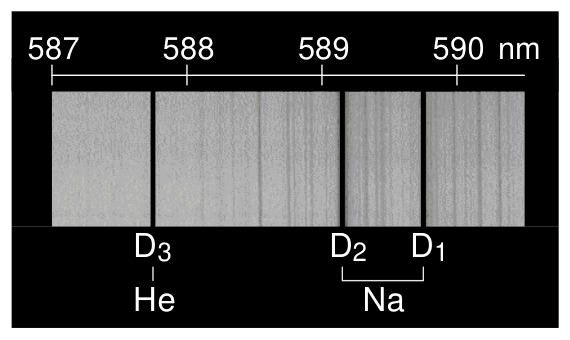
Figure 1. Spectral lines around 588 nm
1.3 Calculate the energy \(E\) [J] of a photon with the wavelength of the \(\mathrm{D}_3\) line of helium shown in Figure 1.
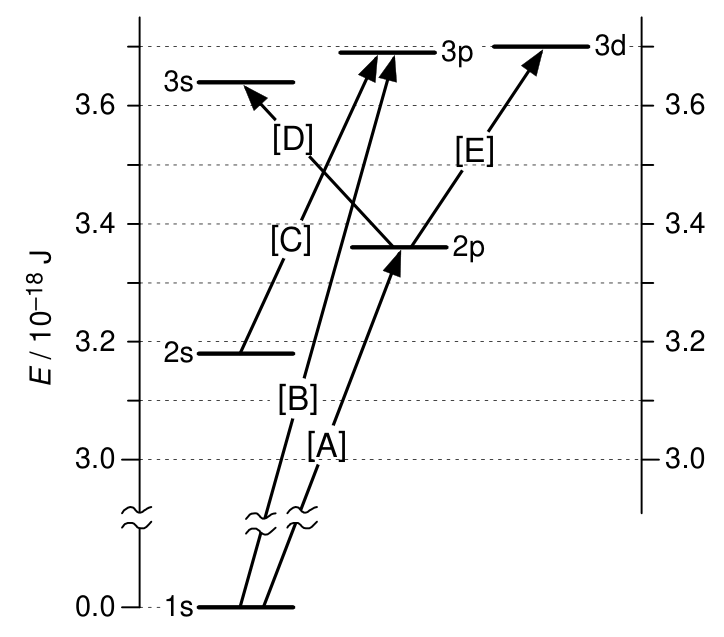
Figure 2. Energy diagram of atomic orbitals of helium when an electron resides in the 1s orbital.
Figure 2 shows an energy diagram of the atomic orbitals of helium. The arrows indicate the "allowed" transitions according to the spectroscopic principle.
1.4 Identify the transition relevant to the \(\mathrm{D}_3\) line of helium among the transitions [A] to [E] indicated in Figure 2. Mark one of the following:
\(\square\) [A] \(\square\) [B] \(\square\) [C] \(\square\) [D] \(\square\) [E]
1.5 Which equation explains the occurrence of helium in cleveite among [A] to [D] below? Mark one.
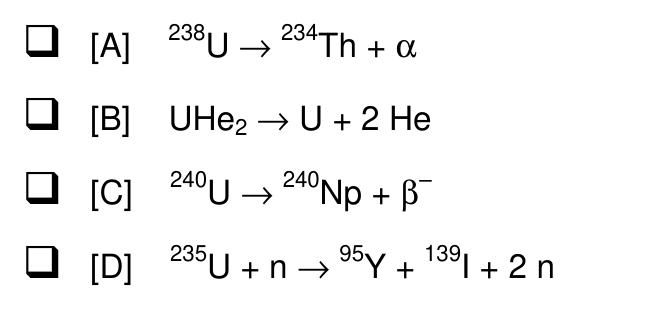
Argon is also found in minerals such as malacon.
1.6 Which equation explains the occurrence of argon in rocks among [A] to [D] below? Mark one.
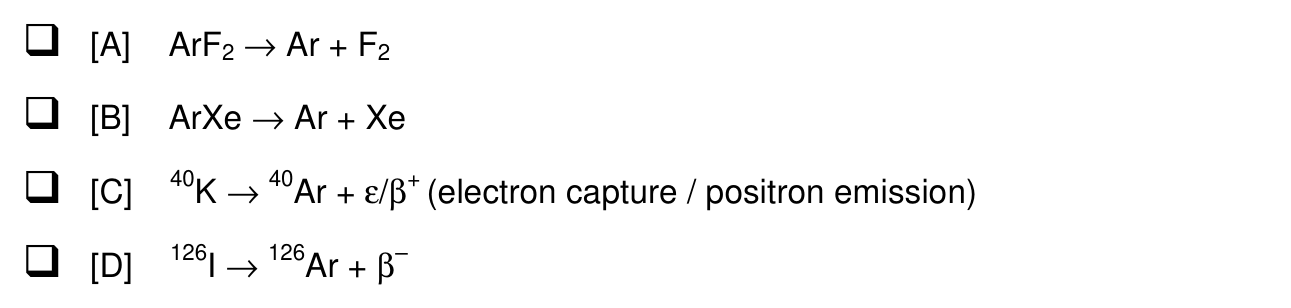
One of the strongest evidences for the monoatomicity of argon and helium is the ratio of the heat capacity under constant pressure to that at constant volume, \(\gamma=C_p/C_V\), which is exactly \(5/3\) (\(1.67\pm0.01\)) for a monoatomic gas. The ratio was derived from the measurement of speed of sound \(v_s\) by using the following equation, where \(f\) and \(\lambda\) are the frequency and wavelength of the sound, and \(R\), \(T\), and \(M\) denote the molar gas constant, absolute temperature, and molar mass, respectively.
\[ v_s=f\lambda=\sqrt{\frac{\gamma RT}{M}} \]
For an unknown gas sample, the wavelength of the sound was measured to be \(\lambda=0.116\ \mathrm{m}\) at a frequency of \(f=3520\ \mathrm{Hz}\) (\(\mathrm{Hz}=\mathrm{s^{-1}}\)) and temperature of \(15.0\,^\circ\mathrm{C}\) and under atmospheric pressure (\(1.013\cdot10^5\ \mathrm{Pa}\)). The density \(\rho\) of the gas for these conditions was measured to be \(0.850\pm0.005\ \mathrm{kg\,m^{-3}}\).
1.7 Calculate the molar mass \(M\) [\(\mathrm{kg\,mol^{-1}}\)] of this gas.
1.8 Calculate the heat capacity ratio \(\gamma\) for this gas sample.
1.9 Which is this gas? Choose and mark among [A] to [D] .
\(\square\) [A] \(\ce{HCl}\)
\(\square\) [B] \(\ce{HF}\)
\(\square\) [C] \(\ce{Ne}\)
\(\square\) [D] \(\ce{Ar}\)
Official English text of the problem.
Problem 2: Crystal structure of alkali metal halides
Crystal structure of alkali metal halide
In crystals of ionic compounds, cations are generally arranged in the interstices of the closest packed lattice of anions. The structure of an ionic crystal such as sodium chloride becomes stable when the cations are in contact with the nearest anions.
2.1 In the crystal of sodium chloride, both \(\ce{Na+}\) and \(\ce{Cl-}\) ions form a face-centred cubic lattice. Give the numbers of \(\ce{Na+}\) and \(\ce{Cl-}\) ions in a unit cell and the coordination numbers of \(\ce{Na+}\) and \(\ce{Cl-}\) ions in sodium chloride crystal.
2.2 The ionic radii of \(\ce{Na+}\) and \(\ce{Cl-}\) ions in the crystal of sodium chloride are 0.102 nm and 0.181 nm, respectively.
Calculate the density [\(\mathrm{kg\,m^{-3}}\)] of the sodium chloride crystal.
Born-Haber cycle and lattice enthalpy
In ionic inorganic compounds such as sodium chloride, the heat of lattice formation from gaseous ions is very high, and the contribution of the change in entropy is small. Therefore, the lattice formation enthalpy is estimated from enthalpy data by using a Born-Haber cycle.
2.3 The figure below shows the Born-Haber cycle of \(\ce{NaCl}\). The labels “g” and “s” represent “gas” and “solid” states, respectively. Show chemical equations in the A and F steps.
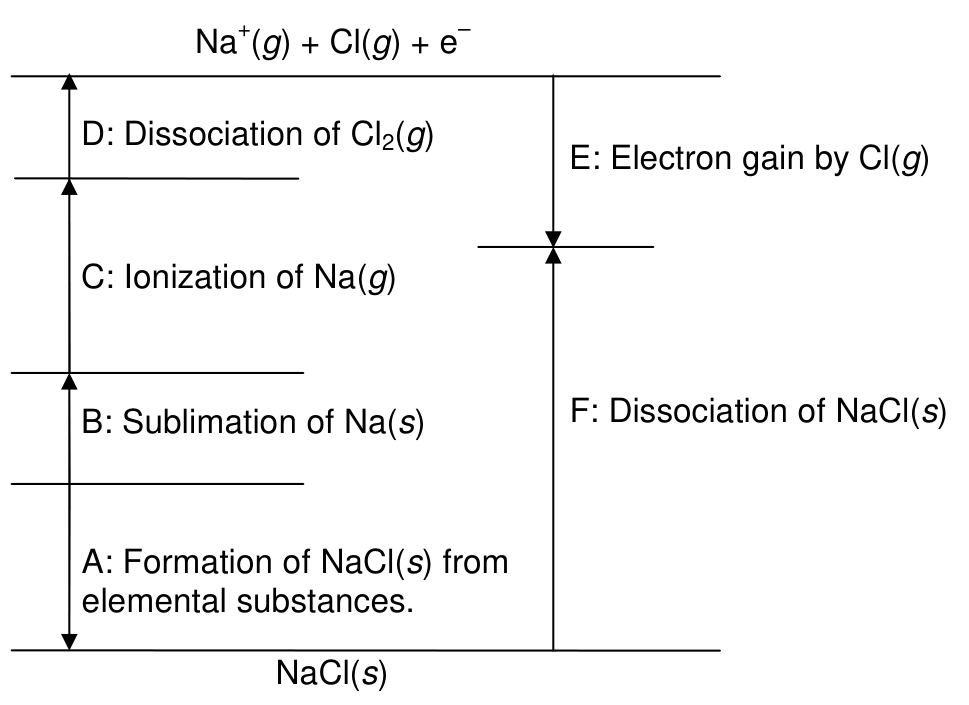
2.4 Calculate the enthalpy of the lattice formation of \(\ce{NaCl}\) [\(\mathrm{kJ\,mol^{-1}}\)] by using the following enthalpy data of the respective steps in the above Born-Haber cycle.
Formation of \(\ce{NaCl(s)}\) Sublimation of \(\ce{Na(s)}\) Ionization of \(\ce{Na(g)}\) Dissociation of \(\ce{Cl2(g)}\) Electron gain by \(\ce{Cl(g)}\) \(-411\ \mathrm{kJ\,mol^{-1}}\) \(109\ \mathrm{kJ\,mol^{-1}}\) \(496\ \mathrm{kJ\,mol^{-1}}\) \(242\ \mathrm{kJ\,mol^{-1}}\) \(-349\ \mathrm{kJ\,mol^{-1}}\) Synthesis of sodium carbonate by the ammonia-soda process (Solvay process)
Sodium carbonate (anhydrous soda ash) is a raw material in the manufacture of glass, medicaments, alkaline detergents, etc.
2.5 The total chemical reaction in the ammonia-soda process is represented as follows:

This reaction between sodium chloride and calcium carbonate does not proceed directly. The process comprises the following five reactions involving ammonia:
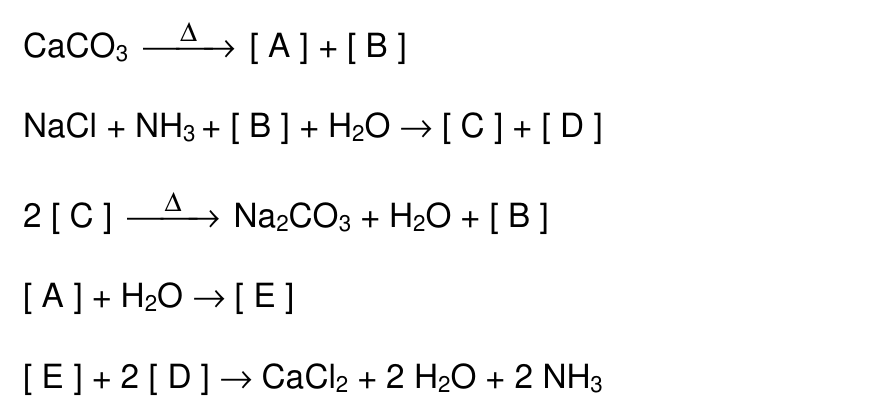
where \(\Delta\) represents applying heat treatment. Insert the chemical formulas of the appropriate compounds instead of [ A ] – [ E ] in the above reactions.
Official English text of the problem.
Problem 3: Chemical oxygen demand
The chemical oxygen demand (COD) refers to the amount of oxidizable substance, such as organic compounds, in a sample solution, and it is used as an indication of water quality in seas, lakes, and marshes. For example, the COD of service water is kept below \(1\ \mathrm{mg\,dm^{-3}}\). The COD (\(\mathrm{mg\,dm^{-3}}\)) is represented by mass of \(\ce{O2}\) (mg) which accepts the same amount of electrons which would be accepted by the strong oxidizing agent when \(1\ \mathrm{dm^3}\) of a sample solution is treated with it. An example of the operation is presented below.
Analytical Operation
A sample solution with a volume of \(1.00\ \mathrm{dm^3}\) was acidified with a sufficient amount of sulphuric acid, and chloride ions were removed by the addition of silver nitrate solution. A volume of \(1.00\cdot10^{-1}\ \mathrm{dm^3}\) of potassium permanganate solution (\(c=5.00\cdot10^{-3}\ \mathrm{mol\,dm^{-3}}\)) was added to the sample solution, and the mixture was heated for 30 min. Further, a volume of \(1.00\cdot10^{-1}\ \mathrm{dm^3}\) of disodium oxalate (\(\ce{Na2C2O4}\) or \(\ce{NaOOC-COONa}\)) standard solution (\(c=1.25\cdot10^{-2}\ \mathrm{mol\,dm^{-3}}\)) was added, and the mixture was stirred well. Oxalate ions that remained unreacted were titrated with potassium permanganate solution (\(c=5.00\cdot10^{-3}\ \mathrm{mol\,dm^{-3}}\)). A volume of \(3.00\cdot10^{-2}\ \mathrm{dm^3}\) of the solution was used for the titration.
3.1 Give the equation of the redox reaction of potassium permanganate and disodium oxalate.
3.2 Calculate the mass of \(\ce{O2}\) (in mg) that will oxidize the same number of moles of oxidizable substance as \(1.00\cdot10^{-3}\ \mathrm{dm^3}\) of potassium permanganate solution with a concentration of \(5.00\cdot10^{-3}\ \mathrm{mol\,dm^{-3}}\) does.
3.3 From the following choices, select the most appropriate reason for the removal of chloride ions:
[A] Some of the chloride ions react with potassium permanganate, resulting in an error in COD.
[B] Some of the chloride ions react with disodium oxalate, resulting in an error in COD.
[C] Some of the chloride ions react with organic compounds in the sample solution, resulting in an error in COD.
[D] A colour is developed during titration, resulting in an error in COD.
3.4 Calculate the COD (\(\mathrm{mg\,dm^{-3}}\)) of the sample solution described in the analytical operation above.
Official English text of the problem.
Problem 4: The lithium-ion battery
The rechargeable lithium ion battery has been developed in Japan.
The standard electromotive force of the battery is 3.70 V. Assume that the half-reaction at the cathode is

and the half-reaction at the anode is
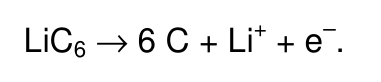
4.1 Write the total reaction equation of the battery and calculate the value of the standard Gibbs energy of the reaction [\(\mathrm{kJ\,mol^{-1}}\)].
The battery cell is constructed using \(\ce{LiCoO2}\) and graphite (\(\ce{C}\)) as the electrode materials.
4.2 Calculate the mass of the anode in the completely charged state and that in completely discharged state if 10.00 g of \(\ce{LiCoO2}\) and 10.00 g of graphite (\(\ce{C}\)) are present initially.
4.3 Calculate the maximum energy generated per mass of the lithium ion battery cell [\(\mathrm{kJ\,kg^{-1}}\)]. Assume that the correct ratio for complete reaction between the cathode and anode materials is used and the sum of the mass of electrodes is 50.0 % of the total mass of the battery cell. In comparison, the energy density of lead-acid batteries used for vehicles is about 200 \(\mathrm{kJ\,kg^{-1}}\).
Because an aqueous solution cannot be used as an electrolyte, an organic solution is used in the lithium ion battery cell.
4.4 Give the chemical formula of the gas generated if water is present in the electrolyte.
Official English text of the problem.
Problem 5: Photoelectron spectroscopy
When an atom \(\ce{X}\) absorbs radiation with a photon energy greater than the ionization energy of the atom, the atom is ionized to generate an ion \(\ce{X+}\) and the electron (called a photoelectron) is ejected at the same time. In this event, the energy is conserved as shown in Figure 1, that is,
Photon energy (\(h\nu\)) = ionization energy (IE) of \(\ce{X}\) + kinetic energy of photoelectron.
When a molecule, for example, \(\ce{H2}\), absorbs short-wavelength light, the photoelectron is ejected and an \(\ce{H2+}\) ion with a variety of vibrational states is produced. A photoelectron spectrum is a plot of the number of photoelectrons as a function of the kinetic energy of the photoelectrons. Figure 2 shows a typical photoelectron spectrum when \(\ce{H2}\) in the lowest vibrational level is irradiated by monochromatic light of 21.2 eV. No photoelectrons are detected above 6.0 eV. (eV is a unit of energy and 1.0 eV is equal to \(1.6\cdot10^{-19}\) J.)
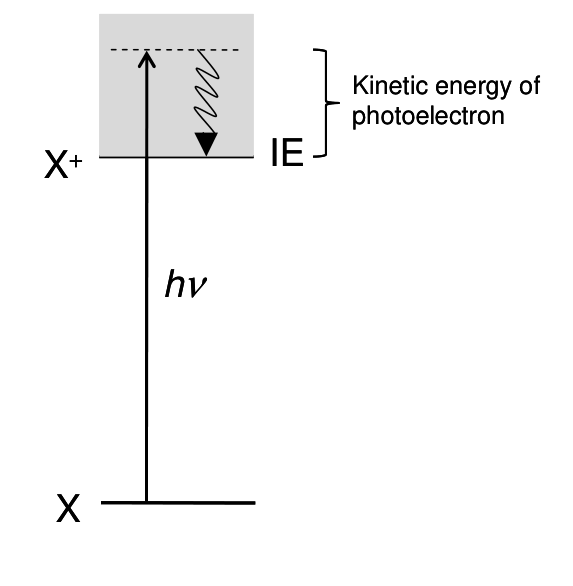
Figure 1. Schematic diagram of photoelectron spectroscopy.
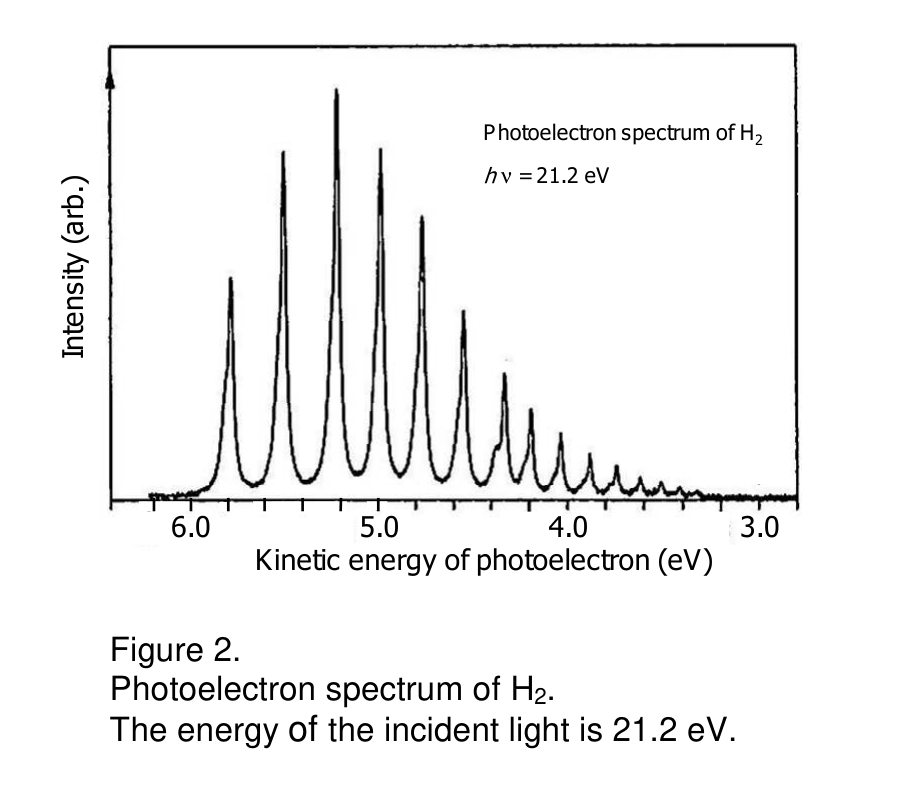
Figure 2. Photoelectron spectrum of \(\ce{H2}\). The energy of the incident light is 21.2 eV.
5.1 a) Determine the energy difference \(\Delta E_{\mathrm{A1}}\) (eV) between \(\ce{H2}\) (\(v=0\)) and \(\ce{H2+}\) (\(v_{\mathrm{ion}}=0\)) to the first decimal place. \(v\) and \(v_{\mathrm{ion}}\) denote the vibrational quantum numbers of \(\ce{H2}\) and \(\ce{H2+}\), respectively.
b) Determine the energy difference \(\Delta E_{\mathrm{A2}}\) (eV) between \(\ce{H2+}\) (\(v_{\mathrm{ion}}=0\)) and \(\ce{H2+}\) (\(v_{\mathrm{ion}}=3\)) to the first decimal place.
The electronic energy levels \(E_n^{\mathrm{H}}\) of a hydrogen atom are given by the equation
\[ E_n^{\mathrm{H}}=-\frac{Ry}{n^2} \qquad (n=1,2,3\cdots) \]
Here \(n\) is a principal quantum number, and \(Ry\) is a constant with dimensions of energy. The energy from \(n=1\) to \(n=2\) of the hydrogen atom is 10.2 eV.
5.2 Calculate the ionization energy \(E_{\mathrm{B}}\) (eV) of the hydrogen atom to the first decimal place.
The energy threshold for the generation of two electronically excited hydrogen atoms \(\ce{H^{*}}\) (\(n=2\)) from \(\ce{H2}\) (\(v=0\)) has been derived to be 24.9 eV by an experiment.
5.3 Determine the bond energy \(E_{\mathrm{C}}\) (eV) of \(\ce{H2}\) to the first decimal place.
5.4 Considering an energy cycle, determine the bond energy \(E_{\mathrm{D}}\) (eV) of \(\ce{H2+}\) to the first decimal place. If you were unable to determine the values for \(E_{\mathrm{B}}\) and \(E_{\mathrm{C}}\), then use 15.0 eV and 5.0 eV for \(E_{\mathrm{B}}\) and \(E_{\mathrm{C}}\), respectively.
5.5 Calculate the threshold energy \(E_{\mathrm{E}}\) (eV) of the following dissociative ionization reaction to the first decimal place:

If you were unable to determine the values for \(E_{\mathrm{B}}\) and \(E_{\mathrm{C}}\), then use 15.0 eV and 5.0 eV for \(E_{\mathrm{B}}\) and \(E_{\mathrm{C}}\), respectively.
When \(\ce{H2}\) absorbs monochromatic light of 21.2 eV, the following dissociation process occurs at the same time.

Two hydrogen atoms move in opposite directions with the same speed.
5.6 Calculate the speed \(u\) (\(\mathrm{m\,s^{-1}}\)) of the hydrogen atoms generated in the above reaction. \(\ce{H2}\) is assumed to be at rest. If you were unable to determine the value for \(E_{\mathrm{C}}\), then use 5.0 eV for \(E_{\mathrm{C}}\).
Official English text of the problem.
Problem 6: Four isomers of C8H10O
Read the description of four kinds of isomeric organic compounds A, B, C, and D. All of them have the formula \(\ce{C8H10O}\) and contain a benzene ring. Answer the questions that follow. If there are stereoisomers, give also their structural formulas.
- At room temperature, a piece of sodium metal was added (procedure 1) to A, B, and C in test tubes. The evolution of hydrogen gas was observed only in the case of C.
- When an iron(III) chloride aqueous solution was added to C and D, no coloration was observed in C, whereas D was coloured.
- A was oxidized when aqueous potassium permanganate was added to it and the mixture was heated. The acidification of the heated mixture and its isolation (procedure 2) afforded benzoic acid.
- Let’s imagine that a hydrogen atom in the benzene ring is replaced by a chlorine atom (procedure 3). It is possible to obtain in this way four kinds of monochlorinated structural isomers from B, while only two kinds of such isomers can be obtained from D.
- Hydrogenation of the benzene ring in C and D using a catalyst gave saturated alcohol(s). It was found that the saturated alcohol(s) obtained from C has no stereogenic carbons while those obtained from D has stereogenic carbon(s).
6.1 Among all the isomeric organic compounds with a formula of \(\ce{C8H10O}\) and having a benzene ring, give the structural formulas of all the isomers that do NOT yield hydrogen gas in the underlined procedure 1, in which a piece of sodium is added:
i) to the neat samples in the case of the liquid samples,
ii) to the concentrated solution of the samples in an aprotic solvent in the case of the solid samples.
6.2 Among all the isomeric organic compounds with a formula of \(\ce{C8H10O}\) and having a benzene ring, give the structural formulas of all the isomers that yield benzoic acid in the underlined procedure 2.
6.3 Among all the isomeric organic compounds with a formula of \(\ce{C8H10O}\) and having a benzene ring, give the structural formulas of all the isomers that could yield four different monochlorinated structural isomers when the underlined procedure 3 is performed.
6.4 Give the structural formulas of A, B, C, and D. When several isomers can be considered, give the structural formulas of all of them.
Official English text of the problem.
Problem 7: Tetrodotoxin
Certain varieties of puffer fish, Fugu in Japanese, are highly prized as foods in Japan. Since the viscera (especially ovaries and livers) of the fish contain a potent toxin (tetrodotoxin), food poisoning often results from its ingestion. Studies on tetrodotoxin (1) have been performed from the beginning of the 20th century. Its chemical structure was elucidated in 1964.
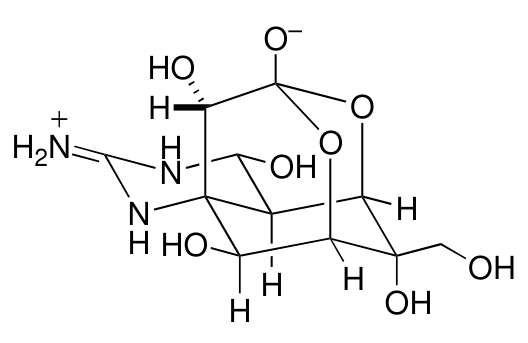
tetrodotoxin (1)
The guanidine group in tetrodotoxin exhibits strong basicity. The guanidinium ion resulting from protonation on the guanidine group is stabilized by the existence of the following resonance.
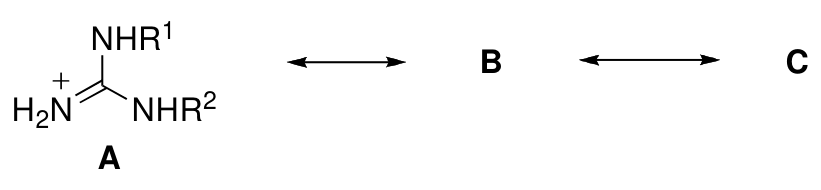
7.1 Draw two resonance structures B and C.
Many derivatization reactions were performed in structure studies of tetrodotoxin. Treatment of tetrodotoxin (1) (see reaction scheme 1) with ethanolic potassium hydroxide upon heating afforded quinazoline derivative 2, which provided an insight into the nature of the fundamental skeleton of tetrodotoxin. The reaction mechanism can be described as follows. First, tetrodotoxin is hydrolyzed into carboxylate 3. Then the hydroxyl group highlighted with a frame is eliminated by the base to give intermediate D. A retro-aldol reaction of D cleaves a carbon-carbon bond to provide intermediates E and F. Finally, dehydration and aromatization from E produce quinazoline derivative 2.
7.2 Draw structures of the postulated intermediates D, E, and F.
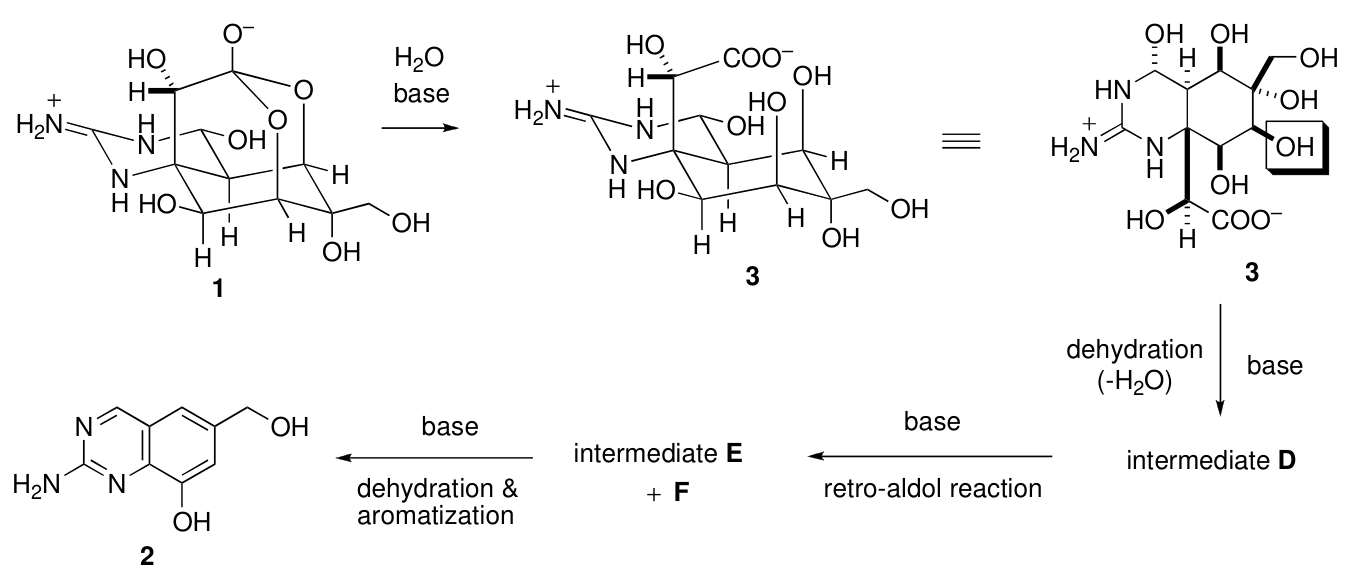
Reaction scheme 1
Although biosynthesis of tetrodotoxin still remains to be clarified, it is proposed that tetrodotoxin may be biologically synthesized from L-arginine and isopentenyl diphosphate.

7.3 Among the carbon atoms included in tetrodotoxin, circle all those that are expected to be of L-arginine origin.
In the 1990s, an alternative biosynthetic pathway of tetrodotoxin was proposed. Condensation between 2-deoxy-3-oxo-D-pentose and guanidine provides intermediate G with cyclic guanidine moiety (molecular formula \(\ce{C6H11N3O3}\)). Tetrodotoxin may be biologically synthesized from intermediate G and isopentenyl diphosphate.
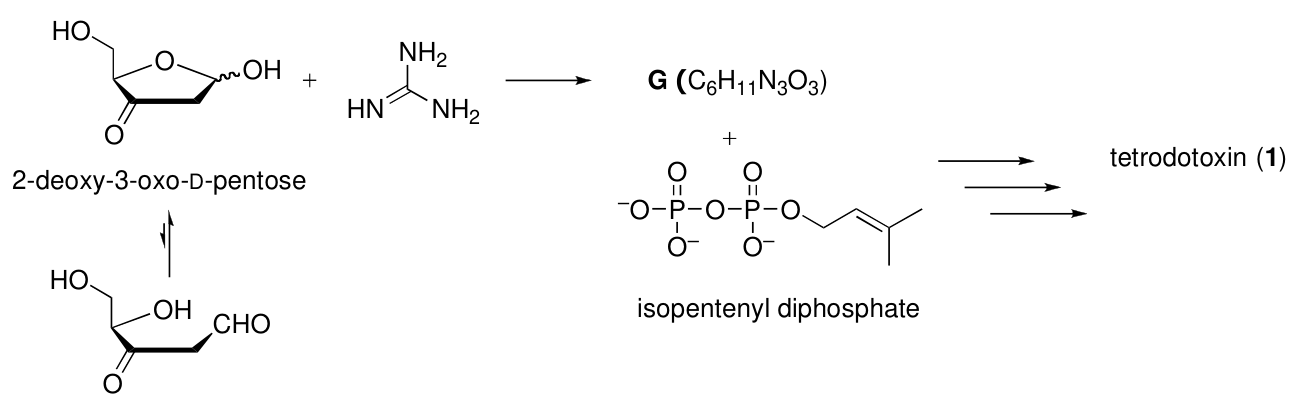
7.4 Draw a structure of the postulated intermediate G showing the stereochemistry.
Official English text of the problem.
Problem 8: Polycondensation and the degree of polymerization
The esterification reaction between bi-functional molecules gives one of the typical linear chain polymers, as shown in equation (1), by polycondensation (often called “condensation polymerization”). The control of polymerization conditions and procedures determines the length of polymer strands, i. e. the average degree of polymerization, \(X\) (note that \(X=2n\) in the present instance). Because \(X\) (and also \(n\)) is an averaged number, it is not always an integer but a value with decimal figures.

\(X\) can be estimated from the consumption of functional groups (here, \(\ce{-COOH}\) and \(\ce{-OH}\)). Let us define the degree of reaction, \(p\), as \(p=(N_0-N)/N_0\;(\leq 1)\), where \(N_0\) and \(N\) denote the total numbers of functional groups before and after the polymerization, respectively. For each functional group of the dicarboxylic acid molecules (A) and diol molecules (B), we add the suffixes of “A” or “B” such as \(N_{\mathrm{A}0}\), \(N_{\mathrm{B}0}\), \(N_{\mathrm A}\) or \(N_{\mathrm B}\), respectively, i. e. \(N_0=N_{\mathrm{A}0}+N_{\mathrm{B}0}\) and \(N=N_{\mathrm A}+N_{\mathrm B}\). When the initial feed is unbalanced such as \(N_{\mathrm{A}0}\leq N_{\mathrm{B}0}\), \(X\) is expressed by \(p_{\mathrm A}\) and \(r\) as shown in equation 2, where \(r=N_{\mathrm{A}0}/N_{\mathrm{B}0}\;(\leq 1)\) and \(p_{\mathrm A}=(N_{\mathrm{A}0}-N_{\mathrm A})/N_{\mathrm{A}0}\). If \(r=1\), \(p_{\mathrm A}\) is identical to \(p\) and equation 2 becomes the same to the Carothers equation.
\[ X=\frac{1+r}{1+r-2p_{\mathrm A}r} \tag{2} \]
Some nylon-6,6 sample was prepared by polycondensation between an equimolar mixture of adipic acid (hexanedioic acid) and hexamethylenediamine (hexane-1,6-diamine).
8.1 Show the chemical structure of this nylon-6,6 sample.
[Caution: What are the end groups when polycondensation was started from the equimolar mixture?]
8.2 When an average molar weight, \(M\), of this nylon-6,6 sample is \(5507.25\;(\mathrm{g\,mol^{-1}})\), calculate its \(X\) value to the second decimal place.
8.3 Give the \(p\) value to the fifth decimal place that is necessary to prepare the above nylon-6,6 sample. If you get no numerical answer in 8.2 use the value 52.50 instead.
The low-molecular-weight polyester (oligoester) is prepared from the mixture of 36.54 g of adipic acid (hexanedioic acid) and an unknown amount [\(W\) (g)] of butane-1,4-diol (Bdiol). Under the condition of \(p_{\mathrm A}\to 1\), the oligoester with \(X=11.00\) carrying Bdiol units in both chain ends, is obtained.
8.4 Show the precise chemical structure of this oligoester of \(X=11.00\).
8.5 Calculate the unknown amount, \(W\) (g), to the first decimal place.
Official English text of the problem.
Problem 9: α-Cyclodextrin
α-Cyclodextrin (αCyD), which is a cyclic oligosaccharide of six α(1→4) linked α-D-glucopyranoside units, can be topologically represented as toroids (Figure 1). α-D-glucopyranoside units in αCyD are usually in the most stable chair conformation.
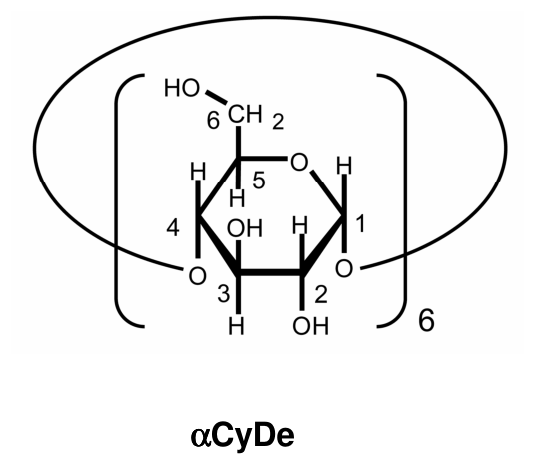
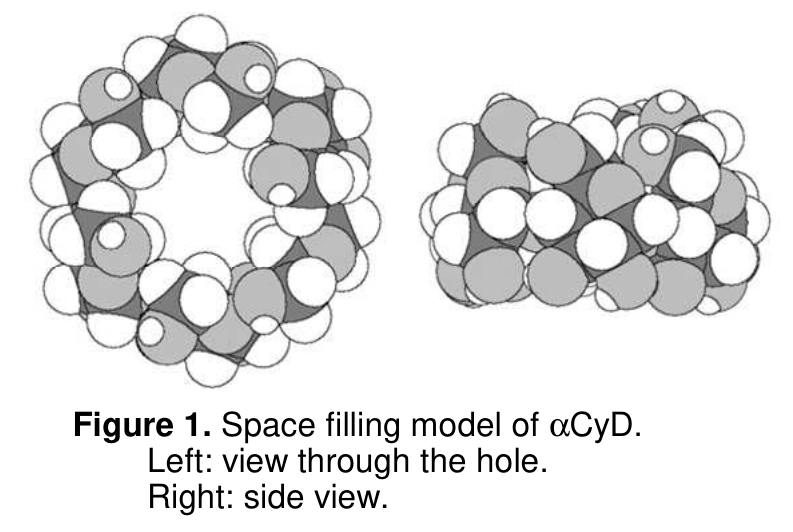
Figure 1. Space filling model of αCyD.
Left: view through the hole.
Right: side view.9.1 Give the absolute configuration (\(R\) or \(S\)) at stereogenic carbons C-2 and C-5 of D-glucose. Also, draw a stereostructure of the open chain form of D-glucose.
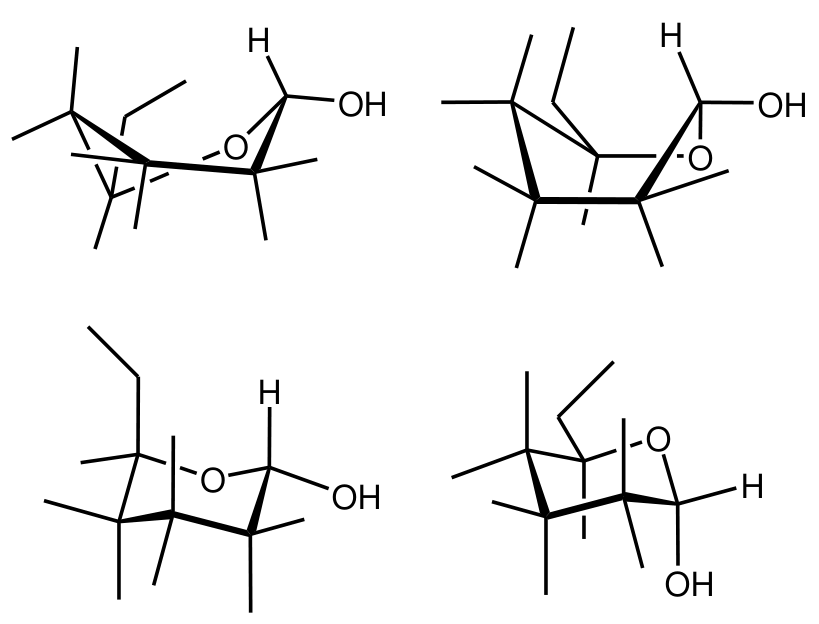
9.2 Choose the most stable conformation from the following four incomplete α-D-glucopyranose formulas. Also, add four \(\ce{OH}\) groups and four \(\ce{H}\) atoms to complete the α-D-glucopyranose formula.
αCyD in water is able to host hydrophobic molecules. When the host : guest (H : G) stoichiometry is 1 : 1, the inclusion complexation can be given by the following equilibrium.
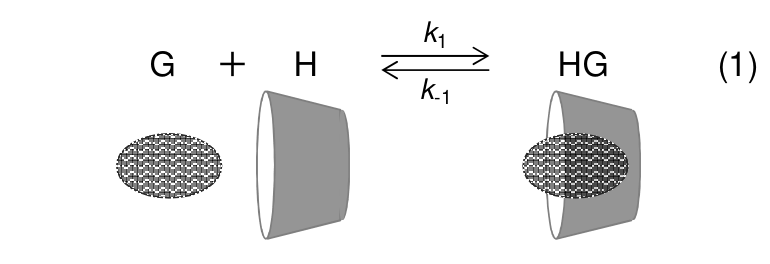
where \(k_1\) and \(k_{-1}\) are the rate constant for the forward and backward reaction, respectively. The complexation of a guest to αCyD causes a chemical shift change in \(\ce{^1H}\) NMR spectra.
Figure 2 shows a part of \(\ce{^1H}\) NMR spectra (signals from H–1 of αCyD) showing the chemical shift change in the presence of varying amounts of BTAD (1,10-bis(trimethylammonium)decane diiodide). The doublet peak at 5.06 ppm is from H–1 of free αCyD, while the doublet at 5.14 ppm is from H–1 of αCyD complexed with BTAD. (Note that the spectra given in Figure 2 were measured in the complexation equilibrium state.)
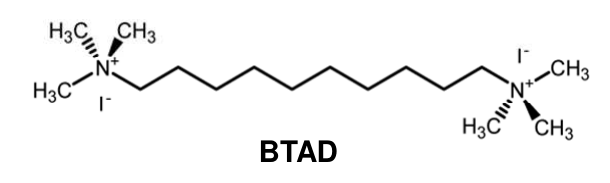
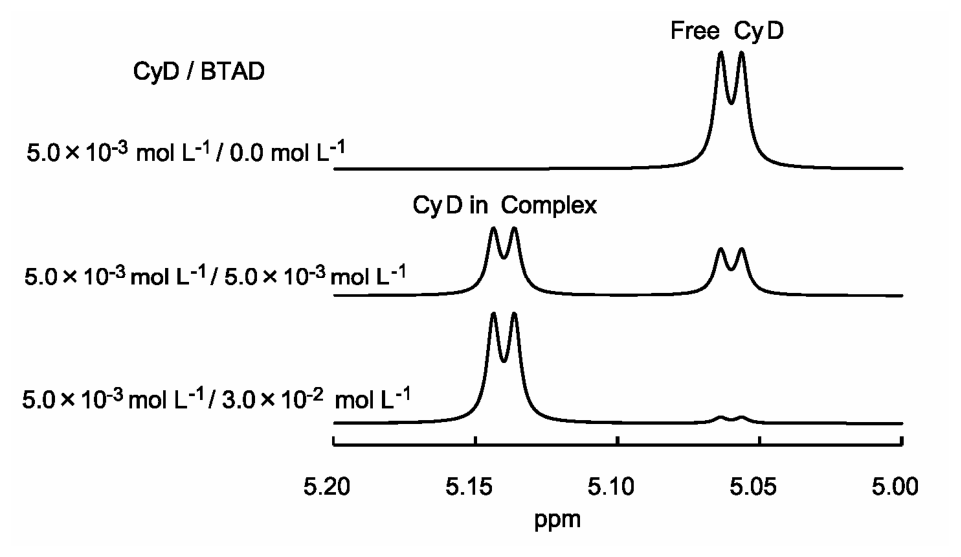
Figure 2.
Expanded \(\ce{^1H}\) NMR spectra (signals from H–1 of αCyD) of solutions with concentration of αCyD equal to \(5.0\cdot10^{-3}\ \mathrm{mol\,dm^{-3}}\) and that of BTAD equal from 0 to \(3.0\cdot10^{-2}\ \mathrm{mol\,dm^{-3}}\).9.3 Consider a solution in which concentrations of αCyD as well as BTAD are equal to \(5.0\cdot10^{-3}\ \mathrm{mol\,dm^{-3}}\) and the relative peak areas of the doublets at 5.06 and 5.14 ppm are 0.41 and 0.59, respectively. Calculate (to 2 significant figures) the concentration equilibrium constant, \(K\), for the inclusion complexation of αCyD / BTAD.
Complexation of αCyD with hexyltrimethylammonium bromide (HTAB) appears in NMR spectra in a way different from the αCyD/BTAD complexation. Figure 3 shows a part of \(\ce{^1H}\) NMR spectra (H-6 signal of HTAB) in αCyD/HTAB solutions. The signal appears as one triplet (not two triplets), which shifts depending on the concentration of αCyD from the position of free HTAB to the position of αCyD/HTAB in proportion to the fraction of the complex in the solution. The H-6 signals from free HTAB and HTAB complexed with αCyD are triplets at 0.740 ppm and 0.860 ppm, respectively.
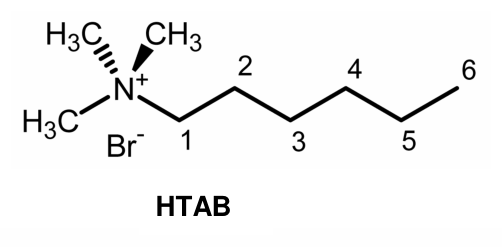
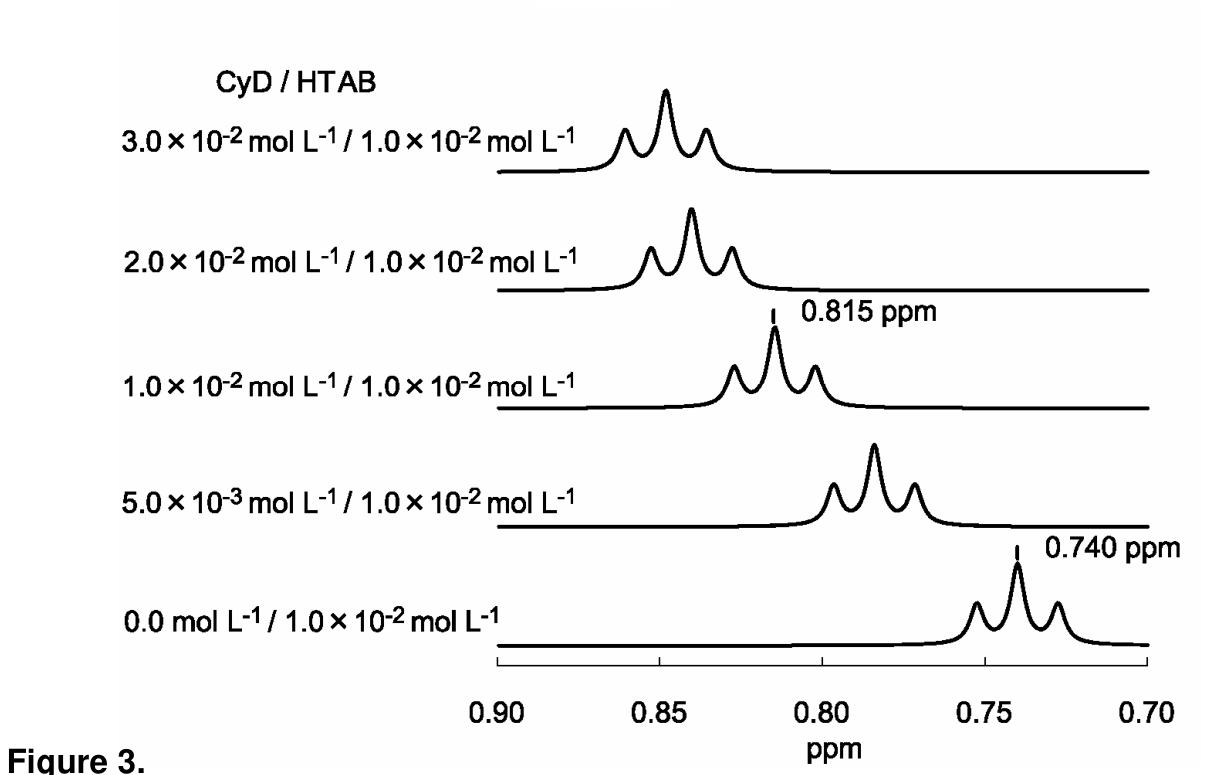
Figure 3.
Expanded \(\ce{^1H}\) NMR spectra (H-6 signal of HTAB) of solutions with concentration of HTAB equal to \(1.0\cdot10^{-2}\ \mathrm{mol\,dm^{-3}}\) and that of αCyD equal from 0 to \(3.0\cdot10^{-2}\ \mathrm{mol\,dm^{-3}}\).9.4 The signal of HTAB in αCyD/HTAB solutions appears as one triplet that shifts depending on the concentration of αCyD. Choose the rational interpretation(s) just from these spectra.
Hint: When a guest molecule move in and out of αCyD rapidly and repeatedly, only one signal of the guest is observed at the weighted average of the chemical shifts of the free guest and the shift of the guest included in αCyD.
a) \(k_1\) of αCyD/HTAB \(>\) \(k_1\) of αCyD/BTAD
b) \(k_1\) of αCyD/HTAB \(<\) \(k_1\) of αCyD/BTAD
c) \(K\) of αCyD/HTAB \(>\) \(K\) of αCyD/BTAD
d) \(K\) of αCyD/HTAB \(<\) \(K\) of αCyD/BTAD
9.5 The signals of HTAB in the solution with concentrations of αCyD as well as HTAB equal to \(1.0\cdot10^{-2}\ \mathrm{mol\,dm^{-3}}\) are positioned at 0.815 ppm. Calculate (to 2 significant figures) the value of \(K\) for the complexation of αCyD/HTAB.
9.6 At 40.0 °C and 60.0 °C, \(K\) for the complexation of αCyD / HTAB are \(3.12\cdot10^2\) and \(2.09\cdot10^2\) respectively. Calculate (to 2 significant figures) the enthalpy change, \(\Delta H^\circ\) [\(\mathrm{kJ\,mol^{-1}}\)] and the entropy change, \(\Delta S^\circ\) [\(\mathrm{J\,K^{-1}\,mol^{-1}}\)]. (Ignore the temperature dependence of \(\Delta H^\circ\) and \(\Delta S^\circ\).)
Official English text of the problem.
Internationale Chemie-Olympiade
IChO 2010
Tokio, Japan · 9 Theorieaufgaben mit vollständigen Lösungen
Aufgabe 1: Lord Rayleigh und die Entdeckung des Argons
Im Jahr 1894 berichtete Lord Rayleigh, dass sich die Masse von chemisch hergestelltem Stickstoff von derjenigen des aus der Atmosphäre gewonnenen Stickstoffs unterschied, wie in den Tabellen 1 und 2 dargestellt. Später wurde dieser Unterschied auf das Vorhandensein von Argon im atmosphärischen Stickstoff zurückgeführt. Die Gasmassen wurden mithilfe eines Glasgefäßes mit bekanntem Volumen bei Atmosphärendruck (\(1.013\cdot10^5\ \mathrm{Pa}\)) gemessen.
Tabelle 1. Masse des chemisch hergestellten Stickstoffs im Gefäß
Aus Stickstoffmonoxid 2.3001 g Aus Distickstoffmonoxid 2.2990 g Aus Ammoniumnitrit, bei Rotglut gereinigt 2.2987 g Aus Harnstoff 2.2985 g Aus Ammoniumnitrit, in der Kälte gereinigt 2.2987 g Mittelwert 2.2990 g Tabelle 2. Masse des atmosphärischen Stickstoffs im Gefäß
\(\ce{O2}\) wurde durch heißes Kupfer entfernt (1892) 2.3103 g \(\ce{O2}\) wurde durch heißes Eisen entfernt (1893) 2.3100 g \(\ce{O2}\) wurde durch Eisen(II)-hydroxid entfernt (1894) 2.3102 g Mittelwert 2.3102 g 1.1 Berechnen Sie das Volumen \(V\) [\(\mathrm{m^3}\)] des von Rayleigh verwendeten Gefäßes aus der mittleren Masse des chemisch hergestellten Stickstoffs, bei dem es sich um reinen Stickstoff gehandelt haben muss. Nehmen Sie an, dass die Messungen bei einer Temperatur von \(15.0\,^\circ\mathrm{C}\) durchgeführt wurden.
1.2 Schätzen Sie den Stoffmengenanteil \(x\) von Argon in Rayleighs atmosphärischem Stickstoff unter der Annahme ab, dass Argon und Stickstoff die einzigen Bestandteile waren. Verwenden Sie für die Berechnung die mittleren Massen des atmosphärischen und des chemisch hergestellten Stickstoffs.
Ramsay und Clève entdeckten 1895 unabhängig voneinander und nahezu gleichzeitig Helium in Cleveit (einem Mineral aus Uranoxid sowie Oxiden von Blei, Thorium und Seltenen Erden; einer unreinen Varietät von Uraninit). Das aus dem Gestein gewonnene Gas zeigte eine charakteristische Spektrallinie bei etwa 588 nm (in Abbildung 1 mit \(\mathrm{D}_3\) gekennzeichnet), die erstmals 1868 während einer totalen Sonnenfinsternis im Spektrum einer Sonnenprotuberanz beobachtet worden war, nahe den bekannten \(\mathrm{D}_1\)- und \(\mathrm{D}_2\)-Linien des Natriums.
Abbildung 1. Spektrallinien bei etwa 588 nm
1.3 Berechnen Sie die Energie \(E\) [J] eines Photons mit der Wellenlänge der in Abbildung 1 gezeigten \(\mathrm{D}_3\)-Linie des Heliums.
Abbildung 2. Energiediagramm der Atomorbitale von Helium, wenn sich ein Elektron im 1s-Orbital befindet.
Abbildung 2 zeigt ein Energiediagramm der Atomorbitale von Helium. Die Pfeile kennzeichnen die gemäß dem spektroskopischen Prinzip „erlaubten“ Übergänge.
1.4 Identifizieren Sie unter den in Abbildung 2 dargestellten Übergängen [A] bis [E] den Übergang, der zur \(\mathrm{D}_3\)-Linie des Heliums gehört. Kreuzen Sie eine der folgenden Möglichkeiten an:
\(\square\) [A] \(\square\) [B] \(\square\) [C] \(\square\) [D] \(\square\) [E]
1.5 Welche der folgenden Gleichungen [A] bis [D] erklärt das Vorkommen von Helium in Cleveit? Kreuzen Sie eine an.
Argon kommt auch in Mineralen wie Malakon vor.
1.6 Welche der folgenden Gleichungen [A] bis [D] erklärt das Vorkommen von Argon in Gesteinen? Kreuzen Sie eine an.
Einer der stärksten Belege für die Einatomigkeit von Argon und Helium ist das Verhältnis der Wärmekapazität bei konstantem Druck zu derjenigen bei konstantem Volumen, \(\gamma=C_p/C_V\), das für ein einatomiges Gas genau \(5/3\) (\(1.67\pm0.01\)) beträgt. Das Verhältnis wurde aus der Messung der Schallgeschwindigkeit \(v_s\) mithilfe der folgenden Gleichung bestimmt, wobei \(f\) und \(\lambda\) die Frequenz und die Wellenlänge des Schalls sind und \(R\), \(T\) und \(M\) die molare Gaskonstante, die absolute Temperatur bzw. die molare Masse bezeichnen.
\[ v_s=f\lambda=\sqrt{\frac{\gamma RT}{M}} \]
Für eine unbekannte Gasprobe wurde eine Schallwellenlänge von \(\lambda=0.116\ \mathrm{m}\) bei einer Frequenz von \(f=3520\ \mathrm{Hz}\) (\(\mathrm{Hz}=\mathrm{s^{-1}}\)), einer Temperatur von \(15.0\,^\circ\mathrm{C}\) und Atmosphärendruck (\(1.013\cdot10^5\ \mathrm{Pa}\)) gemessen. Die Dichte \(\rho\) des Gases wurde unter diesen Bedingungen zu \(0.850\pm0.005\ \mathrm{kg\,m^{-3}}\) bestimmt.
1.7 Berechnen Sie die molare Masse \(M\) [\(\mathrm{kg\,mol^{-1}}\)] dieses Gases.
1.8 Berechnen Sie das Wärmekapazitätsverhältnis \(\gamma\) für diese Gasprobe.
1.9 Um welches Gas handelt es sich? Wählen Sie aus [A] bis [D] aus und kreuzen Sie an.
\(\square\) [A] \(\ce{HCl}\)
\(\square\) [B] \(\ce{HF}\)
\(\square\) [C] \(\ce{Ne}\)
\(\square\) [D] \(\ce{Ar}\)
Aufgabentext aus dem offiziellen englischen Text übersetzt.
Aufgabe 2: Kristallstruktur von Alkalimetallhalogeniden
Kristallstruktur eines Alkalimetallhalogenids
In Kristallen ionischer Verbindungen sind die Kationen im Allgemeinen in den Lücken der dichtesten Kugelpackung der Anionen angeordnet. Die Struktur eines Ionenkristalls wie Natriumchlorid wird stabil, wenn die Kationen die nächstgelegenen Anionen berühren.
2.1 Im Natriumchloridkristall bilden sowohl die \(\ce{Na+}\)- als auch die \(\ce{Cl-}\)-Ionen ein kubisch flächenzentriertes Gitter. Geben Sie die Anzahlen der \(\ce{Na+}\)- und \(\ce{Cl-}\)-Ionen in einer Elementarzelle sowie die Koordinationszahlen der \(\ce{Na+}\)- und \(\ce{Cl-}\)-Ionen im Natriumchloridkristall an.
2.2 Die Ionenradien der \(\ce{Na+}\)- und \(\ce{Cl-}\)-Ionen im Natriumchloridkristall betragen 0.102 nm bzw. 0.181 nm.
Berechnen Sie die Dichte [\(\mathrm{kg\,m^{-3}}\)] des Natriumchloridkristalls.
Born-Haber-Kreisprozess und Gitterenthalpie
Bei ionischen anorganischen Verbindungen wie Natriumchlorid ist die bei der Gitterbildung aus gasförmigen Ionen freigesetzte Wärme sehr groß und der Beitrag der Entropieänderung gering. Daher wird die Gitterbildungsenthalpie mithilfe eines Born-Haber-Kreisprozesses aus Enthalpiedaten abgeschätzt.
2.3 Die folgende Abbildung zeigt den Born-Haber-Kreisprozess von \(\ce{NaCl}\). Die Kennzeichnungen „g“ und „s“ stehen für die Zustände „gasförmig“ bzw. „fest“. Geben Sie die chemischen Gleichungen für die Schritte A und F an.
2.4 Berechnen Sie die Gitterbildungsenthalpie von \(\ce{NaCl}\) [\(\mathrm{kJ\,mol^{-1}}\)] unter Verwendung der folgenden Enthalpiedaten für die jeweiligen Schritte im obigen Born-Haber-Kreisprozess.
Bildung von \(\ce{NaCl(s)}\) Sublimation von \(\ce{Na(s)}\) Ionisation von \(\ce{Na(g)}\) Dissoziation von \(\ce{Cl2(g)}\) Elektronenaufnahme durch \(\ce{Cl(g)}\) \(-411\ \mathrm{kJ\,mol^{-1}}\) \(109\ \mathrm{kJ\,mol^{-1}}\) \(496\ \mathrm{kJ\,mol^{-1}}\) \(242\ \mathrm{kJ\,mol^{-1}}\) \(-349\ \mathrm{kJ\,mol^{-1}}\) Synthese von Natriumcarbonat nach dem Ammoniak-Soda-Verfahren (Solvay-Verfahren)
Natriumcarbonat (wasserfreie Soda) ist ein Rohstoff für die Herstellung von Glas, Arzneimitteln, alkalischen Reinigungsmitteln usw.
2.5 Die chemische Gesamtreaktion des Ammoniak-Soda-Verfahrens wird wie folgt dargestellt:
Diese Reaktion zwischen Natriumchlorid und Calciumcarbonat läuft nicht direkt ab. Das Verfahren umfasst die folgenden fünf Reaktionen unter Beteiligung von Ammoniak:
Dabei steht \(\Delta\) für eine Wärmebehandlung. Setzen Sie in den obigen Reaktionen anstelle von [ A ] – [ E ] die chemischen Formeln der entsprechenden Verbindungen ein.
Aufgabentext aus dem offiziellen englischen Text übersetzt.
Aufgabe 3: Chemischer Sauerstoffbedarf
Der chemische Sauerstoffbedarf (COD) bezieht sich auf die Menge oxidierbarer Stoffe, beispielsweise organischer Verbindungen, in einer Probenlösung und dient als Maß für die Wasserqualität in Meeren, Seen und Sümpfen. Beispielsweise wird der COD von Brauchwasser unter \(1\ \mathrm{mg\,dm^{-3}}\) gehalten. Der COD (\(\mathrm{mg\,dm^{-3}}\)) wird durch die Masse an \(\ce{O2}\) (mg) angegeben, die dieselbe Elektronenmenge aufnimmt, die ein starkes Oxidationsmittel aufnehmen würde, wenn \(1\ \mathrm{dm^3}\) einer Probenlösung damit behandelt wird. Ein Beispiel für die Durchführung ist nachstehend angegeben.
Analytische Durchführung
Eine Probenlösung mit einem Volumen von \(1.00\ \mathrm{dm^3}\) wurde mit einer ausreichenden Menge Schwefelsäure angesäuert, und Chloridionen wurden durch Zugabe von Silbernitratlösung entfernt. Der Probenlösung wurde ein Volumen von \(1.00\cdot10^{-1}\ \mathrm{dm^3}\) Kaliumpermanganatlösung (\(c=5.00\cdot10^{-3}\ \mathrm{mol\,dm^{-3}}\)) zugesetzt, und das Gemisch wurde 30 min lang erhitzt. Anschließend wurde ein Volumen von \(1.00\cdot10^{-1}\ \mathrm{dm^3}\) einer Dinatriumoxalat-Standardlösung (\(\ce{Na2C2O4}\) oder \(\ce{NaOOC-COONa}\)) (\(c=1.25\cdot10^{-2}\ \mathrm{mol\,dm^{-3}}\)) zugesetzt und das Gemisch gut gerührt. Nicht umgesetzte Oxalationen wurden mit Kaliumpermanganatlösung (\(c=5.00\cdot10^{-3}\ \mathrm{mol\,dm^{-3}}\)) titriert. Für die Titration wurde ein Volumen von \(3.00\cdot10^{-2}\ \mathrm{dm^3}\) dieser Lösung verbraucht.
3.1 Geben Sie die Gleichung der Redoxreaktion von Kaliumpermanganat und Dinatriumoxalat an.
3.2 Berechnen Sie die Masse an \(\ce{O2}\) (in mg), die dieselbe Stoffmenge oxidierbarer Stoffe oxidiert wie \(1.00\cdot10^{-3}\ \mathrm{dm^3}\) Kaliumpermanganatlösung mit einer Konzentration von \(5.00\cdot10^{-3}\ \mathrm{mol\,dm^{-3}}\).
3.3 Wählen Sie aus den folgenden Möglichkeiten den zutreffendsten Grund für die Entfernung der Chloridionen aus:
[A] Ein Teil der Chloridionen reagiert mit Kaliumpermanganat, was zu einem Fehler im COD führt.
[B] Ein Teil der Chloridionen reagiert mit Dinatriumoxalat, was zu einem Fehler im COD führt.
[C] Ein Teil der Chloridionen reagiert mit organischen Verbindungen in der Probenlösung, was zu einem Fehler im COD führt.
[D] Während der Titration tritt eine Färbung auf, was zu einem Fehler im COD führt.
3.4 Berechnen Sie den COD (\(\mathrm{mg\,dm^{-3}}\)) der in der obigen analytischen Durchführung beschriebenen Probenlösung.
Aufgabentext aus dem offiziellen englischen Text übersetzt.
Aufgabe 4: Die Lithium-Ionen-Batterie
Die wiederaufladbare Lithium-Ionen-Batterie wurde in Japan entwickelt.
Die elektromotorische Standardkraft der Batterie beträgt 3.70 V. Nehmen Sie für die Teilreaktion an der Kathode folgende Gleichung an:
und für die Teilreaktion an der Anode folgende Gleichung:
4.1 Geben Sie die Gesamtreaktionsgleichung der Batterie an und berechnen Sie die Standard-Gibbs-Energie der Reaktion [\(\mathrm{kJ\,mol^{-1}}\)].
Die Batteriezelle wird mit \(\ce{LiCoO2}\) und Graphit (\(\ce{C}\)) als Elektrodenmaterialien aufgebaut.
4.2 Berechnen Sie die Masse der Anode im vollständig geladenen und im vollständig entladenen Zustand, wenn anfangs 10.00 g \(\ce{LiCoO2}\) und 10.00 g Graphit (\(\ce{C}\)) vorliegen.
4.3 Berechnen Sie die maximal erzeugte Energie pro Masse der Lithium-Ionen-Batteriezelle [\(\mathrm{kJ\,kg^{-1}}\)]. Nehmen Sie an, dass die Kathoden- und Anodenmaterialien im richtigen Verhältnis für eine vollständige Reaktion eingesetzt werden und die Summe der Elektrodenmassen 50.0 % der Gesamtmasse der Batteriezelle beträgt. Zum Vergleich: Die Energiedichte von Bleiakkumulatoren, die in Fahrzeugen verwendet werden, beträgt etwa 200 \(\mathrm{kJ\,kg^{-1}}\).
Da eine wässrige Lösung nicht als Elektrolyt verwendet werden kann, wird in der Lithium-Ionen-Batteriezelle eine organische Lösung eingesetzt.
4.4 Geben Sie die chemische Formel des Gases an, das entsteht, wenn Wasser im Elektrolyten vorhanden ist.
Aufgabentext aus dem offiziellen englischen Text übersetzt.
Aufgabe 5: Photoelektronenspektroskopie
Wenn ein Atom \(\ce{X}\) Strahlung mit einer Photonenenergie absorbiert, die größer als die Ionisierungsenergie des Atoms ist, wird das Atom unter Bildung eines Ions \(\ce{X+}\) ionisiert, und gleichzeitig wird ein Elektron (als Photoelektron bezeichnet) herausgelöst. Dabei bleibt die Energie erhalten, wie in Abbildung 1 dargestellt, das heißt:
Photonenenergie (\(h\nu\)) = Ionisierungsenergie (IE) von \(\ce{X}\) + kinetische Energie des Photoelektrons.
Wenn ein Molekül, beispielsweise \(\ce{H2}\), kurzwelliges Licht absorbiert, wird ein Photoelektron herausgelöst, und es entsteht ein \(\ce{H2+}\)-Ion, das sich in verschiedenen Schwingungszuständen befinden kann. Ein Photoelektronenspektrum stellt die Anzahl der Photoelektronen als Funktion ihrer kinetischen Energie dar. Abbildung 2 zeigt ein typisches Photoelektronenspektrum, das erhalten wird, wenn \(\ce{H2}\) im niedrigsten Schwingungsniveau mit monochromatischem Licht von 21.2 eV bestrahlt wird. Oberhalb von 6.0 eV werden keine Photoelektronen nachgewiesen. (eV ist eine Energieeinheit, und 1.0 eV entspricht \(1.6\cdot10^{-19}\) J.)
Abbildung 1. Schematische Darstellung der Photoelektronenspektroskopie.
Abbildung 2. Photoelektronenspektrum von \(\ce{H2}\). Die Energie des einfallenden Lichts beträgt 21.2 eV.
5.1 a) Bestimmen Sie die Energiedifferenz \(\Delta E_{\mathrm{A1}}\) (eV) zwischen \(\ce{H2}\) (\(v=0\)) und \(\ce{H2+}\) (\(v_{\mathrm{ion}}=0\)) auf eine Nachkommastelle. \(v\) und \(v_{\mathrm{ion}}\) bezeichnen die Schwingungsquantenzahlen von \(\ce{H2}\) bzw. \(\ce{H2+}\).
b) Bestimmen Sie die Energiedifferenz \(\Delta E_{\mathrm{A2}}\) (eV) zwischen \(\ce{H2+}\) (\(v_{\mathrm{ion}}=0\)) und \(\ce{H2+}\) (\(v_{\mathrm{ion}}=3\)) auf eine Nachkommastelle.
Die elektronischen Energieniveaus \(E_n^{\mathrm{H}}\) eines Wasserstoffatoms sind durch die folgende Gleichung gegeben:
\[ E_n^{\mathrm{H}}=-\frac{Ry}{n^2} \qquad (n=1,2,3\cdots) \]
Dabei ist \(n\) eine Hauptquantenzahl und \(Ry\) eine Konstante mit der Dimension einer Energie. Die Energie für den Übergang von \(n=1\) nach \(n=2\) im Wasserstoffatom beträgt 10.2 eV.
5.2 Berechnen Sie die Ionisierungsenergie \(E_{\mathrm{B}}\) (eV) des Wasserstoffatoms auf eine Nachkommastelle.
Die Schwellenenergie für die Erzeugung zweier elektronisch angeregter Wasserstoffatome \(\ce{H^{*}}\) (\(n=2\)) aus \(\ce{H2}\) (\(v=0\)) wurde experimentell zu 24.9 eV bestimmt.
5.3 Bestimmen Sie die Bindungsenergie \(E_{\mathrm{C}}\) (eV) von \(\ce{H2}\) auf eine Nachkommastelle.
5.4 Bestimmen Sie mithilfe eines Energie-Kreisprozesses die Bindungsenergie \(E_{\mathrm{D}}\) (eV) von \(\ce{H2+}\) auf eine Nachkommastelle. Falls Sie die Werte für \(E_{\mathrm{B}}\) und \(E_{\mathrm{C}}\) nicht bestimmen konnten, verwenden Sie für \(E_{\mathrm{B}}\) bzw. \(E_{\mathrm{C}}\) die Werte 15.0 eV bzw. 5.0 eV.
5.5 Berechnen Sie die Schwellenenergie \(E_{\mathrm{E}}\) (eV) der folgenden dissoziativen Ionisierungsreaktion auf eine Nachkommastelle:
Falls Sie die Werte für \(E_{\mathrm{B}}\) und \(E_{\mathrm{C}}\) nicht bestimmen konnten, verwenden Sie für \(E_{\mathrm{B}}\) bzw. \(E_{\mathrm{C}}\) die Werte 15.0 eV bzw. 5.0 eV.
Wenn \(\ce{H2}\) monochromatisches Licht von 21.2 eV absorbiert, findet gleichzeitig der folgende Dissoziationsprozess statt.
Zwei Wasserstoffatome bewegen sich mit gleichem Geschwindigkeitsbetrag in entgegengesetzte Richtungen.
5.6 Berechnen Sie den Geschwindigkeitsbetrag \(u\) (\(\mathrm{m\,s^{-1}}\)) der bei der obigen Reaktion erzeugten Wasserstoffatome. Es wird angenommen, dass \(\ce{H2}\) ruht. Falls Sie den Wert für \(E_{\mathrm{C}}\) nicht bestimmen konnten, verwenden Sie für \(E_{\mathrm{C}}\) den Wert 5.0 eV.
Aufgabentext aus dem offiziellen englischen Text übersetzt.
Aufgabe 6: Vier Isomere von C8H10O
Lesen Sie die Beschreibung von vier Arten isomerer organischer Verbindungen A, B, C und D. Sie alle haben die Summenformel \(\ce{C8H10O}\) und enthalten einen Benzolring. Beantworten Sie die folgenden Fragen. Falls Stereoisomere existieren, geben Sie auch deren Strukturformeln an.
- Bei Raumtemperatur wurde ein Stück Natriummetall zugegeben (Verfahren 1), und zwar zu A, B und C in Reagenzgläsern. Nur bei C wurde die Entwicklung von Wasserstoffgas beobachtet.
- Bei Zugabe einer wässrigen Eisen(III)-chlorid-Lösung zu C und D wurde bei C keine Färbung beobachtet, während sich D färbte.
- A wurde oxidiert, als wässrige Kaliumpermanganat-Lösung zugegeben und das Gemisch erhitzt wurde. Das Ansäuern des erhitzten Gemischs und die Isolierung des Produkts (Verfahren 2) lieferten Benzoesäure.
- Stellen wir uns vor, dass ein Wasserstoffatom am Benzolring durch ein Chloratom ersetzt wird (Verfahren 3). Auf diese Weise lassen sich aus B vier verschiedene monochlorierte Strukturisomere erhalten, während aus D nur zwei solche Isomere erhalten werden können.
- Die Hydrierung des Benzolrings in C und D mithilfe eines Katalysators lieferte gesättigte Alkohole. Es wurde festgestellt, dass der bzw. die aus C erhaltenen gesättigten Alkohole keine stereogenen Kohlenstoffatome aufweisen, während die aus D erhaltenen gesättigten Alkohole stereogene Kohlenstoffatome aufweisen.
6.1 Geben Sie unter allen isomeren organischen Verbindungen mit der Summenformel \(\ce{C8H10O}\), die einen Benzolring enthalten, die Strukturformeln aller Isomere an, die beim unterstrichenen Verfahren 1 KEIN Wasserstoffgas liefern, wenn ein Stück Natrium zugegeben wird:
i) bei flüssigen Proben zur unverdünnten Probe,
ii) bei festen Proben zu einer konzentrierten Lösung der Probe in einem aprotischen Lösungsmittel.
6.2 Geben Sie unter allen isomeren organischen Verbindungen mit der Summenformel \(\ce{C8H10O}\), die einen Benzolring enthalten, die Strukturformeln aller Isomere an, die beim unterstrichenen Verfahren 2 Benzoesäure liefern.
6.3 Geben Sie unter allen isomeren organischen Verbindungen mit der Summenformel \(\ce{C8H10O}\), die einen Benzolring enthalten, die Strukturformeln aller Isomere an, die bei Durchführung des unterstrichenen Verfahrens 3 vier verschiedene monochlorierte Strukturisomere liefern könnten.
6.4 Geben Sie die Strukturformeln von A, B, C und D an. Wenn mehrere Isomere infrage kommen, geben Sie die Strukturformeln aller dieser Isomere an.
Aufgabentext aus dem offiziellen englischen Text übersetzt.
Aufgabe 7: Tetrodotoxin
Bestimmte Arten von Kugelfischen, auf Japanisch Fugu, sind in Japan als Speise sehr geschätzt. Da die Innereien (insbesondere Eierstöcke und Lebern) der Fische ein starkes Gift (Tetrodotoxin) enthalten, führt ihr Verzehr häufig zu Lebensmittelvergiftungen. Seit Beginn des 20. Jahrhunderts wird Tetrodotoxin (1) untersucht. Seine chemische Struktur wurde 1964 aufgeklärt.
Tetrodotoxin (1)
Die Guanidingruppe im Tetrodotoxin ist stark basisch. Das durch Protonierung der Guanidingruppe entstehende Guanidiniumion wird durch die folgende Mesomerie stabilisiert.
7.1 Zeichnen Sie zwei mesomere Grenzstrukturen B und C.
Bei den Untersuchungen zur Struktur von Tetrodotoxin wurden zahlreiche Derivatisierungsreaktionen durchgeführt. Die Behandlung von Tetrodotoxin (1) (siehe Reaktionsschema 1) mit ethanolischer Kaliumhydroxidlösung unter Erhitzen lieferte das Chinazolinderivat 2, das Aufschluss über das Grundgerüst von Tetrodotoxin gab. Der Reaktionsmechanismus lässt sich wie folgt beschreiben. Zunächst wird Tetrodotoxin zum Carboxylat 3 hydrolysiert. Anschließend wird die durch einen Rahmen hervorgehobene Hydroxygruppe durch die Base eliminiert, wobei das Zwischenprodukt D entsteht. Eine Retroaldolreaktion von D spaltet eine Kohlenstoff-Kohlenstoff-Bindung und liefert die Zwischenprodukte E und F. Schließlich entsteht aus E durch Dehydratisierung und Aromatisierung das Chinazolinderivat 2.
7.2 Zeichnen Sie die Strukturen der postulierten Zwischenprodukte D, E und F.
Reaktionsschema 1
Obwohl die Biosynthese von Tetrodotoxin noch nicht aufgeklärt ist, wird vorgeschlagen, dass Tetrodotoxin biosynthetisch aus L-Arginin und Isopentenyldiphosphat gebildet werden könnte.
7.3 Kreisen Sie unter den Kohlenstoffatomen des Tetrodotoxins alle diejenigen ein, die vermutlich aus L-Arginin stammen.
In den 1990er Jahren wurde ein alternativer Biosyntheseweg für Tetrodotoxin vorgeschlagen. Die Kondensation von 2-Desoxy-3-oxo-D-pentose mit Guanidin liefert das Zwischenprodukt G mit einer cyclischen Guanidineinheit (Summenformel \(\ce{C6H11N3O3}\)). Tetrodotoxin könnte biosynthetisch aus dem Zwischenprodukt G und Isopentenyldiphosphat gebildet werden.
7.4 Zeichnen Sie eine Struktur des postulierten Zwischenprodukts G unter Angabe der Stereochemie.
Aufgabentext aus dem offiziellen englischen Text übersetzt.
Aufgabe 8: Polykondensation und Polymerisationsgrad
Die Veresterungsreaktion zwischen bifunktionellen Molekülen liefert durch Polykondensation (oft als „Kondensationspolymerisation“ bezeichnet) eines der typischen linearen Kettenpolymere, wie in Gleichung (1) gezeigt. Durch die Steuerung der Polymerisationsbedingungen und der Verfahrensführung wird die Länge der Polymerketten bestimmt, d. h. der mittlere Polymerisationsgrad \(X\) (beachten Sie, dass im vorliegenden Fall \(X=2n\) gilt). Da \(X\) (und auch \(n\)) ein Mittelwert ist, handelt es sich nicht immer um eine ganze Zahl, sondern gegebenenfalls um einen Wert mit Nachkommastellen.
\(X\) lässt sich anhand des Verbrauchs funktioneller Gruppen (hier \(\ce{-COOH}\) und \(\ce{-OH}\)) abschätzen. Wir definieren den Umsatz \(p\) als \(p=(N_0-N)/N_0\;(\leq 1)\), wobei \(N_0\) und \(N\) die Gesamtzahlen der funktionellen Gruppen vor bzw. nach der Polymerisation bezeichnen. Zur Kennzeichnung der funktionellen Gruppen der Dicarbonsäuremoleküle (A) bzw. der Diolmoleküle (B) verwenden wir die Indizes „A“ bzw. „B“, etwa \(N_{\mathrm{A}0}\), \(N_{\mathrm{B}0}\), \(N_{\mathrm A}\) oder \(N_{\mathrm B}\); somit gilt \(N_0=N_{\mathrm{A}0}+N_{\mathrm{B}0}\) und \(N=N_{\mathrm A}+N_{\mathrm B}\). Liegt im Ausgangsgemisch ein stöchiometrisches Ungleichgewicht vor, beispielsweise \(N_{\mathrm{A}0}\leq N_{\mathrm{B}0}\), so lässt sich \(X\) durch \(p_{\mathrm A}\) und \(r\) ausdrücken, wie in Gleichung 2 gezeigt, wobei \(r=N_{\mathrm{A}0}/N_{\mathrm{B}0}\;(\leq 1)\) und \(p_{\mathrm A}=(N_{\mathrm{A}0}-N_{\mathrm A})/N_{\mathrm{A}0}\) gelten. Für \(r=1\) ist \(p_{\mathrm A}\) identisch mit \(p\), und Gleichung 2 geht in die Carothers-Gleichung über.
\[ X=\frac{1+r}{1+r-2p_{\mathrm A}r} \tag{2} \]
Eine Nylon-6,6-Probe wurde durch Polykondensation eines äquimolaren Gemisches aus Adipinsäure (Hexandisäure) und Hexamethylendiamin (Hexan-1,6-diamin) hergestellt.
8.1 Geben Sie die chemische Struktur dieser Nylon-6,6-Probe an.
[Achtung: Welche Endgruppen liegen vor, wenn die Polykondensation von einem äquimolaren Gemisch ausgeht?]
8.2 Berechnen Sie den \(X\)-Wert dieser Nylon-6,6-Probe auf zwei Nachkommastellen, wenn ihre mittlere molare Masse \(M\) gleich \(5507.25\;(\mathrm{g\,mol^{-1}})\) ist.
8.3 Geben Sie den zur Herstellung der obigen Nylon-6,6-Probe erforderlichen \(p\)-Wert auf fünf Nachkommastellen an. Falls Sie in 8.2 kein numerisches Ergebnis erhalten haben, verwenden Sie stattdessen den Wert 52.50.
Ein niedermolekularer Polyester (Oligoester) wird aus einem Gemisch von 36.54 g Adipinsäure (Hexandisäure) und einer unbekannten Menge [\(W\) (g)] Butan-1,4-diol (Bdiol) hergestellt. Unter der Bedingung \(p_{\mathrm A}\to 1\) wird ein Oligoester mit \(X=11.00\) erhalten, der an beiden Kettenenden Bdiol-Einheiten trägt.
8.4 Geben Sie die genaue chemische Struktur dieses Oligoesters mit \(X=11.00\) an.
8.5 Berechnen Sie die unbekannte Menge \(W\) (g) auf eine Nachkommastelle.
Aufgabentext aus dem offiziellen englischen Text übersetzt.
Aufgabe 9: α-Cyclodextrin
α-Cyclodextrin (αCyD), ein cyclisches Oligosaccharid aus sechs α(1→4)-verknüpften α-D-Glucopyranosid-Einheiten, lässt sich topologisch als Torus darstellen (Abbildung 1). Die α-D-Glucopyranosid-Einheiten in αCyD liegen gewöhnlich in der stabilsten Sesselkonformation vor.
Abbildung 1. Kalottenmodell von αCyD.
Links: Blick durch den Hohlraum.
Rechts: Seitenansicht.9.1 Geben Sie die absolute Konfiguration (\(R\) oder \(S\)) an den stereogenen Kohlenstoffatomen C-2 und C-5 der D-Glucose an. Zeichnen Sie außerdem eine stereochemische Strukturformel der offenkettigen Form der D-Glucose.
9.2 Wählen Sie aus den folgenden vier unvollständigen Formeln der α-D-Glucopyranose die stabilste Konformation aus. Ergänzen Sie außerdem vier \(\ce{OH}\)-Gruppen und vier \(\ce{H}\)-Atome, um die Formel der α-D-Glucopyranose zu vervollständigen.
αCyD kann in Wasser hydrophobe Moleküle als Gäste aufnehmen. Bei einer Wirt : Gast (H : G)-Stöchiometrie von 1 : 1 lässt sich die Bildung des Einschlusskomplexes durch das folgende Gleichgewicht beschreiben.
Dabei sind \(k_1\) und \(k_{-1}\) die Geschwindigkeitskonstanten der Hin- bzw. Rückreaktion. Die Komplexierung eines Gastes durch αCyD bewirkt eine Änderung der chemischen Verschiebung in \(\ce{^1H}\)-NMR-Spektren.
Abbildung 2 zeigt einen Ausschnitt aus \(\ce{^1H}\)-NMR-Spektren (Signale von H–1 des αCyD), der die Änderung der chemischen Verschiebung in Gegenwart unterschiedlicher Mengen BTAD (1,10-Bis(trimethylammonium)decan-diiodid) zeigt. Das Dublett bei 5.06 ppm stammt von H–1 des freien αCyD, während das Dublett bei 5.14 ppm von H–1 des mit BTAD komplexierten αCyD stammt. (Beachten Sie, dass die in Abbildung 2 dargestellten Spektren im Komplexierungsgleichgewicht aufgenommen wurden.)
Abbildung 2.
Vergrößerte Ausschnitte aus \(\ce{^1H}\)-NMR-Spektren (Signale von H–1 des αCyD) von Lösungen mit einer αCyD-Konzentration von \(5.0\cdot10^{-3}\ \mathrm{mol\,dm^{-3}}\) und BTAD-Konzentrationen von 0 bis \(3.0\cdot10^{-2}\ \mathrm{mol\,dm^{-3}}\).9.3 Betrachten Sie eine Lösung, in der die Konzentrationen sowohl von αCyD als auch von BTAD \(5.0\cdot10^{-3}\ \mathrm{mol\,dm^{-3}}\) betragen und die relativen Peakflächen der Dubletts bei 5.06 bzw. 5.14 ppm 0.41 bzw. 0.59 sind. Berechnen Sie (auf 2 signifikante Stellen) die Konzentrationsgleichgewichtskonstante \(K\) für die Bildung des Einschlusskomplexes αCyD / BTAD.
Die Komplexierung von αCyD mit Hexyltrimethylammoniumbromid (HTAB) zeigt sich in NMR-Spektren auf andere Weise als die αCyD/BTAD-Komplexierung. Abbildung 3 zeigt einen Ausschnitt aus \(\ce{^1H}\)-NMR-Spektren (H-6-Signal von HTAB) in αCyD/HTAB-Lösungen. Das Signal erscheint als ein Triplett (nicht als zwei Tripletts), das sich abhängig von der αCyD-Konzentration proportional zum Anteil des Komplexes in der Lösung von der Position des freien HTAB zur Position von αCyD/HTAB verschiebt. Die H-6-Signale des freien HTAB und des mit αCyD komplexierten HTAB sind Tripletts bei 0.740 bzw. 0.860 ppm.
Abbildung 3.
Vergrößerte Ausschnitte aus \(\ce{^1H}\)-NMR-Spektren (H-6-Signal von HTAB) von Lösungen mit einer HTAB-Konzentration von \(1.0\cdot10^{-2}\ \mathrm{mol\,dm^{-3}}\) und αCyD-Konzentrationen von 0 bis \(3.0\cdot10^{-2}\ \mathrm{mol\,dm^{-3}}\).9.4 Das Signal von HTAB in αCyD/HTAB-Lösungen erscheint als ein Triplett, das sich abhängig von der αCyD-Konzentration verschiebt. Wählen Sie die allein anhand dieser Spektren begründbare(n) Interpretation(en) aus.
Hinweis: Wenn sich ein Gastmolekül schnell und wiederholt in αCyD hinein- und wieder herausbewegt, wird nur ein Signal des Gastes beim gewichteten Mittelwert der chemischen Verschiebungen des freien Gastes und des in αCyD eingeschlossenen Gastes beobachtet.
a) \(k_1\) von αCyD/HTAB \(>\) \(k_1\) von αCyD/BTAD
b) \(k_1\) von αCyD/HTAB \(<\) \(k_1\) von αCyD/BTAD
c) \(K\) von αCyD/HTAB \(>\) \(K\) von αCyD/BTAD
d) \(K\) von αCyD/HTAB \(<\) \(K\) von αCyD/BTAD
9.5 Die Signale von HTAB in der Lösung, in der die Konzentrationen sowohl von αCyD als auch von HTAB \(1.0\cdot10^{-2}\ \mathrm{mol\,dm^{-3}}\) betragen, liegen bei 0.815 ppm. Berechnen Sie (auf 2 signifikante Stellen) den Wert von \(K\) für die Komplexierung von αCyD/HTAB.
9.6 Bei 40.0 °C und 60.0 °C beträgt \(K\) für die Komplexierung von αCyD / HTAB \(3.12\cdot10^2\) bzw. \(2.09\cdot10^2\). Berechnen Sie (auf 2 signifikante Stellen) die Enthalpieänderung \(\Delta H^\circ\) [\(\mathrm{kJ\,mol^{-1}}\)] und die Entropieänderung \(\Delta S^\circ\) [\(\mathrm{J\,K^{-1}\,mol^{-1}}\)]. (Vernachlässigen Sie die Temperaturabhängigkeit von \(\Delta H^\circ\) und \(\Delta S^\circ\).)
Aufgabentext aus dem offiziellen englischen Text übersetzt.
Uluslararası Kimya Olimpiyatı
IChO 2010
Tokyo, Japonya · 9 teori sorusu, tam çözümleriyle
Soru 1: Lord Rayleigh ve argonun keşfi
1894 yılında Lord Rayleigh, Tablo 1 ve 2'de gösterildiği gibi, kimyasal yolla hazırlanan azotun kütlesinin atmosferden elde edilen azotun kütlesinden farklı olduğunu bildirdi. Daha sonra bu farkın, atmosferik azotta argon bulunmasından kaynaklandığı anlaşıldı. Gazların kütleleri, atmosfer basıncında (\(1.013\cdot10^5\ \mathrm{Pa}\)) hacmi bilinen bir cam kap kullanılarak ölçüldü.
Tablo 1. Kaptaki Kimyasal Yolla Elde Edilen Azotun Kütlesi
Azot monoksitten 2.3001 g Diazot monoksitten 2.2990 g Kızıl kor sıcaklığında saflaştırılmış amonyum nitritten 2.2987 g Üreden 2.2985 g Soğukta saflaştırılmış amonyum nitritten 2.2987 g Ortalama 2.2990 g Tablo 2. Kaptaki Atmosferik Azotun Kütlesi
\(\ce{O2}\) sıcak bakırla uzaklaştırıldı (1892) 2.3103 g \(\ce{O2}\) sıcak demirle uzaklaştırıldı (1893) 2.3100 g \(\ce{O2}\) demir(II) hidroksitle uzaklaştırıldı (1894) 2.3102 g Ortalama 2.3102 g 1.1 Saf azot olması gereken kimyasal yolla elde edilen azotun ortalama kütlesinden, Rayleigh'in kullandığı kabın \(V\) [\(\mathrm{m^3}\)] hacmini hesaplayınız. Ölçümlerin \(15.0\,^\circ\mathrm{C}\) sıcaklıkta yapıldığını varsayınız.
1.2 Argon ve azotun tek bileşenler olduğunu varsayarak, Rayleigh'in atmosferik azotundaki argonun \(x\) mol kesrini tahmin ediniz. Hesaplamada atmosferik azotun ve kimyasal yolla elde edilen azotun ortalama kütlelerini kullanınız.
Ramsay ve Clève, 1895 yılında birbirlerinden bağımsız olarak ve hemen hemen aynı zamanda, kleveyitte (uranyum oksit ile kurşun, toryum ve nadir toprak elementlerinin oksitlerinden oluşan bir mineral; uraninitin saf olmayan bir türü) helyumu keşfettiler. Kayaçtan elde edilen gaz, yaklaşık 588 nm'de kendine özgü bir spektroskopik çizgi (Şekil 1'de \(\mathrm{D}_3\) ile gösterilmiştir) veriyordu. Bu çizgi ilk kez 1868'deki bir tam Güneş tutulması sırasında, Güneş'in bir protüberansının spektrumunda, sodyumun iyi bilinen \(\mathrm{D}_1\) ve \(\mathrm{D}_2\) çizgilerinin yakınında gözlenmişti.
Şekil 1. 588 nm civarındaki spektral çizgiler
1.3 Dalga boyu, Şekil 1'de gösterilen helyumun \(\mathrm{D}_3\) çizgisinin dalga boyuna eşit olan bir fotonun \(E\) [J] enerjisini hesaplayınız.
Şekil 2. Bir elektron 1s orbitalinde bulunurken helyumun atomik orbitallerinin enerji diyagramı.
Şekil 2, helyumun atomik orbitallerinin enerji diyagramını göstermektedir. Oklar, spektroskopik ilkeye göre "izinli" geçişleri göstermektedir.
1.4 Şekil 2'de gösterilen [A] ile [E] arasındaki geçişlerden, helyumun \(\mathrm{D}_3\) çizgisine karşılık gelen geçişi belirleyiniz. Aşağıdakilerden birini işaretleyiniz:
\(\square\) [A] \(\square\) [B] \(\square\) [C] \(\square\) [D] \(\square\) [E]
1.5 Aşağıdaki [A] ile [D] arasındaki denklemlerden hangisi kleveyitte helyum bulunmasını açıklar? Birini işaretleyiniz.
Argon, malakon gibi minerallerde de bulunur.
1.6 Aşağıdaki [A] ile [D] arasındaki denklemlerden hangisi kayaçlarda argon bulunmasını açıklar? Birini işaretleyiniz.
Argon ve helyumun tek atomlu olduğuna ilişkin en güçlü kanıtlardan biri, sabit basınçtaki ısı kapasitesinin sabit hacimdeki ısı kapasitesine oranı olan \(\gamma=C_p/C_V\) değeridir; bu oran tek atomlu bir gaz için tam olarak \(5/3\) (\(1.67\pm0.01\)) olur. Bu oran, ses hızı \(v_s\) ölçülerek aşağıdaki denklem yardımıyla elde edilmiştir. Burada \(f\) ve \(\lambda\) sesin frekansı ve dalga boyudur; \(R\), \(T\) ve \(M\) ise sırasıyla molar gaz sabitini, mutlak sıcaklığı ve molar kütleyi gösterir.
\[ v_s=f\lambda=\sqrt{\frac{\gamma RT}{M}} \]
Bilinmeyen bir gaz örneğinde, \(f=3520\ \mathrm{Hz}\) (\(\mathrm{Hz}=\mathrm{s^{-1}}\)) frekansta, \(15.0\,^\circ\mathrm{C}\) sıcaklıkta ve atmosfer basıncında (\(1.013\cdot10^5\ \mathrm{Pa}\)) sesin dalga boyu \(\lambda=0.116\ \mathrm{m}\) olarak ölçülmüştür. Gazın bu koşullardaki \(\rho\) yoğunluğu \(0.850\pm0.005\ \mathrm{kg\,m^{-3}}\) olarak ölçülmüştür.
1.7 Bu gazın \(M\) [\(\mathrm{kg\,mol^{-1}}\)] molar kütlesini hesaplayınız.
1.8 Bu gaz örneği için \(\gamma\) ısı kapasitesi oranını hesaplayınız.
1.9 Bu gaz hangisidir? [A] ile [D] arasından seçip işaretleyiniz.
\(\square\) [A] \(\ce{HCl}\)
\(\square\) [B] \(\ce{HF}\)
\(\square\) [C] \(\ce{Ne}\)
\(\square\) [D] \(\ce{Ar}\)
Soru metni resmi İngilizce metinden çevrilmiştir.
Soru 2: Alkali metal halojenürlerin kristal yapısı
Alkali metal halojenürün kristal yapısı
İyonik bileşiklerin kristallerinde katyonlar genellikle anyonların en sıkı paketlenmiş örgüsündeki boşluklara yerleşir. Sodyum klorür gibi bir iyonik kristalin yapısı, katyonlar en yakın anyonlarla temas hâlinde olduğunda kararlı olur.
2.1 Sodyum klorür kristalinde hem \(\ce{Na+}\) hem de \(\ce{Cl-}\) iyonları yüzey merkezli kübik bir örgü oluşturur. Bir birim hücredeki \(\ce{Na+}\) ve \(\ce{Cl-}\) iyonlarının sayılarını ve sodyum klorür kristalindeki \(\ce{Na+}\) ve \(\ce{Cl-}\) iyonlarının koordinasyon sayılarını belirtiniz.
2.2 Sodyum klorür kristalindeki \(\ce{Na+}\) ve \(\ce{Cl-}\) iyonlarının iyon yarıçapları sırasıyla 0.102 nm ve 0.181 nm'dir.
Sodyum klorür kristalinin yoğunluğunu [\(\mathrm{kg\,m^{-3}}\)] hesaplayınız.
Born-Haber çevrimi ve örgü entalpisi
Sodyum klorür gibi iyonik inorganik bileşiklerde, gaz hâlindeki iyonlardan örgü oluşumunun ısısı çok yüksektir ve entropi değişiminin katkısı küçüktür. Bu nedenle örgü oluşum entalpisi, Born-Haber çevrimi kullanılarak entalpi verilerinden tahmin edilir.
2.3 Aşağıdaki şekil, \(\ce{NaCl}\)'nin Born-Haber çevrimini göstermektedir. “g” ve “s” etiketleri sırasıyla “gaz” ve “katı” hâlleri temsil etmektedir. A ve F basamaklarındaki kimyasal denklemleri yazınız.
2.4 Yukarıdaki Born-Haber çevriminin ilgili basamaklarına ait aşağıdaki entalpi verilerini kullanarak \(\ce{NaCl}\)'nin örgü oluşum entalpisini [\(\mathrm{kJ\,mol^{-1}}\)] hesaplayınız.
\(\ce{NaCl(s)}\) oluşumu \(\ce{Na(s)}\) süblimleşmesi \(\ce{Na(g)}\) iyonlaşması \(\ce{Cl2(g)}\) ayrışması \(\ce{Cl(g)}\)'nin elektron alması \(-411\ \mathrm{kJ\,mol^{-1}}\) \(109\ \mathrm{kJ\,mol^{-1}}\) \(496\ \mathrm{kJ\,mol^{-1}}\) \(242\ \mathrm{kJ\,mol^{-1}}\) \(-349\ \mathrm{kJ\,mol^{-1}}\) Amonyak-soda yöntemiyle (Solvay yöntemi) sodyum karbonat sentezi
Sodyum karbonat (susuz soda külü), cam, ilaç, alkali deterjan vb. üretiminde kullanılan bir ham maddedir.
2.5 Amonyak-soda yöntemindeki toplam kimyasal tepkime aşağıdaki gibi gösterilir:
Sodyum klorür ile kalsiyum karbonat arasındaki bu tepkime doğrudan gerçekleşmez. Yöntem, amonyağın yer aldığı aşağıdaki beş tepkimeden oluşur:
Burada \(\Delta\), ısıl işlem uygulanmasını temsil etmektedir. Yukarıdaki tepkimelerde [ A ] – [ E ] yerine uygun bileşiklerin kimyasal formüllerini yazınız.
Soru metni resmi İngilizce metinden çevrilmiştir.
Soru 3: Kimyasal oksijen ihtiyacı
Kimyasal oksijen ihtiyacı (COD), bir numune çözeltisinde bulunan organik bileşikler gibi yükseltgenebilir maddelerin miktarını ifade eder ve denizlerde, göllerde ve bataklıklarda su kalitesinin bir göstergesi olarak kullanılır. Örneğin, kullanma suyunun COD değeri \(1\ \mathrm{mg\,dm^{-3}}\)'ün altında tutulur. COD (\(\mathrm{mg\,dm^{-3}}\)), \(1\ \mathrm{dm^3}\) numune çözeltisi kuvvetli bir yükseltgenle işleme tabi tutulduğunda bu yükseltgenin alacağı elektron miktarıyla aynı miktarda elektron alan \(\ce{O2}\)'nin kütlesi (mg) ile ifade edilir. İşlemin bir örneği aşağıda verilmiştir.
Analiz İşlemi
Hacmi \(1.00\ \mathrm{dm^3}\) olan bir numune çözeltisi yeterli miktarda sülfürik asitle asitlendirilmiş ve gümüş nitrat çözeltisi eklenerek klorür iyonları uzaklaştırılmıştır. Numune çözeltisine \(1.00\cdot10^{-1}\ \mathrm{dm^3}\) hacminde potasyum permanganat çözeltisi (\(c=5.00\cdot10^{-3}\ \mathrm{mol\,dm^{-3}}\)) eklenmiş ve karışım 30 dakika ısıtılmıştır. Ardından \(1.00\cdot10^{-1}\ \mathrm{dm^3}\) hacminde disodyum oksalat (\(\ce{Na2C2O4}\) veya \(\ce{NaOOC-COONa}\)) standart çözeltisi (\(c=1.25\cdot10^{-2}\ \mathrm{mol\,dm^{-3}}\)) eklenmiş ve karışım iyice karıştırılmıştır. Tepkimeye girmeden kalan oksalat iyonları, potasyum permanganat çözeltisi (\(c=5.00\cdot10^{-3}\ \mathrm{mol\,dm^{-3}}\)) ile titre edilmiştir. Titrasyon için bu çözeltinin \(3.00\cdot10^{-2}\ \mathrm{dm^3}\) hacmi kullanılmıştır.
3.1 Potasyum permanganat ile disodyum oksalat arasındaki yükseltgenme–indirgenme tepkimesinin denklemini yazınız.
3.2 Derişimi \(5.00\cdot10^{-3}\ \mathrm{mol\,dm^{-3}}\) olan potasyum permanganat çözeltisinin \(1.00\cdot10^{-3}\ \mathrm{dm^3}\) hacminin yükseltgediği maddeyle aynı mol miktarında yükseltgenebilir maddeyi yükseltgeyecek \(\ce{O2}\)'nin kütlesini (mg cinsinden) hesaplayınız.
3.3 Aşağıdaki seçeneklerden klorür iyonlarının uzaklaştırılması için en uygun gerekçeyi seçiniz:
[A] Klorür iyonlarının bir kısmı potasyum permanganatla tepkimeye girerek COD değerinde hataya neden olur.
[B] Klorür iyonlarının bir kısmı disodyum oksalatla tepkimeye girerek COD değerinde hataya neden olur.
[C] Klorür iyonlarının bir kısmı numune çözeltisindeki organik bileşiklerle tepkimeye girerek COD değerinde hataya neden olur.
[D] Titrasyon sırasında bir renk oluşarak COD değerinde hataya neden olur.
3.4 Yukarıdaki analiz işleminde açıklanan numune çözeltisinin COD değerini (\(\mathrm{mg\,dm^{-3}}\)) hesaplayınız.
Soru metni resmi İngilizce metinden çevrilmiştir.
Soru 4: Lityum iyon pili
Şarj edilebilir lityum iyon pili Japonya'da geliştirilmiştir.
Pilin standart elektromotor kuvveti 3.70 V'tur. Katottaki yarı tepkimenin aşağıdaki gibi olduğunu varsayın:
Anottaki yarı tepkimenin ise aşağıdaki gibi olduğunu varsayın:
4.1 Pilin toplam tepkime denklemini yazın ve tepkimenin standart Gibbs enerjisi değerini [\(\mathrm{kJ\,mol^{-1}}\)] hesaplayın.
Pil hücresi, elektrot malzemeleri olarak \(\ce{LiCoO2}\) ve grafit (\(\ce{C}\)) kullanılarak oluşturulmuştur.
4.2 Başlangıçta 10.00 g \(\ce{LiCoO2}\) ve 10.00 g grafit (\(\ce{C}\)) bulunuyorsa, tamamen şarj olmuş ve tamamen deşarj olmuş durumlarda anodun kütlesini hesaplayın.
4.3 Lityum iyon pili hücresinin birim kütlesi başına üretilebilecek maksimum enerjiyi [\(\mathrm{kJ\,kg^{-1}}\)] hesaplayın. Katot ve anot malzemelerinin tam olarak tepkimeye girmesi için gereken doğru oranın kullanıldığını ve elektrotların toplam kütlesinin pil hücresinin toplam kütlesinin % 50.0'ını oluşturduğunu varsayın. Karşılaştırma için, araçlarda kullanılan kurşun-asit akülerin enerji yoğunluğu yaklaşık 200 \(\mathrm{kJ\,kg^{-1}}\)'dır.
Elektrolit olarak sulu bir çözelti kullanılamadığından, lityum iyon pili hücresinde organik bir çözelti kullanılır.
4.4 Elektrolitte su bulunması durumunda oluşan gazın kimyasal formülünü verin.
Soru metni resmi İngilizce metinden çevrilmiştir.
Soru 5: Fotoelektron spektroskopisi
Bir \(\ce{X}\) atomu, foton enerjisi atomun iyonlaşma enerjisinden büyük olan ışınımı soğurduğunda iyonlaşarak bir \(\ce{X+}\) iyonu oluşturur ve aynı anda elektron (fotoelektron olarak adlandırılır) dışarı atılır. Bu olayda enerji, Şekil 1'de gösterildiği gibi korunur; yani,
Foton enerjisi (\(h\nu\)) = \(\ce{X}\)'in iyonlaşma enerjisi (IE) + fotoelektronun kinetik enerjisi.
Bir molekül, örneğin \(\ce{H2}\), kısa dalga boylu ışığı soğurduğunda fotoelektron dışarı atılır ve çeşitli titreşim durumlarında bir \(\ce{H2+}\) iyonu oluşur. Fotoelektron spektrumu, fotoelektron sayısının fotoelektronların kinetik enerjisinin fonksiyonu olarak çizildiği bir grafiktir. Şekil 2, en düşük titreşim düzeyindeki \(\ce{H2}\)'nin 21.2 eV enerjili tek renkli ışıkla ışınlanması sonucunda elde edilen tipik bir fotoelektron spektrumunu göstermektedir. 6.0 eV'nin üzerinde hiçbir fotoelektron algılanmaz. (eV bir enerji birimidir ve 1.0 eV, \(1.6\cdot10^{-19}\) J'e eşittir.)
Şekil 1. Fotoelektron spektroskopisinin şematik gösterimi.
Şekil 2. \(\ce{H2}\)'nin fotoelektron spektrumu. Gelen ışığın enerjisi 21.2 eV'dir.
5.1 a) \(\ce{H2}\) (\(v=0\)) ile \(\ce{H2+}\) (\(v_{\mathrm{ion}}=0\)) arasındaki \(\Delta E_{\mathrm{A1}}\) (eV) enerji farkını virgülden sonra bir basamak olacak şekilde belirleyiniz. \(v\) ve \(v_{\mathrm{ion}}\), sırasıyla \(\ce{H2}\) ve \(\ce{H2+}\)'nin titreşim kuantum sayılarını belirtir.
b) \(\ce{H2+}\) (\(v_{\mathrm{ion}}=0\)) ile \(\ce{H2+}\) (\(v_{\mathrm{ion}}=3\)) arasındaki \(\Delta E_{\mathrm{A2}}\) (eV) enerji farkını virgülden sonra bir basamak olacak şekilde belirleyiniz.
Bir hidrojen atomunun \(E_n^{\mathrm{H}}\) elektronik enerji düzeyleri şu denklemle verilir:
\[ E_n^{\mathrm{H}}=-\frac{Ry}{n^2} \qquad (n=1,2,3\cdots) \]
Burada \(n\) baş kuantum sayısıdır ve \(Ry\) enerji boyutuna sahip bir sabittir. Hidrojen atomunun \(n=1\) düzeyinden \(n=2\) düzeyine geçiş enerjisi 10.2 eV'dir.
5.2 Hidrojen atomunun \(E_{\mathrm{B}}\) (eV) iyonlaşma enerjisini virgülden sonra bir basamak olacak şekilde hesaplayınız.
\(\ce{H2}\)'den (\(v=0\)) elektronik olarak uyarılmış iki hidrojen atomunun, \(\ce{H^{*}}\) (\(n=2\)), oluşması için gereken eşik enerjisi bir deneyle 24.9 eV olarak belirlenmiştir.
5.3 \(\ce{H2}\)'nin \(E_{\mathrm{C}}\) (eV) bağ enerjisini virgülden sonra bir basamak olacak şekilde belirleyiniz.
5.4 Bir enerji çevrimini göz önünde bulundurarak \(\ce{H2+}\)'nin \(E_{\mathrm{D}}\) (eV) bağ enerjisini virgülden sonra bir basamak olacak şekilde belirleyiniz. \(E_{\mathrm{B}}\) ve \(E_{\mathrm{C}}\) değerlerini belirleyemediyseniz, \(E_{\mathrm{B}}\) ve \(E_{\mathrm{C}}\) için sırasıyla 15.0 eV ve 5.0 eV kullanınız.
5.5 Aşağıdaki ayrışmalı iyonlaşma tepkimesinin \(E_{\mathrm{E}}\) (eV) eşik enerjisini virgülden sonra bir basamak olacak şekilde hesaplayınız:
\(E_{\mathrm{B}}\) ve \(E_{\mathrm{C}}\) değerlerini belirleyemediyseniz, \(E_{\mathrm{B}}\) ve \(E_{\mathrm{C}}\) için sırasıyla 15.0 eV ve 5.0 eV kullanınız.
\(\ce{H2}\), 21.2 eV enerjili tek renkli ışığı soğurduğunda, aynı anda aşağıdaki ayrışma süreci de gerçekleşir.
İki hidrojen atomu zıt yönlerde aynı süratle hareket eder.
5.6 Yukarıdaki tepkimede oluşan hidrojen atomlarının \(u\) (\(\mathrm{m\,s^{-1}}\)) süratini hesaplayınız. \(\ce{H2}\)'nin başlangıçta durgun olduğu varsayılmaktadır. \(E_{\mathrm{C}}\) değerini belirleyemediyseniz, \(E_{\mathrm{C}}\) için 5.0 eV kullanınız.
Soru metni resmi İngilizce metinden çevrilmiştir.
Soru 6: C8H10O'nun dört izomeri
Birbirinin izomeri olan dört tür organik bileşiğe (A, B, C ve D) ilişkin açıklamaları okuyunuz. Hepsinin formülü \(\ce{C8H10O}\) olup hepsi bir benzen halkası içerir. Aşağıdaki soruları yanıtlayınız. Stereoizomerler varsa, onların da yapı formüllerini veriniz.
- Deney tüplerindeki A, B ve C bileşiklerine oda sıcaklığında bir parça sodyum metali eklendi (işlem 1). Yalnızca C için hidrojen gazı çıkışı gözlendi.
- C ve D bileşiklerine sulu demir(III) klorür çözeltisi eklendiğinde C'de renk oluşumu gözlenmezken D'de renk oluştu.
- A şu koşullarda yükseltgendi: üzerine sulu potasyum permanganat eklendi ve karışım ısıtıldı. Isıtılan karışımın asitlendirilmesi ve ürünün ayrılması (işlem 2) sonucunda benzoik asit elde edildi.
- Benzen halkasındaki bir hidrojen atomunun bir klor atomuyla değiştirildiğini (işlem 3) düşünelim. Bu yolla B'den dört tür monoklorlanmış yapı izomeri elde etmek mümkünken D'den bu tür izomerlerin yalnızca iki türü elde edilebilir.
- C ve D bileşiklerindeki benzen halkasının bir katalizör kullanılarak hidrojenlenmesiyle doymuş alkol(ler) elde edildi. C'den elde edilen doymuş alkolün (alkollerin) stereojenik karbon içermediği, D'den elde edilenlerin ise stereojenik karbon(lar) içerdiği belirlendi.
6.1 Formülü \(\ce{C8H10O}\) olan ve bir benzen halkası içeren tüm izomerik organik bileşikler arasından, bir parça sodyumun aşağıda belirtildiği şekilde eklendiği, altı çizili işlem 1'de hidrojen gazı açığa ÇIKARMAYAN tüm izomerlerin yapı formüllerini veriniz:
i) sıvı numuneler için doğrudan saf numunelere,
ii) katı numuneler için numunelerin aprotik bir çözücüdeki derişik çözeltilerine.
6.2 Formülü \(\ce{C8H10O}\) olan ve bir benzen halkası içeren tüm izomerik organik bileşikler arasından, altı çizili işlem 2'de benzoik asit veren tüm izomerlerin yapı formüllerini veriniz.
6.3 Formülü \(\ce{C8H10O}\) olan ve bir benzen halkası içeren tüm izomerik organik bileşikler arasından, altı çizili işlem 3 uygulandığında dört farklı monoklorlanmış yapı izomeri verebilecek tüm izomerlerin yapı formüllerini veriniz.
6.4 A, B, C ve D bileşiklerinin yapı formüllerini veriniz. Birden fazla izomerin mümkün olduğu durumlarda, bunların tümünün yapı formüllerini veriniz.
Soru metni resmi İngilizce metinden çevrilmiştir.
Soru 7: Tetrodotoksin
Japoncada Fugu olarak adlandırılan balon balığının bazı türleri, Japonya'da yiyecek olarak çok değerlidir. Balığın iç organları (özellikle yumurtalıkları ve karaciğeri) güçlü bir toksin (tetrodotoksin) içerdiğinden, tüketilmesi sıklıkla gıda zehirlenmesine yol açar. Tetrodotoksin (1) üzerine çalışmalar 20. yüzyılın başından beri yürütülmektedir. Kimyasal yapısı 1964 yılında aydınlatılmıştır.
tetrodotoksin (1)
Tetrodotoksindeki guanidin grubu güçlü bazlık gösterir. Guanidin grubunun protonlanmasıyla oluşan guanidinyum iyonu, aşağıdaki rezonans sayesinde kararlı hâle gelir.
7.1 İki rezonans yapısı olan B ve C'yi çiziniz.
Tetrodotoksinin yapı çalışmalarında çok sayıda türevlendirme tepkimesi gerçekleştirilmiştir. Tetrodotoksinin (1) (bkz. tepkime şeması 1) etanol içindeki potasyum hidroksit ile ısıtılarak tepkimeye sokulması, tetrodotoksinin temel iskeletinin niteliği hakkında bilgi sağlayan kinazolin türevi 2'yi vermiştir. Tepkime mekanizması aşağıdaki gibi açıklanabilir. Önce tetrodotoksin hidroliz edilerek karboksilat 3'e dönüşür. Ardından, çerçeve içinde gösterilen hidroksil grubu baz etkisiyle elimine edilerek ara ürün D oluşur. D'nin retro-aldol tepkimesi bir karbon-karbon bağını kopararak E ve F ara ürünlerini verir. Son olarak, E'nin dehidrasyonu ve aromatikleşmesiyle kinazolin türevi 2 oluşur.
7.2 Önerilen D, E ve F ara ürünlerinin yapılarını çiziniz.
Tepkime şeması 1
Tetrodotoksinin biyosentezi henüz aydınlatılmamış olmakla birlikte, tetrodotoksinin biyolojik olarak L-arjinin ve izopentenil difosfattan sentezlenebileceği öne sürülmektedir.
7.3 Tetrodotoksindeki karbon atomlarından L-arjinin kökenli olması beklenenlerin tümünü daire içine alınız.
1990'larda tetrodotoksin için alternatif bir biyosentez yolu önerilmiştir. 2-Deoksi-3-okso-D-pentoz ile guanidin arasındaki kondenzasyon, halkalı guanidin birimi içeren ara ürün G'yi (molekül formülü \(\ce{C6H11N3O3}\)) verir. Tetrodotoksin, ara ürün G ve izopentenil difosfattan biyolojik olarak sentezlenebilir.
7.4 Önerilen ara ürün G'nin yapısını stereokimyasını göstererek çiziniz.
Soru metni resmi İngilizce metinden çevrilmiştir.
Soru 8: Polikondenzasyon ve polimerleşme derecesi
İki fonksiyonlu moleküller arasındaki esterleşme tepkimesi, denklem (1)'de gösterildiği gibi, polikondenzasyon (genellikle “kondenzasyon polimerleşmesi” olarak adlandırılır) yoluyla tipik doğrusal zincirli polimerlerden birini oluşturur. Polimerleşme koşullarının ve işlemlerinin kontrolü, polimer zincirlerinin uzunluğunu, yani ortalama polimerleşme derecesi \(X\)'i belirler (bu örnekte \(X=2n\) olduğuna dikkat ediniz). \(X\) (ve aynı zamanda \(n\)) ortalama bir sayı olduğundan, her zaman bir tam sayı olmayıp ondalık basamakları olan bir değer olabilir.
\(X\), fonksiyonel grupların (burada \(\ce{-COOH}\) ve \(\ce{-OH}\)) tüketiminden tahmin edilebilir. Tepkime derecesi \(p\)'yi \(p=(N_0-N)/N_0\;(\leq 1)\) olarak tanımlayalım; burada \(N_0\) ve \(N\), sırasıyla polimerleşmeden önceki ve sonraki toplam fonksiyonel grup sayılarını gösterir. Dikarboksilik asit moleküllerinin (A) ve diol moleküllerinin (B) her bir fonksiyonel grubu için sırasıyla “A” veya “B” alt indislerini ekleyerek \(N_{\mathrm{A}0}\), \(N_{\mathrm{B}0}\), \(N_{\mathrm A}\) veya \(N_{\mathrm B}\) gösterimlerini kullanırız; yani \(N_0=N_{\mathrm{A}0}+N_{\mathrm{B}0}\) ve \(N=N_{\mathrm A}+N_{\mathrm B}\) olur. Başlangıç beslemesi, \(N_{\mathrm{A}0}\leq N_{\mathrm{B}0}\) örneğinde olduğu gibi dengesiz olduğunda, \(X\), denklem 2'de gösterildiği üzere \(p_{\mathrm A}\) ve \(r\) cinsinden ifade edilir; burada \(r=N_{\mathrm{A}0}/N_{\mathrm{B}0}\;(\leq 1)\) ve \(p_{\mathrm A}=(N_{\mathrm{A}0}-N_{\mathrm A})/N_{\mathrm{A}0}\)'dır. \(r=1\) ise \(p_{\mathrm A}\), \(p\) ile özdeştir ve denklem 2, Carothers denklemiyle aynı hâle gelir.
\[ X=\frac{1+r}{1+r-2p_{\mathrm A}r} \tag{2} \]
Adipik asit (heksandioik asit) ve heksametilendiaminin (heksan-1,6-diamin) eşmolar karışımının polikondenzasyonuyla bir naylon-6,6 örneği hazırlanmıştır.
8.1 Bu naylon-6,6 örneğinin kimyasal yapısını gösteriniz.
[Dikkat: Polikondenzasyona eşmolar karışımdan başlandığında uç gruplar nelerdir?]
8.2 Bu naylon-6,6 örneğinin ortalama molar kütlesi \(M\), \(5507.25\;(\mathrm{g\,mol^{-1}})\) olduğunda, \(X\) değerini virgülden sonra iki basamağa kadar hesaplayınız.
8.3 Yukarıdaki naylon-6,6 örneğini hazırlamak için gerekli \(p\) değerini virgülden sonra beş basamağa kadar veriniz. 8.2'de sayısal bir cevap bulamadıysanız bunun yerine 52.50 değerini kullanınız.
Düşük molekül kütleli poliester (oligoester), 36.54 g adipik asit (heksandioik asit) ve bilinmeyen miktarda [\(W\) (g)] bütan-1,4-diol (Bdiol) karışımından hazırlanır. \(p_{\mathrm A}\to 1\) koşulunda, her iki zincir ucunda da Bdiol birimleri taşıyan, \(X=11.00\) olan oligoester elde edilir.
8.4 \(X=11.00\) olan bu oligoesterin tam kimyasal yapısını gösteriniz.
8.5 Bilinmeyen miktar \(W\) (g)'yi virgülden sonra bir basamağa kadar hesaplayınız.
Soru metni resmi İngilizce metinden çevrilmiştir.
Soru 9: α-Siklodekstrin
α(1→4) bağlarıyla bağlanmış altı α-D-glukopiranozit biriminden oluşan halkalı bir oligosakkarit olan α-siklodekstrin (αCyD), topolojik olarak toroit biçiminde gösterilebilir (Şekil 1). αCyD içindeki α-D-glukopiranozit birimleri genellikle en kararlı sandalye konformasyonundadır.
Şekil 1. αCyD'nin uzay dolduran modeli.
Sol: boşluk boyunca görünüm.
Sağ: yandan görünüm.9.1 D-glukozun stereojenik C-2 ve C-5 karbonlarındaki mutlak konfigürasyonu (\(R\) veya \(S\)) belirtiniz. Ayrıca D-glukozun açık zincirli biçiminin stereoyapısını çiziniz.
9.2 Aşağıdaki tamamlanmamış dört α-D-glukopiranoz formülünden en kararlı konformasyonu seçiniz. Ayrıca α-D-glukopiranoz formülünü tamamlamak için dört \(\ce{OH}\) grubu ve dört \(\ce{H}\) atomu ekleyiniz.
αCyD, suda hidrofobik molekülleri konuk edebilir. Konak : konuk (H : G) stokiyometrisi 1 : 1 olduğunda, içerme kompleksi oluşumu aşağıdaki dengeyle gösterilebilir.
Burada \(k_1\) ve \(k_{-1}\), sırasıyla ileri ve geri tepkimelerin hız sabitleridir. Bir konuğun αCyD ile kompleks oluşturması, \(\ce{^1H}\) NMR spektrumlarında kimyasal kayma değişimine yol açar.
Şekil 2, değişen miktarlarda BTAD (1,10-bis(trimetilamonyum)dekan diiyodür) varlığındaki kimyasal kayma değişimini gösteren \(\ce{^1H}\) NMR spektrumlarının bir bölümünü (αCyD'nin H–1 sinyalleri) göstermektedir. 5.06 ppm'deki dublet pik serbest αCyD'nin H–1 protonundan, 5.14 ppm'deki dublet ise BTAD ile kompleks oluşturmuş αCyD'nin H–1 protonundan kaynaklanır. (Şekil 2'de verilen spektrumların kompleksleşme dengesi durumunda ölçüldüğüne dikkat ediniz.)
Şekil 2.
αCyD derişimi \(5.0\cdot10^{-3}\ \mathrm{mol\,dm^{-3}}\) olan ve BTAD derişimi 0 ile \(3.0\cdot10^{-2}\ \mathrm{mol\,dm^{-3}}\) arasında değişen çözeltilerin büyütülmüş \(\ce{^1H}\) NMR spektrumları (αCyD'nin H–1 sinyalleri).9.3 Hem αCyD hem de BTAD derişiminin \(5.0\cdot10^{-3}\ \mathrm{mol\,dm^{-3}}\) olduğu ve 5.06 ile 5.14 ppm'deki dubletlerin bağıl pik alanlarının sırasıyla 0.41 ve 0.59 olduğu bir çözeltiyi ele alınız. αCyD / BTAD içerme kompleksi oluşumunun derişim cinsinden denge sabiti \(K\)'yi (2 anlamlı basamakla) hesaplayınız.
αCyD'nin heksiltrimetilamonyum bromür (HTAB) ile kompleksleşmesi, NMR spektrumlarında αCyD/BTAD kompleksleşmesinden farklı bir şekilde görünür. Şekil 3, αCyD/HTAB çözeltilerindeki \(\ce{^1H}\) NMR spektrumlarının bir bölümünü (HTAB'nin H-6 sinyali) göstermektedir. Sinyal, αCyD derişimine bağlı olarak serbest HTAB'nin konumundan αCyD/HTAB'nin konumuna, çözeltideki kompleksin kesriyle orantılı biçimde kayan tek bir triplet (iki triplet değil) olarak görünür. Serbest HTAB'nin ve αCyD ile kompleks oluşturmuş HTAB'nin H-6 sinyalleri, sırasıyla 0.740 ppm ve 0.860 ppm'de bulunan tripletlerdir.
Şekil 3.
HTAB derişimi \(1.0\cdot10^{-2}\ \mathrm{mol\,dm^{-3}}\) olan ve αCyD derişimi 0 ile \(3.0\cdot10^{-2}\ \mathrm{mol\,dm^{-3}}\) arasında değişen çözeltilerin büyütülmüş \(\ce{^1H}\) NMR spektrumları (HTAB'nin H-6 sinyali).9.4 αCyD/HTAB çözeltilerindeki HTAB sinyali, αCyD derişimine bağlı olarak kayan tek bir triplet olarak görünür. Yalnızca bu spektrumlara dayanarak yapılabilecek mantıklı yorum(lar)ı seçiniz.
İpucu: Bir konuk molekül αCyD'nin içine hızla ve tekrar tekrar girip çıktığında, konuğun yalnızca tek bir sinyali gözlenir; bu sinyal, serbest konuğun kimyasal kayması ile αCyD içine alınmış konuğun kimyasal kaymasının ağırlıklı ortalamasında yer alır.
a) αCyD/HTAB'nin \(k_1\) değeri \(>\) αCyD/BTAD'nin \(k_1\) değeri
b) αCyD/HTAB'nin \(k_1\) değeri \(<\) αCyD/BTAD'nin \(k_1\) değeri
c) αCyD/HTAB'nin \(K\) değeri \(>\) αCyD/BTAD'nin \(K\) değeri
d) αCyD/HTAB'nin \(K\) değeri \(<\) αCyD/BTAD'nin \(K\) değeri
9.5 Hem αCyD hem de HTAB derişiminin \(1.0\cdot10^{-2}\ \mathrm{mol\,dm^{-3}}\) olduğu çözeltideki HTAB sinyalleri 0.815 ppm'de yer alır. αCyD/HTAB kompleksleşmesinin \(K\) değerini (2 anlamlı basamakla) hesaplayınız.
9.6 40.0 °C ve 60.0 °C'de αCyD / HTAB kompleksleşmesinin \(K\) değerleri sırasıyla \(3.12\cdot10^2\) ve \(2.09\cdot10^2\)'dir. Entalpi değişimini, \(\Delta H^\circ\) [\(\mathrm{kJ\,mol^{-1}}\)] ve entropi değişimini, \(\Delta S^\circ\) [\(\mathrm{J\,K^{-1}\,mol^{-1}}\)] (2 anlamlı basamakla) hesaplayınız. (\(\Delta H^\circ\) ve \(\Delta S^\circ\)'nin sıcaklığa bağımlılığını ihmal ediniz.)
Soru metni resmi İngilizce metinden çevrilmiştir.
Olimpiada Internacional de Química
IChO 2010
Tokio, Japón · 9 problemas teóricos con soluciones completas
Problema 1: Lord Rayleigh y el descubrimiento del argón
En 1894, Lord Rayleigh informó de que la masa del nitrógeno preparado por métodos químicos era diferente de la del nitrógeno extraído de la atmósfera, como se muestra en las Tablas 1 y 2. Posteriormente, esta diferencia se atribuyó a la presencia de argón en el nitrógeno atmosférico. Las masas de los gases se midieron utilizando un recipiente de vidrio de volumen conocido a presión atmosférica (\(1.013\cdot10^5\ \mathrm{Pa}\)).
Tabla 1. Masa de nitrógeno químico en el recipiente
A partir de óxido nítrico 2.3001 g A partir de óxido nitroso 2.2990 g A partir de nitrito de amonio purificado al rojo vivo 2.2987 g A partir de urea 2.2985 g A partir de nitrito de amonio purificado en frío 2.2987 g Media 2.2990 g Tabla 2. Masa de nitrógeno atmosférico en el recipiente
El \(\ce{O2}\) se eliminó con cobre caliente (1892) 2.3103 g El \(\ce{O2}\) se eliminó con hierro caliente (1893) 2.3100 g El \(\ce{O2}\) se eliminó con hidróxido ferroso (1894) 2.3102 g Media 2.3102 g 1.1 Calcule el volumen \(V\) [\(\mathrm{m^3}\)] del recipiente utilizado por Rayleigh a partir de la masa media del nitrógeno químico, que debía ser nitrógeno puro. Suponga que las mediciones se realizaron a una temperatura de \(15.0\,^\circ\mathrm{C}\).
1.2 Estime la fracción molar \(x\) de argón en el nitrógeno atmosférico de Rayleigh, suponiendo que el argón y el nitrógeno eran los únicos componentes. Utilice las masas medias del nitrógeno atmosférico y del nitrógeno químico para el cálculo.
Ramsay y Clève descubrieron helio en la cleveíta (un mineral compuesto por óxido de uranio y óxidos de plomo, torio y tierras raras; una variedad impura de uraninita) de forma independiente y prácticamente simultánea en 1895. El gas extraído de la roca presentaba una línea espectral característica en torno a 588 nm (indicada como \(\mathrm{D}_3\) en la Figura 1), que se había observado por primera vez en el espectro de una protuberancia solar durante un eclipse total en 1868, cerca de las conocidas líneas \(\mathrm{D}_1\) y \(\mathrm{D}_2\) del sodio.
Figura 1. Líneas espectrales en torno a 588 nm
1.3 Calcule la energía \(E\) [J] de un fotón con la longitud de onda de la línea \(\mathrm{D}_3\) del helio que se muestra en la Figura 1.
Figura 2. Diagrama de energías de los orbitales atómicos del helio cuando un electrón ocupa el orbital 1s.
La Figura 2 muestra un diagrama de energías de los orbitales atómicos del helio. Las flechas indican las transiciones «permitidas» según el principio espectroscópico.
1.4 Identifique la transición correspondiente a la línea \(\mathrm{D}_3\) del helio entre las transiciones [A] a [E] indicadas en la Figura 2. Marque una de las siguientes:
\(\square\) [A] \(\square\) [B] \(\square\) [C] \(\square\) [D] \(\square\) [E]
1.5 ¿Cuál de las ecuaciones [A] a [D] que aparecen a continuación explica la presencia de helio en la cleveíta? Marque una.
El argón también se encuentra en minerales como el malacón.
1.6 ¿Cuál de las ecuaciones [A] a [D] que aparecen a continuación explica la presencia de argón en las rocas? Marque una.
Una de las pruebas más sólidas del carácter monoatómico del argón y del helio es el cociente entre la capacidad calorífica a presión constante y la capacidad calorífica a volumen constante, \(\gamma=C_p/C_V\), que es exactamente \(5/3\) (\(1.67\pm0.01\)) para un gas monoatómico. Este cociente se obtuvo a partir de la medición de la velocidad del sonido \(v_s\) utilizando la siguiente ecuación, donde \(f\) y \(\lambda\) son la frecuencia y la longitud de onda del sonido, y \(R\), \(T\) y \(M\) representan la constante molar de los gases, la temperatura absoluta y la masa molar, respectivamente.
\[ v_s=f\lambda=\sqrt{\frac{\gamma RT}{M}} \]
En una muestra de un gas desconocido, se midió una longitud de onda del sonido de \(\lambda=0.116\ \mathrm{m}\) a una frecuencia de \(f=3520\ \mathrm{Hz}\) (\(\mathrm{Hz}=\mathrm{s^{-1}}\)), una temperatura de \(15.0\,^\circ\mathrm{C}\) y a presión atmosférica (\(1.013\cdot10^5\ \mathrm{Pa}\)). La densidad \(\rho\) del gas medida en estas condiciones fue de \(0.850\pm0.005\ \mathrm{kg\,m^{-3}}\).
1.7 Calcule la masa molar \(M\) [\(\mathrm{kg\,mol^{-1}}\)] de este gas.
1.8 Calcule el cociente de capacidades caloríficas \(\gamma\) de esta muestra de gas.
1.9 ¿De qué gas se trata? Elija y marque una de las opciones [A] a [D].
\(\square\) [A] \(\ce{HCl}\)
\(\square\) [B] \(\ce{HF}\)
\(\square\) [C] \(\ce{Ne}\)
\(\square\) [D] \(\ce{Ar}\)
Enunciado traducido del texto oficial en inglés.
Problema 2: Estructura cristalina de los haluros de metales alcalinos
Estructura cristalina de un haluro de metal alcalino
En los cristales de compuestos iónicos, los cationes suelen disponerse en los intersticios de la red de empaquetamiento compacto de los aniones. La estructura de un cristal iónico, como el cloruro de sodio, se estabiliza cuando los cationes están en contacto con los aniones más próximos.
2.1 En el cristal de cloruro de sodio, tanto los iones \(\ce{Na+}\) como los iones \(\ce{Cl-}\) forman una red cúbica centrada en las caras. Indique el número de iones \(\ce{Na+}\) y \(\ce{Cl-}\) en una celda unidad y los números de coordinación de los iones \(\ce{Na+}\) y \(\ce{Cl-}\) en el cristal de cloruro de sodio.
2.2 Los radios iónicos de los iones \(\ce{Na+}\) y \(\ce{Cl-}\) en el cristal de cloruro de sodio son 0.102 nm y 0.181 nm, respectivamente.
Calcule la densidad [\(\mathrm{kg\,m^{-3}}\)] del cristal de cloruro de sodio.
Ciclo de Born-Haber y entalpía reticular
En los compuestos inorgánicos iónicos, como el cloruro de sodio, el calor de formación de la red a partir de iones gaseosos es muy elevado, y la contribución de la variación de entropía es pequeña. Por tanto, la entalpía de formación de la red se estima a partir de datos de entalpía mediante un ciclo de Born-Haber.
2.3 La figura siguiente muestra el ciclo de Born-Haber del \(\ce{NaCl}\). Las etiquetas «g» y «s» representan los estados «gaseoso» y «sólido», respectivamente. Escriba las ecuaciones químicas de las etapas A y F.
2.4 Calcule la entalpía de formación de la red del \(\ce{NaCl}\) [\(\mathrm{kJ\,mol^{-1}}\)] utilizando los siguientes datos de entalpía de las respectivas etapas del ciclo de Born-Haber anterior.
Formación de \(\ce{NaCl(s)}\) Sublimación de \(\ce{Na(s)}\) Ionización de \(\ce{Na(g)}\) Disociación de \(\ce{Cl2(g)}\) Captación de un electrón por \(\ce{Cl(g)}\) \(-411\ \mathrm{kJ\,mol^{-1}}\) \(109\ \mathrm{kJ\,mol^{-1}}\) \(496\ \mathrm{kJ\,mol^{-1}}\) \(242\ \mathrm{kJ\,mol^{-1}}\) \(-349\ \mathrm{kJ\,mol^{-1}}\) Síntesis de carbonato de sodio mediante el proceso de la sosa amoniacal (proceso Solvay)
El carbonato de sodio (sosa anhidra) es una materia prima utilizada en la fabricación de vidrio, medicamentos, detergentes alcalinos, etc.
2.5 La reacción química global del proceso de la sosa amoniacal se representa de la siguiente manera:
Esta reacción entre el cloruro de sodio y el carbonato de calcio no se produce directamente. El proceso comprende las cinco reacciones siguientes, en las que interviene el amoníaco:
donde \(\Delta\) representa la aplicación de un tratamiento térmico. Sustituya [ A ] – [ E ] por las fórmulas químicas de los compuestos adecuados en las reacciones anteriores.
Enunciado traducido del texto oficial en inglés.
Problema 3: Demanda química de oxígeno
La demanda química de oxígeno (DQO) se refiere a la cantidad de sustancias oxidables, como los compuestos orgánicos, presentes en una disolución de muestra y se utiliza como indicador de la calidad del agua de mares, lagos y marismas. Por ejemplo, la DQO del agua de abastecimiento se mantiene por debajo de \(1\ \mathrm{mg\,dm^{-3}}\). La DQO (\(\mathrm{mg\,dm^{-3}}\)) se expresa mediante la masa de \(\ce{O2}\) (mg) que acepta la misma cantidad de electrones que aceptaría el agente oxidante fuerte al tratar con él \(1\ \mathrm{dm^3}\) de una disolución de muestra. A continuación se presenta un ejemplo del procedimiento.
Procedimiento analítico
Se acidificó una disolución de muestra de un volumen de \(1.00\ \mathrm{dm^3}\) con una cantidad suficiente de ácido sulfúrico y se eliminaron los iones cloruro mediante la adición de una disolución de nitrato de plata. Se añadió a la disolución de muestra un volumen de \(1.00\cdot10^{-1}\ \mathrm{dm^3}\) de disolución de permanganato de potasio (\(c=5.00\cdot10^{-3}\ \mathrm{mol\,dm^{-3}}\)) y se calentó la mezcla durante 30 min. A continuación, se añadió un volumen de \(1.00\cdot10^{-1}\ \mathrm{dm^3}\) de disolución patrón de oxalato disódico (\(\ce{Na2C2O4}\) o \(\ce{NaOOC-COONa}\)) (\(c=1.25\cdot10^{-2}\ \mathrm{mol\,dm^{-3}}\)) y se agitó bien la mezcla. Los iones oxalato que quedaron sin reaccionar se valoraron con una disolución de permanganato de potasio (\(c=5.00\cdot10^{-3}\ \mathrm{mol\,dm^{-3}}\)). Se utilizó un volumen de \(3.00\cdot10^{-2}\ \mathrm{dm^3}\) de esta disolución para la valoración.
3.1 Escriba la ecuación de la reacción de oxidación-reducción entre el permanganato de potasio y el oxalato disódico.
3.2 Calcule la masa de \(\ce{O2}\) (en mg) que oxidará el mismo número de moles de sustancias oxidables que \(1.00\cdot10^{-3}\ \mathrm{dm^3}\) de disolución de permanganato de potasio de concentración \(5.00\cdot10^{-3}\ \mathrm{mol\,dm^{-3}}\).
3.3 Entre las siguientes opciones, seleccione la razón más adecuada para eliminar los iones cloruro:
[A] Algunos de los iones cloruro reaccionan con el permanganato de potasio, lo que provoca un error en la DQO.
[B] Algunos de los iones cloruro reaccionan con el oxalato disódico, lo que provoca un error en la DQO.
[C] Algunos de los iones cloruro reaccionan con los compuestos orgánicos de la disolución de muestra, lo que provoca un error en la DQO.
[D] Se desarrolla una coloración durante la valoración, lo que provoca un error en la DQO.
3.4 Calcule la DQO (\(\mathrm{mg\,dm^{-3}}\)) de la disolución de muestra descrita en el procedimiento analítico anterior.
Enunciado traducido del texto oficial en inglés.
Problema 4: La batería de iones de litio
La batería recargable de iones de litio se ha desarrollado en Japón.
La fuerza electromotriz estándar de la batería es de 3.70 V. Suponga que la semirreacción en el cátodo es
y que la semirreacción en el ánodo es
4.1 Escriba la ecuación de la reacción global de la batería y calcule el valor de la energía de Gibbs estándar de la reacción [\(\mathrm{kJ\,mol^{-1}}\)].
La celda de la batería se construye utilizando \(\ce{LiCoO2}\) y grafito (\(\ce{C}\)) como materiales de los electrodos.
4.2 Calcule la masa del ánodo en el estado completamente cargado y en el estado completamente descargado si inicialmente hay 10.00 g de \(\ce{LiCoO2}\) y 10.00 g de grafito (\(\ce{C}\)).
4.3 Calcule la energía máxima generada por unidad de masa de la celda de la batería de iones de litio [\(\mathrm{kJ\,kg^{-1}}\)]. Suponga que se utiliza la proporción correcta para que la reacción entre los materiales del cátodo y del ánodo sea completa y que la suma de las masas de los electrodos constituye el 50.0 % de la masa total de la celda de la batería. A modo de comparación, la densidad energética de las baterías de plomo-ácido utilizadas en los vehículos es de aproximadamente 200 \(\mathrm{kJ\,kg^{-1}}\).
Como no se puede utilizar una disolución acuosa como electrolito, en la celda de la batería de iones de litio se utiliza una disolución orgánica.
4.4 Indique la fórmula química del gas que se genera si hay agua presente en el electrolito.
Enunciado traducido del texto oficial en inglés.
Problema 5: Espectroscopia fotoelectrónica
Cuando un átomo \(\ce{X}\) absorbe radiación cuya energía fotónica es mayor que la energía de ionización del átomo, este se ioniza para generar un ion \(\ce{X+}\) y, al mismo tiempo, se emite un electrón (denominado fotoelectrón). En este proceso, la energía se conserva como se muestra en la Figura 1, es decir,
Energía del fotón (\(h\nu\)) = energía de ionización (IE) de \(\ce{X}\) + energía cinética del fotoelectrón.
Cuando una molécula, por ejemplo, \(\ce{H2}\), absorbe luz de longitud de onda corta, se emite un fotoelectrón y se produce un ion \(\ce{H2+}\) que puede encontrarse en diversos estados vibracionales. Un espectro fotoelectrónico es una representación gráfica del número de fotoelectrones en función de su energía cinética. La Figura 2 muestra un espectro fotoelectrónico típico obtenido al irradiar \(\ce{H2}\) en su nivel vibracional más bajo con luz monocromática de 21.2 eV. No se detectan fotoelectrones por encima de 6.0 eV. (El eV es una unidad de energía y 1.0 eV equivale a \(1.6\cdot10^{-19}\) J.)
Figura 1. Diagrama esquemático de la espectroscopia fotoelectrónica.
Figura 2. Espectro fotoelectrónico de \(\ce{H2}\). La energía de la luz incidente es de 21.2 eV.
5.1 a) Determine la diferencia de energía \(\Delta E_{\mathrm{A1}}\) (eV) entre \(\ce{H2}\) (\(v=0\)) y \(\ce{H2+}\) (\(v_{\mathrm{ion}}=0\)) con una cifra decimal. \(v\) y \(v_{\mathrm{ion}}\) representan los números cuánticos vibracionales de \(\ce{H2}\) y \(\ce{H2+}\), respectivamente.
b) Determine la diferencia de energía \(\Delta E_{\mathrm{A2}}\) (eV) entre \(\ce{H2+}\) (\(v_{\mathrm{ion}}=0\)) y \(\ce{H2+}\) (\(v_{\mathrm{ion}}=3\)) con una cifra decimal.
Los niveles de energía electrónica \(E_n^{\mathrm{H}}\) de un átomo de hidrógeno vienen dados por la ecuación
\[ E_n^{\mathrm{H}}=-\frac{Ry}{n^2} \qquad (n=1,2,3\cdots) \]
Aquí, \(n\) es un número cuántico principal y \(Ry\) es una constante con dimensiones de energía. La energía necesaria para pasar de \(n=1\) a \(n=2\) en el átomo de hidrógeno es de 10.2 eV.
5.2 Calcule la energía de ionización \(E_{\mathrm{B}}\) (eV) del átomo de hidrógeno con una cifra decimal.
Mediante un experimento se ha determinado que la energía umbral para generar dos átomos de hidrógeno electrónicamente excitados \(\ce{H^{*}}\) (\(n=2\)) a partir de \(\ce{H2}\) (\(v=0\)) es de 24.9 eV.
5.3 Determine la energía de enlace \(E_{\mathrm{C}}\) (eV) de \(\ce{H2}\) con una cifra decimal.
5.4 Mediante un ciclo energético, determine la energía de enlace \(E_{\mathrm{D}}\) (eV) de \(\ce{H2+}\) con una cifra decimal. Si no ha podido determinar los valores de \(E_{\mathrm{B}}\) y \(E_{\mathrm{C}}\), utilice 15.0 eV y 5.0 eV para \(E_{\mathrm{B}}\) y \(E_{\mathrm{C}}\), respectivamente.
5.5 Calcule la energía umbral \(E_{\mathrm{E}}\) (eV) de la siguiente reacción de ionización disociativa con una cifra decimal:
Si no ha podido determinar los valores de \(E_{\mathrm{B}}\) y \(E_{\mathrm{C}}\), utilice 15.0 eV y 5.0 eV para \(E_{\mathrm{B}}\) y \(E_{\mathrm{C}}\), respectivamente.
Cuando \(\ce{H2}\) absorbe luz monocromática de 21.2 eV, se produce simultáneamente el siguiente proceso de disociación.
Los dos átomos de hidrógeno se mueven en sentidos opuestos con la misma rapidez.
5.6 Calcule la rapidez \(u\) (\(\mathrm{m\,s^{-1}}\)) de los átomos de hidrógeno generados en la reacción anterior. Se supone que \(\ce{H2}\) se encuentra en reposo. Si no ha podido determinar el valor de \(E_{\mathrm{C}}\), utilice 5.0 eV para \(E_{\mathrm{C}}\).
Enunciado traducido del texto oficial en inglés.
Problema 6: Cuatro isómeros de C8H10O
Lea la descripción de cuatro tipos de compuestos orgánicos isómeros A, B, C y D. Todos ellos tienen la fórmula \(\ce{C8H10O}\) y contienen un anillo de benceno. Responda a las preguntas que siguen. Si existen estereoisómeros, indique también sus fórmulas estructurales.
- A temperatura ambiente, se añadió un trozo de sodio metálico (procedimiento 1) a A, B y C en tubos de ensayo. Solo se observó desprendimiento de hidrógeno gaseoso en el caso de C.
- Al añadir una disolución acuosa de cloruro de hierro(III) a C y D, no se observó coloración en C, mientras que D adquirió color.
- A se oxidó cuando se le añadió permanganato de potasio acuoso y se calentó la mezcla. La acidificación de la mezcla calentada y el aislamiento del producto (procedimiento 2) proporcionaron ácido benzoico.
- Imaginemos que un átomo de hidrógeno del anillo de benceno se sustituye por un átomo de cloro (procedimiento 3). De este modo es posible obtener cuatro tipos de isómeros estructurales monoclorados a partir de B, mientras que a partir de D solo pueden obtenerse dos tipos de tales isómeros.
- La hidrogenación del anillo de benceno de C y D utilizando un catalizador dio alcohol(es) saturado(s). Se comprobó que el(los) alcohol(es) saturado(s) obtenido(s) a partir de C no tiene(n) carbonos estereogénicos, mientras que los obtenidos a partir de D tiene(n) carbono(s) estereogénico(s).
6.1 Entre todos los compuestos orgánicos isómeros de fórmula \(\ce{C8H10O}\) que contienen un anillo de benceno, indique las fórmulas estructurales de todos los isómeros que NO desprenden hidrógeno gaseoso en el procedimiento 1 subrayado, en el que se añade un trozo de sodio:
i) a las muestras sin disolver, en el caso de las muestras líquidas,
ii) a una disolución concentrada de las muestras en un disolvente aprótico, en el caso de las muestras sólidas.
6.2 Entre todos los compuestos orgánicos isómeros de fórmula \(\ce{C8H10O}\) que contienen un anillo de benceno, indique las fórmulas estructurales de todos los isómeros que dan ácido benzoico en el procedimiento 2 subrayado.
6.3 Entre todos los compuestos orgánicos isómeros de fórmula \(\ce{C8H10O}\) que contienen un anillo de benceno, indique las fórmulas estructurales de todos los isómeros que podrían dar cuatro isómeros estructurales monoclorados diferentes al llevar a cabo el procedimiento 3 subrayado.
6.4 Indique las fórmulas estructurales de A, B, C y D. Cuando sean posibles varios isómeros, indique las fórmulas estructurales de todos ellos.
Enunciado traducido del texto oficial en inglés.
Problema 7: Tetrodotoxina
Ciertas variedades de pez globo, Fugu en japonés, son muy apreciadas como alimento en Japón. Dado que las vísceras (especialmente los ovarios y el hígado) del pez contienen una potente toxina (tetrodotoxina), su ingestión provoca a menudo intoxicaciones alimentarias. La tetrodotoxina (1) se estudia desde principios del siglo XX. Su estructura química se elucidó en 1964.
tetrodotoxina (1)
El grupo guanidina de la tetrodotoxina presenta una fuerte basicidad. El ion guanidinio resultante de la protonación del grupo guanidina se estabiliza por la existencia de la siguiente resonancia.
7.1 Dibuje dos estructuras de resonancia B y C.
En los estudios estructurales de la tetrodotoxina se llevaron a cabo muchas reacciones de derivatización. El tratamiento de la tetrodotoxina (1) (véase el esquema de reacción 1) con hidróxido de potasio en etanol y calentamiento dio el derivado de quinazolina 2, que permitió comprender la naturaleza del esqueleto fundamental de la tetrodotoxina. El mecanismo de reacción puede describirse como sigue. Primero, la tetrodotoxina se hidroliza para dar el carboxilato 3. A continuación, la base provoca la eliminación del grupo hidroxilo resaltado con un recuadro para dar el intermedio D. Una reacción retroaldólica de D rompe un enlace carbono-carbono para dar los intermedios E y F. Finalmente, la deshidratación y la aromatización de E producen el derivado de quinazolina 2.
7.2 Dibuje las estructuras de los intermedios propuestos D, E y F.
Esquema de reacción 1
Aunque la biosíntesis de la tetrodotoxina aún está por esclarecer, se propone que la tetrodotoxina podría sintetizarse biológicamente a partir de L-arginina y difosfato de isopentenilo.
7.3 De los átomos de carbono presentes en la tetrodotoxina, rodee con un círculo todos aquellos que se espera que procedan de la L-arginina.
En la década de 1990 se propuso una ruta biosintética alternativa para la tetrodotoxina. La condensación entre la 2-desoxi-3-oxo-D-pentosa y la guanidina da el intermedio G, con una unidad de guanidina cíclica (fórmula molecular \(\ce{C6H11N3O3}\)). La tetrodotoxina podría sintetizarse biológicamente a partir del intermedio G y difosfato de isopentenilo.
7.4 Dibuje una estructura del intermedio propuesto G que muestre la estereoquímica.
Enunciado traducido del texto oficial en inglés.
Problema 8: Policondensación y grado de polimerización
La reacción de esterificación entre moléculas bifuncionales da lugar, mediante policondensación (a menudo denominada «polimerización por condensación»), a uno de los polímeros típicos de cadena lineal, como se muestra en la ecuación (1). El control de las condiciones y los procedimientos de polimerización determina la longitud de las cadenas del polímero, es decir, el grado medio de polimerización, \(X\) (obsérvese que \(X=2n\) en este caso). Dado que \(X\) (y también \(n\)) es un valor medio, no siempre es un número entero, sino que puede tener cifras decimales.
\(X\) puede estimarse a partir del consumo de grupos funcionales (en este caso, \(\ce{-COOH}\) y \(\ce{-OH}\)). Definamos el grado de reacción, \(p\), como \(p=(N_0-N)/N_0\;(\leq 1)\), donde \(N_0\) y \(N\) representan los números totales de grupos funcionales antes y después de la polimerización, respectivamente. Para los grupos funcionales de las moléculas de ácido dicarboxílico (A) y de diol (B), añadimos los subíndices «A» o «B», como en \(N_{\mathrm{A}0}\), \(N_{\mathrm{B}0}\), \(N_{\mathrm A}\) o \(N_{\mathrm B}\), respectivamente; es decir, \(N_0=N_{\mathrm{A}0}+N_{\mathrm{B}0}\) y \(N=N_{\mathrm A}+N_{\mathrm B}\). Cuando la mezcla inicial no está equilibrada estequiométricamente, como en el caso de \(N_{\mathrm{A}0}\leq N_{\mathrm{B}0}\), \(X\) se expresa en función de \(p_{\mathrm A}\) y \(r\), como se muestra en la ecuación 2, donde \(r=N_{\mathrm{A}0}/N_{\mathrm{B}0}\;(\leq 1)\) y \(p_{\mathrm A}=(N_{\mathrm{A}0}-N_{\mathrm A})/N_{\mathrm{A}0}\). Si \(r=1\), \(p_{\mathrm A}\) es idéntico a \(p\) y la ecuación 2 coincide con la ecuación de Carothers.
\[ X=\frac{1+r}{1+r-2p_{\mathrm A}r} \tag{2} \]
Se preparó una muestra de nailon-6,6 mediante policondensación de una mezcla equimolar de ácido adípico (ácido hexanodioico) y hexametilendiamina (hexano-1,6-diamina).
8.1 Muestre la estructura química de esta muestra de nailon-6,6.
[Atención: ¿Cuáles son los grupos terminales cuando la policondensación se inicia a partir de la mezcla equimolar?]
8.2 Si la masa molar media, \(M\), de esta muestra de nailon-6,6 es \(5507.25\;(\mathrm{g\,mol^{-1}})\), calcule su valor de \(X\) con dos decimales.
8.3 Indique, con cinco decimales, el valor de \(p\) necesario para preparar la muestra de nailon-6,6 anterior. Si no obtiene una respuesta numérica en 8.2, utilice en su lugar el valor 52.50.
Se prepara un poliéster de baja masa molecular (oligoéster) a partir de una mezcla de 36.54 g de ácido adípico (ácido hexanodioico) y una cantidad desconocida [\(W\) (g)] de butano-1,4-diol (Bdiol). En la condición \(p_{\mathrm A}\to 1\), se obtiene el oligoéster con \(X=11.00\), que presenta unidades de Bdiol en ambos extremos de la cadena.
8.4 Muestre la estructura química exacta de este oligoéster de \(X=11.00\).
8.5 Calcule la cantidad desconocida, \(W\) (g), con un decimal.
Enunciado traducido del texto oficial en inglés.
Problema 9: α-Ciclodextrina
La α-ciclodextrina (αCyD), un oligosacárido cíclico formado por seis unidades de α-D-glucopiranósido unidas mediante enlaces α(1→4), puede representarse topológicamente como un toroide (Figura 1). Las unidades de α-D-glucopiranósido de la αCyD suelen adoptar la conformación de silla más estable.
Figura 1. Modelo de esferas de van der Waals de la αCyD.
Izquierda: vista a través del orificio.
Derecha: vista lateral.9.1 Indique la configuración absoluta (\(R\) o \(S\)) de los carbonos estereogénicos C-2 y C-5 de la D-glucosa. Dibuje también una estructura que muestre la estereoquímica de la forma de cadena abierta de la D-glucosa.
9.2 Elija la conformación más estable entre las siguientes cuatro fórmulas incompletas de la α-D-glucopiranosa. Añada también cuatro grupos \(\ce{OH}\) y cuatro átomos de \(\ce{H}\) para completar la fórmula de la α-D-glucopiranosa.
La αCyD en agua puede alojar moléculas hidrófobas. Cuando la estequiometría anfitrión : huésped (H : G) es 1 : 1, la formación del complejo de inclusión puede expresarse mediante el siguiente equilibrio.
donde \(k_1\) y \(k_{-1}\) son las constantes de velocidad de las reacciones directa e inversa, respectivamente. La formación de un complejo entre un huésped y la αCyD provoca una variación del desplazamiento químico en los espectros de RMN de \(\ce{^1H}\).
La Figura 2 muestra una parte de los espectros de RMN de \(\ce{^1H}\) (señales de H–1 de la αCyD) que ilustra la variación del desplazamiento químico en presencia de distintas cantidades de BTAD (diyoduro de 1,10-bis(trimetilamonio)decano). El doblete a 5.06 ppm corresponde a H–1 de la αCyD libre, mientras que el doblete a 5.14 ppm corresponde a H–1 de la αCyD complejada con BTAD. (Tenga en cuenta que los espectros de la Figura 2 se midieron en el estado de equilibrio de formación del complejo.)
Figura 2.
Ampliación de los espectros de RMN de \(\ce{^1H}\) (señales de H–1 de la αCyD) de disoluciones con una concentración de αCyD igual a \(5.0\cdot10^{-3}\ \mathrm{mol\,dm^{-3}}\) y una concentración de BTAD comprendida entre 0 y \(3.0\cdot10^{-2}\ \mathrm{mol\,dm^{-3}}\).9.3 Considere una disolución en la que las concentraciones tanto de αCyD como de BTAD son iguales a \(5.0\cdot10^{-3}\ \mathrm{mol\,dm^{-3}}\) y las áreas relativas de los dobletes a 5.06 y 5.14 ppm son 0.41 y 0.59, respectivamente. Calcule (con 2 cifras significativas) la constante de equilibrio en concentraciones, \(K\), para la formación del complejo de inclusión αCyD / BTAD.
La formación del complejo de αCyD con bromuro de hexiltrimetilamonio (HTAB) se manifiesta en los espectros de RMN de una manera distinta a la formación del complejo αCyD/BTAD. La Figura 3 muestra una parte de los espectros de RMN de \(\ce{^1H}\) (señal de H-6 del HTAB) en disoluciones de αCyD/HTAB. La señal aparece como un único triplete (no como dos tripletes), que se desplaza, en función de la concentración de αCyD, desde la posición del HTAB libre hasta la posición del αCyD/HTAB en proporción a la fracción de complejo en la disolución. Las señales de H-6 del HTAB libre y del HTAB complejado con αCyD son tripletes a 0.740 ppm y 0.860 ppm, respectivamente.
Figura 3.
Ampliación de los espectros de RMN de \(\ce{^1H}\) (señal de H-6 del HTAB) de disoluciones con una concentración de HTAB igual a \(1.0\cdot10^{-2}\ \mathrm{mol\,dm^{-3}}\) y una concentración de αCyD comprendida entre 0 y \(3.0\cdot10^{-2}\ \mathrm{mol\,dm^{-3}}\).9.4 La señal del HTAB en las disoluciones de αCyD/HTAB aparece como un único triplete que se desplaza en función de la concentración de αCyD. Elija la interpretación o las interpretaciones razonables basándose únicamente en estos espectros.
Pista: Cuando una molécula huésped entra y sale de la αCyD de forma rápida y repetida, solo se observa una señal del huésped en el promedio ponderado de los desplazamientos químicos del huésped libre y del huésped incluido en la αCyD.
a) \(k_1\) de αCyD/HTAB \(>\) \(k_1\) de αCyD/BTAD
b) \(k_1\) de αCyD/HTAB \(<\) \(k_1\) de αCyD/BTAD
c) \(K\) de αCyD/HTAB \(>\) \(K\) de αCyD/BTAD
d) \(K\) de αCyD/HTAB \(<\) \(K\) de αCyD/BTAD
9.5 Las señales del HTAB en la disolución con concentraciones tanto de αCyD como de HTAB iguales a \(1.0\cdot10^{-2}\ \mathrm{mol\,dm^{-3}}\) se encuentran a 0.815 ppm. Calcule (con 2 cifras significativas) el valor de \(K\) para la formación del complejo αCyD/HTAB.
9.6 A 40.0 °C y 60.0 °C, los valores de \(K\) para la formación del complejo αCyD / HTAB son \(3.12\cdot10^2\) y \(2.09\cdot10^2\), respectivamente. Calcule (con 2 cifras significativas) la variación de entalpía, \(\Delta H^\circ\) [\(\mathrm{kJ\,mol^{-1}}\)], y la variación de entropía, \(\Delta S^\circ\) [\(\mathrm{J\,K^{-1}\,mol^{-1}}\)]. (Ignore la dependencia de \(\Delta H^\circ\) y \(\Delta S^\circ\) con la temperatura.)
Enunciado traducido del texto oficial en inglés.
国际化学奥林匹克
IChO 2010
日本东京 · 9 道理论题及完整解答
题目 1:瑞利勋爵与氩的发现
1894 年,瑞利勋爵报告指出,用化学方法制得的氮气与从大气中提取的氮气的质量不同,如表 1 和表 2 所示。后来,这一差异被归因于大气氮气中存在氩。气体质量是在大气压(\(1.013\cdot10^5\ \mathrm{Pa}\))下,使用一个容积已知的玻璃容器测得的。
表 1. 容器中化学法制得的氮气的质量
由一氧化氮制得 2.3001 g 由一氧化二氮制得 2.2990 g 由亚硝酸铵制得并在红热条件下纯化 2.2987 g 由尿素制得 2.2985 g 由亚硝酸铵制得并在低温下纯化 2.2987 g 平均值 2.2990 g 表 2. 容器中大气氮气的质量
用热铜除去 \(\ce{O2}\)(1892 年) 2.3103 g 用热铁除去 \(\ce{O2}\)(1893 年) 2.3100 g 用氢氧化亚铁除去 \(\ce{O2}\)(1894 年) 2.3102 g 平均值 2.3102 g 1.1 根据化学法制得的氮气的平均质量,计算瑞利所用容器的容积 \(V\) [\(\mathrm{m^3}\)];这种氮气应当是纯氮气。假定测量在 \(15.0\,^\circ\mathrm{C}\) 的温度下进行。
1.2 假定氩和氮气是仅有的组分,估算瑞利的大气氮气中氩的摩尔分数 \(x\)。计算时使用大气氮气和化学法制得的氮气的平均质量。
1895 年,Ramsay 和 Clève 各自独立地、几乎同时在钇铀矿(一种由铀的氧化物以及铅、钍和稀土元素的氧化物组成的矿物,是晶质铀矿的一种不纯变种)中发现了氦。从岩石中提取的气体在约 588 nm 处呈现一条独特的光谱线(在图 1 中以 \(\mathrm{D}_3\) 标示)。这条谱线最早是在 1868 年日全食期间于日珥光谱中观测到的,位于熟知的钠的 \(\mathrm{D}_1\) 和 \(\mathrm{D}_2\) 谱线附近。
图 1. 588 nm 附近的谱线
1.3 计算波长为图 1 所示氦的 \(\mathrm{D}_3\) 谱线波长的光子的能量 \(E\) [J]。
图 2. 一个电子处于 1s 轨道时氦的原子轨道能级图。
图 2 展示了氦的原子轨道能级图。箭头表示根据光谱学原理“允许”的跃迁。
1.4 在图 2 所示的 [A] 至 [E] 跃迁中,找出与氦的 \(\mathrm{D}_3\) 谱线对应的跃迁。勾选下列选项之一:
\(\square\) [A] \(\square\) [B] \(\square\) [C] \(\square\) [D] \(\square\) [E]
1.5 下列 [A] 至 [D] 中,哪个方程式解释了钇铀矿中氦的存在?勾选一项。
氩也存在于变锆石等矿物中。
1.6 下列 [A] 至 [D] 中,哪个方程式解释了岩石中氩的存在?勾选一项。
氩和氦为单原子气体的最有力证据之一,是定压热容与定容热容的比值 \(\gamma=C_p/C_V\),对于单原子气体,该比值恰为 \(5/3\)(\(1.67\pm0.01\))。这一比值是通过测量声速 \(v_s\),利用下式求得的,其中 \(f\) 和 \(\lambda\) 分别为声波的频率和波长,\(R\)、\(T\) 和 \(M\) 分别表示摩尔气体常数、绝对温度和摩尔质量。
\[ v_s=f\lambda=\sqrt{\frac{\gamma RT}{M}} \]
对于一个未知气体样品,在频率为 \(f=3520\ \mathrm{Hz}\)(\(\mathrm{Hz}=\mathrm{s^{-1}}\))、温度为 \(15.0\,^\circ\mathrm{C}\)、压强为大气压(\(1.013\cdot10^5\ \mathrm{Pa}\))的条件下,测得声波波长为 \(\lambda=0.116\ \mathrm{m}\)。在这些条件下,测得该气体的密度 \(\rho\) 为 \(0.850\pm0.005\ \mathrm{kg\,m^{-3}}\)。
1.7 计算该气体的摩尔质量 \(M\) [\(\mathrm{kg\,mol^{-1}}\)]。
1.8 计算该气体样品的热容比 \(\gamma\)。
1.9 这是什么气体?从 [A] 至 [D] 中选择并勾选。
\(\square\) [A] \(\ce{HCl}\)
\(\square\) [B] \(\ce{HF}\)
\(\square\) [C] \(\ce{Ne}\)
\(\square\) [D] \(\ce{Ar}\)
题目译自官方英文原文。
题目 2:碱金属卤化物的晶体结构
碱金属卤化物的晶体结构
在离子化合物的晶体中,阳离子通常排列在阴离子最密堆积晶格的空隙中。当阳离子与最近邻的阴离子相接触时,氯化钠等离子晶体的结构便趋于稳定。
2.1 在氯化钠晶体中,\(\ce{Na+}\) 和 \(\ce{Cl-}\) 离子各自形成面心立方晶格。给出一个晶胞中 \(\ce{Na+}\) 和 \(\ce{Cl-}\) 离子的数目,以及氯化钠晶体中 \(\ce{Na+}\) 和 \(\ce{Cl-}\) 离子的配位数。
2.2 氯化钠晶体中 \(\ce{Na+}\) 和 \(\ce{Cl-}\) 离子的半径分别为 0.102 nm 和 0.181 nm。
计算氯化钠晶体的密度 [\(\mathrm{kg\,m^{-3}}\)]。
玻恩–哈伯循环与晶格焓
在氯化钠等离子型无机化合物中,由气态离子形成晶格时放出的热量很大,而熵变的贡献很小。因此,可利用玻恩–哈伯循环,根据焓变数据估算晶格形成焓。
2.3 下图给出了 \(\ce{NaCl}\) 的玻恩–哈伯循环。标记“g”和“s”分别表示“气态”和“固态”。写出步骤 A 和 F 的化学方程式。
2.4 利用下列上述玻恩–哈伯循环中各步骤的焓变数据,计算 \(\ce{NaCl}\) 的晶格形成焓 [\(\mathrm{kJ\,mol^{-1}}\)]。
\(\ce{NaCl(s)}\) 的生成 \(\ce{Na(s)}\) 的升华 \(\ce{Na(g)}\) 的电离 \(\ce{Cl2(g)}\) 的解离 \(\ce{Cl(g)}\) 得到电子 \(-411\ \mathrm{kJ\,mol^{-1}}\) \(109\ \mathrm{kJ\,mol^{-1}}\) \(496\ \mathrm{kJ\,mol^{-1}}\) \(242\ \mathrm{kJ\,mol^{-1}}\) \(-349\ \mathrm{kJ\,mol^{-1}}\) 用氨碱法(索尔维法)合成碳酸钠
碳酸钠(无水纯碱)是制造玻璃、药品、碱性洗涤剂等的原料。
2.5 氨碱法的总化学反应如下所示:
氯化钠与碳酸钙之间的这一反应不能直接进行。该工艺包含以下五个涉及氨的反应:
其中 \(\Delta\) 表示进行加热处理。在上述反应中,将 [ A ] – [ E ] 替换为相应化合物的化学式。
题目译自官方英文原文。
题目 3:化学需氧量
化学需氧量(COD)反映样品溶液中有机化合物等可氧化物质的含量,可用作海洋、湖泊和沼泽的水质指标。例如,自来水的 COD 控制在 \(1\ \mathrm{mg\,dm^{-3}}\) 以下。用强氧化剂处理 \(1\ \mathrm{dm^3}\) 样品溶液时,以接受相同电子量所需的 \(\ce{O2}\) 的质量(mg)来表示 COD(\(\mathrm{mg\,dm^{-3}}\))。下面给出一个操作实例。
分析操作
向体积为 \(1.00\ \mathrm{dm^3}\) 的样品溶液中加入足量硫酸使其酸化,并加入硝酸银溶液除去氯离子。向样品溶液中加入 \(1.00\cdot10^{-1}\ \mathrm{dm^3}\) 高锰酸钾溶液(\(c=5.00\cdot10^{-3}\ \mathrm{mol\,dm^{-3}}\)),将混合溶液加热 30 min。随后加入 \(1.00\cdot10^{-1}\ \mathrm{dm^3}\) 草酸钠(\(\ce{Na2C2O4}\) 或 \(\ce{NaOOC-COONa}\))标准溶液(\(c=1.25\cdot10^{-2}\ \mathrm{mol\,dm^{-3}}\)),充分搅拌混合溶液。用高锰酸钾溶液(\(c=5.00\cdot10^{-3}\ \mathrm{mol\,dm^{-3}}\))滴定剩余的未反应草酸根离子。滴定消耗该溶液的体积为 \(3.00\cdot10^{-2}\ \mathrm{dm^3}\)。
3.1 写出高锰酸钾与草酸钠发生氧化还原反应的方程式。
3.2 计算与 \(1.00\cdot10^{-3}\ \mathrm{dm^3}\)、浓度为 \(5.00\cdot10^{-3}\ \mathrm{mol\,dm^{-3}}\) 的高锰酸钾溶液氧化相同物质的量的可氧化物质所需的 \(\ce{O2}\) 的质量(以 mg 为单位)。
3.3 从以下选项中选出除去氯离子的最恰当理由:
[A] 部分氯离子与高锰酸钾反应,导致 COD 测定产生误差。
[B] 部分氯离子与草酸钠反应,导致 COD 测定产生误差。
[C] 部分氯离子与样品溶液中的有机化合物反应,导致 COD 测定产生误差。
[D] 滴定过程中产生颜色,导致 COD 测定产生误差。
3.4 计算上述分析操作中样品溶液的 COD(\(\mathrm{mg\,dm^{-3}}\))。
题目译自官方英文原文。
题目 4:锂离子电池
可充电锂离子电池是在日本研制出来的。
该电池的标准电动势为 3.70 V。假设阴极半反应为
阳极半反应为
4.1 写出该电池的总反应方程式,并计算该反应的标准吉布斯能变 [\(\mathrm{kJ\,mol^{-1}}\)]。
该电池采用 \(\ce{LiCoO2}\) 和石墨(\(\ce{C}\))作为电极材料。
4.2 若最初有 10.00 g 的 \(\ce{LiCoO2}\) 和 10.00 g 的石墨(\(\ce{C}\)),计算完全充电状态和完全放电状态下阳极的质量。
4.3 计算该锂离子电池单位质量所能产生的最大能量 [\(\mathrm{kJ\,kg^{-1}}\)]。假设阴极和阳极材料采用恰好完全反应所需的配比,且电极的总质量占电池总质量的 50.0 %。作为比较,车用铅酸电池的能量密度约为 200 \(\mathrm{kJ\,kg^{-1}}\)。
由于不能使用水溶液作为电解液,锂离子电池采用有机溶液作为电解液。
4.4 写出电解液中存在水时所产生气体的化学式。
题目译自官方英文原文。
题目 5:光电子能谱
当原子 \(\ce{X}\) 吸收光子能量大于其电离能的辐射时,原子发生电离,生成离子 \(\ce{X+}\),同时逸出一个电子(称为光电子)。在此过程中,能量守恒,如图 1 所示,即
光子能量(\(h\nu\))= \(\ce{X}\) 的电离能(IE)+ 光电子的动能。
当分子(例如 \(\ce{H2}\))吸收短波长的光时,光电子逸出,并生成处于不同振动状态的 \(\ce{H2+}\) 离子。光电子能谱是以光电子的动能为横坐标、光电子数目为纵坐标绘制的图。图 2 显示了处于最低振动能级的 \(\ce{H2}\) 受到 21.2 eV 的单色光照射时的典型光电子能谱。未检测到动能高于 6.0 eV 的光电子。(eV 是能量单位,1.0 eV 等于 \(1.6\cdot10^{-19}\) J。)
图 1. 光电子能谱原理示意图。
图 2. \(\ce{H2}\) 的光电子能谱。入射光的能量为 21.2 eV。
5.1 a) 确定 \(\ce{H2}\)(\(v=0\))与 \(\ce{H2+}\)(\(v_{\mathrm{ion}}=0\))之间的能量差 \(\Delta E_{\mathrm{A1}}\)(eV),结果保留一位小数。\(v\) 和 \(v_{\mathrm{ion}}\) 分别表示 \(\ce{H2}\) 和 \(\ce{H2+}\) 的振动量子数。
b) 确定 \(\ce{H2+}\)(\(v_{\mathrm{ion}}=0\))与 \(\ce{H2+}\)(\(v_{\mathrm{ion}}=3\))之间的能量差 \(\Delta E_{\mathrm{A2}}\)(eV),结果保留一位小数。
氢原子的电子能级 \(E_n^{\mathrm{H}}\) 由下式给出
\[ E_n^{\mathrm{H}}=-\frac{Ry}{n^2} \qquad (n=1,2,3\cdots) \]
其中,\(n\) 为主量子数,\(Ry\) 为具有能量量纲的常数。氢原子从 \(n=1\) 跃迁至 \(n=2\) 所需的能量为 10.2 eV。
5.2 计算氢原子的电离能 \(E_{\mathrm{B}}\)(eV),结果保留一位小数。
实验测得,由 \(\ce{H2}\)(\(v=0\))生成两个处于电子激发态的氢原子 \(\ce{H^{*}}\)(\(n=2\))所需的阈能为 24.9 eV。
5.3 确定 \(\ce{H2}\) 的键能 \(E_{\mathrm{C}}\)(eV),结果保留一位小数。
5.4 利用能量循环,确定 \(\ce{H2+}\) 的键能 \(E_{\mathrm{D}}\)(eV),结果保留一位小数。如果你未能求出 \(E_{\mathrm{B}}\) 和 \(E_{\mathrm{C}}\) 的值,则分别使用 15.0 eV 和 5.0 eV 作为 \(E_{\mathrm{B}}\) 和 \(E_{\mathrm{C}}\) 的值。
5.5 计算下列解离电离反应的阈能 \(E_{\mathrm{E}}\)(eV),结果保留一位小数:
如果你未能求出 \(E_{\mathrm{B}}\) 和 \(E_{\mathrm{C}}\) 的值,则分别使用 15.0 eV 和 5.0 eV 作为 \(E_{\mathrm{B}}\) 和 \(E_{\mathrm{C}}\) 的值。
当 \(\ce{H2}\) 吸收 21.2 eV 的单色光时,还会同时发生下列解离过程。
两个氢原子以相同的速率沿相反方向运动。
5.6 计算上述反应生成的氢原子的速率 \(u\)(\(\mathrm{m\,s^{-1}}\))。假设 \(\ce{H2}\) 处于静止状态。如果你未能求出 \(E_{\mathrm{C}}\) 的值,则使用 5.0 eV 作为 \(E_{\mathrm{C}}\) 的值。
题目译自官方英文原文。
题目 6:C8H10O 的四种异构体
阅读关于四种互为异构体的有机化合物 A、B、C 和 D 的描述。它们的分子式均为 \(\ce{C8H10O}\),且均含有一个苯环。回答下列问题。如存在立体异构体,也请给出它们的结构式。
- 在室温下,向试管中的 A、B 和 C 加入一小块金属钠(操作 1)。仅在 C 中观察到氢气放出。
- 向 C 和 D 中加入氯化铁水溶液时,C 未出现显色现象,而 D 显色。
- 向 A 中加入高锰酸钾水溶液并加热混合物。将加热后的混合物酸化并分离产物(操作 2),A 被氧化,得到苯甲酸。
- 假设将苯环上的一个氢原子替换为氯原子(操作 3)。通过这种方式,B 可以得到四种互为构造异构体的一氯代物,而 D 只能得到两种这样的异构体。
- 在催化剂作用下,将 C 和 D 中的苯环氢化,得到饱和醇。发现由 C 得到的饱和醇没有立体生成碳原子,而由 D 得到的饱和醇具有立体生成碳原子。
6.1 在所有分子式为 \(\ce{C8H10O}\) 且含有苯环的有机化合物异构体中,给出在带下划线的操作 1 中不产生氢气的所有异构体的结构式。该操作中,一小块金属钠的加入方式如下:
i) 对于液体样品,直接加入未稀释的样品中,
ii) 对于固体样品,加入样品在非质子溶剂中的浓溶液中。
6.2 在所有分子式为 \(\ce{C8H10O}\) 且含有苯环的有机化合物异构体中,给出在带下划线的操作 2 中生成苯甲酸的所有异构体的结构式。
6.3 在所有分子式为 \(\ce{C8H10O}\) 且含有苯环的有机化合物异构体中,给出进行带下划线的操作 3 时能够生成四种不同的一氯代构造异构体的所有异构体的结构式。
6.4 给出 A、B、C 和 D 的结构式。如果存在多种可能的异构体,给出所有这些异构体的结构式。
题目译自官方英文原文。
题目 7:河豚毒素
某些种类的河豚在日语中称为 Fugu,在日本被视为珍贵的食材。由于河豚的内脏(尤其是卵巢和肝脏)含有一种强效毒素(河豚毒素),食用后常会引起食物中毒。对河豚毒素(1)的研究始于20世纪初。其化学结构于1964年得到阐明。
河豚毒素 (1)
河豚毒素中的胍基具有强碱性。胍基质子化后形成的胍鎓离子因存在以下共振而得到稳定。
7.1 画出两个共振结构 B 和 C。
在河豚毒素的结构研究中,人们进行了许多衍生化反应。将河豚毒素(1)(见反应方案1)与氢氧化钾的乙醇溶液一起加热,得到喹唑啉衍生物 2,这为认识河豚毒素的基本骨架提供了线索。该反应的机理可描述如下。首先,河豚毒素水解生成羧酸盐 3。随后,方框标出的羟基在碱的作用下被消去,生成中间体 D。D 发生逆羟醛反应,使一个碳—碳键断裂,生成中间体 E 和 F。最后,E 经脱水和芳构化生成喹唑啉衍生物 2。
7.2 画出所推测的中间体 D、E 和 F 的结构。
反应方案1
虽然河豚毒素的生物合成途径仍有待阐明,但有人提出,河豚毒素可能由 L-精氨酸和异戊烯基二磷酸经生物合成得到。
7.3 在河豚毒素所含的碳原子中,圈出所有预计来源于 L-精氨酸的碳原子。
20世纪90年代,人们提出了河豚毒素的另一条生物合成途径。2-脱氧-3-氧代-D-戊糖与胍缩合,生成含有环状胍结构单元的中间体 G(分子式为 \(\ce{C6H11N3O3}\))。河豚毒素可能由中间体 G 和异戊烯基二磷酸经生物合成得到。
7.4 画出所推测的中间体 G 的结构,并标明其立体化学。
题目译自官方英文原文。
题目 8:缩聚与聚合度
双官能团分子之间的酯化反应通过缩聚(常称为“缩合聚合”)生成一种典型的线型聚合物,如式 (1) 所示。聚合条件和操作过程的控制决定了聚合物链的长度,即平均聚合度 \(X\)(注意,在本例中 \(X=2n\))。由于 \(X\)(以及 \(n\))是平均值,因此它不一定是整数,也可以是带有小数的数值。
可以根据官能团(此处为 \(\ce{-COOH}\) 和 \(\ce{-OH}\))的消耗量估算 \(X\)。将反应程度 \(p\) 定义为 \(p=(N_0-N)/N_0\;(\leq 1)\),其中 \(N_0\) 和 \(N\) 分别表示聚合前后官能团的总数。对于二羧酸分子(A)和二醇分子(B)的官能团,分别添加下标“A”或“B”,例如 \(N_{\mathrm{A}0}\)、\(N_{\mathrm{B}0}\)、\(N_{\mathrm A}\) 或 \(N_{\mathrm B}\),即 \(N_0=N_{\mathrm{A}0}+N_{\mathrm{B}0}\) 且 \(N=N_{\mathrm A}+N_{\mathrm B}\)。当初始投料不等当量,例如 \(N_{\mathrm{A}0}\leq N_{\mathrm{B}0}\) 时,\(X\) 可用 \(p_{\mathrm A}\) 和 \(r\) 表示,如式 2 所示,其中 \(r=N_{\mathrm{A}0}/N_{\mathrm{B}0}\;(\leq 1)\),且 \(p_{\mathrm A}=(N_{\mathrm{A}0}-N_{\mathrm A})/N_{\mathrm{A}0}\)。若 \(r=1\),则 \(p_{\mathrm A}\) 与 \(p\) 相同,式 2 就变为 Carothers 方程。
\[ X=\frac{1+r}{1+r-2p_{\mathrm A}r} \tag{2} \]
将己二酸(1,6-己二酸)与己二胺(1,6-己二胺)的等摩尔混合物进行缩聚,制得某尼龙-6,6 样品。
8.1 写出该尼龙-6,6 样品的化学结构。
[注意:从等摩尔混合物开始缩聚时,端基是什么?]
8.2 当该尼龙-6,6 样品的平均摩尔质量 \(M\) 为 \(5507.25\;(\mathrm{g\,mol^{-1}})\) 时,计算其 \(X\) 值,保留两位小数。
8.3 给出制备上述尼龙-6,6 样品所需的 \(p\) 值,保留五位小数。若你未能在 8.2 中得到数值答案,则使用 52.50 代替。
由 36.54 g 己二酸(1,6-己二酸)与未知质量 [\(W\) (g)] 的 1,4-丁二醇(Bdiol)的混合物制备低分子量聚酯(低聚酯)。在 \(p_{\mathrm A}\to 1\) 的条件下,得到 \(X=11.00\)、链两端均带有 Bdiol 单元的低聚酯。
8.4 写出该 \(X=11.00\) 的低聚酯的确切化学结构。
8.5 计算未知质量 \(W\) (g),保留一位小数。
题目译自官方英文原文。
题目 9:α-环糊精
α-环糊精(αCyD)是由六个 α-D-吡喃葡萄糖苷单元通过 α(1→4) 键连接而成的环状低聚糖,其拓扑结构可表示为环面体(图 1)。αCyD 中的 α-D-吡喃葡萄糖苷单元通常采用最稳定的椅式构象。
图 1. αCyD 的空间填充模型。
左:沿孔洞方向观察的视图。
右:侧视图。9.1 给出 D-葡萄糖的立体中心碳原子 C-2 和 C-5 的绝对构型(\(R\) 或 \(S\))。并画出 D-葡萄糖开链形式的立体结构。
9.2 从以下四个不完整的 α-D-吡喃葡萄糖结构式中选出最稳定的构象。并补上四个 \(\ce{OH}\) 基团和四个 \(\ce{H}\) 原子,使 α-D-吡喃葡萄糖的结构式完整。
αCyD 在水中能够包合疏水性分子。当主体 : 客体(H : G)的化学计量比为 1 : 1 时,包合物的形成可用以下平衡表示。
其中,\(k_1\) 和 \(k_{-1}\) 分别为正反应和逆反应的速率常数。客体与 αCyD 形成包合物会引起 \(\ce{^1H}\) NMR 谱中化学位移的变化。
图 2 给出了部分 \(\ce{^1H}\) NMR 谱(αCyD 的 H–1 信号),展示了存在不同量的 BTAD(1,10-双(三甲基铵基)癸烷二碘化物)时化学位移的变化。5.06 ppm 处的双重峰来自游离 αCyD 的 H–1,而 5.14 ppm 处的双重峰来自与 BTAD 形成包合物的 αCyD 的 H–1。(注意,图 2 中的谱图是在包合平衡状态下测得的。)
图 2.
αCyD 浓度为 \(5.0\cdot10^{-3}\ \mathrm{mol\,dm^{-3}}\)、BTAD 浓度为 0 至 \(3.0\cdot10^{-2}\ \mathrm{mol\,dm^{-3}}\) 的溶液的局部放大 \(\ce{^1H}\) NMR 谱(αCyD 的 H–1 信号)。9.3 某溶液中 αCyD 和 BTAD 的浓度均为 \(5.0\cdot10^{-3}\ \mathrm{mol\,dm^{-3}}\),5.06 和 5.14 ppm 处双重峰的相对峰面积分别为 0.41 和 0.59。计算 αCyD / BTAD 包合反应的浓度平衡常数 \(K\)(保留 2 位有效数字)。
αCyD 与溴化己基三甲基铵(HTAB)形成包合物在 NMR 谱中的表现与 αCyD/BTAD 包合反应不同。图 3 给出了 αCyD/HTAB 溶液的部分 \(\ce{^1H}\) NMR 谱(HTAB 的 H-6 信号)。该信号表现为一个三重峰(而不是两个三重峰),随着 αCyD 浓度的变化,由游离 HTAB 的位置向 αCyD/HTAB 的位置移动,移动幅度与溶液中包合物所占的分数成正比。游离 HTAB 和与 αCyD 形成包合物的 HTAB 的 H-6 信号分别为位于 0.740 ppm 和 0.860 ppm 处的三重峰。
图 3.
HTAB 浓度为 \(1.0\cdot10^{-2}\ \mathrm{mol\,dm^{-3}}\)、αCyD 浓度为 0 至 \(3.0\cdot10^{-2}\ \mathrm{mol\,dm^{-3}}\) 的溶液的局部放大 \(\ce{^1H}\) NMR 谱(HTAB 的 H-6 信号)。9.4 αCyD/HTAB 溶液中 HTAB 的信号表现为一个随 αCyD 浓度变化而移动的三重峰。仅根据这些谱图,选出合理的解释。
提示: 当客体分子快速、反复地进出 αCyD 时,只能观察到一个客体信号,其位置为游离客体与被包合在 αCyD 中的客体的化学位移的加权平均值。
a) αCyD/HTAB 的 \(k_1\) \(>\) αCyD/BTAD 的 \(k_1\)
b) αCyD/HTAB 的 \(k_1\) \(<\) αCyD/BTAD 的 \(k_1\)
c) αCyD/HTAB 的 \(K\) \(>\) αCyD/BTAD 的 \(K\)
d) αCyD/HTAB 的 \(K\) \(<\) αCyD/BTAD 的 \(K\)
9.5 在 αCyD 和 HTAB 浓度均为 \(1.0\cdot10^{-2}\ \mathrm{mol\,dm^{-3}}\) 的溶液中,HTAB 的信号位于 0.815 ppm。计算 αCyD/HTAB 包合反应的 \(K\) 值(保留 2 位有效数字)。
9.6 在 40.0 °C 和 60.0 °C 时,αCyD / HTAB 包合反应的 \(K\) 分别为 \(3.12\cdot10^2\) 和 \(2.09\cdot10^2\)。计算焓变 \(\Delta H^\circ\) [\(\mathrm{kJ\,mol^{-1}}\)] 和熵变 \(\Delta S^\circ\) [\(\mathrm{J\,K^{-1}\,mol^{-1}}\)](保留 2 位有效数字)。(忽略 \(\Delta H^\circ\) 和 \(\Delta S^\circ\) 随温度的变化。)
题目译自官方英文原文。
Международная химическая олимпиада
IChO 2010
Токио, Япония · 9 теоретических задач с полными решениями
Задача 1: Лорд Рэлей и открытие аргона
В 1894 году лорд Рэлей сообщил, что масса азота, полученного химическим путём, отличается от массы азота, выделенного из атмосферы, как показано в таблицах 1 и 2. Позднее это различие объяснили присутствием аргона в атмосферном азоте. Массы газов измеряли с помощью стеклянного сосуда известного объёма при атмосферном давлении (\(1.013\cdot10^5\ \mathrm{Pa}\)).
Таблица 1. Масса азота, полученного химическим путём, в сосуде
Из оксида азота(II) 2.3001 г Из оксида азота(I) 2.2990 г Из нитрита аммония, с очисткой при температуре красного каления 2.2987 г Из мочевины 2.2985 г Из нитрита аммония, с очисткой на холоде 2.2987 г Среднее 2.2990 г Таблица 2. Масса атмосферного азота в сосуде
\(\ce{O2}\) удаляли нагретой медью (1892) 2.3103 г \(\ce{O2}\) удаляли нагретым железом (1893) 2.3100 г \(\ce{O2}\) удаляли гидроксидом железа(II) (1894) 2.3102 г Среднее 2.3102 г 1.1 Рассчитайте объём \(V\) [\(\mathrm{m^3}\)] сосуда, использованного Рэлеем, по средней массе азота, полученного химическим путём, который должен был представлять собой чистый азот. Считайте, что измерения проводили при температуре \(15.0\,^\circ\mathrm{C}\).
1.2 Оцените мольную долю \(x\) аргона в атмосферном азоте Рэлея, предполагая, что его единственными компонентами были аргон и азот. Для расчёта используйте средние массы атмосферного азота и азота, полученного химическим путём.
Рамзай и Клеве независимо друг от друга и практически одновременно открыли гелий в клевеите (минерале, состоящем из оксида урана и оксидов свинца, тория и редкоземельных элементов; разновидности уранинита с примесями) в 1895 году. В спектре газа, выделенного из породы, наблюдалась характерная линия вблизи 588 нм (обозначенная \(\mathrm{D}_3\) на рисунке 1), которую впервые обнаружили в спектре солнечного протуберанца во время полного затмения в 1868 году, вблизи хорошо известных линий натрия \(\mathrm{D}_1\) и \(\mathrm{D}_2\).
Рисунок 1. Спектральные линии вблизи 588 нм
1.3 Рассчитайте энергию \(E\) [Дж] фотона с длиной волны, соответствующей линии гелия \(\mathrm{D}_3\), показанной на рисунке 1.
Рисунок 2. Энергетическая диаграмма атомных орбиталей гелия, когда один электрон находится на орбитали 1s.
На рисунке 2 показана энергетическая диаграмма атомных орбиталей гелия. Стрелки указывают переходы, «разрешённые» согласно спектроскопическому принципу.
1.4 Определите, какой из переходов [A]–[E], указанных на рисунке 2, соответствует линии гелия \(\mathrm{D}_3\). Отметьте один из следующих вариантов:
\(\square\) [A] \(\square\) [B] \(\square\) [C] \(\square\) [D] \(\square\) [E]
1.5 Какое из приведённых ниже уравнений [A]–[D] объясняет наличие гелия в клевеите? Отметьте один вариант.
Аргон также встречается в таких минералах, как малакон.
1.6 Какое из приведённых ниже уравнений [A]–[D] объясняет наличие аргона в горных породах? Отметьте один вариант.
Одним из наиболее убедительных доказательств одноатомности аргона и гелия служит отношение теплоёмкости при постоянном давлении к теплоёмкости при постоянном объёме, \(\gamma=C_p/C_V\), которое для одноатомного газа равно в точности \(5/3\) (\(1.67\pm0.01\)). Это отношение определяли по измеренной скорости звука \(v_s\) с помощью следующего уравнения, где \(f\) и \(\lambda\) — частота и длина звуковой волны, а \(R\), \(T\) и \(M\) обозначают соответственно универсальную газовую постоянную, абсолютную температуру и молярную массу.
\[ v_s=f\lambda=\sqrt{\frac{\gamma RT}{M}} \]
Для образца неизвестного газа измеренная длина звуковой волны составила \(\lambda=0.116\ \mathrm{m}\) при частоте \(f=3520\ \mathrm{Hz}\) (\(\mathrm{Hz}=\mathrm{s^{-1}}\)), температуре \(15.0\,^\circ\mathrm{C}\) и атмосферном давлении (\(1.013\cdot10^5\ \mathrm{Pa}\)). Измеренная плотность \(\rho\) газа в этих условиях составила \(0.850\pm0.005\ \mathrm{kg\,m^{-3}}\).
1.7 Рассчитайте молярную массу \(M\) [\(\mathrm{kg\,mol^{-1}}\)] этого газа.
1.8 Рассчитайте отношение теплоёмкостей \(\gamma\) для этого образца газа.
1.9 Что это за газ? Выберите и отметьте один из вариантов [A]–[D].
\(\square\) [A] \(\ce{HCl}\)
\(\square\) [B] \(\ce{HF}\)
\(\square\) [C] \(\ce{Ne}\)
\(\square\) [D] \(\ce{Ar}\)
Условие переведено с официального английского текста.
Задача 2: Кристаллическая структура галогенидов щелочных металлов
Кристаллическая структура галогенида щелочного металла
В кристаллах ионных соединений катионы обычно располагаются в пустотах плотнейшей упаковки анионов. Структура ионного кристалла, например хлорида натрия, становится устойчивой, когда катионы соприкасаются с ближайшими анионами.
2.1 В кристалле хлорида натрия как ионы \(\ce{Na+}\), так и ионы \(\ce{Cl-}\) образуют гранецентрированную кубическую решётку. Укажите число ионов \(\ce{Na+}\) и \(\ce{Cl-}\) в элементарной ячейке и координационные числа ионов \(\ce{Na+}\) и \(\ce{Cl-}\) в кристалле хлорида натрия.
2.2 Ионные радиусы ионов \(\ce{Na+}\) и \(\ce{Cl-}\) в кристалле хлорида натрия равны соответственно 0.102 нм и 0.181 нм.
Рассчитайте плотность [\(\mathrm{kg\,m^{-3}}\)] кристалла хлорида натрия.
Цикл Борна — Габера и энтальпия кристаллической решётки
В ионных неорганических соединениях, таких как хлорид натрия, теплота образования кристаллической решётки из газообразных ионов очень велика, а вклад изменения энтропии мал. Поэтому энтальпию образования кристаллической решётки оценивают по данным об энтальпиях с помощью цикла Борна — Габера.
2.3 На рисунке ниже показан цикл Борна — Габера для \(\ce{NaCl}\). Обозначения «g» и «s» соответствуют газообразному и твёрдому состояниям. Запишите химические уравнения для стадий A и F.
2.4 Рассчитайте энтальпию образования кристаллической решётки \(\ce{NaCl}\) [\(\mathrm{kJ\,mol^{-1}}\)], используя следующие значения энтальпий соответствующих стадий приведённого выше цикла Борна — Габера.
Образование \(\ce{NaCl(s)}\) Сублимация \(\ce{Na(s)}\) Ионизация \(\ce{Na(g)}\) Диссоциация \(\ce{Cl2(g)}\) Присоединение электрона к \(\ce{Cl(g)}\) \(-411\ \mathrm{kJ\,mol^{-1}}\) \(109\ \mathrm{kJ\,mol^{-1}}\) \(496\ \mathrm{kJ\,mol^{-1}}\) \(242\ \mathrm{kJ\,mol^{-1}}\) \(-349\ \mathrm{kJ\,mol^{-1}}\) Получение карбоната натрия аммиачным способом (процесс Сольве)
Карбонат натрия (безводная кальцинированная сода) служит сырьём для производства стекла, лекарственных препаратов, щелочных моющих средств и т. д.
2.5 Суммарная химическая реакция аммиачного способа получения соды представлена следующим образом:
Эта реакция между хлоридом натрия и карбонатом кальция непосредственно не протекает. Процесс включает следующие пять реакций с участием аммиака:
где \(\Delta\) обозначает нагревание. Вставьте химические формулы соответствующих соединений вместо [ A ] – [ E ] в приведённых выше реакциях.
Условие переведено с официального английского текста.
Задача 3: Химическое потребление кислорода
Химическое потребление кислорода (ХПК) характеризует содержание окисляемых веществ, например органических соединений, в исследуемом растворе и используется как показатель качества воды в морях, озёрах и болотах. Например, ХПК технической воды поддерживают ниже \(1\ \mathrm{mg\,dm^{-3}}\). ХПК (\(\mathrm{mg\,dm^{-3}}\)) выражается массой \(\ce{O2}\) (мг), принимающего такое же количество электронов, какое принял бы сильный окислитель при обработке им \(1\ \mathrm{dm^3}\) исследуемого раствора. Ниже приведён пример проведения анализа.
Методика анализа
Пробу исследуемого раствора объёмом \(1.00\ \mathrm{dm^3}\) подкислили достаточным количеством серной кислоты, а хлорид-ионы удалили добавлением раствора нитрата серебра. К исследуемому раствору добавили \(1.00\cdot10^{-1}\ \mathrm{dm^3}\) раствора перманганата калия (\(c=5.00\cdot10^{-3}\ \mathrm{mol\,dm^{-3}}\)) и нагревали смесь в течение 30 мин. Затем добавили \(1.00\cdot10^{-1}\ \mathrm{dm^3}\) стандартного раствора оксалата натрия (\(\ce{Na2C2O4}\) или \(\ce{NaOOC-COONa}\)) (\(c=1.25\cdot10^{-2}\ \mathrm{mol\,dm^{-3}}\)) и тщательно перемешали смесь. Непрореагировавшие оксалат-ионы оттитровали раствором перманганата калия (\(c=5.00\cdot10^{-3}\ \mathrm{mol\,dm^{-3}}\)). На титрование израсходовали \(3.00\cdot10^{-2}\ \mathrm{dm^3}\) этого раствора.
3.1 Запишите уравнение окислительно-восстановительной реакции перманганата калия с оксалатом натрия.
3.2 Рассчитайте массу \(\ce{O2}\) (в мг), которая окислит такое же количество вещества окисляемого соединения, какое окисляет \(1.00\cdot10^{-3}\ \mathrm{dm^3}\) раствора перманганата калия с концентрацией \(5.00\cdot10^{-3}\ \mathrm{mol\,dm^{-3}}\).
3.3 Из следующих вариантов выберите наиболее подходящее объяснение необходимости удаления хлорид-ионов:
[A] Часть хлорид-ионов реагирует с перманганатом калия, что приводит к погрешности определения ХПК.
[B] Часть хлорид-ионов реагирует с оксалатом натрия, что приводит к погрешности определения ХПК.
[C] Часть хлорид-ионов реагирует с органическими соединениями в исследуемом растворе, что приводит к погрешности определения ХПК.
[D] Во время титрования появляется окраска, что приводит к погрешности определения ХПК.
3.4 Рассчитайте ХПК (\(\mathrm{mg\,dm^{-3}}\)) исследуемого раствора, описанного в приведённой выше методике анализа.
Условие переведено с официального английского текста.
Задача 4: Литий-ионный аккумулятор
Перезаряжаемый литий-ионный аккумулятор был разработан в Японии.
Стандартная электродвижущая сила аккумулятора составляет 3.70 В. Предположим, что полуреакция на катоде имеет вид
а полуреакция на аноде —
4.1 Напишите суммарное уравнение реакции в аккумуляторе и рассчитайте стандартную энергию Гиббса этой реакции [\(\mathrm{kJ\,mol^{-1}}\)].
Аккумуляторный элемент изготовлен с использованием \(\ce{LiCoO2}\) и графита (\(\ce{C}\)) в качестве электродных материалов.
4.2 Рассчитайте массу анода в полностью заряженном и в полностью разряженном состояниях, если первоначально имеются 10.00 г \(\ce{LiCoO2}\) и 10.00 г графита (\(\ce{C}\)).
4.3 Рассчитайте максимальную энергию, отдаваемую литий-ионным аккумуляторным элементом, в расчёте на единицу его массы [\(\mathrm{kJ\,kg^{-1}}\)]. Предположите, что материалы катода и анода взяты в соотношении, необходимом для полного протекания реакции, а суммарная масса электродов составляет 50.0 % общей массы аккумуляторного элемента. Для сравнения: удельная энергия свинцово-кислотных аккумуляторов, используемых в автомобилях, составляет около 200 \(\mathrm{kJ\,kg^{-1}}\).
Поскольку водный раствор нельзя использовать в качестве электролита, в литий-ионном аккумуляторном элементе используют раствор в органическом растворителе.
4.4 Укажите химическую формулу газа, выделяющегося при наличии воды в электролите.
Условие переведено с официального английского текста.
Задача 5: Фотоэлектронная спектроскопия
Когда атом \(\ce{X}\) поглощает излучение с энергией фотона, превышающей энергию ионизации атома, атом ионизируется с образованием иона \(\ce{X+}\), и одновременно испускается электрон (называемый фотоэлектроном). При этом энергия сохраняется, как показано на рисунке 1, то есть
Энергия фотона (\(h\nu\)) = энергия ионизации (IE) \(\ce{X}\) + кинетическая энергия фотоэлектрона.
Когда молекула, например \(\ce{H2}\), поглощает коротковолновое излучение, испускается фотоэлектрон и образуется ион \(\ce{H2+}\), который может находиться в различных колебательных состояниях. Фотоэлектронный спектр представляет собой график зависимости числа фотоэлектронов от их кинетической энергии. На рисунке 2 показан типичный фотоэлектронный спектр, получаемый при облучении \(\ce{H2}\), находящегося на низшем колебательном уровне, монохроматическим излучением с энергией фотонов 21.2 эВ. Фотоэлектроны с энергией выше 6.0 эВ не обнаруживаются. (эВ — единица энергии, причём 1.0 эВ равен \(1.6\cdot10^{-19}\) Дж.)
Рисунок 1. Принципиальная схема фотоэлектронной спектроскопии.
Рисунок 2. Фотоэлектронный спектр \(\ce{H2}\). Энергия фотонов падающего излучения составляет 21.2 эВ.
5.1 a) Определите разность энергий \(\Delta E_{\mathrm{A1}}\) (эВ) между \(\ce{H2}\) (\(v=0\)) и \(\ce{H2+}\) (\(v_{\mathrm{ion}}=0\)) с точностью до одного знака после десятичной точки. \(v\) и \(v_{\mathrm{ion}}\) обозначают колебательные квантовые числа \(\ce{H2}\) и \(\ce{H2+}\) соответственно.
b) Определите разность энергий \(\Delta E_{\mathrm{A2}}\) (эВ) между \(\ce{H2+}\) (\(v_{\mathrm{ion}}=0\)) и \(\ce{H2+}\) (\(v_{\mathrm{ion}}=3\)) с точностью до одного знака после десятичной точки.
Электронные энергетические уровни \(E_n^{\mathrm{H}}\) атома водорода задаются уравнением
\[ E_n^{\mathrm{H}}=-\frac{Ry}{n^2} \qquad (n=1,2,3\cdots) \]
Здесь \(n\) — главное квантовое число, а \(Ry\) — постоянная, имеющая размерность энергии. Энергия перехода атома водорода с уровня \(n=1\) на уровень \(n=2\) составляет 10.2 эВ.
5.2 Рассчитайте энергию ионизации \(E_{\mathrm{B}}\) (эВ) атома водорода с точностью до одного знака после десятичной точки.
Экспериментально установлено, что пороговая энергия образования двух электронно-возбуждённых атомов водорода \(\ce{H^{*}}\) (\(n=2\)) из \(\ce{H2}\) (\(v=0\)) составляет 24.9 эВ.
5.3 Определите энергию связи \(E_{\mathrm{C}}\) (эВ) в \(\ce{H2}\) с точностью до одного знака после десятичной точки.
5.4 Рассмотрев энергетический цикл, определите энергию связи \(E_{\mathrm{D}}\) (эВ) в \(\ce{H2+}\) с точностью до одного знака после десятичной точки. Если вам не удалось определить значения \(E_{\mathrm{B}}\) и \(E_{\mathrm{C}}\), используйте для \(E_{\mathrm{B}}\) и \(E_{\mathrm{C}}\) значения 15.0 эВ и 5.0 эВ соответственно.
5.5 Рассчитайте пороговую энергию \(E_{\mathrm{E}}\) (эВ) следующей реакции диссоциативной ионизации с точностью до одного знака после десятичной точки:
Если вам не удалось определить значения \(E_{\mathrm{B}}\) и \(E_{\mathrm{C}}\), используйте для \(E_{\mathrm{B}}\) и \(E_{\mathrm{C}}\) значения 15.0 эВ и 5.0 эВ соответственно.
Когда \(\ce{H2}\) поглощает монохроматическое излучение с энергией фотонов 21.2 эВ, одновременно протекает следующий процесс диссоциации.
Два атома водорода движутся в противоположных направлениях с одинаковой по модулю скоростью.
5.6 Рассчитайте скорость \(u\) (\(\mathrm{m\,s^{-1}}\)) атомов водорода, образующихся в приведённой выше реакции. Считайте, что \(\ce{H2}\) первоначально покоится. Если вам не удалось определить значение \(E_{\mathrm{C}}\), используйте для \(E_{\mathrm{C}}\) значение 5.0 эВ.
Условие переведено с официального английского текста.
Задача 6: Четыре изомера C8H10O
Прочитайте описание четырёх изомерных органических соединений A, B, C и D. Все они имеют формулу \(\ce{C8H10O}\) и содержат бензольное кольцо. Ответьте на приведённые ниже вопросы. Если существуют стереоизомеры, приведите также их структурные формулы.
- При комнатной температуре кусочек металлического натрия добавили (процедура 1) к A, B и C в пробирках. Выделение газообразного водорода наблюдалось только в случае C.
- При добавлении водного раствора хлорида железа(III) к C и D в случае C окрашивания не наблюдалось, тогда как в случае D появилась окраска.
- A окисляли, добавляя к нему водный раствор перманганата калия и нагревая смесь. После подкисления нагретой смеси и выделения продукта (процедура 2) получили бензойную кислоту.
- Представим, что атом водорода в бензольном кольце заменяют атомом хлора (процедура 3). Таким способом из B можно получить четыре монохлорированных структурных изомера, тогда как из D можно получить только два таких изомера.
- Гидрирование бензольного кольца в C и D в присутствии катализатора дало насыщенный спирт (спирты). Было установлено, что насыщенный спирт (спирты), полученный из C, не содержит стереогенных атомов углерода, тогда как спирт (спирты), полученный из D, содержит стереогенный атом (атомы) углерода.
6.1 Среди всех изомерных органических соединений с формулой \(\ce{C8H10O}\), содержащих бензольное кольцо, приведите структурные формулы всех изомеров, которые НЕ выделяют газообразный водород при выполнении подчёркнутой процедуры 1, в которой кусочек натрия добавляют:
i) к образцам без растворителя, если образцы жидкие,
ii) к концентрированному раствору образцов в апротонном растворителе, если образцы твёрдые.
6.2 Среди всех изомерных органических соединений с формулой \(\ce{C8H10O}\), содержащих бензольное кольцо, приведите структурные формулы всех изомеров, которые дают бензойную кислоту при выполнении подчёркнутой процедуры 2.
6.3 Среди всех изомерных органических соединений с формулой \(\ce{C8H10O}\), содержащих бензольное кольцо, приведите структурные формулы всех изомеров, которые могут дать четыре различных монохлорированных структурных изомера при выполнении подчёркнутой процедуры 3.
6.4 Приведите структурные формулы A, B, C и D. Если возможны несколько изомеров, приведите структурные формулы каждого из них.
Условие переведено с официального английского текста.
Задача 7: Тетродотоксин
Некоторые виды рыб-иглобрюхов, по-японски Fugu, высоко ценятся в Японии как пищевой продукт. Поскольку внутренние органы этих рыб (особенно яичники и печень) содержат сильнодействующий токсин (тетродотоксин), их употребление в пищу нередко приводит к пищевому отравлению. Исследования тетродотоксина (1) проводятся с начала XX века. Его химическая структура была установлена в 1964 году.
тетродотоксин (1)
Гуанидиновая группа в тетродотоксине проявляет сильные основные свойства. Ион гуанидиния, образующийся при протонировании гуанидиновой группы, стабилизируется за счёт следующего резонанса.
7.1 Изобразите две резонансные структуры B и C.
В ходе исследований структуры тетродотоксина было проведено множество реакций получения его производных. Обработка тетродотоксина (1) (см. схему реакции 1) спиртовым раствором гидроксида калия при нагревании приводила к производному хиназолина 2, что позволило получить представление об основном скелете тетродотоксина. Механизм реакции можно описать следующим образом. Сначала тетродотоксин гидролизуется с образованием карбоксилата 3. Затем под действием основания отщепляется выделенная рамкой гидроксильная группа, образуя промежуточное соединение D. В результате ретроальдольной реакции D происходит разрыв связи углерод–углерод с образованием промежуточных соединений E и F. Наконец, дегидратация и ароматизация E приводят к производному хиназолина 2.
7.2 Изобразите структуры предполагаемых промежуточных соединений D, E и F.
Схема реакции 1
Хотя биосинтез тетродотоксина ещё предстоит выяснить, предполагается, что тетродотоксин может синтезироваться в живых организмах из L-аргинина и изопентенилдифосфата.
7.3 Среди атомов углерода тетродотоксина обведите все те, которые, предположительно, происходят из L-аргинина.
В 1990-х годах был предложен альтернативный путь биосинтеза тетродотоксина. Конденсация 2-дезокси-3-оксо-D-пентозы с гуанидином приводит к промежуточному соединению G, содержащему циклический гуанидиновый фрагмент (молекулярная формула \(\ce{C6H11N3O3}\)). Тетродотоксин может синтезироваться в живых организмах из промежуточного соединения G и изопентенилдифосфата.
7.4 Изобразите структуру предполагаемого промежуточного соединения G, указав стереохимию.
Условие переведено с официального английского текста.
Задача 8: Поликонденсация и степень полимеризации
В результате реакции этерификации между бифункциональными молекулами путём поликонденсации (часто называемой «конденсационной полимеризацией») образуется один из типичных линейных полимеров, как показано в уравнении (1). Регулирование условий и способов проведения полимеризации определяет длину полимерных цепей, то есть среднюю степень полимеризации, \(X\) (обратите внимание, что в данном случае \(X=2n\)). Поскольку \(X\) (как и \(n\)) представляет собой среднее значение, оно не обязательно является целым числом и может иметь дробную часть.
\(X\) можно оценить по расходованию функциональных групп (в данном случае \(\ce{-COOH}\) и \(\ce{-OH}\)). Определим степень превращения, \(p\), как \(p=(N_0-N)/N_0\;(\leq 1)\), где \(N_0\) и \(N\) обозначают общее число функциональных групп до и после полимеризации соответственно. Для функциональных групп молекул дикарбоновой кислоты (A) и молекул диола (B) добавим индексы «A» или «B» соответственно: \(N_{\mathrm{A}0}\), \(N_{\mathrm{B}0}\), \(N_{\mathrm A}\) или \(N_{\mathrm B}\), то есть \(N_0=N_{\mathrm{A}0}+N_{\mathrm{B}0}\) и \(N=N_{\mathrm A}+N_{\mathrm B}\). Если исходная смесь не является стехиометрической, например \(N_{\mathrm{A}0}\leq N_{\mathrm{B}0}\), то \(X\) выражается через \(p_{\mathrm A}\) и \(r\), как показано в уравнении 2, где \(r=N_{\mathrm{A}0}/N_{\mathrm{B}0}\;(\leq 1)\) и \(p_{\mathrm A}=(N_{\mathrm{A}0}-N_{\mathrm A})/N_{\mathrm{A}0}\). Если \(r=1\), то \(p_{\mathrm A}\) совпадает с \(p\), а уравнение 2 превращается в уравнение Карозерса.
\[ X=\frac{1+r}{1+r-2p_{\mathrm A}r} \tag{2} \]
Образец нейлона-6,6 получили поликонденсацией эквимолярной смеси адипиновой кислоты (гександиовой кислоты) и гексаметилендиамина (гексан-1,6-диамина).
8.1 Изобразите химическую структуру этого образца нейлона-6,6.
[Внимание: какими будут концевые группы, если поликонденсацию проводили, исходя из эквимолярной смеси?]
8.2 Если средняя молярная масса, \(M\), этого образца нейлона-6,6 составляет \(5507.25\;(\mathrm{g\,mol^{-1}})\), рассчитайте его значение \(X\) с точностью до второго знака после запятой.
8.3 Укажите значение \(p\), необходимое для получения указанного выше образца нейлона-6,6, с точностью до пятого знака после запятой. Если вы не получили численного ответа в 8.2, используйте вместо него значение 52.50.
Низкомолекулярный сложный полиэфир (олигоэфир) получают из смеси 36.54 г адипиновой кислоты (гександиовой кислоты) и неизвестного количества [\(W\) (г)] бутан-1,4-диола (Bdiol). При условии \(p_{\mathrm A}\to 1\) получают олигоэфир с \(X=11.00\), содержащий звенья Bdiol на обоих концах цепи.
8.4 Изобразите точную химическую структуру этого олигоэфира с \(X=11.00\).
8.5 Рассчитайте неизвестное количество, \(W\) (г), с точностью до первого знака после запятой.
Условие переведено с официального английского текста.
Задача 9: α-Циклодекстрин
α-Циклодекстрин (αCyD), представляющий собой циклический олигосахарид из шести звеньев α-D-глюкопиранозида, соединённых α(1→4)-связями, топологически можно представить в виде тора (рисунок 1). Звенья α-D-глюкопиранозида в αCyD обычно находятся в наиболее устойчивой конформации кресла.
Рисунок 1. Модель αCyD с заполнением пространства.
Слева: вид через отверстие.
Справа: вид сбоку.9.1 Укажите абсолютную конфигурацию (\(R\) или \(S\)) стереогенных атомов углерода C-2 и C-5 в D-глюкозе. Также изобразите стереохимическую структуру открытой формы D-глюкозы.
9.2 Выберите наиболее устойчивую конформацию из следующих четырёх неполных формул α-D-глюкопиранозы. Также добавьте четыре группы \(\ce{OH}\) и четыре атома \(\ce{H}\), чтобы завершить формулу α-D-глюкопиранозы.
В воде αCyD способен включать в свою полость гидрофобные молекулы. При стехиометрическом соотношении хозяин : гость (H : G), равном 1 : 1, образование комплекса включения можно описать следующим равновесием.
Здесь \(k_1\) и \(k_{-1}\) — константы скорости прямой и обратной реакции соответственно. Образование комплекса молекулы-гостя с αCyD вызывает изменение химического сдвига в спектрах ЯМР \(\ce{^1H}\).
На рисунке 2 приведена часть спектров ЯМР \(\ce{^1H}\) (сигналы H–1 αCyD), показывающая изменение химического сдвига в присутствии различных количеств BTAD (дииодида 1,10-бис(триметиламмоний)декана). Дублет при 5.06 м.д. соответствует H–1 свободного αCyD, а дублет при 5.14 м.д. — H–1 αCyD, связанного в комплекс с BTAD. (Обратите внимание, что спектры, приведённые на рисунке 2, измерены в состоянии равновесия комплексообразования.)
Рисунок 2.
Увеличенные участки спектров ЯМР \(\ce{^1H}\) (сигналы H–1 αCyD) растворов с концентрацией αCyD, равной \(5.0\cdot10^{-3}\ \mathrm{mol\,dm^{-3}}\), и концентрацией BTAD от 0 до \(3.0\cdot10^{-2}\ \mathrm{mol\,dm^{-3}}\).9.3 Рассмотрите раствор, в котором концентрации как αCyD, так и BTAD равны \(5.0\cdot10^{-3}\ \mathrm{mol\,dm^{-3}}\), а относительные площади дублетов при 5.06 и 5.14 м.д. составляют 0.41 и 0.59 соответственно. Рассчитайте (до 2 значащих цифр) концентрационную константу равновесия \(K\) образования комплекса включения αCyD / BTAD.
Образование комплекса αCyD с бромидом гексилтриметиламмония (HTAB) проявляется в спектрах ЯМР иначе, чем образование комплекса αCyD/BTAD. На рисунке 3 приведена часть спектров ЯМР \(\ce{^1H}\) (сигнал H-6 HTAB) в растворах αCyD/HTAB. Сигнал представляет собой один триплет (а не два триплета), который в зависимости от концентрации αCyD смещается от положения свободного HTAB к положению αCyD/HTAB пропорционально доле комплекса в растворе. Сигналы H-6 свободного HTAB и HTAB, связанного в комплекс с αCyD, представляют собой триплеты при 0.740 м.д. и 0.860 м.д. соответственно.
Рисунок 3.
Увеличенные участки спектров ЯМР \(\ce{^1H}\) (сигнал H-6 HTAB) растворов с концентрацией HTAB, равной \(1.0\cdot10^{-2}\ \mathrm{mol\,dm^{-3}}\), и концентрацией αCyD от 0 до \(3.0\cdot10^{-2}\ \mathrm{mol\,dm^{-3}}\).9.4 Сигнал HTAB в растворах αCyD/HTAB представляет собой один триплет, который смещается в зависимости от концентрации αCyD. Выберите обоснованную интерпретацию (или интерпретации), исходя только из этих спектров.
Подсказка: Когда молекула-гость быстро и многократно входит в полость αCyD и выходит из неё, наблюдается только один сигнал гостя при средневзвешенном значении химических сдвигов свободного гостя и гостя, включённого в αCyD.
a) \(k_1\) для αCyD/HTAB \(>\) \(k_1\) для αCyD/BTAD
b) \(k_1\) для αCyD/HTAB \(<\) \(k_1\) для αCyD/BTAD
c) \(K\) для αCyD/HTAB \(>\) \(K\) для αCyD/BTAD
d) \(K\) для αCyD/HTAB \(<\) \(K\) для αCyD/BTAD
9.5 Сигналы HTAB в растворе с концентрациями как αCyD, так и HTAB, равными \(1.0\cdot10^{-2}\ \mathrm{mol\,dm^{-3}}\), расположены при 0.815 м.д. Рассчитайте (до 2 значащих цифр) значение \(K\) образования комплекса αCyD/HTAB.
9.6 При 40.0 °C и 60.0 °C значения \(K\) образования комплекса αCyD / HTAB равны \(3.12\cdot10^2\) и \(2.09\cdot10^2\) соответственно. Рассчитайте (до 2 значащих цифр) изменение энтальпии \(\Delta H^\circ\) [\(\mathrm{kJ\,mol^{-1}}\)] и изменение энтропии \(\Delta S^\circ\) [\(\mathrm{J\,K^{-1}\,mol^{-1}}\)]. (Пренебрегите температурной зависимостью \(\Delta H^\circ\) и \(\Delta S^\circ\).)
Условие переведено с официального английского текста.
الأولمبياد الدولي للكيمياء
IChO 2010
طوكيو، اليابان · 9 مسائل نظرية مع حلول كاملة
المسألة 1: اللورد رايلي واكتشاف الأرجون
في عام 1894، أفاد اللورد رايلي بأن كتلة النيتروجين المحضَّر كيميائيًا تختلف عن كتلة النيتروجين المستخلَص من الغلاف الجوي، كما هو موضح في الجدولين 1 و2. وعُزي هذا الاختلاف لاحقًا إلى وجود الأرجون في النيتروجين الجوي. وقِيست كتل الغازات باستخدام وعاء زجاجي معلوم الحجم تحت الضغط الجوي (\(1.013\cdot10^5\ \mathrm{Pa}\)).
الجدول 1. كتلة النيتروجين المحضَّر كيميائيًا في الوعاء
من أحادي أكسيد النيتروجين 2.3001 g من أكسيد النيتروز 2.2990 g من نتريت الأمونيوم المنقّاة عند درجة حرارة الاحمرار 2.2987 g من اليوريا 2.2985 g من نتريت الأمونيوم المنقّاة على البارد 2.2987 g المتوسط 2.2990 g الجدول 2. كتلة النيتروجين الجوي في الوعاء
أُزيل \(\ce{O2}\) باستخدام النحاس الساخن (1892) 2.3103 g أُزيل \(\ce{O2}\) باستخدام الحديد الساخن (1893) 2.3100 g أُزيل \(\ce{O2}\) باستخدام هيدروكسيد الحديد الثنائي (1894) 2.3102 g المتوسط 2.3102 g 1.1 احسب حجم الوعاء \(V\) [\(\mathrm{m^3}\)] الذي استخدمه رايلي انطلاقًا من متوسط كتلة النيتروجين المحضَّر كيميائيًا، الذي لا بد أنه كان نيتروجينًا نقيًا. افترض أن القياسات أُجريت عند درجة حرارة \(15.0\,^\circ\mathrm{C}\).
1.2 قدِّر الكسر المولي \(x\) للأرجون في النيتروجين الجوي لدى رايلي، بافتراض أن الأرجون والنيتروجين هما المكوِّنان الوحيدان. استخدم متوسطَي كتلتي النيتروجين الجوي والنيتروجين المحضَّر كيميائيًا في الحساب.
اكتشف Ramsay وClève الهيليوم في الكليفيت (معدن يتكوّن من أكسيد اليورانيوم وأكاسيد الرصاص والثوريوم والعناصر الأرضية النادرة؛ وهو صنف غير نقي من اليورانينيت) بصورة مستقلة وفي الوقت نفسه تقريبًا عام 1895. وأظهر الغاز المستخلَص من الصخر خطًا طيفيًا مميزًا عند نحو 588 nm (يُشار إليه بالرمز \(\mathrm{D}_3\) في الشكل 1)، وقد رُصد هذا الخط لأول مرة في طيف أحد الشواظات الشمسية أثناء كسوف كلي عام 1868، بالقرب من خطَّي الصوديوم المعروفَين \(\mathrm{D}_1\) و\(\mathrm{D}_2\).
الشكل 1. الخطوط الطيفية حول 588 nm
1.3 احسب طاقة فوتون \(E\) [J] له الطول الموجي لخط الهيليوم \(\mathrm{D}_3\) الموضح في الشكل 1.
الشكل 2. مخطط طاقة المدارات الذرية للهيليوم عندما يشغل إلكترون المدار 1s.
يوضح الشكل 2 مخطط طاقة المدارات الذرية للهيليوم. وتشير الأسهم إلى الانتقالات «المسموح بها» وفقًا للمبدأ الطيفي.
1.4 حدِّد الانتقال المرتبط بخط الهيليوم \(\mathrm{D}_3\) من بين الانتقالات [A] إلى [E] المشار إليها في الشكل 2. ضع علامة على أحد الخيارات الآتية:
\(\square\) [A] \(\square\) [B] \(\square\) [C] \(\square\) [D] \(\square\) [E]
1.5 أيّ معادلة من المعادلات [A] إلى [D] أدناه تفسّر وجود الهيليوم في الكليفيت؟ ضع علامة على واحدة منها.
يوجد الأرجون أيضًا في معادن مثل المالاكون.
1.6 أيّ معادلة من المعادلات [A] إلى [D] أدناه تفسّر وجود الأرجون في الصخور؟ ضع علامة على واحدة منها.
من أقوى الأدلة على أن الأرجون والهيليوم أحاديا الذرة نسبة السعة الحرارية عند ضغط ثابت إلى السعة الحرارية عند حجم ثابت، \(\gamma=C_p/C_V\)، التي تساوي تمامًا \(5/3\) (\(1.67\pm0.01\)) للغاز الأحادي الذرة. وقد استُنتجت هذه النسبة من قياس سرعة الصوت \(v_s\) باستخدام المعادلة الآتية، حيث يمثّل \(f\) و\(\lambda\) تردد الصوت وطوله الموجي، وترمز \(R\) و\(T\) و\(M\) إلى ثابت الغازات المولي ودرجة الحرارة المطلقة والكتلة المولية، على الترتيب.
\[ v_s=f\lambda=\sqrt{\frac{\gamma RT}{M}} \]
لعينة غاز مجهولة، قِيس الطول الموجي للصوت فكان \(\lambda=0.116\ \mathrm{m}\) عند تردد \(f=3520\ \mathrm{Hz}\) (\(\mathrm{Hz}=\mathrm{s^{-1}}\)) ودرجة حرارة \(15.0\,^\circ\mathrm{C}\) وتحت الضغط الجوي (\(1.013\cdot10^5\ \mathrm{Pa}\)). وقِيست كثافة الغاز \(\rho\) في هذه الظروف فكانت \(0.850\pm0.005\ \mathrm{kg\,m^{-3}}\).
1.7 احسب الكتلة المولية \(M\) [\(\mathrm{kg\,mol^{-1}}\)] لهذا الغاز.
1.8 احسب نسبة السعتين الحراريتين \(\gamma\) لعينة الغاز هذه.
1.9 ما هذا الغاز؟ اختر من بين الخيارات [A] إلى [D] وضع علامة عليه.
\(\square\) [A] \(\ce{HCl}\)
\(\square\) [B] \(\ce{HF}\)
\(\square\) [C] \(\ce{Ne}\)
\(\square\) [D] \(\ce{Ar}\)
نص المسألة مترجم عن النص الإنجليزي الرسمي.
المسألة 2: البنية البلورية لهاليدات الفلزات القلوية
البنية البلورية لهاليد فلز قلوي
في بلورات المركبات الأيونية، تنتظم الكاتيونات عمومًا في الفجوات البينية لشبكة الأنيونات ذات التراص الأشد إحكامًا. وتصبح بنية البلورة الأيونية، مثل كلوريد الصوديوم، مستقرة عندما تتلامس الكاتيونات مع أقرب الأنيونات إليها.
2.1 في بلورة كلوريد الصوديوم، تكوّن كل من أيونات \(\ce{Na+}\) وأيونات \(\ce{Cl-}\) شبكة مكعبة متمركزة الوجوه. أعطِ عدد أيونات \(\ce{Na+}\) وعدد أيونات \(\ce{Cl-}\) في خلية الوحدة، وعددي التناسق لأيونات \(\ce{Na+}\) وأيونات \(\ce{Cl-}\) في بلورة كلوريد الصوديوم.
2.2 نصفا القطر الأيونيان لأيونات \(\ce{Na+}\) وأيونات \(\ce{Cl-}\) في بلورة كلوريد الصوديوم هما 0.102 nm و0.181 nm، على الترتيب.
احسب كثافة بلورة كلوريد الصوديوم [\(\mathrm{kg\,m^{-3}}\)].
دورة بورن–هابر وإنثالبي الشبكة البلورية
في المركبات غير العضوية الأيونية، مثل كلوريد الصوديوم، تكون حرارة تكوّن الشبكة البلورية من الأيونات الغازية كبيرة جدًا، وتكون مساهمة التغير في الإنتروبيا صغيرة. لذلك، يُقدَّر إنثالبي تكوّن الشبكة البلورية من بيانات الإنثالبي باستخدام دورة بورن–هابر.
2.3 يوضح الشكل أدناه دورة بورن–هابر لـ \(\ce{NaCl}\). يرمز الحرفان «g» و«s» إلى الحالتين «الغازية» و«الصلبة»، على الترتيب. اكتب المعادلتين الكيميائيتين للخطوتين A وF.
2.4 احسب إنثالبي تكوّن الشبكة البلورية لـ \(\ce{NaCl}\) [\(\mathrm{kJ\,mol^{-1}}\)] باستخدام بيانات الإنثالبي التالية للخطوات المقابلة في دورة بورن–هابر أعلاه.
تكوّن \(\ce{NaCl(s)}\) تسامي \(\ce{Na(s)}\) تأيّن \(\ce{Na(g)}\) تفكك \(\ce{Cl2(g)}\) اكتساب \(\ce{Cl(g)}\) إلكترونًا \(-411\ \mathrm{kJ\,mol^{-1}}\) \(109\ \mathrm{kJ\,mol^{-1}}\) \(496\ \mathrm{kJ\,mol^{-1}}\) \(242\ \mathrm{kJ\,mol^{-1}}\) \(-349\ \mathrm{kJ\,mol^{-1}}\) تحضير كربونات الصوديوم بعملية الأمونيا–الصودا (عملية سولفاي)
تُعد كربونات الصوديوم (رماد الصودا اللامائي) مادة خام في صناعة الزجاج والأدوية والمنظفات القلوية وغيرها.
2.5 يُمثَّل التفاعل الكيميائي الكلي في عملية الأمونيا–الصودا كما يلي:
لا يحدث هذا التفاعل بين كلوريد الصوديوم وكربونات الكالسيوم مباشرةً. وتتضمن العملية التفاعلات الخمسة التالية التي تشارك فيها الأمونيا:
حيث يشير \(\Delta\) إلى إجراء معالجة حرارية. ضع الصيغ الكيميائية للمركبات المناسبة بدلًا من [ A ] – [ E ] في التفاعلات أعلاه.
نص المسألة مترجم عن النص الإنجليزي الرسمي.
المسألة 3: الطلب الكيميائي على الأكسجين
يشير الطلب الكيميائي على الأكسجين (COD) إلى كمية المواد القابلة للأكسدة، مثل المركبات العضوية، في محلول العينة، ويُستخدم مؤشرًا على جودة المياه في البحار والبحيرات والمستنقعات. فعلى سبيل المثال، يُحافَظ على الطلب الكيميائي على الأكسجين في مياه الاستخدام عند مستوى أقل من \(1\ \mathrm{mg\,dm^{-3}}\). ويُعبَّر عن الطلب الكيميائي على الأكسجين (\(\mathrm{mg\,dm^{-3}}\)) بكتلة \(\ce{O2}\) (mg) التي تستقبل كمية الإلكترونات نفسها التي يستقبلها عامل مؤكسد قوي عند معالجة \(1\ \mathrm{dm^3}\) من محلول العينة به. وفيما يلي مثال على الإجراء.
الإجراء التحليلي
حُمِّض محلول عينة حجمه \(1.00\ \mathrm{dm^3}\) بكمية كافية من حمض الكبريتيك، وأُزيلت أيونات الكلوريد بإضافة محلول نترات الفضة. وأُضيف إلى محلول العينة حجم قدره \(1.00\cdot10^{-1}\ \mathrm{dm^3}\) من محلول برمنغنات البوتاسيوم (\(c=5.00\cdot10^{-3}\ \mathrm{mol\,dm^{-3}}\))، وسُخِّن المزيج لمدة 30 دقيقة. ثم أُضيف حجم قدره \(1.00\cdot10^{-1}\ \mathrm{dm^3}\) من محلول قياسي لأكسالات ثنائي الصوديوم (\(\ce{Na2C2O4}\) أو \(\ce{NaOOC-COONa}\)) (\(c=1.25\cdot10^{-2}\ \mathrm{mol\,dm^{-3}}\))، وحُرِّك المزيج جيدًا. وعُويِرت أيونات الأكسالات التي بقيت دون تفاعل بمحلول برمنغنات البوتاسيوم (\(c=5.00\cdot10^{-3}\ \mathrm{mol\,dm^{-3}}\)). واستُخدم في المعايرة حجم قدره \(3.00\cdot10^{-2}\ \mathrm{dm^3}\) من هذا المحلول.
3.1 اكتب معادلة تفاعل الأكسدة والاختزال بين برمنغنات البوتاسيوم وأكسالات ثنائي الصوديوم.
3.2 احسب كتلة \(\ce{O2}\) (بوحدة mg) التي تؤكسد العدد نفسه من مولات المادة القابلة للأكسدة الذي يؤكسده \(1.00\cdot10^{-3}\ \mathrm{dm^3}\) من محلول برمنغنات البوتاسيوم بتركيز \(5.00\cdot10^{-3}\ \mathrm{mol\,dm^{-3}}\).
3.3 اختر من الخيارات الآتية السبب الأنسب لإزالة أيونات الكلوريد:
[A] يتفاعل بعض أيونات الكلوريد مع برمنغنات البوتاسيوم، مما يؤدي إلى خطأ في الطلب الكيميائي على الأكسجين.
[B] يتفاعل بعض أيونات الكلوريد مع أكسالات ثنائي الصوديوم، مما يؤدي إلى خطأ في الطلب الكيميائي على الأكسجين.
[C] يتفاعل بعض أيونات الكلوريد مع المركبات العضوية في محلول العينة، مما يؤدي إلى خطأ في الطلب الكيميائي على الأكسجين.
[D] يظهر لون أثناء المعايرة، مما يؤدي إلى خطأ في الطلب الكيميائي على الأكسجين.
3.4 احسب الطلب الكيميائي على الأكسجين (\(\mathrm{mg\,dm^{-3}}\)) لمحلول العينة الموصوف في الإجراء التحليلي أعلاه.
نص المسألة مترجم عن النص الإنجليزي الرسمي.
المسألة 4: بطارية أيون الليثيوم
طُوِّرت بطارية أيون الليثيوم القابلة لإعادة الشحن في اليابان.
القوة الدافعة الكهربائية القياسية للبطارية هي 3.70 V. افترض أن نصف التفاعل عند المهبط هو
وأن نصف التفاعل عند المصعد هو
4.1 اكتب معادلة التفاعل الكلي للبطارية واحسب قيمة طاقة غيبس القياسية للتفاعل [\(\mathrm{kJ\,mol^{-1}}\)].
تُصنع خلية البطارية باستخدام \(\ce{LiCoO2}\) والغرافيت (\(\ce{C}\)) مادّتَين للقطبين.
4.2 احسب كتلة المصعد في حالة الشحن الكامل وفي حالة التفريغ الكامل إذا وُجد في البداية 10.00 g من \(\ce{LiCoO2}\) و10.00 g من الغرافيت (\(\ce{C}\)).
4.3 احسب أقصى طاقة متولدة لكل وحدة كتلة من خلية بطارية أيون الليثيوم [\(\mathrm{kJ\,kg^{-1}}\)]. افترض استخدام النسبة الصحيحة اللازمة للتفاعل التام بين مادّتَي المهبط والمصعد، وأن مجموع كتلتَي القطبين يساوي 50.0 % من الكتلة الكلية لخلية البطارية. وللمقارنة، تبلغ كثافة الطاقة في بطاريات الرصاص الحمضية المستخدمة في المركبات نحو 200 \(\mathrm{kJ\,kg^{-1}}\).
نظرًا إلى تعذّر استخدام محلول مائي إلكتروليتًا، يُستخدم محلول عضوي في خلية بطارية أيون الليثيوم.
4.4 أعطِ الصيغة الكيميائية للغاز المتولد إذا وُجد الماء في الإلكتروليت.
نص المسألة مترجم عن النص الإنجليزي الرسمي.
المسألة 5: مطيافية الإلكترونات الضوئية
عندما تمتص ذرة \(\ce{X}\) إشعاعًا تكون طاقة فوتوناته أكبر من طاقة تأين الذرة، تتأين الذرة لتنتج أيونًا \(\ce{X+}\)، وينبعث في الوقت نفسه إلكترون (يسمى إلكترونًا ضوئيًا). في هذه العملية، تكون الطاقة محفوظة كما هو موضح في الشكل 1، أي إن:
طاقة الفوتون (\(h\nu\)) = طاقة تأين (IE) ذرة \(\ce{X}\) + الطاقة الحركية للإلكترون الضوئي.
عندما يمتص جزيء، مثل \(\ce{H2}\)، ضوءًا قصير الطول الموجي، ينبعث إلكترون ضوئي وينتج أيون \(\ce{H2+}\) يمكن أن يكون في حالات اهتزازية متنوعة. طيف الإلكترونات الضوئية هو رسم بياني لعدد الإلكترونات الضوئية بدلالة طاقتها الحركية. يوضح الشكل 2 طيفًا نموذجيًا للإلكترونات الضوئية عند تعريض \(\ce{H2}\)، وهو في أدنى مستوى اهتزازي، لضوء أحادي اللون طاقته 21.2 eV. لا تُرصد إلكترونات ضوئية ذات طاقة تتجاوز 6.0 eV. (eV وحدة للطاقة، و1.0 eV يساوي \(1.6\cdot10^{-19}\) J.)
الشكل 1. رسم تخطيطي لمطيافية الإلكترونات الضوئية.
الشكل 2. طيف الإلكترونات الضوئية لجزيء \(\ce{H2}\). طاقة الضوء الساقط هي 21.2 eV.
5.1 a) حدد فرق الطاقة \(\Delta E_{\mathrm{A1}}\) (eV) بين \(\ce{H2}\) (\(v=0\)) و\(\ce{H2+}\) (\(v_{\mathrm{ion}}=0\)) مقربًا إلى منزلة عشرية واحدة. يرمز \(v\) و\(v_{\mathrm{ion}}\) إلى عددي الكم الاهتزازيين لكل من \(\ce{H2}\) و\(\ce{H2+}\)، على الترتيب.
b) حدد فرق الطاقة \(\Delta E_{\mathrm{A2}}\) (eV) بين \(\ce{H2+}\) (\(v_{\mathrm{ion}}=0\)) و\(\ce{H2+}\) (\(v_{\mathrm{ion}}=3\)) مقربًا إلى منزلة عشرية واحدة.
تُعطى مستويات الطاقة الإلكترونية \(E_n^{\mathrm{H}}\) لذرة الهيدروجين بالمعادلة
\[ E_n^{\mathrm{H}}=-\frac{Ry}{n^2} \qquad (n=1,2,3\cdots) \]
حيث \(n\) هو عدد الكم الرئيسي، و\(Ry\) ثابت له أبعاد الطاقة. تبلغ طاقة الانتقال من \(n=1\) إلى \(n=2\) في ذرة الهيدروجين 10.2 eV.
5.2 احسب طاقة التأين \(E_{\mathrm{B}}\) (eV) لذرة الهيدروجين مقربة إلى منزلة عشرية واحدة.
حُددت تجريبيًا طاقة العتبة اللازمة لتوليد ذرتي هيدروجين مثارتين إلكترونيًا \(\ce{H^{*}}\) (\(n=2\)) من \(\ce{H2}\) (\(v=0\))، فكانت 24.9 eV.
5.3 حدد طاقة الرابطة \(E_{\mathrm{C}}\) (eV) في \(\ce{H2}\) مقربة إلى منزلة عشرية واحدة.
5.4 بالاستعانة بدورة طاقة، حدد طاقة الرابطة \(E_{\mathrm{D}}\) (eV) في \(\ce{H2+}\) مقربة إلى منزلة عشرية واحدة. إذا لم تتمكن من تحديد قيمتي \(E_{\mathrm{B}}\) و\(E_{\mathrm{C}}\)، فاستخدم 15.0 eV و5.0 eV لكل من \(E_{\mathrm{B}}\) و\(E_{\mathrm{C}}\)، على الترتيب.
5.5 احسب طاقة العتبة \(E_{\mathrm{E}}\) (eV) لتفاعل التأين التفككي الآتي مقربة إلى منزلة عشرية واحدة:
إذا لم تتمكن من تحديد قيمتي \(E_{\mathrm{B}}\) و\(E_{\mathrm{C}}\)، فاستخدم 15.0 eV و5.0 eV لكل من \(E_{\mathrm{B}}\) و\(E_{\mathrm{C}}\)، على الترتيب.
عندما يمتص \(\ce{H2}\) ضوءًا أحادي اللون طاقته 21.2 eV، تحدث عملية التفكك الآتية في الوقت نفسه.
تتحرك ذرتا الهيدروجين في اتجاهين متعاكسين بالسرعة نفسها.
5.6 احسب سرعة \(u\) (\(\mathrm{m\,s^{-1}}\)) ذرات الهيدروجين المتولدة في التفاعل أعلاه. يُفترض أن \(\ce{H2}\) ساكن. إذا لم تتمكن من تحديد قيمة \(E_{\mathrm{C}}\)، فاستخدم 5.0 eV لقيمة \(E_{\mathrm{C}}\).
نص المسألة مترجم عن النص الإنجليزي الرسمي.
المسألة 6: أربعة متماكبات للصيغة C8H10O
اقرأ وصف أربعة أنواع من المركبات العضوية المتماكبة A وB وC وD. جميعها لها الصيغة \(\ce{C8H10O}\) وتحتوي على حلقة بنزين. أجب عن الأسئلة التالية. إذا وُجدت متماكبات فراغية، فأعطِ صيغها البنائية أيضًا.
- عند درجة حرارة الغرفة، أُضيفت قطعة من فلز الصوديوم (الإجراء 1) إلى A وB وC في أنابيب اختبار. لم يُلاحظ تصاعد غاز الهيدروجين إلا في حالة C.
- عند إضافة محلول مائي من كلوريد الحديد(III) إلى C وD، لم يُلاحظ ظهور لون في C، في حين ظهر لون في D.
- تأكسد A عند إضافة محلول مائي من برمنغنات البوتاسيوم إليه وتسخين المزيج. وأدّى تحميض المزيج المسخّن وعزل الناتج (الإجراء 2) إلى الحصول على حمض البنزويك.
- لنتخيّل أن ذرة هيدروجين في حلقة البنزين تُستبدل بذرة كلور (الإجراء 3). يمكن بهذه الطريقة الحصول على أربعة أنواع من المتماكبات البنائية أحادية الكلورة انطلاقًا من B، بينما لا يمكن الحصول إلا على نوعين من هذه المتماكبات انطلاقًا من D.
- أدّت هدرجة حلقة البنزين في C وD باستخدام حفّاز إلى الحصول على كحول مشبع أو كحولات مشبعة. ووُجد أن الكحول أو الكحولات المشبعة الناتجة من C لا تحتوي على ذرات كربون مولِّدة للتصاوغ الفراغي، بينما تحتوي تلك الناتجة من D على ذرة كربون مولِّدة للتصاوغ الفراغي أو أكثر.
6.1 من بين جميع المركبات العضوية المتماكبة التي لها الصيغة \(\ce{C8H10O}\) وتحتوي على حلقة بنزين، أعطِ الصيغ البنائية لجميع المتماكبات التي لا تُنتج غاز الهيدروجين في الإجراء 1 المسطّر، الذي تُضاف فيه قطعة من الصوديوم:
i) إلى العينات النقية في حالة العينات السائلة،
ii) إلى محلول مركّز من العينات في مذيب لابروتوني في حالة العينات الصلبة.
6.2 من بين جميع المركبات العضوية المتماكبة التي لها الصيغة \(\ce{C8H10O}\) وتحتوي على حلقة بنزين، أعطِ الصيغ البنائية لجميع المتماكبات التي تُنتج حمض البنزويك في الإجراء 2 المسطّر.
6.3 من بين جميع المركبات العضوية المتماكبة التي لها الصيغة \(\ce{C8H10O}\) وتحتوي على حلقة بنزين، أعطِ الصيغ البنائية لجميع المتماكبات التي يمكن أن تُنتج أربعة متماكبات بنائية مختلفة أحادية الكلورة عند تنفيذ الإجراء 3 المسطّر.
6.4 أعطِ الصيغ البنائية للمركبات A وB وC وD. عندما تكون عدة متماكبات ممكنة، أعطِ الصيغ البنائية لها جميعًا.
نص المسألة مترجم عن النص الإنجليزي الرسمي.
المسألة 7: التيترودوتوكسين
تحظى بعض أنواع الأسماك المنتفخة، التي تُسمّى فوغو باليابانية، بتقدير كبير بوصفها طعامًا في اليابان. ولأن أحشاء هذه الأسماك (ولا سيما المبايض والأكباد) تحتوي على سمّ قوي (التيترودوتوكسين)، فإن تناولها كثيرًا ما يؤدي إلى التسمم الغذائي. وقد أُجريت دراسات على التيترودوتوكسين (1) منذ بداية القرن العشرين. وكُشف عن بنيته الكيميائية في عام 1964.
التيترودوتوكسين (1)
تُظهر مجموعة الغوانيدين في التيترودوتوكسين قاعدية قوية. ويستقر أيون الغوانيدينيوم الناتج عن بروتنة مجموعة الغوانيدين بفعل الرنين الآتي.
7.1 ارسم بنيتي الرنين B وC.
أُجريت تفاعلات عديدة لتكوين مشتقات في أثناء الدراسات البنيوية للتيترودوتوكسين. وقد أدت معالجة التيترودوتوكسين (1) (انظر مخطط التفاعل 1) بهيدروكسيد البوتاسيوم في الإيثانول مع التسخين إلى الحصول على مشتق الكينازولين 2، الذي أتاح فهمًا لطبيعة الهيكل الأساسي للتيترودوتوكسين. ويمكن وصف آلية التفاعل كما يأتي. أولًا، يتحلل التيترودوتوكسين مائيًا إلى الكربوكسيلات 3. ثم تُحذف مجموعة الهيدروكسيل المحددة بإطار بفعل القاعدة لتعطي الوسيط D. ويشطر تفاعل ألدول عكسي للوسيط D رابطة كربون–كربون ليعطي الوسيطين E وF. وأخيرًا، يؤدي نزع الماء والتحول إلى بنية عطرية انطلاقًا من E إلى تكوين مشتق الكينازولين 2.
7.2 ارسم بُنى الوسائط المفترضة D وE وF.
مخطط التفاعل 1
على الرغم من أن التخليق الحيوي للتيترودوتوكسين لا يزال بحاجة إلى توضيح، فقد اقتُرح أن التيترودوتوكسين قد يُخلَّق حيويًا من L-أرجينين وثنائي فوسفات الإيزوبنتينيل.
7.3 من بين ذرات الكربون الموجودة في التيترودوتوكسين، ضع دائرة حول كل ذرة يُتوقَّع أن يكون منشؤها L-أرجينين.
في تسعينيات القرن العشرين، اقتُرح مسار بديل للتخليق الحيوي للتيترودوتوكسين. ويعطي التكاثف بين 2-ديوكسي-3-أوكسو-D-بنتوز والغوانيدين الوسيط G، الذي يحتوي على جزء غوانيدين حلقي (صيغته الجزيئية \(\ce{C6H11N3O3}\)). وقد يُخلَّق التيترودوتوكسين حيويًا من الوسيط G وثنائي فوسفات الإيزوبنتينيل.
7.4 ارسم بنية الوسيط المفترض G مع إظهار الكيمياء الفراغية.
نص المسألة مترجم عن النص الإنجليزي الرسمي.
المسألة 8: التكاثف المتعدد ودرجة البلمرة
يُنتج تفاعل الأسترة بين الجزيئات ثنائية الوظيفة أحد البوليمرات النموذجية ذات السلاسل الخطية، كما هو موضح في المعادلة (1)، عن طريق التكاثف المتعدد (الذي يُسمّى غالبًا «البلمرة بالتكاثف»). ويحدد التحكم في شروط البلمرة وإجراءاتها طول سلاسل البوليمر، أي متوسط درجة البلمرة، \(X\) (لاحظ أن \(X=2n\) في الحالة الحالية). ولأن \(X\) (وكذلك \(n\)) عدد يمثّل متوسطًا، فإنه ليس دائمًا عددًا صحيحًا، بل قد يكون قيمة ذات منازل عشرية.
يمكن تقدير \(X\) من استهلاك المجموعات الوظيفية (وهنا هي \(\ce{-COOH}\) و\(\ce{-OH}\)). لنعرّف درجة التفاعل، \(p\)، بأنها \(p=(N_0-N)/N_0\;(\leq 1)\)، حيث يرمز \(N_0\) و\(N\) إلى العدد الكلي للمجموعات الوظيفية قبل البلمرة وبعدها، على الترتيب. وللمجموعات الوظيفية في جزيئات الحمض ثنائي الكربوكسيل (A) وجزيئات الديول (B)، نضيف المؤشرين السفليين «A» أو «B»، كما في \(N_{\mathrm{A}0}\) و\(N_{\mathrm{B}0}\) و\(N_{\mathrm A}\) أو \(N_{\mathrm B}\)، على الترتيب، أي إن \(N_0=N_{\mathrm{A}0}+N_{\mathrm{B}0}\) و\(N=N_{\mathrm A}+N_{\mathrm B}\). عندما تكون الشحنة الابتدائية غير متوازنة، كما في الحالة \(N_{\mathrm{A}0}\leq N_{\mathrm{B}0}\)، يُعبَّر عن \(X\) بدلالة \(p_{\mathrm A}\) و\(r\) كما هو موضح في المعادلة 2، حيث \(r=N_{\mathrm{A}0}/N_{\mathrm{B}0}\;(\leq 1)\) و\(p_{\mathrm A}=(N_{\mathrm{A}0}-N_{\mathrm A})/N_{\mathrm{A}0}\). إذا كان \(r=1\)، فإن \(p_{\mathrm A}\) يطابق \(p\)، وتصبح المعادلة 2 مطابقة لمعادلة كاروثرز.
\[ X=\frac{1+r}{1+r-2p_{\mathrm A}r} \tag{2} \]
حُضّرت عينة من النايلون-6,6 بالتكاثف المتعدد بين مكوّني مزيج متساوي المولات من حمض الأديبيك (حمض الهكسانديويك) وهكساميثيلين ثنائي الأمين (هكسان-1,6-ثنائي الأمين).
8.1 بيّن البنية الكيميائية لعينة النايلون-6,6 هذه.
[تنبيه: ما المجموعات الطرفية عندما يبدأ التكاثف المتعدد من المزيج المتساوي المولات؟]
8.2 عندما يكون متوسط الكتلة المولية، \(M\)، لعينة النايلون-6,6 هذه هو \(5507.25\;(\mathrm{g\,mol^{-1}})\)، احسب قيمة \(X\) إلى منزلتين عشريتين.
8.3 أعطِ قيمة \(p\) اللازمة لتحضير عينة النايلون-6,6 المذكورة أعلاه إلى خمس منازل عشرية. إذا لم تحصل على إجابة عددية في 8.2، فاستخدم القيمة 52.50 بدلًا منها.
يُحضَّر البوليستر منخفض الكتلة الجزيئية (الأوليغوإستر) من مزيج يتكوّن من 36.54 g من حمض الأديبيك (حمض الهكسانديويك) وكمية مجهولة [\(W\) (g)] من بوتان-1,4-ديول (Bdiol). وعند تحقق الشرط \(p_{\mathrm A}\to 1\)، يُحصَل على أوليغوإستر ذي \(X=11.00\)، يحمل وحدات Bdiol عند كلا طرفي السلسلة.
8.4 بيّن البنية الكيميائية الدقيقة لهذا الأوليغوإستر ذي \(X=11.00\).
8.5 احسب الكمية المجهولة، \(W\) (g)، إلى منزلة عشرية واحدة.
نص المسألة مترجم عن النص الإنجليزي الرسمي.
المسألة 9: α-سيكلودكسترين
α-سيكلودكسترين (αCyD) هو قليل سكاريد حلقي يتألف من ست وحدات من α-D-غلوكوبيرانوزيد مرتبطة بروابط α(1→4)، ويمكن تمثيله طوبولوجيًا بأشكال حلقية مجسمة (الشكل 1). وتكون وحدات α-D-غلوكوبيرانوزيد في αCyD عادةً في هيئة الكرسي الأكثر استقرارًا.
الشكل 1. نموذج ملء الفراغ لـ αCyD.
يسارًا: منظر عبر الفتحة.
يمينًا: منظر جانبي.9.1 أعطِ التشكيل المطلق (\(R\) أو \(S\)) عند ذرتَي الكربون المولّدتين للتصاوغ الفراغي C-2 وC-5 في D-غلوكوز. وارسم أيضًا بنية فراغية للشكل ذي السلسلة المفتوحة من D-غلوكوز.
9.2 اختر الهيئة الأكثر استقرارًا من صيغ α-D-غلوكوبيرانوز الأربع غير المكتملة الآتية. وأضف أيضًا أربع مجموعات \(\ce{OH}\) وأربع ذرات \(\ce{H}\) لإكمال صيغة α-D-غلوكوبيرانوز.
يستطيع αCyD في الماء استضافة جزيئات كارهة للماء. وعندما تكون النسبة الستوكيومترية للمضيف : الضيف (H : G) هي 1 : 1، يمكن التعبير عن تكوّن معقّد الاحتواء بالاتزان الآتي.
حيث \(k_1\) و\(k_{-1}\) هما ثابتا سرعة التفاعل الأمامي والعكسي، على الترتيب. ويؤدي تكوّن معقّد بين جزيء ضيف وαCyD إلى تغيّر في الإزاحة الكيميائية في أطياف الرنين المغناطيسي النووي (NMR) لـ \(\ce{^1H}\).
يعرض الشكل 2 جزءًا من أطياف الرنين المغناطيسي النووي لـ \(\ce{^1H}\) (إشارات H–1 في αCyD)، موضحًا تغيّر الإزاحة الكيميائية بوجود كميات مختلفة من BTAD (ثنائي يوديد 1,10-بيس(ثلاثي ميثيل الأمونيوم)ديكان). تعود القمة الثنائية عند 5.06 ppm إلى H–1 في αCyD الحر، بينما تعود القمة الثنائية عند 5.14 ppm إلى H–1 في αCyD المعقّد مع BTAD. (لاحظ أن الأطياف المعطاة في الشكل 2 قِيست في حالة اتزان تكوّن المعقّد.)
الشكل 2.
أطياف موسّعة للرنين المغناطيسي النووي لـ \(\ce{^1H}\) (إشارات H–1 في αCyD) لمحاليل يساوي فيها تركيز αCyD مقدار \(5.0\cdot10^{-3}\ \mathrm{mol\,dm^{-3}}\)، ويتراوح تركيز BTAD فيها من 0 إلى \(3.0\cdot10^{-2}\ \mathrm{mol\,dm^{-3}}\).9.3 انظر في محلول يساوي فيه تركيز كلٍّ من αCyD وBTAD مقدار \(5.0\cdot10^{-3}\ \mathrm{mol\,dm^{-3}}\)، وتبلغ المساحتان النسبيتان للقمتين الثنائيتين عند 5.06 و5.14 ppm مقدار 0.41 و0.59، على الترتيب. احسب (برقمين معنويين) ثابت الاتزان بدلالة التراكيز، \(K\)، لتكوّن معقّد الاحتواء αCyD / BTAD.
يظهر تكوّن معقّد αCyD مع بروميد الهكسيل ثلاثي ميثيل الأمونيوم (HTAB) في أطياف الرنين المغناطيسي النووي بصورة تختلف عن تكوّن معقّد αCyD/BTAD. يعرض الشكل 3 جزءًا من أطياف الرنين المغناطيسي النووي لـ \(\ce{^1H}\) (إشارة H-6 في HTAB) في محاليل αCyD/HTAB. تظهر الإشارة على هيئة ثلاثية واحدة (وليست ثلاثيتين)، ويتغير موضعها تبعًا لتركيز αCyD من موضع HTAB الحر إلى موضع αCyD/HTAB، بما يتناسب مع كسر المعقّد في المحلول. وتكون إشارتا H-6 في HTAB الحر وHTAB المعقّد مع αCyD ثلاثيتين عند 0.740 ppm و0.860 ppm، على الترتيب.
الشكل 3.
أطياف موسّعة للرنين المغناطيسي النووي لـ \(\ce{^1H}\) (إشارة H-6 في HTAB) لمحاليل يساوي فيها تركيز HTAB مقدار \(1.0\cdot10^{-2}\ \mathrm{mol\,dm^{-3}}\)، ويتراوح تركيز αCyD فيها من 0 إلى \(3.0\cdot10^{-2}\ \mathrm{mol\,dm^{-3}}\).9.4 تظهر إشارة HTAB في محاليل αCyD/HTAB على هيئة ثلاثية واحدة يتغير موضعها تبعًا لتركيز αCyD. اختر التفسير أو التفسيرات المعقولة بالاستناد إلى هذه الأطياف وحدها.
تلميح: عندما يدخل جزيء ضيف إلى αCyD ويخرج منه بسرعة وبصورة متكررة، لا تُرصد للضيف إلا إشارة واحدة عند المتوسط المرجّح للإزاحة الكيميائية للضيف الحر وإزاحة الضيف المحتوى داخل αCyD.
a) \(k_1\) لـ αCyD/HTAB \(>\) \(k_1\) لـ αCyD/BTAD
b) \(k_1\) لـ αCyD/HTAB \(<\) \(k_1\) لـ αCyD/BTAD
c) \(K\) لـ αCyD/HTAB \(>\) \(K\) لـ αCyD/BTAD
d) \(K\) لـ αCyD/HTAB \(<\) \(K\) لـ αCyD/BTAD
9.5 تقع إشارات HTAB في المحلول الذي يساوي فيه تركيز كلٍّ من αCyD وHTAB مقدار \(1.0\cdot10^{-2}\ \mathrm{mol\,dm^{-3}}\) عند 0.815 ppm. احسب (برقمين معنويين) قيمة \(K\) لتكوّن معقّد αCyD/HTAB.
9.6 عند درجتَي الحرارة 40.0 °C و60.0 °C، تبلغ قيمتا \(K\) لتكوّن معقّد αCyD / HTAB مقدار \(3.12\cdot10^2\) و\(2.09\cdot10^2\)، على الترتيب. احسب (برقمين معنويين) تغيّر الإنثالبي، \(\Delta H^\circ\) [\(\mathrm{kJ\,mol^{-1}}\)] وتغيّر الإنتروبيا، \(\Delta S^\circ\) [\(\mathrm{J\,K^{-1}\,mol^{-1}}\)]. (أهمل اعتماد \(\Delta H^\circ\) و\(\Delta S^\circ\) على درجة الحرارة.)
نص المسألة مترجم عن النص الإنجليزي الرسمي.