IChO 2010 · Theory problem 4
The lithium-ion battery
The rechargeable lithium ion battery has been developed in Japan.
The standard electromotive force of the battery is 3.70 V. Assume that the half-reaction at the cathode is

and the half-reaction at the anode is
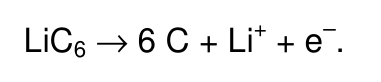
4.1 Write the total reaction equation of the battery and calculate the value of the standard Gibbs energy of the reaction [\(\mathrm{kJ\,mol^{-1}}\)].
The battery cell is constructed using \(\ce{LiCoO2}\) and graphite (\(\ce{C}\)) as the electrode materials.
4.2 Calculate the mass of the anode in the completely charged state and that in completely discharged state if 10.00 g of \(\ce{LiCoO2}\) and 10.00 g of graphite (\(\ce{C}\)) are present initially.
4.3 Calculate the maximum energy generated per mass of the lithium ion battery cell [\(\mathrm{kJ\,kg^{-1}}\)]. Assume that the correct ratio for complete reaction between the cathode and anode materials is used and the sum of the mass of electrodes is 50.0 % of the total mass of the battery cell. In comparison, the energy density of lead-acid batteries used for vehicles is about 200 \(\mathrm{kJ\,kg^{-1}}\).
Because an aqueous solution cannot be used as an electrolyte, an organic solution is used in the lithium ion battery cell.
4.4 Give the chemical formula of the gas generated if water is present in the electrolyte.
Official English text of the problem.
Answers
-
4.1 \[ \boxed{\ce{CoO2 + LiC6 -> LiCoO2 + 6C}} \] \[ \boxed{\Delta_\mathrm rG^\circ=-357\ \mathrm{kJ\,mol^{-1}}} \]
-
4.2 Completely charged anode: \(\boxed{10.71\ \mathrm g}\). Completely discharged anode: \(\boxed{10.00\ \mathrm g}\).
-
4.3 \[ \boxed{1.05\times10^3\ \mathrm{kJ\,kg^{-1}}} \]
-
4.4 Hydrogen gas (dihydrogen), \(\boxed{\ce{H2}}\); SMILES:
[H][H].
Solution
For numerical evaluation, use \[ F=96\,485\ \mathrm{C\,mol^{-1}}, \] and atomic molar masses \[ M_{\mathrm{Li}}=6.94,\quad M_{\mathrm{Co}}=58.93,\quad M_{\mathrm O}=16.00,\quad M_{\mathrm C}=12.01 \qquad(\mathrm{g\,mol^{-1}}). \]
The electrode materials—cobalt(IV) oxide, \(\ce{CoO2}\); lithium cobalt(III) oxide, \(\ce{LiCoO2}\); lithiated graphite, \(\ce{LiC6}\); and graphite, \(\ce C\)—are extended solids. They have no discrete molecular structures to represent by molecular SMILES.
4.1
The given discharge half-reactions are \[ \begin{aligned} \text{Cathode:}\quad&\ce{CoO2 + Li+ + e- -> LiCoO2},\\ \text{Anode:}\quad&\ce{LiC6 -> 6C + Li+ + e-}. \end{aligned} \]
Adding them cancels the lithium ions, \(\ce{Li+}\) (SMILES: [Li+]), and electrons:
\[
\boxed{\ce{CoO2 + LiC6 -> LiCoO2 + 6C}}.
\]
One mole of electrons is transferred per mole of reaction as written, so \(n=1\). Hence \[ \begin{aligned} \Delta_\mathrm rG^\circ &=-nFE^\circ\\ &=-(1)(96\,485\ \mathrm{C\,mol^{-1}})(3.70\ \mathrm V)\\ &=-3.569945\times10^5\ \mathrm{J\,mol^{-1}}\\ &=\boxed{-357\ \mathrm{kJ\,mol^{-1}}}. \end{aligned} \]
The negative sign corresponds to spontaneous discharge under standard conditions.
4.2
Charging reverses the overall discharge reaction: \[ \ce{LiCoO2 + 6C -> CoO2 + LiC6}. \]
Thus lithium moves from the positive electrode into graphite. The amount available from the initial lithium cobalt oxide is \[ M(\ce{LiCoO2})=6.94+58.93+2(16.00) =97.87\ \mathrm{g\,mol^{-1}}, \] \[ n_{\mathrm{Li,available}} =\frac{10.00\ \mathrm g}{97.87\ \mathrm{g\,mol^{-1}}} =0.102176\ \mathrm{mol}. \]
The graphite can accommodate one lithium atom per six carbon atoms: \[ n_{\mathrm{Li,capacity}} =\frac{10.00\ \mathrm g}{6(12.01\ \mathrm{g\,mol^{-1}})} =0.138773\ \mathrm{mol}. \]
Since the graphite capacity exceeds the available lithium, all the lithium can transfer, with some graphite remaining unintercalated. The transferred mass is \[ m_{\mathrm{Li}} =(0.102176\ \mathrm{mol})(6.94\ \mathrm{g\,mol^{-1}}) =0.709104\ \mathrm g. \]
Therefore, the completely charged anode has mass \[ m_{\mathrm{charged}} =10.00+0.709104 =\boxed{10.71\ \mathrm g}. \]
Complete discharge transfers this lithium back to the cobalt oxide electrode, leaving the original graphite: \[ \boxed{m_{\mathrm{discharged}}=10.00\ \mathrm g}. \]
4.3
For maximum energy per mass, use the stoichiometric electrode ratio. One mole of reaction requires one mole of \(\ce{LiCoO2}\) and six moles of carbon in the discharged state. Their combined mass is \[ \begin{aligned} m_{\mathrm{electrodes}} &=97.87+6(12.01)\\ &=169.93\ \mathrm g. \end{aligned} \]
Charging redistributes lithium between the electrodes, so their combined mass is unchanged.
Because the electrodes constitute \(50.0\%\) of the cell mass, \[ m_{\mathrm{cell}} =\frac{169.93\ \mathrm g}{0.500} =339.86\ \mathrm g =0.33986\ \mathrm{kg}. \]
The maximum electrical energy delivered per mole of reaction is \[ W_{\max}=-\Delta_\mathrm rG^\circ =356.9945\ \mathrm{kJ}. \]
Consequently, \[ \begin{aligned} \frac{W_{\max}}{m_{\mathrm{cell}}} &=\frac{356.9945\ \mathrm{kJ}}{0.33986\ \mathrm{kg}}\\ &=\boxed{1.05\times10^3\ \mathrm{kJ\,kg^{-1}}}. \end{aligned} \]
This is approximately \(5.25\) times the stated lead-acid battery energy density.
4.4
The lithiated graphite electrode is strongly reducing. Water, \(\ce{H2O}\) (SMILES: O), can accept electrons and form hydrogen gas and hydroxide ions, \(\ce{OH-}\) (SMILES: [OH-]):
\[
\ce{2H2O + 2e- -> H2 + 2OH-}.
\]
Combining this with oxidation of lithiated graphite gives \[ \ce{2LiC6 + 2H2O -> 12C + 2Li+ + 2OH- + H2}. \]
Thus the gas is hydrogen (dihydrogen):
\[
\boxed{\ce{H2}},
\]
with SMILES [H][H].
The solution was checked against the official solution.
IChO 2010 · Theorieaufgabe 4
Die Lithium-Ionen-Batterie
Die wiederaufladbare Lithium-Ionen-Batterie wurde in Japan entwickelt.
Die elektromotorische Standardkraft der Batterie beträgt 3.70 V. Nehmen Sie für die Teilreaktion an der Kathode folgende Gleichung an:
und für die Teilreaktion an der Anode folgende Gleichung:
4.1 Geben Sie die Gesamtreaktionsgleichung der Batterie an und berechnen Sie die Standard-Gibbs-Energie der Reaktion [\(\mathrm{kJ\,mol^{-1}}\)].
Die Batteriezelle wird mit \(\ce{LiCoO2}\) und Graphit (\(\ce{C}\)) als Elektrodenmaterialien aufgebaut.
4.2 Berechnen Sie die Masse der Anode im vollständig geladenen und im vollständig entladenen Zustand, wenn anfangs 10.00 g \(\ce{LiCoO2}\) und 10.00 g Graphit (\(\ce{C}\)) vorliegen.
4.3 Berechnen Sie die maximal erzeugte Energie pro Masse der Lithium-Ionen-Batteriezelle [\(\mathrm{kJ\,kg^{-1}}\)]. Nehmen Sie an, dass die Kathoden- und Anodenmaterialien im richtigen Verhältnis für eine vollständige Reaktion eingesetzt werden und die Summe der Elektrodenmassen 50.0 % der Gesamtmasse der Batteriezelle beträgt. Zum Vergleich: Die Energiedichte von Bleiakkumulatoren, die in Fahrzeugen verwendet werden, beträgt etwa 200 \(\mathrm{kJ\,kg^{-1}}\).
Da eine wässrige Lösung nicht als Elektrolyt verwendet werden kann, wird in der Lithium-Ionen-Batteriezelle eine organische Lösung eingesetzt.
4.4 Geben Sie die chemische Formel des Gases an, das entsteht, wenn Wasser im Elektrolyten vorhanden ist.
Aufgabentext aus dem offiziellen englischen Text übersetzt.
Antworten
-
4.1 \[ \boxed{\ce{CoO2 + LiC6 -> LiCoO2 + 6C}} \] \[ \boxed{\Delta_\mathrm rG^\circ=-357\ \mathrm{kJ\,mol^{-1}}} \]
-
4.2 Vollständig geladene Anode: \(\boxed{10.71\ \mathrm g}\). Vollständig entladene Anode: \(\boxed{10.00\ \mathrm g}\).
-
4.3 \[ \boxed{1.05\times10^3\ \mathrm{kJ\,kg^{-1}}} \]
-
4.4 Wasserstoffgas (Diwasserstoff), \(\boxed{\ce{H2}}\); SMILES:
[H][H].
Lösung
Für die numerische Auswertung verwenden wir \[ F=96\,485\ \mathrm{C\,mol^{-1}}, \] und die molaren Atommassen \[ M_{\mathrm{Li}}=6.94,\quad M_{\mathrm{Co}}=58.93,\quad M_{\mathrm O}=16.00,\quad M_{\mathrm C}=12.01 \qquad(\mathrm{g\,mol^{-1}}). \]
Die Elektrodenmaterialien – Cobalt(IV)-oxid, \(\ce{CoO2}\); Lithiumcobalt(III)-oxid, \(\ce{LiCoO2}\); lithiierter Graphit, \(\ce{LiC6}\); und Graphit, \(\ce C\) – sind Feststoffe mit ausgedehnten Gitterstrukturen. Sie besitzen keine diskreten Molekülstrukturen, die sich durch molekulare SMILES darstellen lassen.
4.1
Die angegebenen Teilreaktionen bei der Entladung lauten \[ \begin{aligned} \text{Kathode:}\quad&\ce{CoO2 + Li+ + e- -> LiCoO2},\\ \text{Anode:}\quad&\ce{LiC6 -> 6C + Li+ + e-}. \end{aligned} \]
Beim Addieren kürzen sich die Lithiumionen, \(\ce{Li+}\) (SMILES: [Li+]), und die Elektronen heraus:
\[
\boxed{\ce{CoO2 + LiC6 -> LiCoO2 + 6C}}.
\]
Pro Mol Reaktionsumsatz gemäß der angegebenen Gleichung wird ein Mol Elektronen übertragen, also ist \(n=1\). Somit gilt \[ \begin{aligned} \Delta_\mathrm rG^\circ &=-nFE^\circ\\ &=-(1)(96\,485\ \mathrm{C\,mol^{-1}})(3.70\ \mathrm V)\\ &=-3.569945\times10^5\ \mathrm{J\,mol^{-1}}\\ &=\boxed{-357\ \mathrm{kJ\,mol^{-1}}}. \end{aligned} \]
Das negative Vorzeichen entspricht einer spontanen Entladung unter Standardbedingungen.
4.2
Beim Laden wird die Gesamtreaktion der Entladung umgekehrt: \[ \ce{LiCoO2 + 6C -> CoO2 + LiC6}. \]
Lithium wandert somit von der positiven Elektrode in den Graphit. Die aus dem anfänglich vorhandenen Lithiumcobaltoxid verfügbare Stoffmenge beträgt \[ M(\ce{LiCoO2})=6.94+58.93+2(16.00) =97.87\ \mathrm{g\,mol^{-1}}, \] \[ n_{\mathrm{Li,available}} =\frac{10.00\ \mathrm g}{97.87\ \mathrm{g\,mol^{-1}}} =0.102176\ \mathrm{mol}. \]
Der Graphit kann pro sechs Kohlenstoffatome ein Lithiumatom aufnehmen: \[ n_{\mathrm{Li,capacity}} =\frac{10.00\ \mathrm g}{6(12.01\ \mathrm{g\,mol^{-1}})} =0.138773\ \mathrm{mol}. \]
Da die Aufnahmekapazität des Graphits die verfügbare Lithiummenge übersteigt, kann das gesamte Lithium übertragen werden, wobei ein Teil des Graphits ohne eingelagertes Lithium verbleibt. Die übertragene Masse beträgt \[ m_{\mathrm{Li}} =(0.102176\ \mathrm{mol})(6.94\ \mathrm{g\,mol^{-1}}) =0.709104\ \mathrm g. \]
Die vollständig geladene Anode hat daher die Masse \[ m_{\mathrm{charged}} =10.00+0.709104 =\boxed{10.71\ \mathrm g}. \]
Bei vollständiger Entladung wird dieses Lithium zurück zur Cobaltoxidelektrode übertragen, sodass der ursprüngliche Graphit zurückbleibt: \[ \boxed{m_{\mathrm{discharged}}=10.00\ \mathrm g}. \]
4.3
Für die maximale Energie pro Masse wird das stöchiometrische Verhältnis der Elektrodenmaterialien verwendet. Ein Mol Reaktionsumsatz erfordert im entladenen Zustand ein Mol \(\ce{LiCoO2}\) und sechs Mol Kohlenstoff. Ihre Gesamtmasse beträgt \[ \begin{aligned} m_{\mathrm{electrodes}} &=97.87+6(12.01)\\ &=169.93\ \mathrm g. \end{aligned} \]
Beim Laden wird Lithium zwischen den Elektroden umverteilt, sodass ihre Gesamtmasse unverändert bleibt.
Da die Elektroden \(50.0\%\) der Zellmasse ausmachen, gilt \[ m_{\mathrm{cell}} =\frac{169.93\ \mathrm g}{0.500} =339.86\ \mathrm g =0.33986\ \mathrm{kg}. \]
Die maximal abgegebene elektrische Energie pro Mol Reaktionsumsatz beträgt \[ W_{\max}=-\Delta_\mathrm rG^\circ =356.9945\ \mathrm{kJ}. \]
Folglich gilt \[ \begin{aligned} \frac{W_{\max}}{m_{\mathrm{cell}}} &=\frac{356.9945\ \mathrm{kJ}}{0.33986\ \mathrm{kg}}\\ &=\boxed{1.05\times10^3\ \mathrm{kJ\,kg^{-1}}}. \end{aligned} \]
Dies entspricht etwa dem \(5.25\)-Fachen der angegebenen Energiedichte eines Bleiakkumulators.
4.4
Die Elektrode aus lithiiertem Graphit wirkt stark reduzierend. Wasser, \(\ce{H2O}\) (SMILES: O), kann Elektronen aufnehmen und Wasserstoffgas sowie Hydroxidionen, \(\ce{OH-}\) (SMILES: [OH-]), bilden:
\[
\ce{2H2O + 2e- -> H2 + 2OH-}.
\]
Die Kombination mit der Oxidation von lithiiertem Graphit ergibt \[ \ce{2LiC6 + 2H2O -> 12C + 2Li+ + 2OH- + H2}. \]
Das Gas ist somit Wasserstoff (Diwasserstoff):
\[
\boxed{\ce{H2}},
\]
mit dem SMILES [H][H].
Die Lösung wurde mit der offiziellen Lösung abgeglichen.
IChO 2010 · Teori sorusu 4
Lityum iyon pili
Şarj edilebilir lityum iyon pili Japonya'da geliştirilmiştir.
Pilin standart elektromotor kuvveti 3.70 V'tur. Katottaki yarı tepkimenin aşağıdaki gibi olduğunu varsayın:
Anottaki yarı tepkimenin ise aşağıdaki gibi olduğunu varsayın:
4.1 Pilin toplam tepkime denklemini yazın ve tepkimenin standart Gibbs enerjisi değerini [\(\mathrm{kJ\,mol^{-1}}\)] hesaplayın.
Pil hücresi, elektrot malzemeleri olarak \(\ce{LiCoO2}\) ve grafit (\(\ce{C}\)) kullanılarak oluşturulmuştur.
4.2 Başlangıçta 10.00 g \(\ce{LiCoO2}\) ve 10.00 g grafit (\(\ce{C}\)) bulunuyorsa, tamamen şarj olmuş ve tamamen deşarj olmuş durumlarda anodun kütlesini hesaplayın.
4.3 Lityum iyon pili hücresinin birim kütlesi başına üretilebilecek maksimum enerjiyi [\(\mathrm{kJ\,kg^{-1}}\)] hesaplayın. Katot ve anot malzemelerinin tam olarak tepkimeye girmesi için gereken doğru oranın kullanıldığını ve elektrotların toplam kütlesinin pil hücresinin toplam kütlesinin % 50.0'ını oluşturduğunu varsayın. Karşılaştırma için, araçlarda kullanılan kurşun-asit akülerin enerji yoğunluğu yaklaşık 200 \(\mathrm{kJ\,kg^{-1}}\)'dır.
Elektrolit olarak sulu bir çözelti kullanılamadığından, lityum iyon pili hücresinde organik bir çözelti kullanılır.
4.4 Elektrolitte su bulunması durumunda oluşan gazın kimyasal formülünü verin.
Soru metni resmi İngilizce metinden çevrilmiştir.
Cevaplar
-
4.1 \[ \boxed{\ce{CoO2 + LiC6 -> LiCoO2 + 6C}} \] \[ \boxed{\Delta_\mathrm rG^\circ=-357\ \mathrm{kJ\,mol^{-1}}} \]
-
4.2 Tamamen şarj olmuş anot: \(\boxed{10.71\ \mathrm g}\). Tamamen deşarj olmuş anot: \(\boxed{10.00\ \mathrm g}\).
-
4.3 \[ \boxed{1.05\times10^3\ \mathrm{kJ\,kg^{-1}}} \]
-
4.4 Hidrojen gazı (dihidrojen), \(\boxed{\ce{H2}}\); SMILES:
[H][H].
Çözüm
Sayısal hesaplamalarda aşağıdaki değeri kullanın: \[ F=96\,485\ \mathrm{C\,mol^{-1}}, \] Atomların molar kütleleri için de aşağıdaki değerleri kullanın: \[ M_{\mathrm{Li}}=6.94,\quad M_{\mathrm{Co}}=58.93,\quad M_{\mathrm O}=16.00,\quad M_{\mathrm C}=12.01 \qquad(\mathrm{g\,mol^{-1}}). \]
Elektrot malzemeleri — kobalt(IV) oksit, \(\ce{CoO2}\); lityum kobalt(III) oksit, \(\ce{LiCoO2}\); lityumlanmış grafit, \(\ce{LiC6}\); ve grafit, \(\ce C\) — sürekli örgü yapısına sahip katılardır. Moleküler SMILES ile gösterilebilecek ayrı moleküler yapıları yoktur.
4.1
Verilen deşarj yarı tepkimeleri şöyledir: \[ \begin{aligned} \text{Katot:}\quad&\ce{CoO2 + Li+ + e- -> LiCoO2},\\ \text{Anot:}\quad&\ce{LiC6 -> 6C + Li+ + e-}. \end{aligned} \]
Bu tepkimeler toplandığında lityum iyonları, \(\ce{Li+}\) (SMILES: [Li+]), ve elektronlar sadeleşir:
\[
\boxed{\ce{CoO2 + LiC6 -> LiCoO2 + 6C}}.
\]
Yazıldığı biçimiyle tepkimenin bir molü başına bir mol elektron aktarılır; dolayısıyla \(n=1\)'dir. Böylece \[ \begin{aligned} \Delta_\mathrm rG^\circ &=-nFE^\circ\\ &=-(1)(96\,485\ \mathrm{C\,mol^{-1}})(3.70\ \mathrm V)\\ &=-3.569945\times10^5\ \mathrm{J\,mol^{-1}}\\ &=\boxed{-357\ \mathrm{kJ\,mol^{-1}}}. \end{aligned} \]
Negatif işaret, standart koşullarda deşarjın kendiliğinden gerçekleşmesine karşılık gelir.
4.2
Şarj işlemi, toplam deşarj tepkimesini tersine çevirir: \[ \ce{LiCoO2 + 6C -> CoO2 + LiC6}. \]
Böylece lityum, pozitif elektrottan grafitin içine geçer. Başlangıçtaki lityum kobalt oksitten sağlanabilecek miktar şöyledir: \[ M(\ce{LiCoO2})=6.94+58.93+2(16.00) =97.87\ \mathrm{g\,mol^{-1}}, \] \[ n_{\mathrm{Li,available}} =\frac{10.00\ \mathrm g}{97.87\ \mathrm{g\,mol^{-1}}} =0.102176\ \mathrm{mol}. \]
Grafit, her altı karbon atomu başına bir lityum atomu barındırabilir: \[ n_{\mathrm{Li,capacity}} =\frac{10.00\ \mathrm g}{6(12.01\ \mathrm{g\,mol^{-1}})} =0.138773\ \mathrm{mol}. \]
Grafitin kapasitesi mevcut lityum miktarını aştığından, lityumun tamamı aktarılabilir ve grafitin bir kısmı interkalasyona uğramadan kalır. Aktarılan kütle şöyledir: \[ m_{\mathrm{Li}} =(0.102176\ \mathrm{mol})(6.94\ \mathrm{g\,mol^{-1}}) =0.709104\ \mathrm g. \]
Dolayısıyla tamamen şarj olmuş anodun kütlesi şöyledir: \[ m_{\mathrm{charged}} =10.00+0.709104 =\boxed{10.71\ \mathrm g}. \]
Tam deşarj, bu lityumu kobalt oksit elektroduna geri aktarır ve geriye başlangıçtaki grafit kalır: \[ \boxed{m_{\mathrm{discharged}}=10.00\ \mathrm g}. \]
4.3
Birim kütle başına maksimum enerji için stokiyometrik elektrot oranını kullanın. Tepkimenin bir molü için deşarj olmuş durumda bir mol \(\ce{LiCoO2}\) ve altı mol karbon gerekir. Bunların toplam kütlesi şöyledir: \[ \begin{aligned} m_{\mathrm{electrodes}} &=97.87+6(12.01)\\ &=169.93\ \mathrm g. \end{aligned} \]
Şarj işlemi lityumu elektrotlar arasında yeniden dağıttığından, elektrotların toplam kütlesi değişmez.
Elektrotlar hücre kütlesinin \(50.0\%\)'ını oluşturduğundan, \[ m_{\mathrm{cell}} =\frac{169.93\ \mathrm g}{0.500} =339.86\ \mathrm g =0.33986\ \mathrm{kg}. \]
Tepkimenin bir molü başına sağlanan maksimum elektrik enerjisi şöyledir: \[ W_{\max}=-\Delta_\mathrm rG^\circ =356.9945\ \mathrm{kJ}. \]
Sonuç olarak, \[ \begin{aligned} \frac{W_{\max}}{m_{\mathrm{cell}}} &=\frac{356.9945\ \mathrm{kJ}}{0.33986\ \mathrm{kg}}\\ &=\boxed{1.05\times10^3\ \mathrm{kJ\,kg^{-1}}}. \end{aligned} \]
Bu değer, belirtilen kurşun-asit akü enerji yoğunluğunun yaklaşık \(5.25\) katıdır.
4.4
Lityumlanmış grafit elektrot güçlü bir indirgendir. Su, \(\ce{H2O}\) (SMILES: O), elektron alarak hidrojen gazı ve hidroksit iyonları, \(\ce{OH-}\) (SMILES: [OH-]), oluşturabilir:
\[
\ce{2H2O + 2e- -> H2 + 2OH-}.
\]
Bu tepkime lityumlanmış grafitin yükseltgenmesiyle birleştirildiğinde şu tepkime elde edilir: \[ \ce{2LiC6 + 2H2O -> 12C + 2Li+ + 2OH- + H2}. \]
Dolayısıyla gaz, hidrojendir (dihidrojen):
\[
\boxed{\ce{H2}},
\]
SMILES gösterimi ise [H][H] şeklindedir.
Çözüm, resmi çözümle karşılaştırılarak kontrol edildi.
IChO 2010 · Problema teórico 4
La batería de iones de litio
La batería recargable de iones de litio se ha desarrollado en Japón.
La fuerza electromotriz estándar de la batería es de 3.70 V. Suponga que la semirreacción en el cátodo es
y que la semirreacción en el ánodo es
4.1 Escriba la ecuación de la reacción global de la batería y calcule el valor de la energía de Gibbs estándar de la reacción [\(\mathrm{kJ\,mol^{-1}}\)].
La celda de la batería se construye utilizando \(\ce{LiCoO2}\) y grafito (\(\ce{C}\)) como materiales de los electrodos.
4.2 Calcule la masa del ánodo en el estado completamente cargado y en el estado completamente descargado si inicialmente hay 10.00 g de \(\ce{LiCoO2}\) y 10.00 g de grafito (\(\ce{C}\)).
4.3 Calcule la energía máxima generada por unidad de masa de la celda de la batería de iones de litio [\(\mathrm{kJ\,kg^{-1}}\)]. Suponga que se utiliza la proporción correcta para que la reacción entre los materiales del cátodo y del ánodo sea completa y que la suma de las masas de los electrodos constituye el 50.0 % de la masa total de la celda de la batería. A modo de comparación, la densidad energética de las baterías de plomo-ácido utilizadas en los vehículos es de aproximadamente 200 \(\mathrm{kJ\,kg^{-1}}\).
Como no se puede utilizar una disolución acuosa como electrolito, en la celda de la batería de iones de litio se utiliza una disolución orgánica.
4.4 Indique la fórmula química del gas que se genera si hay agua presente en el electrolito.
Enunciado traducido del texto oficial en inglés.
Respuestas
-
4.1 \[ \boxed{\ce{CoO2 + LiC6 -> LiCoO2 + 6C}} \] \[ \boxed{\Delta_\mathrm rG^\circ=-357\ \mathrm{kJ\,mol^{-1}}} \]
-
4.2 Ánodo completamente cargado: \(\boxed{10.71\ \mathrm g}\). Ánodo completamente descargado: \(\boxed{10.00\ \mathrm g}\).
-
4.3 \[ \boxed{1.05\times10^3\ \mathrm{kJ\,kg^{-1}}} \]
-
4.4 Hidrógeno gaseoso (dihidrógeno), \(\boxed{\ce{H2}}\); SMILES:
[H][H].
Solución
Para los cálculos numéricos, utilice \[ F=96\,485\ \mathrm{C\,mol^{-1}}, \] y las masas molares atómicas \[ M_{\mathrm{Li}}=6.94,\quad M_{\mathrm{Co}}=58.93,\quad M_{\mathrm O}=16.00,\quad M_{\mathrm C}=12.01 \qquad(\mathrm{g\,mol^{-1}}). \]
Los materiales de los electrodos —óxido de cobalto(IV), \(\ce{CoO2}\); óxido de litio y cobalto(III), \(\ce{LiCoO2}\); grafito litiado, \(\ce{LiC6}\); y grafito, \(\ce C\)— son sólidos de estructura extendida. No tienen estructuras moleculares discretas que puedan representarse mediante SMILES moleculares.
4.1
Las semirreacciones de descarga dadas son \[ \begin{aligned} \text{Cátodo:}\quad&\ce{CoO2 + Li+ + e- -> LiCoO2},\\ \text{Ánodo:}\quad&\ce{LiC6 -> 6C + Li+ + e-}. \end{aligned} \]
Al sumarlas, se cancelan los iones de litio, \(\ce{Li+}\) (SMILES: [Li+]), y los electrones:
\[
\boxed{\ce{CoO2 + LiC6 -> LiCoO2 + 6C}}.
\]
Se transfiere un mol de electrones por cada mol de reacción tal como está escrita, por lo que \(n=1\). Por tanto, \[ \begin{aligned} \Delta_\mathrm rG^\circ &=-nFE^\circ\\ &=-(1)(96\,485\ \mathrm{C\,mol^{-1}})(3.70\ \mathrm V)\\ &=-3.569945\times10^5\ \mathrm{J\,mol^{-1}}\\ &=\boxed{-357\ \mathrm{kJ\,mol^{-1}}}. \end{aligned} \]
El signo negativo corresponde a una descarga espontánea en condiciones estándar.
4.2
La carga invierte la reacción global de descarga: \[ \ce{LiCoO2 + 6C -> CoO2 + LiC6}. \]
Así, el litio se desplaza desde el electrodo positivo hacia el grafito. La cantidad disponible a partir del óxido de litio y cobalto inicial es \[ M(\ce{LiCoO2})=6.94+58.93+2(16.00) =97.87\ \mathrm{g\,mol^{-1}}, \] \[ n_{\mathrm{Li,available}} =\frac{10.00\ \mathrm g}{97.87\ \mathrm{g\,mol^{-1}}} =0.102176\ \mathrm{mol}. \]
El grafito puede alojar un átomo de litio por cada seis átomos de carbono: \[ n_{\mathrm{Li,capacity}} =\frac{10.00\ \mathrm g}{6(12.01\ \mathrm{g\,mol^{-1}})} =0.138773\ \mathrm{mol}. \]
Como la capacidad del grafito supera la cantidad de litio disponible, todo el litio puede transferirse, y queda una parte del grafito sin intercalar. La masa transferida es \[ m_{\mathrm{Li}} =(0.102176\ \mathrm{mol})(6.94\ \mathrm{g\,mol^{-1}}) =0.709104\ \mathrm g. \]
Por tanto, el ánodo completamente cargado tiene una masa de \[ m_{\mathrm{charged}} =10.00+0.709104 =\boxed{10.71\ \mathrm g}. \]
La descarga completa transfiere este litio de vuelta al electrodo de óxido de cobalto, dejando el grafito original: \[ \boxed{m_{\mathrm{discharged}}=10.00\ \mathrm g}. \]
4.3
Para obtener la energía máxima por unidad de masa, se utiliza la proporción estequiométrica de los materiales de los electrodos. Un mol de reacción requiere un mol de \(\ce{LiCoO2}\) y seis moles de carbono en el estado descargado. Su masa conjunta es \[ \begin{aligned} m_{\mathrm{electrodes}} &=97.87+6(12.01)\\ &=169.93\ \mathrm g. \end{aligned} \]
La carga redistribuye el litio entre los electrodos, por lo que su masa conjunta no cambia.
Como los electrodos constituyen el \(50.0\%\) de la masa de la celda, \[ m_{\mathrm{cell}} =\frac{169.93\ \mathrm g}{0.500} =339.86\ \mathrm g =0.33986\ \mathrm{kg}. \]
La energía eléctrica máxima suministrada por mol de reacción es \[ W_{\max}=-\Delta_\mathrm rG^\circ =356.9945\ \mathrm{kJ}. \]
En consecuencia, \[ \begin{aligned} \frac{W_{\max}}{m_{\mathrm{cell}}} &=\frac{356.9945\ \mathrm{kJ}}{0.33986\ \mathrm{kg}}\\ &=\boxed{1.05\times10^3\ \mathrm{kJ\,kg^{-1}}}. \end{aligned} \]
Este valor es aproximadamente \(5.25\) veces la densidad energética indicada para las baterías de plomo-ácido.
4.4
El electrodo de grafito litiado es fuertemente reductor. El agua, \(\ce{H2O}\) (SMILES: O), puede aceptar electrones y formar hidrógeno gaseoso e iones hidróxido, \(\ce{OH-}\) (SMILES: [OH-]):
\[
\ce{2H2O + 2e- -> H2 + 2OH-}.
\]
Al combinar esta reacción con la oxidación del grafito litiado, se obtiene \[ \ce{2LiC6 + 2H2O -> 12C + 2Li+ + 2OH- + H2}. \]
Por tanto, el gas es hidrógeno (dihidrógeno):
\[
\boxed{\ce{H2}},
\]
con SMILES [H][H].
La solución se comprobó con la solución oficial.
IChO 2010 · 理论题 4
锂离子电池
可充电锂离子电池是在日本研制出来的。
该电池的标准电动势为 3.70 V。假设阴极半反应为
阳极半反应为
4.1 写出该电池的总反应方程式,并计算该反应的标准吉布斯能变 [\(\mathrm{kJ\,mol^{-1}}\)]。
该电池采用 \(\ce{LiCoO2}\) 和石墨(\(\ce{C}\))作为电极材料。
4.2 若最初有 10.00 g 的 \(\ce{LiCoO2}\) 和 10.00 g 的石墨(\(\ce{C}\)),计算完全充电状态和完全放电状态下阳极的质量。
4.3 计算该锂离子电池单位质量所能产生的最大能量 [\(\mathrm{kJ\,kg^{-1}}\)]。假设阴极和阳极材料采用恰好完全反应所需的配比,且电极的总质量占电池总质量的 50.0 %。作为比较,车用铅酸电池的能量密度约为 200 \(\mathrm{kJ\,kg^{-1}}\)。
由于不能使用水溶液作为电解液,锂离子电池采用有机溶液作为电解液。
4.4 写出电解液中存在水时所产生气体的化学式。
题目译自官方英文原文。
答案
-
4.1 \[ \boxed{\ce{CoO2 + LiC6 -> LiCoO2 + 6C}} \] \[ \boxed{\Delta_\mathrm rG^\circ=-357\ \mathrm{kJ\,mol^{-1}}} \]
-
4.2 完全充电时的阳极:\(\boxed{10.71\ \mathrm g}\)。完全放电时的阳极:\(\boxed{10.00\ \mathrm g}\)。
-
4.3 \[ \boxed{1.05\times10^3\ \mathrm{kJ\,kg^{-1}}} \]
-
4.4 氢气(双原子氢),\(\boxed{\ce{H2}}\);SMILES:
[H][H]。
解答
数值计算中,采用 \[ F=96\,485\ \mathrm{C\,mol^{-1}}, \] 以及各元素原子的摩尔质量 \[ M_{\mathrm{Li}}=6.94,\quad M_{\mathrm{Co}}=58.93,\quad M_{\mathrm O}=16.00,\quad M_{\mathrm C}=12.01 \qquad(\mathrm{g\,mol^{-1}}). \]
电极材料——氧化钴(IV),\(\ce{CoO2}\);钴酸锂,\(\ce{LiCoO2}\);嵌锂石墨,\(\ce{LiC6}\);以及石墨,\(\ce C\)——均为具有延展结构的固体。它们不存在可用分子 SMILES 表示的独立分子结构。
4.1
给定的放电半反应为 \[ \begin{aligned} \text{阴极:}\quad&\ce{CoO2 + Li+ + e- -> LiCoO2},\\ \text{阳极:}\quad&\ce{LiC6 -> 6C + Li+ + e-}. \end{aligned} \]
将两式相加,消去锂离子 \(\ce{Li+}\)(SMILES:[Li+])和电子:
\[
\boxed{\ce{CoO2 + LiC6 -> LiCoO2 + 6C}}.
\]
按所写反应式,每进行一摩尔反应转移一摩尔电子,因此 \(n=1\)。于是 \[ \begin{aligned} \Delta_\mathrm rG^\circ &=-nFE^\circ\\ &=-(1)(96\,485\ \mathrm{C\,mol^{-1}})(3.70\ \mathrm V)\\ &=-3.569945\times10^5\ \mathrm{J\,mol^{-1}}\\ &=\boxed{-357\ \mathrm{kJ\,mol^{-1}}}. \end{aligned} \]
负号表明放电过程在标准条件下可自发进行。
4.2
充电过程是总放电反应的逆过程: \[ \ce{LiCoO2 + 6C -> CoO2 + LiC6}. \]
因此,锂从正极转移到石墨中。初始钴酸锂所能提供的锂的物质的量为 \[ M(\ce{LiCoO2})=6.94+58.93+2(16.00) =97.87\ \mathrm{g\,mol^{-1}}, \] \[ n_{\mathrm{Li,available}} =\frac{10.00\ \mathrm g}{97.87\ \mathrm{g\,mol^{-1}}} =0.102176\ \mathrm{mol}. \]
石墨中每六个碳原子可容纳一个锂原子: \[ n_{\mathrm{Li,capacity}} =\frac{10.00\ \mathrm g}{6(12.01\ \mathrm{g\,mol^{-1}})} =0.138773\ \mathrm{mol}. \]
由于石墨的容锂量大于可提供的锂量,所有锂均可转移,且仍有部分石墨未嵌入锂。转移的锂的质量为 \[ m_{\mathrm{Li}} =(0.102176\ \mathrm{mol})(6.94\ \mathrm{g\,mol^{-1}}) =0.709104\ \mathrm g. \]
因此,完全充电时阳极的质量为 \[ m_{\mathrm{charged}} =10.00+0.709104 =\boxed{10.71\ \mathrm g}. \]
完全放电时,这些锂转移回钴氧化物电极,阳极只剩下原有的石墨: \[ \boxed{m_{\mathrm{discharged}}=10.00\ \mathrm g}. \]
4.3
为使单位质量所能产生的能量最大,电极材料应采用化学计量配比。每进行一摩尔反应,放电状态下需有一摩尔 \(\ce{LiCoO2}\) 和六摩尔碳。它们的总质量为 \[ \begin{aligned} m_{\mathrm{electrodes}} &=97.87+6(12.01)\\ &=169.93\ \mathrm g. \end{aligned} \]
充电仅使锂在两电极之间重新分配,因此两电极的总质量不变。
由于电极占电池质量的 \(50.0\%\), \[ m_{\mathrm{cell}} =\frac{169.93\ \mathrm g}{0.500} =339.86\ \mathrm g =0.33986\ \mathrm{kg}. \]
每摩尔反应所能输出的最大电能为 \[ W_{\max}=-\Delta_\mathrm rG^\circ =356.9945\ \mathrm{kJ}. \]
因此, \[ \begin{aligned} \frac{W_{\max}}{m_{\mathrm{cell}}} &=\frac{356.9945\ \mathrm{kJ}}{0.33986\ \mathrm{kg}}\\ &=\boxed{1.05\times10^3\ \mathrm{kJ\,kg^{-1}}}. \end{aligned} \]
这约为题中所给铅酸电池能量密度的 \(5.25\) 倍。
4.4
嵌锂石墨电极具有强还原性。水 \(\ce{H2O}\)(SMILES:O)可接受电子,生成氢气和氢氧根离子 \(\ce{OH-}\)(SMILES:[OH-]):
\[
\ce{2H2O + 2e- -> H2 + 2OH-}.
\]
将此反应与嵌锂石墨的氧化反应合并,得到 \[ \ce{2LiC6 + 2H2O -> 12C + 2Li+ + 2OH- + H2}. \]
因此,该气体为氢气(双原子氢):
\[
\boxed{\ce{H2}},
\]
其 SMILES 为 [H][H]。
解答已与官方解答核对。
IChO 2010 · Теоретическая задача 4
Литий-ионный аккумулятор
Перезаряжаемый литий-ионный аккумулятор был разработан в Японии.
Стандартная электродвижущая сила аккумулятора составляет 3.70 В. Предположим, что полуреакция на катоде имеет вид
а полуреакция на аноде —
4.1 Напишите суммарное уравнение реакции в аккумуляторе и рассчитайте стандартную энергию Гиббса этой реакции [\(\mathrm{kJ\,mol^{-1}}\)].
Аккумуляторный элемент изготовлен с использованием \(\ce{LiCoO2}\) и графита (\(\ce{C}\)) в качестве электродных материалов.
4.2 Рассчитайте массу анода в полностью заряженном и в полностью разряженном состояниях, если первоначально имеются 10.00 г \(\ce{LiCoO2}\) и 10.00 г графита (\(\ce{C}\)).
4.3 Рассчитайте максимальную энергию, отдаваемую литий-ионным аккумуляторным элементом, в расчёте на единицу его массы [\(\mathrm{kJ\,kg^{-1}}\)]. Предположите, что материалы катода и анода взяты в соотношении, необходимом для полного протекания реакции, а суммарная масса электродов составляет 50.0 % общей массы аккумуляторного элемента. Для сравнения: удельная энергия свинцово-кислотных аккумуляторов, используемых в автомобилях, составляет около 200 \(\mathrm{kJ\,kg^{-1}}\).
Поскольку водный раствор нельзя использовать в качестве электролита, в литий-ионном аккумуляторном элементе используют раствор в органическом растворителе.
4.4 Укажите химическую формулу газа, выделяющегося при наличии воды в электролите.
Условие переведено с официального английского текста.
Ответы
-
4.1 \[ \boxed{\ce{CoO2 + LiC6 -> LiCoO2 + 6C}} \] \[ \boxed{\Delta_\mathrm rG^\circ=-357\ \mathrm{kJ\,mol^{-1}}} \]
-
4.2 Полностью заряженный анод: \(\boxed{10.71\ \mathrm g}\). Полностью разряженный анод: \(\boxed{10.00\ \mathrm g}\).
-
4.3 \[ \boxed{1.05\times10^3\ \mathrm{kJ\,kg^{-1}}} \]
-
4.4 Газообразный водород (молекулярный водород), \(\boxed{\ce{H2}}\); SMILES:
[H][H].
Решение
Для численных расчётов используем \[ F=96\,485\ \mathrm{C\,mol^{-1}}, \] и молярные массы атомов \[ M_{\mathrm{Li}}=6.94,\quad M_{\mathrm{Co}}=58.93,\quad M_{\mathrm O}=16.00,\quad M_{\mathrm C}=12.01 \qquad(\mathrm{g\,mol^{-1}}). \]
Электродные материалы — оксид кобальта(IV), \(\ce{CoO2}\); оксид лития-кобальта(III), \(\ce{LiCoO2}\); литированный графит, \(\ce{LiC6}\); и графит, \(\ce C\) — представляют собой твёрдые вещества с протяжённой структурой. Они не состоят из отдельных молекул, структуры которых можно было бы представить с помощью молекулярных записей SMILES.
4.1
Заданные полуреакции при разряде имеют вид \[ \begin{aligned} \text{Катод:}\quad&\ce{CoO2 + Li+ + e- -> LiCoO2},\\ \text{Анод:}\quad&\ce{LiC6 -> 6C + Li+ + e-}. \end{aligned} \]
При их сложении ионы лития, \(\ce{Li+}\) (SMILES: [Li+]), и электроны сокращаются:
\[
\boxed{\ce{CoO2 + LiC6 -> LiCoO2 + 6C}}.
\]
На один моль реакции в записанном виде переносится один моль электронов, поэтому \(n=1\). Следовательно, \[ \begin{aligned} \Delta_\mathrm rG^\circ &=-nFE^\circ\\ &=-(1)(96\,485\ \mathrm{C\,mol^{-1}})(3.70\ \mathrm V)\\ &=-3.569945\times10^5\ \mathrm{J\,mol^{-1}}\\ &=\boxed{-357\ \mathrm{kJ\,mol^{-1}}}. \end{aligned} \]
Отрицательный знак соответствует самопроизвольному разряду в стандартных условиях.
4.2
При зарядке суммарная реакция разряда протекает в обратном направлении: \[ \ce{LiCoO2 + 6C -> CoO2 + LiC6}. \]
Таким образом, литий переходит из положительного электрода в графит. Количество лития, доступного из исходного оксида лития-кобальта, составляет \[ M(\ce{LiCoO2})=6.94+58.93+2(16.00) =97.87\ \mathrm{g\,mol^{-1}}, \] \[ n_{\mathrm{Li,available}} =\frac{10.00\ \mathrm g}{97.87\ \mathrm{g\,mol^{-1}}} =0.102176\ \mathrm{mol}. \]
Графит может вместить один атом лития на каждые шесть атомов углерода: \[ n_{\mathrm{Li,capacity}} =\frac{10.00\ \mathrm g}{6(12.01\ \mathrm{g\,mol^{-1}})} =0.138773\ \mathrm{mol}. \]
Поскольку ёмкость графита превышает доступное количество лития, весь литий может перейти в графит, причём часть графита останется неинтеркалированной. Масса перенесённого лития составляет \[ m_{\mathrm{Li}} =(0.102176\ \mathrm{mol})(6.94\ \mathrm{g\,mol^{-1}}) =0.709104\ \mathrm g. \]
Следовательно, масса полностью заряженного анода равна \[ m_{\mathrm{charged}} =10.00+0.709104 =\boxed{10.71\ \mathrm g}. \]
При полном разряде этот литий возвращается в электрод из оксида кобальта, а в аноде остаётся исходный графит: \[ \boxed{m_{\mathrm{discharged}}=10.00\ \mathrm g}. \]
4.3
Для получения максимальной энергии на единицу массы используем стехиометрическое соотношение электродных материалов. Для одного моля реакции необходимы один моль \(\ce{LiCoO2}\) и шесть молей углерода в разряженном состоянии. Их суммарная масса составляет \[ \begin{aligned} m_{\mathrm{electrodes}} &=97.87+6(12.01)\\ &=169.93\ \mathrm g. \end{aligned} \]
При зарядке литий перераспределяется между электродами, поэтому их суммарная масса не изменяется.
Поскольку электроды составляют \(50.0\%\) массы элемента, \[ m_{\mathrm{cell}} =\frac{169.93\ \mathrm g}{0.500} =339.86\ \mathrm g =0.33986\ \mathrm{kg}. \]
Максимальная электрическая энергия, отдаваемая в расчёте на один моль реакции, равна \[ W_{\max}=-\Delta_\mathrm rG^\circ =356.9945\ \mathrm{kJ}. \]
Следовательно, \[ \begin{aligned} \frac{W_{\max}}{m_{\mathrm{cell}}} &=\frac{356.9945\ \mathrm{kJ}}{0.33986\ \mathrm{kg}}\\ &=\boxed{1.05\times10^3\ \mathrm{kJ\,kg^{-1}}}. \end{aligned} \]
Это приблизительно в \(5.25\) раза больше указанной удельной энергии свинцово-кислотного аккумулятора.
4.4
Электрод из литированного графита обладает сильными восстановительными свойствами. Вода, \(\ce{H2O}\) (SMILES: O), может принимать электроны с образованием газообразного водорода и гидроксид-ионов, \(\ce{OH-}\) (SMILES: [OH-]):
\[
\ce{2H2O + 2e- -> H2 + 2OH-}.
\]
Сочетание этой реакции с окислением литированного графита даёт \[ \ce{2LiC6 + 2H2O -> 12C + 2Li+ + 2OH- + H2}. \]
Таким образом, выделяющийся газ — водород (молекулярный водород):
\[
\boxed{\ce{H2}},
\]
с записью SMILES [H][H].
Решение проверено по официальному решению.
IChO 2010 · مسألة نظرية 4
بطارية أيون الليثيوم
طُوِّرت بطارية أيون الليثيوم القابلة لإعادة الشحن في اليابان.
القوة الدافعة الكهربائية القياسية للبطارية هي 3.70 V. افترض أن نصف التفاعل عند المهبط هو
وأن نصف التفاعل عند المصعد هو
4.1 اكتب معادلة التفاعل الكلي للبطارية واحسب قيمة طاقة غيبس القياسية للتفاعل [\(\mathrm{kJ\,mol^{-1}}\)].
تُصنع خلية البطارية باستخدام \(\ce{LiCoO2}\) والغرافيت (\(\ce{C}\)) مادّتَين للقطبين.
4.2 احسب كتلة المصعد في حالة الشحن الكامل وفي حالة التفريغ الكامل إذا وُجد في البداية 10.00 g من \(\ce{LiCoO2}\) و10.00 g من الغرافيت (\(\ce{C}\)).
4.3 احسب أقصى طاقة متولدة لكل وحدة كتلة من خلية بطارية أيون الليثيوم [\(\mathrm{kJ\,kg^{-1}}\)]. افترض استخدام النسبة الصحيحة اللازمة للتفاعل التام بين مادّتَي المهبط والمصعد، وأن مجموع كتلتَي القطبين يساوي 50.0 % من الكتلة الكلية لخلية البطارية. وللمقارنة، تبلغ كثافة الطاقة في بطاريات الرصاص الحمضية المستخدمة في المركبات نحو 200 \(\mathrm{kJ\,kg^{-1}}\).
نظرًا إلى تعذّر استخدام محلول مائي إلكتروليتًا، يُستخدم محلول عضوي في خلية بطارية أيون الليثيوم.
4.4 أعطِ الصيغة الكيميائية للغاز المتولد إذا وُجد الماء في الإلكتروليت.
نص المسألة مترجم عن النص الإنجليزي الرسمي.
الإجابات
-
4.1 \[ \boxed{\ce{CoO2 + LiC6 -> LiCoO2 + 6C}} \] \[ \boxed{\Delta_\mathrm rG^\circ=-357\ \mathrm{kJ\,mol^{-1}}} \]
-
4.2 المصعد المشحون بالكامل: \(\boxed{10.71\ \mathrm g}\). المصعد المفرَّغ بالكامل: \(\boxed{10.00\ \mathrm g}\).
-
4.3 \[ \boxed{1.05\times10^3\ \mathrm{kJ\,kg^{-1}}} \]
-
4.4 غاز الهيدروجين (ثنائي الهيدروجين)، \(\boxed{\ce{H2}}\)؛ تمثيل SMILES:
[H][H].
الحل
لإجراء الحسابات العددية، نستخدم \[ F=96\,485\ \mathrm{C\,mol^{-1}}, \] والكتل المولية الذرية \[ M_{\mathrm{Li}}=6.94,\quad M_{\mathrm{Co}}=58.93,\quad M_{\mathrm O}=16.00,\quad M_{\mathrm C}=12.01 \qquad(\mathrm{g\,mol^{-1}}). \]
مواد القطبين — أكسيد الكوبالت(IV)، \(\ce{CoO2}\)؛ وأكسيد الليثيوم والكوبالت(III)، \(\ce{LiCoO2}\)؛ والغرافيت المُقحَم بالليثيوم، \(\ce{LiC6}\)؛ والغرافيت، \(\ce C\) — مواد صلبة ذات بُنى ممتدة. وليس لها بُنى جزيئية منفصلة يمكن تمثيلها بصيغة SMILES الجزيئية.
4.1
نصفا تفاعل التفريغ المعطيان هما \[ \begin{aligned} \text{المهبط:}\quad&\ce{CoO2 + Li+ + e- -> LiCoO2},\\ \text{المصعد:}\quad&\ce{LiC6 -> 6C + Li+ + e-}. \end{aligned} \]
بجمعهما تُلغى أيونات الليثيوم، \(\ce{Li+}\) (تمثيل SMILES: [Li+])، والإلكترونات من طرفَي المعادلة:
\[
\boxed{\ce{CoO2 + LiC6 -> LiCoO2 + 6C}}.
\]
ينتقل مول واحد من الإلكترونات لكل مول من التفاعل كما هو مكتوب، ومن ثم فإن \(n=1\). وعليه \[ \begin{aligned} \Delta_\mathrm rG^\circ &=-nFE^\circ\\ &=-(1)(96\,485\ \mathrm{C\,mol^{-1}})(3.70\ \mathrm V)\\ &=-3.569945\times10^5\ \mathrm{J\,mol^{-1}}\\ &=\boxed{-357\ \mathrm{kJ\,mol^{-1}}}. \end{aligned} \]
تشير الإشارة السالبة إلى أن التفريغ تلقائي في الظروف القياسية.
4.2
يعكس الشحن اتجاه تفاعل التفريغ الكلي: \[ \ce{LiCoO2 + 6C -> CoO2 + LiC6}. \]
وهكذا ينتقل الليثيوم من القطب الموجب إلى داخل الغرافيت. وتكون الكمية المتاحة من أكسيد الليثيوم والكوبالت الموجود في البداية \[ M(\ce{LiCoO2})=6.94+58.93+2(16.00) =97.87\ \mathrm{g\,mol^{-1}}, \] \[ n_{\mathrm{Li,available}} =\frac{10.00\ \mathrm g}{97.87\ \mathrm{g\,mol^{-1}}} =0.102176\ \mathrm{mol}. \]
يمكن للغرافيت أن يستوعب ذرة ليثيوم واحدة لكل ست ذرات كربون: \[ n_{\mathrm{Li,capacity}} =\frac{10.00\ \mathrm g}{6(12.01\ \mathrm{g\,mol^{-1}})} =0.138773\ \mathrm{mol}. \]
بما أن سعة الغرافيت تفوق كمية الليثيوم المتاحة، يمكن أن ينتقل الليثيوم كله، مع بقاء جزء من الغرافيت دون إقحام الليثيوم فيه. وتكون الكتلة المنتقلة \[ m_{\mathrm{Li}} =(0.102176\ \mathrm{mol})(6.94\ \mathrm{g\,mol^{-1}}) =0.709104\ \mathrm g. \]
لذلك تكون كتلة المصعد المشحون بالكامل \[ m_{\mathrm{charged}} =10.00+0.709104 =\boxed{10.71\ \mathrm g}. \]
يعيد التفريغ الكامل هذا الليثيوم إلى قطب أكسيد الكوبالت، تاركًا الغرافيت الأصلي: \[ \boxed{m_{\mathrm{discharged}}=10.00\ \mathrm g}. \]
4.3
للحصول على أقصى طاقة لكل وحدة كتلة، نستخدم النسبة الستوكيومترية لمادّتَي القطبين. يتطلب مول واحد من التفاعل مولًا واحدًا من \(\ce{LiCoO2}\) وستة مولات من الكربون في حالة التفريغ. ويكون مجموع كتلتيهما \[ \begin{aligned} m_{\mathrm{electrodes}} &=97.87+6(12.01)\\ &=169.93\ \mathrm g. \end{aligned} \]
يعيد الشحن توزيع الليثيوم بين القطبين، ولذلك يبقى مجموع كتلتيهما دون تغيير.
بما أن القطبين يشكّلان \(50.0\%\) من كتلة الخلية، \[ m_{\mathrm{cell}} =\frac{169.93\ \mathrm g}{0.500} =339.86\ \mathrm g =0.33986\ \mathrm{kg}. \]
أقصى طاقة كهربائية يمكن تقديمها لكل مول من التفاعل هي \[ W_{\max}=-\Delta_\mathrm rG^\circ =356.9945\ \mathrm{kJ}. \]
وبناءً على ذلك، \[ \begin{aligned} \frac{W_{\max}}{m_{\mathrm{cell}}} &=\frac{356.9945\ \mathrm{kJ}}{0.33986\ \mathrm{kg}}\\ &=\boxed{1.05\times10^3\ \mathrm{kJ\,kg^{-1}}}. \end{aligned} \]
تساوي هذه القيمة نحو \(5.25\) أضعاف كثافة الطاقة المذكورة لبطارية الرصاص الحمضية.
4.4
قطب الغرافيت المُقحَم بالليثيوم عامل مختزل قوي. يمكن للماء، \(\ce{H2O}\) (تمثيل SMILES: O)، أن يكتسب إلكترونات ويكوّن غاز الهيدروجين وأيونات الهيدروكسيد، \(\ce{OH-}\) (تمثيل SMILES: [OH-]):
\[
\ce{2H2O + 2e- -> H2 + 2OH-}.
\]
بجمع هذا التفاعل مع تفاعل أكسدة الغرافيت المُقحَم بالليثيوم نحصل على \[ \ce{2LiC6 + 2H2O -> 12C + 2Li+ + 2OH- + H2}. \]
إذن الغاز هو الهيدروجين (ثنائي الهيدروجين):
\[
\boxed{\ce{H2}},
\]
وتمثيله بصيغة SMILES هو [H][H].
تمت مراجعة الحل بمقارنته بالحل الرسمي.