IChO 2010 · Theory problem 5
Photoelectron spectroscopy
When an atom \(\ce{X}\) absorbs radiation with a photon energy greater than the ionization energy of the atom, the atom is ionized to generate an ion \(\ce{X+}\) and the electron (called a photoelectron) is ejected at the same time. In this event, the energy is conserved as shown in Figure 1, that is,
Photon energy (\(h\nu\)) = ionization energy (IE) of \(\ce{X}\) + kinetic energy of photoelectron.
When a molecule, for example, \(\ce{H2}\), absorbs short-wavelength light, the photoelectron is ejected and an \(\ce{H2+}\) ion with a variety of vibrational states is produced. A photoelectron spectrum is a plot of the number of photoelectrons as a function of the kinetic energy of the photoelectrons. Figure 2 shows a typical photoelectron spectrum when \(\ce{H2}\) in the lowest vibrational level is irradiated by monochromatic light of 21.2 eV. No photoelectrons are detected above 6.0 eV. (eV is a unit of energy and 1.0 eV is equal to \(1.6\cdot10^{-19}\) J.)
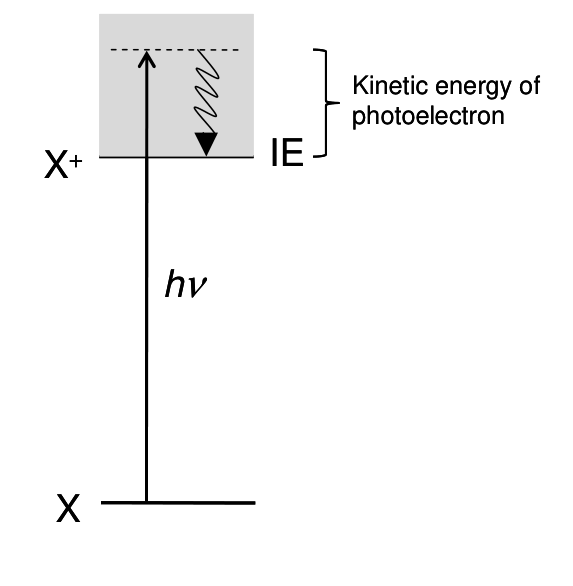
Figure 1. Schematic diagram of photoelectron spectroscopy.
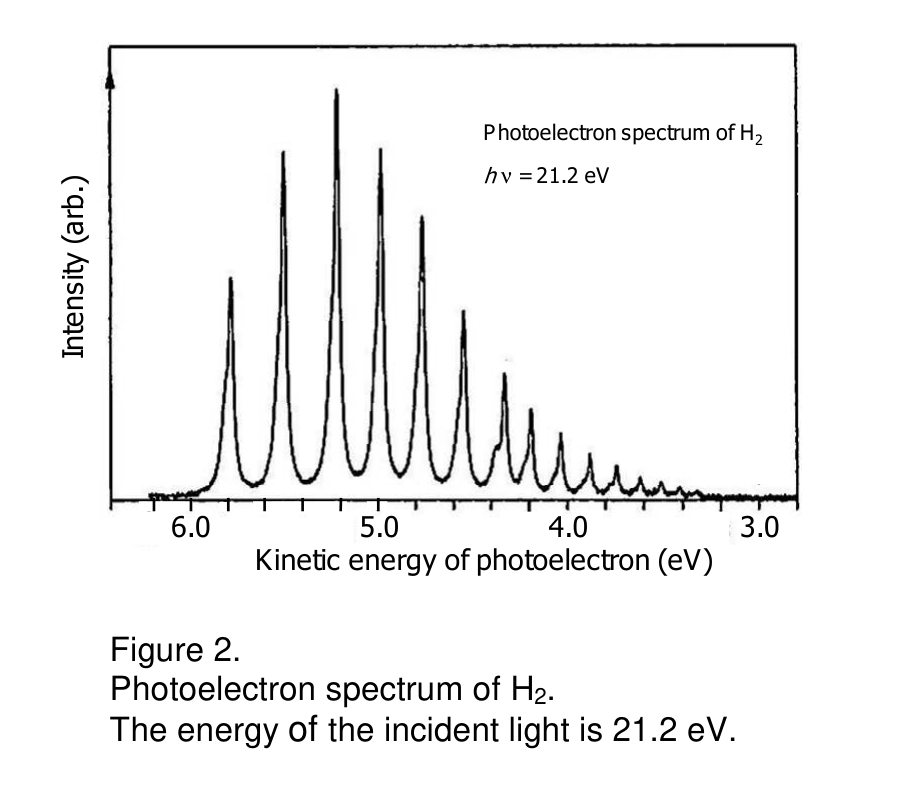
Figure 2. Photoelectron spectrum of \(\ce{H2}\). The energy of the incident light is 21.2 eV.
5.1 a) Determine the energy difference \(\Delta E_{\mathrm{A1}}\) (eV) between \(\ce{H2}\) (\(v=0\)) and \(\ce{H2+}\) (\(v_{\mathrm{ion}}=0\)) to the first decimal place. \(v\) and \(v_{\mathrm{ion}}\) denote the vibrational quantum numbers of \(\ce{H2}\) and \(\ce{H2+}\), respectively.
b) Determine the energy difference \(\Delta E_{\mathrm{A2}}\) (eV) between \(\ce{H2+}\) (\(v_{\mathrm{ion}}=0\)) and \(\ce{H2+}\) (\(v_{\mathrm{ion}}=3\)) to the first decimal place.
The electronic energy levels \(E_n^{\mathrm{H}}\) of a hydrogen atom are given by the equation
\[ E_n^{\mathrm{H}}=-\frac{Ry}{n^2} \qquad (n=1,2,3\cdots) \]
Here \(n\) is a principal quantum number, and \(Ry\) is a constant with dimensions of energy. The energy from \(n=1\) to \(n=2\) of the hydrogen atom is 10.2 eV.
5.2 Calculate the ionization energy \(E_{\mathrm{B}}\) (eV) of the hydrogen atom to the first decimal place.
The energy threshold for the generation of two electronically excited hydrogen atoms \(\ce{H^{*}}\) (\(n=2\)) from \(\ce{H2}\) (\(v=0\)) has been derived to be 24.9 eV by an experiment.
5.3 Determine the bond energy \(E_{\mathrm{C}}\) (eV) of \(\ce{H2}\) to the first decimal place.
5.4 Considering an energy cycle, determine the bond energy \(E_{\mathrm{D}}\) (eV) of \(\ce{H2+}\) to the first decimal place. If you were unable to determine the values for \(E_{\mathrm{B}}\) and \(E_{\mathrm{C}}\), then use 15.0 eV and 5.0 eV for \(E_{\mathrm{B}}\) and \(E_{\mathrm{C}}\), respectively.
5.5 Calculate the threshold energy \(E_{\mathrm{E}}\) (eV) of the following dissociative ionization reaction to the first decimal place:

If you were unable to determine the values for \(E_{\mathrm{B}}\) and \(E_{\mathrm{C}}\), then use 15.0 eV and 5.0 eV for \(E_{\mathrm{B}}\) and \(E_{\mathrm{C}}\), respectively.
When \(\ce{H2}\) absorbs monochromatic light of 21.2 eV, the following dissociation process occurs at the same time.

Two hydrogen atoms move in opposite directions with the same speed.
5.6 Calculate the speed \(u\) (\(\mathrm{m\,s^{-1}}\)) of the hydrogen atoms generated in the above reaction. \(\ce{H2}\) is assumed to be at rest. If you were unable to determine the value for \(E_{\mathrm{C}}\), then use 5.0 eV for \(E_{\mathrm{C}}\).
Official English text of the problem.
Answers
- 5.1 a) \(\boxed{\Delta E_{\mathrm{A1}}=15.4\ \mathrm{eV}}\).
- 5.1 b) \(\boxed{\Delta E_{\mathrm{A2}}=0.8\ \mathrm{eV}}\).
- 5.2 \(\boxed{E_{\mathrm{B}}=13.6\ \mathrm{eV}}\).
- 5.3 \(\boxed{E_{\mathrm{C}}=4.5\ \mathrm{eV}}\).
- 5.4 \(\boxed{E_{\mathrm{D}}=2.7\ \mathrm{eV}}\).
- 5.5 \(\boxed{E_{\mathrm{E}}=28.3\ \mathrm{eV}}\).
- 5.6 \(\boxed{u=4.0\times10^4\ \mathrm{m\,s^{-1}}}\) for each atom, using \(m_{\mathrm H}\approx1.67\times10^{-27}\ \mathrm{kg}\).
Solution
The species used below are molecular hydrogen (dihydrogen), \(\ce{H2}\), [H][H]; the hydrogen molecular ion (dihydrogen radical cation), \(\ce{H2+}\), [H][H+]; atomic hydrogen, \(\ce{H}\), [H]; and the hydrogen ion (proton), \(\ce{H+}\), [H+]. For \(\ce{H2+}\), the SMILES is a connectivity and charge shorthand: it does not faithfully represent the delocalized one-electron bond, whose bond order is \(1/2\). These SMILES also do not specify vibrational states or atomic electronic excitation.
5.1 a)
Photoionization produces an ion and a photoelectron:
\[ \ce{H2 + h\nu -> H2+ + e-}. \]
The initial molecule has \(v=0\). If the ion is produced in vibrational level \(j\), conservation of energy gives
\[ h\nu=\Delta E_{\mathrm{A1}}+\epsilon_j+K_j, \]
where \(\epsilon_j\) is the ion’s vibrational energy above \(v_{\mathrm{ion}}=0\), and \(K_j\) is the photoelectron kinetic energy.
The greatest photoelectron kinetic energy therefore corresponds to the lowest final ionic energy, \(v_{\mathrm{ion}}=0\). The kinetic-energy axis decreases from left to right, so this is the leftmost peak, centered at approximately \(5.8\ \mathrm{eV}\).
Thus,
\[ \boxed{\Delta E_{\mathrm{A1}} =21.2-5.8 =15.4\ \mathrm{eV}}. \]
5.1 b)
Successive peaks toward lower kinetic energy correspond to successively higher ionic vibrational levels. Counting the first peak as \(v_{\mathrm{ion}}=0\), the fourth peak represents \(v_{\mathrm{ion}}=3\). Its kinetic energy is approximately \(5.0\ \mathrm{eV}\).
Because the photon energy and initial molecular state are identical, the increase in ionic energy equals the decrease in photoelectron kinetic energy:
\[ \begin{aligned} \Delta E_{\mathrm{A2}} &=E_{\mathrm{ion}}(3)-E_{\mathrm{ion}}(0)\\ &=K_0-K_3\\ &=5.8-5.0. \end{aligned} \]
Therefore,
\[ \boxed{\Delta E_{\mathrm{A2}}=0.8\ \mathrm{eV}}. \]
5.2
For the given electronic energy levels,
\[ \begin{aligned} E_2^{\mathrm H}-E_1^{\mathrm H} &=-\frac{Ry}{4}-(-Ry)\\ &=\frac34Ry =10.2\ \mathrm{eV}. \end{aligned} \]
Hence,
\[ Ry=\frac43(10.2)=13.6\ \mathrm{eV}. \]
Ionization of ground-state atomic hydrogen is
\[ \ce{H -> H+ + e-}. \]
The free-electron limit is \(n\to\infty\), for which \(E_\infty^{\mathrm H}=0\). Therefore,
\[ \boxed{E_{\mathrm B} =E_\infty^{\mathrm H}-E_1^{\mathrm H} =Ry =13.6\ \mathrm{eV}}. \]
5.3
The experimentally specified process is
\[ \ce{H2 -> 2H^{*}}, \qquad n=2\text{ for both product atoms}. \]
It can be resolved into dissociation to ground-state atoms,
\[ \ce{H2 -> 2H}, \qquad \text{energy required }E_{\mathrm C}, \]
followed by excitation of both atoms:
\[ \ce{H -> H^{*}}, \qquad n=1\to2, \qquad 10.2\ \mathrm{eV}\text{ per atom}. \]
Consequently,
\[ 24.9\ \mathrm{eV}=E_{\mathrm C}+2(10.2\ \mathrm{eV}), \]
and
\[ \boxed{E_{\mathrm C}=24.9-20.4=4.5\ \mathrm{eV}}. \]
This is the dissociation energy from the molecular \(v=0\) level.
5.4
The required ionic dissociation is
\[ \ce{H2+ -> H + H+}, \]
with the ion initially in \(v_{\mathrm{ion}}=0\) and the hydrogen atom produced in its ground electronic state.
Consider two routes from ground-state \(\ce{H2}\) to the same products, \(\ce{H + H+ + e-}\).
The first route dissociates the molecule and then ionizes one atom:
\[ \begin{aligned} \ce{H2 -> 2H} &\qquad E_{\mathrm C},\\ \ce{H -> H+ + e-} &\qquad E_{\mathrm B}. \end{aligned} \]
Its total energy requirement is \(E_{\mathrm C}+E_{\mathrm B}\).
The second route ionizes the molecule and then dissociates the molecular ion:
\[ \begin{aligned} \ce{H2 -> H2+ + e-} &\qquad \Delta E_{\mathrm{A1}},\\ \ce{H2+ -> H + H+} &\qquad E_{\mathrm D}. \end{aligned} \]
Conservation of energy around the cycle requires
\[ E_{\mathrm C}+E_{\mathrm B} =\Delta E_{\mathrm{A1}}+E_{\mathrm D}. \]
Thus,
\[ \boxed{E_{\mathrm D} =4.5+13.6-15.4 =2.7\ \mathrm{eV}}. \]
5.5
The dissociative ionization reaction is
\[ \ce{H2 -> H^{*} + H+ + e-}, \qquad \ce{H^{*}}\text{ has }n=2. \]
Starting from \(\ce{H2}\) in \(v=0\), the required energy is the sum of:
- Dissociation into two ground-state hydrogen atoms: \(E_{\mathrm C}=4.5\ \mathrm{eV}\).
- Excitation of one atom to \(n=2\): \(10.2\ \mathrm{eV}\).
- Ionization of the other atom: \(E_{\mathrm B}=13.6\ \mathrm{eV}\).
At threshold, no excess energy is available for product kinetic energy. Therefore,
\[ \boxed{E_{\mathrm E} =E_{\mathrm C}+10.2+E_{\mathrm B} =4.5+10.2+13.6 =28.3\ \mathrm{eV}}. \]
5.6
The photodissociation is
\[ \ce{H2 + h\nu -> 2H}, \qquad h\nu=21.2\ \mathrm{eV}, \qquad n=1\text{ for both atoms}. \]
After supplying the bond dissociation energy, the remaining photon energy becomes the total kinetic energy:
\[ K_{\mathrm{total}} =h\nu-E_{\mathrm C} =21.2-4.5 =16.7\ \mathrm{eV}. \]
Both atoms have the same mass and speed, so
\[ K_{\mathrm{total}} =2\left(\frac12m_{\mathrm H}u^2\right) =m_{\mathrm H}u^2. \]
Using the stated conversion \(1.0\ \mathrm{eV}=1.6\times10^{-19}\ \mathrm J\), together with the standard hydrogen-atom mass \(m_{\mathrm H}\approx1.67\times10^{-27}\ \mathrm{kg}\),
\[ \begin{aligned} u &=\sqrt{\frac{(16.7\ \mathrm{eV}) (1.6\times10^{-19}\ \mathrm{J\,eV^{-1}})} {1.67\times10^{-27}\ \mathrm{kg}}}\\[2mm] &=\boxed{4.0\times10^4\ \mathrm{m\,s^{-1}}}. \end{aligned} \]
Each atom has this speed, with the two velocities pointing in opposite directions.
The solution was checked against the official solution.
IChO 2010 · Theorieaufgabe 5
Photoelektronenspektroskopie
Wenn ein Atom \(\ce{X}\) Strahlung mit einer Photonenenergie absorbiert, die größer als die Ionisierungsenergie des Atoms ist, wird das Atom unter Bildung eines Ions \(\ce{X+}\) ionisiert, und gleichzeitig wird ein Elektron (als Photoelektron bezeichnet) herausgelöst. Dabei bleibt die Energie erhalten, wie in Abbildung 1 dargestellt, das heißt:
Photonenenergie (\(h\nu\)) = Ionisierungsenergie (IE) von \(\ce{X}\) + kinetische Energie des Photoelektrons.
Wenn ein Molekül, beispielsweise \(\ce{H2}\), kurzwelliges Licht absorbiert, wird ein Photoelektron herausgelöst, und es entsteht ein \(\ce{H2+}\)-Ion, das sich in verschiedenen Schwingungszuständen befinden kann. Ein Photoelektronenspektrum stellt die Anzahl der Photoelektronen als Funktion ihrer kinetischen Energie dar. Abbildung 2 zeigt ein typisches Photoelektronenspektrum, das erhalten wird, wenn \(\ce{H2}\) im niedrigsten Schwingungsniveau mit monochromatischem Licht von 21.2 eV bestrahlt wird. Oberhalb von 6.0 eV werden keine Photoelektronen nachgewiesen. (eV ist eine Energieeinheit, und 1.0 eV entspricht \(1.6\cdot10^{-19}\) J.)
Abbildung 1. Schematische Darstellung der Photoelektronenspektroskopie.
Abbildung 2. Photoelektronenspektrum von \(\ce{H2}\). Die Energie des einfallenden Lichts beträgt 21.2 eV.
5.1 a) Bestimmen Sie die Energiedifferenz \(\Delta E_{\mathrm{A1}}\) (eV) zwischen \(\ce{H2}\) (\(v=0\)) und \(\ce{H2+}\) (\(v_{\mathrm{ion}}=0\)) auf eine Nachkommastelle. \(v\) und \(v_{\mathrm{ion}}\) bezeichnen die Schwingungsquantenzahlen von \(\ce{H2}\) bzw. \(\ce{H2+}\).
b) Bestimmen Sie die Energiedifferenz \(\Delta E_{\mathrm{A2}}\) (eV) zwischen \(\ce{H2+}\) (\(v_{\mathrm{ion}}=0\)) und \(\ce{H2+}\) (\(v_{\mathrm{ion}}=3\)) auf eine Nachkommastelle.
Die elektronischen Energieniveaus \(E_n^{\mathrm{H}}\) eines Wasserstoffatoms sind durch die folgende Gleichung gegeben:
\[ E_n^{\mathrm{H}}=-\frac{Ry}{n^2} \qquad (n=1,2,3\cdots) \]
Dabei ist \(n\) eine Hauptquantenzahl und \(Ry\) eine Konstante mit der Dimension einer Energie. Die Energie für den Übergang von \(n=1\) nach \(n=2\) im Wasserstoffatom beträgt 10.2 eV.
5.2 Berechnen Sie die Ionisierungsenergie \(E_{\mathrm{B}}\) (eV) des Wasserstoffatoms auf eine Nachkommastelle.
Die Schwellenenergie für die Erzeugung zweier elektronisch angeregter Wasserstoffatome \(\ce{H^{*}}\) (\(n=2\)) aus \(\ce{H2}\) (\(v=0\)) wurde experimentell zu 24.9 eV bestimmt.
5.3 Bestimmen Sie die Bindungsenergie \(E_{\mathrm{C}}\) (eV) von \(\ce{H2}\) auf eine Nachkommastelle.
5.4 Bestimmen Sie mithilfe eines Energie-Kreisprozesses die Bindungsenergie \(E_{\mathrm{D}}\) (eV) von \(\ce{H2+}\) auf eine Nachkommastelle. Falls Sie die Werte für \(E_{\mathrm{B}}\) und \(E_{\mathrm{C}}\) nicht bestimmen konnten, verwenden Sie für \(E_{\mathrm{B}}\) bzw. \(E_{\mathrm{C}}\) die Werte 15.0 eV bzw. 5.0 eV.
5.5 Berechnen Sie die Schwellenenergie \(E_{\mathrm{E}}\) (eV) der folgenden dissoziativen Ionisierungsreaktion auf eine Nachkommastelle:
Falls Sie die Werte für \(E_{\mathrm{B}}\) und \(E_{\mathrm{C}}\) nicht bestimmen konnten, verwenden Sie für \(E_{\mathrm{B}}\) bzw. \(E_{\mathrm{C}}\) die Werte 15.0 eV bzw. 5.0 eV.
Wenn \(\ce{H2}\) monochromatisches Licht von 21.2 eV absorbiert, findet gleichzeitig der folgende Dissoziationsprozess statt.
Zwei Wasserstoffatome bewegen sich mit gleichem Geschwindigkeitsbetrag in entgegengesetzte Richtungen.
5.6 Berechnen Sie den Geschwindigkeitsbetrag \(u\) (\(\mathrm{m\,s^{-1}}\)) der bei der obigen Reaktion erzeugten Wasserstoffatome. Es wird angenommen, dass \(\ce{H2}\) ruht. Falls Sie den Wert für \(E_{\mathrm{C}}\) nicht bestimmen konnten, verwenden Sie für \(E_{\mathrm{C}}\) den Wert 5.0 eV.
Aufgabentext aus dem offiziellen englischen Text übersetzt.
Antworten
- 5.1 a) \(\boxed{\Delta E_{\mathrm{A1}}=15.4\ \mathrm{eV}}\).
- 5.1 b) \(\boxed{\Delta E_{\mathrm{A2}}=0.8\ \mathrm{eV}}\).
- 5.2 \(\boxed{E_{\mathrm{B}}=13.6\ \mathrm{eV}}\).
- 5.3 \(\boxed{E_{\mathrm{C}}=4.5\ \mathrm{eV}}\).
- 5.4 \(\boxed{E_{\mathrm{D}}=2.7\ \mathrm{eV}}\).
- 5.5 \(\boxed{E_{\mathrm{E}}=28.3\ \mathrm{eV}}\).
- 5.6 \(\boxed{u=4.0\times10^4\ \mathrm{m\,s^{-1}}}\) für jedes Atom, unter Verwendung von \(m_{\mathrm H}\approx1.67\times10^{-27}\ \mathrm{kg}\).
Lösung
Die im Folgenden verwendeten Spezies sind molekularer Wasserstoff (Diwasserstoff), \(\ce{H2}\), [H][H]; das Wasserstoff-Molekülion (Diwasserstoff-Radikalkation), \(\ce{H2+}\), [H][H+]; atomarer Wasserstoff, \(\ce{H}\), [H]; und das Wasserstoffion (Proton), \(\ce{H+}\), [H+]. Für \(\ce{H2+}\) ist die SMILES-Schreibweise eine Kurznotation für Konnektivität und Ladung: Sie bildet die delokalisierte Einelektronenbindung mit der Bindungsordnung \(1/2\) nicht getreu ab. Diese SMILES geben auch keine Schwingungszustände oder elektronischen Anregungszustände der Atome an.
5.1 a)
Bei der Photoionisation entstehen ein Ion und ein Photoelektron:
\[ \ce{H2 + h\nu -> H2+ + e-}. \]
Das Ausgangsmolekül befindet sich in \(v=0\). Wird das Ion im Schwingungsniveau \(j\) erzeugt, ergibt sich aus der Energieerhaltung
\[ h\nu=\Delta E_{\mathrm{A1}}+\epsilon_j+K_j, \]
wobei \(\epsilon_j\) die Schwingungsenergie des Ions relativ zu \(v_{\mathrm{ion}}=0\) und \(K_j\) die kinetische Energie des Photoelektrons ist.
Die größte kinetische Energie des Photoelektrons entspricht daher der niedrigsten Endenergie des Ions, also \(v_{\mathrm{ion}}=0\). Die Werte auf der Achse der kinetischen Energie nehmen von links nach rechts ab; somit ist dies der am weitesten links liegende Peak, dessen Zentrum bei ungefähr \(5.8\ \mathrm{eV}\) liegt.
Damit gilt:
\[ \boxed{\Delta E_{\mathrm{A1}} =21.2-5.8 =15.4\ \mathrm{eV}}. \]
5.1 b)
Aufeinanderfolgende Peaks in Richtung niedrigerer kinetischer Energie entsprechen zunehmend höheren Schwingungsniveaus des Ions. Zählt man den ersten Peak als \(v_{\mathrm{ion}}=0\), so entspricht der vierte Peak \(v_{\mathrm{ion}}=3\). Seine kinetische Energie beträgt ungefähr \(5.0\ \mathrm{eV}\).
Da die Photonenenergie und der Ausgangszustand des Moleküls identisch sind, ist die Zunahme der Energie des Ions gleich der Abnahme der kinetischen Energie des Photoelektrons:
\[ \begin{aligned} \Delta E_{\mathrm{A2}} &=E_{\mathrm{ion}}(3)-E_{\mathrm{ion}}(0)\\ &=K_0-K_3\\ &=5.8-5.0. \end{aligned} \]
Daher gilt:
\[ \boxed{\Delta E_{\mathrm{A2}}=0.8\ \mathrm{eV}}. \]
5.2
Für die gegebenen elektronischen Energieniveaus gilt:
\[ \begin{aligned} E_2^{\mathrm H}-E_1^{\mathrm H} &=-\frac{Ry}{4}-(-Ry)\\ &=\frac34Ry =10.2\ \mathrm{eV}. \end{aligned} \]
Somit ergibt sich:
\[ Ry=\frac43(10.2)=13.6\ \mathrm{eV}. \]
Die Ionisation von atomarem Wasserstoff im Grundzustand lautet:
\[ \ce{H -> H+ + e-}. \]
Der Grenzfall eines freien Elektrons ist \(n\to\infty\), wofür \(E_\infty^{\mathrm H}=0\) gilt. Daher ist
\[ \boxed{E_{\mathrm B} =E_\infty^{\mathrm H}-E_1^{\mathrm H} =Ry =13.6\ \mathrm{eV}}. \]
5.3
Der experimentell angegebene Prozess lautet:
\[ \ce{H2 -> 2H^{*}}, \qquad n=2\text{ für beide Produktatome}. \]
Er lässt sich in die Dissoziation zu Atomen im Grundzustand
\[ \ce{H2 -> 2H}, \qquad \text{benötigte Energie }E_{\mathrm C}, \]
und die anschließende Anregung beider Atome zerlegen:
\[ \ce{H -> H^{*}}, \qquad n=1\to2, \qquad 10.2\ \mathrm{eV}\text{ pro Atom}. \]
Folglich gilt
\[ 24.9\ \mathrm{eV}=E_{\mathrm C}+2(10.2\ \mathrm{eV}), \]
und damit
\[ \boxed{E_{\mathrm C}=24.9-20.4=4.5\ \mathrm{eV}}. \]
Dies ist die Dissoziationsenergie ausgehend vom molekularen Niveau \(v=0\).
5.4
Die gesuchte Dissoziation des Ions lautet:
\[ \ce{H2+ -> H + H+}, \]
wobei sich das Ion anfangs in \(v_{\mathrm{ion}}=0\) befindet und das Wasserstoffatom in seinem elektronischen Grundzustand entsteht.
Wir betrachten zwei Wege von \(\ce{H2}\) im Grundzustand zu denselben Produkten, \(\ce{H + H+ + e-}\).
Beim ersten Weg wird das Molekül dissoziiert und anschließend ein Atom ionisiert:
\[ \begin{aligned} \ce{H2 -> 2H} &\qquad E_{\mathrm C},\\ \ce{H -> H+ + e-} &\qquad E_{\mathrm B}. \end{aligned} \]
Die insgesamt benötigte Energie beträgt \(E_{\mathrm C}+E_{\mathrm B}\).
Beim zweiten Weg wird das Molekül ionisiert und anschließend das Molekülion dissoziiert:
\[ \begin{aligned} \ce{H2 -> H2+ + e-} &\qquad \Delta E_{\mathrm{A1}},\\ \ce{H2+ -> H + H+} &\qquad E_{\mathrm D}. \end{aligned} \]
Die Energieerhaltung im Kreisprozess erfordert
\[ E_{\mathrm C}+E_{\mathrm B} =\Delta E_{\mathrm{A1}}+E_{\mathrm D}. \]
Somit gilt:
\[ \boxed{E_{\mathrm D} =4.5+13.6-15.4 =2.7\ \mathrm{eV}}. \]
5.5
Die dissoziative Ionisierungsreaktion lautet:
\[ \ce{H2 -> H^{*} + H+ + e-}, \qquad \ce{H^{*}}\text{ hat }n=2. \]
Ausgehend von \(\ce{H2}\) in \(v=0\) ist die benötigte Energie die Summe aus:
- Dissoziation in zwei Wasserstoffatome im Grundzustand: \(E_{\mathrm C}=4.5\ \mathrm{eV}\).
- Anregung eines Atoms nach \(n=2\): \(10.2\ \mathrm{eV}\).
- Ionisation des anderen Atoms: \(E_{\mathrm B}=13.6\ \mathrm{eV}\).
An der Schwelle steht keine überschüssige Energie als kinetische Energie der Produkte zur Verfügung. Daher gilt:
\[ \boxed{E_{\mathrm E} =E_{\mathrm C}+10.2+E_{\mathrm B} =4.5+10.2+13.6 =28.3\ \mathrm{eV}}. \]
5.6
Die Photodissoziation lautet:
\[ \ce{H2 + h\nu -> 2H}, \qquad h\nu=21.2\ \mathrm{eV}, \qquad n=1\text{ für beide Atome}. \]
Nach Aufbringen der Bindungsdissoziationsenergie wird die verbleibende Photonenenergie zur gesamten kinetischen Energie:
\[ K_{\mathrm{total}} =h\nu-E_{\mathrm C} =21.2-4.5 =16.7\ \mathrm{eV}. \]
Beide Atome haben dieselbe Masse und denselben Geschwindigkeitsbetrag, also gilt
\[ K_{\mathrm{total}} =2\left(\frac12m_{\mathrm H}u^2\right) =m_{\mathrm H}u^2. \]
Mit der angegebenen Umrechnung \(1.0\ \mathrm{eV}=1.6\times10^{-19}\ \mathrm J\) und der üblichen Masse des Wasserstoffatoms \(m_{\mathrm H}\approx1.67\times10^{-27}\ \mathrm{kg}\) ergibt sich
\[ \begin{aligned} u &=\sqrt{\frac{(16.7\ \mathrm{eV}) (1.6\times10^{-19}\ \mathrm{J\,eV^{-1}})} {1.67\times10^{-27}\ \mathrm{kg}}}\\[2mm] &=\boxed{4.0\times10^4\ \mathrm{m\,s^{-1}}}. \end{aligned} \]
Jedes Atom hat diesen Geschwindigkeitsbetrag, wobei die beiden Geschwindigkeitsvektoren in entgegengesetzte Richtungen zeigen.
Die Lösung wurde mit der offiziellen Lösung abgeglichen.
IChO 2010 · Teori sorusu 5
Fotoelektron spektroskopisi
Bir \(\ce{X}\) atomu, foton enerjisi atomun iyonlaşma enerjisinden büyük olan ışınımı soğurduğunda iyonlaşarak bir \(\ce{X+}\) iyonu oluşturur ve aynı anda elektron (fotoelektron olarak adlandırılır) dışarı atılır. Bu olayda enerji, Şekil 1'de gösterildiği gibi korunur; yani,
Foton enerjisi (\(h\nu\)) = \(\ce{X}\)'in iyonlaşma enerjisi (IE) + fotoelektronun kinetik enerjisi.
Bir molekül, örneğin \(\ce{H2}\), kısa dalga boylu ışığı soğurduğunda fotoelektron dışarı atılır ve çeşitli titreşim durumlarında bir \(\ce{H2+}\) iyonu oluşur. Fotoelektron spektrumu, fotoelektron sayısının fotoelektronların kinetik enerjisinin fonksiyonu olarak çizildiği bir grafiktir. Şekil 2, en düşük titreşim düzeyindeki \(\ce{H2}\)'nin 21.2 eV enerjili tek renkli ışıkla ışınlanması sonucunda elde edilen tipik bir fotoelektron spektrumunu göstermektedir. 6.0 eV'nin üzerinde hiçbir fotoelektron algılanmaz. (eV bir enerji birimidir ve 1.0 eV, \(1.6\cdot10^{-19}\) J'e eşittir.)
Şekil 1. Fotoelektron spektroskopisinin şematik gösterimi.
Şekil 2. \(\ce{H2}\)'nin fotoelektron spektrumu. Gelen ışığın enerjisi 21.2 eV'dir.
5.1 a) \(\ce{H2}\) (\(v=0\)) ile \(\ce{H2+}\) (\(v_{\mathrm{ion}}=0\)) arasındaki \(\Delta E_{\mathrm{A1}}\) (eV) enerji farkını virgülden sonra bir basamak olacak şekilde belirleyiniz. \(v\) ve \(v_{\mathrm{ion}}\), sırasıyla \(\ce{H2}\) ve \(\ce{H2+}\)'nin titreşim kuantum sayılarını belirtir.
b) \(\ce{H2+}\) (\(v_{\mathrm{ion}}=0\)) ile \(\ce{H2+}\) (\(v_{\mathrm{ion}}=3\)) arasındaki \(\Delta E_{\mathrm{A2}}\) (eV) enerji farkını virgülden sonra bir basamak olacak şekilde belirleyiniz.
Bir hidrojen atomunun \(E_n^{\mathrm{H}}\) elektronik enerji düzeyleri şu denklemle verilir:
\[ E_n^{\mathrm{H}}=-\frac{Ry}{n^2} \qquad (n=1,2,3\cdots) \]
Burada \(n\) baş kuantum sayısıdır ve \(Ry\) enerji boyutuna sahip bir sabittir. Hidrojen atomunun \(n=1\) düzeyinden \(n=2\) düzeyine geçiş enerjisi 10.2 eV'dir.
5.2 Hidrojen atomunun \(E_{\mathrm{B}}\) (eV) iyonlaşma enerjisini virgülden sonra bir basamak olacak şekilde hesaplayınız.
\(\ce{H2}\)'den (\(v=0\)) elektronik olarak uyarılmış iki hidrojen atomunun, \(\ce{H^{*}}\) (\(n=2\)), oluşması için gereken eşik enerjisi bir deneyle 24.9 eV olarak belirlenmiştir.
5.3 \(\ce{H2}\)'nin \(E_{\mathrm{C}}\) (eV) bağ enerjisini virgülden sonra bir basamak olacak şekilde belirleyiniz.
5.4 Bir enerji çevrimini göz önünde bulundurarak \(\ce{H2+}\)'nin \(E_{\mathrm{D}}\) (eV) bağ enerjisini virgülden sonra bir basamak olacak şekilde belirleyiniz. \(E_{\mathrm{B}}\) ve \(E_{\mathrm{C}}\) değerlerini belirleyemediyseniz, \(E_{\mathrm{B}}\) ve \(E_{\mathrm{C}}\) için sırasıyla 15.0 eV ve 5.0 eV kullanınız.
5.5 Aşağıdaki ayrışmalı iyonlaşma tepkimesinin \(E_{\mathrm{E}}\) (eV) eşik enerjisini virgülden sonra bir basamak olacak şekilde hesaplayınız:
\(E_{\mathrm{B}}\) ve \(E_{\mathrm{C}}\) değerlerini belirleyemediyseniz, \(E_{\mathrm{B}}\) ve \(E_{\mathrm{C}}\) için sırasıyla 15.0 eV ve 5.0 eV kullanınız.
\(\ce{H2}\), 21.2 eV enerjili tek renkli ışığı soğurduğunda, aynı anda aşağıdaki ayrışma süreci de gerçekleşir.
İki hidrojen atomu zıt yönlerde aynı süratle hareket eder.
5.6 Yukarıdaki tepkimede oluşan hidrojen atomlarının \(u\) (\(\mathrm{m\,s^{-1}}\)) süratini hesaplayınız. \(\ce{H2}\)'nin başlangıçta durgun olduğu varsayılmaktadır. \(E_{\mathrm{C}}\) değerini belirleyemediyseniz, \(E_{\mathrm{C}}\) için 5.0 eV kullanınız.
Soru metni resmi İngilizce metinden çevrilmiştir.
Cevaplar
- 5.1 a) \(\boxed{\Delta E_{\mathrm{A1}}=15.4\ \mathrm{eV}}\).
- 5.1 b) \(\boxed{\Delta E_{\mathrm{A2}}=0.8\ \mathrm{eV}}\).
- 5.2 \(\boxed{E_{\mathrm{B}}=13.6\ \mathrm{eV}}\).
- 5.3 \(\boxed{E_{\mathrm{C}}=4.5\ \mathrm{eV}}\).
- 5.4 \(\boxed{E_{\mathrm{D}}=2.7\ \mathrm{eV}}\).
- 5.5 \(\boxed{E_{\mathrm{E}}=28.3\ \mathrm{eV}}\).
- 5.6 Her bir atom için \(\boxed{u=4.0\times10^4\ \mathrm{m\,s^{-1}}}\); burada \(m_{\mathrm H}\approx1.67\times10^{-27}\ \mathrm{kg}\) kullanılmıştır.
Çözüm
Aşağıda kullanılan türler moleküler hidrojen (dihidrojen), \(\ce{H2}\), [H][H]; hidrojen molekül iyonu (dihidrojen radikal katyonu), \(\ce{H2+}\), [H][H+]; atomik hidrojen, \(\ce{H}\), [H]; ve hidrojen iyonu (proton), \(\ce{H+}\), [H+] şeklindedir. \(\ce{H2+}\) için SMILES, bağlanma düzenini ve yükü gösteren kısa bir gösterimdir: bağ mertebesi \(1/2\) olan delokalize tek elektronlu bağı tam olarak temsil etmez. Bu SMILES gösterimleri titreşim durumlarını veya atomik elektronik uyarılmayı da belirtmez.
5.1 a)
Fotoiyonlaşma sonucunda bir iyon ve bir fotoelektron oluşur:
\[ \ce{H2 + h\nu -> H2+ + e-}. \]
Başlangıçtaki molekül \(v=0\) durumundadır. İyon, \(j\) titreşim düzeyinde oluşursa enerjinin korunumu şu bağıntıyı verir:
\[ h\nu=\Delta E_{\mathrm{A1}}+\epsilon_j+K_j, \]
burada \(\epsilon_j\), iyonun \(v_{\mathrm{ion}}=0\) düzeyine göre titreşim enerjisi, \(K_j\) ise fotoelektronun kinetik enerjisidir.
Dolayısıyla en büyük fotoelektron kinetik enerjisi, iyonun en düşük son enerjisine, yani \(v_{\mathrm{ion}}=0\) durumuna karşılık gelir. Kinetik enerji eksenindeki değerler soldan sağa doğru azaldığından, bu durum merkezi yaklaşık \(5.8\ \mathrm{eV}\)'de olan en soldaki pike karşılık gelir.
Böylece,
\[ \boxed{\Delta E_{\mathrm{A1}} =21.2-5.8 =15.4\ \mathrm{eV}}. \]
5.1 b)
Daha düşük kinetik enerjiye doğru birbirini izleyen pikler, iyonun giderek daha yüksek titreşim düzeylerine karşılık gelir. İlk pik \(v_{\mathrm{ion}}=0\) olarak sayıldığında, dördüncü pik \(v_{\mathrm{ion}}=3\) düzeyini temsil eder. Bu pikin kinetik enerjisi yaklaşık \(5.0\ \mathrm{eV}\)'dir.
Foton enerjisi ve molekülün başlangıç durumu aynı olduğundan, iyonun enerjisindeki artış fotoelektronun kinetik enerjisindeki azalmaya eşittir:
\[ \begin{aligned} \Delta E_{\mathrm{A2}} &=E_{\mathrm{ion}}(3)-E_{\mathrm{ion}}(0)\\ &=K_0-K_3\\ &=5.8-5.0. \end{aligned} \]
Dolayısıyla,
\[ \boxed{\Delta E_{\mathrm{A2}}=0.8\ \mathrm{eV}}. \]
5.2
Verilen elektronik enerji düzeyleri için,
\[ \begin{aligned} E_2^{\mathrm H}-E_1^{\mathrm H} &=-\frac{Ry}{4}-(-Ry)\\ &=\frac34Ry =10.2\ \mathrm{eV}. \end{aligned} \]
Buradan,
\[ Ry=\frac43(10.2)=13.6\ \mathrm{eV}. \]
Temel hâldeki atomik hidrojenin iyonlaşması şöyledir:
\[ \ce{H -> H+ + e-}. \]
Serbest elektron sınırı \(n\to\infty\) olup bu sınırda \(E_\infty^{\mathrm H}=0\)'dır. Dolayısıyla,
\[ \boxed{E_{\mathrm B} =E_\infty^{\mathrm H}-E_1^{\mathrm H} =Ry =13.6\ \mathrm{eV}}. \]
5.3
Deneysel olarak belirtilen süreç şöyledir:
\[ \ce{H2 -> 2H^{*}}, \qquad n=2\text{ oluşan her iki atom için}. \]
Bu süreç, temel hâldeki atomlara ayrışma,
\[ \ce{H2 -> 2H}, \qquad \text{gereken enerji }E_{\mathrm C}, \]
ve ardından her iki atomun uyarılması olarak ayrılabilir:
\[ \ce{H -> H^{*}}, \qquad n=1\to2, \qquad 10.2\ \mathrm{eV}\text{ atom başına}. \]
Sonuç olarak,
\[ 24.9\ \mathrm{eV}=E_{\mathrm C}+2(10.2\ \mathrm{eV}), \]
ve
\[ \boxed{E_{\mathrm C}=24.9-20.4=4.5\ \mathrm{eV}}. \]
Bu, molekülün \(v=0\) düzeyinden ayrışma enerjisidir.
5.4
İstenen iyon ayrışması şöyledir:
\[ \ce{H2+ -> H + H+}, \]
burada iyon başlangıçta \(v_{\mathrm{ion}}=0\) durumundadır ve hidrojen atomu temel elektronik hâlinde oluşur.
Temel hâldeki \(\ce{H2}\)'den aynı ürünlere, \(\ce{H + H+ + e-}\), ulaşan iki yol ele alalım.
Birinci yolda molekül ayrışır ve ardından atomlardan biri iyonlaşır:
\[ \begin{aligned} \ce{H2 -> 2H} &\qquad E_{\mathrm C},\\ \ce{H -> H+ + e-} &\qquad E_{\mathrm B}. \end{aligned} \]
Bu yol için gereken toplam enerji \(E_{\mathrm C}+E_{\mathrm B}\)'dir.
İkinci yolda molekül iyonlaşır ve ardından molekül iyonu ayrışır:
\[ \begin{aligned} \ce{H2 -> H2+ + e-} &\qquad \Delta E_{\mathrm{A1}},\\ \ce{H2+ -> H + H+} &\qquad E_{\mathrm D}. \end{aligned} \]
Çevrim boyunca enerjinin korunumu şu eşitliği gerektirir:
\[ E_{\mathrm C}+E_{\mathrm B} =\Delta E_{\mathrm{A1}}+E_{\mathrm D}. \]
Böylece,
\[ \boxed{E_{\mathrm D} =4.5+13.6-15.4 =2.7\ \mathrm{eV}}. \]
5.5
Ayrışmalı iyonlaşma tepkimesi şöyledir:
\[ \ce{H2 -> H^{*} + H+ + e-}, \qquad \ce{H^{*}}\text{ için }n=2. \]
\(v=0\) durumundaki \(\ce{H2}\)'den başlanırsa gereken enerji aşağıdakilerin toplamıdır:
- Temel hâldeki iki hidrojen atomuna ayrışma: \(E_{\mathrm C}=4.5\ \mathrm{eV}\).
- Bir atomun \(n=2\) düzeyine uyarılması: \(10.2\ \mathrm{eV}\).
- Diğer atomun iyonlaşması: \(E_{\mathrm B}=13.6\ \mathrm{eV}\).
Eşik enerjisinde, ürünlerin kinetik enerjisine aktarılabilecek fazla enerji yoktur. Dolayısıyla,
\[ \boxed{E_{\mathrm E} =E_{\mathrm C}+10.2+E_{\mathrm B} =4.5+10.2+13.6 =28.3\ \mathrm{eV}}. \]
5.6
Fotoayrışma şöyledir:
\[ \ce{H2 + h\nu -> 2H}, \qquad h\nu=21.2\ \mathrm{eV}, \qquad n=1\text{ her iki atom için}. \]
Bağ ayrışma enerjisi sağlandıktan sonra kalan foton enerjisi, toplam kinetik enerjiye dönüşür:
\[ K_{\mathrm{total}} =h\nu-E_{\mathrm C} =21.2-4.5 =16.7\ \mathrm{eV}. \]
Her iki atomun kütlesi ve sürati aynı olduğundan,
\[ K_{\mathrm{total}} =2\left(\frac12m_{\mathrm H}u^2\right) =m_{\mathrm H}u^2. \]
Verilen \(1.0\ \mathrm{eV}=1.6\times10^{-19}\ \mathrm J\) dönüşümü ile standart hidrojen atomu kütlesi \(m_{\mathrm H}\approx1.67\times10^{-27}\ \mathrm{kg}\) birlikte kullanıldığında,
\[ \begin{aligned} u &=\sqrt{\frac{(16.7\ \mathrm{eV}) (1.6\times10^{-19}\ \mathrm{J\,eV^{-1}})} {1.67\times10^{-27}\ \mathrm{kg}}}\\[2mm] &=\boxed{4.0\times10^4\ \mathrm{m\,s^{-1}}}. \end{aligned} \]
Her bir atom bu sürate sahiptir ve iki hız vektörü zıt yönleri gösterir.
Çözüm, resmi çözümle karşılaştırılarak kontrol edildi.
IChO 2010 · Problema teórico 5
Espectroscopia fotoelectrónica
Cuando un átomo \(\ce{X}\) absorbe radiación cuya energía fotónica es mayor que la energía de ionización del átomo, este se ioniza para generar un ion \(\ce{X+}\) y, al mismo tiempo, se emite un electrón (denominado fotoelectrón). En este proceso, la energía se conserva como se muestra en la Figura 1, es decir,
Energía del fotón (\(h\nu\)) = energía de ionización (IE) de \(\ce{X}\) + energía cinética del fotoelectrón.
Cuando una molécula, por ejemplo, \(\ce{H2}\), absorbe luz de longitud de onda corta, se emite un fotoelectrón y se produce un ion \(\ce{H2+}\) que puede encontrarse en diversos estados vibracionales. Un espectro fotoelectrónico es una representación gráfica del número de fotoelectrones en función de su energía cinética. La Figura 2 muestra un espectro fotoelectrónico típico obtenido al irradiar \(\ce{H2}\) en su nivel vibracional más bajo con luz monocromática de 21.2 eV. No se detectan fotoelectrones por encima de 6.0 eV. (El eV es una unidad de energía y 1.0 eV equivale a \(1.6\cdot10^{-19}\) J.)
Figura 1. Diagrama esquemático de la espectroscopia fotoelectrónica.
Figura 2. Espectro fotoelectrónico de \(\ce{H2}\). La energía de la luz incidente es de 21.2 eV.
5.1 a) Determine la diferencia de energía \(\Delta E_{\mathrm{A1}}\) (eV) entre \(\ce{H2}\) (\(v=0\)) y \(\ce{H2+}\) (\(v_{\mathrm{ion}}=0\)) con una cifra decimal. \(v\) y \(v_{\mathrm{ion}}\) representan los números cuánticos vibracionales de \(\ce{H2}\) y \(\ce{H2+}\), respectivamente.
b) Determine la diferencia de energía \(\Delta E_{\mathrm{A2}}\) (eV) entre \(\ce{H2+}\) (\(v_{\mathrm{ion}}=0\)) y \(\ce{H2+}\) (\(v_{\mathrm{ion}}=3\)) con una cifra decimal.
Los niveles de energía electrónica \(E_n^{\mathrm{H}}\) de un átomo de hidrógeno vienen dados por la ecuación
\[ E_n^{\mathrm{H}}=-\frac{Ry}{n^2} \qquad (n=1,2,3\cdots) \]
Aquí, \(n\) es un número cuántico principal y \(Ry\) es una constante con dimensiones de energía. La energía necesaria para pasar de \(n=1\) a \(n=2\) en el átomo de hidrógeno es de 10.2 eV.
5.2 Calcule la energía de ionización \(E_{\mathrm{B}}\) (eV) del átomo de hidrógeno con una cifra decimal.
Mediante un experimento se ha determinado que la energía umbral para generar dos átomos de hidrógeno electrónicamente excitados \(\ce{H^{*}}\) (\(n=2\)) a partir de \(\ce{H2}\) (\(v=0\)) es de 24.9 eV.
5.3 Determine la energía de enlace \(E_{\mathrm{C}}\) (eV) de \(\ce{H2}\) con una cifra decimal.
5.4 Mediante un ciclo energético, determine la energía de enlace \(E_{\mathrm{D}}\) (eV) de \(\ce{H2+}\) con una cifra decimal. Si no ha podido determinar los valores de \(E_{\mathrm{B}}\) y \(E_{\mathrm{C}}\), utilice 15.0 eV y 5.0 eV para \(E_{\mathrm{B}}\) y \(E_{\mathrm{C}}\), respectivamente.
5.5 Calcule la energía umbral \(E_{\mathrm{E}}\) (eV) de la siguiente reacción de ionización disociativa con una cifra decimal:
Si no ha podido determinar los valores de \(E_{\mathrm{B}}\) y \(E_{\mathrm{C}}\), utilice 15.0 eV y 5.0 eV para \(E_{\mathrm{B}}\) y \(E_{\mathrm{C}}\), respectivamente.
Cuando \(\ce{H2}\) absorbe luz monocromática de 21.2 eV, se produce simultáneamente el siguiente proceso de disociación.
Los dos átomos de hidrógeno se mueven en sentidos opuestos con la misma rapidez.
5.6 Calcule la rapidez \(u\) (\(\mathrm{m\,s^{-1}}\)) de los átomos de hidrógeno generados en la reacción anterior. Se supone que \(\ce{H2}\) se encuentra en reposo. Si no ha podido determinar el valor de \(E_{\mathrm{C}}\), utilice 5.0 eV para \(E_{\mathrm{C}}\).
Enunciado traducido del texto oficial en inglés.
Respuestas
- 5.1 a) \(\boxed{\Delta E_{\mathrm{A1}}=15.4\ \mathrm{eV}}\).
- 5.1 b) \(\boxed{\Delta E_{\mathrm{A2}}=0.8\ \mathrm{eV}}\).
- 5.2 \(\boxed{E_{\mathrm{B}}=13.6\ \mathrm{eV}}\).
- 5.3 \(\boxed{E_{\mathrm{C}}=4.5\ \mathrm{eV}}\).
- 5.4 \(\boxed{E_{\mathrm{D}}=2.7\ \mathrm{eV}}\).
- 5.5 \(\boxed{E_{\mathrm{E}}=28.3\ \mathrm{eV}}\).
- 5.6 \(\boxed{u=4.0\times10^4\ \mathrm{m\,s^{-1}}}\) para cada átomo, utilizando \(m_{\mathrm H}\approx1.67\times10^{-27}\ \mathrm{kg}\).
Solución
Las especies utilizadas a continuación son el hidrógeno molecular (dihidrógeno), \(\ce{H2}\), [H][H]; el ion molecular de hidrógeno (catión radical dihidrógeno), \(\ce{H2+}\), [H][H+]; el hidrógeno atómico, \(\ce{H}\), [H]; y el ion hidrógeno (protón), \(\ce{H+}\), [H+]. Para \(\ce{H2+}\), el SMILES es una notación abreviada de la conectividad y la carga: no representa fielmente el enlace deslocalizado de un electrón, cuyo orden de enlace es \(1/2\). Estos SMILES tampoco especifican los estados vibracionales ni la excitación electrónica atómica.
5.1 a)
La fotoionización produce un ion y un fotoelectrón:
\[ \ce{H2 + h\nu -> H2+ + e-}. \]
La molécula inicial tiene \(v=0\). Si el ion se produce en el nivel vibracional \(j\), la conservación de la energía da
\[ h\nu=\Delta E_{\mathrm{A1}}+\epsilon_j+K_j, \]
donde \(\epsilon_j\) es la energía vibracional del ion por encima de \(v_{\mathrm{ion}}=0\), y \(K_j\) es la energía cinética del fotoelectrón.
Por tanto, la mayor energía cinética del fotoelectrón corresponde a la menor energía final del ion, \(v_{\mathrm{ion}}=0\). El eje de energía cinética decrece de izquierda a derecha, por lo que este es el pico situado más a la izquierda, centrado aproximadamente en \(5.8\ \mathrm{eV}\).
Así,
\[ \boxed{\Delta E_{\mathrm{A1}} =21.2-5.8 =15.4\ \mathrm{eV}}. \]
5.1 b)
Los picos sucesivos hacia energías cinéticas menores corresponden a niveles vibracionales del ion cada vez más altos. Si se cuenta el primer pico como \(v_{\mathrm{ion}}=0\), el cuarto pico representa \(v_{\mathrm{ion}}=3\). Su energía cinética es de aproximadamente \(5.0\ \mathrm{eV}\).
Como la energía del fotón y el estado molecular inicial son idénticos, el aumento de la energía del ion es igual a la disminución de la energía cinética del fotoelectrón:
\[ \begin{aligned} \Delta E_{\mathrm{A2}} &=E_{\mathrm{ion}}(3)-E_{\mathrm{ion}}(0)\\ &=K_0-K_3\\ &=5.8-5.0. \end{aligned} \]
Por tanto,
\[ \boxed{\Delta E_{\mathrm{A2}}=0.8\ \mathrm{eV}}. \]
5.2
Para los niveles de energía electrónica dados,
\[ \begin{aligned} E_2^{\mathrm H}-E_1^{\mathrm H} &=-\frac{Ry}{4}-(-Ry)\\ &=\frac34Ry =10.2\ \mathrm{eV}. \end{aligned} \]
Por consiguiente,
\[ Ry=\frac43(10.2)=13.6\ \mathrm{eV}. \]
La ionización del hidrógeno atómico en su estado fundamental es
\[ \ce{H -> H+ + e-}. \]
El límite de electrón libre es \(n\to\infty\), para el cual \(E_\infty^{\mathrm H}=0\). Por tanto,
\[ \boxed{E_{\mathrm B} =E_\infty^{\mathrm H}-E_1^{\mathrm H} =Ry =13.6\ \mathrm{eV}}. \]
5.3
El proceso especificado experimentalmente es
\[ \ce{H2 -> 2H^{*}}, \qquad n=2\text{ para ambos átomos producidos}. \]
Puede descomponerse en una disociación en átomos en su estado fundamental,
\[ \ce{H2 -> 2H}, \qquad \text{energía necesaria }E_{\mathrm C}, \]
seguida de la excitación de ambos átomos:
\[ \ce{H -> H^{*}}, \qquad n=1\to2, \qquad 10.2\ \mathrm{eV}\text{ por átomo}. \]
En consecuencia,
\[ 24.9\ \mathrm{eV}=E_{\mathrm C}+2(10.2\ \mathrm{eV}), \]
y
\[ \boxed{E_{\mathrm C}=24.9-20.4=4.5\ \mathrm{eV}}. \]
Esta es la energía de disociación desde el nivel molecular \(v=0\).
5.4
La disociación del ion cuya energía se pide es
\[ \ce{H2+ -> H + H+}, \]
con el ion inicialmente en \(v_{\mathrm{ion}}=0\) y el átomo de hidrógeno producido en su estado electrónico fundamental.
Consideremos dos vías que parten de \(\ce{H2}\) en su estado fundamental y conducen a los mismos productos, \(\ce{H + H+ + e-}\).
La primera vía disocia la molécula y después ioniza un átomo:
\[ \begin{aligned} \ce{H2 -> 2H} &\qquad E_{\mathrm C},\\ \ce{H -> H+ + e-} &\qquad E_{\mathrm B}. \end{aligned} \]
La energía total necesaria para esta vía es \(E_{\mathrm C}+E_{\mathrm B}\).
La segunda vía ioniza la molécula y después disocia el ion molecular:
\[ \begin{aligned} \ce{H2 -> H2+ + e-} &\qquad \Delta E_{\mathrm{A1}},\\ \ce{H2+ -> H + H+} &\qquad E_{\mathrm D}. \end{aligned} \]
La conservación de la energía a lo largo del ciclo exige que
\[ E_{\mathrm C}+E_{\mathrm B} =\Delta E_{\mathrm{A1}}+E_{\mathrm D}. \]
Así,
\[ \boxed{E_{\mathrm D} =4.5+13.6-15.4 =2.7\ \mathrm{eV}}. \]
5.5
La reacción de ionización disociativa es
\[ \ce{H2 -> H^{*} + H+ + e-}, \qquad \ce{H^{*}}\text{ tiene }n=2. \]
Partiendo de \(\ce{H2}\) en \(v=0\), la energía necesaria es la suma de:
- Disociación en dos átomos de hidrógeno en su estado fundamental: \(E_{\mathrm C}=4.5\ \mathrm{eV}\).
- Excitación de un átomo a \(n=2\): \(10.2\ \mathrm{eV}\).
- Ionización del otro átomo: \(E_{\mathrm B}=13.6\ \mathrm{eV}\).
En el umbral, no queda energía excedente disponible como energía cinética de los productos. Por tanto,
\[ \boxed{E_{\mathrm E} =E_{\mathrm C}+10.2+E_{\mathrm B} =4.5+10.2+13.6 =28.3\ \mathrm{eV}}. \]
5.6
La fotodisociación es
\[ \ce{H2 + h\nu -> 2H}, \qquad h\nu=21.2\ \mathrm{eV}, \qquad n=1\text{ para ambos átomos}. \]
Tras aportar la energía de disociación del enlace, la energía restante del fotón se convierte en la energía cinética total:
\[ K_{\mathrm{total}} =h\nu-E_{\mathrm C} =21.2-4.5 =16.7\ \mathrm{eV}. \]
Ambos átomos tienen la misma masa y rapidez, por lo que
\[ K_{\mathrm{total}} =2\left(\frac12m_{\mathrm H}u^2\right) =m_{\mathrm H}u^2. \]
Utilizando la conversión indicada \(1.0\ \mathrm{eV}=1.6\times10^{-19}\ \mathrm J\), junto con la masa estándar del átomo de hidrógeno \(m_{\mathrm H}\approx1.67\times10^{-27}\ \mathrm{kg}\),
\[ \begin{aligned} u &=\sqrt{\frac{(16.7\ \mathrm{eV}) (1.6\times10^{-19}\ \mathrm{J\,eV^{-1}})} {1.67\times10^{-27}\ \mathrm{kg}}}\\[2mm] &=\boxed{4.0\times10^4\ \mathrm{m\,s^{-1}}}. \end{aligned} \]
Cada átomo tiene esta rapidez, y los dos vectores velocidad apuntan en sentidos opuestos.
La solución se comprobó con la solución oficial.
IChO 2010 · 理论题 5
光电子能谱
当原子 \(\ce{X}\) 吸收光子能量大于其电离能的辐射时,原子发生电离,生成离子 \(\ce{X+}\),同时逸出一个电子(称为光电子)。在此过程中,能量守恒,如图 1 所示,即
光子能量(\(h\nu\))= \(\ce{X}\) 的电离能(IE)+ 光电子的动能。
当分子(例如 \(\ce{H2}\))吸收短波长的光时,光电子逸出,并生成处于不同振动状态的 \(\ce{H2+}\) 离子。光电子能谱是以光电子的动能为横坐标、光电子数目为纵坐标绘制的图。图 2 显示了处于最低振动能级的 \(\ce{H2}\) 受到 21.2 eV 的单色光照射时的典型光电子能谱。未检测到动能高于 6.0 eV 的光电子。(eV 是能量单位,1.0 eV 等于 \(1.6\cdot10^{-19}\) J。)
图 1. 光电子能谱原理示意图。
图 2. \(\ce{H2}\) 的光电子能谱。入射光的能量为 21.2 eV。
5.1 a) 确定 \(\ce{H2}\)(\(v=0\))与 \(\ce{H2+}\)(\(v_{\mathrm{ion}}=0\))之间的能量差 \(\Delta E_{\mathrm{A1}}\)(eV),结果保留一位小数。\(v\) 和 \(v_{\mathrm{ion}}\) 分别表示 \(\ce{H2}\) 和 \(\ce{H2+}\) 的振动量子数。
b) 确定 \(\ce{H2+}\)(\(v_{\mathrm{ion}}=0\))与 \(\ce{H2+}\)(\(v_{\mathrm{ion}}=3\))之间的能量差 \(\Delta E_{\mathrm{A2}}\)(eV),结果保留一位小数。
氢原子的电子能级 \(E_n^{\mathrm{H}}\) 由下式给出
\[ E_n^{\mathrm{H}}=-\frac{Ry}{n^2} \qquad (n=1,2,3\cdots) \]
其中,\(n\) 为主量子数,\(Ry\) 为具有能量量纲的常数。氢原子从 \(n=1\) 跃迁至 \(n=2\) 所需的能量为 10.2 eV。
5.2 计算氢原子的电离能 \(E_{\mathrm{B}}\)(eV),结果保留一位小数。
实验测得,由 \(\ce{H2}\)(\(v=0\))生成两个处于电子激发态的氢原子 \(\ce{H^{*}}\)(\(n=2\))所需的阈能为 24.9 eV。
5.3 确定 \(\ce{H2}\) 的键能 \(E_{\mathrm{C}}\)(eV),结果保留一位小数。
5.4 利用能量循环,确定 \(\ce{H2+}\) 的键能 \(E_{\mathrm{D}}\)(eV),结果保留一位小数。如果你未能求出 \(E_{\mathrm{B}}\) 和 \(E_{\mathrm{C}}\) 的值,则分别使用 15.0 eV 和 5.0 eV 作为 \(E_{\mathrm{B}}\) 和 \(E_{\mathrm{C}}\) 的值。
5.5 计算下列解离电离反应的阈能 \(E_{\mathrm{E}}\)(eV),结果保留一位小数:
如果你未能求出 \(E_{\mathrm{B}}\) 和 \(E_{\mathrm{C}}\) 的值,则分别使用 15.0 eV 和 5.0 eV 作为 \(E_{\mathrm{B}}\) 和 \(E_{\mathrm{C}}\) 的值。
当 \(\ce{H2}\) 吸收 21.2 eV 的单色光时,还会同时发生下列解离过程。
两个氢原子以相同的速率沿相反方向运动。
5.6 计算上述反应生成的氢原子的速率 \(u\)(\(\mathrm{m\,s^{-1}}\))。假设 \(\ce{H2}\) 处于静止状态。如果你未能求出 \(E_{\mathrm{C}}\) 的值,则使用 5.0 eV 作为 \(E_{\mathrm{C}}\) 的值。
题目译自官方英文原文。
答案
- 5.1 a) \(\boxed{\Delta E_{\mathrm{A1}}=15.4\ \mathrm{eV}}\)。
- 5.1 b) \(\boxed{\Delta E_{\mathrm{A2}}=0.8\ \mathrm{eV}}\)。
- 5.2 \(\boxed{E_{\mathrm{B}}=13.6\ \mathrm{eV}}\)。
- 5.3 \(\boxed{E_{\mathrm{C}}=4.5\ \mathrm{eV}}\)。
- 5.4 \(\boxed{E_{\mathrm{D}}=2.7\ \mathrm{eV}}\)。
- 5.5 \(\boxed{E_{\mathrm{E}}=28.3\ \mathrm{eV}}\)。
- 5.6 每个原子的速率均为 \(\boxed{u=4.0\times10^4\ \mathrm{m\,s^{-1}}}\),计算采用 \(m_{\mathrm H}\approx1.67\times10^{-27}\ \mathrm{kg}\)。
解答
下文涉及的物种为氢分子(双氢),\(\ce{H2}\),[H][H];氢分子离子(双氢自由基阳离子),\(\ce{H2+}\),[H][H+];氢原子,\(\ce{H}\),[H];以及氢离子(质子),\(\ce{H+}\),[H+]。对于 \(\ce{H2+}\),SMILES 只是表示连接关系和电荷的简写:它不能准确表示该离域单电子键,其键级为 \(1/2\)。这些 SMILES 也不指明振动状态或原子的电子激发态。
5.1 a)
光电离产生一个离子和一个光电子:
\[ \ce{H2 + h\nu -> H2+ + e-}. \]
初始分子处于 \(v=0\)。若生成的离子处于振动能级 \(j\),则由能量守恒可得
\[ h\nu=\Delta E_{\mathrm{A1}}+\epsilon_j+K_j, \]
其中,\(\epsilon_j\) 是离子相对于 \(v_{\mathrm{ion}}=0\) 的振动能,\(K_j\) 是光电子的动能。
因此,最大的光电子动能对应于最低的离子终态能量,即 \(v_{\mathrm{ion}}=0\)。动能坐标轴的数值从左向右递减,因此对应的是最左侧的峰,其峰中心约位于 \(5.8\ \mathrm{eV}\)。
因此,
\[ \boxed{\Delta E_{\mathrm{A1}} =21.2-5.8 =15.4\ \mathrm{eV}}. \]
5.1 b)
沿动能减小方向依次出现的峰,对应于逐渐升高的离子振动能级。将第一个峰计为 \(v_{\mathrm{ion}}=0\),则第四个峰代表 \(v_{\mathrm{ion}}=3\)。其动能约为 \(5.0\ \mathrm{eV}\)。
由于光子能量和分子的初始状态相同,离子能量的增加量等于光电子动能的减少量:
\[ \begin{aligned} \Delta E_{\mathrm{A2}} &=E_{\mathrm{ion}}(3)-E_{\mathrm{ion}}(0)\\ &=K_0-K_3\\ &=5.8-5.0. \end{aligned} \]
因此,
\[ \boxed{\Delta E_{\mathrm{A2}}=0.8\ \mathrm{eV}}. \]
5.2
对于给定的电子能级,
\[ \begin{aligned} E_2^{\mathrm H}-E_1^{\mathrm H} &=-\frac{Ry}{4}-(-Ry)\\ &=\frac34Ry =10.2\ \mathrm{eV}. \end{aligned} \]
因此,
\[ Ry=\frac43(10.2)=13.6\ \mathrm{eV}. \]
基态氢原子的电离过程为
\[ \ce{H -> H+ + e-}. \]
自由电子对应的极限为 \(n\to\infty\),此时 \(E_\infty^{\mathrm H}=0\)。因此,
\[ \boxed{E_{\mathrm B} =E_\infty^{\mathrm H}-E_1^{\mathrm H} =Ry =13.6\ \mathrm{eV}}. \]
5.3
实验所指定的过程为
\[ \ce{H2 -> 2H^{*}}, \qquad n=2\text{,对两个产物原子均成立}. \]
该过程可以分解为先解离成基态原子,
\[ \ce{H2 -> 2H}, \qquad \text{所需能量为 }E_{\mathrm C}, \]
随后将两个原子均激发:
\[ \ce{H -> H^{*}}, \qquad n=1\to2, \qquad 10.2\ \mathrm{eV}\text{,每个原子所需的能量}. \]
因此,
\[ 24.9\ \mathrm{eV}=E_{\mathrm C}+2(10.2\ \mathrm{eV}), \]
并且
\[ \boxed{E_{\mathrm C}=24.9-20.4=4.5\ \mathrm{eV}}. \]
这是从分子 \(v=0\) 能级出发的解离能。
5.4
所求的离子解离过程为
\[ \ce{H2+ -> H + H+}, \]
其中,离子最初处于 \(v_{\mathrm{ion}}=0\),生成的氢原子处于电子基态。
考虑从基态 \(\ce{H2}\) 出发、生成相同产物 \(\ce{H + H+ + e-}\) 的两条路径。
第一条路径先使分子解离,再使其中一个原子电离:
\[ \begin{aligned} \ce{H2 -> 2H} &\qquad E_{\mathrm C},\\ \ce{H -> H+ + e-} &\qquad E_{\mathrm B}. \end{aligned} \]
这条路径所需的总能量为 \(E_{\mathrm C}+E_{\mathrm B}\)。
第二条路径先使分子电离,再使分子离子解离:
\[ \begin{aligned} \ce{H2 -> H2+ + e-} &\qquad \Delta E_{\mathrm{A1}},\\ \ce{H2+ -> H + H+} &\qquad E_{\mathrm D}. \end{aligned} \]
根据循环中的能量守恒,必须满足
\[ E_{\mathrm C}+E_{\mathrm B} =\Delta E_{\mathrm{A1}}+E_{\mathrm D}. \]
因此,
\[ \boxed{E_{\mathrm D} =4.5+13.6-15.4 =2.7\ \mathrm{eV}}. \]
5.5
解离电离反应为
\[ \ce{H2 -> H^{*} + H+ + e-}, \qquad \ce{H^{*}}\text{ 的 }n=2. \]
从处于 \(v=0\) 的 \(\ce{H2}\) 出发,所需能量为以下各项之和:
- 解离成两个基态氢原子:\(E_{\mathrm C}=4.5\ \mathrm{eV}\)。
- 将其中一个原子激发至 \(n=2\):\(10.2\ \mathrm{eV}\)。
- 将另一个原子电离:\(E_{\mathrm B}=13.6\ \mathrm{eV}\)。
在阈值处,没有多余的能量转化为产物的动能。因此,
\[ \boxed{E_{\mathrm E} =E_{\mathrm C}+10.2+E_{\mathrm B} =4.5+10.2+13.6 =28.3\ \mathrm{eV}}. \]
5.6
光解离过程为
\[ \ce{H2 + h\nu -> 2H}, \qquad h\nu=21.2\ \mathrm{eV}, \qquad n=1\text{,对两个原子均成立}. \]
在提供断键所需的解离能后,光子的剩余能量转化为总动能:
\[ K_{\mathrm{total}} =h\nu-E_{\mathrm C} =21.2-4.5 =16.7\ \mathrm{eV}. \]
两个原子的质量和速率相同,因此
\[ K_{\mathrm{total}} =2\left(\frac12m_{\mathrm H}u^2\right) =m_{\mathrm H}u^2. \]
使用题目给出的换算关系 \(1.0\ \mathrm{eV}=1.6\times10^{-19}\ \mathrm J\),以及标准的氢原子质量 \(m_{\mathrm H}\approx1.67\times10^{-27}\ \mathrm{kg}\),可得
\[ \begin{aligned} u &=\sqrt{\frac{(16.7\ \mathrm{eV}) (1.6\times10^{-19}\ \mathrm{J\,eV^{-1}})} {1.67\times10^{-27}\ \mathrm{kg}}}\\[2mm] &=\boxed{4.0\times10^4\ \mathrm{m\,s^{-1}}}. \end{aligned} \]
每个原子均具有这一速率,两个速度的方向相反。
解答已与官方解答核对。
IChO 2010 · Теоретическая задача 5
Фотоэлектронная спектроскопия
Когда атом \(\ce{X}\) поглощает излучение с энергией фотона, превышающей энергию ионизации атома, атом ионизируется с образованием иона \(\ce{X+}\), и одновременно испускается электрон (называемый фотоэлектроном). При этом энергия сохраняется, как показано на рисунке 1, то есть
Энергия фотона (\(h\nu\)) = энергия ионизации (IE) \(\ce{X}\) + кинетическая энергия фотоэлектрона.
Когда молекула, например \(\ce{H2}\), поглощает коротковолновое излучение, испускается фотоэлектрон и образуется ион \(\ce{H2+}\), который может находиться в различных колебательных состояниях. Фотоэлектронный спектр представляет собой график зависимости числа фотоэлектронов от их кинетической энергии. На рисунке 2 показан типичный фотоэлектронный спектр, получаемый при облучении \(\ce{H2}\), находящегося на низшем колебательном уровне, монохроматическим излучением с энергией фотонов 21.2 эВ. Фотоэлектроны с энергией выше 6.0 эВ не обнаруживаются. (эВ — единица энергии, причём 1.0 эВ равен \(1.6\cdot10^{-19}\) Дж.)
Рисунок 1. Принципиальная схема фотоэлектронной спектроскопии.
Рисунок 2. Фотоэлектронный спектр \(\ce{H2}\). Энергия фотонов падающего излучения составляет 21.2 эВ.
5.1 a) Определите разность энергий \(\Delta E_{\mathrm{A1}}\) (эВ) между \(\ce{H2}\) (\(v=0\)) и \(\ce{H2+}\) (\(v_{\mathrm{ion}}=0\)) с точностью до одного знака после десятичной точки. \(v\) и \(v_{\mathrm{ion}}\) обозначают колебательные квантовые числа \(\ce{H2}\) и \(\ce{H2+}\) соответственно.
b) Определите разность энергий \(\Delta E_{\mathrm{A2}}\) (эВ) между \(\ce{H2+}\) (\(v_{\mathrm{ion}}=0\)) и \(\ce{H2+}\) (\(v_{\mathrm{ion}}=3\)) с точностью до одного знака после десятичной точки.
Электронные энергетические уровни \(E_n^{\mathrm{H}}\) атома водорода задаются уравнением
\[ E_n^{\mathrm{H}}=-\frac{Ry}{n^2} \qquad (n=1,2,3\cdots) \]
Здесь \(n\) — главное квантовое число, а \(Ry\) — постоянная, имеющая размерность энергии. Энергия перехода атома водорода с уровня \(n=1\) на уровень \(n=2\) составляет 10.2 эВ.
5.2 Рассчитайте энергию ионизации \(E_{\mathrm{B}}\) (эВ) атома водорода с точностью до одного знака после десятичной точки.
Экспериментально установлено, что пороговая энергия образования двух электронно-возбуждённых атомов водорода \(\ce{H^{*}}\) (\(n=2\)) из \(\ce{H2}\) (\(v=0\)) составляет 24.9 эВ.
5.3 Определите энергию связи \(E_{\mathrm{C}}\) (эВ) в \(\ce{H2}\) с точностью до одного знака после десятичной точки.
5.4 Рассмотрев энергетический цикл, определите энергию связи \(E_{\mathrm{D}}\) (эВ) в \(\ce{H2+}\) с точностью до одного знака после десятичной точки. Если вам не удалось определить значения \(E_{\mathrm{B}}\) и \(E_{\mathrm{C}}\), используйте для \(E_{\mathrm{B}}\) и \(E_{\mathrm{C}}\) значения 15.0 эВ и 5.0 эВ соответственно.
5.5 Рассчитайте пороговую энергию \(E_{\mathrm{E}}\) (эВ) следующей реакции диссоциативной ионизации с точностью до одного знака после десятичной точки:
Если вам не удалось определить значения \(E_{\mathrm{B}}\) и \(E_{\mathrm{C}}\), используйте для \(E_{\mathrm{B}}\) и \(E_{\mathrm{C}}\) значения 15.0 эВ и 5.0 эВ соответственно.
Когда \(\ce{H2}\) поглощает монохроматическое излучение с энергией фотонов 21.2 эВ, одновременно протекает следующий процесс диссоциации.
Два атома водорода движутся в противоположных направлениях с одинаковой по модулю скоростью.
5.6 Рассчитайте скорость \(u\) (\(\mathrm{m\,s^{-1}}\)) атомов водорода, образующихся в приведённой выше реакции. Считайте, что \(\ce{H2}\) первоначально покоится. Если вам не удалось определить значение \(E_{\mathrm{C}}\), используйте для \(E_{\mathrm{C}}\) значение 5.0 эВ.
Условие переведено с официального английского текста.
Ответы
- 5.1 a) \(\boxed{\Delta E_{\mathrm{A1}}=15.4\ \mathrm{eV}}\).
- 5.1 b) \(\boxed{\Delta E_{\mathrm{A2}}=0.8\ \mathrm{eV}}\).
- 5.2 \(\boxed{E_{\mathrm{B}}=13.6\ \mathrm{eV}}\).
- 5.3 \(\boxed{E_{\mathrm{C}}=4.5\ \mathrm{eV}}\).
- 5.4 \(\boxed{E_{\mathrm{D}}=2.7\ \mathrm{eV}}\).
- 5.5 \(\boxed{E_{\mathrm{E}}=28.3\ \mathrm{eV}}\).
- 5.6 \(\boxed{u=4.0\times10^4\ \mathrm{m\,s^{-1}}}\) для каждого атома, при использовании \(m_{\mathrm H}\approx1.67\times10^{-27}\ \mathrm{kg}\).
Решение
Ниже используются следующие частицы: молекулярный водород (диводород), \(\ce{H2}\), [H][H]; молекулярный ион водорода (радикал-катион диводорода), \(\ce{H2+}\), [H][H+]; атомарный водород, \(\ce{H}\), [H]; и ион водорода (протон), \(\ce{H+}\), [H+]. Для \(\ce{H2+}\) запись SMILES служит кратким обозначением связности атомов и заряда: она не передаёт в точности делокализованную одноэлектронную связь, порядок которой равен \(1/2\). Эти записи SMILES также не задают колебательные состояния или электронное возбуждение атомов.
5.1 a)
При фотоионизации образуются ион и фотоэлектрон:
\[ \ce{H2 + h\nu -> H2+ + e-}. \]
Исходная молекула находится в состоянии \(v=0\). Если ион образуется на колебательном уровне \(j\), закон сохранения энергии даёт
\[ h\nu=\Delta E_{\mathrm{A1}}+\epsilon_j+K_j, \]
где \(\epsilon_j\) — колебательная энергия иона относительно уровня \(v_{\mathrm{ion}}=0\), а \(K_j\) — кинетическая энергия фотоэлектрона.
Следовательно, наибольшая кинетическая энергия фотоэлектрона соответствует наименьшей энергии конечного состояния иона, \(v_{\mathrm{ion}}=0\). Значения на оси кинетической энергии убывают слева направо, поэтому этому состоянию соответствует крайний левый пик, центр которого находится приблизительно при \(5.8\ \mathrm{eV}\).
Таким образом,
\[ \boxed{\Delta E_{\mathrm{A1}} =21.2-5.8 =15.4\ \mathrm{eV}}. \]
5.1 b)
Последовательные пики в направлении уменьшения кинетической энергии соответствуют всё более высоким колебательным уровням иона. Если считать, что первый пик соответствует \(v_{\mathrm{ion}}=0\), то четвёртый пик соответствует \(v_{\mathrm{ion}}=3\). Кинетическая энергия фотоэлектрона для этого пика составляет приблизительно \(5.0\ \mathrm{eV}\).
Поскольку энергия фотона и исходное состояние молекулы одинаковы, увеличение энергии иона равно уменьшению кинетической энергии фотоэлектрона:
\[ \begin{aligned} \Delta E_{\mathrm{A2}} &=E_{\mathrm{ion}}(3)-E_{\mathrm{ion}}(0)\\ &=K_0-K_3\\ &=5.8-5.0. \end{aligned} \]
Следовательно,
\[ \boxed{\Delta E_{\mathrm{A2}}=0.8\ \mathrm{eV}}. \]
5.2
Для заданных электронных энергетических уровней
\[ \begin{aligned} E_2^{\mathrm H}-E_1^{\mathrm H} &=-\frac{Ry}{4}-(-Ry)\\ &=\frac34Ry =10.2\ \mathrm{eV}. \end{aligned} \]
Отсюда
\[ Ry=\frac43(10.2)=13.6\ \mathrm{eV}. \]
Ионизация атомарного водорода в основном состоянии описывается уравнением
\[ \ce{H -> H+ + e-}. \]
Свободному электрону соответствует предел \(n\to\infty\), для которого \(E_\infty^{\mathrm H}=0\). Следовательно,
\[ \boxed{E_{\mathrm B} =E_\infty^{\mathrm H}-E_1^{\mathrm H} =Ry =13.6\ \mathrm{eV}}. \]
5.3
Процесс, для которого приведены экспериментальные данные, имеет вид
\[ \ce{H2 -> 2H^{*}}, \qquad n=2\text{ для обоих образующихся атомов}. \]
Его можно разделить на диссоциацию с образованием атомов в основном состоянии,
\[ \ce{H2 -> 2H}, \qquad \text{необходимая энергия }E_{\mathrm C}, \]
и последующее возбуждение обоих атомов:
\[ \ce{H -> H^{*}}, \qquad n=1\to2, \qquad 10.2\ \mathrm{eV}\text{ на атом}. \]
Следовательно,
\[ 24.9\ \mathrm{eV}=E_{\mathrm C}+2(10.2\ \mathrm{eV}), \]
и
\[ \boxed{E_{\mathrm C}=24.9-20.4=4.5\ \mathrm{eV}}. \]
Это энергия диссоциации молекулы с уровня \(v=0\).
5.4
Рассматриваемая диссоциация иона имеет вид
\[ \ce{H2+ -> H + H+}, \]
причём ион первоначально находится в состоянии \(v_{\mathrm{ion}}=0\), а атом водорода образуется в основном электронном состоянии.
Рассмотрим два пути перехода от \(\ce{H2}\) в основном состоянии к одним и тем же продуктам, \(\ce{H + H+ + e-}\).
Первый путь включает диссоциацию молекулы и последующую ионизацию одного атома:
\[ \begin{aligned} \ce{H2 -> 2H} &\qquad E_{\mathrm C},\\ \ce{H -> H+ + e-} &\qquad E_{\mathrm B}. \end{aligned} \]
Суммарная энергия, необходимая для этого пути, равна \(E_{\mathrm C}+E_{\mathrm B}\).
Второй путь включает ионизацию молекулы и последующую диссоциацию молекулярного иона:
\[ \begin{aligned} \ce{H2 -> H2+ + e-} &\qquad \Delta E_{\mathrm{A1}},\\ \ce{H2+ -> H + H+} &\qquad E_{\mathrm D}. \end{aligned} \]
Из закона сохранения энергии для этого цикла следует
\[ E_{\mathrm C}+E_{\mathrm B} =\Delta E_{\mathrm{A1}}+E_{\mathrm D}. \]
Таким образом,
\[ \boxed{E_{\mathrm D} =4.5+13.6-15.4 =2.7\ \mathrm{eV}}. \]
5.5
Реакция диссоциативной ионизации имеет вид
\[ \ce{H2 -> H^{*} + H+ + e-}, \qquad \ce{H^{*}}\text{ имеет }n=2. \]
Если исходная молекула \(\ce{H2}\) находится в состоянии \(v=0\), необходимая энергия складывается из:
- Энергии диссоциации на два атома водорода в основном состоянии: \(E_{\mathrm C}=4.5\ \mathrm{eV}\).
- Энергии возбуждения одного атома до \(n=2\): \(10.2\ \mathrm{eV}\).
- Энергии ионизации другого атома: \(E_{\mathrm B}=13.6\ \mathrm{eV}\).
При пороговой энергии избытка энергии, который мог бы перейти в кинетическую энергию продуктов, нет. Следовательно,
\[ \boxed{E_{\mathrm E} =E_{\mathrm C}+10.2+E_{\mathrm B} =4.5+10.2+13.6 =28.3\ \mathrm{eV}}. \]
5.6
Фотодиссоциация имеет вид
\[ \ce{H2 + h\nu -> 2H}, \qquad h\nu=21.2\ \mathrm{eV}, \qquad n=1\text{ для обоих атомов}. \]
После затраты энергии на разрыв связи оставшаяся энергия фотона превращается в суммарную кинетическую энергию:
\[ K_{\mathrm{total}} =h\nu-E_{\mathrm C} =21.2-4.5 =16.7\ \mathrm{eV}. \]
Оба атома имеют одинаковую массу и одинаковую по модулю скорость, поэтому
\[ K_{\mathrm{total}} =2\left(\frac12m_{\mathrm H}u^2\right) =m_{\mathrm H}u^2. \]
Используя указанное соотношение единиц \(1.0\ \mathrm{eV}=1.6\times10^{-19}\ \mathrm J\) и стандартное значение массы атома водорода \(m_{\mathrm H}\approx1.67\times10^{-27}\ \mathrm{kg}\), получаем
\[ \begin{aligned} u &=\sqrt{\frac{(16.7\ \mathrm{eV}) (1.6\times10^{-19}\ \mathrm{J\,eV^{-1}})} {1.67\times10^{-27}\ \mathrm{kg}}}\\[2mm] &=\boxed{4.0\times10^4\ \mathrm{m\,s^{-1}}}. \end{aligned} \]
Каждый атом имеет эту скорость по модулю, а векторы скоростей двух атомов направлены в противоположные стороны.
Решение проверено по официальному решению.
IChO 2010 · مسألة نظرية 5
مطيافية الإلكترونات الضوئية
عندما تمتص ذرة \(\ce{X}\) إشعاعًا تكون طاقة فوتوناته أكبر من طاقة تأين الذرة، تتأين الذرة لتنتج أيونًا \(\ce{X+}\)، وينبعث في الوقت نفسه إلكترون (يسمى إلكترونًا ضوئيًا). في هذه العملية، تكون الطاقة محفوظة كما هو موضح في الشكل 1، أي إن:
طاقة الفوتون (\(h\nu\)) = طاقة تأين (IE) ذرة \(\ce{X}\) + الطاقة الحركية للإلكترون الضوئي.
عندما يمتص جزيء، مثل \(\ce{H2}\)، ضوءًا قصير الطول الموجي، ينبعث إلكترون ضوئي وينتج أيون \(\ce{H2+}\) يمكن أن يكون في حالات اهتزازية متنوعة. طيف الإلكترونات الضوئية هو رسم بياني لعدد الإلكترونات الضوئية بدلالة طاقتها الحركية. يوضح الشكل 2 طيفًا نموذجيًا للإلكترونات الضوئية عند تعريض \(\ce{H2}\)، وهو في أدنى مستوى اهتزازي، لضوء أحادي اللون طاقته 21.2 eV. لا تُرصد إلكترونات ضوئية ذات طاقة تتجاوز 6.0 eV. (eV وحدة للطاقة، و1.0 eV يساوي \(1.6\cdot10^{-19}\) J.)
الشكل 1. رسم تخطيطي لمطيافية الإلكترونات الضوئية.
الشكل 2. طيف الإلكترونات الضوئية لجزيء \(\ce{H2}\). طاقة الضوء الساقط هي 21.2 eV.
5.1 a) حدد فرق الطاقة \(\Delta E_{\mathrm{A1}}\) (eV) بين \(\ce{H2}\) (\(v=0\)) و\(\ce{H2+}\) (\(v_{\mathrm{ion}}=0\)) مقربًا إلى منزلة عشرية واحدة. يرمز \(v\) و\(v_{\mathrm{ion}}\) إلى عددي الكم الاهتزازيين لكل من \(\ce{H2}\) و\(\ce{H2+}\)، على الترتيب.
b) حدد فرق الطاقة \(\Delta E_{\mathrm{A2}}\) (eV) بين \(\ce{H2+}\) (\(v_{\mathrm{ion}}=0\)) و\(\ce{H2+}\) (\(v_{\mathrm{ion}}=3\)) مقربًا إلى منزلة عشرية واحدة.
تُعطى مستويات الطاقة الإلكترونية \(E_n^{\mathrm{H}}\) لذرة الهيدروجين بالمعادلة
\[ E_n^{\mathrm{H}}=-\frac{Ry}{n^2} \qquad (n=1,2,3\cdots) \]
حيث \(n\) هو عدد الكم الرئيسي، و\(Ry\) ثابت له أبعاد الطاقة. تبلغ طاقة الانتقال من \(n=1\) إلى \(n=2\) في ذرة الهيدروجين 10.2 eV.
5.2 احسب طاقة التأين \(E_{\mathrm{B}}\) (eV) لذرة الهيدروجين مقربة إلى منزلة عشرية واحدة.
حُددت تجريبيًا طاقة العتبة اللازمة لتوليد ذرتي هيدروجين مثارتين إلكترونيًا \(\ce{H^{*}}\) (\(n=2\)) من \(\ce{H2}\) (\(v=0\))، فكانت 24.9 eV.
5.3 حدد طاقة الرابطة \(E_{\mathrm{C}}\) (eV) في \(\ce{H2}\) مقربة إلى منزلة عشرية واحدة.
5.4 بالاستعانة بدورة طاقة، حدد طاقة الرابطة \(E_{\mathrm{D}}\) (eV) في \(\ce{H2+}\) مقربة إلى منزلة عشرية واحدة. إذا لم تتمكن من تحديد قيمتي \(E_{\mathrm{B}}\) و\(E_{\mathrm{C}}\)، فاستخدم 15.0 eV و5.0 eV لكل من \(E_{\mathrm{B}}\) و\(E_{\mathrm{C}}\)، على الترتيب.
5.5 احسب طاقة العتبة \(E_{\mathrm{E}}\) (eV) لتفاعل التأين التفككي الآتي مقربة إلى منزلة عشرية واحدة:
إذا لم تتمكن من تحديد قيمتي \(E_{\mathrm{B}}\) و\(E_{\mathrm{C}}\)، فاستخدم 15.0 eV و5.0 eV لكل من \(E_{\mathrm{B}}\) و\(E_{\mathrm{C}}\)، على الترتيب.
عندما يمتص \(\ce{H2}\) ضوءًا أحادي اللون طاقته 21.2 eV، تحدث عملية التفكك الآتية في الوقت نفسه.
تتحرك ذرتا الهيدروجين في اتجاهين متعاكسين بالسرعة نفسها.
5.6 احسب سرعة \(u\) (\(\mathrm{m\,s^{-1}}\)) ذرات الهيدروجين المتولدة في التفاعل أعلاه. يُفترض أن \(\ce{H2}\) ساكن. إذا لم تتمكن من تحديد قيمة \(E_{\mathrm{C}}\)، فاستخدم 5.0 eV لقيمة \(E_{\mathrm{C}}\).
نص المسألة مترجم عن النص الإنجليزي الرسمي.
الإجابات
- 5.1 a) \(\boxed{\Delta E_{\mathrm{A1}}=15.4\ \mathrm{eV}}\).
- 5.1 b) \(\boxed{\Delta E_{\mathrm{A2}}=0.8\ \mathrm{eV}}\).
- 5.2 \(\boxed{E_{\mathrm{B}}=13.6\ \mathrm{eV}}\).
- 5.3 \(\boxed{E_{\mathrm{C}}=4.5\ \mathrm{eV}}\).
- 5.4 \(\boxed{E_{\mathrm{D}}=2.7\ \mathrm{eV}}\).
- 5.5 \(\boxed{E_{\mathrm{E}}=28.3\ \mathrm{eV}}\).
- 5.6 \(\boxed{u=4.0\times10^4\ \mathrm{m\,s^{-1}}}\) لكل ذرة، باستخدام \(m_{\mathrm H}\approx1.67\times10^{-27}\ \mathrm{kg}\).
الحل
الأنواع الكيميائية المستخدمة فيما يلي هي الهيدروجين الجزيئي (ثنائي الهيدروجين)، \(\ce{H2}\)، [H][H]؛ وأيون الهيدروجين الجزيئي (الكاتيون الجذري لثنائي الهيدروجين)، \(\ce{H2+}\)، [H][H+]؛ والهيدروجين الذري، \(\ce{H}\)، [H]؛ وأيون الهيدروجين (البروتون)، \(\ce{H+}\)، [H+]. بالنسبة إلى \(\ce{H2+}\)، فإن صيغة SMILES تمثيل مختصر للترابط والشحنة: فهي لا تمثل بدقة الرابطة غير المتمركزة ذات الإلكترون الواحد، التي تبلغ رتبة رابطتها \(1/2\). كما أن صيغ SMILES هذه لا تحدد الحالات الاهتزازية أو الإثارة الإلكترونية الذرية.
5.1 a)
ينتج عن التأين الضوئي أيون وإلكترون ضوئي:
\[ \ce{H2 + h\nu -> H2+ + e-}. \]
يكون الجزيء الابتدائي عند \(v=0\). إذا تكوّن الأيون في المستوى الاهتزازي \(j\)، فإن حفظ الطاقة يعطي
\[ h\nu=\Delta E_{\mathrm{A1}}+\epsilon_j+K_j, \]
حيث \(\epsilon_j\) هي طاقة اهتزاز الأيون فوق المستوى \(v_{\mathrm{ion}}=0\)، و\(K_j\) هي الطاقة الحركية للإلكترون الضوئي.
وعليه، فإن أكبر طاقة حركية للإلكترون الضوئي تقابل أدنى طاقة نهائية للأيون، أي \(v_{\mathrm{ion}}=0\). تتناقص قيم محور الطاقة الحركية من اليسار إلى اليمين، لذا فإن هذه هي القمة الواقعة في أقصى اليسار، ويقع مركزها عند نحو \(5.8\ \mathrm{eV}\).
إذن،
\[ \boxed{\Delta E_{\mathrm{A1}} =21.2-5.8 =15.4\ \mathrm{eV}}. \]
5.1 b)
تقابل القمم المتعاقبة في اتجاه تناقص الطاقة الحركية مستويات اهتزازية للأيون تتزايد تباعًا. باعتبار القمة الأولى ممثلة للمستوى \(v_{\mathrm{ion}}=0\)، تمثل القمة الرابعة المستوى \(v_{\mathrm{ion}}=3\). وتبلغ الطاقة الحركية عندها نحو \(5.0\ \mathrm{eV}\).
بما أن طاقة الفوتون والحالة الجزيئية الابتدائية متماثلتان، فإن الزيادة في طاقة الأيون تساوي النقصان في الطاقة الحركية للإلكترون الضوئي:
\[ \begin{aligned} \Delta E_{\mathrm{A2}} &=E_{\mathrm{ion}}(3)-E_{\mathrm{ion}}(0)\\ &=K_0-K_3\\ &=5.8-5.0. \end{aligned} \]
لذلك،
\[ \boxed{\Delta E_{\mathrm{A2}}=0.8\ \mathrm{eV}}. \]
5.2
بالنسبة إلى مستويات الطاقة الإلكترونية المعطاة،
\[ \begin{aligned} E_2^{\mathrm H}-E_1^{\mathrm H} &=-\frac{Ry}{4}-(-Ry)\\ &=\frac34Ry =10.2\ \mathrm{eV}. \end{aligned} \]
ومن ثم،
\[ Ry=\frac43(10.2)=13.6\ \mathrm{eV}. \]
يُكتب تأين الهيدروجين الذري في الحالة القاعية كما يلي:
\[ \ce{H -> H+ + e-}. \]
يقابل حد الإلكترون الحر \(n\to\infty\)، وعنده \(E_\infty^{\mathrm H}=0\). لذلك،
\[ \boxed{E_{\mathrm B} =E_\infty^{\mathrm H}-E_1^{\mathrm H} =Ry =13.6\ \mathrm{eV}}. \]
5.3
العملية المحددة تجريبيًا هي
\[ \ce{H2 -> 2H^{*}}, \qquad n=2\text{ لكلتا الذرتين الناتجتين}. \]
يمكن تحليلها إلى تفكك ينتج ذرتين في الحالة القاعية،
\[ \ce{H2 -> 2H}, \qquad \text{الطاقة اللازمة }E_{\mathrm C}, \]
تليه إثارة كلتا الذرتين:
\[ \ce{H -> H^{*}}, \qquad n=1\to2, \qquad 10.2\ \mathrm{eV}\text{ لكل ذرة}. \]
وبالتالي،
\[ 24.9\ \mathrm{eV}=E_{\mathrm C}+2(10.2\ \mathrm{eV}), \]
و
\[ \boxed{E_{\mathrm C}=24.9-20.4=4.5\ \mathrm{eV}}. \]
هذه هي طاقة التفكك انطلاقًا من المستوى الجزيئي \(v=0\).
5.4
تفكك الأيون المطلوب هو
\[ \ce{H2+ -> H + H+}, \]
حيث يكون الأيون في البداية عند \(v_{\mathrm{ion}}=0\)، وتنتج ذرة الهيدروجين في حالتها الإلكترونية القاعية.
لننظر في مسارين ينطلقان من \(\ce{H2}\) في الحالة القاعية ويؤديان إلى النواتج نفسها، \(\ce{H + H+ + e-}\).
في المسار الأول يتفكك الجزيء، ثم تتأين إحدى الذرتين:
\[ \begin{aligned} \ce{H2 -> 2H} &\qquad E_{\mathrm C},\\ \ce{H -> H+ + e-} &\qquad E_{\mathrm B}. \end{aligned} \]
إجمالي الطاقة اللازمة لهذا المسار هو \(E_{\mathrm C}+E_{\mathrm B}\).
في المسار الثاني يتأين الجزيء، ثم يتفكك الأيون الجزيئي:
\[ \begin{aligned} \ce{H2 -> H2+ + e-} &\qquad \Delta E_{\mathrm{A1}},\\ \ce{H2+ -> H + H+} &\qquad E_{\mathrm D}. \end{aligned} \]
يقتضي حفظ الطاقة على امتداد الدورة أن يكون
\[ E_{\mathrm C}+E_{\mathrm B} =\Delta E_{\mathrm{A1}}+E_{\mathrm D}. \]
إذن،
\[ \boxed{E_{\mathrm D} =4.5+13.6-15.4 =2.7\ \mathrm{eV}}. \]
5.5
تفاعل التأين التفككي هو
\[ \ce{H2 -> H^{*} + H+ + e-}, \qquad \ce{H^{*}}\text{ لها }n=2. \]
انطلاقًا من \(\ce{H2}\) عند \(v=0\)، تكون الطاقة اللازمة مجموع ما يلي:
- التفكك إلى ذرتي هيدروجين في الحالة القاعية: \(E_{\mathrm C}=4.5\ \mathrm{eV}\).
- إثارة إحدى الذرتين إلى \(n=2\): \(10.2\ \mathrm{eV}\).
- تأين الذرة الأخرى: \(E_{\mathrm B}=13.6\ \mathrm{eV}\).
عند العتبة، لا تتوافر طاقة فائضة لتكون طاقة حركية للنواتج. لذلك،
\[ \boxed{E_{\mathrm E} =E_{\mathrm C}+10.2+E_{\mathrm B} =4.5+10.2+13.6 =28.3\ \mathrm{eV}}. \]
5.6
التفكك الضوئي هو
\[ \ce{H2 + h\nu -> 2H}, \qquad h\nu=21.2\ \mathrm{eV}, \qquad n=1\text{ لكلتا الذرتين}. \]
بعد توفير طاقة تفكك الرابطة، تتحول طاقة الفوتون المتبقية إلى الطاقة الحركية الكلية:
\[ K_{\mathrm{total}} =h\nu-E_{\mathrm C} =21.2-4.5 =16.7\ \mathrm{eV}. \]
لكلتا الذرتين الكتلة نفسها والسرعة نفسها، لذا
\[ K_{\mathrm{total}} =2\left(\frac12m_{\mathrm H}u^2\right) =m_{\mathrm H}u^2. \]
باستخدام علاقة التحويل المعطاة \(1.0\ \mathrm{eV}=1.6\times10^{-19}\ \mathrm J\)، إلى جانب القيمة القياسية لكتلة ذرة الهيدروجين \(m_{\mathrm H}\approx1.67\times10^{-27}\ \mathrm{kg}\)،
\[ \begin{aligned} u &=\sqrt{\frac{(16.7\ \mathrm{eV}) (1.6\times10^{-19}\ \mathrm{J\,eV^{-1}})} {1.67\times10^{-27}\ \mathrm{kg}}}\\[2mm] &=\boxed{4.0\times10^4\ \mathrm{m\,s^{-1}}}. \end{aligned} \]
تتحرك كل ذرة بهذه السرعة، ويكون متجها السرعة في اتجاهين متعاكسين.
تمت مراجعة الحل بمقارنته بالحل الرسمي.