IChO 2010 · Theory problem 2
Crystal structure of alkali metal halides
Crystal structure of alkali metal halide
In crystals of ionic compounds, cations are generally arranged in the interstices of the closest packed lattice of anions. The structure of an ionic crystal such as sodium chloride becomes stable when the cations are in contact with the nearest anions.
2.1 In the crystal of sodium chloride, both \(\ce{Na+}\) and \(\ce{Cl-}\) ions form a face-centred cubic lattice. Give the numbers of \(\ce{Na+}\) and \(\ce{Cl-}\) ions in a unit cell and the coordination numbers of \(\ce{Na+}\) and \(\ce{Cl-}\) ions in sodium chloride crystal.
2.2 The ionic radii of \(\ce{Na+}\) and \(\ce{Cl-}\) ions in the crystal of sodium chloride are 0.102 nm and 0.181 nm, respectively.
Calculate the density [\(\mathrm{kg\,m^{-3}}\)] of the sodium chloride crystal.
Born-Haber cycle and lattice enthalpy
In ionic inorganic compounds such as sodium chloride, the heat of lattice formation from gaseous ions is very high, and the contribution of the change in entropy is small. Therefore, the lattice formation enthalpy is estimated from enthalpy data by using a Born-Haber cycle.
2.3 The figure below shows the Born-Haber cycle of \(\ce{NaCl}\). The labels “g” and “s” represent “gas” and “solid” states, respectively. Show chemical equations in the A and F steps.
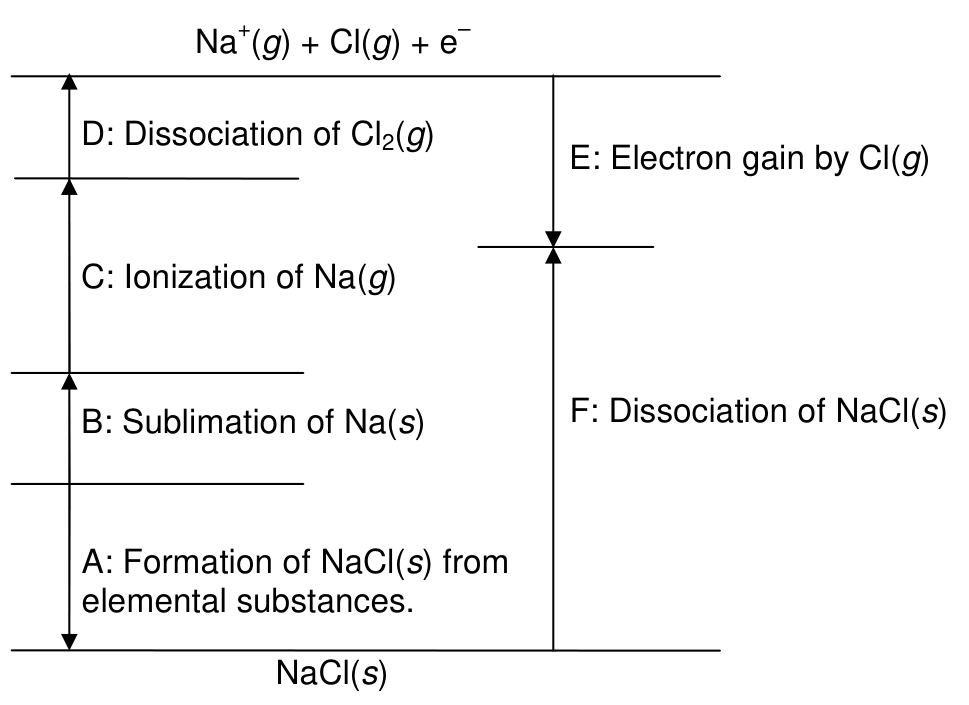
2.4 Calculate the enthalpy of the lattice formation of \(\ce{NaCl}\) [\(\mathrm{kJ\,mol^{-1}}\)] by using the following enthalpy data of the respective steps in the above Born-Haber cycle.
| Formation of \(\ce{NaCl(s)}\) | Sublimation of \(\ce{Na(s)}\) | Ionization of \(\ce{Na(g)}\) | Dissociation of \(\ce{Cl2(g)}\) | Electron gain by \(\ce{Cl(g)}\) |
|---|---|---|---|---|
| \(-411\ \mathrm{kJ\,mol^{-1}}\) | \(109\ \mathrm{kJ\,mol^{-1}}\) | \(496\ \mathrm{kJ\,mol^{-1}}\) | \(242\ \mathrm{kJ\,mol^{-1}}\) | \(-349\ \mathrm{kJ\,mol^{-1}}\) |
Synthesis of sodium carbonate by the ammonia-soda process (Solvay process)
Sodium carbonate (anhydrous soda ash) is a raw material in the manufacture of glass, medicaments, alkaline detergents, etc.
2.5 The total chemical reaction in the ammonia-soda process is represented as follows:

This reaction between sodium chloride and calcium carbonate does not proceed directly. The process comprises the following five reactions involving ammonia:
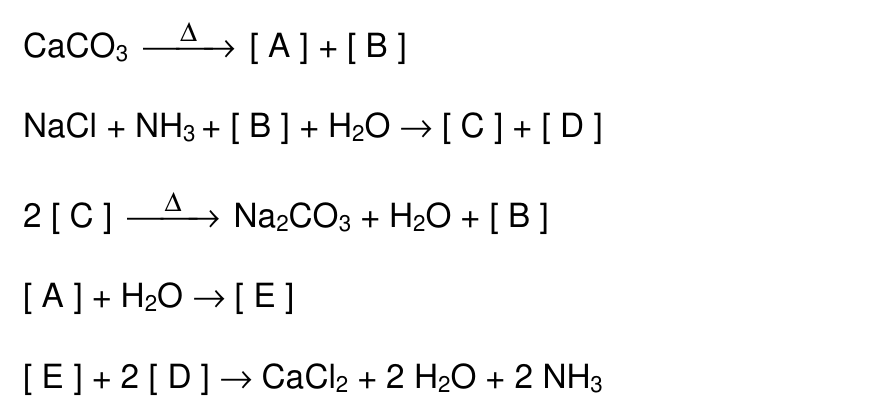
where \(\Delta\) represents applying heat treatment. Insert the chemical formulas of the appropriate compounds instead of [ A ] – [ E ] in the above reactions.
Official English text of the problem.
Answers
SMILES for salts below specify their constituent ions. They do not encode the extended crystal lattice or its coordination geometry.
-
2.1: The conventional cubic unit cell contains 4 sodium ions, \(\ce{Na+}\),
[Na+], and 4 chloride ions, \(\ce{Cl-}\),[Cl-]. Both ions have coordination number 6, with octahedral coordination. -
2.2: For sodium chloride, \(\ce{NaCl}\),
[Na+].[Cl-], \[ \boxed{\rho=2.14\times10^{3}\ \mathrm{kg\,m^{-3}}}. \] -
2.3: \[ \boxed{\text{A: }\ce{Na(s) + 1/2 Cl2(g) -> NaCl(s)}} \] \[ \boxed{\text{F: }\ce{NaCl(s) -> Na+(g) + Cl-(g)}} \] Sodium is represented by
[Na]; chlorine (dichlorine) byClCl. The sodium SMILES does not describe the metallic lattice. -
2.4: \[ \boxed{\Delta H_{\text{lattice formation}}=-788\ \mathrm{kJ\,mol^{-1}}}. \] The reverse process, step F, has \(\Delta H_F=+788\ \mathrm{kJ\,mol^{-1}}\).
-
2.5:
A: calcium oxide, \(\ce{CaO}\),[Ca+2].[O-2]
B: carbon dioxide, \(\ce{CO2}\),O=C=O
C: sodium hydrogen carbonate (sodium bicarbonate), \(\ce{NaHCO3}\),[Na+].OC(=O)[O-]
D: ammonium chloride, \(\ce{NH4Cl}\),[NH4+].[Cl-]
E: calcium hydroxide, \(\ce{Ca(OH)2}\),[Ca+2].[OH-].[OH-]
Solution
2.1
Choose the conventional cubic cell with chloride ions at its corners and face centres. A corner ion is shared by eight cells, and a face-centred ion is shared by two cells. Therefore, \[ N_{\ce{Cl-}} =8\left(\frac18\right)+6\left(\frac12\right) =\boxed{4}. \]
Sodium ions occupy all the octahedral sites of this chloride lattice: the twelve edge centres and the body centre. An edge-centred ion is shared by four cells, while the body-centred ion belongs entirely to one cell: \[ N_{\ce{Na+}} =12\left(\frac14\right)+1 =\boxed{4}. \]
Each sodium ion has six nearest chloride neighbours, situated along the positive and negative directions of three mutually perpendicular axes. These neighbours form an octahedron around it. The same description applies to the six sodium neighbours of each chloride ion.
Thus, \[ \boxed{\mathrm{CN}(\ce{Na+})=\mathrm{CN}(\ce{Cl-})=6}. \]
2.2
Let the cubic cell edge be \(a\). Along an edge, a corner chloride ion touches the sodium ion at the edge centre. Their separation is \(a/2\), so \[ \frac a2=r_{\ce{Na+}}+r_{\ce{Cl-}}. \]
Consequently, \[ a=2(0.102+0.181)\ \mathrm{nm} =0.566\ \mathrm{nm} =5.66\times10^{-10}\ \mathrm m. \]
The cell volume is \[ V_{\text{cell}}=a^3 =(5.66\times10^{-10}\ \mathrm m)^3 =1.81321496\times10^{-28}\ \mathrm{m^3}. \]
There are four formula units of sodium chloride per cell, hence \[ m_{\text{cell}}=\frac{4M(\ce{NaCl})}{N_{\mathrm A}}. \]
The problem does not list molar masses or Avogadro’s constant. Using the standard values \[ M(\ce{NaCl})=(22.99+35.45)\ \mathrm{g\,mol^{-1}} =58.44\times10^{-3}\ \mathrm{kg\,mol^{-1}}, \] \[ N_{\mathrm A}=6.02214076\times10^{23}\ \mathrm{mol^{-1}}, \] gives \[ m_{\text{cell}} =\frac{4(58.44\times10^{-3})}{6.02214076\times10^{23}} =3.88168\times10^{-25}\ \mathrm{kg}. \]
Therefore, \[ \rho=\frac{m_{\text{cell}}}{V_{\text{cell}}} =\frac{3.88168\times10^{-25}}{1.81321496\times10^{-28}} \ \mathrm{kg\,m^{-3}}, \] \[ \boxed{\rho=2.14\times10^3\ \mathrm{kg\,m^{-3}}}. \]
2.3
Step A forms one mole of solid sodium chloride from its elements in their standard states: solid sodium and gaseous chlorine. Since chlorine is diatomic, half a mole is required: \[ \boxed{\ce{Na(s) + 1/2 Cl2(g) -> NaCl(s)}}. \]
The upward arrow F represents dissociation of the solid into separated gaseous ions: \[ \boxed{\ce{NaCl(s) -> Na+(g) + Cl-(g)}}. \]
Both equations conserve atoms and charge. Step F is the reverse of lattice formation.
2.4
Write the alternative route from the elements to solid sodium chloride. The atomic chlorine intermediate, \(\ce{Cl(g)}\), has SMILES [Cl].
| Step | Reaction | Enthalpy contribution per mole of \(\ce{NaCl}\), \(\mathrm{kJ\,mol^{-1}}\) |
|---|---|---|
| B: sublimation | \(\ce{Na(s) -> Na(g)}\) | \(+109\) |
| C: ionization | \(\ce{Na(g) -> Na+(g) + e-}\) | \(+496\) |
| D: chlorine dissociation | \(\ce{1/2 Cl2(g) -> Cl(g)}\) | \(+\frac{242}{2}=+121\) |
| E: electron gain | \(\ce{Cl(g) + e- -> Cl-(g)}\) | \(-349\) |
| Lattice formation | \(\ce{Na+(g) + Cl-(g) -> NaCl(s)}\) | \(\Delta H_{\text{lattice formation}}\) |
The chlorine dissociation value is halved because the stated \(242\ \mathrm{kJ\,mol^{-1}}\) applies to dissociation of one mole of \(\ce{Cl2}\), producing two moles of chlorine atoms.
Adding the reactions cancels the gaseous intermediates and the electron, leaving the formation reaction in step A. Hess’s law therefore gives \[ -411=109+496+\frac{242}{2}-349 +\Delta H_{\text{lattice formation}}. \]
Thus, \[ \Delta H_{\text{lattice formation}} =-411-(109+496+121-349) =-411-377, \] \[ \boxed{\Delta H_{\text{lattice formation}}=-788\ \mathrm{kJ\,mol^{-1}}}. \]
The negative sign indicates that forming the ionic lattice releases heat.
2.5
The additional species appearing in the completed reactions are:
| Name | Formula | SMILES |
|---|---|---|
| Calcium carbonate | \(\ce{CaCO3}\) | [Ca+2].[O-]C(=O)[O-] |
| Ammonia | \(\ce{NH3}\) | N |
| Water | \(\ce{H2O}\) | O |
| Sodium carbonate | \(\ce{Na2CO3}\) | [Na+].[Na+].[O-]C(=O)[O-] |
| Calcium chloride | \(\ce{CaCl2}\) | [Ca+2].[Cl-].[Cl-] |
Heating calcium carbonate produces calcium oxide and carbon dioxide: \[ \ce{CaCO3 ->[\Delta] CaO + CO2}. \] Therefore, A is \(\ce{CaO}\) and B is \(\ce{CO2}\).
Carbon dioxide reacts with ammonia and water in the sodium chloride solution. Sodium hydrogen carbonate precipitates because of its relatively low solubility under the process conditions; ammonium chloride remains in solution: \[ \ce{NaCl + NH3 + CO2 + H2O -> NaHCO3 + NH4Cl}. \] Thus, C is \(\ce{NaHCO3}\) and D is \(\ce{NH4Cl}\).
Heating sodium hydrogen carbonate produces sodium carbonate, water, and carbon dioxide: \[ \ce{2NaHCO3 ->[\Delta] Na2CO3 + H2O + CO2}. \] This confirms C and also regenerates some of the carbon dioxide used in the preceding reaction.
Calcium oxide reacts with water to form calcium hydroxide: \[ \ce{CaO + H2O -> Ca(OH)2}. \] Hence, E is \(\ce{Ca(OH)2}\).
Finally, the basic calcium hydroxide regenerates ammonia from ammonium chloride: \[ \ce{Ca(OH)2 + 2NH4Cl -> CaCl2 + 2H2O + 2NH3}. \]
To verify the overall stoichiometry, take the carbonation reaction twice and each of the other four reactions once. Cancelling the intermediates, ammonia, carbon dioxide, and water gives \[ \boxed{\ce{2NaCl + CaCO3 -> Na2CO3 + CaCl2}}, \] as required.
The solution was checked against the official solution. Where this solution differs from the official solution, the official solution contains an error or a misprint.
IChO 2010 · Theorieaufgabe 2
Kristallstruktur von Alkalimetallhalogeniden
Kristallstruktur eines Alkalimetallhalogenids
In Kristallen ionischer Verbindungen sind die Kationen im Allgemeinen in den Lücken der dichtesten Kugelpackung der Anionen angeordnet. Die Struktur eines Ionenkristalls wie Natriumchlorid wird stabil, wenn die Kationen die nächstgelegenen Anionen berühren.
2.1 Im Natriumchloridkristall bilden sowohl die \(\ce{Na+}\)- als auch die \(\ce{Cl-}\)-Ionen ein kubisch flächenzentriertes Gitter. Geben Sie die Anzahlen der \(\ce{Na+}\)- und \(\ce{Cl-}\)-Ionen in einer Elementarzelle sowie die Koordinationszahlen der \(\ce{Na+}\)- und \(\ce{Cl-}\)-Ionen im Natriumchloridkristall an.
2.2 Die Ionenradien der \(\ce{Na+}\)- und \(\ce{Cl-}\)-Ionen im Natriumchloridkristall betragen 0.102 nm bzw. 0.181 nm.
Berechnen Sie die Dichte [\(\mathrm{kg\,m^{-3}}\)] des Natriumchloridkristalls.
Born-Haber-Kreisprozess und Gitterenthalpie
Bei ionischen anorganischen Verbindungen wie Natriumchlorid ist die bei der Gitterbildung aus gasförmigen Ionen freigesetzte Wärme sehr groß und der Beitrag der Entropieänderung gering. Daher wird die Gitterbildungsenthalpie mithilfe eines Born-Haber-Kreisprozesses aus Enthalpiedaten abgeschätzt.
2.3 Die folgende Abbildung zeigt den Born-Haber-Kreisprozess von \(\ce{NaCl}\). Die Kennzeichnungen „g“ und „s“ stehen für die Zustände „gasförmig“ bzw. „fest“. Geben Sie die chemischen Gleichungen für die Schritte A und F an.
2.4 Berechnen Sie die Gitterbildungsenthalpie von \(\ce{NaCl}\) [\(\mathrm{kJ\,mol^{-1}}\)] unter Verwendung der folgenden Enthalpiedaten für die jeweiligen Schritte im obigen Born-Haber-Kreisprozess.
| Bildung von \(\ce{NaCl(s)}\) | Sublimation von \(\ce{Na(s)}\) | Ionisation von \(\ce{Na(g)}\) | Dissoziation von \(\ce{Cl2(g)}\) | Elektronenaufnahme durch \(\ce{Cl(g)}\) |
|---|---|---|---|---|
| \(-411\ \mathrm{kJ\,mol^{-1}}\) | \(109\ \mathrm{kJ\,mol^{-1}}\) | \(496\ \mathrm{kJ\,mol^{-1}}\) | \(242\ \mathrm{kJ\,mol^{-1}}\) | \(-349\ \mathrm{kJ\,mol^{-1}}\) |
Synthese von Natriumcarbonat nach dem Ammoniak-Soda-Verfahren (Solvay-Verfahren)
Natriumcarbonat (wasserfreie Soda) ist ein Rohstoff für die Herstellung von Glas, Arzneimitteln, alkalischen Reinigungsmitteln usw.
2.5 Die chemische Gesamtreaktion des Ammoniak-Soda-Verfahrens wird wie folgt dargestellt:
Diese Reaktion zwischen Natriumchlorid und Calciumcarbonat läuft nicht direkt ab. Das Verfahren umfasst die folgenden fünf Reaktionen unter Beteiligung von Ammoniak:
Dabei steht \(\Delta\) für eine Wärmebehandlung. Setzen Sie in den obigen Reaktionen anstelle von [ A ] – [ E ] die chemischen Formeln der entsprechenden Verbindungen ein.
Aufgabentext aus dem offiziellen englischen Text übersetzt.
Antworten
Die nachstehenden SMILES für Salze geben deren Bestandteile in Form von Ionen an. Sie codieren weder das ausgedehnte Kristallgitter noch dessen Koordinationsgeometrie.
-
2.1: Die konventionelle kubische Elementarzelle enthält 4 Natriumionen, \(\ce{Na+}\),
[Na+], und 4 Chloridionen, \(\ce{Cl-}\),[Cl-]. Beide Ionen haben die Koordinationszahl 6 bei oktaedrischer Koordination. -
2.2: Für Natriumchlorid, \(\ce{NaCl}\),
[Na+].[Cl-], gilt \[ \boxed{\rho=2.14\times10^{3}\ \mathrm{kg\,m^{-3}}}. \] -
2.3: \[ \boxed{\text{A: }\ce{Na(s) + 1/2 Cl2(g) -> NaCl(s)}} \] \[ \boxed{\text{F: }\ce{NaCl(s) -> Na+(g) + Cl-(g)}} \] Natrium wird durch
[Na]dargestellt, Chlor (Dichlor) durchClCl. Der SMILES-Ausdruck für Natrium beschreibt nicht das Metallgitter. -
2.4: \[ \boxed{\Delta H_{\text{Gitterbildung}}=-788\ \mathrm{kJ\,mol^{-1}}}. \] Für den umgekehrten Vorgang, Schritt F, gilt \(\Delta H_F=+788\ \mathrm{kJ\,mol^{-1}}\).
-
2.5:
A: Calciumoxid, \(\ce{CaO}\),[Ca+2].[O-2]
B: Kohlenstoffdioxid, \(\ce{CO2}\),O=C=O
C: Natriumhydrogencarbonat (Natriumbicarbonat), \(\ce{NaHCO3}\),[Na+].OC(=O)[O-]
D: Ammoniumchlorid, \(\ce{NH4Cl}\),[NH4+].[Cl-]
E: Calciumhydroxid, \(\ce{Ca(OH)2}\),[Ca+2].[OH-].[OH-]
Lösung
2.1
Wir wählen die konventionelle kubische Zelle mit Chloridionen an ihren Ecken und Flächenmitten. Ein Ion an einer Ecke gehört anteilig zu acht Zellen, ein Ion in einer Flächenmitte zu zwei Zellen. Daher gilt \[ N_{\ce{Cl-}} =8\left(\frac18\right)+6\left(\frac12\right) =\boxed{4}. \]
Die Natriumionen besetzen alle Oktaederlücken dieses Chloridgitters: die zwölf Kantenmitten und die Raummitte. Ein Ion in einer Kantenmitte gehört anteilig zu vier Zellen, während das Ion in der Raummitte vollständig zu einer Zelle gehört: \[ N_{\ce{Na+}} =12\left(\frac14\right)+1 =\boxed{4}. \]
Jedes Natriumion hat sechs nächstgelegene Chloridionen als Nachbarn, die entlang der positiven und negativen Richtungen dreier zueinander senkrechter Achsen liegen. Diese Nachbarn bilden ein Oktaeder um das Natriumion. Die gleiche Beschreibung gilt für die sechs Natriumionen in der Nachbarschaft jedes Chloridions.
Somit gilt \[ \boxed{\mathrm{CN}(\ce{Na+})=\mathrm{CN}(\ce{Cl-})=6}. \]
2.2
Die Kantenlänge der kubischen Zelle sei \(a\). Entlang einer Kante berührt ein Chloridion an einer Ecke das Natriumion in der Kantenmitte. Ihr Abstand beträgt \(a/2\), also gilt \[ \frac a2=r_{\ce{Na+}}+r_{\ce{Cl-}}. \]
Folglich ist \[ a=2(0.102+0.181)\ \mathrm{nm} =0.566\ \mathrm{nm} =5.66\times10^{-10}\ \mathrm m. \]
Das Zellvolumen beträgt \[ V_{\text{Zelle}}=a^3 =(5.66\times10^{-10}\ \mathrm m)^3 =1.81321496\times10^{-28}\ \mathrm{m^3}. \]
Jede Zelle enthält vier Formeleinheiten Natriumchlorid, daher gilt \[ m_{\text{Zelle}}=\frac{4M(\ce{NaCl})}{N_{\mathrm A}}. \]
In der Aufgabenstellung sind weder molare Massen noch die Avogadro-Konstante angegeben. Mit den Standardwerten \[ M(\ce{NaCl})=(22.99+35.45)\ \mathrm{g\,mol^{-1}} =58.44\times10^{-3}\ \mathrm{kg\,mol^{-1}}, \] \[ N_{\mathrm A}=6.02214076\times10^{23}\ \mathrm{mol^{-1}}, \] ergibt sich \[ m_{\text{Zelle}} =\frac{4(58.44\times10^{-3})}{6.02214076\times10^{23}} =3.88168\times10^{-25}\ \mathrm{kg}. \]
Daher gilt \[ \rho=\frac{m_{\text{Zelle}}}{V_{\text{Zelle}}} =\frac{3.88168\times10^{-25}}{1.81321496\times10^{-28}} \ \mathrm{kg\,m^{-3}}, \] \[ \boxed{\rho=2.14\times10^3\ \mathrm{kg\,m^{-3}}}. \]
2.3
In Schritt A wird ein Mol festes Natriumchlorid aus seinen Elementen in deren Standardzuständen gebildet: festem Natrium und gasförmigem Chlor. Da Chlor zweiatomig ist, wird ein halbes Mol benötigt: \[ \boxed{\ce{Na(s) + 1/2 Cl2(g) -> NaCl(s)}}. \]
Der nach oben gerichtete Pfeil F stellt die Dissoziation des Feststoffs in voneinander getrennte gasförmige Ionen dar: \[ \boxed{\ce{NaCl(s) -> Na+(g) + Cl-(g)}}. \]
In beiden Gleichungen bleiben Atomanzahlen und Ladung erhalten. Schritt F ist die Umkehrung der Gitterbildung.
2.4
Wir formulieren den alternativen Reaktionsweg von den Elementen zu festem Natriumchlorid. Das atomare Chlor als Zwischenprodukt, \(\ce{Cl(g)}\), hat den SMILES-Ausdruck [Cl].
| Schritt | Reaktion | Enthalpiebeitrag pro Mol \(\ce{NaCl}\), \(\mathrm{kJ\,mol^{-1}}\) |
|---|---|---|
| B: Sublimation | \(\ce{Na(s) -> Na(g)}\) | \(+109\) |
| C: Ionisation | \(\ce{Na(g) -> Na+(g) + e-}\) | \(+496\) |
| D: Chlordissoziation | \(\ce{1/2 Cl2(g) -> Cl(g)}\) | \(+\frac{242}{2}=+121\) |
| E: Elektronenaufnahme | \(\ce{Cl(g) + e- -> Cl-(g)}\) | \(-349\) |
| Gitterbildung | \(\ce{Na+(g) + Cl-(g) -> NaCl(s)}\) | \(\Delta H_{\text{Gitterbildung}}\) |
Der Wert für die Chlordissoziation wird halbiert, weil die angegebenen \(242\ \mathrm{kJ\,mol^{-1}}\) für die Dissoziation eines Mols \(\ce{Cl2}\) gelten, wobei zwei Mol Chloratome entstehen.
Beim Addieren der Reaktionen kürzen sich die gasförmigen Zwischenprodukte und das Elektron heraus, sodass die Bildungsreaktion aus Schritt A übrig bleibt. Nach dem Satz von Hess gilt daher \[ -411=109+496+\frac{242}{2}-349 +\Delta H_{\text{Gitterbildung}}. \]
Somit ergibt sich \[ \Delta H_{\text{Gitterbildung}} =-411-(109+496+121-349) =-411-377, \] \[ \boxed{\Delta H_{\text{Gitterbildung}}=-788\ \mathrm{kJ\,mol^{-1}}}. \]
Das negative Vorzeichen zeigt an, dass bei der Bildung des Ionengitters Wärme freigesetzt wird.
2.5
Die zusätzlichen Spezies, die in den vervollständigten Reaktionen vorkommen, sind:
| Name | Formel | SMILES |
|---|---|---|
| Calciumcarbonat | \(\ce{CaCO3}\) | [Ca+2].[O-]C(=O)[O-] |
| Ammoniak | \(\ce{NH3}\) | N |
| Wasser | \(\ce{H2O}\) | O |
| Natriumcarbonat | \(\ce{Na2CO3}\) | [Na+].[Na+].[O-]C(=O)[O-] |
| Calciumchlorid | \(\ce{CaCl2}\) | [Ca+2].[Cl-].[Cl-] |
Beim Erhitzen von Calciumcarbonat entstehen Calciumoxid und Kohlenstoffdioxid: \[ \ce{CaCO3 ->[\Delta] CaO + CO2}. \] Daher ist A \(\ce{CaO}\) und B \(\ce{CO2}\).
Kohlenstoffdioxid reagiert mit Ammoniak und Wasser in der Natriumchloridlösung. Natriumhydrogencarbonat fällt aufgrund seiner unter den Verfahrensbedingungen relativ geringen Löslichkeit aus; Ammoniumchlorid bleibt in Lösung: \[ \ce{NaCl + NH3 + CO2 + H2O -> NaHCO3 + NH4Cl}. \] Somit ist C \(\ce{NaHCO3}\) und D \(\ce{NH4Cl}\).
Beim Erhitzen von Natriumhydrogencarbonat entstehen Natriumcarbonat, Wasser und Kohlenstoffdioxid: \[ \ce{2NaHCO3 ->[\Delta] Na2CO3 + H2O + CO2}. \] Dies bestätigt C und regeneriert zugleich einen Teil des in der vorhergehenden Reaktion eingesetzten Kohlenstoffdioxids.
Calciumoxid reagiert mit Wasser zu Calciumhydroxid: \[ \ce{CaO + H2O -> Ca(OH)2}. \] Also ist E \(\ce{Ca(OH)2}\).
Schließlich regeneriert das basische Calciumhydroxid Ammoniak aus Ammoniumchlorid: \[ \ce{Ca(OH)2 + 2NH4Cl -> CaCl2 + 2H2O + 2NH3}. \]
Zur Überprüfung der Gesamtstöchiometrie wird die Carbonatisierungsreaktion zweimal und jede der anderen vier Reaktionen einmal berücksichtigt. Nach dem Kürzen der Zwischenprodukte, des Ammoniaks, des Kohlenstoffdioxids und des Wassers ergibt sich \[ \boxed{\ce{2NaCl + CaCO3 -> Na2CO3 + CaCl2}}, \] wie gefordert.
Die Lösung wurde mit der offiziellen Lösung abgeglichen. Wo diese Lösung von der offiziellen Lösung abweicht, enthält die offizielle Lösung einen Fehler oder Druckfehler.
IChO 2010 · Teori sorusu 2
Alkali metal halojenürlerin kristal yapısı
Alkali metal halojenürün kristal yapısı
İyonik bileşiklerin kristallerinde katyonlar genellikle anyonların en sıkı paketlenmiş örgüsündeki boşluklara yerleşir. Sodyum klorür gibi bir iyonik kristalin yapısı, katyonlar en yakın anyonlarla temas hâlinde olduğunda kararlı olur.
2.1 Sodyum klorür kristalinde hem \(\ce{Na+}\) hem de \(\ce{Cl-}\) iyonları yüzey merkezli kübik bir örgü oluşturur. Bir birim hücredeki \(\ce{Na+}\) ve \(\ce{Cl-}\) iyonlarının sayılarını ve sodyum klorür kristalindeki \(\ce{Na+}\) ve \(\ce{Cl-}\) iyonlarının koordinasyon sayılarını belirtiniz.
2.2 Sodyum klorür kristalindeki \(\ce{Na+}\) ve \(\ce{Cl-}\) iyonlarının iyon yarıçapları sırasıyla 0.102 nm ve 0.181 nm'dir.
Sodyum klorür kristalinin yoğunluğunu [\(\mathrm{kg\,m^{-3}}\)] hesaplayınız.
Born-Haber çevrimi ve örgü entalpisi
Sodyum klorür gibi iyonik inorganik bileşiklerde, gaz hâlindeki iyonlardan örgü oluşumunun ısısı çok yüksektir ve entropi değişiminin katkısı küçüktür. Bu nedenle örgü oluşum entalpisi, Born-Haber çevrimi kullanılarak entalpi verilerinden tahmin edilir.
2.3 Aşağıdaki şekil, \(\ce{NaCl}\)'nin Born-Haber çevrimini göstermektedir. “g” ve “s” etiketleri sırasıyla “gaz” ve “katı” hâlleri temsil etmektedir. A ve F basamaklarındaki kimyasal denklemleri yazınız.
2.4 Yukarıdaki Born-Haber çevriminin ilgili basamaklarına ait aşağıdaki entalpi verilerini kullanarak \(\ce{NaCl}\)'nin örgü oluşum entalpisini [\(\mathrm{kJ\,mol^{-1}}\)] hesaplayınız.
| \(\ce{NaCl(s)}\) oluşumu | \(\ce{Na(s)}\) süblimleşmesi | \(\ce{Na(g)}\) iyonlaşması | \(\ce{Cl2(g)}\) ayrışması | \(\ce{Cl(g)}\)'nin elektron alması |
|---|---|---|---|---|
| \(-411\ \mathrm{kJ\,mol^{-1}}\) | \(109\ \mathrm{kJ\,mol^{-1}}\) | \(496\ \mathrm{kJ\,mol^{-1}}\) | \(242\ \mathrm{kJ\,mol^{-1}}\) | \(-349\ \mathrm{kJ\,mol^{-1}}\) |
Amonyak-soda yöntemiyle (Solvay yöntemi) sodyum karbonat sentezi
Sodyum karbonat (susuz soda külü), cam, ilaç, alkali deterjan vb. üretiminde kullanılan bir ham maddedir.
2.5 Amonyak-soda yöntemindeki toplam kimyasal tepkime aşağıdaki gibi gösterilir:
Sodyum klorür ile kalsiyum karbonat arasındaki bu tepkime doğrudan gerçekleşmez. Yöntem, amonyağın yer aldığı aşağıdaki beş tepkimeden oluşur:
Burada \(\Delta\), ısıl işlem uygulanmasını temsil etmektedir. Yukarıdaki tepkimelerde [ A ] – [ E ] yerine uygun bileşiklerin kimyasal formüllerini yazınız.
Soru metni resmi İngilizce metinden çevrilmiştir.
Cevaplar
Aşağıdaki tuzlara ait SMILES gösterimleri, bu tuzları oluşturan iyonları belirtir. Uzanan kristal örgüsünü veya koordinasyon geometrisini kodlamazlar.
-
2.1: Geleneksel kübik birim hücre 4 sodyum iyonu, \(\ce{Na+}\),
[Na+], ve 4 klorür iyonu, \(\ce{Cl-}\),[Cl-], içerir. Her iki iyonun da koordinasyon sayısı 6 olup oktahedral koordinasyon gösterirler. -
2.2: Sodyum klorür, \(\ce{NaCl}\),
[Na+].[Cl-], için \[ \boxed{\rho=2.14\times10^{3}\ \mathrm{kg\,m^{-3}}}. \] -
2.3: \[ \boxed{\text{A: }\ce{Na(s) + 1/2 Cl2(g) -> NaCl(s)}} \] \[ \boxed{\text{F: }\ce{NaCl(s) -> Na+(g) + Cl-(g)}} \] Sodyum
[Na]ile; klor (diklor) iseClClile gösterilir. Sodyumun SMILES gösterimi metalik örgüyü tanımlamaz. -
2.4: \[ \boxed{\Delta H_{\text{örgü oluşumu}}=-788\ \mathrm{kJ\,mol^{-1}}}. \] Ters süreç olan F basamağı için \(\Delta H_F=+788\ \mathrm{kJ\,mol^{-1}}\) değerindedir.
-
2.5:
A: kalsiyum oksit, \(\ce{CaO}\),[Ca+2].[O-2]
B: karbon dioksit, \(\ce{CO2}\),O=C=O
C: sodyum hidrojen karbonat (sodyum bikarbonat), \(\ce{NaHCO3}\),[Na+].OC(=O)[O-]
D: amonyum klorür, \(\ce{NH4Cl}\),[NH4+].[Cl-]
E: kalsiyum hidroksit, \(\ce{Ca(OH)2}\),[Ca+2].[OH-].[OH-]
Çözüm
2.1
Köşelerinde ve yüzey merkezlerinde klorür iyonlarının bulunduğu geleneksel kübik hücreyi seçelim. Bir köşe iyonu sekiz hücre tarafından, yüzey merkezindeki bir iyon ise iki hücre tarafından paylaşılır. Dolayısıyla, \[ N_{\ce{Cl-}} =8\left(\frac18\right)+6\left(\frac12\right) =\boxed{4}. \]
Sodyum iyonları, bu klorür örgüsündeki tüm oktahedral boşlukları, yani on iki kenar merkezini ve hacim merkezini doldurur. Kenar merkezindeki bir iyon dört hücre tarafından paylaşılırken hacim merkezindeki iyon bütünüyle tek bir hücreye aittir: \[ N_{\ce{Na+}} =12\left(\frac14\right)+1 =\boxed{4}. \]
Her sodyum iyonunun, birbirine dik üç eksenin pozitif ve negatif yönlerinde yer alan en yakın altı klorür komşusu vardır. Bu komşular, iyonun çevresinde bir oktahedron oluşturur. Aynı betimleme, her klorür iyonunun altı sodyum komşusu için de geçerlidir.
Böylece, \[ \boxed{\mathrm{CN}(\ce{Na+})=\mathrm{CN}(\ce{Cl-})=6}. \]
2.2
Kübik hücrenin kenar uzunluğu \(a\) olsun. Bir kenar boyunca, köşedeki klorür iyonu kenar merkezindeki sodyum iyonuna temas eder. Aralarındaki uzaklık \(a/2\) olduğundan \[ \frac a2=r_{\ce{Na+}}+r_{\ce{Cl-}}. \]
Buna göre, \[ a=2(0.102+0.181)\ \mathrm{nm} =0.566\ \mathrm{nm} =5.66\times10^{-10}\ \mathrm m. \]
Hücrenin hacmi \[ V_{\text{hücre}}=a^3 =(5.66\times10^{-10}\ \mathrm m)^3 =1.81321496\times10^{-28}\ \mathrm{m^3}. \]
Her hücrede dört sodyum klorür formül birimi bulunduğundan \[ m_{\text{hücre}}=\frac{4M(\ce{NaCl})}{N_{\mathrm A}}. \]
Soruda molar kütleler veya Avogadro sabiti verilmemiştir. Standart değerler olan \[ M(\ce{NaCl})=(22.99+35.45)\ \mathrm{g\,mol^{-1}} =58.44\times10^{-3}\ \mathrm{kg\,mol^{-1}}, \] \[ N_{\mathrm A}=6.02214076\times10^{23}\ \mathrm{mol^{-1}}, \] kullanıldığında \[ m_{\text{hücre}} =\frac{4(58.44\times10^{-3})}{6.02214076\times10^{23}} =3.88168\times10^{-25}\ \mathrm{kg}. \]
Dolayısıyla, \[ \rho=\frac{m_{\text{hücre}}}{V_{\text{hücre}}} =\frac{3.88168\times10^{-25}}{1.81321496\times10^{-28}} \ \mathrm{kg\,m^{-3}}, \] \[ \boxed{\rho=2.14\times10^3\ \mathrm{kg\,m^{-3}}}. \]
2.3
A basamağında, standart hâllerindeki elementlerden, yani katı sodyum ve gaz hâlindeki klordan bir mol katı sodyum klorür oluşur. Klor iki atomlu olduğundan yarım mol gereklidir: \[ \boxed{\ce{Na(s) + 1/2 Cl2(g) -> NaCl(s)}}. \]
Yukarı yönlü F oku, katının birbirinden ayrılmış gaz hâlindeki iyonlara ayrışmasını temsil eder: \[ \boxed{\ce{NaCl(s) -> Na+(g) + Cl-(g)}}. \]
Her iki denklemde de atomlar ve yük korunur. F basamağı, örgü oluşumunun tersidir.
2.4
Elementlerden katı sodyum klorüre giden alternatif yolu yazalım. Ara tür olan atomik klorun, \(\ce{Cl(g)}\), SMILES gösterimi [Cl] şeklindedir.
| Basamak | Tepkime | Bir mol \(\ce{NaCl}\) başına entalpi katkısı, \(\mathrm{kJ\,mol^{-1}}\) |
|---|---|---|
| B: süblimleşme | \(\ce{Na(s) -> Na(g)}\) | \(+109\) |
| C: iyonlaşma | \(\ce{Na(g) -> Na+(g) + e-}\) | \(+496\) |
| D: klorun ayrışması | \(\ce{1/2 Cl2(g) -> Cl(g)}\) | \(+\frac{242}{2}=+121\) |
| E: elektron alma | \(\ce{Cl(g) + e- -> Cl-(g)}\) | \(-349\) |
| Örgü oluşumu | \(\ce{Na+(g) + Cl-(g) -> NaCl(s)}\) | \(\Delta H_{\text{örgü oluşumu}}\) |
Klorun ayrışma değeri yarıya indirilir; çünkü verilen \(242\ \mathrm{kJ\,mol^{-1}}\) değeri, iki mol klor atomu üreten bir mol \(\ce{Cl2}\)'nin ayrışması için geçerlidir.
Tepkimeler toplandığında gaz hâlindeki ara türler ve elektron sadeleşir, geriye A basamağındaki oluşum tepkimesi kalır. Dolayısıyla Hess yasasına göre \[ -411=109+496+\frac{242}{2}-349 +\Delta H_{\text{örgü oluşumu}}. \]
Böylece, \[ \Delta H_{\text{örgü oluşumu}} =-411-(109+496+121-349) =-411-377, \] \[ \boxed{\Delta H_{\text{örgü oluşumu}}=-788\ \mathrm{kJ\,mol^{-1}}}. \]
Negatif işaret, iyonik örgü oluşurken ısı açığa çıktığını gösterir.
2.5
Tamamlanmış tepkimelerde yer alan diğer türler şunlardır:
| Adı | Formülü | SMILES |
|---|---|---|
| Kalsiyum karbonat | \(\ce{CaCO3}\) | [Ca+2].[O-]C(=O)[O-] |
| Amonyak | \(\ce{NH3}\) | N |
| Su | \(\ce{H2O}\) | O |
| Sodyum karbonat | \(\ce{Na2CO3}\) | [Na+].[Na+].[O-]C(=O)[O-] |
| Kalsiyum klorür | \(\ce{CaCl2}\) | [Ca+2].[Cl-].[Cl-] |
Kalsiyum karbonat ısıtıldığında kalsiyum oksit ve karbon dioksit oluşur: \[ \ce{CaCO3 ->[\Delta] CaO + CO2}. \] Dolayısıyla A, \(\ce{CaO}\) ve B, \(\ce{CO2}\)'dir.
Karbon dioksit, sodyum klorür çözeltisinde amonyak ve su ile tepkimeye girer. Sodyum hidrojen karbonat, işlem koşullarındaki nispeten düşük çözünürlüğü nedeniyle çöker; amonyum klorür ise çözeltide kalır: \[ \ce{NaCl + NH3 + CO2 + H2O -> NaHCO3 + NH4Cl}. \] Böylece C, \(\ce{NaHCO3}\) ve D, \(\ce{NH4Cl}\)'dir.
Sodyum hidrojen karbonat ısıtıldığında sodyum karbonat, su ve karbon dioksit oluşur: \[ \ce{2NaHCO3 ->[\Delta] Na2CO3 + H2O + CO2}. \] Bu, C'yi doğrular ve ayrıca bir önceki tepkimede kullanılan karbon dioksitin bir kısmını yeniden oluşturur.
Kalsiyum oksit, su ile tepkimeye girerek kalsiyum hidroksit oluşturur: \[ \ce{CaO + H2O -> Ca(OH)2}. \] Dolayısıyla E, \(\ce{Ca(OH)2}\)'dir.
Son olarak, bazik özellikteki kalsiyum hidroksit, amonyum klorürden amonyağı yeniden elde eder: \[ \ce{Ca(OH)2 + 2NH4Cl -> CaCl2 + 2H2O + 2NH3}. \]
Toplam stokiyometriyi doğrulamak için karbonatlaşma tepkimesini iki kez, diğer dört tepkimenin her birini ise bir kez alalım. Ara türler, amonyak, karbon dioksit ve su sadeleştirildiğinde \[ \boxed{\ce{2NaCl + CaCO3 -> Na2CO3 + CaCl2}}, \] gerektiği gibi elde edilir.
Çözüm, resmi çözümle karşılaştırılarak kontrol edildi. Bu çözümün resmi çözümden ayrıldığı yerlerde resmi çözümde bir hata ya da baskı hatası vardır.
IChO 2010 · Problema teórico 2
Estructura cristalina de los haluros de metales alcalinos
Estructura cristalina de un haluro de metal alcalino
En los cristales de compuestos iónicos, los cationes suelen disponerse en los intersticios de la red de empaquetamiento compacto de los aniones. La estructura de un cristal iónico, como el cloruro de sodio, se estabiliza cuando los cationes están en contacto con los aniones más próximos.
2.1 En el cristal de cloruro de sodio, tanto los iones \(\ce{Na+}\) como los iones \(\ce{Cl-}\) forman una red cúbica centrada en las caras. Indique el número de iones \(\ce{Na+}\) y \(\ce{Cl-}\) en una celda unidad y los números de coordinación de los iones \(\ce{Na+}\) y \(\ce{Cl-}\) en el cristal de cloruro de sodio.
2.2 Los radios iónicos de los iones \(\ce{Na+}\) y \(\ce{Cl-}\) en el cristal de cloruro de sodio son 0.102 nm y 0.181 nm, respectivamente.
Calcule la densidad [\(\mathrm{kg\,m^{-3}}\)] del cristal de cloruro de sodio.
Ciclo de Born-Haber y entalpía reticular
En los compuestos inorgánicos iónicos, como el cloruro de sodio, el calor de formación de la red a partir de iones gaseosos es muy elevado, y la contribución de la variación de entropía es pequeña. Por tanto, la entalpía de formación de la red se estima a partir de datos de entalpía mediante un ciclo de Born-Haber.
2.3 La figura siguiente muestra el ciclo de Born-Haber del \(\ce{NaCl}\). Las etiquetas «g» y «s» representan los estados «gaseoso» y «sólido», respectivamente. Escriba las ecuaciones químicas de las etapas A y F.
2.4 Calcule la entalpía de formación de la red del \(\ce{NaCl}\) [\(\mathrm{kJ\,mol^{-1}}\)] utilizando los siguientes datos de entalpía de las respectivas etapas del ciclo de Born-Haber anterior.
| Formación de \(\ce{NaCl(s)}\) | Sublimación de \(\ce{Na(s)}\) | Ionización de \(\ce{Na(g)}\) | Disociación de \(\ce{Cl2(g)}\) | Captación de un electrón por \(\ce{Cl(g)}\) |
|---|---|---|---|---|
| \(-411\ \mathrm{kJ\,mol^{-1}}\) | \(109\ \mathrm{kJ\,mol^{-1}}\) | \(496\ \mathrm{kJ\,mol^{-1}}\) | \(242\ \mathrm{kJ\,mol^{-1}}\) | \(-349\ \mathrm{kJ\,mol^{-1}}\) |
Síntesis de carbonato de sodio mediante el proceso de la sosa amoniacal (proceso Solvay)
El carbonato de sodio (sosa anhidra) es una materia prima utilizada en la fabricación de vidrio, medicamentos, detergentes alcalinos, etc.
2.5 La reacción química global del proceso de la sosa amoniacal se representa de la siguiente manera:
Esta reacción entre el cloruro de sodio y el carbonato de calcio no se produce directamente. El proceso comprende las cinco reacciones siguientes, en las que interviene el amoníaco:
donde \(\Delta\) representa la aplicación de un tratamiento térmico. Sustituya [ A ] – [ E ] por las fórmulas químicas de los compuestos adecuados en las reacciones anteriores.
Enunciado traducido del texto oficial en inglés.
Respuestas
Los SMILES de las sales que aparecen a continuación especifican los iones que las constituyen. No codifican la red cristalina extendida ni su geometría de coordinación.
-
2.1: La celda unidad cúbica convencional contiene 4 iones sodio, \(\ce{Na+}\),
[Na+], y 4 iones cloruro, \(\ce{Cl-}\),[Cl-]. Ambos iones tienen un número de coordinación de 6, con coordinación octaédrica. -
2.2: Para el cloruro de sodio, \(\ce{NaCl}\),
[Na+].[Cl-], \[ \boxed{\rho=2.14\times10^{3}\ \mathrm{kg\,m^{-3}}}. \] -
2.3: \[ \boxed{\text{A: }\ce{Na(s) + 1/2 Cl2(g) -> NaCl(s)}} \] \[ \boxed{\text{F: }\ce{NaCl(s) -> Na+(g) + Cl-(g)}} \] El sodio se representa mediante
[Na]; el cloro (dicloro), medianteClCl. El SMILES del sodio no describe la red metálica. -
2.4: \[ \boxed{\Delta H_{\text{formación de la red}}=-788\ \mathrm{kJ\,mol^{-1}}}. \] El proceso inverso, la etapa F, tiene \(\Delta H_F=+788\ \mathrm{kJ\,mol^{-1}}\).
-
2.5:
A: óxido de calcio, \(\ce{CaO}\),[Ca+2].[O-2]
B: dióxido de carbono, \(\ce{CO2}\),O=C=O
C: hidrogenocarbonato de sodio (bicarbonato de sodio), \(\ce{NaHCO3}\),[Na+].OC(=O)[O-]
D: cloruro de amonio, \(\ce{NH4Cl}\),[NH4+].[Cl-]
E: hidróxido de calcio, \(\ce{Ca(OH)2}\),[Ca+2].[OH-].[OH-]
Solución
2.1
Elegimos la celda cúbica convencional con iones cloruro en sus vértices y en los centros de sus caras. Un ion situado en un vértice se comparte entre ocho celdas, y un ion situado en el centro de una cara se comparte entre dos celdas. Por tanto, \[ N_{\ce{Cl-}} =8\left(\frac18\right)+6\left(\frac12\right) =\boxed{4}. \]
Los iones sodio ocupan todos los huecos octaédricos de esta red de iones cloruro: los centros de las doce aristas y el centro del cuerpo. Un ion situado en el centro de una arista se comparte entre cuatro celdas, mientras que el ion situado en el centro del cuerpo pertenece por completo a una sola celda: \[ N_{\ce{Na+}} =12\left(\frac14\right)+1 =\boxed{4}. \]
Cada ion sodio tiene seis iones cloruro como vecinos más próximos, situados en las direcciones positiva y negativa de tres ejes mutuamente perpendiculares. Estos vecinos forman un octaedro a su alrededor. La misma descripción se aplica a los seis iones sodio vecinos de cada ion cloruro.
Así, \[ \boxed{\mathrm{CN}(\ce{Na+})=\mathrm{CN}(\ce{Cl-})=6}. \]
2.2
Sea \(a\) la longitud de la arista de la celda cúbica. A lo largo de una arista, un ion cloruro situado en un vértice está en contacto con el ion sodio del centro de la arista. La distancia entre ellos es \(a/2\), por lo que \[ \frac a2=r_{\ce{Na+}}+r_{\ce{Cl-}}. \]
En consecuencia, \[ a=2(0.102+0.181)\ \mathrm{nm} =0.566\ \mathrm{nm} =5.66\times10^{-10}\ \mathrm m. \]
El volumen de la celda es \[ V_{\text{celda}}=a^3 =(5.66\times10^{-10}\ \mathrm m)^3 =1.81321496\times10^{-28}\ \mathrm{m^3}. \]
Hay cuatro unidades fórmula de cloruro de sodio por celda, de modo que \[ m_{\text{celda}}=\frac{4M(\ce{NaCl})}{N_{\mathrm A}}. \]
El enunciado no proporciona las masas molares ni la constante de Avogadro. Utilizando los valores estándar \[ M(\ce{NaCl})=(22.99+35.45)\ \mathrm{g\,mol^{-1}} =58.44\times10^{-3}\ \mathrm{kg\,mol^{-1}}, \] \[ N_{\mathrm A}=6.02214076\times10^{23}\ \mathrm{mol^{-1}}, \] se obtiene \[ m_{\text{celda}} =\frac{4(58.44\times10^{-3})}{6.02214076\times10^{23}} =3.88168\times10^{-25}\ \mathrm{kg}. \]
Por tanto, \[ \rho=\frac{m_{\text{celda}}}{V_{\text{celda}}} =\frac{3.88168\times10^{-25}}{1.81321496\times10^{-28}} \ \mathrm{kg\,m^{-3}}, \] \[ \boxed{\rho=2.14\times10^3\ \mathrm{kg\,m^{-3}}}. \]
2.3
En la etapa A se forma un mol de cloruro de sodio sólido a partir de sus elementos en sus estados estándar: sodio sólido y cloro gaseoso. Como el cloro es diatómico, se requiere medio mol: \[ \boxed{\ce{Na(s) + 1/2 Cl2(g) -> NaCl(s)}}. \]
La flecha ascendente F representa la disociación del sólido en iones gaseosos separados: \[ \boxed{\ce{NaCl(s) -> Na+(g) + Cl-(g)}}. \]
Ambas ecuaciones conservan los átomos y la carga. La etapa F es la inversa de la formación de la red.
2.4
Escribimos la ruta alternativa desde los elementos hasta el cloruro de sodio sólido. El intermedio de cloro atómico, \(\ce{Cl(g)}\), tiene el SMILES [Cl].
| Etapa | Reacción | Contribución de entalpía por mol de \(\ce{NaCl}\), \(\mathrm{kJ\,mol^{-1}}\) |
|---|---|---|
| B: sublimación | \(\ce{Na(s) -> Na(g)}\) | \(+109\) |
| C: ionización | \(\ce{Na(g) -> Na+(g) + e-}\) | \(+496\) |
| D: disociación del cloro | \(\ce{1/2 Cl2(g) -> Cl(g)}\) | \(+\frac{242}{2}=+121\) |
| E: captación de un electrón | \(\ce{Cl(g) + e- -> Cl-(g)}\) | \(-349\) |
| Formación de la red | \(\ce{Na+(g) + Cl-(g) -> NaCl(s)}\) | \(\Delta H_{\text{formación de la red}}\) |
El valor de la disociación del cloro se divide entre dos porque los \(242\ \mathrm{kJ\,mol^{-1}}\) indicados corresponden a la disociación de un mol de \(\ce{Cl2}\), que produce dos moles de átomos de cloro.
Al sumar las reacciones, se cancelan los intermedios gaseosos y el electrón, y queda la reacción de formación de la etapa A. Por tanto, la ley de Hess da \[ -411=109+496+\frac{242}{2}-349 +\Delta H_{\text{formación de la red}}. \]
Así, \[ \Delta H_{\text{formación de la red}} =-411-(109+496+121-349) =-411-377, \] \[ \boxed{\Delta H_{\text{formación de la red}}=-788\ \mathrm{kJ\,mol^{-1}}}. \]
El signo negativo indica que la formación de la red iónica libera calor.
2.5
Las especies adicionales que aparecen en las reacciones completadas son:
| Nombre | Fórmula | SMILES |
|---|---|---|
| Carbonato de calcio | \(\ce{CaCO3}\) | [Ca+2].[O-]C(=O)[O-] |
| Amoníaco | \(\ce{NH3}\) | N |
| Agua | \(\ce{H2O}\) | O |
| Carbonato de sodio | \(\ce{Na2CO3}\) | [Na+].[Na+].[O-]C(=O)[O-] |
| Cloruro de calcio | \(\ce{CaCl2}\) | [Ca+2].[Cl-].[Cl-] |
Al calentar carbonato de calcio se producen óxido de calcio y dióxido de carbono: \[ \ce{CaCO3 ->[\Delta] CaO + CO2}. \] Por tanto, A es \(\ce{CaO}\) y B es \(\ce{CO2}\).
El dióxido de carbono reacciona con el amoníaco y el agua en la disolución de cloruro de sodio. El hidrogenocarbonato de sodio precipita debido a su solubilidad relativamente baja en las condiciones del proceso; el cloruro de amonio permanece en disolución: \[ \ce{NaCl + NH3 + CO2 + H2O -> NaHCO3 + NH4Cl}. \] Así, C es \(\ce{NaHCO3}\) y D es \(\ce{NH4Cl}\).
Al calentar hidrogenocarbonato de sodio se producen carbonato de sodio, agua y dióxido de carbono: \[ \ce{2NaHCO3 ->[\Delta] Na2CO3 + H2O + CO2}. \] Esto confirma C y también regenera parte del dióxido de carbono utilizado en la reacción anterior.
El óxido de calcio reacciona con el agua para formar hidróxido de calcio: \[ \ce{CaO + H2O -> Ca(OH)2}. \] Por consiguiente, E es \(\ce{Ca(OH)2}\).
Por último, el hidróxido de calcio, de carácter básico, regenera el amoníaco a partir del cloruro de amonio: \[ \ce{Ca(OH)2 + 2NH4Cl -> CaCl2 + 2H2O + 2NH3}. \]
Para verificar la estequiometría global, tomamos dos veces la reacción de carbonatación y una vez cada una de las otras cuatro reacciones. Al cancelar los intermedios, el amoníaco, el dióxido de carbono y el agua, se obtiene \[ \boxed{\ce{2NaCl + CaCO3 -> Na2CO3 + CaCl2}}, \] como se requería.
La solución se comprobó con la solución oficial. Donde esta solución difiere de la solución oficial, la solución oficial contiene un error o una errata.
IChO 2010 · 理论题 2
碱金属卤化物的晶体结构
碱金属卤化物的晶体结构
在离子化合物的晶体中,阳离子通常排列在阴离子最密堆积晶格的空隙中。当阳离子与最近邻的阴离子相接触时,氯化钠等离子晶体的结构便趋于稳定。
2.1 在氯化钠晶体中,\(\ce{Na+}\) 和 \(\ce{Cl-}\) 离子各自形成面心立方晶格。给出一个晶胞中 \(\ce{Na+}\) 和 \(\ce{Cl-}\) 离子的数目,以及氯化钠晶体中 \(\ce{Na+}\) 和 \(\ce{Cl-}\) 离子的配位数。
2.2 氯化钠晶体中 \(\ce{Na+}\) 和 \(\ce{Cl-}\) 离子的半径分别为 0.102 nm 和 0.181 nm。
计算氯化钠晶体的密度 [\(\mathrm{kg\,m^{-3}}\)]。
玻恩–哈伯循环与晶格焓
在氯化钠等离子型无机化合物中,由气态离子形成晶格时放出的热量很大,而熵变的贡献很小。因此,可利用玻恩–哈伯循环,根据焓变数据估算晶格形成焓。
2.3 下图给出了 \(\ce{NaCl}\) 的玻恩–哈伯循环。标记“g”和“s”分别表示“气态”和“固态”。写出步骤 A 和 F 的化学方程式。
2.4 利用下列上述玻恩–哈伯循环中各步骤的焓变数据,计算 \(\ce{NaCl}\) 的晶格形成焓 [\(\mathrm{kJ\,mol^{-1}}\)]。
| \(\ce{NaCl(s)}\) 的生成 | \(\ce{Na(s)}\) 的升华 | \(\ce{Na(g)}\) 的电离 | \(\ce{Cl2(g)}\) 的解离 | \(\ce{Cl(g)}\) 得到电子 |
|---|---|---|---|---|
| \(-411\ \mathrm{kJ\,mol^{-1}}\) | \(109\ \mathrm{kJ\,mol^{-1}}\) | \(496\ \mathrm{kJ\,mol^{-1}}\) | \(242\ \mathrm{kJ\,mol^{-1}}\) | \(-349\ \mathrm{kJ\,mol^{-1}}\) |
用氨碱法(索尔维法)合成碳酸钠
碳酸钠(无水纯碱)是制造玻璃、药品、碱性洗涤剂等的原料。
2.5 氨碱法的总化学反应如下所示:
氯化钠与碳酸钙之间的这一反应不能直接进行。该工艺包含以下五个涉及氨的反应:
其中 \(\Delta\) 表示进行加热处理。在上述反应中,将 [ A ] – [ E ] 替换为相应化合物的化学式。
题目译自官方英文原文。
答案
下列盐的 SMILES 表示其组成离子,不表示延展的晶格或其配位几何构型。
-
2.1: 常规立方晶胞包含 4 个钠离子,\(\ce{Na+}\),
[Na+],以及 4 个氯离子,\(\ce{Cl-}\),[Cl-]。两种离子的配位数均为 6,均为八面体配位。 -
2.2: 对于氯化钠,\(\ce{NaCl}\),
[Na+].[Cl-], \[ \boxed{\rho=2.14\times10^{3}\ \mathrm{kg\,m^{-3}}}. \] -
2.3: \[ \boxed{\text{A: }\ce{Na(s) + 1/2 Cl2(g) -> NaCl(s)}} \] \[ \boxed{\text{F: }\ce{NaCl(s) -> Na+(g) + Cl-(g)}} \] 钠用
[Na]表示;氯气(双原子氯分子)用ClCl表示。钠的 SMILES 不描述金属晶格。 -
2.4: \[ \boxed{\Delta H_{\text{晶格形成}}=-788\ \mathrm{kJ\,mol^{-1}}}. \] 逆过程,即步骤 F,具有 \(\Delta H_F=+788\ \mathrm{kJ\,mol^{-1}}\)。
-
2.5:
A: 氧化钙,\(\ce{CaO}\),[Ca+2].[O-2]
B: 二氧化碳,\(\ce{CO2}\),O=C=O
C: 碳酸氢钠(重碳酸钠),\(\ce{NaHCO3}\),[Na+].OC(=O)[O-]
D: 氯化铵,\(\ce{NH4Cl}\),[NH4+].[Cl-]
E: 氢氧化钙,\(\ce{Ca(OH)2}\),[Ca+2].[OH-].[OH-]
解答
2.1
选取氯离子位于顶点和面心的常规立方晶胞。每个顶点离子由八个晶胞共有,每个面心离子由两个晶胞共有。因此, \[ N_{\ce{Cl-}} =8\left(\frac18\right)+6\left(\frac12\right) =\boxed{4}. \]
钠离子占据该氯离子晶格的全部八面体空隙,即十二个棱心和体心。每个棱心离子由四个晶胞共有,而体心离子完全属于一个晶胞: \[ N_{\ce{Na+}} =12\left(\frac14\right)+1 =\boxed{4}. \]
每个钠离子有六个最近邻氯离子,分别位于三条相互垂直的轴的正、负方向上。这些近邻离子在钠离子周围构成一个八面体。每个氯离子周围的六个近邻钠离子也具有同样的排列方式。
因此, \[ \boxed{\mathrm{CN}(\ce{Na+})=\mathrm{CN}(\ce{Cl-})=6}. \]
2.2
设立方晶胞的边长为 \(a\)。沿一条棱,顶点处的氯离子与棱心处的钠离子相接触。两者的间距为 \(a/2\),因此 \[ \frac a2=r_{\ce{Na+}}+r_{\ce{Cl-}}. \]
于是, \[ a=2(0.102+0.181)\ \mathrm{nm} =0.566\ \mathrm{nm} =5.66\times10^{-10}\ \mathrm m. \]
晶胞体积为 \[ V_{\text{晶胞}}=a^3 =(5.66\times10^{-10}\ \mathrm m)^3 =1.81321496\times10^{-28}\ \mathrm{m^3}. \]
每个晶胞含有四个氯化钠化学式单位,因此 \[ m_{\text{晶胞}}=\frac{4M(\ce{NaCl})}{N_{\mathrm A}}. \]
题目未列出摩尔质量或阿伏伽德罗常数。采用标准值 \[ M(\ce{NaCl})=(22.99+35.45)\ \mathrm{g\,mol^{-1}} =58.44\times10^{-3}\ \mathrm{kg\,mol^{-1}}, \] \[ N_{\mathrm A}=6.02214076\times10^{23}\ \mathrm{mol^{-1}}, \] 得到 \[ m_{\text{晶胞}} =\frac{4(58.44\times10^{-3})}{6.02214076\times10^{23}} =3.88168\times10^{-25}\ \mathrm{kg}. \]
因此, \[ \rho=\frac{m_{\text{晶胞}}}{V_{\text{晶胞}}} =\frac{3.88168\times10^{-25}}{1.81321496\times10^{-28}} \ \mathrm{kg\,m^{-3}}, \] \[ \boxed{\rho=2.14\times10^3\ \mathrm{kg\,m^{-3}}}. \]
2.3
步骤 A 由处于标准态的单质,即固态钠和气态氯,生成一摩尔固态氯化钠。由于氯气为双原子分子,因此需要半摩尔氯气: \[ \boxed{\ce{Na(s) + 1/2 Cl2(g) -> NaCl(s)}}. \]
向上的箭头 F 表示固体解离为彼此分离的气态离子: \[ \boxed{\ce{NaCl(s) -> Na+(g) + Cl-(g)}}. \]
两个方程式均满足原子守恒和电荷守恒。步骤 F 是晶格形成的逆过程。
2.4
写出由单质生成固态氯化钠的另一条途径。中间体原子态氯 \(\ce{Cl(g)}\) 的 SMILES 为 [Cl]。
| 步骤 | 反应 | 每摩尔 \(\ce{NaCl}\) 的焓变贡献,\(\mathrm{kJ\,mol^{-1}}\) |
|---|---|---|
| B: 升华 | \(\ce{Na(s) -> Na(g)}\) | \(+109\) |
| C: 电离 | \(\ce{Na(g) -> Na+(g) + e-}\) | \(+496\) |
| D: 氯气解离 | \(\ce{1/2 Cl2(g) -> Cl(g)}\) | \(+\frac{242}{2}=+121\) |
| E: 得到电子 | \(\ce{Cl(g) + e- -> Cl-(g)}\) | \(-349\) |
| 晶格形成 | \(\ce{Na+(g) + Cl-(g) -> NaCl(s)}\) | \(\Delta H_{\text{晶格形成}}\) |
氯气的解离焓数值需减半,因为所给的 \(242\ \mathrm{kJ\,mol^{-1}}\) 对应一摩尔 \(\ce{Cl2}\) 解离生成两摩尔氯原子的过程。
将各反应相加,气态中间体和电子相互抵消,剩下步骤 A 中的生成反应。因此,根据盖斯定律,得到 \[ -411=109+496+\frac{242}{2}-349 +\Delta H_{\text{晶格形成}}. \]
于是, \[ \Delta H_{\text{晶格形成}} =-411-(109+496+121-349) =-411-377, \] \[ \boxed{\Delta H_{\text{晶格形成}}=-788\ \mathrm{kJ\,mol^{-1}}}. \]
负号表示形成离子晶格时放出热量。
2.5
补全后的反应中出现的其他物种如下:
| 名称 | 化学式 | SMILES |
|---|---|---|
| 碳酸钙 | \(\ce{CaCO3}\) | [Ca+2].[O-]C(=O)[O-] |
| 氨 | \(\ce{NH3}\) | N |
| 水 | \(\ce{H2O}\) | O |
| 碳酸钠 | \(\ce{Na2CO3}\) | [Na+].[Na+].[O-]C(=O)[O-] |
| 氯化钙 | \(\ce{CaCl2}\) | [Ca+2].[Cl-].[Cl-] |
加热碳酸钙,生成氧化钙和二氧化碳: \[ \ce{CaCO3 ->[\Delta] CaO + CO2}. \] 因此,A 为 \(\ce{CaO}\),B 为 \(\ce{CO2}\)。
二氧化碳在氯化钠溶液中与氨和水反应。由于在该工艺条件下碳酸氢钠的溶解度相对较低,因此会沉淀析出;氯化铵则留在溶液中: \[ \ce{NaCl + NH3 + CO2 + H2O -> NaHCO3 + NH4Cl}. \] 因此,C 为 \(\ce{NaHCO3}\),D 为 \(\ce{NH4Cl}\)。
加热碳酸氢钠,生成碳酸钠、水和二氧化碳: \[ \ce{2NaHCO3 ->[\Delta] Na2CO3 + H2O + CO2}. \] 这既确认了 C,也再生了前一反应所用的部分二氧化碳。
氧化钙与水反应生成氢氧化钙: \[ \ce{CaO + H2O -> Ca(OH)2}. \] 因此,E 为 \(\ce{Ca(OH)2}\)。
最后,呈碱性的氢氧化钙使氯化铵中的氨再生: \[ \ce{Ca(OH)2 + 2NH4Cl -> CaCl2 + 2H2O + 2NH3}. \]
为核验总反应的化学计量关系,将碳酸化反应乘以二,其余四个反应各取一次。消去中间体、氨、二氧化碳和水,得到 \[ \boxed{\ce{2NaCl + CaCO3 -> Na2CO3 + CaCl2}}, \] 与所要求的总反应一致。
解答已与官方解答核对。本解答与官方解答不同之处,均为官方解答中的错误或印刷错误。
IChO 2010 · Теоретическая задача 2
Кристаллическая структура галогенидов щелочных металлов
Кристаллическая структура галогенида щелочного металла
В кристаллах ионных соединений катионы обычно располагаются в пустотах плотнейшей упаковки анионов. Структура ионного кристалла, например хлорида натрия, становится устойчивой, когда катионы соприкасаются с ближайшими анионами.
2.1 В кристалле хлорида натрия как ионы \(\ce{Na+}\), так и ионы \(\ce{Cl-}\) образуют гранецентрированную кубическую решётку. Укажите число ионов \(\ce{Na+}\) и \(\ce{Cl-}\) в элементарной ячейке и координационные числа ионов \(\ce{Na+}\) и \(\ce{Cl-}\) в кристалле хлорида натрия.
2.2 Ионные радиусы ионов \(\ce{Na+}\) и \(\ce{Cl-}\) в кристалле хлорида натрия равны соответственно 0.102 нм и 0.181 нм.
Рассчитайте плотность [\(\mathrm{kg\,m^{-3}}\)] кристалла хлорида натрия.
Цикл Борна — Габера и энтальпия кристаллической решётки
В ионных неорганических соединениях, таких как хлорид натрия, теплота образования кристаллической решётки из газообразных ионов очень велика, а вклад изменения энтропии мал. Поэтому энтальпию образования кристаллической решётки оценивают по данным об энтальпиях с помощью цикла Борна — Габера.
2.3 На рисунке ниже показан цикл Борна — Габера для \(\ce{NaCl}\). Обозначения «g» и «s» соответствуют газообразному и твёрдому состояниям. Запишите химические уравнения для стадий A и F.
2.4 Рассчитайте энтальпию образования кристаллической решётки \(\ce{NaCl}\) [\(\mathrm{kJ\,mol^{-1}}\)], используя следующие значения энтальпий соответствующих стадий приведённого выше цикла Борна — Габера.
| Образование \(\ce{NaCl(s)}\) | Сублимация \(\ce{Na(s)}\) | Ионизация \(\ce{Na(g)}\) | Диссоциация \(\ce{Cl2(g)}\) | Присоединение электрона к \(\ce{Cl(g)}\) |
|---|---|---|---|---|
| \(-411\ \mathrm{kJ\,mol^{-1}}\) | \(109\ \mathrm{kJ\,mol^{-1}}\) | \(496\ \mathrm{kJ\,mol^{-1}}\) | \(242\ \mathrm{kJ\,mol^{-1}}\) | \(-349\ \mathrm{kJ\,mol^{-1}}\) |
Получение карбоната натрия аммиачным способом (процесс Сольве)
Карбонат натрия (безводная кальцинированная сода) служит сырьём для производства стекла, лекарственных препаратов, щелочных моющих средств и т. д.
2.5 Суммарная химическая реакция аммиачного способа получения соды представлена следующим образом:
Эта реакция между хлоридом натрия и карбонатом кальция непосредственно не протекает. Процесс включает следующие пять реакций с участием аммиака:
где \(\Delta\) обозначает нагревание. Вставьте химические формулы соответствующих соединений вместо [ A ] – [ E ] в приведённых выше реакциях.
Условие переведено с официального английского текста.
Ответы
Приведённые ниже записи SMILES для солей указывают составляющие их ионы. Они не описывают протяжённую кристаллическую решётку или геометрию координационного окружения в ней.
-
2.1: Обычная кубическая элементарная ячейка содержит 4 иона натрия, \(\ce{Na+}\),
[Na+], и 4 хлорид-иона, \(\ce{Cl-}\),[Cl-]. Координационное число обоих ионов равно 6, координация октаэдрическая. -
2.2: Для хлорида натрия, \(\ce{NaCl}\),
[Na+].[Cl-], \[ \boxed{\rho=2.14\times10^{3}\ \mathrm{kg\,m^{-3}}}. \] -
2.3: \[ \boxed{\text{A: }\ce{Na(s) + 1/2 Cl2(g) -> NaCl(s)}} \] \[ \boxed{\text{F: }\ce{NaCl(s) -> Na+(g) + Cl-(g)}} \] Натрий представлен записью
[Na]; хлор (двухатомный хлор) — записьюClCl. Запись SMILES для натрия не описывает металлическую решётку. -
2.4: \[ \boxed{\Delta H_{\text{образование решётки}}=-788\ \mathrm{kJ\,mol^{-1}}}. \] Для обратного процесса, стадии F, \(\Delta H_F=+788\ \mathrm{kJ\,mol^{-1}}\).
-
2.5:
A: оксид кальция, \(\ce{CaO}\),[Ca+2].[O-2]
B: диоксид углерода, \(\ce{CO2}\),O=C=O
C: гидрокарбонат натрия (бикарбонат натрия), \(\ce{NaHCO3}\),[Na+].OC(=O)[O-]
D: хлорид аммония, \(\ce{NH4Cl}\),[NH4+].[Cl-]
E: гидроксид кальция, \(\ce{Ca(OH)2}\),[Ca+2].[OH-].[OH-]
Решение
2.1
Выберем обычную кубическую ячейку, в вершинах и центрах граней которой находятся хлорид-ионы. Ион в вершине является общим для восьми ячеек, а ион в центре грани — для двух ячеек. Поэтому \[ N_{\ce{Cl-}} =8\left(\frac18\right)+6\left(\frac12\right) =\boxed{4}. \]
Ионы натрия занимают все октаэдрические пустоты этой решётки хлорид-ионов: двенадцать центров рёбер и центр ячейки. Ион в центре ребра является общим для четырёх ячеек, тогда как ион в центре ячейки целиком принадлежит одной ячейке: \[ N_{\ce{Na+}} =12\left(\frac14\right)+1 =\boxed{4}. \]
Каждый ион натрия имеет шесть ближайших соседей — хлорид-ионов, расположенных вдоль положительных и отрицательных направлений трёх взаимно перпендикулярных осей. Эти соседи образуют вокруг него октаэдр. То же описание применимо к шести ионам натрия, соседствующим с каждым хлорид-ионом.
Таким образом, \[ \boxed{\mathrm{CN}(\ce{Na+})=\mathrm{CN}(\ce{Cl-})=6}. \]
2.2
Пусть ребро кубической ячейки равно \(a\). Вдоль ребра хлорид-ион в вершине соприкасается с ионом натрия в центре ребра. Расстояние между ними равно \(a/2\), поэтому \[ \frac a2=r_{\ce{Na+}}+r_{\ce{Cl-}}. \]
Следовательно, \[ a=2(0.102+0.181)\ \mathrm{nm} =0.566\ \mathrm{nm} =5.66\times10^{-10}\ \mathrm m. \]
Объём ячейки равен \[ V_{\text{ячейки}}=a^3 =(5.66\times10^{-10}\ \mathrm m)^3 =1.81321496\times10^{-28}\ \mathrm{m^3}. \]
На одну ячейку приходится четыре формульные единицы хлорида натрия, поэтому \[ m_{\text{ячейки}}=\frac{4M(\ce{NaCl})}{N_{\mathrm A}}. \]
В условии задачи не приведены молярные массы и постоянная Авогадро. Используя стандартные значения \[ M(\ce{NaCl})=(22.99+35.45)\ \mathrm{g\,mol^{-1}} =58.44\times10^{-3}\ \mathrm{kg\,mol^{-1}}, \] \[ N_{\mathrm A}=6.02214076\times10^{23}\ \mathrm{mol^{-1}}, \] получаем \[ m_{\text{ячейки}} =\frac{4(58.44\times10^{-3})}{6.02214076\times10^{23}} =3.88168\times10^{-25}\ \mathrm{kg}. \]
Следовательно, \[ \rho=\frac{m_{\text{ячейки}}}{V_{\text{ячейки}}} =\frac{3.88168\times10^{-25}}{1.81321496\times10^{-28}} \ \mathrm{kg\,m^{-3}}, \] \[ \boxed{\rho=2.14\times10^3\ \mathrm{kg\,m^{-3}}}. \]
2.3
На стадии A один моль твёрдого хлорида натрия образуется из простых веществ в их стандартных состояниях: твёрдого натрия и газообразного хлора. Поскольку молекула хлора двухатомна, требуется половина моля: \[ \boxed{\ce{Na(s) + 1/2 Cl2(g) -> NaCl(s)}}. \]
Направленная вверх стрелка F обозначает диссоциацию твёрдого вещества на отдельные газообразные ионы: \[ \boxed{\ce{NaCl(s) -> Na+(g) + Cl-(g)}}. \]
В обоих уравнениях сохраняются число атомов и заряд. Стадия F является процессом, обратным образованию кристаллической решётки.
2.4
Запишем альтернативный путь получения твёрдого хлорида натрия из простых веществ. Промежуточная частица — атомарный хлор, \(\ce{Cl(g)}\), — имеет запись SMILES [Cl].
| Стадия | Реакция | Вклад в энтальпию в расчёте на моль \(\ce{NaCl}\), \(\mathrm{kJ\,mol^{-1}}\) |
|---|---|---|
| B: сублимация | \(\ce{Na(s) -> Na(g)}\) | \(+109\) |
| C: ионизация | \(\ce{Na(g) -> Na+(g) + e-}\) | \(+496\) |
| D: диссоциация хлора | \(\ce{1/2 Cl2(g) -> Cl(g)}\) | \(+\frac{242}{2}=+121\) |
| E: присоединение электрона | \(\ce{Cl(g) + e- -> Cl-(g)}\) | \(-349\) |
| Образование решётки | \(\ce{Na+(g) + Cl-(g) -> NaCl(s)}\) | \(\Delta H_{\text{образование решётки}}\) |
Значение энтальпии диссоциации хлора делят пополам, поскольку приведённое значение \(242\ \mathrm{kJ\,mol^{-1}}\) относится к диссоциации одного моля \(\ce{Cl2}\), в результате которой образуются два моля атомов хлора.
При сложении реакций газообразные промежуточные частицы и электрон сокращаются, и остаётся реакция образования, соответствующая стадии A. Поэтому по закону Гесса \[ -411=109+496+\frac{242}{2}-349 +\Delta H_{\text{образование решётки}}. \]
Таким образом, \[ \Delta H_{\text{образование решётки}} =-411-(109+496+121-349) =-411-377, \] \[ \boxed{\Delta H_{\text{образование решётки}}=-788\ \mathrm{kJ\,mol^{-1}}}. \]
Отрицательный знак указывает на то, что образование ионной решётки сопровождается выделением теплоты.
2.5
Дополнительные вещества, присутствующие в полных уравнениях реакций:
| Название | Формула | SMILES |
|---|---|---|
| Карбонат кальция | \(\ce{CaCO3}\) | [Ca+2].[O-]C(=O)[O-] |
| Аммиак | \(\ce{NH3}\) | N |
| Вода | \(\ce{H2O}\) | O |
| Карбонат натрия | \(\ce{Na2CO3}\) | [Na+].[Na+].[O-]C(=O)[O-] |
| Хлорид кальция | \(\ce{CaCl2}\) | [Ca+2].[Cl-].[Cl-] |
При нагревании карбоната кальция образуются оксид кальция и диоксид углерода: \[ \ce{CaCO3 ->[\Delta] CaO + CO2}. \] Следовательно, A — это \(\ce{CaO}\), а B — это \(\ce{CO2}\).
Диоксид углерода реагирует с аммиаком и водой в растворе хлорида натрия. Гидрокарбонат натрия выпадает в осадок из-за своей относительно низкой растворимости в условиях процесса; хлорид аммония остаётся в растворе: \[ \ce{NaCl + NH3 + CO2 + H2O -> NaHCO3 + NH4Cl}. \] Таким образом, C — это \(\ce{NaHCO3}\), а D — это \(\ce{NH4Cl}\).
При нагревании гидрокарбоната натрия образуются карбонат натрия, вода и диоксид углерода: \[ \ce{2NaHCO3 ->[\Delta] Na2CO3 + H2O + CO2}. \] Это подтверждает определение C, а также регенерирует часть диоксида углерода, использованного в предыдущей реакции.
Оксид кальция реагирует с водой с образованием гидроксида кальция: \[ \ce{CaO + H2O -> Ca(OH)2}. \] Следовательно, E — это \(\ce{Ca(OH)2}\).
Наконец, гидроксид кальция, обладающий основными свойствами, регенерирует аммиак из хлорида аммония: \[ \ce{Ca(OH)2 + 2NH4Cl -> CaCl2 + 2H2O + 2NH3}. \]
Чтобы проверить суммарную стехиометрию, возьмём реакцию карбонизации дважды, а каждую из остальных четырёх реакций — один раз. Сокращая промежуточные вещества, аммиак, диоксид углерода и воду, получаем \[ \boxed{\ce{2NaCl + CaCO3 -> Na2CO3 + CaCl2}}, \] что и требовалось.
Решение проверено по официальному решению. Там, где это решение расходится с официальным, в официальном решении есть ошибка или опечатка.
IChO 2010 · مسألة نظرية 2
البنية البلورية لهاليدات الفلزات القلوية
البنية البلورية لهاليد فلز قلوي
في بلورات المركبات الأيونية، تنتظم الكاتيونات عمومًا في الفجوات البينية لشبكة الأنيونات ذات التراص الأشد إحكامًا. وتصبح بنية البلورة الأيونية، مثل كلوريد الصوديوم، مستقرة عندما تتلامس الكاتيونات مع أقرب الأنيونات إليها.
2.1 في بلورة كلوريد الصوديوم، تكوّن كل من أيونات \(\ce{Na+}\) وأيونات \(\ce{Cl-}\) شبكة مكعبة متمركزة الوجوه. أعطِ عدد أيونات \(\ce{Na+}\) وعدد أيونات \(\ce{Cl-}\) في خلية الوحدة، وعددي التناسق لأيونات \(\ce{Na+}\) وأيونات \(\ce{Cl-}\) في بلورة كلوريد الصوديوم.
2.2 نصفا القطر الأيونيان لأيونات \(\ce{Na+}\) وأيونات \(\ce{Cl-}\) في بلورة كلوريد الصوديوم هما 0.102 nm و0.181 nm، على الترتيب.
احسب كثافة بلورة كلوريد الصوديوم [\(\mathrm{kg\,m^{-3}}\)].
دورة بورن–هابر وإنثالبي الشبكة البلورية
في المركبات غير العضوية الأيونية، مثل كلوريد الصوديوم، تكون حرارة تكوّن الشبكة البلورية من الأيونات الغازية كبيرة جدًا، وتكون مساهمة التغير في الإنتروبيا صغيرة. لذلك، يُقدَّر إنثالبي تكوّن الشبكة البلورية من بيانات الإنثالبي باستخدام دورة بورن–هابر.
2.3 يوضح الشكل أدناه دورة بورن–هابر لـ \(\ce{NaCl}\). يرمز الحرفان «g» و«s» إلى الحالتين «الغازية» و«الصلبة»، على الترتيب. اكتب المعادلتين الكيميائيتين للخطوتين A وF.
2.4 احسب إنثالبي تكوّن الشبكة البلورية لـ \(\ce{NaCl}\) [\(\mathrm{kJ\,mol^{-1}}\)] باستخدام بيانات الإنثالبي التالية للخطوات المقابلة في دورة بورن–هابر أعلاه.
| تكوّن \(\ce{NaCl(s)}\) | تسامي \(\ce{Na(s)}\) | تأيّن \(\ce{Na(g)}\) | تفكك \(\ce{Cl2(g)}\) | اكتساب \(\ce{Cl(g)}\) إلكترونًا |
|---|---|---|---|---|
| \(-411\ \mathrm{kJ\,mol^{-1}}\) | \(109\ \mathrm{kJ\,mol^{-1}}\) | \(496\ \mathrm{kJ\,mol^{-1}}\) | \(242\ \mathrm{kJ\,mol^{-1}}\) | \(-349\ \mathrm{kJ\,mol^{-1}}\) |
تحضير كربونات الصوديوم بعملية الأمونيا–الصودا (عملية سولفاي)
تُعد كربونات الصوديوم (رماد الصودا اللامائي) مادة خام في صناعة الزجاج والأدوية والمنظفات القلوية وغيرها.
2.5 يُمثَّل التفاعل الكيميائي الكلي في عملية الأمونيا–الصودا كما يلي:
لا يحدث هذا التفاعل بين كلوريد الصوديوم وكربونات الكالسيوم مباشرةً. وتتضمن العملية التفاعلات الخمسة التالية التي تشارك فيها الأمونيا:
حيث يشير \(\Delta\) إلى إجراء معالجة حرارية. ضع الصيغ الكيميائية للمركبات المناسبة بدلًا من [ A ] – [ E ] في التفاعلات أعلاه.
نص المسألة مترجم عن النص الإنجليزي الرسمي.
الإجابات
تحدد تمثيلات SMILES للأملاح أدناه الأيونات المكوِّنة لها. وهي لا ترمّز الشبكة البلورية الممتدة أو هندسة التناسق فيها.
-
2.1: تحتوي خلية الوحدة المكعبة التقليدية على 4 أيونات صوديوم، \(\ce{Na+}\)،
[Na+]، و4 أيونات كلوريد، \(\ce{Cl-}\)،[Cl-]. ولكل من الأيونين عدد تناسق يساوي 6، مع تناسق ثماني السطوح. -
2.2: لكلوريد الصوديوم، \(\ce{NaCl}\)،
[Na+].[Cl-]، \[ \boxed{\rho=2.14\times10^{3}\ \mathrm{kg\,m^{-3}}}. \] -
2.3: \[ \boxed{\text{A: }\ce{Na(s) + 1/2 Cl2(g) -> NaCl(s)}} \] \[ \boxed{\text{F: }\ce{NaCl(s) -> Na+(g) + Cl-(g)}} \] يُمثَّل الصوديوم بـ
[Na]؛ ويُمثَّل الكلور (ثنائي الكلور) بـClCl. ولا يصف تمثيل SMILES للصوديوم الشبكة الفلزية. -
2.4: \[ \boxed{\Delta H_{\text{تكوّن الشبكة البلورية}}=-788\ \mathrm{kJ\,mol^{-1}}}. \] للعملية العكسية، أي الخطوة F، قيمة \(\Delta H_F=+788\ \mathrm{kJ\,mol^{-1}}\).
-
2.5:
A: أكسيد الكالسيوم، \(\ce{CaO}\)،[Ca+2].[O-2]
B: ثنائي أكسيد الكربون، \(\ce{CO2}\)،O=C=O
C: هيدروجين كربونات الصوديوم (بيكربونات الصوديوم)، \(\ce{NaHCO3}\)،[Na+].OC(=O)[O-]
D: كلوريد الأمونيوم، \(\ce{NH4Cl}\)،[NH4+].[Cl-]
E: هيدروكسيد الكالسيوم، \(\ce{Ca(OH)2}\)،[Ca+2].[OH-].[OH-]
الحل
2.1
نختار الخلية المكعبة التقليدية التي تقع أيونات الكلوريد عند رؤوسها ومراكز وجوهها. تشترك ثماني خلايا في الأيون الواقع عند الرأس، وتشترك خليتان في الأيون الواقع عند مركز الوجه. لذلك، \[ N_{\ce{Cl-}} =8\left(\frac18\right)+6\left(\frac12\right) =\boxed{4}. \]
تشغل أيونات الصوديوم جميع المواقع ثمانية السطوح في شبكة الكلوريد هذه: مراكز الحواف الاثنتي عشرة ومركز الخلية. تشترك أربع خلايا في الأيون الواقع عند مركز الحافة، بينما ينتمي الأيون الواقع عند مركز الخلية بالكامل إلى خلية واحدة: \[ N_{\ce{Na+}} =12\left(\frac14\right)+1 =\boxed{4}. \]
لكل أيون صوديوم ستة أيونات كلوريد مجاورة هي الأقرب إليه، وتقع على امتداد الاتجاهين الموجب والسالب لثلاثة محاور متعامدة بعضها مع بعض. وتشكّل هذه الأيونات المجاورة ثماني سطوح حوله. وينطبق الوصف نفسه على أيونات الصوديوم الستة المجاورة لكل أيون كلوريد.
ومن ثم، \[ \boxed{\mathrm{CN}(\ce{Na+})=\mathrm{CN}(\ce{Cl-})=6}. \]
2.2
ليكن طول حرف الخلية المكعبة \(a\). على امتداد أحد الأحرف، يتلامس أيون الكلوريد الواقع عند الرأس مع أيون الصوديوم الواقع عند مركز الحرف. وتبلغ المسافة بين مركزيهما \(a/2\)، لذا \[ \frac a2=r_{\ce{Na+}}+r_{\ce{Cl-}}. \]
وبالتالي، \[ a=2(0.102+0.181)\ \mathrm{nm} =0.566\ \mathrm{nm} =5.66\times10^{-10}\ \mathrm m. \]
حجم الخلية هو \[ V_{\text{الخلية}}=a^3 =(5.66\times10^{-10}\ \mathrm m)^3 =1.81321496\times10^{-28}\ \mathrm{m^3}. \]
توجد أربع وحدات صيغة من كلوريد الصوديوم في كل خلية، ومن ثم \[ m_{\text{الخلية}}=\frac{4M(\ce{NaCl})}{N_{\mathrm A}}. \]
لا تورد المسألة الكتل المولية أو ثابت أفوغادرو. وباستخدام القيم القياسية \[ M(\ce{NaCl})=(22.99+35.45)\ \mathrm{g\,mol^{-1}} =58.44\times10^{-3}\ \mathrm{kg\,mol^{-1}}, \] \[ N_{\mathrm A}=6.02214076\times10^{23}\ \mathrm{mol^{-1}}, \] نحصل على \[ m_{\text{الخلية}} =\frac{4(58.44\times10^{-3})}{6.02214076\times10^{23}} =3.88168\times10^{-25}\ \mathrm{kg}. \]
لذلك، \[ \rho=\frac{m_{\text{الخلية}}}{V_{\text{الخلية}}} =\frac{3.88168\times10^{-25}}{1.81321496\times10^{-28}} \ \mathrm{kg\,m^{-3}}, \] \[ \boxed{\rho=2.14\times10^3\ \mathrm{kg\,m^{-3}}}. \]
2.3
يتكوّن في الخطوة A مول واحد من كلوريد الصوديوم الصلب من عنصريه في حالتيهما القياسيتين: الصوديوم الصلب والكلور الغازي. ولأن الكلور ثنائي الذرة، يلزم نصف مول منه: \[ \boxed{\ce{Na(s) + 1/2 Cl2(g) -> NaCl(s)}}. \]
يمثّل السهم المتجه إلى الأعلى F تفكك المادة الصلبة إلى أيونات غازية منفصلة: \[ \boxed{\ce{NaCl(s) -> Na+(g) + Cl-(g)}}. \]
تحفظ كلتا المعادلتين الذرات والشحنة. والخطوة F هي عكس تكوّن الشبكة البلورية.
2.4
نكتب المسار البديل من العناصر إلى كلوريد الصوديوم الصلب. وللنوع الوسيط، وهو الكلور الذري \(\ce{Cl(g)}\)، تمثيل SMILES هو [Cl].
| الخطوة | التفاعل | المساهمة في الإنثالبي لكل مول من \(\ce{NaCl}\)، \(\mathrm{kJ\,mol^{-1}}\) |
|---|---|---|
| B: التسامي | \(\ce{Na(s) -> Na(g)}\) | \(+109\) |
| C: التأيّن | \(\ce{Na(g) -> Na+(g) + e-}\) | \(+496\) |
| D: تفكك الكلور | \(\ce{1/2 Cl2(g) -> Cl(g)}\) | \(+\frac{242}{2}=+121\) |
| E: اكتساب إلكترون | \(\ce{Cl(g) + e- -> Cl-(g)}\) | \(-349\) |
| تكوّن الشبكة البلورية | \(\ce{Na+(g) + Cl-(g) -> NaCl(s)}\) | \(\Delta H_{\text{تكوّن الشبكة البلورية}}\) |
تُقسَم قيمة تفكك الكلور على اثنين لأن القيمة المعطاة \(242\ \mathrm{kJ\,mol^{-1}}\) تنطبق على تفكك مول واحد من \(\ce{Cl2}\)، مما ينتج مولين من ذرات الكلور.
عند جمع التفاعلات، تُختزل الأنواع الغازية الوسيطة والإلكترون، فيتبقى تفاعل التكوّن في الخطوة A. وعليه، يعطي قانون هس \[ -411=109+496+\frac{242}{2}-349 +\Delta H_{\text{تكوّن الشبكة البلورية}}. \]
ومن ثم، \[ \Delta H_{\text{تكوّن الشبكة البلورية}} =-411-(109+496+121-349) =-411-377, \] \[ \boxed{\Delta H_{\text{تكوّن الشبكة البلورية}}=-788\ \mathrm{kJ\,mol^{-1}}}. \]
تشير الإشارة السالبة إلى أن تكوّن الشبكة الأيونية يحرر حرارة.
2.5
الأنواع الكيميائية الإضافية التي تظهر في التفاعلات بعد إكمالها هي:
| الاسم | الصيغة | SMILES |
|---|---|---|
| كربونات الكالسيوم | \(\ce{CaCO3}\) | [Ca+2].[O-]C(=O)[O-] |
| الأمونيا | \(\ce{NH3}\) | N |
| الماء | \(\ce{H2O}\) | O |
| كربونات الصوديوم | \(\ce{Na2CO3}\) | [Na+].[Na+].[O-]C(=O)[O-] |
| كلوريد الكالسيوم | \(\ce{CaCl2}\) | [Ca+2].[Cl-].[Cl-] |
ينتج عن تسخين كربونات الكالسيوم أكسيد الكالسيوم وثنائي أكسيد الكربون: \[ \ce{CaCO3 ->[\Delta] CaO + CO2}. \] لذلك، A هو \(\ce{CaO}\) وB هو \(\ce{CO2}\).
يتفاعل ثنائي أكسيد الكربون مع الأمونيا والماء في محلول كلوريد الصوديوم. وتترسب هيدروجين كربونات الصوديوم بسبب ذوبانيتها المنخفضة نسبيًا في ظروف العملية؛ بينما يبقى كلوريد الأمونيوم في المحلول: \[ \ce{NaCl + NH3 + CO2 + H2O -> NaHCO3 + NH4Cl}. \] ومن ثم، C هو \(\ce{NaHCO3}\) وD هو \(\ce{NH4Cl}\).
ينتج عن تسخين هيدروجين كربونات الصوديوم كربونات الصوديوم والماء وثنائي أكسيد الكربون: \[ \ce{2NaHCO3 ->[\Delta] Na2CO3 + H2O + CO2}. \] وهذا يؤكد هوية C ويعيد أيضًا توليد جزء من ثنائي أكسيد الكربون المستخدم في التفاعل السابق.
يتفاعل أكسيد الكالسيوم مع الماء ليكوّن هيدروكسيد الكالسيوم: \[ \ce{CaO + H2O -> Ca(OH)2}. \] وعليه، E هو \(\ce{Ca(OH)2}\).
أخيرًا، يعيد هيدروكسيد الكالسيوم، ذو الطبيعة القاعدية، توليد الأمونيا من كلوريد الأمونيوم: \[ \ce{Ca(OH)2 + 2NH4Cl -> CaCl2 + 2H2O + 2NH3}. \]
للتحقق من النسب الستوكيومترية الكلية، نأخذ تفاعل الكربنة مرتين وكلًا من التفاعلات الأربعة الأخرى مرة واحدة. وباختزال الأنواع الوسيطة والأمونيا وثنائي أكسيد الكربون والماء، نحصل على \[ \boxed{\ce{2NaCl + CaCO3 -> Na2CO3 + CaCl2}}, \] كما هو مطلوب.
تمت مراجعة الحل بمقارنته بالحل الرسمي. حيثما يختلف هذا الحل عن الحل الرسمي، يحتوي الحل الرسمي على خطأ أو خطأ مطبعي.