IChO 2010 · Theory problem 1
Lord Rayleigh and the discovery of argon
In 1894, Lord Rayleigh reported that the mass of chemically prepared nitrogen was different from that of nitrogen extracted from the atmosphere, as shown in Tables 1 and 2. Later, this difference was attributed to the presence of argon in atmospheric nitrogen. The masses of gases were measured by using a glass vessel with a known volume under atmospheric pressure (\(1.013\cdot10^5\ \mathrm{Pa}\)).
Table 1. Mass of Chemical Nitrogen in the Vessel
| From nitric oxide | 2.3001 g |
| From nitrous oxide | 2.2990 g |
| From ammonium nitrite purified at a red heat | 2.2987 g |
| From urea | 2.2985 g |
| From ammonium nitrite purified in the cold | 2.2987 g |
| Mean | 2.2990 g |
Table 2. Mass of Atmospheric Nitrogen in the Vessel
| \(\ce{O2}\) was removed by hot copper (1892) | 2.3103 g |
| \(\ce{O2}\) was removed by hot iron (1893) | 2.3100 g |
| \(\ce{O2}\) was removed by ferrous hydrate (1894) | 2.3102 g |
| Mean | 2.3102 g |
1.1 Calculate the volume \(V\) [\(\mathrm{m^3}\)] of the vessel used by Rayleigh from the mean mass of chemical nitrogen, which must have been pure nitrogen. Assume that the measurements were carried out at a temperature of \(15.0\,^\circ\mathrm{C}\).
1.2 Estimate the mole fraction \(x\) of argon in Rayleigh's atmospheric nitrogen, by assuming that argon and nitrogen were the only constituents. Use the mean masses of the atmospheric and chemical nitrogen for the calculation.
Ramsay and Clève discovered helium in cleveite (a mineral consisting of uranium oxide and oxides of lead, thorium, and rare earths; an impure variety of uraninite) independently and virtually simultaneously in 1895. The gas extracted from the rock showed a unique spectroscopic line at around 588 nm (indicated by \(\mathrm{D}_3\) in Figure 1), which was first observed in the spectrum of solar prominence during a total eclipse in 1868, near the well-known \(\mathrm{D}_1\) and \(\mathrm{D}_2\) lines of sodium.
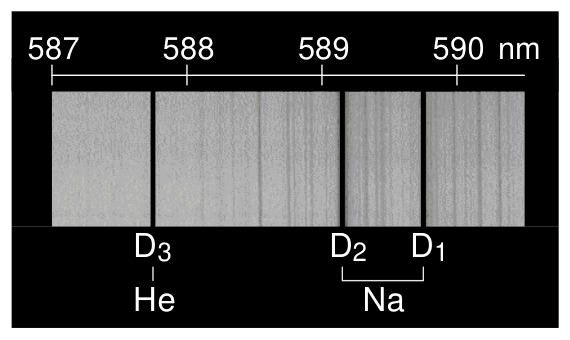
Figure 1. Spectral lines around 588 nm
1.3 Calculate the energy \(E\) [J] of a photon with the wavelength of the \(\mathrm{D}_3\) line of helium shown in Figure 1.
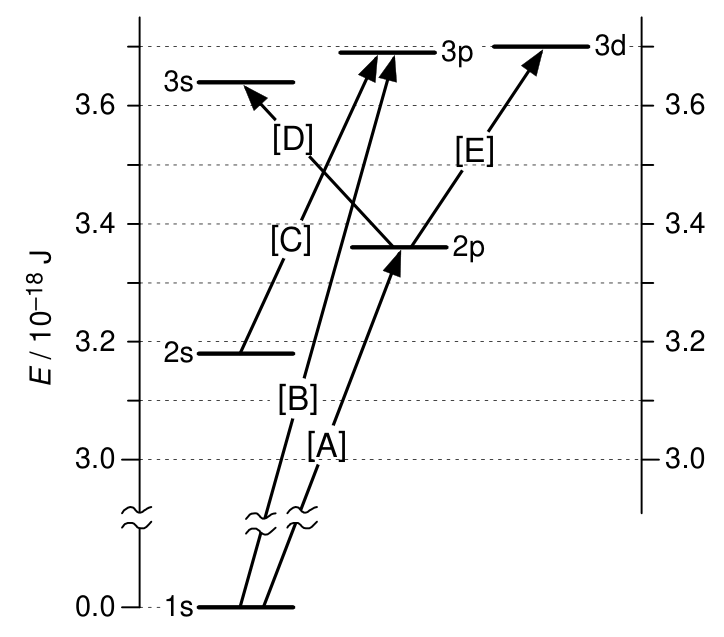
Figure 2. Energy diagram of atomic orbitals of helium when an electron resides in the 1s orbital.
Figure 2 shows an energy diagram of the atomic orbitals of helium. The arrows indicate the "allowed" transitions according to the spectroscopic principle.
1.4 Identify the transition relevant to the \(\mathrm{D}_3\) line of helium among the transitions [A] to [E] indicated in Figure 2. Mark one of the following:
\(\square\) [A] \(\square\) [B] \(\square\) [C] \(\square\) [D] \(\square\) [E]
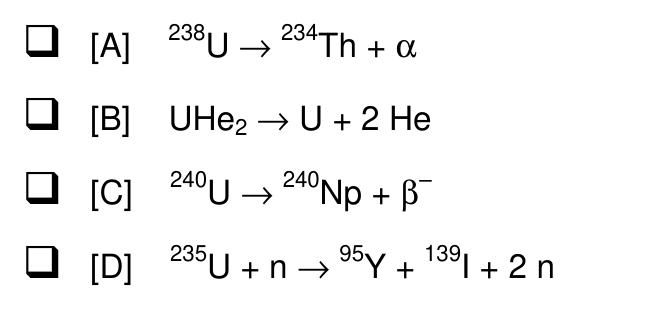
1.5 Which equation explains the occurrence of helium in cleveite among [A] to [D] below? Mark one.
Argon is also found in minerals such as malacon.
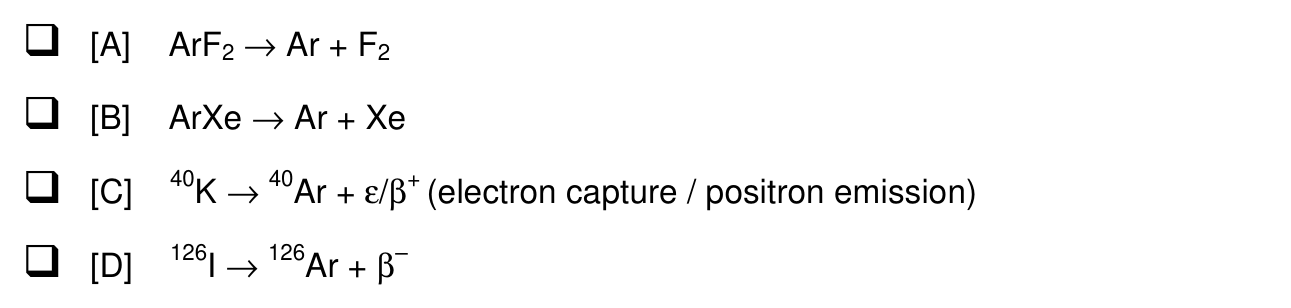
1.6 Which equation explains the occurrence of argon in rocks among [A] to [D] below? Mark one.
One of the strongest evidences for the monoatomicity of argon and helium is the ratio of the heat capacity under constant pressure to that at constant volume, \(\gamma=C_p/C_V\), which is exactly \(5/3\) (\(1.67\pm0.01\)) for a monoatomic gas. The ratio was derived from the measurement of speed of sound \(v_s\) by using the following equation, where \(f\) and \(\lambda\) are the frequency and wavelength of the sound, and \(R\), \(T\), and \(M\) denote the molar gas constant, absolute temperature, and molar mass, respectively.
\[ v_s=f\lambda=\sqrt{\frac{\gamma RT}{M}} \]
For an unknown gas sample, the wavelength of the sound was measured to be \(\lambda=0.116\ \mathrm{m}\) at a frequency of \(f=3520\ \mathrm{Hz}\) (\(\mathrm{Hz}=\mathrm{s^{-1}}\)) and temperature of \(15.0\,^\circ\mathrm{C}\) and under atmospheric pressure (\(1.013\cdot10^5\ \mathrm{Pa}\)). The density \(\rho\) of the gas for these conditions was measured to be \(0.850\pm0.005\ \mathrm{kg\,m^{-3}}\).
1.7 Calculate the molar mass \(M\) [\(\mathrm{kg\,mol^{-1}}\)] of this gas.
1.8 Calculate the heat capacity ratio \(\gamma\) for this gas sample.
1.9 Which is this gas? Choose and mark among [A] to [D] .
\(\square\) [A] \(\ce{HCl}\)
\(\square\) [B] \(\ce{HF}\)
\(\square\) [C] \(\ce{Ne}\)
\(\square\) [D] \(\ce{Ar}\)
Official English text of the problem.
Answers
- 1.1: \(V=1.94\times10^{-3}\ \mathrm{m^3}\).
- 1.2: \(x=0.0114\), corresponding to \(1.14\ \mathrm{mol}\%\) argon.
- 1.3: \(E=3.38\times10^{-19}\ \mathrm{J}\) per photon.
- 1.4: [E], the \(2p\leftrightarrow3d\) transition; emission is \(3d\to2p\).
- 1.5: [A], alpha decay of uranium-238.
- 1.6: [C], conversion of potassium-40 into argon-40.
- 1.7: \(M=2.01\times10^{-2}\ \mathrm{kg\,mol^{-1}}\).
- 1.8: \(\gamma=1.40\).
- 1.9: [B], hydrogen fluoride, \(\ce{HF}\), SMILES
[H]F.
Solution
The calculations use the ideal-gas model and \[ T=273.15+15.0=288.15\ \mathrm{K}. \] The problem does not print the physical constants; standard values used here are \[ R=8.3145\ \mathrm{J\,mol^{-1}\,K^{-1}},\qquad h=6.6261\times10^{-34}\ \mathrm{J\,s},\qquad c=2.9979\times10^8\ \mathrm{m\,s^{-1}}. \]
1.1
Pure nitrogen is molecular nitrogen, \(\ce{N2}\), SMILES N#N, with molar mass \(28.02\ \mathrm{g\,mol^{-1}}\). Its amount in the vessel is
\[
n=\frac{m}{M}
=\frac{2.2990\ \mathrm{g}}{28.02\ \mathrm{g\,mol^{-1}}}
=0.08205\ \mathrm{mol}.
\]
From \(pV=nRT\), \[ V=\frac{nRT}{p} =\frac{(0.08205)(8.3145)(288.15)} {1.013\times10^5}\ \mathrm{m^3} =\boxed{1.94\times10^{-3}\ \mathrm{m^3}}. \]
1.2
Argon, \(\ce{Ar}\), SMILES [Ar], has molar mass \(39.95\ \mathrm{g\,mol^{-1}}\).
At the same pressure, temperature, and vessel volume, the pure nitrogen and the mixture contain the same total amount of gas. If \(x\) is the argon mole fraction, the mixture’s mean molar mass is \[ \overline M=(1-x)M(\ce{N2})+xM(\ce{Ar}). \] Consequently, \[ \frac{m_{\mathrm{atmospheric}}}{m_{\mathrm{chemical}}} =\frac{\overline M}{M(\ce{N2})} =1+x\frac{M(\ce{Ar})-M(\ce{N2})}{M(\ce{N2})}. \]
Solving, \[ x= \left(\frac{2.3102}{2.2990}-1\right) \frac{28.02}{39.95-28.02} =0.011442\ldots \] and therefore \[ \boxed{x=0.0114\quad\text{or}\quad1.14\ \mathrm{mol}\%}. \]
This is the argon fraction in Rayleigh’s oxygen-removed atmospheric sample.
1.3
The helium line—helium, \(\ce{He}\), SMILES [He]—has wavelength approximately \(588\ \mathrm{nm}\). Its photon energy is
\[
E=h\nu=\frac{hc}{\lambda}.
\]
Thus,
\[
E=
\frac{(6.6261\times10^{-34}\ \mathrm{J\,s})
(2.9979\times10^8\ \mathrm{m\,s^{-1}})}
{588\times10^{-9}\ \mathrm{m}}
=\boxed{3.38\times10^{-19}\ \mathrm{J}}.
\]
Reading the line more closely as approximately \(587.7\ \mathrm{nm}\) gives the same result to three significant figures.
1.4
The photon energy must equal the separation between the two levels: \[ \Delta E=3.38\times10^{-19}\ \mathrm{J} =0.338\times10^{-18}\ \mathrm{J}. \]
From Figure 2, the \(2p\) and \(3d\) levels lie at approximately \(3.36\times10^{-18}\ \mathrm{J}\) and \(3.70\times10^{-18}\ \mathrm{J}\), respectively. Their separation is \[ \Delta E\approx(3.70-3.36)\times10^{-18} =3.4\times10^{-19}\ \mathrm{J}, \] which matches the photon energy.
Therefore, mark [E]. The upward arrow represents absorption, \(2p\to3d\); emission of the same spectral line corresponds to \(3d\to2p\). The other electron remains in the \(1s\) orbital.
1.5
Uranium-238 undergoes alpha decay: \[ \boxed{\ce{^{238}_{92}U -> ^{234}_{90}Th + ^{4}_{2}He}}. \]
Both nucleon number and nuclear charge are conserved: \[ 238=234+4,\qquad 92=90+2. \]
The emitted alpha particle is a helium-4 nucleus, \(\ce{^{4}He^{2+}}\), SMILES [4He+2]. After slowing down, it acquires two electrons:
\[
\ce{^{4}He^{2+} + 2 e- -> ^{4}He}.
\]
This produces neutral helium-4, SMILES [4He], which can accumulate in the mineral.
Therefore, mark [A]. SMILES identifies the chemical species; the nuclear transformation is specified by the isotope equation.
1.6
Potassium-40 can form argon-40 by electron capture: \[ \boxed{\ce{^{40}_{19}K + ^{0}_{-1}e -> ^{40}_{18}Ar + \nu_e}}. \] Here \(\nu_e\) is an electron neutrino. The mass number remains 40, while the nuclear charge decreases from 19 to 18.
The positron-emission alternative included in option [C] is \[ \ce{^{40}_{19}K -> ^{40}_{18}Ar + ^{0}_{+1}e + \nu_e}. \]
Both processes produce argon-40, \(\ce{^{40}Ar}\), SMILES [40Ar], which can remain trapped in rocks. Therefore, mark [C].
1.7
Combining the ideal-gas equation with \(n=m/M\) and \(\rho=m/V\), \[ pV=\frac{m}{M}RT \quad\Longrightarrow\quad M=\frac{\rho RT}{p}. \] Therefore, \[ M= \frac{(0.850\ \mathrm{kg\,m^{-3}}) (8.3145\ \mathrm{Pa\,m^3\,mol^{-1}\,K^{-1}}) (288.15\ \mathrm{K})} {1.013\times10^5\ \mathrm{Pa}} =\boxed{2.01\times10^{-2}\ \mathrm{kg\,mol^{-1}}}. \]
Propagating only the stated density uncertainty, \[ \delta M=M\frac{\delta\rho}{\rho} \approx1.2\times10^{-4}\ \mathrm{kg\,mol^{-1}}. \] Thus a result displaying that uncertainty is \[ M=(0.02010\pm0.00012)\ \mathrm{kg\,mol^{-1}}. \]
1.8
The measured speed of sound is \[ v_s=f\lambda =(3520\ \mathrm{s^{-1}})(0.116\ \mathrm{m}) =408.32\ \mathrm{m\,s^{-1}}. \]
Rearranging the supplied relation and substituting \(M=\rho RT/p\), \[ \gamma=\frac{Mv_s^2}{RT} =\frac{\rho v_s^2}{p}. \] Hence, \[ \gamma= \frac{(0.850)(408.32)^2}{1.013\times10^5} =1.39898\ldots =\boxed{1.40}. \]
The density uncertainty alone gives \[ \delta\gamma=\gamma\frac{0.005}{0.850}\approx0.0082, \] or approximately \(\gamma=1.399\pm0.008\).
1.9
The measured molar mass is approximately \(20.1\ \mathrm{g\,mol^{-1}}\). This excludes hydrogen chloride, \(\ce{HCl}\), SMILES [H]Cl, and argon, \(\ce{Ar}\), SMILES [Ar], whose molar masses are approximately \(36.46\) and \(39.95\ \mathrm{g\,mol^{-1}}\), respectively.
Both hydrogen fluoride, \(\ce{HF}\), SMILES [H]F, with \(M\approx20.01\ \mathrm{g\,mol^{-1}}\), and neon, \(\ce{Ne}\), SMILES [Ne], with \(M\approx20.18\ \mathrm{g\,mol^{-1}}\), are compatible with the molar-mass measurement.
The heat-capacity ratio distinguishes them. A monatomic ideal gas such as neon has \[ C_V=\frac32R,\qquad C_p=\frac52R,\qquad \gamma=\frac53\approx1.67. \] A diatomic ideal gas with active translational and rotational motion, but negligible vibrational excitation, has \[ C_V=\frac52R,\qquad C_p=\frac72R,\qquad \gamma=\frac75=1.40. \]
The measured ratio agrees with the diatomic gas. Therefore, mark [B]: hydrogen fluoride, \(\ce{HF}\), SMILES [H]F.
The solution was checked against the official solution.
IChO 2010 · Theorieaufgabe 1
Lord Rayleigh und die Entdeckung des Argons
Im Jahr 1894 berichtete Lord Rayleigh, dass sich die Masse von chemisch hergestelltem Stickstoff von derjenigen des aus der Atmosphäre gewonnenen Stickstoffs unterschied, wie in den Tabellen 1 und 2 dargestellt. Später wurde dieser Unterschied auf das Vorhandensein von Argon im atmosphärischen Stickstoff zurückgeführt. Die Gasmassen wurden mithilfe eines Glasgefäßes mit bekanntem Volumen bei Atmosphärendruck (\(1.013\cdot10^5\ \mathrm{Pa}\)) gemessen.
Tabelle 1. Masse des chemisch hergestellten Stickstoffs im Gefäß
| Aus Stickstoffmonoxid | 2.3001 g |
| Aus Distickstoffmonoxid | 2.2990 g |
| Aus Ammoniumnitrit, bei Rotglut gereinigt | 2.2987 g |
| Aus Harnstoff | 2.2985 g |
| Aus Ammoniumnitrit, in der Kälte gereinigt | 2.2987 g |
| Mittelwert | 2.2990 g |
Tabelle 2. Masse des atmosphärischen Stickstoffs im Gefäß
| \(\ce{O2}\) wurde durch heißes Kupfer entfernt (1892) | 2.3103 g |
| \(\ce{O2}\) wurde durch heißes Eisen entfernt (1893) | 2.3100 g |
| \(\ce{O2}\) wurde durch Eisen(II)-hydroxid entfernt (1894) | 2.3102 g |
| Mittelwert | 2.3102 g |
1.1 Berechnen Sie das Volumen \(V\) [\(\mathrm{m^3}\)] des von Rayleigh verwendeten Gefäßes aus der mittleren Masse des chemisch hergestellten Stickstoffs, bei dem es sich um reinen Stickstoff gehandelt haben muss. Nehmen Sie an, dass die Messungen bei einer Temperatur von \(15.0\,^\circ\mathrm{C}\) durchgeführt wurden.
1.2 Schätzen Sie den Stoffmengenanteil \(x\) von Argon in Rayleighs atmosphärischem Stickstoff unter der Annahme ab, dass Argon und Stickstoff die einzigen Bestandteile waren. Verwenden Sie für die Berechnung die mittleren Massen des atmosphärischen und des chemisch hergestellten Stickstoffs.
Ramsay und Clève entdeckten 1895 unabhängig voneinander und nahezu gleichzeitig Helium in Cleveit (einem Mineral aus Uranoxid sowie Oxiden von Blei, Thorium und Seltenen Erden; einer unreinen Varietät von Uraninit). Das aus dem Gestein gewonnene Gas zeigte eine charakteristische Spektrallinie bei etwa 588 nm (in Abbildung 1 mit \(\mathrm{D}_3\) gekennzeichnet), die erstmals 1868 während einer totalen Sonnenfinsternis im Spektrum einer Sonnenprotuberanz beobachtet worden war, nahe den bekannten \(\mathrm{D}_1\)- und \(\mathrm{D}_2\)-Linien des Natriums.
Abbildung 1. Spektrallinien bei etwa 588 nm
1.3 Berechnen Sie die Energie \(E\) [J] eines Photons mit der Wellenlänge der in Abbildung 1 gezeigten \(\mathrm{D}_3\)-Linie des Heliums.
Abbildung 2. Energiediagramm der Atomorbitale von Helium, wenn sich ein Elektron im 1s-Orbital befindet.
Abbildung 2 zeigt ein Energiediagramm der Atomorbitale von Helium. Die Pfeile kennzeichnen die gemäß dem spektroskopischen Prinzip „erlaubten“ Übergänge.
1.4 Identifizieren Sie unter den in Abbildung 2 dargestellten Übergängen [A] bis [E] den Übergang, der zur \(\mathrm{D}_3\)-Linie des Heliums gehört. Kreuzen Sie eine der folgenden Möglichkeiten an:
\(\square\) [A] \(\square\) [B] \(\square\) [C] \(\square\) [D] \(\square\) [E]
1.5 Welche der folgenden Gleichungen [A] bis [D] erklärt das Vorkommen von Helium in Cleveit? Kreuzen Sie eine an.
Argon kommt auch in Mineralen wie Malakon vor.
1.6 Welche der folgenden Gleichungen [A] bis [D] erklärt das Vorkommen von Argon in Gesteinen? Kreuzen Sie eine an.
Einer der stärksten Belege für die Einatomigkeit von Argon und Helium ist das Verhältnis der Wärmekapazität bei konstantem Druck zu derjenigen bei konstantem Volumen, \(\gamma=C_p/C_V\), das für ein einatomiges Gas genau \(5/3\) (\(1.67\pm0.01\)) beträgt. Das Verhältnis wurde aus der Messung der Schallgeschwindigkeit \(v_s\) mithilfe der folgenden Gleichung bestimmt, wobei \(f\) und \(\lambda\) die Frequenz und die Wellenlänge des Schalls sind und \(R\), \(T\) und \(M\) die molare Gaskonstante, die absolute Temperatur bzw. die molare Masse bezeichnen.
\[ v_s=f\lambda=\sqrt{\frac{\gamma RT}{M}} \]
Für eine unbekannte Gasprobe wurde eine Schallwellenlänge von \(\lambda=0.116\ \mathrm{m}\) bei einer Frequenz von \(f=3520\ \mathrm{Hz}\) (\(\mathrm{Hz}=\mathrm{s^{-1}}\)), einer Temperatur von \(15.0\,^\circ\mathrm{C}\) und Atmosphärendruck (\(1.013\cdot10^5\ \mathrm{Pa}\)) gemessen. Die Dichte \(\rho\) des Gases wurde unter diesen Bedingungen zu \(0.850\pm0.005\ \mathrm{kg\,m^{-3}}\) bestimmt.
1.7 Berechnen Sie die molare Masse \(M\) [\(\mathrm{kg\,mol^{-1}}\)] dieses Gases.
1.8 Berechnen Sie das Wärmekapazitätsverhältnis \(\gamma\) für diese Gasprobe.
1.9 Um welches Gas handelt es sich? Wählen Sie aus [A] bis [D] aus und kreuzen Sie an.
\(\square\) [A] \(\ce{HCl}\)
\(\square\) [B] \(\ce{HF}\)
\(\square\) [C] \(\ce{Ne}\)
\(\square\) [D] \(\ce{Ar}\)
Aufgabentext aus dem offiziellen englischen Text übersetzt.
Antworten
- 1.1: \(V=1.94\times10^{-3}\ \mathrm{m^3}\).
- 1.2: \(x=0.0114\), entsprechend \(1.14\ \mathrm{mol}\%\) Argon.
- 1.3: \(E=3.38\times10^{-19}\ \mathrm{J}\) pro Photon.
- 1.4: [E], der Übergang \(2p\leftrightarrow3d\); die Emission entspricht \(3d\to2p\).
- 1.5: [A], Alphazerfall von Uran-238.
- 1.6: [C], Umwandlung von Kalium-40 in Argon-40.
- 1.7: \(M=2.01\times10^{-2}\ \mathrm{kg\,mol^{-1}}\).
- 1.8: \(\gamma=1.40\).
- 1.9: [B], Fluorwasserstoff, \(\ce{HF}\), SMILES
[H]F.
Lösung
Die Berechnungen verwenden das Modell des idealen Gases und \[ T=273.15+15.0=288.15\ \mathrm{K}. \] Die physikalischen Konstanten sind in der Aufgabenstellung nicht angegeben; hier werden folgende Standardwerte verwendet: \[ R=8.3145\ \mathrm{J\,mol^{-1}\,K^{-1}},\qquad h=6.6261\times10^{-34}\ \mathrm{J\,s},\qquad c=2.9979\times10^8\ \mathrm{m\,s^{-1}}. \]
1.1
Reiner Stickstoff ist molekularer Stickstoff, \(\ce{N2}\), SMILES N#N, mit einer molaren Masse von \(28.02\ \mathrm{g\,mol^{-1}}\). Seine Stoffmenge im Gefäß beträgt
\[
n=\frac{m}{M}
=\frac{2.2990\ \mathrm{g}}{28.02\ \mathrm{g\,mol^{-1}}}
=0.08205\ \mathrm{mol}.
\]
Aus \(pV=nRT\) folgt \[ V=\frac{nRT}{p} =\frac{(0.08205)(8.3145)(288.15)} {1.013\times10^5}\ \mathrm{m^3} =\boxed{1.94\times10^{-3}\ \mathrm{m^3}}. \]
1.2
Argon, \(\ce{Ar}\), SMILES [Ar], hat eine molare Masse von \(39.95\ \mathrm{g\,mol^{-1}}\).
Bei gleichem Druck, gleicher Temperatur und gleichem Gefäßvolumen enthalten der reine Stickstoff und das Gemisch dieselbe Gesamtstoffmenge an Gas. Ist \(x\) der Stoffmengenanteil von Argon, so beträgt die mittlere molare Masse des Gemischs \[ \overline M=(1-x)M(\ce{N2})+xM(\ce{Ar}). \] Folglich gilt \[ \frac{m_{\mathrm{atmospheric}}}{m_{\mathrm{chemical}}} =\frac{\overline M}{M(\ce{N2})} =1+x\frac{M(\ce{Ar})-M(\ce{N2})}{M(\ce{N2})}. \]
Auflösen ergibt \[ x= \left(\frac{2.3102}{2.2990}-1\right) \frac{28.02}{39.95-28.02} =0.011442\ldots \] und somit \[ \boxed{x=0.0114\quad\text{oder}\quad1.14\ \mathrm{mol}\%}. \]
Dies ist der Argonanteil in Rayleighs atmosphärischer Probe nach Entfernung des Sauerstoffs.
1.3
Die Heliumlinie – Helium, \(\ce{He}\), SMILES [He] – hat eine Wellenlänge von ungefähr \(588\ \mathrm{nm}\). Ihre Photonenenergie beträgt
\[
E=h\nu=\frac{hc}{\lambda}.
\]
Damit ergibt sich
\[
E=
\frac{(6.6261\times10^{-34}\ \mathrm{J\,s})
(2.9979\times10^8\ \mathrm{m\,s^{-1}})}
{588\times10^{-9}\ \mathrm{m}}
=\boxed{3.38\times10^{-19}\ \mathrm{J}}.
\]
Ein genaueres Ablesen der Linie bei ungefähr \(587.7\ \mathrm{nm}\) ergibt auf drei signifikante Stellen dasselbe Ergebnis.
1.4
Die Photonenenergie muss dem Abstand zwischen den beiden Energieniveaus entsprechen: \[ \Delta E=3.38\times10^{-19}\ \mathrm{J} =0.338\times10^{-18}\ \mathrm{J}. \]
Abbildung 2 zufolge liegen die Niveaus \(2p\) und \(3d\) bei ungefähr \(3.36\times10^{-18}\ \mathrm{J}\) bzw. \(3.70\times10^{-18}\ \mathrm{J}\). Ihr Abstand beträgt \[ \Delta E\approx(3.70-3.36)\times10^{-18} =3.4\times10^{-19}\ \mathrm{J}, \] was mit der Photonenenergie übereinstimmt.
Daher ist [E] anzukreuzen. Der nach oben gerichtete Pfeil stellt die Absorption dar, \(2p\to3d\); die Emission derselben Spektrallinie entspricht \(3d\to2p\). Das andere Elektron verbleibt im \(1s\)-Orbital.
1.5
Uran-238 unterliegt einem Alphazerfall: \[ \boxed{\ce{^{238}_{92}U -> ^{234}_{90}Th + ^{4}_{2}He}}. \]
Sowohl die Nukleonenzahl als auch die Kernladung bleiben erhalten: \[ 238=234+4,\qquad 92=90+2. \]
Das emittierte Alphateilchen ist ein Helium-4-Kern, \(\ce{^{4}He^{2+}}\), SMILES [4He+2]. Nach dem Abbremsen nimmt es zwei Elektronen auf:
\[
\ce{^{4}He^{2+} + 2 e- -> ^{4}He}.
\]
Dadurch entsteht neutrales Helium-4, SMILES [4He], das sich im Mineral anreichern kann.
Daher ist [A] anzukreuzen. SMILES kennzeichnet die chemische Spezies; die Kernumwandlung wird durch die Isotopengleichung angegeben.
1.6
Kalium-40 kann durch Elektroneneinfang Argon-40 bilden: \[ \boxed{\ce{^{40}_{19}K + ^{0}_{-1}e -> ^{40}_{18}Ar + \nu_e}}. \] Dabei ist \(\nu_e\) ein Elektronneutrino. Die Massenzahl bleibt 40, während die Kernladung von 19 auf 18 abnimmt.
Die in Antwortmöglichkeit [C] enthaltene Alternative der Positronenemission lautet \[ \ce{^{40}_{19}K -> ^{40}_{18}Ar + ^{0}_{+1}e + \nu_e}. \]
Beide Prozesse erzeugen Argon-40, \(\ce{^{40}Ar}\), SMILES [40Ar], das in Gesteinen eingeschlossen bleiben kann. Daher ist [C] anzukreuzen.
1.7
Die Kombination der idealen Gasgleichung mit \(n=m/M\) und \(\rho=m/V\) ergibt \[ pV=\frac{m}{M}RT \quad\Longrightarrow\quad M=\frac{\rho RT}{p}. \] Somit gilt \[ M= \frac{(0.850\ \mathrm{kg\,m^{-3}}) (8.3145\ \mathrm{Pa\,m^3\,mol^{-1}\,K^{-1}}) (288.15\ \mathrm{K})} {1.013\times10^5\ \mathrm{Pa}} =\boxed{2.01\times10^{-2}\ \mathrm{kg\,mol^{-1}}}. \]
Wird bei der Unsicherheitsfortpflanzung nur die angegebene Dichteunsicherheit berücksichtigt, ergibt sich \[ \delta M=M\frac{\delta\rho}{\rho} \approx1.2\times10^{-4}\ \mathrm{kg\,mol^{-1}}. \] Damit lautet das Ergebnis unter Angabe dieser Unsicherheit \[ M=(0.02010\pm0.00012)\ \mathrm{kg\,mol^{-1}}. \]
1.8
Die gemessene Schallgeschwindigkeit beträgt \[ v_s=f\lambda =(3520\ \mathrm{s^{-1}})(0.116\ \mathrm{m}) =408.32\ \mathrm{m\,s^{-1}}. \]
Durch Umstellen der angegebenen Beziehung und Einsetzen von \(M=\rho RT/p\) erhält man \[ \gamma=\frac{Mv_s^2}{RT} =\frac{\rho v_s^2}{p}. \] Daraus folgt \[ \gamma= \frac{(0.850)(408.32)^2}{1.013\times10^5} =1.39898\ldots =\boxed{1.40}. \]
Allein aus der Dichteunsicherheit ergibt sich \[ \delta\gamma=\gamma\frac{0.005}{0.850}\approx0.0082, \] also näherungsweise \(\gamma=1.399\pm0.008\).
1.9
Die gemessene molare Masse beträgt ungefähr \(20.1\ \mathrm{g\,mol^{-1}}\). Damit sind Chlorwasserstoff, \(\ce{HCl}\), SMILES [H]Cl, und Argon, \(\ce{Ar}\), SMILES [Ar], ausgeschlossen, deren molare Massen ungefähr \(36.46\) bzw. \(39.95\ \mathrm{g\,mol^{-1}}\) betragen.
Sowohl Fluorwasserstoff, \(\ce{HF}\), SMILES [H]F, mit \(M\approx20.01\ \mathrm{g\,mol^{-1}}\) als auch Neon, \(\ce{Ne}\), SMILES [Ne], mit \(M\approx20.18\ \mathrm{g\,mol^{-1}}\) sind mit der Messung der molaren Masse vereinbar.
Das Wärmekapazitätsverhältnis ermöglicht die Unterscheidung. Für ein einatomiges ideales Gas wie Neon gilt \[ C_V=\frac32R,\qquad C_p=\frac52R,\qquad \gamma=\frac53\approx1.67. \] Für ein zweiatomiges ideales Gas mit angeregter Translations- und Rotationsbewegung, aber vernachlässigbarer Schwingungsanregung, gilt \[ C_V=\frac52R,\qquad C_p=\frac72R,\qquad \gamma=\frac75=1.40. \]
Das gemessene Verhältnis stimmt mit dem des zweiatomigen Gases überein. Daher ist [B] anzukreuzen: Fluorwasserstoff, \(\ce{HF}\), SMILES [H]F.
Die Lösung wurde mit der offiziellen Lösung abgeglichen.
IChO 2010 · Teori sorusu 1
Lord Rayleigh ve argonun keşfi
1894 yılında Lord Rayleigh, Tablo 1 ve 2'de gösterildiği gibi, kimyasal yolla hazırlanan azotun kütlesinin atmosferden elde edilen azotun kütlesinden farklı olduğunu bildirdi. Daha sonra bu farkın, atmosferik azotta argon bulunmasından kaynaklandığı anlaşıldı. Gazların kütleleri, atmosfer basıncında (\(1.013\cdot10^5\ \mathrm{Pa}\)) hacmi bilinen bir cam kap kullanılarak ölçüldü.
Tablo 1. Kaptaki Kimyasal Yolla Elde Edilen Azotun Kütlesi
| Azot monoksitten | 2.3001 g |
| Diazot monoksitten | 2.2990 g |
| Kızıl kor sıcaklığında saflaştırılmış amonyum nitritten | 2.2987 g |
| Üreden | 2.2985 g |
| Soğukta saflaştırılmış amonyum nitritten | 2.2987 g |
| Ortalama | 2.2990 g |
Tablo 2. Kaptaki Atmosferik Azotun Kütlesi
| \(\ce{O2}\) sıcak bakırla uzaklaştırıldı (1892) | 2.3103 g |
| \(\ce{O2}\) sıcak demirle uzaklaştırıldı (1893) | 2.3100 g |
| \(\ce{O2}\) demir(II) hidroksitle uzaklaştırıldı (1894) | 2.3102 g |
| Ortalama | 2.3102 g |
1.1 Saf azot olması gereken kimyasal yolla elde edilen azotun ortalama kütlesinden, Rayleigh'in kullandığı kabın \(V\) [\(\mathrm{m^3}\)] hacmini hesaplayınız. Ölçümlerin \(15.0\,^\circ\mathrm{C}\) sıcaklıkta yapıldığını varsayınız.
1.2 Argon ve azotun tek bileşenler olduğunu varsayarak, Rayleigh'in atmosferik azotundaki argonun \(x\) mol kesrini tahmin ediniz. Hesaplamada atmosferik azotun ve kimyasal yolla elde edilen azotun ortalama kütlelerini kullanınız.
Ramsay ve Clève, 1895 yılında birbirlerinden bağımsız olarak ve hemen hemen aynı zamanda, kleveyitte (uranyum oksit ile kurşun, toryum ve nadir toprak elementlerinin oksitlerinden oluşan bir mineral; uraninitin saf olmayan bir türü) helyumu keşfettiler. Kayaçtan elde edilen gaz, yaklaşık 588 nm'de kendine özgü bir spektroskopik çizgi (Şekil 1'de \(\mathrm{D}_3\) ile gösterilmiştir) veriyordu. Bu çizgi ilk kez 1868'deki bir tam Güneş tutulması sırasında, Güneş'in bir protüberansının spektrumunda, sodyumun iyi bilinen \(\mathrm{D}_1\) ve \(\mathrm{D}_2\) çizgilerinin yakınında gözlenmişti.
Şekil 1. 588 nm civarındaki spektral çizgiler
1.3 Dalga boyu, Şekil 1'de gösterilen helyumun \(\mathrm{D}_3\) çizgisinin dalga boyuna eşit olan bir fotonun \(E\) [J] enerjisini hesaplayınız.
Şekil 2. Bir elektron 1s orbitalinde bulunurken helyumun atomik orbitallerinin enerji diyagramı.
Şekil 2, helyumun atomik orbitallerinin enerji diyagramını göstermektedir. Oklar, spektroskopik ilkeye göre "izinli" geçişleri göstermektedir.
1.4 Şekil 2'de gösterilen [A] ile [E] arasındaki geçişlerden, helyumun \(\mathrm{D}_3\) çizgisine karşılık gelen geçişi belirleyiniz. Aşağıdakilerden birini işaretleyiniz:
\(\square\) [A] \(\square\) [B] \(\square\) [C] \(\square\) [D] \(\square\) [E]
1.5 Aşağıdaki [A] ile [D] arasındaki denklemlerden hangisi kleveyitte helyum bulunmasını açıklar? Birini işaretleyiniz.
Argon, malakon gibi minerallerde de bulunur.
1.6 Aşağıdaki [A] ile [D] arasındaki denklemlerden hangisi kayaçlarda argon bulunmasını açıklar? Birini işaretleyiniz.
Argon ve helyumun tek atomlu olduğuna ilişkin en güçlü kanıtlardan biri, sabit basınçtaki ısı kapasitesinin sabit hacimdeki ısı kapasitesine oranı olan \(\gamma=C_p/C_V\) değeridir; bu oran tek atomlu bir gaz için tam olarak \(5/3\) (\(1.67\pm0.01\)) olur. Bu oran, ses hızı \(v_s\) ölçülerek aşağıdaki denklem yardımıyla elde edilmiştir. Burada \(f\) ve \(\lambda\) sesin frekansı ve dalga boyudur; \(R\), \(T\) ve \(M\) ise sırasıyla molar gaz sabitini, mutlak sıcaklığı ve molar kütleyi gösterir.
\[ v_s=f\lambda=\sqrt{\frac{\gamma RT}{M}} \]
Bilinmeyen bir gaz örneğinde, \(f=3520\ \mathrm{Hz}\) (\(\mathrm{Hz}=\mathrm{s^{-1}}\)) frekansta, \(15.0\,^\circ\mathrm{C}\) sıcaklıkta ve atmosfer basıncında (\(1.013\cdot10^5\ \mathrm{Pa}\)) sesin dalga boyu \(\lambda=0.116\ \mathrm{m}\) olarak ölçülmüştür. Gazın bu koşullardaki \(\rho\) yoğunluğu \(0.850\pm0.005\ \mathrm{kg\,m^{-3}}\) olarak ölçülmüştür.
1.7 Bu gazın \(M\) [\(\mathrm{kg\,mol^{-1}}\)] molar kütlesini hesaplayınız.
1.8 Bu gaz örneği için \(\gamma\) ısı kapasitesi oranını hesaplayınız.
1.9 Bu gaz hangisidir? [A] ile [D] arasından seçip işaretleyiniz.
\(\square\) [A] \(\ce{HCl}\)
\(\square\) [B] \(\ce{HF}\)
\(\square\) [C] \(\ce{Ne}\)
\(\square\) [D] \(\ce{Ar}\)
Soru metni resmi İngilizce metinden çevrilmiştir.
Cevaplar
- 1.1: \(V=1.94\times10^{-3}\ \mathrm{m^3}\).
- 1.2: \(x=0.0114\); bu, \(1.14\ \mathrm{mol}\%\) argona karşılık gelir.
- 1.3: Foton başına \(E=3.38\times10^{-19}\ \mathrm{J}\).
- 1.4: [E], \(2p\leftrightarrow3d\) geçişi; emisyon \(3d\to2p\) yönündedir.
- 1.5: [A], uranyum-238'in alfa bozunması.
- 1.6: [C], potasyum-40'ın argon-40'a dönüşümü.
- 1.7: \(M=2.01\times10^{-2}\ \mathrm{kg\,mol^{-1}}\).
- 1.8: \(\gamma=1.40\).
- 1.9: [B], hidrojen florür, \(\ce{HF}\), SMILES
[H]F.
Çözüm
Hesaplamalarda ideal gaz modeli kullanılır ve sıcaklık şöyledir: \[ T=273.15+15.0=288.15\ \mathrm{K}. \] Soru metninde fiziksel sabitler verilmemiştir; burada kullanılan standart değerler şunlardır: \[ R=8.3145\ \mathrm{J\,mol^{-1}\,K^{-1}},\qquad h=6.6261\times10^{-34}\ \mathrm{J\,s},\qquad c=2.9979\times10^8\ \mathrm{m\,s^{-1}}. \]
1.1
Saf azot, molar kütlesi \(28.02\ \mathrm{g\,mol^{-1}}\) olan moleküler azottur, \(\ce{N2}\), SMILES N#N. Kaptaki madde miktarı şöyledir:
\[
n=\frac{m}{M}
=\frac{2.2990\ \mathrm{g}}{28.02\ \mathrm{g\,mol^{-1}}}
=0.08205\ \mathrm{mol}.
\]
\(pV=nRT\) bağıntısından, \[ V=\frac{nRT}{p} =\frac{(0.08205)(8.3145)(288.15)} {1.013\times10^5}\ \mathrm{m^3} =\boxed{1.94\times10^{-3}\ \mathrm{m^3}}. \]
1.2
Argonun, \(\ce{Ar}\), SMILES [Ar], molar kütlesi \(39.95\ \mathrm{g\,mol^{-1}}\) değerindedir.
Aynı basınç, sıcaklık ve kap hacminde, saf azot ile karışımın içerdiği toplam gaz madde miktarı aynıdır. Argonun mol kesri \(x\) ise karışımın ortalama molar kütlesi şöyledir: \[ \overline M=(1-x)M(\ce{N2})+xM(\ce{Ar}). \] Buna göre, \[ \frac{m_{\mathrm{atmospheric}}}{m_{\mathrm{chemical}}} =\frac{\overline M}{M(\ce{N2})} =1+x\frac{M(\ce{Ar})-M(\ce{N2})}{M(\ce{N2})}. \]
Çözüldüğünde, \[ x= \left(\frac{2.3102}{2.2990}-1\right) \frac{28.02}{39.95-28.02} =0.011442\ldots \] ve dolayısıyla \[ \boxed{x=0.0114\quad\text{veya}\quad1.14\ \mathrm{mol}\%}. \]
Bu, Rayleigh'in oksijeni uzaklaştırılmış atmosferik örneğindeki argon kesridir.
1.3
Helyum çizgisinin —helyum, \(\ce{He}\), SMILES [He]— dalga boyu yaklaşık \(588\ \mathrm{nm}\) değerindedir. Foton enerjisi şöyledir:
\[
E=h\nu=\frac{hc}{\lambda}.
\]
Böylece,
\[
E=
\frac{(6.6261\times10^{-34}\ \mathrm{J\,s})
(2.9979\times10^8\ \mathrm{m\,s^{-1}})}
{588\times10^{-9}\ \mathrm{m}}
=\boxed{3.38\times10^{-19}\ \mathrm{J}}.
\]
Çizginin dalga boyunu daha hassas biçimde yaklaşık \(587.7\ \mathrm{nm}\) olarak okumak, üç anlamlı basamakla aynı sonucu verir.
1.4
Foton enerjisi, iki düzey arasındaki enerji farkına eşit olmalıdır: \[ \Delta E=3.38\times10^{-19}\ \mathrm{J} =0.338\times10^{-18}\ \mathrm{J}. \]
Şekil 2'ye göre \(2p\) ve \(3d\) düzeyleri sırasıyla yaklaşık \(3.36\times10^{-18}\ \mathrm{J}\) ve \(3.70\times10^{-18}\ \mathrm{J}\) enerjilerindedir. Aralarındaki enerji farkı \[ \Delta E\approx(3.70-3.36)\times10^{-18} =3.4\times10^{-19}\ \mathrm{J}, \] olup foton enerjisiyle uyuşur.
Bu nedenle [E]'yi işaretleyiniz. Yukarı yönlü ok, soğurmayı, \(2p\to3d\), gösterir; aynı spektral çizginin emisyonu \(3d\to2p\) geçişine karşılık gelir. Diğer elektron \(1s\) orbitalinde kalır.
1.5
Uranyum-238 alfa bozunmasına uğrar: \[ \boxed{\ce{^{238}_{92}U -> ^{234}_{90}Th + ^{4}_{2}He}}. \]
Hem nükleon sayısı hem de çekirdek yükü korunur: \[ 238=234+4,\qquad 92=90+2. \]
Yayılan alfa parçacığı bir helyum-4 çekirdeğidir, \(\ce{^{4}He^{2+}}\), SMILES [4He+2]. Yavaşladıktan sonra iki elektron alır:
\[
\ce{^{4}He^{2+} + 2 e- -> ^{4}He}.
\]
Bunun sonucunda mineralde birikebilen nötr helyum-4, SMILES [4He], oluşur.
Bu nedenle [A]'yı işaretleyiniz. SMILES kimyasal türü tanımlar; nükleer dönüşüm ise izotop denklemiyle belirtilir.
1.6
Potasyum-40, elektron yakalama yoluyla argon-40 oluşturabilir: \[ \boxed{\ce{^{40}_{19}K + ^{0}_{-1}e -> ^{40}_{18}Ar + \nu_e}}. \] Burada \(\nu_e\) bir elektron nötrinosudur. Kütle numarası 40 olarak kalırken çekirdek yükü 19'dan 18'e düşer.
[C] seçeneğinde yer alan pozitron emisyonu alternatifi şöyledir: \[ \ce{^{40}_{19}K -> ^{40}_{18}Ar + ^{0}_{+1}e + \nu_e}. \]
Her iki süreç de kayaçlarda hapsolmuş hâlde kalabilen argon-40, \(\ce{^{40}Ar}\), SMILES [40Ar], üretir. Bu nedenle [C]'yi işaretleyiniz.
1.7
İdeal gaz denklemi, \(n=m/M\) ve \(\rho=m/V\) ile birleştirildiğinde, \[ pV=\frac{m}{M}RT \quad\Longrightarrow\quad M=\frac{\rho RT}{p}. \] Dolayısıyla, \[ M= \frac{(0.850\ \mathrm{kg\,m^{-3}}) (8.3145\ \mathrm{Pa\,m^3\,mol^{-1}\,K^{-1}}) (288.15\ \mathrm{K})} {1.013\times10^5\ \mathrm{Pa}} =\boxed{2.01\times10^{-2}\ \mathrm{kg\,mol^{-1}}}. \]
Yalnızca belirtilen yoğunluk belirsizliğinin yayılımı hesaba katıldığında, \[ \delta M=M\frac{\delta\rho}{\rho} \approx1.2\times10^{-4}\ \mathrm{kg\,mol^{-1}}. \] Böylece bu belirsizliği gösteren sonuç şöyledir: \[ M=(0.02010\pm0.00012)\ \mathrm{kg\,mol^{-1}}. \]
1.8
Ölçülen ses hızı şöyledir: \[ v_s=f\lambda =(3520\ \mathrm{s^{-1}})(0.116\ \mathrm{m}) =408.32\ \mathrm{m\,s^{-1}}. \]
Verilen bağıntı yeniden düzenlenip \(M=\rho RT/p\) yerine konulduğunda, \[ \gamma=\frac{Mv_s^2}{RT} =\frac{\rho v_s^2}{p}. \] Buna göre, \[ \gamma= \frac{(0.850)(408.32)^2}{1.013\times10^5} =1.39898\ldots =\boxed{1.40}. \]
Yalnızca yoğunluk belirsizliği hesaba katıldığında \[ \delta\gamma=\gamma\frac{0.005}{0.850}\approx0.0082, \] yani yaklaşık \(\gamma=1.399\pm0.008\) elde edilir.
1.9
Ölçülen molar kütle yaklaşık \(20.1\ \mathrm{g\,mol^{-1}}\) değerindedir. Bu, molar kütleleri sırasıyla yaklaşık \(36.46\) ve \(39.95\ \mathrm{g\,mol^{-1}}\) olan hidrojen klorürü, \(\ce{HCl}\), SMILES [H]Cl, ve argonu, \(\ce{Ar}\), SMILES [Ar], eler.
Hem \(M\approx20.01\ \mathrm{g\,mol^{-1}}\) molar kütleli hidrojen florür, \(\ce{HF}\), SMILES [H]F, hem de \(M\approx20.18\ \mathrm{g\,mol^{-1}}\) molar kütleli neon, \(\ce{Ne}\), SMILES [Ne], molar kütle ölçümüyle uyumludur.
Isı kapasitesi oranı bu ikisini ayırt eder. Neon gibi tek atomlu bir ideal gaz için \[ C_V=\frac32R,\qquad C_p=\frac52R,\qquad \gamma=\frac53\approx1.67. \] Öteleme ve dönme hareketlerinin etkin olduğu, ancak titreşimsel uyarılmanın ihmal edilebildiği iki atomlu bir ideal gaz için \[ C_V=\frac52R,\qquad C_p=\frac72R,\qquad \gamma=\frac75=1.40. \]
Ölçülen oran, iki atomlu gazla uyumludur. Bu nedenle [B]'yi işaretleyiniz: hidrojen florür, \(\ce{HF}\), SMILES [H]F.
Çözüm, resmi çözümle karşılaştırılarak kontrol edildi.
IChO 2010 · Problema teórico 1
Lord Rayleigh y el descubrimiento del argón
En 1894, Lord Rayleigh informó de que la masa del nitrógeno preparado por métodos químicos era diferente de la del nitrógeno extraído de la atmósfera, como se muestra en las Tablas 1 y 2. Posteriormente, esta diferencia se atribuyó a la presencia de argón en el nitrógeno atmosférico. Las masas de los gases se midieron utilizando un recipiente de vidrio de volumen conocido a presión atmosférica (\(1.013\cdot10^5\ \mathrm{Pa}\)).
Tabla 1. Masa de nitrógeno químico en el recipiente
| A partir de óxido nítrico | 2.3001 g |
| A partir de óxido nitroso | 2.2990 g |
| A partir de nitrito de amonio purificado al rojo vivo | 2.2987 g |
| A partir de urea | 2.2985 g |
| A partir de nitrito de amonio purificado en frío | 2.2987 g |
| Media | 2.2990 g |
Tabla 2. Masa de nitrógeno atmosférico en el recipiente
| El \(\ce{O2}\) se eliminó con cobre caliente (1892) | 2.3103 g |
| El \(\ce{O2}\) se eliminó con hierro caliente (1893) | 2.3100 g |
| El \(\ce{O2}\) se eliminó con hidróxido ferroso (1894) | 2.3102 g |
| Media | 2.3102 g |
1.1 Calcule el volumen \(V\) [\(\mathrm{m^3}\)] del recipiente utilizado por Rayleigh a partir de la masa media del nitrógeno químico, que debía ser nitrógeno puro. Suponga que las mediciones se realizaron a una temperatura de \(15.0\,^\circ\mathrm{C}\).
1.2 Estime la fracción molar \(x\) de argón en el nitrógeno atmosférico de Rayleigh, suponiendo que el argón y el nitrógeno eran los únicos componentes. Utilice las masas medias del nitrógeno atmosférico y del nitrógeno químico para el cálculo.
Ramsay y Clève descubrieron helio en la cleveíta (un mineral compuesto por óxido de uranio y óxidos de plomo, torio y tierras raras; una variedad impura de uraninita) de forma independiente y prácticamente simultánea en 1895. El gas extraído de la roca presentaba una línea espectral característica en torno a 588 nm (indicada como \(\mathrm{D}_3\) en la Figura 1), que se había observado por primera vez en el espectro de una protuberancia solar durante un eclipse total en 1868, cerca de las conocidas líneas \(\mathrm{D}_1\) y \(\mathrm{D}_2\) del sodio.
Figura 1. Líneas espectrales en torno a 588 nm
1.3 Calcule la energía \(E\) [J] de un fotón con la longitud de onda de la línea \(\mathrm{D}_3\) del helio que se muestra en la Figura 1.
Figura 2. Diagrama de energías de los orbitales atómicos del helio cuando un electrón ocupa el orbital 1s.
La Figura 2 muestra un diagrama de energías de los orbitales atómicos del helio. Las flechas indican las transiciones «permitidas» según el principio espectroscópico.
1.4 Identifique la transición correspondiente a la línea \(\mathrm{D}_3\) del helio entre las transiciones [A] a [E] indicadas en la Figura 2. Marque una de las siguientes:
\(\square\) [A] \(\square\) [B] \(\square\) [C] \(\square\) [D] \(\square\) [E]
1.5 ¿Cuál de las ecuaciones [A] a [D] que aparecen a continuación explica la presencia de helio en la cleveíta? Marque una.
El argón también se encuentra en minerales como el malacón.
1.6 ¿Cuál de las ecuaciones [A] a [D] que aparecen a continuación explica la presencia de argón en las rocas? Marque una.
Una de las pruebas más sólidas del carácter monoatómico del argón y del helio es el cociente entre la capacidad calorífica a presión constante y la capacidad calorífica a volumen constante, \(\gamma=C_p/C_V\), que es exactamente \(5/3\) (\(1.67\pm0.01\)) para un gas monoatómico. Este cociente se obtuvo a partir de la medición de la velocidad del sonido \(v_s\) utilizando la siguiente ecuación, donde \(f\) y \(\lambda\) son la frecuencia y la longitud de onda del sonido, y \(R\), \(T\) y \(M\) representan la constante molar de los gases, la temperatura absoluta y la masa molar, respectivamente.
\[ v_s=f\lambda=\sqrt{\frac{\gamma RT}{M}} \]
En una muestra de un gas desconocido, se midió una longitud de onda del sonido de \(\lambda=0.116\ \mathrm{m}\) a una frecuencia de \(f=3520\ \mathrm{Hz}\) (\(\mathrm{Hz}=\mathrm{s^{-1}}\)), una temperatura de \(15.0\,^\circ\mathrm{C}\) y a presión atmosférica (\(1.013\cdot10^5\ \mathrm{Pa}\)). La densidad \(\rho\) del gas medida en estas condiciones fue de \(0.850\pm0.005\ \mathrm{kg\,m^{-3}}\).
1.7 Calcule la masa molar \(M\) [\(\mathrm{kg\,mol^{-1}}\)] de este gas.
1.8 Calcule el cociente de capacidades caloríficas \(\gamma\) de esta muestra de gas.
1.9 ¿De qué gas se trata? Elija y marque una de las opciones [A] a [D].
\(\square\) [A] \(\ce{HCl}\)
\(\square\) [B] \(\ce{HF}\)
\(\square\) [C] \(\ce{Ne}\)
\(\square\) [D] \(\ce{Ar}\)
Enunciado traducido del texto oficial en inglés.
Respuestas
- 1.1: \(V=1.94\times10^{-3}\ \mathrm{m^3}\).
- 1.2: \(x=0.0114\), correspondiente a \(1.14\ \mathrm{mol}\%\) de argón.
- 1.3: \(E=3.38\times10^{-19}\ \mathrm{J}\) por fotón.
- 1.4: [E], la transición \(2p\leftrightarrow3d\); la emisión es \(3d\to2p\).
- 1.5: [A], desintegración alfa del uranio-238.
- 1.6: [C], conversión de potasio-40 en argón-40.
- 1.7: \(M=2.01\times10^{-2}\ \mathrm{kg\,mol^{-1}}\).
- 1.8: \(\gamma=1.40\).
- 1.9: [B], fluoruro de hidrógeno, \(\ce{HF}\), SMILES
[H]F.
Solución
Los cálculos utilizan el modelo de gas ideal y \[ T=273.15+15.0=288.15\ \mathrm{K}. \] El enunciado no proporciona las constantes físicas; los valores estándar utilizados aquí son \[ R=8.3145\ \mathrm{J\,mol^{-1}\,K^{-1}},\qquad h=6.6261\times10^{-34}\ \mathrm{J\,s},\qquad c=2.9979\times10^8\ \mathrm{m\,s^{-1}}. \]
1.1
El nitrógeno puro es nitrógeno molecular, \(\ce{N2}\), SMILES N#N, con una masa molar de \(28.02\ \mathrm{g\,mol^{-1}}\). Su cantidad de sustancia en el recipiente es
\[
n=\frac{m}{M}
=\frac{2.2990\ \mathrm{g}}{28.02\ \mathrm{g\,mol^{-1}}}
=0.08205\ \mathrm{mol}.
\]
A partir de \(pV=nRT\), \[ V=\frac{nRT}{p} =\frac{(0.08205)(8.3145)(288.15)} {1.013\times10^5}\ \mathrm{m^3} =\boxed{1.94\times10^{-3}\ \mathrm{m^3}}. \]
1.2
El argón, \(\ce{Ar}\), SMILES [Ar], tiene una masa molar de \(39.95\ \mathrm{g\,mol^{-1}}\).
A la misma presión y temperatura, y para el mismo volumen del recipiente, el nitrógeno puro y la mezcla contienen la misma cantidad total de gas. Si \(x\) es la fracción molar de argón, la masa molar media de la mezcla es \[ \overline M=(1-x)M(\ce{N2})+xM(\ce{Ar}). \] Por consiguiente, \[ \frac{m_{\mathrm{atmospheric}}}{m_{\mathrm{chemical}}} =\frac{\overline M}{M(\ce{N2})} =1+x\frac{M(\ce{Ar})-M(\ce{N2})}{M(\ce{N2})}. \]
Despejando, \[ x= \left(\frac{2.3102}{2.2990}-1\right) \frac{28.02}{39.95-28.02} =0.011442\ldots \] y, por tanto, \[ \boxed{x=0.0114\quad\text{o}\quad1.14\ \mathrm{mol}\%}. \]
Esta es la fracción de argón en la muestra atmosférica de Rayleigh de la que se había eliminado el oxígeno.
1.3
La línea del helio —helio, \(\ce{He}\), SMILES [He]— tiene una longitud de onda de aproximadamente \(588\ \mathrm{nm}\). La energía de su fotón es
\[
E=h\nu=\frac{hc}{\lambda}.
\]
Así,
\[
E=
\frac{(6.6261\times10^{-34}\ \mathrm{J\,s})
(2.9979\times10^8\ \mathrm{m\,s^{-1}})}
{588\times10^{-9}\ \mathrm{m}}
=\boxed{3.38\times10^{-19}\ \mathrm{J}}.
\]
Una lectura más precisa de la línea, de aproximadamente \(587.7\ \mathrm{nm}\), da el mismo resultado con tres cifras significativas.
1.4
La energía del fotón debe ser igual a la separación entre los dos niveles: \[ \Delta E=3.38\times10^{-19}\ \mathrm{J} =0.338\times10^{-18}\ \mathrm{J}. \]
Según la Figura 2, los niveles \(2p\) y \(3d\) se encuentran aproximadamente a \(3.36\times10^{-18}\ \mathrm{J}\) y \(3.70\times10^{-18}\ \mathrm{J}\), respectivamente. Su separación es \[ \Delta E\approx(3.70-3.36)\times10^{-18} =3.4\times10^{-19}\ \mathrm{J}, \] lo que coincide con la energía del fotón.
Por tanto, marque [E]. La flecha ascendente representa la absorción, \(2p\to3d\); la emisión de la misma línea espectral corresponde a \(3d\to2p\). El otro electrón permanece en el orbital \(1s\).
1.5
El uranio-238 experimenta desintegración alfa: \[ \boxed{\ce{^{238}_{92}U -> ^{234}_{90}Th + ^{4}_{2}He}}. \]
Se conservan tanto el número de nucleones como la carga nuclear: \[ 238=234+4,\qquad 92=90+2. \]
La partícula alfa emitida es un núcleo de helio-4, \(\ce{^{4}He^{2+}}\), SMILES [4He+2]. Tras frenarse, adquiere dos electrones:
\[
\ce{^{4}He^{2+} + 2 e- -> ^{4}He}.
\]
Esto produce helio-4 neutro, SMILES [4He], que puede acumularse en el mineral.
Por tanto, marque [A]. SMILES identifica la especie química; la transformación nuclear se especifica mediante la ecuación isotópica.
1.6
El potasio-40 puede formar argón-40 mediante captura electrónica: \[ \boxed{\ce{^{40}_{19}K + ^{0}_{-1}e -> ^{40}_{18}Ar + \nu_e}}. \] Aquí, \(\nu_e\) es un neutrino electrónico. El número másico sigue siendo 40, mientras que la carga nuclear disminuye de 19 a 18.
La alternativa de emisión de positrones incluida en la opción [C] es \[ \ce{^{40}_{19}K -> ^{40}_{18}Ar + ^{0}_{+1}e + \nu_e}. \]
Ambos procesos producen argón-40, \(\ce{^{40}Ar}\), SMILES [40Ar], que puede quedar atrapado en las rocas. Por tanto, marque [C].
1.7
Combinando la ecuación de los gases ideales con \(n=m/M\) y \(\rho=m/V\), \[ pV=\frac{m}{M}RT \quad\Longrightarrow\quad M=\frac{\rho RT}{p}. \] Por tanto, \[ M= \frac{(0.850\ \mathrm{kg\,m^{-3}}) (8.3145\ \mathrm{Pa\,m^3\,mol^{-1}\,K^{-1}}) (288.15\ \mathrm{K})} {1.013\times10^5\ \mathrm{Pa}} =\boxed{2.01\times10^{-2}\ \mathrm{kg\,mol^{-1}}}. \]
Propagando únicamente la incertidumbre indicada para la densidad, \[ \delta M=M\frac{\delta\rho}{\rho} \approx1.2\times10^{-4}\ \mathrm{kg\,mol^{-1}}. \] Así, el resultado que incluye esa incertidumbre es \[ M=(0.02010\pm0.00012)\ \mathrm{kg\,mol^{-1}}. \]
1.8
La velocidad del sonido medida es \[ v_s=f\lambda =(3520\ \mathrm{s^{-1}})(0.116\ \mathrm{m}) =408.32\ \mathrm{m\,s^{-1}}. \]
Reordenando la relación proporcionada y sustituyendo \(M=\rho RT/p\), \[ \gamma=\frac{Mv_s^2}{RT} =\frac{\rho v_s^2}{p}. \] De ahí, \[ \gamma= \frac{(0.850)(408.32)^2}{1.013\times10^5} =1.39898\ldots =\boxed{1.40}. \]
La incertidumbre de la densidad por sí sola da \[ \delta\gamma=\gamma\frac{0.005}{0.850}\approx0.0082, \] o, aproximadamente, \(\gamma=1.399\pm0.008\).
1.9
La masa molar medida es de aproximadamente \(20.1\ \mathrm{g\,mol^{-1}}\). Esto descarta el cloruro de hidrógeno, \(\ce{HCl}\), SMILES [H]Cl, y el argón, \(\ce{Ar}\), SMILES [Ar], cuyas masas molares son de aproximadamente \(36.46\) y \(39.95\ \mathrm{g\,mol^{-1}}\), respectivamente.
Tanto el fluoruro de hidrógeno, \(\ce{HF}\), SMILES [H]F, con \(M\approx20.01\ \mathrm{g\,mol^{-1}}\), como el neón, \(\ce{Ne}\), SMILES [Ne], con \(M\approx20.18\ \mathrm{g\,mol^{-1}}\), son compatibles con la medición de la masa molar.
El cociente de capacidades caloríficas permite distinguirlos. Un gas ideal monoatómico como el neón tiene \[ C_V=\frac32R,\qquad C_p=\frac52R,\qquad \gamma=\frac53\approx1.67. \] Un gas ideal diatómico con movimientos de traslación y rotación activos, pero con excitación vibracional despreciable, tiene \[ C_V=\frac52R,\qquad C_p=\frac72R,\qquad \gamma=\frac75=1.40. \]
El cociente medido concuerda con el gas diatómico. Por tanto, marque [B]: fluoruro de hidrógeno, \(\ce{HF}\), SMILES [H]F.
La solución se comprobó con la solución oficial.
IChO 2010 · 理论题 1
瑞利勋爵与氩的发现
1894 年,瑞利勋爵报告指出,用化学方法制得的氮气与从大气中提取的氮气的质量不同,如表 1 和表 2 所示。后来,这一差异被归因于大气氮气中存在氩。气体质量是在大气压(\(1.013\cdot10^5\ \mathrm{Pa}\))下,使用一个容积已知的玻璃容器测得的。
表 1. 容器中化学法制得的氮气的质量
| 由一氧化氮制得 | 2.3001 g |
| 由一氧化二氮制得 | 2.2990 g |
| 由亚硝酸铵制得并在红热条件下纯化 | 2.2987 g |
| 由尿素制得 | 2.2985 g |
| 由亚硝酸铵制得并在低温下纯化 | 2.2987 g |
| 平均值 | 2.2990 g |
表 2. 容器中大气氮气的质量
| 用热铜除去 \(\ce{O2}\)(1892 年) | 2.3103 g |
| 用热铁除去 \(\ce{O2}\)(1893 年) | 2.3100 g |
| 用氢氧化亚铁除去 \(\ce{O2}\)(1894 年) | 2.3102 g |
| 平均值 | 2.3102 g |
1.1 根据化学法制得的氮气的平均质量,计算瑞利所用容器的容积 \(V\) [\(\mathrm{m^3}\)];这种氮气应当是纯氮气。假定测量在 \(15.0\,^\circ\mathrm{C}\) 的温度下进行。
1.2 假定氩和氮气是仅有的组分,估算瑞利的大气氮气中氩的摩尔分数 \(x\)。计算时使用大气氮气和化学法制得的氮气的平均质量。
1895 年,Ramsay 和 Clève 各自独立地、几乎同时在钇铀矿(一种由铀的氧化物以及铅、钍和稀土元素的氧化物组成的矿物,是晶质铀矿的一种不纯变种)中发现了氦。从岩石中提取的气体在约 588 nm 处呈现一条独特的光谱线(在图 1 中以 \(\mathrm{D}_3\) 标示)。这条谱线最早是在 1868 年日全食期间于日珥光谱中观测到的,位于熟知的钠的 \(\mathrm{D}_1\) 和 \(\mathrm{D}_2\) 谱线附近。
图 1. 588 nm 附近的谱线
1.3 计算波长为图 1 所示氦的 \(\mathrm{D}_3\) 谱线波长的光子的能量 \(E\) [J]。
图 2. 一个电子处于 1s 轨道时氦的原子轨道能级图。
图 2 展示了氦的原子轨道能级图。箭头表示根据光谱学原理“允许”的跃迁。
1.4 在图 2 所示的 [A] 至 [E] 跃迁中,找出与氦的 \(\mathrm{D}_3\) 谱线对应的跃迁。勾选下列选项之一:
\(\square\) [A] \(\square\) [B] \(\square\) [C] \(\square\) [D] \(\square\) [E]
1.5 下列 [A] 至 [D] 中,哪个方程式解释了钇铀矿中氦的存在?勾选一项。
氩也存在于变锆石等矿物中。
1.6 下列 [A] 至 [D] 中,哪个方程式解释了岩石中氩的存在?勾选一项。
氩和氦为单原子气体的最有力证据之一,是定压热容与定容热容的比值 \(\gamma=C_p/C_V\),对于单原子气体,该比值恰为 \(5/3\)(\(1.67\pm0.01\))。这一比值是通过测量声速 \(v_s\),利用下式求得的,其中 \(f\) 和 \(\lambda\) 分别为声波的频率和波长,\(R\)、\(T\) 和 \(M\) 分别表示摩尔气体常数、绝对温度和摩尔质量。
\[ v_s=f\lambda=\sqrt{\frac{\gamma RT}{M}} \]
对于一个未知气体样品,在频率为 \(f=3520\ \mathrm{Hz}\)(\(\mathrm{Hz}=\mathrm{s^{-1}}\))、温度为 \(15.0\,^\circ\mathrm{C}\)、压强为大气压(\(1.013\cdot10^5\ \mathrm{Pa}\))的条件下,测得声波波长为 \(\lambda=0.116\ \mathrm{m}\)。在这些条件下,测得该气体的密度 \(\rho\) 为 \(0.850\pm0.005\ \mathrm{kg\,m^{-3}}\)。
1.7 计算该气体的摩尔质量 \(M\) [\(\mathrm{kg\,mol^{-1}}\)]。
1.8 计算该气体样品的热容比 \(\gamma\)。
1.9 这是什么气体?从 [A] 至 [D] 中选择并勾选。
\(\square\) [A] \(\ce{HCl}\)
\(\square\) [B] \(\ce{HF}\)
\(\square\) [C] \(\ce{Ne}\)
\(\square\) [D] \(\ce{Ar}\)
题目译自官方英文原文。
答案
- 1.1: \(V=1.94\times10^{-3}\ \mathrm{m^3}\)。
- 1.2: \(x=0.0114\),对应于氩的含量为 \(1.14\ \mathrm{mol}\%\)。
- 1.3: 每个光子的能量为 \(E=3.38\times10^{-19}\ \mathrm{J}\)。
- 1.4: [E],即 \(2p\leftrightarrow3d\) 跃迁;发射过程为 \(3d\to2p\)。
- 1.5: [A],铀-238 的 α 衰变。
- 1.6: [C],钾-40 转变为氩-40。
- 1.7: \(M=2.01\times10^{-2}\ \mathrm{kg\,mol^{-1}}\)。
- 1.8: \(\gamma=1.40\)。
- 1.9: [B],氟化氢,\(\ce{HF}\),SMILES 为
[H]F。
解答
计算采用理想气体模型,且 \[ T=273.15+15.0=288.15\ \mathrm{K}. \] 题目未列出物理常数;这里使用的标准值为 \[ R=8.3145\ \mathrm{J\,mol^{-1}\,K^{-1}},\qquad h=6.6261\times10^{-34}\ \mathrm{J\,s},\qquad c=2.9979\times10^8\ \mathrm{m\,s^{-1}}. \]
1.1
纯氮气是分子态氮,\(\ce{N2}\),SMILES 为 N#N,摩尔质量为 \(28.02\ \mathrm{g\,mol^{-1}}\)。容器中氮气的物质的量为
\[
n=\frac{m}{M}
=\frac{2.2990\ \mathrm{g}}{28.02\ \mathrm{g\,mol^{-1}}}
=0.08205\ \mathrm{mol}.
\]
由 \(pV=nRT\),得 \[ V=\frac{nRT}{p} =\frac{(0.08205)(8.3145)(288.15)} {1.013\times10^5}\ \mathrm{m^3} =\boxed{1.94\times10^{-3}\ \mathrm{m^3}}. \]
1.2
氩,\(\ce{Ar}\),SMILES 为 [Ar],其摩尔质量为 \(39.95\ \mathrm{g\,mol^{-1}}\)。
在压强、温度和容器容积相同的条件下,纯氮气和混合气体所含气体的总物质的量相同。若氩的摩尔分数为 \(x\),则混合气体的平均摩尔质量为 \[ \overline M=(1-x)M(\ce{N2})+xM(\ce{Ar}). \] 因此, \[ \frac{m_{\mathrm{atmospheric}}}{m_{\mathrm{chemical}}} =\frac{\overline M}{M(\ce{N2})} =1+x\frac{M(\ce{Ar})-M(\ce{N2})}{M(\ce{N2})}. \]
解得 \[ x= \left(\frac{2.3102}{2.2990}-1\right) \frac{28.02}{39.95-28.02} =0.011442\ldots \] 因此 \[ \boxed{x=0.0114\quad\text{或}\quad1.14\ \mathrm{mol}\%}. \]
这是瑞利除去氧气后的大气样品中氩的摩尔分数。
1.3
氦的这条谱线——氦为 \(\ce{He}\),SMILES 为 [He]——的波长约为 \(588\ \mathrm{nm}\)。其光子能量为
\[
E=h\nu=\frac{hc}{\lambda}.
\]
因此,
\[
E=
\frac{(6.6261\times10^{-34}\ \mathrm{J\,s})
(2.9979\times10^8\ \mathrm{m\,s^{-1}})}
{588\times10^{-9}\ \mathrm{m}}
=\boxed{3.38\times10^{-19}\ \mathrm{J}}.
\]
若更精细地读取该谱线的波长,取约 \(587.7\ \mathrm{nm}\),保留三位有效数字时会得到相同的结果。
1.4
光子能量必须等于两个能级之间的能量差: \[ \Delta E=3.38\times10^{-19}\ \mathrm{J} =0.338\times10^{-18}\ \mathrm{J}. \]
由图 2 可知,\(2p\) 和 \(3d\) 能级分别位于约 \(3.36\times10^{-18}\ \mathrm{J}\) 和 \(3.70\times10^{-18}\ \mathrm{J}\) 处。它们的能量差为 \[ \Delta E\approx(3.70-3.36)\times10^{-18} =3.4\times10^{-19}\ \mathrm{J}, \] 与光子能量相符。
因此,勾选 [E]。向上的箭头表示吸收过程 \(2p\to3d\);同一谱线的发射对应于 \(3d\to2p\)。另一个电子仍处于 \(1s\) 轨道。
1.5
铀-238 发生 α 衰变: \[ \boxed{\ce{^{238}_{92}U -> ^{234}_{90}Th + ^{4}_{2}He}}. \]
核子数和核电荷均守恒: \[ 238=234+4,\qquad 92=90+2. \]
发射出的 α 粒子是氦-4 原子核,\(\ce{^{4}He^{2+}}\),SMILES 为 [4He+2]。它减速后获得两个电子:
\[
\ce{^{4}He^{2+} + 2 e- -> ^{4}He}.
\]
由此生成中性的氦-4,SMILES 为 [4He],它可以在矿物中积累。
因此,勾选 [A]。SMILES 用于标识化学物种;核转变则由同位素方程式描述。
1.6
钾-40 可通过电子俘获形成氩-40: \[ \boxed{\ce{^{40}_{19}K + ^{0}_{-1}e -> ^{40}_{18}Ar + \nu_e}}. \] 这里 \(\nu_e\) 是电子中微子。质量数保持为 40,而核电荷数从 19 减少到 18。
选项 [C] 中包含的另一种途径是正电子发射: \[ \ce{^{40}_{19}K -> ^{40}_{18}Ar + ^{0}_{+1}e + \nu_e}. \]
这两个过程均产生氩-40,\(\ce{^{40}Ar}\),SMILES 为 [40Ar],它可以滞留在岩石中。因此,勾选 [C]。
1.7
将理想气体方程与 \(n=m/M\) 和 \(\rho=m/V\) 联立,得 \[ pV=\frac{m}{M}RT \quad\Longrightarrow\quad M=\frac{\rho RT}{p}. \] 因此, \[ M= \frac{(0.850\ \mathrm{kg\,m^{-3}}) (8.3145\ \mathrm{Pa\,m^3\,mol^{-1}\,K^{-1}}) (288.15\ \mathrm{K})} {1.013\times10^5\ \mathrm{Pa}} =\boxed{2.01\times10^{-2}\ \mathrm{kg\,mol^{-1}}}. \]
仅对给出的密度不确定度进行传播计算,得 \[ \delta M=M\frac{\delta\rho}{\rho} \approx1.2\times10^{-4}\ \mathrm{kg\,mol^{-1}}. \] 因此,包含该不确定度的结果为 \[ M=(0.02010\pm0.00012)\ \mathrm{kg\,mol^{-1}}. \]
1.8
测得的声速为 \[ v_s=f\lambda =(3520\ \mathrm{s^{-1}})(0.116\ \mathrm{m}) =408.32\ \mathrm{m\,s^{-1}}. \]
将给定关系式变形,并代入 \(M=\rho RT/p\),得 \[ \gamma=\frac{Mv_s^2}{RT} =\frac{\rho v_s^2}{p}. \] 于是, \[ \gamma= \frac{(0.850)(408.32)^2}{1.013\times10^5} =1.39898\ldots =\boxed{1.40}. \]
仅考虑密度不确定度,得 \[ \delta\gamma=\gamma\frac{0.005}{0.850}\approx0.0082, \] 即约为 \(\gamma=1.399\pm0.008\)。
1.9
测得的摩尔质量约为 \(20.1\ \mathrm{g\,mol^{-1}}\)。这排除了氯化氢(\(\ce{HCl}\),SMILES 为 [H]Cl)和氩(\(\ce{Ar}\),SMILES 为 [Ar]),它们的摩尔质量分别约为 \(36.46\) 和 \(39.95\ \mathrm{g\,mol^{-1}}\)。
氟化氢(\(\ce{HF}\),SMILES 为 [H]F,\(M\approx20.01\ \mathrm{g\,mol^{-1}}\))和氖(\(\ce{Ne}\),SMILES 为 [Ne],\(M\approx20.18\ \mathrm{g\,mol^{-1}}\))均与摩尔质量的测量结果相容。
热容比可以区分二者。对于氖这样的单原子理想气体,有 \[ C_V=\frac32R,\qquad C_p=\frac52R,\qquad \gamma=\frac53\approx1.67. \] 对于平动和转动均被激发、但振动激发可以忽略的双原子理想气体,有 \[ C_V=\frac52R,\qquad C_p=\frac72R,\qquad \gamma=\frac75=1.40. \]
测得的热容比与双原子气体相符。因此,勾选 [B]:氟化氢,\(\ce{HF}\),SMILES 为 [H]F。
解答已与官方解答核对。
IChO 2010 · Теоретическая задача 1
Лорд Рэлей и открытие аргона
В 1894 году лорд Рэлей сообщил, что масса азота, полученного химическим путём, отличается от массы азота, выделенного из атмосферы, как показано в таблицах 1 и 2. Позднее это различие объяснили присутствием аргона в атмосферном азоте. Массы газов измеряли с помощью стеклянного сосуда известного объёма при атмосферном давлении (\(1.013\cdot10^5\ \mathrm{Pa}\)).
Таблица 1. Масса азота, полученного химическим путём, в сосуде
| Из оксида азота(II) | 2.3001 г |
| Из оксида азота(I) | 2.2990 г |
| Из нитрита аммония, с очисткой при температуре красного каления | 2.2987 г |
| Из мочевины | 2.2985 г |
| Из нитрита аммония, с очисткой на холоде | 2.2987 г |
| Среднее | 2.2990 г |
Таблица 2. Масса атмосферного азота в сосуде
| \(\ce{O2}\) удаляли нагретой медью (1892) | 2.3103 г |
| \(\ce{O2}\) удаляли нагретым железом (1893) | 2.3100 г |
| \(\ce{O2}\) удаляли гидроксидом железа(II) (1894) | 2.3102 г |
| Среднее | 2.3102 г |
1.1 Рассчитайте объём \(V\) [\(\mathrm{m^3}\)] сосуда, использованного Рэлеем, по средней массе азота, полученного химическим путём, который должен был представлять собой чистый азот. Считайте, что измерения проводили при температуре \(15.0\,^\circ\mathrm{C}\).
1.2 Оцените мольную долю \(x\) аргона в атмосферном азоте Рэлея, предполагая, что его единственными компонентами были аргон и азот. Для расчёта используйте средние массы атмосферного азота и азота, полученного химическим путём.
Рамзай и Клеве независимо друг от друга и практически одновременно открыли гелий в клевеите (минерале, состоящем из оксида урана и оксидов свинца, тория и редкоземельных элементов; разновидности уранинита с примесями) в 1895 году. В спектре газа, выделенного из породы, наблюдалась характерная линия вблизи 588 нм (обозначенная \(\mathrm{D}_3\) на рисунке 1), которую впервые обнаружили в спектре солнечного протуберанца во время полного затмения в 1868 году, вблизи хорошо известных линий натрия \(\mathrm{D}_1\) и \(\mathrm{D}_2\).
Рисунок 1. Спектральные линии вблизи 588 нм
1.3 Рассчитайте энергию \(E\) [Дж] фотона с длиной волны, соответствующей линии гелия \(\mathrm{D}_3\), показанной на рисунке 1.
Рисунок 2. Энергетическая диаграмма атомных орбиталей гелия, когда один электрон находится на орбитали 1s.
На рисунке 2 показана энергетическая диаграмма атомных орбиталей гелия. Стрелки указывают переходы, «разрешённые» согласно спектроскопическому принципу.
1.4 Определите, какой из переходов [A]–[E], указанных на рисунке 2, соответствует линии гелия \(\mathrm{D}_3\). Отметьте один из следующих вариантов:
\(\square\) [A] \(\square\) [B] \(\square\) [C] \(\square\) [D] \(\square\) [E]
1.5 Какое из приведённых ниже уравнений [A]–[D] объясняет наличие гелия в клевеите? Отметьте один вариант.
Аргон также встречается в таких минералах, как малакон.
1.6 Какое из приведённых ниже уравнений [A]–[D] объясняет наличие аргона в горных породах? Отметьте один вариант.
Одним из наиболее убедительных доказательств одноатомности аргона и гелия служит отношение теплоёмкости при постоянном давлении к теплоёмкости при постоянном объёме, \(\gamma=C_p/C_V\), которое для одноатомного газа равно в точности \(5/3\) (\(1.67\pm0.01\)). Это отношение определяли по измеренной скорости звука \(v_s\) с помощью следующего уравнения, где \(f\) и \(\lambda\) — частота и длина звуковой волны, а \(R\), \(T\) и \(M\) обозначают соответственно универсальную газовую постоянную, абсолютную температуру и молярную массу.
\[ v_s=f\lambda=\sqrt{\frac{\gamma RT}{M}} \]
Для образца неизвестного газа измеренная длина звуковой волны составила \(\lambda=0.116\ \mathrm{m}\) при частоте \(f=3520\ \mathrm{Hz}\) (\(\mathrm{Hz}=\mathrm{s^{-1}}\)), температуре \(15.0\,^\circ\mathrm{C}\) и атмосферном давлении (\(1.013\cdot10^5\ \mathrm{Pa}\)). Измеренная плотность \(\rho\) газа в этих условиях составила \(0.850\pm0.005\ \mathrm{kg\,m^{-3}}\).
1.7 Рассчитайте молярную массу \(M\) [\(\mathrm{kg\,mol^{-1}}\)] этого газа.
1.8 Рассчитайте отношение теплоёмкостей \(\gamma\) для этого образца газа.
1.9 Что это за газ? Выберите и отметьте один из вариантов [A]–[D].
\(\square\) [A] \(\ce{HCl}\)
\(\square\) [B] \(\ce{HF}\)
\(\square\) [C] \(\ce{Ne}\)
\(\square\) [D] \(\ce{Ar}\)
Условие переведено с официального английского текста.
Ответы
- 1.1: \(V=1.94\times10^{-3}\ \mathrm{m^3}\).
- 1.2: \(x=0.0114\), что соответствует \(1.14\ \mathrm{mol}\%\) аргона.
- 1.3: \(E=3.38\times10^{-19}\ \mathrm{J}\) на один фотон.
- 1.4: [E], переход \(2p\leftrightarrow3d\); излучению соответствует \(3d\to2p\).
- 1.5: [A], альфа-распад урана-238.
- 1.6: [C], превращение калия-40 в аргон-40.
- 1.7: \(M=2.01\times10^{-2}\ \mathrm{kg\,mol^{-1}}\).
- 1.8: \(\gamma=1.40\).
- 1.9: [B], фтороводород, \(\ce{HF}\), SMILES
[H]F.
Решение
В расчётах используется модель идеального газа и \[ T=273.15+15.0=288.15\ \mathrm{K}. \] В условии задачи физические постоянные не приведены; здесь используются стандартные значения \[ R=8.3145\ \mathrm{J\,mol^{-1}\,K^{-1}},\qquad h=6.6261\times10^{-34}\ \mathrm{J\,s},\qquad c=2.9979\times10^8\ \mathrm{m\,s^{-1}}. \]
1.1
Чистый азот — это молекулярный азот, \(\ce{N2}\), SMILES N#N, с молярной массой \(28.02\ \mathrm{g\,mol^{-1}}\). Его количество вещества в сосуде равно
\[
n=\frac{m}{M}
=\frac{2.2990\ \mathrm{g}}{28.02\ \mathrm{g\,mol^{-1}}}
=0.08205\ \mathrm{mol}.
\]
Из \(pV=nRT\) получаем \[ V=\frac{nRT}{p} =\frac{(0.08205)(8.3145)(288.15)} {1.013\times10^5}\ \mathrm{m^3} =\boxed{1.94\times10^{-3}\ \mathrm{m^3}}. \]
1.2
Аргон, \(\ce{Ar}\), SMILES [Ar], имеет молярную массу \(39.95\ \mathrm{g\,mol^{-1}}\).
При одинаковых давлении, температуре и объёме сосуда чистый азот и смесь содержат одинаковое общее количество вещества газа. Если \(x\) — мольная доля аргона, то средняя молярная масса смеси равна \[ \overline M=(1-x)M(\ce{N2})+xM(\ce{Ar}). \] Следовательно, \[ \frac{m_{\mathrm{atmospheric}}}{m_{\mathrm{chemical}}} =\frac{\overline M}{M(\ce{N2})} =1+x\frac{M(\ce{Ar})-M(\ce{N2})}{M(\ce{N2})}. \]
Решая уравнение, получаем \[ x= \left(\frac{2.3102}{2.2990}-1\right) \frac{28.02}{39.95-28.02} =0.011442\ldots \] и, следовательно, \[ \boxed{x=0.0114\quad\text{или}\quad1.14\ \mathrm{mol}\%}. \]
Это доля аргона в атмосферном образце Рэлея, из которого удалён кислород.
1.3
Линия гелия — гелий, \(\ce{He}\), SMILES [He] — имеет длину волны приблизительно \(588\ \mathrm{nm}\). Энергия её фотона равна
\[
E=h\nu=\frac{hc}{\lambda}.
\]
Таким образом,
\[
E=
\frac{(6.6261\times10^{-34}\ \mathrm{J\,s})
(2.9979\times10^8\ \mathrm{m\,s^{-1}})}
{588\times10^{-9}\ \mathrm{m}}
=\boxed{3.38\times10^{-19}\ \mathrm{J}}.
\]
Более точное считывание положения линии, дающее приблизительно \(587.7\ \mathrm{nm}\), приводит к тому же результату с тремя значащими цифрами.
1.4
Энергия фотона должна равняться разности энергий двух уровней: \[ \Delta E=3.38\times10^{-19}\ \mathrm{J} =0.338\times10^{-18}\ \mathrm{J}. \]
Согласно рисунку 2, уровни \(2p\) и \(3d\) имеют энергии приблизительно \(3.36\times10^{-18}\ \mathrm{J}\) и \(3.70\times10^{-18}\ \mathrm{J}\) соответственно. Разность их энергий равна \[ \Delta E\approx(3.70-3.36)\times10^{-18} =3.4\times10^{-19}\ \mathrm{J}, \] что соответствует энергии фотона.
Следовательно, отметьте [E]. Стрелка вверх обозначает поглощение, \(2p\to3d\); излучение той же спектральной линии соответствует переходу \(3d\to2p\). Другой электрон остаётся на орбитали \(1s\).
1.5
Уран-238 подвергается альфа-распаду: \[ \boxed{\ce{^{238}_{92}U -> ^{234}_{90}Th + ^{4}_{2}He}}. \]
Сохраняются как число нуклонов, так и заряд ядер: \[ 238=234+4,\qquad 92=90+2. \]
Испускаемая альфа-частица представляет собой ядро гелия-4, \(\ce{^{4}He^{2+}}\), SMILES [4He+2]. После замедления оно присоединяет два электрона:
\[
\ce{^{4}He^{2+} + 2 e- -> ^{4}He}.
\]
При этом образуется нейтральный гелий-4, SMILES [4He], который может накапливаться в минерале.
Следовательно, отметьте [A]. SMILES обозначает химическую частицу; ядерное превращение задаётся уравнением с указанием изотопов.
1.6
Калий-40 может превращаться в аргон-40 путём электронного захвата: \[ \boxed{\ce{^{40}_{19}K + ^{0}_{-1}e -> ^{40}_{18}Ar + \nu_e}}. \] Здесь \(\nu_e\) — электронное нейтрино. Массовое число остаётся равным 40, а заряд ядра уменьшается с 19 до 18.
Альтернативный процесс с испусканием позитрона, включённый в вариант [C], имеет вид \[ \ce{^{40}_{19}K -> ^{40}_{18}Ar + ^{0}_{+1}e + \nu_e}. \]
В обоих процессах образуется аргон-40, \(\ce{^{40}Ar}\), SMILES [40Ar], который может удерживаться в горных породах. Следовательно, отметьте [C].
1.7
Объединяя уравнение идеального газа с \(n=m/M\) и \(\rho=m/V\), получаем \[ pV=\frac{m}{M}RT \quad\Longrightarrow\quad M=\frac{\rho RT}{p}. \] Следовательно, \[ M= \frac{(0.850\ \mathrm{kg\,m^{-3}}) (8.3145\ \mathrm{Pa\,m^3\,mol^{-1}\,K^{-1}}) (288.15\ \mathrm{K})} {1.013\times10^5\ \mathrm{Pa}} =\boxed{2.01\times10^{-2}\ \mathrm{kg\,mol^{-1}}}. \]
Учитывая только указанную неопределённость плотности при расчёте неопределённости результата, получаем \[ \delta M=M\frac{\delta\rho}{\rho} \approx1.2\times10^{-4}\ \mathrm{kg\,mol^{-1}}. \] Таким образом, результат с указанием этой неопределённости имеет вид \[ M=(0.02010\pm0.00012)\ \mathrm{kg\,mol^{-1}}. \]
1.8
Измеренная скорость звука равна \[ v_s=f\lambda =(3520\ \mathrm{s^{-1}})(0.116\ \mathrm{m}) =408.32\ \mathrm{m\,s^{-1}}. \]
Преобразуя данное соотношение и подставляя \(M=\rho RT/p\), получаем \[ \gamma=\frac{Mv_s^2}{RT} =\frac{\rho v_s^2}{p}. \] Отсюда \[ \gamma= \frac{(0.850)(408.32)^2}{1.013\times10^5} =1.39898\ldots =\boxed{1.40}. \]
Учёт только неопределённости плотности даёт \[ \delta\gamma=\gamma\frac{0.005}{0.850}\approx0.0082, \] или приблизительно \(\gamma=1.399\pm0.008\).
1.9
Измеренная молярная масса составляет приблизительно \(20.1\ \mathrm{g\,mol^{-1}}\). Это исключает хлороводород, \(\ce{HCl}\), SMILES [H]Cl, и аргон, \(\ce{Ar}\), SMILES [Ar], молярные массы которых равны приблизительно \(36.46\) и \(39.95\ \mathrm{g\,mol^{-1}}\) соответственно.
Как фтороводород, \(\ce{HF}\), SMILES [H]F, с \(M\approx20.01\ \mathrm{g\,mol^{-1}}\), так и неон, \(\ce{Ne}\), SMILES [Ne], с \(M\approx20.18\ \mathrm{g\,mol^{-1}}\), согласуются с результатом измерения молярной массы.
Различить их позволяет отношение теплоёмкостей. Для одноатомного идеального газа, такого как неон, \[ C_V=\frac32R,\qquad C_p=\frac52R,\qquad \gamma=\frac53\approx1.67. \] Для двухатомного идеального газа, у которого возбуждены поступательные и вращательные степени свободы, а колебательное возбуждение пренебрежимо мало, \[ C_V=\frac52R,\qquad C_p=\frac72R,\qquad \gamma=\frac75=1.40. \]
Измеренное отношение соответствует двухатомному газу. Следовательно, отметьте [B]: фтороводород, \(\ce{HF}\), SMILES [H]F.
Решение проверено по официальному решению.
IChO 2010 · مسألة نظرية 1
اللورد رايلي واكتشاف الأرجون
في عام 1894، أفاد اللورد رايلي بأن كتلة النيتروجين المحضَّر كيميائيًا تختلف عن كتلة النيتروجين المستخلَص من الغلاف الجوي، كما هو موضح في الجدولين 1 و2. وعُزي هذا الاختلاف لاحقًا إلى وجود الأرجون في النيتروجين الجوي. وقِيست كتل الغازات باستخدام وعاء زجاجي معلوم الحجم تحت الضغط الجوي (\(1.013\cdot10^5\ \mathrm{Pa}\)).
الجدول 1. كتلة النيتروجين المحضَّر كيميائيًا في الوعاء
| من أحادي أكسيد النيتروجين | 2.3001 g |
| من أكسيد النيتروز | 2.2990 g |
| من نتريت الأمونيوم المنقّاة عند درجة حرارة الاحمرار | 2.2987 g |
| من اليوريا | 2.2985 g |
| من نتريت الأمونيوم المنقّاة على البارد | 2.2987 g |
| المتوسط | 2.2990 g |
الجدول 2. كتلة النيتروجين الجوي في الوعاء
| أُزيل \(\ce{O2}\) باستخدام النحاس الساخن (1892) | 2.3103 g |
| أُزيل \(\ce{O2}\) باستخدام الحديد الساخن (1893) | 2.3100 g |
| أُزيل \(\ce{O2}\) باستخدام هيدروكسيد الحديد الثنائي (1894) | 2.3102 g |
| المتوسط | 2.3102 g |
1.1 احسب حجم الوعاء \(V\) [\(\mathrm{m^3}\)] الذي استخدمه رايلي انطلاقًا من متوسط كتلة النيتروجين المحضَّر كيميائيًا، الذي لا بد أنه كان نيتروجينًا نقيًا. افترض أن القياسات أُجريت عند درجة حرارة \(15.0\,^\circ\mathrm{C}\).
1.2 قدِّر الكسر المولي \(x\) للأرجون في النيتروجين الجوي لدى رايلي، بافتراض أن الأرجون والنيتروجين هما المكوِّنان الوحيدان. استخدم متوسطَي كتلتي النيتروجين الجوي والنيتروجين المحضَّر كيميائيًا في الحساب.
اكتشف Ramsay وClève الهيليوم في الكليفيت (معدن يتكوّن من أكسيد اليورانيوم وأكاسيد الرصاص والثوريوم والعناصر الأرضية النادرة؛ وهو صنف غير نقي من اليورانينيت) بصورة مستقلة وفي الوقت نفسه تقريبًا عام 1895. وأظهر الغاز المستخلَص من الصخر خطًا طيفيًا مميزًا عند نحو 588 nm (يُشار إليه بالرمز \(\mathrm{D}_3\) في الشكل 1)، وقد رُصد هذا الخط لأول مرة في طيف أحد الشواظات الشمسية أثناء كسوف كلي عام 1868، بالقرب من خطَّي الصوديوم المعروفَين \(\mathrm{D}_1\) و\(\mathrm{D}_2\).
الشكل 1. الخطوط الطيفية حول 588 nm
1.3 احسب طاقة فوتون \(E\) [J] له الطول الموجي لخط الهيليوم \(\mathrm{D}_3\) الموضح في الشكل 1.
الشكل 2. مخطط طاقة المدارات الذرية للهيليوم عندما يشغل إلكترون المدار 1s.
يوضح الشكل 2 مخطط طاقة المدارات الذرية للهيليوم. وتشير الأسهم إلى الانتقالات «المسموح بها» وفقًا للمبدأ الطيفي.
1.4 حدِّد الانتقال المرتبط بخط الهيليوم \(\mathrm{D}_3\) من بين الانتقالات [A] إلى [E] المشار إليها في الشكل 2. ضع علامة على أحد الخيارات الآتية:
\(\square\) [A] \(\square\) [B] \(\square\) [C] \(\square\) [D] \(\square\) [E]
1.5 أيّ معادلة من المعادلات [A] إلى [D] أدناه تفسّر وجود الهيليوم في الكليفيت؟ ضع علامة على واحدة منها.
يوجد الأرجون أيضًا في معادن مثل المالاكون.
1.6 أيّ معادلة من المعادلات [A] إلى [D] أدناه تفسّر وجود الأرجون في الصخور؟ ضع علامة على واحدة منها.
من أقوى الأدلة على أن الأرجون والهيليوم أحاديا الذرة نسبة السعة الحرارية عند ضغط ثابت إلى السعة الحرارية عند حجم ثابت، \(\gamma=C_p/C_V\)، التي تساوي تمامًا \(5/3\) (\(1.67\pm0.01\)) للغاز الأحادي الذرة. وقد استُنتجت هذه النسبة من قياس سرعة الصوت \(v_s\) باستخدام المعادلة الآتية، حيث يمثّل \(f\) و\(\lambda\) تردد الصوت وطوله الموجي، وترمز \(R\) و\(T\) و\(M\) إلى ثابت الغازات المولي ودرجة الحرارة المطلقة والكتلة المولية، على الترتيب.
\[ v_s=f\lambda=\sqrt{\frac{\gamma RT}{M}} \]
لعينة غاز مجهولة، قِيس الطول الموجي للصوت فكان \(\lambda=0.116\ \mathrm{m}\) عند تردد \(f=3520\ \mathrm{Hz}\) (\(\mathrm{Hz}=\mathrm{s^{-1}}\)) ودرجة حرارة \(15.0\,^\circ\mathrm{C}\) وتحت الضغط الجوي (\(1.013\cdot10^5\ \mathrm{Pa}\)). وقِيست كثافة الغاز \(\rho\) في هذه الظروف فكانت \(0.850\pm0.005\ \mathrm{kg\,m^{-3}}\).
1.7 احسب الكتلة المولية \(M\) [\(\mathrm{kg\,mol^{-1}}\)] لهذا الغاز.
1.8 احسب نسبة السعتين الحراريتين \(\gamma\) لعينة الغاز هذه.
1.9 ما هذا الغاز؟ اختر من بين الخيارات [A] إلى [D] وضع علامة عليه.
\(\square\) [A] \(\ce{HCl}\)
\(\square\) [B] \(\ce{HF}\)
\(\square\) [C] \(\ce{Ne}\)
\(\square\) [D] \(\ce{Ar}\)
نص المسألة مترجم عن النص الإنجليزي الرسمي.
الإجابات
- 1.1: \(V=1.94\times10^{-3}\ \mathrm{m^3}\).
- 1.2: \(x=0.0114\)، وهو ما يقابل \(1.14\ \mathrm{mol}\%\) من الأرجون.
- 1.3: \(E=3.38\times10^{-19}\ \mathrm{J}\) لكل فوتون.
- 1.4: [E]، الانتقال \(2p\leftrightarrow3d\)؛ والانبعاث هو \(3d\to2p\).
- 1.5: [A]، اضمحلال ألفا لليورانيوم-238.
- 1.6: [C]، تحوُّل البوتاسيوم-40 إلى الأرجون-40.
- 1.7: \(M=2.01\times10^{-2}\ \mathrm{kg\,mol^{-1}}\).
- 1.8: \(\gamma=1.40\).
- 1.9: [B]، فلوريد الهيدروجين، \(\ce{HF}\)، وتمثيله بصيغة SMILES هو
[H]F.
الحل
تستخدم الحسابات نموذج الغاز المثالي ودرجة الحرارة \[ T=273.15+15.0=288.15\ \mathrm{K}. \] لا تورد المسألة الثوابت الفيزيائية؛ والقيم القياسية المستخدمة هنا هي \[ R=8.3145\ \mathrm{J\,mol^{-1}\,K^{-1}},\qquad h=6.6261\times10^{-34}\ \mathrm{J\,s},\qquad c=2.9979\times10^8\ \mathrm{m\,s^{-1}}. \]
1.1
النيتروجين النقي هو النيتروجين الجزيئي، \(\ce{N2}\)، وتمثيله بصيغة SMILES هو N#N، وكتلته المولية \(28.02\ \mathrm{g\,mol^{-1}}\). وكمية مادته في الوعاء هي
\[
n=\frac{m}{M}
=\frac{2.2990\ \mathrm{g}}{28.02\ \mathrm{g\,mol^{-1}}}
=0.08205\ \mathrm{mol}.
\]
من \(pV=nRT\)، \[ V=\frac{nRT}{p} =\frac{(0.08205)(8.3145)(288.15)} {1.013\times10^5}\ \mathrm{m^3} =\boxed{1.94\times10^{-3}\ \mathrm{m^3}}. \]
1.2
الأرجون، \(\ce{Ar}\)، وتمثيله بصيغة SMILES هو [Ar]، كتلته المولية \(39.95\ \mathrm{g\,mol^{-1}}\).
عند تساوي الضغط ودرجة الحرارة وحجم الوعاء، يحتوي النيتروجين النقي والمزيج على الكمية الكلية نفسها من مادة الغاز. إذا كان \(x\) هو الكسر المولي للأرجون، فإن متوسط الكتلة المولية للمزيج هو \[ \overline M=(1-x)M(\ce{N2})+xM(\ce{Ar}). \] وبالتالي، \[ \frac{m_{\mathrm{atmospheric}}}{m_{\mathrm{chemical}}} =\frac{\overline M}{M(\ce{N2})} =1+x\frac{M(\ce{Ar})-M(\ce{N2})}{M(\ce{N2})}. \]
بحل المعادلة، \[ x= \left(\frac{2.3102}{2.2990}-1\right) \frac{28.02}{39.95-28.02} =0.011442\ldots \] ومن ثم \[ \boxed{x=0.0114\quad\text{أو}\quad1.14\ \mathrm{mol}\%}. \]
هذا هو كسر الأرجون في عينة رايلي الجوية التي أُزيل منها الأكسجين.
1.3
خط الهيليوم — والهيليوم هو \(\ce{He}\)، وتمثيله بصيغة SMILES هو [He] — له طول موجي يقارب \(588\ \mathrm{nm}\). وطاقة فوتونه هي
\[
E=h\nu=\frac{hc}{\lambda}.
\]
إذن،
\[
E=
\frac{(6.6261\times10^{-34}\ \mathrm{J\,s})
(2.9979\times10^8\ \mathrm{m\,s^{-1}})}
{588\times10^{-9}\ \mathrm{m}}
=\boxed{3.38\times10^{-19}\ \mathrm{J}}.
\]
تعطي قراءة موضع الخط بدقة أكبر على أنه نحو \(587.7\ \mathrm{nm}\) النتيجة نفسها بثلاثة أرقام معنوية.
1.4
يجب أن تساوي طاقة الفوتون فرق الطاقة بين المستويين: \[ \Delta E=3.38\times10^{-19}\ \mathrm{J} =0.338\times10^{-18}\ \mathrm{J}. \]
وفقًا للشكل 2، يقع المستويان \(2p\) و\(3d\) عند طاقتين تقاربان \(3.36\times10^{-18}\ \mathrm{J}\) و\(3.70\times10^{-18}\ \mathrm{J}\)، على الترتيب. والفرق بينهما هو \[ \Delta E\approx(3.70-3.36)\times10^{-18} =3.4\times10^{-19}\ \mathrm{J}, \] وهو ما يوافق طاقة الفوتون.
لذلك، ضع علامة على [E]. يمثّل السهم المتجه إلى أعلى الامتصاص، \(2p\to3d\)؛ ويقابل انبعاث الخط الطيفي نفسه الانتقال \(3d\to2p\). ويبقى الإلكترون الآخر في المدار \(1s\).
1.5
يخضع اليورانيوم-238 لاضمحلال ألفا: \[ \boxed{\ce{^{238}_{92}U -> ^{234}_{90}Th + ^{4}_{2}He}}. \]
يُحفَظ كلٌّ من عدد النيوكليونات والشحنة النووية: \[ 238=234+4,\qquad 92=90+2. \]
جسيم ألفا المنبعث هو نواة هيليوم-4، \(\ce{^{4}He^{2+}}\)، وتمثيله بصيغة SMILES هو [4He+2]. وبعد تباطئه، يكتسب إلكترونين:
\[
\ce{^{4}He^{2+} + 2 e- -> ^{4}He}.
\]
ينتج عن ذلك هيليوم-4 متعادل، تمثيله بصيغة SMILES هو [4He]، ويمكن أن يتراكم في المعدن.
لذلك، ضع علامة على [A]. تحدّد صيغة SMILES النوع الكيميائي؛ أما التحوُّل النووي فتحدّده معادلة النظائر.
1.6
يمكن للبوتاسيوم-40 أن يُكوِّن الأرجون-40 عن طريق الأسر الإلكتروني: \[ \boxed{\ce{^{40}_{19}K + ^{0}_{-1}e -> ^{40}_{18}Ar + \nu_e}}. \] هنا يمثّل \(\nu_e\) نيوترينو إلكترونيًا. يبقى العدد الكتلي 40، بينما تنخفض الشحنة النووية من 19 إلى 18.
المسار البديل بانبعاث البوزيترون، الوارد في الخيار [C]، هو \[ \ce{^{40}_{19}K -> ^{40}_{18}Ar + ^{0}_{+1}e + \nu_e}. \]
تنتج كلتا العمليتين الأرجون-40، \(\ce{^{40}Ar}\)، وتمثيله بصيغة SMILES هو [40Ar]، ويمكن أن يبقى محتجزًا في الصخور. لذلك، ضع علامة على [C].
1.7
بدمج معادلة الغاز المثالي مع \(n=m/M\) و\(\rho=m/V\)، \[ pV=\frac{m}{M}RT \quad\Longrightarrow\quad M=\frac{\rho RT}{p}. \] لذلك، \[ M= \frac{(0.850\ \mathrm{kg\,m^{-3}}) (8.3145\ \mathrm{Pa\,m^3\,mol^{-1}\,K^{-1}}) (288.15\ \mathrm{K})} {1.013\times10^5\ \mathrm{Pa}} =\boxed{2.01\times10^{-2}\ \mathrm{kg\,mol^{-1}}}. \]
بحساب انتشار عدم اليقين المذكور للكثافة وحده، \[ \delta M=M\frac{\delta\rho}{\rho} \approx1.2\times10^{-4}\ \mathrm{kg\,mol^{-1}}. \] وعليه، فإن النتيجة التي تُظهر عدم اليقين هذا هي \[ M=(0.02010\pm0.00012)\ \mathrm{kg\,mol^{-1}}. \]
1.8
سرعة الصوت المقيسة هي \[ v_s=f\lambda =(3520\ \mathrm{s^{-1}})(0.116\ \mathrm{m}) =408.32\ \mathrm{m\,s^{-1}}. \]
بإعادة ترتيب العلاقة المعطاة والتعويض بـ \(M=\rho RT/p\)، \[ \gamma=\frac{Mv_s^2}{RT} =\frac{\rho v_s^2}{p}. \] ومن ثم، \[ \gamma= \frac{(0.850)(408.32)^2}{1.013\times10^5} =1.39898\ldots =\boxed{1.40}. \]
يعطي عدم اليقين في الكثافة وحده \[ \delta\gamma=\gamma\frac{0.005}{0.850}\approx0.0082, \] أو تقريبًا \(\gamma=1.399\pm0.008\).
1.9
الكتلة المولية المقيسة تساوي تقريبًا \(20.1\ \mathrm{g\,mol^{-1}}\). وهذا يستبعد كلوريد الهيدروجين، \(\ce{HCl}\)، وتمثيله بصيغة SMILES هو [H]Cl، والأرجون، \(\ce{Ar}\)، وتمثيله بصيغة SMILES هو [Ar]، إذ تبلغ كتلتاهما الموليتان نحو \(36.46\) و\(39.95\ \mathrm{g\,mol^{-1}}\)، على الترتيب.
يتوافق كلٌّ من فلوريد الهيدروجين، \(\ce{HF}\)، وتمثيله بصيغة SMILES هو [H]F، وكتلته المولية \(M\approx20.01\ \mathrm{g\,mol^{-1}}\)، والنيون، \(\ce{Ne}\)، وتمثيله بصيغة SMILES هو [Ne]، وكتلته المولية \(M\approx20.18\ \mathrm{g\,mol^{-1}}\)، مع قياس الكتلة المولية.
تميّز نسبة السعتين الحراريتين بينهما. فللغاز المثالي الأحادي الذرة مثل النيون \[ C_V=\frac32R,\qquad C_p=\frac52R,\qquad \gamma=\frac53\approx1.67. \] وللغاز المثالي الثنائي الذرة الذي تكون حركتاه الانتقالية والدورانية نشطتين، مع إهمال الإثارة الاهتزازية، \[ C_V=\frac52R,\qquad C_p=\frac72R,\qquad \gamma=\frac75=1.40. \]
تتفق النسبة المقيسة مع الغاز الثنائي الذرة. لذلك، ضع علامة على [B]: فلوريد الهيدروجين، \(\ce{HF}\)، وتمثيله بصيغة SMILES هو [H]F.
تمت مراجعة الحل بمقارنته بالحل الرسمي.