IChO 2011 · Theory problem 1
Kinetics of the reaction of nitric oxide with hydrogen
Nitrogen oxides, common pollutants in the ambient air, are primarily nitric oxide, \(\ce{NO}\), and nitrogen dioxide, \(\ce{NO2}\). Atmospheric nitric oxide is produced mainly during thunderstorms and in the internal combustion engines. At high temperatures \(\ce{NO}\) reacts with \(\ce{H2}\) to produce nitrous oxide, \(\ce{N2O}\), a greenhouse gas.

To study the kinetics of this reaction at \(820\,^\circ\mathrm{C}\), initial rates for the formation of \(\ce{N2O}\) were measured using various initial partial pressures of \(\ce{NO}\) and \(\ce{H2}\).
| Exp. | Initial pressure, torr: \(p_{\ce{NO}}\) | Initial pressure, torr: \(p_{\ce{H2}}\) | Initial rate of production of \(\ce{N2O}\), torr \(\mathrm{s^{-1}}\) |
|---|---|---|---|
| 1 | 120.0 | 60.0 | \(8.66\cdot10^{-2}\) |
| 2 | 60.0 | 60.0 | \(2.17\cdot10^{-2}\) |
| 3 | 60.0 | 180.0 | \(6.62\cdot10^{-2}\) |
Throughout this problem do not use concentrations. Use units of pressure (torr) and time in seconds.
1.1 Determine the experimental rate law and calculate the rate constant.
1.2 Calculate the initial rate of disappearance of \(\ce{NO}\), if \(\ce{NO}\) with a pressure of \(2.00\cdot10^{2}\) torr and \(\ce{H2}\) with \(1.00\cdot10^{2}\) torr are mixed at \(820\,^\circ\mathrm{C}\).
(If you have been unable to calculate the value for the rate constant, you can use the value of \(2\cdot10^{-7}\) in appropriate unit.)
1.3 Calculate the time elapsed to reduce the partial pressure of \(\ce{H2}\) to the half of its initial value, if \(\ce{NO}\) with a pressure of \(8.00\cdot10^{2}\) torr and \(\ce{H2}\) with \(1.0\) torr are mixed at \(820\,^\circ\mathrm{C}\).
(If you have been unable to calculate the value for the rate constant, you can use the value of \(2\cdot10^{-7}\) in appropriate unit.)
A proposed mechanism for the reaction between \(\ce{NO}\) and \(\ce{H2}\) is given below:
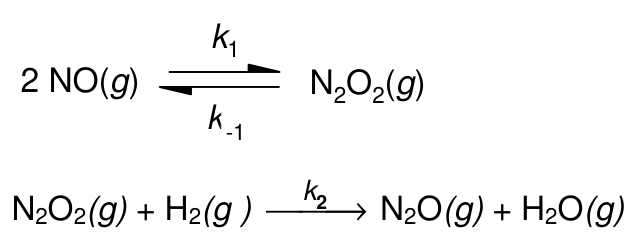
1.4 Derive the rate law for the formation of \(\ce{N2O}\) from the proposed mechanism using the steady-state approximation for the intermediate.
1.5 Under what condition does this rate law reduce to the experimentally determined rate law found in Part 1.1? Tick the relevant answer.
- \(\square\) If \(k_{-1}\ll k_2p_{\ce{H2}}\)
- \(\square\) If \(k_{-1}\gg k_2p_{\ce{H2}}\)
- \(\square\) If \(k_{-1}>k_2\)
- \(\square\) If \(k_1>k_{-1}\)
1.6 Express the experimentally determined rate constant \(k\) in terms of \(k_1\), \(k_{-1}\) and \(k_2\).
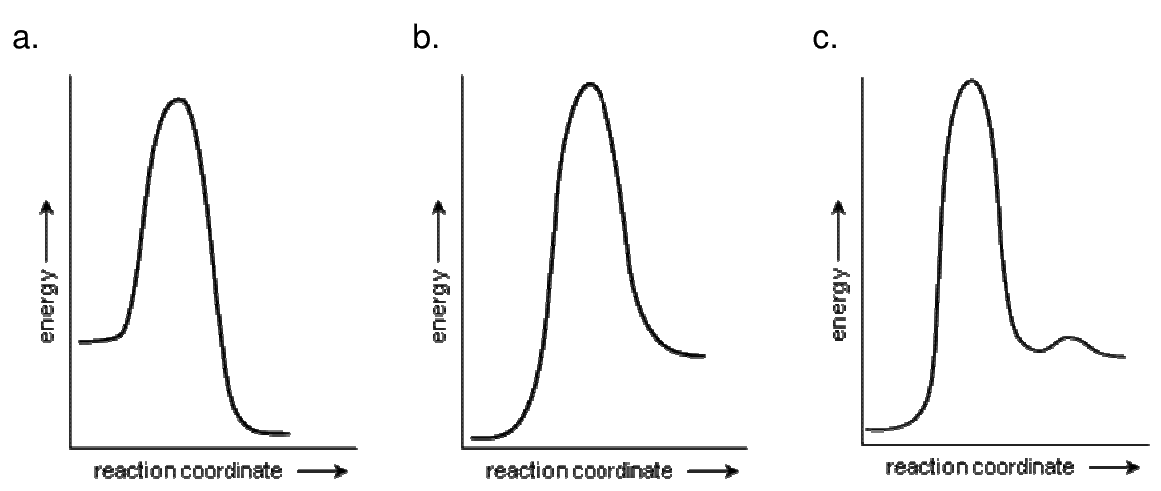
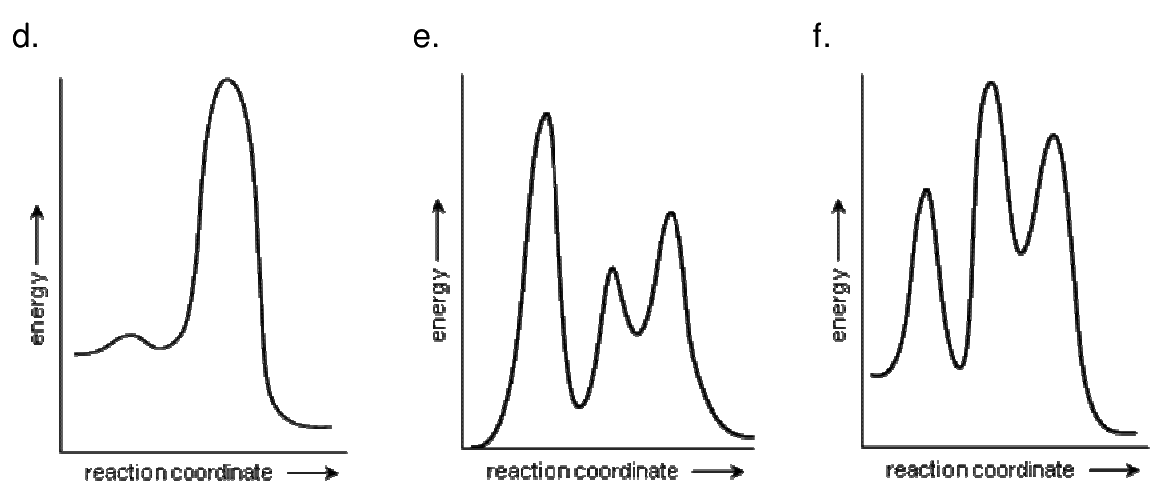
1.7 Select the schematic energy diagram that is consistent with the proposed reaction mechanism and experimental rate law.
Official English text of the problem.
Answers
-
1.1 \[ \boxed{r=\frac{dp_{\ce{N2O}}}{dt}=kp_{\ce{NO}}^{\,2}p_{\ce{H2}}, \qquad k\approx1.0\times10^{-7}\ \mathrm{torr^{-2}\,s^{-1}}.} \] Second order in \(\ce{NO}\), first order in \(\ce{H2}\), third order overall.
-
1.2 \[ \boxed{-\left.\frac{dp_{\ce{NO}}}{dt}\right|_0 \approx0.80\ \mathrm{torr\,s^{-1}}.} \]
-
1.3 \[ \boxed{t_{1/2}\approx11\ \mathrm{s}} \] (\(10.8\ \mathrm{s}\) using the large-excess approximation).
-
1.4 \[ \boxed{\frac{dp_{\ce{N2O}}}{dt} =\frac{k_1k_2p_{\ce{NO}}^{\,2}p_{\ce{H2}}} {k_{-1}+k_2p_{\ce{H2}}}.} \]
-
1.5 Tick the second option: \[ \boxed{k_{-1}\gg k_2p_{\ce{H2}}.} \]
-
1.6 \[ \boxed{k=\frac{k_1k_2}{k_{-1}}.} \]
-
1.7 Diagram d.
Solution
The molecular names and SMILES used here are:
| Formula | Name | SMILES |
|---|---|---|
| \(\ce{NO}\) | Nitric oxide | [N]=O |
| \(\ce{NO2}\) | Nitrogen dioxide | O=[N+][O-] |
| \(\ce{H2}\) | Hydrogen | [H][H] |
| \(\ce{N2O}\) | Nitrous oxide | N#[N+][O-] |
| \(\ce{H2O}\) | Water | O |
| \(\ce{N2O2}\) | Dinitrogen dioxide, the nitric oxide dimer | O=NN=O |
The dimer SMILES represents its connectivity; the problem does not specify its conformation.
1.1
The balanced overall reaction is
\[ \ce{2NO(g) + H2(g) -> N2O(g) + H2O(g)}. \]
Using partial pressures at constant temperature and volume, define
\[ r=\frac{dp_{\ce{N2O}}}{dt} =-\frac{dp_{\ce{H2}}}{dt} =-\frac12\frac{dp_{\ce{NO}}}{dt}. \]
Assume an experimental rate law
\[ r=kp_{\ce{NO}}^{\,m}p_{\ce{H2}}^{\,n}. \]
Experiments 1 and 2 have the same hydrogen pressure. Therefore,
\[ \frac{r_1}{r_2} =\frac{8.66\times10^{-2}}{2.17\times10^{-2}} =3.99 =\left(\frac{120.0}{60.0}\right)^m. \]
Thus \(m\approx2\).
Experiments 2 and 3 have the same nitric oxide pressure:
\[ \frac{r_3}{r_2} =\frac{6.62\times10^{-2}}{2.17\times10^{-2}} =3.05 =\left(\frac{180.0}{60.0}\right)^n. \]
Thus \(n\approx1\). The integer-order law supported by the data is consequently
\[ \boxed{r=kp_{\ce{NO}}^{\,2}p_{\ce{H2}}}. \]
Using experiment 1,
\[ k= \frac{8.66\times10^{-2}\ \mathrm{torr\,s^{-1}}} {(120.0\ \mathrm{torr})^2(60.0\ \mathrm{torr})} =1.0023\times10^{-7}\ \mathrm{torr^{-2}\,s^{-1}}. \]
Experiments 2 and 3 give \(1.0046\times10^{-7}\) and \(1.0216\times10^{-7}\ \mathrm{torr^{-2}\,s^{-1}}\), respectively. Allowing for the small scatter,
\[ \boxed{k\approx1.0\times10^{-7}\ \mathrm{torr^{-2}\,s^{-1}}}. \]
The following numerical calculations use \(k=1.00\times10^{-7}\ \mathrm{torr^{-2}\,s^{-1}}\).
1.2
Two molecules of nitric oxide disappear for every molecule of nitrous oxide produced. Hence,
\[ -\left.\frac{dp_{\ce{NO}}}{dt}\right|_0 =2kp_{\ce{NO},0}^{\,2}p_{\ce{H2},0}. \]
Substitution gives
\[ \begin{aligned} -\left.\frac{dp_{\ce{NO}}}{dt}\right|_0 &=2(1.00\times10^{-7}\ \mathrm{torr^{-2}\,s^{-1}}) (2.00\times10^2\ \mathrm{torr})^2 (1.00\times10^2\ \mathrm{torr})\\ &=\boxed{0.80\ \mathrm{torr\,s^{-1}}}. \end{aligned} \]
1.3
Hydrogen initially has a pressure of \(1.0\ \mathrm{torr}\), whereas nitric oxide has \(800\ \mathrm{torr}\). When the hydrogen pressure falls to \(0.50\ \mathrm{torr}\), the nitric oxide pressure decreases by only
\[ 2(1.0-0.50)=1.0\ \mathrm{torr}. \]
Thus \(p_{\ce{NO}}\) changes from \(800\) to \(799\ \mathrm{torr}\), so treating it as constant is an excellent approximation.
The hydrogen disappearance law becomes
\[ -\frac{dp_{\ce{H2}}}{dt} =kp_{\ce{NO}}^{\,2}p_{\ce{H2}} \approx k_{\mathrm{obs}}p_{\ce{H2}}, \]
where
\[ k_{\mathrm{obs}} =(1.00\times10^{-7})(800)^2\ \mathrm{s^{-1}} =0.0640\ \mathrm{s^{-1}}. \]
Integration gives
\[ \ln\!\left(\frac{p_{\ce{H2},0}}{p_{\ce{H2}}}\right) =k_{\mathrm{obs}}t. \]
At half the initial hydrogen pressure,
\[ t_{1/2} =\frac{\ln2}{0.0640\ \mathrm{s^{-1}}} =10.8\ \mathrm{s} \approx\boxed{11\ \mathrm{s}}. \]
As a check, retaining the small nitric oxide depletion gives
\[ p_{\ce{NO}}=798.0\ \mathrm{torr}+2p_{\ce{H2}}, \]
and therefore
\[ t_{1/2} =\frac1k \int_{0.50\ \mathrm{torr}}^{1.0\ \mathrm{torr}} \frac{dp}{p(798.0\ \mathrm{torr}+2p)^2} =10.85\ \mathrm{s}. \]
This differs from the large-excess approximation by only \(0.14\%\).
1.4
The two elementary steps are
\[ \ce{2NO(g) <=>[k_1][k_{-1}] N2O2(g)} \]
and
\[ \ce{N2O2(g) + H2(g) ->[k_2] N2O(g) + H2O(g)}. \]
The intermediate is dinitrogen dioxide. Its pressure changes according to
\[ \frac{dp_{\ce{N2O2}}}{dt} =k_1p_{\ce{NO}}^{\,2} -k_{-1}p_{\ce{N2O2}} -k_2p_{\ce{N2O2}}p_{\ce{H2}}. \]
Under the steady-state approximation, its formation and consumption rates approximately balance:
\[ 0\approx k_1p_{\ce{NO}}^{\,2} -\left(k_{-1}+k_2p_{\ce{H2}}\right)p_{\ce{N2O2}}. \]
Consequently,
\[ p_{\ce{N2O2}} \approx\frac{k_1p_{\ce{NO}}^{\,2}} {k_{-1}+k_2p_{\ce{H2}}}. \]
Nitrous oxide is formed in the second step, giving
\[ \frac{dp_{\ce{N2O}}}{dt} =k_2p_{\ce{N2O2}}p_{\ce{H2}} =\boxed{\frac{k_1k_2p_{\ce{NO}}^{\,2}p_{\ce{H2}}} {k_{-1}+k_2p_{\ce{H2}}}}. \]
1.5
To recover a first-order dependence on hydrogen, the denominator must be approximately independent of its pressure. This requires
\[ \boxed{k_{-1}\gg k_2p_{\ce{H2}}}. \]
Then
\[ r\approx\frac{k_1k_2}{k_{-1}} p_{\ce{NO}}^{\,2}p_{\ce{H2}}, \]
which matches the experimental law. Thus the second checkbox should be ticked.
Physically, the intermediate dissociates back into nitric oxide much faster than it reacts with hydrogen. Under the opposite limiting condition, the hydrogen pressure would cancel from the rate law, giving \(r\approx k_1p_{\ce{NO}}^2\), contrary to experiment.
1.6
Comparing
\[ r\approx\frac{k_1k_2}{k_{-1}} p_{\ce{NO}}^{\,2}p_{\ce{H2}} \]
with the experimental expression gives
\[ \boxed{k=\frac{k_1k_2}{k_{-1}}}. \]
Here \(k_1\) and \(k_2\) have units \(\mathrm{torr^{-1}\,s^{-1}}\), while \(k_{-1}\) has units \(\mathrm{s^{-1}}\). Their combination therefore has the required units \(\mathrm{torr^{-2}\,s^{-1}}\).
1.7
The correct choice is diagram d.
Two elementary steps require two transition-state maxima separated by an intermediate minimum. Among the proposed diagrams, c and d have this form.
In diagram d, the barrier from the intermediate back to the reactants is small, while the barrier from the intermediate toward products is much larger. This is consistent with
\[ k_{-1}\gg k_2p_{\ce{H2}}, \]
and hence with the observed rate law.
Precisely, diagram d starts at the reactant energy, rises over a small first maximum, falls into a shallow intermediate minimum, rises to a much higher second maximum, and finally falls to products below the reactants.
The solution was checked against the official solution.
IChO 2011 · Theorieaufgabe 1
Kinetik der Reaktion von Stickstoffmonoxid mit Wasserstoff
Stickstoffoxide, häufige Schadstoffe in der Umgebungsluft, sind hauptsächlich Stickstoffmonoxid, \(\ce{NO}\), und Stickstoffdioxid, \(\ce{NO2}\). Atmosphärisches Stickstoffmonoxid entsteht vor allem bei Gewittern und in Verbrennungsmotoren. Bei hohen Temperaturen reagiert \(\ce{NO}\) mit \(\ce{H2}\) zu Distickstoffmonoxid, \(\ce{N2O}\), einem Treibhausgas.
Zur Untersuchung der Kinetik dieser Reaktion bei \(820\,^\circ\mathrm{C}\) wurden die Anfangsgeschwindigkeiten der Bildung von \(\ce{N2O}\) bei verschiedenen Anfangspartialdrücken von \(\ce{NO}\) und \(\ce{H2}\) gemessen.
| Versuch | Anfangsdruck, torr: \(p_{\ce{NO}}\) | Anfangsdruck, torr: \(p_{\ce{H2}}\) | Anfangsgeschwindigkeit der Bildung von \(\ce{N2O}\), torr \(\mathrm{s^{-1}}\) |
|---|---|---|---|
| 1 | 120.0 | 60.0 | \(8.66\cdot10^{-2}\) |
| 2 | 60.0 | 60.0 | \(2.17\cdot10^{-2}\) |
| 3 | 60.0 | 180.0 | \(6.62\cdot10^{-2}\) |
Verwenden Sie in dieser gesamten Aufgabe keine Konzentrationen. Verwenden Sie Druckeinheiten (torr) und geben Sie die Zeit in Sekunden an.
1.1 Bestimmen Sie das experimentelle Geschwindigkeitsgesetz und berechnen Sie die Geschwindigkeitskonstante.
1.2 Berechnen Sie die Anfangsgeschwindigkeit des Verbrauchs von \(\ce{NO}\), wenn \(\ce{NO}\) mit einem Druck von \(2.00\cdot10^{2}\) torr und \(\ce{H2}\) mit \(1.00\cdot10^{2}\) torr bei \(820\,^\circ\mathrm{C}\) gemischt werden.
(Falls Sie den Wert der Geschwindigkeitskonstante nicht berechnen konnten, können Sie den Wert \(2\cdot10^{-7}\) in der geeigneten Einheit verwenden.)
1.3 Berechnen Sie die Zeit, die vergeht, bis der Partialdruck von \(\ce{H2}\) auf die Hälfte seines Anfangswerts gesunken ist, wenn \(\ce{NO}\) mit einem Druck von \(8.00\cdot10^{2}\) torr und \(\ce{H2}\) mit \(1.0\) torr bei \(820\,^\circ\mathrm{C}\) gemischt werden.
(Falls Sie den Wert der Geschwindigkeitskonstante nicht berechnen konnten, können Sie den Wert \(2\cdot10^{-7}\) in der geeigneten Einheit verwenden.)
Ein vorgeschlagener Mechanismus für die Reaktion zwischen \(\ce{NO}\) und \(\ce{H2}\) ist im Folgenden dargestellt:
1.4 Leiten Sie aus dem vorgeschlagenen Mechanismus das Geschwindigkeitsgesetz für die Bildung von \(\ce{N2O}\) unter Verwendung der Quasistationaritätsnäherung für das Zwischenprodukt her.
1.5 Unter welcher Bedingung geht dieses Geschwindigkeitsgesetz in das in Teil 1.1 experimentell bestimmte Geschwindigkeitsgesetz über? Kreuzen Sie die zutreffende Antwort an.
- \(\square\) Wenn \(k_{-1}\ll k_2p_{\ce{H2}}\)
- \(\square\) Wenn \(k_{-1}\gg k_2p_{\ce{H2}}\)
- \(\square\) Wenn \(k_{-1}>k_2\)
- \(\square\) Wenn \(k_1>k_{-1}\)
1.6 Drücken Sie die experimentell bestimmte Geschwindigkeitskonstante \(k\) durch \(k_1\), \(k_{-1}\) und \(k_2\) aus.
1.7 Wählen Sie das schematische Energiediagramm aus, das mit dem vorgeschlagenen Reaktionsmechanismus und dem experimentellen Geschwindigkeitsgesetz übereinstimmt.
Aufgabentext aus dem offiziellen englischen Text übersetzt.
Antworten
-
1.1 \[ \boxed{r=\frac{dp_{\ce{N2O}}}{dt}=kp_{\ce{NO}}^{\,2}p_{\ce{H2}}, \qquad k\approx1.0\times10^{-7}\ \mathrm{torr^{-2}\,s^{-1}}.} \] Zweite Ordnung bezüglich \(\ce{NO}\), erste Ordnung bezüglich \(\ce{H2}\), insgesamt dritte Ordnung.
-
1.2 \[ \boxed{-\left.\frac{dp_{\ce{NO}}}{dt}\right|_0 \approx0.80\ \mathrm{torr\,s^{-1}}.} \]
-
1.3 \[ \boxed{t_{1/2}\approx11\ \mathrm{s}} \] (\(10.8\ \mathrm{s}\) bei Verwendung der Näherung für einen großen Überschuss).
-
1.4 \[ \boxed{\frac{dp_{\ce{N2O}}}{dt} =\frac{k_1k_2p_{\ce{NO}}^{\,2}p_{\ce{H2}}} {k_{-1}+k_2p_{\ce{H2}}}.} \]
-
1.5 Kreuzen Sie die zweite Option an: \[ \boxed{k_{-1}\gg k_2p_{\ce{H2}}.} \]
-
1.6 \[ \boxed{k=\frac{k_1k_2}{k_{-1}}.} \]
-
1.7 Diagramm d.
Lösung
Die hier verwendeten Molekülnamen und SMILES sind:
| Formel | Name | SMILES |
|---|---|---|
| \(\ce{NO}\) | Stickstoffmonoxid | [N]=O |
| \(\ce{NO2}\) | Stickstoffdioxid | O=[N+][O-] |
| \(\ce{H2}\) | Wasserstoff | [H][H] |
| \(\ce{N2O}\) | Distickstoffmonoxid | N#[N+][O-] |
| \(\ce{H2O}\) | Wasser | O |
| \(\ce{N2O2}\) | Distickstoffdioxid, das Dimer von Stickstoffmonoxid | O=NN=O |
Der SMILES-Ausdruck des Dimers gibt dessen Konnektivität wieder; die Aufgabe legt seine Konformation nicht fest.
1.1
Die ausgeglichene Gesamtreaktion lautet
\[ \ce{2NO(g) + H2(g) -> N2O(g) + H2O(g)}. \]
Unter Verwendung der Partialdrücke bei konstanter Temperatur und konstantem Volumen definieren wir
\[ r=\frac{dp_{\ce{N2O}}}{dt} =-\frac{dp_{\ce{H2}}}{dt} =-\frac12\frac{dp_{\ce{NO}}}{dt}. \]
Wir nehmen ein experimentelles Geschwindigkeitsgesetz der folgenden Form an:
\[ r=kp_{\ce{NO}}^{\,m}p_{\ce{H2}}^{\,n}. \]
In den Versuchen 1 und 2 ist der Wasserstoffdruck gleich. Daher gilt
\[ \frac{r_1}{r_2} =\frac{8.66\times10^{-2}}{2.17\times10^{-2}} =3.99 =\left(\frac{120.0}{60.0}\right)^m. \]
Somit ist \(m\approx2\).
In den Versuchen 2 und 3 ist der Stickstoffmonoxiddruck gleich:
\[ \frac{r_3}{r_2} =\frac{6.62\times10^{-2}}{2.17\times10^{-2}} =3.05 =\left(\frac{180.0}{60.0}\right)^n. \]
Somit ist \(n\approx1\). Das durch die Daten gestützte Geschwindigkeitsgesetz mit ganzzahligen Reaktionsordnungen lautet folglich
\[ \boxed{r=kp_{\ce{NO}}^{\,2}p_{\ce{H2}}}. \]
Aus Versuch 1 ergibt sich
\[ k= \frac{8.66\times10^{-2}\ \mathrm{torr\,s^{-1}}} {(120.0\ \mathrm{torr})^2(60.0\ \mathrm{torr})} =1.0023\times10^{-7}\ \mathrm{torr^{-2}\,s^{-1}}. \]
Die Versuche 2 und 3 ergeben \(1.0046\times10^{-7}\) beziehungsweise \(1.0216\times10^{-7}\ \mathrm{torr^{-2}\,s^{-1}}\). Unter Berücksichtigung der geringen Streuung gilt
\[ \boxed{k\approx1.0\times10^{-7}\ \mathrm{torr^{-2}\,s^{-1}}}. \]
In den folgenden numerischen Berechnungen wird \(k=1.00\times10^{-7}\ \mathrm{torr^{-2}\,s^{-1}}\) verwendet.
1.2
Für jedes gebildete Molekül Distickstoffmonoxid werden zwei Moleküle Stickstoffmonoxid verbraucht. Daher gilt
\[ -\left.\frac{dp_{\ce{NO}}}{dt}\right|_0 =2kp_{\ce{NO},0}^{\,2}p_{\ce{H2},0}. \]
Einsetzen ergibt
\[ \begin{aligned} -\left.\frac{dp_{\ce{NO}}}{dt}\right|_0 &=2(1.00\times10^{-7}\ \mathrm{torr^{-2}\,s^{-1}}) (2.00\times10^2\ \mathrm{torr})^2 (1.00\times10^2\ \mathrm{torr})\\ &=\boxed{0.80\ \mathrm{torr\,s^{-1}}}. \end{aligned} \]
1.3
Wasserstoff hat anfangs einen Druck von \(1.0\ \mathrm{torr}\), während der Druck von Stickstoffmonoxid \(800\ \mathrm{torr}\) beträgt. Wenn der Wasserstoffdruck auf \(0.50\ \mathrm{torr}\) fällt, beträgt die Abnahme des Stickstoffmonoxiddrucks lediglich
\[ 2(1.0-0.50)=1.0\ \mathrm{torr}. \]
Somit ändert sich \(p_{\ce{NO}}\) von \(800\) auf \(799\ \mathrm{torr}\), sodass die Annahme eines konstanten Werts eine ausgezeichnete Näherung ist.
Das Geschwindigkeitsgesetz für den Verbrauch von Wasserstoff wird damit zu
\[ -\frac{dp_{\ce{H2}}}{dt} =kp_{\ce{NO}}^{\,2}p_{\ce{H2}} \approx k_{\mathrm{obs}}p_{\ce{H2}}, \]
wobei
\[ k_{\mathrm{obs}} =(1.00\times10^{-7})(800)^2\ \mathrm{s^{-1}} =0.0640\ \mathrm{s^{-1}}. \]
Integration ergibt
\[ \ln\!\left(\frac{p_{\ce{H2},0}}{p_{\ce{H2}}}\right) =k_{\mathrm{obs}}t. \]
Bei der Hälfte des anfänglichen Wasserstoffdrucks gilt
\[ t_{1/2} =\frac{\ln2}{0.0640\ \mathrm{s^{-1}}} =10.8\ \mathrm{s} \approx\boxed{11\ \mathrm{s}}. \]
Zur Kontrolle ergibt sich unter Berücksichtigung der geringen Abnahme des Stickstoffmonoxiddrucks
\[ p_{\ce{NO}}=798.0\ \mathrm{torr}+2p_{\ce{H2}}, \]
und daher
\[ t_{1/2} =\frac1k \int_{0.50\ \mathrm{torr}}^{1.0\ \mathrm{torr}} \frac{dp}{p(798.0\ \mathrm{torr}+2p)^2} =10.85\ \mathrm{s}. \]
Dies weicht von der Näherung für einen großen Überschuss nur um \(0.14\%\) ab.
1.4
Die beiden Elementarschritte lauten
\[ \ce{2NO(g) <=>[k_1][k_{-1}] N2O2(g)} \]
und
\[ \ce{N2O2(g) + H2(g) ->[k_2] N2O(g) + H2O(g)}. \]
Das Zwischenprodukt ist Distickstoffdioxid. Sein Druck ändert sich gemäß
\[ \frac{dp_{\ce{N2O2}}}{dt} =k_1p_{\ce{NO}}^{\,2} -k_{-1}p_{\ce{N2O2}} -k_2p_{\ce{N2O2}}p_{\ce{H2}}. \]
Bei der Quasistationaritätsnäherung sind seine Bildungs- und Verbrauchsgeschwindigkeiten näherungsweise gleich:
\[ 0\approx k_1p_{\ce{NO}}^{\,2} -\left(k_{-1}+k_2p_{\ce{H2}}\right)p_{\ce{N2O2}}. \]
Folglich gilt
\[ p_{\ce{N2O2}} \approx\frac{k_1p_{\ce{NO}}^{\,2}} {k_{-1}+k_2p_{\ce{H2}}}. \]
Distickstoffmonoxid wird im zweiten Schritt gebildet, sodass sich ergibt:
\[ \frac{dp_{\ce{N2O}}}{dt} =k_2p_{\ce{N2O2}}p_{\ce{H2}} =\boxed{\frac{k_1k_2p_{\ce{NO}}^{\,2}p_{\ce{H2}}} {k_{-1}+k_2p_{\ce{H2}}}}. \]
1.5
Damit sich eine Abhängigkeit erster Ordnung bezüglich Wasserstoff ergibt, muss der Nenner näherungsweise unabhängig von dessen Druck sein. Dies erfordert
\[ \boxed{k_{-1}\gg k_2p_{\ce{H2}}}. \]
Dann gilt
\[ r\approx\frac{k_1k_2}{k_{-1}} p_{\ce{NO}}^{\,2}p_{\ce{H2}}, \]
was mit dem experimentellen Geschwindigkeitsgesetz übereinstimmt. Daher ist das zweite Kästchen anzukreuzen.
Physikalisch bedeutet dies, dass das Zwischenprodukt wesentlich schneller zurück zu Stickstoffmonoxid dissoziiert, als es mit Wasserstoff reagiert. Im entgegengesetzten Grenzfall würde sich der Wasserstoffdruck aus dem Geschwindigkeitsgesetz herauskürzen, sodass sich \(r\approx k_1p_{\ce{NO}}^2\) ergäbe, im Widerspruch zum Experiment.
1.6
Der Vergleich von
\[ r\approx\frac{k_1k_2}{k_{-1}} p_{\ce{NO}}^{\,2}p_{\ce{H2}} \]
mit dem experimentellen Ausdruck ergibt
\[ \boxed{k=\frac{k_1k_2}{k_{-1}}}. \]
Hier haben \(k_1\) und \(k_2\) die Einheit \(\mathrm{torr^{-1}\,s^{-1}}\), während \(k_{-1}\) die Einheit \(\mathrm{s^{-1}}\) hat. Ihre Kombination hat somit die erforderliche Einheit \(\mathrm{torr^{-2}\,s^{-1}}\).
1.7
Die richtige Wahl ist Diagramm d.
Zwei Elementarschritte erfordern zwei Maxima für die Übergangszustände, die durch ein Minimum für das Zwischenprodukt getrennt sind. Von den vorgeschlagenen Diagrammen weisen c und d diese Form auf.
In Diagramm d ist die Barriere vom Zwischenprodukt zurück zu den Edukten klein, während die Barriere vom Zwischenprodukt zu den Produkten wesentlich größer ist. Dies stimmt mit
\[ k_{-1}\gg k_2p_{\ce{H2}}, \]
und somit mit dem beobachteten Geschwindigkeitsgesetz überein.
Genauer gesagt beginnt Diagramm d bei der Energie der Edukte, steigt über ein niedriges erstes Maximum an, fällt in ein flaches Minimum für das Zwischenprodukt ab, steigt zu einem wesentlich höheren zweiten Maximum an und fällt schließlich zu den Produkten ab, deren Energie unter derjenigen der Edukte liegt.
Die Lösung wurde mit der offiziellen Lösung abgeglichen.
IChO 2011 · Teori sorusu 1
Azot monoksitin hidrojenle tepkimesinin kinetiği
Ortam havasında yaygın olarak bulunan kirleticilerden azot oksitler, başlıca azot monoksit, \(\ce{NO}\), ve azot dioksittir, \(\ce{NO2}\). Atmosferdeki azot monoksit esas olarak gök gürültülü fırtınalar sırasında ve içten yanmalı motorlarda oluşur. Yüksek sıcaklıklarda \(\ce{NO}\), \(\ce{H2}\) ile tepkimeye girerek bir sera gazı olan diazot monoksiti, \(\ce{N2O}\), oluşturur.
Bu tepkimenin \(820\,^\circ\mathrm{C}\) sıcaklıktaki kinetiğini incelemek için, \(\ce{NO}\) ve \(\ce{H2}\) gazlarının farklı başlangıç kısmi basınçları kullanılarak \(\ce{N2O}\) oluşumunun başlangıç hızları ölçülmüştür.
| Deney | Başlangıç basıncı, torr: \(p_{\ce{NO}}\) | Başlangıç basıncı, torr: \(p_{\ce{H2}}\) | \(\ce{N2O}\) oluşumunun başlangıç hızı, torr \(\mathrm{s^{-1}}\) |
|---|---|---|---|
| 1 | 120.0 | 60.0 | \(8.66\cdot10^{-2}\) |
| 2 | 60.0 | 60.0 | \(2.17\cdot10^{-2}\) |
| 3 | 60.0 | 180.0 | \(6.62\cdot10^{-2}\) |
Bu soru boyunca derişimleri kullanmayınız. Basınç birimi olarak torr, zaman birimi olarak saniye kullanınız.
1.1 Deneysel hız bağıntısını belirleyiniz ve hız sabitini hesaplayınız.
1.2 Basıncı \(2.00\cdot10^{2}\) torr olan \(\ce{NO}\) ile basıncı \(1.00\cdot10^{2}\) torr olan \(\ce{H2}\), \(820\,^\circ\mathrm{C}\) sıcaklıkta karıştırılırsa \(\ce{NO}\) gazının başlangıçtaki tükenme hızını hesaplayınız.
(Hız sabitinin değerini hesaplayamadıysanız, uygun birimle \(2\cdot10^{-7}\) değerini kullanabilirsiniz.)
1.3 Basıncı \(8.00\cdot10^{2}\) torr olan \(\ce{NO}\) ile basıncı \(1.0\) torr olan \(\ce{H2}\), \(820\,^\circ\mathrm{C}\) sıcaklıkta karıştırılırsa \(\ce{H2}\) gazının kısmi basıncının başlangıç değerinin yarısına düşmesi için geçen süreyi hesaplayınız.
(Hız sabitinin değerini hesaplayamadıysanız, uygun birimle \(2\cdot10^{-7}\) değerini kullanabilirsiniz.)
\(\ce{NO}\) ile \(\ce{H2}\) arasındaki tepkime için önerilen bir mekanizma aşağıda verilmiştir:
1.4 Ara ürüne kararlı hâl yaklaşımını uygulayarak önerilen mekanizmadan \(\ce{N2O}\) oluşumunun hız bağıntısını türetiniz.
1.5 Bu hız bağıntısı hangi koşulda Bölüm 1.1'de deneysel olarak belirlenen hız bağıntısına indirgenir? İlgili seçeneği işaretleyiniz.
- \(\square\) \(k_{-1}\ll k_2p_{\ce{H2}}\) ise
- \(\square\) \(k_{-1}\gg k_2p_{\ce{H2}}\) ise
- \(\square\) \(k_{-1}>k_2\) ise
- \(\square\) \(k_1>k_{-1}\) ise
1.6 Deneysel olarak belirlenen hız sabiti \(k\)'yı \(k_1\), \(k_{-1}\) ve \(k_2\) cinsinden ifade ediniz.
1.7 Önerilen tepkime mekanizması ve deneysel hız bağıntısıyla uyumlu olan şematik enerji diyagramını seçiniz.
Soru metni resmi İngilizce metinden çevrilmiştir.
Cevaplar
-
1.1 \[ \boxed{r=\frac{dp_{\ce{N2O}}}{dt}=kp_{\ce{NO}}^{\,2}p_{\ce{H2}}, \qquad k\approx1.0\times10^{-7}\ \mathrm{torr^{-2}\,s^{-1}}.} \] \(\ce{NO}\)'ya göre ikinci, \(\ce{H2}\)'ye göre birinci, toplamda üçüncü derecedendir.
-
1.2 \[ \boxed{-\left.\frac{dp_{\ce{NO}}}{dt}\right|_0 \approx0.80\ \mathrm{torr\,s^{-1}}.} \]
-
1.3 \[ \boxed{t_{1/2}\approx11\ \mathrm{s}} \] (Büyük fazlalık yaklaşımı kullanıldığında \(10.8\ \mathrm{s}\)).
-
1.4 \[ \boxed{\frac{dp_{\ce{N2O}}}{dt} =\frac{k_1k_2p_{\ce{NO}}^{\,2}p_{\ce{H2}}} {k_{-1}+k_2p_{\ce{H2}}}.} \]
-
1.5 İkinci seçeneği işaretleyiniz: \[ \boxed{k_{-1}\gg k_2p_{\ce{H2}}.} \]
-
1.6 \[ \boxed{k=\frac{k_1k_2}{k_{-1}}.} \]
-
1.7 d diyagramı.
Çözüm
Burada kullanılan molekül adları ve SMILES gösterimleri şunlardır:
| Formül | Ad | SMILES |
|---|---|---|
| \(\ce{NO}\) | Azot monoksit | [N]=O |
| \(\ce{NO2}\) | Azot dioksit | O=[N+][O-] |
| \(\ce{H2}\) | Hidrojen | [H][H] |
| \(\ce{N2O}\) | Diazot monoksit | N#[N+][O-] |
| \(\ce{H2O}\) | Su | O |
| \(\ce{N2O2}\) | Diazot dioksit, azot monoksit dimeri | O=NN=O |
Dimerin SMILES gösterimi atomların birbirine nasıl bağlandığını belirtir; soruda konformasyonu belirtilmemiştir.
1.1
Denkleştirilmiş toplam tepkime şöyledir:
\[ \ce{2NO(g) + H2(g) -> N2O(g) + H2O(g)}. \]
Sabit sıcaklık ve hacimde kısmi basınçları kullanarak şu tanımı yapalım:
\[ r=\frac{dp_{\ce{N2O}}}{dt} =-\frac{dp_{\ce{H2}}}{dt} =-\frac12\frac{dp_{\ce{NO}}}{dt}. \]
Deneysel hız bağıntısının şu biçimde olduğunu varsayalım:
\[ r=kp_{\ce{NO}}^{\,m}p_{\ce{H2}}^{\,n}. \]
1 ve 2 numaralı deneylerde hidrojen basıncı aynıdır. Dolayısıyla,
\[ \frac{r_1}{r_2} =\frac{8.66\times10^{-2}}{2.17\times10^{-2}} =3.99 =\left(\frac{120.0}{60.0}\right)^m. \]
Böylece \(m\approx2\) bulunur.
2 ve 3 numaralı deneylerde azot monoksit basıncı aynıdır:
\[ \frac{r_3}{r_2} =\frac{6.62\times10^{-2}}{2.17\times10^{-2}} =3.05 =\left(\frac{180.0}{60.0}\right)^n. \]
Böylece \(n\approx1\) bulunur. Dolayısıyla verilerin desteklediği tam sayı dereceli hız bağıntısı şöyledir:
\[ \boxed{r=kp_{\ce{NO}}^{\,2}p_{\ce{H2}}}. \]
1 numaralı deney kullanılarak,
\[ k= \frac{8.66\times10^{-2}\ \mathrm{torr\,s^{-1}}} {(120.0\ \mathrm{torr})^2(60.0\ \mathrm{torr})} =1.0023\times10^{-7}\ \mathrm{torr^{-2}\,s^{-1}}. \]
2 ve 3 numaralı deneyler sırasıyla \(1.0046\times10^{-7}\) ve \(1.0216\times10^{-7}\ \mathrm{torr^{-2}\,s^{-1}}\) değerlerini verir. Küçük saçılma göz önünde bulundurulduğunda,
\[ \boxed{k\approx1.0\times10^{-7}\ \mathrm{torr^{-2}\,s^{-1}}}. \]
Aşağıdaki sayısal hesaplamalarda \(k=1.00\times10^{-7}\ \mathrm{torr^{-2}\,s^{-1}}\) değeri kullanılmaktadır.
1.2
Oluşan her bir diazot monoksit molekülü için iki azot monoksit molekülü tükenir. Bu nedenle,
\[ -\left.\frac{dp_{\ce{NO}}}{dt}\right|_0 =2kp_{\ce{NO},0}^{\,2}p_{\ce{H2},0}. \]
Değerler yerine konulduğunda,
\[ \begin{aligned} -\left.\frac{dp_{\ce{NO}}}{dt}\right|_0 &=2(1.00\times10^{-7}\ \mathrm{torr^{-2}\,s^{-1}}) (2.00\times10^2\ \mathrm{torr})^2 (1.00\times10^2\ \mathrm{torr})\\ &=\boxed{0.80\ \mathrm{torr\,s^{-1}}}. \end{aligned} \]
1.3
Başlangıçta hidrojenin basıncı \(1.0\ \mathrm{torr}\), azot monoksitin basıncı ise \(800\ \mathrm{torr}\)'dur. Hidrojen basıncı \(0.50\ \mathrm{torr}\)'a düştüğünde azot monoksit basıncındaki azalma yalnızca şöyledir:
\[ 2(1.0-0.50)=1.0\ \mathrm{torr}. \]
Dolayısıyla \(p_{\ce{NO}}\), \(800\) değerinden \(799\ \mathrm{torr}\) değerine değişir; bu nedenle onu sabit kabul etmek çok iyi bir yaklaşımdır.
Hidrojenin tükenme hızı bağıntısı şu hâli alır:
\[ -\frac{dp_{\ce{H2}}}{dt} =kp_{\ce{NO}}^{\,2}p_{\ce{H2}} \approx k_{\mathrm{obs}}p_{\ce{H2}}, \]
burada
\[ k_{\mathrm{obs}} =(1.00\times10^{-7})(800)^2\ \mathrm{s^{-1}} =0.0640\ \mathrm{s^{-1}}. \]
İntegral alındığında,
\[ \ln\!\left(\frac{p_{\ce{H2},0}}{p_{\ce{H2}}}\right) =k_{\mathrm{obs}}t. \]
Hidrojen basıncı başlangıç değerinin yarısına indiğinde,
\[ t_{1/2} =\frac{\ln2}{0.0640\ \mathrm{s^{-1}}} =10.8\ \mathrm{s} \approx\boxed{11\ \mathrm{s}}. \]
Kontrol amacıyla azot monoksit miktarındaki küçük azalma da hesaba katıldığında,
\[ p_{\ce{NO}}=798.0\ \mathrm{torr}+2p_{\ce{H2}}, \]
ve dolayısıyla
\[ t_{1/2} =\frac1k \int_{0.50\ \mathrm{torr}}^{1.0\ \mathrm{torr}} \frac{dp}{p(798.0\ \mathrm{torr}+2p)^2} =10.85\ \mathrm{s}. \]
Bu değer, büyük fazlalık yaklaşımıyla elde edilen değerden yalnızca \(0.14\%\) farklıdır.
1.4
İki elementer basamak şöyledir:
\[ \ce{2NO(g) <=>[k_1][k_{-1}] N2O2(g)} \]
ve
\[ \ce{N2O2(g) + H2(g) ->[k_2] N2O(g) + H2O(g)}. \]
Ara ürün diazot dioksittir. Basıncı aşağıdaki bağıntıya göre değişir:
\[ \frac{dp_{\ce{N2O2}}}{dt} =k_1p_{\ce{NO}}^{\,2} -k_{-1}p_{\ce{N2O2}} -k_2p_{\ce{N2O2}}p_{\ce{H2}}. \]
Kararlı hâl yaklaşımında ara ürünün oluşum ve tüketim hızları yaklaşık olarak birbirine eşittir:
\[ 0\approx k_1p_{\ce{NO}}^{\,2} -\left(k_{-1}+k_2p_{\ce{H2}}\right)p_{\ce{N2O2}}. \]
Bunun sonucunda,
\[ p_{\ce{N2O2}} \approx\frac{k_1p_{\ce{NO}}^{\,2}} {k_{-1}+k_2p_{\ce{H2}}}. \]
Diazot monoksit ikinci basamakta oluştuğundan,
\[ \frac{dp_{\ce{N2O}}}{dt} =k_2p_{\ce{N2O2}}p_{\ce{H2}} =\boxed{\frac{k_1k_2p_{\ce{NO}}^{\,2}p_{\ce{H2}}} {k_{-1}+k_2p_{\ce{H2}}}}. \]
1.5
Hidrojene göre birinci dereceden bağımlılık elde edilebilmesi için paydanın hidrojen basıncından yaklaşık olarak bağımsız olması gerekir. Bunun için şu koşul sağlanmalıdır:
\[ \boxed{k_{-1}\gg k_2p_{\ce{H2}}}. \]
Bu durumda,
\[ r\approx\frac{k_1k_2}{k_{-1}} p_{\ce{NO}}^{\,2}p_{\ce{H2}}, \]
bu da deneysel bağıntıyla örtüşür. Dolayısıyla ikinci kutucuk işaretlenmelidir.
Fiziksel olarak bu, ara ürünün hidrojenle tepkimeye girmesine kıyasla çok daha hızlı biçimde ayrışarak yeniden azot monoksite dönüşmesi anlamına gelir. Karşıt sınır koşulunda hidrojen basıncı hız bağıntısından sadeleşerek çıkar ve deneyle çelişen \(r\approx k_1p_{\ce{NO}}^2\) bağıntısı elde edilirdi.
1.6
Şu bağıntının
\[ r\approx\frac{k_1k_2}{k_{-1}} p_{\ce{NO}}^{\,2}p_{\ce{H2}} \]
deneysel ifadeyle karşılaştırılması sonucunda,
\[ \boxed{k=\frac{k_1k_2}{k_{-1}}}. \]
Burada \(k_1\) ve \(k_2\)'nin birimleri \(\mathrm{torr^{-1}\,s^{-1}}\), \(k_{-1}\)'in birimi ise \(\mathrm{s^{-1}}\)'dir. Dolayısıyla bunların bu şekilde birleştirilmesi gereken \(\mathrm{torr^{-2}\,s^{-1}}\) birimini verir.
1.7
Doğru seçenek d diyagramıdır.
İki elementer basamak, aralarında bir ara ürün minimumu bulunan iki geçiş durumu maksimumu gerektirir. Önerilen diyagramlar arasında c ve d bu biçimdedir.
d diyagramında ara üründen yeniden girenlere dönüşün enerji engeli küçükken, ara üründen ürünlere doğru ilerlemenin enerji engeli çok daha büyüktür. Bu durum,
\[ k_{-1}\gg k_2p_{\ce{H2}}, \]
koşuluyla ve dolayısıyla gözlenen hız bağıntısıyla uyumludur.
Daha ayrıntılı olarak, d diyagramı girenlerin enerji düzeyinde başlar, küçük bir ilk maksimumu aşacak şekilde yükselir, sığ bir ara ürün minimumuna iner, çok daha yüksek bir ikinci maksimuma yükselir ve son olarak girenlerden daha düşük enerji düzeyindeki ürünlere iner.
Çözüm, resmi çözümle karşılaştırılarak kontrol edildi.
IChO 2011 · Problema teórico 1
Cinética de la reacción del óxido nítrico con hidrógeno
Los óxidos de nitrógeno, contaminantes habituales del aire ambiente, son principalmente el óxido nítrico, \(\ce{NO}\), y el dióxido de nitrógeno, \(\ce{NO2}\). El óxido nítrico atmosférico se produce principalmente durante las tormentas eléctricas y en los motores de combustión interna. A altas temperaturas, el \(\ce{NO}\) reacciona con el \(\ce{H2}\) para producir óxido nitroso, \(\ce{N2O}\), un gas de efecto invernadero.
Para estudiar la cinética de esta reacción a \(820\,^\circ\mathrm{C}\), se midieron las velocidades iniciales de formación de \(\ce{N2O}\) utilizando diversas presiones parciales iniciales de \(\ce{NO}\) y \(\ce{H2}\).
| Exp. | Presión inicial, torr: \(p_{\ce{NO}}\) | Presión inicial, torr: \(p_{\ce{H2}}\) | Velocidad inicial de producción de \(\ce{N2O}\), torr \(\mathrm{s^{-1}}\) |
|---|---|---|---|
| 1 | 120.0 | 60.0 | \(8.66\cdot10^{-2}\) |
| 2 | 60.0 | 60.0 | \(2.17\cdot10^{-2}\) |
| 3 | 60.0 | 180.0 | \(6.62\cdot10^{-2}\) |
No utilice concentraciones en ningún apartado de este problema. Utilice unidades de presión (torr) y el tiempo en segundos.
1.1 Determine la ley de velocidad experimental y calcule la constante de velocidad.
1.2 Calcule la velocidad inicial de desaparición del \(\ce{NO}\), si se mezclan \(\ce{NO}\) a una presión de \(2.00\cdot10^{2}\) torr y \(\ce{H2}\) a \(1.00\cdot10^{2}\) torr a \(820\,^\circ\mathrm{C}\).
(Si no ha podido calcular el valor de la constante de velocidad, puede utilizar el valor de \(2\cdot10^{-7}\) en las unidades apropiadas.)
1.3 Calcule el tiempo transcurrido hasta que la presión parcial del \(\ce{H2}\) se reduzca a la mitad de su valor inicial, si se mezclan \(\ce{NO}\) a una presión de \(8.00\cdot10^{2}\) torr y \(\ce{H2}\) a \(1.0\) torr a \(820\,^\circ\mathrm{C}\).
(Si no ha podido calcular el valor de la constante de velocidad, puede utilizar el valor de \(2\cdot10^{-7}\) en las unidades apropiadas.)
A continuación se presenta un mecanismo propuesto para la reacción entre el \(\ce{NO}\) y el \(\ce{H2}\):
1.4 Deduzca la ley de velocidad de formación del \(\ce{N2O}\) a partir del mecanismo propuesto, utilizando la aproximación del estado estacionario para el intermedio.
1.5 ¿En qué condición se reduce esta ley de velocidad a la ley de velocidad determinada experimentalmente en la Parte 1.1? Marque la respuesta correspondiente.
- \(\square\) Si \(k_{-1}\ll k_2p_{\ce{H2}}\)
- \(\square\) Si \(k_{-1}\gg k_2p_{\ce{H2}}\)
- \(\square\) Si \(k_{-1}>k_2\)
- \(\square\) Si \(k_1>k_{-1}\)
1.6 Exprese la constante de velocidad determinada experimentalmente, \(k\), en función de \(k_1\), \(k_{-1}\) y \(k_2\).
1.7 Seleccione el diagrama esquemático de energía que sea compatible con el mecanismo de reacción propuesto y la ley de velocidad experimental.
Enunciado traducido del texto oficial en inglés.
Respuestas
-
1.1 \[ \boxed{r=\frac{dp_{\ce{N2O}}}{dt}=kp_{\ce{NO}}^{\,2}p_{\ce{H2}}, \qquad k\approx1.0\times10^{-7}\ \mathrm{torr^{-2}\,s^{-1}}.} \] Segundo orden respecto al \(\ce{NO}\), primer orden respecto al \(\ce{H2}\), tercer orden global.
-
1.2 \[ \boxed{-\left.\frac{dp_{\ce{NO}}}{dt}\right|_0 \approx0.80\ \mathrm{torr\,s^{-1}}.} \]
-
1.3 \[ \boxed{t_{1/2}\approx11\ \mathrm{s}} \] (\(10.8\ \mathrm{s}\) utilizando la aproximación de gran exceso).
-
1.4 \[ \boxed{\frac{dp_{\ce{N2O}}}{dt} =\frac{k_1k_2p_{\ce{NO}}^{\,2}p_{\ce{H2}}} {k_{-1}+k_2p_{\ce{H2}}}.} \]
-
1.5 Marque la segunda opción: \[ \boxed{k_{-1}\gg k_2p_{\ce{H2}}.} \]
-
1.6 \[ \boxed{k=\frac{k_1k_2}{k_{-1}}.} \]
-
1.7 Diagrama d.
Solución
Los nombres de las moléculas y los SMILES utilizados aquí son:
| Fórmula | Nombre | SMILES |
|---|---|---|
| \(\ce{NO}\) | Óxido nítrico | [N]=O |
| \(\ce{NO2}\) | Dióxido de nitrógeno | O=[N+][O-] |
| \(\ce{H2}\) | Hidrógeno | [H][H] |
| \(\ce{N2O}\) | Óxido nitroso | N#[N+][O-] |
| \(\ce{H2O}\) | Agua | O |
| \(\ce{N2O2}\) | Dióxido de dinitrógeno, el dímero del óxido nítrico | O=NN=O |
El SMILES del dímero representa su conectividad; el problema no especifica su conformación.
1.1
La reacción global ajustada es
\[ \ce{2NO(g) + H2(g) -> N2O(g) + H2O(g)}. \]
Utilizando presiones parciales a temperatura y volumen constantes, se define
\[ r=\frac{dp_{\ce{N2O}}}{dt} =-\frac{dp_{\ce{H2}}}{dt} =-\frac12\frac{dp_{\ce{NO}}}{dt}. \]
Se supone una ley de velocidad experimental
\[ r=kp_{\ce{NO}}^{\,m}p_{\ce{H2}}^{\,n}. \]
Los experimentos 1 y 2 tienen la misma presión de hidrógeno. Por lo tanto,
\[ \frac{r_1}{r_2} =\frac{8.66\times10^{-2}}{2.17\times10^{-2}} =3.99 =\left(\frac{120.0}{60.0}\right)^m. \]
Así pues, \(m\approx2\).
Los experimentos 2 y 3 tienen la misma presión de óxido nítrico:
\[ \frac{r_3}{r_2} =\frac{6.62\times10^{-2}}{2.17\times10^{-2}} =3.05 =\left(\frac{180.0}{60.0}\right)^n. \]
Así pues, \(n\approx1\). Por consiguiente, la ley con órdenes enteros respaldada por los datos es
\[ \boxed{r=kp_{\ce{NO}}^{\,2}p_{\ce{H2}}}. \]
Utilizando el experimento 1,
\[ k= \frac{8.66\times10^{-2}\ \mathrm{torr\,s^{-1}}} {(120.0\ \mathrm{torr})^2(60.0\ \mathrm{torr})} =1.0023\times10^{-7}\ \mathrm{torr^{-2}\,s^{-1}}. \]
Los experimentos 2 y 3 dan \(1.0046\times10^{-7}\) y \(1.0216\times10^{-7}\ \mathrm{torr^{-2}\,s^{-1}}\), respectivamente. Teniendo en cuenta la pequeña dispersión,
\[ \boxed{k\approx1.0\times10^{-7}\ \mathrm{torr^{-2}\,s^{-1}}}. \]
En los cálculos numéricos siguientes se utiliza \(k=1.00\times10^{-7}\ \mathrm{torr^{-2}\,s^{-1}}\).
1.2
Por cada molécula de óxido nitroso producida desaparecen dos moléculas de óxido nítrico. Por tanto,
\[ -\left.\frac{dp_{\ce{NO}}}{dt}\right|_0 =2kp_{\ce{NO},0}^{\,2}p_{\ce{H2},0}. \]
Sustituyendo se obtiene
\[ \begin{aligned} -\left.\frac{dp_{\ce{NO}}}{dt}\right|_0 &=2(1.00\times10^{-7}\ \mathrm{torr^{-2}\,s^{-1}}) (2.00\times10^2\ \mathrm{torr})^2 (1.00\times10^2\ \mathrm{torr})\\ &=\boxed{0.80\ \mathrm{torr\,s^{-1}}}. \end{aligned} \]
1.3
El hidrógeno tiene inicialmente una presión de \(1.0\ \mathrm{torr}\), mientras que el óxido nítrico tiene una presión de \(800\ \mathrm{torr}\). Cuando la presión del hidrógeno desciende a \(0.50\ \mathrm{torr}\), la presión del óxido nítrico disminuye tan solo en
\[ 2(1.0-0.50)=1.0\ \mathrm{torr}. \]
Así, \(p_{\ce{NO}}\) pasa de \(800\) a \(799\ \mathrm{torr}\), por lo que considerarla constante es una excelente aproximación.
La ley de desaparición del hidrógeno se convierte en
\[ -\frac{dp_{\ce{H2}}}{dt} =kp_{\ce{NO}}^{\,2}p_{\ce{H2}} \approx k_{\mathrm{obs}}p_{\ce{H2}}, \]
donde
\[ k_{\mathrm{obs}} =(1.00\times10^{-7})(800)^2\ \mathrm{s^{-1}} =0.0640\ \mathrm{s^{-1}}. \]
La integración da
\[ \ln\!\left(\frac{p_{\ce{H2},0}}{p_{\ce{H2}}}\right) =k_{\mathrm{obs}}t. \]
Cuando la presión del hidrógeno es la mitad de su valor inicial,
\[ t_{1/2} =\frac{\ln2}{0.0640\ \mathrm{s^{-1}}} =10.8\ \mathrm{s} \approx\boxed{11\ \mathrm{s}}. \]
Como comprobación, si se tiene en cuenta la pequeña disminución del óxido nítrico, se obtiene
\[ p_{\ce{NO}}=798.0\ \mathrm{torr}+2p_{\ce{H2}}, \]
y, por lo tanto,
\[ t_{1/2} =\frac1k \int_{0.50\ \mathrm{torr}}^{1.0\ \mathrm{torr}} \frac{dp}{p(798.0\ \mathrm{torr}+2p)^2} =10.85\ \mathrm{s}. \]
Este resultado difiere del obtenido con la aproximación de gran exceso en tan solo un \(0.14\%\).
1.4
Las dos etapas elementales son
\[ \ce{2NO(g) <=>[k_1][k_{-1}] N2O2(g)} \]
y
\[ \ce{N2O2(g) + H2(g) ->[k_2] N2O(g) + H2O(g)}. \]
El intermedio es el dióxido de dinitrógeno. Su presión varía según
\[ \frac{dp_{\ce{N2O2}}}{dt} =k_1p_{\ce{NO}}^{\,2} -k_{-1}p_{\ce{N2O2}} -k_2p_{\ce{N2O2}}p_{\ce{H2}}. \]
En la aproximación del estado estacionario, sus velocidades de formación y consumo se compensan aproximadamente:
\[ 0\approx k_1p_{\ce{NO}}^{\,2} -\left(k_{-1}+k_2p_{\ce{H2}}\right)p_{\ce{N2O2}}. \]
Por consiguiente,
\[ p_{\ce{N2O2}} \approx\frac{k_1p_{\ce{NO}}^{\,2}} {k_{-1}+k_2p_{\ce{H2}}}. \]
El óxido nitroso se forma en la segunda etapa, lo que da
\[ \frac{dp_{\ce{N2O}}}{dt} =k_2p_{\ce{N2O2}}p_{\ce{H2}} =\boxed{\frac{k_1k_2p_{\ce{NO}}^{\,2}p_{\ce{H2}}} {k_{-1}+k_2p_{\ce{H2}}}}. \]
1.5
Para recuperar una dependencia de primer orden respecto al hidrógeno, el denominador debe ser aproximadamente independiente de su presión. Esto requiere
\[ \boxed{k_{-1}\gg k_2p_{\ce{H2}}}. \]
Entonces
\[ r\approx\frac{k_1k_2}{k_{-1}} p_{\ce{NO}}^{\,2}p_{\ce{H2}}, \]
lo que coincide con la ley experimental. Por tanto, debe marcarse la segunda casilla.
Físicamente, el intermedio se disocia para volver a formar óxido nítrico mucho más rápidamente de lo que reacciona con el hidrógeno. En la condición límite opuesta, la presión del hidrógeno se cancelaría en la ley de velocidad, dando \(r\approx k_1p_{\ce{NO}}^2\), en contradicción con los resultados experimentales.
1.6
Al comparar
\[ r\approx\frac{k_1k_2}{k_{-1}} p_{\ce{NO}}^{\,2}p_{\ce{H2}} \]
con la expresión experimental se obtiene
\[ \boxed{k=\frac{k_1k_2}{k_{-1}}}. \]
Aquí, \(k_1\) y \(k_2\) tienen unidades de \(\mathrm{torr^{-1}\,s^{-1}}\), mientras que \(k_{-1}\) tiene unidades de \(\mathrm{s^{-1}}\). Por lo tanto, su combinación tiene las unidades requeridas, \(\mathrm{torr^{-2}\,s^{-1}}\).
1.7
La opción correcta es el diagrama d.
Dos etapas elementales requieren dos máximos correspondientes a estados de transición, separados por un mínimo correspondiente al intermedio. Entre los diagramas propuestos, c y d tienen esta forma.
En el diagrama d, la barrera desde el intermedio de vuelta a los reactivos es pequeña, mientras que la barrera desde el intermedio hacia los productos es mucho mayor. Esto es compatible con
\[ k_{-1}\gg k_2p_{\ce{H2}}, \]
y, por tanto, con la ley de velocidad observada.
Concretamente, el diagrama d parte de la energía de los reactivos, asciende hasta superar un primer máximo pequeño, desciende hasta un mínimo poco profundo correspondiente al intermedio, asciende hasta un segundo máximo mucho más alto y, finalmente, desciende hasta los productos, situados por debajo de los reactivos.
La solución se comprobó con la solución oficial.
IChO 2011 · 理论题 1
一氧化氮与氢气反应的动力学
氮氧化物是环境空气中常见的污染物,主要包括一氧化氮(\(\ce{NO}\))和二氧化氮(\(\ce{NO2}\))。大气中的一氧化氮主要产生于雷暴过程和内燃机中。在高温下,\(\ce{NO}\) 与 \(\ce{H2}\) 反应,生成温室气体一氧化二氮(\(\ce{N2O}\))。
为研究该反应在 \(820\,^\circ\mathrm{C}\) 下的动力学,采用不同的 \(\ce{NO}\) 和 \(\ce{H2}\) 初始分压,测定了 \(\ce{N2O}\) 生成的初始速率。
| 实验 | 初始压强,torr:\(p_{\ce{NO}}\) | 初始压强,torr:\(p_{\ce{H2}}\) | \(\ce{N2O}\) 生成的初始速率,torr \(\mathrm{s^{-1}}\) |
|---|---|---|---|
| 1 | 120.0 | 60.0 | \(8.66\cdot10^{-2}\) |
| 2 | 60.0 | 60.0 | \(2.17\cdot10^{-2}\) |
| 3 | 60.0 | 180.0 | \(6.62\cdot10^{-2}\) |
本题中一律不要使用浓度。使用压强单位(torr),时间以秒为单位。
1.1 确定实验速率方程,并计算速率常数。
1.2 若将压强为 \(2.00\cdot10^{2}\) torr 的 \(\ce{NO}\) 与压强为 \(1.00\cdot10^{2}\) torr 的 \(\ce{H2}\) 在 \(820\,^\circ\mathrm{C}\) 下混合,计算 \(\ce{NO}\) 消耗的初始速率。
(若你未能计算出速率常数的值,可以使用 \(2\cdot10^{-7}\),并配以适当的单位。)
1.3 若将压强为 \(8.00\cdot10^{2}\) torr 的 \(\ce{NO}\) 与压强为 \(1.0\) torr 的 \(\ce{H2}\) 在 \(820\,^\circ\mathrm{C}\) 下混合,计算 \(\ce{H2}\) 的分压降至初始值一半所需的时间。
(若你未能计算出速率常数的值,可以使用 \(2\cdot10^{-7}\),并配以适当的单位。)
\(\ce{NO}\) 与 \(\ce{H2}\) 反应的一种拟议机理如下:
1.4 对中间体采用稳态近似,根据拟议机理推导 \(\ce{N2O}\) 生成的速率方程。
1.5 在什么条件下,这一速率方程可简化为第 1.1 部分中由实验确定的速率方程?勾选相应答案。
- \(\square\) 若 \(k_{-1}\ll k_2p_{\ce{H2}}\)
- \(\square\) 若 \(k_{-1}\gg k_2p_{\ce{H2}}\)
- \(\square\) 若 \(k_{-1}>k_2\)
- \(\square\) 若 \(k_1>k_{-1}\)
1.6 用 \(k_1\)、\(k_{-1}\) 和 \(k_2\) 表示实验测得的速率常数 \(k\)。
1.7 选择与拟议反应机理及实验速率方程相符的能量示意图。
题目译自官方英文原文。
答案
-
1.1 \[ \boxed{r=\frac{dp_{\ce{N2O}}}{dt}=kp_{\ce{NO}}^{\,2}p_{\ce{H2}}, \qquad k\approx1.0\times10^{-7}\ \mathrm{torr^{-2}\,s^{-1}}.} \] 对 \(\ce{NO}\) 为二级,对 \(\ce{H2}\) 为一级,总反应级数为三级。
-
1.2 \[ \boxed{-\left.\frac{dp_{\ce{NO}}}{dt}\right|_0 \approx0.80\ \mathrm{torr\,s^{-1}}.} \]
-
1.3 \[ \boxed{t_{1/2}\approx11\ \mathrm{s}} \] (采用大量过量近似时为 \(10.8\ \mathrm{s}\))。
-
1.4 \[ \boxed{\frac{dp_{\ce{N2O}}}{dt} =\frac{k_1k_2p_{\ce{NO}}^{\,2}p_{\ce{H2}}} {k_{-1}+k_2p_{\ce{H2}}}.} \]
-
1.5 勾选第二个选项: \[ \boxed{k_{-1}\gg k_2p_{\ce{H2}}.} \]
-
1.6 \[ \boxed{k=\frac{k_1k_2}{k_{-1}}.} \]
-
1.7 图 d。
解答
此处使用的分子名称及 SMILES 如下:
| 分子式 | 名称 | SMILES |
|---|---|---|
| \(\ce{NO}\) | 一氧化氮 | [N]=O |
| \(\ce{NO2}\) | 二氧化氮 | O=[N+][O-] |
| \(\ce{H2}\) | 氢气 | [H][H] |
| \(\ce{N2O}\) | 一氧化二氮 | N#[N+][O-] |
| \(\ce{H2O}\) | 水 | O |
| \(\ce{N2O2}\) | 二氧化二氮,即一氧化氮的二聚体 | O=NN=O |
该二聚体的 SMILES 表示其原子连接关系;题目未指定其构象。
1.1
配平后的总反应为
\[ \ce{2NO(g) + H2(g) -> N2O(g) + H2O(g)}. \]
在恒温、恒容条件下,用分压定义
\[ r=\frac{dp_{\ce{N2O}}}{dt} =-\frac{dp_{\ce{H2}}}{dt} =-\frac12\frac{dp_{\ce{NO}}}{dt}. \]
假设实验速率方程为
\[ r=kp_{\ce{NO}}^{\,m}p_{\ce{H2}}^{\,n}. \]
实验 1 和实验 2 的氢气压强相同。因此,
\[ \frac{r_1}{r_2} =\frac{8.66\times10^{-2}}{2.17\times10^{-2}} =3.99 =\left(\frac{120.0}{60.0}\right)^m. \]
因此 \(m\approx2\)。
实验 2 和实验 3 的一氧化氮压强相同:
\[ \frac{r_3}{r_2} =\frac{6.62\times10^{-2}}{2.17\times10^{-2}} =3.05 =\left(\frac{180.0}{60.0}\right)^n. \]
因此 \(n\approx1\)。由此,数据所支持的整数级数速率方程为
\[ \boxed{r=kp_{\ce{NO}}^{\,2}p_{\ce{H2}}}. \]
使用实验 1 的数据,
\[ k= \frac{8.66\times10^{-2}\ \mathrm{torr\,s^{-1}}} {(120.0\ \mathrm{torr})^2(60.0\ \mathrm{torr})} =1.0023\times10^{-7}\ \mathrm{torr^{-2}\,s^{-1}}. \]
实验 2 和实验 3 分别给出 \(1.0046\times10^{-7}\) 和 \(1.0216\times10^{-7}\ \mathrm{torr^{-2}\,s^{-1}}\)。考虑到这些数值之间的微小离散,
\[ \boxed{k\approx1.0\times10^{-7}\ \mathrm{torr^{-2}\,s^{-1}}}. \]
以下数值计算采用 \(k=1.00\times10^{-7}\ \mathrm{torr^{-2}\,s^{-1}}\)。
1.2
每生成一个一氧化二氮分子,就消耗两个一氧化氮分子。因此,
\[ -\left.\frac{dp_{\ce{NO}}}{dt}\right|_0 =2kp_{\ce{NO},0}^{\,2}p_{\ce{H2},0}. \]
代入得
\[ \begin{aligned} -\left.\frac{dp_{\ce{NO}}}{dt}\right|_0 &=2(1.00\times10^{-7}\ \mathrm{torr^{-2}\,s^{-1}}) (2.00\times10^2\ \mathrm{torr})^2 (1.00\times10^2\ \mathrm{torr})\\ &=\boxed{0.80\ \mathrm{torr\,s^{-1}}}. \end{aligned} \]
1.3
氢气的初始压强为 \(1.0\ \mathrm{torr}\),而一氧化氮的初始压强为 \(800\ \mathrm{torr}\)。当氢气压强降至 \(0.50\ \mathrm{torr}\) 时,一氧化氮的压强仅降低
\[ 2(1.0-0.50)=1.0\ \mathrm{torr}. \]
因此,\(p_{\ce{NO}}\) 从 \(800\) 变为 \(799\ \mathrm{torr}\),将其视为常数是非常好的近似。
氢气消耗的速率方程变为
\[ -\frac{dp_{\ce{H2}}}{dt} =kp_{\ce{NO}}^{\,2}p_{\ce{H2}} \approx k_{\mathrm{obs}}p_{\ce{H2}}, \]
其中
\[ k_{\mathrm{obs}} =(1.00\times10^{-7})(800)^2\ \mathrm{s^{-1}} =0.0640\ \mathrm{s^{-1}}. \]
积分得
\[ \ln\!\left(\frac{p_{\ce{H2},0}}{p_{\ce{H2}}}\right) =k_{\mathrm{obs}}t. \]
当氢气压强降至初始值的一半时,
\[ t_{1/2} =\frac{\ln2}{0.0640\ \mathrm{s^{-1}}} =10.8\ \mathrm{s} \approx\boxed{11\ \mathrm{s}}. \]
作为核验,计入一氧化氮的少量消耗,可得
\[ p_{\ce{NO}}=798.0\ \mathrm{torr}+2p_{\ce{H2}}, \]
因此
\[ t_{1/2} =\frac1k \int_{0.50\ \mathrm{torr}}^{1.0\ \mathrm{torr}} \frac{dp}{p(798.0\ \mathrm{torr}+2p)^2} =10.85\ \mathrm{s}. \]
这一结果与大量过量近似的结果仅相差 \(0.14\%\)。
1.4
两个基元步骤为
\[ \ce{2NO(g) <=>[k_1][k_{-1}] N2O2(g)} \]
和
\[ \ce{N2O2(g) + H2(g) ->[k_2] N2O(g) + H2O(g)}. \]
中间体为二氧化二氮。其压强的变化满足
\[ \frac{dp_{\ce{N2O2}}}{dt} =k_1p_{\ce{NO}}^{\,2} -k_{-1}p_{\ce{N2O2}} -k_2p_{\ce{N2O2}}p_{\ce{H2}}. \]
在稳态近似下,其生成速率与消耗速率近似相等:
\[ 0\approx k_1p_{\ce{NO}}^{\,2} -\left(k_{-1}+k_2p_{\ce{H2}}\right)p_{\ce{N2O2}}. \]
因此,
\[ p_{\ce{N2O2}} \approx\frac{k_1p_{\ce{NO}}^{\,2}} {k_{-1}+k_2p_{\ce{H2}}}. \]
一氧化二氮在第二步中生成,故
\[ \frac{dp_{\ce{N2O}}}{dt} =k_2p_{\ce{N2O2}}p_{\ce{H2}} =\boxed{\frac{k_1k_2p_{\ce{NO}}^{\,2}p_{\ce{H2}}} {k_{-1}+k_2p_{\ce{H2}}}}. \]
1.5
要使速率对氢气呈一级依赖关系,分母必须近似与氢气压强无关。这要求
\[ \boxed{k_{-1}\gg k_2p_{\ce{H2}}}. \]
此时
\[ r\approx\frac{k_1k_2}{k_{-1}} p_{\ce{NO}}^{\,2}p_{\ce{H2}}, \]
这与实验速率方程相符。因此应勾选第二个方框。
从物理意义上看,中间体解离并重新生成一氧化氮的速率远大于其与氢气反应的速率。在相反的极限条件下,氢气压强会从速率方程中约去,得到 \(r\approx k_1p_{\ce{NO}}^2\),这与实验结果不符。
1.6
将
\[ r\approx\frac{k_1k_2}{k_{-1}} p_{\ce{NO}}^{\,2}p_{\ce{H2}} \]
与实验表达式比较,得到
\[ \boxed{k=\frac{k_1k_2}{k_{-1}}}. \]
这里,\(k_1\) 和 \(k_2\) 的单位为 \(\mathrm{torr^{-1}\,s^{-1}}\),而 \(k_{-1}\) 的单位为 \(\mathrm{s^{-1}}\)。因此,它们按上述方式组合后具有所需的单位 \(\mathrm{torr^{-2}\,s^{-1}}\)。
1.7
正确选项是图 d。
两个基元步骤要求能量曲线具有两个对应于过渡态的极大值,二者之间由一个对应于中间体的极小值分隔。在给出的图中,c 和 d 具有这种形式。
在图 d 中,中间体返回反应物所需跨越的能垒较小,而中间体转化为产物所需跨越的能垒大得多。这与
\[ k_{-1}\gg k_2p_{\ce{H2}}, \]
相符,因此也与观测到的速率方程相符。
具体而言,图 d 从反应物的能量水平开始,上升并越过较低的第一个极大值,下降至较浅的中间体极小值,再上升至高得多的第二个极大值,最后下降至低于反应物能量水平的产物能量水平。
解答已与官方解答核对。
IChO 2011 · Теоретическая задача 1
Кинетика реакции оксида азота(II) с водородом
Оксиды азота — распространённые загрязнители атмосферного воздуха — представлены главным образом оксидом азота(II), \(\ce{NO}\), и диоксидом азота, \(\ce{NO2}\). Оксид азота(II) в атмосфере образуется преимущественно во время гроз и в двигателях внутреннего сгорания. При высоких температурах \(\ce{NO}\) реагирует с \(\ce{H2}\) с образованием оксида азота(I), \(\ce{N2O}\), который является парниковым газом.
Для изучения кинетики этой реакции при \(820\,^\circ\mathrm{C}\) были измерены начальные скорости образования \(\ce{N2O}\) при различных начальных парциальных давлениях \(\ce{NO}\) и \(\ce{H2}\).
| Опыт | Начальное давление, торр: \(p_{\ce{NO}}\) | Начальное давление, торр: \(p_{\ce{H2}}\) | Начальная скорость образования \(\ce{N2O}\), торр \(\mathrm{s^{-1}}\) |
|---|---|---|---|
| 1 | 120.0 | 60.0 | \(8.66\cdot10^{-2}\) |
| 2 | 60.0 | 60.0 | \(2.17\cdot10^{-2}\) |
| 3 | 60.0 | 180.0 | \(6.62\cdot10^{-2}\) |
Во всей задаче не используйте концентрации. Выражайте давление в торр, а время — в секундах.
1.1 Определите экспериментальное кинетическое уравнение и рассчитайте константу скорости.
1.2 Рассчитайте начальную скорость расходования \(\ce{NO}\), если при \(820\,^\circ\mathrm{C}\) смешивают \(\ce{NO}\) с давлением \(2.00\cdot10^{2}\) торр и \(\ce{H2}\) с давлением \(1.00\cdot10^{2}\) торр.
(Если вам не удалось рассчитать константу скорости, можно использовать значение \(2\cdot10^{-7}\) в соответствующих единицах.)
1.3 Рассчитайте время, за которое парциальное давление \(\ce{H2}\) уменьшится до половины начального значения, если при \(820\,^\circ\mathrm{C}\) смешивают \(\ce{NO}\) с давлением \(8.00\cdot10^{2}\) торр и \(\ce{H2}\) с давлением \(1.0\) торр.
(Если вам не удалось рассчитать константу скорости, можно использовать значение \(2\cdot10^{-7}\) в соответствующих единицах.)
Ниже приведён предполагаемый механизм реакции между \(\ce{NO}\) и \(\ce{H2}\):
1.4 Выведите кинетическое уравнение образования \(\ce{N2O}\) на основе предложенного механизма, используя приближение квазистационарности для промежуточного вещества.
1.5 При каком условии это кинетическое уравнение сводится к экспериментальному кинетическому уравнению, найденному в части 1.1? Отметьте соответствующий ответ.
- \(\square\) Если \(k_{-1}\ll k_2p_{\ce{H2}}\)
- \(\square\) Если \(k_{-1}\gg k_2p_{\ce{H2}}\)
- \(\square\) Если \(k_{-1}>k_2\)
- \(\square\) Если \(k_1>k_{-1}\)
1.6 Выразите экспериментально определённую константу скорости \(k\) через \(k_1\), \(k_{-1}\) и \(k_2\).
1.7 Выберите схематическую энергетическую диаграмму, согласующуюся с предложенным механизмом реакции и экспериментальным кинетическим уравнением.
Условие переведено с официального английского текста.
Ответы
-
1.1 \[ \boxed{r=\frac{dp_{\ce{N2O}}}{dt}=kp_{\ce{NO}}^{\,2}p_{\ce{H2}}, \qquad k\approx1.0\times10^{-7}\ \mathrm{torr^{-2}\,s^{-1}}.} \] Второй порядок по \(\ce{NO}\), первый порядок по \(\ce{H2}\), общий порядок — третий.
-
1.2 \[ \boxed{-\left.\frac{dp_{\ce{NO}}}{dt}\right|_0 \approx0.80\ \mathrm{torr\,s^{-1}}.} \]
-
1.3 \[ \boxed{t_{1/2}\approx11\ \mathrm{s}} \] (\(10.8\ \mathrm{s}\) в приближении большого избытка).
-
1.4 \[ \boxed{\frac{dp_{\ce{N2O}}}{dt} =\frac{k_1k_2p_{\ce{NO}}^{\,2}p_{\ce{H2}}} {k_{-1}+k_2p_{\ce{H2}}}.} \]
-
1.5 Отметьте второй вариант: \[ \boxed{k_{-1}\gg k_2p_{\ce{H2}}.} \]
-
1.6 \[ \boxed{k=\frac{k_1k_2}{k_{-1}}.} \]
-
1.7 Диаграмма d.
Решение
Используемые здесь названия молекул и их записи SMILES:
| Формула | Название | SMILES |
|---|---|---|
| \(\ce{NO}\) | Оксид азота(II) | [N]=O |
| \(\ce{NO2}\) | Диоксид азота | O=[N+][O-] |
| \(\ce{H2}\) | Водород | [H][H] |
| \(\ce{N2O}\) | Оксид азота(I) | N#[N+][O-] |
| \(\ce{H2O}\) | Вода | O |
| \(\ce{N2O2}\) | Диоксид диазота, димер оксида азота(II) | O=NN=O |
Запись SMILES димера отражает порядок соединения атомов; его конформация в условии задачи не указана.
1.1
Суммарное уравнение реакции с расставленными коэффициентами имеет вид
\[ \ce{2NO(g) + H2(g) -> N2O(g) + H2O(g)}. \]
Используя парциальные давления при постоянных температуре и объёме, определим
\[ r=\frac{dp_{\ce{N2O}}}{dt} =-\frac{dp_{\ce{H2}}}{dt} =-\frac12\frac{dp_{\ce{NO}}}{dt}. \]
Предположим, что экспериментальное кинетическое уравнение имеет вид
\[ r=kp_{\ce{NO}}^{\,m}p_{\ce{H2}}^{\,n}. \]
В опытах 1 и 2 давление водорода одинаково. Следовательно,
\[ \frac{r_1}{r_2} =\frac{8.66\times10^{-2}}{2.17\times10^{-2}} =3.99 =\left(\frac{120.0}{60.0}\right)^m. \]
Таким образом, \(m\approx2\).
В опытах 2 и 3 давление оксида азота(II) одинаково:
\[ \frac{r_3}{r_2} =\frac{6.62\times10^{-2}}{2.17\times10^{-2}} =3.05 =\left(\frac{180.0}{60.0}\right)^n. \]
Таким образом, \(n\approx1\). Следовательно, кинетическое уравнение с целочисленными порядками, согласующееся с данными, имеет вид
\[ \boxed{r=kp_{\ce{NO}}^{\,2}p_{\ce{H2}}}. \]
Используя данные опыта 1, получаем
\[ k= \frac{8.66\times10^{-2}\ \mathrm{torr\,s^{-1}}} {(120.0\ \mathrm{torr})^2(60.0\ \mathrm{torr})} =1.0023\times10^{-7}\ \mathrm{torr^{-2}\,s^{-1}}. \]
Опыты 2 и 3 дают соответственно \(1.0046\times10^{-7}\) и \(1.0216\times10^{-7}\ \mathrm{torr^{-2}\,s^{-1}}\). С учётом небольшого разброса,
\[ \boxed{k\approx1.0\times10^{-7}\ \mathrm{torr^{-2}\,s^{-1}}}. \]
В дальнейших численных расчётах используется \(k=1.00\times10^{-7}\ \mathrm{torr^{-2}\,s^{-1}}\).
1.2
На каждую образовавшуюся молекулу оксида азота(I) расходуются две молекулы оксида азота(II). Поэтому
\[ -\left.\frac{dp_{\ce{NO}}}{dt}\right|_0 =2kp_{\ce{NO},0}^{\,2}p_{\ce{H2},0}. \]
Подстановка даёт
\[ \begin{aligned} -\left.\frac{dp_{\ce{NO}}}{dt}\right|_0 &=2(1.00\times10^{-7}\ \mathrm{torr^{-2}\,s^{-1}}) (2.00\times10^2\ \mathrm{torr})^2 (1.00\times10^2\ \mathrm{torr})\\ &=\boxed{0.80\ \mathrm{torr\,s^{-1}}}. \end{aligned} \]
1.3
Начальное давление водорода составляет \(1.0\ \mathrm{torr}\), а оксида азота(II) — \(800\ \mathrm{torr}\). Когда давление водорода падает до \(0.50\ \mathrm{torr}\), давление оксида азота(II) уменьшается лишь на
\[ 2(1.0-0.50)=1.0\ \mathrm{torr}. \]
Таким образом, \(p_{\ce{NO}}\) изменяется от \(800\) до \(799\ \mathrm{torr}\), поэтому его можно с очень хорошей точностью считать постоянным.
Кинетическое уравнение расходования водорода принимает вид
\[ -\frac{dp_{\ce{H2}}}{dt} =kp_{\ce{NO}}^{\,2}p_{\ce{H2}} \approx k_{\mathrm{obs}}p_{\ce{H2}}, \]
где
\[ k_{\mathrm{obs}} =(1.00\times10^{-7})(800)^2\ \mathrm{s^{-1}} =0.0640\ \mathrm{s^{-1}}. \]
Интегрирование даёт
\[ \ln\!\left(\frac{p_{\ce{H2},0}}{p_{\ce{H2}}}\right) =k_{\mathrm{obs}}t. \]
При уменьшении давления водорода до половины начального значения
\[ t_{1/2} =\frac{\ln2}{0.0640\ \mathrm{s^{-1}}} =10.8\ \mathrm{s} \approx\boxed{11\ \mathrm{s}}. \]
Для проверки учтём небольшое расходование оксида азота(II):
\[ p_{\ce{NO}}=798.0\ \mathrm{torr}+2p_{\ce{H2}}, \]
и, следовательно,
\[ t_{1/2} =\frac1k \int_{0.50\ \mathrm{torr}}^{1.0\ \mathrm{torr}} \frac{dp}{p(798.0\ \mathrm{torr}+2p)^2} =10.85\ \mathrm{s}. \]
Это отличается от результата в приближении большого избытка всего на \(0.14\%\).
1.4
Две элементарные стадии имеют вид
\[ \ce{2NO(g) <=>[k_1][k_{-1}] N2O2(g)} \]
и
\[ \ce{N2O2(g) + H2(g) ->[k_2] N2O(g) + H2O(g)}. \]
Промежуточным веществом является диоксид диазота. Его давление изменяется согласно уравнению
\[ \frac{dp_{\ce{N2O2}}}{dt} =k_1p_{\ce{NO}}^{\,2} -k_{-1}p_{\ce{N2O2}} -k_2p_{\ce{N2O2}}p_{\ce{H2}}. \]
В приближении квазистационарности скорости его образования и расходования приблизительно равны:
\[ 0\approx k_1p_{\ce{NO}}^{\,2} -\left(k_{-1}+k_2p_{\ce{H2}}\right)p_{\ce{N2O2}}. \]
Следовательно,
\[ p_{\ce{N2O2}} \approx\frac{k_1p_{\ce{NO}}^{\,2}} {k_{-1}+k_2p_{\ce{H2}}}. \]
Оксид азота(I) образуется на второй стадии, поэтому
\[ \frac{dp_{\ce{N2O}}}{dt} =k_2p_{\ce{N2O2}}p_{\ce{H2}} =\boxed{\frac{k_1k_2p_{\ce{NO}}^{\,2}p_{\ce{H2}}} {k_{-1}+k_2p_{\ce{H2}}}}. \]
1.5
Чтобы получить зависимость первого порядка по водороду, знаменатель должен практически не зависеть от его давления. Для этого необходимо условие
\[ \boxed{k_{-1}\gg k_2p_{\ce{H2}}}. \]
Тогда
\[ r\approx\frac{k_1k_2}{k_{-1}} p_{\ce{NO}}^{\,2}p_{\ce{H2}}, \]
что соответствует экспериментальному кинетическому уравнению. Следовательно, следует отметить второй квадрат.
Физически это означает, что промежуточное вещество диссоциирует обратно на молекулы оксида азота(II) гораздо быстрее, чем реагирует с водородом. В противоположном предельном случае давление водорода сократилось бы в кинетическом уравнении, что привело бы к \(r\approx k_1p_{\ce{NO}}^2\) вопреки эксперименту.
1.6
Сравнение
\[ r\approx\frac{k_1k_2}{k_{-1}} p_{\ce{NO}}^{\,2}p_{\ce{H2}} \]
с экспериментальным выражением даёт
\[ \boxed{k=\frac{k_1k_2}{k_{-1}}}. \]
Здесь \(k_1\) и \(k_2\) имеют единицы измерения \(\mathrm{torr^{-1}\,s^{-1}}\), а \(k_{-1}\) — \(\mathrm{s^{-1}}\). Поэтому их комбинация имеет требуемые единицы измерения \(\mathrm{torr^{-2}\,s^{-1}}\).
1.7
Правильный выбор — диаграмма d.
Двум элементарным стадиям должны соответствовать два максимума переходных состояний, разделённых минимумом промежуточного вещества. Среди предложенных диаграмм такую форму имеют c и d.
На диаграмме d барьер перехода от промежуточного вещества обратно к реагентам мал, тогда как барьер перехода от промежуточного вещества к продуктам гораздо больше. Это согласуется с условием
\[ k_{-1}\gg k_2p_{\ce{H2}}, \]
а значит, и с наблюдаемым кинетическим уравнением.
Более подробно: диаграмма d начинается на уровне энергии реагентов, поднимается до небольшого первого максимума, опускается в неглубокий минимум промежуточного вещества, поднимается до гораздо более высокого второго максимума и, наконец, опускается до уровня энергии продуктов, лежащего ниже уровня энергии реагентов.
Решение проверено по официальному решению.
IChO 2011 · مسألة نظرية 1
حركية تفاعل أحادي أكسيد النيتروجين مع الهيدروجين
تتمثل أكاسيد النيتروجين، وهي من الملوثات الشائعة في الهواء المحيط، أساسًا في أحادي أكسيد النيتروجين، \(\ce{NO}\)، وثنائي أكسيد النيتروجين، \(\ce{NO2}\). ويتكوّن أحادي أكسيد النيتروجين في الغلاف الجوي أساسًا أثناء العواصف الرعدية وفي محركات الاحتراق الداخلي. وعند درجات الحرارة المرتفعة، يتفاعل \(\ce{NO}\) مع \(\ce{H2}\) ليُنتج أكسيد النيتروز، \(\ce{N2O}\)، وهو أحد غازات الدفيئة.
لدراسة حركية هذا التفاعل عند \(820\,^\circ\mathrm{C}\)، قِيست السرعات الابتدائية لتكوّن \(\ce{N2O}\) باستخدام ضغوط جزئية ابتدائية مختلفة لكلٍّ من \(\ce{NO}\) و\(\ce{H2}\).
| التجربة | الضغط الابتدائي، تور: \(p_{\ce{NO}}\) | الضغط الابتدائي، تور: \(p_{\ce{H2}}\) | السرعة الابتدائية لإنتاج \(\ce{N2O}\)، تور \(\mathrm{s^{-1}}\) |
|---|---|---|---|
| 1 | 120.0 | 60.0 | \(8.66\cdot10^{-2}\) |
| 2 | 60.0 | 60.0 | \(2.17\cdot10^{-2}\) |
| 3 | 60.0 | 180.0 | \(6.62\cdot10^{-2}\) |
لا تستخدم التراكيز في أيٍّ من أجزاء هذه المسألة. استخدم وحدات الضغط (تور) والزمن بالثواني.
1.1 حدّد قانون السرعة التجريبي واحسب ثابت السرعة.
1.2 احسب السرعة الابتدائية لاختفاء \(\ce{NO}\)، إذا مُزج \(\ce{NO}\) بضغط قدره \(2.00\cdot10^{2}\) تور مع \(\ce{H2}\) بضغط قدره \(1.00\cdot10^{2}\) تور عند \(820\,^\circ\mathrm{C}\).
(إذا لم تتمكن من حساب قيمة ثابت السرعة، فيمكنك استخدام القيمة \(2\cdot10^{-7}\) بالوحدة المناسبة.)
1.3 احسب الزمن اللازم لانخفاض الضغط الجزئي لـ\(\ce{H2}\) إلى نصف قيمته الابتدائية، إذا مُزج \(\ce{NO}\) بضغط قدره \(8.00\cdot10^{2}\) تور مع \(\ce{H2}\) بضغط قدره \(1.0\) تور عند \(820\,^\circ\mathrm{C}\).
(إذا لم تتمكن من حساب قيمة ثابت السرعة، فيمكنك استخدام القيمة \(2\cdot10^{-7}\) بالوحدة المناسبة.)
تُعرض أدناه آلية مقترحة للتفاعل بين \(\ce{NO}\) و\(\ce{H2}\):
1.4 اشتق قانون سرعة تكوّن \(\ce{N2O}\) من الآلية المقترحة باستخدام تقريب الحالة المستقرة للمركّب الوسيط.
1.5 تحت أي شرط يُختزل قانون السرعة هذا إلى قانون السرعة المحدّد تجريبيًا في الجزء 1.1؟ ضع علامة في المربع المقابل للإجابة المناسبة.
- \(\square\) إذا كان \(k_{-1}\ll k_2p_{\ce{H2}}\)
- \(\square\) إذا كان \(k_{-1}\gg k_2p_{\ce{H2}}\)
- \(\square\) إذا كان \(k_{-1}>k_2\)
- \(\square\) إذا كان \(k_1>k_{-1}\)
1.6 عبّر عن ثابت السرعة المحدّد تجريبيًا \(k\) بدلالة \(k_1\) و\(k_{-1}\) و\(k_2\).
1.7 اختر مخطط الطاقة التخطيطي الذي يتوافق مع آلية التفاعل المقترحة وقانون السرعة التجريبي.
نص المسألة مترجم عن النص الإنجليزي الرسمي.
الإجابات
-
1.1 \[ \boxed{r=\frac{dp_{\ce{N2O}}}{dt}=kp_{\ce{NO}}^{\,2}p_{\ce{H2}}, \qquad k\approx1.0\times10^{-7}\ \mathrm{torr^{-2}\,s^{-1}}.} \] من الرتبة الثانية بالنسبة إلى \(\ce{NO}\)، ومن الرتبة الأولى بالنسبة إلى \(\ce{H2}\)، ومن الرتبة الثالثة إجمالًا.
-
1.2 \[ \boxed{-\left.\frac{dp_{\ce{NO}}}{dt}\right|_0 \approx0.80\ \mathrm{torr\,s^{-1}}.} \]
-
1.3 \[ \boxed{t_{1/2}\approx11\ \mathrm{s}} \] (\(10.8\ \mathrm{s}\) باستخدام تقريب الفائض الكبير).
-
1.4 \[ \boxed{\frac{dp_{\ce{N2O}}}{dt} =\frac{k_1k_2p_{\ce{NO}}^{\,2}p_{\ce{H2}}} {k_{-1}+k_2p_{\ce{H2}}}.} \]
-
1.5 ضع علامة عند الخيار الثاني: \[ \boxed{k_{-1}\gg k_2p_{\ce{H2}}.} \]
-
1.6 \[ \boxed{k=\frac{k_1k_2}{k_{-1}}.} \]
-
1.7 المخطط d.
الحل
أسماء الجزيئات وتمثيلاتها بصيغة SMILES المستخدمة هنا هي:
| الصيغة | الاسم | SMILES |
|---|---|---|
| \(\ce{NO}\) | أحادي أكسيد النيتروجين | [N]=O |
| \(\ce{NO2}\) | ثنائي أكسيد النيتروجين | O=[N+][O-] |
| \(\ce{H2}\) | الهيدروجين | [H][H] |
| \(\ce{N2O}\) | أكسيد النيتروز | N#[N+][O-] |
| \(\ce{H2O}\) | الماء | O |
| \(\ce{N2O2}\) | ثنائي أكسيد ثنائي النيتروجين، ثنائي وحدات أحادي أكسيد النيتروجين | O=NN=O |
يُمثّل ترميز SMILES لثنائي الوحدات كيفية ترابط ذراته؛ ولا تحدّد المسألة هيئته الفراغية.
1.1
التفاعل الكلي الموزون هو
\[ \ce{2NO(g) + H2(g) -> N2O(g) + H2O(g)}. \]
باستخدام الضغوط الجزئية عند ثبوت درجة الحرارة والحجم، نعرّف
\[ r=\frac{dp_{\ce{N2O}}}{dt} =-\frac{dp_{\ce{H2}}}{dt} =-\frac12\frac{dp_{\ce{NO}}}{dt}. \]
نفترض قانون سرعة تجريبيًا
\[ r=kp_{\ce{NO}}^{\,m}p_{\ce{H2}}^{\,n}. \]
ضغط الهيدروجين متساوٍ في التجربتين 1 و2. لذلك،
\[ \frac{r_1}{r_2} =\frac{8.66\times10^{-2}}{2.17\times10^{-2}} =3.99 =\left(\frac{120.0}{60.0}\right)^m. \]
إذن \(m\approx2\).
ضغط أحادي أكسيد النيتروجين متساوٍ في التجربتين 2 و3:
\[ \frac{r_3}{r_2} =\frac{6.62\times10^{-2}}{2.17\times10^{-2}} =3.05 =\left(\frac{180.0}{60.0}\right)^n. \]
إذن \(n\approx1\). وعليه، فإن قانون السرعة ذا الرتب الصحيحة الذي تدعمه البيانات هو
\[ \boxed{r=kp_{\ce{NO}}^{\,2}p_{\ce{H2}}}. \]
باستخدام التجربة 1،
\[ k= \frac{8.66\times10^{-2}\ \mathrm{torr\,s^{-1}}} {(120.0\ \mathrm{torr})^2(60.0\ \mathrm{torr})} =1.0023\times10^{-7}\ \mathrm{torr^{-2}\,s^{-1}}. \]
تعطي التجربتان 2 و3 القيمتين \(1.0046\times10^{-7}\) و\(1.0216\times10^{-7}\ \mathrm{torr^{-2}\,s^{-1}}\)، على الترتيب. ومع مراعاة التشتت الطفيف،
\[ \boxed{k\approx1.0\times10^{-7}\ \mathrm{torr^{-2}\,s^{-1}}}. \]
تستخدم الحسابات العددية التالية القيمة \(k=1.00\times10^{-7}\ \mathrm{torr^{-2}\,s^{-1}}\).
1.2
يختفي جزيئان من أحادي أكسيد النيتروجين مقابل كل جزيء من أكسيد النيتروز يتكوّن. ومن ثم،
\[ -\left.\frac{dp_{\ce{NO}}}{dt}\right|_0 =2kp_{\ce{NO},0}^{\,2}p_{\ce{H2},0}. \]
بالتعويض نحصل على
\[ \begin{aligned} -\left.\frac{dp_{\ce{NO}}}{dt}\right|_0 &=2(1.00\times10^{-7}\ \mathrm{torr^{-2}\,s^{-1}}) (2.00\times10^2\ \mathrm{torr})^2 (1.00\times10^2\ \mathrm{torr})\\ &=\boxed{0.80\ \mathrm{torr\,s^{-1}}}. \end{aligned} \]
1.3
يبلغ ضغط الهيدروجين ابتدائيًا \(1.0\ \mathrm{torr}\)، بينما يبلغ ضغط أحادي أكسيد النيتروجين \(800\ \mathrm{torr}\). وعندما ينخفض ضغط الهيدروجين إلى \(0.50\ \mathrm{torr}\)، ينخفض ضغط أحادي أكسيد النيتروجين بمقدار لا يتجاوز
\[ 2(1.0-0.50)=1.0\ \mathrm{torr}. \]
وهكذا يتغيّر \(p_{\ce{NO}}\) من \(800\) إلى \(799\ \mathrm{torr}\)، ولذلك فإن اعتباره ثابتًا يُعدّ تقريبًا ممتازًا.
يصبح قانون سرعة اختفاء الهيدروجين
\[ -\frac{dp_{\ce{H2}}}{dt} =kp_{\ce{NO}}^{\,2}p_{\ce{H2}} \approx k_{\mathrm{obs}}p_{\ce{H2}}, \]
حيث
\[ k_{\mathrm{obs}} =(1.00\times10^{-7})(800)^2\ \mathrm{s^{-1}} =0.0640\ \mathrm{s^{-1}}. \]
بالتكامل نحصل على
\[ \ln\!\left(\frac{p_{\ce{H2},0}}{p_{\ce{H2}}}\right) =k_{\mathrm{obs}}t. \]
عند بلوغ ضغط الهيدروجين نصف قيمته الابتدائية،
\[ t_{1/2} =\frac{\ln2}{0.0640\ \mathrm{s^{-1}}} =10.8\ \mathrm{s} \approx\boxed{11\ \mathrm{s}}. \]
وللتحقق، فإن أخذ الاستهلاك الطفيف لأحادي أكسيد النيتروجين في الحسبان يعطي
\[ p_{\ce{NO}}=798.0\ \mathrm{torr}+2p_{\ce{H2}}, \]
وبالتالي
\[ t_{1/2} =\frac1k \int_{0.50\ \mathrm{torr}}^{1.0\ \mathrm{torr}} \frac{dp}{p(798.0\ \mathrm{torr}+2p)^2} =10.85\ \mathrm{s}. \]
تختلف هذه القيمة عن قيمة تقريب الفائض الكبير بنسبة \(0.14\%\) فقط.
1.4
الخطوتان الأوليتان هما
\[ \ce{2NO(g) <=>[k_1][k_{-1}] N2O2(g)} \]
و
\[ \ce{N2O2(g) + H2(g) ->[k_2] N2O(g) + H2O(g)}. \]
المركّب الوسيط هو ثنائي أكسيد ثنائي النيتروجين. ويتغيّر ضغطه وفقًا للعلاقة
\[ \frac{dp_{\ce{N2O2}}}{dt} =k_1p_{\ce{NO}}^{\,2} -k_{-1}p_{\ce{N2O2}} -k_2p_{\ce{N2O2}}p_{\ce{H2}}. \]
وفق تقريب الحالة المستقرة، تتساوى سرعتا تكوّنه واستهلاكه تقريبًا:
\[ 0\approx k_1p_{\ce{NO}}^{\,2} -\left(k_{-1}+k_2p_{\ce{H2}}\right)p_{\ce{N2O2}}. \]
وعليه،
\[ p_{\ce{N2O2}} \approx\frac{k_1p_{\ce{NO}}^{\,2}} {k_{-1}+k_2p_{\ce{H2}}}. \]
يتكوّن أكسيد النيتروز في الخطوة الثانية، مما يعطي
\[ \frac{dp_{\ce{N2O}}}{dt} =k_2p_{\ce{N2O2}}p_{\ce{H2}} =\boxed{\frac{k_1k_2p_{\ce{NO}}^{\,2}p_{\ce{H2}}} {k_{-1}+k_2p_{\ce{H2}}}}. \]
1.5
لاستعادة اعتماد من الرتبة الأولى على الهيدروجين، يجب أن يكون المقام مستقلًا تقريبًا عن ضغطه. ويتطلب ذلك
\[ \boxed{k_{-1}\gg k_2p_{\ce{H2}}}. \]
عندئذٍ
\[ r\approx\frac{k_1k_2}{k_{-1}} p_{\ce{NO}}^{\,2}p_{\ce{H2}}, \]
وهو ما يطابق القانون التجريبي. لذا يجب وضع علامة في المربع الثاني.
فيزيائيًا، يتفكك المركّب الوسيط عائدًا إلى أحادي أكسيد النيتروجين بسرعة أكبر بكثير من سرعة تفاعله مع الهيدروجين. وفي الحالة الحدّية المعاكسة، يُختزل ضغط الهيدروجين من قانون السرعة، فنحصل على \(r\approx k_1p_{\ce{NO}}^2\)، خلافًا للتجربة.
1.6
بمقارنة
\[ r\approx\frac{k_1k_2}{k_{-1}} p_{\ce{NO}}^{\,2}p_{\ce{H2}} \]
بالتعبير التجريبي نحصل على
\[ \boxed{k=\frac{k_1k_2}{k_{-1}}}. \]
هنا، وحدتا \(k_1\) و\(k_2\) هما \(\mathrm{torr^{-1}\,s^{-1}}\)، بينما وحدة \(k_{-1}\) هي \(\mathrm{s^{-1}}\). ولذلك فإن تركيب هذه الثوابت يعطي الوحدة المطلوبة \(\mathrm{torr^{-2}\,s^{-1}}\).
1.7
الاختيار الصحيح هو المخطط d.
تتطلب الخطوتان الأوليتان وجود قيمتين عظميين تمثلان حالتين انتقاليتين، تفصل بينهما قيمة صغرى تمثل المركّب الوسيط. ومن بين المخططات المقترحة، يتخذ المخططان c وd هذا الشكل.
في المخطط d، يكون حاجز الطاقة من المركّب الوسيط عائدًا إلى المتفاعلات صغيرًا، بينما يكون الحاجز من المركّب الوسيط نحو النواتج أكبر بكثير. وهذا يتوافق مع
\[ k_{-1}\gg k_2p_{\ce{H2}}, \]
ومن ثم مع قانون السرعة المرصود.
وبالتحديد، يبدأ المخطط d عند طاقة المتفاعلات، ثم يرتفع متجاوزًا قيمة عظمى أولى صغيرة، وينخفض إلى قيمة صغرى غير عميقة تمثل المركّب الوسيط، ثم يرتفع إلى قيمة عظمى ثانية أعلى بكثير، وينخفض أخيرًا إلى نواتج ذات طاقة أدنى من طاقة المتفاعلات.
تمت مراجعة الحل بمقارنته بالحل الرسمي.