IChO 2011 · Theory problem 4
Hydrogen storage in sodium borohydride
For sustainable energy, hydrogen appears to be the best energy carrier. The most efficient way of using hydrogen is generation of electrical energy in a fuel cell. However, storing hydrogen in large quantities is a challenge in fuel cell applications. Among the chemical hydrides considered as solid hydrogen storage materials, sodium borohydride (\(\ce{NaBH4}\)), being non-toxic, stable and environmentally benign, appears to be the most promising one. The hydrolysis of sodium borohydride that releases \(\ce{H2}\) gas is a slow reaction at ambient temperature and, therefore, needs to be catalyzed.

Colloidal ruthenium(0) nanoclusters are the most active catalysts in this hydrolysis even at room temperature and lead to a complete \(\ce{H2}\) release from sodium borohydride. Kinetic studies show that the catalytic hydrolysis of \(\ce{NaBH4}\) is a first order reaction with respect to the catalyst, but a zero order with respect to the substrate. The rate of hydrogen production per mole of ruthenium is \(92\ \mathrm{mol}\,\ce{H2}\cdot(\mathrm{mol}\,\ce{Ru})^{-1}\cdot\mathrm{min}^{-1}\) at \(25\,^\circ\mathrm{C}\).
4.1 Calculate the amount of ruthenium catalyst (in mg) which must be added to \(0.100\ \mathrm{dm^3}\) of \(\ce{NaBH4}\) solution with a concentration of \(1.0\ \mathrm{mol\,dm^{-3}}\) to supply the hydrogen gas at a rate of \(0.100\ \mathrm{dm^3\,min^{-1}}\) at \(25\,^\circ\mathrm{C}\) and \(1.0\ \mathrm{atm}\), that is required for a portable fuel cell.
4.2 For how many minutes will this system supply hydrogen gas at this rate?
4.3 The Arrhenius activation energy for this catalytic hydrolysis of sodium borohydride is \(E_{\mathrm a}=42.0\ \mathrm{kJ\,mol^{-1}}\). Calculate the temperature required to achieve the same rate of hydrogen evolution by using a half of the amount of ruthenium catalyst used at \(25.0\,^\circ\mathrm{C}\).
4.4 A fuel cell (see figure) is made up of three segments sandwiched together: the anode, the electrolyte, and the cathode. Hydrogen is used as fuel and oxygen as oxidant. Two chemical reactions occur at the interfaces of the three different segments:
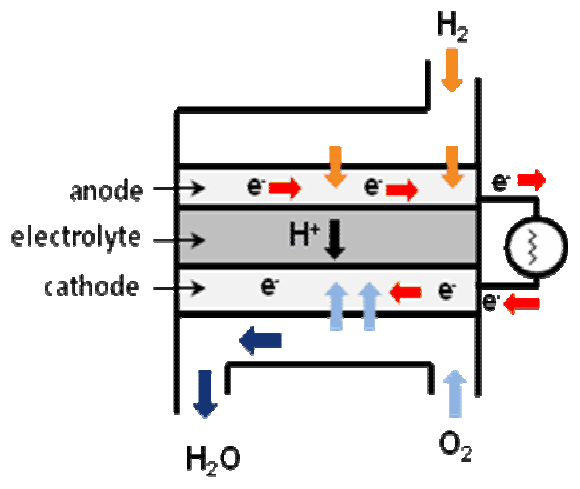


The net result of the two reactions is

The hydrogen for the fuel cell is supplied from the hydrolysis of sodium borohydride. Calculate the standard potential for the cathode half reaction if the standard reduction potential for the anode half reaction is \(-0.83\ \mathrm{V}\) and \(\Delta_{\mathrm f}G^\circ(\ce{H2O(l)})\) is \(-237\ \mathrm{kJ\,mol^{-1}}\).
4.5 Calculate the volume of air at a temperature of \(25\,^\circ\mathrm{C}\) and a pressure of \(1.0\ \mathrm{atm}\) needed to generate a constant current of \(2.5\ \mathrm{A}\) for \(3.0\) hours in this fuel cell. Assume that air contains \(20\,\%\) by volume \(\ce{O2(g)}\).
4.6 The efficiency of a fuel cell is given by the ratio of the work produced to the heat dissipated by the cell reaction. Thus, the maximum efficiency for a fuel cell is given by:
\[ \eta_{\text{fuel cell}}=\frac{\text{work}}{\text{heat}} \]
Calculate the maximum efficiency for the fuel cell using the data given below at \(25\,^\circ\mathrm{C}\) and a standard pressure.
| \(S^\circ\ (\mathrm{J\,mol^{-1}\,K^{-1}})\) | |
|---|---|
| \(\ce{H2(g)}\) | 130.7 |
| \(\ce{O2(g)}\) | 205.2 |
| \(\ce{H2O(l)}\) | 70.0 |
The second law of thermodynamics states that it is impossible to convert all of the heat, \(q_{\mathrm H}\), from a high-temperature reservoir at \(T_{\mathrm H}\) into work. At least, some of the energy, \(q_{\mathrm C}\), must be transferred to a low-temperature reservoir at \(T_{\mathrm C}\). Thus, a heat engine with 100% efficiency is thermodynamically impossible. When the heat engine is working reversibly, as in a Carnot cycle, the efficiency will be a maximum.
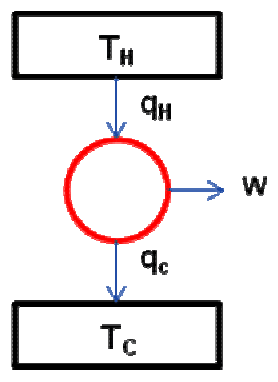
For a heat engine working reversibly between two reservoirs the following relations are applied:
\[ q_{\mathrm H}=w+q_{\mathrm C} \]
and
\[ \frac{q_{\mathrm H}}{T_{\mathrm H}} = \frac{q_{\mathrm C}}{T_{\mathrm C}} \]
4.7 What should be the temperature of the hot reservoir, \(T_{\mathrm H}\), of a Carnot heat engine to maintain the efficiency of the fuel cell calculated in part 4.6, if the temperature of cold reservoir \(T_{\mathrm C}\) is \(40\,^\circ\mathrm{C}\)?
(If you have been unable to calculate the value for the efficiency then use the value 0.80 for the calculation.)
Official English text of the problem.
Answers
- 4.1: \(m(\ce{Ru})=\boxed{4.5\ \mathrm{mg}}\).
- 4.2: \(\boxed{98\ \mathrm{min}}\).
- 4.3: \(\boxed{T=310.9\ \mathrm{K}=37.7\,^\circ\mathrm{C}}\).
- 4.4: \(\boxed{E^\circ_{\text{cathode}}=+0.40\ \mathrm{V}}\), as a reduction potential.
- 4.5: \(\boxed{8.6\ \mathrm{dm^3}}\) of air at \(25\,^\circ\mathrm{C}\) and \(1.0\ \mathrm{atm}\).
- 4.6: \(\boxed{\eta_{\max}=0.830=83.0\%}\).
- 4.7: \(\boxed{T_{\mathrm H}=1.84\times10^3\ \mathrm{K}}\), approximately \(\boxed{1.56\times10^3\,^\circ\mathrm{C}}\).
Solution
The molecular and ionic species used in the solution have the following names and SMILES:
| Species | Name | SMILES |
|---|---|---|
| \(\ce{NaBH4}\) | Sodium borohydride | [Na+].[BH4-] |
| \(\ce{H2}\) | Hydrogen | [H][H] |
| \(\ce{H2O}\) | Water | O |
| \(\ce{Na+}\) | Sodium ion | [Na+] |
| \(\ce{BO2^-}\) | Metaborate ion | [O-]B=O |
| \(\ce{O2}\) | Oxygen | O=O |
| \(\ce{OH^-}\) | Hydroxide ion | [OH-] |
The metaborate SMILES is a formal monomeric representation of the formula used in the problem. These SMILES do not specify phases, solvation, or the structure of the ruthenium nanoclusters.
Use the standard constants \[ R=0.082057\ \mathrm{dm^3\,atm\,mol^{-1}\,K^{-1}} =8.314\ \mathrm{J\,mol^{-1}\,K^{-1}}, \] \[ F=96485\ \mathrm{C\,mol^{-1}}, \qquad M(\ce{Ru})=101.07\ \mathrm{g\,mol^{-1}}. \]
4.1
The balanced hydrolysis reaction is \[ \ce{NaBH4(aq) + 2H2O(l) ->[catalyst] Na+(aq) + BO2^-(aq) + 4H2(g)}. \]
At \(25\,^\circ\mathrm{C}=298.15\ \mathrm{K}\), the required molar hydrogen-production rate follows from the ideal-gas equation: \[ \dot n_{\ce{H2}} = \frac{P\dot V}{RT} = \frac{(1.0\ \mathrm{atm})(0.100\ \mathrm{dm^3\,min^{-1}})} {(0.082057\ \mathrm{dm^3\,atm\,mol^{-1}\,K^{-1}})(298.15\ \mathrm K)} = 4.0874\times10^{-3}\ \mathrm{mol\,min^{-1}}. \]
Each mole of ruthenium produces \(92\) moles of hydrogen per minute, so \[ n_{\ce{Ru}} = \frac{4.0874\times10^{-3}\ \mathrm{mol\,min^{-1}}} {92\ \mathrm{min^{-1}}} = 4.4429\times10^{-5}\ \mathrm{mol}. \]
Therefore, \[ m_{\ce{Ru}} = (4.4429\times10^{-5}\ \mathrm{mol}) (101.07\ \mathrm{g\,mol^{-1}}) = 4.4904\times10^{-3}\ \mathrm g = \boxed{4.5\ \mathrm{mg}}. \]
4.2
The initial amount of sodium borohydride is \[ n_{\ce{NaBH4}} = cV = (1.0\ \mathrm{mol\,dm^{-3}})(0.100\ \mathrm{dm^3}) = 0.100\ \mathrm{mol}. \]
The hydrolysis produces four moles of hydrogen per mole of sodium borohydride: \[ n_{\ce{H2},\text{total}}=4(0.100)=0.400\ \mathrm{mol}. \]
Because the reaction is zero order in the substrate, the stated model gives a constant production rate until the substrate is exhausted. Thus, \[ t = \frac{n_{\ce{H2},\text{total}}}{\dot n_{\ce{H2}}} = \frac{0.400\ \mathrm{mol}} {4.0874\times10^{-3}\ \mathrm{mol\,min^{-1}}} = 97.86\ \mathrm{min} \approx \boxed{98\ \mathrm{min}}. \]
4.3
The hydrogen-production rate is proportional to the amount of catalyst: \[ \dot n_{\ce{H2}}=k(T)n_{\ce{Ru}}. \]
To maintain the same molar production rate with half the catalyst, \[ k(T_2)\frac{n_{\ce{Ru}}}{2}=k(T_1)n_{\ce{Ru}}, \qquad \frac{k(T_2)}{k(T_1)}=2. \]
The Arrhenius equation gives \[ \ln\frac{k(T_2)}{k(T_1)} = \frac{E_{\mathrm a}}{R} \left(\frac1{T_1}-\frac1{T_2}\right). \]
Consequently, \[ T_2 = \left[ \frac1{298.15\ \mathrm K} - \frac{(8.314\ \mathrm{J\,mol^{-1}\,K^{-1}})\ln2} {42000\ \mathrm{J\,mol^{-1}}} \right]^{-1} = 310.867\ \mathrm K. \]
Hence, \[ \boxed{T_2=310.9\ \mathrm K=37.7\,^\circ\mathrm C}. \]
4.4
Oxygen is reduced at the cathode because it accepts electrons: \[ \ce{O2(g) + 2H2O(l) + 4e^- -> 4OH^-(aq)}. \]
Hydrogen is oxidized at the anode because it releases electrons: \[ \ce{H2(g) + 2OH^-(aq) -> 2H2O(l) + 2e^-}. \]
Multiplying the anode reaction by two and adding it to the cathode reaction gives \[ \ce{2H2(g) + O2(g) -> 2H2O(l)}. \]
Four moles of electrons are transferred per mole of this overall reaction. The standard Gibbs energies of formation of elemental hydrogen and oxygen in their standard states are zero, so \[ \Delta_{\mathrm r}G^\circ = 2\Delta_{\mathrm f}G^\circ(\ce{H2O(l)}) = 2(-237) = -474\ \mathrm{kJ\,mol^{-1}}. \]
Using \(\Delta_{\mathrm r}G^\circ=-nFE^\circ_{\text{cell}}\), \[ E^\circ_{\text{cell}} = \frac{474000\ \mathrm{J\,mol^{-1}}} {4(96485\ \mathrm{C\,mol^{-1}})} = 1.22817\ \mathrm V. \]
Both electrode potentials in \[ E^\circ_{\text{cell}} = E^\circ_{\text{cathode,red}} - E^\circ_{\text{anode,red}} \] are reduction potentials. Therefore, \[ E^\circ_{\text{cathode,red}} = 1.22817+(-0.83) = 0.39817\ \mathrm V \approx \boxed{+0.40\ \mathrm V}. \]
4.5
The total charge delivered is \[ Q=It = (2.5\ \mathrm A)(3.0\times3600\ \mathrm s) = 27000\ \mathrm C. \]
The cathode reaction consumes one mole of oxygen per four moles of electrons: \[ n_{\ce{O2}} = \frac{Q}{4F} = \frac{27000}{4(96485)} = 0.069959\ \mathrm{mol}. \]
For ideal gases at the same temperature and pressure, volume fraction equals mole fraction. Air containing \(20\%\) oxygen therefore has the required total amount \[ n_{\text{air}} = \frac{n_{\ce{O2}}}{0.20} = 0.349795\ \mathrm{mol}. \]
Its volume is \[ V_{\text{air}} = \frac{n_{\text{air}}RT}{P} = \frac{(0.349795)(0.082057)(298.15)}{1.0} \ \mathrm{dm^3} = 8.5578\ \mathrm{dm^3}. \]
Thus, \[ \boxed{V_{\text{air}}=8.6\ \mathrm{dm^3}}. \]
4.6
At constant temperature and pressure, the maximum electrical work obtainable is \(-\Delta_{\mathrm r}G^\circ\). Using the total reaction enthalpy release as the available chemical-energy input, \[ \eta_{\max} = \frac{-\Delta_{\mathrm r}G^\circ}{-\Delta_{\mathrm r}H^\circ}. \]
For \[ \ce{2H2(g) + O2(g) -> 2H2O(l)}, \] the standard entropy change is \[ \begin{aligned} \Delta_{\mathrm r}S^\circ &= 2S^\circ(\ce{H2O(l)}) - 2S^\circ(\ce{H2(g)}) - S^\circ(\ce{O2(g)})\\ &= 2(70.0)-2(130.7)-205.2\\ &= -326.6\ \mathrm{J\,mol^{-1}\,K^{-1}}. \end{aligned} \]
Since \[ \Delta_{\mathrm r}G^\circ = \Delta_{\mathrm r}H^\circ-T\Delta_{\mathrm r}S^\circ, \] we obtain \[ \begin{aligned} \Delta_{\mathrm r}H^\circ &= \Delta_{\mathrm r}G^\circ+T\Delta_{\mathrm r}S^\circ\\ &= -474+(298.15)(-0.3266)\\ &= -571.3758\ \mathrm{kJ\,mol^{-1}}. \end{aligned} \]
Therefore, \[ \eta_{\max} = \frac{474}{571.3758} = 0.8295766 \approx \boxed{0.830=83.0\%}. \]
4.7
For the reversible heat engine, \[ \eta = \frac{w}{q_{\mathrm H}} = \frac{q_{\mathrm H}-q_{\mathrm C}}{q_{\mathrm H}} = 1-\frac{q_{\mathrm C}}{q_{\mathrm H}}. \]
The reversible relation \(q_{\mathrm H}/T_{\mathrm H}=q_{\mathrm C}/T_{\mathrm C}\) gives \[ \eta=1-\frac{T_{\mathrm C}}{T_{\mathrm H}}. \]
Using absolute temperatures, \[ T_{\mathrm C}=40+273.15=313.15\ \mathrm K. \]
With the unrounded efficiency from part 4.6, \[ T_{\mathrm H} = \frac{T_{\mathrm C}}{1-\eta} = \frac{313.15}{1-0.8295766} = 1837.48\ \mathrm K. \]
Thus, \[ \boxed{T_{\mathrm H}\approx1.84\times10^3\ \mathrm K \approx1.56\times10^3\,^\circ\mathrm C}. \]
The solution was checked against the official solution.
IChO 2011 · Theorieaufgabe 4
Wasserstoffspeicherung in Natriumborhydrid
Für eine nachhaltige Energieversorgung scheint Wasserstoff der beste Energieträger zu sein. Die effizienteste Art, Wasserstoff zu nutzen, ist die Erzeugung elektrischer Energie in einer Brennstoffzelle. Die Speicherung großer Wasserstoffmengen stellt jedoch eine Herausforderung für den Einsatz von Brennstoffzellen dar. Unter den chemischen Hydriden, die als feste Wasserstoffspeichermaterialien in Betracht gezogen werden, erscheint Natriumborhydrid (\(\ce{NaBH4}\)) aufgrund seiner Ungiftigkeit, Stabilität und Umweltverträglichkeit am vielversprechendsten. Die Hydrolyse von Natriumborhydrid, bei der gasförmiger Wasserstoff \(\ce{H2}\) freigesetzt wird, verläuft bei Umgebungstemperatur langsam und muss daher katalysiert werden.
Kolloidale Ruthenium(0)-Nanocluster sind selbst bei Raumtemperatur die aktivsten Katalysatoren für diese Hydrolyse und führen zu einer vollständigen Freisetzung von \(\ce{H2}\) aus Natriumborhydrid. Kinetische Untersuchungen zeigen, dass die katalytische Hydrolyse von \(\ce{NaBH4}\) bezüglich des Katalysators eine Reaktion erster Ordnung, bezüglich des Substrats jedoch eine Reaktion nullter Ordnung ist. Die Wasserstoffbildungsrate pro Mol Ruthenium beträgt \(92\ \mathrm{mol}\,\ce{H2}\cdot(\mathrm{mol}\,\ce{Ru})^{-1}\cdot\mathrm{min}^{-1}\) bei \(25\,^\circ\mathrm{C}\).
4.1 Berechnen Sie die Masse des Rutheniumkatalysators (in mg), die zu \(0.100\ \mathrm{dm^3}\) einer \(\ce{NaBH4}\)-Lösung mit einer Konzentration von \(1.0\ \mathrm{mol\,dm^{-3}}\) gegeben werden muss, um Wasserstoffgas mit dem für eine tragbare Brennstoffzelle erforderlichen Volumenstrom von \(0.100\ \mathrm{dm^3\,min^{-1}}\) bei \(25\,^\circ\mathrm{C}\) und \(1.0\ \mathrm{atm}\) bereitzustellen.
4.2 Wie viele Minuten lang liefert dieses System Wasserstoffgas mit diesem Volumenstrom?
4.3 Die Arrhenius-Aktivierungsenergie für diese katalytische Hydrolyse von Natriumborhydrid beträgt \(E_{\mathrm a}=42.0\ \mathrm{kJ\,mol^{-1}}\). Berechnen Sie die Temperatur, die erforderlich ist, um mit der Hälfte der bei \(25.0\,^\circ\mathrm{C}\) eingesetzten Menge an Rutheniumkatalysator dieselbe Wasserstoffentwicklungsrate zu erreichen.
4.4 Eine Brennstoffzelle (siehe Abbildung) besteht aus drei schichtweise zusammengefügten Bereichen: der Anode, dem Elektrolyten und der Kathode. Wasserstoff wird als Brennstoff und Sauerstoff als Oxidationsmittel verwendet. An den Grenzflächen der drei verschiedenen Bereiche finden zwei chemische Reaktionen statt:
Die Gesamtreaktion der beiden Reaktionen lautet
Der Wasserstoff für die Brennstoffzelle wird durch die Hydrolyse von Natriumborhydrid bereitgestellt. Berechnen Sie das Standardpotential der Kathodenhalbreaktion, wenn das Standardreduktionspotential der Anodenhalbreaktion \(-0.83\ \mathrm{V}\) und \(\Delta_{\mathrm f}G^\circ(\ce{H2O(l)})\) \(-237\ \mathrm{kJ\,mol^{-1}}\) betragen.
4.5 Berechnen Sie das Luftvolumen bei einer Temperatur von \(25\,^\circ\mathrm{C}\) und einem Druck von \(1.0\ \mathrm{atm}\), das benötigt wird, um in dieser Brennstoffzelle einen konstanten Strom von \(2.5\ \mathrm{A}\) über \(3.0\) Stunden zu erzeugen. Nehmen Sie an, dass Luft \(20\,\%\) Volumenanteil \(\ce{O2(g)}\) enthält.
4.6 Der Wirkungsgrad einer Brennstoffzelle ist durch das Verhältnis der geleisteten Arbeit zur bei der Zellreaktion abgegebenen Wärme gegeben. Der maximale Wirkungsgrad einer Brennstoffzelle ist somit gegeben durch:
\[ \eta_{\text{Brennstoffzelle}}=\frac{\text{Arbeit}}{\text{Wärme}} \]
Berechnen Sie den maximalen Wirkungsgrad der Brennstoffzelle anhand der unten angegebenen Daten bei \(25\,^\circ\mathrm{C}\) und Standarddruck.
| \(S^\circ\ (\mathrm{J\,mol^{-1}\,K^{-1}})\) | |
|---|---|
| \(\ce{H2(g)}\) | 130.7 |
| \(\ce{O2(g)}\) | 205.2 |
| \(\ce{H2O(l)}\) | 70.0 |
Der zweite Hauptsatz der Thermodynamik besagt, dass es unmöglich ist, die gesamte Wärme \(q_{\mathrm H}\) aus einem Hochtemperaturreservoir bei \(T_{\mathrm H}\) in Arbeit umzuwandeln. Zumindest ein Teil der Energie, \(q_{\mathrm C}\), muss auf ein Niedertemperaturreservoir bei \(T_{\mathrm C}\) übertragen werden. Eine Wärmekraftmaschine mit einem Wirkungsgrad von 100% ist daher thermodynamisch unmöglich. Arbeitet die Wärmekraftmaschine reversibel, wie in einem Carnot-Kreisprozess, ist der Wirkungsgrad maximal.
Für eine Wärmekraftmaschine, die reversibel zwischen zwei Reservoiren arbeitet, gelten die folgenden Beziehungen:
\[ q_{\mathrm H}=w+q_{\mathrm C} \]
und
\[ \frac{q_{\mathrm H}}{T_{\mathrm H}} = \frac{q_{\mathrm C}}{T_{\mathrm C}} \]
4.7 Welche Temperatur muss das heiße Reservoir \(T_{\mathrm H}\) einer Carnot-Wärmekraftmaschine haben, um den in Teil 4.6 berechneten Wirkungsgrad der Brennstoffzelle zu erreichen, wenn die Temperatur des kalten Reservoirs \(T_{\mathrm C}\) \(40\,^\circ\mathrm{C}\) beträgt?
(Falls Sie den Wirkungsgrad nicht berechnen konnten, verwenden Sie für die Berechnung den Wert 0.80.)
Aufgabentext aus dem offiziellen englischen Text übersetzt.
Antworten
- 4.1: \(m(\ce{Ru})=\boxed{4.5\ \mathrm{mg}}\).
- 4.2: \(\boxed{98\ \mathrm{min}}\).
- 4.3: \(\boxed{T=310.9\ \mathrm{K}=37.7\,^\circ\mathrm{C}}\).
- 4.4: \(\boxed{E^\circ_{\text{Kathode}}=+0.40\ \mathrm{V}}\), als Reduktionspotential.
- 4.5: \(\boxed{8.6\ \mathrm{dm^3}}\) Luft bei \(25\,^\circ\mathrm{C}\) und \(1.0\ \mathrm{atm}\).
- 4.6: \(\boxed{\eta_{\max}=0.830=83.0\%}\).
- 4.7: \(\boxed{T_{\mathrm H}=1.84\times10^3\ \mathrm{K}}\), ungefähr \(\boxed{1.56\times10^3\,^\circ\mathrm{C}}\).
Lösung
Die in der Lösung verwendeten molekularen und ionischen Spezies haben die folgenden Namen und SMILES:
| Spezies | Name | SMILES |
|---|---|---|
| \(\ce{NaBH4}\) | Natriumborhydrid | [Na+].[BH4-] |
| \(\ce{H2}\) | Wasserstoff | [H][H] |
| \(\ce{H2O}\) | Wasser | O |
| \(\ce{Na+}\) | Natriumion | [Na+] |
| \(\ce{BO2^-}\) | Metaborat-Ion | [O-]B=O |
| \(\ce{O2}\) | Sauerstoff | O=O |
| \(\ce{OH^-}\) | Hydroxidion | [OH-] |
Der SMILES-Ausdruck für Metaborat ist eine formale monomere Darstellung der in der Aufgabe verwendeten Formel. Diese SMILES-Ausdrücke legen weder Phasen noch Solvatation oder die Struktur der Ruthenium-Nanocluster fest.
Wir verwenden die üblichen Konstanten \[ R=0.082057\ \mathrm{dm^3\,atm\,mol^{-1}\,K^{-1}} =8.314\ \mathrm{J\,mol^{-1}\,K^{-1}}, \] \[ F=96485\ \mathrm{C\,mol^{-1}}, \qquad M(\ce{Ru})=101.07\ \mathrm{g\,mol^{-1}}. \]
4.1
Die ausgeglichene Hydrolysereaktion lautet \[ \ce{NaBH4(aq) + 2H2O(l) ->[catalyst] Na+(aq) + BO2^-(aq) + 4H2(g)}. \]
Bei \(25\,^\circ\mathrm{C}=298.15\ \mathrm{K}\) folgt die erforderliche molare Wasserstoffbildungsrate aus der idealen Gasgleichung: \[ \dot n_{\ce{H2}} = \frac{P\dot V}{RT} = \frac{(1.0\ \mathrm{atm})(0.100\ \mathrm{dm^3\,min^{-1}})} {(0.082057\ \mathrm{dm^3\,atm\,mol^{-1}\,K^{-1}})(298.15\ \mathrm K)} = 4.0874\times10^{-3}\ \mathrm{mol\,min^{-1}}. \]
Jedes Mol Ruthenium erzeugt \(92\) Mol Wasserstoff pro Minute, also gilt \[ n_{\ce{Ru}} = \frac{4.0874\times10^{-3}\ \mathrm{mol\,min^{-1}}} {92\ \mathrm{min^{-1}}} = 4.4429\times10^{-5}\ \mathrm{mol}. \]
Daher ist \[ m_{\ce{Ru}} = (4.4429\times10^{-5}\ \mathrm{mol}) (101.07\ \mathrm{g\,mol^{-1}}) = 4.4904\times10^{-3}\ \mathrm g = \boxed{4.5\ \mathrm{mg}}. \]
4.2
Die anfängliche Stoffmenge an Natriumborhydrid beträgt \[ n_{\ce{NaBH4}} = cV = (1.0\ \mathrm{mol\,dm^{-3}})(0.100\ \mathrm{dm^3}) = 0.100\ \mathrm{mol}. \]
Bei der Hydrolyse entstehen vier Mol Wasserstoff pro Mol Natriumborhydrid: \[ n_{\ce{H2},\text{gesamt}}=4(0.100)=0.400\ \mathrm{mol}. \]
Da die Reaktion bezüglich des Substrats nullter Ordnung ist, ergibt sich im angegebenen Modell eine konstante Bildungsrate, bis das Substrat aufgebraucht ist. Somit gilt \[ t = \frac{n_{\ce{H2},\text{gesamt}}}{\dot n_{\ce{H2}}} = \frac{0.400\ \mathrm{mol}} {4.0874\times10^{-3}\ \mathrm{mol\,min^{-1}}} = 97.86\ \mathrm{min} \approx \boxed{98\ \mathrm{min}}. \]
4.3
Die Wasserstoffbildungsrate ist proportional zur Stoffmenge des Katalysators: \[ \dot n_{\ce{H2}}=k(T)n_{\ce{Ru}}. \]
Damit mit der Hälfte des Katalysators dieselbe molare Bildungsrate aufrechterhalten wird, muss gelten: \[ k(T_2)\frac{n_{\ce{Ru}}}{2}=k(T_1)n_{\ce{Ru}}, \qquad \frac{k(T_2)}{k(T_1)}=2. \]
Die Arrhenius-Gleichung ergibt \[ \ln\frac{k(T_2)}{k(T_1)} = \frac{E_{\mathrm a}}{R} \left(\frac1{T_1}-\frac1{T_2}\right). \]
Folglich ist \[ T_2 = \left[ \frac1{298.15\ \mathrm K} - \frac{(8.314\ \mathrm{J\,mol^{-1}\,K^{-1}})\ln2} {42000\ \mathrm{J\,mol^{-1}}} \right]^{-1} = 310.867\ \mathrm K. \]
Damit ergibt sich \[ \boxed{T_2=310.9\ \mathrm K=37.7\,^\circ\mathrm C}. \]
4.4
Sauerstoff wird an der Kathode reduziert, da er Elektronen aufnimmt: \[ \ce{O2(g) + 2H2O(l) + 4e^- -> 4OH^-(aq)}. \]
Wasserstoff wird an der Anode oxidiert, da er Elektronen abgibt: \[ \ce{H2(g) + 2OH^-(aq) -> 2H2O(l) + 2e^-}. \]
Die Multiplikation der Anodenreaktion mit zwei und ihre Addition zur Kathodenreaktion ergibt \[ \ce{2H2(g) + O2(g) -> 2H2O(l)}. \]
Pro Mol dieser Gesamtreaktion werden vier Mol Elektronen übertragen. Die Standardbildungs-Gibbs-Energien von elementarem Wasserstoff und Sauerstoff in ihren Standardzuständen sind null, daher gilt \[ \Delta_{\mathrm r}G^\circ = 2\Delta_{\mathrm f}G^\circ(\ce{H2O(l)}) = 2(-237) = -474\ \mathrm{kJ\,mol^{-1}}. \]
Mit \(\Delta_{\mathrm r}G^\circ=-nFE^\circ_{\text{Zelle}}\) ergibt sich \[ E^\circ_{\text{Zelle}} = \frac{474000\ \mathrm{J\,mol^{-1}}} {4(96485\ \mathrm{C\,mol^{-1}})} = 1.22817\ \mathrm V. \]
Beide Elektrodenpotentiale in \[ E^\circ_{\text{Zelle}} = E^\circ_{\text{Kathode,red}} - E^\circ_{\text{Anode,red}} \] sind Reduktionspotentiale. Daher gilt \[ E^\circ_{\text{Kathode,red}} = 1.22817+(-0.83) = 0.39817\ \mathrm V \approx \boxed{+0.40\ \mathrm V}. \]
4.5
Die insgesamt abgegebene Ladung beträgt \[ Q=It = (2.5\ \mathrm A)(3.0\times3600\ \mathrm s) = 27000\ \mathrm C. \]
Die Kathodenreaktion verbraucht ein Mol Sauerstoff pro vier Mol Elektronen: \[ n_{\ce{O2}} = \frac{Q}{4F} = \frac{27000}{4(96485)} = 0.069959\ \mathrm{mol}. \]
Bei idealen Gasen unter gleicher Temperatur und gleichem Druck ist der Volumenanteil gleich dem Stoffmengenanteil. Für Luft mit \(20\%\) Sauerstoff ergibt sich daher die erforderliche Gesamtstoffmenge \[ n_{\text{Luft}} = \frac{n_{\ce{O2}}}{0.20} = 0.349795\ \mathrm{mol}. \]
Ihr Volumen beträgt \[ V_{\text{Luft}} = \frac{n_{\text{Luft}}RT}{P} = \frac{(0.349795)(0.082057)(298.15)}{1.0} \ \mathrm{dm^3} = 8.5578\ \mathrm{dm^3}. \]
Somit gilt \[ \boxed{V_{\text{Luft}}=8.6\ \mathrm{dm^3}}. \]
4.6
Bei konstanter Temperatur und konstantem Druck beträgt die maximal gewinnbare elektrische Arbeit \(-\Delta_{\mathrm r}G^\circ\). Wenn die gesamte freigesetzte Reaktionsenthalpie als verfügbare zugeführte chemische Energie angesetzt wird, gilt \[ \eta_{\max} = \frac{-\Delta_{\mathrm r}G^\circ}{-\Delta_{\mathrm r}H^\circ}. \]
Für \[ \ce{2H2(g) + O2(g) -> 2H2O(l)}, \] beträgt die Standardentropieänderung \[ \begin{aligned} \Delta_{\mathrm r}S^\circ &= 2S^\circ(\ce{H2O(l)}) - 2S^\circ(\ce{H2(g)}) - S^\circ(\ce{O2(g)})\\ &= 2(70.0)-2(130.7)-205.2\\ &= -326.6\ \mathrm{J\,mol^{-1}\,K^{-1}}. \end{aligned} \]
Da \[ \Delta_{\mathrm r}G^\circ = \Delta_{\mathrm r}H^\circ-T\Delta_{\mathrm r}S^\circ, \] erhalten wir \[ \begin{aligned} \Delta_{\mathrm r}H^\circ &= \Delta_{\mathrm r}G^\circ+T\Delta_{\mathrm r}S^\circ\\ &= -474+(298.15)(-0.3266)\\ &= -571.3758\ \mathrm{kJ\,mol^{-1}}. \end{aligned} \]
Daher ist \[ \eta_{\max} = \frac{474}{571.3758} = 0.8295766 \approx \boxed{0.830=83.0\%}. \]
4.7
Für die reversible Wärmekraftmaschine gilt \[ \eta = \frac{w}{q_{\mathrm H}} = \frac{q_{\mathrm H}-q_{\mathrm C}}{q_{\mathrm H}} = 1-\frac{q_{\mathrm C}}{q_{\mathrm H}}. \]
Aus der Beziehung für den reversiblen Prozess \(q_{\mathrm H}/T_{\mathrm H}=q_{\mathrm C}/T_{\mathrm C}\) folgt \[ \eta=1-\frac{T_{\mathrm C}}{T_{\mathrm H}}. \]
Bei Verwendung absoluter Temperaturen gilt \[ T_{\mathrm C}=40+273.15=313.15\ \mathrm K. \]
Mit dem ungerundeten Wirkungsgrad aus Teil 4.6 ergibt sich \[ T_{\mathrm H} = \frac{T_{\mathrm C}}{1-\eta} = \frac{313.15}{1-0.8295766} = 1837.48\ \mathrm K. \]
Somit gilt \[ \boxed{T_{\mathrm H}\approx1.84\times10^3\ \mathrm K \approx1.56\times10^3\,^\circ\mathrm C}. \]
Die Lösung wurde mit der offiziellen Lösung abgeglichen.
IChO 2011 · Teori sorusu 4
Sodyum borohidrürde hidrojen depolama
Sürdürülebilir enerji için hidrojen en iyi enerji taşıyıcısı olarak görünmektedir. Hidrojeni kullanmanın en verimli yolu, bir yakıt hücresinde elektrik enerjisi üretmektir. Ancak, büyük miktarlarda hidrojen depolamak yakıt hücresi uygulamalarında bir güçlük oluşturmaktadır. Katı hidrojen depolama malzemeleri olarak değerlendirilen kimyasal hidrürler arasında sodyum borohidrür (\(\ce{NaBH4}\)), zehirli olmaması, kararlı olması ve çevreye zarar vermemesi nedeniyle en umut verici seçenek olarak görünmektedir. Sodyum borohidrürün \(\ce{H2}\) gazı açığa çıkaran hidrolizi, ortam sıcaklığında yavaş bir tepkimedir ve bu nedenle katalizlenmesi gerekir.
Kolloidal rutenyum(0) nanokümeleri, oda sıcaklığında bile bu hidroliz için en etkin katalizörlerdir ve sodyum borohidrürden \(\ce{H2}\)'nin tamamen açığa çıkmasını sağlar. Kinetik çalışmalar, \(\ce{NaBH4}\)'ün katalitik hidrolizinin katalizöre göre birinci dereceden, ancak substrata göre sıfırıncı dereceden bir tepkime olduğunu göstermektedir. Rutenyumun molü başına hidrojen üretim hızı, \(25\,^\circ\mathrm{C}\)'de \(92\ \mathrm{mol}\,\ce{H2}\cdot(\mathrm{mol}\,\ce{Ru})^{-1}\cdot\mathrm{min}^{-1}\)'dir.
4.1 Taşınabilir bir yakıt hücresi için gerekli hidrojen gazını \(25\,^\circ\mathrm{C}\) ve \(1.0\ \mathrm{atm}\)'de \(0.100\ \mathrm{dm^3\,min^{-1}}\) hızla sağlamak üzere, derişimi \(1.0\ \mathrm{mol\,dm^{-3}}\) olan \(0.100\ \mathrm{dm^3}\) \(\ce{NaBH4}\) çözeltisine eklenmesi gereken rutenyum katalizörünün miktarını (mg cinsinden) hesaplayınız.
4.2 Bu sistem, bu hızda kaç dakika boyunca hidrojen gazı sağlar?
4.3 Sodyum borohidrürün bu katalitik hidrolizi için Arrhenius etkinleşme enerjisi \(E_{\mathrm a}=42.0\ \mathrm{kJ\,mol^{-1}}\)'dir. \(25.0\,^\circ\mathrm{C}\)'de kullanılan rutenyum katalizörü miktarının yarısını kullanarak aynı hidrojen açığa çıkış hızına ulaşmak için gerekli sıcaklığı hesaplayınız.
4.4 Bir yakıt hücresi (şekle bakınız), sandviç biçiminde bir araya getirilmiş üç bölümden oluşur: anot, elektrolit ve katot. Hidrojen yakıt, oksijen ise yükseltgen olarak kullanılır. Bu üç farklı bölümün ara yüzlerinde iki kimyasal tepkime gerçekleşir:
İki tepkimenin net sonucu şöyledir:
Yakıt hücresinin hidrojeni, sodyum borohidrürün hidrolizinden sağlanır. Anot yarı tepkimesinin standart indirgenme potansiyeli \(-0.83\ \mathrm{V}\) ve \(\Delta_{\mathrm f}G^\circ(\ce{H2O(l)})\) değeri \(-237\ \mathrm{kJ\,mol^{-1}}\) ise katot yarı tepkimesinin standart potansiyelini hesaplayınız.
4.5 Bu yakıt hücresinde \(3.0\) saat boyunca \(2.5\ \mathrm{A}\)'lik sabit bir akım üretmek için gereken havanın \(25\,^\circ\mathrm{C}\) sıcaklık ve \(1.0\ \mathrm{atm}\) basınçtaki hacmini hesaplayınız. Havanın hacimce \(20\,\%\) oranında \(\ce{O2(g)}\) içerdiğini varsayınız.
4.6 Bir yakıt hücresinin verimi, üretilen işin hücre tepkimesinde açığa çıkan ısıya oranıyla verilir. Dolayısıyla, bir yakıt hücresinin maksimum verimi şu şekilde verilir:
\[ \eta_{\text{yakıt hücresi}}=\frac{\text{iş}}{\text{ısı}} \]
\(25\,^\circ\mathrm{C}\) ve standart basınç için aşağıda verilen verileri kullanarak yakıt hücresinin maksimum verimini hesaplayınız.
| \(S^\circ\ (\mathrm{J\,mol^{-1}\,K^{-1}})\) | |
|---|---|
| \(\ce{H2(g)}\) | 130.7 |
| \(\ce{O2(g)}\) | 205.2 |
| \(\ce{H2O(l)}\) | 70.0 |
Termodinamiğin ikinci yasası, \(T_{\mathrm H}\) sıcaklığındaki yüksek sıcaklıklı bir ısı deposundan alınan \(q_{\mathrm H}\) ısısının tamamını işe dönüştürmenin imkânsız olduğunu belirtir. Enerjinin en azından bir kısmının, \(q_{\mathrm C}\)'nin, \(T_{\mathrm C}\) sıcaklığındaki düşük sıcaklıklı bir ısı deposuna aktarılması gerekir. Dolayısıyla, %100 verimli bir ısı makinesi termodinamik açıdan imkânsızdır. Isı makinesi, Carnot çevriminde olduğu gibi tersinir olarak çalıştığında verim maksimum olur.
İki ısı deposu arasında tersinir olarak çalışan bir ısı makinesi için aşağıdaki bağıntılar geçerlidir:
\[ q_{\mathrm H}=w+q_{\mathrm C} \]
ve
\[ \frac{q_{\mathrm H}}{T_{\mathrm H}} = \frac{q_{\mathrm C}}{T_{\mathrm C}} \]
4.7 Soğuk ısı deposunun sıcaklığı \(T_{\mathrm C}\), \(40\,^\circ\mathrm{C}\) ise, bir Carnot ısı makinesinin 4.6 kısmında hesaplanan yakıt hücresi verimine ulaşabilmesi için sıcak ısı deposunun sıcaklığı \(T_{\mathrm H}\) ne olmalıdır?
(Verim değerini hesaplayamadıysanız, hesaplamada 0.80 değerini kullanınız.)
Soru metni resmi İngilizce metinden çevrilmiştir.
Cevaplar
- 4.1: \(m(\ce{Ru})=\boxed{4.5\ \mathrm{mg}}\).
- 4.2: \(\boxed{98\ \mathrm{min}}\).
- 4.3: \(\boxed{T=310.9\ \mathrm{K}=37.7\,^\circ\mathrm{C}}\).
- 4.4: İndirgenme potansiyeli olarak \(\boxed{E^\circ_{\text{katot}}=+0.40\ \mathrm{V}}\).
- 4.5: \(25\,^\circ\mathrm{C}\) ve \(1.0\ \mathrm{atm}\)'de \(\boxed{8.6\ \mathrm{dm^3}}\) hava.
- 4.6: \(\boxed{\eta_{\max}=0.830=83.0\%}\).
- 4.7: \(\boxed{T_{\mathrm H}=1.84\times10^3\ \mathrm{K}}\), yaklaşık \(\boxed{1.56\times10^3\,^\circ\mathrm{C}}\).
Çözüm
Çözümde kullanılan moleküler ve iyonik türlerin adları ve SMILES gösterimleri aşağıdaki gibidir:
| Tür | Adı | SMILES |
|---|---|---|
| \(\ce{NaBH4}\) | Sodyum borohidrür | [Na+].[BH4-] |
| \(\ce{H2}\) | Hidrojen | [H][H] |
| \(\ce{H2O}\) | Su | O |
| \(\ce{Na+}\) | Sodyum iyonu | [Na+] |
| \(\ce{BO2^-}\) | Metaborat iyonu | [O-]B=O |
| \(\ce{O2}\) | Oksijen | O=O |
| \(\ce{OH^-}\) | Hidroksit iyonu | [OH-] |
Metaboratın SMILES gösterimi, soruda kullanılan formülün biçimsel bir monomer gösterimidir. Bu SMILES gösterimleri fazları, solvatasyonu veya rutenyum nanokümelerinin yapısını belirtmez.
Şu standart sabitleri kullanınız: \[ R=0.082057\ \mathrm{dm^3\,atm\,mol^{-1}\,K^{-1}} =8.314\ \mathrm{J\,mol^{-1}\,K^{-1}}, \] \[ F=96485\ \mathrm{C\,mol^{-1}}, \qquad M(\ce{Ru})=101.07\ \mathrm{g\,mol^{-1}}. \]
4.1
Denkleştirilmiş hidroliz tepkimesi şöyledir: \[ \ce{NaBH4(aq) + 2H2O(l) ->[catalyst] Na+(aq) + BO2^-(aq) + 4H2(g)}. \]
\(25\,^\circ\mathrm{C}=298.15\ \mathrm{K}\)'de gerekli molar hidrojen üretim hızı, ideal gaz denkleminden bulunur: \[ \dot n_{\ce{H2}} = \frac{P\dot V}{RT} = \frac{(1.0\ \mathrm{atm})(0.100\ \mathrm{dm^3\,min^{-1}})} {(0.082057\ \mathrm{dm^3\,atm\,mol^{-1}\,K^{-1}})(298.15\ \mathrm K)} = 4.0874\times10^{-3}\ \mathrm{mol\,min^{-1}}. \]
Her bir mol rutenyum dakikada \(92\) mol hidrojen ürettiğinden, \[ n_{\ce{Ru}} = \frac{4.0874\times10^{-3}\ \mathrm{mol\,min^{-1}}} {92\ \mathrm{min^{-1}}} = 4.4429\times10^{-5}\ \mathrm{mol}. \]
Dolayısıyla, \[ m_{\ce{Ru}} = (4.4429\times10^{-5}\ \mathrm{mol}) (101.07\ \mathrm{g\,mol^{-1}}) = 4.4904\times10^{-3}\ \mathrm g = \boxed{4.5\ \mathrm{mg}}. \]
4.2
Başlangıçtaki sodyum borohidrür miktarı şöyledir: \[ n_{\ce{NaBH4}} = cV = (1.0\ \mathrm{mol\,dm^{-3}})(0.100\ \mathrm{dm^3}) = 0.100\ \mathrm{mol}. \]
Hidrolizde, sodyum borohidrürün molü başına dört mol hidrojen üretilir: \[ n_{\ce{H2},\text{toplam}}=4(0.100)=0.400\ \mathrm{mol}. \]
Tepkime substrata göre sıfırıncı dereceden olduğundan, belirtilen modele göre substrat tükenene kadar üretim hızı sabittir. Böylece, \[ t = \frac{n_{\ce{H2},\text{toplam}}}{\dot n_{\ce{H2}}} = \frac{0.400\ \mathrm{mol}} {4.0874\times10^{-3}\ \mathrm{mol\,min^{-1}}} = 97.86\ \mathrm{min} \approx \boxed{98\ \mathrm{min}}. \]
4.3
Hidrojen üretim hızı, katalizör miktarıyla orantılıdır: \[ \dot n_{\ce{H2}}=k(T)n_{\ce{Ru}}. \]
Katalizör miktarının yarısıyla aynı molar üretim hızını korumak için, \[ k(T_2)\frac{n_{\ce{Ru}}}{2}=k(T_1)n_{\ce{Ru}}, \qquad \frac{k(T_2)}{k(T_1)}=2. \]
Arrhenius denklemi şu bağıntıyı verir: \[ \ln\frac{k(T_2)}{k(T_1)} = \frac{E_{\mathrm a}}{R} \left(\frac1{T_1}-\frac1{T_2}\right). \]
Buna göre, \[ T_2 = \left[ \frac1{298.15\ \mathrm K} - \frac{(8.314\ \mathrm{J\,mol^{-1}\,K^{-1}})\ln2} {42000\ \mathrm{J\,mol^{-1}}} \right]^{-1} = 310.867\ \mathrm K. \]
Böylece, \[ \boxed{T_2=310.9\ \mathrm K=37.7\,^\circ\mathrm C}. \]
4.4
Oksijen elektron aldığı için katotta indirgenir: \[ \ce{O2(g) + 2H2O(l) + 4e^- -> 4OH^-(aq)}. \]
Hidrojen elektron verdiği için anotta yükseltgenir: \[ \ce{H2(g) + 2OH^-(aq) -> 2H2O(l) + 2e^-}. \]
Anot tepkimesi ikiyle çarpılıp katot tepkimesiyle toplandığında şu tepkime elde edilir: \[ \ce{2H2(g) + O2(g) -> 2H2O(l)}. \]
Bu toplam tepkimenin molü başına dört mol elektron aktarılır. Standart hâllerindeki elementel hidrojen ve oksijenin standart oluşum Gibbs enerjileri sıfır olduğundan, \[ \Delta_{\mathrm r}G^\circ = 2\Delta_{\mathrm f}G^\circ(\ce{H2O(l)}) = 2(-237) = -474\ \mathrm{kJ\,mol^{-1}}. \]
\(\Delta_{\mathrm r}G^\circ=-nFE^\circ_{\text{hücre}}\) bağıntısı kullanılarak, \[ E^\circ_{\text{hücre}} = \frac{474000\ \mathrm{J\,mol^{-1}}} {4(96485\ \mathrm{C\,mol^{-1}})} = 1.22817\ \mathrm V. \]
Şu bağıntıda yer alan her iki elektrot potansiyeli de \[ E^\circ_{\text{hücre}} = E^\circ_{\text{katot,red}} - E^\circ_{\text{anot,red}} \] indirgenme potansiyelidir. Dolayısıyla, \[ E^\circ_{\text{katot,red}} = 1.22817+(-0.83) = 0.39817\ \mathrm V \approx \boxed{+0.40\ \mathrm V}. \]
4.5
Sağlanan toplam yük şöyledir: \[ Q=It = (2.5\ \mathrm A)(3.0\times3600\ \mathrm s) = 27000\ \mathrm C. \]
Katot tepkimesinde, her dört mol elektron başına bir mol oksijen tüketilir: \[ n_{\ce{O2}} = \frac{Q}{4F} = \frac{27000}{4(96485)} = 0.069959\ \mathrm{mol}. \]
Aynı sıcaklık ve basınçtaki ideal gazlar için hacim kesri mol kesrine eşittir. Dolayısıyla, \(20\%\) oksijen içeren havanın gerekli toplam miktarı şöyledir: \[ n_{\text{hava}} = \frac{n_{\ce{O2}}}{0.20} = 0.349795\ \mathrm{mol}. \]
Hacmi ise şöyledir: \[ V_{\text{hava}} = \frac{n_{\text{hava}}RT}{P} = \frac{(0.349795)(0.082057)(298.15)}{1.0} \ \mathrm{dm^3} = 8.5578\ \mathrm{dm^3}. \]
Böylece, \[ \boxed{V_{\text{hava}}=8.6\ \mathrm{dm^3}}. \]
4.6
Sabit sıcaklık ve basınçta elde edilebilecek maksimum elektriksel iş \(-\Delta_{\mathrm r}G^\circ\)'dır. Tepkimede açığa çıkan toplam entalpi, kullanılabilir kimyasal enerji girdisi olarak alındığında, \[ \eta_{\max} = \frac{-\Delta_{\mathrm r}G^\circ}{-\Delta_{\mathrm r}H^\circ}. \]
Şu tepkime için \[ \ce{2H2(g) + O2(g) -> 2H2O(l)}, \] standart entropi değişimi şöyledir: \[ \begin{aligned} \Delta_{\mathrm r}S^\circ &= 2S^\circ(\ce{H2O(l)}) - 2S^\circ(\ce{H2(g)}) - S^\circ(\ce{O2(g)})\\ &= 2(70.0)-2(130.7)-205.2\\ &= -326.6\ \mathrm{J\,mol^{-1}\,K^{-1}}. \end{aligned} \]
Şu bağıntı geçerli olduğundan, \[ \Delta_{\mathrm r}G^\circ = \Delta_{\mathrm r}H^\circ-T\Delta_{\mathrm r}S^\circ, \] şunu elde ederiz: \[ \begin{aligned} \Delta_{\mathrm r}H^\circ &= \Delta_{\mathrm r}G^\circ+T\Delta_{\mathrm r}S^\circ\\ &= -474+(298.15)(-0.3266)\\ &= -571.3758\ \mathrm{kJ\,mol^{-1}}. \end{aligned} \]
Dolayısıyla, \[ \eta_{\max} = \frac{474}{571.3758} = 0.8295766 \approx \boxed{0.830=83.0\%}. \]
4.7
Tersinir ısı makinesi için, \[ \eta = \frac{w}{q_{\mathrm H}} = \frac{q_{\mathrm H}-q_{\mathrm C}}{q_{\mathrm H}} = 1-\frac{q_{\mathrm C}}{q_{\mathrm H}}. \]
Tersinir sürece ait \(q_{\mathrm H}/T_{\mathrm H}=q_{\mathrm C}/T_{\mathrm C}\) bağıntısı şunu verir: \[ \eta=1-\frac{T_{\mathrm C}}{T_{\mathrm H}}. \]
Mutlak sıcaklıklar kullanılarak, \[ T_{\mathrm C}=40+273.15=313.15\ \mathrm K. \]
4.6 kısmındaki yuvarlanmamış verim değeriyle, \[ T_{\mathrm H} = \frac{T_{\mathrm C}}{1-\eta} = \frac{313.15}{1-0.8295766} = 1837.48\ \mathrm K. \]
Böylece, \[ \boxed{T_{\mathrm H}\approx1.84\times10^3\ \mathrm K \approx1.56\times10^3\,^\circ\mathrm C}. \]
Çözüm, resmi çözümle karşılaştırılarak kontrol edildi.
IChO 2011 · Problema teórico 4
Almacenamiento de hidrógeno en borohidruro de sodio
En el contexto de la energía sostenible, el hidrógeno parece ser el mejor vector energético. La forma más eficiente de utilizar el hidrógeno es generar energía eléctrica en una pila de combustible. Sin embargo, almacenar hidrógeno en grandes cantidades constituye un reto para las aplicaciones de las pilas de combustible. Entre los hidruros químicos considerados como materiales sólidos para el almacenamiento de hidrógeno, el borohidruro de sodio (\(\ce{NaBH4}\)), por ser no tóxico, estable e inocuo para el medio ambiente, parece ser el más prometedor. La hidrólisis del borohidruro de sodio, que libera \(\ce{H2}\) gaseoso, es una reacción lenta a temperatura ambiente y, por tanto, requiere catálisis.
Los nanoagregados coloidales de rutenio(0) son los catalizadores más activos en esta hidrólisis, incluso a temperatura ambiente, y permiten la liberación completa de \(\ce{H2}\) a partir del borohidruro de sodio. Los estudios cinéticos muestran que la hidrólisis catalítica del \(\ce{NaBH4}\) es una reacción de primer orden respecto al catalizador, pero de orden cero respecto al sustrato. La velocidad de producción de hidrógeno por mol de rutenio es de \(92\ \mathrm{mol}\,\ce{H2}\cdot(\mathrm{mol}\,\ce{Ru})^{-1}\cdot\mathrm{min}^{-1}\) a \(25\,^\circ\mathrm{C}\).
4.1 Calcule la cantidad de catalizador de rutenio (en mg) que debe añadirse a \(0.100\ \mathrm{dm^3}\) de una disolución de \(\ce{NaBH4}\) con una concentración de \(1.0\ \mathrm{mol\,dm^{-3}}\) para suministrar hidrógeno gaseoso a un caudal de \(0.100\ \mathrm{dm^3\,min^{-1}}\) a \(25\,^\circ\mathrm{C}\) y \(1.0\ \mathrm{atm}\), necesario para una pila de combustible portátil.
4.2 ¿Durante cuántos minutos suministrará este sistema hidrógeno gaseoso a este caudal?
4.3 La energía de activación de Arrhenius para esta hidrólisis catalítica del borohidruro de sodio es \(E_{\mathrm a}=42.0\ \mathrm{kJ\,mol^{-1}}\). Calcule la temperatura necesaria para alcanzar la misma velocidad de desprendimiento de hidrógeno utilizando la mitad de la cantidad de catalizador de rutenio empleada a \(25.0\,^\circ\mathrm{C}\).
4.4 Una pila de combustible (véase la figura) está formada por tres componentes dispuestos en capas: el ánodo, el electrolito y el cátodo. Se utiliza hidrógeno como combustible y oxígeno como oxidante. En las interfaces entre los tres componentes tienen lugar dos reacciones químicas:
El resultado neto de las dos reacciones es
El hidrógeno para la pila de combustible se suministra mediante la hidrólisis del borohidruro de sodio. Calcule el potencial estándar de la semirreacción catódica si el potencial estándar de reducción de la semirreacción anódica es \(-0.83\ \mathrm{V}\) y \(\Delta_{\mathrm f}G^\circ(\ce{H2O(l)})\) es \(-237\ \mathrm{kJ\,mol^{-1}}\).
4.5 Calcule el volumen de aire a una temperatura de \(25\,^\circ\mathrm{C}\) y una presión de \(1.0\ \mathrm{atm}\) necesario para generar una corriente constante de \(2.5\ \mathrm{A}\) durante \(3.0\) horas en esta pila de combustible. Suponga que el aire contiene un \(20\,\%\) en volumen de \(\ce{O2(g)}\).
4.6 El rendimiento de una pila de combustible viene dado por el cociente entre el trabajo producido y el calor disipado por la reacción de la pila. Por tanto, el rendimiento máximo de una pila de combustible viene dado por:
\[ \eta_{\text{pila de combustible}}=\frac{\text{trabajo}}{\text{calor}} \]
Calcule el rendimiento máximo de la pila de combustible utilizando los datos que se indican a continuación a \(25\,^\circ\mathrm{C}\) y a presión estándar.
| \(S^\circ\ (\mathrm{J\,mol^{-1}\,K^{-1}})\) | |
|---|---|
| \(\ce{H2(g)}\) | 130.7 |
| \(\ce{O2(g)}\) | 205.2 |
| \(\ce{H2O(l)}\) | 70.0 |
El segundo principio de la termodinámica establece que es imposible convertir en trabajo todo el calor, \(q_{\mathrm H}\), procedente de un foco a alta temperatura \(T_{\mathrm H}\). Al menos una parte de la energía, \(q_{\mathrm C}\), debe transferirse a un foco a baja temperatura \(T_{\mathrm C}\). Por tanto, una máquina térmica con un rendimiento del 100% es termodinámicamente imposible. Cuando la máquina térmica funciona de manera reversible, como en un ciclo de Carnot, el rendimiento es máximo.
Para una máquina térmica que funciona de manera reversible entre dos focos, se aplican las siguientes relaciones:
\[ q_{\mathrm H}=w+q_{\mathrm C} \]
y
\[ \frac{q_{\mathrm H}}{T_{\mathrm H}} = \frac{q_{\mathrm C}}{T_{\mathrm C}} \]
4.7 ¿Cuál debe ser la temperatura del foco caliente, \(T_{\mathrm H}\), de una máquina térmica de Carnot para alcanzar el rendimiento de la pila de combustible calculado en el apartado 4.6, si la temperatura del foco frío \(T_{\mathrm C}\) es de \(40\,^\circ\mathrm{C}\)?
(Si no ha podido calcular el valor del rendimiento, utilice el valor 0.80 para el cálculo.)
Enunciado traducido del texto oficial en inglés.
Respuestas
- 4.1: \(m(\ce{Ru})=\boxed{4.5\ \mathrm{mg}}\).
- 4.2: \(\boxed{98\ \mathrm{min}}\).
- 4.3: \(\boxed{T=310.9\ \mathrm{K}=37.7\,^\circ\mathrm{C}}\).
- 4.4: \(\boxed{E^\circ_{\text{cátodo}}=+0.40\ \mathrm{V}}\), como potencial de reducción.
- 4.5: \(\boxed{8.6\ \mathrm{dm^3}}\) de aire a \(25\,^\circ\mathrm{C}\) y \(1.0\ \mathrm{atm}\).
- 4.6: \(\boxed{\eta_{\max}=0.830=83.0\%}\).
- 4.7: \(\boxed{T_{\mathrm H}=1.84\times10^3\ \mathrm{K}}\), aproximadamente \(\boxed{1.56\times10^3\,^\circ\mathrm{C}}\).
Solución
Las especies moleculares e iónicas utilizadas en la solución tienen los siguientes nombres y SMILES:
| Especie | Nombre | SMILES |
|---|---|---|
| \(\ce{NaBH4}\) | Borohidruro de sodio | [Na+].[BH4-] |
| \(\ce{H2}\) | Hidrógeno | [H][H] |
| \(\ce{H2O}\) | Agua | O |
| \(\ce{Na+}\) | Ion sodio | [Na+] |
| \(\ce{BO2^-}\) | Ion metaborato | [O-]B=O |
| \(\ce{O2}\) | Oxígeno | O=O |
| \(\ce{OH^-}\) | Ion hidróxido | [OH-] |
El SMILES del metaborato es una representación monomérica formal de la fórmula utilizada en el problema. Estos SMILES no especifican las fases, la solvatación ni la estructura de los nanoagregados de rutenio.
Se utilizan las constantes estándar \[ R=0.082057\ \mathrm{dm^3\,atm\,mol^{-1}\,K^{-1}} =8.314\ \mathrm{J\,mol^{-1}\,K^{-1}}, \] \[ F=96485\ \mathrm{C\,mol^{-1}}, \qquad M(\ce{Ru})=101.07\ \mathrm{g\,mol^{-1}}. \]
4.1
La reacción de hidrólisis ajustada es \[ \ce{NaBH4(aq) + 2H2O(l) ->[catalyst] Na+(aq) + BO2^-(aq) + 4H2(g)}. \]
A \(25\,^\circ\mathrm{C}=298.15\ \mathrm{K}\), la velocidad molar de producción de hidrógeno requerida se obtiene a partir de la ecuación de los gases ideales: \[ \dot n_{\ce{H2}} = \frac{P\dot V}{RT} = \frac{(1.0\ \mathrm{atm})(0.100\ \mathrm{dm^3\,min^{-1}})} {(0.082057\ \mathrm{dm^3\,atm\,mol^{-1}\,K^{-1}})(298.15\ \mathrm K)} = 4.0874\times10^{-3}\ \mathrm{mol\,min^{-1}}. \]
Cada mol de rutenio produce \(92\) moles de hidrógeno por minuto, por lo que \[ n_{\ce{Ru}} = \frac{4.0874\times10^{-3}\ \mathrm{mol\,min^{-1}}} {92\ \mathrm{min^{-1}}} = 4.4429\times10^{-5}\ \mathrm{mol}. \]
Por tanto, \[ m_{\ce{Ru}} = (4.4429\times10^{-5}\ \mathrm{mol}) (101.07\ \mathrm{g\,mol^{-1}}) = 4.4904\times10^{-3}\ \mathrm g = \boxed{4.5\ \mathrm{mg}}. \]
4.2
La cantidad inicial de borohidruro de sodio es \[ n_{\ce{NaBH4}} = cV = (1.0\ \mathrm{mol\,dm^{-3}})(0.100\ \mathrm{dm^3}) = 0.100\ \mathrm{mol}. \]
La hidrólisis produce cuatro moles de hidrógeno por mol de borohidruro de sodio: \[ n_{\ce{H2},\text{total}}=4(0.100)=0.400\ \mathrm{mol}. \]
Como la reacción es de orden cero respecto al sustrato, el modelo indicado proporciona una velocidad de producción constante hasta que se agota el sustrato. Así, \[ t = \frac{n_{\ce{H2},\text{total}}}{\dot n_{\ce{H2}}} = \frac{0.400\ \mathrm{mol}} {4.0874\times10^{-3}\ \mathrm{mol\,min^{-1}}} = 97.86\ \mathrm{min} \approx \boxed{98\ \mathrm{min}}. \]
4.3
La velocidad de producción de hidrógeno es proporcional a la cantidad de catalizador: \[ \dot n_{\ce{H2}}=k(T)n_{\ce{Ru}}. \]
Para mantener la misma velocidad molar de producción con la mitad del catalizador, \[ k(T_2)\frac{n_{\ce{Ru}}}{2}=k(T_1)n_{\ce{Ru}}, \qquad \frac{k(T_2)}{k(T_1)}=2. \]
La ecuación de Arrhenius da \[ \ln\frac{k(T_2)}{k(T_1)} = \frac{E_{\mathrm a}}{R} \left(\frac1{T_1}-\frac1{T_2}\right). \]
En consecuencia, \[ T_2 = \left[ \frac1{298.15\ \mathrm K} - \frac{(8.314\ \mathrm{J\,mol^{-1}\,K^{-1}})\ln2} {42000\ \mathrm{J\,mol^{-1}}} \right]^{-1} = 310.867\ \mathrm K. \]
Por consiguiente, \[ \boxed{T_2=310.9\ \mathrm K=37.7\,^\circ\mathrm C}. \]
4.4
El oxígeno se reduce en el cátodo porque acepta electrones: \[ \ce{O2(g) + 2H2O(l) + 4e^- -> 4OH^-(aq)}. \]
El hidrógeno se oxida en el ánodo porque cede electrones: \[ \ce{H2(g) + 2OH^-(aq) -> 2H2O(l) + 2e^-}. \]
Al multiplicar la reacción anódica por dos y sumarla a la reacción catódica, se obtiene \[ \ce{2H2(g) + O2(g) -> 2H2O(l)}. \]
Se transfieren cuatro moles de electrones por mol de esta reacción global. Las energías de Gibbs estándar de formación del hidrógeno y del oxígeno elementales en sus estados estándar son cero, por lo que \[ \Delta_{\mathrm r}G^\circ = 2\Delta_{\mathrm f}G^\circ(\ce{H2O(l)}) = 2(-237) = -474\ \mathrm{kJ\,mol^{-1}}. \]
Utilizando \(\Delta_{\mathrm r}G^\circ=-nFE^\circ_{\text{pila}}\), \[ E^\circ_{\text{pila}} = \frac{474000\ \mathrm{J\,mol^{-1}}} {4(96485\ \mathrm{C\,mol^{-1}})} = 1.22817\ \mathrm V. \]
Ambos potenciales de electrodo en \[ E^\circ_{\text{pila}} = E^\circ_{\text{cátodo,red}} - E^\circ_{\text{ánodo,red}} \] son potenciales de reducción. Por tanto, \[ E^\circ_{\text{cátodo,red}} = 1.22817+(-0.83) = 0.39817\ \mathrm V \approx \boxed{+0.40\ \mathrm V}. \]
4.5
La carga total suministrada es \[ Q=It = (2.5\ \mathrm A)(3.0\times3600\ \mathrm s) = 27000\ \mathrm C. \]
La reacción catódica consume un mol de oxígeno por cada cuatro moles de electrones: \[ n_{\ce{O2}} = \frac{Q}{4F} = \frac{27000}{4(96485)} = 0.069959\ \mathrm{mol}. \]
Para gases ideales a la misma temperatura y presión, la fracción en volumen es igual a la fracción molar. Por tanto, la cantidad total necesaria de aire que contiene un \(20\%\) de oxígeno es \[ n_{\text{aire}} = \frac{n_{\ce{O2}}}{0.20} = 0.349795\ \mathrm{mol}. \]
Su volumen es \[ V_{\text{aire}} = \frac{n_{\text{aire}}RT}{P} = \frac{(0.349795)(0.082057)(298.15)}{1.0} \ \mathrm{dm^3} = 8.5578\ \mathrm{dm^3}. \]
Así, \[ \boxed{V_{\text{aire}}=8.6\ \mathrm{dm^3}}. \]
4.6
A temperatura y presión constantes, el trabajo eléctrico máximo que puede obtenerse es \(-\Delta_{\mathrm r}G^\circ\). Si se toma la entalpía total liberada por la reacción como aporte de energía química disponible, \[ \eta_{\max} = \frac{-\Delta_{\mathrm r}G^\circ}{-\Delta_{\mathrm r}H^\circ}. \]
Para \[ \ce{2H2(g) + O2(g) -> 2H2O(l)}, \] la variación de entropía estándar es \[ \begin{aligned} \Delta_{\mathrm r}S^\circ &= 2S^\circ(\ce{H2O(l)}) - 2S^\circ(\ce{H2(g)}) - S^\circ(\ce{O2(g)})\\ &= 2(70.0)-2(130.7)-205.2\\ &= -326.6\ \mathrm{J\,mol^{-1}\,K^{-1}}. \end{aligned} \]
Como \[ \Delta_{\mathrm r}G^\circ = \Delta_{\mathrm r}H^\circ-T\Delta_{\mathrm r}S^\circ, \] se obtiene \[ \begin{aligned} \Delta_{\mathrm r}H^\circ &= \Delta_{\mathrm r}G^\circ+T\Delta_{\mathrm r}S^\circ\\ &= -474+(298.15)(-0.3266)\\ &= -571.3758\ \mathrm{kJ\,mol^{-1}}. \end{aligned} \]
Por tanto, \[ \eta_{\max} = \frac{474}{571.3758} = 0.8295766 \approx \boxed{0.830=83.0\%}. \]
4.7
Para la máquina térmica reversible, \[ \eta = \frac{w}{q_{\mathrm H}} = \frac{q_{\mathrm H}-q_{\mathrm C}}{q_{\mathrm H}} = 1-\frac{q_{\mathrm C}}{q_{\mathrm H}}. \]
La relación de reversibilidad \(q_{\mathrm H}/T_{\mathrm H}=q_{\mathrm C}/T_{\mathrm C}\) da \[ \eta=1-\frac{T_{\mathrm C}}{T_{\mathrm H}}. \]
Utilizando temperaturas absolutas, \[ T_{\mathrm C}=40+273.15=313.15\ \mathrm K. \]
Con el rendimiento sin redondear del apartado 4.6, \[ T_{\mathrm H} = \frac{T_{\mathrm C}}{1-\eta} = \frac{313.15}{1-0.8295766} = 1837.48\ \mathrm K. \]
Así, \[ \boxed{T_{\mathrm H}\approx1.84\times10^3\ \mathrm K \approx1.56\times10^3\,^\circ\mathrm C}. \]
La solución se comprobó con la solución oficial.
IChO 2011 · 理论题 4
硼氢化钠储氢
在可持续能源领域,氢似乎是最佳的能量载体。利用氢的最高效方式是在燃料电池中发电。然而,大量储存氢是燃料电池应用中的一项挑战。在被考虑用作固态储氢材料的化学氢化物中,硼氢化钠(\(\ce{NaBH4}\))无毒、稳定且对环境友好,似乎是最有前景的一种。硼氢化钠水解释放 \(\ce{H2}\) 气体的反应在环境温度下进行缓慢,因此需要催化。
胶体钌(0)纳米簇即使在室温下也是这一水解反应中活性最高的催化剂,能够使硼氢化钠中的 \(\ce{H2}\) 完全释放。动力学研究表明,\(\ce{NaBH4}\) 的催化水解反应对催化剂为一级,对底物则为零级。在 \(25\,^\circ\mathrm{C}\) 下,每摩尔钌的产氢速率为 \(92\ \mathrm{mol}\,\ce{H2}\cdot(\mathrm{mol}\,\ce{Ru})^{-1}\cdot\mathrm{min}^{-1}\)。
4.1 为满足便携式燃料电池的需求,需要在 \(25\,^\circ\mathrm{C}\) 和 \(1.0\ \mathrm{atm}\) 下以 \(0.100\ \mathrm{dm^3\,min^{-1}}\) 的速率供应氢气。计算必须向 \(0.100\ \mathrm{dm^3}\)、浓度为 \(1.0\ \mathrm{mol\,dm^{-3}}\) 的 \(\ce{NaBH4}\) 溶液中加入的钌催化剂的质量(以 mg 为单位)。
4.2 该体系能以这一速率供应氢气多少分钟?
4.3 硼氢化钠这一催化水解反应的阿伦尼乌斯活化能为 \(E_{\mathrm a}=42.0\ \mathrm{kJ\,mol^{-1}}\)。若钌催化剂的用量减至 \(25.0\,^\circ\mathrm{C}\) 时用量的一半,计算达到相同析氢速率所需的温度。
4.4 燃料电池(见图)由叠合在一起的三部分组成:阳极、电解质和阴极。氢用作燃料,氧用作氧化剂。在这三个不同部分的界面处发生两个化学反应:
这两个反应的净结果为
燃料电池所需的氢由硼氢化钠水解提供。已知阳极半反应的标准还原电势为 \(-0.83\ \mathrm{V}\),且 \(\Delta_{\mathrm f}G^\circ(\ce{H2O(l)})\) 为 \(-237\ \mathrm{kJ\,mol^{-1}}\),计算阴极半反应的标准电势。
4.5 计算该燃料电池以 \(2.5\ \mathrm{A}\) 的恒定电流工作 \(3.0\) 小时所需的空气在温度为 \(25\,^\circ\mathrm{C}\)、压力为 \(1.0\ \mathrm{atm}\) 时的体积。假设空气中 \(\ce{O2(g)}\) 的体积分数为 \(20\,\%\)。
4.6 燃料电池的效率定义为所做的功与电池反应所放出的热量之比。因此,燃料电池的最大效率为:
\[ \eta_{\text{燃料电池}}=\frac{\text{功}}{\text{热量}} \]
利用下列 \(25\,^\circ\mathrm{C}\) 和标准压力下的数据,计算该燃料电池的最大效率。
| \(S^\circ\ (\mathrm{J\,mol^{-1}\,K^{-1}})\) | |
|---|---|
| \(\ce{H2(g)}\) | 130.7 |
| \(\ce{O2(g)}\) | 205.2 |
| \(\ce{H2O(l)}\) | 70.0 |
热力学第二定律指出,不可能将从温度为 \(T_{\mathrm H}\) 的高温热源吸收的全部热量 \(q_{\mathrm H}\) 转化为功。至少有一部分能量 \(q_{\mathrm C}\) 必须传递给温度为 \(T_{\mathrm C}\) 的低温热源。因此,从热力学上说,效率为 100% 的热机是不可能的。当热机像卡诺循环那样可逆运行时,其效率达到最大值。
对于在两个热源之间可逆运行的热机,以下关系成立:
\[ q_{\mathrm H}=w+q_{\mathrm C} \]
以及
\[ \frac{q_{\mathrm H}}{T_{\mathrm H}} = \frac{q_{\mathrm C}}{T_{\mathrm C}} \]
4.7 若低温热源的温度 \(T_{\mathrm C}\) 为 \(40\,^\circ\mathrm{C}\),要使卡诺热机的效率与第 4.6 问计算得到的燃料电池效率相同,其高温热源的温度 \(T_{\mathrm H}\) 应为多少?
(如果你未能计算出效率值,则使用 0.80 进行计算。)
题目译自官方英文原文。
答案
- 4.1: \(m(\ce{Ru})=\boxed{4.5\ \mathrm{mg}}\)。
- 4.2: \(\boxed{98\ \mathrm{min}}\)。
- 4.3: \(\boxed{T=310.9\ \mathrm{K}=37.7\,^\circ\mathrm{C}}\)。
- 4.4: \(\boxed{E^\circ_{\text{阴极}}=+0.40\ \mathrm{V}}\),为还原电势。
- 4.5: 在 \(25\,^\circ\mathrm{C}\) 和 \(1.0\ \mathrm{atm}\) 下,空气的体积为 \(\boxed{8.6\ \mathrm{dm^3}}\)。
- 4.6: \(\boxed{\eta_{\max}=0.830=83.0\%}\)。
- 4.7: \(\boxed{T_{\mathrm H}=1.84\times10^3\ \mathrm{K}}\),约为 \(\boxed{1.56\times10^3\,^\circ\mathrm{C}}\)。
解答
解答中使用的分子和离子物种的名称及 SMILES 如下:
| 物种 | 名称 | SMILES |
|---|---|---|
| \(\ce{NaBH4}\) | 硼氢化钠 | [Na+].[BH4-] |
| \(\ce{H2}\) | 氢气 | [H][H] |
| \(\ce{H2O}\) | 水 | O |
| \(\ce{Na+}\) | 钠离子 | [Na+] |
| \(\ce{BO2^-}\) | 偏硼酸根离子 | [O-]B=O |
| \(\ce{O2}\) | 氧气 | O=O |
| \(\ce{OH^-}\) | 氢氧根离子 | [OH-] |
偏硼酸根的 SMILES 是题目所用化学式的一种形式上的单体表示。这些 SMILES 不指定物相、溶剂化情况或钌纳米簇的结构。
使用标准常数 \[ R=0.082057\ \mathrm{dm^3\,atm\,mol^{-1}\,K^{-1}} =8.314\ \mathrm{J\,mol^{-1}\,K^{-1}}, \] \[ F=96485\ \mathrm{C\,mol^{-1}}, \qquad M(\ce{Ru})=101.07\ \mathrm{g\,mol^{-1}}. \]
4.1
配平后的水解反应为 \[ \ce{NaBH4(aq) + 2H2O(l) ->[catalyst] Na+(aq) + BO2^-(aq) + 4H2(g)}. \]
在 \(25\,^\circ\mathrm{C}=298.15\ \mathrm{K}\) 下,由理想气体状态方程可得所需的氢气摩尔生成速率: \[ \dot n_{\ce{H2}} = \frac{P\dot V}{RT} = \frac{(1.0\ \mathrm{atm})(0.100\ \mathrm{dm^3\,min^{-1}})} {(0.082057\ \mathrm{dm^3\,atm\,mol^{-1}\,K^{-1}})(298.15\ \mathrm K)} = 4.0874\times10^{-3}\ \mathrm{mol\,min^{-1}}. \]
每摩尔钌每分钟生成 \(92\) 摩尔氢气,因此 \[ n_{\ce{Ru}} = \frac{4.0874\times10^{-3}\ \mathrm{mol\,min^{-1}}} {92\ \mathrm{min^{-1}}} = 4.4429\times10^{-5}\ \mathrm{mol}. \]
因此, \[ m_{\ce{Ru}} = (4.4429\times10^{-5}\ \mathrm{mol}) (101.07\ \mathrm{g\,mol^{-1}}) = 4.4904\times10^{-3}\ \mathrm g = \boxed{4.5\ \mathrm{mg}}. \]
4.2
硼氢化钠的初始物质的量为 \[ n_{\ce{NaBH4}} = cV = (1.0\ \mathrm{mol\,dm^{-3}})(0.100\ \mathrm{dm^3}) = 0.100\ \mathrm{mol}. \]
每摩尔硼氢化钠水解生成四摩尔氢气: \[ n_{\ce{H2},\text{总量}}=4(0.100)=0.400\ \mathrm{mol}. \]
由于该反应对底物为零级,按照所述模型,生成速率保持恒定,直到底物耗尽。因此, \[ t = \frac{n_{\ce{H2},\text{总量}}}{\dot n_{\ce{H2}}} = \frac{0.400\ \mathrm{mol}} {4.0874\times10^{-3}\ \mathrm{mol\,min^{-1}}} = 97.86\ \mathrm{min} \approx \boxed{98\ \mathrm{min}}. \]
4.3
产氢速率与催化剂的物质的量成正比: \[ \dot n_{\ce{H2}}=k(T)n_{\ce{Ru}}. \]
要在催化剂用量减半的情况下保持相同的摩尔生成速率,必须满足 \[ k(T_2)\frac{n_{\ce{Ru}}}{2}=k(T_1)n_{\ce{Ru}}, \qquad \frac{k(T_2)}{k(T_1)}=2. \]
由阿伦尼乌斯方程可得 \[ \ln\frac{k(T_2)}{k(T_1)} = \frac{E_{\mathrm a}}{R} \left(\frac1{T_1}-\frac1{T_2}\right). \]
因此, \[ T_2 = \left[ \frac1{298.15\ \mathrm K} - \frac{(8.314\ \mathrm{J\,mol^{-1}\,K^{-1}})\ln2} {42000\ \mathrm{J\,mol^{-1}}} \right]^{-1} = 310.867\ \mathrm K. \]
故 \[ \boxed{T_2=310.9\ \mathrm K=37.7\,^\circ\mathrm C}. \]
4.4
氧在阴极接受电子,发生还原反应: \[ \ce{O2(g) + 2H2O(l) + 4e^- -> 4OH^-(aq)}. \]
氢在阳极释放电子,发生氧化反应: \[ \ce{H2(g) + 2OH^-(aq) -> 2H2O(l) + 2e^-}. \]
将阳极反应乘以二,再与阴极反应相加,得到 \[ \ce{2H2(g) + O2(g) -> 2H2O(l)}. \]
按此总反应进行一摩尔反应时,转移四摩尔电子。处于标准态的氢和氧单质的标准生成吉布斯能均为零,因此 \[ \Delta_{\mathrm r}G^\circ = 2\Delta_{\mathrm f}G^\circ(\ce{H2O(l)}) = 2(-237) = -474\ \mathrm{kJ\,mol^{-1}}. \]
利用 \(\Delta_{\mathrm r}G^\circ=-nFE^\circ_{\text{电池}}\), \[ E^\circ_{\text{电池}} = \frac{474000\ \mathrm{J\,mol^{-1}}} {4(96485\ \mathrm{C\,mol^{-1}})} = 1.22817\ \mathrm V. \]
在下式中,两个电极电势 \[ E^\circ_{\text{电池}} = E^\circ_{\text{阴极,还原}} - E^\circ_{\text{阳极,还原}} \] 均为还原电势。因此, \[ E^\circ_{\text{阴极,还原}} = 1.22817+(-0.83) = 0.39817\ \mathrm V \approx \boxed{+0.40\ \mathrm V}. \]
4.5
输出的总电荷量为 \[ Q=It = (2.5\ \mathrm A)(3.0\times3600\ \mathrm s) = 27000\ \mathrm C. \]
阴极反应每转移四摩尔电子消耗一摩尔氧气: \[ n_{\ce{O2}} = \frac{Q}{4F} = \frac{27000}{4(96485)} = 0.069959\ \mathrm{mol}. \]
对于相同温度和压力下的理想气体,体积分数等于摩尔分数。因此,含 \(20\%\) 氧气的空气所需的总物质的量为 \[ n_{\text{空气}} = \frac{n_{\ce{O2}}}{0.20} = 0.349795\ \mathrm{mol}. \]
其体积为 \[ V_{\text{空气}} = \frac{n_{\text{空气}}RT}{P} = \frac{(0.349795)(0.082057)(298.15)}{1.0} \ \mathrm{dm^3} = 8.5578\ \mathrm{dm^3}. \]
因此, \[ \boxed{V_{\text{空气}}=8.6\ \mathrm{dm^3}}. \]
4.6
在恒温恒压条件下,可获得的最大电功为 \(-\Delta_{\mathrm r}G^\circ\)。将反应总焓变所对应的放热量作为可用的化学能输入,则 \[ \eta_{\max} = \frac{-\Delta_{\mathrm r}G^\circ}{-\Delta_{\mathrm r}H^\circ}. \]
对于反应 \[ \ce{2H2(g) + O2(g) -> 2H2O(l)}, \] 标准熵变为 \[ \begin{aligned} \Delta_{\mathrm r}S^\circ &= 2S^\circ(\ce{H2O(l)}) - 2S^\circ(\ce{H2(g)}) - S^\circ(\ce{O2(g)})\\ &= 2(70.0)-2(130.7)-205.2\\ &= -326.6\ \mathrm{J\,mol^{-1}\,K^{-1}}. \end{aligned} \]
由于 \[ \Delta_{\mathrm r}G^\circ = \Delta_{\mathrm r}H^\circ-T\Delta_{\mathrm r}S^\circ, \] 可得 \[ \begin{aligned} \Delta_{\mathrm r}H^\circ &= \Delta_{\mathrm r}G^\circ+T\Delta_{\mathrm r}S^\circ\\ &= -474+(298.15)(-0.3266)\\ &= -571.3758\ \mathrm{kJ\,mol^{-1}}. \end{aligned} \]
因此, \[ \eta_{\max} = \frac{474}{571.3758} = 0.8295766 \approx \boxed{0.830=83.0\%}. \]
4.7
对于可逆热机, \[ \eta = \frac{w}{q_{\mathrm H}} = \frac{q_{\mathrm H}-q_{\mathrm C}}{q_{\mathrm H}} = 1-\frac{q_{\mathrm C}}{q_{\mathrm H}}. \]
由可逆过程的关系式 \(q_{\mathrm H}/T_{\mathrm H}=q_{\mathrm C}/T_{\mathrm C}\) 可得 \[ \eta=1-\frac{T_{\mathrm C}}{T_{\mathrm H}}. \]
使用绝对温度, \[ T_{\mathrm C}=40+273.15=313.15\ \mathrm K. \]
代入第 4.6 问中未经舍入的效率, \[ T_{\mathrm H} = \frac{T_{\mathrm C}}{1-\eta} = \frac{313.15}{1-0.8295766} = 1837.48\ \mathrm K. \]
因此, \[ \boxed{T_{\mathrm H}\approx1.84\times10^3\ \mathrm K \approx1.56\times10^3\,^\circ\mathrm C}. \]
解答已与官方解答核对。
IChO 2011 · Теоретическая задача 4
Хранение водорода в борогидриде натрия
Для устойчивой энергетики водород представляется наилучшим энергоносителем. Наиболее эффективный способ использования водорода — получение электрической энергии в топливном элементе. Однако хранение больших количеств водорода представляет собой сложную задачу при применении топливных элементов. Среди химических гидридов, рассматриваемых в качестве твёрдых материалов для хранения водорода, борогидрид натрия (\(\ce{NaBH4}\)), нетоксичный, устойчивый и экологически безопасный, представляется наиболее перспективным. Гидролиз борогидрида натрия, сопровождающийся выделением газообразного \(\ce{H2}\), при температуре окружающей среды протекает медленно и поэтому требует применения катализатора.
Коллоидные нанокластеры рутения(0) являются наиболее активными катализаторами этого гидролиза даже при комнатной температуре и обеспечивают полное выделение \(\ce{H2}\) из борогидрида натрия. Кинетические исследования показывают, что каталитический гидролиз \(\ce{NaBH4}\) является реакцией первого порядка по катализатору, но нулевого порядка по субстрату. Скорость образования водорода в расчёте на один моль рутения составляет \(92\ \mathrm{mol}\,\ce{H2}\cdot(\mathrm{mol}\,\ce{Ru})^{-1}\cdot\mathrm{min}^{-1}\) при \(25\,^\circ\mathrm{C}\).
4.1 Рассчитайте массу рутениевого катализатора (в мг), которую необходимо добавить к \(0.100\ \mathrm{dm^3}\) раствора \(\ce{NaBH4}\) с концентрацией \(1.0\ \mathrm{mol\,dm^{-3}}\), чтобы обеспечить подачу газообразного водорода со скоростью \(0.100\ \mathrm{dm^3\,min^{-1}}\) при \(25\,^\circ\mathrm{C}\) и \(1.0\ \mathrm{atm}\), необходимой для портативного топливного элемента.
4.2 В течение скольких минут эта система будет подавать газообразный водород с указанной скоростью?
4.3 Энергия активации Аррениуса для этого каталитического гидролиза борогидрида натрия составляет \(E_{\mathrm a}=42.0\ \mathrm{kJ\,mol^{-1}}\). Рассчитайте температуру, необходимую для достижения той же скорости выделения водорода при использовании половины количества рутениевого катализатора, использованного при \(25.0\,^\circ\mathrm{C}\).
4.4 Топливный элемент (см. рисунок) состоит из трёх последовательно расположенных слоёв: анода, электролита и катода. Водород используется в качестве топлива, а кислород — в качестве окислителя. На границах раздела этих трёх различных слоёв протекают две химические реакции:
Суммарный результат этих двух реакций:
Водород для топливного элемента получают гидролизом борогидрида натрия. Рассчитайте стандартный потенциал катодной полуреакции, если стандартный восстановительный потенциал анодной полуреакции равен \(-0.83\ \mathrm{V}\), а \(\Delta_{\mathrm f}G^\circ(\ce{H2O(l)})\) составляет \(-237\ \mathrm{kJ\,mol^{-1}}\).
4.5 Рассчитайте объём воздуха при температуре \(25\,^\circ\mathrm{C}\) и давлении \(1.0\ \mathrm{atm}\), необходимый для получения постоянного тока силой \(2.5\ \mathrm{A}\) в течение \(3.0\) часов в этом топливном элементе. Считайте, что воздух содержит \(20\,\%\) по объёму \(\ce{O2(g)}\).
4.6 КПД топливного элемента определяется отношением произведённой работы к теплоте, выделяемой в реакции, протекающей в элементе. Таким образом, максимальный КПД топливного элемента определяется выражением:
\[ \eta_{\text{топливный элемент}}=\frac{\text{работа}}{\text{теплота}} \]
Рассчитайте максимальный КПД топливного элемента, используя приведённые ниже данные при \(25\,^\circ\mathrm{C}\) и стандартном давлении.
| \(S^\circ\ (\mathrm{J\,mol^{-1}\,K^{-1}})\) | |
|---|---|
| \(\ce{H2(g)}\) | 130.7 |
| \(\ce{O2(g)}\) | 205.2 |
| \(\ce{H2O(l)}\) | 70.0 |
Второй закон термодинамики утверждает, что невозможно превратить в работу всю теплоту \(q_{\mathrm H}\), полученную от высокотемпературного резервуара при \(T_{\mathrm H}\). По крайней мере часть энергии, \(q_{\mathrm C}\), должна быть передана низкотемпературному резервуару при \(T_{\mathrm C}\). Таким образом, тепловая машина с КПД 100% термодинамически невозможна. Когда тепловая машина работает обратимо, как в цикле Карно, её КПД максимален.
Для тепловой машины, работающей обратимо между двумя резервуарами, справедливы следующие соотношения:
\[ q_{\mathrm H}=w+q_{\mathrm C} \]
и
\[ \frac{q_{\mathrm H}}{T_{\mathrm H}} = \frac{q_{\mathrm C}}{T_{\mathrm C}} \]
4.7 Какой должна быть температура горячего резервуара \(T_{\mathrm H}\) тепловой машины Карно, чтобы её КПД был равен КПД топливного элемента, рассчитанному в пункте 4.6, если температура холодного резервуара \(T_{\mathrm C}\) составляет \(40\,^\circ\mathrm{C}\)?
(Если вам не удалось рассчитать значение КПД, используйте для расчёта значение 0.80.)
Условие переведено с официального английского текста.
Ответы
- 4.1: \(m(\ce{Ru})=\boxed{4.5\ \mathrm{mg}}\).
- 4.2: \(\boxed{98\ \mathrm{min}}\).
- 4.3: \(\boxed{T=310.9\ \mathrm{K}=37.7\,^\circ\mathrm{C}}\).
- 4.4: \(\boxed{E^\circ_{\text{катод}}=+0.40\ \mathrm{V}}\), как восстановительный потенциал.
- 4.5: \(\boxed{8.6\ \mathrm{dm^3}}\) воздуха при \(25\,^\circ\mathrm{C}\) и \(1.0\ \mathrm{atm}\).
- 4.6: \(\boxed{\eta_{\max}=0.830=83.0\%}\).
- 4.7: \(\boxed{T_{\mathrm H}=1.84\times10^3\ \mathrm{K}}\), приблизительно \(\boxed{1.56\times10^3\,^\circ\mathrm{C}}\).
Решение
Молекулы и ионы, используемые в решении, имеют следующие названия и записи SMILES:
| Частица | Название | SMILES |
|---|---|---|
| \(\ce{NaBH4}\) | Борогидрид натрия | [Na+].[BH4-] |
| \(\ce{H2}\) | Водород | [H][H] |
| \(\ce{H2O}\) | Вода | O |
| \(\ce{Na+}\) | Ион натрия | [Na+] |
| \(\ce{BO2^-}\) | Метаборат-ион | [O-]B=O |
| \(\ce{O2}\) | Кислород | O=O |
| \(\ce{OH^-}\) | Гидроксид-ион | [OH-] |
Запись SMILES для метабората представляет собой формальное мономерное представление формулы, используемой в задаче. Эти записи SMILES не указывают фазовое состояние, сольватацию или структуру нанокластеров рутения.
Используем стандартные константы \[ R=0.082057\ \mathrm{dm^3\,atm\,mol^{-1}\,K^{-1}} =8.314\ \mathrm{J\,mol^{-1}\,K^{-1}}, \] \[ F=96485\ \mathrm{C\,mol^{-1}}, \qquad M(\ce{Ru})=101.07\ \mathrm{g\,mol^{-1}}. \]
4.1
Уравнение реакции гидролиза с расставленными коэффициентами: \[ \ce{NaBH4(aq) + 2H2O(l) ->[catalyst] Na+(aq) + BO2^-(aq) + 4H2(g)}. \]
При \(25\,^\circ\mathrm{C}=298.15\ \mathrm{K}\) требуемую молярную скорость образования водорода находим из уравнения состояния идеального газа: \[ \dot n_{\ce{H2}} = \frac{P\dot V}{RT} = \frac{(1.0\ \mathrm{atm})(0.100\ \mathrm{dm^3\,min^{-1}})} {(0.082057\ \mathrm{dm^3\,atm\,mol^{-1}\,K^{-1}})(298.15\ \mathrm K)} = 4.0874\times10^{-3}\ \mathrm{mol\,min^{-1}}. \]
На каждый моль рутения образуется \(92\) моля водорода в минуту, поэтому \[ n_{\ce{Ru}} = \frac{4.0874\times10^{-3}\ \mathrm{mol\,min^{-1}}} {92\ \mathrm{min^{-1}}} = 4.4429\times10^{-5}\ \mathrm{mol}. \]
Следовательно, \[ m_{\ce{Ru}} = (4.4429\times10^{-5}\ \mathrm{mol}) (101.07\ \mathrm{g\,mol^{-1}}) = 4.4904\times10^{-3}\ \mathrm g = \boxed{4.5\ \mathrm{mg}}. \]
4.2
Начальное количество борогидрида натрия составляет \[ n_{\ce{NaBH4}} = cV = (1.0\ \mathrm{mol\,dm^{-3}})(0.100\ \mathrm{dm^3}) = 0.100\ \mathrm{mol}. \]
При гидролизе из одного моля борогидрида натрия образуются четыре моля водорода: \[ n_{\ce{H2},\text{всего}}=4(0.100)=0.400\ \mathrm{mol}. \]
Поскольку реакция имеет нулевой порядок по субстрату, в рамках указанной модели скорость образования водорода остаётся постоянной до полного расходования субстрата. Таким образом, \[ t = \frac{n_{\ce{H2},\text{всего}}}{\dot n_{\ce{H2}}} = \frac{0.400\ \mathrm{mol}} {4.0874\times10^{-3}\ \mathrm{mol\,min^{-1}}} = 97.86\ \mathrm{min} \approx \boxed{98\ \mathrm{min}}. \]
4.3
Скорость образования водорода пропорциональна количеству катализатора: \[ \dot n_{\ce{H2}}=k(T)n_{\ce{Ru}}. \]
Для сохранения той же молярной скорости образования водорода при вдвое меньшем количестве катализатора \[ k(T_2)\frac{n_{\ce{Ru}}}{2}=k(T_1)n_{\ce{Ru}}, \qquad \frac{k(T_2)}{k(T_1)}=2. \]
Уравнение Аррениуса даёт \[ \ln\frac{k(T_2)}{k(T_1)} = \frac{E_{\mathrm a}}{R} \left(\frac1{T_1}-\frac1{T_2}\right). \]
Следовательно, \[ T_2 = \left[ \frac1{298.15\ \mathrm K} - \frac{(8.314\ \mathrm{J\,mol^{-1}\,K^{-1}})\ln2} {42000\ \mathrm{J\,mol^{-1}}} \right]^{-1} = 310.867\ \mathrm K. \]
Отсюда \[ \boxed{T_2=310.9\ \mathrm K=37.7\,^\circ\mathrm C}. \]
4.4
Кислород восстанавливается на катоде, поскольку принимает электроны: \[ \ce{O2(g) + 2H2O(l) + 4e^- -> 4OH^-(aq)}. \]
Водород окисляется на аноде, поскольку отдаёт электроны: \[ \ce{H2(g) + 2OH^-(aq) -> 2H2O(l) + 2e^-}. \]
Умножая уравнение анодной реакции на два и складывая его с уравнением катодной реакции, получаем \[ \ce{2H2(g) + O2(g) -> 2H2O(l)}. \]
На один моль этой суммарной реакции переносятся четыре моля электронов. Стандартные энергии Гиббса образования простых веществ водорода и кислорода в их стандартных состояниях равны нулю, поэтому \[ \Delta_{\mathrm r}G^\circ = 2\Delta_{\mathrm f}G^\circ(\ce{H2O(l)}) = 2(-237) = -474\ \mathrm{kJ\,mol^{-1}}. \]
Используя \(\Delta_{\mathrm r}G^\circ=-nFE^\circ_{\text{элемент}}\), \[ E^\circ_{\text{элемент}} = \frac{474000\ \mathrm{J\,mol^{-1}}} {4(96485\ \mathrm{C\,mol^{-1}})} = 1.22817\ \mathrm V. \]
Оба электродных потенциала в выражении \[ E^\circ_{\text{элемент}} = E^\circ_{\text{катод,red}} - E^\circ_{\text{анод,red}} \] являются восстановительными потенциалами. Следовательно, \[ E^\circ_{\text{катод,red}} = 1.22817+(-0.83) = 0.39817\ \mathrm V \approx \boxed{+0.40\ \mathrm V}. \]
4.5
Общий переданный заряд равен \[ Q=It = (2.5\ \mathrm A)(3.0\times3600\ \mathrm s) = 27000\ \mathrm C. \]
В катодной реакции на каждые четыре моля электронов расходуется один моль кислорода: \[ n_{\ce{O2}} = \frac{Q}{4F} = \frac{27000}{4(96485)} = 0.069959\ \mathrm{mol}. \]
Для идеальных газов при одинаковых температуре и давлении объёмная доля равна мольной доле. Поэтому необходимое общее количество воздуха, содержащего \(20\%\) кислорода, составляет \[ n_{\text{воздух}} = \frac{n_{\ce{O2}}}{0.20} = 0.349795\ \mathrm{mol}. \]
Его объём равен \[ V_{\text{воздух}} = \frac{n_{\text{воздух}}RT}{P} = \frac{(0.349795)(0.082057)(298.15)}{1.0} \ \mathrm{dm^3} = 8.5578\ \mathrm{dm^3}. \]
Таким образом, \[ \boxed{V_{\text{воздух}}=8.6\ \mathrm{dm^3}}. \]
4.6
При постоянных температуре и давлении максимальная электрическая работа, которую можно получить, равна \(-\Delta_{\mathrm r}G^\circ\). Принимая полное уменьшение энтальпии реакции за подводимую доступную химическую энергию, \[ \eta_{\max} = \frac{-\Delta_{\mathrm r}G^\circ}{-\Delta_{\mathrm r}H^\circ}. \]
Для реакции \[ \ce{2H2(g) + O2(g) -> 2H2O(l)}, \] стандартное изменение энтропии составляет \[ \begin{aligned} \Delta_{\mathrm r}S^\circ &= 2S^\circ(\ce{H2O(l)}) - 2S^\circ(\ce{H2(g)}) - S^\circ(\ce{O2(g)})\\ &= 2(70.0)-2(130.7)-205.2\\ &= -326.6\ \mathrm{J\,mol^{-1}\,K^{-1}}. \end{aligned} \]
Поскольку \[ \Delta_{\mathrm r}G^\circ = \Delta_{\mathrm r}H^\circ-T\Delta_{\mathrm r}S^\circ, \] получаем \[ \begin{aligned} \Delta_{\mathrm r}H^\circ &= \Delta_{\mathrm r}G^\circ+T\Delta_{\mathrm r}S^\circ\\ &= -474+(298.15)(-0.3266)\\ &= -571.3758\ \mathrm{kJ\,mol^{-1}}. \end{aligned} \]
Следовательно, \[ \eta_{\max} = \frac{474}{571.3758} = 0.8295766 \approx \boxed{0.830=83.0\%}. \]
4.7
Для обратимой тепловой машины \[ \eta = \frac{w}{q_{\mathrm H}} = \frac{q_{\mathrm H}-q_{\mathrm C}}{q_{\mathrm H}} = 1-\frac{q_{\mathrm C}}{q_{\mathrm H}}. \]
Соотношение для обратимого процесса \(q_{\mathrm H}/T_{\mathrm H}=q_{\mathrm C}/T_{\mathrm C}\) даёт \[ \eta=1-\frac{T_{\mathrm C}}{T_{\mathrm H}}. \]
Используя абсолютные температуры, \[ T_{\mathrm C}=40+273.15=313.15\ \mathrm K. \]
С неокруглённым значением КПД из пункта 4.6 \[ T_{\mathrm H} = \frac{T_{\mathrm C}}{1-\eta} = \frac{313.15}{1-0.8295766} = 1837.48\ \mathrm K. \]
Таким образом, \[ \boxed{T_{\mathrm H}\approx1.84\times10^3\ \mathrm K \approx1.56\times10^3\,^\circ\mathrm C}. \]
Решение проверено по официальному решению.
IChO 2011 · مسألة نظرية 4
تخزين الهيدروجين في بوروهيدريد الصوديوم
يبدو الهيدروجين أفضل حامل للطاقة لتحقيق استدامة الطاقة. وأكثر طرق استخدام الهيدروجين كفاءة هي توليد الطاقة الكهربائية في خلية وقود. غير أن تخزين الهيدروجين بكميات كبيرة يمثل تحديًا في تطبيقات خلايا الوقود. ومن بين الهيدريدات الكيميائية التي تُدرس بوصفها مواد صلبة لتخزين الهيدروجين، يبدو بوروهيدريد الصوديوم (\(\ce{NaBH4}\)) أكثرها وعدًا، لكونه غير سام ومستقرًا وغير ضار بالبيئة. والتحلل المائي لبوروهيدريد الصوديوم، الذي يحرر غاز \(\ce{H2}\)، تفاعل بطيء عند درجة حرارة الوسط المحيط، ولذلك يحتاج إلى حفز.
تُعد العناقيد النانوية الغروية للروثينيوم(0) أكثر الحفازات نشاطًا في هذا التحلل المائي حتى عند درجة حرارة الغرفة، وتؤدي إلى تحرير \(\ce{H2}\) بالكامل من بوروهيدريد الصوديوم. وتُظهر الدراسات الحركية أن التحلل المائي الحفزي لـ \(\ce{NaBH4}\) تفاعل من الرتبة الأولى بالنسبة إلى الحفاز، ومن الرتبة الصفرية بالنسبة إلى الركيزة. ويبلغ معدل إنتاج الهيدروجين لكل مول من الروثينيوم \(92\ \mathrm{mol}\,\ce{H2}\cdot(\mathrm{mol}\,\ce{Ru})^{-1}\cdot\mathrm{min}^{-1}\) عند \(25\,^\circ\mathrm{C}\).
4.1 احسب كمية حفاز الروثينيوم (بوحدة mg) التي يجب إضافتها إلى \(0.100\ \mathrm{dm^3}\) من محلول \(\ce{NaBH4}\) بتركيز \(1.0\ \mathrm{mol\,dm^{-3}}\) لتوفير غاز الهيدروجين بمعدل \(0.100\ \mathrm{dm^3\,min^{-1}}\) عند \(25\,^\circ\mathrm{C}\) و\(1.0\ \mathrm{atm}\)، وهو المعدل اللازم لخلية وقود محمولة.
4.2 كم دقيقة سيستمر هذا النظام في توفير غاز الهيدروجين بهذا المعدل؟
4.3 طاقة تنشيط أرهينيوس لهذا التحلل المائي الحفزي لبوروهيدريد الصوديوم هي \(E_{\mathrm a}=42.0\ \mathrm{kJ\,mol^{-1}}\). احسب درجة الحرارة اللازمة لتحقيق معدل انطلاق الهيدروجين نفسه باستخدام نصف كمية حفاز الروثينيوم المستخدمة عند \(25.0\,^\circ\mathrm{C}\).
4.4 تتكون خلية الوقود (انظر الشكل) من ثلاثة أجزاء متراصة معًا: المصعد، والإلكتروليت، والمهبط. ويُستخدم الهيدروجين وقودًا والأكسجين عاملًا مؤكسدًا. ويحدث تفاعلان كيميائيان عند السطوح الفاصلة بين الأجزاء الثلاثة المختلفة:
المحصلة النهائية للتفاعلين هي
يُزوَّد الهيدروجين اللازم لخلية الوقود من التحلل المائي لبوروهيدريد الصوديوم. احسب الجهد القياسي لنصف تفاعل المهبط إذا كان جهد الاختزال القياسي لنصف تفاعل المصعد يساوي \(-0.83\ \mathrm{V}\)، وكانت \(\Delta_{\mathrm f}G^\circ(\ce{H2O(l)})\) تساوي \(-237\ \mathrm{kJ\,mol^{-1}}\).
4.5 احسب حجم الهواء عند درجة حرارة \(25\,^\circ\mathrm{C}\) وضغط \(1.0\ \mathrm{atm}\) اللازم لتوليد تيار ثابت مقداره \(2.5\ \mathrm{A}\) مدة \(3.0\) ساعات في خلية الوقود هذه. افترض أن الهواء يحتوي على \(20\,\%\) حجميًا من \(\ce{O2(g)}\).
4.6 تُعطى كفاءة خلية الوقود بنسبة الشغل الناتج إلى الحرارة المبددة بفعل تفاعل الخلية. ومن ثم، تُعطى الكفاءة القصوى لخلية الوقود بالعلاقة:
\[ \eta_{\text{خلية الوقود}}=\frac{\text{الشغل}}{\text{الحرارة}} \]
احسب الكفاءة القصوى لخلية الوقود باستخدام البيانات المعطاة أدناه عند \(25\,^\circ\mathrm{C}\) وضغط قياسي.
| \(S^\circ\ (\mathrm{J\,mol^{-1}\,K^{-1}})\) | |
|---|---|
| \(\ce{H2(g)}\) | 130.7 |
| \(\ce{O2(g)}\) | 205.2 |
| \(\ce{H2O(l)}\) | 70.0 |
ينص القانون الثاني للديناميكا الحرارية على استحالة تحويل كل الحرارة، \(q_{\mathrm H}\)، الآتية من خزان مرتفع الحرارة عند \(T_{\mathrm H}\) إلى شغل. فلا بد من انتقال جزء من الطاقة على الأقل، \(q_{\mathrm C}\)، إلى خزان منخفض الحرارة عند \(T_{\mathrm C}\). ولذلك، فإن محركًا حراريًا بكفاءة 100% مستحيل من منظور الديناميكا الحرارية. وعندما يعمل المحرك الحراري بصورة عكوسة، كما في دورة كارنو، تكون الكفاءة عند قيمتها القصوى.
تُطبَّق العلاقات الآتية على محرك حراري يعمل بصورة عكوسة بين خزانين:
\[ q_{\mathrm H}=w+q_{\mathrm C} \]
و
\[ \frac{q_{\mathrm H}}{T_{\mathrm H}} = \frac{q_{\mathrm C}}{T_{\mathrm C}} \]
4.7 ما درجة حرارة الخزان الساخن، \(T_{\mathrm H}\)، التي يجب أن تكون لمحرك كارنو الحراري كي يحقق كفاءة خلية الوقود المحسوبة في الجزء 4.6، إذا كانت درجة حرارة الخزان البارد \(T_{\mathrm C}\) تساوي \(40\,^\circ\mathrm{C}\)؟
(إذا لم تتمكن من حساب قيمة الكفاءة، فاستخدم القيمة 0.80 في الحساب.)
نص المسألة مترجم عن النص الإنجليزي الرسمي.
الإجابات
- 4.1: \(m(\ce{Ru})=\boxed{4.5\ \mathrm{mg}}\).
- 4.2: \(\boxed{98\ \mathrm{min}}\).
- 4.3: \(\boxed{T=310.9\ \mathrm{K}=37.7\,^\circ\mathrm{C}}\).
- 4.4: \(\boxed{E^\circ_{\text{المهبط}}=+0.40\ \mathrm{V}}\)، بوصفه جهد اختزال.
- 4.5: \(\boxed{8.6\ \mathrm{dm^3}}\) من الهواء عند \(25\,^\circ\mathrm{C}\) و\(1.0\ \mathrm{atm}\).
- 4.6: \(\boxed{\eta_{\max}=0.830=83.0\%}\).
- 4.7: \(\boxed{T_{\mathrm H}=1.84\times10^3\ \mathrm{K}}\)، أي نحو \(\boxed{1.56\times10^3\,^\circ\mathrm{C}}\).
الحل
للأنواع الجزيئية والأيونية المستخدمة في الحل الأسماء وتمثيلات SMILES الآتية:
| النوع | الاسم | SMILES |
|---|---|---|
| \(\ce{NaBH4}\) | بوروهيدريد الصوديوم | [Na+].[BH4-] |
| \(\ce{H2}\) | الهيدروجين | [H][H] |
| \(\ce{H2O}\) | الماء | O |
| \(\ce{Na+}\) | أيون الصوديوم | [Na+] |
| \(\ce{BO2^-}\) | أيون الميتابورات | [O-]B=O |
| \(\ce{O2}\) | الأكسجين | O=O |
| \(\ce{OH^-}\) | أيون الهيدروكسيد | [OH-] |
تمثيل SMILES للميتابورات هو تمثيل صوري أحادي الوحدة للصيغة المستخدمة في المسألة. ولا تحدد تمثيلات SMILES هذه الأطوار، أو الاستذواب، أو بنية عناقيد الروثينيوم النانوية.
نستخدم الثوابت القياسية \[ R=0.082057\ \mathrm{dm^3\,atm\,mol^{-1}\,K^{-1}} =8.314\ \mathrm{J\,mol^{-1}\,K^{-1}}, \] \[ F=96485\ \mathrm{C\,mol^{-1}}, \qquad M(\ce{Ru})=101.07\ \mathrm{g\,mol^{-1}}. \]
4.1
تفاعل التحلل المائي الموزون هو \[ \ce{NaBH4(aq) + 2H2O(l) ->[catalyst] Na+(aq) + BO2^-(aq) + 4H2(g)}. \]
عند \(25\,^\circ\mathrm{C}=298.15\ \mathrm{K}\)، يُستنتج معدل إنتاج الهيدروجين المولي المطلوب من معادلة الغاز المثالي: \[ \dot n_{\ce{H2}} = \frac{P\dot V}{RT} = \frac{(1.0\ \mathrm{atm})(0.100\ \mathrm{dm^3\,min^{-1}})} {(0.082057\ \mathrm{dm^3\,atm\,mol^{-1}\,K^{-1}})(298.15\ \mathrm K)} = 4.0874\times10^{-3}\ \mathrm{mol\,min^{-1}}. \]
ينتج كل مول من الروثينيوم \(92\) مولًا من الهيدروجين في الدقيقة، ومن ثم \[ n_{\ce{Ru}} = \frac{4.0874\times10^{-3}\ \mathrm{mol\,min^{-1}}} {92\ \mathrm{min^{-1}}} = 4.4429\times10^{-5}\ \mathrm{mol}. \]
وعليه، \[ m_{\ce{Ru}} = (4.4429\times10^{-5}\ \mathrm{mol}) (101.07\ \mathrm{g\,mol^{-1}}) = 4.4904\times10^{-3}\ \mathrm g = \boxed{4.5\ \mathrm{mg}}. \]
4.2
الكمية الابتدائية من بوروهيدريد الصوديوم هي \[ n_{\ce{NaBH4}} = cV = (1.0\ \mathrm{mol\,dm^{-3}})(0.100\ \mathrm{dm^3}) = 0.100\ \mathrm{mol}. \]
ينتج التحلل المائي أربعة مولات من الهيدروجين لكل مول من بوروهيدريد الصوديوم: \[ n_{\ce{H2},\text{الكلي}}=4(0.100)=0.400\ \mathrm{mol}. \]
لأن التفاعل من الرتبة الصفرية بالنسبة إلى الركيزة، فإن النموذج المذكور يعطي معدل إنتاج ثابتًا حتى نفاد الركيزة. ومن ثم، \[ t = \frac{n_{\ce{H2},\text{الكلي}}}{\dot n_{\ce{H2}}} = \frac{0.400\ \mathrm{mol}} {4.0874\times10^{-3}\ \mathrm{mol\,min^{-1}}} = 97.86\ \mathrm{min} \approx \boxed{98\ \mathrm{min}}. \]
4.3
يتناسب معدل إنتاج الهيدروجين طرديًا مع كمية الحفاز: \[ \dot n_{\ce{H2}}=k(T)n_{\ce{Ru}}. \]
للحفاظ على معدل الإنتاج المولي نفسه باستخدام نصف كمية الحفاز، \[ k(T_2)\frac{n_{\ce{Ru}}}{2}=k(T_1)n_{\ce{Ru}}, \qquad \frac{k(T_2)}{k(T_1)}=2. \]
تعطي معادلة أرهينيوس \[ \ln\frac{k(T_2)}{k(T_1)} = \frac{E_{\mathrm a}}{R} \left(\frac1{T_1}-\frac1{T_2}\right). \]
وبناءً على ذلك، \[ T_2 = \left[ \frac1{298.15\ \mathrm K} - \frac{(8.314\ \mathrm{J\,mol^{-1}\,K^{-1}})\ln2} {42000\ \mathrm{J\,mol^{-1}}} \right]^{-1} = 310.867\ \mathrm K. \]
ومن ثم، \[ \boxed{T_2=310.9\ \mathrm K=37.7\,^\circ\mathrm C}. \]
4.4
يُختزل الأكسجين عند المهبط لأنه يكتسب إلكترونات: \[ \ce{O2(g) + 2H2O(l) + 4e^- -> 4OH^-(aq)}. \]
يتأكسد الهيدروجين عند المصعد لأنه يفقد إلكترونات: \[ \ce{H2(g) + 2OH^-(aq) -> 2H2O(l) + 2e^-}. \]
بضرب تفاعل المصعد في اثنين وإضافته إلى تفاعل المهبط نحصل على \[ \ce{2H2(g) + O2(g) -> 2H2O(l)}. \]
تنتقل أربعة مولات من الإلكترونات لكل مول من هذا التفاعل الكلي. وطاقتا غيبس القياسيتان لتكوين الهيدروجين والأكسجين العنصريين في حالتيهما القياسيتين تساويان صفرًا، ولذلك \[ \Delta_{\mathrm r}G^\circ = 2\Delta_{\mathrm f}G^\circ(\ce{H2O(l)}) = 2(-237) = -474\ \mathrm{kJ\,mol^{-1}}. \]
باستخدام \(\Delta_{\mathrm r}G^\circ=-nFE^\circ_{\text{الخلية}}\)، \[ E^\circ_{\text{الخلية}} = \frac{474000\ \mathrm{J\,mol^{-1}}} {4(96485\ \mathrm{C\,mol^{-1}})} = 1.22817\ \mathrm V. \]
جهدا القطبين في العلاقة \[ E^\circ_{\text{الخلية}} = E^\circ_{\text{المهبط,red}} - E^\circ_{\text{المصعد,red}} \] كلاهما جهدا اختزال. وعليه، \[ E^\circ_{\text{المهبط,red}} = 1.22817+(-0.83) = 0.39817\ \mathrm V \approx \boxed{+0.40\ \mathrm V}. \]
4.5
الشحنة الكلية التي توفرها الخلية هي \[ Q=It = (2.5\ \mathrm A)(3.0\times3600\ \mathrm s) = 27000\ \mathrm C. \]
يستهلك تفاعل المهبط مولًا واحدًا من الأكسجين لكل أربعة مولات من الإلكترونات: \[ n_{\ce{O2}} = \frac{Q}{4F} = \frac{27000}{4(96485)} = 0.069959\ \mathrm{mol}. \]
للغازات المثالية عند درجة الحرارة والضغط نفسيهما، يساوي الكسر الحجمي الكسر المولي. ولذلك فإن الكمية الكلية المطلوبة من الهواء المحتوي على \(20\%\) من الأكسجين هي \[ n_{\text{الهواء}} = \frac{n_{\ce{O2}}}{0.20} = 0.349795\ \mathrm{mol}. \]
وحجمه هو \[ V_{\text{الهواء}} = \frac{n_{\text{الهواء}}RT}{P} = \frac{(0.349795)(0.082057)(298.15)}{1.0} \ \mathrm{dm^3} = 8.5578\ \mathrm{dm^3}. \]
ومن ثم، \[ \boxed{V_{\text{الهواء}}=8.6\ \mathrm{dm^3}}. \]
4.6
عند ثبوت درجة الحرارة والضغط، يكون أقصى شغل كهربائي يمكن الحصول عليه هو \(-\Delta_{\mathrm r}G^\circ\). وباستخدام إجمالي الإنثالبي المنطلق من التفاعل بوصفه الطاقة الكيميائية الداخلة المتاحة، \[ \eta_{\max} = \frac{-\Delta_{\mathrm r}G^\circ}{-\Delta_{\mathrm r}H^\circ}. \]
للتفاعل \[ \ce{2H2(g) + O2(g) -> 2H2O(l)}, \] يكون التغير القياسي في الإنتروبيا \[ \begin{aligned} \Delta_{\mathrm r}S^\circ &= 2S^\circ(\ce{H2O(l)}) - 2S^\circ(\ce{H2(g)}) - S^\circ(\ce{O2(g)})\\ &= 2(70.0)-2(130.7)-205.2\\ &= -326.6\ \mathrm{J\,mol^{-1}\,K^{-1}}. \end{aligned} \]
بما أن \[ \Delta_{\mathrm r}G^\circ = \Delta_{\mathrm r}H^\circ-T\Delta_{\mathrm r}S^\circ, \] نحصل على \[ \begin{aligned} \Delta_{\mathrm r}H^\circ &= \Delta_{\mathrm r}G^\circ+T\Delta_{\mathrm r}S^\circ\\ &= -474+(298.15)(-0.3266)\\ &= -571.3758\ \mathrm{kJ\,mol^{-1}}. \end{aligned} \]
وعليه، \[ \eta_{\max} = \frac{474}{571.3758} = 0.8295766 \approx \boxed{0.830=83.0\%}. \]
4.7
للمحرك الحراري العكوس، \[ \eta = \frac{w}{q_{\mathrm H}} = \frac{q_{\mathrm H}-q_{\mathrm C}}{q_{\mathrm H}} = 1-\frac{q_{\mathrm C}}{q_{\mathrm H}}. \]
تعطي علاقة العملية العكوسة \(q_{\mathrm H}/T_{\mathrm H}=q_{\mathrm C}/T_{\mathrm C}\) \[ \eta=1-\frac{T_{\mathrm C}}{T_{\mathrm H}}. \]
باستخدام درجات الحرارة المطلقة، \[ T_{\mathrm C}=40+273.15=313.15\ \mathrm K. \]
باستخدام قيمة الكفاءة غير المقربة من الجزء 4.6، \[ T_{\mathrm H} = \frac{T_{\mathrm C}}{1-\eta} = \frac{313.15}{1-0.8295766} = 1837.48\ \mathrm K. \]
ومن ثم، \[ \boxed{T_{\mathrm H}\approx1.84\times10^3\ \mathrm K \approx1.56\times10^3\,^\circ\mathrm C}. \]
تمت مراجعة الحل بمقارنته بالحل الرسمي.