IChO 2011 · Theory problem 5
Polynitrogen compounds
Polynitrogen compounds have great potential for being used as high energy density materials. They are thermodynamically unstable. Huge amount of energy is released from their decomposition or reactions leading to more stable products. The only known polynitrogen species are \(\ce{N2}\), \(\ce{N3-}\) and \(\ce{N5+}\), isolated in 1772, 1890 and 1999, respectively, and recently reported cyclic anion, \(\ce{N5-}\).
5.1 Write the Lewis structure for \(\ce{N5+}\) with three energetically favourable resonance forms. Indicate the lone pairs and formal charges. Draw the molecular geometry of \(\ce{N5+}\).
5.2 Write the Lewis structures for cyclic \(\ce{N5-}\) with five energetically favourable resonance forms. Indicate the lone pairs and formal charges. Draw the molecular geometry of cyclic \(\ce{N5-}\).
5.3 The synthesis of \(\ce{[N5+][AsF6-]}\), a white ionic solid, was achieved by reacting \(\ce{[N2F+][AsF6-]}\) with hydrazoic acid, \(\ce{HN3}\), in liquid \(\ce{HF}\) at \(-78\,^\circ\mathrm{C}\). Write the balanced chemical equation for this reaction.
The preparation of \(\ce{[N2F+][AsF6-]}\) requires the reaction of \(\ce{N2F2}\) with strong Lewis acid \(\ce{AsF5}\) as follows:

In the synthesis of \(\ce{N2F2}\), the trans isomer is formed which is thermodynamically less stable than cis-\(\ce{N2F2}\). However, conversion of trans-\(\ce{N2F2}\) to cis-\(\ce{N2F2}\) requires surmounting a high energy barrier of \(251\ \mathrm{kJ\,mol^{-1}}\), so that equilibration between the cis and the trans isomers does not significantly take place without a suitable catalyst.
When trans-\(\ce{N2F2}\) is maintained in a closed container for six days at room temperature in the presence of a small amount of \(\ce{SbF5}\) as a catalyst, cis-trans thermal equilibrium is established.
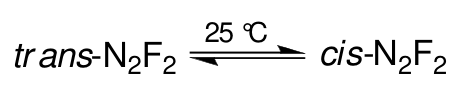
The standard enthalpies of formation of trans- and cis-\(\ce{N2F2}\) are 67.31 and \(62.03\ \mathrm{kJ\,mol^{-1}}\), respectively, and their standard entropies at \(25\,^\circ\mathrm{C}\) are 262.10 and \(266.50\ \mathrm{J\,K^{-1}\,mol^{-1}}\), respectively.
5.4 Find the ratio of the number of cis-\(\ce{N2F2}\) molecules over that of the trans-\(\ce{N2F2}\) molecules in an equilibrium mixture at \(25\,^\circ\mathrm{C}\).
5.5 Write the Lewis structures showing the geometry of \(\ce{N2F+}\) ion and those of trans- and cis-isomers of \(\ce{N2F2}\). Include all lone pairs and formal charges. Suggest an appropriate hybridization for each nitrogen atom in \(\ce{N2F2}\) and \(\ce{N2F+}\).
Solid \(\ce{[N5+][AsF6-]}\) is marginally stable at room temperature but reacts explosively with water to produce arsenic pentafluoride, hydrogen fluoride, molecular nitrogen and oxygen.
5.6 Write a balanced equation for the reaction between \(\ce{[N5+][AsF6-]}\) and water.
Conversion of \(\ce{[N5+][SbF6-]}\) into other \(\ce{N5+}\) salts can be achieved by a metathesis reaction:

where \(\ce{M+} = \ce{Na+}, \ce{K+}, \ce{Cs+}\), and \(\ce{X-}\) = large anion such as \(\ce{SnF6^2-}\) and \(\ce{B(CF3)4-}\).
Since \(\ce{[Cs+][SbF6-]}\) has a low solubility in anhydrous \(\ce{HF}\), and \(\ce{[K+][SbF6-]}\) has a low solubility in \(\ce{SO2}\), these two solvents were used extensively to carry out metathesis reactions at \(-78\,^\circ\mathrm{C}\) and \(-64\,^\circ\mathrm{C}\), respectively.
5.7 Write the balanced equation for the preparation of \(\ce{[N5+]2[SnF6^2-]}\) and \(\ce{[N5+][B(CF3)4-]}\) in solution starting with \(\ce{[Cs+]2[SnF6^2-]}\) and \(\ce{[K+][B(CF3)4-]}\), respectively. Indicate the appropriate solvent.
When \(\ce{[N5+]2[SnF6^2-]}\) decomposes under carefully controlled conditions at \(25\text{–}30\,^\circ\mathrm{C}\), \(\ce{[N5+][SnF5-]}\) and \(\ce{N5F}\) are formed. The \(\ce{[N5+][SnF5-]}\) salt is a white solid and has a thermal stability comparable to that of \(\ce{[N5+][SbF6-]}\) (\(50\text{–}60\,^\circ\mathrm{C}\)). The solution \(\ce{^119Sn}\) NMR spectrum has shown that the \(\ce{SnF5-}\) anion in this compound is, in fact, a mixture of dimeric and tetrameric polyanions. In both of these polyanions the coordination number of Sn atom is 6 and there are bridging fluorine atoms.
5.8 Draw the structures of dimeric and tetrameric polyanions.
Official English text of the problem.
Answers
The complete lone-pair assignments and SMILES are given in the corresponding solution parts.
-
5.1: Pentazenium, \(\ce{N5+}\), has the three favourable resonance forms \[ \ce{N#N^{+}-N^{-}-N^{+}\bond{#}N} \;\leftrightarrow\; \ce{N^{-}=N^{+}=N-N^{+}\bond{#}N} \;\leftrightarrow\; \ce{N#N^{+}-N=N^{+}=N^{-}}. \] Its geometry is an open, planar, V-shaped chain.
-
5.2: Cyclopentazolate, \(\ce{N5-}\), has five equivalent resonance forms, each containing two double bonds and one negatively charged nitrogen. It is a planar pentagonal ring.
-
5.3: \[ \boxed{\ce{[N2F+][AsF6-] + HN3 -> [N5+][AsF6-] + HF}} \] in liquid \(\ce{HF}\) at \(-78\,^\circ\mathrm{C}\).
-
5.4: \[ \boxed{\frac{N_{\mathrm{cis}}}{N_{\mathrm{trans}}}=14.3} \]
-
5.5: Fluorodiazonium is linear, \(\ce{F-N+\bond{#}N}\), with both nitrogen atoms \(sp\)-hybridized. Both difluorodiazene isomers have planar \(\ce{F-N=N-F}\) skeletons and \(sp^2\)-hybridized nitrogen atoms; their fluorines lie on opposite sides for trans and the same side for cis.
-
5.6: \[ \boxed{\ce{4 [N5+][AsF6-] + 2 H2O -> 4 AsF5 + 4 HF + 10 N2 + O2}} \]
-
5.7: \[ \boxed{\ce{2 [N5+][SbF6-] + [Cs+]2[SnF6^2-] -> [N5+]2[SnF6^2-] + 2 [Cs+][SbF6-](s)}} \] Solvent: anhydrous \(\ce{HF}\), at \(-78\,^\circ\mathrm{C}\). \[ \boxed{\ce{[N5+][SbF6-] + [K+][B(CF3)4-] -> [N5+][B(CF3)4-] + [K+][SbF6-](s)}} \] Solvent: liquid \(\ce{SO2}\), at \(-64\,^\circ\mathrm{C}\).
-
5.8: The dimer is \(\ce{Sn2F10^2-}\), comprising two edge-sharing coordination octahedra with two fluoride bridges. The tetramer is cyclic \(\ce{Sn4F20^4-}\), comprising four corner-sharing coordination octahedra with four fluoride bridges. Every tin has four terminal and two bridging fluorines.
Solution
SMILES specify connectivity and, where indicated, double-bond stereochemistry. Lone pairs and spatial geometry are described separately. For ionic salts, the constituent-ion SMILES are supplied; joining these with . in the required stoichiometric ratio gives a formula-unit SMILES.
5.1 — Pentazenium: resonance forms and geometry
The pentazenium cation, \(\ce{N5+}\), contains \[ 5(5)-1=24 \] valence electrons.
For an open chain with an octet on every nitrogen, let \(B\) be the sum of its four bond orders. Counting the electrons needed for five octets gives \[ 40-2B=24,\qquad B=8. \]
For an octet-satisfying nitrogen whose total bond order is \(s\), \[ \text{number of lone pairs}=4-s, \qquad \text{formal charge}=s-3. \]
Number the nitrogen atoms 1–5 along the chain. The three favourable forms are:
| Form | Bond orders: 1–2, 2–3, 3–4, 4–5 | Formal charges: atoms 1–5 | Lone-pair counts: atoms 1–5 | SMILES |
|---|---|---|---|---|
| A | \(3,1,1,3\) | \(0,+1,-1,+1,0\) | \(1,0,2,0,1\) | N#[N+][N-][N+]#N |
| B | \(2,2,1,3\) | \(-1,+1,0,+1,0\) | \(2,0,1,0,1\) | [N-]=[N+]=N[N+]#N |
| C | \(3,1,2,2\) | \(0,+1,0,+1,-1\) | \(1,0,1,0,2\) | N#[N+]N=[N+]=[N-] |
Each form has eight bonding pairs, four lone pairs, and total charge \(+1\). These forms avoid the greater charge separation or doubly negative nitrogen found in other octet-satisfying chain structures.
To describe the molecular drawing, place atom 3 at the vertex of a V, with the sequences 3–2–1 and 3–4–5 forming its two approximately straight arms. All five nitrogen atoms lie in a plane.
In the symmetric Lewis form A, the central nitrogen has two bonds and two lone pairs, giving a bent arrangement. Atoms 2 and 4 each have two bonding domains and no lone pairs, giving approximately linear arrangements.
5.2 — Cyclopentazolate: five resonance forms and geometry
The cyclopentazolate anion, \(\ce{N5-}\), has \[ 5(5)+1=26 \] valence electrons.
Its five-membered ring contains two double bonds and three single bonds in each favourable Lewis form. The nitrogen joined to both neighbours by single bonds carries charge \(-1\) and two lone pairs. Each of the other four nitrogens has one lone pair and zero formal charge.
Number the ring atoms consecutively 1–5, with a closing bond between 5 and 1:
| Negatively charged atom | Double-bond edges | SMILES of the resonance form |
|---|---|---|
| 1 | 2=3 and 4=5 | [N-]1N=NN=N1 |
| 2 | 3=4 and 5=1 | N1[N-]N=NN=1 |
| 3 | 4=5 and 1=2 | N1=N[N-]N=N1 |
| 4 | 5=1 and 2=3 | N1N=N[N-]N=1 |
| 5 | 1=2 and 3=4 | N1=NN=N[N-]1 |
These are resonance contributors of the same ion. The negative charge is delocalized around the ring.
The two double bonds supply four \(\pi\) electrons; one lone pair on the formally negative nitrogen supplies another two. Thus the ring has \[ 6\ \pi\text{ electrons}, \] satisfying the \(4n+2\) aromaticity criterion with \(n=1\).
Draw a planar regular pentagon, with nitrogen at every vertex and equivalent bonds of intermediate single/double character. The ideal internal angles are \(108^\circ\). Each nitrogen has an in-plane lone pair; the additional electron pair participates in the delocalized \(\pi\) system.
5.3 — Formation of pentazenium hexafluoroarsenate
The two nitrogen atoms of fluorodiazonium and the three nitrogen atoms of hydrazoic acid supply the five-nitrogen cation. The hydrogen from the acid combines with the fluorine from fluorodiazonium to produce hydrogen fluoride. Hexafluoroarsenate is the counterion on both sides.
Therefore, \[ \boxed{\ce{[N2F+][AsF6-] + HN3 -> [N5+][AsF6-] + HF}}. \]
All coefficients are 1. The reaction is conducted in liquid \(\ce{HF}\) at \(-78\,^\circ\mathrm{C}\).
The additional species are:
| Species | Name | SMILES |
|---|---|---|
| \(\ce{N2F+}\) | Fluorodiazonium ion | N#[N+]F |
| \(\ce{HN3}\) | Hydrazoic acid, or hydrogen azide | [H]N=[N+]=[N-] |
| \(\ce{HF}\) | Hydrogen fluoride | [H]F |
| \(\ce{AsF6-}\) | Hexafluoroarsenate(V) ion | F[As-](F)(F)(F)(F)F |
The reactant salt is fluorodiazonium hexafluoroarsenate(V), and the product is pentazenium hexafluoroarsenate(V). The hexafluoroarsenate ion has octahedral coordination around arsenic.
5.4 — Equilibrium cis/trans ratio
Take the forward reaction as conversion of the trans isomer to the cis isomer.
The standard reaction enthalpy is \[ \begin{aligned} \Delta_\mathrm r H^\circ &=\Delta_\mathrm f H^\circ_{\mathrm{cis}} -\Delta_\mathrm f H^\circ_{\mathrm{trans}}\\ &=62.03-67.31\\ &=-5.28\ \mathrm{kJ\,mol^{-1}}. \end{aligned} \]
The standard reaction entropy is \[ \begin{aligned} \Delta_\mathrm r S^\circ &=266.50-262.10\\ &=+4.40\ \mathrm{J\,K^{-1}\,mol^{-1}}. \end{aligned} \]
At \(T=298.15\ \mathrm K\), \[ \begin{aligned} \Delta_\mathrm r G^\circ &=\Delta_\mathrm r H^\circ-T\Delta_\mathrm r S^\circ\\ &=-5280-(298.15)(4.40)\\ &=-6591.86\ \mathrm{J\,mol^{-1}}\\ &\approx-6.59\ \mathrm{kJ\,mol^{-1}}. \end{aligned} \]
Using \(R=8.314\ \mathrm{J\,mol^{-1}\,K^{-1}}\), \[ \ln K=-\frac{\Delta_\mathrm r G^\circ}{RT} =\frac{6591.86}{(8.314)(298.15)} \approx2.659. \]
Hence, \[ K=e^{2.659}\approx14.3. \]
For the gaseous isomers under the ideal-gas approximation, \[ K=\frac{p_{\mathrm{cis}}}{p_{\mathrm{trans}}} =\frac{n_{\mathrm{cis}}}{n_{\mathrm{trans}}} =\frac{N_{\mathrm{cis}}}{N_{\mathrm{trans}}}, \] so \[ \boxed{\frac{N_{\mathrm{cis}}}{N_{\mathrm{trans}}}=14.3}. \]
Both the lower enthalpy and the higher entropy favour the cis isomer. The activation barrier affects the rate of equilibration, not this equilibrium ratio; the catalyst allows equilibrium to be reached more rapidly.
5.5 — Fluorodiazonium and the difluorodiazene isomers
For fluorodiazonium, \(\ce{N2F+}\), the valence-electron count is \[ 2(5)+7-1=16. \]
Its Lewis structure is
\[
\ce{F-N^{+}\bond{#}N},
\]
with SMILES F[N+]#N.
The complete lone-pair and charge inventory is:
| Atom | Bonds | Lone pairs | Formal charge |
|---|---|---|---|
| Fluorine | One single bond | 3 | 0 |
| Nitrogen bonded to fluorine | One single and one triple bond | 0 | \(+1\) |
| Terminal nitrogen | One triple bond | 1 | 0 |
Both nitrogens have two electron domains and are appropriately described as \(sp\)-hybridized. The three atoms lie on a straight line, with an ideal bond angle of \(180^\circ\).
For difluorodiazene, \(\ce{N2F2}\), the electron count is \[ 2(5)+2(7)=24. \]
Both stereoisomers have the Lewis connectivity \[ \ce{F-N=N-F}. \]
Each nitrogen has one lone pair, and each fluorine has three lone pairs. Every formal charge is zero.
| Isomer | Name and stereochemical SMILES | Geometrical description |
|---|---|---|
| trans | \((E)\)-Difluorodiazene, F/N=N/F |
The fluorines lie on opposite sides of the double bond. |
| cis | \((Z)\)-Difluorodiazene, F/N=N\F |
The fluorines lie on the same side of the double bond. |
At each nitrogen there are three electron domains: the nitrogen–nitrogen double bond, the nitrogen–fluorine single bond, and one lone pair. Thus both nitrogens are \(sp^2\)-hybridized in both isomers. Their unhybridized \(p\) orbitals form the \(\pi\) bond. Draw all four atoms in one plane, with bent arrangements at the nitrogen atoms.
5.6 — Reaction with water
Start with four formula units of pentazenium hexafluoroarsenate(V).
- Four arsenic atoms require four molecules of arsenic pentafluoride.
- Of the 24 fluorine atoms, 20 enter arsenic pentafluoride, leaving four for hydrogen fluoride.
- Four hydrogen atoms require two water molecules.
- Twenty nitrogen atoms produce ten nitrogen molecules.
- The two oxygen atoms produce one oxygen molecule.
Therefore, \[ \boxed{\ce{4 [N5+][AsF6-] + 2 H2O -> 4 AsF5 + 4 HF + 10 N2 + O2}}. \]
The additional molecular species are:
| Species | Name | SMILES |
|---|---|---|
| \(\ce{H2O}\) | Water | O |
| \(\ce{AsF5}\) | Arsenic pentafluoride | F[As](F)(F)(F)F |
| \(\ce{N2}\) | Dinitrogen | N#N |
| \(\ce{O2}\) | Dioxygen | O=O |
Arsenic pentafluoride has trigonal-bipyramidal molecular geometry. The dioxygen SMILES records its connectivity; it does not specify its triplet ground state.
5.7 — Metathesis reactions and solvents
The hexafluorostannate(IV) ion carries charge \(2-\), so it requires two pentazenium cations. Consequently, \[ \boxed{\ce{2 [N5+][SbF6-] + [Cs+]2[SnF6^2-] -> [N5+]2[SnF6^2-] + 2 [Cs+][SbF6-](s)}}. \]
Use anhydrous hydrogen fluoride at \(-78\,^\circ\mathrm C\). Precipitation of poorly soluble cesium hexafluoroantimonate(V) favours formation of bis(pentazenium) hexafluorostannate(IV).
The tetrakis(trifluoromethyl)borate ion is singly charged, so the second reaction has a 1:1 stoichiometry: \[ \boxed{\ce{[N5+][SbF6-] + [K+][B(CF3)4-] -> [N5+][B(CF3)4-] + [K+][SbF6-](s)}}. \]
Use liquid sulfur dioxide at \(-64\,^\circ\mathrm C\). Precipitation of poorly soluble potassium hexafluoroantimonate(V) favours formation of pentazenium tetrakis(trifluoromethyl)borate.
The additional ions and solvent are:
| Species | Name | SMILES |
|---|---|---|
| \(\ce{SbF6-}\) | Hexafluoroantimonate(V) ion | F[Sb-](F)(F)(F)(F)F |
| \(\ce{SnF6^2-}\) | Hexafluorostannate(IV) ion | F[Sn-2](F)(F)(F)(F)F |
| \(\ce{B(CF3)4-}\) | Tetrakis(trifluoromethyl)borate ion | [B-](C(F)(F)F)(C(F)(F)F)(C(F)(F)F)C(F)(F)F |
| \(\ce{Cs+}\) | Caesium ion | [Cs+] |
| \(\ce{K+}\) | Potassium ion | [K+] |
| \(\ce{SO2}\) | Sulfur dioxide | O=S=O |
The two hexafluorometallate ions are octahedral. The boron atom has tetrahedral coordination by four carbon atoms. Sulfur dioxide is bent.
5.8 — Dimeric and tetrameric fluorostannate anions
For an oligomer with \(n\) tin atoms, the composition is \(\ce{Sn_nF_{5n}^{n-}}\). Let \(t\) be the number of terminal fluorines and \(b\) the number of fluorines bridging two tin centres.
Counting fluorine atoms gives \[ t+b=5n. \]
Since every tin has coordination number 6, counting tin–fluorine contacts gives \[ t+2b=6n. \]
Subtracting, \[ \boxed{b=n,\qquad t=4n}. \]
Thus the dimer requires two bridges and eight terminal fluorines; the tetramer requires four bridges and sixteen terminal fluorines.
Dimer: \(\ce{Sn2F10^2-}\).
The dimeric pentafluorostannate(IV) anion has connectivity \[ \ce{[Sn2F8(\mu-F)2]^2-}. \]
SMILES: F[Sn-2]1(F)(F)(F)[F+][Sn-2](F)(F)(F)(F)[F+]1
Draw two tin centres linked through two shared fluorine atoms, producing an alternating four-membered ring. Attach four additional, terminal fluorines to each tin. Each tin therefore has six fluorine neighbours in a distorted octahedral arrangement.
The two shared fluorines form a common edge of the coordination octahedra; this does not imply a fluorine–fluorine bond. The two bridging positions at each tin are cis.
Tetramer: \(\ce{Sn4F20^4-}\).
The tetrameric pentafluorostannate(IV) anion has connectivity \[ \ce{[Sn4F16(\mu-F)4]^4-}. \]
SMILES: F[Sn-2]1(F)(F)(F)[F+][Sn-2](F)(F)(F)(F)[F+][Sn-2](F)(F)(F)(F)[F+][Sn-2](F)(F)(F)(F)[F+]1
Draw four tin centres arranged cyclically, with one bridging fluorine between each neighbouring pair. This gives an alternating eight-membered ring containing four tin and four fluorine atoms. Attach four terminal fluorines to every tin.
The structure therefore contains four corner-sharing coordination octahedra in a closed ring. Each tin has two cis bridging fluorines and four terminal fluorines. A square arrangement is a convenient connectivity sketch; the SMILES does not prescribe ring puckering or exact bond angles.
In these two SMILES, every tin–fluorine contact is represented as an ordinary single bond. This assigns formal charges of \(-2\) to each six-bonded tin and \(+1\) to each two-bonded bridging fluorine, giving the correct overall charges: \[ 2(-2)+2(+1)=-2,\qquad 4(-2)+4(+1)=-4. \] These formal charges are distinct from oxidation states: tin is \(+IV\), and fluorine is \(-I\).
The solution was checked against the official solution. Where this solution differs from the official solution, the official solution contains an error or a misprint.
IChO 2011 · Theorieaufgabe 5
Polystickstoffverbindungen
Polystickstoffverbindungen haben großes Potenzial für den Einsatz als Materialien mit hoher Energiedichte. Sie sind thermodynamisch instabil. Bei ihrer Zersetzung oder bei Reaktionen, die zu stabileren Produkten führen, werden enorme Energiemengen freigesetzt. Die einzigen bekannten Polystickstoffspezies sind \(\ce{N2}\), \(\ce{N3-}\) und \(\ce{N5+}\), die 1772, 1890 beziehungsweise 1999 isoliert wurden, sowie das kürzlich beschriebene cyclische Anion \(\ce{N5-}\).
5.1 Geben Sie die Lewis-Struktur von \(\ce{N5+}\) mit drei energetisch günstigen mesomeren Grenzstrukturen an. Kennzeichnen Sie die freien Elektronenpaare und die Formalladungen. Zeichnen Sie die Molekülgeometrie von \(\ce{N5+}\).
5.2 Geben Sie die Lewis-Strukturen des cyclischen \(\ce{N5-}\) mit fünf energetisch günstigen mesomeren Grenzstrukturen an. Kennzeichnen Sie die freien Elektronenpaare und die Formalladungen. Zeichnen Sie die Molekülgeometrie des cyclischen \(\ce{N5-}\).
5.3 Die Synthese von \(\ce{[N5+][AsF6-]}\), einem weißen ionischen Feststoff, gelang durch die Reaktion von \(\ce{[N2F+][AsF6-]}\) mit Stickstoffwasserstoffsäure, \(\ce{HN3}\), in flüssigem \(\ce{HF}\) bei \(-78\,^\circ\mathrm{C}\). Geben Sie die ausgeglichene Reaktionsgleichung für diese Reaktion an.
Zur Herstellung von \(\ce{[N2F+][AsF6-]}\) muss \(\ce{N2F2}\) mit der starken Lewis-Säure \(\ce{AsF5}\) wie folgt umgesetzt werden:
Bei der Synthese von \(\ce{N2F2}\) entsteht das trans-Isomer, das thermodynamisch weniger stabil ist als cis-\(\ce{N2F2}\). Die Umwandlung von trans-\(\ce{N2F2}\) in cis-\(\ce{N2F2}\) erfordert jedoch die Überwindung einer hohen Energiebarriere von \(251\ \mathrm{kJ\,mol^{-1}}\), sodass sich ohne einen geeigneten Katalysator zwischen dem cis- und dem trans-Isomer praktisch kein Gleichgewicht einstellt.
Wird trans-\(\ce{N2F2}\) in einem geschlossenen Gefäß sechs Tage lang bei Raumtemperatur in Gegenwart einer kleinen Menge \(\ce{SbF5}\) als Katalysator aufbewahrt, stellt sich ein thermisches cis-trans-Gleichgewicht ein.
Die Standardbildungsenthalpien von trans- und cis-\(\ce{N2F2}\) betragen 67.31 beziehungsweise \(62.03\ \mathrm{kJ\,mol^{-1}}\), und ihre Standardentropien bei \(25\,^\circ\mathrm{C}\) betragen 262.10 beziehungsweise \(266.50\ \mathrm{J\,K^{-1}\,mol^{-1}}\).
5.4 Bestimmen Sie das Verhältnis der Anzahl der cis-\(\ce{N2F2}\)-Moleküle zur Anzahl der trans-\(\ce{N2F2}\)-Moleküle in einem Gleichgewichtsgemisch bei \(25\,^\circ\mathrm{C}\).
5.5 Geben Sie die Lewis-Strukturen unter Darstellung der Geometrie des \(\ce{N2F+}\)-Ions sowie des trans- und des cis-Isomers von \(\ce{N2F2}\) an. Tragen Sie alle freien Elektronenpaare und Formalladungen ein. Schlagen Sie eine geeignete Hybridisierung für jedes Stickstoffatom in \(\ce{N2F2}\) und \(\ce{N2F+}\) vor.
Festes \(\ce{[N5+][AsF6-]}\) ist bei Raumtemperatur nur begrenzt stabil, reagiert jedoch explosionsartig mit Wasser unter Bildung von Arsenpentafluorid, Fluorwasserstoff, molekularem Stickstoff und Sauerstoff.
5.6 Geben Sie eine ausgeglichene Gleichung für die Reaktion zwischen \(\ce{[N5+][AsF6-]}\) und Wasser an.
Die Umwandlung von \(\ce{[N5+][SbF6-]}\) in andere \(\ce{N5+}\)-Salze kann durch eine Metathesereaktion erfolgen:
wobei \(\ce{M+} = \ce{Na+}, \ce{K+}, \ce{Cs+}\) und \(\ce{X-}\) = großes Anion wie \(\ce{SnF6^2-}\) und \(\ce{B(CF3)4-}\).
Da \(\ce{[Cs+][SbF6-]}\) in wasserfreiem \(\ce{HF}\) und \(\ce{[K+][SbF6-]}\) in \(\ce{SO2}\) nur gering löslich sind, wurden diese beiden Lösungsmittel vielfach zur Durchführung von Metathesereaktionen bei \(-78\,^\circ\mathrm{C}\) beziehungsweise \(-64\,^\circ\mathrm{C}\) verwendet.
5.7 Geben Sie die ausgeglichenen Gleichungen für die Herstellung von \(\ce{[N5+]2[SnF6^2-]}\) und \(\ce{[N5+][B(CF3)4-]}\) in Lösung ausgehend von \(\ce{[Cs+]2[SnF6^2-]}\) beziehungsweise \(\ce{[K+][B(CF3)4-]}\) an. Geben Sie das geeignete Lösungsmittel an.
Wenn sich \(\ce{[N5+]2[SnF6^2-]}\) unter sorgfältig kontrollierten Bedingungen bei \(25\text{–}30\,^\circ\mathrm{C}\) zersetzt, entstehen \(\ce{[N5+][SnF5-]}\) und \(\ce{N5F}\). Das Salz \(\ce{[N5+][SnF5-]}\) ist ein weißer Feststoff und besitzt eine thermische Stabilität, die mit der von \(\ce{[N5+][SbF6-]}\) vergleichbar ist (\(50\text{–}60\,^\circ\mathrm{C}\)). Das \(\ce{^119Sn}\)-NMR-Spektrum in Lösung hat gezeigt, dass das \(\ce{SnF5-}\)-Anion in dieser Verbindung tatsächlich als Gemisch dimerer und tetramerer Polyanionen vorliegt. In beiden Polyanionen beträgt die Koordinationszahl des Sn-Atoms 6, und es sind verbrückende Fluoratome vorhanden.
5.8 Zeichnen Sie die Strukturen der dimeren und tetrameren Polyanionen.
Aufgabentext aus dem offiziellen englischen Text übersetzt.
Antworten
Die vollständige Zuordnung der freien Elektronenpaare und die SMILES sind in den entsprechenden Lösungsteilen angegeben.
-
5.1: Pentazenium, \(\ce{N5+}\), besitzt die drei günstigen mesomeren Grenzstrukturen \[ \ce{N#N^{+}-N^{-}-N^{+}\bond{#}N} \;\leftrightarrow\; \ce{N^{-}=N^{+}=N-N^{+}\bond{#}N} \;\leftrightarrow\; \ce{N#N^{+}-N=N^{+}=N^{-}}. \] Seine Geometrie ist eine offene, planare, V-förmige Kette.
-
5.2: Cyclopentazolat, \(\ce{N5-}\), besitzt fünf äquivalente mesomere Grenzstrukturen, die jeweils zwei Doppelbindungen und ein negativ geladenes Stickstoffatom enthalten. Es bildet einen planaren fünfeckigen Ring.
-
5.3: \[ \boxed{\ce{[N2F+][AsF6-] + HN3 -> [N5+][AsF6-] + HF}} \] in flüssigem \(\ce{HF}\) bei \(-78\,^\circ\mathrm{C}\).
-
5.4: \[ \boxed{\frac{N_{\mathrm{cis}}}{N_{\mathrm{trans}}}=14.3} \]
-
5.5: Fluordiazonium ist linear, \(\ce{F-N+\bond{#}N}\), wobei beide Stickstoffatome \(sp\)-hybridisiert sind. Beide Difluordiazen-Isomere besitzen planare \(\ce{F-N=N-F}\)-Gerüste und \(sp^2\)-hybridisierte Stickstoffatome; ihre Fluoratome liegen bei trans auf gegenüberliegenden Seiten und bei cis auf derselben Seite.
-
5.6: \[ \boxed{\ce{4 [N5+][AsF6-] + 2 H2O -> 4 AsF5 + 4 HF + 10 N2 + O2}} \]
-
5.7: \[ \boxed{\ce{2 [N5+][SbF6-] + [Cs+]2[SnF6^2-] -> [N5+]2[SnF6^2-] + 2 [Cs+][SbF6-](s)}} \] Lösungsmittel: wasserfreies \(\ce{HF}\), bei \(-78\,^\circ\mathrm{C}\). \[ \boxed{\ce{[N5+][SbF6-] + [K+][B(CF3)4-] -> [N5+][B(CF3)4-] + [K+][SbF6-](s)}} \] Lösungsmittel: flüssiges \(\ce{SO2}\), bei \(-64\,^\circ\mathrm{C}\).
-
5.8: Das Dimer ist \(\ce{Sn2F10^2-}\) und besteht aus zwei kantenverknüpften Koordinationsoktaedern mit zwei Fluoridbrücken. Das Tetramer ist cyclisches \(\ce{Sn4F20^4-}\) und besteht aus vier eckenverknüpften Koordinationsoktaedern mit vier Fluoridbrücken. Jedes Zinnatom besitzt vier terminale und zwei verbrückende Fluoratome.
Lösung
SMILES geben die Konnektivität und, soweit angegeben, die Stereochemie von Doppelbindungen an. Freie Elektronenpaare und räumliche Geometrie werden gesondert beschrieben. Für ionische Salze sind die SMILES der einzelnen Ionen angegeben; werden diese im erforderlichen stöchiometrischen Verhältnis mit . verbunden, ergibt sich ein SMILES für eine Formeleinheit.
5.1 — Pentazenium: mesomere Grenzstrukturen und Geometrie
Das Pentazenium-Kation, \(\ce{N5+}\), enthält \[ 5(5)-1=24 \] Valenzelektronen.
Für eine offene Kette, in der jedes Stickstoffatom ein Oktett besitzt, sei \(B\) die Summe ihrer vier Bindungsordnungen. Das Abzählen der für fünf Oktette benötigten Elektronen ergibt \[ 40-2B=24,\qquad B=8. \]
Für ein Stickstoffatom, das die Oktettregel erfüllt und dessen gesamte Bindungsordnung \(s\) beträgt, gilt \[ \text{Anzahl der freien Elektronenpaare}=4-s, \qquad \text{Formalladung}=s-3. \]
Nummerieren Sie die Stickstoffatome entlang der Kette mit 1–5. Die drei günstigen Grenzstrukturen sind:
| Grenzstruktur | Bindungsordnungen: 1–2, 2–3, 3–4, 4–5 | Formalladungen: Atome 1–5 | Anzahl freier Elektronenpaare: Atome 1–5 | SMILES |
|---|---|---|---|---|
| A | \(3,1,1,3\) | \(0,+1,-1,+1,0\) | \(1,0,2,0,1\) | N#[N+][N-][N+]#N |
| B | \(2,2,1,3\) | \(-1,+1,0,+1,0\) | \(2,0,1,0,1\) | [N-]=[N+]=N[N+]#N |
| C | \(3,1,2,2\) | \(0,+1,0,+1,-1\) | \(1,0,1,0,2\) | N#[N+]N=[N+]=[N-] |
Jede Grenzstruktur besitzt acht bindende Elektronenpaare, vier freie Elektronenpaare und die Gesamtladung \(+1\). Diese Grenzstrukturen vermeiden die stärkere Ladungstrennung oder ein zweifach negativ geladenes Stickstoffatom, die in anderen, die Oktettregel erfüllenden Kettenstrukturen auftreten.
Zur Darstellung des Moleküls platzieren Sie Atom 3 am Scheitelpunkt eines V, wobei die Abfolgen 3–2–1 und 3–4–5 dessen zwei annähernd geradlinige Schenkel bilden. Alle fünf Stickstoffatome liegen in einer Ebene.
In der symmetrischen Lewis-Grenzstruktur A besitzt das zentrale Stickstoffatom zwei Bindungen und zwei freie Elektronenpaare, woraus sich eine gewinkelte Anordnung ergibt. Die Atome 2 und 4 besitzen jeweils zwei Bindungsbereiche und keine freien Elektronenpaare, woraus sich annähernd lineare Anordnungen ergeben.
5.2 — Cyclopentazolat: fünf mesomere Grenzstrukturen und Geometrie
Das Cyclopentazolat-Anion, \(\ce{N5-}\), besitzt \[ 5(5)+1=26 \] Valenzelektronen.
Sein fünfgliedriger Ring enthält in jeder günstigen Lewis-Grenzstruktur zwei Doppelbindungen und drei Einfachbindungen. Das Stickstoffatom, das mit beiden Nachbarn über Einfachbindungen verbunden ist, trägt die Ladung \(-1\) und besitzt zwei freie Elektronenpaare. Jedes der übrigen vier Stickstoffatome besitzt ein freies Elektronenpaar und die Formalladung null.
Nummerieren Sie die Ringatome fortlaufend mit 1–5, wobei eine Bindung zwischen 5 und 1 den Ring schließt:
| Negativ geladenes Atom | Kanten mit Doppelbindungen | SMILES der mesomeren Grenzstruktur |
|---|---|---|
| 1 | 2=3 und 4=5 | [N-]1N=NN=N1 |
| 2 | 3=4 und 5=1 | N1[N-]N=NN=1 |
| 3 | 4=5 und 1=2 | N1=N[N-]N=N1 |
| 4 | 5=1 und 2=3 | N1N=N[N-]N=1 |
| 5 | 1=2 und 3=4 | N1=NN=N[N-]1 |
Dies sind mesomere Grenzstrukturen desselben Ions. Die negative Ladung ist über den Ring delokalisiert.
Die beiden Doppelbindungen liefern vier \(\pi\)-Elektronen; ein freies Elektronenpaar am formal negativ geladenen Stickstoffatom liefert zwei weitere. Somit besitzt der Ring \[ 6\ \pi\text{ Elektronen}, \] womit er das \(4n+2\)-Aromatizitätskriterium mit \(n=1\) erfüllt.
Zeichnen Sie ein planares regelmäßiges Fünfeck mit einem Stickstoffatom an jeder Ecke und äquivalenten Bindungen mit einem Charakter zwischen Einfach- und Doppelbindung. Die idealen Innenwinkel betragen \(108^\circ\). Jedes Stickstoffatom besitzt ein freies Elektronenpaar in der Ringebene; das zusätzliche Elektronenpaar ist am delokalisierten \(\pi\)-System beteiligt.
5.3 — Bildung von Pentazeniumhexafluoroarsenat
Die beiden Stickstoffatome des Fluordiazoniums und die drei Stickstoffatome der Stickstoffwasserstoffsäure liefern das Kation aus fünf Stickstoffatomen. Der Wasserstoff der Säure verbindet sich mit dem Fluor des Fluordiazoniums zu Fluorwasserstoff. Hexafluoroarsenat ist auf beiden Seiten das Gegenion.
Daher gilt \[ \boxed{\ce{[N2F+][AsF6-] + HN3 -> [N5+][AsF6-] + HF}}. \]
Alle Koeffizienten sind 1. Die Reaktion wird in flüssigem \(\ce{HF}\) bei \(-78\,^\circ\mathrm{C}\) durchgeführt.
Die zusätzlichen Spezies sind:
| Spezies | Name | SMILES |
|---|---|---|
| \(\ce{N2F+}\) | Fluordiazonium-Ion | N#[N+]F |
| \(\ce{HN3}\) | Stickstoffwasserstoffsäure oder Wasserstoffazid | [H]N=[N+]=[N-] |
| \(\ce{HF}\) | Fluorwasserstoff | [H]F |
| \(\ce{AsF6-}\) | Hexafluoroarsenat(V)-Ion | F[As-](F)(F)(F)(F)F |
Das als Edukt eingesetzte Salz ist Fluordiazoniumhexafluoroarsenat(V), und das Produkt ist Pentazeniumhexafluoroarsenat(V). Im Hexafluoroarsenat-Ion ist das Arsen oktaedrisch koordiniert.
5.4 — cis/trans-Verhältnis im Gleichgewicht
Als Hinreaktion wird die Umwandlung des trans-Isomers in das cis-Isomer betrachtet.
Die Standardreaktionsenthalpie beträgt \[ \begin{aligned} \Delta_\mathrm r H^\circ &=\Delta_\mathrm f H^\circ_{\mathrm{cis}} -\Delta_\mathrm f H^\circ_{\mathrm{trans}}\\ &=62.03-67.31\\ &=-5.28\ \mathrm{kJ\,mol^{-1}}. \end{aligned} \]
Die Standardreaktionsentropie beträgt \[ \begin{aligned} \Delta_\mathrm r S^\circ &=266.50-262.10\\ &=+4.40\ \mathrm{J\,K^{-1}\,mol^{-1}}. \end{aligned} \]
Bei \(T=298.15\ \mathrm K\) gilt \[ \begin{aligned} \Delta_\mathrm r G^\circ &=\Delta_\mathrm r H^\circ-T\Delta_\mathrm r S^\circ\\ &=-5280-(298.15)(4.40)\\ &=-6591.86\ \mathrm{J\,mol^{-1}}\\ &\approx-6.59\ \mathrm{kJ\,mol^{-1}}. \end{aligned} \]
Mit \(R=8.314\ \mathrm{J\,mol^{-1}\,K^{-1}}\) ergibt sich \[ \ln K=-\frac{\Delta_\mathrm r G^\circ}{RT} =\frac{6591.86}{(8.314)(298.15)} \approx2.659. \]
Somit gilt \[ K=e^{2.659}\approx14.3. \]
Für die gasförmigen Isomere gilt unter der Näherung idealer Gase \[ K=\frac{p_{\mathrm{cis}}}{p_{\mathrm{trans}}} =\frac{n_{\mathrm{cis}}}{n_{\mathrm{trans}}} =\frac{N_{\mathrm{cis}}}{N_{\mathrm{trans}}}, \] also \[ \boxed{\frac{N_{\mathrm{cis}}}{N_{\mathrm{trans}}}=14.3}. \]
Sowohl die niedrigere Enthalpie als auch die höhere Entropie begünstigen das cis-Isomer. Die Aktivierungsbarriere beeinflusst die Geschwindigkeit der Gleichgewichtseinstellung, nicht dieses Gleichgewichtsverhältnis; der Katalysator ermöglicht es, das Gleichgewicht schneller zu erreichen.
5.5 — Fluordiazonium und die Difluordiazen-Isomere
Für Fluordiazonium, \(\ce{N2F+}\), beträgt die Anzahl der Valenzelektronen \[ 2(5)+7-1=16. \]
Seine Lewis-Struktur ist
\[
\ce{F-N^{+}\bond{#}N},
\]
mit dem SMILES F[N+]#N.
Die vollständige Übersicht über freie Elektronenpaare und Ladungen lautet:
| Atom | Bindungen | Freie Elektronenpaare | Formalladung |
|---|---|---|---|
| Fluor | Eine Einfachbindung | 3 | 0 |
| An Fluor gebundener Stickstoff | Eine Einfach- und eine Dreifachbindung | 0 | \(+1\) |
| Terminaler Stickstoff | Eine Dreifachbindung | 1 | 0 |
Beide Stickstoffatome besitzen zwei Elektronenbereiche und werden zutreffend als \(sp\)-hybridisiert beschrieben. Die drei Atome liegen auf einer Geraden mit einem idealen Bindungswinkel von \(180^\circ\).
Für Difluordiazen, \(\ce{N2F2}\), beträgt die Elektronenzahl \[ 2(5)+2(7)=24. \]
Beide Stereoisomere besitzen die Lewis-Konnektivität \[ \ce{F-N=N-F}. \]
Jedes Stickstoffatom besitzt ein freies Elektronenpaar, und jedes Fluoratom besitzt drei freie Elektronenpaare. Alle Formalladungen sind null.
| Isomer | Name und stereochemischer SMILES | Beschreibung der Geometrie |
|---|---|---|
| trans | \((E)\)-Difluordiazen, F/N=N/F |
Die Fluoratome liegen auf gegenüberliegenden Seiten der Doppelbindung. |
| cis | \((Z)\)-Difluordiazen, F/N=N\F |
Die Fluoratome liegen auf derselben Seite der Doppelbindung. |
An jedem Stickstoffatom liegen drei Elektronenbereiche vor: die Stickstoff–Stickstoff-Doppelbindung, die Stickstoff–Fluor-Einfachbindung und ein freies Elektronenpaar. Somit sind in beiden Isomeren beide Stickstoffatome \(sp^2\)-hybridisiert. Ihre nicht hybridisierten \(p\)-Orbitale bilden die \(\pi\)-Bindung. Zeichnen Sie alle vier Atome in einer Ebene mit gewinkelten Anordnungen an den Stickstoffatomen.
5.6 — Reaktion mit Wasser
Gehen Sie von vier Formeleinheiten Pentazeniumhexafluoroarsenat(V) aus.
- Vier Arsenatome erfordern vier Moleküle Arsenpentafluorid.
- Von den 24 Fluoratomen gehen 20 in Arsenpentafluorid ein, sodass vier für Fluorwasserstoff verbleiben.
- Vier Wasserstoffatome erfordern zwei Wassermoleküle.
- Zwanzig Stickstoffatome ergeben zehn Stickstoffmoleküle.
- Die beiden Sauerstoffatome ergeben ein Sauerstoffmolekül.
Daher gilt \[ \boxed{\ce{4 [N5+][AsF6-] + 2 H2O -> 4 AsF5 + 4 HF + 10 N2 + O2}}. \]
Die zusätzlichen molekularen Spezies sind:
| Spezies | Name | SMILES |
|---|---|---|
| \(\ce{H2O}\) | Wasser | O |
| \(\ce{AsF5}\) | Arsenpentafluorid | F[As](F)(F)(F)F |
| \(\ce{N2}\) | Distickstoff | N#N |
| \(\ce{O2}\) | Disauerstoff | O=O |
Arsenpentafluorid besitzt eine trigonal-bipyramidale Molekülgeometrie. Der SMILES für Disauerstoff gibt dessen Konnektivität wieder; er legt seinen Triplett-Grundzustand nicht fest.
5.7 — Metathesereaktionen und Lösungsmittel
Das Hexafluorostannat(IV)-Ion trägt die Ladung \(2-\) und benötigt daher zwei Pentazenium-Kationen. Folglich gilt \[ \boxed{\ce{2 [N5+][SbF6-] + [Cs+]2[SnF6^2-] -> [N5+]2[SnF6^2-] + 2 [Cs+][SbF6-](s)}}. \]
Verwenden Sie wasserfreien Fluorwasserstoff bei \(-78\,^\circ\mathrm C\). Die Fällung des schwer löslichen Caesiumhexafluoroantimonats(V) begünstigt die Bildung von Bis(pentazenium)hexafluorostannat(IV).
Das Tetrakis(trifluormethyl)borat-Ion ist einfach geladen, sodass die zweite Reaktion eine 1:1-Stöchiometrie besitzt: \[ \boxed{\ce{[N5+][SbF6-] + [K+][B(CF3)4-] -> [N5+][B(CF3)4-] + [K+][SbF6-](s)}}. \]
Verwenden Sie flüssiges Schwefeldioxid bei \(-64\,^\circ\mathrm C\). Die Fällung des schwer löslichen Kaliumhexafluoroantimonats(V) begünstigt die Bildung von Pentazeniumtetrakis(trifluormethyl)borat.
Die zusätzlichen Ionen und das Lösungsmittel sind:
| Spezies | Name | SMILES |
|---|---|---|
| \(\ce{SbF6-}\) | Hexafluoroantimonat(V)-Ion | F[Sb-](F)(F)(F)(F)F |
| \(\ce{SnF6^2-}\) | Hexafluorostannat(IV)-Ion | F[Sn-2](F)(F)(F)(F)F |
| \(\ce{B(CF3)4-}\) | Tetrakis(trifluormethyl)borat-Ion | [B-](C(F)(F)F)(C(F)(F)F)(C(F)(F)F)C(F)(F)F |
| \(\ce{Cs+}\) | Caesium-Ion | [Cs+] |
| \(\ce{K+}\) | Kalium-Ion | [K+] |
| \(\ce{SO2}\) | Schwefeldioxid | O=S=O |
Die beiden Hexafluorometallat-Ionen sind oktaedrisch. Das Boratom ist tetraedrisch von vier Kohlenstoffatomen koordiniert. Schwefeldioxid ist gewinkelt.
5.8 — Dimere und tetramere Fluorostannat-Anionen
Für ein Oligomer mit \(n\) Zinnatomen lautet die Zusammensetzung \(\ce{Sn_nF_{5n}^{n-}}\). Es sei \(t\) die Anzahl der terminalen Fluoratome und \(b\) die Anzahl der Fluoratome, die zwei Zinnzentren verbrücken.
Das Abzählen der Fluoratome ergibt \[ t+b=5n. \]
Da jedes Zinnatom die Koordinationszahl 6 besitzt, ergibt das Abzählen der Zinn–Fluor-Kontakte \[ t+2b=6n. \]
Durch Subtraktion folgt \[ \boxed{b=n,\qquad t=4n}. \]
Somit benötigt das Dimer zwei Brücken und acht terminale Fluoratome; das Tetramer benötigt vier Brücken und sechzehn terminale Fluoratome.
Dimer: \(\ce{Sn2F10^2-}\).
Das dimere Pentafluorostannat(IV)-Anion besitzt die Konnektivität \[ \ce{[Sn2F8(\mu-F)2]^2-}. \]
SMILES: F[Sn-2]1(F)(F)(F)[F+][Sn-2](F)(F)(F)(F)[F+]1
Zeichnen Sie zwei Zinnzentren, die über zwei gemeinsame Fluoratome verbunden sind und so einen alternierenden viergliedrigen Ring bilden. Fügen Sie an jedem Zinnatom vier zusätzliche terminale Fluoratome an. Jedes Zinnatom hat somit sechs Fluornachbarn in einer verzerrt oktaedrischen Anordnung.
Die beiden gemeinsamen Fluoratome bilden eine gemeinsame Kante der Koordinationsoktaeder; dies bedeutet keine Fluor–Fluor-Bindung. Die beiden verbrückenden Positionen an jedem Zinnatom stehen cis zueinander.
Tetramer: \(\ce{Sn4F20^4-}\).
Das tetramere Pentafluorostannat(IV)-Anion besitzt die Konnektivität \[ \ce{[Sn4F16(\mu-F)4]^4-}. \]
SMILES: F[Sn-2]1(F)(F)(F)[F+][Sn-2](F)(F)(F)(F)[F+][Sn-2](F)(F)(F)(F)[F+][Sn-2](F)(F)(F)(F)[F+]1
Zeichnen Sie vier cyclisch angeordnete Zinnzentren mit einem verbrückenden Fluoratom zwischen jedem benachbarten Paar. Dadurch entsteht ein alternierender achtgliedriger Ring mit vier Zinn- und vier Fluoratomen. Fügen Sie an jedem Zinnatom vier terminale Fluoratome an.
Die Struktur enthält somit vier eckenverknüpfte Koordinationsoktaeder in einem geschlossenen Ring. Jedes Zinnatom besitzt zwei cis-ständige verbrückende Fluoratome und vier terminale Fluoratome. Eine quadratische Anordnung eignet sich als Konnektivitätsskizze; der SMILES legt weder die Faltung des Rings noch die genauen Bindungswinkel fest.
In diesen beiden SMILES wird jeder Zinn–Fluor-Kontakt als gewöhnliche Einfachbindung dargestellt. Dadurch werden jedem sechsfach gebundenen Zinnatom die Formalladung \(-2\) und jedem zweifach gebundenen verbrückenden Fluoratom die Formalladung \(+1\) zugewiesen, was die korrekten Gesamtladungen ergibt: \[ 2(-2)+2(+1)=-2,\qquad 4(-2)+4(+1)=-4. \] Diese Formalladungen sind von den Oxidationszahlen zu unterscheiden: Zinn hat die Oxidationszahl \(+IV\), Fluor die Oxidationszahl \(-I\).
Die Lösung wurde mit der offiziellen Lösung abgeglichen. Wo diese Lösung von der offiziellen Lösung abweicht, enthält die offizielle Lösung einen Fehler oder Druckfehler.
IChO 2011 · Teori sorusu 5
Poliazot bileşikleri
Poliazot bileşikleri, yüksek enerji yoğunluklu malzemeler olarak kullanılma açısından büyük bir potansiyele sahiptir. Termodinamik olarak kararsızdırlar. Bozunmaları veya daha kararlı ürünlere yol açan tepkimeleri sonucunda çok büyük miktarda enerji açığa çıkar. Bilinen tek poliazot türleri, sırasıyla 1772, 1890 ve 1999 yıllarında izole edilen \(\ce{N2}\), \(\ce{N3-}\) ve \(\ce{N5+}\) ile yakın zamanda bildirilen halkalı anyon \(\ce{N5-}\)'tir.
5.1 \(\ce{N5+}\) için enerji bakımından elverişli üç rezonans biçimini içeren Lewis yapısını yazınız. Ortaklanmamış elektron çiftlerini ve formal yükleri belirtiniz. \(\ce{N5+}\)'nın molekül geometrisini çiziniz.
5.2 Halkalı \(\ce{N5-}\) için enerji bakımından elverişli beş rezonans biçimini içeren Lewis yapılarını yazınız. Ortaklanmamış elektron çiftlerini ve formal yükleri belirtiniz. Halkalı \(\ce{N5-}\)'in molekül geometrisini çiziniz.
5.3 Beyaz iyonik bir katı olan \(\ce{[N5+][AsF6-]}\)'nın sentezi, \(\ce{[N2F+][AsF6-]}\)'nın hidrazoik asit, \(\ce{HN3}\), ile sıvı \(\ce{HF}\) içinde \(-78\,^\circ\mathrm{C}\)'de tepkimeye sokulmasıyla gerçekleştirilmiştir. Bu tepkimenin denkleştirilmiş kimyasal denklemini yazınız.
\(\ce{[N2F+][AsF6-]}\)'nın hazırlanması, \(\ce{N2F2}\)'nin kuvvetli Lewis asidi \(\ce{AsF5}\) ile aşağıdaki gibi tepkimeye girmesini gerektirir:
\(\ce{N2F2}\)'nin sentezinde, termodinamik olarak cis-\(\ce{N2F2}\)'den daha az kararlı olan trans izomeri oluşur. Ancak trans-\(\ce{N2F2}\)'nin cis-\(\ce{N2F2}\)'ye dönüşmesi, \(251\ \mathrm{kJ\,mol^{-1}}\)'lik yüksek bir enerji engelinin aşılmasını gerektirir; bu nedenle uygun bir katalizör olmadan cis ve trans izomerleri arasında önemli ölçüde bir denge kurulmaz.
trans-\(\ce{N2F2}\), katalizör olarak az miktarda \(\ce{SbF5}\) varlığında, oda sıcaklığında kapalı bir kapta altı gün tutulduğunda cis-trans termal dengesi kurulur.
trans- ve cis-\(\ce{N2F2}\)'nin standart oluşum entalpileri sırasıyla 67.31 ve \(62.03\ \mathrm{kJ\,mol^{-1}}\), \(25\,^\circ\mathrm{C}\)'deki standart entropileri ise sırasıyla 262.10 ve \(266.50\ \mathrm{J\,K^{-1}\,mol^{-1}}\)'dir.
5.4 \(25\,^\circ\mathrm{C}\)'deki bir denge karışımında cis-\(\ce{N2F2}\) moleküllerinin sayısının trans-\(\ce{N2F2}\) moleküllerinin sayısına oranını bulunuz.
5.5 \(\ce{N2F+}\) iyonunun ve \(\ce{N2F2}\)'nin trans ve cis izomerlerinin geometrilerini gösteren Lewis yapılarını yazınız. Tüm ortaklanmamış elektron çiftlerini ve formal yükleri gösteriniz. \(\ce{N2F2}\) ve \(\ce{N2F+}\)'daki her azot atomu için uygun bir hibritleşme öneriniz.
Katı \(\ce{[N5+][AsF6-]}\), oda sıcaklığında ancak sınırlı bir kararlılığa sahiptir; fakat suyla patlayıcı biçimde tepkimeye girerek arsenik pentaflorür, hidrojen florür, moleküler azot ve oksijen oluşturur.
5.6 \(\ce{[N5+][AsF6-]}\) ile su arasındaki tepkimenin denkleştirilmiş denklemini yazınız.
\(\ce{[N5+][SbF6-]}\)'nın diğer \(\ce{N5+}\) tuzlarına dönüşümü bir metatez tepkimesiyle gerçekleştirilebilir:
Burada \(\ce{M+} = \ce{Na+}, \ce{K+}, \ce{Cs+}\) ve \(\ce{X-}\) = \(\ce{SnF6^2-}\) ve \(\ce{B(CF3)4-}\) gibi büyük bir anyondur.
\(\ce{[Cs+][SbF6-]}\)'nın susuz \(\ce{HF}\) içindeki çözünürlüğü ve \(\ce{[K+][SbF6-]}\)'nın \(\ce{SO2}\) içindeki çözünürlüğü düşük olduğundan, bu iki çözücü metatez tepkimelerini sırasıyla \(-78\,^\circ\mathrm{C}\) ve \(-64\,^\circ\mathrm{C}\)'de gerçekleştirmek için yaygın olarak kullanılmıştır.
5.7 Sırasıyla \(\ce{[Cs+]2[SnF6^2-]}\) ve \(\ce{[K+][B(CF3)4-]}\)'ten başlayarak çözeltide \(\ce{[N5+]2[SnF6^2-]}\) ve \(\ce{[N5+][B(CF3)4-]}\) hazırlanmasına ilişkin denkleştirilmiş denklemleri yazınız. Uygun çözücüyü belirtiniz.
\(\ce{[N5+]2[SnF6^2-]}\), dikkatle kontrol edilen koşullar altında \(25\text{–}30\,^\circ\mathrm{C}\)'de bozunduğunda \(\ce{[N5+][SnF5-]}\) ve \(\ce{N5F}\) oluşur. \(\ce{[N5+][SnF5-]}\) tuzu beyaz bir katıdır ve \(\ce{[N5+][SbF6-]}\)'nınkine benzer bir termal kararlılığa sahiptir (\(50\text{–}60\,^\circ\mathrm{C}\)). Çözeltide alınan \(\ce{^119Sn}\) NMR spektrumu, bu bileşikteki \(\ce{SnF5-}\) anyonunun aslında dimerik ve tetramerik polianyonların bir karışımı olduğunu göstermiştir. Bu polianyonların her ikisinde de Sn atomunun koordinasyon sayısı 6'dır ve köprü oluşturan flor atomları bulunur.
5.8 Dimerik ve tetramerik polianyonların yapılarını çiziniz.
Soru metni resmi İngilizce metinden çevrilmiştir.
Cevaplar
Ortaklanmamış elektron çiftlerinin tüm atamaları ve SMILES gösterimleri, çözümün ilgili kısımlarında verilmiştir.
-
5.1: Pentazenyum, \(\ce{N5+}\), enerji bakımından elverişli şu üç rezonans biçimine sahiptir: \[ \ce{N#N^{+}-N^{-}-N^{+}\bond{#}N} \;\leftrightarrow\; \ce{N^{-}=N^{+}=N-N^{+}\bond{#}N} \;\leftrightarrow\; \ce{N#N^{+}-N=N^{+}=N^{-}}. \] Geometrisi açık, düzlemsel, V biçimli bir zincirdir.
-
5.2: Siklopentazolat, \(\ce{N5-}\), her biri iki çift bağ ve bir negatif yüklü azot içeren beş eşdeğer rezonans biçimine sahiptir. Düzlemsel, beşgen bir halkadır.
-
5.3: \[ \boxed{\ce{[N2F+][AsF6-] + HN3 -> [N5+][AsF6-] + HF}} \] Sıvı \(\ce{HF}\) içinde, \(-78\,^\circ\mathrm{C}\)'de.
-
5.4: \[ \boxed{\frac{N_{\mathrm{cis}}}{N_{\mathrm{trans}}}=14.3} \]
-
5.5: Florodiazonyum doğrusaldır, \(\ce{F-N+\bond{#}N}\), ve her iki azot atomu da \(sp\) hibritleşmesi yapmıştır. Diflorodiazen izomerlerinin her ikisi de düzlemsel \(\ce{F-N=N-F}\) iskeletlerine ve \(sp^2\) hibritleşmesi yapmış azot atomlarına sahiptir; flor atomları trans izomerinde karşı taraflarda, cis izomerinde ise aynı tarafta yer alır.
-
5.6: \[ \boxed{\ce{4 [N5+][AsF6-] + 2 H2O -> 4 AsF5 + 4 HF + 10 N2 + O2}} \]
-
5.7: \[ \boxed{\ce{2 [N5+][SbF6-] + [Cs+]2[SnF6^2-] -> [N5+]2[SnF6^2-] + 2 [Cs+][SbF6-](s)}} \] Çözücü: susuz \(\ce{HF}\), \(-78\,^\circ\mathrm{C}\)'de. \[ \boxed{\ce{[N5+][SbF6-] + [K+][B(CF3)4-] -> [N5+][B(CF3)4-] + [K+][SbF6-](s)}} \] Çözücü: sıvı \(\ce{SO2}\), \(-64\,^\circ\mathrm{C}\)'de.
-
5.8: Dimer, iki florür köprüsüyle bir kenarı paylaşan iki koordinasyon oktahedronundan oluşan \(\ce{Sn2F10^2-}\)'dir. Tetramer, dört florür köprüsüyle köşeleri paylaşan dört koordinasyon oktahedronundan oluşan halkalı \(\ce{Sn4F20^4-}\)'dir. Her kalay atomuna dört uç flor atomu ve iki köprü flor atomu bağlıdır.
Çözüm
SMILES gösterimleri, atomların bağlanma düzenini ve belirtildiği yerlerde çift bağ stereokimyasını tanımlar. Ortaklanmamış elektron çiftleri ve uzaysal geometri ayrı olarak açıklanmıştır. İyonik tuzlar için bileşen iyonların SMILES gösterimleri verilmiştir; bunların gerekli stokiyometrik oranda . ile birleştirilmesi, bir formül biriminin SMILES gösterimini verir.
5.1 — Pentazenyum: rezonans biçimleri ve geometri
Pentazenyum katyonu, \(\ce{N5+}\), \[ 5(5)-1=24 \] değerlik elektronu içerir.
Her azot atomunun oktetini tamamladığı açık bir zincir için, dört bağın bağ mertebelerinin toplamı \(B\) olsun. Beş oktet için gereken elektronların sayılmasıyla \[ 40-2B=24,\qquad B=8. \] elde edilir.
Oktetini tamamlayan ve toplam bağ mertebesi \(s\) olan bir azot atomu için \[ \text{ortaklanmamış elektron çifti sayısı}=4-s, \qquad \text{formal yük}=s-3. \]
Azot atomlarını zincir boyunca 1–5 olarak numaralandıralım. Enerji bakımından elverişli üç biçim şunlardır:
| Biçim | Bağ mertebeleri: 1–2, 2–3, 3–4, 4–5 | Formal yükler: 1–5 numaralı atomlar | Ortaklanmamış elektron çifti sayıları: 1–5 numaralı atomlar | SMILES |
|---|---|---|---|---|
| A | \(3,1,1,3\) | \(0,+1,-1,+1,0\) | \(1,0,2,0,1\) | N#[N+][N-][N+]#N |
| B | \(2,2,1,3\) | \(-1,+1,0,+1,0\) | \(2,0,1,0,1\) | [N-]=[N+]=N[N+]#N |
| C | \(3,1,2,2\) | \(0,+1,0,+1,-1\) | \(1,0,1,0,2\) | N#[N+]N=[N+]=[N-] |
Her biçimde sekiz bağ elektron çifti, dört ortaklanmamış elektron çifti ve toplam \(+1\) yük bulunur. Bu biçimlerde, oktet koşulunu sağlayan diğer zincir yapılarında bulunan daha büyük yük ayrışması veya iki negatif yük taşıyan azot bulunmaz.
Molekülün çizimini betimlemek için, 3 numaralı atomu bir V'nin köşesine yerleştiriniz; 3–2–1 ve 3–4–5 dizileri yaklaşık olarak doğrusal iki kolu oluştursun. Beş azot atomunun tümü bir düzlemde yer alır.
Simetrik Lewis biçimi A'da, merkezdeki azotun iki bağı ve iki ortaklanmamış elektron çifti vardır; bu da açısal bir düzenlenme oluşturur. 2 ve 4 numaralı atomların her birinde iki bağ bölgesi bulunur ve ortaklanmamış elektron çifti bulunmaz; bu da yaklaşık olarak doğrusal düzenlenmeler oluşturur.
5.2 — Siklopentazolat: beş rezonans biçimi ve geometri
Siklopentazolat anyonu, \(\ce{N5-}\), \[ 5(5)+1=26 \] değerlik elektronuna sahiptir.
Beş üyeli halkası, enerji bakımından elverişli her Lewis biçiminde iki çift bağ ve üç tek bağ içerir. Her iki komşusuna da tek bağlarla bağlı olan azot, \(-1\) yük ve iki ortaklanmamış elektron çifti taşır. Diğer dört azotun her birinde bir ortaklanmamış elektron çifti bulunur ve formal yük sıfırdır.
Halka atomlarını ardışık olarak 1–5 diye numaralandıralım; 5 ile 1 arasında halkayı kapatan bir bağ bulunsun:
| Negatif yüklü atom | Çift bağ içeren kenarlar | Rezonans biçiminin SMILES gösterimi |
|---|---|---|
| 1 | 2=3 ve 4=5 | [N-]1N=NN=N1 |
| 2 | 3=4 ve 5=1 | N1[N-]N=NN=1 |
| 3 | 4=5 ve 1=2 | N1=N[N-]N=N1 |
| 4 | 5=1 ve 2=3 | N1N=N[N-]N=1 |
| 5 | 1=2 ve 3=4 | N1=NN=N[N-]1 |
Bunlar aynı iyonun rezonansa katkıda bulunan yapılarıdır. Negatif yük halka boyunca delokalizedir.
İki çift bağ dört \(\pi\) elektronu sağlar; formal olarak negatif yüklü azot üzerindeki bir ortaklanmamış elektron çifti de iki elektron daha sağlar. Böylece halkada \[ 6\ \pi\text{ elektronu}, \] bulunur ve \(n=1\) için \(4n+2\) aromatiklik ölçütü sağlanır.
Her köşesinde azot bulunan ve tek bağ ile çift bağ arasında karakter gösteren eşdeğer bağlara sahip düzlemsel bir düzgün beşgen çiziniz. İdeal iç açılar \(108^\circ\)'dir. Her azotun düzlem içinde bir ortaklanmamış elektron çifti vardır; ilave elektron çifti delokalize \(\pi\) sistemine katılır.
5.3 — Pentazenyum hekzafloroarsenatın oluşumu
Florodiazonyumun iki azot atomu ve hidrazoik asidin üç azot atomu, beş azotlu katyonu oluşturur. Asitten gelen hidrojen, florodiazonyumdan gelen florla birleşerek hidrojen florür oluşturur. Hekzafloroarsenat, her iki tarafta da karşı iyondur.
Dolayısıyla, \[ \boxed{\ce{[N2F+][AsF6-] + HN3 -> [N5+][AsF6-] + HF}}. \]
Tüm katsayılar 1'dir. Tepkime sıvı \(\ce{HF}\) içinde \(-78\,^\circ\mathrm{C}\)'de gerçekleştirilir.
Diğer türler şunlardır:
| Tür | Adı | SMILES |
|---|---|---|
| \(\ce{N2F+}\) | Florodiazonyum iyonu | N#[N+]F |
| \(\ce{HN3}\) | Hidrazoik asit veya hidrojen azür | [H]N=[N+]=[N-] |
| \(\ce{HF}\) | Hidrojen florür | [H]F |
| \(\ce{AsF6-}\) | Hekzafloroarsenat(V) iyonu | F[As-](F)(F)(F)(F)F |
Tepkimeye giren tuz florodiazonyum hekzafloroarsenat(V), ürün ise pentazenyum hekzafloroarsenat(V)'tır. Hekzafloroarsenat iyonunda arsenik çevresindeki koordinasyon oktahedraldir.
5.4 — Dengedeki cis/trans oranı
İleri tepkimeyi trans izomerinin cis izomerine dönüşümü olarak alalım.
Standart tepkime entalpisi \[ \begin{aligned} \Delta_\mathrm r H^\circ &=\Delta_\mathrm f H^\circ_{\mathrm{cis}} -\Delta_\mathrm f H^\circ_{\mathrm{trans}}\\ &=62.03-67.31\\ &=-5.28\ \mathrm{kJ\,mol^{-1}}. \end{aligned} \] şeklindedir.
Standart tepkime entropisi \[ \begin{aligned} \Delta_\mathrm r S^\circ &=266.50-262.10\\ &=+4.40\ \mathrm{J\,K^{-1}\,mol^{-1}}. \end{aligned} \] şeklindedir.
\(T=298.15\ \mathrm K\)'de, \[ \begin{aligned} \Delta_\mathrm r G^\circ &=\Delta_\mathrm r H^\circ-T\Delta_\mathrm r S^\circ\\ &=-5280-(298.15)(4.40)\\ &=-6591.86\ \mathrm{J\,mol^{-1}}\\ &\approx-6.59\ \mathrm{kJ\,mol^{-1}}. \end{aligned} \]
\(R=8.314\ \mathrm{J\,mol^{-1}\,K^{-1}}\) kullanıldığında, \[ \ln K=-\frac{\Delta_\mathrm r G^\circ}{RT} =\frac{6591.86}{(8.314)(298.15)} \approx2.659. \]
Böylece, \[ K=e^{2.659}\approx14.3. \]
İdeal gaz yaklaşımı altında gaz hâlindeki izomerler için, \[ K=\frac{p_{\mathrm{cis}}}{p_{\mathrm{trans}}} =\frac{n_{\mathrm{cis}}}{n_{\mathrm{trans}}} =\frac{N_{\mathrm{cis}}}{N_{\mathrm{trans}}}, \] dolayısıyla \[ \boxed{\frac{N_{\mathrm{cis}}}{N_{\mathrm{trans}}}=14.3}. \]
Hem daha düşük entalpi hem de daha yüksek entropi cis izomerini destekler. Aktivasyon engeli, bu denge oranını değil, dengeye ulaşma hızını etkiler; katalizör dengeye daha hızlı ulaşılmasını sağlar.
5.5 — Florodiazonyum ve diflorodiazen izomerleri
Florodiazonyum, \(\ce{N2F+}\), için değerlik elektronu sayısı \[ 2(5)+7-1=16. \] olur.
Lewis yapısı
\[
\ce{F-N^{+}\bond{#}N},
\]
ve SMILES gösterimi F[N+]#N şeklindedir.
Ortaklanmamış elektron çiftlerinin ve yüklerin tam dökümü şöyledir:
| Atom | Bağlar | Ortaklanmamış elektron çiftleri | Formal yük |
|---|---|---|---|
| Flor | Bir tek bağ | 3 | 0 |
| Flora bağlı azot | Bir tek bağ ve bir üçlü bağ | 0 | \(+1\) |
| Uçtaki azot | Bir üçlü bağ | 1 | 0 |
Her iki azotun da iki elektron bölgesi vardır ve \(sp\) hibritleşmesi yapmış olarak tanımlanmaları uygundur. Üç atom, ideal bağ açısı \(180^\circ\) olacak şekilde bir doğru üzerinde yer alır.
Diflorodiazen, \(\ce{N2F2}\), için elektron sayısı \[ 2(5)+2(7)=24. \] olur.
Her iki stereoizomer de \[ \ce{F-N=N-F}. \] Lewis bağlanma düzenine sahiptir.
Her azotun bir ortaklanmamış elektron çifti, her florun ise üç ortaklanmamış elektron çifti vardır. Tüm formal yükler sıfırdır.
| İzomer | Adı ve stereokimyasal SMILES gösterimi | Geometrik betimleme |
|---|---|---|
| trans | \((E)\)-Diflorodiazen, F/N=N/F |
Flor atomları çift bağın karşı taraflarında yer alır. |
| cis | \((Z)\)-Diflorodiazen, F/N=N\F |
Flor atomları çift bağın aynı tarafında yer alır. |
Her azotta üç elektron bölgesi vardır: azot–azot çift bağı, azot–flor tek bağı ve bir ortaklanmamış elektron çifti. Dolayısıyla her iki izomerde de her iki azot \(sp^2\) hibritleşmesi yapmıştır. Hibritleşmemiş \(p\) orbitalleri \(\pi\) bağını oluşturur. Dört atomun tümünü aynı düzlemde, azot atomlarında açısal düzenlenmeler olacak şekilde çiziniz.
5.6 — Suyla tepkime
Dört formül birimi pentazenyum hekzafloroarsenat(V) ile başlayalım.
- Dört arsenik atomu, dört arsenik pentaflorür molekülü gerektirir.
- 24 flor atomunun 20'si arsenik pentaflorüre geçer; geriye hidrojen florür için dört flor atomu kalır.
- Dört hidrojen atomu, iki su molekülü gerektirir.
- Yirmi azot atomu, on azot molekülü oluşturur.
- İki oksijen atomu, bir oksijen molekülü oluşturur.
Dolayısıyla, \[ \boxed{\ce{4 [N5+][AsF6-] + 2 H2O -> 4 AsF5 + 4 HF + 10 N2 + O2}}. \]
Diğer moleküler türler şunlardır:
| Tür | Adı | SMILES |
|---|---|---|
| \(\ce{H2O}\) | Su | O |
| \(\ce{AsF5}\) | Arsenik pentaflorür | F[As](F)(F)(F)F |
| \(\ce{N2}\) | Diazot | N#N |
| \(\ce{O2}\) | Dioksijen | O=O |
Arsenik pentaflorürün molekül geometrisi üçgen çift piramittir. Dioksijenin SMILES gösterimi bağlanma düzenini belirtir; triplet temel hâlini belirtmez.
5.7 — Metatez tepkimeleri ve çözücüler
Hekzaflorostannat(IV) iyonu \(2-\) yük taşır; dolayısıyla iki pentazenyum katyonu gerektirir. Sonuç olarak, \[ \boxed{\ce{2 [N5+][SbF6-] + [Cs+]2[SnF6^2-] -> [N5+]2[SnF6^2-] + 2 [Cs+][SbF6-](s)}}. \]
\(-78\,^\circ\mathrm C\)'de susuz hidrojen florür kullanınız. Az çözünen sezyum hekzafloroantimonat(V)'ın çökmesi, bis(pentazenyum) hekzaflorostannat(IV) oluşumunu destekler.
Tetrakis(triflorometil)borat iyonu tek yüklüdür; dolayısıyla ikinci tepkimenin stokiyometrisi 1:1'dir: \[ \boxed{\ce{[N5+][SbF6-] + [K+][B(CF3)4-] -> [N5+][B(CF3)4-] + [K+][SbF6-](s)}}. \]
\(-64\,^\circ\mathrm C\)'de sıvı kükürt dioksit kullanınız. Az çözünen potasyum hekzafloroantimonat(V)'ın çökmesi, pentazenyum tetrakis(triflorometil)borat oluşumunu destekler.
Diğer iyonlar ve çözücü şunlardır:
| Tür | Adı | SMILES |
|---|---|---|
| \(\ce{SbF6-}\) | Hekzafloroantimonat(V) iyonu | F[Sb-](F)(F)(F)(F)F |
| \(\ce{SnF6^2-}\) | Hekzaflorostannat(IV) iyonu | F[Sn-2](F)(F)(F)(F)F |
| \(\ce{B(CF3)4-}\) | Tetrakis(triflorometil)borat iyonu | [B-](C(F)(F)F)(C(F)(F)F)(C(F)(F)F)C(F)(F)F |
| \(\ce{Cs+}\) | Sezyum iyonu | [Cs+] |
| \(\ce{K+}\) | Potasyum iyonu | [K+] |
| \(\ce{SO2}\) | Kükürt dioksit | O=S=O |
İki hekzaflorometalat iyonu da oktahedraldir. Bor atomu, dört karbon atomuyla tetrahedral koordinasyona sahiptir. Kükürt dioksit açısaldır.
5.8 — Dimerik ve tetramerik florostannat anyonları
\(n\) kalay atomu içeren bir oligomerin bileşimi \(\ce{Sn_nF_{5n}^{n-}}\)'dir. Uç flor atomlarının sayısı \(t\), iki kalay merkezi arasında köprü oluşturan flor atomlarının sayısı ise \(b\) olsun.
Flor atomları sayıldığında \[ t+b=5n. \] elde edilir.
Her kalayın koordinasyon sayısı 6 olduğundan, kalay–flor temasları sayıldığında \[ t+2b=6n. \] elde edilir.
Çıkarma işlemiyle, \[ \boxed{b=n,\qquad t=4n}. \]
Dolayısıyla dimer iki köprü ve sekiz uç flor atomu; tetramer ise dört köprü ve on altı uç flor atomu gerektirir.
Dimer: \(\ce{Sn2F10^2-}\).
Dimerik pentaflorostannat(IV) anyonunun bağlanma düzeni \[ \ce{[Sn2F8(\mu-F)2]^2-}. \] şeklindedir.
SMILES: F[Sn-2]1(F)(F)(F)[F+][Sn-2](F)(F)(F)(F)[F+]1
Ortak iki flor atomu üzerinden birbirine bağlanmış iki kalay merkezi çizerek atomların dönüşümlü olarak sıralandığı dört üyeli bir halka oluşturunuz. Her kalaya ilave dört uç flor atomu bağlayınız. Böylece her kalayın, bozulmuş oktahedral bir düzenlenmede altı flor komşusu olur.
Ortak iki flor atomu, koordinasyon oktahedronlarının ortak bir kenarını oluşturur; bu, bir flor–flor bağı olduğu anlamına gelmez. Her kalaydaki iki köprü konumu birbirine göre cis durumundadır.
Tetramer: \(\ce{Sn4F20^4-}\).
Tetramerik pentaflorostannat(IV) anyonunun bağlanma düzeni \[ \ce{[Sn4F16(\mu-F)4]^4-}. \] şeklindedir.
SMILES: F[Sn-2]1(F)(F)(F)[F+][Sn-2](F)(F)(F)(F)[F+][Sn-2](F)(F)(F)(F)[F+][Sn-2](F)(F)(F)(F)[F+]1
Dört kalay merkezini halkalı olarak düzenleyiniz ve her komşu çift arasına bir köprü flor atomu yerleştiriniz. Böylece dört kalay ve dört flor atomunun dönüşümlü olarak sıralandığı sekiz üyeli bir halka elde edilir. Her kalaya dört uç flor atomu bağlayınız.
Dolayısıyla yapı, kapalı bir halkada köşeleri paylaşan dört koordinasyon oktahedronu içerir. Her kalayda birbirine göre cis konumunda iki köprü flor atomu ve dört uç flor atomu bulunur. Kare biçimli bir düzenlenme, bağlanma düzenini göstermek için uygun bir taslaktır; SMILES gösterimi halkanın düzlem dışına bükülmesini veya kesin bağ açılarını belirlemez.
Bu iki SMILES gösteriminde her kalay–flor teması sıradan bir tek bağ olarak temsil edilir. Bu gösterim, altı bağ yapan her kalaya \(-2\), iki bağ yapan her köprü flor atomuna ise \(+1\) formal yük atar ve doğru toplam yükleri verir: \[ 2(-2)+2(+1)=-2,\qquad 4(-2)+4(+1)=-4. \] Bu formal yükler yükseltgenme basamaklarından farklıdır: kalay \(+IV\), flor ise \(-I\) yükseltgenme basamağındadır.
Çözüm, resmi çözümle karşılaştırılarak kontrol edildi. Bu çözümün resmi çözümden ayrıldığı yerlerde resmi çözümde bir hata ya da baskı hatası vardır.
IChO 2011 · Problema teórico 5
Compuestos polinitrogenados
Los compuestos polinitrogenados tienen un gran potencial para su uso como materiales de alta densidad energética. Son termodinámicamente inestables. Su descomposición o sus reacciones que dan lugar a productos más estables liberan una enorme cantidad de energía. Las únicas especies polinitrogenadas conocidas son \(\ce{N2}\), \(\ce{N3-}\) y \(\ce{N5+}\), aisladas en 1772, 1890 y 1999, respectivamente, y el anión cíclico \(\ce{N5-}\), descrito recientemente.
5.1 Escriba la estructura de Lewis de \(\ce{N5+}\) con tres formas de resonancia energéticamente favorables. Indique los pares de electrones no enlazantes y las cargas formales. Dibuje la geometría molecular de \(\ce{N5+}\).
5.2 Escriba las estructuras de Lewis del \(\ce{N5-}\) cíclico con cinco formas de resonancia energéticamente favorables. Indique los pares de electrones no enlazantes y las cargas formales. Dibuje la geometría molecular del \(\ce{N5-}\) cíclico.
5.3 La síntesis de \(\ce{[N5+][AsF6-]}\), un sólido iónico blanco, se logró haciendo reaccionar \(\ce{[N2F+][AsF6-]}\) con ácido hidrazoico, \(\ce{HN3}\), en \(\ce{HF}\) líquido a \(-78\,^\circ\mathrm{C}\). Escriba la ecuación química ajustada de esta reacción.
La preparación de \(\ce{[N2F+][AsF6-]}\) requiere la reacción de \(\ce{N2F2}\) con el ácido de Lewis fuerte \(\ce{AsF5}\), como se indica a continuación:
En la síntesis de \(\ce{N2F2}\) se forma el isómero trans, que es termodinámicamente menos estable que el cis-\(\ce{N2F2}\). Sin embargo, la conversión de trans-\(\ce{N2F2}\) en cis-\(\ce{N2F2}\) requiere superar una elevada barrera energética de \(251\ \mathrm{kJ\,mol^{-1}}\), de modo que el establecimiento del equilibrio entre los isómeros cis y trans no tiene lugar de forma significativa sin un catalizador adecuado.
Cuando se mantiene trans-\(\ce{N2F2}\) en un recipiente cerrado durante seis días a temperatura ambiente en presencia de una pequeña cantidad de \(\ce{SbF5}\) como catalizador, se establece el equilibrio térmico cis-trans.
Las entalpías estándar de formación de trans- y cis-\(\ce{N2F2}\) son 67.31 y \(62.03\ \mathrm{kJ\,mol^{-1}}\), respectivamente, y sus entropías estándar a \(25\,^\circ\mathrm{C}\) son 262.10 y \(266.50\ \mathrm{J\,K^{-1}\,mol^{-1}}\), respectivamente.
5.4 Calcule la razón entre el número de moléculas de cis-\(\ce{N2F2}\) y el de moléculas de trans-\(\ce{N2F2}\) en una mezcla en equilibrio a \(25\,^\circ\mathrm{C}\).
5.5 Escriba las estructuras de Lewis que muestren la geometría del ion \(\ce{N2F+}\) y las de los isómeros trans y cis de \(\ce{N2F2}\). Incluya todos los pares de electrones no enlazantes y las cargas formales. Proponga una hibridación adecuada para cada átomo de nitrógeno en \(\ce{N2F2}\) y \(\ce{N2F+}\).
El \(\ce{[N5+][AsF6-]}\) sólido es apenas estable a temperatura ambiente, pero reacciona de forma explosiva con el agua para producir pentafluoruro de arsénico, fluoruro de hidrógeno, nitrógeno molecular y oxígeno.
5.6 Escriba una ecuación ajustada para la reacción entre \(\ce{[N5+][AsF6-]}\) y el agua.
La conversión de \(\ce{[N5+][SbF6-]}\) en otras sales de \(\ce{N5+}\) puede lograrse mediante una reacción de metátesis:
donde \(\ce{M+} = \ce{Na+}, \ce{K+}, \ce{Cs+}\), y \(\ce{X-}\) = anión de gran tamaño, como \(\ce{SnF6^2-}\) y \(\ce{B(CF3)4-}\).
Dado que \(\ce{[Cs+][SbF6-]}\) tiene una solubilidad baja en \(\ce{HF}\) anhidro y \(\ce{[K+][SbF6-]}\) tiene una solubilidad baja en \(\ce{SO2}\), estos dos disolventes se utilizaron ampliamente para llevar a cabo reacciones de metátesis a \(-78\,^\circ\mathrm{C}\) y \(-64\,^\circ\mathrm{C}\), respectivamente.
5.7 Escriba las ecuaciones ajustadas para la preparación de \(\ce{[N5+]2[SnF6^2-]}\) y \(\ce{[N5+][B(CF3)4-]}\) en disolución, partiendo de \(\ce{[Cs+]2[SnF6^2-]}\) y \(\ce{[K+][B(CF3)4-]}\), respectivamente. Indique el disolvente adecuado.
Cuando \(\ce{[N5+]2[SnF6^2-]}\) se descompone en condiciones cuidadosamente controladas a \(25\text{–}30\,^\circ\mathrm{C}\), se forman \(\ce{[N5+][SnF5-]}\) y \(\ce{N5F}\). La sal \(\ce{[N5+][SnF5-]}\) es un sólido blanco y tiene una estabilidad térmica comparable a la de \(\ce{[N5+][SbF6-]}\) (\(50\text{–}60\,^\circ\mathrm{C}\)). El espectro de RMN de \(\ce{^119Sn}\) en disolución ha mostrado que el anión \(\ce{SnF5-}\) de este compuesto es, en realidad, una mezcla de polianiones diméricos y tetraméricos. En ambos polianiones, el número de coordinación del átomo de Sn es 6 y hay átomos de flúor puente.
5.8 Dibuje las estructuras de los polianiones diméricos y tetraméricos.
Enunciado traducido del texto oficial en inglés.
Respuestas
Las asignaciones completas de los pares de electrones no enlazantes y los SMILES se dan en los apartados correspondientes de la solución.
-
5.1: El pentazenio, \(\ce{N5+}\), tiene las tres formas de resonancia favorables \[ \ce{N#N^{+}-N^{-}-N^{+}\bond{#}N} \;\leftrightarrow\; \ce{N^{-}=N^{+}=N-N^{+}\bond{#}N} \;\leftrightarrow\; \ce{N#N^{+}-N=N^{+}=N^{-}}. \] Su geometría es una cadena abierta, plana y en forma de V.
-
5.2: El ciclopentazolato, \(\ce{N5-}\), tiene cinco formas de resonancia equivalentes, cada una de las cuales contiene dos enlaces dobles y un nitrógeno con carga negativa. Es un anillo pentagonal plano.
-
5.3: \[ \boxed{\ce{[N2F+][AsF6-] + HN3 -> [N5+][AsF6-] + HF}} \] en \(\ce{HF}\) líquido a \(-78\,^\circ\mathrm{C}\).
-
5.4: \[ \boxed{\frac{N_{\mathrm{cis}}}{N_{\mathrm{trans}}}=14.3} \]
-
5.5: El fluorodiazonio es lineal, \(\ce{F-N+\bond{#}N}\), y ambos átomos de nitrógeno presentan hibridación \(sp\). Ambos isómeros del difluorodiazeno tienen esqueletos planos \(\ce{F-N=N-F}\) y átomos de nitrógeno con hibridación \(sp^2\); sus átomos de flúor se sitúan en lados opuestos en el isómero trans y en el mismo lado en el isómero cis.
-
5.6: \[ \boxed{\ce{4 [N5+][AsF6-] + 2 H2O -> 4 AsF5 + 4 HF + 10 N2 + O2}} \]
-
5.7: \[ \boxed{\ce{2 [N5+][SbF6-] + [Cs+]2[SnF6^2-] -> [N5+]2[SnF6^2-] + 2 [Cs+][SbF6-](s)}} \] Disolvente: \(\ce{HF}\) anhidro, a \(-78\,^\circ\mathrm{C}\). \[ \boxed{\ce{[N5+][SbF6-] + [K+][B(CF3)4-] -> [N5+][B(CF3)4-] + [K+][SbF6-](s)}} \] Disolvente: \(\ce{SO2}\) líquido, a \(-64\,^\circ\mathrm{C}\).
-
5.8: El dímero es \(\ce{Sn2F10^2-}\) y consta de dos octaedros de coordinación que comparten una arista, con dos puentes de fluoruro. El tetrámero es \(\ce{Sn4F20^4-}\) cíclico y consta de cuatro octaedros de coordinación que comparten vértices, con cuatro puentes de fluoruro. Cada estaño tiene cuatro átomos de flúor terminales y dos átomos de flúor puente.
Solución
Los SMILES especifican la conectividad y, cuando se indica, la estereoquímica de los enlaces dobles. Los pares de electrones no enlazantes y la geometría espacial se describen por separado. Para las sales iónicas se proporcionan los SMILES de los iones constituyentes; al unirlos con . en la proporción estequiométrica requerida se obtiene el SMILES de una unidad fórmula.
5.1 — Pentazenio: formas de resonancia y geometría
El catión pentazenio, \(\ce{N5+}\), contiene \[ 5(5)-1=24 \] electrones de valencia.
Para una cadena abierta con un octeto en cada nitrógeno, sea \(B\) la suma de sus cuatro órdenes de enlace. El recuento de los electrones necesarios para cinco octetos da \[ 40-2B=24,\qquad B=8. \]
Para un nitrógeno que cumple la regla del octeto y cuyo orden de enlace total es \(s\), \[ \text{número de pares de electrones no enlazantes}=4-s, \qquad \text{carga formal}=s-3. \]
Numere los átomos de nitrógeno del 1 al 5 a lo largo de la cadena. Las tres formas favorables son:
| Forma | Órdenes de enlace: 1–2, 2–3, 3–4, 4–5 | Cargas formales: átomos 1–5 | Número de pares de electrones no enlazantes: átomos 1–5 | SMILES |
|---|---|---|---|---|
| A | \(3,1,1,3\) | \(0,+1,-1,+1,0\) | \(1,0,2,0,1\) | N#[N+][N-][N+]#N |
| B | \(2,2,1,3\) | \(-1,+1,0,+1,0\) | \(2,0,1,0,1\) | [N-]=[N+]=N[N+]#N |
| C | \(3,1,2,2\) | \(0,+1,0,+1,-1\) | \(1,0,1,0,2\) | N#[N+]N=[N+]=[N-] |
Cada forma tiene ocho pares enlazantes, cuatro pares no enlazantes y una carga total de \(+1\). Estas formas evitan la mayor separación de cargas o el nitrógeno con carga doblemente negativa que aparecen en otras estructuras de cadena que cumplen la regla del octeto.
Para describir el dibujo molecular, sitúe el átomo 3 en el vértice de una V, con las secuencias 3–2–1 y 3–4–5 formando sus dos brazos aproximadamente rectos. Los cinco átomos de nitrógeno se encuentran en un plano.
En la forma de Lewis simétrica A, el nitrógeno central tiene dos enlaces y dos pares de electrones no enlazantes, lo que da lugar a una disposición angular. Los átomos 2 y 4 tienen cada uno dos dominios enlazantes y ningún par de electrones no enlazantes, lo que da lugar a disposiciones aproximadamente lineales.
5.2 — Ciclopentazolato: cinco formas de resonancia y geometría
El anión ciclopentazolato, \(\ce{N5-}\), tiene \[ 5(5)+1=26 \] electrones de valencia.
Su anillo de cinco miembros contiene dos enlaces dobles y tres enlaces simples en cada forma de Lewis favorable. El nitrógeno unido a ambos vecinos mediante enlaces simples tiene carga \(-1\) y dos pares de electrones no enlazantes. Cada uno de los otros cuatro nitrógenos tiene un par de electrones no enlazantes y carga formal nula.
Numere consecutivamente los átomos del anillo del 1 al 5, con un enlace de cierre entre el 5 y el 1:
| Átomo con carga negativa | Aristas con enlace doble | SMILES de la forma de resonancia |
|---|---|---|
| 1 | 2=3 y 4=5 | [N-]1N=NN=N1 |
| 2 | 3=4 y 5=1 | N1[N-]N=NN=1 |
| 3 | 4=5 y 1=2 | N1=N[N-]N=N1 |
| 4 | 5=1 y 2=3 | N1N=N[N-]N=1 |
| 5 | 1=2 y 3=4 | N1=NN=N[N-]1 |
Estas son formas contribuyentes de resonancia del mismo ion. La carga negativa está deslocalizada por todo el anillo.
Los dos enlaces dobles aportan cuatro electrones \(\pi\); un par de electrones no enlazantes del nitrógeno formalmente negativo aporta otros dos. Por tanto, el anillo tiene \[ 6\ \pi\text{ electrones}, \] lo que satisface el criterio de aromaticidad \(4n+2\) con \(n=1\).
Dibuje un pentágono regular plano, con un nitrógeno en cada vértice y enlaces equivalentes de carácter intermedio entre simple y doble. Los ángulos internos ideales son de \(108^\circ\). Cada nitrógeno tiene un par de electrones no enlazantes en el plano; el par de electrones adicional participa en el sistema \(\pi\) deslocalizado.
5.3 — Formación de hexafluoroarsenato de pentazenio
Los dos átomos de nitrógeno del fluorodiazonio y los tres átomos de nitrógeno del ácido hidrazoico aportan el catión de cinco nitrógenos. El hidrógeno del ácido se combina con el flúor del fluorodiazonio para producir fluoruro de hidrógeno. El hexafluoroarsenato es el contraión en ambos lados.
Por tanto, \[ \boxed{\ce{[N2F+][AsF6-] + HN3 -> [N5+][AsF6-] + HF}}. \]
Todos los coeficientes son 1. La reacción se lleva a cabo en \(\ce{HF}\) líquido a \(-78\,^\circ\mathrm{C}\).
Las especies adicionales son:
| Especie | Nombre | SMILES |
|---|---|---|
| \(\ce{N2F+}\) | Ion fluorodiazonio | N#[N+]F |
| \(\ce{HN3}\) | Ácido hidrazoico, o azida de hidrógeno | [H]N=[N+]=[N-] |
| \(\ce{HF}\) | Fluoruro de hidrógeno | [H]F |
| \(\ce{AsF6-}\) | Ion hexafluoroarsenato(V) | F[As-](F)(F)(F)(F)F |
La sal reactiva es el hexafluoroarsenato(V) de fluorodiazonio y el producto es el hexafluoroarsenato(V) de pentazenio. El ion hexafluoroarsenato tiene coordinación octaédrica alrededor del arsénico.
5.4 — Razón cis/trans en el equilibrio
Considere como reacción directa la conversión del isómero trans en el isómero cis.
La entalpía estándar de reacción es \[ \begin{aligned} \Delta_\mathrm r H^\circ &=\Delta_\mathrm f H^\circ_{\mathrm{cis}} -\Delta_\mathrm f H^\circ_{\mathrm{trans}}\\ &=62.03-67.31\\ &=-5.28\ \mathrm{kJ\,mol^{-1}}. \end{aligned} \]
La entropía estándar de reacción es \[ \begin{aligned} \Delta_\mathrm r S^\circ &=266.50-262.10\\ &=+4.40\ \mathrm{J\,K^{-1}\,mol^{-1}}. \end{aligned} \]
A \(T=298.15\ \mathrm K\), \[ \begin{aligned} \Delta_\mathrm r G^\circ &=\Delta_\mathrm r H^\circ-T\Delta_\mathrm r S^\circ\\ &=-5280-(298.15)(4.40)\\ &=-6591.86\ \mathrm{J\,mol^{-1}}\\ &\approx-6.59\ \mathrm{kJ\,mol^{-1}}. \end{aligned} \]
Usando \(R=8.314\ \mathrm{J\,mol^{-1}\,K^{-1}}\), \[ \ln K=-\frac{\Delta_\mathrm r G^\circ}{RT} =\frac{6591.86}{(8.314)(298.15)} \approx2.659. \]
Así, \[ K=e^{2.659}\approx14.3. \]
Para los isómeros gaseosos, bajo la aproximación de gas ideal, \[ K=\frac{p_{\mathrm{cis}}}{p_{\mathrm{trans}}} =\frac{n_{\mathrm{cis}}}{n_{\mathrm{trans}}} =\frac{N_{\mathrm{cis}}}{N_{\mathrm{trans}}}, \] por lo que \[ \boxed{\frac{N_{\mathrm{cis}}}{N_{\mathrm{trans}}}=14.3}. \]
Tanto la menor entalpía como la mayor entropía favorecen al isómero cis. La barrera de activación afecta a la velocidad con la que se establece el equilibrio, no a esta razón de equilibrio; el catalizador permite alcanzar el equilibrio más rápidamente.
5.5 — Fluorodiazonio y los isómeros del difluorodiazeno
Para el fluorodiazonio, \(\ce{N2F+}\), el número de electrones de valencia es \[ 2(5)+7-1=16. \]
Su estructura de Lewis es
\[
\ce{F-N^{+}\bond{#}N},
\]
con SMILES F[N+]#N.
El inventario completo de pares de electrones no enlazantes y cargas es:
| Átomo | Enlaces | Pares de electrones no enlazantes | Carga formal |
|---|---|---|---|
| Flúor | Un enlace simple | 3 | 0 |
| Nitrógeno unido al flúor | Un enlace simple y uno triple | 0 | \(+1\) |
| Nitrógeno terminal | Un enlace triple | 1 | 0 |
Ambos nitrógenos tienen dos dominios electrónicos y se describen adecuadamente como átomos con hibridación \(sp\). Los tres átomos se encuentran en línea recta, con un ángulo de enlace ideal de \(180^\circ\).
Para el difluorodiazeno, \(\ce{N2F2}\), el número de electrones es \[ 2(5)+2(7)=24. \]
Ambos estereoisómeros tienen la conectividad de Lewis \[ \ce{F-N=N-F}. \]
Cada nitrógeno tiene un par de electrones no enlazantes, y cada flúor tiene tres pares de electrones no enlazantes. Todas las cargas formales son cero.
| Isómero | Nombre y SMILES estereoquímico | Descripción geométrica |
|---|---|---|
| trans | \((E)\)-Difluorodiazeno, F/N=N/F |
Los átomos de flúor se sitúan en lados opuestos del enlace doble. |
| cis | \((Z)\)-Difluorodiazeno, F/N=N\F |
Los átomos de flúor se sitúan en el mismo lado del enlace doble. |
En cada nitrógeno hay tres dominios electrónicos: el enlace doble nitrógeno–nitrógeno, el enlace simple nitrógeno–flúor y un par de electrones no enlazantes. Por tanto, ambos nitrógenos tienen hibridación \(sp^2\) en ambos isómeros. Sus orbitales \(p\) no hibridados forman el enlace \(\pi\). Dibuje los cuatro átomos en un mismo plano, con disposiciones angulares en los átomos de nitrógeno.
5.6 — Reacción con el agua
Parta de cuatro unidades fórmula de hexafluoroarsenato(V) de pentazenio.
- Cuatro átomos de arsénico requieren cuatro moléculas de pentafluoruro de arsénico.
- De los 24 átomos de flúor, 20 se incorporan al pentafluoruro de arsénico, lo que deja cuatro para el fluoruro de hidrógeno.
- Cuatro átomos de hidrógeno requieren dos moléculas de agua.
- Veinte átomos de nitrógeno producen diez moléculas de nitrógeno.
- Los dos átomos de oxígeno producen una molécula de oxígeno.
Por tanto, \[ \boxed{\ce{4 [N5+][AsF6-] + 2 H2O -> 4 AsF5 + 4 HF + 10 N2 + O2}}. \]
Las especies moleculares adicionales son:
| Especie | Nombre | SMILES |
|---|---|---|
| \(\ce{H2O}\) | Agua | O |
| \(\ce{AsF5}\) | Pentafluoruro de arsénico | F[As](F)(F)(F)F |
| \(\ce{N2}\) | Dinitrógeno | N#N |
| \(\ce{O2}\) | Dioxígeno | O=O |
El pentafluoruro de arsénico tiene geometría molecular de bipirámide trigonal. El SMILES del dioxígeno representa su conectividad; no especifica su estado fundamental triplete.
5.7 — Reacciones de metátesis y disolventes
El ion hexafluoroestannato(IV) tiene carga \(2-\), por lo que requiere dos cationes pentazenio. En consecuencia, \[ \boxed{\ce{2 [N5+][SbF6-] + [Cs+]2[SnF6^2-] -> [N5+]2[SnF6^2-] + 2 [Cs+][SbF6-](s)}}. \]
Utilice fluoruro de hidrógeno anhidro a \(-78\,^\circ\mathrm C\). La precipitación del hexafluoroantimonato(V) de cesio, poco soluble, favorece la formación de hexafluoroestannato(IV) de bis(pentazenio).
El ion tetrakis(trifluorometil)borato tiene una sola carga, por lo que la segunda reacción tiene una estequiometría 1:1: \[ \boxed{\ce{[N5+][SbF6-] + [K+][B(CF3)4-] -> [N5+][B(CF3)4-] + [K+][SbF6-](s)}}. \]
Utilice dióxido de azufre líquido a \(-64\,^\circ\mathrm C\). La precipitación del hexafluoroantimonato(V) de potasio, poco soluble, favorece la formación de tetrakis(trifluorometil)borato de pentazenio.
Los iones adicionales y el disolvente son:
| Especie | Nombre | SMILES |
|---|---|---|
| \(\ce{SbF6-}\) | Ion hexafluoroantimonato(V) | F[Sb-](F)(F)(F)(F)F |
| \(\ce{SnF6^2-}\) | Ion hexafluoroestannato(IV) | F[Sn-2](F)(F)(F)(F)F |
| \(\ce{B(CF3)4-}\) | Ion tetrakis(trifluorometil)borato | [B-](C(F)(F)F)(C(F)(F)F)(C(F)(F)F)C(F)(F)F |
| \(\ce{Cs+}\) | Ion cesio | [Cs+] |
| \(\ce{K+}\) | Ion potasio | [K+] |
| \(\ce{SO2}\) | Dióxido de azufre | O=S=O |
Los dos iones hexafluorometalato son octaédricos. El átomo de boro tiene coordinación tetraédrica con cuatro átomos de carbono. El dióxido de azufre es angular.
5.8 — Aniones fluoroestannato diméricos y tetraméricos
Para un oligómero con \(n\) átomos de estaño, la composición es \(\ce{Sn_nF_{5n}^{n-}}\). Sea \(t\) el número de átomos de flúor terminales y \(b\) el número de átomos de flúor que forman puentes entre dos centros de estaño.
El recuento de los átomos de flúor da \[ t+b=5n. \]
Como cada estaño tiene número de coordinación 6, el recuento de los contactos estaño–flúor da \[ t+2b=6n. \]
Restando, \[ \boxed{b=n,\qquad t=4n}. \]
Por tanto, el dímero requiere dos puentes y ocho átomos de flúor terminales; el tetrámero requiere cuatro puentes y dieciséis átomos de flúor terminales.
Dímero: \(\ce{Sn2F10^2-}\).
El anión pentafluoroestannato(IV) dimérico tiene la conectividad \[ \ce{[Sn2F8(\mu-F)2]^2-}. \]
SMILES: F[Sn-2]1(F)(F)(F)[F+][Sn-2](F)(F)(F)(F)[F+]1
Dibuje dos centros de estaño unidos mediante dos átomos de flúor compartidos, formando un anillo alternante de cuatro miembros. Añada cuatro átomos de flúor terminales a cada estaño. Por tanto, cada estaño tiene seis átomos de flúor vecinos en una disposición octaédrica distorsionada.
Los dos átomos de flúor compartidos forman una arista común de los octaedros de coordinación; esto no implica un enlace flúor–flúor. Las dos posiciones puente en cada estaño son cis.
Tetrámero: \(\ce{Sn4F20^4-}\).
El anión pentafluoroestannato(IV) tetramérico tiene la conectividad \[ \ce{[Sn4F16(\mu-F)4]^4-}. \]
SMILES: F[Sn-2]1(F)(F)(F)[F+][Sn-2](F)(F)(F)(F)[F+][Sn-2](F)(F)(F)(F)[F+][Sn-2](F)(F)(F)(F)[F+]1
Dibuje cuatro centros de estaño dispuestos cíclicamente, con un átomo de flúor puente entre cada par de centros vecinos. Esto da lugar a un anillo alternante de ocho miembros que contiene cuatro átomos de estaño y cuatro de flúor. Añada cuatro átomos de flúor terminales a cada estaño.
Por tanto, la estructura contiene cuatro octaedros de coordinación que comparten vértices en un anillo cerrado. Cada estaño tiene dos átomos de flúor puente en posición cis y cuatro átomos de flúor terminales. Una disposición cuadrada es un esquema de conectividad adecuado; el SMILES no prescribe el plegamiento del anillo ni los ángulos de enlace exactos.
En estos dos SMILES, cada contacto estaño–flúor se representa como un enlace simple ordinario. Esto asigna cargas formales de \(-2\) a cada estaño con seis enlaces y de \(+1\) a cada flúor puente con dos enlaces, lo que da las cargas totales correctas: \[ 2(-2)+2(+1)=-2,\qquad 4(-2)+4(+1)=-4. \] Estas cargas formales son distintas de los estados de oxidación: el del estaño es \(+IV\) y el del flúor es \(-I\).
La solución se comprobó con la solución oficial. Donde esta solución difiere de la solución oficial, la solución oficial contiene un error o una errata.
IChO 2011 · 理论题 5
多氮化合物
多氮化合物具有用作高能量密度材料的巨大潜力。它们在热力学上不稳定。它们分解或反应生成更稳定的产物时,会释放大量能量。已知的多氮物种仅有分别于 1772 年、1890 年和 1999 年分离得到的 \(\ce{N2}\)、\(\ce{N3-}\) 和 \(\ce{N5+}\),以及最近报道的环状阴离子 \(\ce{N5-}\)。
5.1 写出 \(\ce{N5+}\) 的路易斯结构,给出三种能量上有利的共振式。标明孤电子对和形式电荷。画出 \(\ce{N5+}\) 的分子几何构型。
5.2 写出环状 \(\ce{N5-}\) 的路易斯结构,给出五种能量上有利的共振式。标明孤电子对和形式电荷。画出环状 \(\ce{N5-}\) 的分子几何构型。
5.3 在 \(-78\,^\circ\mathrm{C}\) 下,使 \(\ce{[N2F+][AsF6-]}\) 与叠氮酸 \(\ce{HN3}\) 在液态 \(\ce{HF}\) 中反应,可合成白色离子固体 \(\ce{[N5+][AsF6-]}\)。写出该反应配平后的化学方程式。
制备 \(\ce{[N2F+][AsF6-]}\) 需要使 \(\ce{N2F2}\) 与强路易斯酸 \(\ce{AsF5}\) 发生如下反应:
合成 \(\ce{N2F2}\) 时,生成的是热力学稳定性低于 顺式-\(\ce{N2F2}\) 的 反式异构体。然而,反式-\(\ce{N2F2}\) 转化为 顺式-\(\ce{N2F2}\) 需要克服高达 \(251\ \mathrm{kJ\,mol^{-1}}\) 的能垒,因此,在没有合适催化剂的情况下,顺式与反式异构体之间不会显著地趋于平衡。
在少量 \(\ce{SbF5}\) 作为催化剂的条件下,将 反式-\(\ce{N2F2}\) 置于密闭容器中,在室温下保持六天,即可建立顺反热平衡。
反式-和顺式-\(\ce{N2F2}\) 的标准生成焓分别为 67.31 和 \(62.03\ \mathrm{kJ\,mol^{-1}}\),它们在 \(25\,^\circ\mathrm{C}\) 下的标准熵分别为 262.10 和 \(266.50\ \mathrm{J\,K^{-1}\,mol^{-1}}\)。
5.4 求 \(25\,^\circ\mathrm{C}\) 下平衡混合物中 顺式-\(\ce{N2F2}\) 分子数与 反式-\(\ce{N2F2}\) 分子数之比。
5.5 写出能表示 \(\ce{N2F+}\) 离子以及 \(\ce{N2F2}\) 的反式和顺式异构体几何构型的路易斯结构。标出所有孤电子对和形式电荷。为 \(\ce{N2F2}\) 和 \(\ce{N2F+}\) 中的每个氮原子提出适当的杂化方式。
固态 \(\ce{[N5+][AsF6-]}\) 在室温下仅勉强稳定,但与水反应时会发生爆炸,生成五氟化砷、氟化氢、氮气和氧气。
5.6 写出 \(\ce{[N5+][AsF6-]}\) 与水反应的配平方程式。
通过复分解反应,可以将 \(\ce{[N5+][SbF6-]}\) 转化为其他 \(\ce{N5+}\) 盐:
其中,\(\ce{M+} = \ce{Na+}, \ce{K+}, \ce{Cs+}\),而 \(\ce{X-}\) = 体积较大的阴离子,如 \(\ce{SnF6^2-}\) 和 \(\ce{B(CF3)4-}\)。
由于 \(\ce{[Cs+][SbF6-]}\) 在无水 \(\ce{HF}\) 中的溶解度较低,而 \(\ce{[K+][SbF6-]}\) 在 \(\ce{SO2}\) 中的溶解度较低,因此这两种溶剂被广泛用于分别在 \(-78\,^\circ\mathrm{C}\) 和 \(-64\,^\circ\mathrm{C}\) 下进行复分解反应。
5.7 写出在溶液中分别以 \(\ce{[Cs+]2[SnF6^2-]}\) 和 \(\ce{[K+][B(CF3)4-]}\) 为原料制备 \(\ce{[N5+]2[SnF6^2-]}\) 和 \(\ce{[N5+][B(CF3)4-]}\) 的配平方程式。指出适当的溶剂。
在严格控制的条件下,\(\ce{[N5+]2[SnF6^2-]}\) 于 \(25\text{–}30\,^\circ\mathrm{C}\) 分解时,生成 \(\ce{[N5+][SnF5-]}\) 和 \(\ce{N5F}\)。\(\ce{[N5+][SnF5-]}\) 盐是白色固体,其热稳定性与 \(\ce{[N5+][SbF6-]}\) 相近(\(50\text{–}60\,^\circ\mathrm{C}\))。溶液的 \(\ce{^119Sn}\) 核磁共振谱表明,该化合物中的 \(\ce{SnF5-}\) 阴离子实际上是二聚多阴离子和四聚多阴离子的混合物。在这两种多阴离子中,Sn 原子的配位数均为 6,且均存在桥联氟原子。
5.8 画出二聚多阴离子和四聚多阴离子的结构。
题目译自官方英文原文。
答案
完整的孤电子对分配和 SMILES 见解答中的相应部分。
-
5.1: 五氮阳离子 \(\ce{N5+}\) 有以下三种有利的共振式 \[ \ce{N#N^{+}-N^{-}-N^{+}\bond{#}N} \;\leftrightarrow\; \ce{N^{-}=N^{+}=N-N^{+}\bond{#}N} \;\leftrightarrow\; \ce{N#N^{+}-N=N^{+}=N^{-}}. \] 其几何构型为平面的 V 形开链。
-
5.2: 环五氮阴离子 \(\ce{N5-}\) 有五种等价的共振式,每种均含两个双键和一个带负电荷的氮原子。它是平面五边形环。
-
5.3: \[ \boxed{\ce{[N2F+][AsF6-] + HN3 -> [N5+][AsF6-] + HF}} \] 反应在 \(-78\,^\circ\mathrm{C}\) 下的液态 \(\ce{HF}\) 中进行。
-
5.4: \[ \boxed{\frac{N_{\mathrm{cis}}}{N_{\mathrm{trans}}}=14.3} \]
-
5.5: 氟重氮阳离子呈直线形,结构为 \(\ce{F-N+\bond{#}N}\),两个氮原子均采用 \(sp\) 杂化。二氟二氮烯的两种异构体均具有平面的 \(\ce{F-N=N-F}\) 骨架,氮原子均采用 \(sp^2\) 杂化;反式异构体中的氟原子位于两侧,顺式异构体中的氟原子位于同侧。
-
5.6: \[ \boxed{\ce{4 [N5+][AsF6-] + 2 H2O -> 4 AsF5 + 4 HF + 10 N2 + O2}} \]
-
5.7: \[ \boxed{\ce{2 [N5+][SbF6-] + [Cs+]2[SnF6^2-] -> [N5+]2[SnF6^2-] + 2 [Cs+][SbF6-](s)}} \] 溶剂:无水 \(\ce{HF}\),温度为 \(-78\,^\circ\mathrm{C}\)。 \[ \boxed{\ce{[N5+][SbF6-] + [K+][B(CF3)4-] -> [N5+][B(CF3)4-] + [K+][SbF6-](s)}} \] 溶剂:液态 \(\ce{SO2}\),温度为 \(-64\,^\circ\mathrm{C}\)。
-
5.8: 二聚体为 \(\ce{Sn2F10^2-}\),由两个共边的配位八面体组成,具有两个氟桥。四聚体为环状 \(\ce{Sn4F20^4-}\),由四个共顶点的配位八面体组成,具有四个氟桥。每个锡原子均连接四个端位氟原子和两个桥联氟原子。
解答
SMILES 表示连接关系,并在注明时表示双键的立体化学。孤电子对和空间几何构型另行描述。对于离子盐,给出各组成离子的 SMILES;按所需的化学计量比用 . 将它们连接,即得到化学式单元的 SMILES。
5.1 — 五氮阳离子:共振式与几何构型
五氮阳离子 \(\ce{N5+}\) 含有 \[ 5(5)-1=24 \] 个价电子。
对于每个氮原子均满足八隅体规则的开链,设其四个键的键级之和为 \(B\)。计算形成五个八隅体所需的电子数,得 \[ 40-2B=24,\qquad B=8. \]
对于满足八隅体规则、总键级为 \(s\) 的氮原子, \[ \text{孤电子对数}=4-s, \qquad \text{形式电荷}=s-3. \]
沿链将氮原子编号为 1–5。三种有利的共振式如下:
| 共振式 | 键级:1–2、2–3、3–4、4–5 | 形式电荷:原子 1–5 | 孤电子对数:原子 1–5 | SMILES |
|---|---|---|---|---|
| A | \(3,1,1,3\) | \(0,+1,-1,+1,0\) | \(1,0,2,0,1\) | N#[N+][N-][N+]#N |
| B | \(2,2,1,3\) | \(-1,+1,0,+1,0\) | \(2,0,1,0,1\) | [N-]=[N+]=N[N+]#N |
| C | \(3,1,2,2\) | \(0,+1,0,+1,-1\) | \(1,0,1,0,2\) | N#[N+]N=[N+]=[N-] |
每种共振式都有八对成键电子、四对孤电子,总电荷为 \(+1\)。这些共振式避免了其他满足八隅体规则的链状结构中更大的电荷分离或带两个单位负电荷的氮原子。
画分子结构时,将原子 3 放在 V 形的顶点,使 3–2–1 和 3–4–5 两个序列形成两条近似笔直的臂。五个氮原子均位于同一平面内。
在对称的路易斯结构 A 中,中心氮原子有两个键和两对孤电子,因此呈折线形排列。原子 2 和 4 各有两个成键电子域,没有孤电子对,因此均呈近似直线形排列。
5.2 — 环五氮阴离子:五种共振式与几何构型
环五氮阴离子 \(\ce{N5-}\) 有 \[ 5(5)+1=26 \] 个价电子。
在每种有利的路易斯结构中,其五元环均含有两个双键和三个单键。以单键与两个相邻原子相连的氮原子带有 \(-1\) 电荷,并具有两对孤电子。其余四个氮原子各有一对孤电子,形式电荷均为零。
将环上的原子依次编号为 1–5,原子 5 与原子 1 之间的键使环闭合:
| 带负电荷的原子 | 双键所在的边 | 共振式的 SMILES |
|---|---|---|
| 1 | 2=3 和 4=5 | [N-]1N=NN=N1 |
| 2 | 3=4 和 5=1 | N1[N-]N=NN=1 |
| 3 | 4=5 和 1=2 | N1=N[N-]N=N1 |
| 4 | 5=1 和 2=3 | N1N=N[N-]N=1 |
| 5 | 1=2 和 3=4 | N1=NN=N[N-]1 |
这些是同一个离子的共振贡献式。负电荷沿整个环离域。
两个双键提供四个 \(\pi\) 电子;形式上带负电荷的氮原子上的一对孤电子再提供两个电子。因此,该环具有 \[ 6\ \pi\text{ 电子}, \] 满足 \(n=1\) 时的 \(4n+2\) 芳香性判据。
画一个平面正五边形,每个顶点均为氮原子,各键等价,具有介于单键和双键之间的性质。理想内角为 \(108^\circ\)。每个氮原子均有一对位于环平面内的孤电子;额外的一对电子参与离域的 \(\pi\) 体系。
5.3 — 六氟合砷酸五氮盐的生成
氟重氮阳离子的两个氮原子与叠氮酸的三个氮原子共同构成五氮阳离子。酸中的氢与氟重氮阳离子中的氟结合,生成氟化氢。六氟合砷酸根在反应两侧均为抗衡离子。
因此, \[ \boxed{\ce{[N2F+][AsF6-] + HN3 -> [N5+][AsF6-] + HF}}. \]
所有系数均为 1。反应在 \(-78\,^\circ\mathrm{C}\) 下的液态 \(\ce{HF}\) 中进行。
其他物种如下:
| 物种 | 名称 | SMILES |
|---|---|---|
| \(\ce{N2F+}\) | 氟重氮阳离子 | N#[N+]F |
| \(\ce{HN3}\) | 叠氮酸,或叠氮化氢 | [H]N=[N+]=[N-] |
| \(\ce{HF}\) | 氟化氢 | [H]F |
| \(\ce{AsF6-}\) | 六氟合砷(V)酸根离子 | F[As-](F)(F)(F)(F)F |
反应物盐为六氟合砷(V)酸氟重氮盐,产物为六氟合砷(V)酸五氮盐。六氟合砷酸根离子中,砷周围的配位构型为八面体。
5.4 — 平衡时的顺式/反式比值
将反式异构体转化为顺式异构体的反应作为正反应。
标准反应焓为 \[ \begin{aligned} \Delta_\mathrm r H^\circ &=\Delta_\mathrm f H^\circ_{\mathrm{cis}} -\Delta_\mathrm f H^\circ_{\mathrm{trans}}\\ &=62.03-67.31\\ &=-5.28\ \mathrm{kJ\,mol^{-1}}. \end{aligned} \]
标准反应熵为 \[ \begin{aligned} \Delta_\mathrm r S^\circ &=266.50-262.10\\ &=+4.40\ \mathrm{J\,K^{-1}\,mol^{-1}}. \end{aligned} \]
在 \(T=298.15\ \mathrm K\) 时, \[ \begin{aligned} \Delta_\mathrm r G^\circ &=\Delta_\mathrm r H^\circ-T\Delta_\mathrm r S^\circ\\ &=-5280-(298.15)(4.40)\\ &=-6591.86\ \mathrm{J\,mol^{-1}}\\ &\approx-6.59\ \mathrm{kJ\,mol^{-1}}. \end{aligned} \]
使用 \(R=8.314\ \mathrm{J\,mol^{-1}\,K^{-1}}\),得 \[ \ln K=-\frac{\Delta_\mathrm r G^\circ}{RT} =\frac{6591.86}{(8.314)(298.15)} \approx2.659. \]
因此, \[ K=e^{2.659}\approx14.3. \]
在理想气体近似下,对于这两种气态异构体, \[ K=\frac{p_{\mathrm{cis}}}{p_{\mathrm{trans}}} =\frac{n_{\mathrm{cis}}}{n_{\mathrm{trans}}} =\frac{N_{\mathrm{cis}}}{N_{\mathrm{trans}}}, \] 所以 \[ \boxed{\frac{N_{\mathrm{cis}}}{N_{\mathrm{trans}}}=14.3}. \]
较低的焓和较高的熵均有利于顺式异构体。活化能垒影响达到平衡的速率,不影响这一平衡比值;催化剂使体系更快达到平衡。
5.5 — 氟重氮阳离子与二氟二氮烯异构体
对于氟重氮阳离子 \(\ce{N2F+}\),价电子总数为 \[ 2(5)+7-1=16. \]
其路易斯结构为
\[
\ce{F-N^{+}\bond{#}N},
\]
SMILES 为 F[N+]#N。
完整的孤电子对和电荷分配如下:
| 原子 | 键 | 孤电子对数 | 形式电荷 |
|---|---|---|---|
| 氟 | 一个单键 | 3 | 0 |
| 与氟相连的氮 | 一个单键和一个三键 | 0 | \(+1\) |
| 末端氮 | 一个三键 | 1 | 0 |
两个氮原子均有两个电子域,适合用 \(sp\) 杂化描述。三个原子位于一条直线上,理想键角为 \(180^\circ\)。
对于二氟二氮烯 \(\ce{N2F2}\),电子总数为 \[ 2(5)+2(7)=24. \]
两种立体异构体的路易斯结构连接关系均为 \[ \ce{F-N=N-F}. \]
每个氮原子有一对孤电子,每个氟原子有三对孤电子。所有形式电荷均为零。
| 异构体 | 名称和立体化学 SMILES | 几何构型描述 |
|---|---|---|
| 反式 | \((E)\)-二氟二氮烯,F/N=N/F |
两个氟原子位于双键的两侧。 |
| 顺式 | \((Z)\)-二氟二氮烯,F/N=N\F |
两个氟原子位于双键的同侧。 |
每个氮原子周围有三个电子域:氮–氮双键、氮–氟单键和一对孤电子。因此,在两种异构体中,两个氮原子均采用 \(sp^2\) 杂化。它们未杂化的 \(p\) 轨道形成 \(\pi\) 键。绘图时,将四个原子均画在同一平面内,氮原子处呈折线形排列。
5.6 — 与水的反应
从四个化学式单元的六氟合砷(V)酸五氮盐开始配平。
- 四个砷原子对应四个五氟化砷分子。
- 24 个氟原子中,20 个进入五氟化砷,剩余四个用于生成氟化氢。
- 四个氢原子需要两个水分子提供。
- 二十个氮原子生成十个氮分子。
- 两个氧原子生成一个氧分子。
因此, \[ \boxed{\ce{4 [N5+][AsF6-] + 2 H2O -> 4 AsF5 + 4 HF + 10 N2 + O2}}. \]
其他分子物种如下:
| 物种 | 名称 | SMILES |
|---|---|---|
| \(\ce{H2O}\) | 水 | O |
| \(\ce{AsF5}\) | 五氟化砷 | F[As](F)(F)(F)F |
| \(\ce{N2}\) | 氮气 | N#N |
| \(\ce{O2}\) | 氧气 | O=O |
五氟化砷的分子几何构型为三角双锥形。氧气的 SMILES 表示其连接关系,并不指定其三重态基态。
5.7 — 复分解反应与溶剂
六氟合锡(IV)酸根离子带有 \(2-\) 电荷,因此需要两个五氮阳离子。所以, \[ \boxed{\ce{2 [N5+][SbF6-] + [Cs+]2[SnF6^2-] -> [N5+]2[SnF6^2-] + 2 [Cs+][SbF6-](s)}}. \]
使用 \(-78\,^\circ\mathrm C\) 下的无水氟化氢。溶解度较低的六氟合锑(V)酸铯沉淀析出,有利于生成六氟合锡(IV)酸双(五氮)盐。
四(三氟甲基)硼酸根离子带一个单位的负电荷,因此第二个反应的化学计量比为 1:1: \[ \boxed{\ce{[N5+][SbF6-] + [K+][B(CF3)4-] -> [N5+][B(CF3)4-] + [K+][SbF6-](s)}}. \]
使用 \(-64\,^\circ\mathrm C\) 下的液态二氧化硫。溶解度较低的六氟合锑(V)酸钾沉淀析出,有利于生成四(三氟甲基)硼酸五氮盐。
其他离子和溶剂如下:
| 物种 | 名称 | SMILES |
|---|---|---|
| \(\ce{SbF6-}\) | 六氟合锑(V)酸根离子 | F[Sb-](F)(F)(F)(F)F |
| \(\ce{SnF6^2-}\) | 六氟合锡(IV)酸根离子 | F[Sn-2](F)(F)(F)(F)F |
| \(\ce{B(CF3)4-}\) | 四(三氟甲基)硼酸根离子 | [B-](C(F)(F)F)(C(F)(F)F)(C(F)(F)F)C(F)(F)F |
| \(\ce{Cs+}\) | 铯离子 | [Cs+] |
| \(\ce{K+}\) | 钾离子 | [K+] |
| \(\ce{SO2}\) | 二氧化硫 | O=S=O |
这两种六氟合金属酸根离子均为八面体构型。硼原子由四个碳原子以四面体构型配位。二氧化硫为折线形。
5.8 — 二聚和四聚氟合锡酸根阴离子
对于含有 \(n\) 个锡原子的低聚体,其组成为 \(\ce{Sn_nF_{5n}^{n-}}\)。设端位氟原子数为 \(t\),桥联两个锡中心的氟原子数为 \(b\)。
计算氟原子总数,得 \[ t+b=5n. \]
由于每个锡原子的配位数均为 6,计算锡–氟配位连接总数,得 \[ t+2b=6n. \]
两式相减,得 \[ \boxed{b=n,\qquad t=4n}. \]
因此,二聚体需要两个桥联氟原子和八个端位氟原子;四聚体需要四个桥联氟原子和十六个端位氟原子。
二聚体:\(\ce{Sn2F10^2-}\)。
二聚五氟合锡(IV)酸根阴离子的连接关系为 \[ \ce{[Sn2F8(\mu-F)2]^2-}. \]
SMILES:F[Sn-2]1(F)(F)(F)[F+][Sn-2](F)(F)(F)(F)[F+]1
画出通过两个共用氟原子相连的两个锡中心,形成锡、氟交替排列的四元环。每个锡原子再连接四个端位氟原子。因此,每个锡原子周围均有六个相邻氟原子,呈畸变八面体排列。
两个共用氟原子构成配位八面体的公共边;这并不意味着存在氟–氟键。每个锡原子上的两个桥联位置互为顺式。
四聚体:\(\ce{Sn4F20^4-}\)。
四聚五氟合锡(IV)酸根阴离子的连接关系为 \[ \ce{[Sn4F16(\mu-F)4]^4-}. \]
SMILES:F[Sn-2]1(F)(F)(F)[F+][Sn-2](F)(F)(F)(F)[F+][Sn-2](F)(F)(F)(F)[F+][Sn-2](F)(F)(F)(F)[F+]1
画出四个呈环状排列的锡中心,每对相邻锡中心之间有一个桥联氟原子。这样就形成一个由四个锡原子和四个氟原子交替排列的八元环。每个锡原子再连接四个端位氟原子。
因此,该结构包含四个共顶点的配位八面体,并形成闭合环。每个锡原子均有两个互为顺式的桥联氟原子和四个端位氟原子。采用正方形排列可方便地画出连接关系示意图;SMILES 并不规定环的褶皱方式或确切键角。
在这两个 SMILES 中,每个锡–氟配位连接均表示为普通单键。这样,每个形成六个键的锡原子被赋予 \(-2\) 的形式电荷,每个形成两个键的桥联氟原子被赋予 \(+1\) 的形式电荷,从而得到正确的总电荷: \[ 2(-2)+2(+1)=-2,\qquad 4(-2)+4(+1)=-4. \] 这些形式电荷不同于氧化态:锡为 \(+IV\),氟为 \(-I\)。
解答已与官方解答核对。本解答与官方解答不同之处,均为官方解答中的错误或印刷错误。
IChO 2011 · Теоретическая задача 5
Полиазотные соединения
Полиазотные соединения обладают большим потенциалом для использования в качестве материалов с высокой плотностью энергии. Они термодинамически неустойчивы. При их разложении или в реакциях, приводящих к более устойчивым продуктам, выделяется огромное количество энергии. Единственными известными полиазотными частицами являются \(\ce{N2}\), \(\ce{N3-}\) и \(\ce{N5+}\), выделенные в 1772, 1890 и 1999 годах соответственно, а также циклический анион \(\ce{N5-}\), о котором было сообщено недавно.
5.1 Запишите структуру Льюиса для \(\ce{N5+}\), представив три энергетически выгодные резонансные формы. Укажите неподелённые электронные пары и формальные заряды. Изобразите геометрию \(\ce{N5+}\).
5.2 Запишите структуры Льюиса для циклического \(\ce{N5-}\), представив пять энергетически выгодных резонансных форм. Укажите неподелённые электронные пары и формальные заряды. Изобразите геометрию циклического \(\ce{N5-}\).
5.3 Синтез \(\ce{[N5+][AsF6-]}\), белого твёрдого ионного вещества, был осуществлён взаимодействием \(\ce{[N2F+][AsF6-]}\) с азотистоводородной кислотой \(\ce{HN3}\) в жидком \(\ce{HF}\) при \(-78\,^\circ\mathrm{C}\). Запишите уравнение этой реакции с расставленными коэффициентами.
Для получения \(\ce{[N2F+][AsF6-]}\) необходимо провести реакцию \(\ce{N2F2}\) с сильной кислотой Льюиса \(\ce{AsF5}\), как показано ниже:
При синтезе \(\ce{N2F2}\) образуется транс-изомер, который термодинамически менее устойчив, чем цис-\(\ce{N2F2}\). Однако превращение транс-\(\ce{N2F2}\) в цис-\(\ce{N2F2}\) требует преодоления высокого энергетического барьера, равного \(251\ \mathrm{kJ\,mol^{-1}}\), поэтому без подходящего катализатора установление равновесия между цис- и транс-изомерами практически не происходит.
Если транс-\(\ce{N2F2}\) выдерживать в закрытом сосуде в течение шести дней при комнатной температуре в присутствии небольшого количества \(\ce{SbF5}\) в качестве катализатора, устанавливается термическое цис-транс-равновесие.
Стандартные энтальпии образования транс- и цис-\(\ce{N2F2}\) равны 67.31 и \(62.03\ \mathrm{kJ\,mol^{-1}}\) соответственно, а их стандартные энтропии при \(25\,^\circ\mathrm{C}\) равны 262.10 и \(266.50\ \mathrm{J\,K^{-1}\,mol^{-1}}\) соответственно.
5.4 Найдите отношение числа молекул цис-\(\ce{N2F2}\) к числу молекул транс-\(\ce{N2F2}\) в равновесной смеси при \(25\,^\circ\mathrm{C}\).
5.5 Запишите структуры Льюиса, отражающие геометрию иона \(\ce{N2F+}\), а также транс- и цис-изомеров \(\ce{N2F2}\). Укажите все неподелённые электронные пары и формальные заряды. Предложите подходящий тип гибридизации для каждого атома азота в \(\ce{N2F2}\) и \(\ce{N2F+}\).
Твёрдый \(\ce{[N5+][AsF6-]}\) обладает лишь небольшой устойчивостью при комнатной температуре, но реагирует с водой со взрывом с образованием пентафторида мышьяка, фтороводорода, молекулярного азота и кислорода.
5.6 Запишите уравнение реакции между \(\ce{[N5+][AsF6-]}\) и водой с расставленными коэффициентами.
Превращение \(\ce{[N5+][SbF6-]}\) в другие соли \(\ce{N5+}\) можно осуществить реакцией обмена:
где \(\ce{M+} = \ce{Na+}, \ce{K+}, \ce{Cs+}\), а \(\ce{X-}\) — крупный анион, например \(\ce{SnF6^2-}\) или \(\ce{B(CF3)4-}\).
Поскольку \(\ce{[Cs+][SbF6-]}\) имеет низкую растворимость в безводном \(\ce{HF}\), а \(\ce{[K+][SbF6-]}\) — в \(\ce{SO2}\), эти два растворителя широко использовали для проведения реакций обмена при \(-78\,^\circ\mathrm{C}\) и \(-64\,^\circ\mathrm{C}\) соответственно.
5.7 Запишите уравнения получения \(\ce{[N5+]2[SnF6^2-]}\) и \(\ce{[N5+][B(CF3)4-]}\) в растворе с расставленными коэффициентами, используя в качестве исходных веществ \(\ce{[Cs+]2[SnF6^2-]}\) и \(\ce{[K+][B(CF3)4-]}\) соответственно. Укажите подходящий растворитель.
При разложении \(\ce{[N5+]2[SnF6^2-]}\) в тщательно контролируемых условиях при \(25\text{–}30\,^\circ\mathrm{C}\) образуются \(\ce{[N5+][SnF5-]}\) и \(\ce{N5F}\). Соль \(\ce{[N5+][SnF5-]}\) представляет собой белое твёрдое вещество и имеет термическую устойчивость, сопоставимую с устойчивостью \(\ce{[N5+][SbF6-]}\) (\(50\text{–}60\,^\circ\mathrm{C}\)). Спектр ЯМР на ядрах \(\ce{^119Sn}\) в растворе показал, что анион \(\ce{SnF5-}\) в этом соединении в действительности представляет собой смесь димерных и тетрамерных полианионов. В обоих полианионах координационное число атома Sn равно 6 и имеются мостиковые атомы фтора.
5.8 Изобразите структуры димерного и тетрамерного полианионов.
Условие переведено с официального английского текста.
Ответы
Полное распределение неподелённых электронных пар и SMILES приведены в соответствующих пунктах решения.
-
5.1: Пентазений, \(\ce{N5+}\), имеет три выгодные резонансные формы \[ \ce{N#N^{+}-N^{-}-N^{+}\bond{#}N} \;\leftrightarrow\; \ce{N^{-}=N^{+}=N-N^{+}\bond{#}N} \;\leftrightarrow\; \ce{N#N^{+}-N=N^{+}=N^{-}}. \] Его геометрия представляет собой открытую плоскую V-образную цепь.
-
5.2: Циклопентазолат, \(\ce{N5-}\), имеет пять эквивалентных резонансных форм, каждая из которых содержит две двойные связи и один отрицательно заряженный атом азота. Он представляет собой плоское пятиугольное кольцо.
-
5.3: \[ \boxed{\ce{[N2F+][AsF6-] + HN3 -> [N5+][AsF6-] + HF}} \] в жидком \(\ce{HF}\) при \(-78\,^\circ\mathrm{C}\).
-
5.4: \[ \boxed{\frac{N_{\mathrm{cis}}}{N_{\mathrm{trans}}}=14.3} \]
-
5.5: Фтордиазоний имеет линейное строение, \(\ce{F-N+\bond{#}N}\), причём оба атома азота находятся в состоянии \(sp\)-гибридизации. Оба изомера дифтордиазена имеют плоские скелеты \(\ce{F-N=N-F}\) и атомы азота в состоянии \(sp^2\)-гибридизации; их атомы фтора расположены по разные стороны в транс-изомере и по одну сторону в цис-изомере.
-
5.6: \[ \boxed{\ce{4 [N5+][AsF6-] + 2 H2O -> 4 AsF5 + 4 HF + 10 N2 + O2}} \]
-
5.7: \[ \boxed{\ce{2 [N5+][SbF6-] + [Cs+]2[SnF6^2-] -> [N5+]2[SnF6^2-] + 2 [Cs+][SbF6-](s)}} \] Растворитель: безводный \(\ce{HF}\), при \(-78\,^\circ\mathrm{C}\). \[ \boxed{\ce{[N5+][SbF6-] + [K+][B(CF3)4-] -> [N5+][B(CF3)4-] + [K+][SbF6-](s)}} \] Растворитель: жидкий \(\ce{SO2}\), при \(-64\,^\circ\mathrm{C}\).
-
5.8: Димер имеет формулу \(\ce{Sn2F10^2-}\) и состоит из двух координационных октаэдров с общим ребром и двумя фторидными мостиками. Тетрамер представляет собой циклический \(\ce{Sn4F20^4-}\) и состоит из четырёх координационных октаэдров с общими вершинами и четырьмя фторидными мостиками. Каждый атом олова связан с четырьмя концевыми и двумя мостиковыми атомами фтора.
Решение
SMILES задают порядок соединения атомов и, где это указано, стереохимию двойной связи. Неподелённые электронные пары и пространственная геометрия описаны отдельно. Для ионных солей приведены SMILES составляющих их ионов; соединение этих записей с помощью . в требуемом стехиометрическом соотношении даёт SMILES формульной единицы.
5.1 — Пентазений: резонансные формы и геометрия
Катион пентазения, \(\ce{N5+}\), содержит \[ 5(5)-1=24 \] валентных электрона.
Для открытой цепи, в которой каждый атом азота имеет октет электронов, обозначим через \(B\) сумму порядков её четырёх связей. Подсчёт электронов, необходимых для пяти октетов, даёт \[ 40-2B=24,\qquad B=8. \]
Для атома азота, удовлетворяющего правилу октета, сумма порядков связей которого равна \(s\), \[ \text{число неподелённых пар}=4-s, \qquad \text{формальный заряд}=s-3. \]
Пронумеруем атомы азота вдоль цепи от 1 до 5. Три выгодные формы имеют следующий вид:
| Форма | Порядки связей: 1–2, 2–3, 3–4, 4–5 | Формальные заряды: атомы 1–5 | Число неподелённых пар: атомы 1–5 | SMILES |
|---|---|---|---|---|
| A | \(3,1,1,3\) | \(0,+1,-1,+1,0\) | \(1,0,2,0,1\) | N#[N+][N-][N+]#N |
| B | \(2,2,1,3\) | \(-1,+1,0,+1,0\) | \(2,0,1,0,1\) | [N-]=[N+]=N[N+]#N |
| C | \(3,1,2,2\) | \(0,+1,0,+1,-1\) | \(1,0,1,0,2\) | N#[N+]N=[N+]=[N-] |
Каждая форма имеет восемь связывающих пар, четыре неподелённые пары и суммарный заряд \(+1\). В этих формах отсутствуют более сильное разделение зарядов или атом азота с двойным отрицательным зарядом, встречающиеся в других цепных структурах, удовлетворяющих правилу октета.
Чтобы изобразить молекулу, поместим атом 3 в вершину буквы V, причём последовательности 3–2–1 и 3–4–5 образуют два её приблизительно прямолинейных плеча. Все пять атомов азота лежат в одной плоскости.
В симметричной форме Льюиса A центральный атом азота имеет две связи и две неподелённые пары, что обусловливает угловое строение. Атомы 2 и 4 имеют по две связывающие электронные области и не имеют неподелённых пар, что обусловливает приблизительно линейное расположение связей.
5.2 — Циклопентазолат: пять резонансных форм и геометрия
Анион циклопентазолата, \(\ce{N5-}\), имеет \[ 5(5)+1=26 \] валентных электронов.
Его пятичленное кольцо содержит две двойные связи и три одинарные связи в каждой выгодной форме Льюиса. Атом азота, соединённый с обоими соседями одинарными связями, несёт заряд \(-1\) и имеет две неподелённые пары. Каждый из остальных четырёх атомов азота имеет одну неподелённую пару и нулевой формальный заряд.
Пронумеруем атомы кольца последовательно от 1 до 5, с замыкающей связью между атомами 5 и 1:
| Отрицательно заряженный атом | Рёбра с двойными связями | SMILES резонансной формы |
|---|---|---|
| 1 | 2=3 и 4=5 | [N-]1N=NN=N1 |
| 2 | 3=4 и 5=1 | N1[N-]N=NN=1 |
| 3 | 4=5 и 1=2 | N1=N[N-]N=N1 |
| 4 | 5=1 и 2=3 | N1N=N[N-]N=1 |
| 5 | 1=2 и 3=4 | N1=NN=N[N-]1 |
Это резонансные формы одного и того же иона. Отрицательный заряд делокализован по кольцу.
Две двойные связи дают четыре \(\pi\)-электрона; одна неподелённая пара на формально отрицательно заряженном атоме азота даёт ещё два. Таким образом, кольцо имеет \[ 6\ \pi\text{ электронов}, \] что удовлетворяет критерию ароматичности \(4n+2\) при \(n=1\).
Изобразим плоский правильный пятиугольник с атомом азота в каждой вершине и эквивалентными связями промежуточного между одинарными и двойными характера. Идеальные внутренние углы равны \(108^\circ\). У каждого атома азота есть неподелённая пара, лежащая в плоскости кольца; дополнительная электронная пара участвует в делокализованной \(\pi\)-системе.
5.3 — Образование гексафтороарсената пентазения
Два атома азота фтордиазония и три атома азота азотистоводородной кислоты образуют катион из пяти атомов азота. Водород кислоты соединяется с фтором фтордиазония с образованием фтороводорода. Гексафтороарсенат является противоионом в обеих частях уравнения.
Следовательно, \[ \boxed{\ce{[N2F+][AsF6-] + HN3 -> [N5+][AsF6-] + HF}}. \]
Все коэффициенты равны 1. Реакцию проводят в жидком \(\ce{HF}\) при \(-78\,^\circ\mathrm{C}\).
Дополнительные частицы:
| Частица | Название | SMILES |
|---|---|---|
| \(\ce{N2F+}\) | Ион фтордиазония | N#[N+]F |
| \(\ce{HN3}\) | Азотистоводородная кислота, или азид водорода | [H]N=[N+]=[N-] |
| \(\ce{HF}\) | Фтороводород | [H]F |
| \(\ce{AsF6-}\) | Гексафтороарсенат(V)-ион | F[As-](F)(F)(F)(F)F |
Исходная соль — гексафтороарсенат(V) фтордиазония, а продукт — гексафтороарсенат(V) пентазения. В гексафтороарсенат-ионе атом мышьяка имеет октаэдрическое координационное окружение.
5.4 — Равновесное отношение цис/транс
Примем за прямую реакцию превращение транс-изомера в цис-изомер.
Стандартная энтальпия реакции равна \[ \begin{aligned} \Delta_\mathrm r H^\circ &=\Delta_\mathrm f H^\circ_{\mathrm{cis}} -\Delta_\mathrm f H^\circ_{\mathrm{trans}}\\ &=62.03-67.31\\ &=-5.28\ \mathrm{kJ\,mol^{-1}}. \end{aligned} \]
Стандартная энтропия реакции равна \[ \begin{aligned} \Delta_\mathrm r S^\circ &=266.50-262.10\\ &=+4.40\ \mathrm{J\,K^{-1}\,mol^{-1}}. \end{aligned} \]
При \(T=298.15\ \mathrm K\), \[ \begin{aligned} \Delta_\mathrm r G^\circ &=\Delta_\mathrm r H^\circ-T\Delta_\mathrm r S^\circ\\ &=-5280-(298.15)(4.40)\\ &=-6591.86\ \mathrm{J\,mol^{-1}}\\ &\approx-6.59\ \mathrm{kJ\,mol^{-1}}. \end{aligned} \]
Используя \(R=8.314\ \mathrm{J\,mol^{-1}\,K^{-1}}\), получаем \[ \ln K=-\frac{\Delta_\mathrm r G^\circ}{RT} =\frac{6591.86}{(8.314)(298.15)} \approx2.659. \]
Следовательно, \[ K=e^{2.659}\approx14.3. \]
Для газообразных изомеров в приближении идеального газа \[ K=\frac{p_{\mathrm{cis}}}{p_{\mathrm{trans}}} =\frac{n_{\mathrm{cis}}}{n_{\mathrm{trans}}} =\frac{N_{\mathrm{cis}}}{N_{\mathrm{trans}}}, \] поэтому \[ \boxed{\frac{N_{\mathrm{cis}}}{N_{\mathrm{trans}}}=14.3}. \]
Как более низкая энтальпия, так и более высокая энтропия благоприятствуют цис-изомеру. Активационный барьер влияет на скорость установления равновесия, а не на это равновесное отношение; катализатор позволяет быстрее достичь равновесия.
5.5 — Фтордиазоний и изомеры дифтордиазена
Для фтордиазония, \(\ce{N2F+}\), число валентных электронов равно \[ 2(5)+7-1=16. \]
Его структура Льюиса имеет вид
\[
\ce{F-N^{+}\bond{#}N},
\]
со SMILES F[N+]#N.
Полное распределение неподелённых пар и зарядов:
| Атом | Связи | Неподелённые пары | Формальный заряд |
|---|---|---|---|
| Фтор | Одна одинарная связь | 3 | 0 |
| Азот, связанный с фтором | Одна одинарная и одна тройная связь | 0 | \(+1\) |
| Концевой азот | Одна тройная связь | 1 | 0 |
Оба атома азота имеют по две электронные области, и их состояние корректно описывается как \(sp\)-гибридизация. Три атома лежат на одной прямой с идеальным валентным углом \(180^\circ\).
Для дифтордиазена, \(\ce{N2F2}\), число электронов равно \[ 2(5)+2(7)=24. \]
Оба стереоизомера имеют следующий порядок соединения атомов в структуре Льюиса: \[ \ce{F-N=N-F}. \]
Каждый атом азота имеет одну неподелённую пару, а каждый атом фтора — три неподелённые пары. Все формальные заряды равны нулю.
| Изомер | Название и стереохимический SMILES | Описание геометрии |
|---|---|---|
| транс | \((E)\)-Дифтордиазен, F/N=N/F |
Атомы фтора лежат по разные стороны двойной связи. |
| цис | \((Z)\)-Дифтордиазен, F/N=N\F |
Атомы фтора лежат по одну сторону двойной связи. |
У каждого атома азота имеются три электронные области: двойная связь азот–азот, одинарная связь азот–фтор и одна неподелённая пара. Таким образом, оба атома азота находятся в состоянии \(sp^2\)-гибридизации в обоих изомерах. Их негибридизованные \(p\)-орбитали образуют \(\pi\)-связь. Изобразим все четыре атома в одной плоскости, с угловым расположением связей у атомов азота.
5.6 — Реакция с водой
Начнём с четырёх формульных единиц гексафтороарсената(V) пентазения.
- Четырём атомам мышьяка соответствуют четыре молекулы пентафторида мышьяка.
- Из 24 атомов фтора 20 входят в пентафторид мышьяка, а оставшиеся четыре — во фтороводород.
- Для четырёх атомов водорода необходимы две молекулы воды.
- Двадцать атомов азота образуют десять молекул азота.
- Два атома кислорода образуют одну молекулу кислорода.
Следовательно, \[ \boxed{\ce{4 [N5+][AsF6-] + 2 H2O -> 4 AsF5 + 4 HF + 10 N2 + O2}}. \]
Дополнительные молекулярные частицы:
| Частица | Название | SMILES |
|---|---|---|
| \(\ce{H2O}\) | Вода | O |
| \(\ce{AsF5}\) | Пентафторид мышьяка | F[As](F)(F)(F)F |
| \(\ce{N2}\) | Молекулярный азот | N#N |
| \(\ce{O2}\) | Молекулярный кислород | O=O |
Молекула пентафторида мышьяка имеет геометрию тригональной бипирамиды. SMILES молекулярного кислорода отражает порядок соединения атомов; он не задаёт его триплетное основное состояние.
5.7 — Реакции обмена и растворители
Гексафторостаннат(IV)-ион несёт заряд \(2-\), поэтому ему соответствуют два катиона пентазения. Следовательно, \[ \boxed{\ce{2 [N5+][SbF6-] + [Cs+]2[SnF6^2-] -> [N5+]2[SnF6^2-] + 2 [Cs+][SbF6-](s)}}. \]
Используем безводный фтороводород при \(-78\,^\circ\mathrm C\). Выпадение в осадок малорастворимого гексафтороантимоната(V) цезия способствует образованию гексафторостанната(IV) бис(пентазения).
Тетракис(трифторметил)борат-ион имеет единичный заряд, поэтому вторая реакция имеет стехиометрию 1:1: \[ \boxed{\ce{[N5+][SbF6-] + [K+][B(CF3)4-] -> [N5+][B(CF3)4-] + [K+][SbF6-](s)}}. \]
Используем жидкий диоксид серы при \(-64\,^\circ\mathrm C\). Выпадение в осадок малорастворимого гексафтороантимоната(V) калия способствует образованию тетракис(трифторметил)бората пентазения.
Дополнительные ионы и растворитель:
| Частица | Название | SMILES |
|---|---|---|
| \(\ce{SbF6-}\) | Гексафтороантимонат(V)-ион | F[Sb-](F)(F)(F)(F)F |
| \(\ce{SnF6^2-}\) | Гексафторостаннат(IV)-ион | F[Sn-2](F)(F)(F)(F)F |
| \(\ce{B(CF3)4-}\) | Тетракис(трифторметил)борат-ион | [B-](C(F)(F)F)(C(F)(F)F)(C(F)(F)F)C(F)(F)F |
| \(\ce{Cs+}\) | Ион цезия | [Cs+] |
| \(\ce{K+}\) | Ион калия | [K+] |
| \(\ce{SO2}\) | Диоксид серы | O=S=O |
Оба гексафторометаллат-иона имеют октаэдрическое строение. Атом бора имеет тетраэдрическое координационное окружение из четырёх атомов углерода. Молекула диоксида серы имеет угловое строение.
5.8 — Димерные и тетрамерные фторостаннат-анионы
Для олигомера с \(n\) атомами олова состав выражается формулой \(\ce{Sn_nF_{5n}^{n-}}\). Пусть \(t\) — число концевых атомов фтора, а \(b\) — число атомов фтора, образующих мостики между двумя центрами олова.
Подсчёт атомов фтора даёт \[ t+b=5n. \]
Поскольку каждый атом олова имеет координационное число 6, подсчёт контактов олово–фтор даёт \[ t+2b=6n. \]
Вычитая, получаем \[ \boxed{b=n,\qquad t=4n}. \]
Таким образом, для димера необходимы два мостика и восемь концевых атомов фтора; для тетрамера — четыре мостика и шестнадцать концевых атомов фтора.
Димер: \(\ce{Sn2F10^2-}\).
Димерный пентафторостаннат(IV)-анион имеет следующий порядок соединения атомов: \[ \ce{[Sn2F8(\mu-F)2]^2-}. \]
SMILES: F[Sn-2]1(F)(F)(F)[F+][Sn-2](F)(F)(F)(F)[F+]1
Изобразим два центра олова, соединённых через два общих атома фтора, с образованием четырёхчленного кольца с чередующимися атомами. Присоединим к каждому атому олова ещё четыре концевых атома фтора. Таким образом, каждый атом олова имеет шесть соседних атомов фтора в искажённом октаэдрическом окружении.
Два общих атома фтора образуют общее ребро координационных октаэдров; это не означает наличия связи фтор–фтор. Два мостиковых положения у каждого атома олова находятся в цис-положении.
Тетрамер: \(\ce{Sn4F20^4-}\).
Тетрамерный пентафторостаннат(IV)-анион имеет следующий порядок соединения атомов: \[ \ce{[Sn4F16(\mu-F)4]^4-}. \]
SMILES: F[Sn-2]1(F)(F)(F)[F+][Sn-2](F)(F)(F)(F)[F+][Sn-2](F)(F)(F)(F)[F+][Sn-2](F)(F)(F)(F)[F+]1
Изобразим четыре центра олова, расположенные циклически, с одним мостиковым атомом фтора между каждой парой соседних центров. Это даёт восьмичленное кольцо с чередованием четырёх атомов олова и четырёх атомов фтора. Присоединим к каждому атому олова четыре концевых атома фтора.
Таким образом, структура содержит четыре координационных октаэдра с общими вершинами, образующих замкнутое кольцо. У каждого атома олова имеются два мостиковых атома фтора в цис-положении и четыре концевых атома фтора. Квадратное расположение удобно для схематического изображения порядка соединения атомов; SMILES не задаёт неплоскую конформацию кольца или точные валентные углы.
В этих двух SMILES каждый контакт олово–фтор представлен обычной одинарной связью. При этом каждому атому олова с шестью связями приписывается формальный заряд \(-2\), а каждому мостиковому атому фтора с двумя связями — \(+1\), что даёт правильные суммарные заряды: \[ 2(-2)+2(+1)=-2,\qquad 4(-2)+4(+1)=-4. \] Эти формальные заряды отличаются от степеней окисления: для олова она равна \(+IV\), а для фтора — \(-I\).
Решение проверено по официальному решению. Там, где это решение расходится с официальным, в официальном решении есть ошибка или опечатка.
IChO 2011 · مسألة نظرية 5
مركبات متعددة النيتروجين
تتمتع المركبات متعددة النيتروجين بإمكانات كبيرة لاستخدامها موادَّ ذات كثافة طاقة عالية. وهي غير مستقرة ديناميكيًا حراريًا. وتتحرر كمية هائلة من الطاقة عند تفككها أو دخولها في تفاعلات تؤدي إلى نواتج أكثر استقرارًا. والأنواع الكيميائية الوحيدة المعروفة متعددة النيتروجين هي \(\ce{N2}\) و\(\ce{N3-}\) و\(\ce{N5+}\)، التي عُزلت في الأعوام 1772 و1890 و1999، على الترتيب، والأنيون الحلقي \(\ce{N5-}\) الذي أُبلغ عنه مؤخرًا.
5.1 اكتب بنية لويس لـ \(\ce{N5+}\) مع ثلاث صيغ رنين مفضلة من حيث الطاقة. بيّن الأزواج الإلكترونية الحرة والشحنات الصورية. ارسم الشكل الهندسي الجزيئي لـ \(\ce{N5+}\).
5.2 اكتب بنى لويس لـ \(\ce{N5-}\) الحلقي مع خمس صيغ رنين مفضلة من حيث الطاقة. بيّن الأزواج الإلكترونية الحرة والشحنات الصورية. ارسم الشكل الهندسي الجزيئي لـ \(\ce{N5-}\) الحلقي.
5.3 أُنجز اصطناع \(\ce{[N5+][AsF6-]}\)، وهو صلب أيوني أبيض، بتفاعل \(\ce{[N2F+][AsF6-]}\) مع حمض الهيدرازويك، \(\ce{HN3}\)، في \(\ce{HF}\) السائل عند \(-78\,^\circ\mathrm{C}\). اكتب المعادلة الكيميائية الموزونة لهذا التفاعل.
يتطلب تحضير \(\ce{[N2F+][AsF6-]}\) تفاعل \(\ce{N2F2}\) مع حمض لويس القوي \(\ce{AsF5}\) كما يأتي:
عند اصطناع \(\ce{N2F2}\)، يتكوّن المتماكب ترانس، وهو أقل استقرارًا ديناميكيًا حراريًا من سيس-\(\ce{N2F2}\). غير أن تحويل ترانس-\(\ce{N2F2}\) إلى سيس-\(\ce{N2F2}\) يتطلب تجاوز حاجز طاقة مرتفع مقداره \(251\ \mathrm{kJ\,mol^{-1}}\)، ولذلك لا يحدث الوصول إلى الاتزان بين المتماكبين سيس وترانس بدرجة ملحوظة دون حفاز مناسب.
عندما يُحفظ ترانس-\(\ce{N2F2}\) في وعاء مغلق لمدة ستة أيام عند درجة حرارة الغرفة بوجود كمية صغيرة من \(\ce{SbF5}\) بوصفه حفازًا، يتحقق الاتزان الحراري بين سيس وترانس.
إنثالبيتا التكوين القياسيتان لكل من ترانس- وسيس-\(\ce{N2F2}\) هما 67.31 و\(62.03\ \mathrm{kJ\,mol^{-1}}\)، على الترتيب، وإنتروبيتاهما القياسيتان عند \(25\,^\circ\mathrm{C}\) هما 262.10 و\(266.50\ \mathrm{J\,K^{-1}\,mol^{-1}}\)، على الترتيب.
5.4 أوجد نسبة عدد جزيئات سيس-\(\ce{N2F2}\) إلى عدد جزيئات ترانس-\(\ce{N2F2}\) في مزيج متزن عند \(25\,^\circ\mathrm{C}\).
5.5 اكتب بنى لويس التي تبيّن الشكل الهندسي لأيون \(\ce{N2F+}\) وللمتماكبين ترانس وسيس من \(\ce{N2F2}\). أدرج جميع الأزواج الإلكترونية الحرة والشحنات الصورية. اقترح تهجينًا مناسبًا لكل ذرة نيتروجين في \(\ce{N2F2}\) و\(\ce{N2F+}\).
يتمتع الصلب \(\ce{[N5+][AsF6-]}\) باستقرار محدود عند درجة حرارة الغرفة، لكنه يتفاعل انفجاريًا مع الماء لينتج خماسي فلوريد الزرنيخ وفلوريد الهيدروجين والنيتروجين الجزيئي والأكسجين.
5.6 اكتب معادلة موزونة للتفاعل بين \(\ce{[N5+][AsF6-]}\) والماء.
يمكن تحويل \(\ce{[N5+][SbF6-]}\) إلى أملاح أخرى لـ \(\ce{N5+}\) بتفاعل تبادل مزدوج:
حيث \(\ce{M+} = \ce{Na+}, \ce{K+}, \ce{Cs+}\)، و\(\ce{X-}\) = أنيون كبير مثل \(\ce{SnF6^2-}\) و\(\ce{B(CF3)4-}\).
نظرًا إلى انخفاض ذوبانية \(\ce{[Cs+][SbF6-]}\) في \(\ce{HF}\) اللامائي، وانخفاض ذوبانية \(\ce{[K+][SbF6-]}\) في \(\ce{SO2}\)، استُخدم هذان المذيبان على نطاق واسع لإجراء تفاعلات التبادل المزدوج عند \(-78\,^\circ\mathrm{C}\) و\(-64\,^\circ\mathrm{C}\)، على الترتيب.
5.7 اكتب المعادلة الموزونة لتحضير \(\ce{[N5+]2[SnF6^2-]}\) و\(\ce{[N5+][B(CF3)4-]}\) في المحلول انطلاقًا من \(\ce{[Cs+]2[SnF6^2-]}\) و\(\ce{[K+][B(CF3)4-]}\)، على الترتيب. حدّد المذيب المناسب.
عندما يتفكك \(\ce{[N5+]2[SnF6^2-]}\) تحت ظروف مضبوطة بعناية عند \(25\text{–}30\,^\circ\mathrm{C}\)، يتكوّن \(\ce{[N5+][SnF5-]}\) و\(\ce{N5F}\). وملح \(\ce{[N5+][SnF5-]}\) صلب أبيض، وله استقرار حراري مماثل لاستقرار \(\ce{[N5+][SbF6-]}\) (\(50\text{–}60\,^\circ\mathrm{C}\)). وقد أظهر طيف الرنين المغناطيسي النووي للنظير \(\ce{^119Sn}\) في المحلول أن أنيون \(\ce{SnF5-}\) في هذا المركب هو في الواقع مزيج من أنيونات متعددة الوحدات ثنائية ورباعية الوحدات. وفي كلا هذين الأنيونين متعددي الوحدات، يكون عدد تناسق ذرة Sn هو 6، وتوجد ذرات فلور جسرية.
5.8 ارسم بنيتي الأنيونين متعددي الوحدات الثنائي والرباعي.
نص المسألة مترجم عن النص الإنجليزي الرسمي.
الإجابات
ترد التعيينات الكاملة للأزواج الإلكترونية الحرة وتمثيلات SMILES في الأجزاء المقابلة من الحل.
-
5.1: للبنتازينيوم، \(\ce{N5+}\)، صيغ الرنين الثلاث المفضلة الآتية: \[ \ce{N#N^{+}-N^{-}-N^{+}\bond{#}N} \;\leftrightarrow\; \ce{N^{-}=N^{+}=N-N^{+}\bond{#}N} \;\leftrightarrow\; \ce{N#N^{+}-N=N^{+}=N^{-}}. \] وشكله الهندسي سلسلة مفتوحة مستوية على شكل V.
-
5.2: للسيكلوبنتازولات، \(\ce{N5-}\)، خمس صيغ رنين متكافئة، تحتوي كل منها على رابطتين مزدوجتين وذرة نيتروجين واحدة سالبة الشحنة. وهو حلقة خماسية مستوية.
-
5.3: \[ \boxed{\ce{[N2F+][AsF6-] + HN3 -> [N5+][AsF6-] + HF}} \] في \(\ce{HF}\) السائل عند \(-78\,^\circ\mathrm{C}\).
-
5.4: \[ \boxed{\frac{N_{\mathrm{cis}}}{N_{\mathrm{trans}}}=14.3} \]
-
5.5: الفلوروديازونيوم خطي، \(\ce{F-N+\bond{#}N}\)، وكلتا ذرتي النيتروجين فيه مهجنتان من النوع \(sp\). ولكلا متماكبي ثنائي فلوروديازين هيكل مستوٍ من الشكل \(\ce{F-N=N-F}\)، وذرتا نيتروجين مهجنتان من النوع \(sp^2\)؛ وتقع ذرتا الفلور على جانبين متقابلين في ترانس وعلى الجانب نفسه في سيس.
-
5.6: \[ \boxed{\ce{4 [N5+][AsF6-] + 2 H2O -> 4 AsF5 + 4 HF + 10 N2 + O2}} \]
-
5.7: \[ \boxed{\ce{2 [N5+][SbF6-] + [Cs+]2[SnF6^2-] -> [N5+]2[SnF6^2-] + 2 [Cs+][SbF6-](s)}} \] المذيب: \(\ce{HF}\) اللامائي، عند \(-78\,^\circ\mathrm{C}\). \[ \boxed{\ce{[N5+][SbF6-] + [K+][B(CF3)4-] -> [N5+][B(CF3)4-] + [K+][SbF6-](s)}} \] المذيب: \(\ce{SO2}\) السائل، عند \(-64\,^\circ\mathrm{C}\).
-
5.8: ثنائي الوحدات هو \(\ce{Sn2F10^2-}\)، ويتألف من مجسّمي تناسق ثمانيي الأوجه يشتركان في حرف، مع جسرين من الفلوريد. ورباعي الوحدات هو \(\ce{Sn4F20^4-}\) الحلقي، ويتألف من أربعة مجسّمات تناسق ثمانية الأوجه تشترك في الرؤوس، مع أربعة جسور من الفلوريد. وترتبط كل ذرة قصدير بأربع ذرات فلور طرفية وذرتي فلور جسريتين.
الحل
تحدّد تمثيلات SMILES كيفية اتصال الذرات، وكذلك الكيمياء الفراغية للروابط المزدوجة حيثما يُشار إليها. وتُوصف الأزواج الإلكترونية الحرة والهندسة الفراغية على نحو منفصل. وفي حالة الأملاح الأيونية، تُعطى تمثيلات SMILES للأيونات المكوّنة لها؛ ويؤدي وصلها باستخدام . وفق النسبة الستوكيومترية المطلوبة إلى تمثيل SMILES لوحدة الصيغة.
5.1 — البنتازينيوم: صيغ الرنين والشكل الهندسي
يحتوي كاتيون البنتازينيوم، \(\ce{N5+}\)، على \[ 5(5)-1=24 \] إلكترون تكافؤ.
لسلسلة مفتوحة تحيط بكل ذرة نيتروجين فيها ثمانية إلكترونات، ليكن \(B\) مجموع رتب روابطها الأربع. يعطي عدّ الإلكترونات اللازمة لخمس مجموعات ثمانية: \[ 40-2B=24,\qquad B=8. \]
لذرة نيتروجين تستوفي قاعدة الثمانية ويكون مجموع رتب روابطها \(s\)، \[ \text{عدد الأزواج الإلكترونية الحرة}=4-s, \qquad \text{الشحنة الصورية}=s-3. \]
رقّم ذرات النيتروجين من 1 إلى 5 على طول السلسلة. الصيغ الثلاث المفضلة هي:
| الصيغة | رتب الروابط: 1–2، 2–3، 3–4، 4–5 | الشحنات الصورية: الذرات 1–5 | أعداد الأزواج الإلكترونية الحرة: الذرات 1–5 | SMILES |
|---|---|---|---|---|
| A | \(3,1,1,3\) | \(0,+1,-1,+1,0\) | \(1,0,2,0,1\) | N#[N+][N-][N+]#N |
| B | \(2,2,1,3\) | \(-1,+1,0,+1,0\) | \(2,0,1,0,1\) | [N-]=[N+]=N[N+]#N |
| C | \(3,1,2,2\) | \(0,+1,0,+1,-1\) | \(1,0,1,0,2\) | N#[N+]N=[N+]=[N-] |
تحتوي كل صيغة على ثمانية أزواج رابطة وأربعة أزواج حرة، وتبلغ شحنتها الكلية \(+1\). وتتجنب هذه الصيغ الفصل الأكبر للشحنات أو وجود ذرة نيتروجين تحمل شحنتين سالبتين، كما في بنى سلاسل أخرى تستوفي قاعدة الثمانية.
لوصف الرسم الجزيئي، ضع الذرة 3 عند رأس حرف V، بحيث يشكّل التسلسلان 3–2–1 و3–4–5 ذراعيه المستقيمين تقريبًا. وتقع ذرات النيتروجين الخمس جميعها في مستوى واحد.
في صيغة لويس المتناظرة A، تمتلك ذرة النيتروجين المركزية رابطتين وزوجين حرين، مما يعطي ترتيبًا منحنيًا. وتمتلك كل من الذرتين 2 و4 مجالين رابطين ولا تمتلك أزواجًا حرة، مما يعطي ترتيبين خطيين تقريبًا.
5.2 — السيكلوبنتازولات: خمس صيغ رنين والشكل الهندسي
يمتلك أنيون السيكلوبنتازولات، \(\ce{N5-}\)، \[ 5(5)+1=26 \] إلكترون تكافؤ.
تحتوي حلقته الخماسية على رابطتين مزدوجتين وثلاث روابط أحادية في كل صيغة لويس مفضلة. وتحمل ذرة النيتروجين المرتبطة بكلتا جارتيها برابطتين أحاديتين شحنة \(-1\) وزوجين إلكترونيين حرين. وتمتلك كل ذرة من ذرات النيتروجين الأربع الأخرى زوجًا إلكترونيًا حرًا واحدًا وشحنة صورية تساوي صفرًا.
رقّم ذرات الحلقة بالتتابع من 1 إلى 5، مع رابطة تغلق الحلقة بين 5 و1:
| الذرة سالبة الشحنة | أضلاع الروابط المزدوجة | تمثيل SMILES لصيغة الرنين |
|---|---|---|
| 1 | 2=3 و4=5 | [N-]1N=NN=N1 |
| 2 | 3=4 و5=1 | N1[N-]N=NN=1 |
| 3 | 4=5 و1=2 | N1=N[N-]N=N1 |
| 4 | 5=1 و2=3 | N1N=N[N-]N=1 |
| 5 | 1=2 و3=4 | N1=NN=N[N-]1 |
هذه صيغ مساهمة في رنين الأيون نفسه. وتكون الشحنة السالبة غير متمركزة وموزعة حول الحلقة.
توفّر الرابطتان المزدوجتان أربعة إلكترونات \(\pi\)؛ ويوفّر أحد الزوجين الحرين على ذرة النيتروجين ذات الشحنة الصورية السالبة إلكترونين آخرين. ومن ثم تحتوي الحلقة على \[ 6\ \pi\text{ إلكترونات}, \] فتستوفي معيار العطرية \(4n+2\) عند \(n=1\).
ارسم خماسي أضلاع منتظمًا مستويًا، مع ذرة نيتروجين عند كل رأس وروابط متكافئة ذات طابع متوسط بين الأحادي والمزدوج. والزوايا الداخلية المثالية هي \(108^\circ\). وتمتلك كل ذرة نيتروجين زوجًا حرًا في مستوى الحلقة؛ ويشارك الزوج الإلكتروني الإضافي في منظومة \(\pi\) غير المتمركزة.
5.3 — تكوّن سداسي فلوروأرسينات البنتازينيوم
توفّر ذرتا النيتروجين في الفلوروديازونيوم وذرات النيتروجين الثلاث في حمض الهيدرازويك الكاتيون الخماسي النيتروجين. ويتحد الهيدروجين الآتي من الحمض مع الفلور الآتي من الفلوروديازونيوم لإنتاج فلوريد الهيدروجين. ويكون سداسي فلوروأرسينات هو الأيون المقابل في كلا الطرفين.
وعليه، \[ \boxed{\ce{[N2F+][AsF6-] + HN3 -> [N5+][AsF6-] + HF}}. \]
جميع المعاملات تساوي 1. ويُجرى التفاعل في \(\ce{HF}\) السائل عند \(-78\,^\circ\mathrm{C}\).
الأنواع الكيميائية الإضافية هي:
| النوع الكيميائي | الاسم | SMILES |
|---|---|---|
| \(\ce{N2F+}\) | أيون الفلوروديازونيوم | N#[N+]F |
| \(\ce{HN3}\) | حمض الهيدرازويك، أو أزيد الهيدروجين | [H]N=[N+]=[N-] |
| \(\ce{HF}\) | فلوريد الهيدروجين | [H]F |
| \(\ce{AsF6-}\) | أيون سداسي فلوروأرسينات(V) | F[As-](F)(F)(F)(F)F |
الملح المتفاعل هو سداسي فلوروأرسينات(V) الفلوروديازونيوم، والناتج هو سداسي فلوروأرسينات(V) البنتازينيوم. ويكون التناسق حول الزرنيخ في أيون سداسي فلوروأرسينات ثماني الأوجه.
5.4 — نسبة سيس/ترانس عند الاتزان
اعتبر التفاعل الأمامي تحويل المتماكب ترانس إلى المتماكب سيس.
إنثالبي التفاعل القياسي هو \[ \begin{aligned} \Delta_\mathrm r H^\circ &=\Delta_\mathrm f H^\circ_{\mathrm{cis}} -\Delta_\mathrm f H^\circ_{\mathrm{trans}}\\ &=62.03-67.31\\ &=-5.28\ \mathrm{kJ\,mol^{-1}}. \end{aligned} \]
إنتروبي التفاعل القياسي هو \[ \begin{aligned} \Delta_\mathrm r S^\circ &=266.50-262.10\\ &=+4.40\ \mathrm{J\,K^{-1}\,mol^{-1}}. \end{aligned} \]
عند \(T=298.15\ \mathrm K\)، \[ \begin{aligned} \Delta_\mathrm r G^\circ &=\Delta_\mathrm r H^\circ-T\Delta_\mathrm r S^\circ\\ &=-5280-(298.15)(4.40)\\ &=-6591.86\ \mathrm{J\,mol^{-1}}\\ &\approx-6.59\ \mathrm{kJ\,mol^{-1}}. \end{aligned} \]
باستخدام \(R=8.314\ \mathrm{J\,mol^{-1}\,K^{-1}}\)، \[ \ln K=-\frac{\Delta_\mathrm r G^\circ}{RT} =\frac{6591.86}{(8.314)(298.15)} \approx2.659. \]
ومن ثم، \[ K=e^{2.659}\approx14.3. \]
للمتماكبين الغازيين، وفق تقريب الغاز المثالي، \[ K=\frac{p_{\mathrm{cis}}}{p_{\mathrm{trans}}} =\frac{n_{\mathrm{cis}}}{n_{\mathrm{trans}}} =\frac{N_{\mathrm{cis}}}{N_{\mathrm{trans}}}, \] ولذلك \[ \boxed{\frac{N_{\mathrm{cis}}}{N_{\mathrm{trans}}}=14.3}. \]
يفضّل كل من الإنثالبي الأقل والإنتروبي الأعلى المتماكب سيس. ويؤثر حاجز التنشيط في سرعة الوصول إلى الاتزان، لا في نسبة الاتزان هذه؛ ويتيح الحفاز الوصول إلى الاتزان بسرعة أكبر.
5.5 — الفلوروديازونيوم ومتماكبا ثنائي فلوروديازين
بالنسبة إلى الفلوروديازونيوم، \(\ce{N2F+}\)، يكون عدد إلكترونات التكافؤ \[ 2(5)+7-1=16. \]
وبنية لويس له هي
\[
\ce{F-N^{+}\bond{#}N},
\]
وتمثيل SMILES هو F[N+]#N.
الحصر الكامل للأزواج الإلكترونية الحرة والشحنات هو:
| الذرة | الروابط | الأزواج الإلكترونية الحرة | الشحنة الصورية |
|---|---|---|---|
| الفلور | رابطة أحادية واحدة | 3 | 0 |
| النيتروجين المرتبط بالفلور | رابطة أحادية واحدة ورابطة ثلاثية واحدة | 0 | \(+1\) |
| النيتروجين الطرفي | رابطة ثلاثية واحدة | 1 | 0 |
تمتلك كلتا ذرتي النيتروجين مجالين إلكترونيين، ويُناسب وصفهما بأنهما مهجنتان من النوع \(sp\). وتقع الذرات الثلاث على خط مستقيم، بزاوية رابطة مثالية مقدارها \(180^\circ\).
بالنسبة إلى ثنائي فلوروديازين، \(\ce{N2F2}\)، يكون عدد الإلكترونات \[ 2(5)+2(7)=24. \]
لكلا المتماكبين الفراغيين اتصال الذرات الآتي وفق بنية لويس: \[ \ce{F-N=N-F}. \]
تمتلك كل ذرة نيتروجين زوجًا إلكترونيًا حرًا واحدًا، وتمتلك كل ذرة فلور ثلاثة أزواج إلكترونية حرة. وجميع الشحنات الصورية تساوي صفرًا.
| المتماكب | الاسم وتمثيل SMILES للكيمياء الفراغية | الوصف الهندسي |
|---|---|---|
| ترانس | \((E)\)-ثنائي فلوروديازين، F/N=N/F |
تقع ذرتا الفلور على جانبين متقابلين من الرابطة المزدوجة. |
| سيس | \((Z)\)-ثنائي فلوروديازين، F/N=N\F |
تقع ذرتا الفلور على الجانب نفسه من الرابطة المزدوجة. |
توجد عند كل ذرة نيتروجين ثلاثة مجالات إلكترونية: الرابطة المزدوجة بين النيتروجين والنيتروجين، والرابطة الأحادية بين النيتروجين والفلور، وزوج حر واحد. ولذلك تكون كلتا ذرتي النيتروجين مهجنتين من النوع \(sp^2\) في كلا المتماكبين. وتشكّل مداراتهما \(p\) غير المهجنة الرابطة \(\pi\). ارسم الذرات الأربع جميعها في مستوى واحد، مع ترتيب منحني عند كل ذرة نيتروجين.
5.6 — التفاعل مع الماء
ابدأ بأربع وحدات صيغة من سداسي فلوروأرسينات(V) البنتازينيوم.
- تتطلب أربع ذرات زرنيخ أربعة جزيئات من خماسي فلوريد الزرنيخ.
- من أصل 24 ذرة فلور، تدخل 20 ذرة في خماسي فلوريد الزرنيخ، وتتبقى أربع ذرات لفلوريد الهيدروجين.
- تتطلب أربع ذرات هيدروجين جزيئَي ماء.
- تنتج عشرون ذرة نيتروجين عشرة جزيئات نيتروجين.
- تنتج ذرتا الأكسجين جزيء أكسجين واحدًا.
وعليه، \[ \boxed{\ce{4 [N5+][AsF6-] + 2 H2O -> 4 AsF5 + 4 HF + 10 N2 + O2}}. \]
الأنواع الجزيئية الإضافية هي:
| النوع الكيميائي | الاسم | SMILES |
|---|---|---|
| \(\ce{H2O}\) | الماء | O |
| \(\ce{AsF5}\) | خماسي فلوريد الزرنيخ | F[As](F)(F)(F)F |
| \(\ce{N2}\) | ثنائي النيتروجين | N#N |
| \(\ce{O2}\) | ثنائي الأكسجين | O=O |
لخماسي فلوريد الزرنيخ شكل هندسي جزيئي ثنائي الهرم ثلاثي القاعدة. ويسجّل تمثيل SMILES لثنائي الأكسجين اتصال ذراته؛ ولا يحدّد حالته الأرضية الثلاثية.
5.7 — تفاعلات التبادل المزدوج والمذيبات
يحمل أيون سداسي فلوروستانات(IV) شحنة \(2-\)، ولذلك يتطلب كاتيونَي بنتازينيوم. وبناءً على ذلك، \[ \boxed{\ce{2 [N5+][SbF6-] + [Cs+]2[SnF6^2-] -> [N5+]2[SnF6^2-] + 2 [Cs+][SbF6-](s)}}. \]
استخدم فلوريد الهيدروجين اللامائي عند \(-78\,^\circ\mathrm C\). ويساعد ترسّب سداسي فلوروأنتيمونات(V) السيزيوم ضعيف الذوبان على تكوّن سداسي فلوروستانات(IV) ثنائي(البنتازينيوم).
أيون رباعي(ثلاثي فلوروميثيل)بورات أحادي الشحنة، ولذلك تكون النسبة الستوكيومترية للتفاعل الثاني 1:1: \[ \boxed{\ce{[N5+][SbF6-] + [K+][B(CF3)4-] -> [N5+][B(CF3)4-] + [K+][SbF6-](s)}}. \]
استخدم ثنائي أكسيد الكبريت السائل عند \(-64\,^\circ\mathrm C\). ويساعد ترسّب سداسي فلوروأنتيمونات(V) البوتاسيوم ضعيف الذوبان على تكوّن رباعي(ثلاثي فلوروميثيل)بورات البنتازينيوم.
الأيونات الإضافية والمذيب هي:
| النوع الكيميائي | الاسم | SMILES |
|---|---|---|
| \(\ce{SbF6-}\) | أيون سداسي فلوروأنتيمونات(V) | F[Sb-](F)(F)(F)(F)F |
| \(\ce{SnF6^2-}\) | أيون سداسي فلوروستانات(IV) | F[Sn-2](F)(F)(F)(F)F |
| \(\ce{B(CF3)4-}\) | أيون رباعي(ثلاثي فلوروميثيل)بورات | [B-](C(F)(F)F)(C(F)(F)F)(C(F)(F)F)C(F)(F)F |
| \(\ce{Cs+}\) | أيون السيزيوم | [Cs+] |
| \(\ce{K+}\) | أيون البوتاسيوم | [K+] |
| \(\ce{SO2}\) | ثنائي أكسيد الكبريت | O=S=O |
أيونَا سداسي فلوروميتالات كلاهما ثمانيا الأوجه. ولذرة البورون تناسق رباعي الأوجه مع أربع ذرات كربون. وثنائي أكسيد الكبريت منحني الشكل.
5.8 — أنيونات فلوروستانات ثنائية ورباعية الوحدات
لقليل وحدات يضم \(n\) ذرة قصدير، تكون الصيغة \(\ce{Sn_nF_{5n}^{n-}}\). ليكن \(t\) عدد ذرات الفلور الطرفية و\(b\) عدد ذرات الفلور التي تجسر بين مركزي قصدير.
يعطي عدّ ذرات الفلور \[ t+b=5n. \]
بما أن عدد تناسق كل ذرة قصدير هو 6، فإن عدّ اتصالات القصدير–الفلور يعطي \[ t+2b=6n. \]
بالطرح، \[ \boxed{b=n,\qquad t=4n}. \]
وعليه، يتطلب ثنائي الوحدات جسرين وثماني ذرات فلور طرفية؛ ويتطلب رباعي الوحدات أربعة جسور وست عشرة ذرة فلور طرفية.
ثنائي الوحدات: \(\ce{Sn2F10^2-}\).
لأنيون خماسي فلوروستانات(IV) ثنائي الوحدات اتصال الذرات الآتي: \[ \ce{[Sn2F8(\mu-F)2]^2-}. \]
SMILES: F[Sn-2]1(F)(F)(F)[F+][Sn-2](F)(F)(F)(F)[F+]1
ارسم مركزي قصدير مرتبطين عبر ذرتي فلور مشتركتين، مما ينتج حلقة رباعية متناوبة الذرات. أضف أربع ذرات فلور طرفية أخرى إلى كل ذرة قصدير. وبذلك يكون لكل ذرة قصدير ست ذرات فلور مجاورة في ترتيب ثماني الأوجه مشوّه.
تشكّل ذرتا الفلور المشتركتان حرفًا مشتركًا لمجسّمي التناسق ثمانيي الأوجه؛ ولا يعني ذلك وجود رابطة فلور–فلور. ويكون الموضعان الجسريان عند كل ذرة قصدير في وضع سيس.
رباعي الوحدات: \(\ce{Sn4F20^4-}\).
لأنيون خماسي فلوروستانات(IV) رباعي الوحدات اتصال الذرات الآتي: \[ \ce{[Sn4F16(\mu-F)4]^4-}. \]
SMILES: F[Sn-2]1(F)(F)(F)[F+][Sn-2](F)(F)(F)(F)[F+][Sn-2](F)(F)(F)(F)[F+][Sn-2](F)(F)(F)(F)[F+]1
ارسم أربعة مراكز قصدير مرتبة حلقيًا، مع ذرة فلور جسرية واحدة بين كل زوج متجاور. وينتج عن ذلك حلقة ثمانية متناوبة الذرات تحتوي على أربع ذرات قصدير وأربع ذرات فلور. أضف أربع ذرات فلور طرفية إلى كل ذرة قصدير.
وعليه، تحتوي البنية على أربعة مجسّمات تناسق ثمانية الأوجه مشتركة الرؤوس في حلقة مغلقة. ولكل ذرة قصدير ذرتا فلور جسريتان في وضع سيس وأربع ذرات فلور طرفية. ويُعدّ الترتيب المربّع رسمًا تخطيطيًا مناسبًا لاتصال الذرات؛ ولا يفرض تمثيل SMILES تجعّد الحلقة أو زوايا الروابط الدقيقة.
في تمثيلَي SMILES هذين، يُمثَّل كل اتصال قصدير–فلور برابطة أحادية عادية. ويؤدي ذلك إلى إسناد شحنة صورية مقدارها \(-2\) إلى كل ذرة قصدير ذات ست روابط، وشحنة مقدارها \(+1\) إلى كل ذرة فلور جسرية ذات رابطتين، مما يعطي الشحنتين الكليتين الصحيحتين: \[ 2(-2)+2(+1)=-2,\qquad 4(-2)+4(+1)=-4. \] تختلف هذه الشحنات الصورية عن حالات التأكسد: فالقصدير في حالة \(+IV\)، والفلور في حالة \(-I\).
تمت مراجعة الحل بمقارنته بالحل الرسمي. حيثما يختلف هذا الحل عن الحل الرسمي، يحتوي الحل الرسمي على خطأ أو خطأ مطبعي.