IChO 2011 · Theory problem 6
Thiosulfate leaching of gold
Extraction of gold using sodium cyanide, a very poisonous chemical, causes environmental problems and gives rise to serious public concern about the use of this so called “cyanide process”. Thiosulfate leaching of gold has been considered as an alternative. In this process, the main reagent is ammonium thiosulfate, \(\ce{(NH4)2S2O3}\), which is relatively non-toxic. Although this process appears to be environmentally benign, the chemistry involved is very complex and needs to be studied thoroughly. The solution used for leaching gold contains \(\ce{S2O3^2-}\), \(\ce{Cu^2+}\), \(\ce{NH3}\), and dissolved \(\ce{O2}\). The solution must have a pH greater than 8.5 to allow free ammonia to be present.
According to the proposed mechanism, a local voltaic micro-cell is formed on the surface of gold particles during the leaching process and operates as follows:
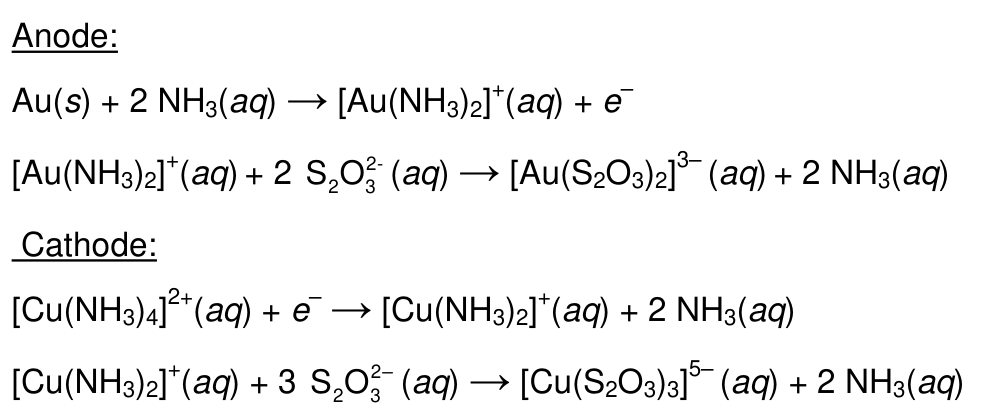
6.1 Write the overall cell reaction for this voltaic cell.
6.2 In the presence of ammonia \(\ce{[Cu(S2O3)3]^5-}\) is oxidized by \(\ce{O2}\) back to \(\ce{[Cu(NH3)4]^2+}\). Write a balanced equation for this oxidation-reduction reaction in basic solution.
6.3 In this leaching process, the \(\ce{[Cu(NH3)4]^2+}\) complex ion functions as catalyst and speeds up the dissolution of gold. Write the net overall oxidation-reduction reaction for dissolution of the gold metal, which is catalyzed by \(\ce{[Cu(NH3)4]^2+}\) complex ion.
6.4 Draw the coordination geometries of the metal in \(\ce{[Au(NH3)2]+}\) and \(\ce{[Au(S2O3)2]^3-}\) complex ions, indicating the coordinating atoms.
The formation constants, \(K_f\), of \(\ce{[Au(NH3)2]+}\) and \(\ce{[Au(S2O3)2]^3-}\) complexes are \(1.00\cdot10^{26}\) and \(1.00\cdot10^{28}\), respectively. Consider a leaching solution in which the equilibrium concentrations of the species are as follows:
\([\ce{S2O3^2-}]=0.100;\quad[\ce{NH3}]=0.100\) and the total concentration of gold(I) species = \(5.50\cdot10^{-5}\ \mathrm{mol\,dm^{-3}}\).
6.5 Calculate the percentage of gold(I) ion that exists in the form of thiosulfate complex.
When the concentration of \(\ce{O2}\) is not high enough and pH > 10, \(\ce{S2O3^2-}\) reduces \(\ce{[Cu(NH3)4]^2+}\) to \(\ce{[Cu(S2O3)3]^5-}\) with the formation of tetrathionate ion \(\ce{S4O6^2-}\):

In basic solution tetrathionate disproportionates to trithionate, \(\ce{S3O6^2-}\), and thiosulfate.
6.6 Write a balanced equation for this disproportionation reaction.
6.7 When the \(\ce{O2}\) concentration is too high, \(\ce{S2O3^2-}\) is oxidized by oxygen to yield trithionate and sulfate ions. Write a balanced equation for this reaction.
Official English text of the problem.
Answers
Names and SMILES for the species used here are collected at the end of the Solution.
-
6.1 \[ \begin{aligned} &\ce{Au(s) + [Cu(NH3)4]^2+ + 5S2O3^2-}\\ &\qquad\ce{-> [Au(S2O3)2]^3- + [Cu(S2O3)3]^5- + 4NH3} \end{aligned} \]
-
6.2 \[ \begin{aligned} &\ce{4[Cu(S2O3)3]^5- + 16NH3 + O2 + 2H2O}\\ &\qquad\ce{-> 4[Cu(NH3)4]^2+ + 12S2O3^2- + 4OH-} \end{aligned} \]
-
6.3 \[ \boxed{\ce{4Au(s) + 8S2O3^2- + O2 + 2H2O -> 4[Au(S2O3)2]^3- + 4OH-}} \]
-
6.4 Both gold(I) complexes are linear, with coordination number 2 and a donor–gold–donor angle of \(180^\circ\). In \(\ce{[Au(NH3)2]+}\), the donors are nitrogen atoms; in \(\ce{[Au(S2O3)2]^3-}\), they are the terminal sulfur atoms of the thiosulfate ligands.
-
6.5 \[ \boxed{99.0\%} \]
-
6.6 \[ \boxed{\ce{4S4O6^2- + 6OH- -> 2S3O6^2- + 5S2O3^2- + 3H2O}} \]
-
6.7 \[ \boxed{\ce{2S2O3^2- + 2O2 -> S3O6^2- + SO4^2-}} \]
Solution
All dissolved ions and ammonia in the following equations are aqueous; the oxygen is dissolved oxygen.
6.1 — Overall cell reaction
Adding the two given anode steps cancels the diamminegold(I) intermediate and ammonia:
\[ \ce{Au(s) + 2S2O3^2- -> [Au(S2O3)2]^3- + e-}. \]
Gold is oxidized from oxidation state 0 to \(+1\).
Adding the two cathode steps cancels the diamminecopper(I) intermediate:
\[ \ce{[Cu(NH3)4]^2+ + 3S2O3^2- + e- -> [Cu(S2O3)3]^5- + 4NH3}. \]
Copper is reduced from \(+2\) to \(+1\). Adding these net half-reactions cancels one electron:
\[ \begin{aligned} &\ce{Au(s) + [Cu(NH3)4]^2+ + 5S2O3^2-}\\ &\qquad\ce{-> [Au(S2O3)2]^3- + [Cu(S2O3)3]^5- + 4NH3}. \end{aligned} \]
The total charge is \(-8\) on each side.
6.2 — Regeneration of the copper(II) complex
In \(\ce{[Cu(S2O3)3]^5-}\), the three thiosulfate ligands contribute charge \(-6\), so copper has oxidation state \(+1\). In \(\ce{[Cu(NH3)4]^2+}\), ammonia is neutral, so copper has oxidation state \(+2\).
The oxidation half-reaction, including ligand exchange, is therefore
\[ \ce{[Cu(S2O3)3]^5- + 4NH3 -> [Cu(NH3)4]^2+ + 3S2O3^2- + e-}. \]
The oxygen reduction half-reaction in basic solution is
\[ \ce{O2 + 2H2O + 4e- -> 4OH-}. \]
Multiplying the copper half-reaction by four and adding gives
\[ \begin{aligned} &\ce{4[Cu(S2O3)3]^5- + 16NH3 + O2 + 2H2O}\\ &\qquad\ce{-> 4[Cu(NH3)4]^2+ + 12S2O3^2- + 4OH-}. \end{aligned} \]
Both sides have total charge \(-20\).
6.3 — Net dissolution of gold
Multiply the reaction in 6.1 by four and add the regeneration reaction in 6.2. The following cancel:
- Four tetraamminecopper(II) ions and four tris(thiosulfato)cuprate(I) ions.
- Sixteen ammonia molecules.
- Twelve of the twenty thiosulfate ions initially appearing on the reactant side.
The result is
\[ \ce{4Au(s) + 8S2O3^2- + O2 + 2H2O -> 4[Au(S2O3)2]^3- + 4OH-}. \]
Thus, four gold atoms each lose one electron, and one oxygen molecule accepts the four electrons. The copper complex is regenerated, explaining its catalytic role.
6.4 — Coordination geometries
Both complexes contain gold(I), which has a \(5d^{10}\) configuration and characteristically forms linear complexes with two donor atoms.
For diamminegold(I), \(\ce{[Au(NH3)2]+}\), each ammonia ligand donates its nitrogen lone pair.
- Draw gold at the center of a straight N–Au–N arrangement.
- Attach three hydrogen atoms to each nitrogen.
- Mark the N–Au–N angle as \(180^\circ\), and enclose the complex in brackets with overall charge \(+1\).
For bis(thiosulfato)aurate(I), \(\ce{[Au(S2O3)2]^3-}\), each thiosulfate ligand binds through its terminal sulfur atom: the sulfur atom that is not bonded to oxygen. This sulfur donor is favored by the soft gold(I) ion.
- Draw a straight S–Au–S arrangement with angle \(180^\circ\).
- Each coordinating sulfur is bonded to a second sulfur bearing three oxygen atoms.
- Enclose the complete complex in brackets with overall charge \(3-\).
The linear geometry concerns the two donor atoms and gold; it does not require all atoms of the ligands to lie on that line.
6.5 — Percentage present as the thiosulfate complex
The formation equilibria are
\[ \ce{Au+ + 2NH3 <=> [Au(NH3)2]+} \]
and
\[ \ce{Au+ + 2S2O3^2- <=> [Au(S2O3)2]^3-}. \]
Their formation constants give
\[ K_{f,N} =\frac{[\ce{[Au(NH3)2]+}]}{[\ce{Au+}][\ce{NH3}]^2}, \qquad K_{f,T} =\frac{[\ce{[Au(S2O3)2]^3-}]}{[\ce{Au+}][\ce{S2O3^2-}]^2}. \]
Dividing eliminates the free gold(I) concentration:
\[ \frac{[\ce{[Au(S2O3)2]^3-}]}{[\ce{[Au(NH3)2]+}]} = \frac{1.00\times10^{28}}{1.00\times10^{26}} \left(\frac{0.100}{0.100}\right)^2 =100. \]
To check the contribution of uncomplexed gold(I), use the gold mass balance:
\[ C_{\mathrm{Au}} = [\ce{Au+}] +[\ce{[Au(NH3)2]+}] +[\ce{[Au(S2O3)2]^3-}]. \]
Using numerical concentrations in \(\mathrm{mol\,dm^{-3}}\),
\[ C_{\mathrm{Au}} = [\ce{Au+}] \left(1+10^{26}(0.100)^2+10^{28}(0.100)^2\right) = [\ce{Au+}]\left(1+10^{24}+10^{26}\right). \]
Therefore,
\[ [\ce{Au+}] = \frac{5.50\times10^{-5}}{1+10^{24}+10^{26}} = 5.45\times10^{-31}\ \mathrm{mol\,dm^{-3}}. \]
The free-ion contribution is negligible. The complex concentrations are
\[ [\ce{[Au(NH3)2]+}] = 5.45\times10^{-7}\ \mathrm{mol\,dm^{-3}}, \]
\[ [\ce{[Au(S2O3)2]^3-}] = 5.45\times10^{-5}\ \mathrm{mol\,dm^{-3}}. \]
Using the unrounded values, the required percentage is
\[ \frac{10^{26}}{1+10^{24}+10^{26}}\times100\% = 99.0099\ldots\% = \boxed{99.0\%}. \]
6.6 — Disproportionation of tetrathionate
The sums of the sulfur oxidation numbers in tetrathionate, trithionate, and thiosulfate are respectively
\[ \begin{array}{c|c|c} \text{Ion} & \text{Sum for sulfur} & \text{Average for sulfur}\\ \hline \ce{S4O6^2-} & +10 & +2.5\\ \ce{S3O6^2-} & +10 & +10/3\\ \ce{S2O3^2-} & +4 & +2 \end{array} \]
Formation of trithionate increases the average sulfur oxidation state, while formation of thiosulfate decreases it, consistent with disproportionation.
Let \(a\) tetrathionate ions produce \(b\) trithionate ions and \(c\) thiosulfate ions. Sulfur conservation and electron balance require
\[ 4a=3b+2c, \qquad 10a=10b+4c. \]
These give the smallest integer ratio
\[ a:b:c=4:2:5. \]
Balancing oxygen, hydrogen, and charge with hydroxide and water gives
\[ \boxed{\ce{4S4O6^2- + 6OH- -> 2S3O6^2- + 5S2O3^2- + 3H2O}}. \]
There are 16 sulfur atoms, 30 oxygen atoms, and 6 hydrogen atoms on each side; both sides have charge \(-14\).
6.7 — Oxidation of thiosulfate by excess oxygen
Balancing sulfur and charge gives two thiosulfate ions for one trithionate ion and one sulfate ion.
The sulfur oxidation-number sum increases from
\[ 2(+4)=+8 \]
to
\[ (+10)+(+6)=+16. \]
Thus, eight electrons are released. The corresponding oxidation half-reaction in basic solution is
\[ \ce{2S2O3^2- + 8OH- -> S3O6^2- + SO4^2- + 4H2O + 8e-}. \]
Two oxygen molecules accept these electrons:
\[ \ce{2O2 + 4H2O + 8e- -> 8OH-}. \]
Adding and cancelling electrons, hydroxide, and water gives
\[ \boxed{\ce{2S2O3^2- + 2O2 -> S3O6^2- + SO4^2-}}. \]
Both sides contain four sulfur atoms and ten oxygen atoms and have charge \(-4\).
Species names and SMILES
The coordination complexes below use dative-bond SMILES: arrows point from donor atoms toward the metal. These encode connectivity, but the linear gold coordination geometries must be specified separately as in 6.4. The sulfur oxyanions are represented by one localized bonding and charge description.
| Species and name | SMILES |
|---|---|
| \(\ce{Au}\), gold atom | [Au] |
| \(\ce{Au+}\), gold(I) ion | [Au+] |
| \(\ce{NH3}\), ammonia | N |
| \(\ce{O2}\), dioxygen | O=O |
| \(\ce{H2O}\), water | O |
| \(\ce{OH-}\), hydroxide ion | [OH-] |
| \(\ce{S2O3^2-}\), thiosulfate ion | [O-]S(=O)(=O)[S-] |
| \(\ce{[Au(NH3)2]+}\), diamminegold(I) ion | [NH3]->[Au+]<-[NH3] |
| \(\ce{[Au(S2O3)2]^3-}\), bis(thiosulfato)aurate(I) ion | [Au+](<-[S-]S(=O)(=O)[O-])<-[S-]S(=O)(=O)[O-] |
| \(\ce{[Cu(NH3)4]^2+}\), tetraamminecopper(II) ion | [Cu+2](<-[NH3])(<-[NH3])(<-[NH3])<-[NH3] |
| \(\ce{[Cu(NH3)2]+}\), diamminecopper(I) ion | [NH3]->[Cu+]<-[NH3] |
| \(\ce{[Cu(S2O3)3]^5-}\), tris(thiosulfato)cuprate(I) ion | [Cu+](<-[S-]S(=O)(=O)[O-])(<-[S-]S(=O)(=O)[O-])<-[S-]S(=O)(=O)[O-] |
| \(\ce{S4O6^2-}\), tetrathionate ion | [O-]S(=O)(=O)SSS(=O)(=O)[O-] |
| \(\ce{S3O6^2-}\), trithionate ion | [O-]S(=O)(=O)SS(=O)(=O)[O-] |
| \(\ce{SO4^2-}\), sulfate ion | [O-]S(=O)(=O)[O-] |
The gold-atom SMILES does not represent the extended metallic lattice of solid gold.
The solution was checked against the official solution.
IChO 2011 · Theorieaufgabe 6
Thiosulfatlaugung von Gold
Die Gewinnung von Gold mithilfe von Natriumcyanid, einer sehr giftigen Chemikalie, verursacht Umweltprobleme und führt in der Öffentlichkeit zu erheblichen Bedenken hinsichtlich der Anwendung dieses sogenannten „Cyanidverfahrens“. Als Alternative wurde die Thiosulfatlaugung von Gold in Betracht gezogen. Bei diesem Verfahren ist das Hauptreagenz Ammoniumthiosulfat, \(\ce{(NH4)2S2O3}\), das vergleichsweise ungiftig ist. Obwohl dieses Verfahren umweltverträglich erscheint, ist die zugrunde liegende Chemie sehr komplex und muss gründlich untersucht werden. Die zur Goldlaugung verwendete Lösung enthält \(\ce{S2O3^2-}\), \(\ce{Cu^2+}\), \(\ce{NH3}\) und gelösten \(\ce{O2}\). Der pH-Wert der Lösung muss größer als 8.5 sein, damit freies Ammoniak vorliegen kann.
Dem vorgeschlagenen Mechanismus zufolge bildet sich während des Laugungsvorgangs auf der Oberfläche der Goldpartikel ein lokales galvanisches Mikroelement, das wie folgt funktioniert:
6.1 Geben Sie die Gesamtreaktion dieses galvanischen Elements an.
6.2 In Gegenwart von Ammoniak wird \(\ce{[Cu(S2O3)3]^5-}\) durch \(\ce{O2}\) wieder zu \(\ce{[Cu(NH3)4]^2+}\) oxidiert. Stellen Sie eine ausgeglichene Gleichung für diese Redoxreaktion in basischer Lösung auf.
6.3 Bei diesem Laugungsverfahren wirkt das Komplexion \(\ce{[Cu(NH3)4]^2+}\) als Katalysator und beschleunigt die Auflösung von Gold. Geben Sie die Nettogesamtreaktion der Redoxreaktion zur Auflösung des metallischen Goldes an, die durch das Komplexion \(\ce{[Cu(NH3)4]^2+}\) katalysiert wird.
6.4 Zeichnen Sie die Koordinationsgeometrien des Metalls in den Komplexionen \(\ce{[Au(NH3)2]+}\) und \(\ce{[Au(S2O3)2]^3-}\) und kennzeichnen Sie die koordinierenden Atome.
Die Bildungskonstanten \(K_f\) der Komplexe \(\ce{[Au(NH3)2]+}\) und \(\ce{[Au(S2O3)2]^3-}\) betragen \(1.00\cdot10^{26}\) bzw. \(1.00\cdot10^{28}\). Betrachten Sie eine Laugungslösung, in der die Gleichgewichtskonzentrationen der Spezies wie folgt sind:
\([\ce{S2O3^2-}]=0.100;\quad[\ce{NH3}]=0.100\) und die Gesamtkonzentration der Gold(I)-Spezies = \(5.50\cdot10^{-5}\ \mathrm{mol\,dm^{-3}}\).
6.5 Berechnen Sie den prozentualen Anteil der Gold(I)-Ionen, der in Form des Thiosulfatkomplexes vorliegt.
Wenn die Konzentration von \(\ce{O2}\) nicht hoch genug ist und pH > 10 gilt, reduziert \(\ce{S2O3^2-}\) den Komplex \(\ce{[Cu(NH3)4]^2+}\) zu \(\ce{[Cu(S2O3)3]^5-}\), wobei das Tetrathionation \(\ce{S4O6^2-}\) entsteht:
In basischer Lösung disproportioniert Tetrathionat zu Trithionat, \(\ce{S3O6^2-}\), und Thiosulfat.
6.6 Stellen Sie eine ausgeglichene Gleichung für diese Disproportionierungsreaktion auf.
6.7 Wenn die Konzentration von \(\ce{O2}\) zu hoch ist, wird \(\ce{S2O3^2-}\) durch Sauerstoff unter Bildung von Trithionat- und Sulfationen oxidiert. Stellen Sie eine ausgeglichene Gleichung für diese Reaktion auf.
Aufgabentext aus dem offiziellen englischen Text übersetzt.
Antworten
Die Namen und SMILES der hier verwendeten Spezies sind am Ende der Lösung zusammengestellt.
-
6.1 \[ \begin{aligned} &\ce{Au(s) + [Cu(NH3)4]^2+ + 5S2O3^2-}\\ &\qquad\ce{-> [Au(S2O3)2]^3- + [Cu(S2O3)3]^5- + 4NH3} \end{aligned} \]
-
6.2 \[ \begin{aligned} &\ce{4[Cu(S2O3)3]^5- + 16NH3 + O2 + 2H2O}\\ &\qquad\ce{-> 4[Cu(NH3)4]^2+ + 12S2O3^2- + 4OH-} \end{aligned} \]
-
6.3 \[ \boxed{\ce{4Au(s) + 8S2O3^2- + O2 + 2H2O -> 4[Au(S2O3)2]^3- + 4OH-}} \]
-
6.4 Beide Gold(I)-Komplexe sind linear, mit der Koordinationszahl 2 und einem Donor–Gold–Donor-Winkel von \(180^\circ\). In \(\ce{[Au(NH3)2]+}\) sind die Donoratome Stickstoffatome; in \(\ce{[Au(S2O3)2]^3-}\) sind es die terminalen Schwefelatome der Thiosulfatliganden.
-
6.5 \[ \boxed{99.0\%} \]
-
6.6 \[ \boxed{\ce{4S4O6^2- + 6OH- -> 2S3O6^2- + 5S2O3^2- + 3H2O}} \]
-
6.7 \[ \boxed{\ce{2S2O3^2- + 2O2 -> S3O6^2- + SO4^2-}} \]
Lösung
Alle gelösten Ionen und das Ammoniak in den folgenden Gleichungen liegen in wässriger Lösung vor; beim Sauerstoff handelt es sich um gelösten Sauerstoff.
6.1 — Gesamtreaktion des galvanischen Elements
Bei der Addition der beiden angegebenen Anodenschritte kürzen sich das Diammingold(I)-Zwischenprodukt und Ammoniak heraus:
\[ \ce{Au(s) + 2S2O3^2- -> [Au(S2O3)2]^3- + e-}. \]
Gold wird von der Oxidationsstufe 0 zu \(+1\) oxidiert.
Bei der Addition der beiden Kathodenschritte kürzt sich das Diamminkupfer(I)-Zwischenprodukt heraus:
\[ \ce{[Cu(NH3)4]^2+ + 3S2O3^2- + e- -> [Cu(S2O3)3]^5- + 4NH3}. \]
Kupfer wird von \(+2\) zu \(+1\) reduziert. Bei der Addition dieser Nettohalbreaktionen kürzt sich ein Elektron heraus:
\[ \begin{aligned} &\ce{Au(s) + [Cu(NH3)4]^2+ + 5S2O3^2-}\\ &\qquad\ce{-> [Au(S2O3)2]^3- + [Cu(S2O3)3]^5- + 4NH3}. \end{aligned} \]
Die Gesamtladung beträgt auf jeder Seite \(-8\).
6.2 — Regeneration des Kupfer(II)-Komplexes
In \(\ce{[Cu(S2O3)3]^5-}\) tragen die drei Thiosulfatliganden die Ladung \(-6\) bei, sodass Kupfer die Oxidationsstufe \(+1\) hat. In \(\ce{[Cu(NH3)4]^2+}\) ist Ammoniak neutral, sodass Kupfer die Oxidationsstufe \(+2\) hat.
Die Oxidationshalbreaktion einschließlich des Ligandenaustauschs lautet daher
\[ \ce{[Cu(S2O3)3]^5- + 4NH3 -> [Cu(NH3)4]^2+ + 3S2O3^2- + e-}. \]
Die Halbreaktion der Sauerstoffreduktion in basischer Lösung lautet
\[ \ce{O2 + 2H2O + 4e- -> 4OH-}. \]
Multiplikation der Kupferhalbreaktion mit vier und anschließende Addition ergeben
\[ \begin{aligned} &\ce{4[Cu(S2O3)3]^5- + 16NH3 + O2 + 2H2O}\\ &\qquad\ce{-> 4[Cu(NH3)4]^2+ + 12S2O3^2- + 4OH-}. \end{aligned} \]
Beide Seiten haben die Gesamtladung \(-20\).
6.3 — Nettoreaktion der Goldauflösung
Multiplizieren Sie die Reaktion in 6.1 mit vier und addieren Sie die Regenerationsreaktion in 6.2. Dabei kürzen sich folgende Spezies heraus:
- Vier Tetraamminkupfer(II)-Ionen und vier Tris(thiosulfato)cuprat(I)-Ionen.
- Sechzehn Ammoniakmoleküle.
- Zwölf der zwanzig Thiosulfationen, die zunächst auf der Eduktseite stehen.
Das Ergebnis lautet
\[ \ce{4Au(s) + 8S2O3^2- + O2 + 2H2O -> 4[Au(S2O3)2]^3- + 4OH-}. \]
Somit geben vier Goldatome jeweils ein Elektron ab, und ein Sauerstoffmolekül nimmt die vier Elektronen auf. Der Kupferkomplex wird regeneriert, was seine katalytische Funktion erklärt.
6.4 — Koordinationsgeometrien
Beide Komplexe enthalten Gold(I), das eine \(5d^{10}\)-Konfiguration besitzt und charakteristischerweise lineare Komplexe mit zwei Donoratomen bildet.
Bei Diammingold(I), \(\ce{[Au(NH3)2]+}\), stellt jeder Ammoniakligand das freie Elektronenpaar seines Stickstoffatoms für die Bindung zur Verfügung.
- Zeichnen Sie Gold in die Mitte einer geradlinigen N–Au–N-Anordnung.
- Verbinden Sie jedes Stickstoffatom mit drei Wasserstoffatomen.
- Kennzeichnen Sie den N–Au–N-Winkel mit \(180^\circ\) und setzen Sie den Komplex in eckige Klammern mit der Gesamtladung \(+1\).
Bei Bis(thiosulfato)aurat(I), \(\ce{[Au(S2O3)2]^3-}\), bindet jeder Thiosulfatligand über sein terminales Schwefelatom: das Schwefelatom, das nicht an Sauerstoff gebunden ist. Dieser Schwefeldonor wird vom weichen Gold(I)-Ion bevorzugt.
- Zeichnen Sie eine geradlinige S–Au–S-Anordnung mit einem Winkel von \(180^\circ\).
- Jedes koordinierende Schwefelatom ist an ein zweites Schwefelatom gebunden, das drei Sauerstoffatome trägt.
- Setzen Sie den vollständigen Komplex in eckige Klammern mit der Gesamtladung \(3-\).
Die lineare Geometrie bezieht sich auf die beiden Donoratome und Gold; sie erfordert nicht, dass alle Atome der Liganden auf dieser Geraden liegen.
6.5 — Prozentualer Anteil in Form des Thiosulfatkomplexes
Die Bildungsgleichgewichte lauten
\[ \ce{Au+ + 2NH3 <=> [Au(NH3)2]+} \]
und
\[ \ce{Au+ + 2S2O3^2- <=> [Au(S2O3)2]^3-}. \]
Für ihre Bildungskonstanten gilt
\[ K_{f,N} =\frac{[\ce{[Au(NH3)2]+}]}{[\ce{Au+}][\ce{NH3}]^2}, \qquad K_{f,T} =\frac{[\ce{[Au(S2O3)2]^3-}]}{[\ce{Au+}][\ce{S2O3^2-}]^2}. \]
Durch Division wird die Konzentration des freien Gold(I) eliminiert:
\[ \frac{[\ce{[Au(S2O3)2]^3-}]}{[\ce{[Au(NH3)2]+}]} = \frac{1.00\times10^{28}}{1.00\times10^{26}} \left(\frac{0.100}{0.100}\right)^2 =100. \]
Um den Beitrag des nicht komplexierten Gold(I) zu überprüfen, wird die Stoffbilanz für Gold verwendet:
\[ C_{\mathrm{Au}} = [\ce{Au+}] +[\ce{[Au(NH3)2]+}] +[\ce{[Au(S2O3)2]^3-}]. \]
Mit den Zahlenwerten der Konzentrationen in \(\mathrm{mol\,dm^{-3}}\) gilt:
\[ C_{\mathrm{Au}} = [\ce{Au+}] \left(1+10^{26}(0.100)^2+10^{28}(0.100)^2\right) = [\ce{Au+}]\left(1+10^{24}+10^{26}\right). \]
Daher ist
\[ [\ce{Au+}] = \frac{5.50\times10^{-5}}{1+10^{24}+10^{26}} = 5.45\times10^{-31}\ \mathrm{mol\,dm^{-3}}. \]
Der Beitrag der freien Ionen ist vernachlässigbar. Die Konzentrationen der Komplexe betragen
\[ [\ce{[Au(NH3)2]+}] = 5.45\times10^{-7}\ \mathrm{mol\,dm^{-3}}, \]
\[ [\ce{[Au(S2O3)2]^3-}] = 5.45\times10^{-5}\ \mathrm{mol\,dm^{-3}}. \]
Mit den ungerundeten Werten ergibt sich der gesuchte prozentuale Anteil zu
\[ \frac{10^{26}}{1+10^{24}+10^{26}}\times100\% = 99.0099\ldots\% = \boxed{99.0\%}. \]
6.6 — Disproportionierung von Tetrathionat
Die Summen der Oxidationszahlen des Schwefels in Tetrathionat, Trithionat und Thiosulfat betragen jeweils
\[ \begin{array}{c|c|c} \text{Ion} & \text{Summe für Schwefel} & \text{Mittelwert für Schwefel}\\ \hline \ce{S4O6^2-} & +10 & +2.5\\ \ce{S3O6^2-} & +10 & +10/3\\ \ce{S2O3^2-} & +4 & +2 \end{array} \]
Die Bildung von Trithionat erhöht die mittlere Oxidationsstufe des Schwefels, während die Bildung von Thiosulfat sie verringert; dies entspricht einer Disproportionierung.
Es seien \(a\) Tetrathionationen, aus denen \(b\) Trithionationen und \(c\) Thiosulfationen entstehen. Die Erhaltung der Schwefelatome und die Elektronenbilanz erfordern
\[ 4a=3b+2c, \qquad 10a=10b+4c. \]
Daraus ergibt sich das kleinste ganzzahlige Verhältnis
\[ a:b:c=4:2:5. \]
Der Ausgleich von Sauerstoff, Wasserstoff und Ladung mithilfe von Hydroxid und Wasser ergibt
\[ \boxed{\ce{4S4O6^2- + 6OH- -> 2S3O6^2- + 5S2O3^2- + 3H2O}}. \]
Auf jeder Seite stehen 16 Schwefelatome, 30 Sauerstoffatome und 6 Wasserstoffatome; beide Seiten haben die Ladung \(-14\).
6.7 — Oxidation von Thiosulfat durch überschüssigen Sauerstoff
Der Ausgleich von Schwefel und Ladung ergibt zwei Thiosulfationen für ein Trithionation und ein Sulfation.
Die Summe der Oxidationszahlen des Schwefels steigt von
\[ 2(+4)=+8 \]
auf
\[ (+10)+(+6)=+16. \]
Somit werden acht Elektronen abgegeben. Die entsprechende Oxidationshalbreaktion in basischer Lösung lautet
\[ \ce{2S2O3^2- + 8OH- -> S3O6^2- + SO4^2- + 4H2O + 8e-}. \]
Zwei Sauerstoffmoleküle nehmen diese Elektronen auf:
\[ \ce{2O2 + 4H2O + 8e- -> 8OH-}. \]
Addition und Herauskürzen von Elektronen, Hydroxid und Wasser ergeben
\[ \boxed{\ce{2S2O3^2- + 2O2 -> S3O6^2- + SO4^2-}}. \]
Beide Seiten enthalten vier Schwefelatome und zehn Sauerstoffatome und haben die Ladung \(-4\).
Namen der Spezies und SMILES
Die nachstehenden Koordinationskomplexe verwenden SMILES mit koordinativen Bindungen: Die Pfeile zeigen von den Donoratomen zum Metall. Diese kodieren die Bindungsverknüpfungen, doch die linearen Koordinationsgeometrien des Goldes müssen wie in 6.4 gesondert angegeben werden. Die Sauerstoffanionen des Schwefels werden durch jeweils eine lokalisierte Bindungs- und Ladungsdarstellung wiedergegeben.
| Spezies und Name | SMILES |
|---|---|
| \(\ce{Au}\), Goldatom | [Au] |
| \(\ce{Au+}\), Gold(I)-Ion | [Au+] |
| \(\ce{NH3}\), Ammoniak | N |
| \(\ce{O2}\), Disauerstoff | O=O |
| \(\ce{H2O}\), Wasser | O |
| \(\ce{OH-}\), Hydroxidion | [OH-] |
| \(\ce{S2O3^2-}\), Thiosulfation | [O-]S(=O)(=O)[S-] |
| \(\ce{[Au(NH3)2]+}\), Diammingold(I)-Ion | [NH3]->[Au+]<-[NH3] |
| \(\ce{[Au(S2O3)2]^3-}\), Bis(thiosulfato)aurat(I)-Ion | [Au+](<-[S-]S(=O)(=O)[O-])<-[S-]S(=O)(=O)[O-] |
| \(\ce{[Cu(NH3)4]^2+}\), Tetraamminkupfer(II)-Ion | [Cu+2](<-[NH3])(<-[NH3])(<-[NH3])<-[NH3] |
| \(\ce{[Cu(NH3)2]+}\), Diamminkupfer(I)-Ion | [NH3]->[Cu+]<-[NH3] |
| \(\ce{[Cu(S2O3)3]^5-}\), Tris(thiosulfato)cuprat(I)-Ion | [Cu+](<-[S-]S(=O)(=O)[O-])(<-[S-]S(=O)(=O)[O-])<-[S-]S(=O)(=O)[O-] |
| \(\ce{S4O6^2-}\), Tetrathionation | [O-]S(=O)(=O)SSS(=O)(=O)[O-] |
| \(\ce{S3O6^2-}\), Trithionation | [O-]S(=O)(=O)SS(=O)(=O)[O-] |
| \(\ce{SO4^2-}\), Sulfation | [O-]S(=O)(=O)[O-] |
Der SMILES-Code des Goldatoms stellt nicht das ausgedehnte metallische Gitter von festem Gold dar.
Die Lösung wurde mit der offiziellen Lösung abgeglichen.
IChO 2011 · Teori sorusu 6
Altının tiyosülfatla liçi
Çok zehirli bir kimyasal olan sodyum siyanür kullanılarak altının elde edilmesi çevre sorunlarına yol açmakta ve “siyanür prosesi” olarak adlandırılan bu yöntemin kullanımı konusunda kamuoyunda ciddi kaygılar doğurmaktadır. Altının tiyosülfatla liçi bir alternatif olarak değerlendirilmiştir. Bu proseste temel reaktif, nispeten toksik olmayan amonyum tiyosülfattır, \(\ce{(NH4)2S2O3}\). Bu proses çevreye zararsız görünse de içerdiği kimyasal süreçler çok karmaşıktır ve kapsamlı biçimde incelenmesi gerekir. Altının liçinde kullanılan çözelti \(\ce{S2O3^2-}\), \(\ce{Cu^2+}\), \(\ce{NH3}\) ve çözünmüş \(\ce{O2}\) içerir. Serbest amonyağın bulunabilmesi için çözeltinin pH değeri 8.5'ten büyük olmalıdır.
Önerilen mekanizmaya göre, liç işlemi sırasında altın taneciklerinin yüzeyinde yerel bir voltaik mikro hücre oluşur ve aşağıdaki gibi çalışır:
6.1 Bu voltaik hücrenin toplam hücre tepkimesini yazınız.
6.2 Amonyak varlığında \(\ce{[Cu(S2O3)3]^5-}\), \(\ce{O2}\) tarafından yükseltgenerek yeniden \(\ce{[Cu(NH3)4]^2+}\) hâline dönüşür. Bazik çözeltide gerçekleşen bu yükseltgenme-indirgenme tepkimesinin denkleştirilmiş denklemini yazınız.
6.3 Bu liç prosesinde \(\ce{[Cu(NH3)4]^2+}\) kompleks iyonu katalizör olarak işlev görür ve altının çözünmesini hızlandırır. \(\ce{[Cu(NH3)4]^2+}\) kompleks iyonunun katalizlediği, altın metalinin çözünmesine ait net toplam yükseltgenme-indirgenme tepkimesini yazınız.
6.4 \(\ce{[Au(NH3)2]+}\) ve \(\ce{[Au(S2O3)2]^3-}\) kompleks iyonlarında metalin koordinasyon geometrilerini, koordinasyona katılan atomları belirterek çiziniz.
\(\ce{[Au(NH3)2]+}\) ve \(\ce{[Au(S2O3)2]^3-}\) komplekslerinin oluşum sabitleri, \(K_f\), sırasıyla \(1.00\cdot10^{26}\) ve \(1.00\cdot10^{28}\)'dir. Türlerin denge derişimlerinin aşağıdaki gibi olduğu bir liç çözeltisini ele alınız:
\([\ce{S2O3^2-}]=0.100;\quad[\ce{NH3}]=0.100\) ve altın(I) türlerinin toplam derişimi = \(5.50\cdot10^{-5}\ \mathrm{mol\,dm^{-3}}\).
6.5 Altın(I) iyonunun tiyosülfat kompleksi hâlinde bulunan yüzdesini hesaplayınız.
\(\ce{O2}\) derişimi yeterince yüksek olmadığında ve pH > 10 olduğunda, \(\ce{S2O3^2-}\), \(\ce{[Cu(NH3)4]^2+}\) iyonunu \(\ce{[Cu(S2O3)3]^5-}\) iyonuna indirger ve tetratiyonat iyonu \(\ce{S4O6^2-}\) oluşur:
Bazik çözeltide tetratiyonat, tritiyonat, \(\ce{S3O6^2-}\), ve tiyosülfat oluşturacak şekilde disproporsiyonlaşır.
6.6 Bu disproporsiyonlaşma tepkimesinin denkleştirilmiş denklemini yazınız.
6.7 \(\ce{O2}\) derişimi çok yüksek olduğunda, \(\ce{S2O3^2-}\) oksijen tarafından yükseltgenerek tritiyonat ve sülfat iyonlarını oluşturur. Bu tepkimenin denkleştirilmiş denklemini yazınız.
Soru metni resmi İngilizce metinden çevrilmiştir.
Cevaplar
Burada kullanılan türlerin adları ve SMILES gösterimleri Çözüm bölümünün sonunda bir araya getirilmiştir.
-
6.1 \[ \begin{aligned} &\ce{Au(s) + [Cu(NH3)4]^2+ + 5S2O3^2-}\\ &\qquad\ce{-> [Au(S2O3)2]^3- + [Cu(S2O3)3]^5- + 4NH3} \end{aligned} \]
-
6.2 \[ \begin{aligned} &\ce{4[Cu(S2O3)3]^5- + 16NH3 + O2 + 2H2O}\\ &\qquad\ce{-> 4[Cu(NH3)4]^2+ + 12S2O3^2- + 4OH-} \end{aligned} \]
-
6.3 \[ \boxed{\ce{4Au(s) + 8S2O3^2- + O2 + 2H2O -> 4[Au(S2O3)2]^3- + 4OH-}} \]
-
6.4 Her iki altın(I) kompleksi de doğrusaldır; koordinasyon sayıları 2, donör–altın–donör açıları ise \(180^\circ\)'dir. \(\ce{[Au(NH3)2]+}\) kompleksinde donörler azot atomlarıdır; \(\ce{[Au(S2O3)2]^3-}\) kompleksinde ise tiyosülfat ligandlarının uç kükürt atomlarıdır.
-
6.5 \[ \boxed{99.0\%} \]
-
6.6 \[ \boxed{\ce{4S4O6^2- + 6OH- -> 2S3O6^2- + 5S2O3^2- + 3H2O}} \]
-
6.7 \[ \boxed{\ce{2S2O3^2- + 2O2 -> S3O6^2- + SO4^2-}} \]
Çözüm
Aşağıdaki denklemlerde çözünmüş iyonların tümü ve amonyak sulu çözeltidedir; oksijen ise çözünmüş oksijendir.
6.1 — Toplam hücre tepkimesi
Verilen iki anot basamağı toplandığında diaminaltın(I) ara türü ve amonyak sadeleşir:
\[ \ce{Au(s) + 2S2O3^2- -> [Au(S2O3)2]^3- + e-}. \]
Altın, 0 yükseltgenme basamağından \(+1\)'e yükseltgenir.
İki katot basamağı toplandığında diaminbakır(I) ara türü sadeleşir:
\[ \ce{[Cu(NH3)4]^2+ + 3S2O3^2- + e- -> [Cu(S2O3)3]^5- + 4NH3}. \]
Bakır, \(+2\)'den \(+1\)'e indirgenir. Bu net yarı tepkimeler toplandığında bir elektron sadeleşir:
\[ \begin{aligned} &\ce{Au(s) + [Cu(NH3)4]^2+ + 5S2O3^2-}\\ &\qquad\ce{-> [Au(S2O3)2]^3- + [Cu(S2O3)3]^5- + 4NH3}. \end{aligned} \]
Her iki taraftaki toplam yük \(-8\)'dir.
6.2 — Bakır(II) kompleksinin yeniden oluşumu
\(\ce{[Cu(S2O3)3]^5-}\) kompleksinde üç tiyosülfat ligandının toplam yük katkısı \(-6\) olduğundan bakırın yükseltgenme basamağı \(+1\)'dir. \(\ce{[Cu(NH3)4]^2+}\) kompleksinde amonyak nötr olduğundan bakırın yükseltgenme basamağı \(+2\)'dir.
Dolayısıyla, ligand değişimini de içeren yükseltgenme yarı tepkimesi şöyledir:
\[ \ce{[Cu(S2O3)3]^5- + 4NH3 -> [Cu(NH3)4]^2+ + 3S2O3^2- + e-}. \]
Bazik çözeltide oksijenin indirgenme yarı tepkimesi şöyledir:
\[ \ce{O2 + 2H2O + 4e- -> 4OH-}. \]
Bakırın yarı tepkimesi dört ile çarpılıp diğer yarı tepkimeyle toplandığında şu sonuç elde edilir:
\[ \begin{aligned} &\ce{4[Cu(S2O3)3]^5- + 16NH3 + O2 + 2H2O}\\ &\qquad\ce{-> 4[Cu(NH3)4]^2+ + 12S2O3^2- + 4OH-}. \end{aligned} \]
Her iki tarafın toplam yükü \(-20\)'dir.
6.3 — Altının net çözünme tepkimesi
6.1'deki tepkimeyi dört ile çarpıp 6.2'deki yeniden oluşum tepkimesiyle toplayınız. Aşağıdakiler sadeleşir:
- Dört tetraaminbakır(II) iyonu ve dört tris(tiyosülfato)kuprat(I) iyonu.
- On altı amonyak molekülü.
- Başlangıçta girenler tarafında yer alan yirmi tiyosülfat iyonunun on ikisi.
Sonuç şöyledir:
\[ \ce{4Au(s) + 8S2O3^2- + O2 + 2H2O -> 4[Au(S2O3)2]^3- + 4OH-}. \]
Böylece dört altın atomunun her biri bir elektron verir ve bir oksijen molekülü bu dört elektronu alır. Bakır kompleksi yeniden oluşur; bu da onun katalitik rolünü açıklar.
6.4 — Koordinasyon geometrileri
Her iki kompleks de \(5d^{10}\) elektron dizilimine sahip olan ve karakteristik olarak iki donör atomlu doğrusal kompleksler oluşturan altın(I) içerir.
Diaminaltın(I), \(\ce{[Au(NH3)2]+}\) için her amonyak ligandı azot atomundaki ortaklanmamış elektron çiftini verir.
- Altını doğrusal bir N–Au–N düzeninin merkezine çiziniz.
- Her azot atomuna üç hidrojen atomu bağlayınız.
- N–Au–N açısını \(180^\circ\) olarak işaretleyiniz ve kompleksi, toplam yükü \(+1\) olacak şekilde köşeli parantez içine alınız.
Bis(tiyosülfato)aurat(I), \(\ce{[Au(S2O3)2]^3-}\) için her tiyosülfat ligandı, oksijene bağlı olmayan kükürt atomu olan uç kükürt atomu üzerinden bağlanır. Yumuşak altın(I) iyonu bu kükürt donörünü tercih eder.
- Açısı \(180^\circ\) olan doğrusal bir S–Au–S düzeni çiziniz.
- Koordinasyona katılan her kükürt atomu, üç oksijen atomu taşıyan ikinci bir kükürt atomuna bağlıdır.
- Kompleksin tamamını, toplam yükü \(3-\) olacak şekilde köşeli parantez içine alınız.
Doğrusal geometri, iki donör atomu ve altını kapsar; ligandların tüm atomlarının bu doğru üzerinde bulunmasını gerektirmez.
6.5 — Tiyosülfat kompleksi hâlinde bulunan yüzde
Oluşum dengeleri şöyledir:
\[ \ce{Au+ + 2NH3 <=> [Au(NH3)2]+} \]
ve
\[ \ce{Au+ + 2S2O3^2- <=> [Au(S2O3)2]^3-}. \]
Oluşum sabitlerinden şu ifadeler elde edilir:
\[ K_{f,N} =\frac{[\ce{[Au(NH3)2]+}]}{[\ce{Au+}][\ce{NH3}]^2}, \qquad K_{f,T} =\frac{[\ce{[Au(S2O3)2]^3-}]}{[\ce{Au+}][\ce{S2O3^2-}]^2}. \]
Oranlandığında serbest altın(I) derişimi sadeleşir:
\[ \frac{[\ce{[Au(S2O3)2]^3-}]}{[\ce{[Au(NH3)2]+}]} = \frac{1.00\times10^{28}}{1.00\times10^{26}} \left(\frac{0.100}{0.100}\right)^2 =100. \]
Kompleksleşmemiş altın(I)'in katkısını kontrol etmek için altının kütle denkliğini kullanınız:
\[ C_{\mathrm{Au}} = [\ce{Au+}] +[\ce{[Au(NH3)2]+}] +[\ce{[Au(S2O3)2]^3-}]. \]
Derişimlerin \(\mathrm{mol\,dm^{-3}}\) birimindeki sayısal değerleri kullanıldığında,
\[ C_{\mathrm{Au}} = [\ce{Au+}] \left(1+10^{26}(0.100)^2+10^{28}(0.100)^2\right) = [\ce{Au+}]\left(1+10^{24}+10^{26}\right). \]
Dolayısıyla,
\[ [\ce{Au+}] = \frac{5.50\times10^{-5}}{1+10^{24}+10^{26}} = 5.45\times10^{-31}\ \mathrm{mol\,dm^{-3}}. \]
Serbest iyonun katkısı ihmal edilebilir. Kompleks derişimleri şöyledir:
\[ [\ce{[Au(NH3)2]+}] = 5.45\times10^{-7}\ \mathrm{mol\,dm^{-3}}, \]
\[ [\ce{[Au(S2O3)2]^3-}] = 5.45\times10^{-5}\ \mathrm{mol\,dm^{-3}}. \]
Yuvarlanmamış değerler kullanıldığında istenen yüzde şöyledir:
\[ \frac{10^{26}}{1+10^{24}+10^{26}}\times100\% = 99.0099\ldots\% = \boxed{99.0\%}. \]
6.6 — Tetratiyonatın disproporsiyonlaşması
Tetratiyonat, tritiyonat ve tiyosülfattaki kükürt atomlarının yükseltgenme sayılarının toplamları sırasıyla şöyledir:
\[ \begin{array}{c|c|c} \text{İyon} & \text{Kükürt için toplam} & \text{Kükürt için ortalama}\\ \hline \ce{S4O6^2-} & +10 & +2.5\\ \ce{S3O6^2-} & +10 & +10/3\\ \ce{S2O3^2-} & +4 & +2 \end{array} \]
Tritiyonat oluşumu kükürdün ortalama yükseltgenme basamağını artırırken tiyosülfat oluşumu azaltır; bu durum disproporsiyonlaşmayla uyumludur.
\(a\) tane tetratiyonat iyonunun \(b\) tane tritiyonat iyonu ve \(c\) tane tiyosülfat iyonu oluşturduğunu varsayalım. Kükürdün korunumu ve elektron denkliği şu bağıntıları gerektirir:
\[ 4a=3b+2c, \qquad 10a=10b+4c. \]
Bunlardan en küçük tam sayı oranı elde edilir:
\[ a:b:c=4:2:5. \]
Oksijen, hidrojen ve yük, hidroksit ve su kullanılarak denkleştirildiğinde şu sonuç elde edilir:
\[ \boxed{\ce{4S4O6^2- + 6OH- -> 2S3O6^2- + 5S2O3^2- + 3H2O}}. \]
Her iki tarafta 16 kükürt atomu, 30 oksijen atomu ve 6 hidrojen atomu vardır; her iki tarafın yükü \(-14\)'tür.
6.7 — Tiyosülfatın aşırı oksijenle yükseltgenmesi
Kükürt ve yük denkleştirildiğinde, bir tritiyonat iyonu ve bir sülfat iyonuna karşılık iki tiyosülfat iyonu gerektiği bulunur.
Kükürt atomlarının yükseltgenme sayılarının toplamı, aşağıdaki başlangıç değerinden
\[ 2(+4)=+8 \]
aşağıdaki son değere yükselir:
\[ (+10)+(+6)=+16. \]
Böylece sekiz elektron açığa çıkar. Bazik çözeltide buna karşılık gelen yükseltgenme yarı tepkimesi şöyledir:
\[ \ce{2S2O3^2- + 8OH- -> S3O6^2- + SO4^2- + 4H2O + 8e-}. \]
İki oksijen molekülü bu elektronları alır:
\[ \ce{2O2 + 4H2O + 8e- -> 8OH-}. \]
Yarı tepkimeler toplanıp elektronlar, hidroksit ve su sadeleştirildiğinde şu sonuç elde edilir:
\[ \boxed{\ce{2S2O3^2- + 2O2 -> S3O6^2- + SO4^2-}}. \]
Her iki taraf dört kükürt atomu ve on oksijen atomu içerir ve \(-4\) yüküne sahiptir.
Türlerin adları ve SMILES gösterimleri
Aşağıdaki koordinasyon komplekslerinde koordinatif bağ içeren SMILES gösterimleri kullanılmıştır: oklar donör atomlardan metale doğru yönelir. Bunlar atomlar arasındaki bağlanmayı kodlar; ancak altının doğrusal koordinasyon geometrileri, 6.4'te olduğu gibi ayrıca belirtilmelidir. Kükürt oksianyonları, bağların ve yüklerin yerelleştirildiği tek bir gösterimle temsil edilmiştir.
| Tür ve adı | SMILES |
|---|---|
| \(\ce{Au}\), altın atomu | [Au] |
| \(\ce{Au+}\), altın(I) iyonu | [Au+] |
| \(\ce{NH3}\), amonyak | N |
| \(\ce{O2}\), dioksijen | O=O |
| \(\ce{H2O}\), su | O |
| \(\ce{OH-}\), hidroksit iyonu | [OH-] |
| \(\ce{S2O3^2-}\), tiyosülfat iyonu | [O-]S(=O)(=O)[S-] |
| \(\ce{[Au(NH3)2]+}\), diaminaltın(I) iyonu | [NH3]->[Au+]<-[NH3] |
| \(\ce{[Au(S2O3)2]^3-}\), bis(tiyosülfato)aurat(I) iyonu | [Au+](<-[S-]S(=O)(=O)[O-])<-[S-]S(=O)(=O)[O-] |
| \(\ce{[Cu(NH3)4]^2+}\), tetraaminbakır(II) iyonu | [Cu+2](<-[NH3])(<-[NH3])(<-[NH3])<-[NH3] |
| \(\ce{[Cu(NH3)2]+}\), diaminbakır(I) iyonu | [NH3]->[Cu+]<-[NH3] |
| \(\ce{[Cu(S2O3)3]^5-}\), tris(tiyosülfato)kuprat(I) iyonu | [Cu+](<-[S-]S(=O)(=O)[O-])(<-[S-]S(=O)(=O)[O-])<-[S-]S(=O)(=O)[O-] |
| \(\ce{S4O6^2-}\), tetratiyonat iyonu | [O-]S(=O)(=O)SSS(=O)(=O)[O-] |
| \(\ce{S3O6^2-}\), tritiyonat iyonu | [O-]S(=O)(=O)SS(=O)(=O)[O-] |
| \(\ce{SO4^2-}\), sülfat iyonu | [O-]S(=O)(=O)[O-] |
Altın atomunun SMILES gösterimi, katı altının uzanan metalik örgüsünü temsil etmez.
Çözüm, resmi çözümle karşılaştırılarak kontrol edildi.
IChO 2011 · Problema teórico 6
Lixiviación del oro con tiosulfato
La extracción de oro mediante cianuro de sodio, una sustancia química muy venenosa, causa problemas ambientales y suscita una seria preocupación pública por el uso de este denominado «proceso de cianuración». La lixiviación del oro con tiosulfato se ha considerado como una alternativa. En este proceso, el reactivo principal es el tiosulfato de amonio, \(\ce{(NH4)2S2O3}\), que es relativamente poco tóxico. Aunque este proceso parece respetuoso con el medio ambiente, la química implicada es muy compleja y debe estudiarse a fondo. La disolución utilizada para lixiviar el oro contiene \(\ce{S2O3^2-}\), \(\ce{Cu^2+}\), \(\ce{NH3}\) y \(\ce{O2}\) disuelto. La disolución debe tener un pH superior a 8.5 para permitir la presencia de amoníaco libre.
Según el mecanismo propuesto, durante el proceso de lixiviación se forma una microcelda galvánica local en la superficie de las partículas de oro, que funciona de la siguiente manera:
6.1 Escriba la reacción global de esta celda galvánica.
6.2 En presencia de amoníaco, el \(\ce{[Cu(S2O3)3]^5-}\) es oxidado por el \(\ce{O2}\) para formar de nuevo \(\ce{[Cu(NH3)4]^2+}\). Escriba una ecuación ajustada para esta reacción de oxidación-reducción en disolución básica.
6.3 En este proceso de lixiviación, el ion complejo \(\ce{[Cu(NH3)4]^2+}\) actúa como catalizador y acelera la disolución del oro. Escriba la reacción global neta de oxidación-reducción de la disolución del oro metálico, catalizada por el ion complejo \(\ce{[Cu(NH3)4]^2+}\).
6.4 Dibuje las geometrías de coordinación del metal en los iones complejos \(\ce{[Au(NH3)2]+}\) y \(\ce{[Au(S2O3)2]^3-}\), indicando los átomos que se coordinan al metal.
Las constantes de formación, \(K_f\), de los complejos \(\ce{[Au(NH3)2]+}\) y \(\ce{[Au(S2O3)2]^3-}\) son \(1.00\cdot10^{26}\) y \(1.00\cdot10^{28}\), respectivamente. Considere una disolución de lixiviación en la que las concentraciones de equilibrio de las especies son las siguientes:
\([\ce{S2O3^2-}]=0.100;\quad[\ce{NH3}]=0.100\) y la concentración total de especies de oro(I) = \(5.50\cdot10^{-5}\ \mathrm{mol\,dm^{-3}}\).
6.5 Calcule el porcentaje de ion oro(I) que se encuentra en forma de complejo con tiosulfato.
Cuando la concentración de \(\ce{O2}\) no es suficientemente alta y el pH > 10, el \(\ce{S2O3^2-}\) reduce el \(\ce{[Cu(NH3)4]^2+}\) a \(\ce{[Cu(S2O3)3]^5-}\), con formación del ion tetrationato \(\ce{S4O6^2-}\):
En disolución básica, el tetrationato se desproporciona para formar tritionato, \(\ce{S3O6^2-}\), y tiosulfato.
6.6 Escriba una ecuación ajustada para esta reacción de desproporción.
6.7 Cuando la concentración de \(\ce{O2}\) es demasiado alta, el \(\ce{S2O3^2-}\) es oxidado por el oxígeno para dar iones tritionato y sulfato. Escriba una ecuación ajustada para esta reacción.
Enunciado traducido del texto oficial en inglés.
Respuestas
Los nombres y los SMILES de las especies utilizadas aquí se recopilan al final de la Solución.
-
6.1 \[ \begin{aligned} &\ce{Au(s) + [Cu(NH3)4]^2+ + 5S2O3^2-}\\ &\qquad\ce{-> [Au(S2O3)2]^3- + [Cu(S2O3)3]^5- + 4NH3} \end{aligned} \]
-
6.2 \[ \begin{aligned} &\ce{4[Cu(S2O3)3]^5- + 16NH3 + O2 + 2H2O}\\ &\qquad\ce{-> 4[Cu(NH3)4]^2+ + 12S2O3^2- + 4OH-} \end{aligned} \]
-
6.3 \[ \boxed{\ce{4Au(s) + 8S2O3^2- + O2 + 2H2O -> 4[Au(S2O3)2]^3- + 4OH-}} \]
-
6.4 Ambos complejos de oro(I) son lineales, con número de coordinación 2 y un ángulo donador–oro–donador de \(180^\circ\). En el \(\ce{[Au(NH3)2]+}\), los donadores son átomos de nitrógeno; en el \(\ce{[Au(S2O3)2]^3-}\), son los átomos de azufre terminales de los ligandos tiosulfato.
-
6.5 \[ \boxed{99.0\%} \]
-
6.6 \[ \boxed{\ce{4S4O6^2- + 6OH- -> 2S3O6^2- + 5S2O3^2- + 3H2O}} \]
-
6.7 \[ \boxed{\ce{2S2O3^2- + 2O2 -> S3O6^2- + SO4^2-}} \]
Solución
Todos los iones disueltos y el amoníaco en las ecuaciones siguientes se encuentran en disolución acuosa; el oxígeno es oxígeno disuelto.
6.1 — Reacción global de la celda
Al sumar las dos etapas anódicas dadas, se cancelan el intermedio diaminooro(I) y el amoníaco:
\[ \ce{Au(s) + 2S2O3^2- -> [Au(S2O3)2]^3- + e-}. \]
El oro se oxida del estado de oxidación 0 al \(+1\).
Al sumar las dos etapas catódicas, se cancela el intermedio diaminocobre(I):
\[ \ce{[Cu(NH3)4]^2+ + 3S2O3^2- + e- -> [Cu(S2O3)3]^5- + 4NH3}. \]
El cobre se reduce de \(+2\) a \(+1\). Al sumar estas semirreacciones netas, se cancela un electrón:
\[ \begin{aligned} &\ce{Au(s) + [Cu(NH3)4]^2+ + 5S2O3^2-}\\ &\qquad\ce{-> [Au(S2O3)2]^3- + [Cu(S2O3)3]^5- + 4NH3}. \end{aligned} \]
La carga total es \(-8\) en cada miembro.
6.2 — Regeneración del complejo de cobre(II)
En el \(\ce{[Cu(S2O3)3]^5-}\), los tres ligandos tiosulfato aportan una carga de \(-6\), por lo que el cobre tiene estado de oxidación \(+1\). En el \(\ce{[Cu(NH3)4]^2+}\), el amoníaco es neutro, por lo que el cobre tiene estado de oxidación \(+2\).
Por tanto, la semirreacción de oxidación, incluido el intercambio de ligandos, es
\[ \ce{[Cu(S2O3)3]^5- + 4NH3 -> [Cu(NH3)4]^2+ + 3S2O3^2- + e-}. \]
La semirreacción de reducción del oxígeno en disolución básica es
\[ \ce{O2 + 2H2O + 4e- -> 4OH-}. \]
Al multiplicar la semirreacción del cobre por cuatro y sumar, se obtiene
\[ \begin{aligned} &\ce{4[Cu(S2O3)3]^5- + 16NH3 + O2 + 2H2O}\\ &\qquad\ce{-> 4[Cu(NH3)4]^2+ + 12S2O3^2- + 4OH-}. \end{aligned} \]
Ambos miembros tienen una carga total de \(-20\).
6.3 — Disolución neta del oro
Multiplique la reacción de 6.1 por cuatro y sume la reacción de regeneración de 6.2. Se cancelan las siguientes especies:
- Cuatro iones tetraaminocobre(II) y cuatro iones tris(tiosulfato)cuprato(I).
- Dieciséis moléculas de amoníaco.
- Doce de los veinte iones tiosulfato que aparecen inicialmente en el miembro de los reactivos.
El resultado es
\[ \ce{4Au(s) + 8S2O3^2- + O2 + 2H2O -> 4[Au(S2O3)2]^3- + 4OH-}. \]
Así, cada uno de los cuatro átomos de oro pierde un electrón y una molécula de oxígeno acepta los cuatro electrones. El complejo de cobre se regenera, lo que explica su función catalítica.
6.4 — Geometrías de coordinación
Ambos complejos contienen oro(I), que tiene una configuración \(5d^{10}\) y forma característicamente complejos lineales con dos átomos donadores.
En el diaminooro(I), \(\ce{[Au(NH3)2]+}\), cada ligando amoníaco dona el par de electrones no compartido de su átomo de nitrógeno.
- Dibuje el oro en el centro de una disposición rectilínea N–Au–N.
- Una tres átomos de hidrógeno a cada nitrógeno.
- Indique que el ángulo N–Au–N es de \(180^\circ\) y encierre el complejo entre corchetes con una carga total de \(+1\).
En el bis(tiosulfato)aurato(I), \(\ce{[Au(S2O3)2]^3-}\), cada ligando tiosulfato se une a través de su átomo de azufre terminal: el átomo de azufre que no está unido a oxígeno. El ion blando oro(I) favorece la coordinación a este átomo donador de azufre.
- Dibuje una disposición rectilínea S–Au–S con un ángulo de \(180^\circ\).
- Cada átomo de azufre coordinante está unido a un segundo átomo de azufre que lleva tres átomos de oxígeno.
- Encierre el complejo completo entre corchetes con una carga total de \(3-\).
La geometría lineal se refiere a los dos átomos donadores y al oro; no exige que todos los átomos de los ligandos se encuentren sobre esa línea.
6.5 — Porcentaje presente como complejo con tiosulfato
Los equilibrios de formación son
\[ \ce{Au+ + 2NH3 <=> [Au(NH3)2]+} \]
y
\[ \ce{Au+ + 2S2O3^2- <=> [Au(S2O3)2]^3-}. \]
Sus constantes de formación dan
\[ K_{f,N} =\frac{[\ce{[Au(NH3)2]+}]}{[\ce{Au+}][\ce{NH3}]^2}, \qquad K_{f,T} =\frac{[\ce{[Au(S2O3)2]^3-}]}{[\ce{Au+}][\ce{S2O3^2-}]^2}. \]
Al dividir, se elimina la concentración de oro(I) libre:
\[ \frac{[\ce{[Au(S2O3)2]^3-}]}{[\ce{[Au(NH3)2]+}]} = \frac{1.00\times10^{28}}{1.00\times10^{26}} \left(\frac{0.100}{0.100}\right)^2 =100. \]
Para comprobar la contribución del oro(I) no complejado, se utiliza el balance de materia del oro:
\[ C_{\mathrm{Au}} = [\ce{Au+}] +[\ce{[Au(NH3)2]+}] +[\ce{[Au(S2O3)2]^3-}]. \]
Utilizando los valores numéricos de las concentraciones en \(\mathrm{mol\,dm^{-3}}\),
\[ C_{\mathrm{Au}} = [\ce{Au+}] \left(1+10^{26}(0.100)^2+10^{28}(0.100)^2\right) = [\ce{Au+}]\left(1+10^{24}+10^{26}\right). \]
Por tanto,
\[ [\ce{Au+}] = \frac{5.50\times10^{-5}}{1+10^{24}+10^{26}} = 5.45\times10^{-31}\ \mathrm{mol\,dm^{-3}}. \]
La contribución del ion libre es despreciable. Las concentraciones de los complejos son
\[ [\ce{[Au(NH3)2]+}] = 5.45\times10^{-7}\ \mathrm{mol\,dm^{-3}}, \]
\[ [\ce{[Au(S2O3)2]^3-}] = 5.45\times10^{-5}\ \mathrm{mol\,dm^{-3}}. \]
Utilizando los valores sin redondear, el porcentaje solicitado es
\[ \frac{10^{26}}{1+10^{24}+10^{26}}\times100\% = 99.0099\ldots\% = \boxed{99.0\%}. \]
6.6 — Desproporción del tetrationato
Las sumas de los números de oxidación del azufre en el tetrationato, el tritionato y el tiosulfato son, respectivamente,
\[ \begin{array}{c|c|c} \text{Ion} & \text{Suma para el azufre} & \text{Promedio para el azufre}\\ \hline \ce{S4O6^2-} & +10 & +2.5\\ \ce{S3O6^2-} & +10 & +10/3\\ \ce{S2O3^2-} & +4 & +2 \end{array} \]
La formación de tritionato aumenta el estado de oxidación medio del azufre, mientras que la formación de tiosulfato lo disminuye, lo que concuerda con una desproporción.
Supongamos que \(a\) iones tetrationato producen \(b\) iones tritionato y \(c\) iones tiosulfato. La conservación del azufre y el balance de electrones exigen
\[ 4a=3b+2c, \qquad 10a=10b+4c. \]
Estas relaciones dan la proporción de números enteros más pequeños
\[ a:b:c=4:2:5. \]
Al ajustar el oxígeno, el hidrógeno y la carga con hidróxido y agua, se obtiene
\[ \boxed{\ce{4S4O6^2- + 6OH- -> 2S3O6^2- + 5S2O3^2- + 3H2O}}. \]
Hay 16 átomos de azufre, 30 átomos de oxígeno y 6 átomos de hidrógeno en cada miembro; ambos miembros tienen una carga de \(-14\).
6.7 — Oxidación del tiosulfato por un exceso de oxígeno
Al ajustar el azufre y la carga, se obtienen dos iones tiosulfato por cada ion tritionato y cada ion sulfato.
La suma de los números de oxidación del azufre aumenta de
\[ 2(+4)=+8 \]
a
\[ (+10)+(+6)=+16. \]
Por tanto, se liberan ocho electrones. La semirreacción de oxidación correspondiente en disolución básica es
\[ \ce{2S2O3^2- + 8OH- -> S3O6^2- + SO4^2- + 4H2O + 8e-}. \]
Dos moléculas de oxígeno aceptan estos electrones:
\[ \ce{2O2 + 4H2O + 8e- -> 8OH-}. \]
Al sumar y cancelar los electrones, el hidróxido y el agua, se obtiene
\[ \boxed{\ce{2S2O3^2- + 2O2 -> S3O6^2- + SO4^2-}}. \]
Ambos miembros contienen cuatro átomos de azufre y diez átomos de oxígeno y tienen una carga de \(-4\).
Nombres de las especies y SMILES
Los complejos de coordinación que figuran a continuación utilizan SMILES con enlaces dativos: las flechas apuntan desde los átomos donadores hacia el metal. Estos codifican la conectividad, pero las geometrías de coordinación lineales del oro deben especificarse por separado, como en 6.4. Los oxoaniones de azufre se representan mediante una descripción localizada de los enlaces y las cargas.
| Especie y nombre | SMILES |
|---|---|
| \(\ce{Au}\), átomo de oro | [Au] |
| \(\ce{Au+}\), ion oro(I) | [Au+] |
| \(\ce{NH3}\), amoníaco | N |
| \(\ce{O2}\), dioxígeno | O=O |
| \(\ce{H2O}\), agua | O |
| \(\ce{OH-}\), ion hidróxido | [OH-] |
| \(\ce{S2O3^2-}\), ion tiosulfato | [O-]S(=O)(=O)[S-] |
| \(\ce{[Au(NH3)2]+}\), ion diaminooro(I) | [NH3]->[Au+]<-[NH3] |
| \(\ce{[Au(S2O3)2]^3-}\), ion bis(tiosulfato)aurato(I) | [Au+](<-[S-]S(=O)(=O)[O-])<-[S-]S(=O)(=O)[O-] |
| \(\ce{[Cu(NH3)4]^2+}\), ion tetraaminocobre(II) | [Cu+2](<-[NH3])(<-[NH3])(<-[NH3])<-[NH3] |
| \(\ce{[Cu(NH3)2]+}\), ion diaminocobre(I) | [NH3]->[Cu+]<-[NH3] |
| \(\ce{[Cu(S2O3)3]^5-}\), ion tris(tiosulfato)cuprato(I) | [Cu+](<-[S-]S(=O)(=O)[O-])(<-[S-]S(=O)(=O)[O-])<-[S-]S(=O)(=O)[O-] |
| \(\ce{S4O6^2-}\), ion tetrationato | [O-]S(=O)(=O)SSS(=O)(=O)[O-] |
| \(\ce{S3O6^2-}\), ion tritionato | [O-]S(=O)(=O)SS(=O)(=O)[O-] |
| \(\ce{SO4^2-}\), ion sulfato | [O-]S(=O)(=O)[O-] |
El SMILES del átomo de oro no representa la red metálica extendida del oro sólido.
La solución se comprobó con la solución oficial.
IChO 2011 · 理论题 6
硫代硫酸盐浸金
使用剧毒化学品氰化钠提取金会造成环境问题,也使公众对这种所谓的“氰化法”的使用产生严重担忧。硫代硫酸盐浸金已被视为一种替代方法。在这一过程中,主要试剂是毒性相对较低的硫代硫酸铵,\(\ce{(NH4)2S2O3}\)。尽管这一过程似乎对环境无害,但其中涉及的化学过程非常复杂,需要深入研究。用于浸金的溶液含有 \(\ce{S2O3^2-}\)、\(\ce{Cu^2+}\)、\(\ce{NH3}\) 和溶解的 \(\ce{O2}\)。溶液的 pH 必须大于 8.5,以使游离氨能够存在。
根据所提出的机理,浸出过程中金颗粒表面会形成局部微原电池,其工作过程如下:
6.1 写出该原电池的总电池反应。
6.2 在氨存在下,\(\ce{[Cu(S2O3)3]^5-}\) 被 \(\ce{O2}\) 氧化,重新生成 \(\ce{[Cu(NH3)4]^2+}\)。写出这一氧化还原反应在碱性溶液中的配平方程式。
6.3 在这一浸出过程中,\(\ce{[Cu(NH3)4]^2+}\) 配离子起催化剂的作用,加快金的溶解。写出由 \(\ce{[Cu(NH3)4]^2+}\) 配离子催化的金属金溶解的净氧化还原总反应。
6.4 画出 \(\ce{[Au(NH3)2]+}\) 和 \(\ce{[Au(S2O3)2]^3-}\) 配离子中金属的配位几何构型,并标明配位原子。
\(\ce{[Au(NH3)2]+}\) 和 \(\ce{[Au(S2O3)2]^3-}\) 配合物的形成常数 \(K_f\) 分别为 \(1.00\cdot10^{26}\) 和 \(1.00\cdot10^{28}\)。考虑一种浸出溶液,其中各物种的平衡浓度如下:
\([\ce{S2O3^2-}]=0.100;\quad[\ce{NH3}]=0.100\),金(I) 物种的总浓度 = \(5.50\cdot10^{-5}\ \mathrm{mol\,dm^{-3}}\)。
6.5 计算以硫代硫酸根配合物形式存在的金(I) 离子的百分比。
当 \(\ce{O2}\) 浓度不够高且 pH > 10 时,\(\ce{S2O3^2-}\) 将 \(\ce{[Cu(NH3)4]^2+}\) 还原为 \(\ce{[Cu(S2O3)3]^5-}\),同时生成连四硫酸根离子 \(\ce{S4O6^2-}\):
在碱性溶液中,连四硫酸根歧化生成连三硫酸根 \(\ce{S3O6^2-}\) 和硫代硫酸根。
6.6 写出这一歧化反应的配平方程式。
6.7 当 \(\ce{O2}\) 浓度过高时,\(\ce{S2O3^2-}\) 被氧气氧化,生成连三硫酸根和硫酸根离子。写出这一反应的配平方程式。
题目译自官方英文原文。
答案
此处所用物种的名称和 SMILES 汇总于解答末尾。
-
6.1 \[ \begin{aligned} &\ce{Au(s) + [Cu(NH3)4]^2+ + 5S2O3^2-}\\ &\qquad\ce{-> [Au(S2O3)2]^3- + [Cu(S2O3)3]^5- + 4NH3} \end{aligned} \]
-
6.2 \[ \begin{aligned} &\ce{4[Cu(S2O3)3]^5- + 16NH3 + O2 + 2H2O}\\ &\qquad\ce{-> 4[Cu(NH3)4]^2+ + 12S2O3^2- + 4OH-} \end{aligned} \]
-
6.3 \[ \boxed{\ce{4Au(s) + 8S2O3^2- + O2 + 2H2O -> 4[Au(S2O3)2]^3- + 4OH-}} \]
-
6.4 两种金(I) 配合物均为直线形,配位数为 2,配位原子–金–配位原子的夹角为 \(180^\circ\)。在 \(\ce{[Au(NH3)2]+}\) 中,配位原子为氮原子;在 \(\ce{[Au(S2O3)2]^3-}\) 中,配位原子为硫代硫酸根配体的末端硫原子。
-
6.5 \[ \boxed{99.0\%} \]
-
6.6 \[ \boxed{\ce{4S4O6^2- + 6OH- -> 2S3O6^2- + 5S2O3^2- + 3H2O}} \]
-
6.7 \[ \boxed{\ce{2S2O3^2- + 2O2 -> S3O6^2- + SO4^2-}} \]
解答
以下方程式中所有溶解的离子和氨均处于水溶液中;氧气为溶解氧。
6.1 — 总电池反应
将给出的两个阳极反应步骤相加,消去二氨合金(I) 中间体和氨:
\[ \ce{Au(s) + 2S2O3^2- -> [Au(S2O3)2]^3- + e-}. \]
金被氧化,氧化态从 0 升至 \(+1\)。
将两个阴极反应步骤相加,消去二氨合铜(I) 中间体:
\[ \ce{[Cu(NH3)4]^2+ + 3S2O3^2- + e- -> [Cu(S2O3)3]^5- + 4NH3}. \]
铜被还原,氧化态从 \(+2\) 降至 \(+1\)。将这些净半反应相加,消去一个电子:
\[ \begin{aligned} &\ce{Au(s) + [Cu(NH3)4]^2+ + 5S2O3^2-}\\ &\qquad\ce{-> [Au(S2O3)2]^3- + [Cu(S2O3)3]^5- + 4NH3}. \end{aligned} \]
两边的总电荷均为 \(-8\)。
6.2 — 铜(II) 配合物的再生
在 \(\ce{[Cu(S2O3)3]^5-}\) 中,三个硫代硫酸根配体贡献的电荷为 \(-6\),因此铜的氧化态为 \(+1\)。在 \(\ce{[Cu(NH3)4]^2+}\) 中,氨为电中性,因此铜的氧化态为 \(+2\)。
因此,包含配体交换的氧化半反应为
\[ \ce{[Cu(S2O3)3]^5- + 4NH3 -> [Cu(NH3)4]^2+ + 3S2O3^2- + e-}. \]
碱性溶液中氧气的还原半反应为
\[ \ce{O2 + 2H2O + 4e- -> 4OH-}. \]
将铜的半反应乘以四后相加,得到
\[ \begin{aligned} &\ce{4[Cu(S2O3)3]^5- + 16NH3 + O2 + 2H2O}\\ &\qquad\ce{-> 4[Cu(NH3)4]^2+ + 12S2O3^2- + 4OH-}. \end{aligned} \]
两边的总电荷均为 \(-20\)。
6.3 — 金溶解的净反应
将 6.1 中的反应乘以四,再加上 6.2 中的再生反应。以下各项被消去:
- 四个四氨合铜(II) 离子和四个三(硫代硫酸根)合铜(I) 离子。
- 十六个氨分子。
- 最初出现在反应物一侧的二十个硫代硫酸根离子中的十二个。
结果为
\[ \ce{4Au(s) + 8S2O3^2- + O2 + 2H2O -> 4[Au(S2O3)2]^3- + 4OH-}. \]
因此,四个金原子各失去一个电子,一个氧分子接受这四个电子。铜配合物得到再生,这说明了它的催化作用。
6.4 — 配位几何构型
两种配合物均含有金(I),其电子构型为 \(5d^{10}\),通常与两个配位原子形成直线形配合物。
对于二氨合金(I),\(\ce{[Au(NH3)2]+}\),每个氨配体均提供氮原子上的孤电子对。
- 将金画在直线形 N–Au–N 排列的中心。
- 在每个氮原子上连接三个氢原子。
- 将 N–Au–N 的夹角标为 \(180^\circ\),并将配合物置于方括号内,标明总电荷为 \(+1\)。
对于二(硫代硫酸根)合金(I),\(\ce{[Au(S2O3)2]^3-}\),每个硫代硫酸根配体均通过其末端硫原子配位,即未与氧成键的硫原子。软性的金(I) 离子倾向于与这种硫配位原子结合。
- 画出夹角为 \(180^\circ\) 的直线形 S–Au–S 排列。
- 每个配位硫原子均与另一个硫原子成键,后者连接三个氧原子。
- 将整个配合物置于方括号内,标明总电荷为 \(3-\)。
直线形构型是指两个配位原子和金的排列;并不要求配体中的所有原子都位于这条直线上。
6.5 — 以硫代硫酸根配合物形式存在的百分比
形成平衡为
\[ \ce{Au+ + 2NH3 <=> [Au(NH3)2]+} \]
和
\[ \ce{Au+ + 2S2O3^2- <=> [Au(S2O3)2]^3-}. \]
由它们的形成常数可得
\[ K_{f,N} =\frac{[\ce{[Au(NH3)2]+}]}{[\ce{Au+}][\ce{NH3}]^2}, \qquad K_{f,T} =\frac{[\ce{[Au(S2O3)2]^3-}]}{[\ce{Au+}][\ce{S2O3^2-}]^2}. \]
两式相除,消去游离金(I) 的浓度:
\[ \frac{[\ce{[Au(S2O3)2]^3-}]}{[\ce{[Au(NH3)2]+}]} = \frac{1.00\times10^{28}}{1.00\times10^{26}} \left(\frac{0.100}{0.100}\right)^2 =100. \]
为检验未配位金(I) 的贡献,使用金的物料平衡式:
\[ C_{\mathrm{Au}} = [\ce{Au+}] +[\ce{[Au(NH3)2]+}] +[\ce{[Au(S2O3)2]^3-}]. \]
以 \(\mathrm{mol\,dm^{-3}}\) 为单位代入浓度数值,
\[ C_{\mathrm{Au}} = [\ce{Au+}] \left(1+10^{26}(0.100)^2+10^{28}(0.100)^2\right) = [\ce{Au+}]\left(1+10^{24}+10^{26}\right). \]
因此,
\[ [\ce{Au+}] = \frac{5.50\times10^{-5}}{1+10^{24}+10^{26}} = 5.45\times10^{-31}\ \mathrm{mol\,dm^{-3}}. \]
游离离子的贡献可以忽略。配合物的浓度为
\[ [\ce{[Au(NH3)2]+}] = 5.45\times10^{-7}\ \mathrm{mol\,dm^{-3}}, \]
\[ [\ce{[Au(S2O3)2]^3-}] = 5.45\times10^{-5}\ \mathrm{mol\,dm^{-3}}. \]
使用未经舍入的数值,所求百分比为
\[ \frac{10^{26}}{1+10^{24}+10^{26}}\times100\% = 99.0099\ldots\% = \boxed{99.0\%}. \]
6.6 — 连四硫酸根的歧化
连四硫酸根、连三硫酸根和硫代硫酸根中硫的氧化数之和分别为
\[ \begin{array}{c|c|c} \text{离子} & \text{硫的氧化数之和} & \text{硫的平均氧化数}\\ \hline \ce{S4O6^2-} & +10 & +2.5\\ \ce{S3O6^2-} & +10 & +10/3\\ \ce{S2O3^2-} & +4 & +2 \end{array} \]
生成连三硫酸根使硫的平均氧化态升高,而生成硫代硫酸根使其降低,符合歧化反应的特征。
设 \(a\) 个连四硫酸根离子生成 \(b\) 个连三硫酸根离子和 \(c\) 个硫代硫酸根离子。硫守恒和电子平衡要求
\[ 4a=3b+2c, \qquad 10a=10b+4c. \]
由此得到最简整数比
\[ a:b:c=4:2:5. \]
用氢氧根和水配平氧、氢及电荷,得到
\[ \boxed{\ce{4S4O6^2- + 6OH- -> 2S3O6^2- + 5S2O3^2- + 3H2O}}. \]
两边各有 16 个硫原子、30 个氧原子和 6 个氢原子;两边的电荷均为 \(-14\)。
6.7 — 过量氧气对硫代硫酸根的氧化
配平硫和电荷可知,两个硫代硫酸根离子对应生成一个连三硫酸根离子和一个硫酸根离子。
硫的氧化数之和从
\[ 2(+4)=+8 \]
增至
\[ (+10)+(+6)=+16. \]
因此,释放八个电子。碱性溶液中相应的氧化半反应为
\[ \ce{2S2O3^2- + 8OH- -> S3O6^2- + SO4^2- + 4H2O + 8e-}. \]
两个氧分子接受这些电子:
\[ \ce{2O2 + 4H2O + 8e- -> 8OH-}. \]
将两式相加并消去电子、氢氧根和水,得到
\[ \boxed{\ce{2S2O3^2- + 2O2 -> S3O6^2- + SO4^2-}}. \]
两边均含有四个硫原子和十个氧原子,电荷均为 \(-4\)。
物种名称和 SMILES
下列配合物采用配位键 SMILES:箭头从配位原子指向金属。这些表示法编码了原子间的连接关系,但金的直线形配位几何构型必须如 6.4 中所述另行指定。含硫含氧酸根采用一种定域的成键和电荷描述来表示。
| 物种及名称 | SMILES |
|---|---|
| \(\ce{Au}\),金原子 | [Au] |
| \(\ce{Au+}\),金(I) 离子 | [Au+] |
| \(\ce{NH3}\),氨 | N |
| \(\ce{O2}\),氧气 | O=O |
| \(\ce{H2O}\),水 | O |
| \(\ce{OH-}\),氢氧根离子 | [OH-] |
| \(\ce{S2O3^2-}\),硫代硫酸根离子 | [O-]S(=O)(=O)[S-] |
| \(\ce{[Au(NH3)2]+}\),二氨合金(I) 离子 | [NH3]->[Au+]<-[NH3] |
| \(\ce{[Au(S2O3)2]^3-}\),二(硫代硫酸根)合金(I) 离子 | [Au+](<-[S-]S(=O)(=O)[O-])<-[S-]S(=O)(=O)[O-] |
| \(\ce{[Cu(NH3)4]^2+}\),四氨合铜(II) 离子 | [Cu+2](<-[NH3])(<-[NH3])(<-[NH3])<-[NH3] |
| \(\ce{[Cu(NH3)2]+}\),二氨合铜(I) 离子 | [NH3]->[Cu+]<-[NH3] |
| \(\ce{[Cu(S2O3)3]^5-}\),三(硫代硫酸根)合铜(I) 离子 | [Cu+](<-[S-]S(=O)(=O)[O-])(<-[S-]S(=O)(=O)[O-])<-[S-]S(=O)(=O)[O-] |
| \(\ce{S4O6^2-}\),连四硫酸根离子 | [O-]S(=O)(=O)SSS(=O)(=O)[O-] |
| \(\ce{S3O6^2-}\),连三硫酸根离子 | [O-]S(=O)(=O)SS(=O)(=O)[O-] |
| \(\ce{SO4^2-}\),硫酸根离子 | [O-]S(=O)(=O)[O-] |
金原子的 SMILES 并不表示固态金的延展金属晶格。
解答已与官方解答核对。
IChO 2011 · Теоретическая задача 6
Тиосульфатное выщелачивание золота
Извлечение золота с использованием цианида натрия, очень ядовитого вещества, вызывает экологические проблемы и серьёзную обеспокоенность общественности применением этого так называемого «цианидного процесса». В качестве альтернативы рассматривается тиосульфатное выщелачивание золота. Основным реагентом в этом процессе является тиосульфат аммония, \(\ce{(NH4)2S2O3}\), который относительно нетоксичен. Хотя этот процесс представляется экологически безопасным, лежащие в его основе химические превращения очень сложны и требуют тщательного изучения. Раствор, используемый для выщелачивания золота, содержит \(\ce{S2O3^2-}\), \(\ce{Cu^2+}\), \(\ce{NH3}\) и растворённый \(\ce{O2}\). Для присутствия свободного аммиака pH раствора должен быть выше 8.5.
Согласно предложенному механизму, в процессе выщелачивания на поверхности частиц золота образуется локальный гальванический микроэлемент, который работает следующим образом:
6.1 Напишите суммарное уравнение реакции в этом гальваническом элементе.
6.2 В присутствии аммиака \(\ce{[Cu(S2O3)3]^5-}\) окисляется кислородом \(\ce{O2}\) обратно до \(\ce{[Cu(NH3)4]^2+}\). Напишите уравнение этой окислительно-восстановительной реакции в щелочном растворе и расставьте коэффициенты.
6.3 В этом процессе выщелачивания комплексный ион \(\ce{[Cu(NH3)4]^2+}\) выполняет функцию катализатора и ускоряет растворение золота. Напишите итоговое суммарное уравнение окислительно-восстановительной реакции растворения металлического золота, катализируемой комплексным ионом \(\ce{[Cu(NH3)4]^2+}\).
6.4 Изобразите геометрию координационного окружения металла в комплексных ионах \(\ce{[Au(NH3)2]+}\) и \(\ce{[Au(S2O3)2]^3-}\), указав координирующие атомы.
Константы образования, \(K_f\), комплексов \(\ce{[Au(NH3)2]+}\) и \(\ce{[Au(S2O3)2]^3-}\) равны соответственно \(1.00\cdot10^{26}\) и \(1.00\cdot10^{28}\). Рассмотрим раствор для выщелачивания, в котором равновесные концентрации частиц имеют следующие значения:
\([\ce{S2O3^2-}]=0.100;\quad[\ce{NH3}]=0.100\), а суммарная концентрация частиц золота(I) = \(5.50\cdot10^{-5}\ \mathrm{mol\,dm^{-3}}\).
6.5 Рассчитайте процентную долю ионов золота(I), находящихся в форме тиосульфатного комплекса.
Если концентрация \(\ce{O2}\) недостаточно высока и pH > 10, \(\ce{S2O3^2-}\) восстанавливает \(\ce{[Cu(NH3)4]^2+}\) до \(\ce{[Cu(S2O3)3]^5-}\) с образованием тетратионат-иона \(\ce{S4O6^2-}\):
В щелочном растворе тетратионат диспропорционирует с образованием тритионата, \(\ce{S3O6^2-}\), и тиосульфата.
6.6 Напишите уравнение этой реакции диспропорционирования и расставьте коэффициенты.
6.7 При слишком высокой концентрации \(\ce{O2}\) тиосульфат \(\ce{S2O3^2-}\) окисляется кислородом с образованием тритионат- и сульфат-ионов. Напишите уравнение этой реакции и расставьте коэффициенты.
Условие переведено с официального английского текста.
Ответы
Названия и SMILES используемых здесь частиц приведены в конце раздела «Решение».
-
6.1 \[ \begin{aligned} &\ce{Au(s) + [Cu(NH3)4]^2+ + 5S2O3^2-}\\ &\qquad\ce{-> [Au(S2O3)2]^3- + [Cu(S2O3)3]^5- + 4NH3} \end{aligned} \]
-
6.2 \[ \begin{aligned} &\ce{4[Cu(S2O3)3]^5- + 16NH3 + O2 + 2H2O}\\ &\qquad\ce{-> 4[Cu(NH3)4]^2+ + 12S2O3^2- + 4OH-} \end{aligned} \]
-
6.3 \[ \boxed{\ce{4Au(s) + 8S2O3^2- + O2 + 2H2O -> 4[Au(S2O3)2]^3- + 4OH-}} \]
-
6.4 Оба комплекса золота(I) имеют линейную геометрию, координационное число 2 и угол донор–золото–донор, равный \(180^\circ\). В \(\ce{[Au(NH3)2]+}\) донорными являются атомы азота, а в \(\ce{[Au(S2O3)2]^3-}\) — концевые атомы серы тиосульфатных лигандов.
-
6.5 \[ \boxed{99.0\%} \]
-
6.6 \[ \boxed{\ce{4S4O6^2- + 6OH- -> 2S3O6^2- + 5S2O3^2- + 3H2O}} \]
-
6.7 \[ \boxed{\ce{2S2O3^2- + 2O2 -> S3O6^2- + SO4^2-}} \]
Решение
Все растворённые ионы и аммиак в приведённых ниже уравнениях находятся в водном растворе; кислород также растворён.
6.1 — Суммарная реакция в гальваническом элементе
При сложении двух приведённых анодных стадий сокращаются промежуточный ион диамминзолота(I) и аммиак:
\[ \ce{Au(s) + 2S2O3^2- -> [Au(S2O3)2]^3- + e-}. \]
Золото окисляется из степени окисления 0 до \(+1\).
При сложении двух катодных стадий сокращается промежуточный ион диамминмеди(I):
\[ \ce{[Cu(NH3)4]^2+ + 3S2O3^2- + e- -> [Cu(S2O3)3]^5- + 4NH3}. \]
Медь восстанавливается из степени окисления \(+2\) до \(+1\). При сложении этих суммарных полуреакций сокращается один электрон:
\[ \begin{aligned} &\ce{Au(s) + [Cu(NH3)4]^2+ + 5S2O3^2-}\\ &\qquad\ce{-> [Au(S2O3)2]^3- + [Cu(S2O3)3]^5- + 4NH3}. \end{aligned} \]
Суммарный заряд каждой части уравнения равен \(-8\).
6.2 — Регенерация комплекса меди(II)
В \(\ce{[Cu(S2O3)3]^5-}\) три тиосульфатных лиганда имеют суммарный заряд \(-6\), поэтому степень окисления меди равна \(+1\). В \(\ce{[Cu(NH3)4]^2+}\) аммиак нейтрален, поэтому степень окисления меди равна \(+2\).
Следовательно, полуреакция окисления с учётом замещения лигандов имеет вид
\[ \ce{[Cu(S2O3)3]^5- + 4NH3 -> [Cu(NH3)4]^2+ + 3S2O3^2- + e-}. \]
Полуреакция восстановления кислорода в щелочном растворе имеет вид
\[ \ce{O2 + 2H2O + 4e- -> 4OH-}. \]
Умножив полуреакцию с участием меди на четыре и сложив уравнения, получаем
\[ \begin{aligned} &\ce{4[Cu(S2O3)3]^5- + 16NH3 + O2 + 2H2O}\\ &\qquad\ce{-> 4[Cu(NH3)4]^2+ + 12S2O3^2- + 4OH-}. \end{aligned} \]
Суммарный заряд обеих частей уравнения равен \(-20\).
6.3 — Суммарная реакция растворения золота
Умножим уравнение реакции из 6.1 на четыре и прибавим уравнение реакции регенерации из 6.2. Сокращаются следующие частицы:
- Четыре иона тетраамминмеди(II) и четыре иона трис(тиосульфато)купрата(I).
- Шестнадцать молекул аммиака.
- Двенадцать из двадцати тиосульфат-ионов, первоначально находившихся в левой части уравнения.
В результате получаем
\[ \ce{4Au(s) + 8S2O3^2- + O2 + 2H2O -> 4[Au(S2O3)2]^3- + 4OH-}. \]
Таким образом, каждый из четырёх атомов золота отдаёт один электрон, а одна молекула кислорода принимает эти четыре электрона. Комплекс меди регенерируется, что объясняет его каталитическую роль.
6.4 — Геометрия координационного окружения
Оба комплекса содержат золото(I), которое имеет конфигурацию \(5d^{10}\) и обычно образует линейные комплексы с двумя донорными атомами.
В ионе диамминзолота(I), \(\ce{[Au(NH3)2]+}\), каждый аммиачный лиганд предоставляет неподелённую электронную пару своего атома азота.
- Изобразите золото в центре линейной структуры N–Au–N.
- Присоедините к каждому атому азота три атома водорода.
- Обозначьте угол N–Au–N как \(180^\circ\) и заключите комплекс в скобки, указав суммарный заряд \(+1\).
В ионе бис(тиосульфато)аурата(I), \(\ce{[Au(S2O3)2]^3-}\), каждый тиосульфатный лиганд связывается через концевой атом серы — атом серы, не связанный с кислородом. Мягкий ион золота(I) предпочтительно связывается с этим донорным атомом серы.
- Изобразите линейную структуру S–Au–S с углом \(180^\circ\).
- Каждый координирующий атом серы связан со вторым атомом серы, к которому присоединены три атома кислорода.
- Заключите весь комплекс в скобки, указав суммарный заряд \(3-\).
Линейная геометрия относится к двум донорным атомам и золоту; она не требует, чтобы все атомы лигандов лежали на этой прямой.
6.5 — Процентная доля золота в форме тиосульфатного комплекса
Равновесия образования комплексов имеют вид
\[ \ce{Au+ + 2NH3 <=> [Au(NH3)2]+} \]
и
\[ \ce{Au+ + 2S2O3^2- <=> [Au(S2O3)2]^3-}. \]
Для их констант образования получаем
\[ K_{f,N} =\frac{[\ce{[Au(NH3)2]+}]}{[\ce{Au+}][\ce{NH3}]^2}, \qquad K_{f,T} =\frac{[\ce{[Au(S2O3)2]^3-}]}{[\ce{Au+}][\ce{S2O3^2-}]^2}. \]
При делении концентрация свободных ионов золота(I) сокращается:
\[ \frac{[\ce{[Au(S2O3)2]^3-}]}{[\ce{[Au(NH3)2]+}]} = \frac{1.00\times10^{28}}{1.00\times10^{26}} \left(\frac{0.100}{0.100}\right)^2 =100. \]
Чтобы оценить вклад золота(I), не связанного в комплексы, воспользуемся уравнением материального баланса по золоту:
\[ C_{\mathrm{Au}} = [\ce{Au+}] +[\ce{[Au(NH3)2]+}] +[\ce{[Au(S2O3)2]^3-}]. \]
Используя численные значения концентраций в \(\mathrm{mol\,dm^{-3}}\), получаем
\[ C_{\mathrm{Au}} = [\ce{Au+}] \left(1+10^{26}(0.100)^2+10^{28}(0.100)^2\right) = [\ce{Au+}]\left(1+10^{24}+10^{26}\right). \]
Следовательно,
\[ [\ce{Au+}] = \frac{5.50\times10^{-5}}{1+10^{24}+10^{26}} = 5.45\times10^{-31}\ \mathrm{mol\,dm^{-3}}. \]
Вклад свободных ионов пренебрежимо мал. Концентрации комплексов равны
\[ [\ce{[Au(NH3)2]+}] = 5.45\times10^{-7}\ \mathrm{mol\,dm^{-3}}, \]
\[ [\ce{[Au(S2O3)2]^3-}] = 5.45\times10^{-5}\ \mathrm{mol\,dm^{-3}}. \]
Используя неокруглённые значения, получаем искомую процентную долю:
\[ \frac{10^{26}}{1+10^{24}+10^{26}}\times100\% = 99.0099\ldots\% = \boxed{99.0\%}. \]
6.6 — Диспропорционирование тетратионата
Суммы степеней окисления атомов серы в тетратионате, тритионате и тиосульфате соответственно равны
\[ \begin{array}{c|c|c} \text{Ион} & \text{Сумма для серы} & \text{Среднее для серы}\\ \hline \ce{S4O6^2-} & +10 & +2.5\\ \ce{S3O6^2-} & +10 & +10/3\\ \ce{S2O3^2-} & +4 & +2 \end{array} \]
При образовании тритионата средняя степень окисления серы повышается, а при образовании тиосульфата — понижается, что соответствует диспропорционированию.
Пусть из \(a\) тетратионат-ионов образуются \(b\) тритионат-ионов и \(c\) тиосульфат-ионов. Сохранение числа атомов серы и электронный баланс требуют выполнения соотношений
\[ 4a=3b+2c, \qquad 10a=10b+4c. \]
Из них получаем наименьшее целочисленное соотношение
\[ a:b:c=4:2:5. \]
Уравнивая число атомов кислорода и водорода, а также заряд с помощью гидроксид-ионов и воды, получаем
\[ \boxed{\ce{4S4O6^2- + 6OH- -> 2S3O6^2- + 5S2O3^2- + 3H2O}}. \]
В каждой части уравнения содержится 16 атомов серы, 30 атомов кислорода и 6 атомов водорода; заряд обеих частей равен \(-14\).
6.7 — Окисление тиосульфата избытком кислорода
Из баланса атомов серы и заряда следует, что на два тиосульфат-иона приходятся один тритионат-ион и один сульфат-ион.
Сумма степеней окисления атомов серы увеличивается от
\[ 2(+4)=+8 \]
до
\[ (+10)+(+6)=+16. \]
Таким образом, отдаётся восемь электронов. Соответствующая полуреакция окисления в щелочном растворе имеет вид
\[ \ce{2S2O3^2- + 8OH- -> S3O6^2- + SO4^2- + 4H2O + 8e-}. \]
Две молекулы кислорода принимают эти электроны:
\[ \ce{2O2 + 4H2O + 8e- -> 8OH-}. \]
Складывая уравнения и сокращая электроны, гидроксид-ионы и воду, получаем
\[ \boxed{\ce{2S2O3^2- + 2O2 -> S3O6^2- + SO4^2-}}. \]
Обе части уравнения содержат четыре атома серы и десять атомов кислорода и имеют заряд \(-4\).
Названия частиц и SMILES
Для приведённых ниже координационных комплексов используются SMILES с донорно-акцепторными связями: стрелки направлены от донорных атомов к металлу. Эти записи кодируют связность атомов, однако линейную геометрию координационного окружения золота необходимо задавать отдельно, как в 6.4. Кислородсодержащие анионы серы представлены одним из вариантов описания с локализованными связями и зарядами.
| Частица и название | SMILES |
|---|---|
| \(\ce{Au}\), атом золота | [Au] |
| \(\ce{Au+}\), ион золота(I) | [Au+] |
| \(\ce{NH3}\), аммиак | N |
| \(\ce{O2}\), молекулярный кислород | O=O |
| \(\ce{H2O}\), вода | O |
| \(\ce{OH-}\), гидроксид-ион | [OH-] |
| \(\ce{S2O3^2-}\), тиосульфат-ион | [O-]S(=O)(=O)[S-] |
| \(\ce{[Au(NH3)2]+}\), ион диамминзолота(I) | [NH3]->[Au+]<-[NH3] |
| \(\ce{[Au(S2O3)2]^3-}\), ион бис(тиосульфато)аурата(I) | [Au+](<-[S-]S(=O)(=O)[O-])<-[S-]S(=O)(=O)[O-] |
| \(\ce{[Cu(NH3)4]^2+}\), ион тетраамминмеди(II) | [Cu+2](<-[NH3])(<-[NH3])(<-[NH3])<-[NH3] |
| \(\ce{[Cu(NH3)2]+}\), ион диамминмеди(I) | [NH3]->[Cu+]<-[NH3] |
| \(\ce{[Cu(S2O3)3]^5-}\), ион трис(тиосульфато)купрата(I) | [Cu+](<-[S-]S(=O)(=O)[O-])(<-[S-]S(=O)(=O)[O-])<-[S-]S(=O)(=O)[O-] |
| \(\ce{S4O6^2-}\), тетратионат-ион | [O-]S(=O)(=O)SSS(=O)(=O)[O-] |
| \(\ce{S3O6^2-}\), тритионат-ион | [O-]S(=O)(=O)SS(=O)(=O)[O-] |
| \(\ce{SO4^2-}\), сульфат-ион | [O-]S(=O)(=O)[O-] |
SMILES атома золота не описывает протяжённую металлическую решётку твёрдого золота.
Решение проверено по официальному решению.
IChO 2011 · مسألة نظرية 6
استخلاص الذهب بالنضّ باستخدام الثيوكبريتات
يسبب استخلاص الذهب باستخدام سيانيد الصوديوم، وهو مادة كيميائية شديدة السمية، مشكلات بيئية ويثير قلقًا بالغًا لدى الجمهور بشأن استخدام ما يُسمّى «عملية السيانيد». وقد طُرح استخلاص الذهب بالنضّ باستخدام الثيوكبريتات بديلًا لهذه العملية. والكاشف الرئيسي في هذه العملية هو ثيوكبريتات الأمونيوم، \(\ce{(NH4)2S2O3}\)، وهي مادة غير سامة نسبيًا. وعلى الرغم من أن هذه العملية تبدو غير ضارة بالبيئة، فإن الكيمياء التي تنطوي عليها معقدة جدًا وتحتاج إلى دراسة مستفيضة. يحتوي المحلول المستخدم لنضّ الذهب على \(\ce{S2O3^2-}\) و\(\ce{Cu^2+}\) و\(\ce{NH3}\) و\(\ce{O2}\) المذاب. ويجب أن تكون قيمة pH للمحلول أكبر من 8.5 حتى تتوافر الأمونيا الحرة.
وفقًا للآلية المقترحة، تتكوّن خلية فولتية مجهرية موضعية على سطح جسيمات الذهب أثناء عملية النضّ، وتعمل على النحو الآتي:
6.1 اكتب التفاعل الكلي لهذه الخلية الفولتية.
6.2 في وجود الأمونيا، يتأكسد \(\ce{[Cu(S2O3)3]^5-}\) بفعل \(\ce{O2}\) ليعود إلى \(\ce{[Cu(NH3)4]^2+}\). اكتب معادلة موزونة لتفاعل الأكسدة والاختزال هذا في محلول قاعدي.
6.3 في عملية النضّ هذه، يعمل الأيون المعقّد \(\ce{[Cu(NH3)4]^2+}\) حفّازًا ويسرّع ذوبان الذهب. اكتب تفاعل الأكسدة والاختزال الكلي الصافي لذوبان فلز الذهب الذي يحفّزه الأيون المعقّد \(\ce{[Cu(NH3)4]^2+}\).
6.4 ارسم الأشكال الهندسية التناسقية حول الفلز في الأيونين المعقّدين \(\ce{[Au(NH3)2]+}\) و\(\ce{[Au(S2O3)2]^3-}\)، مع تحديد الذرات المتناسقة.
ثابتا التكوّن، \(K_f\)، للمعقّدين \(\ce{[Au(NH3)2]+}\) و\(\ce{[Au(S2O3)2]^3-}\) هما \(1.00\cdot10^{26}\) و\(1.00\cdot10^{28}\)، على الترتيب. اعتبر محلول نضّ تكون فيه تراكيز الأنواع الكيميائية عند الاتزان كما يأتي:
\([\ce{S2O3^2-}]=0.100;\quad[\ce{NH3}]=0.100\) والتركيز الكلي لأنواع الذهب(I) = \(5.50\cdot10^{-5}\ \mathrm{mol\,dm^{-3}}\).
6.5 احسب النسبة المئوية لأيون الذهب(I) الموجود على هيئة معقّد الثيوكبريتات.
عندما لا يكون تركيز \(\ce{O2}\) مرتفعًا بما يكفي وتكون pH > 10، يختزل \(\ce{S2O3^2-}\) الأيون \(\ce{[Cu(NH3)4]^2+}\) إلى \(\ce{[Cu(S2O3)3]^5-}\) مع تكوّن أيون رباعي الثيونات \(\ce{S4O6^2-}\):
في المحلول القاعدي، يخضع رباعي الثيونات لتفاعل عدم تناسب منتجًا ثلاثي الثيونات، \(\ce{S3O6^2-}\)، والثيوكبريتات.
6.6 اكتب معادلة موزونة لتفاعل عدم التناسب هذا.
6.7 عندما يكون تركيز \(\ce{O2}\) مرتفعًا جدًا، يتأكسد \(\ce{S2O3^2-}\) بفعل الأكسجين ليعطي أيونات ثلاثي الثيونات والكبريتات. اكتب معادلة موزونة لهذا التفاعل.
نص المسألة مترجم عن النص الإنجليزي الرسمي.
الإجابات
جُمعت أسماء الأنواع الكيميائية المستخدمة هنا وتمثيلاتها بصيغة SMILES في نهاية الحل.
-
6.1 \[ \begin{aligned} &\ce{Au(s) + [Cu(NH3)4]^2+ + 5S2O3^2-}\\ &\qquad\ce{-> [Au(S2O3)2]^3- + [Cu(S2O3)3]^5- + 4NH3} \end{aligned} \]
-
6.2 \[ \begin{aligned} &\ce{4[Cu(S2O3)3]^5- + 16NH3 + O2 + 2H2O}\\ &\qquad\ce{-> 4[Cu(NH3)4]^2+ + 12S2O3^2- + 4OH-} \end{aligned} \]
-
6.3 \[ \boxed{\ce{4Au(s) + 8S2O3^2- + O2 + 2H2O -> 4[Au(S2O3)2]^3- + 4OH-}} \]
-
6.4 كلا معقّدي الذهب(I) خطيّ، وعدد التناسق فيهما 2، والزاوية بين الذرة المانحة والذهب والذرة المانحة الأخرى تساوي \(180^\circ\). في \(\ce{[Au(NH3)2]+}\)، الذرات المانحة هي ذرات النيتروجين؛ أما في \(\ce{[Au(S2O3)2]^3-}\)، فهي ذرات الكبريت الطرفية في ربيطات الثيوكبريتات.
-
6.5 \[ \boxed{99.0\%} \]
-
6.6 \[ \boxed{\ce{4S4O6^2- + 6OH- -> 2S3O6^2- + 5S2O3^2- + 3H2O}} \]
-
6.7 \[ \boxed{\ce{2S2O3^2- + 2O2 -> S3O6^2- + SO4^2-}} \]
الحل
جميع الأيونات المذابة والأمونيا في المعادلات الآتية موجودة في محلول مائي؛ والأكسجين هو الأكسجين المذاب.
6.1 — التفاعل الكلي للخلية
بجمع خطوتي المصعد المعطاتين، يُلغى الوسيط ثنائي أمين الذهب(I) والأمونيا:
\[ \ce{Au(s) + 2S2O3^2- -> [Au(S2O3)2]^3- + e-}. \]
يتأكسد الذهب من حالة الأكسدة 0 إلى \(+1\).
بجمع خطوتي المهبط، يُلغى الوسيط ثنائي أمين النحاس(I):
\[ \ce{[Cu(NH3)4]^2+ + 3S2O3^2- + e- -> [Cu(S2O3)3]^5- + 4NH3}. \]
يُختزل النحاس من \(+2\) إلى \(+1\). وبجمع نصفي التفاعل الصافيين هذين، يُلغى إلكترون واحد:
\[ \begin{aligned} &\ce{Au(s) + [Cu(NH3)4]^2+ + 5S2O3^2-}\\ &\qquad\ce{-> [Au(S2O3)2]^3- + [Cu(S2O3)3]^5- + 4NH3}. \end{aligned} \]
الشحنة الكلية هي \(-8\) في كل طرف.
6.2 — تجديد معقّد النحاس(II)
في \(\ce{[Cu(S2O3)3]^5-}\)، تسهم ربيطات الثيوكبريتات الثلاث بشحنة مقدارها \(-6\)، ولذلك تكون حالة أكسدة النحاس \(+1\). وفي \(\ce{[Cu(NH3)4]^2+}\)، تكون الأمونيا متعادلة، ولذلك تكون حالة أكسدة النحاس \(+2\).
إذن، نصف تفاعل الأكسدة، بما فيه تبادل الربيطات، هو
\[ \ce{[Cu(S2O3)3]^5- + 4NH3 -> [Cu(NH3)4]^2+ + 3S2O3^2- + e-}. \]
ونصف تفاعل اختزال الأكسجين في المحلول القاعدي هو
\[ \ce{O2 + 2H2O + 4e- -> 4OH-}. \]
بضرب نصف تفاعل النحاس في أربعة ثم الجمع، نحصل على
\[ \begin{aligned} &\ce{4[Cu(S2O3)3]^5- + 16NH3 + O2 + 2H2O}\\ &\qquad\ce{-> 4[Cu(NH3)4]^2+ + 12S2O3^2- + 4OH-}. \end{aligned} \]
الشحنة الكلية في كلا الطرفين هي \(-20\).
6.3 — التفاعل الصافي لذوبان الذهب
نضرب التفاعل في 6.1 في أربعة، ثم نضيف إليه تفاعل التجديد في 6.2. تُلغى الأنواع والكميات الآتية:
- أربعة أيونات رباعي أمين النحاس(II) وأربعة أيونات ثلاثي(ثيوكبريتو)نحاسات(I).
- ستة عشر جزيئًا من الأمونيا.
- اثنا عشر أيون ثيوكبريتات من أصل العشرين التي ظهرت في البداية في طرف المتفاعلات.
فتكون النتيجة
\[ \ce{4Au(s) + 8S2O3^2- + O2 + 2H2O -> 4[Au(S2O3)2]^3- + 4OH-}. \]
وهكذا، تفقد كل ذرة من ذرات الذهب الأربع إلكترونًا واحدًا، ويستقبل جزيء أكسجين واحد الإلكترونات الأربعة. ويتجدد معقّد النحاس، مما يفسّر دوره الحفزي.
6.4 — الأشكال الهندسية التناسقية
يحتوي كلا المعقّدين على الذهب(I)، الذي له توزيع إلكتروني \(5d^{10}\)، ويتميّز بتكوين معقّدات خطية ذات ذرتين مانحتين.
في ثنائي أمين الذهب(I)، \(\ce{[Au(NH3)2]+}\)، تمنح كل ربيطة أمونيا الزوج الإلكتروني الحر على ذرة النيتروجين فيها.
- ارسم الذهب في مركز ترتيب مستقيم N–Au–N.
- صِل ثلاث ذرات هيدروجين بكل ذرة نيتروجين.
- حدّد الزاوية N–Au–N بالقيمة \(180^\circ\)، وأحِط المعقّد بقوسين مربعين مع الإشارة إلى شحنته الكلية \(+1\).
في ثنائي(ثيوكبريتو)ذهبات(I)، \(\ce{[Au(S2O3)2]^3-}\)، ترتبط كل ربيطة ثيوكبريتات عبر ذرة الكبريت الطرفية فيها، وهي ذرة الكبريت غير المرتبطة بالأكسجين. ويفضّل أيون الذهب(I) الليّن هذه الذرة المانحة الكبريتية.
- ارسم ترتيبًا مستقيمًا S–Au–S بزاوية \(180^\circ\).
- ترتبط كل ذرة كبريت متناسقة بذرة كبريت ثانية تحمل ثلاث ذرات أكسجين.
- أحِط المعقّد كاملًا بقوسين مربعين مع الإشارة إلى شحنته الكلية \(3-\).
يتعلق الشكل الهندسي الخطي بالذرتين المانحتين والذهب؛ ولا يشترط أن تقع جميع ذرات الربيطات على ذلك الخط.
6.5 — النسبة المئوية الموجودة على هيئة معقّد الثيوكبريتات
اتزانا التكوّن هما
\[ \ce{Au+ + 2NH3 <=> [Au(NH3)2]+} \]
و
\[ \ce{Au+ + 2S2O3^2- <=> [Au(S2O3)2]^3-}. \]
ومن ثابتي تكوّنهما نحصل على
\[ K_{f,N} =\frac{[\ce{[Au(NH3)2]+}]}{[\ce{Au+}][\ce{NH3}]^2}, \qquad K_{f,T} =\frac{[\ce{[Au(S2O3)2]^3-}]}{[\ce{Au+}][\ce{S2O3^2-}]^2}. \]
بالقسمة، يُحذف تركيز الذهب(I) الحر:
\[ \frac{[\ce{[Au(S2O3)2]^3-}]}{[\ce{[Au(NH3)2]+}]} = \frac{1.00\times10^{28}}{1.00\times10^{26}} \left(\frac{0.100}{0.100}\right)^2 =100. \]
للتحقق من مساهمة الذهب(I) غير المعقّد، نستخدم موازنة كتلة الذهب:
\[ C_{\mathrm{Au}} = [\ce{Au+}] +[\ce{[Au(NH3)2]+}] +[\ce{[Au(S2O3)2]^3-}]. \]
باستخدام القيم العددية للتراكيز بوحدة \(\mathrm{mol\,dm^{-3}}\)،
\[ C_{\mathrm{Au}} = [\ce{Au+}] \left(1+10^{26}(0.100)^2+10^{28}(0.100)^2\right) = [\ce{Au+}]\left(1+10^{24}+10^{26}\right). \]
إذن،
\[ [\ce{Au+}] = \frac{5.50\times10^{-5}}{1+10^{24}+10^{26}} = 5.45\times10^{-31}\ \mathrm{mol\,dm^{-3}}. \]
مساهمة الأيون الحر مهملة. ويكون تركيزا المعقّدين
\[ [\ce{[Au(NH3)2]+}] = 5.45\times10^{-7}\ \mathrm{mol\,dm^{-3}}, \]
\[ [\ce{[Au(S2O3)2]^3-}] = 5.45\times10^{-5}\ \mathrm{mol\,dm^{-3}}. \]
باستخدام القيم غير المقرّبة، تكون النسبة المئوية المطلوبة
\[ \frac{10^{26}}{1+10^{24}+10^{26}}\times100\% = 99.0099\ldots\% = \boxed{99.0\%}. \]
6.6 — عدم تناسب رباعي الثيونات
مجاميع أعداد أكسدة الكبريت في رباعي الثيونات وثلاثي الثيونات والثيوكبريتات هي، على الترتيب،
\[ \begin{array}{c|c|c} \text{الأيون} & \text{المجموع للكبريت} & \text{المتوسط للكبريت}\\ \hline \ce{S4O6^2-} & +10 & +2.5\\ \ce{S3O6^2-} & +10 & +10/3\\ \ce{S2O3^2-} & +4 & +2 \end{array} \]
يزيد تكوّن ثلاثي الثيونات متوسط حالة أكسدة الكبريت، بينما يقلله تكوّن الثيوكبريتات، بما يتفق مع عدم التناسب.
لنفترض أن \(a\) من أيونات رباعي الثيونات تنتج \(b\) من أيونات ثلاثي الثيونات و\(c\) من أيونات الثيوكبريتات. يقتضي انحفاظ الكبريت وموازنة الإلكترونات أن
\[ 4a=3b+2c, \qquad 10a=10b+4c. \]
ومن هاتين المعادلتين نحصل على أبسط نسبة بأعداد صحيحة
\[ a:b:c=4:2:5. \]
بموازنة الأكسجين والهيدروجين والشحنة باستخدام الهيدروكسيد والماء، نحصل على
\[ \boxed{\ce{4S4O6^2- + 6OH- -> 2S3O6^2- + 5S2O3^2- + 3H2O}}. \]
توجد 16 ذرة كبريت و30 ذرة أكسجين و6 ذرات هيدروجين في كل طرف؛ وشحنة كلا الطرفين هي \(-14\).
6.7 — أكسدة الثيوكبريتات بفائض من الأكسجين
تعطي موازنة الكبريت والشحنة أيونَي ثيوكبريتات مقابل أيون ثلاثي ثيونات واحد وأيون كبريتات واحد.
يزداد مجموع أعداد أكسدة الكبريت من
\[ 2(+4)=+8 \]
إلى
\[ (+10)+(+6)=+16. \]
إذن، تتحرر ثمانية إلكترونات. ونصف تفاعل الأكسدة الموافق في المحلول القاعدي هو
\[ \ce{2S2O3^2- + 8OH- -> S3O6^2- + SO4^2- + 4H2O + 8e-}. \]
يستقبل جزيئا أكسجين هذه الإلكترونات:
\[ \ce{2O2 + 4H2O + 8e- -> 8OH-}. \]
بالجمع وإلغاء الإلكترونات والهيدروكسيد والماء، نحصل على
\[ \boxed{\ce{2S2O3^2- + 2O2 -> S3O6^2- + SO4^2-}}. \]
يحتوي كلا الطرفين على أربع ذرات كبريت وعشر ذرات أكسجين، وشحنتهما \(-4\).
أسماء الأنواع الكيميائية وتمثيلاتها بصيغة SMILES
تستخدم المعقّدات التناسقية أدناه صيغة SMILES ذات الروابط التناسقية: تشير الأسهم من الذرات المانحة نحو الفلز. وترمّز هذه التمثيلات كيفية اتصال الذرات، لكن يجب تحديد الأشكال الهندسية الخطية لتناسق الذهب على نحو منفصل كما في 6.4. وتُمثَّل الأنيونات الأكسجينية للكبريت بوصف واحد موضّع للروابط والشحنات.
| النوع الكيميائي واسمه | SMILES |
|---|---|
| \(\ce{Au}\)، ذرة الذهب | [Au] |
| \(\ce{Au+}\)، أيون الذهب(I) | [Au+] |
| \(\ce{NH3}\)، الأمونيا | N |
| \(\ce{O2}\)، ثنائي الأكسجين | O=O |
| \(\ce{H2O}\)، الماء | O |
| \(\ce{OH-}\)، أيون الهيدروكسيد | [OH-] |
| \(\ce{S2O3^2-}\)، أيون الثيوكبريتات | [O-]S(=O)(=O)[S-] |
| \(\ce{[Au(NH3)2]+}\)، أيون ثنائي أمين الذهب(I) | [NH3]->[Au+]<-[NH3] |
| \(\ce{[Au(S2O3)2]^3-}\)، أيون ثنائي(ثيوكبريتو)ذهبات(I) | [Au+](<-[S-]S(=O)(=O)[O-])<-[S-]S(=O)(=O)[O-] |
| \(\ce{[Cu(NH3)4]^2+}\)، أيون رباعي أمين النحاس(II) | [Cu+2](<-[NH3])(<-[NH3])(<-[NH3])<-[NH3] |
| \(\ce{[Cu(NH3)2]+}\)، أيون ثنائي أمين النحاس(I) | [NH3]->[Cu+]<-[NH3] |
| \(\ce{[Cu(S2O3)3]^5-}\)، أيون ثلاثي(ثيوكبريتو)نحاسات(I) | [Cu+](<-[S-]S(=O)(=O)[O-])(<-[S-]S(=O)(=O)[O-])<-[S-]S(=O)(=O)[O-] |
| \(\ce{S4O6^2-}\)، أيون رباعي الثيونات | [O-]S(=O)(=O)SSS(=O)(=O)[O-] |
| \(\ce{S3O6^2-}\)، أيون ثلاثي الثيونات | [O-]S(=O)(=O)SS(=O)(=O)[O-] |
| \(\ce{SO4^2-}\)، أيون الكبريتات | [O-]S(=O)(=O)[O-] |
لا يمثّل ترميز SMILES لذرة الذهب الشبكة الفلزية الممتدة للذهب الصلب.
تمت مراجعة الحل بمقارنته بالحل الرسمي.