IChO 2013 · Theory problem 5
Simple estimates of graphene properties
Graphene is a two-dimensional, one atom thick carbon material (Fig. 1 a). Many layers of graphene stack together to form graphite (Fig. 1 b).
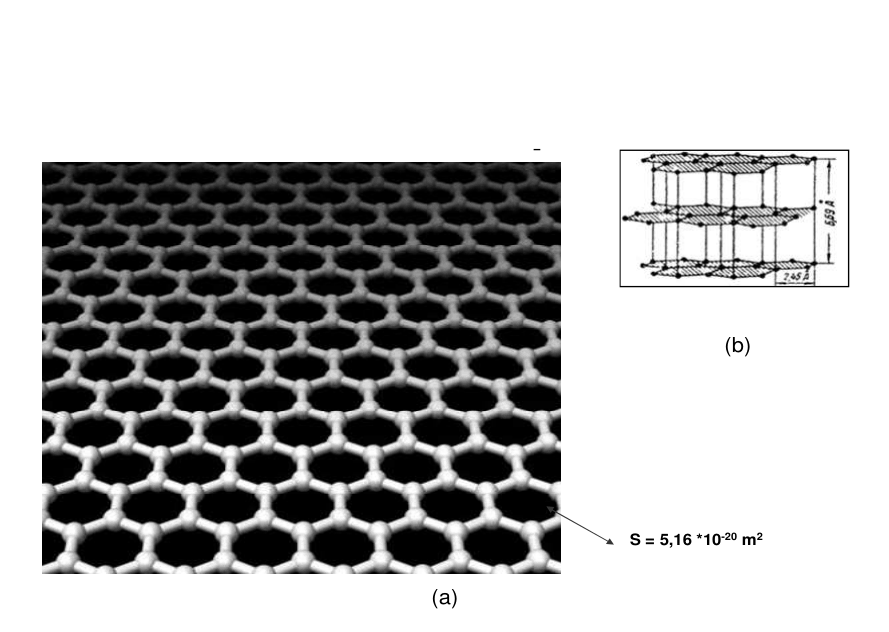
Fig. 1. (a) The structure of graphene. Spheres are carbon atoms. They are arranged in hexagons. The area of one carbon hexagon is \(5.16\cdot10^{-20}\ \mathrm{m^2}\). (b) Crystal lattice of graphite. Three graphene layers are shown.
Such atomic structure was long considered to be unstable. However, in 2004 Andrey Geim and Konstantin Novoselov have reported production of the first samples of this unusual material. This groundbreaking invention was awarded by Nobel prize in 2010.
Experimental studies of graphene are still restricted. Production of massive portions of the new substance still is a challenging synthetic problem. Many properties of graphene were estimated. Usually, there is not enough information for rigorous calculations, so we have to make assumptions and neglect unimportant factors. In this problem, you will estimate the adsorption properties of graphene.
5.1 Estimate the specific surface of graphene open for adsorption in units \(\mathrm{m^2\,g^{-1}}\). Consider that graphene plane is separated from any other solid or liquid substance.
The single layer of nitrogen molecules adsorbed on the outer surface of graphite is shown in Fig. 2. Assume that the same arrangement of nitrogen molecules is formed on a graphene surface.
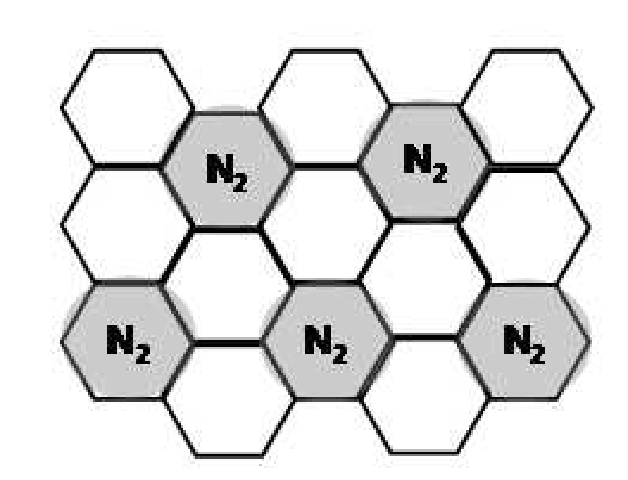
Fig. 2. Nitrogen molecules \(\ce{N2}\) (grey circles) on the outer surface of graphite
5.2 How many grams of nitrogen can be adsorbed on 1 gram of graphene assuming that the graphene layer is placed onto the surface of a solid support? Estimate the volume occupied by these nitrogen molecules after the complete desorption from 1 g of graphene (pressure 1 bar, temperature 298 K).
Let us consider adsorption as a common chemical equilibrium

(\(\ce{A_{gas}}\) are molecules \(\ce{A}\) in the gaseous state, \(\ce{A_{ads}}\) are the same molecules on the surface)
with the equilibrium constant \(K\):
\[ K=\frac{n_{\ce{A_{ads}}}\;(\mathrm{mol\,m^{-2}})} {p_{\ce{A_{gas}}}\;(\mathrm{bar})} \]
(Such an assumption holds if a small number of molecules is adsorbed on the surface.)
Adsorption properties of graphene can be estimated from the data for adsorption on a regular three-dimensional graphite. The enthalpy of adsorption (\(\Delta H^\circ\) of reaction (1)) of any molecule \(\ce{A}\) on graphene is on average by 10 % less negative compared to that on graphite. On graphite, the adsorbed molecule is bound more strongly due to the interaction with the lower graphene layers in the lattice (Fig. 1 b) and hence the enthalpy of adsorption is more negative. The standard entropies of adsorption on graphene and graphite are assumed to be the same.
5.3 How many moles, \(n\), of \(\ce{CCl4}\) are adsorbed on 1 g of graphene at \(p(\ce{CCl4})=10^{-4}\ \mathrm{bar}\) if \(2.0\cdot10^{-7}\ \mathrm{mol}\) of \(\ce{CCl4}\) are adsorbed on \(1\ \mathrm{m^2}\) of graphite at \(p(\ce{CCl4})=6.6\cdot10^{-5}\ \mathrm{bar}\)? Assume that graphene is placed onto the surface of a solid support and the interaction of \(\ce{CCl4}\) with the support does not change the enthalpy of adsorption of \(\ce{CCl4}\) on graphene. The temperature in both cases is 293 K. \(\Delta H^\circ\) of adsorption of \(\ce{CCl4}\) on graphite is \(-35.1\ \mathrm{kJ/mol}\).
The graphene films are expected to be sensitive gas detectors. If \(10^9\) particles of a gas are adsorbed on \(1\ \mathrm{cm^2}\) of a graphene surface this is enough to measure an electrical resistivity change of the graphene layer and to detect the presence of a gas in the environment.
5.4 Determine the minimal content of ethane, \(\ce{C2H6}\), in the air (in mol. %) at atmospheric pressure (\(T=293\ \mathrm{K}\)) at which a graphene sensor will detect this gas. The known data for the adsorption of alkanes on graphite are shown in Fig 3. Assume that air doesn't affect the adsorption properties of ethane.
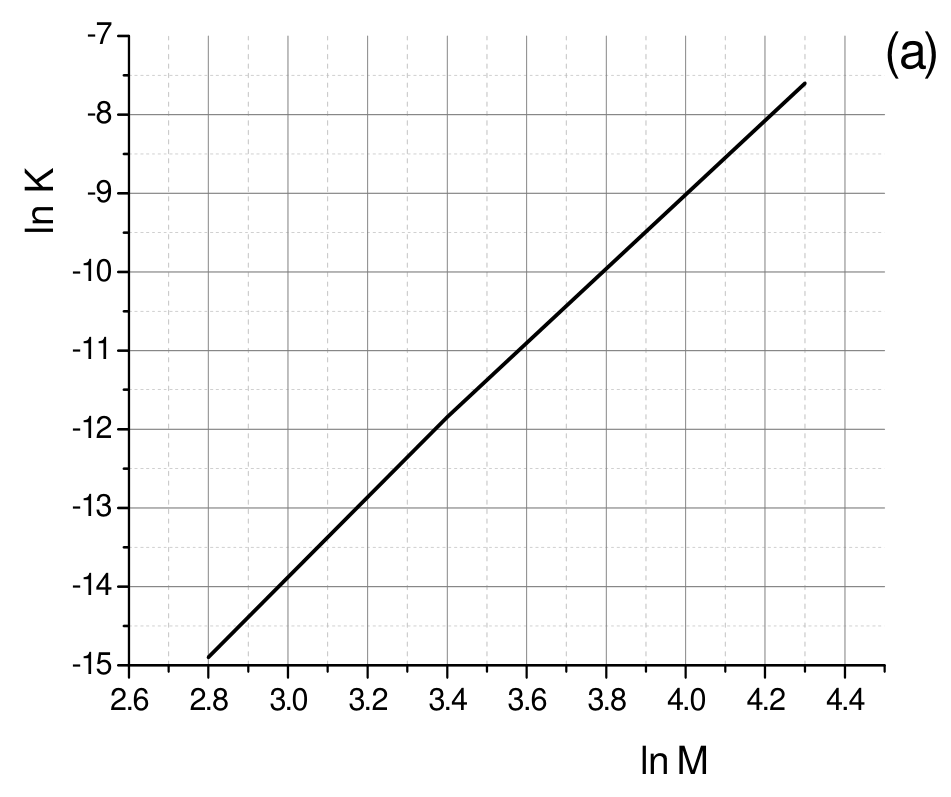
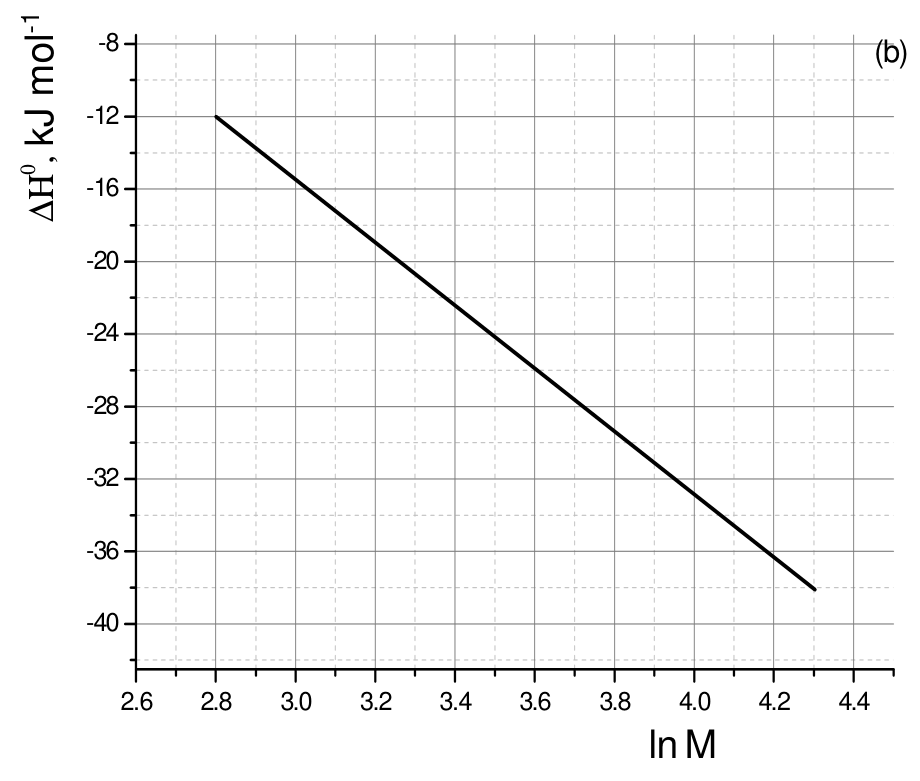
Fig. 3
Thermodynamic properties for adsorption of alkanes on a graphite surface.
(a) \(\ln K\ [\mathrm{mol\,m^{-2}\,bar^{-1}}]\) as a function of \(\ln M\) (\(M\) - molar mass of alkane in \(\mathrm{g\,mol^{-1}}\));
(b) \(\Delta H^\circ\) of adsorption as a function of \(\ln M\).
Linear dependences are assumed in both cases
Official English text of the problem.
Answers
- 5.1: \(\boxed{2.59\times10^3\ \mathrm{m^2\,g^{-1}}}\), counting both exposed faces.
- 5.2: Nitrogen, \(\ce{N2}\), SMILES
N#N: \(\boxed{0.389\ \mathrm{g}}\) adsorbed per gram of supported graphene; after desorption, \(\boxed{0.344\ \mathrm{L}}\) at 1 bar and 298 K. - 5.3: Carbon tetrachloride, \(\ce{CCl4}\), SMILES
ClC(Cl)(Cl)Cl: \(\boxed{9.3\times10^{-5}\ \mathrm{mol}}\) adsorbed. - 5.4: Ethane, \(\ce{C2H6}\), SMILES
CC: approximately \(\boxed{6.6\times10^{-4}\ \mathrm{mol.\%}}\), or about \(7\) ppm by mole, subject to graphical reading precision.
Solution
Use \(N_{\mathrm A}=6.022\times10^{23}\ \mathrm{mol^{-1}}\), \(R=8.314\ \mathrm{J\,mol^{-1}\,K^{-1}}=0.08314\ \mathrm{L\,bar\,mol^{-1}\,K^{-1}}\), and the approximate molar masses \(M(\ce{C})=12.0\), \(M(\ce{N2})=28.0\), and \(M(\ce{C2H6})=30.0\ \mathrm{g\,mol^{-1}}\).
5.1
Each carbon hexagon has six vertices, and each carbon atom belongs to three adjacent hexagons. Thus, neglecting sheet edges, one hexagon accounts for
\[ \frac{6}{3}=2\text{ carbon atoms}. \]
Its corresponding mass is
\[ m_{\mathrm{hex}}=\frac{2M(\ce{C})}{N_{\mathrm A}}. \]
Both faces of the isolated graphene sheet are accessible, so the adsorption area corresponding to one hexagon is \(2S\). Therefore,
\[ a_{\mathrm{both}} =\frac{2S}{2M(\ce{C})/N_{\mathrm A}} =\frac{SN_{\mathrm A}}{M(\ce{C})}. \]
Substitution gives
\[ a_{\mathrm{both}} =\frac{(5.16\times10^{-20}\ \mathrm{m^2}) (6.022\times10^{23}\ \mathrm{mol^{-1}})} {12.0\ \mathrm{g\,mol^{-1}}} =\boxed{2.59\times10^3\ \mathrm{m^2\,g^{-1}}}. \]
For subsequent parts involving a solid support, only one face is accessible:
\[ a_{\mathrm{one}}=\frac{a_{\mathrm{both}}}{2} =1.295\times10^3\ \mathrm{m^2\,g^{-1}}. \]
5.2
The repeating arrangement in Fig. 2 places one nitrogen molecule over every three carbon hexagons. Since each hexagon accounts for two carbon atoms, this means
\[ 1\text{ adsorbed }\ce{N2}\text{ molecule per }6\text{ carbon atoms}. \]
Only the upper face of supported graphene is accessible. Consequently, for \(1\ \mathrm{g}\) of graphene,
\[ n(\ce{N2}) =\frac{1}{6}\frac{1.00\ \mathrm{g}} {12.0\ \mathrm{g\,mol^{-1}}} =1.389\times10^{-2}\ \mathrm{mol}. \]
The adsorbed nitrogen mass is
\[ m(\ce{N2}) =n(\ce{N2})M(\ce{N2}) =(1.389\times10^{-2})(28.0) =\boxed{0.389\ \mathrm{g}}. \]
After complete desorption, treating the nitrogen as an ideal gas,
\[ V=\frac{nRT}{p} =\frac{(1.389\times10^{-2}\ \mathrm{mol}) (0.08314\ \mathrm{L\,bar\,mol^{-1}\,K^{-1}}) (298\ \mathrm{K})} {1\ \mathrm{bar}} =\boxed{0.344\ \mathrm{L}}. \]
5.3
For the adsorption equilibrium
\[ \ce{CCl4(g) <=> CCl4(ads)}, \]
let \(\Gamma\) denote the adsorbed amount per unit area. The given equilibrium relation is
\[ \Gamma=Kp. \]
The graphite data give
\[ K_{\mathrm{graphite}} =\frac{2.0\times10^{-7}\ \mathrm{mol\,m^{-2}}} {6.6\times10^{-5}\ \mathrm{bar}} =3.03\times10^{-3}\ \mathrm{mol\,m^{-2}\,bar^{-1}}. \]
The adsorption enthalpy on graphene is 10% less negative:
\[ \Delta H^\circ_{\mathrm{graphene}} =0.90(-35.1) =-31.59\ \mathrm{kJ\,mol^{-1}}. \]
Because the adsorption entropies are equal,
\[ \Delta G^\circ_{\mathrm{graphene}} -\Delta G^\circ_{\mathrm{graphite}} =\Delta H^\circ_{\mathrm{graphene}} -\Delta H^\circ_{\mathrm{graphite}} =+3.51\ \mathrm{kJ\,mol^{-1}}. \]
Using consistent standard states for both surfaces,
\[ \ln\frac{K_{\mathrm{graphene}}}{K_{\mathrm{graphite}}} =-\frac{3510}{8.314\times293} =-1.441. \]
Thus,
\[ K_{\mathrm{graphene}} =(3.03\times10^{-3})e^{-1.441} =7.17\times10^{-4}\ \mathrm{mol\,m^{-2}\,bar^{-1}}. \]
The weaker adsorption on graphene correctly gives the smaller equilibrium constant. At the specified pressure,
\[ \Gamma_{\mathrm{graphene}} =(7.17\times10^{-4})(10^{-4}) =7.17\times10^{-8}\ \mathrm{mol\,m^{-2}}. \]
One gram of supported graphene exposes \(1.295\times10^3\ \mathrm{m^2}\), so
\[ n=\Gamma_{\mathrm{graphene}}A =(7.17\times10^{-8})(1.295\times10^3) =\boxed{9.3\times10^{-5}\ \mathrm{mol}}. \]
5.4
For ethane,
\[ \ln M=\ln(30.0)=3.40. \]
Reading Fig. 3 at this abscissa gives approximately
\[ \ln K_{\mathrm{graphite}}\approx-12.0, \qquad \Delta H^\circ_{\mathrm{graphite}} \approx-22\ \mathrm{kJ\,mol^{-1}}. \]
Here \(K\) is expressed in the units specified by the graph. Applying the same enthalpy correction as in 5.3,
\[ \Delta H^\circ_{\mathrm{graphene}} \approx0.90(-22) =-19.8\ \mathrm{kJ\,mol^{-1}}, \]
and hence
\[ \ln\frac{K_{\mathrm{graphene}}}{K_{\mathrm{graphite}}} =-\frac{2200}{8.314\times293} =-0.903. \]
Therefore,
\[ \ln K_{\mathrm{graphene}}\approx-12.903, \]
\[ K_{\mathrm{graphene}} \approx2.49\times10^{-6}\ \mathrm{mol\,m^{-2}\,bar^{-1}}. \]
The detection threshold is \(10^9\) molecules per square centimetre. Since \(1\ \mathrm{cm^2}=10^{-4}\ \mathrm{m^2}\),
\[ \Gamma_{\min} =\frac{10^9}{(10^{-4}\ \mathrm{m^2})N_{\mathrm A}} =1.66\times10^{-11}\ \mathrm{mol\,m^{-2}}. \]
Using \(\Gamma=Kp\), the minimum ethane partial pressure is
\[ p_{\min} =\frac{1.66\times10^{-11}} {2.49\times10^{-6}} \approx6.67\times10^{-6}\ \mathrm{bar}. \]
For an ideal gas mixture, mole fraction equals partial pressure divided by total pressure. Taking atmospheric pressure as \(1.01325\ \mathrm{bar}\),
\[ x_{\min}=\frac{p_{\min}}{P} \approx6.58\times10^{-6}. \]
Thus the minimum molar percentage is
\[ \boxed{100x_{\min}\approx6.6\times10^{-4}\ \mathrm{mol.\%}}, \]
equivalent to approximately \(7\) ppm by mole.
The solution was checked against the official solution.
IChO 2013 · Theorieaufgabe 5
Einfache Abschätzungen der Eigenschaften von Graphen
Graphen ist ein zweidimensionales Kohlenstoffmaterial mit einer Dicke von einem Atom (Abb. 1 a). Viele übereinandergestapelte Graphenschichten bilden Graphit (Abb. 1 b).
Abb. 1. (a) Die Struktur von Graphen. Die Kugeln stellen Kohlenstoffatome dar. Sie sind in Sechsecken angeordnet. Die Fläche eines Kohlenstoffsechsecks beträgt \(5.16\cdot10^{-20}\ \mathrm{m^2}\). (b) Kristallgitter von Graphit. Dargestellt sind drei Graphenschichten.
Eine solche atomare Struktur galt lange als instabil. Im Jahr 2004 berichteten Andrey Geim und Konstantin Novoselov jedoch über die Herstellung der ersten Proben dieses ungewöhnlichen Materials. Diese bahnbrechende Erfindung wurde 2010 mit dem Nobelpreis ausgezeichnet.
Experimentelle Untersuchungen von Graphen sind noch immer eingeschränkt. Die Herstellung großer Mengen der neuen Substanz stellt nach wie vor eine anspruchsvolle Syntheseaufgabe dar. Viele Eigenschaften von Graphen wurden abgeschätzt. In der Regel liegen nicht genügend Informationen für exakte Berechnungen vor, sodass wir Annahmen treffen und unwichtige Faktoren vernachlässigen müssen. In dieser Aufgabe werden Sie die Adsorptionseigenschaften von Graphen abschätzen.
5.1 Schätzen Sie die für die Adsorption zugängliche spezifische Oberfläche von Graphen in der Einheit \(\mathrm{m^2\,g^{-1}}\) ab. Gehen Sie davon aus, dass die Graphenebene von allen anderen festen oder flüssigen Substanzen getrennt ist.
Die auf der äußeren Oberfläche von Graphit adsorbierte Monoschicht aus Stickstoffmolekülen ist in Abb. 2 dargestellt. Nehmen Sie an, dass sich auf einer Graphenoberfläche die gleiche Anordnung von Stickstoffmolekülen bildet.
Abb. 2. Stickstoffmoleküle \(\ce{N2}\) (graue Kreise) auf der äußeren Oberfläche von Graphit
5.2 Wie viele Gramm Stickstoff können an 1 Gramm Graphen adsorbiert werden, wenn die Graphenschicht auf der Oberfläche eines festen Trägers aufgebracht ist? Schätzen Sie das Volumen ab, das diese Stickstoffmoleküle nach der vollständigen Desorption von 1 g Graphen einnehmen (Druck 1 bar, Temperatur 298 K).
Betrachten wir die Adsorption als ein gewöhnliches chemisches Gleichgewicht
(\(\ce{A_{gas}}\) bezeichnet Moleküle \(\ce{A}\) im gasförmigen Zustand, \(\ce{A_{ads}}\) dieselben Moleküle auf der Oberfläche)
mit der Gleichgewichtskonstanten \(K\):
\[ K=\frac{n_{\ce{A_{ads}}}\;(\mathrm{mol\,m^{-2}})} {p_{\ce{A_{gas}}}\;(\mathrm{bar})} \]
(Diese Annahme gilt, wenn nur wenige Moleküle auf der Oberfläche adsorbiert sind.)
Die Adsorptionseigenschaften von Graphen lassen sich anhand der Daten für die Adsorption an gewöhnlichem dreidimensionalem Graphit abschätzen. Die Adsorptionsenthalpie (\(\Delta H^\circ\) der Reaktion (1)) eines beliebigen Moleküls \(\ce{A}\) an Graphen ist im Mittel um 10 % weniger negativ als diejenige an Graphit. An Graphit ist das adsorbierte Molekül aufgrund der Wechselwirkung mit den darunterliegenden Graphenschichten im Gitter (Abb. 1 b) stärker gebunden, weshalb die Adsorptionsenthalpie negativer ist. Es wird angenommen, dass die Standardadsorptionsentropien an Graphen und Graphit gleich sind.
5.3 Wie viele Mol, \(n\), \(\ce{CCl4}\) werden bei \(p(\ce{CCl4})=10^{-4}\ \mathrm{bar}\) an 1 g Graphen adsorbiert, wenn \(2.0\cdot10^{-7}\ \mathrm{mol}\) \(\ce{CCl4}\) an \(1\ \mathrm{m^2}\) Graphit bei \(p(\ce{CCl4})=6.6\cdot10^{-5}\ \mathrm{bar}\) adsorbiert werden? Nehmen Sie an, dass Graphen auf der Oberfläche eines festen Trägers aufgebracht ist und die Wechselwirkung von \(\ce{CCl4}\) mit dem Träger die Adsorptionsenthalpie von \(\ce{CCl4}\) an Graphen nicht verändert. Die Temperatur beträgt in beiden Fällen 293 K. \(\Delta H^\circ\) der Adsorption von \(\ce{CCl4}\) an Graphit beträgt \(-35.1\ \mathrm{kJ/mol}\).
Es wird erwartet, dass sich Graphenfilme als empfindliche Gasdetektoren eignen. Wenn \(10^9\) Teilchen eines Gases auf \(1\ \mathrm{cm^2}\) einer Graphenoberfläche adsorbiert werden, reicht dies aus, um eine Änderung des spezifischen elektrischen Widerstands der Graphenschicht zu messen und das Vorhandensein eines Gases in der Umgebung nachzuweisen.
5.4 Bestimmen Sie den minimalen Gehalt an Ethan, \(\ce{C2H6}\), in der Luft (in Mol-%) bei Atmosphärendruck (\(T=293\ \mathrm{K}\)), bei dem ein Graphensensor dieses Gas nachweist. Die bekannten Daten zur Adsorption von Alkanen an Graphit sind in Abb. 3 dargestellt. Nehmen Sie an, dass Luft die Adsorptionseigenschaften von Ethan nicht beeinflusst.
Abb. 3
Thermodynamische Eigenschaften der Adsorption von Alkanen auf einer Graphitoberfläche.
(a) \(\ln K\ [\mathrm{mol\,m^{-2}\,bar^{-1}}]\) als Funktion von \(\ln M\) (\(M\) – molare Masse des Alkans in \(\mathrm{g\,mol^{-1}}\));
(b) \(\Delta H^\circ\) der Adsorption als Funktion von \(\ln M\).
In beiden Fällen werden lineare Abhängigkeiten angenommen
Aufgabentext aus dem offiziellen englischen Text übersetzt.
Antworten
- 5.1: \(\boxed{2.59\times10^3\ \mathrm{m^2\,g^{-1}}}\), unter Berücksichtigung beider frei zugänglicher Seiten.
- 5.2: Stickstoff, \(\ce{N2}\), SMILES
N#N: \(\boxed{0.389\ \mathrm{g}}\) werden pro Gramm Graphen auf einem Träger adsorbiert; nach der Desorption \(\boxed{0.344\ \mathrm{L}}\) bei 1 bar und 298 K. - 5.3: Tetrachlormethan, \(\ce{CCl4}\), SMILES
ClC(Cl)(Cl)Cl: \(\boxed{9.3\times10^{-5}\ \mathrm{mol}}\) werden adsorbiert. - 5.4: Ethan, \(\ce{C2H6}\), SMILES
CC: ungefähr \(\boxed{6.6\times10^{-4}\ \mathrm{mol.\%}}\) oder etwa \(7\) ppm bezogen auf die Stoffmenge, abhängig von der Ablesegenauigkeit des Diagramms.
Lösung
Verwenden Sie \(N_{\mathrm A}=6.022\times10^{23}\ \mathrm{mol^{-1}}\), \(R=8.314\ \mathrm{J\,mol^{-1}\,K^{-1}}=0.08314\ \mathrm{L\,bar\,mol^{-1}\,K^{-1}}\) und die näherungsweisen molaren Massen \(M(\ce{C})=12.0\), \(M(\ce{N2})=28.0\) und \(M(\ce{C2H6})=30.0\ \mathrm{g\,mol^{-1}}\).
5.1
Jedes Kohlenstoffsechseck hat sechs Eckpunkte, und jedes Kohlenstoffatom gehört zu drei benachbarten Sechsecken. Unter Vernachlässigung der Ränder der Schicht entfallen daher auf ein Sechseck
\[ \frac{6}{3}=2\text{ Kohlenstoffatome}. \]
Die zugehörige Masse beträgt
\[ m_{\mathrm{hex}}=\frac{2M(\ce{C})}{N_{\mathrm A}}. \]
Beide Seiten der isolierten Graphenschicht sind zugänglich, sodass die einem Sechseck entsprechende Adsorptionsfläche \(2S\) beträgt. Daher gilt
\[ a_{\mathrm{both}} =\frac{2S}{2M(\ce{C})/N_{\mathrm A}} =\frac{SN_{\mathrm A}}{M(\ce{C})}. \]
Einsetzen ergibt
\[ a_{\mathrm{both}} =\frac{(5.16\times10^{-20}\ \mathrm{m^2}) (6.022\times10^{23}\ \mathrm{mol^{-1}})} {12.0\ \mathrm{g\,mol^{-1}}} =\boxed{2.59\times10^3\ \mathrm{m^2\,g^{-1}}}. \]
Bei den folgenden Teilaufgaben mit einem festen Träger ist nur eine Seite zugänglich:
\[ a_{\mathrm{one}}=\frac{a_{\mathrm{both}}}{2} =1.295\times10^3\ \mathrm{m^2\,g^{-1}}. \]
5.2
In der sich wiederholenden Anordnung in Abb. 2 befindet sich über jeweils drei Kohlenstoffsechsecken ein Stickstoffmolekül. Da auf jedes Sechseck zwei Kohlenstoffatome entfallen, bedeutet dies
\[ 1\text{ adsorbiertes }\ce{N2}\text{-Molekül pro }6\text{ Kohlenstoffatome}. \]
Bei Graphen auf einem Träger ist nur die Oberseite zugänglich. Folglich gilt für \(1\ \mathrm{g}\) Graphen
\[ n(\ce{N2}) =\frac{1}{6}\frac{1.00\ \mathrm{g}} {12.0\ \mathrm{g\,mol^{-1}}} =1.389\times10^{-2}\ \mathrm{mol}. \]
Die Masse des adsorbierten Stickstoffs beträgt
\[ m(\ce{N2}) =n(\ce{N2})M(\ce{N2}) =(1.389\times10^{-2})(28.0) =\boxed{0.389\ \mathrm{g}}. \]
Nach vollständiger Desorption ergibt sich bei Behandlung des Stickstoffs als ideales Gas
\[ V=\frac{nRT}{p} =\frac{(1.389\times10^{-2}\ \mathrm{mol}) (0.08314\ \mathrm{L\,bar\,mol^{-1}\,K^{-1}}) (298\ \mathrm{K})} {1\ \mathrm{bar}} =\boxed{0.344\ \mathrm{L}}. \]
5.3
Für das Adsorptionsgleichgewicht
\[ \ce{CCl4(g) <=> CCl4(ads)}, \]
bezeichne \(\Gamma\) die adsorbierte Stoffmenge pro Flächeneinheit. Die gegebene Gleichgewichtsbeziehung lautet
\[ \Gamma=Kp. \]
Aus den Daten für Graphit ergibt sich
\[ K_{\mathrm{graphite}} =\frac{2.0\times10^{-7}\ \mathrm{mol\,m^{-2}}} {6.6\times10^{-5}\ \mathrm{bar}} =3.03\times10^{-3}\ \mathrm{mol\,m^{-2}\,bar^{-1}}. \]
Die Adsorptionsenthalpie an Graphen ist um 10 % weniger negativ:
\[ \Delta H^\circ_{\mathrm{graphene}} =0.90(-35.1) =-31.59\ \mathrm{kJ\,mol^{-1}}. \]
Da die Adsorptionsentropien gleich sind, gilt
\[ \Delta G^\circ_{\mathrm{graphene}} -\Delta G^\circ_{\mathrm{graphite}} =\Delta H^\circ_{\mathrm{graphene}} -\Delta H^\circ_{\mathrm{graphite}} =+3.51\ \mathrm{kJ\,mol^{-1}}. \]
Bei Verwendung einheitlicher Standardzustände für beide Oberflächen gilt
\[ \ln\frac{K_{\mathrm{graphene}}}{K_{\mathrm{graphite}}} =-\frac{3510}{8.314\times293} =-1.441. \]
Somit ergibt sich
\[ K_{\mathrm{graphene}} =(3.03\times10^{-3})e^{-1.441} =7.17\times10^{-4}\ \mathrm{mol\,m^{-2}\,bar^{-1}}. \]
Die schwächere Adsorption an Graphen führt erwartungsgemäß zur kleineren Gleichgewichtskonstanten. Bei dem angegebenen Druck gilt
\[ \Gamma_{\mathrm{graphene}} =(7.17\times10^{-4})(10^{-4}) =7.17\times10^{-8}\ \mathrm{mol\,m^{-2}}. \]
Ein Gramm Graphen auf einem Träger besitzt eine zugängliche Oberfläche von \(1.295\times10^3\ \mathrm{m^2}\), sodass
\[ n=\Gamma_{\mathrm{graphene}}A =(7.17\times10^{-8})(1.295\times10^3) =\boxed{9.3\times10^{-5}\ \mathrm{mol}}. \]
5.4
Für Ethan gilt
\[ \ln M=\ln(30.0)=3.40. \]
Das Ablesen von Abb. 3 bei diesem Abszissenwert ergibt näherungsweise
\[ \ln K_{\mathrm{graphite}}\approx-12.0, \qquad \Delta H^\circ_{\mathrm{graphite}} \approx-22\ \mathrm{kJ\,mol^{-1}}. \]
Hier wird \(K\) in den im Diagramm angegebenen Einheiten ausgedrückt. Mit derselben Enthalpiekorrektur wie in 5.3 ergibt sich
\[ \Delta H^\circ_{\mathrm{graphene}} \approx0.90(-22) =-19.8\ \mathrm{kJ\,mol^{-1}}, \]
und damit
\[ \ln\frac{K_{\mathrm{graphene}}}{K_{\mathrm{graphite}}} =-\frac{2200}{8.314\times293} =-0.903. \]
Daher gilt
\[ \ln K_{\mathrm{graphene}}\approx-12.903, \]
\[ K_{\mathrm{graphene}} \approx2.49\times10^{-6}\ \mathrm{mol\,m^{-2}\,bar^{-1}}. \]
Die Nachweisgrenze beträgt \(10^9\) Moleküle pro Quadratzentimeter. Da \(1\ \mathrm{cm^2}=10^{-4}\ \mathrm{m^2}\), gilt
\[ \Gamma_{\min} =\frac{10^9}{(10^{-4}\ \mathrm{m^2})N_{\mathrm A}} =1.66\times10^{-11}\ \mathrm{mol\,m^{-2}}. \]
Mit \(\Gamma=Kp\) ergibt sich für den minimalen Ethanpartialdruck
\[ p_{\min} =\frac{1.66\times10^{-11}} {2.49\times10^{-6}} \approx6.67\times10^{-6}\ \mathrm{bar}. \]
Bei einem idealen Gasgemisch ist der Stoffmengenanteil gleich dem Partialdruck dividiert durch den Gesamtdruck. Mit einem Atmosphärendruck von \(1.01325\ \mathrm{bar}\) gilt
\[ x_{\min}=\frac{p_{\min}}{P} \approx6.58\times10^{-6}. \]
Somit beträgt der minimale prozentuale Stoffmengenanteil
\[ \boxed{100x_{\min}\approx6.6\times10^{-4}\ \mathrm{mol.\%}}, \]
was ungefähr \(7\) ppm bezogen auf die Stoffmenge entspricht.
Die Lösung wurde mit der offiziellen Lösung abgeglichen.
IChO 2013 · Teori sorusu 5
Grafenin özelliklerine ilişkin basit tahminler
Grafen, iki boyutlu, tek atom kalınlığında bir karbon malzemesidir (Şek. 1 a). Çok sayıda grafen katmanı üst üste yığılarak grafiti oluşturur (Şek. 1 b).
Şek. 1. (a) Grafenin yapısı. Küreler karbon atomlarını göstermektedir. Bu atomlar altıgenler oluşturacak şekilde düzenlenmiştir. Bir karbon altıgeninin alanı \(5.16\cdot10^{-20}\ \mathrm{m^2}\)'dir. (b) Grafitin kristal örgüsü. Üç grafen katmanı gösterilmiştir.
Böyle bir atomik yapının uzun süre kararsız olduğu düşünülmüştür. Ancak 2004 yılında Andrey Geim ve Konstantin Novoselov, bu alışılmadık malzemenin ilk örneklerini ürettiklerini bildirmiştir. Çığır açan bu buluş, 2010 yılında Nobel Ödülü ile ödüllendirilmiştir.
Grafene ilişkin deneysel çalışmalar hâlâ sınırlıdır. Bu yeni maddenin büyük miktarlarda üretilmesi, sentez açısından hâlâ zorlu bir sorundur. Grafenin birçok özelliği tahmin yoluyla belirlenmiştir. Genellikle kesin hesaplamalar için yeterli bilgi bulunmadığından varsayımlarda bulunmamız ve önemsiz etkenleri ihmal etmemiz gerekir. Bu soruda grafenin adsorpsiyon özelliklerini tahmin edeceksiniz.
5.1 Grafenin adsorpsiyona açık özgül yüzey alanını \(\mathrm{m^2\,g^{-1}}\) biriminde tahmin ediniz. Grafen düzleminin diğer tüm katı veya sıvı maddelerden ayrı olduğunu kabul ediniz.
Grafitin dış yüzeyine adsorplanmış tek katmanlı azot molekülleri Şek. 2'de gösterilmiştir. Grafen yüzeyinde de azot moleküllerinin aynı şekilde düzenlendiğini varsayınız.
Şek. 2. Grafitin dış yüzeyindeki azot molekülleri \(\ce{N2}\) (gri daireler)
5.2 Grafen katmanının katı bir desteğin yüzeyine yerleştirildiği varsayılırsa, 1 gram grafen üzerine kaç gram azot adsorplanabilir? Bu azot moleküllerinin 1 g grafenden tamamen desorplandıktan sonra kaplayacağı hacmi tahmin ediniz (basınç 1 bar, sıcaklık 298 K).
Adsorpsiyonu olağan bir kimyasal denge olarak ele alalım:
(\(\ce{A_{gas}}\), gaz hâlindeki \(\ce{A}\) moleküllerini; \(\ce{A_{ads}}\) ise yüzeydeki aynı molekülleri göstermektedir)
Bu dengenin denge sabiti \(K\) şöyledir:
\[ K=\frac{n_{\ce{A_{ads}}}\;(\mathrm{mol\,m^{-2}})} {p_{\ce{A_{gas}}}\;(\mathrm{bar})} \]
(Bu varsayım, yüzeye az sayıda molekül adsorplandığında geçerlidir.)
Grafenin adsorpsiyon özellikleri, sıradan üç boyutlu grafit üzerindeki adsorpsiyon verilerinden tahmin edilebilir. Herhangi bir \(\ce{A}\) molekülünün grafen üzerindeki adsorpsiyon entalpisi ((1) tepkimesinin \(\Delta H^\circ\) değeri), grafit üzerindekine kıyasla ortalama %10 daha az negatiftir. Grafitte adsorplanmış molekül, örgüdeki alt grafen katmanlarıyla etkileşimi nedeniyle daha kuvvetli bağlanır (Şek. 1 b) ve dolayısıyla adsorpsiyon entalpisi daha negatiftir. Grafen ve grafit üzerindeki standart adsorpsiyon entropilerinin aynı olduğu varsayılmaktadır.
5.3 \(p(\ce{CCl4})=6.6\cdot10^{-5}\ \mathrm{bar}\) basıncında \(1\ \mathrm{m^2}\) grafit üzerine \(2.0\cdot10^{-7}\ \mathrm{mol}\) \(\ce{CCl4}\) adsorplanıyorsa, \(p(\ce{CCl4})=10^{-4}\ \mathrm{bar}\) basıncında 1 g grafen üzerine kaç mol, \(n\), \(\ce{CCl4}\) adsorplanır? Grafenin katı bir desteğin yüzeyine yerleştirildiğini ve \(\ce{CCl4}\)'ün destekle etkileşiminin, \(\ce{CCl4}\)'ün grafen üzerindeki adsorpsiyon entalpisini değiştirmediğini varsayınız. Her iki durumda da sıcaklık 293 K'dir. \(\ce{CCl4}\)'ün grafit üzerindeki adsorpsiyonunun \(\Delta H^\circ\) değeri \(-35.1\ \mathrm{kJ/mol}\)'dür.
Grafen filmlerinin hassas gaz dedektörleri olması beklenmektedir. Bir grafen yüzeyinin \(1\ \mathrm{cm^2}\)'lik alanına bir gazın \(10^9\) taneciğinin adsorplanması, grafen katmanının elektriksel özdirencindeki değişimin ölçülmesi ve ortamda gaz bulunduğunun saptanması için yeterlidir.
5.4 Atmosfer basıncında (\(T=293\ \mathrm{K}\)) bir grafen sensörünün etan gazını, \(\ce{C2H6}\), algılayabilmesi için havadaki en düşük etan içeriğini (mol yüzdesi olarak) belirleyiniz. Alkanların grafit üzerindeki adsorpsiyonuna ilişkin bilinen veriler Şek. 3'te gösterilmiştir. Havanın etanın adsorpsiyon özelliklerini etkilemediğini varsayınız.
Şek. 3
Alkanların grafit yüzeyindeki adsorpsiyonuna ilişkin termodinamik özellikler.
(a) \(\ln M\)'nin fonksiyonu olarak \(\ln K\ [\mathrm{mol\,m^{-2}\,bar^{-1}}]\) (\(M\) - alkanın \(\mathrm{g\,mol^{-1}}\) biriminde molar kütlesi);
(b) \(\ln M\)'nin fonksiyonu olarak adsorpsiyonun \(\Delta H^\circ\) değeri.
Her iki durumda da doğrusal bağıntılar varsayılmaktadır
Soru metni resmi İngilizce metinden çevrilmiştir.
Cevaplar
- 5.1: Açıkta kalan her iki yüz hesaba katıldığında \(\boxed{2.59\times10^3\ \mathrm{m^2\,g^{-1}}}\).
- 5.2: Azot, \(\ce{N2}\), SMILES
N#N: destek üzerindeki grafenin gramı başına adsorplanan miktar \(\boxed{0.389\ \mathrm{g}}\); desorpsiyondan sonra 1 bar ve 298 K'de \(\boxed{0.344\ \mathrm{L}}\). - 5.3: Karbon tetraklorür, \(\ce{CCl4}\), SMILES
ClC(Cl)(Cl)Cl: adsorplanan miktar \(\boxed{9.3\times10^{-5}\ \mathrm{mol}}\). - 5.4: Etan, \(\ce{C2H6}\), SMILES
CC: grafik okuma hassasiyetine bağlı olarak yaklaşık \(\boxed{6.6\times10^{-4}\ \mathrm{mol.\%}}\) veya molce yaklaşık \(7\) ppm.
Çözüm
\(N_{\mathrm A}=6.022\times10^{23}\ \mathrm{mol^{-1}}\), \(R=8.314\ \mathrm{J\,mol^{-1}\,K^{-1}}=0.08314\ \mathrm{L\,bar\,mol^{-1}\,K^{-1}}\) değerlerini ve yaklaşık molar kütleler olarak \(M(\ce{C})=12.0\), \(M(\ce{N2})=28.0\) ve \(M(\ce{C2H6})=30.0\ \mathrm{g\,mol^{-1}}\) değerlerini kullanınız.
5.1
Her karbon altıgeninin altı köşesi vardır ve her karbon atomu üç komşu altıgen tarafından paylaşılır. Dolayısıyla tabakanın kenarları ihmal edildiğinde, bir altıgen başına
\[ \frac{6}{3}=2\text{ karbon atomu} \]
düşer. Buna karşılık gelen kütle
\[ m_{\mathrm{hex}}=\frac{2M(\ce{C})}{N_{\mathrm A}}. \]
Yalıtılmış grafen tabakasının her iki yüzü de erişilebilir olduğundan bir altıgene karşılık gelen adsorpsiyon alanı \(2S\)'dir. Dolayısıyla,
\[ a_{\mathrm{both}} =\frac{2S}{2M(\ce{C})/N_{\mathrm A}} =\frac{SN_{\mathrm A}}{M(\ce{C})}. \]
Değerler yerine konulduğunda
\[ a_{\mathrm{both}} =\frac{(5.16\times10^{-20}\ \mathrm{m^2}) (6.022\times10^{23}\ \mathrm{mol^{-1}})} {12.0\ \mathrm{g\,mol^{-1}}} =\boxed{2.59\times10^3\ \mathrm{m^2\,g^{-1}}}. \]
Katı bir desteğin söz konusu olduğu sonraki kısımlarda yalnızca bir yüz erişilebilirdir:
\[ a_{\mathrm{one}}=\frac{a_{\mathrm{both}}}{2} =1.295\times10^3\ \mathrm{m^2\,g^{-1}}. \]
5.2
Şek. 2'deki tekrarlayan düzenlemede, her üç karbon altıgeninin üzerinde bir azot molekülü bulunur. Her altıgen başına iki karbon atomu düştüğünden bu,
\[ 1\text{ adsorplanmış }\ce{N2}\text{ molekülüne karşılık }6\text{ karbon atomu} \]
anlamına gelir. Destek üzerindeki grafenin yalnızca üst yüzü erişilebilirdir. Sonuç olarak \(1\ \mathrm{g}\) grafen için,
\[ n(\ce{N2}) =\frac{1}{6}\frac{1.00\ \mathrm{g}} {12.0\ \mathrm{g\,mol^{-1}}} =1.389\times10^{-2}\ \mathrm{mol}. \]
Adsorplanan azotun kütlesi
\[ m(\ce{N2}) =n(\ce{N2})M(\ce{N2}) =(1.389\times10^{-2})(28.0) =\boxed{0.389\ \mathrm{g}}. \]
Tam desorpsiyondan sonra azot ideal gaz olarak ele alındığında,
\[ V=\frac{nRT}{p} =\frac{(1.389\times10^{-2}\ \mathrm{mol}) (0.08314\ \mathrm{L\,bar\,mol^{-1}\,K^{-1}}) (298\ \mathrm{K})} {1\ \mathrm{bar}} =\boxed{0.344\ \mathrm{L}}. \]
5.3
Adsorpsiyon dengesi
\[ \ce{CCl4(g) <=> CCl4(ads)}, \]
için \(\Gamma\), birim alan başına adsorplanan miktarı göstersin. Verilen denge bağıntısı şöyledir:
\[ \Gamma=Kp. \]
Grafit verilerinden
\[ K_{\mathrm{graphite}} =\frac{2.0\times10^{-7}\ \mathrm{mol\,m^{-2}}} {6.6\times10^{-5}\ \mathrm{bar}} =3.03\times10^{-3}\ \mathrm{mol\,m^{-2}\,bar^{-1}}. \]
Grafen üzerindeki adsorpsiyon entalpisi %10 daha az negatiftir:
\[ \Delta H^\circ_{\mathrm{graphene}} =0.90(-35.1) =-31.59\ \mathrm{kJ\,mol^{-1}}. \]
Adsorpsiyon entropileri eşit olduğundan,
\[ \Delta G^\circ_{\mathrm{graphene}} -\Delta G^\circ_{\mathrm{graphite}} =\Delta H^\circ_{\mathrm{graphene}} -\Delta H^\circ_{\mathrm{graphite}} =+3.51\ \mathrm{kJ\,mol^{-1}}. \]
Her iki yüzey için tutarlı standart hâller kullanıldığında,
\[ \ln\frac{K_{\mathrm{graphene}}}{K_{\mathrm{graphite}}} =-\frac{3510}{8.314\times293} =-1.441. \]
Böylece,
\[ K_{\mathrm{graphene}} =(3.03\times10^{-3})e^{-1.441} =7.17\times10^{-4}\ \mathrm{mol\,m^{-2}\,bar^{-1}}. \]
Grafen üzerindeki daha zayıf adsorpsiyon, beklendiği gibi daha küçük bir denge sabiti verir. Belirtilen basınçta,
\[ \Gamma_{\mathrm{graphene}} =(7.17\times10^{-4})(10^{-4}) =7.17\times10^{-8}\ \mathrm{mol\,m^{-2}}. \]
Destek üzerindeki bir gram grafenin açıkta kalan yüzey alanı \(1.295\times10^3\ \mathrm{m^2}\) olduğundan,
\[ n=\Gamma_{\mathrm{graphene}}A =(7.17\times10^{-8})(1.295\times10^3) =\boxed{9.3\times10^{-5}\ \mathrm{mol}}. \]
5.4
Etan için,
\[ \ln M=\ln(30.0)=3.40. \]
Şek. 3'ten bu apsis değerinde yaklaşık olarak şu değerler okunur:
\[ \ln K_{\mathrm{graphite}}\approx-12.0, \qquad \Delta H^\circ_{\mathrm{graphite}} \approx-22\ \mathrm{kJ\,mol^{-1}}. \]
Burada \(K\), grafikte belirtilen birimlerle ifade edilmektedir. 5.3'teki entalpi düzeltmesinin aynısı uygulandığında,
\[ \Delta H^\circ_{\mathrm{graphene}} \approx0.90(-22) =-19.8\ \mathrm{kJ\,mol^{-1}}, \]
ve dolayısıyla
\[ \ln\frac{K_{\mathrm{graphene}}}{K_{\mathrm{graphite}}} =-\frac{2200}{8.314\times293} =-0.903. \]
Bu nedenle,
\[ \ln K_{\mathrm{graphene}}\approx-12.903, \]
\[ K_{\mathrm{graphene}} \approx2.49\times10^{-6}\ \mathrm{mol\,m^{-2}\,bar^{-1}}. \]
Algılama eşiği, santimetrekare başına \(10^9\) moleküldür. \(1\ \mathrm{cm^2}=10^{-4}\ \mathrm{m^2}\) olduğundan,
\[ \Gamma_{\min} =\frac{10^9}{(10^{-4}\ \mathrm{m^2})N_{\mathrm A}} =1.66\times10^{-11}\ \mathrm{mol\,m^{-2}}. \]
\(\Gamma=Kp\) kullanıldığında, en düşük etan kısmi basıncı
\[ p_{\min} =\frac{1.66\times10^{-11}} {2.49\times10^{-6}} \approx6.67\times10^{-6}\ \mathrm{bar}. \]
İdeal bir gaz karışımında mol kesri, kısmi basıncın toplam basınca bölümüne eşittir. Atmosfer basıncı \(1.01325\ \mathrm{bar}\) alındığında,
\[ x_{\min}=\frac{p_{\min}}{P} \approx6.58\times10^{-6}. \]
Böylece en düşük mol yüzdesi
\[ \boxed{100x_{\min}\approx6.6\times10^{-4}\ \mathrm{mol.\%}}, \]
olup molce yaklaşık \(7\) ppm'e eşdeğerdir.
Çözüm, resmi çözümle karşılaştırılarak kontrol edildi.
IChO 2013 · Problema teórico 5
Estimaciones sencillas de las propiedades del grafeno
El grafeno es un material de carbono bidimensional con un espesor de un átomo (Fig. 1 a). Muchas capas de grafeno se apilan para formar grafito (Fig. 1 b).
Fig. 1. (a) La estructura del grafeno. Las esferas son átomos de carbono. Están dispuestos en hexágonos. El área de un hexágono de carbono es \(5.16\cdot10^{-20}\ \mathrm{m^2}\). (b) Red cristalina del grafito. Se muestran tres capas de grafeno.
Durante mucho tiempo se consideró que esta estructura atómica era inestable. Sin embargo, en 2004 Andrey Geim y Konstantin Novoselov comunicaron la obtención de las primeras muestras de este material inusual. Esta invención revolucionaria fue galardonada con el premio Nobel en 2010.
Los estudios experimentales del grafeno siguen siendo limitados. La producción de grandes cantidades de la nueva sustancia sigue siendo un difícil problema de síntesis. Muchas propiedades del grafeno se han estimado. Por lo general, no se dispone de información suficiente para realizar cálculos rigurosos, por lo que debemos hacer suposiciones y despreciar los factores poco importantes. En este problema, estimará las propiedades de adsorción del grafeno.
5.1 Estime la superficie específica del grafeno accesible a la adsorción en unidades de \(\mathrm{m^2\,g^{-1}}\). Considere que el plano de grafeno está separado de cualquier otra sustancia sólida o líquida.
La monocapa de moléculas de nitrógeno adsorbidas sobre la superficie exterior del grafito se muestra en la Fig. 2. Suponga que sobre una superficie de grafeno se forma la misma disposición de moléculas de nitrógeno.
Fig. 2. Moléculas de nitrógeno \(\ce{N2}\) (círculos grises) sobre la superficie exterior del grafito
5.2 ¿Cuántos gramos de nitrógeno pueden adsorberse sobre 1 gramo de grafeno suponiendo que la capa de grafeno está colocada sobre la superficie de un soporte sólido? Estime el volumen ocupado por estas moléculas de nitrógeno tras la desorción completa de 1 g de grafeno (presión de 1 bar, temperatura de 298 K).
Consideremos la adsorción como un equilibrio químico ordinario
(\(\ce{A_{gas}}\) son moléculas \(\ce{A}\) en estado gaseoso, \(\ce{A_{ads}}\) son las mismas moléculas sobre la superficie)
con la constante de equilibrio \(K\):
\[ K=\frac{n_{\ce{A_{ads}}}\;(\mathrm{mol\,m^{-2}})} {p_{\ce{A_{gas}}}\;(\mathrm{bar})} \]
(Esta suposición es válida si se adsorbe un número pequeño de moléculas sobre la superficie.)
Las propiedades de adsorción del grafeno pueden estimarse a partir de los datos de adsorción sobre grafito tridimensional ordinario. La entalpía de adsorción (\(\Delta H^\circ\) de la reacción (1)) de cualquier molécula \(\ce{A}\) sobre el grafeno es, en promedio, un 10 % menos negativa que sobre el grafito. Sobre el grafito, la molécula adsorbida está unida más fuertemente debido a la interacción con las capas inferiores de grafeno de la red (Fig. 1 b) y, por tanto, la entalpía de adsorción es más negativa. Se supone que las entropías estándar de adsorción sobre el grafeno y el grafito son iguales.
5.3 ¿Cuántos moles, \(n\), de \(\ce{CCl4}\) se adsorben sobre 1 g de grafeno a \(p(\ce{CCl4})=10^{-4}\ \mathrm{bar}\) si se adsorben \(2.0\cdot10^{-7}\ \mathrm{mol}\) de \(\ce{CCl4}\) sobre \(1\ \mathrm{m^2}\) de grafito a \(p(\ce{CCl4})=6.6\cdot10^{-5}\ \mathrm{bar}\)? Suponga que el grafeno está colocado sobre la superficie de un soporte sólido y que la interacción del \(\ce{CCl4}\) con el soporte no modifica la entalpía de adsorción del \(\ce{CCl4}\) sobre el grafeno. La temperatura en ambos casos es de 293 K. La \(\Delta H^\circ\) de adsorción del \(\ce{CCl4}\) sobre el grafito es \(-35.1\ \mathrm{kJ/mol}\).
Se espera que las películas de grafeno sean detectores de gases sensibles. Si se adsorben \(10^9\) partículas de un gas sobre \(1\ \mathrm{cm^2}\) de una superficie de grafeno, esto basta para medir un cambio en la resistividad eléctrica de la capa de grafeno y detectar la presencia de un gas en el entorno.
5.4 Determine el contenido mínimo de etano, \(\ce{C2H6}\), en el aire (en % molar) a presión atmosférica (\(T=293\ \mathrm{K}\)) para el que un sensor de grafeno detectará este gas. Los datos conocidos de adsorción de alcanos sobre grafito se muestran en la Fig. 3. Suponga que el aire no afecta a las propiedades de adsorción del etano.
Fig. 3
Propiedades termodinámicas de la adsorción de alcanos sobre una superficie de grafito.
(a) \(\ln K\ [\mathrm{mol\,m^{-2}\,bar^{-1}}]\) en función de \(\ln M\) (\(M\) - masa molar del alcano en \(\mathrm{g\,mol^{-1}}\));
(b) \(\Delta H^\circ\) de adsorción en función de \(\ln M\).
Se suponen dependencias lineales en ambos casos
Enunciado traducido del texto oficial en inglés.
Respuestas
- 5.1: \(\boxed{2.59\times10^3\ \mathrm{m^2\,g^{-1}}}\), contando ambas caras expuestas.
- 5.2: Nitrógeno, \(\ce{N2}\), SMILES
N#N: \(\boxed{0.389\ \mathrm{g}}\) adsorbidos por gramo de grafeno sobre un soporte; tras la desorción, \(\boxed{0.344\ \mathrm{L}}\) a 1 bar y 298 K. - 5.3: Tetracloruro de carbono, \(\ce{CCl4}\), SMILES
ClC(Cl)(Cl)Cl: \(\boxed{9.3\times10^{-5}\ \mathrm{mol}}\) adsorbidos. - 5.4: Etano, \(\ce{C2H6}\), SMILES
CC: aproximadamente \(\boxed{6.6\times10^{-4}\ \mathrm{mol.\%}}\), o alrededor de \(7\) ppm en moles, sujeto a la precisión de la lectura gráfica.
Solución
Utilizamos \(N_{\mathrm A}=6.022\times10^{23}\ \mathrm{mol^{-1}}\), \(R=8.314\ \mathrm{J\,mol^{-1}\,K^{-1}}=0.08314\ \mathrm{L\,bar\,mol^{-1}\,K^{-1}}\) y las masas molares aproximadas \(M(\ce{C})=12.0\), \(M(\ce{N2})=28.0\) y \(M(\ce{C2H6})=30.0\ \mathrm{g\,mol^{-1}}\).
5.1
Cada hexágono de carbono tiene seis vértices, y cada átomo de carbono pertenece a tres hexágonos adyacentes. Por tanto, despreciando los bordes de la lámina, a un hexágono le corresponden
\[ \frac{6}{3}=2\text{ átomos de carbono}. \]
Su masa correspondiente es
\[ m_{\mathrm{hex}}=\frac{2M(\ce{C})}{N_{\mathrm A}}. \]
Ambas caras de la lámina aislada de grafeno son accesibles, por lo que el área de adsorción correspondiente a un hexágono es \(2S\). Por tanto,
\[ a_{\mathrm{both}} =\frac{2S}{2M(\ce{C})/N_{\mathrm A}} =\frac{SN_{\mathrm A}}{M(\ce{C})}. \]
Al sustituir, se obtiene
\[ a_{\mathrm{both}} =\frac{(5.16\times10^{-20}\ \mathrm{m^2}) (6.022\times10^{23}\ \mathrm{mol^{-1}})} {12.0\ \mathrm{g\,mol^{-1}}} =\boxed{2.59\times10^3\ \mathrm{m^2\,g^{-1}}}. \]
En los apartados siguientes, en los que interviene un soporte sólido, solo una cara es accesible:
\[ a_{\mathrm{one}}=\frac{a_{\mathrm{both}}}{2} =1.295\times10^3\ \mathrm{m^2\,g^{-1}}. \]
5.2
La disposición repetitiva de la Fig. 2 sitúa una molécula de nitrógeno sobre cada tres hexágonos de carbono. Como a cada hexágono le corresponden dos átomos de carbono, esto significa
\[ 1\text{ molécula adsorbida de }\ce{N2}\text{ por cada }6\text{ átomos de carbono}. \]
Solo la cara superior del grafeno sobre un soporte es accesible. Por consiguiente, para \(1\ \mathrm{g}\) de grafeno,
\[ n(\ce{N2}) =\frac{1}{6}\frac{1.00\ \mathrm{g}} {12.0\ \mathrm{g\,mol^{-1}}} =1.389\times10^{-2}\ \mathrm{mol}. \]
La masa de nitrógeno adsorbido es
\[ m(\ce{N2}) =n(\ce{N2})M(\ce{N2}) =(1.389\times10^{-2})(28.0) =\boxed{0.389\ \mathrm{g}}. \]
Tras la desorción completa, tratando el nitrógeno como un gas ideal,
\[ V=\frac{nRT}{p} =\frac{(1.389\times10^{-2}\ \mathrm{mol}) (0.08314\ \mathrm{L\,bar\,mol^{-1}\,K^{-1}}) (298\ \mathrm{K})} {1\ \mathrm{bar}} =\boxed{0.344\ \mathrm{L}}. \]
5.3
Para el equilibrio de adsorción
\[ \ce{CCl4(g) <=> CCl4(ads)}, \]
sea \(\Gamma\) la cantidad adsorbida por unidad de área. La relación de equilibrio dada es
\[ \Gamma=Kp. \]
Los datos del grafito dan
\[ K_{\mathrm{graphite}} =\frac{2.0\times10^{-7}\ \mathrm{mol\,m^{-2}}} {6.6\times10^{-5}\ \mathrm{bar}} =3.03\times10^{-3}\ \mathrm{mol\,m^{-2}\,bar^{-1}}. \]
La entalpía de adsorción sobre el grafeno es un 10% menos negativa:
\[ \Delta H^\circ_{\mathrm{graphene}} =0.90(-35.1) =-31.59\ \mathrm{kJ\,mol^{-1}}. \]
Como las entropías de adsorción son iguales,
\[ \Delta G^\circ_{\mathrm{graphene}} -\Delta G^\circ_{\mathrm{graphite}} =\Delta H^\circ_{\mathrm{graphene}} -\Delta H^\circ_{\mathrm{graphite}} =+3.51\ \mathrm{kJ\,mol^{-1}}. \]
Utilizando estados estándar coherentes para ambas superficies,
\[ \ln\frac{K_{\mathrm{graphene}}}{K_{\mathrm{graphite}}} =-\frac{3510}{8.314\times293} =-1.441. \]
Así,
\[ K_{\mathrm{graphene}} =(3.03\times10^{-3})e^{-1.441} =7.17\times10^{-4}\ \mathrm{mol\,m^{-2}\,bar^{-1}}. \]
La adsorción más débil sobre el grafeno da, como corresponde, una constante de equilibrio menor. A la presión especificada,
\[ \Gamma_{\mathrm{graphene}} =(7.17\times10^{-4})(10^{-4}) =7.17\times10^{-8}\ \mathrm{mol\,m^{-2}}. \]
Un gramo de grafeno sobre un soporte expone \(1.295\times10^3\ \mathrm{m^2}\), de modo que
\[ n=\Gamma_{\mathrm{graphene}}A =(7.17\times10^{-8})(1.295\times10^3) =\boxed{9.3\times10^{-5}\ \mathrm{mol}}. \]
5.4
Para el etano,
\[ \ln M=\ln(30.0)=3.40. \]
La lectura de la Fig. 3 en esta abscisa da aproximadamente
\[ \ln K_{\mathrm{graphite}}\approx-12.0, \qquad \Delta H^\circ_{\mathrm{graphite}} \approx-22\ \mathrm{kJ\,mol^{-1}}. \]
Aquí \(K\) se expresa en las unidades especificadas en la gráfica. Aplicando la misma corrección de entalpía que en 5.3,
\[ \Delta H^\circ_{\mathrm{graphene}} \approx0.90(-22) =-19.8\ \mathrm{kJ\,mol^{-1}}, \]
y, por tanto,
\[ \ln\frac{K_{\mathrm{graphene}}}{K_{\mathrm{graphite}}} =-\frac{2200}{8.314\times293} =-0.903. \]
Por tanto,
\[ \ln K_{\mathrm{graphene}}\approx-12.903, \]
\[ K_{\mathrm{graphene}} \approx2.49\times10^{-6}\ \mathrm{mol\,m^{-2}\,bar^{-1}}. \]
El umbral de detección es de \(10^9\) moléculas por centímetro cuadrado. Como \(1\ \mathrm{cm^2}=10^{-4}\ \mathrm{m^2}\),
\[ \Gamma_{\min} =\frac{10^9}{(10^{-4}\ \mathrm{m^2})N_{\mathrm A}} =1.66\times10^{-11}\ \mathrm{mol\,m^{-2}}. \]
Utilizando \(\Gamma=Kp\), la presión parcial mínima de etano es
\[ p_{\min} =\frac{1.66\times10^{-11}} {2.49\times10^{-6}} \approx6.67\times10^{-6}\ \mathrm{bar}. \]
Para una mezcla de gases ideales, la fracción molar es igual a la presión parcial dividida por la presión total. Tomando la presión atmosférica como \(1.01325\ \mathrm{bar}\),
\[ x_{\min}=\frac{p_{\min}}{P} \approx6.58\times10^{-6}. \]
Así, el porcentaje molar mínimo es
\[ \boxed{100x_{\min}\approx6.6\times10^{-4}\ \mathrm{mol.\%}}, \]
equivalente a aproximadamente \(7\) ppm en moles.
La solución se comprobó con la solución oficial.
IChO 2013 · 理论题 5
石墨烯性质的简单估算
石墨烯是一种厚度仅为一个原子的二维碳材料(图 1 a)。许多层石墨烯堆叠在一起形成石墨(图 1 b)。
图 1. (a) 石墨烯的结构。球体表示碳原子,它们排列成六边形。一个碳六边形的面积为 \(5.16\cdot10^{-20}\ \mathrm{m^2}\)。 (b) 石墨的晶格。图中显示了三层石墨烯。
长期以来,人们认为这种原子结构是不稳定的。然而,2004 年,安德烈·盖姆和康斯坦丁·诺沃肖洛夫报道了这种特殊材料首批样品的制备。这一开创性的发明获得了 2010 年诺贝尔奖。
对石墨烯的实验研究仍然受到限制。大量制备这种新物质仍是一个具有挑战性的合成问题。石墨烯的许多性质都是通过估算得到的。通常,用于严格计算的信息不足,因此我们必须作出假设,并忽略不重要的因素。在本题中,你将估算石墨烯的吸附性质。
5.1 估算石墨烯可用于吸附的比表面积,以 \(\mathrm{m^2\,g^{-1}}\) 为单位。假定石墨烯平面不与任何其他固体或液体物质接触。
图 2 显示了吸附在石墨外表面上的单层氮分子。假设氮分子在石墨烯表面上也形成相同的排列。
图 2. 石墨外表面上的氮分子 \(\ce{N2}\)(灰色圆圈)
5.2 假设将石墨烯层置于固体载体表面上,1 克石墨烯能吸附多少克氮气?估算这些氮分子从 1 g 石墨烯上完全脱附后所占的体积(压力为 1 bar,温度为 298 K)。
将吸附视为一个普通的化学平衡
(\(\ce{A_{gas}}\) 表示气态的 \(\ce{A}\) 分子,\(\ce{A_{ads}}\) 表示表面上的同种分子)
其平衡常数为 \(K\):
\[ K=\frac{n_{\ce{A_{ads}}}\;(\mathrm{mol\,m^{-2}})} {p_{\ce{A_{gas}}}\;(\mathrm{bar})} \]
(当表面上吸附的分子数较少时,这一假设成立。)
石墨烯的吸附性质可以根据普通三维石墨上的吸附数据来估算。任意分子 \(\ce{A}\) 在石墨烯上的吸附焓(反应 (1) 的 \(\Delta H^\circ\))与在石墨上的吸附焓相比,平均负值的绝对值小 10 %。在石墨上,由于吸附分子与晶格中下方的石墨烯层之间存在相互作用(图 1 b),分子结合得更牢固,因此吸附焓更负。假设石墨烯和石墨上的标准吸附熵相同。
5.3 在 \(p(\ce{CCl4})=10^{-4}\ \mathrm{bar}\) 时,1 g 石墨烯上吸附的 \(\ce{CCl4}\) 的物质的量 \(n\) 为多少摩尔?已知在 \(p(\ce{CCl4})=6.6\cdot10^{-5}\ \mathrm{bar}\) 时,\(1\ \mathrm{m^2}\) 石墨上吸附了 \(2.0\cdot10^{-7}\ \mathrm{mol}\) 的 \(\ce{CCl4}\)。假设石墨烯置于固体载体表面上,且 \(\ce{CCl4}\) 与载体的相互作用不改变 \(\ce{CCl4}\) 在石墨烯上的吸附焓。两种情况下的温度均为 293 K。\(\ce{CCl4}\) 在石墨上的吸附焓 \(\Delta H^\circ\) 为 \(-35.1\ \mathrm{kJ/mol}\)。
石墨烯薄膜有望用作灵敏的气体检测器。如果在 \(1\ \mathrm{cm^2}\) 的石墨烯表面上吸附了 \(10^9\) 个气体粒子,就足以测得石墨烯层电阻率的变化,从而检测出环境中该气体的存在。
5.4 确定在大气压下(\(T=293\ \mathrm{K}\)),石墨烯传感器能够检测到乙烷 \(\ce{C2H6}\) 时,空气中乙烷的最低含量(以摩尔百分数表示)。图 3 给出了烷烃在石墨上吸附的已知数据。假设空气不影响乙烷的吸附性质。
图 3
烷烃在石墨表面上吸附的热力学性质。
(a) \(\ln K\ [\mathrm{mol\,m^{-2}\,bar^{-1}}]\) 随 \(\ln M\) 的变化关系(\(M\) 为烷烃的摩尔质量,单位为 \(\mathrm{g\,mol^{-1}}\));
(b) 吸附焓 \(\Delta H^\circ\) 随 \(\ln M\) 的变化关系。
两种情况下均假定为线性关系
题目译自官方英文原文。
答案
- 5.1: \(\boxed{2.59\times10^3\ \mathrm{m^2\,g^{-1}}}\),计入两个暴露的表面。
- 5.2: 氮气,\(\ce{N2}\),SMILES
N#N:每克负载于载体上的石墨烯吸附 \(\boxed{0.389\ \mathrm{g}}\);脱附后,在 1 bar 和 298 K 下的体积为 \(\boxed{0.344\ \mathrm{L}}\)。 - 5.3: 四氯化碳,\(\ce{CCl4}\),SMILES
ClC(Cl)(Cl)Cl:吸附量为 \(\boxed{9.3\times10^{-5}\ \mathrm{mol}}\)。 - 5.4: 乙烷,\(\ce{C2H6}\),SMILES
CC:约为 \(\boxed{6.6\times10^{-4}\ \mathrm{mol.\%}}\),即按物质的量计约为 \(7\) ppm,受图上读数精度的限制。
解答
取 \(N_{\mathrm A}=6.022\times10^{23}\ \mathrm{mol^{-1}}\)、\(R=8.314\ \mathrm{J\,mol^{-1}\,K^{-1}}=0.08314\ \mathrm{L\,bar\,mol^{-1}\,K^{-1}}\),以及近似摩尔质量 \(M(\ce{C})=12.0\)、\(M(\ce{N2})=28.0\) 和 \(M(\ce{C2H6})=30.0\ \mathrm{g\,mol^{-1}}\)。
5.1
每个碳六边形有六个顶点,每个碳原子由三个相邻的六边形共用。因此,忽略薄片边缘,一个六边形所对应的碳原子数为
\[ \frac{6}{3}=2\text{ 个碳原子}. \]
其对应的质量为
\[ m_{\mathrm{hex}}=\frac{2M(\ce{C})}{N_{\mathrm A}}. \]
孤立石墨烯薄片的两个表面均可用于吸附,因此一个六边形对应的吸附面积为 \(2S\)。于是,
\[ a_{\mathrm{both}} =\frac{2S}{2M(\ce{C})/N_{\mathrm A}} =\frac{SN_{\mathrm A}}{M(\ce{C})}. \]
代入数值得
\[ a_{\mathrm{both}} =\frac{(5.16\times10^{-20}\ \mathrm{m^2}) (6.022\times10^{23}\ \mathrm{mol^{-1}})} {12.0\ \mathrm{g\,mol^{-1}}} =\boxed{2.59\times10^3\ \mathrm{m^2\,g^{-1}}}. \]
在后续涉及固体载体的各问中,只有一个表面可用于吸附:
\[ a_{\mathrm{one}}=\frac{a_{\mathrm{both}}}{2} =1.295\times10^3\ \mathrm{m^2\,g^{-1}}. \]
5.2
在图 2 的周期性排列中,每三个碳六边形上方有一个氮分子。由于每个六边形对应两个碳原子,这意味着
\[ 1\text{ 个吸附的 }\ce{N2}\text{ 分子对应 }6\text{ 个碳原子}. \]
负载于载体上的石墨烯只有上表面可用于吸附。因此,对于 \(1\ \mathrm{g}\) 石墨烯,
\[ n(\ce{N2}) =\frac{1}{6}\frac{1.00\ \mathrm{g}} {12.0\ \mathrm{g\,mol^{-1}}} =1.389\times10^{-2}\ \mathrm{mol}. \]
吸附的氮气质量为
\[ m(\ce{N2}) =n(\ce{N2})M(\ce{N2}) =(1.389\times10^{-2})(28.0) =\boxed{0.389\ \mathrm{g}}. \]
完全脱附后,将氮气视为理想气体,
\[ V=\frac{nRT}{p} =\frac{(1.389\times10^{-2}\ \mathrm{mol}) (0.08314\ \mathrm{L\,bar\,mol^{-1}\,K^{-1}}) (298\ \mathrm{K})} {1\ \mathrm{bar}} =\boxed{0.344\ \mathrm{L}}. \]
5.3
对于吸附平衡
\[ \ce{CCl4(g) <=> CCl4(ads)}, \]
令 \(\Gamma\) 表示单位面积上的吸附量。题给的平衡关系为
\[ \Gamma=Kp. \]
由石墨的数据可得
\[ K_{\mathrm{graphite}} =\frac{2.0\times10^{-7}\ \mathrm{mol\,m^{-2}}} {6.6\times10^{-5}\ \mathrm{bar}} =3.03\times10^{-3}\ \mathrm{mol\,m^{-2}\,bar^{-1}}. \]
石墨烯上的吸附焓负值的绝对值小 10%:
\[ \Delta H^\circ_{\mathrm{graphene}} =0.90(-35.1) =-31.59\ \mathrm{kJ\,mol^{-1}}. \]
由于吸附熵相等,
\[ \Delta G^\circ_{\mathrm{graphene}} -\Delta G^\circ_{\mathrm{graphite}} =\Delta H^\circ_{\mathrm{graphene}} -\Delta H^\circ_{\mathrm{graphite}} =+3.51\ \mathrm{kJ\,mol^{-1}}. \]
对两个表面采用一致的标准态,
\[ \ln\frac{K_{\mathrm{graphene}}}{K_{\mathrm{graphite}}} =-\frac{3510}{8.314\times293} =-1.441. \]
因此,
\[ K_{\mathrm{graphene}} =(3.03\times10^{-3})e^{-1.441} =7.17\times10^{-4}\ \mathrm{mol\,m^{-2}\,bar^{-1}}. \]
石墨烯上的吸附较弱,所得平衡常数也较小,符合预期。在指定压力下,
\[ \Gamma_{\mathrm{graphene}} =(7.17\times10^{-4})(10^{-4}) =7.17\times10^{-8}\ \mathrm{mol\,m^{-2}}. \]
一克负载于载体上的石墨烯暴露的面积为 \(1.295\times10^3\ \mathrm{m^2}\),因此
\[ n=\Gamma_{\mathrm{graphene}}A =(7.17\times10^{-8})(1.295\times10^3) =\boxed{9.3\times10^{-5}\ \mathrm{mol}}. \]
5.4
对于乙烷,
\[ \ln M=\ln(30.0)=3.40. \]
在图 3 中按此横坐标读数,近似得到
\[ \ln K_{\mathrm{graphite}}\approx-12.0, \qquad \Delta H^\circ_{\mathrm{graphite}} \approx-22\ \mathrm{kJ\,mol^{-1}}. \]
这里 \(K\) 采用图中指定的单位。应用与 5.3 中相同的焓修正,
\[ \Delta H^\circ_{\mathrm{graphene}} \approx0.90(-22) =-19.8\ \mathrm{kJ\,mol^{-1}}, \]
由此可得
\[ \ln\frac{K_{\mathrm{graphene}}}{K_{\mathrm{graphite}}} =-\frac{2200}{8.314\times293} =-0.903. \]
因此,
\[ \ln K_{\mathrm{graphene}}\approx-12.903, \]
\[ K_{\mathrm{graphene}} \approx2.49\times10^{-6}\ \mathrm{mol\,m^{-2}\,bar^{-1}}. \]
检测阈值为每平方厘米 \(10^9\) 个分子。由于 \(1\ \mathrm{cm^2}=10^{-4}\ \mathrm{m^2}\),
\[ \Gamma_{\min} =\frac{10^9}{(10^{-4}\ \mathrm{m^2})N_{\mathrm A}} =1.66\times10^{-11}\ \mathrm{mol\,m^{-2}}. \]
利用 \(\Gamma=Kp\),乙烷的最小分压为
\[ p_{\min} =\frac{1.66\times10^{-11}} {2.49\times10^{-6}} \approx6.67\times10^{-6}\ \mathrm{bar}. \]
对于理想气体混合物,摩尔分数等于分压除以总压。取大气压为 \(1.01325\ \mathrm{bar}\),
\[ x_{\min}=\frac{p_{\min}}{P} \approx6.58\times10^{-6}. \]
因此,最低摩尔百分数为
\[ \boxed{100x_{\min}\approx6.6\times10^{-4}\ \mathrm{mol.\%}}, \]
相当于按物质的量计约 \(7\) ppm。
解答已与官方解答核对。
IChO 2013 · Теоретическая задача 5
Простые оценки свойств графена
Графен — это двумерный углеродный материал толщиной в один атом (рис. 1 a). Множество слоёв графена, уложенных друг на друга, образуют графит (рис. 1 b).
Рис. 1. (a) Структура графена. Шарики обозначают атомы углерода. Они расположены в вершинах шестиугольников. Площадь одного углеродного шестиугольника составляет \(5.16\cdot10^{-20}\ \mathrm{m^2}\). (b) Кристаллическая решётка графита. Показаны три слоя графена.
Такую атомную структуру долгое время считали неустойчивой. Однако в 2004 году Андрей Гейм и Константин Новосёлов сообщили о получении первых образцов этого необычного материала. Это выдающееся изобретение было отмечено Нобелевской премией в 2010 году.
Экспериментальные исследования графена пока ограничены. Получение больших количеств нового вещества всё ещё представляет собой сложную задачу синтеза. Многие свойства графена были оценены расчётным путём. Обычно для строгих расчётов недостаточно информации, поэтому приходится делать допущения и пренебрегать несущественными факторами. В этой задаче вы оцените адсорбционные свойства графена.
5.1 Оцените удельную поверхность графена, доступную для адсорбции, в единицах \(\mathrm{m^2\,g^{-1}}\). Считайте, что плоскость графена не соприкасается с каким-либо другим твёрдым или жидким веществом.
Монослой молекул азота, адсорбированных на внешней поверхности графита, показан на рис. 2. Предположите, что на поверхности графена молекулы азота располагаются так же.
Рис. 2. Молекулы азота \(\ce{N2}\) (серые кружки) на внешней поверхности графита
5.2 Сколько граммов азота может адсорбироваться на 1 грамме графена, если слой графена нанесён на поверхность твёрдой подложки? Оцените объём, занимаемый этими молекулами азота после полной десорбции с 1 г графена (давление 1 бар, температура 298 К).
Рассмотрим адсорбцию как обычное химическое равновесие
(\(\ce{A_{gas}}\) — молекулы \(\ce{A}\) в газообразном состоянии, \(\ce{A_{ads}}\) — те же молекулы на поверхности)
с константой равновесия \(K\):
\[ K=\frac{n_{\ce{A_{ads}}}\;(\mathrm{mol\,m^{-2}})} {p_{\ce{A_{gas}}}\;(\mathrm{bar})} \]
(Такое допущение справедливо, если на поверхности адсорбируется небольшое число молекул.)
Адсорбционные свойства графена можно оценить по данным об адсорбции на обычном трёхмерном графите. Энтальпия адсорбции (\(\Delta H^\circ\) реакции (1)) любой молекулы \(\ce{A}\) на графене в среднем на 10 % менее отрицательна, чем на графите. На графите адсорбированная молекула связана сильнее благодаря взаимодействию с нижележащими слоями графена в решётке (рис. 1 b), и поэтому энтальпия адсорбции более отрицательна. Стандартные энтропии адсорбции на графене и графите считаются одинаковыми.
5.3 Какое количество вещества, \(n\), \(\ce{CCl4}\) в молях адсорбируется на 1 г графена при \(p(\ce{CCl4})=10^{-4}\ \mathrm{bar}\), если на \(1\ \mathrm{m^2}\) графита при \(p(\ce{CCl4})=6.6\cdot10^{-5}\ \mathrm{bar}\) адсорбируется \(2.0\cdot10^{-7}\ \mathrm{mol}\) \(\ce{CCl4}\)? Предположите, что графен нанесён на поверхность твёрдой подложки и взаимодействие \(\ce{CCl4}\) с подложкой не изменяет энтальпию адсорбции \(\ce{CCl4}\) на графене. Температура в обоих случаях равна 293 К. \(\Delta H^\circ\) адсорбции \(\ce{CCl4}\) на графите составляет \(-35.1\ \mathrm{kJ/mol}\).
Ожидается, что графеновые плёнки будут чувствительными газовыми датчиками. Если на \(1\ \mathrm{cm^2}\) поверхности графена адсорбируется \(10^9\) частиц газа, этого достаточно, чтобы измерить изменение удельного электрического сопротивления слоя графена и обнаружить присутствие газа в окружающей среде.
5.4 Определите минимальное содержание этана, \(\ce{C2H6}\), в воздухе (в мол. %) при атмосферном давлении (\(T=293\ \mathrm{K}\)), при котором графеновый датчик обнаружит этот газ. Известные данные об адсорбции алканов на графите представлены на рис. 3. Предположите, что воздух не влияет на адсорбционные свойства этана.
Рис. 3
Термодинамические характеристики адсорбции алканов на поверхности графита.
(a) \(\ln K\ [\mathrm{mol\,m^{-2}\,bar^{-1}}]\) в зависимости от \(\ln M\) (\(M\) — молярная масса алкана в \(\mathrm{g\,mol^{-1}}\));
(b) \(\Delta H^\circ\) адсорбции в зависимости от \(\ln M\).
В обоих случаях предполагаются линейные зависимости
Условие переведено с официального английского текста.
Ответы
- 5.1: \(\boxed{2.59\times10^3\ \mathrm{m^2\,g^{-1}}}\), с учётом обеих открытых сторон.
- 5.2: Азот, \(\ce{N2}\), SMILES
N#N: на одном грамме графена на подложке адсорбируется \(\boxed{0.389\ \mathrm{g}}\); после десорбции — \(\boxed{0.344\ \mathrm{L}}\) при 1 бар и 298 К. - 5.3: Тетрахлорметан, \(\ce{CCl4}\), SMILES
ClC(Cl)(Cl)Cl: адсорбируется \(\boxed{9.3\times10^{-5}\ \mathrm{mol}}\). - 5.4: Этан, \(\ce{C2H6}\), SMILES
CC: приблизительно \(\boxed{6.6\times10^{-4}\ \mathrm{mol.\%}}\), или около \(7\) ppm по молярной доле, с учётом точности считывания значений с графика.
Решение
Используем \(N_{\mathrm A}=6.022\times10^{23}\ \mathrm{mol^{-1}}\), \(R=8.314\ \mathrm{J\,mol^{-1}\,K^{-1}}=0.08314\ \mathrm{L\,bar\,mol^{-1}\,K^{-1}}\) и приближённые молярные массы \(M(\ce{C})=12.0\), \(M(\ce{N2})=28.0\) и \(M(\ce{C2H6})=30.0\ \mathrm{g\,mol^{-1}}\).
5.1
У каждого углеродного шестиугольника шесть вершин, а каждый атом углерода принадлежит трём соседним шестиугольникам. Таким образом, пренебрегая краями листа, на один шестиугольник приходится
\[ \frac{6}{3}=2\text{ атома углерода}. \]
Соответствующая ему масса равна
\[ m_{\mathrm{hex}}=\frac{2M(\ce{C})}{N_{\mathrm A}}. \]
Обе стороны изолированного листа графена доступны, поэтому площадь поверхности адсорбции, приходящаяся на один шестиугольник, равна \(2S\). Следовательно,
\[ a_{\mathrm{both}} =\frac{2S}{2M(\ce{C})/N_{\mathrm A}} =\frac{SN_{\mathrm A}}{M(\ce{C})}. \]
Подстановка даёт
\[ a_{\mathrm{both}} =\frac{(5.16\times10^{-20}\ \mathrm{m^2}) (6.022\times10^{23}\ \mathrm{mol^{-1}})} {12.0\ \mathrm{g\,mol^{-1}}} =\boxed{2.59\times10^3\ \mathrm{m^2\,g^{-1}}}. \]
В последующих пунктах, где рассматривается твёрдая подложка, доступна только одна сторона:
\[ a_{\mathrm{one}}=\frac{a_{\mathrm{both}}}{2} =1.295\times10^3\ \mathrm{m^2\,g^{-1}}. \]
5.2
В повторяющейся структуре на рис. 2 одна молекула азота приходится на каждые три углеродных шестиугольника. Поскольку на каждый шестиугольник приходится два атома углерода, это означает
\[ 1\text{ адсорбированная молекула }\ce{N2}\text{ на }6\text{ атомов углерода}. \]
У графена на подложке доступна только верхняя сторона. Следовательно, для \(1\ \mathrm{g}\) графена
\[ n(\ce{N2}) =\frac{1}{6}\frac{1.00\ \mathrm{g}} {12.0\ \mathrm{g\,mol^{-1}}} =1.389\times10^{-2}\ \mathrm{mol}. \]
Масса адсорбированного азота равна
\[ m(\ce{N2}) =n(\ce{N2})M(\ce{N2}) =(1.389\times10^{-2})(28.0) =\boxed{0.389\ \mathrm{g}}. \]
После полной десорбции, считая азот идеальным газом, получаем
\[ V=\frac{nRT}{p} =\frac{(1.389\times10^{-2}\ \mathrm{mol}) (0.08314\ \mathrm{L\,bar\,mol^{-1}\,K^{-1}}) (298\ \mathrm{K})} {1\ \mathrm{bar}} =\boxed{0.344\ \mathrm{L}}. \]
5.3
Для адсорбционного равновесия
\[ \ce{CCl4(g) <=> CCl4(ads)}, \]
обозначим через \(\Gamma\) количество адсорбированного вещества на единицу площади. Данное в условии соотношение для равновесия имеет вид
\[ \Gamma=Kp. \]
Из данных для графита получаем
\[ K_{\mathrm{graphite}} =\frac{2.0\times10^{-7}\ \mathrm{mol\,m^{-2}}} {6.6\times10^{-5}\ \mathrm{bar}} =3.03\times10^{-3}\ \mathrm{mol\,m^{-2}\,bar^{-1}}. \]
Энтальпия адсорбции на графене на 10% менее отрицательна:
\[ \Delta H^\circ_{\mathrm{graphene}} =0.90(-35.1) =-31.59\ \mathrm{kJ\,mol^{-1}}. \]
Поскольку энтропии адсорбции равны,
\[ \Delta G^\circ_{\mathrm{graphene}} -\Delta G^\circ_{\mathrm{graphite}} =\Delta H^\circ_{\mathrm{graphene}} -\Delta H^\circ_{\mathrm{graphite}} =+3.51\ \mathrm{kJ\,mol^{-1}}. \]
Используя согласованные стандартные состояния для обеих поверхностей, получаем
\[ \ln\frac{K_{\mathrm{graphene}}}{K_{\mathrm{graphite}}} =-\frac{3510}{8.314\times293} =-1.441. \]
Таким образом,
\[ K_{\mathrm{graphene}} =(3.03\times10^{-3})e^{-1.441} =7.17\times10^{-4}\ \mathrm{mol\,m^{-2}\,bar^{-1}}. \]
Более слабой адсорбции на графене, как и должно быть, соответствует меньшая константа равновесия. При заданном давлении
\[ \Gamma_{\mathrm{graphene}} =(7.17\times10^{-4})(10^{-4}) =7.17\times10^{-8}\ \mathrm{mol\,m^{-2}}. \]
Один грамм графена на подложке имеет открытую поверхность площадью \(1.295\times10^3\ \mathrm{m^2}\), поэтому
\[ n=\Gamma_{\mathrm{graphene}}A =(7.17\times10^{-8})(1.295\times10^3) =\boxed{9.3\times10^{-5}\ \mathrm{mol}}. \]
5.4
Для этана
\[ \ln M=\ln(30.0)=3.40. \]
Считывая значения с рис. 3 при этой абсциссе, получаем приближённо
\[ \ln K_{\mathrm{graphite}}\approx-12.0, \qquad \Delta H^\circ_{\mathrm{graphite}} \approx-22\ \mathrm{kJ\,mol^{-1}}. \]
Здесь \(K\) выражена в единицах, указанных на графике. Применяя ту же поправку к энтальпии, что и в 5.3, получаем
\[ \Delta H^\circ_{\mathrm{graphene}} \approx0.90(-22) =-19.8\ \mathrm{kJ\,mol^{-1}}, \]
и, следовательно,
\[ \ln\frac{K_{\mathrm{graphene}}}{K_{\mathrm{graphite}}} =-\frac{2200}{8.314\times293} =-0.903. \]
Поэтому
\[ \ln K_{\mathrm{graphene}}\approx-12.903, \]
\[ K_{\mathrm{graphene}} \approx2.49\times10^{-6}\ \mathrm{mol\,m^{-2}\,bar^{-1}}. \]
Порог обнаружения составляет \(10^9\) молекул на квадратный сантиметр. Поскольку \(1\ \mathrm{cm^2}=10^{-4}\ \mathrm{m^2}\),
\[ \Gamma_{\min} =\frac{10^9}{(10^{-4}\ \mathrm{m^2})N_{\mathrm A}} =1.66\times10^{-11}\ \mathrm{mol\,m^{-2}}. \]
Используя \(\Gamma=Kp\), находим минимальное парциальное давление этана:
\[ p_{\min} =\frac{1.66\times10^{-11}} {2.49\times10^{-6}} \approx6.67\times10^{-6}\ \mathrm{bar}. \]
Для идеальной газовой смеси молярная доля равна отношению парциального давления к общему давлению. Принимая атмосферное давление равным \(1.01325\ \mathrm{bar}\), получаем
\[ x_{\min}=\frac{p_{\min}}{P} \approx6.58\times10^{-6}. \]
Таким образом, минимальное содержание в молярных процентах составляет
\[ \boxed{100x_{\min}\approx6.6\times10^{-4}\ \mathrm{mol.\%}}, \]
что эквивалентно приблизительно \(7\) ppm по молярной доле.
Решение проверено по официальному решению.
IChO 2013 · مسألة نظرية 5
تقديرات بسيطة لخصائص الغرافين
الغرافين مادة كربونية ثنائية الأبعاد بسماكة ذرة واحدة (الشكل 1 a). وتتراص طبقات عديدة من الغرافين معًا لتكوّن الغرافيت (الشكل 1 b).
الشكل 1. (a) بنية الغرافين. تمثل الكرات ذرات الكربون، وهي مرتبة في سداسيات. تبلغ مساحة سداسي كربوني واحد \(5.16\cdot10^{-20}\ \mathrm{m^2}\). (b) الشبكة البلورية للغرافيت. تظهر ثلاث طبقات من الغرافين.
لطالما عُدّت هذه البنية الذرية غير مستقرة. غير أن Andrey Geim وKonstantin Novoselov أعلنا في عام 2004 عن إنتاج أولى عينات هذه المادة غير المألوفة. وقد مُنح هذا الابتكار الرائد جائزة نوبل في عام 2010.
لا تزال الدراسات التجريبية للغرافين محدودة. ولا يزال إنتاج كميات كبيرة من هذه المادة الجديدة يمثل تحديًا في التحضير. وقد قُدّرت خصائص عديدة للغرافين. وعادةً لا تتوافر معلومات كافية لإجراء حسابات دقيقة، لذا يتعين علينا وضع افتراضات وإهمال العوامل غير المهمة. في هذه المسألة، ستقدّر خصائص امتزاز الغرافين.
5.1 قدّر المساحة السطحية النوعية للغرافين المتاحة للامتزاز بوحدات \(\mathrm{m^2\,g^{-1}}\). اعتبر أن مستوى الغرافين منفصل عن أي مادة صلبة أو سائلة أخرى.
يوضح الشكل 2 الطبقة الأحادية من جزيئات النيتروجين الممتزة على السطح الخارجي للغرافيت. افترض أن جزيئات النيتروجين تتخذ الترتيب نفسه على سطح الغرافين.
الشكل 2. جزيئات النيتروجين \(\ce{N2}\) (الدوائر الرمادية) على السطح الخارجي للغرافيت
5.2 كم غرامًا من النيتروجين يمكن امتزازه على 1 غرام من الغرافين، بافتراض أن طبقة الغرافين موضوعة على سطح دعامة صلبة؟ قدّر الحجم الذي تشغله جزيئات النيتروجين هذه بعد انتزازها الكامل من 1 g من الغرافين (الضغط 1 bar، ودرجة الحرارة 298 K).
لنعتبر الامتزاز اتزانًا كيميائيًا اعتياديًا
(\(\ce{A_{gas}}\) هي جزيئات \(\ce{A}\) في الحالة الغازية، و\(\ce{A_{ads}}\) هي الجزيئات نفسها على السطح)
بثابت اتزان \(K\):
\[ K=\frac{n_{\ce{A_{ads}}}\;(\mathrm{mol\,m^{-2}})} {p_{\ce{A_{gas}}}\;(\mathrm{bar})} \]
(يصح هذا الافتراض إذا امتُزّ عدد قليل من الجزيئات على السطح.)
يمكن تقدير خصائص امتزاز الغرافين من بيانات الامتزاز على الغرافيت العادي ثلاثي الأبعاد. تكون إنثالبيّة امتزاز أي جزيء \(\ce{A}\) على الغرافين (\(\Delta H^\circ\) للتفاعل (1)) أقل سلبيةً في المتوسط بنسبة 10 % مقارنةً بامتزازه على الغرافيت. فعلى الغرافيت، يرتبط الجزيء الممتز بقوة أكبر بسبب التآثر مع طبقات الغرافين السفلى في الشبكة (الشكل 1 b)، ومن ثم تكون إنثالبيّة الامتزاز أكثر سلبيةً. ويُفترض أن إنتروبيتي الامتزاز القياسيتين على الغرافين والغرافيت متساويتان.
5.3 ما عدد مولات \(\ce{CCl4}\)، \(n\)، الممتزة على 1 g من الغرافين عند \(p(\ce{CCl4})=10^{-4}\ \mathrm{bar}\)، إذا كان \(2.0\cdot10^{-7}\ \mathrm{mol}\) من \(\ce{CCl4}\) يُمتزّ على \(1\ \mathrm{m^2}\) من الغرافيت عند \(p(\ce{CCl4})=6.6\cdot10^{-5}\ \mathrm{bar}\)؟ افترض أن الغرافين موضوع على سطح دعامة صلبة، وأن تآثر \(\ce{CCl4}\) مع الدعامة لا يغيّر إنثالبيّة امتزاز \(\ce{CCl4}\) على الغرافين. تبلغ درجة الحرارة في الحالتين 293 K. وتبلغ \(\Delta H^\circ\) لامتزاز \(\ce{CCl4}\) على الغرافيت \(-35.1\ \mathrm{kJ/mol}\).
من المتوقع أن تكون أغشية الغرافين كواشف حساسة للغازات. فإذا امتُزّ \(10^9\) جسيمًا من غاز على \(1\ \mathrm{cm^2}\) من سطح الغرافين، كان ذلك كافيًا لقياس تغير في المقاومية الكهربائية لطبقة الغرافين والكشف عن وجود غاز في الوسط المحيط.
5.4 حدّد أدنى محتوى من الإيثان، \(\ce{C2H6}\)، في الهواء (بالنسبة المئوية المولية) عند الضغط الجوي (\(T=293\ \mathrm{K}\)) يمكن عنده لمستشعر من الغرافين أن يكشف هذا الغاز. يوضح الشكل 3 البيانات المعروفة لامتزاز الألكانات على الغرافيت. افترض أن الهواء لا يؤثر في خصائص امتزاز الإيثان.
الشكل 3
الخصائص الديناميكية الحرارية لامتزاز الألكانات على سطح الغرافيت.
(a) \(\ln K\ [\mathrm{mol\,m^{-2}\,bar^{-1}}]\) بدلالة \(\ln M\) (\(M\) - الكتلة المولية للألكان بوحدة \(\mathrm{g\,mol^{-1}}\))؛
(b) \(\Delta H^\circ\) للامتزاز بدلالة \(\ln M\).
يُفترض أن العلاقتين خطيتان في كلتا الحالتين
نص المسألة مترجم عن النص الإنجليزي الرسمي.
الإجابات
- 5.1: \(\boxed{2.59\times10^3\ \mathrm{m^2\,g^{-1}}}\)، باحتساب كلا الوجهين المكشوفين.
- 5.2: النيتروجين، \(\ce{N2}\)، وتمثيله بصيغة SMILES هو
N#N: يُمتزّ \(\boxed{0.389\ \mathrm{g}}\) لكل غرام من الغرافين الموضوع على دعامة؛ وبعد الانتزاز، يكون الحجم \(\boxed{0.344\ \mathrm{L}}\) عند 1 bar و298 K. - 5.3: رباعي كلوريد الكربون، \(\ce{CCl4}\)، وتمثيله بصيغة SMILES هو
ClC(Cl)(Cl)Cl: يُمتزّ \(\boxed{9.3\times10^{-5}\ \mathrm{mol}}\). - 5.4: الإيثان، \(\ce{C2H6}\)، وتمثيله بصيغة SMILES هو
CC: نحو \(\boxed{6.6\times10^{-4}\ \mathrm{mol.\%}}\)، أو نحو \(7\) أجزاء في المليون على أساس مولي، مع مراعاة دقة القراءة البيانية.
الحل
نستخدم \(N_{\mathrm A}=6.022\times10^{23}\ \mathrm{mol^{-1}}\)، و\(R=8.314\ \mathrm{J\,mol^{-1}\,K^{-1}}=0.08314\ \mathrm{L\,bar\,mol^{-1}\,K^{-1}}\)، والكتل المولية التقريبية \(M(\ce{C})=12.0\)، و\(M(\ce{N2})=28.0\)، و\(M(\ce{C2H6})=30.0\ \mathrm{g\,mol^{-1}}\).
5.1
لكل سداسي كربوني ستة رؤوس، وتنتمي كل ذرة كربون إلى ثلاثة سداسيات متجاورة. ومن ثم، بإهمال حواف الصفيحة، يقابل السداسي الواحد
\[ \frac{6}{3}=2\text{ من ذرات الكربون}. \]
وتكون الكتلة المقابلة له
\[ m_{\mathrm{hex}}=\frac{2M(\ce{C})}{N_{\mathrm A}}. \]
كلا وجهي صفيحة الغرافين المعزولة متاح للامتزاز، لذا فإن مساحة الامتزاز المقابلة لسداسي واحد تساوي \(2S\). وعليه،
\[ a_{\mathrm{both}} =\frac{2S}{2M(\ce{C})/N_{\mathrm A}} =\frac{SN_{\mathrm A}}{M(\ce{C})}. \]
بالتعويض نحصل على
\[ a_{\mathrm{both}} =\frac{(5.16\times10^{-20}\ \mathrm{m^2}) (6.022\times10^{23}\ \mathrm{mol^{-1}})} {12.0\ \mathrm{g\,mol^{-1}}} =\boxed{2.59\times10^3\ \mathrm{m^2\,g^{-1}}}. \]
في الأجزاء اللاحقة التي تتضمن دعامة صلبة، يتاح وجه واحد فقط للامتزاز:
\[ a_{\mathrm{one}}=\frac{a_{\mathrm{both}}}{2} =1.295\times10^3\ \mathrm{m^2\,g^{-1}}. \]
5.2
في الترتيب المتكرر في الشكل 2، يقع جزيء نيتروجين واحد فوق كل ثلاثة سداسيات كربونية. وبما أن كل سداسي يقابل ذرتي كربون، فهذا يعني
\[ 1\text{ جزيء ممتز من }\ce{N2}\text{ لكل }6\text{ ذرات كربون}. \]
الوجه العلوي فقط من الغرافين الموضوع على دعامة متاح للامتزاز. وبناءً عليه، لكل \(1\ \mathrm{g}\) من الغرافين،
\[ n(\ce{N2}) =\frac{1}{6}\frac{1.00\ \mathrm{g}} {12.0\ \mathrm{g\,mol^{-1}}} =1.389\times10^{-2}\ \mathrm{mol}. \]
كتلة النيتروجين الممتز هي
\[ m(\ce{N2}) =n(\ce{N2})M(\ce{N2}) =(1.389\times10^{-2})(28.0) =\boxed{0.389\ \mathrm{g}}. \]
بعد الانتزاز الكامل، وبمعاملة النيتروجين بوصفه غازًا مثاليًا،
\[ V=\frac{nRT}{p} =\frac{(1.389\times10^{-2}\ \mathrm{mol}) (0.08314\ \mathrm{L\,bar\,mol^{-1}\,K^{-1}}) (298\ \mathrm{K})} {1\ \mathrm{bar}} =\boxed{0.344\ \mathrm{L}}. \]
5.3
لاتزان الامتزاز
\[ \ce{CCl4(g) <=> CCl4(ads)}, \]
لنرمز بـ\(\Gamma\) إلى الكمية الممتزة لكل وحدة مساحة. علاقة الاتزان المعطاة هي
\[ \Gamma=Kp. \]
تعطي بيانات الغرافيت
\[ K_{\mathrm{graphite}} =\frac{2.0\times10^{-7}\ \mathrm{mol\,m^{-2}}} {6.6\times10^{-5}\ \mathrm{bar}} =3.03\times10^{-3}\ \mathrm{mol\,m^{-2}\,bar^{-1}}. \]
إنثالبيّة الامتزاز على الغرافين أقل سلبيةً بنسبة 10%:
\[ \Delta H^\circ_{\mathrm{graphene}} =0.90(-35.1) =-31.59\ \mathrm{kJ\,mol^{-1}}. \]
بما أن إنتروبيتي الامتزاز متساويتان،
\[ \Delta G^\circ_{\mathrm{graphene}} -\Delta G^\circ_{\mathrm{graphite}} =\Delta H^\circ_{\mathrm{graphene}} -\Delta H^\circ_{\mathrm{graphite}} =+3.51\ \mathrm{kJ\,mol^{-1}}. \]
باستخدام حالات قياسية متسقة لكلا السطحين،
\[ \ln\frac{K_{\mathrm{graphene}}}{K_{\mathrm{graphite}}} =-\frac{3510}{8.314\times293} =-1.441. \]
إذن،
\[ K_{\mathrm{graphene}} =(3.03\times10^{-3})e^{-1.441} =7.17\times10^{-4}\ \mathrm{mol\,m^{-2}\,bar^{-1}}. \]
يؤدي الامتزاز الأضعف على الغرافين إلى ثابت اتزان أصغر، كما هو متوقع. وعند الضغط المحدد،
\[ \Gamma_{\mathrm{graphene}} =(7.17\times10^{-4})(10^{-4}) =7.17\times10^{-8}\ \mathrm{mol\,m^{-2}}. \]
يوفر غرام واحد من الغرافين الموضوع على دعامة مساحة مكشوفة قدرها \(1.295\times10^3\ \mathrm{m^2}\)، لذا
\[ n=\Gamma_{\mathrm{graphene}}A =(7.17\times10^{-8})(1.295\times10^3) =\boxed{9.3\times10^{-5}\ \mathrm{mol}}. \]
5.4
للإيثان،
\[ \ln M=\ln(30.0)=3.40. \]
تعطي قراءة الشكل 3 عند هذا الإحداثي الأفقي تقريبًا
\[ \ln K_{\mathrm{graphite}}\approx-12.0, \qquad \Delta H^\circ_{\mathrm{graphite}} \approx-22\ \mathrm{kJ\,mol^{-1}}. \]
يُعبَّر هنا عن \(K\) بالوحدات المحددة في الرسم البياني. وبتطبيق تصحيح الإنثالبيّة نفسه المستخدم في 5.3،
\[ \Delta H^\circ_{\mathrm{graphene}} \approx0.90(-22) =-19.8\ \mathrm{kJ\,mol^{-1}}, \]
ومن ثم
\[ \ln\frac{K_{\mathrm{graphene}}}{K_{\mathrm{graphite}}} =-\frac{2200}{8.314\times293} =-0.903. \]
وعليه،
\[ \ln K_{\mathrm{graphene}}\approx-12.903, \]
\[ K_{\mathrm{graphene}} \approx2.49\times10^{-6}\ \mathrm{mol\,m^{-2}\,bar^{-1}}. \]
عتبة الكشف هي \(10^9\) جزيئًا لكل سنتيمتر مربع. وبما أن \(1\ \mathrm{cm^2}=10^{-4}\ \mathrm{m^2}\)،
\[ \Gamma_{\min} =\frac{10^9}{(10^{-4}\ \mathrm{m^2})N_{\mathrm A}} =1.66\times10^{-11}\ \mathrm{mol\,m^{-2}}. \]
باستخدام \(\Gamma=Kp\)، يكون أدنى ضغط جزئي للإيثان
\[ p_{\min} =\frac{1.66\times10^{-11}} {2.49\times10^{-6}} \approx6.67\times10^{-6}\ \mathrm{bar}. \]
في مزيج غازات مثالي، يساوي الكسر المولي الضغط الجزئي مقسومًا على الضغط الكلي. وباعتبار الضغط الجوي مساويًا لـ\(1.01325\ \mathrm{bar}\)،
\[ x_{\min}=\frac{p_{\min}}{P} \approx6.58\times10^{-6}. \]
إذن، أدنى نسبة مئوية مولية هي
\[ \boxed{100x_{\min}\approx6.6\times10^{-4}\ \mathrm{mol.\%}}, \]
وهي تكافئ نحو \(7\) أجزاء في المليون على أساس مولي.
تمت مراجعة الحل بمقارنته بالحل الرسمي.