IChO 2013 · Theory problem 6
Cyclopropanes. So simple. So fancy…
Cyclopropanes bearing donor and acceptor substituents at the neighbouring C-atoms, for example, A, demonstrate high reactivity behaving similar to 1,3-zwitterion B.
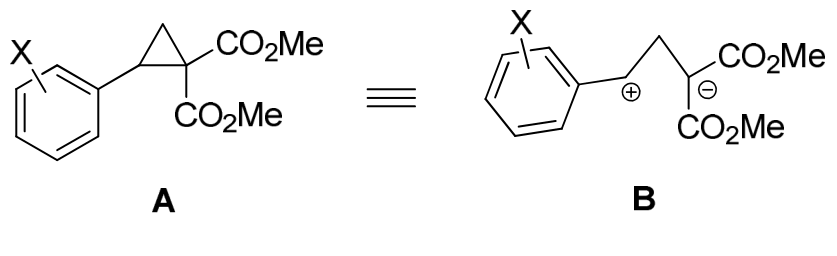
Thus, A1 (\(\ce{X = 4-OMe}\)) undergoes the three-membered ring opening in the Lewis acid-catalyzed reaction with 1,3-dimethoxybenzene as a nucleophile giving the product C.
6.1 Write down structural formula of C.
A1 participates in cycloadditions, annulations, oligomerizations, and other processes. Thus, [3+2]-cycloaddition between A1 and 4-methoxybenzaldehyde leads to a five-membered ring in D. Complete decarboxylation of D produces E (\(\ce{C18H20O3}\)), the molecule of the latter having a plane of symmetry.
6.2 Write down structural formulae of D and E indicating their stereochemistry.
Also, A, can undergo various transformations in the absence of any reaction partners except catalysts. Some transformations typical of A1 are shown in the Scheme below.
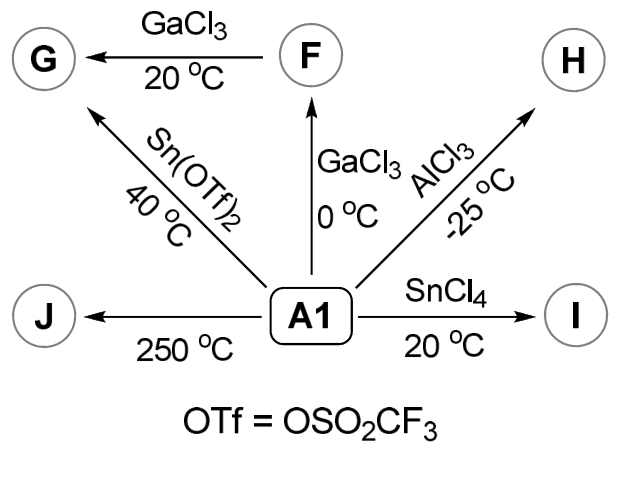
To determine the structures of F – J, a set of physico-chemical data was obtained (see Table for some results). It was found that:
a) F and G are structural isomers of A1;
b) G is formed as the most stable stereoisomer;
c) H and I are structural isomers;
d) H is formed as a single diastereomer with \(C_2\) axis of symmetry (the molecule looks the same after rotation through the angle of 180°);
e) I is formed as a mixture of two diastereomers;
f) J is naphthalene derivative.
In the process leading to I, one molecule of A1 demonstrates the described above common reactivity (analogous to that of B). The other molecule of A1 behaves differently. Also, the latter behaviour is demonstrated by cyclopropane A2 (dimethyl 2-(3,4,5-trimethoxyphenyl)cylopropane-1,1-dicarboxylate) when treated with \(\ce{SnCl4}\) in \(\ce{CH3NO2}\) affording K as a mixture of two diastereomers. The major isomer has the centre of symmetry. Similar reactivity is shown by A2 in \(\ce{Sn(OTf)2}\)-catalyzed reaction with G furnishing L.
6.3 Write down the structural formulae of F – J, and those of L and the major isomer of K.
Ratio of the number of hydrogen-containing groups
| Non-aromatic \(\ce{CH}\) | Non-aromatic \(\ce{CH2}\) | Non-aromatic \(\ce{CH3}\) | Non-aromatic \(\ce{OH}\) | Aromatic | Composition | |
|---|---|---|---|---|---|---|
| F | 1 | 1 | 1+1+1 | 0 | 4 in total | C 63.62%, H 6.11% |
| G | 1+1+1 | 0 | 2+1 | 0 | 4 in total | C 63.62%, H 6.11% |
| H | 1 | 1 | 1+1+1 | 0 | 4 in total | C 63.62%, H 6.11% |
| I | 1+1+1 | 1+1 | 2+1+1+1+1 | 0 | 7 in total | C 63.62%, H 6.11% |
| J | 0 | 0 | 1+1 | 1 | 5 in total | C 67.22%, H 5.22% |
| K | 1+1 | 1 | 2+1+1+1 | 0 | 1 | C 59.24%, H 6.23% |
| L | 1+1+1+1+1 | 1 | 2+2+1+1+1+1 | 0 | 5 in total | C 61.21%, H 6.18% |
Official English text of the problem.
Answers
For D and H, one enantiomer is represented explicitly; its mirror image is equally compatible with the statement. E and the major isomer of K are meso compounds.
- 6.1 — C: Dimethyl 2-[2-(2,4-dimethoxyphenyl)-2-(4-methoxyphenyl)ethyl]propanedioate.
COC(=O)C(CC(c1ccc(OC)cc1)c1ccc(OC)cc1OC)C(=O)OC
- 6.2 — D: Dimethyl cis-2,5-bis(4-methoxyphenyl)oxolane-3,3-dicarboxylate. Both aryl groups lie on the same face of the five-membered ring.
COc1ccc([C@H]2CC(C(=O)OC)(C(=O)OC)[C@@H](c3ccc(OC)cc3)O2)cc1
E: cis-2,5-Bis(4-methoxyphenyl)oxolane, the meso \((2R,5S)\) stereoisomer.
COc1ccc([C@H]2CC[C@@H](c3ccc(OC)cc3)O2)cc1
- 6.3 — F: Dimethyl 2-[2-(4-methoxyphenyl)ethylidene]propanedioate.
COC(=O)C(=CCc1ccc(OC)cc1)C(=O)OC
G: Dimethyl 2-[(\(E\))-2-(4-methoxyphenyl)ethenyl]propanedioate.
COC(=O)C(/C=C/c1ccc(OC)cc1)C(=O)OC
H: Tetramethyl cis-2,5-bis(4-methoxyphenyl)cyclohexane-1,1,4,4-tetracarboxylate. Both aryl groups are on the same face; the configurations are \((2R,5R)\) or \((2S,5S)\).
COc1ccc([C@H]2CC(C(=O)OC)(C(=O)OC)[C@@H](c3ccc(OC)cc3)CC2(C(=O)OC)C(=O)OC)cc1
I: Dimethyl 1-[2,2-bis(methoxycarbonyl)ethyl]-6-methoxy-4-(4-methoxyphenyl)-1,2,3,4-tetrahydronaphthalene-2,2-dicarboxylate, as two diastereomers. One representative of each is:
COC(=O)C(C[C@H]1c2ccc(OC)cc2[C@H](c2ccc(OC)cc2)CC1(C(=O)OC)C(=O)OC)C(=O)OC
COC(=O)C(C[C@H]1c2ccc(OC)cc2[C@@H](c2ccc(OC)cc2)CC1(C(=O)OC)C(=O)OC)C(=O)OC
These represent the \((1S,4S)\) and \((1S,4R)\) configurations; their respective mirror images are also possible.
J: Methyl 1-hydroxy-7-methoxynaphthalene-2-carboxylate.
COC(=O)c1ccc2ccc(OC)cc2c1O
L: Dimethyl 2-{1-[2,2-bis(methoxycarbonyl)ethyl]-4,5,6-trimethoxy-3-(4-methoxyphenyl)indan-2-yl}propanedioate. Its relative stereochemistry is not specified by the supplied data.
COC(=O)C(CC1c2cc(OC)c(OC)c(OC)c2C(c2ccc(OC)cc2)C1C(C(=O)OC)C(=O)OC)C(=O)OC
Major K: trans-9,10-Bis[2,2-bis(methoxycarbonyl)ethyl]-1,2,3,5,6,7-hexamethoxy-9,10-dihydroanthracene, the centrosymmetric meso isomer. The two side chains lie on opposite faces of the central ring.
COC(=O)C(C[C@H]1c2cc(OC)c(OC)c(OC)c2[C@H](CC(C(=O)OC)C(=O)OC)c2cc(OC)c(OC)c(OC)c21)C(=O)OC
Solution
The starting compounds are:
| Compound | Name | SMILES |
|---|---|---|
| A1 | Dimethyl 2-(4-methoxyphenyl)cyclopropane-1,1-dicarboxylate | COC(=O)C1(C(=O)OC)CC1c1ccc(OC)cc1 |
| A2 | Dimethyl 2-(3,4,5-trimethoxyphenyl)cyclopropane-1,1-dicarboxylate | COC(=O)C1(C(=O)OC)CC1c1cc(OC)c(OC)c(OC)c1 |
Their formulas are respectively \(\ce{C14H16O5}\) and \(\ce{C16H20O7}\).
For tracking connectivity, label the cyclopropane carbons:
- \(a\): the carbon bearing both ester groups;
- \(b\): the methylene carbon;
- \(c\): the aryl-bearing methine carbon.
Cleavage of the \(a-c\) bond gives the formal reactivity represented by B: nucleophilic character at \(a\), stabilized by the two ester groups, and electrophilic character at benzylic carbon \(c\).
For A1, this formal ring-opened benzylic-cation/malonate-anion equivalent can be written as:
COC(=O)[C-](C[CH+]c1ccc(OC)cc1)C(=O)OC
This is a description of reactivity; it does not require an independently existing, freely solvated zwitterion.
6.1 — Formation of C
The aromatic partner is 1,3-dimethoxybenzene, COc1cc(OC)ccc1.
Its positions 4 and 6 are equivalent and activated by both methoxy groups: each is ortho to one methoxy group and para to the other. Attack there also avoids the more crowded position between the two methoxy groups.
The aromatic ring attacks electrophilic carbon \(c\). Rearomatization and protonation of carbon \(a\) give C, whose carbon chain is
\[ \ce{(4-MeOC6H4)-CH(2,4-(MeO)2C6H3)-CH2-CH(CO2Me)2}. \]
Thus, the incoming aromatic fragment is 2,4-dimethoxyphenyl when numbered from its new attachment point.
The balanced reaction is
\[ \underbrace{\ce{C14H16O5}}_{\mathbf{A1}} + \underbrace{\ce{C8H10O2}}_{\text{1,3-dimethoxybenzene}} \xrightarrow{\text{Lewis acid}} \underbrace{\ce{C22H26O7}}_{\mathbf C}. \]
The aromatic hydrogen displaced in forming the new carbon–carbon bond ultimately supplies the hydrogen gained by the malonate carbon. No small-molecule coproduct is required.
6.2 — Formation and stereochemistry of D and E
The aldehyde is 4-methoxybenzaldehyde, COc1ccc(C=O)cc1.
In the formal [3+2]-cycloaddition:
- Carbon \(a\) bonds to the aldehyde carbonyl carbon.
- The aldehyde oxygen bonds to benzylic carbon \(c\).
The resulting five-membered ring follows the sequence
\[ \text{oxygen} - c - b - a - \text{former aldehyde carbon}. \]
Numbering the oxolane ring from oxygen gives aryl substituents at positions 2 and 5 and the two ester groups at position 3. Therefore D is the oxolane-3,3-dicarboxylate specified in the answers.
The balanced addition is
\[ \underbrace{\ce{C14H16O5}}_{\mathbf{A1}} + \underbrace{\ce{C8H8O2}}_{\text{4-methoxybenzaldehyde}} \longrightarrow \underbrace{\ce{C22H24O7}}_{\mathbf D}. \]
Complete removal of both ester-derived carboxyl groups gives a 2,5-diaryloxolane. Its stated plane of symmetry selects the cis, meso stereoisomer E. In a symmetric conformation, the plane passes through the ring oxygen and the midpoint of the opposite carbon–carbon bond, interchanging positions 2 and 5.
Consequently, the two aryl substituents in D must also be cis. In a ring drawing, draw both aryl bonds as wedges, or both as dashed bonds.
Writing the conversion as ester hydrolysis followed by complete decarboxylation gives the balanced net equation
\[ \underbrace{\ce{C22H24O7}}_{\mathbf D} +\ce{2H2O} \longrightarrow \underbrace{\ce{C18H20O3}}_{\mathbf E} +\ce{2CO2} +\ce{2CH3OH}. \]
Here water is O, carbon dioxide is O=C=O, and methanol is CO.
The formula of E is exactly the supplied \(\ce{C18H20O3}\). Its two ester-free ring methylene groups also distinguish it from D.
Although the representative SMILES for D has \(R,R\) configurations and E is \(R,S\), this does not imply inversion during decarboxylation: removal of the ester substituents changes the CIP priority ordering.
6.3 — Composition and hydrogen-count checks
Elemental analysis fixes empirical composition, but cannot by itself distinguish a compound from an atom-conserving dimer. The group counts and symmetry supply that information.
Using rounded atomic molar masses \(12.01\), \(1.01\), and \(16.00\ \mathrm{g\,mol^{-1}}\) for carbon, hydrogen, and oxygen reproduces the reported percentages. For example,
\[ M(\mathbf{A1}) =14(12.01)+16(1.01)+5(16.00) =264.30\ \mathrm{g\,mol^{-1}}, \]
\[ w_{\mathrm C} =\frac{14(12.01)}{264.30}\times100\% =63.62\%, \qquad w_{\mathrm H} =\frac{16(1.01)}{264.30}\times100\% =6.11\%. \]
The complete checks are:
| Product | Molecular formula | \(M\), \(\mathrm{g\,mol^{-1}}\) | Calculated C | Calculated H |
|---|---|---|---|---|
| F, G | \(\ce{C14H16O5}\) | 264.30 | 63.62% | 6.11% |
| H, I | \(\ce{C28H32O10}\) | 528.60 | 63.62% | 6.11% |
| J | \(\ce{C13H12O4}\) | 232.25 | 67.22% | 5.22% |
| K | \(\ce{C32H40O14}\) | 648.72 | 59.24% | 6.23% |
| L | \(\ce{C30H36O12}\) | 588.66 | 61.21% | 6.18% |
The actual group totals in the proposed molecules are:
| Product | Non-aromatic \(\ce{CH}\) | \(\ce{CH2}\) | \(\ce{CH3}\) | Aromatic H | \(\ce{OH}\) |
|---|---|---|---|---|---|
| F | 1 | 1 | 3 | 4 | 0 |
| G | 3 | 0 | 3 | 4 | 0 |
| H | 2 | 2 | 6 | 8 | 0 |
| I | 3 | 2 | 6 | 7 | 0 |
| J | 0 | 0 | 2 | 5 | 1 |
| K | 4 | 2 | 10 | 2 | 0 |
| L | 5 | 1 | 8 | 5 | 0 |
For the symmetric dimers H and K, the problem’s tabulated ratios correspond to half these molecular totals.
F and G: ring opening and alkene isomerization
The one methine and one methylene group of F fit
\[ \ce{Ar-CH2-CH=C(CO2Me)2}, \]
where \(\mathrm{Ar}\) denotes 4-methoxyphenyl.
Relative to the original \(c-b-a\) carbon sequence, the net change transfers a hydrogen from \(b\) to \(c\) and forms the \(b=a\) double bond.
The two ester groups occupy different positions relative to the alkene’s hydrogen and benzyl substituent, accounting for two distinct ester-methyl entries, in addition to the aromatic methoxy group.
Double-bond migration gives G:
\[ \ce{Ar-CH=CH-CH(CO2Me)2}. \]
This structure has three methine groups and no methylene group. Its alkene is conjugated with the aromatic ring. The more stable geometrical isomer is \(E\), with the aryl and malonate substituents on opposite sides of the double bond.
All three transformations are atom-conserving isomerizations:
\[ \begin{aligned} \underbrace{\ce{C14H16O5}}_{\mathbf{A1}} &\xrightarrow[0\,^\circ\mathrm C]{\ce{GaCl3}} \underbrace{\ce{C14H16O5}}_{\mathbf F},\\[3pt] \underbrace{\ce{C14H16O5}}_{\mathbf F} &\xrightarrow[20\,^\circ\mathrm C]{\ce{GaCl3}} \underbrace{\ce{C14H16O5}}_{\mathbf G},\\[3pt] \underbrace{\ce{C14H16O5}}_{\mathbf{A1}} &\xrightarrow[40\,^\circ\mathrm C]{\ce{Sn(OTf)2}} \underbrace{\ce{C14H16O5}}_{\mathbf G}. \end{aligned} \]
H: coupling of two ordinary three-carbon units
Two molecules of A1 can combine through their normal donor–acceptor reactivity. The new bonds connect \(a\) of each molecule to \(c\) of the other:
\[ a_1-c_2,\qquad a_2-c_1. \]
The resulting six-membered ring has the sequence
\[ a_1-b_1-c_1-a_2-b_2-c_2. \]
It therefore contains two geminal diester-bearing carbons, two methylene carbons, and two aryl-bearing methine carbons: precisely the cyclohexane structure H.
The \(C_2\) symmetry clue selects the cis relationship between the two aryl groups, corresponding to the \(R,R/S,S\) enantiomeric pair. A flattened ring drawing should show both aryl bonds wedged or both dashed. This specifies relative configuration, not a unique cyclohexane conformation.
\[ \ce{2C14H16O5} \xrightarrow[-25\,^\circ\mathrm C]{\ce{AlCl3}} \underbrace{\ce{C28H32O10}}_{\mathbf H}. \]
I: aromatic-ring participation by one cyclopropane
The alternative reactivity involves the aromatic carbon ortho to the cyclopropyl substituent. Instead of using the malonate carbon as the second bond-forming terminus, the molecule uses this aromatic carbon.
The participating three-carbon sequence is now
\[ c-\text{ipso aromatic carbon}-\text{ortho aromatic carbon}. \]
Aromatic substitution supplies a proton that ultimately converts the ester-bearing terminus into \(\ce{CH(CO2Me)2}\). Thus, the benzylic carbon retains a \(\ce{-CH2CH(CO2Me)2}\) side chain.
For I, one molecule uses its ordinary \(c-b-a\) unit and the other uses this aromatic three-carbon unit. Their union produces a six-membered ring fused to the latter molecule’s benzene ring: a tetralin skeleton.
Numbering that tetralin ring gives:
- position 1: \(\ce{-CH2CH(CO2Me)2}\);
- position 2: two methoxycarbonyl groups;
- position 4: 4-methoxyphenyl;
- position 6: methoxy.
One aromatic hydrogen is replaced, reducing the aromatic total from eight to seven. The product has three non-aromatic methines and two methylenes, matching the table.
Positions 1 and 4 are stereogenic, allowing the two stated relative configurations.
\[ \ce{2C14H16O5} \xrightarrow[20\,^\circ\mathrm C]{\ce{SnCl4}} \underbrace{\ce{C28H32O10}}_{\mathbf I}. \]
J: cyclization to a naphthol
The composition and hydrogen counts require:
- a naphthalene nucleus;
- one aromatic methoxy group;
- one methyl ester;
- one phenolic hydroxyl group.
The corresponding formula is \(\ce{C13H12O4}\). Compared with A1, the difference is exactly methanol:
\[ \ce{C14H16O5 - C13H12O4 = CH4O}. \]
The connectivity can be followed from the open-chain skeleton of G. An aromatic ortho carbon forms a bond to one ester carbonyl carbon, closing a six-membered ring. Methanol elimination and aromatizing proton transfer give the naphthol.
Tracing the atoms places the hydroxyl group at position 1, the remaining ester at position 2, and the original para-methoxy substituent at position 7.
\[ \underbrace{\ce{C14H16O5}}_{\mathbf{A1}} \xrightarrow{250\,^\circ\mathrm C} \underbrace{\ce{C13H12O4}}_{\mathbf J} +\ce{CH3OH}. \]
The resulting structure has five aromatic hydrogens, two methyl groups, one hydroxyl group, and no non-aromatic methine or methylene groups.
L: annulation of A2 with G
Here A2 supplies the aromatic three-carbon unit described for I, while G supplies its two alkene carbons. Their combination therefore forms a five-membered ring fused to the trimethoxy-substituted benzene ring: an indane.
The regioselectivity follows benzylic stabilization. Bond formation between the benzylic electrophilic carbon of opened A2 and the alkene carbon of G adjacent to its malonate group leaves positive character at the aryl-bearing alkene carbon. Intramolecular aromatic attack then closes the ring.
The indane substituents are consequently:
- position 1: \(\ce{-CH2CH(CO2Me)2}\), from A2;
- position 2: \(\ce{-CH(CO2Me)2}\), from G;
- position 3: 4-methoxyphenyl, from G;
- positions 4, 5, and 6: methoxy groups, from A2.
The balanced reaction is
\[ \underbrace{\ce{C16H20O7}}_{\mathbf{A2}} + \underbrace{\ce{C14H16O5}}_{\mathbf G} \xrightarrow{\ce{Sn(OTf)2}} \underbrace{\ce{C30H36O12}}_{\mathbf L}. \]
The three saturated indane carbons and the two malonate methines account for all five non-aromatic \(\ce{CH}\) groups. Only the side chain at position 1 contains a methylene group. Aromatic substitution leaves five aromatic hydrogens.
Major K: aromatic participation by both molecules
When two molecules of A2 both use their aromatic three-carbon units, each benzylic carbon forms a bond to an ortho carbon of the other aromatic ring.
This closes the central six-membered ring of a 9,10-dihydroanthracene. Both original malonate-bearing fragments remain as \(\ce{-CH2CH(CO2Me)2}\) side chains at positions 9 and 10.
Each aromatic ring loses one hydrogen through substitution. The product therefore has:
- two aromatic hydrogens altogether;
- two central-ring methines;
- two malonate methines;
- two side-chain methylene groups;
- ten methyl groups.
The stated centre of symmetry selects the trans arrangement of the two side chains. In a conventional drawing, one side-chain bond is wedged and the other dashed. Inversion through the centre exchanges positions 9 and 10 and the two substituted aromatic rings. This is the meso stereoisomer encoded in the answer.
\[ \ce{2C16H20O7} \xrightarrow[\ce{CH3NO2}]{\ce{SnCl4}} \underbrace{\ce{C32H40O14}}_{\mathbf K}. \]
For completeness, the reaction auxiliaries are gallium(III) chloride, Cl[Ga](Cl)Cl; aluminium(III) chloride, Cl[Al](Cl)Cl; tin(IV) chloride, Cl[Sn](Cl)(Cl)Cl; tin(II) triflate, [Sn+2].O=S(=O)([O-])C(F)(F)F.O=S(=O)([O-])C(F)(F)F; and nitromethane, C[N+](=O)[O-]. These SMILES do not specify their solution coordination structures.
The solution was checked against the official solution. Where this solution differs from the official solution, the official solution contains an error or a misprint.
IChO 2013 · Theorieaufgabe 6
Cyclopropane. So einfach. So raffiniert…
Cyclopropane mit Donor- und Akzeptorsubstituenten an benachbarten C-Atomen, beispielsweise A, zeigen eine hohe Reaktivität und verhalten sich ähnlich wie das 1,3-Zwitterion B.
So wird bei A1 (\(\ce{X = 4-OMe}\)) in der Lewis-Säure-katalysierten Reaktion mit 1,3-Dimethoxybenzol als Nucleophil der Dreiring geöffnet, wobei das Produkt C entsteht.
6.1 Geben Sie die Strukturformel von C an.
A1 geht Cycloadditionen, Anellierungen, Oligomerisierungen und andere Reaktionen ein. So führt die [3+2]-Cycloaddition zwischen A1 und 4-Methoxybenzaldehyd zu einem Fünfring in D. Die vollständige Decarboxylierung von D liefert E (\(\ce{C18H20O3}\)), dessen Molekül eine Symmetrieebene besitzt.
6.2 Geben Sie die Strukturformeln von D und E unter Angabe ihrer Stereochemie an.
A kann auch in Abwesenheit jeglicher Reaktionspartner außer Katalysatoren verschiedene Umwandlungen eingehen. Einige für A1 typische Umwandlungen sind im nachstehenden Schema dargestellt.
Zur Bestimmung der Strukturen von F – J wurde eine Reihe physikalisch-chemischer Daten erhoben (einige Ergebnisse sind in der Tabelle aufgeführt). Dabei wurde festgestellt:
a) F und G sind Konstitutionsisomere von A1;
b) G entsteht als das stabilste Stereoisomer;
c) H und I sind Konstitutionsisomere;
d) H entsteht als einziges Diastereomer mit einer \(C_2\)-Symmetrieachse (nach einer Drehung um 180° sieht das Molekül genauso aus);
e) I entsteht als Gemisch zweier Diastereomere;
f) J ist ein Naphthalinderivat.
Bei der Bildung von I zeigt ein Molekül A1 die oben beschriebene übliche Reaktivität (analog zu der von B). Das andere Molekül A1 verhält sich anders. Dieses abweichende Verhalten zeigt auch das Cyclopropan A2 (Dimethyl-2-(3,4,5-trimethoxyphenyl)cyclopropan-1,1-dicarboxylat) bei Behandlung mit \(\ce{SnCl4}\) in \(\ce{CH3NO2}\), wobei K als Gemisch zweier Diastereomere entsteht. Das Hauptisomer besitzt ein Symmetriezentrum. Eine ähnliche Reaktivität zeigt A2 bei der \(\ce{Sn(OTf)2}\)-katalysierten Reaktion mit G, die L liefert.
6.3 Geben Sie die Strukturformeln von F – J sowie die von L und dem Hauptisomer von K an.
Verhältnis der Anzahlen wasserstoffhaltiger Gruppen
| Nichtaromatische \(\ce{CH}\) | Nichtaromatische \(\ce{CH2}\) | Nichtaromatische \(\ce{CH3}\) | Nichtaromatische \(\ce{OH}\) | Aromatisch | Zusammensetzung | |
|---|---|---|---|---|---|---|
| F | 1 | 1 | 1+1+1 | 0 | insgesamt 4 | C 63.62%, H 6.11% |
| G | 1+1+1 | 0 | 2+1 | 0 | insgesamt 4 | C 63.62%, H 6.11% |
| H | 1 | 1 | 1+1+1 | 0 | insgesamt 4 | C 63.62%, H 6.11% |
| I | 1+1+1 | 1+1 | 2+1+1+1+1 | 0 | insgesamt 7 | C 63.62%, H 6.11% |
| J | 0 | 0 | 1+1 | 1 | insgesamt 5 | C 67.22%, H 5.22% |
| K | 1+1 | 1 | 2+1+1+1 | 0 | 1 | C 59.24%, H 6.23% |
| L | 1+1+1+1+1 | 1 | 2+2+1+1+1+1 | 0 | insgesamt 5 | C 61.21%, H 6.18% |
Aufgabentext aus dem offiziellen englischen Text übersetzt.
Antworten
Für D und H ist jeweils ein Enantiomer explizit dargestellt; sein Spiegelbild ist ebenso mit der Aufgabenstellung vereinbar. E und das Hauptisomer von K sind meso-Verbindungen.
- 6.1 — C: Dimethyl-2-[2-(2,4-dimethoxyphenyl)-2-(4-methoxyphenyl)ethyl]propandioat.
COC(=O)C(CC(c1ccc(OC)cc1)c1ccc(OC)cc1OC)C(=O)OC
- 6.2 — D: Dimethyl-cis-2,5-bis(4-methoxyphenyl)oxolan-3,3-dicarboxylat. Beide Arylgruppen liegen auf derselben Seite des Fünfrings.
COc1ccc([C@H]2CC(C(=O)OC)(C(=O)OC)[C@@H](c3ccc(OC)cc3)O2)cc1
E: cis-2,5-Bis(4-methoxyphenyl)oxolan, das meso-\((2R,5S)\)-Stereoisomer.
COc1ccc([C@H]2CC[C@@H](c3ccc(OC)cc3)O2)cc1
- 6.3 — F: Dimethyl-2-[2-(4-methoxyphenyl)ethyliden]propandioat.
COC(=O)C(=CCc1ccc(OC)cc1)C(=O)OC
G: Dimethyl-2-[(\(E\))-2-(4-methoxyphenyl)ethenyl]propandioat.
COC(=O)C(/C=C/c1ccc(OC)cc1)C(=O)OC
H: Tetramethyl-cis-2,5-bis(4-methoxyphenyl)cyclohexan-1,1,4,4-tetracarboxylat. Beide Arylgruppen liegen auf derselben Seite; die Konfigurationen sind \((2R,5R)\) oder \((2S,5S)\).
COc1ccc([C@H]2CC(C(=O)OC)(C(=O)OC)[C@@H](c3ccc(OC)cc3)CC2(C(=O)OC)C(=O)OC)cc1
I: Dimethyl-1-[2,2-bis(methoxycarbonyl)ethyl]-6-methoxy-4-(4-methoxyphenyl)-1,2,3,4-tetrahydronaphthalin-2,2-dicarboxylat, als zwei Diastereomere. Je ein Vertreter ist:
COC(=O)C(C[C@H]1c2ccc(OC)cc2[C@H](c2ccc(OC)cc2)CC1(C(=O)OC)C(=O)OC)C(=O)OC
COC(=O)C(C[C@H]1c2ccc(OC)cc2[C@@H](c2ccc(OC)cc2)CC1(C(=O)OC)C(=O)OC)C(=O)OC
Diese stellen die Konfigurationen \((1S,4S)\) und \((1S,4R)\) dar; ihre jeweiligen Spiegelbilder sind ebenfalls möglich.
J: Methyl-1-hydroxy-7-methoxynaphthalin-2-carboxylat.
COC(=O)c1ccc2ccc(OC)cc2c1O
L: Dimethyl-2-{1-[2,2-bis(methoxycarbonyl)ethyl]-4,5,6-trimethoxy-3-(4-methoxyphenyl)indan-2-yl}propandioat. Seine relative Stereochemie ist durch die angegebenen Daten nicht festgelegt.
COC(=O)C(CC1c2cc(OC)c(OC)c(OC)c2C(c2ccc(OC)cc2)C1C(C(=O)OC)C(=O)OC)C(=O)OC
Hauptisomer von K: trans-9,10-Bis[2,2-bis(methoxycarbonyl)ethyl]-1,2,3,5,6,7-hexamethoxy-9,10-dihydroanthracen, das zentrosymmetrische meso-Isomer. Die beiden Seitenketten liegen auf entgegengesetzten Seiten des mittleren Rings.
COC(=O)C(C[C@H]1c2cc(OC)c(OC)c(OC)c2[C@H](CC(C(=O)OC)C(=O)OC)c2cc(OC)c(OC)c(OC)c21)C(=O)OC
Lösung
Die Ausgangsverbindungen sind:
| Verbindung | Name | SMILES |
|---|---|---|
| A1 | Dimethyl-2-(4-methoxyphenyl)cyclopropan-1,1-dicarboxylat | COC(=O)C1(C(=O)OC)CC1c1ccc(OC)cc1 |
| A2 | Dimethyl-2-(3,4,5-trimethoxyphenyl)cyclopropan-1,1-dicarboxylat | COC(=O)C1(C(=O)OC)CC1c1cc(OC)c(OC)c(OC)c1 |
Ihre Summenformeln sind \(\ce{C14H16O5}\) beziehungsweise \(\ce{C16H20O7}\).
Um die Verknüpfung der Atome nachzuverfolgen, werden die Cyclopropan-Kohlenstoffatome wie folgt bezeichnet:
- \(a\): das Kohlenstoffatom, das beide Estergruppen trägt;
- \(b\): das Methylen-Kohlenstoffatom;
- \(c\): das arylsubstituierte Methin-Kohlenstoffatom.
Die Spaltung der \(a-c\)-Bindung ergibt die durch B dargestellte formale Reaktivität: nucleophiler Charakter an \(a\), stabilisiert durch die beiden Estergruppen, und elektrophiler Charakter am benzylischen Kohlenstoffatom \(c\).
Für A1 lässt sich dieses formale ringgeöffnete Benzylkation/Malonatanion-Äquivalent wie folgt schreiben:
COC(=O)[C-](C[CH+]c1ccc(OC)cc1)C(=O)OC
Dies ist eine Beschreibung der Reaktivität; sie setzt kein eigenständig existierendes, frei solvatisiertes Zwitterion voraus.
6.1 — Bildung von C
Der aromatische Reaktionspartner ist 1,3-Dimethoxybenzol, COc1cc(OC)ccc1.
Seine Positionen 4 und 6 sind äquivalent und durch beide Methoxygruppen aktiviert: Jede liegt ortho zu einer Methoxygruppe und para zur anderen. Ein Angriff an diesen Positionen vermeidet zudem die sterisch stärker gehinderte Position zwischen den beiden Methoxygruppen.
Der aromatische Ring greift das elektrophile Kohlenstoffatom \(c\) an. Rearomatisierung und Protonierung des Kohlenstoffatoms \(a\) ergeben C, dessen Kohlenstoffkette wie folgt lautet:
\[ \ce{(4-MeOC6H4)-CH(2,4-(MeO)2C6H3)-CH2-CH(CO2Me)2}. \]
Das neu eintretende aromatische Fragment ist somit 2,4-Dimethoxyphenyl, wenn vom neuen Verknüpfungspunkt aus nummeriert wird.
Die ausgeglichene Reaktionsgleichung lautet
\[ \underbrace{\ce{C14H16O5}}_{\mathbf{A1}} + \underbrace{\ce{C8H10O2}}_{\text{1,3-Dimethoxybenzol}} \xrightarrow{\text{Lewis-Säure}} \underbrace{\ce{C22H26O7}}_{\mathbf C}. \]
Das aromatische Wasserstoffatom, das bei der Bildung der neuen Kohlenstoff–Kohlenstoff-Bindung verdrängt wird, liefert letztlich das Wasserstoffatom, das das Malonat-Kohlenstoffatom aufnimmt. Es ist kein niedermolekulares Nebenprodukt erforderlich.
6.2 — Bildung und Stereochemie von D und E
Der Aldehyd ist 4-Methoxybenzaldehyd, COc1ccc(C=O)cc1.
Bei der formalen [3+2]-Cycloaddition:
- Das Kohlenstoffatom \(a\) bildet eine Bindung zum Carbonyl-Kohlenstoffatom des Aldehyds.
- Das Sauerstoffatom des Aldehyds bildet eine Bindung zum benzylischen Kohlenstoffatom \(c\).
Der entstehende Fünfring weist die folgende Abfolge auf:
\[ \text{Sauerstoff} - c - b - a - \text{ehemaliges Aldehyd-Kohlenstoffatom}. \]
Die Nummerierung des Oxolanrings vom Sauerstoff aus ergibt Arylsubstituenten an den Positionen 2 und 5 und die beiden Estergruppen an Position 3. Daher ist D das in den Antworten angegebene Oxolan-3,3-dicarboxylat.
Die ausgeglichene Additionsgleichung lautet
\[ \underbrace{\ce{C14H16O5}}_{\mathbf{A1}} + \underbrace{\ce{C8H8O2}}_{\text{4-Methoxybenzaldehyd}} \longrightarrow \underbrace{\ce{C22H24O7}}_{\mathbf D}. \]
Die vollständige Entfernung beider aus den Estern hervorgegangenen Carboxylgruppen ergibt ein 2,5-Diaryloxolan. Die angegebene Symmetrieebene legt das cis, meso-Stereoisomer E fest. In einer symmetrischen Konformation verläuft die Ebene durch das Ringsauerstoffatom und den Mittelpunkt der gegenüberliegenden Kohlenstoff–Kohlenstoff-Bindung und vertauscht die Positionen 2 und 5.
Folglich müssen die beiden Arylsubstituenten in D ebenfalls cis zueinander stehen. In einer Ringzeichnung sind beide Arylbindungen als ausgefüllte Keile oder beide als gestrichelte Bindungen darzustellen.
Schreibt man die Umwandlung als Esterhydrolyse mit anschließender vollständiger Decarboxylierung, ergibt sich die ausgeglichene Nettogleichung
\[ \underbrace{\ce{C22H24O7}}_{\mathbf D} +\ce{2H2O} \longrightarrow \underbrace{\ce{C18H20O3}}_{\mathbf E} +\ce{2CO2} +\ce{2CH3OH}. \]
Dabei ist Wasser O, Kohlenstoffdioxid O=C=O und Methanol CO.
Die Summenformel von E ist genau die angegebene Formel \(\ce{C18H20O3}\). Seine beiden esterfreien Ringmethylengruppen unterscheiden es ebenfalls von D.
Obwohl der repräsentative SMILES für D die Konfigurationen \(R,R\) aufweist und E \(R,S\) ist, bedeutet dies keine Inversion während der Decarboxylierung: Die Entfernung der Estersubstituenten verändert die CIP-Prioritätenfolge.
6.3 — Überprüfung der Zusammensetzung und der Wasserstoffzahlen
Die Elementaranalyse legt die empirische Zusammensetzung fest, kann aber allein eine Verbindung nicht von einem unter Erhaltung aller Atome gebildeten Dimer unterscheiden. Diese Information liefern die Gruppenanzahlen und die Symmetrie.
Mit den gerundeten molaren Atommassen \(12.01\), \(1.01\) und \(16.00\ \mathrm{g\,mol^{-1}}\) für Kohlenstoff, Wasserstoff und Sauerstoff lassen sich die angegebenen Prozentwerte reproduzieren. Zum Beispiel:
\[ M(\mathbf{A1}) =14(12.01)+16(1.01)+5(16.00) =264.30\ \mathrm{g\,mol^{-1}}, \]
\[ w_{\mathrm C} =\frac{14(12.01)}{264.30}\times100\% =63.62\%, \qquad w_{\mathrm H} =\frac{16(1.01)}{264.30}\times100\% =6.11\%. \]
Die vollständigen Überprüfungen ergeben:
| Produkt | Summenformel | \(M\), \(\mathrm{g\,mol^{-1}}\) | Berechneter C-Anteil | Berechneter H-Anteil |
|---|---|---|---|---|
| F, G | \(\ce{C14H16O5}\) | 264.30 | 63.62% | 6.11% |
| H, I | \(\ce{C28H32O10}\) | 528.60 | 63.62% | 6.11% |
| J | \(\ce{C13H12O4}\) | 232.25 | 67.22% | 5.22% |
| K | \(\ce{C32H40O14}\) | 648.72 | 59.24% | 6.23% |
| L | \(\ce{C30H36O12}\) | 588.66 | 61.21% | 6.18% |
Die tatsächlichen Gesamtanzahlen der Gruppen in den vorgeschlagenen Molekülen sind:
| Produkt | Nichtaromatische \(\ce{CH}\) | \(\ce{CH2}\) | \(\ce{CH3}\) | Aromatische H | \(\ce{OH}\) |
|---|---|---|---|---|---|
| F | 1 | 1 | 3 | 4 | 0 |
| G | 3 | 0 | 3 | 4 | 0 |
| H | 2 | 2 | 6 | 8 | 0 |
| I | 3 | 2 | 6 | 7 | 0 |
| J | 0 | 0 | 2 | 5 | 1 |
| K | 4 | 2 | 10 | 2 | 0 |
| L | 5 | 1 | 8 | 5 | 0 |
Für die symmetrischen Dimere H und K entsprechen die in der Aufgabe tabellierten Verhältnisse der Hälfte dieser molekularen Gesamtanzahlen.
F und G: Ringöffnung und Alkenisomerisierung
Die eine Methin- und die eine Methylengruppe von F passen zu
\[ \ce{Ar-CH2-CH=C(CO2Me)2}, \]
wobei \(\mathrm{Ar}\) für 4-Methoxyphenyl steht.
Bezogen auf die ursprüngliche Kohlenstoffabfolge \(c-b-a\) wird bei der Nettoumwandlung ein Wasserstoffatom von \(b\) auf \(c\) übertragen und die Doppelbindung \(b=a\) gebildet.
Die beiden Estergruppen nehmen relativ zum Wasserstoffatom und zum Benzylsubstituenten des Alkens unterschiedliche Positionen ein. Dies erklärt die zwei getrennten Einträge für Estermethylgruppen zusätzlich zur aromatischen Methoxygruppe.
Die Wanderung der Doppelbindung ergibt G:
\[ \ce{Ar-CH=CH-CH(CO2Me)2}. \]
Diese Struktur besitzt drei Methingruppen und keine Methylengruppe. Ihre Alkendoppelbindung ist mit dem aromatischen Ring konjugiert. Das stabilere geometrische Isomer ist \(E\), bei dem der Aryl- und der Malonatsubstituent auf entgegengesetzten Seiten der Doppelbindung liegen.
Alle drei Umwandlungen sind Isomerisierungen unter Erhaltung sämtlicher Atome:
\[ \begin{aligned} \underbrace{\ce{C14H16O5}}_{\mathbf{A1}} &\xrightarrow[0\,^\circ\mathrm C]{\ce{GaCl3}} \underbrace{\ce{C14H16O5}}_{\mathbf F},\\[3pt] \underbrace{\ce{C14H16O5}}_{\mathbf F} &\xrightarrow[20\,^\circ\mathrm C]{\ce{GaCl3}} \underbrace{\ce{C14H16O5}}_{\mathbf G},\\[3pt] \underbrace{\ce{C14H16O5}}_{\mathbf{A1}} &\xrightarrow[40\,^\circ\mathrm C]{\ce{Sn(OTf)2}} \underbrace{\ce{C14H16O5}}_{\mathbf G}. \end{aligned} \]
H: Kupplung zweier gewöhnlicher Drei-Kohlenstoff-Einheiten
Zwei Moleküle A1 können sich über ihre normale Donor-Akzeptor-Reaktivität verbinden. Die neuen Bindungen verknüpfen \(a\) jedes Moleküls mit \(c\) des jeweils anderen:
\[ a_1-c_2,\qquad a_2-c_1. \]
Der entstehende Sechsring besitzt die Abfolge
\[ a_1-b_1-c_1-a_2-b_2-c_2. \]
Er enthält daher zwei Kohlenstoffatome mit jeweils zwei geminalen Estergruppen, zwei Methylen-Kohlenstoffatome und zwei arylsubstituierte Methin-Kohlenstoffatome: genau die Cyclohexanstruktur H.
Der Hinweis auf die \(C_2\)-Symmetrie legt die cis-Anordnung der beiden Arylgruppen fest, die dem Enantiomerenpaar \(R,R/S,S\) entspricht. In einer ebenen Ringzeichnung sollten beide Arylbindungen als ausgefüllte Keile oder beide als gestrichelte Bindungen dargestellt werden. Dies legt die relative Konfiguration fest, nicht eine eindeutige Cyclohexankonformation.
\[ \ce{2C14H16O5} \xrightarrow[-25\,^\circ\mathrm C]{\ce{AlCl3}} \underbrace{\ce{C28H32O10}}_{\mathbf H}. \]
I: Beteiligung des aromatischen Rings eines Cyclopropans
An der alternativen Reaktivität ist das aromatische Kohlenstoffatom ortho zum Cyclopropylsubstituenten beteiligt. Anstelle des Malonat-Kohlenstoffatoms als zweitem bindungsbildendem Ende nutzt das Molekül dieses aromatische Kohlenstoffatom.
Die beteiligte Drei-Kohlenstoff-Abfolge lautet nun
\[ c-\text{aromatisches ipso-Kohlenstoffatom}-\text{aromatisches ortho-Kohlenstoffatom}. \]
Die aromatische Substitution liefert ein Proton, das das estertragende Ende letztlich in \(\ce{CH(CO2Me)2}\) umwandelt. Somit behält das benzylische Kohlenstoffatom eine \(\ce{-CH2CH(CO2Me)2}\)-Seitenkette.
Bei I nutzt ein Molekül seine gewöhnliche \(c-b-a\)-Einheit und das andere diese aromatische Drei-Kohlenstoff-Einheit. Ihre Vereinigung erzeugt einen Sechsring, der an den Benzolring des letzteren Moleküls anelliert ist: ein Tetralin-Gerüst.
Die Nummerierung dieses Tetralinrings ergibt:
- Position 1: \(\ce{-CH2CH(CO2Me)2}\);
- Position 2: zwei Methoxycarbonylgruppen;
- Position 4: 4-Methoxyphenyl;
- Position 6: Methoxy.
Ein aromatisches Wasserstoffatom wird ersetzt, wodurch sich die Gesamtzahl der aromatischen Wasserstoffatome von acht auf sieben verringert. Das Produkt besitzt drei nichtaromatische Methin- und zwei Methylengruppen, in Übereinstimmung mit der Tabelle.
Die Positionen 1 und 4 sind stereogen, sodass die beiden angegebenen relativen Konfigurationen möglich sind.
\[ \ce{2C14H16O5} \xrightarrow[20\,^\circ\mathrm C]{\ce{SnCl4}} \underbrace{\ce{C28H32O10}}_{\mathbf I}. \]
J: Cyclisierung zu einem Naphthol
Die Zusammensetzung und die Wasserstoffzahlen erfordern:
- einen Naphthalinkern;
- eine aromatische Methoxygruppe;
- einen Methylester;
- eine phenolische Hydroxygruppe.
Die entsprechende Summenformel ist \(\ce{C13H12O4}\). Im Vergleich zu A1 entspricht die Differenz genau Methanol:
\[ \ce{C14H16O5 - C13H12O4 = CH4O}. \]
Die Verknüpfung der Atome lässt sich ausgehend vom offenkettigen Gerüst von G nachvollziehen. Ein aromatisches ortho-Kohlenstoffatom bildet eine Bindung zu einem Ester-Carbonyl-Kohlenstoffatom und schließt dadurch einen Sechsring. Methanolabspaltung und aromatisierende Protonenübertragung ergeben das Naphthol.
Verfolgt man die Atome, liegt die Hydroxygruppe an Position 1, der verbleibende Ester an Position 2 und der ursprüngliche para-Methoxysubstituent an Position 7.
\[ \underbrace{\ce{C14H16O5}}_{\mathbf{A1}} \xrightarrow{250\,^\circ\mathrm C} \underbrace{\ce{C13H12O4}}_{\mathbf J} +\ce{CH3OH}. \]
Die resultierende Struktur besitzt fünf aromatische Wasserstoffatome, zwei Methylgruppen, eine Hydroxygruppe und keine nichtaromatischen Methin- oder Methylengruppen.
L: Anellierung von A2 mit G
Hier liefert A2 die für I beschriebene aromatische Drei-Kohlenstoff-Einheit, während G seine beiden Alken-Kohlenstoffatome beisteuert. Ihre Kombination bildet daher einen Fünfring, der an den trimethoxysubstituierten Benzolring anelliert ist: ein Indan.
Die Regioselektivität ergibt sich aus der benzylischen Stabilisierung. Die Bindungsbildung zwischen dem benzylischen elektrophilen Kohlenstoffatom des geöffneten A2 und dem Alken-Kohlenstoffatom von G, das dessen Malonatgruppe benachbart ist, hinterlässt positiven Ladungscharakter am arylsubstituierten Alken-Kohlenstoffatom. Ein intramolekularer aromatischer Angriff schließt anschließend den Ring.
Die Indansubstituenten sind folglich:
- Position 1: \(\ce{-CH2CH(CO2Me)2}\), aus A2;
- Position 2: \(\ce{-CH(CO2Me)2}\), aus G;
- Position 3: 4-Methoxyphenyl, aus G;
- Positionen 4, 5 und 6: Methoxygruppen, aus A2.
Die ausgeglichene Reaktionsgleichung lautet
\[ \underbrace{\ce{C16H20O7}}_{\mathbf{A2}} + \underbrace{\ce{C14H16O5}}_{\mathbf G} \xrightarrow{\ce{Sn(OTf)2}} \underbrace{\ce{C30H36O12}}_{\mathbf L}. \]
Die drei gesättigten Indan-Kohlenstoffatome und die beiden Malonat-Methingruppen erklären sämtliche fünf nichtaromatischen \(\ce{CH}\)-Gruppen. Nur die Seitenkette an Position 1 enthält eine Methylengruppe. Nach der aromatischen Substitution verbleiben fünf aromatische Wasserstoffatome.
Hauptisomer von K: aromatische Beteiligung beider Moleküle
Wenn zwei Moleküle A2 beide ihre aromatischen Drei-Kohlenstoff-Einheiten nutzen, bildet jedes benzylische Kohlenstoffatom eine Bindung zu einem ortho-Kohlenstoffatom des jeweils anderen aromatischen Rings.
Dadurch wird der mittlere Sechsring eines 9,10-Dihydroanthracens geschlossen. Beide ursprünglichen malonattragenden Fragmente bleiben als \(\ce{-CH2CH(CO2Me)2}\)-Seitenketten an den Positionen 9 und 10 erhalten.
Jeder aromatische Ring verliert durch Substitution ein Wasserstoffatom. Das Produkt besitzt daher:
- insgesamt zwei aromatische Wasserstoffatome;
- zwei Methingruppen im mittleren Ring;
- zwei Malonat-Methingruppen;
- zwei Methylengruppen in den Seitenketten;
- zehn Methylgruppen.
Das angegebene Symmetriezentrum legt die trans-Anordnung der beiden Seitenketten fest. In einer üblichen Zeichnung wird eine Seitenkettenbindung als ausgefüllter Keil und die andere als gestrichelte Bindung dargestellt. Die Inversion am Zentrum vertauscht die Positionen 9 und 10 sowie die beiden substituierten aromatischen Ringe. Dies ist das in der Antwort codierte meso-Stereoisomer.
\[ \ce{2C16H20O7} \xrightarrow[\ce{CH3NO2}]{\ce{SnCl4}} \underbrace{\ce{C32H40O14}}_{\mathbf K}. \]
Der Vollständigkeit halber sind die Reaktionshilfsstoffe Gallium(III)-chlorid, Cl[Ga](Cl)Cl; Aluminium(III)-chlorid, Cl[Al](Cl)Cl; Zinn(IV)-chlorid, Cl[Sn](Cl)(Cl)Cl; Zinn(II)-triflat, [Sn+2].O=S(=O)([O-])C(F)(F)F.O=S(=O)([O-])C(F)(F)F; und Nitromethan, C[N+](=O)[O-]. Diese SMILES legen ihre Koordinationsstrukturen in Lösung nicht fest.
Die Lösung wurde mit der offiziellen Lösung abgeglichen. Wo diese Lösung von der offiziellen Lösung abweicht, enthält die offizielle Lösung einen Fehler oder Druckfehler.
IChO 2013 · Teori sorusu 6
Siklopropanlar. Çok basit. Çok gösterişli…
Komşu C atomlarında elektron verici ve elektron alıcı sübstitüentler taşıyan siklopropanlar, örneğin A, 1,3-zwitteriyonu B'ye benzer davranarak yüksek reaktivite gösterir.
Böylece A1 (\(\ce{X = 4-OMe}\)), nükleofil olarak 1,3-dimetoksibenzen ile Lewis asidi katalizli tepkimesinde üç üyeli halkasının açılmasıyla C ürününü verir.
6.1 C'nin yapı formülünü yazınız.
A1, siklokatılma, halkalaşma, oligomerleşme ve başka süreçlere katılır. Örneğin A1 ile 4-metoksibenzaldehit arasındaki [3+2]-siklokatılma, D'de beş üyeli bir halka oluşmasına yol açar. D'nin tam dekarboksilasyonu, molekülünde bir simetri düzlemi bulunan E'yi (\(\ce{C18H20O3}\)) verir.
6.2 D ve E'nin yapı formüllerini stereokimyalarını belirterek yazınız.
Ayrıca A, katalizörler dışında herhangi bir tepkime ortağı bulunmadığında da çeşitli dönüşümlere uğrayabilir. A1'e özgü bazı dönüşümler aşağıdaki şemada gösterilmiştir.
F – J'nin yapılarını belirlemek için bir dizi fizikokimyasal veri elde edilmiştir (bazı sonuçlar için tabloya bakınız). Şunlar belirlenmiştir:
a) F ve G, A1'in yapı izomerleridir;
b) G, en kararlı stereoizomer olarak oluşur;
c) H ve I, yapı izomerleridir;
d) H, \(C_2\) simetri eksenine sahip tek bir diastereomer olarak oluşur (molekül 180° döndürüldükten sonra aynı görünür);
e) I, iki diastereomerin karışımı olarak oluşur;
f) J, bir naftalen türevidir.
I'ye giden süreçte bir A1 molekülü, yukarıda açıklanan olağan reaktiviteyi (B'ninkine benzer) gösterir. Diğer A1 molekülü ise farklı davranır. Bu ikinci davranış, siklopropan A2 (dimetil 2-(3,4,5-trimetoksifenil)siklopropan-1,1-dikarboksilat) tarafından da \(\ce{CH3NO2}\) içinde \(\ce{SnCl4}\) ile muamele edildiğinde gösterilir ve K, iki diastereomerin karışımı olarak elde edilir. Ana izomerin bir simetri merkezi vardır. A2, G ile \(\ce{Sn(OTf)2}\) katalizli tepkimesinde de benzer reaktivite göstererek L'yi verir.
6.3 F – J'nin, L'nin ve K'nin ana izomerinin yapı formüllerini yazınız.
Hidrojen içeren grupların sayılarının oranı
| Aromatik olmayan \(\ce{CH}\) | Aromatik olmayan \(\ce{CH2}\) | Aromatik olmayan \(\ce{CH3}\) | Aromatik olmayan \(\ce{OH}\) | Aromatik | Bileşim | |
|---|---|---|---|---|---|---|
| F | 1 | 1 | 1+1+1 | 0 | Toplam 4 | C 63.62%, H 6.11% |
| G | 1+1+1 | 0 | 2+1 | 0 | Toplam 4 | C 63.62%, H 6.11% |
| H | 1 | 1 | 1+1+1 | 0 | Toplam 4 | C 63.62%, H 6.11% |
| I | 1+1+1 | 1+1 | 2+1+1+1+1 | 0 | Toplam 7 | C 63.62%, H 6.11% |
| J | 0 | 0 | 1+1 | 1 | Toplam 5 | C 67.22%, H 5.22% |
| K | 1+1 | 1 | 2+1+1+1 | 0 | 1 | C 59.24%, H 6.23% |
| L | 1+1+1+1+1 | 1 | 2+2+1+1+1+1 | 0 | Toplam 5 | C 61.21%, H 6.18% |
Soru metni resmi İngilizce metinden çevrilmiştir.
Cevaplar
D ve H için bir enantiyomer açıkça gösterilmiştir; bunun ayna görüntüsü de soru metniyle aynı ölçüde uyumludur. E ve K'nin ana izomeri mezo bileşiklerdir.
- 6.1 — C: Dimetil 2-[2-(2,4-dimetoksifenil)-2-(4-metoksifenil)etil]propandioat.
COC(=O)C(CC(c1ccc(OC)cc1)c1ccc(OC)cc1OC)C(=O)OC
- 6.2 — D: Dimetil cis-2,5-bis(4-metoksifenil)oksolan-3,3-dikarboksilat. Her iki aril grubu da beş üyeli halkanın aynı yüzünde bulunur.
COc1ccc([C@H]2CC(C(=O)OC)(C(=O)OC)[C@@H](c3ccc(OC)cc3)O2)cc1
E: cis-2,5-Bis(4-metoksifenil)oksolan, mezo \((2R,5S)\) stereoizomeri.
COc1ccc([C@H]2CC[C@@H](c3ccc(OC)cc3)O2)cc1
- 6.3 — F: Dimetil 2-[2-(4-metoksifenil)etiliden]propandioat.
COC(=O)C(=CCc1ccc(OC)cc1)C(=O)OC
G: Dimetil 2-[(\(E\))-2-(4-metoksifenil)etenil]propandioat.
COC(=O)C(/C=C/c1ccc(OC)cc1)C(=O)OC
H: Tetrametil cis-2,5-bis(4-metoksifenil)sikloheksan-1,1,4,4-tetrakarboksilat. Her iki aril grubu da aynı yüzdedir; konfigürasyonlar \((2R,5R)\) veya \((2S,5S)\)'dir.
COc1ccc([C@H]2CC(C(=O)OC)(C(=O)OC)[C@@H](c3ccc(OC)cc3)CC2(C(=O)OC)C(=O)OC)cc1
I: İki diastereomer hâlinde dimetil 1-[2,2-bis(metoksikarbonil)etil]-6-metoksi-4-(4-metoksifenil)-1,2,3,4-tetrahidronaftalen-2,2-dikarboksilat. Her birinin birer temsilcisi şöyledir:
COC(=O)C(C[C@H]1c2ccc(OC)cc2[C@H](c2ccc(OC)cc2)CC1(C(=O)OC)C(=O)OC)C(=O)OC
COC(=O)C(C[C@H]1c2ccc(OC)cc2[C@@H](c2ccc(OC)cc2)CC1(C(=O)OC)C(=O)OC)C(=O)OC
Bunlar \((1S,4S)\) ve \((1S,4R)\) konfigürasyonlarını temsil eder; her birinin ayna görüntüsü de mümkündür.
J: Metil 1-hidroksi-7-metoksinaftalen-2-karboksilat.
COC(=O)c1ccc2ccc(OC)cc2c1O
L: Dimetil 2-{1-[2,2-bis(metoksikarbonil)etil]-4,5,6-trimetoksi-3-(4-metoksifenil)indan-2-il}propandioat. Verilen veriler bağıl stereokimyasını belirtmez.
COC(=O)C(CC1c2cc(OC)c(OC)c(OC)c2C(c2ccc(OC)cc2)C1C(C(=O)OC)C(=O)OC)C(=O)OC
K'nin ana izomeri: trans-9,10-Bis[2,2-bis(metoksikarbonil)etil]-1,2,3,5,6,7-heksametoksi-9,10-dihidroantrasen, merkezî simetriye sahip mezo izomer. İki yan zincir, merkezî halkanın zıt yüzlerinde bulunur.
COC(=O)C(C[C@H]1c2cc(OC)c(OC)c(OC)c2[C@H](CC(C(=O)OC)C(=O)OC)c2cc(OC)c(OC)c(OC)c21)C(=O)OC
Çözüm
Başlangıç bileşikleri şunlardır:
| Bileşik | Adı | SMILES |
|---|---|---|
| A1 | Dimetil 2-(4-metoksifenil)siklopropan-1,1-dikarboksilat | COC(=O)C1(C(=O)OC)CC1c1ccc(OC)cc1 |
| A2 | Dimetil 2-(3,4,5-trimetoksifenil)siklopropan-1,1-dikarboksilat | COC(=O)C1(C(=O)OC)CC1c1cc(OC)c(OC)c(OC)c1 |
Formülleri sırasıyla \(\ce{C14H16O5}\) ve \(\ce{C16H20O7}\)'dir.
Atomların birbirine bağlanma düzenini izlemek için siklopropan karbonlarını şöyle etiketleyelim:
- \(a\): her iki ester grubunu taşıyan karbon;
- \(b\): metilen karbonu;
- \(c\): aril grubunu taşıyan metin karbonu.
\(a-c\) bağının kırılması, B ile gösterilen biçimsel reaktiviteyi ortaya çıkarır: \(a\)'da iki ester grubu tarafından kararlılaştırılan nükleofilik karakter ve benzilik karbon \(c\)'de elektrofilik karakter.
A1 için, halkası biçimsel olarak açılmış bu benzilik katyon/malonat anyonu eşdeğeri şöyle yazılabilir:
COC(=O)[C-](C[CH+]c1ccc(OC)cc1)C(=O)OC
Bu, reaktivitenin bir betimlemesidir; bağımsız olarak var olan, serbestçe solvatlanmış bir zwitteriyon gerektirmez.
6.1 — C'nin oluşumu
Aromatik tepkime ortağı 1,3-dimetoksibenzendir, COc1cc(OC)ccc1.
Bu bileşiğin 4 ve 6 konumları eşdeğerdir ve her iki metoksi grubu tarafından etkinleştirilir: her biri bir metoksi grubuna göre orto, diğerine göre para konumundadır. Bu konumlardan saldırı, iki metoksi grubu arasındaki sterik olarak daha kalabalık konumdan da kaçınılmasını sağlar.
Aromatik halka, elektrofilik karbon \(c\)'ye saldırır. Yeniden aromatikleşme ve \(a\) karbonunun protonlanması, karbon zinciri aşağıdaki gibi olan C'yi verir:
\[ \ce{(4-MeOC6H4)-CH(2,4-(MeO)2C6H3)-CH2-CH(CO2Me)2}. \]
Dolayısıyla katılan aromatik parça, yeni bağlanma noktasından numaralandırıldığında 2,4-dimetoksifenildir.
Denkleştirilmiş tepkime şöyledir:
\[ \underbrace{\ce{C14H16O5}}_{\mathbf{A1}} + \underbrace{\ce{C8H10O2}}_{\text{1,3-dimetoksibenzen}} \xrightarrow{\text{Lewis asidi}} \underbrace{\ce{C22H26O7}}_{\mathbf C}. \]
Yeni karbon–karbon bağı oluşurken yerinden ayrılan aromatik hidrojen, sonuçta malonat karbonunun kazandığı hidrojeni sağlar. Küçük moleküllü bir yan ürün oluşması gerekmez.
6.2 — D ve E'nin oluşumu ve stereokimyası
Aldehit, 4-metoksibenzaldehittir, COc1ccc(C=O)cc1.
Biçimsel [3+2]-siklokatılmada:
- \(a\) karbonu, aldehidin karbonil karbonuna bağlanır.
- Aldehidin oksijeni, benzilik karbon \(c\)'ye bağlanır.
Oluşan beş üyeli halka şu sırayı izler:
\[ \text{oksijen} - c - b - a - \text{önceki aldehit karbonu}. \]
Oksolan halkası oksijenden başlayarak numaralandırıldığında aril sübstitüentleri 2 ve 5 konumlarında, iki ester grubu ise 3 konumunda bulunur. Dolayısıyla D, cevaplarda belirtilen oksolan-3,3-dikarboksilattır.
Denkleştirilmiş katılma tepkimesi şöyledir:
\[ \underbrace{\ce{C14H16O5}}_{\mathbf{A1}} + \underbrace{\ce{C8H8O2}}_{\text{4-metoksibenzaldehit}} \longrightarrow \underbrace{\ce{C22H24O7}}_{\mathbf D}. \]
Esterlerden türeyen her iki karboksil grubunun tamamen uzaklaştırılması bir 2,5-diariloksolan verir. Belirtilen simetri düzlemi, cis, mezo stereoizomer E'yi belirler. Simetrik bir konformasyonda bu düzlem, halka oksijeninden ve karşısındaki karbon–karbon bağının orta noktasından geçerek 2 ve 5 konumlarını birbirine dönüştürür.
Buna göre D'deki iki aril sübstitüenti de cis olmalıdır. Halka çiziminde her iki aril bağını da dolu kama veya her ikisini de kesikli bağ olarak çiziniz.
Dönüşüm, ester hidrolizini izleyen tam dekarboksilasyon olarak yazıldığında şu denkleştirilmiş net denklem elde edilir:
\[ \underbrace{\ce{C22H24O7}}_{\mathbf D} +\ce{2H2O} \longrightarrow \underbrace{\ce{C18H20O3}}_{\mathbf E} +\ce{2CO2} +\ce{2CH3OH}. \]
Burada su O, karbon dioksit O=C=O ve metanol CO ile gösterilir.
E'nin formülü tam olarak verilen \(\ce{C18H20O3}\)'tür. Ester grubu taşımayan iki halka metilen grubu da onu D'den ayırt eder.
D için verilen temsilî SMILES \(R,R\) konfigürasyonlarına sahipken E, \(R,S\) olmasına rağmen, bu durum dekarboksilasyon sırasında konfigürasyonun tersine döndüğü anlamına gelmez: ester sübstitüentlerinin uzaklaştırılması CIP öncelik sıralamasını değiştirir.
6.3 — Bileşim ve hidrojen sayısı kontrolleri
Element analizi ampirik bileşimi belirler, ancak tek başına bir bileşiği, atom kaybı olmadan oluşan dimerinden ayırt edemez. Grup sayıları ve simetri bu bilgiyi sağlar.
Karbon, hidrojen ve oksijen için sırasıyla yuvarlatılmış \(12.01\), \(1.01\) ve \(16.00\ \mathrm{g\,mol^{-1}}\) atomik molar kütleleri kullanıldığında bildirilen yüzdeler elde edilir. Örneğin,
\[ M(\mathbf{A1}) =14(12.01)+16(1.01)+5(16.00) =264.30\ \mathrm{g\,mol^{-1}}, \]
\[ w_{\mathrm C} =\frac{14(12.01)}{264.30}\times100\% =63.62\%, \qquad w_{\mathrm H} =\frac{16(1.01)}{264.30}\times100\% =6.11\%. \]
Kontrollerin tamamı şöyledir:
| Ürün | Molekül formülü | \(M\), \(\mathrm{g\,mol^{-1}}\) | Hesaplanan C | Hesaplanan H |
|---|---|---|---|---|
| F, G | \(\ce{C14H16O5}\) | 264.30 | 63.62% | 6.11% |
| H, I | \(\ce{C28H32O10}\) | 528.60 | 63.62% | 6.11% |
| J | \(\ce{C13H12O4}\) | 232.25 | 67.22% | 5.22% |
| K | \(\ce{C32H40O14}\) | 648.72 | 59.24% | 6.23% |
| L | \(\ce{C30H36O12}\) | 588.66 | 61.21% | 6.18% |
Önerilen moleküllerdeki gerçek grup toplamları şöyledir:
| Ürün | Aromatik olmayan \(\ce{CH}\) | \(\ce{CH2}\) | \(\ce{CH3}\) | Aromatik H | \(\ce{OH}\) |
|---|---|---|---|---|---|
| F | 1 | 1 | 3 | 4 | 0 |
| G | 3 | 0 | 3 | 4 | 0 |
| H | 2 | 2 | 6 | 8 | 0 |
| I | 3 | 2 | 6 | 7 | 0 |
| J | 0 | 0 | 2 | 5 | 1 |
| K | 4 | 2 | 10 | 2 | 0 |
| L | 5 | 1 | 8 | 5 | 0 |
Simetrik dimerler H ve K için sorunun tablosunda verilen oranlar, bu moleküler toplamların yarısına karşılık gelir.
F ve G: halka açılması ve alken izomerleşmesi
F'nin bir metin ve bir metilen grubu şu yapıyla uyumludur:
\[ \ce{Ar-CH2-CH=C(CO2Me)2}, \]
burada \(\mathrm{Ar}\), 4-metoksifenili ifade eder.
Başlangıçtaki \(c-b-a\) karbon dizisine göre net değişim, bir hidrojenin \(b\)'den \(c\)'ye aktarılması ve \(b=a\) çift bağının oluşmasıdır.
İki ester grubu, alkenin hidrojenine ve benzil sübstitüentine göre farklı konumlarda bulunur; bu da aromatik metoksi grubuna ek olarak iki ayrı ester metil grubunun tabloda yer almasını açıklar.
Çift bağın yer değiştirmesi G'yi verir:
\[ \ce{Ar-CH=CH-CH(CO2Me)2}. \]
Bu yapı üç metin grubu içerir ve metilen grubu içermez. Alkeni aromatik halkayla konjugedir. Daha kararlı geometrik izomer, aril ve malonat sübstitüentlerinin çift bağın zıt taraflarında bulunduğu \(E\) izomeridir.
Üç dönüşümün tamamı atomların korunduğu izomerleşmelerdir:
\[ \begin{aligned} \underbrace{\ce{C14H16O5}}_{\mathbf{A1}} &\xrightarrow[0\,^\circ\mathrm C]{\ce{GaCl3}} \underbrace{\ce{C14H16O5}}_{\mathbf F},\\[3pt] \underbrace{\ce{C14H16O5}}_{\mathbf F} &\xrightarrow[20\,^\circ\mathrm C]{\ce{GaCl3}} \underbrace{\ce{C14H16O5}}_{\mathbf G},\\[3pt] \underbrace{\ce{C14H16O5}}_{\mathbf{A1}} &\xrightarrow[40\,^\circ\mathrm C]{\ce{Sn(OTf)2}} \underbrace{\ce{C14H16O5}}_{\mathbf G}. \end{aligned} \]
H: iki olağan üç karbonlu birimin birleşmesi
İki A1 molekülü, olağan elektron verici–alıcı reaktiviteleri yoluyla birleşebilir. Yeni bağlar, her molekülün \(a\) karbonunu diğerinin \(c\) karbonuna bağlar:
\[ a_1-c_2,\qquad a_2-c_1. \]
Oluşan altı üyeli halka şu diziye sahiptir:
\[ a_1-b_1-c_1-a_2-b_2-c_2. \]
Dolayısıyla bu halka, geminal diester taşıyan iki karbon, iki metilen karbonu ve aril taşıyan iki metin karbonu içerir: bu, tam olarak H sikloheksan yapısıdır.
\(C_2\) simetrisi ipucu, iki aril grubu arasındaki cis ilişkisini belirler; bu ilişki \(R,R/S,S\) enantiyomer çiftine karşılık gelir. Düzleştirilmiş bir halka çiziminde her iki aril bağı da dolu kama veya her ikisi de kesikli bağ olarak gösterilmelidir. Bu, tek bir sikloheksan konformasyonunu değil, bağıl konfigürasyonu belirtir.
\[ \ce{2C14H16O5} \xrightarrow[-25\,^\circ\mathrm C]{\ce{AlCl3}} \underbrace{\ce{C28H32O10}}_{\mathbf H}. \]
I: bir siklopropanın aromatik halkasının katılımı
Alternatif reaktivite, siklopropil sübstitüentine göre orto konumundaki aromatik karbonu içerir. Molekül, bağ oluşturan ikinci uç olarak malonat karbonunu kullanmak yerine bu aromatik karbonu kullanır.
Tepkimeye katılan üç karbonlu dizi artık şöyledir:
\[ c-\text{ipso aromatik karbon}-\text{orto aromatik karbon}. \]
Aromatik sübstitüsyon, sonunda ester taşıyan ucu \(\ce{CH(CO2Me)2}\)'ye dönüştüren bir proton sağlar. Böylece benzilik karbon, \(\ce{-CH2CH(CO2Me)2}\) yan zincirini korur.
I için bir molekül olağan \(c-b-a\) birimini, diğeri ise bu aromatik üç karbonlu birimi kullanır. Bunların birleşmesi, ikinci molekülün benzen halkasına kaynaşmış altı üyeli bir halka, yani bir tetralin iskeleti oluşturur.
Bu tetralin halkası numaralandırıldığında şunlar elde edilir:
- 1 konumu: \(\ce{-CH2CH(CO2Me)2}\);
- 2 konumu: iki metoksikarbonil grubu;
- 4 konumu: 4-metoksifenil;
- 6 konumu: metoksi.
Bir aromatik hidrojenin yerini başka bir grup alır ve toplam aromatik hidrojen sayısı sekizden yediye düşer. Ürün, tabloyla uyumlu olarak aromatik olmayan üç metin ve iki metilen grubu içerir.
1 ve 4 konumları stereojeniktir ve belirtilen iki bağıl konfigürasyona olanak tanır.
\[ \ce{2C14H16O5} \xrightarrow[20\,^\circ\mathrm C]{\ce{SnCl4}} \underbrace{\ce{C28H32O10}}_{\mathbf I}. \]
J: bir naftol oluşturacak şekilde halkalaşma
Bileşim ve hidrojen sayıları şunları gerektirir:
- bir naftalen çekirdeği;
- bir aromatik metoksi grubu;
- bir metil ester;
- bir fenolik hidroksil grubu.
Buna karşılık gelen formül \(\ce{C13H12O4}\)'tür. A1 ile karşılaştırıldığında fark tam olarak metanoldür:
\[ \ce{C14H16O5 - C13H12O4 = CH4O}. \]
Bağlanma düzeni, G'nin açık zincirli iskeletinden hareketle izlenebilir. Aromatik bir orto karbon, bir ester karbonil karbonuyla bağ oluşturarak altı üyeli bir halkayı kapatır. Metanol eliminasyonu ve aromatikleşmeyi sağlayan proton aktarımı naftolü verir.
Atomlar izlendiğinde hidroksil grubunun 1 konumunda, kalan esterin 2 konumunda ve başlangıçtaki para-metoksi sübstitüentinin 7 konumunda yer aldığı görülür.
\[ \underbrace{\ce{C14H16O5}}_{\mathbf{A1}} \xrightarrow{250\,^\circ\mathrm C} \underbrace{\ce{C13H12O4}}_{\mathbf J} +\ce{CH3OH}. \]
Oluşan yapı beş aromatik hidrojen, iki metil grubu ve bir hidroksil grubu içerir; aromatik olmayan metin veya metilen grubu içermez.
L: A2'nin G ile halkalaşması
Burada A2, I için açıklanan aromatik üç karbonlu birimi, G ise iki alken karbonunu sağlar. Dolayısıyla bunların birleşmesi, trimetoksi sübstitüentli benzen halkasına kaynaşmış beş üyeli bir halka, yani bir indan oluşturur.
Bölge seçicilik, benzilik kararlılaşmaya bağlıdır. Halkası açılmış A2'nin benzilik elektrofilik karbonu ile G'nin malonat grubuna komşu alken karbonu arasında bağ oluşması, aril taşıyan alken karbonunda pozitif karakter bırakır. Ardından molekül içi aromatik saldırı halkayı kapatır.
Buna göre indanın sübstitüentleri şunlardır:
- 1 konumu: A2'den gelen \(\ce{-CH2CH(CO2Me)2}\);
- 2 konumu: G'den gelen \(\ce{-CH(CO2Me)2}\);
- 3 konumu: G'den gelen 4-metoksifenil;
- 4, 5 ve 6 konumları: A2'den gelen metoksi grupları.
Denkleştirilmiş tepkime şöyledir:
\[ \underbrace{\ce{C16H20O7}}_{\mathbf{A2}} + \underbrace{\ce{C14H16O5}}_{\mathbf G} \xrightarrow{\ce{Sn(OTf)2}} \underbrace{\ce{C30H36O12}}_{\mathbf L}. \]
Üç doymuş indan karbonu ve iki malonat metin grubu, aromatik olmayan beş \(\ce{CH}\) grubunun tamamını oluşturur. Yalnızca 1 konumundaki yan zincir bir metilen grubu içerir. Aromatik sübstitüsyon sonucunda beş aromatik hidrojen kalır.
K'nin ana izomeri: her iki molekülün aromatik halkalarının katılımı
İki A2 molekülü de aromatik üç karbonlu birimlerini kullandığında, her benzilik karbon diğer aromatik halkanın bir orto karbonuyla bağ oluşturur.
Bu, bir 9,10-dihidroantrasenin merkezî altı üyeli halkasını kapatır. Başlangıçtaki malonat taşıyan her iki parça, 9 ve 10 konumlarında \(\ce{-CH2CH(CO2Me)2}\) yan zincirleri olarak kalır.
Her aromatik halka, sübstitüsyon yoluyla bir hidrojen kaybeder. Dolayısıyla ürün şunları içerir:
- toplam iki aromatik hidrojen;
- merkezî halkada iki metin grubu;
- iki malonat metin grubu;
- yan zincirlerde iki metilen grubu;
- on metil grubu.
Belirtilen simetri merkezi, iki yan zincirin trans düzenlenmesini belirler. Geleneksel bir çizimde yan zincir bağlarından biri dolu kama, diğeri kesikli bağ olarak gösterilir. Merkeze göre tersleme, 9 ve 10 konumlarını ve sübstitüe olmuş iki aromatik halkayı birbirine dönüştürür. Bu, cevapta kodlanan mezo stereoizomerdir.
\[ \ce{2C16H20O7} \xrightarrow[\ce{CH3NO2}]{\ce{SnCl4}} \underbrace{\ce{C32H40O14}}_{\mathbf K}. \]
Eksiksiz olması için, tepkimelerde kullanılan yardımcı maddeler galyum(III) klorür, Cl[Ga](Cl)Cl; alüminyum(III) klorür, Cl[Al](Cl)Cl; kalay(IV) klorür, Cl[Sn](Cl)(Cl)Cl; kalay(II) triflat, [Sn+2].O=S(=O)([O-])C(F)(F)F.O=S(=O)([O-])C(F)(F)F; ve nitrometandır, C[N+](=O)[O-]. Bu SMILES gösterimleri, bu maddelerin çözeltideki koordinasyon yapılarını belirtmez.
Çözüm, resmi çözümle karşılaştırılarak kontrol edildi. Bu çözümün resmi çözümden ayrıldığı yerlerde resmi çözümde bir hata ya da baskı hatası vardır.
IChO 2013 · Problema teórico 6
Ciclopropanos. Tan sencillos. Tan sofisticados…
Los ciclopropanos que presentan sustituyentes dadores y aceptores en átomos de C vecinos, por ejemplo, A, muestran una elevada reactividad y se comportan de forma similar al zwitterión 1,3 B.
Así, A1 (\(\ce{X = 4-OMe}\)) experimenta la apertura del anillo de tres miembros en la reacción catalizada por un ácido de Lewis con 1,3-dimetoxibenceno como nucleófilo, dando el producto C.
6.1 Escriba la fórmula estructural de C.
A1 participa en cicloadiciones, anulaciones, oligomerizaciones y otros procesos. Así, la cicloadición [3+2] entre A1 y el 4-metoxibenzaldehído da lugar a un anillo de cinco miembros en D. La descarboxilación completa de D produce E (\(\ce{C18H20O3}\)), cuya molécula posee un plano de simetría.
6.2 Escriba las fórmulas estructurales de D y E, indicando su estereoquímica.
Además, A puede experimentar diversas transformaciones en ausencia de otros reactivos, salvo los catalizadores. En el esquema siguiente se muestran algunas transformaciones típicas de A1.
Para determinar las estructuras de F – J, se obtuvo un conjunto de datos fisicoquímicos (véanse algunos resultados en la tabla). Se encontró que:
a) F y G son isómeros estructurales de A1;
b) G se forma como el estereoisómero más estable;
c) H e I son isómeros estructurales;
d) H se forma como un único diastereómero con un eje de simetría \(C_2\) (la molécula presenta el mismo aspecto tras una rotación de 180°);
e) I se forma como una mezcla de dos diastereómeros;
f) J es un derivado del naftaleno.
En el proceso que conduce a I, una molécula de A1 muestra la reactividad habitual descrita anteriormente (análoga a la de B). La otra molécula de A1 se comporta de manera diferente. Este último comportamiento también lo presenta el ciclopropano A2 (2-(3,4,5-trimetoxifenil)ciclopropano-1,1-dicarboxilato de dimetilo) cuando se trata con \(\ce{SnCl4}\) en \(\ce{CH3NO2}\), dando K como una mezcla de dos diastereómeros. El isómero mayoritario posee un centro de simetría. A2 muestra una reactividad similar en la reacción con G catalizada por \(\ce{Sn(OTf)2}\), que proporciona L.
6.3 Escriba las fórmulas estructurales de F – J, así como las de L y del isómero mayoritario de K.
Proporción del número de grupos que contienen hidrógeno
| \(\ce{CH}\) no aromático | \(\ce{CH2}\) no aromático | \(\ce{CH3}\) no aromático | \(\ce{OH}\) no aromático | Aromáticos | Composición | |
|---|---|---|---|---|---|---|
| F | 1 | 1 | 1+1+1 | 0 | 4 en total | C 63.62%, H 6.11% |
| G | 1+1+1 | 0 | 2+1 | 0 | 4 en total | C 63.62%, H 6.11% |
| H | 1 | 1 | 1+1+1 | 0 | 4 en total | C 63.62%, H 6.11% |
| I | 1+1+1 | 1+1 | 2+1+1+1+1 | 0 | 7 en total | C 63.62%, H 6.11% |
| J | 0 | 0 | 1+1 | 1 | 5 en total | C 67.22%, H 5.22% |
| K | 1+1 | 1 | 2+1+1+1 | 0 | 1 | C 59.24%, H 6.23% |
| L | 1+1+1+1+1 | 1 | 2+2+1+1+1+1 | 0 | 5 en total | C 61.21%, H 6.18% |
Enunciado traducido del texto oficial en inglés.
Respuestas
Para D y H, se representa explícitamente un enantiómero; su imagen especular es igualmente compatible con el enunciado. E y el isómero mayoritario de K son compuestos meso.
- 6.1 — C: 2-[2-(2,4-dimetoxifenil)-2-(4-metoxifenil)etil]propanodioato de dimetilo.
COC(=O)C(CC(c1ccc(OC)cc1)c1ccc(OC)cc1OC)C(=O)OC
- 6.2 — D: cis-2,5-bis(4-metoxifenil)oxolano-3,3-dicarboxilato de dimetilo. Ambos grupos arilo se sitúan en la misma cara del anillo de cinco miembros.
COc1ccc([C@H]2CC(C(=O)OC)(C(=O)OC)[C@@H](c3ccc(OC)cc3)O2)cc1
E: cis-2,5-bis(4-metoxifenil)oxolano, el estereoisómero meso \((2R,5S)\).
COc1ccc([C@H]2CC[C@@H](c3ccc(OC)cc3)O2)cc1
- 6.3 — F: 2-[2-(4-metoxifenil)etilideno]propanodioato de dimetilo.
COC(=O)C(=CCc1ccc(OC)cc1)C(=O)OC
G: 2-[(\(E\))-2-(4-metoxifenil)etenil]propanodioato de dimetilo.
COC(=O)C(/C=C/c1ccc(OC)cc1)C(=O)OC
H: cis-2,5-bis(4-metoxifenil)ciclohexano-1,1,4,4-tetracarboxilato de tetrametilo. Ambos grupos arilo se encuentran en la misma cara; las configuraciones son \((2R,5R)\) o \((2S,5S)\).
COc1ccc([C@H]2CC(C(=O)OC)(C(=O)OC)[C@@H](c3ccc(OC)cc3)CC2(C(=O)OC)C(=O)OC)cc1
I: 1-[2,2-bis(metoxicarbonil)etil]-6-metoxi-4-(4-metoxifenil)-1,2,3,4-tetrahidronaftaleno-2,2-dicarboxilato de dimetilo, como dos diastereómeros. Un representante de cada uno es:
COC(=O)C(C[C@H]1c2ccc(OC)cc2[C@H](c2ccc(OC)cc2)CC1(C(=O)OC)C(=O)OC)C(=O)OC
COC(=O)C(C[C@H]1c2ccc(OC)cc2[C@@H](c2ccc(OC)cc2)CC1(C(=O)OC)C(=O)OC)C(=O)OC
Estos representan las configuraciones \((1S,4S)\) y \((1S,4R)\); sus respectivas imágenes especulares también son posibles.
J: 1-hidroxi-7-metoxinaftaleno-2-carboxilato de metilo.
COC(=O)c1ccc2ccc(OC)cc2c1O
L: 2-{1-[2,2-bis(metoxicarbonil)etil]-4,5,6-trimetoxi-3-(4-metoxifenil)indan-2-il}propanodioato de dimetilo. Los datos proporcionados no especifican su estereoquímica relativa.
COC(=O)C(CC1c2cc(OC)c(OC)c(OC)c2C(c2ccc(OC)cc2)C1C(C(=O)OC)C(=O)OC)C(=O)OC
K mayoritario: trans-9,10-bis[2,2-bis(metoxicarbonil)etil]-1,2,3,5,6,7-hexametoxi-9,10-dihidroantraceno, el isómero meso centrosimétrico. Las dos cadenas laterales se sitúan en caras opuestas del anillo central.
COC(=O)C(C[C@H]1c2cc(OC)c(OC)c(OC)c2[C@H](CC(C(=O)OC)C(=O)OC)c2cc(OC)c(OC)c(OC)c21)C(=O)OC
Solución
Los compuestos de partida son:
| Compuesto | Nombre | SMILES |
|---|---|---|
| A1 | 2-(4-metoxifenil)ciclopropano-1,1-dicarboxilato de dimetilo | COC(=O)C1(C(=O)OC)CC1c1ccc(OC)cc1 |
| A2 | 2-(3,4,5-trimetoxifenil)ciclopropano-1,1-dicarboxilato de dimetilo | COC(=O)C1(C(=O)OC)CC1c1cc(OC)c(OC)c(OC)c1 |
Sus fórmulas son, respectivamente, \(\ce{C14H16O5}\) y \(\ce{C16H20O7}\).
Para seguir la conectividad, designemos los carbonos del ciclopropano:
- \(a\): el carbono que lleva ambos grupos éster;
- \(b\): el carbono metilénico;
- \(c\): el carbono metínico que lleva el grupo arilo.
La ruptura del enlace \(a-c\) da lugar a la reactividad formal representada por B: carácter nucleófilo en \(a\), estabilizado por los dos grupos éster, y carácter electrófilo en el carbono bencílico \(c\).
Para A1, este equivalente formal catión bencílico/anión malonato de anillo abierto puede escribirse como:
COC(=O)[C-](C[CH+]c1ccc(OC)cc1)C(=O)OC
Esta es una descripción de la reactividad; no requiere un zwitterión que exista de forma independiente y esté libremente solvatado.
6.1 — Formación de C
El reactivo aromático es el 1,3-dimetoxibenceno, COc1cc(OC)ccc1.
Sus posiciones 4 y 6 son equivalentes y están activadas por ambos grupos metoxi: cada una está en orto respecto a un grupo metoxi y en para respecto al otro. El ataque en esas posiciones también evita la posición más impedida entre los dos grupos metoxi.
El anillo aromático ataca al carbono electrófilo \(c\). La rearomatización y la protonación del carbono \(a\) dan C, cuya cadena carbonada es
\[ \ce{(4-MeOC6H4)-CH(2,4-(MeO)2C6H3)-CH2-CH(CO2Me)2}. \]
Así, el fragmento aromático entrante es 2,4-dimetoxifenilo cuando se numera desde su nuevo punto de unión.
La reacción ajustada es
\[ \underbrace{\ce{C14H16O5}}_{\mathbf{A1}} + \underbrace{\ce{C8H10O2}}_{\text{1,3-dimetoxibenceno}} \xrightarrow{\text{ácido de Lewis}} \underbrace{\ce{C22H26O7}}_{\mathbf C}. \]
El hidrógeno aromático desplazado al formarse el nuevo enlace carbono–carbono proporciona, en última instancia, el hidrógeno que gana el carbono del malonato. No se requiere ningún coproducto de molécula pequeña.
6.2 — Formación y estereoquímica de D y E
El aldehído es el 4-metoxibenzaldehído, COc1ccc(C=O)cc1.
En la cicloadición formal [3+2]:
- El carbono \(a\) se enlaza al carbono carbonílico del aldehído.
- El oxígeno del aldehído se enlaza al carbono bencílico \(c\).
El anillo de cinco miembros resultante sigue la secuencia
\[ \text{oxígeno} - c - b - a - \text{antiguo carbono del aldehído}. \]
Al numerar el anillo de oxolano desde el oxígeno, los sustituyentes arilo quedan en las posiciones 2 y 5, y los dos grupos éster en la posición 3. Por tanto, D es el oxolano-3,3-dicarboxilato especificado en las respuestas.
La adición ajustada es
\[ \underbrace{\ce{C14H16O5}}_{\mathbf{A1}} + \underbrace{\ce{C8H8O2}}_{\text{4-metoxibenzaldehído}} \longrightarrow \underbrace{\ce{C22H24O7}}_{\mathbf D}. \]
La eliminación completa de ambos grupos carboxilo derivados de los ésteres da un 2,5-diariloxolano. El plano de simetría indicado selecciona el estereoisómero cis, meso E. En una conformación simétrica, el plano pasa por el oxígeno del anillo y por el punto medio del enlace carbono–carbono opuesto, intercambiando las posiciones 2 y 5.
En consecuencia, los dos sustituyentes arilo de D también deben ser cis. En una representación del anillo, dibuje ambos enlaces a los grupos arilo como cuñas sólidas o ambos como cuñas discontinuas.
Al escribir la conversión como una hidrólisis de los ésteres seguida de una descarboxilación completa, se obtiene la ecuación neta ajustada
\[ \underbrace{\ce{C22H24O7}}_{\mathbf D} +\ce{2H2O} \longrightarrow \underbrace{\ce{C18H20O3}}_{\mathbf E} +\ce{2CO2} +\ce{2CH3OH}. \]
Aquí, el agua es O, el dióxido de carbono es O=C=O y el metanol es CO.
La fórmula de E es exactamente la proporcionada, \(\ce{C18H20O3}\). Sus dos grupos metileno del anillo sin grupos éster también lo distinguen de D.
Aunque el SMILES representativo de D tiene configuraciones \(R,R\) y E es \(R,S\), esto no implica una inversión durante la descarboxilación: la eliminación de los sustituyentes éster cambia el orden de prioridad CIP.
6.3 — Comprobaciones de la composición y del recuento de hidrógenos
El análisis elemental determina la composición empírica, pero por sí solo no permite distinguir un compuesto de un dímero formado con conservación de todos los átomos. Los recuentos de grupos y la simetría proporcionan esa información.
El uso de las masas molares atómicas redondeadas \(12.01\), \(1.01\) y \(16.00\ \mathrm{g\,mol^{-1}}\) para el carbono, el hidrógeno y el oxígeno reproduce los porcentajes indicados. Por ejemplo,
\[ M(\mathbf{A1}) =14(12.01)+16(1.01)+5(16.00) =264.30\ \mathrm{g\,mol^{-1}}, \]
\[ w_{\mathrm C} =\frac{14(12.01)}{264.30}\times100\% =63.62\%, \qquad w_{\mathrm H} =\frac{16(1.01)}{264.30}\times100\% =6.11\%. \]
Las comprobaciones completas son:
| Producto | Fórmula molecular | \(M\), \(\mathrm{g\,mol^{-1}}\) | C calculado | H calculado |
|---|---|---|---|---|
| F, G | \(\ce{C14H16O5}\) | 264.30 | 63.62% | 6.11% |
| H, I | \(\ce{C28H32O10}\) | 528.60 | 63.62% | 6.11% |
| J | \(\ce{C13H12O4}\) | 232.25 | 67.22% | 5.22% |
| K | \(\ce{C32H40O14}\) | 648.72 | 59.24% | 6.23% |
| L | \(\ce{C30H36O12}\) | 588.66 | 61.21% | 6.18% |
Los números totales reales de grupos en las moléculas propuestas son:
| Producto | \(\ce{CH}\) no aromático | \(\ce{CH2}\) | \(\ce{CH3}\) | H aromáticos | \(\ce{OH}\) |
|---|---|---|---|---|---|
| F | 1 | 1 | 3 | 4 | 0 |
| G | 3 | 0 | 3 | 4 | 0 |
| H | 2 | 2 | 6 | 8 | 0 |
| I | 3 | 2 | 6 | 7 | 0 |
| J | 0 | 0 | 2 | 5 | 1 |
| K | 4 | 2 | 10 | 2 | 0 |
| L | 5 | 1 | 8 | 5 | 0 |
Para los dímeros simétricos H y K, las proporciones tabuladas en el problema corresponden a la mitad de estos totales moleculares.
F y G: apertura del anillo e isomerización del alqueno
El único grupo metino y el único grupo metileno de F concuerdan con
\[ \ce{Ar-CH2-CH=C(CO2Me)2}, \]
donde \(\mathrm{Ar}\) representa 4-metoxifenilo.
Respecto a la secuencia carbonada original \(c-b-a\), el cambio neto transfiere un hidrógeno de \(b\) a \(c\) y forma el doble enlace \(b=a\).
Los dos grupos éster ocupan posiciones diferentes respecto al hidrógeno y al sustituyente bencilo del alqueno, lo que explica las dos entradas distintas correspondientes a los metilos de los ésteres, además del grupo metoxi aromático.
La migración del doble enlace da G:
\[ \ce{Ar-CH=CH-CH(CO2Me)2}. \]
Esta estructura tiene tres grupos metino y ningún grupo metileno. Su alqueno está conjugado con el anillo aromático. El isómero geométrico más estable es el \(E\), con los sustituyentes arilo y malonato en lados opuestos del doble enlace.
Las tres transformaciones son isomerizaciones que conservan todos los átomos:
\[ \begin{aligned} \underbrace{\ce{C14H16O5}}_{\mathbf{A1}} &\xrightarrow[0\,^\circ\mathrm C]{\ce{GaCl3}} \underbrace{\ce{C14H16O5}}_{\mathbf F},\\[3pt] \underbrace{\ce{C14H16O5}}_{\mathbf F} &\xrightarrow[20\,^\circ\mathrm C]{\ce{GaCl3}} \underbrace{\ce{C14H16O5}}_{\mathbf G},\\[3pt] \underbrace{\ce{C14H16O5}}_{\mathbf{A1}} &\xrightarrow[40\,^\circ\mathrm C]{\ce{Sn(OTf)2}} \underbrace{\ce{C14H16O5}}_{\mathbf G}. \end{aligned} \]
H: acoplamiento de dos unidades habituales de tres carbonos
Dos moléculas de A1 pueden combinarse mediante su reactividad dador–aceptor habitual. Los nuevos enlaces conectan el \(a\) de cada molécula con el \(c\) de la otra:
\[ a_1-c_2,\qquad a_2-c_1. \]
El anillo de seis miembros resultante presenta la secuencia
\[ a_1-b_1-c_1-a_2-b_2-c_2. \]
Por tanto, contiene dos carbonos que llevan sendos pares geminales de grupos éster, dos carbonos metilénicos y dos carbonos metínicos que llevan grupos arilo: precisamente la estructura ciclohexánica H.
La indicación de simetría \(C_2\) selecciona la relación cis entre los dos grupos arilo, correspondiente al par enantiomérico \(R,R/S,S\). Una representación aplanada del anillo debe mostrar ambos enlaces a los grupos arilo como cuñas sólidas o ambos como cuñas discontinuas. Esto especifica la configuración relativa, no una conformación única del ciclohexano.
\[ \ce{2C14H16O5} \xrightarrow[-25\,^\circ\mathrm C]{\ce{AlCl3}} \underbrace{\ce{C28H32O10}}_{\mathbf H}. \]
I: participación del anillo aromático de uno de los ciclopropanos
La reactividad alternativa implica al carbono aromático en orto respecto al sustituyente ciclopropilo. En lugar de utilizar el carbono del malonato como segundo extremo de formación de enlaces, la molécula utiliza este carbono aromático.
La secuencia de tres carbonos participante es ahora
\[ c-\text{carbono aromático ipso}-\text{carbono aromático orto}. \]
La sustitución aromática proporciona un protón que, en última instancia, convierte el extremo que lleva los grupos éster en \(\ce{CH(CO2Me)2}\). Así, el carbono bencílico conserva una cadena lateral \(\ce{-CH2CH(CO2Me)2}\).
Para I, una molécula utiliza su unidad habitual \(c-b-a\) y la otra utiliza esta unidad aromática de tres carbonos. Su unión produce un anillo de seis miembros fusionado con el anillo bencénico de esta última molécula: un esqueleto de tetralina.
La numeración de ese anillo de tetralina da:
- posición 1: \(\ce{-CH2CH(CO2Me)2}\);
- posición 2: dos grupos metoxicarbonilo;
- posición 4: 4-metoxifenilo;
- posición 6: metoxi.
Se sustituye un hidrógeno aromático, lo que reduce el total de hidrógenos aromáticos de ocho a siete. El producto tiene tres grupos metino no aromáticos y dos grupos metileno, en concordancia con la tabla.
Las posiciones 1 y 4 son estereogénicas, lo que permite las dos configuraciones relativas indicadas.
\[ \ce{2C14H16O5} \xrightarrow[20\,^\circ\mathrm C]{\ce{SnCl4}} \underbrace{\ce{C28H32O10}}_{\mathbf I}. \]
J: ciclación para formar un naftol
La composición y los recuentos de hidrógenos requieren:
- un núcleo de naftaleno;
- un grupo metoxi aromático;
- un éster metílico;
- un grupo hidroxilo fenólico.
La fórmula correspondiente es \(\ce{C13H12O4}\). En comparación con A1, la diferencia es exactamente metanol:
\[ \ce{C14H16O5 - C13H12O4 = CH4O}. \]
La conectividad puede seguirse a partir del esqueleto de cadena abierta de G. Un carbono aromático en orto forma un enlace con un carbono carbonílico de uno de los ésteres, cerrando un anillo de seis miembros. La eliminación de metanol y una transferencia de protón que produce la aromatización dan el naftol.
Al seguir los átomos, el grupo hidroxilo queda en la posición 1, el éster restante en la posición 2 y el sustituyente para-metoxi original en la posición 7.
\[ \underbrace{\ce{C14H16O5}}_{\mathbf{A1}} \xrightarrow{250\,^\circ\mathrm C} \underbrace{\ce{C13H12O4}}_{\mathbf J} +\ce{CH3OH}. \]
La estructura resultante tiene cinco hidrógenos aromáticos, dos grupos metilo, un grupo hidroxilo y ningún grupo metino ni metileno no aromático.
L: anulación de A2 con G
Aquí, A2 aporta la unidad aromática de tres carbonos descrita para I, mientras que G aporta sus dos carbonos del alqueno. Su combinación forma, por tanto, un anillo de cinco miembros fusionado con el anillo bencénico sustituido por tres grupos metoxi: un indano.
La regioselectividad viene determinada por la estabilización bencílica. La formación de un enlace entre el carbono bencílico electrófilo de A2 abierto y el carbono del alqueno de G adyacente a su grupo malonato deja carácter positivo en el carbono del alqueno que lleva el grupo arilo. A continuación, un ataque aromático intramolecular cierra el anillo.
Los sustituyentes del indano son, en consecuencia:
- posición 1: \(\ce{-CH2CH(CO2Me)2}\), procedente de A2;
- posición 2: \(\ce{-CH(CO2Me)2}\), procedente de G;
- posición 3: 4-metoxifenilo, procedente de G;
- posiciones 4, 5 y 6: grupos metoxi, procedentes de A2.
La reacción ajustada es
\[ \underbrace{\ce{C16H20O7}}_{\mathbf{A2}} + \underbrace{\ce{C14H16O5}}_{\mathbf G} \xrightarrow{\ce{Sn(OTf)2}} \underbrace{\ce{C30H36O12}}_{\mathbf L}. \]
Los tres carbonos saturados del indano y los dos grupos metino de los malonatos dan cuenta de los cinco grupos \(\ce{CH}\) no aromáticos. Solo la cadena lateral de la posición 1 contiene un grupo metileno. La sustitución aromática deja cinco hidrógenos aromáticos.
K mayoritario: participación aromática de ambas moléculas
Cuando las dos moléculas de A2 utilizan sus unidades aromáticas de tres carbonos, cada carbono bencílico forma un enlace con un carbono en orto del otro anillo aromático.
Esto cierra el anillo central de seis miembros de un 9,10-dihidroantraceno. Ambos fragmentos originales que llevan el grupo malonato permanecen como cadenas laterales \(\ce{-CH2CH(CO2Me)2}\) en las posiciones 9 y 10.
Cada anillo aromático pierde un hidrógeno por sustitución. Por tanto, el producto tiene:
- dos hidrógenos aromáticos en total;
- dos grupos metino del anillo central;
- dos grupos metino de los malonatos;
- dos grupos metileno de las cadenas laterales;
- diez grupos metilo.
El centro de simetría indicado selecciona la disposición trans de las dos cadenas laterales. En una representación convencional, uno de los enlaces a las cadenas laterales se dibuja como cuña sólida y el otro como cuña discontinua. La inversión respecto al centro intercambia las posiciones 9 y 10 y los dos anillos aromáticos sustituidos. Este es el estereoisómero meso codificado en la respuesta.
\[ \ce{2C16H20O7} \xrightarrow[\ce{CH3NO2}]{\ce{SnCl4}} \underbrace{\ce{C32H40O14}}_{\mathbf K}. \]
Para completar la información, los auxiliares de reacción son cloruro de galio(III), Cl[Ga](Cl)Cl; cloruro de aluminio(III), Cl[Al](Cl)Cl; cloruro de estaño(IV), Cl[Sn](Cl)(Cl)Cl; triflato de estaño(II), [Sn+2].O=S(=O)([O-])C(F)(F)F.O=S(=O)([O-])C(F)(F)F; y nitrometano, C[N+](=O)[O-]. Estos SMILES no especifican sus estructuras de coordinación en disolución.
La solución se comprobó con la solución oficial. Donde esta solución difiere de la solución oficial, la solución oficial contiene un error o una errata.
IChO 2013 · 理论题 6
环丙烷。如此简单。如此奇妙……
在相邻碳原子上分别带有给电子和吸电子取代基的环丙烷,例如 A,具有很高的反应活性,其反应行为类似于1,3-两性离子 B。
因此,在路易斯酸催化下,A1(\(\ce{X = 4-OMe}\))与作为亲核试剂的1,3-二甲氧基苯反应,发生三元环开环,生成产物 C。
6.1 写出 C 的结构式。
A1 可参与环加成、成环、低聚等反应。例如,A1 与4-甲氧基苯甲醛发生[3+2]-环加成,在 D 中形成五元环。D 完全脱羧生成 E(\(\ce{C18H20O3}\)),后者的分子具有一个对称面。
6.2 写出 D 和 E 的结构式,并标明其立体化学。
此外,在除催化剂外不存在其他反应物的情况下,A 也能发生多种转化。下图列出了 A1 的一些典型转化。
为确定 F – J 的结构,测得了一组物理化学数据(部分结果见表)。已知:
a) F 和 G 是 A1 的构造异构体;
b) G 以最稳定的立体异构体形式生成;
c) H 和 I 是构造异构体;
d) H 以单一非对映异构体形式生成,具有 \(C_2\) 对称轴(分子旋转180°后与原来重合);
e) I 以两种非对映异构体的混合物形式生成;
f) J 是萘的衍生物。
在生成 I 的过程中,一个 A1 分子表现出上述常见的反应活性(类似于 B 的反应活性),另一个 A1 分子则表现出不同的反应行为。环丙烷 A2(2-(3,4,5-三甲氧基苯基)环丙烷-1,1-二甲酸二甲酯)在 \(\ce{CH3NO2}\) 中用 \(\ce{SnCl4}\) 处理时,也表现出后一种反应行为,生成两种非对映异构体的混合物 K。其中主要异构体具有对称中心。A2 在 \(\ce{Sn(OTf)2}\) 催化下与 G 反应生成 L 时,也表现出类似的反应活性。
6.3 写出 F – J、L 以及 K 的主要异构体的结构式。
含氢基团的数目比
| 非芳香族 \(\ce{CH}\) | 非芳香族 \(\ce{CH2}\) | 非芳香族 \(\ce{CH3}\) | 非芳香族 \(\ce{OH}\) | 芳香族 | 组成 | |
|---|---|---|---|---|---|---|
| F | 1 | 1 | 1+1+1 | 0 | 共4个 | C 63.62%, H 6.11% |
| G | 1+1+1 | 0 | 2+1 | 0 | 共4个 | C 63.62%, H 6.11% |
| H | 1 | 1 | 1+1+1 | 0 | 共4个 | C 63.62%, H 6.11% |
| I | 1+1+1 | 1+1 | 2+1+1+1+1 | 0 | 共7个 | C 63.62%, H 6.11% |
| J | 0 | 0 | 1+1 | 1 | 共5个 | C 67.22%, H 5.22% |
| K | 1+1 | 1 | 2+1+1+1 | 0 | 1 | C 59.24%, H 6.23% |
| L | 1+1+1+1+1 | 1 | 2+2+1+1+1+1 | 0 | 共5个 | C 61.21%, H 6.18% |
题目译自官方英文原文。
答案
对于 D 和 H,这里明确表示出一种对映异构体;其镜像同样符合题意。E 和 K 的主要异构体均为内消旋化合物。
- 6.1 — C: 2-[2-(2,4-二甲氧基苯基)-2-(4-甲氧基苯基)乙基]丙二酸二甲酯。
COC(=O)C(CC(c1ccc(OC)cc1)c1ccc(OC)cc1OC)C(=O)OC
- 6.2 — D: 顺式-2,5-双(4-甲氧基苯基)四氢呋喃-3,3-二甲酸二甲酯。两个芳基均位于五元环的同一侧。
COc1ccc([C@H]2CC(C(=O)OC)(C(=O)OC)[C@@H](c3ccc(OC)cc3)O2)cc1
E: 顺式-2,5-双(4-甲氧基苯基)四氢呋喃,即内消旋的 \((2R,5S)\) 立体异构体。
COc1ccc([C@H]2CC[C@@H](c3ccc(OC)cc3)O2)cc1
- 6.3 — F: 2-[2-(4-甲氧基苯基)亚乙基]丙二酸二甲酯。
COC(=O)C(=CCc1ccc(OC)cc1)C(=O)OC
G: 2-[(\(E\))-2-(4-甲氧基苯基)乙烯基]丙二酸二甲酯。
COC(=O)C(/C=C/c1ccc(OC)cc1)C(=O)OC
H: 顺式-2,5-双(4-甲氧基苯基)环己烷-1,1,4,4-四甲酸四甲酯。两个芳基均位于同一侧;构型为 \((2R,5R)\) 或 \((2S,5S)\)。
COc1ccc([C@H]2CC(C(=O)OC)(C(=O)OC)[C@@H](c3ccc(OC)cc3)CC2(C(=O)OC)C(=O)OC)cc1
I: 1-[2,2-双(甲氧羰基)乙基]-6-甲氧基-4-(4-甲氧基苯基)-1,2,3,4-四氢萘-2,2-二甲酸二甲酯,以两种非对映异构体形式存在。每种非对映异构体的一个代表如下:
COC(=O)C(C[C@H]1c2ccc(OC)cc2[C@H](c2ccc(OC)cc2)CC1(C(=O)OC)C(=O)OC)C(=O)OC
COC(=O)C(C[C@H]1c2ccc(OC)cc2[C@@H](c2ccc(OC)cc2)CC1(C(=O)OC)C(=O)OC)C(=O)OC
它们分别表示 \((1S,4S)\) 和 \((1S,4R)\) 构型;各自的镜像也都是可能的。
J: 1-羟基-7-甲氧基萘-2-甲酸甲酯。
COC(=O)c1ccc2ccc(OC)cc2c1O
L: 2-{1-[2,2-双(甲氧羰基)乙基]-4,5,6-三甲氧基-3-(4-甲氧基苯基)茚满-2-基}丙二酸二甲酯。所给数据未确定其相对立体化学。
COC(=O)C(CC1c2cc(OC)c(OC)c(OC)c2C(c2ccc(OC)cc2)C1C(C(=O)OC)C(=O)OC)C(=O)OC
K 的主要异构体: 反式-9,10-双[2,2-双(甲氧羰基)乙基]-1,2,3,5,6,7-六甲氧基-9,10-二氢蒽,即具有对称中心的内消旋异构体。两条侧链位于中央环的相对两侧。
COC(=O)C(C[C@H]1c2cc(OC)c(OC)c(OC)c2[C@H](CC(C(=O)OC)C(=O)OC)c2cc(OC)c(OC)c(OC)c21)C(=O)OC
解答
起始化合物如下:
| 化合物 | 名称 | SMILES |
|---|---|---|
| A1 | 2-(4-甲氧基苯基)环丙烷-1,1-二甲酸二甲酯 | COC(=O)C1(C(=O)OC)CC1c1ccc(OC)cc1 |
| A2 | 2-(3,4,5-三甲氧基苯基)环丙烷-1,1-二甲酸二甲酯 | COC(=O)C1(C(=O)OC)CC1c1cc(OC)c(OC)c(OC)c1 |
它们的分子式分别为 \(\ce{C14H16O5}\) 和 \(\ce{C16H20O7}\)。
为追踪原子间的连接关系,将环丙烷的碳原子标记如下:
- \(a\):连接两个酯基的碳原子;
- \(b\):亚甲基碳原子;
- \(c\):连接芳基的次甲基碳原子。
\(a-c\) 键断裂后,形式上产生 B 所表示的反应活性:\(a\) 位具有亲核性,并受到两个酯基的稳定作用,而苄位碳 \(c\) 具有亲电性。
对于 A1,这种形式上的开环苄基正离子/丙二酸酯负离子等价体可写为:
COC(=O)[C-](C[CH+]c1ccc(OC)cc1)C(=O)OC
这是对反应活性的描述,并不要求存在独立的、自由溶剂化的两性离子。
6.1 — C 的生成
参与反应的芳香族化合物为1,3-二甲氧基苯,COc1cc(OC)ccc1。
其4位和6位等价,且均受到两个甲氧基的活化:每个位置都处于一个甲氧基的邻位和另一个甲氧基的对位。在这些位置发生进攻,还可避开两个甲氧基之间位阻较大的位置。
芳环进攻亲电碳 \(c\)。经恢复芳香性及碳 \(a\) 的质子化,得到 C,其碳链为
\[ \ce{(4-MeOC6H4)-CH(2,4-(MeO)2C6H3)-CH2-CH(CO2Me)2}. \]
因此,从新形成的连接位点开始编号时,引入的芳香族片段为2,4-二甲氧基苯基。
配平的反应式为
\[ \underbrace{\ce{C14H16O5}}_{\mathbf{A1}} + \underbrace{\ce{C8H10O2}}_{\text{1,3-二甲氧基苯}} \xrightarrow{\text{路易斯酸}} \underbrace{\ce{C22H26O7}}_{\mathbf C}. \]
形成新的碳–碳键时被取代的芳环氢,最终成为丙二酸酯碳原子所获得的氢。该反应不需要生成小分子副产物。
6.2 — D 和 E 的生成及立体化学
所用醛为4-甲氧基苯甲醛,COc1ccc(C=O)cc1。
在形式上的[3+2]-环加成中:
- 碳 \(a\) 与醛的羰基碳成键。
- 醛的氧原子与苄位碳 \(c\) 成键。
所得五元环的原子排列顺序为
\[ \text{氧} - c - b - a - \text{原醛基碳}. \]
从氧原子开始给四氢呋喃环编号,芳基取代基位于2位和5位,两个酯基位于3位。因此,D 即答案中所列的四氢呋喃-3,3-二甲酸酯。
配平的加成反应式为
\[ \underbrace{\ce{C14H16O5}}_{\mathbf{A1}} + \underbrace{\ce{C8H8O2}}_{\text{4-甲氧基苯甲醛}} \longrightarrow \underbrace{\ce{C22H24O7}}_{\mathbf D}. \]
将两个由酯基衍生的羧基完全脱去,得到2,5-二芳基四氢呋喃。题目给出的对称面条件确定了 E 为顺式、内消旋立体异构体。在对称构象中,该平面通过环上的氧原子和与其相对的碳–碳键的中点,将2位与5位互换。
因此,D 中的两个芳基取代基也必须为顺式。绘制环结构时,应将两个芳基键均画成实楔线键,或均画成虚楔线键。
将该转化写为酯水解后完全脱羧,可得配平的总反应式
\[ \underbrace{\ce{C22H24O7}}_{\mathbf D} +\ce{2H2O} \longrightarrow \underbrace{\ce{C18H20O3}}_{\mathbf E} +\ce{2CO2} +\ce{2CH3OH}. \]
这里,水为 O,二氧化碳为 O=C=O,甲醇为 CO。
E 的分子式恰好为题目给出的 \(\ce{C18H20O3}\)。其环上有两个不带酯基的亚甲基,这也将它与 D 区分开来。
虽然 D 的代表性 SMILES 具有 \(R,R\) 构型,而 E 为 \(R,S\) 构型,但这并不意味着脱羧过程中发生了构型反转:脱去酯基取代基会改变 CIP 优先次序。
6.3 — 组成与含氢基团数目的核验
元素分析可确定实验式所表示的组成,但仅凭它不能区分某化合物与保留全部原子的二聚体。基团数目和对称性提供了这方面的信息。
采用碳、氢、氧的近似原子摩尔质量 \(12.01\)、\(1.01\) 和 \(16.00\ \mathrm{g\,mol^{-1}}\),可复现所给的百分含量。例如,
\[ M(\mathbf{A1}) =14(12.01)+16(1.01)+5(16.00) =264.30\ \mathrm{g\,mol^{-1}}, \]
\[ w_{\mathrm C} =\frac{14(12.01)}{264.30}\times100\% =63.62\%, \qquad w_{\mathrm H} =\frac{16(1.01)}{264.30}\times100\% =6.11\%. \]
完整的核验结果如下:
| 产物 | 分子式 | \(M\),\(\mathrm{g\,mol^{-1}}\) | C 的计算值 | H 的计算值 |
|---|---|---|---|---|
| F, G | \(\ce{C14H16O5}\) | 264.30 | 63.62% | 6.11% |
| H, I | \(\ce{C28H32O10}\) | 528.60 | 63.62% | 6.11% |
| J | \(\ce{C13H12O4}\) | 232.25 | 67.22% | 5.22% |
| K | \(\ce{C32H40O14}\) | 648.72 | 59.24% | 6.23% |
| L | \(\ce{C30H36O12}\) | 588.66 | 61.21% | 6.18% |
所提出的分子中,各类基团的实际总数如下:
| 产物 | 非芳香族 \(\ce{CH}\) | \(\ce{CH2}\) | \(\ce{CH3}\) | 芳香氢 | \(\ce{OH}\) |
|---|---|---|---|---|---|
| F | 1 | 1 | 3 | 4 | 0 |
| G | 3 | 0 | 3 | 4 | 0 |
| H | 2 | 2 | 6 | 8 | 0 |
| I | 3 | 2 | 6 | 7 | 0 |
| J | 0 | 0 | 2 | 5 | 1 |
| K | 4 | 2 | 10 | 2 | 0 |
| L | 5 | 1 | 8 | 5 | 0 |
对于对称二聚体 H 和 K,题目表中所列的比值对应于这些分子总数的一半。
F 和 G:开环与烯烃异构化
F 中的一个次甲基和一个亚甲基与下式相符:
\[ \ce{Ar-CH2-CH=C(CO2Me)2}, \]
其中 \(\mathrm{Ar}\) 表示4-甲氧基苯基。
相对于原来的 \(c-b-a\) 碳原子序列,总变化为一个氢从 \(b\) 转移至 \(c\),并形成 \(b=a\) 双键。
两个酯基相对于烯烃上的氢和苄基取代基处于不同的位置,因此除芳环上的甲氧基外,还存在两类不同的酯甲基。
双键迁移生成 G:
\[ \ce{Ar-CH=CH-CH(CO2Me)2}. \]
该结构有三个次甲基,没有亚甲基。其烯键与芳环共轭。较稳定的几何异构体为 \(E\) 型,其中芳基与丙二酸酯取代基位于双键的相对两侧。
这三种转化均为保留全部原子的异构化反应:
\[ \begin{aligned} \underbrace{\ce{C14H16O5}}_{\mathbf{A1}} &\xrightarrow[0\,^\circ\mathrm C]{\ce{GaCl3}} \underbrace{\ce{C14H16O5}}_{\mathbf F},\\[3pt] \underbrace{\ce{C14H16O5}}_{\mathbf F} &\xrightarrow[20\,^\circ\mathrm C]{\ce{GaCl3}} \underbrace{\ce{C14H16O5}}_{\mathbf G},\\[3pt] \underbrace{\ce{C14H16O5}}_{\mathbf{A1}} &\xrightarrow[40\,^\circ\mathrm C]{\ce{Sn(OTf)2}} \underbrace{\ce{C14H16O5}}_{\mathbf G}. \end{aligned} \]
H:两个常规三碳单元的偶联
两个 A1 分子可通过其常规的给体–受体反应活性结合。新形成的键将每个分子的 \(a\) 与另一个分子的 \(c\) 相连:
\[ a_1-c_2,\qquad a_2-c_1. \]
所得六元环的原子排列顺序为
\[ a_1-b_1-c_1-a_2-b_2-c_2. \]
因此,它含有两个各带一对偕位酯基的碳原子、两个亚甲基碳原子,以及两个连接芳基的次甲基碳原子:这恰好是环己烷结构 H。
\(C_2\) 对称性这一线索确定了两个芳基之间为顺式关系,对应于 \(R,R/S,S\) 这一对对映异构体。在平面化的环结构图中,两个芳基键应均画为实楔线键或均画为虚楔线键。这确定的是相对构型,而非唯一的环己烷构象。
\[ \ce{2C14H16O5} \xrightarrow[-25\,^\circ\mathrm C]{\ce{AlCl3}} \underbrace{\ce{C28H32O10}}_{\mathbf H}. \]
I:一个环丙烷分子的芳环参与反应
另一种反应活性涉及位于环丙基取代基邻位的芳环碳原子。分子以该芳环碳原子作为第二个成键端点,而不是使用丙二酸酯碳原子。
此时参与反应的三碳序列为
\[ c-\text{芳环的连接位碳}-\text{芳环的邻位碳}. \]
芳香取代提供了一个质子,最终使带酯基的端点转化为 \(\ce{CH(CO2Me)2}\)。因此,苄位碳上保留一条 \(\ce{-CH2CH(CO2Me)2}\) 侧链。
对于 I,一个分子使用其常规的 \(c-b-a\) 单元,另一个分子则使用这一芳香三碳单元。两者结合形成一个与后者苯环稠合的六元环,即四氢萘骨架。
对该四氢萘环编号,可得:
- 1位:\(\ce{-CH2CH(CO2Me)2}\);
- 2位:两个甲氧羰基;
- 4位:4-甲氧基苯基;
- 6位:甲氧基。
一个芳香氢被取代,使芳香氢总数从八个减少到七个。产物含有三个非芳香族次甲基和两个亚甲基,与表中数据相符。
1位和4位均为立体中心,因此可以形成题目所述的两种相对构型。
\[ \ce{2C14H16O5} \xrightarrow[20\,^\circ\mathrm C]{\ce{SnCl4}} \underbrace{\ce{C28H32O10}}_{\mathbf I}. \]
J:环化生成萘酚
根据组成和含氢基团数目,结构必须包含:
- 一个萘核;
- 一个芳环上的甲氧基;
- 一个甲酯基;
- 一个酚羟基。
相应的分子式为 \(\ce{C13H12O4}\)。与 A1 相比,恰好相差一分子甲醇:
\[ \ce{C14H16O5 - C13H12O4 = CH4O}. \]
可从 G 的开链骨架追踪其连接关系。一个芳环邻位碳与一个酯羰基碳成键,闭合形成六元环。经消除甲醇及使体系芳香化的质子转移,得到萘酚。
追踪各原子可确定:羟基位于1位,剩余的酯基位于2位,原来的对位甲氧基取代基位于7位。
\[ \underbrace{\ce{C14H16O5}}_{\mathbf{A1}} \xrightarrow{250\,^\circ\mathrm C} \underbrace{\ce{C13H12O4}}_{\mathbf J} +\ce{CH3OH}. \]
所得结构具有五个芳香氢、两个甲基和一个羟基,不含非芳香族次甲基或亚甲基。
L:A2 与 G 的成环反应
这里,A2 提供在讨论 I 时所述的芳香三碳单元,G 则提供其两个烯烃碳原子。因此,两者结合形成一个与三甲氧基取代苯环稠合的五元环,即茚满。
其区域选择性由苄位的稳定作用决定。开环后的 A2 的苄位亲电碳与 G 中邻接丙二酸酯基团的烯烃碳成键,使连接芳基的烯烃碳带有正电性。随后发生分子内芳环进攻,闭合成环。
因此,茚满上的取代基为:
- 1位:\(\ce{-CH2CH(CO2Me)2}\),来自 A2;
- 2位:\(\ce{-CH(CO2Me)2}\),来自 G;
- 3位:4-甲氧基苯基,来自 G;
- 4、5、6位:甲氧基,来自 A2。
配平的反应式为
\[ \underbrace{\ce{C16H20O7}}_{\mathbf{A2}} + \underbrace{\ce{C14H16O5}}_{\mathbf G} \xrightarrow{\ce{Sn(OTf)2}} \underbrace{\ce{C30H36O12}}_{\mathbf L}. \]
茚满的三个饱和碳原子和两个丙二酸酯次甲基构成了全部五个非芳香族 \(\ce{CH}\) 基团。只有1位的侧链含有亚甲基。芳香取代后剩下五个芳香氢。
K 的主要异构体:两个分子的芳环均参与反应
当两个 A2 分子均使用各自的芳香三碳单元时,每个苄位碳都与另一个芳环的邻位碳成键。
由此闭合形成 9,10-二氢蒽的中央六元环。原来的两个含丙二酸酯的片段均以 \(\ce{-CH2CH(CO2Me)2}\) 侧链形式保留在9位和10位。
每个芳环均通过取代失去一个氢。因此,产物具有:
- 总共两个芳香氢;
- 两个中央环次甲基;
- 两个丙二酸酯次甲基;
- 两个侧链亚甲基;
- 十个甲基。
题目给出的对称中心条件确定了两条侧链为反式排列。在常规结构图中,一条侧链的键画为实楔线键,另一条画为虚楔线键。通过该中心进行反演,会使9位与10位以及两个取代芳环互换。这就是答案中所表示的内消旋立体异构体。
\[ \ce{2C16H20O7} \xrightarrow[\ce{CH3NO2}]{\ce{SnCl4}} \underbrace{\ce{C32H40O14}}_{\mathbf K}. \]
为完整起见,反应所用辅助试剂为氯化镓(III),Cl[Ga](Cl)Cl;氯化铝(III),Cl[Al](Cl)Cl;氯化锡(IV),Cl[Sn](Cl)(Cl)Cl;三氟甲磺酸锡(II),[Sn+2].O=S(=O)([O-])C(F)(F)F.O=S(=O)([O-])C(F)(F)F;以及硝基甲烷,C[N+](=O)[O-]。这些 SMILES 未指定它们在溶液中的配位结构。
解答已与官方解答核对。本解答与官方解答不同之处,均为官方解答中的错误或印刷错误。
IChO 2013 · Теоретическая задача 6
Циклопропаны. Такие простые. Такие необычные…
Циклопропаны с донорными и акцепторными заместителями при соседних атомах углерода, например A, обладают высокой реакционной способностью, проявляя свойства, сходные со свойствами 1,3-цвиттер-иона B.
Так, A1 (\(\ce{X = 4-OMe}\)) вступает в катализируемую кислотой Льюиса реакцию с 1,3-диметоксибензолом в качестве нуклеофила, сопровождающуюся раскрытием трёхчленного цикла и образованием продукта C.
6.1 Напишите структурную формулу C.
A1 участвует в реакциях циклоприсоединения, аннелирования, олигомеризации и других процессах. Так, [3+2]-циклоприсоединение A1 к 4-метоксибензальдегиду приводит к образованию пятичленного цикла в D. Полное декарбоксилирование D даёт E (\(\ce{C18H20O3}\)), молекула которого имеет плоскость симметрии.
6.2 Напишите структурные формулы D и E, указав их стереохимию.
Кроме того, A может претерпевать различные превращения в отсутствие каких-либо других реагентов, кроме катализаторов. Некоторые характерные для A1 превращения показаны на схеме ниже.
Для установления структур F – J был получен набор физико-химических данных (некоторые результаты приведены в таблице). Было установлено, что:
a) F и G — структурные изомеры A1;
b) G образуется в виде наиболее устойчивого стереоизомера;
c) H и I — структурные изомеры;
d) H образуется в виде единственного диастереомера с осью симметрии \(C_2\) (при повороте на угол 180° молекула совмещается сама с собой);
e) I образуется в виде смеси двух диастереомеров;
f) J — производное нафталина.
В процессе, приводящем к I, одна молекула A1 проявляет описанную выше обычную реакционную способность (аналогичную реакционной способности B). Другая молекула A1 ведёт себя иначе. Такое же поведение проявляет циклопропан A2 (диметил-2-(3,4,5-триметоксифенил)циклопропан-1,1-дикарбоксилат) при обработке \(\ce{SnCl4}\) в \(\ce{CH3NO2}\), давая K в виде смеси двух диастереомеров. Преобладающий изомер имеет центр симметрии. Аналогичную реакционную способность A2 проявляет в катализируемой \(\ce{Sn(OTf)2}\) реакции с G, приводящей к L.
6.3 Напишите структурные формулы F – J, а также L и преобладающего изомера K.
Соотношение числа водородсодержащих групп
| Неароматические \(\ce{CH}\) | Неароматические \(\ce{CH2}\) | Неароматические \(\ce{CH3}\) | Неароматические \(\ce{OH}\) | Ароматические | Состав | |
|---|---|---|---|---|---|---|
| F | 1 | 1 | 1+1+1 | 0 | Всего 4 | C 63.62%, H 6.11% |
| G | 1+1+1 | 0 | 2+1 | 0 | Всего 4 | C 63.62%, H 6.11% |
| H | 1 | 1 | 1+1+1 | 0 | Всего 4 | C 63.62%, H 6.11% |
| I | 1+1+1 | 1+1 | 2+1+1+1+1 | 0 | Всего 7 | C 63.62%, H 6.11% |
| J | 0 | 0 | 1+1 | 1 | Всего 5 | C 67.22%, H 5.22% |
| K | 1+1 | 1 | 2+1+1+1 | 0 | 1 | C 59.24%, H 6.23% |
| L | 1+1+1+1+1 | 1 | 2+2+1+1+1+1 | 0 | Всего 5 | C 61.21%, H 6.18% |
Условие переведено с официального английского текста.
Ответы
Для D и H явно изображён один энантиомер; его зеркальное отражение в равной мере соответствует условию. E и преобладающий изомер K являются мезосоединениями.
- 6.1 — C: Диметил-2-[2-(2,4-диметоксифенил)-2-(4-метоксифенил)этил]пропандиоат.
COC(=O)C(CC(c1ccc(OC)cc1)c1ccc(OC)cc1OC)C(=O)OC
- 6.2 — D: Диметил-цис-2,5-бис(4-метоксифенил)оксолан-3,3-дикарбоксилат. Обе арильные группы расположены по одну сторону пятичленного цикла.
COc1ccc([C@H]2CC(C(=O)OC)(C(=O)OC)[C@@H](c3ccc(OC)cc3)O2)cc1
E: цис-2,5-Бис(4-метоксифенил)оксолан, мезо-стереоизомер с конфигурацией \((2R,5S)\).
COc1ccc([C@H]2CC[C@@H](c3ccc(OC)cc3)O2)cc1
- 6.3 — F: Диметил-2-[2-(4-метоксифенил)этилиден]пропандиоат.
COC(=O)C(=CCc1ccc(OC)cc1)C(=O)OC
G: Диметил-2-[(\(E\))-2-(4-метоксифенил)этенил]пропандиоат.
COC(=O)C(/C=C/c1ccc(OC)cc1)C(=O)OC
H: Тетраметил-цис-2,5-бис(4-метоксифенил)циклогексан-1,1,4,4-тетракарбоксилат. Обе арильные группы расположены по одну сторону цикла; конфигурации — \((2R,5R)\) или \((2S,5S)\).
COc1ccc([C@H]2CC(C(=O)OC)(C(=O)OC)[C@@H](c3ccc(OC)cc3)CC2(C(=O)OC)C(=O)OC)cc1
I: Диметил-1-[2,2-бис(метоксикарбонил)этил]-6-метокси-4-(4-метоксифенил)-1,2,3,4-тетрагидронафталин-2,2-дикарбоксилат в виде двух диастереомеров. По одному представителю каждого из них:
COC(=O)C(C[C@H]1c2ccc(OC)cc2[C@H](c2ccc(OC)cc2)CC1(C(=O)OC)C(=O)OC)C(=O)OC
COC(=O)C(C[C@H]1c2ccc(OC)cc2[C@@H](c2ccc(OC)cc2)CC1(C(=O)OC)C(=O)OC)C(=O)OC
Они соответствуют конфигурациям \((1S,4S)\) и \((1S,4R)\); возможны также их соответствующие зеркальные отражения.
J: Метил-1-гидрокси-7-метоксинафталин-2-карбоксилат.
COC(=O)c1ccc2ccc(OC)cc2c1O
L: Диметил-2-{1-[2,2-бис(метоксикарбонил)этил]-4,5,6-триметокси-3-(4-метоксифенил)индан-2-ил}пропандиоат. Его относительная стереохимия не определяется приведёнными данными.
COC(=O)C(CC1c2cc(OC)c(OC)c(OC)c2C(c2ccc(OC)cc2)C1C(C(=O)OC)C(=O)OC)C(=O)OC
Преобладающий K: транс-9,10-Бис[2,2-бис(метоксикарбонил)этил]-1,2,3,5,6,7-гексаметокси-9,10-дигидроантрацен, центросимметричный мезоизомер. Две боковые цепи расположены по разные стороны центрального цикла.
COC(=O)C(C[C@H]1c2cc(OC)c(OC)c(OC)c2[C@H](CC(C(=O)OC)C(=O)OC)c2cc(OC)c(OC)c(OC)c21)C(=O)OC
Решение
Исходные соединения:
| Соединение | Название | SMILES |
|---|---|---|
| A1 | Диметил-2-(4-метоксифенил)циклопропан-1,1-дикарбоксилат | COC(=O)C1(C(=O)OC)CC1c1ccc(OC)cc1 |
| A2 | Диметил-2-(3,4,5-триметоксифенил)циклопропан-1,1-дикарбоксилат | COC(=O)C1(C(=O)OC)CC1c1cc(OC)c(OC)c(OC)c1 |
Их формулы — соответственно \(\ce{C14H16O5}\) и \(\ce{C16H20O7}\).
Чтобы проследить порядок соединения атомов, обозначим атомы углерода циклопропана:
- \(a\): атом углерода, несущий обе сложноэфирные группы;
- \(b\): метиленовый атом углерода;
- \(c\): метиновый атом углерода, несущий арильную группу.
Разрыв связи \(a-c\) приводит к формальной реакционной способности, представленной структурой B: нуклеофильному характеру атома \(a\), стабилизированному двумя сложноэфирными группами, и электрофильному характеру бензильного атома углерода \(c\).
Для A1 этот формальный эквивалент бензильного катиона/малонатного аниона с раскрытым циклом можно записать следующим образом:
COC(=O)[C-](C[CH+]c1ccc(OC)cc1)C(=O)OC
Это описание реакционной способности; оно не предполагает обязательного существования самостоятельного, свободно сольватированного цвиттер-иона.
6.1 — Образование C
Ароматический реагент — 1,3-диметоксибензол, COc1cc(OC)ccc1.
Его положения 4 и 6 эквивалентны и активированы обеими метоксигруппами: каждое находится в орто-положении к одной метоксигруппе и в пара-положении к другой. Атака по этим положениям также позволяет избежать более пространственно затруднённого положения между двумя метоксигруппами.
Ароматическое кольцо атакует электрофильный атом углерода \(c\). Восстановление ароматичности и протонирование атома углерода \(a\) дают C, углеродная цепь которого имеет вид
\[ \ce{(4-MeOC6H4)-CH(2,4-(MeO)2C6H3)-CH2-CH(CO2Me)2}. \]
Таким образом, присоединяющийся ароматический фрагмент представляет собой 2,4-диметоксифенил при нумерации от новой точки присоединения.
Сбалансированное уравнение реакции:
\[ \underbrace{\ce{C14H16O5}}_{\mathbf{A1}} + \underbrace{\ce{C8H10O2}}_{\text{1,3-диметоксибензол}} \xrightarrow{\text{кислота Льюиса}} \underbrace{\ce{C22H26O7}}_{\mathbf C}. \]
Атом водорода ароматического кольца, замещаемый при образовании новой связи углерод–углерод, в конечном счёте становится атомом водорода, присоединяемым малонатным атомом углерода. Образование низкомолекулярного побочного продукта не требуется.
6.2 — Образование и стереохимия D и E
Альдегид — 4-метоксибензальдегид, COc1ccc(C=O)cc1.
При формальном [3+2]-циклоприсоединении:
- Атом углерода \(a\) образует связь с карбонильным атомом углерода альдегида.
- Атом кислорода альдегида образует связь с бензильным атомом углерода \(c\).
В образующемся пятичленном цикле атомы расположены в последовательности
\[ \text{кислород} - c - b - a - \text{бывший альдегидный атом углерода}. \]
При нумерации оксоланового цикла от атома кислорода арильные заместители оказываются в положениях 2 и 5, а две сложноэфирные группы — в положении 3. Следовательно, D представляет собой оксолан-3,3-дикарбоксилат, указанный в ответах.
Сбалансированное уравнение присоединения:
\[ \underbrace{\ce{C14H16O5}}_{\mathbf{A1}} + \underbrace{\ce{C8H8O2}}_{\text{4-метоксибензальдегид}} \longrightarrow \underbrace{\ce{C22H24O7}}_{\mathbf D}. \]
Полное удаление обеих карбоксильных групп, полученных из сложноэфирных, даёт 2,5-диарилоксолан. Указанная в условии плоскость симметрии определяет цис-мезо-стереоизомер E. В симметричной конформации эта плоскость проходит через атом кислорода цикла и середину противоположной связи углерод–углерод, переводя положения 2 и 5 друг в друга.
Следовательно, два арильных заместителя в D также должны находиться в цис-расположении. При изображении цикла обе связи с арильными группами следует показать сплошными клиньями либо обе — штриховыми клиньями.
Если представить превращение как гидролиз сложных эфиров с последующим полным декарбоксилированием, получим сбалансированное суммарное уравнение
\[ \underbrace{\ce{C22H24O7}}_{\mathbf D} +\ce{2H2O} \longrightarrow \underbrace{\ce{C18H20O3}}_{\mathbf E} +\ce{2CO2} +\ce{2CH3OH}. \]
Здесь вода — O, диоксид углерода — O=C=O, а метанол — CO.
Формула E в точности совпадает с приведённой в условии \(\ce{C18H20O3}\). Две метиленовые группы его цикла, не несущего сложноэфирных групп, также отличают его от D.
Хотя приведённая запись SMILES для D соответствует конфигурациям \(R,R\), а E имеет конфигурации \(R,S\), это не означает обращения конфигурации при декарбоксилировании: удаление сложноэфирных заместителей изменяет порядок старшинства по правилам CIP.
6.3 — Проверка состава и числа водородсодержащих групп
Элементный анализ определяет эмпирический состав, но сам по себе не позволяет отличить соединение от димера, образующегося с сохранением всех атомов. Эту информацию дают число групп и симметрия.
Использование округлённых атомных молярных масс \(12.01\), \(1.01\) и \(16.00\ \mathrm{g\,mol^{-1}}\) для углерода, водорода и кислорода позволяет воспроизвести приведённые массовые доли. Например,
\[ M(\mathbf{A1}) =14(12.01)+16(1.01)+5(16.00) =264.30\ \mathrm{g\,mol^{-1}}, \]
\[ w_{\mathrm C} =\frac{14(12.01)}{264.30}\times100\% =63.62\%, \qquad w_{\mathrm H} =\frac{16(1.01)}{264.30}\times100\% =6.11\%. \]
Полные результаты проверки:
| Продукт | Молекулярная формула | \(M\), \(\mathrm{g\,mol^{-1}}\) | Расчётная доля C | Расчётная доля H |
|---|---|---|---|---|
| F, G | \(\ce{C14H16O5}\) | 264.30 | 63.62% | 6.11% |
| H, I | \(\ce{C28H32O10}\) | 528.60 | 63.62% | 6.11% |
| J | \(\ce{C13H12O4}\) | 232.25 | 67.22% | 5.22% |
| K | \(\ce{C32H40O14}\) | 648.72 | 59.24% | 6.23% |
| L | \(\ce{C30H36O12}\) | 588.66 | 61.21% | 6.18% |
Фактическое общее число групп в предложенных молекулах:
| Продукт | Неароматические \(\ce{CH}\) | \(\ce{CH2}\) | \(\ce{CH3}\) | Ароматические H | \(\ce{OH}\) |
|---|---|---|---|---|---|
| F | 1 | 1 | 3 | 4 | 0 |
| G | 3 | 0 | 3 | 4 | 0 |
| H | 2 | 2 | 6 | 8 | 0 |
| I | 3 | 2 | 6 | 7 | 0 |
| J | 0 | 0 | 2 | 5 | 1 |
| K | 4 | 2 | 10 | 2 | 0 |
| L | 5 | 1 | 8 | 5 | 0 |
Для симметричных димеров H и K соотношения в таблице условия соответствуют половине этого общего числа групп в молекуле.
F и G: раскрытие цикла и изомеризация алкена
Одна метиновая и одна метиленовая группа в F соответствуют структуре
\[ \ce{Ar-CH2-CH=C(CO2Me)2}, \]
где \(\mathrm{Ar}\) обозначает 4-метоксифенил.
Относительно исходной последовательности атомов углерода \(c-b-a\) суммарное изменение заключается в переносе атома водорода от \(b\) к \(c\) и образовании двойной связи \(b=a\).
Две сложноэфирные группы занимают разные положения относительно атома водорода и бензильного заместителя при двойной связи, что объясняет наличие двух отдельных записей для метильных групп сложных эфиров наряду с метоксигруппой ароматического кольца.
Миграция двойной связи даёт G:
\[ \ce{Ar-CH=CH-CH(CO2Me)2}. \]
Эта структура содержит три метиновые группы и не содержит метиленовых групп. Её двойная связь сопряжена с ароматическим кольцом. Более устойчивым геометрическим изомером является \(E\), в котором арильный и малонатный заместители расположены по разные стороны двойной связи.
Все три превращения представляют собой изомеризации с сохранением всех атомов:
\[ \begin{aligned} \underbrace{\ce{C14H16O5}}_{\mathbf{A1}} &\xrightarrow[0\,^\circ\mathrm C]{\ce{GaCl3}} \underbrace{\ce{C14H16O5}}_{\mathbf F},\\[3pt] \underbrace{\ce{C14H16O5}}_{\mathbf F} &\xrightarrow[20\,^\circ\mathrm C]{\ce{GaCl3}} \underbrace{\ce{C14H16O5}}_{\mathbf G},\\[3pt] \underbrace{\ce{C14H16O5}}_{\mathbf{A1}} &\xrightarrow[40\,^\circ\mathrm C]{\ce{Sn(OTf)2}} \underbrace{\ce{C14H16O5}}_{\mathbf G}. \end{aligned} \]
H: соединение двух обычных трёхуглеродных фрагментов
Две молекулы A1 могут соединяться, проявляя свою обычную донорно-акцепторную реакционную способность. Новые связи соединяют атом \(a\) каждой молекулы с атомом \(c\) другой:
\[ a_1-c_2,\qquad a_2-c_1. \]
В образующемся шестичленном цикле атомы расположены в последовательности
\[ a_1-b_1-c_1-a_2-b_2-c_2. \]
Следовательно, он содержит два атома углерода, каждый из которых несёт две геминальные сложноэфирные группы, два метиленовых атома углерода и два метиновых атома углерода с арильными группами: это в точности циклогексановая структура H.
Указание на симметрию \(C_2\) определяет цис-расположение двух арильных групп, соответствующее энантиомерной паре \(R,R/S,S\). На плоском изображении цикла обе связи с арильными группами следует показать сплошными либо обе — штриховыми клиньями. Это задаёт относительную конфигурацию, а не единственную конформацию циклогексана.
\[ \ce{2C14H16O5} \xrightarrow[-25\,^\circ\mathrm C]{\ce{AlCl3}} \underbrace{\ce{C28H32O10}}_{\mathbf H}. \]
I: участие ароматического кольца одной молекулы циклопропана
Альтернативный тип реакционной способности предполагает участие ароматического атома углерода в орто-положении к циклопропильному заместителю. Вместо малонатного атома углерода в качестве второго конца фрагмента, образующего связь, молекула использует этот ароматический атом углерода.
Теперь участвующая в реакции трёхуглеродная последовательность имеет вид
\[ c-\text{ипсо-атом углерода ароматического кольца}-\text{орто-атом углерода ароматического кольца}. \]
При ароматическом замещении высвобождается протон, который в конечном счёте превращает конец фрагмента, несущий сложноэфирные группы, в \(\ce{CH(CO2Me)2}\). Таким образом, бензильный атом углерода сохраняет боковую цепь \(\ce{-CH2CH(CO2Me)2}\).
При образовании I одна молекула использует свой обычный фрагмент \(c-b-a\), а другая — этот ароматический трёхуглеродный фрагмент. Их соединение даёт шестичленный цикл, конденсированный с бензольным кольцом второй молекулы: скелет тетралина.
Нумерация этого тетралинового цикла даёт:
- положение 1: \(\ce{-CH2CH(CO2Me)2}\);
- положение 2: две метоксикарбонильные группы;
- положение 4: 4-метоксифенил;
- положение 6: метоксигруппа.
Один ароматический атом водорода замещается, поэтому общее число ароматических атомов водорода уменьшается с восьми до семи. Продукт содержит три неароматические метиновые и две метиленовые группы, что согласуется с таблицей.
Положения 1 и 4 являются стереогенными, что допускает две указанные относительные конфигурации.
\[ \ce{2C14H16O5} \xrightarrow[20\,^\circ\mathrm C]{\ce{SnCl4}} \underbrace{\ce{C28H32O10}}_{\mathbf I}. \]
J: циклизация с образованием нафтола
Состав и число водородсодержащих групп требуют наличия:
- нафталинового ядра;
- одной метоксигруппы при ароматическом кольце;
- одной метиловой сложноэфирной группы;
- одной фенольной гидроксильной группы.
Соответствующая формула — \(\ce{C13H12O4}\). По сравнению с A1 разность составов в точности соответствует метанолу:
\[ \ce{C14H16O5 - C13H12O4 = CH4O}. \]
Порядок соединения атомов можно проследить, исходя из скелета G с открытой цепью. Ароматический атом углерода в орто-положении образует связь с карбонильным атомом углерода одной сложноэфирной группы, замыкая шестичленный цикл. Отщепление метанола и перенос протона, приводящий к ароматизации, дают нафтол.
Прослеживание положения атомов показывает, что гидроксильная группа находится в положении 1, оставшаяся сложноэфирная группа — в положении 2, а исходный пара-метоксизаместитель — в положении 7.
\[ \underbrace{\ce{C14H16O5}}_{\mathbf{A1}} \xrightarrow{250\,^\circ\mathrm C} \underbrace{\ce{C13H12O4}}_{\mathbf J} +\ce{CH3OH}. \]
Полученная структура содержит пять ароматических атомов водорода, две метильные группы, одну гидроксильную группу и не содержит неароматических метиновых или метиленовых групп.
L: аннелирование A2 с G
Здесь A2 предоставляет ароматический трёхуглеродный фрагмент, описанный для I, а G — два атома углерода своей двойной связи. Поэтому их соединение образует пятичленный цикл, конденсированный с бензольным кольцом, несущим три метоксигруппы: индан.
Региоселективность определяется стабилизацией бензильного катиона. Образование связи между бензильным электрофильным атомом углерода A2 с раскрытым циклом и атомом углерода двойной связи G, соседним с малонатной группой, оставляет положительный заряд на атоме углерода двойной связи, несущем арильную группу. Затем внутримолекулярная атака ароматического кольца замыкает цикл.
Следовательно, заместители индана расположены следующим образом:
- положение 1: \(\ce{-CH2CH(CO2Me)2}\), из A2;
- положение 2: \(\ce{-CH(CO2Me)2}\), из G;
- положение 3: 4-метоксифенил, из G;
- положения 4, 5 и 6: метоксигруппы, из A2.
Сбалансированное уравнение реакции:
\[ \underbrace{\ce{C16H20O7}}_{\mathbf{A2}} + \underbrace{\ce{C14H16O5}}_{\mathbf G} \xrightarrow{\ce{Sn(OTf)2}} \underbrace{\ce{C30H36O12}}_{\mathbf L}. \]
Три насыщенных атома углерода индана и две малонатные метиновые группы дают все пять неароматических групп \(\ce{CH}\). Только боковая цепь в положении 1 содержит метиленовую группу. После ароматического замещения остаётся пять ароматических атомов водорода.
Преобладающий K: участие ароматических колец обеих молекул
Когда обе молекулы A2 используют свои ароматические трёхуглеродные фрагменты, каждый бензильный атом углерода образует связь с орто-атомом углерода другого ароматического кольца.
При этом замыкается центральный шестичленный цикл 9,10-дигидроантрацена. Оба исходных фрагмента, содержащих малонатные группы, сохраняются в виде боковых цепей \(\ce{-CH2CH(CO2Me)2}\) в положениях 9 и 10.
Каждое ароматическое кольцо теряет один атом водорода в результате замещения. Поэтому продукт содержит:
- всего два ароматических атома водорода;
- две метиновые группы центрального цикла;
- две малонатные метиновые группы;
- две метиленовые группы боковых цепей;
- десять метильных групп.
Указанный в условии центр симметрии определяет транс-расположение двух боковых цепей. На обычном рисунке одна связь с боковой цепью изображается сплошным клином, а другая — штриховым. Инверсия относительно центра переводит положения 9 и 10 друг в друга и меняет местами два замещённых ароматических кольца. Это мезо-стереоизомер, заданный в ответе.
\[ \ce{2C16H20O7} \xrightarrow[\ce{CH3NO2}]{\ce{SnCl4}} \underbrace{\ce{C32H40O14}}_{\mathbf K}. \]
Для полноты приведём вспомогательные вещества, используемые в реакциях: хлорид галлия(III), Cl[Ga](Cl)Cl; хлорид алюминия(III), Cl[Al](Cl)Cl; хлорид олова(IV), Cl[Sn](Cl)(Cl)Cl; трифлат олова(II), [Sn+2].O=S(=O)([O-])C(F)(F)F.O=S(=O)([O-])C(F)(F)F; и нитрометан, C[N+](=O)[O-]. Эти записи SMILES не задают их координационное строение в растворе.
Решение проверено по официальному решению. Там, где это решение расходится с официальным, в официальном решении есть ошибка или опечатка.
IChO 2013 · مسألة نظرية 6
السيكلوبروبانات. ما أبسطها. وما أروعها…
تُظهر السيكلوبروبانات الحاملة لمستبدلات مانحة ومستقبلة على ذرات الكربون المتجاورة، مثل A، تفاعلية عالية، إذ تسلك سلوكًا مشابهًا لسلوك الأيون المزدوج 1,3 B.
وهكذا، يخضع A1 (\(\ce{X = 4-OMe}\)) لانفتاح الحلقة الثلاثية في تفاعله المحفَّز بحمض لويس مع 1,3-ثنائي ميثوكسي بنزين بوصفه كاشفًا محبًّا للنواة، معطيًا الناتج C.
6.1 اكتب الصيغة البنائية للمركب C.
يشارك A1 في تفاعلات الإضافة الحلقية، وبناء الحلقات، وتكوين قليلات القسيمات، وغيرها من العمليات. وهكذا، تؤدي الإضافة الحلقية [3+2] بين A1 و4-ميثوكسي بنزالدهيد إلى تكوّن حلقة خماسية في D. وينتج عن نزع الكربوكسيل الكامل من D المركب E (\(\ce{C18H20O3}\))، الذي يمتلك جزيئه مستوى تناظر.
6.2 اكتب الصيغتين البنائيتين للمركبين D وE، مع توضيح كيميائهما الفراغية.
يمكن أيضًا أن يخضع A لتحولات مختلفة في غياب أي مواد متفاعلة أخرى باستثناء الحفازات. ويبيّن المخطط أدناه بعض التحولات النموذجية للمركب A1.
لتحديد بنى المركبات F – J، جُمعت مجموعة من البيانات الفيزيائية والكيميائية (انظر الجدول للاطلاع على بعض النتائج). وقد تبيّن ما يأتي:
a) F وG متماكبان بنائيان للمركب A1؛
b) يتكوّن G في صورة المتماكب الفراغي الأكثر استقرارًا؛
c) H وI متماكبان بنائيان؛
d) يتكوّن H في صورة متماكب غير مرآتي واحد ذي محور تناظر \(C_2\) (يبدو الجزيء كما هو بعد تدويره بزاوية 180°)؛
e) يتكوّن I في صورة مزيج من متماكبين غير مرآتيين؛
f) J مشتق من النفثالين.
في العملية المؤدية إلى I، يُظهر أحد جزيئي A1 التفاعلية المعتادة الموصوفة أعلاه (المشابهة لتفاعلية B). أما جزيء A1 الآخر فيسلك سلوكًا مختلفًا. ويُظهر السيكلوبروبان A2 (2-(3,4,5-ثلاثي ميثوكسي فينيل)سيكلوبروبان-1,1-ثنائي كربوكسيلات ثنائي الميثيل) هذا السلوك الأخير أيضًا عند معالجته بـ\(\ce{SnCl4}\) في \(\ce{CH3NO2}\)، فيعطي K في صورة مزيج من متماكبين غير مرآتيين. ويمتلك المتماكب الرئيسي مركز تناظر. ويُظهر A2 تفاعلية مشابهة في التفاعل مع G المحفَّز بـ\(\ce{Sn(OTf)2}\)، فيعطي L.
6.3 اكتب الصيغ البنائية للمركبات F – J، وللمركب L وللمتماكب الرئيسي من K.
نسبة أعداد المجموعات المحتوية على الهيدروجين
| \(\ce{CH}\) غير عطرية | \(\ce{CH2}\) غير عطرية | \(\ce{CH3}\) غير عطرية | \(\ce{OH}\) غير عطرية | عطرية | التركيب | |
|---|---|---|---|---|---|---|
| F | 1 | 1 | 1+1+1 | 0 | 4 إجمالًا | C 63.62%, H 6.11% |
| G | 1+1+1 | 0 | 2+1 | 0 | 4 إجمالًا | C 63.62%, H 6.11% |
| H | 1 | 1 | 1+1+1 | 0 | 4 إجمالًا | C 63.62%, H 6.11% |
| I | 1+1+1 | 1+1 | 2+1+1+1+1 | 0 | 7 إجمالًا | C 63.62%, H 6.11% |
| J | 0 | 0 | 1+1 | 1 | 5 إجمالًا | C 67.22%, H 5.22% |
| K | 1+1 | 1 | 2+1+1+1 | 0 | 1 | C 59.24%, H 6.23% |
| L | 1+1+1+1+1 | 1 | 2+2+1+1+1+1 | 0 | 5 إجمالًا | C 61.21%, H 6.18% |
نص المسألة مترجم عن النص الإنجليزي الرسمي.
الإجابات
بالنسبة إلى D وH، يُمثَّل أحد المتماكبين المرآتيين صراحةً؛ وصورته المرآتية متوافقة بالقدر نفسه مع نص المسألة. أما E والمتماكب الرئيسي من K فهما مركبان من نوع ميزو.
- 6.1 — C: 2-[2-(2,4-ثنائي ميثوكسي فينيل)-2-(4-ميثوكسي فينيل)إيثيل]بروبان ديوات ثنائي الميثيل.
COC(=O)C(CC(c1ccc(OC)cc1)c1ccc(OC)cc1OC)C(=O)OC
- 6.2 — D: سيس-2,5-ثنائي(4-ميثوكسي فينيل)أوكسولان-3,3-ثنائي كربوكسيلات ثنائي الميثيل. تقع مجموعتا الأريل على الوجه نفسه من الحلقة الخماسية.
COc1ccc([C@H]2CC(C(=O)OC)(C(=O)OC)[C@@H](c3ccc(OC)cc3)O2)cc1
E: سيس-2,5-ثنائي(4-ميثوكسي فينيل)أوكسولان، وهو المتماكب الفراغي ميزو ذو التشكيل \((2R,5S)\).
COc1ccc([C@H]2CC[C@@H](c3ccc(OC)cc3)O2)cc1
- 6.3 — F: 2-[2-(4-ميثوكسي فينيل)إيثيليدين]بروبان ديوات ثنائي الميثيل.
COC(=O)C(=CCc1ccc(OC)cc1)C(=O)OC
G: 2-[(\(E\))-2-(4-ميثوكسي فينيل)إيثينيل]بروبان ديوات ثنائي الميثيل.
COC(=O)C(/C=C/c1ccc(OC)cc1)C(=O)OC
H: سيس-2,5-ثنائي(4-ميثوكسي فينيل)سيكلوهكسان-1,1,4,4-رباعي كربوكسيلات رباعي الميثيل. تقع مجموعتا الأريل على الوجه نفسه؛ ويكون التشكيل \((2R,5R)\) أو \((2S,5S)\).
COc1ccc([C@H]2CC(C(=O)OC)(C(=O)OC)[C@@H](c3ccc(OC)cc3)CC2(C(=O)OC)C(=O)OC)cc1
I: 1-[2,2-ثنائي(ميثوكسي كربونيل)إيثيل]-6-ميثوكسي-4-(4-ميثوكسي فينيل)-1,2,3,4-رباعي هيدرو النفثالين-2,2-ثنائي كربوكسيلات ثنائي الميثيل، في صورة متماكبين غير مرآتيين. وفيما يأتي ممثل واحد لكل منهما:
COC(=O)C(C[C@H]1c2ccc(OC)cc2[C@H](c2ccc(OC)cc2)CC1(C(=O)OC)C(=O)OC)C(=O)OC
COC(=O)C(C[C@H]1c2ccc(OC)cc2[C@@H](c2ccc(OC)cc2)CC1(C(=O)OC)C(=O)OC)C(=O)OC
يمثّل هذان التمثيلان التشكيلين \((1S,4S)\) و\((1S,4R)\)؛ كما أن الصورة المرآتية لكل منهما ممكنة أيضًا.
J: 1-هيدروكسي-7-ميثوكسي نفثالين-2-كربوكسيلات الميثيل.
COC(=O)c1ccc2ccc(OC)cc2c1O
L: 2-{1-[2,2-ثنائي(ميثوكسي كربونيل)إيثيل]-4,5,6-ثلاثي ميثوكسي-3-(4-ميثوكسي فينيل)إندان-2-يل}بروبان ديوات ثنائي الميثيل. لا تحدّد البيانات المعطاة كيمياءه الفراغية النسبية.
COC(=O)C(CC1c2cc(OC)c(OC)c(OC)c2C(c2ccc(OC)cc2)C1C(C(=O)OC)C(=O)OC)C(=O)OC
المتماكب الرئيسي من K: ترانس-9,10-ثنائي[2,2-ثنائي(ميثوكسي كربونيل)إيثيل]-1,2,3,5,6,7-سداسي ميثوكسي-9,10-ثنائي هيدرو الأنثراسين، وهو المتماكب ميزو ذو التناظر المركزي. تقع السلسلتان الجانبيتان على وجهين متقابلين من الحلقة المركزية.
COC(=O)C(C[C@H]1c2cc(OC)c(OC)c(OC)c2[C@H](CC(C(=O)OC)C(=O)OC)c2cc(OC)c(OC)c(OC)c21)C(=O)OC
الحل
المركبان الابتدائيان هما:
| المركب | الاسم | SMILES |
|---|---|---|
| A1 | 2-(4-ميثوكسي فينيل)سيكلوبروبان-1,1-ثنائي كربوكسيلات ثنائي الميثيل | COC(=O)C1(C(=O)OC)CC1c1ccc(OC)cc1 |
| A2 | 2-(3,4,5-ثلاثي ميثوكسي فينيل)سيكلوبروبان-1,1-ثنائي كربوكسيلات ثنائي الميثيل | COC(=O)C1(C(=O)OC)CC1c1cc(OC)c(OC)c(OC)c1 |
صيغتاهما، على الترتيب، هما \(\ce{C14H16O5}\) و\(\ce{C16H20O7}\).
لتتبّع اتصال الذرات، نرمز إلى ذرات كربون السيكلوبروبان كما يأتي:
- \(a\): ذرة الكربون الحاملة لمجموعتي الإستر؛
- \(b\): ذرة كربون الميثيلين؛
- \(c\): ذرة كربون الميثين الحاملة لمجموعة الأريل.
يؤدي شطر الرابطة \(a-c\) إلى التفاعلية الصورية التي يمثّلها B: طابع محب للنواة عند \(a\)، تثبّته مجموعتا الإستر، وطابع محب للإلكترونات عند ذرة الكربون البنزيلية \(c\).
بالنسبة إلى A1، يمكن كتابة هذا المكافئ الصوري لكاتيون بنزيلي وأنيون مالونات الناتج عن انفتاح الحلقة كما يأتي:
COC(=O)[C-](C[CH+]c1ccc(OC)cc1)C(=O)OC
هذا وصف للتفاعلية؛ ولا يستلزم وجود أيون مزدوج مستقل ومذاب بحرية.
6.1 — تكوّن C
المتفاعل العطري هو 1,3-ثنائي ميثوكسي بنزين، COc1cc(OC)ccc1.
الموضعان 4 و6 فيه متكافئان ومنشَّطان بكلتا مجموعتي الميثوكسي: يقع كل منهما في وضع أورثو بالنسبة إلى إحدى مجموعتي الميثوكسي وفي وضع بارا بالنسبة إلى الأخرى. كما أن الهجوم في هذين الموضعين يتجنب الموضع الأكثر ازدحامًا بين مجموعتي الميثوكسي.
تهاجم الحلقة العطرية ذرة الكربون المحبة للإلكترونات \(c\). وتؤدي استعادة العطرية وبروتنة ذرة الكربون \(a\) إلى إعطاء C، الذي تكون سلسلته الكربونية كما يأتي:
\[ \ce{(4-MeOC6H4)-CH(2,4-(MeO)2C6H3)-CH2-CH(CO2Me)2}. \]
وعليه، فإن الجزء العطري الداخل هو 2,4-ثنائي ميثوكسي فينيل عند ترقيمه انطلاقًا من نقطة اتصاله الجديدة.
التفاعل الموزون هو
\[ \underbrace{\ce{C14H16O5}}_{\mathbf{A1}} + \underbrace{\ce{C8H10O2}}_{\text{1,3-ثنائي ميثوكسي بنزين}} \xrightarrow{\text{حمض لويس}} \underbrace{\ce{C22H26O7}}_{\mathbf C}. \]
توفّر ذرة الهيدروجين العطرية المزاحة عند تكوين الرابطة الجديدة بين الكربون والكربون، في نهاية المطاف، الهيدروجين الذي تكتسبه ذرة كربون المالونات. ولا يلزم تكوّن ناتج مرافق صغير الجزيء.
6.2 — تكوّن D وE وكيمياؤهما الفراغية
الألدهيد هو 4-ميثوكسي بنزالدهيد، COc1ccc(C=O)cc1.
في الإضافة الحلقية الصورية [3+2]:
- ترتبط ذرة الكربون \(a\) بذرة كربون الكربونيل في الألدهيد.
- ترتبط ذرة أكسجين الألدهيد بذرة الكربون البنزيلية \(c\).
تتبع الحلقة الخماسية الناتجة التسلسل
\[ \text{الأكسجين} - c - b - a - \text{ذرة كربون الألدهيد السابقة}. \]
يضع ترقيم حلقة الأوكسولان بدءًا من الأكسجين مستبدلي الأريل في الموضعين 2 و5 ومجموعتي الإستر في الموضع 3. لذلك فإن D هو أوكسولان-3,3-ثنائي الكربوكسيلات المحدَّد في الإجابات.
معادلة الإضافة الموزونة هي
\[ \underbrace{\ce{C14H16O5}}_{\mathbf{A1}} + \underbrace{\ce{C8H8O2}}_{\text{4-ميثوكسي بنزالدهيد}} \longrightarrow \underbrace{\ce{C22H24O7}}_{\mathbf D}. \]
تؤدي الإزالة الكاملة لمجموعتي الكربوكسيل المشتقتين من الإستر إلى إعطاء 2,5-ثنائي أريل أوكسولان. ويحدّد مستوى التناظر المذكور له المتماكب الفراغي سيس، ميزو E. ففي هيئة توافقية متناظرة، يمر المستوى عبر أكسجين الحلقة ومنتصف الرابطة المقابلة بين الكربون والكربون، ويبادل الموضعين 2 و5.
وبالتالي، يجب أن يكون مستبدلا الأريل في D أيضًا في وضع سيس. وعند رسم الحلقة، تُرسم رابطتا الأريل كلتاهما على هيئة إسفينين، أو كلتاهما على هيئة رابطتين متقطعتين.
تعطي كتابة التحول بوصفه حلمهة للإستر يتبعها نزع كامل للكربوكسيل المعادلة الصافية الموزونة
\[ \underbrace{\ce{C22H24O7}}_{\mathbf D} +\ce{2H2O} \longrightarrow \underbrace{\ce{C18H20O3}}_{\mathbf E} +\ce{2CO2} +\ce{2CH3OH}. \]
هنا يُمثَّل الماء بـO، وثنائي أكسيد الكربون بـO=C=O، والميثانول بـCO.
صيغة E هي بالضبط الصيغة المعطاة \(\ce{C18H20O3}\). كما أن مجموعتي الميثيلين في حلقته، الخاليتين من الإستر، تميّزانه عن D.
على الرغم من أن تمثيل SMILES المختار للمركب D له التشكيلان \(R,R\)، وأن E له التشكيلان \(R,S\)، فإن ذلك لا يعني حدوث انقلاب أثناء نزع الكربوكسيل: فإزالة مستبدلات الإستر تغيّر ترتيب الأولوية وفق قواعد CIP.
6.3 — التحقق من التركيب وعدّ مجموعات الهيدروجين
يحدّد التحليل العنصري التركيب التجريبي، لكنه لا يستطيع بمفرده التمييز بين مركب وثنائي وحدات يحتفظ بجميع الذرات. وتوفّر أعداد المجموعات والتناظر هذه المعلومات.
يُعيد استخدام الكتل المولية الذرية المقرَّبة \(12.01\)، و\(1.01\)، و\(16.00\ \mathrm{g\,mol^{-1}}\) للكربون والهيدروجين والأكسجين، على الترتيب، إنتاج النسب المئوية المذكورة. فعلى سبيل المثال،
\[ M(\mathbf{A1}) =14(12.01)+16(1.01)+5(16.00) =264.30\ \mathrm{g\,mol^{-1}}, \]
\[ w_{\mathrm C} =\frac{14(12.01)}{264.30}\times100\% =63.62\%, \qquad w_{\mathrm H} =\frac{16(1.01)}{264.30}\times100\% =6.11\%. \]
نتائج التحقق الكاملة هي:
| الناتج | الصيغة الجزيئية | \(M\)، \(\mathrm{g\,mol^{-1}}\) | C المحسوبة | H المحسوبة |
|---|---|---|---|---|
| F, G | \(\ce{C14H16O5}\) | 264.30 | 63.62% | 6.11% |
| H, I | \(\ce{C28H32O10}\) | 528.60 | 63.62% | 6.11% |
| J | \(\ce{C13H12O4}\) | 232.25 | 67.22% | 5.22% |
| K | \(\ce{C32H40O14}\) | 648.72 | 59.24% | 6.23% |
| L | \(\ce{C30H36O12}\) | 588.66 | 61.21% | 6.18% |
الأعداد الإجمالية الفعلية للمجموعات في الجزيئات المقترحة هي:
| الناتج | \(\ce{CH}\) غير عطرية | \(\ce{CH2}\) | \(\ce{CH3}\) | H عطرية | \(\ce{OH}\) |
|---|---|---|---|---|---|
| F | 1 | 1 | 3 | 4 | 0 |
| G | 3 | 0 | 3 | 4 | 0 |
| H | 2 | 2 | 6 | 8 | 0 |
| I | 3 | 2 | 6 | 7 | 0 |
| J | 0 | 0 | 2 | 5 | 1 |
| K | 4 | 2 | 10 | 2 | 0 |
| L | 5 | 1 | 8 | 5 | 0 |
بالنسبة إلى ثنائيي الوحدات المتناظرين H وK، تقابل النسب المدرجة في جدول المسألة نصف هذه الأعداد الإجمالية الجزيئية.
F وG: انفتاح الحلقة وتماكب الألكين
تتوافق مجموعة الميثين الواحدة ومجموعة الميثيلين الواحدة في F مع
\[ \ce{Ar-CH2-CH=C(CO2Me)2}, \]
حيث يرمز \(\mathrm{Ar}\) إلى 4-ميثوكسي فينيل.
بالنسبة إلى التسلسل الكربوني الأصلي \(c-b-a\)، ينقل التغير الصافي ذرة هيدروجين من \(b\) إلى \(c\) ويكوّن الرابطة المزدوجة \(b=a\).
تشغل مجموعتا الإستر موضعين مختلفين بالنسبة إلى هيدروجين الألكين ومستبدل البنزيل، مما يفسّر وجود بندين متميزين لميثيل الإستر، إضافةً إلى مجموعة الميثوكسي العطرية.
تعطي هجرة الرابطة المزدوجة المركب G:
\[ \ce{Ar-CH=CH-CH(CO2Me)2}. \]
تحتوي هذه البنية على ثلاث مجموعات ميثين ولا تحتوي على مجموعة ميثيلين. والألكين فيها مترافق مع الحلقة العطرية. والمتماكب الهندسي الأكثر استقرارًا هو \(E\)، حيث يقع مستبدلا الأريل والمالونات على جانبين متقابلين من الرابطة المزدوجة.
التحولات الثلاثة جميعها تفاعلات تماكب تحتفظ بجميع الذرات:
\[ \begin{aligned} \underbrace{\ce{C14H16O5}}_{\mathbf{A1}} &\xrightarrow[0\,^\circ\mathrm C]{\ce{GaCl3}} \underbrace{\ce{C14H16O5}}_{\mathbf F},\\[3pt] \underbrace{\ce{C14H16O5}}_{\mathbf F} &\xrightarrow[20\,^\circ\mathrm C]{\ce{GaCl3}} \underbrace{\ce{C14H16O5}}_{\mathbf G},\\[3pt] \underbrace{\ce{C14H16O5}}_{\mathbf{A1}} &\xrightarrow[40\,^\circ\mathrm C]{\ce{Sn(OTf)2}} \underbrace{\ce{C14H16O5}}_{\mathbf G}. \end{aligned} \]
H: اقتران وحدتين اعتياديتين من ثلاث ذرات كربون
يمكن أن يتحد جزيئان من A1 عبر تفاعليتهما المعتادة بوصفهما مركبين مانحين–مستقبلين. وتصل الروابط الجديدة \(a\) من كل جزيء بـ\(c\) من الجزيء الآخر:
\[ a_1-c_2,\qquad a_2-c_1. \]
تتبع الحلقة السداسية الناتجة التسلسل
\[ a_1-b_1-c_1-a_2-b_2-c_2. \]
لذلك فهي تحتوي على ذرتي كربون تحمل كل منهما مجموعتي إستر توأميتين، وذرتي كربون ميثيلين، وذرتي كربون ميثين حاملتين للأريل: وهي بالضبط بنية السيكلوهكسان H.
تحدّد قرينة التناظر \(C_2\) العلاقة سيس بين مجموعتي الأريل، الموافقة لزوج المتماكبين المرآتيين \(R,R/S,S\). وينبغي أن يُظهر الرسم المسطَّح للحلقة رابطتي الأريل كلتيهما إسفينيتين أو كلتيهما متقطعتين. وهذا يحدّد التشكيل النسبي، ولا يحدّد هيئة توافقية وحيدة للسيكلوهكسان.
\[ \ce{2C14H16O5} \xrightarrow[-25\,^\circ\mathrm C]{\ce{AlCl3}} \underbrace{\ce{C28H32O10}}_{\mathbf H}. \]
I: مشاركة الحلقة العطرية لأحد جزيئي السيكلوبروبان
تتضمن التفاعلية البديلة ذرة الكربون العطرية الواقعة في وضع أورثو بالنسبة إلى مستبدل السيكلوبروبيل. فبدلًا من استخدام ذرة كربون المالونات بوصفها الطرف الثاني المكوِّن للرابطة، يستخدم الجزيء ذرة الكربون العطرية هذه.
أصبح التسلسل المشارك المكوّن من ثلاث ذرات كربون الآن
\[ c-\text{ذرة الكربون العطرية إيبسو}-\text{ذرة الكربون العطرية أورثو}. \]
يوفّر الاستبدال العطري بروتونًا يحوّل في نهاية المطاف الطرف الحامل للإستر إلى \(\ce{CH(CO2Me)2}\). وبذلك تحتفظ ذرة الكربون البنزيلية بسلسلة جانبية من نوع \(\ce{-CH2CH(CO2Me)2}\).
بالنسبة إلى I، يستخدم أحد الجزيئين وحدته المعتادة \(c-b-a\)، ويستخدم الآخر هذه الوحدة العطرية المكوّنة من ثلاث ذرات كربون. وينتج عن اتحادهما حلقة سداسية مندمجة مع حلقة البنزين في الجزيء الأخير: أي هيكل تترالين.
يعطي ترقيم حلقة التترالين هذه:
- الموضع 1: \(\ce{-CH2CH(CO2Me)2}\)؛
- الموضع 2: مجموعتا ميثوكسي كربونيل؛
- الموضع 4: 4-ميثوكسي فينيل؛
- الموضع 6: ميثوكسي.
تُستبدل ذرة هيدروجين عطرية واحدة، فينخفض مجموع ذرات الهيدروجين العطرية من ثمانٍ إلى سبع. ويحتوي الناتج على ثلاث مجموعات ميثين غير عطرية ومجموعتي ميثيلين، بما يطابق الجدول.
الموضعان 1 و4 مركزان مولّدان للتصاوغ الفراغي، مما يتيح التشكيلين النسبيين المذكورين.
\[ \ce{2C14H16O5} \xrightarrow[20\,^\circ\mathrm C]{\ce{SnCl4}} \underbrace{\ce{C28H32O10}}_{\mathbf I}. \]
J: التحلّق لتكوين نفثول
يقتضي التركيب وأعداد مجموعات الهيدروجين وجود:
- نواة نفثالين؛
- مجموعة ميثوكسي عطرية واحدة؛
- مجموعة إستر ميثيلي واحدة؛
- مجموعة هيدروكسيل فينولية واحدة.
الصيغة الموافقة هي \(\ce{C13H12O4}\). وبالمقارنة مع A1، فإن الفرق هو الميثانول بالضبط:
\[ \ce{C14H16O5 - C13H12O4 = CH4O}. \]
يمكن تتبّع اتصال الذرات انطلاقًا من الهيكل مفتوح السلسلة للمركب G. تكوّن ذرة كربون عطرية في وضع أورثو رابطةً مع ذرة كربون الكربونيل في إحدى مجموعتي الإستر، فتغلق حلقة سداسية. ويعطي حذف الميثانول وانتقال البروتون المؤدي إلى اكتساب العطرية مركب النفثول.
يضع تتبّع الذرات مجموعة الهيدروكسيل في الموضع 1، ومجموعة الإستر المتبقية في الموضع 2، ومستبدل الميثوكسي الأصلي الذي كان في وضع بارا في الموضع 7.
\[ \underbrace{\ce{C14H16O5}}_{\mathbf{A1}} \xrightarrow{250\,^\circ\mathrm C} \underbrace{\ce{C13H12O4}}_{\mathbf J} +\ce{CH3OH}. \]
تحتوي البنية الناتجة على خمس ذرات هيدروجين عطرية، ومجموعتي ميثيل، ومجموعة هيدروكسيل واحدة، ولا تحتوي على مجموعات ميثين أو ميثيلين غير عطرية.
L: بناء حلقة من A2 وG
هنا يوفّر A2 الوحدة العطرية المكوّنة من ثلاث ذرات كربون الموصوفة للمركب I، بينما يوفّر G ذرتي كربون الألكين فيه. ولذلك يؤدي اتحادهما إلى تكوين حلقة خماسية مندمجة مع حلقة البنزين المستبدلة بثلاث مجموعات ميثوكسي: أي إندان.
تتبع الانتقائية الموضعية التثبيت البنزيلي. فتكوين الرابطة بين ذرة الكربون البنزيلية المحبة للإلكترونات في A2 مفتوح الحلقة وذرة كربون الألكين في G المجاورة لمجموعة المالونات فيه يُبقي الطابع الموجب على ذرة كربون الألكين الحاملة للأريل. ثم يؤدي هجوم عطري داخل الجزيء إلى إغلاق الحلقة.
وعليه، تكون مستبدلات الإندان كما يأتي:
- الموضع 1: \(\ce{-CH2CH(CO2Me)2}\)، من A2؛
- الموضع 2: \(\ce{-CH(CO2Me)2}\)، من G؛
- الموضع 3: 4-ميثوكسي فينيل، من G؛
- المواضع 4 و5 و6: مجموعات ميثوكسي، من A2.
التفاعل الموزون هو
\[ \underbrace{\ce{C16H20O7}}_{\mathbf{A2}} + \underbrace{\ce{C14H16O5}}_{\mathbf G} \xrightarrow{\ce{Sn(OTf)2}} \underbrace{\ce{C30H36O12}}_{\mathbf L}. \]
تمثّل ذرات كربون الإندان المشبعة الثلاث ومجموعتا ميثين المالونات مجموعات \(\ce{CH}\) غير العطرية الخمس جميعها. ولا تحتوي على مجموعة ميثيلين سوى السلسلة الجانبية عند الموضع 1. ويُبقي الاستبدال العطري خمس ذرات هيدروجين عطرية.
المتماكب الرئيسي من K: المشاركة العطرية لكلا الجزيئين
عندما يستخدم جزيئان من A2 كلٌّ منهما وحدته العطرية المكوّنة من ثلاث ذرات كربون، تكوّن كل ذرة كربون بنزيلية رابطةً مع ذرة كربون في وضع أورثو من الحلقة العطرية الأخرى.
يؤدي ذلك إلى إغلاق الحلقة المركزية السداسية لمركب 9,10-ثنائي هيدرو الأنثراسين. ويبقى كلا الجزأين الأصليين الحاملين للمالونات في صورة سلسلتين جانبيتين من نوع \(\ce{-CH2CH(CO2Me)2}\) عند الموضعين 9 و10.
تفقد كل حلقة عطرية ذرة هيدروجين واحدة بالاستبدال. ولذلك يحتوي الناتج على:
- ذرتي هيدروجين عطريتين إجمالًا؛
- مجموعتي ميثين في الحلقة المركزية؛
- مجموعتي ميثين مالونات؛
- مجموعتي ميثيلين في السلسلتين الجانبيتين؛
- عشر مجموعات ميثيل.
يحدّد مركز التناظر المذكور ترتيب ترانس للسلسلتين الجانبيتين. وفي الرسم المعتاد، تكون رابطة إحدى السلسلتين الجانبيتين إسفينية والأخرى متقطعة. ويبادل الانقلاب عبر المركز الموضعين 9 و10 والحلقتين العطريتين المستبدلتين. وهذا هو المتماكب الفراغي ميزو المرمَّز في الإجابة.
\[ \ce{2C16H20O7} \xrightarrow[\ce{CH3NO2}]{\ce{SnCl4}} \underbrace{\ce{C32H40O14}}_{\mathbf K}. \]
استكمالًا للعرض، فإن المواد المساعدة في التفاعلات هي كلوريد الغاليوم(III)، Cl[Ga](Cl)Cl؛ وكلوريد الألومنيوم(III)، Cl[Al](Cl)Cl؛ وكلوريد القصدير(IV)، Cl[Sn](Cl)(Cl)Cl؛ وتريفلات القصدير(II)، [Sn+2].O=S(=O)([O-])C(F)(F)F.O=S(=O)([O-])C(F)(F)F؛ والنيتروميثان، C[N+](=O)[O-]. ولا تحدّد تمثيلات SMILES هذه بناها التناسقية في المحلول.
تمت مراجعة الحل بمقارنته بالحل الرسمي. حيثما يختلف هذا الحل عن الحل الرسمي، يحتوي الحل الرسمي على خطأ أو خطأ مطبعي.