IChO 2015 · Theory problem 7
Not by bread alone
Pomegranate is called in Azerbaijan, which is famous for its vegetables, as the “king of all fruits”. Pomegranate is honored in various religions as a “fruit of Paradise”, symbol of righteousness, wealth, hope for eternal life.
In 1878 alkaloid pelletierine was isolated from the bark of pomegranate tree (Punica granatum L., Lythraceae). This alkaloid is traditionally used as an anti-helminthic drug. Initially \(X_W\) (3-(piperidin-2-yl)propanal) was incorrectly proposed for pelletierine. But now it is accepted that natural pelletierine is (S)-1-(piperidin-2-yl)propan-2-one (\(X_S\)).
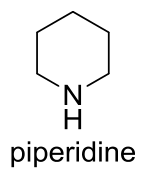
7.1 Write down the structural formulae of \(X_W\) and \(X_S\) (the latter – with the stereochemical information).
The synthesis of natural pelletierine (\(X_S\)) based on the transformation of nortropanol A was recently described.
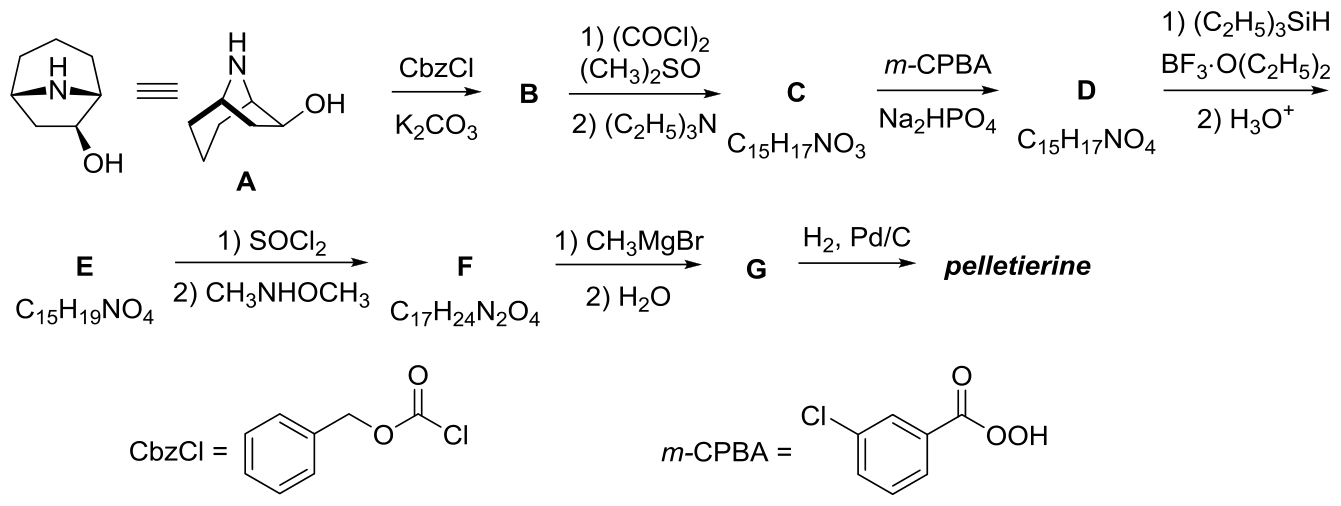
7.2 Write down the structural formulae of compounds B - G with the stereochemical information.
7.3 Nortropanol A was used in this reaction as a single stereoisomer. How many stereoisomers can exist for compound A (including A)? Ignore nitrogen chirality.
Enantiomer of \(X_S\) was synthesized using chiral tert-butanesulfinamide (H):
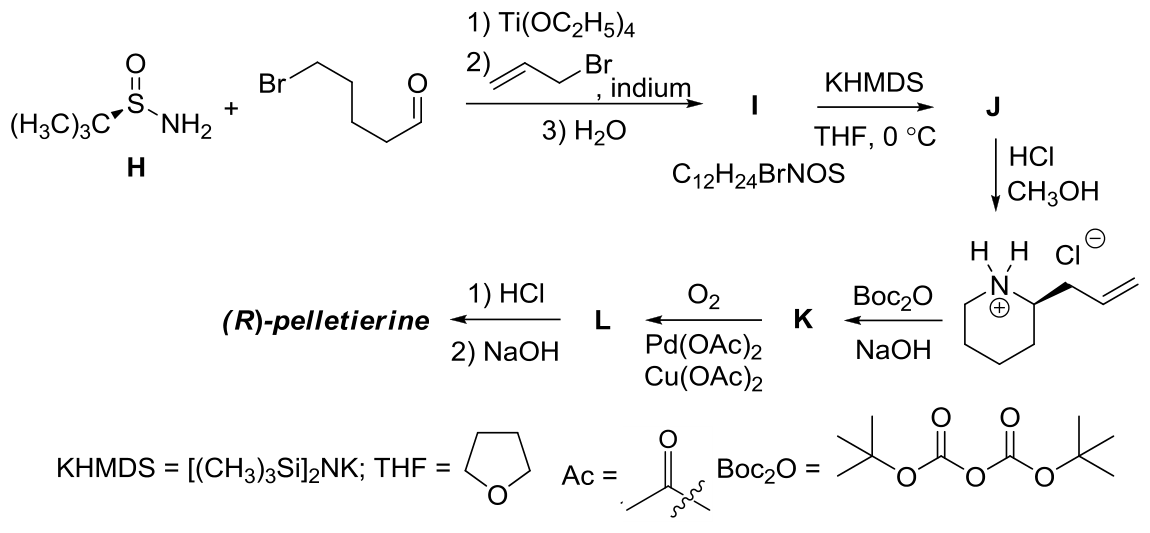
7.4 Write down the structural formulae of compounds I – L with the stereochemical information.
Official English text of the problem.
Answers
Cbz means benzyloxycarbonyl, and Boc means tert-butoxycarbonyl. The descriptor \(R_{\mathrm S}\) denotes an \(R\) configuration at sulfur.
- 7.1
| Compound | Name | SMILES |
|---|---|---|
| \(X_W\) | 3-(Piperidin-2-yl)propanal; stereochemistry unspecified | O=CCCC1CCCCN1 |
| \(X_S\) | (S)-1-(Piperidin-2-yl)propan-2-one, natural pelletierine | CC(=O)C[C@@H]1CCCCN1 |
- 7.2
| Compound | Name | Isomeric SMILES |
|---|---|---|
| B | Benzyl (1S,5R,6S)-6-hydroxy-8-azabicyclo[3.2.1]octane-8-carboxylate | O=C(OCc1ccccc1)N1[C@H]2CCC[C@@H]1[C@@H](O)C2 |
| C | Benzyl (1S,5R)-6-oxo-8-azabicyclo[3.2.1]octane-8-carboxylate | O=C(OCc1ccccc1)N1[C@H]2CCC[C@@H]1C(=O)C2 |
| D | Benzyl (1S,5S)-3-oxo-2-oxa-9-azabicyclo[3.3.1]nonane-9-carboxylate | O=C(OCc1ccccc1)N1[C@H]2CCC[C@@H]1OC(=O)C2 |
| E | 2-[(2S)-1-(Benzyloxycarbonyl)piperidin-2-yl]acetic acid | O=C(O)C[C@@H]1CCCCN1C(=O)OCc1ccccc1 |
| F | N-Methoxy-N-methyl-2-[(2S)-1-(benzyloxycarbonyl)piperidin-2-yl]acetamide, the Weinreb amide of E | CN(OC)C(=O)C[C@@H]1CCCCN1C(=O)OCc1ccccc1 |
| G | Benzyl (2S)-2-(2-oxopropyl)piperidine-1-carboxylate, N-Cbz-(S)-pelletierine | CC(=O)C[C@@H]1CCCCN1C(=O)OCc1ccccc1 |
-
7.3 There are four stereoisomers, comprising two enantiomeric pairs.
-
7.4
| Compound | Name | Isomeric SMILES |
|---|---|---|
| I | \((R_{\mathrm S})\)-N-[(4R)-8-bromooct-1-en-4-yl]-2-methylpropane-2-sulfinamide | C=CC[C@@H](CCCCBr)N[S@](=O)C(C)(C)C |
| J | \((2R,R_{\mathrm S})\)-2-Allyl-1-(tert-butylsulfinyl)piperidine | C=CC[C@H]1CCCCN1[S@](=O)C(C)(C)C |
| K | tert-Butyl (2R)-2-(prop-2-en-1-yl)piperidine-1-carboxylate | C=CC[C@H]1CCCCN1C(=O)OC(C)(C)C |
| L | tert-Butyl (2R)-2-(2-oxopropyl)piperidine-1-carboxylate, N-Boc-(R)-pelletierine | CC(=O)C[C@H]1CCCCN1C(=O)OC(C)(C)C |
Solution
7.1 — The proposed and actual structures
In \(X_W\), carbon 3 of propanal is attached to carbon 2 of piperidine. Thus the substituent on the piperidine ring is \(\ce{-CH2-CH2-CHO}\). No configuration is specified for its stereogenic ring carbon.
In \(X_S\), carbon 1 of propan-2-one is attached to carbon 2 of piperidine. Its side chain is therefore \(\ce{-CH2-C(=O)-CH3}\).
At the stereogenic carbon of \(X_S\), the CIP priorities are:
\[ \text{nitrogen} > \text{side-chain carbon} > \text{ring methylene carbon} > \text{hydrogen}. \]
The two carbon substituents initially tie, but the side-chain path reaches the carbonyl oxygen atoms before the ring path reaches any heteroatom. Natural pelletierine has the specified \(S\) configuration, encoded in CC(=O)C[C@@H]1CCCCN1.
7.2 — Identification of B–G
For A–C, use the nortropane numbering: the bridgeheads are C1 and C5, nitrogen is position 8, and the shorter carbon bridge runs C1–C7–C6–C5. The starting alcohol A is (1S,5R,6S)-8-azabicyclo[3.2.1]octan-6-ol, N1[C@H]2CCC[C@@H]1[C@@H](O)C2.
A → B: protection of nitrogen.
Benzyl chloroformate, O=C(Cl)OCc1ccccc1, converts the secondary amine into its Cbz carbamate. Potassium carbonate neutralizes the acid formed. The alcohol remains intact, and all three carbon configurations are retained.
Thus B is the N-Cbz derivative of A.
B → C: Swern oxidation.
The combination of oxalyl chloride, dimethyl sulfoxide and triethylamine oxidizes the secondary alcohol to a ketone.
C6 becomes trigonal planar, so its stereocentre disappears. The configurations at C1 and C5 remain unchanged. Loss of two hydrogen atoms gives the stated formula \(\ce{C15H17NO3}\).
C → D: Baeyer–Villiger oxidation.
The peracid inserts an oxygen atom into a bond adjacent to the ketone. The nitrogen-bearing bridgehead C5 migrates preferentially over the competing methylene carbon C7.
Consequently, the short bridge changes from
\[ C_1-\ce{CH2-C(=O)}-C_5 \]
to
\[ C_1-\ce{CH2-C(=O)-O}-C_5. \]
This gives the ring-expanded bicyclic lactone D, with formula \(\ce{C15H17NO4}\).
Migration occurs with retention of spatial configuration at the migrating carbon. Its CIP descriptor changes because insertion of oxygen changes the priority order; this does not represent inversion. In the numbering of the expanded bicyclic system, D has configuration \((1S,5S)\).
D → E: reductive opening of the lactone bridge.
The lactone contains a carbon bonded to both nitrogen and oxygen—the former C5. Lewis-acid activation followed by hydride delivery replaces its carbon–oxygen bond with a carbon–hydrogen bond.
The bridge opens, and aqueous workup gives the carboxylic acid. The former C5 becomes a methylene group, while the former C1 remains stereogenic. Its configuration is \(S\).
The product is therefore E, the N-Cbz-protected (S)-piperidine-2-acetic acid derivative. The change
\[ \ce{C15H17NO4 ->[reduction] C15H19NO4} \]
expresses the substrate formula change: two hydrogen atoms are added overall.
E → F: formation of a Weinreb amide.
Thionyl chloride activates the carboxylic acid as its acid chloride. Reaction with N,O-dimethylhydroxylamine, CNOC, then produces the N-methoxy-N-methylamide F.
The side chain becomes \(\ce{-CH2-C(=O)-N(CH3)-OCH3}\). Its formula is \(\ce{C17H24N2O4}\), matching the problem. The ring stereocentre remains \(S\).
F → G: selective formation of the methyl ketone.
Methylmagnesium bromide adds a methyl group to the Weinreb amide carbonyl. Coordination of magnesium to the two oxygen atoms stabilizes a five-membered chelated intermediate. This prevents release of the ketone, and hence further addition to it, before aqueous workup.
Hydrolysis gives the side chain \(\ce{-CH2-C(=O)-CH3}\). Thus G is N-Cbz-(S)-pelletierine.
G → \(X_S\): removal of Cbz.
Hydrogenolysis removes the benzyl carbamate without changing the carbon stereocentre. The balanced overall equation is
\[ \ce{C16H21NO3 + H2 -> C8H15NO + C7H8 + CO2}. \]
The products are natural pelletierine \(X_S\), toluene (Cc1ccccc1) and carbon dioxide (O=C=O).
The formulas of C, D, E and F independently obtained from the structures agree with all four formulas printed in the scheme.
7.3 — Number of stereoisomers of A
Ignoring nitrogen chirality, A has three stereogenic carbon atoms: C1, C5 and C6. However, the two bridgehead configurations cannot vary independently: their relative configuration is constrained by the short bridges.
There are two allowed bridgehead configurations, and for each there are two configurations at the alcohol-bearing carbon:
\[ N_{\text{stereoisomers}}=2\times 2=\boxed{4}. \]
For the 8-azabicyclo[3.2.1]octan-6-ol skeleton, these are:
| Configuration | Isomeric SMILES |
|---|---|
| \((1S,5R,6S)\), A | N1[C@H]2CCC[C@@H]1[C@@H](O)C2 |
| \((1R,5S,6R)\), enantiomer of A | N1[C@@H]2CCC[C@H]1[C@H](O)C2 |
| \((1S,5R,6R)\), the C6 epimer of A | N1[C@H]2CCC[C@@H]1[C@H](O)C2 |
| \((1R,5S,6S)\), enantiomer of that epimer | N1[C@@H]2CCC[C@H]1[C@@H](O)C2 |
Thus the four structures form two enantiomeric pairs. Alternative conformations do not count as additional stereoisomers.
7.4 — Identification of I–L
Formation of I: condensation followed by asymmetric allylation.
The depicted auxiliary H is (R)-tert-butanesulfinamide, CC(C)(C)[S@](N)=O.
Titanium ethoxide promotes its condensation with 5-bromopentanal, O=CCCCCBr, forming a sulfinimine. Indium-mediated addition of allyl bromide, C=CCBr, introduces the allyl group at the former aldehyde carbon. After workup, I has the connectivity
\[ \ce{Br-(CH2)4-CH(NH-S(=O)-C(CH3)3)-CH2-CH=CH2}. \]
The carbon stereocentre is \(R\), and the sulfur retains its \(R\) configuration. The carbon configuration can also be established directly from the downstream hydrochloride drawn in the problem: neither the intervening cyclization nor auxiliary removal changes the configuration of that carbon.
Counting atoms gives \(\ce{C12H24BrNOS}\), as required.
I → J: intramolecular substitution.
KHMDS removes the sulfinamide proton. The resulting nitrogen nucleophile attacks the terminal carbon bearing bromine by an intramolecular \(S_\mathrm{N}2\) reaction.
The ring contains nitrogen, the stereogenic carbon, and four methylene groups: a six-membered piperidine ring. Substitution occurs at an achiral terminal methylene carbon, so the existing \(R\) carbon centre is retained. Sulfur also retains its configuration.
Thus J is the N-tert-butylsulfinyl-protected (R)-2-allylpiperidine.
J → K: exchange of nitrogen protecting groups.
Methanolic hydrochloric acid cleaves the nitrogen–sulfur bond. It gives the depicted (2R)-2-allylpiperidinium chloride, C=CC[C@H]1CCCC[NH2+]1.[Cl-].
Base releases the amine, and di-tert-butyl dicarbonate introduces Boc protection, giving K. The carbon stereocentre remains \(R\).
K → L: Wacker oxidation.
The palladium/copper system oxidizes the terminal alkene to a methyl ketone:
\[ \ce{-CH2-CH=CH2 ->[oxidation] -CH2-C(=O)-CH3}. \]
Thus L is N-Boc-(R)-pelletierine. The balanced net oxidation, with oxygen as the terminal oxidant, is
\[ \ce{2C13H23NO2 + O2 -> 2C13H23NO3}. \]
No bond at the stereogenic ring carbon is broken, so its configuration remains \(R\).
Finally, hydrochloric acid removes Boc protection, and sodium hydroxide releases (R)-pelletierine, (R)-1-(piperidin-2-yl)propan-2-one, CC(=O)C[C@H]1CCCCN1. This is the enantiomer of natural \(X_S\).
The answers were checked against the official answers published by the organisers.
IChO 2015 · Theorieaufgabe 7
Nicht vom Brot allein
In Aserbaidschan, das für sein Gemüse bekannt ist, wird der Granatapfel als „König aller Früchte“ bezeichnet. In verschiedenen Religionen wird der Granatapfel als „Frucht des Paradieses“ und als Symbol für Rechtschaffenheit, Reichtum und die Hoffnung auf ewiges Leben verehrt.
Im Jahr 1878 wurde das Alkaloid Pelletierin aus der Rinde des Granatapfelbaums (Punica granatum L., Lythraceae) isoliert. Dieses Alkaloid wird traditionell als Anthelminthikum verwendet. Zunächst wurde für Pelletierin fälschlicherweise \(X_W\) (3-(Piperidin-2-yl)propanal) als Struktur vorgeschlagen. Heute gilt jedoch als gesichert, dass natürliches Pelletierin (S)-1-(Piperidin-2-yl)propan-2-on (\(X_S\)) ist.
7.1 Geben Sie die Strukturformeln von \(X_W\) und \(X_S\) an (Letztere mit Angabe der Stereochemie).
Kürzlich wurde eine Synthese von natürlichem Pelletierin (\(X_S\)) beschrieben, die auf der Umwandlung von Nortropanol A beruht.
7.2 Geben Sie die Strukturformeln der Verbindungen B - G mit Angabe der Stereochemie an.
7.3 Nortropanol A wurde in dieser Reaktion als einzelnes Stereoisomer eingesetzt. Wie viele Stereoisomere kann es von Verbindung A geben (einschließlich A)? Vernachlässigen Sie die Chiralität am Stickstoff.
Das Enantiomer von \(X_S\) wurde unter Verwendung von chiralem tert-Butansulfinamid (H) synthetisiert:
7.4 Geben Sie die Strukturformeln der Verbindungen I – L mit Angabe der Stereochemie an.
Aufgabentext aus dem offiziellen englischen Text übersetzt.
Antworten
Cbz steht für Benzyloxycarbonyl und Boc für tert-Butoxycarbonyl. Der Deskriptor \(R_{\mathrm S}\) bezeichnet eine \(R\)-Konfiguration am Schwefel.
- 7.1
| Verbindung | Name | SMILES |
|---|---|---|
| \(X_W\) | 3-(Piperidin-2-yl)propanal; Stereochemie nicht festgelegt | O=CCCC1CCCCN1 |
| \(X_S\) | (S)-1-(Piperidin-2-yl)propan-2-on, natürliches Pelletierin | CC(=O)C[C@@H]1CCCCN1 |
- 7.2
| Verbindung | Name | Isomere SMILES |
|---|---|---|
| B | Benzyl-(1S,5R,6S)-6-hydroxy-8-azabicyclo[3.2.1]octan-8-carboxylat | O=C(OCc1ccccc1)N1[C@H]2CCC[C@@H]1[C@@H](O)C2 |
| C | Benzyl-(1S,5R)-6-oxo-8-azabicyclo[3.2.1]octan-8-carboxylat | O=C(OCc1ccccc1)N1[C@H]2CCC[C@@H]1C(=O)C2 |
| D | Benzyl-(1S,5S)-3-oxo-2-oxa-9-azabicyclo[3.3.1]nonan-9-carboxylat | O=C(OCc1ccccc1)N1[C@H]2CCC[C@@H]1OC(=O)C2 |
| E | 2-[(2S)-1-(Benzyloxycarbonyl)piperidin-2-yl]essigsäure | O=C(O)C[C@@H]1CCCCN1C(=O)OCc1ccccc1 |
| F | N-Methoxy-N-methyl-2-[(2S)-1-(benzyloxycarbonyl)piperidin-2-yl]acetamid, das Weinreb-Amid von E | CN(OC)C(=O)C[C@@H]1CCCCN1C(=O)OCc1ccccc1 |
| G | Benzyl-(2S)-2-(2-oxopropyl)piperidin-1-carboxylat, N-Cbz-(S)-Pelletierin | CC(=O)C[C@@H]1CCCCN1C(=O)OCc1ccccc1 |
-
7.3 Es gibt vier Stereoisomere, die zwei Enantiomerenpaare bilden.
-
7.4
| Verbindung | Name | Isomere SMILES |
|---|---|---|
| I | \((R_{\mathrm S})\)-N-[(4R)-8-bromoct-1-en-4-yl]-2-methylpropan-2-sulfinamid | C=CC[C@@H](CCCCBr)N[S@](=O)C(C)(C)C |
| J | \((2R,R_{\mathrm S})\)-2-Allyl-1-(tert-butylsulfinyl)piperidin | C=CC[C@H]1CCCCN1[S@](=O)C(C)(C)C |
| K | tert-Butyl-(2R)-2-(prop-2-en-1-yl)piperidin-1-carboxylat | C=CC[C@H]1CCCCN1C(=O)OC(C)(C)C |
| L | tert-Butyl-(2R)-2-(2-oxopropyl)piperidin-1-carboxylat, N-Boc-(R)-Pelletierin | CC(=O)C[C@H]1CCCCN1C(=O)OC(C)(C)C |
Lösung
7.1 — Die vorgeschlagene und die tatsächliche Struktur
In \(X_W\) ist das Kohlenstoffatom 3 des Propanals mit dem Kohlenstoffatom 2 des Piperidins verbunden. Der Substituent am Piperidinring ist somit \(\ce{-CH2-CH2-CHO}\). Für das stereogene Kohlenstoffatom im Ring ist keine Konfiguration angegeben.
In \(X_S\) ist das Kohlenstoffatom 1 des Propan-2-ons mit dem Kohlenstoffatom 2 des Piperidins verbunden. Die Seitenkette ist daher \(\ce{-CH2-C(=O)-CH3}\).
Am stereogenen Kohlenstoffatom von \(X_S\) gelten folgende CIP-Prioritäten:
\[ \text{Stickstoff} > \text{Kohlenstoff der Seitenkette} > \text{Methylenkohlenstoff des Rings} > \text{Wasserstoff}. \]
Die beiden Kohlenstoffsubstituenten haben zunächst die gleiche Priorität, doch entlang der Seitenkette werden die Carbonylsauerstoffatome erreicht, bevor entlang des Rings ein Heteroatom erreicht wird. Natürliches Pelletierin besitzt die angegebene \(S\)-Konfiguration, die in CC(=O)C[C@@H]1CCCCN1 codiert ist.
7.2 — Identifizierung von B–G
Für A–C wird die Nortropan-Nummerierung verwendet: Die Brückenkopfatome sind C1 und C5, der Stickstoff befindet sich an Position 8, und die kürzere Kohlenstoffbrücke verläuft über C1–C7–C6–C5. Der als Ausgangsstoff eingesetzte Alkohol A ist (1S,5R,6S)-8-Azabicyclo[3.2.1]octan-6-ol, N1[C@H]2CCC[C@@H]1[C@@H](O)C2.
A → B: Schutz des Stickstoffs.
Chlorameisensäurebenzylester, O=C(Cl)OCc1ccccc1, überführt das sekundäre Amin in das entsprechende Cbz-Carbamat. Kaliumcarbonat neutralisiert die gebildete Säure. Die Alkoholfunktion bleibt unverändert, und die Konfigurationen aller drei Kohlenstoffatome bleiben erhalten.
Somit ist B das N-Cbz-Derivat von A.
B → C: Swern-Oxidation.
Die Kombination aus Oxalylchlorid, Dimethylsulfoxid und Triethylamin oxidiert den sekundären Alkohol zu einem Keton.
C6 wird trigonal-planar, sodass dieses Stereozentrum entfällt. Die Konfigurationen an C1 und C5 bleiben unverändert. Durch den Verlust von zwei Wasserstoffatomen ergibt sich die angegebene Summenformel \(\ce{C15H17NO3}\).
C → D: Baeyer–Villiger-Oxidation.
Die Persäure schiebt ein Sauerstoffatom in eine Bindung ein, die der Ketogruppe benachbart ist. Das an Stickstoff gebundene Brückenkopfatom C5 wandert bevorzugt gegenüber dem konkurrierenden Methylenkohlenstoffatom C7.
Dadurch verändert sich die kurze Brücke von
\[ C_1-\ce{CH2-C(=O)}-C_5 \]
zu
\[ C_1-\ce{CH2-C(=O)-O}-C_5. \]
Dabei entsteht das ringerweiterte bicyclische Lacton D mit der Summenformel \(\ce{C15H17NO4}\).
Die Wanderung erfolgt unter Erhaltung der räumlichen Konfiguration am wandernden Kohlenstoffatom. Sein CIP-Deskriptor ändert sich, weil der Einschub des Sauerstoffatoms die Prioritätsreihenfolge verändert; dies stellt keine Inversion dar. Bei der Nummerierung des erweiterten bicyclischen Systems hat D die Konfiguration \((1S,5S)\).
D → E: reduktive Öffnung der Lactonbrücke.
Das Lacton enthält ein Kohlenstoffatom, das sowohl an Stickstoff als auch an Sauerstoff gebunden ist — das ehemalige C5. Durch Aktivierung mit einer Lewis-Säure und anschließende Hydridübertragung wird seine Kohlenstoff–Sauerstoff-Bindung durch eine Kohlenstoff–Wasserstoff-Bindung ersetzt.
Die Brücke wird geöffnet, und die wässrige Aufarbeitung liefert die Carbonsäure. Das ehemalige C5 wird zu einer Methylengruppe, während das ehemalige C1 stereogen bleibt. Seine Konfiguration ist \(S\).
Das Produkt ist daher E, das N-Cbz-geschützte (S)-Piperidin-2-essigsäure-Derivat. Die Änderung
\[ \ce{C15H17NO4 ->[reduction] C15H19NO4} \]
drückt die Änderung der Summenformel des Substrats aus: Insgesamt werden zwei Wasserstoffatome hinzugefügt.
E → F: Bildung eines Weinreb-Amids.
Thionylchlorid aktiviert die Carbonsäure, indem es sie in ihr Säurechlorid überführt. Durch Reaktion mit N,O-Dimethylhydroxylamin, CNOC, entsteht anschließend das N-Methoxy-N-methylamid F.
Die Seitenkette wird zu \(\ce{-CH2-C(=O)-N(CH3)-OCH3}\). Die Summenformel lautet \(\ce{C17H24N2O4}\) und stimmt mit der Aufgabenstellung überein. Das Stereozentrum im Ring behält die \(S\)-Konfiguration.
F → G: selektive Bildung des Methylketons.
Methylmagnesiumbromid addiert eine Methylgruppe an die Carbonylgruppe des Weinreb-Amids. Die Koordination des Magnesiums an die beiden Sauerstoffatome stabilisiert ein fünfgliedriges Chelat als Zwischenprodukt. Dies verhindert die Freisetzung des Ketons und damit eine weitere Addition an das Keton vor der wässrigen Aufarbeitung.
Die Hydrolyse liefert die Seitenkette \(\ce{-CH2-C(=O)-CH3}\). Somit ist G N-Cbz-(S)-Pelletierin.
G → \(X_S\): Abspaltung von Cbz.
Durch Hydrogenolyse wird das Benzylcarbamat entfernt, ohne das Kohlenstoffstereozentrum zu verändern. Die ausgeglichene Gesamtgleichung lautet
\[ \ce{C16H21NO3 + H2 -> C8H15NO + C7H8 + CO2}. \]
Die Produkte sind natürliches Pelletierin \(X_S\), Toluol (Cc1ccccc1) und Kohlenstoffdioxid (O=C=O).
Die unabhängig aus den Strukturen ermittelten Summenformeln von C, D, E und F stimmen mit allen vier im Schema angegebenen Summenformeln überein.
7.3 — Anzahl der Stereoisomere von A
Bei Vernachlässigung der Chiralität am Stickstoff besitzt A drei stereogene Kohlenstoffatome: C1, C5 und C6. Die beiden Brückenkopfkonfigurationen können jedoch nicht unabhängig voneinander variieren: Ihre relative Konfiguration ist durch die kurzen Brücken eingeschränkt.
Es gibt zwei zulässige Brückenkopfkonfigurationen, und für jede davon gibt es zwei Konfigurationen am Kohlenstoffatom, das die Hydroxygruppe trägt:
\[ N_{\text{Stereoisomere}}=2\times 2=\boxed{4}. \]
Für das 8-Azabicyclo[3.2.1]octan-6-ol-Gerüst sind dies:
| Konfiguration | Isomere SMILES |
|---|---|
| \((1S,5R,6S)\), A | N1[C@H]2CCC[C@@H]1[C@@H](O)C2 |
| \((1R,5S,6R)\), Enantiomer von A | N1[C@@H]2CCC[C@H]1[C@H](O)C2 |
| \((1S,5R,6R)\), das C6-Epimer von A | N1[C@H]2CCC[C@@H]1[C@H](O)C2 |
| \((1R,5S,6S)\), Enantiomer dieses Epimers | N1[C@@H]2CCC[C@H]1[C@@H](O)C2 |
Die vier Strukturen bilden somit zwei Enantiomerenpaare. Unterschiedliche Konformationen zählen nicht als zusätzliche Stereoisomere.
7.4 — Identifizierung von I–L
Bildung von I: Kondensation mit anschließender asymmetrischer Allylierung.
Das dargestellte Auxiliar H ist (R)-tert-Butansulfinamid, CC(C)(C)[S@](N)=O.
Titanethanolat fördert dessen Kondensation mit 5-Brompentanal, O=CCCCCBr, unter Bildung eines Sulfinimins. Die indiumvermittelte Addition von Allylbromid, C=CCBr, führt die Allylgruppe am ehemaligen Aldehydkohlenstoffatom ein. Nach der Aufarbeitung weist I folgende Konnektivität auf:
\[ \ce{Br-(CH2)4-CH(NH-S(=O)-C(CH3)3)-CH2-CH=CH2}. \]
Das Kohlenstoffstereozentrum hat die \(R\)-Konfiguration, und der Schwefel behält seine \(R\)-Konfiguration. Die Konfiguration am Kohlenstoff lässt sich auch unmittelbar aus dem in der Aufgabenstellung dargestellten, im weiteren Syntheseverlauf erhaltenen Hydrochlorid bestimmen: Weder die dazwischenliegende Cyclisierung noch die Abspaltung des Auxiliars verändert die Konfiguration dieses Kohlenstoffatoms.
Das Abzählen der Atome ergibt wie gefordert \(\ce{C12H24BrNOS}\).
I → J: intramolekulare Substitution.
KHMDS spaltet das Sulfinamidproton ab. Das entstehende Stickstoffnucleophil greift in einer intramolekularen \(S_\mathrm{N}2\)-Reaktion das endständige Kohlenstoffatom an, das Brom trägt.
Der Ring enthält Stickstoff, das stereogene Kohlenstoffatom und vier Methylengruppen: Es entsteht ein sechsgliedriger Piperidinring. Die Substitution erfolgt an einem achiralen endständigen Methylenkohlenstoffatom, sodass die \(R\)-Konfiguration des vorhandenen Kohlenstoffstereozentrums erhalten bleibt. Auch der Schwefel behält seine Konfiguration.
Somit ist J das N-tert-Butylsulfinyl-geschützte (R)-2-Allylpiperidin.
J → K: Austausch der Stickstoffschutzgruppen.
Methanolische Salzsäure spaltet die Stickstoff–Schwefel-Bindung. Dabei entsteht das dargestellte (2R)-2-Allylpiperidiniumchlorid, C=CC[C@H]1CCCC[NH2+]1.[Cl-].
Eine Base setzt das Amin frei, und Di-tert-butyldicarbonat führt die Boc-Schutzgruppe ein, wodurch K entsteht. Das Kohlenstoffstereozentrum behält die \(R\)-Konfiguration.
K → L: Wacker-Oxidation.
Das Palladium/Kupfer-System oxidiert das endständige Alken zu einem Methylketon:
\[ \ce{-CH2-CH=CH2 ->[oxidation] -CH2-C(=O)-CH3}. \]
Somit ist L N-Boc-(R)-Pelletierin. Die ausgeglichene Nettogleichung der Oxidation mit Sauerstoff als terminalem Oxidationsmittel lautet
\[ \ce{2C13H23NO2 + O2 -> 2C13H23NO3}. \]
Am stereogenen Kohlenstoffatom des Rings wird keine Bindung gespalten, sodass seine \(R\)-Konfiguration erhalten bleibt.
Schließlich spaltet Salzsäure die Boc-Schutzgruppe ab, und Natriumhydroxid setzt (R)-Pelletierin, (R)-1-(Piperidin-2-yl)propan-2-on, CC(=O)C[C@H]1CCCCN1, frei. Dies ist das Enantiomer von natürlichem \(X_S\).
Die Ergebnisse wurden mit den von den Veranstaltern veröffentlichten offiziellen Ergebnissen abgeglichen.
IChO 2015 · Teori sorusu 7
Yalnızca ekmekle değil
Sebzeleriyle ünlü Azerbaycan'da nar, “tüm meyvelerin kralı” olarak adlandırılır. Nar, çeşitli dinlerde bir “Cennet meyvesi”, erdemin, zenginliğin ve sonsuz yaşam umudunun simgesi olarak yüceltilir.
1878 yılında pelletierin alkaloidi nar ağacının (Punica granatum L., Lythraceae) kabuğundan izole edilmiştir. Bu alkaloit geleneksel olarak bağırsak solucanlarına karşı ilaç olarak kullanılır. Başlangıçta pelletierin için yanlışlıkla \(X_W\) (3-(piperidin-2-il)propanal) yapısı önerilmiştir. Ancak günümüzde doğal pelletierinin (S)-1-(piperidin-2-il)propan-2-on (\(X_S\)) olduğu kabul edilmektedir.
7.1 \(X_W\) ve \(X_S\) bileşiklerinin yapı formüllerini yazınız (ikincisi için stereokimyasal bilgiyi de belirtiniz).
Nortropanol A'nın dönüşümüne dayanan bir doğal pelletierin (\(X_S\)) sentezi yakın zamanda açıklanmıştır.
7.2 B - G bileşiklerinin yapı formüllerini stereokimyasal bilgileriyle birlikte yazınız.
7.3 Nortropanol A, bu tepkimede tek bir stereoizomer olarak kullanılmıştır. A bileşiğinin (A dahil) kaç stereoizomeri olabilir? Azot kiralitesini göz ardı ediniz.
\(X_S\)'nin enantiyomeri, kiral tert-bütansülfinamit (H) kullanılarak sentezlenmiştir:
7.4 I – L bileşiklerinin yapı formüllerini stereokimyasal bilgileriyle birlikte yazınız.
Soru metni resmi İngilizce metinden çevrilmiştir.
Cevaplar
Cbz benziloksikarbonil, Boc ise tert-bütoksikarbonil anlamına gelir. \(R_{\mathrm S}\) tanımlayıcısı, kükürt üzerindeki \(R\) konfigürasyonunu belirtir.
- 7.1
| Bileşik | Adı | SMILES |
|---|---|---|
| \(X_W\) | 3-(Piperidin-2-il)propanal; stereokimyası belirtilmemiştir | O=CCCC1CCCCN1 |
| \(X_S\) | (S)-1-(Piperidin-2-il)propan-2-on, doğal pelletierin | CC(=O)C[C@@H]1CCCCN1 |
- 7.2
| Bileşik | Adı | İzomerik SMILES |
|---|---|---|
| B | Benzil (1S,5R,6S)-6-hidroksi-8-azabisiklo[3.2.1]oktan-8-karboksilat | O=C(OCc1ccccc1)N1[C@H]2CCC[C@@H]1[C@@H](O)C2 |
| C | Benzil (1S,5R)-6-okso-8-azabisiklo[3.2.1]oktan-8-karboksilat | O=C(OCc1ccccc1)N1[C@H]2CCC[C@@H]1C(=O)C2 |
| D | Benzil (1S,5S)-3-okso-2-oksa-9-azabisiklo[3.3.1]nonan-9-karboksilat | O=C(OCc1ccccc1)N1[C@H]2CCC[C@@H]1OC(=O)C2 |
| E | 2-[(2S)-1-(Benziloksikarbonil)piperidin-2-il]asetik asit | O=C(O)C[C@@H]1CCCCN1C(=O)OCc1ccccc1 |
| F | N-Metoksi-N-metil-2-[(2S)-1-(benziloksikarbonil)piperidin-2-il]asetamit, E'nin Weinreb amidi | CN(OC)C(=O)C[C@@H]1CCCCN1C(=O)OCc1ccccc1 |
| G | Benzil (2S)-2-(2-oksopropil)piperidin-1-karboksilat, N-Cbz-(S)-pelletierin | CC(=O)C[C@@H]1CCCCN1C(=O)OCc1ccccc1 |
-
7.3 İki enantiyomer çiftinden oluşan dört stereoizomer vardır.
-
7.4
| Bileşik | Adı | İzomerik SMILES |
|---|---|---|
| I | \((R_{\mathrm S})\)-N-[(4R)-8-bromookt-1-en-4-il]-2-metilpropan-2-sülfinamit | C=CC[C@@H](CCCCBr)N[S@](=O)C(C)(C)C |
| J | \((2R,R_{\mathrm S})\)-2-Allil-1-(tert-bütilsülfinil)piperidin | C=CC[C@H]1CCCCN1[S@](=O)C(C)(C)C |
| K | tert-Bütil (2R)-2-(prop-2-en-1-il)piperidin-1-karboksilat | C=CC[C@H]1CCCCN1C(=O)OC(C)(C)C |
| L | tert-Bütil (2R)-2-(2-oksopropil)piperidin-1-karboksilat, N-Boc-(R)-pelletierin | CC(=O)C[C@H]1CCCCN1C(=O)OC(C)(C)C |
Çözüm
7.1 — Önerilen ve gerçek yapılar
\(X_W\)'de propanalin 3 numaralı karbonu, piperidinin 2 numaralı karbonuna bağlıdır. Dolayısıyla piperidin halkasındaki sübstitüent \(\ce{-CH2-CH2-CHO}\) grubudur. Halkadaki stereojenik karbonunun konfigürasyonu belirtilmemiştir.
\(X_S\)'de propan-2-onun 1 numaralı karbonu, piperidinin 2 numaralı karbonuna bağlıdır. Bu nedenle yan zinciri \(\ce{-CH2-C(=O)-CH3}\) şeklindedir.
\(X_S\)'nin stereojenik karbonundaki CIP öncelikleri şöyledir:
\[ \text{azot} > \text{yan zincir karbonu} > \text{halkadaki metilen karbonu} > \text{hidrojen}. \]
İki karbon sübstitüenti başlangıçta eşit önceliklidir, ancak yan zincir boyunca izlenen yol, halka boyunca izlenen yol herhangi bir heteroatoma ulaşmadan önce karbonil oksijen atomlarına ulaşır. Doğal pelletierin, CC(=O)C[C@@H]1CCCCN1 ile kodlanan, belirtilmiş \(S\) konfigürasyonuna sahiptir.
7.2 — B–G'nin belirlenmesi
A–C için nortropan numaralandırmasını kullanınız: köprübaşları C1 ve C5'tir, azot 8 numaralı konumdadır ve daha kısa karbon köprüsü C1–C7–C6–C5 boyunca uzanır. Başlangıç alkolü A, (1S,5R,6S)-8-azabisiklo[3.2.1]oktan-6-ol, N1[C@H]2CCC[C@@H]1[C@@H](O)C2, bileşiğidir.
A → B: azotun korunması.
Benzil kloroformat, O=C(Cl)OCc1ccccc1, sekonder amini Cbz karbamatına dönüştürür. Potasyum karbonat oluşan asidi nötralleştirir. Alkol grubu değişmeden kalır ve üç karbonun da konfigürasyonu korunur.
Dolayısıyla B, A'nın N-Cbz türevidir.
B → C: Swern yükseltgenmesi.
Oksalil klorür, dimetil sülfoksit ve trietilaminin birlikte kullanılması, sekonder alkolü ketona yükseltger.
C6 üçgen düzlemsel hâle gelir, dolayısıyla buradaki stereomerkez ortadan kalkar. C1 ve C5'in konfigürasyonları değişmeden kalır. İki hidrojen atomunun kaybı, belirtilen \(\ce{C15H17NO3}\) formülünü verir.
C → D: Baeyer–Villiger yükseltgenmesi.
Perasit, ketona komşu bir bağa bir oksijen atomu yerleştirir. Azota bağlı köprübaşı karbonu C5, kendisiyle yarışan metilen karbonu C7'ye göre öncelikli olarak göç eder.
Bunun sonucunda kısa köprü
\[ C_1-\ce{CH2-C(=O)}-C_5 \]
yapısından
\[ C_1-\ce{CH2-C(=O)-O}-C_5 \]
yapısına dönüşür.
Böylece, formülü \(\ce{C15H17NO4}\) olan, halkası genişlemiş bisiklik lakton D elde edilir.
Göç, göç eden karbonun uzaysal konfigürasyonu korunarak gerçekleşir. Oksijenin araya girmesi öncelik sırasını değiştirdiğinden bu karbonun CIP tanımlayıcısı değişir; bu durum konfigürasyonun tersine dönmesi anlamına gelmez. Genişlemiş bisiklik sistemin numaralandırmasına göre D, \((1S,5S)\) konfigürasyonuna sahiptir.
D → E: lakton köprüsünün indirgenerek açılması.
Lakton, hem azota hem de oksijene bağlı bir karbon içerir; bu, önceki C5 karbonudur. Lewis asidiyle etkinleştirmeyi izleyen hidrür aktarımı, bu karbonun karbon–oksijen bağının yerine bir karbon–hidrojen bağı oluşturur.
Köprü açılır ve sulu ortamda yapılan son işlem karboksilik asidi verir. Önceki C5 bir metilen grubuna dönüşürken, önceki C1 stereojenik kalır. Konfigürasyonu \(S\)'dir.
Dolayısıyla ürün, N-Cbz ile korunmuş (S)-piperidin-2-asetik asit türevi olan E'dir.
\[ \ce{C15H17NO4 ->[reduction] C15H19NO4} \]
değişimi, substrat formülündeki değişimi ifade eder: toplamda iki hidrojen atomu eklenir.
E → F: Weinreb amidi oluşumu.
Tiyonil klorür, karboksilik asidi asit klorürüne dönüştürerek etkinleştirir. Ardından N,O-dimetilhidroksilamin, CNOC, ile tepkime, N-metoksi-N-metilamit F'yi oluşturur.
Yan zincir \(\ce{-CH2-C(=O)-N(CH3)-OCH3}\) hâline gelir. Formülü, soruda verilenle uyumlu olarak \(\ce{C17H24N2O4}\)'tür. Halkadaki stereomerkez \(S\) olarak kalır.
F → G: metil ketonun seçici oluşumu.
Metilmagnezyum bromür, Weinreb amidinin karboniline bir metil grubu ekler. Magnezyumun iki oksijen atomuna koordinasyonu, beş üyeli bir şelat ara ürününü kararlı hâle getirir. Bu, sulu ortamda yapılan son işlemden önce ketonun serbestleşmesini ve dolayısıyla ketona daha fazla katılma olmasını önler.
Hidroliz, \(\ce{-CH2-C(=O)-CH3}\) yan zincirini verir. Dolayısıyla G, N-Cbz-(S)-pelletierindir.
G → \(X_S\): Cbz'nin uzaklaştırılması.
Hidrojenoliz, karbon stereomerkezini değiştirmeden benzil karbamatı uzaklaştırır. Denkleştirilmiş toplam tepkime denklemi şöyledir:
\[ \ce{C16H21NO3 + H2 -> C8H15NO + C7H8 + CO2}. \]
Ürünler doğal pelletierin \(X_S\), toluen (Cc1ccccc1) ve karbon dioksittir (O=C=O).
C, D, E ve F'nin yapılarından bağımsız olarak elde edilen formülleri, şemada verilen dört formülün tümüyle uyumludur.
7.3 — A'nın stereoizomer sayısı
Azot kiralitesi göz ardı edildiğinde A'nın üç stereojenik karbon atomu vardır: C1, C5 ve C6. Ancak iki köprübaşının konfigürasyonları birbirinden bağımsız olarak değişemez: bağıl konfigürasyonları kısa köprülerle kısıtlanır.
İzin verilen iki köprübaşı konfigürasyonu vardır ve bunların her biri için alkol grubunu taşıyan karbonda iki konfigürasyon mümkündür:
\[ N_{\text{stereoizomerler}}=2\times 2=\boxed{4}. \]
8-Azabisiklo[3.2.1]oktan-6-ol iskeleti için bunlar şöyledir:
| Konfigürasyon | İzomerik SMILES |
|---|---|
| \((1S,5R,6S)\), A | N1[C@H]2CCC[C@@H]1[C@@H](O)C2 |
| \((1R,5S,6R)\), A'nın enantiyomeri | N1[C@@H]2CCC[C@H]1[C@H](O)C2 |
| \((1S,5R,6R)\), A'nın C6 epimeri | N1[C@H]2CCC[C@@H]1[C@H](O)C2 |
| \((1R,5S,6S)\), bu epimerin enantiyomeri | N1[C@@H]2CCC[C@H]1[C@@H](O)C2 |
Dolayısıyla dört yapı, iki enantiyomer çifti oluşturur. Alternatif konformasyonlar ek stereoizomerler olarak sayılmaz.
7.4 — I–L'nin belirlenmesi
I'nın oluşumu: kondenzasyonu izleyen asimetrik allilleme.
Gösterilen yardımcı H, (R)-tert-bütansülfinamit, CC(C)(C)[S@](N)=O, bileşiğidir.
Titanyum etoksit, bu bileşiğin 5-bromopentanal, O=CCCCCBr, ile kondenzasyonunu kolaylaştırarak bir sülfinimin oluşturur. İndiyum aracılı allil bromür, C=CCBr, katılması, önceki aldehit karbonuna allil grubunu bağlar. Son işlemden sonra I'nın atomları arasındaki bağlanma düzeni şöyledir:
\[ \ce{Br-(CH2)4-CH(NH-S(=O)-C(CH3)3)-CH2-CH=CH2}. \]
Karbon stereomerkezi \(R\)'dir ve kükürt \(R\) konfigürasyonunu korur. Karbon konfigürasyonu, soruda çizilen ve ilerleyen basamaklarda oluşan hidroklorürden de doğrudan belirlenebilir: aradaki halkalaşma da yardımcı grubun uzaklaştırılması da bu karbonun konfigürasyonunu değiştirmez.
Atomların sayılması, gerektiği gibi \(\ce{C12H24BrNOS}\) formülünü verir.
I → J: molekül içi yer değiştirme.
KHMDS, sülfinamit protonunu uzaklaştırır. Oluşan azot nükleofili, molekül içi bir \(S_\mathrm{N}2\) tepkimesiyle brom taşıyan uç karbona saldırır.
Halka, azotu, stereojenik karbonu ve dört metilen grubunu içerir: altı üyeli bir piperidin halkasıdır. Yer değiştirme, akiral bir uç metilen karbonunda gerçekleştiğinden mevcut \(R\) karbon merkezi korunur. Kükürt de konfigürasyonunu korur.
Dolayısıyla J, N-tert-bütilsülfinil ile korunmuş (R)-2-allilpiperidindir.
J → K: azot koruyucu gruplarının değiştirilmesi.
Metanoldeki hidroklorik asit, azot–kükürt bağını koparır. Gösterilen (2R)-2-allilpiperidinyum klorürü, C=CC[C@H]1CCCC[NH2+]1.[Cl-], verir.
Baz, amini serbestleştirir ve di-tert-bütil dikarbonat Boc korumasını sağlayarak K'yı verir. Karbon stereomerkezi \(R\) olarak kalır.
K → L: Wacker yükseltgenmesi.
Paladyum/bakır sistemi, uç alkeni bir metil ketona yükseltger:
\[ \ce{-CH2-CH=CH2 ->[oxidation] -CH2-C(=O)-CH3}. \]
Dolayısıyla L, N-Boc-(R)-pelletierindir. Son yükseltgen olarak oksijenin kullanıldığı denkleştirilmiş net yükseltgenme tepkimesi şöyledir:
\[ \ce{2C13H23NO2 + O2 -> 2C13H23NO3}. \]
Halkadaki stereojenik karbonun hiçbir bağı kopmadığından konfigürasyonu \(R\) olarak kalır.
Son olarak hidroklorik asit Boc korumasını uzaklaştırır ve sodyum hidroksit (R)-pelletierini, (R)-1-(piperidin-2-il)propan-2-on, CC(=O)C[C@H]1CCCCN1, serbestleştirir. Bu, doğal \(X_S\)'nin enantiyomeridir.
Sonuçlar, düzenleyicilerin yayımladığı resmi sonuçlarla karşılaştırılarak kontrol edildi.
IChO 2015 · Problema teórico 7
No solo de pan
En Azerbaiyán, país famoso por sus hortalizas, la granada recibe el nombre de «reina de todas las frutas». En diversas religiones, la granada es venerada como «fruto del Paraíso», símbolo de rectitud, riqueza y esperanza de vida eterna.
En 1878 se aisló el alcaloide peletierina de la corteza del granado (Punica granatum L., Lythraceae). Este alcaloide se utiliza tradicionalmente como fármaco antihelmíntico. Inicialmente se propuso de forma incorrecta \(X_W\) (3-(piperidin-2-il)propanal) como estructura de la peletierina. Sin embargo, actualmente se acepta que la peletierina natural es la (S)-1-(piperidin-2-il)propan-2-ona (\(X_S\)).
7.1 Escriba las fórmulas estructurales de \(X_W\) y \(X_S\) (la de esta última, con la información estereoquímica).
Recientemente se ha descrito la síntesis de la peletierina natural (\(X_S\)) basada en la transformación del nortropanol A.
7.2 Escriba las fórmulas estructurales de los compuestos B - G con la información estereoquímica.
7.3 El nortropanol A se utilizó en esta reacción como un único estereoisómero. ¿Cuántos estereoisómeros pueden existir para el compuesto A (incluido A)? Ignore la quiralidad del nitrógeno.
El enantiómero de \(X_S\) se sintetizó utilizando tert-butanosulfinamida quiral (H):
7.4 Escriba las fórmulas estructurales de los compuestos I – L con la información estereoquímica.
Enunciado traducido del texto oficial en inglés.
Respuestas
Cbz significa benciloxicarbonilo y Boc significa tert-butoxicarbonilo. El descriptor \(R_{\mathrm S}\) denota una configuración \(R\) en el azufre.
- 7.1
| Compuesto | Nombre | SMILES |
|---|---|---|
| \(X_W\) | 3-(Piperidin-2-il)propanal; estereoquímica no especificada | O=CCCC1CCCCN1 |
| \(X_S\) | (S)-1-(Piperidin-2-il)propan-2-ona, peletierina natural | CC(=O)C[C@@H]1CCCCN1 |
- 7.2
| Compuesto | Nombre | SMILES isomérico |
|---|---|---|
| B | (1S,5R,6S)-6-Hidroxi-8-azabiciclo[3.2.1]octano-8-carboxilato de bencilo | O=C(OCc1ccccc1)N1[C@H]2CCC[C@@H]1[C@@H](O)C2 |
| C | (1S,5R)-6-Oxo-8-azabiciclo[3.2.1]octano-8-carboxilato de bencilo | O=C(OCc1ccccc1)N1[C@H]2CCC[C@@H]1C(=O)C2 |
| D | (1S,5S)-3-Oxo-2-oxa-9-azabiciclo[3.3.1]nonano-9-carboxilato de bencilo | O=C(OCc1ccccc1)N1[C@H]2CCC[C@@H]1OC(=O)C2 |
| E | Ácido 2-[(2S)-1-(benciloxicarbonil)piperidin-2-il]acético | O=C(O)C[C@@H]1CCCCN1C(=O)OCc1ccccc1 |
| F | N-Metoxi-N-metil-2-[(2S)-1-(benciloxicarbonil)piperidin-2-il]acetamida, la amida de Weinreb de E | CN(OC)C(=O)C[C@@H]1CCCCN1C(=O)OCc1ccccc1 |
| G | (2S)-2-(2-Oxopropil)piperidina-1-carboxilato de bencilo, N-Cbz-(S)-peletierina | CC(=O)C[C@@H]1CCCCN1C(=O)OCc1ccccc1 |
-
7.3 Hay cuatro estereoisómeros, que constituyen dos pares de enantiómeros.
-
7.4
| Compuesto | Nombre | SMILES isomérico |
|---|---|---|
| I | \((R_{\mathrm S})\)-N-[(4R)-8-bromooct-1-en-4-il]-2-metilpropano-2-sulfinamida | C=CC[C@@H](CCCCBr)N[S@](=O)C(C)(C)C |
| J | \((2R,R_{\mathrm S})\)-2-Alil-1-(tert-butilsulfinil)piperidina | C=CC[C@H]1CCCCN1[S@](=O)C(C)(C)C |
| K | (2R)-2-(Prop-2-en-1-il)piperidina-1-carboxilato de tert-butilo | C=CC[C@H]1CCCCN1C(=O)OC(C)(C)C |
| L | (2R)-2-(2-Oxopropil)piperidina-1-carboxilato de tert-butilo, N-Boc-(R)-peletierina | CC(=O)C[C@H]1CCCCN1C(=O)OC(C)(C)C |
Solución
7.1 — Las estructuras propuesta y real
En \(X_W\), el carbono 3 del propanal está unido al carbono 2 de la piperidina. Por tanto, el sustituyente del anillo de piperidina es \(\ce{-CH2-CH2-CHO}\). No se especifica ninguna configuración para su carbono estereogénico del anillo.
En \(X_S\), el carbono 1 de la propan-2-ona está unido al carbono 2 de la piperidina. Por tanto, su cadena lateral es \(\ce{-CH2-C(=O)-CH3}\).
En el carbono estereogénico de \(X_S\), las prioridades CIP son:
\[ \text{nitrógeno} > \text{carbono de la cadena lateral} > \text{carbono metilénico del anillo} > \text{hidrógeno}. \]
Los dos sustituyentes carbonados tienen inicialmente la misma prioridad, pero el recorrido por la cadena lateral alcanza los átomos de oxígeno del carbonilo antes de que el recorrido por el anillo alcance algún heteroátomo. La peletierina natural tiene la configuración \(S\) especificada, codificada en CC(=O)C[C@@H]1CCCCN1.
7.2 — Identificación de B–G
Para A–C, utilice la numeración del nortropano: las cabezas de puente son C1 y C5, el nitrógeno ocupa la posición 8 y el puente carbonado más corto sigue la secuencia C1–C7–C6–C5. El alcohol de partida A es el (1S,5R,6S)-8-azabiciclo[3.2.1]octan-6-ol, N1[C@H]2CCC[C@@H]1[C@@H](O)C2.
A → B: protección del nitrógeno.
El cloroformiato de bencilo, O=C(Cl)OCc1ccccc1, convierte la amina secundaria en su carbamato Cbz. El carbonato de potasio neutraliza el ácido formado. El alcohol permanece intacto y se conservan las configuraciones de los tres carbonos.
Por tanto, B es el derivado N-Cbz de A.
B → C: oxidación de Swern.
La combinación de cloruro de oxalilo, dimetilsulfóxido y trietilamina oxida el alcohol secundario a una cetona.
C6 adquiere una geometría trigonal plana, por lo que desaparece su centro estereogénico. Las configuraciones de C1 y C5 permanecen inalteradas. La pérdida de dos átomos de hidrógeno da la fórmula indicada, \(\ce{C15H17NO3}\).
C → D: oxidación de Baeyer–Villiger.
El perácido inserta un átomo de oxígeno en un enlace adyacente a la cetona. El carbono cabeza de puente C5, unido al nitrógeno, migra preferentemente frente al carbono metilénico C7, que compite con él.
En consecuencia, el puente corto pasa de
\[ C_1-\ce{CH2-C(=O)}-C_5 \]
a
\[ C_1-\ce{CH2-C(=O)-O}-C_5. \]
Así se obtiene la lactona bicíclica D, con el anillo expandido y fórmula \(\ce{C15H17NO4}\).
La migración se produce con retención de la configuración espacial en el carbono que migra. Su descriptor CIP cambia porque la inserción de oxígeno modifica el orden de prioridad; esto no representa una inversión. En la numeración del sistema bicíclico expandido, D tiene configuración \((1S,5S)\).
D → E: apertura reductora del puente de lactona.
La lactona contiene un carbono unido tanto al nitrógeno como al oxígeno: el antiguo C5. La activación por un ácido de Lewis, seguida de la transferencia de hidruro, sustituye su enlace carbono–oxígeno por un enlace carbono–hidrógeno.
El puente se abre y el tratamiento acuoso posterior da el ácido carboxílico. El antiguo C5 se convierte en un grupo metileno, mientras que el antiguo C1 sigue siendo estereogénico. Su configuración es \(S\).
El producto es, por tanto, E, el derivado del ácido (S)-piperidina-2-acético protegido con N-Cbz. El cambio
\[ \ce{C15H17NO4 ->[reduction] C15H19NO4} \]
expresa el cambio de fórmula del sustrato: en total se añaden dos átomos de hidrógeno.
E → F: formación de una amida de Weinreb.
El cloruro de tionilo activa el ácido carboxílico convirtiéndolo en su cloruro de ácido. La reacción posterior con N,O-dimetilhidroxilamina, CNOC, produce la N-metoxi-N-metilamida F.
La cadena lateral se convierte en \(\ce{-CH2-C(=O)-N(CH3)-OCH3}\). Su fórmula es \(\ce{C17H24N2O4}\), en concordancia con el enunciado. El centro estereogénico del anillo conserva la configuración \(S\).
F → G: formación selectiva de la metil cetona.
El bromuro de metilmagnesio adiciona un grupo metilo al carbonilo de la amida de Weinreb. La coordinación del magnesio con los dos átomos de oxígeno estabiliza un intermedio quelado de cinco miembros. Esto impide la liberación de la cetona y, por tanto, una adición posterior a ella antes del tratamiento acuoso.
La hidrólisis da la cadena lateral \(\ce{-CH2-C(=O)-CH3}\). Por tanto, G es la N-Cbz-(S)-peletierina.
G → \(X_S\): eliminación del Cbz.
La hidrogenólisis elimina el carbamato de bencilo sin modificar el centro estereogénico carbonado. La ecuación global ajustada es
\[ \ce{C16H21NO3 + H2 -> C8H15NO + C7H8 + CO2}. \]
Los productos son la peletierina natural \(X_S\), tolueno (Cc1ccccc1) y dióxido de carbono (O=C=O).
Las fórmulas de C, D, E y F, obtenidas de forma independiente a partir de las estructuras, concuerdan con las cuatro fórmulas que aparecen en el esquema.
7.3 — Número de estereoisómeros de A
Si se ignora la quiralidad del nitrógeno, A tiene tres átomos de carbono estereogénicos: C1, C5 y C6. Sin embargo, las configuraciones de las dos cabezas de puente no pueden variar de forma independiente: su configuración relativa está restringida por los puentes cortos.
Hay dos configuraciones permitidas para las cabezas de puente y, para cada una de ellas, hay dos configuraciones en el carbono que porta el grupo alcohol:
\[ N_{\text{estereoisómeros}}=2\times 2=\boxed{4}. \]
Para el esqueleto de 8-azabiciclo[3.2.1]octan-6-ol, son las siguientes:
| Configuración | SMILES isomérico |
|---|---|
| \((1S,5R,6S)\), A | N1[C@H]2CCC[C@@H]1[C@@H](O)C2 |
| \((1R,5S,6R)\), enantiómero de A | N1[C@@H]2CCC[C@H]1[C@H](O)C2 |
| \((1S,5R,6R)\), epímero de A en C6 | N1[C@H]2CCC[C@@H]1[C@H](O)C2 |
| \((1R,5S,6S)\), enantiómero de ese epímero | N1[C@@H]2CCC[C@H]1[C@@H](O)C2 |
Por tanto, las cuatro estructuras forman dos pares de enantiómeros. Las distintas conformaciones no se cuentan como estereoisómeros adicionales.
7.4 — Identificación de I–L
Formación de I: condensación seguida de alilación asimétrica.
El auxiliar H representado es la (R)-tert-butanosulfinamida, CC(C)(C)[S@](N)=O.
El etóxido de titanio promueve su condensación con el 5-bromopentanal, O=CCCCCBr, formando una sulfinimina. La adición de bromuro de alilo, C=CCBr, mediada por indio introduce el grupo alilo en el antiguo carbono aldehídico. Tras el tratamiento posterior, I tiene la conectividad
\[ \ce{Br-(CH2)4-CH(NH-S(=O)-C(CH3)3)-CH2-CH=CH2}. \]
El centro estereogénico carbonado tiene configuración \(R\) y el azufre conserva su configuración \(R\). La configuración del carbono también puede establecerse directamente a partir del clorhidrato representado en una etapa posterior del enunciado: ni la ciclación intermedia ni la eliminación del auxiliar modifican la configuración de ese carbono.
El recuento de átomos da \(\ce{C12H24BrNOS}\), tal como se requiere.
I → J: sustitución intramolecular.
KHMDS elimina el protón de la sulfinamida. El nucleófilo nitrogenado resultante ataca al carbono terminal que porta el bromo mediante una reacción \(S_\mathrm{N}2\) intramolecular.
El anillo contiene el nitrógeno, el carbono estereogénico y cuatro grupos metileno: es un anillo de piperidina de seis miembros. La sustitución se produce en un carbono metilénico terminal aquiral, por lo que el centro carbonado \(R\) existente conserva su configuración. El azufre también conserva su configuración.
Por tanto, J es la (R)-2-alilpiperidina protegida con N-tert-butilsulfinilo.
J → K: intercambio de los grupos protectores del nitrógeno.
El ácido clorhídrico en metanol rompe el enlace nitrógeno–azufre. Se obtiene el cloruro de (2R)-2-alilpiperidinio representado, C=CC[C@H]1CCCC[NH2+]1.[Cl-].
La base libera la amina y el dicarbonato de di-tert-butilo introduce la protección Boc, dando K. El centro estereogénico carbonado conserva la configuración \(R\).
K → L: oxidación de Wacker.
El sistema paladio/cobre oxida el alqueno terminal a una metil cetona:
\[ \ce{-CH2-CH=CH2 ->[oxidation] -CH2-C(=O)-CH3}. \]
Por tanto, L es la N-Boc-(R)-peletierina. La ecuación neta ajustada de la oxidación, con oxígeno como oxidante terminal, es
\[ \ce{2C13H23NO2 + O2 -> 2C13H23NO3}. \]
No se rompe ningún enlace del carbono estereogénico del anillo, por lo que su configuración sigue siendo \(R\).
Finalmente, el ácido clorhídrico elimina la protección Boc y el hidróxido de sodio libera la (R)-peletierina, (R)-1-(piperidin-2-il)propan-2-ona, CC(=O)C[C@H]1CCCCN1. Este es el enantiómero de la \(X_S\) natural.
Los resultados se comprobaron con los resultados oficiales publicados por los organizadores.
IChO 2015 · 理论题 7
人不能单靠面包生活
在以蔬菜闻名的阿塞拜疆,石榴被称为“百果之王”。在各种宗教中,石榴被尊为“天堂之果”,象征着正义、财富和对永生的希望。
1878 年,人们从石榴树(Punica granatum L.,千屈菜科 Lythraceae)的树皮中分离出了生物碱石榴皮碱。这种生物碱历来被用作驱蠕虫药。最初,人们曾错误地将 \(X_W\)(3-(哌啶-2-基)丙醛)指认为石榴皮碱的结构。但如今已确认,天然石榴皮碱是 (S)-1-(哌啶-2-基)丙-2-酮(\(X_S\))。
7.1 写出 \(X_W\) 和 \(X_S\) 的结构式(后者须标明立体化学信息)。
最近,有文献报道了以去甲托品醇 A 的转化为基础合成天然石榴皮碱(\(X_S\))的方法。
7.2 写出化合物 B - G 的结构式,并标明立体化学信息。
7.3 在该反应中,去甲托品醇 A 以单一立体异构体的形式使用。化合物 A 可以有多少种立体异构体(包括 A 本身)?忽略氮原子的手性。
使用手性叔丁基亚磺酰胺(H)合成了 \(X_S\) 的对映异构体:
7.4 写出化合物 I – L 的结构式,并标明立体化学信息。
题目译自官方英文原文。
答案
Cbz 表示苄氧羰基,Boc 表示叔丁氧羰基。描述符 \(R_{\mathrm S}\) 表示硫原子具有 \(R\) 构型。
- 7.1
| 化合物 | 名称 | SMILES |
|---|---|---|
| \(X_W\) | 3-(哌啶-2-基)丙醛;未指定立体化学 | O=CCCC1CCCCN1 |
| \(X_S\) | (S)-1-(哌啶-2-基)丙-2-酮,天然石榴皮碱 | CC(=O)C[C@@H]1CCCCN1 |
- 7.2
| 化合物 | 名称 | 异构体 SMILES |
|---|---|---|
| B | (1S,5R,6S)-6-羟基-8-氮杂双环[3.2.1]辛烷-8-羧酸苄酯 | O=C(OCc1ccccc1)N1[C@H]2CCC[C@@H]1[C@@H](O)C2 |
| C | (1S,5R)-6-氧代-8-氮杂双环[3.2.1]辛烷-8-羧酸苄酯 | O=C(OCc1ccccc1)N1[C@H]2CCC[C@@H]1C(=O)C2 |
| D | (1S,5S)-3-氧代-2-氧杂-9-氮杂双环[3.3.1]壬烷-9-羧酸苄酯 | O=C(OCc1ccccc1)N1[C@H]2CCC[C@@H]1OC(=O)C2 |
| E | 2-[(2S)-1-(苄氧羰基)哌啶-2-基]乙酸 | O=C(O)C[C@@H]1CCCCN1C(=O)OCc1ccccc1 |
| F | N-甲氧基-N-甲基-2-[(2S)-1-(苄氧羰基)哌啶-2-基]乙酰胺,即 E 的 Weinreb 酰胺 | CN(OC)C(=O)C[C@@H]1CCCCN1C(=O)OCc1ccccc1 |
| G | (2S)-2-(2-氧代丙基)哌啶-1-羧酸苄酯,N-Cbz-(S)-石榴皮碱 | CC(=O)C[C@@H]1CCCCN1C(=O)OCc1ccccc1 |
-
7.3 共有四种立体异构体,构成两对对映异构体。
-
7.4
| 化合物 | 名称 | 异构体 SMILES |
|---|---|---|
| I | \((R_{\mathrm S})\)-N-[(4R)-8-溴辛-1-烯-4-基]-2-甲基丙烷-2-亚磺酰胺 | C=CC[C@@H](CCCCBr)N[S@](=O)C(C)(C)C |
| J | \((2R,R_{\mathrm S})\)-2-烯丙基-1-(叔丁基亚磺酰基)哌啶 | C=CC[C@H]1CCCCN1[S@](=O)C(C)(C)C |
| K | (2R)-2-(丙-2-烯-1-基)哌啶-1-羧酸叔丁酯 | C=CC[C@H]1CCCCN1C(=O)OC(C)(C)C |
| L | (2R)-2-(2-氧代丙基)哌啶-1-羧酸叔丁酯,N-Boc-(R)-石榴皮碱 | CC(=O)C[C@H]1CCCCN1C(=O)OC(C)(C)C |
解答
7.1 — 曾提出的结构与实际结构
在 \(X_W\) 中,丙醛的 3 号碳原子与哌啶的 2 号碳原子相连。因此,哌啶环上的取代基为 \(\ce{-CH2-CH2-CHO}\)。其环上立体中心碳原子的构型未作指定。
在 \(X_S\) 中,丙-2-酮的 1 号碳原子与哌啶的 2 号碳原子相连。因此,其侧链为 \(\ce{-CH2-C(=O)-CH3}\)。
在 \(X_S\) 的立体中心碳原子处,CIP 优先顺序为:
\[ \text{氮原子} > \text{侧链碳原子} > \text{环上亚甲基碳原子} > \text{氢原子}. \]
两个碳取代基在最初的比较中优先级相同,但沿侧链路径会先遇到羰基氧原子,而沿环路径此时尚未遇到任何杂原子。天然石榴皮碱具有指定的 \(S\) 构型,这一构型编码在 CC(=O)C[C@@H]1CCCCN1 中。
7.2 — B–G 的确定
对于 A–C,采用去甲托品烷的编号方式:桥头为 C1 和 C5,氮原子位于 8 位,较短的碳桥依次为 C1–C7–C6–C5。起始醇 A 为 (1S,5R,6S)-8-氮杂双环[3.2.1]辛烷-6-醇,N1[C@H]2CCC[C@@H]1[C@@H](O)C2。
A → B:氮原子的保护。
氯甲酸苄酯 O=C(Cl)OCc1ccccc1 将仲胺转化为相应的 Cbz 氨基甲酸酯。碳酸钾中和所生成的酸。醇基保持不变,三个碳原子的构型均保留。
因此,B 是 A 的 N-Cbz 衍生物。
B → C:Swern 氧化。
草酰氯、二甲基亚砜和三乙胺的组合将仲醇氧化为酮。
C6 变为平面三角形,因此其立体中心消失。C1 和 C5 的构型保持不变。失去两个氢原子后,得到题中给出的分子式 \(\ce{C15H17NO3}\)。
C → D:Baeyer–Villiger 氧化。
过氧酸将一个氧原子插入与酮羰基相邻的键中。与竞争迁移的亚甲基碳原子 C7 相比,与氮相连的桥头碳原子 C5 优先迁移。
因此,短桥由
\[ C_1-\ce{CH2-C(=O)}-C_5 \]
变为
\[ C_1-\ce{CH2-C(=O)-O}-C_5. \]
由此得到扩环后的双环内酯 D,其分子式为 \(\ce{C15H17NO4}\)。
迁移过程中,迁移碳原子的空间构型保留。由于插入氧原子改变了优先顺序,其 CIP 描述符发生变化;这不代表构型翻转。按照扩环后双环体系的编号,D 的构型为 \((1S,5S)\)。
D → E:内酯桥的还原开环。
该内酯含有一个同时与氮和氧相连的碳原子,即原来的 C5。经路易斯酸活化后,氢负离子的转移使其碳–氧键被碳–氢键取代。
桥发生断裂,经水相后处理得到羧酸。原来的 C5 变为亚甲基,而原来的 C1 仍为立体中心。其构型为 \(S\)。
因此,产物为 E,即 N-Cbz 保护的 (S)-哌啶-2-乙酸衍生物。变化
\[ \ce{C15H17NO4 ->[reduction] C15H19NO4} \]
表示底物分子式的变化:总共增加了两个氢原子。
E → F:Weinreb 酰胺的形成。
氯化亚砜将羧酸转化为相应的酰氯,使其活化。随后与 N,O-二甲基羟胺 CNOC 反应,生成 N-甲氧基-N-甲基酰胺 F。
侧链变为 \(\ce{-CH2-C(=O)-N(CH3)-OCH3}\)。其分子式为 \(\ce{C17H24N2O4}\),与题目相符。环上立体中心仍为 \(S\) 构型。
F → G:选择性生成甲基酮。
甲基溴化镁向 Weinreb 酰胺的羰基加成一个甲基。镁与两个氧原子配位,使五元环螯合中间体稳定。这使酮在水相后处理之前无法释放,从而避免了对酮的进一步加成。
水解后得到侧链 \(\ce{-CH2-C(=O)-CH3}\)。因此,G 为 N-Cbz-(S)-石榴皮碱。
G → \(X_S\):脱除 Cbz。
氢解脱除苄氧羰基保护基,而不改变碳立体中心。配平后的总反应方程式为
\[ \ce{C16H21NO3 + H2 -> C8H15NO + C7H8 + CO2}. \]
产物为天然石榴皮碱 \(X_S\)、甲苯(Cc1ccccc1)和二氧化碳(O=C=O)。
由结构独立推得的 C、D、E 和 F 的分子式,与反应路线中标出的四个分子式全部一致。
7.3 — A 的立体异构体数目
忽略氮原子的手性,A 有三个立体中心碳原子:C1、C5 和 C6。然而,两个桥头的构型不能独立变化:短桥限制了它们的相对构型。
桥头有两种允许的构型组合,而对于每种组合,带有羟基的碳原子又有两种构型:
\[ N_{\text{立体异构体}}=2\times 2=\boxed{4}. \]
对于 8-氮杂双环[3.2.1]辛烷-6-醇骨架,这些异构体为:
| 构型 | 异构体 SMILES |
|---|---|
| \((1S,5R,6S)\),A | N1[C@H]2CCC[C@@H]1[C@@H](O)C2 |
| \((1R,5S,6R)\),A 的对映异构体 | N1[C@@H]2CCC[C@H]1[C@H](O)C2 |
| \((1S,5R,6R)\),A 的 C6 差向异构体 | N1[C@H]2CCC[C@@H]1[C@H](O)C2 |
| \((1R,5S,6S)\),上述差向异构体的对映异构体 | N1[C@@H]2CCC[C@H]1[C@@H](O)C2 |
因此,这四种结构构成两对对映异构体。不同构象不计为额外的立体异构体。
7.4 — I–L 的确定
I 的形成:缩合后进行不对称烯丙基化。
图示的手性辅基 H 为 (R)-叔丁基亚磺酰胺,CC(C)(C)[S@](N)=O。
乙醇钛促进其与 5-溴戊醛 O=CCCCCBr 缩合,形成亚磺酰亚胺。铟介导的烯丙基溴 C=CCBr 加成在原来的醛基碳原子上引入烯丙基。后处理后,I 具有如下连接关系:
\[ \ce{Br-(CH2)4-CH(NH-S(=O)-C(CH3)3)-CH2-CH=CH2}. \]
碳立体中心为 \(R\) 构型,硫原子保留其 \(R\) 构型。也可以直接由题目所画的后续盐酸盐产物确定该碳原子的构型:中间的环化和辅基脱除均不改变该碳原子的构型。
清点原子数得到 \(\ce{C12H24BrNOS}\),符合要求。
I → J:分子内取代。
KHMDS 脱去亚磺酰胺的质子。所生成的氮亲核体通过分子内 \(S_\mathrm{N}2\) 反应进攻带有溴原子的末端碳原子。
环由氮原子、立体中心碳原子和四个亚甲基组成,即六元哌啶环。取代发生在非手性的末端亚甲基碳原子上,因此原有的 \(R\) 构型碳中心得以保留。硫原子也保留其构型。
因此,J 为 N-叔丁基亚磺酰基保护的 (R)-2-烯丙基哌啶。
J → K:氮保护基的更换。
氯化氢的甲醇溶液使氮–硫键断裂,得到图示的 (2R)-2-烯丙基哌啶盐酸盐,C=CC[C@H]1CCCC[NH2+]1.[Cl-]。
碱使游离胺释放出来,随后二碳酸二叔丁酯引入 Boc 保护基,得到 K。碳立体中心仍为 \(R\) 构型。
K → L:Wacker 氧化。
钯/铜体系将末端烯烃氧化为甲基酮:
\[ \ce{-CH2-CH=CH2 ->[oxidation] -CH2-C(=O)-CH3}. \]
因此,L 为 N-Boc-(R)-石榴皮碱。以氧气为最终氧化剂,配平后的净氧化反应为
\[ \ce{2C13H23NO2 + O2 -> 2C13H23NO3}. \]
环上立体中心碳原子处没有任何键断裂,因此其构型仍为 \(R\)。
最后,盐酸脱除 Boc 保护基,氢氧化钠使 (R)-石榴皮碱以游离形式释放出来,即 (R)-1-(哌啶-2-基)丙-2-酮,CC(=O)C[C@H]1CCCCN1。它是天然 \(X_S\) 的对映异构体。
结果已与主办方公布的官方答案核对。
IChO 2015 · Теоретическая задача 7
Не хлебом единым
В Азербайджане, который славится своими овощами, гранат называют «королём всех фруктов». В различных религиях гранат почитают как «райский плод», символ праведности, богатства и надежды на вечную жизнь.
В 1878 году из коры гранатового дерева (Punica granatum L., Lythraceae) был выделен алкалоид пеллетьерин. Этот алкалоид традиционно используют как противогельминтное средство. Первоначально для пеллетьерина ошибочно предложили структуру \(X_W\) (3-(пиперидин-2-ил)пропаналь). Однако в настоящее время установлено, что природный пеллетьерин представляет собой (S)-1-(пиперидин-2-ил)пропан-2-он (\(X_S\)).
7.1 Напишите структурные формулы \(X_W\) и \(X_S\) (для последнего — с указанием стереохимии).
Недавно был описан синтез природного пеллетьерина (\(X_S\)), основанный на превращении нортропанола A.
7.2 Напишите структурные формулы соединений B - G с указанием стереохимии.
7.3 Нортропанол A использовали в этой реакции в виде одного стереоизомера. Сколько стереоизомеров может существовать у соединения A (включая A)? Хиральность атома азота не учитывайте.
Энантиомер \(X_S\) был синтезирован с использованием хирального трет-бутансульфинамида (H):
7.4 Напишите структурные формулы соединений I – L с указанием стереохимии.
Условие переведено с официального английского текста.
Ответы
Cbz означает бензилоксикарбонил, а Boc — трет-бутоксикарбонил. Дескриптор \(R_{\mathrm S}\) обозначает конфигурацию \(R\) атома серы.
- 7.1
| Соединение | Название | SMILES |
|---|---|---|
| \(X_W\) | 3-(Пиперидин-2-ил)пропаналь; стереохимия не указана | O=CCCC1CCCCN1 |
| \(X_S\) | (S)-1-(Пиперидин-2-ил)пропан-2-он, природный пеллетьерин | CC(=O)C[C@@H]1CCCCN1 |
- 7.2
| Соединение | Название | Изомерический SMILES |
|---|---|---|
| B | Бензиловый эфир (1S,5R,6S)-6-гидрокси-8-азабицикло[3.2.1]октан-8-карбоновой кислоты | O=C(OCc1ccccc1)N1[C@H]2CCC[C@@H]1[C@@H](O)C2 |
| C | Бензиловый эфир (1S,5R)-6-оксо-8-азабицикло[3.2.1]октан-8-карбоновой кислоты | O=C(OCc1ccccc1)N1[C@H]2CCC[C@@H]1C(=O)C2 |
| D | Бензиловый эфир (1S,5S)-3-оксо-2-окса-9-азабицикло[3.3.1]нонан-9-карбоновой кислоты | O=C(OCc1ccccc1)N1[C@H]2CCC[C@@H]1OC(=O)C2 |
| E | 2-[(2S)-1-(Бензилоксикарбонил)пиперидин-2-ил]уксусная кислота | O=C(O)C[C@@H]1CCCCN1C(=O)OCc1ccccc1 |
| F | N-Метокси-N-метил-2-[(2S)-1-(бензилоксикарбонил)пиперидин-2-ил]ацетамид, амид Вайнреба кислоты E | CN(OC)C(=O)C[C@@H]1CCCCN1C(=O)OCc1ccccc1 |
| G | Бензиловый эфир (2S)-2-(2-оксопропил)пиперидин-1-карбоновой кислоты, N-Cbz-(S)-пеллетьерин | CC(=O)C[C@@H]1CCCCN1C(=O)OCc1ccccc1 |
-
7.3 Существуют четыре стереоизомера, образующие две пары энантиомеров.
-
7.4
| Соединение | Название | Изомерический SMILES |
|---|---|---|
| I | \((R_{\mathrm S})\)-N-[(4R)-8-бромокт-1-ен-4-ил]-2-метилпропан-2-сульфинамид | C=CC[C@@H](CCCCBr)N[S@](=O)C(C)(C)C |
| J | \((2R,R_{\mathrm S})\)-2-Аллил-1-(трет-бутилсульфинил)пиперидин | C=CC[C@H]1CCCCN1[S@](=O)C(C)(C)C |
| K | Трет-бутиловый эфир (2R)-2-(проп-2-ен-1-ил)пиперидин-1-карбоновой кислоты | C=CC[C@H]1CCCCN1C(=O)OC(C)(C)C |
| L | Трет-бутиловый эфир (2R)-2-(2-оксопропил)пиперидин-1-карбоновой кислоты, N-Boc-(R)-пеллетьерин | CC(=O)C[C@H]1CCCCN1C(=O)OC(C)(C)C |
Решение
7.1 — Предложенная и действительная структуры
В \(X_W\) атом углерода 3 пропаналя связан с атомом углерода 2 пиперидина. Таким образом, заместитель в пиперидиновом кольце представляет собой \(\ce{-CH2-CH2-CHO}\). Конфигурация стереогенного атома углерода кольца не указана.
В \(X_S\) атом углерода 1 пропан-2-она связан с атомом углерода 2 пиперидина. Следовательно, его боковая цепь имеет вид \(\ce{-CH2-C(=O)-CH3}\).
У стереогенного атома углерода \(X_S\) приоритеты по правилам CIP располагаются следующим образом:
\[ \text{азот} > \text{атом углерода боковой цепи} > \text{атом углерода метиленовой группы кольца} > \text{водород}. \]
Два углеродных заместителя на первом этапе сравнения имеют одинаковый приоритет, но при движении по боковой цепи атомы кислорода карбонильной группы встречаются раньше, чем при движении по кольцу встречается какой-либо гетероатом. Природный пеллетьерин имеет указанную конфигурацию \(S\), закодированную в CC(=O)C[C@@H]1CCCCN1.
7.2 — Определение структур B–G
Для A–C используем нумерацию нортропана: узловые атомы — C1 и C5, азот занимает положение 8, а более короткий углеродный мостик проходит по последовательности C1–C7–C6–C5. Исходный спирт A — это (1S,5R,6S)-8-азабицикло[3.2.1]октан-6-ол, N1[C@H]2CCC[C@@H]1[C@@H](O)C2.
A → B: защита атома азота.
Бензилхлорформиат, O=C(Cl)OCc1ccccc1, превращает вторичный амин в соответствующий Cbz-карбамат. Карбонат калия нейтрализует образующуюся кислоту. Спиртовая группа остаётся неизменной, а конфигурации всех трёх атомов углерода сохраняются.
Таким образом, B — это N-Cbz-производное A.
B → C: окисление по Сверну.
Сочетание оксалилхлорида, диметилсульфоксида и триэтиламина окисляет вторичный спирт до кетона.
Атом C6 приобретает тригонально-плоскую геометрию, поэтому соответствующий стереоцентр исчезает. Конфигурации атомов C1 и C5 остаются неизменными. Потеря двух атомов водорода приводит к указанной формуле \(\ce{C15H17NO3}\).
C → D: окисление Байера–Виллигера.
Пероксикислота внедряет атом кислорода в связь, соседнюю с кетонной группой. Связанный с азотом узловой атом C5 мигрирует преимущественно по сравнению с конкурирующим метиленовым атомом углерода C7.
В результате короткий мостик превращается из
\[ C_1-\ce{CH2-C(=O)}-C_5 \]
в
\[ C_1-\ce{CH2-C(=O)-O}-C_5. \]
При этом образуется бициклический лактон D с расширенным кольцом и формулой \(\ce{C15H17NO4}\).
Миграция происходит с сохранением пространственной конфигурации мигрирующего атома углерода. Его дескриптор CIP меняется, поскольку внедрение кислорода изменяет порядок приоритетов; это не означает обращения конфигурации. При нумерации расширенной бициклической системы D имеет конфигурацию \((1S,5S)\).
D → E: восстановительное раскрытие лактонного мостика.
Лактон содержит атом углерода, связанный одновременно с азотом и кислородом, — бывший C5. Активация кислотой Льюиса с последующим переносом гидрид-иона приводит к замене его связи углерод–кислород на связь углерод–водород.
Мостик раскрывается, и обработка водой даёт карбоновую кислоту. Бывший C5 становится метиленовой группой, тогда как бывший C1 остаётся стереогенным. Его конфигурация — \(S\).
Следовательно, продукт E представляет собой производное (S)-пиперидин-2-уксусной кислоты с N-Cbz-защитой. Превращение
\[ \ce{C15H17NO4 ->[reduction] C15H19NO4} \]
отражает изменение формулы субстрата: в целом присоединяются два атома водорода.
E → F: образование амида Вайнреба.
Тионилхлорид активирует карбоновую кислоту, превращая её в хлорангидрид. Последующая реакция с N,O-диметилгидроксиламином, CNOC, приводит к N-метокси-N-метиламиду F.
Боковая цепь приобретает вид \(\ce{-CH2-C(=O)-N(CH3)-OCH3}\). Его формула — \(\ce{C17H24N2O4}\), что соответствует условию задачи. Стереоцентр кольца сохраняет конфигурацию \(S\).
F → G: селективное образование метилкетона.
Бромид метилмагния присоединяет метильную группу к карбонильной группе амида Вайнреба. Координация магния с двумя атомами кислорода стабилизирует пятичленный хелатный интермедиат. Это препятствует высвобождению кетона и, следовательно, дальнейшему присоединению к нему до обработки водой.
Гидролиз даёт боковую цепь \(\ce{-CH2-C(=O)-CH3}\). Таким образом, G — это N-Cbz-(S)-пеллетьерин.
G → \(X_S\): удаление Cbz.
Гидрогенолиз удаляет бензилкарбаматную защиту без изменения конфигурации углеродного стереоцентра. Сбалансированное суммарное уравнение имеет вид
\[ \ce{C16H21NO3 + H2 -> C8H15NO + C7H8 + CO2}. \]
Продуктами являются природный пеллетьерин \(X_S\), толуол (Cc1ccccc1) и диоксид углерода (O=C=O).
Формулы C, D, E и F, независимо выведенные из структур, согласуются со всеми четырьмя формулами, приведёнными на схеме.
7.3 — Число стереоизомеров A
Если не учитывать хиральность азота, A имеет три стереогенных атома углерода: C1, C5 и C6. Однако конфигурации двух узловых атомов не могут изменяться независимо: их относительная конфигурация ограничена короткими мостиками.
Существуют две допустимые комбинации конфигураций узловых атомов, и для каждой из них возможны две конфигурации атома углерода, несущего спиртовую группу:
\[ N_{\text{стереоизомеров}}=2\times 2=\boxed{4}. \]
Для скелета 8-азабицикло[3.2.1]октан-6-ола это:
| Конфигурация | Изомерический SMILES |
|---|---|
| \((1S,5R,6S)\), A | N1[C@H]2CCC[C@@H]1[C@@H](O)C2 |
| \((1R,5S,6R)\), энантиомер A | N1[C@@H]2CCC[C@H]1[C@H](O)C2 |
| \((1S,5R,6R)\), эпимер A по атому C6 | N1[C@H]2CCC[C@@H]1[C@H](O)C2 |
| \((1R,5S,6S)\), энантиомер этого эпимера | N1[C@@H]2CCC[C@H]1[C@@H](O)C2 |
Таким образом, четыре структуры образуют две пары энантиомеров. Различные конформации не считаются дополнительными стереоизомерами.
7.4 — Определение структур I–L
Образование I: конденсация с последующим асимметрическим аллилированием.
Изображённый вспомогательный хиральный реагент H — это (R)-трет-бутансульфинамид, CC(C)(C)[S@](N)=O.
Этоксид титана способствует его конденсации с 5-бромпентаналем, O=CCCCCBr, с образованием сульфинимина. Присоединение аллилбромида, C=CCBr, при участии индия вводит аллильную группу к бывшему альдегидному атому углерода. После обработки реакционной смеси соединение I имеет следующее строение:
\[ \ce{Br-(CH2)4-CH(NH-S(=O)-C(CH3)3)-CH2-CH=CH2}. \]
Углеродный стереоцентр имеет конфигурацию \(R\), а сера сохраняет конфигурацию \(R\). Конфигурацию атома углерода можно также установить непосредственно по изображённому в условии гидрохлориду, получаемому на последующей стадии: ни промежуточная циклизация, ни удаление вспомогательной хиральной группы не изменяют конфигурацию этого атома углерода.
Подсчёт атомов даёт \(\ce{C12H24BrNOS}\), как и требуется.
I → J: внутримолекулярное замещение.
KHMDS отщепляет протон сульфинамидной группы. Образующийся азотный нуклеофил атакует концевой атом углерода, несущий бром, во внутримолекулярной реакции \(S_\mathrm{N}2\).
Кольцо содержит атом азота, стереогенный атом углерода и четыре метиленовые группы: это шестичленное пиперидиновое кольцо. Замещение происходит у ахирального концевого метиленового атома углерода, поэтому конфигурация существующего углеродного центра \(R\) сохраняется. Сера также сохраняет свою конфигурацию.
Таким образом, J — это (R)-2-аллилпиперидин с N-трет-бутилсульфинильной защитой.
J → K: замена защитных групп при атоме азота.
Раствор хлороводорода в метаноле расщепляет связь азот–сера. При этом образуется изображённый хлорид (2R)-2-аллилпиперидиния, C=CC[C@H]1CCCC[NH2+]1.[Cl-].
Основание высвобождает амин, а ди-трет-бутилдикарбонат вводит Boc-защиту, давая K. Углеродный стереоцентр сохраняет конфигурацию \(R\).
K → L: окисление Ваккера.
Палладий-медная система окисляет концевой алкен до метилкетона:
\[ \ce{-CH2-CH=CH2 ->[oxidation] -CH2-C(=O)-CH3}. \]
Таким образом, L — это N-Boc-(R)-пеллетьерин. Сбалансированное суммарное уравнение окисления, в котором конечным окислителем служит кислород, имеет вид
\[ \ce{2C13H23NO2 + O2 -> 2C13H23NO3}. \]
Ни одна связь при стереогенном атоме углерода кольца не разрывается, поэтому его конфигурация остаётся \(R\).
Наконец, соляная кислота удаляет Boc-защиту, а гидроксид натрия высвобождает (R)-пеллетьерин, (R)-1-(пиперидин-2-ил)пропан-2-он, CC(=O)C[C@H]1CCCCN1. Это энантиомер природного \(X_S\).
Ответы проверены по официальным ответам, опубликованным организаторами.
IChO 2015 · مسألة نظرية 7
ليس بالخبز وحده
يُسمّى الرمان في أذربيجان، المشهورة بخضرواتها، «ملك الفواكه جميعها». ويُكرَّم الرمان في أديان مختلفة بوصفه «ثمرة من الجنة»، ورمزًا للصلاح والثروة والأمل في الحياة الأبدية.
في عام 1878، عُزل القلويد بيليتيرين من لحاء شجرة الرمان (Punica granatum L.، Lythraceae). ويُستخدم هذا القلويد تقليديًا دواءً طاردًا للديدان. وقد اقتُرحت في البداية البنية \(X_W\) (3-(بيبيريدين-2-يل)بروبانال) للبيليتيرين على نحو خاطئ. ولكن من المقبول الآن أن البيليتيرين الطبيعي هو (S)-1-(بيبيريدين-2-يل)بروبان-2-ون (\(X_S\)).
7.1 اكتب الصيغ البنائية لكلٍّ من \(X_W\) و\(X_S\) (مع بيان المعلومات الكيميائية الفراغية للأخير).
وُصف مؤخرًا اصطناع البيليتيرين الطبيعي (\(X_S\)) اعتمادًا على تحويل النورتروبانول A.
7.2 اكتب الصيغ البنائية للمركبات B - G مع بيان المعلومات الكيميائية الفراغية.
7.3 استُخدم النورتروبانول A في هذا التفاعل على هيئة متماكب فراغي واحد. كم متماكبًا فراغيًا يمكن أن يوجد للمركب A (بما في ذلك A)؟ أهمل كيرالية النيتروجين.
اصطُنع المتماكب المرآتي لـ \(X_S\) باستخدام ثالثي-بيوتان سلفيناميد الكيرالي (H):
7.4 اكتب الصيغ البنائية للمركبات I – L مع بيان المعلومات الكيميائية الفراغية.
نص المسألة مترجم عن النص الإنجليزي الرسمي.
الإجابات
يعني Cbz بنزيل أوكسي كربونيل، ويعني Boc ثالثي-بيوتوكسي كربونيل. ويشير الواصف \(R_{\mathrm S}\) إلى تشكيل \(R\) عند الكبريت.
- 7.1
| المركب | الاسم | SMILES |
|---|---|---|
| \(X_W\) | 3-(بيبيريدين-2-يل)بروبانال؛ الكيمياء الفراغية غير محددة | O=CCCC1CCCCN1 |
| \(X_S\) | (S)-1-(بيبيريدين-2-يل)بروبان-2-ون، البيليتيرين الطبيعي | CC(=O)C[C@@H]1CCCCN1 |
- 7.2
| المركب | الاسم | SMILES المتماكبية |
|---|---|---|
| B | (1S,5R,6S)-6-هيدروكسي-8-آزاثنائي سيكلو[3.2.1]أوكتان-8-كربوكسيلات البنزيل | O=C(OCc1ccccc1)N1[C@H]2CCC[C@@H]1[C@@H](O)C2 |
| C | (1S,5R)-6-أوكسو-8-آزاثنائي سيكلو[3.2.1]أوكتان-8-كربوكسيلات البنزيل | O=C(OCc1ccccc1)N1[C@H]2CCC[C@@H]1C(=O)C2 |
| D | (1S,5S)-3-أوكسو-2-أوكسا-9-آزاثنائي سيكلو[3.3.1]نونان-9-كربوكسيلات البنزيل | O=C(OCc1ccccc1)N1[C@H]2CCC[C@@H]1OC(=O)C2 |
| E | حمض 2-[(2S)-1-(بنزيل أوكسي كربونيل)بيبيريدين-2-يل]الأسيتيك | O=C(O)C[C@@H]1CCCCN1C(=O)OCc1ccccc1 |
| F | N-ميثوكسي-N-ميثيل-2-[(2S)-1-(بنزيل أوكسي كربونيل)بيبيريدين-2-يل]أسيتاميد، أميد واينرب للمركب E | CN(OC)C(=O)C[C@@H]1CCCCN1C(=O)OCc1ccccc1 |
| G | (2S)-2-(2-أوكسوبروبيل)بيبيريدين-1-كربوكسيلات البنزيل، N-Cbz-(S)-بيليتيرين | CC(=O)C[C@@H]1CCCCN1C(=O)OCc1ccccc1 |
-
7.3 توجد أربعة متماكبات فراغية، تشكّل زوجين من المتماكبات المرآتية.
-
7.4
| المركب | الاسم | SMILES المتماكبية |
|---|---|---|
| I | \((R_{\mathrm S})\)-N-[(4R)-8-بروموأوكت-1-ين-4-يل]-2-ميثيل بروبان-2-سلفيناميد | C=CC[C@@H](CCCCBr)N[S@](=O)C(C)(C)C |
| J | \((2R,R_{\mathrm S})\)-2-أليل-1-(ثالثي-بيوتيل سلفينيل)بيبيريدين | C=CC[C@H]1CCCCN1[S@](=O)C(C)(C)C |
| K | (2R)-2-(بروب-2-ين-1-يل)بيبيريدين-1-كربوكسيلات ثالثي-البيوتيل | C=CC[C@H]1CCCCN1C(=O)OC(C)(C)C |
| L | (2R)-2-(2-أوكسوبروبيل)بيبيريدين-1-كربوكسيلات ثالثي-البيوتيل، N-Boc-(R)-بيليتيرين | CC(=O)C[C@H]1CCCCN1C(=O)OC(C)(C)C |
الحل
7.1 — البنيتان المقترحة والفعلية
في \(X_W\)، ترتبط ذرة الكربون 3 في البروبانال بذرة الكربون 2 في البيبيريدين. ومن ثم فإن المستبدَل على حلقة البيبيريدين هو \(\ce{-CH2-CH2-CHO}\). ولم يُحدَّد تشكيل ذرة الكربون المولِّدة للتصاوغ الفراغي في الحلقة.
في \(X_S\)، ترتبط ذرة الكربون 1 في البروبان-2-ون بذرة الكربون 2 في البيبيريدين. ولذلك تكون سلسلته الجانبية \(\ce{-CH2-C(=O)-CH3}\).
عند ذرة الكربون المولِّدة للتصاوغ الفراغي في \(X_S\)، تكون الأولويات وفق قواعد CIP كما يلي:
\[ \text{النيتروجين} > \text{كربون السلسلة الجانبية} > \text{كربون الميثيلين في الحلقة} > \text{الهيدروجين}. \]
يتعادل المستبدَلان الكربونيان في البداية، لكن مسار السلسلة الجانبية يصل إلى ذرات أكسجين الكربونيل قبل أن يصل مسار الحلقة إلى أي ذرة متغايرة. وللبيليتيرين الطبيعي التشكيل المحدد \(S\)، المرمَّز في CC(=O)C[C@@H]1CCCCN1.
7.2 — تحديد هوية B–G
للمركبات A–C، استخدم ترقيم النورتروبان: رأسا الجسر هما C1 وC5، ويشغل النيتروجين الموضع 8، ويمتد الجسر الكربوني الأقصر على المسار C1–C7–C6–C5. والكحول الابتدائي A هو (1S,5R,6S)-8-آزاثنائي سيكلو[3.2.1]أوكتان-6-ول، N1[C@H]2CCC[C@@H]1[C@@H](O)C2.
A → B: حماية النيتروجين.
يحوّل كلوروفورمات البنزيل، O=C(Cl)OCc1ccccc1، الأمين الثانوي إلى كربامات Cbz المقابلة له. وتعادل كربونات البوتاسيوم الحمض المتكوّن. وتبقى مجموعة الكحول سليمة، وتُحفَظ التشكيلات عند ذرات الكربون الثلاث جميعها.
إذن B هو مشتق N-Cbz للمركب A.
B → C: أكسدة سويرن.
يؤكسد مزيج كلوريد الأوكساليل وثنائي ميثيل السلفوكسيد وثلاثي إيثيل الأمين الكحول الثانوي إلى كيتون.
تصبح هندسة C6 مثلثية مستوية، ولذلك يزول مركزها الفراغي. وتبقى التشكيلات عند C1 وC5 دون تغيير. ويؤدي فقدان ذرتي هيدروجين إلى الصيغة المذكورة \(\ce{C15H17NO3}\).
C → D: أكسدة باير–فيليغر.
يُدرج الحمض فوق الأكسجيني ذرة أكسجين في رابطة مجاورة للكيتون. وتهاجر ذرة رأس الجسر C5 المرتبطة بالنيتروجين تفضيليًا مقارنةً بذرة كربون الميثيلين المنافسة C7.
وبناءً على ذلك، يتغير الجسر القصير من
\[ C_1-\ce{CH2-C(=O)}-C_5 \]
إلى
\[ C_1-\ce{CH2-C(=O)-O}-C_5. \]
وينتج عن ذلك اللاكتون ثنائي الحلقة D ذو الحلقة الموسَّعة، وصيغته \(\ce{C15H17NO4}\).
تحدث الهجرة مع الاحتفاظ بالتشكيل الفراغي عند ذرة الكربون المهاجرة. ويتغير واصفها وفق قواعد CIP لأن إدراج الأكسجين يغيّر ترتيب الأولويات؛ وهذا لا يمثّل انقلابًا في التشكيل. ووفق ترقيم النظام ثنائي الحلقة الموسَّع، يكون تشكيل D هو \((1S,5S)\).
D → E: الفتح الاختزالي لجسر اللاكتون.
يحتوي اللاكتون على ذرة كربون مرتبطة بكلٍّ من النيتروجين والأكسجين، وهي C5 السابقة. ويؤدي التنشيط بحمض لويس، المتبوع بنقل الهيدريد، إلى استبدال رابطة كربون–هيدروجين برابطة الكربون–الأكسجين عند هذه الذرة.
ينفتح الجسر، وتنتج المعالجة المائية اللاحقة الحمض الكربوكسيلي. وتصبح C5 السابقة مجموعة ميثيلين، بينما تبقى C1 السابقة مولِّدة للتصاوغ الفراغي. ويكون تشكيلها \(S\).
ولذلك يكون الناتج هو E، مشتق حمض (S)-بيبيريدين-2-أسيتيك المحمي بمجموعة N-Cbz. ويعبّر التغير
\[ \ce{C15H17NO4 ->[reduction] C15H19NO4} \]
عن تغير صيغة الركيزة: تُضاف ذرتا هيدروجين في المحصلة.
E → F: تكوين أميد واينرب.
ينشّط كلوريد الثيونيل الحمض الكربوكسيلي بتحويله إلى كلوريد الحمض المقابل. ثم ينتج التفاعل مع N,O-ثنائي ميثيل هيدروكسيل أمين، CNOC، الأميد N-ميثوكسي-N-ميثيلي F.
تصبح السلسلة الجانبية \(\ce{-CH2-C(=O)-N(CH3)-OCH3}\). وصيغته هي \(\ce{C17H24N2O4}\)، بما يتطابق مع المسألة. ويظل تشكيل المركز الفراغي في الحلقة \(S\).
F → G: التكوين الانتقائي لكيتون الميثيل.
يضيف بروميد ميثيل المغنيسيوم مجموعة ميثيل إلى كربونيل أميد واينرب. ويثبّت تناسق المغنيسيوم مع ذرتي الأكسجين وسيطًا مخلبيًا خماسي الحلقة. ويمنع ذلك تحرر الكيتون، ومن ثم حدوث إضافة أخرى إليه، قبل المعالجة المائية اللاحقة.
ينتج التحلل المائي السلسلة الجانبية \(\ce{-CH2-C(=O)-CH3}\). ومن ثم فإن G هو N-Cbz-(S)-بيليتيرين.
G → \(X_S\): إزالة Cbz.
يزيل التحلل الهيدروجيني كربامات البنزيل دون تغيير المركز الفراغي الكربوني. والمعادلة الإجمالية الموزونة هي
\[ \ce{C16H21NO3 + H2 -> C8H15NO + C7H8 + CO2}. \]
النواتج هي البيليتيرين الطبيعي \(X_S\)، والتولوين (Cc1ccccc1)، وثاني أكسيد الكربون (O=C=O).
تتفق صيغ C وD وE وF، المستنتجة بصورة مستقلة من البنى، مع الصيغ الأربع جميعها المطبوعة في المخطط.
7.3 — عدد المتماكبات الفراغية للمركب A
بإهمال كيرالية النيتروجين، يحتوي A على ثلاث ذرات كربون مولِّدة للتصاوغ الفراغي: C1 وC5 وC6. لكن تشكيلَي رأسَي الجسر لا يمكن أن يتغيرا بصورة مستقلة: إذ تقيّد الجسور القصيرة تشكيلهما النسبي.
يوجد تشكيلان مسموحان لرأسَي الجسر، ولكلٍّ منهما تشكيلان عند ذرة الكربون الحاملة لمجموعة الكحول:
\[ N_{\text{المتماكبات الفراغية}}=2\times 2=\boxed{4}. \]
بالنسبة إلى هيكل 8-آزاثنائي سيكلو[3.2.1]أوكتان-6-ول، تكون هذه المتماكبات كما يلي:
| التشكيل | SMILES المتماكبية |
|---|---|
| \((1S,5R,6S)\)، A | N1[C@H]2CCC[C@@H]1[C@@H](O)C2 |
| \((1R,5S,6R)\)، المتماكب المرآتي للمركب A | N1[C@@H]2CCC[C@H]1[C@H](O)C2 |
| \((1S,5R,6R)\)، الإبيمر عند C6 للمركب A | N1[C@H]2CCC[C@@H]1[C@H](O)C2 |
| \((1R,5S,6S)\)، المتماكب المرآتي لذلك الإبيمر | N1[C@@H]2CCC[C@H]1[C@@H](O)C2 |
وهكذا تشكّل البنى الأربع زوجين من المتماكبات المرآتية. ولا تُعدّ الهيئات التوافقية البديلة متماكبات فراغية إضافية.
7.4 — تحديد هوية I–L
تكوين I: تكاثف يتبعه إدخال غير متناظر لمجموعة الأليل.
العامل المساعد المرسوم H هو (R)-ثالثي-بيوتان سلفيناميد، CC(C)(C)[S@](N)=O.
يعزّز إيثوكسيد التيتانيوم تكاثفه مع 5-بروموبنتانال، O=CCCCCBr، لتكوين سلفينيمين. وتُدخل إضافة بروميد الأليل، C=CCBr، بوساطة الإنديوم مجموعة الأليل عند ذرة كربون الألدهيد السابقة. وبعد المعالجة اللاحقة، يكون تسلسل اتصال الذرات في I كما يلي
\[ \ce{Br-(CH2)4-CH(NH-S(=O)-C(CH3)3)-CH2-CH=CH2}. \]
تشكيل المركز الفراغي الكربوني هو \(R\)، ويحتفظ الكبريت بتشكيله \(R\). ويمكن أيضًا تحديد تشكيل الكربون مباشرةً من ملح الهيدروكلوريد المرسوم في مرحلة لاحقة في المسألة: فلا التحلّق الذي يتوسط المرحلتين ولا إزالة العامل المساعد يغيّران تشكيل ذرة الكربون تلك.
يعطي عدّ الذرات الصيغة \(\ce{C12H24BrNOS}\)، كما هو مطلوب.
I → J: استبدال داخل الجزيء.
ينزع KHMDS بروتون السلفيناميد. ويهاجم النيتروجين النيوكليوفيلي الناتج ذرة الكربون الطرفية الحاملة للبروم بتفاعل \(S_\mathrm{N}2\) داخل الجزيء.
تحتوي الحلقة على النيتروجين، وذرة الكربون المولِّدة للتصاوغ الفراغي، وأربع مجموعات ميثيلين: أي إنها حلقة بيبيريدين سداسية الأعضاء. ويحدث الاستبدال عند ذرة كربون ميثيلين طرفية غير كيرالية، ولذلك يُحفَظ تشكيل المركز الكربوني الموجود \(R\). ويحتفظ الكبريت أيضًا بتشكيله.
ومن ثم فإن J هو (R)-2-أليل بيبيريدين المحمي بمجموعة N-ثالثي-بيوتيل سلفينيل.
J → K: تبديل مجموعات حماية النيتروجين.
يشطر حمض الهيدروكلوريك في الميثانول رابطة النيتروجين–الكبريت. وينتج عنه كلوريد (2R)-2-أليل بيبيريدينيوم المرسوم، C=CC[C@H]1CCCC[NH2+]1.[Cl-].
تحرّر القاعدة الأمين، ويُدخل ثنائي كربونات ثنائي ثالثي-البيوتيل الحماية بمجموعة Boc، لينتج K. ويظل تشكيل المركز الفراغي الكربوني \(R\).
K → L: أكسدة فاكر.
يؤكسد نظام البلاديوم/النحاس الألكين الطرفي إلى كيتون ميثيلي:
\[ \ce{-CH2-CH=CH2 ->[oxidation] -CH2-C(=O)-CH3}. \]
ومن ثم فإن L هو N-Boc-(R)-بيليتيرين. ومعادلة الأكسدة الصافية الموزونة، باستخدام الأكسجين مؤكسدًا نهائيًا، هي
\[ \ce{2C13H23NO2 + O2 -> 2C13H23NO3}. \]
لا تُكسر أي رابطة عند ذرة الكربون المولِّدة للتصاوغ الفراغي في الحلقة، ولذلك يبقى تشكيلها \(R\).
أخيرًا، يزيل حمض الهيدروكلوريك الحماية بمجموعة Boc، ويحرّر هيدروكسيد الصوديوم (R)-بيليتيرين، (R)-1-(بيبيريدين-2-يل)بروبان-2-ون، CC(=O)C[C@H]1CCCCN1. وهذا هو المتماكب المرآتي لـ \(X_S\) الطبيعي.
تمت مراجعة النتائج بمقارنتها بالنتائج الرسمية التي نشرها المنظمون.