IChO 2015 · Theory problem 8
Oil for Life and Life after Oil
Azerbaijan is known for its vast oil and gas fields. The first drilling for oil was done in Bibi-Heybat in 1846, 13 years before establishment of the first commercial oil well in Pennsylvania (USA). This remarkable date in the history of Azerbaijan is regarded as a starting point of contemporary oil industry, the leading sector of today’s world economy.
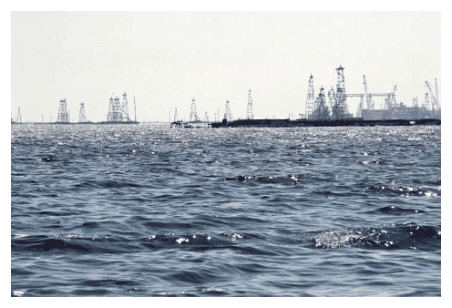
Currently, on-land and shelf sea oil production is being developed in Azerbaijan. Though serious precautions are taken, there is always a risk of hydrocarbon pollution of the environment during production, transportation, and processing of oil. In this task we will consider diverse technologies of oil spills clean up and specific features of metabolic pathways involved.
Application of complex solvents (dispersants) leading to capture of marine oil spills is among most promising clean up approaches. Organic substance X (11.94 % of \(\ce{H}\) by mass) is a typical component of such dispersants. Safety of X to human is fiercely debated. X1 (54.53 % of carbon by mass) composed of three elements and excreted with urine is the major metabolite of X in humans. The numbers of atoms of different elements in X1 are three consecutive terms of a geometric progression \((n,nq,nq^2)\), whereas the sum of these numbers does not exceed 25.
8.1 Decide on the relationship (tick the correct variant) between the numbers of carbon and oxygen atoms in X1.
| \(n(\ce{C})>n(\ce{O})\) | \(n(\ce{C})<n(\ce{O})\) | \(n(\ce{C})=n(\ce{O})\) | Data insufficient |
|---|---|---|---|
| □ | □ | □ | □ |
8.2 Derive the empirical formula of X1 (hereafter always show your work where required). Be sure you prove the answer by calculations.
The biotransformation of X into X1 occurs in two enzymatically catalyzed steps according to the hereunder reaction balanced equations (\(\ce{NAD+}\) and \(\ce{NADH}\) are the oxidized and reduced forms of nicotinamide adenine dinucleotide, respectively):
\[ \ce{X + NAD+ -> X0 + NADH + H+} \tag{1} \]
\[ \ce{X0 + NAD+ + H2O -> X1 + NADH + H+} \tag{2} \]
8.3 Derive the molecular formula of X.
A minor metabolic transformation of X is catalyzed by cytochrome P450-dependent monooxygenase. This reaction leads to two compounds X2 (51.56 % of oxygen and 9.74 % of hydrogen by mass) and X3.
8.4 Derive the molecular formula of X2 and draw its structure.
X contains only primary and secondary carbon atoms. X0 and X3 contain common functional group.
8.5 Draw the structural formulae of X, X1, and X3.
In a medical study, personnel permanently exposed to X-based solvents without proper protection was found to have a stationary concentration of X in blood.
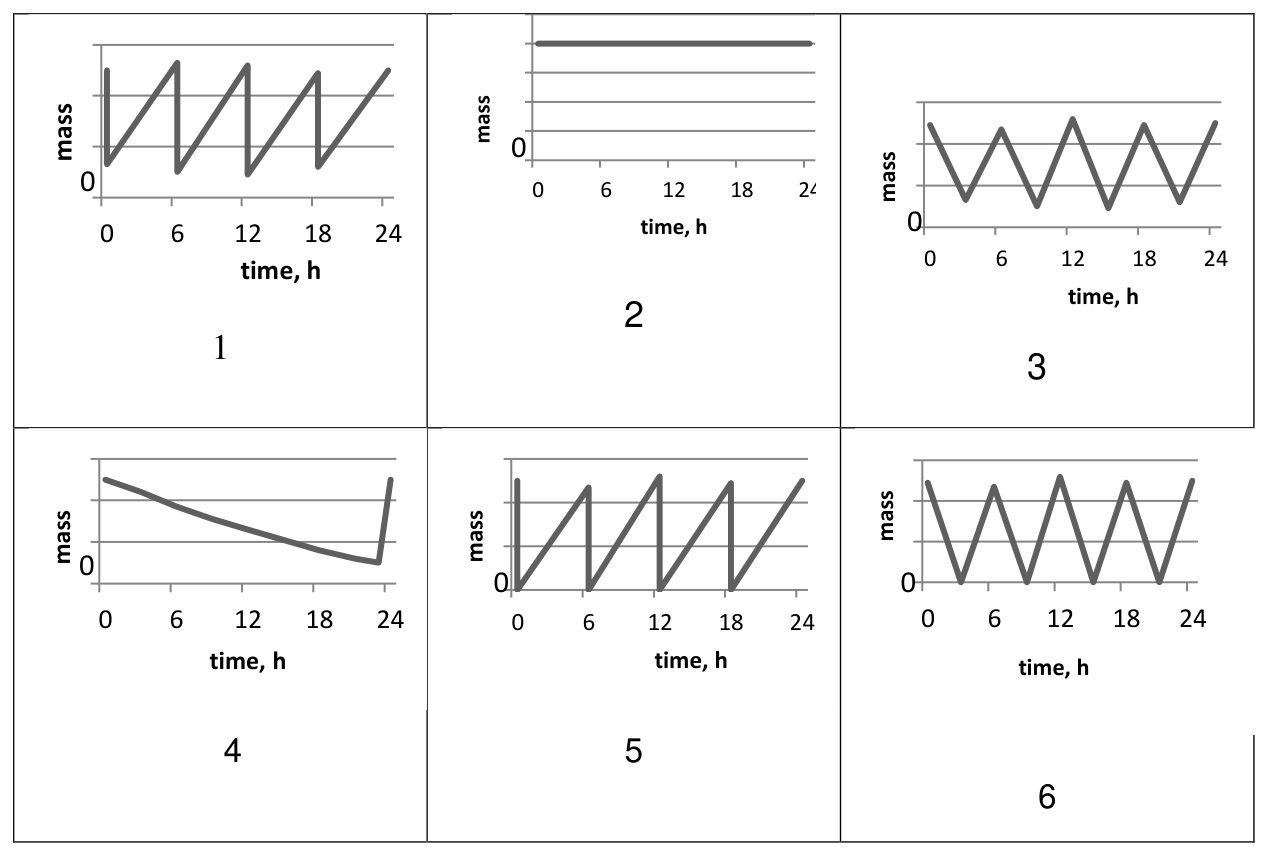
8.6 X1 is excreted with urine. Choose the graph of X1 daily mass content in the body of a volunteer participated in this experiment. Write down the number of the correct graph.
The use of different bacteria is also considered as a promising way for the removal of hydrocarbon (even aromatic) contaminants from sea water and soil. Under aerobic conditions, benzene undergoes biodegradation as follows (first three steps are balanced):

here and hereinafter
D - aromatic dioxygenase
Under the same conditions, a monocyclic aromatic hydrocarbon P (91.25 % of carbon by mass) undergoes the following transformation (first three steps are balanced):

P3 gives a positive iodoform test. A 100 mg sample of P3 requires 6.41 \(\mathrm{cm^3}\) of \(\ce{KOH}\) \((c=0.100\ \mathrm{mol\,dm^{-3}})\) solution for complete neutralization.
8.7 Derive the structures of P–P3. Give the most stable tautomer of P3.
Microorganisms Alicycliphilus are capable of biodegradation of aromatic hydrocarbons even in soil. The process requires a suitable electron acceptor such as inorganic anion Y1 (first three steps are balanced).
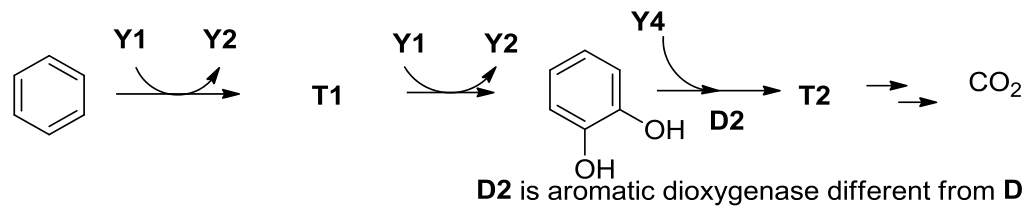
D2 is aromatic dioxygenase different from D
The intermediate anion Y2 is enzymatically decomposed according to the balanced reaction equation:
\[ \ce{Y2(aq) -> Y3(aq) + Y4(g)}, \]
wherein each of Y3 and Y4 is composed of atoms of only one element. T2 does not contain two identical oxygen-containing functional groups. T2 gives a precipitate when treated with the ammonia solution of \(\ce{Ag2O}\), whereas Y3 does not.
8.8 Deduce and give formulas of Y1-Y4. Draw the structures of T1-T2. Give the most stable tautomer of T2.
Official English text of the problem.
Answers
- 8.1: Tick \(n(\ce{C})>n(\ce{O})\).
- 8.2: The empirical formula of X1 is \(\boxed{\ce{C2H4O}}\).
- 8.3: The molecular formula of X is \(\boxed{\ce{C6H14O2}}\).
- 8.4: X2 is ethane-1,2-diol (ethylene glycol), \(\ce{C2H6O2}\),
OCCO. - 8.5: X: 2-butoxyethan-1-ol,
CCCCOCCO; X1: 2-butoxyacetic acid,CCCCOCC(=O)O; X3: butanal,CCCC=O. - 8.6: \(\boxed{\text{Graph 1}}\).
- 8.7: P: toluene,
Cc1ccccc1; P1: cis-3-methylcyclohexa-3,5-diene-1,2-diol,O[C@H]1[C@@H](O)C(C)=CC=C1(one cis enantiomer shown); P2: 3-methylbenzene-1,2-diol (3-methylcatechol),Oc1c(O)c(C)ccc1; P3: 2-hydroxy-6-oxohepta-2,4-dienoic acid,CC(=O)C=CC=C(O)C(=O)O. I select this conjugated enol tautomer. - 8.8: Y1: chlorate, \(\ce{ClO3-}\),
[O-]Cl(=O)=O; Y2: chlorite, \(\ce{ClO2-}\),[O-]Cl=O; Y3: chloride, \(\ce{Cl-}\),[Cl-]; Y4: dioxygen, \(\ce{O2}\),O=O. T1: phenol,Oc1ccccc1; T2: 2-hydroxy-6-oxohexa-2,4-dienoic acid (2-hydroxymuconic semialdehyde),O=CC=CC=C(O)C(=O)O. I likewise select its conjugated enol tautomer.
Solution
The calculations below use atomic molar masses \(12.01\), \(1.008\), and \(16.00\ \mathrm{g\,mol^{-1}}\) for carbon, hydrogen, and oxygen, respectively.
8.1
Let the numbers of carbon and oxygen atoms in X1 be \(c\) and \(o\). If \(c\leq o\), even omitting the mass of the third element would give
\[ w(\ce{C}) < \frac{12.01c}{12.01c+16.00o} \leq \frac{12.01}{12.01+16.00} =0.4288. \]
This contradicts the measured carbon mass fraction \(0.5453\). Therefore,
\[ \boxed{c>o}. \]
The first box must be ticked.
8.2
Write the C/H/O composition as \(\ce{C_cH_hO_o}\). Its carbon mass fraction satisfies
\[ \frac{12.01c}{12.01c+1.008h+16.00o}=0.5453. \]
The geometric-progression condition can be checked exhaustively without an unbounded search. In increasing order, three integer terms of a geometric progression have the form
\[ k r^2,\quad krs,\quad ks^2, \]
where \(r,s\) are coprime positive integers and \(s\geq r\). The atom-count limit requires
\[ k(r^2+rs+s^2)\leq25. \]
Equal terms are excluded by \(c>o\). The remaining primitive triples are only
\[ (1,2,4),\quad(1,3,9),\quad(1,4,16),\quad(4,6,9). \]
For each triple, assigning its entries to \(c,h,o\), subject to \(c>o\), gives:
| Primitive atom-count triple | Possible carbon percentages with \(c>o\) |
|---|---|
| \((1,2,4)\) | 54.53, 59.27, 72.73 |
| \((1,3,9)\) | 58.97, 68.80, 85.03 |
| \((1,4,16)\) | 59.92, 74.72, 90.56 |
| \((4,6,9)\) | 49.65, 51.94, 60.68 |
The unique matching assignment is
\[ c:h:o=2:4:1. \]
Indeed,
\[ 100\,w(\ce{C}) = 100\frac{2(12.01)} {2(12.01)+4(1.008)+16.00} =54.526\% \approx54.53\%. \]
Thus
\[ \boxed{\text{empirical formula of X1}=\ce{C2H4O}}. \]
Its molecular formula is \(\ce{C_{2m}H_{4m}O_m}\). Since the molecule contains \(7m\leq25\) atoms, \(m\) can only be \(1\), \(2\), or \(3\). An empirical formula alone does not specify a molecular structure or a unique SMILES.
8.3
In reaction (1), X loses two hydrogen atoms:
\[ \ce{X -> X0 + 2[H]}. \]
Reaction (2) adds one oxygen atom to X0, without changing its total hydrogen count. Consequently,
\[ \begin{aligned} \mathrm{X1}&:\quad \ce{C_{2m}H_{4m}O_m},\\ \mathrm{X0}&:\quad \ce{C_{2m}H_{4m}O_{m-1}},\\ \mathrm{X}&:\quad \ce{C_{2m}H_{4m+2}O_{m-1}}. \end{aligned} \]
Using the hydrogen percentage of X,
\[ \frac{1.008(4m+2)} {12.01(2m)+1.008(4m+2)+16.00(m-1)} =0.1194. \]
This gives \(m=3.00\), within the rounding of the analytical data. Therefore,
\[ \boxed{\ce{X=C6H14O2}},\qquad \ce{X0=C6H12O2},\qquad \ce{X1=C6H12O3}. \]
The check is
\[ 100\,w(\ce{H}) = 100\frac{14(1.008)}{118.172} =11.9419\% \approx11.94\%. \]
The combined balanced oxidation is
\[ \ce{X + 2NAD+ + H2O -> X1 + 2NADH + 2H+}. \]
8.4
The carbon percentage of X2 is
\[ 100-51.56-9.74=38.70\%. \]
For a \(100\ \mathrm{g}\) sample:
| Element | Amount of atoms |
|---|---|
| Carbon | \(38.70/12.01=3.222\ \mathrm{mol}\) |
| Hydrogen | \(9.74/1.008=9.663\ \mathrm{mol}\) |
| Oxygen | \(51.56/16.00=3.223\ \mathrm{mol}\) |
Thus the empirical ratio is
\[ \ce{C:H:O}=1:3:1, \]
and the molecular formula is initially \(\ce{C_mH_{3m}O_m}\).
For an ordinary neutral, closed-shell C/H/O compound,
\[ \mathrm{DBE}=\frac{2m+2-3m}{2}=1-\frac m2 \]
must be a nonnegative integer. Hence \(m=2\), giving
\[ \boxed{\ce{X2=C2H6O2}}. \]
The main oxidation sequence identifies a primary alcohol in X. P450-catalyzed oxidative ether cleavage releases an alcohol fragment while preserving that original alcohol group. The resulting two-carbon diol is therefore ethane-1,2-diol, OCCO:
\[ \boxed{\ce{HO-CH2-CH2-OH}}. \]
The required drawing is a two-carbon single-bonded chain with one hydroxyl group on each carbon.
Its calculated composition is
\[ w(\ce{O})=51.556\%,\qquad w(\ce{H})=9.744\%, \]
in agreement with the data.
8.5
The two-step oxidation
\[ \text{primary alcohol}\longrightarrow\text{aldehyde} \longrightarrow\text{carboxylic acid} \]
identifies X0 as an aldehyde. Thus X3, which shares its functional group, must also be an aldehyde.
The ethylene glycol fragment contains two of the six carbons of X. The other fragment therefore contains four carbons. A straight butyl ether gives butanal on oxidative cleavage. A sec-butyl ether would instead give a ketone, while branched isobutyl or tert-butyl structures would introduce a tertiary carbon atom into X.
The structures are therefore:
| Label | Name and SMILES | Condensed structure |
|---|---|---|
| X | 2-Butoxyethan-1-ol, CCCCOCCO |
\(\ce{CH3CH2CH2CH2-O-CH2CH2OH}\) |
| X0 | 2-Butoxyethanal, CCCCOCC=O |
\(\ce{CH3CH2CH2CH2-O-CH2CHO}\) |
| X1 | 2-Butoxyacetic acid, CCCCOCC(=O)O |
\(\ce{CH3CH2CH2CH2-O-CH2COOH}\) |
| X3 | Butanal, CCCC=O |
\(\ce{CH3CH2CH2CHO}\) |
The structural oxidation equations are
\[ \ce{C4H9OCH2CH2OH + NAD+ -> C4H9OCH2CHO + NADH + H+}, \]
\[ \ce{C4H9OCH2CHO + NAD+ + H2O -> C4H9OCH2COOH + NADH + H+}, \]
where every \(\ce{C4H9}\) group is the straight-chain butyl group.
Using the problem’s notation \(\ce{2[H]}\) for reducing hydrogen equivalents, the balanced monooxygenase reaction is
\[ \ce{C6H14O2 + O2 + 2[H] -> C2H6O2 + C4H8O + H2O}. \]
Structurally,
\[ \ce{CH3CH2CH2CH2OCH2CH2OH + O2 + 2[H] -> HOCH2CH2OH + CH3CH2CH2CHO + H2O}. \]
8.6
A stationary blood concentration of X supports approximately constant production of X1. Between urinations, the total amount of X1 inside the body, including urine retained in the bladder, increases. Urination removes accumulated metabolite rapidly.
The amount does not fall to zero because metabolite remains in blood, tissues, and residual urine. The required graph therefore has gradual increases and abrupt decreases to nonzero minima:
\[ \boxed{\text{Graph 1}}. \]
8.7
First determine the hydrocarbon composition:
\[ n(\ce{C}):n(\ce{H}) = \frac{91.25}{12.01}:\frac{8.75}{1.008} \approx7:8. \]
Thus P has molecular formula \(\ce{C_{7k}H_{8k}}\).
The balanced first three steps add two oxygen atoms, remove the two newly supplied hydrogen atoms, and then add two more oxygen atoms. Therefore,
\[ \ce{P3=C_{7k}H_{8k}O4}. \]
The neutralization consumes
\[ n(\ce{KOH}) = (0.100\ \mathrm{mol\,dm^{-3}}) (6.41\times10^{-3}\ \mathrm{dm^3}) = 6.41\times10^{-4}\ \mathrm{mol}. \]
The equivalent molar mass is
\[ \frac{0.100\ \mathrm{g}} {6.41\times10^{-4}\ \mathrm{mol}} = 156.0\ \mathrm{g\,mol^{-1}}. \]
If P3 has \(a\) carboxyl groups,
\[ M(\mathrm{P3})=156.0a\ \mathrm{g\,mol^{-1}}. \]
Four oxygen atoms allow at most two carboxyl groups, so the possibilities are \(a=1\) or \(2\). Meanwhile,
\[ M(\mathrm{P3})=92.134k+64.00. \]
For \(a=1\), \(k\approx1\); for \(a=2\), \(k\approx2.69\), which is not an integer. Consequently,
\[ \boxed{\ce{P=C7H8}},\qquad \boxed{\ce{P3=C7H8O4}}, \]
and P3 has one carboxyl group. The monocyclic aromatic hydrocarbon P is toluene, Cc1ccccc1.
For this oxidative ring-cleavage product, the positive iodoform test identifies a methyl ketone group, \(\ce{CH3CO-}\). The general balanced test reaction is
\[ \ce{RCOCH3 + 3I2 + 4OH- -> RCOO- + CHI3 + 3I- + 3H2O}. \]
The yellow precipitate is iodoform, IC(I)I.
To obtain a methyl ketone at the opened end of the aromatic ring, the methyl-bearing ring carbon must be adjacent to a hydroxyl-bearing carbon. This identifies P2 as 3-methylcatechol, Oc1c(O)c(C)ccc1.
Number the hydroxyl-bearing ring carbons 1 and 2 and the methyl-bearing carbon 3. Cleavage of the bond between carbons 2 and 3 gives
\[ \boxed{\ce{HOOC-C(OH)=CH-CH=CH-C(=O)-CH3}}. \]
This is 2-hydroxy-6-oxohepta-2,4-dienoic acid, CC(=O)C=CC=C(O)C(=O)O. It has exactly the required carboxyl group and methyl ketone.
Working backward, P1 is cis-3-methylcyclohexa-3,5-diene-1,2-diol, O[C@H]1[C@@H](O)C(C)=CC=C1. Draw a six-membered ring with hydroxyl groups at positions 1 and 2 on the same face, a methyl group at position 3, and double bonds at 3–4 and 5–6. The displayed SMILES represents one cis enantiomer; the problem does not specify the absolute configuration selected by the enzyme.
The three balanced transformations are
\[ \ce{C7H8 + O2 + 2[H] -> C7H10O2}, \]
\[ \ce{C7H10O2 + NAD+ -> C7H8O2 + NADH + H+}, \]
\[ \ce{C7H8O2 + O2 -> C7H8O4}. \]
For the requested tautomer, I select the conjugated enol shown above: its two carbon–carbon double bonds form a continuous conjugated system with the terminal carbonyl groups. Its direct keto tautomer is 2,6-dioxohept-4-enoic acid, CC(=O)C=CCC(=O)C(=O)O:
\[ \ce{HOOC-C(OH)=CH-CH=CH-COCH3 <=> HOOC-CO-CH2-CH=CH-COCH3}. \]
8.8
Y4 supplies the oxygen used by the aromatic dioxygenase, so it is dioxygen, \(\ce{O2}\), O=O.
The relevant oxygen-generating decomposition of an aqueous inorganic anion is
\[ \boxed{\ce{ClO2-(aq) -> Cl-(aq) + O2(g)}}. \]
Thus Y2 is chlorite and Y3 is chloride. The equation balances both atoms and charge. It is an internal redox reaction: chlorine changes from oxidation state \(+3\) to \(-1\), while the two oxygen atoms change from \(-2\) to \(0\).
The preceding electron acceptor is chlorate, \(\ce{ClO3-}\). Its reduction to chlorite transfers one oxygen atom to the organic substrate at each step:
\[ \ce{C6H6 + ClO3- -> C6H6O + ClO2-}, \]
\[ \ce{C6H6O + ClO3- -> C6H6O2 + ClO2-}. \]
Therefore T1 is phenol, Oc1ccccc1, and the next intermediate is benzene-1,2-diol (catechol), Oc1ccccc1O.
The ion assignments, including SMILES, are:
| Label | Identity | Formula | SMILES |
|---|---|---|---|
| Y1 | Chlorate | \(\ce{ClO3-}\) | [O-]Cl(=O)=O |
| Y2 | Chlorite | \(\ce{ClO2-}\) | [O-]Cl=O |
| Y3 | Chloride | \(\ce{Cl-}\) | [Cl-] |
| Y4 | Dioxygen | \(\ce{O2}\) | O=O |
The localized chlorine–oxygen bond orders in these SMILES are resonance representations. The conventional dioxygen SMILES does not encode its ground-state triplet spin.
For T2, ordinary cleavage between the two hydroxyl-bearing carbons would produce two carboxyl groups, contradicting the stated absence of two identical oxygen-containing functional groups. Instead, D2 performs cleavage adjacent to the catechol diol unit. The resulting chain has one carboxyl group and an aldehyde end:
\[ \boxed{\ce{HOOC-C(OH)=CH-CH=CH-CHO}}. \]
This is 2-hydroxy-6-oxohexa-2,4-dienoic acid, also called 2-hydroxymuconic semialdehyde, O=CC=CC=C(O)C(=O)O.
The ring-cleavage balance is
\[ \ce{C6H6O2 + O2 -> C6H6O4}. \]
Its aldehyde explains the positive Tollens test:
\[ \ce{RCHO + 2[Ag(NH3)2]+ + 3OH- -> RCOO- + 2Ag(s) + 4NH3 + 2H2O}. \]
The precipitated material is metallic silver, [Ag]. The oxidant is diamminesilver(I), [NH3]->[Ag+]<-[NH3], with a linear nitrogen–silver–nitrogen coordination geometry.
Chloride does not reduce the silver reagent. In ammoniacal solution, silver chloride can dissolve through complex formation:
\[ \ce{AgCl(s) + 2NH3(aq) <=> [Ag(NH3)2]+(aq) + Cl-(aq)}. \]
This accounts for the intended negative precipitation observation for Y3.
As for P3, I select the conjugated enol representation of T2. Its direct keto tautomer is 2,6-dioxohex-4-enoic acid, O=CC=CCC(=O)C(=O)O:
\[ \ce{HOOC-C(OH)=CH-CH=CH-CHO <=> HOOC-CO-CH2-CH=CH-CHO}. \]
The solution was checked against the official solution.
IChO 2015 · Theorieaufgabe 8
Öl fürs Leben und Leben nach dem Öl
Aserbaidschan ist für seine riesigen Öl- und Gasfelder bekannt. Die erste Erdölbohrung wurde 1846 in Bibi-Heybat durchgeführt, 13 Jahre vor der Errichtung der ersten kommerziellen Erdölbohrung in Pennsylvania (USA). Dieses bemerkenswerte Datum in der Geschichte Aserbaidschans gilt als Ausgangspunkt der modernen Erdölindustrie, des führenden Sektors der heutigen Weltwirtschaft.
Derzeit wird die Erdölförderung an Land und im Schelfmeer in Aserbaidschan ausgebaut. Obwohl umfassende Vorsichtsmaßnahmen getroffen werden, besteht bei der Förderung, dem Transport und der Verarbeitung von Erdöl stets das Risiko einer Umweltverschmutzung durch Kohlenwasserstoffe. In dieser Aufgabe betrachten wir verschiedene Technologien zur Beseitigung von Ölverschmutzungen und Besonderheiten der daran beteiligten Stoffwechselwege.
Die Anwendung komplexer Lösungsmittelgemische (Dispergiermittel), mit denen auf dem Meer ausgetretenes Öl gebunden wird, gehört zu den vielversprechendsten Reinigungsverfahren. Die organische Substanz X (Massenanteil von \(\ce{H}\): 11.94 %) ist ein typischer Bestandteil solcher Dispergiermittel. Die Unbedenklichkeit von X für den Menschen wird heftig diskutiert. X1 (Kohlenstoffmassenanteil: 54.53 %) besteht aus drei Elementen, wird mit dem Urin ausgeschieden und ist der Hauptmetabolit von X beim Menschen. Die Anzahlen der Atome der verschiedenen Elemente in X1 sind drei aufeinanderfolgende Glieder einer geometrischen Folge \((n,nq,nq^2)\), wobei die Summe dieser Anzahlen 25 nicht überschreitet.
8.1 Entscheiden Sie, welche Beziehung zwischen den Anzahlen der Kohlenstoff- und Sauerstoffatome in X1 besteht (kreuzen Sie die richtige Variante an).
| \(n(\ce{C})>n(\ce{O})\) | \(n(\ce{C})<n(\ce{O})\) | \(n(\ce{C})=n(\ce{O})\) | Angaben nicht ausreichend |
|---|---|---|---|
| □ | □ | □ | □ |
8.2 Leiten Sie die Verhältnisformel von X1 her (geben Sie im Folgenden stets Ihren Lösungsweg an, wo dies verlangt wird). Belegen Sie Ihre Antwort unbedingt durch Berechnungen.
Die Biotransformation von X zu X1 erfolgt in zwei enzymatisch katalysierten Schritten gemäß den folgenden ausgeglichenen Reaktionsgleichungen (\(\ce{NAD+}\) und \(\ce{NADH}\) sind die oxidierte bzw. reduzierte Form von Nicotinamidadenindinukleotid):
\[ \ce{X + NAD+ -> X0 + NADH + H+} \tag{1} \]
\[ \ce{X0 + NAD+ + H2O -> X1 + NADH + H+} \tag{2} \]
8.3 Leiten Sie die Summenformel von X her.
Eine untergeordnete metabolische Umwandlung von X wird durch eine Cytochrom-P450-abhängige Monooxygenase katalysiert. Diese Reaktion führt zu zwei Verbindungen, X2 (Sauerstoffmassenanteil: 51.56 %, Wasserstoffmassenanteil: 9.74 %) und X3.
8.4 Leiten Sie die Summenformel von X2 her und zeichnen Sie seine Struktur.
X enthält ausschließlich primäre und sekundäre Kohlenstoffatome. X0 und X3 enthalten die gleiche funktionelle Gruppe.
8.5 Zeichnen Sie die Strukturformeln von X, X1 und X3.
In einer medizinischen Studie wurde bei Personal, das dauerhaft Lösungsmitteln auf der Basis von X ohne angemessenen Schutz ausgesetzt war, eine stationäre Konzentration von X im Blut festgestellt.
8.6 X1 wird mit dem Urin ausgeschieden. Wählen Sie den Graphen, der den Verlauf der Masse von X1 im Körper eines freiwilligen Teilnehmers dieses Experiments im Laufe eines Tages zeigt. Notieren Sie die Nummer des richtigen Graphen.
Auch der Einsatz verschiedener Bakterien gilt als vielversprechender Weg zur Entfernung von Kohlenwasserstoffverunreinigungen (auch aromatischen) aus Meerwasser und Böden. Unter aeroben Bedingungen wird Benzol wie folgt biologisch abgebaut (die ersten drei Schritte sind ausgeglichen):
hier und im Folgenden
D - aromatische Dioxygenase
Unter denselben Bedingungen durchläuft ein monocyclischer aromatischer Kohlenwasserstoff P (Kohlenstoffmassenanteil: 91.25 %) die folgende Umwandlung (die ersten drei Schritte sind ausgeglichen):
P3 ergibt eine positive Iodoformprobe. Eine Probe von 100 mg P3 benötigt zur vollständigen Neutralisation 6.41 \(\mathrm{cm^3}\) einer \(\ce{KOH}\)-Lösung \((c=0.100\ \mathrm{mol\,dm^{-3}})\).
8.7 Leiten Sie die Strukturen von P–P3 her. Geben Sie das stabilste Tautomer von P3 an.
Mikroorganismen der Gattung Alicycliphilus sind in der Lage, aromatische Kohlenwasserstoffe auch im Boden biologisch abzubauen. Der Prozess erfordert einen geeigneten Elektronenakzeptor, beispielsweise das anorganische Anion Y1 (die ersten drei Schritte sind ausgeglichen).
D2 ist eine aromatische Dioxygenase, die sich von D unterscheidet
Das intermediär gebildete Anion Y2 wird enzymatisch gemäß der folgenden ausgeglichenen Reaktionsgleichung zersetzt:
\[ \ce{Y2(aq) -> Y3(aq) + Y4(g)}, \]
wobei Y3 und Y4 jeweils aus Atomen nur eines Elements bestehen. T2 enthält keine zwei identischen sauerstoffhaltigen funktionellen Gruppen. T2 bildet bei der Behandlung mit einer ammoniakalischen Lösung von \(\ce{Ag2O}\) einen Niederschlag, Y3 hingegen nicht.
8.8 Leiten Sie die Formeln von Y1-Y4 her und geben Sie diese an. Zeichnen Sie die Strukturen von T1-T2. Geben Sie das stabilste Tautomer von T2 an.
Aufgabentext aus dem offiziellen englischen Text übersetzt.
Antworten
- 8.1: Kreuzen Sie \(n(\ce{C})>n(\ce{O})\) an.
- 8.2: Die Verhältnisformel von X1 ist \(\boxed{\ce{C2H4O}}\).
- 8.3: Die Summenformel von X ist \(\boxed{\ce{C6H14O2}}\).
- 8.4: X2 ist Ethan-1,2-diol (Ethylenglykol), \(\ce{C2H6O2}\),
OCCO. - 8.5: X: 2-Butoxyethan-1-ol,
CCCCOCCO; X1: 2-Butoxyessigsäure,CCCCOCC(=O)O; X3: Butanal,CCCC=O. - 8.6: \(\boxed{\text{Graph 1}}\).
- 8.7: P: Toluol,
Cc1ccccc1; P1: cis-3-Methylcyclohexa-3,5-dien-1,2-diol,O[C@H]1[C@@H](O)C(C)=CC=C1(eines der cis-Enantiomere ist dargestellt); P2: 3-Methylbenzol-1,2-diol (3-Methylbrenzcatechin),Oc1c(O)c(C)ccc1; P3: 2-Hydroxy-6-oxohepta-2,4-diensäure,CC(=O)C=CC=C(O)C(=O)O. Ich wähle dieses konjugierte Enoltautomer. - 8.8: Y1: Chlorat, \(\ce{ClO3-}\),
[O-]Cl(=O)=O; Y2: Chlorit, \(\ce{ClO2-}\),[O-]Cl=O; Y3: Chlorid, \(\ce{Cl-}\),[Cl-]; Y4: Disauerstoff, \(\ce{O2}\),O=O. T1: Phenol,Oc1ccccc1; T2: 2-Hydroxy-6-oxohexa-2,4-diensäure (2-Hydroxymuconsäuresemialdehyd),O=CC=CC=C(O)C(=O)O. Ich wähle ebenfalls sein konjugiertes Enoltautomer.
Lösung
Die folgenden Berechnungen verwenden die molaren Atommassen \(12.01\), \(1.008\) und \(16.00\ \mathrm{g\,mol^{-1}}\) für Kohlenstoff, Wasserstoff bzw. Sauerstoff.
8.1
Die Anzahlen der Kohlenstoff- und Sauerstoffatome in X1 seien \(c\) und \(o\). Für \(c\leq o\) würde sich selbst bei Vernachlässigung der Masse des dritten Elements ergeben:
\[ w(\ce{C}) < \frac{12.01c}{12.01c+16.00o} \leq \frac{12.01}{12.01+16.00} =0.4288. \]
Dies widerspricht dem gemessenen Kohlenstoffmassenanteil \(0.5453\). Daher gilt:
\[ \boxed{c>o}. \]
Das erste Kästchen muss angekreuzt werden.
8.2
Wir schreiben die C/H/O-Zusammensetzung als \(\ce{C_cH_hO_o}\). Für ihren Kohlenstoffmassenanteil gilt:
\[ \frac{12.01c}{12.01c+1.008h+16.00o}=0.5453. \]
Die Bedingung einer geometrischen Folge lässt sich ohne eine unbeschränkte Suche vollständig überprüfen. In aufsteigender Reihenfolge haben drei ganzzahlige Glieder einer geometrischen Folge die Form
\[ k r^2,\quad krs,\quad ks^2, \]
wobei \(r,s\) teilerfremde positive ganze Zahlen sind und \(s\geq r\) gilt. Die Obergrenze für die Atomanzahl erfordert
\[ k(r^2+rs+s^2)\leq25. \]
Gleiche Glieder sind wegen \(c>o\) ausgeschlossen. Als primitive Tripel verbleiben nur
\[ (1,2,4),\quad(1,3,9),\quad(1,4,16),\quad(4,6,9). \]
Für jedes Tripel ergibt die Zuordnung seiner Einträge zu \(c,h,o\) unter der Bedingung \(c>o\):
| Primitives Tripel der Atomanzahlen | Mögliche Kohlenstoffprozentsätze bei \(c>o\) |
|---|---|
| \((1,2,4)\) | 54.53, 59.27, 72.73 |
| \((1,3,9)\) | 58.97, 68.80, 85.03 |
| \((1,4,16)\) | 59.92, 74.72, 90.56 |
| \((4,6,9)\) | 49.65, 51.94, 60.68 |
Die einzige passende Zuordnung lautet
\[ c:h:o=2:4:1. \]
Tatsächlich gilt:
\[ 100\,w(\ce{C}) = 100\frac{2(12.01)} {2(12.01)+4(1.008)+16.00} =54.526\% \approx54.53\%. \]
Somit ist
\[ \boxed{\text{Verhältnisformel von X1}=\ce{C2H4O}}. \]
Die Summenformel lautet \(\ce{C_{2m}H_{4m}O_m}\). Da das Molekül \(7m\leq25\) Atome enthält, kann \(m\) nur \(1\), \(2\) oder \(3\) sein. Eine Verhältnisformel allein legt weder eine Molekülstruktur noch einen eindeutigen SMILES fest.
8.3
In Reaktion (1) verliert X zwei Wasserstoffatome:
\[ \ce{X -> X0 + 2[H]}. \]
Reaktion (2) fügt X0 ein Sauerstoffatom hinzu, ohne seine Gesamtzahl an Wasserstoffatomen zu verändern. Folglich gilt:
\[ \begin{aligned} \mathrm{X1}&:\quad \ce{C_{2m}H_{4m}O_m},\\ \mathrm{X0}&:\quad \ce{C_{2m}H_{4m}O_{m-1}},\\ \mathrm{X}&:\quad \ce{C_{2m}H_{4m+2}O_{m-1}}. \end{aligned} \]
Mit dem Wasserstoffprozentsatz von X ergibt sich:
\[ \frac{1.008(4m+2)} {12.01(2m)+1.008(4m+2)+16.00(m-1)} =0.1194. \]
Dies ergibt innerhalb der Rundungsgenauigkeit der Analysedaten \(m=3.00\). Daher gilt:
\[ \boxed{\ce{X=C6H14O2}},\qquad \ce{X0=C6H12O2},\qquad \ce{X1=C6H12O3}. \]
Die Überprüfung ergibt:
\[ 100\,w(\ce{H}) = 100\frac{14(1.008)}{118.172} =11.9419\% \approx11.94\%. \]
Die zusammengefasste ausgeglichene Oxidationsgleichung lautet:
\[ \ce{X + 2NAD+ + H2O -> X1 + 2NADH + 2H+}. \]
8.4
Der Kohlenstoffprozentsatz von X2 beträgt
\[ 100-51.56-9.74=38.70\%. \]
Für eine Probe von \(100\ \mathrm{g}\):
| Element | Stoffmenge der Atome |
|---|---|
| Kohlenstoff | \(38.70/12.01=3.222\ \mathrm{mol}\) |
| Wasserstoff | \(9.74/1.008=9.663\ \mathrm{mol}\) |
| Sauerstoff | \(51.56/16.00=3.223\ \mathrm{mol}\) |
Damit lautet das empirische Verhältnis
\[ \ce{C:H:O}=1:3:1, \]
und die Summenformel ist zunächst \(\ce{C_mH_{3m}O_m}\).
Für eine gewöhnliche neutrale C/H/O-Verbindung mit geschlossener Elektronenschale muss
\[ \mathrm{DBE}=\frac{2m+2-3m}{2}=1-\frac m2 \]
eine nichtnegative ganze Zahl sein. Daher ist \(m=2\), woraus folgt:
\[ \boxed{\ce{X2=C2H6O2}}. \]
Die Hauptoxidationsfolge weist auf einen primären Alkohol in X hin. Die P450-katalysierte oxidative Etherspaltung setzt ein Alkoholfragment frei, wobei diese ursprüngliche Alkoholgruppe erhalten bleibt. Das entstehende Diol mit zwei Kohlenstoffatomen ist daher Ethan-1,2-diol, OCCO:
\[ \boxed{\ce{HO-CH2-CH2-OH}}. \]
Die geforderte Zeichnung zeigt eine Kette aus zwei durch eine Einfachbindung verbundenen Kohlenstoffatomen mit jeweils einer Hydroxygruppe an jedem Kohlenstoffatom.
Seine berechnete Zusammensetzung lautet
\[ w(\ce{O})=51.556\%,\qquad w(\ce{H})=9.744\%, \]
in Übereinstimmung mit den Angaben.
8.5
Die zweistufige Oxidation
\[ \text{primärer Alkohol}\longrightarrow\text{Aldehyd} \longrightarrow\text{Carbonsäure} \]
weist X0 als Aldehyd aus. Daher muss X3, das dieselbe funktionelle Gruppe besitzt, ebenfalls ein Aldehyd sein.
Das Ethylenglykolfragment enthält zwei der sechs Kohlenstoffatome von X. Das andere Fragment enthält daher vier Kohlenstoffatome. Ein unverzweigter Butylether liefert bei oxidativer Spaltung Butanal. Ein sec-Butylether würde stattdessen ein Keton liefern, während verzweigte Isobutyl- oder tert-Butylstrukturen ein tertiäres Kohlenstoffatom in X einführen würden.
Die Strukturen sind daher:
| Bezeichnung | Name und SMILES | Halbstrukturformel |
|---|---|---|
| X | 2-Butoxyethan-1-ol, CCCCOCCO |
\(\ce{CH3CH2CH2CH2-O-CH2CH2OH}\) |
| X0 | 2-Butoxyethanal, CCCCOCC=O |
\(\ce{CH3CH2CH2CH2-O-CH2CHO}\) |
| X1 | 2-Butoxyessigsäure, CCCCOCC(=O)O |
\(\ce{CH3CH2CH2CH2-O-CH2COOH}\) |
| X3 | Butanal, CCCC=O |
\(\ce{CH3CH2CH2CHO}\) |
Die Oxidationsgleichungen mit Strukturformeln lauten
\[ \ce{C4H9OCH2CH2OH + NAD+ -> C4H9OCH2CHO + NADH + H+}, \]
\[ \ce{C4H9OCH2CHO + NAD+ + H2O -> C4H9OCH2COOH + NADH + H+}, \]
wobei jede \(\ce{C4H9}\)-Gruppe die unverzweigte Butylgruppe ist.
Mit der in der Aufgabe verwendeten Schreibweise \(\ce{2[H]}\) für reduzierende Wasserstoffäquivalente lautet die ausgeglichene Monooxygenase-Reaktion:
\[ \ce{C6H14O2 + O2 + 2[H] -> C2H6O2 + C4H8O + H2O}. \]
Mit Strukturformeln:
\[ \ce{CH3CH2CH2CH2OCH2CH2OH + O2 + 2[H] -> HOCH2CH2OH + CH3CH2CH2CHO + H2O}. \]
8.6
Eine stationäre Blutkonzentration von X spricht für eine annähernd konstante Bildung von X1. Zwischen den Blasenentleerungen nimmt die Gesamtmenge an X1 im Körper einschließlich des in der Blase zurückgehaltenen Urins zu. Bei der Blasenentleerung wird der angesammelte Metabolit rasch ausgeschieden.
Die Menge fällt nicht auf null, da Metabolit im Blut, in den Geweben und im Restharn verbleibt. Der gesuchte Graph zeigt daher allmähliche Anstiege und abrupte Abfälle auf von null verschiedene Minima:
\[ \boxed{\text{Graph 1}}. \]
8.7
Zunächst wird die Zusammensetzung des Kohlenwasserstoffs bestimmt:
\[ n(\ce{C}):n(\ce{H}) = \frac{91.25}{12.01}:\frac{8.75}{1.008} \approx7:8. \]
Damit hat P die Summenformel \(\ce{C_{7k}H_{8k}}\).
In den ersten drei ausgeglichenen Schritten werden zwei Sauerstoffatome hinzugefügt, die beiden neu hinzugekommenen Wasserstoffatome entfernt und anschließend zwei weitere Sauerstoffatome hinzugefügt. Daher gilt:
\[ \ce{P3=C_{7k}H_{8k}O4}. \]
Bei der Neutralisation wird folgende Stoffmenge verbraucht:
\[ n(\ce{KOH}) = (0.100\ \mathrm{mol\,dm^{-3}}) (6.41\times10^{-3}\ \mathrm{dm^3}) = 6.41\times10^{-4}\ \mathrm{mol}. \]
Die molare Äquivalentmasse beträgt
\[ \frac{0.100\ \mathrm{g}} {6.41\times10^{-4}\ \mathrm{mol}} = 156.0\ \mathrm{g\,mol^{-1}}. \]
Wenn P3 \(a\) Carboxylgruppen besitzt, gilt:
\[ M(\mathrm{P3})=156.0a\ \mathrm{g\,mol^{-1}}. \]
Vier Sauerstoffatome erlauben höchstens zwei Carboxylgruppen, sodass \(a=1\) oder \(2\) möglich ist. Zugleich gilt:
\[ M(\mathrm{P3})=92.134k+64.00. \]
Für \(a=1\) ergibt sich \(k\approx1\); für \(a=2\) ergibt sich \(k\approx2.69\), was keine ganze Zahl ist. Folglich gilt:
\[ \boxed{\ce{P=C7H8}},\qquad \boxed{\ce{P3=C7H8O4}}, \]
und P3 besitzt eine Carboxylgruppe. Der monocyclische aromatische Kohlenwasserstoff P ist Toluol, Cc1ccccc1.
Bei diesem Produkt einer oxidativen Ringspaltung weist die positive Iodoformprobe eine Methylketongruppe, \(\ce{CH3CO-}\), nach. Die allgemeine ausgeglichene Reaktionsgleichung der Nachweisreaktion lautet:
\[ \ce{RCOCH3 + 3I2 + 4OH- -> RCOO- + CHI3 + 3I- + 3H2O}. \]
Der gelbe Niederschlag ist Iodoform, IC(I)I.
Damit am geöffneten Ende des aromatischen Rings ein Methylketon entsteht, muss das methylsubstituierte Ringkohlenstoffatom einem hydroxysubstituierten Kohlenstoffatom benachbart sein. Damit ist P2 als 3-Methylbrenzcatechin, Oc1c(O)c(C)ccc1, identifiziert.
Die hydroxysubstituierten Ringkohlenstoffatome werden mit 1 und 2 und das methylsubstituierte Kohlenstoffatom mit 3 nummeriert. Die Spaltung der Bindung zwischen den Kohlenstoffatomen 2 und 3 ergibt
\[ \boxed{\ce{HOOC-C(OH)=CH-CH=CH-C(=O)-CH3}}. \]
Dies ist 2-Hydroxy-6-oxohepta-2,4-diensäure, CC(=O)C=CC=C(O)C(=O)O. Sie besitzt genau die geforderte Carboxylgruppe und Methylketongruppe.
Bei rückwärtiger Betrachtung ergibt sich für P1 cis-3-Methylcyclohexa-3,5-dien-1,2-diol, O[C@H]1[C@@H](O)C(C)=CC=C1. Zeichnen Sie einen sechsgliedrigen Ring mit Hydroxygruppen an den Positionen 1 und 2 auf derselben Seite, einer Methylgruppe an Position 3 und Doppelbindungen zwischen 3–4 und 5–6. Der angegebene SMILES stellt eines der cis-Enantiomere dar; die Aufgabe legt die vom Enzym ausgewählte absolute Konfiguration nicht fest.
Die drei ausgeglichenen Umwandlungen lauten:
\[ \ce{C7H8 + O2 + 2[H] -> C7H10O2}, \]
\[ \ce{C7H10O2 + NAD+ -> C7H8O2 + NADH + H+}, \]
\[ \ce{C7H8O2 + O2 -> C7H8O4}. \]
Als gefordertes Tautomer wähle ich das oben gezeigte konjugierte Enol: Seine beiden Kohlenstoff–Kohlenstoff-Doppelbindungen bilden mit den endständigen Carbonylgruppen ein durchgehend konjugiertes System. Sein direktes Ketotautomer ist 2,6-Dioxohept-4-ensäure, CC(=O)C=CCC(=O)C(=O)O:
\[ \ce{HOOC-C(OH)=CH-CH=CH-COCH3 <=> HOOC-CO-CH2-CH=CH-COCH3}. \]
8.8
Y4 liefert den von der aromatischen Dioxygenase verwendeten Sauerstoff und ist daher Disauerstoff, \(\ce{O2}\), O=O.
Die hier relevante sauerstofferzeugende Zersetzung eines anorganischen Anions in wässriger Lösung lautet:
\[ \boxed{\ce{ClO2-(aq) -> Cl-(aq) + O2(g)}}. \]
Somit ist Y2 Chlorit und Y3 Chlorid. Die Gleichung ist sowohl hinsichtlich der Atome als auch der Ladung ausgeglichen. Es handelt sich um eine interne Redoxreaktion: Chlor wechselt von der Oxidationsstufe \(+3\) zu \(-1\), während die beiden Sauerstoffatome von \(-2\) zu \(0\) wechseln.
Der vorangehende Elektronenakzeptor ist Chlorat, \(\ce{ClO3-}\). Bei seiner Reduktion zu Chlorit wird in jedem Schritt ein Sauerstoffatom auf das organische Substrat übertragen:
\[ \ce{C6H6 + ClO3- -> C6H6O + ClO2-}, \]
\[ \ce{C6H6O + ClO3- -> C6H6O2 + ClO2-}. \]
Daher ist T1 Phenol, Oc1ccccc1, und das nächste Zwischenprodukt ist Benzol-1,2-diol (Brenzcatechin), Oc1ccccc1O.
Die Zuordnungen der Ionen einschließlich der SMILES lauten:
| Bezeichnung | Identität | Formel | SMILES |
|---|---|---|---|
| Y1 | Chlorat | \(\ce{ClO3-}\) | [O-]Cl(=O)=O |
| Y2 | Chlorit | \(\ce{ClO2-}\) | [O-]Cl=O |
| Y3 | Chlorid | \(\ce{Cl-}\) | [Cl-] |
| Y4 | Disauerstoff | \(\ce{O2}\) | O=O |
Die lokalisierten Chlor–Sauerstoff-Bindungsordnungen in diesen SMILES stellen mesomere Grenzstrukturen dar. Der übliche SMILES für Disauerstoff kodiert nicht dessen Triplett-Spin im Grundzustand.
Bei T2 würde eine gewöhnliche Spaltung zwischen den beiden hydroxysubstituierten Kohlenstoffatomen zwei Carboxylgruppen erzeugen, im Widerspruch zur angegebenen Abwesenheit zweier identischer sauerstoffhaltiger funktioneller Gruppen. Stattdessen führt D2 eine Spaltung neben der Dioleinheit des Brenzcatechins durch. Die entstehende Kette besitzt eine Carboxylgruppe und eine endständige Aldehydgruppe:
\[ \boxed{\ce{HOOC-C(OH)=CH-CH=CH-CHO}}. \]
Dies ist 2-Hydroxy-6-oxohexa-2,4-diensäure, auch 2-Hydroxymuconsäuresemialdehyd genannt, O=CC=CC=C(O)C(=O)O.
Die Bilanz der Ringspaltung lautet:
\[ \ce{C6H6O2 + O2 -> C6H6O4}. \]
Seine Aldehydgruppe erklärt die positive Tollens-Probe:
\[ \ce{RCHO + 2[Ag(NH3)2]+ + 3OH- -> RCOO- + 2Ag(s) + 4NH3 + 2H2O}. \]
Der ausgefallene Stoff ist metallisches Silber, [Ag]. Das Oxidationsmittel ist Diamminsilber(I), [NH3]->[Ag+]<-[NH3], mit einer linearen Stickstoff–Silber–Stickstoff-Koordinationsgeometrie.
Chlorid reduziert das Silberreagenz nicht. In ammoniakalischer Lösung kann sich Silberchlorid durch Komplexbildung lösen:
\[ \ce{AgCl(s) + 2NH3(aq) <=> [Ag(NH3)2]+(aq) + Cl-(aq)}. \]
Dies erklärt die in der Aufgabe gemeinte Beobachtung, dass bei Y3 kein Niederschlag auftritt.
Wie bei P3 wähle ich die Darstellung von T2 als konjugiertes Enol. Sein direktes Ketotautomer ist 2,6-Dioxohex-4-ensäure, O=CC=CCC(=O)C(=O)O:
\[ \ce{HOOC-C(OH)=CH-CH=CH-CHO <=> HOOC-CO-CH2-CH=CH-CHO}. \]
Die Lösung wurde mit der offiziellen Lösung abgeglichen.
IChO 2015 · Teori sorusu 8
Yaşam İçin Petrol ve Petrolden Sonra Yaşam
Azerbaycan, geniş petrol ve doğal gaz yataklarıyla tanınır. İlk petrol sondajı, Pennsylvania'da (ABD) ilk ticari petrol kuyusunun açılmasından 13 yıl önce, 1846 yılında Bibi-Heybat'ta yapılmıştır. Azerbaycan tarihindeki bu önemli tarih, günümüz dünya ekonomisinin öncü sektörü olan modern petrol endüstrisinin başlangıç noktası olarak kabul edilir.
Günümüzde Azerbaycan'da karada ve kıta sahanlığında petrol üretimi geliştirilmektedir. Ciddi önlemler alınmasına rağmen petrolün üretimi, taşınması ve işlenmesi sırasında çevrenin hidrokarbonlarla kirlenmesi riski her zaman vardır. Bu soruda, petrol döküntülerinin temizlenmesine yönelik çeşitli teknolojileri ve bunlarla ilgili metabolik yolakların kendine özgü özelliklerini ele alacağız.
Denizdeki petrol döküntülerinin tutulmasını sağlayan karmaşık çözücülerin (dispersanların) kullanılması, en umut verici temizleme yaklaşımları arasındadır. Organik madde X (kütlece %11.94 \(\ce{H}\)), bu tür dispersanların tipik bir bileşenidir. X'in insanlar açısından güvenli olup olmadığı yoğun biçimde tartışılmaktadır. Üç elementten oluşan ve idrarla atılan X1 (kütlece %54.53 karbon), X'in insanlardaki başlıca metabolitidir. X1'deki farklı elementlerin atom sayıları bir geometrik dizinin ardışık üç terimidir \((n,nq,nq^2)\); bu sayıların toplamı ise 25'i aşmaz.
8.1 X1'deki karbon ve oksijen atomlarının sayıları arasındaki ilişkiyi belirleyiniz (doğru seçeneği işaretleyiniz).
| \(n(\ce{C})>n(\ce{O})\) | \(n(\ce{C})<n(\ce{O})\) | \(n(\ce{C})=n(\ce{O})\) | Veriler yetersiz |
|---|---|---|---|
| □ | □ | □ | □ |
8.2 X1'in basit formülünü türetiniz (bundan sonra, istendiği yerlerde işlem basamaklarınızı her zaman gösteriniz). Yanıtınızı hesaplamalarla kanıtladığınızdan emin olunuz.
X'in X1'e biyotransformasyonu, aşağıdaki denkleştirilmiş tepkime denklemlerine göre enzimlerin katalizlediği iki basamakta gerçekleşir (\(\ce{NAD+}\) ve \(\ce{NADH}\), sırasıyla nikotinamid adenin dinükleotidin yükseltgenmiş ve indirgenmiş biçimleridir):
\[ \ce{X + NAD+ -> X0 + NADH + H+} \tag{1} \]
\[ \ce{X0 + NAD+ + H2O -> X1 + NADH + H+} \tag{2} \]
8.3 X'in molekül formülünü türetiniz.
X'in küçük bir bölümünün metabolik dönüşümü, sitokrom P450'ye bağımlı monooksijenaz tarafından katalizlenir. Bu tepkime iki bileşik oluşturur: X2 (kütlece %51.56 oksijen ve %9.74 hidrojen) ve X3.
8.4 X2'nin molekül formülünü türetiniz ve yapısını çiziniz.
X yalnızca birincil ve ikincil karbon atomları içerir. X0 ve X3 ortak bir fonksiyonel grup içerir.
8.5 X, X1 ve X3'ün yapı formüllerini çiziniz.
Bir tıbbi çalışmada, uygun koruma olmadan sürekli olarak X bazlı çözücülere maruz kalan personelin kanındaki X derişiminin sabit olduğu bulunmuştur.
8.6 X1 idrarla atılır. Bu deneye katılan bir gönüllünün vücudundaki X1 kütlesinin gün içindeki değişimini gösteren grafiği seçiniz. Doğru grafiğin numarasını yazınız.
Deniz suyundan ve topraktan hidrokarbon (aromatik olanlar dâhil) kirleticilerinin uzaklaştırılması için farklı bakterilerin kullanılması da umut verici bir yöntem olarak değerlendirilmektedir. Aerobik koşullarda benzen aşağıdaki şekilde biyolojik bozunmaya uğrar (ilk üç basamak denkleştirilmiştir):
burada ve bundan sonra
D - aromatik dioksijenaz
Aynı koşullarda, tek halkalı bir aromatik hidrokarbon olan P (kütlece %91.25 karbon) aşağıdaki dönüşüme uğrar (ilk üç basamak denkleştirilmiştir):
P3 pozitif iyodoform testi verir. 100 mg'lık bir P3 örneğinin tamamen nötralleştirilmesi için 6.41 \(\mathrm{cm^3}\) \(\ce{KOH}\) \((c=0.100\ \mathrm{mol\,dm^{-3}})\) çözeltisi gerekir.
8.7 P–P3'ün yapılarını türetiniz. P3'ün en kararlı tautomerini veriniz.
Alicycliphilus mikroorganizmaları, toprakta bile aromatik hidrokarbonları biyolojik olarak bozundurabilir. Bu süreç, inorganik anyon Y1 gibi uygun bir elektron alıcısı gerektirir (ilk üç basamak denkleştirilmiştir).
D2, D'den farklı bir aromatik dioksijenazdır
Ara ürün anyonu Y2, aşağıdaki denkleştirilmiş tepkime denklemine göre enzimatik olarak ayrışır:
\[ \ce{Y2(aq) -> Y3(aq) + Y4(g)}, \]
burada Y3 ve Y4'ün her biri yalnızca tek bir elementin atomlarından oluşur. T2, oksijen içeren iki özdeş fonksiyonel grup içermez. T2, amonyaklı \(\ce{Ag2O}\) çözeltisiyle muamele edildiğinde çökelek verirken Y3 vermez.
8.8 Y1-Y4'ün formüllerini çıkarınız ve yazınız. T1-T2'nin yapılarını çiziniz. T2'nin en kararlı tautomerini veriniz.
Soru metni resmi İngilizce metinden çevrilmiştir.
Cevaplar
- 8.1: \(n(\ce{C})>n(\ce{O})\) seçeneğini işaretleyiniz.
- 8.2: X1'in basit formülü \(\boxed{\ce{C2H4O}}\)'dur.
- 8.3: X'in molekül formülü \(\boxed{\ce{C6H14O2}}\)'dir.
- 8.4: X2, etan-1,2-diol (etilen glikol), \(\ce{C2H6O2}\),
OCCO'dur. - 8.5: X: 2-bütoksietan-1-ol,
CCCCOCCO; X1: 2-bütoksiasetik asit,CCCCOCC(=O)O; X3: bütanal,CCCC=O. - 8.6: \(\boxed{\text{Grafik 1}}\).
- 8.7: P: toluen,
Cc1ccccc1; P1: cis-3-metilsikloheksa-3,5-dien-1,2-diol,O[C@H]1[C@@H](O)C(C)=CC=C1(cis enantiyomerlerden biri gösterilmiştir); P2: 3-metilbenzen-1,2-diol (3-metilkatekol),Oc1c(O)c(C)ccc1; P3: 2-hidroksi-6-oksohepta-2,4-dienoik asit,CC(=O)C=CC=C(O)C(=O)O. Bu konjuge enol tautomerini seçiyorum. - 8.8: Y1: klorat, \(\ce{ClO3-}\),
[O-]Cl(=O)=O; Y2: klorit, \(\ce{ClO2-}\),[O-]Cl=O; Y3: klorür, \(\ce{Cl-}\),[Cl-]; Y4: dioksijen, \(\ce{O2}\),O=O. T1: fenol,Oc1ccccc1; T2: 2-hidroksi-6-oksoheksa-2,4-dienoik asit (2-hidroksimukonik semialdehit),O=CC=CC=C(O)C(=O)O. Bunun da konjuge enol tautomerini seçiyorum.
Çözüm
Aşağıdaki hesaplamalarda karbon, hidrojen ve oksijen için sırasıyla \(12.01\), \(1.008\) ve \(16.00\ \mathrm{g\,mol^{-1}}\) atomik molar kütleleri kullanılmıştır.
8.1
X1'deki karbon ve oksijen atomlarının sayıları \(c\) ve \(o\) olsun. Eğer \(c\leq o\) ise üçüncü elementin kütlesi hesaba katılmasa bile
\[ w(\ce{C}) < \frac{12.01c}{12.01c+16.00o} \leq \frac{12.01}{12.01+16.00} =0.4288. \]
elde edilir. Bu, ölçülen \(0.5453\) karbon kütle kesriyle çelişir. Dolayısıyla,
\[ \boxed{c>o}. \]
İlk kutu işaretlenmelidir.
8.2
C/H/O bileşimini \(\ce{C_cH_hO_o}\) olarak yazalım. Karbon kütle kesri şu eşitliği sağlar:
\[ \frac{12.01c}{12.01c+1.008h+16.00o}=0.5453. \]
Geometrik dizi koşulu, sınırsız bir aramaya gerek kalmadan tüm olasılıklar incelenerek denetlenebilir. Bir geometrik dizinin artan sıradaki üç tam sayı terimi
\[ k r^2,\quad krs,\quad ks^2, \]
biçimindedir; burada \(r,s\) aralarında asal pozitif tam sayılar ve \(s\geq r\)'dir. Atom sayısı sınırı
\[ k(r^2+rs+s^2)\leq25. \]
koşulunu gerektirir. \(c>o\) olduğundan eşit terimler elenir. Geriye kalan ilkel üçlüler yalnızca şunlardır:
\[ (1,2,4),\quad(1,3,9),\quad(1,4,16),\quad(4,6,9). \]
Her üçlünün elemanları, \(c>o\) koşuluyla \(c,h,o\)'ya atandığında şu sonuçlar elde edilir:
| İlkel atom sayısı üçlüsü | \(c>o\) koşulundaki olası karbon yüzdeleri |
|---|---|
| \((1,2,4)\) | 54.53, 59.27, 72.73 |
| \((1,3,9)\) | 58.97, 68.80, 85.03 |
| \((1,4,16)\) | 59.92, 74.72, 90.56 |
| \((4,6,9)\) | 49.65, 51.94, 60.68 |
Veriyle uyuşan tek atama
\[ c:h:o=2:4:1. \]
olur. Gerçekten de,
\[ 100\,w(\ce{C}) = 100\frac{2(12.01)} {2(12.01)+4(1.008)+16.00} =54.526\% \approx54.53\%. \]
Böylece
\[ \boxed{\text{X1'in basit formülü}=\ce{C2H4O}}. \]
Molekül formülü \(\ce{C_{2m}H_{4m}O_m}\)'dir. Molekül \(7m\leq25\) atom içerdiğinden \(m\) yalnızca \(1\), \(2\) veya \(3\) olabilir. Basit formül tek başına bir molekül yapısını veya tek bir SMILES gösterimini belirlemez.
8.3
(1) numaralı tepkimede X iki hidrojen atomu kaybeder:
\[ \ce{X -> X0 + 2[H]}. \]
(2) numaralı tepkime, X0'ın toplam hidrojen sayısını değiştirmeden ona bir oksijen atomu ekler. Sonuç olarak,
\[ \begin{aligned} \mathrm{X1}&:\quad \ce{C_{2m}H_{4m}O_m},\\ \mathrm{X0}&:\quad \ce{C_{2m}H_{4m}O_{m-1}},\\ \mathrm{X}&:\quad \ce{C_{2m}H_{4m+2}O_{m-1}}. \end{aligned} \]
X'in hidrojen yüzdesi kullanılırsa,
\[ \frac{1.008(4m+2)} {12.01(2m)+1.008(4m+2)+16.00(m-1)} =0.1194. \]
Buradan, analiz verilerinin yuvarlama sınırları içinde \(m=3.00\) elde edilir. Dolayısıyla,
\[ \boxed{\ce{X=C6H14O2}},\qquad \ce{X0=C6H12O2},\qquad \ce{X1=C6H12O3}. \]
Kontrol hesabı şöyledir:
\[ 100\,w(\ce{H}) = 100\frac{14(1.008)}{118.172} =11.9419\% \approx11.94\%. \]
Toplam denkleştirilmiş yükseltgenme tepkimesi
\[ \ce{X + 2NAD+ + H2O -> X1 + 2NADH + 2H+}. \]
şeklindedir.
8.4
X2'nin karbon yüzdesi
\[ 100-51.56-9.74=38.70\%. \]
olur. \(100\ \mathrm{g}\)'lık bir örnek için:
| Element | Atomların madde miktarı |
|---|---|
| Karbon | \(38.70/12.01=3.222\ \mathrm{mol}\) |
| Hidrojen | \(9.74/1.008=9.663\ \mathrm{mol}\) |
| Oksijen | \(51.56/16.00=3.223\ \mathrm{mol}\) |
Böylece basit oran
\[ \ce{C:H:O}=1:3:1, \]
ve başlangıçta molekül formülü \(\ce{C_mH_{3m}O_m}\) olarak bulunur.
Olağan, nötr, kapalı kabuklu bir C/H/O bileşiği için
\[ \mathrm{DBE}=\frac{2m+2-3m}{2}=1-\frac m2 \]
negatif olmayan bir tam sayı olmalıdır. Dolayısıyla \(m=2\)'dir ve
\[ \boxed{\ce{X2=C2H6O2}}. \]
elde edilir. Ana yükseltgenme dizisi, X'te bir birincil alkol bulunduğunu gösterir. P450 tarafından katalizlenen yükseltgen eter parçalanması, başlangıçtaki bu alkol grubunu korurken bir alkol parçası açığa çıkarır. Bu nedenle oluşan iki karbonlu diol, etan-1,2-diol, OCCO'dur:
\[ \boxed{\ce{HO-CH2-CH2-OH}}. \]
İstenen çizim, her karbonunda bir hidroksil grubu bulunan, tek bağla bağlı iki karbonlu bir zincirdir.
Hesaplanan bileşimi
\[ w(\ce{O})=51.556\%,\qquad w(\ce{H})=9.744\%, \]
olup verilerle uyumludur.
8.5
İki basamaklı yükseltgenme
\[ \text{birincil alkol}\longrightarrow\text{aldehit} \longrightarrow\text{karboksilik asit} \]
X0'ın bir aldehit olduğunu gösterir. Dolayısıyla aynı fonksiyonel grubu içeren X3 de bir aldehit olmalıdır.
Etilen glikol parçası, X'in altı karbonundan ikisini içerir. Bu nedenle diğer parça dört karbon içerir. Düz zincirli bir bütil eter, yükseltgen parçalanma sonucunda bütanal verir. Buna karşılık sek-bütil eter bir keton verirken dallanmış izobütil veya tert-bütil yapıları X'e bir üçüncül karbon atomu katardı.
Dolayısıyla yapılar şöyledir:
| Etiket | Adı ve SMILES gösterimi | Kısaltılmış yapı formülü |
|---|---|---|
| X | 2-Bütoksietan-1-ol, CCCCOCCO |
\(\ce{CH3CH2CH2CH2-O-CH2CH2OH}\) |
| X0 | 2-Bütoksietanal, CCCCOCC=O |
\(\ce{CH3CH2CH2CH2-O-CH2CHO}\) |
| X1 | 2-Bütoksiasetik asit, CCCCOCC(=O)O |
\(\ce{CH3CH2CH2CH2-O-CH2COOH}\) |
| X3 | Bütanal, CCCC=O |
\(\ce{CH3CH2CH2CHO}\) |
Yapı formülleriyle yükseltgenme denklemleri
\[ \ce{C4H9OCH2CH2OH + NAD+ -> C4H9OCH2CHO + NADH + H+}, \]
\[ \ce{C4H9OCH2CHO + NAD+ + H2O -> C4H9OCH2COOH + NADH + H+}, \]
şeklindedir; burada her \(\ce{C4H9}\) grubu düz zincirli bütil grubudur.
İndirgen hidrojen eşdeğerleri için sorudaki \(\ce{2[H]}\) gösterimi kullanıldığında, denkleştirilmiş monooksijenaz tepkimesi
\[ \ce{C6H14O2 + O2 + 2[H] -> C2H6O2 + C4H8O + H2O}. \]
olur. Yapı formülleriyle,
\[ \ce{CH3CH2CH2CH2OCH2CH2OH + O2 + 2[H] -> HOCH2CH2OH + CH3CH2CH2CHO + H2O}. \]
8.6
Kandaki X derişiminin sabit olması, X1 üretiminin yaklaşık olarak sabit olduğunu destekler. İdrar yapma aralıklarında, mesanede tutulan idrar da dâhil olmak üzere vücuttaki toplam X1 miktarı artar. İdrar yapma, biriken metaboliti hızla uzaklaştırır.
Kanda, dokularda ve artık idrarda metabolit kaldığından miktar sıfıra düşmez. Bu nedenle istenen grafikte kademeli artışlar ve sıfırdan farklı minimumlara ani düşüşler bulunmalıdır:
\[ \boxed{\text{Grafik 1}}. \]
8.7
Önce hidrokarbonun bileşimini belirleyelim:
\[ n(\ce{C}):n(\ce{H}) = \frac{91.25}{12.01}:\frac{8.75}{1.008} \approx7:8. \]
Böylece P'nin molekül formülü \(\ce{C_{7k}H_{8k}}\)'dır.
Denkleştirilmiş ilk üç basamakta iki oksijen atomu eklenir, yeni eklenen iki hidrojen atomu uzaklaştırılır ve ardından iki oksijen atomu daha eklenir. Dolayısıyla,
\[ \ce{P3=C_{7k}H_{8k}O4}. \]
Nötralleşmede tüketilen miktar
\[ n(\ce{KOH}) = (0.100\ \mathrm{mol\,dm^{-3}}) (6.41\times10^{-3}\ \mathrm{dm^3}) = 6.41\times10^{-4}\ \mathrm{mol}. \]
olur. Eşdeğer molar kütle
\[ \frac{0.100\ \mathrm{g}} {6.41\times10^{-4}\ \mathrm{mol}} = 156.0\ \mathrm{g\,mol^{-1}}. \]
olarak bulunur. P3'te \(a\) karboksil grubu varsa,
\[ M(\mathrm{P3})=156.0a\ \mathrm{g\,mol^{-1}}. \]
Dört oksijen atomu en fazla iki karboksil grubuna izin verir; dolayısıyla olasılıklar \(a=1\) veya \(2\)'dir. Öte yandan,
\[ M(\mathrm{P3})=92.134k+64.00. \]
\(a=1\) için \(k\approx1\); \(a=2\) için ise tam sayı olmayan \(k\approx2.69\) elde edilir. Sonuç olarak,
\[ \boxed{\ce{P=C7H8}},\qquad \boxed{\ce{P3=C7H8O4}}, \]
ve P3 bir karboksil grubu içerir. Tek halkalı aromatik hidrokarbon P, toluen, Cc1ccccc1'dir.
Bu yükseltgen halka parçalanması ürünü için pozitif iyodoform testi, bir metil keton grubunun, \(\ce{CH3CO-}\), varlığını gösterir. Testin genel denkleştirilmiş tepkimesi
\[ \ce{RCOCH3 + 3I2 + 4OH- -> RCOO- + CHI3 + 3I- + 3H2O}. \]
şeklindedir. Sarı çökelek iyodoform, IC(I)I'dur.
Aromatik halkanın açılan ucunda bir metil keton elde etmek için metil taşıyan halka karbonunun, hidroksil taşıyan bir karbona komşu olması gerekir. Bu, P2'nin 3-metilkatekol, Oc1c(O)c(C)ccc1 olduğunu gösterir.
Hidroksil taşıyan halka karbonlarını 1 ve 2, metil taşıyan karbonu ise 3 olarak numaralandıralım. 2 ve 3 numaralı karbonlar arasındaki bağın parçalanmasıyla
\[ \boxed{\ce{HOOC-C(OH)=CH-CH=CH-C(=O)-CH3}}. \]
elde edilir. Bu bileşik 2-hidroksi-6-oksohepta-2,4-dienoik asit, CC(=O)C=CC=C(O)C(=O)O'tir. Tam olarak gereken karboksil grubuna ve metil ketona sahiptir.
Geriye doğru ilerlediğimizde P1, cis-3-metilsikloheksa-3,5-dien-1,2-diol, O[C@H]1[C@@H](O)C(C)=CC=C1 olur. 1 ve 2 konumlarındaki hidroksil grupları aynı yüzde olacak şekilde, 3 konumunda bir metil grubu ve 3–4 ile 5–6 arasında çift bağlar içeren altı üyeli bir halka çiziniz. Gösterilen SMILES, cis enantiyomerlerden birini temsil eder; soruda enzimin seçtiği mutlak konfigürasyon belirtilmemiştir.
Denkleştirilmiş üç dönüşüm şöyledir:
\[ \ce{C7H8 + O2 + 2[H] -> C7H10O2}, \]
\[ \ce{C7H10O2 + NAD+ -> C7H8O2 + NADH + H+}, \]
\[ \ce{C7H8O2 + O2 -> C7H8O4}. \]
İstenen tautomer olarak yukarıda gösterilen konjuge enolü seçiyorum: iki karbon–karbon çift bağı, uçlardaki karbonil gruplarıyla kesintisiz bir konjuge sistem oluşturur. Buna doğrudan karşılık gelen keto tautomeri 2,6-dioksohept-4-enoik asit, CC(=O)C=CCC(=O)C(=O)O'tir:
\[ \ce{HOOC-C(OH)=CH-CH=CH-COCH3 <=> HOOC-CO-CH2-CH=CH-COCH3}. \]
8.8
Y4, aromatik dioksijenazın kullandığı oksijeni sağlar; dolayısıyla dioksijen, \(\ce{O2}\), O=O'dur.
Sulu çözeltideki bir inorganik anyonun oksijen üreten ilgili ayrışma tepkimesi
\[ \boxed{\ce{ClO2-(aq) -> Cl-(aq) + O2(g)}}. \]
şeklindedir. Dolayısıyla Y2 klorit, Y3 ise klorürdür. Denklem hem atomlar hem de yük bakımından denktir. Bu bir iç redoks tepkimesidir: klorun yükseltgenme basamağı \(+3\)'ten \(-1\)'e değişirken iki oksijen atomunun yükseltgenme basamağı \(-2\)'den \(0\)'a değişir.
Önceki elektron alıcısı klorat, \(\ce{ClO3-}\)'tır. Klorite indirgenmesi, her basamakta organik substrata bir oksijen atomu aktarır:
\[ \ce{C6H6 + ClO3- -> C6H6O + ClO2-}, \]
\[ \ce{C6H6O + ClO3- -> C6H6O2 + ClO2-}. \]
Dolayısıyla T1, fenol, Oc1ccccc1 ve sonraki ara ürün benzen-1,2-diol (katekol), Oc1ccccc1O'dur.
SMILES gösterimleriyle birlikte iyonların kimlikleri şöyledir:
| Etiket | Kimliği | Formülü | SMILES |
|---|---|---|---|
| Y1 | Klorat | \(\ce{ClO3-}\) | [O-]Cl(=O)=O |
| Y2 | Klorit | \(\ce{ClO2-}\) | [O-]Cl=O |
| Y3 | Klorür | \(\ce{Cl-}\) | [Cl-] |
| Y4 | Dioksijen | \(\ce{O2}\) | O=O |
Bu SMILES gösterimlerindeki yerelleştirilmiş klor–oksijen bağ mertebeleri rezonans gösterimleridir. Geleneksel dioksijen SMILES gösterimi, temel hâldeki triplet spinini kodlamaz.
T2 için, hidroksil taşıyan iki karbon arasındaki olağan parçalanma iki karboksil grubu üretirdi; bu da oksijen içeren iki özdeş fonksiyonel grubun bulunmadığı bilgisiyle çelişir. Bunun yerine D2, katekolün diol birimine komşu bir bağı parçalar. Oluşan zincirde bir karboksil grubu ve bir aldehit ucu bulunur:
\[ \boxed{\ce{HOOC-C(OH)=CH-CH=CH-CHO}}. \]
Bu bileşik, 2-hidroksimukonik semialdehit olarak da adlandırılan 2-hidroksi-6-oksoheksa-2,4-dienoik asit, O=CC=CC=C(O)C(=O)O'tir.
Denkleştirilmiş halka parçalanması tepkimesi
\[ \ce{C6H6O2 + O2 -> C6H6O4}. \]
şeklindedir. Aldehit grubu, pozitif Tollens testini açıklar:
\[ \ce{RCHO + 2[Ag(NH3)2]+ + 3OH- -> RCOO- + 2Ag(s) + 4NH3 + 2H2O}. \]
Çökelen madde metalik gümüş, [Ag]'tür. Yükseltgen madde, doğrusal bir azot–gümüş–azot koordinasyon geometrisine sahip diammin gümüş(I), [NH3]->[Ag+]<-[NH3]'dir.
Klorür, gümüş reaktifini indirgemez. Amonyaklı çözeltide gümüş klorür, kompleks oluşumu yoluyla çözünebilir:
\[ \ce{AgCl(s) + 2NH3(aq) <=> [Ag(NH3)2]+(aq) + Cl-(aq)}. \]
Bu, Y3 için kastedilen çökelme gözleminin negatif olmasını açıklar.
P3'te olduğu gibi, T2 için de konjuge enol gösterimini seçiyorum. Buna doğrudan karşılık gelen keto tautomeri 2,6-dioksoheks-4-enoik asit, O=CC=CCC(=O)C(=O)O'tir:
\[ \ce{HOOC-C(OH)=CH-CH=CH-CHO <=> HOOC-CO-CH2-CH=CH-CHO}. \]
Çözüm, resmi çözümle karşılaştırılarak kontrol edildi.
IChO 2015 · Problema teórico 8
Petróleo para la vida y vida después del petróleo
Azerbaiyán es conocido por sus vastos yacimientos de petróleo y gas. La primera perforación petrolífera se realizó en Bibi-Heybat en 1846, 13 años antes del establecimiento del primer pozo petrolífero comercial en Pensilvania (EE. UU.). Esta fecha destacada en la historia de Azerbaiyán se considera el punto de partida de la industria petrolera contemporánea, el sector principal de la economía mundial actual.
Actualmente, en Azerbaiyán se está desarrollando la producción de petróleo en tierra y en la plataforma continental. Aunque se toman importantes precauciones, siempre existe un riesgo de contaminación ambiental por hidrocarburos durante la producción, el transporte y el procesamiento del petróleo. En este problema consideraremos diversas tecnologías de limpieza de vertidos de petróleo y las características específicas de las rutas metabólicas implicadas.
La aplicación de mezclas complejas de disolventes (dispersantes) que permiten captar los vertidos marinos de petróleo figura entre los métodos de limpieza más prometedores. La sustancia orgánica X (11.94 % de \(\ce{H}\) en masa) es un componente habitual de estos dispersantes. La seguridad de X para el ser humano es objeto de intenso debate. X1 (54.53 % de carbono en masa), compuesto por tres elementos y excretado con la orina, es el principal metabolito de X en los seres humanos. Los números de átomos de los distintos elementos en X1 son tres términos consecutivos de una progresión geométrica \((n,nq,nq^2)\), y la suma de estos números no supera 25.
8.1 Determine la relación (marque la opción correcta) entre los números de átomos de carbono y oxígeno en X1.
| \(n(\ce{C})>n(\ce{O})\) | \(n(\ce{C})<n(\ce{O})\) | \(n(\ce{C})=n(\ce{O})\) | Datos insuficientes |
|---|---|---|---|
| □ | □ | □ | □ |
8.2 Deduzca la fórmula empírica de X1 (en lo sucesivo, muestre siempre el procedimiento cuando se solicite). Asegúrese de justificar la respuesta mediante cálculos.
La biotransformación de X en X1 tiene lugar en dos etapas catalizadas enzimáticamente, según las ecuaciones de reacción ajustadas que se muestran a continuación (\(\ce{NAD+}\) y \(\ce{NADH}\) son las formas oxidada y reducida del dinucleótido de nicotinamida y adenina, respectivamente):
\[ \ce{X + NAD+ -> X0 + NADH + H+} \tag{1} \]
\[ \ce{X0 + NAD+ + H2O -> X1 + NADH + H+} \tag{2} \]
8.3 Deduzca la fórmula molecular de X.
Una transformación metabólica minoritaria de X está catalizada por una monooxigenasa dependiente del citocromo P450. Esta reacción da lugar a dos compuestos, X2 (51.56 % de oxígeno y 9.74 % de hidrógeno en masa) y X3.
8.4 Deduzca la fórmula molecular de X2 y dibuje su estructura.
X contiene únicamente átomos de carbono primarios y secundarios. X0 y X3 contienen un grupo funcional común.
8.5 Dibuje las fórmulas estructurales de X, X1 y X3.
En un estudio médico se observó que el personal expuesto de forma permanente a disolventes a base de X, sin protección adecuada, presentaba una concentración estacionaria de X en sangre.
8.6 X1 se excreta con la orina. Elija la gráfica de la masa de X1 presente en el organismo a lo largo de un día para un voluntario que participó en este experimento. Escriba el número de la gráfica correcta.
El uso de distintas bacterias también se considera un método prometedor para eliminar contaminantes hidrocarbonados (incluso aromáticos) del agua de mar y del suelo. En condiciones aerobias, el benceno se biodegrada de la siguiente manera (las tres primeras etapas están ajustadas):
aquí y en lo sucesivo
D - dioxigenasa aromática
En las mismas condiciones, un hidrocarburo aromático monocíclico P (91.25 % de carbono en masa) experimenta la siguiente transformación (las tres primeras etapas están ajustadas):
P3 da positivo en el ensayo del yodoformo. Una muestra de 100 mg de P3 requiere 6.41 \(\mathrm{cm^3}\) de disolución de \(\ce{KOH}\) \((c=0.100\ \mathrm{mol\,dm^{-3}})\) para su neutralización completa.
8.7 Deduzca las estructuras de P–P3. Indique el tautómero más estable de P3.
Los microorganismos Alicycliphilus son capaces de biodegradar hidrocarburos aromáticos incluso en el suelo. El proceso requiere un aceptor de electrones adecuado, como el anión inorgánico Y1 (las tres primeras etapas están ajustadas).
D2 es una dioxigenasa aromática distinta de D
El anión intermedio Y2 se descompone enzimáticamente según la ecuación de reacción ajustada:
\[ \ce{Y2(aq) -> Y3(aq) + Y4(g)}, \]
donde tanto Y3 como Y4 están compuestos por átomos de un solo elemento. T2 no contiene dos grupos funcionales oxigenados idénticos. T2 forma un precipitado al tratarse con una disolución amoniacal de \(\ce{Ag2O}\), mientras que Y3 no lo hace.
8.8 Deduzca e indique las fórmulas de Y1-Y4. Dibuje las estructuras de T1-T2. Indique el tautómero más estable de T2.
Enunciado traducido del texto oficial en inglés.
Respuestas
- 8.1: Marque \(n(\ce{C})>n(\ce{O})\).
- 8.2: La fórmula empírica de X1 es \(\boxed{\ce{C2H4O}}\).
- 8.3: La fórmula molecular de X es \(\boxed{\ce{C6H14O2}}\).
- 8.4: X2 es etano-1,2-diol (etilenglicol), \(\ce{C2H6O2}\),
OCCO. - 8.5: X: 2-butoxietan-1-ol,
CCCCOCCO; X1: ácido 2-butoxiacético,CCCCOCC(=O)O; X3: butanal,CCCC=O. - 8.6: \(\boxed{\text{Gráfica 1}}\).
- 8.7: P: tolueno,
Cc1ccccc1; P1: cis-3-metilciclohexa-3,5-dieno-1,2-diol,O[C@H]1[C@@H](O)C(C)=CC=C1(se muestra un enantiómero cis); P2: 3-metilbenceno-1,2-diol (3-metilcatecol),Oc1c(O)c(C)ccc1; P3: ácido 2-hidroxi-6-oxohepta-2,4-dienoico,CC(=O)C=CC=C(O)C(=O)O. Selecciono este tautómero enólico conjugado. - 8.8: Y1: clorato, \(\ce{ClO3-}\),
[O-]Cl(=O)=O; Y2: clorito, \(\ce{ClO2-}\),[O-]Cl=O; Y3: cloruro, \(\ce{Cl-}\),[Cl-]; Y4: dioxígeno, \(\ce{O2}\),O=O. T1: fenol,Oc1ccccc1; T2: ácido 2-hidroxi-6-oxohexa-2,4-dienoico (semialdehído 2-hidroximucónico),O=CC=CC=C(O)C(=O)O. Selecciono igualmente su tautómero enólico conjugado.
Solución
Los cálculos siguientes utilizan las masas molares atómicas \(12.01\), \(1.008\) y \(16.00\ \mathrm{g\,mol^{-1}}\) para el carbono, el hidrógeno y el oxígeno, respectivamente.
8.1
Sean \(c\) y \(o\) los números de átomos de carbono y oxígeno en X1. Si \(c\leq o\), incluso omitiendo la masa del tercer elemento se obtendría
\[ w(\ce{C}) < \frac{12.01c}{12.01c+16.00o} \leq \frac{12.01}{12.01+16.00} =0.4288. \]
Esto contradice la fracción másica de carbono medida, \(0.5453\). Por tanto,
\[ \boxed{c>o}. \]
Debe marcarse la primera casilla.
8.2
Escribimos la composición de C/H/O como \(\ce{C_cH_hO_o}\). Su fracción másica de carbono satisface
\[ \frac{12.01c}{12.01c+1.008h+16.00o}=0.5453. \]
La condición de progresión geométrica puede comprobarse exhaustivamente sin una búsqueda ilimitada. En orden creciente, tres términos enteros de una progresión geométrica tienen la forma
\[ k r^2,\quad krs,\quad ks^2, \]
donde \(r,s\) son enteros positivos coprimos y \(s\geq r\). El límite del número de átomos exige
\[ k(r^2+rs+s^2)\leq25. \]
La condición \(c>o\) excluye los términos iguales. Las únicas ternas primitivas restantes son
\[ (1,2,4),\quad(1,3,9),\quad(1,4,16),\quad(4,6,9). \]
Para cada terna, la asignación de sus entradas a \(c,h,o\), sujeta a \(c>o\), da:
| Terna primitiva de números de átomos | Porcentajes posibles de carbono con \(c>o\) |
|---|---|
| \((1,2,4)\) | 54.53, 59.27, 72.73 |
| \((1,3,9)\) | 58.97, 68.80, 85.03 |
| \((1,4,16)\) | 59.92, 74.72, 90.56 |
| \((4,6,9)\) | 49.65, 51.94, 60.68 |
La única asignación que coincide es
\[ c:h:o=2:4:1. \]
En efecto,
\[ 100\,w(\ce{C}) = 100\frac{2(12.01)} {2(12.01)+4(1.008)+16.00} =54.526\% \approx54.53\%. \]
Así,
\[ \boxed{\text{fórmula empírica de X1}=\ce{C2H4O}}. \]
Su fórmula molecular es \(\ce{C_{2m}H_{4m}O_m}\). Como la molécula contiene \(7m\leq25\) átomos, \(m\) solo puede ser \(1\), \(2\) o \(3\). Una fórmula empírica por sí sola no especifica una estructura molecular ni un SMILES único.
8.3
En la reacción (1), X pierde dos átomos de hidrógeno:
\[ \ce{X -> X0 + 2[H]}. \]
La reacción (2) añade un átomo de oxígeno a X0, sin modificar su número total de átomos de hidrógeno. En consecuencia,
\[ \begin{aligned} \mathrm{X1}&:\quad \ce{C_{2m}H_{4m}O_m},\\ \mathrm{X0}&:\quad \ce{C_{2m}H_{4m}O_{m-1}},\\ \mathrm{X}&:\quad \ce{C_{2m}H_{4m+2}O_{m-1}}. \end{aligned} \]
Utilizando el porcentaje de hidrógeno de X,
\[ \frac{1.008(4m+2)} {12.01(2m)+1.008(4m+2)+16.00(m-1)} =0.1194. \]
Esto da \(m=3.00\), dentro del margen de redondeo de los datos analíticos. Por tanto,
\[ \boxed{\ce{X=C6H14O2}},\qquad \ce{X0=C6H12O2},\qquad \ce{X1=C6H12O3}. \]
La comprobación es
\[ 100\,w(\ce{H}) = 100\frac{14(1.008)}{118.172} =11.9419\% \approx11.94\%. \]
La oxidación global ajustada es
\[ \ce{X + 2NAD+ + H2O -> X1 + 2NADH + 2H+}. \]
8.4
El porcentaje de carbono de X2 es
\[ 100-51.56-9.74=38.70\%. \]
Para una muestra de \(100\ \mathrm{g}\):
| Elemento | Cantidad de átomos |
|---|---|
| Carbono | \(38.70/12.01=3.222\ \mathrm{mol}\) |
| Hidrógeno | \(9.74/1.008=9.663\ \mathrm{mol}\) |
| Oxígeno | \(51.56/16.00=3.223\ \mathrm{mol}\) |
Por tanto, la proporción empírica es
\[ \ce{C:H:O}=1:3:1, \]
y la fórmula molecular es inicialmente \(\ce{C_mH_{3m}O_m}\).
Para un compuesto ordinario de C/H/O, neutro y de capa cerrada,
\[ \mathrm{DBE}=\frac{2m+2-3m}{2}=1-\frac m2 \]
debe ser un entero no negativo. Por ello, \(m=2\), lo que da
\[ \boxed{\ce{X2=C2H6O2}}. \]
La secuencia principal de oxidación identifica un alcohol primario en X. La escisión oxidativa del éter catalizada por P450 libera un fragmento de alcohol y conserva el grupo alcohol original. El diol de dos carbonos resultante es, por tanto, etano-1,2-diol, OCCO:
\[ \boxed{\ce{HO-CH2-CH2-OH}}. \]
El dibujo solicitado es una cadena de dos carbonos unidos por un enlace sencillo, con un grupo hidroxilo en cada carbono.
Su composición calculada es
\[ w(\ce{O})=51.556\%,\qquad w(\ce{H})=9.744\%, \]
en concordancia con los datos.
8.5
La oxidación en dos etapas
\[ \text{alcohol primario}\longrightarrow\text{aldehído} \longrightarrow\text{ácido carboxílico} \]
identifica X0 como un aldehído. Por tanto, X3, que comparte su grupo funcional, también debe ser un aldehído.
El fragmento de etilenglicol contiene dos de los seis carbonos de X. El otro fragmento contiene, por tanto, cuatro carbonos. Un éter de butilo de cadena lineal da butanal por escisión oxidativa. En cambio, un éter de sec-butilo daría una cetona, mientras que las estructuras ramificadas de isobutilo o tert-butilo introducirían un átomo de carbono terciario en X.
Las estructuras son, por tanto:
| Etiqueta | Nombre y SMILES | Estructura condensada |
|---|---|---|
| X | 2-Butoxietan-1-ol, CCCCOCCO |
\(\ce{CH3CH2CH2CH2-O-CH2CH2OH}\) |
| X0 | 2-Butoxietanal, CCCCOCC=O |
\(\ce{CH3CH2CH2CH2-O-CH2CHO}\) |
| X1 | Ácido 2-butoxiacético, CCCCOCC(=O)O |
\(\ce{CH3CH2CH2CH2-O-CH2COOH}\) |
| X3 | Butanal, CCCC=O |
\(\ce{CH3CH2CH2CHO}\) |
Las ecuaciones estructurales de oxidación son
\[ \ce{C4H9OCH2CH2OH + NAD+ -> C4H9OCH2CHO + NADH + H+}, \]
\[ \ce{C4H9OCH2CHO + NAD+ + H2O -> C4H9OCH2COOH + NADH + H+}, \]
donde cada grupo \(\ce{C4H9}\) es el grupo butilo de cadena lineal.
Utilizando la notación del problema, \(\ce{2[H]}\), para los equivalentes reductores de hidrógeno, la reacción ajustada de la monooxigenasa es
\[ \ce{C6H14O2 + O2 + 2[H] -> C2H6O2 + C4H8O + H2O}. \]
Estructuralmente,
\[ \ce{CH3CH2CH2CH2OCH2CH2OH + O2 + 2[H] -> HOCH2CH2OH + CH3CH2CH2CHO + H2O}. \]
8.6
Una concentración estacionaria de X en sangre permite una producción aproximadamente constante de X1. Entre micciones, aumenta la cantidad total de X1 dentro del organismo, incluida la orina retenida en la vejiga. La micción elimina rápidamente el metabolito acumulado.
La cantidad no desciende hasta cero porque queda metabolito en la sangre, los tejidos y la orina residual. Por tanto, la gráfica solicitada presenta aumentos graduales y descensos bruscos hasta mínimos distintos de cero:
\[ \boxed{\text{Gráfica 1}}. \]
8.7
Primero determinamos la composición del hidrocarburo:
\[ n(\ce{C}):n(\ce{H}) = \frac{91.25}{12.01}:\frac{8.75}{1.008} \approx7:8. \]
Así, P tiene la fórmula molecular \(\ce{C_{7k}H_{8k}}\).
Las tres primeras etapas ajustadas añaden dos átomos de oxígeno, eliminan los dos átomos de hidrógeno recién incorporados y, después, añaden otros dos átomos de oxígeno. Por tanto,
\[ \ce{P3=C_{7k}H_{8k}O4}. \]
La neutralización consume
\[ n(\ce{KOH}) = (0.100\ \mathrm{mol\,dm^{-3}}) (6.41\times10^{-3}\ \mathrm{dm^3}) = 6.41\times10^{-4}\ \mathrm{mol}. \]
La masa molar equivalente es
\[ \frac{0.100\ \mathrm{g}} {6.41\times10^{-4}\ \mathrm{mol}} = 156.0\ \mathrm{g\,mol^{-1}}. \]
Si P3 tiene \(a\) grupos carboxilo,
\[ M(\mathrm{P3})=156.0a\ \mathrm{g\,mol^{-1}}. \]
Cuatro átomos de oxígeno permiten como máximo dos grupos carboxilo, por lo que las posibilidades son \(a=1\) o \(2\). Por otra parte,
\[ M(\mathrm{P3})=92.134k+64.00. \]
Para \(a=1\), \(k\approx1\); para \(a=2\), \(k\approx2.69\), que no es un entero. En consecuencia,
\[ \boxed{\ce{P=C7H8}},\qquad \boxed{\ce{P3=C7H8O4}}, \]
y P3 tiene un grupo carboxilo. El hidrocarburo aromático monocíclico P es tolueno, Cc1ccccc1.
Para este producto de escisión oxidativa del anillo, el resultado positivo del ensayo del yodoformo identifica un grupo metilcetona, \(\ce{CH3CO-}\). La reacción general ajustada del ensayo es
\[ \ce{RCOCH3 + 3I2 + 4OH- -> RCOO- + CHI3 + 3I- + 3H2O}. \]
El precipitado amarillo es yodoformo, IC(I)I.
Para obtener una metilcetona en el extremo abierto del anillo aromático, el carbono del anillo que lleva el grupo metilo debe ser adyacente a un carbono que lleva un grupo hidroxilo. Esto identifica P2 como 3-metilcatecol, Oc1c(O)c(C)ccc1.
Numeramos como 1 y 2 los carbonos del anillo que llevan los grupos hidroxilo, y como 3 el carbono que lleva el grupo metilo. La escisión del enlace entre los carbonos 2 y 3 da
\[ \boxed{\ce{HOOC-C(OH)=CH-CH=CH-C(=O)-CH3}}. \]
Este es el ácido 2-hidroxi-6-oxohepta-2,4-dienoico, CC(=O)C=CC=C(O)C(=O)O. Tiene exactamente el grupo carboxilo y la metilcetona requeridos.
Razonando en sentido inverso, P1 es cis-3-metilciclohexa-3,5-dieno-1,2-diol, O[C@H]1[C@@H](O)C(C)=CC=C1. Dibuje un anillo de seis miembros con grupos hidroxilo en las posiciones 1 y 2 en la misma cara, un grupo metilo en la posición 3 y dobles enlaces en 3–4 y 5–6. El SMILES mostrado representa un enantiómero cis; el problema no especifica la configuración absoluta seleccionada por la enzima.
Las tres transformaciones ajustadas son
\[ \ce{C7H8 + O2 + 2[H] -> C7H10O2}, \]
\[ \ce{C7H10O2 + NAD+ -> C7H8O2 + NADH + H+}, \]
\[ \ce{C7H8O2 + O2 -> C7H8O4}. \]
Como tautómero solicitado, selecciono el enol conjugado mostrado arriba: sus dos dobles enlaces carbono–carbono forman un sistema conjugado continuo con los grupos carbonilo terminales. Su tautómero cetónico directo es el ácido 2,6-dioxohept-4-enoico, CC(=O)C=CCC(=O)C(=O)O:
\[ \ce{HOOC-C(OH)=CH-CH=CH-COCH3 <=> HOOC-CO-CH2-CH=CH-COCH3}. \]
8.8
Y4 proporciona el oxígeno utilizado por la dioxigenasa aromática, por lo que es dioxígeno, \(\ce{O2}\), O=O.
La descomposición pertinente de un anión inorgánico en disolución acuosa que genera oxígeno es
\[ \boxed{\ce{ClO2-(aq) -> Cl-(aq) + O2(g)}}. \]
Así, Y2 es clorito y Y3 es cloruro. La ecuación está ajustada tanto en átomos como en carga. Se trata de una reacción redox interna: el cloro pasa del estado de oxidación \(+3\) al \(-1\), mientras que los dos átomos de oxígeno pasan de \(-2\) a \(0\).
El aceptor de electrones precedente es el clorato, \(\ce{ClO3-}\). Su reducción a clorito transfiere un átomo de oxígeno al sustrato orgánico en cada etapa:
\[ \ce{C6H6 + ClO3- -> C6H6O + ClO2-}, \]
\[ \ce{C6H6O + ClO3- -> C6H6O2 + ClO2-}. \]
Por tanto, T1 es fenol, Oc1ccccc1, y el siguiente intermedio es benceno-1,2-diol (catecol), Oc1ccccc1O.
Las asignaciones de los iones, incluidos los SMILES, son:
| Etiqueta | Identidad | Fórmula | SMILES |
|---|---|---|---|
| Y1 | Clorato | \(\ce{ClO3-}\) | [O-]Cl(=O)=O |
| Y2 | Clorito | \(\ce{ClO2-}\) | [O-]Cl=O |
| Y3 | Cloruro | \(\ce{Cl-}\) | [Cl-] |
| Y4 | Dioxígeno | \(\ce{O2}\) | O=O |
Los órdenes de enlace cloro–oxígeno localizados en estos SMILES son representaciones de resonancia. El SMILES convencional del dioxígeno no codifica el espín triplete de su estado fundamental.
En el caso de T2, la escisión ordinaria entre los dos carbonos que llevan los grupos hidroxilo produciría dos grupos carboxilo, en contradicción con la ausencia indicada de dos grupos funcionales oxigenados idénticos. En cambio, D2 lleva a cabo una escisión adyacente a la unidad diol del catecol. La cadena resultante tiene un grupo carboxilo y un extremo aldehído:
\[ \boxed{\ce{HOOC-C(OH)=CH-CH=CH-CHO}}. \]
Este es el ácido 2-hidroxi-6-oxohexa-2,4-dienoico, también llamado semialdehído 2-hidroximucónico, O=CC=CC=C(O)C(=O)O.
La ecuación ajustada de escisión del anillo es
\[ \ce{C6H6O2 + O2 -> C6H6O4}. \]
Su grupo aldehído explica el resultado positivo del ensayo de Tollens:
\[ \ce{RCHO + 2[Ag(NH3)2]+ + 3OH- -> RCOO- + 2Ag(s) + 4NH3 + 2H2O}. \]
El material precipitado es plata metálica, [Ag]. El oxidante es diaminoplata(I), [NH3]->[Ag+]<-[NH3], con una geometría de coordinación nitrógeno–plata–nitrógeno lineal.
El cloruro no reduce el reactivo de plata. En disolución amoniacal, el cloruro de plata puede disolverse mediante la formación de un complejo:
\[ \ce{AgCl(s) + 2NH3(aq) <=> [Ag(NH3)2]+(aq) + Cl-(aq)}. \]
Esto explica la ausencia de precipitación que se pretende observar para Y3.
Al igual que para P3, selecciono la representación enólica conjugada de T2. Su tautómero cetónico directo es el ácido 2,6-dioxohex-4-enoico, O=CC=CCC(=O)C(=O)O:
\[ \ce{HOOC-C(OH)=CH-CH=CH-CHO <=> HOOC-CO-CH2-CH=CH-CHO}. \]
La solución se comprobó con la solución oficial.
IChO 2015 · 理论题 8
维系生命的石油与后石油时代的生活
阿塞拜疆以其丰富的油气田闻名。1846 年,人们在比比海巴特首次钻井采油,比美国宾夕法尼亚州第一口商业油井的建立早了 13 年。阿塞拜疆历史上这一重要年份被视为现代石油工业的起点,而石油工业是当今世界经济的主导产业。
目前,阿塞拜疆正在开发陆上和大陆架海域的石油资源。尽管采取了严格的预防措施,在石油开采、运输和加工过程中,仍然存在烃类污染环境的风险。本题将探讨清理溢油的各种技术,以及所涉及代谢途径的具体特征。
使用复合溶剂(分散剂)来捕集海上溢油,是最有前景的清理方法之一。有机物 X(\(\ce{H}\) 的质量分数为 11.94 %)是此类分散剂的典型组分。X 对人体的安全性一直备受争议。由三种元素组成、随尿液排出的 X1(碳的质量分数为 54.53 %)是 X 在人体内的主要代谢产物。X1 中不同元素的原子数是等比数列的三个连续项 \((n,nq,nq^2)\),且这些原子数之和不超过 25。
8.1 判断 X1 中碳原子数与氧原子数之间的关系(在正确选项中打勾)。
| \(n(\ce{C})>n(\ce{O})\) | \(n(\ce{C})<n(\ce{O})\) | \(n(\ce{C})=n(\ce{O})\) | 数据不足 |
|---|---|---|---|
| □ | □ | □ | □ |
8.2 推导 X1 的最简式(此后凡要求写出推导过程之处,均须写出)。务必通过计算证明你的答案。
X 转化为 X1 的生物转化过程包含两个酶催化步骤,对应的配平反应方程式如下(\(\ce{NAD+}\) 和 \(\ce{NADH}\) 分别为烟酰胺腺嘌呤二核苷酸的氧化型和还原型):
\[ \ce{X + NAD+ -> X0 + NADH + H+} \tag{1} \]
\[ \ce{X0 + NAD+ + H2O -> X1 + NADH + H+} \tag{2} \]
8.3 推导 X 的分子式。
X 的一条次要代谢转化途径由依赖细胞色素 P450 的单加氧酶催化。该反应生成两种化合物 X2(氧和氢的质量分数分别为 51.56 % 和 9.74 %)和 X3。
8.4 推导 X2 的分子式,并画出其结构。
X 只含伯碳原子和仲碳原子。X0 和 X3 含有相同的官能团。
8.5 画出 X、X1 和 X3 的结构式。
一项医学研究发现,长期接触以 X 为基础的溶剂而未采取适当防护的人员,其血液中 X 的浓度保持稳定。
8.6 X1 随尿液排出。选择表示参加该实验的一名志愿者体内 X1 质量在一天内变化情况的图。写出正确图的编号。
使用不同的细菌也被认为是清除海水和土壤中烃类(甚至芳香烃)污染物的一种有前景的方法。在有氧条件下,苯按如下途径发生生物降解(前三步已配平):
在此处及下文中
D - 芳香烃双加氧酶
在相同条件下,单环芳香烃 P(碳的质量分数为 91.25 %)发生如下转化(前三步已配平):
P3 的碘仿反应呈阳性。完全中和 100 mg 的 P3 样品需要 6.41 \(\mathrm{cm^3}\) 的 \(\ce{KOH}\) \((c=0.100\ \mathrm{mol\,dm^{-3}})\) 溶液。
8.7 推导 P–P3 的结构。给出 P3 最稳定的互变异构体。
微生物 Alicycliphilus 即使在土壤中也能使芳香烃发生生物降解。该过程需要适当的电子受体,例如无机阴离子 Y1(前三步已配平)。
D2 是一种不同于 D 的芳香烃双加氧酶
中间体阴离子 Y2 在酶的作用下按如下配平反应方程式分解:
\[ \ce{Y2(aq) -> Y3(aq) + Y4(g)}, \]
其中,Y3 和 Y4 各自都只由一种元素的原子组成。T2 不含两个相同的含氧官能团。用 \(\ce{Ag2O}\) 的氨溶液处理时,T2 生成沉淀,而 Y3 不生成沉淀。
8.8 推断并写出 Y1-Y4 的化学式。画出 T1-T2 的结构。给出 T2 最稳定的互变异构体。
题目译自官方英文原文。
答案
- 8.1: 勾选 \(n(\ce{C})>n(\ce{O})\)。
- 8.2: X1 的最简式为 \(\boxed{\ce{C2H4O}}\)。
- 8.3: X 的分子式为 \(\boxed{\ce{C6H14O2}}\)。
- 8.4: X2 是 1,2-乙二醇(乙二醇),\(\ce{C2H6O2}\),
OCCO。 - 8.5: X: 2-丁氧基乙-1-醇,
CCCCOCCO;X1: 2-丁氧基乙酸,CCCCOCC(=O)O;X3: 丁醛,CCCC=O。 - 8.6: \(\boxed{\text{图 1}}\)。
- 8.7: P: 甲苯,
Cc1ccccc1;P1: 顺式-3-甲基环己-3,5-二烯-1,2-二醇,O[C@H]1[C@@H](O)C(C)=CC=C1(示出一种顺式对映异构体);P2: 3-甲基苯-1,2-二酚(3-甲基邻苯二酚),Oc1c(O)c(C)ccc1;P3: 2-羟基-6-氧代庚-2,4-二烯酸,CC(=O)C=CC=C(O)C(=O)O。我选择这一共轭烯醇互变异构体。 - 8.8: Y1: 氯酸根,\(\ce{ClO3-}\),
[O-]Cl(=O)=O;Y2: 亚氯酸根,\(\ce{ClO2-}\),[O-]Cl=O;Y3: 氯离子,\(\ce{Cl-}\),[Cl-];Y4: 氧气,\(\ce{O2}\),O=O。T1: 苯酚,Oc1ccccc1;T2: 2-羟基-6-氧代己-2,4-二烯酸(2-羟基黏康酸半醛),O=CC=CC=C(O)C(=O)O。我同样选择其共轭烯醇互变异构体。
解答
以下计算中,碳、氢和氧的原子摩尔质量分别取 \(12.01\)、\(1.008\) 和 \(16.00\ \mathrm{g\,mol^{-1}}\)。
8.1
设 X1 中碳原子数和氧原子数分别为 \(c\) 和 \(o\)。若 \(c\leq o\),即使不计第三种元素的质量,也有
\[ w(\ce{C}) < \frac{12.01c}{12.01c+16.00o} \leq \frac{12.01}{12.01+16.00} =0.4288. \]
这与测得的碳质量分数 \(0.5453\) 矛盾。因此,
\[ \boxed{c>o}. \]
应勾选第一个方框。
8.2
将其 C/H/O 组成写为 \(\ce{C_cH_hO_o}\)。碳的质量分数满足
\[ \frac{12.01c}{12.01c+1.008h+16.00o}=0.5453. \]
无需进行无界搜索,即可穷尽检验等比数列条件。按递增顺序排列的等比数列的三个整数项可写成
\[ k r^2,\quad krs,\quad ks^2, \]
其中,\(r,s\) 为互质正整数,且 \(s\geq r\)。原子总数的限制要求
\[ k(r^2+rs+s^2)\leq25. \]
由 \(c>o\) 可排除三项相等的情形。其余本原三元组仅有
\[ (1,2,4),\quad(1,3,9),\quad(1,4,16),\quad(4,6,9). \]
对于每个三元组,将其各项分配给 \(c,h,o\),并满足 \(c>o\),可得:
| 本原原子数三元组 | 满足 \(c>o\) 时可能的碳质量百分数 |
|---|---|
| \((1,2,4)\) | 54.53, 59.27, 72.73 |
| \((1,3,9)\) | 58.97, 68.80, 85.03 |
| \((1,4,16)\) | 59.92, 74.72, 90.56 |
| \((4,6,9)\) | 49.65, 51.94, 60.68 |
唯一符合数据的分配为
\[ c:h:o=2:4:1. \]
确实,
\[ 100\,w(\ce{C}) = 100\frac{2(12.01)} {2(12.01)+4(1.008)+16.00} =54.526\% \approx54.53\%. \]
因此
\[ \boxed{\text{X1 的最简式}=\ce{C2H4O}}. \]
其分子式为 \(\ce{C_{2m}H_{4m}O_m}\)。由于该分子含有 \(7m\leq25\) 个原子,\(m\) 只能为 \(1\)、\(2\) 或 \(3\)。仅凭最简式不能确定分子结构,也不能确定唯一的 SMILES。
8.3
在反应 (1) 中,X 失去两个氢原子:
\[ \ce{X -> X0 + 2[H]}. \]
反应 (2) 向 X0 中加入一个氧原子,而不改变其氢原子总数。因此,
\[ \begin{aligned} \mathrm{X1}&:\quad \ce{C_{2m}H_{4m}O_m},\\ \mathrm{X0}&:\quad \ce{C_{2m}H_{4m}O_{m-1}},\\ \mathrm{X}&:\quad \ce{C_{2m}H_{4m+2}O_{m-1}}. \end{aligned} \]
利用 X 中氢的质量百分数,
\[ \frac{1.008(4m+2)} {12.01(2m)+1.008(4m+2)+16.00(m-1)} =0.1194. \]
在分析数据的舍入误差范围内,解得 \(m=3.00\)。因此,
\[ \boxed{\ce{X=C6H14O2}},\qquad \ce{X0=C6H12O2},\qquad \ce{X1=C6H12O3}. \]
验证如下:
\[ 100\,w(\ce{H}) = 100\frac{14(1.008)}{118.172} =11.9419\% \approx11.94\%. \]
合并后的配平氧化反应为
\[ \ce{X + 2NAD+ + H2O -> X1 + 2NADH + 2H+}. \]
8.4
X2 中碳的质量百分数为
\[ 100-51.56-9.74=38.70\%. \]
对于 \(100\ \mathrm{g}\) 样品:
| 元素 | 原子的物质的量 |
|---|---|
| 碳 | \(38.70/12.01=3.222\ \mathrm{mol}\) |
| 氢 | \(9.74/1.008=9.663\ \mathrm{mol}\) |
| 氧 | \(51.56/16.00=3.223\ \mathrm{mol}\) |
因此,最简原子数比为
\[ \ce{C:H:O}=1:3:1, \]
分子式可先写为 \(\ce{C_mH_{3m}O_m}\)。
对于通常的中性闭壳层 C/H/O 化合物,
\[ \mathrm{DBE}=\frac{2m+2-3m}{2}=1-\frac m2 \]
必须为非负整数。因此 \(m=2\),得到
\[ \boxed{\ce{X2=C2H6O2}}. \]
主要氧化途径表明 X 中存在伯醇基团。P450 催化的醚键氧化断裂会释放出一个醇片段,同时保留原有的醇基团。因此,生成的二碳二醇为 1,2-乙二醇,OCCO:
\[ \boxed{\ce{HO-CH2-CH2-OH}}. \]
所需结构图为一条由两个碳原子以单键连接而成的链,每个碳原子上各连有一个羟基。
计算得到的组成为
\[ w(\ce{O})=51.556\%,\qquad w(\ce{H})=9.744\%, \]
与题给数据一致。
8.5
两步氧化过程
\[ \text{伯醇}\longrightarrow\text{醛} \longrightarrow\text{羧酸} \]
表明 X0 是醛。因此,与其具有相同官能团的 X3 也必定是醛。
乙二醇片段含有 X 的六个碳原子中的两个。因此,另一个片段含有四个碳原子。正丁基醚经氧化断裂生成丁醛。仲丁基醚则会生成酮,而具有支链的异丁基或叔丁基结构会使 X 中出现叔碳原子。
因此,各结构为:
| 标记 | 名称及 SMILES | 缩写结构式 |
|---|---|---|
| X | 2-丁氧基乙-1-醇,CCCCOCCO |
\(\ce{CH3CH2CH2CH2-O-CH2CH2OH}\) |
| X0 | 2-丁氧基乙醛,CCCCOCC=O |
\(\ce{CH3CH2CH2CH2-O-CH2CHO}\) |
| X1 | 2-丁氧基乙酸,CCCCOCC(=O)O |
\(\ce{CH3CH2CH2CH2-O-CH2COOH}\) |
| X3 | 丁醛,CCCC=O |
\(\ce{CH3CH2CH2CHO}\) |
用结构式表示的氧化反应方程式为
\[ \ce{C4H9OCH2CH2OH + NAD+ -> C4H9OCH2CHO + NADH + H+}, \]
\[ \ce{C4H9OCH2CHO + NAD+ + H2O -> C4H9OCH2COOH + NADH + H+}, \]
其中,每个 \(\ce{C4H9}\) 基团均为直链丁基。
采用题目中表示还原性氢当量的符号 \(\ce{2[H]}\),配平后的单加氧酶反应为
\[ \ce{C6H14O2 + O2 + 2[H] -> C2H6O2 + C4H8O + H2O}. \]
用结构式表示为
\[ \ce{CH3CH2CH2CH2OCH2CH2OH + O2 + 2[H] -> HOCH2CH2OH + CH3CH2CH2CHO + H2O}. \]
8.6
血液中 X 的浓度稳定,支持 X1 的生成速率近似恒定这一判断。两次排尿之间,体内 X1 的总量(包括膀胱中储存的尿液所含的量)增加。排尿会迅速排出积累的代谢产物。
由于血液、组织和残余尿液中仍有代谢产物,其量不会降至零。因此,所需图像应表现为逐渐上升,并突然下降至非零的最低值:
\[ \boxed{\text{图 1}}. \]
8.7
首先确定该烃的组成:
\[ n(\ce{C}):n(\ce{H}) = \frac{91.25}{12.01}:\frac{8.75}{1.008} \approx7:8. \]
因此,P 的分子式为 \(\ce{C_{7k}H_{8k}}\)。
已配平的前三步依次加入两个氧原子、除去新引入的两个氢原子,再加入两个氧原子。因此,
\[ \ce{P3=C_{7k}H_{8k}O4}. \]
中和反应消耗的量为
\[ n(\ce{KOH}) = (0.100\ \mathrm{mol\,dm^{-3}}) (6.41\times10^{-3}\ \mathrm{dm^3}) = 6.41\times10^{-4}\ \mathrm{mol}. \]
当量摩尔质量为
\[ \frac{0.100\ \mathrm{g}} {6.41\times10^{-4}\ \mathrm{mol}} = 156.0\ \mathrm{g\,mol^{-1}}. \]
若 P3 含有 \(a\) 个羧基,
\[ M(\mathrm{P3})=156.0a\ \mathrm{g\,mol^{-1}}. \]
四个氧原子至多构成两个羧基,因此可能的情况为 \(a=1\) 或 \(2\)。同时,
\[ M(\mathrm{P3})=92.134k+64.00. \]
当 \(a=1\) 时,\(k\approx1\);当 \(a=2\) 时,\(k\approx2.69\),不是整数。因此,
\[ \boxed{\ce{P=C7H8}},\qquad \boxed{\ce{P3=C7H8O4}}, \]
且 P3 含有一个羧基。单环芳香烃 P 是甲苯,Cc1ccccc1。
对于这一氧化开环产物,碘仿反应呈阳性表明其中存在甲基酮基团 \(\ce{CH3CO-}\)。该检验反应的一般配平方程式为
\[ \ce{RCOCH3 + 3I2 + 4OH- -> RCOO- + CHI3 + 3I- + 3H2O}. \]
黄色沉淀为碘仿,IC(I)I。
要在芳环开环后的一端得到甲基酮,连有甲基的环碳原子必须与连有羟基的碳原子相邻。因此可确定 P2 为 3-甲基邻苯二酚,Oc1c(O)c(C)ccc1。
将连有羟基的环碳原子编号为 1 和 2,将连有甲基的碳原子编号为 3。断裂碳原子 2 与 3 之间的键,得到
\[ \boxed{\ce{HOOC-C(OH)=CH-CH=CH-C(=O)-CH3}}. \]
这就是 2-羟基-6-氧代庚-2,4-二烯酸,CC(=O)C=CC=C(O)C(=O)O。它恰好含有所需的羧基和甲基酮基团。
逆向推导可知,P1 为顺式-3-甲基环己-3,5-二烯-1,2-二醇,O[C@H]1[C@@H](O)C(C)=CC=C1。画出一个六元环,1 位和 2 位的羟基位于环的同侧,3 位连有甲基,3–4 位及 5–6 位之间为双键。所示 SMILES 表示一种顺式对映异构体;题目并未指定酶所选择的绝对构型。
三个配平的转化反应为
\[ \ce{C7H8 + O2 + 2[H] -> C7H10O2}, \]
\[ \ce{C7H10O2 + NAD+ -> C7H8O2 + NADH + H+}, \]
\[ \ce{C7H8O2 + O2 -> C7H8O4}. \]
对于题目要求的互变异构体,我选择上述共轭烯醇式:其两个碳碳双键与末端羰基形成连续的共轭体系。与其直接对应的酮式互变异构体为 2,6-二氧代庚-4-烯酸,CC(=O)C=CCC(=O)C(=O)O:
\[ \ce{HOOC-C(OH)=CH-CH=CH-COCH3 <=> HOOC-CO-CH2-CH=CH-COCH3}. \]
8.8
Y4 提供芳香烃双加氧酶所使用的氧,因此它是氧气,\(\ce{O2}\),O=O。
水溶液中无机阴离子产生氧气的相关分解反应为
\[ \boxed{\ce{ClO2-(aq) -> Cl-(aq) + O2(g)}}. \]
因此,Y2 为亚氯酸根,Y3 为氯离子。该方程式的原子数和电荷均守恒。这是一个分子内氧化还原反应:氯的氧化态由 \(+3\) 变为 \(-1\),而两个氧原子的氧化态由 \(-2\) 变为 \(0\)。
前一步的电子受体为氯酸根,\(\ce{ClO3-}\)。在每一步中,它还原为亚氯酸根,并向有机底物转移一个氧原子:
\[ \ce{C6H6 + ClO3- -> C6H6O + ClO2-}, \]
\[ \ce{C6H6O + ClO3- -> C6H6O2 + ClO2-}. \]
因此,T1 是苯酚,Oc1ccccc1,下一个中间体为苯-1,2-二酚(邻苯二酚),Oc1ccccc1O。
各离子的确定结果及 SMILES 如下:
| 标记 | 物种 | 化学式 | SMILES |
|---|---|---|---|
| Y1 | 氯酸根 | \(\ce{ClO3-}\) | [O-]Cl(=O)=O |
| Y2 | 亚氯酸根 | \(\ce{ClO2-}\) | [O-]Cl=O |
| Y3 | 氯离子 | \(\ce{Cl-}\) | [Cl-] |
| Y4 | 氧气 | \(\ce{O2}\) | O=O |
这些 SMILES 中局域化的氯氧键键级属于共振结构表示。常规的氧气 SMILES 并未编码其基态三重态自旋。
对于 T2,若通常那样在两个连有羟基的碳原子之间断裂,会生成两个羧基,这与题目所述不含两个相同的含氧官能团相矛盾。相反,D2 在邻苯二酚的二醇单元邻位进行断裂。生成的链含有一个羧基,另一端为醛基:
\[ \boxed{\ce{HOOC-C(OH)=CH-CH=CH-CHO}}. \]
这就是 2-羟基-6-氧代己-2,4-二烯酸,又称 2-羟基黏康酸半醛,O=CC=CC=C(O)C(=O)O。
配平后的开环反应为
\[ \ce{C6H6O2 + O2 -> C6H6O4}. \]
其醛基解释了托伦斯试验呈阳性的原因:
\[ \ce{RCHO + 2[Ag(NH3)2]+ + 3OH- -> RCOO- + 2Ag(s) + 4NH3 + 2H2O}. \]
析出的物质是金属银,[Ag]。氧化剂为二氨合银(I)离子,[NH3]->[Ag+]<-[NH3],其氮–银–氮配位构型为直线形。
氯离子不会还原银试剂。在氨溶液中,氯化银可通过形成配合物而溶解:
\[ \ce{AgCl(s) + 2NH3(aq) <=> [Ag(NH3)2]+(aq) + Cl-(aq)}. \]
这解释了题目预期的 Y3 不产生沉淀这一观察结果。
与 P3 一样,我选择用共轭烯醇式表示 T2。与其直接对应的酮式互变异构体为 2,6-二氧代己-4-烯酸,O=CC=CCC(=O)C(=O)O:
\[ \ce{HOOC-C(OH)=CH-CH=CH-CHO <=> HOOC-CO-CH2-CH=CH-CHO}. \]
解答已与官方解答核对。
IChO 2015 · Теоретическая задача 8
Нефть для жизни и жизнь после нефти
Азербайджан известен своими обширными месторождениями нефти и газа. Первое бурение на нефть было проведено в Биби-Эйбате в 1846 году, за 13 лет до появления первой промышленной нефтяной скважины в Пенсильвании (США). Эта знаменательная дата в истории Азербайджана считается отправной точкой современной нефтяной промышленности — ведущей отрасли сегодняшней мировой экономики.
В настоящее время в Азербайджане развивается добыча нефти на суше и на морском шельфе. Несмотря на серьёзные меры предосторожности, при добыче, транспортировке и переработке нефти всегда существует риск загрязнения окружающей среды углеводородами. В этой задаче мы рассмотрим различные технологии ликвидации нефтяных разливов и особенности связанных с ними метаболических путей.
Применение сложных смесей растворителей (диспергаторов), обеспечивающих связывание нефти при разливах в море, относится к наиболее перспективным способам очистки. Органическое вещество X (11.94 % \(\ce{H}\) по массе) — типичный компонент таких диспергаторов. Безопасность X для человека является предметом острых споров. X1 (54.53 % углерода по массе), состоящее из трёх элементов и выводимое с мочой, является основным метаболитом X в организме человека. Числа атомов различных элементов в X1 представляют собой три последовательных члена геометрической прогрессии \((n,nq,nq^2)\), причём сумма этих чисел не превышает 25.
8.1 Установите соотношение между числами атомов углерода и кислорода в X1 (отметьте правильный вариант).
| \(n(\ce{C})>n(\ce{O})\) | \(n(\ce{C})<n(\ce{O})\) | \(n(\ce{C})=n(\ce{O})\) | Недостаточно данных | |---|---|---|---|---| | □ | □ | □ | □ |
8.2 Выведите простейшую формулу X1 (здесь и далее обязательно приводите ход решения там, где это требуется). Обязательно подтвердите ответ расчётами.
Биотрансформация X в X1 происходит в две стадии, катализируемые ферментами, согласно приведённым ниже уравнениям реакций с расставленными коэффициентами (\(\ce{NAD+}\) и \(\ce{NADH}\) — соответственно окисленная и восстановленная формы никотинамидадениндинуклеотида):
\[ \ce{X + NAD+ -> X0 + NADH + H+} \tag{1} \]
\[ \ce{X0 + NAD+ + H2O -> X1 + NADH + H+} \tag{2} \]
8.3 Выведите молекулярную формулу X.
Один из второстепенных путей метаболического превращения X катализируется цитохром-P450-зависимой монооксигеназой. Эта реакция приводит к двум соединениям: X2 (51.56 % кислорода и 9.74 % водорода по массе) и X3.
8.4 Выведите молекулярную формулу X2 и изобразите его структуру.
X содержит только первичные и вторичные атомы углерода. X0 и X3 содержат одинаковую функциональную группу.
8.5 Изобразите структурные формулы X, X1 и X3.
В ходе медицинского исследования было установлено, что у работников, постоянно подвергавшихся воздействию растворителей на основе X без надлежащей защиты, концентрация X в крови оставалась постоянной.
8.6 X1 выводится с мочой. Выберите график изменения массы X1 в организме добровольца, участвовавшего в этом эксперименте, в течение суток. Запишите номер правильного графика.
Использование различных бактерий также рассматривается как перспективный способ удаления углеводородных загрязнителей (даже ароматических) из морской воды и почвы. В аэробных условиях бензол подвергается биодеградации следующим образом (для первых трёх стадий расставлены коэффициенты):
здесь и далее
D — ароматическая диоксигеназа
В тех же условиях моноциклический ароматический углеводород P (91.25 % углерода по массе) претерпевает следующее превращение (для первых трёх стадий расставлены коэффициенты):
P3 даёт положительную йодоформную пробу. Для полной нейтрализации образца P3 массой 100 мг требуется 6.41 \(\mathrm{cm^3}\) раствора \(\ce{KOH}\) \((c=0.100\ \mathrm{mol\,dm^{-3}})\).
8.7 Установите структуры P–P3. Приведите наиболее устойчивый таутомер P3.
Микроорганизмы Alicycliphilus способны осуществлять биодеградацию ароматических углеводородов даже в почве. Для этого процесса необходим подходящий акцептор электронов, например неорганический анион Y1 (для первых трёх стадий расставлены коэффициенты).
D2 — ароматическая диоксигеназа, отличная от D
Промежуточный анион Y2 ферментативно разлагается согласно уравнению реакции с расставленными коэффициентами:
\[ \ce{Y2(aq) -> Y3(aq) + Y4(g)}, \]
причём каждое из веществ Y3 и Y4 состоит из атомов только одного элемента. T2 не содержит двух одинаковых кислородсодержащих функциональных групп. При обработке аммиачным раствором \(\ce{Ag2O}\) T2 образует осадок, а Y3 — нет.
8.8 Определите и приведите формулы Y1-Y4. Изобразите структуры T1-T2. Приведите наиболее устойчивый таутомер T2.
Условие переведено с официального английского текста.
Ответы
- 8.1: Отметьте \(n(\ce{C})>n(\ce{O})\).
- 8.2: Простейшая формула X1 — \(\boxed{\ce{C2H4O}}\).
- 8.3: Молекулярная формула X — \(\boxed{\ce{C6H14O2}}\).
- 8.4: X2 — этан-1,2-диол (этиленгликоль), \(\ce{C2H6O2}\),
OCCO. - 8.5: X: 2-бутоксиэтан-1-ол,
CCCCOCCO; X1: 2-бутоксиуксусная кислота,CCCCOCC(=O)O; X3: бутаналь,CCCC=O. - 8.6: \(\boxed{\text{График 1}}\).
- 8.7: P: толуол,
Cc1ccccc1; P1: цис-3-метилциклогекса-3,5-диен-1,2-диол,O[C@H]1[C@@H](O)C(C)=CC=C1(показан один цис-энантиомер); P2: 3-метилбензол-1,2-диол (3-метилпирокатехин),Oc1c(O)c(C)ccc1; P3: 2-гидрокси-6-оксогепта-2,4-диеновая кислота,CC(=O)C=CC=C(O)C(=O)O. Я выбираю этот сопряжённый енольный таутомер. - 8.8: Y1: хлорат, \(\ce{ClO3-}\),
[O-]Cl(=O)=O; Y2: хлорит, \(\ce{ClO2-}\),[O-]Cl=O; Y3: хлорид, \(\ce{Cl-}\),[Cl-]; Y4: молекулярный кислород, \(\ce{O2}\),O=O. T1: фенол,Oc1ccccc1; T2: 2-гидрокси-6-оксогекса-2,4-диеновая кислота (полуальдегид 2-гидроксимуконовой кислоты),O=CC=CC=C(O)C(=O)O. Здесь я также выбираю сопряжённый енольный таутомер.
Решение
В приведённых ниже расчётах использованы атомные молярные массы \(12.01\), \(1.008\) и \(16.00\ \mathrm{g\,mol^{-1}}\) для углерода, водорода и кислорода соответственно.
8.1
Пусть числа атомов углерода и кислорода в X1 равны \(c\) и \(o\). Если \(c\leq o\), то даже без учёта массы третьего элемента получаем
\[ w(\ce{C}) < \frac{12.01c}{12.01c+16.00o} \leq \frac{12.01}{12.01+16.00} =0.4288. \]
Это противоречит измеренной массовой доле углерода \(0.5453\). Следовательно,
\[ \boxed{c>o}. \]
Нужно отметить первую клетку.
8.2
Запишем состав по C/H/O как \(\ce{C_cH_hO_o}\). Массовая доля углерода удовлетворяет равенству
\[ \frac{12.01c}{12.01c+1.008h+16.00o}=0.5453. \]
Условие геометрической прогрессии можно проверить исчерпывающим образом без неограниченного перебора. Три целочисленных члена геометрической прогрессии, расположенные по возрастанию, имеют вид
\[ k r^2,\quad krs,\quad ks^2, \]
где \(r,s\) — взаимно простые положительные целые числа и \(s\geq r\). Ограничение на число атомов требует
\[ k(r^2+rs+s^2)\leq25. \]
Равенство членов исключается условием \(c>o\). Остаются только следующие примитивные тройки:
\[ (1,2,4),\quad(1,3,9),\quad(1,4,16),\quad(4,6,9). \]
Для каждой тройки сопоставление её элементов величинам \(c,h,o\) при условии \(c>o\) даёт:
| Примитивная тройка чисел атомов | Возможные массовые доли углерода в процентах при \(c>o\) |
|---|---|
| \((1,2,4)\) | 54.53, 59.27, 72.73 |
| \((1,3,9)\) | 58.97, 68.80, 85.03 |
| \((1,4,16)\) | 59.92, 74.72, 90.56 |
| \((4,6,9)\) | 49.65, 51.94, 60.68 |
Единственное подходящее соответствие:
\[ c:h:o=2:4:1. \]
Действительно,
\[ 100\,w(\ce{C}) = 100\frac{2(12.01)} {2(12.01)+4(1.008)+16.00} =54.526\% \approx54.53\%. \]
Таким образом,
\[ \boxed{\text{простейшая формула X1}=\ce{C2H4O}}. \]
Молекулярная формула имеет вид \(\ce{C_{2m}H_{4m}O_m}\). Поскольку молекула содержит \(7m\leq25\) атомов, \(m\) может принимать только значения \(1\), \(2\) или \(3\). Сама по себе простейшая формула не определяет структуру молекулы или единственную запись SMILES.
8.3
В реакции (1) X теряет два атома водорода:
\[ \ce{X -> X0 + 2[H]}. \]
Реакция (2) добавляет к X0 один атом кислорода, не изменяя общего числа атомов водорода. Следовательно,
\[ \begin{aligned} \mathrm{X1}&:\quad \ce{C_{2m}H_{4m}O_m},\\ \mathrm{X0}&:\quad \ce{C_{2m}H_{4m}O_{m-1}},\\ \mathrm{X}&:\quad \ce{C_{2m}H_{4m+2}O_{m-1}}. \end{aligned} \]
Используя массовую долю водорода в X, получаем
\[ \frac{1.008(4m+2)} {12.01(2m)+1.008(4m+2)+16.00(m-1)} =0.1194. \]
Отсюда \(m=3.00\) в пределах округления аналитических данных. Поэтому
\[ \boxed{\ce{X=C6H14O2}},\qquad \ce{X0=C6H12O2},\qquad \ce{X1=C6H12O3}. \]
Проверка:
\[ 100\,w(\ce{H}) = 100\frac{14(1.008)}{118.172} =11.9419\% \approx11.94\%. \]
Суммарное уравнение окисления с расставленными коэффициентами:
\[ \ce{X + 2NAD+ + H2O -> X1 + 2NADH + 2H+}. \]
8.4
Массовая доля углерода в X2 составляет
\[ 100-51.56-9.74=38.70\%. \]
Для образца массой \(100\ \mathrm{g}\):
| Элемент | Количество вещества атомов |
|---|---|
| Углерод | \(38.70/12.01=3.222\ \mathrm{mol}\) |
| Водород | \(9.74/1.008=9.663\ \mathrm{mol}\) |
| Кислород | \(51.56/16.00=3.223\ \mathrm{mol}\) |
Таким образом, простейшее соотношение равно
\[ \ce{C:H:O}=1:3:1, \]
а молекулярную формулу первоначально записываем как \(\ce{C_mH_{3m}O_m}\).
Для обычного нейтрального соединения, состоящего из C/H/O и имеющего замкнутую электронную оболочку,
\[ \mathrm{DBE}=\frac{2m+2-3m}{2}=1-\frac m2 \]
должно быть неотрицательным целым числом. Следовательно, \(m=2\), откуда
\[ \boxed{\ce{X2=C2H6O2}}. \]
Основная последовательность окисления указывает на наличие первичной спиртовой группы в X. Окислительное расщепление простой эфирной связи, катализируемое P450, высвобождает спиртовой фрагмент, сохраняя исходную спиртовую группу. Поэтому образующийся двухуглеродный диол — этан-1,2-диол, OCCO:
\[ \boxed{\ce{HO-CH2-CH2-OH}}. \]
На требуемом рисунке должна быть цепь из двух атомов углерода, соединённых одинарной связью, с одной гидроксильной группой при каждом атоме углерода.
Его рассчитанный состав
\[ w(\ce{O})=51.556\%,\qquad w(\ce{H})=9.744\%, \]
согласуется с данными.
8.5
Двухстадийное окисление
\[ \text{первичный спирт}\longrightarrow\text{альдегид} \longrightarrow\text{карбоновая кислота} \]
показывает, что X0 — альдегид. Следовательно, X3, содержащий ту же функциональную группу, также должен быть альдегидом.
Этиленгликолевый фрагмент содержит два из шести атомов углерода X. Следовательно, другой фрагмент содержит четыре атома углерода. Простой эфир с неразветвлённой бутильной группой при окислительном расщеплении даёт бутаналь. Простой эфир со втор-бутильной группой вместо этого дал бы кетон, а разветвлённые изобутильная или трет-бутильная структуры привели бы к наличию третичного атома углерода в X.
Таким образом, структуры имеют вид:
| Обозначение | Название и SMILES | Сокращённая структурная формула |
|---|---|---|
| X | 2-Бутоксиэтан-1-ол, CCCCOCCO |
\(\ce{CH3CH2CH2CH2-O-CH2CH2OH}\) |
| X0 | 2-Бутоксиэтаналь, CCCCOCC=O |
\(\ce{CH3CH2CH2CH2-O-CH2CHO}\) |
| X1 | 2-Бутоксиуксусная кислота, CCCCOCC(=O)O |
\(\ce{CH3CH2CH2CH2-O-CH2COOH}\) |
| X3 | Бутаналь, CCCC=O |
\(\ce{CH3CH2CH2CHO}\) |
Уравнения окисления в структурной форме:
\[ \ce{C4H9OCH2CH2OH + NAD+ -> C4H9OCH2CHO + NADH + H+}, \]
\[ \ce{C4H9OCH2CHO + NAD+ + H2O -> C4H9OCH2COOH + NADH + H+}, \]
где каждая группа \(\ce{C4H9}\) представляет собой бутильную группу с неразветвлённой цепью.
Используя принятое в задаче обозначение \(\ce{2[H]}\) для восстановительных эквивалентов водорода, запишем уравнение монооксигеназной реакции с расставленными коэффициентами:
\[ \ce{C6H14O2 + O2 + 2[H] -> C2H6O2 + C4H8O + H2O}. \]
В структурной форме:
\[ \ce{CH3CH2CH2CH2OCH2CH2OH + O2 + 2[H] -> HOCH2CH2OH + CH3CH2CH2CHO + H2O}. \]
8.6
Постоянная концентрация X в крови обеспечивает приблизительно постоянную скорость образования X1. Между мочеиспусканиями общее количество X1 в организме, включая мочу, находящуюся в мочевом пузыре, увеличивается. При мочеиспускании накопившийся метаболит быстро выводится.
Его количество не падает до нуля, поскольку метаболит остаётся в крови, тканях и остаточной моче. Поэтому нужный график должен показывать постепенное увеличение и резкие спады до ненулевых минимумов:
\[ \boxed{\text{График 1}}. \]
8.7
Сначала определим состав углеводорода:
\[ n(\ce{C}):n(\ce{H}) = \frac{91.25}{12.01}:\frac{8.75}{1.008} \approx7:8. \]
Таким образом, P имеет молекулярную формулу \(\ce{C_{7k}H_{8k}}\).
Первые три стадии с расставленными коэффициентами соответствуют присоединению двух атомов кислорода, удалению двух только что присоединённых атомов водорода и затем присоединению ещё двух атомов кислорода. Следовательно,
\[ \ce{P3=C_{7k}H_{8k}O4}. \]
На нейтрализацию расходуется
\[ n(\ce{KOH}) = (0.100\ \mathrm{mol\,dm^{-3}}) (6.41\times10^{-3}\ \mathrm{dm^3}) = 6.41\times10^{-4}\ \mathrm{mol}. \]
Молярная масса эквивалента равна
\[ \frac{0.100\ \mathrm{g}} {6.41\times10^{-4}\ \mathrm{mol}} = 156.0\ \mathrm{g\,mol^{-1}}. \]
Если P3 имеет \(a\) карбоксильных групп, то
\[ M(\mathrm{P3})=156.0a\ \mathrm{g\,mol^{-1}}. \]
Четыре атома кислорода позволяют иметь не более двух карбоксильных групп, поэтому возможны \(a=1\) или \(2\). В то же время
\[ M(\mathrm{P3})=92.134k+64.00. \]
При \(a=1\) получаем \(k\approx1\); при \(a=2\) получаем \(k\approx2.69\), что не является целым числом. Следовательно,
\[ \boxed{\ce{P=C7H8}},\qquad \boxed{\ce{P3=C7H8O4}}, \]
и P3 содержит одну карбоксильную группу. Моноциклический ароматический углеводород P — толуол, Cc1ccccc1.
Для этого продукта окислительного раскрытия цикла положительная йодоформная проба указывает на метилкетонную группу \(\ce{CH3CO-}\). Общее уравнение этой качественной реакции с расставленными коэффициентами:
\[ \ce{RCOCH3 + 3I2 + 4OH- -> RCOO- + CHI3 + 3I- + 3H2O}. \]
Жёлтый осадок — йодоформ, IC(I)I.
Чтобы при раскрытии ароматического цикла на конце цепи образовалась метилкетонная группа, атом углерода цикла, несущий метильную группу, должен находиться рядом с атомом углерода, несущим гидроксильную группу. Отсюда P2 — 3-метилпирокатехин, Oc1c(O)c(C)ccc1.
Пронумеруем атомы углерода цикла, несущие гидроксильные группы, как 1 и 2, а атом углерода, несущий метильную группу, — как 3. Расщепление связи между атомами углерода 2 и 3 даёт
\[ \boxed{\ce{HOOC-C(OH)=CH-CH=CH-C(=O)-CH3}}. \]
Это 2-гидрокси-6-оксогепта-2,4-диеновая кислота, CC(=O)C=CC=C(O)C(=O)O. Она содержит именно требуемые карбоксильную и метилкетонную группы.
Рассуждая в обратном порядке, получаем, что P1 — цис-3-метилциклогекса-3,5-диен-1,2-диол, O[C@H]1[C@@H](O)C(C)=CC=C1. Изобразите шестичленный цикл с гидроксильными группами в положениях 1 и 2 по одну сторону цикла, метильной группой в положении 3 и двойными связями 3–4 и 5–6. Приведённая запись SMILES представляет один цис-энантиомер; в условии не указана абсолютная конфигурация, избирательно образуемая ферментом.
Три превращения с расставленными коэффициентами:
\[ \ce{C7H8 + O2 + 2[H] -> C7H10O2}, \]
\[ \ce{C7H10O2 + NAD+ -> C7H8O2 + NADH + H+}, \]
\[ \ce{C7H8O2 + O2 -> C7H8O4}. \]
В качестве требуемого таутомера я выбираю показанный выше сопряжённый енол: две его двойные связи углерод–углерод образуют непрерывную сопряжённую систему с концевыми карбонильными группами. Непосредственно соответствующий ему кето-таутомер — 2,6-диоксогепт-4-еновая кислота, CC(=O)C=CCC(=O)C(=O)O:
\[ \ce{HOOC-C(OH)=CH-CH=CH-COCH3 <=> HOOC-CO-CH2-CH=CH-COCH3}. \]
8.8
Y4 служит источником кислорода, используемого ароматической диоксигеназой, поэтому это молекулярный кислород, \(\ce{O2}\), O=O.
Соответствующая реакция разложения неорганического аниона в водном растворе с выделением кислорода:
\[ \boxed{\ce{ClO2-(aq) -> Cl-(aq) + O2(g)}}. \]
Таким образом, Y2 — хлорит, а Y3 — хлорид. В уравнении соблюдаются балансы и атомов, и заряда. Это внутримолекулярная окислительно-восстановительная реакция: степень окисления хлора изменяется от \(+3\) до \(-1\), а степени окисления двух атомов кислорода — от \(-2\) до \(0\).
Предшествующий акцептор электронов — хлорат, \(\ce{ClO3-}\). При его восстановлении до хлорита на каждой стадии один атом кислорода переносится на органический субстрат:
\[ \ce{C6H6 + ClO3- -> C6H6O + ClO2-}, \]
\[ \ce{C6H6O + ClO3- -> C6H6O2 + ClO2-}. \]
Следовательно, T1 — фенол, Oc1ccccc1, а следующий промежуточный продукт — бензол-1,2-диол (пирокатехин), Oc1ccccc1O.
Установленные ионы, включая записи SMILES:
| Обозначение | Вещество | Формула | SMILES |
|---|---|---|---|
| Y1 | Хлорат | \(\ce{ClO3-}\) | [O-]Cl(=O)=O |
| Y2 | Хлорит | \(\ce{ClO2-}\) | [O-]Cl=O |
| Y3 | Хлорид | \(\ce{Cl-}\) | [Cl-] |
| Y4 | Молекулярный кислород | \(\ce{O2}\) | O=O |
Локализованные порядки связей хлор–кислород в этих записях SMILES соответствуют резонансным структурам. Обычная запись SMILES для молекулярного кислорода не кодирует триплетное спиновое состояние его основного состояния.
В случае T2 обычное расщепление между двумя атомами углерода, несущими гидроксильные группы, привело бы к образованию двух карбоксильных групп, что противоречит указанному отсутствию двух одинаковых кислородсодержащих функциональных групп. Вместо этого D2 осуществляет расщепление рядом с диольным фрагментом пирокатехина. Образующаяся цепь имеет одну карбоксильную группу и альдегидную группу на конце:
\[ \boxed{\ce{HOOC-C(OH)=CH-CH=CH-CHO}}. \]
Это 2-гидрокси-6-оксогекса-2,4-диеновая кислота, также называемая полуальдегидом 2-гидроксимуконовой кислоты, O=CC=CC=C(O)C(=O)O.
Уравнение раскрытия цикла с расставленными коэффициентами:
\[ \ce{C6H6O2 + O2 -> C6H6O4}. \]
Наличие альдегидной группы объясняет положительную пробу Толленса:
\[ \ce{RCHO + 2[Ag(NH3)2]+ + 3OH- -> RCOO- + 2Ag(s) + 4NH3 + 2H2O}. \]
Выпадающее в осадок вещество — металлическое серебро, [Ag]. Окислитель — ион диамминсеребра(I), [NH3]->[Ag+]<-[NH3], с линейным расположением координационных связей азот–серебро–азот.
Хлорид не восстанавливает серебряный реактив. В аммиачном растворе хлорид серебра может растворяться за счёт комплексообразования:
\[ \ce{AgCl(s) + 2NH3(aq) <=> [Ag(NH3)2]+(aq) + Cl-(aq)}. \]
Это объясняет подразумеваемое в условии отсутствие осадка для Y3.
Как и для P3, для T2 я выбираю представление в виде сопряжённого енола. Непосредственно соответствующий ему кето-таутомер — 2,6-диоксогекс-4-еновая кислота, O=CC=CCC(=O)C(=O)O:
\[ \ce{HOOC-C(OH)=CH-CH=CH-CHO <=> HOOC-CO-CH2-CH=CH-CHO}. \]
Решение проверено по официальному решению.
IChO 2015 · مسألة نظرية 8
النفط من أجل الحياة والحياة بعد النفط
تشتهر أذربيجان بحقولها الشاسعة من النفط والغاز. أُجريت أول عملية حفر لاستخراج النفط في بيبي هيبت عام 1846، أي قبل 13 عامًا من إنشاء أول بئر نفط تجارية في بنسلفانيا (الولايات المتحدة الأمريكية). ويُعدّ هذا التاريخ البارز في تاريخ أذربيجان نقطة انطلاق صناعة النفط الحديثة، القطاع الرائد في الاقتصاد العالمي اليوم.
يجري حاليًا تطوير إنتاج النفط في أذربيجان على اليابسة وفي مناطق الجرف القاري البحرية. وعلى الرغم من اتخاذ احتياطات صارمة، يظل خطر تلوث البيئة بالهيدروكربونات قائمًا أثناء إنتاج النفط ونقله ومعالجته. سنتناول في هذه المسألة تقنيات متنوعة لتنظيف الانسكابات النفطية والسمات الخاصة للمسارات الأيضية ذات الصلة.
يُعدّ استخدام المذيبات المركّبة (المشتتات)، التي تؤدي إلى احتواء الانسكابات النفطية البحرية، من أكثر أساليب التنظيف الواعدة. والمادة العضوية X (تبلغ النسبة الكتلية لـ \(\ce{H}\) فيها 11.94 %) مكوّن نموذجي لهذه المشتتات. وتُثار نقاشات حادة حول مأمونية X للإنسان. أما X1 (تبلغ النسبة الكتلية للكربون فيها 54.53 %)، فتتألف من ثلاثة عناصر وتُطرح مع البول، وهي المستقلب الرئيسي للمادة X لدى الإنسان. وتشكل أعداد ذرات العناصر المختلفة في X1 ثلاثة حدود متتالية في متتالية هندسية \((n,nq,nq^2)\)، ولا يتجاوز مجموع هذه الأعداد 25.
8.1 حدّد العلاقة بين عددَي ذرات الكربون والأكسجين في X1 (ضع علامة في خانة الخيار الصحيح).
| \(n(\ce{C})>n(\ce{O})\) | \(n(\ce{C})<n(\ce{O})\) | \(n(\ce{C})=n(\ce{O})\) | المعطيات غير كافية |
|---|---|---|---|
| □ | □ | □ | □ |
8.2 استنتج الصيغة الأولية للمادة X1 (فيما يلي، بيّن دائمًا خطوات عملك حيثما طُلب ذلك). واحرص على إثبات الإجابة بالحسابات.
يحدث التحول الحيوي للمادة X إلى X1 في خطوتين محفَّزتين إنزيميًا، وفق معادلتي التفاعل الموزونتين الآتيتين (\(\ce{NAD+}\) و\(\ce{NADH}\) هما الصورتان المؤكسدة والمختزلة لثنائي نوكليوتيد النيكوتيناميد والأدينين، على الترتيب):
\[ \ce{X + NAD+ -> X0 + NADH + H+} \tag{1} \]
\[ \ce{X0 + NAD+ + H2O -> X1 + NADH + H+} \tag{2} \]
8.3 استنتج الصيغة الجزيئية للمادة X.
يُحفَّز أحد التحولات الأيضية الثانوية للمادة X بواسطة إنزيم أحادي الأكسجيناز المعتمد على السيتوكروم P450. ويؤدي هذا التفاعل إلى مركبين هما X2 (تبلغ النسبتان الكتليتان للأكسجين والهيدروجين فيه 51.56 % و9.74 %، على الترتيب) وX3.
8.4 استنتج الصيغة الجزيئية للمادة X2 وارسم بنيتها.
تحتوي X على ذرات كربون أولية وثانوية فقط. وتحتوي X0 وX3 على مجموعة وظيفية مشتركة.
8.5 ارسم الصيغ البنائية للمواد X وX1 وX3.
في دراسة طبية، تبيّن أن العاملين الذين يتعرضون باستمرار لمذيبات قائمة على X دون حماية مناسبة لديهم تركيز ثابت من X في الدم.
8.6 تُطرح X1 مع البول. اختر الرسم البياني الذي يمثّل كتلة X1 الموجودة في جسم أحد المتطوعين المشاركين في هذه التجربة على مدار اليوم. اكتب رقم الرسم البياني الصحيح.
يُعدّ استخدام أنواع مختلفة من البكتيريا أيضًا وسيلة واعدة لإزالة الملوثات الهيدروكربونية (حتى العطرية منها) من مياه البحر والتربة. وفي الظروف الهوائية، يخضع البنزين للتحلل الحيوي على النحو الآتي (الخطوات الثلاث الأولى موزونة):
هنا وفيما يلي
D - إنزيم ثنائي الأكسجيناز للمركبات العطرية
في الظروف نفسها، يخضع هيدروكربون عطري أحادي الحلقة P (تبلغ النسبة الكتلية للكربون فيه 91.25 %) للتحول الآتي (الخطوات الثلاث الأولى موزونة):
يعطي P3 نتيجة إيجابية في اختبار اليودوفورم. وتتطلب عينة من P3 كتلتها 100 mg حجمًا قدره 6.41 \(\mathrm{cm^3}\) من محلول \(\ce{KOH}\) ذي التركيز \((c=0.100\ \mathrm{mol\,dm^{-3}})\) للتعادل التام.
8.7 استنتج بُنى P–P3. أعطِ الصيغة التوتومرية الأكثر استقرارًا للمادة P3.
تستطيع الكائنات الحية الدقيقة من جنس Alicycliphilus إحداث التحلل الحيوي للهيدروكربونات العطرية حتى في التربة. وتتطلب العملية مستقبِلًا مناسبًا للإلكترونات، مثل الأنيون غير العضوي Y1 (الخطوات الثلاث الأولى موزونة).
D2 إنزيم ثنائي الأكسجيناز للمركبات العطرية يختلف عن D
يتفكك الأنيون الوسيط Y2 إنزيميًا وفق معادلة التفاعل الموزونة:
\[ \ce{Y2(aq) -> Y3(aq) + Y4(g)}, \]
حيث يتألف كل من Y3 وY4 من ذرات عنصر واحد فقط. ولا يحتوي T2 على مجموعتين وظيفيتين متماثلتين تحتويان على الأكسجين. ويعطي T2 راسبًا عند معالجته بالمحلول الأمونياكي لـ \(\ce{Ag2O}\)، في حين لا يعطي Y3 راسبًا.
8.8 استنتج صيغ Y1-Y4 واكتبها. ارسم بُنى T1-T2. أعطِ الصيغة التوتومرية الأكثر استقرارًا للمادة T2.
نص المسألة مترجم عن النص الإنجليزي الرسمي.
الإجابات
- 8.1: ضع علامة في خانة \(n(\ce{C})>n(\ce{O})\).
- 8.2: الصيغة الأولية للمادة X1 هي \(\boxed{\ce{C2H4O}}\).
- 8.3: الصيغة الجزيئية للمادة X هي \(\boxed{\ce{C6H14O2}}\).
- 8.4: X2 هو إيثان-1,2-ديول (إيثيلين غليكول)، \(\ce{C2H6O2}\)،
OCCO. - 8.5: X: 2-بوتوكسي إيثان-1-ول،
CCCCOCCO؛ X1: حمض 2-بوتوكسي الأسيتيك،CCCCOCC(=O)O؛ X3: بوتانال،CCCC=O. - 8.6: \(\boxed{\text{الرسم البياني 1}}\).
- 8.7: P: تولوين،
Cc1ccccc1؛ P1: سيس-3-ميثيل سيكلوهكسا-3,5-ديين-1,2-ديول،O[C@H]1[C@@H](O)C(C)=CC=C1(يُعرض أحد المتماكبين المرآتيين من النمط سيس)؛ P2: 3-ميثيل بنزين-1,2-ديول (3-ميثيل كاتيكول)،Oc1c(O)c(C)ccc1؛ P3: حمض 2-هيدروكسي-6-أوكسوهبتا-2,4-ديينويك،CC(=O)C=CC=C(O)C(=O)O. أختار هذا التوتومر الإينولي المترافق. - 8.8: Y1: كلورات، \(\ce{ClO3-}\)،
[O-]Cl(=O)=O؛ Y2: كلوريت، \(\ce{ClO2-}\)،[O-]Cl=O؛ Y3: كلوريد، \(\ce{Cl-}\)،[Cl-]؛ Y4: ثنائي الأكسجين، \(\ce{O2}\)،O=O. T1: فينول،Oc1ccccc1؛ T2: حمض 2-هيدروكسي-6-أوكسوهكسا-2,4-ديينويك (نصف ألدهيد حمض 2-هيدروكسي موكونيك)،O=CC=CC=C(O)C(=O)O. وأختار كذلك توتومره الإينولي المترافق.
الحل
تستخدم الحسابات الآتية الكتل المولية الذرية \(12.01\) و\(1.008\) و\(16.00\ \mathrm{g\,mol^{-1}}\) للكربون والهيدروجين والأكسجين، على الترتيب.
8.1
لنرمز إلى عددَي ذرات الكربون والأكسجين في X1 بالرمزين \(c\) و\(o\). إذا كان \(c\leq o\)، فحتى مع إهمال كتلة العنصر الثالث نحصل على
\[ w(\ce{C}) < \frac{12.01c}{12.01c+16.00o} \leq \frac{12.01}{12.01+16.00} =0.4288. \]
وهذا يناقض الكسر الكتلي المقاس للكربون \(0.5453\). لذلك،
\[ \boxed{c>o}. \]
يجب وضع علامة في الخانة الأولى.
8.2
نكتب التركيب من C/H/O على الصورة \(\ce{C_cH_hO_o}\). ويحقق الكسر الكتلي للكربون فيه العلاقة
\[ \frac{12.01c}{12.01c+1.008h+16.00o}=0.5453. \]
يمكن التحقق من شرط المتتالية الهندسية تحققًا شاملًا دون إجراء بحث غير محدود. فعند ترتيب ثلاثة حدود صحيحة لمتتالية هندسية ترتيبًا تصاعديًا، تكون على الصورة
\[ k r^2,\quad krs,\quad ks^2, \]
حيث \(r,s\) عددان صحيحان موجبان أوليان فيما بينهما، و\(s\geq r\). ويقتضي الحد الأعلى لعدد الذرات أن يكون
\[ k(r^2+rs+s^2)\leq25. \]
تُستبعد الحدود المتساوية لأن \(c>o\). والثلاثيات الأولية المتبقية هي فقط
\[ (1,2,4),\quad(1,3,9),\quad(1,4,16),\quad(4,6,9). \]
لكل ثلاثية، يؤدي إسناد عناصرها إلى \(c,h,o\)، بشرط \(c>o\)، إلى ما يأتي:
| الثلاثية الأولية لأعداد الذرات | النسب المئوية الممكنة للكربون مع تحقق \(c>o\) |
|---|---|
| \((1,2,4)\) | 54.53، 59.27، 72.73 |
| \((1,3,9)\) | 58.97، 68.80، 85.03 |
| \((1,4,16)\) | 59.92، 74.72، 90.56 |
| \((4,6,9)\) | 49.65، 51.94، 60.68 |
الإسناد الوحيد المطابق هو
\[ c:h:o=2:4:1. \]
وبالفعل،
\[ 100\,w(\ce{C}) = 100\frac{2(12.01)} {2(12.01)+4(1.008)+16.00} =54.526\% \approx54.53\%. \]
إذن
\[ \boxed{\text{الصيغة الأولية للمادة X1}=\ce{C2H4O}}. \]
وصيغتها الجزيئية هي \(\ce{C_{2m}H_{4m}O_m}\). ولأن الجزيء يحتوي على \(7m\leq25\) ذرة، فلا يمكن أن تكون \(m\) إلا \(1\) أو \(2\) أو \(3\). ولا تحدد الصيغة الأولية وحدها بنية جزيئية أو تمثيل SMILES وحيدًا.
8.3
في التفاعل (1)، تفقد X ذرتَي هيدروجين:
\[ \ce{X -> X0 + 2[H]}. \]
يضيف التفاعل (2) ذرة أكسجين واحدة إلى X0، دون تغيير العدد الكلي لذرات الهيدروجين فيها. وبناءً على ذلك،
\[ \begin{aligned} \mathrm{X1}&:\quad \ce{C_{2m}H_{4m}O_m},\\ \mathrm{X0}&:\quad \ce{C_{2m}H_{4m}O_{m-1}},\\ \mathrm{X}&:\quad \ce{C_{2m}H_{4m+2}O_{m-1}}. \end{aligned} \]
وباستخدام النسبة المئوية للهيدروجين في X،
\[ \frac{1.008(4m+2)} {12.01(2m)+1.008(4m+2)+16.00(m-1)} =0.1194. \]
نحصل على \(m=3.00\)، ضمن حدود تقريب بيانات التحليل. لذلك،
\[ \boxed{\ce{X=C6H14O2}},\qquad \ce{X0=C6H12O2},\qquad \ce{X1=C6H12O3}. \]
وللتحقق، نحسب
\[ 100\,w(\ce{H}) = 100\frac{14(1.008)}{118.172} =11.9419\% \approx11.94\%. \]
ومعادلة الأكسدة الكلية الموزونة هي
\[ \ce{X + 2NAD+ + H2O -> X1 + 2NADH + 2H+}. \]
8.4
النسبة المئوية للكربون في X2 هي
\[ 100-51.56-9.74=38.70\%. \]
لعينة كتلتها \(100\ \mathrm{g}\):
| العنصر | كمية مادة الذرات |
|---|---|
| الكربون | \(38.70/12.01=3.222\ \mathrm{mol}\) |
| الهيدروجين | \(9.74/1.008=9.663\ \mathrm{mol}\) |
| الأكسجين | \(51.56/16.00=3.223\ \mathrm{mol}\) |
إذن النسبة الأولية هي
\[ \ce{C:H:O}=1:3:1, \]
وتكون الصيغة الجزيئية مبدئيًا \(\ce{C_mH_{3m}O_m}\).
في مركب اعتيادي متعادل مغلق الغلاف الإلكتروني، مؤلف من C/H/O، يجب أن تكون درجة عدم الإشباع
\[ \mathrm{DBE}=\frac{2m+2-3m}{2}=1-\frac m2 \]
عددًا صحيحًا غير سالب. ومن ثم \(m=2\)، فنحصل على
\[ \boxed{\ce{X2=C2H6O2}}. \]
يكشف تسلسل الأكسدة الرئيسي عن وجود مجموعة كحول أولي في X. ويحرر الشطر التأكسدي للإيثر المحفَّز بواسطة P450 جزءًا كحوليًا مع الحفاظ على مجموعة الكحول الأصلية. ولذلك فإن الديول الناتج ذا ذرتَي الكربون هو إيثان-1,2-ديول، OCCO:
\[ \boxed{\ce{HO-CH2-CH2-OH}}. \]
الرسم المطلوب هو سلسلة من ذرتَي كربون ترتبطان برابطة أحادية، وتحمل كل منهما مجموعة هيدروكسيل واحدة.
وتركيبه المحسوب هو
\[ w(\ce{O})=51.556\%,\qquad w(\ce{H})=9.744\%, \]
وهو متفق مع المعطيات.
8.5
تُبيّن الأكسدة ذات الخطوتين
\[ \text{كحول أولي}\longrightarrow\text{ألدهيد} \longrightarrow\text{حمض كربوكسيلي} \]
أن X0 ألدهيد. ولذلك يجب أن تكون X3، التي تشترك معه في المجموعة الوظيفية، ألدهيدًا أيضًا.
يحتوي جزء الإيثيلين غليكول على ذرتين من ذرات الكربون الست في X. ولذلك يحتوي الجزء الآخر على أربع ذرات كربون. ويعطي إيثر البوتيل المستقيم بوتانال عند شطره تأكسديًا. أما إيثر البوتيل الثانوي فيعطي كيتونًا، في حين أن بنيتَي الأيزوبوتيل أو البوتيل الثالثي المتفرعتين تُدخلان ذرة كربون ثالثية في X.
وعليه تكون البُنى كما يأتي:
| الرمز | الاسم وتمثيل SMILES | الصيغة البنائية المكثفة |
|---|---|---|
| X | 2-بوتوكسي إيثان-1-ول، CCCCOCCO |
\(\ce{CH3CH2CH2CH2-O-CH2CH2OH}\) |
| X0 | 2-بوتوكسي إيثانال، CCCCOCC=O |
\(\ce{CH3CH2CH2CH2-O-CH2CHO}\) |
| X1 | حمض 2-بوتوكسي الأسيتيك، CCCCOCC(=O)O |
\(\ce{CH3CH2CH2CH2-O-CH2COOH}\) |
| X3 | بوتانال، CCCC=O |
\(\ce{CH3CH2CH2CHO}\) |
ومعادلتَا الأكسدة بالصيغ البنائية هما
\[ \ce{C4H9OCH2CH2OH + NAD+ -> C4H9OCH2CHO + NADH + H+}, \]
\[ \ce{C4H9OCH2CHO + NAD+ + H2O -> C4H9OCH2COOH + NADH + H+}, \]
حيث تمثّل كل مجموعة \(\ce{C4H9}\) مجموعة البوتيل مستقيمة السلسلة.
باستخدام ترميز المسألة \(\ce{2[H]}\) لمكافئات الهيدروجين المختزِلة، تكون معادلة تفاعل أحادي الأكسجيناز الموزونة
\[ \ce{C6H14O2 + O2 + 2[H] -> C2H6O2 + C4H8O + H2O}. \]
وبالصيغ البنائية،
\[ \ce{CH3CH2CH2CH2OCH2CH2OH + O2 + 2[H] -> HOCH2CH2OH + CH3CH2CH2CHO + H2O}. \]
8.6
يدعم ثبات تركيز X في الدم افتراض إنتاج X1 بمعدل ثابت تقريبًا. وبين مرات التبول، تزداد الكمية الكلية للمادة X1 داخل الجسم، بما فيها الموجودة في البول المحتجز في المثانة. ويزيل التبول المستقلب المتراكم بسرعة.
لا تنخفض الكمية إلى الصفر، لأن المستقلب يبقى موجودًا في الدم والأنسجة والبول المتبقي. ولذلك يُظهر الرسم البياني المطلوب زيادات تدريجية وانخفاضات مفاجئة إلى قيم دنيا غير صفرية:
\[ \boxed{\text{الرسم البياني 1}}. \]
8.7
نحدّد أولًا تركيب الهيدروكربون:
\[ n(\ce{C}):n(\ce{H}) = \frac{91.25}{12.01}:\frac{8.75}{1.008} \approx7:8. \]
إذن الصيغة الجزيئية للمادة P هي \(\ce{C_{7k}H_{8k}}\).
تضيف الخطوات الثلاث الأولى الموزونة ذرتَي أكسجين، ثم تزيل ذرتَي الهيدروجين المضافتين حديثًا، ثم تضيف ذرتَي أكسجين أخريين. لذلك،
\[ \ce{P3=C_{7k}H_{8k}O4}. \]
يستهلك التعادل
\[ n(\ce{KOH}) = (0.100\ \mathrm{mol\,dm^{-3}}) (6.41\times10^{-3}\ \mathrm{dm^3}) = 6.41\times10^{-4}\ \mathrm{mol}. \]
والكتلة المولية المكافئة هي
\[ \frac{0.100\ \mathrm{g}} {6.41\times10^{-4}\ \mathrm{mol}} = 156.0\ \mathrm{g\,mol^{-1}}. \]
إذا احتوت P3 على \(a\) من مجموعات الكربوكسيل، فإن
\[ M(\mathrm{P3})=156.0a\ \mathrm{g\,mol^{-1}}. \]
تسمح ذرات الأكسجين الأربع بوجود مجموعتَي كربوكسيل على الأكثر، ولذلك فالاحتمالان هما \(a=1\) أو \(2\). وفي الوقت نفسه،
\[ M(\mathrm{P3})=92.134k+64.00. \]
عند \(a=1\)، تكون \(k\approx1\)؛ وعند \(a=2\)، تكون \(k\approx2.69\)، وهي ليست عددًا صحيحًا. وبناءً على ذلك،
\[ \boxed{\ce{P=C7H8}},\qquad \boxed{\ce{P3=C7H8O4}}, \]
وتحتوي P3 على مجموعة كربوكسيل واحدة. والهيدروكربون العطري أحادي الحلقة P هو التولوين، Cc1ccccc1.
في ناتج الشطر التأكسدي للحلقة هذا، تكشف النتيجة الإيجابية لاختبار اليودوفورم عن وجود مجموعة ميثيل كيتون، \(\ce{CH3CO-}\). والمعادلة العامة الموزونة للاختبار هي
\[ \ce{RCOCH3 + 3I2 + 4OH- -> RCOO- + CHI3 + 3I- + 3H2O}. \]
الراسب الأصفر هو اليودوفورم، IC(I)I.
للحصول على ميثيل كيتون عند الطرف الناتج من فتح الحلقة العطرية، يجب أن تكون ذرة كربون الحلقة الحاملة للميثيل مجاورة لذرة كربون حاملة للهيدروكسيل. وهذا يحدّد P2 بأنه 3-ميثيل كاتيكول، Oc1c(O)c(C)ccc1.
نرقّم ذرتَي كربون الحلقة الحاملتين للهيدروكسيل بالرقمين 1 و2، وذرة الكربون الحاملة للميثيل بالرقم 3. ويعطي شطر الرابطة بين ذرتَي الكربون 2 و3
\[ \boxed{\ce{HOOC-C(OH)=CH-CH=CH-C(=O)-CH3}}. \]
وهذا هو حمض 2-هيدروكسي-6-أوكسوهبتا-2,4-ديينويك، CC(=O)C=CC=C(O)C(=O)O. وهو يحتوي بالضبط على مجموعة الكربوكسيل وميثيل الكيتون المطلوبين.
بالاستدلال العكسي، نجد أن P1 هو سيس-3-ميثيل سيكلوهكسا-3,5-ديين-1,2-ديول، O[C@H]1[C@@H](O)C(C)=CC=C1. ارسم حلقة سداسية الأعضاء تحمل مجموعتَي هيدروكسيل في الموضعين 1 و2 على الوجه نفسه، ومجموعة ميثيل في الموضع 3، ورابطتين مزدوجتين عند 3–4 و5–6. يمثّل ترميز SMILES المعروض أحد المتماكبين المرآتيين من النمط سيس؛ ولا تحدد المسألة التهيئة المطلقة التي ينتقيها الإنزيم.
التحولات الثلاثة الموزونة هي
\[ \ce{C7H8 + O2 + 2[H] -> C7H10O2}, \]
\[ \ce{C7H10O2 + NAD+ -> C7H8O2 + NADH + H+}, \]
\[ \ce{C7H8O2 + O2 -> C7H8O4}. \]
بالنسبة إلى التوتومر المطلوب، أختار الإينول المترافق الموضّح أعلاه: إذ تشكّل رابطتاه المزدوجتان بين ذرات الكربون نظامًا مترافقًا متصلًا مع مجموعات الكربونيل الطرفية. وتوتومره الكيتوني المباشر هو حمض 2,6-ثنائي أوكسوهبت-4-ينويك، CC(=O)C=CCC(=O)C(=O)O:
\[ \ce{HOOC-C(OH)=CH-CH=CH-COCH3 <=> HOOC-CO-CH2-CH=CH-COCH3}. \]
8.8
يوفّر Y4 الأكسجين الذي يستخدمه إنزيم ثنائي الأكسجيناز للمركبات العطرية، ولذلك فهو ثنائي الأكسجين، \(\ce{O2}\)، O=O.
تفاعل التفكك المعني، الذي يولّد الأكسجين من أنيون غير عضوي في محلول مائي، هو
\[ \boxed{\ce{ClO2-(aq) -> Cl-(aq) + O2(g)}}. \]
إذن Y2 هو الكلوريت وY3 هو الكلوريد. والمعادلة موزونة من حيث الذرات والشحنة معًا. وهو تفاعل أكسدة واختزال داخلي: ينتقل الكلور من حالة الأكسدة \(+3\) إلى \(-1\)، بينما تنتقل ذرتا الأكسجين من \(-2\) إلى \(0\).
مستقبِل الإلكترونات السابق له هو الكلورات، \(\ce{ClO3-}\). وينقل اختزاله إلى كلوريت ذرة أكسجين واحدة إلى الركيزة العضوية في كل خطوة:
\[ \ce{C6H6 + ClO3- -> C6H6O + ClO2-}, \]
\[ \ce{C6H6O + ClO3- -> C6H6O2 + ClO2-}. \]
لذلك فإن T1 هو الفينول، Oc1ccccc1، والوسيط التالي هو بنزين-1,2-ديول (كاتيكول)، Oc1ccccc1O.
تحديد الأيونات، بما في ذلك تمثيلات SMILES، هو كما يأتي:
| الرمز | الهوية | الصيغة | SMILES |
|---|---|---|---|
| Y1 | كلورات | \(\ce{ClO3-}\) | [O-]Cl(=O)=O |
| Y2 | كلوريت | \(\ce{ClO2-}\) | [O-]Cl=O |
| Y3 | كلوريد | \(\ce{Cl-}\) | [Cl-] |
| Y4 | ثنائي الأكسجين | \(\ce{O2}\) | O=O |
رتب روابط الكلور–الأكسجين الموضعية في تمثيلات SMILES هذه هي تمثيلات رنينية. ولا يشفّر تمثيل SMILES التقليدي لثنائي الأكسجين حالة اللف المغزلي الثلاثية لحالته القاعية.
بالنسبة إلى T2، فإن الشطر الاعتيادي بين ذرتَي الكربون الحاملتين للهيدروكسيل سينتج مجموعتَي كربوكسيل، مما يناقض المعطى القائل بعدم وجود مجموعتين وظيفيتين متماثلتين تحتويان على الأكسجين. وبدلًا من ذلك، يُجري D2 الشطر بمحاذاة وحدة الديول في الكاتيكول. وتحتوي السلسلة الناتجة على مجموعة كربوكسيل واحدة وطرف ألدهيدي:
\[ \boxed{\ce{HOOC-C(OH)=CH-CH=CH-CHO}}. \]
وهذا هو حمض 2-هيدروكسي-6-أوكسوهكسا-2,4-ديينويك، ويُسمّى أيضًا نصف ألدهيد حمض 2-هيدروكسي موكونيك، O=CC=CC=C(O)C(=O)O.
ومعادلة شطر الحلقة الموزونة هي
\[ \ce{C6H6O2 + O2 -> C6H6O4}. \]
تفسّر مجموعته الألدهيدية النتيجة الإيجابية لاختبار تولنز:
\[ \ce{RCHO + 2[Ag(NH3)2]+ + 3OH- -> RCOO- + 2Ag(s) + 4NH3 + 2H2O}. \]
المادة المترسبة هي الفضة الفلزية، [Ag]. والعامل المؤكسد هو ثنائي أمين الفضة(I)، [NH3]->[Ag+]<-[NH3]، ذو هندسة تناسقية خطية نيتروجين–فضة–نيتروجين.
لا يختزل الكلوريد كاشف الفضة. وفي المحلول الأمونياكي، يمكن أن يذوب كلوريد الفضة عن طريق تكوين معقّد:
\[ \ce{AgCl(s) + 2NH3(aq) <=> [Ag(NH3)2]+(aq) + Cl-(aq)}. \]
وهذا يفسّر الملاحظة المقصودة لعدم تشكّل راسب مع Y3.
كما في حالة P3، أختار تمثيل الإينول المترافق للمادة T2. وتوتومره الكيتوني المباشر هو حمض 2,6-ثنائي أوكسوهكس-4-ينويك، O=CC=CCC(=O)C(=O)O:
\[ \ce{HOOC-C(OH)=CH-CH=CH-CHO <=> HOOC-CO-CH2-CH=CH-CHO}. \]
تمت مراجعة الحل بمقارنته بالحل الرسمي.