IChO 2015 · Theory problem 6
Bread is the stuff of life
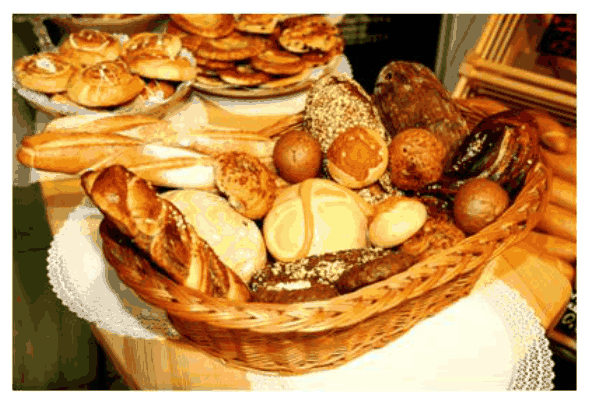
When you pass by the bakery, you are stopped by the smell of freshly baked bread. The hero of one of the novels said on a similar occasion: "If you tell me that this is not perfect, you are my enemy forever." The principle bread flavour component was identified in 1969 as compound X which occurs in equilibrium with its tautomer Y in a 2 : 1 ratio. Unfortunately, both forms are labile, and after some hours bread has no the same nice smell.
This tautomeric mixture of X and Y was synthesized in 1993 from piperidine by the reaction sequence given in Scheme 1. It is noteworthy that the initial ratio of X and Y was 1:4; on standing this ratio gradually changed to an equilibrium one.
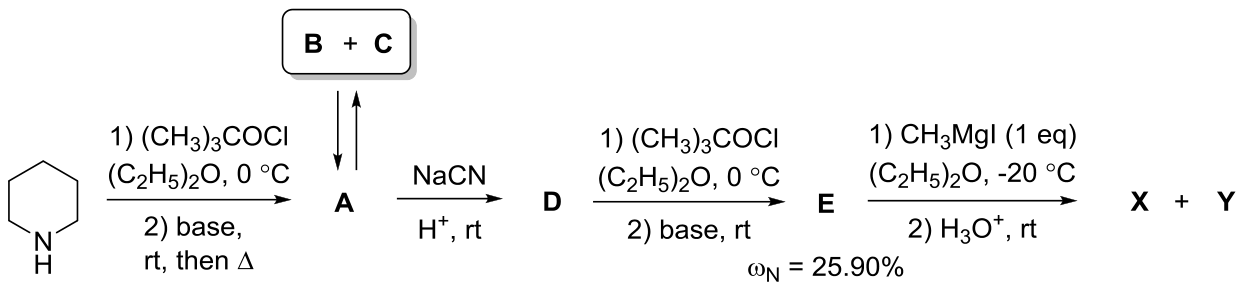
Scheme 1.
Compound B which is characterized by 3-fold axis of symmetry (i.e., rotation by \(120^\circ\) results in a molecule indistinguishable from the original) occurs in equilibrium with its diastereomer C. The interconversion of these two forms proceeds via intermediate A which is also intermediate in B and C formation as well as their transformation to D. Compounds A, B, and C have the same elemental composition: \(w_{\mathrm C}=72.24\%\), \(w_{\mathrm H}=10.91\%\), \(w_{\mathrm N}=16.85\%\).
6.1 Write down the structural formulae of compounds A - E, X, Y.
Treatment of compound E with \(\ce{CH3Li . LiBr}\) complex in \(\ce{(C2H5)2O}\) at \(0\,^\circ\mathrm C\) failed to produce the target products X and Y. Instead, a yellow precipitate F was initially formed. Aqueous workup of this precipitate led to the mixture of compound E and its tautomer G.
6.2 Write down the structural formulae of compounds F and G.
Another approach to compound X is based on the use of pipecolinic acid derivative H. It was shown that X can be synthesized by reaction sequence presented in Scheme 2.
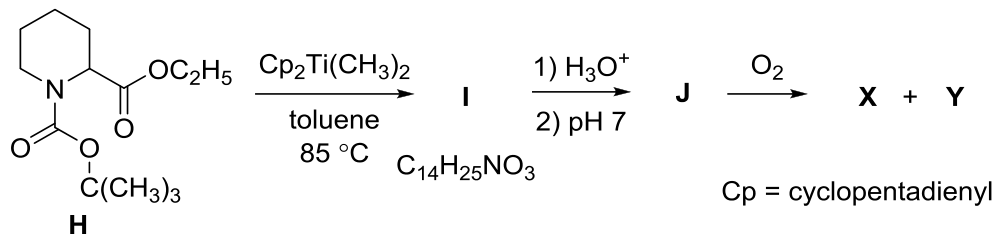
Scheme 2
6.3 Write down the structural formulae of compounds I and J.
Official English text of the problem.
Answers
- 6.1
| Compound | Name and structure |
|---|---|
| A | 1-Piperideine, or 3,4,5,6-tetrahydropyridine: N1=CCCCC1 |
| B | All-cis tripiperideine, the threefold-symmetric cyclic trimer of A: N12[C@H]3CCCCN3[C@H]4CCCCN4[C@H]1CCCC2 |
| C | Tripiperideine with one ring-junction hydrogen reversed, the diastereomer of B: N12[C@H]3CCCCN3[C@H]4CCCCN4[C@@H]1CCCC2 |
| D | Piperidine-2-carbonitrile: N#CC1CCCCN1 |
| E | 3,4,5,6-Tetrahydropyridine-2-carbonitrile: N#CC1=NCCCC1 |
| X | 2-Acetyl-1,4,5,6-tetrahydropyridine, the enamine tautomer: CC(=O)C1=CCCCN1 |
| Y | 2-Acetyl-3,4,5,6-tetrahydropyridine, the imine tautomer: CC(=O)C1=NCCCC1 |
- 6.2
| Compound | Name and structure |
|---|---|
| F | Lithium salt of 2-cyano-1,4,5,6-tetrahydropyridine, shown in its N-anion resonance form: [Li+].[N-]1C(C#N)=CCCC1 |
| G | 1,4,5,6-Tetrahydropyridine-2-carbonitrile: N#CC1=CCCCN1 |
- 6.3
| Compound | Name and structure |
|---|---|
| I | tert-Butyl 2-(1-ethoxyethenyl)piperidine-1-carboxylate: C=C(OCC)C1CCCCN1C(=O)OC(C)(C)C |
| J | 2-Acetylpiperidine, or 1-(piperidin-2-yl)ethan-1-one: CC(=O)C1CCCCN1 |
For B, the three ring-junction carbon-bound hydrogens are on the same face of the central ring. For C, two are on one face and the third is on the opposite face. The SMILES specify representative relative configurations.
D is obtained as a racemate. No absolute configuration is specified for the starting material H, so none is assigned to I or J.
Solution
6.1 — Identification of A–E, X and Y
First determine the empirical formula shared by A, B, and C. Using a \(100\,\mathrm g\) sample and conventional atomic molar masses,
\[ n_{\mathrm C}:n_{\mathrm H}:n_{\mathrm N} = \frac{72.24}{12.011}: \frac{10.91}{1.008}: \frac{16.85}{14.007} \approx 6.015:10.82:1.203 \approx 5:9:1. \]
Thus their common empirical formula is \(\ce{C5H9N}\).
Piperidine, N1CCCCC1, has formula \(\ce{C5H11N}\). Treatment with tert-butyl hypochlorite, CC(C)(C)OCl, first gives N-chloropiperidine, ClN1CCCCC1. Base-induced elimination then gives the cyclic imine A, with loss of two hydrogen atoms overall. A formal net equation is
\[ \ce{C5H11N + (CH3)3COCl -> C5H9N + (CH3)3COH + HCl}. \]
The base neutralizes the hydrogen chloride represented in this equation. Therefore A is 1-piperideine.
Its degree of unsaturation is
\[ \mathrm{DBE}=\frac{2(5)+2+1-9}{2}=2, \]
accounted for by one ring and one imine double bond.
Formation and stereochemistry of B and C. Three molecules of A undergo reversible cyclic trimerization:
\[ \ce{3 C5H9N <=> C15H27N3}. \]
The three imine double bonds become single bonds, and three new intermolecular carbon–nitrogen bonds close a central six-membered ring. Its atoms alternate between nitrogen and carbon. Each alternating N–CH edge is also part of a piperidine ring, completed by a four-methylene bridge.
This addition process changes the molecular formula but preserves the elemental percentages.
To draw the two products precisely:
- Draw the central ring with alternating N and CH atoms, and attach the three four-methylene bridges across alternating N–CH edges.
- For B, draw all three central C–H bonds as wedges. The three identical units are related by rotation through \(120^\circ\).
- For C, reverse one of those C–H bonds to a dashed bond. This gives the required diastereomer and removes the threefold symmetry.
The stereochemical SMILES in the answers encode these relative configurations; they do not prescribe a particular chair conformation.
Formation of D. Cyanide adds to the electrophilic carbon of the protonated imine A. Net addition of hydrogen cyanide across its imine bond gives piperidine-2-carbonitrile, D:
\[ \ce{C5H9N + HCN -> C6H10N2}. \]
Attack on either face of the planar imine gives racemic D. Consumption of A also draws B and C through their equilibria toward D.
Formation of E. Repeating the N-chlorination–elimination sequence on D removes the N–H hydrogen and the hydrogen on the carbon bearing the cyano group. The result is E, with an imine bond between N1 and C2:
\[ \ce{C6H10N2 + (CH3)3COCl -> C6H8N2 + (CH3)3COH + HCl}. \]
The formula \(\ce{C6H8N2}\) gives
\[ M_{\mathrm E} = 6(12.011)+8(1.008)+2(14.007) = 108.144\,\mathrm{g\,mol^{-1}}, \]
and therefore
\[ w_{\mathrm N} = \frac{28.014\,\mathrm{g\,mol^{-1}}} {108.144\,\mathrm{g\,mol^{-1}}} \times100\% = 25.90\%, \]
in agreement with Scheme 1.
Formation and assignment of X and Y. One equivalent of methylmagnesium iodide adds a methyl group to the nitrile carbon. Acidic hydrolysis converts the resulting nitrogen-containing group into an acetyl group. A balanced net equation for this addition and acidic workup is
\[ \ce{C6H8N2 + CH3MgI + H2O + 2H+ -> C7H11NO + NH4+ + Mg^2+ + I-}. \]
The immediate organic product retains the ring imine bond and is therefore Y, 2-acetyl-3,4,5,6-tetrahydropyridine.
Transfer of a proton from C3 to nitrogen, accompanied by movement of the double bond from N1–C2 to C2–C3, gives X, 2-acetyl-1,4,5,6-tetrahydropyridine. Both have formula \(\ce{C7H11NO}\).
The initially greater abundance of Y is consistent with its direct formation from E:
\[ (X:Y)_{\text{initial}}=1:4. \]
Subsequent imine–enamine equilibration increases the amount of X until
\[ (X:Y)_{\text{equilibrium}}=2:1. \]
6.2 — Identification of F and G
Methyllithium acts as a base toward E, removing a proton from C3, adjacent to the imine carbon:
\[ \ce{C6H8N2 + CH3Li -> LiC6H7N2 + CH4}. \]
The resulting anion is delocalized. Its C3-carbanion resonance contributor can be written as
[Li+].N1=C(C#N)[CH-]CCC1.
Moving the C3 lone pair into the C2–C3 bond and moving the imine \(\pi\)-electron pair onto nitrogen gives the N-anion representation of F:
[Li+].[N-]1C(C#N)=CCCC1.
Thus F is the lithium salt of the enamine tautomer G. The supplied \(\ce{LiBr}\) does not change this organic connectivity.
During aqueous workup, protonation can occur at either end of the delocalized anion:
- Protonation at C3 regenerates the imine E.
- Protonation at N1 gives the enamine G, 1,4,5,6-tetrahydropyridine-2-carbonitrile.
For either organic tautomer, the balanced formula-level workup is
\[ \ce{LiC6H7N2 + H2O -> C6H8N2 + LiOH}. \]
The ionic SMILES specifies the lithium salt’s composition and organic bonding. It does not specify lithium coordination or aggregation in the precipitate.
6.3 — Identification of I and J
The starting material H is ethyl N-Boc-pipecolinate:
CCOC(=O)C1CCCCN1C(=O)OC(C)(C)C.
The titanocene reagent in Scheme 2 performs Petasis methylenation of the side-chain ester carbonyl. It replaces that carbonyl oxygen with a terminal methylene group while retaining the ethoxy group on the same carbon.
Consequently, I contains the substituent
\[ \ce{-C(OC2H5)=CH2} \]
at C2 of the N-Boc-protected piperidine ring. It is tert-butyl 2-(1-ethoxyethenyl)piperidine-1-carboxylate.
The formula provides an independent check: replacing one oxygen of H, \(\ce{C13H23NO4}\), by \(\ce{CH2}\) gives exactly the stated formula
\[ \boxed{\ce{C14H25NO3}}. \]
Acid treatment has two consequences:
- Hydrolysis of the enol ether produces the methyl ketone.
- Removal of the Boc protecting group exposes the secondary amine.
After the stated pH adjustment, the resulting structure is J, 2-acetylpiperidine.
A balanced net equation for hydrolysis and Boc removal, representing the final organic product as its free base, is
\[ \ce{C14H25NO3 + H2O -> C7H13NO + C2H5OH + CO2 + C4H8}. \]
The carbon-containing by-products are ethanol, CCO; carbon dioxide, O=C=O; and 2-methylpropene, C=C(C)C.
Finally, oxygen oxidizes the secondary amino ketone J to the ring imine Y by removing the N–H hydrogen and the C2 hydrogen. The balanced substrate oxidation half-reaction is
\[ \ce{C7H13NO -> C7H11NO + 2H+ + 2e-}. \]
The resulting Y undergoes the imine–enamine tautomerization established in part 6.1, giving the mixture of X and Y.
The answers were checked against the official answers published by the organisers.
IChO 2015 · Theorieaufgabe 6
Brot ist der Stoff des Lebens
Wenn Sie an einer Bäckerei vorbeigehen, lässt Sie der Duft von frisch gebackenem Brot innehalten. Der Held eines Romans sagte bei einer ähnlichen Gelegenheit: „Wenn du mir sagst, dass das nicht vollkommen ist, bist du für immer mein Feind.“ Die Hauptkomponente des Brotaromas wurde 1969 als Verbindung X identifiziert, die mit ihrem Tautomer Y im Verhältnis 2 : 1 im Gleichgewicht vorliegt. Leider sind beide Formen labil, und nach einigen Stunden hat Brot nicht mehr denselben angenehmen Duft.
Dieses Tautomerengemisch aus X und Y wurde 1993 aus Piperidin über die in Schema 1 angegebene Reaktionsfolge synthetisiert. Bemerkenswert ist, dass das anfängliche Verhältnis von X zu Y 1:4 betrug; beim Stehenlassen stellte sich allmählich das Gleichgewichtsverhältnis ein.
Schema 1.
Verbindung B, die eine dreizählige Symmetrieachse besitzt (d. h., eine Drehung um \(120^\circ\) ergibt ein Molekül, das vom ursprünglichen nicht zu unterscheiden ist), liegt mit ihrem Diastereomer C im Gleichgewicht vor. Die gegenseitige Umwandlung dieser beiden Formen erfolgt über das Zwischenprodukt A, das auch bei der Bildung von B und C sowie bei deren Umwandlung in D als Zwischenprodukt auftritt. Die Verbindungen A, B und C haben dieselbe elementare Zusammensetzung: \(w_{\mathrm C}=72.24\%\), \(w_{\mathrm H}=10.91\%\), \(w_{\mathrm N}=16.85\%\).
6.1 Geben Sie die Strukturformeln der Verbindungen A - E, X, Y an.
Bei der Behandlung von Verbindung E mit dem Komplex \(\ce{CH3Li . LiBr}\) in \(\ce{(C2H5)2O}\) bei \(0\,^\circ\mathrm C\) wurden die Zielprodukte X und Y nicht erhalten. Stattdessen bildete sich zunächst ein gelber Niederschlag F. Die wässrige Aufarbeitung dieses Niederschlags führte zu einem Gemisch aus Verbindung E und ihrem Tautomer G.
6.2 Geben Sie die Strukturformeln der Verbindungen F und G an.
Ein weiterer Zugang zu Verbindung X beruht auf der Verwendung des Pipecolinsäurederivats H. Es wurde gezeigt, dass X über die in Schema 2 dargestellte Reaktionsfolge synthetisiert werden kann.
Schema 2
6.3 Geben Sie die Strukturformeln der Verbindungen I und J an.
Aufgabentext aus dem offiziellen englischen Text übersetzt.
Antworten
- 6.1
| Verbindung | Name und Struktur |
|---|---|
| A | 1-Piperidein, oder 3,4,5,6-Tetrahydropyridin: N1=CCCCC1 |
| B | All-cis-Tripiperidein, das dreizählig symmetrische cyclische Trimer von A: N12[C@H]3CCCCN3[C@H]4CCCCN4[C@H]1CCCC2 |
| C | Tripiperidein mit umgekehrter Orientierung eines Wasserstoffatoms an einer Ringverknüpfung, das Diastereomer von B: N12[C@H]3CCCCN3[C@H]4CCCCN4[C@@H]1CCCC2 |
| D | Piperidin-2-carbonitril: N#CC1CCCCN1 |
| E | 3,4,5,6-Tetrahydropyridin-2-carbonitril: N#CC1=NCCCC1 |
| X | 2-Acetyl-1,4,5,6-tetrahydropyridin, das Enamin-Tautomer: CC(=O)C1=CCCCN1 |
| Y | 2-Acetyl-3,4,5,6-tetrahydropyridin, das Imin-Tautomer: CC(=O)C1=NCCCC1 |
- 6.2
| Verbindung | Name und Struktur |
|---|---|
| F | Lithiumsalz von 2-Cyan-1,4,5,6-tetrahydropyridin, dargestellt als mesomere Grenzstruktur mit N-Anion: [Li+].[N-]1C(C#N)=CCCC1 |
| G | 1,4,5,6-Tetrahydropyridin-2-carbonitril: N#CC1=CCCCN1 |
- 6.3
| Verbindung | Name und Struktur |
|---|---|
| I | tert-Butyl-2-(1-ethoxyethenyl)piperidin-1-carboxylat: C=C(OCC)C1CCCCN1C(=O)OC(C)(C)C |
| J | 2-Acetylpiperidin, oder 1-(Piperidin-2-yl)ethan-1-on: CC(=O)C1CCCCN1 |
Bei B befinden sich die drei an Kohlenstoff gebundenen Wasserstoffatome an den Ringverknüpfungen auf derselben Seite des zentralen Rings. Bei C befinden sich zwei auf einer Seite und das dritte auf der gegenüberliegenden Seite. Die SMILES geben repräsentative relative Konfigurationen an.
D wird als Racemat erhalten. Für den Ausgangsstoff H ist keine absolute Konfiguration angegeben, daher wird auch I oder J keine zugeordnet.
Lösung
6.1 — Identifizierung von A–E, X und Y
Zunächst wird die gemeinsame Verhältnisformel von A, B und C bestimmt. Für eine Probe von \(100\,\mathrm g\) und unter Verwendung der üblichen molaren Atommassen ergibt sich
\[ n_{\mathrm C}:n_{\mathrm H}:n_{\mathrm N} = \frac{72.24}{12.011}: \frac{10.91}{1.008}: \frac{16.85}{14.007} \approx 6.015:10.82:1.203 \approx 5:9:1. \]
Ihre gemeinsame Verhältnisformel lautet somit \(\ce{C5H9N}\).
Piperidin, N1CCCCC1, hat die Formel \(\ce{C5H11N}\). Die Behandlung mit tert-Butylhypochlorit, CC(C)(C)OCl, ergibt zunächst N-Chlorpiperidin, ClN1CCCCC1. Eine baseninduzierte Eliminierung liefert anschließend das cyclische Imin A, wobei insgesamt zwei Wasserstoffatome abgespalten werden. Eine formale Nettogleichung lautet
\[ \ce{C5H11N + (CH3)3COCl -> C5H9N + (CH3)3COH + HCl}. \]
Die Base neutralisiert den in dieser Gleichung dargestellten Chlorwasserstoff. Somit ist A 1-Piperidein.
Sein Doppelbindungsäquivalent beträgt
\[ \mathrm{DBE}=\frac{2(5)+2+1-9}{2}=2, \]
was einem Ring und einer Imin-Doppelbindung entspricht.
Bildung und Stereochemie von B und C. Drei Moleküle A gehen eine reversible cyclische Trimerisierung ein:
\[ \ce{3 C5H9N <=> C15H27N3}. \]
Die drei Imin-Doppelbindungen werden zu Einfachbindungen, und drei neue intermolekulare Kohlenstoff–Stickstoff-Bindungen schließen einen zentralen sechsgliedrigen Ring. Seine Atome sind abwechselnd Stickstoff- und Kohlenstoffatome. Jede der alternierenden N–CH-Kanten ist zugleich Teil eines Piperidinrings, der durch eine Brücke aus vier Methylengruppen vervollständigt wird.
Dieser Additionsprozess verändert die Summenformel, erhält jedoch die prozentuale elementare Zusammensetzung.
So lassen sich die beiden Produkte präzise zeichnen:
- Zeichnen Sie den zentralen Ring mit abwechselnden N- und CH-Atomen und fügen Sie die drei Brücken aus jeweils vier Methylengruppen über alternierende N–CH-Kanten hinzu.
- Zeichnen Sie für B alle drei zentralen C–H-Bindungen als Keile. Die drei identischen Einheiten gehen durch eine Drehung um \(120^\circ\) ineinander über.
- Kehren Sie für C eine dieser C–H-Bindungen um, indem Sie sie als gestrichelten Keil zeichnen. Dadurch entsteht das gesuchte Diastereomer, und die dreizählige Symmetrie geht verloren.
Die stereochemischen SMILES in den Antworten codieren diese relativen Konfigurationen; sie legen keine bestimmte Sesselkonformation fest.
Bildung von D. Cyanid addiert an das elektrophile Kohlenstoffatom des protonierten Imins A. Die Nettoaddition von Cyanwasserstoff an dessen Iminbindung ergibt Piperidin-2-carbonitril, D:
\[ \ce{C5H9N + HCN -> C6H10N2}. \]
Der Angriff auf beide Seiten des planaren Imins führt zu racemischem D. Der Verbrauch von A verschiebt auch die Gleichgewichte von B und C in Richtung D.
Bildung von E. Die Wiederholung der N-Chlorierungs–Eliminierungs-Sequenz an D entfernt das N–H-Wasserstoffatom und das Wasserstoffatom am Kohlenstoffatom, das die Cyangruppe trägt. Es entsteht E mit einer Iminbindung zwischen N1 und C2:
\[ \ce{C6H10N2 + (CH3)3COCl -> C6H8N2 + (CH3)3COH + HCl}. \]
Aus der Formel \(\ce{C6H8N2}\) ergibt sich
\[ M_{\mathrm E} = 6(12.011)+8(1.008)+2(14.007) = 108.144\,\mathrm{g\,mol^{-1}}, \]
und damit
\[ w_{\mathrm N} = \frac{28.014\,\mathrm{g\,mol^{-1}}} {108.144\,\mathrm{g\,mol^{-1}}} \times100\% = 25.90\%, \]
in Übereinstimmung mit Schema 1.
Bildung und Zuordnung von X und Y. Ein Äquivalent Methylmagnesiumiodid addiert eine Methylgruppe an das Nitril-Kohlenstoffatom. Durch saure Hydrolyse wird die entstandene stickstoffhaltige Gruppe in eine Acetylgruppe umgewandelt. Eine ausgeglichene Nettogleichung für diese Addition und die saure Aufarbeitung lautet
\[ \ce{C6H8N2 + CH3MgI + H2O + 2H+ -> C7H11NO + NH4+ + Mg^2+ + I-}. \]
Das unmittelbar entstehende organische Produkt behält die Iminbindung im Ring bei und ist daher Y, 2-Acetyl-3,4,5,6-tetrahydropyridin.
Die Übertragung eines Protons von C3 auf Stickstoff, begleitet von einer Verschiebung der Doppelbindung von N1–C2 nach C2–C3, ergibt X, 2-Acetyl-1,4,5,6-tetrahydropyridin. Beide haben die Formel \(\ce{C7H11NO}\).
Der anfänglich höhere Anteil von Y steht im Einklang mit seiner direkten Bildung aus E:
\[ (X:Y)_{\text{anfänglich}}=1:4. \]
Durch die anschließende Einstellung des Imin–Enamin-Gleichgewichts nimmt der Anteil von X zu, bis folgendes Verhältnis erreicht ist:
\[ (X:Y)_{\text{Gleichgewicht}}=2:1. \]
6.2 — Identifizierung von F und G
Methyllithium wirkt gegenüber E als Base und entfernt ein Proton von C3, dem dem Imin-Kohlenstoffatom benachbarten Kohlenstoffatom:
\[ \ce{C6H8N2 + CH3Li -> LiC6H7N2 + CH4}. \]
Das entstehende Anion ist delokalisiert. Seine mesomere Grenzstruktur mit einem Carbanion an C3 lässt sich wie folgt schreiben:
[Li+].N1=C(C#N)[CH-]CCC1.
Durch Verschiebung des freien Elektronenpaars an C3 in die C2–C3-Bindung und des \(\pi\)-Elektronenpaars der Iminbindung auf den Stickstoff erhält man die Darstellung von F als N-Anion:
[Li+].[N-]1C(C#N)=CCCC1.
Somit ist F das Lithiumsalz des Enamin-Tautomers G. Das zugesetzte \(\ce{LiBr}\) verändert diese organische Bindungsverknüpfung nicht.
Bei der wässrigen Aufarbeitung kann die Protonierung an beiden Enden des delokalisierten Anions erfolgen:
- Die Protonierung an C3 bildet das Imin E zurück.
- Die Protonierung an N1 ergibt das Enamin G, 1,4,5,6-Tetrahydropyridin-2-carbonitril.
Für beide organischen Tautomere lautet die ausgeglichene Gleichung der Aufarbeitung auf Summenformelebene
\[ \ce{LiC6H7N2 + H2O -> C6H8N2 + LiOH}. \]
Der ionische SMILES gibt die Zusammensetzung des Lithiumsalzes und die Bindungsverhältnisse im organischen Anteil an. Er legt weder die Koordination des Lithiums noch die Aggregation im Niederschlag fest.
6.3 — Identifizierung von I und J
Der Ausgangsstoff H ist N-Boc-Pipecolinsäureethylester:
CCOC(=O)C1CCCCN1C(=O)OC(C)(C)C.
Das Titanocenreagenz in Schema 2 bewirkt eine Petasis-Methylenierung der Ester-Carbonylgruppe in der Seitenkette. Es ersetzt deren Carbonylsauerstoff durch eine endständige Methylengruppe, wobei die Ethoxygruppe am selben Kohlenstoffatom erhalten bleibt.
Folglich enthält I den Substituenten
\[ \ce{-C(OC2H5)=CH2} \]
an C2 des N-Boc-geschützten Piperidinrings. Es handelt sich um tert-Butyl-2-(1-ethoxyethenyl)piperidin-1-carboxylat.
Die Summenformel ermöglicht eine unabhängige Überprüfung: Der Ersatz eines Sauerstoffatoms von H, \(\ce{C13H23NO4}\), durch \(\ce{CH2}\) ergibt genau die angegebene Formel
\[ \boxed{\ce{C14H25NO3}}. \]
Die Säurebehandlung hat zwei Folgen:
- Die Hydrolyse des Enolethers liefert das Methylketon.
- Die Abspaltung der Boc-Schutzgruppe setzt das sekundäre Amin frei.
Nach der angegebenen Einstellung des pH-Werts liegt die entstandene Struktur als J, 2-Acetylpiperidin, vor.
Eine ausgeglichene Nettogleichung für die Hydrolyse und die Boc-Abspaltung, in der das organische Endprodukt als freie Base dargestellt ist, lautet
\[ \ce{C14H25NO3 + H2O -> C7H13NO + C2H5OH + CO2 + C4H8}. \]
Die kohlenstoffhaltigen Nebenprodukte sind Ethanol, CCO; Kohlenstoffdioxid, O=C=O; und 2-Methylpropen, C=C(C)C.
Schließlich oxidiert Sauerstoff das sekundäre Aminoketon J zum cyclischen Imin Y, indem das N–H-Wasserstoffatom und das Wasserstoffatom an C2 entfernt werden. Die ausgeglichene Oxidationshalbreaktion des Substrats lautet
\[ \ce{C7H13NO -> C7H11NO + 2H+ + 2e-}. \]
Das entstandene Y durchläuft die in Teil 6.1 beschriebene Imin–Enamin-Tautomerisierung und liefert das Gemisch aus X und Y.
Die Ergebnisse wurden mit den von den Veranstaltern veröffentlichten offiziellen Ergebnissen abgeglichen.
IChO 2015 · Teori sorusu 6
Ekmek hayatın özüdür
Fırının önünden geçerken taze pişmiş ekmek kokusu sizi durdurur. Bir romanın kahramanı, benzer bir durumda şöyle demiştir: "Bana bunun mükemmel olmadığını söylersen, sonsuza dek düşmanımsın." Ekmeğin başlıca aroma bileşeninin, tautomeri Y ile 2 : 1 oranında dengede bulunan X bileşiği olduğu 1969 yılında belirlenmiştir. Ne yazık ki her iki form da kararsızdır ve birkaç saat sonra ekmek aynı güzel kokuyu taşımaz.
X ve Y'nin bu tautomerik karışımı, 1993 yılında Şema 1'de verilen tepkime dizisiyle piperidinden sentezlenmiştir. X ve Y'nin başlangıçtaki oranının 1:4 olması dikkat çekicidir; bekletildiğinde bu oran yavaş yavaş denge oranına dönüşmüştür.
Şema 1.
Üç katlı simetri eksenine sahip olan (yani, \(120^\circ\) döndürüldüğünde başlangıçtaki molekülden ayırt edilemeyen bir molekül veren) B bileşiği, diastereomeri C ile dengede bulunur. Bu iki formun birbirine dönüşümü, hem B ve C'nin oluşumunda hem de bunların D'ye dönüşümünde de ara ürün olan A ara ürünü üzerinden gerçekleşir. A, B ve C bileşikleri aynı elementel bileşime sahiptir: \(w_{\mathrm C}=72.24\%\), \(w_{\mathrm H}=10.91\%\), \(w_{\mathrm N}=16.85\%\).
6.1 A - E, X, Y bileşiklerinin yapı formüllerini yazınız.
E bileşiğinin \(\ce{(C2H5)2O}\) içinde \(0\,^\circ\mathrm C\)'de \(\ce{CH3Li . LiBr}\) kompleksiyle tepkimeye sokulması, hedef ürünler X ve Y'yi vermemiştir. Bunun yerine, başlangıçta sarı bir F çökeleği oluşmuştur. Bu çökeleğin sulu ortamda işlenmesi, E bileşiği ile tautomeri G'nin karışımını vermiştir.
6.2 F ve G bileşiklerinin yapı formüllerini yazınız.
X bileşiğine yönelik başka bir yaklaşım, pipekolinik asit türevi H'nin kullanımına dayanır. X'in Şema 2'de sunulan tepkime dizisiyle sentezlenebileceği gösterilmiştir.
Şema 2
6.3 I ve J bileşiklerinin yapı formüllerini yazınız.
Soru metni resmi İngilizce metinden çevrilmiştir.
Cevaplar
- 6.1
| Bileşik | Adı ve yapısı |
|---|---|
| A | 1-Piperidein veya 3,4,5,6-tetrahidropiridin: N1=CCCCC1 |
| B | Tümü cis tripiperidein, A'nın üç katlı simetriye sahip halkalı trimeri: N12[C@H]3CCCCN3[C@H]4CCCCN4[C@H]1CCCC2 |
| C | Halka birleşim noktalarındaki hidrojenlerden birinin yönü ters çevrilmiş tripiperidein, B'nin diastereomeri: N12[C@H]3CCCCN3[C@H]4CCCCN4[C@@H]1CCCC2 |
| D | Piperidin-2-karbonitril: N#CC1CCCCN1 |
| E | 3,4,5,6-Tetrahidropiridin-2-karbonitril: N#CC1=NCCCC1 |
| X | 2-Asetil-1,4,5,6-tetrahidropiridin, enamin tautomeri: CC(=O)C1=CCCCN1 |
| Y | 2-Asetil-3,4,5,6-tetrahidropiridin, imin tautomeri: CC(=O)C1=NCCCC1 |
- 6.2
| Bileşik | Adı ve yapısı |
|---|---|
| F | N-anyon rezonans formunda gösterilen 2-siyano-1,4,5,6-tetrahidropiridinin lityum tuzu: [Li+].[N-]1C(C#N)=CCCC1 |
| G | 1,4,5,6-Tetrahidropiridin-2-karbonitril: N#CC1=CCCCN1 |
- 6.3
| Bileşik | Adı ve yapısı |
|---|---|
| I | tert-Bütil 2-(1-etoksietenil)piperidin-1-karboksilat: C=C(OCC)C1CCCCN1C(=O)OC(C)(C)C |
| J | 2-Asetilpiperidin veya 1-(piperidin-2-il)etan-1-on: CC(=O)C1CCCCN1 |
B'de, halka birleşim noktalarındaki karbonlara bağlı üç hidrojen, merkezdeki halkanın aynı yüzündedir. C'de ise ikisi bir yüzde, üçüncüsü karşı yüzdedir. SMILES gösterimleri, temsili bağıl konfigürasyonları belirtir.
D, rasemat olarak elde edilir. Başlangıç maddesi H için mutlak konfigürasyon belirtilmediğinden, I veya J için de mutlak konfigürasyon atanmamıştır.
Çözüm
6.1 — A–E, X ve Y'nin belirlenmesi
Önce A, B ve C'nin ortak basit formülünü belirleyelim. \(100\,\mathrm g\)'lık bir örnek ve yaygın olarak kullanılan atomik molar kütleler kullanıldığında,
\[ n_{\mathrm C}:n_{\mathrm H}:n_{\mathrm N} = \frac{72.24}{12.011}: \frac{10.91}{1.008}: \frac{16.85}{14.007} \approx 6.015:10.82:1.203 \approx 5:9:1. \]
Dolayısıyla ortak basit formülleri \(\ce{C5H9N}\)'dir.
Piperidin, N1CCCCC1, \(\ce{C5H11N}\) formülüne sahiptir. tert-Bütil hipoklorit, CC(C)(C)OCl, ile tepkimeye sokulduğunda önce N-kloropiperidin, ClN1CCCCC1, oluşur. Ardından baz etkisiyle gerçekleşen eliminasyon, toplamda iki hidrojen atomunun kaybıyla halkalı imin A'yı verir. Biçimsel net denklem şöyledir:
\[ \ce{C5H11N + (CH3)3COCl -> C5H9N + (CH3)3COH + HCl}. \]
Baz, bu denklemde gösterilen hidrojen klorürü nötrleştirir. Bu nedenle A, 1-piperideindir.
Doymamışlık derecesi
\[ \mathrm{DBE}=\frac{2(5)+2+1-9}{2}=2, \]
olup bir halka ve bir imin çift bağından kaynaklanır.
B ve C'nin oluşumu ve stereokimyası. Üç A molekülü, tersinir halkalı trimerleşmeye uğrar:
\[ \ce{3 C5H9N <=> C15H27N3}. \]
Üç imin çift bağı tek bağa dönüşür ve moleküller arasında oluşan üç yeni karbon–azot bağı, merkezde altı üyeli bir halkayı kapatır. Bu halkanın atomları dönüşümlü olarak azot ve karbondur. Birer atlayarak seçilen N–CH kenarlarının her biri, aynı zamanda dört metilen grubundan oluşan bir köprüyle tamamlanan bir piperidin halkasının da parçasıdır.
Bu katılma süreci molekül formülünü değiştirir, ancak elementlerin yüzde oranlarını korur.
İki ürünü tam olarak çizmek için:
- Merkezdeki halkayı dönüşümlü N ve CH atomlarıyla çiziniz ve birer atlayarak seçilen N–CH kenarları arasına, her biri dört metilen grubundan oluşan üç köprüyü ekleyiniz.
- B için merkezdeki üç C–H bağının tümünü dolu kama bağlar olarak çiziniz. Üç özdeş birim, \(120^\circ\)'lik dönmeyle birbirine dönüşür.
- C için bu C–H bağlarından birini kesikli bağa çevirerek yönünü tersine döndürünüz. Bu, istenen diastereomeri verir ve üç katlı simetriyi ortadan kaldırır.
Cevaplardaki stereokimyasal SMILES gösterimleri bu bağıl konfigürasyonları kodlar; belirli bir sandalye konformasyonunu zorunlu kılmaz.
D'nin oluşumu. Siyanür, protonlanmış imin A'nın elektrofilik karbonuna katılır. İmin bağına net hidrojen siyanür katılması, piperidin-2-karbonitril, D'yi verir:
\[ \ce{C5H9N + HCN -> C6H10N2}. \]
Düzlemsel iminin her iki yüzünden de saldırı gerçekleşebilmesi, rasemik D'yi verir. A'nın tüketilmesi, B ve C'yi de dengeleri üzerinden D oluşumu yönüne çeker.
E'nin oluşumu. N-klorlama–eliminasyon dizisinin D üzerinde tekrarlanması, N–H hidrojenini ve siyano grubunu taşıyan karbondaki hidrojeni uzaklaştırır. Sonuçta N1 ile C2 arasında imin bağı bulunan E oluşur:
\[ \ce{C6H10N2 + (CH3)3COCl -> C6H8N2 + (CH3)3COH + HCl}. \]
\(\ce{C6H8N2}\) formülünden
\[ M_{\mathrm E} = 6(12.011)+8(1.008)+2(14.007) = 108.144\,\mathrm{g\,mol^{-1}}, \]
ve dolayısıyla
\[ w_{\mathrm N} = \frac{28.014\,\mathrm{g\,mol^{-1}}} {108.144\,\mathrm{g\,mol^{-1}}} \times100\% = 25.90\%, \]
elde edilir; bu değer Şema 1 ile uyumludur.
X ve Y'nin oluşumu ve yapı ataması. Bir eşdeğer metilmagnezyum iyodür, nitril karbonuna bir metil grubu katar. Asidik hidroliz, oluşan azot içeren grubu asetil grubuna dönüştürür. Bu katılma ve asidik ortamda işleme için denkleştirilmiş net denklem şöyledir:
\[ \ce{C6H8N2 + CH3MgI + H2O + 2H+ -> C7H11NO + NH4+ + Mg^2+ + I-}. \]
İlk oluşan organik ürün, halkadaki imin bağını korur ve dolayısıyla Y, 2-asetil-3,4,5,6-tetrahidropiridindir.
C3'ten azota bir proton aktarılması ve buna eşlik eden çift bağın N1–C2'den C2–C3'e kayması, X, 2-asetil-1,4,5,6-tetrahidropiridini verir. Her ikisinin de formülü \(\ce{C7H11NO}\)'dur.
Başlangıçta Y'nin daha fazla bulunması, doğrudan E'den oluşmasıyla uyumludur:
\[ (X:Y)_{\text{başlangıç}}=1:4. \]
Daha sonra imin–enamin dengesinin kurulması, X miktarını aşağıdaki orana ulaşılıncaya kadar artırır:
\[ (X:Y)_{\text{denge}}=2:1. \]
6.2 — F ve G'nin belirlenmesi
Metillityum, E'ye karşı baz olarak davranır ve imin karbonuna komşu C3'ten bir proton koparır:
\[ \ce{C6H8N2 + CH3Li -> LiC6H7N2 + CH4}. \]
Oluşan anyon delokalizedir. C3-karbanyon rezonans katkı yapısı şöyle yazılabilir:
[Li+].N1=C(C#N)[CH-]CCC1.
C3 üzerindeki ortaklanmamış elektron çiftinin C2–C3 bağına, imin \(\pi\)-elektron çiftinin ise azot üzerine kaydırılması, F'nin N-anyon gösterimini verir:
[Li+].[N-]1C(C#N)=CCCC1.
Dolayısıyla F, enamin tautomeri G'nin lityum tuzudur. Ortama eklenen \(\ce{LiBr}\), bu organik yapıdaki atomların bağlanma düzenini değiştirmez.
Sulu ortamda işleme sırasında, delokalize anyonun her iki ucunda da protonlanma gerçekleşebilir:
- C3'te protonlanma, imin E'yi yeniden oluşturur.
- N1'de protonlanma, enamin G, 1,4,5,6-tetrahidropiridin-2-karbonitrili verir.
Her iki organik tautomer için de işleme basamağının formüller düzeyindeki denkleştirilmiş tepkimesi şöyledir:
\[ \ce{LiC6H7N2 + H2O -> C6H8N2 + LiOH}. \]
İyonik SMILES gösterimi, lityum tuzunun bileşimini ve organik yapıdaki bağları belirtir. Çökelekteki lityumun koordinasyonunu veya agregasyonunu belirtmez.
6.3 — I ve J'nin belirlenmesi
Başlangıç maddesi H, etil N-Boc-pipekolinattır:
CCOC(=O)C1CCCCN1C(=O)OC(C)(C)C.
Şema 2'deki titanosen reaktifi, yan zincirdeki ester karbonilinin Petasis metilenasyonunu gerçekleştirir. Aynı karbon üzerindeki etoksi grubunu korurken karbonil oksijenini uç metilen grubuyla değiştirir.
Sonuç olarak I, N-Boc ile korunmuş piperidin halkasının C2 konumunda
\[ \ce{-C(OC2H5)=CH2} \]
sübstitüentini içerir. Bu bileşik, tert-bütil 2-(1-etoksietenil)piperidin-1-karboksilattır.
Formül, bağımsız bir kontrol sağlar: H'nin, \(\ce{C13H23NO4}\), bir oksijeninin \(\ce{CH2}\) ile değiştirilmesi, tam olarak belirtilen formülü verir:
\[ \boxed{\ce{C14H25NO3}}. \]
Asitle işlemin iki sonucu vardır:
- Enol eterin hidrolizi metil ketonu oluşturur.
- Boc koruyucu grubunun uzaklaştırılması sekonder amini açığa çıkarır.
Belirtilen pH ayarlamasından sonra oluşan yapı J, 2-asetilpiperidindir.
Son organik ürünün serbest baz olarak gösterildiği, hidroliz ve Boc grubunun uzaklaştırılması için denkleştirilmiş net denklem şöyledir:
\[ \ce{C14H25NO3 + H2O -> C7H13NO + C2H5OH + CO2 + C4H8}. \]
Karbon içeren yan ürünler etanol, CCO; karbon dioksit, O=C=O; ve 2-metilpropen, C=C(C)C'dir.
Son olarak oksijen, N–H hidrojenini ve C2 hidrojenini uzaklaştırarak sekonder amino keton J'yi halkalı imin Y'ye yükseltger. Substratın denkleştirilmiş yükseltgenme yarı tepkimesi şöyledir:
\[ \ce{C7H13NO -> C7H11NO + 2H+ + 2e-}. \]
Oluşan Y, 6.1 kısmında ortaya konan imin–enamin tautomerleşmesine uğrayarak X ve Y karışımını verir.
Sonuçlar, düzenleyicilerin yayımladığı resmi sonuçlarla karşılaştırılarak kontrol edildi.
IChO 2015 · Problema teórico 6
El pan es el sustento de la vida
Al pasar por la panadería, le detiene el olor a pan recién horneado. El protagonista de una novela dijo en una ocasión similar: «Si me dices que esto no es perfecto, eres mi enemigo para siempre». El principal componente del aroma del pan se identificó en 1969 como el compuesto X, que se encuentra en equilibrio con su tautómero Y en una proporción de 2 : 1. Desafortunadamente, ambas formas son lábiles y, al cabo de unas horas, el pan ya no tiene el mismo olor agradable.
Esta mezcla tautomérica de X e Y se sintetizó en 1993 a partir de piperidina mediante la secuencia de reacciones que se muestra en el Esquema 1. Cabe destacar que la proporción inicial de X e Y era de 1:4; al dejar reposar la mezcla, esta proporción cambió gradualmente hasta alcanzar la de equilibrio.
Esquema 1.
El compuesto B, que se caracteriza por un eje de simetría de orden 3 (es decir, una rotación de \(120^\circ\) da lugar a una molécula indistinguible de la original), se encuentra en equilibrio con su diastereómero C. La interconversión de estas dos formas transcurre a través del intermedio A, que también es un intermedio en la formación de B y C, así como en su transformación en D. Los compuestos A, B y C tienen la misma composición elemental: \(w_{\mathrm C}=72.24\%\), \(w_{\mathrm H}=10.91\%\), \(w_{\mathrm N}=16.85\%\).
6.1 Escriba las fórmulas estructurales de los compuestos A - E, X, Y.
El tratamiento del compuesto E con el complejo \(\ce{CH3Li . LiBr}\) en \(\ce{(C2H5)2O}\) a \(0\,^\circ\mathrm C\) no produjo los productos deseados X e Y. En su lugar, se formó inicialmente un precipitado amarillo F. El tratamiento acuoso de este precipitado dio lugar a una mezcla del compuesto E y su tautómero G.
6.2 Escriba las fórmulas estructurales de los compuestos F y G.
Otra vía de obtención del compuesto X se basa en el uso del derivado del ácido pipecólico H. Se demostró que X puede sintetizarse mediante la secuencia de reacciones presentada en el Esquema 2.
Esquema 2
6.3 Escriba las fórmulas estructurales de los compuestos I y J.
Enunciado traducido del texto oficial en inglés.
Respuestas
- 6.1
| Compuesto | Nombre y estructura |
|---|---|
| A | 1-Piperideína, o 3,4,5,6-tetrahidropiridina: N1=CCCCC1 |
| B | Tripiperideína todo-cis, el trímero cíclico de A con simetría de orden tres: N12[C@H]3CCCCN3[C@H]4CCCCN4[C@H]1CCCC2 |
| C | Tripiperideína con un hidrógeno de unión de anillos invertido, el diastereómero de B: N12[C@H]3CCCCN3[C@H]4CCCCN4[C@@H]1CCCC2 |
| D | Piperidina-2-carbonitrilo: N#CC1CCCCN1 |
| E | 3,4,5,6-Tetrahidropiridina-2-carbonitrilo: N#CC1=NCCCC1 |
| X | 2-Acetil-1,4,5,6-tetrahidropiridina, el tautómero enamínico: CC(=O)C1=CCCCN1 |
| Y | 2-Acetil-3,4,5,6-tetrahidropiridina, el tautómero imínico: CC(=O)C1=NCCCC1 |
- 6.2
| Compuesto | Nombre y estructura |
|---|---|
| F | Sal de litio de la 2-ciano-1,4,5,6-tetrahidropiridina, representada en su forma resonante con el anión en N: [Li+].[N-]1C(C#N)=CCCC1 |
| G | 1,4,5,6-Tetrahidropiridina-2-carbonitrilo: N#CC1=CCCCN1 |
- 6.3
| Compuesto | Nombre y estructura |
|---|---|
| I | 2-(1-Etoxietenil)piperidina-1-carboxilato de terc-butilo: C=C(OCC)C1CCCCN1C(=O)OC(C)(C)C |
| J | 2-Acetilpiperidina, o 1-(piperidin-2-il)etan-1-ona: CC(=O)C1CCCCN1 |
En B, los tres hidrógenos unidos a los carbonos de unión de anillos se encuentran en la misma cara del anillo central. En C, dos están en una cara y el tercero en la cara opuesta. Los SMILES especifican configuraciones relativas representativas.
D se obtiene como racemato. No se especifica ninguna configuración absoluta para el material de partida H, por lo que tampoco se asigna ninguna a I ni a J.
Solución
6.1 — Identificación de A–E, X e Y
Primero se determina la fórmula empírica común a A, B y C. Utilizando una muestra de \(100\,\mathrm g\) y las masas molares atómicas convencionales,
\[ n_{\mathrm C}:n_{\mathrm H}:n_{\mathrm N} = \frac{72.24}{12.011}: \frac{10.91}{1.008}: \frac{16.85}{14.007} \approx 6.015:10.82:1.203 \approx 5:9:1. \]
Por tanto, su fórmula empírica común es \(\ce{C5H9N}\).
La piperidina, N1CCCCC1, tiene la fórmula \(\ce{C5H11N}\). El tratamiento con hipoclorito de terc-butilo, CC(C)(C)OCl, produce primero N-cloropiperidina, ClN1CCCCC1. A continuación, la eliminación inducida por una base da lugar a la imina cíclica A, con la pérdida global de dos átomos de hidrógeno. Una ecuación neta formal es
\[ \ce{C5H11N + (CH3)3COCl -> C5H9N + (CH3)3COH + HCl}. \]
La base neutraliza el cloruro de hidrógeno representado en esta ecuación. Por tanto, A es la 1-piperideína.
Su grado de insaturación es
\[ \mathrm{DBE}=\frac{2(5)+2+1-9}{2}=2, \]
que corresponde a un anillo y un doble enlace imínico.
Formación y estereoquímica de B y C. Tres moléculas de A experimentan una trimerización cíclica reversible:
\[ \ce{3 C5H9N <=> C15H27N3}. \]
Los tres dobles enlaces imínicos se convierten en enlaces simples y tres nuevos enlaces intermoleculares carbono–nitrógeno cierran un anillo central de seis miembros. Sus átomos alternan entre nitrógeno y carbono. Cada enlace N–CH alterno forma también parte de un anillo de piperidina, que se completa mediante un puente de cuatro grupos metileno.
Este proceso de adición cambia la fórmula molecular, pero conserva los porcentajes elementales.
Para dibujar los dos productos con precisión:
- Dibuje el anillo central con átomos de N y grupos CH alternos, y una los extremos de los tres puentes de cuatro grupos metileno a los enlaces N–CH alternos.
- Para B, dibuje los tres enlaces C–H centrales en forma de cuña. Las tres unidades idénticas están relacionadas por una rotación de \(120^\circ\).
- Para C, invierta uno de esos enlaces C–H y represéntelo como un enlace a trazos. Así se obtiene el diastereómero requerido y se elimina la simetría de orden tres.
Los SMILES estereoquímicos de las respuestas codifican estas configuraciones relativas; no establecen una conformación de silla concreta.
Formación de D. El cianuro se adiciona al carbono electrófilo de la imina protonada A. La adición neta de cianuro de hidrógeno a su enlace imínico produce piperidina-2-carbonitrilo, D:
\[ \ce{C5H9N + HCN -> C6H10N2}. \]
El ataque por cualquiera de las dos caras de la imina plana da lugar a D racémico. El consumo de A también desplaza los equilibrios de B y C hacia la formación de D.
Formación de E. La repetición de la secuencia de N-cloración–eliminación sobre D elimina el hidrógeno N–H y el hidrógeno del carbono que lleva el grupo ciano. El resultado es E, con un enlace imínico entre N1 y C2:
\[ \ce{C6H10N2 + (CH3)3COCl -> C6H8N2 + (CH3)3COH + HCl}. \]
La fórmula \(\ce{C6H8N2}\) da
\[ M_{\mathrm E} = 6(12.011)+8(1.008)+2(14.007) = 108.144\,\mathrm{g\,mol^{-1}}, \]
y, por tanto,
\[ w_{\mathrm N} = \frac{28.014\,\mathrm{g\,mol^{-1}}} {108.144\,\mathrm{g\,mol^{-1}}} \times100\% = 25.90\%, \]
en concordancia con el Esquema 1.
Formación y asignación de X e Y. Un equivalente de yoduro de metilmagnesio adiciona un grupo metilo al carbono del nitrilo. La hidrólisis ácida convierte el grupo nitrogenado resultante en un grupo acetilo. Una ecuación neta ajustada para esta adición y el posterior tratamiento ácido es
\[ \ce{C6H8N2 + CH3MgI + H2O + 2H+ -> C7H11NO + NH4+ + Mg^2+ + I-}. \]
El producto orgánico inmediato conserva el enlace imínico del anillo y, por tanto, es Y, la 2-acetil-3,4,5,6-tetrahidropiridina.
La transferencia de un protón de C3 al nitrógeno, acompañada del desplazamiento del doble enlace de N1–C2 a C2–C3, da lugar a X, la 2-acetil-1,4,5,6-tetrahidropiridina. Ambos tienen la fórmula \(\ce{C7H11NO}\).
La mayor abundancia inicial de Y es coherente con su formación directa a partir de E:
\[ (X:Y)_{\text{inicial}}=1:4. \]
El posterior establecimiento del equilibrio imina–enamina aumenta la cantidad de X hasta que
\[ (X:Y)_{\text{equilibrio}}=2:1. \]
6.2 — Identificación de F y G
El metil litio actúa como base frente a E, sustrayendo un protón de C3, adyacente al carbono imínico:
\[ \ce{C6H8N2 + CH3Li -> LiC6H7N2 + CH4}. \]
El anión resultante está deslocalizado. Su contribuyente de resonancia con un carbanión en C3 puede escribirse como
[Li+].N1=C(C#N)[CH-]CCC1.
El desplazamiento del par solitario de C3 hacia el enlace C2–C3 y del par de electrones \(\pi\) de la imina hacia el nitrógeno da la representación de F con el anión en N:
[Li+].[N-]1C(C#N)=CCCC1.
Así pues, F es la sal de litio del tautómero enamínico G. El \(\ce{LiBr}\) suministrado no modifica esta conectividad orgánica.
Durante el tratamiento acuoso, la protonación puede producirse en cualquiera de los dos extremos del anión deslocalizado:
- La protonación en C3 regenera la imina E.
- La protonación en N1 da lugar a la enamina G, la 1,4,5,6-tetrahidropiridina-2-carbonitrilo.
Para cualquiera de los dos tautómeros orgánicos, la ecuación ajustada del tratamiento acuoso, expresada mediante fórmulas moleculares, es
\[ \ce{LiC6H7N2 + H2O -> C6H8N2 + LiOH}. \]
El SMILES iónico especifica la composición de la sal de litio y los enlaces de la parte orgánica. No especifica la coordinación del litio ni la agregación en el precipitado.
6.3 — Identificación de I y J
El material de partida H es el N-Boc-pipecolinato de etilo:
CCOC(=O)C1CCCCN1C(=O)OC(C)(C)C.
El reactivo de titanoceno del Esquema 2 lleva a cabo la metilenación de Petasis del carbonilo del éster de la cadena lateral. Sustituye el oxígeno de ese carbonilo por un grupo metileno terminal, manteniendo el grupo etoxi en el mismo carbono.
En consecuencia, I contiene el sustituyente
\[ \ce{-C(OC2H5)=CH2} \]
en C2 del anillo de piperidina protegido con N-Boc. Es el 2-(1-etoxietenil)piperidina-1-carboxilato de terc-butilo.
La fórmula proporciona una comprobación independiente: al sustituir un oxígeno de H, \(\ce{C13H23NO4}\), por \(\ce{CH2}\), se obtiene exactamente la fórmula indicada
\[ \boxed{\ce{C14H25NO3}}. \]
El tratamiento ácido tiene dos consecuencias:
- La hidrólisis del éter de enol produce la metil cetona.
- La eliminación del grupo protector Boc deja libre la amina secundaria.
Tras el ajuste de pH indicado, la estructura resultante es J, la 2-acetilpiperidina.
Una ecuación neta ajustada para la hidrólisis y la eliminación del Boc, que representa el producto orgánico final como base libre, es
\[ \ce{C14H25NO3 + H2O -> C7H13NO + C2H5OH + CO2 + C4H8}. \]
Los subproductos que contienen carbono son etanol, CCO; dióxido de carbono, O=C=O; y 2-metilpropeno, C=C(C)C.
Por último, el oxígeno oxida la aminocetona secundaria J a la imina cíclica Y, eliminando el hidrógeno N–H y el hidrógeno de C2. La semirreacción ajustada de oxidación del sustrato es
\[ \ce{C7H13NO -> C7H11NO + 2H+ + 2e-}. \]
La Y resultante experimenta la tautomerización imina–enamina establecida en el apartado 6.1, dando lugar a la mezcla de X e Y.
Los resultados se comprobaron con los resultados oficiales publicados por los organizadores.
IChO 2015 · 理论题 6
面包是生命之本
当你经过面包店时,刚出炉的面包香气令你驻足。某部小说的主人公在类似的场合说过:“如果你说这还不完美,那你就永远是我的敌人。”1969 年,人们鉴定出面包香气的主要成分为化合物 X,它与其互变异构体 Y 以 2 : 1 的比例处于平衡状态。遗憾的是,这两种形式都不稳定,几小时后,面包便不再具有原先那样怡人的香气。
1993 年,人们以哌啶为原料,通过方案 1 所示的反应序列合成了 X 和 Y 的这一互变异构混合物。值得注意的是,X 与 Y 的初始比例为 1:4;静置后,这一比例逐渐变为平衡时的比例。
方案 1。
化合物 B 具有三重对称轴(即旋转 \(120^\circ\) 后所得分子与原分子无法区分),它与其非对映异构体 C 处于平衡状态。这两种形式通过中间体 A 相互转化,而 A 也是生成 B 和 C 以及将它们转化为 D 的过程中的中间体。化合物 A、B 和 C 具有相同的元素组成:\(w_{\mathrm C}=72.24\%\)、\(w_{\mathrm H}=10.91\%\)、\(w_{\mathrm N}=16.85\%\)。
6.1 写出化合物 A - E、X、Y 的结构式。
在 \(0\,^\circ\mathrm C\) 下,于 \(\ce{(C2H5)2O}\) 中用 \(\ce{CH3Li . LiBr}\) 配合物处理化合物 E,未能得到目标产物 X 和 Y。相反,反应起初生成了黄色沉淀 F。对该沉淀进行水处理后,得到了化合物 E 及其互变异构体 G 的混合物。
6.2 写出化合物 F 和 G 的结构式。
合成化合物 X 的另一种方法以哌啶-2-甲酸衍生物 H 为原料。研究表明,可通过方案 2 所示的反应序列合成 X。
方案 2
6.3 写出化合物 I 和 J 的结构式。
题目译自官方英文原文。
答案
- 6.1
| 化合物 | 名称与结构 |
|---|---|
| A | 1-哌啶烯,即 3,4,5,6-四氢吡啶:N1=CCCCC1 |
| B | 全顺式三哌啶烯,即 A 的具有三重对称性的环状三聚体:N12[C@H]3CCCCN3[C@H]4CCCCN4[C@H]1CCCC2 |
| C | 一个并环位氢原子取向反转的三哌啶烯,即 B 的非对映异构体:N12[C@H]3CCCCN3[C@H]4CCCCN4[C@@H]1CCCC2 |
| D | 哌啶-2-甲腈:N#CC1CCCCN1 |
| E | 3,4,5,6-四氢吡啶-2-甲腈:N#CC1=NCCCC1 |
| X | 2-乙酰基-1,4,5,6-四氢吡啶,即烯胺式互变异构体:CC(=O)C1=CCCCN1 |
| Y | 2-乙酰基-3,4,5,6-四氢吡啶,即亚胺式互变异构体:CC(=O)C1=NCCCC1 |
- 6.2
| 化合物 | 名称与结构 |
|---|---|
| F | 2-氰基-1,4,5,6-四氢吡啶的锂盐,以其氮负离子共振式表示:[Li+].[N-]1C(C#N)=CCCC1 |
| G | 1,4,5,6-四氢吡啶-2-甲腈:N#CC1=CCCCN1 |
- 6.3
| 化合物 | 名称与结构 |
|---|---|
| I | 2-(1-乙氧基乙烯基)哌啶-1-甲酸叔丁酯:C=C(OCC)C1CCCCN1C(=O)OC(C)(C)C |
| J | 2-乙酰基哌啶,即 1-(哌啶-2-基)乙-1-酮:CC(=O)C1CCCCN1 |
对于 B,三个与并环位碳原子相连的氢原子位于中心环的同一侧。对于 C,其中两个位于一侧,第三个位于另一侧。这些 SMILES 给出了具有代表性的相对构型。
所得 D 为外消旋体。起始原料 H 未指定绝对构型,因此也不为 I 或 J 指定绝对构型。
解答
6.1 — 确定 A–E、X 和 Y
首先确定 A、B 和 C 共有的最简式。以 \(100\,\mathrm g\) 样品为基准,采用常用的原子摩尔质量,得
\[ n_{\mathrm C}:n_{\mathrm H}:n_{\mathrm N} = \frac{72.24}{12.011}: \frac{10.91}{1.008}: \frac{16.85}{14.007} \approx 6.015:10.82:1.203 \approx 5:9:1. \]
因此,它们共有的最简式为 \(\ce{C5H9N}\)。
哌啶 N1CCCCC1 的分子式为 \(\ce{C5H11N}\)。用次氯酸叔丁酯 CC(C)(C)OCl 处理时,首先生成 N-氯哌啶 ClN1CCCCC1。随后,碱引发消除反应,生成环状亚胺 A,整个过程净失去两个氢原子。形式上的总反应方程式为
\[ \ce{C5H11N + (CH3)3COCl -> C5H9N + (CH3)3COH + HCl}. \]
碱中和了该方程式中所表示的氯化氢。因此,A 是 1-哌啶烯。
其不饱和度为
\[ \mathrm{DBE}=\frac{2(5)+2+1-9}{2}=2, \]
分别对应一个环和一个亚胺双键。
B 和 C 的形成及立体化学。 三个 A 分子发生可逆的环状三聚反应:
\[ \ce{3 C5H9N <=> C15H27N3}. \]
三个亚胺双键变为单键,并形成三个新的分子间碳–氮键,闭合成一个中心六元环。该环的原子由氮和碳交替排列而成。每隔一条边的 N–CH 边也同时属于一个哌啶环,该哌啶环由一条含四个亚甲基的桥连接闭合。
这一加成过程改变了分子式,但保持了元素的质量百分含量不变。
准确绘制这两种产物的方法如下:
- 画出由 N 和 CH 交替排列的中心环,并在每隔一条边的 N–CH 边两端连接三条各含四个亚甲基的桥。
- 对于 B,将中心环上的三个 C–H 键全部画为实楔形键。三个相同的单元可通过旋转 \(120^\circ\) 相互重合。
- 对于 C,将其中一个 C–H 键反转,画为虚楔形键。这样便得到所需的非对映异构体,同时消除了三重对称性。
答案中的立体化学 SMILES 编码了这些相对构型;它们并不指定某一种特定的椅式构象。
D 的形成。 氰离子加成到质子化亚胺 A 的亲电碳原子上。氰化氢对其亚胺键的净加成生成了哌啶-2-甲腈 D:
\[ \ce{C5H9N + HCN -> C6H10N2}. \]
进攻可从平面亚胺的任意一侧发生,因此得到外消旋的 D。A 的消耗也使 B 和 C 通过各自的平衡向生成 D 的方向转化。
E 的形成。 对 D 再次进行 N-氯化–消除反应序列,脱去 N–H 上的氢以及与氰基相连的碳原子上的氢。所得产物为 E,其 N1 与 C2 之间具有亚胺键:
\[ \ce{C6H10N2 + (CH3)3COCl -> C6H8N2 + (CH3)3COH + HCl}. \]
由分子式 \(\ce{C6H8N2}\) 可得
\[ M_{\mathrm E} = 6(12.011)+8(1.008)+2(14.007) = 108.144\,\mathrm{g\,mol^{-1}}, \]
因此
\[ w_{\mathrm N} = \frac{28.014\,\mathrm{g\,mol^{-1}}} {108.144\,\mathrm{g\,mol^{-1}}} \times100\% = 25.90\%, \]
与方案 1 一致。
X 和 Y 的形成及归属。 一当量的甲基碘化镁将一个甲基加成到腈基碳原子上。酸性水解将所得含氮基团转化为乙酰基。该加成及酸性后处理的配平总反应方程式为
\[ \ce{C6H8N2 + CH3MgI + H2O + 2H+ -> C7H11NO + NH4+ + Mg^2+ + I-}. \]
直接生成的有机产物保留了环内的亚胺键,因此它是 Y,即 2-乙酰基-3,4,5,6-四氢吡啶。
一个质子由 C3 转移至氮原子,同时双键由 N1–C2 移至 C2–C3,生成 X,即 2-乙酰基-1,4,5,6-四氢吡啶。两者的分子式均为 \(\ce{C7H11NO}\)。
初始时 Y 含量较高,这与其由 E 直接生成相符:
\[ (X:Y)_{\text{初始}}=1:4. \]
随后,亚胺–烯胺体系逐渐达到平衡,X 的含量增加,直至
\[ (X:Y)_{\text{平衡}}=2:1. \]
6.2 — 确定 F 和 G
甲基锂对 E 起碱的作用,从与亚胺碳相邻的 C3 上夺取一个质子:
\[ \ce{C6H8N2 + CH3Li -> LiC6H7N2 + CH4}. \]
所得阴离子具有离域结构。其 C3 碳负离子共振式可写为
[Li+].N1=C(C#N)[CH-]CCC1。
将 C3 上的孤电子对移入 C2–C3 键,同时将亚胺的 \(\pi\) 电子对移至氮原子上,即得到 F 的氮负离子表示形式:
[Li+].[N-]1C(C#N)=CCCC1。
因此,F 是烯胺式互变异构体 G 的锂盐。所加入的 \(\ce{LiBr}\) 不改变这一有机部分的原子连接关系。
在水处理过程中,质子化可发生在该离域阴离子的任意一端:
- 在 C3 上质子化,重新生成亚胺 E。
- 在 N1 上质子化,生成烯胺 G,即 1,4,5,6-四氢吡啶-2-甲腈。
对于任一种有机互变异构体,以化学式表示的配平后处理反应均为
\[ \ce{LiC6H7N2 + H2O -> C6H8N2 + LiOH}. \]
离子型 SMILES 指定了该锂盐的组成及有机部分的成键方式。它并未指定沉淀中锂的配位方式或聚集状态。
6.3 — 确定 I 和 J
起始原料 H 为 N-Boc-哌啶-2-甲酸乙酯:
CCOC(=O)C1CCCCN1C(=O)OC(C)(C)C。
方案 2 中的二茂钛试剂使侧链酯羰基发生 Petasis 亚甲基化反应。它以末端亚甲基取代该羰基的氧原子,同时保留同一碳原子上的乙氧基。
因此,I 在 N-Boc 保护的哌啶环的 C2 位含有以下取代基:
\[ \ce{-C(OC2H5)=CH2} \]
它是 2-(1-乙氧基乙烯基)哌啶-1-甲酸叔丁酯。
分子式可用于独立核验:将 H 的分子式 \(\ce{C13H23NO4}\) 中的一个氧原子替换为 \(\ce{CH2}\),恰好得到题给分子式
\[ \boxed{\ce{C14H25NO3}}. \]
酸处理产生两个结果:
- 烯醇醚水解,生成甲基酮。
- Boc 保护基脱除,释放出仲胺基团。
按题述调节 pH 后,所得结构为 J,即 2-乙酰基哌啶。
将最终有机产物表示为游离碱,水解和 Boc 脱除的配平总反应方程式为
\[ \ce{C14H25NO3 + H2O -> C7H13NO + C2H5OH + CO2 + C4H8}. \]
含碳副产物为乙醇 CCO、二氧化碳 O=C=O 和 2-甲基丙烯 C=C(C)C。
最后,氧气通过脱去 N–H 上的氢和 C2 上的氢,将仲氨基酮 J 氧化为环状亚胺 Y。配平后的底物氧化半反应为
\[ \ce{C7H13NO -> C7H11NO + 2H+ + 2e-}. \]
所得 Y 发生 6.1 部分中已确定的亚胺–烯胺互变异构,生成 X 和 Y 的混合物。
结果已与主办方公布的官方答案核对。
IChO 2015 · Теоретическая задача 6
Хлеб — основа жизни
Когда вы проходите мимо пекарни, запах свежеиспечённого хлеба заставляет вас остановиться. Герой одного из романов по похожему поводу сказал: «Если вы скажете мне, что это не совершенство, вы мой враг навеки». Основной компонент аромата хлеба был идентифицирован в 1969 году как соединение X, находящееся в равновесии со своим таутомером Y в соотношении 2 : 1. К сожалению, обе формы неустойчивы, и через несколько часов хлеб уже не обладает прежним приятным запахом.
Эта таутомерная смесь X и Y была синтезирована в 1993 году из пиперидина с помощью последовательности реакций, приведённой на схеме 1. Примечательно, что первоначальное соотношение X и Y составляло 1:4; при выдерживании оно постепенно изменялось до равновесного.
Схема 1.
Соединение B, обладающее осью симметрии третьего порядка (т. е. поворот на \(120^\circ\) приводит к молекуле, неотличимой от исходной), находится в равновесии со своим диастереомером C. Взаимопревращение этих двух форм протекает через промежуточное соединение A, которое также является промежуточным продуктом при образовании B и C, а также при их превращении в D. Соединения A, B и C имеют одинаковый элементный состав: \(w_{\mathrm C}=72.24\%\), \(w_{\mathrm H}=10.91\%\), \(w_{\mathrm N}=16.85\%\).
6.1 Напишите структурные формулы соединений A - E, X, Y.
Обработка соединения E комплексом \(\ce{CH3Li . LiBr}\) в \(\ce{(C2H5)2O}\) при \(0\,^\circ\mathrm C\) не привела к получению целевых продуктов X и Y. Вместо этого сначала образовался жёлтый осадок F. Обработка этого осадка водой привела к смеси соединения E и его таутомера G.
6.2 Напишите структурные формулы соединений F и G.
Другой подход к получению соединения X основан на использовании производного пипеколиновой кислоты H. Было показано, что X можно синтезировать с помощью последовательности реакций, представленной на схеме 2.
Схема 2
6.3 Напишите структурные формулы соединений I и J.
Условие переведено с официального английского текста.
Ответы
- 6.1
| Соединение | Название и структура |
|---|---|
| A | 1-Пиперидеин, или 3,4,5,6-тетрагидропиридин: N1=CCCCC1 |
| B | Полностью цис-трипиперидеин, циклический тример A с осью симметрии третьего порядка: N12[C@H]3CCCCN3[C@H]4CCCCN4[C@H]1CCCC2 |
| C | Трипиперидеин с противоположной ориентацией одного атома водорода в месте сочленения колец, диастереомер B: N12[C@H]3CCCCN3[C@H]4CCCCN4[C@@H]1CCCC2 |
| D | Пиперидин-2-карбонитрил: N#CC1CCCCN1 |
| E | 3,4,5,6-Тетрагидропиридин-2-карбонитрил: N#CC1=NCCCC1 |
| X | 2-Ацетил-1,4,5,6-тетрагидропиридин, енаминный таутомер: CC(=O)C1=CCCCN1 |
| Y | 2-Ацетил-3,4,5,6-тетрагидропиридин, иминный таутомер: CC(=O)C1=NCCCC1 |
- 6.2
| Соединение | Название и структура |
|---|---|
| F | Литиевая соль 2-циано-1,4,5,6-тетрагидропиридина, показанная в резонансной форме с отрицательным зарядом на атоме азота: [Li+].[N-]1C(C#N)=CCCC1 |
| G | 1,4,5,6-Тетрагидропиридин-2-карбонитрил: N#CC1=CCCCN1 |
- 6.3
| Соединение | Название и структура |
|---|---|
| I | трет-Бутил-2-(1-этоксиэтенил)пиперидин-1-карбоксилат: C=C(OCC)C1CCCCN1C(=O)OC(C)(C)C |
| J | 2-Ацетилпиперидин, или 1-(пиперидин-2-ил)этан-1-он: CC(=O)C1CCCCN1 |
В B три атома водорода, связанные с атомами углерода в местах сочленения колец, находятся по одну сторону центрального кольца. В C два из них находятся по одну сторону, а третий — по противоположную. Приведённые SMILES задают представительные относительные конфигурации.
D получается в виде рацемата. Для исходного вещества H абсолютная конфигурация не указана, поэтому она не приписывается и соединениям I и J.
Решение
6.1 — Определение A–E, X и Y
Сначала определим простейшую формулу, общую для A, B и C. Для образца массой \(100\,\mathrm g\), используя общепринятые молярные массы атомов, получаем
\[ n_{\mathrm C}:n_{\mathrm H}:n_{\mathrm N} = \frac{72.24}{12.011}: \frac{10.91}{1.008}: \frac{16.85}{14.007} \approx 6.015:10.82:1.203 \approx 5:9:1. \]
Таким образом, их общая простейшая формула — \(\ce{C5H9N}\).
Пиперидин, N1CCCCC1, имеет формулу \(\ce{C5H11N}\). При обработке трет-бутилгипохлоритом, CC(C)(C)OCl, сначала образуется N-хлорпиперидин, ClN1CCCCC1. Затем элиминирование под действием основания приводит к циклическому имину A, причём в сумме отщепляются два атома водорода. Формальное суммарное уравнение имеет вид
\[ \ce{C5H11N + (CH3)3COCl -> C5H9N + (CH3)3COH + HCl}. \]
Основание нейтрализует хлороводород, указанный в этом уравнении. Следовательно, A — это 1-пиперидеин.
Его степень ненасыщенности равна
\[ \mathrm{DBE}=\frac{2(5)+2+1-9}{2}=2, \]
что соответствует одному кольцу и одной иминной двойной связи.
Образование и стереохимия B и C. Три молекулы A вступают в обратимую реакцию циклической тримеризации:
\[ \ce{3 C5H9N <=> C15H27N3}. \]
Три иминные двойные связи превращаются в одинарные, а три новые межмолекулярные связи углерод–азот замыкают центральное шестичленное кольцо. В нём чередуются атомы азота и углерода. Каждое второе ребро N–CH также входит в состав пиперидинового кольца, замкнутого мостиком из четырёх метиленовых групп.
Этот процесс присоединения изменяет молекулярную формулу, но сохраняет массовые доли элементов.
Чтобы точно изобразить два продукта:
- Нарисуйте центральное кольцо с чередующимися атомами N и группами CH и присоедините три мостика из четырёх метиленовых групп к концам каждого второго ребра N–CH.
- Для B изобразите все три центральные связи C–H сплошными клиньями. Три одинаковых фрагмента переходят друг в друга при повороте на \(120^\circ\).
- Для C измените направление одной из этих связей C–H, изобразив её штриховым клином. Это даёт требуемый диастереомер и устраняет ось симметрии третьего порядка.
Стереохимические SMILES в ответах кодируют эти относительные конфигурации; они не задают определённую конформацию кресла.
Образование D. Цианид-ион присоединяется к электрофильному атому углерода протонированного имина A. Суммарное присоединение циановодорода по иминной связи даёт пиперидин-2-карбонитрил, D:
\[ \ce{C5H9N + HCN -> C6H10N2}. \]
Атака с обеих сторон плоского иминного фрагмента приводит к рацемическому D. Расходование A также смещает равновесия с участием B и C в сторону образования D.
Образование E. Повторение последовательности N-хлорирования и элиминирования для D приводит к отщеплению водорода связи N–H и водорода при атоме углерода, несущем цианогруппу. В результате образуется E с иминной связью между N1 и C2:
\[ \ce{C6H10N2 + (CH3)3COCl -> C6H8N2 + (CH3)3COH + HCl}. \]
Формула \(\ce{C6H8N2}\) даёт
\[ M_{\mathrm E} = 6(12.011)+8(1.008)+2(14.007) = 108.144\,\mathrm{g\,mol^{-1}}, \]
и, следовательно,
\[ w_{\mathrm N} = \frac{28.014\,\mathrm{g\,mol^{-1}}} {108.144\,\mathrm{g\,mol^{-1}}} \times100\% = 25.90\%, \]
что согласуется со схемой 1.
Образование и установление структур X и Y. Один эквивалент метилмагнийиодида присоединяет метильную группу к атому углерода нитрильной группы. Кислотный гидролиз превращает образовавшуюся азотсодержащую группу в ацетильную. Сбалансированное суммарное уравнение этого присоединения и последующей обработки кислотой имеет вид
\[ \ce{C6H8N2 + CH3MgI + H2O + 2H+ -> C7H11NO + NH4+ + Mg^2+ + I-}. \]
Непосредственно образующийся органический продукт сохраняет иминную связь в кольце и, следовательно, представляет собой Y, 2-ацетил-3,4,5,6-тетрагидропиридин.
Перенос протона с C3 на азот, сопровождающийся перемещением двойной связи с N1–C2 на C2–C3, даёт X, 2-ацетил-1,4,5,6-тетрагидропиридин. Оба соединения имеют формулу \(\ce{C7H11NO}\).
Первоначальное преобладание Y согласуется с его непосредственным образованием из E:
\[ (X:Y)_{\text{начальное}}=1:4. \]
Последующее установление имин-енаминного равновесия увеличивает количество X до достижения соотношения
\[ (X:Y)_{\text{равновесное}}=2:1. \]
6.2 — Определение F и G
Метиллитий действует на E как основание, отщепляя протон от C3, соседнего с иминным атомом углерода:
\[ \ce{C6H8N2 + CH3Li -> LiC6H7N2 + CH4}. \]
Образующийся анион делокализован. Его резонансную структуру с карбанионным центром на C3 можно записать как
[Li+].N1=C(C#N)[CH-]CCC1.
Перемещение неподелённой электронной пары C3 на связь C2–C3 и перенос иминной \(\pi\)-электронной пары на азот даёт представление F в виде N-аниона:
[Li+].[N-]1C(C#N)=CCCC1.
Таким образом, F — литиевая соль енаминного таутомера G. Присутствующий \(\ce{LiBr}\) не меняет этот порядок соединения атомов в органическом фрагменте.
При обработке водой протонирование может происходить на любом из двух концов делокализованного аниона:
- Протонирование по C3 регенерирует имин E.
- Протонирование по N1 даёт енамин G, 1,4,5,6-тетрагидропиридин-2-карбонитрил.
Для любого из этих органических таутомеров сбалансированное уравнение обработки водой на уровне молекулярных формул имеет вид
\[ \ce{LiC6H7N2 + H2O -> C6H8N2 + LiOH}. \]
Ионная запись SMILES задаёт состав литиевой соли и связи в органическом фрагменте. Она не описывает координацию лития или агрегацию в осадке.
6.3 — Определение I и J
Исходное вещество H — этил-N-Boc-пипеколинат:
CCOC(=O)C1CCCCN1C(=O)OC(C)(C)C.
Титаноценовый реагент на схеме 2 осуществляет метиленирование по Петасису сложноэфирной карбонильной группы в боковой цепи. Он заменяет кислород этой карбонильной группы на концевую метиленовую группу, сохраняя этоксигруппу при том же атоме углерода.
Следовательно, I содержит заместитель
\[ \ce{-C(OC2H5)=CH2} \]
при C2 пиперидинового кольца с N-Boc-защитой. Это трет-бутил-2-(1-этоксиэтенил)пиперидин-1-карбоксилат.
Формула позволяет провести независимую проверку: замена одного атома кислорода в H, \(\ce{C13H23NO4}\), на \(\ce{CH2}\) даёт в точности указанную формулу
\[ \boxed{\ce{C14H25NO3}}. \]
Обработка кислотой приводит к двум последствиям:
- Гидролиз енольного эфира даёт метилкетон.
- Удаление защитной Boc-группы высвобождает вторичную аминогруппу.
После указанного изменения pH полученная структура соответствует J, 2-ацетилпиперидину.
Сбалансированное суммарное уравнение гидролиза и удаления Boc-группы, в котором конечный органический продукт представлен в виде свободного основания, имеет вид
\[ \ce{C14H25NO3 + H2O -> C7H13NO + C2H5OH + CO2 + C4H8}. \]
Углеродсодержащие побочные продукты — этанол, CCO; диоксид углерода, O=C=O; и 2-метилпропен, C=C(C)C.
Наконец, кислород окисляет вторичный аминокетон J до циклического имина Y, отщепляя водород связи N–H и водород при C2. Сбалансированная полуреакция окисления субстрата имеет вид
\[ \ce{C7H13NO -> C7H11NO + 2H+ + 2e-}. \]
Образовавшийся Y претерпевает имин-енаминную таутомеризацию, установленную в части 6.1, давая смесь X и Y.
Ответы проверены по официальным ответам, опубликованным организаторами.
IChO 2015 · مسألة نظرية 6
الخبز قوام الحياة
عندما تمر بجوار المخبز، تستوقفك رائحة الخبز الطازج الخارج من الفرن. قال بطل إحدى الروايات في مناسبة مماثلة: «إذا قلت لي إن هذا ليس مثاليًا، فأنت عدوي إلى الأبد». جرى التعرف في عام 1969 على المكوّن الرئيسي لنكهة الخبز بوصفه المركب X، الذي يوجد في حالة اتزان مع متماكبه التوتومري Y بنسبة 2 : 1. وللأسف، فإن كلا الشكلين غير مستقر، وبعد بضع ساعات لا تعود للخبز الرائحة الطيبة نفسها.
حُضّر هذا المزيج التوتومري من X وY في عام 1993 انطلاقًا من البيبيريدين وفق تسلسل التفاعلات الوارد في المخطط 1. ومن الجدير بالذكر أن النسبة الأولية بين X وY كانت 1:4؛ وعند ترك المزيج، تغيرت هذه النسبة تدريجيًا حتى بلغت نسبة الاتزان.
المخطط 1.
يوجد المركب B، الذي يتميز بمحور تناظر ثلاثي (أي إن الدوران بزاوية \(120^\circ\) ينتج جزيئًا لا يمكن تمييزه عن الجزيء الأصلي)، في حالة اتزان مع متماكبه الفراغي غير المرآتي C. ويجري التحول المتبادل بين هذين الشكلين عبر الوسيط A، الذي يُعد أيضًا وسيطًا في تكوّن B وC وكذلك في تحولهما إلى D. وللمركبات A وB وC التركيب العنصري نفسه: \(w_{\mathrm C}=72.24\%\)، \(w_{\mathrm H}=10.91\%\)، \(w_{\mathrm N}=16.85\%\).
6.1 اكتب الصيغ البنائية للمركبات A - E, X, Y.
لم تؤدِّ معالجة المركب E بمعقّد \(\ce{CH3Li . LiBr}\) في \(\ce{(C2H5)2O}\) عند \(0\,^\circ\mathrm C\) إلى الحصول على الناتجين المستهدفين X وY. وبدلًا من ذلك، تكوّن أولًا راسب أصفر F. وأدت المعالجة المائية لهذا الراسب إلى مزيج من المركب E ومتماكبه التوتومري G.
6.2 اكتب الصيغ البنائية للمركبين F وG.
تعتمد طريقة أخرى للحصول على المركب X على استخدام مشتق حمض البيبيكولينيك H. وقد تبيّن أنه يمكن تحضير X وفق تسلسل التفاعلات المعروض في المخطط 2.
المخطط 2
6.3 اكتب الصيغ البنائية للمركبين I وJ.
نص المسألة مترجم عن النص الإنجليزي الرسمي.
الإجابات
- 6.1
| المركب | الاسم والبنية |
|---|---|
| A | 1-بيبيريدئين، أو 3,4,5,6-رباعي هيدروبيريدين: N1=CCCCC1 |
| B | ثلاثي البيبيريدئين ذو التشكيل المقرون كليًا، وهو الثلاثي الحلقي للمركب A ذو التناظر الثلاثي: N12[C@H]3CCCCN3[C@H]4CCCCN4[C@H]1CCCC2 |
| C | ثلاثي البيبيريدئين مع عكس اتجاه ذرة هيدروجين واحدة عند ملتقى الحلقات، وهو المتماكب الفراغي غير المرآتي للمركب B: N12[C@H]3CCCCN3[C@H]4CCCCN4[C@@H]1CCCC2 |
| D | بيبيريدين-2-كربونيتريل: N#CC1CCCCN1 |
| E | 3,4,5,6-رباعي هيدروبيريدين-2-كربونيتريل: N#CC1=NCCCC1 |
| X | 2-أسيتيل-1,4,5,6-رباعي هيدروبيريدين، المتماكب التوتومري الإيناميني: CC(=O)C1=CCCCN1 |
| Y | 2-أسيتيل-3,4,5,6-رباعي هيدروبيريدين، المتماكب التوتومري الإيميني: CC(=O)C1=NCCCC1 |
- 6.2
| المركب | الاسم والبنية |
|---|---|
| F | ملح الليثيوم لـ2-سيانو-1,4,5,6-رباعي هيدروبيريدين، ممثلًا بصيغته الرنينية التي تحمل فيها ذرة N الشحنة السالبة: [Li+].[N-]1C(C#N)=CCCC1 |
| G | 1,4,5,6-رباعي هيدروبيريدين-2-كربونيتريل: N#CC1=CCCCN1 |
- 6.3
| المركب | الاسم والبنية |
|---|---|
| I | 2-(1-إيثوكسي إيثينيل)بيبيريدين-1-كربوكسيلات ثالثي البوتيل: C=C(OCC)C1CCCCN1C(=O)OC(C)(C)C |
| J | 2-أسيتيل بيبيريدين، أو 1-(بيبيريدين-2-يل)إيثان-1-ون: CC(=O)C1CCCCN1 |
في B، تقع ذرات الهيدروجين الثلاث المرتبطة بذرات الكربون عند ملتقيات الحلقات على الوجه نفسه من الحلقة المركزية. أما في C، فتقع اثنتان منها على أحد الوجهين، والثالثة على الوجه المقابل. وتحدد صيغ SMILES تشكيلات نسبية تمثيلية.
يُحصل على D في صورة مزيج راسيمي. ولم يُحدَّد أي تشكيل مطلق للمادة الابتدائية H، ولذلك لا يُعيَّن أي تشكيل مطلق لـI أو J.
الحل
6.1 — تعيين A–E وX وY
نحدد أولًا الصيغة الأولية المشتركة بين A وB وC. باستخدام عينة كتلتها \(100\,\mathrm g\) والكتل المولية الذرية المتعارف عليها،
\[ n_{\mathrm C}:n_{\mathrm H}:n_{\mathrm N} = \frac{72.24}{12.011}: \frac{10.91}{1.008}: \frac{16.85}{14.007} \approx 6.015:10.82:1.203 \approx 5:9:1. \]
إذن صيغتها الأولية المشتركة هي \(\ce{C5H9N}\).
للبيبيريدين، N1CCCCC1، الصيغة \(\ce{C5H11N}\). وتعطي معالجته بهيبوكلوريت ثالثي البوتيل، CC(C)(C)OCl، أولًا N-كلوروبيبيريدين، ClN1CCCCC1. ثم يؤدي الحذف المحفَّز بقاعدة إلى الإيمين الحلقي A، مع فقد ذرتي هيدروجين إجمالًا. وتُمثَّل المحصلة صوريًا بالمعادلة
\[ \ce{C5H11N + (CH3)3COCl -> C5H9N + (CH3)3COH + HCl}. \]
تعادل القاعدة كلوريد الهيدروجين الممثَّل في هذه المعادلة. ومن ثم فإن A هو 1-بيبيريدئين.
درجة عدم إشباعه هي
\[ \mathrm{DBE}=\frac{2(5)+2+1-9}{2}=2, \]
وتُعزى إلى حلقة واحدة ورابطة إيمينية مزدوجة واحدة.
تكوّن B وC وكيمياؤهما الفراغية. تخضع ثلاثة جزيئات من A لتفاعل تثليث حلقي عكوس:
\[ \ce{3 C5H9N <=> C15H27N3}. \]
تتحول الروابط الإيمينية المزدوجة الثلاث إلى روابط أحادية، وتُغلق ثلاث روابط جديدة بين الكربون والنيتروجين، تتكون بين الجزيئات، حلقة مركزية سداسية الأعضاء. وتتناوب ذرات النيتروجين والكربون في هذه الحلقة. وكل ضلع من أضلاع N–CH المتناوبة هو أيضًا جزء من حلقة بيبيريدين يُكملها جسر من أربع مجموعات ميثيلين.
تغير عملية الإضافة هذه الصيغة الجزيئية، لكنها تُبقي النسب المئوية للعناصر ثابتة.
لرسم الناتجين بدقة:
- ارسم الحلقة المركزية بحيث تتناوب فيها ذرات N ومجموعات CH، وأضف الجسور الثلاثة، التي يتألف كل منها من أربع مجموعات ميثيلين، عبر أضلاع N–CH المتناوبة.
- في B، ارسم روابط C–H المركزية الثلاث جميعها على هيئة أسافين. وترتبط الوحدات الثلاث المتماثلة بعضها ببعض بدوران بزاوية \(120^\circ\).
- في C، اعكس اتجاه إحدى روابط C–H هذه بتمثيلها برابطة متقطعة. وينتج عن ذلك المتماكب الفراغي غير المرآتي المطلوب ويزول التناظر الثلاثي.
ترمّز صيغ SMILES الفراغية الواردة في الإجابات هذه التشكيلات النسبية؛ وهي لا تفرض هيئة كرسي معينة.
تكوّن D. يضاف السيانيد إلى ذرة الكربون الإلكتروفيلية في الإيمين المبرتن A. وتعطي الإضافة الصافية لسيانيد الهيدروجين عبر رابطته الإيمينية بيبيريدين-2-كربونيتريل، D:
\[ \ce{C5H9N + HCN -> C6H10N2}. \]
يعطي الهجوم على أيٍّ من وجهي الإيمين المستوي D الراسيمي. كما أن استهلاك A يدفع B وC، عبر اتزاناتهما، نحو D.
تكوّن E. تؤدي إعادة تسلسل الكلورة عند N ثم الحذف على D إلى نزع هيدروجين N–H والهيدروجين المرتبط بذرة الكربون الحاملة لمجموعة السيانو. والناتج هو E، الذي يحتوي على رابطة إيمينية بين N1 وC2:
\[ \ce{C6H10N2 + (CH3)3COCl -> C6H8N2 + (CH3)3COH + HCl}. \]
تعطي الصيغة \(\ce{C6H8N2}\)
\[ M_{\mathrm E} = 6(12.011)+8(1.008)+2(14.007) = 108.144\,\mathrm{g\,mol^{-1}}, \]
ومن ثم
\[ w_{\mathrm N} = \frac{28.014\,\mathrm{g\,mol^{-1}}} {108.144\,\mathrm{g\,mol^{-1}}} \times100\% = 25.90\%, \]
وهو ما يتفق مع المخطط 1.
تكوّن X وY وتعيينهما. يضيف مكافئ واحد من يوديد ميثيل المغنيسيوم مجموعة ميثيل إلى كربون النتريل. ويحوّل التحلل المائي الحمضي المجموعة الناتجة المحتوية على النيتروجين إلى مجموعة أسيتيل. والمعادلة الصافية الموزونة لهذه الإضافة والمعالجة الحمضية هي
\[ \ce{C6H8N2 + CH3MgI + H2O + 2H+ -> C7H11NO + NH4+ + Mg^2+ + I-}. \]
يحتفظ الناتج العضوي المباشر بالرابطة الإيمينية في الحلقة، ولذلك فهو Y، أي 2-أسيتيل-3,4,5,6-رباعي هيدروبيريدين.
ينتج عن انتقال بروتون من C3 إلى النيتروجين، مصحوبًا بانتقال الرابطة المزدوجة من N1–C2 إلى C2–C3، المركب X، أي 2-أسيتيل-1,4,5,6-رباعي هيدروبيريدين. ولكليهما الصيغة \(\ce{C7H11NO}\).
تتفق الوفرة الأكبر لـY في البداية مع تكوّنه مباشرة من E:
\[ (X:Y)_{\text{الأولية}}=1:4. \]
يزيد اتزان الإيمين–الإينامين اللاحق كمية X حتى تصبح
\[ (X:Y)_{\text{الاتزان}}=2:1. \]
6.2 — تعيين F وG
يعمل ميثيل الليثيوم بوصفه قاعدة تجاه E، فينزع بروتونًا من C3، المجاور لكربون الإيمين:
\[ \ce{C6H8N2 + CH3Li -> LiC6H7N2 + CH4}. \]
تكون الشحنة في الأنيون الناتج غير متمركزة. ويمكن كتابة الصيغة الرنينية المساهمة التي تحمل فيها C3 شحنة الكربانيون على النحو الآتي
[Li+].N1=C(C#N)[CH-]CCC1.
إن نقل الزوج الإلكتروني المنفرد على C3 إلى الرابطة C2–C3، ونقل زوج إلكترونات \(\pi\) في الإيمين إلى النيتروجين، يعطي تمثيل F الذي تحمل فيه ذرة N الشحنة السالبة:
[Li+].[N-]1C(C#N)=CCCC1.
إذن F هو ملح الليثيوم للمتماكب التوتومري الإيناميني G. ولا يغير \(\ce{LiBr}\) المضاف نمط الترابط العضوي هذا.
أثناء المعالجة المائية، يمكن أن تحدث البرتنة عند أيٍّ من طرفي الأنيون ذي الشحنة غير المتمركزة:
- تعيد البرتنة عند C3 تكوين الإيمين E.
- تعطي البرتنة عند N1 الإينامين G، أي 1,4,5,6-رباعي هيدروبيريدين-2-كربونيتريل.
لكلٍّ من المتماكبين التوتومريين العضويين، تكون معادلة المعالجة الموزونة على مستوى الصيغ
\[ \ce{LiC6H7N2 + H2O -> C6H8N2 + LiOH}. \]
تحدد صيغة SMILES الأيونية تركيب ملح الليثيوم والترابط العضوي فيه. وهي لا تحدد تناسق الليثيوم أو تجمعه في الراسب.
6.3 — تعيين I وJ
المادة الابتدائية H هي N-Boc-بيبيكولينات الإيثيل:
CCOC(=O)C1CCCCN1C(=O)OC(C)(C)C.
يُجري كاشف التيتانوسين في المخطط 2 تفاعل المثيلنة لبيتاسيس على كربونيل الإستر في السلسلة الجانبية. وهو يستبدل أكسجين ذلك الكربونيل بمجموعة ميثيلين طرفية، مع الإبقاء على مجموعة الإيثوكسي على ذرة الكربون نفسها.
وبناءً على ذلك، يحتوي I على المستبدَل
\[ \ce{-C(OC2H5)=CH2} \]
عند C2 من حلقة البيبيريدين المحمية بمجموعة N-Boc. وهو 2-(1-إيثوكسي إيثينيل)بيبيريدين-1-كربوكسيلات ثالثي البوتيل.
تتيح الصيغة تحققًا مستقلًا: فاستبدال ذرة أكسجين واحدة في H، \(\ce{C13H23NO4}\)، بمجموعة \(\ce{CH2}\) يعطي بالضبط الصيغة المذكورة
\[ \boxed{\ce{C14H25NO3}}. \]
للمعالجة بالحمض نتيجتان:
- ينتج التحلل المائي لإيثر الإينول كيتون الميثيل.
- تؤدي إزالة مجموعة الحماية Boc إلى تحرير الأمين الثانوي.
بعد ضبط pH كما هو مذكور، تكون البنية الناتجة هي J، أي 2-أسيتيل بيبيريدين.
المعادلة الصافية الموزونة للتحلل المائي وإزالة Boc، مع تمثيل الناتج العضوي النهائي في صورة قاعدته الحرة، هي
\[ \ce{C14H25NO3 + H2O -> C7H13NO + C2H5OH + CO2 + C4H8}. \]
النواتج الثانوية المحتوية على الكربون هي الإيثانول، CCO؛ وثاني أكسيد الكربون، O=C=O؛ و2-ميثيل بروبين، C=C(C)C.
أخيرًا، يؤكسد الأكسجين الكيتون الأميني الثانوي J إلى الإيمين الحلقي Y بنزع هيدروجين N–H وهيدروجين C2. ونصف تفاعل أكسدة الركيزة الموزون هو
\[ \ce{C7H13NO -> C7H11NO + 2H+ + 2e-}. \]
يخضع Y الناتج للتحول التوتومري بين الإيمين والإينامين المثبت في الجزء 6.1، فيعطي مزيج X وY.
تمت مراجعة النتائج بمقارنتها بالنتائج الرسمية التي نشرها المنظمون.