IChO 2015 · Theory problem 5
Indispensable glucose
Carbohydrates are the most important providers of energy for living cells. Monosaccharide glucose is a source of energy for the living cell, but for persons who suffer from diabetes glucose may be dangerous. High level of glucose may lead to cardiovascular diseases and even death. That is why people avoid consuming too much carbohydrates and glucose particularly.
A. Determination of reducing sugars in fruit juice
One of the technique for determination of reducing sugars in different samples includes the use of Fehling's reagent. A \(10.00\ \mathrm{cm^3}\) aliquot of fruit juice (assuming the initial sample contained only glucose and fructose) was transferred into a titration flask and Fehling's reagent was added. This reagent was prepared by mixing \(50.00\ \mathrm{cm^3}\) of copper sulfate solution, \(c = 0.04000\ \mathrm{mol\,dm^{-3}}\) (solution A) and potassium-sodium tartrate and sodium hydroxide (solution B). Solution C thus obtained, was then heated and red precipitate was formed.
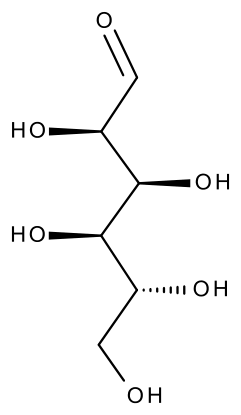
Glucose
5.1 Write the balanced ionic equation of chemical reaction occurring upon heating of the solution C. Use \(\ce{Cu^2+}\) for initial copper solution.
After that \(10\ \mathrm{cm^3}\) of 10% solution of potassium iodide and sulfuric acid solution (\(c = = 1\ \mathrm{mol\,dm^{-3}}\)) were added to the flask. The mixture was covered with watch glass and was then placed in a dark place. An excess of iodine was then titrated with sodium thiosulphate solution (\(c = 0.05078\ \mathrm{mol\,dm^{-3}}\)). A volume of \(11.87\ \mathrm{cm^3}\) of the titrant was required to reach the endpoint.
5.2 Write the balanced equation(s) in molecular or ionic form for all the reactions taking place in the flask.
5.3 Consider that all fructose was transformed into glucose under the experimental conditions. Calculate the total mass concentration of sugars (in \(\mathrm{g\,dm^{-3}}\)) in a fruit juice.
\(M = 180.16\ \mathrm{g\,mol^{-1}}\).
A new \(10.00\ \mathrm{cm^3}\) aliquot of the same juice was treated with a \(10.00\ \mathrm{cm^3}\) portion of acidified potassium iodate(V) solution (\(0.01502\ \mathrm{mol\,dm^{-3}}\)) and \(10\ \mathrm{cm^3}\) of 10 % solution of potassium iodide. After the mixture turned brown, an excess of sodium hydroxide solution was added. The flask was then covered with a watch glass and put into a dark place. The obtained solution was acidified and titrated with a solution of sodium thiosulphate (\(c = 0.01089\ \mathrm{mol\,dm^{-3}}\)). The average titrant volume used for titration was \(23.43\ \mathrm{cm^3}\). Note that fructose is not converted into glucose under these conditions.
5.4 Write all the balanced equations for the described reactions in molecular or ionic form.
5.5 Calculate the mass concentration of each sugar (in \(\mathrm{g\,dm^{-3}}\)) in the juice.
5.6 One bread exchange unit (1 BEU) corresponds to the content of \(12\ \mathrm{g}\) of digestible carbohydrates in a product. How many BEU are in one glass (\(200\ \mathrm{cm^3}\)) of juice?
B. Diagnosis of diseases
The derivative of glucose, 2-deoxy-2-(\(\ce{^{18}F}\))fluoro-D-glucose (FDG), is the most common radiopharmaceutical for diagnosis of cancer using positron emission tomography. The first step of FDG preparation is to produce a radionuclide fluoro-18 by nuclear reaction in a cyclotron. The next step is the radiochemical synthesis. Fluorine-18 is introduced into D-glucose molecule by nucleophilic substitution. 2-deoxy-2-(\(\ce{^{18}F}\))fluoro-D-glucose once injected into the patient actively accumulates in cells of malignant tumors; this process is accompanied by decomposition of fluorine-18. This radionuclide is a \(\beta^+\) emitter – nucleus emits a positron (anti-electron). Positron interacts with an electron and after that annihilation occurs, which can be detected. This allows determining precisely the tumor sizes and type.
5.7 Complete the nuclear reactions leading to various fluorine isotopes.
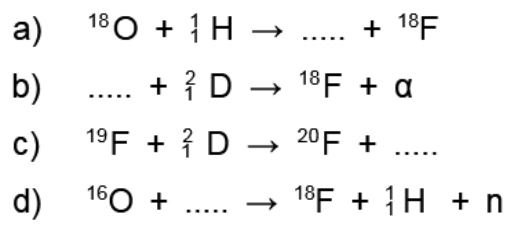
5.8 The decay mode of unstable light nuclei depends on the ratio between the number of neutrons and protons in them. If this ratio is greater than that for a stable isotope then the nucleus decays in a \(\beta^-\)-mode, if it is smaller – in a \(\beta^+\)-mode.
Determine the type of decay for the nuclei in the table:
| Nucleus | \(\ce{^{11}C}\) | \(\ce{^{20}F}\) | \(\ce{^{17}F}\) | \(\ce{^{14}C}\) |
|---|---|---|---|---|
| Decay mode |
When nuclear reaction (a) is used for fluorine-18 preparation, the target material is presented as water enriched with \(\ce{H2^{18}O}\). The presence of usual water \(\ce{H2^{16}O}\) leads to a side nuclear reaction with \(\ce{^{16}O}\), leading to the formation of isotope \(\ce{^{17}F}\).
5.9 It is known that within five minutes after completion of irradiation of the target the ratio of radioactivities of \(\ce{^{18}F}\) and \(\ce{^{17}F}\) is \(1\cdot10^5\). Assuming that irradiation time is short, the radioactivity of each isotope is proportional to the nuclear reaction yield and the mole fraction of a component in the irradiated target, calculate the mass fraction of \(\ce{H2^{18}O}\) in the target. \(t_{1/2}(\ce{^{18}F}) = 109.7\) minutes, \(t_{1/2}(\ce{^{17}F}) = 65\) seconds. The ratio between nuclear reactions yields is \[ \eta_{\ce{^{18}O}-\ce{^{18}F}}/ \eta_{\ce{^{16}O}-\ce{^{17}F}}=144.7. \]
5.10 Calculate the yield of labeling D-glucose with fluorine-18, if initial radioactivity of a fluorine-18 sample was \(600.0\ \mathrm{MBq}\) and radioactivity of the obtained 2-deoxy-2-(\(\ce{^{18}F}\))fluoro-D-glucose is \(528.2\ \mathrm{MBq}\). Synthesis time is 3.5 minutes.
5.11 Biological half-life (through the excretory organs) of 2-deoxy-2-(\(\ce{^{18}F}\))fluoro-D-glucose is 120.0 minutes. How much radioactivity (in MBq) will remain in the patient ten hours after injection of FDG with the initial radioactivity of \(450.0\ \mathrm{MBq}\).
Official English text of the problem.
Answers
Names and SMILES for the chemical species appearing below are collected at the beginning of the Solution.
-
5.1 \[ \boxed{\ce{C6H12O6 + 2Cu^2+ + 5OH- -> C6H11O7- + Cu2O(s) + 3H2O}} \] Glucose is oxidized to D-gluconate; the red precipitate is copper(I) oxide.
-
5.2 The principal reactions are \[ \ce{2Cu^2+ + 4I- -> 2CuI(s) + I2}, \] \[ \ce{Cu2O(s) + 2H+ + 2I- -> 2CuI(s) + H2O}, \] \[ \ce{I2 + 2S2O3^2- -> 2I- + S4O6^2-}. \] Acid–base reactions and iodine speciation are included in the detailed solution.
-
5.3 \[ \boxed{\rho_{\mathrm{total}}=12.59\ \mathrm{g\,dm^{-3}}} \]
-
5.4 The analytical reaction sequence is \[ \ce{IO3- + 5I- + 6H+ -> 3I2 + 3H2O}, \] \[ \ce{I2 + 2OH- -> I- + IO- + H2O}, \] \[ \ce{C6H12O6 + IO- + OH- -> C6H11O7- + I- + H2O}, \] \[ \ce{IO- + I- + 2H+ -> I2 + H2O}, \] \[ \ce{I2 + 2S2O3^2- -> 2I- + S4O6^2-}. \] Possible hypoiodite disproportionation and the acid–base reactions are given below.
-
5.5 \[ \boxed{\rho_{\mathrm{glucose}}=5.820\ \mathrm{g\,dm^{-3}}} \qquad \boxed{\rho_{\mathrm{fructose}}=6.767\ \mathrm{g\,dm^{-3}}} \]
-
5.6 \[ \boxed{0.210\ \mathrm{BEU}\text{ per }200\ \mathrm{cm^3}\text{ glass}} \]
-
5.7 Missing particles or nuclei:
(a) neutron, \(\ce{^{1}_{0}n}\);
(b) neon-20, \(\ce{^{20}_{10}Ne}\);
(c) proton, \(\ce{^{1}_{1}H}\);
(d) alpha particle, \(\ce{^{4}_{2}He}\). -
5.8
| Nucleus | \(\ce{^{11}C}\) | \(\ce{^{20}F}\) | \(\ce{^{17}F}\) | \(\ce{^{14}C}\) |
|---|---|---|---|---|
| Decay mode | \(\beta^+\) | \(\beta^-\) | \(\beta^+\) | \(\beta^-\) |
-
5.9 Including the decay-constant ratio when converting nuclear-production yields into activities, \[ \boxed{w(\ce{H2^{18}O})\approx0.999695\approx99.97\%}. \]
-
5.10 \[ \boxed{\text{Decay-corrected labeling yield}=90.0\%} \]
-
5.11 \[ \boxed{A(10\ \mathrm{h})\approx0.317\ \mathrm{MBq}} \]
Solution
The following identities and SMILES apply throughout. The carbohydrate SMILES describe open-chain forms, with the stereochemistry retained from D-glucose. They do not specify the populations or conformations of cyclic forms in solution.
| Name | Formula | SMILES |
|---|---|---|
| D-Glucose | \(\ce{C6H12O6}\) | O=C[C@H](O)[C@@H](O)[C@H](O)[C@H](O)CO |
| D-Fructose | \(\ce{C6H12O6}\) | OCC(=O)[C@@H](O)[C@H](O)[C@H](O)CO |
| D-Gluconate | \(\ce{C6H11O7-}\) | O=C([O-])[C@H](O)[C@@H](O)[C@H](O)[C@H](O)CO |
| D-Gluconic acid | \(\ce{C6H12O7}\) | O=C(O)[C@H](O)[C@@H](O)[C@H](O)[C@H](O)CO |
| 2-Deoxy-2-(fluorine-18)fluoro-D-glucose, FDG | \(\ce{C6H11^{18}FO5}\) | O=C[C@H]([18F])[C@@H](O)[C@H](O)[C@H](O)CO |
| Water | \(\ce{H2O}\) | O |
| Oxygen-18 water | \(\ce{H2^{18}O}\) | [18OH2] |
| Oxygen-16 water | \(\ce{H2^{16}O}\) | [16OH2] |
| Copper(II) ion | \(\ce{Cu^2+}\) | [Cu+2] |
| Copper(I) oxide | \(\ce{Cu2O}\) | [Cu+].[Cu+].[O-2] |
| Copper(I) iodide | \(\ce{CuI}\) | [Cu+].[I-] |
| Hydrogen ion, aqueous proton | \(\ce{H+}\) | [H+] |
| Hydroxide ion | \(\ce{OH-}\) | [OH-] |
| Iodide ion | \(\ce{I-}\) | [I-] |
| Iodine | \(\ce{I2}\) | II |
| Triiodide ion | \(\ce{I3-}\) | I[I-]I |
| Iodate(V) ion | \(\ce{IO3-}\) | [O-]I(=O)=O |
| Hypoiodite ion | \(\ce{IO-}\) | [O-]I |
| Thiosulfate ion | \(\ce{S2O3^2-}\) | [O-]S(=O)(=O)[S-] |
| Tetrathionate ion | \(\ce{S4O6^2-}\) | [O-]S(=O)(=O)SSS(=O)(=O)[O-] |
The copper(I) compounds are extended solids: their dot-separated SMILES give ionic formula units, not crystal structures. Triiodide is approximately linear; its SMILES does not encode that geometry or its delocalized bonding. Nuclear notation below describes nuclei and elementary particles, for which molecular SMILES are not applicable.
5.1 — Reaction with Fehling’s reagent
The aldehyde group of open-chain glucose is oxidized to a carboxylate group, releasing two electrons:
\[ \ce{C6H12O6 + 3OH- -> C6H11O7- + 2H2O + 2e-}. \]
Two copper(II) ions each accept one electron, forming copper(I) oxide:
\[ \ce{2Cu^2+ + 2OH- + 2e- -> Cu2O(s) + H2O}. \]
Adding the half-reactions gives
\[ \boxed{\ce{C6H12O6 + 2Cu^2+ + 5OH- -> C6H11O7- + Cu2O(s) + 3H2O}}. \]
Thus, one mole of glucose consumes two moles of copper(II). Under the stated experimental assumption, fructose is converted into glucose and contributes the same reducing capacity.
5.2 — Addition of acid and iodide, followed by titration
Residual copper(II) oxidizes iodide to iodine. The copper(I) produced precipitates as copper(I) iodide:
\[ \boxed{\ce{2Cu^2+ + 4I- -> 2CuI(s) + I2}}. \]
The copper(I) oxide already formed also becomes copper(I) iodide:
\[ \boxed{\ce{Cu2O(s) + 2H+ + 2I- -> 2CuI(s) + H2O}}. \]
This second reaction produces no iodine, because copper remains in oxidation state \(+1\).
Iodine is titrated with thiosulfate, producing tetrathionate:
\[ \boxed{\ce{I2 + 2S2O3^2- -> 2I- + S4O6^2-}}. \]
Acid addition also neutralizes hydroxide and protonates gluconate:
\[ \ce{H+ + OH- -> H2O}, \] \[ \ce{C6H11O7- + H+ <=> C6H12O7}. \]
In excess iodide, iodine participates in the equilibrium
\[ \ce{I2 + I- <=> I3-}. \]
The equivalent titration equation is then
\[ \ce{I3- + 2S2O3^2- -> 3I- + S4O6^2-}. \]
Either iodine representation gives the same analytical relationship:
\[ \boxed{n(\text{residual }\ce{Cu^2+})=n(\ce{S2O3^2-})}. \]
5.3 — Total mass concentration of sugars
The initial amount of copper(II) is
\[ n_{\mathrm{Cu},0} =(0.04000\ \mathrm{mol\,dm^{-3}}) (0.05000\ \mathrm{dm^3}) =2.000\times10^{-3}\ \mathrm{mol}. \]
The amount of thiosulfate used is
\[ n_{\mathrm{thio}} =(0.05078)(0.01187) =6.027586\times10^{-4}\ \mathrm{mol}. \]
This equals the residual amount of copper(II). Therefore, using the two-to-one copper-to-sugar stoichiometry,
\[ \begin{aligned} n_{\mathrm{glucose}}+n_{\mathrm{fructose}} &=\frac{n_{\mathrm{Cu},0}-n_{\mathrm{thio}}}{2}\\ &=\frac{2.000\times10^{-3}-6.027586\times10^{-4}}{2}\\ &=6.986207\times10^{-4}\ \mathrm{mol}. \end{aligned} \]
Both sugars have the given molar mass. The total mass concentration is
\[ \begin{aligned} \rho_{\mathrm{total}} &=\frac{(6.986207\times10^{-4}\ \mathrm{mol}) (180.16\ \mathrm{g\,mol^{-1}})} {0.01000\ \mathrm{dm^3}}\\ &=12.58635\ \mathrm{g\,dm^{-3}}. \end{aligned} \]
\[ \boxed{\rho_{\mathrm{total}}=12.59\ \mathrm{g\,dm^{-3}}} \]
5.4 — Selective determination of glucose
Acidified iodate oxidizes iodide, generating iodine:
\[ \boxed{\ce{IO3- + 5I- + 6H+ -> 3I2 + 3H2O}}. \]
Addition of excess hydroxide neutralizes the acid,
\[ \ce{H+ + OH- -> H2O}, \]
and converts iodine into iodide and hypoiodite:
\[ \boxed{\ce{I2 + 2OH- -> I- + IO- + H2O}}. \]
Hypoiodite oxidizes glucose to gluconate:
\[ \boxed{\ce{C6H12O6 + IO- + OH- -> C6H11O7- + I- + H2O}}. \]
Combining the last two oxidation-related equations gives
\[ \boxed{\ce{C6H12O6 + I2 + 3OH- -> C6H11O7- + 2I- + 2H2O}}. \]
Consequently, one mole of glucose consumes one mole of iodine. Fructose has a ketone group and, under the explicitly stated conditions, does not isomerize into glucose; it therefore does not contribute to this determination.
After the reaction, acidification regenerates iodine from unused hypoiodite:
\[ \boxed{\ce{IO- + I- + 2H+ -> I2 + H2O}}. \]
Hypoiodite can also disproportionate:
\[ \ce{3IO- -> IO3- + 2I-}. \]
Any iodate formed by this process regenerates iodine upon acidification through the first equation of this part. Thus, this redistribution does not change the number of remaining oxidizing equivalents.
Acidification also neutralizes remaining hydroxide and protonates gluconate:
\[ \ce{H+ + OH- -> H2O}, \qquad \ce{C6H11O7- + H+ <=> C6H12O7}. \]
Finally, the regenerated iodine is titrated:
\[ \boxed{\ce{I2 + 2S2O3^2- -> 2I- + S4O6^2-}}. \]
The triiodide equilibrium described in 5.2 also applies.
5.5 — Concentrations of glucose and fructose
Initially,
\[ n(\ce{IO3-}) =(0.01502\ \mathrm{mol\,dm^{-3}}) (0.01000\ \mathrm{dm^3}) =1.502\times10^{-4}\ \mathrm{mol}. \]
Each mole of iodate generates three moles of iodine:
\[ n_{\ce{I2},0} =3(1.502\times10^{-4}) =4.506\times10^{-4}\ \mathrm{mol}. \]
The second titration consumes
\[ n_{\mathrm{thio},2} =(0.01089)(0.02343) =2.551527\times10^{-4}\ \mathrm{mol}. \]
Hence the remaining iodine equivalent is
\[ n_{\ce{I2},\mathrm{remaining}} =\frac{n_{\mathrm{thio},2}}{2} =1.2757635\times10^{-4}\ \mathrm{mol}. \]
The difference gives the amount of glucose in the aliquot:
\[ \begin{aligned} n_{\mathrm{glucose}} &=4.506\times10^{-4}-1.2757635\times10^{-4}\\ &=3.2302365\times10^{-4}\ \mathrm{mol}. \end{aligned} \]
Therefore,
\[ \rho_{\mathrm{glucose}} =\frac{(3.2302365\times10^{-4})(180.16)} {0.01000} =5.819594\ \mathrm{g\,dm^{-3}}, \]
so
\[ \boxed{\rho_{\mathrm{glucose}}=5.820\ \mathrm{g\,dm^{-3}}}. \]
Using the unrounded total from 5.3,
\[ \rho_{\mathrm{fructose}} =12.5863505-5.8195941 =6.7667564\ \mathrm{g\,dm^{-3}}, \]
and hence
\[ \boxed{\rho_{\mathrm{fructose}}=6.767\ \mathrm{g\,dm^{-3}}}. \]
5.6 — Bread exchange units
The sugar mass in one glass is
\[ m=(12.58635\ \mathrm{g\,dm^{-3}}) (0.200\ \mathrm{dm^3}) =2.51727\ \mathrm{g}. \]
Thus,
\[ N_{\mathrm{BEU}} =\frac{2.51727\ \mathrm{g}} {12\ \mathrm{g\,BEU^{-1}}} =0.209773\ \mathrm{BEU}. \]
\[ \boxed{N_{\mathrm{BEU}}\approx0.210\ \mathrm{BEU}} \]
5.7 — Nuclear reactions
Both mass number \(A\) and atomic number \(Z\) must be conserved. The deuteron written as \(\ce{^{2}_{1}D}\) in the figure is written below as \(\ce{^{2}_{1}H}\).
(a) The missing particle has \(A=18+1-18=1\) and \(Z=8+1-9=0\), identifying a neutron:
\[ \boxed{\ce{^{18}_{8}O + ^{1}_{1}H -> ^{1}_{0}n + ^{18}_{9}F}}. \]
(b) The missing target nucleus has \(A=18+4-2=20\) and \(Z=9+2-1=10\), identifying neon-20:
\[ \boxed{\ce{^{20}_{10}Ne + ^{2}_{1}H -> ^{18}_{9}F + ^{4}_{2}He}}. \]
(c) The missing particle has \(A=19+2-20=1\) and \(Z=9+1-9=1\), identifying a proton:
\[ \boxed{\ce{^{19}_{9}F + ^{2}_{1}H -> ^{20}_{9}F + ^{1}_{1}H}}. \]
(d) The missing projectile has \(A=18+1+1-16=4\) and \(Z=9+1-8=2\), identifying an alpha particle:
\[ \boxed{\ce{^{16}_{8}O + ^{4}_{2}He -> ^{18}_{9}F + ^{1}_{1}H + ^{1}_{0}n}}. \]
5.8 — Decay modes
A neutron-rich nucleus can lower its neutron-to-proton ratio by \(\beta^-\) decay, which converts a neutron into a proton. A proton-rich nucleus can increase that ratio by \(\beta^+\) decay, which converts a proton into a neutron.
Stable carbon isotopes include \(\ce{^{12}C}\) and \(\ce{^{13}C}\), with neutron-to-proton ratios \(1\) and \(7/6\). Stable fluorine is \(\ce{^{19}F}\), with ratio \(10/9\).
| Nucleus | \(Z\) | \(N\) | \(N/Z\) | Comparison with stable isotope(s) | Decay |
|---|---|---|---|---|---|
| \(\ce{^{11}C}\) | 6 | 5 | \(5/6\) | Proton-rich | \(\beta^+\) |
| \(\ce{^{20}F}\) | 9 | 11 | \(11/9\) | Neutron-rich | \(\beta^-\) |
| \(\ce{^{17}F}\) | 9 | 8 | \(8/9\) | Proton-rich | \(\beta^+\) |
| \(\ce{^{14}C}\) | 6 | 8 | \(8/6\) | Neutron-rich | \(\beta^-\) |
The corresponding nuclear equations, including electron neutrinos or antineutrinos, are
\[ \ce{^{11}_{6}C -> ^{11}_{5}B + ^{0}_{+1}e}+\nu_e, \] \[ \ce{^{20}_{9}F -> ^{20}_{10}Ne + ^{0}_{-1}e}+\bar{\nu}_e, \] \[ \ce{^{17}_{9}F -> ^{17}_{8}O + ^{0}_{+1}e}+\nu_e, \] \[ \ce{^{14}_{6}C -> ^{14}_{7}N + ^{0}_{-1}e}+\bar{\nu}_e. \]
5.9 — Mass fraction of oxygen-18 water
Let
\[ r=\frac{n(\ce{H2^{18}O})}{n(\ce{H2^{16}O})}. \]
For short irradiation, taking the quoted reaction yields to describe numbers of nuclei produced,
\[ \frac{N_{18}(0)}{N_{17}(0)}=144.7\,r. \]
Activity is \(A=\lambda N\). Therefore, immediately after irradiation,
\[ \frac{A_{18}(0)}{A_{17}(0)} =\frac{\lambda_{18}}{\lambda_{17}}\,144.7\,r. \]
After time \(t\),
\[ \frac{A_{18}(t)}{A_{17}(t)} =\frac{\lambda_{18}}{\lambda_{17}}\,144.7\,r \,e^{(\lambda_{17}-\lambda_{18})t}. \]
Using minutes throughout,
\[ \lambda_{18} =\frac{\ln2}{109.7} =0.00631857\ \mathrm{min^{-1}}, \] \[ \lambda_{17} =\frac{\ln2}{65/60} =0.639828\ \mathrm{min^{-1}}. \]
At \(t=5.00\ \mathrm{min}\),
\[ e^{(\lambda_{17}-\lambda_{18})t} =23.7492. \]
Thus the activity ratio at the end of irradiation was
\[ \frac{A_{18}(0)}{A_{17}(0)} =\frac{10^5}{23.7492} =4210.67. \]
Converting this activity ratio into the target mole ratio requires the decay-constant ratio:
\[ \begin{aligned} r &=\frac{4210.67}{144.7} \frac{\lambda_{17}}{\lambda_{18}}\\ &=\frac{4210.67}{144.7} \frac{109.7}{65/60}\\ &=2946.64. \end{aligned} \]
The corresponding mole fraction is
\[ x(\ce{H2^{18}O}) =\frac{r}{r+1} =0.9996607. \]
Using approximate isotopic-water molar masses of \(20\) and \(18\ \mathrm{g\,mol^{-1}}\),
\[ \begin{aligned} w(\ce{H2^{18}O}) &=\frac{20r}{20r+18}\\ &=\frac{20(2946.64)}{20(2946.64)+18}\\ &=0.9996947. \end{aligned} \]
\[ \boxed{w(\ce{H2^{18}O})\approx99.97\%} \]
The factor \(\lambda_{18}/\lambda_{17}\) is essential here: equal numbers of the two radionuclides would not have equal activities.
5.10 — Decay-corrected labeling yield
The initial and product activities must be compared at the same time. With no chemical loss, the initial sample would have activity
\[ \begin{aligned} A_{\mathrm{available}}(3.5) &=600.0\,2^{-3.5/109.7}\\ &=586.8766\ \mathrm{MBq} \end{aligned} \]
at the end of synthesis.
Therefore, the fraction incorporated into FDG is
\[ Y =\frac{528.2}{586.8766} =0.9000188. \]
\[ \boxed{Y=90.0\%} \]
5.11 — Radioactivity remaining in the patient
Physical decay and biological elimination independently remove radioactive nuclei from the patient. Their first-order rate constants therefore add:
\[ \lambda_{\mathrm{eff}} =\lambda_{\mathrm{physical}}+\lambda_{\mathrm{biological}}. \]
Equivalently,
\[ \frac{1}{t_{1/2,\mathrm{eff}}} =\frac{1}{109.7}+\frac{1}{120.0}, \]
so
\[ t_{1/2,\mathrm{eff}}=57.3095\ \mathrm{min}. \]
For ten hours, \(t=600\ \mathrm{min}\), the remaining activity is
\[ \begin{aligned} A(t) &=450.0\, 2^{-600/109.7}\, 2^{-600/120.0}\\ &=450.0\,2^{-600/57.3095}\\ &=0.3173879\ \mathrm{MBq}. \end{aligned} \]
\[ \boxed{A(10\ \mathrm{h})\approx0.317\ \mathrm{MBq}} \]
The solution was checked against the official solution.
IChO 2015 · Theorieaufgabe 5
Unverzichtbare Glucose
Kohlenhydrate sind die wichtigsten Energielieferanten für lebende Zellen. Das Monosaccharid Glucose ist eine Energiequelle für die lebende Zelle, kann jedoch für Menschen, die an Diabetes leiden, gefährlich sein. Ein hoher Glucosespiegel kann zu Herz-Kreislauf-Erkrankungen und sogar zum Tod führen. Deshalb vermeiden es Menschen, zu viele Kohlenhydrate und insbesondere zu viel Glucose zu sich zu nehmen.
A. Bestimmung reduzierender Zucker in Fruchtsaft
Eine der Methoden zur Bestimmung reduzierender Zucker in verschiedenen Proben beruht auf der Verwendung von Fehling-Reagenz. Ein Aliquot von \(10.00\ \mathrm{cm^3}\) Fruchtsaft (unter der Annahme, dass die ursprüngliche Probe nur Glucose und Fructose enthielt) wurde in einen Titrierkolben überführt und mit Fehling-Reagenz versetzt. Dieses Reagenz wurde durch Mischen von \(50.00\ \mathrm{cm^3}\) Kupfersulfatlösung, \(c = 0.04000\ \mathrm{mol\,dm^{-3}}\) (Lösung A), mit Kaliumnatriumtartrat und Natriumhydroxid (Lösung B) hergestellt. Die so erhaltene Lösung C wurde anschließend erhitzt, wobei sich ein roter Niederschlag bildete.
Glucose
5.1 Geben Sie die ausgeglichene Ionengleichung der chemischen Reaktion an, die beim Erhitzen der Lösung C abläuft. Verwenden Sie \(\ce{Cu^2+}\) für die ursprüngliche Kupferlösung.
Anschließend wurden \(10\ \mathrm{cm^3}\) einer 10%igen Kaliumiodidlösung und Schwefelsäurelösung (\(c = = 1\ \mathrm{mol\,dm^{-3}}\)) in den Kolben gegeben. Das Gemisch wurde mit einem Uhrglas abgedeckt und anschließend an einen dunklen Ort gestellt. Das überschüssige Iod wurde anschließend mit Natriumthiosulfatlösung (\(c = 0.05078\ \mathrm{mol\,dm^{-3}}\)) titriert. Zum Erreichen des Endpunkts wurde ein Volumen von \(11.87\ \mathrm{cm^3}\) der Maßlösung benötigt.
5.2 Geben Sie für alle im Kolben ablaufenden Reaktionen die ausgeglichene(n) Gleichung(en) in molekularer oder ionischer Form an.
5.3 Gehen Sie davon aus, dass unter den Versuchsbedingungen die gesamte Fructose in Glucose umgewandelt wurde. Berechnen Sie die gesamte Massenkonzentration der Zucker (in \(\mathrm{g\,dm^{-3}}\)) im Fruchtsaft.
\(M = 180.16\ \mathrm{g\,mol^{-1}}\).
Ein neues Aliquot von \(10.00\ \mathrm{cm^3}\) desselben Safts wurde mit einer Portion von \(10.00\ \mathrm{cm^3}\) angesäuerter Kaliumiodat(V)-Lösung (\(0.01502\ \mathrm{mol\,dm^{-3}}\)) und \(10\ \mathrm{cm^3}\) einer 10%igen Kaliumiodidlösung versetzt. Nachdem sich das Gemisch braun gefärbt hatte, wurde Natriumhydroxidlösung im Überschuss zugegeben. Der Kolben wurde anschließend mit einem Uhrglas abgedeckt und an einen dunklen Ort gestellt. Die erhaltene Lösung wurde angesäuert und mit einer Natriumthiosulfatlösung (\(c = 0.01089\ \mathrm{mol\,dm^{-3}}\)) titriert. Das bei der Titration durchschnittlich verbrauchte Volumen der Maßlösung betrug \(23.43\ \mathrm{cm^3}\). Beachten Sie, dass Fructose unter diesen Bedingungen nicht in Glucose umgewandelt wird.
5.4 Geben Sie alle ausgeglichenen Gleichungen der beschriebenen Reaktionen in molekularer oder ionischer Form an.
5.5 Berechnen Sie die Massenkonzentration jedes Zuckers (in \(\mathrm{g\,dm^{-3}}\)) im Saft.
5.6 Eine Broteinheit (1 BEU) entspricht einem Gehalt von \(12\ \mathrm{g}\) verdaulichen Kohlenhydraten in einem Lebensmittel. Wie viele BEU enthält ein Glas (\(200\ \mathrm{cm^3}\)) Saft?
B. Diagnose von Krankheiten
Das Glucosederivat 2-Desoxy-2-(\(\ce{^{18}F}\))fluor-D-glucose (FDG) ist das am häufigsten verwendete Radiopharmakon zur Krebsdiagnose mittels Positronen-Emissions-Tomographie. Der erste Schritt der FDG-Herstellung besteht in der Erzeugung des Radionuklids Fluor-18 durch eine Kernreaktion in einem Zyklotron. Der nächste Schritt ist die radiochemische Synthese. Fluor-18 wird durch nucleophile Substitution in das D-Glucosemolekül eingeführt. Nach der Injektion in den Patienten reichert sich 2-Desoxy-2-(\(\ce{^{18}F}\))fluor-D-glucose aktiv in den Zellen bösartiger Tumoren an; dieser Vorgang wird vom Zerfall des Fluor-18 begleitet. Dieses Radionuklid ist ein \(\beta^+\)-Strahler – der Kern emittiert ein Positron (Antielektron). Das Positron wechselwirkt mit einem Elektron, woraufhin eine Annihilation stattfindet, die nachgewiesen werden kann. Dadurch lassen sich Größe und Art des Tumors genau bestimmen.
5.7 Vervollständigen Sie die Kernreaktionen, die zu verschiedenen Fluorisotopen führen.
5.8 Die Zerfallsart instabiler leichter Kerne hängt vom Verhältnis der Anzahl ihrer Neutronen zur Anzahl ihrer Protonen ab. Ist dieses Verhältnis größer als das eines stabilen Isotops, so zerfällt der Kern durch \(\beta^-\)-Zerfall; ist es kleiner, so erfolgt ein \(\beta^+\)-Zerfall.
Bestimmen Sie die Zerfallsart für die Kerne in der Tabelle:
| Kern | \(\ce{^{11}C}\) | \(\ce{^{20}F}\) | \(\ce{^{17}F}\) | \(\ce{^{14}C}\) |
|---|---|---|---|---|
| Zerfallsart |
Wird die Kernreaktion (a) zur Herstellung von Fluor-18 verwendet, so dient mit \(\ce{H2^{18}O}\) angereichertes Wasser als Targetmaterial. Das Vorhandensein von gewöhnlichem Wasser \(\ce{H2^{16}O}\) führt zu einer Kernnebenreaktion mit \(\ce{^{16}O}\), bei der das Isotop \(\ce{^{17}F}\) entsteht.
5.9 Es ist bekannt, dass fünf Minuten nach Abschluss der Bestrahlung des Targets das Verhältnis der Radioaktivitäten von \(\ce{^{18}F}\) und \(\ce{^{17}F}\) \(1\cdot10^5\) beträgt. Berechnen Sie den Massenanteil von \(\ce{H2^{18}O}\) im Target unter der Annahme, dass die Bestrahlungszeit kurz ist und die Radioaktivität jedes Isotops proportional zur Ausbeute der Kernreaktion und zum Stoffmengenanteil einer Komponente im bestrahlten Target ist. \(t_{1/2}(\ce{^{18}F}) = 109.7\) Minuten, \(t_{1/2}(\ce{^{17}F}) = 65\) Sekunden. Das Verhältnis der Ausbeuten der Kernreaktionen beträgt \[ \eta_{\ce{^{18}O}-\ce{^{18}F}}/ \eta_{\ce{^{16}O}-\ce{^{17}F}}=144.7. \]
5.10 Berechnen Sie die Ausbeute der Markierung von D-Glucose mit Fluor-18, wenn die anfängliche Radioaktivität einer Fluor-18-Probe \(600.0\ \mathrm{MBq}\) betrug und die Radioaktivität der erhaltenen 2-Desoxy-2-(\(\ce{^{18}F}\))fluor-D-glucose \(528.2\ \mathrm{MBq}\) beträgt. Die Synthesezeit beträgt 3,5 Minuten.
5.11 Die biologische Halbwertszeit (durch Ausscheidung über die Ausscheidungsorgane) von 2-Desoxy-2-(\(\ce{^{18}F}\))fluor-D-glucose beträgt 120,0 Minuten. Wie viel Radioaktivität (in MBq) verbleibt zehn Stunden nach der Injektion von FDG mit einer anfänglichen Radioaktivität von \(450.0\ \mathrm{MBq}\) im Patienten?
Aufgabentext aus dem offiziellen englischen Text übersetzt.
Antworten
Die Namen und SMILES der nachfolgend vorkommenden chemischen Spezies sind zu Beginn der Lösung zusammengestellt.
-
5.1 \[ \boxed{\ce{C6H12O6 + 2Cu^2+ + 5OH- -> C6H11O7- + Cu2O(s) + 3H2O}} \] Glucose wird zu D-Gluconat oxidiert; der rote Niederschlag ist Kupfer(I)-oxid.
-
5.2 Die wesentlichen Reaktionen sind \[ \ce{2Cu^2+ + 4I- -> 2CuI(s) + I2}, \] \[ \ce{Cu2O(s) + 2H+ + 2I- -> 2CuI(s) + H2O}, \] \[ \ce{I2 + 2S2O3^2- -> 2I- + S4O6^2-}. \] Säure-Base-Reaktionen und die Speziation des Iods werden in der ausführlichen Lösung berücksichtigt.
-
5.3 \[ \boxed{\rho_{\mathrm{total}}=12.59\ \mathrm{g\,dm^{-3}}} \]
-
5.4 Die analytische Reaktionsfolge lautet \[ \ce{IO3- + 5I- + 6H+ -> 3I2 + 3H2O}, \] \[ \ce{I2 + 2OH- -> I- + IO- + H2O}, \] \[ \ce{C6H12O6 + IO- + OH- -> C6H11O7- + I- + H2O}, \] \[ \ce{IO- + I- + 2H+ -> I2 + H2O}, \] \[ \ce{I2 + 2S2O3^2- -> 2I- + S4O6^2-}. \] Die mögliche Disproportionierung von Hypoiodit und die Säure-Base-Reaktionen sind weiter unten angegeben.
-
5.5 \[ \boxed{\rho_{\mathrm{glucose}}=5.820\ \mathrm{g\,dm^{-3}}} \qquad \boxed{\rho_{\mathrm{fructose}}=6.767\ \mathrm{g\,dm^{-3}}} \]
-
5.6 \[ \boxed{0.210\ \mathrm{BEU}\text{ pro }200\ \mathrm{cm^3}\text{-Glas}} \]
-
5.7 Fehlende Teilchen oder Kerne:
(a) Neutron, \(\ce{^{1}_{0}n}\);
(b) Neon-20, \(\ce{^{20}_{10}Ne}\);
(c) Proton, \(\ce{^{1}_{1}H}\);
(d) Alphateilchen, \(\ce{^{4}_{2}He}\). -
5.8
| Kern | \(\ce{^{11}C}\) | \(\ce{^{20}F}\) | \(\ce{^{17}F}\) | \(\ce{^{14}C}\) |
|---|---|---|---|---|
| Zerfallsart | \(\beta^+\) | \(\beta^-\) | \(\beta^+\) | \(\beta^-\) |
-
5.9 Unter Berücksichtigung des Verhältnisses der Zerfallskonstanten bei der Umrechnung der Kernproduktionsausbeuten in Aktivitäten ergibt sich \[ \boxed{w(\ce{H2^{18}O})\approx0.999695\approx99.97\%}. \]
-
5.10 \[ \boxed{\text{Zerfallskorrigierte Markierungsausbeute}=90.0\%} \]
-
5.11 \[ \boxed{A(10\ \mathrm{h})\approx0.317\ \mathrm{MBq}} \]
Lösung
Die folgenden Zuordnungen und SMILES gelten für die gesamte Lösung. Die SMILES der Kohlenhydrate beschreiben offenkettige Formen, wobei die Stereochemie der D-Glucose beibehalten wird. Sie geben weder die Anteile noch die Konformationen cyclischer Formen in Lösung an.
| Name | Formel | SMILES |
|---|---|---|
| D-Glucose | \(\ce{C6H12O6}\) | O=C[C@H](O)[C@@H](O)[C@H](O)[C@H](O)CO |
| D-Fructose | \(\ce{C6H12O6}\) | OCC(=O)[C@@H](O)[C@H](O)[C@H](O)CO |
| D-Gluconat | \(\ce{C6H11O7-}\) | O=C([O-])[C@H](O)[C@@H](O)[C@H](O)[C@H](O)CO |
| D-Gluconsäure | \(\ce{C6H12O7}\) | O=C(O)[C@H](O)[C@@H](O)[C@H](O)[C@H](O)CO |
| 2-Desoxy-2-(Fluor-18)fluor-D-glucose, FDG | \(\ce{C6H11^{18}FO5}\) | O=C[C@H]([18F])[C@@H](O)[C@H](O)[C@H](O)CO |
| Wasser | \(\ce{H2O}\) | O |
| Sauerstoff-18-Wasser | \(\ce{H2^{18}O}\) | [18OH2] |
| Sauerstoff-16-Wasser | \(\ce{H2^{16}O}\) | [16OH2] |
| Kupfer(II)-Ion | \(\ce{Cu^2+}\) | [Cu+2] |
| Kupfer(I)-oxid | \(\ce{Cu2O}\) | [Cu+].[Cu+].[O-2] |
| Kupfer(I)-iodid | \(\ce{CuI}\) | [Cu+].[I-] |
| Wasserstoffion, Proton in wässriger Lösung | \(\ce{H+}\) | [H+] |
| Hydroxidion | \(\ce{OH-}\) | [OH-] |
| Iodidion | \(\ce{I-}\) | [I-] |
| Iod | \(\ce{I2}\) | II |
| Triiodidion | \(\ce{I3-}\) | I[I-]I |
| Iodat(V)-Ion | \(\ce{IO3-}\) | [O-]I(=O)=O |
| Hypoiodition | \(\ce{IO-}\) | [O-]I |
| Thiosulfation | \(\ce{S2O3^2-}\) | [O-]S(=O)(=O)[S-] |
| Tetrathionation | \(\ce{S4O6^2-}\) | [O-]S(=O)(=O)SSS(=O)(=O)[O-] |
Die Kupfer(I)-Verbindungen sind Feststoffe mit ausgedehnten Gitterstrukturen: Ihre durch Punkte getrennten SMILES geben ionische Formeleinheiten und keine Kristallstrukturen an. Triiodid ist annähernd linear; sein SMILES codiert weder diese Geometrie noch seine delokalisierte Bindung. Die nachfolgende Kernnotation beschreibt Kerne und Elementarteilchen, für die molekulare SMILES nicht anwendbar sind.
5.1 — Reaktion mit Fehling-Reagenz
Die Aldehydgruppe der offenkettigen Glucose wird unter Abgabe von zwei Elektronen zu einer Carboxylatgruppe oxidiert:
\[ \ce{C6H12O6 + 3OH- -> C6H11O7- + 2H2O + 2e-}. \]
Zwei Kupfer(II)-Ionen nehmen jeweils ein Elektron auf, wobei Kupfer(I)-oxid entsteht:
\[ \ce{2Cu^2+ + 2OH- + 2e- -> Cu2O(s) + H2O}. \]
Die Addition der Teilreaktionen ergibt
\[ \boxed{\ce{C6H12O6 + 2Cu^2+ + 5OH- -> C6H11O7- + Cu2O(s) + 3H2O}}. \]
Somit verbraucht ein Mol Glucose zwei Mol Kupfer(II). Unter der angegebenen Annahme für den Versuch wird Fructose in Glucose umgewandelt und trägt mit demselben Reduktionsvermögen bei.
5.2 — Zugabe von Säure und Iodid mit anschließender Titration
Verbleibendes Kupfer(II) oxidiert Iodid zu Iod. Das dabei gebildete Kupfer(I) fällt als Kupfer(I)-iodid aus:
\[ \boxed{\ce{2Cu^2+ + 4I- -> 2CuI(s) + I2}}. \]
Das bereits gebildete Kupfer(I)-oxid wird ebenfalls in Kupfer(I)-iodid umgewandelt:
\[ \boxed{\ce{Cu2O(s) + 2H+ + 2I- -> 2CuI(s) + H2O}}. \]
Bei dieser zweiten Reaktion entsteht kein Iod, da Kupfer in der Oxidationsstufe \(+1\) verbleibt.
Iod wird mit Thiosulfat titriert, wobei Tetrathionat entsteht:
\[ \boxed{\ce{I2 + 2S2O3^2- -> 2I- + S4O6^2-}}. \]
Die Säurezugabe neutralisiert außerdem Hydroxid und protoniert Gluconat:
\[ \ce{H+ + OH- -> H2O}, \] \[ \ce{C6H11O7- + H+ <=> C6H12O7}. \]
Bei Iodidüberschuss ist Iod an folgendem Gleichgewicht beteiligt:
\[ \ce{I2 + I- <=> I3-}. \]
Die äquivalente Titrationsgleichung lautet dann
\[ \ce{I3- + 2S2O3^2- -> 3I- + S4O6^2-}. \]
Beide Darstellungen des Iods ergeben denselben analytischen Zusammenhang:
\[ \boxed{n(\text{verbleibendes }\ce{Cu^2+})=n(\ce{S2O3^2-})}. \]
5.3 — Gesamte Massenkonzentration der Zucker
Die anfängliche Stoffmenge an Kupfer(II) beträgt
\[ n_{\mathrm{Cu},0} =(0.04000\ \mathrm{mol\,dm^{-3}}) (0.05000\ \mathrm{dm^3}) =2.000\times10^{-3}\ \mathrm{mol}. \]
Die verbrauchte Stoffmenge an Thiosulfat beträgt
\[ n_{\mathrm{thio}} =(0.05078)(0.01187) =6.027586\times10^{-4}\ \mathrm{mol}. \]
Diese ist gleich der verbleibenden Stoffmenge an Kupfer(II). Mit dem stöchiometrischen Verhältnis von Kupfer zu Zucker von zwei zu eins ergibt sich daher
\[ \begin{aligned} n_{\mathrm{glucose}}+n_{\mathrm{fructose}} &=\frac{n_{\mathrm{Cu},0}-n_{\mathrm{thio}}}{2}\\ &=\frac{2.000\times10^{-3}-6.027586\times10^{-4}}{2}\\ &=6.986207\times10^{-4}\ \mathrm{mol}. \end{aligned} \]
Beide Zucker besitzen die angegebene molare Masse. Die gesamte Massenkonzentration beträgt
\[ \begin{aligned} \rho_{\mathrm{total}} &=\frac{(6.986207\times10^{-4}\ \mathrm{mol}) (180.16\ \mathrm{g\,mol^{-1}})} {0.01000\ \mathrm{dm^3}}\\ &=12.58635\ \mathrm{g\,dm^{-3}}. \end{aligned} \]
\[ \boxed{\rho_{\mathrm{total}}=12.59\ \mathrm{g\,dm^{-3}}} \]
5.4 — Selektive Bestimmung von Glucose
Iodat oxidiert in saurer Lösung Iodid, wobei Iod entsteht:
\[ \boxed{\ce{IO3- + 5I- + 6H+ -> 3I2 + 3H2O}}. \]
Die Zugabe von überschüssigem Hydroxid neutralisiert die Säure,
\[ \ce{H+ + OH- -> H2O}, \]
und wandelt Iod in Iodid und Hypoiodit um:
\[ \boxed{\ce{I2 + 2OH- -> I- + IO- + H2O}}. \]
Hypoiodit oxidiert Glucose zu Gluconat:
\[ \boxed{\ce{C6H12O6 + IO- + OH- -> C6H11O7- + I- + H2O}}. \]
Durch Kombination der letzten beiden an der Oxidation beteiligten Gleichungen erhält man
\[ \boxed{\ce{C6H12O6 + I2 + 3OH- -> C6H11O7- + 2I- + 2H2O}}. \]
Folglich verbraucht ein Mol Glucose ein Mol Iod. Fructose besitzt eine Ketogruppe und isomerisiert unter den ausdrücklich angegebenen Bedingungen nicht zu Glucose; sie trägt daher nicht zu dieser Bestimmung bei.
Nach der Reaktion wird durch Ansäuern aus nicht verbrauchtem Hypoiodit wieder Iod gebildet:
\[ \boxed{\ce{IO- + I- + 2H+ -> I2 + H2O}}. \]
Hypoiodit kann auch disproportionieren:
\[ \ce{3IO- -> IO3- + 2I-}. \]
Das bei diesem Vorgang gebildete Iodat setzt beim Ansäuern gemäß der ersten Gleichung dieses Teils wieder Iod frei. Diese Umverteilung verändert somit nicht die Anzahl der verbleibenden Oxidationsäquivalente.
Das Ansäuern neutralisiert außerdem verbleibendes Hydroxid und protoniert Gluconat:
\[ \ce{H+ + OH- -> H2O}, \qquad \ce{C6H11O7- + H+ <=> C6H12O7}. \]
Schließlich wird das wieder gebildete Iod titriert:
\[ \boxed{\ce{I2 + 2S2O3^2- -> 2I- + S4O6^2-}}. \]
Das in 5.2 beschriebene Triiodidgleichgewicht gilt auch hier.
5.5 — Konzentrationen von Glucose und Fructose
Zu Beginn gilt
\[ n(\ce{IO3-}) =(0.01502\ \mathrm{mol\,dm^{-3}}) (0.01000\ \mathrm{dm^3}) =1.502\times10^{-4}\ \mathrm{mol}. \]
Jedes Mol Iodat erzeugt drei Mol Iod:
\[ n_{\ce{I2},0} =3(1.502\times10^{-4}) =4.506\times10^{-4}\ \mathrm{mol}. \]
Der Thiosulfatverbrauch bei der zweiten Titration beträgt
\[ n_{\mathrm{thio},2} =(0.01089)(0.02343) =2.551527\times10^{-4}\ \mathrm{mol}. \]
Die verbleibende Iodäquivalentmenge beträgt daher
\[ n_{\ce{I2},\mathrm{remaining}} =\frac{n_{\mathrm{thio},2}}{2} =1.2757635\times10^{-4}\ \mathrm{mol}. \]
Die Differenz ergibt die Stoffmenge an Glucose im Aliquot:
\[ \begin{aligned} n_{\mathrm{glucose}} &=4.506\times10^{-4}-1.2757635\times10^{-4}\\ &=3.2302365\times10^{-4}\ \mathrm{mol}. \end{aligned} \]
Daher gilt
\[ \rho_{\mathrm{glucose}} =\frac{(3.2302365\times10^{-4})(180.16)} {0.01000} =5.819594\ \mathrm{g\,dm^{-3}}, \]
also
\[ \boxed{\rho_{\mathrm{glucose}}=5.820\ \mathrm{g\,dm^{-3}}}. \]
Mit dem ungerundeten Gesamtwert aus 5.3 ergibt sich
\[ \rho_{\mathrm{fructose}} =12.5863505-5.8195941 =6.7667564\ \mathrm{g\,dm^{-3}}, \]
und somit
\[ \boxed{\rho_{\mathrm{fructose}}=6.767\ \mathrm{g\,dm^{-3}}}. \]
5.6 — Broteinheiten
Die Zuckermasse in einem Glas beträgt
\[ m=(12.58635\ \mathrm{g\,dm^{-3}}) (0.200\ \mathrm{dm^3}) =2.51727\ \mathrm{g}. \]
Somit gilt
\[ N_{\mathrm{BEU}} =\frac{2.51727\ \mathrm{g}} {12\ \mathrm{g\,BEU^{-1}}} =0.209773\ \mathrm{BEU}. \]
\[ \boxed{N_{\mathrm{BEU}}\approx0.210\ \mathrm{BEU}} \]
5.7 — Kernreaktionen
Sowohl die Massenzahl \(A\) als auch die Ordnungszahl \(Z\) müssen erhalten bleiben. Das in der Abbildung als \(\ce{^{2}_{1}D}\) dargestellte Deuteron wird nachfolgend als \(\ce{^{2}_{1}H}\) geschrieben.
(a) Das fehlende Teilchen hat \(A=18+1-18=1\) und \(Z=8+1-9=0\) und ist somit ein Neutron:
\[ \boxed{\ce{^{18}_{8}O + ^{1}_{1}H -> ^{1}_{0}n + ^{18}_{9}F}}. \]
(b) Der fehlende Targetkern hat \(A=18+4-2=20\) und \(Z=9+2-1=10\) und ist somit Neon-20:
\[ \boxed{\ce{^{20}_{10}Ne + ^{2}_{1}H -> ^{18}_{9}F + ^{4}_{2}He}}. \]
(c) Das fehlende Teilchen hat \(A=19+2-20=1\) und \(Z=9+1-9=1\) und ist somit ein Proton:
\[ \boxed{\ce{^{19}_{9}F + ^{2}_{1}H -> ^{20}_{9}F + ^{1}_{1}H}}. \]
(d) Das fehlende Projektil hat \(A=18+1+1-16=4\) und \(Z=9+1-8=2\) und ist somit ein Alphateilchen:
\[ \boxed{\ce{^{16}_{8}O + ^{4}_{2}He -> ^{18}_{9}F + ^{1}_{1}H + ^{1}_{0}n}}. \]
5.8 — Zerfallsarten
Ein neutronenreicher Kern kann sein Neutronen-Protonen-Verhältnis durch \(\beta^-\)-Zerfall verringern, bei dem ein Neutron in ein Proton umgewandelt wird. Ein protonenreicher Kern kann dieses Verhältnis durch \(\beta^+\)-Zerfall erhöhen, bei dem ein Proton in ein Neutron umgewandelt wird.
Zu den stabilen Kohlenstoffisotopen gehören \(\ce{^{12}C}\) und \(\ce{^{13}C}\) mit Neutronen-Protonen-Verhältnissen von \(1\) bzw. \(7/6\). Das stabile Fluorisotop ist \(\ce{^{19}F}\) mit einem Verhältnis von \(10/9\).
| Kern | \(Z\) | \(N\) | \(N/Z\) | Vergleich mit stabilem Isotop bzw. stabilen Isotopen | Zerfall |
|---|---|---|---|---|---|
| \(\ce{^{11}C}\) | 6 | 5 | \(5/6\) | Protonenreich | \(\beta^+\) |
| \(\ce{^{20}F}\) | 9 | 11 | \(11/9\) | Neutronenreich | \(\beta^-\) |
| \(\ce{^{17}F}\) | 9 | 8 | \(8/9\) | Protonenreich | \(\beta^+\) |
| \(\ce{^{14}C}\) | 6 | 8 | \(8/6\) | Neutronenreich | \(\beta^-\) |
Die zugehörigen Kerngleichungen einschließlich Elektron-Neutrinos oder -Antineutrinos lauten
\[ \ce{^{11}_{6}C -> ^{11}_{5}B + ^{0}_{+1}e}+\nu_e, \] \[ \ce{^{20}_{9}F -> ^{20}_{10}Ne + ^{0}_{-1}e}+\bar{\nu}_e, \] \[ \ce{^{17}_{9}F -> ^{17}_{8}O + ^{0}_{+1}e}+\nu_e, \] \[ \ce{^{14}_{6}C -> ^{14}_{7}N + ^{0}_{-1}e}+\bar{\nu}_e. \]
5.9 — Massenanteil von Sauerstoff-18-Wasser
Es sei
\[ r=\frac{n(\ce{H2^{18}O})}{n(\ce{H2^{16}O})}. \]
Für eine kurze Bestrahlung gilt, wenn die angegebenen Reaktionsausbeuten als Anzahlen erzeugter Kerne aufgefasst werden,
\[ \frac{N_{18}(0)}{N_{17}(0)}=144.7\,r. \]
Die Aktivität ist \(A=\lambda N\). Unmittelbar nach der Bestrahlung gilt daher
\[ \frac{A_{18}(0)}{A_{17}(0)} =\frac{\lambda_{18}}{\lambda_{17}}\,144.7\,r. \]
Nach der Zeit \(t\) gilt
\[ \frac{A_{18}(t)}{A_{17}(t)} =\frac{\lambda_{18}}{\lambda_{17}}\,144.7\,r \,e^{(\lambda_{17}-\lambda_{18})t}. \]
Bei durchgängiger Verwendung von Minuten ergibt sich
\[ \lambda_{18} =\frac{\ln2}{109.7} =0.00631857\ \mathrm{min^{-1}}, \] \[ \lambda_{17} =\frac{\ln2}{65/60} =0.639828\ \mathrm{min^{-1}}. \]
Für \(t=5.00\ \mathrm{min}\) gilt
\[ e^{(\lambda_{17}-\lambda_{18})t} =23.7492. \]
Das Aktivitätsverhältnis am Ende der Bestrahlung betrug somit
\[ \frac{A_{18}(0)}{A_{17}(0)} =\frac{10^5}{23.7492} =4210.67. \]
Zur Umrechnung dieses Aktivitätsverhältnisses in das Stoffmengenverhältnis im Target wird das Verhältnis der Zerfallskonstanten benötigt:
\[ \begin{aligned} r &=\frac{4210.67}{144.7} \frac{\lambda_{17}}{\lambda_{18}}\\ &=\frac{4210.67}{144.7} \frac{109.7}{65/60}\\ &=2946.64. \end{aligned} \]
Der zugehörige Stoffmengenanteil beträgt
\[ x(\ce{H2^{18}O}) =\frac{r}{r+1} =0.9996607. \]
Mit den näherungsweisen molaren Massen der isotopischen Wasserarten von \(20\) und \(18\ \mathrm{g\,mol^{-1}}\) ergibt sich
\[ \begin{aligned} w(\ce{H2^{18}O}) &=\frac{20r}{20r+18}\\ &=\frac{20(2946.64)}{20(2946.64)+18}\\ &=0.9996947. \end{aligned} \]
\[ \boxed{w(\ce{H2^{18}O})\approx99.97\%} \]
Der Faktor \(\lambda_{18}/\lambda_{17}\) ist hier unerlässlich: Gleiche Anzahlen der beiden Radionuklide hätten nicht dieselbe Aktivität.
5.10 — Zerfallskorrigierte Markierungsausbeute
Die anfängliche Aktivität und die Aktivität des Produkts müssen zum selben Zeitpunkt verglichen werden. Ohne chemischen Verlust hätte die ursprüngliche Probe die Aktivität
\[ \begin{aligned} A_{\mathrm{available}}(3.5) &=600.0\,2^{-3.5/109.7}\\ &=586.8766\ \mathrm{MBq} \end{aligned} \]
am Ende der Synthese.
Der in FDG eingebaute Anteil beträgt daher
\[ Y =\frac{528.2}{586.8766} =0.9000188. \]
\[ \boxed{Y=90.0\%} \]
5.11 — Im Patienten verbleibende Radioaktivität
Physikalischer Zerfall und biologische Ausscheidung entfernen unabhängig voneinander radioaktive Kerne aus dem Patienten. Ihre Geschwindigkeitskonstanten erster Ordnung addieren sich daher:
\[ \lambda_{\mathrm{eff}} =\lambda_{\mathrm{physical}}+\lambda_{\mathrm{biological}}. \]
Gleichwertig dazu gilt
\[ \frac{1}{t_{1/2,\mathrm{eff}}} =\frac{1}{109.7}+\frac{1}{120.0}, \]
also
\[ t_{1/2,\mathrm{eff}}=57.3095\ \mathrm{min}. \]
Für zehn Stunden, \(t=600\ \mathrm{min}\), beträgt die verbleibende Aktivität
\[ \begin{aligned} A(t) &=450.0\, 2^{-600/109.7}\, 2^{-600/120.0}\\ &=450.0\,2^{-600/57.3095}\\ &=0.3173879\ \mathrm{MBq}. \end{aligned} \]
\[ \boxed{A(10\ \mathrm{h})\approx0.317\ \mathrm{MBq}} \]
Die Lösung wurde mit der offiziellen Lösung abgeglichen.
IChO 2015 · Teori sorusu 5
Vazgeçilmez glikoz
Karbonhidratlar, canlı hücrelerin en önemli enerji kaynaklarıdır. Bir monosakkarit olan glikoz, canlı hücre için bir enerji kaynağıdır; ancak diyabet hastaları için tehlikeli olabilir. Yüksek glikoz düzeyi, kalp ve damar hastalıklarına ve hatta ölüme yol açabilir. Bu nedenle insanlar fazla miktarda karbonhidrat ve özellikle glikoz tüketmekten kaçınırlar.
A. Meyve suyunda indirgen şekerlerin tayini
Çeşitli örneklerde indirgen şekerlerin tayininde kullanılan tekniklerden biri, Fehling ayıracının kullanımına dayanır. Meyve suyundan alınan \(10.00\ \mathrm{cm^3}\) hacminde bir kısım (başlangıç örneğinin yalnızca glikoz ve fruktoz içerdiği varsayılarak) bir titrasyon erlenine aktarıldı ve üzerine Fehling ayıracı eklendi. Bu ayıraç, \(50.00\ \mathrm{cm^3}\) hacminde, \(c = 0.04000\ \mathrm{mol\,dm^{-3}}\) derişimli bakır sülfat çözeltisi (A çözeltisi) ile potasyum-sodyum tartarat ve sodyum hidroksit (B çözeltisi) karıştırılarak hazırlandı. Böylece elde edilen C çözeltisi daha sonra ısıtıldı ve kırmızı bir çökelek oluştu.
Glikoz
5.1 C çözeltisinin ısıtılması sırasında gerçekleşen kimyasal tepkimenin denkleştirilmiş iyonik denklemini yazınız. Başlangıçtaki bakır çözeltisi için \(\ce{Cu^2+}\) kullanınız.
Ardından erlene \(10\ \mathrm{cm^3}\) hacminde %10'luk potasyum iyodür çözeltisi ve sülfürik asit çözeltisi (\(c = = 1\ \mathrm{mol\,dm^{-3}}\)) eklendi. Karışımın üzeri saat camıyla kapatıldı ve karanlık bir yere konuldu. Daha sonra iyodun fazlası, sodyum tiyosülfat çözeltisi (\(c = 0.05078\ \mathrm{mol\,dm^{-3}}\)) ile titre edildi. Dönüm noktasına ulaşmak için \(11.87\ \mathrm{cm^3}\) hacminde titrant gerekti.
5.2 Erlende gerçekleşen tüm tepkimelerin denkleştirilmiş denklemlerini moleküler veya iyonik biçimde yazınız.
5.3 Deney koşullarında fruktozun tamamının glikoza dönüştüğünü kabul ediniz. Meyve suyundaki şekerlerin toplam kütle derişimini (\(\mathrm{g\,dm^{-3}}\) cinsinden) hesaplayınız.
\(M = 180.16\ \mathrm{g\,mol^{-1}}\).
Aynı meyve suyundan alınan yeni bir \(10.00\ \mathrm{cm^3}\)'lük kısım, \(10.00\ \mathrm{cm^3}\) hacminde asitlendirilmiş potasyum iyodat(V) çözeltisi (\(0.01502\ \mathrm{mol\,dm^{-3}}\)) ve \(10\ \mathrm{cm^3}\) hacminde %10'luk potasyum iyodür çözeltisi ile işleme tabi tutuldu. Karışım kahverengiye döndükten sonra fazla miktarda sodyum hidroksit çözeltisi eklendi. Ardından erlenin üzeri saat camıyla kapatıldı ve karanlık bir yere konuldu. Elde edilen çözelti asitlendirildi ve sodyum tiyosülfat çözeltisi (\(c = 0.01089\ \mathrm{mol\,dm^{-3}}\)) ile titre edildi. Titrasyonda kullanılan ortalama titrant hacmi \(23.43\ \mathrm{cm^3}\) idi. Bu koşullar altında fruktozun glikoza dönüşmediğine dikkat ediniz.
5.4 Açıklanan tepkimelerin tüm denkleştirilmiş denklemlerini moleküler veya iyonik biçimde yazınız.
5.5 Meyve suyundaki her bir şekerin kütle derişimini (\(\mathrm{g\,dm^{-3}}\) cinsinden) hesaplayınız.
5.6 Bir ekmek değişim birimi (1 BEU), bir ürünün \(12\ \mathrm{g}\) sindirilebilir karbonhidrat içeriğine karşılık gelir. Bir bardak (\(200\ \mathrm{cm^3}\)) meyve suyunda kaç BEU vardır?
B. Hastalıkların tanısı
Bir glikoz türevi olan 2-deoksi-2-(\(\ce{^{18}F}\))floro-D-glikoz (FDG), pozitron emisyon tomografisi kullanılarak kanser tanısı konulmasında en yaygın kullanılan radyofarmasötiktir. FDG'nin hazırlanmasındaki ilk adım, bir siklotronda nükleer tepkime yoluyla flor-18 radyonüklidinin üretilmesidir. Bir sonraki adım radyokimyasal sentezdir. Flor-18, nükleofilik yer değiştirme yoluyla D-glikoz molekülüne katılır. Hastaya enjekte edilen 2-deoksi-2-(\(\ce{^{18}F}\))floro-D-glikoz, kötü huylu tümörlerin hücrelerinde aktif olarak birikir; bu sürece flor-18'in bozunması eşlik eder. Bu radyonüklit bir \(\beta^+\) yayıcısıdır; çekirdek bir pozitron (antielektron) yayar. Pozitron bir elektronla etkileşir ve ardından algılanabilen bir yok olma olayı gerçekleşir. Bu, tümörün boyutlarının ve türünün kesin olarak belirlenmesini sağlar.
5.7 Çeşitli flor izotoplarının oluşumuna yol açan nükleer tepkimeleri tamamlayınız.
5.8 Kararsız hafif çekirdeklerin bozunma türü, içerdikleri nötron ve proton sayılarının oranına bağlıdır. Bu oran kararlı bir izotopunkinden büyükse çekirdek \(\beta^-\) bozunmasına, küçükse \(\beta^+\) bozunmasına uğrar.
Tablodaki çekirdeklerin bozunma türünü belirleyiniz:
| Çekirdek | \(\ce{^{11}C}\) | \(\ce{^{20}F}\) | \(\ce{^{17}F}\) | \(\ce{^{14}C}\) |
|---|---|---|---|---|
| Bozunma türü |
Flor-18'in hazırlanması için (a) nükleer tepkimesi kullanıldığında, hedef malzeme \(\ce{H2^{18}O}\) bakımından zenginleştirilmiş su biçimindedir. Normal suyun, \(\ce{H2^{16}O}\), bulunması, \(\ce{^{16}O}\) ile bir yan nükleer tepkimeye yol açarak \(\ce{^{17}F}\) izotopunun oluşmasına neden olur.
5.9 Hedefin ışınlanmasının tamamlanmasından beş dakika sonra \(\ce{^{18}F}\) ve \(\ce{^{17}F}\)'nin radyoaktivitelerinin oranının \(1\cdot10^5\) olduğu bilinmektedir. Işınlama süresinin kısa olduğunu ve her bir izotopun radyoaktivitesinin nükleer tepkime verimi ve ışınlanan hedefteki bileşenin mol kesri ile orantılı olduğunu varsayarak, hedefteki \(\ce{H2^{18}O}\)'nun kütle kesrini hesaplayınız. \(t_{1/2}(\ce{^{18}F}) = 109.7\) dakika, \(t_{1/2}(\ce{^{17}F}) = 65\) saniyedir. Nükleer tepkime verimlerinin oranı şöyledir: \[ \eta_{\ce{^{18}O}-\ce{^{18}F}}/ \eta_{\ce{^{16}O}-\ce{^{17}F}}=144.7. \]
5.10 Bir flor-18 örneğinin başlangıç radyoaktivitesi \(600.0\ \mathrm{MBq}\) ve elde edilen 2-deoksi-2-(\(\ce{^{18}F}\))floro-D-glikozun radyoaktivitesi \(528.2\ \mathrm{MBq}\) ise D-glikozun flor-18 ile işaretlenme verimini hesaplayınız. Sentez süresi 3.5 dakikadır.
5.11 2-deoksi-2-(\(\ce{^{18}F}\))floro-D-glikozun biyolojik yarı ömrü (boşaltım organları yoluyla) 120.0 dakikadır. Başlangıç radyoaktivitesi \(450.0\ \mathrm{MBq}\) olan FDG'nin enjeksiyonundan on saat sonra hastada ne kadar radyoaktivite (MBq cinsinden) kalır?
Soru metni resmi İngilizce metinden çevrilmiştir.
Cevaplar
Aşağıda geçen kimyasal türlerin adları ve SMILES gösterimleri, Çözüm bölümünün başında bir araya getirilmiştir.
-
5.1 \[ \boxed{\ce{C6H12O6 + 2Cu^2+ + 5OH- -> C6H11O7- + Cu2O(s) + 3H2O}} \] Glikoz, D-glukonata yükseltgenir; kırmızı çökelek bakır(I) oksittir.
-
5.2 Başlıca tepkimeler şunlardır: \[ \ce{2Cu^2+ + 4I- -> 2CuI(s) + I2}, \] \[ \ce{Cu2O(s) + 2H+ + 2I- -> 2CuI(s) + H2O}, \] \[ \ce{I2 + 2S2O3^2- -> 2I- + S4O6^2-}. \] Asit–baz tepkimeleri ve iyodun farklı kimyasal türler hâlinde bulunması ayrıntılı çözümde ele alınmıştır.
-
5.3 \[ \boxed{\rho_{\mathrm{total}}=12.59\ \mathrm{g\,dm^{-3}}} \]
-
5.4 Analitik tepkime dizisi şöyledir: \[ \ce{IO3- + 5I- + 6H+ -> 3I2 + 3H2O}, \] \[ \ce{I2 + 2OH- -> I- + IO- + H2O}, \] \[ \ce{C6H12O6 + IO- + OH- -> C6H11O7- + I- + H2O}, \] \[ \ce{IO- + I- + 2H+ -> I2 + H2O}, \] \[ \ce{I2 + 2S2O3^2- -> 2I- + S4O6^2-}. \] Hipoioditin olası disproporsiyonlaşması ve asit–baz tepkimeleri aşağıda verilmiştir.
-
5.5 \[ \boxed{\rho_{\mathrm{glucose}}=5.820\ \mathrm{g\,dm^{-3}}} \qquad \boxed{\rho_{\mathrm{fructose}}=6.767\ \mathrm{g\,dm^{-3}}} \]
-
5.6 \[ \boxed{0.210\ \mathrm{BEU}\text{ her }200\ \mathrm{cm^3}\text{ hacmindeki bardakta}} \]
-
5.7 Eksik parçacıklar veya çekirdekler:
(a) nötron, \(\ce{^{1}_{0}n}\);
(b) neon-20, \(\ce{^{20}_{10}Ne}\);
(c) proton, \(\ce{^{1}_{1}H}\);
(d) alfa parçacığı, \(\ce{^{4}_{2}He}\). -
5.8
| Çekirdek | \(\ce{^{11}C}\) | \(\ce{^{20}F}\) | \(\ce{^{17}F}\) | \(\ce{^{14}C}\) |
|---|---|---|---|---|
| Bozunma türü | \(\beta^+\) | \(\beta^-\) | \(\beta^+\) | \(\beta^-\) |
-
5.9 Nükleer üretim verimleri aktivitelere dönüştürülürken bozunma sabitlerinin oranı da hesaba katıldığında, \[ \boxed{w(\ce{H2^{18}O})\approx0.999695\approx99.97\%}. \]
-
5.10 \[ \boxed{\text{Bozunma düzeltmeli işaretlenme verimi}=90.0\%} \]
-
5.11 \[ \boxed{A(10\ \mathrm{h})\approx0.317\ \mathrm{MBq}} \]
Çözüm
Aşağıdaki kimyasal tür tanımları ve SMILES gösterimleri metnin tamamı için geçerlidir. Karbonhidratların SMILES gösterimleri, D-glikozun stereokimyası korunarak açık zincirli biçimleri tanımlar. Çözeltideki halkalı biçimlerin bulunma oranlarını veya konformasyonlarını belirtmezler.
| Ad | Formül | SMILES |
|---|---|---|
| D-Glikoz | \(\ce{C6H12O6}\) | O=C[C@H](O)[C@@H](O)[C@H](O)[C@H](O)CO |
| D-Fruktoz | \(\ce{C6H12O6}\) | OCC(=O)[C@@H](O)[C@H](O)[C@H](O)CO |
| D-Glukonat | \(\ce{C6H11O7-}\) | O=C([O-])[C@H](O)[C@@H](O)[C@H](O)[C@H](O)CO |
| D-Glukonik asit | \(\ce{C6H12O7}\) | O=C(O)[C@H](O)[C@@H](O)[C@H](O)[C@H](O)CO |
| 2-Deoksi-2-(flor-18)floro-D-glikoz, FDG | \(\ce{C6H11^{18}FO5}\) | O=C[C@H]([18F])[C@@H](O)[C@H](O)[C@H](O)CO |
| Su | \(\ce{H2O}\) | O |
| Oksijen-18 içeren su | \(\ce{H2^{18}O}\) | [18OH2] |
| Oksijen-16 içeren su | \(\ce{H2^{16}O}\) | [16OH2] |
| Bakır(II) iyonu | \(\ce{Cu^2+}\) | [Cu+2] |
| Bakır(I) oksit | \(\ce{Cu2O}\) | [Cu+].[Cu+].[O-2] |
| Bakır(I) iyodür | \(\ce{CuI}\) | [Cu+].[I-] |
| Hidrojen iyonu, sulu çözeltide proton | \(\ce{H+}\) | [H+] |
| Hidroksit iyonu | \(\ce{OH-}\) | [OH-] |
| İyodür iyonu | \(\ce{I-}\) | [I-] |
| İyot | \(\ce{I2}\) | II |
| Triiyodür iyonu | \(\ce{I3-}\) | I[I-]I |
| İyodat(V) iyonu | \(\ce{IO3-}\) | [O-]I(=O)=O |
| Hipoiodit iyonu | \(\ce{IO-}\) | [O-]I |
| Tiyosülfat iyonu | \(\ce{S2O3^2-}\) | [O-]S(=O)(=O)[S-] |
| Tetratiyonat iyonu | \(\ce{S4O6^2-}\) | [O-]S(=O)(=O)SSS(=O)(=O)[O-] |
Bakır(I) bileşikleri, sürekli örgü yapısına sahip katılardır: noktayla ayrılmış SMILES gösterimleri kristal yapılarını değil, iyonik formül birimlerini verir. Triiyodür yaklaşık olarak doğrusaldır; SMILES gösterimi bu geometriyi veya delokalize bağ yapısını kodlamaz. Aşağıdaki nükleer gösterimler, moleküler SMILES gösterimlerinin uygulanamadığı çekirdekleri ve temel parçacıkları tanımlar.
5.1 — Fehling ayıracı ile tepkime
Açık zincirli glikozun aldehit grubu, iki elektron vererek bir karboksilat grubuna yükseltgenir:
\[ \ce{C6H12O6 + 3OH- -> C6H11O7- + 2H2O + 2e-}. \]
İki bakır(II) iyonunun her biri bir elektron alarak bakır(I) oksit oluşturur:
\[ \ce{2Cu^2+ + 2OH- + 2e- -> Cu2O(s) + H2O}. \]
Yarı tepkimeler toplandığında şu denklem elde edilir:
\[ \boxed{\ce{C6H12O6 + 2Cu^2+ + 5OH- -> C6H11O7- + Cu2O(s) + 3H2O}}. \]
Dolayısıyla bir mol glikoz, iki mol bakır(II) tüketir. Belirtilen deneysel varsayım altında fruktoz glikoza dönüşür ve aynı indirgeme kapasitesiyle katkıda bulunur.
5.2 — Asit ve iyodür eklenmesi, ardından titrasyon
Artan bakır(II), iyodürü iyoda yükseltger. Oluşan bakır(I), bakır(I) iyodür olarak çöker:
\[ \boxed{\ce{2Cu^2+ + 4I- -> 2CuI(s) + I2}}. \]
Önceden oluşmuş olan bakır(I) oksit de bakır(I) iyodüre dönüşür:
\[ \boxed{\ce{Cu2O(s) + 2H+ + 2I- -> 2CuI(s) + H2O}}. \]
Bu ikinci tepkimede iyot oluşmaz, çünkü bakırın yükseltgenme basamağı \(+1\) olarak kalır.
İyot, tiyosülfat ile titre edilerek tetratiyonat oluşturur:
\[ \boxed{\ce{I2 + 2S2O3^2- -> 2I- + S4O6^2-}}. \]
Asit eklenmesi ayrıca hidroksiti nötralleştirir ve glukonatı protonlar:
\[ \ce{H+ + OH- -> H2O}, \] \[ \ce{C6H11O7- + H+ <=> C6H12O7}. \]
Fazla iyodür varlığında iyot, şu dengede yer alır:
\[ \ce{I2 + I- <=> I3-}. \]
Bu durumda eşdeğer titrasyon denklemi şöyledir:
\[ \ce{I3- + 2S2O3^2- -> 3I- + S4O6^2-}. \]
İyodun her iki gösterimi de aynı analitik bağıntıyı verir:
\[ \boxed{n(\text{artan }\ce{Cu^2+})=n(\ce{S2O3^2-})}. \]
5.3 — Şekerlerin toplam kütle derişimi
Başlangıçtaki bakır(II) miktarı şöyledir:
\[ n_{\mathrm{Cu},0} =(0.04000\ \mathrm{mol\,dm^{-3}}) (0.05000\ \mathrm{dm^3}) =2.000\times10^{-3}\ \mathrm{mol}. \]
Kullanılan tiyosülfat miktarı şöyledir:
\[ n_{\mathrm{thio}} =(0.05078)(0.01187) =6.027586\times10^{-4}\ \mathrm{mol}. \]
Bu değer, artan bakır(II) miktarına eşittir. Dolayısıyla bakırın şekere ikiye bir olan stokiyometrik oranı kullanılarak,
\[ \begin{aligned} n_{\mathrm{glucose}}+n_{\mathrm{fructose}} &=\frac{n_{\mathrm{Cu},0}-n_{\mathrm{thio}}}{2}\\ &=\frac{2.000\times10^{-3}-6.027586\times10^{-4}}{2}\\ &=6.986207\times10^{-4}\ \mathrm{mol}. \end{aligned} \]
Her iki şeker de verilen molar kütleye sahiptir. Toplam kütle derişimi şöyledir:
\[ \begin{aligned} \rho_{\mathrm{total}} &=\frac{(6.986207\times10^{-4}\ \mathrm{mol}) (180.16\ \mathrm{g\,mol^{-1}})} {0.01000\ \mathrm{dm^3}}\\ &=12.58635\ \mathrm{g\,dm^{-3}}. \end{aligned} \]
\[ \boxed{\rho_{\mathrm{total}}=12.59\ \mathrm{g\,dm^{-3}}} \]
5.4 — Glikozun seçici tayini
Asitlendirilmiş iyodat, iyodürü yükseltgeyerek iyot oluşturur:
\[ \boxed{\ce{IO3- + 5I- + 6H+ -> 3I2 + 3H2O}}. \]
Fazla hidroksit eklenmesi asidi nötralleştirir,
\[ \ce{H+ + OH- -> H2O}, \]
ve iyodu iyodür ile hipoiodite dönüştürür:
\[ \boxed{\ce{I2 + 2OH- -> I- + IO- + H2O}}. \]
Hipoiodit, glikozu glukonata yükseltger:
\[ \boxed{\ce{C6H12O6 + IO- + OH- -> C6H11O7- + I- + H2O}}. \]
Yükseltgenmeyle ilgili son iki denklem birleştirildiğinde şu denklem elde edilir:
\[ \boxed{\ce{C6H12O6 + I2 + 3OH- -> C6H11O7- + 2I- + 2H2O}}. \]
Sonuç olarak bir mol glikoz, bir mol iyot tüketir. Fruktoz bir keton grubuna sahiptir ve açıkça belirtilen koşullarda glikoza izomerleşmez; bu nedenle bu tayine katkıda bulunmaz.
Tepkimenin ardından asitlendirme, kullanılmamış hipoioditten yeniden iyot oluşturur:
\[ \boxed{\ce{IO- + I- + 2H+ -> I2 + H2O}}. \]
Hipoiodit ayrıca disproporsiyonlaşabilir:
\[ \ce{3IO- -> IO3- + 2I-}. \]
Bu süreçte oluşan iyodat, asitlendirme sırasında bu kısmın ilk denklemi uyarınca yeniden iyot oluşturur. Dolayısıyla bu yeniden dağılım, kalan yükseltgen eşdeğerlerinin sayısını değiştirmez.
Asitlendirme ayrıca kalan hidroksiti nötralleştirir ve glukonatı protonlar:
\[ \ce{H+ + OH- -> H2O}, \qquad \ce{C6H11O7- + H+ <=> C6H12O7}. \]
Son olarak, yeniden oluşan iyot titre edilir:
\[ \boxed{\ce{I2 + 2S2O3^2- -> 2I- + S4O6^2-}}. \]
5.2'de açıklanan triiyodür dengesi burada da geçerlidir.
5.5 — Glikoz ve fruktoz derişimleri
Başlangıçta,
\[ n(\ce{IO3-}) =(0.01502\ \mathrm{mol\,dm^{-3}}) (0.01000\ \mathrm{dm^3}) =1.502\times10^{-4}\ \mathrm{mol}. \]
Her mol iyodat, üç mol iyot oluşturur:
\[ n_{\ce{I2},0} =3(1.502\times10^{-4}) =4.506\times10^{-4}\ \mathrm{mol}. \]
İkinci titrasyonda tüketilen miktar şöyledir:
\[ n_{\mathrm{thio},2} =(0.01089)(0.02343) =2.551527\times10^{-4}\ \mathrm{mol}. \]
Buna göre kalan iyot eşdeğeri şöyledir:
\[ n_{\ce{I2},\mathrm{remaining}} =\frac{n_{\mathrm{thio},2}}{2} =1.2757635\times10^{-4}\ \mathrm{mol}. \]
Aradaki fark, alınan örnek kısmındaki glikoz miktarını verir:
\[ \begin{aligned} n_{\mathrm{glucose}} &=4.506\times10^{-4}-1.2757635\times10^{-4}\\ &=3.2302365\times10^{-4}\ \mathrm{mol}. \end{aligned} \]
Dolayısıyla,
\[ \rho_{\mathrm{glucose}} =\frac{(3.2302365\times10^{-4})(180.16)} {0.01000} =5.819594\ \mathrm{g\,dm^{-3}}, \]
böylece
\[ \boxed{\rho_{\mathrm{glucose}}=5.820\ \mathrm{g\,dm^{-3}}}. \]
5.3'teki yuvarlanmamış toplam kullanıldığında,
\[ \rho_{\mathrm{fructose}} =12.5863505-5.8195941 =6.7667564\ \mathrm{g\,dm^{-3}}, \]
ve dolayısıyla
\[ \boxed{\rho_{\mathrm{fructose}}=6.767\ \mathrm{g\,dm^{-3}}}. \]
5.6 — Ekmek değişim birimleri
Bir bardaktaki şeker kütlesi şöyledir:
\[ m=(12.58635\ \mathrm{g\,dm^{-3}}) (0.200\ \mathrm{dm^3}) =2.51727\ \mathrm{g}. \]
Dolayısıyla,
\[ N_{\mathrm{BEU}} =\frac{2.51727\ \mathrm{g}} {12\ \mathrm{g\,BEU^{-1}}} =0.209773\ \mathrm{BEU}. \]
\[ \boxed{N_{\mathrm{BEU}}\approx0.210\ \mathrm{BEU}} \]
5.7 — Nükleer tepkimeler
Hem kütle sayısı \(A\) hem de atom numarası \(Z\) korunmalıdır. Şekilde \(\ce{^{2}_{1}D}\) olarak yazılan döteron, aşağıda \(\ce{^{2}_{1}H}\) olarak yazılmıştır.
(a) Eksik parçacık için \(A=18+1-18=1\) ve \(Z=8+1-9=0\) olduğundan bu parçacık bir nötrondur:
\[ \boxed{\ce{^{18}_{8}O + ^{1}_{1}H -> ^{1}_{0}n + ^{18}_{9}F}}. \]
(b) Eksik hedef çekirdeği için \(A=18+4-2=20\) ve \(Z=9+2-1=10\) olduğundan bu çekirdek neon-20'dir:
\[ \boxed{\ce{^{20}_{10}Ne + ^{2}_{1}H -> ^{18}_{9}F + ^{4}_{2}He}}. \]
(c) Eksik parçacık için \(A=19+2-20=1\) ve \(Z=9+1-9=1\) olduğundan bu parçacık bir protondur:
\[ \boxed{\ce{^{19}_{9}F + ^{2}_{1}H -> ^{20}_{9}F + ^{1}_{1}H}}. \]
(d) Eksik bombardıman parçacığı için \(A=18+1+1-16=4\) ve \(Z=9+1-8=2\) olduğundan bu parçacık bir alfa parçacığıdır:
\[ \boxed{\ce{^{16}_{8}O + ^{4}_{2}He -> ^{18}_{9}F + ^{1}_{1}H + ^{1}_{0}n}}. \]
5.8 — Bozunma türleri
Nötronca zengin bir çekirdek, bir nötronu protona dönüştüren \(\beta^-\) bozunmasıyla nötron/proton oranını azaltabilir. Protonca zengin bir çekirdek ise bir protonu nötrona dönüştüren \(\beta^+\) bozunmasıyla bu oranı artırabilir.
Kararlı karbon izotopları arasında, nötron/proton oranları sırasıyla \(1\) ve \(7/6\) olan \(\ce{^{12}C}\) ve \(\ce{^{13}C}\) bulunur. Kararlı flor izotopu, oranı \(10/9\) olan \(\ce{^{19}F}\)'dir.
| Çekirdek | \(Z\) | \(N\) | \(N/Z\) | Kararlı izotop(lar) ile karşılaştırma | Bozunma |
|---|---|---|---|---|---|
| \(\ce{^{11}C}\) | 6 | 5 | \(5/6\) | Protonca zengin | \(\beta^+\) |
| \(\ce{^{20}F}\) | 9 | 11 | \(11/9\) | Nötronca zengin | \(\beta^-\) |
| \(\ce{^{17}F}\) | 9 | 8 | \(8/9\) | Protonca zengin | \(\beta^+\) |
| \(\ce{^{14}C}\) | 6 | 8 | \(8/6\) | Nötronca zengin | \(\beta^-\) |
Elektron nötrinolarını veya antinötrinolarını da içeren ilgili nükleer denklemler şöyledir:
\[ \ce{^{11}_{6}C -> ^{11}_{5}B + ^{0}_{+1}e}+\nu_e, \] \[ \ce{^{20}_{9}F -> ^{20}_{10}Ne + ^{0}_{-1}e}+\bar{\nu}_e, \] \[ \ce{^{17}_{9}F -> ^{17}_{8}O + ^{0}_{+1}e}+\nu_e, \] \[ \ce{^{14}_{6}C -> ^{14}_{7}N + ^{0}_{-1}e}+\bar{\nu}_e. \]
5.9 — Oksijen-18 içeren suyun kütle kesri
Şu tanımı yapalım:
\[ r=\frac{n(\ce{H2^{18}O})}{n(\ce{H2^{16}O})}. \]
Kısa süreli ışınlama için, verilen tepkime verimlerinin üretilen çekirdek sayılarını ifade ettiği kabul edilirse,
\[ \frac{N_{18}(0)}{N_{17}(0)}=144.7\,r. \]
Aktivite \(A=\lambda N\) ile verilir. Dolayısıyla ışınlamanın hemen ardından,
\[ \frac{A_{18}(0)}{A_{17}(0)} =\frac{\lambda_{18}}{\lambda_{17}}\,144.7\,r. \]
\(t\) süresi sonra,
\[ \frac{A_{18}(t)}{A_{17}(t)} =\frac{\lambda_{18}}{\lambda_{17}}\,144.7\,r \,e^{(\lambda_{17}-\lambda_{18})t}. \]
Tüm hesaplamalarda dakika kullanıldığında,
\[ \lambda_{18} =\frac{\ln2}{109.7} =0.00631857\ \mathrm{min^{-1}}, \] \[ \lambda_{17} =\frac{\ln2}{65/60} =0.639828\ \mathrm{min^{-1}}. \]
\(t=5.00\ \mathrm{min}\) anında,
\[ e^{(\lambda_{17}-\lambda_{18})t} =23.7492. \]
Dolayısıyla ışınlamanın sonundaki aktivite oranı şöyledir:
\[ \frac{A_{18}(0)}{A_{17}(0)} =\frac{10^5}{23.7492} =4210.67. \]
Bu aktivite oranının hedefteki mol oranına dönüştürülmesi, bozunma sabitlerinin oranının kullanılmasını gerektirir:
\[ \begin{aligned} r &=\frac{4210.67}{144.7} \frac{\lambda_{17}}{\lambda_{18}}\\ &=\frac{4210.67}{144.7} \frac{109.7}{65/60}\\ &=2946.64. \end{aligned} \]
Buna karşılık gelen mol kesri şöyledir:
\[ x(\ce{H2^{18}O}) =\frac{r}{r+1} =0.9996607. \]
İzotopik suların yaklaşık molar kütleleri olarak \(20\) ve \(18\ \mathrm{g\,mol^{-1}}\) kullanıldığında,
\[ \begin{aligned} w(\ce{H2^{18}O}) &=\frac{20r}{20r+18}\\ &=\frac{20(2946.64)}{20(2946.64)+18}\\ &=0.9996947. \end{aligned} \]
\[ \boxed{w(\ce{H2^{18}O})\approx99.97\%} \]
Burada \(\lambda_{18}/\lambda_{17}\) çarpanı zorunludur: iki radyonüklidin çekirdek sayılarının eşit olması, aktivitelerinin eşit olacağı anlamına gelmez.
5.10 — Bozunma düzeltmeli işaretlenme verimi
Başlangıç aktivitesi ve ürün aktivitesi aynı zaman için karşılaştırılmalıdır. Kimyasal kayıp olmasaydı, başlangıç örneğinin sentez sonundaki aktivitesi
\[ \begin{aligned} A_{\mathrm{available}}(3.5) &=600.0\,2^{-3.5/109.7}\\ &=586.8766\ \mathrm{MBq} \end{aligned} \]
olurdu.
Dolayısıyla FDG'ye katılan kesir şöyledir:
\[ Y =\frac{528.2}{586.8766} =0.9000188. \]
\[ \boxed{Y=90.0\%} \]
5.11 — Hastada kalan radyoaktivite
Fiziksel bozunma ve biyolojik atılım, radyoaktif çekirdekleri hastadan birbirinden bağımsız olarak uzaklaştırır. Bu nedenle birinci dereceden hız sabitleri toplanır:
\[ \lambda_{\mathrm{eff}} =\lambda_{\mathrm{physical}}+\lambda_{\mathrm{biological}}. \]
Eşdeğer olarak,
\[ \frac{1}{t_{1/2,\mathrm{eff}}} =\frac{1}{109.7}+\frac{1}{120.0}, \]
böylece
\[ t_{1/2,\mathrm{eff}}=57.3095\ \mathrm{min}. \]
On saat için, \(t=600\ \mathrm{min}\), kalan aktivite şöyledir:
\[ \begin{aligned} A(t) &=450.0\, 2^{-600/109.7}\, 2^{-600/120.0}\\ &=450.0\,2^{-600/57.3095}\\ &=0.3173879\ \mathrm{MBq}. \end{aligned} \]
\[ \boxed{A(10\ \mathrm{h})\approx0.317\ \mathrm{MBq}} \]
Çözüm, resmi çözümle karşılaştırılarak kontrol edildi.
IChO 2015 · Problema teórico 5
La indispensable glucosa
Los carbohidratos son los principales proveedores de energía de las células vivas. El monosacárido glucosa es una fuente de energía para la célula viva, pero para las personas que padecen diabetes la glucosa puede ser peligrosa. Una concentración elevada de glucosa puede provocar enfermedades cardiovasculares e incluso la muerte. Por eso las personas evitan consumir demasiados carbohidratos y, en particular, glucosa.
A. Determinación de azúcares reductores en zumo de frutas
Una de las técnicas para determinar azúcares reductores en distintas muestras utiliza el reactivo de Fehling. Se transfirió una alícuota de \(10.00\ \mathrm{cm^3}\) de zumo de frutas (suponiendo que la muestra inicial contenía únicamente glucosa y fructosa) a un matraz de valoración y se añadió reactivo de Fehling. Este reactivo se preparó mezclando \(50.00\ \mathrm{cm^3}\) de disolución de sulfato de cobre, \(c = 0.04000\ \mathrm{mol\,dm^{-3}}\) (disolución A), con tartrato de potasio y sodio e hidróxido de sodio (disolución B). A continuación, se calentó la disolución C así obtenida y se formó un precipitado rojo.
Glucosa
5.1 Escriba la ecuación iónica ajustada de la reacción química que tiene lugar al calentar la disolución C. Utilice \(\ce{Cu^2+}\) para la disolución inicial de cobre.
Después se añadieron al matraz \(10\ \mathrm{cm^3}\) de disolución de yoduro de potasio al 10% y disolución de ácido sulfúrico (\(c = = 1\ \mathrm{mol\,dm^{-3}}\)). La mezcla se tapó con un vidrio de reloj y se colocó en un lugar oscuro. A continuación, se valoró el exceso de yodo con disolución de tiosulfato de sodio (\(c = 0.05078\ \mathrm{mol\,dm^{-3}}\)). Se necesitó un volumen de \(11.87\ \mathrm{cm^3}\) de valorante para alcanzar el punto final.
5.2 Escriba las ecuaciones ajustadas, en forma molecular o iónica, de todas las reacciones que tienen lugar en el matraz.
5.3 Considere que toda la fructosa se transformó en glucosa en las condiciones experimentales. Calcule la concentración másica total de azúcares (en \(\mathrm{g\,dm^{-3}}\)) en el zumo de frutas.
\(M = 180.16\ \mathrm{g\,mol^{-1}}\).
Una nueva alícuota de \(10.00\ \mathrm{cm^3}\) del mismo zumo se trató con una porción de \(10.00\ \mathrm{cm^3}\) de disolución acidificada de yodato(V) de potasio (\(0.01502\ \mathrm{mol\,dm^{-3}}\)) y \(10\ \mathrm{cm^3}\) de disolución de yoduro de potasio al 10 %. Una vez que la mezcla adquirió un color marrón, se añadió un exceso de disolución de hidróxido de sodio. A continuación, se tapó el matraz con un vidrio de reloj y se colocó en un lugar oscuro. La disolución obtenida se acidificó y se valoró con una disolución de tiosulfato de sodio (\(c = 0.01089\ \mathrm{mol\,dm^{-3}}\)). El volumen medio de valorante empleado en la valoración fue de \(23.43\ \mathrm{cm^3}\). Tenga en cuenta que la fructosa no se convierte en glucosa en estas condiciones.
5.4 Escriba todas las ecuaciones ajustadas de las reacciones descritas, en forma molecular o iónica.
5.5 Calcule la concentración másica de cada azúcar (en \(\mathrm{g\,dm^{-3}}\)) en el zumo.
5.6 Una unidad de intercambio de pan (1 BEU) corresponde a un contenido de \(12\ \mathrm{g}\) de carbohidratos digeribles en un producto. ¿Cuántas BEU contiene un vaso (\(200\ \mathrm{cm^3}\)) de zumo?
B. Diagnóstico de enfermedades
El derivado de la glucosa, 2-desoxi-2-(\(\ce{^{18}F}\))fluoro-D-glucosa (FDG), es el radiofármaco más habitual para el diagnóstico del cáncer mediante tomografía por emisión de positrones. La primera etapa de la preparación de FDG consiste en producir el radionúclido flúor-18 mediante una reacción nuclear en un ciclotrón. La siguiente etapa es la síntesis radioquímica. El flúor-18 se introduce en la molécula de D-glucosa mediante sustitución nucleófila. Una vez inyectada en el paciente, la 2-desoxi-2-(\(\ce{^{18}F}\))fluoro-D-glucosa se acumula activamente en las células de los tumores malignos; este proceso va acompañado de la desintegración del flúor-18. Este radionúclido es un emisor \(\beta^+\): el núcleo emite un positrón (antielectrón). El positrón interacciona con un electrón y después se produce la aniquilación, que puede detectarse. Esto permite determinar con precisión el tamaño y el tipo de tumor.
5.7 Complete las reacciones nucleares que conducen a distintos isótopos del flúor.
5.8 El modo de desintegración de los núcleos ligeros inestables depende de la relación entre el número de neutrones y el de protones que contienen. Si esta relación es mayor que la de un isótopo estable, el núcleo se desintegra mediante el modo \(\beta^-\); si es menor, mediante el modo \(\beta^+\).
Determine el tipo de desintegración de los núcleos de la tabla:
| Núcleo | \(\ce{^{11}C}\) | \(\ce{^{20}F}\) | \(\ce{^{17}F}\) | \(\ce{^{14}C}\) |
|---|---|---|---|---|
| Modo de desintegración |
Cuando se utiliza la reacción nuclear (a) para preparar flúor-18, el material del blanco se presenta como agua enriquecida en \(\ce{H2^{18}O}\). La presencia de agua ordinaria \(\ce{H2^{16}O}\) da lugar a una reacción nuclear secundaria con \(\ce{^{16}O}\), que conduce a la formación del isótopo \(\ce{^{17}F}\).
5.9 Se sabe que, cinco minutos después de finalizar la irradiación del blanco, la relación entre las actividades radiactivas de \(\ce{^{18}F}\) y \(\ce{^{17}F}\) es \(1\cdot10^5\). Suponiendo que el tiempo de irradiación es corto y que la actividad radiactiva de cada isótopo es proporcional al rendimiento de la reacción nuclear y a la fracción molar del componente en el blanco irradiado, calcule la fracción másica de \(\ce{H2^{18}O}\) en el blanco. \(t_{1/2}(\ce{^{18}F}) = 109.7\) minutos, \(t_{1/2}(\ce{^{17}F}) = 65\) segundos. La relación entre los rendimientos de las reacciones nucleares es \[ \eta_{\ce{^{18}O}-\ce{^{18}F}}/ \eta_{\ce{^{16}O}-\ce{^{17}F}}=144.7. \]
5.10 Calcule el rendimiento del marcaje de D-glucosa con flúor-18 si la actividad radiactiva inicial de una muestra de flúor-18 era de \(600.0\ \mathrm{MBq}\) y la actividad radiactiva de la 2-desoxi-2-(\(\ce{^{18}F}\))fluoro-D-glucosa obtenida es de \(528.2\ \mathrm{MBq}\). El tiempo de síntesis es de 3.5 minutos.
5.11 El período de semieliminación biológica (a través de los órganos excretores) de la 2-desoxi-2-(\(\ce{^{18}F}\))fluoro-D-glucosa es de 120.0 minutos. ¿Qué actividad radiactiva (en MBq) permanecerá en el paciente diez horas después de la inyección de FDG con una actividad radiactiva inicial de \(450.0\ \mathrm{MBq}\)?
Enunciado traducido del texto oficial en inglés.
Respuestas
Los nombres y los SMILES de las especies químicas que aparecen a continuación se recopilan al principio de la Solución.
-
5.1 \[ \boxed{\ce{C6H12O6 + 2Cu^2+ + 5OH- -> C6H11O7- + Cu2O(s) + 3H2O}} \] La glucosa se oxida a D-gluconato; el precipitado rojo es óxido de cobre(I).
-
5.2 Las reacciones principales son \[ \ce{2Cu^2+ + 4I- -> 2CuI(s) + I2}, \] \[ \ce{Cu2O(s) + 2H+ + 2I- -> 2CuI(s) + H2O}, \] \[ \ce{I2 + 2S2O3^2- -> 2I- + S4O6^2-}. \] Las reacciones ácido-base y la especiación del yodo se incluyen en la solución detallada.
-
5.3 \[ \boxed{\rho_{\mathrm{total}}=12.59\ \mathrm{g\,dm^{-3}}} \]
-
5.4 La secuencia de reacciones analíticas es \[ \ce{IO3- + 5I- + 6H+ -> 3I2 + 3H2O}, \] \[ \ce{I2 + 2OH- -> I- + IO- + H2O}, \] \[ \ce{C6H12O6 + IO- + OH- -> C6H11O7- + I- + H2O}, \] \[ \ce{IO- + I- + 2H+ -> I2 + H2O}, \] \[ \ce{I2 + 2S2O3^2- -> 2I- + S4O6^2-}. \] La posible desproporción del hipoyodito y las reacciones ácido-base se presentan más adelante.
-
5.5 \[ \boxed{\rho_{\mathrm{glucose}}=5.820\ \mathrm{g\,dm^{-3}}} \qquad \boxed{\rho_{\mathrm{fructose}}=6.767\ \mathrm{g\,dm^{-3}}} \]
-
5.6 \[ \boxed{0.210\ \mathrm{BEU}\text{ por vaso de }200\ \mathrm{cm^3}\text{}} \]
-
5.7 Partículas o núcleos que faltan:
(a) neutrón, \(\ce{^{1}_{0}n}\);
(b) neón-20, \(\ce{^{20}_{10}Ne}\);
(c) protón, \(\ce{^{1}_{1}H}\);
(d) partícula alfa, \(\ce{^{4}_{2}He}\). -
5.8
| Núcleo | \(\ce{^{11}C}\) | \(\ce{^{20}F}\) | \(\ce{^{17}F}\) | \(\ce{^{14}C}\) |
|---|---|---|---|---|
| Modo de desintegración | \(\beta^+\) | \(\beta^-\) | \(\beta^+\) | \(\beta^-\) |
-
5.9 Incluyendo la relación entre las constantes de desintegración al convertir los rendimientos de producción nuclear en actividades, \[ \boxed{w(\ce{H2^{18}O})\approx0.999695\approx99.97\%}. \]
-
5.10 \[ \boxed{\text{Rendimiento de marcaje corregido por desintegración}=90.0\%} \]
-
5.11 \[ \boxed{A(10\ \mathrm{h})\approx0.317\ \mathrm{MBq}} \]
Solución
Las siguientes identidades y SMILES se aplican en todo el texto. Los SMILES de los carbohidratos describen formas de cadena abierta, conservando la estereoquímica de la D-glucosa. No especifican las poblaciones ni las conformaciones de las formas cíclicas en disolución.
| Nombre | Fórmula | SMILES |
|---|---|---|
| D-Glucosa | \(\ce{C6H12O6}\) | O=C[C@H](O)[C@@H](O)[C@H](O)[C@H](O)CO |
| D-Fructosa | \(\ce{C6H12O6}\) | OCC(=O)[C@@H](O)[C@H](O)[C@H](O)CO |
| D-Gluconato | \(\ce{C6H11O7-}\) | O=C([O-])[C@H](O)[C@@H](O)[C@H](O)[C@H](O)CO |
| Ácido D-glucónico | \(\ce{C6H12O7}\) | O=C(O)[C@H](O)[C@@H](O)[C@H](O)[C@H](O)CO |
| 2-Desoxi-2-(flúor-18)fluoro-D-glucosa, FDG | \(\ce{C6H11^{18}FO5}\) | O=C[C@H]([18F])[C@@H](O)[C@H](O)[C@H](O)CO |
| Agua | \(\ce{H2O}\) | O |
| Agua con oxígeno-18 | \(\ce{H2^{18}O}\) | [18OH2] |
| Agua con oxígeno-16 | \(\ce{H2^{16}O}\) | [16OH2] |
| Ion cobre(II) | \(\ce{Cu^2+}\) | [Cu+2] |
| Óxido de cobre(I) | \(\ce{Cu2O}\) | [Cu+].[Cu+].[O-2] |
| Yoduro de cobre(I) | \(\ce{CuI}\) | [Cu+].[I-] |
| Ion hidrógeno, protón acuoso | \(\ce{H+}\) | [H+] |
| Ion hidróxido | \(\ce{OH-}\) | [OH-] |
| Ion yoduro | \(\ce{I-}\) | [I-] |
| Yodo | \(\ce{I2}\) | II |
| Ion triyoduro | \(\ce{I3-}\) | I[I-]I |
| Ion yodato(V) | \(\ce{IO3-}\) | [O-]I(=O)=O |
| Ion hipoyodito | \(\ce{IO-}\) | [O-]I |
| Ion tiosulfato | \(\ce{S2O3^2-}\) | [O-]S(=O)(=O)[S-] |
| Ion tetrationato | \(\ce{S4O6^2-}\) | [O-]S(=O)(=O)SSS(=O)(=O)[O-] |
Los compuestos de cobre(I) son sólidos de estructura extendida: sus SMILES separados por puntos representan unidades fórmula iónicas, no estructuras cristalinas. El triyoduro es aproximadamente lineal; su SMILES no codifica esa geometría ni su enlace deslocalizado. La notación nuclear que aparece a continuación describe núcleos y partículas elementales, para los que los SMILES moleculares no son aplicables.
5.1 — Reacción con el reactivo de Fehling
El grupo aldehído de la glucosa de cadena abierta se oxida a un grupo carboxilato, liberando dos electrones:
\[ \ce{C6H12O6 + 3OH- -> C6H11O7- + 2H2O + 2e-}. \]
Dos iones cobre(II) aceptan un electrón cada uno, formando óxido de cobre(I):
\[ \ce{2Cu^2+ + 2OH- + 2e- -> Cu2O(s) + H2O}. \]
Al sumar las semirreacciones se obtiene
\[ \boxed{\ce{C6H12O6 + 2Cu^2+ + 5OH- -> C6H11O7- + Cu2O(s) + 3H2O}}. \]
Por tanto, un mol de glucosa consume dos moles de cobre(II). Según la hipótesis experimental indicada, la fructosa se convierte en glucosa y aporta la misma capacidad reductora.
5.2 — Adición de ácido y yoduro, seguida de valoración
El cobre(II) residual oxida el yoduro a yodo. El cobre(I) producido precipita como yoduro de cobre(I):
\[ \boxed{\ce{2Cu^2+ + 4I- -> 2CuI(s) + I2}}. \]
El óxido de cobre(I) ya formado también se convierte en yoduro de cobre(I):
\[ \boxed{\ce{Cu2O(s) + 2H+ + 2I- -> 2CuI(s) + H2O}}. \]
Esta segunda reacción no produce yodo, porque el cobre permanece en el estado de oxidación \(+1\).
El yodo se valora con tiosulfato, produciendo tetrationato:
\[ \boxed{\ce{I2 + 2S2O3^2- -> 2I- + S4O6^2-}}. \]
La adición de ácido también neutraliza el hidróxido y protona el gluconato:
\[ \ce{H+ + OH- -> H2O}, \] \[ \ce{C6H11O7- + H+ <=> C6H12O7}. \]
En exceso de yoduro, el yodo participa en el equilibrio
\[ \ce{I2 + I- <=> I3-}. \]
La ecuación equivalente de valoración es entonces
\[ \ce{I3- + 2S2O3^2- -> 3I- + S4O6^2-}. \]
Cualquiera de las dos representaciones del yodo proporciona la misma relación analítica:
\[ \boxed{n(\text{residual }\ce{Cu^2+})=n(\ce{S2O3^2-})}. \]
5.3 — Concentración másica total de azúcares
La cantidad inicial de cobre(II) es
\[ n_{\mathrm{Cu},0} =(0.04000\ \mathrm{mol\,dm^{-3}}) (0.05000\ \mathrm{dm^3}) =2.000\times10^{-3}\ \mathrm{mol}. \]
La cantidad de tiosulfato utilizada es
\[ n_{\mathrm{thio}} =(0.05078)(0.01187) =6.027586\times10^{-4}\ \mathrm{mol}. \]
Esta es igual a la cantidad residual de cobre(II). Por tanto, utilizando la estequiometría de dos a uno entre el cobre y el azúcar,
\[ \begin{aligned} n_{\mathrm{glucose}}+n_{\mathrm{fructose}} &=\frac{n_{\mathrm{Cu},0}-n_{\mathrm{thio}}}{2}\\ &=\frac{2.000\times10^{-3}-6.027586\times10^{-4}}{2}\\ &=6.986207\times10^{-4}\ \mathrm{mol}. \end{aligned} \]
Ambos azúcares tienen la masa molar indicada. La concentración másica total es
\[ \begin{aligned} \rho_{\mathrm{total}} &=\frac{(6.986207\times10^{-4}\ \mathrm{mol}) (180.16\ \mathrm{g\,mol^{-1}})} {0.01000\ \mathrm{dm^3}}\\ &=12.58635\ \mathrm{g\,dm^{-3}}. \end{aligned} \]
\[ \boxed{\rho_{\mathrm{total}}=12.59\ \mathrm{g\,dm^{-3}}} \]
5.4 — Determinación selectiva de glucosa
El yodato acidificado oxida el yoduro, generando yodo:
\[ \boxed{\ce{IO3- + 5I- + 6H+ -> 3I2 + 3H2O}}. \]
La adición de hidróxido en exceso neutraliza el ácido,
\[ \ce{H+ + OH- -> H2O}, \]
y convierte el yodo en yoduro e hipoyodito:
\[ \boxed{\ce{I2 + 2OH- -> I- + IO- + H2O}}. \]
El hipoyodito oxida la glucosa a gluconato:
\[ \boxed{\ce{C6H12O6 + IO- + OH- -> C6H11O7- + I- + H2O}}. \]
Al combinar las dos últimas ecuaciones relacionadas con la oxidación se obtiene
\[ \boxed{\ce{C6H12O6 + I2 + 3OH- -> C6H11O7- + 2I- + 2H2O}}. \]
En consecuencia, un mol de glucosa consume un mol de yodo. La fructosa tiene un grupo cetona y, en las condiciones explícitamente indicadas, no se isomeriza a glucosa; por tanto, no contribuye a esta determinación.
Tras la reacción, la acidificación regenera yodo a partir del hipoyodito no consumido:
\[ \boxed{\ce{IO- + I- + 2H+ -> I2 + H2O}}. \]
El hipoyodito también puede desproporcionarse:
\[ \ce{3IO- -> IO3- + 2I-}. \]
Cualquier yodato formado mediante este proceso regenera yodo al acidificar, de acuerdo con la primera ecuación de este apartado. Por tanto, esta redistribución no modifica el número de equivalentes oxidantes restantes.
La acidificación también neutraliza el hidróxido restante y protona el gluconato:
\[ \ce{H+ + OH- -> H2O}, \qquad \ce{C6H11O7- + H+ <=> C6H12O7}. \]
Por último, se valora el yodo regenerado:
\[ \boxed{\ce{I2 + 2S2O3^2- -> 2I- + S4O6^2-}}. \]
También se aplica el equilibrio del triyoduro descrito en 5.2.
5.5 — Concentraciones de glucosa y fructosa
Inicialmente,
\[ n(\ce{IO3-}) =(0.01502\ \mathrm{mol\,dm^{-3}}) (0.01000\ \mathrm{dm^3}) =1.502\times10^{-4}\ \mathrm{mol}. \]
Cada mol de yodato genera tres moles de yodo:
\[ n_{\ce{I2},0} =3(1.502\times10^{-4}) =4.506\times10^{-4}\ \mathrm{mol}. \]
La segunda valoración consume
\[ n_{\mathrm{thio},2} =(0.01089)(0.02343) =2.551527\times10^{-4}\ \mathrm{mol}. \]
Por tanto, la cantidad equivalente de yodo restante es
\[ n_{\ce{I2},\mathrm{remaining}} =\frac{n_{\mathrm{thio},2}}{2} =1.2757635\times10^{-4}\ \mathrm{mol}. \]
La diferencia proporciona la cantidad de glucosa en la alícuota:
\[ \begin{aligned} n_{\mathrm{glucose}} &=4.506\times10^{-4}-1.2757635\times10^{-4}\\ &=3.2302365\times10^{-4}\ \mathrm{mol}. \end{aligned} \]
Por tanto,
\[ \rho_{\mathrm{glucose}} =\frac{(3.2302365\times10^{-4})(180.16)} {0.01000} =5.819594\ \mathrm{g\,dm^{-3}}, \]
de modo que
\[ \boxed{\rho_{\mathrm{glucose}}=5.820\ \mathrm{g\,dm^{-3}}}. \]
Utilizando el total sin redondear de 5.3,
\[ \rho_{\mathrm{fructose}} =12.5863505-5.8195941 =6.7667564\ \mathrm{g\,dm^{-3}}, \]
y, por tanto,
\[ \boxed{\rho_{\mathrm{fructose}}=6.767\ \mathrm{g\,dm^{-3}}}. \]
5.6 — Unidades de intercambio de pan
La masa de azúcar en un vaso es
\[ m=(12.58635\ \mathrm{g\,dm^{-3}}) (0.200\ \mathrm{dm^3}) =2.51727\ \mathrm{g}. \]
Por tanto,
\[ N_{\mathrm{BEU}} =\frac{2.51727\ \mathrm{g}} {12\ \mathrm{g\,BEU^{-1}}} =0.209773\ \mathrm{BEU}. \]
\[ \boxed{N_{\mathrm{BEU}}\approx0.210\ \mathrm{BEU}} \]
5.7 — Reacciones nucleares
Deben conservarse tanto el número másico \(A\) como el número atómico \(Z\). El deuterón representado como \(\ce{^{2}_{1}D}\) en la figura se escribe a continuación como \(\ce{^{2}_{1}H}\).
(a) La partícula que falta tiene \(A=18+1-18=1\) y \(Z=8+1-9=0\), lo que permite identificarla como un neutrón:
\[ \boxed{\ce{^{18}_{8}O + ^{1}_{1}H -> ^{1}_{0}n + ^{18}_{9}F}}. \]
(b) El núcleo del blanco que falta tiene \(A=18+4-2=20\) y \(Z=9+2-1=10\), lo que permite identificarlo como neón-20:
\[ \boxed{\ce{^{20}_{10}Ne + ^{2}_{1}H -> ^{18}_{9}F + ^{4}_{2}He}}. \]
(c) La partícula que falta tiene \(A=19+2-20=1\) y \(Z=9+1-9=1\), lo que permite identificarla como un protón:
\[ \boxed{\ce{^{19}_{9}F + ^{2}_{1}H -> ^{20}_{9}F + ^{1}_{1}H}}. \]
(d) El proyectil que falta tiene \(A=18+1+1-16=4\) y \(Z=9+1-8=2\), lo que permite identificarlo como una partícula alfa:
\[ \boxed{\ce{^{16}_{8}O + ^{4}_{2}He -> ^{18}_{9}F + ^{1}_{1}H + ^{1}_{0}n}}. \]
5.8 — Modos de desintegración
Un núcleo rico en neutrones puede disminuir su relación entre neutrones y protones mediante la desintegración \(\beta^-\), que convierte un neutrón en un protón. Un núcleo rico en protones puede aumentar esa relación mediante la desintegración \(\beta^+\), que convierte un protón en un neutrón.
Entre los isótopos estables del carbono se encuentran \(\ce{^{12}C}\) y \(\ce{^{13}C}\), con relaciones entre neutrones y protones de \(1\) y \(7/6\). El flúor estable es \(\ce{^{19}F}\), con una relación de \(10/9\).
| Núcleo | \(Z\) | \(N\) | \(N/Z\) | Comparación con los isótopos estables | Desintegración |
|---|---|---|---|---|---|
| \(\ce{^{11}C}\) | 6 | 5 | \(5/6\) | Rico en protones | \(\beta^+\) |
| \(\ce{^{20}F}\) | 9 | 11 | \(11/9\) | Rico en neutrones | \(\beta^-\) |
| \(\ce{^{17}F}\) | 9 | 8 | \(8/9\) | Rico en protones | \(\beta^+\) |
| \(\ce{^{14}C}\) | 6 | 8 | \(8/6\) | Rico en neutrones | \(\beta^-\) |
Las ecuaciones nucleares correspondientes, incluidos los neutrinos o antineutrinos electrónicos, son
\[ \ce{^{11}_{6}C -> ^{11}_{5}B + ^{0}_{+1}e}+\nu_e, \] \[ \ce{^{20}_{9}F -> ^{20}_{10}Ne + ^{0}_{-1}e}+\bar{\nu}_e, \] \[ \ce{^{17}_{9}F -> ^{17}_{8}O + ^{0}_{+1}e}+\nu_e, \] \[ \ce{^{14}_{6}C -> ^{14}_{7}N + ^{0}_{-1}e}+\bar{\nu}_e. \]
5.9 — Fracción másica de agua con oxígeno-18
Sea
\[ r=\frac{n(\ce{H2^{18}O})}{n(\ce{H2^{16}O})}. \]
Para una irradiación corta, considerando que los rendimientos de reacción indicados describen números de núcleos producidos,
\[ \frac{N_{18}(0)}{N_{17}(0)}=144.7\,r. \]
La actividad es \(A=\lambda N\). Por tanto, inmediatamente después de la irradiación,
\[ \frac{A_{18}(0)}{A_{17}(0)} =\frac{\lambda_{18}}{\lambda_{17}}\,144.7\,r. \]
Transcurrido un tiempo \(t\),
\[ \frac{A_{18}(t)}{A_{17}(t)} =\frac{\lambda_{18}}{\lambda_{17}}\,144.7\,r \,e^{(\lambda_{17}-\lambda_{18})t}. \]
Utilizando minutos en todo el cálculo,
\[ \lambda_{18} =\frac{\ln2}{109.7} =0.00631857\ \mathrm{min^{-1}}, \] \[ \lambda_{17} =\frac{\ln2}{65/60} =0.639828\ \mathrm{min^{-1}}. \]
Para \(t=5.00\ \mathrm{min}\),
\[ e^{(\lambda_{17}-\lambda_{18})t} =23.7492. \]
Por tanto, la relación de actividades al finalizar la irradiación era
\[ \frac{A_{18}(0)}{A_{17}(0)} =\frac{10^5}{23.7492} =4210.67. \]
Para convertir esta relación de actividades en la relación molar del blanco se necesita la relación entre las constantes de desintegración:
\[ \begin{aligned} r &=\frac{4210.67}{144.7} \frac{\lambda_{17}}{\lambda_{18}}\\ &=\frac{4210.67}{144.7} \frac{109.7}{65/60}\\ &=2946.64. \end{aligned} \]
La fracción molar correspondiente es
\[ x(\ce{H2^{18}O}) =\frac{r}{r+1} =0.9996607. \]
Utilizando masas molares aproximadas de \(20\) y \(18\ \mathrm{g\,mol^{-1}}\) para las aguas isotópicas,
\[ \begin{aligned} w(\ce{H2^{18}O}) &=\frac{20r}{20r+18}\\ &=\frac{20(2946.64)}{20(2946.64)+18}\\ &=0.9996947. \end{aligned} \]
\[ \boxed{w(\ce{H2^{18}O})\approx99.97\%} \]
El factor \(\lambda_{18}/\lambda_{17}\) es esencial aquí: cantidades iguales de núcleos de los dos radionúclidos no tendrían actividades iguales.
5.10 — Rendimiento de marcaje corregido por desintegración
Las actividades inicial y del producto deben compararse en el mismo instante. Sin pérdidas químicas, la muestra inicial tendría una actividad de
\[ \begin{aligned} A_{\mathrm{available}}(3.5) &=600.0\,2^{-3.5/109.7}\\ &=586.8766\ \mathrm{MBq} \end{aligned} \]
al finalizar la síntesis.
Por tanto, la fracción incorporada en la FDG es
\[ Y =\frac{528.2}{586.8766} =0.9000188. \]
\[ \boxed{Y=90.0\%} \]
5.11 — Actividad radiactiva restante en el paciente
La desintegración física y la eliminación biológica retiran del paciente núcleos radiactivos de forma independiente. Por tanto, sus constantes de velocidad de primer orden se suman:
\[ \lambda_{\mathrm{eff}} =\lambda_{\mathrm{physical}}+\lambda_{\mathrm{biological}}. \]
De forma equivalente,
\[ \frac{1}{t_{1/2,\mathrm{eff}}} =\frac{1}{109.7}+\frac{1}{120.0}, \]
de modo que
\[ t_{1/2,\mathrm{eff}}=57.3095\ \mathrm{min}. \]
Para diez horas, \(t=600\ \mathrm{min}\), la actividad restante es
\[ \begin{aligned} A(t) &=450.0\, 2^{-600/109.7}\, 2^{-600/120.0}\\ &=450.0\,2^{-600/57.3095}\\ &=0.3173879\ \mathrm{MBq}. \end{aligned} \]
\[ \boxed{A(10\ \mathrm{h})\approx0.317\ \mathrm{MBq}} \]
La solución se comprobó con la solución oficial.
IChO 2015 · 理论题 5
不可或缺的葡萄糖
碳水化合物是活细胞最重要的能量来源。单糖葡萄糖是活细胞的能量来源,但对于糖尿病患者而言,葡萄糖可能带来危险。葡萄糖水平过高可能导致心血管疾病,甚至死亡。因此,人们会避免摄入过多的碳水化合物,尤其是葡萄糖。
A. 果汁中还原糖的测定
测定不同样品中还原糖的一种方法是使用斐林试剂。移取一份 \(10.00\ \mathrm{cm^3}\) 的果汁(假定原始样品中只含葡萄糖和果糖)至滴定瓶中,加入斐林试剂。该试剂由 \(50.00\ \mathrm{cm^3}\) 硫酸铜溶液(\(c = 0.04000\ \mathrm{mol\,dm^{-3}}\),溶液 A)与酒石酸钾钠和氢氧化钠溶液(溶液 B)混合配制而成。随后加热所得的溶液 C,生成红色沉淀。
葡萄糖
5.1 写出加热溶液 C 时发生的化学反应的配平离子方程式。用 \(\ce{Cu^2+}\) 表示初始铜溶液中的铜。
之后,向瓶中加入 \(10\ \mathrm{cm^3}\) 的 10% 碘化钾溶液和硫酸溶液(\(c = = 1\ \mathrm{mol\,dm^{-3}}\))。用表面皿盖住混合物,然后置于暗处。随后用硫代硫酸钠溶液(\(c = 0.05078\ \mathrm{mol\,dm^{-3}}\))滴定过量的碘。达到终点时所需滴定剂的体积为 \(11.87\ \mathrm{cm^3}\)。
5.2 以分子或离子形式写出瓶中发生的所有反应的配平方程式。
5.3 假定在实验条件下,所有果糖均转化为葡萄糖。计算果汁中糖的总质量浓度(以 \(\mathrm{g\,dm^{-3}}\) 表示)。
\(M = 180.16\ \mathrm{g\,mol^{-1}}\)。
另取一份 \(10.00\ \mathrm{cm^3}\) 的同一果汁,加入 \(10.00\ \mathrm{cm^3}\) 酸化的碘酸钾(V)溶液(\(0.01502\ \mathrm{mol\,dm^{-3}}\))和 \(10\ \mathrm{cm^3}\) 的 10 % 碘化钾溶液进行处理。混合物变为棕色后,加入过量氢氧化钠溶液。随后用表面皿盖住瓶口,置于暗处。将所得溶液酸化,并用硫代硫酸钠溶液(\(c = 0.01089\ \mathrm{mol\,dm^{-3}}\))滴定。滴定所用滴定剂的平均体积为 \(23.43\ \mathrm{cm^3}\)。注意,在这些条件下,果糖不会转化为葡萄糖。
5.4 以分子或离子形式写出上述所有反应的配平方程式。
5.5 计算果汁中每种糖的质量浓度(以 \(\mathrm{g\,dm^{-3}}\) 表示)。
5.6 一个面包交换单位(1 BEU)对应于食品中含有 \(12\ \mathrm{g}\) 可消化碳水化合物。一杯(\(200\ \mathrm{cm^3}\))果汁含多少 BEU?
B. 疾病诊断
葡萄糖的衍生物 2-脱氧-2-(\(\ce{^{18}F}\))氟-D-葡萄糖(FDG)是利用正电子发射断层成像诊断癌症时最常用的放射性药物。制备 FDG 的第一步是在回旋加速器中通过核反应产生放射性核素氟-18。下一步是放射化学合成。通过亲核取代将氟-18 引入 D-葡萄糖分子。2-脱氧-2-(\(\ce{^{18}F}\))氟-D-葡萄糖注入患者体内后,会主动积聚在恶性肿瘤细胞中;这一过程伴随着氟-18 的衰变。该放射性核素是 \(\beta^+\) 发射体,即原子核发射一个正电子(电子的反粒子)。正电子与电子相互作用,随后发生可被探测到的湮灭。这使得精确确定肿瘤的大小和类型成为可能。
5.7 补全生成各种氟同位素的核反应。
5.8 不稳定轻核的衰变方式取决于其中中子数与质子数之比。如果该比值大于稳定同位素的相应比值,原子核就发生 \(\beta^-\) 衰变;如果小于该比值,则发生 \(\beta^+\) 衰变。
确定表中各原子核的衰变类型:
| 原子核 | \(\ce{^{11}C}\) | \(\ce{^{20}F}\) | \(\ce{^{17}F}\) | \(\ce{^{14}C}\) |
|---|---|---|---|---|
| 衰变方式 |
当使用核反应 (a) 制备氟-18 时,靶材为富含 \(\ce{H2^{18}O}\) 的水。普通水 \(\ce{H2^{16}O}\) 的存在会使 \(\ce{^{16}O}\) 发生副核反应,生成同位素 \(\ce{^{17}F}\)。
5.9 已知靶材辐照结束后五分钟时,\(\ce{^{18}F}\) 与 \(\ce{^{17}F}\) 的放射性活度之比为 \(1\cdot10^5\)。假定辐照时间很短,每种同位素的放射性活度正比于核反应产额及受辐照靶材中相应组分的摩尔分数,计算靶材中 \(\ce{H2^{18}O}\) 的质量分数。\(t_{1/2}(\ce{^{18}F}) = 109.7\) 分钟,\(t_{1/2}(\ce{^{17}F}) = 65\) 秒。核反应产额之比为 \[ \eta_{\ce{^{18}O}-\ce{^{18}F}}/ \eta_{\ce{^{16}O}-\ce{^{17}F}}=144.7. \]
5.10 若氟-18 样品的初始放射性活度为 \(600.0\ \mathrm{MBq}\),所得 2-脱氧-2-(\(\ce{^{18}F}\))氟-D-葡萄糖的放射性活度为 \(528.2\ \mathrm{MBq}\),计算用氟-18 标记 D-葡萄糖的标记率。合成时间为 3.5 分钟。
5.11 2-脱氧-2-(\(\ce{^{18}F}\))氟-D-葡萄糖的生物半衰期(经排泄器官排出)为 120.0 分钟。注射初始放射性活度为 \(450.0\ \mathrm{MBq}\) 的 FDG 十小时后,患者体内还剩多少放射性活度(以 MBq 表示)?
题目译自官方英文原文。
答案
下文出现的化学物种的名称和 SMILES 汇总于解答开头。
-
5.1 \[ \boxed{\ce{C6H12O6 + 2Cu^2+ + 5OH- -> C6H11O7- + Cu2O(s) + 3H2O}} \] 葡萄糖被氧化为 D-葡萄糖酸根;红色沉淀为氧化亚铜。
-
5.2 主要反应为 \[ \ce{2Cu^2+ + 4I- -> 2CuI(s) + I2}, \] \[ \ce{Cu2O(s) + 2H+ + 2I- -> 2CuI(s) + H2O}, \] \[ \ce{I2 + 2S2O3^2- -> 2I- + S4O6^2-}. \] 酸碱反应和碘的物种分布见详细解答。
-
5.3 \[ \boxed{\rho_{\mathrm{total}}=12.59\ \mathrm{g\,dm^{-3}}} \]
-
5.4 分析反应的顺序为 \[ \ce{IO3- + 5I- + 6H+ -> 3I2 + 3H2O}, \] \[ \ce{I2 + 2OH- -> I- + IO- + H2O}, \] \[ \ce{C6H12O6 + IO- + OH- -> C6H11O7- + I- + H2O}, \] \[ \ce{IO- + I- + 2H+ -> I2 + H2O}, \] \[ \ce{I2 + 2S2O3^2- -> 2I- + S4O6^2-}. \] 可能发生的次碘酸根歧化反应及酸碱反应见下文。
-
5.5 \[ \boxed{\rho_{\mathrm{glucose}}=5.820\ \mathrm{g\,dm^{-3}}} \qquad \boxed{\rho_{\mathrm{fructose}}=6.767\ \mathrm{g\,dm^{-3}}} \]
-
5.6 \[ \boxed{0.210\ \mathrm{BEU}\text{ 每 }200\ \mathrm{cm^3}\text{ 的一杯果汁}} \]
-
5.7 缺失的粒子或原子核:
(a) 中子,\(\ce{^{1}_{0}n}\);
(b) 氖-20,\(\ce{^{20}_{10}Ne}\);
(c) 质子,\(\ce{^{1}_{1}H}\);
(d) α 粒子,\(\ce{^{4}_{2}He}\)。 -
5.8
| 原子核 | \(\ce{^{11}C}\) | \(\ce{^{20}F}\) | \(\ce{^{17}F}\) | \(\ce{^{14}C}\) |
|---|---|---|---|---|
| 衰变方式 | \(\beta^+\) | \(\beta^-\) | \(\beta^+\) | \(\beta^-\) |
-
5.9 将核生成产额换算为活度时计入衰变常数之比, \[ \boxed{w(\ce{H2^{18}O})\approx0.999695\approx99.97\%}. \]
-
5.10 \[ \boxed{\text{经衰变校正的标记率}=90.0\%} \]
-
5.11 \[ \boxed{A(10\ \mathrm{h})\approx0.317\ \mathrm{MBq}} \]
解答
以下物种及其 SMILES 适用于全文。碳水化合物的 SMILES 描述的是开链形式,其中保留了 D-葡萄糖的立体化学。它们并不表示溶液中环状形式的相对含量或构象。
| 名称 | 化学式 | SMILES |
|---|---|---|
| D-葡萄糖 | \(\ce{C6H12O6}\) | O=C[C@H](O)[C@@H](O)[C@H](O)[C@H](O)CO |
| D-果糖 | \(\ce{C6H12O6}\) | OCC(=O)[C@@H](O)[C@H](O)[C@H](O)CO |
| D-葡萄糖酸根 | \(\ce{C6H11O7-}\) | O=C([O-])[C@H](O)[C@@H](O)[C@H](O)[C@H](O)CO |
| D-葡萄糖酸 | \(\ce{C6H12O7}\) | O=C(O)[C@H](O)[C@@H](O)[C@H](O)[C@H](O)CO |
| 2-脱氧-2-(氟-18)氟-D-葡萄糖,FDG | \(\ce{C6H11^{18}FO5}\) | O=C[C@H]([18F])[C@@H](O)[C@H](O)[C@H](O)CO |
| 水 | \(\ce{H2O}\) | O |
| 氧-18 水 | \(\ce{H2^{18}O}\) | [18OH2] |
| 氧-16 水 | \(\ce{H2^{16}O}\) | [16OH2] |
| 铜(II)离子 | \(\ce{Cu^2+}\) | [Cu+2] |
| 氧化亚铜 | \(\ce{Cu2O}\) | [Cu+].[Cu+].[O-2] |
| 碘化亚铜 | \(\ce{CuI}\) | [Cu+].[I-] |
| 氢离子,水溶液中的质子 | \(\ce{H+}\) | [H+] |
| 氢氧根离子 | \(\ce{OH-}\) | [OH-] |
| 碘离子 | \(\ce{I-}\) | [I-] |
| 碘 | \(\ce{I2}\) | II |
| 三碘离子 | \(\ce{I3-}\) | I[I-]I |
| 碘酸根(V)离子 | \(\ce{IO3-}\) | [O-]I(=O)=O |
| 次碘酸根离子 | \(\ce{IO-}\) | [O-]I |
| 硫代硫酸根离子 | \(\ce{S2O3^2-}\) | [O-]S(=O)(=O)[S-] |
| 连四硫酸根离子 | \(\ce{S4O6^2-}\) | [O-]S(=O)(=O)SSS(=O)(=O)[O-] |
铜(I)化合物是具有延展结构的固体:其以点分隔的 SMILES 表示离子化学式单元,而非晶体结构。三碘离子近似呈直线形;其 SMILES 并未编码这一几何形状或其离域成键。下文的核符号描述原子核和基本粒子,分子 SMILES 不适用于它们。
5.1 — 与斐林试剂的反应
开链葡萄糖的醛基被氧化为羧酸根基团,释放两个电子:
\[ \ce{C6H12O6 + 3OH- -> C6H11O7- + 2H2O + 2e-}. \]
两个铜(II)离子各接受一个电子,生成氧化亚铜:
\[ \ce{2Cu^2+ + 2OH- + 2e- -> Cu2O(s) + H2O}. \]
将两个半反应相加,得到
\[ \boxed{\ce{C6H12O6 + 2Cu^2+ + 5OH- -> C6H11O7- + Cu2O(s) + 3H2O}}. \]
因此,一摩尔葡萄糖消耗两摩尔铜(II)离子。根据题设的实验假定,果糖转化为葡萄糖,具有相同的还原能力。
5.2 — 加入酸和碘离子后进行滴定
剩余的铜(II)离子将碘离子氧化为碘。生成的铜(I)以碘化亚铜的形式沉淀:
\[ \boxed{\ce{2Cu^2+ + 4I- -> 2CuI(s) + I2}}. \]
已经生成的氧化亚铜也转化为碘化亚铜:
\[ \boxed{\ce{Cu2O(s) + 2H+ + 2I- -> 2CuI(s) + H2O}}. \]
第二个反应不产生碘,因为铜的氧化态仍为 \(+1\)。
用硫代硫酸根滴定碘,生成连四硫酸根:
\[ \boxed{\ce{I2 + 2S2O3^2- -> 2I- + S4O6^2-}}. \]
加入酸还会中和氢氧根,并使葡萄糖酸根质子化:
\[ \ce{H+ + OH- -> H2O}, \] \[ \ce{C6H11O7- + H+ <=> C6H12O7}. \]
在过量碘离子存在时,碘参与以下平衡
\[ \ce{I2 + I- <=> I3-}. \]
此时,等效的滴定方程式为
\[ \ce{I3- + 2S2O3^2- -> 3I- + S4O6^2-}. \]
无论采用哪种碘的表示形式,均得到相同的分析关系:
\[ \boxed{n(\text{剩余的 }\ce{Cu^2+})=n(\ce{S2O3^2-})}. \]
5.3 — 糖的总质量浓度
铜(II)离子的初始物质的量为
\[ n_{\mathrm{Cu},0} =(0.04000\ \mathrm{mol\,dm^{-3}}) (0.05000\ \mathrm{dm^3}) =2.000\times10^{-3}\ \mathrm{mol}. \]
所用硫代硫酸根的物质的量为
\[ n_{\mathrm{thio}} =(0.05078)(0.01187) =6.027586\times10^{-4}\ \mathrm{mol}. \]
这等于剩余铜(II)离子的物质的量。因此,利用铜与糖为二比一的化学计量关系,
\[ \begin{aligned} n_{\mathrm{glucose}}+n_{\mathrm{fructose}} &=\frac{n_{\mathrm{Cu},0}-n_{\mathrm{thio}}}{2}\\ &=\frac{2.000\times10^{-3}-6.027586\times10^{-4}}{2}\\ &=6.986207\times10^{-4}\ \mathrm{mol}. \end{aligned} \]
两种糖的摩尔质量均为题目给定的数值。总质量浓度为
\[ \begin{aligned} \rho_{\mathrm{total}} &=\frac{(6.986207\times10^{-4}\ \mathrm{mol}) (180.16\ \mathrm{g\,mol^{-1}})} {0.01000\ \mathrm{dm^3}}\\ &=12.58635\ \mathrm{g\,dm^{-3}}. \end{aligned} \]
\[ \boxed{\rho_{\mathrm{total}}=12.59\ \mathrm{g\,dm^{-3}}} \]
5.4 — 葡萄糖的选择性测定
酸化的碘酸根将碘离子氧化,生成碘:
\[ \boxed{\ce{IO3- + 5I- + 6H+ -> 3I2 + 3H2O}}. \]
加入过量氢氧根会中和酸,
\[ \ce{H+ + OH- -> H2O}, \]
并将碘转化为碘离子和次碘酸根:
\[ \boxed{\ce{I2 + 2OH- -> I- + IO- + H2O}}. \]
次碘酸根将葡萄糖氧化为葡萄糖酸根:
\[ \boxed{\ce{C6H12O6 + IO- + OH- -> C6H11O7- + I- + H2O}}. \]
将上述最后两个与氧化有关的方程式合并,得到
\[ \boxed{\ce{C6H12O6 + I2 + 3OH- -> C6H11O7- + 2I- + 2H2O}}. \]
因此,一摩尔葡萄糖消耗一摩尔碘。果糖含有酮基,且在题目明确规定的条件下不会异构化为葡萄糖;因此,它不参与本次测定。
反应结束后,酸化使未消耗的次碘酸根重新生成碘:
\[ \boxed{\ce{IO- + I- + 2H+ -> I2 + H2O}}. \]
次碘酸根还可能发生歧化:
\[ \ce{3IO- -> IO3- + 2I-}. \]
该过程生成的任何碘酸根在酸化时,都会通过本部分的第一个方程式重新生成碘。因此,这种重新分配不会改变剩余的氧化当量数。
酸化还会中和剩余的氢氧根,并使葡萄糖酸根质子化:
\[ \ce{H+ + OH- -> H2O}, \qquad \ce{C6H11O7- + H+ <=> C6H12O7}. \]
最后,滴定重新生成的碘:
\[ \boxed{\ce{I2 + 2S2O3^2- -> 2I- + S4O6^2-}}. \]
5.2 中所述的三碘离子平衡在此同样适用。
5.5 — 葡萄糖和果糖的浓度
起始时,
\[ n(\ce{IO3-}) =(0.01502\ \mathrm{mol\,dm^{-3}}) (0.01000\ \mathrm{dm^3}) =1.502\times10^{-4}\ \mathrm{mol}. \]
每摩尔碘酸根生成三摩尔碘:
\[ n_{\ce{I2},0} =3(1.502\times10^{-4}) =4.506\times10^{-4}\ \mathrm{mol}. \]
第二次滴定消耗的硫代硫酸根为
\[ n_{\mathrm{thio},2} =(0.01089)(0.02343) =2.551527\times10^{-4}\ \mathrm{mol}. \]
因此,剩余氧化剂折算为碘的物质的量为
\[ n_{\ce{I2},\mathrm{remaining}} =\frac{n_{\mathrm{thio},2}}{2} =1.2757635\times10^{-4}\ \mathrm{mol}. \]
二者之差即为所取样品中葡萄糖的物质的量:
\[ \begin{aligned} n_{\mathrm{glucose}} &=4.506\times10^{-4}-1.2757635\times10^{-4}\\ &=3.2302365\times10^{-4}\ \mathrm{mol}. \end{aligned} \]
因此,
\[ \rho_{\mathrm{glucose}} =\frac{(3.2302365\times10^{-4})(180.16)} {0.01000} =5.819594\ \mathrm{g\,dm^{-3}}, \]
所以
\[ \boxed{\rho_{\mathrm{glucose}}=5.820\ \mathrm{g\,dm^{-3}}}. \]
使用 5.3 中未经舍入的总浓度,
\[ \rho_{\mathrm{fructose}} =12.5863505-5.8195941 =6.7667564\ \mathrm{g\,dm^{-3}}, \]
由此得到
\[ \boxed{\rho_{\mathrm{fructose}}=6.767\ \mathrm{g\,dm^{-3}}}. \]
5.6 — 面包交换单位
一杯果汁中糖的质量为
\[ m=(12.58635\ \mathrm{g\,dm^{-3}}) (0.200\ \mathrm{dm^3}) =2.51727\ \mathrm{g}. \]
因此,
\[ N_{\mathrm{BEU}} =\frac{2.51727\ \mathrm{g}} {12\ \mathrm{g\,BEU^{-1}}} =0.209773\ \mathrm{BEU}. \]
\[ \boxed{N_{\mathrm{BEU}}\approx0.210\ \mathrm{BEU}} \]
5.7 — 核反应
质量数 \(A\) 和原子序数 \(Z\) 均须守恒。图中记为 \(\ce{^{2}_{1}D}\) 的氘核在下文中记为 \(\ce{^{2}_{1}H}\)。
(a) 缺失粒子的 \(A=18+1-18=1\),\(Z=8+1-9=0\),可确定其为中子:
\[ \boxed{\ce{^{18}_{8}O + ^{1}_{1}H -> ^{1}_{0}n + ^{18}_{9}F}}. \]
(b) 缺失靶核的 \(A=18+4-2=20\),\(Z=9+2-1=10\),可确定其为氖-20:
\[ \boxed{\ce{^{20}_{10}Ne + ^{2}_{1}H -> ^{18}_{9}F + ^{4}_{2}He}}. \]
(c) 缺失粒子的 \(A=19+2-20=1\),\(Z=9+1-9=1\),可确定其为质子:
\[ \boxed{\ce{^{19}_{9}F + ^{2}_{1}H -> ^{20}_{9}F + ^{1}_{1}H}}. \]
(d) 缺失入射粒子的 \(A=18+1+1-16=4\),\(Z=9+1-8=2\),可确定其为 α 粒子:
\[ \boxed{\ce{^{16}_{8}O + ^{4}_{2}He -> ^{18}_{9}F + ^{1}_{1}H + ^{1}_{0}n}}. \]
5.8 — 衰变方式
富中子核可通过 \(\beta^-\) 衰变降低其中子数与质子数之比,该过程将一个中子转化为一个质子。富质子核可通过 \(\beta^+\) 衰变增大这一比值,该过程将一个质子转化为一个中子。
稳定的碳同位素包括 \(\ce{^{12}C}\) 和 \(\ce{^{13}C}\),其中子数与质子数之比分别为 \(1\) 和 \(7/6\)。稳定的氟同位素为 \(\ce{^{19}F}\),其比值为 \(10/9\)。
| 原子核 | \(Z\) | \(N\) | \(N/Z\) | 与稳定同位素的比较 | 衰变 |
|---|---|---|---|---|---|
| \(\ce{^{11}C}\) | 6 | 5 | \(5/6\) | 富质子 | \(\beta^+\) |
| \(\ce{^{20}F}\) | 9 | 11 | \(11/9\) | 富中子 | \(\beta^-\) |
| \(\ce{^{17}F}\) | 9 | 8 | \(8/9\) | 富质子 | \(\beta^+\) |
| \(\ce{^{14}C}\) | 6 | 8 | \(8/6\) | 富中子 | \(\beta^-\) |
包含电子中微子或反中微子的相应核反应方程式为
\[ \ce{^{11}_{6}C -> ^{11}_{5}B + ^{0}_{+1}e}+\nu_e, \] \[ \ce{^{20}_{9}F -> ^{20}_{10}Ne + ^{0}_{-1}e}+\bar{\nu}_e, \] \[ \ce{^{17}_{9}F -> ^{17}_{8}O + ^{0}_{+1}e}+\nu_e, \] \[ \ce{^{14}_{6}C -> ^{14}_{7}N + ^{0}_{-1}e}+\bar{\nu}_e. \]
5.9 — 氧-18 水的质量分数
设
\[ r=\frac{n(\ce{H2^{18}O})}{n(\ce{H2^{16}O})}. \]
对于短时间辐照,将给定的反应产额理解为描述生成的原子核数目,则
\[ \frac{N_{18}(0)}{N_{17}(0)}=144.7\,r. \]
活度为 \(A=\lambda N\)。因此,在辐照刚结束时,
\[ \frac{A_{18}(0)}{A_{17}(0)} =\frac{\lambda_{18}}{\lambda_{17}}\,144.7\,r. \]
经过时间 \(t\) 后,
\[ \frac{A_{18}(t)}{A_{17}(t)} =\frac{\lambda_{18}}{\lambda_{17}}\,144.7\,r \,e^{(\lambda_{17}-\lambda_{18})t}. \]
统一以分钟为时间单位,
\[ \lambda_{18} =\frac{\ln2}{109.7} =0.00631857\ \mathrm{min^{-1}}, \] \[ \lambda_{17} =\frac{\ln2}{65/60} =0.639828\ \mathrm{min^{-1}}. \]
在 \(t=5.00\ \mathrm{min}\) 时,
\[ e^{(\lambda_{17}-\lambda_{18})t} =23.7492. \]
因此,辐照结束时的活度比为
\[ \frac{A_{18}(0)}{A_{17}(0)} =\frac{10^5}{23.7492} =4210.67. \]
将该活度比换算为靶材中的物质的量比时,需要计入衰变常数之比:
\[ \begin{aligned} r &=\frac{4210.67}{144.7} \frac{\lambda_{17}}{\lambda_{18}}\\ &=\frac{4210.67}{144.7} \frac{109.7}{65/60}\\ &=2946.64. \end{aligned} \]
相应的摩尔分数为
\[ x(\ce{H2^{18}O}) =\frac{r}{r+1} =0.9996607. \]
采用两种同位素水的近似摩尔质量 \(20\) 和 \(18\ \mathrm{g\,mol^{-1}}\),
\[ \begin{aligned} w(\ce{H2^{18}O}) &=\frac{20r}{20r+18}\\ &=\frac{20(2946.64)}{20(2946.64)+18}\\ &=0.9996947. \end{aligned} \]
\[ \boxed{w(\ce{H2^{18}O})\approx99.97\%} \]
此处因子 \(\lambda_{18}/\lambda_{17}\) 必不可少:两种放射性核素即使原子核数目相等,其活度也不相等。
5.10 — 经衰变校正的标记率
初始样品和产物的活度必须在同一时刻进行比较。若没有化学损失,初始样品的活度将为
\[ \begin{aligned} A_{\mathrm{available}}(3.5) &=600.0\,2^{-3.5/109.7}\\ &=586.8766\ \mathrm{MBq} \end{aligned} \]
(在合成结束时)。
因此,进入 FDG 的比例为
\[ Y =\frac{528.2}{586.8766} =0.9000188. \]
\[ \boxed{Y=90.0\%} \]
5.11 — 患者体内剩余的放射性活度
物理衰变和生物清除各自独立地使患者体内的放射性原子核减少。因此,两者的一级速率常数相加:
\[ \lambda_{\mathrm{eff}} =\lambda_{\mathrm{physical}}+\lambda_{\mathrm{biological}}. \]
等价地,
\[ \frac{1}{t_{1/2,\mathrm{eff}}} =\frac{1}{109.7}+\frac{1}{120.0}, \]
所以
\[ t_{1/2,\mathrm{eff}}=57.3095\ \mathrm{min}. \]
十小时对应 \(t=600\ \mathrm{min}\),此时剩余活度为
\[ \begin{aligned} A(t) &=450.0\, 2^{-600/109.7}\, 2^{-600/120.0}\\ &=450.0\,2^{-600/57.3095}\\ &=0.3173879\ \mathrm{MBq}. \end{aligned} \]
\[ \boxed{A(10\ \mathrm{h})\approx0.317\ \mathrm{MBq}} \]
解答已与官方解答核对。
IChO 2015 · Теоретическая задача 5
Незаменимая глюкоза
Углеводы — важнейшие источники энергии для живых клеток. Моносахарид глюкоза служит источником энергии для живой клетки, но для людей, страдающих сахарным диабетом, глюкоза может быть опасна. Высокий уровень глюкозы может привести к сердечно-сосудистым заболеваниям и даже смерти. Именно поэтому люди избегают чрезмерного потребления углеводов и особенно глюкозы.
A. Определение восстанавливающих сахаров во фруктовом соке
Один из методов определения восстанавливающих сахаров в различных образцах основан на использовании реактива Фелинга. Аликвоту фруктового сока объёмом \(10.00\ \mathrm{cm^3}\) (предполагается, что исходный образец содержал только глюкозу и фруктозу) перенесли в колбу для титрования и добавили реактив Фелинга. Этот реактив приготовили смешением \(50.00\ \mathrm{cm^3}\) раствора сульфата меди, \(c = 0.04000\ \mathrm{mol\,dm^{-3}}\) (раствор A), и раствора тартрата калия-натрия и гидроксида натрия (раствор B). Полученный таким образом раствор C затем нагрели, при этом образовался красный осадок.
Глюкоза
5.1 Напишите уравнение химической реакции, протекающей при нагревании раствора C, в ионной форме и расставьте коэффициенты. Для меди в исходном растворе используйте обозначение \(\ce{Cu^2+}\).
После этого в колбу добавили \(10\ \mathrm{cm^3}\) 10%-го раствора иодида калия и раствор серной кислоты (\(c = = 1\ \mathrm{mol\,dm^{-3}}\)). Смесь накрыли часовым стеклом и затем поместили в тёмное место. Затем избыток иода оттитровали раствором тиосульфата натрия (\(c = 0.05078\ \mathrm{mol\,dm^{-3}}\)). Для достижения конечной точки титрования потребовалось \(11.87\ \mathrm{cm^3}\) титранта.
5.2 Напишите уравнения всех реакций, протекающих в колбе, в молекулярной или ионной форме и расставьте коэффициенты.
5.3 Считайте, что в условиях эксперимента вся фруктоза превратилась в глюкозу. Рассчитайте суммарную массовую концентрацию сахаров (в \(\mathrm{g\,dm^{-3}}\)) во фруктовом соке.
\(M = 180.16\ \mathrm{g\,mol^{-1}}\).
Новую аликвоту того же сока объёмом \(10.00\ \mathrm{cm^3}\) обработали порцией подкисленного раствора иодата(V) калия (\(0.01502\ \mathrm{mol\,dm^{-3}}\)) объёмом \(10.00\ \mathrm{cm^3}\) и \(10\ \mathrm{cm^3}\) 10%-го раствора иодида калия. После того как смесь приобрела коричневую окраску, добавили избыток раствора гидроксида натрия. Затем колбу накрыли часовым стеклом и поместили в тёмное место. Полученный раствор подкислили и оттитровали раствором тиосульфата натрия (\(c = 0.01089\ \mathrm{mol\,dm^{-3}}\)). Средний объём титранта, израсходованный на титрование, составил \(23.43\ \mathrm{cm^3}\). Обратите внимание, что в этих условиях фруктоза не превращается в глюкозу.
5.4 Напишите все уравнения описанных реакций в молекулярной или ионной форме и расставьте коэффициенты.
5.5 Рассчитайте массовую концентрацию каждого сахара (в \(\mathrm{g\,dm^{-3}}\)) в соке.
5.6 Одна хлебная единица (1 BEU) соответствует содержанию \(12\ \mathrm{g}\) усвояемых углеводов в продукте. Сколько BEU содержится в одном стакане (\(200\ \mathrm{cm^3}\)) сока?
B. Диагностика заболеваний
Производное глюкозы, 2-дезокси-2-(\(\ce{^{18}F}\))фтор-D-глюкоза (FDG), — наиболее распространённый радиофармацевтический препарат для диагностики рака методом позитронно-эмиссионной томографии. Первый этап получения FDG — получение радионуклида фтора-18 в результате ядерной реакции в циклотроне. Следующий этап — радиохимический синтез. Фтор-18 вводят в молекулу D-глюкозы путём нуклеофильного замещения. После введения пациенту 2-дезокси-2-(\(\ce{^{18}F}\))фтор-D-глюкоза активно накапливается в клетках злокачественных опухолей; этот процесс сопровождается распадом фтора-18. Данный радионуклид является \(\beta^+\)-излучателем: ядро испускает позитрон (антиэлектрон). Позитрон взаимодействует с электроном, после чего происходит аннигиляция, которую можно зарегистрировать. Это позволяет точно определить размеры и тип опухоли.
5.7 Дополните ядерные реакции, приводящие к образованию различных изотопов фтора.
5.8 Тип распада нестабильных лёгких ядер зависит от отношения числа нейтронов к числу протонов в них. Если это отношение больше, чем у стабильного изотопа, то ядро претерпевает \(\beta^-\)-распад, а если меньше — \(\beta^+\)-распад.
Определите тип распада для ядер, приведённых в таблице:
| Ядро | \(\ce{^{11}C}\) | \(\ce{^{20}F}\) | \(\ce{^{17}F}\) | \(\ce{^{14}C}\) |
|---|---|---|---|---|
| Тип распада |
При использовании ядерной реакции (a) для получения фтора-18 материалом мишени служит вода, обогащённая \(\ce{H2^{18}O}\). Присутствие обычной воды \(\ce{H2^{16}O}\) приводит к побочной ядерной реакции с \(\ce{^{16}O}\), в результате которой образуется изотоп \(\ce{^{17}F}\).
5.9 Известно, что через пять минут после окончания облучения мишени отношение радиоактивностей \(\ce{^{18}F}\) и \(\ce{^{17}F}\) составляет \(1\cdot10^5\). Считая, что время облучения мало, а радиоактивность каждого изотопа пропорциональна выходу ядерной реакции и мольной доле компонента в облучаемой мишени, рассчитайте массовую долю \(\ce{H2^{18}O}\) в мишени. \(t_{1/2}(\ce{^{18}F}) = 109.7\) минуты, \(t_{1/2}(\ce{^{17}F}) = 65\) секунд. Отношение выходов ядерных реакций равно \[ \eta_{\ce{^{18}O}-\ce{^{18}F}}/ \eta_{\ce{^{16}O}-\ce{^{17}F}}=144.7. \]
5.10 Рассчитайте выход мечения D-глюкозы фтором-18, если начальная радиоактивность образца фтора-18 составляла \(600.0\ \mathrm{MBq}\), а радиоактивность полученной 2-дезокси-2-(\(\ce{^{18}F}\))фтор-D-глюкозы составляет \(528.2\ \mathrm{MBq}\). Время синтеза — 3.5 минуты.
5.11 Биологический период полувыведения (через органы выделения) 2-дезокси-2-(\(\ce{^{18}F}\))фтор-D-глюкозы составляет 120.0 минуты. Какая радиоактивность (в MBq) сохранится в организме пациента через десять часов после введения FDG с начальной радиоактивностью \(450.0\ \mathrm{MBq}\)?
Условие переведено с официального английского текста.
Ответы
Названия и SMILES химических частиц, встречающихся ниже, приведены в начале раздела «Решение».
-
5.1 \[ \boxed{\ce{C6H12O6 + 2Cu^2+ + 5OH- -> C6H11O7- + Cu2O(s) + 3H2O}} \] Глюкоза окисляется до D-глюконата; красный осадок представляет собой оксид меди(I).
-
5.2 Основные реакции: \[ \ce{2Cu^2+ + 4I- -> 2CuI(s) + I2}, \] \[ \ce{Cu2O(s) + 2H+ + 2I- -> 2CuI(s) + H2O}, \] \[ \ce{I2 + 2S2O3^2- -> 2I- + S4O6^2-}. \] Кислотно-основные реакции и равновесия между формами существования иода включены в подробное решение.
-
5.3 \[ \boxed{\rho_{\mathrm{total}}=12.59\ \mathrm{g\,dm^{-3}}} \]
-
5.4 Последовательность аналитических реакций: \[ \ce{IO3- + 5I- + 6H+ -> 3I2 + 3H2O}, \] \[ \ce{I2 + 2OH- -> I- + IO- + H2O}, \] \[ \ce{C6H12O6 + IO- + OH- -> C6H11O7- + I- + H2O}, \] \[ \ce{IO- + I- + 2H+ -> I2 + H2O}, \] \[ \ce{I2 + 2S2O3^2- -> 2I- + S4O6^2-}. \] Возможное диспропорционирование гипоиодита и кислотно-основные реакции приведены ниже.
-
5.5 \[ \boxed{\rho_{\mathrm{glucose}}=5.820\ \mathrm{g\,dm^{-3}}} \qquad \boxed{\rho_{\mathrm{fructose}}=6.767\ \mathrm{g\,dm^{-3}}} \]
-
5.6 \[ \boxed{0.210\ \mathrm{BEU}\text{ на стакан объёмом }200\ \mathrm{cm^3}\text{}} \]
-
5.7 Недостающие частицы или ядра:
(a) нейтрон, \(\ce{^{1}_{0}n}\);
(b) неон-20, \(\ce{^{20}_{10}Ne}\);
(c) протон, \(\ce{^{1}_{1}H}\);
(d) альфа-частица, \(\ce{^{4}_{2}He}\). -
5.8
| Ядро | \(\ce{^{11}C}\) | \(\ce{^{20}F}\) | \(\ce{^{17}F}\) | \(\ce{^{14}C}\) |
|---|---|---|---|---|
| Тип распада | \(\beta^+\) | \(\beta^-\) | \(\beta^+\) | \(\beta^-\) |
-
5.9 С учётом отношения постоянных распада при переходе от выходов ядерных реакций к активностям: \[ \boxed{w(\ce{H2^{18}O})\approx0.999695\approx99.97\%}. \]
-
5.10 \[ \boxed{\text{Выход мечения с поправкой на распад}=90.0\%} \]
-
5.11 \[ \boxed{A(10\ \mathrm{h})\approx0.317\ \mathrm{MBq}} \]
Решение
Следующие сведения о химических частицах и их SMILES используются во всём решении. SMILES углеводов описывают формы с открытой цепью, с сохранением стереохимии D-глюкозы. Они не задают доли или конформации циклических форм в растворе.
| Название | Формула | SMILES |
|---|---|---|
| D-Глюкоза | \(\ce{C6H12O6}\) | O=C[C@H](O)[C@@H](O)[C@H](O)[C@H](O)CO |
| D-Фруктоза | \(\ce{C6H12O6}\) | OCC(=O)[C@@H](O)[C@H](O)[C@H](O)CO |
| D-Глюконат | \(\ce{C6H11O7-}\) | O=C([O-])[C@H](O)[C@@H](O)[C@H](O)[C@H](O)CO |
| D-Глюконовая кислота | \(\ce{C6H12O7}\) | O=C(O)[C@H](O)[C@@H](O)[C@H](O)[C@H](O)CO |
| 2-Дезокси-2-(фтор-18)фтор-D-глюкоза, FDG | \(\ce{C6H11^{18}FO5}\) | O=C[C@H]([18F])[C@@H](O)[C@H](O)[C@H](O)CO |
| Вода | \(\ce{H2O}\) | O |
| Вода с кислородом-18 | \(\ce{H2^{18}O}\) | [18OH2] |
| Вода с кислородом-16 | \(\ce{H2^{16}O}\) | [16OH2] |
| Ион меди(II) | \(\ce{Cu^2+}\) | [Cu+2] |
| Оксид меди(I) | \(\ce{Cu2O}\) | [Cu+].[Cu+].[O-2] |
| Иодид меди(I) | \(\ce{CuI}\) | [Cu+].[I-] |
| Ион водорода, протон в водном растворе | \(\ce{H+}\) | [H+] |
| Гидроксид-ион | \(\ce{OH-}\) | [OH-] |
| Иодид-ион | \(\ce{I-}\) | [I-] |
| Иод | \(\ce{I2}\) | II |
| Трииодид-ион | \(\ce{I3-}\) | I[I-]I |
| Иодат(V)-ион | \(\ce{IO3-}\) | [O-]I(=O)=O |
| Гипоиодит-ион | \(\ce{IO-}\) | [O-]I |
| Тиосульфат-ион | \(\ce{S2O3^2-}\) | [O-]S(=O)(=O)[S-] |
| Тетратионат-ион | \(\ce{S4O6^2-}\) | [O-]S(=O)(=O)SSS(=O)(=O)[O-] |
Соединения меди(I) представляют собой твёрдые вещества с протяжённой кристаллической структурой: их SMILES с фрагментами, разделёнными точками, задают ионные формульные единицы, а не кристаллические структуры. Трииодид имеет приблизительно линейное строение; его SMILES не отражает эту геометрию или делокализацию связей. Приведённые ниже ядерные обозначения описывают ядра и элементарные частицы, для которых молекулярные SMILES неприменимы.
5.1 — Реакция с реактивом Фелинга
Альдегидная группа глюкозы с открытой цепью окисляется до карбоксилатной группы с отдачей двух электронов:
\[ \ce{C6H12O6 + 3OH- -> C6H11O7- + 2H2O + 2e-}. \]
Каждый из двух ионов меди(II) принимает по одному электрону, в результате чего образуется оксид меди(I):
\[ \ce{2Cu^2+ + 2OH- + 2e- -> Cu2O(s) + H2O}. \]
Сложение полуреакций даёт
\[ \boxed{\ce{C6H12O6 + 2Cu^2+ + 5OH- -> C6H11O7- + Cu2O(s) + 3H2O}}. \]
Таким образом, на один моль глюкозы расходуются два моля меди(II). Согласно указанному допущению об условиях эксперимента, фруктоза превращается в глюкозу и обладает такой же восстановительной способностью.
5.2 — Добавление кислоты и иодида с последующим титрованием
Оставшаяся медь(II) окисляет иодид до иода. Образующаяся медь(I) осаждается в виде иодида меди(I):
\[ \boxed{\ce{2Cu^2+ + 4I- -> 2CuI(s) + I2}}. \]
Ранее образовавшийся оксид меди(I) также превращается в иодид меди(I):
\[ \boxed{\ce{Cu2O(s) + 2H+ + 2I- -> 2CuI(s) + H2O}}. \]
Во второй реакции иод не образуется, поскольку медь сохраняет степень окисления \(+1\).
Иод титруют тиосульфатом с образованием тетратионата:
\[ \boxed{\ce{I2 + 2S2O3^2- -> 2I- + S4O6^2-}}. \]
При добавлении кислоты также происходят нейтрализация гидроксид-ионов и протонирование глюконата:
\[ \ce{H+ + OH- -> H2O}, \] \[ \ce{C6H11O7- + H+ <=> C6H12O7}. \]
В избытке иодида иод участвует в равновесии
\[ \ce{I2 + I- <=> I3-}. \]
Тогда эквивалентное уравнение реакции титрования имеет вид
\[ \ce{I3- + 2S2O3^2- -> 3I- + S4O6^2-}. \]
Обе формы записи иода приводят к одному и тому же аналитическому соотношению:
\[ \boxed{n(\text{оставшейся }\ce{Cu^2+})=n(\ce{S2O3^2-})}. \]
5.3 — Суммарная массовая концентрация сахаров
Начальное количество вещества меди(II) равно
\[ n_{\mathrm{Cu},0} =(0.04000\ \mathrm{mol\,dm^{-3}}) (0.05000\ \mathrm{dm^3}) =2.000\times10^{-3}\ \mathrm{mol}. \]
Количество вещества израсходованного тиосульфата составляет
\[ n_{\mathrm{thio}} =(0.05078)(0.01187) =6.027586\times10^{-4}\ \mathrm{mol}. \]
Оно равно количеству вещества оставшейся меди(II). Поэтому, учитывая стехиометрическое отношение меди к сахару два к одному,
\[ \begin{aligned} n_{\mathrm{glucose}}+n_{\mathrm{fructose}} &=\frac{n_{\mathrm{Cu},0}-n_{\mathrm{thio}}}{2}\\ &=\frac{2.000\times10^{-3}-6.027586\times10^{-4}}{2}\\ &=6.986207\times10^{-4}\ \mathrm{mol}. \end{aligned} \]
Оба сахара имеют указанную молярную массу. Суммарная массовая концентрация равна
\[ \begin{aligned} \rho_{\mathrm{total}} &=\frac{(6.986207\times10^{-4}\ \mathrm{mol}) (180.16\ \mathrm{g\,mol^{-1}})} {0.01000\ \mathrm{dm^3}}\\ &=12.58635\ \mathrm{g\,dm^{-3}}. \end{aligned} \]
\[ \boxed{\rho_{\mathrm{total}}=12.59\ \mathrm{g\,dm^{-3}}} \]
5.4 — Селективное определение глюкозы
В кислой среде иодат окисляет иодид с образованием иода:
\[ \boxed{\ce{IO3- + 5I- + 6H+ -> 3I2 + 3H2O}}. \]
Добавление избытка гидроксида нейтрализует кислоту,
\[ \ce{H+ + OH- -> H2O}, \]
и превращает иод в иодид и гипоиодит:
\[ \boxed{\ce{I2 + 2OH- -> I- + IO- + H2O}}. \]
Гипоиодит окисляет глюкозу до глюконата:
\[ \boxed{\ce{C6H12O6 + IO- + OH- -> C6H11O7- + I- + H2O}}. \]
Сложение двух последних уравнений, относящихся к окислительному процессу, даёт
\[ \boxed{\ce{C6H12O6 + I2 + 3OH- -> C6H11O7- + 2I- + 2H2O}}. \]
Следовательно, на один моль глюкозы расходуется один моль иода. Фруктоза содержит кетонную группу и в явно указанных условиях не изомеризуется в глюкозу; поэтому она не вносит вклада в результат этого определения.
После реакции при подкислении из неизрасходованного гипоиодита вновь образуется иод:
\[ \boxed{\ce{IO- + I- + 2H+ -> I2 + H2O}}. \]
Гипоиодит также может диспропорционировать:
\[ \ce{3IO- -> IO3- + 2I-}. \]
Любой иодат, образовавшийся в этом процессе, при подкислении вновь образует иод согласно первому уравнению этой части. Таким образом, это перераспределение не изменяет количества оставшихся окислительных эквивалентов.
При подкислении также происходят нейтрализация оставшихся гидроксид-ионов и протонирование глюконата:
\[ \ce{H+ + OH- -> H2O}, \qquad \ce{C6H11O7- + H+ <=> C6H12O7}. \]
Наконец, вновь образовавшийся иод титруют:
\[ \boxed{\ce{I2 + 2S2O3^2- -> 2I- + S4O6^2-}}. \]
Здесь также устанавливается равновесие образования трииодида, описанное в 5.2.
5.5 — Концентрации глюкозы и фруктозы
Первоначально
\[ n(\ce{IO3-}) =(0.01502\ \mathrm{mol\,dm^{-3}}) (0.01000\ \mathrm{dm^3}) =1.502\times10^{-4}\ \mathrm{mol}. \]
Из каждого моля иодата образуются три моля иода:
\[ n_{\ce{I2},0} =3(1.502\times10^{-4}) =4.506\times10^{-4}\ \mathrm{mol}. \]
На второе титрование расходуется
\[ n_{\mathrm{thio},2} =(0.01089)(0.02343) =2.551527\times10^{-4}\ \mathrm{mol}. \]
Следовательно, оставшееся количество вещества в пересчёте на иод равно
\[ n_{\ce{I2},\mathrm{remaining}} =\frac{n_{\mathrm{thio},2}}{2} =1.2757635\times10^{-4}\ \mathrm{mol}. \]
Разность даёт количество вещества глюкозы в аликвоте:
\[ \begin{aligned} n_{\mathrm{glucose}} &=4.506\times10^{-4}-1.2757635\times10^{-4}\\ &=3.2302365\times10^{-4}\ \mathrm{mol}. \end{aligned} \]
Следовательно,
\[ \rho_{\mathrm{glucose}} =\frac{(3.2302365\times10^{-4})(180.16)} {0.01000} =5.819594\ \mathrm{g\,dm^{-3}}, \]
так что
\[ \boxed{\rho_{\mathrm{glucose}}=5.820\ \mathrm{g\,dm^{-3}}}. \]
Используя неокруглённое значение суммарной концентрации из 5.3,
\[ \rho_{\mathrm{fructose}} =12.5863505-5.8195941 =6.7667564\ \mathrm{g\,dm^{-3}}, \]
получаем
\[ \boxed{\rho_{\mathrm{fructose}}=6.767\ \mathrm{g\,dm^{-3}}}. \]
5.6 — Хлебные единицы
Масса сахаров в одном стакане составляет
\[ m=(12.58635\ \mathrm{g\,dm^{-3}}) (0.200\ \mathrm{dm^3}) =2.51727\ \mathrm{g}. \]
Таким образом,
\[ N_{\mathrm{BEU}} =\frac{2.51727\ \mathrm{g}} {12\ \mathrm{g\,BEU^{-1}}} =0.209773\ \mathrm{BEU}. \]
\[ \boxed{N_{\mathrm{BEU}}\approx0.210\ \mathrm{BEU}} \]
5.7 — Ядерные реакции
Должны сохраняться как массовое число \(A\), так и атомный номер \(Z\). Дейтрон, обозначенный на рисунке как \(\ce{^{2}_{1}D}\), ниже записан как \(\ce{^{2}_{1}H}\).
(a) Для недостающей частицы \(A=18+1-18=1\) и \(Z=8+1-9=0\), следовательно, это нейтрон:
\[ \boxed{\ce{^{18}_{8}O + ^{1}_{1}H -> ^{1}_{0}n + ^{18}_{9}F}}. \]
(b) Для недостающего ядра мишени \(A=18+4-2=20\) и \(Z=9+2-1=10\), следовательно, это неон-20:
\[ \boxed{\ce{^{20}_{10}Ne + ^{2}_{1}H -> ^{18}_{9}F + ^{4}_{2}He}}. \]
(c) Для недостающей частицы \(A=19+2-20=1\) и \(Z=9+1-9=1\), следовательно, это протон:
\[ \boxed{\ce{^{19}_{9}F + ^{2}_{1}H -> ^{20}_{9}F + ^{1}_{1}H}}. \]
(d) Для недостающей бомбардирующей частицы \(A=18+1+1-16=4\) и \(Z=9+1-8=2\), следовательно, это альфа-частица:
\[ \boxed{\ce{^{16}_{8}O + ^{4}_{2}He -> ^{18}_{9}F + ^{1}_{1}H + ^{1}_{0}n}}. \]
5.8 — Типы распада
Ядро с избытком нейтронов может уменьшить отношение числа нейтронов к числу протонов путём \(\beta^-\)-распада, при котором нейтрон превращается в протон. Ядро с избытком протонов может увеличить это отношение путём \(\beta^+\)-распада, при котором протон превращается в нейтрон.
К стабильным изотопам углерода относятся \(\ce{^{12}C}\) и \(\ce{^{13}C}\), для которых отношения числа нейтронов к числу протонов равны \(1\) и \(7/6\). Стабильный изотоп фтора — \(\ce{^{19}F}\), для которого это отношение равно \(10/9\).
| Ядро | \(Z\) | \(N\) | \(N/Z\) | Сравнение со стабильным изотопом (изотопами) | Распад |
|---|---|---|---|---|---|
| \(\ce{^{11}C}\) | 6 | 5 | \(5/6\) | Избыток протонов | \(\beta^+\) |
| \(\ce{^{20}F}\) | 9 | 11 | \(11/9\) | Избыток нейтронов | \(\beta^-\) |
| \(\ce{^{17}F}\) | 9 | 8 | \(8/9\) | Избыток протонов | \(\beta^+\) |
| \(\ce{^{14}C}\) | 6 | 8 | \(8/6\) | Избыток нейтронов | \(\beta^-\) |
Соответствующие уравнения ядерных реакций, включающие электронные нейтрино или антинейтрино, имеют вид
\[ \ce{^{11}_{6}C -> ^{11}_{5}B + ^{0}_{+1}e}+\nu_e, \] \[ \ce{^{20}_{9}F -> ^{20}_{10}Ne + ^{0}_{-1}e}+\bar{\nu}_e, \] \[ \ce{^{17}_{9}F -> ^{17}_{8}O + ^{0}_{+1}e}+\nu_e, \] \[ \ce{^{14}_{6}C -> ^{14}_{7}N + ^{0}_{-1}e}+\bar{\nu}_e. \]
5.9 — Массовая доля воды с кислородом-18
Пусть
\[ r=\frac{n(\ce{H2^{18}O})}{n(\ce{H2^{16}O})}. \]
При кратковременном облучении, если считать, что приведённые выходы реакций характеризуют числа образовавшихся ядер,
\[ \frac{N_{18}(0)}{N_{17}(0)}=144.7\,r. \]
Активность равна \(A=\lambda N\). Следовательно, сразу после облучения
\[ \frac{A_{18}(0)}{A_{17}(0)} =\frac{\lambda_{18}}{\lambda_{17}}\,144.7\,r. \]
Через время \(t\)
\[ \frac{A_{18}(t)}{A_{17}(t)} =\frac{\lambda_{18}}{\lambda_{17}}\,144.7\,r \,e^{(\lambda_{17}-\lambda_{18})t}. \]
Выражая всё время в минутах, получаем
\[ \lambda_{18} =\frac{\ln2}{109.7} =0.00631857\ \mathrm{min^{-1}}, \] \[ \lambda_{17} =\frac{\ln2}{65/60} =0.639828\ \mathrm{min^{-1}}. \]
При \(t=5.00\ \mathrm{min}\)
\[ e^{(\lambda_{17}-\lambda_{18})t} =23.7492. \]
Таким образом, отношение активностей в момент окончания облучения составляло
\[ \frac{A_{18}(0)}{A_{17}(0)} =\frac{10^5}{23.7492} =4210.67. \]
Для перехода от этого отношения активностей к мольному отношению компонентов мишени необходимо учесть отношение постоянных распада:
\[ \begin{aligned} r &=\frac{4210.67}{144.7} \frac{\lambda_{17}}{\lambda_{18}}\\ &=\frac{4210.67}{144.7} \frac{109.7}{65/60}\\ &=2946.64. \end{aligned} \]
Соответствующая мольная доля равна
\[ x(\ce{H2^{18}O}) =\frac{r}{r+1} =0.9996607. \]
Используя приближённые молярные массы изотопных разновидностей воды \(20\) и \(18\ \mathrm{g\,mol^{-1}}\), получаем
\[ \begin{aligned} w(\ce{H2^{18}O}) &=\frac{20r}{20r+18}\\ &=\frac{20(2946.64)}{20(2946.64)+18}\\ &=0.9996947. \end{aligned} \]
\[ \boxed{w(\ce{H2^{18}O})\approx99.97\%} \]
Множитель \(\lambda_{18}/\lambda_{17}\) здесь необходим: одинаковые числа ядер двух радионуклидов не обеспечивают одинаковых активностей.
5.10 — Выход мечения с поправкой на распад
Начальную активность и активность продукта необходимо сравнивать в один и тот же момент времени. При отсутствии химических потерь исходный образец имел бы активность
\[ \begin{aligned} A_{\mathrm{available}}(3.5) &=600.0\,2^{-3.5/109.7}\\ &=586.8766\ \mathrm{MBq} \end{aligned} \]
к моменту окончания синтеза.
Следовательно, доля фтора-18, включённого в FDG, равна
\[ Y =\frac{528.2}{586.8766} =0.9000188. \]
\[ \boxed{Y=90.0\%} \]
5.11 — Радиоактивность, оставшаяся в организме пациента
Физический распад и биологическое выведение независимо уменьшают число радиоактивных ядер в организме пациента. Поэтому их константы скорости первого порядка складываются:
\[ \lambda_{\mathrm{eff}} =\lambda_{\mathrm{physical}}+\lambda_{\mathrm{biological}}. \]
Эквивалентная запись:
\[ \frac{1}{t_{1/2,\mathrm{eff}}} =\frac{1}{109.7}+\frac{1}{120.0}, \]
откуда
\[ t_{1/2,\mathrm{eff}}=57.3095\ \mathrm{min}. \]
Через десять часов, \(t=600\ \mathrm{min}\), оставшаяся активность составляет
\[ \begin{aligned} A(t) &=450.0\, 2^{-600/109.7}\, 2^{-600/120.0}\\ &=450.0\,2^{-600/57.3095}\\ &=0.3173879\ \mathrm{MBq}. \end{aligned} \]
\[ \boxed{A(10\ \mathrm{h})\approx0.317\ \mathrm{MBq}} \]
Решение проверено по официальному решению.
IChO 2015 · مسألة نظرية 5
الغلوكوز الذي لا غنى عنه
الكربوهيدرات هي أهم مصادر الطاقة للخلايا الحية. ويُعدّ الغلوكوز، وهو سكر أحادي، مصدرًا للطاقة في الخلية الحية، لكنه قد يشكّل خطرًا على الأشخاص المصابين بداء السكري. فقد يؤدي ارتفاع مستوى الغلوكوز إلى أمراض القلب والأوعية الدموية، بل وحتى الوفاة. ولهذا يتجنب الناس الإفراط في تناول الكربوهيدرات، والغلوكوز على وجه الخصوص.
A. تقدير السكريات المختزِلة في عصير الفاكهة
تتضمن إحدى طرائق تقدير السكريات المختزِلة في العينات المختلفة استخدام كاشف فهلنغ. نُقلت حصة حجمية مقدارها \(10.00\ \mathrm{cm^3}\) من عصير الفاكهة (بافتراض أن العينة الأصلية لا تحتوي إلا على الغلوكوز والفركتوز) إلى دورق معايرة، وأُضيف إليها كاشف فهلنغ. حُضّر هذا الكاشف بمزج \(50.00\ \mathrm{cm^3}\) من محلول كبريتات النحاس، \(c = 0.04000\ \mathrm{mol\,dm^{-3}}\) (المحلول A)، مع طرطرات البوتاسيوم والصوديوم وهيدروكسيد الصوديوم (المحلول B). ثم سُخّن المحلول C الناتج، فتكوّن راسب أحمر.
الغلوكوز
5.1 اكتب المعادلة الأيونية الموزونة للتفاعل الكيميائي الذي يحدث عند تسخين المحلول C. استخدم \(\ce{Cu^2+}\) للتعبير عن النحاس في المحلول الابتدائي.
بعد ذلك أُضيف إلى الدورق \(10\ \mathrm{cm^3}\) من محلول يوديد البوتاسيوم بتركيز 10% ومحلول حمض الكبريتيك (\(c = = 1\ \mathrm{mol\,dm^{-3}}\)). غُطّي المزيج بزجاجة ساعة، ثم وُضع في مكان مظلم. ثم عُوير اليود الفائض بمحلول ثيوكبريتات الصوديوم (\(c = 0.05078\ \mathrm{mol\,dm^{-3}}\)). وللوصول إلى نقطة النهاية، لزم حجم مقداره \(11.87\ \mathrm{cm^3}\) من المحلول المعايِر.
5.2 اكتب المعادلة (أو المعادلات) الموزونة، بالصيغة الجزيئية أو الأيونية، لجميع التفاعلات التي تحدث في الدورق.
5.3 افترض أن الفركتوز كله قد تحوّل إلى غلوكوز في الظروف التجريبية. احسب التركيز الكتلي الكلي للسكريات (بوحدة \(\mathrm{g\,dm^{-3}}\)) في عصير الفاكهة.
\(M = 180.16\ \mathrm{g\,mol^{-1}}\).
عولجت حصة حجمية جديدة مقدارها \(10.00\ \mathrm{cm^3}\) من العصير نفسه بكمية مقدارها \(10.00\ \mathrm{cm^3}\) من محلول يودات(V) البوتاسيوم المُحمَّض (\(0.01502\ \mathrm{mol\,dm^{-3}}\)) وبـ \(10\ \mathrm{cm^3}\) من محلول يوديد البوتاسيوم بتركيز 10 %. وبعد أن أصبح لون المزيج بنيًا، أُضيف فائض من محلول هيدروكسيد الصوديوم. ثم غُطّي الدورق بزجاجة ساعة ووُضع في مكان مظلم. حُمّض المحلول الناتج وعُوير بمحلول ثيوكبريتات الصوديوم (\(c = 0.01089\ \mathrm{mol\,dm^{-3}}\)). وكان متوسط حجم المحلول المعايِر المستهلك في المعايرة \(23.43\ \mathrm{cm^3}\). لاحظ أن الفركتوز لا يتحوّل إلى غلوكوز في هذه الظروف.
5.4 اكتب جميع المعادلات الموزونة للتفاعلات الموصوفة، بالصيغة الجزيئية أو الأيونية.
5.5 احسب التركيز الكتلي لكل سكر (بوحدة \(\mathrm{g\,dm^{-3}}\)) في العصير.
5.6 تقابل وحدة بدائل خبز واحدة (1 BEU) محتوى مقداره \(12\ \mathrm{g}\) من الكربوهيدرات القابلة للهضم في منتج ما. كم وحدة BEU يحتوي عليها كوب واحد (\(200\ \mathrm{cm^3}\)) من العصير؟
B. تشخيص الأمراض
مشتق الغلوكوز، 2-ديوكسي-2-(\(\ce{^{18}F}\))فلورو-D-غلوكوز (FDG)، هو المستحضر الصيدلاني المشع الأكثر شيوعًا لتشخيص السرطان باستخدام التصوير المقطعي بالإصدار البوزيتروني. تتمثل الخطوة الأولى لتحضير FDG في إنتاج النويدة المشعة فلور-18 بتفاعل نووي في سيكلوترون. أما الخطوة التالية فهي الاصطناع الكيميائي الإشعاعي. يُدخَل الفلور-18 في جزيء D-غلوكوز عن طريق إحلال نوكليوفيلي. وما إن يُحقن 2-ديوكسي-2-(\(\ce{^{18}F}\))فلورو-D-غلوكوز في المريض حتى يتراكم بفاعلية في خلايا الأورام الخبيثة؛ وتترافق هذه العملية مع اضمحلال الفلور-18. وهذه النويدة المشعة باعثة لـ \(\beta^+\)، إذ تُصدر النواة بوزيترونًا (إلكترونًا مضادًا). يتفاعل البوزيترون مع إلكترون، ويحدث بعد ذلك فناء يمكن كشفه. ويتيح ذلك تحديد أحجام الأورام وأنواعها بدقة.
5.7 أكمل التفاعلات النووية التي تؤدي إلى نظائر الفلور المختلفة.
5.8 يعتمد نمط اضمحلال النوى الخفيفة غير المستقرة على النسبة بين عدد النيوترونات وعدد البروتونات فيها. فإذا كانت هذه النسبة أكبر من نظيرتها في نظير مستقر، اضمحلت النواة وفق نمط \(\beta^-\)، وإذا كانت أصغر، اضمحلت وفق نمط \(\beta^+\).
حدّد نمط اضمحلال النوى في الجدول:
| النواة | \(\ce{^{11}C}\) | \(\ce{^{20}F}\) | \(\ce{^{17}F}\) | \(\ce{^{14}C}\) |
|---|---|---|---|---|
| نمط الاضمحلال |
عند استخدام التفاعل النووي (a) لتحضير الفلور-18، تكون مادة الهدف على هيئة ماء مُثرى بـ \(\ce{H2^{18}O}\). ويؤدي وجود الماء العادي \(\ce{H2^{16}O}\) إلى تفاعل نووي جانبي مع \(\ce{^{16}O}\)، ينتج عنه تكوّن النظير \(\ce{^{17}F}\).
5.9 من المعلوم أنه بعد خمس دقائق من انتهاء تشعيع الهدف تكون نسبة النشاطين الإشعاعيين لـ \(\ce{^{18}F}\) و\(\ce{^{17}F}\) مساوية لـ \(1\cdot10^5\). بافتراض أن زمن التشعيع قصير، وأن النشاط الإشعاعي لكل نظير يتناسب طرديًا مع مردود التفاعل النووي والكسر المولي لأحد المكونات في الهدف المُشعَّع، احسب الكسر الكتلي لـ \(\ce{H2^{18}O}\) في الهدف. \(t_{1/2}(\ce{^{18}F}) = 109.7\) دقيقة، و\(t_{1/2}(\ce{^{17}F}) = 65\) ثانية. والنسبة بين مردودي التفاعلين النوويين هي \[ \eta_{\ce{^{18}O}-\ce{^{18}F}}/ \eta_{\ce{^{16}O}-\ce{^{17}F}}=144.7. \]
5.10 احسب مردود وسم D-غلوكوز بالفلور-18، إذا كان النشاط الإشعاعي الابتدائي لعينة الفلور-18 يساوي \(600.0\ \mathrm{MBq}\)، وكان النشاط الإشعاعي لـ 2-ديوكسي-2-(\(\ce{^{18}F}\))فلورو-D-غلوكوز الناتج يساوي \(528.2\ \mathrm{MBq}\). زمن الاصطناع هو 3.5 دقيقة.
5.11 عمر النصف البيولوجي (عبر أعضاء الإطراح) لـ 2-ديوكسي-2-(\(\ce{^{18}F}\))فلورو-D-غلوكوز هو 120.0 دقيقة. ما مقدار النشاط الإشعاعي (بوحدة MBq) الذي سيبقى في المريض بعد عشر ساعات من حقن FDG ذي النشاط الإشعاعي الابتدائي البالغ \(450.0\ \mathrm{MBq}\)؟
نص المسألة مترجم عن النص الإنجليزي الرسمي.
الإجابات
جُمعت أسماء الأنواع الكيميائية الواردة أدناه وصيغ SMILES الخاصة بها في بداية الحل.
-
5.1 \[ \boxed{\ce{C6H12O6 + 2Cu^2+ + 5OH- -> C6H11O7- + Cu2O(s) + 3H2O}} \] يتأكسد الغلوكوز إلى D-غلوكونات؛ والراسب الأحمر هو أكسيد النحاس(I).
-
5.2 التفاعلات الرئيسية هي \[ \ce{2Cu^2+ + 4I- -> 2CuI(s) + I2}, \] \[ \ce{Cu2O(s) + 2H+ + 2I- -> 2CuI(s) + H2O}, \] \[ \ce{I2 + 2S2O3^2- -> 2I- + S4O6^2-}. \] أُدرجت تفاعلات الحمض–القاعدة وتوزّع اليود بين أنواعه الكيميائية في الحل المفصّل.
-
5.3 \[ \boxed{\rho_{\mathrm{total}}=12.59\ \mathrm{g\,dm^{-3}}} \]
-
5.4 تسلسل التفاعلات التحليلية هو \[ \ce{IO3- + 5I- + 6H+ -> 3I2 + 3H2O}, \] \[ \ce{I2 + 2OH- -> I- + IO- + H2O}, \] \[ \ce{C6H12O6 + IO- + OH- -> C6H11O7- + I- + H2O}, \] \[ \ce{IO- + I- + 2H+ -> I2 + H2O}, \] \[ \ce{I2 + 2S2O3^2- -> 2I- + S4O6^2-}. \] يرد أدناه تفاعل عدم التناسب المحتمل للهيبويوديت وتفاعلات الحمض–القاعدة.
-
5.5 \[ \boxed{\rho_{\mathrm{glucose}}=5.820\ \mathrm{g\,dm^{-3}}} \qquad \boxed{\rho_{\mathrm{fructose}}=6.767\ \mathrm{g\,dm^{-3}}} \]
-
5.6 \[ \boxed{0.210\ \mathrm{BEU}\text{ لكل }200\ \mathrm{cm^3}\text{ (كوب)}} \]
-
5.7 الجسيمات أو النوى الناقصة:
(a) نيوترون، \(\ce{^{1}_{0}n}\)؛
(b) نيون-20، \(\ce{^{20}_{10}Ne}\)؛
(c) بروتون، \(\ce{^{1}_{1}H}\)؛
(d) جسيم ألفا، \(\ce{^{4}_{2}He}\). -
5.8
| النواة | \(\ce{^{11}C}\) | \(\ce{^{20}F}\) | \(\ce{^{17}F}\) | \(\ce{^{14}C}\) |
|---|---|---|---|---|
| نمط الاضمحلال | \(\beta^+\) | \(\beta^-\) | \(\beta^+\) | \(\beta^-\) |
-
5.9 مع إدراج نسبة ثابتي الاضمحلال عند تحويل مردودي الإنتاج النووي إلى نشاطين إشعاعيين، \[ \boxed{w(\ce{H2^{18}O})\approx0.999695\approx99.97\%}. \]
-
5.10 \[ \boxed{\text{مردود الوسم المصحَّح للاضمحلال}=90.0\%} \]
-
5.11 \[ \boxed{A(10\ \mathrm{h})\approx0.317\ \mathrm{MBq}} \]
الحل
تنطبق الهويات الكيميائية وصيغ SMILES التالية على الحل بأكمله. تصف صيغ SMILES للكربوهيدرات الأشكال ذات السلسلة المفتوحة، مع الاحتفاظ بالكيمياء الفراغية لـ D-غلوكوز. وهي لا تحدّد نسب وجود الأشكال الحلقية في المحلول أو تشكيلاتها الفراغية.
| الاسم | الصيغة | SMILES |
|---|---|---|
| D-غلوكوز | \(\ce{C6H12O6}\) | O=C[C@H](O)[C@@H](O)[C@H](O)[C@H](O)CO |
| D-فركتوز | \(\ce{C6H12O6}\) | OCC(=O)[C@@H](O)[C@H](O)[C@H](O)CO |
| D-غلوكونات | \(\ce{C6H11O7-}\) | O=C([O-])[C@H](O)[C@@H](O)[C@H](O)[C@H](O)CO |
| حمض D-غلوكونيك | \(\ce{C6H12O7}\) | O=C(O)[C@H](O)[C@@H](O)[C@H](O)[C@H](O)CO |
| 2-ديوكسي-2-(فلور-18)فلورو-D-غلوكوز، FDG | \(\ce{C6H11^{18}FO5}\) | O=C[C@H]([18F])[C@@H](O)[C@H](O)[C@H](O)CO |
| الماء | \(\ce{H2O}\) | O |
| ماء الأكسجين-18 | \(\ce{H2^{18}O}\) | [18OH2] |
| ماء الأكسجين-16 | \(\ce{H2^{16}O}\) | [16OH2] |
| أيون النحاس(II) | \(\ce{Cu^2+}\) | [Cu+2] |
| أكسيد النحاس(I) | \(\ce{Cu2O}\) | [Cu+].[Cu+].[O-2] |
| يوديد النحاس(I) | \(\ce{CuI}\) | [Cu+].[I-] |
| أيون الهيدروجين، البروتون المائي | \(\ce{H+}\) | [H+] |
| أيون الهيدروكسيد | \(\ce{OH-}\) | [OH-] |
| أيون اليوديد | \(\ce{I-}\) | [I-] |
| اليود | \(\ce{I2}\) | II |
| أيون ثلاثي اليوديد | \(\ce{I3-}\) | I[I-]I |
| أيون اليودات(V) | \(\ce{IO3-}\) | [O-]I(=O)=O |
| أيون الهيبويوديت | \(\ce{IO-}\) | [O-]I |
| أيون الثيوكبريتات | \(\ce{S2O3^2-}\) | [O-]S(=O)(=O)[S-] |
| أيون رباعي الثيونات | \(\ce{S4O6^2-}\) | [O-]S(=O)(=O)SSS(=O)(=O)[O-] |
مركّبات النحاس(I) مواد صلبة ذات بنى ممتدة: وتُعبّر صيغ SMILES الخاصة بها، التي تفصل النقاط بين مكوناتها، عن وحدات الصيغة الأيونية، لا عن البنى البلورية. وأيون ثلاثي اليوديد خطي تقريبًا؛ ولا ترمّز صيغة SMILES الخاصة به لهذا الشكل الهندسي أو لترابطه غير المتمركز. ويصف الترميز النووي أدناه النوى والجسيمات الأولية، التي لا تنطبق عليها صيغ SMILES الجزيئية.
5.1 — التفاعل مع كاشف فهلنغ
تتأكسد مجموعة الألدهيد في الغلوكوز ذي السلسلة المفتوحة إلى مجموعة كربوكسيلات، مطلقةً إلكترونين:
\[ \ce{C6H12O6 + 3OH- -> C6H11O7- + 2H2O + 2e-}. \]
يكتسب كلٌّ من أيوني النحاس(II) إلكترونًا واحدًا، فيتكوّن أكسيد النحاس(I):
\[ \ce{2Cu^2+ + 2OH- + 2e- -> Cu2O(s) + H2O}. \]
بجمع نصفي التفاعل نحصل على
\[ \boxed{\ce{C6H12O6 + 2Cu^2+ + 5OH- -> C6H11O7- + Cu2O(s) + 3H2O}}. \]
إذن، يستهلك مول واحد من الغلوكوز مولين من النحاس(II). ووفق الافتراض التجريبي المذكور، يتحوّل الفركتوز إلى غلوكوز ويسهم بالقدرة الاختزالية نفسها.
5.2 — إضافة الحمض واليوديد، ثم المعايرة
يؤكسد النحاس(II) المتبقي اليوديد إلى يود. ويترسّب النحاس(I) الناتج على هيئة يوديد النحاس(I):
\[ \boxed{\ce{2Cu^2+ + 4I- -> 2CuI(s) + I2}}. \]
ويتحوّل أكسيد النحاس(I) المتكوّن سابقًا أيضًا إلى يوديد النحاس(I):
\[ \boxed{\ce{Cu2O(s) + 2H+ + 2I- -> 2CuI(s) + H2O}}. \]
هذا التفاعل الثاني لا ينتج أي يود، لأن النحاس يبقى في حالة الأكسدة \(+1\).
يُعايَر اليود بالثيوكبريتات، فينتج رباعي الثيونات:
\[ \boxed{\ce{I2 + 2S2O3^2- -> 2I- + S4O6^2-}}. \]
تؤدي إضافة الحمض أيضًا إلى معادلة الهيدروكسيد وبروتنة الغلوكونات:
\[ \ce{H+ + OH- -> H2O}, \] \[ \ce{C6H11O7- + H+ <=> C6H12O7}. \]
في وجود فائض من اليوديد، يشارك اليود في الاتزان
\[ \ce{I2 + I- <=> I3-}. \]
وتكون معادلة المعايرة المكافئة عندئذٍ
\[ \ce{I3- + 2S2O3^2- -> 3I- + S4O6^2-}. \]
يعطي كلا تمثيلي اليود العلاقة التحليلية نفسها:
\[ \boxed{n(\text{المتبقي من }\ce{Cu^2+})=n(\ce{S2O3^2-})}. \]
5.3 — التركيز الكتلي الكلي للسكريات
كمية النحاس(II) الابتدائية هي
\[ n_{\mathrm{Cu},0} =(0.04000\ \mathrm{mol\,dm^{-3}}) (0.05000\ \mathrm{dm^3}) =2.000\times10^{-3}\ \mathrm{mol}. \]
وكمية الثيوكبريتات المستهلكة هي
\[ n_{\mathrm{thio}} =(0.05078)(0.01187) =6.027586\times10^{-4}\ \mathrm{mol}. \]
وهي تساوي كمية النحاس(II) المتبقية. ولذلك، باستخدام النسبة الستوكيومترية للنحاس إلى السكر، وهي اثنان إلى واحد،
\[ \begin{aligned} n_{\mathrm{glucose}}+n_{\mathrm{fructose}} &=\frac{n_{\mathrm{Cu},0}-n_{\mathrm{thio}}}{2}\\ &=\frac{2.000\times10^{-3}-6.027586\times10^{-4}}{2}\\ &=6.986207\times10^{-4}\ \mathrm{mol}. \end{aligned} \]
لكلا السكرين الكتلة المولية المعطاة. ويكون التركيز الكتلي الكلي
\[ \begin{aligned} \rho_{\mathrm{total}} &=\frac{(6.986207\times10^{-4}\ \mathrm{mol}) (180.16\ \mathrm{g\,mol^{-1}})} {0.01000\ \mathrm{dm^3}}\\ &=12.58635\ \mathrm{g\,dm^{-3}}. \end{aligned} \]
\[ \boxed{\rho_{\mathrm{total}}=12.59\ \mathrm{g\,dm^{-3}}} \]
5.4 — التقدير الانتقائي للغلوكوز
تؤكسد اليودات في الوسط المُحمَّض اليوديد، مولّدةً اليود:
\[ \boxed{\ce{IO3- + 5I- + 6H+ -> 3I2 + 3H2O}}. \]
تؤدي إضافة فائض من الهيدروكسيد إلى معادلة الحمض،
\[ \ce{H+ + OH- -> H2O}, \]
وتحوّل اليود إلى يوديد وهيبويوديت:
\[ \boxed{\ce{I2 + 2OH- -> I- + IO- + H2O}}. \]
يؤكسد الهيبويوديت الغلوكوز إلى غلوكونات:
\[ \boxed{\ce{C6H12O6 + IO- + OH- -> C6H11O7- + I- + H2O}}. \]
بجمع المعادلتين الأخيرتين المتعلقتين بالأكسدة نحصل على
\[ \boxed{\ce{C6H12O6 + I2 + 3OH- -> C6H11O7- + 2I- + 2H2O}}. \]
وبالتالي، يستهلك مول واحد من الغلوكوز مولًا واحدًا من اليود. يحتوي الفركتوز على مجموعة كيتون، ولا يتماكب إلى غلوكوز في الظروف المنصوص عليها صراحةً؛ ولذلك لا يسهم في هذا التقدير.
بعد التفاعل، يعيد التحميض توليد اليود من الهيبويوديت غير المستهلك:
\[ \boxed{\ce{IO- + I- + 2H+ -> I2 + H2O}}. \]
يمكن أن يخضع الهيبويوديت أيضًا لتفاعل عدم تناسب:
\[ \ce{3IO- -> IO3- + 2I-}. \]
تُعيد أي يودات تتكوّن بهذه العملية توليد اليود عند التحميض وفق المعادلة الأولى من هذا الجزء. وهكذا، فإن إعادة التوزيع هذه لا تغيّر عدد المكافئات المؤكسِدة المتبقية.
ويؤدي التحميض أيضًا إلى معادلة الهيدروكسيد المتبقي وبروتنة الغلوكونات:
\[ \ce{H+ + OH- -> H2O}, \qquad \ce{C6H11O7- + H+ <=> C6H12O7}. \]
وأخيرًا، يُعايَر اليود المتولّد من جديد:
\[ \boxed{\ce{I2 + 2S2O3^2- -> 2I- + S4O6^2-}}. \]
وينطبق أيضًا اتزان ثلاثي اليوديد الموصوف في 5.2.
5.5 — تركيزا الغلوكوز والفركتوز
في البداية،
\[ n(\ce{IO3-}) =(0.01502\ \mathrm{mol\,dm^{-3}}) (0.01000\ \mathrm{dm^3}) =1.502\times10^{-4}\ \mathrm{mol}. \]
يولّد كل مول من اليودات ثلاثة مولات من اليود:
\[ n_{\ce{I2},0} =3(1.502\times10^{-4}) =4.506\times10^{-4}\ \mathrm{mol}. \]
تستهلك المعايرة الثانية
\[ n_{\mathrm{thio},2} =(0.01089)(0.02343) =2.551527\times10^{-4}\ \mathrm{mol}. \]
ومن ثم فإن الكمية المكافئة لليود المتبقي هي
\[ n_{\ce{I2},\mathrm{remaining}} =\frac{n_{\mathrm{thio},2}}{2} =1.2757635\times10^{-4}\ \mathrm{mol}. \]
يعطي الفرق كمية الغلوكوز في الحصة الحجمية:
\[ \begin{aligned} n_{\mathrm{glucose}} &=4.506\times10^{-4}-1.2757635\times10^{-4}\\ &=3.2302365\times10^{-4}\ \mathrm{mol}. \end{aligned} \]
وعليه،
\[ \rho_{\mathrm{glucose}} =\frac{(3.2302365\times10^{-4})(180.16)} {0.01000} =5.819594\ \mathrm{g\,dm^{-3}}, \]
إذن
\[ \boxed{\rho_{\mathrm{glucose}}=5.820\ \mathrm{g\,dm^{-3}}}. \]
وباستخدام القيمة الكلية غير المدوَّرة من 5.3،
\[ \rho_{\mathrm{fructose}} =12.5863505-5.8195941 =6.7667564\ \mathrm{g\,dm^{-3}}, \]
ومن ثم
\[ \boxed{\rho_{\mathrm{fructose}}=6.767\ \mathrm{g\,dm^{-3}}}. \]
5.6 — وحدات بدائل الخبز
كتلة السكر في كوب واحد هي
\[ m=(12.58635\ \mathrm{g\,dm^{-3}}) (0.200\ \mathrm{dm^3}) =2.51727\ \mathrm{g}. \]
إذن،
\[ N_{\mathrm{BEU}} =\frac{2.51727\ \mathrm{g}} {12\ \mathrm{g\,BEU^{-1}}} =0.209773\ \mathrm{BEU}. \]
\[ \boxed{N_{\mathrm{BEU}}\approx0.210\ \mathrm{BEU}} \]
5.7 — التفاعلات النووية
يجب أن يُحفَظ كلٌّ من العدد الكتلي \(A\) والعدد الذري \(Z\). ويُكتب الديوترون، الممثَّل في الشكل بالرمز \(\ce{^{2}_{1}D}\)، أدناه بالرمز \(\ce{^{2}_{1}H}\).
(a) للجسيم الناقص \(A=18+1-18=1\) و\(Z=8+1-9=0\)، مما يحدّده بوصفه نيوترونًا:
\[ \boxed{\ce{^{18}_{8}O + ^{1}_{1}H -> ^{1}_{0}n + ^{18}_{9}F}}. \]
(b) لنواة الهدف الناقصة \(A=18+4-2=20\) و\(Z=9+2-1=10\)، مما يحدّدها بوصفها نيون-20:
\[ \boxed{\ce{^{20}_{10}Ne + ^{2}_{1}H -> ^{18}_{9}F + ^{4}_{2}He}}. \]
(c) للجسيم الناقص \(A=19+2-20=1\) و\(Z=9+1-9=1\)، مما يحدّده بوصفه بروتونًا:
\[ \boxed{\ce{^{19}_{9}F + ^{2}_{1}H -> ^{20}_{9}F + ^{1}_{1}H}}. \]
(d) للجسيم القاذف الناقص \(A=18+1+1-16=4\) و\(Z=9+1-8=2\)، مما يحدّده بوصفه جسيم ألفا:
\[ \boxed{\ce{^{16}_{8}O + ^{4}_{2}He -> ^{18}_{9}F + ^{1}_{1}H + ^{1}_{0}n}}. \]
5.8 — أنماط الاضمحلال
يمكن للنواة الغنية بالنيوترونات أن تخفض نسبة النيوترونات إلى البروتونات فيها باضمحلال \(\beta^-\)، الذي يحوّل نيوترونًا إلى بروتون. ويمكن للنواة الغنية بالبروتونات أن تزيد هذه النسبة باضمحلال \(\beta^+\)، الذي يحوّل بروتونًا إلى نيوترون.
تشمل نظائر الكربون المستقرة \(\ce{^{12}C}\) و\(\ce{^{13}C}\)، وتبلغ نسبتا النيوترونات إلى البروتونات فيهما \(1\) و\(7/6\). أما الفلور المستقر فهو \(\ce{^{19}F}\)، ونسبته \(10/9\).
| النواة | \(Z\) | \(N\) | \(N/Z\) | المقارنة بالنظير المستقر أو النظائر المستقرة | الاضمحلال |
|---|---|---|---|---|---|
| \(\ce{^{11}C}\) | 6 | 5 | \(5/6\) | غنية بالبروتونات | \(\beta^+\) |
| \(\ce{^{20}F}\) | 9 | 11 | \(11/9\) | غنية بالنيوترونات | \(\beta^-\) |
| \(\ce{^{17}F}\) | 9 | 8 | \(8/9\) | غنية بالبروتونات | \(\beta^+\) |
| \(\ce{^{14}C}\) | 6 | 8 | \(8/6\) | غنية بالنيوترونات | \(\beta^-\) |
المعادلات النووية المقابلة، التي تتضمن نيوترينوات إلكترونية أو نيوترينوات إلكترونية مضادة، هي
\[ \ce{^{11}_{6}C -> ^{11}_{5}B + ^{0}_{+1}e}+\nu_e, \] \[ \ce{^{20}_{9}F -> ^{20}_{10}Ne + ^{0}_{-1}e}+\bar{\nu}_e, \] \[ \ce{^{17}_{9}F -> ^{17}_{8}O + ^{0}_{+1}e}+\nu_e, \] \[ \ce{^{14}_{6}C -> ^{14}_{7}N + ^{0}_{-1}e}+\bar{\nu}_e. \]
5.9 — الكسر الكتلي لماء الأكسجين-18
لنضع
\[ r=\frac{n(\ce{H2^{18}O})}{n(\ce{H2^{16}O})}. \]
عند التشعيع لفترة قصيرة، وباعتبار مردودي التفاعلين المذكورين يصفان أعداد النوى الناتجة،
\[ \frac{N_{18}(0)}{N_{17}(0)}=144.7\,r. \]
النشاط الإشعاعي هو \(A=\lambda N\). ولذلك، مباشرةً بعد التشعيع،
\[ \frac{A_{18}(0)}{A_{17}(0)} =\frac{\lambda_{18}}{\lambda_{17}}\,144.7\,r. \]
بعد زمن \(t\)،
\[ \frac{A_{18}(t)}{A_{17}(t)} =\frac{\lambda_{18}}{\lambda_{17}}\,144.7\,r \,e^{(\lambda_{17}-\lambda_{18})t}. \]
وباستخدام الدقائق في جميع الحسابات،
\[ \lambda_{18} =\frac{\ln2}{109.7} =0.00631857\ \mathrm{min^{-1}}, \] \[ \lambda_{17} =\frac{\ln2}{65/60} =0.639828\ \mathrm{min^{-1}}. \]
عند \(t=5.00\ \mathrm{min}\)،
\[ e^{(\lambda_{17}-\lambda_{18})t} =23.7492. \]
إذن كانت نسبة النشاطين الإشعاعيين عند نهاية التشعيع
\[ \frac{A_{18}(0)}{A_{17}(0)} =\frac{10^5}{23.7492} =4210.67. \]
يتطلب تحويل نسبة النشاطين الإشعاعيين هذه إلى النسبة المولية في الهدف استخدام نسبة ثابتي الاضمحلال:
\[ \begin{aligned} r &=\frac{4210.67}{144.7} \frac{\lambda_{17}}{\lambda_{18}}\\ &=\frac{4210.67}{144.7} \frac{109.7}{65/60}\\ &=2946.64. \end{aligned} \]
الكسر المولي المقابل هو
\[ x(\ce{H2^{18}O}) =\frac{r}{r+1} =0.9996607. \]
وباستخدام الكتلتين الموليتين التقريبيتين للماء المحتوي على كل من النظيرين، وهما \(20\) و\(18\ \mathrm{g\,mol^{-1}}\)،
\[ \begin{aligned} w(\ce{H2^{18}O}) &=\frac{20r}{20r+18}\\ &=\frac{20(2946.64)}{20(2946.64)+18}\\ &=0.9996947. \end{aligned} \]
\[ \boxed{w(\ce{H2^{18}O})\approx99.97\%} \]
العامل \(\lambda_{18}/\lambda_{17}\) ضروري هنا: فالأعداد المتساوية من النويدتين المشعتين لن تكون لها أنشطة إشعاعية متساوية.
5.10 — مردود الوسم المصحَّح للاضمحلال
يجب مقارنة النشاط الإشعاعي الابتدائي ونشاط الناتج عند الزمن نفسه. وفي غياب أي فقد كيميائي، سيكون النشاط الإشعاعي للعينة الابتدائية
\[ \begin{aligned} A_{\mathrm{available}}(3.5) &=600.0\,2^{-3.5/109.7}\\ &=586.8766\ \mathrm{MBq} \end{aligned} \]
عند نهاية الاصطناع.
ولذلك، فإن الكسر المُدمَج في FDG هو
\[ Y =\frac{528.2}{586.8766} =0.9000188. \]
\[ \boxed{Y=90.0\%} \]
5.11 — النشاط الإشعاعي المتبقي في المريض
يزيل الاضمحلال الفيزيائي والتخلص البيولوجي النوى المشعة من المريض، كلٌّ منهما على نحو مستقل. ولذلك تُجمع ثوابت سرعتيهما من الرتبة الأولى:
\[ \lambda_{\mathrm{eff}} =\lambda_{\mathrm{physical}}+\lambda_{\mathrm{biological}}. \]
وبصورة مكافئة،
\[ \frac{1}{t_{1/2,\mathrm{eff}}} =\frac{1}{109.7}+\frac{1}{120.0}, \]
إذن
\[ t_{1/2,\mathrm{eff}}=57.3095\ \mathrm{min}. \]
بعد عشر ساعات، أي \(t=600\ \mathrm{min}\)، يكون النشاط الإشعاعي المتبقي
\[ \begin{aligned} A(t) &=450.0\, 2^{-600/109.7}\, 2^{-600/120.0}\\ &=450.0\,2^{-600/57.3095}\\ &=0.3173879\ \mathrm{MBq}. \end{aligned} \]
\[ \boxed{A(10\ \mathrm{h})\approx0.317\ \mathrm{MBq}} \]
تمت مراجعة الحل بمقارنته بالحل الرسمي.