IChO 2015 · Theory problem 1
New and well-forgotten old refrigerants
The problem of choosing a refrigerant for refrigeration and air conditioning systems attracted the attention of scientists and technologists throughout the last century. It has been suggested that during this time refrigerants progressed through four generations.
Ammonia, which was ascribed to the first generation, had been used in most of the oldest refrigeration units. It was later replaced by chlorofluorocarbons (CFCs) – derivatives of methane and ethane with the hydrogen atoms replaced by fluorine and chlorine.
In Baku, at "Bakkonditsioner" factory, production of the first Soviet serial household air conditioners BK-1500 had been launched. A second-generation refrigerant chlorodifluoromethane \(\ce{CHF2Cl}\) was used in them. In this problem, we compare various refrigerants in terms of thermodynamics.
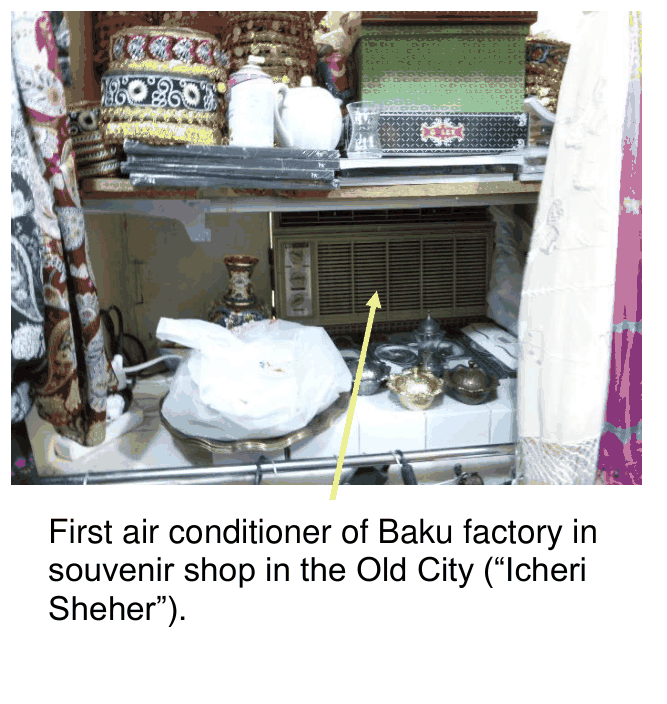
First air conditioner of Baku factory in souvenir shop in the Old City (“Icheri Sheher”).
Thermodynamic properties of various refrigerants:
| Refrigerant | “Generation” | \(\Delta H_{\mathrm{vap}}/\mathrm{kJ\,mol^{-1}}\) (at 280 K) | \(C_{V(\mathrm{gas})}/\mathrm{J\,K^{-1}\,mol^{-1}}\) |
|---|---|---|---|
| \(\ce{NH3}\) | 1 | 21.3 | 26.7 |
Table continued:
| \(\ce{CHF2Cl}\) | 2 | 20.0 | 48.8 |
| \(\ce{CF3CH2F}\) | 3 | 22.1 | 79 |
| \(\ce{CF3CF=CH2}\) | 4 | 19.1 | 120 |
Consider a model refrigeration cycle consisting of 4 steps schematically shown below in the pressure (\(p\)) – internal energy (\(U\)) coordinates.
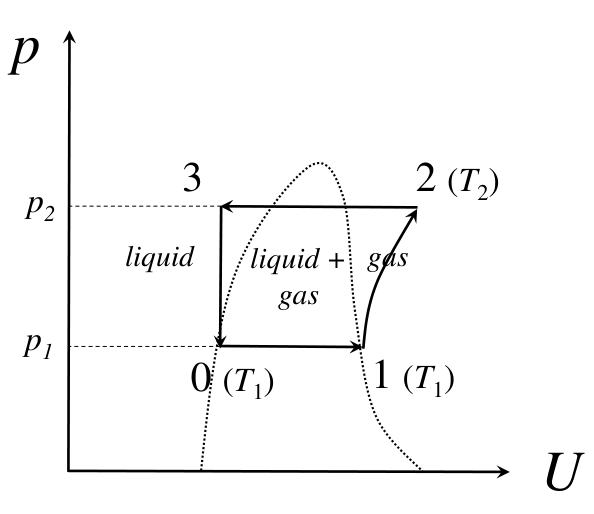
Diagram 1. Dashed line indicates the phase boundaries
During the first step of the cycle (line 0-1 in diagram 1), a liquid refrigerant is boiling at constant pressure \(p_1\) and temperature \(T_1\) (boiling temperature) until it completely evaporates. At this step, the refrigeration unit absorbs heat from surrounding objects. At the second step, the refrigerant undergoes reversible adiabatic compression and heats up to temperature \(T_2\) (line 1-2). After that the compressed refrigerant is cooled in a condenser at constant pressure \(p_2\) (line 2-3) and then returns to the initial state (line 3-0).
Let the cycle involve 1 mole of refrigerant, which is initially (point 0) completely liquid, \(T_1=280\ \mathrm{K}\), \(T_2=380\ \mathrm{K}\), assume that the vapor of any refrigerant behaves like an ideal gas. The thermodynamic characteristics of refrigerants are listed in the table above.
1.1 For each of refrigerants, ammonia and chlorodifluoromethane, calculate the amount of heat \(Q\) absorbed by refrigeration unit during heat exchange (line 0-1) and the work \(W\) required to compress its vapor adiabatically (line 1-2).
1.2. Which quantity(ies) remain(s) constant during the adiabatic compression step? Indicate by the circle(s).
\[ U\qquad H\qquad S\qquad G\qquad V \]
To compare the energy efficiency of refrigeration cycles with different parameters and refrigerants, the coefficient of performance (\(COP\)) is used, which is defined as a ratio of heat removed from a cooled system to the work of compressor: \(COP=Q/W\).
1.3 Calculate the values of \(COP\) in a considered cycle for ammonia and chlorodifluoromethane.
1.4 Why was ammonia replaced by CFCs in household refrigeration units? (Choose only one option)
a) to increase the energy efficiency of refrigeration cycles,
b) because the density of ammonia is less than that of air under the same conditions,
c) for user safety reasons.
A search for replacement of CFCs as refrigerants started when it was shown that their use can cause irreparable damage to the protective ozone layer of the atmosphere. The third, ozone-friendly generation of refrigerants came on the scene. Its typical representatives are fluoroalkanes.
1.5 What is the cause of the damage made by CFCs to the ozone layer? (Choose only one option.)
a) Ozone molecule easily adds to \(\ce{C-F}\) bond,
b) \(\ce{C-F}\) bond is easily broken by radiation, which leads to the formation of free radicals,
c) ozone molecule easily adds to \(\ce{C-Cl}\) bond,
d) \(\ce{C-Cl}\) bond is easily broken by radiation, which leads to the formation of free radicals.
1.6 However, under the 1997 Kyoto Protocol, fluoroalkanes also had to be replaced because they accumulate in the atmosphere and rapidly absorb infrared radiation, causing a rise in temperature of the atmosphere (the greenhouse effect). The refrigerants of the fourth generation such as 2,3,3,3-tetrafluoropropene \(\ce{CF3CF=CH2}\) have been suggested and are coming into use. Why does this compound enhance the greenhouse effect less than fluoroalkanes? (Choose only one option)
a) It is more reactive and easier to decompose,
b) it easily reacts with ozone,
c) it is better soluble in water.
1.7 Calculate the values of the \(COP\) in the refrigeration cycle considered above for two refrigerants of the third and fourth generations – \(\ce{CF3CH2F}\) and \(\ce{CF3CF=CH2}\). Did the energy efficiency improve in comparison with \(\ce{CHF2Cl}\)? Choose “Yes” or “No”.
Unlike household appliances, industrial refrigeration systems are often still using ammonia. It does not contribute to the greenhouse effect nor does it destroy the ozone layer. Industrial units can have a huge size and a large cost. Prior to their construction, they should be carefully modeled taking into account many different factors. In real systems, some part of the refrigerant at the start of the heat exchange with the environment is in the vapor phase (point 0 in the diagram below), and at the end (point 1) it is always overheated above the boiling point.
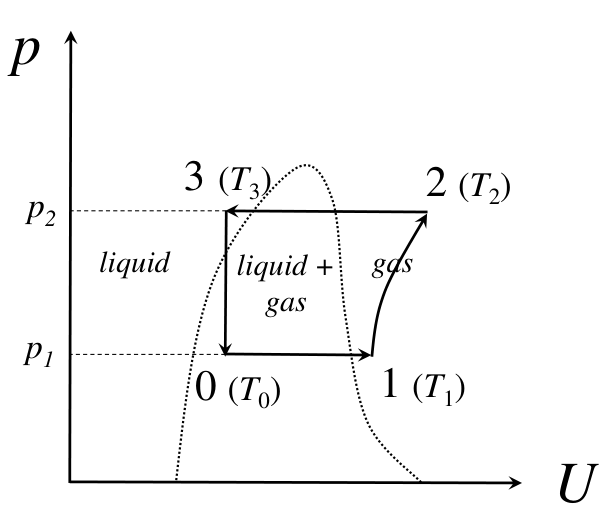
Diagram 2. Dashed line indicates the phase boundaries
Consider a cycle with 1 mole of ammonia. Its thermodynamic properties are the following: enthalpy of vaporization \(\Delta H_{\mathrm{vap}}=23.35\ \mathrm{kJ\,mol^{-1}}\) at \(T_{\mathrm{vap}}=239.8\ \mathrm{K}\) (boiling temperature at 1 bar pressure). Heat capacity of the liquid phase \(C_{V(\mathrm{liq})}=77\ \mathrm{J\,K^{-1}\,mol^{-1}}\), of the gas phase \(C_{V(\mathrm{gas})}=26.7\ \mathrm{J\,K^{-1}\,mol^{-1}}\). Assume that the heat capacities are temperature-independent and the vapor behaves like an ideal gas. The temperature dependence of the saturated vapor pressure of ammonia can be described by the empirical equation
\[ \log(p/\mathrm{bar})=4.87-1114/(T/\mathrm{K}-10.4). \]
During the first step of the cycle (line 0-1 in diagram 2), the equilibrium mixture of liquid refrigerant and its vapor receives heat from the environment at constant pressure \(p_1=3.0\ \mathrm{bar}\). The refrigerant completely evaporates and overheats up to the temperature \(T_1=275\ \mathrm{K}\). In the beginning of the process (point 0), the molar fraction of gaseous ammonia is \(x=0.13\).
1.8 Calculate the initial temperature of refrigerant \(T_0\), its volume change \(\Delta V\) and the amount of heat \(Q\) absorbed by refrigeration unit during this step. Take into account that the dependence of \(\Delta H_{\mathrm{vap}}\) from the temperature cannot be neglected. Then the refrigerant is reversibly and adiabatically compressed. It heats up to the temperature \(T_2=393\ \mathrm{K}\) (line 1-2).
1.9 Find the work \(W\) required for compression and the \(COP\) of the system. If you were not able to find \(Q\) in 4.1, use \(Q=20.15\ \mathrm{kJ}\).
At the next step corresponding to the line 2-3 in diagram, the compressed refrigerant is cooled in a condenser at constant pressure. Then it returns to the initial state through adiabatic expansion with zero work (line 3-0).
1.10 Determine the temperature \(T_3\) at point 3 to which the refrigerant is cooled in a condenser.
In the production of refrigeration units it is necessary to consider climatic factors. If a condenser is cooled by atmospheric air, the temperature \(T_3\) increases as the air temperature increases.
1.11 How will the \(COP\) change if \(T_3\) increases while \(T_0,T_1,T_2\) remain the same?
a) increase,
b) remain the same,
c) decrease.
Official English text of the problem.
Answers
- 1.1 Ammonia, \(\ce{NH3}\), SMILES
N: \(Q=21.3\ \mathrm{kJ}\), \(W=2.67\ \mathrm{kJ}\). Chlorodifluoromethane, \(\ce{CHF2Cl}\), SMILESFC(F)Cl: \(Q=20.0\ \mathrm{kJ}\), \(W=4.88\ \mathrm{kJ}\). - 1.2 Circle \(S\) only.
- 1.3 \(\mathrm{COP}_{\ce{NH3}}=7.98\); \(\mathrm{COP}_{\ce{CHF2Cl}}=4.10\).
- 1.4 c) For user safety reasons.
- 1.5 d) Radiation breaks \(\ce{C-Cl}\) bonds, forming free radicals.
- 1.6 a) It is more reactive and easier to decompose.
- 1.7 1,1,1,2-Tetrafluoroethane, \(\ce{CF3CH2F}\), SMILES
FCC(F)(F)F: \(\mathrm{COP}\approx2.80\), No. 2,3,3,3-Tetrafluoroprop-1-ene, \(\ce{CF3CF=CH2}\), SMILESC=C(F)C(F)(F)F: \(\mathrm{COP}\approx1.59\), No. - 1.8 \(T_0\approx264\ \mathrm{K}\), \(\Delta V\approx+6.67\ \mathrm{L}\), \(Q\approx19.82\ \mathrm{kJ}\).
- 1.9 \(W\approx3.15\ \mathrm{kJ}\), \(\mathrm{COP}\approx6.29\).
- 1.10 \(T_3\approx298\ \mathrm{K}\).
- 1.11 c) Decrease.
Solution
Take \(W>0\) to mean work supplied to the refrigerant, and use
\[ R=8.314\ \mathrm{J\,mol^{-1}\,K^{-1}}. \]
All numerical heat and work values refer to the stated \(n=1\ \mathrm{mol}\). For the liquid, use the implicit approximation of negligible volume and incompressibility, so that its internal energy is pressure-independent and \(C_{p,\mathrm{liq}}\simeq C_{V,\mathrm{liq}}\).
1.1
During constant-pressure vaporization, the heat absorbed equals the enthalpy change:
\[ Q=n\Delta H_{\mathrm{vap}}. \]
During adiabatic compression, \(q=0\). The first law therefore gives
\[ W=\Delta U=nC_{V,\mathrm{gas}}(T_2-T_1). \]
Here,
\[ T_2-T_1=380-280=100\ \mathrm{K}. \]
Thus:
| Refrigerant | Heat absorbed \(Q\) | Compression work \(W\) |
|---|---|---|
| Ammonia, \(\ce{NH3}\) | \(21.3\ \mathrm{kJ}\) | \((1\ \mathrm{mol})(26.7\ \mathrm{J\,mol^{-1}\,K^{-1}})(100\ \mathrm{K})=2.67\ \mathrm{kJ}\) |
| Chlorodifluoromethane, \(\ce{CHF2Cl}\) | \(20.0\ \mathrm{kJ}\) | \((1\ \mathrm{mol})(48.8\ \mathrm{J\,mol^{-1}\,K^{-1}})(100\ \mathrm{K})=4.88\ \mathrm{kJ}\) |
1.2
The compression is both reversible and adiabatic. Consequently,
\[ dS=\frac{\delta q_{\mathrm{rev}}}{T}=0. \]
Therefore, circle \(S\) only.
The temperature increase causes \(U\) and \(H\) to increase, compression decreases \(V\), and \(G\) is not conserved.
1.3
By definition,
\[ \mathrm{COP}=\frac{Q}{W}. \]
For ammonia,
\[ \boxed{\mathrm{COP}_{\ce{NH3}}=\frac{21.3}{2.67}=7.98.} \]
For chlorodifluoromethane,
\[ \boxed{\mathrm{COP}_{\ce{CHF2Cl}}=\frac{20.0}{4.88}=4.10.} \]
The coefficients of performance are dimensionless.
1.4
The correct choice is c), for user safety reasons.
Ammonia is toxic and strongly irritating, so leakage into occupied rooms is hazardous. The replacement refrigerants offered better safety for household use. The calculated coefficients of performance do not support increased energy efficiency as the reason for replacement.
1.5
The correct choice is d).
Ultraviolet radiation can cleave \(\ce{C-Cl}\) bonds homolytically: one bonding electron goes to each fragment, producing a chlorine radical. Chlorine radicals participate in catalytic ozone-destruction cycles, for example
\[ \ce{Cl + O3 -> ClO + O2}, \]
\[ \ce{ClO + O -> Cl + O2}. \]
Adding these equations gives
\[ \ce{O3 + O -> 2O2}. \]
Chlorine is regenerated, allowing it to destroy additional ozone molecules.
The species in this cycle are chlorine atom/radical, SMILES [Cl]; ozone, SMILES [O-][O+]=O (one resonance representation); chlorine monoxide radical, SMILES [O]Cl; dioxygen, SMILES O=O; and atomic oxygen, SMILES [O]. The equations express the catalytic sequence; the homolytic electron movement is described above.
1.6
The correct choice is a).
2,3,3,3-Tetrafluoroprop-1-ene, C=C(F)C(F)(F)F, contains a carbon–carbon double bond that provides a reactive site for atmospheric degradation. Its shorter atmospheric lifetime limits its accumulation and therefore reduces its contribution to the greenhouse effect.
No \(E/Z\) designation is possible for this alkene because one carbon of the double bond bears two hydrogen atoms.
1.7
For each refrigerant in the first model cycle,
\[ \mathrm{COP} =\frac{n\Delta H_{\mathrm{vap}}} {nC_{V,\mathrm{gas}}(T_2-T_1)}. \]
For 1,1,1,2-tetrafluoroethane,
\[ W=(1\ \mathrm{mol})(79\ \mathrm{J\,mol^{-1}\,K^{-1}}) (100\ \mathrm{K})=7.9\ \mathrm{kJ}, \]
\[ \boxed{\mathrm{COP}_{\ce{CF3CH2F}}=\frac{22.1}{7.9}\approx2.80.} \]
For 2,3,3,3-tetrafluoroprop-1-ene,
\[ W=(1\ \mathrm{mol})(120\ \mathrm{J\,mol^{-1}\,K^{-1}}) (100\ \mathrm{K})=12.0\ \mathrm{kJ}, \]
\[ \boxed{\mathrm{COP}_{\ce{CF3CF=CH2}}=\frac{19.1}{12.0}\approx1.59.} \]
Both values are below the value \(4.10\) for chlorodifluoromethane. Thus, select “No” for both refrigerants.
1.8
Initially, the liquid and vapor are in equilibrium, so \(T_0\) is the saturation temperature at \(3.0\ \mathrm{bar}\). Taking the empirical logarithm as base 10,
\[ \log_{10}(3.0)=4.87-\frac{1114}{T_0/\mathrm{K}-10.4}. \]
Hence,
\[ T_0= \left(10.4+\frac{1114}{4.87-\log_{10}(3.0)}\right)\mathrm{K} =263.992\ \mathrm{K}. \]
Therefore,
\[ \boxed{T_0\approx264\ \mathrm{K}.} \]
Initially, \(xn=0.13\ \mathrm{mol}\) is gaseous. Neglecting the liquid volume,
\[ V_0=\frac{xnRT_0}{p_1}. \]
At point 1, all the refrigerant is gaseous:
\[ V_1=\frac{nRT_1}{p_1}. \]
Using \(p_1=3.0\times10^5\ \mathrm{Pa}\),
\[ V_0=0.951\ \mathrm{L}, \qquad V_1=7.621\ \mathrm{L}. \]
Thus,
\[ \Delta V=\frac{nR(T_1-xT_0)}{p_1} =6.670\times10^{-3}\ \mathrm{m^3}, \]
\[ \boxed{\Delta V\approx+6.67\ \mathrm{L}.} \]
To calculate the heat, first correct the enthalpy of vaporization to \(T_0\). For the ideal gas,
\[ C_{p,\mathrm{gas}}=C_{V,\mathrm{gas}}+R =35.014\ \mathrm{J\,mol^{-1}\,K^{-1}}. \]
Using \(C_{p,\mathrm{liq}}\simeq77\ \mathrm{J\,mol^{-1}\,K^{-1}}\), Kirchhoff’s relation gives
\[ \Delta H_{\mathrm{vap}}(T_0) = \Delta H_{\mathrm{vap}}(T_{\mathrm{vap}}) + (C_{p,\mathrm{gas}}-C_{p,\mathrm{liq}}) (T_0-T_{\mathrm{vap}}). \]
Numerically,
\[ \begin{aligned} \Delta H_{\mathrm{vap}}(T_0) &=23.35\ \mathrm{kJ\,mol^{-1}}\\ &\quad+ (-0.041986\ \mathrm{kJ\,mol^{-1}\,K^{-1}}) (263.992-239.8)\ \mathrm{K}\\ &=22.334\ \mathrm{kJ\,mol^{-1}}. \end{aligned} \]
Only the initially liquid fraction, \(1-x=0.87\), must evaporate. Afterwards, the entire mole of vapor is heated from \(T_0\) to \(T_1\). At constant pressure,
\[ Q=n(1-x)\Delta H_{\mathrm{vap}}(T_0) +nC_{p,\mathrm{gas}}(T_1-T_0). \]
Therefore,
\[ \begin{aligned} Q &=(0.87\ \mathrm{mol})(22.334\ \mathrm{kJ\,mol^{-1}})\\ &\quad+ (1\ \mathrm{mol})(0.035014\ \mathrm{kJ\,mol^{-1}\,K^{-1}}) (275-263.992)\ \mathrm{K}\\ &=19.816\ \mathrm{kJ}. \end{aligned} \]
Thus,
\[ \boxed{Q\approx19.82\ \mathrm{kJ}.} \]
As an independent energy-balance check,
\[ \Delta U_{0\to1}=17.815\ \mathrm{kJ}, \qquad p_1\Delta V=2.001\ \mathrm{kJ}, \]
so \(Q=\Delta U_{0\to1}+p_1\Delta V=19.816\ \mathrm{kJ}\).
1.9
For the adiabatic compression,
\[ W=\Delta U=nC_{V,\mathrm{gas}}(T_2-T_1). \]
Thus,
\[ W=(1\ \mathrm{mol})(26.7\ \mathrm{J\,mol^{-1}\,K^{-1}}) (393-275)\ \mathrm{K} =3150.6\ \mathrm{J}. \]
Therefore,
\[ \boxed{W\approx3.15\ \mathrm{kJ},} \]
\[ \boxed{\mathrm{COP}=\frac{19.816}{3.1506}\approx6.29.} \]
Using the supplied fallback \(Q=20.15\ \mathrm{kJ}\) would instead give \(\mathrm{COP}\approx6.40\).
1.10
For the specified return step \(3\to0\), both heat and work are zero. Therefore,
\[ U_0-U_3=q_{3\to0}+w_{3\to0}=0, \]
so
\[ U_3=U_0. \]
At point 3 the refrigerant is liquid. At point 0 it contains a vapor fraction \(x\), so its internal energy is
\[ U_0=nU_{m,\mathrm{liq}}(T_0) +nx\Delta U_{\mathrm{vap}}(T_0). \]
Consequently,
\[ nC_{V,\mathrm{liq}}(T_3-T_0) =nx\Delta U_{\mathrm{vap}}(T_0). \]
Neglecting liquid volume and treating the vapor as ideal,
\[ \Delta U_{\mathrm{vap}}(T_0) =\Delta H_{\mathrm{vap}}(T_0)-RT_0. \]
Thus,
\[ \Delta U_{\mathrm{vap}}(T_0) =22.334-\frac{8.314(263.992)}{1000} =20.139\ \mathrm{kJ\,mol^{-1}}. \]
It follows that
\[ T_3=T_0+ \frac{x\Delta U_{\mathrm{vap}}(T_0)}{C_{V,\mathrm{liq}}}, \]
\[ T_3 =263.992\ \mathrm{K} +\frac{0.13(20139\ \mathrm{J\,mol^{-1}})} {77\ \mathrm{J\,mol^{-1}\,K^{-1}}} =297.994\ \mathrm{K}. \]
Therefore,
\[ \boxed{T_3\approx298\ \mathrm{K}.} \]
1.11
The correct choice is c), decrease.
At fixed \(T_0\), the energy balance for the return step gives
\[ x= \frac{C_{V,\mathrm{liq}}(T_3-T_0)} {\Delta U_{\mathrm{vap}}(T_0)}. \]
Increasing \(T_3\) therefore increases the initial vapor fraction \(x\). This fraction is no longer fixed at \(0.13\).
The heat absorbed is
\[ Q=n(1-x)\Delta H_{\mathrm{vap}}(T_0) +nC_{p,\mathrm{gas}}(T_1-T_0). \]
With \(T_0\) and \(T_1\) fixed, increasing \(x\) reduces \(Q\), because less liquid remains available to evaporate. Meanwhile,
\[ W=nC_{V,\mathrm{gas}}(T_2-T_1) \]
remains constant because \(T_1\) and \(T_2\) are unchanged. Hence,
\[ \boxed{\mathrm{COP}=Q/W\ \text{decreases}.} \]
The solution was checked against the official solution.
IChO 2015 · Theorieaufgabe 1
Neue und längst vergessene alte Kältemittel
Die Frage nach der Wahl eines Kältemittels für Kälte- und Klimaanlagen beschäftigte Wissenschaftler und Technologen während des gesamten vergangenen Jahrhunderts. Es wurde vorgeschlagen, die Entwicklung der Kältemittel in diesem Zeitraum in vier Generationen einzuteilen.
Ammoniak, das der ersten Generation zugeordnet wurde, wurde in den meisten der ältesten Kälteanlagen verwendet. Später wurde es durch Fluorchlorkohlenwasserstoffe (FCKW) ersetzt – Derivate von Methan und Ethan, bei denen die Wasserstoffatome durch Fluor und Chlor ersetzt sind.
In Baku wurde im Werk „Bakkonditsioner“ die Produktion der ersten sowjetischen serienmäßig hergestellten Haushaltsklimageräte BK-1500 aufgenommen. In ihnen wurde das Kältemittel Chlordifluormethan \(\ce{CHF2Cl}\) aus der zweiten Generation verwendet. In dieser Aufgabe vergleichen wir verschiedene Kältemittel unter thermodynamischen Gesichtspunkten.
Erstes Klimagerät des Werks in Baku in einem Souvenirladen in der Altstadt („Icheri Sheher“).
Thermodynamische Eigenschaften verschiedener Kältemittel:
| Kältemittel | „Generation“ | \(\Delta H_{\mathrm{vap}}/\mathrm{kJ\,mol^{-1}}\) (bei 280 K) | \(C_{V(\mathrm{gas})}/\mathrm{J\,K^{-1}\,mol^{-1}}\) |
|---|---|---|---|
| \(\ce{NH3}\) | 1 | 21.3 | 26.7 |
Fortsetzung der Tabelle:
| \(\ce{CHF2Cl}\) | 2 | 20.0 | 48.8 |
| \(\ce{CF3CH2F}\) | 3 | 22.1 | 79 |
| \(\ce{CF3CF=CH2}\) | 4 | 19.1 | 120 |
Betrachten Sie einen modellhaften Kältekreisprozess aus 4 Schritten, der unten schematisch in Druck-\(p\)–innere-Energie-\(U\)-Koordinaten dargestellt ist.
Diagramm 1. Die gestrichelte Linie kennzeichnet die Phasengrenzen
Während des ersten Schritts des Kreisprozesses (Linie 0-1 in Diagramm 1) siedet ein flüssiges Kältemittel bei konstantem Druck \(p_1\) und konstanter Temperatur \(T_1\) (Siedetemperatur), bis es vollständig verdampft ist. In diesem Schritt nimmt die Kälteanlage Wärme von den umgebenden Gegenständen auf. Im zweiten Schritt wird das Kältemittel reversibel adiabatisch verdichtet und erwärmt sich auf die Temperatur \(T_2\) (Linie 1-2). Danach wird das verdichtete Kältemittel in einem Verflüssiger bei konstantem Druck \(p_2\) abgekühlt (Linie 2-3) und kehrt anschließend in den Ausgangszustand zurück (Linie 3-0).
Am Kreisprozess nehme 1 Mol Kältemittel teil, das zu Beginn (Punkt 0) vollständig flüssig ist; es gelte \(T_1=280\ \mathrm{K}\), \(T_2=380\ \mathrm{K}\). Nehmen Sie an, dass sich der Dampf jedes Kältemittels wie ein ideales Gas verhält. Die thermodynamischen Kenngrößen der Kältemittel sind in der obigen Tabelle aufgeführt.
1.1 Berechnen Sie für die beiden Kältemittel Ammoniak und Chlordifluormethan jeweils die Wärmemenge \(Q\), die die Kälteanlage beim Wärmeaustausch aufnimmt (Linie 0-1), sowie die Arbeit \(W\), die zur adiabatischen Verdichtung ihres Dampfes erforderlich ist (Linie 1-2).
1.2. Welche Größe(n) bleibt (bleiben) während des adiabatischen Verdichtungsschritts konstant? Kennzeichnen Sie diese durch Einkreisen.
\[ U\qquad H\qquad S\qquad G\qquad V \]
Zum Vergleich der Energieeffizienz von Kältekreisprozessen mit unterschiedlichen Parametern und Kältemitteln wird die Leistungszahl (\(COP\)) verwendet. Sie ist als Verhältnis der einem gekühlten System entzogenen Wärme zur Arbeit des Verdichters definiert: \(COP=Q/W\).
1.3 Berechnen Sie die Werte von \(COP\) im betrachteten Kreisprozess für Ammoniak und Chlordifluormethan.
1.4 Warum wurde Ammoniak in Haushaltskältegeräten durch FCKW ersetzt? (Wählen Sie nur eine Antwort aus)
a) um die Energieeffizienz der Kältekreisprozesse zu erhöhen,
b) weil die Dichte von Ammoniak unter gleichen Bedingungen geringer ist als die von Luft,
c) aus Gründen der Sicherheit der Benutzer.
Die Suche nach einem Ersatz für FCKW als Kältemittel begann, als gezeigt wurde, dass ihre Verwendung die schützende Ozonschicht der Atmosphäre irreparabel schädigen kann. Die dritte, ozonfreundliche Generation von Kältemitteln trat auf den Plan. Ihre typischen Vertreter sind Fluoralkane.
1.5 Was ist die Ursache für die Schädigung der Ozonschicht durch FCKW? (Wählen Sie nur eine Antwort aus.)
a) Das Ozonmolekül addiert sich leicht an die \(\ce{C-F}\)-Bindung,
b) die \(\ce{C-F}\)-Bindung wird durch Strahlung leicht gespalten, wodurch freie Radikale entstehen,
c) das Ozonmolekül addiert sich leicht an die \(\ce{C-Cl}\)-Bindung,
d) die \(\ce{C-Cl}\)-Bindung wird durch Strahlung leicht gespalten, wodurch freie Radikale entstehen.
1.6 Nach dem Kyoto-Protokoll von 1997 mussten jedoch auch Fluoralkane ersetzt werden, da sie sich in der Atmosphäre anreichern und rasch Infrarotstrahlung absorbieren, was zu einem Temperaturanstieg in der Atmosphäre führt (Treibhauseffekt). Kältemittel der vierten Generation wie 2,3,3,3-Tetrafluorpropen \(\ce{CF3CF=CH2}\) wurden vorgeschlagen und werden zunehmend eingesetzt. Warum verstärkt diese Verbindung den Treibhauseffekt weniger als Fluoralkane? (Wählen Sie nur eine Antwort aus)
a) Sie ist reaktiver und leichter abbaubar,
b) sie reagiert leicht mit Ozon,
c) sie ist besser in Wasser löslich.
1.7 Berechnen Sie die Werte von \(COP\) im oben betrachteten Kältekreisprozess für zwei Kältemittel der dritten und vierten Generation – \(\ce{CF3CH2F}\) und \(\ce{CF3CF=CH2}\). Hat sich die Energieeffizienz im Vergleich zu \(\ce{CHF2Cl}\) verbessert? Wählen Sie „Ja“ oder „Nein“.
Im Gegensatz zu Haushaltsgeräten verwenden industrielle Kälteanlagen häufig noch immer Ammoniak. Es trägt weder zum Treibhauseffekt bei noch zerstört es die Ozonschicht. Industrieanlagen können sehr groß und kostspielig sein. Vor ihrem Bau sollten sie unter Berücksichtigung vieler verschiedener Faktoren sorgfältig modelliert werden. In realen Systemen befindet sich ein Teil des Kältemittels zu Beginn des Wärmeaustauschs mit der Umgebung in der Dampfphase (Punkt 0 im nachstehenden Diagramm), und am Ende (Punkt 1) ist es stets über die Siedetemperatur hinaus überhitzt.
Diagramm 2. Die gestrichelte Linie kennzeichnet die Phasengrenzen
Betrachten Sie einen Kreisprozess mit 1 Mol Ammoniak. Seine thermodynamischen Eigenschaften sind wie folgt: Verdampfungsenthalpie \(\Delta H_{\mathrm{vap}}=23.35\ \mathrm{kJ\,mol^{-1}}\) bei \(T_{\mathrm{vap}}=239.8\ \mathrm{K}\) (Siedetemperatur bei einem Druck von 1 bar). Wärmekapazität der flüssigen Phase \(C_{V(\mathrm{liq})}=77\ \mathrm{J\,K^{-1}\,mol^{-1}}\), der Gasphase \(C_{V(\mathrm{gas})}=26.7\ \mathrm{J\,K^{-1}\,mol^{-1}}\). Nehmen Sie an, dass die Wärmekapazitäten temperaturunabhängig sind und sich der Dampf wie ein ideales Gas verhält. Die Temperaturabhängigkeit des Sättigungsdampfdrucks von Ammoniak lässt sich durch folgende empirische Gleichung beschreiben:
\[ \log(p/\mathrm{bar})=4.87-1114/(T/\mathrm{K}-10.4). \]
Während des ersten Schritts des Kreisprozesses (Linie 0-1 in Diagramm 2) nimmt das im Gleichgewicht befindliche Gemisch aus flüssigem Kältemittel und seinem Dampf bei konstantem Druck \(p_1=3.0\ \mathrm{bar}\) Wärme aus der Umgebung auf. Das Kältemittel verdampft vollständig und wird bis zur Temperatur \(T_1=275\ \mathrm{K}\) überhitzt. Zu Beginn des Prozesses (Punkt 0) beträgt der Stoffmengenanteil des gasförmigen Ammoniaks \(x=0.13\).
1.8 Berechnen Sie die Anfangstemperatur des Kältemittels \(T_0\), seine Volumenänderung \(\Delta V\) und die Wärmemenge \(Q\), die die Kälteanlage während dieses Schritts aufnimmt. Berücksichtigen Sie, dass die Temperaturabhängigkeit von \(\Delta H_{\mathrm{vap}}\) nicht vernachlässigt werden darf. Anschließend wird das Kältemittel reversibel und adiabatisch verdichtet. Es erwärmt sich auf die Temperatur \(T_2=393\ \mathrm{K}\) (Linie 1-2).
1.9 Bestimmen Sie die zur Verdichtung erforderliche Arbeit \(W\) und die Leistungszahl \(COP\) des Systems. Falls Sie \(Q\) in 4.1 nicht bestimmen konnten, verwenden Sie \(Q=20.15\ \mathrm{kJ}\).
Im nächsten Schritt, der der Linie 2-3 im Diagramm entspricht, wird das verdichtete Kältemittel in einem Verflüssiger bei konstantem Druck abgekühlt. Anschließend kehrt es durch adiabatische Expansion ohne Arbeitsleistung in den Ausgangszustand zurück (Linie 3-0).
1.10 Bestimmen Sie die Temperatur \(T_3\) an Punkt 3, auf die das Kältemittel im Verflüssiger abgekühlt wird.
Bei der Herstellung von Kälteanlagen müssen klimatische Faktoren berücksichtigt werden. Wird ein Verflüssiger durch Umgebungsluft gekühlt, steigt die Temperatur \(T_3\) mit zunehmender Lufttemperatur.
1.11 Wie ändert sich die Leistungszahl \(COP\), wenn \(T_3\) steigt, während \(T_0,T_1,T_2\) gleich bleiben?
a) Sie steigt,
b) sie bleibt gleich,
c) sie sinkt.
Aufgabentext aus dem offiziellen englischen Text übersetzt.
Antworten
- 1.1 Ammoniak, \(\ce{NH3}\), SMILES
N: \(Q=21.3\ \mathrm{kJ}\), \(W=2.67\ \mathrm{kJ}\). Chlordifluormethan, \(\ce{CHF2Cl}\), SMILESFC(F)Cl: \(Q=20.0\ \mathrm{kJ}\), \(W=4.88\ \mathrm{kJ}\). - 1.2 Nur \(S\) einkreisen.
- 1.3 \(\mathrm{COP}_{\ce{NH3}}=7.98\); \(\mathrm{COP}_{\ce{CHF2Cl}}=4.10\).
- 1.4 c) Aus Gründen der Sicherheit der Benutzer.
- 1.5 d) Strahlung spaltet \(\ce{C-Cl}\)-Bindungen, wobei freie Radikale entstehen.
- 1.6 a) Sie ist reaktiver und leichter abbaubar.
- 1.7 1,1,1,2-Tetrafluorethan, \(\ce{CF3CH2F}\), SMILES
FCC(F)(F)F: \(\mathrm{COP}\approx2.80\), Nein. 2,3,3,3-Tetrafluorprop-1-en, \(\ce{CF3CF=CH2}\), SMILESC=C(F)C(F)(F)F: \(\mathrm{COP}\approx1.59\), Nein. - 1.8 \(T_0\approx264\ \mathrm{K}\), \(\Delta V\approx+6.67\ \mathrm{L}\), \(Q\approx19.82\ \mathrm{kJ}\).
- 1.9 \(W\approx3.15\ \mathrm{kJ}\), \(\mathrm{COP}\approx6.29\).
- 1.10 \(T_3\approx298\ \mathrm{K}\).
- 1.11 c) Sie sinkt.
Lösung
Mit \(W>0\) sei dem Kältemittel zugeführte Arbeit bezeichnet; verwenden wir außerdem
\[ R=8.314\ \mathrm{J\,mol^{-1}\,K^{-1}}. \]
Alle Zahlenwerte für Wärme und Arbeit beziehen sich auf die angegebene Stoffmenge \(n=1\ \mathrm{mol}\). Für die Flüssigkeit wird die implizite Näherung eines vernachlässigbaren Volumens und der Inkompressibilität verwendet, sodass ihre innere Energie druckunabhängig ist und \(C_{p,\mathrm{liq}}\simeq C_{V,\mathrm{liq}}\) gilt.
1.1
Bei der Verdampfung unter konstantem Druck entspricht die aufgenommene Wärme der Enthalpieänderung:
\[ Q=n\Delta H_{\mathrm{vap}}. \]
Bei der adiabatischen Verdichtung gilt \(q=0\). Aus dem ersten Hauptsatz folgt daher
\[ W=\Delta U=nC_{V,\mathrm{gas}}(T_2-T_1). \]
Hier gilt
\[ T_2-T_1=380-280=100\ \mathrm{K}. \]
Somit:
| Kältemittel | Aufgenommene Wärme \(Q\) | Verdichtungsarbeit \(W\) |
|---|---|---|
| Ammoniak, \(\ce{NH3}\) | \(21.3\ \mathrm{kJ}\) | \((1\ \mathrm{mol})(26.7\ \mathrm{J\,mol^{-1}\,K^{-1}})(100\ \mathrm{K})=2.67\ \mathrm{kJ}\) |
| Chlordifluormethan, \(\ce{CHF2Cl}\) | \(20.0\ \mathrm{kJ}\) | \((1\ \mathrm{mol})(48.8\ \mathrm{J\,mol^{-1}\,K^{-1}})(100\ \mathrm{K})=4.88\ \mathrm{kJ}\) |
1.2
Die Verdichtung ist sowohl reversibel als auch adiabatisch. Folglich gilt
\[ dS=\frac{\delta q_{\mathrm{rev}}}{T}=0. \]
Daher ist nur \(S\) einzukreisen.
Durch den Temperaturanstieg nehmen \(U\) und \(H\) zu, durch die Verdichtung nimmt \(V\) ab, und \(G\) bleibt nicht erhalten.
1.3
Definitionsgemäß gilt
\[ \mathrm{COP}=\frac{Q}{W}. \]
Für Ammoniak gilt
\[ \boxed{\mathrm{COP}_{\ce{NH3}}=\frac{21.3}{2.67}=7.98.} \]
Für Chlordifluormethan gilt
\[ \boxed{\mathrm{COP}_{\ce{CHF2Cl}}=\frac{20.0}{4.88}=4.10.} \]
Die Leistungszahlen sind dimensionslos.
1.4
Die richtige Antwort ist c), aus Gründen der Sicherheit der Benutzer.
Ammoniak ist giftig und stark reizend, sodass sein Austreten in Räume, in denen sich Menschen aufhalten, gefährlich ist. Die als Ersatz eingesetzten Kältemittel boten eine höhere Sicherheit für den Gebrauch im Haushalt. Die berechneten Leistungszahlen stützen eine erhöhte Energieeffizienz als Grund für den Ersatz nicht.
1.5
Die richtige Antwort ist d).
Ultraviolette Strahlung kann \(\ce{C-Cl}\)-Bindungen homolytisch spalten: Jedes Fragment erhält ein Bindungselektron, wodurch ein Chlorradikal entsteht. Chlorradikale sind an katalytischen Ozonabbauzyklen beteiligt, zum Beispiel
\[ \ce{Cl + O3 -> ClO + O2}, \]
\[ \ce{ClO + O -> Cl + O2}. \]
Durch Addition dieser Gleichungen erhält man
\[ \ce{O3 + O -> 2O2}. \]
Chlor wird regeneriert und kann dadurch weitere Ozonmoleküle zerstören.
Die Spezies in diesem Zyklus sind das Chloratom/-radikal, SMILES [Cl]; Ozon, SMILES [O-][O+]=O (eine mesomere Grenzstruktur); das Chlormonoxidradikal, SMILES [O]Cl; Disauerstoff, SMILES O=O; und atomarer Sauerstoff, SMILES [O]. Die Gleichungen stellen die katalytische Reaktionsfolge dar; die Elektronenverschiebung bei der Homolyse ist oben beschrieben.
1.6
Die richtige Antwort ist a).
2,3,3,3-Tetrafluorprop-1-en, C=C(F)C(F)(F)F, enthält eine Kohlenstoff–Kohlenstoff-Doppelbindung, die eine reaktive Stelle für den Abbau in der Atmosphäre bietet. Seine kürzere atmosphärische Lebensdauer begrenzt seine Anreicherung und verringert somit seinen Beitrag zum Treibhauseffekt.
Für dieses Alken ist keine \(E/Z\)-Bezeichnung möglich, da eines der Kohlenstoffatome der Doppelbindung zwei Wasserstoffatome trägt.
1.7
Für jedes Kältemittel im ersten Modellkreisprozess gilt
\[ \mathrm{COP} =\frac{n\Delta H_{\mathrm{vap}}} {nC_{V,\mathrm{gas}}(T_2-T_1)}. \]
Für 1,1,1,2-Tetrafluorethan gilt
\[ W=(1\ \mathrm{mol})(79\ \mathrm{J\,mol^{-1}\,K^{-1}}) (100\ \mathrm{K})=7.9\ \mathrm{kJ}, \]
\[ \boxed{\mathrm{COP}_{\ce{CF3CH2F}}=\frac{22.1}{7.9}\approx2.80.} \]
Für 2,3,3,3-Tetrafluorprop-1-en gilt
\[ W=(1\ \mathrm{mol})(120\ \mathrm{J\,mol^{-1}\,K^{-1}}) (100\ \mathrm{K})=12.0\ \mathrm{kJ}, \]
\[ \boxed{\mathrm{COP}_{\ce{CF3CF=CH2}}=\frac{19.1}{12.0}\approx1.59.} \]
Beide Werte liegen unter dem Wert \(4.10\) für Chlordifluormethan. Daher ist für beide Kältemittel „Nein“ zu wählen.
1.8
Zu Beginn stehen Flüssigkeit und Dampf im Gleichgewicht, sodass \(T_0\) die Sättigungstemperatur bei \(3.0\ \mathrm{bar}\) ist. Wird der Logarithmus in der empirischen Gleichung zur Basis 10 genommen, gilt
\[ \log_{10}(3.0)=4.87-\frac{1114}{T_0/\mathrm{K}-10.4}. \]
Daraus folgt
\[ T_0= \left(10.4+\frac{1114}{4.87-\log_{10}(3.0)}\right)\mathrm{K} =263.992\ \mathrm{K}. \]
Somit gilt
\[ \boxed{T_0\approx264\ \mathrm{K}.} \]
Zu Beginn sind \(xn=0.13\ \mathrm{mol}\) gasförmig. Bei Vernachlässigung des Flüssigkeitsvolumens gilt
\[ V_0=\frac{xnRT_0}{p_1}. \]
An Punkt 1 ist das gesamte Kältemittel gasförmig:
\[ V_1=\frac{nRT_1}{p_1}. \]
Mit \(p_1=3.0\times10^5\ \mathrm{Pa}\) ergibt sich
\[ V_0=0.951\ \mathrm{L}, \qquad V_1=7.621\ \mathrm{L}. \]
Damit folgt
\[ \Delta V=\frac{nR(T_1-xT_0)}{p_1} =6.670\times10^{-3}\ \mathrm{m^3}, \]
\[ \boxed{\Delta V\approx+6.67\ \mathrm{L}.} \]
Zur Berechnung der Wärme wird zunächst die Verdampfungsenthalpie auf \(T_0\) korrigiert. Für das ideale Gas gilt
\[ C_{p,\mathrm{gas}}=C_{V,\mathrm{gas}}+R =35.014\ \mathrm{J\,mol^{-1}\,K^{-1}}. \]
Mit \(C_{p,\mathrm{liq}}\simeq77\ \mathrm{J\,mol^{-1}\,K^{-1}}\) ergibt die Kirchhoffsche Beziehung
\[ \Delta H_{\mathrm{vap}}(T_0) = \Delta H_{\mathrm{vap}}(T_{\mathrm{vap}}) + (C_{p,\mathrm{gas}}-C_{p,\mathrm{liq}}) (T_0-T_{\mathrm{vap}}). \]
Mit Zahlenwerten:
\[ \begin{aligned} \Delta H_{\mathrm{vap}}(T_0) &=23.35\ \mathrm{kJ\,mol^{-1}}\\ &\quad+ (-0.041986\ \mathrm{kJ\,mol^{-1}\,K^{-1}}) (263.992-239.8)\ \mathrm{K}\\ &=22.334\ \mathrm{kJ\,mol^{-1}}. \end{aligned} \]
Nur der anfangs flüssige Anteil, \(1-x=0.87\), muss verdampfen. Anschließend wird das gesamte Mol Dampf von \(T_0\) auf \(T_1\) erwärmt. Bei konstantem Druck gilt
\[ Q=n(1-x)\Delta H_{\mathrm{vap}}(T_0) +nC_{p,\mathrm{gas}}(T_1-T_0). \]
Daher ergibt sich
\[ \begin{aligned} Q &=(0.87\ \mathrm{mol})(22.334\ \mathrm{kJ\,mol^{-1}})\\ &\quad+ (1\ \mathrm{mol})(0.035014\ \mathrm{kJ\,mol^{-1}\,K^{-1}}) (275-263.992)\ \mathrm{K}\\ &=19.816\ \mathrm{kJ}. \end{aligned} \]
Somit gilt
\[ \boxed{Q\approx19.82\ \mathrm{kJ}.} \]
Als unabhängige Kontrolle anhand der Energiebilanz erhält man
\[ \Delta U_{0\to1}=17.815\ \mathrm{kJ}, \qquad p_1\Delta V=2.001\ \mathrm{kJ}, \]
also \(Q=\Delta U_{0\to1}+p_1\Delta V=19.816\ \mathrm{kJ}\).
1.9
Für die adiabatische Verdichtung gilt
\[ W=\Delta U=nC_{V,\mathrm{gas}}(T_2-T_1). \]
Somit ergibt sich
\[ W=(1\ \mathrm{mol})(26.7\ \mathrm{J\,mol^{-1}\,K^{-1}}) (393-275)\ \mathrm{K} =3150.6\ \mathrm{J}. \]
Daraus folgt
\[ \boxed{W\approx3.15\ \mathrm{kJ},} \]
\[ \boxed{\mathrm{COP}=\frac{19.816}{3.1506}\approx6.29.} \]
Die Verwendung des angegebenen Ersatzwerts \(Q=20.15\ \mathrm{kJ}\) würde stattdessen \(\mathrm{COP}\approx6.40\) ergeben.
1.10
Für den vorgegebenen Rückkehrschritt \(3\to0\) sind sowohl Wärme als auch Arbeit null. Daher gilt
\[ U_0-U_3=q_{3\to0}+w_{3\to0}=0, \]
also
\[ U_3=U_0. \]
An Punkt 3 ist das Kältemittel flüssig. An Punkt 0 enthält es einen Dampfanteil \(x\), sodass für seine innere Energie gilt:
\[ U_0=nU_{m,\mathrm{liq}}(T_0) +nx\Delta U_{\mathrm{vap}}(T_0). \]
Folglich gilt
\[ nC_{V,\mathrm{liq}}(T_3-T_0) =nx\Delta U_{\mathrm{vap}}(T_0). \]
Bei Vernachlässigung des Flüssigkeitsvolumens und Behandlung des Dampfes als ideales Gas gilt
\[ \Delta U_{\mathrm{vap}}(T_0) =\Delta H_{\mathrm{vap}}(T_0)-RT_0. \]
Somit ergibt sich
\[ \Delta U_{\mathrm{vap}}(T_0) =22.334-\frac{8.314(263.992)}{1000} =20.139\ \mathrm{kJ\,mol^{-1}}. \]
Daraus folgt
\[ T_3=T_0+ \frac{x\Delta U_{\mathrm{vap}}(T_0)}{C_{V,\mathrm{liq}}}, \]
\[ T_3 =263.992\ \mathrm{K} +\frac{0.13(20139\ \mathrm{J\,mol^{-1}})} {77\ \mathrm{J\,mol^{-1}\,K^{-1}}} =297.994\ \mathrm{K}. \]
Damit gilt
\[ \boxed{T_3\approx298\ \mathrm{K}.} \]
1.11
Die richtige Antwort ist c), sie sinkt.
Bei festem \(T_0\) ergibt die Energiebilanz für den Rückkehrschritt
\[ x= \frac{C_{V,\mathrm{liq}}(T_3-T_0)} {\Delta U_{\mathrm{vap}}(T_0)}. \]
Eine Erhöhung von \(T_3\) erhöht daher den anfänglichen Dampfanteil \(x\). Dieser Anteil ist nicht länger auf \(0.13\) festgelegt.
Die aufgenommene Wärme beträgt
\[ Q=n(1-x)\Delta H_{\mathrm{vap}}(T_0) +nC_{p,\mathrm{gas}}(T_1-T_0). \]
Bei festen Werten von \(T_0\) und \(T_1\) verringert eine Erhöhung von \(x\) die Wärme \(Q\), da weniger Flüssigkeit zum Verdampfen verbleibt. Gleichzeitig bleibt
\[ W=nC_{V,\mathrm{gas}}(T_2-T_1) \]
konstant, da \(T_1\) und \(T_2\) unverändert sind. Daher gilt
\[ \boxed{\mathrm{COP}=Q/W\ \text{sinkt}.} \]
Die Lösung wurde mit der offiziellen Lösung abgeglichen.
IChO 2015 · Teori sorusu 1
Yeni ve çoktan unutulmuş eski soğutucu akışkanlar
Soğutma ve iklimlendirme sistemleri için soğutucu akışkan seçimi sorunu, geçtiğimiz yüzyıl boyunca bilim insanlarının ve teknoloji uzmanlarının ilgisini çekmiştir. Bu süre içinde soğutucu akışkanların dört nesil boyunca geliştiği öne sürülmüştür.
Birinci nesil olarak sınıflandırılan amonyak, en eski soğutma ünitelerinin çoğunda kullanılmıştır. Daha sonra yerini, metan ve etanın hidrojen atomlarının flor ve klor ile yer değiştirdiği türevleri olan kloroflorokarbonlara (CFC'ler) bırakmıştır.
Bakü'deki "Bakkonditsioner" fabrikasında, Sovyetler Birliği'nin seri üretilen ilk ev tipi klimaları olan BK-1500'lerin üretimine başlanmıştır. Bu klimalarda ikinci nesil bir soğutucu akışkan olan klorodiflorometan \(\ce{CHF2Cl}\) kullanılmıştır. Bu soruda çeşitli soğutucu akışkanları termodinamik açıdan karşılaştıracağız.
Eski Şehir'deki (“İçeri Şehir”) bir hediyelik eşya dükkânında, Bakü fabrikasının ilk kliması.
Çeşitli soğutucu akışkanların termodinamik özellikleri:
| Soğutucu akışkan | “Nesil” | \(\Delta H_{\mathrm{vap}}/\mathrm{kJ\,mol^{-1}}\) (280 K'de) | \(C_{V(\mathrm{gas})}/\mathrm{J\,K^{-1}\,mol^{-1}}\) |
|---|---|---|---|
| \(\ce{NH3}\) | 1 | 21.3 | 26.7 |
Tablonun devamı:
| \(\ce{CHF2Cl}\) | 2 | 20.0 | 48.8 |
| \(\ce{CF3CH2F}\) | 3 | 22.1 | 79 |
| \(\ce{CF3CF=CH2}\) | 4 | 19.1 | 120 |
Aşağıda basınç (\(p\)) – iç enerji (\(U\)) koordinatlarında şematik olarak gösterilen, 4 adımdan oluşan bir model soğutma çevrimini ele alalım.
Diyagram 1. Kesikli çizgi faz sınırlarını göstermektedir
Çevrimin ilk adımında (diyagram 1'deki 0-1 çizgisi), sıvı bir soğutucu akışkan, tamamen buharlaşıncaya kadar sabit \(p_1\) basıncında ve \(T_1\) sıcaklığında (kaynama sıcaklığı) kaynar. Bu adımda soğutma ünitesi, çevresindeki cisimlerden ısı alır. İkinci adımda soğutucu akışkan, tersinir adyabatik sıkıştırmaya uğrar ve \(T_2\) sıcaklığına kadar ısınır (1-2 çizgisi). Ardından sıkıştırılmış soğutucu akışkan bir yoğuşturucuda sabit \(p_2\) basıncında soğutulur (2-3 çizgisi) ve daha sonra başlangıç durumuna döner (3-0 çizgisi).
Çevrimde, başlangıçta (0 noktası) tamamen sıvı hâlde olan 1 mol soğutucu akışkan bulunsun; \(T_1=280\ \mathrm{K}\), \(T_2=380\ \mathrm{K}\) olsun ve tüm soğutucu akışkanların buharlarının ideal gaz gibi davrandığını varsayın. Soğutucu akışkanların termodinamik özellikleri yukarıdaki tabloda verilmiştir.
1.1 Amonyak ve klorodiflorometan soğutucu akışkanlarının her biri için, ısı alışverişi sırasında (0-1 çizgisi) soğutma ünitesinin aldığı \(Q\) ısı miktarını ve buharını adyabatik olarak sıkıştırmak için gereken \(W\) işini (1-2 çizgisi) hesaplayın.
1.2. Adyabatik sıkıştırma adımı sırasında hangi nicelik veya nicelikler sabit kalır? Daire içine alarak belirtin.
\[ U\qquad H\qquad S\qquad G\qquad V \]
Farklı parametrelere ve soğutucu akışkanlara sahip soğutma çevrimlerinin enerji verimliliğini karşılaştırmak için, soğutulan bir sistemden uzaklaştırılan ısının kompresörün yaptığı işe oranı olarak tanımlanan performans katsayısı (\(COP\)) kullanılır: \(COP=Q/W\).
1.3 Ele alınan çevrimde amonyak ve klorodiflorometan için \(COP\) değerlerini hesaplayın.
1.4 Ev tipi soğutma ünitelerinde amonyağın yerini neden CFC'ler almıştır? (Yalnızca bir seçeneği işaretleyin)
a) soğutma çevrimlerinin enerji verimliliğini artırmak için,
b) aynı koşullar altında amonyağın yoğunluğu havanınkinden düşük olduğu için,
c) kullanıcı güvenliği nedeniyle.
CFC'lerin kullanımının atmosferin koruyucu ozon tabakasına onarılamaz zarar verebileceği gösterildiğinde, soğutucu akışkan olarak CFC'lerin yerini alacak maddeler aranmaya başlanmıştır. Ozon dostu üçüncü nesil soğutucu akışkanlar ortaya çıkmıştır. Bu neslin tipik temsilcileri floroalkanlardır.
1.5 CFC'lerin ozon tabakasına verdiği zararın nedeni nedir? (Yalnızca bir seçeneği işaretleyin.)
a) Ozon molekülü \(\ce{C-F}\) bağına kolayca katılır,
b) \(\ce{C-F}\) bağı ışınımla kolayca kırılır ve bu durum serbest radikallerin oluşmasına yol açar,
c) ozon molekülü \(\ce{C-Cl}\) bağına kolayca katılır,
d) \(\ce{C-Cl}\) bağı ışınımla kolayca kırılır ve bu durum serbest radikallerin oluşmasına yol açar.
1.6 Ancak, atmosferde birikip kızılötesi ışınımı hızla soğurarak atmosfer sıcaklığının artmasına (sera etkisine) neden olduklarından, 1997 Kyoto Protokolü uyarınca floroalkanların da değiştirilmesi gerekmiştir. 2,3,3,3-tetrafloropropen \(\ce{CF3CF=CH2}\) gibi dördüncü nesil soğutucu akışkanlar önerilmiş ve kullanılmaya başlanmıştır. Bu bileşik sera etkisini neden floroalkanlardan daha az artırır? (Yalnızca bir seçeneği işaretleyin)
a) Daha reaktiftir ve daha kolay bozunur,
b) ozonla kolayca tepkimeye girer,
c) suda daha iyi çözünür.
1.7 Yukarıda ele alınan soğutma çevriminde üçüncü ve dördüncü nesle ait iki soğutucu akışkan olan \(\ce{CF3CH2F}\) ve \(\ce{CF3CF=CH2}\) için \(COP\) değerlerini hesaplayın. \(\ce{CHF2Cl}\) ile karşılaştırıldığında enerji verimliliği artmış mıdır? “Evet” veya “Hayır” seçeneğini işaretleyin.
Ev tipi cihazların aksine, endüstriyel soğutma sistemlerinde hâlâ sıklıkla amonyak kullanılmaktadır. Amonyak ne sera etkisine katkıda bulunur ne de ozon tabakasını tahrip eder. Endüstriyel üniteler çok büyük boyutlara ve yüksek maliyetlere sahip olabilir. Bu üniteler, inşa edilmeden önce pek çok farklı etken dikkate alınarak dikkatle modellenmelidir. Gerçek sistemlerde, çevreyle ısı alışverişinin başlangıcında soğutucu akışkanın bir kısmı buhar fazındadır (aşağıdaki diyagramda 0 noktası) ve sonunda (1 noktası) daima kaynama sıcaklığının üzerine kadar kızdırılmıştır.
Diyagram 2. Kesikli çizgi faz sınırlarını göstermektedir
1 mol amonyak içeren bir çevrimi ele alalım. Amonyağın termodinamik özellikleri şöyledir: \(T_{\mathrm{vap}}=239.8\ \mathrm{K}\) sıcaklığında (1 bar basınçtaki kaynama sıcaklığı) buharlaşma entalpisi \(\Delta H_{\mathrm{vap}}=23.35\ \mathrm{kJ\,mol^{-1}}\). Sıvı fazın ısı kapasitesi \(C_{V(\mathrm{liq})}=77\ \mathrm{J\,K^{-1}\,mol^{-1}}\), gaz fazınınki ise \(C_{V(\mathrm{gas})}=26.7\ \mathrm{J\,K^{-1}\,mol^{-1}}\). Isı kapasitelerinin sıcaklıktan bağımsız olduğunu ve buharın ideal gaz gibi davrandığını varsayın. Amonyağın doymuş buhar basıncının sıcaklığa bağımlılığı aşağıdaki ampirik denklemle ifade edilebilir:
\[ \log(p/\mathrm{bar})=4.87-1114/(T/\mathrm{K}-10.4). \]
Çevrimin ilk adımında (diyagram 2'deki 0-1 çizgisi), sıvı soğutucu akışkan ile buharının denge karışımı, sabit \(p_1=3.0\ \mathrm{bar}\) basıncında çevreden ısı alır. Soğutucu akışkan tamamen buharlaşır ve \(T_1=275\ \mathrm{K}\) sıcaklığına kadar kızdırılır. Sürecin başlangıcında (0 noktası), gaz hâlindeki amonyağın mol kesri \(x=0.13\)'tür.
1.8 Soğutucu akışkanın başlangıç sıcaklığı \(T_0\)'ı, hacim değişimi \(\Delta V\)'yi ve bu adım sırasında soğutma ünitesinin aldığı \(Q\) ısı miktarını hesaplayın. \(\Delta H_{\mathrm{vap}}\)'ın sıcaklığa bağımlılığının ihmal edilemeyeceğini dikkate alın. Ardından soğutucu akışkan tersinir ve adyabatik olarak sıkıştırılır. \(T_2=393\ \mathrm{K}\) sıcaklığına kadar ısınır (1-2 çizgisi).
1.9 Sıkıştırma için gereken \(W\) işini ve sistemin \(COP\) değerini bulun. 4.1'de \(Q\)'yu bulamadıysanız \(Q=20.15\ \mathrm{kJ}\) değerini kullanın.
Diyagramdaki 2-3 çizgisine karşılık gelen bir sonraki adımda, sıkıştırılmış soğutucu akışkan bir yoğuşturucuda sabit basınçta soğutulur. Ardından işin sıfır olduğu adyabatik genleşmeyle başlangıç durumuna döner (3-0 çizgisi).
1.10 Soğutucu akışkanın yoğuşturucuda soğutularak ulaştığı 3 noktasındaki \(T_3\) sıcaklığını belirleyin.
Soğutma ünitelerinin üretiminde iklim etkenlerinin dikkate alınması gerekir. Bir yoğuşturucu atmosfer havasıyla soğutuluyorsa, hava sıcaklığı arttıkça \(T_3\) sıcaklığı da artar.
1.11 \(T_0,T_1,T_2\) aynı kalırken \(T_3\) artarsa \(COP\) nasıl değişir?
a) artar,
b) aynı kalır,
c) azalır.
Soru metni resmi İngilizce metinden çevrilmiştir.
Cevaplar
- 1.1 Amonyak, \(\ce{NH3}\), SMILES
N: \(Q=21.3\ \mathrm{kJ}\), \(W=2.67\ \mathrm{kJ}\). Klorodiflorometan, \(\ce{CHF2Cl}\), SMILESFC(F)Cl: \(Q=20.0\ \mathrm{kJ}\), \(W=4.88\ \mathrm{kJ}\). - 1.2 Yalnızca \(S\)'yi daire içine alın.
- 1.3 \(\mathrm{COP}_{\ce{NH3}}=7.98\); \(\mathrm{COP}_{\ce{CHF2Cl}}=4.10\).
- 1.4 c) Kullanıcı güvenliği nedeniyle.
- 1.5 d) Işınım, \(\ce{C-Cl}\) bağlarını kırarak serbest radikaller oluşturur.
- 1.6 a) Daha reaktiftir ve daha kolay bozunur.
- 1.7 1,1,1,2-Tetrafloroetan, \(\ce{CF3CH2F}\), SMILES
FCC(F)(F)F: \(\mathrm{COP}\approx2.80\), Hayır. 2,3,3,3-Tetrafloroprop-1-en, \(\ce{CF3CF=CH2}\), SMILESC=C(F)C(F)(F)F: \(\mathrm{COP}\approx1.59\), Hayır. - 1.8 \(T_0\approx264\ \mathrm{K}\), \(\Delta V\approx+6.67\ \mathrm{L}\), \(Q\approx19.82\ \mathrm{kJ}\).
- 1.9 \(W\approx3.15\ \mathrm{kJ}\), \(\mathrm{COP}\approx6.29\).
- 1.10 \(T_3\approx298\ \mathrm{K}\).
- 1.11 c) Azalır.
Çözüm
\(W>0\)'ı soğutucu akışkan üzerine yapılan iş olarak kabul edelim ve aşağıdaki değeri kullanalım:
\[ R=8.314\ \mathrm{J\,mol^{-1}\,K^{-1}}. \]
Tüm sayısal ısı ve iş değerleri, belirtilen \(n=1\ \mathrm{mol}\) miktarı içindir. Sıvı için, hacminin ihmal edilebilir ve kendisinin sıkıştırılamaz olduğu örtük yaklaşımı kullanalım; böylece iç enerjisi basınçtan bağımsız olur ve \(C_{p,\mathrm{liq}}\simeq C_{V,\mathrm{liq}}\) olur.
1.1
Sabit basınçta buharlaşma sırasında alınan ısı, entalpi değişimine eşittir:
\[ Q=n\Delta H_{\mathrm{vap}}. \]
Adyabatik sıkıştırma sırasında \(q=0\)'dır. Dolayısıyla birinci yasa şu sonucu verir:
\[ W=\Delta U=nC_{V,\mathrm{gas}}(T_2-T_1). \]
Burada,
\[ T_2-T_1=380-280=100\ \mathrm{K}. \]
Böylece:
| Soğutucu akışkan | Alınan ısı \(Q\) | Sıkıştırma işi \(W\) |
|---|---|---|
| Amonyak, \(\ce{NH3}\) | \(21.3\ \mathrm{kJ}\) | \((1\ \mathrm{mol})(26.7\ \mathrm{J\,mol^{-1}\,K^{-1}})(100\ \mathrm{K})=2.67\ \mathrm{kJ}\) |
| Klorodiflorometan, \(\ce{CHF2Cl}\) | \(20.0\ \mathrm{kJ}\) | \((1\ \mathrm{mol})(48.8\ \mathrm{J\,mol^{-1}\,K^{-1}})(100\ \mathrm{K})=4.88\ \mathrm{kJ}\) |
1.2
Sıkıştırma hem tersinir hem de adyabatiktir. Dolayısıyla,
\[ dS=\frac{\delta q_{\mathrm{rev}}}{T}=0. \]
Bu nedenle, yalnızca \(S\)'yi daire içine alın.
Sıcaklık artışı \(U\) ve \(H\)'nin artmasına neden olur, sıkıştırma \(V\)'yi azaltır ve \(G\) korunmaz.
1.3
Tanım gereği,
\[ \mathrm{COP}=\frac{Q}{W}. \]
Amonyak için,
\[ \boxed{\mathrm{COP}_{\ce{NH3}}=\frac{21.3}{2.67}=7.98.} \]
Klorodiflorometan için,
\[ \boxed{\mathrm{COP}_{\ce{CHF2Cl}}=\frac{20.0}{4.88}=4.10.} \]
Performans katsayıları boyutsuzdur.
1.4
Doğru seçenek c), kullanıcı güvenliği nedeniyle seçeneğidir.
Amonyak zehirli ve kuvvetli tahriş edicidir; bu nedenle insanların bulunduğu odalara sızması tehlikelidir. Yerine kullanılan soğutucu akışkanlar, ev içi kullanımda daha yüksek güvenlik sağlamıştır. Hesaplanan performans katsayıları, bu değişimin nedeninin enerji verimliliğini artırmak olduğunu desteklememektedir.
1.5
Doğru seçenek d)'dir.
Morötesi ışınım \(\ce{C-Cl}\) bağlarını homolitik olarak kırabilir: bağı oluşturan elektronlardan biri her bir parçaya gider ve bir klor radikali oluşur. Klor radikalleri, örneğin aşağıdaki gibi katalitik ozon yıkımı çevrimlerine katılır:
\[ \ce{Cl + O3 -> ClO + O2}, \]
\[ \ce{ClO + O -> Cl + O2}. \]
Bu denklemler toplandığında
\[ \ce{O3 + O -> 2O2}. \]
elde edilir. Klor yeniden oluşur; bu da daha fazla ozon molekülünü parçalayabilmesini sağlar.
Bu çevrimdeki türler şunlardır: klor atomu/radikali, SMILES [Cl]; ozon, SMILES [O-][O+]=O (rezonans gösterimlerinden biri); klor monoksit radikali, SMILES [O]Cl; dioksijen, SMILES O=O; ve atomik oksijen, SMILES [O]. Denklemler katalitik diziyi ifade eder; homolitik elektron hareketi yukarıda açıklanmıştır.
1.6
Doğru seçenek a)'dır.
2,3,3,3-Tetrafloroprop-1-en, C=C(F)C(F)(F)F, atmosferik bozunma için reaktif bir bölge sağlayan bir karbon–karbon çift bağı içerir. Atmosferdeki ömrünün daha kısa olması birikimini sınırlar ve dolayısıyla sera etkisine katkısını azaltır.
Bu alken için \(E/Z\) gösterimi mümkün değildir; çünkü çift bağdaki karbonlardan biri iki hidrojen atomu taşır.
1.7
İlk model çevrimdeki her bir soğutucu akışkan için,
\[ \mathrm{COP} =\frac{n\Delta H_{\mathrm{vap}}} {nC_{V,\mathrm{gas}}(T_2-T_1)}. \]
1,1,1,2-tetrafloroetan için,
\[ W=(1\ \mathrm{mol})(79\ \mathrm{J\,mol^{-1}\,K^{-1}}) (100\ \mathrm{K})=7.9\ \mathrm{kJ}, \]
\[ \boxed{\mathrm{COP}_{\ce{CF3CH2F}}=\frac{22.1}{7.9}\approx2.80.} \]
2,3,3,3-tetrafloroprop-1-en için,
\[ W=(1\ \mathrm{mol})(120\ \mathrm{J\,mol^{-1}\,K^{-1}}) (100\ \mathrm{K})=12.0\ \mathrm{kJ}, \]
\[ \boxed{\mathrm{COP}_{\ce{CF3CF=CH2}}=\frac{19.1}{12.0}\approx1.59.} \]
Her iki değer de klorodiflorometan için bulunan \(4.10\) değerinin altındadır. Dolayısıyla her iki soğutucu akışkan için de “Hayır” seçeneğini işaretleyin.
1.8
Başlangıçta sıvı ile buhar dengededir; dolayısıyla \(T_0\), \(3.0\ \mathrm{bar}\) basıncındaki doyma sıcaklığıdır. Ampirik denklemdeki logaritmayı 10 tabanında alırsak,
\[ \log_{10}(3.0)=4.87-\frac{1114}{T_0/\mathrm{K}-10.4}. \]
Buradan,
\[ T_0= \left(10.4+\frac{1114}{4.87-\log_{10}(3.0)}\right)\mathrm{K} =263.992\ \mathrm{K}. \]
Dolayısıyla,
\[ \boxed{T_0\approx264\ \mathrm{K}.} \]
Başlangıçta \(xn=0.13\ \mathrm{mol}\) gaz hâlindedir. Sıvının hacmini ihmal edersek,
\[ V_0=\frac{xnRT_0}{p_1}. \]
1 noktasında soğutucu akışkanın tamamı gaz hâlindedir:
\[ V_1=\frac{nRT_1}{p_1}. \]
\(p_1=3.0\times10^5\ \mathrm{Pa}\) değerini kullanırsak,
\[ V_0=0.951\ \mathrm{L}, \qquad V_1=7.621\ \mathrm{L}. \]
Böylece,
\[ \Delta V=\frac{nR(T_1-xT_0)}{p_1} =6.670\times10^{-3}\ \mathrm{m^3}, \]
\[ \boxed{\Delta V\approx+6.67\ \mathrm{L}.} \]
Isıyı hesaplamak için önce buharlaşma entalpisini \(T_0\) sıcaklığına göre düzeltelim. İdeal gaz için,
\[ C_{p,\mathrm{gas}}=C_{V,\mathrm{gas}}+R =35.014\ \mathrm{J\,mol^{-1}\,K^{-1}}. \]
\(C_{p,\mathrm{liq}}\simeq77\ \mathrm{J\,mol^{-1}\,K^{-1}}\) değeri kullanıldığında Kirchhoff bağıntısı şu sonucu verir:
\[ \Delta H_{\mathrm{vap}}(T_0) = \Delta H_{\mathrm{vap}}(T_{\mathrm{vap}}) + (C_{p,\mathrm{gas}}-C_{p,\mathrm{liq}}) (T_0-T_{\mathrm{vap}}). \]
Sayısal olarak,
\[ \begin{aligned} \Delta H_{\mathrm{vap}}(T_0) &=23.35\ \mathrm{kJ\,mol^{-1}}\\ &\quad+ (-0.041986\ \mathrm{kJ\,mol^{-1}\,K^{-1}}) (263.992-239.8)\ \mathrm{K}\\ &=22.334\ \mathrm{kJ\,mol^{-1}}. \end{aligned} \]
Yalnızca başlangıçta sıvı hâlde olan \(1-x=0.87\) kesrinin buharlaşması gerekir. Ardından bir mol buharın tamamı \(T_0\)'dan \(T_1\)'e ısıtılır. Sabit basınçta,
\[ Q=n(1-x)\Delta H_{\mathrm{vap}}(T_0) +nC_{p,\mathrm{gas}}(T_1-T_0). \]
Dolayısıyla,
\[ \begin{aligned} Q &=(0.87\ \mathrm{mol})(22.334\ \mathrm{kJ\,mol^{-1}})\\ &\quad+ (1\ \mathrm{mol})(0.035014\ \mathrm{kJ\,mol^{-1}\,K^{-1}}) (275-263.992)\ \mathrm{K}\\ &=19.816\ \mathrm{kJ}. \end{aligned} \]
Böylece,
\[ \boxed{Q\approx19.82\ \mathrm{kJ}.} \]
Bağımsız bir enerji dengesi kontrolü olarak,
\[ \Delta U_{0\to1}=17.815\ \mathrm{kJ}, \qquad p_1\Delta V=2.001\ \mathrm{kJ}, \]
dolayısıyla \(Q=\Delta U_{0\to1}+p_1\Delta V=19.816\ \mathrm{kJ}\) olur.
1.9
Adyabatik sıkıştırma için,
\[ W=\Delta U=nC_{V,\mathrm{gas}}(T_2-T_1). \]
Böylece,
\[ W=(1\ \mathrm{mol})(26.7\ \mathrm{J\,mol^{-1}\,K^{-1}}) (393-275)\ \mathrm{K} =3150.6\ \mathrm{J}. \]
Dolayısıyla,
\[ \boxed{W\approx3.15\ \mathrm{kJ},} \]
\[ \boxed{\mathrm{COP}=\frac{19.816}{3.1506}\approx6.29.} \]
Bunun yerine, hesaplanamaması durumunda kullanılmak üzere verilen \(Q=20.15\ \mathrm{kJ}\) değeri kullanılırsa \(\mathrm{COP}\approx6.40\) elde edilir.
1.10
Belirtilen \(3\to0\) dönüş adımında hem ısı hem de iş sıfırdır. Dolayısıyla,
\[ U_0-U_3=q_{3\to0}+w_{3\to0}=0, \]
bu nedenle
\[ U_3=U_0. \]
3 noktasında soğutucu akışkan sıvıdır. 0 noktasında ise \(x\) buhar kesrini içerir; dolayısıyla iç enerjisi
\[ U_0=nU_{m,\mathrm{liq}}(T_0) +nx\Delta U_{\mathrm{vap}}(T_0). \]
olur. Dolayısıyla,
\[ nC_{V,\mathrm{liq}}(T_3-T_0) =nx\Delta U_{\mathrm{vap}}(T_0). \]
Sıvının hacmini ihmal edip buharı ideal kabul edersek,
\[ \Delta U_{\mathrm{vap}}(T_0) =\Delta H_{\mathrm{vap}}(T_0)-RT_0. \]
Böylece,
\[ \Delta U_{\mathrm{vap}}(T_0) =22.334-\frac{8.314(263.992)}{1000} =20.139\ \mathrm{kJ\,mol^{-1}}. \]
Buradan
\[ T_3=T_0+ \frac{x\Delta U_{\mathrm{vap}}(T_0)}{C_{V,\mathrm{liq}}}, \]
\[ T_3 =263.992\ \mathrm{K} +\frac{0.13(20139\ \mathrm{J\,mol^{-1}})} {77\ \mathrm{J\,mol^{-1}\,K^{-1}}} =297.994\ \mathrm{K}. \]
Dolayısıyla,
\[ \boxed{T_3\approx298\ \mathrm{K}.} \]
1.11
Doğru seçenek c), azalır seçeneğidir.
Sabit \(T_0\) için dönüş adımının enerji dengesi şu sonucu verir:
\[ x= \frac{C_{V,\mathrm{liq}}(T_3-T_0)} {\Delta U_{\mathrm{vap}}(T_0)}. \]
Dolayısıyla \(T_3\)'ün artması, başlangıçtaki buhar kesri \(x\)'i artırır. Bu kesir artık \(0.13\) değerinde sabit değildir.
Alınan ısı
\[ Q=n(1-x)\Delta H_{\mathrm{vap}}(T_0) +nC_{p,\mathrm{gas}}(T_1-T_0). \]
ile verilir. \(T_0\) ve \(T_1\) sabitken \(x\)'in artması \(Q\)'yu azaltır; çünkü buharlaşabilecek daha az sıvı kalır. Öte yandan,
\[ W=nC_{V,\mathrm{gas}}(T_2-T_1) \]
ifadesi, \(T_1\) ve \(T_2\) değişmediği için sabit kalır. Dolayısıyla,
\[ \boxed{\mathrm{COP}=Q/W\ \text{azalır}.} \]
Çözüm, resmi çözümle karşılaştırılarak kontrol edildi.
IChO 2015 · Problema teórico 1
Refrigerantes nuevos y antiguos bien olvidados
El problema de elegir un refrigerante para los sistemas de refrigeración y aire acondicionado atrajo la atención de científicos y tecnólogos durante todo el siglo pasado. Se ha sugerido que, durante este tiempo, los refrigerantes evolucionaron a lo largo de cuatro generaciones.
El amoníaco, que se adscribió a la primera generación, se había utilizado en la mayoría de las unidades de refrigeración más antiguas. Posteriormente fue sustituido por clorofluorocarbonos (CFC), derivados del metano y del etano en los que los átomos de hidrógeno se sustituyen por flúor y cloro.
En Bakú, en la fábrica «Bakkonditsioner», se inició la producción de los primeros aparatos de aire acondicionado domésticos soviéticos fabricados en serie, los BK-1500. En ellos se utilizaba un refrigerante de segunda generación, el clorodifluorometano \(\ce{CHF2Cl}\). En este problema, comparamos diversos refrigerantes desde el punto de vista termodinámico.
Primer aparato de aire acondicionado de la fábrica de Bakú en una tienda de recuerdos de la Ciudad Vieja («Icheri Sheher»).
Propiedades termodinámicas de diversos refrigerantes:
| Refrigerante | «Generación» | \(\Delta H_{\mathrm{vap}}/\mathrm{kJ\,mol^{-1}}\) (a 280 K) | \(C_{V(\mathrm{gas})}/\mathrm{J\,K^{-1}\,mol^{-1}}\) |
|---|---|---|---|
| \(\ce{NH3}\) | 1 | 21.3 | 26.7 |
Continuación de la tabla:
| \(\ce{CHF2Cl}\) | 2 | 20.0 | 48.8 |
| \(\ce{CF3CH2F}\) | 3 | 22.1 | 79 |
| \(\ce{CF3CF=CH2}\) | 4 | 19.1 | 120 |
Considere un ciclo modelo de refrigeración que consta de 4 etapas, representado esquemáticamente a continuación en coordenadas de presión (\(p\)) y energía interna (\(U\)).
Diagrama 1. La línea discontinua indica los límites de fase
Durante la primera etapa del ciclo (línea 0-1 del diagrama 1), un refrigerante líquido hierve a presión constante \(p_1\) y temperatura constante \(T_1\) (temperatura de ebullición) hasta evaporarse por completo. En esta etapa, la unidad de refrigeración absorbe calor de los objetos circundantes. En la segunda etapa, el refrigerante experimenta una compresión adiabática reversible y se calienta hasta la temperatura \(T_2\) (línea 1-2). A continuación, el refrigerante comprimido se enfría en un condensador a presión constante \(p_2\) (línea 2-3) y después vuelve al estado inicial (línea 3-0).
Suponga que en el ciclo interviene 1 mol de refrigerante, que inicialmente (punto 0) es completamente líquido, \(T_1=280\ \mathrm{K}\), \(T_2=380\ \mathrm{K}\), y suponga que el vapor de cualquier refrigerante se comporta como un gas ideal. Las características termodinámicas de los refrigerantes figuran en la tabla anterior.
1.1 Para cada uno de los refrigerantes, amoníaco y clorodifluorometano, calcule la cantidad de calor \(Q\) absorbida por la unidad de refrigeración durante el intercambio de calor (línea 0-1) y el trabajo \(W\) necesario para comprimir adiabáticamente su vapor (línea 1-2).
1.2. ¿Qué magnitud o magnitudes permanecen constantes durante la etapa de compresión adiabática? Indíquelas rodeándolas con un círculo.
\[ U\qquad H\qquad S\qquad G\qquad V \]
Para comparar la eficiencia energética de ciclos de refrigeración con distintos parámetros y refrigerantes, se utiliza el coeficiente de rendimiento (\(COP\)), definido como la relación entre el calor extraído de un sistema refrigerado y el trabajo del compresor: \(COP=Q/W\).
1.3 Calcule los valores de \(COP\) en el ciclo considerado para el amoníaco y el clorodifluorometano.
1.4 ¿Por qué se sustituyó el amoníaco por CFC en las unidades de refrigeración domésticas? (Elija solo una opción)
a) para aumentar la eficiencia energética de los ciclos de refrigeración,
b) porque la densidad del amoníaco es menor que la del aire en las mismas condiciones,
c) por motivos de seguridad de los usuarios.
La búsqueda de sustitutos de los CFC como refrigerantes comenzó cuando se demostró que su uso puede causar daños irreparables a la capa protectora de ozono de la atmósfera. Apareció entonces la tercera generación de refrigerantes, inocuos para la capa de ozono. Sus representantes típicos son los fluoroalcanos.
1.5 ¿Cuál es la causa del daño que los CFC causan a la capa de ozono? (Elija solo una opción.)
a) La molécula de ozono se adiciona fácilmente al enlace \(\ce{C-F}\),
b) el enlace \(\ce{C-F}\) se rompe fácilmente por acción de la radiación, lo que da lugar a la formación de radicales libres,
c) la molécula de ozono se adiciona fácilmente al enlace \(\ce{C-Cl}\),
d) el enlace \(\ce{C-Cl}\) se rompe fácilmente por acción de la radiación, lo que da lugar a la formación de radicales libres.
1.6 Sin embargo, en virtud del Protocolo de Kioto de 1997, los fluoroalcanos también debían sustituirse porque se acumulan en la atmósfera y absorben rápidamente la radiación infrarroja, provocando un aumento de la temperatura de la atmósfera (el efecto invernadero). Se han propuesto refrigerantes de cuarta generación, como el 2,3,3,3-tetrafluoropropeno \(\ce{CF3CF=CH2}\), y se está comenzando a utilizarlos. ¿Por qué este compuesto intensifica el efecto invernadero menos que los fluoroalcanos? (Elija solo una opción)
a) Es más reactivo y se descompone con mayor facilidad,
b) reacciona fácilmente con el ozono,
c) es más soluble en agua.
1.7 Calcule los valores del \(COP\) en el ciclo de refrigeración considerado anteriormente para dos refrigerantes de tercera y cuarta generación: \(\ce{CF3CH2F}\) y \(\ce{CF3CF=CH2}\). ¿Mejoró la eficiencia energética en comparación con \(\ce{CHF2Cl}\)? Elija «Sí» o «No».
A diferencia de los electrodomésticos, los sistemas de refrigeración industriales siguen utilizando a menudo amoníaco. Este no contribuye al efecto invernadero ni destruye la capa de ozono. Las unidades industriales pueden tener un tamaño enorme y un coste elevado. Antes de su construcción, deben modelizarse cuidadosamente teniendo en cuenta muchos factores distintos. En los sistemas reales, una parte del refrigerante se encuentra en fase de vapor al inicio del intercambio de calor con el entorno (punto 0 del diagrama siguiente), y al final (punto 1) siempre está sobrecalentado por encima de la temperatura de ebullición.
Diagrama 2. La línea discontinua indica los límites de fase
Considere un ciclo con 1 mol de amoníaco. Sus propiedades termodinámicas son las siguientes: entalpía de vaporización \(\Delta H_{\mathrm{vap}}=23.35\ \mathrm{kJ\,mol^{-1}}\) a \(T_{\mathrm{vap}}=239.8\ \mathrm{K}\) (temperatura de ebullición a una presión de 1 bar). Capacidad calorífica de la fase líquida \(C_{V(\mathrm{liq})}=77\ \mathrm{J\,K^{-1}\,mol^{-1}}\), de la fase gaseosa \(C_{V(\mathrm{gas})}=26.7\ \mathrm{J\,K^{-1}\,mol^{-1}}\). Suponga que las capacidades caloríficas son independientes de la temperatura y que el vapor se comporta como un gas ideal. La dependencia de la presión de vapor saturado del amoníaco con la temperatura puede describirse mediante la ecuación empírica
\[ \log(p/\mathrm{bar})=4.87-1114/(T/\mathrm{K}-10.4). \]
Durante la primera etapa del ciclo (línea 0-1 del diagrama 2), la mezcla en equilibrio de refrigerante líquido y su vapor recibe calor del entorno a presión constante \(p_1=3.0\ \mathrm{bar}\). El refrigerante se evapora por completo y se sobrecalienta hasta la temperatura \(T_1=275\ \mathrm{K}\). Al comienzo del proceso (punto 0), la fracción molar de amoníaco gaseoso es \(x=0.13\).
1.8 Calcule la temperatura inicial del refrigerante \(T_0\), su variación de volumen \(\Delta V\) y la cantidad de calor \(Q\) absorbida por la unidad de refrigeración durante esta etapa. Tenga en cuenta que la dependencia de \(\Delta H_{\mathrm{vap}}\) con la temperatura no puede despreciarse. A continuación, el refrigerante se comprime de forma reversible y adiabática. Se calienta hasta la temperatura \(T_2=393\ \mathrm{K}\) (línea 1-2).
1.9 Determine el trabajo \(W\) necesario para la compresión y el \(COP\) del sistema. Si no ha podido determinar \(Q\) en 4.1, utilice \(Q=20.15\ \mathrm{kJ}\).
En la siguiente etapa, correspondiente a la línea 2-3 del diagrama, el refrigerante comprimido se enfría en un condensador a presión constante. Después vuelve al estado inicial mediante una expansión adiabática con trabajo nulo (línea 3-0).
1.10 Determine la temperatura \(T_3\) en el punto 3 hasta la que se enfría el refrigerante en un condensador.
En la fabricación de unidades de refrigeración es necesario tener en cuenta los factores climáticos. Si un condensador se enfría con aire atmosférico, la temperatura \(T_3\) aumenta a medida que aumenta la temperatura del aire.
1.11 ¿Cómo cambiará el \(COP\) si \(T_3\) aumenta mientras \(T_0,T_1,T_2\) permanecen iguales?
a) aumentará,
b) permanecerá igual,
c) disminuirá.
Enunciado traducido del texto oficial en inglés.
Respuestas
- 1.1 Amoníaco, \(\ce{NH3}\), SMILES
N: \(Q=21.3\ \mathrm{kJ}\), \(W=2.67\ \mathrm{kJ}\). Clorodifluorometano, \(\ce{CHF2Cl}\), SMILESFC(F)Cl: \(Q=20.0\ \mathrm{kJ}\), \(W=4.88\ \mathrm{kJ}\). - 1.2 Rodear con un círculo solo \(S\).
- 1.3 \(\mathrm{COP}_{\ce{NH3}}=7.98\); \(\mathrm{COP}_{\ce{CHF2Cl}}=4.10\).
- 1.4 c) Por motivos de seguridad de los usuarios.
- 1.5 d) La radiación rompe los enlaces \(\ce{C-Cl}\), formando radicales libres.
- 1.6 a) Es más reactivo y se descompone con mayor facilidad.
- 1.7 1,1,1,2-Tetrafluoroetano, \(\ce{CF3CH2F}\), SMILES
FCC(F)(F)F: \(\mathrm{COP}\approx2.80\), No. 2,3,3,3-Tetrafluoroprop-1-eno, \(\ce{CF3CF=CH2}\), SMILESC=C(F)C(F)(F)F: \(\mathrm{COP}\approx1.59\), No. - 1.8 \(T_0\approx264\ \mathrm{K}\), \(\Delta V\approx+6.67\ \mathrm{L}\), \(Q\approx19.82\ \mathrm{kJ}\).
- 1.9 \(W\approx3.15\ \mathrm{kJ}\), \(\mathrm{COP}\approx6.29\).
- 1.10 \(T_3\approx298\ \mathrm{K}\).
- 1.11 c) Disminuirá.
Solución
Considérese que \(W>0\) significa trabajo suministrado al refrigerante, y utilícese
\[ R=8.314\ \mathrm{J\,mol^{-1}\,K^{-1}}. \]
Todos los valores numéricos de calor y trabajo se refieren a la cantidad indicada, \(n=1\ \mathrm{mol}\). Para el líquido, utilícese la aproximación implícita de volumen despreciable e incompresibilidad, de modo que su energía interna sea independiente de la presión y \(C_{p,\mathrm{liq}}\simeq C_{V,\mathrm{liq}}\).
1.1
Durante la vaporización a presión constante, el calor absorbido es igual a la variación de entalpía:
\[ Q=n\Delta H_{\mathrm{vap}}. \]
Durante la compresión adiabática, \(q=0\). Por tanto, el primer principio da
\[ W=\Delta U=nC_{V,\mathrm{gas}}(T_2-T_1). \]
En este caso,
\[ T_2-T_1=380-280=100\ \mathrm{K}. \]
Así:
| Refrigerante | Calor absorbido \(Q\) | Trabajo de compresión \(W\) |
|---|---|---|
| Amoníaco, \(\ce{NH3}\) | \(21.3\ \mathrm{kJ}\) | \((1\ \mathrm{mol})(26.7\ \mathrm{J\,mol^{-1}\,K^{-1}})(100\ \mathrm{K})=2.67\ \mathrm{kJ}\) |
| Clorodifluorometano, \(\ce{CHF2Cl}\) | \(20.0\ \mathrm{kJ}\) | \((1\ \mathrm{mol})(48.8\ \mathrm{J\,mol^{-1}\,K^{-1}})(100\ \mathrm{K})=4.88\ \mathrm{kJ}\) |
1.2
La compresión es a la vez reversible y adiabática. En consecuencia,
\[ dS=\frac{\delta q_{\mathrm{rev}}}{T}=0. \]
Por tanto, se debe rodear con un círculo solo \(S\).
El aumento de temperatura hace que \(U\) y \(H\) aumenten, la compresión disminuye \(V\), y \(G\) no se conserva.
1.3
Por definición,
\[ \mathrm{COP}=\frac{Q}{W}. \]
Para el amoníaco,
\[ \boxed{\mathrm{COP}_{\ce{NH3}}=\frac{21.3}{2.67}=7.98.} \]
Para el clorodifluorometano,
\[ \boxed{\mathrm{COP}_{\ce{CHF2Cl}}=\frac{20.0}{4.88}=4.10.} \]
Los coeficientes de rendimiento son adimensionales.
1.4
La opción correcta es c), por motivos de seguridad de los usuarios.
El amoníaco es tóxico y muy irritante, por lo que una fuga en habitaciones ocupadas es peligrosa. Los refrigerantes que lo sustituyeron ofrecían mayor seguridad para el uso doméstico. Los coeficientes de rendimiento calculados no respaldan el aumento de la eficiencia energética como motivo de la sustitución.
1.5
La opción correcta es d).
La radiación ultravioleta puede romper homolíticamente los enlaces \(\ce{C-Cl}\): un electrón del enlace pasa a cada fragmento, produciendo un radical cloro. Los radicales cloro participan en ciclos catalíticos de destrucción del ozono, por ejemplo
\[ \ce{Cl + O3 -> ClO + O2}, \]
\[ \ce{ClO + O -> Cl + O2}. \]
Al sumar estas ecuaciones se obtiene
\[ \ce{O3 + O -> 2O2}. \]
El cloro se regenera, lo que le permite destruir más moléculas de ozono.
Las especies de este ciclo son el átomo/radical cloro, SMILES [Cl]; el ozono, SMILES [O-][O+]=O (una representación de resonancia); el radical monóxido de cloro, SMILES [O]Cl; el dioxígeno, SMILES O=O; y el oxígeno atómico, SMILES [O]. Las ecuaciones expresan la secuencia catalítica; el desplazamiento de electrones en la homólisis se describe más arriba.
1.6
La opción correcta es a).
El 2,3,3,3-tetrafluoroprop-1-eno, C=C(F)C(F)(F)F, contiene un doble enlace carbono–carbono que proporciona un centro reactivo para la degradación atmosférica. Su menor tiempo de vida en la atmósfera limita su acumulación y, por tanto, reduce su contribución al efecto invernadero.
No es posible asignar una designación \(E/Z\) a este alqueno porque uno de los carbonos del doble enlace está unido a dos átomos de hidrógeno.
1.7
Para cada refrigerante del primer ciclo modelo,
\[ \mathrm{COP} =\frac{n\Delta H_{\mathrm{vap}}} {nC_{V,\mathrm{gas}}(T_2-T_1)}. \]
Para el 1,1,1,2-tetrafluoroetano,
\[ W=(1\ \mathrm{mol})(79\ \mathrm{J\,mol^{-1}\,K^{-1}}) (100\ \mathrm{K})=7.9\ \mathrm{kJ}, \]
\[ \boxed{\mathrm{COP}_{\ce{CF3CH2F}}=\frac{22.1}{7.9}\approx2.80.} \]
Para el 2,3,3,3-tetrafluoroprop-1-eno,
\[ W=(1\ \mathrm{mol})(120\ \mathrm{J\,mol^{-1}\,K^{-1}}) (100\ \mathrm{K})=12.0\ \mathrm{kJ}, \]
\[ \boxed{\mathrm{COP}_{\ce{CF3CF=CH2}}=\frac{19.1}{12.0}\approx1.59.} \]
Ambos valores son inferiores al valor \(4.10\) del clorodifluorometano. Por tanto, se debe seleccionar «No» para ambos refrigerantes.
1.8
Inicialmente, el líquido y el vapor están en equilibrio, por lo que \(T_0\) es la temperatura de saturación a \(3.0\ \mathrm{bar}\). Tomando el logaritmo de la ecuación empírica en base 10,
\[ \log_{10}(3.0)=4.87-\frac{1114}{T_0/\mathrm{K}-10.4}. \]
De ahí,
\[ T_0= \left(10.4+\frac{1114}{4.87-\log_{10}(3.0)}\right)\mathrm{K} =263.992\ \mathrm{K}. \]
Por tanto,
\[ \boxed{T_0\approx264\ \mathrm{K}.} \]
Inicialmente, \(xn=0.13\ \mathrm{mol}\) se encuentra en estado gaseoso. Despreciando el volumen del líquido,
\[ V_0=\frac{xnRT_0}{p_1}. \]
En el punto 1, todo el refrigerante es gaseoso:
\[ V_1=\frac{nRT_1}{p_1}. \]
Utilizando \(p_1=3.0\times10^5\ \mathrm{Pa}\),
\[ V_0=0.951\ \mathrm{L}, \qquad V_1=7.621\ \mathrm{L}. \]
Así,
\[ \Delta V=\frac{nR(T_1-xT_0)}{p_1} =6.670\times10^{-3}\ \mathrm{m^3}, \]
\[ \boxed{\Delta V\approx+6.67\ \mathrm{L}.} \]
Para calcular el calor, primero se corrige la entalpía de vaporización a \(T_0\). Para el gas ideal,
\[ C_{p,\mathrm{gas}}=C_{V,\mathrm{gas}}+R =35.014\ \mathrm{J\,mol^{-1}\,K^{-1}}. \]
Utilizando \(C_{p,\mathrm{liq}}\simeq77\ \mathrm{J\,mol^{-1}\,K^{-1}}\), la relación de Kirchhoff da
\[ \Delta H_{\mathrm{vap}}(T_0) = \Delta H_{\mathrm{vap}}(T_{\mathrm{vap}}) + (C_{p,\mathrm{gas}}-C_{p,\mathrm{liq}}) (T_0-T_{\mathrm{vap}}). \]
Numéricamente,
\[ \begin{aligned} \Delta H_{\mathrm{vap}}(T_0) &=23.35\ \mathrm{kJ\,mol^{-1}}\\ &\quad+ (-0.041986\ \mathrm{kJ\,mol^{-1}\,K^{-1}}) (263.992-239.8)\ \mathrm{K}\\ &=22.334\ \mathrm{kJ\,mol^{-1}}. \end{aligned} \]
Solo debe evaporarse la fracción inicialmente líquida, \(1-x=0.87\). Después, el mol completo de vapor se calienta desde \(T_0\) hasta \(T_1\). A presión constante,
\[ Q=n(1-x)\Delta H_{\mathrm{vap}}(T_0) +nC_{p,\mathrm{gas}}(T_1-T_0). \]
Por tanto,
\[ \begin{aligned} Q &=(0.87\ \mathrm{mol})(22.334\ \mathrm{kJ\,mol^{-1}})\\ &\quad+ (1\ \mathrm{mol})(0.035014\ \mathrm{kJ\,mol^{-1}\,K^{-1}}) (275-263.992)\ \mathrm{K}\\ &=19.816\ \mathrm{kJ}. \end{aligned} \]
Así,
\[ \boxed{Q\approx19.82\ \mathrm{kJ}.} \]
Como comprobación independiente mediante un balance de energía,
\[ \Delta U_{0\to1}=17.815\ \mathrm{kJ}, \qquad p_1\Delta V=2.001\ \mathrm{kJ}, \]
por lo que \(Q=\Delta U_{0\to1}+p_1\Delta V=19.816\ \mathrm{kJ}\).
1.9
Para la compresión adiabática,
\[ W=\Delta U=nC_{V,\mathrm{gas}}(T_2-T_1). \]
Así,
\[ W=(1\ \mathrm{mol})(26.7\ \mathrm{J\,mol^{-1}\,K^{-1}}) (393-275)\ \mathrm{K} =3150.6\ \mathrm{J}. \]
Por tanto,
\[ \boxed{W\approx3.15\ \mathrm{kJ},} \]
\[ \boxed{\mathrm{COP}=\frac{19.816}{3.1506}\approx6.29.} \]
Si se utilizara el valor alternativo proporcionado, \(Q=20.15\ \mathrm{kJ}\), se obtendría en cambio \(\mathrm{COP}\approx6.40\).
1.10
Para la etapa de retorno especificada, \(3\to0\), tanto el calor como el trabajo son nulos. Por tanto,
\[ U_0-U_3=q_{3\to0}+w_{3\to0}=0, \]
de modo que
\[ U_3=U_0. \]
En el punto 3 el refrigerante es líquido. En el punto 0 contiene una fracción de vapor \(x\), por lo que su energía interna es
\[ U_0=nU_{m,\mathrm{liq}}(T_0) +nx\Delta U_{\mathrm{vap}}(T_0). \]
En consecuencia,
\[ nC_{V,\mathrm{liq}}(T_3-T_0) =nx\Delta U_{\mathrm{vap}}(T_0). \]
Despreciando el volumen del líquido y tratando el vapor como ideal,
\[ \Delta U_{\mathrm{vap}}(T_0) =\Delta H_{\mathrm{vap}}(T_0)-RT_0. \]
Así,
\[ \Delta U_{\mathrm{vap}}(T_0) =22.334-\frac{8.314(263.992)}{1000} =20.139\ \mathrm{kJ\,mol^{-1}}. \]
Se deduce que
\[ T_3=T_0+ \frac{x\Delta U_{\mathrm{vap}}(T_0)}{C_{V,\mathrm{liq}}}, \]
\[ T_3 =263.992\ \mathrm{K} +\frac{0.13(20139\ \mathrm{J\,mol^{-1}})} {77\ \mathrm{J\,mol^{-1}\,K^{-1}}} =297.994\ \mathrm{K}. \]
Por tanto,
\[ \boxed{T_3\approx298\ \mathrm{K}.} \]
1.11
La opción correcta es c), disminuirá.
A \(T_0\) constante, el balance de energía de la etapa de retorno da
\[ x= \frac{C_{V,\mathrm{liq}}(T_3-T_0)} {\Delta U_{\mathrm{vap}}(T_0)}. \]
Por tanto, al aumentar \(T_3\), aumenta la fracción inicial de vapor \(x\). Esta fracción ya no se mantiene fija en \(0.13\).
El calor absorbido es
\[ Q=n(1-x)\Delta H_{\mathrm{vap}}(T_0) +nC_{p,\mathrm{gas}}(T_1-T_0). \]
Con \(T_0\) y \(T_1\) constantes, aumentar \(x\) reduce \(Q\), porque queda menos líquido disponible para evaporarse. Mientras tanto,
\[ W=nC_{V,\mathrm{gas}}(T_2-T_1) \]
permanece constante porque \(T_1\) y \(T_2\) no cambian. Por tanto,
\[ \boxed{\mathrm{COP}=Q/W\ \text{disminuye}.} \]
La solución se comprobó con la solución oficial.
IChO 2015 · 理论题 1
新型制冷剂与早已被遗忘的旧式制冷剂
在整个上个世纪,为制冷和空调系统选择制冷剂的问题一直受到科学家和技术人员的关注。有人提出,在此期间,制冷剂经历了四代发展。
氨被归为第一代制冷剂,曾用于大多数早期制冷装置。后来,氨被氯氟烃(CFCs)取代。氯氟烃是甲烷和乙烷中的氢原子被氟和氯取代后形成的衍生物。
位于巴库的“Bakkonditsioner”工厂投产了苏联首款批量生产的家用空调 BK-1500。这些空调使用第二代制冷剂二氟一氯甲烷 \(\ce{CHF2Cl}\)。本题将从热力学角度比较各种制冷剂。
老城(“Icheri Sheher”)一家纪念品商店中陈列的巴库工厂首款空调。
各种制冷剂的热力学性质:
| 制冷剂 | “代” | \(\Delta H_{\mathrm{vap}}/\mathrm{kJ\,mol^{-1}}\)(280 K 时) | \(C_{V(\mathrm{gas})}/\mathrm{J\,K^{-1}\,mol^{-1}}\) |
|---|---|---|---|
| \(\ce{NH3}\) | 1 | 21.3 | 26.7 |
续表:
| \(\ce{CHF2Cl}\) | 2 | 20.0 | 48.8 |
| \(\ce{CF3CH2F}\) | 3 | 22.1 | 79 |
| \(\ce{CF3CF=CH2}\) | 4 | 19.1 | 120 |
考虑一个由 4 个步骤组成的模型制冷循环,其在压力(\(p\))–内能(\(U\))坐标系中的示意图如下。
图 1。虚线表示相界线
在循环的第一步(图 1 中的线段 0-1),液态制冷剂在恒定压力 \(p_1\) 和温度 \(T_1\)(沸腾温度)下沸腾,直至完全汽化。在这一步中,制冷装置从周围物体吸收热量。在第二步中,制冷剂经历可逆绝热压缩,温度升至 \(T_2\)(线段 1-2)。随后,压缩后的制冷剂在冷凝器中于恒定压力 \(p_2\) 下冷却(线段 2-3),再返回初始状态(线段 3-0)。
设循环中有 1 摩尔制冷剂,初始时(点 0)完全为液态,\(T_1=280\ \mathrm{K}\),\(T_2=380\ \mathrm{K}\),并假设所有制冷剂的蒸气均表现为理想气体。各制冷剂的热力学性质列于上表。
1.1 分别计算氨和二氟一氯甲烷这两种制冷剂在换热过程中(线段 0-1)制冷装置吸收的热量 \(Q\),以及对其蒸气进行绝热压缩(线段 1-2)所需的功 \(W\)。
1.2. 在绝热压缩步骤中,哪些量保持不变?请圈出。
\[ U\qquad H\qquad S\qquad G\qquad V \]
为了比较采用不同参数和制冷剂的制冷循环的能效,引入性能系数(\(COP\)),其定义为从被冷却系统移走的热量与压缩机所做功之比:\(COP=Q/W\)。
1.3 计算氨和二氟一氯甲烷在所考虑循环中的 \(COP\) 值。
1.4 为什么家用制冷装置中的氨被氯氟烃取代?(仅选一项)
a) 为了提高制冷循环的能效,
b) 因为在相同条件下,氨的密度小于空气的密度,
c) 出于用户安全方面的考虑。
当人们发现使用氯氟烃会对大气中起保护作用的臭氧层造成不可挽回的破坏后,便开始寻找能够替代氯氟烃的制冷剂。对臭氧层无害的第三代制冷剂随之出现,其典型代表是氟代烷烃。
1.5 氯氟烃破坏臭氧层的原因是什么?(仅选一项。)
a) 臭氧分子容易与 \(\ce{C-F}\) 键发生加成,
b) \(\ce{C-F}\) 键容易在辐射作用下断裂,形成自由基,
c) 臭氧分子容易与 \(\ce{C-Cl}\) 键发生加成,
d) \(\ce{C-Cl}\) 键容易在辐射作用下断裂,形成自由基。
1.6 然而,根据 1997 年《京都议定书》,氟代烷烃也必须被替代,因为它们会在大气中积累并迅速吸收红外辐射,导致大气温度升高(温室效应)。人们已提出使用第四代制冷剂,如 2,3,3,3-四氟丙烯 \(\ce{CF3CF=CH2}\),并正将其投入使用。为什么这种化合物对温室效应的增强作用小于氟代烷烃?(仅选一项)
a) 它的反应活性更高,更容易分解,
b) 它容易与臭氧反应,
c) 它在水中的溶解度更大。
1.7 计算第三代和第四代的两种制冷剂——\(\ce{CF3CH2F}\) 和 \(\ce{CF3CF=CH2}\)——在上述制冷循环中的 \(COP\) 值。与 \(\ce{CHF2Cl}\) 相比,能效是否有所提高?选择“是”或“否”。
与家用电器不同,工业制冷系统通常仍使用氨。氨既不会加剧温室效应,也不会破坏臭氧层。工业装置可能体积庞大且造价高昂。在建造前,应考虑各种因素,对其进行仔细建模。在实际系统中,与环境换热开始时,部分制冷剂处于气相(下图中的点 0);而在换热结束时(点 1),制冷剂的温度总是高于沸点,处于过热状态。
图 2。虚线表示相界线
考虑一个含有 1 摩尔氨的循环。氨的热力学性质如下:汽化焓 \(\Delta H_{\mathrm{vap}}=23.35\ \mathrm{kJ\,mol^{-1}}\),对应温度为 \(T_{\mathrm{vap}}=239.8\ \mathrm{K}\)(1 bar 压力下的沸腾温度)。液相热容为 \(C_{V(\mathrm{liq})}=77\ \mathrm{J\,K^{-1}\,mol^{-1}}\),气相热容为 \(C_{V(\mathrm{gas})}=26.7\ \mathrm{J\,K^{-1}\,mol^{-1}}\)。假设热容与温度无关,且蒸气表现为理想气体。氨的饱和蒸气压与温度的关系可用下列经验方程描述:
\[ \log(p/\mathrm{bar})=4.87-1114/(T/\mathrm{K}-10.4). \]
在循环的第一步(图 2 中的线段 0-1),处于平衡的液态制冷剂及其蒸气的混合物在恒定压力 \(p_1=3.0\ \mathrm{bar}\) 下从环境吸热。制冷剂完全汽化,并过热至温度 \(T_1=275\ \mathrm{K}\)。在过程开始时(点 0),气态氨的摩尔分数为 \(x=0.13\)。
1.8 计算制冷剂的初始温度 \(T_0\)、体积变化 \(\Delta V\) 以及制冷装置在这一步中吸收的热量 \(Q\)。请注意,\(\Delta H_{\mathrm{vap}}\) 随温度的变化不能忽略。随后,制冷剂经历可逆绝热压缩,温度升至 \(T_2=393\ \mathrm{K}\)(线段 1-2)。
1.9 求压缩所需的功 \(W\) 和系统的 \(COP\)。如果你未能在 4.1 中求出 \(Q\),请使用 \(Q=20.15\ \mathrm{kJ}\)。
在下一步,即图中线段 2-3 所对应的过程中,压缩后的制冷剂在冷凝器中恒压冷却。随后,它通过不做功的绝热膨胀返回初始状态(线段 3-0)。
1.10 确定制冷剂在冷凝器中冷却至点 3 时的温度 \(T_3\)。
生产制冷装置时必须考虑气候因素。如果冷凝器由环境空气冷却,则温度 \(T_3\) 会随着空气温度的升高而升高。
1.11 如果 \(T_3\) 升高,而 \(T_0,T_1,T_2\) 保持不变,\(COP\) 将如何变化?
a) 增大,
b) 保持不变,
c) 减小。
题目译自官方英文原文。
答案
- 1.1 氨,\(\ce{NH3}\),SMILES
N:\(Q=21.3\ \mathrm{kJ}\),\(W=2.67\ \mathrm{kJ}\)。二氟一氯甲烷,\(\ce{CHF2Cl}\),SMILESFC(F)Cl:\(Q=20.0\ \mathrm{kJ}\),\(W=4.88\ \mathrm{kJ}\)。 - 1.2 仅圈出 \(S\)。
- 1.3 \(\mathrm{COP}_{\ce{NH3}}=7.98\);\(\mathrm{COP}_{\ce{CHF2Cl}}=4.10\)。
- 1.4 c) 出于用户安全方面的考虑。
- 1.5 d) 辐射使 \(\ce{C-Cl}\) 键断裂,形成自由基。
- 1.6 a) 它的反应活性更高,更容易分解。
- 1.7 1,1,1,2-四氟乙烷,\(\ce{CF3CH2F}\),SMILES
FCC(F)(F)F:\(\mathrm{COP}\approx2.80\),否。2,3,3,3-四氟丙-1-烯,\(\ce{CF3CF=CH2}\),SMILESC=C(F)C(F)(F)F:\(\mathrm{COP}\approx1.59\),否。 - 1.8 \(T_0\approx264\ \mathrm{K}\),\(\Delta V\approx+6.67\ \mathrm{L}\),\(Q\approx19.82\ \mathrm{kJ}\)。
- 1.9 \(W\approx3.15\ \mathrm{kJ}\),\(\mathrm{COP}\approx6.29\)。
- 1.10 \(T_3\approx298\ \mathrm{K}\)。
- 1.11 c) 减小。
解答
规定 \(W>0\) 表示对制冷剂做功,并取
\[ R=8.314\ \mathrm{J\,mol^{-1}\,K^{-1}}. \]
所有热量和功的数值均对应题设的 \(n=1\ \mathrm{mol}\)。对于液体,采用题目隐含的近似,即液体体积可忽略且不可压缩,因此其内能与压力无关,且 \(C_{p,\mathrm{liq}}\simeq C_{V,\mathrm{liq}}\)。
1.1
恒压汽化过程中,吸收的热量等于焓变:
\[ Q=n\Delta H_{\mathrm{vap}}. \]
绝热压缩过程中,\(q=0\)。因此,由热力学第一定律得
\[ W=\Delta U=nC_{V,\mathrm{gas}}(T_2-T_1). \]
这里,
\[ T_2-T_1=380-280=100\ \mathrm{K}. \]
因此:
| 制冷剂 | 吸收的热量 \(Q\) | 压缩功 \(W\) |
|---|---|---|
| 氨,\(\ce{NH3}\) | \(21.3\ \mathrm{kJ}\) | \((1\ \mathrm{mol})(26.7\ \mathrm{J\,mol^{-1}\,K^{-1}})(100\ \mathrm{K})=2.67\ \mathrm{kJ}\) |
| 二氟一氯甲烷,\(\ce{CHF2Cl}\) | \(20.0\ \mathrm{kJ}\) | \((1\ \mathrm{mol})(48.8\ \mathrm{J\,mol^{-1}\,K^{-1}})(100\ \mathrm{K})=4.88\ \mathrm{kJ}\) |
1.2
该压缩过程既可逆又绝热。因此,
\[ dS=\frac{\delta q_{\mathrm{rev}}}{T}=0. \]
所以,仅圈出 \(S\)。
温度升高使 \(U\) 和 \(H\) 增大,压缩使 \(V\) 减小,而 \(G\) 并不保持不变。
1.3
根据定义,
\[ \mathrm{COP}=\frac{Q}{W}. \]
对于氨,
\[ \boxed{\mathrm{COP}_{\ce{NH3}}=\frac{21.3}{2.67}=7.98.} \]
对于二氟一氯甲烷,
\[ \boxed{\mathrm{COP}_{\ce{CHF2Cl}}=\frac{20.0}{4.88}=4.10.} \]
性能系数是无量纲量。
1.4
正确选项是 c),出于用户安全方面的考虑。
氨有毒且具有强烈刺激性,因此泄漏到有人居住的房间中会带来危险。替代制冷剂在家用场景下具有更好的安全性。计算得到的性能系数并不支持将提高能效作为替代氨的原因。
1.5
正确选项是 d)。
紫外辐射可使 \(\ce{C-Cl}\) 键发生均裂:两个成键电子分别归属于两个碎片,从而产生氯自由基。氯自由基参与催化破坏臭氧的循环,例如
\[ \ce{Cl + O3 -> ClO + O2}, \]
\[ \ce{ClO + O -> Cl + O2}. \]
将这两个方程相加,得到
\[ \ce{O3 + O -> 2O2}. \]
氯在反应中再生,因此能够继续破坏更多臭氧分子。
该循环中的物种为氯原子/自由基,SMILES [Cl];臭氧,SMILES [O-][O+]=O(一种共振式表示);一氧化氯自由基,SMILES [O]Cl;氧气,SMILES O=O;以及原子氧,SMILES [O]。这些方程表示催化反应序列;均裂时的电子移动已在上文说明。
1.6
正确选项是 a)。
2,3,3,3-四氟丙-1-烯,C=C(F)C(F)(F)F,含有碳碳双键,为其在大气中的降解提供了活性反应位点。它在大气中的寿命较短,限制了其积累,因此减小了它对温室效应的贡献。
这种烯烃不能用 \(E/Z\) 标记,因为双键的一个碳原子上连接着两个氢原子。
1.7
对于第一个模型循环中的每一种制冷剂,
\[ \mathrm{COP} =\frac{n\Delta H_{\mathrm{vap}}} {nC_{V,\mathrm{gas}}(T_2-T_1)}. \]
对于 1,1,1,2-四氟乙烷,
\[ W=(1\ \mathrm{mol})(79\ \mathrm{J\,mol^{-1}\,K^{-1}}) (100\ \mathrm{K})=7.9\ \mathrm{kJ}, \]
\[ \boxed{\mathrm{COP}_{\ce{CF3CH2F}}=\frac{22.1}{7.9}\approx2.80.} \]
对于 2,3,3,3-四氟丙-1-烯,
\[ W=(1\ \mathrm{mol})(120\ \mathrm{J\,mol^{-1}\,K^{-1}}) (100\ \mathrm{K})=12.0\ \mathrm{kJ}, \]
\[ \boxed{\mathrm{COP}_{\ce{CF3CF=CH2}}=\frac{19.1}{12.0}\approx1.59.} \]
两者均低于二氟一氯甲烷的数值 \(4.10\)。因此,两种制冷剂均选择“否”。
1.8
初始时,液体与蒸气处于平衡,因此 \(T_0\) 是 \(3.0\ \mathrm{bar}\) 下的饱和温度。将经验方程中的对数取为以 10 为底,
\[ \log_{10}(3.0)=4.87-\frac{1114}{T_0/\mathrm{K}-10.4}. \]
于是,
\[ T_0= \left(10.4+\frac{1114}{4.87-\log_{10}(3.0)}\right)\mathrm{K} =263.992\ \mathrm{K}. \]
因此,
\[ \boxed{T_0\approx264\ \mathrm{K}.} \]
初始时,\(xn=0.13\ \mathrm{mol}\) 为气态。忽略液体体积,
\[ V_0=\frac{xnRT_0}{p_1}. \]
在点 1,所有制冷剂均为气态:
\[ V_1=\frac{nRT_1}{p_1}. \]
代入 \(p_1=3.0\times10^5\ \mathrm{Pa}\),
\[ V_0=0.951\ \mathrm{L}, \qquad V_1=7.621\ \mathrm{L}. \]
因此,
\[ \Delta V=\frac{nR(T_1-xT_0)}{p_1} =6.670\times10^{-3}\ \mathrm{m^3}, \]
\[ \boxed{\Delta V\approx+6.67\ \mathrm{L}.} \]
为计算热量,首先将汽化焓修正至 \(T_0\)。对于理想气体,
\[ C_{p,\mathrm{gas}}=C_{V,\mathrm{gas}}+R =35.014\ \mathrm{J\,mol^{-1}\,K^{-1}}. \]
取 \(C_{p,\mathrm{liq}}\simeq77\ \mathrm{J\,mol^{-1}\,K^{-1}}\),由基尔霍夫关系式得
\[ \Delta H_{\mathrm{vap}}(T_0) = \Delta H_{\mathrm{vap}}(T_{\mathrm{vap}}) + (C_{p,\mathrm{gas}}-C_{p,\mathrm{liq}}) (T_0-T_{\mathrm{vap}}). \]
代入数值,
\[ \begin{aligned} \Delta H_{\mathrm{vap}}(T_0) &=23.35\ \mathrm{kJ\,mol^{-1}}\\ &\quad+ (-0.041986\ \mathrm{kJ\,mol^{-1}\,K^{-1}}) (263.992-239.8)\ \mathrm{K}\\ &=22.334\ \mathrm{kJ\,mol^{-1}}. \end{aligned} \]
只有初始为液态的部分,即 \(1-x=0.87\),需要汽化。随后,全部一摩尔蒸气从 \(T_0\) 加热至 \(T_1\)。在恒压条件下,
\[ Q=n(1-x)\Delta H_{\mathrm{vap}}(T_0) +nC_{p,\mathrm{gas}}(T_1-T_0). \]
因此,
\[ \begin{aligned} Q &=(0.87\ \mathrm{mol})(22.334\ \mathrm{kJ\,mol^{-1}})\\ &\quad+ (1\ \mathrm{mol})(0.035014\ \mathrm{kJ\,mol^{-1}\,K^{-1}}) (275-263.992)\ \mathrm{K}\\ &=19.816\ \mathrm{kJ}. \end{aligned} \]
于是,
\[ \boxed{Q\approx19.82\ \mathrm{kJ}.} \]
用能量平衡进行独立核验,
\[ \Delta U_{0\to1}=17.815\ \mathrm{kJ}, \qquad p_1\Delta V=2.001\ \mathrm{kJ}, \]
所以 \(Q=\Delta U_{0\to1}+p_1\Delta V=19.816\ \mathrm{kJ}\)。
1.9
对于绝热压缩,
\[ W=\Delta U=nC_{V,\mathrm{gas}}(T_2-T_1). \]
于是,
\[ W=(1\ \mathrm{mol})(26.7\ \mathrm{J\,mol^{-1}\,K^{-1}}) (393-275)\ \mathrm{K} =3150.6\ \mathrm{J}. \]
因此,
\[ \boxed{W\approx3.15\ \mathrm{kJ},} \]
\[ \boxed{\mathrm{COP}=\frac{19.816}{3.1506}\approx6.29.} \]
若使用题目给出的备用值 \(Q=20.15\ \mathrm{kJ}\),则会得到 \(\mathrm{COP}\approx6.40\)。
1.10
对于题目规定的返回步骤 \(3\to0\),热量和功均为零。因此,
\[ U_0-U_3=q_{3\to0}+w_{3\to0}=0, \]
所以
\[ U_3=U_0. \]
在点 3,制冷剂为液态。在点 0,制冷剂中蒸气所占的分数为 \(x\),因此其内能为
\[ U_0=nU_{m,\mathrm{liq}}(T_0) +nx\Delta U_{\mathrm{vap}}(T_0). \]
于是,
\[ nC_{V,\mathrm{liq}}(T_3-T_0) =nx\Delta U_{\mathrm{vap}}(T_0). \]
忽略液体体积,并将蒸气视为理想气体,
\[ \Delta U_{\mathrm{vap}}(T_0) =\Delta H_{\mathrm{vap}}(T_0)-RT_0. \]
因此,
\[ \Delta U_{\mathrm{vap}}(T_0) =22.334-\frac{8.314(263.992)}{1000} =20.139\ \mathrm{kJ\,mol^{-1}}. \]
由此得到
\[ T_3=T_0+ \frac{x\Delta U_{\mathrm{vap}}(T_0)}{C_{V,\mathrm{liq}}}, \]
\[ T_3 =263.992\ \mathrm{K} +\frac{0.13(20139\ \mathrm{J\,mol^{-1}})} {77\ \mathrm{J\,mol^{-1}\,K^{-1}}} =297.994\ \mathrm{K}. \]
因此,
\[ \boxed{T_3\approx298\ \mathrm{K}.} \]
1.11
正确选项是 c),减小。
在 \(T_0\) 固定时,由返回步骤的能量平衡得
\[ x= \frac{C_{V,\mathrm{liq}}(T_3-T_0)} {\Delta U_{\mathrm{vap}}(T_0)}. \]
因此,升高 \(T_3\) 会使初始蒸气分数 \(x\) 增大。该分数不再固定为 \(0.13\)。
吸收的热量为
\[ Q=n(1-x)\Delta H_{\mathrm{vap}}(T_0) +nC_{p,\mathrm{gas}}(T_1-T_0). \]
当 \(T_0\) 和 \(T_1\) 固定时,增大 \(x\) 会使 \(Q\) 减小,因为剩余可供汽化的液体减少了。同时,
\[ W=nC_{V,\mathrm{gas}}(T_2-T_1) \]
保持不变,因为 \(T_1\) 和 \(T_2\) 没有变化。因此,
\[ \boxed{\mathrm{COP}=Q/W\ \text{减小}.} \]
解答已与官方解答核对。
IChO 2015 · Теоретическая задача 1
Новые и хорошо забытые старые хладагенты
Проблема выбора хладагента для холодильных установок и систем кондиционирования воздуха привлекала внимание учёных и технологов на протяжении всего прошлого столетия. Существует представление, что за это время хладагенты прошли через четыре поколения.
Аммиак, относимый к первому поколению, использовался в большинстве самых ранних холодильных установок. Позднее его заменили хлорфторуглероды (ХФУ) — производные метана и этана, в которых атомы водорода замещены атомами фтора и хлора.
В Баку на заводе «Баккондиционер» было налажено производство первых советских серийных бытовых кондиционеров БК-1500. В них использовался хладагент второго поколения — хлордифторметан \(\ce{CHF2Cl}\). В этой задаче мы сравним различные хладагенты с точки зрения термодинамики.
Первый кондиционер Бакинского завода в сувенирном магазине в Старом городе («Ичери-шехер»).
Термодинамические свойства различных хладагентов:
| Хладагент | «Поколение» | \(\Delta H_{\mathrm{vap}}/\mathrm{kJ\,mol^{-1}}\) (при 280 K) | \(C_{V(\mathrm{gas})}/\mathrm{J\,K^{-1}\,mol^{-1}}\) |
|---|---|---|---|
| \(\ce{NH3}\) | 1 | 21.3 | 26.7 |
Продолжение таблицы:
| \(\ce{CHF2Cl}\) | 2 | 20.0 | 48.8 |
| \(\ce{CF3CH2F}\) | 3 | 22.1 | 79 |
| \(\ce{CF3CF=CH2}\) | 4 | 19.1 | 120 |
Рассмотрим модельный холодильный цикл, состоящий из 4 стадий, схематически представленных ниже в координатах давление (\(p\)) — внутренняя энергия (\(U\)).
Диаграмма 1. Пунктирная линия обозначает границы фазовых областей
На первой стадии цикла (линия 0-1 на диаграмме 1) жидкий хладагент кипит при постоянных давлении \(p_1\) и температуре \(T_1\) (температуре кипения) до полного испарения. На этой стадии холодильная установка поглощает теплоту от окружающих тел. На второй стадии хладагент подвергается обратимому адиабатическому сжатию и нагревается до температуры \(T_2\) (линия 1-2). Затем сжатый хладагент охлаждается в конденсаторе при постоянном давлении \(p_2\) (линия 2-3), после чего возвращается в исходное состояние (линия 3-0).
Пусть в цикле участвует 1 моль хладагента, который первоначально (точка 0) полностью находится в жидком состоянии, \(T_1=280\ \mathrm{K}\), \(T_2=380\ \mathrm{K}\); примем, что пар любого хладагента ведёт себя как идеальный газ. Термодинамические характеристики хладагентов приведены в таблице выше.
1.1 Для каждого из хладагентов — аммиака и хлордифторметана — рассчитайте количество теплоты \(Q\), поглощаемое холодильной установкой при теплообмене (линия 0-1), и работу \(W\), необходимую для адиабатического сжатия его пара (линия 1-2).
1.2. Какая величина (какие величины) остаётся (остаются) постоянной (постоянными) на стадии адиабатического сжатия? Обведите её (их) кружком.
\[ U\qquad H\qquad S\qquad G\qquad V \]
Для сравнения энергетической эффективности холодильных циклов с различными параметрами и хладагентами используется холодильный коэффициент (\(COP\)), определяемый как отношение теплоты, отведённой от охлаждаемой системы, к работе компрессора: \(COP=Q/W\).
1.3 Рассчитайте значения \(COP\) в рассматриваемом цикле для аммиака и хлордифторметана.
1.4 Почему аммиак был заменён на ХФУ в бытовых холодильных установках? (Выберите только один вариант)
a) для повышения энергетической эффективности холодильных циклов,
b) потому что плотность аммиака меньше плотности воздуха при одинаковых условиях,
c) из соображений безопасности пользователей.
Поиски замены ХФУ в качестве хладагентов начались, когда было показано, что их использование может наносить непоправимый ущерб защитному озоновому слою атмосферы. Появилось третье поколение хладагентов, безопасных для озонового слоя. Его типичными представителями являются фторалканы.
1.5 Чем обусловлено повреждение озонового слоя под действием ХФУ? (Выберите только один вариант.)
a) Молекула озона легко присоединяется по связи \(\ce{C-F}\),
b) связь \(\ce{C-F}\) легко разрывается под действием излучения, что приводит к образованию свободных радикалов,
c) молекула озона легко присоединяется по связи \(\ce{C-Cl}\),
d) связь \(\ce{C-Cl}\) легко разрывается под действием излучения, что приводит к образованию свободных радикалов.
1.6 Однако согласно Киотскому протоколу 1997 года фторалканы также подлежали замене, поскольку они накапливаются в атмосфере и интенсивно поглощают инфракрасное излучение, вызывая повышение температуры атмосферы (парниковый эффект). Были предложены и начинают применяться хладагенты четвёртого поколения, такие как 2,3,3,3-тетрафторпропен \(\ce{CF3CF=CH2}\). Почему это соединение усиливает парниковый эффект в меньшей степени, чем фторалканы? (Выберите только один вариант)
a) Оно обладает большей реакционной способностью и легче разлагается,
b) оно легко реагирует с озоном,
c) оно лучше растворяется в воде.
1.7 Рассчитайте значения \(COP\) в рассмотренном выше холодильном цикле для двух хладагентов третьего и четвёртого поколений — \(\ce{CF3CH2F}\) и \(\ce{CF3CF=CH2}\). Повысилась ли энергетическая эффективность по сравнению с \(\ce{CHF2Cl}\)? Выберите «Да» или «Нет».
В отличие от бытовых приборов, в промышленных холодильных системах по-прежнему часто используется аммиак. Он не способствует парниковому эффекту и не разрушает озоновый слой. Промышленные установки могут иметь огромные размеры и высокую стоимость. Перед их сооружением необходимо тщательное моделирование с учётом множества различных факторов. В реальных системах в начале теплообмена с окружающей средой часть хладагента находится в паровой фазе (точка 0 на диаграмме ниже), а в конце (точка 1) его пар всегда перегрет выше температуры кипения.
Диаграмма 2. Пунктирная линия обозначает границы фазовых областей
Рассмотрим цикл с 1 молем аммиака. Его термодинамические свойства следующие: энтальпия испарения \(\Delta H_{\mathrm{vap}}=23.35\ \mathrm{kJ\,mol^{-1}}\) при \(T_{\mathrm{vap}}=239.8\ \mathrm{K}\) (температура кипения при давлении 1 бар). Теплоёмкость жидкой фазы \(C_{V(\mathrm{liq})}=77\ \mathrm{J\,K^{-1}\,mol^{-1}}\), газовой фазы \(C_{V(\mathrm{gas})}=26.7\ \mathrm{J\,K^{-1}\,mol^{-1}}\). Считайте, что теплоёмкости не зависят от температуры, а пар ведёт себя как идеальный газ. Температурная зависимость давления насыщенного пара аммиака может быть описана эмпирическим уравнением
\[ \log(p/\mathrm{bar})=4.87-1114/(T/\mathrm{K}-10.4). \]
На первой стадии цикла (линия 0-1 на диаграмме 2) равновесная смесь жидкого хладагента и его пара получает теплоту от окружающей среды при постоянном давлении \(p_1=3.0\ \mathrm{bar}\). Хладагент полностью испаряется, и его пар перегревается до температуры \(T_1=275\ \mathrm{K}\). В начале процесса (точка 0) мольная доля газообразного аммиака составляет \(x=0.13\).
1.8 Рассчитайте начальную температуру хладагента \(T_0\), изменение его объёма \(\Delta V\) и количество теплоты \(Q\), поглощаемое холодильной установкой на этой стадии. Учтите, что зависимостью \(\Delta H_{\mathrm{vap}}\) от температуры нельзя пренебрегать. Затем хладагент обратимо и адиабатически сжимают. Он нагревается до температуры \(T_2=393\ \mathrm{K}\) (линия 1-2).
1.9 Найдите работу \(W\), необходимую для сжатия, и \(COP\) системы. Если вам не удалось найти \(Q\) в 4.1, используйте \(Q=20.15\ \mathrm{kJ}\).
На следующей стадии, соответствующей линии 2-3 на диаграмме, сжатый хладагент охлаждается в конденсаторе при постоянном давлении. Затем он возвращается в исходное состояние в результате адиабатического расширения с нулевой работой (линия 3-0).
1.10 Определите температуру \(T_3\) в точке 3, до которой хладагент охлаждается в конденсаторе.
При производстве холодильных установок необходимо учитывать климатические факторы. Если конденсатор охлаждается атмосферным воздухом, температура \(T_3\) повышается с повышением температуры воздуха.
1.11 Как изменится \(COP\), если \(T_3\) повысится, а \(T_0,T_1,T_2\) останутся прежними?
a) увеличится,
b) останется прежним,
c) уменьшится.
Условие переведено с официального английского текста.
Ответы
- 1.1 Аммиак, \(\ce{NH3}\), SMILES
N: \(Q=21.3\ \mathrm{kJ}\), \(W=2.67\ \mathrm{kJ}\). Хлордифторметан, \(\ce{CHF2Cl}\), SMILESFC(F)Cl: \(Q=20.0\ \mathrm{kJ}\), \(W=4.88\ \mathrm{kJ}\). - 1.2 Обведите только \(S\).
- 1.3 \(\mathrm{COP}_{\ce{NH3}}=7.98\); \(\mathrm{COP}_{\ce{CHF2Cl}}=4.10\).
- 1.4 c) Из соображений безопасности пользователей.
- 1.5 d) Излучение разрывает связи \(\ce{C-Cl}\), образуя свободные радикалы.
- 1.6 a) Оно обладает большей реакционной способностью и легче разлагается.
- 1.7 1,1,1,2-Тетрафторэтан, \(\ce{CF3CH2F}\), SMILES
FCC(F)(F)F: \(\mathrm{COP}\approx2.80\), Нет. 2,3,3,3-Тетрафторпроп-1-ен, \(\ce{CF3CF=CH2}\), SMILESC=C(F)C(F)(F)F: \(\mathrm{COP}\approx1.59\), Нет. - 1.8 \(T_0\approx264\ \mathrm{K}\), \(\Delta V\approx+6.67\ \mathrm{L}\), \(Q\approx19.82\ \mathrm{kJ}\).
- 1.9 \(W\approx3.15\ \mathrm{kJ}\), \(\mathrm{COP}\approx6.29\).
- 1.10 \(T_3\approx298\ \mathrm{K}\).
- 1.11 c) Уменьшится.
Решение
Будем считать \(W>0\) работой, совершаемой над хладагентом, и использовать
\[ R=8.314\ \mathrm{J\,mol^{-1}\,K^{-1}}. \]
Все численные значения теплоты и работы относятся к указанному количеству вещества \(n=1\ \mathrm{mol}\). Для жидкости используем неявно принятое приближение пренебрежимо малого объёма и несжимаемости, так что её внутренняя энергия не зависит от давления и \(C_{p,\mathrm{liq}}\simeq C_{V,\mathrm{liq}}\).
1.1
При испарении при постоянном давлении поглощённая теплота равна изменению энтальпии:
\[ Q=n\Delta H_{\mathrm{vap}}. \]
При адиабатическом сжатии \(q=0\). Поэтому первое начало термодинамики даёт
\[ W=\Delta U=nC_{V,\mathrm{gas}}(T_2-T_1). \]
Здесь
\[ T_2-T_1=380-280=100\ \mathrm{K}. \]
Таким образом:
| Хладагент | Поглощённая теплота \(Q\) | Работа сжатия \(W\) |
|---|---|---|
| Аммиак, \(\ce{NH3}\) | \(21.3\ \mathrm{kJ}\) | \((1\ \mathrm{mol})(26.7\ \mathrm{J\,mol^{-1}\,K^{-1}})(100\ \mathrm{K})=2.67\ \mathrm{kJ}\) |
| Хлордифторметан, \(\ce{CHF2Cl}\) | \(20.0\ \mathrm{kJ}\) | \((1\ \mathrm{mol})(48.8\ \mathrm{J\,mol^{-1}\,K^{-1}})(100\ \mathrm{K})=4.88\ \mathrm{kJ}\) |
1.2
Сжатие является одновременно обратимым и адиабатическим. Следовательно,
\[ dS=\frac{\delta q_{\mathrm{rev}}}{T}=0. \]
Поэтому обведите только \(S\).
Повышение температуры приводит к увеличению \(U\) и \(H\), сжатие уменьшает \(V\), а \(G\) не сохраняется.
1.3
По определению,
\[ \mathrm{COP}=\frac{Q}{W}. \]
Для аммиака
\[ \boxed{\mathrm{COP}_{\ce{NH3}}=\frac{21.3}{2.67}=7.98.} \]
Для хлордифторметана
\[ \boxed{\mathrm{COP}_{\ce{CHF2Cl}}=\frac{20.0}{4.88}=4.10.} \]
Холодильные коэффициенты безразмерны.
1.4
Правильный ответ — c), из соображений безопасности пользователей.
Аммиак токсичен и обладает сильным раздражающим действием, поэтому его утечка в помещения, где находятся люди, опасна. Заменившие его хладагенты обеспечивали большую безопасность при бытовом применении. Рассчитанные холодильные коэффициенты не подтверждают, что причиной замены было повышение энергетической эффективности.
1.5
Правильный ответ — d).
Ультрафиолетовое излучение может вызывать гомолитический разрыв связей \(\ce{C-Cl}\): по одному электрону связи переходит к каждому фрагменту, при этом образуется радикал хлора. Радикалы хлора участвуют в каталитических циклах разрушения озона, например
\[ \ce{Cl + O3 -> ClO + O2}, \]
\[ \ce{ClO + O -> Cl + O2}. \]
Сложение этих уравнений даёт
\[ \ce{O3 + O -> 2O2}. \]
Хлор регенерируется, что позволяет ему разрушать новые молекулы озона.
В этом цикле участвуют следующие частицы: атом/радикал хлора, SMILES [Cl]; озон, SMILES [O-][O+]=O (одна из резонансных структур); радикал монооксида хлора, SMILES [O]Cl; молекулярный кислород, SMILES O=O; и атомарный кислород, SMILES [O]. Уравнения отражают последовательность каталитических реакций; перемещение электронов при гомолизе описано выше.
1.6
Правильный ответ — a).
2,3,3,3-Тетрафторпроп-1-ен, C=C(F)C(F)(F)F, содержит двойную связь углерод–углерод, которая служит реакционным центром при разложении в атмосфере. Меньшее время его пребывания в атмосфере ограничивает его накопление и тем самым уменьшает его вклад в парниковый эффект.
Для этого алкена невозможно обозначение \(E/Z\), поскольку один из атомов углерода при двойной связи связан с двумя атомами водорода.
1.7
Для каждого хладагента в первом модельном цикле
\[ \mathrm{COP} =\frac{n\Delta H_{\mathrm{vap}}} {nC_{V,\mathrm{gas}}(T_2-T_1)}. \]
Для 1,1,1,2-тетрафторэтана
\[ W=(1\ \mathrm{mol})(79\ \mathrm{J\,mol^{-1}\,K^{-1}}) (100\ \mathrm{K})=7.9\ \mathrm{kJ}, \]
\[ \boxed{\mathrm{COP}_{\ce{CF3CH2F}}=\frac{22.1}{7.9}\approx2.80.} \]
Для 2,3,3,3-тетрафторпроп-1-ена
\[ W=(1\ \mathrm{mol})(120\ \mathrm{J\,mol^{-1}\,K^{-1}}) (100\ \mathrm{K})=12.0\ \mathrm{kJ}, \]
\[ \boxed{\mathrm{COP}_{\ce{CF3CF=CH2}}=\frac{19.1}{12.0}\approx1.59.} \]
Оба значения ниже значения \(4.10\) для хлордифторметана. Следовательно, выберите «Нет» для обоих хладагентов.
1.8
Изначально жидкость и пар находятся в равновесии, поэтому \(T_0\) — температура насыщения при \(3.0\ \mathrm{bar}\). Считая логарифм в эмпирическом уравнении десятичным, получаем
\[ \log_{10}(3.0)=4.87-\frac{1114}{T_0/\mathrm{K}-10.4}. \]
Отсюда
\[ T_0= \left(10.4+\frac{1114}{4.87-\log_{10}(3.0)}\right)\mathrm{K} =263.992\ \mathrm{K}. \]
Следовательно,
\[ \boxed{T_0\approx264\ \mathrm{K}.} \]
Изначально в газообразном состоянии находится \(xn=0.13\ \mathrm{mol}\). Пренебрегая объёмом жидкости, получаем
\[ V_0=\frac{xnRT_0}{p_1}. \]
В точке 1 весь хладагент находится в газообразном состоянии:
\[ V_1=\frac{nRT_1}{p_1}. \]
Используя \(p_1=3.0\times10^5\ \mathrm{Pa}\), получаем
\[ V_0=0.951\ \mathrm{L}, \qquad V_1=7.621\ \mathrm{L}. \]
Таким образом,
\[ \Delta V=\frac{nR(T_1-xT_0)}{p_1} =6.670\times10^{-3}\ \mathrm{m^3}, \]
\[ \boxed{\Delta V\approx+6.67\ \mathrm{L}.} \]
Чтобы рассчитать теплоту, сначала пересчитаем энтальпию испарения на температуру \(T_0\). Для идеального газа
\[ C_{p,\mathrm{gas}}=C_{V,\mathrm{gas}}+R =35.014\ \mathrm{J\,mol^{-1}\,K^{-1}}. \]
При \(C_{p,\mathrm{liq}}\simeq77\ \mathrm{J\,mol^{-1}\,K^{-1}}\) соотношение Кирхгофа даёт
\[ \Delta H_{\mathrm{vap}}(T_0) = \Delta H_{\mathrm{vap}}(T_{\mathrm{vap}}) + (C_{p,\mathrm{gas}}-C_{p,\mathrm{liq}}) (T_0-T_{\mathrm{vap}}). \]
Подставляя численные значения, получаем
\[ \begin{aligned} \Delta H_{\mathrm{vap}}(T_0) &=23.35\ \mathrm{kJ\,mol^{-1}}\\ &\quad+ (-0.041986\ \mathrm{kJ\,mol^{-1}\,K^{-1}}) (263.992-239.8)\ \mathrm{K}\\ &=22.334\ \mathrm{kJ\,mol^{-1}}. \end{aligned} \]
Испариться должна только первоначально жидкая доля, \(1-x=0.87\). После этого весь моль пара нагревается от \(T_0\) до \(T_1\). При постоянном давлении
\[ Q=n(1-x)\Delta H_{\mathrm{vap}}(T_0) +nC_{p,\mathrm{gas}}(T_1-T_0). \]
Следовательно,
\[ \begin{aligned} Q &=(0.87\ \mathrm{mol})(22.334\ \mathrm{kJ\,mol^{-1}})\\ &\quad+ (1\ \mathrm{mol})(0.035014\ \mathrm{kJ\,mol^{-1}\,K^{-1}}) (275-263.992)\ \mathrm{K}\\ &=19.816\ \mathrm{kJ}. \end{aligned} \]
Таким образом,
\[ \boxed{Q\approx19.82\ \mathrm{kJ}.} \]
Для независимой проверки энергетического баланса:
\[ \Delta U_{0\to1}=17.815\ \mathrm{kJ}, \qquad p_1\Delta V=2.001\ \mathrm{kJ}, \]
так что \(Q=\Delta U_{0\to1}+p_1\Delta V=19.816\ \mathrm{kJ}\).
1.9
Для адиабатического сжатия
\[ W=\Delta U=nC_{V,\mathrm{gas}}(T_2-T_1). \]
Таким образом,
\[ W=(1\ \mathrm{mol})(26.7\ \mathrm{J\,mol^{-1}\,K^{-1}}) (393-275)\ \mathrm{K} =3150.6\ \mathrm{J}. \]
Следовательно,
\[ \boxed{W\approx3.15\ \mathrm{kJ},} \]
\[ \boxed{\mathrm{COP}=\frac{19.816}{3.1506}\approx6.29.} \]
Использование предложенного запасного значения \(Q=20.15\ \mathrm{kJ}\) вместо этого дало бы \(\mathrm{COP}\approx6.40\).
1.10
На заданной стадии возврата \(3\to0\) и теплота, и работа равны нулю. Следовательно,
\[ U_0-U_3=q_{3\to0}+w_{3\to0}=0, \]
так что
\[ U_3=U_0. \]
В точке 3 хладагент находится в жидком состоянии. В точке 0 доля пара в нём равна \(x\), поэтому его внутренняя энергия составляет
\[ U_0=nU_{m,\mathrm{liq}}(T_0) +nx\Delta U_{\mathrm{vap}}(T_0). \]
Следовательно,
\[ nC_{V,\mathrm{liq}}(T_3-T_0) =nx\Delta U_{\mathrm{vap}}(T_0). \]
Пренебрегая объёмом жидкости и считая пар идеальным газом, получаем
\[ \Delta U_{\mathrm{vap}}(T_0) =\Delta H_{\mathrm{vap}}(T_0)-RT_0. \]
Таким образом,
\[ \Delta U_{\mathrm{vap}}(T_0) =22.334-\frac{8.314(263.992)}{1000} =20.139\ \mathrm{kJ\,mol^{-1}}. \]
Отсюда следует, что
\[ T_3=T_0+ \frac{x\Delta U_{\mathrm{vap}}(T_0)}{C_{V,\mathrm{liq}}}, \]
\[ T_3 =263.992\ \mathrm{K} +\frac{0.13(20139\ \mathrm{J\,mol^{-1}})} {77\ \mathrm{J\,mol^{-1}\,K^{-1}}} =297.994\ \mathrm{K}. \]
Следовательно,
\[ \boxed{T_3\approx298\ \mathrm{K}.} \]
1.11
Правильный ответ — c), уменьшится.
При фиксированной \(T_0\) энергетический баланс для стадии возврата даёт
\[ x= \frac{C_{V,\mathrm{liq}}(T_3-T_0)} {\Delta U_{\mathrm{vap}}(T_0)}. \]
Таким образом, повышение \(T_3\) увеличивает начальную долю пара \(x\). Эта доля больше не фиксирована на уровне \(0.13\).
Поглощённая теплота равна
\[ Q=n(1-x)\Delta H_{\mathrm{vap}}(T_0) +nC_{p,\mathrm{gas}}(T_1-T_0). \]
При фиксированных \(T_0\) и \(T_1\) увеличение \(x\) уменьшает \(Q\), поскольку для испарения остаётся меньше жидкости. В то же время
\[ W=nC_{V,\mathrm{gas}}(T_2-T_1) \]
остаётся постоянной, поскольку \(T_1\) и \(T_2\) не изменяются. Следовательно,
\[ \boxed{\mathrm{COP}=Q/W\ \text{уменьшается}.} \]
Решение проверено по официальному решению.
IChO 2015 · مسألة نظرية 1
موائع تبريد جديدة وأخرى قديمة طواها النسيان
استأثرت مسألة اختيار مائع تبريد لأنظمة التبريد وتكييف الهواء باهتمام العلماء والتقنيين طوال القرن الماضي. وقد اقتُرح أن موائع التبريد تعاقبت خلال هذه الفترة عبر أربعة أجيال.
كانت الأمونيا، التي صُنِّفت ضمن الجيل الأول، تُستخدم في معظم وحدات التبريد الأقدم. ثم استُعيض عنها لاحقًا بمركبات الكلوروفلوروكربون (CFCs)، وهي مشتقات الميثان والإيثان التي استُبدلت فيها ذرات الهيدروجين بذرات الفلور والكلور.
في باكو، بدأ مصنع «Bakkonditsioner» إنتاج أولى مكيفات الهواء المنزلية السوفيتية المصنَّعة على نطاق تسلسلي، من طراز BK-1500. واستُخدم فيها مائع تبريد من الجيل الثاني هو كلوروديفلوروميثان \(\ce{CHF2Cl}\). في هذه المسألة، نقارن موائع تبريد مختلفة من منظور الديناميكا الحرارية.
أول مكيف هواء من مصنع باكو في متجر للهدايا التذكارية في المدينة القديمة («إيتشيري شهر»).
الخواص الديناميكية الحرارية لموائع تبريد مختلفة:
| مائع التبريد | «الجيل» | \(\Delta H_{\mathrm{vap}}/\mathrm{kJ\,mol^{-1}}\) (عند 280 K) | \(C_{V(\mathrm{gas})}/\mathrm{J\,K^{-1}\,mol^{-1}}\) |
|---|---|---|---|
| \(\ce{NH3}\) | 1 | 21.3 | 26.7 |
تابع الجدول:
| \(\ce{CHF2Cl}\) | 2 | 20.0 | 48.8 |
| \(\ce{CF3CH2F}\) | 3 | 22.1 | 79 |
| \(\ce{CF3CF=CH2}\) | 4 | 19.1 | 120 |
لننظر في دورة تبريد نموذجية تتكون من 4 خطوات، موضحة تخطيطيًا أدناه في إحداثيات الضغط (\(p\)) – الطاقة الداخلية (\(U\)).
المخطط 1. يشير الخط المتقطع إلى حدود الأطوار
خلال الخطوة الأولى من الدورة (الخط 0-1 في المخطط 1)، يغلي مائع التبريد السائل عند ضغط ثابت \(p_1\) ودرجة حرارة ثابتة \(T_1\) (درجة حرارة الغليان) حتى يتبخر تمامًا. في هذه الخطوة، تمتص وحدة التبريد الحرارة من الأجسام المحيطة. وفي الخطوة الثانية، يخضع مائع التبريد لانضغاط أديباتي عكوس وترتفع درجة حرارته إلى \(T_2\) (الخط 1-2). بعد ذلك يُبرَّد مائع التبريد المضغوط في مكثف عند ضغط ثابت \(p_2\) (الخط 2-3)، ثم يعود إلى حالته الابتدائية (الخط 3-0).
لتكن الدورة مشتملة على مول واحد من مائع التبريد، يكون في البداية (النقطة 0) سائلًا بالكامل، ولتكن \(T_1=280\ \mathrm{K}\)، و\(T_2=380\ \mathrm{K}\)، وافترض أن بخار أي مائع تبريد يسلك سلوك الغاز المثالي. الخواص الديناميكية الحرارية لموائع التبريد مُدرجة في الجدول أعلاه.
1.1 لكلٍّ من مائعَي التبريد، الأمونيا وكلوروديفلوروميثان، احسب كمية الحرارة \(Q\) التي تمتصها وحدة التبريد أثناء التبادل الحراري (الخط 0-1)، والشغل \(W\) اللازم لضغط بخاره أديباتيًا (الخط 1-2).
1.2. أي كمية (أو كميات) تبقى ثابتة أثناء خطوة الانضغاط الأديباتي؟ حدِّد ذلك بوضع دائرة (أو دوائر).
\[ U\qquad H\qquad S\qquad G\qquad V \]
لمقارنة كفاءة الطاقة لدورات التبريد ذات المعلمات وموائع التبريد المختلفة، يُستخدم معامل الأداء (\(COP\))، الذي يُعرَّف بأنه نسبة الحرارة المسحوبة من نظام يجري تبريده إلى شغل الضاغط: \(COP=Q/W\).
1.3 احسب قيم \(COP\) في الدورة المدروسة لكلٍّ من الأمونيا وكلوروديفلوروميثان.
1.4 لماذا استُعيض عن الأمونيا بمركبات الكلوروفلوروكربون في وحدات التبريد المنزلية؟ (اختر إجابة واحدة فقط)
a) لزيادة كفاءة الطاقة لدورات التبريد،
b) لأن كثافة الأمونيا أقل من كثافة الهواء في الظروف نفسها،
c) لأسباب تتعلق بسلامة المستخدم.
بدأ البحث عن بدائل لمركبات الكلوروفلوروكربون بوصفها موائع تبريد عندما تبيَّن أن استخدامها قد يُلحق ضررًا لا يمكن إصلاحه بطبقة الأوزون الواقية في الغلاف الجوي. وظهر الجيل الثالث من موائع التبريد، الصديق لطبقة الأوزون. ومن ممثليه النموذجيين الفلوروألكانات.
1.5 ما سبب الضرر الذي تُلحقه مركبات الكلوروفلوروكربون بطبقة الأوزون؟ (اختر إجابة واحدة فقط.)
a) يُضاف جزيء الأوزون بسهولة إلى الرابطة \(\ce{C-F}\)،
b) تنكسر الرابطة \(\ce{C-F}\) بسهولة بفعل الإشعاع، مما يؤدي إلى تكوُّن جذور حرة،
c) يُضاف جزيء الأوزون بسهولة إلى الرابطة \(\ce{C-Cl}\)،
d) تنكسر الرابطة \(\ce{C-Cl}\) بسهولة بفعل الإشعاع، مما يؤدي إلى تكوُّن جذور حرة.
1.6 إلا أنه بموجب بروتوكول كيوتو لعام 1997، كان لا بد من استبدال الفلوروألكانات أيضًا لأنها تتراكم في الغلاف الجوي وتمتص الأشعة تحت الحمراء بسرعة، مما يسبب ارتفاعًا في درجة حرارة الغلاف الجوي (تأثير الدفيئة). وقد اقتُرحت موائع تبريد من الجيل الرابع مثل 2,3,3,3-رباعي فلورو بروبين \(\ce{CF3CF=CH2}\)، وبدأ استخدامها. لماذا يعزِّز هذا المركب تأثير الدفيئة بدرجة أقل من الفلوروألكانات؟ (اختر إجابة واحدة فقط)
a) لأنه أكثر نشاطًا كيميائيًا وأسهل تحللًا،
b) لأنه يتفاعل بسهولة مع الأوزون،
c) لأنه أكثر ذوبانًا في الماء.
1.7 احسب قيم \(COP\) في دورة التبريد المدروسة أعلاه لمائعَي تبريد من الجيلين الثالث والرابع، وهما \(\ce{CF3CH2F}\) و\(\ce{CF3CF=CH2}\). هل تحسنت كفاءة الطاقة مقارنةً بـ \(\ce{CHF2Cl}\)؟ اختر «نعم» أو «لا».
على خلاف الأجهزة المنزلية، لا تزال أنظمة التبريد الصناعية تستخدم الأمونيا في كثير من الأحيان. فهي لا تسهم في تأثير الدفيئة ولا تُدمِّر طبقة الأوزون. وقد تكون الوحدات الصناعية ضخمة الحجم وباهظة التكلفة. وقبل إنشائها، ينبغي نمذجتها بعناية مع مراعاة عوامل مختلفة كثيرة. في الأنظمة الحقيقية، يكون جزء من مائع التبريد في الطور البخاري عند بداية التبادل الحراري مع الوسط المحيط (النقطة 0 في المخطط أدناه)، وفي نهايته (النقطة 1) يكون دائمًا مُحمَّصًا إلى درجة حرارة أعلى من درجة الغليان.
المخطط 2. يشير الخط المتقطع إلى حدود الأطوار
لننظر في دورة تحتوي على مول واحد من الأمونيا. خواصها الديناميكية الحرارية كما يأتي: إنثالبي التبخر \(\Delta H_{\mathrm{vap}}=23.35\ \mathrm{kJ\,mol^{-1}}\) عند \(T_{\mathrm{vap}}=239.8\ \mathrm{K}\) (درجة حرارة الغليان عند ضغط 1 bar). السعة الحرارية للطور السائل \(C_{V(\mathrm{liq})}=77\ \mathrm{J\,K^{-1}\,mol^{-1}}\)، وللطور الغازي \(C_{V(\mathrm{gas})}=26.7\ \mathrm{J\,K^{-1}\,mol^{-1}}\). افترض أن السعات الحرارية لا تعتمد على درجة الحرارة وأن البخار يسلك سلوك الغاز المثالي. يمكن وصف اعتماد ضغط البخار المشبع للأمونيا على درجة الحرارة بالمعادلة التجريبية
\[ \log(p/\mathrm{bar})=4.87-1114/(T/\mathrm{K}-10.4). \]
خلال الخطوة الأولى من الدورة (الخط 0-1 في المخطط 2)، يتلقى المزيج المتزن من مائع التبريد السائل وبخاره حرارةً من الوسط المحيط عند ضغط ثابت \(p_1=3.0\ \mathrm{bar}\). يتبخر مائع التبريد تمامًا ويُحمَّص حتى درجة الحرارة \(T_1=275\ \mathrm{K}\). في بداية العملية (النقطة 0)، يكون الكسر المولي للأمونيا الغازية \(x=0.13\).
1.8 احسب درجة الحرارة الابتدائية لمائع التبريد \(T_0\)، والتغير في حجمه \(\Delta V\)، وكمية الحرارة \(Q\) التي تمتصها وحدة التبريد خلال هذه الخطوة. خذ في الحسبان أنه لا يمكن إهمال اعتماد \(\Delta H_{\mathrm{vap}}\) على درجة الحرارة. ثم يُضغط مائع التبريد ضغطًا عكوسًا وأديباتيًا. وترتفع درجة حرارته إلى \(T_2=393\ \mathrm{K}\) (الخط 1-2).
1.9 أوجد الشغل \(W\) اللازم للضغط ومعامل الأداء \(COP\) للنظام. إذا لم تتمكن من إيجاد \(Q\) في 4.1، فاستخدم \(Q=20.15\ \mathrm{kJ}\).
في الخطوة التالية الموافقة للخط 2-3 في المخطط، يُبرَّد مائع التبريد المضغوط في مكثف عند ضغط ثابت. ثم يعود إلى حالته الابتدائية عبر تمدد أديباتي بشغل يساوي صفرًا (الخط 3-0).
1.10 حدِّد درجة الحرارة \(T_3\) عند النقطة 3 التي يُبرَّد إليها مائع التبريد في المكثف.
عند إنتاج وحدات التبريد، من الضروري مراعاة العوامل المناخية. إذا كان المكثف يُبرَّد بالهواء الجوي، فإن درجة الحرارة \(T_3\) ترتفع مع ارتفاع درجة حرارة الهواء.
1.11 كيف سيتغير \(COP\) إذا ارتفعت \(T_3\) مع بقاء \(T_0,T_1,T_2\) كما هي؟
a) يزداد،
b) يبقى كما هو،
c) ينخفض.
نص المسألة مترجم عن النص الإنجليزي الرسمي.
الإجابات
- 1.1 الأمونيا، \(\ce{NH3}\)، SMILES
N: \(Q=21.3\ \mathrm{kJ}\)، \(W=2.67\ \mathrm{kJ}\). كلوروديفلوروميثان، \(\ce{CHF2Cl}\)، SMILESFC(F)Cl: \(Q=20.0\ \mathrm{kJ}\)، \(W=4.88\ \mathrm{kJ}\). - 1.2 ضع دائرة حول \(S\) فقط.
- 1.3 \(\mathrm{COP}_{\ce{NH3}}=7.98\)؛ \(\mathrm{COP}_{\ce{CHF2Cl}}=4.10\).
- 1.4 c) لأسباب تتعلق بسلامة المستخدم.
- 1.5 d) يكسر الإشعاع روابط \(\ce{C-Cl}\)، مُكوِّنًا جذورًا حرة.
- 1.6 a) لأنه أكثر نشاطًا كيميائيًا وأسهل تحللًا.
- 1.7 1,1,1,2-رباعي فلورو إيثان، \(\ce{CF3CH2F}\)، SMILES
FCC(F)(F)F: \(\mathrm{COP}\approx2.80\)، لا. 2,3,3,3-رباعي فلورو بروب-1-ين، \(\ce{CF3CF=CH2}\)، SMILESC=C(F)C(F)(F)F: \(\mathrm{COP}\approx1.59\)، لا. - 1.8 \(T_0\approx264\ \mathrm{K}\)، \(\Delta V\approx+6.67\ \mathrm{L}\)، \(Q\approx19.82\ \mathrm{kJ}\).
- 1.9 \(W\approx3.15\ \mathrm{kJ}\)، \(\mathrm{COP}\approx6.29\).
- 1.10 \(T_3\approx298\ \mathrm{K}\).
- 1.11 c) ينخفض.
الحل
اعتبر أن \(W>0\) يعني شغلًا مبذولًا على مائع التبريد، واستخدم
\[ R=8.314\ \mathrm{J\,mol^{-1}\,K^{-1}}. \]
تشير جميع القيم العددية للحرارة والشغل إلى الكمية المحددة \(n=1\ \mathrm{mol}\). وبالنسبة إلى السائل، استخدم التقريب الضمني القائم على إهمال حجمه وعدم قابليته للانضغاط، بحيث تكون طاقته الداخلية مستقلة عن الضغط، ويكون \(C_{p,\mathrm{liq}}\simeq C_{V,\mathrm{liq}}\).
1.1
أثناء التبخر عند ضغط ثابت، تساوي الحرارة الممتصة التغير في الإنثالبي:
\[ Q=n\Delta H_{\mathrm{vap}}. \]
أثناء الانضغاط الأديباتي، \(q=0\). ومن ثم يعطي القانون الأول
\[ W=\Delta U=nC_{V,\mathrm{gas}}(T_2-T_1). \]
هنا،
\[ T_2-T_1=380-280=100\ \mathrm{K}. \]
إذن:
| مائع التبريد | الحرارة الممتصة \(Q\) | شغل الانضغاط \(W\) |
|---|---|---|
| الأمونيا، \(\ce{NH3}\) | \(21.3\ \mathrm{kJ}\) | \((1\ \mathrm{mol})(26.7\ \mathrm{J\,mol^{-1}\,K^{-1}})(100\ \mathrm{K})=2.67\ \mathrm{kJ}\) |
| كلوروديفلوروميثان، \(\ce{CHF2Cl}\) | \(20.0\ \mathrm{kJ}\) | \((1\ \mathrm{mol})(48.8\ \mathrm{J\,mol^{-1}\,K^{-1}})(100\ \mathrm{K})=4.88\ \mathrm{kJ}\) |
1.2
الانضغاط عكوس وأديباتي معًا. وبناءً على ذلك،
\[ dS=\frac{\delta q_{\mathrm{rev}}}{T}=0. \]
لذلك، ضع دائرة حول \(S\) فقط.
يؤدي ارتفاع درجة الحرارة إلى زيادة \(U\) و\(H\)، ويؤدي الانضغاط إلى انخفاض \(V\)، ولا تبقى \(G\) ثابتة.
1.3
حسب التعريف،
\[ \mathrm{COP}=\frac{Q}{W}. \]
بالنسبة إلى الأمونيا،
\[ \boxed{\mathrm{COP}_{\ce{NH3}}=\frac{21.3}{2.67}=7.98.} \]
بالنسبة إلى كلوروديفلوروميثان،
\[ \boxed{\mathrm{COP}_{\ce{CHF2Cl}}=\frac{20.0}{4.88}=4.10.} \]
معاملات الأداء كميات عديمة الأبعاد.
1.4
الاختيار الصحيح هو c)، لأسباب تتعلق بسلامة المستخدم.
الأمونيا سامة وشديدة التهييج، ولذلك فإن تسربها إلى الغرف المأهولة يشكل خطرًا. وقد وفرت موائع التبريد البديلة أمانًا أفضل للاستخدام المنزلي. ولا تؤيد معاملات الأداء المحسوبة أن زيادة كفاءة الطاقة كانت سبب الاستبدال.
1.5
الاختيار الصحيح هو d).
يمكن للأشعة فوق البنفسجية أن تشطر روابط \(\ce{C-Cl}\) شطرًا متماثلًا: ينتقل إلكترون واحد من إلكتروني الرابطة إلى كل شظية، مما يُنتج جذر كلور. وتشارك جذور الكلور في دورات حفزية لتدمير الأوزون، مثلًا
\[ \ce{Cl + O3 -> ClO + O2}, \]
\[ \ce{ClO + O -> Cl + O2}. \]
بجمع هاتين المعادلتين نحصل على
\[ \ce{O3 + O -> 2O2}. \]
يتجدد الكلور، مما يمكِّنه من تدمير جزيئات إضافية من الأوزون.
الأنواع الكيميائية في هذه الدورة هي ذرة/جذر الكلور، SMILES [Cl]؛ والأوزون، SMILES [O-][O+]=O (أحد تمثيلات الرنين)؛ وجذر أحادي أكسيد الكلور، SMILES [O]Cl؛ وثنائي الأكسجين، SMILES O=O؛ والأكسجين الذري، SMILES [O]. تعبِّر المعادلات عن التسلسل الحفزي؛ وقد وُصفت أعلاه حركة الإلكترونات في الشطر المتماثل.
1.6
الاختيار الصحيح هو a).
يحتوي 2,3,3,3-رباعي فلورو بروب-1-ين، C=C(F)C(F)(F)F، على رابطة مزدوجة بين ذرتَي كربون توفر موقعًا نشطًا كيميائيًا للتحلل في الغلاف الجوي. ويحد قِصَر مدة بقائه في الغلاف الجوي من تراكمه، ومن ثم يقلل إسهامه في تأثير الدفيئة.
لا يمكن تعيين وصف \(E/Z\) لهذا الألكين لأن إحدى ذرتَي كربون الرابطة المزدوجة تحمل ذرتَي هيدروجين.
1.7
لكل مائع تبريد في الدورة النموذجية الأولى،
\[ \mathrm{COP} =\frac{n\Delta H_{\mathrm{vap}}} {nC_{V,\mathrm{gas}}(T_2-T_1)}. \]
بالنسبة إلى 1,1,1,2-رباعي فلورو إيثان،
\[ W=(1\ \mathrm{mol})(79\ \mathrm{J\,mol^{-1}\,K^{-1}}) (100\ \mathrm{K})=7.9\ \mathrm{kJ}, \]
\[ \boxed{\mathrm{COP}_{\ce{CF3CH2F}}=\frac{22.1}{7.9}\approx2.80.} \]
بالنسبة إلى 2,3,3,3-رباعي فلورو بروب-1-ين،
\[ W=(1\ \mathrm{mol})(120\ \mathrm{J\,mol^{-1}\,K^{-1}}) (100\ \mathrm{K})=12.0\ \mathrm{kJ}, \]
\[ \boxed{\mathrm{COP}_{\ce{CF3CF=CH2}}=\frac{19.1}{12.0}\approx1.59.} \]
كلتا القيمتين أقل من القيمة \(4.10\) لكلوروديفلوروميثان. لذا اختر «لا» لكلا مائعَي التبريد.
1.8
في البداية، يكون السائل والبخار في حالة اتزان، لذا فإن \(T_0\) هي درجة حرارة التشبع عند \(3.0\ \mathrm{bar}\). وباعتبار اللوغاريتم في المعادلة التجريبية ذا أساس 10،
\[ \log_{10}(3.0)=4.87-\frac{1114}{T_0/\mathrm{K}-10.4}. \]
ومن ثم،
\[ T_0= \left(10.4+\frac{1114}{4.87-\log_{10}(3.0)}\right)\mathrm{K} =263.992\ \mathrm{K}. \]
لذلك،
\[ \boxed{T_0\approx264\ \mathrm{K}.} \]
في البداية، تكون الكمية \(xn=0.13\ \mathrm{mol}\) في الحالة الغازية. وبإهمال حجم السائل،
\[ V_0=\frac{xnRT_0}{p_1}. \]
عند النقطة 1، يكون مائع التبريد كله في الحالة الغازية:
\[ V_1=\frac{nRT_1}{p_1}. \]
باستخدام \(p_1=3.0\times10^5\ \mathrm{Pa}\)،
\[ V_0=0.951\ \mathrm{L}, \qquad V_1=7.621\ \mathrm{L}. \]
إذن،
\[ \Delta V=\frac{nR(T_1-xT_0)}{p_1} =6.670\times10^{-3}\ \mathrm{m^3}, \]
\[ \boxed{\Delta V\approx+6.67\ \mathrm{L}.} \]
لحساب الحرارة، صحِّح أولًا إنثالبي التبخر إلى \(T_0\). بالنسبة إلى الغاز المثالي،
\[ C_{p,\mathrm{gas}}=C_{V,\mathrm{gas}}+R =35.014\ \mathrm{J\,mol^{-1}\,K^{-1}}. \]
باستخدام \(C_{p,\mathrm{liq}}\simeq77\ \mathrm{J\,mol^{-1}\,K^{-1}}\)، تعطي علاقة كيرشوف
\[ \Delta H_{\mathrm{vap}}(T_0) = \Delta H_{\mathrm{vap}}(T_{\mathrm{vap}}) + (C_{p,\mathrm{gas}}-C_{p,\mathrm{liq}}) (T_0-T_{\mathrm{vap}}). \]
عدديًا،
\[ \begin{aligned} \Delta H_{\mathrm{vap}}(T_0) &=23.35\ \mathrm{kJ\,mol^{-1}}\\ &\quad+ (-0.041986\ \mathrm{kJ\,mol^{-1}\,K^{-1}}) (263.992-239.8)\ \mathrm{K}\\ &=22.334\ \mathrm{kJ\,mol^{-1}}. \end{aligned} \]
يجب أن يتبخر الجزء الذي كان سائلًا في البداية فقط، وهو \(1-x=0.87\). وبعد ذلك، يُسخَّن مول البخار بأكمله من \(T_0\) إلى \(T_1\). وعند ضغط ثابت،
\[ Q=n(1-x)\Delta H_{\mathrm{vap}}(T_0) +nC_{p,\mathrm{gas}}(T_1-T_0). \]
لذلك،
\[ \begin{aligned} Q &=(0.87\ \mathrm{mol})(22.334\ \mathrm{kJ\,mol^{-1}})\\ &\quad+ (1\ \mathrm{mol})(0.035014\ \mathrm{kJ\,mol^{-1}\,K^{-1}}) (275-263.992)\ \mathrm{K}\\ &=19.816\ \mathrm{kJ}. \end{aligned} \]
إذن،
\[ \boxed{Q\approx19.82\ \mathrm{kJ}.} \]
للتحقق بصورة مستقلة من موازنة الطاقة،
\[ \Delta U_{0\to1}=17.815\ \mathrm{kJ}, \qquad p_1\Delta V=2.001\ \mathrm{kJ}, \]
ومن ثم \(Q=\Delta U_{0\to1}+p_1\Delta V=19.816\ \mathrm{kJ}\).
1.9
بالنسبة إلى الانضغاط الأديباتي،
\[ W=\Delta U=nC_{V,\mathrm{gas}}(T_2-T_1). \]
إذن،
\[ W=(1\ \mathrm{mol})(26.7\ \mathrm{J\,mol^{-1}\,K^{-1}}) (393-275)\ \mathrm{K} =3150.6\ \mathrm{J}. \]
لذلك،
\[ \boxed{W\approx3.15\ \mathrm{kJ},} \]
\[ \boxed{\mathrm{COP}=\frac{19.816}{3.1506}\approx6.29.} \]
أما استخدام القيمة البديلة المعطاة \(Q=20.15\ \mathrm{kJ}\) فيعطي \(\mathrm{COP}\approx6.40\).
1.10
في خطوة العودة المحددة \(3\to0\)، تساوي كلٌّ من الحرارة والشغل صفرًا. لذلك،
\[ U_0-U_3=q_{3\to0}+w_{3\to0}=0, \]
ومن ثم
\[ U_3=U_0. \]
عند النقطة 3، يكون مائع التبريد سائلًا. وعند النقطة 0، يحتوي على كسر بخاري \(x\)، لذا فإن طاقته الداخلية هي
\[ U_0=nU_{m,\mathrm{liq}}(T_0) +nx\Delta U_{\mathrm{vap}}(T_0). \]
وبناءً على ذلك،
\[ nC_{V,\mathrm{liq}}(T_3-T_0) =nx\Delta U_{\mathrm{vap}}(T_0). \]
بإهمال حجم السائل واعتبار البخار مثاليًا،
\[ \Delta U_{\mathrm{vap}}(T_0) =\Delta H_{\mathrm{vap}}(T_0)-RT_0. \]
إذن،
\[ \Delta U_{\mathrm{vap}}(T_0) =22.334-\frac{8.314(263.992)}{1000} =20.139\ \mathrm{kJ\,mol^{-1}}. \]
ويترتب على ذلك أن
\[ T_3=T_0+ \frac{x\Delta U_{\mathrm{vap}}(T_0)}{C_{V,\mathrm{liq}}}, \]
\[ T_3 =263.992\ \mathrm{K} +\frac{0.13(20139\ \mathrm{J\,mol^{-1}})} {77\ \mathrm{J\,mol^{-1}\,K^{-1}}} =297.994\ \mathrm{K}. \]
لذلك،
\[ \boxed{T_3\approx298\ \mathrm{K}.} \]
1.11
الاختيار الصحيح هو c)، ينخفض.
عند ثبات \(T_0\)، تعطي موازنة الطاقة لخطوة العودة
\[ x= \frac{C_{V,\mathrm{liq}}(T_3-T_0)} {\Delta U_{\mathrm{vap}}(T_0)}. \]
لذلك تؤدي زيادة \(T_3\) إلى زيادة الكسر البخاري الابتدائي \(x\). ولا يعود هذا الكسر ثابتًا عند \(0.13\).
الحرارة الممتصة هي
\[ Q=n(1-x)\Delta H_{\mathrm{vap}}(T_0) +nC_{p,\mathrm{gas}}(T_1-T_0). \]
مع ثبات \(T_0\) و\(T_1\)، تؤدي زيادة \(x\) إلى تقليل \(Q\)، لأن كمية أقل من السائل تبقى متاحة للتبخر. وفي الوقت نفسه، فإن
\[ W=nC_{V,\mathrm{gas}}(T_2-T_1) \]
يبقى ثابتًا لأن \(T_1\) و\(T_2\) لا تتغيران. ومن ثم،
\[ \boxed{\mathrm{COP}=Q/W\ \text{ينخفض}.} \]
تمت مراجعة الحل بمقارنته بالحل الرسمي.