IChO 2015 · Theory problem 3
Two binding centers – competition or cooperation?
Many chemical reactions in living organisms include the formation of “host-guest” complexes where the host molecule reversibly binds one or several guest molecules. Consider a host molecule \(\ce{H}\) with two binding centers – say, \(a\) and \(b\) which have different affinities for the guest molecules \(\ce{G}\):
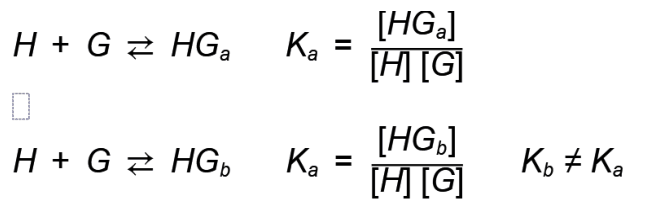
where \(\ce{HG_a}\) and \(\ce{HG_b}\) denote a complex where guest is bound to \(a\) center and \(b\) center, respectively. \(K_a\) and \(K_b\) are the binding constants for the centers \(a\) and \(b\), brackets denote molar concentrations.
Attachment of one \(\ce{G}\) molecule to \(\ce{H}\) can change the binding ability of the second centre. This change is described by the “interaction factor” \(\beta\) which reflects the influence of one binding center on another and is defined as follows:
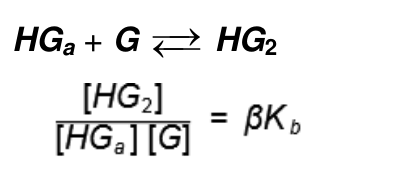
where \(\ce{HG2}\) is the completely bound complex.
3.1 Determine the range of values (or one value, if necessary) of \(\beta\) which correspond to three possible ways of interaction between binding centers: a) cooperation (binding by one center facilitates subsequent binding); b) competition (first binding complicates the second); c) independence (no interaction).
3.2 Find the equilibrium constant for the process:
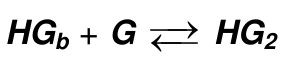
in terms of binding constant(s) and interaction factor.
3.3 The solution was prepared with the initial concentrations \([\ce{H}]_0=1\) and \([\ce{G}]_0=2\). After the reactions were completed, the concentration of \(\ce{H}\) decreased by 10 times and that of \(\ce{G}\) by 4 times. For these host and guest, \(K_b=2K_a\). Determine the concentrations of all other species in the solution and find the binding constant \(K_a\) and the factor \(\beta\).
Note: If you could not answer this question, for further calculations use reference values \(K_a=3.14\) and \(\beta=2.72\).
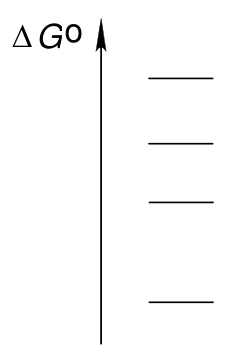
3.4 Find the correct order of standard molar Gibbs energies of formation of host \(\ce{H}\) and all host-guest complexes from \(\ce{H}\) and \(\ce{G}\). In the scheme below, write the corresponding chemical formula near every line.
3.5 Some amount of \(\ce{G}\) was added to 1 mole of \(\ce{H}\) and the mixture was dissolved in water to obtain 1 liter of the solution. The number of the totally bound molecules \(\ce{HG2}\) in the solution is equal to the total number of single-bound molecules \(\ce{HG}\). Find the initial amount of \(\ce{G}\) (in mol). The constants \(K_a\) and \(K_b\) and the factor \(\beta\) are the same as in question 3.3.
3.6 What would be the equilibrium composition of the solution if: a) \(\beta=0\); b) \(\beta\) is very large \((\beta\to\infty)\). The constants \(K_a\) and \(K_b\) as well as the initial concentrations of \(\ce{H}\) and \(\ce{G}\) are the same as in question 2.1.
Official English text of the problem.
Answers
-
3.1 (a) Cooperation: \(\boxed{\beta>1}\). (b) Competition: \(\boxed{0\leq\beta<1}\), with \(\beta=0\) representing complete exclusion of the second guest. (c) Independence: \(\boxed{\beta=1}\).
-
3.2 \[ \ce{HG_b + G <=> HG2}, \qquad \boxed{K=\beta K_a}. \]
-
3.3 \[ \boxed{ [\ce{HG_a}]=0.10,\quad [\ce{HG_b}]=0.20,\quad [\ce{HG2}]=0.60 \quad(\mathrm{mol\,L^{-1}}) } \] \[ \boxed{K_a=2\ \mathrm{L\,mol^{-1}},\quad K_b=4\ \mathrm{L\,mol^{-1}},\quad \beta=3}. \]
-
3.4 Label the four lines from top to bottom: \[ \boxed{\ce{H},\quad\ce{HG_a},\quad\ce{HG_b},\quad\ce{HG2}}. \]
-
3.5 \[ \boxed{n_0(\ce{G})=\frac{11}{8}\ \mathrm{mol} =1.375\ \mathrm{mol}\approx1.38\ \mathrm{mol}}. \]
-
3.6 Interpreting “question 2.1” as question 3.3, the equilibrium concentrations are:
| Species | (a) \(\beta=0\), \(\mathrm{mol\,L^{-1}}\) | (b) \(\beta\to\infty\), \(\mathrm{mol\,L^{-1}}\) |
|---|---|---|
| \(\ce{H}\) | \(0.1287\) | \(0\) |
| \(\ce{G}\) | \(1.1287\) | \(0\) |
| \(\ce{HG_a}\) | \(0.2904\) | \(0\) |
| \(\ce{HG_b}\) | \(0.5809\) | \(0\) |
| \(\ce{HG2}\) | \(0\) | \(1\) |
Solution
The species are the free host \(\ce{H}\), free guest \(\ce{G}\), singly bound host–guest complexes \(\ce{HG_a}\) and \(\ce{HG_b}\) at sites \(a\) and \(b\), and doubly bound host–guest complex \(\ce{HG2}\). These are abstract molecular labels: the problem supplies no molecular connectivity, so identifying SMILES cannot be assigned.
Write \[ h=[\ce{H}],\qquad g=[\ce{G}],\qquad x=[\ce{HG_a}],\qquad y=[\ce{HG_b}],\qquad z=[\ce{HG2}]. \] The binding equilibria give \[ x=K_a hg,\qquad y=K_b hg, \] and \[ z=\beta K_b xg=\beta K_aK_b hg^2. \] Conservation of host and guest gives \[ \boxed{H_T=h+x+y+z}, \qquad \boxed{G_T=g+x+y+2z}, \] where \(H_T=[\ce{H}]_0\) and \(G_T=[\ce{G}]_0\). The factor \(2\) counts the two guest molecules in each \(\ce{HG2}\).
3.1
For binding at site \(b\), the two relevant reactions are \[ \ce{H + G <=> HG_b}, \qquad K_b, \] and \[ \ce{HG_a + G <=> HG2}, \qquad \beta K_b. \]
Thus \(\beta\) compares the affinity of site \(b\) when site \(a\) is occupied with its affinity when site \(a\) is empty:
- Cooperation: \(\beta K_b>K_b\), hence \(\beta>1\).
- Competition: \(\beta K_b<K_b\), hence \(0\leq\beta<1\).
- Independence: \(\beta K_b=K_b\), hence \(\beta=1\).
Ordinary finite equilibrium constants are positive. The value \(\beta=0\), explicitly considered in 3.6, is the limiting case in which double binding is completely prohibited.
3.2
Both binding sequences lead to the same overall reaction: \[ \ce{H + 2G <=> HG2}. \] Its overall concentration-based equilibrium constant is \[ \frac{z}{hg^2}=K_a(\beta K_b)=\beta K_aK_b. \]
For the requested reaction, \[ \ce{HG_b + G <=> HG2}, \] the equilibrium constant is therefore \[ K=\frac{z}{yg} =\frac{\beta K_aK_b hg^2}{K_b hg^2} =\boxed{\beta K_a}. \] This also shows that the same interaction factor applies whichever site binds first.
3.3
The free equilibrium concentrations are \[ h=\frac{1}{10}=0.10\ \mathrm{mol\,L^{-1}}, \qquad g=\frac{2}{4}=0.50\ \mathrm{mol\,L^{-1}}. \]
The host balance gives \[ x+y+z=1-0.10=0.90\ \mathrm{mol\,L^{-1}}, \] and the guest balance gives \[ x+y+2z=2-0.50=1.50\ \mathrm{mol\,L^{-1}}. \] Subtracting, \[ z=0.60\ \mathrm{mol\,L^{-1}}, \qquad x+y=0.30\ \mathrm{mol\,L^{-1}}. \]
Because \[ \frac{y}{x}=\frac{K_b}{K_a}=2, \] we obtain \[ \boxed{x=0.10\ \mathrm{mol\,L^{-1}}}, \qquad \boxed{y=0.20\ \mathrm{mol\,L^{-1}}}. \]
Consequently, \[ K_a=\frac{x}{hg} =\frac{0.10}{(0.10)(0.50)} =\boxed{2\ \mathrm{L\,mol^{-1}}}, \] and \[ K_b=2K_a=\boxed{4\ \mathrm{L\,mol^{-1}}}. \]
Finally, \[ \beta=\frac{z}{K_bxg} =\frac{0.60}{4(0.10)(0.50)} =\boxed{3}. \] The interaction is therefore cooperative.
3.4
The energies requested are formation energies from the unbound host and guest. Take the unbound host as the zero reference.
For a reaction, \[ \Delta_{\mathrm r}G^\circ=-RT\ln K^\circ. \] Here \(K^\circ\) must be dimensionless. With the standard concentration \[ c^\circ=1\ \mathrm{mol\,L^{-1}}, \] the dimensionless association constants are \(K_ac^\circ=2\), \(K_bc^\circ=4\), and \[ \beta K_aK_b(c^\circ)^2=24. \]
| Host species | Formation reaction from free host and guest | Relative standard formation energy |
|---|---|---|
| \(\ce{H}\) | Reference state | \(0\) |
| \(\ce{HG_a}\) | \(\ce{H + G <=> HG_a}\) | \(-RT\ln2\) |
| \(\ce{HG_b}\) | \(\ce{H + G <=> HG_b}\) | \(-RT\ln4\) |
| \(\ce{HG2}\) | \(\ce{H + 2G <=> HG2}\) | \(-RT\ln24\) |
Since \[ 0>-\ln2>-\ln4>-\ln24, \] the order from highest to lowest energy is \[ \boxed{\ce{H}>\ce{HG_a}>\ce{HG_b}>\ce{HG2}}. \]
Accordingly, write \(\ce{H}\) beside the top line, \(\ce{HG_a}\) beside the second, \(\ce{HG_b}\) beside the third, and \(\ce{HG2}\) beside the bottom line. Equivalently, with a common total composition, the compared states are \(\ce{H + 2G}\), \(\ce{HG_a + G}\), \(\ce{HG_b + G}\), and \(\ce{HG2}\).
3.5
The total host concentration is \[ H_T=\frac{1\ \mathrm{mol}}{1\ \mathrm L} =1\ \mathrm{mol\,L^{-1}}. \] The stated condition is \[ z=x+y. \] Using the equilibrium expressions, \[ \beta K_aK_bhg^2=(K_a+K_b)hg. \] For a positive amount of added guest, \(g>0\), so \[ g=\frac{K_a+K_b}{\beta K_aK_b} =\frac{6\ \mathrm{L\,mol^{-1}}} {24\ \mathrm{L^2\,mol^{-2}}} =\boxed{0.25\ \mathrm{mol\,L^{-1}}}. \]
The host balance becomes \[ H_T=h\left[1+(K_a+K_b)g+\beta K_aK_bg^2\right], \] hence \[ h=\frac{1}{1+6(0.25)+24(0.25)^2} =0.25\ \mathrm{mol\,L^{-1}}. \]
The complex concentrations are \[ x=2(0.25)(0.25)=0.125\ \mathrm{mol\,L^{-1}}, \] \[ y=4(0.25)(0.25)=0.250\ \mathrm{mol\,L^{-1}}, \] \[ z=x+y=0.375\ \mathrm{mol\,L^{-1}}. \]
The initial guest amount must include both free and bound guest: \[ \begin{aligned} n_0(\ce{G}) &=V(g+x+y+2z)\\ &=(1\ \mathrm L)(0.25+0.125+0.250+2\times0.375) \ \mathrm{mol\,L^{-1}}\\ &=\boxed{1.375\ \mathrm{mol}\approx1.38\ \mathrm{mol}}. \end{aligned} \]
3.6
Here the reference to “question 2.1” is interpreted as referring to 3.3: \[ H_T=1\ \mathrm{mol\,L^{-1}},\qquad G_T=2\ \mathrm{mol\,L^{-1}}, \] \[ K_a=2\ \mathrm{L\,mol^{-1}},\qquad K_b=4\ \mathrm{L\,mol^{-1}}. \]
(a) \(\beta=0\)
Double binding is excluded: \[ z=0. \] Subtracting the host balance from the guest balance gives \[ g-h=1\ \mathrm{mol\,L^{-1}}. \] Also, \[ x+y=(K_a+K_b)hg. \] Thus \[ h+(6\ \mathrm{L\,mol^{-1}})h \left(h+1\ \mathrm{mol\,L^{-1}}\right) =1\ \mathrm{mol\,L^{-1}}. \]
With \(u=h/c^\circ\), this becomes \[ 6u^2+7u-1=0. \] Only the positive root is physical: \[ h=\frac{\sqrt{73}-7}{12}\ \mathrm{mol\,L^{-1}} \approx\boxed{0.1287\ \mathrm{mol\,L^{-1}}}. \] Therefore, \[ g=h+1\ \mathrm{mol\,L^{-1}} \approx\boxed{1.1287\ \mathrm{mol\,L^{-1}}}. \]
Since \(y=2x\) and \(x+y=H_T-h\), \[ x=\frac{H_T-h}{3} \approx\boxed{0.2904\ \mathrm{mol\,L^{-1}}}, \] \[ y=\frac{2(H_T-h)}{3} \approx\boxed{0.5809\ \mathrm{mol\,L^{-1}}}, \qquad \boxed{z=0}. \]
(b) \(\beta\to\infty\)
Because \(G_T=2H_T\), subtracting twice the host balance from the guest balance yields \[ g=2h+x+y. \] Using \(x+y=(K_a+K_b)hg\), \[ h=\frac{g}{2+(K_a+K_b)g}. \] Consequently, \[ z=\beta K_aK_bhg^2 =\frac{\beta K_aK_bg^3}{2+(K_a+K_b)g}. \]
The concentration \(z\) cannot exceed \(H_T\). As \(\beta\to\infty\), the last expression therefore requires \(g\to0\). It follows that \[ h\to0,\qquad x=K_ahg\to0,\qquad y=K_bhg\to0. \] The host balance then gives \[ \boxed{z\to H_T=1\ \mathrm{mol\,L^{-1}}}. \]
Thus all host approaches the doubly bound form, consuming the entire available guest supply in the overall reaction \[ \ce{H + 2G <=> HG2}. \]
The solution was checked against the official solution.
IChO 2015 · Theorieaufgabe 3
Zwei Bindungszentren – Konkurrenz oder Kooperation?
Viele chemische Reaktionen in lebenden Organismen umfassen die Bildung von „Wirt-Gast“-Komplexen, bei denen das Wirtmolekül ein oder mehrere Gastmoleküle reversibel bindet. Betrachten Sie ein Wirtmolekül \(\ce{H}\) mit zwei Bindungszentren – etwa \(a\) und \(b\), die unterschiedliche Affinitäten zu den Gastmolekülen \(\ce{G}\) aufweisen:
Dabei bezeichnen \(\ce{HG_a}\) und \(\ce{HG_b}\) jeweils einen Komplex, in dem der Gast an das Zentrum \(a\) bzw. an das Zentrum \(b\) gebunden ist. \(K_a\) und \(K_b\) sind die Bindungskonstanten für die Zentren \(a\) und \(b\); die eckigen Klammern bezeichnen Stoffmengenkonzentrationen.
Die Anlagerung eines \(\ce{G}\)-Moleküls an \(\ce{H}\) kann das Bindungsvermögen des zweiten Zentrums verändern. Diese Änderung wird durch den „Wechselwirkungsfaktor“ \(\beta\) beschrieben, der den Einfluss eines Bindungszentrums auf das andere widerspiegelt und wie folgt definiert ist:
Dabei ist \(\ce{HG2}\) der vollständig besetzte Komplex.
3.1 Bestimmen Sie den Wertebereich (oder gegebenenfalls einen einzelnen Wert) von \(\beta\), der den drei möglichen Arten der Wechselwirkung zwischen den Bindungszentren entspricht: a) Kooperation (die Bindung an einem Zentrum erleichtert die anschließende Bindung); b) Konkurrenz (die erste Bindung erschwert die zweite); c) Unabhängigkeit (keine Wechselwirkung).
3.2 Bestimmen Sie die Gleichgewichtskonstante für den Vorgang:
in Abhängigkeit von der Bindungskonstante bzw. den Bindungskonstanten und dem Wechselwirkungsfaktor.
3.3 Die Lösung wurde mit den Anfangskonzentrationen \([\ce{H}]_0=1\) und \([\ce{G}]_0=2\) hergestellt. Nach Abschluss der Reaktionen war die Konzentration von \(\ce{H}\) auf ein Zehntel und die von \(\ce{G}\) auf ein Viertel gesunken. Für diesen Wirt und diesen Gast gilt \(K_b=2K_a\). Bestimmen Sie die Konzentrationen aller anderen Spezies in der Lösung sowie die Bindungskonstante \(K_a\) und den Faktor \(\beta\).
Hinweis: Falls Sie diese Frage nicht beantworten konnten, verwenden Sie für die weiteren Berechnungen die Referenzwerte \(K_a=3.14\) und \(\beta=2.72\).
3.4 Bestimmen Sie die richtige Reihenfolge der molaren Standard-Gibbs-Bildungsenergien des Wirts \(\ce{H}\) und aller Wirt-Gast-Komplexe aus \(\ce{H}\) und \(\ce{G}\). Schreiben Sie im folgenden Schema die entsprechende chemische Formel neben jede Linie.
3.5 Zu 1 Mol \(\ce{H}\) wurde eine gewisse Menge \(\ce{G}\) gegeben und das Gemisch in Wasser gelöst, sodass 1 Liter Lösung entstand. Die Anzahl der vollständig besetzten Moleküle \(\ce{HG2}\) in der Lösung ist gleich der Gesamtzahl der einfach besetzten Moleküle \(\ce{HG}\). Bestimmen Sie die anfängliche Stoffmenge von \(\ce{G}\) (in mol). Die Konstanten \(K_a\) und \(K_b\) sowie der Faktor \(\beta\) sind dieselben wie in Frage 3.3.
3.6 Wie wäre die Gleichgewichtszusammensetzung der Lösung, wenn: a) \(\beta=0\); b) \(\beta\) sehr groß ist \((\beta\to\infty)\). Die Konstanten \(K_a\) und \(K_b\) sowie die Anfangskonzentrationen von \(\ce{H}\) und \(\ce{G}\) sind dieselben wie in Frage 2.1.
Aufgabentext aus dem offiziellen englischen Text übersetzt.
Antworten
-
3.1 (a) Kooperation: \(\boxed{\beta>1}\). (b) Konkurrenz: \(\boxed{0\leq\beta<1}\), wobei \(\beta=0\) den vollständigen Ausschluss des zweiten Gastes bedeutet. (c) Unabhängigkeit: \(\boxed{\beta=1}\).
-
3.2 \[ \ce{HG_b + G <=> HG2}, \qquad \boxed{K=\beta K_a}. \]
-
3.3 \[ \boxed{ [\ce{HG_a}]=0.10,\quad [\ce{HG_b}]=0.20,\quad [\ce{HG2}]=0.60 \quad(\mathrm{mol\,L^{-1}}) } \] \[ \boxed{K_a=2\ \mathrm{L\,mol^{-1}},\quad K_b=4\ \mathrm{L\,mol^{-1}},\quad \beta=3}. \]
-
3.4 Beschriften Sie die vier Linien von oben nach unten: \[ \boxed{\ce{H},\quad\ce{HG_a},\quad\ce{HG_b},\quad\ce{HG2}}. \]
-
3.5 \[ \boxed{n_0(\ce{G})=\frac{11}{8}\ \mathrm{mol} =1.375\ \mathrm{mol}\approx1.38\ \mathrm{mol}}. \]
-
3.6 Wenn „Frage 2.1“ als Frage 3.3 verstanden wird, ergeben sich folgende Gleichgewichtskonzentrationen:
| Spezies | (a) \(\beta=0\), \(\mathrm{mol\,L^{-1}}\) | (b) \(\beta\to\infty\), \(\mathrm{mol\,L^{-1}}\) |
|---|---|---|
| \(\ce{H}\) | \(0.1287\) | \(0\) |
| \(\ce{G}\) | \(1.1287\) | \(0\) |
| \(\ce{HG_a}\) | \(0.2904\) | \(0\) |
| \(\ce{HG_b}\) | \(0.5809\) | \(0\) |
| \(\ce{HG2}\) | \(0\) | \(1\) |
Lösung
Die Spezies sind der freie Wirt \(\ce{H}\), der freie Gast \(\ce{G}\), die an den Bindungsstellen \(a\) und \(b\) einfach besetzten Wirt-Gast-Komplexe \(\ce{HG_a}\) und \(\ce{HG_b}\) sowie der doppelt besetzte Wirt-Gast-Komplex \(\ce{HG2}\). Dies sind abstrakte Molekülbezeichnungen: Die Aufgabe enthält keine Angaben zur Verknüpfung der Atome in den Molekülen, sodass keine identifizierenden SMILES zugeordnet werden können.
Wir setzen \[ h=[\ce{H}],\qquad g=[\ce{G}],\qquad x=[\ce{HG_a}],\qquad y=[\ce{HG_b}],\qquad z=[\ce{HG2}]. \] Aus den Bindungsgleichgewichten folgt \[ x=K_a hg,\qquad y=K_b hg, \] und \[ z=\beta K_b xg=\beta K_aK_b hg^2. \] Die Stoffbilanzen für Wirt und Gast ergeben \[ \boxed{H_T=h+x+y+z}, \qquad \boxed{G_T=g+x+y+2z}, \] wobei \(H_T=[\ce{H}]_0\) und \(G_T=[\ce{G}]_0\) gelten. Der Faktor \(2\) berücksichtigt die zwei Gastmoleküle in jedem \(\ce{HG2}\).
3.1
Für die Bindung an der Bindungsstelle \(b\) sind die beiden relevanten Reaktionen \[ \ce{H + G <=> HG_b}, \qquad K_b, \] und \[ \ce{HG_a + G <=> HG2}, \qquad \beta K_b. \]
Somit vergleicht \(\beta\) die Affinität der Bindungsstelle \(b\) bei besetzter Bindungsstelle \(a\) mit ihrer Affinität bei unbesetzter Bindungsstelle \(a\):
- Kooperation: \(\beta K_b>K_b\), also \(\beta>1\).
- Konkurrenz: \(\beta K_b<K_b\), also \(0\leq\beta<1\).
- Unabhängigkeit: \(\beta K_b=K_b\), also \(\beta=1\).
Gewöhnliche endliche Gleichgewichtskonstanten sind positiv. Der in 3.6 ausdrücklich betrachtete Wert \(\beta=0\) ist der Grenzfall, in dem die doppelte Besetzung vollständig ausgeschlossen ist.
3.2
Beide Bindungsabfolgen führen zu derselben Gesamtreaktion: \[ \ce{H + 2G <=> HG2}. \] Ihre auf Konzentrationen bezogene Gesamtgleichgewichtskonstante ist \[ \frac{z}{hg^2}=K_a(\beta K_b)=\beta K_aK_b. \]
Für die gesuchte Reaktion \[ \ce{HG_b + G <=> HG2}, \] ist die Gleichgewichtskonstante daher \[ K=\frac{z}{yg} =\frac{\beta K_aK_b hg^2}{K_b hg^2} =\boxed{\beta K_a}. \] Dies zeigt auch, dass derselbe Wechselwirkungsfaktor gilt, unabhängig davon, welche Bindungsstelle zuerst besetzt wird.
3.3
Die Gleichgewichtskonzentrationen der freien Spezies sind \[ h=\frac{1}{10}=0.10\ \mathrm{mol\,L^{-1}}, \qquad g=\frac{2}{4}=0.50\ \mathrm{mol\,L^{-1}}. \]
Die Wirtbilanz ergibt \[ x+y+z=1-0.10=0.90\ \mathrm{mol\,L^{-1}}, \] und die Gastbilanz ergibt \[ x+y+2z=2-0.50=1.50\ \mathrm{mol\,L^{-1}}. \] Durch Subtraktion erhalten wir \[ z=0.60\ \mathrm{mol\,L^{-1}}, \qquad x+y=0.30\ \mathrm{mol\,L^{-1}}. \]
Da \[ \frac{y}{x}=\frac{K_b}{K_a}=2, \] erhalten wir \[ \boxed{x=0.10\ \mathrm{mol\,L^{-1}}}, \qquad \boxed{y=0.20\ \mathrm{mol\,L^{-1}}}. \]
Folglich gilt \[ K_a=\frac{x}{hg} =\frac{0.10}{(0.10)(0.50)} =\boxed{2\ \mathrm{L\,mol^{-1}}}, \] und \[ K_b=2K_a=\boxed{4\ \mathrm{L\,mol^{-1}}}. \]
Schließlich ergibt sich \[ \beta=\frac{z}{K_bxg} =\frac{0.60}{4(0.10)(0.50)} =\boxed{3}. \] Die Wechselwirkung ist somit kooperativ.
3.4
Die gesuchten Energien sind Bildungsenergien aus dem ungebundenen Wirt und Gast. Wir wählen den ungebundenen Wirt als Nullpunkt.
Für eine Reaktion gilt \[ \Delta_{\mathrm r}G^\circ=-RT\ln K^\circ. \] Dabei muss \(K^\circ\) dimensionslos sein. Mit der Standardkonzentration \[ c^\circ=1\ \mathrm{mol\,L^{-1}}, \] lauten die dimensionslosen Assoziationskonstanten \(K_ac^\circ=2\), \(K_bc^\circ=4\) und \[ \beta K_aK_b(c^\circ)^2=24. \]
| Wirtspezies | Bildungsreaktion aus freiem Wirt und Gast | Relative Standardbildungsenergie |
|---|---|---|
| \(\ce{H}\) | Referenzzustand | \(0\) |
| \(\ce{HG_a}\) | \(\ce{H + G <=> HG_a}\) | \(-RT\ln2\) |
| \(\ce{HG_b}\) | \(\ce{H + G <=> HG_b}\) | \(-RT\ln4\) |
| \(\ce{HG2}\) | \(\ce{H + 2G <=> HG2}\) | \(-RT\ln24\) |
Da \[ 0>-\ln2>-\ln4>-\ln24, \] ist die Reihenfolge von der höchsten zur niedrigsten Energie \[ \boxed{\ce{H}>\ce{HG_a}>\ce{HG_b}>\ce{HG2}}. \]
Dementsprechend ist \(\ce{H}\) neben die oberste Linie, \(\ce{HG_a}\) neben die zweite, \(\ce{HG_b}\) neben die dritte und \(\ce{HG2}\) neben die unterste Linie zu schreiben. Gleichwertig dazu sind bei gleicher Gesamtzusammensetzung die verglichenen Zustände \(\ce{H + 2G}\), \(\ce{HG_a + G}\), \(\ce{HG_b + G}\) und \(\ce{HG2}\).
3.5
Die Gesamtkonzentration des Wirts beträgt \[ H_T=\frac{1\ \mathrm{mol}}{1\ \mathrm L} =1\ \mathrm{mol\,L^{-1}}. \] Die angegebene Bedingung lautet \[ z=x+y. \] Mit den Gleichgewichtsausdrücken ergibt sich \[ \beta K_aK_bhg^2=(K_a+K_b)hg. \] Für eine positive Stoffmenge des zugesetzten Gastes gilt \(g>0\), sodass \[ g=\frac{K_a+K_b}{\beta K_aK_b} =\frac{6\ \mathrm{L\,mol^{-1}}} {24\ \mathrm{L^2\,mol^{-2}}} =\boxed{0.25\ \mathrm{mol\,L^{-1}}}. \]
Die Wirtbilanz wird zu \[ H_T=h\left[1+(K_a+K_b)g+\beta K_aK_bg^2\right], \] also \[ h=\frac{1}{1+6(0.25)+24(0.25)^2} =0.25\ \mathrm{mol\,L^{-1}}. \]
Die Komplexkonzentrationen sind \[ x=2(0.25)(0.25)=0.125\ \mathrm{mol\,L^{-1}}, \] \[ y=4(0.25)(0.25)=0.250\ \mathrm{mol\,L^{-1}}, \] \[ z=x+y=0.375\ \mathrm{mol\,L^{-1}}. \]
Die anfängliche Stoffmenge des Gastes muss sowohl den freien als auch den gebundenen Gast umfassen: \[ \begin{aligned} n_0(\ce{G}) &=V(g+x+y+2z)\\ &=(1\ \mathrm L)(0.25+0.125+0.250+2\times0.375) \ \mathrm{mol\,L^{-1}}\\ &=\boxed{1.375\ \mathrm{mol}\approx1.38\ \mathrm{mol}}. \end{aligned} \]
3.6
Hier wird der Verweis auf „Frage 2.1“ als Verweis auf 3.3 verstanden: \[ H_T=1\ \mathrm{mol\,L^{-1}},\qquad G_T=2\ \mathrm{mol\,L^{-1}}, \] \[ K_a=2\ \mathrm{L\,mol^{-1}},\qquad K_b=4\ \mathrm{L\,mol^{-1}}. \]
(a) \(\beta=0\)
Die doppelte Besetzung ist ausgeschlossen: \[ z=0. \] Subtrahiert man die Wirtbilanz von der Gastbilanz, erhält man \[ g-h=1\ \mathrm{mol\,L^{-1}}. \] Außerdem gilt \[ x+y=(K_a+K_b)hg. \] Somit ist \[ h+(6\ \mathrm{L\,mol^{-1}})h \left(h+1\ \mathrm{mol\,L^{-1}}\right) =1\ \mathrm{mol\,L^{-1}}. \]
Mit \(u=h/c^\circ\) wird daraus \[ 6u^2+7u-1=0. \] Nur die positive Lösung ist physikalisch sinnvoll: \[ h=\frac{\sqrt{73}-7}{12}\ \mathrm{mol\,L^{-1}} \approx\boxed{0.1287\ \mathrm{mol\,L^{-1}}}. \] Daher gilt \[ g=h+1\ \mathrm{mol\,L^{-1}} \approx\boxed{1.1287\ \mathrm{mol\,L^{-1}}}. \]
Da \(y=2x\) und \(x+y=H_T-h\) gelten, ergibt sich \[ x=\frac{H_T-h}{3} \approx\boxed{0.2904\ \mathrm{mol\,L^{-1}}}, \] \[ y=\frac{2(H_T-h)}{3} \approx\boxed{0.5809\ \mathrm{mol\,L^{-1}}}, \qquad \boxed{z=0}. \]
(b) \(\beta\to\infty\)
Da \(G_T=2H_T\) gilt, ergibt die Subtraktion der doppelten Wirtbilanz von der Gastbilanz \[ g=2h+x+y. \] Mit \(x+y=(K_a+K_b)hg\) folgt \[ h=\frac{g}{2+(K_a+K_b)g}. \] Folglich gilt \[ z=\beta K_aK_bhg^2 =\frac{\beta K_aK_bg^3}{2+(K_a+K_b)g}. \]
Die Konzentration \(z\) kann \(H_T\) nicht überschreiten. Für \(\beta\to\infty\) erfordert der letzte Ausdruck daher \(g\to0\). Daraus folgt \[ h\to0,\qquad x=K_ahg\to0,\qquad y=K_bhg\to0. \] Die Wirtbilanz ergibt dann \[ \boxed{z\to H_T=1\ \mathrm{mol\,L^{-1}}}. \]
Somit geht im Grenzfall der gesamte Wirt in die doppelt besetzte Form über, wobei die gesamte verfügbare Gastmenge in der Gesamtreaktion verbraucht wird: \[ \ce{H + 2G <=> HG2}. \]
Die Lösung wurde mit der offiziellen Lösung abgeglichen.
IChO 2015 · Teori sorusu 3
İki bağlanma merkezi – rekabet mi, iş birliği mi?
Canlı organizmalardaki birçok kimyasal tepkime, konak molekülün bir veya birkaç konuk molekülünü tersinir olarak bağladığı “konak-konuk” komplekslerinin oluşumunu içerir. Konuk moleküllerine \(\ce{G}\) karşı farklı afinitelere sahip, \(a\) ve \(b\) olarak adlandırılan iki bağlanma merkezi bulunan bir konak molekülü \(\ce{H}\) ele alınız:
Burada \(\ce{HG_a}\) ve \(\ce{HG_b}\), konuğun sırasıyla \(a\) merkezine ve \(b\) merkezine bağlandığı kompleksleri gösterir. \(K_a\) ve \(K_b\), \(a\) ve \(b\) merkezlerinin bağlanma sabitleridir; köşeli parantezler molar derişimleri gösterir.
Bir \(\ce{G}\) molekülünün \(\ce{H}\)'ye bağlanması, ikinci merkezin bağlanma yeteneğini değiştirebilir. Bu değişim, bir bağlanma merkezinin diğeri üzerindeki etkisini yansıtan ve aşağıdaki gibi tanımlanan “etkileşim faktörü” \(\beta\) ile ifade edilir:
Burada \(\ce{HG2}\), her iki merkezine de konuk bağlanmış komplekstir.
3.1 Bağlanma merkezleri arasındaki olası üç etkileşim biçimine karşılık gelen \(\beta\) değerlerinin aralığını (veya gerekiyorsa tek bir değerini) belirleyiniz: a) iş birliği (bir merkeze bağlanma, sonraki bağlanmayı kolaylaştırır); b) rekabet (ilk bağlanma, ikinci bağlanmayı zorlaştırır); c) bağımsızlık (etkileşim yoktur).
3.2 Aşağıdaki süreç için denge sabitini:
bağlanma sabiti (veya sabitleri) ve etkileşim faktörü cinsinden bulunuz.
3.3 Çözelti, başlangıç derişimleri \([\ce{H}]_0=1\) ve \([\ce{G}]_0=2\) olacak şekilde hazırlanmıştır. Tepkimeler tamamlandıktan sonra \(\ce{H}\)'nin derişimi başlangıç değerinin onda birine, \(\ce{G}\)'nin derişimi ise dörtte birine düşmüştür. Bu konak ve konuk için \(K_b=2K_a\)'dır. Çözeltideki diğer tüm türlerin derişimlerini belirleyiniz ve bağlanma sabiti \(K_a\) ile \(\beta\) faktörünü bulunuz.
Not: Bu soruyu cevaplayamadıysanız, sonraki hesaplamalarda \(K_a=3.14\) ve \(\beta=2.72\) referans değerlerini kullanınız.
3.4 Konak \(\ce{H}\) ve tüm konak-konuk komplekslerinin \(\ce{H}\) ve \(\ce{G}\)'den oluşumlarına ait standart molar Gibbs enerjilerinin doğru sıralamasını bulunuz. Aşağıdaki şemada her çizginin yanına ilgili kimyasal formülü yazınız.
3.5 1 mol \(\ce{H}\)'ye bir miktar \(\ce{G}\) eklenmiş ve karışım, 1 litre çözelti elde edilecek şekilde suda çözülmüştür. Çözeltideki her iki merkezine de konuk bağlanmış \(\ce{HG2}\) moleküllerinin sayısı, tek bir merkezine konuk bağlanmış \(\ce{HG}\) moleküllerinin toplam sayısına eşittir. Başlangıçtaki \(\ce{G}\) miktarını (mol cinsinden) bulunuz. \(K_a\) ve \(K_b\) sabitleri ile \(\beta\) faktörü, 3.3 sorusundakilerle aynıdır.
3.6 a) \(\beta=0\); b) \(\beta\) çok büyük \((\beta\to\infty)\) olsaydı çözeltinin denge bileşimi ne olurdu? \(K_a\) ve \(K_b\) sabitleri ile \(\ce{H}\) ve \(\ce{G}\)'nin başlangıç derişimleri, 2.1 sorusundakilerle aynıdır.
Soru metni resmi İngilizce metinden çevrilmiştir.
Cevaplar
-
3.1 (a) İş birliği: \(\boxed{\beta>1}\). (b) Rekabet: \(\boxed{0\leq\beta<1}\); burada \(\beta=0\), ikinci konuğun bağlanmasının tamamen engellendiği durumu temsil eder. (c) Bağımsızlık: \(\boxed{\beta=1}\).
-
3.2 \[ \ce{HG_b + G <=> HG2}, \qquad \boxed{K=\beta K_a}. \]
-
3.3 \[ \boxed{ [\ce{HG_a}]=0.10,\quad [\ce{HG_b}]=0.20,\quad [\ce{HG2}]=0.60 \quad(\mathrm{mol\,L^{-1}}) } \] \[ \boxed{K_a=2\ \mathrm{L\,mol^{-1}},\quad K_b=4\ \mathrm{L\,mol^{-1}},\quad \beta=3}. \]
-
3.4 Dört çizgiyi yukarıdan aşağıya şu şekilde etiketleyiniz: \[ \boxed{\ce{H},\quad\ce{HG_a},\quad\ce{HG_b},\quad\ce{HG2}}. \]
-
3.5 \[ \boxed{n_0(\ce{G})=\frac{11}{8}\ \mathrm{mol} =1.375\ \mathrm{mol}\approx1.38\ \mathrm{mol}}. \]
-
3.6 “2.1 sorusu” ifadesi 3.3 sorusu olarak yorumlandığında denge derişimleri şöyledir:
| Tür | (a) \(\beta=0\), \(\mathrm{mol\,L^{-1}}\) | (b) \(\beta\to\infty\), \(\mathrm{mol\,L^{-1}}\) |
|---|---|---|
| \(\ce{H}\) | \(0.1287\) | \(0\) |
| \(\ce{G}\) | \(1.1287\) | \(0\) |
| \(\ce{HG_a}\) | \(0.2904\) | \(0\) |
| \(\ce{HG_b}\) | \(0.5809\) | \(0\) |
| \(\ce{HG2}\) | \(0\) | \(1\) |
Çözüm
Türler; serbest konak \(\ce{H}\), serbest konuk \(\ce{G}\), \(a\) ve \(b\) merkezlerine tek bir konuk bağlanmış konak–konuk kompleksleri \(\ce{HG_a}\) ve \(\ce{HG_b}\) ile iki konuk bağlanmış konak–konuk kompleksi \(\ce{HG2}\)'dir. Bunlar soyut molekül etiketleridir: soruda atomların molekül içindeki bağlanma düzeni verilmediğinden, molekülleri tanımlayan SMILES gösterimleri atanamaz.
Şöyle yazalım: \[ h=[\ce{H}],\qquad g=[\ce{G}],\qquad x=[\ce{HG_a}],\qquad y=[\ce{HG_b}],\qquad z=[\ce{HG2}]. \] Bağlanma dengeleri şu bağıntıları verir: \[ x=K_a hg,\qquad y=K_b hg, \] ve \[ z=\beta K_b xg=\beta K_aK_b hg^2. \] Konak ve konuk için madde korunumu şu bağıntıları verir: \[ \boxed{H_T=h+x+y+z}, \qquad \boxed{G_T=g+x+y+2z}, \] burada \(H_T=[\ce{H}]_0\) ve \(G_T=[\ce{G}]_0\)'dır. \(2\) katsayısı, her bir \(\ce{HG2}\)'deki iki konuk molekülünü hesaba katar.
3.1
\(b\) merkezine bağlanma için ilgili iki tepkime şunlardır: \[ \ce{H + G <=> HG_b}, \qquad K_b, \] ve \[ \ce{HG_a + G <=> HG2}, \qquad \beta K_b. \]
Dolayısıyla \(\beta\), \(b\) merkezinin \(a\) merkezi doluyken sahip olduğu afiniteyi, \(a\) merkezi boşken sahip olduğu afiniteyle karşılaştırır:
- İş birliği: \(\beta K_b>K_b\), dolayısıyla \(\beta>1\).
- Rekabet: \(\beta K_b<K_b\), dolayısıyla \(0\leq\beta<1\).
- Bağımsızlık: \(\beta K_b=K_b\), dolayısıyla \(\beta=1\).
Olağan sonlu denge sabitleri pozitiftir. 3.6'da açıkça ele alınan \(\beta=0\) değeri, iki konuğun bağlanmasının tamamen engellendiği sınır durumudur.
3.2
Her iki bağlanma sırası da aynı toplam tepkimeye yol açar: \[ \ce{H + 2G <=> HG2}. \] Bu tepkimenin derişimlere dayalı toplam denge sabiti şöyledir: \[ \frac{z}{hg^2}=K_a(\beta K_b)=\beta K_aK_b. \]
İstenen tepkime için, \[ \ce{HG_b + G <=> HG2}, \] denge sabiti bu nedenle şöyledir: \[ K=\frac{z}{yg} =\frac{\beta K_aK_b hg^2}{K_b hg^2} =\boxed{\beta K_a}. \] Bu, hangi merkeze önce bağlanılırsa bağlanılsın aynı etkileşim faktörünün geçerli olduğunu da gösterir.
3.3
Serbest türlerin denge derişimleri şöyledir: \[ h=\frac{1}{10}=0.10\ \mathrm{mol\,L^{-1}}, \qquad g=\frac{2}{4}=0.50\ \mathrm{mol\,L^{-1}}. \]
Konak için madde denkliği şu bağıntıyı verir: \[ x+y+z=1-0.10=0.90\ \mathrm{mol\,L^{-1}}, \] konuk için madde denkliği ise şu bağıntıyı verir: \[ x+y+2z=2-0.50=1.50\ \mathrm{mol\,L^{-1}}. \] Çıkarma işlemiyle, \[ z=0.60\ \mathrm{mol\,L^{-1}}, \qquad x+y=0.30\ \mathrm{mol\,L^{-1}}. \]
Şu eşitlikten dolayı, \[ \frac{y}{x}=\frac{K_b}{K_a}=2, \] şunları elde ederiz: \[ \boxed{x=0.10\ \mathrm{mol\,L^{-1}}}, \qquad \boxed{y=0.20\ \mathrm{mol\,L^{-1}}}. \]
Sonuç olarak, \[ K_a=\frac{x}{hg} =\frac{0.10}{(0.10)(0.50)} =\boxed{2\ \mathrm{L\,mol^{-1}}}, \] ve \[ K_b=2K_a=\boxed{4\ \mathrm{L\,mol^{-1}}}. \]
Son olarak, \[ \beta=\frac{z}{K_bxg} =\frac{0.60}{4(0.10)(0.50)} =\boxed{3}. \] Dolayısıyla etkileşim iş birliklidir.
3.4
İstenen enerjiler, bağlanmamış konak ve konuktan oluşum enerjileridir. Bağlanmamış konağı sıfır referansı olarak alalım.
Bir tepkime için, \[ \Delta_{\mathrm r}G^\circ=-RT\ln K^\circ. \] Burada \(K^\circ\) boyutsuz olmalıdır. Standart derişim \[ c^\circ=1\ \mathrm{mol\,L^{-1}}, \] alındığında, boyutsuz birleşme sabitleri \(K_ac^\circ=2\), \(K_bc^\circ=4\) ve \[ \beta K_aK_b(c^\circ)^2=24. \]
| Konak türü | Serbest konak ve konuktan oluşum tepkimesi | Bağıl standart oluşum enerjisi |
|---|---|---|
| \(\ce{H}\) | Referans hâli | \(0\) |
| \(\ce{HG_a}\) | \(\ce{H + G <=> HG_a}\) | \(-RT\ln2\) |
| \(\ce{HG_b}\) | \(\ce{H + G <=> HG_b}\) | \(-RT\ln4\) |
| \(\ce{HG2}\) | \(\ce{H + 2G <=> HG2}\) | \(-RT\ln24\) |
Şu eşitsizlikten dolayı, \[ 0>-\ln2>-\ln4>-\ln24, \] en yüksek enerjiden en düşük enerjiye doğru sıralama şöyledir: \[ \boxed{\ce{H}>\ce{HG_a}>\ce{HG_b}>\ce{HG2}}. \]
Buna göre, en üst çizginin yanına \(\ce{H}\), ikincinin yanına \(\ce{HG_a}\), üçüncünün yanına \(\ce{HG_b}\) ve en alt çizginin yanına \(\ce{HG2}\) yazınız. Eşdeğer olarak, toplam bileşim aynı tutulduğunda karşılaştırılan hâller \(\ce{H + 2G}\), \(\ce{HG_a + G}\), \(\ce{HG_b + G}\) ve \(\ce{HG2}\)'dir.
3.5
Toplam konak derişimi şöyledir: \[ H_T=\frac{1\ \mathrm{mol}}{1\ \mathrm L} =1\ \mathrm{mol\,L^{-1}}. \] Verilen koşul şudur: \[ z=x+y. \] Denge ifadeleri kullanıldığında, \[ \beta K_aK_bhg^2=(K_a+K_b)hg. \] Eklenen konuk miktarı pozitif olduğunda \(g>0\) olduğundan, \[ g=\frac{K_a+K_b}{\beta K_aK_b} =\frac{6\ \mathrm{L\,mol^{-1}}} {24\ \mathrm{L^2\,mol^{-2}}} =\boxed{0.25\ \mathrm{mol\,L^{-1}}}. \]
Konak için madde denkliği şu hâli alır: \[ H_T=h\left[1+(K_a+K_b)g+\beta K_aK_bg^2\right], \] dolayısıyla \[ h=\frac{1}{1+6(0.25)+24(0.25)^2} =0.25\ \mathrm{mol\,L^{-1}}. \]
Kompleks derişimleri şöyledir: \[ x=2(0.25)(0.25)=0.125\ \mathrm{mol\,L^{-1}}, \] \[ y=4(0.25)(0.25)=0.250\ \mathrm{mol\,L^{-1}}, \] \[ z=x+y=0.375\ \mathrm{mol\,L^{-1}}. \]
Başlangıçtaki konuk miktarı hem serbest hem de bağlı konuğu içermelidir: \[ \begin{aligned} n_0(\ce{G}) &=V(g+x+y+2z)\\ &=(1\ \mathrm L)(0.25+0.125+0.250+2\times0.375) \ \mathrm{mol\,L^{-1}}\\ &=\boxed{1.375\ \mathrm{mol}\approx1.38\ \mathrm{mol}}. \end{aligned} \]
3.6
Burada “2.1 sorusu” atfı, 3.3'e yapılmış bir atıf olarak yorumlanmıştır: \[ H_T=1\ \mathrm{mol\,L^{-1}},\qquad G_T=2\ \mathrm{mol\,L^{-1}}, \] \[ K_a=2\ \mathrm{L\,mol^{-1}},\qquad K_b=4\ \mathrm{L\,mol^{-1}}. \]
(a) \(\beta=0\)
İki konuğun bağlanması engellenmiştir: \[ z=0. \] Konuk için madde denkliğinden konak için madde denkliği çıkarıldığında, \[ g-h=1\ \mathrm{mol\,L^{-1}}. \] Ayrıca, \[ x+y=(K_a+K_b)hg. \] Böylece \[ h+(6\ \mathrm{L\,mol^{-1}})h \left(h+1\ \mathrm{mol\,L^{-1}}\right) =1\ \mathrm{mol\,L^{-1}}. \]
\(u=h/c^\circ\) alındığında bu denklem şu hâli alır: \[ 6u^2+7u-1=0. \] Yalnızca pozitif kök fiziksel olarak anlamlıdır: \[ h=\frac{\sqrt{73}-7}{12}\ \mathrm{mol\,L^{-1}} \approx\boxed{0.1287\ \mathrm{mol\,L^{-1}}}. \] Bu nedenle, \[ g=h+1\ \mathrm{mol\,L^{-1}} \approx\boxed{1.1287\ \mathrm{mol\,L^{-1}}}. \]
\(y=2x\) ve \(x+y=H_T-h\) olduğundan, \[ x=\frac{H_T-h}{3} \approx\boxed{0.2904\ \mathrm{mol\,L^{-1}}}, \] \[ y=\frac{2(H_T-h)}{3} \approx\boxed{0.5809\ \mathrm{mol\,L^{-1}}}, \qquad \boxed{z=0}. \]
(b) \(\beta\to\infty\)
\(G_T=2H_T\) olduğundan, konuk için madde denkliğinden konak için madde denkliğinin iki katı çıkarıldığında şu elde edilir: \[ g=2h+x+y. \] \(x+y=(K_a+K_b)hg\) kullanıldığında, \[ h=\frac{g}{2+(K_a+K_b)g}. \] Sonuç olarak, \[ z=\beta K_aK_bhg^2 =\frac{\beta K_aK_bg^3}{2+(K_a+K_b)g}. \]
\(z\) derişimi \(H_T\)'yi aşamaz. Bu nedenle, \(\beta\to\infty\) iken son ifade \(g\to0\) olmasını gerektirir. Buradan şu sonuç çıkar: \[ h\to0,\qquad x=K_ahg\to0,\qquad y=K_bhg\to0. \] Bu durumda konak için madde denkliği şunu verir: \[ \boxed{z\to H_T=1\ \mathrm{mol\,L^{-1}}}. \]
Böylece konağın tamamı iki konuk bağlanmış biçime yaklaşır ve mevcut konuğun tamamı şu toplam tepkimede tüketilir: \[ \ce{H + 2G <=> HG2}. \]
Çözüm, resmi çözümle karşılaştırılarak kontrol edildi.
IChO 2015 · Problema teórico 3
Dos centros de unión: ¿competencia o cooperación?
Muchas reacciones químicas en los organismos vivos incluyen la formación de complejos «anfitrión-huésped» en los que la molécula anfitriona se une de forma reversible a una o varias moléculas huésped. Consideremos una molécula anfitriona \(\ce{H}\) con dos centros de unión, que llamaremos \(a\) y \(b\), con diferentes afinidades por las moléculas huésped \(\ce{G}\):
donde \(\ce{HG_a}\) y \(\ce{HG_b}\) representan un complejo en el que el huésped está unido al centro \(a\) y al centro \(b\), respectivamente. \(K_a\) y \(K_b\) son las constantes de unión de los centros \(a\) y \(b\); los corchetes indican concentraciones molares.
La unión de una molécula de \(\ce{G}\) a \(\ce{H}\) puede cambiar la capacidad de unión del segundo centro. Este cambio se describe mediante el «factor de interacción» \(\beta\), que refleja la influencia de un centro de unión sobre el otro y se define como sigue:
donde \(\ce{HG2}\) es el complejo con ambos centros ocupados.
3.1 Determine el intervalo de valores (o un único valor, si procede) de \(\beta\) que corresponde a tres posibles formas de interacción entre los centros de unión: a) cooperación (la unión a un centro facilita la unión posterior); b) competencia (la primera unión dificulta la segunda); c) independencia (sin interacción).
3.2 Halle la constante de equilibrio del proceso:
en función de la(s) constante(s) de unión y del factor de interacción.
3.3 La disolución se preparó con las concentraciones iniciales \([\ce{H}]_0=1\) y \([\ce{G}]_0=2\). Una vez completadas las reacciones, la concentración de \(\ce{H}\) se redujo a la décima parte y la de \(\ce{G}\) a la cuarta parte. Para este anfitrión y este huésped, \(K_b=2K_a\). Determine las concentraciones de todas las demás especies presentes en la disolución y halle la constante de unión \(K_a\) y el factor \(\beta\).
Nota: Si no ha podido responder a esta pregunta, utilice los valores de referencia \(K_a=3.14\) y \(\beta=2.72\) para los cálculos posteriores.
3.4 Halle el orden correcto de las energías de Gibbs molares estándar de formación del anfitrión \(\ce{H}\) y de todos los complejos anfitrión-huésped a partir de \(\ce{H}\) y \(\ce{G}\). En el siguiente esquema, escriba la fórmula química correspondiente junto a cada línea.
3.5 Se añadió cierta cantidad de \(\ce{G}\) a 1 mol de \(\ce{H}\) y la mezcla se disolvió en agua para obtener 1 litro de disolución. El número de moléculas \(\ce{HG2}\) con ambos centros ocupados en la disolución es igual al número total de moléculas \(\ce{HG}\) con un solo centro ocupado. Halle la cantidad inicial de \(\ce{G}\) (en mol). Las constantes \(K_a\) y \(K_b\) y el factor \(\beta\) son los mismos que en la pregunta 3.3.
3.6 ¿Cuál sería la composición de equilibrio de la disolución si: a) \(\beta=0\); b) \(\beta\) es muy grande \((\beta\to\infty)\)? Las constantes \(K_a\) y \(K_b\), así como las concentraciones iniciales de \(\ce{H}\) y \(\ce{G}\), son las mismas que en la pregunta 2.1.
Enunciado traducido del texto oficial en inglés.
Respuestas
-
3.1 (a) Cooperación: \(\boxed{\beta>1}\). (b) Competencia: \(\boxed{0\leq\beta<1}\), donde \(\beta=0\) representa la exclusión completa del segundo huésped. (c) Independencia: \(\boxed{\beta=1}\).
-
3.2 \[ \ce{HG_b + G <=> HG2}, \qquad \boxed{K=\beta K_a}. \]
-
3.3 \[ \boxed{ [\ce{HG_a}]=0.10,\quad [\ce{HG_b}]=0.20,\quad [\ce{HG2}]=0.60 \quad(\mathrm{mol\,L^{-1}}) } \] \[ \boxed{K_a=2\ \mathrm{L\,mol^{-1}},\quad K_b=4\ \mathrm{L\,mol^{-1}},\quad \beta=3}. \]
-
3.4 Etiquete las cuatro líneas de arriba abajo: \[ \boxed{\ce{H},\quad\ce{HG_a},\quad\ce{HG_b},\quad\ce{HG2}}. \]
-
3.5 \[ \boxed{n_0(\ce{G})=\frac{11}{8}\ \mathrm{mol} =1.375\ \mathrm{mol}\approx1.38\ \mathrm{mol}}. \]
-
3.6 Interpretando «pregunta 2.1» como pregunta 3.3, las concentraciones de equilibrio son:
| Especie | (a) \(\beta=0\), \(\mathrm{mol\,L^{-1}}\) | (b) \(\beta\to\infty\), \(\mathrm{mol\,L^{-1}}\) |
|---|---|---|
| \(\ce{H}\) | \(0.1287\) | \(0\) |
| \(\ce{G}\) | \(1.1287\) | \(0\) |
| \(\ce{HG_a}\) | \(0.2904\) | \(0\) |
| \(\ce{HG_b}\) | \(0.5809\) | \(0\) |
| \(\ce{HG2}\) | \(0\) | \(1\) |
Solución
Las especies son el anfitrión libre \(\ce{H}\), el huésped libre \(\ce{G}\), los complejos anfitrión-huésped \(\ce{HG_a}\) y \(\ce{HG_b}\) con un solo centro ocupado, en los sitios \(a\) y \(b\), y el complejo anfitrión-huésped \(\ce{HG2}\) con ambos centros ocupados. Estas son etiquetas moleculares abstractas: el problema no proporciona la conectividad molecular, por lo que no se pueden asignar cadenas SMILES que las identifiquen.
Escribamos \[ h=[\ce{H}],\qquad g=[\ce{G}],\qquad x=[\ce{HG_a}],\qquad y=[\ce{HG_b}],\qquad z=[\ce{HG2}]. \] Los equilibrios de unión dan \[ x=K_a hg,\qquad y=K_b hg, \] y \[ z=\beta K_b xg=\beta K_aK_b hg^2. \] La conservación del anfitrión y del huésped da \[ \boxed{H_T=h+x+y+z}, \qquad \boxed{G_T=g+x+y+2z}, \] donde \(H_T=[\ce{H}]_0\) y \(G_T=[\ce{G}]_0\). El factor \(2\) cuenta las dos moléculas huésped presentes en cada \(\ce{HG2}\).
3.1
Para la unión al sitio \(b\), las dos reacciones pertinentes son \[ \ce{H + G <=> HG_b}, \qquad K_b, \] y \[ \ce{HG_a + G <=> HG2}, \qquad \beta K_b. \]
Así, \(\beta\) compara la afinidad del sitio \(b\) cuando el sitio \(a\) está ocupado con su afinidad cuando el sitio \(a\) está vacío:
- Cooperación: \(\beta K_b>K_b\), por tanto \(\beta>1\).
- Competencia: \(\beta K_b<K_b\), por tanto \(0\leq\beta<1\).
- Independencia: \(\beta K_b=K_b\), por tanto \(\beta=1\).
Las constantes de equilibrio finitas ordinarias son positivas. El valor \(\beta=0\), considerado explícitamente en 3.6, es el caso límite en el que la unión de dos huéspedes está completamente impedida.
3.2
Ambas secuencias de unión conducen a la misma reacción global: \[ \ce{H + 2G <=> HG2}. \] Su constante de equilibrio global expresada en función de las concentraciones es \[ \frac{z}{hg^2}=K_a(\beta K_b)=\beta K_aK_b. \]
Para la reacción solicitada, \[ \ce{HG_b + G <=> HG2}, \] la constante de equilibrio es, por tanto, \[ K=\frac{z}{yg} =\frac{\beta K_aK_b hg^2}{K_b hg^2} =\boxed{\beta K_a}. \] Esto también muestra que se aplica el mismo factor de interacción independientemente de cuál sea el sitio al que se une primero el huésped.
3.3
Las concentraciones de las especies libres en el equilibrio son \[ h=\frac{1}{10}=0.10\ \mathrm{mol\,L^{-1}}, \qquad g=\frac{2}{4}=0.50\ \mathrm{mol\,L^{-1}}. \]
El balance del anfitrión da \[ x+y+z=1-0.10=0.90\ \mathrm{mol\,L^{-1}}, \] y el balance del huésped da \[ x+y+2z=2-0.50=1.50\ \mathrm{mol\,L^{-1}}. \] Restando, \[ z=0.60\ \mathrm{mol\,L^{-1}}, \qquad x+y=0.30\ \mathrm{mol\,L^{-1}}. \]
Dado que \[ \frac{y}{x}=\frac{K_b}{K_a}=2, \] obtenemos \[ \boxed{x=0.10\ \mathrm{mol\,L^{-1}}}, \qquad \boxed{y=0.20\ \mathrm{mol\,L^{-1}}}. \]
En consecuencia, \[ K_a=\frac{x}{hg} =\frac{0.10}{(0.10)(0.50)} =\boxed{2\ \mathrm{L\,mol^{-1}}}, \] y \[ K_b=2K_a=\boxed{4\ \mathrm{L\,mol^{-1}}}. \]
Finalmente, \[ \beta=\frac{z}{K_bxg} =\frac{0.60}{4(0.10)(0.50)} =\boxed{3}. \] Por tanto, la interacción es cooperativa.
3.4
Las energías solicitadas son energías de formación a partir del anfitrión y del huésped libres. Tomemos el anfitrión libre como referencia de energía cero.
Para una reacción, \[ \Delta_{\mathrm r}G^\circ=-RT\ln K^\circ. \] Aquí \(K^\circ\) debe ser adimensional. Con la concentración estándar \[ c^\circ=1\ \mathrm{mol\,L^{-1}}, \] las constantes de asociación adimensionales son \(K_ac^\circ=2\), \(K_bc^\circ=4\) y \[ \beta K_aK_b(c^\circ)^2=24. \]
| Especie del anfitrión | Reacción de formación a partir del anfitrión y del huésped libres | Energía estándar de formación relativa |
|---|---|---|
| \(\ce{H}\) | Estado de referencia | \(0\) |
| \(\ce{HG_a}\) | \(\ce{H + G <=> HG_a}\) | \(-RT\ln2\) |
| \(\ce{HG_b}\) | \(\ce{H + G <=> HG_b}\) | \(-RT\ln4\) |
| \(\ce{HG2}\) | \(\ce{H + 2G <=> HG2}\) | \(-RT\ln24\) |
Puesto que \[ 0>-\ln2>-\ln4>-\ln24, \] el orden de mayor a menor energía es \[ \boxed{\ce{H}>\ce{HG_a}>\ce{HG_b}>\ce{HG2}}. \]
En consecuencia, escriba \(\ce{H}\) junto a la línea superior, \(\ce{HG_a}\) junto a la segunda, \(\ce{HG_b}\) junto a la tercera y \(\ce{HG2}\) junto a la línea inferior. De manera equivalente, para una misma composición total, los estados comparados son \(\ce{H + 2G}\), \(\ce{HG_a + G}\), \(\ce{HG_b + G}\) y \(\ce{HG2}\).
3.5
La concentración total del anfitrión es \[ H_T=\frac{1\ \mathrm{mol}}{1\ \mathrm L} =1\ \mathrm{mol\,L^{-1}}. \] La condición indicada es \[ z=x+y. \] Utilizando las expresiones de equilibrio, \[ \beta K_aK_bhg^2=(K_a+K_b)hg. \] Para una cantidad positiva de huésped añadido, \(g>0\), de modo que \[ g=\frac{K_a+K_b}{\beta K_aK_b} =\frac{6\ \mathrm{L\,mol^{-1}}} {24\ \mathrm{L^2\,mol^{-2}}} =\boxed{0.25\ \mathrm{mol\,L^{-1}}}. \]
El balance del anfitrión se convierte en \[ H_T=h\left[1+(K_a+K_b)g+\beta K_aK_bg^2\right], \] por tanto, \[ h=\frac{1}{1+6(0.25)+24(0.25)^2} =0.25\ \mathrm{mol\,L^{-1}}. \]
Las concentraciones de los complejos son \[ x=2(0.25)(0.25)=0.125\ \mathrm{mol\,L^{-1}}, \] \[ y=4(0.25)(0.25)=0.250\ \mathrm{mol\,L^{-1}}, \] \[ z=x+y=0.375\ \mathrm{mol\,L^{-1}}. \]
La cantidad inicial de huésped debe incluir tanto el huésped libre como el unido: \[ \begin{aligned} n_0(\ce{G}) &=V(g+x+y+2z)\\ &=(1\ \mathrm L)(0.25+0.125+0.250+2\times0.375) \ \mathrm{mol\,L^{-1}}\\ &=\boxed{1.375\ \mathrm{mol}\approx1.38\ \mathrm{mol}}. \end{aligned} \]
3.6
Aquí se interpreta que la referencia a «pregunta 2.1» alude a 3.3: \[ H_T=1\ \mathrm{mol\,L^{-1}},\qquad G_T=2\ \mathrm{mol\,L^{-1}}, \] \[ K_a=2\ \mathrm{L\,mol^{-1}},\qquad K_b=4\ \mathrm{L\,mol^{-1}}. \]
(a) \(\beta=0\)
Se excluye la unión de dos huéspedes: \[ z=0. \] Al restar el balance del anfitrión del balance del huésped se obtiene \[ g-h=1\ \mathrm{mol\,L^{-1}}. \] Además, \[ x+y=(K_a+K_b)hg. \] Así, \[ h+(6\ \mathrm{L\,mol^{-1}})h \left(h+1\ \mathrm{mol\,L^{-1}}\right) =1\ \mathrm{mol\,L^{-1}}. \]
Con \(u=h/c^\circ\), esto se convierte en \[ 6u^2+7u-1=0. \] Solo la raíz positiva tiene sentido físico: \[ h=\frac{\sqrt{73}-7}{12}\ \mathrm{mol\,L^{-1}} \approx\boxed{0.1287\ \mathrm{mol\,L^{-1}}}. \] Por tanto, \[ g=h+1\ \mathrm{mol\,L^{-1}} \approx\boxed{1.1287\ \mathrm{mol\,L^{-1}}}. \]
Puesto que \(y=2x\) y \(x+y=H_T-h\), \[ x=\frac{H_T-h}{3} \approx\boxed{0.2904\ \mathrm{mol\,L^{-1}}}, \] \[ y=\frac{2(H_T-h)}{3} \approx\boxed{0.5809\ \mathrm{mol\,L^{-1}}}, \qquad \boxed{z=0}. \]
(b) \(\beta\to\infty\)
Dado que \(G_T=2H_T\), al restar el doble del balance del anfitrión del balance del huésped se obtiene \[ g=2h+x+y. \] Utilizando \(x+y=(K_a+K_b)hg\), \[ h=\frac{g}{2+(K_a+K_b)g}. \] En consecuencia, \[ z=\beta K_aK_bhg^2 =\frac{\beta K_aK_bg^3}{2+(K_a+K_b)g}. \]
La concentración \(z\) no puede superar \(H_T\). Por tanto, cuando \(\beta\to\infty\), la última expresión exige que \(g\to0\). Se deduce que \[ h\to0,\qquad x=K_ahg\to0,\qquad y=K_bhg\to0. \] El balance del anfitrión da entonces \[ \boxed{z\to H_T=1\ \mathrm{mol\,L^{-1}}}. \]
Así, todo el anfitrión tiende a la forma con ambos centros ocupados, consumiendo la totalidad del huésped disponible en la reacción global \[ \ce{H + 2G <=> HG2}. \]
La solución se comprobó con la solución oficial.
IChO 2015 · 理论题 3
两个结合中心——竞争还是协同?
生物体内的许多化学反应涉及“主–客体”配合物的形成,其中主体分子可逆地结合一个或多个客体分子。考虑一个具有两个结合中心的主体分子 \(\ce{H}\),将这两个中心记为 \(a\) 和 \(b\),它们对客体分子 \(\ce{G}\) 的亲和力不同:
其中,\(\ce{HG_a}\) 和 \(\ce{HG_b}\) 分别表示客体结合在 \(a\) 中心和 \(b\) 中心的配合物。\(K_a\) 和 \(K_b\) 分别为中心 \(a\) 和 \(b\) 的结合常数,方括号表示物质的量浓度。
一个 \(\ce{G}\) 分子与 \(\ce{H}\) 结合后,可能改变第二个中心的结合能力。这种变化用“相互作用因子”\(\beta\) 描述,它反映一个结合中心对另一个结合中心的影响,定义如下:
其中,\(\ce{HG2}\) 为两个中心均已结合客体的配合物。
3.1 确定与结合中心之间三种可能的相互作用方式对应的 \(\beta\) 取值范围(必要时给出单一数值):a) 协同(一个中心的结合促进后续结合);b) 竞争(第一次结合使第二次结合更困难);c) 独立(无相互作用)。
3.2 求下列过程的平衡常数:
用结合常数和相互作用因子表示结果。
3.3 配制溶液时,初始浓度为 \([\ce{H}]_0=1\) 和 \([\ce{G}]_0=2\)。反应完成后,\(\ce{H}\) 的浓度降至初始值的十分之一,\(\ce{G}\) 的浓度降至初始值的四分之一。对于这对主体和客体,\(K_b=2K_a\)。确定溶液中所有其他物种的浓度,并求出结合常数 \(K_a\) 和因子 \(\beta\)。
注:如果你未能回答本问,在后续计算中使用参考值 \(K_a=3.14\) 和 \(\beta=2.72\)。
3.4 将主体 \(\ce{H}\) 及所有主–客体配合物由 \(\ce{H}\) 和 \(\ce{G}\) 形成时的标准摩尔生成吉布斯能按正确顺序排列。在下图的每条横线旁写出相应的化学式。
3.5 向 1 摩尔 \(\ce{H}\) 中加入一定量的 \(\ce{G}\),将混合物溶于水,得到 1 升溶液。溶液中两个中心均已结合客体的分子 \(\ce{HG2}\) 的数目,等于仅一个中心结合客体的分子 \(\ce{HG}\) 的总数。求 \(\ce{G}\) 的初始物质的量(以 mol 为单位)。常数 \(K_a\)、\(K_b\) 和因子 \(\beta\) 与第 3.3 问相同。
3.6 在以下情况下,溶液的平衡组成如何:a) \(\beta=0\);b) \(\beta\) 非常大 \((\beta\to\infty)\)。常数 \(K_a\)、\(K_b\) 以及 \(\ce{H}\) 和 \(\ce{G}\) 的初始浓度均与第 2.1 问相同。
题目译自官方英文原文。
答案
-
3.1 (a) 协同:\(\boxed{\beta>1}\)。(b) 竞争:\(\boxed{0\leq\beta<1}\),其中 \(\beta=0\) 表示完全排斥第二个客体的结合。(c) 独立:\(\boxed{\beta=1}\)。
-
3.2 \[ \ce{HG_b + G <=> HG2}, \qquad \boxed{K=\beta K_a}. \]
-
3.3 \[ \boxed{ [\ce{HG_a}]=0.10,\quad [\ce{HG_b}]=0.20,\quad [\ce{HG2}]=0.60 \quad(\mathrm{mol\,L^{-1}}) } \] \[ \boxed{K_a=2\ \mathrm{L\,mol^{-1}},\quad K_b=4\ \mathrm{L\,mol^{-1}},\quad \beta=3}. \]
-
3.4 将四条横线从上到下依次标记为: \[ \boxed{\ce{H},\quad\ce{HG_a},\quad\ce{HG_b},\quad\ce{HG2}}. \]
-
3.5 \[ \boxed{n_0(\ce{G})=\frac{11}{8}\ \mathrm{mol} =1.375\ \mathrm{mol}\approx1.38\ \mathrm{mol}}. \]
-
3.6 将“第 2.1 问”理解为第 3.3 问,平衡浓度为:
| 物种 | (a) \(\beta=0\),\(\mathrm{mol\,L^{-1}}\) | (b) \(\beta\to\infty\),\(\mathrm{mol\,L^{-1}}\) |
|---|---|---|
| \(\ce{H}\) | \(0.1287\) | \(0\) |
| \(\ce{G}\) | \(1.1287\) | \(0\) |
| \(\ce{HG_a}\) | \(0.2904\) | \(0\) |
| \(\ce{HG_b}\) | \(0.5809\) | \(0\) |
| \(\ce{HG2}\) | \(0\) | \(1\) |
解答
所涉及的物种为游离主体 \(\ce{H}\)、游离客体 \(\ce{G}\)、分别在位点 \(a\) 和 \(b\) 结合一个客体的主–客体配合物 \(\ce{HG_a}\) 和 \(\ce{HG_b}\),以及结合两个客体的主–客体配合物 \(\ce{HG2}\)。这些只是抽象的分子标记:题目没有提供分子的连接关系,因此无法为它们指定可用于识别结构的 SMILES。
令 \[ h=[\ce{H}],\qquad g=[\ce{G}],\qquad x=[\ce{HG_a}],\qquad y=[\ce{HG_b}],\qquad z=[\ce{HG2}]. \] 由结合平衡可得 \[ x=K_a hg,\qquad y=K_b hg, \] 以及 \[ z=\beta K_b xg=\beta K_aK_b hg^2. \] 由主体和客体的物料守恒可得 \[ \boxed{H_T=h+x+y+z}, \qquad \boxed{G_T=g+x+y+2z}, \] 其中 \(H_T=[\ce{H}]_0\),\(G_T=[\ce{G}]_0\)。系数 \(2\) 表示每个 \(\ce{HG2}\) 中含有两个客体分子。
3.1
对于位点 \(b\) 上的结合,两个相关反应为 \[ \ce{H + G <=> HG_b}, \qquad K_b, \] 以及 \[ \ce{HG_a + G <=> HG2}, \qquad \beta K_b. \]
因此,\(\beta\) 比较的是位点 \(a\) 被占据时位点 \(b\) 的亲和力与位点 \(a\) 空置时位点 \(b\) 的亲和力:
- 协同:\(\beta K_b>K_b\),因此 \(\beta>1\)。
- 竞争:\(\beta K_b<K_b\),因此 \(0\leq\beta<1\)。
- 独立:\(\beta K_b=K_b\),因此 \(\beta=1\)。
通常,有限的平衡常数为正值。第 3.6 问明确考虑的 \(\beta=0\) 是完全禁止结合两个客体的极限情形。
3.2
两种结合顺序均得到相同的总反应: \[ \ce{H + 2G <=> HG2}. \] 其以浓度表示的总平衡常数为 \[ \frac{z}{hg^2}=K_a(\beta K_b)=\beta K_aK_b. \]
对于所求的反应, \[ \ce{HG_b + G <=> HG2}, \] 其平衡常数因此为 \[ K=\frac{z}{yg} =\frac{\beta K_aK_b hg^2}{K_b hg^2} =\boxed{\beta K_a}. \] 这也说明,无论哪个位点先发生结合,适用的相互作用因子都相同。
3.3
游离物种的平衡浓度为 \[ h=\frac{1}{10}=0.10\ \mathrm{mol\,L^{-1}}, \qquad g=\frac{2}{4}=0.50\ \mathrm{mol\,L^{-1}}. \]
由主体的物料衡算可得 \[ x+y+z=1-0.10=0.90\ \mathrm{mol\,L^{-1}}, \] 由客体的物料衡算可得 \[ x+y+2z=2-0.50=1.50\ \mathrm{mol\,L^{-1}}. \] 两式相减,得 \[ z=0.60\ \mathrm{mol\,L^{-1}}, \qquad x+y=0.30\ \mathrm{mol\,L^{-1}}. \]
由于 \[ \frac{y}{x}=\frac{K_b}{K_a}=2, \] 得到 \[ \boxed{x=0.10\ \mathrm{mol\,L^{-1}}}, \qquad \boxed{y=0.20\ \mathrm{mol\,L^{-1}}}. \]
因此, \[ K_a=\frac{x}{hg} =\frac{0.10}{(0.10)(0.50)} =\boxed{2\ \mathrm{L\,mol^{-1}}}, \] 且 \[ K_b=2K_a=\boxed{4\ \mathrm{L\,mol^{-1}}}. \]
最后, \[ \beta=\frac{z}{K_bxg} =\frac{0.60}{4(0.10)(0.50)} =\boxed{3}. \] 因此,该相互作用具有协同性。
3.4
题目所求的是由未结合的主体和客体形成各物种的生成吉布斯能。以未结合的主体为零点参考。
对于一个反应, \[ \Delta_{\mathrm r}G^\circ=-RT\ln K^\circ. \] 这里的 \(K^\circ\) 必须是无量纲量。采用标准浓度 \[ c^\circ=1\ \mathrm{mol\,L^{-1}}, \] 无量纲缔合常数分别为 \(K_ac^\circ=2\)、\(K_bc^\circ=4\),以及 \[ \beta K_aK_b(c^\circ)^2=24. \]
| 含主体的物种 | 由游离主体和客体生成的反应 | 相对标准生成吉布斯能 |
|---|---|---|
| \(\ce{H}\) | 参考态 | \(0\) |
| \(\ce{HG_a}\) | \(\ce{H + G <=> HG_a}\) | \(-RT\ln2\) |
| \(\ce{HG_b}\) | \(\ce{H + G <=> HG_b}\) | \(-RT\ln4\) |
| \(\ce{HG2}\) | \(\ce{H + 2G <=> HG2}\) | \(-RT\ln24\) |
由于 \[ 0>-\ln2>-\ln4>-\ln24, \] 吉布斯能由高到低的顺序为 \[ \boxed{\ce{H}>\ce{HG_a}>\ce{HG_b}>\ce{HG2}}. \]
因此,在最上方横线旁写 \(\ce{H}\),第二条旁写 \(\ce{HG_a}\),第三条旁写 \(\ce{HG_b}\),最下方横线旁写 \(\ce{HG2}\)。等价地,在总组成相同的条件下,比较的各状态为 \(\ce{H + 2G}\)、\(\ce{HG_a + G}\)、\(\ce{HG_b + G}\) 和 \(\ce{HG2}\)。
3.5
主体的总浓度为 \[ H_T=\frac{1\ \mathrm{mol}}{1\ \mathrm L} =1\ \mathrm{mol\,L^{-1}}. \] 题设条件为 \[ z=x+y. \] 利用平衡关系式,得 \[ \beta K_aK_bhg^2=(K_a+K_b)hg. \] 当加入的客体量为正时,\(g>0\),因此 \[ g=\frac{K_a+K_b}{\beta K_aK_b} =\frac{6\ \mathrm{L\,mol^{-1}}} {24\ \mathrm{L^2\,mol^{-2}}} =\boxed{0.25\ \mathrm{mol\,L^{-1}}}. \]
主体的物料衡算式变为 \[ H_T=h\left[1+(K_a+K_b)g+\beta K_aK_bg^2\right], \] 因此 \[ h=\frac{1}{1+6(0.25)+24(0.25)^2} =0.25\ \mathrm{mol\,L^{-1}}. \]
各配合物的浓度为 \[ x=2(0.25)(0.25)=0.125\ \mathrm{mol\,L^{-1}}, \] \[ y=4(0.25)(0.25)=0.250\ \mathrm{mol\,L^{-1}}, \] \[ z=x+y=0.375\ \mathrm{mol\,L^{-1}}. \]
客体的初始物质的量必须包括游离和已结合的客体: \[ \begin{aligned} n_0(\ce{G}) &=V(g+x+y+2z)\\ &=(1\ \mathrm L)(0.25+0.125+0.250+2\times0.375) \ \mathrm{mol\,L^{-1}}\\ &=\boxed{1.375\ \mathrm{mol}\approx1.38\ \mathrm{mol}}. \end{aligned} \]
3.6
这里将“第 2.1 问”理解为指第 3.3 问: \[ H_T=1\ \mathrm{mol\,L^{-1}},\qquad G_T=2\ \mathrm{mol\,L^{-1}}, \] \[ K_a=2\ \mathrm{L\,mol^{-1}},\qquad K_b=4\ \mathrm{L\,mol^{-1}}. \]
(a) \(\beta=0\)
不能结合两个客体: \[ z=0. \] 用客体的物料衡算式减去主体的物料衡算式,得 \[ g-h=1\ \mathrm{mol\,L^{-1}}. \] 此外, \[ x+y=(K_a+K_b)hg. \] 因此 \[ h+(6\ \mathrm{L\,mol^{-1}})h \left(h+1\ \mathrm{mol\,L^{-1}}\right) =1\ \mathrm{mol\,L^{-1}}. \]
令 \(u=h/c^\circ\),上式变为 \[ 6u^2+7u-1=0. \] 只有正根具有物理意义: \[ h=\frac{\sqrt{73}-7}{12}\ \mathrm{mol\,L^{-1}} \approx\boxed{0.1287\ \mathrm{mol\,L^{-1}}}. \] 因此, \[ g=h+1\ \mathrm{mol\,L^{-1}} \approx\boxed{1.1287\ \mathrm{mol\,L^{-1}}}. \]
由于 \(y=2x\) 且 \(x+y=H_T-h\), \[ x=\frac{H_T-h}{3} \approx\boxed{0.2904\ \mathrm{mol\,L^{-1}}}, \] \[ y=\frac{2(H_T-h)}{3} \approx\boxed{0.5809\ \mathrm{mol\,L^{-1}}}, \qquad \boxed{z=0}. \]
(b) \(\beta\to\infty\)
由于 \(G_T=2H_T\),用客体的物料衡算式减去主体物料衡算式的两倍,得 \[ g=2h+x+y. \] 利用 \(x+y=(K_a+K_b)hg\),得 \[ h=\frac{g}{2+(K_a+K_b)g}. \] 因此, \[ z=\beta K_aK_bhg^2 =\frac{\beta K_aK_bg^3}{2+(K_a+K_b)g}. \]
浓度 \(z\) 不能超过 \(H_T\)。因此,当 \(\beta\to\infty\) 时,最后一个表达式要求 \(g\to0\)。由此可得 \[ h\to0,\qquad x=K_ahg\to0,\qquad y=K_bhg\to0. \] 再由主体的物料衡算可得 \[ \boxed{z\to H_T=1\ \mathrm{mol\,L^{-1}}}. \]
因此,所有主体均趋于转化为结合两个客体的形式,并通过以下总反应消耗全部可用的客体: \[ \ce{H + 2G <=> HG2}. \]
解答已与官方解答核对。
IChO 2015 · Теоретическая задача 3
Два центра связывания — конкуренция или кооперация?
Многие химические реакции в живых организмах включают образование комплексов «хозяин–гость», в которых молекула хозяина обратимо связывает одну или несколько молекул гостя. Рассмотрим молекулу хозяина \(\ce{H}\) с двумя центрами связывания — обозначим их \(a\) и \(b\), — имеющими различное сродство к молекулам гостя \(\ce{G}\):
где \(\ce{HG_a}\) и \(\ce{HG_b}\) обозначают комплексы, в которых гость связан с центром \(a\) и центром \(b\) соответственно. \(K_a\) и \(K_b\) — константы связывания для центров \(a\) и \(b\); квадратные скобки обозначают молярные концентрации.
Присоединение одной молекулы \(\ce{G}\) к \(\ce{H}\) может изменить связывающую способность второго центра. Это изменение описывается «фактором взаимодействия» \(\beta\), который отражает влияние одного центра связывания на другой и определяется следующим образом:
где \(\ce{HG2}\) — комплекс с двумя занятыми центрами связывания.
3.1 Определите диапазон значений (или одно значение, если необходимо) \(\beta\), соответствующий трём возможным типам взаимодействия между центрами связывания: a) кооперация (связывание одним центром облегчает последующее связывание); b) конкуренция (первое связывание затрудняет второе); c) независимость (взаимодействие отсутствует).
3.2 Найдите константу равновесия процесса:
через константу (константы) связывания и фактор взаимодействия.
3.3 Был приготовлен раствор с начальными концентрациями \([\ce{H}]_0=1\) и \([\ce{G}]_0=2\). После завершения реакций концентрация \(\ce{H}\) уменьшилась в 10 раз, а концентрация \(\ce{G}\) — в 4 раза. Для этих хозяина и гостя \(K_b=2K_a\). Определите концентрации всех остальных частиц в растворе и найдите константу связывания \(K_a\) и фактор \(\beta\).
Примечание: Если вы не смогли ответить на этот вопрос, для дальнейших расчётов используйте справочные значения \(K_a=3.14\) и \(\beta=2.72\).
3.4 Установите правильный порядок стандартных молярных энергий Гиббса образования хозяина \(\ce{H}\) и всех комплексов «хозяин–гость» из \(\ce{H}\) и \(\ce{G}\). На приведённой ниже схеме напишите соответствующую химическую формулу рядом с каждой линией.
3.5 К 1 молю \(\ce{H}\) добавили некоторое количество \(\ce{G}\), а затем смесь растворили в воде, получив 1 литр раствора. Число молекул \(\ce{HG2}\) с двумя занятыми центрами связывания в растворе равно общему числу молекул \(\ce{HG}\) с одним занятым центром связывания. Найдите начальное количество \(\ce{G}\) (в молях). Константы \(K_a\) и \(K_b\) и фактор \(\beta\) такие же, как в вопросе 3.3.
3.6 Каким будет равновесный состав раствора, если: a) \(\beta=0\); b) \(\beta\) очень велик \((\beta\to\infty)\). Константы \(K_a\) и \(K_b\), а также начальные концентрации \(\ce{H}\) и \(\ce{G}\) такие же, как в вопросе 2.1.
Условие переведено с официального английского текста.
Ответы
-
3.1 (a) Кооперация: \(\boxed{\beta>1}\). (b) Конкуренция: \(\boxed{0\leq\beta<1}\), причём \(\beta=0\) соответствует полной невозможности связывания второй молекулы гостя. (c) Независимость: \(\boxed{\beta=1}\).
-
3.2 \[ \ce{HG_b + G <=> HG2}, \qquad \boxed{K=\beta K_a}. \]
-
3.3 \[ \boxed{ [\ce{HG_a}]=0.10,\quad [\ce{HG_b}]=0.20,\quad [\ce{HG2}]=0.60 \quad(\mathrm{mol\,L^{-1}}) } \] \[ \boxed{K_a=2\ \mathrm{L\,mol^{-1}},\quad K_b=4\ \mathrm{L\,mol^{-1}},\quad \beta=3}. \]
-
3.4 Подпишите четыре линии сверху вниз: \[ \boxed{\ce{H},\quad\ce{HG_a},\quad\ce{HG_b},\quad\ce{HG2}}. \]
-
3.5 \[ \boxed{n_0(\ce{G})=\frac{11}{8}\ \mathrm{mol} =1.375\ \mathrm{mol}\approx1.38\ \mathrm{mol}}. \]
-
3.6 Если под «вопросом 2.1» понимать вопрос 3.3, равновесные концентрации составляют:
| Частица | (a) \(\beta=0\), \(\mathrm{mol\,L^{-1}}\) | (b) \(\beta\to\infty\), \(\mathrm{mol\,L^{-1}}\) |
|---|---|---|
| \(\ce{H}\) | \(0.1287\) | \(0\) |
| \(\ce{G}\) | \(1.1287\) | \(0\) |
| \(\ce{HG_a}\) | \(0.2904\) | \(0\) |
| \(\ce{HG_b}\) | \(0.5809\) | \(0\) |
| \(\ce{HG2}\) | \(0\) | \(1\) |
Решение
В растворе присутствуют свободный хозяин \(\ce{H}\), свободный гость \(\ce{G}\), комплексы «хозяин–гость» \(\ce{HG_a}\) и \(\ce{HG_b}\) с одной молекулой гостя, связанной с центром \(a\) или \(b\), и комплекс «хозяин–гость» \(\ce{HG2}\) с двумя связанными молекулами гостя. Это условные обозначения молекул: в задаче не приведены сведения о связях между атомами, поэтому однозначно идентифицирующие их записи SMILES составить невозможно.
Обозначим \[ h=[\ce{H}],\qquad g=[\ce{G}],\qquad x=[\ce{HG_a}],\qquad y=[\ce{HG_b}],\qquad z=[\ce{HG2}]. \] Из равновесий связывания следует \[ x=K_a hg,\qquad y=K_b hg, \] и \[ z=\beta K_b xg=\beta K_aK_b hg^2. \] Материальные балансы хозяина и гостя имеют вид \[ \boxed{H_T=h+x+y+z}, \qquad \boxed{G_T=g+x+y+2z}, \] где \(H_T=[\ce{H}]_0\) и \(G_T=[\ce{G}]_0\). Множитель \(2\) учитывает две молекулы гостя в каждом комплексе \(\ce{HG2}\).
3.1
Связыванию с центром \(b\) соответствуют две реакции: \[ \ce{H + G <=> HG_b}, \qquad K_b, \] и \[ \ce{HG_a + G <=> HG2}, \qquad \beta K_b. \]
Таким образом, \(\beta\) характеризует отношение сродства центра \(b\) при занятом центре \(a\) к его сродству при свободном центре \(a\):
- Кооперация: \(\beta K_b>K_b\), следовательно, \(\beta>1\).
- Конкуренция: \(\beta K_b<K_b\), следовательно, \(0\leq\beta<1\).
- Независимость: \(\beta K_b=K_b\), следовательно, \(\beta=1\).
Обычные конечные константы равновесия положительны. Значение \(\beta=0\), явно рассматриваемое в 3.6, представляет собой предельный случай, в котором связывание двух молекул гостя полностью запрещено.
3.2
Обе последовательности связывания приводят к одной и той же суммарной реакции: \[ \ce{H + 2G <=> HG2}. \] Её суммарная константа равновесия, выраженная через концентрации, равна \[ \frac{z}{hg^2}=K_a(\beta K_b)=\beta K_aK_b. \]
Поэтому для указанной в вопросе реакции \[ \ce{HG_b + G <=> HG2}, \] константа равновесия равна \[ K=\frac{z}{yg} =\frac{\beta K_aK_b hg^2}{K_b hg^2} =\boxed{\beta K_a}. \] Это также показывает, что один и тот же фактор взаимодействия применим независимо от того, какой центр связывает гостя первым.
3.3
Равновесные концентрации свободных частиц равны \[ h=\frac{1}{10}=0.10\ \mathrm{mol\,L^{-1}}, \qquad g=\frac{2}{4}=0.50\ \mathrm{mol\,L^{-1}}. \]
Из материального баланса хозяина следует \[ x+y+z=1-0.10=0.90\ \mathrm{mol\,L^{-1}}, \] а из материального баланса гостя — \[ x+y+2z=2-0.50=1.50\ \mathrm{mol\,L^{-1}}. \] Вычитая, получаем \[ z=0.60\ \mathrm{mol\,L^{-1}}, \qquad x+y=0.30\ \mathrm{mol\,L^{-1}}. \]
Поскольку \[ \frac{y}{x}=\frac{K_b}{K_a}=2, \] получаем \[ \boxed{x=0.10\ \mathrm{mol\,L^{-1}}}, \qquad \boxed{y=0.20\ \mathrm{mol\,L^{-1}}}. \]
Следовательно, \[ K_a=\frac{x}{hg} =\frac{0.10}{(0.10)(0.50)} =\boxed{2\ \mathrm{L\,mol^{-1}}}, \] и \[ K_b=2K_a=\boxed{4\ \mathrm{L\,mol^{-1}}}. \]
Наконец, \[ \beta=\frac{z}{K_bxg} =\frac{0.60}{4(0.10)(0.50)} =\boxed{3}. \] Таким образом, взаимодействие является кооперативным.
3.4
Требуемые энергии — это энергии образования из несвязанных хозяина и гостя. Примем несвязанного хозяина за нулевой уровень отсчёта.
Для реакции \[ \Delta_{\mathrm r}G^\circ=-RT\ln K^\circ. \] Здесь \(K^\circ\) должна быть безразмерной. При стандартной концентрации \[ c^\circ=1\ \mathrm{mol\,L^{-1}}, \] безразмерные константы ассоциации равны \(K_ac^\circ=2\), \(K_bc^\circ=4\) и \[ \beta K_aK_b(c^\circ)^2=24. \]
| Форма хозяина | Реакция образования из свободных хозяина и гостя | Относительная стандартная энергия образования |
|---|---|---|
| \(\ce{H}\) | Состояние отсчёта | \(0\) |
| \(\ce{HG_a}\) | \(\ce{H + G <=> HG_a}\) | \(-RT\ln2\) |
| \(\ce{HG_b}\) | \(\ce{H + G <=> HG_b}\) | \(-RT\ln4\) |
| \(\ce{HG2}\) | \(\ce{H + 2G <=> HG2}\) | \(-RT\ln24\) |
Поскольку \[ 0>-\ln2>-\ln4>-\ln24, \] порядок от наибольшей энергии к наименьшей имеет вид \[ \boxed{\ce{H}>\ce{HG_a}>\ce{HG_b}>\ce{HG2}}. \]
Соответственно, рядом с верхней линией следует написать \(\ce{H}\), рядом со второй — \(\ce{HG_a}\), рядом с третьей — \(\ce{HG_b}\), а рядом с нижней — \(\ce{HG2}\). Эквивалентно, при одинаковом общем составе сравниваются состояния \(\ce{H + 2G}\), \(\ce{HG_a + G}\), \(\ce{HG_b + G}\) и \(\ce{HG2}\).
3.5
Общая концентрация хозяина равна \[ H_T=\frac{1\ \mathrm{mol}}{1\ \mathrm L} =1\ \mathrm{mol\,L^{-1}}. \] Условие задачи имеет вид \[ z=x+y. \] Используя выражения для равновесных концентраций, получаем \[ \beta K_aK_bhg^2=(K_a+K_b)hg. \] При положительном количестве добавленного гостя \(g>0\), поэтому \[ g=\frac{K_a+K_b}{\beta K_aK_b} =\frac{6\ \mathrm{L\,mol^{-1}}} {24\ \mathrm{L^2\,mol^{-2}}} =\boxed{0.25\ \mathrm{mol\,L^{-1}}}. \]
Материальный баланс хозяина принимает вид \[ H_T=h\left[1+(K_a+K_b)g+\beta K_aK_bg^2\right], \] откуда \[ h=\frac{1}{1+6(0.25)+24(0.25)^2} =0.25\ \mathrm{mol\,L^{-1}}. \]
Концентрации комплексов равны \[ x=2(0.25)(0.25)=0.125\ \mathrm{mol\,L^{-1}}, \] \[ y=4(0.25)(0.25)=0.250\ \mathrm{mol\,L^{-1}}, \] \[ z=x+y=0.375\ \mathrm{mol\,L^{-1}}. \]
Начальное количество гостя должно учитывать как свободного, так и связанного гостя: \[ \begin{aligned} n_0(\ce{G}) &=V(g+x+y+2z)\\ &=(1\ \mathrm L)(0.25+0.125+0.250+2\times0.375) \ \mathrm{mol\,L^{-1}}\\ &=\boxed{1.375\ \mathrm{mol}\approx1.38\ \mathrm{mol}}. \end{aligned} \]
3.6
Здесь ссылка на «вопрос 2.1» трактуется как ссылка на 3.3: \[ H_T=1\ \mathrm{mol\,L^{-1}},\qquad G_T=2\ \mathrm{mol\,L^{-1}}, \] \[ K_a=2\ \mathrm{L\,mol^{-1}},\qquad K_b=4\ \mathrm{L\,mol^{-1}}. \]
(a) \(\beta=0\)
Связывание двух молекул гостя исключено: \[ z=0. \] Вычитая материальный баланс хозяина из материального баланса гостя, получаем \[ g-h=1\ \mathrm{mol\,L^{-1}}. \] Кроме того, \[ x+y=(K_a+K_b)hg. \] Таким образом, \[ h+(6\ \mathrm{L\,mol^{-1}})h \left(h+1\ \mathrm{mol\,L^{-1}}\right) =1\ \mathrm{mol\,L^{-1}}. \]
При \(u=h/c^\circ\) это уравнение принимает вид \[ 6u^2+7u-1=0. \] Физический смысл имеет только положительный корень: \[ h=\frac{\sqrt{73}-7}{12}\ \mathrm{mol\,L^{-1}} \approx\boxed{0.1287\ \mathrm{mol\,L^{-1}}}. \] Следовательно, \[ g=h+1\ \mathrm{mol\,L^{-1}} \approx\boxed{1.1287\ \mathrm{mol\,L^{-1}}}. \]
Поскольку \(y=2x\) и \(x+y=H_T-h\), \[ x=\frac{H_T-h}{3} \approx\boxed{0.2904\ \mathrm{mol\,L^{-1}}}, \] \[ y=\frac{2(H_T-h)}{3} \approx\boxed{0.5809\ \mathrm{mol\,L^{-1}}}, \qquad \boxed{z=0}. \]
(b) \(\beta\to\infty\)
Поскольку \(G_T=2H_T\), вычитание удвоенного материального баланса хозяина из материального баланса гостя даёт \[ g=2h+x+y. \] Используя \(x+y=(K_a+K_b)hg\), получаем \[ h=\frac{g}{2+(K_a+K_b)g}. \] Следовательно, \[ z=\beta K_aK_bhg^2 =\frac{\beta K_aK_bg^3}{2+(K_a+K_b)g}. \]
Концентрация \(z\) не может превышать \(H_T\). Поэтому при \(\beta\to\infty\) последнее выражение требует, чтобы \(g\to0\). Отсюда следует, что \[ h\to0,\qquad x=K_ahg\to0,\qquad y=K_bhg\to0. \] Тогда из материального баланса хозяина получаем \[ \boxed{z\to H_T=1\ \mathrm{mol\,L^{-1}}}. \]
Таким образом, в пределе весь хозяин переходит в форму с двумя связанными молекулами гостя, расходуя всё доступное количество гостя в суммарной реакции \[ \ce{H + 2G <=> HG2}. \]
Решение проверено по официальному решению.
IChO 2015 · مسألة نظرية 3
مركزا ارتباط – تنافس أم تعاون؟
تتضمن تفاعلات كيميائية كثيرة في الكائنات الحية تكوُّن معقّدات «مضيف–ضيف»، يرتبط فيها الجزيء المضيف عكوسًا بجزيء ضيف واحد أو بعدة جزيئات ضيفة. لنتأمل جزيئًا مضيفًا \(\ce{H}\) له مركزا ارتباط، ولنسمِّهما \(a\) و\(b\)، تختلف ألفتاهما للجزيئات الضيفة \(\ce{G}\):
حيث يرمز \(\ce{HG_a}\) و\(\ce{HG_b}\) إلى معقّد يرتبط فيه الضيف بالمركز \(a\) والمركز \(b\)، على الترتيب. و\(K_a\) و\(K_b\) هما ثابتا الارتباط للمركزين \(a\) و\(b\)، وتشير الأقواس المربعة إلى التراكيز المولارية.
يمكن أن يؤدي ارتباط جزيء واحد من \(\ce{G}\) بالجزيء \(\ce{H}\) إلى تغيير قدرة المركز الثاني على الارتباط. ويُوصَف هذا التغيّر بـ«عامل التآثر» \(\beta\)، الذي يعكس تأثير أحد مركزي الارتباط في الآخر، ويُعرَّف كما يأتي:
حيث يمثّل \(\ce{HG2}\) المعقّد كامل الارتباط.
3.1 حدّد مجال قيم \(\beta\) (أو قيمة واحدة، إن لزم الأمر) الذي يقابل كلًّا من أنماط التآثر الثلاثة الممكنة بين مركزي الارتباط: a) التعاون (الارتباط بأحد المركزين يسهّل الارتباط اللاحق)؛ b) التنافس (الارتباط الأول يصعّب الارتباط الثاني)؛ c) الاستقلال (غياب التآثر).
3.2 أوجد ثابت الاتزان للعملية:
بدلالة ثابت الارتباط (أو ثوابته) وعامل التآثر.
3.3 حُضِّر المحلول بتركيزين ابتدائيين \([\ce{H}]_0=1\) و\([\ce{G}]_0=2\). وبعد اكتمال التفاعلات، انخفض تركيز \(\ce{H}\) إلى عُشر قيمته، وتركيز \(\ce{G}\) إلى رُبع قيمته. ولهذا المضيف وهذا الضيف، \(K_b=2K_a\). حدّد تراكيز جميع الأنواع الأخرى في المحلول، وأوجد ثابت الارتباط \(K_a\) والعامل \(\beta\).
ملاحظة: إذا لم تتمكن من الإجابة عن هذا السؤال، فاستخدم القيمتين المرجعيتين \(K_a=3.14\) و\(\beta=2.72\) في الحسابات اللاحقة.
3.4 أوجد الترتيب الصحيح لطاقات غيبس المولية القياسية لتكوين المضيف \(\ce{H}\) وجميع معقّدات المضيف–الضيف من \(\ce{H}\) و\(\ce{G}\). اكتب الصيغة الكيميائية المناسبة بجوار كل خط في المخطط أدناه.
3.5 أُضيفت كمية من \(\ce{G}\) إلى 1 مول من \(\ce{H}\)، وأُذيب المزيج في الماء للحصول على 1 لتر من المحلول. يساوي عدد الجزيئات كاملة الارتباط \(\ce{HG2}\) في المحلول العدد الكلي للجزيئات أحادية الارتباط \(\ce{HG}\). أوجد الكمية الابتدائية من \(\ce{G}\) (بالمول). الثابتان \(K_a\) و\(K_b\) والعامل \(\beta\) هي نفسها في السؤال 3.3.
3.6 ما تركيب المحلول عند الاتزان إذا كان: a) \(\beta=0\)؛ b) \(\beta\) كبيرًا جدًّا \((\beta\to\infty)\). الثابتان \(K_a\) و\(K_b\)، وكذلك التركيزان الابتدائيان لكلٍّ من \(\ce{H}\) و\(\ce{G}\)، هي نفسها في السؤال 2.1.
نص المسألة مترجم عن النص الإنجليزي الرسمي.
الإجابات
-
3.1 (a) التعاون: \(\boxed{\beta>1}\). (b) التنافس: \(\boxed{0\leq\beta<1}\)، حيث تمثّل \(\beta=0\) المنع التام لارتباط الضيف الثاني. (c) الاستقلال: \(\boxed{\beta=1}\).
-
3.2 \[ \ce{HG_b + G <=> HG2}, \qquad \boxed{K=\beta K_a}. \]
-
3.3 \[ \boxed{ [\ce{HG_a}]=0.10,\quad [\ce{HG_b}]=0.20,\quad [\ce{HG2}]=0.60 \quad(\mathrm{mol\,L^{-1}}) } \] \[ \boxed{K_a=2\ \mathrm{L\,mol^{-1}},\quad K_b=4\ \mathrm{L\,mol^{-1}},\quad \beta=3}. \]
-
3.4 ضع على الخطوط الأربعة التسميات الآتية من الأعلى إلى الأسفل: \[ \boxed{\ce{H},\quad\ce{HG_a},\quad\ce{HG_b},\quad\ce{HG2}}. \]
-
3.5 \[ \boxed{n_0(\ce{G})=\frac{11}{8}\ \mathrm{mol} =1.375\ \mathrm{mol}\approx1.38\ \mathrm{mol}}. \]
-
3.6 بتفسير «السؤال 2.1» على أنه السؤال 3.3، تكون تراكيز الاتزان:
| النوع الكيميائي | (a) \(\beta=0\)، \(\mathrm{mol\,L^{-1}}\) | (b) \(\beta\to\infty\)، \(\mathrm{mol\,L^{-1}}\) |
|---|---|---|
| \(\ce{H}\) | \(0.1287\) | \(0\) |
| \(\ce{G}\) | \(1.1287\) | \(0\) |
| \(\ce{HG_a}\) | \(0.2904\) | \(0\) |
| \(\ce{HG_b}\) | \(0.5809\) | \(0\) |
| \(\ce{HG2}\) | \(0\) | \(1\) |
الحل
الأنواع الكيميائية هي المضيف الحر \(\ce{H}\)، والضيف الحر \(\ce{G}\)، ومعقّدا المضيف–الضيف أحاديا الارتباط \(\ce{HG_a}\) و\(\ce{HG_b}\) عند الموقعين \(a\) و\(b\)، ومعقّد المضيف–الضيف ثنائي الارتباط \(\ce{HG2}\). وهذه رموز مجرّدة للجزيئات؛ إذ لا تقدّم المسألة أي معلومات عن ترابط الذرات في الجزيئات، لذا لا يمكن تعيين سلاسل SMILES تحدّد هويتها.
لنكتب \[ h=[\ce{H}],\qquad g=[\ce{G}],\qquad x=[\ce{HG_a}],\qquad y=[\ce{HG_b}],\qquad z=[\ce{HG2}]. \] تعطي اتزانات الارتباط \[ x=K_a hg,\qquad y=K_b hg, \] و \[ z=\beta K_b xg=\beta K_aK_b hg^2. \] ويعطي انحفاظ كميتي المضيف والضيف \[ \boxed{H_T=h+x+y+z}, \qquad \boxed{G_T=g+x+y+2z}, \] حيث \(H_T=[\ce{H}]_0\) و\(G_T=[\ce{G}]_0\). ويأخذ العامل \(2\) في الحسبان جزيئَي الضيف في كل \(\ce{HG2}\).
3.1
بالنسبة إلى الارتباط عند الموقع \(b\)، فإن التفاعلين المعنيين هما \[ \ce{H + G <=> HG_b}, \qquad K_b, \] و \[ \ce{HG_a + G <=> HG2}, \qquad \beta K_b. \]
إذن يقارن \(\beta\) ألفة الموقع \(b\) عندما يكون الموقع \(a\) مشغولًا بألفته عندما يكون الموقع \(a\) خاليًا:
- التعاون: \(\beta K_b>K_b\)، ومن ثم \(\beta>1\).
- التنافس: \(\beta K_b<K_b\)، ومن ثم \(0\leq\beta<1\).
- الاستقلال: \(\beta K_b=K_b\)، ومن ثم \(\beta=1\).
ثوابت الاتزان المعتادة ذات القيم المنتهية موجبة. أما القيمة \(\beta=0\)، التي يجري تناولها صراحةً في 3.6، فهي الحالة الحدّية التي يُمنَع فيها الارتباط الثنائي تمامًا.
3.2
يؤدي تسلسلا الارتباط كلاهما إلى التفاعل الكلي نفسه: \[ \ce{H + 2G <=> HG2}. \] وثابت اتزانه الكلي المعبَّر عنه بدلالة التراكيز هو \[ \frac{z}{hg^2}=K_a(\beta K_b)=\beta K_aK_b. \]
وللتفاعل المطلوب، \[ \ce{HG_b + G <=> HG2}, \] يكون ثابت الاتزان إذن \[ K=\frac{z}{yg} =\frac{\beta K_aK_b hg^2}{K_b hg^2} =\boxed{\beta K_a}. \] ويبيّن هذا أيضًا أن عامل التآثر نفسه ينطبق أيًّا كان الموقع الذي يحدث عنده الارتباط أولًا.
3.3
تركيزا النوعين الحرّين عند الاتزان هما \[ h=\frac{1}{10}=0.10\ \mathrm{mol\,L^{-1}}, \qquad g=\frac{2}{4}=0.50\ \mathrm{mol\,L^{-1}}. \]
تعطي موازنة المضيف \[ x+y+z=1-0.10=0.90\ \mathrm{mol\,L^{-1}}, \] وتعطي موازنة الضيف \[ x+y+2z=2-0.50=1.50\ \mathrm{mol\,L^{-1}}. \] وبالطرح، \[ z=0.60\ \mathrm{mol\,L^{-1}}, \qquad x+y=0.30\ \mathrm{mol\,L^{-1}}. \]
بما أن \[ \frac{y}{x}=\frac{K_b}{K_a}=2, \] نحصل على \[ \boxed{x=0.10\ \mathrm{mol\,L^{-1}}}, \qquad \boxed{y=0.20\ \mathrm{mol\,L^{-1}}}. \]
وبناءً على ذلك، \[ K_a=\frac{x}{hg} =\frac{0.10}{(0.10)(0.50)} =\boxed{2\ \mathrm{L\,mol^{-1}}}, \] و \[ K_b=2K_a=\boxed{4\ \mathrm{L\,mol^{-1}}}. \]
وأخيرًا، \[ \beta=\frac{z}{K_bxg} =\frac{0.60}{4(0.10)(0.50)} =\boxed{3}. \] إذن فالتآثر تعاوني.
3.4
الطاقات المطلوبة هي طاقات التكوين انطلاقًا من المضيف والضيف غير المرتبطين. لنتخذ المضيف غير المرتبط مرجعًا صفريًّا.
لأي تفاعل، \[ \Delta_{\mathrm r}G^\circ=-RT\ln K^\circ. \] يجب أن يكون \(K^\circ\) هنا عديم الأبعاد. وعند التركيز القياسي \[ c^\circ=1\ \mathrm{mol\,L^{-1}}, \] تكون ثوابت الارتباط عديمة الأبعاد هي \(K_ac^\circ=2\)، و\(K_bc^\circ=4\)، و \[ \beta K_aK_b(c^\circ)^2=24. \]
| النوع الكيميائي للمضيف | تفاعل التكوين من المضيف والضيف الحرّين | طاقة التكوين القياسية النسبية |
|---|---|---|
| \(\ce{H}\) | الحالة المرجعية | \(0\) |
| \(\ce{HG_a}\) | \(\ce{H + G <=> HG_a}\) | \(-RT\ln2\) |
| \(\ce{HG_b}\) | \(\ce{H + G <=> HG_b}\) | \(-RT\ln4\) |
| \(\ce{HG2}\) | \(\ce{H + 2G <=> HG2}\) | \(-RT\ln24\) |
بما أن \[ 0>-\ln2>-\ln4>-\ln24, \] فإن الترتيب من أعلى طاقة إلى أدناها هو \[ \boxed{\ce{H}>\ce{HG_a}>\ce{HG_b}>\ce{HG2}}. \]
وعليه، اكتب \(\ce{H}\) بجوار الخط العلوي، و\(\ce{HG_a}\) بجوار الثاني، و\(\ce{HG_b}\) بجوار الثالث، و\(\ce{HG2}\) بجوار الخط السفلي. وبصورة مكافئة، عند اعتماد تركيب كلي مشترك، تكون الحالات التي تجري مقارنتها هي \(\ce{H + 2G}\)، و\(\ce{HG_a + G}\)، و\(\ce{HG_b + G}\)، و\(\ce{HG2}\).
3.5
التركيز الكلي للمضيف هو \[ H_T=\frac{1\ \mathrm{mol}}{1\ \mathrm L} =1\ \mathrm{mol\,L^{-1}}. \] والشرط المذكور هو \[ z=x+y. \] وباستخدام تعبيرات الاتزان، \[ \beta K_aK_bhg^2=(K_a+K_b)hg. \] إذا كانت كمية الضيف المضافة موجبة، فإن \(g>0\)، ومن ثم \[ g=\frac{K_a+K_b}{\beta K_aK_b} =\frac{6\ \mathrm{L\,mol^{-1}}} {24\ \mathrm{L^2\,mol^{-2}}} =\boxed{0.25\ \mathrm{mol\,L^{-1}}}. \]
تصبح موازنة المضيف \[ H_T=h\left[1+(K_a+K_b)g+\beta K_aK_bg^2\right], \] ومن ثم \[ h=\frac{1}{1+6(0.25)+24(0.25)^2} =0.25\ \mathrm{mol\,L^{-1}}. \]
تراكيز المعقّدات هي \[ x=2(0.25)(0.25)=0.125\ \mathrm{mol\,L^{-1}}, \] \[ y=4(0.25)(0.25)=0.250\ \mathrm{mol\,L^{-1}}, \] \[ z=x+y=0.375\ \mathrm{mol\,L^{-1}}. \]
يجب أن تشمل الكمية الابتدائية من الضيف كلًّا من الضيف الحر والمرتبط: \[ \begin{aligned} n_0(\ce{G}) &=V(g+x+y+2z)\\ &=(1\ \mathrm L)(0.25+0.125+0.250+2\times0.375) \ \mathrm{mol\,L^{-1}}\\ &=\boxed{1.375\ \mathrm{mol}\approx1.38\ \mathrm{mol}}. \end{aligned} \]
3.6
تُفسَّر الإشارة إلى «السؤال 2.1» هنا على أنها إشارة إلى 3.3: \[ H_T=1\ \mathrm{mol\,L^{-1}},\qquad G_T=2\ \mathrm{mol\,L^{-1}}, \] \[ K_a=2\ \mathrm{L\,mol^{-1}},\qquad K_b=4\ \mathrm{L\,mol^{-1}}. \]
(a) \(\beta=0\)
الارتباط الثنائي ممنوع: \[ z=0. \] بطرح موازنة المضيف من موازنة الضيف نحصل على \[ g-h=1\ \mathrm{mol\,L^{-1}}. \] وكذلك، \[ x+y=(K_a+K_b)hg. \] إذن \[ h+(6\ \mathrm{L\,mol^{-1}})h \left(h+1\ \mathrm{mol\,L^{-1}}\right) =1\ \mathrm{mol\,L^{-1}}. \]
بوضع \(u=h/c^\circ\)، تصبح هذه المعادلة \[ 6u^2+7u-1=0. \] الجذر الموجب وحده مقبول فيزيائيًّا: \[ h=\frac{\sqrt{73}-7}{12}\ \mathrm{mol\,L^{-1}} \approx\boxed{0.1287\ \mathrm{mol\,L^{-1}}}. \] ولذلك، \[ g=h+1\ \mathrm{mol\,L^{-1}} \approx\boxed{1.1287\ \mathrm{mol\,L^{-1}}}. \]
بما أن \(y=2x\) و\(x+y=H_T-h\)، \[ x=\frac{H_T-h}{3} \approx\boxed{0.2904\ \mathrm{mol\,L^{-1}}}, \] \[ y=\frac{2(H_T-h)}{3} \approx\boxed{0.5809\ \mathrm{mol\,L^{-1}}}, \qquad \boxed{z=0}. \]
(b) \(\beta\to\infty\)
بما أن \(G_T=2H_T\)، فإن طرح ضعف موازنة المضيف من موازنة الضيف يعطي \[ g=2h+x+y. \] وباستخدام \(x+y=(K_a+K_b)hg\)، \[ h=\frac{g}{2+(K_a+K_b)g}. \] وبناءً على ذلك، \[ z=\beta K_aK_bhg^2 =\frac{\beta K_aK_bg^3}{2+(K_a+K_b)g}. \]
لا يمكن أن يتجاوز التركيز \(z\) القيمة \(H_T\). لذلك، عندما \(\beta\to\infty\)، يقتضي التعبير الأخير أن \(g\to0\). ويترتب على ذلك أن \[ h\to0,\qquad x=K_ahg\to0,\qquad y=K_bhg\to0. \] وتعطي موازنة المضيف عندئذٍ \[ \boxed{z\to H_T=1\ \mathrm{mol\,L^{-1}}}. \]
وهكذا يؤول المضيف كله إلى الصورة ثنائية الارتباط، مستهلكًا كامل الكمية المتاحة من الضيف في التفاعل الكلي \[ \ce{H + 2G <=> HG2}. \]
تمت مراجعة الحل بمقارنته بالحل الرسمي.