IChO 2016 · Theory problem 2
Copper(I) oxide
One of the first materials used in solid state electronics was red copper(I) oxide. Interest is renewed nowadays because it could be a non-toxic and cheap component of solar cells.
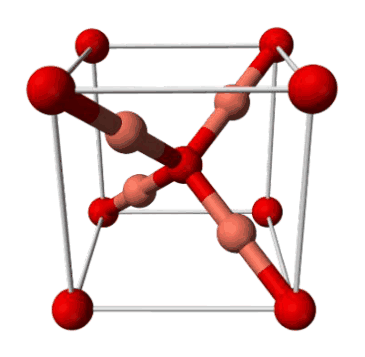
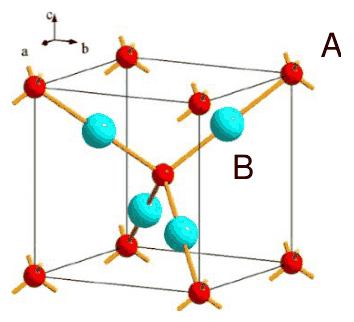
The two figures above depict the cubic unit cell of the \(\ce{Cu2O}\) crystal. The lattice constant of the structure is 427.0 pm.
2.1.1 Which of the atoms (A or B) is copper?
Which basic structure (primitive cubic, face centered cubic, body centered cubic, diamond) is formed by the A atoms and which structure is formed by the B atoms?
What are the coordination numbers of the atoms?
2.1.2 Calculate the smallest \(\ce{O-O}\), \(\ce{Cu-O}\) and \(\ce{Cu-Cu}\) distances in the structure?
2.1.3 What is the density of pure copper(I) oxide?
A common defect in this crystal is some copper atoms missing with the oxygen lattice unchanged. The composition of one such crystal sample was studied, and 0.2% of all copper atoms were found to be in oxidation state +2.
2,2 What percentage of normal copper sites are empty in the crystal sample? What is \(x\) in the empirical formula \(\ce{Cu_{2-x}O}\) of the crystal?
Copper(I) oxide is insoluble in water. It is stable in dry air, but humidity in the air catalyses a transformation (Reaction 1).When copper(I) oxide is dissolved in dilutesulfuric acid, a blue solution containing a precipitate is formed without evolution of a gas (Reaction 2). When hot, concentrated sulfuric acid is used, no precipitate remains, but an odorous gas forms (Reaction 3).The same gas forms when the precipitate from reaction 2 is dissolved in hot concentrated sulfuric acid.
2.3 Write balanced chemical equations for reactions (1-3).
Copper (I) oxide can be produced in a number of ways. Heating copper in air is a common method in the synthesis of semiconductor \(\ce{Cu2O}\). In a pure oxygen atmosphere, the three species containing copper (\(\ce{Cu(s)}\), \(\ce{Cu2O(s)}\) or \(\ce{CuO(s)}\)) can potentially interconvert.
Suppose that the \(\Delta_\mathrm{f}H^\circ\) and \(S^\circ\) data given for \(10^5\ \mathrm{Pa}\) are independent of temperature:
| Compound | \(\Delta_\mathrm{f}H^\circ/\mathrm{kJ\,mol^{-1}}\) | \(S^\circ/\mathrm{J\,mol^{-1}\,K^{-1}}\) |
|---|---|---|
| \(\ce{Cu(s)}\) | 0 | 65 |
| \(\ce{O2(g)}\) | 0 | 244 |
| \(\ce{CuO(s)}\) | −156 | 103 |
| \(\ce{Cu2O(s)}\) | −170 | 180 |
2.4. Determine the temperature ranges, if any, of thermodynamic stability of copper and its oxides between 500 and 1500 K in a \(10^5\ \mathrm{Pa}\) oxygen atmosphere.
Important data are given for 298 K. Use this temperature in the following calculations:
\[ K_\mathrm{sp}(\ce{Cu(OH)2})=2\times10^{-19} \]
\[ \ce{Cu2O(s) + H2O(l) + 2e- -> 2Cu(s) + 2OH-(aq)} \qquad E^\circ=-0.360\ \mathrm{V} \]
\[ \ce{Cu^{2+}(aq) + e- -> Cu+(aq)} \qquad E^\circ=+0.159\ \mathrm{V} \]
\[ \ce{Cu^{2+}(aq) + 2e- -> Cu(s)} \qquad E^\circ=+0.337\ \mathrm{V} \]
One possibility for producing \(\ce{Cu2O}\) is the anodic oxidation of copper. Electrolysis of an aqueous basic solution (e.g. \(\ce{NaOH}\)) with a copper anode and platinum cathode can lead to formation of copper(I) oxide on the anode.
2.5 Write the half reaction equations for the electrode processes during the anodic production of \(\ce{Cu2O}\) in \(\ce{NaOH}\) solution with a platinum cathode and copper anode.
Electrolytic reduction of copper(II) ions in solution is another possibility.
2.6.1 Write the half reaction equation of the cathode process giving \(\ce{Cu2O}\) in acidic medium.
Let us use \(0.100\ \mathrm{mol\,dm^{-3}}\) \(\ce{Cu^{2+}}\) solution and carry out electrolysis with platinum electrodes.
2.6.2 What is the maximum pH of this solution at which the concentration of copper(II) can be maintained at \(0.100\ \mathrm{mol\,dm^{-3}}\)?
If the pH is too low, reduction to metallic copper is preferred to the formation of copper(I) oxide.
2.6.3 What is the minimum pH at which the cathodic production of \(\ce{Cu2O}\) in a \(\ce{Cu^{2+}}\) solution (\(c=0.100\ \mathrm{mol\,dm^{-3}}\)) is still possible?
Official English text of the problem.
Answers
-
2.1.1: B is copper; A is oxygen. A forms a body centered cubic sublattice; B forms a face centered cubic sublattice. Copper has coordination number 2, with linear coordination; oxygen has coordination number 4, with tetrahedral coordination.
-
2.1.2: \[ \boxed{d_{\ce{O-O}}=369.8\ \mathrm{pm},\quad d_{\ce{Cu-O}}=184.9\ \mathrm{pm},\quad d_{\ce{Cu-Cu}}=301.9\ \mathrm{pm}} \]
-
2.1.3: \[ \boxed{\rho=6.104\ \mathrm{g\,cm^{-3}}\approx6.10\ \mathrm{g\,cm^{-3}}} \]
-
2.2: The calculated fraction of vacant copper sites is \(0.1996\%\approx0.20\%\). \[ \boxed{x=0.003992\approx0.004,\qquad \ce{Cu_{1.996}O}} \]
-
2.3: \[ \begin{aligned} \text{(1)}\quad&\ce{2Cu2O(s) + O2(g) -> 4CuO(s)}\\ \text{(2)}\quad&\ce{Cu2O(s) + H2SO4(aq) -> CuSO4(aq) + Cu(s) + H2O(l)}\\ \text{(3)}\quad&\ce{Cu2O(s) + 3H2SO4 -> 2CuSO4 + SO2(g) + 3H2O(l)} \end{aligned} \] Reaction 1 is promoted by humidity; reaction 3 uses hot, concentrated sulfuric acid.
-
2.4: Let \(T_*=1479.17\ \mathrm{K}\). \(\ce{CuO}\) is stable for \(500\ \mathrm{K}\le T<T_*\); both oxides coexist at \(T_*\); \(\ce{Cu2O}\) is stable for \(T_*<T\le1500\ \mathrm{K}\). Metallic copper has no thermodynamic stability range under the specified conditions.
-
2.5: Copper anode: \[ \boxed{\ce{2Cu(s) + 2OH-(aq) -> Cu2O(s) + H2O(l) + 2e-}} \] Platinum cathode: \[ \boxed{\ce{2H2O(l) + 2e- -> H2(g) + 2OH-(aq)}} \]
-
2.6.1: \[ \boxed{\ce{2Cu^{2+}(aq) + H2O(l) + 2e- -> Cu2O(s) + 2H+(aq)}} \]
-
2.6.2: \(\boxed{\mathrm{pH}_{\max}=5.15}\).
-
2.6.3: \(\boxed{\mathrm{pH}_{\min}\approx2.71}\), the limiting value at which the potential range for selective oxide production closes.
Solution
The molecular and ionic species used below have the following names and SMILES:
| Species | SMILES |
|---|---|
| Water, \(\ce{H2O}\) | O |
| Dioxygen, \(\ce{O2}\) | O=O |
| Dihydrogen, \(\ce{H2}\) | [H][H] |
| Sulfuric acid, \(\ce{H2SO4}\) | OS(=O)(=O)O |
| Sulfur dioxide, \(\ce{SO2}\) | O=S=O |
| Copper(I) ion, \(\ce{Cu+}\) | [Cu+] |
| Copper(II) ion, \(\ce{Cu^{2+}}\) | [Cu+2] |
| Hydrogen ion, \(\ce{H+}\) | [H+] |
| Hydroxide ion, \(\ce{OH-}\) | [OH-] |
| Sulfate ion, \(\ce{SO4^{2-}}\) | [O-]S(=O)(=O)[O-] |
| Sodium ion, \(\ce{Na+}\) | [Na+] |
Copper(II) sulfate has the ionic composition SMILES [Cu+2].[O-]S(=O)(=O)[O-], and sodium hydroxide has [Na+].[OH-]. Formal ionic formula-unit representations for copper(I) oxide, copper(II) oxide, and copper(II) hydroxide are respectively [Cu+].[Cu+].[O-2], [Cu+2].[O-2], and [Cu+2].[OH-].[OH-]. These disconnected representations do not describe hydration or the extended solid structures. The coordination geometry of the oxide is described explicitly below.
For numerical calculations, use the standard constants \(N_\mathrm A=6.022\times10^{23}\ \mathrm{mol^{-1}}\), \(R=8.314\ \mathrm{J\,mol^{-1}\,K^{-1}}\), and \(F=96485\ \mathrm{C\,mol^{-1}}\), with atomic molar masses \(M(\ce{Cu})=63.55\) and \(M(\ce{O})=16.00\ \mathrm{g\,mol^{-1}}\). For the aqueous calculations, approximate activities by concentrations relative to \(1\ \mathrm{mol\,dm^{-3}}\), and take \(pK_\mathrm w=14.00\) at 298 K.
2.1.1 — Atom identification, sublattices, and coordination
The A atoms occupy the eight corners and the body center. Their number per unit cell is therefore
\[ N_A=8\left(\frac18\right)+1=2. \]
There are four B atoms wholly inside the unit cell, so
\[ N_B=4. \]
The ratio \(B:A=2:1\), together with the composition \(\ce{Cu2O}\), establishes that B is copper and A is oxygen.
The corner-and-body-center arrangement of A is body centered cubic. The B positions form a face centered cubic sublattice, displaced relative to the conventional origin of an fcc cell.
A convenient set of fractional coordinates is
\[ \begin{aligned} \ce{O}:&\quad (0,0,0),\ \left(\tfrac12,\tfrac12,\tfrac12\right),\\ \ce{Cu}:&\quad \left(\tfrac14,\tfrac14,\tfrac14\right),\ \left(\tfrac14,\tfrac34,\tfrac34\right),\ \left(\tfrac34,\tfrac14,\tfrac34\right),\ \left(\tfrac34,\tfrac34,\tfrac14\right). \end{aligned} \]
Each copper atom lies midway between two oxygen atoms along a body-diagonal direction. Its two oxygen neighbors are collinear, giving coordination number 2 and a \(180^\circ\) coordination angle.
Each oxygen atom has four nearest copper neighbors directed toward alternate vertices of a cube. These form a regular tetrahedron, giving coordination number 4, with angles of approximately \(109.47^\circ\).
2.1.2 — Shortest interatomic distances
Let \(a=427.0\ \mathrm{pm}\).
In the oxygen bcc sublattice, the shortest separation is from a corner to the body center:
\[ d_{\ce{O-O}} =\sqrt{\left(\frac a2\right)^2+ \left(\frac a2\right)^2+ \left(\frac a2\right)^2} =\frac{\sqrt3}{2}a =\boxed{369.8\ \mathrm{pm}}. \]
Copper is midway along such a corner-to-center segment:
\[ d_{\ce{Cu-O}}=\frac{\sqrt3}{4}a =\boxed{184.9\ \mathrm{pm}}. \]
Two nearest copper sites differ by half a cell edge along each of two axes:
\[ d_{\ce{Cu-Cu}} =\sqrt{\left(\frac a2\right)^2+ \left(\frac a2\right)^2} =\frac{a}{\sqrt2} =\boxed{301.9\ \mathrm{pm}}. \]
2.1.3 — Density
There are four copper atoms and two oxygen atoms per unit cell, corresponding to \(Z=2\) formula units of \(\ce{Cu2O}\).
\[ M(\ce{Cu2O})=2(63.55)+16.00 =143.10\ \mathrm{g\,mol^{-1}}. \]
Since
\[ a=427.0\ \mathrm{pm}=4.270\times10^{-8}\ \mathrm{cm}, \]
the unit-cell volume is
\[ V_\mathrm{cell}=a^3 =7.78545\times10^{-23}\ \mathrm{cm^3}. \]
Thus
\[ \rho =\frac{ZM}{N_\mathrm A a^3} =\frac{2(143.10)} {(6.022\times10^{23})(7.78545\times10^{-23})} =\boxed{6.104\ \mathrm{g\,cm^{-3}}}. \]
2.2 — Copper vacancies
Let \(f=0.002\) be the fraction of the copper atoms actually present that are copper(II). The mean oxidation state of the occupied copper sites is
\[ (1-f)(+1)+f(+2)=1+f=1.002. \]
For one oxygen atom in \(\ce{Cu_{2-x}O}\), electroneutrality requires
\[ (2-x)(1.002)=2. \]
Hence
\[ x=2-\frac{2}{1.002} =\frac{0.004}{1.002} =\boxed{0.003992\approx0.004}. \]
There are two normal copper sites per oxygen atom. The percentage that are vacant is consequently
\[ \frac{x}{2}\times100\% =\frac{0.002}{1.002}\times100\% =\boxed{0.1996\%\approx0.20\%}. \]
Each copper(II) ion contributes one additional positive charge relative to copper(I), compensating for one missing copper(I) ion. The small difference between \(0.2000\%\) and \(0.1996\%\) comes from the different denominators: occupied copper sites versus all normal copper sites.
2.3 — Reactions of copper(I) oxide
In moist air, oxygen oxidizes copper(I) to copper(II). Water promotes the reaction without being consumed in the net equation:
\[ \boxed{\ce{2Cu2O(s) + O2(g) -> 4CuO(s)}}. \]
In dilute sulfuric acid, copper(I) disproportionates:
\[ \ce{2Cu+ -> Cu^{2+} + Cu(s)}. \]
One copper(I) center is oxidized to copper(II), while another is reduced to copper metal. The hydrated copper(II) ions account for the blue solution, and copper metal is the solid product. Including protonation of the oxide gives
\[ \boxed{\ce{Cu2O(s) + H2SO4(aq) -> CuSO4(aq) + Cu(s) + H2O(l)}}. \]
Hot, concentrated sulfuric acid acts as an oxidant. Both copper atoms reach oxidation state \(+2\), while sulfur is reduced from \(+6\) to \(+4\), producing sulfur dioxide:
\[ \boxed{\ce{Cu2O(s) + 3H2SO4 -> 2CuSO4 + SO2(g) + 3H2O(l)}}. \]
This also explains why the copper precipitate from reaction 2 dissolves in hot, concentrated sulfuric acid with evolution of the same gas:
\[ \ce{Cu(s) + 2H2SO4 -> CuSO4 + SO2(g) + 2H2O(l)}. \]
2.4 — Thermodynamic stability ranges
At the specified oxygen pressure,
\[ p_{\ce{O2}}=p^\circ=10^5\ \mathrm{Pa}, \]
and the pure solids have unit activity. Consequently, the reaction Gibbs energies equal their standard values.
First consider oxidation of copper to copper(I) oxide:
\[ \ce{2Cu(s) + 1/2O2(g) -> Cu2O(s)}. \]
The reaction enthalpy and entropy are
\[ \Delta_\mathrm rH^\circ=-170\ \mathrm{kJ\,mol^{-1}}, \]
\[ \Delta_\mathrm rS^\circ =180-2(65)-\frac12(244) =-72\ \mathrm{J\,mol^{-1}\,K^{-1}}. \]
Therefore,
\[ \Delta_\mathrm rG^\circ =-170+0.072T \quad\mathrm{kJ\,mol^{-1}}. \]
This is negative throughout 500–1500 K: it ranges from \(-134\) to \(-62\ \mathrm{kJ\,mol^{-1}}\). Thus metallic copper is unstable toward oxidation throughout the requested interval.
To compare the two oxides, use
\[ \ce{Cu2O(s) + 1/2O2(g) -> 2CuO(s)}. \]
For this reaction,
\[ \Delta_\mathrm rH^\circ =2(-156)-(-170) =-142\ \mathrm{kJ\,mol^{-1}}, \]
\[ \Delta_\mathrm rS^\circ =2(103)-180-\frac12(244) =-96\ \mathrm{J\,mol^{-1}\,K^{-1}}. \]
Hence
\[ \Delta_\mathrm rG^\circ =-142+0.096T \quad\mathrm{kJ\,mol^{-1}}. \]
The oxide equilibrium occurs when this is zero:
\[ T_*=\frac{142}{0.096} =\boxed{1479.17\ \mathrm{K}}. \]
Below \(T_*\), oxidation to \(\ce{CuO}\) is favorable; above \(T_*\), the reverse reaction is favorable.
| Temperature | Thermodynamically stable copper-containing phase |
|---|---|
| \(500\ \mathrm{K}\le T<T_*\) | \(\ce{CuO(s)}\) |
| \(T=T_*\) | \(\ce{CuO(s)}\) and \(\ce{Cu2O(s)}\) coexist |
| \(T_*<T\le1500\ \mathrm{K}\) | \(\ce{Cu2O(s)}\) |
2.5 — Anodic production of copper(I) oxide
At the copper anode, copper is oxidized from oxidation state 0 to \(+1\). Reversing the supplied oxide-reduction half-reaction gives
\[ \boxed{\ce{2Cu(s) + 2OH-(aq) -> Cu2O(s) + H2O(l) + 2e-}}. \]
At the platinum cathode, water is reduced to hydrogen:
\[ \boxed{\ce{2H2O(l) + 2e- -> H2(g) + 2OH-(aq)}}. \]
Adding the two half-reactions gives the overall electrolytic process:
\[ \ce{2Cu(s) + H2O(l) -> Cu2O(s) + H2(g)}. \]
2.6.1 — Cathodic formation of copper(I) oxide in acid
Two copper(II) ions each accept one electron, giving two copper(I) centers. Water supplies the oxide oxygen; balancing hydrogen in acidic solution gives
\[ \boxed{\ce{2Cu^{2+}(aq) + H2O(l) + 2e- -> Cu2O(s) + 2H+(aq)}}. \]
The total charge is \(+2\) on each side.
2.6.2 — Maximum pH before copper(II) hydroxide precipitation
The limiting condition is saturation with copper(II) hydroxide:
\[ \ce{Cu(OH)2(s) <=> Cu^{2+}(aq) + 2OH-(aq)}. \]
Thus
\[ K_\mathrm{sp} =[\ce{Cu^{2+}}][\ce{OH-}]^2. \]
At \([\ce{Cu^{2+}}]=0.100\ \mathrm{mol\,dm^{-3}}\),
\[ [\ce{OH-}]_\mathrm{max} =\sqrt{\frac{2\times10^{-19}}{0.100}} =\sqrt{2\times10^{-18}} =1.414\times10^{-9}\ \mathrm{mol\,dm^{-3}}. \]
Therefore,
\[ \mathrm{pOH} =-\log_{10}(1.414\times10^{-9}) =8.8495, \]
\[ \boxed{\mathrm{pH}_\mathrm{max} =14.00-8.8495 =5.1505\approx5.15}. \]
Above this pH, precipitation prevents the dissolved copper(II) concentration from remaining at the specified value.
2.6.3 — Minimum pH for cathodic oxide production
At 298 K, define the Nernst coefficient
\[ s=\frac{2.303RT}{F}=0.05913\ \mathrm{V}. \]
For direct deposition of copper,
\[ \ce{Cu^{2+}(aq) + 2e- -> Cu(s)}, \]
the equilibrium reduction potential at the specified concentration is
\[ E_\mathrm m =0.337+\frac{s}{2}\log_{10}(0.100) =0.337-\frac{s}{2} =\boxed{0.3074\ \mathrm{V}}. \]
For reduction of copper(I) oxide to copper,
\[ \ce{Cu2O(s) + H2O(l) + 2e- -> 2Cu(s) + 2OH-(aq)}, \]
the Nernst equation gives
\[ E_\mathrm o =-0.360-\frac{s}{2}\log_{10}[\ce{OH-}]^2 =-0.360-s\log_{10}[\ce{OH-}]. \]
Using \(\log_{10}[\ce{OH-}]=\mathrm{pH}-14.00\),
\[ E_\mathrm o =-0.360+s(14.00-\mathrm{pH}) =0.4678-0.05913\,\mathrm{pH}. \]
To establish the condition for oxide deposition, let \(E_\mathrm f\) denote the equilibrium reduction potential for
\[ \ce{2Cu^{2+}(aq) + H2O(l) + 2e- -> Cu2O(s) + 2H+(aq)}. \]
Adding this reaction to oxide reduction written in acidic form,
\[ \ce{Cu2O(s) + 2H+(aq) + 2e- -> 2Cu(s) + H2O(l)}, \]
gives
\[ \ce{2Cu^{2+}(aq) + 4e- -> 2Cu(s)}. \]
Because Gibbs energies add, and each constituent half-reaction transfers two electrons,
\[ -2FE_\mathrm f-2FE_\mathrm o=-4FE_\mathrm m, \]
so
\[ E_\mathrm f=2E_\mathrm m-E_\mathrm o. \]
Selective oxide deposition becomes possible when its deposition potential is more positive than the potential for direct metal deposition:
\[ E_\mathrm f>E_\mathrm m. \]
Using the relation above, this is equivalent to
\[ E_\mathrm m>E_\mathrm o. \]
The limiting pH therefore satisfies
\[ 0.337-\frac{s}{2} =-0.360+s(14.00-\mathrm{pH}_\mathrm{min}). \]
Rearranging,
\[ \mathrm{pH}_\mathrm{min} =14.50-\frac{0.697}{s} =14.50-\frac{0.697}{0.0591296} =\boxed{2.7123\approx2.71}. \]
At this boundary, the metal-deposition, oxide-deposition, and oxide-to-metal reduction potentials coincide. Just above it, a finite electrode-potential interval permits oxide deposition without direct copper deposition.
Combining this limit with part 2.6.2 gives the thermodynamic operating interval
\[ \boxed{2.71<\mathrm{pH}\le5.15}, \]
where the upper endpoint is the onset of copper(II) hydroxide saturation.
The solution was checked against the official solution.
IChO 2016 · Theorieaufgabe 2
Kupfer(I)-oxid
Eines der ersten Materialien, die in der Festkörperelektronik verwendet wurden, war rotes Kupfer(I)-oxid. Heute besteht erneut Interesse daran, da es ein ungiftiger und preiswerter Bestandteil von Solarzellen sein könnte.
Die beiden obigen Abbildungen zeigen die kubische Elementarzelle des \(\ce{Cu2O}\)-Kristalls. Die Gitterkonstante der Struktur beträgt 427.0 pm.
2.1.1 Welche der Atome (A oder B) sind Kupferatome?
Welche Grundstruktur (kubisch-primitiv, kubisch-flächenzentriert, kubisch-raumzentriert, Diamantstruktur) bilden die A-Atome, und welche Struktur bilden die B-Atome?
Welche Koordinationszahlen haben die Atome?
2.1.2 Berechnen Sie die kleinsten \(\ce{O-O}\)-, \(\ce{Cu-O}\)- und \(\ce{Cu-Cu}\)-Abstände in der Struktur.
2.1.3 Welche Dichte hat reines Kupfer(I)-oxid?
Ein häufiger Defekt in diesem Kristall besteht darin, dass einige Kupferatome fehlen, während das Sauerstoffgitter unverändert bleibt. Die Zusammensetzung einer solchen Kristallprobe wurde untersucht; dabei wurde festgestellt, dass 0.2% aller Kupferatome die Oxidationsstufe +2 aufweisen.
2,2 Wie viel Prozent der regulären Kupferplätze sind in der Kristallprobe unbesetzt? Welchen Wert hat \(x\) in der Verhältnisformel \(\ce{Cu_{2-x}O}\) des Kristalls?
Kupfer(I)-oxid ist in Wasser unlöslich. Es ist in trockener Luft stabil, doch Luftfeuchtigkeit katalysiert eine Umwandlung (Reaktion 1). Wird Kupfer(I)-oxid in verdünnter Schwefelsäure gelöst, entsteht ohne Gasentwicklung eine blaue Lösung, die einen Niederschlag enthält (Reaktion 2). Bei Verwendung heißer, konzentrierter Schwefelsäure bleibt kein Niederschlag zurück, es bildet sich jedoch ein Gas mit charakteristischem Geruch (Reaktion 3). Dasselbe Gas entsteht, wenn der Niederschlag aus Reaktion 2 in heißer, konzentrierter Schwefelsäure gelöst wird.
2.3 Stellen Sie die ausgeglichenen Reaktionsgleichungen für die Reaktionen (1–3) auf.
Kupfer(I)-oxid kann auf verschiedene Weise hergestellt werden. Das Erhitzen von Kupfer an der Luft ist eine gängige Methode zur Synthese des Halbleiters \(\ce{Cu2O}\). In einer reinen Sauerstoffatmosphäre können die drei kupferhaltigen Spezies (\(\ce{Cu(s)}\), \(\ce{Cu2O(s)}\) oder \(\ce{CuO(s)}\)) grundsätzlich ineinander umgewandelt werden.
Nehmen Sie an, dass die für \(10^5\ \mathrm{Pa}\) angegebenen Werte von \(\Delta_\mathrm{f}H^\circ\) und \(S^\circ\) temperaturunabhängig sind:
| Verbindung | \(\Delta_\mathrm{f}H^\circ/\mathrm{kJ\,mol^{-1}}\) | \(S^\circ/\mathrm{J\,mol^{-1}\,K^{-1}}\) |
|---|---|---|
| \(\ce{Cu(s)}\) | 0 | 65 |
| \(\ce{O2(g)}\) | 0 | 244 |
| \(\ce{CuO(s)}\) | −156 | 103 |
| \(\ce{Cu2O(s)}\) | −170 | 180 |
2.4. Bestimmen Sie die Temperaturbereiche, sofern vorhanden, in denen Kupfer und seine Oxide zwischen 500 und 1500 K in einer Sauerstoffatmosphäre bei \(10^5\ \mathrm{Pa}\) thermodynamisch stabil sind.
Wichtige Daten sind für 298 K angegeben. Verwenden Sie diese Temperatur in den folgenden Berechnungen:
\[ K_\mathrm{sp}(\ce{Cu(OH)2})=2\times10^{-19} \]
\[ \ce{Cu2O(s) + H2O(l) + 2e- -> 2Cu(s) + 2OH-(aq)} \qquad E^\circ=-0.360\ \mathrm{V} \]
\[ \ce{Cu^{2+}(aq) + e- -> Cu+(aq)} \qquad E^\circ=+0.159\ \mathrm{V} \]
\[ \ce{Cu^{2+}(aq) + 2e- -> Cu(s)} \qquad E^\circ=+0.337\ \mathrm{V} \]
Eine Möglichkeit zur Herstellung von \(\ce{Cu2O}\) ist die anodische Oxidation von Kupfer. Die Elektrolyse einer wässrigen basischen Lösung (z. B. \(\ce{NaOH}\)) mit einer Kupferanode und einer Platinkathode kann zur Bildung von Kupfer(I)-oxid auf der Anode führen.
2.5 Stellen Sie die Teilreaktionsgleichungen für die Elektrodenprozesse bei der anodischen Herstellung von \(\ce{Cu2O}\) in einer \(\ce{NaOH}\)-Lösung mit einer Platinkathode und einer Kupferanode auf.
Eine weitere Möglichkeit ist die elektrolytische Reduktion von Kupfer(II)-Ionen in Lösung.
2.6.1 Stellen Sie die Teilreaktionsgleichung für den Kathodenprozess auf, bei dem in saurem Medium \(\ce{Cu2O}\) entsteht.
Wir verwenden eine \(0.100\ \mathrm{mol\,dm^{-3}}\) \(\ce{Cu^{2+}}\)-Lösung und führen die Elektrolyse mit Platinelektroden durch.
2.6.2 Welchen maximalen pH-Wert darf diese Lösung haben, damit die Kupfer(II)-Konzentration bei \(0.100\ \mathrm{mol\,dm^{-3}}\) gehalten werden kann?
Ist der pH-Wert zu niedrig, wird die Reduktion zu metallischem Kupfer gegenüber der Bildung von Kupfer(I)-oxid bevorzugt.
2.6.3 Bei welchem minimalen pH-Wert ist die kathodische Herstellung von \(\ce{Cu2O}\) in einer \(\ce{Cu^{2+}}\)-Lösung (\(c=0.100\ \mathrm{mol\,dm^{-3}}\)) noch möglich?
Aufgabentext aus dem offiziellen englischen Text übersetzt.
Antworten
-
2.1.1: B ist Kupfer; A ist Sauerstoff. A bildet ein kubisch-raumzentriertes Teilgitter; B bildet ein kubisch-flächenzentriertes Teilgitter. Kupfer hat die Koordinationszahl 2 mit linearer Koordination; Sauerstoff hat die Koordinationszahl 4 mit tetraedrischer Koordination.
-
2.1.2: \[ \boxed{d_{\ce{O-O}}=369.8\ \mathrm{pm},\quad d_{\ce{Cu-O}}=184.9\ \mathrm{pm},\quad d_{\ce{Cu-Cu}}=301.9\ \mathrm{pm}} \]
-
2.1.3: \[ \boxed{\rho=6.104\ \mathrm{g\,cm^{-3}}\approx6.10\ \mathrm{g\,cm^{-3}}} \]
-
2.2: Der berechnete Anteil unbesetzter Kupferplätze beträgt \(0.1996\%\approx0.20\%\). \[ \boxed{x=0.003992\approx0.004,\qquad \ce{Cu_{1.996}O}} \]
-
2.3: \[ \begin{aligned} \text{(1)}\quad&\ce{2Cu2O(s) + O2(g) -> 4CuO(s)}\\ \text{(2)}\quad&\ce{Cu2O(s) + H2SO4(aq) -> CuSO4(aq) + Cu(s) + H2O(l)}\\ \text{(3)}\quad&\ce{Cu2O(s) + 3H2SO4 -> 2CuSO4 + SO2(g) + 3H2O(l)} \end{aligned} \] Reaktion 1 wird durch Luftfeuchtigkeit begünstigt; bei Reaktion 3 wird heiße, konzentrierte Schwefelsäure verwendet.
-
2.4: Sei \(T_*=1479.17\ \mathrm{K}\). \(\ce{CuO}\) ist für \(500\ \mathrm{K}\le T<T_*\) stabil; bei \(T_*\) koexistieren beide Oxide; \(\ce{Cu2O}\) ist für \(T_*<T\le1500\ \mathrm{K}\) stabil. Metallisches Kupfer hat unter den angegebenen Bedingungen keinen thermodynamischen Stabilitätsbereich.
-
2.5: Kupferanode: \[ \boxed{\ce{2Cu(s) + 2OH-(aq) -> Cu2O(s) + H2O(l) + 2e-}} \] Platinkathode: \[ \boxed{\ce{2H2O(l) + 2e- -> H2(g) + 2OH-(aq)}} \]
-
2.6.1: \[ \boxed{\ce{2Cu^{2+}(aq) + H2O(l) + 2e- -> Cu2O(s) + 2H+(aq)}} \]
-
2.6.2: \(\boxed{\mathrm{pH}_{\max}=5.15}\).
-
2.6.3: \(\boxed{\mathrm{pH}_{\min}\approx2.71}\), der Grenzwert, bei dem der Potenzialbereich für die selektive Oxidherstellung verschwindet.
Lösung
Die im Folgenden verwendeten molekularen und ionischen Spezies haben die folgenden Namen und SMILES:
| Spezies | SMILES |
|---|---|
| Wasser, \(\ce{H2O}\) | O |
| Disauerstoff, \(\ce{O2}\) | O=O |
| Diwasserstoff, \(\ce{H2}\) | [H][H] |
| Schwefelsäure, \(\ce{H2SO4}\) | OS(=O)(=O)O |
| Schwefeldioxid, \(\ce{SO2}\) | O=S=O |
| Kupfer(I)-Ion, \(\ce{Cu+}\) | [Cu+] |
| Kupfer(II)-Ion, \(\ce{Cu^{2+}}\) | [Cu+2] |
| Wasserstoffion, \(\ce{H+}\) | [H+] |
| Hydroxidion, \(\ce{OH-}\) | [OH-] |
| Sulfation, \(\ce{SO4^{2-}}\) | [O-]S(=O)(=O)[O-] |
| Natriumion, \(\ce{Na+}\) | [Na+] |
Die ionische Zusammensetzung von Kupfer(II)-sulfat wird durch den SMILES [Cu+2].[O-]S(=O)(=O)[O-] dargestellt, die von Natriumhydroxid durch [Na+].[OH-]. Formale ionische Darstellungen der Formeleinheiten von Kupfer(I)-oxid, Kupfer(II)-oxid und Kupfer(II)-hydroxid lauten entsprechend [Cu+].[Cu+].[O-2], [Cu+2].[O-2] und [Cu+2].[OH-].[OH-]. Diese Darstellungen mit unverbundenen Komponenten beschreiben weder die Hydratation noch die ausgedehnten Festkörperstrukturen. Die Koordinationsgeometrie des Oxids wird weiter unten ausdrücklich beschrieben.
Verwenden Sie für numerische Berechnungen die Standardkonstanten \(N_\mathrm A=6.022\times10^{23}\ \mathrm{mol^{-1}}\), \(R=8.314\ \mathrm{J\,mol^{-1}\,K^{-1}}\) und \(F=96485\ \mathrm{C\,mol^{-1}}\) sowie die molaren Atommassen \(M(\ce{Cu})=63.55\) und \(M(\ce{O})=16.00\ \mathrm{g\,mol^{-1}}\). Nähern Sie für die Berechnungen in wässriger Lösung die Aktivitäten durch die auf \(1\ \mathrm{mol\,dm^{-3}}\) bezogenen Konzentrationen an und setzen Sie bei 298 K \(pK_\mathrm w=14.00\).
2.1.1 — Zuordnung der Atome, Teilgitter und Koordination
Die A-Atome besetzen die acht Ecken und das Raumzentrum. Ihre Anzahl pro Elementarzelle beträgt daher
\[ N_A=8\left(\frac18\right)+1=2. \]
Vier B-Atome liegen vollständig innerhalb der Elementarzelle, sodass
\[ N_B=4. \]
Das Verhältnis \(B:A=2:1\) ergibt zusammen mit der Zusammensetzung \(\ce{Cu2O}\), dass B Kupfer und A Sauerstoff ist.
Die Anordnung von A an den Ecken und im Raumzentrum ist kubisch-raumzentriert. Die B-Positionen bilden ein kubisch-flächenzentriertes Teilgitter, das gegenüber dem konventionellen Ursprung einer fcc-Zelle verschoben ist.
Ein geeigneter Satz von Bruchkoordinaten ist
\[ \begin{aligned} \ce{O}:&\quad (0,0,0),\ \left(\tfrac12,\tfrac12,\tfrac12\right),\\ \ce{Cu}:&\quad \left(\tfrac14,\tfrac14,\tfrac14\right),\ \left(\tfrac14,\tfrac34,\tfrac34\right),\ \left(\tfrac34,\tfrac14,\tfrac34\right),\ \left(\tfrac34,\tfrac34,\tfrac14\right). \end{aligned} \]
Jedes Kupferatom liegt auf halber Strecke zwischen zwei Sauerstoffatomen entlang einer Raumdiagonalen. Seine beiden Sauerstoffnachbarn liegen auf einer Geraden, woraus sich die Koordinationszahl 2 und ein Koordinationswinkel von \(180^\circ\) ergeben.
Jedes Sauerstoffatom hat vier nächste Kupfernachbarn, die in Richtung jeder zweiten Ecke eines Würfels liegen. Diese bilden ein regelmäßiges Tetraeder, woraus sich die Koordinationszahl 4 mit Winkeln von ungefähr \(109.47^\circ\) ergibt.
2.1.2 — Kürzeste Atomabstände
Sei \(a=427.0\ \mathrm{pm}\).
Im kubisch-raumzentrierten Sauerstoffteilgitter ist der kürzeste Abstand derjenige von einer Ecke zum Raumzentrum:
\[ d_{\ce{O-O}} =\sqrt{\left(\frac a2\right)^2+ \left(\frac a2\right)^2+ \left(\frac a2\right)^2} =\frac{\sqrt3}{2}a =\boxed{369.8\ \mathrm{pm}}. \]
Kupfer liegt auf halber Strecke einer solchen Verbindung zwischen Ecke und Zentrum:
\[ d_{\ce{Cu-O}}=\frac{\sqrt3}{4}a =\boxed{184.9\ \mathrm{pm}}. \]
Zwei nächstgelegene Kupferplätze unterscheiden sich entlang zweier Achsen jeweils um eine halbe Zellkante:
\[ d_{\ce{Cu-Cu}} =\sqrt{\left(\frac a2\right)^2+ \left(\frac a2\right)^2} =\frac{a}{\sqrt2} =\boxed{301.9\ \mathrm{pm}}. \]
2.1.3 — Dichte
Pro Elementarzelle liegen vier Kupferatome und zwei Sauerstoffatome vor, entsprechend \(Z=2\) Formeleinheiten von \(\ce{Cu2O}\).
\[ M(\ce{Cu2O})=2(63.55)+16.00 =143.10\ \mathrm{g\,mol^{-1}}. \]
Da
\[ a=427.0\ \mathrm{pm}=4.270\times10^{-8}\ \mathrm{cm}, \]
beträgt das Volumen der Elementarzelle
\[ V_\mathrm{cell}=a^3 =7.78545\times10^{-23}\ \mathrm{cm^3}. \]
Damit gilt
\[ \rho =\frac{ZM}{N_\mathrm A a^3} =\frac{2(143.10)} {(6.022\times10^{23})(7.78545\times10^{-23})} =\boxed{6.104\ \mathrm{g\,cm^{-3}}}. \]
2.2 — Kupferleerstellen
Sei \(f=0.002\) der Anteil der tatsächlich vorhandenen Kupferatome, die als Kupfer(II) vorliegen. Die mittlere Oxidationsstufe der besetzten Kupferplätze beträgt
\[ (1-f)(+1)+f(+2)=1+f=1.002. \]
Für ein Sauerstoffatom in \(\ce{Cu_{2-x}O}\) verlangt die Elektroneutralität
\[ (2-x)(1.002)=2. \]
Daraus folgt
\[ x=2-\frac{2}{1.002} =\frac{0.004}{1.002} =\boxed{0.003992\approx0.004}. \]
Pro Sauerstoffatom gibt es zwei reguläre Kupferplätze. Der prozentuale Anteil unbesetzter Plätze beträgt folglich
\[ \frac{x}{2}\times100\% =\frac{0.002}{1.002}\times100\% =\boxed{0.1996\%\approx0.20\%}. \]
Jedes Kupfer(II)-Ion trägt gegenüber Kupfer(I) eine zusätzliche positive Ladung bei und gleicht damit ein fehlendes Kupfer(I)-Ion aus. Der kleine Unterschied zwischen \(0.2000\%\) und \(0.1996\%\) ergibt sich aus den unterschiedlichen Bezugsgrößen: besetzte Kupferplätze gegenüber allen regulären Kupferplätzen.
2.3 — Reaktionen von Kupfer(I)-oxid
In feuchter Luft oxidiert Sauerstoff Kupfer(I) zu Kupfer(II). Wasser begünstigt die Reaktion, ohne in der Nettogleichung verbraucht zu werden:
\[ \boxed{\ce{2Cu2O(s) + O2(g) -> 4CuO(s)}}. \]
In verdünnter Schwefelsäure disproportioniert Kupfer(I):
\[ \ce{2Cu+ -> Cu^{2+} + Cu(s)}. \]
Ein Kupfer(I)-Zentrum wird zu Kupfer(II) oxidiert, während ein anderes zu metallischem Kupfer reduziert wird. Die hydratisierten Kupfer(II)-Ionen sind für die blaue Farbe der Lösung verantwortlich, und metallisches Kupfer ist das feste Produkt. Unter Einbeziehung der Protonierung des Oxids ergibt sich
\[ \boxed{\ce{Cu2O(s) + H2SO4(aq) -> CuSO4(aq) + Cu(s) + H2O(l)}}. \]
Heiße, konzentrierte Schwefelsäure wirkt als Oxidationsmittel. Beide Kupferatome erreichen die Oxidationsstufe \(+2\), während Schwefel von \(+6\) zu \(+4\) reduziert wird, wobei Schwefeldioxid entsteht:
\[ \boxed{\ce{Cu2O(s) + 3H2SO4 -> 2CuSO4 + SO2(g) + 3H2O(l)}}. \]
Dies erklärt auch, warum sich der Kupferniederschlag aus Reaktion 2 in heißer, konzentrierter Schwefelsäure unter Entwicklung desselben Gases löst:
\[ \ce{Cu(s) + 2H2SO4 -> CuSO4 + SO2(g) + 2H2O(l)}. \]
2.4 — Thermodynamische Stabilitätsbereiche
Beim angegebenen Sauerstoffdruck gilt
\[ p_{\ce{O2}}=p^\circ=10^5\ \mathrm{Pa}, \]
und die reinen Feststoffe haben die Aktivität eins. Folglich sind die freien Reaktionsenthalpien gleich ihren Standardwerten.
Betrachten wir zunächst die Oxidation von Kupfer zu Kupfer(I)-oxid:
\[ \ce{2Cu(s) + 1/2O2(g) -> Cu2O(s)}. \]
Die Reaktionsenthalpie und die Reaktionsentropie betragen
\[ \Delta_\mathrm rH^\circ=-170\ \mathrm{kJ\,mol^{-1}}, \]
\[ \Delta_\mathrm rS^\circ =180-2(65)-\frac12(244) =-72\ \mathrm{J\,mol^{-1}\,K^{-1}}. \]
Daher gilt
\[ \Delta_\mathrm rG^\circ =-170+0.072T \quad\mathrm{kJ\,mol^{-1}}. \]
Dieser Wert ist im gesamten Bereich von 500–1500 K negativ: Er reicht von \(-134\) bis \(-62\ \mathrm{kJ\,mol^{-1}}\). Metallisches Kupfer ist daher im gesamten gefragten Intervall gegenüber Oxidation instabil.
Zum Vergleich der beiden Oxide verwenden wir
\[ \ce{Cu2O(s) + 1/2O2(g) -> 2CuO(s)}. \]
Für diese Reaktion gilt
\[ \Delta_\mathrm rH^\circ =2(-156)-(-170) =-142\ \mathrm{kJ\,mol^{-1}}, \]
\[ \Delta_\mathrm rS^\circ =2(103)-180-\frac12(244) =-96\ \mathrm{J\,mol^{-1}\,K^{-1}}. \]
Daraus folgt
\[ \Delta_\mathrm rG^\circ =-142+0.096T \quad\mathrm{kJ\,mol^{-1}}. \]
Das Gleichgewicht zwischen den Oxiden liegt vor, wenn dieser Ausdruck null ist:
\[ T_*=\frac{142}{0.096} =\boxed{1479.17\ \mathrm{K}}. \]
Unterhalb von \(T_*\) ist die Oxidation zu \(\ce{CuO}\) begünstigt; oberhalb von \(T_*\) ist die Rückreaktion begünstigt.
| Temperatur | Thermodynamisch stabile kupferhaltige Phase |
|---|---|
| \(500\ \mathrm{K}\le T<T_*\) | \(\ce{CuO(s)}\) |
| \(T=T_*\) | \(\ce{CuO(s)}\) und \(\ce{Cu2O(s)}\) koexistieren |
| \(T_*<T\le1500\ \mathrm{K}\) | \(\ce{Cu2O(s)}\) |
2.5 — Anodische Herstellung von Kupfer(I)-oxid
An der Kupferanode wird Kupfer von der Oxidationsstufe 0 zu \(+1\) oxidiert. Durch Umkehrung der angegebenen Teilreaktion für die Oxidreduktion ergibt sich
\[ \boxed{\ce{2Cu(s) + 2OH-(aq) -> Cu2O(s) + H2O(l) + 2e-}}. \]
An der Platinkathode wird Wasser zu Wasserstoff reduziert:
\[ \boxed{\ce{2H2O(l) + 2e- -> H2(g) + 2OH-(aq)}}. \]
Die Addition der beiden Teilreaktionen ergibt den gesamten elektrolytischen Prozess:
\[ \ce{2Cu(s) + H2O(l) -> Cu2O(s) + H2(g)}. \]
2.6.1 — Kathodische Bildung von Kupfer(I)-oxid in saurem Medium
Zwei Kupfer(II)-Ionen nehmen jeweils ein Elektron auf, sodass zwei Kupfer(I)-Zentren entstehen. Wasser liefert den Sauerstoff des Oxids; durch Ausgleichen des Wasserstoffs in saurer Lösung ergibt sich
\[ \boxed{\ce{2Cu^{2+}(aq) + H2O(l) + 2e- -> Cu2O(s) + 2H+(aq)}}. \]
Die Gesamtladung beträgt auf beiden Seiten \(+2\).
2.6.2 — Maximaler pH-Wert vor der Fällung von Kupfer(II)-hydroxid
Die Grenzbedingung ist die Sättigung bezüglich Kupfer(II)-hydroxid:
\[ \ce{Cu(OH)2(s) <=> Cu^{2+}(aq) + 2OH-(aq)}. \]
Damit gilt
\[ K_\mathrm{sp} =[\ce{Cu^{2+}}][\ce{OH-}]^2. \]
Bei \([\ce{Cu^{2+}}]=0.100\ \mathrm{mol\,dm^{-3}}\) gilt
\[ [\ce{OH-}]_\mathrm{max} =\sqrt{\frac{2\times10^{-19}}{0.100}} =\sqrt{2\times10^{-18}} =1.414\times10^{-9}\ \mathrm{mol\,dm^{-3}}. \]
Daher gilt
\[ \mathrm{pOH} =-\log_{10}(1.414\times10^{-9}) =8.8495, \]
\[ \boxed{\mathrm{pH}_\mathrm{max} =14.00-8.8495 =5.1505\approx5.15}. \]
Oberhalb dieses pH-Werts verhindert die Fällung, dass die Konzentration des gelösten Kupfer(II) beim angegebenen Wert bleibt.
2.6.3 — Minimaler pH-Wert für die kathodische Oxidherstellung
Bei 298 K definieren wir den Nernst-Koeffizienten
\[ s=\frac{2.303RT}{F}=0.05913\ \mathrm{V}. \]
Für die direkte Abscheidung von Kupfer,
\[ \ce{Cu^{2+}(aq) + 2e- -> Cu(s)}, \]
beträgt das Gleichgewichtsreduktionspotenzial bei der angegebenen Konzentration
\[ E_\mathrm m =0.337+\frac{s}{2}\log_{10}(0.100) =0.337-\frac{s}{2} =\boxed{0.3074\ \mathrm{V}}. \]
Für die Reduktion von Kupfer(I)-oxid zu Kupfer,
\[ \ce{Cu2O(s) + H2O(l) + 2e- -> 2Cu(s) + 2OH-(aq)}, \]
ergibt die Nernst-Gleichung
\[ E_\mathrm o =-0.360-\frac{s}{2}\log_{10}[\ce{OH-}]^2 =-0.360-s\log_{10}[\ce{OH-}]. \]
Mit \(\log_{10}[\ce{OH-}]=\mathrm{pH}-14.00\) folgt
\[ E_\mathrm o =-0.360+s(14.00-\mathrm{pH}) =0.4678-0.05913\,\mathrm{pH}. \]
Um die Bedingung für die Oxidabscheidung herzuleiten, bezeichne \(E_\mathrm f\) das Gleichgewichtsreduktionspotenzial für
\[ \ce{2Cu^{2+}(aq) + H2O(l) + 2e- -> Cu2O(s) + 2H+(aq)}. \]
Die Addition dieser Reaktion zur in saurer Form geschriebenen Oxidreduktion,
\[ \ce{Cu2O(s) + 2H+(aq) + 2e- -> 2Cu(s) + H2O(l)}, \]
ergibt
\[ \ce{2Cu^{2+}(aq) + 4e- -> 2Cu(s)}. \]
Da sich die freien Enthalpien addieren und jede der beiden Teilreaktionen zwei Elektronen überträgt, gilt
\[ -2FE_\mathrm f-2FE_\mathrm o=-4FE_\mathrm m, \]
also
\[ E_\mathrm f=2E_\mathrm m-E_\mathrm o. \]
Die selektive Oxidabscheidung wird möglich, wenn ihr Abscheidungspotenzial positiver ist als das Potenzial für die direkte Metallabscheidung:
\[ E_\mathrm f>E_\mathrm m. \]
Mit der obigen Beziehung ist dies gleichbedeutend mit
\[ E_\mathrm m>E_\mathrm o. \]
Der pH-Grenzwert erfüllt daher
\[ 0.337-\frac{s}{2} =-0.360+s(14.00-\mathrm{pH}_\mathrm{min}). \]
Durch Umstellen ergibt sich
\[ \mathrm{pH}_\mathrm{min} =14.50-\frac{0.697}{s} =14.50-\frac{0.697}{0.0591296} =\boxed{2.7123\approx2.71}. \]
An dieser Grenze stimmen die Potenziale für die Metallabscheidung, die Oxidabscheidung und die Reduktion des Oxids zum Metall überein. Knapp oberhalb davon ermöglicht ein endliches Elektrodenpotenzialintervall die Oxidabscheidung ohne direkte Kupferabscheidung.
Die Kombination dieses Grenzwerts mit Teil 2.6.2 ergibt das thermodynamische Betriebsintervall
\[ \boxed{2.71<\mathrm{pH}\le5.15}, \]
wobei der obere Endpunkt dem Beginn der Sättigung bezüglich Kupfer(II)-hydroxid entspricht.
Die Lösung wurde mit der offiziellen Lösung abgeglichen.
IChO 2016 · Teori sorusu 2
Bakır(I) oksit
Katı hâl elektroniğinde kullanılan ilk malzemelerden biri kırmızı bakır(I) oksitti. Güneş pillerinin toksik olmayan ve ucuz bir bileşeni olabileceği için günümüzde bu malzemeye duyulan ilgi yeniden artmaktadır.
Yukarıdaki iki şekil, \(\ce{Cu2O}\) kristalinin kübik birim hücresini göstermektedir. Yapının örgü sabiti 427.0 pm'dir.
2.1.1 Atomlardan hangisi (A veya B) bakırdır?
A atomları hangi temel yapıyı (basit kübik, yüzey merkezli kübik, hacim merkezli kübik, elmas) oluşturur ve B atomları hangi yapıyı oluşturur?
Atomların koordinasyon sayıları kaçtır?
2.1.2 Yapıdaki en küçük \(\ce{O-O}\), \(\ce{Cu-O}\) ve \(\ce{Cu-Cu}\) uzaklıklarını hesaplayınız.
2.1.3 Saf bakır(I) oksidin yoğunluğu nedir?
Bu kristalde yaygın olarak görülen bir kusur, oksijen örgüsü değişmeden bazı bakır atomlarının eksik olmasıdır. Bu tür bir kristal örneğinin bileşimi incelenmiş ve tüm bakır atomlarının %0.2'sinin +2 yükseltgenme basamağında olduğu bulunmuştur.
2,2 Kristal örneğindeki normal bakır konumlarının yüzde kaçı boştur? Kristalin \(\ce{Cu_{2-x}O}\) basit formülündeki \(x\) kaçtır?
Bakır(I) oksit suda çözünmez. Kuru havada kararlıdır, ancak havadaki nem bir dönüşümü katalizler (Tepkime 1). Bakır(I) oksit seyreltik sülfürik asitte çözüldüğünde, gaz çıkışı olmadan çökelti içeren mavi bir çözelti oluşur (Tepkime 2). Sıcak, derişik sülfürik asit kullanıldığında çökelti kalmaz, ancak kokulu bir gaz oluşur (Tepkime 3). Tepkime 2'deki çökelti sıcak, derişik sülfürik asitte çözüldüğünde de aynı gaz oluşur.
2.3 (1-3) tepkimeleri için denkleştirilmiş kimyasal denklemleri yazınız.
Bakır(I) oksit çeşitli yollarla üretilebilir. Bakırın havada ısıtılması, yarı iletken \(\ce{Cu2O}\) sentezinde yaygın bir yöntemdir. Saf oksijen atmosferinde, bakır içeren üç tür (\(\ce{Cu(s)}\), \(\ce{Cu2O(s)}\) veya \(\ce{CuO(s)}\)) birbirine dönüşebilir.
\(10^5\ \mathrm{Pa}\) için verilen \(\Delta_\mathrm{f}H^\circ\) ve \(S^\circ\) verilerinin sıcaklıktan bağımsız olduğunu varsayınız:
| Bileşik | \(\Delta_\mathrm{f}H^\circ/\mathrm{kJ\,mol^{-1}}\) | \(S^\circ/\mathrm{J\,mol^{-1}\,K^{-1}}\) |
|---|---|---|
| \(\ce{Cu(s)}\) | 0 | 65 |
| \(\ce{O2(g)}\) | 0 | 244 |
| \(\ce{CuO(s)}\) | −156 | 103 |
| \(\ce{Cu2O(s)}\) | −170 | 180 |
2.4. \(10^5\ \mathrm{Pa}\) basınçtaki oksijen atmosferinde, 500 ile 1500 K arasında bakırın ve oksitlerinin termodinamik açıdan kararlı olduğu sıcaklık aralıklarını, varsa, belirleyiniz.
Önemli veriler 298 K için verilmiştir. Aşağıdaki hesaplamalarda bu sıcaklığı kullanınız:
\[ K_\mathrm{sp}(\ce{Cu(OH)2})=2\times10^{-19} \]
\[ \ce{Cu2O(s) + H2O(l) + 2e- -> 2Cu(s) + 2OH-(aq)} \qquad E^\circ=-0.360\ \mathrm{V} \]
\[ \ce{Cu^{2+}(aq) + e- -> Cu+(aq)} \qquad E^\circ=+0.159\ \mathrm{V} \]
\[ \ce{Cu^{2+}(aq) + 2e- -> Cu(s)} \qquad E^\circ=+0.337\ \mathrm{V} \]
\(\ce{Cu2O}\) üretmenin bir yolu, bakırın anodik yükseltgenmesidir. Sulu bir bazik çözeltinin (örneğin \(\ce{NaOH}\)), bakır anot ve platin katot kullanılarak elektroliz edilmesi, anot üzerinde bakır(I) oksit oluşmasına yol açabilir.
2.5 Platin katot ve bakır anot kullanılarak \(\ce{NaOH}\) çözeltisinde anodik yolla \(\ce{Cu2O}\) üretimi sırasında gerçekleşen elektrot süreçlerinin yarı tepkime denklemlerini yazınız.
Bir başka yol da çözeltideki bakır(II) iyonlarının elektrolitik indirgenmesidir.
2.6.1 Asidik ortamda \(\ce{Cu2O}\) oluşturan katot sürecinin yarı tepkime denklemini yazınız.
\(0.100\ \mathrm{mol\,dm^{-3}}\) derişiminde \(\ce{Cu^{2+}}\) çözeltisi kullanalım ve elektrolizi platin elektrotlarla gerçekleştirelim.
2.6.2 Bakır(II) derişiminin \(0.100\ \mathrm{mol\,dm^{-3}}\) olarak korunabildiği en yüksek çözelti pH'ı kaçtır?
pH çok düşükse, bakır(I) oksit oluşumu yerine metalik bakıra indirgenme tercih edilir.
2.6.3 Bir \(\ce{Cu^{2+}}\) çözeltisinde (\(c=0.100\ \mathrm{mol\,dm^{-3}}\)) katodik yolla \(\ce{Cu2O}\) üretiminin hâlâ mümkün olduğu en düşük pH kaçtır?
Soru metni resmi İngilizce metinden çevrilmiştir.
Cevaplar
-
2.1.1: B bakırdır; A oksijendir. A, hacim merkezli kübik bir alt örgü; B ise yüzey merkezli kübik bir alt örgü oluşturur. Bakırın koordinasyon sayısı 2 olup koordinasyonu doğrusaldır; oksijenin koordinasyon sayısı 4 olup koordinasyonu tetrahedraldir.
-
2.1.2: \[ \boxed{d_{\ce{O-O}}=369.8\ \mathrm{pm},\quad d_{\ce{Cu-O}}=184.9\ \mathrm{pm},\quad d_{\ce{Cu-Cu}}=301.9\ \mathrm{pm}} \]
-
2.1.3: \[ \boxed{\rho=6.104\ \mathrm{g\,cm^{-3}}\approx6.10\ \mathrm{g\,cm^{-3}}} \]
-
2.2: Boş bakır konumlarının hesaplanan oranı \(0.1996\%\approx0.20\%\)'dir. \[ \boxed{x=0.003992\approx0.004,\qquad \ce{Cu_{1.996}O}} \]
-
2.3: \[ \begin{aligned} \text{(1)}\quad&\ce{2Cu2O(s) + O2(g) -> 4CuO(s)}\\ \text{(2)}\quad&\ce{Cu2O(s) + H2SO4(aq) -> CuSO4(aq) + Cu(s) + H2O(l)}\\ \text{(3)}\quad&\ce{Cu2O(s) + 3H2SO4 -> 2CuSO4 + SO2(g) + 3H2O(l)} \end{aligned} \] Nem, tepkime 1'i kolaylaştırır; tepkime 3'te sıcak, derişik sülfürik asit kullanılır.
-
2.4: \(T_*=1479.17\ \mathrm{K}\) olsun. \(500\ \mathrm{K}\le T<T_*\) için \(\ce{CuO}\) kararlıdır; \(T_*\) sıcaklığında her iki oksit bir arada bulunur; \(T_*<T\le1500\ \mathrm{K}\) için \(\ce{Cu2O}\) kararlıdır. Belirtilen koşullarda metalik bakırın termodinamik kararlılık aralığı yoktur.
-
2.5: Bakır anot: \[ \boxed{\ce{2Cu(s) + 2OH-(aq) -> Cu2O(s) + H2O(l) + 2e-}} \] Platin katot: \[ \boxed{\ce{2H2O(l) + 2e- -> H2(g) + 2OH-(aq)}} \]
-
2.6.1: \[ \boxed{\ce{2Cu^{2+}(aq) + H2O(l) + 2e- -> Cu2O(s) + 2H+(aq)}} \]
-
2.6.2: \(\boxed{\mathrm{pH}_{\max}=5.15}\).
-
2.6.3: \(\boxed{\mathrm{pH}_{\min}\approx2.71}\); bu, seçici oksit üretimine olanak tanıyan potansiyel aralığının kapandığı sınır değerdir.
Çözüm
Aşağıda kullanılan moleküler ve iyonik türlerin adları ve SMILES gösterimleri şöyledir:
| Tür | SMILES |
|---|---|
| Su, \(\ce{H2O}\) | O |
| Dioksijen, \(\ce{O2}\) | O=O |
| Dihidrojen, \(\ce{H2}\) | [H][H] |
| Sülfürik asit, \(\ce{H2SO4}\) | OS(=O)(=O)O |
| Kükürt dioksit, \(\ce{SO2}\) | O=S=O |
| Bakır(I) iyonu, \(\ce{Cu+}\) | [Cu+] |
| Bakır(II) iyonu, \(\ce{Cu^{2+}}\) | [Cu+2] |
| Hidrojen iyonu, \(\ce{H+}\) | [H+] |
| Hidroksit iyonu, \(\ce{OH-}\) | [OH-] |
| Sülfat iyonu, \(\ce{SO4^{2-}}\) | [O-]S(=O)(=O)[O-] |
| Sodyum iyonu, \(\ce{Na+}\) | [Na+] |
Bakır(II) sülfatın iyonik bileşiminin SMILES gösterimi [Cu+2].[O-]S(=O)(=O)[O-], sodyum hidroksidinki ise [Na+].[OH-] şeklindedir. Bakır(I) oksit, bakır(II) oksit ve bakır(II) hidroksit için biçimsel iyonik formül birimi gösterimleri sırasıyla [Cu+].[Cu+].[O-2], [Cu+2].[O-2] ve [Cu+2].[OH-].[OH-] şeklindedir. Birbirine bağlı olmayan bileşenlerden oluşan bu gösterimler, hidratasyonu veya katıların uzanımlı yapılarını betimlemez. Oksidin koordinasyon geometrisi aşağıda açıkça açıklanmıştır.
Sayısal hesaplamalarda \(N_\mathrm A=6.022\times10^{23}\ \mathrm{mol^{-1}}\), \(R=8.314\ \mathrm{J\,mol^{-1}\,K^{-1}}\) ve \(F=96485\ \mathrm{C\,mol^{-1}}\) standart sabitlerini ve \(M(\ce{Cu})=63.55\) ile \(M(\ce{O})=16.00\ \mathrm{g\,mol^{-1}}\) atomik molar kütlelerini kullanınız. Sulu çözelti hesaplamalarında aktiviteleri, derişimlerin \(1\ \mathrm{mol\,dm^{-3}}\) değerine oranıyla yaklaşık olarak ifade ediniz ve 298 K'de \(pK_\mathrm w=14.00\) alınız.
2.1.1 — Atomların belirlenmesi, alt örgüler ve koordinasyon
A atomları sekiz köşede ve hacim merkezinde bulunur. Dolayısıyla birim hücre başına sayıları
\[ N_A=8\left(\frac18\right)+1=2. \]
şeklindedir. Birim hücrenin tamamen içinde dört B atomu bulunur; dolayısıyla
\[ N_B=4. \]
\(B:A=2:1\) oranı, \(\ce{Cu2O}\) bileşimiyle birlikte, B'nin bakır ve A'nın oksijen olduğunu ortaya koyar.
A'nın köşelerde ve hacim merkezindeki düzeni hacim merkezli kübiktir. B konumları, bir fcc hücresinin geleneksel başlangıç noktasına göre ötelenmiş yüzey merkezli kübik bir alt örgü oluşturur.
Uygun bir kesirli koordinat kümesi şöyledir:
\[ \begin{aligned} \ce{O}:&\quad (0,0,0),\ \left(\tfrac12,\tfrac12,\tfrac12\right),\\ \ce{Cu}:&\quad \left(\tfrac14,\tfrac14,\tfrac14\right),\ \left(\tfrac14,\tfrac34,\tfrac34\right),\ \left(\tfrac34,\tfrac14,\tfrac34\right),\ \left(\tfrac34,\tfrac34,\tfrac14\right). \end{aligned} \]
Her bakır atomu, bir cisim köşegeni doğrultusunda iki oksijen atomunun tam ortasında yer alır. İki oksijen komşusu aynı doğru üzerindedir; bu nedenle koordinasyon sayısı 2 ve koordinasyon açısı \(180^\circ\) olur.
Her oksijen atomunun, bir küpün dönüşümlü köşelerine yönelmiş en yakın dört bakır komşusu vardır. Bunlar düzgün bir tetrahedron oluşturur; dolayısıyla koordinasyon sayısı 4 ve açılar yaklaşık \(109.47^\circ\) olur.
2.1.2 — En kısa atomlar arası uzaklıklar
\(a=427.0\ \mathrm{pm}\) olsun.
Oksijenin bcc alt örgüsünde en kısa uzaklık, bir köşe ile hacim merkezi arasındadır:
\[ d_{\ce{O-O}} =\sqrt{\left(\frac a2\right)^2+ \left(\frac a2\right)^2+ \left(\frac a2\right)^2} =\frac{\sqrt3}{2}a =\boxed{369.8\ \mathrm{pm}}. \]
Bakır, köşeden merkeze uzanan böyle bir doğru parçasının tam ortasındadır:
\[ d_{\ce{Cu-O}}=\frac{\sqrt3}{4}a =\boxed{184.9\ \mathrm{pm}}. \]
Birbirine en yakın iki bakır konumu, iki eksenin her biri boyunca hücre kenarının yarısı kadar farklılık gösterir:
\[ d_{\ce{Cu-Cu}} =\sqrt{\left(\frac a2\right)^2+ \left(\frac a2\right)^2} =\frac{a}{\sqrt2} =\boxed{301.9\ \mathrm{pm}}. \]
2.1.3 — Yoğunluk
Birim hücre başına dört bakır atomu ve iki oksijen atomu bulunur; bu, \(Z=2\) adet \(\ce{Cu2O}\) formül birimine karşılık gelir.
\[ M(\ce{Cu2O})=2(63.55)+16.00 =143.10\ \mathrm{g\,mol^{-1}}. \]
\[ a=427.0\ \mathrm{pm}=4.270\times10^{-8}\ \mathrm{cm}, \]
olduğundan birim hücre hacmi
\[ V_\mathrm{cell}=a^3 =7.78545\times10^{-23}\ \mathrm{cm^3}. \]
olarak bulunur. Böylece
\[ \rho =\frac{ZM}{N_\mathrm A a^3} =\frac{2(143.10)} {(6.022\times10^{23})(7.78545\times10^{-23})} =\boxed{6.104\ \mathrm{g\,cm^{-3}}}. \]
2.2 — Bakır boşlukları
Gerçekte bulunan bakır atomları içinde bakır(II) olanların oranı \(f=0.002\) olsun. Dolu bakır konumlarının ortalama yükseltgenme basamağı
\[ (1-f)(+1)+f(+2)=1+f=1.002. \]
şeklindedir. \(\ce{Cu_{2-x}O}\) içindeki bir oksijen atomu için elektriksel nötrlük
\[ (2-x)(1.002)=2. \]
koşulunu gerektirir. Buradan
\[ x=2-\frac{2}{1.002} =\frac{0.004}{1.002} =\boxed{0.003992\approx0.004}. \]
Her oksijen atomu başına iki normal bakır konumu vardır. Dolayısıyla boş olanların yüzdesi
\[ \frac{x}{2}\times100\% =\frac{0.002}{1.002}\times100\% =\boxed{0.1996\%\approx0.20\%}. \]
olarak bulunur. Her bakır(II) iyonu, bakır(I)'e göre bir ek pozitif yük sağlayarak eksik bir bakır(I) iyonunu telafi eder. \(0.2000\%\) ile \(0.1996\%\) arasındaki küçük fark, paydaların farklı olmasından kaynaklanır: birinde dolu bakır konumları, diğerinde tüm normal bakır konumları esas alınır.
2.3 — Bakır(I) oksidin tepkimeleri
Nemli havada oksijen, bakır(I)'i bakır(II)'ye yükseltger. Su, net denklemde tüketilmeden tepkimeyi kolaylaştırır:
\[ \boxed{\ce{2Cu2O(s) + O2(g) -> 4CuO(s)}}. \]
Seyreltik sülfürik asitte bakır(I) disproporsiyonlaşır:
\[ \ce{2Cu+ -> Cu^{2+} + Cu(s)}. \]
Bir bakır(I) merkezi bakır(II)'ye yükseltgenirken bir diğeri bakır metaline indirgenir. Çözeltinin mavi renginden hidratlanmış bakır(II) iyonları sorumludur ve katı ürün bakır metalidir. Oksidin protonlanması da hesaba katıldığında
\[ \boxed{\ce{Cu2O(s) + H2SO4(aq) -> CuSO4(aq) + Cu(s) + H2O(l)}}. \]
elde edilir. Sıcak, derişik sülfürik asit yükseltgen olarak davranır. Her iki bakır atomu da \(+2\) yükseltgenme basamağına ulaşırken kükürt \(+6\)'dan \(+4\)'e indirgenir ve kükürt dioksit oluşur:
\[ \boxed{\ce{Cu2O(s) + 3H2SO4 -> 2CuSO4 + SO2(g) + 3H2O(l)}}. \]
Bu durum, tepkime 2'deki bakır çökeltisinin sıcak, derişik sülfürik asitte aynı gazı çıkararak çözünmesini de açıklar:
\[ \ce{Cu(s) + 2H2SO4 -> CuSO4 + SO2(g) + 2H2O(l)}. \]
2.4 — Termodinamik kararlılık aralıkları
Belirtilen oksijen basıncında
\[ p_{\ce{O2}}=p^\circ=10^5\ \mathrm{Pa}, \]
ve saf katıların aktiviteleri birdir. Dolayısıyla tepkimelerin Gibbs enerjileri standart değerlerine eşittir.
Önce bakırın bakır(I) okside yükseltgenmesini ele alalım:
\[ \ce{2Cu(s) + 1/2O2(g) -> Cu2O(s)}. \]
Tepkime entalpisi ve entropisi şöyledir:
\[ \Delta_\mathrm rH^\circ=-170\ \mathrm{kJ\,mol^{-1}}, \]
\[ \Delta_\mathrm rS^\circ =180-2(65)-\frac12(244) =-72\ \mathrm{J\,mol^{-1}\,K^{-1}}. \]
Dolayısıyla,
\[ \Delta_\mathrm rG^\circ =-170+0.072T \quad\mathrm{kJ\,mol^{-1}}. \]
Bu değer 500–1500 K aralığının tamamında negatiftir: \(-134\) ile \(-62\ \mathrm{kJ\,mol^{-1}}\) arasında değişir. Dolayısıyla metalik bakır, istenen aralığın tamamında yükseltgenmeye karşı kararsızdır.
İki oksidi karşılaştırmak için şu tepkimeyi kullanalım:
\[ \ce{Cu2O(s) + 1/2O2(g) -> 2CuO(s)}. \]
Bu tepkime için,
\[ \Delta_\mathrm rH^\circ =2(-156)-(-170) =-142\ \mathrm{kJ\,mol^{-1}}, \]
\[ \Delta_\mathrm rS^\circ =2(103)-180-\frac12(244) =-96\ \mathrm{J\,mol^{-1}\,K^{-1}}. \]
Buradan
\[ \Delta_\mathrm rG^\circ =-142+0.096T \quad\mathrm{kJ\,mol^{-1}}. \]
elde edilir. Bu değer sıfır olduğunda oksitler arasında denge kurulur:
\[ T_*=\frac{142}{0.096} =\boxed{1479.17\ \mathrm{K}}. \]
\(T_*\)'ın altında \(\ce{CuO}\)'ya yükseltgenme elverişlidir; \(T_*\)'ın üzerinde ise ters tepkime elverişlidir.
| Sıcaklık | Bakır içeren termodinamik açıdan kararlı faz |
|---|---|
| \(500\ \mathrm{K}\le T<T_*\) | \(\ce{CuO(s)}\) |
| \(T=T_*\) | \(\ce{CuO(s)}\) ve \(\ce{Cu2O(s)}\) bir arada bulunur |
| \(T_*<T\le1500\ \mathrm{K}\) | \(\ce{Cu2O(s)}\) |
2.5 — Bakır(I) oksidin anodik üretimi
Bakır anotta bakır, 0 yükseltgenme basamağından \(+1\)'e yükseltgenir. Verilen oksit indirgenmesi yarı tepkimesi ters çevrildiğinde
\[ \boxed{\ce{2Cu(s) + 2OH-(aq) -> Cu2O(s) + H2O(l) + 2e-}}. \]
elde edilir. Platin katotta su hidrojene indirgenir:
\[ \boxed{\ce{2H2O(l) + 2e- -> H2(g) + 2OH-(aq)}}. \]
İki yarı tepkimenin toplanması, toplam elektrolitik süreci verir:
\[ \ce{2Cu(s) + H2O(l) -> Cu2O(s) + H2(g)}. \]
2.6.1 — Asidik ortamda bakır(I) oksidin katodik oluşumu
İki bakır(II) iyonunun her biri bir elektron alarak iki bakır(I) merkezi oluşturur. Oksitteki oksijen sudan gelir; asidik çözeltide hidrojen denkleştirildiğinde
\[ \boxed{\ce{2Cu^{2+}(aq) + H2O(l) + 2e- -> Cu2O(s) + 2H+(aq)}}. \]
elde edilir. Toplam yük her iki tarafta da \(+2\)'dir.
2.6.2 — Bakır(II) hidroksit çökmesinden önceki en yüksek pH
Sınır koşulu, bakır(II) hidroksite doygunluktur:
\[ \ce{Cu(OH)2(s) <=> Cu^{2+}(aq) + 2OH-(aq)}. \]
Dolayısıyla
\[ K_\mathrm{sp} =[\ce{Cu^{2+}}][\ce{OH-}]^2. \]
\([\ce{Cu^{2+}}]=0.100\ \mathrm{mol\,dm^{-3}}\) iken,
\[ [\ce{OH-}]_\mathrm{max} =\sqrt{\frac{2\times10^{-19}}{0.100}} =\sqrt{2\times10^{-18}} =1.414\times10^{-9}\ \mathrm{mol\,dm^{-3}}. \]
Dolayısıyla,
\[ \mathrm{pOH} =-\log_{10}(1.414\times10^{-9}) =8.8495, \]
\[ \boxed{\mathrm{pH}_\mathrm{max} =14.00-8.8495 =5.1505\approx5.15}. \]
Bu pH'ın üzerinde çökelme, çözünmüş bakır(II) derişiminin belirtilen değerde kalmasını engeller.
2.6.3 — Katodik oksit üretimi için en düşük pH
298 K'de Nernst katsayısını şöyle tanımlayalım:
\[ s=\frac{2.303RT}{F}=0.05913\ \mathrm{V}. \]
Bakırın doğrudan birikmesi için,
\[ \ce{Cu^{2+}(aq) + 2e- -> Cu(s)}, \]
belirtilen derişimdeki denge indirgenme potansiyeli
\[ E_\mathrm m =0.337+\frac{s}{2}\log_{10}(0.100) =0.337-\frac{s}{2} =\boxed{0.3074\ \mathrm{V}}. \]
şeklindedir. Bakır(I) oksidin bakıra indirgenmesi için,
\[ \ce{Cu2O(s) + H2O(l) + 2e- -> 2Cu(s) + 2OH-(aq)}, \]
Nernst denklemi şu sonucu verir:
\[ E_\mathrm o =-0.360-\frac{s}{2}\log_{10}[\ce{OH-}]^2 =-0.360-s\log_{10}[\ce{OH-}]. \]
\(\log_{10}[\ce{OH-}]=\mathrm{pH}-14.00\) kullanıldığında,
\[ E_\mathrm o =-0.360+s(14.00-\mathrm{pH}) =0.4678-0.05913\,\mathrm{pH}. \]
Oksit birikmesi koşulunu belirlemek için, \(E_\mathrm f\) aşağıdaki tepkimenin denge indirgenme potansiyelini göstersin:
\[ \ce{2Cu^{2+}(aq) + H2O(l) + 2e- -> Cu2O(s) + 2H+(aq)}. \]
Bu tepkime, asidik ortam için yazılmış oksit indirgenmesi tepkimesiyle,
\[ \ce{Cu2O(s) + 2H+(aq) + 2e- -> 2Cu(s) + H2O(l)}, \]
toplandığında
\[ \ce{2Cu^{2+}(aq) + 4e- -> 2Cu(s)}. \]
elde edilir. Gibbs enerjileri toplanabildiğinden ve bileşen yarı tepkimelerin her birinde iki elektron aktarıldığından,
\[ -2FE_\mathrm f-2FE_\mathrm o=-4FE_\mathrm m, \]
dolayısıyla
\[ E_\mathrm f=2E_\mathrm m-E_\mathrm o. \]
Oksidin birikme potansiyeli, doğrudan metal birikmesi potansiyelinden daha pozitif olduğunda seçici oksit birikmesi mümkün hâle gelir:
\[ E_\mathrm f>E_\mathrm m. \]
Yukarıdaki bağıntı kullanıldığında bu koşul
\[ E_\mathrm m>E_\mathrm o. \]
koşuluna eşdeğerdir. Dolayısıyla sınır pH değeri
\[ 0.337-\frac{s}{2} =-0.360+s(14.00-\mathrm{pH}_\mathrm{min}). \]
eşitliğini sağlar. Yeniden düzenlendiğinde,
\[ \mathrm{pH}_\mathrm{min} =14.50-\frac{0.697}{s} =14.50-\frac{0.697}{0.0591296} =\boxed{2.7123\approx2.71}. \]
Bu sınırda metal birikmesi, oksit birikmesi ve oksidin metale indirgenmesi potansiyelleri çakışır. Bu değerin hemen üzerinde, sonlu bir elektrot potansiyeli aralığı doğrudan bakır birikmesi olmadan oksit birikmesine olanak tanır.
Bu sınır, 2.6.2 kısmıyla birleştirildiğinde termodinamik çalışma aralığı
\[ \boxed{2.71<\mathrm{pH}\le5.15}, \]
olarak elde edilir; burada üst uç nokta, bakır(II) hidroksite doygunluğun başladığı noktadır.
Çözüm, resmi çözümle karşılaştırılarak kontrol edildi.
IChO 2016 · Problema teórico 2
Óxido de cobre(I)
Uno de los primeros materiales utilizados en la electrónica de estado sólido fue el óxido de cobre(I), de color rojo. Actualmente ha resurgido el interés por este material porque podría ser un componente no tóxico y económico de las células solares.
Las dos figuras anteriores representan la celda unidad cúbica del cristal de \(\ce{Cu2O}\). La constante de red de la estructura es de 427.0 pm.
2.1.1 ¿Cuál de los átomos (A o B) es cobre?
¿Qué estructura básica (cúbica primitiva, cúbica centrada en las caras, cúbica centrada en el cuerpo, diamante) forman los átomos A y qué estructura forman los átomos B?
¿Cuáles son los números de coordinación de los átomos?
2.1.2 Calcule las distancias mínimas \(\ce{O-O}\), \(\ce{Cu-O}\) y \(\ce{Cu-Cu}\) en la estructura.
2.1.3 ¿Cuál es la densidad del óxido de cobre(I) puro?
Un defecto común de este cristal es la ausencia de algunos átomos de cobre, sin que se modifique la red de oxígeno. Se estudió la composición de una muestra de un cristal de este tipo y se encontró que el 0.2% de todos los átomos de cobre estaban en el estado de oxidación +2.
2,2 ¿Qué porcentaje de las posiciones normales del cobre están vacías en la muestra del cristal? ¿Cuál es el valor de \(x\) en la fórmula empírica \(\ce{Cu_{2-x}O}\) del cristal?
El óxido de cobre(I) es insoluble en agua. Es estable en aire seco, pero la humedad del aire cataliza una transformación (Reacción 1). Cuando se disuelve óxido de cobre(I) en ácido sulfúrico diluido, se forma una disolución azul que contiene un precipitado, sin desprendimiento de gas (Reacción 2). Cuando se utiliza ácido sulfúrico concentrado y caliente, no queda ningún precipitado, pero se forma un gas de olor perceptible (Reacción 3). El mismo gas se forma cuando el precipitado de la reacción 2 se disuelve en ácido sulfúrico concentrado y caliente.
2.3 Escriba las ecuaciones químicas ajustadas de las reacciones (1-3).
El óxido de cobre(I) puede obtenerse de varias maneras. Calentar cobre en aire es un método habitual para sintetizar el semiconductor \(\ce{Cu2O}\). En una atmósfera de oxígeno puro, las tres especies que contienen cobre (\(\ce{Cu(s)}\), \(\ce{Cu2O(s)}\) o \(\ce{CuO(s)}\)) pueden, en principio, transformarse unas en otras.
Suponga que los datos de \(\Delta_\mathrm{f}H^\circ\) y \(S^\circ\) dados para \(10^5\ \mathrm{Pa}\) son independientes de la temperatura:
| Compuesto | \(\Delta_\mathrm{f}H^\circ/\mathrm{kJ\,mol^{-1}}\) | \(S^\circ/\mathrm{J\,mol^{-1}\,K^{-1}}\) |
|---|---|---|
| \(\ce{Cu(s)}\) | 0 | 65 |
| \(\ce{O2(g)}\) | 0 | 244 |
| \(\ce{CuO(s)}\) | −156 | 103 |
| \(\ce{Cu2O(s)}\) | −170 | 180 |
2.4. Determine los intervalos de temperatura, si los hay, de estabilidad termodinámica del cobre y sus óxidos entre 500 y 1500 K en una atmósfera de oxígeno de \(10^5\ \mathrm{Pa}\).
Se proporcionan datos importantes a 298 K. Utilice esta temperatura en los cálculos siguientes:
\[ K_\mathrm{sp}(\ce{Cu(OH)2})=2\times10^{-19} \]
\[ \ce{Cu2O(s) + H2O(l) + 2e- -> 2Cu(s) + 2OH-(aq)} \qquad E^\circ=-0.360\ \mathrm{V} \]
\[ \ce{Cu^{2+}(aq) + e- -> Cu+(aq)} \qquad E^\circ=+0.159\ \mathrm{V} \]
\[ \ce{Cu^{2+}(aq) + 2e- -> Cu(s)} \qquad E^\circ=+0.337\ \mathrm{V} \]
Una posibilidad para obtener \(\ce{Cu2O}\) es la oxidación anódica del cobre. La electrólisis de una disolución acuosa básica (por ejemplo, de \(\ce{NaOH}\)) con un ánodo de cobre y un cátodo de platino puede dar lugar a la formación de óxido de cobre(I) sobre el ánodo.
2.5 Escriba las ecuaciones de las semirreacciones de los procesos electródicos durante la producción anódica de \(\ce{Cu2O}\) en disolución de \(\ce{NaOH}\), con un cátodo de platino y un ánodo de cobre.
La reducción electrolítica de iones cobre(II) en disolución es otra posibilidad.
2.6.1 Escriba la ecuación de la semirreacción del proceso catódico que produce \(\ce{Cu2O}\) en medio ácido.
Utilicemos una disolución de \(\ce{Cu^{2+}}\) de \(0.100\ \mathrm{mol\,dm^{-3}}\) y llevemos a cabo la electrólisis con electrodos de platino.
2.6.2 ¿Cuál es el pH máximo de esta disolución al que la concentración de cobre(II) puede mantenerse en \(0.100\ \mathrm{mol\,dm^{-3}}\)?
Si el pH es demasiado bajo, se favorece la reducción a cobre metálico frente a la formación de óxido de cobre(I).
2.6.3 ¿Cuál es el pH mínimo al que todavía es posible la producción catódica de \(\ce{Cu2O}\) en una disolución de \(\ce{Cu^{2+}}\) (\(c=0.100\ \mathrm{mol\,dm^{-3}}\))?
Enunciado traducido del texto oficial en inglés.
Respuestas
-
2.1.1: B es cobre; A es oxígeno. A forma una subred cúbica centrada en el cuerpo; B forma una subred cúbica centrada en las caras. El cobre tiene un número de coordinación de 2, con coordinación lineal; el oxígeno tiene un número de coordinación de 4, con coordinación tetraédrica.
-
2.1.2: \[ \boxed{d_{\ce{O-O}}=369.8\ \mathrm{pm},\quad d_{\ce{Cu-O}}=184.9\ \mathrm{pm},\quad d_{\ce{Cu-Cu}}=301.9\ \mathrm{pm}} \]
-
2.1.3: \[ \boxed{\rho=6.104\ \mathrm{g\,cm^{-3}}\approx6.10\ \mathrm{g\,cm^{-3}}} \]
-
2.2: La fracción calculada de posiciones vacantes del cobre es del \(0.1996\%\approx0.20\%\). \[ \boxed{x=0.003992\approx0.004,\qquad \ce{Cu_{1.996}O}} \]
-
2.3: \[ \begin{aligned} \text{(1)}\quad&\ce{2Cu2O(s) + O2(g) -> 4CuO(s)}\\ \text{(2)}\quad&\ce{Cu2O(s) + H2SO4(aq) -> CuSO4(aq) + Cu(s) + H2O(l)}\\ \text{(3)}\quad&\ce{Cu2O(s) + 3H2SO4 -> 2CuSO4 + SO2(g) + 3H2O(l)} \end{aligned} \] La humedad favorece la reacción 1; en la reacción 3 se utiliza ácido sulfúrico concentrado y caliente.
-
2.4: Sea \(T_*=1479.17\ \mathrm{K}\). El \(\ce{CuO}\) es estable para \(500\ \mathrm{K}\le T<T_*\); ambos óxidos coexisten a \(T_*\); el \(\ce{Cu2O}\) es estable para \(T_*<T\le1500\ \mathrm{K}\). El cobre metálico no tiene ningún intervalo de estabilidad termodinámica en las condiciones especificadas.
-
2.5: Ánodo de cobre: \[ \boxed{\ce{2Cu(s) + 2OH-(aq) -> Cu2O(s) + H2O(l) + 2e-}} \] Cátodo de platino: \[ \boxed{\ce{2H2O(l) + 2e- -> H2(g) + 2OH-(aq)}} \]
-
2.6.1: \[ \boxed{\ce{2Cu^{2+}(aq) + H2O(l) + 2e- -> Cu2O(s) + 2H+(aq)}} \]
-
2.6.2: \(\boxed{\mathrm{pH}_{\max}=5.15}\).
-
2.6.3: \(\boxed{\mathrm{pH}_{\min}\approx2.71}\), el valor límite en el que se cierra el intervalo de potencial para la producción selectiva del óxido.
Solución
Las especies moleculares e iónicas utilizadas a continuación tienen los siguientes nombres y SMILES:
| Especie | SMILES |
|---|---|
| Agua, \(\ce{H2O}\) | O |
| Dioxígeno, \(\ce{O2}\) | O=O |
| Dihidrógeno, \(\ce{H2}\) | [H][H] |
| Ácido sulfúrico, \(\ce{H2SO4}\) | OS(=O)(=O)O |
| Dióxido de azufre, \(\ce{SO2}\) | O=S=O |
| Ion cobre(I), \(\ce{Cu+}\) | [Cu+] |
| Ion cobre(II), \(\ce{Cu^{2+}}\) | [Cu+2] |
| Ion hidrógeno, \(\ce{H+}\) | [H+] |
| Ion hidróxido, \(\ce{OH-}\) | [OH-] |
| Ion sulfato, \(\ce{SO4^{2-}}\) | [O-]S(=O)(=O)[O-] |
| Ion sodio, \(\ce{Na+}\) | [Na+] |
El sulfato de cobre(II) tiene el SMILES de composición iónica [Cu+2].[O-]S(=O)(=O)[O-], y el hidróxido de sodio tiene [Na+].[OH-]. Las representaciones iónicas formales de las unidades fórmula del óxido de cobre(I), el óxido de cobre(II) y el hidróxido de cobre(II) son, respectivamente, [Cu+].[Cu+].[O-2], [Cu+2].[O-2] y [Cu+2].[OH-].[OH-]. Estas representaciones desconectadas no describen la hidratación ni las estructuras extendidas de los sólidos. La geometría de coordinación del óxido se describe explícitamente a continuación.
Para los cálculos numéricos, utilice las constantes estándar \(N_\mathrm A=6.022\times10^{23}\ \mathrm{mol^{-1}}\), \(R=8.314\ \mathrm{J\,mol^{-1}\,K^{-1}}\) y \(F=96485\ \mathrm{C\,mol^{-1}}\), con las masas molares atómicas \(M(\ce{Cu})=63.55\) y \(M(\ce{O})=16.00\ \mathrm{g\,mol^{-1}}\). Para los cálculos en medio acuoso, aproxime las actividades mediante las concentraciones relativas a \(1\ \mathrm{mol\,dm^{-3}}\) y tome \(pK_\mathrm w=14.00\) a 298 K.
2.1.1 — Identificación de los átomos, subredes y coordinación
Los átomos A ocupan los ocho vértices y el centro del cuerpo. Por tanto, su número por celda unidad es
\[ N_A=8\left(\frac18\right)+1=2. \]
Hay cuatro átomos B completamente dentro de la celda unidad, de modo que
\[ N_B=4. \]
La relación \(B:A=2:1\), junto con la composición \(\ce{Cu2O}\), establece que B es cobre y A es oxígeno.
La disposición de A en los vértices y en el centro del cuerpo es cúbica centrada en el cuerpo. Las posiciones B forman una subred cúbica centrada en las caras, desplazada respecto al origen convencional de una celda fcc.
Un conjunto conveniente de coordenadas fraccionarias es
\[ \begin{aligned} \ce{O}:&\quad (0,0,0),\ \left(\tfrac12,\tfrac12,\tfrac12\right),\\ \ce{Cu}:&\quad \left(\tfrac14,\tfrac14,\tfrac14\right),\ \left(\tfrac14,\tfrac34,\tfrac34\right),\ \left(\tfrac34,\tfrac14,\tfrac34\right),\ \left(\tfrac34,\tfrac34,\tfrac14\right). \end{aligned} \]
Cada átomo de cobre se encuentra a medio camino entre dos átomos de oxígeno a lo largo de la dirección de una diagonal del cuerpo. Sus dos vecinos de oxígeno son colineales, lo que da un número de coordinación de 2 y un ángulo de coordinación de \(180^\circ\).
Cada átomo de oxígeno tiene cuatro vecinos de cobre más próximos, orientados hacia vértices alternos de un cubo. Estos forman un tetraedro regular, lo que da un número de coordinación de 4, con ángulos de aproximadamente \(109.47^\circ\).
2.1.2 — Distancias interatómicas mínimas
Sea \(a=427.0\ \mathrm{pm}\).
En la subred bcc del oxígeno, la separación mínima es la que va de un vértice al centro del cuerpo:
\[ d_{\ce{O-O}} =\sqrt{\left(\frac a2\right)^2+ \left(\frac a2\right)^2+ \left(\frac a2\right)^2} =\frac{\sqrt3}{2}a =\boxed{369.8\ \mathrm{pm}}. \]
El cobre se encuentra a medio camino a lo largo de uno de estos segmentos entre un vértice y el centro:
\[ d_{\ce{Cu-O}}=\frac{\sqrt3}{4}a =\boxed{184.9\ \mathrm{pm}}. \]
Dos posiciones de cobre vecinas más próximas difieren en media arista de la celda a lo largo de cada uno de dos ejes:
\[ d_{\ce{Cu-Cu}} =\sqrt{\left(\frac a2\right)^2+ \left(\frac a2\right)^2} =\frac{a}{\sqrt2} =\boxed{301.9\ \mathrm{pm}}. \]
2.1.3 — Densidad
Hay cuatro átomos de cobre y dos átomos de oxígeno por celda unidad, que corresponden a \(Z=2\) unidades fórmula de \(\ce{Cu2O}\).
\[ M(\ce{Cu2O})=2(63.55)+16.00 =143.10\ \mathrm{g\,mol^{-1}}. \]
Como
\[ a=427.0\ \mathrm{pm}=4.270\times10^{-8}\ \mathrm{cm}, \]
el volumen de la celda unidad es
\[ V_\mathrm{cell}=a^3 =7.78545\times10^{-23}\ \mathrm{cm^3}. \]
Por tanto,
\[ \rho =\frac{ZM}{N_\mathrm A a^3} =\frac{2(143.10)} {(6.022\times10^{23})(7.78545\times10^{-23})} =\boxed{6.104\ \mathrm{g\,cm^{-3}}}. \]
2.2 — Vacantes de cobre
Sea \(f=0.002\) la fracción de los átomos de cobre realmente presentes que son cobre(II). El estado de oxidación medio de las posiciones de cobre ocupadas es
\[ (1-f)(+1)+f(+2)=1+f=1.002. \]
Para un átomo de oxígeno en \(\ce{Cu_{2-x}O}\), la electroneutralidad exige
\[ (2-x)(1.002)=2. \]
De ahí que
\[ x=2-\frac{2}{1.002} =\frac{0.004}{1.002} =\boxed{0.003992\approx0.004}. \]
Hay dos posiciones normales de cobre por átomo de oxígeno. Por consiguiente, el porcentaje de posiciones vacantes es
\[ \frac{x}{2}\times100\% =\frac{0.002}{1.002}\times100\% =\boxed{0.1996\%\approx0.20\%}. \]
Cada ion cobre(II) aporta una carga positiva adicional con respecto al cobre(I), lo que compensa la ausencia de un ion cobre(I). La pequeña diferencia entre \(0.2000\%\) y \(0.1996\%\) se debe a los distintos denominadores: las posiciones de cobre ocupadas frente a todas las posiciones normales de cobre.
2.3 — Reacciones del óxido de cobre(I)
En aire húmedo, el oxígeno oxida el cobre(I) a cobre(II). El agua favorece la reacción sin consumirse en la ecuación neta:
\[ \boxed{\ce{2Cu2O(s) + O2(g) -> 4CuO(s)}}. \]
En ácido sulfúrico diluido, el cobre(I) se desproporciona:
\[ \ce{2Cu+ -> Cu^{2+} + Cu(s)}. \]
Un centro de cobre(I) se oxida a cobre(II), mientras que otro se reduce a cobre metálico. Los iones cobre(II) hidratados son responsables de la disolución azul, y el cobre metálico es el producto sólido. Al incluir la protonación del óxido se obtiene
\[ \boxed{\ce{Cu2O(s) + H2SO4(aq) -> CuSO4(aq) + Cu(s) + H2O(l)}}. \]
El ácido sulfúrico concentrado y caliente actúa como oxidante. Ambos átomos de cobre alcanzan el estado de oxidación \(+2\), mientras que el azufre se reduce de \(+6\) a \(+4\), produciendo dióxido de azufre:
\[ \boxed{\ce{Cu2O(s) + 3H2SO4 -> 2CuSO4 + SO2(g) + 3H2O(l)}}. \]
Esto también explica por qué el precipitado de cobre de la reacción 2 se disuelve en ácido sulfúrico concentrado y caliente con desprendimiento del mismo gas:
\[ \ce{Cu(s) + 2H2SO4 -> CuSO4 + SO2(g) + 2H2O(l)}. \]
2.4 — Intervalos de estabilidad termodinámica
A la presión de oxígeno especificada,
\[ p_{\ce{O2}}=p^\circ=10^5\ \mathrm{Pa}, \]
y los sólidos puros tienen actividad unidad. Por consiguiente, las energías de Gibbs de reacción son iguales a sus valores estándar.
Consideremos primero la oxidación del cobre a óxido de cobre(I):
\[ \ce{2Cu(s) + 1/2O2(g) -> Cu2O(s)}. \]
La entalpía y la entropía de reacción son
\[ \Delta_\mathrm rH^\circ=-170\ \mathrm{kJ\,mol^{-1}}, \]
\[ \Delta_\mathrm rS^\circ =180-2(65)-\frac12(244) =-72\ \mathrm{J\,mol^{-1}\,K^{-1}}. \]
Por tanto,
\[ \Delta_\mathrm rG^\circ =-170+0.072T \quad\mathrm{kJ\,mol^{-1}}. \]
Esta es negativa en todo el intervalo de 500–1500 K: varía de \(-134\) a \(-62\ \mathrm{kJ\,mol^{-1}}\). Por tanto, el cobre metálico es inestable frente a la oxidación en todo el intervalo solicitado.
Para comparar los dos óxidos, utilicemos
\[ \ce{Cu2O(s) + 1/2O2(g) -> 2CuO(s)}. \]
Para esta reacción,
\[ \Delta_\mathrm rH^\circ =2(-156)-(-170) =-142\ \mathrm{kJ\,mol^{-1}}, \]
\[ \Delta_\mathrm rS^\circ =2(103)-180-\frac12(244) =-96\ \mathrm{J\,mol^{-1}\,K^{-1}}. \]
De ahí que
\[ \Delta_\mathrm rG^\circ =-142+0.096T \quad\mathrm{kJ\,mol^{-1}}. \]
El equilibrio entre los óxidos se alcanza cuando esta magnitud es cero:
\[ T_*=\frac{142}{0.096} =\boxed{1479.17\ \mathrm{K}}. \]
Por debajo de \(T_*\), la oxidación a \(\ce{CuO}\) es favorable; por encima de \(T_*\), la reacción inversa es favorable.
| Temperatura | Fase que contiene cobre termodinámicamente estable |
|---|---|
| \(500\ \mathrm{K}\le T<T_*\) | \(\ce{CuO(s)}\) |
| \(T=T_*\) | Coexisten \(\ce{CuO(s)}\) y \(\ce{Cu2O(s)}\) |
| \(T_*<T\le1500\ \mathrm{K}\) | \(\ce{Cu2O(s)}\) |
2.5 — Producción anódica de óxido de cobre(I)
En el ánodo de cobre, el cobre se oxida del estado de oxidación 0 a \(+1\). Al invertir la semirreacción de reducción del óxido proporcionada, se obtiene
\[ \boxed{\ce{2Cu(s) + 2OH-(aq) -> Cu2O(s) + H2O(l) + 2e-}}. \]
En el cátodo de platino, el agua se reduce a hidrógeno:
\[ \boxed{\ce{2H2O(l) + 2e- -> H2(g) + 2OH-(aq)}}. \]
Al sumar las dos semirreacciones se obtiene el proceso electrolítico global:
\[ \ce{2Cu(s) + H2O(l) -> Cu2O(s) + H2(g)}. \]
2.6.1 — Formación catódica de óxido de cobre(I) en medio ácido
Dos iones cobre(II) aceptan un electrón cada uno, dando lugar a dos centros de cobre(I). El agua aporta el oxígeno del óxido; al ajustar el hidrógeno en disolución ácida se obtiene
\[ \boxed{\ce{2Cu^{2+}(aq) + H2O(l) + 2e- -> Cu2O(s) + 2H+(aq)}}. \]
La carga total es \(+2\) en cada lado.
2.6.2 — pH máximo antes de la precipitación del hidróxido de cobre(II)
La condición límite es la saturación con hidróxido de cobre(II):
\[ \ce{Cu(OH)2(s) <=> Cu^{2+}(aq) + 2OH-(aq)}. \]
Por tanto,
\[ K_\mathrm{sp} =[\ce{Cu^{2+}}][\ce{OH-}]^2. \]
Para \([\ce{Cu^{2+}}]=0.100\ \mathrm{mol\,dm^{-3}}\),
\[ [\ce{OH-}]_\mathrm{max} =\sqrt{\frac{2\times10^{-19}}{0.100}} =\sqrt{2\times10^{-18}} =1.414\times10^{-9}\ \mathrm{mol\,dm^{-3}}. \]
Por tanto,
\[ \mathrm{pOH} =-\log_{10}(1.414\times10^{-9}) =8.8495, \]
\[ \boxed{\mathrm{pH}_\mathrm{max} =14.00-8.8495 =5.1505\approx5.15}. \]
Por encima de este pH, la precipitación impide que la concentración de cobre(II) disuelto se mantenga en el valor especificado.
2.6.3 — pH mínimo para la producción catódica del óxido
A 298 K, definamos el coeficiente de Nernst
\[ s=\frac{2.303RT}{F}=0.05913\ \mathrm{V}. \]
Para la deposición directa de cobre,
\[ \ce{Cu^{2+}(aq) + 2e- -> Cu(s)}, \]
el potencial de reducción de equilibrio a la concentración especificada es
\[ E_\mathrm m =0.337+\frac{s}{2}\log_{10}(0.100) =0.337-\frac{s}{2} =\boxed{0.3074\ \mathrm{V}}. \]
Para la reducción del óxido de cobre(I) a cobre,
\[ \ce{Cu2O(s) + H2O(l) + 2e- -> 2Cu(s) + 2OH-(aq)}, \]
la ecuación de Nernst da
\[ E_\mathrm o =-0.360-\frac{s}{2}\log_{10}[\ce{OH-}]^2 =-0.360-s\log_{10}[\ce{OH-}]. \]
Utilizando \(\log_{10}[\ce{OH-}]=\mathrm{pH}-14.00\),
\[ E_\mathrm o =-0.360+s(14.00-\mathrm{pH}) =0.4678-0.05913\,\mathrm{pH}. \]
Para establecer la condición de deposición del óxido, sea \(E_\mathrm f\) el potencial de reducción de equilibrio de
\[ \ce{2Cu^{2+}(aq) + H2O(l) + 2e- -> Cu2O(s) + 2H+(aq)}. \]
Al sumar esta reacción a la reducción del óxido escrita en medio ácido,
\[ \ce{Cu2O(s) + 2H+(aq) + 2e- -> 2Cu(s) + H2O(l)}, \]
se obtiene
\[ \ce{2Cu^{2+}(aq) + 4e- -> 2Cu(s)}. \]
Como las energías de Gibbs son aditivas y cada semirreacción constituyente transfiere dos electrones,
\[ -2FE_\mathrm f-2FE_\mathrm o=-4FE_\mathrm m, \]
por lo que
\[ E_\mathrm f=2E_\mathrm m-E_\mathrm o. \]
La deposición selectiva del óxido se hace posible cuando su potencial de deposición es más positivo que el potencial de deposición directa del metal:
\[ E_\mathrm f>E_\mathrm m. \]
Utilizando la relación anterior, esto equivale a
\[ E_\mathrm m>E_\mathrm o. \]
Por tanto, el pH límite satisface
\[ 0.337-\frac{s}{2} =-0.360+s(14.00-\mathrm{pH}_\mathrm{min}). \]
Reordenando,
\[ \mathrm{pH}_\mathrm{min} =14.50-\frac{0.697}{s} =14.50-\frac{0.697}{0.0591296} =\boxed{2.7123\approx2.71}. \]
En este límite, coinciden los potenciales de deposición del metal, de deposición del óxido y de reducción del óxido a metal. Justo por encima de él, un intervalo finito de potencial del electrodo permite la deposición del óxido sin deposición directa de cobre.
Al combinar este límite con el apartado 2.6.2 se obtiene el intervalo de operación termodinámico
\[ \boxed{2.71<\mathrm{pH}\le5.15}, \]
donde el extremo superior corresponde al inicio de la saturación con hidróxido de cobre(II).
La solución se comprobó con la solución oficial.
IChO 2016 · 理论题 2
氧化亚铜
红色的氧化亚铜是最早用于固态电子器件的材料之一。如今,人们对它重新产生了兴趣,因为它有望成为太阳能电池中一种无毒且廉价的组分。
上面两幅图描绘了 \(\ce{Cu2O}\) 晶体的立方晶胞。该结构的晶格常数为 427.0 pm。
2.1.1 哪一种原子(A 或 B)是铜?
A 原子和 B 原子各自形成哪一种基本结构(简单立方、面心立方、体心立方、金刚石)?
这些原子的配位数分别是多少?
2.1.2 计算该结构中最短的 \(\ce{O-O}\)、\(\ce{Cu-O}\) 和 \(\ce{Cu-Cu}\) 距离。
2.1.3 纯氧化亚铜的密度是多少?
这种晶体中一种常见的缺陷是部分铜原子缺失,而氧晶格保持不变。对一个这样的晶体样品进行组成分析后发现,全部铜原子中有 0.2% 处于 +2 氧化态。
2,2 该晶体样品中正常铜位点的空位百分比是多少?该晶体的实验式 \(\ce{Cu_{2-x}O}\) 中,\(x\) 为多少?
氧化亚铜不溶于水。它在干燥空气中稳定,但空气中的水分会催化其发生转化(反应 1)。将氧化亚铜溶于稀硫酸时,会形成含有沉淀的蓝色溶液,且不放出气体(反应 2)。使用热浓硫酸时,不留下沉淀,但会生成一种有气味的气体(反应 3)。将反应 2 中的沉淀溶于热浓硫酸时,也会生成同一种气体。
2.3 写出反应(1–3)的配平化学方程式。
氧化亚铜可以通过多种方法制备。在空气中加热铜是合成半导体 \(\ce{Cu2O}\) 的常用方法。在纯氧气氛中,三种含铜物种(\(\ce{Cu(s)}\)、\(\ce{Cu2O(s)}\) 或 \(\ce{CuO(s)}\))可能相互转化。
假设在 \(10^5\ \mathrm{Pa}\) 下给出的 \(\Delta_\mathrm{f}H^\circ\) 和 \(S^\circ\) 数据与温度无关:
| 化合物 | \(\Delta_\mathrm{f}H^\circ/\mathrm{kJ\,mol^{-1}}\) | \(S^\circ/\mathrm{J\,mol^{-1}\,K^{-1}}\) |
|---|---|---|
| \(\ce{Cu(s)}\) | 0 | 65 |
| \(\ce{O2(g)}\) | 0 | 244 |
| \(\ce{CuO(s)}\) | −156 | 103 |
| \(\ce{Cu2O(s)}\) | −170 | 180 |
2.4. 确定在 \(10^5\ \mathrm{Pa}\) 的氧气气氛中,500 至 1500 K 之间铜及其氧化物各自的热力学稳定温度范围(若存在)。
以下给出了 298 K 时的重要数据。在后续计算中使用这一温度:
\[ K_\mathrm{sp}(\ce{Cu(OH)2})=2\times10^{-19} \]
\[ \ce{Cu2O(s) + H2O(l) + 2e- -> 2Cu(s) + 2OH-(aq)} \qquad E^\circ=-0.360\ \mathrm{V} \]
\[ \ce{Cu^{2+}(aq) + e- -> Cu+(aq)} \qquad E^\circ=+0.159\ \mathrm{V} \]
\[ \ce{Cu^{2+}(aq) + 2e- -> Cu(s)} \qquad E^\circ=+0.337\ \mathrm{V} \]
制备 \(\ce{Cu2O}\) 的一种可行方法是铜的阳极氧化。以铜为阳极、铂为阴极,电解碱性水溶液(例如 \(\ce{NaOH}\) 溶液),可在阳极上生成氧化亚铜。
2.5 写出以铂为阴极、铜为阳极,在 \(\ce{NaOH}\) 溶液中通过阳极过程制备 \(\ce{Cu2O}\) 时各电极过程的半反应方程式。
另一种可行方法是电解还原溶液中的铜(II)离子。
2.6.1 写出在酸性介质中生成 \(\ce{Cu2O}\) 的阴极过程的半反应方程式。
现使用 \(0.100\ \mathrm{mol\,dm^{-3}}\) 的 \(\ce{Cu^{2+}}\) 溶液,并用铂电极进行电解。
2.6.2 要使铜(II)的浓度保持为 \(0.100\ \mathrm{mol\,dm^{-3}}\),该溶液的最高 pH 是多少?
如果 pH 过低,则还原生成金属铜比生成氧化亚铜更有利。
2.6.3 在 \(\ce{Cu^{2+}}\) 溶液(\(c=0.100\ \mathrm{mol\,dm^{-3}}\))中,仍可通过阴极过程制备 \(\ce{Cu2O}\) 的最低 pH 是多少?
题目译自官方英文原文。
答案
-
2.1.1: B 是铜;A 是氧。 A 形成体心立方子晶格;B 形成面心立方子晶格。铜的配位数为 2,呈直线形配位;氧的配位数为 4,呈四面体配位。
-
2.1.2: \[ \boxed{d_{\ce{O-O}}=369.8\ \mathrm{pm},\quad d_{\ce{Cu-O}}=184.9\ \mathrm{pm},\quad d_{\ce{Cu-Cu}}=301.9\ \mathrm{pm}} \]
-
2.1.3: \[ \boxed{\rho=6.104\ \mathrm{g\,cm^{-3}}\approx6.10\ \mathrm{g\,cm^{-3}}} \]
-
2.2: 计算得到铜位点的空位比例为 \(0.1996\%\approx0.20\%\)。 \[ \boxed{x=0.003992\approx0.004,\qquad \ce{Cu_{1.996}O}} \]
-
2.3: \[ \begin{aligned} \text{(1)}\quad&\ce{2Cu2O(s) + O2(g) -> 4CuO(s)}\\ \text{(2)}\quad&\ce{Cu2O(s) + H2SO4(aq) -> CuSO4(aq) + Cu(s) + H2O(l)}\\ \text{(3)}\quad&\ce{Cu2O(s) + 3H2SO4 -> 2CuSO4 + SO2(g) + 3H2O(l)} \end{aligned} \] 水分促进反应 1;反应 3 使用热浓硫酸。
-
2.4: 令 \(T_*=1479.17\ \mathrm{K}\)。 在 \(500\ \mathrm{K}\le T<T_*\) 时,\(\ce{CuO}\) 稳定;在 \(T_*\) 时,两种氧化物共存;在 \(T_*<T\le1500\ \mathrm{K}\) 时,\(\ce{Cu2O}\) 稳定。在指定条件下,金属铜不存在热力学稳定温度范围。
-
2.5: 铜阳极: \[ \boxed{\ce{2Cu(s) + 2OH-(aq) -> Cu2O(s) + H2O(l) + 2e-}} \] 铂阴极: \[ \boxed{\ce{2H2O(l) + 2e- -> H2(g) + 2OH-(aq)}} \]
-
2.6.1: \[ \boxed{\ce{2Cu^{2+}(aq) + H2O(l) + 2e- -> Cu2O(s) + 2H+(aq)}} \]
-
2.6.2: \(\boxed{\mathrm{pH}_{\max}=5.15}\)。
-
2.6.3: \(\boxed{\mathrm{pH}_{\min}\approx2.71}\),这是选择性生成氧化物的电势区间恰好消失时的极限值。
解答
下文所用分子和离子物种的名称及 SMILES 如下:
| 物种 | SMILES |
|---|---|
| 水,\(\ce{H2O}\) | O |
| 氧气,\(\ce{O2}\) | O=O |
| 氢气,\(\ce{H2}\) | [H][H] |
| 硫酸,\(\ce{H2SO4}\) | OS(=O)(=O)O |
| 二氧化硫,\(\ce{SO2}\) | O=S=O |
| 亚铜离子,\(\ce{Cu+}\) | [Cu+] |
| 铜(II)离子,\(\ce{Cu^{2+}}\) | [Cu+2] |
| 氢离子,\(\ce{H+}\) | [H+] |
| 氢氧根离子,\(\ce{OH-}\) | [OH-] |
| 硫酸根离子,\(\ce{SO4^{2-}}\) | [O-]S(=O)(=O)[O-] |
| 钠离子,\(\ce{Na+}\) | [Na+] |
硫酸铜的离子组成 SMILES 为 [Cu+2].[O-]S(=O)(=O)[O-],氢氧化钠的则为 [Na+].[OH-]。氧化亚铜、氧化铜和氢氧化铜的形式离子式量单位表示分别为 [Cu+].[Cu+].[O-2]、[Cu+2].[O-2] 和 [Cu+2].[OH-].[OH-]。这些不相连的表示方式并不描述水合情况或延展的固体结构。下文将明确说明该氧化物的配位几何构型。
数值计算采用标准常数 \(N_\mathrm A=6.022\times10^{23}\ \mathrm{mol^{-1}}\)、\(R=8.314\ \mathrm{J\,mol^{-1}\,K^{-1}}\) 和 \(F=96485\ \mathrm{C\,mol^{-1}}\),以及原子摩尔质量 \(M(\ce{Cu})=63.55\) 和 \(M(\ce{O})=16.00\ \mathrm{g\,mol^{-1}}\)。对于水溶液中的计算,用相对于 \(1\ \mathrm{mol\,dm^{-3}}\) 的浓度近似活度,并取 298 K 时的 \(pK_\mathrm w=14.00\)。
2.1.1 — 原子的识别、子晶格与配位
A 原子占据八个顶点和体心。因此,每个晶胞中的 A 原子数为
\[ N_A=8\left(\frac18\right)+1=2. \]
四个 B 原子完全位于晶胞内部,因此
\[ N_B=4. \]
由比例 \(B:A=2:1\),结合组成 \(\ce{Cu2O}\),可确定 B 是铜,A 是氧。
A 的顶点和体心排列属于体心立方结构。B 的位置形成面心立方子晶格,相对于常规面心立方(fcc)晶胞的原点发生了平移。
一组便于使用的分数坐标为
\[ \begin{aligned} \ce{O}:&\quad (0,0,0),\ \left(\tfrac12,\tfrac12,\tfrac12\right),\\ \ce{Cu}:&\quad \left(\tfrac14,\tfrac14,\tfrac14\right),\ \left(\tfrac14,\tfrac34,\tfrac34\right),\ \left(\tfrac34,\tfrac14,\tfrac34\right),\ \left(\tfrac34,\tfrac34,\tfrac14\right). \end{aligned} \]
每个铜原子位于沿体对角线方向的两个氧原子的中点。它与两个相邻氧原子共线,因此配位数为 2,配位角为 \(180^\circ\)。
每个氧原子有四个最近邻铜原子,分别指向立方体的相间顶点。它们构成一个正四面体,因此配位数为 4,夹角约为 \(109.47^\circ\)。
2.1.2 — 最短原子间距
令 \(a=427.0\ \mathrm{pm}\)。
在氧的体心立方(bcc)子晶格中,最短距离为顶点到体心的距离:
\[ d_{\ce{O-O}} =\sqrt{\left(\frac a2\right)^2+ \left(\frac a2\right)^2+ \left(\frac a2\right)^2} =\frac{\sqrt3}{2}a =\boxed{369.8\ \mathrm{pm}}. \]
铜位于这条顶点至体心线段的中点:
\[ d_{\ce{Cu-O}}=\frac{\sqrt3}{4}a =\boxed{184.9\ \mathrm{pm}}. \]
两个最近邻铜位点沿两个坐标轴方向的坐标差均为晶胞边长的一半:
\[ d_{\ce{Cu-Cu}} =\sqrt{\left(\frac a2\right)^2+ \left(\frac a2\right)^2} =\frac{a}{\sqrt2} =\boxed{301.9\ \mathrm{pm}}. \]
2.1.3 — 密度
每个晶胞中有四个铜原子和两个氧原子,相当于 \(Z=2\) 个 \(\ce{Cu2O}\) 化学式单位。
\[ M(\ce{Cu2O})=2(63.55)+16.00 =143.10\ \mathrm{g\,mol^{-1}}. \]
由于
\[ a=427.0\ \mathrm{pm}=4.270\times10^{-8}\ \mathrm{cm}, \]
晶胞体积为
\[ V_\mathrm{cell}=a^3 =7.78545\times10^{-23}\ \mathrm{cm^3}. \]
因此
\[ \rho =\frac{ZM}{N_\mathrm A a^3} =\frac{2(143.10)} {(6.022\times10^{23})(7.78545\times10^{-23})} =\boxed{6.104\ \mathrm{g\,cm^{-3}}}. \]
2.2 — 铜空位
令 \(f=0.002\) 为实际存在的铜原子中铜(II)所占的比例。已占据铜位点的平均氧化态为
\[ (1-f)(+1)+f(+2)=1+f=1.002. \]
对于 \(\ce{Cu_{2-x}O}\) 中的一个氧原子,电中性要求
\[ (2-x)(1.002)=2. \]
因此
\[ x=2-\frac{2}{1.002} =\frac{0.004}{1.002} =\boxed{0.003992\approx0.004}. \]
每个氧原子对应两个正常铜位点。因此,空位的百分比为
\[ \frac{x}{2}\times100\% =\frac{0.002}{1.002}\times100\% =\boxed{0.1996\%\approx0.20\%}. \]
每个铜(II)离子相对于铜(I)多提供一个正电荷,补偿一个缺失的铜(I)离子。\(0.2000\%\) 与 \(0.1996\%\) 之间的微小差异来自分母不同:前者以已占据的铜位点数为分母,后者以全部正常铜位点数为分母。
2.3 — 氧化亚铜的反应
在潮湿空气中,氧气将铜(I)氧化为铜(II)。水促进该反应,但在总反应方程式中不被消耗:
\[ \boxed{\ce{2Cu2O(s) + O2(g) -> 4CuO(s)}}. \]
在稀硫酸中,铜(I)发生歧化:
\[ \ce{2Cu+ -> Cu^{2+} + Cu(s)}. \]
一个铜(I)中心被氧化为铜(II),另一个则被还原为金属铜。水合铜(II)离子使溶液呈蓝色,而金属铜是固体产物。计入氧化物中氧的质子化过程,得到
\[ \boxed{\ce{Cu2O(s) + H2SO4(aq) -> CuSO4(aq) + Cu(s) + H2O(l)}}. \]
热浓硫酸起氧化剂的作用。两个铜原子的氧化态均达到 \(+2\),而硫从 \(+6\) 被还原为 \(+4\),生成二氧化硫:
\[ \boxed{\ce{Cu2O(s) + 3H2SO4 -> 2CuSO4 + SO2(g) + 3H2O(l)}}. \]
这也解释了为什么反应 2 中的铜沉淀会溶于热浓硫酸,并放出同一种气体:
\[ \ce{Cu(s) + 2H2SO4 -> CuSO4 + SO2(g) + 2H2O(l)}. \]
2.4 — 热力学稳定温度范围
在指定的氧气压力下,
\[ p_{\ce{O2}}=p^\circ=10^5\ \mathrm{Pa}, \]
且纯固体的活度为 1。因此,各反应的吉布斯能变等于其标准值。
首先考虑铜氧化为氧化亚铜:
\[ \ce{2Cu(s) + 1/2O2(g) -> Cu2O(s)}. \]
反应焓变和熵变为
\[ \Delta_\mathrm rH^\circ=-170\ \mathrm{kJ\,mol^{-1}}, \]
\[ \Delta_\mathrm rS^\circ =180-2(65)-\frac12(244) =-72\ \mathrm{J\,mol^{-1}\,K^{-1}}. \]
因此,
\[ \Delta_\mathrm rG^\circ =-170+0.072T \quad\mathrm{kJ\,mol^{-1}}. \]
该值在整个 500–1500 K 范围内均为负值:从 \(-134\) 变化至 \(-62\ \mathrm{kJ\,mol^{-1}}\)。因此,在所要求的整个温度区间内,金属铜均会因氧化而不稳定。
为了比较两种氧化物,采用反应
\[ \ce{Cu2O(s) + 1/2O2(g) -> 2CuO(s)}. \]
对于该反应,
\[ \Delta_\mathrm rH^\circ =2(-156)-(-170) =-142\ \mathrm{kJ\,mol^{-1}}, \]
\[ \Delta_\mathrm rS^\circ =2(103)-180-\frac12(244) =-96\ \mathrm{J\,mol^{-1}\,K^{-1}}. \]
因此
\[ \Delta_\mathrm rG^\circ =-142+0.096T \quad\mathrm{kJ\,mol^{-1}}. \]
当该值为零时,两种氧化物达到平衡:
\[ T_*=\frac{142}{0.096} =\boxed{1479.17\ \mathrm{K}}. \]
低于 \(T_*\) 时,氧化生成 \(\ce{CuO}\) 的反应有利;高于 \(T_*\) 时,逆反应有利。
| 温度 | 热力学稳定的含铜相 |
|---|---|
| \(500\ \mathrm{K}\le T<T_*\) | \(\ce{CuO(s)}\) |
| \(T=T_*\) | \(\ce{CuO(s)}\) 与 \(\ce{Cu2O(s)}\) 共存 |
| \(T_*<T\le1500\ \mathrm{K}\) | \(\ce{Cu2O(s)}\) |
2.5 — 阳极制备氧化亚铜
在铜阳极上,铜从氧化态 0 被氧化为 \(+1\)。将题目给出的氧化物还原半反应逆向书写,得到
\[ \boxed{\ce{2Cu(s) + 2OH-(aq) -> Cu2O(s) + H2O(l) + 2e-}}. \]
在铂阴极上,水被还原为氢气:
\[ \boxed{\ce{2H2O(l) + 2e- -> H2(g) + 2OH-(aq)}}. \]
将两个半反应相加,得到总电解反应:
\[ \ce{2Cu(s) + H2O(l) -> Cu2O(s) + H2(g)}. \]
2.6.1 — 在酸性介质中于阴极生成氧化亚铜
两个铜(II)离子各接受一个电子,形成两个铜(I)中心。水提供氧化物中的氧;在酸性溶液中配平氢,得到
\[ \boxed{\ce{2Cu^{2+}(aq) + H2O(l) + 2e- -> Cu2O(s) + 2H+(aq)}}. \]
两边的总电荷均为 \(+2\)。
2.6.2 — 氢氧化铜沉淀前的最高 pH
极限条件是溶液对氢氧化铜达到饱和:
\[ \ce{Cu(OH)2(s) <=> Cu^{2+}(aq) + 2OH-(aq)}. \]
因此
\[ K_\mathrm{sp} =[\ce{Cu^{2+}}][\ce{OH-}]^2. \]
在 \([\ce{Cu^{2+}}]=0.100\ \mathrm{mol\,dm^{-3}}\) 时,
\[ [\ce{OH-}]_\mathrm{max} =\sqrt{\frac{2\times10^{-19}}{0.100}} =\sqrt{2\times10^{-18}} =1.414\times10^{-9}\ \mathrm{mol\,dm^{-3}}. \]
因此,
\[ \mathrm{pOH} =-\log_{10}(1.414\times10^{-9}) =8.8495, \]
\[ \boxed{\mathrm{pH}_\mathrm{max} =14.00-8.8495 =5.1505\approx5.15}. \]
高于此 pH 时,沉淀会使溶解态铜(II)的浓度无法保持在指定值。
2.6.3 — 阴极制备氧化物的最低 pH
在 298 K 时,定义能斯特系数
\[ s=\frac{2.303RT}{F}=0.05913\ \mathrm{V}. \]
对于铜的直接沉积反应,
\[ \ce{Cu^{2+}(aq) + 2e- -> Cu(s)}, \]
在指定浓度下的平衡还原电势为
\[ E_\mathrm m =0.337+\frac{s}{2}\log_{10}(0.100) =0.337-\frac{s}{2} =\boxed{0.3074\ \mathrm{V}}. \]
对于氧化亚铜还原为铜的反应,
\[ \ce{Cu2O(s) + H2O(l) + 2e- -> 2Cu(s) + 2OH-(aq)}, \]
由能斯特方程得到
\[ E_\mathrm o =-0.360-\frac{s}{2}\log_{10}[\ce{OH-}]^2 =-0.360-s\log_{10}[\ce{OH-}]. \]
利用 \(\log_{10}[\ce{OH-}]=\mathrm{pH}-14.00\),
\[ E_\mathrm o =-0.360+s(14.00-\mathrm{pH}) =0.4678-0.05913\,\mathrm{pH}. \]
为确定氧化物沉积的条件,令 \(E_\mathrm f\) 表示下列反应的平衡还原电势:
\[ \ce{2Cu^{2+}(aq) + H2O(l) + 2e- -> Cu2O(s) + 2H+(aq)}. \]
将该反应与以酸性形式书写的氧化物还原反应
\[ \ce{Cu2O(s) + 2H+(aq) + 2e- -> 2Cu(s) + H2O(l)}, \]
相加,得到
\[ \ce{2Cu^{2+}(aq) + 4e- -> 2Cu(s)}. \]
由于吉布斯能变具有加和性,且每个组成半反应都转移两个电子,
\[ -2FE_\mathrm f-2FE_\mathrm o=-4FE_\mathrm m, \]
所以
\[ E_\mathrm f=2E_\mathrm m-E_\mathrm o. \]
当氧化物的沉积电势比金属直接沉积的电势更正时,才可能选择性地沉积氧化物:
\[ E_\mathrm f>E_\mathrm m. \]
利用上述关系,这等价于
\[ E_\mathrm m>E_\mathrm o. \]
因此,极限 pH 满足
\[ 0.337-\frac{s}{2} =-0.360+s(14.00-\mathrm{pH}_\mathrm{min}). \]
整理得,
\[ \mathrm{pH}_\mathrm{min} =14.50-\frac{0.697}{s} =14.50-\frac{0.697}{0.0591296} =\boxed{2.7123\approx2.71}. \]
在这一边界处,金属沉积、氧化物沉积以及氧化物还原为金属的电势重合。pH 略高于此值时,存在一个有限的电极电势区间,允许氧化物沉积而不发生铜的直接沉积。
将这一极限与第 2.6.2 问结合,得到热力学操作区间
\[ \boxed{2.71<\mathrm{pH}\le5.15}, \]
其中,上端点对应溶液刚好对氢氧化铜达到饱和的条件。
解答已与官方解答核对。
IChO 2016 · Теоретическая задача 2
Оксид меди(I)
Одним из первых материалов, использованных в твердотельной электронике, был красный оксид меди(I). В настоящее время интерес к нему возрождается, поскольку он может служить нетоксичным и дешёвым компонентом солнечных элементов.
На двух рисунках выше изображена кубическая элементарная ячейка кристалла \(\ce{Cu2O}\). Параметр решётки этой структуры составляет 427.0 пм.
2.1.1 Какие атомы (A или B) являются атомами меди?
Какую базовую структуру (примитивную кубическую, гранецентрированную кубическую, объёмноцентрированную кубическую, алмазную) образуют атомы A и какую структуру образуют атомы B?
Каковы координационные числа атомов?
2.1.2 Рассчитайте наименьшие расстояния \(\ce{O-O}\), \(\ce{Cu-O}\) и \(\ce{Cu-Cu}\) в этой структуре.
2.1.3 Какова плотность чистого оксида меди(I)?
Распространённым дефектом этого кристалла является отсутствие некоторых атомов меди при неизменной кислородной подрешётке. Был исследован состав одного из таких образцов кристалла, и установлено, что 0.2% всех атомов меди имеют степень окисления +2.
2,2 Какой процент обычных позиций меди в этом образце кристалла вакантен? Чему равно \(x\) в эмпирической формуле кристалла \(\ce{Cu_{2-x}O}\)?
Оксид меди(I) нерастворим в воде. Он устойчив в сухом воздухе, однако влага воздуха катализирует его превращение (реакция 1). При растворении оксида меди(I) в разбавленной серной кислоте образуется голубой раствор, содержащий осадок, без выделения газа (реакция 2). При использовании горячей концентрированной серной кислоты осадок не остаётся, но образуется газ с запахом (реакция 3). Тот же газ образуется при растворении осадка, полученного в реакции 2, в горячей концентрированной серной кислоте.
2.3 Напишите уравнения реакций (1-3), расставив коэффициенты.
Оксид меди(I) можно получить несколькими способами. Нагревание меди на воздухе — распространённый метод синтеза полупроводникового \(\ce{Cu2O}\). В атмосфере чистого кислорода три медьсодержащих вещества (\(\ce{Cu(s)}\), \(\ce{Cu2O(s)}\) или \(\ce{CuO(s)}\)) потенциально могут превращаться друг в друга.
Предположим, что приведённые для \(10^5\ \mathrm{Pa}\) значения \(\Delta_\mathrm{f}H^\circ\) и \(S^\circ\) не зависят от температуры:
| Вещество | \(\Delta_\mathrm{f}H^\circ/\mathrm{kJ\,mol^{-1}}\) | \(S^\circ/\mathrm{J\,mol^{-1}\,K^{-1}}\) |
|---|---|---|
| \(\ce{Cu(s)}\) | 0 | 65 |
| \(\ce{O2(g)}\) | 0 | 244 |
| \(\ce{CuO(s)}\) | −156 | 103 |
| \(\ce{Cu2O(s)}\) | −170 | 180 |
2.4. Определите температурные интервалы термодинамической устойчивости меди и её оксидов, если такие интервалы существуют, в диапазоне от 500 до 1500 К в атмосфере кислорода при давлении \(10^5\ \mathrm{Pa}\).
Необходимые данные приведены для 298 К. Используйте эту температуру в дальнейших расчётах:
\[ K_\mathrm{sp}(\ce{Cu(OH)2})=2\times10^{-19} \]
\[ \ce{Cu2O(s) + H2O(l) + 2e- -> 2Cu(s) + 2OH-(aq)} \qquad E^\circ=-0.360\ \mathrm{V} \]
\[ \ce{Cu^{2+}(aq) + e- -> Cu+(aq)} \qquad E^\circ=+0.159\ \mathrm{V} \]
\[ \ce{Cu^{2+}(aq) + 2e- -> Cu(s)} \qquad E^\circ=+0.337\ \mathrm{V} \]
Один из способов получения \(\ce{Cu2O}\) — анодное окисление меди. Электролиз водного щелочного раствора (например, \(\ce{NaOH}\)) с медным анодом и платиновым катодом может приводить к образованию оксида меди(I) на аноде.
2.5 Напишите уравнения полуреакций электродных процессов при анодном получении \(\ce{Cu2O}\) в растворе \(\ce{NaOH}\) с платиновым катодом и медным анодом.
Другой способ — электролитическое восстановление ионов меди(II) в растворе.
2.6.1 Напишите уравнение полуреакции катодного процесса, приводящего к образованию \(\ce{Cu2O}\) в кислой среде.
Используем раствор \(\ce{Cu^{2+}}\) с концентрацией \(0.100\ \mathrm{mol\,dm^{-3}}\) и проведём электролиз с платиновыми электродами.
2.6.2 Каково максимальное значение pH этого раствора, при котором концентрация меди(II) может сохраняться равной \(0.100\ \mathrm{mol\,dm^{-3}}\)?
При слишком низком pH восстановление до металлической меди предпочтительнее образования оксида меди(I).
2.6.3 Каково минимальное значение pH, при котором катодное получение \(\ce{Cu2O}\) в растворе \(\ce{Cu^{2+}}\) (\(c=0.100\ \mathrm{mol\,dm^{-3}}\)) ещё возможно?
Условие переведено с официального английского текста.
Ответы
-
2.1.1: B — медь; A — кислород. A образует объёмноцентрированную кубическую подрешётку; B образует гранецентрированную кубическую подрешётку. Координационное число меди равно 2, координация линейная; координационное число кислорода равно 4, координация тетраэдрическая.
-
2.1.2: \[ \boxed{d_{\ce{O-O}}=369.8\ \mathrm{pm},\quad d_{\ce{Cu-O}}=184.9\ \mathrm{pm},\quad d_{\ce{Cu-Cu}}=301.9\ \mathrm{pm}} \]
-
2.1.3: \[ \boxed{\rho=6.104\ \mathrm{g\,cm^{-3}}\approx6.10\ \mathrm{g\,cm^{-3}}} \]
-
2.2: Рассчитанная доля вакантных позиций меди составляет \(0.1996\%\approx0.20\%\). \[ \boxed{x=0.003992\approx0.004,\qquad \ce{Cu_{1.996}O}} \]
-
2.3: \[ \begin{aligned} \text{(1)}\quad&\ce{2Cu2O(s) + O2(g) -> 4CuO(s)}\\ \text{(2)}\quad&\ce{Cu2O(s) + H2SO4(aq) -> CuSO4(aq) + Cu(s) + H2O(l)}\\ \text{(3)}\quad&\ce{Cu2O(s) + 3H2SO4 -> 2CuSO4 + SO2(g) + 3H2O(l)} \end{aligned} \] Влага способствует протеканию реакции 1; в реакции 3 используется горячая концентрированная серная кислота.
-
2.4: Пусть \(T_*=1479.17\ \mathrm{K}\). \(\ce{CuO}\) устойчив при \(500\ \mathrm{K}\le T<T_*\); при \(T_*\) оба оксида сосуществуют; \(\ce{Cu2O}\) устойчив при \(T_*<T\le1500\ \mathrm{K}\). Металлическая медь в указанных условиях не имеет интервала термодинамической устойчивости.
-
2.5: Медный анод: \[ \boxed{\ce{2Cu(s) + 2OH-(aq) -> Cu2O(s) + H2O(l) + 2e-}} \] Платиновый катод: \[ \boxed{\ce{2H2O(l) + 2e- -> H2(g) + 2OH-(aq)}} \]
-
2.6.1: \[ \boxed{\ce{2Cu^{2+}(aq) + H2O(l) + 2e- -> Cu2O(s) + 2H+(aq)}} \]
-
2.6.2: \(\boxed{\mathrm{pH}_{\max}=5.15}\).
-
2.6.3: \(\boxed{\mathrm{pH}_{\min}\approx2.71}\) — предельное значение, при котором интервал потенциалов для селективного получения оксида исчезает.
Решение
Используемые ниже молекулы и ионы имеют следующие названия и записи SMILES:
| Частица | SMILES |
|---|---|
| Вода, \(\ce{H2O}\) | O |
| Кислород, \(\ce{O2}\) | O=O |
| Водород, \(\ce{H2}\) | [H][H] |
| Серная кислота, \(\ce{H2SO4}\) | OS(=O)(=O)O |
| Диоксид серы, \(\ce{SO2}\) | O=S=O |
| Ион меди(I), \(\ce{Cu+}\) | [Cu+] |
| Ион меди(II), \(\ce{Cu^{2+}}\) | [Cu+2] |
| Ион водорода, \(\ce{H+}\) | [H+] |
| Гидроксид-ион, \(\ce{OH-}\) | [OH-] |
| Сульфат-ион, \(\ce{SO4^{2-}}\) | [O-]S(=O)(=O)[O-] |
| Ион натрия, \(\ce{Na+}\) | [Na+] |
Ионный состав сульфата меди(II) выражается записью SMILES [Cu+2].[O-]S(=O)(=O)[O-], а гидроксида натрия — [Na+].[OH-]. Формальные ионные представления формульных единиц оксида меди(I), оксида меди(II) и гидроксида меди(II) имеют вид [Cu+].[Cu+].[O-2], [Cu+2].[O-2] и [Cu+2].[OH-].[OH-] соответственно. Эти записи с несвязанными фрагментами не описывают гидратацию или протяжённые структуры твёрдых веществ. Координационная геометрия оксида подробно описана ниже.
Для численных расчётов используем стандартные константы \(N_\mathrm A=6.022\times10^{23}\ \mathrm{mol^{-1}}\), \(R=8.314\ \mathrm{J\,mol^{-1}\,K^{-1}}\) и \(F=96485\ \mathrm{C\,mol^{-1}}\), а также атомные молярные массы \(M(\ce{Cu})=63.55\) и \(M(\ce{O})=16.00\ \mathrm{g\,mol^{-1}}\). В расчётах для водных растворов приближённо заменяем активности концентрациями, отнесёнными к \(1\ \mathrm{mol\,dm^{-3}}\), и принимаем \(pK_\mathrm w=14.00\) при 298 К.
2.1.1 — Идентификация атомов, подрешётки и координация
Атомы A занимают восемь вершин и центр объёма ячейки. Поэтому их число на элементарную ячейку равно
\[ N_A=8\left(\frac18\right)+1=2. \]
Четыре атома B полностью находятся внутри элементарной ячейки, поэтому
\[ N_B=4. \]
Соотношение \(B:A=2:1\) вместе с составом \(\ce{Cu2O}\) позволяет установить, что B — медь, а A — кислород.
Расположение A в вершинах и центре объёма соответствует объёмноцентрированной кубической структуре. Позиции B образуют гранецентрированную кубическую подрешётку, смещённую относительно общепринятого начала координат гранецентрированной кубической ячейки.
Удобный набор дробных координат имеет вид
\[ \begin{aligned} \ce{O}:&\quad (0,0,0),\ \left(\tfrac12,\tfrac12,\tfrac12\right),\\ \ce{Cu}:&\quad \left(\tfrac14,\tfrac14,\tfrac14\right),\ \left(\tfrac14,\tfrac34,\tfrac34\right),\ \left(\tfrac34,\tfrac14,\tfrac34\right),\ \left(\tfrac34,\tfrac34,\tfrac14\right). \end{aligned} \]
Каждый атом меди находится посередине между двумя атомами кислорода вдоль направления пространственной диагонали. Два соседних атома кислорода лежат с ним на одной прямой, что даёт координационное число 2 и координационный угол \(180^\circ\).
У каждого атома кислорода четыре ближайших атома меди, расположенных в направлениях к чередующимся вершинам куба. Они образуют правильный тетраэдр, что даёт координационное число 4 и углы приблизительно \(109.47^\circ\).
2.1.2 — Кратчайшие межатомные расстояния
Пусть \(a=427.0\ \mathrm{pm}\).
В объёмноцентрированной кубической подрешётке кислорода кратчайшее расстояние — от вершины до центра объёма:
\[ d_{\ce{O-O}} =\sqrt{\left(\frac a2\right)^2+ \left(\frac a2\right)^2+ \left(\frac a2\right)^2} =\frac{\sqrt3}{2}a =\boxed{369.8\ \mathrm{pm}}. \]
Атом меди находится посередине такого отрезка от вершины до центра:
\[ d_{\ce{Cu-O}}=\frac{\sqrt3}{4}a =\boxed{184.9\ \mathrm{pm}}. \]
Две ближайшие позиции меди смещены друг относительно друга на половину ребра ячейки вдоль каждой из двух осей:
\[ d_{\ce{Cu-Cu}} =\sqrt{\left(\frac a2\right)^2+ \left(\frac a2\right)^2} =\frac{a}{\sqrt2} =\boxed{301.9\ \mathrm{pm}}. \]
2.1.3 — Плотность
На элементарную ячейку приходятся четыре атома меди и два атома кислорода, что соответствует \(Z=2\) формульным единицам \(\ce{Cu2O}\).
\[ M(\ce{Cu2O})=2(63.55)+16.00 =143.10\ \mathrm{g\,mol^{-1}}. \]
Поскольку
\[ a=427.0\ \mathrm{pm}=4.270\times10^{-8}\ \mathrm{cm}, \]
объём элементарной ячейки равен
\[ V_\mathrm{cell}=a^3 =7.78545\times10^{-23}\ \mathrm{cm^3}. \]
Таким образом,
\[ \rho =\frac{ZM}{N_\mathrm A a^3} =\frac{2(143.10)} {(6.022\times10^{23})(7.78545\times10^{-23})} =\boxed{6.104\ \mathrm{g\,cm^{-3}}}. \]
2.2 — Вакансии меди
Пусть \(f=0.002\) — доля меди(II) среди фактически присутствующих атомов меди. Средняя степень окисления меди в занятых позициях равна
\[ (1-f)(+1)+f(+2)=1+f=1.002. \]
В расчёте на один атом кислорода в \(\ce{Cu_{2-x}O}\) условие электронейтральности требует
\[ (2-x)(1.002)=2. \]
Следовательно,
\[ x=2-\frac{2}{1.002} =\frac{0.004}{1.002} =\boxed{0.003992\approx0.004}. \]
На каждый атом кислорода приходятся две обычные позиции меди. Поэтому процент вакантных позиций равен
\[ \frac{x}{2}\times100\% =\frac{0.002}{1.002}\times100\% =\boxed{0.1996\%\approx0.20\%}. \]
Каждый ион меди(II) вносит один дополнительный положительный заряд по сравнению с медью(I), компенсируя отсутствие одного иона меди(I). Небольшое различие между \(0.2000\%\) и \(0.1996\%\) связано с разными знаменателями: числом занятых позиций меди и числом всех обычных позиций меди.
2.3 — Реакции оксида меди(I)
Во влажном воздухе кислород окисляет медь(I) до меди(II). Вода способствует реакции, не расходуясь в суммарном уравнении:
\[ \boxed{\ce{2Cu2O(s) + O2(g) -> 4CuO(s)}}. \]
В разбавленной серной кислоте медь(I) диспропорционирует:
\[ \ce{2Cu+ -> Cu^{2+} + Cu(s)}. \]
Один центр меди(I) окисляется до меди(II), а другой восстанавливается до металлической меди. Голубая окраска раствора обусловлена гидратированными ионами меди(II), а твёрдым продуктом является металлическая медь. С учётом протонирования оксида получаем
\[ \boxed{\ce{Cu2O(s) + H2SO4(aq) -> CuSO4(aq) + Cu(s) + H2O(l)}}. \]
Горячая концентрированная серная кислота действует как окислитель. Оба атома меди достигают степени окисления \(+2\), а сера восстанавливается из степени окисления \(+6\) до \(+4\) с образованием диоксида серы:
\[ \boxed{\ce{Cu2O(s) + 3H2SO4 -> 2CuSO4 + SO2(g) + 3H2O(l)}}. \]
Это также объясняет, почему осадок меди из реакции 2 растворяется в горячей концентрированной серной кислоте с выделением того же газа:
\[ \ce{Cu(s) + 2H2SO4 -> CuSO4 + SO2(g) + 2H2O(l)}. \]
2.4 — Интервалы термодинамической устойчивости
При указанном давлении кислорода
\[ p_{\ce{O2}}=p^\circ=10^5\ \mathrm{Pa}, \]
а активности чистых твёрдых веществ равны единице. Следовательно, энергии Гиббса реакций равны их стандартным значениям.
Сначала рассмотрим окисление меди до оксида меди(I):
\[ \ce{2Cu(s) + 1/2O2(g) -> Cu2O(s)}. \]
Энтальпия и энтропия реакции равны
\[ \Delta_\mathrm rH^\circ=-170\ \mathrm{kJ\,mol^{-1}}, \]
\[ \Delta_\mathrm rS^\circ =180-2(65)-\frac12(244) =-72\ \mathrm{J\,mol^{-1}\,K^{-1}}. \]
Следовательно,
\[ \Delta_\mathrm rG^\circ =-170+0.072T \quad\mathrm{kJ\,mol^{-1}}. \]
Эта величина отрицательна во всём диапазоне 500–1500 К: она изменяется от \(-134\) до \(-62\ \mathrm{kJ\,mol^{-1}}\). Следовательно, металлическая медь неустойчива к окислению во всём рассматриваемом интервале.
Для сравнения двух оксидов используем реакцию
\[ \ce{Cu2O(s) + 1/2O2(g) -> 2CuO(s)}. \]
Для этой реакции
\[ \Delta_\mathrm rH^\circ =2(-156)-(-170) =-142\ \mathrm{kJ\,mol^{-1}}, \]
\[ \Delta_\mathrm rS^\circ =2(103)-180-\frac12(244) =-96\ \mathrm{J\,mol^{-1}\,K^{-1}}. \]
Следовательно,
\[ \Delta_\mathrm rG^\circ =-142+0.096T \quad\mathrm{kJ\,mol^{-1}}. \]
Равновесие между оксидами устанавливается, когда эта величина равна нулю:
\[ T_*=\frac{142}{0.096} =\boxed{1479.17\ \mathrm{K}}. \]
Ниже \(T_*\) термодинамически выгодно окисление до \(\ce{CuO}\); выше \(T_*\) термодинамически выгодна обратная реакция.
| Температура | Термодинамически устойчивая медьсодержащая фаза |
|---|---|
| \(500\ \mathrm{K}\le T<T_*\) | \(\ce{CuO(s)}\) |
| \(T=T_*\) | \(\ce{CuO(s)}\) и \(\ce{Cu2O(s)}\) сосуществуют |
| \(T_*<T\le1500\ \mathrm{K}\) | \(\ce{Cu2O(s)}\) |
2.5 — Анодное получение оксида меди(I)
На медном аноде медь окисляется из степени окисления 0 до \(+1\). Обращая данную в условии полуреакцию восстановления оксида, получаем
\[ \boxed{\ce{2Cu(s) + 2OH-(aq) -> Cu2O(s) + H2O(l) + 2e-}}. \]
На платиновом катоде вода восстанавливается до водорода:
\[ \boxed{\ce{2H2O(l) + 2e- -> H2(g) + 2OH-(aq)}}. \]
Сложение двух полуреакций даёт суммарный электролитический процесс:
\[ \ce{2Cu(s) + H2O(l) -> Cu2O(s) + H2(g)}. \]
2.6.1 — Катодное образование оксида меди(I) в кислой среде
Два иона меди(II) принимают по одному электрону, образуя два центра меди(I). Источником кислорода оксида служит вода; уравнивание числа атомов водорода в кислом растворе даёт
\[ \boxed{\ce{2Cu^{2+}(aq) + H2O(l) + 2e- -> Cu2O(s) + 2H+(aq)}}. \]
Суммарный заряд каждой стороны равен \(+2\).
2.6.2 — Максимальное значение pH до осаждения гидроксида меди(II)
Предельное условие — насыщение раствора гидроксидом меди(II):
\[ \ce{Cu(OH)2(s) <=> Cu^{2+}(aq) + 2OH-(aq)}. \]
Таким образом,
\[ K_\mathrm{sp} =[\ce{Cu^{2+}}][\ce{OH-}]^2. \]
При \([\ce{Cu^{2+}}]=0.100\ \mathrm{mol\,dm^{-3}}\)
\[ [\ce{OH-}]_\mathrm{max} =\sqrt{\frac{2\times10^{-19}}{0.100}} =\sqrt{2\times10^{-18}} =1.414\times10^{-9}\ \mathrm{mol\,dm^{-3}}. \]
Следовательно,
\[ \mathrm{pOH} =-\log_{10}(1.414\times10^{-9}) =8.8495, \]
\[ \boxed{\mathrm{pH}_\mathrm{max} =14.00-8.8495 =5.1505\approx5.15}. \]
Выше этого значения pH выпадение осадка не позволяет концентрации растворённой меди(II) сохраняться на заданном уровне.
2.6.3 — Минимальное значение pH для катодного получения оксида
При 298 К введём коэффициент Нернста
\[ s=\frac{2.303RT}{F}=0.05913\ \mathrm{V}. \]
Для непосредственного осаждения меди
\[ \ce{Cu^{2+}(aq) + 2e- -> Cu(s)}, \]
равновесный восстановительный потенциал при заданной концентрации равен
\[ E_\mathrm m =0.337+\frac{s}{2}\log_{10}(0.100) =0.337-\frac{s}{2} =\boxed{0.3074\ \mathrm{V}}. \]
Для восстановления оксида меди(I) до меди
\[ \ce{Cu2O(s) + H2O(l) + 2e- -> 2Cu(s) + 2OH-(aq)}, \]
уравнение Нернста даёт
\[ E_\mathrm o =-0.360-\frac{s}{2}\log_{10}[\ce{OH-}]^2 =-0.360-s\log_{10}[\ce{OH-}]. \]
Используя \(\log_{10}[\ce{OH-}]=\mathrm{pH}-14.00\), получаем
\[ E_\mathrm o =-0.360+s(14.00-\mathrm{pH}) =0.4678-0.05913\,\mathrm{pH}. \]
Чтобы установить условие осаждения оксида, обозначим через \(E_\mathrm f\) равновесный восстановительный потенциал реакции
\[ \ce{2Cu^{2+}(aq) + H2O(l) + 2e- -> Cu2O(s) + 2H+(aq)}. \]
Складывая эту реакцию с реакцией восстановления оксида, записанной для кислой среды,
\[ \ce{Cu2O(s) + 2H+(aq) + 2e- -> 2Cu(s) + H2O(l)}, \]
получаем
\[ \ce{2Cu^{2+}(aq) + 4e- -> 2Cu(s)}. \]
Поскольку энергии Гиббса складываются, а в каждой из составляющих полуреакций переносятся два электрона,
\[ -2FE_\mathrm f-2FE_\mathrm o=-4FE_\mathrm m, \]
откуда
\[ E_\mathrm f=2E_\mathrm m-E_\mathrm o. \]
Селективное осаждение оксида становится возможным, когда потенциал его осаждения положительнее потенциала непосредственного осаждения металла:
\[ E_\mathrm f>E_\mathrm m. \]
С учётом приведённого выше соотношения это эквивалентно условию
\[ E_\mathrm m>E_\mathrm o. \]
Следовательно, предельное значение pH удовлетворяет уравнению
\[ 0.337-\frac{s}{2} =-0.360+s(14.00-\mathrm{pH}_\mathrm{min}). \]
После преобразования получаем
\[ \mathrm{pH}_\mathrm{min} =14.50-\frac{0.697}{s} =14.50-\frac{0.697}{0.0591296} =\boxed{2.7123\approx2.71}. \]
На этой границе потенциалы осаждения металла, осаждения оксида и восстановления оксида до металла совпадают. При pH чуть выше этой границы существует конечный интервал электродных потенциалов, в котором возможно осаждение оксида без непосредственного осаждения меди.
Объединяя этот предел с результатом пункта 2.6.2, получаем термодинамический рабочий интервал
\[ \boxed{2.71<\mathrm{pH}\le5.15}, \]
где верхняя граница соответствует началу насыщения раствора гидроксидом меди(II).
Решение проверено по официальному решению.
IChO 2016 · مسألة نظرية 2
أكسيد النحاس(I)
كان أكسيد النحاس(I) الأحمر من أوائل المواد المستخدمة في إلكترونيات الحالة الصلبة. ويتجدد الاهتمام به في الوقت الحاضر لأنه قد يكون مكوّنًا غير سام ورخيصًا للخلايا الشمسية.
يوضح الشكلان أعلاه خلية الوحدة المكعبة لبلورة \(\ce{Cu2O}\). وثابت الشبكة لهذه البنية هو 427.0 pm.
2.1.1 أي الذرات (A أم B) هي ذرات النحاس؟
ما البنية الأساسية (مكعبة بسيطة، مكعبة متمركزة الوجوه، مكعبة متمركزة الجسم، ألماسية) التي تشكّلها ذرات A، وما البنية التي تشكّلها ذرات B؟
ما أعداد التناسق للذرات؟
2.1.2 احسب أقصر المسافات \(\ce{O-O}\) و\(\ce{Cu-O}\) و\(\ce{Cu-Cu}\) في البنية؟
2.1.3 ما كثافة أكسيد النحاس(I) النقي؟
من العيوب الشائعة في هذه البلورة غياب بعض ذرات النحاس مع بقاء شبكة الأكسجين دون تغيير. دُرس تركيب إحدى العينات البلورية من هذا النوع، ووُجد أن 0.2% من جميع ذرات النحاس فيها في حالة الأكسدة +2.
2,2 ما النسبة المئوية لمواقع النحاس الاعتيادية الشاغرة في العينة البلورية؟ وما قيمة \(x\) في الصيغة الأولية \(\ce{Cu_{2-x}O}\) للبلورة؟
أكسيد النحاس(I) غير قابل للذوبان في الماء. وهو مستقر في الهواء الجاف، لكن رطوبة الهواء تحفّز تحوّلًا (التفاعل 1). وعند إذابة أكسيد النحاس(I) في حمض الكبريتيك المخفف، يتكوّن محلول أزرق يحتوي على راسب دون تصاعد غاز (التفاعل 2). وعند استخدام حمض الكبريتيك الساخن المركّز، لا يبقى أي راسب، لكن يتكوّن غاز ذو رائحة (التفاعل 3). ويتكوّن الغاز نفسه عند إذابة الراسب الناتج من التفاعل 2 في حمض الكبريتيك الساخن المركّز.
2.3 اكتب معادلات كيميائية موزونة للتفاعلات (1-3).
يمكن إنتاج أكسيد النحاس(I) بعدة طرق. وتسخين النحاس في الهواء طريقة شائعة لتحضير شبه الموصل \(\ce{Cu2O}\). وفي جو من الأكسجين النقي، يمكن للأنواع الثلاثة المحتوية على النحاس (\(\ce{Cu(s)}\) أو \(\ce{Cu2O(s)}\) أو \(\ce{CuO(s)}\)) أن تتحول بعضها إلى بعض.
افترض أن بيانات \(\Delta_\mathrm{f}H^\circ\) و\(S^\circ\) المعطاة عند \(10^5\ \mathrm{Pa}\) مستقلة عن درجة الحرارة:
| المركّب | \(\Delta_\mathrm{f}H^\circ/\mathrm{kJ\,mol^{-1}}\) | \(S^\circ/\mathrm{J\,mol^{-1}\,K^{-1}}\) |
|---|---|---|
| \(\ce{Cu(s)}\) | 0 | 65 |
| \(\ce{O2(g)}\) | 0 | 244 |
| \(\ce{CuO(s)}\) | −156 | 103 |
| \(\ce{Cu2O(s)}\) | −170 | 180 |
2.4. حدّد مجالات درجات الحرارة، إن وُجدت، التي يكون فيها النحاس وأكسيداه مستقرّين ديناميكيًا حراريًا بين 500 و1500 K في جو من الأكسجين عند \(10^5\ \mathrm{Pa}\).
تُعطى بيانات مهمة عند 298 K. استخدم درجة الحرارة هذه في الحسابات التالية:
\[ K_\mathrm{sp}(\ce{Cu(OH)2})=2\times10^{-19} \]
\[ \ce{Cu2O(s) + H2O(l) + 2e- -> 2Cu(s) + 2OH-(aq)} \qquad E^\circ=-0.360\ \mathrm{V} \]
\[ \ce{Cu^{2+}(aq) + e- -> Cu+(aq)} \qquad E^\circ=+0.159\ \mathrm{V} \]
\[ \ce{Cu^{2+}(aq) + 2e- -> Cu(s)} \qquad E^\circ=+0.337\ \mathrm{V} \]
إحدى الطرق الممكنة لإنتاج \(\ce{Cu2O}\) هي الأكسدة المصعدية للنحاس. فقد يؤدي التحليل الكهربائي لمحلول مائي قاعدي (مثل \(\ce{NaOH}\)) باستخدام مصعد من النحاس ومهبط من البلاتين إلى تكوّن أكسيد النحاس(I) على المصعد.
2.5 اكتب معادلات أنصاف التفاعلات للعمليات التي تحدث عند القطبين أثناء الإنتاج المصعدي لـ\(\ce{Cu2O}\) في محلول \(\ce{NaOH}\) باستخدام مهبط من البلاتين ومصعد من النحاس.
ويُعد الاختزال الكهربائي لأيونات النحاس(II) في المحلول طريقة أخرى ممكنة.
2.6.1 اكتب معادلة نصف التفاعل للعملية المهبطية التي تنتج \(\ce{Cu2O}\) في وسط حمضي.
لنستخدم محلولًا بتركيز \(0.100\ \mathrm{mol\,dm^{-3}}\) من \(\ce{Cu^{2+}}\)، ولنُجرِ التحليل الكهربائي باستخدام قطبين من البلاتين.
2.6.2 ما أعلى قيمة للأس الهيدروجيني لهذا المحلول يمكن عندها الحفاظ على تركيز النحاس(II) عند \(0.100\ \mathrm{mol\,dm^{-3}}\)؟
إذا كان الأس الهيدروجيني منخفضًا جدًا، يُفضَّل الاختزال إلى النحاس الفلزي على تكوّن أكسيد النحاس(I).
2.6.3 ما أدنى قيمة للأس الهيدروجيني يظل عندها الإنتاج المهبطي لـ\(\ce{Cu2O}\) في محلول \(\ce{Cu^{2+}}\) (\(c=0.100\ \mathrm{mol\,dm^{-3}}\)) ممكنًا؟
نص المسألة مترجم عن النص الإنجليزي الرسمي.
الإجابات
-
2.1.1: B هو النحاس؛ وA هو الأكسجين. يشكّل A شبكة فرعية مكعبة متمركزة الجسم؛ ويشكّل B شبكة فرعية مكعبة متمركزة الوجوه. عدد تناسق النحاس هو 2، بتناسق خطي؛ وعدد تناسق الأكسجين هو 4، بتناسق رباعي السطوح.
-
2.1.2: \[ \boxed{d_{\ce{O-O}}=369.8\ \mathrm{pm},\quad d_{\ce{Cu-O}}=184.9\ \mathrm{pm},\quad d_{\ce{Cu-Cu}}=301.9\ \mathrm{pm}} \]
-
2.1.3: \[ \boxed{\rho=6.104\ \mathrm{g\,cm^{-3}}\approx6.10\ \mathrm{g\,cm^{-3}}} \]
-
2.2: النسبة المحسوبة لمواقع النحاس الشاغرة هي \(0.1996\%\approx0.20\%\). \[ \boxed{x=0.003992\approx0.004,\qquad \ce{Cu_{1.996}O}} \]
-
2.3: \[ \begin{aligned} \text{(1)}\quad&\ce{2Cu2O(s) + O2(g) -> 4CuO(s)}\\ \text{(2)}\quad&\ce{Cu2O(s) + H2SO4(aq) -> CuSO4(aq) + Cu(s) + H2O(l)}\\ \text{(3)}\quad&\ce{Cu2O(s) + 3H2SO4 -> 2CuSO4 + SO2(g) + 3H2O(l)} \end{aligned} \] تعزّز الرطوبة التفاعل 1؛ ويُستخدم في التفاعل 3 حمض الكبريتيك الساخن المركّز.
-
2.4: لتكن \(T_*=1479.17\ \mathrm{K}\). يكون \(\ce{CuO}\) مستقرًا عندما \(500\ \mathrm{K}\le T<T_*\)؛ ويتعايش الأكسيدان عند \(T_*\)؛ ويكون \(\ce{Cu2O}\) مستقرًا عندما \(T_*<T\le1500\ \mathrm{K}\). لا يوجد للنحاس الفلزي مجال استقرار ديناميكي حراري في الظروف المحددة.
-
2.5: المصعد النحاسي: \[ \boxed{\ce{2Cu(s) + 2OH-(aq) -> Cu2O(s) + H2O(l) + 2e-}} \] المهبط البلاتيني: \[ \boxed{\ce{2H2O(l) + 2e- -> H2(g) + 2OH-(aq)}} \]
-
2.6.1: \[ \boxed{\ce{2Cu^{2+}(aq) + H2O(l) + 2e- -> Cu2O(s) + 2H+(aq)}} \]
-
2.6.2: \(\boxed{\mathrm{pH}_{\max}=5.15}\).
-
2.6.3: \(\boxed{\mathrm{pH}_{\min}\approx2.71}\)، وهي القيمة الحدّية التي ينغلق عندها مجال الجهد المتاح لإنتاج الأكسيد انتقائيًا.
الحل
للأنواع الجزيئية والأيونية المستخدمة أدناه الأسماء وتمثيلات SMILES التالية:
| النوع | SMILES |
|---|---|
| الماء، \(\ce{H2O}\) | O |
| ثنائي الأكسجين، \(\ce{O2}\) | O=O |
| ثنائي الهيدروجين، \(\ce{H2}\) | [H][H] |
| حمض الكبريتيك، \(\ce{H2SO4}\) | OS(=O)(=O)O |
| ثاني أكسيد الكبريت، \(\ce{SO2}\) | O=S=O |
| أيون النحاس(I)، \(\ce{Cu+}\) | [Cu+] |
| أيون النحاس(II)، \(\ce{Cu^{2+}}\) | [Cu+2] |
| أيون الهيدروجين، \(\ce{H+}\) | [H+] |
| أيون الهيدروكسيد، \(\ce{OH-}\) | [OH-] |
| أيون الكبريتات، \(\ce{SO4^{2-}}\) | [O-]S(=O)(=O)[O-] |
| أيون الصوديوم، \(\ce{Na+}\) | [Na+] |
يُمثَّل التركيب الأيوني لكبريتات النحاس(II) بصيغة SMILES [Cu+2].[O-]S(=O)(=O)[O-]، ولهيدروكسيد الصوديوم بالصيغة [Na+].[OH-]. أما التمثيلات الأيونية الشكلية لوحدات الصيغة لأكسيد النحاس(I)، وأكسيد النحاس(II)، وهيدروكسيد النحاس(II)، فهي على الترتيب [Cu+].[Cu+].[O-2] و[Cu+2].[O-2] و[Cu+2].[OH-].[OH-]. لا تصف هذه التمثيلات غير المتصلة الإماهة أو البنى الصلبة الممتدة. وتُوصَف هندسة التناسق في الأكسيد صراحةً أدناه.
للحسابات العددية، استخدم الثوابت القياسية \(N_\mathrm A=6.022\times10^{23}\ \mathrm{mol^{-1}}\) و\(R=8.314\ \mathrm{J\,mol^{-1}\,K^{-1}}\) و\(F=96485\ \mathrm{C\,mol^{-1}}\)، مع الكتلتين الموليتين الذريتين \(M(\ce{Cu})=63.55\) و\(M(\ce{O})=16.00\ \mathrm{g\,mol^{-1}}\). وفي حسابات المحاليل المائية، قرّب الفعاليات بالتراكيز المنسوبة إلى \(1\ \mathrm{mol\,dm^{-3}}\)، وخذ \(pK_\mathrm w=14.00\) عند 298 K.
2.1.1 — تحديد الذرات والشبكات الفرعية والتناسق
تشغل ذرات A الأركان الثمانية ومركز الجسم. ومن ثم فإن عددها في خلية الوحدة هو
\[ N_A=8\left(\frac18\right)+1=2. \]
توجد أربع ذرات B بكاملها داخل خلية الوحدة، لذا
\[ N_B=4. \]
تُثبت النسبة \(B:A=2:1\)، إلى جانب التركيب \(\ce{Cu2O}\)، أن B هو النحاس وA هو الأكسجين.
يشكّل ترتيب A عند الأركان ومركز الجسم بنية مكعبة متمركزة الجسم. وتشكّل مواقع B شبكة فرعية مكعبة متمركزة الوجوه، مزاحة بالنسبة إلى نقطة الأصل التقليدية لخلية مكعبة متمركزة الوجوه.
يمكن اختيار مجموعة ملائمة من الإحداثيات الكسرية كما يلي
\[ \begin{aligned} \ce{O}:&\quad (0,0,0),\ \left(\tfrac12,\tfrac12,\tfrac12\right),\\ \ce{Cu}:&\quad \left(\tfrac14,\tfrac14,\tfrac14\right),\ \left(\tfrac14,\tfrac34,\tfrac34\right),\ \left(\tfrac34,\tfrac14,\tfrac34\right),\ \left(\tfrac34,\tfrac34,\tfrac14\right). \end{aligned} \]
تقع كل ذرة نحاس في منتصف المسافة بين ذرتي أكسجين على امتداد اتجاه قطر الجسم. وتقع ذرتا الأكسجين المجاورتان لها على استقامة واحدة معها، مما يعطي عدد تناسق 2 وزاوية تناسق \(180^\circ\).
لكل ذرة أكسجين أربع ذرات نحاس هي الأقرب إليها، وتتجه نحو رؤوس متناوبة لمكعب. وتشكّل هذه الذرات رباعي سطوح منتظمًا، مما يعطي عدد تناسق 4، بزوايا تبلغ نحو \(109.47^\circ\).
2.1.2 — أقصر المسافات بين الذرات
لتكن \(a=427.0\ \mathrm{pm}\).
في شبكة الأكسجين الفرعية المكعبة متمركزة الجسم، تكون أقصر مسافة فصل من أحد الأركان إلى مركز الجسم:
\[ d_{\ce{O-O}} =\sqrt{\left(\frac a2\right)^2+ \left(\frac a2\right)^2+ \left(\frac a2\right)^2} =\frac{\sqrt3}{2}a =\boxed{369.8\ \mathrm{pm}}. \]
يقع النحاس في منتصف قطعة مستقيمة كهذه تصل ركنًا بالمركز:
\[ d_{\ce{Cu-O}}=\frac{\sqrt3}{4}a =\boxed{184.9\ \mathrm{pm}}. \]
يختلف موقعا أقرب ذرتي نحاس بمقدار نصف طول حرف الخلية على امتداد كلٍّ من محورين:
\[ d_{\ce{Cu-Cu}} =\sqrt{\left(\frac a2\right)^2+ \left(\frac a2\right)^2} =\frac{a}{\sqrt2} =\boxed{301.9\ \mathrm{pm}}. \]
2.1.3 — الكثافة
توجد أربع ذرات نحاس وذرتا أكسجين في كل خلية وحدة، وهو ما يقابل \(Z=2\) من وحدات الصيغة لـ\(\ce{Cu2O}\).
\[ M(\ce{Cu2O})=2(63.55)+16.00 =143.10\ \mathrm{g\,mol^{-1}}. \]
بما أن
\[ a=427.0\ \mathrm{pm}=4.270\times10^{-8}\ \mathrm{cm}, \]
فإن حجم خلية الوحدة هو
\[ V_\mathrm{cell}=a^3 =7.78545\times10^{-23}\ \mathrm{cm^3}. \]
إذن
\[ \rho =\frac{ZM}{N_\mathrm A a^3} =\frac{2(143.10)} {(6.022\times10^{23})(7.78545\times10^{-23})} =\boxed{6.104\ \mathrm{g\,cm^{-3}}}. \]
2.2 — شواغر النحاس
لتكن \(f=0.002\) نسبة ذرات النحاس الموجودة فعليًا التي تكون نحاسًا(II). ويكون متوسط حالة الأكسدة في مواقع النحاس المشغولة
\[ (1-f)(+1)+f(+2)=1+f=1.002. \]
لكل ذرة أكسجين واحدة في \(\ce{Cu_{2-x}O}\)، يقتضي التعادل الكهربائي أن
\[ (2-x)(1.002)=2. \]
ومن ثم
\[ x=2-\frac{2}{1.002} =\frac{0.004}{1.002} =\boxed{0.003992\approx0.004}. \]
يوجد موقعان اعتياديان للنحاس لكل ذرة أكسجين. وبالتالي تكون النسبة المئوية للمواقع الشاغرة
\[ \frac{x}{2}\times100\% =\frac{0.002}{1.002}\times100\% =\boxed{0.1996\%\approx0.20\%}. \]
يسهم كل أيون نحاس(II) بشحنة موجبة إضافية واحدة مقارنةً بالنحاس(I)، معوِّضًا غياب أيون نحاس(I) واحد. وينشأ الفرق الصغير بين \(0.2000\%\) و\(0.1996\%\) من اختلاف المقامين: مواقع النحاس المشغولة مقابل جميع مواقع النحاس الاعتيادية.
2.3 — تفاعلات أكسيد النحاس(I)
في الهواء الرطب، يؤكسد الأكسجين النحاس(I) إلى النحاس(II). ويعزّز الماء التفاعل دون أن يُستهلك في المعادلة الصافية:
\[ \boxed{\ce{2Cu2O(s) + O2(g) -> 4CuO(s)}}. \]
في حمض الكبريتيك المخفف، يخضع النحاس(I) لتفاعل عدم تناسب:
\[ \ce{2Cu+ -> Cu^{2+} + Cu(s)}. \]
يتأكسد أحد مركزي النحاس(I) إلى النحاس(II)، بينما يُختزل الآخر إلى النحاس الفلزي. وتُكسب أيونات النحاس(II) المميّهة المحلول لونه الأزرق، ويكون النحاس الفلزي هو الناتج الصلب. وبإدراج بروتنة الأكسيد نحصل على
\[ \boxed{\ce{Cu2O(s) + H2SO4(aq) -> CuSO4(aq) + Cu(s) + H2O(l)}}. \]
يعمل حمض الكبريتيك الساخن المركّز عاملًا مؤكسدًا. وتصل كلتا ذرتي النحاس إلى حالة الأكسدة \(+2\)، بينما يُختزل الكبريت من \(+6\) إلى \(+4\)، منتجًا ثاني أكسيد الكبريت:
\[ \boxed{\ce{Cu2O(s) + 3H2SO4 -> 2CuSO4 + SO2(g) + 3H2O(l)}}. \]
وهذا يفسّر أيضًا ذوبان راسب النحاس الناتج من التفاعل 2 في حمض الكبريتيك الساخن المركّز مع تصاعد الغاز نفسه:
\[ \ce{Cu(s) + 2H2SO4 -> CuSO4 + SO2(g) + 2H2O(l)}. \]
2.4 — مجالات الاستقرار الديناميكي الحراري
عند ضغط الأكسجين المحدد،
\[ p_{\ce{O2}}=p^\circ=10^5\ \mathrm{Pa}, \]
وتكون فعالية المواد الصلبة النقية مساوية للواحد. وبالتالي، تساوي طاقات غيبس للتفاعلات قيمها القياسية.
لننظر أولًا في أكسدة النحاس إلى أكسيد النحاس(I):
\[ \ce{2Cu(s) + 1/2O2(g) -> Cu2O(s)}. \]
إنثالبي التفاعل وإنتروبيته هما
\[ \Delta_\mathrm rH^\circ=-170\ \mathrm{kJ\,mol^{-1}}, \]
\[ \Delta_\mathrm rS^\circ =180-2(65)-\frac12(244) =-72\ \mathrm{J\,mol^{-1}\,K^{-1}}. \]
وعليه،
\[ \Delta_\mathrm rG^\circ =-170+0.072T \quad\mathrm{kJ\,mol^{-1}}. \]
تظل هذه القيمة سالبة في كامل المجال 500–1500 K: إذ تتراوح من \(-134\) إلى \(-62\ \mathrm{kJ\,mol^{-1}}\). ومن ثم فإن النحاس الفلزي غير مستقر إزاء الأكسدة في كامل المجال المطلوب.
لمقارنة الأكسيدين، نستخدم
\[ \ce{Cu2O(s) + 1/2O2(g) -> 2CuO(s)}. \]
لهذا التفاعل،
\[ \Delta_\mathrm rH^\circ =2(-156)-(-170) =-142\ \mathrm{kJ\,mol^{-1}}, \]
\[ \Delta_\mathrm rS^\circ =2(103)-180-\frac12(244) =-96\ \mathrm{J\,mol^{-1}\,K^{-1}}. \]
ومن ثم
\[ \Delta_\mathrm rG^\circ =-142+0.096T \quad\mathrm{kJ\,mol^{-1}}. \]
يتحقق الاتزان بين الأكسيدين عندما تساوي هذه القيمة صفرًا:
\[ T_*=\frac{142}{0.096} =\boxed{1479.17\ \mathrm{K}}. \]
دون \(T_*\)، تكون الأكسدة إلى \(\ce{CuO}\) مفضّلة؛ وفوق \(T_*\)، يكون التفاعل العكسي مفضّلًا.
| درجة الحرارة | الطور المحتوي على النحاس المستقر ديناميكيًا حراريًا |
|---|---|
| \(500\ \mathrm{K}\le T<T_*\) | \(\ce{CuO(s)}\) |
| \(T=T_*\) | يتعايش \(\ce{CuO(s)}\) و\(\ce{Cu2O(s)}\) |
| \(T_*<T\le1500\ \mathrm{K}\) | \(\ce{Cu2O(s)}\) |
2.5 — الإنتاج المصعدي لأكسيد النحاس(I)
عند المصعد النحاسي، يتأكسد النحاس من حالة الأكسدة 0 إلى \(+1\). وبعكس نصف تفاعل اختزال الأكسيد المعطى نحصل على
\[ \boxed{\ce{2Cu(s) + 2OH-(aq) -> Cu2O(s) + H2O(l) + 2e-}}. \]
عند المهبط البلاتيني، يُختزل الماء إلى الهيدروجين:
\[ \boxed{\ce{2H2O(l) + 2e- -> H2(g) + 2OH-(aq)}}. \]
بجمع نصفي التفاعل نحصل على العملية الكلية للتحليل الكهربائي:
\[ \ce{2Cu(s) + H2O(l) -> Cu2O(s) + H2(g)}. \]
2.6.1 — التكوّن المهبطي لأكسيد النحاس(I) في وسط حمضي
يكتسب كلٌّ من أيوني نحاس(II) إلكترونًا واحدًا، فينتج مركزان من النحاس(I). ويزوّد الماء الأكسيد بالأكسجين؛ وبموازنة الهيدروجين في المحلول الحمضي نحصل على
\[ \boxed{\ce{2Cu^{2+}(aq) + H2O(l) + 2e- -> Cu2O(s) + 2H+(aq)}}. \]
الشحنة الكلية هي \(+2\) في كل طرف.
2.6.2 — أعلى أس هيدروجيني قبل ترسّب هيدروكسيد النحاس(II)
الشرط الحدّي هو التشبّع بهيدروكسيد النحاس(II):
\[ \ce{Cu(OH)2(s) <=> Cu^{2+}(aq) + 2OH-(aq)}. \]
إذن
\[ K_\mathrm{sp} =[\ce{Cu^{2+}}][\ce{OH-}]^2. \]
عند \([\ce{Cu^{2+}}]=0.100\ \mathrm{mol\,dm^{-3}}\)،
\[ [\ce{OH-}]_\mathrm{max} =\sqrt{\frac{2\times10^{-19}}{0.100}} =\sqrt{2\times10^{-18}} =1.414\times10^{-9}\ \mathrm{mol\,dm^{-3}}. \]
وعليه،
\[ \mathrm{pOH} =-\log_{10}(1.414\times10^{-9}) =8.8495, \]
\[ \boxed{\mathrm{pH}_\mathrm{max} =14.00-8.8495 =5.1505\approx5.15}. \]
فوق هذه القيمة للأس الهيدروجيني، يمنع الترسّب بقاء تركيز النحاس(II) الذائب عند القيمة المحددة.
2.6.3 — أدنى أس هيدروجيني لإنتاج الأكسيد مهبطيًا
عند 298 K، نعرّف معامل نرنست
\[ s=\frac{2.303RT}{F}=0.05913\ \mathrm{V}. \]
للترسيب المباشر للنحاس،
\[ \ce{Cu^{2+}(aq) + 2e- -> Cu(s)}, \]
يكون جهد الاختزال الاتزاني عند التركيز المحدد
\[ E_\mathrm m =0.337+\frac{s}{2}\log_{10}(0.100) =0.337-\frac{s}{2} =\boxed{0.3074\ \mathrm{V}}. \]
لاختزال أكسيد النحاس(I) إلى النحاس،
\[ \ce{Cu2O(s) + H2O(l) + 2e- -> 2Cu(s) + 2OH-(aq)}, \]
تعطي معادلة نرنست
\[ E_\mathrm o =-0.360-\frac{s}{2}\log_{10}[\ce{OH-}]^2 =-0.360-s\log_{10}[\ce{OH-}]. \]
باستخدام \(\log_{10}[\ce{OH-}]=\mathrm{pH}-14.00\)،
\[ E_\mathrm o =-0.360+s(14.00-\mathrm{pH}) =0.4678-0.05913\,\mathrm{pH}. \]
لاستخلاص شرط ترسيب الأكسيد، ليرمز \(E_\mathrm f\) إلى جهد الاختزال الاتزاني للتفاعل
\[ \ce{2Cu^{2+}(aq) + H2O(l) + 2e- -> Cu2O(s) + 2H+(aq)}. \]
بجمع هذا التفاعل مع اختزال الأكسيد المكتوب بصيغته في الوسط الحمضي،
\[ \ce{Cu2O(s) + 2H+(aq) + 2e- -> 2Cu(s) + H2O(l)}, \]
نحصل على
\[ \ce{2Cu^{2+}(aq) + 4e- -> 2Cu(s)}. \]
بما أن طاقات غيبس تُجمع، وأن كل نصف تفاعل من نصفي التفاعل المكوّنين ينقل إلكترونين،
\[ -2FE_\mathrm f-2FE_\mathrm o=-4FE_\mathrm m, \]
فإن
\[ E_\mathrm f=2E_\mathrm m-E_\mathrm o. \]
يصبح الترسيب الانتقائي للأكسيد ممكنًا عندما يكون جهد ترسيبه أكثر إيجابية من جهد الترسيب المباشر للفلز:
\[ E_\mathrm f>E_\mathrm m. \]
وباستخدام العلاقة أعلاه، يكافئ ذلك
\[ E_\mathrm m>E_\mathrm o. \]
لذلك تحقق القيمة الحدّية للأس الهيدروجيني
\[ 0.337-\frac{s}{2} =-0.360+s(14.00-\mathrm{pH}_\mathrm{min}). \]
وبإعادة الترتيب،
\[ \mathrm{pH}_\mathrm{min} =14.50-\frac{0.697}{s} =14.50-\frac{0.697}{0.0591296} =\boxed{2.7123\approx2.71}. \]
عند هذا الحد، تتطابق جهود ترسيب الفلز، وترسيب الأكسيد، واختزال الأكسيد إلى الفلز. وفوقه مباشرةً، يتيح مجال غير صفري لجهد القطب ترسيب الأكسيد دون ترسيب النحاس مباشرةً.
بدمج هذا الحد مع الجزء 2.6.2 نحصل على مجال التشغيل الديناميكي الحراري
\[ \boxed{2.71<\mathrm{pH}\le5.15}, \]
حيث يمثّل الطرف الأعلى بداية التشبّع بهيدروكسيد النحاس(II).
تمت مراجعة الحل بمقارنته بالحل الرسمي.