IChO 2017 · Theory problem 10
Total Synthesis of Alkaloids
Alkaloids are a class of nitrogen-containing natural products. Their tructural complexity and potent biological activities has drawn attentions. Two representative examples of alkaloids – sauristolactam and pancratistatin are highlighted in following questions.
Part A
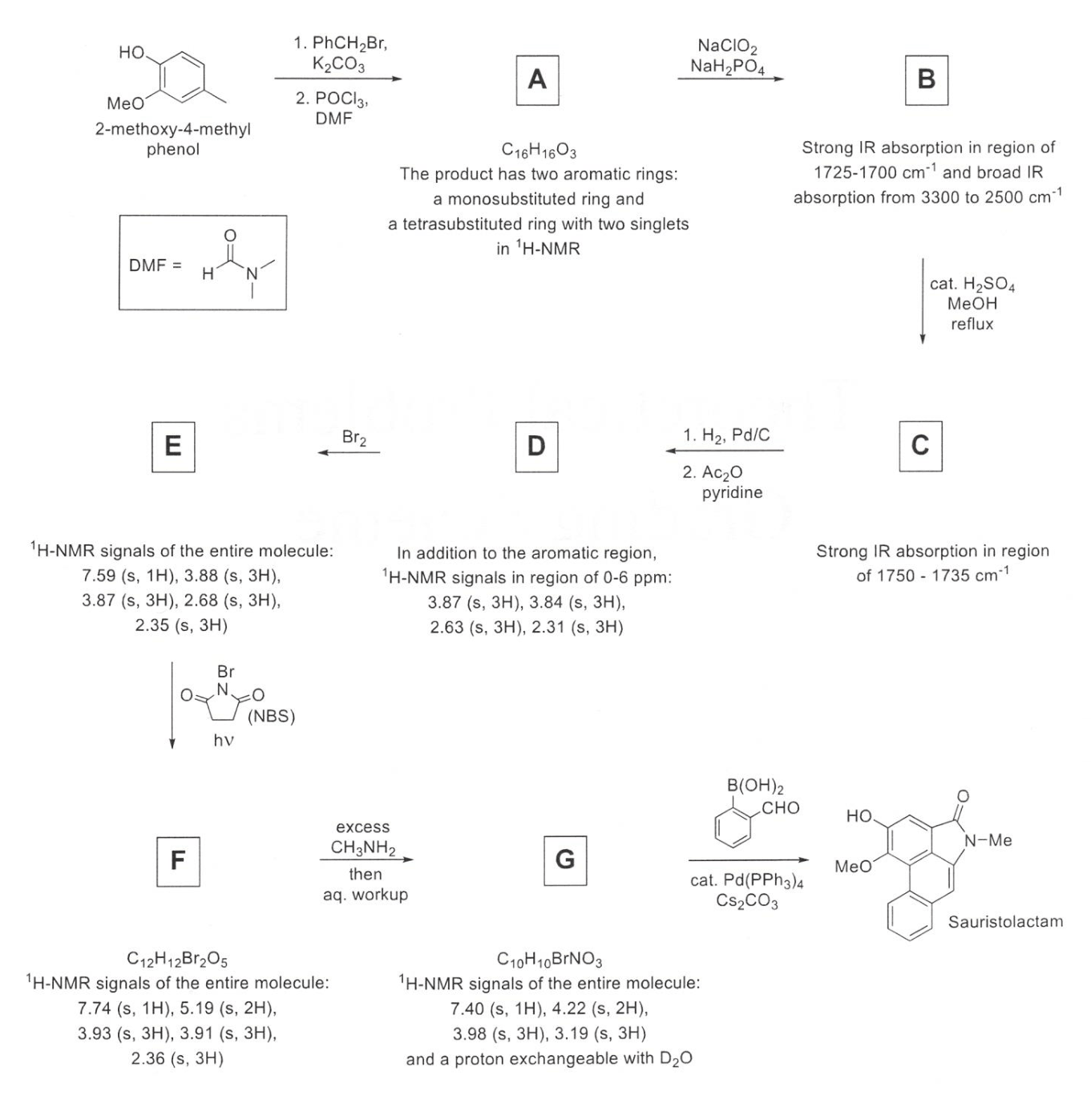
Sauristolactam possesses excellent cytotoxicity against various cancer cell lines. It could be prepared by following synthetic sequence on the page. (\(\ce{^1H}\)-NMR spectra were recorded in \(\ce{CDCl3}\) at 300 MHz.)
10.1 Draw the structures of A-G in the sequence.
Part B
Pancratistatin, isolated from a Hawaiian native plant, spider lily, exhibits potent in vitro and in vivo inhibitory activity of cancer cell growth in addition to its excellent antiviral activity.
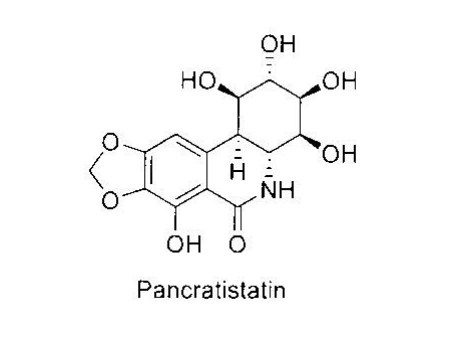
Pancratistatin
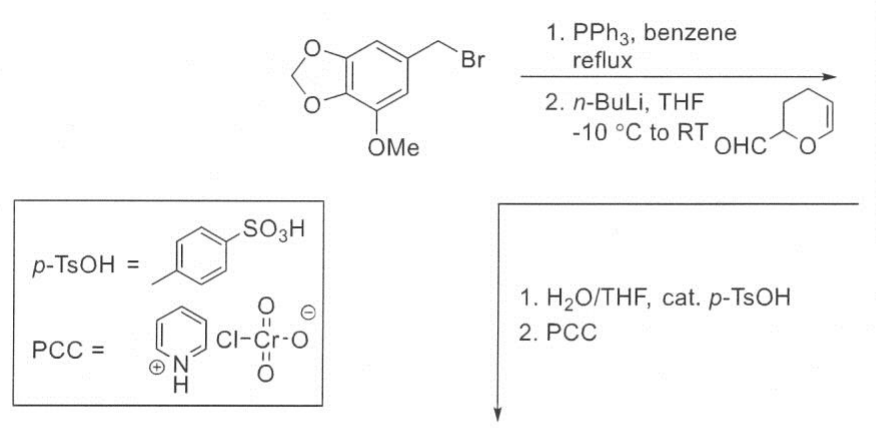
Pancratistatin could be successfully synthesized via intermediates X1 and X2. The synthesis of these intermediates are shown in the attached scheme.
10.2 Draw the structures of A and B.
10.3 Intermediate X1 (a single enantiomer with the stereochemistry shown) is labeled with deuterium with configuration as indicated below, propose the 3-D chair structure of compound E and the structure of compound F, with stereochemistry. Is Y a proton (\(\ce{^1H}\)) or a deuterium (\(\ce{^2H}\))?
Syntetic sequence:
Scheme of the synthesis of Pancratistatin and structures of compound A and B:
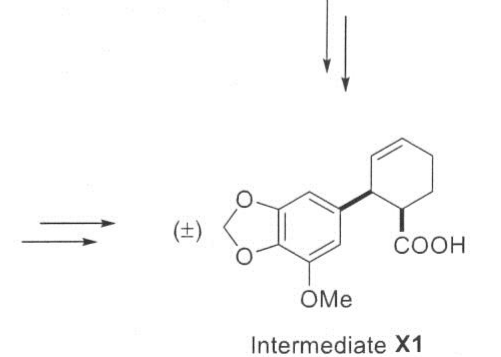
Intermediate X1
Official English text of the problem.
Answers
- 10.1. The structures are:
| Compound | Name | SMILES |
|---|---|---|
| A | 5-(Benzyloxy)-4-methoxy-2-methylbenzaldehyde | COc1cc(C)c(C=O)cc1OCc1ccccc1 |
| B | 5-(Benzyloxy)-4-methoxy-2-methylbenzoic acid | COc1cc(C)c(C(=O)O)cc1OCc1ccccc1 |
| C | Methyl 5-(benzyloxy)-4-methoxy-2-methylbenzoate | COc1cc(C)c(C(=O)OC)cc1OCc1ccccc1 |
| D | Methyl 5-acetoxy-4-methoxy-2-methylbenzoate | COc1cc(C)c(C(=O)OC)cc1OC(C)=O |
| E | Methyl 5-acetoxy-3-bromo-4-methoxy-2-methylbenzoate | COc1c(Br)c(C)c(C(=O)OC)cc1OC(C)=O |
| F | Methyl 5-acetoxy-3-bromo-2-(bromomethyl)-4-methoxybenzoate | COc1c(Br)c(CBr)c(C(=O)OC)cc1OC(C)=O |
| G | 4-Bromo-6-hydroxy-5-methoxy-2-methylisoindolin-1-one | CN1Cc2c(Br)c(OC)c(O)cc2C1=O |
- 10.2. The two visible operations give the following products. Their assignment to A and B, respectively, is inferred: the labeled product boxes are outside the supplied crop.
| Inferred label | Name | SMILES |
|---|---|---|
| A, product of the Wittig reaction | 2-[2-(7-Methoxy-1,3-benzodioxol-5-yl)ethenyl]-3,4-dihydro-2H-pyran | COc1cc(C=CC2CCC=CO2)cc2OCOc12 |
| B, product after aqueous acid and PCC | 6-[2-(7-Methoxy-1,3-benzodioxol-5-yl)ethenyl]oxan-2-one, a six-membered lactone | COc1cc(C=CC2CCCC(=O)O2)cc2OCOc12 |
These SMILES specify connectivity. The cropped scheme does not establish an \(E/Z\) designation or an absolute configuration for these products.
- 10.3. E, F, and the identity of Y cannot be determined uniquely from the problem as printed. The deuterium-labeled structure and the reaction sequence defining these compounds are absent. The visible X1 has cis aryl and carboxyl substituents and is explicitly shown as a racemate.
Solution
10.1. Identification of A–G
For A–F, number the aromatic ring so that the carbon bearing the aldehyde or carboxyl-derived group is C1. The original ring methyl group is then at C2, the methoxy group at C4, and the protected phenolic oxygen at C5.
Formation of A: protection and regioselective formylation
The starting material is 2-methoxy-4-methylphenol, COc1cc(C)ccc1O.
Benzyl bromide and potassium carbonate protect its phenolic hydroxyl group as a benzyl ether, giving 1-(benzyloxy)-2-methoxy-4-methylbenzene, COc1cc(C)ccc1OCc1ccccc1. A balanced representation is
\[ \ce{ArOH + PhCH2Br + K2CO3 -> ArOCH2Ph + KBr + KHCO3}. \]
The \(\ce{POCl3}\)/DMF treatment is a Vilsmeier–Haack formylation. Formylation occurs para to methoxy and ortho to methyl.
The NMR description fixes this position. In the starting phenol’s numbering, introduction of the formyl group at C5 leaves hydrogens at C3 and C6. These are para to one another and appear as two aromatic singlets. The benzyl protecting group supplies the monosubstituted phenyl ring.
A formal balanced equation including aqueous workup is
\[ \ce{Ar-H + HCON(CH3)2 + POCl3 + 3H2O -> Ar-CHO + HN(CH3)2 + H3PO4 + 3HCl}. \]
Thus A is 5-(benzyloxy)-4-methoxy-2-methylbenzaldehyde, with formula \(\ce{C16H16O3}\), as required.
A → B: aldehyde oxidation
Buffered sodium chlorite oxidizes the aldehyde to a carboxylic acid:
\[ \ce{ArCHO + ClO2^- + H+ -> ArCO2H + HOCl}. \]
The strong carbonyl absorption at \(1725\text{–}1700\ \mathrm{cm^{-1}}\), together with the broad \(3300\text{–}2500\ \mathrm{cm^{-1}}\) absorption, identifies a carboxylic acid.
Therefore B is 5-(benzyloxy)-4-methoxy-2-methylbenzoic acid.
B → C: esterification
Methanol and catalytic sulfuric acid give the methyl ester by Fischer esterification:
\[ \ce{ArCO2H + CH3OH <=> ArCO2CH3 + H2O}. \]
The reported \(1750\text{–}1735\ \mathrm{cm^{-1}}\) carbonyl absorption supports the ester assignment.
Thus C is methyl 5-(benzyloxy)-4-methoxy-2-methylbenzoate.
C → D: hydrogenolysis and acetylation
Hydrogen over palladium removes the benzyl protecting group:
\[ \ce{ArOCH2Ph + H2 -> ArOH + PhCH3}. \]
The resulting phenol is acetylated:
\[ \ce{ArOH + (CH3CO)2O -> ArOCOCH3 + CH3CO2H}. \]
Consequently, D is methyl 5-acetoxy-4-methoxy-2-methylbenzoate.
Its four three-proton singlets are consistent with:
| Signals, \(\delta/\mathrm{ppm}\) | Assignment |
|---|---|
| 3.87 and 3.84 | Aromatic methoxy and methyl ester |
| 2.63 | Ring methyl |
| 2.31 | Acetate methyl |
The two methoxy resonances need not be individually distinguished to identify the structure.
D → E: aromatic bromination
Bromination replaces the hydrogen at C3:
\[ \ce{D + Br2 -> E + HBr}. \]
C3 is activated by the neighboring methoxy group. The remaining aromatic hydrogen is H6, adjacent to the ester, consistent with its relatively downfield singlet at \(\delta 7.59\ \mathrm{ppm}\).
Thus E is methyl 5-acetoxy-3-bromo-4-methoxy-2-methylbenzoate.
Its spectrum accounts for one aromatic hydrogen and four methyl groups, matching \(\ce{C12H13BrO5}\).
E → F: benzylic bromination
N-Bromosuccinimide under irradiation brominates the benzylic methyl group:
\[ \ce{ArCH3 + NBS ->[h\nu] ArCH2Br + succinimide}. \]
Here NBS is N-bromosuccinimide, O=C1CCC(=O)N1Br; succinimide is O=C1CCC(=O)N1.
The aryl bromine remains in place. Conversion of \(\ce{CH3}\) to \(\ce{CH2Br}\) explains:
- disappearance of the benzylic three-proton signal;
- appearance of a two-proton singlet at \(\delta 5.19\ \mathrm{ppm}\);
- the formula \(\ce{C12H12Br2O5}\).
Therefore F is methyl 5-acetoxy-3-bromo-2-(bromomethyl)-4-methoxybenzoate.
F → G: substitution, lactam formation, and deprotection
Methylamine first displaces the benzylic bromide, producing a tethered secondary amine. That amine attacks the adjacent methyl ester intramolecularly, eliminating methanol and forming a five-membered lactam.
Excess methylamine also removes the phenolic acetate by aminolysis; aqueous workup furnishes the phenol.
A balanced net equation for this pathway is
\[ \ce{F + 3CH3NH2 -> G + CH3OH + CH3CONHCH3 + CH3NH3Br}. \]
The organic by-products are methanol, CO, and N-methylacetamide, CNC(C)=O; the salt is methylammonium bromide, C[NH3+].[Br-].
The product is 4-bromo-6-hydroxy-5-methoxy-2-methylisoindolin-1-one, G.
To draw it, fuse a five-membered lactam to the benzene ring. Its nonaromatic sequence is
\[ \text{aryl–}\ce{CH2-N(CH3)-C(=O)}\text{–aryl}. \]
The aryl carbon adjacent to the methylene-bearing fusion carbon carries bromine; the next two aromatic carbons carry methoxy and hydroxyl groups, respectively.
Every reported NMR feature is accounted for:
| Observation | Assignment in G |
|---|---|
| \(\delta 7.40\), singlet, 1 H | Sole aromatic hydrogen |
| \(\delta 4.22\), singlet, 2 H | Lactam-ring methylene |
| \(\delta 3.98\), singlet, 3 H | Methoxy |
| \(\delta 3.19\), singlet, 3 H | N-methyl |
| One exchangeable proton | Phenolic OH |
The total is ten hydrogens, consistent with \(\ce{C10H10BrNO3}\).
The final reaction provides a further connectivity check: Suzuki coupling replaces the aryl bromine with the ortho-formylphenyl group. Subsequent intramolecular condensation involving the lactam methylene closes the additional ring, giving sauristolactam, COc1c(O)cc2c3c(cc4ccccc4c13)N(C)C2=O.
10.2. Products of the visible Part B reactions
The aromatic starting material is 6-(bromomethyl)-4-methoxy-1,3-benzodioxole, COc1cc(CBr)cc2OCOc12.
For the following discussion, \(\mathrm{Ar}\) denotes 7-methoxy-1,3-benzodioxol-5-yl, represented as an attachment-point fragment by *c1cc(OC)c2OCOc2c1.
First visible operation: Wittig olefination
Triphenylphosphine converts the benzyl bromide into a phosphonium salt. Deprotonation with \(n\)-butyllithium gives the corresponding benzyl Wittig ylide.
Its charged-resonance representation is COc1cc([CH-][P+](c2ccccc2)(c2ccccc2)c2ccccc2)cc2OCOc12.
The aldehyde partner is 3,4-dihydro-2H-pyran-2-carbaldehyde, O=CC1CCC=CO1.
The balanced olefination is
\[ \ce{ArCH=PPh3 + RCHO -> ArCH=CHR + OPPh3}, \]
where \(R\) is the 3,4-dihydro-2H-pyran-2-yl group. The by-product is triphenylphosphine oxide, O=P(c1ccccc1)(c1ccccc1)c1ccccc1.
The aldehyde carbon becomes one carbon of the new alkene; the original benzylic carbon becomes the other. The existing enol-ether double bond remains unchanged.
The resulting structure, provisionally assigned as A, is therefore
COc1cc(C=CC2CCC=CO2)cc2OCOc12.
Second visible operation: hydration followed by lactone formation
Aqueous acid hydrates the cyclic enol ether, giving a cyclic hemiacetal, or lactol:
6-[2-(7-methoxy-1,3-benzodioxol-5-yl)ethenyl]oxan-2-ol,
COc1cc(C=CC2CCCC(O)O2)cc2OCOc12.
The formula change is
\[ \ce{C15H16O4 + H2O -> C15H18O5}. \]
PCC oxidizes the hemiacetal carbon to an ester carbonyl, producing the six-membered lactone. The oxidation half-equation is
\[ \ce{C15H18O5 -> C15H16O5 + 2H+ + 2e^-}. \]
Thus the product, provisionally assigned as B, is
6-[2-(7-methoxy-1,3-benzodioxol-5-yl)ethenyl]oxan-2-one,
COc1cc(C=CC2CCCC(=O)O2)cc2OCOc12.
For the drawing, use a six-membered ring with the sequence
\[ \ce{O-C(=O)-CH2-CH2-CH2-CH(-CH=CHAr)}, \]
closed back to the ring oxygen. The aryl–alkene unit remains intact.
10.3. What the visible X1 establishes
The structure of X1 shown in the statement is (±)-cis-2-(7-methoxy-1,3-benzodioxol-5-yl)cyclohex-3-ene-1-carboxylic acid.
Its two enantiomers can be represented by:
O=C(O)[C@H]1[C@@H](c2cc(OC)c3OCOc3c2)C=CCC1O=C(O)[C@@H]1[C@H](c2cc(OC)c3OCOc3c2)C=CCC1
Both the aryl and carboxyl bonds are drawn as solid wedges, establishing their cis relationship. The \((\pm)\) label specifies the racemate.
However, question 10.3 refers to a separate drawing containing:
- a specified single enantiomer of X1;
- a deuterium atom at a specified position and configuration;
- the transformations defining E, F, and Y.
None of those details appears in the supplied fragments. Consequently, a unique chair conformation for E, stereochemical structure for F, or assignment of Y as \(\ce{^1H}\) or \(\ce{^2H}\) does not follow from the available information.
The answers were checked against the official answers published by the organisers. Where this solution differs from the official solution, the official solution contains an error or a misprint.
IChO 2017 · Theorieaufgabe 10
Totalsynthese von Alkaloiden
Alkaloide sind eine Klasse stickstoffhaltiger Naturstoffe. Ihre strukturelle Komplexität und ihre ausgeprägten biologischen Aktivitäten haben Aufmerksamkeit erregt. Zwei repräsentative Beispiele für Alkaloide – Sauristolactam und Pancratistatin – stehen im Mittelpunkt der folgenden Fragen.
Teil A
Sauristolactam weist eine ausgezeichnete Zytotoxizität gegenüber verschiedenen Krebszelllinien auf. Es lässt sich mithilfe der auf dieser Seite dargestellten Synthesesequenz herstellen. (Die \(\ce{^1H}\)-NMR-Spektren wurden in \(\ce{CDCl3}\) bei 300 MHz aufgenommen.)
10.1 Zeichnen Sie die Strukturen von A-G in der Synthesesequenz.
Teil B
Pancratistatin, das aus einer auf Hawaii heimischen Pflanze, der Spinnenlilie, isoliert wurde, zeigt neben seiner ausgezeichneten antiviralen Aktivität sowohl in vitro als auch in vivo eine starke Hemmwirkung auf das Wachstum von Krebszellen.
Pancratistatin
Pancratistatin konnte über die Zwischenprodukte X1 und X2 erfolgreich synthetisiert werden. Die Synthese dieser Zwischenprodukte ist im beigefügten Schema dargestellt.
10.2 Zeichnen Sie die Strukturen von A und B.
10.3 Das Zwischenprodukt X1 (ein einzelnes Enantiomer mit der dargestellten Stereochemie) ist mit Deuterium in der unten angegebenen Konfiguration markiert. Schlagen Sie die dreidimensionale Sesselstruktur der Verbindung E und die Struktur der Verbindung F unter Angabe der Stereochemie vor. Ist Y ein Proton (\(\ce{^1H}\)) oder ein Deuterium (\(\ce{^2H}\))?
Synthesesequenz:
Schema der Synthese von Pancratistatin und Strukturen der Verbindungen A und B:
Zwischenprodukt X1
Aufgabentext aus dem offiziellen englischen Text übersetzt.
Antworten
- 10.1. Die Strukturen sind:
| Verbindung | Name | SMILES |
|---|---|---|
| A | 5-(Benzyloxy)-4-methoxy-2-methylbenzaldehyd | COc1cc(C)c(C=O)cc1OCc1ccccc1 |
| B | 5-(Benzyloxy)-4-methoxy-2-methylbenzoesäure | COc1cc(C)c(C(=O)O)cc1OCc1ccccc1 |
| C | Methyl-5-(benzyloxy)-4-methoxy-2-methylbenzoat | COc1cc(C)c(C(=O)OC)cc1OCc1ccccc1 |
| D | Methyl-5-acetoxy-4-methoxy-2-methylbenzoat | COc1cc(C)c(C(=O)OC)cc1OC(C)=O |
| E | Methyl-5-acetoxy-3-brom-4-methoxy-2-methylbenzoat | COc1c(Br)c(C)c(C(=O)OC)cc1OC(C)=O |
| F | Methyl-5-acetoxy-3-brom-2-(brommethyl)-4-methoxybenzoat | COc1c(Br)c(CBr)c(C(=O)OC)cc1OC(C)=O |
| G | 4-Brom-6-hydroxy-5-methoxy-2-methylisoindolin-1-on | CN1Cc2c(Br)c(OC)c(O)cc2C1=O |
- 10.2. Die beiden sichtbaren Reaktionsschritte ergeben die folgenden Produkte. Ihre Zuordnung zu A beziehungsweise B ist erschlossen: Die beschrifteten Produktfelder liegen außerhalb des bereitgestellten Bildausschnitts.
| Erschlossene Bezeichnung | Name | SMILES |
|---|---|---|
| A, Produkt der Wittig-Reaktion | 2-[2-(7-Methoxy-1,3-benzodioxol-5-yl)ethenyl]-3,4-dihydro-2H-pyran | COc1cc(C=CC2CCC=CO2)cc2OCOc12 |
| B, Produkt nach Behandlung mit wässriger Säure und PCC | 6-[2-(7-Methoxy-1,3-benzodioxol-5-yl)ethenyl]oxan-2-on, ein sechsgliedriges Lacton | COc1cc(C=CC2CCCC(=O)O2)cc2OCOc12 |
Diese SMILES geben die Konnektivität an. Aus dem beschnittenen Schema lässt sich für diese Produkte weder eine \(E/Z\)-Zuordnung noch eine absolute Konfiguration ableiten.
- 10.3. E, F und die Identität von Y lassen sich anhand der Aufgabe in der abgedruckten Form nicht eindeutig bestimmen. Die deuteriummarkierte Struktur und die Reaktionssequenz, die diese Verbindungen definiert, fehlen. Das sichtbare X1 weist cis-ständige Aryl- und Carboxylsubstituenten auf und ist ausdrücklich als Racemat dargestellt.
Lösung
10.1. Identifizierung von A–G
Für A–F wird der aromatische Ring so nummeriert, dass das Kohlenstoffatom mit der Aldehydgruppe oder der von einer Carboxylgruppe abgeleiteten Gruppe C1 ist. Die ursprüngliche Methylgruppe am Ring befindet sich dann an C2, die Methoxygruppe an C4 und der geschützte phenolische Sauerstoff an C5.
Bildung von A: Schützung und regioselektive Formylierung
Das Ausgangsmaterial ist 2-Methoxy-4-methylphenol, COc1cc(C)ccc1O.
Benzylbromid und Kaliumcarbonat schützen seine phenolische Hydroxygruppe als Benzylether, wobei 1-(Benzyloxy)-2-methoxy-4-methylbenzol, COc1cc(C)ccc1OCc1ccccc1, entsteht. Eine ausgeglichene Darstellung lautet
\[ \ce{ArOH + PhCH2Br + K2CO3 -> ArOCH2Ph + KBr + KHCO3}. \]
Die Behandlung mit \(\ce{POCl3}\)/DMF ist eine Vilsmeier–Haack-Formylierung. Die Formylierung erfolgt para zur Methoxygruppe und ortho zur Methylgruppe.
Die NMR-Beschreibung legt diese Position fest. Bei der Nummerierung des Ausgangsphenols verbleiben nach Einführung der Formylgruppe an C5 Wasserstoffatome an C3 und C6. Diese stehen para zueinander und erscheinen als zwei aromatische Singuletts. Die Benzylschutzgruppe liefert den monosubstituierten Phenylring.
Eine formale ausgeglichene Gleichung einschließlich der wässrigen Aufarbeitung lautet
\[ \ce{Ar-H + HCON(CH3)2 + POCl3 + 3H2O -> Ar-CHO + HN(CH3)2 + H3PO4 + 3HCl}. \]
Somit ist A 5-(Benzyloxy)-4-methoxy-2-methylbenzaldehyd mit der geforderten Summenformel \(\ce{C16H16O3}\).
A → B: Aldehydoxidation
Gepuffertes Natriumchlorit oxidiert den Aldehyd zu einer Carbonsäure:
\[ \ce{ArCHO + ClO2^- + H+ -> ArCO2H + HOCl}. \]
Die starke Carbonylabsorption bei \(1725\text{–}1700\ \mathrm{cm^{-1}}\) weist zusammen mit der breiten Absorption bei \(3300\text{–}2500\ \mathrm{cm^{-1}}\) auf eine Carbonsäure hin.
Daher ist B 5-(Benzyloxy)-4-methoxy-2-methylbenzoesäure.
B → C: Veresterung
Methanol und eine katalytische Menge Schwefelsäure ergeben durch Fischer-Veresterung den Methylester:
\[ \ce{ArCO2H + CH3OH <=> ArCO2CH3 + H2O}. \]
Die angegebene Carbonylabsorption bei \(1750\text{–}1735\ \mathrm{cm^{-1}}\) stützt die Zuordnung als Ester.
Somit ist C Methyl-5-(benzyloxy)-4-methoxy-2-methylbenzoat.
C → D: Hydrogenolyse und Acetylierung
Wasserstoff entfernt in Gegenwart von Palladium die Benzylschutzgruppe:
\[ \ce{ArOCH2Ph + H2 -> ArOH + PhCH3}. \]
Das entstehende Phenol wird acetyliert:
\[ \ce{ArOH + (CH3CO)2O -> ArOCOCH3 + CH3CO2H}. \]
Folglich ist D Methyl-5-acetoxy-4-methoxy-2-methylbenzoat.
Seine vier Drei-Protonen-Singuletts stehen im Einklang mit:
| Signale, \(\delta/\mathrm{ppm}\) | Zuordnung |
|---|---|
| 3.87 und 3.84 | Aromatische Methoxygruppe und Methylester |
| 2.63 | Methylgruppe am Ring |
| 2.31 | Methylgruppe des Acetats |
Die beiden Methoxyresonanzen müssen zur Identifizierung der Struktur nicht einzeln unterschieden werden.
D → E: Aromatische Bromierung
Die Bromierung ersetzt das Wasserstoffatom an C3:
\[ \ce{D + Br2 -> E + HBr}. \]
C3 wird durch die benachbarte Methoxygruppe aktiviert. Das verbleibende aromatische Wasserstoffatom ist H6, das neben der Estergruppe liegt, im Einklang mit seinem relativ weit tieffeldverschobenen Singulett bei \(\delta 7.59\ \mathrm{ppm}\).
Somit ist E Methyl-5-acetoxy-3-brom-4-methoxy-2-methylbenzoat.
Sein Spektrum erfasst ein aromatisches Wasserstoffatom und vier Methylgruppen, entsprechend \(\ce{C12H13BrO5}\).
E → F: Benzylische Bromierung
N-Bromsuccinimid bromiert unter Bestrahlung die benzylische Methylgruppe:
\[ \ce{ArCH3 + NBS ->[h\nu] ArCH2Br + succinimide}. \]
Hier ist NBS N-Bromsuccinimid, O=C1CCC(=O)N1Br; Succinimid ist O=C1CCC(=O)N1.
Das Bromatom am Aromaten bleibt an seiner Position. Die Umwandlung von \(\ce{CH3}\) in \(\ce{CH2Br}\) erklärt:
- das Verschwinden des benzylischen Drei-Protonen-Signals;
- das Auftreten eines Zwei-Protonen-Singuletts bei \(\delta 5.19\ \mathrm{ppm}\);
- die Summenformel \(\ce{C12H12Br2O5}\).
Daher ist F Methyl-5-acetoxy-3-brom-2-(brommethyl)-4-methoxybenzoat.
F → G: Substitution, Lactambildung und Entschützung
Methylamin verdrängt zunächst das benzylische Bromid, wodurch ein über die Seitenkette gebundenes sekundäres Amin entsteht. Dieses Amin greift den benachbarten Methylester intramolekular an, wobei Methanol abgespalten und ein fünfgliedriges Lactam gebildet wird.
Überschüssiges Methylamin entfernt außerdem das phenolische Acetat durch Aminolyse; die wässrige Aufarbeitung liefert das Phenol.
Eine ausgeglichene Nettogleichung für diesen Reaktionsweg lautet
\[ \ce{F + 3CH3NH2 -> G + CH3OH + CH3CONHCH3 + CH3NH3Br}. \]
Die organischen Nebenprodukte sind Methanol, CO, und N-Methylacetamid, CNC(C)=O; das Salz ist Methylammoniumbromid, C[NH3+].[Br-].
Das Produkt ist 4-Brom-6-hydroxy-5-methoxy-2-methylisoindolin-1-on, G.
Zum Zeichnen der Struktur wird ein fünfgliedriges Lactam an den Benzolring anelliert. Seine nichtaromatische Sequenz lautet
\[ \text{Aryl–}\ce{CH2-N(CH3)-C(=O)}\text{–Aryl}. \]
Das aromatische Kohlenstoffatom neben dem mit der Methylengruppe verbundenen Ringverknüpfungsatom trägt Brom; die nächsten beiden aromatischen Kohlenstoffatome tragen eine Methoxy- beziehungsweise eine Hydroxygruppe.
Jedes angegebene NMR-Merkmal wird erklärt:
| Beobachtung | Zuordnung in G |
|---|---|
| \(\delta 7.40\), Singulett, 1 H | Einziges aromatisches Wasserstoffatom |
| \(\delta 4.22\), Singulett, 2 H | Methylengruppe des Lactamrings |
| \(\delta 3.98\), Singulett, 3 H | Methoxygruppe |
| \(\delta 3.19\), Singulett, 3 H | N-Methylgruppe |
| Ein austauschbares Proton | Phenolische OH-Gruppe |
Insgesamt sind es zehn Wasserstoffatome, im Einklang mit \(\ce{C10H10BrNO3}\).
Die abschließende Reaktion ermöglicht eine weitere Überprüfung der Konnektivität: Die Suzuki-Kupplung ersetzt das Bromatom am Aromaten durch die ortho-Formylphenylgruppe. Eine anschließende intramolekulare Kondensation unter Beteiligung der Methylengruppe des Lactams schließt den zusätzlichen Ring und liefert Sauristolactam, COc1c(O)cc2c3c(cc4ccccc4c13)N(C)C2=O.
10.2. Produkte der sichtbaren Reaktionen in Teil B
Das aromatische Ausgangsmaterial ist 6-(Brommethyl)-4-methoxy-1,3-benzodioxol, COc1cc(CBr)cc2OCOc12.
In der folgenden Erörterung bezeichnet \(\mathrm{Ar}\) 7-Methoxy-1,3-benzodioxol-5-yl, dargestellt als Fragment mit Bindungsstelle durch *c1cc(OC)c2OCOc2c1.
Erster sichtbarer Reaktionsschritt: Wittig-Olefinierung
Triphenylphosphin wandelt das Benzylbromid in ein Phosphoniumsalz um. Deprotonierung mit \(n\)-Butyllithium ergibt das entsprechende benzylische Wittig-Ylid.
Seine Darstellung als ladungsgetrennte mesomere Grenzstruktur lautet COc1cc([CH-][P+](c2ccccc2)(c2ccccc2)c2ccccc2)cc2OCOc12.
Der Aldehyd-Reaktionspartner ist 3,4-Dihydro-2H-pyran-2-carbaldehyd, O=CC1CCC=CO1.
Die ausgeglichene Olefinierungsreaktion lautet
\[ \ce{ArCH=PPh3 + RCHO -> ArCH=CHR + OPPh3}, \]
wobei \(R\) die 3,4-Dihydro-2H-pyran-2-yl-Gruppe ist. Das Nebenprodukt ist Triphenylphosphinoxid, O=P(c1ccccc1)(c1ccccc1)c1ccccc1.
Das Aldehyd-Kohlenstoffatom wird zu einem Kohlenstoffatom der neuen Alkendoppelbindung; das ursprüngliche benzylische Kohlenstoffatom wird zum anderen. Die vorhandene Enolether-Doppelbindung bleibt unverändert.
Die entstehende Struktur, die vorläufig A zugeordnet wird, lautet daher
COc1cc(C=CC2CCC=CO2)cc2OCOc12.
Zweiter sichtbarer Reaktionsschritt: Hydratisierung mit anschließender Lactonbildung
Wässrige Säure hydratisiert den cyclischen Enolether, wobei ein cyclisches Halbacetal, auch Lactol genannt, entsteht:
6-[2-(7-Methoxy-1,3-benzodioxol-5-yl)ethenyl]oxan-2-ol,
COc1cc(C=CC2CCCC(O)O2)cc2OCOc12.
Die Änderung der Summenformel lautet
\[ \ce{C15H16O4 + H2O -> C15H18O5}. \]
PCC oxidiert das Halbacetal-Kohlenstoffatom zu einer Ester-Carbonylgruppe, wodurch das sechsgliedrige Lacton entsteht. Die Oxidations-Teilgleichung lautet
\[ \ce{C15H18O5 -> C15H16O5 + 2H+ + 2e^-}. \]
Somit ist das Produkt, das vorläufig B zugeordnet wird,
6-[2-(7-Methoxy-1,3-benzodioxol-5-yl)ethenyl]oxan-2-on,
COc1cc(C=CC2CCCC(=O)O2)cc2OCOc12.
Für die Zeichnung wird ein sechsgliedriger Ring mit der Sequenz
\[ \ce{O-C(=O)-CH2-CH2-CH2-CH(-CH=CHAr)}, \]
verwendet, der zum Ringsauerstoff zurückgeschlossen wird. Die Aryl–Alken-Einheit bleibt intakt.
10.3. Was sich aus dem sichtbaren X1 ableiten lässt
Die in der Aufgabenstellung gezeigte Struktur von X1 ist (±)-cis-2-(7-Methoxy-1,3-benzodioxol-5-yl)cyclohex-3-en-1-carbonsäure.
Ihre beiden Enantiomere lassen sich folgendermaßen darstellen:
O=C(O)[C@H]1[C@@H](c2cc(OC)c3OCOc3c2)C=CCC1O=C(O)[C@@H]1[C@H](c2cc(OC)c3OCOc3c2)C=CCC1
Sowohl die Bindung zur Arylgruppe als auch die zur Carboxylgruppe ist als ausgefüllter Keil gezeichnet, wodurch ihre cis-Beziehung festgelegt ist. Die Kennzeichnung \((\pm)\) bezeichnet das Racemat.
Frage 10.3 bezieht sich jedoch auf eine separate Zeichnung, die Folgendes enthält:
- ein bestimmtes einzelnes Enantiomer von X1;
- ein Deuteriumatom an einer bestimmten Position und mit einer bestimmten Konfiguration;
- die Umwandlungen, die E, F und Y definieren.
Keines dieser Details ist in den bereitgestellten Ausschnitten zu sehen. Folglich lässt sich aus den verfügbaren Informationen weder eine eindeutige Sesselkonformation für E noch eine stereochemische Struktur für F oder eine Zuordnung von Y als \(\ce{^1H}\) oder \(\ce{^2H}\) ableiten.
Die Ergebnisse wurden mit den von den Veranstaltern veröffentlichten offiziellen Ergebnissen abgeglichen. Wo diese Lösung von der offiziellen Lösung abweicht, enthält die offizielle Lösung einen Fehler oder Druckfehler.
IChO 2017 · Teori sorusu 10
Alkaloitlerin Total Sentezi
Alkaloitler, azot içeren doğal ürünlerin bir sınıfıdır. Yapısal karmaşıklıkları ve güçlü biyolojik etkinlikleri ilgi çekmiştir. Alkaloitlerin iki temsilî örneği olan sauristolaktam ve pankratistatin, aşağıdaki sorularda ele alınmaktadır.
Bölüm A
Sauristolaktam, çeşitli kanser hücre hatlarına karşı çok yüksek sitotoksisite gösterir. Sayfada verilen aşağıdaki sentez dizisiyle hazırlanabilir. (\(\ce{^1H}\)-NMR spektrumları, \(\ce{CDCl3}\) içinde 300 MHz'de kaydedilmiştir.)
10.1 Dizideki A-G bileşiklerinin yapılarını çiziniz.
Bölüm B
Hawaii'ye özgü bir bitki olan örümcek zambağından izole edilen pankratistatin, çok yüksek antiviral etkinliğinin yanı sıra, in vitro ve in vivo koşullarda kanser hücrelerinin büyümesini güçlü biçimde inhibe eder.
Pankratistatin
Pankratistatin, X1 ve X2 ara ürünleri üzerinden başarıyla sentezlenebilir. Bu ara ürünlerin sentezi, ekli şemada gösterilmiştir.
10.2 A ve B bileşiklerinin yapılarını çiziniz.
10.3 X1 ara ürünü (gösterilen stereokimyaya sahip tek bir enantiyomer), aşağıda belirtilen konfigürasyonda döteryumla işaretlenmiştir; E bileşiğinin üç boyutlu sandalye yapısını ve F bileşiğinin yapısını stereokimyalarıyla birlikte öneriniz. Y bir proton (\(\ce{^1H}\)) mu, yoksa döteryum (\(\ce{^2H}\)) mu?
Sentez dizisi:
Pankratistatinin sentez şeması ve A ile B bileşiklerinin yapıları:
X1 ara ürünü
Soru metni resmi İngilizce metinden çevrilmiştir.
Cevaplar
- 10.1. Yapılar şöyledir:
| Bileşik | Adı | SMILES |
|---|---|---|
| A | 5-(Benziloksi)-4-metoksi-2-metilbenzaldehit | COc1cc(C)c(C=O)cc1OCc1ccccc1 |
| B | 5-(Benziloksi)-4-metoksi-2-metilbenzoik asit | COc1cc(C)c(C(=O)O)cc1OCc1ccccc1 |
| C | Metil 5-(benziloksi)-4-metoksi-2-metilbenzoat | COc1cc(C)c(C(=O)OC)cc1OCc1ccccc1 |
| D | Metil 5-asetoksi-4-metoksi-2-metilbenzoat | COc1cc(C)c(C(=O)OC)cc1OC(C)=O |
| E | Metil 5-asetoksi-3-bromo-4-metoksi-2-metilbenzoat | COc1c(Br)c(C)c(C(=O)OC)cc1OC(C)=O |
| F | Metil 5-asetoksi-3-bromo-2-(bromometil)-4-metoksibenzoat | COc1c(Br)c(CBr)c(C(=O)OC)cc1OC(C)=O |
| G | 4-Bromo-6-hidroksi-5-metoksi-2-metilizoindolin-1-on | CN1Cc2c(Br)c(OC)c(O)cc2C1=O |
- 10.2. Görünen iki işlem aşağıdaki ürünleri verir. Bunların sırasıyla A ve B olarak atanması bir çıkarıma dayanmaktadır: etiketli ürün kutuları, sağlanan kırpılmış görüntünün dışında kalmaktadır.
| Çıkarımla belirlenen etiket | Adı | SMILES |
|---|---|---|
| A, Wittig tepkimesinin ürünü | 2-[2-(7-Metoksi-1,3-benzodioksol-5-il)etenil]-3,4-dihidro-2H-piran | COc1cc(C=CC2CCC=CO2)cc2OCOc12 |
| B, sulu asit ve PCC sonrasındaki ürün | 6-[2-(7-Metoksi-1,3-benzodioksol-5-il)etenil]oksan-2-on, altı üyeli bir lakton | COc1cc(C=CC2CCCC(=O)O2)cc2OCOc12 |
Bu SMILES gösterimleri atomların bağlanma düzenini belirtir. Kırpılmış şema, bu ürünler için bir \(E/Z\) tanımlaması veya mutlak konfigürasyon belirlemeye olanak vermez.
- 10.3. E, F ve Y'nin kimliği, sorunun basılı hâlinden tek bir sonuç verecek şekilde belirlenemez. Döteryumla işaretlenmiş yapı ve bu bileşikleri tanımlayan tepkime dizisi eksiktir. Görünen X1, cis konumlu aril ve karboksil sübstitüentlerine sahiptir ve açıkça bir rasemat olarak gösterilmiştir.
Çözüm
10.1. A–G bileşiklerinin belirlenmesi
A–F için aromatik halkayı, aldehit veya karboksil türevi grubu taşıyan karbon C1 olacak şekilde numaralandırınız. Böylece başlangıçtaki halka metil grubu C2'de, metoksi grubu C4'te ve korunmuş fenolik oksijen C5'te bulunur.
A'nın oluşumu: koruma ve bölge seçici formilleme
Başlangıç maddesi 2-metoksi-4-metilfenoldür, COc1cc(C)ccc1O.
Benzil bromür ve potasyum karbonat, fenolik hidroksil grubunu benzil eteri olarak koruyarak 1-(benziloksi)-2-metoksi-4-metilbenzen, COc1cc(C)ccc1OCc1ccccc1, oluşturur. Denkleştirilmiş bir gösterim şöyledir:
\[ \ce{ArOH + PhCH2Br + K2CO3 -> ArOCH2Ph + KBr + KHCO3}. \]
\(\ce{POCl3}\)/DMF ile işlem, bir Vilsmeier–Haack formillemesidir. Formilleme, metoksiye göre para ve metile göre orto konumunda gerçekleşir.
NMR verileri bu konumu kesinleştirir. Başlangıç fenolünün numaralandırmasına göre, formil grubunun C5'e bağlanması, C3 ve C6'da hidrojen bırakır. Bunlar birbirlerine göre para konumundadır ve iki aromatik singlet olarak görünür. Benzil koruyucu grubu, tek sübstitüentli fenil halkasını sağlar.
Sulu ortamda son işlemi de içeren biçimsel olarak denkleştirilmiş bir denklem şöyledir:
\[ \ce{Ar-H + HCON(CH3)2 + POCl3 + 3H2O -> Ar-CHO + HN(CH3)2 + H3PO4 + 3HCl}. \]
Dolayısıyla A, beklendiği gibi \(\ce{C16H16O3}\) formülüne sahip 5-(benziloksi)-4-metoksi-2-metilbenzaldehittir.
A → B: aldehit yükseltgenmesi
Tamponlanmış sodyum klorit, aldehidi bir karboksilik aside yükseltger:
\[ \ce{ArCHO + ClO2^- + H+ -> ArCO2H + HOCl}. \]
\(1725\text{–}1700\ \mathrm{cm^{-1}}\) değerindeki güçlü karbonil soğurması, \(3300\text{–}2500\ \mathrm{cm^{-1}}\) aralığındaki geniş soğurmayla birlikte, bir karboksilik asidi tanımlar.
Bu nedenle B, 5-(benziloksi)-4-metoksi-2-metilbenzoik asittir.
B → C: esterleşme
Metanol ve katalitik miktarda sülfürik asit, Fischer esterleşmesiyle metil esteri verir:
\[ \ce{ArCO2H + CH3OH <=> ArCO2CH3 + H2O}. \]
Bildirilen \(1750\text{–}1735\ \mathrm{cm^{-1}}\) karbonil soğurması, ester atamasını destekler.
Dolayısıyla C, metil 5-(benziloksi)-4-metoksi-2-metilbenzoattır.
C → D: hidrojenoliz ve asetilleme
Paladyum üzerinde hidrojen, benzil koruyucu grubunu uzaklaştırır:
\[ \ce{ArOCH2Ph + H2 -> ArOH + PhCH3}. \]
Oluşan fenol asetillenir:
\[ \ce{ArOH + (CH3CO)2O -> ArOCOCH3 + CH3CO2H}. \]
Sonuç olarak D, metil 5-asetoksi-4-metoksi-2-metilbenzoattır.
Her biri üç protona karşılık gelen dört singleti, aşağıdaki atamalarla uyumludur:
| Sinyaller, \(\delta/\mathrm{ppm}\) | Atama |
|---|---|
| 3.87 ve 3.84 | Aromatik metoksi ve metil esteri |
| 2.63 | Halka metili |
| 2.31 | Asetat metili |
Yapıyı belirlemek için iki metoksi rezonansını ayrı ayrı ayırt etmek gerekli değildir.
D → E: aromatik bromlama
Bromlama, C3'teki hidrojenin yerini alır:
\[ \ce{D + Br2 -> E + HBr}. \]
C3, komşu metoksi grubu tarafından etkinleştirilir. Geriye kalan aromatik hidrojen, estere komşu olan H6'dır; bu durum, \(\delta 7.59\ \mathrm{ppm}\) değerinde nispeten düşük alanda görülen singletiyle uyumludur.
Dolayısıyla E, metil 5-asetoksi-3-bromo-4-metoksi-2-metilbenzoattır.
Spektrumu, \(\ce{C12H13BrO5}\) ile uyumlu olarak, bir aromatik hidrojen ve dört metil grubunu açıklar.
E → F: benzilik bromlama
Işınlama altında N-bromosüksinimit, benzilik metil grubunu bromlar:
\[ \ce{ArCH3 + NBS ->[h\nu] ArCH2Br + succinimide}. \]
Burada NBS, N-bromosüksinimit, O=C1CCC(=O)N1Br; süksinimit ise O=C1CCC(=O)N1 bileşiğidir.
Aril bromu yerinde kalır. \(\ce{CH3}\) grubunun \(\ce{CH2Br}\) grubuna dönüşmesi şunları açıklar:
- benzilik üç protonluk sinyalin kaybolmasını;
- \(\delta 5.19\ \mathrm{ppm}\) değerinde iki protonluk bir singletin ortaya çıkmasını;
- \(\ce{C12H12Br2O5}\) formülünü.
Bu nedenle F, metil 5-asetoksi-3-bromo-2-(bromometil)-4-metoksibenzoattır.
F → G: yer değiştirme, laktam oluşumu ve koruyucu grubun uzaklaştırılması
Metilamin önce benzilik bromürün yerini alarak moleküle bağlı bir sekonder amin oluşturur. Bu amin, komşu metil esterine molekül içi saldırıda bulunur; metanol ayrılır ve beş üyeli bir laktam oluşur.
Fazla metilamin, fenolik asetatı da aminoliz yoluyla uzaklaştırır; sulu ortamda son işlem sonucunda fenol elde edilir.
Bu yol için denkleştirilmiş net denklem şöyledir:
\[ \ce{F + 3CH3NH2 -> G + CH3OH + CH3CONHCH3 + CH3NH3Br}. \]
Organik yan ürünler metanol, CO, ve N-metilasetamittir, CNC(C)=O; tuz ise metilamonyum bromürdür, C[NH3+].[Br-].
Ürün, 4-bromo-6-hidroksi-5-metoksi-2-metilizoindolin-1-on, G'dir.
Yapıyı çizmek için benzen halkasına kaynaşmış beş üyeli bir laktam çiziniz. Aromatik olmayan kısmındaki dizilim şöyledir:
\[ \text{aril–}\ce{CH2-N(CH3)-C(=O)}\text{–aril}. \]
Metilen grubuna bağlı kaynaşma karbonuna komşu aril karbonu brom taşır; sonraki iki aromatik karbon ise sırasıyla metoksi ve hidroksil gruplarını taşır.
Bildirilen her NMR özelliği açıklanır:
| Gözlem | G'deki atama |
|---|---|
| \(\delta 7.40\), singlet, 1 H | Tek aromatik hidrojen |
| \(\delta 4.22\), singlet, 2 H | Laktam halkasındaki metilen |
| \(\delta 3.98\), singlet, 3 H | Metoksi |
| \(\delta 3.19\), singlet, 3 H | N-metil |
| Değişebilir bir proton | Fenolik OH |
Toplam on hidrojen vardır; bu, \(\ce{C10H10BrNO3}\) ile uyumludur.
Son tepkime, bağlanma düzenini ayrıca doğrular: Suzuki eşleşmesi, aril bromunun yerine orto-formilfenil grubunu getirir. Ardından laktam metileninin katıldığı molekül içi kondenzasyon, ek halkayı kapatarak sauristolaktamı, COc1c(O)cc2c3c(cc4ccccc4c13)N(C)C2=O, verir.
10.2. Bölüm B'de görünen tepkimelerin ürünleri
Aromatik başlangıç maddesi, 6-(bromometil)-4-metoksi-1,3-benzodioksol, COc1cc(CBr)cc2OCOc12, bileşiğidir.
Aşağıdaki açıklamalarda \(\mathrm{Ar}\), bağlanma noktası belirtilmiş bir parça olarak *c1cc(OC)c2OCOc2c1 ile gösterilen 7-metoksi-1,3-benzodioksol-5-il grubunu ifade eder.
Görünen ilk işlem: Wittig olefinasyonu
Trifenilfosfin, benzil bromürü bir fosfonyum tuzuna dönüştürür. \(n\)-Bütillityum ile deprotonlama, karşılık gelen benzil Wittig ilidini verir.
Yüklü rezonans gösterimi COc1cc([CH-][P+](c2ccccc2)(c2ccccc2)c2ccccc2)cc2OCOc12 şeklindedir.
Aldehit bileşeni, 3,4-dihidro-2H-piran-2-karbaldehit, O=CC1CCC=CO1, bileşiğidir.
Denkleştirilmiş olefinasyon tepkimesi şöyledir:
\[ \ce{ArCH=PPh3 + RCHO -> ArCH=CHR + OPPh3}, \]
burada \(R\), 3,4-dihidro-2H-piran-2-il grubudur. Yan ürün, trifenilfosfin oksittir, O=P(c1ccccc1)(c1ccccc1)c1ccccc1.
Aldehit karbonu, yeni alkenin karbonlarından birini; başlangıçtaki benzilik karbon ise diğerini oluşturur. Mevcut enol eteri çift bağı değişmeden kalır.
Bu nedenle, geçici olarak A şeklinde atanan oluşan yapı şöyledir:
COc1cc(C=CC2CCC=CO2)cc2OCOc12.
Görünen ikinci işlem: hidratasyon ve ardından lakton oluşumu
Sulu asit, halkalı enol eterini hidratlayarak halkalı bir hemiasetal, yani laktol verir:
6-[2-(7-metoksi-1,3-benzodioksol-5-il)etenil]oksan-2-ol,
COc1cc(C=CC2CCCC(O)O2)cc2OCOc12.
Formüldeki değişim şöyledir:
\[ \ce{C15H16O4 + H2O -> C15H18O5}. \]
PCC, hemiasetal karbonunu bir ester karboniline yükseltgeyerek altı üyeli laktonu oluşturur. Yükseltgenme yarı tepkimesi şöyledir:
\[ \ce{C15H18O5 -> C15H16O5 + 2H+ + 2e^-}. \]
Dolayısıyla, geçici olarak B şeklinde atanan ürün şöyledir:
6-[2-(7-metoksi-1,3-benzodioksol-5-il)etenil]oksan-2-on,
COc1cc(C=CC2CCCC(=O)O2)cc2OCOc12.
Çizim için aşağıdaki dizilime sahip altı üyeli bir halka kullanınız:
\[ \ce{O-C(=O)-CH2-CH2-CH2-CH(-CH=CHAr)}, \]
bu dizilim tekrar halka oksijenine bağlanarak kapanır. Aril–alken birimi değişmeden kalır.
10.3. Görünen X1'in ortaya koyduğu bilgiler
Soru metninde gösterilen X1'in yapısı, (±)-cis-2-(7-metoksi-1,3-benzodioksol-5-il)sikloheks-3-en-1-karboksilik asittir.
İki enantiyomeri şu şekilde gösterilebilir:
O=C(O)[C@H]1[C@@H](c2cc(OC)c3OCOc3c2)C=CCC1O=C(O)[C@@H]1[C@H](c2cc(OC)c3OCOc3c2)C=CCC1
Hem aril hem de karboksil bağları dolu kamalarla çizilmiştir; bu, aralarındaki cis ilişkisini ortaya koyar. \((\pm)\) etiketi, rasematı belirtir.
Ancak 10.3 sorusu, aşağıdakileri içeren ayrı bir çizime atıfta bulunmaktadır:
- X1'in belirtilmiş tek bir enantiyomeri;
- belirtilmiş bir konum ve konfigürasyondaki döteryum atomu;
- E, F ve Y'yi tanımlayan dönüşümler.
Bu ayrıntıların hiçbiri sağlanan parçalarda yer almamaktadır. Sonuç olarak, mevcut bilgilerden E için tek bir sandalye konformasyonu, F için tek bir stereokimyasal yapı veya Y'nin \(\ce{^1H}\) ya da \(\ce{^2H}\) olarak atanması çıkarılamaz.
Sonuçlar, düzenleyicilerin yayımladığı resmi sonuçlarla karşılaştırılarak kontrol edildi. Bu çözümün resmi çözümden ayrıldığı yerlerde resmi çözümde bir hata ya da baskı hatası vardır.
IChO 2017 · Problema teórico 10
Síntesis total de alcaloides
Los alcaloides son una clase de productos naturales que contienen nitrógeno. Su complejidad estructural y sus potentes actividades biológicas han despertado interés. En las preguntas siguientes se destacan dos ejemplos representativos de alcaloides: la sauristolactama y la pancratistatina.
Parte A
La sauristolactama presenta una excelente citotoxicidad frente a diversas líneas celulares cancerosas. Puede prepararse mediante la secuencia sintética que se muestra en la página. (Los espectros de RMN de \(\ce{^1H}\) se registraron en \(\ce{CDCl3}\) a 300 MHz.)
10.1 Dibuje las estructuras de A-G en la secuencia.
Parte B
La pancratistatina, aislada de una planta autóctona de Hawái, el lirio araña, presenta una potente actividad inhibidora del crecimiento de células cancerosas in vitro e in vivo, además de una excelente actividad antiviral.
Pancratistatina
La pancratistatina puede sintetizarse con éxito a través de los intermedios X1 y X2. La síntesis de estos intermedios se muestra en el esquema adjunto.
10.2 Dibuje las estructuras de A y B.
10.3 El intermedio X1 (un único enantiómero con la estereoquímica mostrada) está marcado con deuterio con la configuración indicada a continuación; proponga la estructura tridimensional en conformación de silla del compuesto E y la estructura del compuesto F, con su estereoquímica. ¿Es Y un protón (\(\ce{^1H}\)) o un deuterio (\(\ce{^2H}\))?
Secuencia sintética:
Esquema de la síntesis de la pancratistatina y estructuras de los compuestos A y B:
Intermedio X1
Enunciado traducido del texto oficial en inglés.
Respuestas
- 10.1. Las estructuras son:
| Compuesto | Nombre | SMILES |
|---|---|---|
| A | 5-(Benciloxi)-4-metoxi-2-metilbenzaldehído | COc1cc(C)c(C=O)cc1OCc1ccccc1 |
| B | Ácido 5-(benciloxi)-4-metoxi-2-metilbenzoico | COc1cc(C)c(C(=O)O)cc1OCc1ccccc1 |
| C | 5-(Benciloxi)-4-metoxi-2-metilbenzoato de metilo | COc1cc(C)c(C(=O)OC)cc1OCc1ccccc1 |
| D | 5-Acetoxi-4-metoxi-2-metilbenzoato de metilo | COc1cc(C)c(C(=O)OC)cc1OC(C)=O |
| E | 5-Acetoxi-3-bromo-4-metoxi-2-metilbenzoato de metilo | COc1c(Br)c(C)c(C(=O)OC)cc1OC(C)=O |
| F | 5-Acetoxi-3-bromo-2-(bromometil)-4-metoxibenzoato de metilo | COc1c(Br)c(CBr)c(C(=O)OC)cc1OC(C)=O |
| G | 4-Bromo-6-hidroxi-5-metoxi-2-metilisoindolin-1-ona | CN1Cc2c(Br)c(OC)c(O)cc2C1=O |
- 10.2. Las dos operaciones visibles dan los siguientes productos. Su asignación a A y B, respectivamente, es una inferencia: los recuadros de los productos etiquetados quedan fuera del recorte proporcionado.
| Etiqueta inferida | Nombre | SMILES |
|---|---|---|
| A, producto de la reacción de Wittig | 2-[2-(7-Metoxi-1,3-benzodioxol-5-il)etenil]-3,4-dihidro-2H-pirano | COc1cc(C=CC2CCC=CO2)cc2OCOc12 |
| B, producto tras el tratamiento con ácido acuoso y PCC | 6-[2-(7-Metoxi-1,3-benzodioxol-5-il)etenil]oxan-2-ona, una lactona de seis miembros | COc1cc(C=CC2CCCC(=O)O2)cc2OCOc12 |
Estos SMILES especifican la conectividad. El esquema recortado no establece una designación \(E/Z\) ni una configuración absoluta para estos productos.
- 10.3. E, F y la identidad de Y no pueden determinarse de manera unívoca a partir del problema tal como está impreso. Faltan la estructura marcada con deuterio y la secuencia de reacciones que define estos compuestos. El X1 visible tiene los sustituyentes arilo y carboxilo en disposición cis y se muestra explícitamente como un racemato.
Solución
10.1. Identificación de A–G
Para A–F, numere el anillo aromático de modo que el carbono que lleva el grupo aldehído o el grupo derivado del carboxilo sea C1. El grupo metilo original del anillo queda entonces en C2, el grupo metoxi en C4 y el oxígeno fenólico protegido en C5.
Formación de A: protección y formilación regioselectiva
El material de partida es el 2-metoxi-4-metilfenol, COc1cc(C)ccc1O.
El bromuro de bencilo y el carbonato de potasio protegen su grupo hidroxilo fenólico como éter bencílico, dando 1-(benciloxi)-2-metoxi-4-metilbenceno, COc1cc(C)ccc1OCc1ccccc1. Una representación ajustada es
\[ \ce{ArOH + PhCH2Br + K2CO3 -> ArOCH2Ph + KBr + KHCO3}. \]
El tratamiento con \(\ce{POCl3}\)/DMF es una formilación de Vilsmeier–Haack. La formilación se produce en posición para respecto al metoxi y orto respecto al metilo.
La descripción de RMN determina esta posición. Según la numeración del fenol de partida, la introducción del grupo formilo en C5 deja hidrógenos en C3 y C6. Estos se encuentran en posición para entre sí y aparecen como dos singletes aromáticos. El grupo protector bencilo aporta el anillo fenilo monosustituido.
Una ecuación formal ajustada que incluye el tratamiento acuoso posterior es
\[ \ce{Ar-H + HCON(CH3)2 + POCl3 + 3H2O -> Ar-CHO + HN(CH3)2 + H3PO4 + 3HCl}. \]
Por tanto, A es el 5-(benciloxi)-4-metoxi-2-metilbenzaldehído, de fórmula \(\ce{C16H16O3}\), como se requiere.
A → B: oxidación del aldehído
El clorito de sodio en un medio tamponado oxida el aldehído a ácido carboxílico:
\[ \ce{ArCHO + ClO2^- + H+ -> ArCO2H + HOCl}. \]
La intensa absorción del carbonilo a \(1725\text{–}1700\ \mathrm{cm^{-1}}\), junto con la absorción ancha a \(3300\text{–}2500\ \mathrm{cm^{-1}}\), identifica un ácido carboxílico.
Por consiguiente, B es el ácido 5-(benciloxi)-4-metoxi-2-metilbenzoico.
B → C: esterificación
El metanol y el ácido sulfúrico en cantidad catalítica dan el éster metílico mediante una esterificación de Fischer:
\[ \ce{ArCO2H + CH3OH <=> ArCO2CH3 + H2O}. \]
La absorción del carbonilo indicada a \(1750\text{–}1735\ \mathrm{cm^{-1}}\) respalda la asignación del éster.
Por tanto, C es el 5-(benciloxi)-4-metoxi-2-metilbenzoato de metilo.
C → D: hidrogenólisis y acetilación
El hidrógeno en presencia de paladio elimina el grupo protector bencilo:
\[ \ce{ArOCH2Ph + H2 -> ArOH + PhCH3}. \]
El fenol resultante se acetila:
\[ \ce{ArOH + (CH3CO)2O -> ArOCOCH3 + CH3CO2H}. \]
En consecuencia, D es el 5-acetoxi-4-metoxi-2-metilbenzoato de metilo.
Sus cuatro singletes de tres protones son compatibles con:
| Señales, \(\delta/\mathrm{ppm}\) | Asignación |
|---|---|
| 3.87 y 3.84 | Metoxi aromático y éster metílico |
| 2.63 | Metilo del anillo |
| 2.31 | Metilo del acetato |
No es necesario distinguir individualmente las dos resonancias de los grupos metoxi para identificar la estructura.
D → E: bromación aromática
La bromación sustituye el hidrógeno de C3:
\[ \ce{D + Br2 -> E + HBr}. \]
C3 está activado por el grupo metoxi vecino. El hidrógeno aromático restante es H6, adyacente al éster, lo que concuerda con su singlete a campo relativamente bajo, a \(\delta 7.59\ \mathrm{ppm}\).
Por tanto, E es el 5-acetoxi-3-bromo-4-metoxi-2-metilbenzoato de metilo.
Su espectro da cuenta de un hidrógeno aromático y cuatro grupos metilo, en concordancia con \(\ce{C12H13BrO5}\).
E → F: bromación bencílica
La N-bromosuccinimida bajo irradiación broma el grupo metilo bencílico:
\[ \ce{ArCH3 + NBS ->[h\nu] ArCH2Br + succinimide}. \]
Aquí, NBS es la N-bromosuccinimida, O=C1CCC(=O)N1Br; la succinimida es O=C1CCC(=O)N1.
El bromo arílico permanece en su posición. La conversión de \(\ce{CH3}\) en \(\ce{CH2Br}\) explica:
- la desaparición de la señal bencílica de tres protones;
- la aparición de un singlete de dos protones a \(\delta 5.19\ \mathrm{ppm}\);
- la fórmula \(\ce{C12H12Br2O5}\).
Por consiguiente, F es el 5-acetoxi-3-bromo-2-(bromometil)-4-metoxibenzoato de metilo.
F → G: sustitución, formación de la lactama y desprotección
La metilamina desplaza primero el bromuro bencílico, produciendo una amina secundaria unida a la molécula. Esa amina ataca intramolecularmente al éster metílico adyacente, eliminando metanol y formando una lactama de cinco miembros.
El exceso de metilamina también elimina el acetato fenólico por aminólisis; el tratamiento acuoso posterior proporciona el fenol.
Una ecuación neta ajustada para esta ruta es
\[ \ce{F + 3CH3NH2 -> G + CH3OH + CH3CONHCH3 + CH3NH3Br}. \]
Los subproductos orgánicos son el metanol, CO, y la N-metilacetamida, CNC(C)=O; la sal es el bromuro de metilamonio, C[NH3+].[Br-].
El producto es la 4-bromo-6-hidroxi-5-metoxi-2-metilisoindolin-1-ona, G.
Para dibujarla, fusione una lactama de cinco miembros con el anillo de benceno. Su secuencia no aromática es
\[ \text{arilo–}\ce{CH2-N(CH3)-C(=O)}\text{–arilo}. \]
El carbono arílico adyacente al carbono de fusión unido al metileno lleva un bromo; los dos carbonos aromáticos siguientes llevan grupos metoxi e hidroxilo, respectivamente.
Todas las características de RMN indicadas quedan explicadas:
| Observación | Asignación en G |
|---|---|
| \(\delta 7.40\), singlete, 1 H | Único hidrógeno aromático |
| \(\delta 4.22\), singlete, 2 H | Metileno del anillo lactámico |
| \(\delta 3.98\), singlete, 3 H | Metoxi |
| \(\delta 3.19\), singlete, 3 H | N-metilo |
| Un protón intercambiable | OH fenólico |
El total es de diez hidrógenos, en concordancia con \(\ce{C10H10BrNO3}\).
La reacción final proporciona una comprobación adicional de la conectividad: el acoplamiento de Suzuki sustituye el bromo arílico por el grupo orto-formilfenilo. La posterior condensación intramolecular en la que participa el metileno de la lactama cierra el anillo adicional, dando sauristolactama, COc1c(O)cc2c3c(cc4ccccc4c13)N(C)C2=O.
10.2. Productos de las reacciones visibles de la Parte B
El material de partida aromático es el 6-(bromometil)-4-metoxi-1,3-benzodioxol, COc1cc(CBr)cc2OCOc12.
En la explicación siguiente, \(\mathrm{Ar}\) representa el 7-metoxi-1,3-benzodioxol-5-il, representado como un fragmento con un punto de unión mediante *c1cc(OC)c2OCOc2c1.
Primera operación visible: olefinación de Wittig
La trifenilfosfina convierte el bromuro de bencilo en una sal de fosfonio. La desprotonación con \(n\)-butillitio da el correspondiente iluro bencílico de Wittig.
Su representación mediante una forma resonante con cargas es COc1cc([CH-][P+](c2ccccc2)(c2ccccc2)c2ccccc2)cc2OCOc12.
El aldehído que participa en la reacción es el 3,4-dihidro-2H-piran-2-carbaldehído, O=CC1CCC=CO1.
La ecuación ajustada de la olefinación es
\[ \ce{ArCH=PPh3 + RCHO -> ArCH=CHR + OPPh3}, \]
donde \(R\) es el grupo 3,4-dihidro-2H-piran-2-il. El subproducto es el óxido de trifenilfosfina, O=P(c1ccccc1)(c1ccccc1)c1ccccc1.
El carbono del aldehído se convierte en uno de los carbonos del nuevo alqueno; el carbono bencílico original se convierte en el otro. El doble enlace del éter enólico existente permanece inalterado.
La estructura resultante, asignada provisionalmente a A, es, por tanto,
COc1cc(C=CC2CCC=CO2)cc2OCOc12.
Segunda operación visible: hidratación seguida de formación de la lactona
El ácido acuoso hidrata el éter enólico cíclico, dando un hemiacetal cíclico, o lactol:
6-[2-(7-metoxi-1,3-benzodioxol-5-il)etenil]oxan-2-ol,
COc1cc(C=CC2CCCC(O)O2)cc2OCOc12.
El cambio de fórmula es
\[ \ce{C15H16O4 + H2O -> C15H18O5}. \]
El PCC oxida el carbono del hemiacetal a un carbonilo de éster, produciendo la lactona de seis miembros. La semirreacción de oxidación es
\[ \ce{C15H18O5 -> C15H16O5 + 2H+ + 2e^-}. \]
Así, el producto, asignado provisionalmente a B, es
6-[2-(7-metoxi-1,3-benzodioxol-5-il)etenil]oxan-2-ona,
COc1cc(C=CC2CCCC(=O)O2)cc2OCOc12.
Para el dibujo, utilice un anillo de seis miembros con la secuencia
\[ \ce{O-C(=O)-CH2-CH2-CH2-CH(-CH=CHAr)}, \]
cerrada de nuevo sobre el oxígeno del anillo. La unidad arilo–alqueno permanece intacta.
10.3. Lo que permite establecer el X1 visible
La estructura de X1 mostrada en el enunciado es el ácido (±)-cis-2-(7-metoxi-1,3-benzodioxol-5-il)ciclohex-3-eno-1-carboxílico.
Sus dos enantiómeros pueden representarse mediante:
O=C(O)[C@H]1[C@@H](c2cc(OC)c3OCOc3c2)C=CCC1O=C(O)[C@@H]1[C@H](c2cc(OC)c3OCOc3c2)C=CCC1
Tanto el enlace al arilo como el enlace al carboxilo se dibujan como cuñas sólidas, lo que establece su relación cis. La etiqueta \((\pm)\) especifica el racemato.
Sin embargo, la pregunta 10.3 hace referencia a un dibujo separado que contiene:
- un único enantiómero especificado de X1;
- un átomo de deuterio en una posición y con una configuración especificadas;
- las transformaciones que definen E, F e Y.
Ninguno de esos detalles aparece en los fragmentos proporcionados. En consecuencia, de la información disponible no se puede deducir una conformación de silla única para E, una estructura estereoquímica para F ni una asignación de Y como \(\ce{^1H}\) o \(\ce{^2H}\).
Los resultados se comprobaron con los resultados oficiales publicados por los organizadores. Donde esta solución difiere de la solución oficial, la solución oficial contiene un error o una errata.
IChO 2017 · 理论题 10
生物碱的全合成
生物碱是一类含氮天然产物。它们复杂的结构和强效的生物活性引起了人们的关注。以下问题重点介绍两种具有代表性的生物碱——三白草内酰胺和蛛百合碱。
部分 A
三白草内酰胺对多种癌细胞系具有优异的细胞毒活性。它可通过本页所示的合成路线制备。(\(\ce{^1H}\)-NMR 谱在 \(\ce{CDCl3}\) 中以 300 MHz 测定。)
10.1 画出该路线中 A-G 的结构。
部分 B
蛛百合碱分离自夏威夷本土植物蜘蛛百合,除了具有优异的抗病毒活性外,还在体外和体内均表现出很强的抑制癌细胞生长的活性。
蛛百合碱
蛛百合碱可经由中间体 X1 和 X2 成功合成。这些中间体的合成见所附反应图式。
10.2 画出 A 和 B 的结构。
10.3 中间体 X1(具有所示立体化学的单一对映异构体)经氘标记,其构型如下所示。请给出化合物 E 的三维椅式结构以及化合物 F 的结构,并标明立体化学。Y 是氕(\(\ce{^1H}\))还是氘(\(\ce{^2H}\))?
合成路线:
蛛百合碱的合成图式及化合物 A 和 B 的结构:
中间体 X1
题目译自官方英文原文。
答案
- 10.1. 结构如下:
| 化合物 | 名称 | SMILES |
|---|---|---|
| A | 5-(苄氧基)-4-甲氧基-2-甲基苯甲醛 | COc1cc(C)c(C=O)cc1OCc1ccccc1 |
| B | 5-(苄氧基)-4-甲氧基-2-甲基苯甲酸 | COc1cc(C)c(C(=O)O)cc1OCc1ccccc1 |
| C | 5-(苄氧基)-4-甲氧基-2-甲基苯甲酸甲酯 | COc1cc(C)c(C(=O)OC)cc1OCc1ccccc1 |
| D | 5-乙酰氧基-4-甲氧基-2-甲基苯甲酸甲酯 | COc1cc(C)c(C(=O)OC)cc1OC(C)=O |
| E | 5-乙酰氧基-3-溴-4-甲氧基-2-甲基苯甲酸甲酯 | COc1c(Br)c(C)c(C(=O)OC)cc1OC(C)=O |
| F | 5-乙酰氧基-3-溴-2-(溴甲基)-4-甲氧基苯甲酸甲酯 | COc1c(Br)c(CBr)c(C(=O)OC)cc1OC(C)=O |
| G | 4-溴-6-羟基-5-甲氧基-2-甲基异吲哚啉-1-酮 | CN1Cc2c(Br)c(OC)c(O)cc2C1=O |
- 10.2. 图中可见的两步操作得到以下产物。将它们分别归属为 A 和 B 是推断所得:带标号的产物框位于所提供的裁剪图之外。
| 推断的标号 | 名称 | SMILES |
|---|---|---|
| A,Wittig 反应的产物 | 2-[2-(7-甲氧基-1,3-苯并二氧杂环戊烯-5-基)乙烯基]-3,4-二氢-2H-吡喃 | COc1cc(C=CC2CCC=CO2)cc2OCOc12 |
| B,经酸性水溶液和 PCC 处理后的产物 | 6-[2-(7-甲氧基-1,3-苯并二氧杂环戊烯-5-基)乙烯基]四氢吡喃-2-酮,一种六元内酯 | COc1cc(C=CC2CCCC(=O)O2)cc2OCOc12 |
这些 SMILES 指定了原子的连接关系。裁剪后的图式无法确定这些产物的 \(E/Z\) 构型或绝对构型。
- 10.3. 根据题目印出的内容,无法唯一确定 E、F 以及 Y 的身份。 题目缺少氘标记结构以及定义这些化合物的反应路线。可见的 X1 中,芳基与羧基取代基呈顺式关系,且明确标示为外消旋体。
解答
10.1. A–G 的鉴定
对于 A–F,将芳环上连接醛基或羧基衍生基团的碳编号为 C1。这样,原有的环上甲基位于 C2,甲氧基位于 C4,受保护的酚氧位于 C5。
A 的形成:保护与区域选择性甲酰化
起始原料为 2-甲氧基-4-甲基苯酚,COc1cc(C)ccc1O。
溴化苄和碳酸钾将其酚羟基保护为苄醚,生成 1-(苄氧基)-2-甲氧基-4-甲基苯,COc1cc(C)ccc1OCc1ccccc1。配平后的反应可表示为
\[ \ce{ArOH + PhCH2Br + K2CO3 -> ArOCH2Ph + KBr + KHCO3}. \]
\(\ce{POCl3}\)/DMF 处理对应 Vilsmeier–Haack 甲酰化反应。甲酰化发生在甲氧基的对位、甲基的邻位。
核磁共振谱的描述确定了这一位置。按起始苯酚的编号,在 C5 引入甲酰基后,C3 和 C6 上仍保留氢。这两个氢互为对位,表现为两个芳香氢单峰。苄基保护基提供了单取代苯环。
包含水处理步骤的形式上的配平反应式为
\[ \ce{Ar-H + HCON(CH3)2 + POCl3 + 3H2O -> Ar-CHO + HN(CH3)2 + H3PO4 + 3HCl}. \]
因此,A 为 5-(苄氧基)-4-甲氧基-2-甲基苯甲醛,分子式为 \(\ce{C16H16O3}\),符合要求。
A → B:醛的氧化
缓冲条件下,亚氯酸钠将醛氧化为羧酸:
\[ \ce{ArCHO + ClO2^- + H+ -> ArCO2H + HOCl}. \]
\(1725\text{–}1700\ \mathrm{cm^{-1}}\) 处的强羰基吸收以及 \(3300\text{–}2500\ \mathrm{cm^{-1}}\) 处的宽吸收带表明存在羧酸。
因此,B 为 5-(苄氧基)-4-甲氧基-2-甲基苯甲酸。
B → C:酯化
甲醇在催化量硫酸作用下,经 Fischer 酯化反应生成甲酯:
\[ \ce{ArCO2H + CH3OH <=> ArCO2CH3 + H2O}. \]
所报告的 \(1750\text{–}1735\ \mathrm{cm^{-1}}\) 处的羰基吸收支持将其归属为酯。
因此,C 为 5-(苄氧基)-4-甲氧基-2-甲基苯甲酸甲酯。
C → D:氢解与乙酰化
在钯催化下,氢气脱除苄基保护基:
\[ \ce{ArOCH2Ph + H2 -> ArOH + PhCH3}. \]
生成的酚随后发生乙酰化:
\[ \ce{ArOH + (CH3CO)2O -> ArOCOCH3 + CH3CO2H}. \]
因此,D 为 5-乙酰氧基-4-甲氧基-2-甲基苯甲酸甲酯。
其四个积分各为三个氢的单峰与以下归属一致:
| 信号,\(\delta/\mathrm{ppm}\) | 归属 |
|---|---|
| 3.87 和 3.84 | 芳环上的甲氧基与甲酯基 |
| 2.63 | 环上的甲基 |
| 2.31 | 乙酸酯基中的甲基 |
鉴定该结构时,无需逐一分辨这两个甲氧基的共振信号。
D → E:芳环溴化
溴化反应取代 C3 上的氢:
\[ \ce{D + Br2 -> E + HBr}. \]
相邻的甲氧基使 C3 活化。剩余的芳香氢为 H6,与酯基相邻,这与其在相对低场的 \(\delta 7.59\ \mathrm{ppm}\) 处出现单峰相符。
因此,E 为 5-乙酰氧基-3-溴-4-甲氧基-2-甲基苯甲酸甲酯。
其谱图对应一个芳香氢和四个甲基,与 \(\ce{C12H13BrO5}\) 相符。
E → F:苄位溴化
N-溴代丁二酰亚胺在光照下使苄位甲基发生溴化:
\[ \ce{ArCH3 + NBS ->[h\nu] ArCH2Br + succinimide}. \]
这里,NBS 为 N-溴代丁二酰亚胺,O=C1CCC(=O)N1Br;丁二酰亚胺为 O=C1CCC(=O)N1。
芳环上的溴保留在原位。\(\ce{CH3}\) 转化为 \(\ce{CH2Br}\) 可解释以下现象:
- 苄位的三氢信号消失;
- 在 \(\delta 5.19\ \mathrm{ppm}\) 处出现一个积分为两个氢的单峰;
- 分子式为 \(\ce{C12H12Br2O5}\)。
因此,F 为 5-乙酰氧基-3-溴-2-(溴甲基)-4-甲氧基苯甲酸甲酯。
F → G:取代、内酰胺形成与脱保护
甲胺首先取代苄位的溴,生成通过侧链连接的仲胺。该胺随后在分子内进攻相邻的甲酯基,脱去甲醇,形成五元内酰胺。
过量甲胺还通过氨解脱除酚的乙酰基;经水处理后得到酚。
这一路径的配平总反应式为
\[ \ce{F + 3CH3NH2 -> G + CH3OH + CH3CONHCH3 + CH3NH3Br}. \]
有机副产物为甲醇,CO,以及 N-甲基乙酰胺,CNC(C)=O;生成的盐为溴化甲铵,C[NH3+].[Br-]。
产物为 4-溴-6-羟基-5-甲氧基-2-甲基异吲哚啉-1-酮,即 G。
画结构时,将一个五元内酰胺环与苯环稠合。其非芳香部分的连接顺序为
\[ \text{芳基–}\ce{CH2-N(CH3)-C(=O)}\text{–芳基}. \]
与连接亚甲基的稠合碳相邻的芳环碳上连有溴;接下来的两个芳环碳上分别连有甲氧基和羟基。
所报告的每一项核磁共振特征均可得到解释:
| 观测结果 | 在 G 中的归属 |
|---|---|
| \(\delta 7.40\),单峰,1 H | 唯一的芳香氢 |
| \(\delta 4.22\),单峰,2 H | 内酰胺环上的亚甲基 |
| \(\delta 3.98\),单峰,3 H | 甲氧基 |
| \(\delta 3.19\),单峰,3 H | N-甲基 |
| 一个可交换氢 | 酚羟基 OH |
总计十个氢,与 \(\ce{C10H10BrNO3}\) 一致。
最后一步反应进一步验证了连接关系:Suzuki 偶联将芳环上的溴替换为邻甲酰基苯基。随后,内酰胺亚甲基参与分子内缩合,闭合形成额外的环,得到三白草内酰胺,COc1c(O)cc2c3c(cc4ccccc4c13)N(C)C2=O。
10.2. 部分 B 中可见反应的产物
芳香族起始原料为 6-(溴甲基)-4-甲氧基-1,3-苯并二氧杂环戊烯,COc1cc(CBr)cc2OCOc12。
在以下讨论中,\(\mathrm{Ar}\) 表示 7-甲氧基-1,3-苯并二氧杂环戊烯-5-基,其带连接位点的片段可表示为 *c1cc(OC)c2OCOc2c1。
第一步可见操作:Wittig 烯化反应
三苯基膦将溴化苄衍生物转化为鏻盐。用 \(n\)-丁基锂脱质子,得到相应的苄基 Wittig 叶立德。
其带电荷的共振式表示为 COc1cc([CH-][P+](c2ccccc2)(c2ccccc2)c2ccccc2)cc2OCOc12。
与其反应的醛为 3,4-二氢-2H-吡喃-2-甲醛,O=CC1CCC=CO1。
配平后的烯化反应式为
\[ \ce{ArCH=PPh3 + RCHO -> ArCH=CHR + OPPh3}, \]
其中,\(R\) 为 3,4-二氢-2H-吡喃-2-基。副产物为三苯基氧化膦,O=P(c1ccccc1)(c1ccccc1)c1ccccc1。
醛基碳成为新形成的烯烃双键中的一个碳;原来的苄位碳成为另一个碳。原有的烯醇醚双键保持不变。
因此,所得结构暂归属为 A,表示为
COc1cc(C=CC2CCC=CO2)cc2OCOc12。
第二步可见操作:水合,随后形成内酯
酸性水溶液使环状烯醇醚发生水合,生成环状半缩醛,即内半缩醛:
6-[2-(7-甲氧基-1,3-苯并二氧杂环戊烯-5-基)乙烯基]四氢吡喃-2-醇,
COc1cc(C=CC2CCCC(O)O2)cc2OCOc12。
分子式的变化为
\[ \ce{C15H16O4 + H2O -> C15H18O5}. \]
PCC 将半缩醛碳氧化为酯羰基,生成六元内酯。氧化半反应式为
\[ \ce{C15H18O5 -> C15H16O5 + 2H+ + 2e^-}. \]
因此,暂归属为 B 的产物为
6-[2-(7-甲氧基-1,3-苯并二氧杂环戊烯-5-基)乙烯基]四氢吡喃-2-酮,
COc1cc(C=CC2CCCC(=O)O2)cc2OCOc12。
画结构时,按以下顺序构建六元环
\[ \ce{O-C(=O)-CH2-CH2-CH2-CH(-CH=CHAr)}, \]
并将末端连接回环上的氧原子以闭环。芳基–烯烃单元保持完整。
10.3. 可见的 X1 结构能够确定的信息
题目中所示的 X1 结构为 (±)-顺式-2-(7-甲氧基-1,3-苯并二氧杂环戊烯-5-基)环己-3-烯-1-甲酸。
它的两个对映异构体可表示为:
O=C(O)[C@H]1[C@@H](c2cc(OC)c3OCOc3c2)C=CCC1O=C(O)[C@@H]1[C@H](c2cc(OC)c3OCOc3c2)C=CCC1
连接芳基和羧基的键均画为实楔形键,确定了二者的顺式关系。\((\pm)\) 标记表明其为外消旋体。
然而,第 10.3 问提到的是另一幅图,其中包含:
- X1 的一个指定的单一对映异构体;
- 位于指定位置且具有指定构型的氘原子;
- 定义 E、F 和 Y 的反应转化。
所提供的图像片段中均未出现这些细节。因此,无法根据现有信息得出 E 的唯一椅式构象、F 的立体化学结构,也无法将 Y 确定为 \(\ce{^1H}\) 或 \(\ce{^2H}\)。
结果已与主办方公布的官方答案核对。本解答与官方解答不同之处,均为官方解答中的错误或印刷错误。
IChO 2017 · Теоретическая задача 10
Полный синтез алкалоидов
Алкалоиды — класс азотсодержащих природных соединений. Сложность их строения и высокая биологическая активность привлекают внимание исследователей. В следующих вопросах рассматриваются два характерных представителя алкалоидов — сауристолактам и панкратистатин.
Часть A
Сауристолактам обладает высокой цитотоксичностью в отношении различных линий раковых клеток. Его можно получить с помощью последовательности синтеза, приведённой на странице. (Спектры ЯМР \(\ce{^1H}\) записаны в \(\ce{CDCl3}\) на частоте 300 МГц.)
10.1 Изобразите структуры A-G в этой последовательности.
Часть B
Панкратистатин, выделенный из произрастающей на Гавайях паучьей лилии, помимо высокой противовирусной активности, проявляет сильную ингибирующую активность в отношении роста раковых клеток in vitro и in vivo.
Панкратистатин
Панкратистатин можно успешно синтезировать через промежуточные соединения X1 и X2. Синтез этих промежуточных соединений показан на прилагаемой схеме.
10.2 Изобразите структуры A и B.
10.3 Промежуточное соединение X1 (индивидуальный энантиомер с показанной стереохимией) мечено дейтерием с конфигурацией, указанной ниже; предложите трёхмерную структуру соединения E в конформации кресла и структуру соединения F с указанием стереохимии. Является ли Y протоном (\(\ce{^1H}\)) или дейтерием (\(\ce{^2H}\))?
Последовательность синтеза:
Схема синтеза панкратистатина и структуры соединений A и B:
Промежуточное соединение X1
Условие переведено с официального английского текста.
Ответы
- 10.1. Структуры:
| Соединение | Название | SMILES |
|---|---|---|
| A | 5-(Бензилокси)-4-метокси-2-метилбензальдегид | COc1cc(C)c(C=O)cc1OCc1ccccc1 |
| B | 5-(Бензилокси)-4-метокси-2-метилбензойная кислота | COc1cc(C)c(C(=O)O)cc1OCc1ccccc1 |
| C | Метил-5-(бензилокси)-4-метокси-2-метилбензоат | COc1cc(C)c(C(=O)OC)cc1OCc1ccccc1 |
| D | Метил-5-ацетокси-4-метокси-2-метилбензоат | COc1cc(C)c(C(=O)OC)cc1OC(C)=O |
| E | Метил-5-ацетокси-3-бром-4-метокси-2-метилбензоат | COc1c(Br)c(C)c(C(=O)OC)cc1OC(C)=O |
| F | Метил-5-ацетокси-3-бром-2-(бромметил)-4-метоксибензоат | COc1c(Br)c(CBr)c(C(=O)OC)cc1OC(C)=O |
| G | 4-Бром-6-гидрокси-5-метокси-2-метилизоиндолин-1-он | CN1Cc2c(Br)c(OC)c(O)cc2C1=O |
- 10.2. Две видимые стадии приводят к следующим продуктам. Их отнесение к A и B соответственно предположительно: поля для продуктов с этими обозначениями находятся за пределами предоставленного фрагмента.
| Предполагаемое обозначение | Название | SMILES |
|---|---|---|
| A, продукт реакции Виттига | 2-[2-(7-Метокси-1,3-бензодиоксол-5-ил)этенил]-3,4-дигидро-2H-пиран | COc1cc(C=CC2CCC=CO2)cc2OCOc12 |
| B, продукт после обработки водным раствором кислоты и PCC | 6-[2-(7-Метокси-1,3-бензодиоксол-5-ил)этенил]оксан-2-он, шестичленный лактон | COc1cc(C=CC2CCCC(=O)O2)cc2OCOc12 |
Эти записи SMILES задают порядок соединения атомов. Обрезанная схема не позволяет установить \(E/Z\)-конфигурацию или абсолютную конфигурацию этих продуктов.
- 10.3. Структуры E и F и природу Y невозможно однозначно определить по условию задачи в приведённом виде. Структура с дейтериевой меткой и последовательность реакций, определяющая эти соединения, отсутствуют. У видимого соединения X1 арильный и карбоксильный заместители находятся в цис-положении, и оно явно изображено как рацемат.
Решение
10.1. Установление структур A–G
Для A–F пронумеруем ароматическое кольцо так, чтобы атом углерода, несущий альдегидную группу или группу, производную карбоксильной, имел номер C1. Тогда исходная метильная группа кольца находится при C2, метоксигруппа — при C4, а защищённый фенольный атом кислорода — при C5.
Образование A: защита и региоселективное формилирование
Исходное вещество — 2-метокси-4-метилфенол, COc1cc(C)ccc1O.
Бензилбромид и карбонат калия защищают его фенольную гидроксильную группу в виде бензилового эфира с образованием 1-(бензилокси)-2-метокси-4-метилбензола, COc1cc(C)ccc1OCc1ccccc1. Сбалансированное уравнение имеет вид
\[ \ce{ArOH + PhCH2Br + K2CO3 -> ArOCH2Ph + KBr + KHCO3}. \]
Обработка \(\ce{POCl3}\)/DMF представляет собой формилирование по Вильсмайеру–Хааку. Формилирование происходит в пара-положение к метоксигруппе и орто-положение к метильной группе.
Описание спектра ЯМР однозначно определяет это положение. В нумерации исходного фенола введение формильной группы при C5 оставляет атомы водорода при C3 и C6. Они находятся в пара-положениях друг к другу и дают два ароматических синглета. Монозамещённое фенильное кольцо принадлежит бензильной защитной группе.
Формальное сбалансированное уравнение с учётом водной обработки имеет вид
\[ \ce{Ar-H + HCON(CH3)2 + POCl3 + 3H2O -> Ar-CHO + HN(CH3)2 + H3PO4 + 3HCl}. \]
Таким образом, A — 5-(бензилокси)-4-метокси-2-метилбензальдегид с формулой \(\ce{C16H16O3}\), что соответствует условию.
A → B: окисление альдегида
Хлорит натрия в буферной среде окисляет альдегид до карбоновой кислоты:
\[ \ce{ArCHO + ClO2^- + H+ -> ArCO2H + HOCl}. \]
Интенсивная полоса поглощения карбонильной группы при \(1725\text{–}1700\ \mathrm{cm^{-1}}\) вместе с широкой полосой поглощения при \(3300\text{–}2500\ \mathrm{cm^{-1}}\) указывает на карбоновую кислоту.
Следовательно, B — 5-(бензилокси)-4-метокси-2-метилбензойная кислота.
B → C: этерификация
Метанол в присутствии каталитического количества серной кислоты даёт метиловый эфир в результате этерификации Фишера:
\[ \ce{ArCO2H + CH3OH <=> ArCO2CH3 + H2O}. \]
Указанная полоса поглощения карбонильной группы при \(1750\text{–}1735\ \mathrm{cm^{-1}}\) подтверждает отнесение к сложному эфиру.
Таким образом, C — метил-5-(бензилокси)-4-метокси-2-метилбензоат.
C → D: гидрогенолиз и ацетилирование
Водород в присутствии палладия удаляет бензильную защитную группу:
\[ \ce{ArOCH2Ph + H2 -> ArOH + PhCH3}. \]
Образовавшийся фенол ацетилируется:
\[ \ce{ArOH + (CH3CO)2O -> ArOCOCH3 + CH3CO2H}. \]
Следовательно, D — метил-5-ацетокси-4-метокси-2-метилбензоат.
Его четыре трёхпротонных синглета соответствуют следующим группам:
| Сигналы, \(\delta/\mathrm{ppm}\) | Отнесение |
|---|---|
| 3.87 и 3.84 | Ароматическая метоксигруппа и метиловая группа сложного эфира |
| 2.63 | Метильная группа при кольце |
| 2.31 | Метильная группа ацетата |
Для установления структуры не требуется различать два сигнала метоксигрупп по отдельности.
D → E: бромирование ароматического кольца
При бромировании замещается атом водорода при C3:
\[ \ce{D + Br2 -> E + HBr}. \]
Положение C3 активировано соседней метоксигруппой. Оставшийся ароматический атом водорода — H6, расположенный рядом со сложноэфирной группой, что согласуется с его синглетом в относительно слабом поле при \(\delta 7.59\ \mathrm{ppm}\).
Таким образом, E — метил-5-ацетокси-3-бром-4-метокси-2-метилбензоат.
Его спектр соответствует одному ароматическому атому водорода и четырём метильным группам, что согласуется с формулой \(\ce{C12H13BrO5}\).
E → F: бромирование в бензильном положении
N-Бромсукцинимид при облучении бромирует метильную группу в бензильном положении:
\[ \ce{ArCH3 + NBS ->[h\nu] ArCH2Br + succinimide}. \]
Здесь NBS — N-бромсукцинимид, O=C1CCC(=O)N1Br; сукцинимид — O=C1CCC(=O)N1.
Атом брома при ароматическом кольце остаётся на месте. Превращение \(\ce{CH3}\) в \(\ce{CH2Br}\) объясняет:
- исчезновение трёхпротонного сигнала бензильной группы;
- появление двухпротонного синглета при \(\delta 5.19\ \mathrm{ppm}\);
- формулу \(\ce{C12H12Br2O5}\).
Следовательно, F — метил-5-ацетокси-3-бром-2-(бромметил)-4-метоксибензоат.
F → G: замещение, образование лактама и снятие защиты
Сначала метиламин замещает атом брома в бензильном положении с образованием вторичной аминогруппы в боковой цепи. Эта аминогруппа внутримолекулярно атакует соседнюю метиловую сложноэфирную группу с отщеплением метанола и образованием пятичленного лактама.
Избыток метиламина также удаляет фенольную ацетатную группу путём аминолиза; водная обработка приводит к фенолу.
Сбалансированное суммарное уравнение этого пути имеет вид
\[ \ce{F + 3CH3NH2 -> G + CH3OH + CH3CONHCH3 + CH3NH3Br}. \]
Органические побочные продукты — метанол, CO, и N-метилацетамид, CNC(C)=O; соль — бромид метиламмония, C[NH3+].[Br-].
Продукт — 4-бром-6-гидрокси-5-метокси-2-метилизоиндолин-1-он, G.
Чтобы изобразить его, сконденсируйте пятичленный лактамный цикл с бензольным кольцом. Последовательность атомов в его неароматической части имеет вид
\[ \text{арил–}\ce{CH2-N(CH3)-C(=O)}\text{–арил}. \]
Ароматический атом углерода, соседний с узловым атомом углерода, связанным с метиленовой группой, несёт бром; следующие два ароматических атома углерода несут метокси- и гидроксильную группы соответственно.
Все приведённые особенности спектра ЯМР находят объяснение:
| Наблюдение | Отнесение в G |
|---|---|
| \(\delta 7.40\), синглет, 1 H | Единственный ароматический атом водорода |
| \(\delta 4.22\), синглет, 2 H | Метиленовая группа лактамного кольца |
| \(\delta 3.98\), синглет, 3 H | Метоксигруппа |
| \(\delta 3.19\), синглет, 3 H | N-Метильная группа |
| Один обменивающийся протон | Фенольная OH-группа |
Всего получается десять атомов водорода, что согласуется с \(\ce{C10H10BrNO3}\).
Заключительная реакция позволяет дополнительно проверить порядок соединения атомов: кросс-сочетание Сузуки заменяет атом брома при ароматическом кольце на орто-формилфенильную группу. Последующая внутримолекулярная конденсация с участием метиленовой группы лактама замыкает дополнительное кольцо, давая сауристолактам, COc1c(O)cc2c3c(cc4ccccc4c13)N(C)C2=O.
10.2. Продукты видимых реакций части B
Ароматическое исходное вещество — 6-(бромметил)-4-метокси-1,3-бензодиоксол, COc1cc(CBr)cc2OCOc12.
В дальнейшем обсуждении \(\mathrm{Ar}\) обозначает 7-метокси-1,3-бензодиоксол-5-ил, представленный фрагментом с точкой присоединения *c1cc(OC)c2OCOc2c1.
Первая видимая стадия: олефинирование по Виттигу
Трифенилфосфин превращает бензилбромид в фосфониевую соль. Депротонирование \(n\)-бутиллитием даёт соответствующий бензильный илид Виттига.
Его резонансная форма с разделёнными зарядами имеет вид COc1cc([CH-][P+](c2ccccc2)(c2ccccc2)c2ccccc2)cc2OCOc12.
Альдегидный компонент — 3,4-дигидро-2H-пиран-2-карбальдегид, O=CC1CCC=CO1.
Сбалансированное уравнение олефинирования имеет вид
\[ \ce{ArCH=PPh3 + RCHO -> ArCH=CHR + OPPh3}, \]
где \(R\) — 3,4-дигидро-2H-пиран-2-ильная группа. Побочный продукт — оксид трифенилфосфина, O=P(c1ccccc1)(c1ccccc1)c1ccccc1.
Альдегидный атом углерода становится одним из атомов углерода новой алкеновой связи; исходный бензильный атом углерода — другим. Уже имеющаяся двойная связь енольного эфира остаётся неизменной.
Таким образом, полученная структура, предварительно обозначенная как A, имеет вид
COc1cc(C=CC2CCC=CO2)cc2OCOc12.
Вторая видимая стадия: гидратация с последующим образованием лактона
Водный раствор кислоты гидратирует циклический енольный эфир с образованием циклического полуацеталя, или лактола:
6-[2-(7-метокси-1,3-бензодиоксол-5-ил)этенил]оксан-2-ол,
COc1cc(C=CC2CCCC(O)O2)cc2OCOc12.
Изменение формулы имеет вид
\[ \ce{C15H16O4 + H2O -> C15H18O5}. \]
PCC окисляет полуацетальный атом углерода до сложноэфирной карбонильной группы с образованием шестичленного лактона. Полуреакция окисления имеет вид
\[ \ce{C15H18O5 -> C15H16O5 + 2H+ + 2e^-}. \]
Таким образом, продукт, предварительно обозначенный как B, представляет собой
6-[2-(7-метокси-1,3-бензодиоксол-5-ил)этенил]оксан-2-он,
COc1cc(C=CC2CCCC(=O)O2)cc2OCOc12.
При построении структуры используйте шестичленное кольцо с последовательностью
\[ \ce{O-C(=O)-CH2-CH2-CH2-CH(-CH=CHAr)}, \]
замкнутой на атом кислорода кольца. Арил-алкеновый фрагмент остаётся неизменным.
10.3. Что позволяет установить видимая структура X1
Изображённая в условии структура X1 — (±)-цис-2-(7-метокси-1,3-бензодиоксол-5-ил)циклогекс-3-ен-1-карбоновая кислота.
Два её энантиомера можно представить следующим образом:
O=C(O)[C@H]1[C@@H](c2cc(OC)c3OCOc3c2)C=CCC1O=C(O)[C@@H]1[C@H](c2cc(OC)c3OCOc3c2)C=CCC1
Связи как с арильной, так и с карбоксильной группой изображены сплошными клиньями, что устанавливает их цис-расположение. Обозначение \((\pm)\) указывает на рацемат.
Однако вопрос 10.3 ссылается на отдельный рисунок, содержащий:
- определённый индивидуальный энантиомер X1;
- атом дейтерия в определённом положении и с определённой конфигурацией;
- превращения, определяющие E, F и Y.
Ни одна из этих деталей не представлена в предоставленных фрагментах. Следовательно, имеющаяся информация не позволяет однозначно определить конформацию кресла для E, стереохимическую структуру F или установить, является ли Y \(\ce{^1H}\) или \(\ce{^2H}\).
Ответы проверены по официальным ответам, опубликованным организаторами. Там, где это решение расходится с официальным, в официальном решении есть ошибка или опечатка.
IChO 2017 · مسألة نظرية 10
التخليق الكلي للقلويدات
القلويدات فئة من المنتجات الطبيعية المحتوية على النيتروجين. وقد أثار تعقيد بنيتها وأنشطتها البيولوجية القوية الاهتمام بها. وتتناول الأسئلة الآتية مثالين ممثلين للقلويدات، هما الساوريستولاكتام والبانكراتيستاتين.
الجزء A
يتمتع الساوريستولاكتام بسمية خلوية ممتازة تجاه خطوط خلوية سرطانية مختلفة. ويمكن تحضيره باتباع تسلسل التخليق الوارد في الصفحة. (سُجلت أطياف الرنين المغناطيسي النووي لـ \(\ce{^1H}\) في \(\ce{CDCl3}\) عند 300 ميغاهرتز.)
10.1 ارسم تراكيب A-G في التسلسل.
الجزء B
يُظهر البانكراتيستاتين، المعزول من نبات زنبق العنكبوت المحلي في هاواي، نشاطًا قويًا مثبطًا لنمو الخلايا السرطانية في المختبر وفي الجسم الحي، إضافةً إلى نشاطه الممتاز المضاد للفيروسات.
البانكراتيستاتين
أمكن تخليق البانكراتيستاتين بنجاح عبر المركبين الوسيطين X1 وX2. ويُبيّن المخطط المرفق تخليق هذين المركبين الوسيطين.
10.2 ارسم تركيبي A وB.
10.3 وُسم المركب الوسيط X1 (متماكب مرآتي واحد ذو الكيمياء الفراغية الموضحة) بالديوتيريوم وفق التهيئة المبينة أدناه؛ اقترح البنية الكرسية ثلاثية الأبعاد للمركب E وبنية المركب F، مع إظهار الكيمياء الفراغية. هل Y بروتون (\(\ce{^1H}\)) أم ديوتيريوم (\(\ce{^2H}\))؟
تسلسل التخليق:
مخطط تخليق البانكراتيستاتين وتركيبا المركبين A وB:
المركب الوسيط X1
نص المسألة مترجم عن النص الإنجليزي الرسمي.
الإجابات
- 10.1. التراكيب هي:
| المركب | الاسم | SMILES |
|---|---|---|
| A | 5-(بنزيل أوكسي)-4-ميثوكسي-2-ميثيل بنزالدهيد | COc1cc(C)c(C=O)cc1OCc1ccccc1 |
| B | حمض 5-(بنزيل أوكسي)-4-ميثوكسي-2-ميثيل بنزويك | COc1cc(C)c(C(=O)O)cc1OCc1ccccc1 |
| C | 5-(بنزيل أوكسي)-4-ميثوكسي-2-ميثيل بنزوات الميثيل | COc1cc(C)c(C(=O)OC)cc1OCc1ccccc1 |
| D | 5-أسيتوكسي-4-ميثوكسي-2-ميثيل بنزوات الميثيل | COc1cc(C)c(C(=O)OC)cc1OC(C)=O |
| E | 5-أسيتوكسي-3-برومو-4-ميثوكسي-2-ميثيل بنزوات الميثيل | COc1c(Br)c(C)c(C(=O)OC)cc1OC(C)=O |
| F | 5-أسيتوكسي-3-برومو-2-(بروموميثيل)-4-ميثوكسي بنزوات الميثيل | COc1c(Br)c(CBr)c(C(=O)OC)cc1OC(C)=O |
| G | 4-برومو-6-هيدروكسي-5-ميثوكسي-2-ميثيل إيزوإندولين-1-ون | CN1Cc2c(Br)c(OC)c(O)cc2C1=O |
- 10.2. تعطي العمليتان الظاهرتان النواتج الآتية. إسناد هذين الناتجين إلى A وB، على الترتيب، مستنتج؛ إذ تقع مربعات النواتج الموسومة خارج الجزء المقتطع المرفق.
| الرمز المستنتج | الاسم | SMILES |
|---|---|---|
| A، ناتج تفاعل فيتيغ | 2-[2-(7-ميثوكسي-1,3-بنزوديوكسول-5-يل)إيثينيل]-3,4-ثنائي هيدرو-2H-بيران | COc1cc(C=CC2CCC=CO2)cc2OCOc12 |
| B، الناتج بعد المعالجة بحمض مائي وPCC | 6-[2-(7-ميثوكسي-1,3-بنزوديوكسول-5-يل)إيثينيل]أوكسان-2-ون، وهو لاكتون سداسي الحلقة | COc1cc(C=CC2CCCC(=O)O2)cc2OCOc12 |
تحدد سلاسل SMILES هذه كيفية اتصال الذرات. ولا يثبت المخطط المقتطع تعيينًا من نوع \(E/Z\) أو تهيئة مطلقة لهذه النواتج.
- 10.3. لا يمكن تحديد E وF وهوية Y تحديدًا وحيدًا انطلاقًا من المسألة كما طُبعت. فالبنية الموسومة بالديوتيريوم وتسلسل التفاعلات الذي يحدد هذه المركبات غير موجودين. ويحمل X1 الظاهر مستبدلَي أريل وكربوكسيل في وضعية مقرونة (cis)، ويُعرض صراحةً على هيئة مزيج راسيمي.
الحل
10.1. تحديد A–G
بالنسبة إلى A–F، رقّم الحلقة العطرية بحيث تكون ذرة الكربون الحاملة لمجموعة الألدهيد أو المجموعة المشتقة من الكربوكسيل هي C1. عندئذ تقع مجموعة الميثيل الأصلية في الحلقة عند C2، ومجموعة الميثوكسي عند C4، وذرة الأكسجين الفينولية المحمية عند C5.
تكوين A: الحماية والفورملة الانتقائية موضعيًا
المادة الابتدائية هي 2-ميثوكسي-4-ميثيل فينول، COc1cc(C)ccc1O.
يحمي بروميد البنزيل وكربونات البوتاسيوم مجموعة الهيدروكسيل الفينولية فيه على هيئة إيثر بنزيلي، فينتج 1-(بنزيل أوكسي)-2-ميثوكسي-4-ميثيل بنزين، COc1cc(C)ccc1OCc1ccccc1. ويمكن تمثيل ذلك بمعادلة موزونة:
\[ \ce{ArOH + PhCH2Br + K2CO3 -> ArOCH2Ph + KBr + KHCO3}. \]
المعالجة بـ \(\ce{POCl3}\)/DMF هي فورملة فيلسمير–هاك. وتحدث الفورملة في الموضع بارا بالنسبة إلى الميثوكسي وأورثو بالنسبة إلى الميثيل.
يحدد وصف طيف الرنين المغناطيسي النووي هذا الموضع. فبحسب ترقيم الفينول الابتدائي، يترك إدخال مجموعة الفورميل عند C5 ذرتَي هيدروجين عند C3 وC6. وتقعان في موضعَي بارا إحداهما بالنسبة إلى الأخرى، وتظهران على هيئة إشارتين عطريتين منفردتين. وتوفر مجموعة الحماية البنزيلية حلقة الفينيل أحادية الاستبدال.
والمعادلة الشكلية الموزونة، التي تشمل المعالجة النهائية المائية، هي:
\[ \ce{Ar-H + HCON(CH3)2 + POCl3 + 3H2O -> Ar-CHO + HN(CH3)2 + H3PO4 + 3HCl}. \]
إذًا A هو 5-(بنزيل أوكسي)-4-ميثوكسي-2-ميثيل بنزالدهيد، وصيغته \(\ce{C16H16O3}\)، كما هو مطلوب.
A → B: أكسدة الألدهيد
يؤكسد كلوريت الصوديوم في وسط منظم للأس الهيدروجيني الألدهيد إلى حمض كربوكسيلي:
\[ \ce{ArCHO + ClO2^- + H+ -> ArCO2H + HOCl}. \]
يدل امتصاص الكربونيل القوي عند \(1725\text{–}1700\ \mathrm{cm^{-1}}\)، إلى جانب الامتصاص العريض عند \(3300\text{–}2500\ \mathrm{cm^{-1}}\)، على وجود حمض كربوكسيلي.
وعليه فإن B هو حمض 5-(بنزيل أوكسي)-4-ميثوكسي-2-ميثيل بنزويك.
B → C: الأسترة
يعطي الميثانول وحمض الكبريتيك بكمية حفزية إستر الميثيل بأسترة فيشر:
\[ \ce{ArCO2H + CH3OH <=> ArCO2CH3 + H2O}. \]
يدعم امتصاص الكربونيل المذكور عند \(1750\text{–}1735\ \mathrm{cm^{-1}}\) تعيين المركب بوصفه إسترًا.
إذًا C هو 5-(بنزيل أوكسي)-4-ميثوكسي-2-ميثيل بنزوات الميثيل.
C → D: التحلل الهيدروجيني والأستلة
يزيل الهيدروجين بوجود البلاديوم مجموعة الحماية البنزيلية:
\[ \ce{ArOCH2Ph + H2 -> ArOH + PhCH3}. \]
تجري أستلة الفينول الناتج:
\[ \ce{ArOH + (CH3CO)2O -> ArOCOCH3 + CH3CO2H}. \]
ومن ثم فإن D هو 5-أسيتوكسي-4-ميثوكسي-2-ميثيل بنزوات الميثيل.
تتوافق إشاراته المنفردة الأربع، التي تقابل كل منها ثلاثة بروتونات، مع ما يأتي:
| الإشارات، \(\delta/\mathrm{ppm}\) | التعيين |
|---|---|
| 3.87 و3.84 | الميثوكسي العطري وإستر الميثيل |
| 2.63 | ميثيل الحلقة |
| 2.31 | ميثيل الأسيتات |
لا يلزم تمييز رنينَي مجموعتَي الميثوكسي كلٍّ على حدة لتحديد البنية.
D → E: البرومة العطرية
تحل البرومة محل الهيدروجين عند C3:
\[ \ce{D + Br2 -> E + HBr}. \]
تنشّط مجموعة الميثوكسي المجاورة الموضع C3. والهيدروجين العطري المتبقي هو H6، المجاور للإستر، بما يتوافق مع إشارته المنفردة عند \(\delta 7.59\ \mathrm{ppm}\)، المنزاحة نسبيًا نحو المجال المنخفض.
إذًا E هو 5-أسيتوكسي-3-برومو-4-ميثوكسي-2-ميثيل بنزوات الميثيل.
يفسر طيفه وجود هيدروجين عطري واحد وأربع مجموعات ميثيل، بما يطابق \(\ce{C12H13BrO5}\).
E → F: البرومة البنزيلية
يبروم N-بروموسكسينيميد، تحت التشعيع، مجموعة الميثيل البنزيلية:
\[ \ce{ArCH3 + NBS ->[h\nu] ArCH2Br + succinimide}. \]
هنا NBS هو N-بروموسكسينيميد، O=C1CCC(=O)N1Br؛ والسكسينيميد هو O=C1CCC(=O)N1.
يبقى البروم الأريلي في موضعه. ويُفسر تحول \(\ce{CH3}\) إلى \(\ce{CH2Br}\) ما يأتي:
- اختفاء الإشارة البنزيلية المقابلة لثلاثة بروتونات؛
- ظهور إشارة منفردة مقابلة لبروتونين عند \(\delta 5.19\ \mathrm{ppm}\)؛
- الصيغة \(\ce{C12H12Br2O5}\).
وعليه فإن F هو 5-أسيتوكسي-3-برومو-2-(بروموميثيل)-4-ميثوكسي بنزوات الميثيل.
F → G: الاستبدال وتكوين اللاكتام وإزالة الحماية
يُزيح الميثيل أمين أولًا البروميد البنزيلي، منتجًا أمينًا ثانويًا مرتبطًا بالهيكل الجزيئي. ويهاجم هذا الأمين إستر الميثيل المجاور داخل الجزيء، مع خروج الميثانول وتكوين لاكتام خماسي الحلقة.
كما يزيل فائض الميثيل أمين الأسيتات الفينولية بالتحلل الأميني؛ وتعطي المعالجة النهائية المائية الفينول.
المعادلة الصافية الموزونة لهذا المسار هي:
\[ \ce{F + 3CH3NH2 -> G + CH3OH + CH3CONHCH3 + CH3NH3Br}. \]
النواتج العضوية الثانوية هي الميثانول، CO، وN-ميثيل أسيتاميد، CNC(C)=O؛ أما الملح فهو بروميد الميثيل أمونيوم، C[NH3+].[Br-].
الناتج هو 4-برومو-6-هيدروكسي-5-ميثوكسي-2-ميثيل إيزوإندولين-1-ون، G.
لرسمه، ادمج لاكتامًا خماسي الحلقة مع حلقة البنزين. وتسلسله غير العطري هو:
\[ \text{أريل–}\ce{CH2-N(CH3)-C(=O)}\text{–أريل}. \]
تحمل ذرة الكربون الأريلية المجاورة لذرة الكربون المشتركة في اندماج الحلقتين والمتصلة بالميثيلين ذرةَ بروم؛ وتحمل ذرتا الكربون العطريتان التاليتان مجموعتَي ميثوكسي وهيدروكسيل، على الترتيب.
يمكن تفسير كل سمة مذكورة في طيف الرنين المغناطيسي النووي:
| الملاحظة | التعيين في G |
|---|---|
| \(\delta 7.40\)، إشارة منفردة، 1 H | الهيدروجين العطري الوحيد |
| \(\delta 4.22\)، إشارة منفردة، 2 H | ميثيلين حلقة اللاكتام |
| \(\delta 3.98\)، إشارة منفردة، 3 H | الميثوكسي |
| \(\delta 3.19\)، إشارة منفردة، 3 H | N-ميثيل |
| بروتون واحد قابل للتبادل | OH الفينولية |
المجموع عشر ذرات هيدروجين، بما يتوافق مع \(\ce{C10H10BrNO3}\).
يوفر التفاعل النهائي تحققًا إضافيًا من كيفية اتصال الذرات: يستبدل اقتران سوزوكي البروم الأريلي بمجموعة أورثو-فورميل فينيل. ويؤدي التكاثف اللاحق داخل الجزيء، الذي يشارك فيه ميثيلين اللاكتام، إلى إغلاق الحلقة الإضافية، معطيًا الساوريستولاكتام، COc1c(O)cc2c3c(cc4ccccc4c13)N(C)C2=O.
10.2. نواتج التفاعلات الظاهرة في الجزء B
المادة الابتدائية العطرية هي 6-(بروموميثيل)-4-ميثوكسي-1,3-بنزوديوكسول، COc1cc(CBr)cc2OCOc12.
في المناقشة الآتية، يرمز \(\mathrm{Ar}\) إلى 7-ميثوكسي-1,3-بنزوديوكسول-5-يل، الممثل على هيئة جزء بنيوي ذي نقطة اتصال بالصيغة *c1cc(OC)c2OCOc2c1.
العملية الظاهرة الأولى: تكوين الأوليفين بتفاعل فيتيغ
يحوّل ثلاثي فينيل الفوسفين بروميد البنزيل إلى ملح فوسفونيوم. ويعطي نزع البروتون باستخدام \(n\)-بوتيل الليثيوم إيليد فيتيغ البنزيلي المقابل.
تمثيله بصيغة الرنين المشحونة هو COc1cc([CH-][P+](c2ccccc2)(c2ccccc2)c2ccccc2)cc2OCOc12.
الألدهيد المتفاعل معه هو 3,4-ثنائي هيدرو-2H-بيران-2-كربالدهيد، O=CC1CCC=CO1.
المعادلة الموزونة لتكوين الأوليفين هي:
\[ \ce{ArCH=PPh3 + RCHO -> ArCH=CHR + OPPh3}, \]
حيث \(R\) هي مجموعة 3,4-ثنائي هيدرو-2H-بيران-2-يل. والناتج الثانوي هو أكسيد ثلاثي فينيل الفوسفين، O=P(c1ccccc1)(c1ccccc1)c1ccccc1.
تصبح ذرة كربون الألدهيد إحدى ذرتَي كربون الألكين الجديد؛ وتصبح ذرة الكربون البنزيلية الأصلية الذرة الأخرى. وتبقى الرابطة المزدوجة الموجودة في إيثر الإينول دون تغيير.
وعليه فإن البنية الناتجة، المسندة مؤقتًا إلى A، هي:
COc1cc(C=CC2CCC=CO2)cc2OCOc12.
العملية الظاهرة الثانية: الإماهة يليها تكوين اللاكتون
يؤدي الحمض المائي إلى إماهة إيثر الإينول الحلقي، معطيًا نصف أسيتال حلقيًا، أو لاكتولًا:
6-[2-(7-ميثوكسي-1,3-بنزوديوكسول-5-يل)إيثينيل]أوكسان-2-ول،
COc1cc(C=CC2CCCC(O)O2)cc2OCOc12.
التغير في الصيغة هو:
\[ \ce{C15H16O4 + H2O -> C15H18O5}. \]
يؤكسد PCC كربون نصف الأسيتال إلى كربونيل إستر، منتجًا اللاكتون سداسي الحلقة. ونصف معادلة الأكسدة هو:
\[ \ce{C15H18O5 -> C15H16O5 + 2H+ + 2e^-}. \]
إذًا الناتج، المسند مؤقتًا إلى B، هو:
6-[2-(7-ميثوكسي-1,3-بنزوديوكسول-5-يل)إيثينيل]أوكسان-2-ون،
COc1cc(C=CC2CCCC(=O)O2)cc2OCOc12.
للرسم، استخدم حلقة سداسية ذات التسلسل:
\[ \ce{O-C(=O)-CH2-CH2-CH2-CH(-CH=CHAr)}, \]
مع إغلاقها بالعودة إلى أكسجين الحلقة. وتبقى وحدة الأريل–الألكين سليمة.
10.3. ما تثبته بنية X1 الظاهرة
بنية X1 الموضحة في نص المسألة هي حمض (±)-cis-2-(7-ميثوكسي-1,3-بنزوديوكسول-5-يل)سيكلوهكس-3-ين-1-كربوكسيليك.
يمكن تمثيل متماكبيه المرآتيين كما يأتي:
O=C(O)[C@H]1[C@@H](c2cc(OC)c3OCOc3c2)C=CCC1O=C(O)[C@@H]1[C@H](c2cc(OC)c3OCOc3c2)C=CCC1
رُسمت رابطتا الأريل والكربوكسيل كلتاهما على هيئة إسفينين ممتلئين، مما يثبت علاقتهما المقرونة (cis). وتشير العلامة \((\pm)\) إلى المزيج الراسيمي.
لكن السؤال 10.3 يشير إلى رسم منفصل يحتوي على:
- متماكب مرآتي واحد محدد من X1؛
- ذرة ديوتيريوم في موضع وتهيئة محددين؛
- التحولات التي تحدد E وF وY.
لا يظهر أي من هذه التفاصيل في الأجزاء المرفقة. وبناءً عليه، لا تتيح المعلومات المتاحة استنتاج تشكل كرسي وحيد لـ E، أو بنية فراغية لـ F، أو تعيين Y بوصفه \(\ce{^1H}\) أو \(\ce{^2H}\).
تمت مراجعة النتائج بمقارنتها بالنتائج الرسمية التي نشرها المنظمون. حيثما يختلف هذا الحل عن الحل الرسمي، يحتوي الحل الرسمي على خطأ أو خطأ مطبعي.