IChO 2017 · Theory problem 11
Twist & Chirality
trans-Cyclooctene has a chiral plane and a high barrier for racemization. The double bond of trans-cyclooctene is twisted, as a result, the molecule displays unusual reactivity in cycloaddition reactions.
In 2011, Fox and coworkers developed a photochemical synthesis towards a variety of trans- cyclooctene derivatives. The process is non-stereocontrolled and the synthetic scheme is as follow.
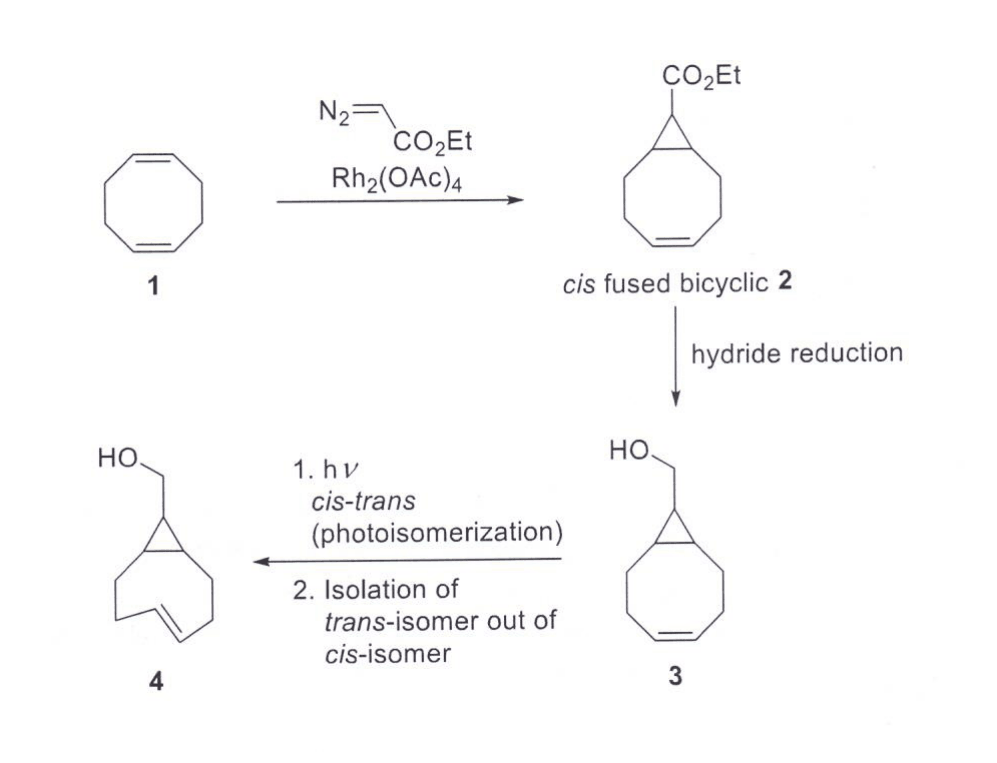
11.1 Draw all possible stereoisomers of compound 3 that could be obtained from the reduction of compound 2. Not necessary to assign \(R,S\) configuration.
11.2 i) If one of the stereoisomers of compound 3 is converted to compound 4, how many stereoisomeric form(s) of compound 4 will be obtained?
ii) The number of possible stereoisomeric form(s) of compound 4 = \(\boxed{\phantom{00}}\)
iii) If there are more than one stereoisomer, is it possible to separate the obtained stereoisomers of compound 4 by achiral chromatography? Tick the relevant circle.
○ Yes ○ No
Official English text of the problem.
Answers
- 11.1: Two cis-fused stereoisomers of [(4Z)-bicyclo[6.1.0]non-4-en-9-yl]methanol:
- Syn, with \(\ce{CH2OH}\) on the same face as both bridgehead hydrogens:
OC[C@@H]1[C@H]2CC/C=C\CC[C@@H]12. - Anti, with \(\ce{CH2OH}\) on the opposite face:
OC[C@H]1[C@H]2CC/C=C\CC[C@@H]12. - 11.2(i): Two, forming an enantiomeric pair.
- 11.2(ii): \(\boxed{2}\) under the single-starting-stereoisomer condition in (i). Counting products from both stereoisomers of 3 gives four forms overall.
- 11.2(iii): No. Tick the No circle.
Solution
11.1
Number the bicyclic framework so that the cyclopropane bridgeheads are C1 and C8, and its substituent-bearing carbon is C9. The cis fusion requires the two bridgehead hydrogens to lie on the same face of the cyclopropane.
Compound 2 is ethyl (4Z)-bicyclo[6.1.0]non-4-ene-9-carboxylate. For example, its cis-fused syn stereoisomer is CCOC(=O)[C@@H]1[C@H]2CC/C=C\CC[C@@H]12. Hydride reduction converts the ester substituent into \(\ce{CH2OH}\), preserving the cyclopropane’s relative configurations. The newly formed methylene carbon bears two hydrogens, so this reduction creates no new stereogenic centre.
There are two possibilities for the hydroxymethyl substituent relative to the bridgehead hydrogens:
| Stereoisomer of 3 | Precise drawing instructions |
|---|---|
| 3-syn | Draw both bridgehead H bonds as solid wedges. Draw the C9–\(\ce{CH2OH}\) bond as a solid wedge and the C9–H bond as a hashed wedge. |
| 3-anti | Keep both bridgehead H bonds as solid wedges. Draw the C9–\(\ce{CH2OH}\) bond as a hashed wedge and the C9–H bond as a solid wedge. |
In both drawings, retain the cis, or \(Z\), double bond.
The two configurations are diastereomeric, but each is achiral: the symmetry relating the two halves of the ring makes its mirror image equivalent to itself. Reversing every wedge and dash therefore does not produce additional stereoisomers. Ordinary interconverting ring conformations are not counted separately.
Thus,
\[ \boxed{N(\mathbf{3})=2}. \]
11.2(i)
Photoisomerization changes the double bond from \(Z\) to \(E\), while retaining the cyclopropane’s relative configuration. The trans double bond forces the eight-membered ring into a twisted arrangement with planar chirality.
For either individual stereoisomer of 3, two opposite, mirror-related twists are possible. Because the starting stereoisomer is achiral, these products form an enantiomeric pair, produced as a racemate under achiral conditions.
Compound 4 is the corresponding cis-fused [(4E)-bicyclo[6.1.0]non-4-en-9-yl]methanol:
| Starting stereoisomer | Product family and SMILES | Planar configurations |
|---|---|---|
| 3-syn | Syn-4, OC[C@@H]1[C@H]2CC/C=C/CC[C@@H]12 |
Two opposite planar configurations, \(R_{\mathrm p}\) and \(S_{\mathrm p}\) |
| 3-anti | Anti-4, OC[C@H]1[C@H]2CC/C=C/CC[C@@H]12 |
Two opposite planar configurations, \(R_{\mathrm p}\) and \(S_{\mathrm p}\) |
These SMILES specify the cyclopropane stereochemistry and the \(E\) double bond. Ordinary isomeric SMILES does not distinguish the two planar enantiomers: each row additionally requires two drawings with opposite ring twists.
Consequently, from one stereoisomer of 3,
\[ \boxed{N(\mathbf{4}\text{ obtained})=2}. \]
11.2(ii)
Reading the box as the answer field for the experiment specified in (i), enter
\[ \boxed{2}. \]
If instead all forms obtainable from both stereoisomers of 3 are counted, there are two enantiomeric pairs:
\[ N(\mathbf{4}\text{ overall})= 2\text{ precursor configurations}\times 2\text{ planar configurations} =\boxed{4}. \]
11.2(iii)
The two products obtained from a single stereoisomer of 3 are enantiomers. They have identical interactions with an achiral stationary phase and an achiral mobile phase, so achiral chromatography cannot resolve them.
Therefore, tick No.
The answers were checked against the official answers published by the organisers.
IChO 2017 · Theorieaufgabe 11
Verdrillung & Chiralität
trans-Cycloocten besitzt eine Chiralitätsebene und eine hohe Racemisierungsbarriere. Die Doppelbindung von trans-Cycloocten ist verdrillt; infolgedessen zeigt das Molekül bei Cycloadditionsreaktionen eine ungewöhnliche Reaktivität.
Im Jahr 2011 entwickelten Fox und Mitarbeiter eine photochemische Synthese verschiedener trans-Cycloocten-Derivate. Der Prozess ist nicht stereokontrolliert, und das Syntheseschema ist nachstehend dargestellt.
11.1 Zeichnen Sie alle möglichen Stereoisomere der Verbindung 3, die durch Reduktion der Verbindung 2 erhalten werden könnten. Die Zuordnung der \(R,S\)-Konfiguration ist nicht erforderlich.
11.2 i) Wenn eines der Stereoisomere der Verbindung 3 in die Verbindung 4 umgewandelt wird, wie viele stereoisomere Formen der Verbindung 4 werden erhalten?
ii) Die Anzahl der möglichen stereoisomeren Formen der Verbindung 4 = \(\boxed{\phantom{00}}\)
iii) Falls mehr als ein Stereoisomer vorliegt, lassen sich die erhaltenen Stereoisomere der Verbindung 4 durch achirale Chromatographie trennen? Kreuzen Sie den entsprechenden Kreis an.
○ Ja ○ Nein
Aufgabentext aus dem offiziellen englischen Text übersetzt.
Antworten
- 11.1: Zwei cis-anellierte Stereoisomere von [(4Z)-Bicyclo[6.1.0]non-4-en-9-yl]methanol:
- Syn, mit \(\ce{CH2OH}\) auf derselben Seite wie die beiden Brückenkopf-Wasserstoffatome:
OC[C@@H]1[C@H]2CC/C=C\CC[C@@H]12. - Anti, mit \(\ce{CH2OH}\) auf der gegenüberliegenden Seite:
OC[C@H]1[C@H]2CC/C=C\CC[C@@H]12. - 11.2(i): Zwei, die ein Enantiomerenpaar bilden.
- 11.2(ii): \(\boxed{2}\) unter der in (i) genannten Bedingung, dass von einem einzigen Stereoisomer ausgegangen wird. Zählt man die Produkte aus beiden Stereoisomeren von 3, ergeben sich insgesamt vier Formen.
- 11.2(iii): Nein. Kreuzen Sie den Kreis Nein an.
Lösung
11.1
Nummerieren Sie das bicyclische Gerüst so, dass die Brückenkopfatome des Cyclopropans C1 und C8 sind und sein substituententragendes Kohlenstoffatom C9 ist. Die cis-Anellierung erfordert, dass die beiden Brückenkopf-Wasserstoffatome auf derselben Seite des Cyclopropans liegen.
Verbindung 2 ist Ethyl-(4Z)-bicyclo[6.1.0]non-4-en-9-carboxylat. Ihr cis-anelliertes syn-Stereoisomer ist beispielsweise CCOC(=O)[C@@H]1[C@H]2CC/C=C\CC[C@@H]12. Die Hydridreduktion wandelt den Estersubstituenten in \(\ce{CH2OH}\) um, wobei die relativen Konfigurationen des Cyclopropans erhalten bleiben. Das neu gebildete Methylen-Kohlenstoffatom trägt zwei Wasserstoffatome, sodass bei dieser Reduktion kein neues stereogenes Zentrum entsteht.
Für den Hydroxymethylsubstituenten gibt es relativ zu den Brückenkopf-Wasserstoffatomen zwei Möglichkeiten:
| Stereoisomer von 3 | Genaue Zeichenanweisungen |
|---|---|
| 3-syn | Zeichnen Sie beide Bindungen zu den Brückenkopf-H-Atomen als ausgefüllte Keile. Zeichnen Sie die C9–\(\ce{CH2OH}\)-Bindung als ausgefüllten Keil und die C9–H-Bindung als gestrichelten Keil. |
| 3-anti | Behalten Sie beide Bindungen zu den Brückenkopf-H-Atomen als ausgefüllte Keile bei. Zeichnen Sie die C9–\(\ce{CH2OH}\)-Bindung als gestrichelten Keil und die C9–H-Bindung als ausgefüllten Keil. |
Behalten Sie in beiden Zeichnungen die cis- bzw. \(Z\)-Doppelbindung bei.
Die beiden Konfigurationen sind diastereomer, doch jede ist achiral: Aufgrund der Symmetrie, die die beiden Ringhälften miteinander verknüpft, ist das jeweilige Spiegelbild mit dem Molekül selbst identisch. Die Umkehrung aller ausgefüllten und gestrichelten Keile erzeugt daher keine zusätzlichen Stereoisomere. Gewöhnliche, ineinander übergehende Ringkonformationen werden nicht separat gezählt.
Somit gilt:
\[ \boxed{N(\mathbf{3})=2}. \]
11.2(i)
Die Photoisomerisierung ändert die Doppelbindung von \(Z\) zu \(E\), während die relative Konfiguration des Cyclopropans erhalten bleibt. Die trans-Doppelbindung zwingt den achtgliedrigen Ring in eine verdrillte Anordnung mit planarer Chiralität.
Für jedes einzelne Stereoisomer von 3 sind zwei entgegengesetzte, spiegelbildliche Verdrillungen möglich. Da das Ausgangsstereoisomer achiral ist, bilden diese Produkte ein Enantiomerenpaar, das unter achiralen Bedingungen als Racemat entsteht.
Verbindung 4 ist das entsprechende cis-anellierte [(4E)-Bicyclo[6.1.0]non-4-en-9-yl]methanol:
| Ausgangsstereoisomer | Produktfamilie und SMILES | Planare Konfigurationen |
|---|---|---|
| 3-syn | Syn-4, OC[C@@H]1[C@H]2CC/C=C/CC[C@@H]12 |
Zwei entgegengesetzte planare Konfigurationen, \(R_{\mathrm p}\) und \(S_{\mathrm p}\) |
| 3-anti | Anti-4, OC[C@H]1[C@H]2CC/C=C/CC[C@@H]12 |
Zwei entgegengesetzte planare Konfigurationen, \(R_{\mathrm p}\) und \(S_{\mathrm p}\) |
Diese SMILES legen die Stereochemie des Cyclopropans und die \(E\)-Doppelbindung fest. Die übliche isomere SMILES-Notation unterscheidet die beiden planaren Enantiomere nicht: Für jede Zeile sind zusätzlich zwei Zeichnungen mit entgegengesetzten Ringverdrillungen erforderlich.
Folglich erhält man aus einem Stereoisomer von 3:
\[ \boxed{N(\mathbf{4}\text{ erhalten})=2}. \]
11.2(ii)
Wird das Kästchen als Antwortfeld für das in (i) beschriebene Experiment verstanden, tragen Sie ein:
\[ \boxed{2}. \]
Werden stattdessen alle aus beiden Stereoisomeren von 3 erhältlichen Formen gezählt, gibt es zwei Enantiomerenpaare:
\[ N(\mathbf{4}\text{ insgesamt})= 2\text{ Vorstufenkonfigurationen}\times 2\text{ planare Konfigurationen} =\boxed{4}. \]
11.2(iii)
Die beiden Produkte, die aus einem einzigen Stereoisomer von 3 erhalten werden, sind Enantiomere. Sie zeigen identische Wechselwirkungen mit einer achiralen stationären Phase und einer achiralen mobilen Phase, sodass sie durch achirale Chromatographie nicht getrennt werden können.
Kreuzen Sie daher Nein an.
Die Ergebnisse wurden mit den von den Veranstaltern veröffentlichten offiziellen Ergebnissen abgeglichen.
IChO 2017 · Teori sorusu 11
Burulma ve Kiralite
trans-Siklooktenin bir kiral düzlemi ve rasemleşme için yüksek bir enerji engeli vardır. trans-Siklooktenin çift bağı burulmuştur; bunun sonucunda molekül, siklokatılma tepkimelerinde alışılmadık bir reaktivite gösterir.
2011 yılında Fox ve çalışma arkadaşları, çeşitli trans-siklookten türevlerinin elde edilmesine yönelik fotokimyasal bir sentez geliştirdiler. Süreç stereokontrollü değildir ve sentez şeması aşağıdaki gibidir.
11.1 2 bileşiğinin indirgenmesinden elde edilebilecek 3 bileşiğinin tüm olası stereoizomerlerini çiziniz. \(R,S\) konfigürasyonlarının belirlenmesi gerekli değildir.
11.2 i) 3 bileşiğinin stereoizomerlerinden biri 4 bileşiğine dönüştürülürse, 4 bileşiğinin kaç stereoizomerik biçimi elde edilir?
ii) 4 bileşiğinin olası stereoizomerik biçimlerinin sayısı = \(\boxed{\phantom{00}}\)
iii) Birden fazla stereoizomer varsa, 4 bileşiğinin elde edilen stereoizomerlerini akiral kromatografi ile ayırmak mümkün müdür? İlgili daireyi işaretleyiniz.
○ Evet ○ Hayır
Soru metni resmi İngilizce metinden çevrilmiştir.
Cevaplar
- 11.1: [(4Z)-bisiklo[6.1.0]non-4-en-9-il]metanolün cis-kaynaşmış iki stereoizomeri:
- Syn, \(\ce{CH2OH}\) her iki köprübaşı hidrojeniyle aynı yüzde olacak şekilde:
OC[C@@H]1[C@H]2CC/C=C\CC[C@@H]12. - Anti, \(\ce{CH2OH}\) karşı yüzde olacak şekilde:
OC[C@H]1[C@H]2CC/C=C\CC[C@@H]12. - 11.2(i): Bir enantiyomer çifti oluşturan iki stereoizomer.
- 11.2(ii): (i)'deki tek bir başlangıç stereoizomeri kullanılması koşuluyla \(\boxed{2}\). 3 bileşiğinin her iki stereoizomerinden oluşan ürünler sayıldığında toplam dört biçim elde edilir.
- 11.2(iii): Hayır. Hayır dairesini işaretleyiniz.
Çözüm
11.1
Bisiklik iskeleti, siklopropanın köprübaşı atomları C1 ve C8, sübstitüent taşıyan karbonu ise C9 olacak şekilde numaralandırınız. Cis kaynaşma, iki köprübaşı hidrojeninin siklopropanın aynı yüzünde bulunmasını gerektirir.
2 bileşiği etil (4Z)-bisiklo[6.1.0]non-4-en-9-karboksilattır. Örneğin, cis-kaynaşmış syn stereoizomeri CCOC(=O)[C@@H]1[C@H]2CC/C=C\CC[C@@H]12 şeklindedir. Hidrürle indirgeme, siklopropanın bağıl konfigürasyonlarını koruyarak ester sübstitüentini \(\ce{CH2OH}\) grubuna dönüştürür. Yeni oluşan metilen karbonu iki hidrojen taşıdığından bu indirgeme yeni bir stereojenik merkez oluşturmaz.
Hidroksimetil sübstitüentinin köprübaşı hidrojenlerine göre konumu için iki olasılık vardır:
| 3 bileşiğinin stereoizomeri | Ayrıntılı çizim talimatları |
|---|---|
| 3-syn | Her iki köprübaşı H bağını dolu kama olarak çiziniz. C9–\(\ce{CH2OH}\) bağını dolu kama, C9–H bağını ise kesikli kama olarak çiziniz. |
| 3-anti | Her iki köprübaşı H bağını dolu kama olarak koruyunuz. C9–\(\ce{CH2OH}\) bağını kesikli kama, C9–H bağını ise dolu kama olarak çiziniz. |
Her iki çizimde de cis, yani \(Z\), çift bağını koruyunuz.
Bu iki konfigürasyon diastereomeriktir, ancak her biri akiraldir: halkanın iki yarısını birbiriyle ilişkilendiren simetri, her birinin ayna görüntüsünü kendisiyle eşdeğer kılar. Dolayısıyla tüm dolu ve kesikli kamaları tersine çevirmek ek stereoizomerler oluşturmaz. Birbirine dönüşebilen olağan halka konformasyonları ayrı ayrı sayılmaz.
Böylece,
\[ \boxed{N(\mathbf{3})=2}. \]
11.2(i)
Fotoizomerleşme, siklopropanın bağıl konfigürasyonunu korurken çift bağı \(Z\)'den \(E\)'ye dönüştürür. Trans çift bağ, sekiz üyeli halkayı düzlemsel kiraliteye sahip burulmuş bir düzenlenmeye zorlar.
3 bileşiğinin her bir stereoizomeri için, birbirinin ayna görüntüsü olan iki zıt burulma mümkündür. Başlangıç stereoizomeri akiral olduğundan bu ürünler bir enantiyomer çifti oluşturur ve akiral koşullarda rasemat olarak elde edilir.
4 bileşiği, buna karşılık gelen cis-kaynaşmış [(4E)-bisiklo[6.1.0]non-4-en-9-il]metanoldür:
| Başlangıç stereoizomeri | Ürün ailesi ve SMILES | Düzlemsel konfigürasyonlar |
|---|---|---|
| 3-syn | Syn-4, OC[C@@H]1[C@H]2CC/C=C/CC[C@@H]12 |
İki zıt düzlemsel konfigürasyon, \(R_{\mathrm p}\) ve \(S_{\mathrm p}\) |
| 3-anti | Anti-4, OC[C@H]1[C@H]2CC/C=C/CC[C@@H]12 |
İki zıt düzlemsel konfigürasyon, \(R_{\mathrm p}\) ve \(S_{\mathrm p}\) |
Bu SMILES gösterimleri, siklopropanın stereokimyasını ve \(E\) çift bağını belirtir. Standart izomerik SMILES, iki düzlemsel enantiyomeri birbirinden ayırt etmez: her satır için ayrıca zıt halka burulmalarını gösteren iki çizim gerekir.
Sonuç olarak, 3 bileşiğinin bir stereoizomerinden,
\[ \boxed{N(\mathbf{4}\text{ elde edilen})=2}. \]
11.2(ii)
Kutuyu (i)'de belirtilen deneyin cevap alanı olarak yorumlayarak şunu yazınız:
\[ \boxed{2}. \]
Bunun yerine 3 bileşiğinin her iki stereoizomerinden elde edilebilen tüm biçimler sayılırsa iki enantiyomer çifti vardır:
\[ N(\mathbf{4}\text{ toplam})= 2\text{ öncül konfigürasyonları}\times 2\text{ düzlemsel konfigürasyonlar} =\boxed{4}. \]
11.2(iii)
3 bileşiğinin tek bir stereoizomerinden elde edilen iki ürün enantiyomerdir. Akiral bir sabit faz ve akiral bir hareketli fazla etkileşimleri özdeştir; bu nedenle akiral kromatografi ile birbirlerinden ayrılamazlar.
Bu nedenle Hayır seçeneğini işaretleyiniz.
Sonuçlar, düzenleyicilerin yayımladığı resmi sonuçlarla karşılaştırılarak kontrol edildi.
IChO 2017 · Problema teórico 11
Torsión y quiralidad
El trans-cicloocteno tiene un plano quiral y una elevada barrera de racemización. El doble enlace del trans-cicloocteno está torsionado; como resultado, la molécula presenta una reactividad inusual en las reacciones de cicloadición.
En 2011, Fox y sus colaboradores desarrollaron una síntesis fotoquímica para obtener diversos derivados del trans-cicloocteno. El proceso no está estereocontrolado y el esquema de síntesis es el siguiente.
11.1 Dibuje todos los estereoisómeros posibles del compuesto 3 que podrían obtenerse mediante la reducción del compuesto 2. No es necesario asignar la configuración \(R,S\).
11.2 i) Si uno de los estereoisómeros del compuesto 3 se convierte en el compuesto 4, ¿cuántas formas estereoisoméricas del compuesto 4 se obtendrán?
ii) El número de formas estereoisoméricas posibles del compuesto 4 = \(\boxed{\phantom{00}}\)
iii) Si hay más de un estereoisómero, ¿es posible separar los estereoisómeros obtenidos del compuesto 4 mediante cromatografía aquiral? Marque el círculo correspondiente.
○ Sí ○ No
Enunciado traducido del texto oficial en inglés.
Respuestas
- 11.1: Dos estereoisómeros con fusión cis del [(4Z)-biciclo[6.1.0]non-4-en-9-il]metanol:
- Syn, con \(\ce{CH2OH}\) en la misma cara que ambos hidrógenos de cabeza de puente:
OC[C@@H]1[C@H]2CC/C=C\CC[C@@H]12. - Anti, con \(\ce{CH2OH}\) en la cara opuesta:
OC[C@H]1[C@H]2CC/C=C\CC[C@@H]12. - 11.2(i): Dos, que forman un par de enantiómeros.
- 11.2(ii): \(\boxed{2}\) bajo la condición de partir de un único estereoisómero indicada en (i). Si se cuentan los productos de ambos estereoisómeros de 3, se obtienen cuatro formas en total.
- 11.2(iii): No. Marque el círculo No.
Solución
11.1
Numere el esqueleto bicíclico de modo que las cabezas de puente del ciclopropano sean C1 y C8, y el carbono que lleva el sustituyente sea C9. La fusión cis exige que los dos hidrógenos de cabeza de puente se sitúen en la misma cara del ciclopropano.
El compuesto 2 es el (4Z)-biciclo[6.1.0]non-4-eno-9-carboxilato de etilo. Por ejemplo, su estereoisómero syn con fusión cis es CCOC(=O)[C@@H]1[C@H]2CC/C=C\CC[C@@H]12. La reducción con hidruro convierte el sustituyente éster en \(\ce{CH2OH}\), conservando las configuraciones relativas del ciclopropano. El carbono metilénico recién formado lleva dos hidrógenos, por lo que esta reducción no crea ningún centro estereogénico nuevo.
Existen dos posibilidades para el sustituyente hidroximetilo con respecto a los hidrógenos de cabeza de puente:
| Estereoisómero de 3 | Instrucciones precisas para el dibujo |
|---|---|
| 3-syn | Dibuje los enlaces de ambos H de cabeza de puente como cuñas sólidas. Dibuje el enlace C9–\(\ce{CH2OH}\) como una cuña sólida y el enlace C9–H como una cuña rayada. |
| 3-anti | Mantenga los enlaces de ambos H de cabeza de puente como cuñas sólidas. Dibuje el enlace C9–\(\ce{CH2OH}\) como una cuña rayada y el enlace C9–H como una cuña sólida. |
En ambos dibujos, conserve el doble enlace cis, o \(Z\).
Las dos configuraciones son diastereoméricas, pero cada una es aquiral: la simetría que relaciona las dos mitades del anillo hace que su imagen especular sea equivalente a ella misma. Por lo tanto, invertir todas las cuñas sólidas y rayadas no produce estereoisómeros adicionales. Las conformaciones habituales del anillo que se interconvierten no se cuentan por separado.
Así,
\[ \boxed{N(\mathbf{3})=2}. \]
11.2(i)
La fotoisomerización cambia el doble enlace de \(Z\) a \(E\), manteniendo la configuración relativa del ciclopropano. El doble enlace trans obliga al anillo de ocho miembros a adoptar una disposición torsionada con quiralidad planar.
Para cada estereoisómero individual de 3, son posibles dos torsiones opuestas, relacionadas como imágenes especulares. Dado que el estereoisómero de partida es aquiral, estos productos forman un par de enantiómeros, que se obtiene como racemato en condiciones aquirales.
El compuesto 4 es el correspondiente [(4E)-biciclo[6.1.0]non-4-en-9-il]metanol con fusión cis:
| Estereoisómero de partida | Familia de productos y SMILES | Configuraciones planares |
|---|---|---|
| 3-syn | Syn-4, OC[C@@H]1[C@H]2CC/C=C/CC[C@@H]12 |
Dos configuraciones planares opuestas, \(R_{\mathrm p}\) y \(S_{\mathrm p}\) |
| 3-anti | Anti-4, OC[C@H]1[C@H]2CC/C=C/CC[C@@H]12 |
Dos configuraciones planares opuestas, \(R_{\mathrm p}\) y \(S_{\mathrm p}\) |
Estos SMILES especifican la estereoquímica del ciclopropano y el doble enlace \(E\). La notación SMILES isomérica habitual no distingue los dos enantiómeros planares: cada fila requiere, además, dos dibujos con torsiones opuestas del anillo.
Por consiguiente, a partir de un estereoisómero de 3,
\[ \boxed{N(\mathbf{4}\text{ obtenido})=2}. \]
11.2(ii)
Interpretando el recuadro como el campo de respuesta para el experimento especificado en (i), escriba
\[ \boxed{2}. \]
Si, en cambio, se cuentan todas las formas que pueden obtenerse a partir de ambos estereoisómeros de 3, hay dos pares de enantiómeros:
\[ N(\mathbf{4}\text{ en total})= 2\text{ configuraciones del precursor}\times 2\text{ configuraciones planares} =\boxed{4}. \]
11.2(iii)
Los dos productos obtenidos a partir de un único estereoisómero de 3 son enantiómeros. Presentan interacciones idénticas con una fase estacionaria aquiral y una fase móvil aquiral, por lo que la cromatografía aquiral no puede separarlos.
Por lo tanto, marque No.
Los resultados se comprobaron con los resultados oficiales publicados por los organizadores.
IChO 2017 · 理论题 11
扭曲与手性
反式-环辛烯具有手性平面,且其外消旋化能垒很高。反式-环辛烯的双键发生扭曲,因此,该分子在环加成反应中表现出不同寻常的反应活性。
2011 年,Fox 及其同事开发了一种用于合成多种反式-环辛烯衍生物的光化学方法。该过程不具有立体控制性,合成路线如下。
11.1 画出由化合物 2 还原可能得到的化合物 3 的所有立体异构体。不必标明 \(R,S\) 构型。
11.2 i) 如果将化合物 3 的一种立体异构体转化为化合物 4,将得到多少种化合物 4 的立体异构体?
ii) 化合物 4 可能的立体异构体数目 = \(\boxed{\phantom{00}}\)
iii) 如果存在不止一种立体异构体,能否通过非手性色谱法分离所得到的化合物 4 的立体异构体?请在相应的圆圈内打勾。
○ 能 ○ 不能
题目译自官方英文原文。
答案
- 11.1: [(4Z)-双环[6.1.0]壬-4-烯-9-基]甲醇的两种顺式稠合立体异构体:
- 同向(syn),\(\ce{CH2OH}\) 与两个桥头氢位于同一侧:
OC[C@@H]1[C@H]2CC/C=C\CC[C@@H]12。 - 反向(anti),\(\ce{CH2OH}\) 位于相反一侧:
OC[C@H]1[C@H]2CC/C=C\CC[C@@H]12。 - 11.2(i): 两种,构成一对对映异构体。
- 11.2(ii): 在 (i) 中以单一立体异构体为起始物的条件下,为 \(\boxed{2}\)。若计入由 3 的两种立体异构体得到的产物,则总共有四种。
- 11.2(iii): 不能。在不能对应的圆圈内打勾。
解答
11.1
对双环骨架进行编号,使环丙烷的两个桥头碳为 C1 和 C8,带有取代基的碳为 C9。顺式稠合要求两个桥头氢位于环丙烷的同一侧。
化合物 2 为 (4Z)-双环[6.1.0]壬-4-烯-9-甲酸乙酯。例如,其顺式稠合的同向立体异构体为 CCOC(=O)[C@@H]1[C@H]2CC/C=C\CC[C@@H]12。氢化物还原将酯基转化为 \(\ce{CH2OH}\),同时保留环丙烷的相对构型。新形成的亚甲基碳上连有两个氢,因此这一还原过程不会产生新的立体中心。
羟甲基取代基相对于桥头氢有两种可能的取向:
| 3 的立体异构体 | 具体画法 |
|---|---|
| 3-syn | 将两个桥头碳与 H 之间的键均画成实楔形键。将 C9–\(\ce{CH2OH}\) 键画成实楔形键,将 C9–H 键画成虚楔形键。 |
| 3-anti | 保持两个桥头碳与 H 之间的键均为实楔形键。将 C9–\(\ce{CH2OH}\) 键画成虚楔形键,将 C9–H 键画成实楔形键。 |
在两幅结构图中,均保留顺式,即 \(Z\) 构型的双键。
这两种构型互为非对映异构体,但各自均无手性:环的两半之间存在对称关系,使其镜像与自身等同。因此,将所有实楔形键与虚楔形键互换,不会产生额外的立体异构体。通常可以相互转化的环构象不单独计数。
因此,
\[ \boxed{N(\mathbf{3})=2}. \]
11.2(i)
光异构化使双键由 \(Z\) 构型变为 \(E\) 构型,同时保留环丙烷的相对构型。反式双键迫使八元环采取扭曲的排列方式,从而具有平面手性。
对于 3 的任一单独立体异构体,均可能出现两种方向相反、互为镜像的扭曲方式。由于起始立体异构体无手性,这些产物构成一对对映异构体,在非手性条件下以外消旋体形式生成。
化合物 4 为相应的顺式稠合的 [(4E)-双环[6.1.0]壬-4-烯-9-基]甲醇:
| 起始立体异构体 | 产物类别及 SMILES | 平面构型 |
|---|---|---|
| 3-syn | Syn-4,OC[C@@H]1[C@H]2CC/C=C/CC[C@@H]12 |
两种相反的平面构型,\(R_{\mathrm p}\) 和 \(S_{\mathrm p}\) |
| 3-anti | Anti-4,OC[C@H]1[C@H]2CC/C=C/CC[C@@H]12 |
两种相反的平面构型,\(R_{\mathrm p}\) 和 \(S_{\mathrm p}\) |
这些 SMILES 指定了环丙烷的立体化学和 \(E\) 构型双键。常规的异构 SMILES 无法区分这两种具有平面手性的对映异构体:每一行还需要另画两幅环扭曲方向相反的结构图。
因此,由 3 的一种立体异构体出发,
\[ \boxed{N(\mathbf{4}\text{ 所得})=2}. \]
11.2(ii)
将方框视为 (i) 所述实验的答案填写处,应填入
\[ \boxed{2}. \]
如果改为统计由 3 的两种立体异构体能够得到的所有形式,则共有两对对映异构体:
\[ N(\mathbf{4}\text{ 总计})= 2\text{ 种前体构型}\times 2\text{ 种平面构型} =\boxed{4}. \]
11.2(iii)
由 3 的单一立体异构体得到的两种产物互为对映异构体。它们与非手性固定相和非手性流动相的相互作用完全相同,因此无法通过非手性色谱法将其拆分。
因此,在不能对应的圆圈内打勾。
结果已与主办方公布的官方答案核对。
IChO 2017 · Теоретическая задача 11
Скручивание и хиральность
транс-Циклооктен обладает плоскостью хиральности и высоким барьером рацемизации. Двойная связь транс-циклооктена скручена, вследствие чего молекула проявляет необычную реакционную способность в реакциях циклоприсоединения.
В 2011 году Фокс и его сотрудники разработали фотохимический метод синтеза различных производных транс-циклооктена. Процесс протекает без стереохимического контроля; схема синтеза приведена ниже.
11.1 Изобразите все возможные стереоизомеры соединения 3, которые могут быть получены при восстановлении соединения 2. Указывать \(R,S\)-конфигурацию не требуется.
11.2 i) Если один из стереоизомеров соединения 3 превращают в соединение 4, сколько стереоизомерных форм соединения 4 будет получено?
ii) Число возможных стереоизомерных форм соединения 4 = \(\boxed{\phantom{00}}\)
iii) Если стереоизомеров больше одного, можно ли разделить полученные стереоизомеры соединения 4 с помощью ахиральной хроматографии? Отметьте соответствующий кружок.
○ Да ○ Нет
Условие переведено с официального английского текста.
Ответы
- 11.1: Два стереоизомера [(4Z)-бицикло[6.1.0]нон-4-ен-9-ил]метанола с цис-сочленением циклов:
- Син, в котором \(\ce{CH2OH}\) находится с той же стороны, что и оба атома водорода при узловых атомах углерода:
OC[C@@H]1[C@H]2CC/C=C\CC[C@@H]12. - Анти, в котором \(\ce{CH2OH}\) находится с противоположной стороны:
OC[C@H]1[C@H]2CC/C=C\CC[C@@H]12. - 11.2(i): Две, образующие энантиомерную пару.
- 11.2(ii): \(\boxed{2}\) при условии использования одного исходного стереоизомера, указанном в (i). Если учитывать продукты, получаемые из обоих стереоизомеров 3, всего получается четыре формы.
- 11.2(iii): Нет. Отметьте кружок Нет.
Решение
11.1
Пронумеруем бициклический скелет так, чтобы узловые атомы углерода циклопропанового кольца имели номера C1 и C8, а атом углерода, несущий заместитель, — C9. Цис-сочленение требует, чтобы два атома водорода при узловых атомах углерода находились с одной и той же стороны циклопропанового кольца.
Соединение 2 — этил(4Z)-бицикло[6.1.0]нон-4-ен-9-карбоксилат. Например, его син-стереоизомер с цис-сочленением циклов имеет запись CCOC(=O)[C@@H]1[C@H]2CC/C=C\CC[C@@H]12. Гидридное восстановление превращает сложноэфирный заместитель в \(\ce{CH2OH}\), сохраняя относительные конфигурации циклопропанового кольца. Вновь образовавшийся метиленовый атом углерода несёт два атома водорода, поэтому при таком восстановлении новый стереогенный центр не возникает.
Для гидроксиметильного заместителя возможны два положения относительно атомов водорода при узловых атомах углерода:
| Стереоизомер 3 | Точные указания по изображению |
|---|---|
| 3-син | Изобразите обе связи с атомами H при узловых атомах углерода сплошными клиньями. Связь C9–\(\ce{CH2OH}\) изобразите сплошным клином, а связь C9–H — штриховым клином. |
| 3-анти | Оставьте обе связи с атомами H при узловых атомах углерода в виде сплошных клиньев. Связь C9–\(\ce{CH2OH}\) изобразите штриховым клином, а связь C9–H — сплошным клином. |
На обоих рисунках сохраните цис-, или \(Z\)-конфигурацию двойной связи.
Эти две конфигурации диастереомерны, но каждая из них ахиральна: благодаря симметрии, связывающей две половины кольца, зеркальное изображение каждой формы эквивалентно ей самой. Поэтому замена всех сплошных клиньев штриховыми и наоборот не приводит к появлению дополнительных стереоизомеров. Обычные взаимопревращающиеся конформации кольца отдельно не учитываются.
Таким образом,
\[ \boxed{N(\mathbf{3})=2}. \]
11.2(i)
Фотоизомеризация изменяет конфигурацию двойной связи с \(Z\) на \(E\), сохраняя относительную конфигурацию циклопропанового кольца. Транс-конфигурация двойной связи вынуждает восьмичленное кольцо принимать скрученную форму, обладающую планарной хиральностью.
Для каждого отдельного стереоизомера 3 возможны два противоположных, зеркально связанных варианта скручивания. Поскольку исходный стереоизомер ахирален, эти продукты образуют энантиомерную пару, получаемую в ахиральных условиях в виде рацемата.
Соединение 4 представляет собой соответствующий [(4E)-бицикло[6.1.0]нон-4-ен-9-ил]метанол с цис-сочленением циклов:
| Исходный стереоизомер | Группа продуктов и SMILES | Планарные конфигурации |
|---|---|---|
| 3-син | Син-4, OC[C@@H]1[C@H]2CC/C=C/CC[C@@H]12 |
Две противоположные планарные конфигурации, \(R_{\mathrm p}\) и \(S_{\mathrm p}\) |
| 3-анти | Анти-4, OC[C@H]1[C@H]2CC/C=C/CC[C@@H]12 |
Две противоположные планарные конфигурации, \(R_{\mathrm p}\) и \(S_{\mathrm p}\) |
Эти записи SMILES задают стереохимию циклопропанового кольца и \(E\)-конфигурацию двойной связи. Обычная изомерическая запись SMILES не различает два планарных энантиомера: для каждой строки дополнительно требуются два рисунка с противоположными направлениями скручивания кольца.
Следовательно, из одного стереоизомера 3 получается
\[ \boxed{N(\mathbf{4}\text{ полученного})=2}. \]
11.2(ii)
Если рассматривать рамку как поле для ответа применительно к эксперименту, указанному в (i), следует вписать
\[ \boxed{2}. \]
Если же учитывать все формы, которые можно получить из обоих стереоизомеров 3, получаются две энантиомерные пары:
\[ N(\mathbf{4}\text{ всего})= 2\text{ конфигурации исходного соединения}\times 2\text{ планарные конфигурации} =\boxed{4}. \]
11.2(iii)
Два продукта, получаемые из одного стереоизомера 3, являются энантиомерами. Они одинаково взаимодействуют с ахиральной неподвижной фазой и ахиральной подвижной фазой, поэтому ахиральная хроматография не позволяет их разделить.
Следовательно, отметьте Нет.
Ответы проверены по официальным ответам, опубликованным организаторами.
IChO 2017 · مسألة نظرية 11
الالتواء والكيرالية
يمتلك سيكلوأوكتين-ترانس مستوى كيراليًا وحاجز طاقة مرتفعًا للتحول إلى مزيج راسيمي. وتكون الرابطة المزدوجة في سيكلوأوكتين-ترانس ملتوية، ولذلك يُظهر الجزيء تفاعلية غير معتادة في تفاعلات الإضافة الحلقية.
في عام 2011، طوّر Fox وزملاؤه طريقة تخليق كيميائي ضوئي لتحضير مجموعة متنوعة من مشتقات سيكلوأوكتين-ترانس. ولا تخضع العملية لتحكم فراغي، ومخطط التخليق كما يلي.
11.1 ارسم جميع المتماكبات الفراغية الممكنة للمركب 3 التي يمكن الحصول عليها من اختزال المركب 2. لا يلزم تعيين التشكيل \(R,S\).
11.2 i) إذا حُوِّل أحد المتماكبات الفراغية للمركب 3 إلى المركب 4، فكم صيغة متماكبة فراغيًا من المركب 4 سيُحصل عليها؟
ii) عدد الصيغ المتماكبة فراغيًا الممكنة للمركب 4 = \(\boxed{\phantom{00}}\)
iii) إذا وُجد أكثر من متماكب فراغي واحد، فهل يمكن فصل المتماكبات الفراغية الناتجة للمركب 4 بالاستشراب غير الكيرالي؟ ضع علامة في الدائرة المناسبة.
○ نعم ○ لا
نص المسألة مترجم عن النص الإنجليزي الرسمي.
الإجابات
- 11.1: متماكبان فراغيان اثنان ذوا التحام سيس للمركب [(4Z)-ثنائي سيكلو[6.1.0]نون-4-ين-9-يل]ميثانول:
- سين، حيث تقع \(\ce{CH2OH}\) على الوجه نفسه الذي تقع عليه ذرتا الهيدروجين عند رأسي الجسر:
OC[C@@H]1[C@H]2CC/C=C\CC[C@@H]12. - أنتي، حيث تقع \(\ce{CH2OH}\) على الوجه المقابل:
OC[C@H]1[C@H]2CC/C=C\CC[C@@H]12. - 11.2(i): اثنان، يشكّلان زوجًا من المتماكبات المرآتية.
- 11.2(ii): \(\boxed{2}\) وفق شرط البدء بمتماكب فراغي واحد في (i). أما عدّ النواتج من كلا المتماكبين الفراغيين للمركب 3 فيعطي أربع صيغ إجمالًا.
- 11.2(iii): لا. ضع علامة في دائرة لا.
الحل
11.1
رقّم الهيكل ثنائي الحلقة بحيث يكون رأسا الجسر في حلقة السيكلوبروبان هما C1 وC8، وتكون ذرة الكربون الحاملة للمستبدَل هي C9. يتطلب الالتحام سيس أن تقع ذرتا الهيدروجين عند رأسي الجسر على الوجه نفسه من حلقة السيكلوبروبان.
المركب 2 هو (4Z)-ثنائي سيكلو[6.1.0]نون-4-ين-9-كربوكسيلات الإيثيل. فعلى سبيل المثال، يكون متماكبه الفراغي سين ذو الالتحام سيس هو CCOC(=O)[C@@H]1[C@H]2CC/C=C\CC[C@@H]12. يحوّل الاختزال بالهيدريد المستبدَل الإستري إلى \(\ce{CH2OH}\)، مع الحفاظ على التشكيلات النسبية للسيكلوبروبان. وتحمل ذرة كربون الميثيلين المتكوّنة حديثًا ذرتي هيدروجين، ولذلك لا يُنشئ هذا الاختزال أي مركز جديد مولِّد للتصاوغ الفراغي.
يوجد احتمالان لموضع مستبدَل الهيدروكسيميثيل بالنسبة إلى ذرتي الهيدروجين عند رأسي الجسر:
| المتماكب الفراغي للمركب 3 | تعليمات الرسم الدقيقة |
|---|---|
| 3-syn | ارسم رابطتي H عند رأسي الجسر على هيئة إسفينين ممتلئين. ارسم الرابطة C9–\(\ce{CH2OH}\) على هيئة إسفين ممتلئ والرابطة C9–H على هيئة إسفين مخطّط. |
| 3-anti | أبقِ رابطتي H عند رأسي الجسر على هيئة إسفينين ممتلئين. ارسم الرابطة C9–\(\ce{CH2OH}\) على هيئة إسفين مخطّط والرابطة C9–H على هيئة إسفين ممتلئ. |
في كلا الرسمين، أبقِ الرابطة المزدوجة بتشكيل سيس، أو \(Z\).
التشكيلان متماكبان فراغيان غير مرآتيين، لكن كلًّا منهما غير كيرالي: فالتناظر الذي يربط نصفي الحلقة يجعل صورته المرآتية مكافئة له. ولذلك فإن عكس كل إسفين وكل خط متقطع لا ينتج متماكبات فراغية إضافية. ولا تُعدّ الهيئات التوافقية المعتادة للحلقة، التي تتحول بعضها إلى بعض، صيغًا مستقلة.
إذن،
\[ \boxed{N(\mathbf{3})=2}. \]
11.2(i)
تغيّر المصاوغة الضوئية الرابطة المزدوجة من \(Z\) إلى \(E\)، مع الإبقاء على التشكيل النسبي للسيكلوبروبان. وتفرض الرابطة المزدوجة ترانس على الحلقة الثمانية الأعضاء ترتيبًا ملتويًا ذا كيرالية مستوية.
لكل متماكب فراغي منفرد من المركب 3، يمكن حدوث التواءين متعاكسين تربطهما علاقة الصورة المرآتية. ولأن المتماكب الفراغي الابتدائي غير كيرالي، فإن هذين الناتجين يشكّلان زوجًا من المتماكبات المرآتية، وينتجان على هيئة مزيج راسيمي في ظروف غير كيرالية.
المركب 4 هو [(4E)-ثنائي سيكلو[6.1.0]نون-4-ين-9-يل]ميثانول الموافق ذو الالتحام سيس:
| المتماكب الفراغي الابتدائي | عائلة النواتج وصيغة SMILES | التشكيلات المستوية |
|---|---|---|
| 3-syn | Syn-4، OC[C@@H]1[C@H]2CC/C=C/CC[C@@H]12 |
تشكيلان مستويان متعاكسان، \(R_{\mathrm p}\) و\(S_{\mathrm p}\) |
| 3-anti | Anti-4، OC[C@H]1[C@H]2CC/C=C/CC[C@@H]12 |
تشكيلان مستويان متعاكسان، \(R_{\mathrm p}\) و\(S_{\mathrm p}\) |
تحدّد صيغ SMILES هذه الكيمياء الفراغية للسيكلوبروبان والرابطة المزدوجة ذات التشكيل \(E\). لا يميّز ترميز SMILES المتماكبي المعتاد بين المتماكبين المرآتيين ذوي الكيرالية المستوية: إذ يتطلب كل صف، بالإضافة إلى ذلك، رسمين بالتواءين متعاكسين للحلقة.
وبالتالي، انطلاقًا من متماكب فراغي واحد للمركب 3،
\[ \boxed{N(\mathbf{4}\text{ الناتج})=2}. \]
11.2(ii)
باعتبار المربع خانة الإجابة عن التجربة المحددة في (i)، اكتب
\[ \boxed{2}. \]
أما إذا عُدّت جميع الصيغ التي يمكن الحصول عليها من كلا المتماكبين الفراغيين للمركب 3، فيوجد زوجان من المتماكبات المرآتية:
\[ N(\mathbf{4}\text{ إجمالًا})= 2\text{ تشكيلات للمركب الابتدائي}\times 2\text{ تشكيلات مستوية} =\boxed{4}. \]
11.2(iii)
الناتجان اللذان يُحصل عليهما من متماكب فراغي واحد للمركب 3 متماكبان مرآتيان. ولهما تآثرات متطابقة مع طور ثابت غير كيرالي وطور متحرك غير كيرالي، ولذلك لا يمكن فصلهما بالاستشراب غير الكيرالي.
لذلك، ضع علامة عند لا.
تمت مراجعة النتائج بمقارنتها بالنتائج الرسمية التي نشرها المنظمون.