IChO 2017 · Theory problem 7
Chemical Structure Puzzles
Titanium complexes have been investigated for their antitumor activity. Many factors including isomerism and sizes have shown to affect the potency of the complexes. This question deals with the synthesis and characterization of some titanium complexes.
7.1 A reaction of 2 equivalents of 2-tert-butylphenol, 2 equivalents of formaldehyde, and \(N,N'\)-dimethylethylene-1,2-diamine under acidic conditions at \(75\,^\circ\mathrm{C}\) affords three major products with the same chemical formula of \(\ce{C26H40N2O2}\), as shown in the equation below. Draw the structure of each product.

7.2 If 2,4-di-tert-butylphenol is used as a substrate instead of 2-tert-butylphenol using the same stoichiometry as that in 7.1, only one product X was obtained. Draw the structure of X.
A reaction between X from 7.2 and \(\ce{Ti(O^{i}Pr)4}\) [\(^{i}\mathrm{Pr}\) = isopropyl] in diethyl ether under an inert atmosphere resulted in the six-coordinate Ti complex Y, as a yellow crystalline solid and isopropanol at room temperature.

UV-VIS spectra of X, \(\ce{Ti(O^{i}Pr)4}\), and Y reveal that only the product Y has an absorption at \(\lambda=370\ \mathrm{nm}\). By varying the volumes of X and \(\ce{Ti(O^{i}Pr)}\), each with the concentration of \(0.50\ \mathrm{mol\,dm^{-3}}\), and using benzene as the solvent, the absorbance data at \(\lambda=370\ \mathrm{nm}\) are given below:
| Volume of X (\(\mathrm{cm^3}\)) | Volume of \(\ce{Ti(O^{i}Pr)4}\) (\(\mathrm{cm^3}\)) | Volume of benzene (\(\mathrm{cm^3}\)) | Absorbance |
|---|---|---|---|
| 0 | 1.20 | 1.80 | 0.05 |
| 0.20 | 1.00 | 1.80 | 0.25 |
| 0.30 | 0.90 | 1.80 | 0.38 |
| 0.50 | 0.70 | 1.80 | 0.59 |
| 0.78 | 0.42 | 1.80 | 0.48 |
| 0.90 | 0.30 | 1.80 | 0.38 |
| 1.10 | 0.10 | 1.80 | 0.17 |
| 1.20 | 0 | 1.80 | 0.02 |
7.3 Fill in appropriate values in the table provided below.
| \(\displaystyle\frac{\text{mol of X}}{\text{mol of X}+\text{mol of }\ce{Ti(O^{i}Pr)4}}\) | Absorbance |
|---|---|
| 0.05 | |
| 0.25 | |
| 0.38 | |
| 0.59 | |
| 0.48 | |
| 0.38 | |
| 0.17 | |
| 0.02 |
Next figure: Plot a graph showing a relationship between
\[ \frac{\text{mole of X}} {\text{mole of X}+\text{mole of }\ce{Ti(O^{i}Pr)4}} \]
and absorbance in the space provided below.
The value of
\[ \frac{\text{mole of X}} {\text{mole of X}+\text{mole of }\ce{Ti(O^{i}Pr)4}} \]
which maximizes the amount of the product Y represents the stoichiometry of X in the chemical formula of Y. Based on the graph above, show what is the molar ratio Ti : X in the complex Y.
7.4 The titanium complex Y is six-coordinated. The IR spectrum of Y does not contain a broad absorption band in the range of \(3200–3600\ \mathrm{cm^{-1}}\). Y exists as three diastereomers. Ignoring stereochemistry at N atoms, draw clearly the structures of all three diastereomers.
Note that you do not need to draw the complete structure of the ligand. Only identify donor atoms that involve in coordination with titanium and the ligand framework between the donor atoms can be drawn as follows:
For example:
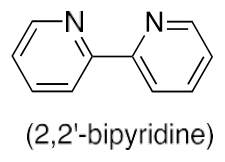
(2,2'-bipyridine)
can be drawn as:
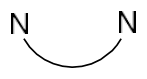
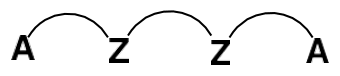
**If you did not get a structure of X from 7.2, use the following ligand symbol to represent X (A and Z are donor atoms):
7.5 Under certain conditions, the reaction shown in equation 1 affords only one diastereomer of Y. Given that structures of Y are "fixed" (no intramolecular movement), the \(\ce{^1H}\) NMR spectrum of Y in \(\ce{CDCl3}\) shows four singlet resonances at \(\delta\) 1.25, 1.30, 1.66, and 1.72 corresponding to the tert-butyl groups. Draw a structure of the only possible diastereomer of Y.
(You do not need to draw the complete structure of the ligand. Only identify donor atoms that involve in coordination and the ligand framework between the donor atoms can be drawn as shown in 7.4).
Official English text of the problem.
Answers
- 7.1: The three products are the ortho/ortho, ortho/para, and para/para bis-Mannich products. Their names and complete SMILES are given in Solution 7.1.
- 7.2: X is \(N,N'\)-bis(3,5-di-tert-butyl-2-hydroxybenzyl)-\(N,N'\)-dimethylethane-1,2-diamine, \(\ce{C34H56N2O2}\):
CN(Cc1c(O)c(C(C)(C)C)cc(C(C)(C)C)c1)CCN(C)Cc1c(O)c(C(C)(C)C)cc(C(C)(C)C)c1 - 7.3: The mole fractions, in order, are \(0,\ 0.167,\ 0.250,\ 0.417,\ 0.650,\ 0.750,\ 0.917,\ 1.000\). The graph peaks near \(0.50\), giving Ti : X = 1 : 1.
- 7.4: Writing \(\ce{X = H2L}\), Y is the titanium(IV) bis(isopropoxide) complex \(\ce{[Ti(L)(O^{i}Pr)2]}\), with formula \(\ce{C40H68N2O4Ti}\). Its three geometric diastereomers have: I, trans isopropoxide donors and cis phenolate donors; II, cis isopropoxide donors and trans phenolate donors; III, both pairs cis. Exact structures and stereochemical SMILES appear in Solution 7.4. Equation 1 has \(a=b=d=1,\ c=2\).
- 7.5: Isomer III, with both the isopropoxide pair and the phenolate pair cis, is selected. Its two aromatic rings are inequivalent, allowing four distinct tert-butyl resonances.
Solution
7.1 — The three Mannich products
The starting structures are:
- 2-tert-Butylphenol:
Oc1c(C(C)(C)C)cccc1 - Formaldehyde:
C=O - \(N,N'\)-Dimethylethane-1,2-diamine:
CNCCNC
The reaction is a Mannich aminomethylation. Each secondary amine group reacts with one formaldehyde molecule and one phenol ring, installing an aromatic \(\ce{-CH2-N}\) linkage and eliminating water, O.
Number each starting phenol ring with the hydroxyl group at C1 and tert-butyl at C2. The hydroxyl group activates the ortho and para positions. C2 is occupied, so the available positions are C6, ortho, and C4, para.
The common product framework is
\[ \mathrm{Ar^1{-}CH_2{-}N(CH_3){-}CH_2CH_2{-}N(CH_3){-}CH_2{-}Ar^2}. \]
Choosing ortho or para attachment independently on the two rings gives three distinct combinations; exchanging the two ends makes ortho/para and para/ortho identical.
Ortho/ortho product, \(P_{oo}\):
\(N,N'\)-Bis(3-tert-butyl-2-hydroxybenzyl)-\(N,N'\)-dimethylethane-1,2-diamine.
CN(Cc1c(O)c(C(C)(C)C)ccc1)CCN(C)Cc1c(O)c(C(C)(C)C)ccc1
For the drawing, attach both aminomethyl groups at C6 of their respective starting phenol rings.
Ortho/para product, \(P_{op}\):
\(N\)-(3-tert-Butyl-2-hydroxybenzyl)-\(N'\)-(3-tert-butyl-4-hydroxybenzyl)-\(N,N'\)-dimethylethane-1,2-diamine.
CN(Cc1c(O)c(C(C)(C)C)ccc1)CCN(C)Cc1cc(C(C)(C)C)c(O)cc1
Attach one aminomethyl group at C6 and the other at C4.
Para/para product, \(P_{pp}\):
\(N,N'\)-Bis(3-tert-butyl-4-hydroxybenzyl)-\(N,N'\)-dimethylethane-1,2-diamine.
CN(Cc1cc(C(C)(C)C)c(O)cc1)CCN(C)Cc1cc(C(C)(C)C)c(O)cc1
Attach both aminomethyl groups at C4.
For each product, the balanced overall equation under the stated acidic conditions is
\[ \ce{2 C10H14O + 2 CH2O + C4H12N2 -> C26H40N2O2 + 2 H2O}. \]
Thus all three structures have the required molecular formula.
7.2 — Identification of X
The new starting phenol is 2,4-di-tert-butylphenol:
Oc1c(C(C)(C)C)cc(C(C)(C)C)cc1
Its C2 ortho position and C4 para position are both occupied. Aminomethylation therefore occurs at the remaining ortho position, C6, on each ring.
Consequently, X is the ortho/ortho product named and specified in the Answers section. To draw it, use the same diamine bridge as in \(P_{oo}\), retaining tert-butyl substituents at C2 and C4 of each phenol ring.
The balanced synthesis is
\[ \ce{2 C14H22O + 2 CH2O + C4H12N2 -> C34H56N2O2 + 2 H2O}. \]
X contains two phenolic hydroxyl groups and two tertiary amine nitrogen atoms. These supply the eventual four-donor sequence
\[ \mathrm{O_1\;{\sim}\;N_1\;{\sim}\;N_2\;{\sim}\;O_2}, \]
where each curved connection represents the ligand framework between consecutive donors.
7.3 — Continuous-variation plot and stoichiometry
Let \(x_X\) denote the mole fraction requested in the table. Since both stock solutions have the same concentration,
\[ x_X =\frac{cV_X}{cV_X+cV_{\mathrm{Ti}}} =\frac{V_X}{V_X+V_{\mathrm{Ti}}} =\frac{V_X}{1.20\ \mathrm{cm^3}}. \]
The combined amount of the two reagents is constant:
\[ n_X+n_{\mathrm{Ti}} =(0.50\ \mathrm{mol\,dm^{-3}}) (1.20\times10^{-3}\ \mathrm{dm^3}) =6.0\times10^{-4}\ \mathrm{mol}. \]
Every mixture also has the same total volume, \(3.00\ \mathrm{cm^3}\). Thus the absorbances can be compared directly in a Job plot.
The completed table is:
| \(x_X\) | Absorbance at \(370\ \mathrm{nm}\) |
|---|---|
| 0.000 | 0.05 |
| 0.167 | 0.25 |
| 0.250 | 0.38 |
| 0.417 | 0.59 |
| 0.650 | 0.48 |
| 0.750 | 0.38 |
| 0.917 | 0.17 |
| 1.000 | 0.02 |
For the requested graph, place \(x_X\) on the horizontal axis from 0 to 1 and absorbance on the vertical axis. Plot these eight points. The rising and falling branches are approximately straight, and their intersection lies near \(x_X=0.50\).
For a numerical check, least-squares lines through the first four and last four points are
\[ A_{\mathrm{left}}\approx0.0454+1.3062x_X, \qquad A_{\mathrm{right}}\approx1.3406-1.3003x_X. \]
Their intersection is
\[ x_{X,\max} =\frac{1.3406-0.0454}{1.3062+1.3003} \approx0.497, \qquad A_{\max}\approx0.69. \]
The peak falls between the sampled compositions. For a complex containing \(a\) ligands X per \(b\) titanium atoms,
\[ x_{X,\max}=\frac{a}{a+b}. \]
Hence
\[ \mathrm{Ti:X} =(1-x_{X,\max}):x_{X,\max} \approx0.503:0.497 \approx\boxed{1:1}. \]
7.4 — Composition and three octahedral diastereomers
Write the neutral ligand as \(\ce{H2L}\). The absence of the broad hydroxyl absorption indicates that both phenolic groups have lost their protons.
The resulting ligand is the bis(phenolate) dianion of X, \(\ce{L^{2-}}\), with formula \(\ce{C34H54N2O2^{2-}}\):
CN(Cc1c([O-])c(C(C)(C)C)cc(C(C)(C)C)c1)CCN(C)Cc1c([O-])c(C(C)(C)C)cc(C(C)(C)C)c1
Its two phenolate oxygen atoms and two tertiary amine nitrogen atoms bind titanium. Two isopropoxide oxygen donors complete the six-coordinate, octahedral complex.
The reagent is titanium(IV) isopropoxide:
CC(C)O[Ti](OC(C)C)(OC(C)C)OC(C)C
The eliminated alcohol is propan-2-ol (isopropanol):
CC(O)C
The balanced complexation reaction is
\[ \boxed{\ce{H2L + Ti(O^{i}Pr)4 -> [Ti(L)(O^{i}Pr)2] + 2 ^{i}PrOH}}. \]
Therefore,
\[ \boxed{a=b=d=1,\qquad c=2}. \]
Charge balance is consistent with a neutral complex:
\[ (+4)_{\mathrm{Ti}}+(-2)_{\mathrm{L}}+2(-1)_{\mathrm{isopropoxide}}=0. \]
The molecular formula is consequently \(\ce{C40H68N2O4Ti}\).
For the geometry, label the phenolate donors \(\mathrm O_1,\mathrm O_2\), their respective amine donors \(\mathrm N_1,\mathrm N_2\), and the two isopropoxide oxygen donors \(\mathrm O_{a1},\mathrm O_{a2}\). The ligand connections are always
\[ \mathrm O_1{\sim}\mathrm N_1{\sim}\mathrm N_2{\sim}\mathrm O_2. \]
Each consecutive donor pair must occupy cis sites because it forms a chelate ring. There are three resulting geometric classes:
| Isomer | Isopropoxide oxygen pair | Phenolate oxygen pair |
|---|---|---|
| I | trans | cis |
| II | cis | trans |
| III | cis | cis |
The following table specifies an exact drawing of one representative of each class. Put Ti at the origin, with \(+x\) right, \(-x\) left, \(+y\) up, \(-y\) down, \(+z\) toward the reader, and \(-z\) away. Draw the \(+z\) bond as a solid wedge and the \(-z\) bond as a dashed wedge, then add the three ligand-framework connections.
| Isomer | \(+x\) | \(-x\) | \(+y\) | \(-y\) | \(+z\) | \(-z\) |
|---|---|---|---|---|---|---|
| I | \(\mathrm N_1\) | \(\mathrm O_2\) | \(\mathrm N_2\) | \(\mathrm O_1\) | \(\mathrm O_{a1}\) | \(\mathrm O_{a2}\) |
| II | \(\mathrm N_1\) | \(\mathrm O_{a1}\) | \(\mathrm N_2\) | \(\mathrm O_{a2}\) | \(\mathrm O_1\) | \(\mathrm O_2\) |
| III | \(\mathrm N_1\) | \(\mathrm O_{a1}\) | \(\mathrm N_2\) | \(\mathrm O_1\) | \(\mathrm O_2\) | \(\mathrm O_{a2}\) |
Complete stereochemical SMILES for these representatives follow. They use the extended @OH notation for octahedral stereochemistry and -> for nitrogen-to-titanium dative bonds. Nitrogen configurations are intentionally unspecified, as requested.
I — trans-Isopropoxide isomer of the titanium(IV) complex:
[Ti@OH23]123(OC(C)C)(OC(C)C)Oc4c(C(C)(C)C)cc(C(C)(C)C)cc4CN->1(C)CCN->2(C)Cc1cc(C(C)(C)C)cc(C(C)(C)C)c1O3
II — cis-Isopropoxide/trans-phenolate isomer of the titanium(IV) complex:
[Ti@OH16]123(OC(C)C)(OC(C)C)Oc4c(C(C)(C)C)cc(C(C)(C)C)cc4CN->1(C)CCN->2(C)Cc1cc(C(C)(C)C)cc(C(C)(C)C)c1O3
III — cis-Isopropoxide/cis-phenolate isomer of the titanium(IV) complex:
[Ti@OH21]123(OC(C)C)(OC(C)C)Oc4c(C(C)(C)C)cc(C(C)(C)C)cc4CN->1(C)CCN->2(C)Cc1cc(C(C)(C)C)cc(C(C)(C)C)c1O3
At the donor-framework level, II and III each have mirror-related forms. Drawing either enantiomer represents the corresponding diastereomeric class.
7.5 — Selection from the tert-butyl NMR signals
There are four tert-butyl groups: one ortho and one para to the phenolate oxygen on each aromatic ring.
In I and II, symmetry interchanges the two ligand arms. Consequently, the two ortho tert-butyl groups are equivalent to each other, and the two para tert-butyl groups are equivalent to each other. These arrangements predict two tert-butyl resonances, each accounting for 18 H.
In III, the two phenolate donors have different trans partners:
- \(\mathrm O_1\) is trans to the opposite arm’s amine donor, \(\mathrm N_2\).
- \(\mathrm O_2\) is trans to an isopropoxide oxygen, \(\mathrm O_{a2}\).
No symmetry operation interchanges the two aromatic rings. All four tert-butyl groups can therefore be chemically inequivalent, giving four singlets, each accounting for 9 H.
Thus the required drawing is precisely isomer III in the coordinate table:
\[ \boxed{\text{cis isopropoxide donors; cis phenolate donors; inequivalent ligand arms}}. \]
Its name and stereochemical SMILES are given under III above. Either enantiomer, or a racemic mixture, gives the same spectrum in achiral \(\ce{CDCl3}\); these data do not assign absolute configuration.
The answers were checked against the official answers published by the organisers.
IChO 2017 · Theorieaufgabe 7
Rätsel zu chemischen Strukturen
Titankomplexe wurden hinsichtlich ihrer Antitumoraktivität untersucht. Es hat sich gezeigt, dass viele Faktoren, darunter Isomerie und Größe, die Wirksamkeit der Komplexe beeinflussen. Diese Aufgabe behandelt die Synthese und Charakterisierung einiger Titankomplexe.
7.1 Die Reaktion von 2 Äquivalenten 2-tert-Butylphenol, 2 Äquivalenten Formaldehyd und \(N,N'\)-Dimethylethylen-1,2-diamin unter sauren Bedingungen bei \(75\,^\circ\mathrm{C}\) liefert drei Hauptprodukte mit derselben Summenformel \(\ce{C26H40N2O2}\), wie in der folgenden Gleichung gezeigt. Zeichnen Sie die Struktur jedes Produkts.
7.2 Wird bei gleicher Stöchiometrie wie in 7.1 anstelle von 2-tert-Butylphenol 2,4-Di-tert-butylphenol als Substrat verwendet, erhält man nur ein Produkt X. Zeichnen Sie die Struktur von X.
Die Reaktion zwischen X aus 7.2 und \(\ce{Ti(O^{i}Pr)4}\) [\(^{i}\mathrm{Pr}\) = Isopropyl] in Diethylether unter einer Inertgasatmosphäre lieferte bei Raumtemperatur den sechsfach koordinierten Ti-Komplex Y als gelben kristallinen Feststoff sowie Isopropanol.
Die UV/VIS-Spektren von X, \(\ce{Ti(O^{i}Pr)4}\) und Y zeigen, dass nur das Produkt Y bei \(\lambda=370\ \mathrm{nm}\) absorbiert. Durch Variation der Volumina von X und \(\ce{Ti(O^{i}Pr)}\), jeweils mit einer Konzentration von \(0.50\ \mathrm{mol\,dm^{-3}}\), und unter Verwendung von Benzol als Lösungsmittel erhält man die folgenden Extinktionswerte bei \(\lambda=370\ \mathrm{nm}\):
| Volumen von X (\(\mathrm{cm^3}\)) | Volumen von \(\ce{Ti(O^{i}Pr)4}\) (\(\mathrm{cm^3}\)) | Volumen von Benzol (\(\mathrm{cm^3}\)) | Extinktion |
|---|---|---|---|
| 0 | 1.20 | 1.80 | 0.05 |
| 0.20 | 1.00 | 1.80 | 0.25 |
| 0.30 | 0.90 | 1.80 | 0.38 |
| 0.50 | 0.70 | 1.80 | 0.59 |
| 0.78 | 0.42 | 1.80 | 0.48 |
| 0.90 | 0.30 | 1.80 | 0.38 |
| 1.10 | 0.10 | 1.80 | 0.17 |
| 1.20 | 0 | 1.80 | 0.02 |
7.3 Tragen Sie die entsprechenden Werte in die folgende Tabelle ein.
| \(\displaystyle\frac{\text{mol X}}{\text{mol X}+\text{mol }\ce{Ti(O^{i}Pr)4}}\) | Extinktion |
|---|---|
| 0.05 | |
| 0.25 | |
| 0.38 | |
| 0.59 | |
| 0.48 | |
| 0.38 | |
| 0.17 | |
| 0.02 |
Nächste Abbildung: Zeichnen Sie in den unten vorgesehenen Bereich ein Diagramm, das den Zusammenhang zwischen
\[ \frac{\text{mol X}} {\text{mol X}+\text{mol }\ce{Ti(O^{i}Pr)4}} \]
und der Extinktion zeigt.
Der Wert von
\[ \frac{\text{mol X}} {\text{mol X}+\text{mol }\ce{Ti(O^{i}Pr)4}} \]
bei dem die Menge des Produkts Y maximal ist, gibt den stöchiometrischen Anteil von X in der chemischen Formel von Y an. Geben Sie anhand des obigen Diagramms das Stoffmengenverhältnis Ti : X im Komplex Y an.
7.4 Der Titankomplex Y ist sechsfach koordiniert. Das IR-Spektrum von Y enthält keine breite Absorptionsbande im Bereich von \(3200–3600\ \mathrm{cm^{-1}}\). Y liegt in Form von drei Diastereomeren vor. Zeichnen Sie die Strukturen aller drei Diastereomere eindeutig und lassen Sie dabei die Stereochemie an den N-Atomen außer Betracht.
Beachten Sie, dass Sie die vollständige Struktur des Liganden nicht zeichnen müssen. Geben Sie lediglich die Donoratome an, die an der Koordination an Titan beteiligt sind; das Ligandengerüst zwischen den Donoratomen kann wie folgt gezeichnet werden:
Zum Beispiel:
(2,2'-Bipyridin)
kann wie folgt gezeichnet werden:
**Falls Sie in 7.2 keine Struktur für X erhalten haben, verwenden Sie das folgende Ligandensymbol zur Darstellung von X (A und Z sind Donoratome):
7.5 Unter bestimmten Bedingungen liefert die in Gleichung 1 gezeigte Reaktion nur ein Diastereomer von Y. Unter der Voraussetzung, dass die Strukturen von Y „starr“ sind (keine intramolekulare Bewegung), zeigt das \(\ce{^1H}\)-NMR-Spektrum von Y in \(\ce{CDCl3}\) vier Singulettsignale bei \(\delta\) 1.25, 1.30, 1.66 und 1.72, die den tert-Butylgruppen entsprechen. Zeichnen Sie eine Struktur des einzig möglichen Diastereomers von Y.
(Sie müssen die vollständige Struktur des Liganden nicht zeichnen. Geben Sie lediglich die an der Koordination beteiligten Donoratome an; das Ligandengerüst zwischen den Donoratomen kann wie in 7.4 gezeigt gezeichnet werden).
Aufgabentext aus dem offiziellen englischen Text übersetzt.
Antworten
- 7.1: Die drei Produkte sind die ortho/ortho-, ortho/para- und para/para-Bis-Mannich-Produkte. Ihre Namen und vollständigen SMILES sind in Lösung 7.1 angegeben.
- 7.2: X ist \(N,N'\)-Bis(3,5-di-tert-butyl-2-hydroxybenzyl)-\(N,N'\)-dimethylethan-1,2-diamin, \(\ce{C34H56N2O2}\):
CN(Cc1c(O)c(C(C)(C)C)cc(C(C)(C)C)c1)CCN(C)Cc1c(O)c(C(C)(C)C)cc(C(C)(C)C)c1 - 7.3: Die Stoffmengenanteile lauten der Reihe nach \(0,\ 0.167,\ 0.250,\ 0.417,\ 0.650,\ 0.750,\ 0.917,\ 1.000\). Das Diagramm hat sein Maximum nahe \(0.50\), woraus Ti : X = 1 : 1 folgt.
- 7.4: Mit der Schreibweise \(\ce{X = H2L}\) ist Y der Titan(IV)-Bis(isopropoxid)-Komplex \(\ce{[Ti(L)(O^{i}Pr)2]}\) mit der Summenformel \(\ce{C40H68N2O4Ti}\). Seine drei geometrischen Diastereomere weisen folgende Anordnungen auf: I, trans-ständige Isopropoxid-Donoren und cis-ständige Phenolat-Donoren; II, cis-ständige Isopropoxid-Donoren und trans-ständige Phenolat-Donoren; III, beide Paare cis-ständig. Die genauen Strukturen und stereochemischen SMILES sind in Lösung 7.4 angegeben. Für Gleichung 1 gilt \(a=b=d=1,\ c=2\).
- 7.5: Ausgewählt wird Isomer III, bei dem sowohl das Isopropoxid-Paar als auch das Phenolat-Paar cis-ständig ist. Seine beiden aromatischen Ringe sind nicht äquivalent, wodurch vier unterschiedliche tert-Butylsignale möglich sind.
Lösung
7.1 — Die drei Mannich-Produkte
Die Ausgangsstrukturen sind:
- 2-tert-Butylphenol:
Oc1c(C(C)(C)C)cccc1 - Formaldehyd:
C=O - \(N,N'\)-Dimethylethan-1,2-diamin:
CNCCNC
Bei der Reaktion handelt es sich um eine Mannich-Aminomethylierung. Jede sekundäre Aminogruppe reagiert mit einem Formaldehydmolekül und einem Phenolring, wobei eine aromatische \(\ce{-CH2-N}\)-Verknüpfung entsteht und Wasser, O, abgespalten wird.
Nummerieren Sie jeden Phenolring des Ausgangsstoffs so, dass sich die Hydroxygruppe an C1 und die tert-Butylgruppe an C2 befindet. Die Hydroxygruppe aktiviert die ortho- und para-Positionen. C2 ist besetzt, sodass C6, ortho, und C4, para, als Positionen zur Verfügung stehen.
Das gemeinsame Produktgerüst ist
\[ \mathrm{Ar^1{-}CH_2{-}N(CH_3){-}CH_2CH_2{-}N(CH_3){-}CH_2{-}Ar^2}. \]
Die unabhängige Wahl einer ortho- oder para-Verknüpfung an den beiden Ringen ergibt drei unterschiedliche Kombinationen; durch Vertauschen der beiden Enden werden ortho/para und para/ortho identisch.
Ortho/ortho-Produkt, \(P_{oo}\):
\(N,N'\)-Bis(3-tert-butyl-2-hydroxybenzyl)-\(N,N'\)-dimethylethan-1,2-diamin.
CN(Cc1c(O)c(C(C)(C)C)ccc1)CCN(C)Cc1c(O)c(C(C)(C)C)ccc1
Bringen Sie für die Zeichnung beide Aminomethylgruppen an C6 des jeweiligen Phenolrings des Ausgangsstoffs an.
Ortho/para-Produkt, \(P_{op}\):
\(N\)-(3-tert-Butyl-2-hydroxybenzyl)-\(N'\)-(3-tert-butyl-4-hydroxybenzyl)-\(N,N'\)-dimethylethan-1,2-diamin.
CN(Cc1c(O)c(C(C)(C)C)ccc1)CCN(C)Cc1cc(C(C)(C)C)c(O)cc1
Bringen Sie eine Aminomethylgruppe an C6 und die andere an C4 an.
Para/para-Produkt, \(P_{pp}\):
\(N,N'\)-Bis(3-tert-butyl-4-hydroxybenzyl)-\(N,N'\)-dimethylethan-1,2-diamin.
CN(Cc1cc(C(C)(C)C)c(O)cc1)CCN(C)Cc1cc(C(C)(C)C)c(O)cc1
Bringen Sie beide Aminomethylgruppen an C4 an.
Für jedes Produkt lautet die ausgeglichene Gesamtgleichung unter den angegebenen sauren Bedingungen
\[ \ce{2 C10H14O + 2 CH2O + C4H12N2 -> C26H40N2O2 + 2 H2O}. \]
Somit besitzen alle drei Strukturen die geforderte Summenformel.
7.2 — Identifizierung von X
Das neue Ausgangsphenol ist 2,4-Di-tert-butylphenol:
Oc1c(C(C)(C)C)cc(C(C)(C)C)cc1
Seine ortho-Position C2 und seine para-Position C4 sind beide besetzt. Die Aminomethylierung erfolgt daher an jedem Ring an der verbleibenden ortho-Position C6.
Folglich ist X das im Abschnitt Antworten benannte und angegebene ortho/ortho-Produkt. Verwenden Sie zum Zeichnen dieselbe Diaminbrücke wie in \(P_{oo}\) und behalten Sie die tert-Butylsubstituenten an C2 und C4 jedes Phenolrings bei.
Die ausgeglichene Synthesegleichung lautet
\[ \ce{2 C14H22O + 2 CH2O + C4H12N2 -> C34H56N2O2 + 2 H2O}. \]
X enthält zwei phenolische Hydroxygruppen und zwei tertiäre Aminstickstoffatome. Diese ergeben die spätere Abfolge der vier Donoratome
\[ \mathrm{O_1\;{\sim}\;N_1\;{\sim}\;N_2\;{\sim}\;O_2}, \]
wobei jede gekrümmte Verbindung das Ligandengerüst zwischen aufeinanderfolgenden Donoratomen darstellt.
7.3 — Diagramm nach der Methode der kontinuierlichen Variation und Stöchiometrie
Mit \(x_X\) sei der in der Tabelle gefragte Stoffmengenanteil bezeichnet. Da beide Stammlösungen dieselbe Konzentration haben, gilt
\[ x_X =\frac{cV_X}{cV_X+cV_{\mathrm{Ti}}} =\frac{V_X}{V_X+V_{\mathrm{Ti}}} =\frac{V_X}{1.20\ \mathrm{cm^3}}. \]
Die Gesamtstoffmenge der beiden Reagenzien ist konstant:
\[ n_X+n_{\mathrm{Ti}} =(0.50\ \mathrm{mol\,dm^{-3}}) (1.20\times10^{-3}\ \mathrm{dm^3}) =6.0\times10^{-4}\ \mathrm{mol}. \]
Jede Mischung hat außerdem dasselbe Gesamtvolumen von \(3.00\ \mathrm{cm^3}\). Daher können die Extinktionen in einem Job-Diagramm direkt miteinander verglichen werden.
Die ausgefüllte Tabelle lautet:
| \(x_X\) | Extinktion bei \(370\ \mathrm{nm}\) |
|---|---|
| 0.000 | 0.05 |
| 0.167 | 0.25 |
| 0.250 | 0.38 |
| 0.417 | 0.59 |
| 0.650 | 0.48 |
| 0.750 | 0.38 |
| 0.917 | 0.17 |
| 1.000 | 0.02 |
Tragen Sie für das geforderte Diagramm \(x_X\) auf der horizontalen Achse von 0 bis 1 und die Extinktion auf der vertikalen Achse auf. Zeichnen Sie diese acht Punkte ein. Der ansteigende und der abfallende Ast verlaufen näherungsweise geradlinig, und ihr Schnittpunkt liegt nahe \(x_X=0.50\).
Zur numerischen Überprüfung ergeben sich nach der Methode der kleinsten Quadrate für die ersten vier beziehungsweise die letzten vier Punkte die Geraden
\[ A_{\mathrm{left}}\approx0.0454+1.3062x_X, \qquad A_{\mathrm{right}}\approx1.3406-1.3003x_X. \]
Ihr Schnittpunkt ist
\[ x_{X,\max} =\frac{1.3406-0.0454}{1.3062+1.3003} \approx0.497, \qquad A_{\max}\approx0.69. \]
Das Maximum liegt zwischen den untersuchten Zusammensetzungen. Für einen Komplex mit \(a\) Liganden X pro \(b\) Titanatomen gilt
\[ x_{X,\max}=\frac{a}{a+b}. \]
Daraus folgt
\[ \mathrm{Ti:X} =(1-x_{X,\max}):x_{X,\max} \approx0.503:0.497 \approx\boxed{1:1}. \]
7.4 — Zusammensetzung und drei oktaedrische Diastereomere
Bezeichnen wir den neutralen Liganden als \(\ce{H2L}\). Das Fehlen der breiten Hydroxy-Absorptionsbande zeigt an, dass beide phenolischen Gruppen ihre Protonen abgegeben haben.
Der entstehende Ligand ist das Bis(phenolat)-Dianion von X, \(\ce{L^{2-}}\), mit der Summenformel \(\ce{C34H54N2O2^{2-}}\):
CN(Cc1c([O-])c(C(C)(C)C)cc(C(C)(C)C)c1)CCN(C)Cc1c([O-])c(C(C)(C)C)cc(C(C)(C)C)c1
Seine beiden Phenolat-Sauerstoffatome und seine beiden tertiären Aminstickstoffatome binden an Titan. Zwei Isopropoxid-Sauerstoffdonoren vervollständigen den sechsfach koordinierten, oktaedrischen Komplex.
Das Reagenz ist Titan(IV)-isopropoxid:
CC(C)O[Ti](OC(C)C)(OC(C)C)OC(C)C
Der abgespaltene Alkohol ist Propan-2-ol (Isopropanol):
CC(O)C
Die ausgeglichene Komplexbildungsreaktion lautet
\[ \boxed{\ce{H2L + Ti(O^{i}Pr)4 -> [Ti(L)(O^{i}Pr)2] + 2 ^{i}PrOH}}. \]
Somit gilt
\[ \boxed{a=b=d=1,\qquad c=2}. \]
Die Ladungsbilanz ist mit einem neutralen Komplex vereinbar:
\[ (+4)_{\mathrm{Ti}}+(-2)_{\mathrm{L}}+2(-1)_{\mathrm{isopropoxide}}=0. \]
Die Summenformel lautet folglich \(\ce{C40H68N2O4Ti}\).
Zur Beschreibung der Geometrie bezeichnen wir die Phenolat-Donoren mit \(\mathrm O_1,\mathrm O_2\), die jeweils zugehörigen Amin-Donoren mit \(\mathrm N_1,\mathrm N_2\) und die beiden Isopropoxid-Sauerstoffdonoren mit \(\mathrm O_{a1},\mathrm O_{a2}\). Die Verknüpfungen innerhalb des Liganden sind stets
\[ \mathrm O_1{\sim}\mathrm N_1{\sim}\mathrm N_2{\sim}\mathrm O_2. \]
Jedes Paar aufeinanderfolgender Donoratome muss cis-Positionen besetzen, da es einen Chelatring bildet. Daraus ergeben sich drei geometrische Klassen:
| Isomer | Isopropoxid-Sauerstoffpaar | Phenolat-Sauerstoffpaar |
|---|---|---|
| I | trans | cis |
| II | cis | trans |
| III | cis | cis |
Die folgende Tabelle legt eine genaue Zeichnung eines Vertreters jeder Klasse fest. Platzieren Sie Ti im Ursprung, wobei \(+x\) nach rechts, \(-x\) nach links, \(+y\) nach oben, \(-y\) nach unten, \(+z\) zum Betrachter hin und \(-z\) vom Betrachter weg zeigt. Zeichnen Sie die \(+z\)-Bindung als ausgefüllten Keil und die \(-z\)-Bindung als gestrichelten Keil und ergänzen Sie anschließend die drei Verbindungen des Ligandengerüsts.
| Isomer | \(+x\) | \(-x\) | \(+y\) | \(-y\) | \(+z\) | \(-z\) |
|---|---|---|---|---|---|---|
| I | \(\mathrm N_1\) | \(\mathrm O_2\) | \(\mathrm N_2\) | \(\mathrm O_1\) | \(\mathrm O_{a1}\) | \(\mathrm O_{a2}\) |
| II | \(\mathrm N_1\) | \(\mathrm O_{a1}\) | \(\mathrm N_2\) | \(\mathrm O_{a2}\) | \(\mathrm O_1\) | \(\mathrm O_2\) |
| III | \(\mathrm N_1\) | \(\mathrm O_{a1}\) | \(\mathrm N_2\) | \(\mathrm O_1\) | \(\mathrm O_2\) | \(\mathrm O_{a2}\) |
Im Folgenden sind die vollständigen stereochemischen SMILES dieser Vertreter angegeben. Sie verwenden die erweiterte @OH-Notation für die oktaedrische Stereochemie und -> für koordinative Bindungen vom Stickstoff zum Titan. Die Konfigurationen an den Stickstoffatomen bleiben wie gefordert bewusst unspezifiziert.
I — trans-Isopropoxid-Isomer des Titan(IV)-Komplexes:
[Ti@OH23]123(OC(C)C)(OC(C)C)Oc4c(C(C)(C)C)cc(C(C)(C)C)cc4CN->1(C)CCN->2(C)Cc1cc(C(C)(C)C)cc(C(C)(C)C)c1O3
II — cis-Isopropoxid/trans-Phenolat-Isomer des Titan(IV)-Komplexes:
[Ti@OH16]123(OC(C)C)(OC(C)C)Oc4c(C(C)(C)C)cc(C(C)(C)C)cc4CN->1(C)CCN->2(C)Cc1cc(C(C)(C)C)cc(C(C)(C)C)c1O3
III — cis-Isopropoxid/cis-Phenolat-Isomer des Titan(IV)-Komplexes:
[Ti@OH21]123(OC(C)C)(OC(C)C)Oc4c(C(C)(C)C)cc(C(C)(C)C)cc4CN->1(C)CCN->2(C)Cc1cc(C(C)(C)C)cc(C(C)(C)C)c1O3
Auf der Ebene des Donorgerüsts besitzen II und III jeweils spiegelbildliche Formen. Die Zeichnung eines beliebigen der beiden Enantiomere repräsentiert die entsprechende Diastereomerenklasse.
7.5 — Auswahl anhand der tert-Butyl-NMR-Signale
Es gibt vier tert-Butylgruppen: an jedem aromatischen Ring eine ortho- und eine para-ständig zum Phenolat-Sauerstoffatom.
In I und II werden die beiden Ligandenarme durch Symmetrieoperationen ineinander überführt. Folglich sind die beiden ortho-tert-Butylgruppen untereinander äquivalent, ebenso die beiden para-tert-Butylgruppen. Für diese Anordnungen werden zwei tert-Butylsignale erwartet, die jeweils 18 H entsprechen.
In III haben die beiden Phenolat-Donoren unterschiedliche trans-ständige Partner:
- \(\mathrm O_1\) steht trans zum Amin-Donor des gegenüberliegenden Arms, \(\mathrm N_2\).
- \(\mathrm O_2\) steht trans zu einem Isopropoxid-Sauerstoffatom, \(\mathrm O_{a2}\).
Keine Symmetrieoperation überführt die beiden aromatischen Ringe ineinander. Alle vier tert-Butylgruppen können daher chemisch nicht äquivalent sein und vier Singuletts ergeben, die jeweils 9 H entsprechen.
Die geforderte Zeichnung ist somit genau Isomer III in der Koordinatentabelle:
\[ \boxed{\text{cis-ständige Isopropoxid-Donoren; cis-ständige Phenolat-Donoren; nicht äquivalente Ligandenarme}}. \]
Sein Name und sein stereochemischer SMILES sind oben unter III angegeben. Jedes der beiden Enantiomere sowie ein racemisches Gemisch ergeben in achiralem \(\ce{CDCl3}\) dasselbe Spektrum; diese Daten erlauben keine Zuordnung der absoluten Konfiguration.
Die Ergebnisse wurden mit den von den Veranstaltern veröffentlichten offiziellen Ergebnissen abgeglichen.
IChO 2017 · Teori sorusu 7
Kimyasal Yapı Bulmacaları
Titanyum kompleksleri, antitümör etkinlikleri bakımından araştırılmıştır. İzomerlik ve boyutlar da dâhil olmak üzere birçok etkenin komplekslerin etkinliğini etkilediği gösterilmiştir. Bu soru, bazı titanyum komplekslerinin sentezi ve karakterizasyonuyla ilgilidir.
7.1 2 eşdeğer 2-tert-bütilfenol, 2 eşdeğer formaldehit ve \(N,N'\)-dimetiletilen-1,2-diaminin asidik koşullarda \(75\,^\circ\mathrm{C}\) sıcaklıkta tepkimesi, aşağıdaki denklemde gösterildiği gibi, aynı \(\ce{C26H40N2O2}\) kimyasal formülüne sahip üç ana ürün verir. Her ürünün yapısını çiziniz.
7.2 7.1'dekiyle aynı stokiyometri kullanılarak, başlangıç maddesi olarak 2-tert-bütilfenol yerine 2,4-di-tert-bütilfenol kullanıldığında yalnızca tek bir ürün, X, elde edilmiştir. X'in yapısını çiziniz.
7.2'deki X ile \(\ce{Ti(O^{i}Pr)4}\) [\(^{i}\mathrm{Pr}\) = izopropil] arasında dietil eter içinde, inert atmosfer altında, oda sıcaklığında gerçekleşen tepkime sonucunda sarı kristal bir katı olan altı koordinasyonlu Ti kompleksi Y ve izopropanol oluşmuştur.
X, \(\ce{Ti(O^{i}Pr)4}\) ve Y'nin UV-VIS spektrumları, yalnızca Y ürününün \(\lambda=370\ \mathrm{nm}\) dalga boyunda soğurma yaptığını göstermektedir. Her birinin derişimi \(0.50\ \mathrm{mol\,dm^{-3}}\) olan X ve \(\ce{Ti(O^{i}Pr)}\) çözeltilerinin hacimleri değiştirilerek ve çözücü olarak benzen kullanılarak elde edilen \(\lambda=370\ \mathrm{nm}\) dalga boyundaki absorbans verileri aşağıda verilmiştir:
| X hacmi (\(\mathrm{cm^3}\)) | \(\ce{Ti(O^{i}Pr)4}\) hacmi (\(\mathrm{cm^3}\)) | Benzen hacmi (\(\mathrm{cm^3}\)) | Absorbans |
|---|---|---|---|
| 0 | 1.20 | 1.80 | 0.05 |
| 0.20 | 1.00 | 1.80 | 0.25 |
| 0.30 | 0.90 | 1.80 | 0.38 |
| 0.50 | 0.70 | 1.80 | 0.59 |
| 0.78 | 0.42 | 1.80 | 0.48 |
| 0.90 | 0.30 | 1.80 | 0.38 |
| 1.10 | 0.10 | 1.80 | 0.17 |
| 1.20 | 0 | 1.80 | 0.02 |
7.3 Aşağıdaki tabloyu uygun değerlerle doldurunuz.
| \(\displaystyle\frac{\text{X'in mol sayısı}}{\text{X'in mol sayısı}+\text{mol sayısı: }\ce{Ti(O^{i}Pr)4}}\) | Absorbans |
|---|---|
| 0.05 | |
| 0.25 | |
| 0.38 | |
| 0.59 | |
| 0.48 | |
| 0.38 | |
| 0.17 | |
| 0.02 |
Sonraki şekil: Aşağıda ayrılan alana
\[ \frac{\text{X'in mol sayısı}} {\text{X'in mol sayısı}+\text{mol sayısı: }\ce{Ti(O^{i}Pr)4}} \]
ile absorbans arasındaki ilişkiyi gösteren bir grafik çiziniz.
Y ürününün miktarını en büyük yapan
\[ \frac{\text{X'in mol sayısı}} {\text{X'in mol sayısı}+\text{mol sayısı: }\ce{Ti(O^{i}Pr)4}} \]
değeri, Y'nin kimyasal formülündeki X'in stokiyometrisini temsil eder. Yukarıdaki grafiğe dayanarak Y kompleksindeki Ti : X mol oranını gösteriniz.
7.4 Titanyum kompleksi Y, altı koordinasyonludur. Y'nin IR spektrumunda \(3200–3600\ \mathrm{cm^{-1}}\) aralığında geniş bir soğurma bandı bulunmamaktadır. Y, üç diastereomer hâlinde bulunur. N atomlarındaki stereokimyayı göz ardı ederek üç diastereomerin de yapılarını açıkça çiziniz.
Ligandın yapısının tamamını çizmeniz gerekmediğine dikkat ediniz. Yalnızca titanyumla koordinasyona katılan donör atomları belirtiniz; donör atomlar arasındaki ligand iskeleti aşağıdaki gibi çizilebilir:
Örneğin:
(2,2'-bipiridin)
şu şekilde çizilebilir:
**7.2'de X için bir yapı elde edemediyseniz, X'i temsil etmek için aşağıdaki ligand simgesini kullanınız (A ve Z donör atomlardır):
7.5 Belirli koşullarda, denklem 1'de gösterilen tepkime Y'nin yalnızca bir diastereomerini verir. Y'nin yapılarının “sabit” olduğu (molekül içi hareket bulunmadığı) bilindiğine göre, Y'nin \(\ce{CDCl3}\) içindeki \(\ce{^1H}\) NMR spektrumu, tert-bütil gruplarına karşılık gelen \(\delta\) 1.25, 1.30, 1.66 ve 1.72 değerlerinde dört singlet rezonans göstermektedir. Y'nin mümkün olan tek diastereomerinin yapısını çiziniz.
(Ligandın yapısının tamamını çizmeniz gerekmez. Yalnızca koordinasyona katılan donör atomları belirtiniz; donör atomlar arasındaki ligand iskeleti 7.4'te gösterildiği gibi çizilebilir).
Soru metni resmi İngilizce metinden çevrilmiştir.
Cevaplar
- 7.1: Üç ürün, orto/orto, orto/para ve para/para bis-Mannich ürünleridir. Adları ve tam SMILES gösterimleri Çözüm 7.1'de verilmiştir.
- 7.2: X, \(N,N'\)-bis(3,5-di-tert-bütil-2-hidroksibenzil)-\(N,N'\)-dimetiletan-1,2-diamindir, \(\ce{C34H56N2O2}\):
CN(Cc1c(O)c(C(C)(C)C)cc(C(C)(C)C)c1)CCN(C)Cc1c(O)c(C(C)(C)C)cc(C(C)(C)C)c1 - 7.3: Mol kesirleri sırasıyla \(0,\ 0.167,\ 0.250,\ 0.417,\ 0.650,\ 0.750,\ 0.917,\ 1.000\) şeklindedir. Grafik \(0.50\) yakınında maksimuma ulaşır ve Ti : X = 1 : 1 oranını verir.
- 7.4: \(\ce{X = H2L}\) olarak yazıldığında Y, formülü \(\ce{C40H68N2O4Ti}\) olan titanyum(IV) bis(izopropoksit) kompleksi \(\ce{[Ti(L)(O^{i}Pr)2]}\)'dir. Üç geometrik diastereomerinde: I'de izopropoksit donörleri trans, fenolat donörleri cis; II'de izopropoksit donörleri cis, fenolat donörleri trans; III'te her iki çift de cis konumundadır. Kesin yapılar ve stereokimyasal SMILES gösterimleri Çözüm 7.4'te yer almaktadır. Denklem 1'de \(a=b=d=1,\ c=2\)'dir.
- 7.5: Hem izopropoksit çiftinin hem de fenolat çiftinin cis konumunda olduğu izomer III seçilir. İki aromatik halkası eşdeğer değildir; bu da dört farklı tert-bütil rezonansına olanak verir.
Çözüm
7.1 — Üç Mannich ürünü
Başlangıç maddelerinin yapıları şöyledir:
- 2-tert-Bütilfenol:
Oc1c(C(C)(C)C)cccc1 - Formaldehit:
C=O - \(N,N'\)-Dimetiletan-1,2-diamin:
CNCCNC
Tepkime, bir Mannich aminometillemesidir. Her sekonder amin grubu, bir formaldehit molekülü ve bir fenol halkasıyla tepkimeye girerek aromatik bir \(\ce{-CH2-N}\) bağlantısı oluşturur ve su, O, ayrılır.
Başlangıçtaki her fenol halkasını, hidroksil grubu C1'de ve tert-bütil grubu C2'de olacak şekilde numaralandıralım. Hidroksil grubu orto ve para konumlarını etkinleştirir. C2 dolu olduğundan, kullanılabilir konumlar C6, orto ve C4, para konumlarıdır.
Ortak ürün iskeleti şöyledir:
\[ \mathrm{Ar^1{-}CH_2{-}N(CH_3){-}CH_2CH_2{-}N(CH_3){-}CH_2{-}Ar^2}. \]
İki halkada orto veya para bağlanmanın birbirinden bağımsız olarak seçilmesi üç farklı kombinasyon verir; iki ucun yer değiştirmesi orto/para ile para/orto kombinasyonlarını özdeş kılar.
Orto/orto ürünü, \(P_{oo}\):
\(N,N'\)-Bis(3-tert-bütil-2-hidroksibenzil)-\(N,N'\)-dimetiletan-1,2-diamin.
CN(Cc1c(O)c(C(C)(C)C)ccc1)CCN(C)Cc1c(O)c(C(C)(C)C)ccc1
Çizimde her iki aminometil grubunu da ait oldukları başlangıç fenol halkalarının C6 konumuna bağlayınız.
Orto/para ürünü, \(P_{op}\):
\(N\)-(3-tert-Bütil-2-hidroksibenzil)-\(N'\)-(3-tert-bütil-4-hidroksibenzil)-\(N,N'\)-dimetiletan-1,2-diamin.
CN(Cc1c(O)c(C(C)(C)C)ccc1)CCN(C)Cc1cc(C(C)(C)C)c(O)cc1
Bir aminometil grubunu C6'ya, diğerini C4'e bağlayınız.
Para/para ürünü, \(P_{pp}\):
\(N,N'\)-Bis(3-tert-bütil-4-hidroksibenzil)-\(N,N'\)-dimetiletan-1,2-diamin.
CN(Cc1cc(C(C)(C)C)c(O)cc1)CCN(C)Cc1cc(C(C)(C)C)c(O)cc1
Her iki aminometil grubunu da C4'e bağlayınız.
Her ürün için, belirtilen asidik koşullardaki denkleştirilmiş toplam tepkime denklemi şöyledir:
\[ \ce{2 C10H14O + 2 CH2O + C4H12N2 -> C26H40N2O2 + 2 H2O}. \]
Böylece üç yapının tümü istenen molekül formülüne sahiptir.
7.2 — X'in belirlenmesi
Yeni başlangıç fenolü 2,4-di-tert-bütilfenoldür:
Oc1c(C(C)(C)C)cc(C(C)(C)C)cc1
Hem C2 orto konumu hem de C4 para konumu doludur. Bu nedenle aminometilleme, her halkada kalan orto konumu olan C6'da gerçekleşir.
Dolayısıyla X, Cevaplar bölümünde adı ve yapısı belirtilen orto/orto ürünüdür. Çizmek için \(P_{oo}\)'dakiyle aynı diamin köprüsünü kullanınız ve her fenol halkasının C2 ve C4 konumlarındaki tert-bütil sübstitüentlerini koruyunuz.
Denkleştirilmiş sentez tepkimesi şöyledir:
\[ \ce{2 C14H22O + 2 CH2O + C4H12N2 -> C34H56N2O2 + 2 H2O}. \]
X, iki fenolik hidroksil grubu ve iki tersiyer amin azot atomu içerir. Bunlar, son yapıda şu dört donörlü diziyi sağlar:
\[ \mathrm{O_1\;{\sim}\;N_1\;{\sim}\;N_2\;{\sim}\;O_2}, \]
burada her eğri bağlantı, ardışık donörler arasındaki ligand iskeletini temsil eder.
7.3 — Sürekli değişim grafiği ve stokiyometri
\(x_X\), tabloda istenen mol kesrini göstersin. Her iki stok çözeltinin derişimi aynı olduğundan,
\[ x_X =\frac{cV_X}{cV_X+cV_{\mathrm{Ti}}} =\frac{V_X}{V_X+V_{\mathrm{Ti}}} =\frac{V_X}{1.20\ \mathrm{cm^3}}. \]
İki reaktifin toplam madde miktarı sabittir:
\[ n_X+n_{\mathrm{Ti}} =(0.50\ \mathrm{mol\,dm^{-3}}) (1.20\times10^{-3}\ \mathrm{dm^3}) =6.0\times10^{-4}\ \mathrm{mol}. \]
Her karışımın toplam hacmi de aynıdır: \(3.00\ \mathrm{cm^3}\). Böylece absorbanslar bir Job grafiğinde doğrudan karşılaştırılabilir.
Tamamlanmış tablo şöyledir:
| \(x_X\) | \(370\ \mathrm{nm}\) dalga boyunda absorbans |
|---|---|
| 0.000 | 0.05 |
| 0.167 | 0.25 |
| 0.250 | 0.38 |
| 0.417 | 0.59 |
| 0.650 | 0.48 |
| 0.750 | 0.38 |
| 0.917 | 0.17 |
| 1.000 | 0.02 |
İstenen grafik için yatay eksene 0 ile 1 arasında \(x_X\)'i, düşey eksene absorbansı yerleştiriniz. Bu sekiz noktayı işaretleyiniz. Yükselen ve alçalan kollar yaklaşık olarak doğrusaldır ve kesişimleri \(x_X=0.50\) yakınındadır.
Sayısal bir kontrol için, ilk dört ve son dört noktaya en küçük kareler yöntemiyle uydurulan doğrular şöyledir:
\[ A_{\mathrm{left}}\approx0.0454+1.3062x_X, \qquad A_{\mathrm{right}}\approx1.3406-1.3003x_X. \]
Bu doğruların kesişimi şöyledir:
\[ x_{X,\max} =\frac{1.3406-0.0454}{1.3062+1.3003} \approx0.497, \qquad A_{\max}\approx0.69. \]
Tepe noktası, ölçüm yapılan bileşimlerin arasında yer alır. Her \(b\) titanyum atomu başına \(a\) adet X ligandı içeren bir kompleks için,
\[ x_{X,\max}=\frac{a}{a+b}. \]
Dolayısıyla
\[ \mathrm{Ti:X} =(1-x_{X,\max}):x_{X,\max} \approx0.503:0.497 \approx\boxed{1:1}. \]
7.4 — Bileşim ve üç oktahedral diastereomer
Nötr ligandı \(\ce{H2L}\) olarak yazalım. Geniş hidroksil soğurmasının bulunmaması, her iki fenolik grubun da protonlarını kaybettiğini gösterir.
Oluşan ligand, formülü \(\ce{C34H54N2O2^{2-}}\) olan X'in bis(fenolat) dianyonu, \(\ce{L^{2-}}\)'dir:
CN(Cc1c([O-])c(C(C)(C)C)cc(C(C)(C)C)c1)CCN(C)Cc1c([O-])c(C(C)(C)C)cc(C(C)(C)C)c1
İki fenolat oksijen atomu ve iki tersiyer amin azot atomu titanyuma bağlanır. İki izopropoksit oksijen donörü, altı koordinasyonlu oktahedral kompleksi tamamlar.
Reaktif, titanyum(IV) izopropoksittir:
CC(C)O[Ti](OC(C)C)(OC(C)C)OC(C)C
Ayrılan alkol, propan-2-ol (izopropanol)'dür:
CC(O)C
Denkleştirilmiş kompleksleşme tepkimesi şöyledir:
\[ \boxed{\ce{H2L + Ti(O^{i}Pr)4 -> [Ti(L)(O^{i}Pr)2] + 2 ^{i}PrOH}}. \]
Bu nedenle,
\[ \boxed{a=b=d=1,\qquad c=2}. \]
Yük dengesi, nötr bir kompleksle uyumludur:
\[ (+4)_{\mathrm{Ti}}+(-2)_{\mathrm{L}}+2(-1)_{\mathrm{isopropoxide}}=0. \]
Dolayısıyla molekül formülü \(\ce{C40H68N2O4Ti}\)'dir.
Geometri için fenolat donörlerini \(\mathrm O_1,\mathrm O_2\), bunlara karşılık gelen amin donörlerini \(\mathrm N_1,\mathrm N_2\) ve iki izopropoksit oksijen donörünü \(\mathrm O_{a1},\mathrm O_{a2}\) olarak etiketleyelim. Ligand bağlantıları her zaman şöyledir:
\[ \mathrm O_1{\sim}\mathrm N_1{\sim}\mathrm N_2{\sim}\mathrm O_2. \]
Ardışık her donör çifti, bir şelat halkası oluşturduğundan cis konumlarında bulunmalıdır. Sonuçta üç geometrik sınıf ortaya çıkar:
| İzomer | İzopropoksit oksijen çifti | Fenolat oksijen çifti |
|---|---|---|
| I | trans | cis |
| II | cis | trans |
| III | cis | cis |
Aşağıdaki tablo, her sınıftan bir temsilcinin çizimini kesin olarak tanımlar. Ti'yi orijine yerleştiriniz; \(+x\) sağa, \(-x\) sola, \(+y\) yukarı, \(-y\) aşağı, \(+z\) okuyucuya doğru ve \(-z\) okuyucudan uzağa yönelsin. \(+z\) bağını dolu kama, \(-z\) bağını kesikli kama olarak çiziniz; ardından ligand iskeletinin üç bağlantısını ekleyiniz.
| İzomer | \(+x\) | \(-x\) | \(+y\) | \(-y\) | \(+z\) | \(-z\) |
|---|---|---|---|---|---|---|
| I | \(\mathrm N_1\) | \(\mathrm O_2\) | \(\mathrm N_2\) | \(\mathrm O_1\) | \(\mathrm O_{a1}\) | \(\mathrm O_{a2}\) |
| II | \(\mathrm N_1\) | \(\mathrm O_{a1}\) | \(\mathrm N_2\) | \(\mathrm O_{a2}\) | \(\mathrm O_1\) | \(\mathrm O_2\) |
| III | \(\mathrm N_1\) | \(\mathrm O_{a1}\) | \(\mathrm N_2\) | \(\mathrm O_1\) | \(\mathrm O_2\) | \(\mathrm O_{a2}\) |
Bu temsilcilerin tam stereokimyasal SMILES gösterimleri aşağıda verilmiştir. Bunlarda oktahedral stereokimya için genişletilmiş @OH gösterimi, azottan titanyuma koordinatif bağlar için ise -> kullanılmıştır. İstendiği üzere azot konfigürasyonları bilinçli olarak belirtilmemiştir.
I — Titanyum(IV) kompleksinin trans-izopropoksit izomeri:
[Ti@OH23]123(OC(C)C)(OC(C)C)Oc4c(C(C)(C)C)cc(C(C)(C)C)cc4CN->1(C)CCN->2(C)Cc1cc(C(C)(C)C)cc(C(C)(C)C)c1O3
II — Titanyum(IV) kompleksinin cis-izopropoksit/trans-fenolat izomeri:
[Ti@OH16]123(OC(C)C)(OC(C)C)Oc4c(C(C)(C)C)cc(C(C)(C)C)cc4CN->1(C)CCN->2(C)Cc1cc(C(C)(C)C)cc(C(C)(C)C)c1O3
III — Titanyum(IV) kompleksinin cis-izopropoksit/cis-fenolat izomeri:
[Ti@OH21]123(OC(C)C)(OC(C)C)Oc4c(C(C)(C)C)cc(C(C)(C)C)cc4CN->1(C)CCN->2(C)Cc1cc(C(C)(C)C)cc(C(C)(C)C)c1O3
Donör iskeleti düzeyinde, II ve III'ün her birinin birbirinin ayna görüntüsü olan biçimleri vardır. Enantiyomerlerden herhangi birinin çizilmesi, ilgili diastereomerik sınıfı temsil eder.
7.5 — tert-Bütil NMR sinyallerinden seçim
Dört tert-bütil grubu vardır: her aromatik halkada fenolat oksijenine göre biri orto, diğeri para konumundadır.
I ve II'de simetri, iki ligand kolunu birbiriyle yer değiştirir. Dolayısıyla iki orto tert-bütil grubu birbirine eşdeğerdir ve iki para tert-bütil grubu da birbirine eşdeğerdir. Bu düzenlenmeler, her biri 18 H'ye karşılık gelen iki tert-bütil rezonansı öngörür.
III'te iki fenolat donörünün trans konumlarındaki donörler farklıdır:
- \(\mathrm O_1\), karşı kolun amin donörü \(\mathrm N_2\)'ye göre trans konumundadır.
- \(\mathrm O_2\), bir izopropoksit oksijeni olan \(\mathrm O_{a2}\)'ye göre trans konumundadır.
İki aromatik halkayı birbiriyle yer değiştiren hiçbir simetri işlemi yoktur. Bu nedenle dört tert-bütil grubunun tümü kimyasal olarak birbirinden farklı olabilir ve her biri 9 H'ye karşılık gelen dört singlet verir.
Dolayısıyla istenen çizim, koordinat tablosundaki izomer III'ün tam olarak kendisidir:
\[ \boxed{\text{cis izopropoksit donörleri; cis fenolat donörleri; eşdeğer olmayan ligand kolları}}. \]
Adı ve stereokimyasal SMILES gösterimi yukarıda III altında verilmiştir. Her iki enantiyomer de rasemik karışım da akiral \(\ce{CDCl3}\) içinde aynı spektrumu verir; bu veriler mutlak konfigürasyonu belirlemez.
Sonuçlar, düzenleyicilerin yayımladığı resmi sonuçlarla karşılaştırılarak kontrol edildi.
IChO 2017 · Problema teórico 7
Enigmas de estructuras químicas
Se han investigado complejos de titanio por su actividad antitumoral. Se ha demostrado que muchos factores, entre ellos la isomería y el tamaño, afectan a la potencia de los complejos. Esta cuestión trata de la síntesis y caracterización de algunos complejos de titanio.
7.1 La reacción de 2 equivalentes de 2-terc-butilfenol, 2 equivalentes de formaldehído y \(N,N'\)-dimetiletileno-1,2-diamina en condiciones ácidas a \(75\,^\circ\mathrm{C}\) proporciona tres productos principales con la misma fórmula química, \(\ce{C26H40N2O2}\), como se muestra en la ecuación siguiente. Dibuje la estructura de cada producto.
7.2 Si se utiliza 2,4-di-terc-butilfenol como sustrato en lugar de 2-terc-butilfenol, con la misma estequiometría que en 7.1, se obtiene un único producto X. Dibuje la estructura de X.
La reacción entre X de 7.2 y \(\ce{Ti(O^{i}Pr)4}\) [\(^{i}\mathrm{Pr}\) = isopropilo] en éter dietílico bajo atmósfera inerte dio lugar, a temperatura ambiente, al complejo de Ti Y, de número de coordinación seis, como sólido cristalino amarillo, y a isopropanol.
Los espectros UV-VIS de X, \(\ce{Ti(O^{i}Pr)4}\) y Y revelan que solo el producto Y presenta una absorción a \(\lambda=370\ \mathrm{nm}\). Al variar los volúmenes de X y \(\ce{Ti(O^{i}Pr)}\), ambos con una concentración de \(0.50\ \mathrm{mol\,dm^{-3}}\), y utilizar benceno como disolvente, se obtienen los siguientes datos de absorbancia a \(\lambda=370\ \mathrm{nm}\):
| Volumen de X (\(\mathrm{cm^3}\)) | Volumen de \(\ce{Ti(O^{i}Pr)4}\) (\(\mathrm{cm^3}\)) | Volumen de benceno (\(\mathrm{cm^3}\)) | Absorbancia |
|---|---|---|---|
| 0 | 1.20 | 1.80 | 0.05 |
| 0.20 | 1.00 | 1.80 | 0.25 |
| 0.30 | 0.90 | 1.80 | 0.38 |
| 0.50 | 0.70 | 1.80 | 0.59 |
| 0.78 | 0.42 | 1.80 | 0.48 |
| 0.90 | 0.30 | 1.80 | 0.38 |
| 1.10 | 0.10 | 1.80 | 0.17 |
| 1.20 | 0 | 1.80 | 0.02 |
7.3 Complete la tabla siguiente con los valores apropiados.
| \(\displaystyle\frac{\text{mol de X}}{\text{mol de X}+\text{mol de }\ce{Ti(O^{i}Pr)4}}\) | Absorbancia |
|---|---|
| 0.05 | |
| 0.25 | |
| 0.38 | |
| 0.59 | |
| 0.48 | |
| 0.38 | |
| 0.17 | |
| 0.02 |
Figura siguiente: Trace una gráfica que muestre la relación entre
\[ \frac{\text{moles de X}} {\text{moles de X}+\text{moles de }\ce{Ti(O^{i}Pr)4}} \]
y la absorbancia en el espacio proporcionado a continuación.
El valor de
\[ \frac{\text{moles de X}} {\text{moles de X}+\text{moles de }\ce{Ti(O^{i}Pr)4}} \]
que maximiza la cantidad del producto Y representa la estequiometría de X en la fórmula química de Y. A partir de la gráfica anterior, indique cuál es la relación molar Ti : X en el complejo Y.
7.4 El complejo de titanio Y tiene número de coordinación seis. El espectro IR de Y no contiene una banda ancha de absorción en el intervalo de \(3200–3600\ \mathrm{cm^{-1}}\). Y existe en forma de tres diastereómeros. Sin considerar la estereoquímica de los átomos de N, dibuje claramente las estructuras de los tres diastereómeros.
Tenga en cuenta que no necesita dibujar la estructura completa del ligando. Identifique únicamente los átomos donadores que participan en la coordinación con el titanio; el esqueleto del ligando entre los átomos donadores puede dibujarse como se indica a continuación:
Por ejemplo:
(2,2'-bipiridina)
puede dibujarse como:
**Si no obtuvo una estructura de X en 7.2, utilice el siguiente símbolo de ligando para representar X (A y Z son átomos donadores):
7.5 En determinadas condiciones, la reacción mostrada en la ecuación 1 proporciona un único diastereómero de Y. Dado que las estructuras de Y son «fijas» (sin movimiento intramolecular), el espectro de RMN de \(\ce{^1H}\) de Y en \(\ce{CDCl3}\) muestra cuatro señales singlete a \(\delta\) 1.25, 1.30, 1.66 y 1.72, correspondientes a los grupos terc-butilo. Dibuje una estructura del único diastereómero posible de Y.
(No necesita dibujar la estructura completa del ligando. Identifique únicamente los átomos donadores que participan en la coordinación; el esqueleto del ligando entre los átomos donadores puede dibujarse como se muestra en 7.4).
Enunciado traducido del texto oficial en inglés.
Respuestas
- 7.1: Los tres productos son los productos de bis-Mannich orto/orto, orto/para y para/para. Sus nombres y sus SMILES completos se proporcionan en la Solución 7.1.
- 7.2: X es \(N,N'\)-bis(3,5-di-terc-butil-2-hidroxibencil)-\(N,N'\)-dimetiletano-1,2-diamina, \(\ce{C34H56N2O2}\):
CN(Cc1c(O)c(C(C)(C)C)cc(C(C)(C)C)c1)CCN(C)Cc1c(O)c(C(C)(C)C)cc(C(C)(C)C)c1 - 7.3: Las fracciones molares, por orden, son \(0,\ 0.167,\ 0.250,\ 0.417,\ 0.650,\ 0.750,\ 0.917,\ 1.000\). La gráfica alcanza su máximo cerca de \(0.50\), lo que da Ti : X = 1 : 1.
- 7.4: Si se escribe \(\ce{X = H2L}\), Y es el complejo bis(isopropóxido) de titanio(IV) \(\ce{[Ti(L)(O^{i}Pr)2]}\), de fórmula \(\ce{C40H68N2O4Ti}\). Sus tres diastereómeros geométricos presentan: I, donadores isopropóxido en trans y donadores fenolato en cis; II, donadores isopropóxido en cis y donadores fenolato en trans; III, ambos pares en cis. Las estructuras exactas y los SMILES estereoquímicos aparecen en la Solución 7.4. En la ecuación 1 se cumple \(a=b=d=1,\ c=2\).
- 7.5: Se selecciona el isómero III, con el par de isopropóxidos y el par de fenolatos en cis. Sus dos anillos aromáticos no son equivalentes, lo que permite cuatro señales distintas de terc-butilo.
Solución
7.1 — Los tres productos de Mannich
Las estructuras de partida son:
- 2-terc-Butilfenol:
Oc1c(C(C)(C)C)cccc1 - Formaldehído:
C=O - \(N,N'\)-Dimetiletano-1,2-diamina:
CNCCNC
La reacción es una aminometilación de Mannich. Cada grupo amino secundario reacciona con una molécula de formaldehído y un anillo de fenol, introduciendo una unión aromática \(\ce{-CH2-N}\) y eliminando agua, O.
Numere cada anillo de fenol de partida con el grupo hidroxilo en C1 y el terc-butilo en C2. El grupo hidroxilo activa las posiciones orto y para. C2 está ocupada, por lo que las posiciones disponibles son C6, orto, y C4, para.
El esqueleto común de los productos es
\[ \mathrm{Ar^1{-}CH_2{-}N(CH_3){-}CH_2CH_2{-}N(CH_3){-}CH_2{-}Ar^2}. \]
La elección independiente de la unión en orto o para en los dos anillos da tres combinaciones distintas; al intercambiar los dos extremos, orto/para y para/orto resultan idénticas.
Producto orto/orto, \(P_{oo}\):
\(N,N'\)-Bis(3-terc-butil-2-hidroxibencil)-\(N,N'\)-dimetiletano-1,2-diamina.
CN(Cc1c(O)c(C(C)(C)C)ccc1)CCN(C)Cc1c(O)c(C(C)(C)C)ccc1
Para dibujarlo, una ambos grupos aminometilo a C6 de sus respectivos anillos de fenol de partida.
Producto orto/para, \(P_{op}\):
\(N\)-(3-terc-Butil-2-hidroxibencil)-\(N'\)-(3-terc-butil-4-hidroxibencil)-\(N,N'\)-dimetiletano-1,2-diamina.
CN(Cc1c(O)c(C(C)(C)C)ccc1)CCN(C)Cc1cc(C(C)(C)C)c(O)cc1
Una un grupo aminometilo a C6 y el otro a C4.
Producto para/para, \(P_{pp}\):
\(N,N'\)-Bis(3-terc-butil-4-hidroxibencil)-\(N,N'\)-dimetiletano-1,2-diamina.
CN(Cc1cc(C(C)(C)C)c(O)cc1)CCN(C)Cc1cc(C(C)(C)C)c(O)cc1
Una ambos grupos aminometilo a C4.
Para cada producto, la ecuación global ajustada en las condiciones ácidas indicadas es
\[ \ce{2 C10H14O + 2 CH2O + C4H12N2 -> C26H40N2O2 + 2 H2O}. \]
Por tanto, las tres estructuras tienen la fórmula molecular requerida.
7.2 — Identificación de X
El nuevo fenol de partida es el 2,4-di-terc-butilfenol:
Oc1c(C(C)(C)C)cc(C(C)(C)C)cc1
Tanto su posición orto C2 como su posición para C4 están ocupadas. Por ello, la aminometilación tiene lugar en la posición orto restante, C6, de cada anillo.
En consecuencia, X es el producto orto/orto cuyo nombre y estructura se especifican en la sección Respuestas. Para dibujarlo, utilice el mismo puente de diamina que en \(P_{oo}\), manteniendo los sustituyentes terc-butilo en C2 y C4 de cada anillo de fenol.
La ecuación ajustada de la síntesis es
\[ \ce{2 C14H22O + 2 CH2O + C4H12N2 -> C34H56N2O2 + 2 H2O}. \]
X contiene dos grupos hidroxilo fenólicos y dos átomos de nitrógeno de amina terciaria. Estos proporcionan la secuencia final de cuatro donadores
\[ \mathrm{O_1\;{\sim}\;N_1\;{\sim}\;N_2\;{\sim}\;O_2}, \]
donde cada conexión curva representa el esqueleto del ligando entre donadores consecutivos.
7.3 — Gráfica de variación continua y estequiometría
Sea \(x_X\) la fracción molar solicitada en la tabla. Dado que ambas disoluciones madre tienen la misma concentración,
\[ x_X =\frac{cV_X}{cV_X+cV_{\mathrm{Ti}}} =\frac{V_X}{V_X+V_{\mathrm{Ti}}} =\frac{V_X}{1.20\ \mathrm{cm^3}}. \]
La cantidad total de los dos reactivos es constante:
\[ n_X+n_{\mathrm{Ti}} =(0.50\ \mathrm{mol\,dm^{-3}}) (1.20\times10^{-3}\ \mathrm{dm^3}) =6.0\times10^{-4}\ \mathrm{mol}. \]
Todas las mezclas tienen también el mismo volumen total, \(3.00\ \mathrm{cm^3}\). Por tanto, las absorbancias pueden compararse directamente en una gráfica de Job.
La tabla completa es:
| \(x_X\) | Absorbancia a \(370\ \mathrm{nm}\) |
|---|---|
| 0.000 | 0.05 |
| 0.167 | 0.25 |
| 0.250 | 0.38 |
| 0.417 | 0.59 |
| 0.650 | 0.48 |
| 0.750 | 0.38 |
| 0.917 | 0.17 |
| 1.000 | 0.02 |
Para la gráfica solicitada, coloque \(x_X\) en el eje horizontal, de 0 a 1, y la absorbancia en el eje vertical. Represente estos ocho puntos. Las ramas ascendente y descendente son aproximadamente rectas, y su intersección se sitúa cerca de \(x_X=0.50\).
Como comprobación numérica, las rectas ajustadas por mínimos cuadrados a los cuatro primeros y los cuatro últimos puntos son
\[ A_{\mathrm{left}}\approx0.0454+1.3062x_X, \qquad A_{\mathrm{right}}\approx1.3406-1.3003x_X. \]
Su intersección es
\[ x_{X,\max} =\frac{1.3406-0.0454}{1.3062+1.3003} \approx0.497, \qquad A_{\max}\approx0.69. \]
El máximo se encuentra entre las composiciones muestreadas. Para un complejo que contiene \(a\) ligandos X por cada \(b\) átomos de titanio,
\[ x_{X,\max}=\frac{a}{a+b}. \]
Por tanto,
\[ \mathrm{Ti:X} =(1-x_{X,\max}):x_{X,\max} \approx0.503:0.497 \approx\boxed{1:1}. \]
7.4 — Composición y tres diastereómeros octaédricos
Escriba el ligando neutro como \(\ce{H2L}\). La ausencia de la absorción ancha del hidroxilo indica que ambos grupos fenólicos han perdido sus protones.
El ligando resultante es el dianión bis(fenolato) de X, \(\ce{L^{2-}}\), de fórmula \(\ce{C34H54N2O2^{2-}}\):
CN(Cc1c([O-])c(C(C)(C)C)cc(C(C)(C)C)c1)CCN(C)Cc1c([O-])c(C(C)(C)C)cc(C(C)(C)C)c1
Sus dos átomos de oxígeno de fenolato y sus dos átomos de nitrógeno de amina terciaria se coordinan al titanio. Dos átomos donadores de oxígeno de isopropóxido completan el complejo octaédrico de número de coordinación seis.
El reactivo es el isopropóxido de titanio(IV):
CC(C)O[Ti](OC(C)C)(OC(C)C)OC(C)C
El alcohol eliminado es el propan-2-ol (isopropanol):
CC(O)C
La reacción de complejación ajustada es
\[ \boxed{\ce{H2L + Ti(O^{i}Pr)4 -> [Ti(L)(O^{i}Pr)2] + 2 ^{i}PrOH}}. \]
Por tanto,
\[ \boxed{a=b=d=1,\qquad c=2}. \]
El balance de cargas es compatible con un complejo neutro:
\[ (+4)_{\mathrm{Ti}}+(-2)_{\mathrm{L}}+2(-1)_{\mathrm{isopropoxide}}=0. \]
La fórmula molecular es, en consecuencia, \(\ce{C40H68N2O4Ti}\).
Para la geometría, designe los donadores fenolato como \(\mathrm O_1,\mathrm O_2\), sus respectivos donadores de amina como \(\mathrm N_1,\mathrm N_2\), y los dos donadores de oxígeno de isopropóxido como \(\mathrm O_{a1},\mathrm O_{a2}\). Las conexiones del ligando son siempre
\[ \mathrm O_1{\sim}\mathrm N_1{\sim}\mathrm N_2{\sim}\mathrm O_2. \]
Cada par de donadores consecutivos debe ocupar posiciones cis porque forma un anillo quelato. De ello resultan tres clases geométricas:
| Isómero | Par de oxígenos de isopropóxido | Par de oxígenos de fenolato |
|---|---|---|
| I | trans | cis |
| II | cis | trans |
| III | cis | cis |
La tabla siguiente especifica un dibujo exacto de un representante de cada clase. Coloque Ti en el origen, con \(+x\) hacia la derecha, \(-x\) hacia la izquierda, \(+y\) hacia arriba, \(-y\) hacia abajo, \(+z\) hacia el lector y \(-z\) alejándose de él. Dibuje el enlace \(+z\) como una cuña sólida y el enlace \(-z\) como una cuña discontinua; después añada las tres conexiones del esqueleto del ligando.
| Isómero | \(+x\) | \(-x\) | \(+y\) | \(-y\) | \(+z\) | \(-z\) |
|---|---|---|---|---|---|---|
| I | \(\mathrm N_1\) | \(\mathrm O_2\) | \(\mathrm N_2\) | \(\mathrm O_1\) | \(\mathrm O_{a1}\) | \(\mathrm O_{a2}\) |
| II | \(\mathrm N_1\) | \(\mathrm O_{a1}\) | \(\mathrm N_2\) | \(\mathrm O_{a2}\) | \(\mathrm O_1\) | \(\mathrm O_2\) |
| III | \(\mathrm N_1\) | \(\mathrm O_{a1}\) | \(\mathrm N_2\) | \(\mathrm O_1\) | \(\mathrm O_2\) | \(\mathrm O_{a2}\) |
A continuación se dan los SMILES estereoquímicos completos de estos representantes. Utilizan la notación extendida @OH para la estereoquímica octaédrica y -> para los enlaces dativos de nitrógeno a titanio. Las configuraciones de los nitrógenos se dejan sin especificar de forma deliberada, tal como se solicita.
I — Isómero con isopropóxidos en trans del complejo de titanio(IV):
[Ti@OH23]123(OC(C)C)(OC(C)C)Oc4c(C(C)(C)C)cc(C(C)(C)C)cc4CN->1(C)CCN->2(C)Cc1cc(C(C)(C)C)cc(C(C)(C)C)c1O3
II — Isómero con isopropóxidos en cis/fenolatos en trans del complejo de titanio(IV):
[Ti@OH16]123(OC(C)C)(OC(C)C)Oc4c(C(C)(C)C)cc(C(C)(C)C)cc4CN->1(C)CCN->2(C)Cc1cc(C(C)(C)C)cc(C(C)(C)C)c1O3
III — Isómero con isopropóxidos en cis/fenolatos en cis del complejo de titanio(IV):
[Ti@OH21]123(OC(C)C)(OC(C)C)Oc4c(C(C)(C)C)cc(C(C)(C)C)cc4CN->1(C)CCN->2(C)Cc1cc(C(C)(C)C)cc(C(C)(C)C)c1O3
Al considerar el esqueleto de los donadores, tanto II como III presentan formas relacionadas por reflexión especular. El dibujo de cualquiera de los enantiómeros representa la clase diastereomérica correspondiente.
7.5 — Selección a partir de las señales de RMN de los grupos terc-butilo
Hay cuatro grupos terc-butilo: uno en orto y otro en para respecto al oxígeno de fenolato en cada anillo aromático.
En I y II, la simetría intercambia los dos brazos del ligando. En consecuencia, los dos grupos terc-butilo en orto son equivalentes entre sí, y los dos grupos terc-butilo en para son equivalentes entre sí. Estas disposiciones predicen dos señales de terc-butilo, cada una correspondiente a 18 H.
En III, los dos donadores fenolato tienen distintos donadores en posición trans:
- \(\mathrm O_1\) está en trans respecto al donador de amina del brazo opuesto, \(\mathrm N_2\).
- \(\mathrm O_2\) está en trans respecto a un oxígeno de isopropóxido, \(\mathrm O_{a2}\).
Ninguna operación de simetría intercambia los dos anillos aromáticos. Por tanto, los cuatro grupos terc-butilo pueden ser químicamente no equivalentes, dando cuatro singletes, cada uno correspondiente a 9 H.
Así pues, el dibujo requerido es precisamente el del isómero III de la tabla de coordenadas:
\[ \boxed{\text{donadores isopropóxido en cis; donadores fenolato en cis; brazos del ligando no equivalentes}}. \]
Su nombre y su SMILES estereoquímico se indican arriba, en el apartado III. Cualquiera de los enantiómeros, o una mezcla racémica, da el mismo espectro en \(\ce{CDCl3}\) aquiral; estos datos no permiten asignar la configuración absoluta.
Los resultados se comprobaron con los resultados oficiales publicados por los organizadores.
IChO 2017 · 理论题 7
化学结构谜题
人们已对钛配合物的抗肿瘤活性进行了研究。研究表明,包括异构现象和尺寸在内的许多因素都会影响配合物的效力。本题涉及一些钛配合物的合成与表征。
7.1 2 当量的 2-叔丁基苯酚、2 当量的甲醛与 \(N,N'\)-二甲基乙烷-1,2-二胺在酸性条件下于 \(75\,^\circ\mathrm{C}\) 反应,生成三种主要产物,它们具有相同的化学式 \(\ce{C26H40N2O2}\),如下方反应式所示。画出每种产物的结构。
7.2 若以 2,4-二叔丁基苯酚代替 2-叔丁基苯酚作为底物,并采用与 7.1 相同的化学计量比,则只得到一种产物 X。画出 X 的结构。
在惰性气氛下,7.2 中的 X 与 \(\ce{Ti(O^{i}Pr)4}\) [\(^{i}\mathrm{Pr}\) = 异丙基] 在乙醚中于室温下反应,生成六配位钛配合物 Y 和异丙醇,其中 Y 为黄色晶体固体。
X、\(\ce{Ti(O^{i}Pr)4}\) 和 Y 的紫外-可见吸收光谱表明,只有产物 Y 在 \(\lambda=370\ \mathrm{nm}\) 处有吸收。改变浓度均为 \(0.50\ \mathrm{mol\,dm^{-3}}\) 的 X 和 \(\ce{Ti(O^{i}Pr)}\) 的体积,并以苯为溶剂,测得的 \(\lambda=370\ \mathrm{nm}\) 处的吸光度数据如下:
| X 的体积(\(\mathrm{cm^3}\)) | \(\ce{Ti(O^{i}Pr)4}\) 的体积(\(\mathrm{cm^3}\)) | 苯的体积(\(\mathrm{cm^3}\)) | 吸光度 |
|---|---|---|---|
| 0 | 1.20 | 1.80 | 0.05 |
| 0.20 | 1.00 | 1.80 | 0.25 |
| 0.30 | 0.90 | 1.80 | 0.38 |
| 0.50 | 0.70 | 1.80 | 0.59 |
| 0.78 | 0.42 | 1.80 | 0.48 |
| 0.90 | 0.30 | 1.80 | 0.38 |
| 1.10 | 0.10 | 1.80 | 0.17 |
| 1.20 | 0 | 1.80 | 0.02 |
7.3 在下表中填入适当的数值。
| \(\displaystyle\frac{\text{X 的物质的量}}{\text{X 的物质的量}+\text{物质的量:}\ce{Ti(O^{i}Pr)4}}\) | 吸光度 |
|---|---|
| 0.05 | |
| 0.25 | |
| 0.38 | |
| 0.59 | |
| 0.48 | |
| 0.38 | |
| 0.17 | |
| 0.02 |
下一图:在下方提供的空白处绘制
\[ \frac{\text{X 的物质的量}} {\text{X 的物质的量}+\text{物质的量:}\ce{Ti(O^{i}Pr)4}} \]
与吸光度之间的关系图。
使产物 Y 的量达到最大值时的
\[ \frac{\text{X 的物质的量}} {\text{X 的物质的量}+\text{物质的量:}\ce{Ti(O^{i}Pr)4}} \]
数值反映了 Y 的化学式中 X 的化学计量关系。根据上图,说明配合物 Y 中 Ti : X 的摩尔比是多少。
7.4 钛配合物 Y 为六配位。Y 的红外光谱在 \(3200–3600\ \mathrm{cm^{-1}}\) 范围内没有宽吸收带。Y 存在三种非对映异构体。忽略 N 原子的立体化学,清晰地画出全部三种非对映异构体的结构。
注意,无需画出配体的完整结构。只需标明参与钛配位的配位原子,配位原子之间的配体骨架可按如下方式绘制:
例如:
(2,2'-联吡啶)
可画为:
**如果你未能在 7.2 中得到 X 的结构,请用下列配体符号表示 X(A 和 Z 为配位原子):
7.5 在某些条件下,反应式 1 所示反应只生成 Y 的一种非对映异构体。已知 Y 的结构是“固定的”(不存在分子内运动),Y 在 \(\ce{CDCl3}\) 中的 \(\ce{^1H}\) 核磁共振谱在 \(\delta\) 1.25、1.30、1.66 和 1.72 处显示四个对应于叔丁基的单峰。画出 Y 唯一可能的非对映异构体的结构。
(无需画出配体的完整结构。只需标明参与配位的配位原子,配位原子之间的配体骨架可按 7.4 所示方式绘制。)
题目译自官方英文原文。
答案
- 7.1: 三种产物为邻位/邻位、邻位/对位和对位/对位双 Mannich 反应产物。它们的名称和完整 SMILES 见解答 7.1。
- 7.2: X 为 \(N,N'\)-双(3,5-二叔丁基-2-羟基苄基)-\(N,N'\)-二甲基乙烷-1,2-二胺,\(\ce{C34H56N2O2}\):
CN(Cc1c(O)c(C(C)(C)C)cc(C(C)(C)C)c1)CCN(C)Cc1c(O)c(C(C)(C)C)cc(C(C)(C)C)c1 - 7.3: 摩尔分数依次为 \(0,\ 0.167,\ 0.250,\ 0.417,\ 0.650,\ 0.750,\ 0.917,\ 1.000\)。图线在 \(0.50\) 附近达到峰值,得到 Ti : X = 1 : 1。
- 7.4: 记 \(\ce{X = H2L}\),则 Y 为钛(IV)的双(异丙氧基)配合物 \(\ce{[Ti(L)(O^{i}Pr)2]}\),化学式为 \(\ce{C40H68N2O4Ti}\)。它的三种几何非对映异构体分别为:I,异丙氧基配位原子互为反式,酚氧基配位原子互为顺式;II,异丙氧基配位原子互为顺式,酚氧基配位原子互为反式;III,两对配位原子均互为顺式。确切结构和立体化学 SMILES 见解答 7.4。反应式 1 中有 \(a=b=d=1,\ c=2\)。
- 7.5: 选定的是异构体 III,其中异丙氧基配位原子对和酚氧基配位原子对均互为顺式。它的两个芳环不等价,因此可产生四个不同的叔丁基共振信号。
解答
7.1 — 三种 Mannich 反应产物
起始物的结构为:
- 2-叔丁基苯酚:
Oc1c(C(C)(C)C)cccc1 - 甲醛:
C=O - \(N,N'\)-二甲基乙烷-1,2-二胺:
CNCCNC
该反应是 Mannich 氨甲基化反应。每个仲胺基团与一个甲醛分子和一个苯酚环反应,在芳环上引入 \(\ce{-CH2-N}\) 连接基团,并脱去水,O。
对每个起始苯酚环进行编号,将羟基所在碳定为 C1,叔丁基所在碳定为 C2。羟基使邻位和对位活化。C2 已被占据,因此可反应的位置为 C6,邻位,以及 C4,对位。
产物的共同骨架为
\[ \mathrm{Ar^1{-}CH_2{-}N(CH_3){-}CH_2CH_2{-}N(CH_3){-}CH_2{-}Ar^2}. \]
在两个环上分别独立选择邻位或对位连接,可得到三种不同的组合;交换两端后,邻位/对位与对位/邻位相同。
邻位/邻位产物,\(P_{oo}\):
\(N,N'\)-双(3-叔丁基-2-羟基苄基)-\(N,N'\)-二甲基乙烷-1,2-二胺。
CN(Cc1c(O)c(C(C)(C)C)ccc1)CCN(C)Cc1c(O)c(C(C)(C)C)ccc1
绘图时,将两个氨甲基分别连接到各自起始苯酚环的 C6 上。
邻位/对位产物,\(P_{op}\):
\(N\)-(3-叔丁基-2-羟基苄基)-\(N'\)-(3-叔丁基-4-羟基苄基)-\(N,N'\)-二甲基乙烷-1,2-二胺。
CN(Cc1c(O)c(C(C)(C)C)ccc1)CCN(C)Cc1cc(C(C)(C)C)c(O)cc1
将一个氨甲基连接到 C6,另一个连接到 C4。
对位/对位产物,\(P_{pp}\):
\(N,N'\)-双(3-叔丁基-4-羟基苄基)-\(N,N'\)-二甲基乙烷-1,2-二胺。
CN(Cc1cc(C(C)(C)C)c(O)cc1)CCN(C)Cc1cc(C(C)(C)C)c(O)cc1
将两个氨甲基均连接到 C4。
对于每种产物,在所述酸性条件下,配平的总反应式均为
\[ \ce{2 C10H14O + 2 CH2O + C4H12N2 -> C26H40N2O2 + 2 H2O}. \]
因此,三种结构均具有所要求的分子式。
7.2 — 确定 X 的结构
新的起始苯酚为 2,4-二叔丁基苯酚:
Oc1c(C(C)(C)C)cc(C(C)(C)C)cc1
它的邻位 C2 和对位 C4 均已被占据。因此,氨甲基化发生在每个环上剩余的邻位 C6。
所以,X 即为答案部分所命名并给出结构的邻位/邻位产物。绘制时,使用与 \(P_{oo}\) 相同的二胺桥,并保留每个苯酚环上 C2 和 C4 处的叔丁基取代基。
配平的合成反应式为
\[ \ce{2 C14H22O + 2 CH2O + C4H12N2 -> C34H56N2O2 + 2 H2O}. \]
X 含有两个酚羟基和两个叔胺氮原子。它们提供了最终的四个配位原子序列
\[ \mathrm{O_1\;{\sim}\;N_1\;{\sim}\;N_2\;{\sim}\;O_2}, \]
其中每条弯曲的连接线代表相邻配位原子之间的配体骨架。
7.3 — 连续变化法作图与化学计量关系
用 \(x_X\) 表示表中要求的摩尔分数。由于两种储备液浓度相同,
\[ x_X =\frac{cV_X}{cV_X+cV_{\mathrm{Ti}}} =\frac{V_X}{V_X+V_{\mathrm{Ti}}} =\frac{V_X}{1.20\ \mathrm{cm^3}}. \]
两种试剂的总物质的量保持不变:
\[ n_X+n_{\mathrm{Ti}} =(0.50\ \mathrm{mol\,dm^{-3}}) (1.20\times10^{-3}\ \mathrm{dm^3}) =6.0\times10^{-4}\ \mathrm{mol}. \]
每份混合液的总体积也相同,均为 \(3.00\ \mathrm{cm^3}\)。因此,可在 Job 图中直接比较各吸光度。
填写完整的表格为:
| \(x_X\) | \(370\ \mathrm{nm}\) 处的吸光度 |
|---|---|
| 0.000 | 0.05 |
| 0.167 | 0.25 |
| 0.250 | 0.38 |
| 0.417 | 0.59 |
| 0.650 | 0.48 |
| 0.750 | 0.38 |
| 0.917 | 0.17 |
| 1.000 | 0.02 |
绘制所要求的图时,将 \(x_X\) 设为横坐标,范围为 0 至 1,将吸光度设为纵坐标。标出这八个点。上升段和下降段近似为直线,其交点位于 \(x_X=0.50\) 附近。
为作数值核验,对前四个点和后四个点分别进行最小二乘直线拟合,得到
\[ A_{\mathrm{left}}\approx0.0454+1.3062x_X, \qquad A_{\mathrm{right}}\approx1.3406-1.3003x_X. \]
它们的交点为
\[ x_{X,\max} =\frac{1.3406-0.0454}{1.3062+1.3003} \approx0.497, \qquad A_{\max}\approx0.69. \]
峰值位于所取样的组成之间。对于每 \(b\) 个钛原子含有 \(a\) 个配体 X 的配合物,
\[ x_{X,\max}=\frac{a}{a+b}. \]
因此
\[ \mathrm{Ti:X} =(1-x_{X,\max}):x_{X,\max} \approx0.503:0.497 \approx\boxed{1:1}. \]
7.4 — 组成及三种八面体非对映异构体
将中性配体记作 \(\ce{H2L}\)。没有出现宽的羟基吸收带,说明两个酚羟基均已失去质子。
所得配体为 X 的双酚氧基二阴离子,\(\ce{L^{2-}}\),化学式为 \(\ce{C34H54N2O2^{2-}}\):
CN(Cc1c([O-])c(C(C)(C)C)cc(C(C)(C)C)c1)CCN(C)Cc1c([O-])c(C(C)(C)C)cc(C(C)(C)C)c1
其两个酚氧基氧原子和两个叔胺氮原子与钛配位。再由两个异丙氧基氧配位原子补足配位数,形成六配位的八面体配合物。
所用试剂为异丙醇钛(IV):
CC(C)O[Ti](OC(C)C)(OC(C)C)OC(C)C
脱去的醇为 2-丙醇(异丙醇):
CC(O)C
配平的配合反应式为
\[ \boxed{\ce{H2L + Ti(O^{i}Pr)4 -> [Ti(L)(O^{i}Pr)2] + 2 ^{i}PrOH}}. \]
因此,
\[ \boxed{a=b=d=1,\qquad c=2}. \]
电荷平衡与中性配合物相符:
\[ (+4)_{\mathrm{Ti}}+(-2)_{\mathrm{L}}+2(-1)_{\mathrm{isopropoxide}}=0. \]
因此,分子式为 \(\ce{C40H68N2O4Ti}\)。
讨论几何构型时,将酚氧基配位原子标记为 \(\mathrm O_1,\mathrm O_2\),各自对应的胺配位原子标记为 \(\mathrm N_1,\mathrm N_2\),两个异丙氧基氧配位原子标记为 \(\mathrm O_{a1},\mathrm O_{a2}\)。配体的连接顺序始终为
\[ \mathrm O_1{\sim}\mathrm N_1{\sim}\mathrm N_2{\sim}\mathrm O_2. \]
每一对相邻配位原子都必须占据互为顺式的位置,因为它们形成一个螯合环。由此得到三类几何构型:
| 异构体 | 异丙氧基氧原子对 | 酚氧基氧原子对 |
|---|---|---|
| I | 反式 | 顺式 |
| II | 顺式 | 反式 |
| III | 顺式 | 顺式 |
下表给出了每一类中一个代表结构的精确绘图方式。将 Ti 置于原点,\(+x\) 向右,\(-x\) 向左,\(+y\) 向上,\(-y\) 向下,\(+z\) 朝向读者,\(-z\) 背向读者。将 \(+z\) 方向的键画为实楔形键,将 \(-z\) 方向的键画为虚楔形键,然后添加三条配体骨架连接线。
| 异构体 | \(+x\) | \(-x\) | \(+y\) | \(-y\) | \(+z\) | \(-z\) |
|---|---|---|---|---|---|---|
| I | \(\mathrm N_1\) | \(\mathrm O_2\) | \(\mathrm N_2\) | \(\mathrm O_1\) | \(\mathrm O_{a1}\) | \(\mathrm O_{a2}\) |
| II | \(\mathrm N_1\) | \(\mathrm O_{a1}\) | \(\mathrm N_2\) | \(\mathrm O_{a2}\) | \(\mathrm O_1\) | \(\mathrm O_2\) |
| III | \(\mathrm N_1\) | \(\mathrm O_{a1}\) | \(\mathrm N_2\) | \(\mathrm O_1\) | \(\mathrm O_2\) | \(\mathrm O_{a2}\) |
这些代表结构的完整立体化学 SMILES 如下。它们使用扩展的 @OH 记法表示八面体立体化学,并用 -> 表示从氮到钛的配位键。按照题目要求,有意不指定氮原子的构型。
I — 钛(IV)配合物的异丙氧基反式异构体:
[Ti@OH23]123(OC(C)C)(OC(C)C)Oc4c(C(C)(C)C)cc(C(C)(C)C)cc4CN->1(C)CCN->2(C)Cc1cc(C(C)(C)C)cc(C(C)(C)C)c1O3
II — 钛(IV)配合物的异丙氧基顺式/酚氧基反式异构体:
[Ti@OH16]123(OC(C)C)(OC(C)C)Oc4c(C(C)(C)C)cc(C(C)(C)C)cc4CN->1(C)CCN->2(C)Cc1cc(C(C)(C)C)cc(C(C)(C)C)c1O3
III — 钛(IV)配合物的异丙氧基顺式/酚氧基顺式异构体:
[Ti@OH21]123(OC(C)C)(OC(C)C)Oc4c(C(C)(C)C)cc(C(C)(C)C)cc4CN->1(C)CCN->2(C)Cc1cc(C(C)(C)C)cc(C(C)(C)C)c1O3
在配位原子骨架层面,II 和 III 各自均存在互为镜像的形式。画出任一对映异构体即可代表相应的非对映异构体类别。
7.5 — 根据叔丁基的核磁共振信号进行选择
共有四个叔丁基:每个芳环上各有一个位于酚氧基氧原子邻位的叔丁基和一个位于其对位的叔丁基。
在 I 和 II 中,对称操作可使两条配体臂互换。因此,两个邻位叔丁基彼此等价,两个对位叔丁基也彼此等价。这些排布预示会出现两个叔丁基共振信号,每个对应 18 H。
在 III 中,两个酚氧基配位原子各自的反式配位原子不同:
- 与 \(\mathrm O_1\) 互为反式的是另一条臂上的胺配位原子 \(\mathrm N_2\)。
- 与 \(\mathrm O_2\) 互为反式的是异丙氧基氧原子 \(\mathrm O_{a2}\)。
不存在可使两个芳环互换的对称操作。因此,四个叔丁基均可在化学上不等价,产生四个单峰,每个对应 9 H。
因此,所要求绘制的结构正是坐标表中的异构体 III:
\[ \boxed{\text{异丙氧基配位原子互为顺式;酚氧基配位原子互为顺式;配体臂不等价}}. \]
其名称和立体化学 SMILES 已在上文 III 项下给出。任一对映异构体或外消旋混合物在非手性溶剂 \(\ce{CDCl3}\) 中均给出相同的谱图;这些数据不能确定绝对构型。
结果已与主办方公布的官方答案核对。
IChO 2017 · Теоретическая задача 7
Загадки химических структур
Комплексы титана исследовались на противоопухолевую активность. Было показано, что многие факторы, включая изомерию и размеры, влияют на активность комплексов. Эта задача посвящена синтезу и установлению характеристик некоторых комплексов титана.
7.1 Реакция 2 эквивалентов 2-трет-бутилфенола, 2 эквивалентов формальдегида и \(N,N'\)-диметилэтилен-1,2-диамина в кислой среде при \(75\,^\circ\mathrm{C}\) приводит к образованию трёх основных продуктов с одинаковой химической формулой \(\ce{C26H40N2O2}\), как показано в приведённом ниже уравнении. Изобразите структуру каждого продукта.
7.2 Если вместо 2-трет-бутилфенола использовать в качестве исходного вещества 2,4-ди-трет-бутилфенол при том же стехиометрическом соотношении, что и в 7.1, образуется только один продукт X. Изобразите структуру X.
Реакция между X из 7.2 и \(\ce{Ti(O^{i}Pr)4}\) [\(^{i}\mathrm{Pr}\) = изопропил] в диэтиловом эфире в инертной атмосфере при комнатной температуре приводит к образованию шестикоординационного комплекса Ti Y в виде жёлтого кристаллического вещества и изопропанола.
Спектры поглощения X, \(\ce{Ti(O^{i}Pr)4}\) и Y в УФ- и видимой областях показывают, что только продукт Y поглощает при \(\lambda=370\ \mathrm{nm}\). При варьировании объёмов растворов X и \(\ce{Ti(O^{i}Pr)}\), каждый из которых имеет концентрацию \(0.50\ \mathrm{mol\,dm^{-3}}\), с использованием бензола в качестве растворителя получены следующие значения оптической плотности при \(\lambda=370\ \mathrm{nm}\):
| Объём X (\(\mathrm{cm^3}\)) | Объём \(\ce{Ti(O^{i}Pr)4}\) (\(\mathrm{cm^3}\)) | Объём бензола (\(\mathrm{cm^3}\)) | Оптическая плотность |
|---|---|---|---|
| 0 | 1.20 | 1.80 | 0.05 |
| 0.20 | 1.00 | 1.80 | 0.25 |
| 0.30 | 0.90 | 1.80 | 0.38 |
| 0.50 | 0.70 | 1.80 | 0.59 |
| 0.78 | 0.42 | 1.80 | 0.48 |
| 0.90 | 0.30 | 1.80 | 0.38 |
| 1.10 | 0.10 | 1.80 | 0.17 |
| 1.20 | 0 | 1.80 | 0.02 |
7.3 Впишите соответствующие значения в приведённую ниже таблицу.
| \(\displaystyle\frac{\text{количество молей X}}{\text{количество молей X}+\text{количество молей }\ce{Ti(O^{i}Pr)4}}\) | Оптическая плотность |
|---|---|
| 0.05 | |
| 0.25 | |
| 0.38 | |
| 0.59 | |
| 0.48 | |
| 0.38 | |
| 0.17 | |
| 0.02 |
Следующий рисунок: постройте график зависимости между
\[ \frac{\text{количество молей X}} {\text{количество молей X}+\text{количество молей }\ce{Ti(O^{i}Pr)4}} \]
и оптической плотностью в отведённом ниже месте.
Значение
\[ \frac{\text{количество молей X}} {\text{количество молей X}+\text{количество молей }\ce{Ti(O^{i}Pr)4}} \]
для максимального количества продукта Y характеризует стехиометрическое содержание X в химической формуле Y. На основании построенного выше графика определите молярное соотношение Ti : X в комплексе Y.
7.4 Комплекс титана Y имеет координационное число шесть. ИК-спектр Y не содержит широкой полосы поглощения в диапазоне \(3200–3600\ \mathrm{cm^{-1}}\). Y существует в виде трёх диастереомеров. Не учитывая стереохимию атомов N, чётко изобразите структуры всех трёх диастереомеров.
Обратите внимание, что изображать полную структуру лиганда не требуется. Достаточно обозначить донорные атомы, участвующие в координации с титаном, а каркас лиганда между донорными атомами можно изобразить следующим образом:
Например:
(2,2'-бипиридин)
можно изобразить как:
**Если вы не определили структуру X в 7.2, используйте следующее условное обозначение лиганда для представления X (A и Z — донорные атомы):
7.5 При определённых условиях реакция, приведённая в уравнении 1, даёт только один диастереомер Y. Известно, что структуры Y «фиксированы» (внутримолекулярные движения отсутствуют), а спектр ЯМР \(\ce{^1H}\) комплекса Y в \(\ce{CDCl3}\) содержит четыре синглетных сигнала при \(\delta\) 1.25, 1.30, 1.66 и 1.72, соответствующих трет-бутильным группам. Изобразите структуру единственного возможного диастереомера Y.
(Изображать полную структуру лиганда не требуется. Достаточно обозначить донорные атомы, участвующие в координации, а каркас лиганда между донорными атомами можно изобразить так, как показано в 7.4).
Условие переведено с официального английского текста.
Ответы
- 7.1: Три продукта — это орто/орто, орто/пара и пара/пара бис-продукты реакции Манниха. Их названия и полные записи SMILES приведены в решении 7.1.
- 7.2: X — это \(N,N'\)-бис(3,5-ди-трет-бутил-2-гидроксибензил)-\(N,N'\)-диметилэтан-1,2-диамин, \(\ce{C34H56N2O2}\):
CN(Cc1c(O)c(C(C)(C)C)cc(C(C)(C)C)c1)CCN(C)Cc1c(O)c(C(C)(C)C)cc(C(C)(C)C)c1 - 7.3: Мольные доли по порядку равны \(0,\ 0.167,\ 0.250,\ 0.417,\ 0.650,\ 0.750,\ 0.917,\ 1.000\). Максимум графика находится вблизи \(0.50\), что даёт Ti : X = 1 : 1.
- 7.4: Если записать \(\ce{X = H2L}\), то Y — это бис(изопропоксидный) комплекс титана(IV) \(\ce{[Ti(L)(O^{i}Pr)2]}\) с формулой \(\ce{C40H68N2O4Ti}\). Его три геометрических диастереомера имеют следующие расположения донорных атомов: I — транс-расположение изопропоксидных доноров и цис-расположение фенолятных доноров; II — цис-расположение изопропоксидных доноров и транс-расположение фенолятных доноров; III — цис-расположение обеих пар. Точные структуры и стереохимические записи SMILES приведены в решении 7.4. В уравнении 1 \(a=b=d=1,\ c=2\).
- 7.5: Подходит изомер III, в котором и изопропоксидная, и фенолятная пары находятся в цис-положении. Его два ароматических кольца неэквивалентны, что допускает наличие четырёх различных сигналов трет-бутильных групп.
Решение
7.1 — Три продукта реакции Манниха
Структуры исходных веществ:
- 2-трет-Бутилфенол:
Oc1c(C(C)(C)C)cccc1 - Формальдегид:
C=O - \(N,N'\)-Диметилэтан-1,2-диамин:
CNCCNC
Данная реакция представляет собой аминометилирование по Манниху. Каждая вторичная аминогруппа реагирует с одной молекулой формальдегида и одним фенольным кольцом, образуя при ароматическом кольце фрагмент \(\ce{-CH2-N}\) с отщеплением воды, O.
Пронумеруем каждое исходное фенольное кольцо так, чтобы гидроксильная группа находилась при C1, а трет-бутильная — при C2. Гидроксильная группа активирует орто- и пара-положения. Положение C2 занято, поэтому доступны C6, орто, и C4, пара.
Общий каркас продуктов имеет вид
\[ \mathrm{Ar^1{-}CH_2{-}N(CH_3){-}CH_2CH_2{-}N(CH_3){-}CH_2{-}Ar^2}. \]
Независимый выбор орто- или пара-положения присоединения на каждом из двух колец даёт три различные комбинации; перестановка двух концов делает комбинации орто/пара и пара/орто идентичными.
Орто/орто-продукт, \(P_{oo}\):
\(N,N'\)-Бис(3-трет-бутил-2-гидроксибензил)-\(N,N'\)-диметилэтан-1,2-диамин.
CN(Cc1c(O)c(C(C)(C)C)ccc1)CCN(C)Cc1c(O)c(C(C)(C)C)ccc1
На рисунке присоедините обе аминометильные группы в положениях C6 соответствующих исходных фенольных колец.
Орто/пара-продукт, \(P_{op}\):
\(N\)-(3-трет-Бутил-2-гидроксибензил)-\(N'\)-(3-трет-бутил-4-гидроксибензил)-\(N,N'\)-диметилэтан-1,2-диамин.
CN(Cc1c(O)c(C(C)(C)C)ccc1)CCN(C)Cc1cc(C(C)(C)C)c(O)cc1
Присоедините одну аминометильную группу в положении C6, а другую — в положении C4.
Пара/пара-продукт, \(P_{pp}\):
\(N,N'\)-Бис(3-трет-бутил-4-гидроксибензил)-\(N,N'\)-диметилэтан-1,2-диамин.
CN(Cc1cc(C(C)(C)C)c(O)cc1)CCN(C)Cc1cc(C(C)(C)C)c(O)cc1
Присоедините обе аминометильные группы в положениях C4.
Для каждого продукта сбалансированное суммарное уравнение реакции в указанных кислых условиях имеет вид
\[ \ce{2 C10H14O + 2 CH2O + C4H12N2 -> C26H40N2O2 + 2 H2O}. \]
Таким образом, все три структуры имеют требуемую молекулярную формулу.
7.2 — Установление структуры X
Новый исходный фенол — 2,4-ди-трет-бутилфенол:
Oc1c(C(C)(C)C)cc(C(C)(C)C)cc1
Его орто-положение C2 и пара-положение C4 заняты. Поэтому аминометилирование происходит в оставшемся орто-положении C6 каждого кольца.
Следовательно, X — это орто/орто-продукт, название и структура которого приведены в разделе «Ответы». Чтобы изобразить его, используйте тот же диаминовый мостик, что и в \(P_{oo}\), сохранив трет-бутильные заместители при C2 и C4 каждого фенольного кольца.
Сбалансированное уравнение синтеза:
\[ \ce{2 C14H22O + 2 CH2O + C4H12N2 -> C34H56N2O2 + 2 H2O}. \]
X содержит две фенольные гидроксильные группы и два атома азота третичных аминогрупп. Они образуют следующую последовательность четырёх донорных атомов в будущем комплексе:
\[ \mathrm{O_1\;{\sim}\;N_1\;{\sim}\;N_2\;{\sim}\;O_2}, \]
где каждая изогнутая линия обозначает каркас лиганда между последовательными донорными атомами.
7.3 — График метода непрерывных изменений и стехиометрия
Обозначим через \(x_X\) мольную долю, которую требуется указать в таблице. Поскольку оба исходных раствора имеют одинаковую концентрацию,
\[ x_X =\frac{cV_X}{cV_X+cV_{\mathrm{Ti}}} =\frac{V_X}{V_X+V_{\mathrm{Ti}}} =\frac{V_X}{1.20\ \mathrm{cm^3}}. \]
Суммарное количество двух реагентов постоянно:
\[ n_X+n_{\mathrm{Ti}} =(0.50\ \mathrm{mol\,dm^{-3}}) (1.20\times10^{-3}\ \mathrm{dm^3}) =6.0\times10^{-4}\ \mathrm{mol}. \]
Каждая смесь также имеет одинаковый общий объём, \(3.00\ \mathrm{cm^3}\). Поэтому значения оптической плотности можно непосредственно сравнивать на графике Жоба.
Заполненная таблица:
| \(x_X\) | Оптическая плотность при \(370\ \mathrm{nm}\) |
|---|---|
| 0.000 | 0.05 |
| 0.167 | 0.25 |
| 0.250 | 0.38 |
| 0.417 | 0.59 |
| 0.650 | 0.48 |
| 0.750 | 0.38 |
| 0.917 | 0.17 |
| 1.000 | 0.02 |
Для построения требуемого графика отложите \(x_X\) по горизонтальной оси от 0 до 1, а оптическую плотность — по вертикальной оси. Нанесите эти восемь точек. Восходящая и нисходящая ветви приблизительно прямолинейны, а их пересечение находится вблизи \(x_X=0.50\).
Для численной проверки уравнения прямых, полученных методом наименьших квадратов по первым четырём и последним четырём точкам, имеют вид
\[ A_{\mathrm{left}}\approx0.0454+1.3062x_X, \qquad A_{\mathrm{right}}\approx1.3406-1.3003x_X. \]
Их пересечение:
\[ x_{X,\max} =\frac{1.3406-0.0454}{1.3062+1.3003} \approx0.497, \qquad A_{\max}\approx0.69. \]
Максимум приходится на состав между исследованными составами смесей. Для комплекса, содержащего \(a\) лигандов X на \(b\) атомов титана,
\[ x_{X,\max}=\frac{a}{a+b}. \]
Следовательно,
\[ \mathrm{Ti:X} =(1-x_{X,\max}):x_{X,\max} \approx0.503:0.497 \approx\boxed{1:1}. \]
7.4 — Состав и три октаэдрических диастереомера
Запишем нейтральный лиганд как \(\ce{H2L}\). Отсутствие широкой полосы поглощения гидроксильных групп указывает на то, что обе фенольные группы потеряли протоны.
Образующийся лиганд представляет собой бис(фенолятный) дианион X, \(\ce{L^{2-}}\), с формулой \(\ce{C34H54N2O2^{2-}}\):
CN(Cc1c([O-])c(C(C)(C)C)cc(C(C)(C)C)c1)CCN(C)Cc1c([O-])c(C(C)(C)C)cc(C(C)(C)C)c1
Его два фенолятных атома кислорода и два атома азота третичных аминогрупп связываются с титаном. Два донорных атома кислорода изопропоксидных групп дополняют координационную сферу до шестикоординационного октаэдрического комплекса.
Реагент — изопропоксид титана(IV):
CC(C)O[Ti](OC(C)C)(OC(C)C)OC(C)C
Отщепляющийся спирт — пропан-2-ол (изопропанол):
CC(O)C
Сбалансированное уравнение реакции комплексообразования:
\[ \boxed{\ce{H2L + Ti(O^{i}Pr)4 -> [Ti(L)(O^{i}Pr)2] + 2 ^{i}PrOH}}. \]
Таким образом,
\[ \boxed{a=b=d=1,\qquad c=2}. \]
Баланс зарядов согласуется с нейтральностью комплекса:
\[ (+4)_{\mathrm{Ti}}+(-2)_{\mathrm{L}}+2(-1)_{\mathrm{isopropoxide}}=0. \]
Следовательно, молекулярная формула — \(\ce{C40H68N2O4Ti}\).
Для описания геометрии обозначим фенолятные донорные атомы как \(\mathrm O_1,\mathrm O_2\), соответствующие им аминные донорные атомы — как \(\mathrm N_1,\mathrm N_2\), а два донорных атома кислорода изопропоксидных групп — как \(\mathrm O_{a1},\mathrm O_{a2}\). Связи в каркасе лиганда всегда имеют вид
\[ \mathrm O_1{\sim}\mathrm N_1{\sim}\mathrm N_2{\sim}\mathrm O_2. \]
Каждая пара последовательных донорных атомов должна занимать цис-положения, поскольку она образует хелатный цикл. В результате получаются три геометрических класса:
| Изомер | Пара атомов кислорода изопропоксидных групп | Пара фенолятных атомов кислорода |
|---|---|---|
| I | транс | цис |
| II | цис | транс |
| III | цис | цис |
Следующая таблица точно задаёт изображение одного представителя каждого класса. Поместите Ti в начало координат, направив \(+x\) вправо, \(-x\) влево, \(+y\) вверх, \(-y\) вниз, \(+z\) к читателю, а \(-z\) от читателя. Изобразите связь в направлении \(+z\) сплошным клином, а связь в направлении \(-z\) — штриховым клином, затем добавьте три соединяющих донорные атомы фрагмента каркаса лиганда.
| Изомер | \(+x\) | \(-x\) | \(+y\) | \(-y\) | \(+z\) | \(-z\) |
|---|---|---|---|---|---|---|
| I | \(\mathrm N_1\) | \(\mathrm O_2\) | \(\mathrm N_2\) | \(\mathrm O_1\) | \(\mathrm O_{a1}\) | \(\mathrm O_{a2}\) |
| II | \(\mathrm N_1\) | \(\mathrm O_{a1}\) | \(\mathrm N_2\) | \(\mathrm O_{a2}\) | \(\mathrm O_1\) | \(\mathrm O_2\) |
| III | \(\mathrm N_1\) | \(\mathrm O_{a1}\) | \(\mathrm N_2\) | \(\mathrm O_1\) | \(\mathrm O_2\) | \(\mathrm O_{a2}\) |
Ниже приведены полные стереохимические записи SMILES для этих представителей. В них используется расширенное обозначение @OH для октаэдрической стереохимии и -> для донорно-акцепторных связей от азота к титану. Конфигурации атомов азота намеренно не указаны, как и требуется в условии.
I — Изомер комплекса титана(IV) с транс-расположением изопропоксидных групп:
[Ti@OH23]123(OC(C)C)(OC(C)C)Oc4c(C(C)(C)C)cc(C(C)(C)C)cc4CN->1(C)CCN->2(C)Cc1cc(C(C)(C)C)cc(C(C)(C)C)c1O3
II — Изомер комплекса титана(IV) с цис-расположением изопропоксидных и транс-расположением фенолятных групп:
[Ti@OH16]123(OC(C)C)(OC(C)C)Oc4c(C(C)(C)C)cc(C(C)(C)C)cc4CN->1(C)CCN->2(C)Cc1cc(C(C)(C)C)cc(C(C)(C)C)c1O3
III — Изомер комплекса титана(IV) с цис-расположением изопропоксидных и цис-расположением фенолятных групп:
[Ti@OH21]123(OC(C)C)(OC(C)C)Oc4c(C(C)(C)C)cc(C(C)(C)C)cc4CN->1(C)CCN->2(C)Cc1cc(C(C)(C)C)cc(C(C)(C)C)c1O3
На уровне каркаса, соединяющего донорные атомы, II и III имеют по две зеркально сопряжённые формы. Изображение любого из энантиомеров представляет соответствующий диастереомерный класс.
7.5 — Выбор по сигналам трет-бутильных групп в спектре ЯМР
Всего имеются четыре трет-бутильные группы: на каждом ароматическом кольце одна находится в орто-положении, а другая — в пара-положении относительно фенолятного атома кислорода.
В I и II операция симметрии переводит две ветви лиганда друг в друга. Следовательно, две орто-трет-бутильные группы эквивалентны друг другу, как и две пара-трет-бутильные группы. Для этих конфигураций ожидаются два сигнала трет-бутильных групп, каждый из которых соответствует 18 H.
В III два фенолятных донорных атома имеют разные донорные атомы в транс-положении к ним:
- \(\mathrm O_1\) находится в транс-положении к аминному донорному атому противоположной ветви, \(\mathrm N_2\).
- \(\mathrm O_2\) находится в транс-положении к атому кислорода изопропоксидной группы, \(\mathrm O_{a2}\).
Ни одна операция симметрии не переводит два ароматических кольца друг в друга. Поэтому все четыре трет-бутильные группы могут быть химически неэквивалентными, давая четыре синглета, каждый из которых соответствует 9 H.
Таким образом, требуемый рисунок в точности соответствует изомеру III в координатной таблице:
\[ \boxed{\text{цис-расположение изопропоксидных доноров; цис-расположение фенолятных доноров; неэквивалентные ветви лиганда}}. \]
Его название и стереохимическая запись SMILES приведены выше под обозначением III. Любой из энантиомеров или их рацемическая смесь даёт один и тот же спектр в ахиральном \(\ce{CDCl3}\); эти данные не позволяют установить абсолютную конфигурацию.
Ответы проверены по официальным ответам, опубликованным организаторами.
IChO 2017 · مسألة نظرية 7
ألغاز البنية الكيميائية
دُرست معقّدات التيتانيوم من حيث نشاطها المضاد للأورام. وقد تبيّن أن عوامل عديدة، منها التصاوغ والأحجام، تؤثر في فعالية هذه المعقّدات. تتناول هذه المسألة تحضير بعض معقّدات التيتانيوم وتوصيفها.
7.1 يؤدي تفاعل مكافئين من 2-ثالثي-بيوتيل فينول، ومكافئين من الفورمالدهيد، و\(N,N'\)-ثنائي ميثيل إيثيلين-1,2-ثنائي الأمين في وسط حمضي عند \(75\,^\circ\mathrm{C}\) إلى ثلاثة نواتج رئيسية لها الصيغة الكيميائية نفسها، وهي \(\ce{C26H40N2O2}\)، كما هو موضح في المعادلة أدناه. ارسم بنية كل ناتج.
7.2 إذا استُخدم 2,4-ثنائي-ثالثي-بيوتيل فينول ركيزةً بدلًا من 2-ثالثي-بيوتيل فينول، وبالنسب الستوكيومترية نفسها المستخدمة في 7.1، فلا يُحصل إلا على ناتج واحد X. ارسم بنية X.
أدى تفاعل بين X من 7.2 و\(\ce{Ti(O^{i}Pr)4}\) [\(^{i}\mathrm{Pr}\) = أيزوبروبيل] في ثنائي إيثيل الإيثر تحت جو خامل إلى تكوّن معقّد Ti سداسي التناسق Y على هيئة صلب بلوري أصفر، وأيزوبروبانول، عند درجة حرارة الغرفة.
تكشف أطياف الأشعة فوق البنفسجية والمرئية لكل من X و\(\ce{Ti(O^{i}Pr)4}\) وY أن الناتج Y وحده يُظهر امتصاصًا عند \(\lambda=370\ \mathrm{nm}\). وبتغيير حجمي X و\(\ce{Ti(O^{i}Pr)}\)، وتركيز كل منهما \(0.50\ \mathrm{mol\,dm^{-3}}\)، واستخدام البنزين مذيبًا، تكون بيانات الامتصاصية عند \(\lambda=370\ \mathrm{nm}\) كما يلي:
| حجم X (\(\mathrm{cm^3}\)) | حجم \(\ce{Ti(O^{i}Pr)4}\) (\(\mathrm{cm^3}\)) | حجم البنزين (\(\mathrm{cm^3}\)) | الامتصاصية |
|---|---|---|---|
| 0 | 1.20 | 1.80 | 0.05 |
| 0.20 | 1.00 | 1.80 | 0.25 |
| 0.30 | 0.90 | 1.80 | 0.38 |
| 0.50 | 0.70 | 1.80 | 0.59 |
| 0.78 | 0.42 | 1.80 | 0.48 |
| 0.90 | 0.30 | 1.80 | 0.38 |
| 1.10 | 0.10 | 1.80 | 0.17 |
| 1.20 | 0 | 1.80 | 0.02 |
7.3 املأ الجدول أدناه بالقيم المناسبة.
| \(\displaystyle\frac{\text{مولات X}}{\text{مولات X}+\text{مولات }\ce{Ti(O^{i}Pr)4}}\) | الامتصاصية |
|---|---|
| 0.05 | |
| 0.25 | |
| 0.38 | |
| 0.59 | |
| 0.48 | |
| 0.38 | |
| 0.17 | |
| 0.02 |
الشكل التالي: ارسم منحنى بيانيًا يوضح العلاقة بين
\[ \frac{\text{مولات X}} {\text{مولات X}+\text{مولات }\ce{Ti(O^{i}Pr)4}} \]
والامتصاصية في المساحة المخصصة أدناه.
إن قيمة
\[ \frac{\text{مولات X}} {\text{مولات X}+\text{مولات }\ce{Ti(O^{i}Pr)4}} \]
التي تجعل كمية الناتج Y عظمى تمثل النسبة الستوكيومترية لـ X في الصيغة الكيميائية لـ Y. استنادًا إلى المنحنى أعلاه، بيّن النسبة المولية Ti : X في المعقّد Y.
7.4 معقّد التيتانيوم Y سداسي التناسق. لا يحتوي طيف الأشعة تحت الحمراء لـ Y على حزمة امتصاص عريضة في المجال \(3200–3600\ \mathrm{cm^{-1}}\). يوجد Y على هيئة ثلاثة متصاوغات فراغية غير مرآتية. مع إهمال الكيمياء الفراغية عند ذرات N، ارسم بوضوح بنى المتصاوغات الفراغية غير المرآتية الثلاثة جميعها.
لاحظ أنك لست بحاجة إلى رسم البنية الكاملة للربيطة. حدّد فقط الذرات المانحة المشاركة في التناسق مع التيتانيوم، ويمكن رسم هيكل الربيطة بين الذرات المانحة على النحو الآتي:
على سبيل المثال:
(2,2'-ثنائي البيريدين)
يمكن رسمه على النحو الآتي:
**إذا لم تتوصل إلى بنية X في 7.2، فاستخدم رمز الربيطة التالي لتمثيل X (A وZ ذرتان مانحتان):
7.5 في ظروف معينة، يعطي التفاعل الموضح في المعادلة 1 متصاوغًا فراغيًا غير مرآتي واحدًا فقط من Y. علمًا بأن بنى Y «ثابتة» (لا توجد حركة داخل الجزيء)، يُظهر طيف الرنين المغناطيسي النووي لـ \(\ce{^1H}\) للمعقّد Y في \(\ce{CDCl3}\) أربع إشارات رنين مفردة عند \(\delta\) 1.25 و1.30 و1.66 و1.72، تقابل مجموعات ثالثي-بيوتيل. ارسم بنية المتصاوغ الفراغي غير المرآتي الوحيد الممكن لـ Y.
(لست بحاجة إلى رسم البنية الكاملة للربيطة. حدّد فقط الذرات المانحة المشاركة في التناسق، ويمكن رسم هيكل الربيطة بين الذرات المانحة كما هو موضح في 7.4).
نص المسألة مترجم عن النص الإنجليزي الرسمي.
الإجابات
- 7.1: النواتج الثلاثة هي نواتج مانّيش المزدوجة أورثو/أورثو وأورثو/بارا وبارا/بارا. ترد أسماؤها وسلاسل SMILES الكاملة الخاصة بها في الحل 7.1.
- 7.2: X هو \(N,N'\)-بيس(3,5-ثنائي-ثالثي-بيوتيل-2-هيدروكسي بنزيل)-\(N,N'\)-ثنائي ميثيل إيثان-1,2-ثنائي الأمين، \(\ce{C34H56N2O2}\):
CN(Cc1c(O)c(C(C)(C)C)cc(C(C)(C)C)c1)CCN(C)Cc1c(O)c(C(C)(C)C)cc(C(C)(C)C)c1 - 7.3: الكسور المولية، بالترتيب، هي \(0,\ 0.167,\ 0.250,\ 0.417,\ 0.650,\ 0.750,\ 0.917,\ 1.000\). يبلغ المنحنى ذروته قرب \(0.50\)، مما يعطي Ti : X = 1 : 1.
- 7.4: بكتابة \(\ce{X = H2L}\)، يكون Y معقّد بيس(أيزوبروبوكسيد) التيتانيوم(IV)، \(\ce{[Ti(L)(O^{i}Pr)2]}\)، وصيغته \(\ce{C40H68N2O4Ti}\). تتصف متصاوغاته الهندسية الثلاثة غير المرآتية بما يلي: I، ذرتا أيزوبروبوكسيد مانحتان في وضع ترانس وذرتا فينولات مانحتان في وضع سيس؛ II، ذرتا أيزوبروبوكسيد مانحتان في وضع سيس وذرتا فينولات مانحتان في وضع ترانس؛ III، كلا الزوجين في وضع سيس. ترد البنى الدقيقة وسلاسل SMILES التي تصف الكيمياء الفراغية في الحل 7.4. في المعادلة 1، \(a=b=d=1,\ c=2\).
- 7.5: يُختار المتصاوغ III، الذي يكون فيه كل من زوج الأيزوبروبوكسيد وزوج الفينولات في وضع سيس. حلقتاه العطريتان غير متكافئتين، مما يتيح ظهور أربع إشارات رنين متميزة لمجموعات ثالثي-بيوتيل.
الحل
7.1 — نواتج مانّيش الثلاثة
بنى المواد الابتدائية هي:
- 2-ثالثي-بيوتيل فينول:
Oc1c(C(C)(C)C)cccc1 - الفورمالدهيد:
C=O - \(N,N'\)-ثنائي ميثيل إيثان-1,2-ثنائي الأمين:
CNCCNC
التفاعل هو إدخال مجموعة أمينوميثيل بتفاعل مانّيش. تتفاعل كل مجموعة أمين ثانوي مع جزيء واحد من الفورمالدهيد وحلقة فينول واحدة، فتُنشئ رابطة \(\ce{-CH2-N}\) متصلة بالحلقة العطرية، مع حذف الماء، O.
رقّم كل حلقة فينول ابتدائية بحيث تكون مجموعة الهيدروكسيل عند C1 ومجموعة ثالثي-بيوتيل عند C2. تنشّط مجموعة الهيدروكسيل موضعي أورثو وبارا. الموضع C2 مشغول، لذا فإن الموضعين المتاحين هما C6، أورثو، وC4، بارا.
الهيكل المشترك للنواتج هو
\[ \mathrm{Ar^1{-}CH_2{-}N(CH_3){-}CH_2CH_2{-}N(CH_3){-}CH_2{-}Ar^2}. \]
يؤدي اختيار الارتباط عند أورثو أو بارا بصورة مستقلة على الحلقتين إلى ثلاث توليفات متميزة؛ إذ يجعل تبادل الطرفين أورثو/بارا وبارا/أورثو متطابقين.
ناتج أورثو/أورثو، \(P_{oo}\):
\(N,N'\)-بيس(3-ثالثي-بيوتيل-2-هيدروكسي بنزيل)-\(N,N'\)-ثنائي ميثيل إيثان-1,2-ثنائي الأمين.
CN(Cc1c(O)c(C(C)(C)C)ccc1)CCN(C)Cc1c(O)c(C(C)(C)C)ccc1
لرسم البنية، صِل كلتا مجموعتي الأمينوميثيل عند C6 في حلقة الفينول الابتدائية الخاصة بكل منهما.
ناتج أورثو/بارا، \(P_{op}\):
\(N\)-(3-ثالثي-بيوتيل-2-هيدروكسي بنزيل)-\(N'\)-(3-ثالثي-بيوتيل-4-هيدروكسي بنزيل)-\(N,N'\)-ثنائي ميثيل إيثان-1,2-ثنائي الأمين.
CN(Cc1c(O)c(C(C)(C)C)ccc1)CCN(C)Cc1cc(C(C)(C)C)c(O)cc1
صِل إحدى مجموعتي الأمينوميثيل عند C6 والأخرى عند C4.
ناتج بارا/بارا، \(P_{pp}\):
\(N,N'\)-بيس(3-ثالثي-بيوتيل-4-هيدروكسي بنزيل)-\(N,N'\)-ثنائي ميثيل إيثان-1,2-ثنائي الأمين.
CN(Cc1cc(C(C)(C)C)c(O)cc1)CCN(C)Cc1cc(C(C)(C)C)c(O)cc1
صِل كلتا مجموعتي الأمينوميثيل عند C4.
لكل ناتج، تكون المعادلة الإجمالية الموزونة في الظروف الحمضية المذكورة هي
\[ \ce{2 C10H14O + 2 CH2O + C4H12N2 -> C26H40N2O2 + 2 H2O}. \]
إذن، تمتلك البنى الثلاث جميعها الصيغة الجزيئية المطلوبة.
7.2 — تحديد هوية X
الفينول الابتدائي الجديد هو 2,4-ثنائي-ثالثي-بيوتيل فينول:
Oc1c(C(C)(C)C)cc(C(C)(C)C)cc1
كل من موضع أورثو C2 وموضع بارا C4 فيه مشغول. لذلك يحدث إدخال مجموعة الأمينوميثيل عند موضع أورثو المتبقي، C6، على كل حلقة.
وعليه، فإن X هو ناتج أورثو/أورثو الذي ورد اسمه ووصفه في قسم الإجابات. ولرسمه، استخدم جسر ثنائي الأمين نفسه الموجود في \(P_{oo}\)، مع الإبقاء على مستبدلات ثالثي-بيوتيل عند C2 وC4 في كل حلقة فينول.
معادلة التحضير الموزونة هي
\[ \ce{2 C14H22O + 2 CH2O + C4H12N2 -> C34H56N2O2 + 2 H2O}. \]
يحتوي X على مجموعتي هيدروكسيل فينوليتين وذرتي نيتروجين من أمينين ثالثيين. وتوفّر هذه الذرات في النهاية تسلسل الذرات المانحة الأربع
\[ \mathrm{O_1\;{\sim}\;N_1\;{\sim}\;N_2\;{\sim}\;O_2}, \]
حيث تمثل كل وصلة منحنية هيكل الربيطة بين ذرتين مانحتين متتاليتين.
7.3 — منحنى التغيّر المستمر والنسب الستوكيومترية
ليكن \(x_X\) رمزًا للكسر المولي المطلوب في الجدول. بما أن المحلولين الأصليين لهما التركيز نفسه، فإن
\[ x_X =\frac{cV_X}{cV_X+cV_{\mathrm{Ti}}} =\frac{V_X}{V_X+V_{\mathrm{Ti}}} =\frac{V_X}{1.20\ \mathrm{cm^3}}. \]
مجموع كميتي الكاشفين ثابت:
\[ n_X+n_{\mathrm{Ti}} =(0.50\ \mathrm{mol\,dm^{-3}}) (1.20\times10^{-3}\ \mathrm{dm^3}) =6.0\times10^{-4}\ \mathrm{mol}. \]
كذلك يكون الحجم الكلي لكل مزيج متساويًا، وهو \(3.00\ \mathrm{cm^3}\). لذا يمكن مقارنة قيم الامتصاصية مباشرة في مخطط جوب.
الجدول المكتمل هو:
| \(x_X\) | الامتصاصية عند \(370\ \mathrm{nm}\) |
|---|---|
| 0.000 | 0.05 |
| 0.167 | 0.25 |
| 0.250 | 0.38 |
| 0.417 | 0.59 |
| 0.650 | 0.48 |
| 0.750 | 0.38 |
| 0.917 | 0.17 |
| 1.000 | 0.02 |
لرسم المنحنى المطلوب، ضع \(x_X\) على المحور الأفقي من 0 إلى 1، والامتصاصية على المحور الرأسي. مثّل هذه النقاط الثماني. الفرعان الصاعد والهابط مستقيمان تقريبًا، ويقع تقاطعهما قرب \(x_X=0.50\).
للتحقق العددي، يكون خطا المربعات الصغرى الملائمان للنقاط الأربع الأولى والنقاط الأربع الأخيرة هما
\[ A_{\mathrm{left}}\approx0.0454+1.3062x_X, \qquad A_{\mathrm{right}}\approx1.3406-1.3003x_X. \]
تقاطع هذين الخطين هو
\[ x_{X,\max} =\frac{1.3406-0.0454}{1.3062+1.3003} \approx0.497, \qquad A_{\max}\approx0.69. \]
تقع الذروة بين التراكيب التي أُخذت لها قياسات. ولمعقّد يحتوي على \(a\) من ربيطات X لكل \(b\) من ذرات التيتانيوم، فإن
\[ x_{X,\max}=\frac{a}{a+b}. \]
ومن ثم
\[ \mathrm{Ti:X} =(1-x_{X,\max}):x_{X,\max} \approx0.503:0.497 \approx\boxed{1:1}. \]
7.4 — التركيب والمتصاوغات الفراغية غير المرآتية الثلاثة ثمانية السطوح
اكتب الربيطة المتعادلة على الصورة \(\ce{H2L}\). يشير غياب حزمة امتصاص الهيدروكسيل العريضة إلى أن كلتا المجموعتين الفينوليتين فقدتا بروتونيهما.
الربيطة الناتجة هي أنيون بيس(الفينولات) ثنائي الشحنة السالبة المشتق من X، \(\ce{L^{2-}}\)، وصيغته \(\ce{C34H54N2O2^{2-}}\):
CN(Cc1c([O-])c(C(C)(C)C)cc(C(C)(C)C)c1)CCN(C)Cc1c([O-])c(C(C)(C)C)cc(C(C)(C)C)c1
ترتبط ذرتا أكسجين الفينولات وذرتا نيتروجين الأمين الثالثي فيها بالتيتانيوم. وتُكمل ذرتا أكسجين مانحتان من الأيزوبروبوكسيد المعقّد سداسي التناسق ذي الهندسة ثمانية السطوح.
الكاشف هو أيزوبروبوكسيد التيتانيوم(IV):
CC(C)O[Ti](OC(C)C)(OC(C)C)OC(C)C
الكحول المنفصل هو بروبان-2-ول (أيزوبروبانول):
CC(O)C
معادلة تفاعل تكوين المعقّد الموزونة هي
\[ \boxed{\ce{H2L + Ti(O^{i}Pr)4 -> [Ti(L)(O^{i}Pr)2] + 2 ^{i}PrOH}}. \]
لذلك،
\[ \boxed{a=b=d=1,\qquad c=2}. \]
يتفق توازن الشحنات مع كون المعقّد متعادلًا:
\[ (+4)_{\mathrm{Ti}}+(-2)_{\mathrm{L}}+2(-1)_{\mathrm{isopropoxide}}=0. \]
وعليه، فإن الصيغة الجزيئية هي \(\ce{C40H68N2O4Ti}\).
لوصف الهندسة، سمِّ ذرتي الفينولات المانحتين \(\mathrm O_1,\mathrm O_2\)، وذرتي الأمين المانحتين المقابلتين لهما \(\mathrm N_1,\mathrm N_2\)، وذرتي أكسجين الأيزوبروبوكسيد المانحتين \(\mathrm O_{a1},\mathrm O_{a2}\). تكون وصلات الربيطة دائمًا
\[ \mathrm O_1{\sim}\mathrm N_1{\sim}\mathrm N_2{\sim}\mathrm O_2. \]
يجب أن يشغل كل زوج من الذرات المانحة المتتالية موضعين في وضع سيس، لأنه يشكّل حلقة مخلّبية. وتنشأ عن ذلك ثلاث فئات هندسية:
| المتصاوغ | زوج أكسجين الأيزوبروبوكسيد | زوج أكسجين الفينولات |
|---|---|---|
| I | ترانس | سيس |
| II | سيس | ترانس |
| III | سيس | سيس |
يحدّد الجدول التالي رسمًا دقيقًا لممثل واحد من كل فئة. ضع Ti عند نقطة الأصل، بحيث يكون \(+x\) إلى اليمين، و\(-x\) إلى اليسار، و\(+y\) إلى الأعلى، و\(-y\) إلى الأسفل، و\(+z\) نحو القارئ، و\(-z\) بعيدًا عنه. ارسم رابطة \(+z\) على هيئة إسفين مصمت ورابطة \(-z\) على هيئة إسفين متقطع، ثم أضف الوصلات الثلاث لهيكل الربيطة.
| المتصاوغ | \(+x\) | \(-x\) | \(+y\) | \(-y\) | \(+z\) | \(-z\) |
|---|---|---|---|---|---|---|
| I | \(\mathrm N_1\) | \(\mathrm O_2\) | \(\mathrm N_2\) | \(\mathrm O_1\) | \(\mathrm O_{a1}\) | \(\mathrm O_{a2}\) |
| II | \(\mathrm N_1\) | \(\mathrm O_{a1}\) | \(\mathrm N_2\) | \(\mathrm O_{a2}\) | \(\mathrm O_1\) | \(\mathrm O_2\) |
| III | \(\mathrm N_1\) | \(\mathrm O_{a1}\) | \(\mathrm N_2\) | \(\mathrm O_1\) | \(\mathrm O_2\) | \(\mathrm O_{a2}\) |
فيما يلي سلاسل SMILES الكاملة التي تصف الكيمياء الفراغية لهذه البنى الممثلة. وهي تستخدم الترميز الموسّع @OH للكيمياء الفراغية ثمانية السطوح، و-> للروابط التناسقية من النيتروجين إلى التيتانيوم. تُركت التشكيلات الفراغية للنيتروجين دون تحديد عمدًا، وفقًا للمطلوب.
I — متصاوغ معقّد التيتانيوم(IV) ذو الأيزوبروبوكسيد في وضع ترانس:
[Ti@OH23]123(OC(C)C)(OC(C)C)Oc4c(C(C)(C)C)cc(C(C)(C)C)cc4CN->1(C)CCN->2(C)Cc1cc(C(C)(C)C)cc(C(C)(C)C)c1O3
II — متصاوغ معقّد التيتانيوم(IV) ذو الأيزوبروبوكسيد في وضع سيس/الفينولات في وضع ترانس:
[Ti@OH16]123(OC(C)C)(OC(C)C)Oc4c(C(C)(C)C)cc(C(C)(C)C)cc4CN->1(C)CCN->2(C)Cc1cc(C(C)(C)C)cc(C(C)(C)C)c1O3
III — متصاوغ معقّد التيتانيوم(IV) ذو الأيزوبروبوكسيد في وضع سيس/الفينولات في وضع سيس:
[Ti@OH21]123(OC(C)C)(OC(C)C)Oc4c(C(C)(C)C)cc(C(C)(C)C)cc4CN->1(C)CCN->2(C)Cc1cc(C(C)(C)C)cc(C(C)(C)C)c1O3
على مستوى هيكل الذرات المانحة، لكل من II وIII صورتان تربطهما علاقة مرآتية. ويمثل رسم أيٍّ من المتقابلين المرآتيين فئة المتصاوغات الفراغية غير المرآتية المقابلة.
7.5 — الاختيار استنادًا إلى إشارات الرنين المغناطيسي النووي لثالثي-بيوتيل
توجد أربع مجموعات ثالثي-بيوتيل: واحدة في موضع أورثو وأخرى في موضع بارا بالنسبة إلى أكسجين الفينولات على كل حلقة عطرية.
في I وII، يُبادل التناظر بين ذراعي الربيطة. وبناءً عليه، تكون مجموعتا ثالثي-بيوتيل في موضعي أورثو متكافئتين، وتكون مجموعتا ثالثي-بيوتيل في موضعي بارا متكافئتين. وتتنبأ هذه الترتيبات بظهور إشارتي رنين لثالثي-بيوتيل، تقابل كل منهما 18 H.
في III، تختلف الذرة المقابلة في وضع ترانس لكل من ذرتي الفينولات المانحتين:
- تقع \(\mathrm O_1\) في وضع ترانس بالنسبة إلى ذرة الأمين المانحة في الذراع المقابل، \(\mathrm N_2\).
- تقع \(\mathrm O_2\) في وضع ترانس بالنسبة إلى ذرة أكسجين أيزوبروبوكسيد، \(\mathrm O_{a2}\).
لا توجد عملية تناظر تُبادل بين الحلقتين العطريتين. لذلك يمكن أن تكون مجموعات ثالثي-بيوتيل الأربع جميعها غير متكافئة كيميائيًا، فتُعطي أربع إشارات مفردة، تقابل كل منها 9 H.
إذن، الرسم المطلوب هو بالضبط المتصاوغ III في جدول الإحداثيات:
\[ \boxed{\text{ذرتا أيزوبروبوكسيد مانحتان في وضع سيس؛ ذرتا فينولات مانحتان في وضع سيس؛ ذراعا الربيطة غير متكافئين}}. \]
يرد اسمه وسلسلة SMILES التي تصف كيمياءه الفراغية تحت III أعلاه. يعطي أيٌّ من المتقابلين المرآتيين، أو مزيج راسيمي منهما، الطيف نفسه في \(\ce{CDCl3}\) غير الكيرالي؛ ولا تحدّد هذه البيانات التشكيل الفراغي المطلق.
تمت مراجعة النتائج بمقارنتها بالنتائج الرسمية التي نشرها المنظمون.