IChO 2017 · Theory problem 8
Silica Surface
Silica exists in various forms like amorphous and crystalline. Silica can be synthesized via sol- gel process by using silicon alkoxides like tetramethoxysilane (TMOS) and tetraethoxysilane (TEOS) as the details below:
a. Hydrolysis
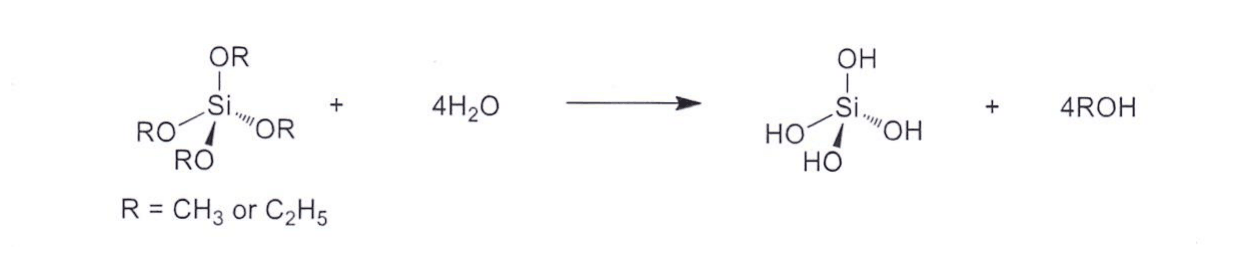
b. Water condensation

c. Alcohol condensation
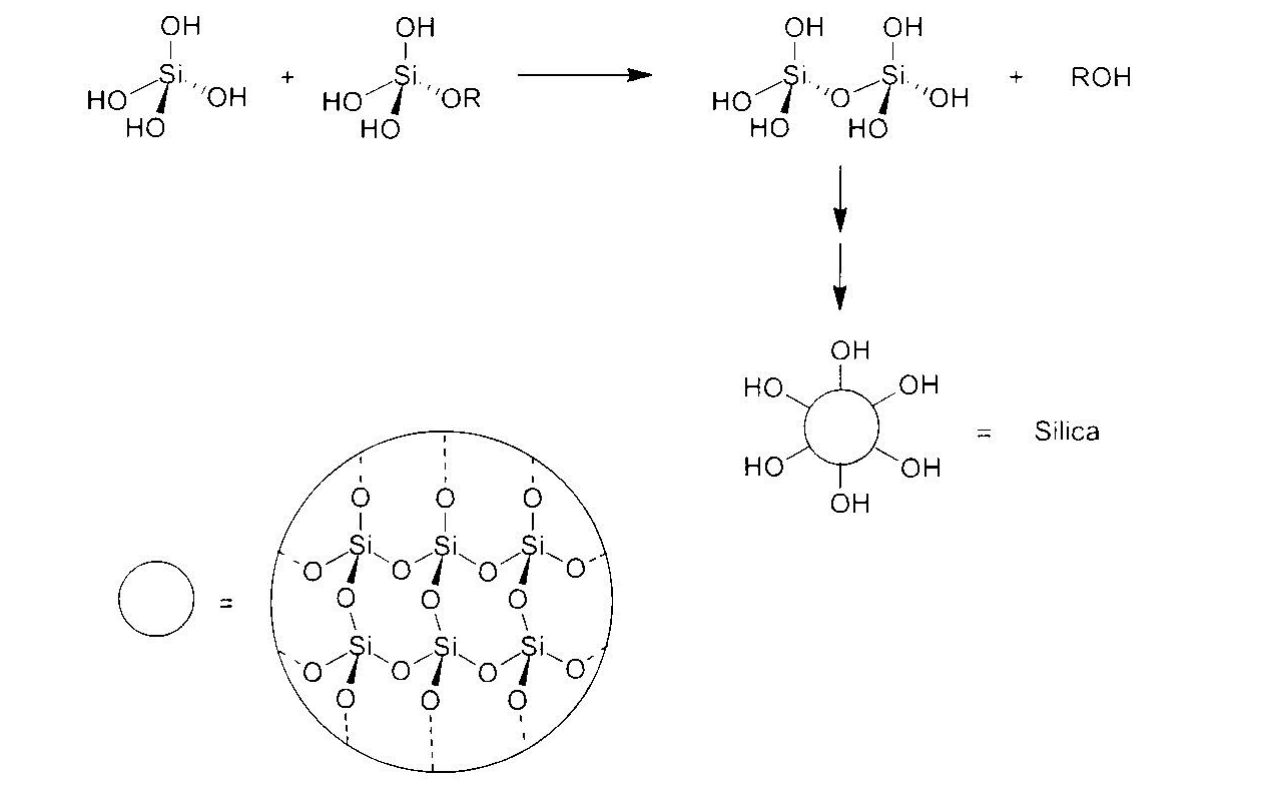
In bulk silica, all silicon atoms are tetrahedrally bonded to four oxygen atoms giving three-dimensional solid network. The silicon environments found inside silica is presented below:
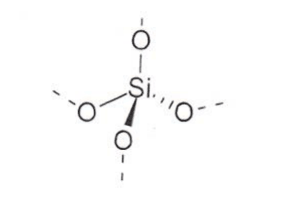
8.1 Three silicon atom environments (similar to the example above) are commonly observed at the silica surface. The three structures of the silicon environments must be drawn in the provided boxes.

Silica can be used as an effective metal ion adsorbent in water. The proposed structure for metal-silica complex is as follows:
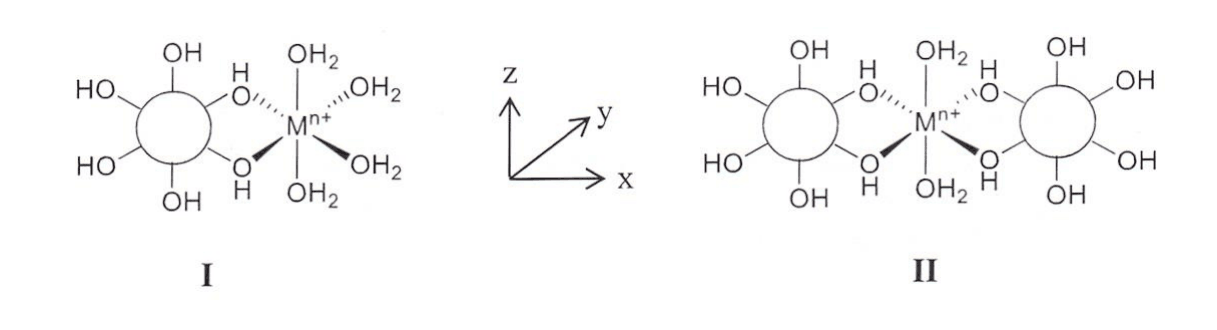
8.2 After \(\ce{Cu^2+}\) is being adsorbed, the color of silica changes from white to pale blue. The visible spectrum shows a broad absorption band (with a shoulder) at \(\lambda_{\max}=550\ \mathrm{nm}\).
If \(\ce{Cu^2+}\) can bind with silica and adopt the structure similar to II, draw the splitting diagram of the \(d\)- orbitals of \(\ce{Cu^2+}\) ion including the label of the \(d\) orbitals in the complex and specify the corresponding electronic transition(s) for the visible absorption.
8.3 If the first row transition metal ions form complexes with silica analogous to \(\ce{Cu^2+}\), which metal ion(s) do(es) have the analogous to electronic transition(s) to \(\ce{Cu^2+}\)?
The metal ion(s) must be in +2 or +3 oxidation state. Please note that the silanol groups (\(\ce{Si-OH}\)) and water are weak field ligands.
However, silica is randomly bonded to various types of metal ion. To increase the selectivity, modification of silica surface has been performed by grafting with various organic molecules like 3-aminopropyltrimethoxysilane and 3-mercaptopropyltrimethoxy-silane.
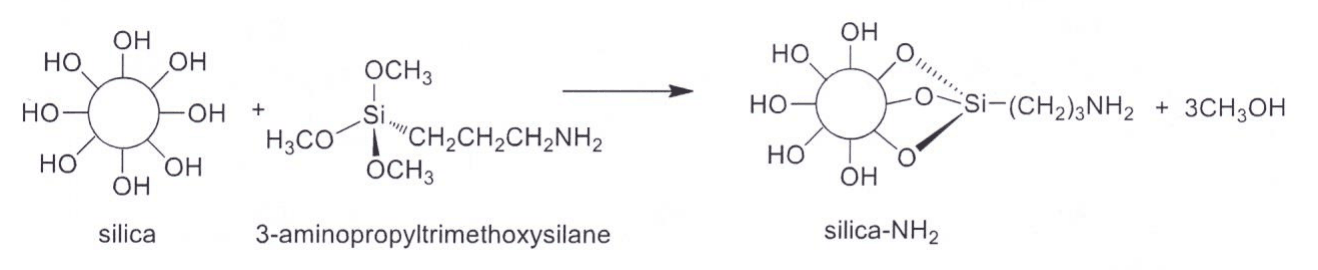
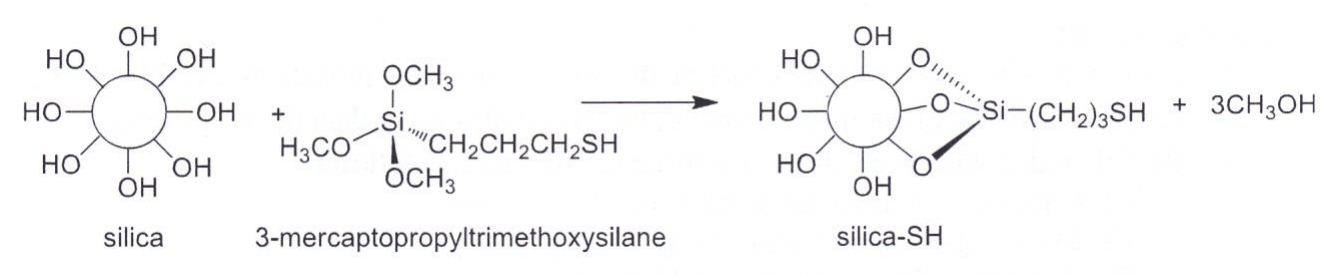
8.4 If \(\ce{Hg^2+}\) is only bonding to sulfur binding sites in silica-SH, the symmetric complex of \(\ce{[Hg(silica-SH)2]^2+}\) is formed. Draw the structure of \(\ce{[Hg(silica-SH)2]^2+}\), specify the direction of the bond axes, and draw the corresponding \(d\)-orbital splitting. (You may use \(\ce{R-SH}\) instead of drawing the whole structure of silica-SH.).
The structure: \(d\)-orbital splitting diagram :
8.5 Specify whether the following statements are true or false:
a) \(d\)-\(d\) transition is found in \(\ce{[(Hg(silica-SH)_{x})]^2+}\)
□ True □ False
b) The \(\ce{[Cu(silica-NH2)_{x}]^2+}\) in a similar geometry, is expected to have a color similar to other copper(II) amine complexes.
□ True □ False
c) In the visible absorption spectra, \(\lambda_{\max}\) of \(\ce{[Cu(silica-NH2)_{x}]^2+}\) is greater than that of \(\ce{[Cu(silica-OH)_{x}]^2+}\).
□ True □ False
Official English text of the problem.
Answers
In the surface-fragment SMILES below, [*] represents an attachment to the remaining structure. These fragments describe local connectivity, not the complete silica network.
- 8.1: The three hydroxylated tetrahedral silicon environments are:
- Monohydroxyl site, \(Q^3\): three bridging oxygens and one hydroxyl; fragment SMILES
O[Si](O[*])(O[*])O[*]. - Geminal dihydroxyl site, \(Q^2\): two bridging oxygens and two hydroxyls; fragment SMILES
O[Si](O)(O[*])O[*]. -
Trihydroxyl site, \(Q^1\): one bridging oxygen and three hydroxyls; fragment SMILES
O[Si](O)(O)O[*]. -
8.2: Copper(II), \(\ce{Cu^2+}\),
[Cu+2], is \(3d^9\). For the usual tetragonally elongated octahedron, a conventional ordering is \[ d_{xz}=d_{yz}<d_{xy}<d_{z^2}<d_{x^2-y^2}. \] The highest orbital is singly occupied; all others are doubly occupied. The absorption comprises \[ d_{z^2}\rightarrow d_{x^2-y^2},\qquad d_{xy}\rightarrow d_{x^2-y^2},\qquad (d_{xz},d_{yz})\rightarrow d_{x^2-y^2}. \] The relative order of the two intermediate levels depends on the distortion strength. -
8.3: Chromium(II), \(\ce{Cr^2+}\),
[Cr+2], and manganese(III), \(\ce{Mn^3+}\),[Mn+3]. Both are high-spin \(3d^4\). -
8.4: Linear bis(thiol)mercury(II), \(\ce{[Hg(RSH)2]^2+}\); coordination-fragment SMILES
[*][SH]->[Hg+2]<-[SH][*]. Place the two sulfur donors on the \(+z\) and \(-z\) axes: \[ \angle\ce{S-Hg-S}=180^\circ,\qquad d_{xy}=d_{x^2-y^2}<d_{xz}=d_{yz}<d_{z^2}. \] All five orbitals are doubly occupied. -
8.5: (a) False; (b) True; (c) False.
Solution
8.1 — Surface silicon environments
Each silicon remains tetrahedrally coordinated to four oxygen atoms. In the interior, all four oxygens bridge to other silicon atoms. At a hydroxylated surface, some of these positions terminate as silanol groups instead.
The notation \(Q^n\) counts the number of bridging oxygens attached to a silicon atom. Thus the three partially condensed, surface-connected possibilities are:
| Site | Local structural formula | Bridging oxygens | Terminal hydroxyls |
|---|---|---|---|
| Monohydroxyl, \(Q^3\) | \(\ce{Si(OH)(O-Si)3}\) | 3 | 1 |
| Geminal dihydroxyl, \(Q^2\) | \(\ce{Si(OH)2(O-Si)2}\) | 2 | 2 |
| Trihydroxyl, \(Q^1\) | \(\ce{Si(OH)3(O-Si)}\) | 1 | 3 |
These formulas denote fragments: each outer silicon continues into the solid.
To fill the boxes, draw a central silicon with four tetrahedrally directed bonds to oxygen. In the first box, label one oxygen as a hydroxyl and continue the other three into the network; in the second, use two of each; in the third, use three hydroxyls and one network connection. The corresponding fragment SMILES are given in the Answers section.
A site with no bridging oxygen would be a detached, fully hydroxylated silicon species, rather than a silicon atom connected to the silica surface.
8.2 — Copper orbital splitting and absorption
Copper(II), \(\ce{Cu^2+}\), [Cu+2], has configuration
\[
[\mathrm{Ar}]\,3d^9.
\]
In structure II, four surface silanol oxygen donors surround the metal in the \(xy\) plane, while two water ligands occupy the axial positions along \(z\). Water, \(\ce{H2O}\), has SMILES O.
The copper surface complex can be represented by the coordination-fragment SMILES
[Cu+2](<-[OH2])(<-[OH2])(<-[OH][*])(<-[OH][*])(<-[OH][*])<-[OH][*],
where each wildcard is a surface silicon. Dative arrows record oxygen-to-metal donation; the SMILES does not specify the octahedral geometry or bond lengths.
In an ideal octahedral field, the configuration is \[ t_{2g}^{6}e_g^{3}. \] The uneven occupation of the \(e_g\) orbitals makes this configuration Jahn–Teller active. The usual copper(II) distortion is axial elongation: the two bonds along \(z\) are longer than the four equatorial bonds.
Consequently:
- \(d_{x^2-y^2}\), directed toward the four equatorial donors, becomes the highest orbital.
- \(d_{z^2}\) is lowered relative to \(d_{x^2-y^2}\).
- \(d_{xz}\) and \(d_{yz}\) are lowered relative to \(d_{xy}\), remaining mutually degenerate.
For a conventional moderate elongation, draw the following levels, with energy increasing upward:
| Position | Orbital(s) | Occupancy |
|---|---|---|
| Highest | \(d_{x^2-y^2}\) | \(\uparrow\) |
| Next | \(d_{z^2}\) | \(\uparrow\downarrow\) |
| Next | \(d_{xy}\) | \(\uparrow\downarrow\) |
| Lowest | \(d_{xz},\,d_{yz}\) | \(\uparrow\downarrow\quad\uparrow\downarrow\) |
Draw upward absorption arrows from each lower energy level to \(d_{x^2-y^2}\): \[ \begin{aligned} d_{z^2}&\longrightarrow d_{x^2-y^2},\\ d_{xy}&\longrightarrow d_{x^2-y^2},\\ d_{xz},\,d_{yz}&\longrightarrow d_{x^2-y^2}. \end{aligned} \]
Each promotion fills the vacancy in \(d_{x^2-y^2}\) and leaves a vacancy in a lower orbital. There are three distinct transition energies because \(d_{xz}\) and \(d_{yz}\) are degenerate.
These transitions can overlap into the observed broad band with a shoulder. The supplied \(550\ \mathrm{nm}\) maximum does not determine a separate wavelength for each transition.
8.3 — Other ions with analogous transitions
The relevant analogy is the availability of the same orbital promotions into the highest \(d_{x^2-y^2}\) orbital.
A high-spin \(d^4\) ion places one electron in each of the four lower orbitals and leaves \(d_{x^2-y^2}\) empty:
| Orbital(s) | Copper(II), \(d^9\) | High-spin \(d^4\) |
|---|---|---|
| \(d_{x^2-y^2}\) | \(\uparrow\) | Empty |
| \(d_{z^2}\) | \(\uparrow\downarrow\) | \(\uparrow\) |
| \(d_{xy}\) | \(\uparrow\downarrow\) | \(\uparrow\) |
| \(d_{xz},\,d_{yz}\) | \(\uparrow\downarrow\quad\uparrow\downarrow\) | \(\uparrow\quad\uparrow\) |
Thus the same three types of promotion shown in 8.2 are possible without changing the total spin. High-spin \(d^4\), with octahedral configuration \(t_{2g}^{3}e_g^{1}\), also has uneven \(e_g\) occupation and is strongly Jahn–Teller active.
The first-row ions in the permitted oxidation states with this configuration are:
\[ \begin{aligned} \text{Chromium(II), }\ce{Cr^2+}\ \text{([Cr+2])} &: [\mathrm{Ar}]\,3d^4,\\ \text{Manganese(III), }\ce{Mn^3+}\ \text{([Mn+3])} &: [\mathrm{Ar}]\,3d^4. \end{aligned} \]
The weak-field qualification ensures that these \(d^4\) ions are high spin. Their transition wavelengths need not equal those of copper(II).
8.4 — Mercury complex and orbital splitting
Mercury(II), \(\ce{Hg^2+}\), [Hg+2], has configuration
\[
[\mathrm{Xe}]\,4f^{14}5d^{10}.
\]
The ligand is a neutral surface-tethered thiol, \(\ce{RSH}\), represented by fragment SMILES [*]S. Sulfur donates a lone pair without loss of its hydrogen:
\[
\ce{Hg^2+ + 2RSH -> [Hg(RSH)2]^2+}.
\]
The product is bis(thiol)mercury(II), with coordination-fragment SMILES
[*][SH]->[Hg+2]<-[SH][*].
For the requested drawing:
- Place mercury at the origin.
- Place one sulfur donor on \(+z\) and the other on \(-z\).
- Draw a sulfur-to-mercury coordination bond from each ligand. Each sulfur also retains its bonds to hydrogen and \(R\).
- Make the coordination unit linear, with \(\angle\ce{S-Hg-S}=180^\circ\). Choose \(x\) and \(y\) perpendicular to this axis.
For the conventional linear crystal field, draw:
| Position | Orbital(s) | Occupancy |
|---|---|---|
| Highest | \(d_{z^2}\) | \(\uparrow\downarrow\) |
| Intermediate | \(d_{xz},\,d_{yz}\) | \(\uparrow\downarrow\quad\uparrow\downarrow\) |
| Lowest | \(d_{xy},\,d_{x^2-y^2}\) | \(\uparrow\downarrow\quad\uparrow\downarrow\) |
The \(d_{z^2}\) orbital points directly toward the two donors and experiences the greatest destabilization. The two orbitals confined to the perpendicular plane are lowest. Cylindrical symmetry about the bond axis gives the indicated degeneracies.
8.5 — True or false
(a) False. Mercury(II) is \(d^{10}\). Every \(d\) orbital is filled, so there is no vacant \(d\)-orbital state into which a \(d\) electron can be promoted.
(b) True. The surface primary amine group, \(\ce{RNH2}\), has fragment SMILES [*]N; its copper coordination can be represented locally as [*]N->[Cu+2]. Nitrogen coordination gives a ligand field similar to that of other copper(II) amine complexes when the coordination geometries are comparable, so a similar color is expected.
(c) False. Amine nitrogen donors generally produce a stronger ligand field than silanol oxygen donors. For comparable geometries, the relevant transition energies therefore increase: \[ \Delta_{\mathrm{amine}}>\Delta_{\mathrm{silanol}}. \] Since \[ E=\frac{hc}{\lambda}, \] the expected wavelength relationship is \[ \boxed{\lambda_{\max,\mathrm{amine}}< \lambda_{\max,\mathrm{silanol}}}. \] The statement gives the opposite inequality.
The answers were checked against the official answers published by the organisers.
IChO 2017 · Theorieaufgabe 8
Siliciumdioxidoberfläche
Siliciumdioxid kommt in verschiedenen Formen vor, beispielsweise amorph und kristallin. Siliciumdioxid kann über das Sol-Gel-Verfahren unter Verwendung von Siliciumalkoxiden wie Tetramethoxysilan (TMOS) und Tetraethoxysilan (TEOS) synthetisiert werden, wie im Folgenden im Einzelnen dargestellt:
a. Hydrolyse
b. Kondensation unter Wasserabspaltung
c. Kondensation unter Alkoholabspaltung
Im Inneren von Siliciumdioxid sind alle Siliciumatome tetraedrisch an vier Sauerstoffatome gebunden und bilden so ein dreidimensionales Festkörpernetzwerk. Die im Inneren von Siliciumdioxid vorliegenden Siliciumumgebungen sind nachstehend dargestellt:
8.1 An der Oberfläche von Siliciumdioxid werden üblicherweise drei Umgebungen der Siliciumatome beobachtet (ähnlich dem obigen Beispiel). Die drei Strukturen dieser Siliciumumgebungen sind in die vorgesehenen Kästchen einzuzeichnen.
Siliciumdioxid kann als wirksames Adsorbens für Metallionen in Wasser eingesetzt werden. Die vorgeschlagene Struktur des Metall-Siliciumdioxid-Komplexes ist wie folgt:
8.2 Nach der Adsorption von \(\ce{Cu^2+}\) ändert sich die Farbe des Siliciumdioxids von Weiß zu Hellblau. Das Spektrum im sichtbaren Bereich zeigt eine breite Absorptionsbande (mit einer Schulter) bei \(\lambda_{\max}=550\ \mathrm{nm}\).
Wenn \(\ce{Cu^2+}\) an Siliciumdioxid binden und dabei eine ähnliche Struktur wie II annehmen kann, zeichnen Sie das Aufspaltungsdiagramm der \(d\)-Orbitale des \(\ce{Cu^2+}\)-Ions einschließlich der Bezeichnungen der \(d\)-Orbitale im Komplex und geben Sie den bzw. die entsprechenden elektronischen Übergänge für die Absorption im sichtbaren Bereich an.
8.3 Wenn die Ionen der ersten Übergangsmetallreihe mit Siliciumdioxid analoge Komplexe wie \(\ce{Cu^2+}\) bilden, welche Metallionen weisen dann analoge elektronische Übergänge wie \(\ce{Cu^2+}\) auf?
Die Metallionen müssen in der Oxidationsstufe +2 oder +3 vorliegen. Beachten Sie, dass die Silanolgruppen (\(\ce{Si-OH}\)) und Wasser schwache Ligandenfelder erzeugen.
Siliciumdioxid bindet jedoch unspezifisch verschiedene Arten von Metallionen. Um die Selektivität zu erhöhen, wurde die Siliciumdioxidoberfläche durch Aufpfropfen verschiedener organischer Moleküle wie 3-Aminopropyltrimethoxysilan und 3-Mercaptopropyltrimethoxysilan modifiziert.
8.4 Wenn \(\ce{Hg^2+}\) ausschließlich an die Schwefelbindungsstellen in Siliciumdioxid-SH bindet, entsteht der symmetrische Komplex \(\ce{[Hg(silica-SH)2]^2+}\). Zeichnen Sie die Struktur von \(\ce{[Hg(silica-SH)2]^2+}\), geben Sie die Richtung der Bindungsachsen an und zeichnen Sie die entsprechende Aufspaltung der \(d\)-Orbitale. (Sie dürfen \(\ce{R-SH}\) verwenden, anstatt die gesamte Struktur von Siliciumdioxid-SH zu zeichnen.)
Die Struktur: Aufspaltungsdiagramm der \(d\)-Orbitale:
8.5 Geben Sie an, ob die folgenden Aussagen richtig oder falsch sind:
a) In \(\ce{[(Hg(silica-SH)_{x})]^2+}\) tritt ein \(d\)-\(d\)-Übergang auf.
□ Richtig □ Falsch
b) Bei ähnlicher Geometrie wird für \(\ce{[Cu(silica-NH2)_{x}]^2+}\) eine ähnliche Farbe wie bei anderen Kupfer(II)-Aminkomplexen erwartet.
□ Richtig □ Falsch
c) In den Absorptionsspektren im sichtbaren Bereich ist \(\lambda_{\max}\) von \(\ce{[Cu(silica-NH2)_{x}]^2+}\) größer als das von \(\ce{[Cu(silica-OH)_{x}]^2+}\).
□ Richtig □ Falsch
Aufgabentext aus dem offiziellen englischen Text übersetzt.
Antworten
In den nachstehenden SMILES der Oberflächenfragmente steht [*] für eine Anbindung an die übrige Struktur. Diese Fragmente beschreiben die lokale Verknüpfung, nicht das vollständige Siliciumdioxidnetzwerk.
- 8.1: Die drei hydroxylierten tetraedrischen Siliciumumgebungen sind:
- Monohydroxylstelle, \(Q^3\): drei verbrückende Sauerstoffatome und eine Hydroxylgruppe; Fragment-SMILES
O[Si](O[*])(O[*])O[*]. - Geminale Dihydroxylstelle, \(Q^2\): zwei verbrückende Sauerstoffatome und zwei Hydroxylgruppen; Fragment-SMILES
O[Si](O)(O[*])O[*]. -
Trihydroxylstelle, \(Q^1\): ein verbrückendes Sauerstoffatom und drei Hydroxylgruppen; Fragment-SMILES
O[Si](O)(O)O[*]. -
8.2: Kupfer(II), \(\ce{Cu^2+}\),
[Cu+2], hat die Konfiguration \(3d^9\). Für das übliche tetragonal gestreckte Oktaeder lautet eine gebräuchliche Reihenfolge \[ d_{xz}=d_{yz}<d_{xy}<d_{z^2}<d_{x^2-y^2}. \] Das höchste Orbital ist einfach besetzt; alle anderen sind doppelt besetzt. Die Absorption umfasst \[ d_{z^2}\rightarrow d_{x^2-y^2},\qquad d_{xy}\rightarrow d_{x^2-y^2},\qquad (d_{xz},d_{yz})\rightarrow d_{x^2-y^2}. \] Die relative Reihenfolge der beiden mittleren Niveaus hängt von der Stärke der Verzerrung ab. -
8.3: Chrom(II), \(\ce{Cr^2+}\),
[Cr+2], und Mangan(III), \(\ce{Mn^3+}\),[Mn+3]. Beide besitzen eine High-Spin-Konfiguration \(3d^4\). -
8.4: Lineares Bis(thiol)quecksilber(II), \(\ce{[Hg(RSH)2]^2+}\); SMILES des Koordinationsfragments
[*][SH]->[Hg+2]<-[SH][*]. Ordnen Sie die beiden Schwefeldonoren auf der \(+z\)- und der \(-z\)-Achse an: \[ \angle\ce{S-Hg-S}=180^\circ,\qquad d_{xy}=d_{x^2-y^2}<d_{xz}=d_{yz}<d_{z^2}. \] Alle fünf Orbitale sind doppelt besetzt. -
8.5: (a) Falsch; (b) Richtig; (c) Falsch.
Lösung
8.1 — Siliciumumgebungen an der Oberfläche
Jedes Siliciumatom bleibt tetraedrisch von vier Sauerstoffatomen koordiniert. Im Inneren bilden alle vier Sauerstoffatome Brücken zu anderen Siliciumatomen. An einer hydroxylierten Oberfläche enden einige dieser Positionen stattdessen als Silanolgruppen.
Die Schreibweise \(Q^n\) gibt die Anzahl der an ein Siliciumatom gebundenen verbrückenden Sauerstoffatome an. Die drei teilweise kondensierten, mit der Oberfläche verbundenen Möglichkeiten sind somit:
| Stelle | Lokale Strukturformel | Verbrückende Sauerstoffatome | Endständige Hydroxylgruppen |
|---|---|---|---|
| Monohydroxyl, \(Q^3\) | \(\ce{Si(OH)(O-Si)3}\) | 3 | 1 |
| Geminales Dihydroxyl, \(Q^2\) | \(\ce{Si(OH)2(O-Si)2}\) | 2 | 2 |
| Trihydroxyl, \(Q^1\) | \(\ce{Si(OH)3(O-Si)}\) | 1 | 3 |
Diese Formeln bezeichnen Fragmente: Von jedem äußeren Siliciumatom setzt sich die Struktur in den Festkörper hinein fort.
Zeichnen Sie zum Ausfüllen der Kästchen ein zentrales Siliciumatom mit vier tetraedrisch ausgerichteten Bindungen zu Sauerstoffatomen. Kennzeichnen Sie im ersten Kästchen ein Sauerstoffatom als Teil einer Hydroxylgruppe und führen Sie die anderen drei in das Netzwerk weiter; verwenden Sie im zweiten jeweils zwei davon und im dritten drei Hydroxylgruppen und eine Verbindung zum Netzwerk. Die entsprechenden Fragment-SMILES sind im Abschnitt Antworten angegeben.
Eine Stelle ohne verbrückendes Sauerstoffatom wäre eine abgelöste, vollständig hydroxylierte Siliciumspezies und kein mit der Siliciumdioxidoberfläche verbundenes Siliciumatom.
8.2 — Orbitalaufspaltung und Absorption bei Kupfer
Kupfer(II), \(\ce{Cu^2+}\), [Cu+2], hat die Konfiguration
\[
[\mathrm{Ar}]\,3d^9.
\]
In Struktur II umgeben vier Sauerstoffdonoren der Silanolgruppen an der Oberfläche das Metall in der \(xy\)-Ebene, während zwei Wasserliganden die axialen Positionen entlang \(z\) einnehmen. Wasser, \(\ce{H2O}\), hat den SMILES O.
Der Kupferoberflächenkomplex lässt sich durch den SMILES des Koordinationsfragments
[Cu+2](<-[OH2])(<-[OH2])(<-[OH][*])(<-[OH][*])(<-[OH][*])<-[OH][*]
darstellen, wobei jeder Platzhalter für ein Siliciumatom an der Oberfläche steht. Die Pfeile für koordinative Bindungen geben die Elektronenpaardonation vom Sauerstoff zum Metall an; der SMILES legt weder die oktaedrische Geometrie noch die Bindungslängen fest.
In einem idealen oktaedrischen Feld lautet die Konfiguration \[ t_{2g}^{6}e_g^{3}. \] Die ungleichmäßige Besetzung der \(e_g\)-Orbitale macht diese Konfiguration Jahn–Teller-aktiv. Die übliche Verzerrung bei Kupfer(II) ist eine axiale Streckung: Die beiden Bindungen entlang \(z\) sind länger als die vier äquatorialen Bindungen.
Daraus folgt:
- \(d_{x^2-y^2}\), das auf die vier äquatorialen Donoren ausgerichtet ist, wird zum höchsten Orbital.
- \(d_{z^2}\) wird gegenüber \(d_{x^2-y^2}\) abgesenkt.
- \(d_{xz}\) und \(d_{yz}\) werden gegenüber \(d_{xy}\) abgesenkt und bleiben untereinander entartet.
Zeichnen Sie für eine übliche mäßige Streckung die folgenden Niveaus mit nach oben zunehmender Energie:
| Position | Orbital(e) | Besetzung |
|---|---|---|
| Höchstes | \(d_{x^2-y^2}\) | \(\uparrow\) |
| Nächstes | \(d_{z^2}\) | \(\uparrow\downarrow\) |
| Nächstes | \(d_{xy}\) | \(\uparrow\downarrow\) |
| Niedrigstes | \(d_{xz},\,d_{yz}\) | \(\uparrow\downarrow\quad\uparrow\downarrow\) |
Zeichnen Sie von jedem niedrigeren Energieniveau nach oben gerichtete Absorptionspfeile zu \(d_{x^2-y^2}\): \[ \begin{aligned} d_{z^2}&\longrightarrow d_{x^2-y^2},\\ d_{xy}&\longrightarrow d_{x^2-y^2},\\ d_{xz},\,d_{yz}&\longrightarrow d_{x^2-y^2}. \end{aligned} \]
Jede Anregung füllt die unbesetzte Stelle in \(d_{x^2-y^2}\) und hinterlässt eine unbesetzte Stelle in einem niedrigeren Orbital. Es gibt drei unterschiedliche Übergangsenergien, da \(d_{xz}\) und \(d_{yz}\) entartet sind.
Diese Übergänge können sich zu der beobachteten breiten Bande mit einer Schulter überlagern. Das angegebene Maximum bei \(550\ \mathrm{nm}\) legt keine separate Wellenlänge für jeden Übergang fest.
8.3 — Weitere Ionen mit analogen Übergängen
Die relevante Analogie besteht darin, dass dieselben orbitalen Anregungen in das höchste Orbital \(d_{x^2-y^2}\) möglich sind.
Bei einem High-Spin-\(d^4\)-Ion befindet sich in jedem der vier niedrigeren Orbitale ein Elektron, während \(d_{x^2-y^2}\) leer bleibt:
| Orbital(e) | Kupfer(II), \(d^9\) | High-Spin-\(d^4\) |
|---|---|---|
| \(d_{x^2-y^2}\) | \(\uparrow\) | Leer |
| \(d_{z^2}\) | \(\uparrow\downarrow\) | \(\uparrow\) |
| \(d_{xy}\) | \(\uparrow\downarrow\) | \(\uparrow\) |
| \(d_{xz},\,d_{yz}\) | \(\uparrow\downarrow\quad\uparrow\downarrow\) | \(\uparrow\quad\uparrow\) |
Somit sind dieselben drei in 8.2 gezeigten Anregungstypen möglich, ohne den Gesamtspin zu ändern. High-Spin-\(d^4\) mit der oktaedrischen Konfiguration \(t_{2g}^{3}e_g^{1}\) weist ebenfalls eine ungleichmäßige \(e_g\)-Besetzung auf und ist stark Jahn–Teller-aktiv.
Die Ionen der ersten Übergangsmetallreihe mit dieser Konfiguration in den zulässigen Oxidationsstufen sind:
\[ \begin{aligned} \text{Chrom(II), }\ce{Cr^2+}\ \text{([Cr+2])} &: [\mathrm{Ar}]\,3d^4,\\ \text{Mangan(III), }\ce{Mn^3+}\ \text{([Mn+3])} &: [\mathrm{Ar}]\,3d^4. \end{aligned} \]
Die Bedingung eines schwachen Ligandenfeldes stellt sicher, dass diese \(d^4\)-Ionen im High-Spin-Zustand vorliegen. Ihre Übergangswellenlängen müssen nicht mit denen von Kupfer(II) übereinstimmen.
8.4 — Quecksilberkomplex und Orbitalaufspaltung
Quecksilber(II), \(\ce{Hg^2+}\), [Hg+2], hat die Konfiguration
\[
[\mathrm{Xe}]\,4f^{14}5d^{10}.
\]
Der Ligand ist ein neutrales, an der Oberfläche verankertes Thiol, \(\ce{RSH}\), dargestellt durch den Fragment-SMILES [*]S. Schwefel stellt ein freies Elektronenpaar zur Verfügung, ohne sein Wasserstoffatom abzugeben:
\[
\ce{Hg^2+ + 2RSH -> [Hg(RSH)2]^2+}.
\]
Das Produkt ist Bis(thiol)quecksilber(II) mit dem SMILES des Koordinationsfragments
[*][SH]->[Hg+2]<-[SH][*].
Für die geforderte Zeichnung:
- Platzieren Sie Quecksilber im Ursprung.
- Platzieren Sie einen Schwefeldonor auf \(+z\) und den anderen auf \(-z\).
- Zeichnen Sie von jedem Liganden eine koordinative Bindung vom Schwefel zum Quecksilber. Jedes Schwefelatom behält außerdem seine Bindungen an Wasserstoff und \(R\).
- Zeichnen Sie die Koordinationseinheit linear mit \(\angle\ce{S-Hg-S}=180^\circ\). Wählen Sie \(x\) und \(y\) senkrecht zu dieser Achse.
Zeichnen Sie für das übliche lineare Kristallfeld:
| Position | Orbital(e) | Besetzung |
|---|---|---|
| Höchstes | \(d_{z^2}\) | \(\uparrow\downarrow\) |
| Mittleres | \(d_{xz},\,d_{yz}\) | \(\uparrow\downarrow\quad\uparrow\downarrow\) |
| Niedrigstes | \(d_{xy},\,d_{x^2-y^2}\) | \(\uparrow\downarrow\quad\uparrow\downarrow\) |
Das \(d_{z^2}\)-Orbital zeigt direkt auf die beiden Donoren und erfährt die stärkste Destabilisierung. Die beiden auf die dazu senkrechte Ebene beschränkten Orbitale liegen am niedrigsten. Die Zylindersymmetrie um die Bindungsachse führt zu den angegebenen Entartungen.
8.5 — Richtig oder falsch
(a) Falsch. Quecksilber(II) hat die Konfiguration \(d^{10}\). Jedes \(d\)-Orbital ist vollständig besetzt, sodass kein unbesetzter \(d\)-Orbitalzustand vorhanden ist, in den ein \(d\)-Elektron angeregt werden kann.
(b) Richtig. Die primäre Amingruppe an der Oberfläche, \(\ce{RNH2}\), hat den Fragment-SMILES [*]N; ihre Koordination an Kupfer lässt sich lokal als [*]N->[Cu+2] darstellen. Bei vergleichbaren Koordinationsgeometrien erzeugt die Koordination über Stickstoff ein ähnliches Ligandenfeld wie in anderen Kupfer(II)-Aminkomplexen, sodass eine ähnliche Farbe zu erwarten ist.
(c) Falsch. Amin-Stickstoffdonoren erzeugen im Allgemeinen ein stärkeres Ligandenfeld als Silanol-Sauerstoffdonoren. Bei vergleichbaren Geometrien nehmen die entsprechenden Übergangsenergien daher zu: \[ \Delta_{\mathrm{amine}}>\Delta_{\mathrm{silanol}}. \] Da \[ E=\frac{hc}{\lambda}, \] gilt, ist die folgende Beziehung zwischen den Wellenlängen zu erwarten: \[ \boxed{\lambda_{\max,\mathrm{amine}}< \lambda_{\max,\mathrm{silanol}}}. \] Die Aussage nennt die entgegengesetzte Ungleichung.
Die Ergebnisse wurden mit den von den Veranstaltern veröffentlichten offiziellen Ergebnissen abgeglichen.
IChO 2017 · Teori sorusu 8
Silika Yüzeyi
Silika, amorf ve kristalin gibi çeşitli biçimlerde bulunur. Silika, tetrametoksisilan (TMOS) ve tetraetoksisilan (TEOS) gibi silisyum alkoksitler kullanılarak, ayrıntıları aşağıda verilen sol-jel işlemi yoluyla sentezlenebilir:
a. Hidroliz
b. Su kondenzasyonu
c. Alkol kondenzasyonu
Silikanın iç kısmında tüm silisyum atomları, dört oksijen atomuna tetrahedral olarak bağlanarak üç boyutlu bir katı ağ oluşturur. Silikanın içinde bulunan silisyum çevreleri aşağıda gösterilmiştir:
8.1 Silika yüzeyinde yaygın olarak (yukarıdaki örneğe benzer) üç farklı silisyum atomu çevresi gözlenir. Bu üç silisyum çevresinin yapısını verilen kutulara çiziniz.
Silika, sudaki metal iyonları için etkili bir adsorban olarak kullanılabilir. Metal-silika kompleksi için önerilen yapı aşağıdaki gibidir:
8.2 \(\ce{Cu^2+}\) adsorplandıktan sonra silikanın rengi beyazdan açık maviye dönüşür. Görünür bölge spektrumunda \(\lambda_{\max}=550\ \mathrm{nm}\) değerinde geniş bir soğurma bandı (bir omuzla birlikte) görülür.
\(\ce{Cu^2+}\), silikaya bağlanıp II'ye benzer bir yapı oluşturabiliyorsa, kompleksteki \(d\) orbitallerini de etiketleyerek \(\ce{Cu^2+}\) iyonunun \(d\) orbitallerinin yarılma diyagramını çiziniz ve görünür bölgedeki soğurmaya karşılık gelen elektronik geçişi (geçişleri) belirtiniz.
8.3 Birinci sıra geçiş metali iyonları silika ile \(\ce{Cu^2+}\)'ya benzer kompleksler oluşturursa, hangi metal iyonu (iyonları) \(\ce{Cu^2+}\)'nınkine benzer elektronik geçişe (geçişlere) sahiptir?
Metal iyonu (iyonları) +2 veya +3 yükseltgenme basamağında olmalıdır. Silanol gruplarının (\(\ce{Si-OH}\)) ve suyun zayıf alan ligandları olduğunu göz önünde bulundurunuz.
Ancak silika, çeşitli türlerdeki metal iyonlarına rastgele bağlanır. Seçiciliği artırmak için silika yüzeyi, 3-aminopropiltrimetoksisilan ve 3-merkaptopropiltrimetoksisilan gibi çeşitli organik moleküller aşılanarak modifiye edilmiştir.
8.4 \(\ce{Hg^2+}\), silika-SH'deki yalnızca kükürt bağlanma bölgelerine bağlanıyorsa, simetrik \(\ce{[Hg(silica-SH)2]^2+}\) kompleksi oluşur. \(\ce{[Hg(silica-SH)2]^2+}\)'nin yapısını çiziniz, bağ eksenlerinin yönünü belirtiniz ve buna karşılık gelen \(d\) orbitali yarılmasını çiziniz. (Silika-SH'nin tüm yapısını çizmek yerine \(\ce{R-SH}\) kullanabilirsiniz.).
Yapı: \(d\) orbitali yarılma diyagramı:
8.5 Aşağıdaki ifadelerin doğru mu yanlış mı olduğunu belirtiniz:
a) \(\ce{[(Hg(silica-SH)_{x})]^2+}\)'de \(d\)-\(d\) geçişi görülür.
□ Doğru □ Yanlış
b) Benzer bir geometrideki \(\ce{[Cu(silica-NH2)_{x}]^2+}\)'nin, diğer bakır(II) amin komplekslerine benzer bir renge sahip olması beklenir.
□ Doğru □ Yanlış
c) Görünür bölge soğurma spektrumlarında, \(\ce{[Cu(silica-NH2)_{x}]^2+}\)'nin \(\lambda_{\max}\) değeri, \(\ce{[Cu(silica-OH)_{x}]^2+}\)'ninkinden büyüktür.
□ Doğru □ Yanlış
Soru metni resmi İngilizce metinden çevrilmiştir.
Cevaplar
Aşağıdaki yüzey parçası SMILES gösterimlerinde [*], yapının geri kalanına bağlanmayı temsil eder. Bu parçalar, silika ağının tamamını değil, yerel bağlanma düzenini tanımlar.
- 8.1: Hidroksillenmiş üç tetrahedral silisyum çevresi şunlardır:
- Monohidroksil bölgesi, \(Q^3\): üç köprü oksijeni ve bir hidroksil; parça SMILES gösterimi
O[Si](O[*])(O[*])O[*]. - Geminal dihidroksil bölgesi, \(Q^2\): iki köprü oksijeni ve iki hidroksil; parça SMILES gösterimi
O[Si](O)(O[*])O[*]. -
Trihidroksil bölgesi, \(Q^1\): bir köprü oksijeni ve üç hidroksil; parça SMILES gösterimi
O[Si](O)(O)O[*]. -
8.2: Bakır(II), \(\ce{Cu^2+}\),
[Cu+2], \(3d^9\) elektron dizilimine sahiptir. Olağan tetragonal olarak uzamış oktahedron için yaygın bir sıralama şöyledir: \[ d_{xz}=d_{yz}<d_{xy}<d_{z^2}<d_{x^2-y^2}. \] En yüksek enerjili orbitalde tek elektron bulunur; diğerlerinin tümünde ikişer elektron vardır. Soğurma şu geçişleri içerir: \[ d_{z^2}\rightarrow d_{x^2-y^2},\qquad d_{xy}\rightarrow d_{x^2-y^2},\qquad (d_{xz},d_{yz})\rightarrow d_{x^2-y^2}. \] Ortadaki iki düzeyin birbirine göre sıralaması, bozulmanın şiddetine bağlıdır. -
8.3: Krom(II), \(\ce{Cr^2+}\),
[Cr+2], ve mangan(III), \(\ce{Mn^3+}\),[Mn+3]. Her ikisi de yüksek spinli \(3d^4\) elektron dizilimine sahiptir. -
8.4: Doğrusal bis(tiyol)cıva(II), \(\ce{[Hg(RSH)2]^2+}\); koordinasyon parçasının SMILES gösterimi
[*][SH]->[Hg+2]<-[SH][*]. İki kükürt donörünü \(+z\) ve \(-z\) eksenlerine yerleştiriniz: \[ \angle\ce{S-Hg-S}=180^\circ,\qquad d_{xy}=d_{x^2-y^2}<d_{xz}=d_{yz}<d_{z^2}. \] Beş orbitalin tümünde ikişer elektron bulunur. -
8.5: (a) Yanlış; (b) Doğru; (c) Yanlış.
Çözüm
8.1 — Yüzeydeki silisyum çevreleri
Her silisyum, dört oksijen atomuna tetrahedral olarak koordine olmuş hâlde kalır. İç kısımda dört oksijenin tümü diğer silisyum atomlarına köprü oluşturur. Hidroksillenmiş bir yüzeyde ise bu konumların bazıları silanol grupları olarak sonlanır.
\(Q^n\) gösterimi, bir silisyum atomuna bağlı köprü oksijenlerinin sayısını belirtir. Buna göre kısmen kondenzasyona uğramış, yüzeye bağlı üç olası yapı şunlardır:
| Bölge | Yerel yapı formülü | Köprü oksijenleri | Uç hidroksiller |
|---|---|---|---|
| Monohidroksil, \(Q^3\) | \(\ce{Si(OH)(O-Si)3}\) | 3 | 1 |
| Geminal dihidroksil, \(Q^2\) | \(\ce{Si(OH)2(O-Si)2}\) | 2 | 2 |
| Trihidroksil, \(Q^1\) | \(\ce{Si(OH)3(O-Si)}\) | 1 | 3 |
Bu formüller yapı parçalarını gösterir: dıştaki her silisyum, katı yapı içinde devam eder.
Kutuları doldurmak için merkezde, oksijenlere yönelmiş dört tetrahedral bağı olan bir silisyum çiziniz. İlk kutuda bir oksijeni hidroksil olarak etiketleyip diğer üçünü ağa devam ettiriniz; ikinci kutuda her birinden ikişer tane kullanınız; üçüncü kutuda üç hidroksil ve ağa bir bağlantı kullanınız. Karşılık gelen parça SMILES gösterimleri Cevaplar bölümünde verilmiştir.
Köprü oksijeni içermeyen bir bölge, silika yüzeyine bağlı bir silisyum atomu yerine, yüzeyden ayrılmış ve tamamen hidroksillenmiş bir silisyum türü olurdu.
8.2 — Bakırın orbital yarılması ve soğurması
Bakır(II), \(\ce{Cu^2+}\), [Cu+2], şu elektron dizilimine sahiptir:
\[
[\mathrm{Ar}]\,3d^9.
\]
II yapısında, yüzeydeki dört silanol oksijen donörü metali \(xy\) düzleminde çevrelerken, iki su ligandı \(z\) boyunca eksenel konumları işgal eder. Suyun, \(\ce{H2O}\), SMILES gösterimi O'dur.
Bakır yüzey kompleksi, koordinasyon parçasının şu SMILES gösterimiyle temsil edilebilir:
[Cu+2](<-[OH2])(<-[OH2])(<-[OH][*])(<-[OH][*])(<-[OH][*])<-[OH][*],
burada her joker simge, yüzeydeki bir silisyumu temsil eder. Koordinatif bağ okları, oksijenden metale elektron çifti aktarımını gösterir; SMILES gösterimi oktahedral geometriyi veya bağ uzunluklarını belirtmez.
İdeal bir oktahedral alanda elektron dizilimi şöyledir: \[ t_{2g}^{6}e_g^{3}. \] \(e_g\) orbitallerindeki eşit olmayan elektron dağılımı, bu dizilimi Jahn–Teller etkin kılar. Bakır(II)'deki olağan bozulma, eksenel uzamadır: \(z\) boyunca uzanan iki bağ, ekvator düzlemindeki dört bağdan daha uzundur.
Bunun sonucunda:
- Ekvator düzlemindeki dört donöre yönelen \(d_{x^2-y^2}\), en yüksek enerjili orbital olur.
- \(d_{z^2}\)'nin enerjisi, \(d_{x^2-y^2}\)'ye göre düşer.
- \(d_{xz}\) ve \(d_{yz}\)'nin enerjileri, \(d_{xy}\)'ye göre düşer ve bu iki orbital birbirine eş enerjili kalır.
Alışılagelen orta dereceli bir uzama için, enerji yukarı doğru artacak şekilde aşağıdaki düzeyleri çiziniz:
| Konum | Orbital(ler) | Elektron doluluğu |
|---|---|---|
| En yüksek | \(d_{x^2-y^2}\) | \(\uparrow\) |
| Bir alt | \(d_{z^2}\) | \(\uparrow\downarrow\) |
| Bir alt | \(d_{xy}\) | \(\uparrow\downarrow\) |
| En düşük | \(d_{xz},\,d_{yz}\) | \(\uparrow\downarrow\quad\uparrow\downarrow\) |
Her bir düşük enerji düzeyinden \(d_{x^2-y^2}\)'ye doğru yukarı yönlü soğurma okları çiziniz: \[ \begin{aligned} d_{z^2}&\longrightarrow d_{x^2-y^2},\\ d_{xy}&\longrightarrow d_{x^2-y^2},\\ d_{xz},\,d_{yz}&\longrightarrow d_{x^2-y^2}. \end{aligned} \]
Her uyarılma, \(d_{x^2-y^2}\)'deki boşluğu doldurur ve daha düşük enerjili bir orbitalde boşluk bırakır. \(d_{xz}\) ve \(d_{yz}\) eş enerjili olduğundan üç farklı geçiş enerjisi vardır.
Bu geçişler üst üste binerek gözlenen omuzlu geniş bandı oluşturabilir. Verilen \(550\ \mathrm{nm}\) maksimumu, her geçiş için ayrı bir dalga boyu belirlemez.
8.3 — Benzer geçişlere sahip diğer iyonlar
Buradaki benzerlik, en yüksek enerjili \(d_{x^2-y^2}\) orbitaline aynı orbital uyarılmalarının mümkün olmasıdır.
Yüksek spinli bir \(d^4\) iyonunda, daha düşük enerjili dört orbitalin her birinde bir elektron bulunur ve \(d_{x^2-y^2}\) boş kalır:
| Orbital(ler) | Bakır(II), \(d^9\) | Yüksek spinli \(d^4\) |
|---|---|---|
| \(d_{x^2-y^2}\) | \(\uparrow\) | Boş |
| \(d_{z^2}\) | \(\uparrow\downarrow\) | \(\uparrow\) |
| \(d_{xy}\) | \(\uparrow\downarrow\) | \(\uparrow\) |
| \(d_{xz},\,d_{yz}\) | \(\uparrow\downarrow\quad\uparrow\downarrow\) | \(\uparrow\quad\uparrow\) |
Böylece 8.2'de gösterilen aynı üç tür uyarılma, toplam spin değişmeden gerçekleşebilir. Oktahedral elektron dizilimi \(t_{2g}^{3}e_g^{1}\) olan yüksek spinli \(d^4\) diziliminde de \(e_g\) elektron dağılımı eşit değildir ve bu dizilim güçlü bir Jahn–Teller etkinliği gösterir.
İzin verilen yükseltgenme basamaklarında bu elektron dizilimine sahip birinci sıra iyonları şunlardır:
\[ \begin{aligned} \text{Krom(II), }\ce{Cr^2+}\ \text{([Cr+2])} &: [\mathrm{Ar}]\,3d^4,\\ \text{Mangan(III), }\ce{Mn^3+}\ \text{([Mn+3])} &: [\mathrm{Ar}]\,3d^4. \end{aligned} \]
Zayıf alan koşulu, bu \(d^4\) iyonlarının yüksek spinli olmasını sağlar. Geçiş dalga boylarının bakır(II)'ninkilere eşit olması gerekmez.
8.4 — Cıva kompleksi ve orbital yarılması
Cıva(II), \(\ce{Hg^2+}\), [Hg+2], şu elektron dizilimine sahiptir:
\[
[\mathrm{Xe}]\,4f^{14}5d^{10}.
\]
Ligand, yüzeye bağlı nötr bir tiyol olan \(\ce{RSH}\)'dir ve [*]S parça SMILES gösterimiyle temsil edilir. Kükürt, hidrojenini kaybetmeden bir ortaklanmamış elektron çifti verir:
\[
\ce{Hg^2+ + 2RSH -> [Hg(RSH)2]^2+}.
\]
Ürün, koordinasyon parçasının SMILES gösterimi
[*][SH]->[Hg+2]<-[SH][*] olan bis(tiyol)cıva(II)'dir.
İstenen çizim için:
- Cıvayı orijine yerleştiriniz.
- Kükürt donörlerinden birini \(+z\), diğerini \(-z\) üzerine yerleştiriniz.
- Her liganddan kükürtten cıvaya doğru bir koordinasyon bağı çiziniz. Her kükürt, hidrojene ve \(R\)'ye olan bağlarını da korur.
- Koordinasyon birimini, \(\angle\ce{S-Hg-S}=180^\circ\) olacak şekilde doğrusal yapınız. \(x\) ve \(y\)'yi bu eksene dik seçiniz.
Alışılagelen doğrusal kristal alan için şunları çiziniz:
| Konum | Orbital(ler) | Elektron doluluğu |
|---|---|---|
| En yüksek | \(d_{z^2}\) | \(\uparrow\downarrow\) |
| Orta | \(d_{xz},\,d_{yz}\) | \(\uparrow\downarrow\quad\uparrow\downarrow\) |
| En düşük | \(d_{xy},\,d_{x^2-y^2}\) | \(\uparrow\downarrow\quad\uparrow\downarrow\) |
\(d_{z^2}\) orbitali doğrudan iki donöre yönelir ve enerjisi en fazla yükselen orbital olur. Dik düzlemde yer alan iki orbital en düşük enerjilidir. Bağ ekseni etrafındaki silindirik simetri, belirtilen eş enerjililikleri doğurur.
8.5 — Doğru veya yanlış
(a) Yanlış. Cıva(II), \(d^{10}\) elektron dizilimine sahiptir. Her \(d\) orbitali doludur; dolayısıyla bir \(d\) elektronunun uyarılabileceği boş bir \(d\) orbitali durumu yoktur.
(b) Doğru. Yüzeydeki birincil amin grubunun, \(\ce{RNH2}\), parça SMILES gösterimi [*]N'dir; bakırla koordinasyonu yerel olarak [*]N->[Cu+2] biçiminde gösterilebilir. Koordinasyon geometrileri benzer olduğunda azot üzerinden koordinasyon, diğer bakır(II) amin komplekslerininkine benzer bir ligand alanı oluşturur; bu nedenle benzer bir renk beklenir.
(c) Yanlış. Amin azotu donörleri genellikle silanol oksijeni donörlerinden daha güçlü bir ligand alanı oluşturur. Bu nedenle benzer geometriler için ilgili geçiş enerjileri artar: \[ \Delta_{\mathrm{amine}}>\Delta_{\mathrm{silanol}}. \] Şu bağıntı nedeniyle \[ E=\frac{hc}{\lambda}, \] beklenen dalga boyu ilişkisi şöyledir: \[ \boxed{\lambda_{\max,\mathrm{amine}}< \lambda_{\max,\mathrm{silanol}}}. \] İfadede ise ters eşitsizlik verilmiştir.
Sonuçlar, düzenleyicilerin yayımladığı resmi sonuçlarla karşılaştırılarak kontrol edildi.
IChO 2017 · Problema teórico 8
Superficie de la sílice
La sílice existe en diversas formas, como la amorfa y la cristalina. La sílice puede sintetizarse mediante el proceso sol-gel utilizando alcóxidos de silicio como el tetrametoxisilano (TMOS) y el tetraetoxisilano (TEOS), tal como se detalla a continuación:
a. Hidrólisis
b. Condensación con eliminación de agua
c. Condensación con eliminación de alcohol
En el interior de la sílice, todos los átomos de silicio están enlazados tetraédricamente a cuatro átomos de oxígeno, formando una red sólida tridimensional. A continuación se muestran los entornos del silicio presentes en el interior de la sílice:
8.1 En la superficie de la sílice se observan habitualmente tres entornos del átomo de silicio (similares al ejemplo anterior). Se deben dibujar las tres estructuras de los entornos del silicio en los recuadros proporcionados.
La sílice puede utilizarse como un adsorbente eficaz de iones metálicos en agua. La estructura propuesta para el complejo metal-sílice es la siguiente:
8.2 Tras la adsorción de \(\ce{Cu^2+}\), el color de la sílice cambia de blanco a azul pálido. El espectro visible muestra una banda de absorción ancha (con un hombro) a \(\lambda_{\max}=550\ \mathrm{nm}\).
Si el \(\ce{Cu^2+}\) puede unirse a la sílice y adoptar una estructura similar a II, dibuje el diagrama de desdoblamiento de los orbitales \(d\) del ion \(\ce{Cu^2+}\), incluyendo las etiquetas de los orbitales \(d\) en el complejo, y especifique la transición o las transiciones electrónicas correspondientes a la absorción en el visible.
8.3 Si los iones de los metales de transición de la primera serie forman complejos con la sílice análogos al de \(\ce{Cu^2+}\), ¿qué ion o iones metálicos presentan transiciones electrónicas análogas a las del \(\ce{Cu^2+}\)?
Los iones metálicos deben encontrarse en el estado de oxidación +2 o +3. Tenga en cuenta que los grupos silanol (\(\ce{Si-OH}\)) y el agua son ligandos de campo débil.
Sin embargo, la sílice se une aleatoriamente a diversos tipos de iones metálicos. Para aumentar la selectividad, se ha modificado la superficie de la sílice mediante el injerto de diversas moléculas orgánicas, como el 3-aminopropiltrimetoxisilano y el 3-mercaptopropiltrimetoxisilano.
8.4 Si el \(\ce{Hg^2+}\) se une únicamente a los sitios de unión de azufre de la sílice-SH, se forma el complejo simétrico \(\ce{[Hg(silica-SH)2]^2+}\). Dibuje la estructura de \(\ce{[Hg(silica-SH)2]^2+}\), especifique la dirección de los ejes de enlace y dibuje el desdoblamiento correspondiente de los orbitales \(d\). (Puede utilizar \(\ce{R-SH}\) en lugar de dibujar la estructura completa de la sílice-SH).
La estructura: Diagrama de desdoblamiento de los orbitales \(d\):
8.5 Especifique si las siguientes afirmaciones son verdaderas o falsas:
a) Se observa una transición \(d\)-\(d\) en \(\ce{[(Hg(silica-SH)_{x})]^2+}\)
□ Verdadero □ Falso
b) Se espera que el \(\ce{[Cu(silica-NH2)_{x}]^2+}\), con una geometría similar, tenga un color parecido al de otros complejos de cobre(II) con aminas.
□ Verdadero □ Falso
c) En los espectros de absorción visible, la \(\lambda_{\max}\) de \(\ce{[Cu(silica-NH2)_{x}]^2+}\) es mayor que la de \(\ce{[Cu(silica-OH)_{x}]^2+}\).
□ Verdadero □ Falso
Enunciado traducido del texto oficial en inglés.
Respuestas
En los SMILES de fragmentos superficiales que se muestran a continuación, [*] representa una unión al resto de la estructura. Estos fragmentos describen la conectividad local, no la red completa de sílice.
- 8.1: Los tres entornos tetraédricos hidroxilados del silicio son:
- Sitio monohidroxilado, \(Q^3\): tres oxígenos puente y un hidroxilo; SMILES del fragmento
O[Si](O[*])(O[*])O[*]. - Sitio dihidroxilado geminal, \(Q^2\): dos oxígenos puente y dos hidroxilos; SMILES del fragmento
O[Si](O)(O[*])O[*]. -
Sitio trihidroxilado, \(Q^1\): un oxígeno puente y tres hidroxilos; SMILES del fragmento
O[Si](O)(O)O[*]. -
8.2: El cobre(II), \(\ce{Cu^2+}\),
[Cu+2], es \(3d^9\). Para el octaedro con elongación tetragonal habitual, un orden convencional es \[ d_{xz}=d_{yz}<d_{xy}<d_{z^2}<d_{x^2-y^2}. \] El orbital de mayor energía está ocupado por un solo electrón; todos los demás están doblemente ocupados. La absorción comprende \[ d_{z^2}\rightarrow d_{x^2-y^2},\qquad d_{xy}\rightarrow d_{x^2-y^2},\qquad (d_{xz},d_{yz})\rightarrow d_{x^2-y^2}. \] El orden relativo de los dos niveles intermedios depende de la intensidad de la distorsión. -
8.3: Cromo(II), \(\ce{Cr^2+}\),
[Cr+2], y manganeso(III), \(\ce{Mn^3+}\),[Mn+3]. Ambos son \(3d^4\) de alto espín. -
8.4: Bis(tiol)mercurio(II) lineal, \(\ce{[Hg(RSH)2]^2+}\); SMILES del fragmento de coordinación
[*][SH]->[Hg+2]<-[SH][*]. Sitúe los dos átomos donadores de azufre sobre los ejes \(+z\) y \(-z\): \[ \angle\ce{S-Hg-S}=180^\circ,\qquad d_{xy}=d_{x^2-y^2}<d_{xz}=d_{yz}<d_{z^2}. \] Los cinco orbitales están doblemente ocupados. -
8.5: (a) Falso; (b) Verdadero; (c) Falso.
Solución
8.1 — Entornos del silicio superficial
Cada átomo de silicio permanece coordinado tetraédricamente a cuatro átomos de oxígeno. En el interior, los cuatro oxígenos forman puentes hacia otros átomos de silicio. En una superficie hidroxilada, algunas de estas posiciones terminan en grupos silanol.
La notación \(Q^n\) indica el número de oxígenos puente unidos a un átomo de silicio. Por tanto, las tres posibilidades parcialmente condensadas y conectadas a la superficie son:
| Sitio | Fórmula estructural local | Oxígenos puente | Hidroxilos terminales |
|---|---|---|---|
| Monohidroxilado, \(Q^3\) | \(\ce{Si(OH)(O-Si)3}\) | 3 | 1 |
| Dihidroxilado geminal, \(Q^2\) | \(\ce{Si(OH)2(O-Si)2}\) | 2 | 2 |
| Trihidroxilado, \(Q^1\) | \(\ce{Si(OH)3(O-Si)}\) | 1 | 3 |
Estas fórmulas representan fragmentos: cada átomo de silicio exterior se prolonga hacia el sólido.
Para completar los recuadros, dibuje un átomo de silicio central con cuatro enlaces a oxígeno orientados tetraédricamente. En el primer recuadro, identifique un oxígeno como hidroxilo y prolongue los otros tres hacia la red; en el segundo, utilice dos de cada tipo; en el tercero, utilice tres hidroxilos y una conexión con la red. Los SMILES de los fragmentos correspondientes se indican en la sección Respuestas.
Un sitio sin oxígenos puente sería una especie de silicio completamente hidroxilada y separada, en lugar de un átomo de silicio conectado a la superficie de la sílice.
8.2 — Desdoblamiento orbital y absorción del cobre
El cobre(II), \(\ce{Cu^2+}\), [Cu+2], tiene la configuración
\[
[\mathrm{Ar}]\,3d^9.
\]
En la estructura II, cuatro átomos donadores de oxígeno de los grupos silanol superficiales rodean al metal en el plano \(xy\), mientras que dos ligandos de agua ocupan las posiciones axiales a lo largo de \(z\). El agua, \(\ce{H2O}\), tiene el SMILES O.
El complejo superficial de cobre puede representarse mediante el SMILES del fragmento de coordinación
[Cu+2](<-[OH2])(<-[OH2])(<-[OH][*])(<-[OH][*])(<-[OH][*])<-[OH][*],
donde cada comodín es un átomo de silicio superficial. Las flechas dativas indican la donación del oxígeno al metal; el SMILES no especifica la geometría octaédrica ni las longitudes de enlace.
En un campo octaédrico ideal, la configuración es \[ t_{2g}^{6}e_g^{3}. \] La ocupación desigual de los orbitales \(e_g\) hace que esta configuración sea susceptible al efecto Jahn–Teller. La distorsión habitual del cobre(II) es una elongación axial: los dos enlaces a lo largo de \(z\) son más largos que los cuatro enlaces ecuatoriales.
En consecuencia:
- \(d_{x^2-y^2}\), orientado hacia los cuatro átomos donadores ecuatoriales, pasa a ser el orbital de mayor energía.
- \(d_{z^2}\) disminuye su energía con respecto a \(d_{x^2-y^2}\).
- \(d_{xz}\) y \(d_{yz}\) disminuyen su energía con respecto a \(d_{xy}\), manteniéndose degenerados entre sí.
Para una elongación moderada convencional, dibuje los siguientes niveles, con la energía aumentando hacia arriba:
| Posición | Orbital(es) | Ocupación |
|---|---|---|
| Más alto | \(d_{x^2-y^2}\) | \(\uparrow\) |
| Siguiente | \(d_{z^2}\) | \(\uparrow\downarrow\) |
| Siguiente | \(d_{xy}\) | \(\uparrow\downarrow\) |
| Más bajo | \(d_{xz},\,d_{yz}\) | \(\uparrow\downarrow\quad\uparrow\downarrow\) |
Dibuje flechas de absorción ascendentes desde cada nivel de menor energía hasta \(d_{x^2-y^2}\): \[ \begin{aligned} d_{z^2}&\longrightarrow d_{x^2-y^2},\\ d_{xy}&\longrightarrow d_{x^2-y^2},\\ d_{xz},\,d_{yz}&\longrightarrow d_{x^2-y^2}. \end{aligned} \]
Cada promoción ocupa la vacante en \(d_{x^2-y^2}\) y deja una vacante en un orbital de menor energía. Hay tres energías de transición distintas porque \(d_{xz}\) y \(d_{yz}\) son degenerados.
Estas transiciones pueden solaparse y dar lugar a la banda ancha con un hombro que se observa. El máximo de \(550\ \mathrm{nm}\) proporcionado no determina una longitud de onda individual para cada transición.
8.3 — Otros iones con transiciones análogas
La analogía pertinente es la posibilidad de que se produzcan las mismas promociones orbitales hacia el orbital de mayor energía, \(d_{x^2-y^2}\).
Un ion \(d^4\) de alto espín sitúa un electrón en cada uno de los cuatro orbitales de menor energía y deja vacío \(d_{x^2-y^2}\):
| Orbital(es) | Cobre(II), \(d^9\) | \(d^4\) de alto espín |
|---|---|---|
| \(d_{x^2-y^2}\) | \(\uparrow\) | Vacío |
| \(d_{z^2}\) | \(\uparrow\downarrow\) | \(\uparrow\) |
| \(d_{xy}\) | \(\uparrow\downarrow\) | \(\uparrow\) |
| \(d_{xz},\,d_{yz}\) | \(\uparrow\downarrow\quad\uparrow\downarrow\) | \(\uparrow\quad\uparrow\) |
Por tanto, los mismos tres tipos de promoción mostrados en 8.2 son posibles sin cambiar el espín total. La configuración \(d^4\) de alto espín, con configuración octaédrica \(t_{2g}^{3}e_g^{1}\), también presenta una ocupación desigual de \(e_g\) y es muy susceptible al efecto Jahn–Teller.
Los iones de la primera serie que presentan esta configuración en los estados de oxidación permitidos son:
\[ \begin{aligned} \text{Cromo(II), }\ce{Cr^2+}\ \text{([Cr+2])} &: [\mathrm{Ar}]\,3d^4,\\ \text{Manganeso(III), }\ce{Mn^3+}\ \text{([Mn+3])} &: [\mathrm{Ar}]\,3d^4. \end{aligned} \]
La condición de campo débil garantiza que estos iones \(d^4\) sean de alto espín. Las longitudes de onda de sus transiciones no tienen por qué ser iguales a las del cobre(II).
8.4 — Complejo de mercurio y desdoblamiento orbital
El mercurio(II), \(\ce{Hg^2+}\), [Hg+2], tiene la configuración
\[
[\mathrm{Xe}]\,4f^{14}5d^{10}.
\]
El ligando es un tiol neutro anclado a la superficie, \(\ce{RSH}\), representado mediante el SMILES del fragmento [*]S. El azufre dona un par de electrones no enlazantes sin perder su hidrógeno:
\[
\ce{Hg^2+ + 2RSH -> [Hg(RSH)2]^2+}.
\]
El producto es bis(tiol)mercurio(II), con el SMILES del fragmento de coordinación
[*][SH]->[Hg+2]<-[SH][*].
Para el dibujo solicitado:
- Sitúe el mercurio en el origen.
- Sitúe un átomo donador de azufre sobre \(+z\) y el otro sobre \(-z\).
- Dibuje un enlace de coordinación del azufre al mercurio desde cada ligando. Cada azufre conserva también sus enlaces con el hidrógeno y con \(R\).
- Dibuje la unidad de coordinación lineal, con \(\angle\ce{S-Hg-S}=180^\circ\). Elija \(x\) e \(y\) perpendiculares a este eje.
Para el campo cristalino lineal convencional, dibuje:
| Posición | Orbital(es) | Ocupación |
|---|---|---|
| Más alto | \(d_{z^2}\) | \(\uparrow\downarrow\) |
| Intermedio | \(d_{xz},\,d_{yz}\) | \(\uparrow\downarrow\quad\uparrow\downarrow\) |
| Más bajo | \(d_{xy},\,d_{x^2-y^2}\) | \(\uparrow\downarrow\quad\uparrow\downarrow\) |
El orbital \(d_{z^2}\) apunta directamente hacia los dos átomos donadores y experimenta la mayor desestabilización. Los dos orbitales confinados al plano perpendicular son los de menor energía. La simetría cilíndrica en torno al eje de enlace da lugar a las degeneraciones indicadas.
8.5 — Verdadero o falso
(a) Falso. El mercurio(II) es \(d^{10}\). Todos los orbitales \(d\) están llenos, por lo que no hay ningún estado orbital \(d\) vacante al que pueda promocionarse un electrón \(d\).
(b) Verdadero. El grupo amina primaria superficial, \(\ce{RNH2}\), tiene el SMILES de fragmento [*]N; su coordinación al cobre puede representarse localmente como [*]N->[Cu+2]. La coordinación a través del nitrógeno da lugar a un campo de ligandos similar al de otros complejos de cobre(II) con aminas cuando las geometrías de coordinación son comparables, por lo que se espera un color similar.
(c) Falso. Los átomos donadores de nitrógeno de las aminas producen generalmente un campo de ligandos más fuerte que los átomos donadores de oxígeno de los grupos silanol. Por tanto, para geometrías comparables, las energías de transición pertinentes aumentan: \[ \Delta_{\mathrm{amine}}>\Delta_{\mathrm{silanol}}. \] Dado que \[ E=\frac{hc}{\lambda}, \] la relación esperada entre las longitudes de onda es \[ \boxed{\lambda_{\max,\mathrm{amine}}< \lambda_{\max,\mathrm{silanol}}}. \] La afirmación presenta la desigualdad opuesta.
Los resultados se comprobaron con los resultados oficiales publicados por los organizadores.
IChO 2017 · 理论题 8
二氧化硅表面
二氧化硅具有非晶态和晶态等多种形态。以四甲氧基硅烷(TMOS)和四乙氧基硅烷(TEOS)等烷氧基硅烷为原料,可通过溶胶–凝胶法合成二氧化硅,具体过程如下:
a. 水解
b. 脱水缩合
c. 脱醇缩合
在二氧化硅体相中,每个硅原子均以四面体构型与四个氧原子成键,形成三维固体网络。二氧化硅内部的硅原子所处的环境如下所示:
8.1 在二氧化硅表面,通常可观察到三种硅原子环境(与上面的例子类似)。请在所给方框内画出这三种硅原子环境的结构。
二氧化硅可用作水中金属离子的高效吸附剂。所提出的金属–二氧化硅配合物结构如下:
8.2 吸附 \(\ce{Cu^2+}\) 后,二氧化硅的颜色由白色变为浅蓝色。其可见光谱在 \(\lambda_{\max}=550\ \mathrm{nm}\) 处呈现一个带有肩峰的宽吸收带。
若 \(\ce{Cu^2+}\) 能与二氧化硅结合并采取类似于 II 的结构,请画出该配合物中 \(\ce{Cu^2+}\) 离子的 \(d\) 轨道分裂图,标明各 \(d\) 轨道,并指出产生可见光吸收的相应电子跃迁。
8.3 若第一过渡系金属离子与二氧化硅形成的配合物类似于 \(\ce{Cu^2+}\) 的配合物,哪些金属离子具有与 \(\ce{Cu^2+}\) 类似的电子跃迁?
这些金属离子的氧化态必须为 +2 或 +3。请注意,硅醇基(\(\ce{Si-OH}\))和水均为弱场配体。
然而,二氧化硅会随机地与各种金属离子结合。为提高选择性,可通过接枝各种有机分子,如 3-氨丙基三甲氧基硅烷和 3-巯丙基三甲氧基硅烷,对二氧化硅表面进行改性。
8.4 若 \(\ce{Hg^2+}\) 仅与 silica-SH 中的硫结合位点成键,则形成对称配合物 \(\ce{[Hg(silica-SH)2]^2+}\)。画出 \(\ce{[Hg(silica-SH)2]^2+}\) 的结构,标明键轴方向,并画出相应的 \(d\) 轨道分裂图。(可用 \(\ce{R-SH}\) 代替 silica-SH 的完整结构。)
结构: \(d\) 轨道分裂图:
8.5 判断下列陈述是否正确:
a) \(\ce{[(Hg(silica-SH)_{x})]^2+}\) 中存在 \(d\)-\(d\) 跃迁
□ 正确 □ 错误
b) 在类似的几何构型下,预计 \(\ce{[Cu(silica-NH2)_{x}]^2+}\) 的颜色与其他铜(II)胺配合物相似。
□ 正确 □ 错误
c) 在可见吸收光谱中,\(\ce{[Cu(silica-NH2)_{x}]^2+}\) 的 \(\lambda_{\max}\) 大于 \(\ce{[Cu(silica-OH)_{x}]^2+}\) 的 \(\lambda_{\max}\)。
□ 正确 □ 错误
题目译自官方英文原文。
答案
在下列表示表面片段的 SMILES 中,[*] 表示与其余结构的连接。这些片段描述的是局部连接关系,而非完整的二氧化硅网络。
- 8.1: 三种羟基化的四面体硅原子环境为:
- 单羟基位点,\(Q^3\): 三个桥氧和一个羟基;片段 SMILES 为
O[Si](O[*])(O[*])O[*]。 - 偕二羟基位点,\(Q^2\): 两个桥氧和两个羟基;片段 SMILES 为
O[Si](O)(O[*])O[*]。 -
三羟基位点,\(Q^1\): 一个桥氧和三个羟基;片段 SMILES 为
O[Si](O)(O)O[*]。 -
8.2: 铜(II)离子 \(\ce{Cu^2+}\),
[Cu+2],为 \(3d^9\)。对于通常的四方拉长八面体,常用的能级顺序为 \[ d_{xz}=d_{yz}<d_{xy}<d_{z^2}<d_{x^2-y^2}. \] 最高轨道为单占据,其余轨道均为双占据。吸收包括 \[ d_{z^2}\rightarrow d_{x^2-y^2},\qquad d_{xy}\rightarrow d_{x^2-y^2},\qquad (d_{xz},d_{yz})\rightarrow d_{x^2-y^2}. \] 中间两个能级的相对顺序取决于畸变程度。 -
8.3: 铬(II)离子 \(\ce{Cr^2+}\),
[Cr+2],以及锰(III)离子 \(\ce{Mn^3+}\),[Mn+3]。 两者均为高自旋 \(3d^4\)。 -
8.4: 直线形双(硫醇)合汞(II),\(\ce{[Hg(RSH)2]^2+}\);配位片段 SMILES 为
[*][SH]->[Hg+2]<-[SH][*]。将两个硫给体置于 \(+z\) 和 \(-z\) 轴上: \[ \angle\ce{S-Hg-S}=180^\circ,\qquad d_{xy}=d_{x^2-y^2}<d_{xz}=d_{yz}<d_{z^2}. \] 五个轨道均为双占据。 -
8.5: (a) 错误;(b) 正确;(c) 错误。
解答
8.1 — 表面硅原子环境
每个硅原子仍以四面体构型与四个氧原子配位。在内部,四个氧原子全部通过桥联与其他硅原子相连。而在羟基化的表面,其中一些位置以硅醇基封端。
符号 \(Q^n\) 中的数字表示与一个硅原子相连的桥氧数。因此,部分缩合且与表面相连的三种可能结构为:
| 位点 | 局部结构式 | 桥氧数 | 末端羟基数 |
|---|---|---|---|
| 单羟基,\(Q^3\) | \(\ce{Si(OH)(O-Si)3}\) | 3 | 1 |
| 偕二羟基,\(Q^2\) | \(\ce{Si(OH)2(O-Si)2}\) | 2 | 2 |
| 三羟基,\(Q^1\) | \(\ce{Si(OH)3(O-Si)}\) | 1 | 3 |
这些结构式表示的是片段:每个外围硅原子都继续连接到固体内部。
填写方框时,画出一个中心硅原子及其沿四面体方向指向氧原子的四个键。在第一个方框中,将一个氧标为羟基,并将其余三个氧继续连接到网络;在第二个方框中,两类氧各画两个;在第三个方框中,画出三个羟基和一个与网络的连接。相应的片段 SMILES 已列于答案部分。
不含桥氧的位点将是一个脱离表面、完全羟基化的含硅物种,而不是与二氧化硅表面相连的硅原子。
8.2 — 铜的轨道分裂与吸收
铜(II)离子 \(\ce{Cu^2+}\),[Cu+2],的电子构型为
\[
[\mathrm{Ar}]\,3d^9.
\]
在结构 II 中,四个表面硅醇氧给体在 \(xy\) 平面内围绕金属,而两个水配体占据沿 \(z\) 轴的轴向位置。水 \(\ce{H2O}\) 的 SMILES 为 O。
铜的表面配合物可用以下配位片段 SMILES 表示:
[Cu+2](<-[OH2])(<-[OH2])(<-[OH][*])(<-[OH][*])(<-[OH][*])<-[OH][*],
其中每个通配符均代表一个表面硅原子。配位箭头表示氧向金属提供电子对;该 SMILES 不指定八面体几何构型或键长。
在理想八面体场中,电子构型为 \[ t_{2g}^{6}e_g^{3}. \] \(e_g\) 轨道的不均匀占据使这一构型具有姜–泰勒活性。铜(II)通常发生轴向拉长畸变:沿 \(z\) 轴的两个键比四个赤道键更长。
因此:
- \(d_{x^2-y^2}\) 指向四个赤道给体,成为能量最高的轨道。
- \(d_{z^2}\) 相对于 \(d_{x^2-y^2}\) 的能量降低。
- \(d_{xz}\) 和 \(d_{yz}\) 相对于 \(d_{xy}\) 的能量降低,且彼此保持简并。
对于通常的中等程度拉长,画出下列能级,能量向上递增:
| 位置 | 轨道 | 占据情况 |
|---|---|---|
| 最高 | \(d_{x^2-y^2}\) | \(\uparrow\) |
| 其次 | \(d_{z^2}\) | \(\uparrow\downarrow\) |
| 再次 | \(d_{xy}\) | \(\uparrow\downarrow\) |
| 最低 | \(d_{xz},\,d_{yz}\) | \(\uparrow\downarrow\quad\uparrow\downarrow\) |
从每个较低能级向 \(d_{x^2-y^2}\) 画出向上的吸收跃迁箭头: \[ \begin{aligned} d_{z^2}&\longrightarrow d_{x^2-y^2},\\ d_{xy}&\longrightarrow d_{x^2-y^2},\\ d_{xz},\,d_{yz}&\longrightarrow d_{x^2-y^2}. \end{aligned} \]
每次电子激发都会填补 \(d_{x^2-y^2}\) 中的空位,并在一个较低轨道中留下空位。由于 \(d_{xz}\) 和 \(d_{yz}\) 简并,共有三种不同的跃迁能量。
这些跃迁可以相互重叠,形成所观察到的带肩峰的宽吸收带。题目给出的 \(550\ \mathrm{nm}\) 吸收峰位置不能确定各个跃迁的独立波长。
8.3 — 具有类似跃迁的其他离子
这里所说的类似,是指能够发生同样的轨道间电子激发,使电子进入能量最高的 \(d_{x^2-y^2}\) 轨道。
高自旋 \(d^4\) 离子的四个较低轨道各有一个电子,而 \(d_{x^2-y^2}\) 为空:
| 轨道 | 铜(II),\(d^9\) | 高自旋 \(d^4\) |
|---|---|---|
| \(d_{x^2-y^2}\) | \(\uparrow\) | 空 |
| \(d_{z^2}\) | \(\uparrow\downarrow\) | \(\uparrow\) |
| \(d_{xy}\) | \(\uparrow\downarrow\) | \(\uparrow\) |
| \(d_{xz},\,d_{yz}\) | \(\uparrow\downarrow\quad\uparrow\downarrow\) | \(\uparrow\quad\uparrow\) |
因此,在不改变总自旋的情况下,可以发生与 8.2 中所示相同的三类电子激发。高自旋 \(d^4\) 的八面体电子构型为 \(t_{2g}^{3}e_g^{1}\),其 \(e_g\) 轨道也存在不均匀占据,并具有很强的姜–泰勒活性。
在允许的氧化态范围内,具有这一电子构型的第一过渡系离子为:
\[ \begin{aligned} \text{铬(II), }\ce{Cr^2+}\ \text{([Cr+2])} &: [\mathrm{Ar}]\,3d^4,\\ \text{锰(III), }\ce{Mn^3+}\ \text{([Mn+3])} &: [\mathrm{Ar}]\,3d^4. \end{aligned} \]
弱场这一条件保证了这些 \(d^4\) 离子为高自旋。它们的跃迁波长不一定与铜(II)相同。
8.4 — 汞配合物与轨道分裂
汞(II)离子 \(\ce{Hg^2+}\),[Hg+2],的电子构型为
\[
[\mathrm{Xe}]\,4f^{14}5d^{10}.
\]
配体是连接在表面上的中性硫醇 \(\ce{RSH}\),其片段 SMILES 为 [*]S。硫提供一对孤电子对,同时不失去其所连接的氢:
\[
\ce{Hg^2+ + 2RSH -> [Hg(RSH)2]^2+}.
\]
产物为双(硫醇)合汞(II),其配位片段 SMILES 为
[*][SH]->[Hg+2]<-[SH][*]。
按题目要求作图:
- 将汞置于原点。
- 将一个硫给体置于 \(+z\) 轴上,另一个置于 \(-z\) 轴上。
- 从每个配体画出一个由硫指向汞的配位键。每个硫也保留其与氢及 \(R\) 的键。
- 将配位单元画为直线形,使 \(\angle\ce{S-Hg-S}=180^\circ\)。选择垂直于该轴的 \(x\) 轴和 \(y\) 轴。
对于通常的直线形晶体场,画出:
| 位置 | 轨道 | 占据情况 |
|---|---|---|
| 最高 | \(d_{z^2}\) | \(\uparrow\downarrow\) |
| 中间 | \(d_{xz},\,d_{yz}\) | \(\uparrow\downarrow\quad\uparrow\downarrow\) |
| 最低 | \(d_{xy},\,d_{x^2-y^2}\) | \(\uparrow\downarrow\quad\uparrow\downarrow\) |
\(d_{z^2}\) 轨道直接指向两个给体,其能量升高最多。位于垂直于键轴的平面内的两个轨道能量最低。绕键轴的圆柱对称性产生了图中所示的简并关系。
8.5 — 判断正误
(a) 错误。 汞(II)为 \(d^{10}\)。每个 \(d\) 轨道均已填满,因此不存在可供 \(d\) 电子激发进入的空 \(d\) 轨道态。
(b) 正确。 表面伯胺基 \(\ce{RNH2}\) 的片段 SMILES 为 [*]N;其与铜的配位可局部表示为 [*]N->[Cu+2]。在配位几何构型相近时,氮配位产生的配体场与其他铜(II)胺配合物的配体场相似,因此预计颜色相似。
(c) 错误。 胺氮给体通常比硅醇氧给体产生更强的配体场。因此,在几何构型相近时,相应的跃迁能量增大: \[ \Delta_{\mathrm{amine}}>\Delta_{\mathrm{silanol}}. \] 由于 \[ E=\frac{hc}{\lambda}, \] 预计波长关系为 \[ \boxed{\lambda_{\max,\mathrm{amine}}< \lambda_{\max,\mathrm{silanol}}}. \] 该陈述给出的不等关系恰好相反。
结果已与主办方公布的官方答案核对。
IChO 2017 · Теоретическая задача 8
Поверхность кремнезёма
Кремнезём существует в различных формах, например аморфной и кристаллической. Кремнезём можно синтезировать методом золь-гель-синтеза с использованием алкоксидов кремния, таких как тетраметоксисилан (TMOS) и тетраэтоксисилан (TEOS), как показано ниже:
a. Гидролиз
b. Конденсация с выделением воды
c. Конденсация с выделением спирта
В объёме кремнезёма каждый атом кремния связан с четырьмя атомами кислорода, образующими тетраэдрическое окружение, что создаёт трёхмерную сетку твёрдого вещества. Окружение атомов кремния внутри кремнезёма представлено ниже:
8.1 На поверхности кремнезёма обычно наблюдаются три типа окружения атомов кремния (аналогичные приведённому выше примеру). Нарисуйте структуры этих трёх типов окружения атомов кремния в отведённых полях.
Кремнезём можно использовать в качестве эффективного адсорбента ионов металлов из воды. Предполагаемая структура комплекса металла с кремнезёмом приведена ниже:
8.2 После адсорбции \(\ce{Cu^2+}\) цвет кремнезёма меняется с белого на бледно-голубой. В спектре в видимой области наблюдается широкая полоса поглощения (с плечом) при \(\lambda_{\max}=550\ \mathrm{nm}\).
Если \(\ce{Cu^2+}\) связывается с кремнезёмом с образованием структуры, подобной II, нарисуйте диаграмму расщепления \(d\)-орбиталей иона \(\ce{Cu^2+}\), обозначив \(d\)-орбитали в комплексе, и укажите соответствующий электронный переход (переходы), обусловливающий поглощение в видимой области.
8.3 Если ионы переходных металлов первого ряда образуют с кремнезёмом комплексы, аналогичные комплексу \(\ce{Cu^2+}\), для какого иона (каких ионов) металла возможны электронные переходы, аналогичные переходам \(\ce{Cu^2+}\)?
Ион (ионы) металла должен иметь степень окисления +2 или +3. Учтите, что силанольные группы (\(\ce{Si-OH}\)) и вода являются лигандами слабого поля.
Однако кремнезём связывается с различными типами ионов металлов неизбирательно. Для повышения селективности поверхность кремнезёма модифицируют путём прививки различных органических молекул, таких как 3-аминопропилтриметоксисилан и 3-меркаптопропилтриметоксисилан.
8.4 Если \(\ce{Hg^2+}\) связывается только с серосодержащими центрами связывания в кремнезёме-SH, образуется симметричный комплекс \(\ce{[Hg(silica-SH)2]^2+}\). Нарисуйте структуру \(\ce{[Hg(silica-SH)2]^2+}\), укажите направление осей связей и изобразите соответствующее расщепление \(d\)-орбиталей. (Можно использовать \(\ce{R-SH}\) вместо изображения полной структуры кремнезёма-SH.).
Структура: Диаграмма расщепления \(d\)-орбиталей:
8.5 Укажите, верны или неверны следующие утверждения:
a) В \(\ce{[(Hg(silica-SH)_{x})]^2+}\) наблюдается \(d\)-\(d\)-переход.
□ Верно □ Неверно
b) Ожидается, что \(\ce{[Cu(silica-NH2)_{x}]^2+}\) при сходной геометрии будет иметь окраску, сходную с окраской других аминных комплексов меди(II).
□ Верно □ Неверно
c) В спектрах поглощения в видимой области \(\lambda_{\max}\) для \(\ce{[Cu(silica-NH2)_{x}]^2+}\) больше, чем для \(\ce{[Cu(silica-OH)_{x}]^2+}\).
□ Верно □ Неверно
Условие переведено с официального английского текста.
Ответы
В приведённых ниже SMILES поверхностных фрагментов [*] обозначает присоединение к остальной структуре. Эти фрагменты описывают локальную связность, а не всю сетку кремнезёма.
- 8.1: Три типа гидроксилированного тетраэдрического окружения кремния:
- Моногидроксильный центр, \(Q^3\): три мостиковых атома кислорода и одна гидроксильная группа; SMILES фрагмента
O[Si](O[*])(O[*])O[*]. - Геминальный дигидроксильный центр, \(Q^2\): два мостиковых атома кислорода и две гидроксильные группы; SMILES фрагмента
O[Si](O)(O[*])O[*]. -
Тригидроксильный центр, \(Q^1\): один мостиковый атом кислорода и три гидроксильные группы; SMILES фрагмента
O[Si](O)(O)O[*]. -
8.2: Медь(II), \(\ce{Cu^2+}\),
[Cu+2], имеет конфигурацию \(3d^9\). Для обычного тетрагонально вытянутого октаэдра общепринятый порядок уровней имеет вид \[ d_{xz}=d_{yz}<d_{xy}<d_{z^2}<d_{x^2-y^2}. \] На самой высокой по энергии орбитали находится один электрон; все остальные заняты двумя электронами. Поглощение включает переходы \[ d_{z^2}\rightarrow d_{x^2-y^2},\qquad d_{xy}\rightarrow d_{x^2-y^2},\qquad (d_{xz},d_{yz})\rightarrow d_{x^2-y^2}. \] Взаимный порядок двух промежуточных уровней зависит от степени искажения. -
8.3: Хром(II), \(\ce{Cr^2+}\),
[Cr+2], и марганец(III), \(\ce{Mn^3+}\),[Mn+3]. Оба имеют высокоспиновую конфигурацию \(3d^4\). -
8.4: Линейный бис(тиол)комплекс ртути(II), \(\ce{[Hg(RSH)2]^2+}\); SMILES координационного фрагмента
[*][SH]->[Hg+2]<-[SH][*]. Расположите два донорных атома серы на осях \(+z\) и \(-z\): \[ \angle\ce{S-Hg-S}=180^\circ,\qquad d_{xy}=d_{x^2-y^2}<d_{xz}=d_{yz}<d_{z^2}. \] Все пять орбиталей заняты двумя электронами каждая. -
8.5: (a) Неверно; (b) Верно; (c) Неверно.
Решение
8.1 — Окружение атомов кремния на поверхности
Каждый атом кремния сохраняет тетраэдрическую координацию четырьмя атомами кислорода. В объёме все четыре атома кислорода образуют мостики к другим атомам кремния. На гидроксилированной поверхности часть этих позиций вместо этого заканчивается силанольными группами.
Обозначение \(Q^n\) указывает число мостиковых атомов кислорода, связанных с атомом кремния. Таким образом, существуют три варианта частично сконденсированных фрагментов, связанных с поверхностью:
| Центр | Локальная структурная формула | Мостиковые атомы кислорода | Концевые гидроксильные группы |
|---|---|---|---|
| Моногидроксильный, \(Q^3\) | \(\ce{Si(OH)(O-Si)3}\) | 3 | 1 |
| Геминальный дигидроксильный, \(Q^2\) | \(\ce{Si(OH)2(O-Si)2}\) | 2 | 2 |
| Тригидроксильный, \(Q^1\) | \(\ce{Si(OH)3(O-Si)}\) | 1 | 3 |
Эти формулы обозначают фрагменты: каждый внешний атом кремния далее связан с остальной структурой твёрдого вещества.
Чтобы заполнить поля, нарисуйте центральный атом кремния с четырьмя тетраэдрически направленными связями с кислородом. В первом поле обозначьте один атом кислорода как часть гидроксильной группы, а от трёх остальных продолжите связи в сетку; во втором изобразите по два атома кислорода каждого типа; в третьем — три гидроксильные группы и одну связь с сеткой. Соответствующие SMILES фрагментов приведены в разделе «Ответы».
Центр без мостиковых атомов кислорода представлял бы собой отдельную, полностью гидроксилированную частицу кремния, а не атом кремния, связанный с поверхностью кремнезёма.
8.2 — Расщепление орбиталей меди и поглощение
Медь(II), \(\ce{Cu^2+}\), [Cu+2], имеет конфигурацию
\[
[\mathrm{Ar}]\,3d^9.
\]
В структуре II четыре донорных атома кислорода поверхностных силанольных групп окружают металл в плоскости \(xy\), а два лиганда воды занимают аксиальные положения вдоль \(z\). Вода, \(\ce{H2O}\), имеет SMILES O.
Поверхностный комплекс меди можно представить SMILES координационного фрагмента
[Cu+2](<-[OH2])(<-[OH2])(<-[OH][*])(<-[OH][*])(<-[OH][*])<-[OH][*],
где каждый подстановочный символ обозначает поверхностный атом кремния. Донорно-акцепторные стрелки обозначают передачу электронной пары от кислорода к металлу; SMILES не задаёт октаэдрическую геометрию или длины связей.
В идеальном октаэдрическом поле конфигурация имеет вид \[ t_{2g}^{6}e_g^{3}. \] Неравномерное заполнение орбиталей \(e_g\) делает эту конфигурацию подверженной эффекту Яна–Теллера. Обычное искажение для меди(II) — аксиальное удлинение: две связи вдоль \(z\) длиннее четырёх экваториальных связей.
Следовательно:
- \(d_{x^2-y^2}\), направленная к четырём экваториальным донорным атомам, становится самой высокой по энергии орбиталью.
- Энергия \(d_{z^2}\) понижается относительно \(d_{x^2-y^2}\).
- Энергии \(d_{xz}\) и \(d_{yz}\) понижаются относительно \(d_{xy}\), причём эти две орбитали остаются вырожденными.
Для обычного умеренного удлинения изобразите следующие уровни, направив ось энергии вверх:
| Положение | Орбиталь(и) | Заполнение |
|---|---|---|
| Самый высокий | \(d_{x^2-y^2}\) | \(\uparrow\) |
| Следующий | \(d_{z^2}\) | \(\uparrow\downarrow\) |
| Следующий | \(d_{xy}\) | \(\uparrow\downarrow\) |
| Самый низкий | \(d_{xz},\,d_{yz}\) | \(\uparrow\downarrow\quad\uparrow\downarrow\) |
Нарисуйте направленные вверх стрелки поглощения от каждого нижележащего энергетического уровня к \(d_{x^2-y^2}\): \[ \begin{aligned} d_{z^2}&\longrightarrow d_{x^2-y^2},\\ d_{xy}&\longrightarrow d_{x^2-y^2},\\ d_{xz},\,d_{yz}&\longrightarrow d_{x^2-y^2}. \end{aligned} \]
Каждый переход заполняет вакансию на \(d_{x^2-y^2}\) и оставляет вакансию на одной из нижележащих орбиталей. Существуют три различные энергии перехода, поскольку \(d_{xz}\) и \(d_{yz}\) вырождены.
Эти переходы могут перекрываться, образуя наблюдаемую широкую полосу с плечом. Указанный максимум при \(550\ \mathrm{nm}\) не позволяет определить отдельную длину волны для каждого перехода.
8.3 — Другие ионы с аналогичными переходами
Здесь аналогия заключается в возможности таких же переходов между орбиталями на самую высокую по энергии орбиталь \(d_{x^2-y^2}\).
У высокоспинового иона \(d^4\) на каждой из четырёх нижележащих орбиталей находится по одному электрону, а \(d_{x^2-y^2}\) остаётся пустой:
| Орбиталь(и) | Медь(II), \(d^9\) | Высокоспиновая конфигурация \(d^4\) |
|---|---|---|
| \(d_{x^2-y^2}\) | \(\uparrow\) | Пустая |
| \(d_{z^2}\) | \(\uparrow\downarrow\) | \(\uparrow\) |
| \(d_{xy}\) | \(\uparrow\downarrow\) | \(\uparrow\) |
| \(d_{xz},\,d_{yz}\) | \(\uparrow\downarrow\quad\uparrow\downarrow\) | \(\uparrow\quad\uparrow\) |
Таким образом, без изменения суммарного спина возможны те же три типа переходов, которые показаны в 8.2. Высокоспиновая конфигурация \(d^4\), которой в октаэдрическом поле соответствует \(t_{2g}^{3}e_g^{1}\), также имеет неравномерное заполнение \(e_g\) и сильно подвержена эффекту Яна–Теллера.
Ионы первого переходного ряда в допустимых степенях окисления с такой конфигурацией:
\[ \begin{aligned} \text{Хром(II), }\ce{Cr^2+}\ \text{([Cr+2])} &: [\mathrm{Ar}]\,3d^4,\\ \text{Марганец(III), }\ce{Mn^3+}\ \text{([Mn+3])} &: [\mathrm{Ar}]\,3d^4. \end{aligned} \]
Условие слабого поля гарантирует, что эти ионы \(d^4\) находятся в высокоспиновом состоянии. Длины волн их переходов не обязательно совпадают с длинами волн переходов меди(II).
8.4 — Комплекс ртути и расщепление орбиталей
Ртуть(II), \(\ce{Hg^2+}\), [Hg+2], имеет конфигурацию
\[
[\mathrm{Xe}]\,4f^{14}5d^{10}.
\]
Лиганд представляет собой нейтральный тиол, закреплённый на поверхности, \(\ce{RSH}\), со SMILES фрагмента [*]S. Сера предоставляет неподелённую электронную пару, не теряя связанный с ней атом водорода:
\[
\ce{Hg^2+ + 2RSH -> [Hg(RSH)2]^2+}.
\]
Продукт представляет собой бис(тиол)комплекс ртути(II) со SMILES координационного фрагмента
[*][SH]->[Hg+2]<-[SH][*].
Для требуемого рисунка:
- Поместите атом ртути в начало координат.
- Расположите один донорный атом серы на \(+z\), а другой — на \(-z\).
- Нарисуйте координационную связь от серы к ртути для каждого лиганда. Каждый атом серы также сохраняет связи с водородом и \(R\).
- Изобразите координационный узел линейным, с \(\angle\ce{S-Hg-S}=180^\circ\). Выберите оси \(x\) и \(y\) перпендикулярными этой оси.
Для обычного линейного кристаллического поля изобразите:
| Положение | Орбиталь(и) | Заполнение |
|---|---|---|
| Самый высокий | \(d_{z^2}\) | \(\uparrow\downarrow\) |
| Промежуточный | \(d_{xz},\,d_{yz}\) | \(\uparrow\downarrow\quad\uparrow\downarrow\) |
| Самый низкий | \(d_{xy},\,d_{x^2-y^2}\) | \(\uparrow\downarrow\quad\uparrow\downarrow\) |
Орбиталь \(d_{z^2}\) направлена непосредственно к двум донорным атомам и испытывает наибольшую дестабилизацию. Две орбитали, лежащие в перпендикулярной плоскости, имеют наименьшую энергию. Цилиндрическая симметрия относительно оси связей обусловливает указанное вырождение.
8.5 — Верно или неверно
(a) Неверно. Ртуть(II) имеет конфигурацию \(d^{10}\). Каждая \(d\)-орбиталь заполнена, поэтому нет вакантного состояния на \(d\)-орбитали, в которое мог бы перейти \(d\)-электрон.
(b) Верно. Поверхностная первичная аминогруппа, \(\ce{RNH2}\), имеет SMILES фрагмента [*]N; её координацию с медью можно локально представить как [*]N->[Cu+2]. При сопоставимой координационной геометрии координация через азот создаёт поле лигандов, сходное с полем в других аминных комплексах меди(II), поэтому ожидается сходная окраска.
(c) Неверно. Донорные атомы азота аминогрупп обычно создают более сильное поле лигандов, чем донорные атомы кислорода силанольных групп. Поэтому при сопоставимой геометрии энергии соответствующих переходов увеличиваются: \[ \Delta_{\mathrm{amine}}>\Delta_{\mathrm{silanol}}. \] Поскольку \[ E=\frac{hc}{\lambda}, \] ожидаемое соотношение длин волн имеет вид \[ \boxed{\lambda_{\max,\mathrm{amine}}< \lambda_{\max,\mathrm{silanol}}}. \] В утверждении приведено противоположное неравенство.
Ответы проверены по официальным ответам, опубликованным организаторами.
IChO 2017 · مسألة نظرية 8
سطح السيليكا
توجد السيليكا في أشكال مختلفة، منها غير المتبلور والمتبلور. ويمكن تحضير السيليكا عن طريق عملية السول–جل باستخدام ألكوكسيدات السيليكون، مثل رباعي ميثوكسي السيلان (TMOS) ورباعي إيثوكسي السيلان (TEOS)، وفق التفاصيل الآتية:
a. التحلل المائي
b. التكاثف مع خروج الماء
c. التكاثف مع خروج الكحول
في كتلة السيليكا، ترتبط كل ذرة سيليكون بأربع ذرات أكسجين بترتيب رباعي السطوح، مما يعطي شبكة صلبة ثلاثية الأبعاد. وتُعرض أدناه البيئات المحيطة بالسيليكون داخل السيليكا:
8.1 تُلاحظ عادةً ثلاث بيئات لذرات السيليكون (مشابهة للمثال أعلاه) على سطح السيليكا. يجب رسم البنى الثلاث للبيئات المحيطة بالسيليكون في المربعات المخصصة.
يمكن استخدام السيليكا مادةً فعالةً لامتزاز الأيونات الفلزية في الماء. والبنية المقترحة لمعقّد الفلز–السيليكا هي كما يأتي:
8.2 بعد امتزاز \(\ce{Cu^2+}\)، يتغير لون السيليكا من الأبيض إلى الأزرق الباهت. ويُظهر الطيف المرئي حزمة امتصاص عريضة (ذات كتف) عند \(\lambda_{\max}=550\ \mathrm{nm}\).
إذا كان بإمكان \(\ce{Cu^2+}\) الارتباط بالسيليكا واتخاذ بنية مشابهة للبنية II، فارسم مخطط انشطار مدارات \(d\) لأيون \(\ce{Cu^2+}\)، مع بيان تسميات مدارات \(d\) في المعقّد، وحدّد الانتقال أو الانتقالات الإلكترونية المقابلة للامتصاص المرئي.
8.3 إذا كوّنت أيونات الفلزات الانتقالية في السلسلة الأولى معقّدات مع السيليكا مماثلة لمعقّد \(\ce{Cu^2+}\)، فأيّ الأيونات الفلزية له انتقال أو انتقالات إلكترونية مماثلة لتلك التي لأيون \(\ce{Cu^2+}\)؟
يجب أن تكون الأيونات الفلزية في حالة الأكسدة +2 أو +3. لاحظ أن مجموعات السيلانول (\(\ce{Si-OH}\)) والماء ليغاندات ضعيفة المجال.
غير أن السيليكا ترتبط عشوائيًا بأنواع مختلفة من الأيونات الفلزية. ولزيادة الانتقائية، جرى تعديل سطح السيليكا بتطعيمه بجزيئات عضوية مختلفة، مثل 3-أمينوبروبيل ثلاثي ميثوكسي السيلان و3-ميركابتوبروبيل ثلاثي ميثوكسي السيلان.
8.4 إذا كان \(\ce{Hg^2+}\) يرتبط فقط بمواقع الارتباط الكبريتية في السيليكا-SH، فإن المعقّد المتناظر \(\ce{[Hg(silica-SH)2]^2+}\) يتكوّن. ارسم بنية \(\ce{[Hg(silica-SH)2]^2+}\)، وحدّد اتجاه محاور الروابط، وارسم مخطط انشطار مدارات \(d\) المقابل. (يمكنك استخدام \(\ce{R-SH}\) بدلًا من رسم البنية الكاملة للسيليكا-SH.).
البنية: مخطط انشطار مدارات \(d\):
8.5 حدّد ما إذا كانت العبارات الآتية صحيحة أم خاطئة:
a) يوجد انتقال \(d\)-\(d\) في \(\ce{[(Hg(silica-SH)_{x})]^2+}\)
□ صحيحة □ خاطئة
b) يُتوقّع أن يكون للمعقّد \(\ce{[Cu(silica-NH2)_{x}]^2+}\)، عند اتخاذه هندسة مشابهة، لون مشابه لألوان معقّدات أمينات النحاس(II) الأخرى.
□ صحيحة □ خاطئة
c) في أطياف الامتصاص المرئي، تكون \(\lambda_{\max}\) للمعقّد \(\ce{[Cu(silica-NH2)_{x}]^2+}\) أكبر منها للمعقّد \(\ce{[Cu(silica-OH)_{x}]^2+}\).
□ صحيحة □ خاطئة
نص المسألة مترجم عن النص الإنجليزي الرسمي.
الإجابات
في تمثيلات SMILES للشظايا السطحية أدناه، يمثّل [*] موضع اتصال ببقية البنية. وتصف هذه الشظايا الترابط الموضعي، لا شبكة السيليكا الكاملة.
- 8.1: البيئات الثلاث رباعية السطوح لذرات السيليكون الحاملة لمجموعات الهيدروكسيل هي:
- موقع أحادي الهيدروكسيل، \(Q^3\): ثلاث ذرات أكسجين جسرية ومجموعة هيدروكسيل واحدة؛ وتمثيل SMILES للشظية هو
O[Si](O[*])(O[*])O[*]. - موقع ثنائي الهيدروكسيل على الذرة نفسها، \(Q^2\): ذرتا أكسجين جسريتان ومجموعتا هيدروكسيل؛ وتمثيل SMILES للشظية هو
O[Si](O)(O[*])O[*]. -
موقع ثلاثي الهيدروكسيل، \(Q^1\): ذرة أكسجين جسرية واحدة وثلاث مجموعات هيدروكسيل؛ وتمثيل SMILES للشظية هو
O[Si](O)(O)O[*]. -
8.2: النحاس(II)، \(\ce{Cu^2+}\)،
[Cu+2]، له التوزيع \(3d^9\). ولثماني السطوح المعتاد ذي الاستطالة رباعية التناظر، يكون أحد الترتيبات المتعارف عليها هو \[ d_{xz}=d_{yz}<d_{xy}<d_{z^2}<d_{x^2-y^2}. \] يشغل المدار الأعلى إلكترون واحد؛ أما المدارات الأخرى فكل منها مشغول بإلكترونين. ويشمل الامتصاص \[ d_{z^2}\rightarrow d_{x^2-y^2},\qquad d_{xy}\rightarrow d_{x^2-y^2},\qquad (d_{xz},d_{yz})\rightarrow d_{x^2-y^2}. \] يعتمد الترتيب النسبي للمستويين الوسيطين على شدة التشوه. -
8.3: الكروم(II)، \(\ce{Cr^2+}\)،
[Cr+2]، والمنغنيز(III)، \(\ce{Mn^3+}\)،[Mn+3]. كلاهما ذو توزيع \(3d^4\) عالي اللف المغزلي. -
8.4: معقّد ثنائي(ثيول) الزئبق(II) الخطي، \(\ce{[Hg(RSH)2]^2+}\)؛ وتمثيل SMILES للشظية التناسقية هو
[*][SH]->[Hg+2]<-[SH][*]. ضع ذرتي الكبريت المانحتين على المحورين \(+z\) و\(-z\): \[ \angle\ce{S-Hg-S}=180^\circ,\qquad d_{xy}=d_{x^2-y^2}<d_{xz}=d_{yz}<d_{z^2}. \] جميع المدارات الخمسة مشغولة بإلكترونين لكل منها. -
8.5: (a) خاطئة؛ (b) صحيحة؛ (c) خاطئة.
الحل
8.1 — البيئات المحيطة بالسيليكون السطحي
تظل كل ذرة سيليكون متناسقة مع أربع ذرات أكسجين بترتيب رباعي السطوح. وفي الداخل، تشكّل ذرات الأكسجين الأربع جميعها جسورًا إلى ذرات سيليكون أخرى. أما عند سطح حامل لمجموعات الهيدروكسيل، فتنتهي بعض هذه المواضع بمجموعات سيلانول بدلًا من ذلك.
يعبّر الرمز \(Q^n\) عن عدد ذرات الأكسجين الجسرية المرتبطة بذرة سيليكون. ومن ثم، فإن الاحتمالات الثلاثة المتكاثفة جزئيًا والمتصلة بالسطح هي:
| الموقع | الصيغة البنائية الموضعية | ذرات الأكسجين الجسرية | مجموعات الهيدروكسيل الطرفية |
|---|---|---|---|
| أحادي الهيدروكسيل، \(Q^3\) | \(\ce{Si(OH)(O-Si)3}\) | 3 | 1 |
| ثنائي الهيدروكسيل على الذرة نفسها، \(Q^2\) | \(\ce{Si(OH)2(O-Si)2}\) | 2 | 2 |
| ثلاثي الهيدروكسيل، \(Q^1\) | \(\ce{Si(OH)3(O-Si)}\) | 1 | 3 |
تمثّل هذه الصيغ شظايا: فكل ذرة سيليكون خارجية تمتد اتصالاتها داخل المادة الصلبة.
لملء المربعات، ارسم ذرة سيليكون مركزية لها أربع روابط مع الأكسجين موجّهة وفق ترتيب رباعي السطوح. في المربع الأول، بيّن أن إحدى ذرات الأكسجين تنتمي إلى مجموعة هيدروكسيل، ومدّد اتصالات الذرات الثلاث الأخرى إلى الشبكة؛ وفي الثاني، استخدم اثنتين من كل نوع؛ وفي الثالث، استخدم ثلاث مجموعات هيدروكسيل واتصالًا واحدًا بالشبكة. وترد تمثيلات SMILES للشظايا المقابلة في قسم الإجابات.
أما الموقع الذي لا يحوي أي ذرة أكسجين جسرية، فسيكون نوعًا كيميائيًا سيليكونيًا منفصلًا ومستبدلًا بالكامل بمجموعات الهيدروكسيل، بدلًا من أن يكون ذرة سيليكون متصلة بسطح السيليكا.
8.2 — انشطار مدارات النحاس والامتصاص
للنحاس(II)، \(\ce{Cu^2+}\)، [Cu+2]، التوزيع الإلكتروني
\[
[\mathrm{Ar}]\,3d^9.
\]
في البنية II، تحيط بالفلز أربع ذرات أكسجين مانحة من مجموعات السيلانول السطحية في المستوى \(xy\)، بينما يشغل ليغاندان من الماء الموضعين المحوريين على امتداد \(z\). وللماء، \(\ce{H2O}\)، تمثيل SMILES O.
يمكن تمثيل معقّد النحاس السطحي بتمثيل SMILES للشظية التناسقية
[Cu+2](<-[OH2])(<-[OH2])(<-[OH][*])(<-[OH][*])(<-[OH][*])<-[OH][*]،
حيث يمثّل كل رمز بدل ذرة سيليكون سطحية. وتبيّن أسهم الروابط التناسقية المنح من الأكسجين إلى الفلز؛ ولا يحدّد تمثيل SMILES الهندسة ثمانية السطوح أو أطوال الروابط.
في مجال مثالي ثماني السطوح، يكون التوزيع الإلكتروني \[ t_{2g}^{6}e_g^{3}. \] يجعل الإشغال غير المتساوي لمدارات \(e_g\) هذا التوزيع خاضعًا لتأثير يان–تلر. والتشوه المعتاد للنحاس(II) هو استطالة محورية: إذ تكون الرابطتان على امتداد \(z\) أطول من الروابط الاستوائية الأربع.
وبناءً على ذلك:
- يصبح \(d_{x^2-y^2}\)، المتجه نحو الذرات المانحة الاستوائية الأربع، المدار الأعلى طاقةً.
- تنخفض طاقة \(d_{z^2}\) بالنسبة إلى \(d_{x^2-y^2}\).
- تنخفض طاقتا \(d_{xz}\) و\(d_{yz}\) بالنسبة إلى \(d_{xy}\)، مع بقائهما متساويين في الطاقة.
في حالة الاستطالة المعتدلة المتعارف عليها، ارسم المستويات الآتية، بحيث تزداد الطاقة نحو الأعلى:
| الموضع | المدار أو المدارات | الإشغال |
|---|---|---|
| الأعلى | \(d_{x^2-y^2}\) | \(\uparrow\) |
| التالي | \(d_{z^2}\) | \(\uparrow\downarrow\) |
| التالي | \(d_{xy}\) | \(\uparrow\downarrow\) |
| الأدنى | \(d_{xz},\,d_{yz}\) | \(\uparrow\downarrow\quad\uparrow\downarrow\) |
ارسم أسهم امتصاص صاعدة من كل مستوى طاقة أدنى إلى \(d_{x^2-y^2}\): \[ \begin{aligned} d_{z^2}&\longrightarrow d_{x^2-y^2},\\ d_{xy}&\longrightarrow d_{x^2-y^2},\\ d_{xz},\,d_{yz}&\longrightarrow d_{x^2-y^2}. \end{aligned} \]
تملأ كل إثارة الشاغر في \(d_{x^2-y^2}\) وتترك شاغرًا في مدار أدنى طاقةً. وتوجد ثلاث طاقات انتقال متميزة لأن \(d_{xz}\) و\(d_{yz}\) متساويان في الطاقة.
يمكن أن تتراكب هذه الانتقالات لتشكّل الحزمة العريضة ذات الكتف المرصودة. ولا تحدّد قيمة طول الموجة عند أقصى امتصاص المعطاة، \(550\ \mathrm{nm}\)، طولًا موجيًا منفصلًا لكل انتقال.
8.3 — أيونات أخرى ذات انتقالات مماثلة
وجه التشابه المعني هو إمكان حدوث الإثارات المدارية نفسها إلى المدار الأعلى طاقةً \(d_{x^2-y^2}\).
يضع الأيون ذو التوزيع \(d^4\) عالي اللف المغزلي إلكترونًا واحدًا في كل مدار من المدارات الأربعة الأدنى، ويترك \(d_{x^2-y^2}\) فارغًا:
| المدار أو المدارات | النحاس(II)، \(d^9\) | \(d^4\) عالي اللف المغزلي |
|---|---|---|
| \(d_{x^2-y^2}\) | \(\uparrow\) | فارغ |
| \(d_{z^2}\) | \(\uparrow\downarrow\) | \(\uparrow\) |
| \(d_{xy}\) | \(\uparrow\downarrow\) | \(\uparrow\) |
| \(d_{xz},\,d_{yz}\) | \(\uparrow\downarrow\quad\uparrow\downarrow\) | \(\uparrow\quad\uparrow\) |
ومن ثم، فإن أنواع الإثارة الثلاثة نفسها المبيّنة في 8.2 ممكنة دون تغيير اللف المغزلي الكلي. كذلك فإن التوزيع \(d^4\) عالي اللف المغزلي، ذي التوزيع ثماني السطوح \(t_{2g}^{3}e_g^{1}\)، له إشغال غير متساوٍ لمدارات \(e_g\)، ويخضع بقوة لتأثير يان–تلر.
أيونات السلسلة الأولى التي لها هذا التوزيع ضمن حالات الأكسدة المسموح بها هي:
\[ \begin{aligned} \text{الكروم(II)، }\ce{Cr^2+}\ \text{([Cr+2])} &: [\mathrm{Ar}]\,3d^4,\\ \text{المنغنيز(III)، }\ce{Mn^3+}\ \text{([Mn+3])} &: [\mathrm{Ar}]\,3d^4. \end{aligned} \]
يضمن اشتراط المجال الضعيف أن تكون هذه الأيونات ذات التوزيع \(d^4\) عالية اللف المغزلي. ولا يلزم أن تساوي أطوال موجات انتقالاتها أطوال موجات انتقالات النحاس(II).
8.4 — معقّد الزئبق وانشطار المدارات
للزئبق(II)، \(\ce{Hg^2+}\)، [Hg+2]، التوزيع الإلكتروني
\[
[\mathrm{Xe}]\,4f^{14}5d^{10}.
\]
الليغاند ثيول متعادل مثبت على السطح، \(\ce{RSH}\)، يمثّله تمثيل SMILES للشظية [*]S. تمنح ذرة الكبريت زوجًا إلكترونيًا حرًا دون فقدان ذرة الهيدروجين المرتبطة بها:
\[
\ce{Hg^2+ + 2RSH -> [Hg(RSH)2]^2+}.
\]
الناتج هو ثنائي(ثيول) الزئبق(II)، وله تمثيل SMILES للشظية التناسقية
[*][SH]->[Hg+2]<-[SH][*].
لإنجاز الرسم المطلوب:
- ضع الزئبق عند نقطة الأصل.
- ضع إحدى ذرتي الكبريت المانحتين على \(+z\) والأخرى على \(-z\).
- ارسم رابطة تناسقية من الكبريت إلى الزئبق لكل ليغاند. وتحتفظ كل ذرة كبريت أيضًا برابطتيها مع الهيدروجين و\(R\).
- اجعل الوحدة التناسقية خطية، بحيث تكون \(\angle\ce{S-Hg-S}=180^\circ\). واختر \(x\) و\(y\) عموديين على هذا المحور.
للمجال البلوري الخطي المتعارف عليه، ارسم:
| الموضع | المدار أو المدارات | الإشغال |
|---|---|---|
| الأعلى | \(d_{z^2}\) | \(\uparrow\downarrow\) |
| الوسيط | \(d_{xz},\,d_{yz}\) | \(\uparrow\downarrow\quad\uparrow\downarrow\) |
| الأدنى | \(d_{xy},\,d_{x^2-y^2}\) | \(\uparrow\downarrow\quad\uparrow\downarrow\) |
يتجه المدار \(d_{z^2}\) مباشرةً نحو الذرتين المانحتين، ويتعرض لأكبر زعزعة للاستقرار. أما المداران المحصوران في المستوى العمودي فهما الأدنى طاقةً. ويؤدي التناظر الأسطواني حول محور الروابط إلى حالات التساوي في الطاقة المبيّنة.
8.5 — صحيحة أم خاطئة
(a) خاطئة. للزئبق(II) التوزيع \(d^{10}\). كل مدار \(d\) ممتلئ، ولذلك لا توجد حالة شاغرة في مدارات \(d\) يمكن إثارة إلكترون \(d\) إليها.
(b) صحيحة. لمجموعة الأمين الأولي السطحية، \(\ce{RNH2}\)، تمثيل SMILES للشظية [*]N؛ ويمكن تمثيل تناسقها مع النحاس موضعيًا بالشكل [*]N->[Cu+2]. يعطي التناسق عبر النيتروجين مجال ليغاندات مشابهًا لمجال معقّدات أمينات النحاس(II) الأخرى عندما تكون هندسات التناسق متقاربة، ولذلك يُتوقّع لون مشابه.
(c) خاطئة. تعطي ذرات النيتروجين المانحة في الأمينات عمومًا مجال ليغاندات أقوى مما تعطيه ذرات الأكسجين المانحة في السيلانول. ولذلك، عند تقارب الهندسات، تزداد طاقات الانتقالات المعنية: \[ \Delta_{\mathrm{amine}}>\Delta_{\mathrm{silanol}}. \] وبما أن \[ E=\frac{hc}{\lambda}, \] فإن العلاقة المتوقعة بين الطولين الموجيين هي \[ \boxed{\lambda_{\max,\mathrm{amine}}< \lambda_{\max,\mathrm{silanol}}}. \] وتعطي العبارة المتباينة المعاكسة.
تمت مراجعة النتائج بمقارنتها بالنتائج الرسمية التي نشرها المنظمون.