IChO 2017 · Theory problem 4
Electrochemistry
Part A. Galvanic cell
The experiment is performed at 30.00°C. The electrochemical cell is composed of a hydrogen half-cell \([\ce{Pt(s)}\mid\ce{H2(g)}\mid\ce{H+(aq)}]\) containing a metal platinum electrode immersed in a buffer solution under a pressure of hydrogen gas. This hydrogen half-cell is connected to a half-cell of a metal (M) strip dipped in an unknown concentration of \(\ce{M^{2+}(aq)}\) solution. The two half-cells are connected via a salt bridge as shown in Figure 1.
Note: The standard reduction potentials are given in Table 1.
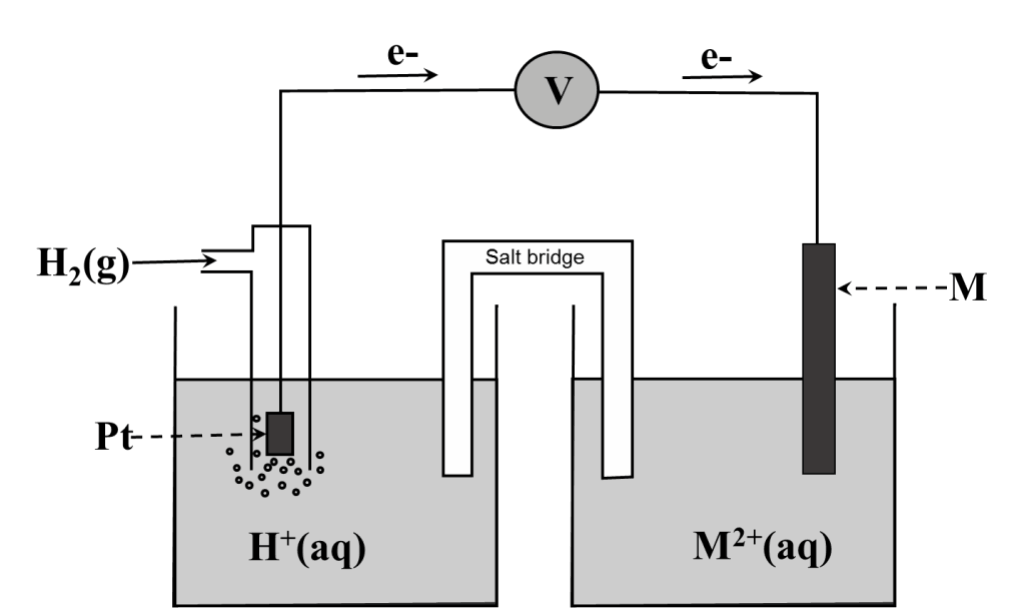
Figure 1 The galvanic cell
Table 1. Standard reduction potential (range 298-308 K)
| Half-reaction | \(E^\circ\) (V)- |
|---|---|
| \(\ce{Ba^{2+}(aq) + 2e- -> Ba(s)}\) | -2.912 |
| \(\ce{Sr^{2+}(aq) + 2e- -> Sr(s)}\) | 2.899 |
| \(\ce{Ca^{2+}(aq) + 2e- -> Ca(s)}\) | -2.868 |
| \(\ce{Er^{2+}(aq) + 2e- -> Er(s)}\) | -2.000 |
| \(\ce{Ti^{2+}(aq) + 2e- -> Ti(s)}\) | -1.630 |
| \(\ce{Mn^{2+}(aq) + 2e- -> Mn(s)}\) | -1.185 |
| \(\ce{V^{2+}(aq) + 2e- ->}\ ;\ce{V(s)}\) | -1.175 |
| \(\ce{Cr^{2+}(aq) + 2e- -> Cr(s)}\) | -0.913 |
| \(\ce{Fe^{2+}(aq) + 2e- -> Fe(s)}\) | -0.447 |
| \(\ce{Cd^{2+}(aq) + 2e- -> Cd(s)}\) | -0.403 |
| \(\ce{Co^{2+}(aq) + 2e- -> Co(s)}\) | -0.280 |
| \(\ce{Ni^{2+}(aq) + 2e- -> Ni(s)}\) | -0.257 |
| \(\ce{Sn^{2+}(aq) + 2e- -> Sn(s)}\) | -0.138 |
| \(\ce{Pb^{2+}(aq) + 2e- -> Pb(s)}\) | -0.126 |
| \(\ce{2H+(aq) + 2e- -> H2(g)}\) | 0.000 |
| \(\ce{Sn^{4+}(aq) + 2e- -> Sn^{2+}(aq)}\) | +0.151 |
| \(\ce{Cu^{2+}(aq) + e- -> Cu+(aq)}\) | +0.153 |
| \(\ce{Ge^{2+}(aq) + 2e- -> Ge(s)}\) | +0.240 |
| \(\ce{VO^{2+}(aq) + 2H+(aq) + e- -> V^{3+}(aq) + H2O(l)}\) | +0.337 |
| \(\ce{Cu^{2+}(aq) + 2e- -> Cu(s)}\) | +0.340 |
| \(\ce{Tc^{2+}(aq) + 2e- -> Tc(s)}\) | +0.400 |
| \(\ce{Ru^{2+}(aq) + 2e- -> Ru(s)}\) | +0.455 |
| \(\ce{I2(s) + 2e- -> 2I-(aq)}\) | +0.535 |
| \(\ce{UO2^{2+}(aq) + 4H+(aq) + 2e- -> U^{4+}(aq) + 2H2O(l)}\) | +0.612 |
| \(\ce{PtCl4^{2-}(aq) + 2e- -> Pt(s) + 4Cl-(aq)}\) | +0.755 |
| \(\ce{Fe^{3+}(aq) + e- -> Fe^{2+}(aq)}\) | +0.770 |
| \(\ce{Hg2^{2+}(aq) + 2e- -> 2Hg(l)}\) | +0.797 |
| \(\ce{Hg^{2+}(aq) + 2e- -> Hg(l)}\) | +0.851 |
| \(\ce{2Hg^{2+}(aq) + 2e- -> Hg2^{2+}(aq)}\) | +0.920 |
| \(\ce{Pt^{2+}(aq) + 2e- -> Pt(s)}\) | +1.180 |
| \(\ce{MnO2(s) + 4H+(aq) + 2e- -> Mn^{2+}(aq) + 2H2O(l)}\) | +1.224 |
| \(\ce{Cr2O7^{2-}(aq) + 14H+(aq) + 6e- -> 2Cr^{3+}(aq) + 7H2O(l)}\) | +1.360 |
| \(\ce{Co^{3+}(aq) + e- -> Co^{2+}(aq)}\) | +1.920 |
| \(\ce{S2O8^{2-}(aq) + 2e- -> 2SO4^{2-}(aq)}\) | +2.010 |
4.1 If the reaction quotient (\(Q\)) of the whole galvanic cell is equal to \(2.18\times10^{-4}\) at 30.00 °C, the electromotive force is +0.450 V. Calculate the value of standard reduction potential (\(E^\circ\)) and identify the metal “M”.
Note: \(\Delta G=\Delta G^\circ+RT\ln Q\)
4.2 Write the balanced equation of the spontaneous redox reaction of the galvanic cell.
4.3 The unknown concentration of \(\ce{M^{2+}(aq)}\) solution in the cell (Figure 1) can be analyzed by a iodometric titration. A 25.00 \(\mathrm{cm^3}\) aliquot of \(\ce{M^{2+}(aq)}\) solution is added into a conical flask and an excess of \(\ce{KI}\) is added. A volume of 25.05 \(\mathrm{cm^3}\) of a sodium thiosulfate solution with a concentration of 0.800 \(\mathrm{mol\,dm^{-3}}\) is required to reach the equivalent point. Write all the redox reactions associated with this titration and calculate the concentration of \(\ce{M^{2+}(aq)}\) solution.
Note: If a student cannot find the answer, the student can use 0.950 \(\mathrm{mol\,dm^{-3}}\) as the concentration of \(\ce{M^{2+}}\) for further calculations.
4.4 In Figure 1, if the hydrogen half-cell is under 0.360 bar hydrogen gas and the platinum electrode is immersed in a 500 \(\mathrm{cm^3}\) buffer solution containing 0.050 mol lactic acid (\(\ce{HC3H5O3}\)) and 0.025 mol sodium lactate (\(\ce{C3H5O3Na}\)), the electromotive force of the galvanic cell measured is +0.534 V. Calculate the pH of the buffer solution and the dissociation constant (\(K_a\)) of lactic acid at 30.00 °C.
Note: If a student cannot find the answer, the student can use 3.46 as the buffer pH for further calculations.
Official English text of the problem.
Answers
- 4.1: \(E^\circ=+0.340\ \mathrm V\); the metal M is copper, \(\ce{Cu}\).
- 4.2: \(\ce{H2(g) + Cu^{2+}(aq) -> 2H+(aq) + Cu(s)}\).
- 4.3: \(\boxed{[\ce{Cu^{2+}}]=0.802\ \mathrm{mol\,dm^{-3}}}\). The reactions are:
\[ \ce{2Cu^{2+}(aq) + 4I-(aq) -> 2CuI(s) + I2(aq)} \] \[ \ce{I2(aq) + 2S2O3^{2-}(aq) -> 2I-(aq) + S4O6^{2-}(aq)} \]
- 4.4: \(\boxed{\mathrm{pH}=3.50}\) and \(\boxed{K_a=1.6\times10^{-4}}\).
Solution
Use \(T=303.15\ \mathrm K\), \(R=8.314\ \mathrm{J\,mol^{-1}\,K^{-1}}\), and \(F=96485\ \mathrm{C\,mol^{-1}}\). Thus,
\[ \frac{RT}{2F}=0.0130610\ \mathrm V, \qquad \frac{RT\ln 10}{F}=0.0601483\ \mathrm V. \]
For the concentration calculations, activities are approximated by concentrations divided by \(c^\circ=1\ \mathrm{mol\,dm^{-3}}\); gas pressure is divided by \(p^\circ=1\ \mathrm{bar}\).
4.1
The electron-flow arrows show that the hydrogen electrode is the anode and the metal electrode is the cathode. Reduction of one metal ion requires two electrons:
\[ \ce{M^{2+}(aq) + 2e- -> M(s)}. \]
Therefore \(n=2\). Combining
\[ \Delta G=-nFE,\qquad \Delta G^\circ=-nFE^\circ \]
with the given relation gives the Nernst equation:
\[ E=E^\circ-\frac{RT}{nF}\ln Q. \]
Hence,
\[ \begin{aligned} E^\circ_{\mathrm{cell}} &=E+\frac{RT}{2F}\ln Q\\ &=0.450\ \mathrm V +(0.0130610\ \mathrm V)\ln(2.18\times10^{-4})\\ &=0.339882\ \mathrm V\\ &\approx\boxed{+0.340\ \mathrm V}. \end{aligned} \]
Since the standard hydrogen reduction potential is zero,
\[ E^\circ_{\mathrm{cell}} =E^\circ_{\mathrm{metal}}-E^\circ_{\mathrm{hydrogen}} =E^\circ_{\mathrm{metal}}. \]
The matching entry is the reduction of copper(II) ions, \(\ce{Cu^{2+}}\), SMILES [Cu+2], to copper:
\[ \ce{Cu^{2+}(aq) + 2e- -> Cu(s)},\qquad E^\circ=+0.340\ \mathrm V. \]
Thus \(\boxed{\mathrm M=\ce{Cu}}\).
4.2
Hydrogen, \(\ce{H2}\), SMILES [H][H], is oxidized to hydrogen ions (protons), \(\ce{H+}\), SMILES [H+].
Anode:
\[ \ce{H2(g) -> 2H+(aq) + 2e-}. \]
Cathode:
\[ \ce{Cu^{2+}(aq) + 2e- -> Cu(s)}. \]
Adding the half-reactions gives
\[ \boxed{\ce{H2(g) + Cu^{2+}(aq) -> 2H+(aq) + Cu(s)}}. \]
Atoms and charge are balanced, and the positive cell potential confirms that this direction is spontaneous under the stated conditions. Platinum conducts electrons and catalyzes the hydrogen electrode reaction.
4.3
Iodide ions, \(\ce{I-}\), SMILES [I-], reduce copper(II) to copper(I), \(\ce{Cu+}\), SMILES [Cu+]. Copper(I) precipitates as sparingly soluble copper(I) iodide, which drives the reaction:
\[ \boxed{\ce{2Cu^{2+}(aq) + 4I-(aq) -> 2CuI(s) + I2(aq)}}. \]
Copper(I) iodide can be represented compositionally as [Cu+].[I-]; this represents an ionic formula unit, not the solid’s crystal lattice.
Each copper(II) ion accepts one electron. Two iodide ions lose two electrons to form one iodine molecule, while two further iodide ions enter the precipitate.
The liberated iodine, \(\ce{I2}\), SMILES II, is titrated with thiosulfate, \(\ce{S2O3^{2-}}\), SMILES [O-]S(=O)(=O)[S-]. Thiosulfate is oxidized to tetrathionate, \(\ce{S4O6^{2-}}\), SMILES [O-]S(=O)(=O)SSS(=O)(=O)[O-]:
\[ \boxed{\ce{I2(aq) + 2S2O3^{2-}(aq) -> 2I-(aq) + S4O6^{2-}(aq)}}. \]
In excess iodide, iodine forms triiodide, \(\ce{I3-}\), SMILES I[I-]I:
\[ \ce{I2(aq) + I-(aq) <=> I3-(aq)}. \]
This is a complex-formation equilibrium, not an additional redox reaction. Triiodide is linear; the SMILES does not specify that geometry. Equivalently, the two redox steps can be written as
\[ \ce{2Cu^{2+}(aq) + 5I-(aq) -> 2CuI(s) + I3-(aq)} \]
and
\[ \ce{I3-(aq) + 2S2O3^{2-}(aq) -> 3I-(aq) + S4O6^{2-}(aq)}. \]
Both representations give the same stoichiometry:
\[ n(\ce{Cu^{2+}}) =2n(\text{liberated iodine}) =n(\ce{S2O3^{2-}}). \]
The amount of thiosulfate used is
\[ n(\ce{S2O3^{2-}}) =(0.800\ \mathrm{mol\,dm^{-3}}) (25.05\times10^{-3}\ \mathrm{dm^3}) =0.02004\ \mathrm{mol}. \]
Therefore,
\[ [\ce{Cu^{2+}}] =\frac{0.02004\ \mathrm{mol}} {25.00\times10^{-3}\ \mathrm{dm^3}} =0.8016\ \mathrm{mol\,dm^{-3}}, \]
or, to three significant figures,
\[ \boxed{[\ce{Cu^{2+}}]=0.802\ \mathrm{mol\,dm^{-3}}}. \]
4.4
For the overall reaction in 4.2, the activity of solid copper is unity, so
\[ Q=\frac{a_{\ce{H+}}^2} {a_{\ce{Cu^{2+}}}(p_{\ce{H2}}/p^\circ)}. \]
Using the tabulated copper potential, \(E^\circ=0.340\ \mathrm V\), and retaining the unrounded concentration from 4.3,
\[ 0.534 =0.340 -0.0130610\ln \left(\frac{a_{\ce{H+}}^2}{0.8016(0.360)}\right). \]
Since \(\ln a_{\ce{H+}}=-(\ln 10)\mathrm{pH}\),
\[ E =E^\circ+\frac{RT}{2F} \ln\!\left[a_{\ce{Cu^{2+}}}(p_{\ce{H2}}/p^\circ)\right] +\frac{RT\ln 10}{F}\mathrm{pH}. \]
Thus,
\[ \begin{aligned} \mathrm{pH} &=\frac{0.534-0.340 -0.0130610\ln(0.8016\times0.360)} {0.0601483}\\ &=3.49523. \end{aligned} \]
Therefore,
\[ \boxed{\mathrm{pH}=3.50}, \qquad [\ce{H+}]\approx3.1972\times10^{-4}\ \mathrm{mol\,dm^{-3}}. \]
Lactic acid, \(\ce{HC3H5O3}\), is 2-hydroxypropanoic acid, SMILES CC(O)C(=O)O. Its conjugate base is lactate, \(\ce{C3H5O3-}\), SMILES CC(O)C(=O)[O-]. Sodium lactate has the component SMILES CC(O)C(=O)[O-].[Na+]. The problem specifies no stereoisomer, so no stereochemical tags are assigned.
The acid dissociation is
\[ \ce{HC3H5O3(aq) <=> H+(aq) + C3H5O3-(aq)}. \]
The formal concentrations in \(0.500\ \mathrm{dm^3}\) are
\[ C_{\mathrm{acid}} =\frac{0.050}{0.500} =0.100\ \mathrm{mol\,dm^{-3}}, \]
\[ C_{\mathrm{lactate}} =\frac{0.025}{0.500} =0.050\ \mathrm{mol\,dm^{-3}}. \]
Using the usual buffer approximation,
\[ \begin{aligned} K_a &\approx \frac{[\ce{H+}]}{c^\circ} \frac{[\ce{C3H5O3-}]}{[\ce{HC3H5O3}]}\\ &=(3.1972\times10^{-4})\frac{0.050}{0.100}\\ &=1.5986\times10^{-4}. \end{aligned} \]
Retaining the small additional dissociation of lactic acid, with \(h=[\ce{H+}]\) and negligible water autoionization, gives
\[ K_a\approx \frac{h}{c^\circ} \frac{0.050\ \mathrm{mol\,dm^{-3}}+h} {0.100\ \mathrm{mol\,dm^{-3}}-h} =1.6140\times10^{-4}. \]
Both treatments give, at the precision of the buffer amounts,
\[ \boxed{K_a=1.6\times10^{-4}}. \]
Here \(K_a\) is dimensionless, using concentrations normalized by \(c^\circ\).
The solution was checked against the official solution.
IChO 2017 · Theorieaufgabe 4
Elektrochemie
Teil A. Galvanische Zelle
Das Experiment wird bei 30.00°C durchgeführt. Die elektrochemische Zelle besteht aus einer Wasserstoffhalbzelle \([\ce{Pt(s)}\mid\ce{H2(g)}\mid\ce{H+(aq)}]\), die eine Elektrode aus metallischem Platin enthält, die in eine Pufferlösung eintaucht und unter Wasserstoffgasdruck steht. Diese Wasserstoffhalbzelle ist mit einer Halbzelle verbunden, in der ein Streifen eines Metalls (M) in eine Lösung von \(\ce{M^{2+}(aq)}\) unbekannter Konzentration eintaucht. Die beiden Halbzellen sind über eine Salzbrücke verbunden, wie in Abbildung 1 gezeigt.
Hinweis: Die Standardreduktionspotentiale sind in Tabelle 1 angegeben.
Abbildung 1 Die galvanische Zelle
Tabelle 1. Standardreduktionspotential (Bereich 298-308 K)
| Teilreaktion | \(E^\circ\) (V)- |
|---|---|
| \(\ce{Ba^{2+}(aq) + 2e- -> Ba(s)}\) | -2.912 |
| \(\ce{Sr^{2+}(aq) + 2e- -> Sr(s)}\) | 2.899 |
| \(\ce{Ca^{2+}(aq) + 2e- -> Ca(s)}\) | -2.868 |
| \(\ce{Er^{2+}(aq) + 2e- -> Er(s)}\) | -2.000 |
| \(\ce{Ti^{2+}(aq) + 2e- -> Ti(s)}\) | -1.630 |
| \(\ce{Mn^{2+}(aq) + 2e- -> Mn(s)}\) | -1.185 |
| \(\ce{V^{2+}(aq) + 2e- ->}\ ;\ce{V(s)}\) | -1.175 |
| \(\ce{Cr^{2+}(aq) + 2e- -> Cr(s)}\) | -0.913 |
| \(\ce{Fe^{2+}(aq) + 2e- -> Fe(s)}\) | -0.447 |
| \(\ce{Cd^{2+}(aq) + 2e- -> Cd(s)}\) | -0.403 |
| \(\ce{Co^{2+}(aq) + 2e- -> Co(s)}\) | -0.280 |
| \(\ce{Ni^{2+}(aq) + 2e- -> Ni(s)}\) | -0.257 |
| \(\ce{Sn^{2+}(aq) + 2e- -> Sn(s)}\) | -0.138 |
| \(\ce{Pb^{2+}(aq) + 2e- -> Pb(s)}\) | -0.126 |
| \(\ce{2H+(aq) + 2e- -> H2(g)}\) | 0.000 |
| \(\ce{Sn^{4+}(aq) + 2e- -> Sn^{2+}(aq)}\) | +0.151 |
| \(\ce{Cu^{2+}(aq) + e- -> Cu+(aq)}\) | +0.153 |
| \(\ce{Ge^{2+}(aq) + 2e- -> Ge(s)}\) | +0.240 |
| \(\ce{VO^{2+}(aq) + 2H+(aq) + e- -> V^{3+}(aq) + H2O(l)}\) | +0.337 |
| \(\ce{Cu^{2+}(aq) + 2e- -> Cu(s)}\) | +0.340 |
| \(\ce{Tc^{2+}(aq) + 2e- -> Tc(s)}\) | +0.400 |
| \(\ce{Ru^{2+}(aq) + 2e- -> Ru(s)}\) | +0.455 |
| \(\ce{I2(s) + 2e- -> 2I-(aq)}\) | +0.535 |
| \(\ce{UO2^{2+}(aq) + 4H+(aq) + 2e- -> U^{4+}(aq) + 2H2O(l)}\) | +0.612 |
| \(\ce{PtCl4^{2-}(aq) + 2e- -> Pt(s) + 4Cl-(aq)}\) | +0.755 |
| \(\ce{Fe^{3+}(aq) + e- -> Fe^{2+}(aq)}\) | +0.770 |
| \(\ce{Hg2^{2+}(aq) + 2e- -> 2Hg(l)}\) | +0.797 |
| \(\ce{Hg^{2+}(aq) + 2e- -> Hg(l)}\) | +0.851 |
| \(\ce{2Hg^{2+}(aq) + 2e- -> Hg2^{2+}(aq)}\) | +0.920 |
| \(\ce{Pt^{2+}(aq) + 2e- -> Pt(s)}\) | +1.180 |
| \(\ce{MnO2(s) + 4H+(aq) + 2e- -> Mn^{2+}(aq) + 2H2O(l)}\) | +1.224 |
| \(\ce{Cr2O7^{2-}(aq) + 14H+(aq) + 6e- -> 2Cr^{3+}(aq) + 7H2O(l)}\) | +1.360 |
| \(\ce{Co^{3+}(aq) + e- -> Co^{2+}(aq)}\) | +1.920 |
| \(\ce{S2O8^{2-}(aq) + 2e- -> 2SO4^{2-}(aq)}\) | +2.010 |
4.1 Wenn der Reaktionsquotient (\(Q\)) der gesamten galvanischen Zelle bei 30.00 °C gleich \(2.18\times10^{-4}\) ist, beträgt die elektromotorische Kraft +0.450 V. Berechnen Sie den Wert des Standardreduktionspotentials (\(E^\circ\)) und bestimmen Sie das Metall „M“.
Hinweis: \(\Delta G=\Delta G^\circ+RT\ln Q\)
4.2 Stellen Sie die ausgeglichene Gleichung der spontan ablaufenden Redoxreaktion der galvanischen Zelle auf.
4.3 Die unbekannte Konzentration der \(\ce{M^{2+}(aq)}\)-Lösung in der Zelle (Abbildung 1) kann durch iodometrische Titration bestimmt werden. Ein Aliquot von 25.00 \(\mathrm{cm^3}\) der \(\ce{M^{2+}(aq)}\)-Lösung wird in einen Erlenmeyerkolben gegeben und mit einem Überschuss an \(\ce{KI}\) versetzt. Zum Erreichen des Äquivalenzpunkts werden 25.05 \(\mathrm{cm^3}\) einer Natriumthiosulfatlösung mit einer Konzentration von 0.800 \(\mathrm{mol\,dm^{-3}}\) benötigt. Geben Sie alle mit dieser Titration verbundenen Redoxreaktionen an und berechnen Sie die Konzentration der \(\ce{M^{2+}(aq)}\)-Lösung.
Hinweis: Falls Sie die Antwort nicht ermitteln können, dürfen Sie für die weiteren Berechnungen 0.950 \(\mathrm{mol\,dm^{-3}}\) als Konzentration von \(\ce{M^{2+}}\) verwenden.
4.4 Wenn die Wasserstoffhalbzelle in Abbildung 1 unter einem Wasserstoffgasdruck von 0.360 bar steht und die Platinelektrode in 500 \(\mathrm{cm^3}\) einer Pufferlösung eintaucht, die 0.050 mol Milchsäure (\(\ce{HC3H5O3}\)) und 0.025 mol Natriumlactat (\(\ce{C3H5O3Na}\)) enthält, beträgt die gemessene elektromotorische Kraft der galvanischen Zelle +0.534 V. Berechnen Sie den pH-Wert der Pufferlösung und die Dissoziationskonstante (\(K_a\)) der Milchsäure bei 30.00 °C.
Hinweis: Falls Sie die Antwort nicht ermitteln können, dürfen Sie für die weiteren Berechnungen 3.46 als pH-Wert des Puffers verwenden.
Aufgabentext aus dem offiziellen englischen Text übersetzt.
Antworten
- 4.1: \(E^\circ=+0.340\ \mathrm V\); das Metall M ist Kupfer, \(\ce{Cu}\).
- 4.2: \(\ce{H2(g) + Cu^{2+}(aq) -> 2H+(aq) + Cu(s)}\).
- 4.3: \(\boxed{[\ce{Cu^{2+}}]=0.802\ \mathrm{mol\,dm^{-3}}}\). Die Reaktionen lauten:
\[ \ce{2Cu^{2+}(aq) + 4I-(aq) -> 2CuI(s) + I2(aq)} \] \[ \ce{I2(aq) + 2S2O3^{2-}(aq) -> 2I-(aq) + S4O6^{2-}(aq)} \]
- 4.4: \(\boxed{\mathrm{pH}=3.50}\) und \(\boxed{K_a=1.6\times10^{-4}}\).
Lösung
Wir verwenden \(T=303.15\ \mathrm K\), \(R=8.314\ \mathrm{J\,mol^{-1}\,K^{-1}}\) und \(F=96485\ \mathrm{C\,mol^{-1}}\). Somit gilt:
\[ \frac{RT}{2F}=0.0130610\ \mathrm V, \qquad \frac{RT\ln 10}{F}=0.0601483\ \mathrm V. \]
Für die Konzentrationsberechnungen werden die Aktivitäten durch die durch \(c^\circ=1\ \mathrm{mol\,dm^{-3}}\) dividierten Konzentrationen angenähert; der Gasdruck wird durch \(p^\circ=1\ \mathrm{bar}\) dividiert.
4.1
Die Pfeile für den Elektronenfluss zeigen, dass die Wasserstoffelektrode die Anode und die Metallelektrode die Kathode ist. Die Reduktion eines Metallions erfordert zwei Elektronen:
\[ \ce{M^{2+}(aq) + 2e- -> M(s)}. \]
Daher gilt \(n=2\). Die Kombination von
\[ \Delta G=-nFE,\qquad \Delta G^\circ=-nFE^\circ \]
mit der gegebenen Beziehung ergibt die Nernst-Gleichung:
\[ E=E^\circ-\frac{RT}{nF}\ln Q. \]
Daraus folgt:
\[ \begin{aligned} E^\circ_{\mathrm{cell}} &=E+\frac{RT}{2F}\ln Q\\ &=0.450\ \mathrm V +(0.0130610\ \mathrm V)\ln(2.18\times10^{-4})\\ &=0.339882\ \mathrm V\\ &\approx\boxed{+0.340\ \mathrm V}. \end{aligned} \]
Da das Standardreduktionspotential von Wasserstoff null ist, gilt:
\[ E^\circ_{\mathrm{cell}} =E^\circ_{\mathrm{metal}}-E^\circ_{\mathrm{hydrogen}} =E^\circ_{\mathrm{metal}}. \]
Der passende Tabelleneintrag ist die Reduktion von Kupfer(II)-Ionen, \(\ce{Cu^{2+}}\), SMILES [Cu+2], zu Kupfer:
\[ \ce{Cu^{2+}(aq) + 2e- -> Cu(s)},\qquad E^\circ=+0.340\ \mathrm V. \]
Somit ist \(\boxed{\mathrm M=\ce{Cu}}\).
4.2
Wasserstoff, \(\ce{H2}\), SMILES [H][H], wird zu Wasserstoffionen (Protonen), \(\ce{H+}\), SMILES [H+], oxidiert.
Anode:
\[ \ce{H2(g) -> 2H+(aq) + 2e-}. \]
Kathode:
\[ \ce{Cu^{2+}(aq) + 2e- -> Cu(s)}. \]
Durch Addition der Teilreaktionen erhält man
\[ \boxed{\ce{H2(g) + Cu^{2+}(aq) -> 2H+(aq) + Cu(s)}}. \]
Die Atom- und die Ladungsbilanz sind ausgeglichen, und das positive Zellpotential bestätigt, dass die Reaktion unter den angegebenen Bedingungen in dieser Richtung spontan abläuft. Platin leitet Elektronen und katalysiert die Reaktion an der Wasserstoffelektrode.
4.3
Iodidionen, \(\ce{I-}\), SMILES [I-], reduzieren Kupfer(II) zu Kupfer(I), \(\ce{Cu+}\), SMILES [Cu+]. Kupfer(I) fällt als schwer lösliches Kupfer(I)-iodid aus, wodurch die Reaktion vorangetrieben wird:
\[ \boxed{\ce{2Cu^{2+}(aq) + 4I-(aq) -> 2CuI(s) + I2(aq)}}. \]
Die Zusammensetzung von Kupfer(I)-iodid kann als [Cu+].[I-] dargestellt werden; dies stellt eine ionische Formeleinheit dar, nicht das Kristallgitter des Feststoffs.
Jedes Kupfer(II)-Ion nimmt ein Elektron auf. Zwei Iodidionen geben zwei Elektronen ab und bilden ein Iodmolekül, während zwei weitere Iodidionen in den Niederschlag eingebaut werden.
Das freigesetzte Iod, \(\ce{I2}\), SMILES II, wird mit Thiosulfat, \(\ce{S2O3^{2-}}\), SMILES [O-]S(=O)(=O)[S-], titriert. Thiosulfat wird zu Tetrathionat, \(\ce{S4O6^{2-}}\), SMILES [O-]S(=O)(=O)SSS(=O)(=O)[O-], oxidiert:
\[ \boxed{\ce{I2(aq) + 2S2O3^{2-}(aq) -> 2I-(aq) + S4O6^{2-}(aq)}}. \]
Bei einem Überschuss an Iodid bildet Iod Triiodid, \(\ce{I3-}\), SMILES I[I-]I:
\[ \ce{I2(aq) + I-(aq) <=> I3-(aq)}. \]
Dies ist ein Komplexbildungsgleichgewicht, keine zusätzliche Redoxreaktion. Triiodid ist linear; diese Geometrie wird durch die SMILES-Schreibweise nicht festgelegt. Gleichwertige Schreibweisen für die beiden Redoxschritte sind
\[ \ce{2Cu^{2+}(aq) + 5I-(aq) -> 2CuI(s) + I3-(aq)} \]
und
\[ \ce{I3-(aq) + 2S2O3^{2-}(aq) -> 3I-(aq) + S4O6^{2-}(aq)}. \]
Beide Darstellungen ergeben dieselbe Stöchiometrie:
\[ n(\ce{Cu^{2+}}) =2n(\text{freigesetztes Iod}) =n(\ce{S2O3^{2-}}). \]
Die verbrauchte Stoffmenge an Thiosulfat beträgt
\[ n(\ce{S2O3^{2-}}) =(0.800\ \mathrm{mol\,dm^{-3}}) (25.05\times10^{-3}\ \mathrm{dm^3}) =0.02004\ \mathrm{mol}. \]
Daher gilt:
\[ [\ce{Cu^{2+}}] =\frac{0.02004\ \mathrm{mol}} {25.00\times10^{-3}\ \mathrm{dm^3}} =0.8016\ \mathrm{mol\,dm^{-3}}, \]
oder, auf drei signifikante Stellen gerundet,
\[ \boxed{[\ce{Cu^{2+}}]=0.802\ \mathrm{mol\,dm^{-3}}}. \]
4.4
Für die Gesamtreaktion in 4.2 ist die Aktivität von festem Kupfer gleich eins, sodass gilt:
\[ Q=\frac{a_{\ce{H+}}^2} {a_{\ce{Cu^{2+}}}(p_{\ce{H2}}/p^\circ)}. \]
Mit dem tabellierten Kupferpotential, \(E^\circ=0.340\ \mathrm V\), und unter Beibehaltung der ungerundeten Konzentration aus 4.3 ergibt sich:
\[ 0.534 =0.340 -0.0130610\ln \left(\frac{a_{\ce{H+}}^2}{0.8016(0.360)}\right). \]
Da \(\ln a_{\ce{H+}}=-(\ln 10)\mathrm{pH}\), gilt:
\[ E =E^\circ+\frac{RT}{2F} \ln\!\left[a_{\ce{Cu^{2+}}}(p_{\ce{H2}}/p^\circ)\right] +\frac{RT\ln 10}{F}\mathrm{pH}. \]
Somit gilt:
\[ \begin{aligned} \mathrm{pH} &=\frac{0.534-0.340 -0.0130610\ln(0.8016\times0.360)} {0.0601483}\\ &=3.49523. \end{aligned} \]
Daher gilt:
\[ \boxed{\mathrm{pH}=3.50}, \qquad [\ce{H+}]\approx3.1972\times10^{-4}\ \mathrm{mol\,dm^{-3}}. \]
Milchsäure, \(\ce{HC3H5O3}\), ist 2-Hydroxypropansäure, SMILES CC(O)C(=O)O. Ihre konjugierte Base ist Lactat, \(\ce{C3H5O3-}\), SMILES CC(O)C(=O)[O-]. Natriumlactat hat die Komponenten-SMILES CC(O)C(=O)[O-].[Na+]. In der Aufgabe ist kein Stereoisomer angegeben, daher werden keine stereochemischen Kennzeichnungen verwendet.
Die Säuredissoziation lautet
\[ \ce{HC3H5O3(aq) <=> H+(aq) + C3H5O3-(aq)}. \]
Die formalen Konzentrationen in \(0.500\ \mathrm{dm^3}\) betragen
\[ C_{\mathrm{acid}} =\frac{0.050}{0.500} =0.100\ \mathrm{mol\,dm^{-3}}, \]
\[ C_{\mathrm{lactate}} =\frac{0.025}{0.500} =0.050\ \mathrm{mol\,dm^{-3}}. \]
Mit der üblichen Puffernäherung ergibt sich:
\[ \begin{aligned} K_a &\approx \frac{[\ce{H+}]}{c^\circ} \frac{[\ce{C3H5O3-}]}{[\ce{HC3H5O3}]}\\ &=(3.1972\times10^{-4})\frac{0.050}{0.100}\\ &=1.5986\times10^{-4}. \end{aligned} \]
Unter Berücksichtigung der geringfügigen zusätzlichen Dissoziation der Milchsäure mit \(h=[\ce{H+}]\) und unter Vernachlässigung der Autoprotolyse des Wassers ergibt sich:
\[ K_a\approx \frac{h}{c^\circ} \frac{0.050\ \mathrm{mol\,dm^{-3}}+h} {0.100\ \mathrm{mol\,dm^{-3}}-h} =1.6140\times10^{-4}. \]
Beide Ansätze ergeben bei der Genauigkeit der angegebenen Stoffmengen der Pufferkomponenten
\[ \boxed{K_a=1.6\times10^{-4}}. \]
Hier ist \(K_a\) dimensionslos, da die Konzentrationen auf \(c^\circ\) normiert werden.
Die Lösung wurde mit der offiziellen Lösung abgeglichen.
IChO 2017 · Teori sorusu 4
Elektrokimya
Bölüm A. Galvanik hücre
Deney 30.00°C'de gerçekleştirilmektedir. Elektrokimyasal hücre, hidrojen gazı basıncı altında bir tampon çözeltiye daldırılmış metalik platin elektrot içeren bir hidrojen yarı hücresinden \([\ce{Pt(s)}\mid\ce{H2(g)}\mid\ce{H+(aq)}]\) oluşmaktadır. Bu hidrojen yarı hücresi, derişimi bilinmeyen bir \(\ce{M^{2+}(aq)}\) çözeltisine daldırılmış metal (M) şeritten oluşan bir yarı hücreye bağlanmıştır. İki yarı hücre, Şekil 1'de gösterildiği gibi bir tuz köprüsü aracılığıyla birbirine bağlanmıştır.
Not: Standart indirgenme potansiyelleri Tablo 1'de verilmiştir.
Şekil 1 Galvanik hücre
Tablo 1. Standart indirgenme potansiyeli (298-308 K aralığında)
| Yarı tepkime | \(E^\circ\) (V)- |
|---|---|
| \(\ce{Ba^{2+}(aq) + 2e- -> Ba(s)}\) | -2.912 |
| \(\ce{Sr^{2+}(aq) + 2e- -> Sr(s)}\) | 2.899 |
| \(\ce{Ca^{2+}(aq) + 2e- -> Ca(s)}\) | -2.868 |
| \(\ce{Er^{2+}(aq) + 2e- -> Er(s)}\) | -2.000 |
| \(\ce{Ti^{2+}(aq) + 2e- -> Ti(s)}\) | -1.630 |
| \(\ce{Mn^{2+}(aq) + 2e- -> Mn(s)}\) | -1.185 |
| \(\ce{V^{2+}(aq) + 2e- ->}\ ;\ce{V(s)}\) | -1.175 |
| \(\ce{Cr^{2+}(aq) + 2e- -> Cr(s)}\) | -0.913 |
| \(\ce{Fe^{2+}(aq) + 2e- -> Fe(s)}\) | -0.447 |
| \(\ce{Cd^{2+}(aq) + 2e- -> Cd(s)}\) | -0.403 |
| \(\ce{Co^{2+}(aq) + 2e- -> Co(s)}\) | -0.280 |
| \(\ce{Ni^{2+}(aq) + 2e- -> Ni(s)}\) | -0.257 |
| \(\ce{Sn^{2+}(aq) + 2e- -> Sn(s)}\) | -0.138 |
| \(\ce{Pb^{2+}(aq) + 2e- -> Pb(s)}\) | -0.126 |
| \(\ce{2H+(aq) + 2e- -> H2(g)}\) | 0.000 |
| \(\ce{Sn^{4+}(aq) + 2e- -> Sn^{2+}(aq)}\) | +0.151 |
| \(\ce{Cu^{2+}(aq) + e- -> Cu+(aq)}\) | +0.153 |
| \(\ce{Ge^{2+}(aq) + 2e- -> Ge(s)}\) | +0.240 |
| \(\ce{VO^{2+}(aq) + 2H+(aq) + e- -> V^{3+}(aq) + H2O(l)}\) | +0.337 |
| \(\ce{Cu^{2+}(aq) + 2e- -> Cu(s)}\) | +0.340 |
| \(\ce{Tc^{2+}(aq) + 2e- -> Tc(s)}\) | +0.400 |
| \(\ce{Ru^{2+}(aq) + 2e- -> Ru(s)}\) | +0.455 |
| \(\ce{I2(s) + 2e- -> 2I-(aq)}\) | +0.535 |
| \(\ce{UO2^{2+}(aq) + 4H+(aq) + 2e- -> U^{4+}(aq) + 2H2O(l)}\) | +0.612 |
| \(\ce{PtCl4^{2-}(aq) + 2e- -> Pt(s) + 4Cl-(aq)}\) | +0.755 |
| \(\ce{Fe^{3+}(aq) + e- -> Fe^{2+}(aq)}\) | +0.770 |
| \(\ce{Hg2^{2+}(aq) + 2e- -> 2Hg(l)}\) | +0.797 |
| \(\ce{Hg^{2+}(aq) + 2e- -> Hg(l)}\) | +0.851 |
| \(\ce{2Hg^{2+}(aq) + 2e- -> Hg2^{2+}(aq)}\) | +0.920 |
| \(\ce{Pt^{2+}(aq) + 2e- -> Pt(s)}\) | +1.180 |
| \(\ce{MnO2(s) + 4H+(aq) + 2e- -> Mn^{2+}(aq) + 2H2O(l)}\) | +1.224 |
| \(\ce{Cr2O7^{2-}(aq) + 14H+(aq) + 6e- -> 2Cr^{3+}(aq) + 7H2O(l)}\) | +1.360 |
| \(\ce{Co^{3+}(aq) + e- -> Co^{2+}(aq)}\) | +1.920 |
| \(\ce{S2O8^{2-}(aq) + 2e- -> 2SO4^{2-}(aq)}\) | +2.010 |
4.1 Galvanik hücrenin toplam tepkimesinin tepkime bölümü (\(Q\)), 30.00 °C'de \(2.18\times10^{-4}\) değerine eşit olduğunda elektromotor kuvvet +0.450 V'tur. Standart indirgenme potansiyelinin (\(E^\circ\)) değerini hesaplayınız ve “M” metalini belirleyiniz.
Not: \(\Delta G=\Delta G^\circ+RT\ln Q\)
4.2 Galvanik hücrede kendiliğinden gerçekleşen redoks tepkimesinin denkleştirilmiş denklemini yazınız.
4.3 Hücredeki (Şekil 1) \(\ce{M^{2+}(aq)}\) çözeltisinin bilinmeyen derişimi iyodometrik titrasyonla belirlenebilir. \(\ce{M^{2+}(aq)}\) çözeltisinden alınan 25.00 \(\mathrm{cm^3}\) hacminde bir örnek bir erlenmayere konulur ve üzerine aşırı miktarda \(\ce{KI}\) eklenir. Eşdeğerlik noktasına ulaşmak için derişimi 0.800 \(\mathrm{mol\,dm^{-3}}\) olan sodyum tiyosülfat çözeltisinden 25.05 \(\mathrm{cm^3}\) gerekmektedir. Bu titrasyonla ilgili tüm redoks tepkimelerini yazınız ve \(\ce{M^{2+}(aq)}\) çözeltisinin derişimini hesaplayınız.
Not: Öğrenci cevabı bulamazsa sonraki hesaplamalarda \(\ce{M^{2+}}\) derişimi olarak 0.950 \(\mathrm{mol\,dm^{-3}}\) kullanabilir.
4.4 Şekil 1'de hidrojen yarı hücresi 0.360 bar hidrojen gazı basıncı altındaysa ve platin elektrot, 0.050 mol laktik asit (\(\ce{HC3H5O3}\)) ve 0.025 mol sodyum laktat (\(\ce{C3H5O3Na}\)) içeren 500 \(\mathrm{cm^3}\) tampon çözeltiye daldırılmışsa galvanik hücrenin ölçülen elektromotor kuvveti +0.534 V'tur. Tampon çözeltinin pH'ını ve laktik asidin 30.00 °C'deki ayrışma sabitini (\(K_a\)) hesaplayınız.
Not: Öğrenci cevabı bulamazsa sonraki hesaplamalarda tampon çözeltinin pH'ı olarak 3.46 kullanabilir.
Soru metni resmi İngilizce metinden çevrilmiştir.
Cevaplar
- 4.1: \(E^\circ=+0.340\ \mathrm V\); M metali bakırdır, \(\ce{Cu}\).
- 4.2: \(\ce{H2(g) + Cu^{2+}(aq) -> 2H+(aq) + Cu(s)}\).
- 4.3: \(\boxed{[\ce{Cu^{2+}}]=0.802\ \mathrm{mol\,dm^{-3}}}\). Tepkimeler şunlardır:
\[ \ce{2Cu^{2+}(aq) + 4I-(aq) -> 2CuI(s) + I2(aq)} \] \[ \ce{I2(aq) + 2S2O3^{2-}(aq) -> 2I-(aq) + S4O6^{2-}(aq)} \]
- 4.4: \(\boxed{\mathrm{pH}=3.50}\) ve \(\boxed{K_a=1.6\times10^{-4}}\).
Çözüm
\(T=303.15\ \mathrm K\), \(R=8.314\ \mathrm{J\,mol^{-1}\,K^{-1}}\) ve \(F=96485\ \mathrm{C\,mol^{-1}}\) değerlerini kullanalım. Böylece,
\[ \frac{RT}{2F}=0.0130610\ \mathrm V, \qquad \frac{RT\ln 10}{F}=0.0601483\ \mathrm V. \]
Derişim hesaplamalarında aktiviteler, derişimlerin \(c^\circ=1\ \mathrm{mol\,dm^{-3}}\) değerine bölünmesiyle yaklaşık olarak ifade edilir; gaz basıncı ise \(p^\circ=1\ \mathrm{bar}\) değerine bölünür.
4.1
Elektron akışını gösteren oklar, hidrojen elektrodunun anot, metal elektrodun ise katot olduğunu göstermektedir. Bir metal iyonunun indirgenmesi için iki elektron gerekir:
\[ \ce{M^{2+}(aq) + 2e- -> M(s)}. \]
Dolayısıyla \(n=2\) olur.
\[ \Delta G=-nFE,\qquad \Delta G^\circ=-nFE^\circ \]
bağıntıları verilen bağıntıyla birleştirildiğinde Nernst denklemi elde edilir:
\[ E=E^\circ-\frac{RT}{nF}\ln Q. \]
Buna göre,
\[ \begin{aligned} E^\circ_{\mathrm{cell}} &=E+\frac{RT}{2F}\ln Q\\ &=0.450\ \mathrm V +(0.0130610\ \mathrm V)\ln(2.18\times10^{-4})\\ &=0.339882\ \mathrm V\\ &\approx\boxed{+0.340\ \mathrm V}. \end{aligned} \]
Hidrojenin standart indirgenme potansiyeli sıfır olduğundan,
\[ E^\circ_{\mathrm{cell}} =E^\circ_{\mathrm{metal}}-E^\circ_{\mathrm{hydrogen}} =E^\circ_{\mathrm{metal}}. \]
Tabloda bu değerle eşleşen tepkime, bakır(II) iyonlarının, \(\ce{Cu^{2+}}\), SMILES [Cu+2], bakıra indirgenmesidir:
\[ \ce{Cu^{2+}(aq) + 2e- -> Cu(s)},\qquad E^\circ=+0.340\ \mathrm V. \]
Dolayısıyla \(\boxed{\mathrm M=\ce{Cu}}\) olur.
4.2
Hidrojen, \(\ce{H2}\), SMILES [H][H], hidrojen iyonlarına (protonlara), \(\ce{H+}\), SMILES [H+], yükseltgenir.
Anot:
\[ \ce{H2(g) -> 2H+(aq) + 2e-}. \]
Katot:
\[ \ce{Cu^{2+}(aq) + 2e- -> Cu(s)}. \]
Yarı tepkimeler toplandığında şu denklem elde edilir:
\[ \boxed{\ce{H2(g) + Cu^{2+}(aq) -> 2H+(aq) + Cu(s)}}. \]
Atomlar ve yük bakımından denklik sağlanmıştır; hücre potansiyelinin pozitif olması, belirtilen koşullarda tepkimenin bu yönde kendiliğinden gerçekleştiğini doğrular. Platin, elektronları iletir ve hidrojen elektrodu tepkimesini katalizler.
4.3
İyodür iyonları, \(\ce{I-}\), SMILES [I-], bakır(II)'yi bakır(I)'e, \(\ce{Cu+}\), SMILES [Cu+], indirger. Bakır(I), az çözünen bakır(I) iyodür olarak çöker ve bu çökelme tepkimenin ilerlemesini sağlar:
\[ \boxed{\ce{2Cu^{2+}(aq) + 4I-(aq) -> 2CuI(s) + I2(aq)}}. \]
Bakır(I) iyodür, bileşimi bakımından [Cu+].[I-] şeklinde gösterilebilir; bu gösterim katının kristal örgüsünü değil, iyonik bir formül birimini temsil eder.
Her bakır(II) iyonu bir elektron alır. İki iyodür iyonu iki elektron vererek bir iyot molekülü oluştururken diğer iki iyodür iyonu çökeltiye katılır.
Açığa çıkan iyot, \(\ce{I2}\), SMILES II, tiyosülfat, \(\ce{S2O3^{2-}}\), SMILES [O-]S(=O)(=O)[S-], ile titre edilir. Tiyosülfat, tetratiyonata, \(\ce{S4O6^{2-}}\), SMILES [O-]S(=O)(=O)SSS(=O)(=O)[O-], yükseltgenir:
\[ \boxed{\ce{I2(aq) + 2S2O3^{2-}(aq) -> 2I-(aq) + S4O6^{2-}(aq)}}. \]
Aşırı miktarda iyodür varlığında iyot, triiyodür, \(\ce{I3-}\), SMILES I[I-]I, oluşturur:
\[ \ce{I2(aq) + I-(aq) <=> I3-(aq)}. \]
Bu, ek bir redoks tepkimesi değil, bir kompleks oluşum dengesidir. Triiyodür doğrusaldır; SMILES gösterimi bu geometriyi belirtmez. Eşdeğer biçimde, iki redoks basamağı şöyle yazılabilir:
\[ \ce{2Cu^{2+}(aq) + 5I-(aq) -> 2CuI(s) + I3-(aq)} \]
ve
\[ \ce{I3-(aq) + 2S2O3^{2-}(aq) -> 3I-(aq) + S4O6^{2-}(aq)}. \]
Her iki gösterim de aynı stokiyometriyi verir:
\[ n(\ce{Cu^{2+}}) =2n(\text{açığa çıkan iyot}) =n(\ce{S2O3^{2-}}). \]
Kullanılan tiyosülfatın madde miktarı şöyledir:
\[ n(\ce{S2O3^{2-}}) =(0.800\ \mathrm{mol\,dm^{-3}}) (25.05\times10^{-3}\ \mathrm{dm^3}) =0.02004\ \mathrm{mol}. \]
Dolayısıyla,
\[ [\ce{Cu^{2+}}] =\frac{0.02004\ \mathrm{mol}} {25.00\times10^{-3}\ \mathrm{dm^3}} =0.8016\ \mathrm{mol\,dm^{-3}}, \]
ya da üç anlamlı basamakla,
\[ \boxed{[\ce{Cu^{2+}}]=0.802\ \mathrm{mol\,dm^{-3}}}. \]
4.4
4.2'deki toplam tepkime için katı bakırın aktivitesi bir olduğundan,
\[ Q=\frac{a_{\ce{H+}}^2} {a_{\ce{Cu^{2+}}}(p_{\ce{H2}}/p^\circ)}. \]
Bakırın tabloda verilen potansiyeli, \(E^\circ=0.340\ \mathrm V\), kullanılıp 4.3'teki yuvarlanmamış derişim korunduğunda,
\[ 0.534 =0.340 -0.0130610\ln \left(\frac{a_{\ce{H+}}^2}{0.8016(0.360)}\right). \]
\(\ln a_{\ce{H+}}=-(\ln 10)\mathrm{pH}\) olduğundan,
\[ E =E^\circ+\frac{RT}{2F} \ln\!\left[a_{\ce{Cu^{2+}}}(p_{\ce{H2}}/p^\circ)\right] +\frac{RT\ln 10}{F}\mathrm{pH}. \]
Böylece,
\[ \begin{aligned} \mathrm{pH} &=\frac{0.534-0.340 -0.0130610\ln(0.8016\times0.360)} {0.0601483}\\ &=3.49523. \end{aligned} \]
Dolayısıyla,
\[ \boxed{\mathrm{pH}=3.50}, \qquad [\ce{H+}]\approx3.1972\times10^{-4}\ \mathrm{mol\,dm^{-3}}. \]
Laktik asit, \(\ce{HC3H5O3}\), 2-hidroksipropanoik asittir; SMILES gösterimi CC(O)C(=O)O şeklindedir. Eşlenik bazı laktattır, \(\ce{C3H5O3-}\), SMILES CC(O)C(=O)[O-]. Sodyum laktatın bileşen SMILES gösterimi CC(O)C(=O)[O-].[Na+] şeklindedir. Soruda herhangi bir stereoizomer belirtilmediğinden stereokimyasal etiketler atanmamıştır.
Asidin ayrışması şöyledir:
\[ \ce{HC3H5O3(aq) <=> H+(aq) + C3H5O3-(aq)}. \]
\(0.500\ \mathrm{dm^3}\) içindeki formal derişimler şöyledir:
\[ C_{\mathrm{acid}} =\frac{0.050}{0.500} =0.100\ \mathrm{mol\,dm^{-3}}, \]
\[ C_{\mathrm{lactate}} =\frac{0.025}{0.500} =0.050\ \mathrm{mol\,dm^{-3}}. \]
Alışılagelen tampon yaklaşımı kullanıldığında,
\[ \begin{aligned} K_a &\approx \frac{[\ce{H+}]}{c^\circ} \frac{[\ce{C3H5O3-}]}{[\ce{HC3H5O3}]}\\ &=(3.1972\times10^{-4})\frac{0.050}{0.100}\\ &=1.5986\times10^{-4}. \end{aligned} \]
Laktik asidin az miktardaki ek ayrışması da hesaba katılıp \(h=[\ce{H+}]\) alınır ve suyun otoiyonlaşması ihmal edilirse,
\[ K_a\approx \frac{h}{c^\circ} \frac{0.050\ \mathrm{mol\,dm^{-3}}+h} {0.100\ \mathrm{mol\,dm^{-3}}-h} =1.6140\times10^{-4}. \]
Her iki hesaplama da tampon bileşenlerinin miktarlarının verildiği hassasiyette şu sonucu verir:
\[ \boxed{K_a=1.6\times10^{-4}}. \]
Burada derişimler \(c^\circ\) ile normalize edildiğinden \(K_a\) boyutsuzdur.
Çözüm, resmi çözümle karşılaştırılarak kontrol edildi.
IChO 2017 · Problema teórico 4
Electroquímica
Parte A. Pila galvánica
El experimento se realiza a 30.00°C. La celda electroquímica está formada por una semicelda de hidrógeno \([\ce{Pt(s)}\mid\ce{H2(g)}\mid\ce{H+(aq)}]\) que contiene un electrodo de platino metálico sumergido en una disolución tampón bajo una presión de hidrógeno gaseoso. Esta semicelda de hidrógeno está conectada a una semicelda constituida por una lámina de un metal (M) sumergida en una disolución de \(\ce{M^{2+}(aq)}\) de concentración desconocida. Las dos semiceldas están conectadas mediante un puente salino, como se muestra en la Figura 1.
Nota: Los potenciales estándar de reducción se indican en la Tabla 1.
Figura 1 La pila galvánica
Tabla 1. Potencial estándar de reducción (intervalo 298-308 K)
| Semirreacción | \(E^\circ\) (V)- |
|---|---|
| \(\ce{Ba^{2+}(aq) + 2e- -> Ba(s)}\) | -2.912 |
| \(\ce{Sr^{2+}(aq) + 2e- -> Sr(s)}\) | 2.899 |
| \(\ce{Ca^{2+}(aq) + 2e- -> Ca(s)}\) | -2.868 |
| \(\ce{Er^{2+}(aq) + 2e- -> Er(s)}\) | -2.000 |
| \(\ce{Ti^{2+}(aq) + 2e- -> Ti(s)}\) | -1.630 |
| \(\ce{Mn^{2+}(aq) + 2e- -> Mn(s)}\) | -1.185 |
| \(\ce{V^{2+}(aq) + 2e- ->}\ ;\ce{V(s)}\) | -1.175 |
| \(\ce{Cr^{2+}(aq) + 2e- -> Cr(s)}\) | -0.913 |
| \(\ce{Fe^{2+}(aq) + 2e- -> Fe(s)}\) | -0.447 |
| \(\ce{Cd^{2+}(aq) + 2e- -> Cd(s)}\) | -0.403 |
| \(\ce{Co^{2+}(aq) + 2e- -> Co(s)}\) | -0.280 |
| \(\ce{Ni^{2+}(aq) + 2e- -> Ni(s)}\) | -0.257 |
| \(\ce{Sn^{2+}(aq) + 2e- -> Sn(s)}\) | -0.138 |
| \(\ce{Pb^{2+}(aq) + 2e- -> Pb(s)}\) | -0.126 |
| \(\ce{2H+(aq) + 2e- -> H2(g)}\) | 0.000 |
| \(\ce{Sn^{4+}(aq) + 2e- -> Sn^{2+}(aq)}\) | +0.151 |
| \(\ce{Cu^{2+}(aq) + e- -> Cu+(aq)}\) | +0.153 |
| \(\ce{Ge^{2+}(aq) + 2e- -> Ge(s)}\) | +0.240 |
| \(\ce{VO^{2+}(aq) + 2H+(aq) + e- -> V^{3+}(aq) + H2O(l)}\) | +0.337 |
| \(\ce{Cu^{2+}(aq) + 2e- -> Cu(s)}\) | +0.340 |
| \(\ce{Tc^{2+}(aq) + 2e- -> Tc(s)}\) | +0.400 |
| \(\ce{Ru^{2+}(aq) + 2e- -> Ru(s)}\) | +0.455 |
| \(\ce{I2(s) + 2e- -> 2I-(aq)}\) | +0.535 |
| \(\ce{UO2^{2+}(aq) + 4H+(aq) + 2e- -> U^{4+}(aq) + 2H2O(l)}\) | +0.612 |
| \(\ce{PtCl4^{2-}(aq) + 2e- -> Pt(s) + 4Cl-(aq)}\) | +0.755 |
| \(\ce{Fe^{3+}(aq) + e- -> Fe^{2+}(aq)}\) | +0.770 |
| \(\ce{Hg2^{2+}(aq) + 2e- -> 2Hg(l)}\) | +0.797 |
| \(\ce{Hg^{2+}(aq) + 2e- -> Hg(l)}\) | +0.851 |
| \(\ce{2Hg^{2+}(aq) + 2e- -> Hg2^{2+}(aq)}\) | +0.920 |
| \(\ce{Pt^{2+}(aq) + 2e- -> Pt(s)}\) | +1.180 |
| \(\ce{MnO2(s) + 4H+(aq) + 2e- -> Mn^{2+}(aq) + 2H2O(l)}\) | +1.224 |
| \(\ce{Cr2O7^{2-}(aq) + 14H+(aq) + 6e- -> 2Cr^{3+}(aq) + 7H2O(l)}\) | +1.360 |
| \(\ce{Co^{3+}(aq) + e- -> Co^{2+}(aq)}\) | +1.920 |
| \(\ce{S2O8^{2-}(aq) + 2e- -> 2SO4^{2-}(aq)}\) | +2.010 |
4.1 Si el cociente de reacción (\(Q\)) de la pila galvánica completa es igual a \(2.18\times10^{-4}\) a 30.00 °C, la fuerza electromotriz es +0.450 V. Calcule el valor del potencial estándar de reducción (\(E^\circ\)) e identifique el metal «M».
Nota: \(\Delta G=\Delta G^\circ+RT\ln Q\)
4.2 Escriba la ecuación ajustada de la reacción redox espontánea de la pila galvánica.
4.3 La concentración desconocida de la disolución de \(\ce{M^{2+}(aq)}\) de la pila (Figura 1) puede determinarse mediante una valoración yodométrica. Se introduce una alícuota de 25.00 \(\mathrm{cm^3}\) de la disolución de \(\ce{M^{2+}(aq)}\) en un matraz Erlenmeyer y se añade un exceso de \(\ce{KI}\). Para alcanzar el punto de equivalencia se requiere un volumen de 25.05 \(\mathrm{cm^3}\) de una disolución de tiosulfato de sodio de concentración 0.800 \(\mathrm{mol\,dm^{-3}}\). Escriba todas las reacciones redox asociadas a esta valoración y calcule la concentración de la disolución de \(\ce{M^{2+}(aq)}\).
Nota: Si el estudiante no puede hallar la respuesta, puede utilizar 0.950 \(\mathrm{mol\,dm^{-3}}\) como concentración de \(\ce{M^{2+}}\) en los cálculos posteriores.
4.4 En la Figura 1, si la semicelda de hidrógeno se encuentra bajo una presión de hidrógeno gaseoso de 0.360 bar y el electrodo de platino está sumergido en 500 \(\mathrm{cm^3}\) de una disolución tampón que contiene 0.050 mol de ácido láctico (\(\ce{HC3H5O3}\)) y 0.025 mol de lactato de sodio (\(\ce{C3H5O3Na}\)), la fuerza electromotriz medida de la pila galvánica es +0.534 V. Calcule el pH de la disolución tampón y la constante de disociación (\(K_a\)) del ácido láctico a 30.00 °C.
Nota: Si el estudiante no puede hallar la respuesta, puede utilizar 3.46 como pH de la disolución tampón en los cálculos posteriores.
Enunciado traducido del texto oficial en inglés.
Respuestas
- 4.1: \(E^\circ=+0.340\ \mathrm V\); el metal M es cobre, \(\ce{Cu}\).
- 4.2: \(\ce{H2(g) + Cu^{2+}(aq) -> 2H+(aq) + Cu(s)}\).
- 4.3: \(\boxed{[\ce{Cu^{2+}}]=0.802\ \mathrm{mol\,dm^{-3}}}\). Las reacciones son:
\[ \ce{2Cu^{2+}(aq) + 4I-(aq) -> 2CuI(s) + I2(aq)} \] \[ \ce{I2(aq) + 2S2O3^{2-}(aq) -> 2I-(aq) + S4O6^{2-}(aq)} \]
- 4.4: \(\boxed{\mathrm{pH}=3.50}\) y \(\boxed{K_a=1.6\times10^{-4}}\).
Solución
Utilizamos \(T=303.15\ \mathrm K\), \(R=8.314\ \mathrm{J\,mol^{-1}\,K^{-1}}\) y \(F=96485\ \mathrm{C\,mol^{-1}}\). Así,
\[ \frac{RT}{2F}=0.0130610\ \mathrm V, \qquad \frac{RT\ln 10}{F}=0.0601483\ \mathrm V. \]
Para los cálculos de concentración, las actividades se aproximan mediante las concentraciones divididas por \(c^\circ=1\ \mathrm{mol\,dm^{-3}}\); la presión del gas se divide por \(p^\circ=1\ \mathrm{bar}\).
4.1
Las flechas del flujo de electrones muestran que el electrodo de hidrógeno es el ánodo y el electrodo metálico es el cátodo. La reducción de un ion metálico requiere dos electrones:
\[ \ce{M^{2+}(aq) + 2e- -> M(s)}. \]
Por tanto, \(n=2\). Al combinar
\[ \Delta G=-nFE,\qquad \Delta G^\circ=-nFE^\circ \]
con la relación dada, se obtiene la ecuación de Nernst:
\[ E=E^\circ-\frac{RT}{nF}\ln Q. \]
Por consiguiente,
\[ \begin{aligned} E^\circ_{\mathrm{cell}} &=E+\frac{RT}{2F}\ln Q\\ &=0.450\ \mathrm V +(0.0130610\ \mathrm V)\ln(2.18\times10^{-4})\\ &=0.339882\ \mathrm V\\ &\approx\boxed{+0.340\ \mathrm V}. \end{aligned} \]
Como el potencial estándar de reducción del hidrógeno es cero,
\[ E^\circ_{\mathrm{cell}} =E^\circ_{\mathrm{metal}}-E^\circ_{\mathrm{hydrogen}} =E^\circ_{\mathrm{metal}}. \]
La entrada correspondiente es la reducción de los iones cobre(II), \(\ce{Cu^{2+}}\), SMILES [Cu+2], a cobre:
\[ \ce{Cu^{2+}(aq) + 2e- -> Cu(s)},\qquad E^\circ=+0.340\ \mathrm V. \]
Así, \(\boxed{\mathrm M=\ce{Cu}}\).
4.2
El hidrógeno, \(\ce{H2}\), SMILES [H][H], se oxida a iones hidrógeno (protones), \(\ce{H+}\), SMILES [H+].
Ánodo:
\[ \ce{H2(g) -> 2H+(aq) + 2e-}. \]
Cátodo:
\[ \ce{Cu^{2+}(aq) + 2e- -> Cu(s)}. \]
Al sumar las semirreacciones se obtiene
\[ \boxed{\ce{H2(g) + Cu^{2+}(aq) -> 2H+(aq) + Cu(s)}}. \]
Los átomos y la carga están equilibrados, y el potencial positivo de la pila confirma que este sentido de reacción es espontáneo en las condiciones indicadas. El platino conduce los electrones y cataliza la reacción del electrodo de hidrógeno.
4.3
Los iones yoduro, \(\ce{I-}\), SMILES [I-], reducen el cobre(II) a cobre(I), \(\ce{Cu+}\), SMILES [Cu+]. El cobre(I) precipita como yoduro de cobre(I), poco soluble, lo que impulsa la reacción:
\[ \boxed{\ce{2Cu^{2+}(aq) + 4I-(aq) -> 2CuI(s) + I2(aq)}}. \]
La composición del yoduro de cobre(I) puede representarse como [Cu+].[I-]; esta notación representa una unidad fórmula iónica, no la red cristalina del sólido.
Cada ion cobre(II) acepta un electrón. Dos iones yoduro pierden dos electrones para formar una molécula de yodo, mientras que otros dos iones yoduro se incorporan al precipitado.
El yodo liberado, \(\ce{I2}\), SMILES II, se valora con tiosulfato, \(\ce{S2O3^{2-}}\), SMILES [O-]S(=O)(=O)[S-]. El tiosulfato se oxida a tetrationato, \(\ce{S4O6^{2-}}\), SMILES [O-]S(=O)(=O)SSS(=O)(=O)[O-]:
\[ \boxed{\ce{I2(aq) + 2S2O3^{2-}(aq) -> 2I-(aq) + S4O6^{2-}(aq)}}. \]
En presencia de un exceso de yoduro, el yodo forma triyoduro, \(\ce{I3-}\), SMILES I[I-]I:
\[ \ce{I2(aq) + I-(aq) <=> I3-(aq)}. \]
Este es un equilibrio de formación de un complejo, no una reacción redox adicional. El triyoduro es lineal; la notación SMILES no especifica esa geometría. De manera equivalente, las dos etapas redox pueden escribirse como
\[ \ce{2Cu^{2+}(aq) + 5I-(aq) -> 2CuI(s) + I3-(aq)} \]
y
\[ \ce{I3-(aq) + 2S2O3^{2-}(aq) -> 3I-(aq) + S4O6^{2-}(aq)}. \]
Ambas representaciones dan la misma estequiometría:
\[ n(\ce{Cu^{2+}}) =2n(\text{yodo liberado}) =n(\ce{S2O3^{2-}}). \]
La cantidad de tiosulfato utilizada es
\[ n(\ce{S2O3^{2-}}) =(0.800\ \mathrm{mol\,dm^{-3}}) (25.05\times10^{-3}\ \mathrm{dm^3}) =0.02004\ \mathrm{mol}. \]
Por tanto,
\[ [\ce{Cu^{2+}}] =\frac{0.02004\ \mathrm{mol}} {25.00\times10^{-3}\ \mathrm{dm^3}} =0.8016\ \mathrm{mol\,dm^{-3}}, \]
o, con tres cifras significativas,
\[ \boxed{[\ce{Cu^{2+}}]=0.802\ \mathrm{mol\,dm^{-3}}}. \]
4.4
Para la reacción global de 4.2, la actividad del cobre sólido es la unidad, de modo que
\[ Q=\frac{a_{\ce{H+}}^2} {a_{\ce{Cu^{2+}}}(p_{\ce{H2}}/p^\circ)}. \]
Utilizando el potencial tabulado del cobre, \(E^\circ=0.340\ \mathrm V\), y conservando la concentración sin redondear de 4.3,
\[ 0.534 =0.340 -0.0130610\ln \left(\frac{a_{\ce{H+}}^2}{0.8016(0.360)}\right). \]
Como \(\ln a_{\ce{H+}}=-(\ln 10)\mathrm{pH}\),
\[ E =E^\circ+\frac{RT}{2F} \ln\!\left[a_{\ce{Cu^{2+}}}(p_{\ce{H2}}/p^\circ)\right] +\frac{RT\ln 10}{F}\mathrm{pH}. \]
Así,
\[ \begin{aligned} \mathrm{pH} &=\frac{0.534-0.340 -0.0130610\ln(0.8016\times0.360)} {0.0601483}\\ &=3.49523. \end{aligned} \]
Por tanto,
\[ \boxed{\mathrm{pH}=3.50}, \qquad [\ce{H+}]\approx3.1972\times10^{-4}\ \mathrm{mol\,dm^{-3}}. \]
El ácido láctico, \(\ce{HC3H5O3}\), es el ácido 2-hidroxipropanoico, SMILES CC(O)C(=O)O. Su base conjugada es el lactato, \(\ce{C3H5O3-}\), SMILES CC(O)C(=O)[O-]. El lactato de sodio tiene la representación SMILES de sus componentes CC(O)C(=O)[O-].[Na+]. El problema no especifica ningún estereoisómero, por lo que no se asignan etiquetas estereoquímicas.
La disociación ácida es
\[ \ce{HC3H5O3(aq) <=> H+(aq) + C3H5O3-(aq)}. \]
Las concentraciones formales en \(0.500\ \mathrm{dm^3}\) son
\[ C_{\mathrm{acid}} =\frac{0.050}{0.500} =0.100\ \mathrm{mol\,dm^{-3}}, \]
\[ C_{\mathrm{lactate}} =\frac{0.025}{0.500} =0.050\ \mathrm{mol\,dm^{-3}}. \]
Utilizando la aproximación habitual para una disolución tampón,
\[ \begin{aligned} K_a &\approx \frac{[\ce{H+}]}{c^\circ} \frac{[\ce{C3H5O3-}]}{[\ce{HC3H5O3}]}\\ &=(3.1972\times10^{-4})\frac{0.050}{0.100}\\ &=1.5986\times10^{-4}. \end{aligned} \]
Al tener en cuenta la pequeña disociación adicional del ácido láctico, con \(h=[\ce{H+}]\) y despreciando la autoionización del agua, se obtiene
\[ K_a\approx \frac{h}{c^\circ} \frac{0.050\ \mathrm{mol\,dm^{-3}}+h} {0.100\ \mathrm{mol\,dm^{-3}}-h} =1.6140\times10^{-4}. \]
Ambos tratamientos dan, con la precisión de las cantidades de los componentes de la disolución tampón,
\[ \boxed{K_a=1.6\times10^{-4}}. \]
Aquí \(K_a\) es adimensional, al utilizar concentraciones normalizadas por \(c^\circ\).
La solución se comprobó con la solución oficial.
IChO 2017 · 理论题 4
电化学
部分 A. 原电池
实验在 30.00°C 下进行。该电化学电池包含一个氢半电池 \([\ce{Pt(s)}\mid\ce{H2(g)}\mid\ce{H+(aq)}]\),其中的金属铂电极浸在缓冲溶液中,并处于一定压力的氢气氛围下。该氢半电池与另一个由金属(M)片浸在未知浓度的 \(\ce{M^{2+}(aq)}\) 溶液中构成的半电池相连接。两个半电池通过盐桥连接,如图 1 所示。
注:标准还原电势列于表 1。
图 1 原电池
表 1. 标准还原电势(温度范围 298-308 K)
| 半反应 | \(E^\circ\) (V)- |
|---|---|
| \(\ce{Ba^{2+}(aq) + 2e- -> Ba(s)}\) | -2.912 |
| \(\ce{Sr^{2+}(aq) + 2e- -> Sr(s)}\) | 2.899 |
| \(\ce{Ca^{2+}(aq) + 2e- -> Ca(s)}\) | -2.868 |
| \(\ce{Er^{2+}(aq) + 2e- -> Er(s)}\) | -2.000 |
| \(\ce{Ti^{2+}(aq) + 2e- -> Ti(s)}\) | -1.630 |
| \(\ce{Mn^{2+}(aq) + 2e- -> Mn(s)}\) | -1.185 |
| \(\ce{V^{2+}(aq) + 2e- ->}\ ;\ce{V(s)}\) | -1.175 |
| \(\ce{Cr^{2+}(aq) + 2e- -> Cr(s)}\) | -0.913 |
| \(\ce{Fe^{2+}(aq) + 2e- -> Fe(s)}\) | -0.447 |
| \(\ce{Cd^{2+}(aq) + 2e- -> Cd(s)}\) | -0.403 |
| \(\ce{Co^{2+}(aq) + 2e- -> Co(s)}\) | -0.280 |
| \(\ce{Ni^{2+}(aq) + 2e- -> Ni(s)}\) | -0.257 |
| \(\ce{Sn^{2+}(aq) + 2e- -> Sn(s)}\) | -0.138 |
| \(\ce{Pb^{2+}(aq) + 2e- -> Pb(s)}\) | -0.126 |
| \(\ce{2H+(aq) + 2e- -> H2(g)}\) | 0.000 |
| \(\ce{Sn^{4+}(aq) + 2e- -> Sn^{2+}(aq)}\) | +0.151 |
| \(\ce{Cu^{2+}(aq) + e- -> Cu+(aq)}\) | +0.153 |
| \(\ce{Ge^{2+}(aq) + 2e- -> Ge(s)}\) | +0.240 |
| \(\ce{VO^{2+}(aq) + 2H+(aq) + e- -> V^{3+}(aq) + H2O(l)}\) | +0.337 |
| \(\ce{Cu^{2+}(aq) + 2e- -> Cu(s)}\) | +0.340 |
| \(\ce{Tc^{2+}(aq) + 2e- -> Tc(s)}\) | +0.400 |
| \(\ce{Ru^{2+}(aq) + 2e- -> Ru(s)}\) | +0.455 |
| \(\ce{I2(s) + 2e- -> 2I-(aq)}\) | +0.535 |
| \(\ce{UO2^{2+}(aq) + 4H+(aq) + 2e- -> U^{4+}(aq) + 2H2O(l)}\) | +0.612 |
| \(\ce{PtCl4^{2-}(aq) + 2e- -> Pt(s) + 4Cl-(aq)}\) | +0.755 |
| \(\ce{Fe^{3+}(aq) + e- -> Fe^{2+}(aq)}\) | +0.770 |
| \(\ce{Hg2^{2+}(aq) + 2e- -> 2Hg(l)}\) | +0.797 |
| \(\ce{Hg^{2+}(aq) + 2e- -> Hg(l)}\) | +0.851 |
| \(\ce{2Hg^{2+}(aq) + 2e- -> Hg2^{2+}(aq)}\) | +0.920 |
| \(\ce{Pt^{2+}(aq) + 2e- -> Pt(s)}\) | +1.180 |
| \(\ce{MnO2(s) + 4H+(aq) + 2e- -> Mn^{2+}(aq) + 2H2O(l)}\) | +1.224 |
| \(\ce{Cr2O7^{2-}(aq) + 14H+(aq) + 6e- -> 2Cr^{3+}(aq) + 7H2O(l)}\) | +1.360 |
| \(\ce{Co^{3+}(aq) + e- -> Co^{2+}(aq)}\) | +1.920 |
| \(\ce{S2O8^{2-}(aq) + 2e- -> 2SO4^{2-}(aq)}\) | +2.010 |
4.1 在 30.00 °C 下,若整个原电池的反应商(\(Q\))等于 \(2.18\times10^{-4}\),则电动势为 +0.450 V。计算标准还原电势(\(E^\circ\))的值,并确定金属“M”。
注:\(\Delta G=\Delta G^\circ+RT\ln Q\)
4.2 写出该原电池自发氧化还原反应的配平方程式。
4.3 电池(图 1)中未知浓度的 \(\ce{M^{2+}(aq)}\) 溶液可用碘量法测定。移取 25.00 \(\mathrm{cm^3}\) 的 \(\ce{M^{2+}(aq)}\) 溶液置于锥形瓶中,加入过量的 \(\ce{KI}\)。达到化学计量点时,需要消耗 25.05 \(\mathrm{cm^3}\)、浓度为 0.800 \(\mathrm{mol\,dm^{-3}}\) 的硫代硫酸钠溶液。写出与该滴定有关的所有氧化还原反应,并计算 \(\ce{M^{2+}(aq)}\) 溶液的浓度。
注:若考生未能求出答案,可使用 0.950 \(\mathrm{mol\,dm^{-3}}\) 作为 \(\ce{M^{2+}}\) 的浓度进行后续计算。
4.4 在图 1 中,若氢半电池中的氢气压力为 0.360 bar,且铂电极浸在含有 0.050 mol 乳酸(\(\ce{HC3H5O3}\))和 0.025 mol 乳酸钠(\(\ce{C3H5O3Na}\))的 500 \(\mathrm{cm^3}\) 缓冲溶液中,则测得该原电池的电动势为 +0.534 V。计算 30.00 °C 下该缓冲溶液的 pH 和乳酸的解离常数(\(K_a\))。
注:若考生未能求出答案,可使用 3.46 作为缓冲溶液的 pH 进行后续计算。
题目译自官方英文原文。
答案
- 4.1: \(E^\circ=+0.340\ \mathrm V\);金属 M 是铜,\(\ce{Cu}\)。
- 4.2: \(\ce{H2(g) + Cu^{2+}(aq) -> 2H+(aq) + Cu(s)}\)。
- 4.3: \(\boxed{[\ce{Cu^{2+}}]=0.802\ \mathrm{mol\,dm^{-3}}}\)。反应如下:
\[ \ce{2Cu^{2+}(aq) + 4I-(aq) -> 2CuI(s) + I2(aq)} \] \[ \ce{I2(aq) + 2S2O3^{2-}(aq) -> 2I-(aq) + S4O6^{2-}(aq)} \]
- 4.4: \(\boxed{\mathrm{pH}=3.50}\),且 \(\boxed{K_a=1.6\times10^{-4}}\)。
解答
取 \(T=303.15\ \mathrm K\)、\(R=8.314\ \mathrm{J\,mol^{-1}\,K^{-1}}\) 和 \(F=96485\ \mathrm{C\,mol^{-1}}\)。因此,
\[ \frac{RT}{2F}=0.0130610\ \mathrm V, \qquad \frac{RT\ln 10}{F}=0.0601483\ \mathrm V. \]
在浓度计算中,用浓度除以 \(c^\circ=1\ \mathrm{mol\,dm^{-3}}\) 近似表示活度;气体压力除以 \(p^\circ=1\ \mathrm{bar}\) 进行归一化。
4.1
电子流向箭头表明,氢电极是阳极,金属电极是阴极。还原一个金属离子需要两个电子:
\[ \ce{M^{2+}(aq) + 2e- -> M(s)}. \]
因此 \(n=2\)。将
\[ \Delta G=-nFE,\qquad \Delta G^\circ=-nFE^\circ \]
与题给关系式结合,得到能斯特方程:
\[ E=E^\circ-\frac{RT}{nF}\ln Q. \]
于是,
\[ \begin{aligned} E^\circ_{\mathrm{cell}} &=E+\frac{RT}{2F}\ln Q\\ &=0.450\ \mathrm V +(0.0130610\ \mathrm V)\ln(2.18\times10^{-4})\\ &=0.339882\ \mathrm V\\ &\approx\boxed{+0.340\ \mathrm V}. \end{aligned} \]
由于氢电极的标准还原电势为零,
\[ E^\circ_{\mathrm{cell}} =E^\circ_{\mathrm{metal}}-E^\circ_{\mathrm{hydrogen}} =E^\circ_{\mathrm{metal}}. \]
表中与之对应的是铜(II)离子 \(\ce{Cu^{2+}}\)(SMILES 为 [Cu+2])还原为铜的反应:
\[ \ce{Cu^{2+}(aq) + 2e- -> Cu(s)},\qquad E^\circ=+0.340\ \mathrm V. \]
因此 \(\boxed{\mathrm M=\ce{Cu}}\)。
4.2
氢气 \(\ce{H2}\)(SMILES 为 [H][H])被氧化为氢离子(质子)\(\ce{H+}\)(SMILES 为 [H+])。
阳极:
\[ \ce{H2(g) -> 2H+(aq) + 2e-}. \]
阴极:
\[ \ce{Cu^{2+}(aq) + 2e- -> Cu(s)}. \]
将两个半反应相加,得到
\[ \boxed{\ce{H2(g) + Cu^{2+}(aq) -> 2H+(aq) + Cu(s)}}. \]
原子数和电荷均守恒,且电池电势为正,证实在给定条件下反应沿此方向自发进行。铂传导电子,并催化氢电极反应。
4.3
碘离子 \(\ce{I-}\)(SMILES 为 [I-])将铜(II)还原为铜(I) \(\ce{Cu+}\)(SMILES 为 [Cu+])。铜(I)以难溶的碘化亚铜形式沉淀,从而推动反应进行:
\[ \boxed{\ce{2Cu^{2+}(aq) + 4I-(aq) -> 2CuI(s) + I2(aq)}}. \]
碘化亚铜的组成可表示为 [Cu+].[I-];这表示一个离子化学式单位,而非该固体的晶格。
每个铜(II)离子接受一个电子。两个碘离子失去两个电子,形成一个碘分子,另有两个碘离子进入沉淀。
用硫代硫酸根 \(\ce{S2O3^{2-}}\)(SMILES 为 [O-]S(=O)(=O)[S-])滴定析出的碘 \(\ce{I2}\)(SMILES 为 II)。硫代硫酸根被氧化为连四硫酸根 \(\ce{S4O6^{2-}}\)(SMILES 为 [O-]S(=O)(=O)SSS(=O)(=O)[O-]):
\[ \boxed{\ce{I2(aq) + 2S2O3^{2-}(aq) -> 2I-(aq) + S4O6^{2-}(aq)}}. \]
在碘离子过量时,碘形成三碘离子 \(\ce{I3-}\)(SMILES 为 I[I-]I):
\[ \ce{I2(aq) + I-(aq) <=> I3-(aq)}. \]
这是一个配合物形成平衡,并非另一个氧化还原反应。三碘离子呈直线形;该 SMILES 并未指定这一几何构型。等价地,这两个氧化还原步骤可写为
\[ \ce{2Cu^{2+}(aq) + 5I-(aq) -> 2CuI(s) + I3-(aq)} \]
和
\[ \ce{I3-(aq) + 2S2O3^{2-}(aq) -> 3I-(aq) + S4O6^{2-}(aq)}. \]
两种表示方式给出相同的化学计量关系:
\[ n(\ce{Cu^{2+}}) =2n(\text{析出的碘}) =n(\ce{S2O3^{2-}}). \]
所消耗的硫代硫酸根的物质的量为
\[ n(\ce{S2O3^{2-}}) =(0.800\ \mathrm{mol\,dm^{-3}}) (25.05\times10^{-3}\ \mathrm{dm^3}) =0.02004\ \mathrm{mol}. \]
因此,
\[ [\ce{Cu^{2+}}] =\frac{0.02004\ \mathrm{mol}} {25.00\times10^{-3}\ \mathrm{dm^3}} =0.8016\ \mathrm{mol\,dm^{-3}}, \]
即保留三位有效数字,得到
\[ \boxed{[\ce{Cu^{2+}}]=0.802\ \mathrm{mol\,dm^{-3}}}. \]
4.4
对于 4.2 中的总反应,固态铜的活度为 1,因此
\[ Q=\frac{a_{\ce{H+}}^2} {a_{\ce{Cu^{2+}}}(p_{\ce{H2}}/p^\circ)}. \]
采用表中铜的电势 \(E^\circ=0.340\ \mathrm V\),并保留 4.3 中未经舍入的浓度,
\[ 0.534 =0.340 -0.0130610\ln \left(\frac{a_{\ce{H+}}^2}{0.8016(0.360)}\right). \]
由于 \(\ln a_{\ce{H+}}=-(\ln 10)\mathrm{pH}\),
\[ E =E^\circ+\frac{RT}{2F} \ln\!\left[a_{\ce{Cu^{2+}}}(p_{\ce{H2}}/p^\circ)\right] +\frac{RT\ln 10}{F}\mathrm{pH}. \]
于是,
\[ \begin{aligned} \mathrm{pH} &=\frac{0.534-0.340 -0.0130610\ln(0.8016\times0.360)} {0.0601483}\\ &=3.49523. \end{aligned} \]
因此,
\[ \boxed{\mathrm{pH}=3.50}, \qquad [\ce{H+}]\approx3.1972\times10^{-4}\ \mathrm{mol\,dm^{-3}}. \]
乳酸 \(\ce{HC3H5O3}\) 即 2-羟基丙酸,SMILES 为 CC(O)C(=O)O。其共轭碱是乳酸根 \(\ce{C3H5O3-}\),SMILES 为 CC(O)C(=O)[O-]。乳酸钠的组分 SMILES 为 CC(O)C(=O)[O-].[Na+]。题目未指定立体异构体,因此不添加立体化学标记。
酸的解离反应为
\[ \ce{HC3H5O3(aq) <=> H+(aq) + C3H5O3-(aq)}. \]
在 \(0.500\ \mathrm{dm^3}\) 溶液中,形式浓度为
\[ C_{\mathrm{acid}} =\frac{0.050}{0.500} =0.100\ \mathrm{mol\,dm^{-3}}, \]
\[ C_{\mathrm{lactate}} =\frac{0.025}{0.500} =0.050\ \mathrm{mol\,dm^{-3}}. \]
采用通常的缓冲溶液近似,
\[ \begin{aligned} K_a &\approx \frac{[\ce{H+}]}{c^\circ} \frac{[\ce{C3H5O3-}]}{[\ce{HC3H5O3}]}\\ &=(3.1972\times10^{-4})\frac{0.050}{0.100}\\ &=1.5986\times10^{-4}. \end{aligned} \]
若考虑乳酸少量的进一步解离,令 \(h=[\ce{H+}]\),并忽略水的自偶电离,则得到
\[ K_a\approx \frac{h}{c^\circ} \frac{0.050\ \mathrm{mol\,dm^{-3}}+h} {0.100\ \mathrm{mol\,dm^{-3}}-h} =1.6140\times10^{-4}. \]
按缓冲溶液各组分用量的精度,两种处理方法均给出
\[ \boxed{K_a=1.6\times10^{-4}}. \]
这里的 \(K_a\) 无量纲,所用浓度均以 \(c^\circ\) 归一化。
解答已与官方解答核对。
IChO 2017 · Теоретическая задача 4
Электрохимия
Часть A. Гальванический элемент
Эксперимент проводят при 30.00°C. Электрохимический элемент состоит из водородного полуэлемента \([\ce{Pt(s)}\mid\ce{H2(g)}\mid\ce{H+(aq)}]\), содержащего металлический платиновый электрод, погружённый в буферный раствор под давлением газообразного водорода. Этот водородный полуэлемент соединён с полуэлементом, состоящим из полоски металла (M), погружённой в раствор \(\ce{M^{2+}(aq)}\) неизвестной концентрации. Два полуэлемента соединены посредством солевого мостика, как показано на рисунке 1.
Примечание: стандартные потенциалы восстановления приведены в таблице 1.
Рисунок 1. Гальванический элемент
Таблица 1. Стандартный потенциал восстановления (диапазон 298-308 К)
| Полуреакция | \(E^\circ\) (В)- |
|---|---|
| \(\ce{Ba^{2+}(aq) + 2e- -> Ba(s)}\) | -2.912 |
| \(\ce{Sr^{2+}(aq) + 2e- -> Sr(s)}\) | 2.899 |
| \(\ce{Ca^{2+}(aq) + 2e- -> Ca(s)}\) | -2.868 |
| \(\ce{Er^{2+}(aq) + 2e- -> Er(s)}\) | -2.000 |
| \(\ce{Ti^{2+}(aq) + 2e- -> Ti(s)}\) | -1.630 |
| \(\ce{Mn^{2+}(aq) + 2e- -> Mn(s)}\) | -1.185 |
| \(\ce{V^{2+}(aq) + 2e- ->}\ ;\ce{V(s)}\) | -1.175 |
| \(\ce{Cr^{2+}(aq) + 2e- -> Cr(s)}\) | -0.913 |
| \(\ce{Fe^{2+}(aq) + 2e- -> Fe(s)}\) | -0.447 |
| \(\ce{Cd^{2+}(aq) + 2e- -> Cd(s)}\) | -0.403 |
| \(\ce{Co^{2+}(aq) + 2e- -> Co(s)}\) | -0.280 |
| \(\ce{Ni^{2+}(aq) + 2e- -> Ni(s)}\) | -0.257 |
| \(\ce{Sn^{2+}(aq) + 2e- -> Sn(s)}\) | -0.138 |
| \(\ce{Pb^{2+}(aq) + 2e- -> Pb(s)}\) | -0.126 |
| \(\ce{2H+(aq) + 2e- -> H2(g)}\) | 0.000 |
| \(\ce{Sn^{4+}(aq) + 2e- -> Sn^{2+}(aq)}\) | +0.151 |
| \(\ce{Cu^{2+}(aq) + e- -> Cu+(aq)}\) | +0.153 |
| \(\ce{Ge^{2+}(aq) + 2e- -> Ge(s)}\) | +0.240 |
| \(\ce{VO^{2+}(aq) + 2H+(aq) + e- -> V^{3+}(aq) + H2O(l)}\) | +0.337 |
| \(\ce{Cu^{2+}(aq) + 2e- -> Cu(s)}\) | +0.340 |
| \(\ce{Tc^{2+}(aq) + 2e- -> Tc(s)}\) | +0.400 |
| \(\ce{Ru^{2+}(aq) + 2e- -> Ru(s)}\) | +0.455 |
| \(\ce{I2(s) + 2e- -> 2I-(aq)}\) | +0.535 |
| \(\ce{UO2^{2+}(aq) + 4H+(aq) + 2e- -> U^{4+}(aq) + 2H2O(l)}\) | +0.612 |
| \(\ce{PtCl4^{2-}(aq) + 2e- -> Pt(s) + 4Cl-(aq)}\) | +0.755 |
| \(\ce{Fe^{3+}(aq) + e- -> Fe^{2+}(aq)}\) | +0.770 |
| \(\ce{Hg2^{2+}(aq) + 2e- -> 2Hg(l)}\) | +0.797 |
| \(\ce{Hg^{2+}(aq) + 2e- -> Hg(l)}\) | +0.851 |
| \(\ce{2Hg^{2+}(aq) + 2e- -> Hg2^{2+}(aq)}\) | +0.920 |
| \(\ce{Pt^{2+}(aq) + 2e- -> Pt(s)}\) | +1.180 |
| \(\ce{MnO2(s) + 4H+(aq) + 2e- -> Mn^{2+}(aq) + 2H2O(l)}\) | +1.224 |
| \(\ce{Cr2O7^{2-}(aq) + 14H+(aq) + 6e- -> 2Cr^{3+}(aq) + 7H2O(l)}\) | +1.360 |
| \(\ce{Co^{3+}(aq) + e- -> Co^{2+}(aq)}\) | +1.920 |
| \(\ce{S2O8^{2-}(aq) + 2e- -> 2SO4^{2-}(aq)}\) | +2.010 |
4.1 Если реакционное отношение (\(Q\)) для суммарной реакции гальванического элемента равно \(2.18\times10^{-4}\) при 30.00 °C, электродвижущая сила составляет +0.450 В. Рассчитайте значение стандартного потенциала восстановления (\(E^\circ\)) и определите металл «M».
Примечание: \(\Delta G=\Delta G^\circ+RT\ln Q\)
4.2 Запишите уравнение самопроизвольной окислительно-восстановительной реакции гальванического элемента, расставив коэффициенты.
4.3 Неизвестную концентрацию раствора \(\ce{M^{2+}(aq)}\) в элементе (рисунок 1) можно определить йодометрическим титрованием. Аликвоту раствора \(\ce{M^{2+}(aq)}\) объёмом 25.00 \(\mathrm{cm^3}\) помещают в коническую колбу и добавляют избыток \(\ce{KI}\). Для достижения точки эквивалентности требуется 25.05 \(\mathrm{cm^3}\) раствора тиосульфата натрия с концентрацией 0.800 \(\mathrm{mol\,dm^{-3}}\). Запишите все окислительно-восстановительные реакции, связанные с этим титрованием, и рассчитайте концентрацию раствора \(\ce{M^{2+}(aq)}\).
Примечание: если участник не смог найти ответ, для дальнейших расчётов он может принять концентрацию \(\ce{M^{2+}}\) равной 0.950 \(\mathrm{mol\,dm^{-3}}\).
4.4 Если в водородном полуэлементе на рисунке 1 давление газообразного водорода составляет 0.360 бар, а платиновый электрод погружён в 500 \(\mathrm{cm^3}\) буферного раствора, содержащего 0.050 моль молочной кислоты (\(\ce{HC3H5O3}\)) и 0.025 моль лактата натрия (\(\ce{C3H5O3Na}\)), измеренная электродвижущая сила гальванического элемента составляет +0.534 В. Рассчитайте pH буферного раствора и константу диссоциации (\(K_a\)) молочной кислоты при 30.00 °C.
Примечание: если участник не смог найти ответ, для дальнейших расчётов он может принять pH буферного раствора равным 3.46.
Условие переведено с официального английского текста.
Ответы
- 4.1: \(E^\circ=+0.340\ \mathrm V\); металл M — медь, \(\ce{Cu}\).
- 4.2: \(\ce{H2(g) + Cu^{2+}(aq) -> 2H+(aq) + Cu(s)}\).
- 4.3: \(\boxed{[\ce{Cu^{2+}}]=0.802\ \mathrm{mol\,dm^{-3}}}\). Реакции:
\[ \ce{2Cu^{2+}(aq) + 4I-(aq) -> 2CuI(s) + I2(aq)} \] \[ \ce{I2(aq) + 2S2O3^{2-}(aq) -> 2I-(aq) + S4O6^{2-}(aq)} \]
- 4.4: \(\boxed{\mathrm{pH}=3.50}\) и \(\boxed{K_a=1.6\times10^{-4}}\).
Решение
Используем \(T=303.15\ \mathrm K\), \(R=8.314\ \mathrm{J\,mol^{-1}\,K^{-1}}\) и \(F=96485\ \mathrm{C\,mol^{-1}}\). Тогда
\[ \frac{RT}{2F}=0.0130610\ \mathrm V, \qquad \frac{RT\ln 10}{F}=0.0601483\ \mathrm V. \]
При расчёте концентраций активности приближённо принимаем равными концентрациям, делённым на \(c^\circ=1\ \mathrm{mol\,dm^{-3}}\); давление газа делим на \(p^\circ=1\ \mathrm{bar}\).
4.1
Стрелки, показывающие направление движения электронов, указывают, что водородный электрод является анодом, а металлический электрод — катодом. Для восстановления одного иона металла требуются два электрона:
\[ \ce{M^{2+}(aq) + 2e- -> M(s)}. \]
Следовательно, \(n=2\). Объединяя соотношения
\[ \Delta G=-nFE,\qquad \Delta G^\circ=-nFE^\circ \]
с приведённым в условии соотношением, получаем уравнение Нернста:
\[ E=E^\circ-\frac{RT}{nF}\ln Q. \]
Отсюда
\[ \begin{aligned} E^\circ_{\mathrm{cell}} &=E+\frac{RT}{2F}\ln Q\\ &=0.450\ \mathrm V +(0.0130610\ \mathrm V)\ln(2.18\times10^{-4})\\ &=0.339882\ \mathrm V\\ &\approx\boxed{+0.340\ \mathrm V}. \end{aligned} \]
Поскольку стандартный потенциал восстановления водородного электрода равен нулю,
\[ E^\circ_{\mathrm{cell}} =E^\circ_{\mathrm{metal}}-E^\circ_{\mathrm{hydrogen}} =E^\circ_{\mathrm{metal}}. \]
Этому значению в таблице соответствует восстановление ионов меди(II), \(\ce{Cu^{2+}}\), SMILES [Cu+2], до меди:
\[ \ce{Cu^{2+}(aq) + 2e- -> Cu(s)},\qquad E^\circ=+0.340\ \mathrm V. \]
Таким образом, \(\boxed{\mathrm M=\ce{Cu}}\).
4.2
Водород, \(\ce{H2}\), SMILES [H][H], окисляется до ионов водорода (протонов), \(\ce{H+}\), SMILES [H+].
Анод:
\[ \ce{H2(g) -> 2H+(aq) + 2e-}. \]
Катод:
\[ \ce{Cu^{2+}(aq) + 2e- -> Cu(s)}. \]
Складывая полуреакции, получаем
\[ \boxed{\ce{H2(g) + Cu^{2+}(aq) -> 2H+(aq) + Cu(s)}}. \]
Баланс атомов и заряда соблюдён, а положительная электродвижущая сила элемента подтверждает, что при указанных условиях реакция самопроизвольно протекает в этом направлении. Платина проводит электроны и катализирует реакцию на водородном электроде.
4.3
Иодид-ионы, \(\ce{I-}\), SMILES [I-], восстанавливают медь(II) до меди(I), \(\ce{Cu+}\), SMILES [Cu+]. Медь(I) выпадает в осадок в виде малорастворимого иодида меди(I), что способствует протеканию реакции:
\[ \boxed{\ce{2Cu^{2+}(aq) + 4I-(aq) -> 2CuI(s) + I2(aq)}}. \]
Состав иодида меди(I) можно представить записью [Cu+].[I-]; она отражает ионную формульную единицу, а не кристаллическую решётку твёрдого вещества.
Каждый ион меди(II) принимает один электрон. Два иодид-иона отдают два электрона с образованием одной молекулы иода, а ещё два иодид-иона входят в состав осадка.
Выделившийся иод, \(\ce{I2}\), SMILES II, титруют тиосульфатом, \(\ce{S2O3^{2-}}\), SMILES [O-]S(=O)(=O)[S-]. Тиосульфат окисляется до тетратионата, \(\ce{S4O6^{2-}}\), SMILES [O-]S(=O)(=O)SSS(=O)(=O)[O-]:
\[ \boxed{\ce{I2(aq) + 2S2O3^{2-}(aq) -> 2I-(aq) + S4O6^{2-}(aq)}}. \]
В избытке иодид-ионов иод образует трииодид-ион, \(\ce{I3-}\), SMILES I[I-]I:
\[ \ce{I2(aq) + I-(aq) <=> I3-(aq)}. \]
Это равновесие комплексообразования, а не дополнительная окислительно-восстановительная реакция. Трииодид-ион имеет линейное строение; запись SMILES не задаёт эту геометрию. Эквивалентным образом две окислительно-восстановительные стадии можно записать как
\[ \ce{2Cu^{2+}(aq) + 5I-(aq) -> 2CuI(s) + I3-(aq)} \]
и
\[ \ce{I3-(aq) + 2S2O3^{2-}(aq) -> 3I-(aq) + S4O6^{2-}(aq)}. \]
Оба способа записи дают одинаковое стехиометрическое соотношение:
\[ n(\ce{Cu^{2+}}) =2n(\text{выделившийся иод}) =n(\ce{S2O3^{2-}}). \]
Количество израсходованного тиосульфата равно
\[ n(\ce{S2O3^{2-}}) =(0.800\ \mathrm{mol\,dm^{-3}}) (25.05\times10^{-3}\ \mathrm{dm^3}) =0.02004\ \mathrm{mol}. \]
Следовательно,
\[ [\ce{Cu^{2+}}] =\frac{0.02004\ \mathrm{mol}} {25.00\times10^{-3}\ \mathrm{dm^3}} =0.8016\ \mathrm{mol\,dm^{-3}}, \]
или, с точностью до трёх значащих цифр,
\[ \boxed{[\ce{Cu^{2+}}]=0.802\ \mathrm{mol\,dm^{-3}}}. \]
4.4
Для суммарной реакции из пункта 4.2 активность твёрдой меди равна единице, поэтому
\[ Q=\frac{a_{\ce{H+}}^2} {a_{\ce{Cu^{2+}}}(p_{\ce{H2}}/p^\circ)}. \]
Используя табличное значение потенциала меди, \(E^\circ=0.340\ \mathrm V\), и сохраняя неокруглённую концентрацию из пункта 4.3, получаем
\[ 0.534 =0.340 -0.0130610\ln \left(\frac{a_{\ce{H+}}^2}{0.8016(0.360)}\right). \]
Поскольку \(\ln a_{\ce{H+}}=-(\ln 10)\mathrm{pH}\),
\[ E =E^\circ+\frac{RT}{2F} \ln\!\left[a_{\ce{Cu^{2+}}}(p_{\ce{H2}}/p^\circ)\right] +\frac{RT\ln 10}{F}\mathrm{pH}. \]
Тогда
\[ \begin{aligned} \mathrm{pH} &=\frac{0.534-0.340 -0.0130610\ln(0.8016\times0.360)} {0.0601483}\\ &=3.49523. \end{aligned} \]
Следовательно,
\[ \boxed{\mathrm{pH}=3.50}, \qquad [\ce{H+}]\approx3.1972\times10^{-4}\ \mathrm{mol\,dm^{-3}}. \]
Молочная кислота, \(\ce{HC3H5O3}\), — это 2-гидроксипропановая кислота, SMILES CC(O)C(=O)O. Её сопряжённое основание — лактат-ион, \(\ce{C3H5O3-}\), SMILES CC(O)C(=O)[O-]. Лактат натрия имеет запись SMILES по компонентам CC(O)C(=O)[O-].[Na+]. В условии задачи не указан стереоизомер, поэтому стереохимические метки не задаются.
Диссоциация кислоты:
\[ \ce{HC3H5O3(aq) <=> H+(aq) + C3H5O3-(aq)}. \]
Формальные концентрации в \(0.500\ \mathrm{dm^3}\) равны
\[ C_{\mathrm{acid}} =\frac{0.050}{0.500} =0.100\ \mathrm{mol\,dm^{-3}}, \]
\[ C_{\mathrm{lactate}} =\frac{0.025}{0.500} =0.050\ \mathrm{mol\,dm^{-3}}. \]
Используя обычное приближение для буферного раствора, получаем
\[ \begin{aligned} K_a &\approx \frac{[\ce{H+}]}{c^\circ} \frac{[\ce{C3H5O3-}]}{[\ce{HC3H5O3}]}\\ &=(3.1972\times10^{-4})\frac{0.050}{0.100}\\ &=1.5986\times10^{-4}. \end{aligned} \]
Учёт небольшой дополнительной диссоциации молочной кислоты при \(h=[\ce{H+}]\) и пренебрежении автоионизацией воды даёт
\[ K_a\approx \frac{h}{c^\circ} \frac{0.050\ \mathrm{mol\,dm^{-3}}+h} {0.100\ \mathrm{mol\,dm^{-3}}-h} =1.6140\times10^{-4}. \]
Оба подхода с учётом точности заданных количеств компонентов буферного раствора дают
\[ \boxed{K_a=1.6\times10^{-4}}. \]
Здесь \(K_a\) — безразмерная величина, поскольку используются концентрации, нормированные на \(c^\circ\).
Решение проверено по официальному решению.
IChO 2017 · مسألة نظرية 4
الكيمياء الكهربائية
الجزء A. الخلية الجلفانية
تُجرى التجربة عند 30.00°C. تتكون الخلية الكهروكيميائية من نصف خلية هيدروجينية \([\ce{Pt(s)}\mid\ce{H2(g)}\mid\ce{H+(aq)}]\) تحتوي على قطب من فلز البلاتين مغمور في محلول منظم تحت ضغط من غاز الهيدروجين. يتصل نصف الخلية الهيدروجينية هذا بنصف خلية يتكون من شريط من فلز (M) مغمور في محلول \(\ce{M^{2+}(aq)}\) مجهول التركيز. ويتصل نصفا الخلية بواسطة قنطرة ملحية كما هو موضح في الشكل 1.
ملاحظة: جهود الاختزال القياسية معطاة في الجدول 1.
الشكل 1 الخلية الجلفانية
الجدول 1. جهد الاختزال القياسي (في المدى 298-308 K)
| نصف التفاعل | \(E^\circ\) (V)- |
|---|---|
| \(\ce{Ba^{2+}(aq) + 2e- -> Ba(s)}\) | -2.912 |
| \(\ce{Sr^{2+}(aq) + 2e- -> Sr(s)}\) | 2.899 |
| \(\ce{Ca^{2+}(aq) + 2e- -> Ca(s)}\) | -2.868 |
| \(\ce{Er^{2+}(aq) + 2e- -> Er(s)}\) | -2.000 |
| \(\ce{Ti^{2+}(aq) + 2e- -> Ti(s)}\) | -1.630 |
| \(\ce{Mn^{2+}(aq) + 2e- -> Mn(s)}\) | -1.185 |
| \(\ce{V^{2+}(aq) + 2e- ->}\ ;\ce{V(s)}\) | -1.175 |
| \(\ce{Cr^{2+}(aq) + 2e- -> Cr(s)}\) | -0.913 |
| \(\ce{Fe^{2+}(aq) + 2e- -> Fe(s)}\) | -0.447 |
| \(\ce{Cd^{2+}(aq) + 2e- -> Cd(s)}\) | -0.403 |
| \(\ce{Co^{2+}(aq) + 2e- -> Co(s)}\) | -0.280 |
| \(\ce{Ni^{2+}(aq) + 2e- -> Ni(s)}\) | -0.257 |
| \(\ce{Sn^{2+}(aq) + 2e- -> Sn(s)}\) | -0.138 |
| \(\ce{Pb^{2+}(aq) + 2e- -> Pb(s)}\) | -0.126 |
| \(\ce{2H+(aq) + 2e- -> H2(g)}\) | 0.000 |
| \(\ce{Sn^{4+}(aq) + 2e- -> Sn^{2+}(aq)}\) | +0.151 |
| \(\ce{Cu^{2+}(aq) + e- -> Cu+(aq)}\) | +0.153 |
| \(\ce{Ge^{2+}(aq) + 2e- -> Ge(s)}\) | +0.240 |
| \(\ce{VO^{2+}(aq) + 2H+(aq) + e- -> V^{3+}(aq) + H2O(l)}\) | +0.337 |
| \(\ce{Cu^{2+}(aq) + 2e- -> Cu(s)}\) | +0.340 |
| \(\ce{Tc^{2+}(aq) + 2e- -> Tc(s)}\) | +0.400 |
| \(\ce{Ru^{2+}(aq) + 2e- -> Ru(s)}\) | +0.455 |
| \(\ce{I2(s) + 2e- -> 2I-(aq)}\) | +0.535 |
| \(\ce{UO2^{2+}(aq) + 4H+(aq) + 2e- -> U^{4+}(aq) + 2H2O(l)}\) | +0.612 |
| \(\ce{PtCl4^{2-}(aq) + 2e- -> Pt(s) + 4Cl-(aq)}\) | +0.755 |
| \(\ce{Fe^{3+}(aq) + e- -> Fe^{2+}(aq)}\) | +0.770 |
| \(\ce{Hg2^{2+}(aq) + 2e- -> 2Hg(l)}\) | +0.797 |
| \(\ce{Hg^{2+}(aq) + 2e- -> Hg(l)}\) | +0.851 |
| \(\ce{2Hg^{2+}(aq) + 2e- -> Hg2^{2+}(aq)}\) | +0.920 |
| \(\ce{Pt^{2+}(aq) + 2e- -> Pt(s)}\) | +1.180 |
| \(\ce{MnO2(s) + 4H+(aq) + 2e- -> Mn^{2+}(aq) + 2H2O(l)}\) | +1.224 |
| \(\ce{Cr2O7^{2-}(aq) + 14H+(aq) + 6e- -> 2Cr^{3+}(aq) + 7H2O(l)}\) | +1.360 |
| \(\ce{Co^{3+}(aq) + e- -> Co^{2+}(aq)}\) | +1.920 |
| \(\ce{S2O8^{2-}(aq) + 2e- -> 2SO4^{2-}(aq)}\) | +2.010 |
4.1 إذا كان حاصل التفاعل (\(Q\)) للخلية الجلفانية بأكملها يساوي \(2.18\times10^{-4}\) عند 30.00 °C، فإن القوة الدافعة الكهربائية تساوي +0.450 V. احسب قيمة جهد الاختزال القياسي (\(E^\circ\)) وحدد الفلز «M».
ملاحظة: \(\Delta G=\Delta G^\circ+RT\ln Q\)
4.2 اكتب المعادلة الموزونة لتفاعل الأكسدة والاختزال التلقائي في الخلية الجلفانية.
4.3 يمكن تحديد التركيز المجهول لمحلول \(\ce{M^{2+}(aq)}\) في الخلية (الشكل 1) بواسطة معايرة يودومترية. تُضاف عينة حجمها 25.00 \(\mathrm{cm^3}\) من محلول \(\ce{M^{2+}(aq)}\) إلى دورق مخروطي، وتُضاف كمية فائضة من \(\ce{KI}\). ويلزم حجم قدره 25.05 \(\mathrm{cm^3}\) من محلول ثيوكبريتات الصوديوم بتركيز 0.800 \(\mathrm{mol\,dm^{-3}}\) للوصول إلى نقطة التكافؤ. اكتب جميع تفاعلات الأكسدة والاختزال المرتبطة بهذه المعايرة، واحسب تركيز محلول \(\ce{M^{2+}(aq)}\).
ملاحظة: إذا لم يتمكن الطالب من إيجاد الإجابة، فيمكنه استخدام 0.950 \(\mathrm{mol\,dm^{-3}}\) بوصفه تركيز \(\ce{M^{2+}}\) في الحسابات اللاحقة.
4.4 في الشكل 1، إذا كان نصف الخلية الهيدروجينية تحت ضغط غاز الهيدروجين البالغ 0.360 bar، وكان قطب البلاتين مغمورًا في 500 \(\mathrm{cm^3}\) من محلول منظم يحتوي على 0.050 mol من حمض اللاكتيك (\(\ce{HC3H5O3}\)) و0.025 mol من لاكتات الصوديوم (\(\ce{C3H5O3Na}\))، فإن القوة الدافعة الكهربائية المقيسة للخلية الجلفانية تساوي +0.534 V. احسب الأس الهيدروجيني للمحلول المنظم وثابت تفكك (\(K_a\)) حمض اللاكتيك عند 30.00 °C.
ملاحظة: إذا لم يتمكن الطالب من إيجاد الإجابة، فيمكنه استخدام 3.46 بوصفه الأس الهيدروجيني للمحلول المنظم في الحسابات اللاحقة.
نص المسألة مترجم عن النص الإنجليزي الرسمي.
الإجابات
- 4.1: \(E^\circ=+0.340\ \mathrm V\)؛ الفلز M هو النحاس، \(\ce{Cu}\).
- 4.2: \(\ce{H2(g) + Cu^{2+}(aq) -> 2H+(aq) + Cu(s)}\).
- 4.3: \(\boxed{[\ce{Cu^{2+}}]=0.802\ \mathrm{mol\,dm^{-3}}}\). التفاعلات هي:
\[ \ce{2Cu^{2+}(aq) + 4I-(aq) -> 2CuI(s) + I2(aq)} \] \[ \ce{I2(aq) + 2S2O3^{2-}(aq) -> 2I-(aq) + S4O6^{2-}(aq)} \]
- 4.4: \(\boxed{\mathrm{pH}=3.50}\) و\(\boxed{K_a=1.6\times10^{-4}}\).
الحل
نستخدم \(T=303.15\ \mathrm K\)، و\(R=8.314\ \mathrm{J\,mol^{-1}\,K^{-1}}\)، و\(F=96485\ \mathrm{C\,mol^{-1}}\). ومن ثم،
\[ \frac{RT}{2F}=0.0130610\ \mathrm V, \qquad \frac{RT\ln 10}{F}=0.0601483\ \mathrm V. \]
في حسابات التركيز، تُقرَّب الفعاليات بالتراكيز مقسومةً على \(c^\circ=1\ \mathrm{mol\,dm^{-3}}\)؛ ويُقسم ضغط الغاز على \(p^\circ=1\ \mathrm{bar}\).
4.1
تُظهر أسهم تدفق الإلكترونات أن قطب الهيدروجين هو المصعد، وأن قطب الفلز هو المهبط. يتطلب اختزال أيون فلزي واحد إلكترونين:
\[ \ce{M^{2+}(aq) + 2e- -> M(s)}. \]
إذن \(n=2\). وبدمج
\[ \Delta G=-nFE,\qquad \Delta G^\circ=-nFE^\circ \]
مع العلاقة المعطاة نحصل على معادلة نرنست:
\[ E=E^\circ-\frac{RT}{nF}\ln Q. \]
وعليه،
\[ \begin{aligned} E^\circ_{\mathrm{cell}} &=E+\frac{RT}{2F}\ln Q\\ &=0.450\ \mathrm V +(0.0130610\ \mathrm V)\ln(2.18\times10^{-4})\\ &=0.339882\ \mathrm V\\ &\approx\boxed{+0.340\ \mathrm V}. \end{aligned} \]
بما أن جهد الاختزال القياسي للهيدروجين يساوي صفرًا،
\[ E^\circ_{\mathrm{cell}} =E^\circ_{\mathrm{metal}}-E^\circ_{\mathrm{hydrogen}} =E^\circ_{\mathrm{metal}}. \]
القيمة المطابقة في الجدول تخص اختزال أيونات النحاس(II)، \(\ce{Cu^{2+}}\)، ذات تمثيل SMILES [Cu+2]، إلى النحاس:
\[ \ce{Cu^{2+}(aq) + 2e- -> Cu(s)},\qquad E^\circ=+0.340\ \mathrm V. \]
إذن \(\boxed{\mathrm M=\ce{Cu}}\).
4.2
يتأكسد الهيدروجين، \(\ce{H2}\)، ذو تمثيل SMILES [H][H]، إلى أيونات الهيدروجين (البروتونات)، \(\ce{H+}\)، ذات تمثيل SMILES [H+].
المصعد:
\[ \ce{H2(g) -> 2H+(aq) + 2e-}. \]
المهبط:
\[ \ce{Cu^{2+}(aq) + 2e- -> Cu(s)}. \]
بجمع نصفي التفاعل نحصل على
\[ \boxed{\ce{H2(g) + Cu^{2+}(aq) -> 2H+(aq) + Cu(s)}}. \]
الذرات والشحنة موزونة، ويؤكد جهد الخلية الموجب أن هذا الاتجاه تلقائي في الظروف المذكورة. يوصل البلاتين الإلكترونات ويحفز تفاعل قطب الهيدروجين.
4.3
تختزل أيونات اليوديد، \(\ce{I-}\)، ذات تمثيل SMILES [I-]، النحاس(II) إلى النحاس(I)، \(\ce{Cu+}\)، ذي تمثيل SMILES [Cu+]. يترسب النحاس(I) على هيئة يوديد النحاس(I) شحيح الذوبان، مما يدفع التفاعل:
\[ \boxed{\ce{2Cu^{2+}(aq) + 4I-(aq) -> 2CuI(s) + I2(aq)}}. \]
يمكن تمثيل يوديد النحاس(I) من حيث تركيبه بالصيغة [Cu+].[I-]؛ وهذا يمثل وحدة صيغة أيونية، وليس الشبكة البلورية للمادة الصلبة.
يكتسب كل أيون نحاس(II) إلكترونًا واحدًا. ويفقد أيونا يوديد إلكترونين لتكوين جزيء يود واحد، بينما يدخل أيونا يوديد إضافيان في الراسب.
يُعايَر اليود المتحرر، \(\ce{I2}\)، ذو تمثيل SMILES II، بالثيوكبريتات، \(\ce{S2O3^{2-}}\)، ذات تمثيل SMILES [O-]S(=O)(=O)[S-]. وتتأكسد الثيوكبريتات إلى رباعي الثيونات، \(\ce{S4O6^{2-}}\)، ذي تمثيل SMILES [O-]S(=O)(=O)SSS(=O)(=O)[O-]:
\[ \boxed{\ce{I2(aq) + 2S2O3^{2-}(aq) -> 2I-(aq) + S4O6^{2-}(aq)}}. \]
في وجود فائض من اليوديد، يُكوِّن اليود ثلاثي اليوديد، \(\ce{I3-}\)، ذا تمثيل SMILES I[I-]I:
\[ \ce{I2(aq) + I-(aq) <=> I3-(aq)}. \]
هذا اتزان تكوين معقد، وليس تفاعل أكسدة واختزال إضافيًا. ثلاثي اليوديد خطي؛ ولا يحدد تمثيل SMILES هذا الشكل الهندسي. وبصورة مكافئة، يمكن كتابة خطوتي الأكسدة والاختزال كما يلي:
\[ \ce{2Cu^{2+}(aq) + 5I-(aq) -> 2CuI(s) + I3-(aq)} \]
و
\[ \ce{I3-(aq) + 2S2O3^{2-}(aq) -> 3I-(aq) + S4O6^{2-}(aq)}. \]
يعطي التمثيلان النسب الستوكيومترية نفسها:
\[ n(\ce{Cu^{2+}}) =2n(\text{اليود المتحرر}) =n(\ce{S2O3^{2-}}). \]
كمية مادة الثيوكبريتات المستخدمة هي
\[ n(\ce{S2O3^{2-}}) =(0.800\ \mathrm{mol\,dm^{-3}}) (25.05\times10^{-3}\ \mathrm{dm^3}) =0.02004\ \mathrm{mol}. \]
لذلك،
\[ [\ce{Cu^{2+}}] =\frac{0.02004\ \mathrm{mol}} {25.00\times10^{-3}\ \mathrm{dm^3}} =0.8016\ \mathrm{mol\,dm^{-3}}, \]
أو، إلى ثلاثة أرقام معنوية،
\[ \boxed{[\ce{Cu^{2+}}]=0.802\ \mathrm{mol\,dm^{-3}}}. \]
4.4
في التفاعل الكلي الوارد في 4.2، تساوي فعالية النحاس الصلب الواحد، ولذلك
\[ Q=\frac{a_{\ce{H+}}^2} {a_{\ce{Cu^{2+}}}(p_{\ce{H2}}/p^\circ)}. \]
باستخدام جهد النحاس الوارد في الجدول، \(E^\circ=0.340\ \mathrm V\)، والاحتفاظ بالتركيز غير المقرب من 4.3،
\[ 0.534 =0.340 -0.0130610\ln \left(\frac{a_{\ce{H+}}^2}{0.8016(0.360)}\right). \]
بما أن \(\ln a_{\ce{H+}}=-(\ln 10)\mathrm{pH}\)،
\[ E =E^\circ+\frac{RT}{2F} \ln\!\left[a_{\ce{Cu^{2+}}}(p_{\ce{H2}}/p^\circ)\right] +\frac{RT\ln 10}{F}\mathrm{pH}. \]
ومن ثم،
\[ \begin{aligned} \mathrm{pH} &=\frac{0.534-0.340 -0.0130610\ln(0.8016\times0.360)} {0.0601483}\\ &=3.49523. \end{aligned} \]
لذلك،
\[ \boxed{\mathrm{pH}=3.50}, \qquad [\ce{H+}]\approx3.1972\times10^{-4}\ \mathrm{mol\,dm^{-3}}. \]
حمض اللاكتيك، \(\ce{HC3H5O3}\)، هو حمض 2-هيدروكسي بروبانويك، وتمثيله بصيغة SMILES هو CC(O)C(=O)O. وقاعدته المرافقة هي اللاكتات، \(\ce{C3H5O3-}\)، ذات تمثيل SMILES CC(O)C(=O)[O-]. وتمثيل مكونات لاكتات الصوديوم بصيغة SMILES هو CC(O)C(=O)[O-].[Na+]. لا تحدد المسألة متماكبًا فراغيًا، لذلك لا تُدرج أي علامات للكيمياء الفراغية.
تفكك الحمض هو
\[ \ce{HC3H5O3(aq) <=> H+(aq) + C3H5O3-(aq)}. \]
التراكيز الشكلية في \(0.500\ \mathrm{dm^3}\) هي
\[ C_{\mathrm{acid}} =\frac{0.050}{0.500} =0.100\ \mathrm{mol\,dm^{-3}}, \]
\[ C_{\mathrm{lactate}} =\frac{0.025}{0.500} =0.050\ \mathrm{mol\,dm^{-3}}. \]
باستخدام التقريب المعتاد للمحلول المنظم،
\[ \begin{aligned} K_a &\approx \frac{[\ce{H+}]}{c^\circ} \frac{[\ce{C3H5O3-}]}{[\ce{HC3H5O3}]}\\ &=(3.1972\times10^{-4})\frac{0.050}{0.100}\\ &=1.5986\times10^{-4}. \end{aligned} \]
بأخذ التفكك الإضافي الطفيف لحمض اللاكتيك في الحسبان، مع \(h=[\ce{H+}]\) وإهمال التأين الذاتي للماء، نحصل على
\[ K_a\approx \frac{h}{c^\circ} \frac{0.050\ \mathrm{mol\,dm^{-3}}+h} {0.100\ \mathrm{mol\,dm^{-3}}-h} =1.6140\times10^{-4}. \]
تعطي كلتا المعالجتين، وفق دقة كميات مكونات المحلول المنظم،
\[ \boxed{K_a=1.6\times10^{-4}}. \]
هنا يكون \(K_a\) عديم الأبعاد، باستخدام التراكيز المقسومة على \(c^\circ\).
تمت مراجعة الحل بمقارنته بالحل الرسمي.