IChO 2017 · Theory problem 3
Thermodynamics of chemical reactions
Part A.
Methanol is produced commercially by using a mixture of carbon monoxide and hydrogen over zinc oxide/copper oxide catalyst:
\[ \ce{CO(g) + 2 H2(g) -> CH3OH(g)}. \]
The standard enthalpy of formation (\(\Delta H_f^\circ\)) and the absolute entropy (\(S^\circ\)) for each of the three gases at room temperature (298 K) and at a standard pressure of 1 bar are given as follows.
| Gas | \(\Delta H_f^\circ\) (kJ mol\(^{-1}\)) | \(S^\circ\) (J K\(^{-1}\) mol\(^{-1}\)) |
|---|---|---|
| \(\ce{CO(g)}\) | −111 | 198 |
| \(\ce{H2(g)}\) | 0 | 131 |
| \(\ce{CH3OH(g)}\) | −201 | 240 |
3.1 Calculate \(\Delta H^\circ\), \(\Delta S^\circ\), \(\Delta G^\circ\), and \(K_p\) for the reaction at 298 K.
(If you are unable to calculate \(K_p\) at 298 K in problem 3.1, use \(K_p=9\times10^5\) later on.)
3.2 A commercial reactor is operated at a temperature of 600 K. Calculate the value of \(K_p\) at this temperature, assuming that \(\Delta H^\circ\) and \(\Delta S^\circ\) are independent on temperature.
(If you are unable to calculate \(K_p\) at 600 K in problem 3.2, use \(K_p=1.0\times10^{-2}\) later on.)
3.3 Production of methanol in industry is based on flowing of the gas comprising 2.00 moles of \(\ce{H2}\) for each mole of \(\ce{CO}\) into the reactor. The mole fraction of methanol in the exhaust gas from the reactor was found to be 0.18. Assuming that equilibrium is established, what is the total pressure in the reactor at a high temperature of 600 K?
Part B.
3.4 Consider the following closed system at 300 K. The system comprises 2 compartments, separated by a closed valve, which has negligible volume (see next figure). At the same pressure \(P\), compartment A and compartment B contain 0.100 mol argon gas and 0.200 mol nitrogen gas, respectively. The volumes of the two compartments, \(V_A\) and \(V_B\), are selected so that the gases behave as ideal gases.
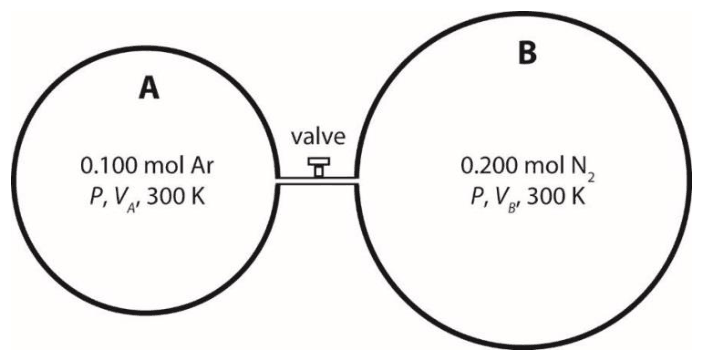
After opening the valve slowly, the system is allowed to reach equilibrium. It is assumed that the two gases form an ideal gas mixture. Calculate the change in Gibbs free energy at 300 K, \(\Delta G\).
If you are unable to calculate \(K_p\) at 298 K in problem 3.1, use \(K_p=9\times10^5\) later on.
Official English text of the problem.
Answers
- 3.1: \(\Delta H^\circ=-90\ \mathrm{kJ\,mol^{-1}}\); \(\Delta S^\circ=-220\ \mathrm{J\,K^{-1}\,mol^{-1}}\); \(\Delta G^\circ=-24.4\ \mathrm{kJ\,mol^{-1}}\); \(K_p(298\ \mathrm K)=1.9\times10^4\).
- 3.2: \(K_p(600\ \mathrm K)=2.2\times10^{-4}\).
- 3.3: \(P=1.0\times10^2\ \mathrm{bar}\).
- 3.4: \(\Delta G=-476\ \mathrm J=-0.476\ \mathrm{kJ}\) for the whole system.
Solution
Use \(R=8.314\ \mathrm{J\,mol^{-1}\,K^{-1}}\) and standard pressure \(p^\circ=1\ \mathrm{bar}\). Equilibrium constants defined using \(p_i/p^\circ\) are dimensionless.
3.1 — Thermodynamic quantities and equilibrium constant at 298 K
Carbon monoxide ([C-]#[O+]) reacts with hydrogen ([H][H]) to produce methanol (CO):
\[ \ce{CO(g) + 2 H2(g) -> CH3OH(g)}. \]
The standard reaction enthalpy is the sum of the product formation enthalpies minus that of the reactants, including stoichiometric coefficients:
\[ \begin{aligned} \Delta H^\circ &=\Delta H_f^\circ(\ce{CH3OH(g)}) -\Delta H_f^\circ(\ce{CO(g)}) -2\Delta H_f^\circ(\ce{H2(g)})\\ &=-201-(-111)-2(0)\\ &=\boxed{-90\ \mathrm{kJ\,mol^{-1}}}. \end{aligned} \]
Similarly,
\[ \begin{aligned} \Delta S^\circ &=S^\circ(\ce{CH3OH(g)}) -S^\circ(\ce{CO(g)}) -2S^\circ(\ce{H2(g)})\\ &=240-198-2(131)\\ &=\boxed{-220\ \mathrm{J\,K^{-1}\,mol^{-1}}}. \end{aligned} \]
Thus, at 298 K,
\[ \begin{aligned} \Delta G^\circ &=\Delta H^\circ-T\Delta S^\circ\\ &=-90-(298)(-0.220)\\ &=-24.44\ \mathrm{kJ\,mol^{-1}}\\ &\approx\boxed{-24.4\ \mathrm{kJ\,mol^{-1}}}. \end{aligned} \]
Using \(\Delta G^\circ=-RT\ln K_p\),
\[ K_p =\exp\!\left(\frac{24440}{8.314\times298}\right) =1.9235\times10^4 \approx\boxed{1.9\times10^4}. \]
3.2 — Equilibrium constant at 600 K
With the specified assumption that \(\Delta H^\circ\) and \(\Delta S^\circ\) are temperature independent,
\[ \begin{aligned} \Delta G^\circ(600\ \mathrm K) &=-90-(600)(-0.220)\\ &=+42.0\ \mathrm{kJ\,mol^{-1}}. \end{aligned} \]
Therefore,
\[ K_p(600\ \mathrm K) =\exp\!\left(-\frac{42000}{8.314\times600}\right) =2.2052\times10^{-4} \approx\boxed{2.2\times10^{-4}}. \]
The decrease in \(K_p\) with increasing temperature is consistent with the reaction being exothermic.
The optional fallback constants printed in the question differ from those calculated from the table. The following calculation uses the calculated value \(K_p(600\ \mathrm K)=2.2052\times10^{-4}\).
3.3 — Total reactor pressure
The feed contains hydrogen and carbon monoxide in the same \(2:1\) ratio in which they are consumed. Consequently, the unreacted gases retain this ratio at equilibrium:
\[ y_{\ce{H2}}=2y_{\ce{CO}}. \]
Since \(y_{\ce{CH3OH}}=0.18\),
\[ y_{\ce{CO}}+y_{\ce{H2}}=1-0.18=0.82. \]
Hence,
\[ y_{\ce{CO}}=\frac{0.82}{3}=0.273333, \qquad y_{\ce{H2}}=\frac{2(0.82)}{3}=0.546667. \]
For ideal gases, \(p_i=y_iP\), so
\[ \begin{aligned} K_p &=\frac{p_{\ce{CH3OH}}/p^\circ} {(p_{\ce{CO}}/p^\circ)(p_{\ce{H2}}/p^\circ)^2}\\ &=\frac{y_{\ce{CH3OH}}} {y_{\ce{CO}}y_{\ce{H2}}^2} \left(\frac{p^\circ}{P}\right)^2. \end{aligned} \]
Solving for \(P\),
\[ \begin{aligned} P &=p^\circ \sqrt{\frac{y_{\ce{CH3OH}}} {K_p\,y_{\ce{CO}}y_{\ce{H2}}^2}}\\ &=(1\ \mathrm{bar}) \sqrt{\frac{0.18} {(2.2052\times10^{-4})(0.273333)(0.546667)^2}}\\ &=99.96\ \mathrm{bar}. \end{aligned} \]
Thus,
\[ \boxed{P=1.0\times10^2\ \mathrm{bar}}. \]
3.4 — Gibbs free energy change on mixing
The gases are argon, \(\ce{Ar}\) ([Ar]), and nitrogen, \(\ce{N2}\) (N#N).
Initially, both compartments have the same temperature and pressure. The ideal-gas law therefore gives
\[ V_A=\frac{n_{\ce{Ar}}RT}{P}, \qquad V_B=\frac{n_{\ce{N2}}RT}{P}. \]
After opening the valve, the total amount and total volume are unchanged. At the same temperature, the final total pressure is
\[ P_f=\frac{(n_{\ce{Ar}}+n_{\ce{N2}})RT}{V_A+V_B}=P. \]
The final mole fractions are
\[ y_{\ce{Ar}}=\frac{0.100}{0.300}=\frac13, \qquad y_{\ce{N2}}=\frac{0.200}{0.300}=\frac23. \]
For an ideal gas,
\[ \mu_i(T,p_i)=\mu_i^\circ(T)+RT\ln\!\left(\frac{p_i}{p^\circ}\right). \]
Each gas initially has pressure \(P\), and its final partial pressure is \(y_iP\). Therefore,
\[ \begin{aligned} \Delta G &=\sum_i n_i\left(\mu_{i,f}-\mu_{i,i}\right)\\ &=RT\sum_i n_i\ln\!\left(\frac{y_iP}{P}\right)\\ &=RT\left(n_{\ce{Ar}}\ln y_{\ce{Ar}} +n_{\ce{N2}}\ln y_{\ce{N2}}\right). \end{aligned} \]
Substitution gives
\[ \begin{aligned} \Delta G &=(8.314)(300) \left[0.100\ln\!\left(\frac13\right) +0.200\ln\!\left(\frac23\right)\right]\ \mathrm J\\ &=-476.28\ \mathrm J. \end{aligned} \]
Thus, for the whole system,
\[ \boxed{\Delta G=-476\ \mathrm J=-0.476\ \mathrm{kJ}}. \]
The negative value reflects spontaneous mixing. For this ideal-gas mixture, \(\Delta H_{\mathrm{mix}}=0\), and the entropy increases by
\[ \Delta S_{\mathrm{mix}}=-\frac{\Delta G}{T} =1.59\ \mathrm{J\,K^{-1}}. \]
The solution was checked against the official solution. Where this solution differs from the official solution, the official solution contains an error or a misprint.
IChO 2017 · Theorieaufgabe 3
Thermodynamik chemischer Reaktionen
Teil A.
Methanol wird industriell aus einem Gemisch aus Kohlenstoffmonoxid und Wasserstoff an einem Zinkoxid/Kupferoxid-Katalysator hergestellt:
\[ \ce{CO(g) + 2 H2(g) -> CH3OH(g)}. \]
Die Standardbildungsenthalpie (\(\Delta H_f^\circ\)) und die absolute Entropie (\(S^\circ\)) der drei Gase bei Raumtemperatur (298 K) und einem Standarddruck von 1 bar sind im Folgenden angegeben.
| Gas | \(\Delta H_f^\circ\) (kJ mol\(^{-1}\)) | \(S^\circ\) (J K\(^{-1}\) mol\(^{-1}\)) |
|---|---|---|
| \(\ce{CO(g)}\) | −111 | 198 |
| \(\ce{H2(g)}\) | 0 | 131 |
| \(\ce{CH3OH(g)}\) | −201 | 240 |
3.1 Berechnen Sie \(\Delta H^\circ\), \(\Delta S^\circ\), \(\Delta G^\circ\) und \(K_p\) für die Reaktion bei 298 K.
(Falls Sie \(K_p\) bei 298 K in Aufgabe 3.1 nicht berechnen können, verwenden Sie im Folgenden \(K_p=9\times10^5\).)
3.2 Ein industrieller Reaktor wird bei einer Temperatur von 600 K betrieben. Berechnen Sie den Wert von \(K_p\) bei dieser Temperatur unter der Annahme, dass \(\Delta H^\circ\) und \(\Delta S^\circ\) temperaturunabhängig sind.
(Falls Sie \(K_p\) bei 600 K in Aufgabe 3.2 nicht berechnen können, verwenden Sie im Folgenden \(K_p=1.0\times10^{-2}\).)
3.3 Bei der industriellen Herstellung von Methanol wird ein Gasgemisch in den Reaktor eingeleitet, das pro Mol \(\ce{CO}\) 2.00 Mol \(\ce{H2}\) enthält. Der Stoffmengenanteil von Methanol im aus dem Reaktor austretenden Gas wurde zu 0.18 bestimmt. Wie hoch ist unter der Annahme, dass sich ein Gleichgewicht eingestellt hat, der Gesamtdruck im Reaktor bei der hohen Temperatur von 600 K?
Teil B.
3.4 Betrachten Sie das folgende geschlossene System bei 300 K. Das System besteht aus 2 Kammern, die durch ein geschlossenes Ventil mit vernachlässigbarem Volumen voneinander getrennt sind (siehe folgende Abbildung). Bei gleichem Druck \(P\) enthält Kammer A 0.100 mol Argongas und Kammer B 0.200 mol Stickstoffgas. Die Volumina der beiden Kammern, \(V_A\) und \(V_B\), sind so gewählt, dass sich die Gase wie ideale Gase verhalten.
Nachdem das Ventil langsam geöffnet wurde, lässt man das System das Gleichgewicht erreichen. Es wird angenommen, dass die beiden Gase ein ideales Gasgemisch bilden. Berechnen Sie die Änderung der Gibbs-Energie bei 300 K, \(\Delta G\).
Falls Sie \(K_p\) bei 298 K in Aufgabe 3.1 nicht berechnen können, verwenden Sie im Folgenden \(K_p=9\times10^5\).
Aufgabentext aus dem offiziellen englischen Text übersetzt.
Antworten
- 3.1: \(\Delta H^\circ=-90\ \mathrm{kJ\,mol^{-1}}\); \(\Delta S^\circ=-220\ \mathrm{J\,K^{-1}\,mol^{-1}}\); \(\Delta G^\circ=-24.4\ \mathrm{kJ\,mol^{-1}}\); \(K_p(298\ \mathrm K)=1.9\times10^4\).
- 3.2: \(K_p(600\ \mathrm K)=2.2\times10^{-4}\).
- 3.3: \(P=1.0\times10^2\ \mathrm{bar}\).
- 3.4: \(\Delta G=-476\ \mathrm J=-0.476\ \mathrm{kJ}\) für das gesamte System.
Lösung
Wir verwenden \(R=8.314\ \mathrm{J\,mol^{-1}\,K^{-1}}\) und den Standarddruck \(p^\circ=1\ \mathrm{bar}\). Gleichgewichtskonstanten, die mithilfe von \(p_i/p^\circ\) definiert sind, sind dimensionslos.
3.1 — Thermodynamische Größen und Gleichgewichtskonstante bei 298 K
Kohlenstoffmonoxid ([C-]#[O+]) reagiert mit Wasserstoff ([H][H]) zu Methanol (CO):
\[ \ce{CO(g) + 2 H2(g) -> CH3OH(g)}. \]
Die Standardreaktionsenthalpie ist die Summe der Bildungsenthalpien der Produkte abzüglich derjenigen der Edukte, jeweils unter Berücksichtigung der stöchiometrischen Koeffizienten:
\[ \begin{aligned} \Delta H^\circ &=\Delta H_f^\circ(\ce{CH3OH(g)}) -\Delta H_f^\circ(\ce{CO(g)}) -2\Delta H_f^\circ(\ce{H2(g)})\\ &=-201-(-111)-2(0)\\ &=\boxed{-90\ \mathrm{kJ\,mol^{-1}}}. \end{aligned} \]
Entsprechend gilt:
\[ \begin{aligned} \Delta S^\circ &=S^\circ(\ce{CH3OH(g)}) -S^\circ(\ce{CO(g)}) -2S^\circ(\ce{H2(g)})\\ &=240-198-2(131)\\ &=\boxed{-220\ \mathrm{J\,K^{-1}\,mol^{-1}}}. \end{aligned} \]
Somit gilt bei 298 K:
\[ \begin{aligned} \Delta G^\circ &=\Delta H^\circ-T\Delta S^\circ\\ &=-90-(298)(-0.220)\\ &=-24.44\ \mathrm{kJ\,mol^{-1}}\\ &\approx\boxed{-24.4\ \mathrm{kJ\,mol^{-1}}}. \end{aligned} \]
Mit \(\Delta G^\circ=-RT\ln K_p\) ergibt sich:
\[ K_p =\exp\!\left(\frac{24440}{8.314\times298}\right) =1.9235\times10^4 \approx\boxed{1.9\times10^4}. \]
3.2 — Gleichgewichtskonstante bei 600 K
Unter der vorgegebenen Annahme, dass \(\Delta H^\circ\) und \(\Delta S^\circ\) temperaturunabhängig sind, gilt:
\[ \begin{aligned} \Delta G^\circ(600\ \mathrm K) &=-90-(600)(-0.220)\\ &=+42.0\ \mathrm{kJ\,mol^{-1}}. \end{aligned} \]
Daher ist:
\[ K_p(600\ \mathrm K) =\exp\!\left(-\frac{42000}{8.314\times600}\right) =2.2052\times10^{-4} \approx\boxed{2.2\times10^{-4}}. \]
Die Abnahme von \(K_p\) mit steigender Temperatur steht im Einklang damit, dass die Reaktion exotherm ist.
Die in der Aufgabenstellung angegebenen optionalen Ersatzwerte für die Konstanten weichen von den aus der Tabelle berechneten Werten ab. In der folgenden Rechnung wird der berechnete Wert \(K_p(600\ \mathrm K)=2.2052\times10^{-4}\) verwendet.
3.3 — Gesamtdruck im Reaktor
Das zugeführte Gasgemisch enthält Wasserstoff und Kohlenstoffmonoxid im selben Verhältnis \(2:1\), in dem sie verbraucht werden. Folglich behalten die nicht umgesetzten Gase dieses Verhältnis im Gleichgewicht bei:
\[ y_{\ce{H2}}=2y_{\ce{CO}}. \]
Da \(y_{\ce{CH3OH}}=0.18\) ist, gilt:
\[ y_{\ce{CO}}+y_{\ce{H2}}=1-0.18=0.82. \]
Daraus folgt:
\[ y_{\ce{CO}}=\frac{0.82}{3}=0.273333, \qquad y_{\ce{H2}}=\frac{2(0.82)}{3}=0.546667. \]
Für ideale Gase gilt \(p_i=y_iP\), also:
\[ \begin{aligned} K_p &=\frac{p_{\ce{CH3OH}}/p^\circ} {(p_{\ce{CO}}/p^\circ)(p_{\ce{H2}}/p^\circ)^2}\\ &=\frac{y_{\ce{CH3OH}}} {y_{\ce{CO}}y_{\ce{H2}}^2} \left(\frac{p^\circ}{P}\right)^2. \end{aligned} \]
Auflösen nach \(P\) ergibt:
\[ \begin{aligned} P &=p^\circ \sqrt{\frac{y_{\ce{CH3OH}}} {K_p\,y_{\ce{CO}}y_{\ce{H2}}^2}}\\ &=(1\ \mathrm{bar}) \sqrt{\frac{0.18} {(2.2052\times10^{-4})(0.273333)(0.546667)^2}}\\ &=99.96\ \mathrm{bar}. \end{aligned} \]
Somit ist:
\[ \boxed{P=1.0\times10^2\ \mathrm{bar}}. \]
3.4 — Änderung der Gibbs-Energie beim Mischen
Bei den Gasen handelt es sich um Argon, \(\ce{Ar}\) ([Ar]), und Stickstoff, \(\ce{N2}\) (N#N).
Anfangs herrschen in beiden Kammern dieselbe Temperatur und derselbe Druck. Aus dem idealen Gasgesetz folgt daher:
\[ V_A=\frac{n_{\ce{Ar}}RT}{P}, \qquad V_B=\frac{n_{\ce{N2}}RT}{P}. \]
Nach dem Öffnen des Ventils bleiben die Gesamtstoffmenge und das Gesamtvolumen unverändert. Bei gleicher Temperatur beträgt der Gesamtdruck im Endzustand:
\[ P_f=\frac{(n_{\ce{Ar}}+n_{\ce{N2}})RT}{V_A+V_B}=P. \]
Die Stoffmengenanteile im Endzustand sind:
\[ y_{\ce{Ar}}=\frac{0.100}{0.300}=\frac13, \qquad y_{\ce{N2}}=\frac{0.200}{0.300}=\frac23. \]
Für ein ideales Gas gilt:
\[ \mu_i(T,p_i)=\mu_i^\circ(T)+RT\ln\!\left(\frac{p_i}{p^\circ}\right). \]
Jedes Gas hat anfangs den Druck \(P\), und sein Partialdruck im Endzustand beträgt \(y_iP\). Daher gilt:
\[ \begin{aligned} \Delta G &=\sum_i n_i\left(\mu_{i,f}-\mu_{i,i}\right)\\ &=RT\sum_i n_i\ln\!\left(\frac{y_iP}{P}\right)\\ &=RT\left(n_{\ce{Ar}}\ln y_{\ce{Ar}} +n_{\ce{N2}}\ln y_{\ce{N2}}\right). \end{aligned} \]
Einsetzen ergibt:
\[ \begin{aligned} \Delta G &=(8.314)(300) \left[0.100\ln\!\left(\frac13\right) +0.200\ln\!\left(\frac23\right)\right]\ \mathrm J\\ &=-476.28\ \mathrm J. \end{aligned} \]
Somit gilt für das gesamte System:
\[ \boxed{\Delta G=-476\ \mathrm J=-0.476\ \mathrm{kJ}}. \]
Der negative Wert zeigt, dass das Mischen spontan erfolgt. Für dieses ideale Gasgemisch gilt \(\Delta H_{\mathrm{mix}}=0\), und die Entropie nimmt um folgenden Betrag zu:
\[ \Delta S_{\mathrm{mix}}=-\frac{\Delta G}{T} =1.59\ \mathrm{J\,K^{-1}}. \]
Die Lösung wurde mit der offiziellen Lösung abgeglichen. Wo diese Lösung von der offiziellen Lösung abweicht, enthält die offizielle Lösung einen Fehler oder Druckfehler.
IChO 2017 · Teori sorusu 3
Kimyasal tepkimelerin termodinamiği
Bölüm A.
Metanol, ticari olarak karbon monoksit ve hidrojen karışımının çinko oksit/bakır oksit katalizörü üzerinden geçirilmesiyle üretilir:
\[ \ce{CO(g) + 2 H2(g) -> CH3OH(g)}. \]
Üç gazın her biri için oda sıcaklığında (298 K) ve 1 bar standart basınçta standart oluşum entalpisi (\(\Delta H_f^\circ\)) ve mutlak entropi (\(S^\circ\)) değerleri aşağıda verilmiştir.
| Gaz | \(\Delta H_f^\circ\) (kJ mol\(^{-1}\)) | \(S^\circ\) (J K\(^{-1}\) mol\(^{-1}\)) |
|---|---|---|
| \(\ce{CO(g)}\) | −111 | 198 |
| \(\ce{H2(g)}\) | 0 | 131 |
| \(\ce{CH3OH(g)}\) | −201 | 240 |
3.1 Tepkimenin 298 K'deki \(\Delta H^\circ\), \(\Delta S^\circ\), \(\Delta G^\circ\) ve \(K_p\) değerlerini hesaplayınız.
(3.1 sorusunda 298 K'deki \(K_p\) değerini hesaplayamadıysanız, sonraki hesaplamalarda \(K_p=9\times10^5\) kullanınız.)
3.2 Ticari bir reaktör 600 K sıcaklıkta çalıştırılmaktadır. \(\Delta H^\circ\) ve \(\Delta S^\circ\) değerlerinin sıcaklıktan bağımsız olduğunu varsayarak bu sıcaklıktaki \(K_p\) değerini hesaplayınız.
(3.2 sorusunda 600 K'deki \(K_p\) değerini hesaplayamadıysanız, sonraki hesaplamalarda \(K_p=1.0\times10^{-2}\) kullanınız.)
3.3 Endüstride metanol üretimi, her bir mol \(\ce{CO}\) için 2.00 mol \(\ce{H2}\) içeren gazın reaktöre beslenmesine dayanır. Reaktörden çıkan gazdaki metanolün mol kesrinin 0.18 olduğu bulunmuştur. Dengenin kurulduğunu varsayarak, 600 K gibi yüksek bir sıcaklıkta reaktördeki toplam basınç kaçtır?
Bölüm B.
3.4 300 K'deki aşağıdaki kapalı sistemi ele alınız. Sistem, hacmi ihmal edilebilir kapalı bir vana ile birbirinden ayrılan 2 bölmeden oluşmaktadır (bir sonraki şekle bakınız). Aynı \(P\) basıncında, A bölmesi ve B bölmesi sırasıyla 0.100 mol argon gazı ve 0.200 mol azot gazı içermektedir. İki bölmenin hacimleri, \(V_A\) ve \(V_B\), gazların ideal gaz gibi davranacağı şekilde seçilmiştir.
Vana yavaşça açıldıktan sonra sistemin dengeye ulaşması beklenir. İki gazın ideal bir gaz karışımı oluşturduğu varsayılmaktadır. 300 K'deki Gibbs serbest enerjisi değişimini, \(\Delta G\), hesaplayınız.
3.1 sorusunda 298 K'deki \(K_p\) değerini hesaplayamadıysanız, sonraki hesaplamalarda \(K_p=9\times10^5\) kullanınız.
Soru metni resmi İngilizce metinden çevrilmiştir.
Cevaplar
- 3.1: \(\Delta H^\circ=-90\ \mathrm{kJ\,mol^{-1}}\); \(\Delta S^\circ=-220\ \mathrm{J\,K^{-1}\,mol^{-1}}\); \(\Delta G^\circ=-24.4\ \mathrm{kJ\,mol^{-1}}\); \(K_p(298\ \mathrm K)=1.9\times10^4\).
- 3.2: \(K_p(600\ \mathrm K)=2.2\times10^{-4}\).
- 3.3: \(P=1.0\times10^2\ \mathrm{bar}\).
- 3.4: Tüm sistem için \(\Delta G=-476\ \mathrm J=-0.476\ \mathrm{kJ}\).
Çözüm
\(R=8.314\ \mathrm{J\,mol^{-1}\,K^{-1}}\) ve standart basınç olarak \(p^\circ=1\ \mathrm{bar}\) kullanınız. \(p_i/p^\circ\) kullanılarak tanımlanan denge sabitleri boyutsuzdur.
3.1 — 298 K'deki termodinamik büyüklükler ve denge sabiti
Karbon monoksit ([C-]#[O+]), hidrojen ([H][H]) ile tepkimeye girerek metanol (CO) oluşturur:
\[ \ce{CO(g) + 2 H2(g) -> CH3OH(g)}. \]
Standart tepkime entalpisi, stokiyometrik katsayılar hesaba katılarak, ürünlerin oluşum entalpileri toplamından girenlerin oluşum entalpileri toplamının çıkarılmasıyla bulunur:
\[ \begin{aligned} \Delta H^\circ &=\Delta H_f^\circ(\ce{CH3OH(g)}) -\Delta H_f^\circ(\ce{CO(g)}) -2\Delta H_f^\circ(\ce{H2(g)})\\ &=-201-(-111)-2(0)\\ &=\boxed{-90\ \mathrm{kJ\,mol^{-1}}}. \end{aligned} \]
Benzer şekilde,
\[ \begin{aligned} \Delta S^\circ &=S^\circ(\ce{CH3OH(g)}) -S^\circ(\ce{CO(g)}) -2S^\circ(\ce{H2(g)})\\ &=240-198-2(131)\\ &=\boxed{-220\ \mathrm{J\,K^{-1}\,mol^{-1}}}. \end{aligned} \]
Böylece, 298 K'de,
\[ \begin{aligned} \Delta G^\circ &=\Delta H^\circ-T\Delta S^\circ\\ &=-90-(298)(-0.220)\\ &=-24.44\ \mathrm{kJ\,mol^{-1}}\\ &\approx\boxed{-24.4\ \mathrm{kJ\,mol^{-1}}}. \end{aligned} \]
\(\Delta G^\circ=-RT\ln K_p\) kullanılarak,
\[ K_p =\exp\!\left(\frac{24440}{8.314\times298}\right) =1.9235\times10^4 \approx\boxed{1.9\times10^4}. \]
3.2 — 600 K'deki denge sabiti
\(\Delta H^\circ\) ve \(\Delta S^\circ\) değerlerinin sıcaklıktan bağımsız olduğuna ilişkin verilen varsayım altında,
\[ \begin{aligned} \Delta G^\circ(600\ \mathrm K) &=-90-(600)(-0.220)\\ &=+42.0\ \mathrm{kJ\,mol^{-1}}. \end{aligned} \]
Dolayısıyla,
\[ K_p(600\ \mathrm K) =\exp\!\left(-\frac{42000}{8.314\times600}\right) =2.2052\times10^{-4} \approx\boxed{2.2\times10^{-4}}. \]
Sıcaklık arttıkça \(K_p\) değerinin azalması, tepkimenin ekzotermik olmasıyla tutarlıdır.
Soruda, hesaplanamadığında kullanılmak üzere verilen alternatif sabitler, tablodan hesaplanan değerlerden farklıdır. Aşağıdaki hesaplamada, hesaplanan \(K_p(600\ \mathrm K)=2.2052\times10^{-4}\) değeri kullanılmıştır.
3.3 — Reaktördeki toplam basınç
Besleme, hidrojen ve karbon monoksiti, tepkimede tüketildikleri aynı \(2:1\) oranında içerir. Bu nedenle, tepkimeye girmemiş gazlar dengede bu oranı korur:
\[ y_{\ce{H2}}=2y_{\ce{CO}}. \]
\(y_{\ce{CH3OH}}=0.18\) olduğundan,
\[ y_{\ce{CO}}+y_{\ce{H2}}=1-0.18=0.82. \]
Buradan,
\[ y_{\ce{CO}}=\frac{0.82}{3}=0.273333, \qquad y_{\ce{H2}}=\frac{2(0.82)}{3}=0.546667. \]
İdeal gazlar için \(p_i=y_iP\) olduğundan,
\[ \begin{aligned} K_p &=\frac{p_{\ce{CH3OH}}/p^\circ} {(p_{\ce{CO}}/p^\circ)(p_{\ce{H2}}/p^\circ)^2}\\ &=\frac{y_{\ce{CH3OH}}} {y_{\ce{CO}}y_{\ce{H2}}^2} \left(\frac{p^\circ}{P}\right)^2. \end{aligned} \]
\(P\) için çözülürse,
\[ \begin{aligned} P &=p^\circ \sqrt{\frac{y_{\ce{CH3OH}}} {K_p\,y_{\ce{CO}}y_{\ce{H2}}^2}}\\ &=(1\ \mathrm{bar}) \sqrt{\frac{0.18} {(2.2052\times10^{-4})(0.273333)(0.546667)^2}}\\ &=99.96\ \mathrm{bar}. \end{aligned} \]
Böylece,
\[ \boxed{P=1.0\times10^2\ \mathrm{bar}}. \]
3.4 — Karışma sırasında Gibbs serbest enerjisi değişimi
Gazlar argon, \(\ce{Ar}\) ([Ar]), ve azot, \(\ce{N2}\) (N#N), gazlarıdır.
Başlangıçta her iki bölmenin sıcaklığı ve basıncı aynıdır. Dolayısıyla ideal gaz yasası şu bağıntıları verir:
\[ V_A=\frac{n_{\ce{Ar}}RT}{P}, \qquad V_B=\frac{n_{\ce{N2}}RT}{P}. \]
Vana açıldıktan sonra toplam madde miktarı ve toplam hacim değişmez. Aynı sıcaklıkta, son toplam basınç şöyledir:
\[ P_f=\frac{(n_{\ce{Ar}}+n_{\ce{N2}})RT}{V_A+V_B}=P. \]
Son durumdaki mol kesirleri şöyledir:
\[ y_{\ce{Ar}}=\frac{0.100}{0.300}=\frac13, \qquad y_{\ce{N2}}=\frac{0.200}{0.300}=\frac23. \]
İdeal bir gaz için,
\[ \mu_i(T,p_i)=\mu_i^\circ(T)+RT\ln\!\left(\frac{p_i}{p^\circ}\right). \]
Her gazın başlangıçtaki basıncı \(P\), son durumdaki kısmi basıncı ise \(y_iP\)'dir. Dolayısıyla,
\[ \begin{aligned} \Delta G &=\sum_i n_i\left(\mu_{i,f}-\mu_{i,i}\right)\\ &=RT\sum_i n_i\ln\!\left(\frac{y_iP}{P}\right)\\ &=RT\left(n_{\ce{Ar}}\ln y_{\ce{Ar}} +n_{\ce{N2}}\ln y_{\ce{N2}}\right). \end{aligned} \]
Değerler yerine konulduğunda,
\[ \begin{aligned} \Delta G &=(8.314)(300) \left[0.100\ln\!\left(\frac13\right) +0.200\ln\!\left(\frac23\right)\right]\ \mathrm J\\ &=-476.28\ \mathrm J. \end{aligned} \]
Böylece, tüm sistem için,
\[ \boxed{\Delta G=-476\ \mathrm J=-0.476\ \mathrm{kJ}}. \]
Negatif değer, karışmanın kendiliğinden gerçekleştiğini gösterir. Bu ideal gaz karışımı için \(\Delta H_{\mathrm{mix}}=0\) olup entropi şu miktarda artar:
\[ \Delta S_{\mathrm{mix}}=-\frac{\Delta G}{T} =1.59\ \mathrm{J\,K^{-1}}. \]
Çözüm, resmi çözümle karşılaştırılarak kontrol edildi. Bu çözümün resmi çözümden ayrıldığı yerlerde resmi çözümde bir hata ya da baskı hatası vardır.
IChO 2017 · Problema teórico 3
Termodinámica de las reacciones químicas
Parte A.
El metanol se produce comercialmente utilizando una mezcla de monóxido de carbono e hidrógeno sobre un catalizador de óxido de zinc/óxido de cobre:
\[ \ce{CO(g) + 2 H2(g) -> CH3OH(g)}. \]
La entalpía estándar de formación (\(\Delta H_f^\circ\)) y la entropía absoluta (\(S^\circ\)) de cada uno de los tres gases a temperatura ambiente (298 K) y a una presión estándar de 1 bar se indican a continuación.
| Gas | \(\Delta H_f^\circ\) (kJ mol\(^{-1}\)) | \(S^\circ\) (J K\(^{-1}\) mol\(^{-1}\)) |
|---|---|---|
| \(\ce{CO(g)}\) | −111 | 198 |
| \(\ce{H2(g)}\) | 0 | 131 |
| \(\ce{CH3OH(g)}\) | −201 | 240 |
3.1 Calcule \(\Delta H^\circ\), \(\Delta S^\circ\), \(\Delta G^\circ\) y \(K_p\) para la reacción a 298 K.
(Si no logra calcular \(K_p\) a 298 K en el apartado 3.1, utilice \(K_p=9\times10^5\) en los apartados posteriores.)
3.2 Un reactor industrial funciona a una temperatura de 600 K. Calcule el valor de \(K_p\) a esta temperatura, suponiendo que \(\Delta H^\circ\) y \(\Delta S^\circ\) son independientes de la temperatura.
(Si no logra calcular \(K_p\) a 600 K en el apartado 3.2, utilice \(K_p=1.0\times10^{-2}\) en los apartados posteriores.)
3.3 La producción industrial de metanol se basa en introducir en el reactor una corriente gaseosa que contiene 2.00 moles de \(\ce{H2}\) por cada mol de \(\ce{CO}\). Se determinó que la fracción molar de metanol en el gas de salida del reactor era de 0.18. Suponiendo que se alcanza el equilibrio, ¿cuál es la presión total en el reactor a una temperatura elevada de 600 K?
Parte B.
3.4 Considere el siguiente sistema cerrado a 300 K. El sistema consta de 2 compartimentos separados por una válvula cerrada de volumen despreciable (véase la siguiente figura). A la misma presión \(P\), el compartimento A y el compartimento B contienen 0.100 mol de argón gaseoso y 0.200 mol de nitrógeno gaseoso, respectivamente. Los volúmenes de los dos compartimentos, \(V_A\) y \(V_B\), se eligen de modo que los gases se comporten como gases ideales.
Tras abrir lentamente la válvula, se deja que el sistema alcance el equilibrio. Se supone que los dos gases forman una mezcla de gases ideales. Calcule la variación de energía libre de Gibbs a 300 K, \(\Delta G\).
Si no logra calcular \(K_p\) a 298 K en el apartado 3.1, utilice \(K_p=9\times10^5\) en los apartados posteriores.
Enunciado traducido del texto oficial en inglés.
Respuestas
- 3.1: \(\Delta H^\circ=-90\ \mathrm{kJ\,mol^{-1}}\); \(\Delta S^\circ=-220\ \mathrm{J\,K^{-1}\,mol^{-1}}\); \(\Delta G^\circ=-24.4\ \mathrm{kJ\,mol^{-1}}\); \(K_p(298\ \mathrm K)=1.9\times10^4\).
- 3.2: \(K_p(600\ \mathrm K)=2.2\times10^{-4}\).
- 3.3: \(P=1.0\times10^2\ \mathrm{bar}\).
- 3.4: \(\Delta G=-476\ \mathrm J=-0.476\ \mathrm{kJ}\) para el sistema completo.
Solución
Utilice \(R=8.314\ \mathrm{J\,mol^{-1}\,K^{-1}}\) y la presión estándar \(p^\circ=1\ \mathrm{bar}\). Las constantes de equilibrio definidas mediante \(p_i/p^\circ\) son adimensionales.
3.1 — Magnitudes termodinámicas y constante de equilibrio a 298 K
El monóxido de carbono ([C-]#[O+]) reacciona con el hidrógeno ([H][H]) para producir metanol (CO):
\[ \ce{CO(g) + 2 H2(g) -> CH3OH(g)}. \]
La entalpía estándar de reacción es la suma de las entalpías de formación de los productos menos la de los reactivos, teniendo en cuenta los coeficientes estequiométricos:
\[ \begin{aligned} \Delta H^\circ &=\Delta H_f^\circ(\ce{CH3OH(g)}) -\Delta H_f^\circ(\ce{CO(g)}) -2\Delta H_f^\circ(\ce{H2(g)})\\ &=-201-(-111)-2(0)\\ &=\boxed{-90\ \mathrm{kJ\,mol^{-1}}}. \end{aligned} \]
Análogamente,
\[ \begin{aligned} \Delta S^\circ &=S^\circ(\ce{CH3OH(g)}) -S^\circ(\ce{CO(g)}) -2S^\circ(\ce{H2(g)})\\ &=240-198-2(131)\\ &=\boxed{-220\ \mathrm{J\,K^{-1}\,mol^{-1}}}. \end{aligned} \]
Así, a 298 K,
\[ \begin{aligned} \Delta G^\circ &=\Delta H^\circ-T\Delta S^\circ\\ &=-90-(298)(-0.220)\\ &=-24.44\ \mathrm{kJ\,mol^{-1}}\\ &\approx\boxed{-24.4\ \mathrm{kJ\,mol^{-1}}}. \end{aligned} \]
Utilizando \(\Delta G^\circ=-RT\ln K_p\),
\[ K_p =\exp\!\left(\frac{24440}{8.314\times298}\right) =1.9235\times10^4 \approx\boxed{1.9\times10^4}. \]
3.2 — Constante de equilibrio a 600 K
Con la suposición indicada de que \(\Delta H^\circ\) y \(\Delta S^\circ\) son independientes de la temperatura,
\[ \begin{aligned} \Delta G^\circ(600\ \mathrm K) &=-90-(600)(-0.220)\\ &=+42.0\ \mathrm{kJ\,mol^{-1}}. \end{aligned} \]
Por tanto,
\[ K_p(600\ \mathrm K) =\exp\!\left(-\frac{42000}{8.314\times600}\right) =2.2052\times10^{-4} \approx\boxed{2.2\times10^{-4}}. \]
La disminución de \(K_p\) al aumentar la temperatura es coherente con el carácter exotérmico de la reacción.
Las constantes alternativas proporcionadas en el enunciado para su uso opcional difieren de las calculadas a partir de la tabla. En el cálculo siguiente se utiliza el valor calculado \(K_p(600\ \mathrm K)=2.2052\times10^{-4}\).
3.3 — Presión total del reactor
La alimentación contiene hidrógeno y monóxido de carbono en la misma proporción \(2:1\) en la que se consumen. En consecuencia, los gases sin reaccionar mantienen esta proporción en el equilibrio:
\[ y_{\ce{H2}}=2y_{\ce{CO}}. \]
Dado que \(y_{\ce{CH3OH}}=0.18\),
\[ y_{\ce{CO}}+y_{\ce{H2}}=1-0.18=0.82. \]
Por consiguiente,
\[ y_{\ce{CO}}=\frac{0.82}{3}=0.273333, \qquad y_{\ce{H2}}=\frac{2(0.82)}{3}=0.546667. \]
Para gases ideales, \(p_i=y_iP\), de modo que
\[ \begin{aligned} K_p &=\frac{p_{\ce{CH3OH}}/p^\circ} {(p_{\ce{CO}}/p^\circ)(p_{\ce{H2}}/p^\circ)^2}\\ &=\frac{y_{\ce{CH3OH}}} {y_{\ce{CO}}y_{\ce{H2}}^2} \left(\frac{p^\circ}{P}\right)^2. \end{aligned} \]
Despejando \(P\),
\[ \begin{aligned} P &=p^\circ \sqrt{\frac{y_{\ce{CH3OH}}} {K_p\,y_{\ce{CO}}y_{\ce{H2}}^2}}\\ &=(1\ \mathrm{bar}) \sqrt{\frac{0.18} {(2.2052\times10^{-4})(0.273333)(0.546667)^2}}\\ &=99.96\ \mathrm{bar}. \end{aligned} \]
Así,
\[ \boxed{P=1.0\times10^2\ \mathrm{bar}}. \]
3.4 — Variación de energía libre de Gibbs al mezclar los gases
Los gases son argón, \(\ce{Ar}\) ([Ar]), y nitrógeno, \(\ce{N2}\) (N#N).
Inicialmente, ambos compartimentos tienen la misma temperatura y presión. Por tanto, la ley de los gases ideales da
\[ V_A=\frac{n_{\ce{Ar}}RT}{P}, \qquad V_B=\frac{n_{\ce{N2}}RT}{P}. \]
Tras abrir la válvula, la cantidad total de sustancia y el volumen total no cambian. A la misma temperatura, la presión total final es
\[ P_f=\frac{(n_{\ce{Ar}}+n_{\ce{N2}})RT}{V_A+V_B}=P. \]
Las fracciones molares finales son
\[ y_{\ce{Ar}}=\frac{0.100}{0.300}=\frac13, \qquad y_{\ce{N2}}=\frac{0.200}{0.300}=\frac23. \]
Para un gas ideal,
\[ \mu_i(T,p_i)=\mu_i^\circ(T)+RT\ln\!\left(\frac{p_i}{p^\circ}\right). \]
Cada gas tiene inicialmente una presión \(P\), y su presión parcial final es \(y_iP\). Por tanto,
\[ \begin{aligned} \Delta G &=\sum_i n_i\left(\mu_{i,f}-\mu_{i,i}\right)\\ &=RT\sum_i n_i\ln\!\left(\frac{y_iP}{P}\right)\\ &=RT\left(n_{\ce{Ar}}\ln y_{\ce{Ar}} +n_{\ce{N2}}\ln y_{\ce{N2}}\right). \end{aligned} \]
Al sustituir los valores se obtiene
\[ \begin{aligned} \Delta G &=(8.314)(300) \left[0.100\ln\!\left(\frac13\right) +0.200\ln\!\left(\frac23\right)\right]\ \mathrm J\\ &=-476.28\ \mathrm J. \end{aligned} \]
Así, para el sistema completo,
\[ \boxed{\Delta G=-476\ \mathrm J=-0.476\ \mathrm{kJ}}. \]
El valor negativo refleja que la mezcla se produce espontáneamente. Para esta mezcla de gases ideales, \(\Delta H_{\mathrm{mix}}=0\), y la entropía aumenta en
\[ \Delta S_{\mathrm{mix}}=-\frac{\Delta G}{T} =1.59\ \mathrm{J\,K^{-1}}. \]
La solución se comprobó con la solución oficial. Donde esta solución difiere de la solución oficial, la solución oficial contiene un error o una errata.
IChO 2017 · 理论题 3
化学反应热力学
部分 A.
工业上使用一氧化碳和氢气的混合气体,在氧化锌/氧化铜催化剂作用下生产甲醇:
\[ \ce{CO(g) + 2 H2(g) -> CH3OH(g)}. \]
这三种气体在室温(298 K)、标准压力 1 bar 下的标准生成焓(\(\Delta H_f^\circ\))和绝对熵(\(S^\circ\))如下。
| 气体 | \(\Delta H_f^\circ\) (kJ mol\(^{-1}\)) | \(S^\circ\) (J K\(^{-1}\) mol\(^{-1}\)) |
|---|---|---|
| \(\ce{CO(g)}\) | −111 | 198 |
| \(\ce{H2(g)}\) | 0 | 131 |
| \(\ce{CH3OH(g)}\) | −201 | 240 |
3.1 计算该反应在 298 K 下的 \(\Delta H^\circ\)、\(\Delta S^\circ\)、\(\Delta G^\circ\) 和 \(K_p\)。
(如果你无法在第 3.1 问中计算出 298 K 下的 \(K_p\),请在后续计算中使用 \(K_p=9\times10^5\)。)
3.2 某工业反应器在 600 K 的温度下运行。假设 \(\Delta H^\circ\) 和 \(\Delta S^\circ\) 与温度无关,计算该温度下的 \(K_p\) 值。
(如果你无法在第 3.2 问中计算出 600 K 下的 \(K_p\),请在后续计算中使用 \(K_p=1.0\times10^{-2}\)。)
3.3 工业生产甲醇时,将每摩尔 \(\ce{CO}\) 配有 2.00 摩尔 \(\ce{H2}\) 的混合气体通入反应器。测得反应器出口气体中甲醇的摩尔分数为 0.18。假设已达到平衡,求反应器在 600 K 高温下的总压力。
部分 B.
3.4 考虑以下温度为 300 K 的封闭系统。该系统由 2 个隔室组成,两个隔室由一个关闭的阀门隔开,阀门的体积可忽略不计(见下图)。在相同的压力 \(P\) 下,隔室 A 和隔室 B 分别含有 0.100 mol 氩气和 0.200 mol 氮气。两个隔室的体积 \(V_A\) 和 \(V_B\) 经过选定,使气体可视为理想气体。
缓慢打开阀门后,让系统达到平衡。假设这两种气体形成理想气体混合物。计算 300 K 下的吉布斯自由能变化 \(\Delta G\)。
如果你无法在第 3.1 问中计算出 298 K 下的 \(K_p\),请在后续计算中使用 \(K_p=9\times10^5\)。
题目译自官方英文原文。
答案
- 3.1: \(\Delta H^\circ=-90\ \mathrm{kJ\,mol^{-1}}\);\(\Delta S^\circ=-220\ \mathrm{J\,K^{-1}\,mol^{-1}}\);\(\Delta G^\circ=-24.4\ \mathrm{kJ\,mol^{-1}}\);\(K_p(298\ \mathrm K)=1.9\times10^4\)。
- 3.2: \(K_p(600\ \mathrm K)=2.2\times10^{-4}\)。
- 3.3: \(P=1.0\times10^2\ \mathrm{bar}\)。
- 3.4: 整个系统的 \(\Delta G=-476\ \mathrm J=-0.476\ \mathrm{kJ}\)。
解答
取 \(R=8.314\ \mathrm{J\,mol^{-1}\,K^{-1}}\),标准压力为 \(p^\circ=1\ \mathrm{bar}\)。用 \(p_i/p^\circ\) 定义的平衡常数是无量纲的。
3.1 — 298 K 下的热力学量和平衡常数
一氧化碳([C-]#[O+])与氢气([H][H])反应生成甲醇(CO):
\[ \ce{CO(g) + 2 H2(g) -> CH3OH(g)}. \]
标准反应焓等于各产物的生成焓之和减去各反应物的生成焓之和,其中各项均须乘以相应的化学计量系数:
\[ \begin{aligned} \Delta H^\circ &=\Delta H_f^\circ(\ce{CH3OH(g)}) -\Delta H_f^\circ(\ce{CO(g)}) -2\Delta H_f^\circ(\ce{H2(g)})\\ &=-201-(-111)-2(0)\\ &=\boxed{-90\ \mathrm{kJ\,mol^{-1}}}. \end{aligned} \]
同理,
\[ \begin{aligned} \Delta S^\circ &=S^\circ(\ce{CH3OH(g)}) -S^\circ(\ce{CO(g)}) -2S^\circ(\ce{H2(g)})\\ &=240-198-2(131)\\ &=\boxed{-220\ \mathrm{J\,K^{-1}\,mol^{-1}}}. \end{aligned} \]
因此,在 298 K 下,
\[ \begin{aligned} \Delta G^\circ &=\Delta H^\circ-T\Delta S^\circ\\ &=-90-(298)(-0.220)\\ &=-24.44\ \mathrm{kJ\,mol^{-1}}\\ &\approx\boxed{-24.4\ \mathrm{kJ\,mol^{-1}}}. \end{aligned} \]
利用 \(\Delta G^\circ=-RT\ln K_p\),得
\[ K_p =\exp\!\left(\frac{24440}{8.314\times298}\right) =1.9235\times10^4 \approx\boxed{1.9\times10^4}. \]
3.2 — 600 K 下的平衡常数
根据题设,假定 \(\Delta H^\circ\) 和 \(\Delta S^\circ\) 与温度无关,
\[ \begin{aligned} \Delta G^\circ(600\ \mathrm K) &=-90-(600)(-0.220)\\ &=+42.0\ \mathrm{kJ\,mol^{-1}}. \end{aligned} \]
因此,
\[ K_p(600\ \mathrm K) =\exp\!\left(-\frac{42000}{8.314\times600}\right) =2.2052\times10^{-4} \approx\boxed{2.2\times10^{-4}}. \]
\(K_p\) 随温度升高而减小,这与该反应为放热反应相符。
题目中给出的可供备用的常数与根据表中数据计算出的数值不同。以下计算使用算得的数值 \(K_p(600\ \mathrm K)=2.2052\times10^{-4}\)。
3.3 — 反应器总压力
进料中氢气与一氧化碳的比例为 \(2:1\),与它们在反应中消耗的比例相同。因此,达到平衡时,未反应的气体仍保持这一比例:
\[ y_{\ce{H2}}=2y_{\ce{CO}}. \]
由于 \(y_{\ce{CH3OH}}=0.18\),
\[ y_{\ce{CO}}+y_{\ce{H2}}=1-0.18=0.82. \]
所以,
\[ y_{\ce{CO}}=\frac{0.82}{3}=0.273333, \qquad y_{\ce{H2}}=\frac{2(0.82)}{3}=0.546667. \]
对于理想气体,\(p_i=y_iP\),因此
\[ \begin{aligned} K_p &=\frac{p_{\ce{CH3OH}}/p^\circ} {(p_{\ce{CO}}/p^\circ)(p_{\ce{H2}}/p^\circ)^2}\\ &=\frac{y_{\ce{CH3OH}}} {y_{\ce{CO}}y_{\ce{H2}}^2} \left(\frac{p^\circ}{P}\right)^2. \end{aligned} \]
解出 \(P\),得
\[ \begin{aligned} P &=p^\circ \sqrt{\frac{y_{\ce{CH3OH}}} {K_p\,y_{\ce{CO}}y_{\ce{H2}}^2}}\\ &=(1\ \mathrm{bar}) \sqrt{\frac{0.18} {(2.2052\times10^{-4})(0.273333)(0.546667)^2}}\\ &=99.96\ \mathrm{bar}. \end{aligned} \]
因此,
\[ \boxed{P=1.0\times10^2\ \mathrm{bar}}. \]
3.4 — 混合过程中的吉布斯自由能变化
这两种气体分别为氩气,\(\ce{Ar}\)([Ar]),以及氮气,\(\ce{N2}\)(N#N)。
初始时,两个隔室的温度和压力均相同。因此,由理想气体状态方程得
\[ V_A=\frac{n_{\ce{Ar}}RT}{P}, \qquad V_B=\frac{n_{\ce{N2}}RT}{P}. \]
打开阀门后,总物质的量和总体积均不变。在相同温度下,最终总压力为
\[ P_f=\frac{(n_{\ce{Ar}}+n_{\ce{N2}})RT}{V_A+V_B}=P. \]
最终的摩尔分数为
\[ y_{\ce{Ar}}=\frac{0.100}{0.300}=\frac13, \qquad y_{\ce{N2}}=\frac{0.200}{0.300}=\frac23. \]
对于理想气体,
\[ \mu_i(T,p_i)=\mu_i^\circ(T)+RT\ln\!\left(\frac{p_i}{p^\circ}\right). \]
每种气体的初始压力均为 \(P\),最终分压为 \(y_iP\)。因此,
\[ \begin{aligned} \Delta G &=\sum_i n_i\left(\mu_{i,f}-\mu_{i,i}\right)\\ &=RT\sum_i n_i\ln\!\left(\frac{y_iP}{P}\right)\\ &=RT\left(n_{\ce{Ar}}\ln y_{\ce{Ar}} +n_{\ce{N2}}\ln y_{\ce{N2}}\right). \end{aligned} \]
代入数值得
\[ \begin{aligned} \Delta G &=(8.314)(300) \left[0.100\ln\!\left(\frac13\right) +0.200\ln\!\left(\frac23\right)\right]\ \mathrm J\\ &=-476.28\ \mathrm J. \end{aligned} \]
因此,对于整个系统,
\[ \boxed{\Delta G=-476\ \mathrm J=-0.476\ \mathrm{kJ}}. \]
负值表明混合过程是自发的。对于该理想气体混合物,\(\Delta H_{\mathrm{mix}}=0\),熵的增加量为
\[ \Delta S_{\mathrm{mix}}=-\frac{\Delta G}{T} =1.59\ \mathrm{J\,K^{-1}}. \]
解答已与官方解答核对。本解答与官方解答不同之处,均为官方解答中的错误或印刷错误。
IChO 2017 · Теоретическая задача 3
Термодинамика химических реакций
Часть A.
В промышленности метанол получают из смеси монооксида углерода и водорода на катализаторе на основе оксида цинка и оксида меди:
\[ \ce{CO(g) + 2 H2(g) -> CH3OH(g)}. \]
Стандартная энтальпия образования (\(\Delta H_f^\circ\)) и абсолютная энтропия (\(S^\circ\)) каждого из трёх газов при комнатной температуре (298 K) и стандартном давлении 1 бар приведены ниже.
| Газ | \(\Delta H_f^\circ\) (кДж моль\(^{-1}\)) | \(S^\circ\) (Дж K\(^{-1}\) моль\(^{-1}\)) |
|---|---|---|
| \(\ce{CO(g)}\) | −111 | 198 |
| \(\ce{H2(g)}\) | 0 | 131 |
| \(\ce{CH3OH(g)}\) | −201 | 240 |
3.1 Рассчитайте \(\Delta H^\circ\), \(\Delta S^\circ\), \(\Delta G^\circ\) и \(K_p\) для реакции при 298 K.
(Если вам не удалось рассчитать \(K_p\) при 298 K в пункте 3.1, в дальнейших расчётах используйте \(K_p=9\times10^5\).)
3.2 Промышленный реактор работает при температуре 600 K. Рассчитайте значение \(K_p\) при этой температуре, считая, что \(\Delta H^\circ\) и \(\Delta S^\circ\) не зависят от температуры.
(Если вам не удалось рассчитать \(K_p\) при 600 K в пункте 3.2, в дальнейших расчётах используйте \(K_p=1.0\times10^{-2}\).)
3.3 Промышленное производство метанола основано на подаче в реактор газа, содержащего 2.00 моль \(\ce{H2}\) на каждый моль \(\ce{CO}\). Было установлено, что мольная доля метанола в газе, выходящем из реактора, составляет 0.18. Предполагая, что установилось равновесие, определите общее давление в реакторе при высокой температуре 600 K.
Часть B.
3.4 Рассмотрим следующую закрытую систему при 300 K. Система состоит из двух отсеков, разделённых закрытым клапаном, объём которого пренебрежимо мал (см. следующий рисунок). При одинаковом давлении \(P\) отсек A и отсек B содержат соответственно 0.100 моль газообразного аргона и 0.200 моль газообразного азота. Объёмы двух отсеков, \(V_A\) и \(V_B\), выбраны так, чтобы газы вели себя как идеальные.
После медленного открытия клапана системе дают достичь равновесия. Предполагается, что два газа образуют идеальную газовую смесь. Рассчитайте изменение энергии Гиббса при 300 K, \(\Delta G\).
Если вам не удалось рассчитать \(K_p\) при 298 K в пункте 3.1, в дальнейших расчётах используйте \(K_p=9\times10^5\).
Условие переведено с официального английского текста.
Ответы
- 3.1: \(\Delta H^\circ=-90\ \mathrm{kJ\,mol^{-1}}\); \(\Delta S^\circ=-220\ \mathrm{J\,K^{-1}\,mol^{-1}}\); \(\Delta G^\circ=-24.4\ \mathrm{kJ\,mol^{-1}}\); \(K_p(298\ \mathrm K)=1.9\times10^4\).
- 3.2: \(K_p(600\ \mathrm K)=2.2\times10^{-4}\).
- 3.3: \(P=1.0\times10^2\ \mathrm{bar}\).
- 3.4: \(\Delta G=-476\ \mathrm J=-0.476\ \mathrm{kJ}\) для всей системы.
Решение
Используем \(R=8.314\ \mathrm{J\,mol^{-1}\,K^{-1}}\) и стандартное давление \(p^\circ=1\ \mathrm{bar}\). Константы равновесия, определённые через \(p_i/p^\circ\), безразмерны.
3.1 — Термодинамические величины и константа равновесия при 298 K
Монооксид углерода ([C-]#[O+]) реагирует с водородом ([H][H]) с образованием метанола (CO):
\[ \ce{CO(g) + 2 H2(g) -> CH3OH(g)}. \]
Стандартная энтальпия реакции равна сумме энтальпий образования продуктов за вычетом суммы энтальпий образования исходных веществ с учётом стехиометрических коэффициентов:
\[ \begin{aligned} \Delta H^\circ &=\Delta H_f^\circ(\ce{CH3OH(g)}) -\Delta H_f^\circ(\ce{CO(g)}) -2\Delta H_f^\circ(\ce{H2(g)})\\ &=-201-(-111)-2(0)\\ &=\boxed{-90\ \mathrm{kJ\,mol^{-1}}}. \end{aligned} \]
Аналогично,
\[ \begin{aligned} \Delta S^\circ &=S^\circ(\ce{CH3OH(g)}) -S^\circ(\ce{CO(g)}) -2S^\circ(\ce{H2(g)})\\ &=240-198-2(131)\\ &=\boxed{-220\ \mathrm{J\,K^{-1}\,mol^{-1}}}. \end{aligned} \]
Таким образом, при 298 K
\[ \begin{aligned} \Delta G^\circ &=\Delta H^\circ-T\Delta S^\circ\\ &=-90-(298)(-0.220)\\ &=-24.44\ \mathrm{kJ\,mol^{-1}}\\ &\approx\boxed{-24.4\ \mathrm{kJ\,mol^{-1}}}. \end{aligned} \]
Используя \(\Delta G^\circ=-RT\ln K_p\), получаем
\[ K_p =\exp\!\left(\frac{24440}{8.314\times298}\right) =1.9235\times10^4 \approx\boxed{1.9\times10^4}. \]
3.2 — Константа равновесия при 600 K
При указанном предположении о том, что \(\Delta H^\circ\) и \(\Delta S^\circ\) не зависят от температуры,
\[ \begin{aligned} \Delta G^\circ(600\ \mathrm K) &=-90-(600)(-0.220)\\ &=+42.0\ \mathrm{kJ\,mol^{-1}}. \end{aligned} \]
Следовательно,
\[ K_p(600\ \mathrm K) =\exp\!\left(-\frac{42000}{8.314\times600}\right) =2.2052\times10^{-4} \approx\boxed{2.2\times10^{-4}}. \]
Уменьшение \(K_p\) с повышением температуры согласуется с экзотермическим характером реакции.
Значения констант, предложенные в условии для использования в случае затруднений, отличаются от значений, рассчитанных по данным таблицы. В следующем расчёте используется вычисленное значение \(K_p(600\ \mathrm K)=2.2052\times10^{-4}\).
3.3 — Общее давление в реакторе
Подаваемая смесь содержит водород и монооксид углерода в том же соотношении \(2:1\), в котором они расходуются. Следовательно, непрореагировавшие газы сохраняют это соотношение при равновесии:
\[ y_{\ce{H2}}=2y_{\ce{CO}}. \]
Поскольку \(y_{\ce{CH3OH}}=0.18\),
\[ y_{\ce{CO}}+y_{\ce{H2}}=1-0.18=0.82. \]
Отсюда
\[ y_{\ce{CO}}=\frac{0.82}{3}=0.273333, \qquad y_{\ce{H2}}=\frac{2(0.82)}{3}=0.546667. \]
Для идеальных газов \(p_i=y_iP\), поэтому
\[ \begin{aligned} K_p &=\frac{p_{\ce{CH3OH}}/p^\circ} {(p_{\ce{CO}}/p^\circ)(p_{\ce{H2}}/p^\circ)^2}\\ &=\frac{y_{\ce{CH3OH}}} {y_{\ce{CO}}y_{\ce{H2}}^2} \left(\frac{p^\circ}{P}\right)^2. \end{aligned} \]
Выражая \(P\), получаем
\[ \begin{aligned} P &=p^\circ \sqrt{\frac{y_{\ce{CH3OH}}} {K_p\,y_{\ce{CO}}y_{\ce{H2}}^2}}\\ &=(1\ \mathrm{bar}) \sqrt{\frac{0.18} {(2.2052\times10^{-4})(0.273333)(0.546667)^2}}\\ &=99.96\ \mathrm{bar}. \end{aligned} \]
Таким образом,
\[ \boxed{P=1.0\times10^2\ \mathrm{bar}}. \]
3.4 — Изменение энергии Гиббса при смешении
Рассматриваемые газы — аргон, \(\ce{Ar}\) ([Ar]), и азот, \(\ce{N2}\) (N#N).
Первоначально температура и давление в обоих отсеках одинаковы. Поэтому из уравнения состояния идеального газа следует
\[ V_A=\frac{n_{\ce{Ar}}RT}{P}, \qquad V_B=\frac{n_{\ce{N2}}RT}{P}. \]
После открытия клапана общее количество вещества и общий объём остаются неизменными. При той же температуре конечное общее давление равно
\[ P_f=\frac{(n_{\ce{Ar}}+n_{\ce{N2}})RT}{V_A+V_B}=P. \]
Конечные мольные доли равны
\[ y_{\ce{Ar}}=\frac{0.100}{0.300}=\frac13, \qquad y_{\ce{N2}}=\frac{0.200}{0.300}=\frac23. \]
Для идеального газа
\[ \mu_i(T,p_i)=\mu_i^\circ(T)+RT\ln\!\left(\frac{p_i}{p^\circ}\right). \]
Первоначально каждый газ находится под давлением \(P\), а его конечное парциальное давление равно \(y_iP\). Следовательно,
\[ \begin{aligned} \Delta G &=\sum_i n_i\left(\mu_{i,f}-\mu_{i,i}\right)\\ &=RT\sum_i n_i\ln\!\left(\frac{y_iP}{P}\right)\\ &=RT\left(n_{\ce{Ar}}\ln y_{\ce{Ar}} +n_{\ce{N2}}\ln y_{\ce{N2}}\right). \end{aligned} \]
Подстановка даёт
\[ \begin{aligned} \Delta G &=(8.314)(300) \left[0.100\ln\!\left(\frac13\right) +0.200\ln\!\left(\frac23\right)\right]\ \mathrm J\\ &=-476.28\ \mathrm J. \end{aligned} \]
Таким образом, для всей системы
\[ \boxed{\Delta G=-476\ \mathrm J=-0.476\ \mathrm{kJ}}. \]
Отрицательное значение отражает самопроизвольность смешения. Для этой идеальной газовой смеси \(\Delta H_{\mathrm{mix}}=0\), а энтропия увеличивается на
\[ \Delta S_{\mathrm{mix}}=-\frac{\Delta G}{T} =1.59\ \mathrm{J\,K^{-1}}. \]
Решение проверено по официальному решению. Там, где это решение расходится с официальным, в официальном решении есть ошибка или опечатка.
IChO 2017 · مسألة نظرية 3
الديناميكا الحرارية للتفاعلات الكيميائية
الجزء A.
يُنتَج الميثانول تجاريًا باستخدام مزيج من أحادي أكسيد الكربون والهيدروجين على حفاز من أكسيد الزنك/أكسيد النحاس:
\[ \ce{CO(g) + 2 H2(g) -> CH3OH(g)}. \]
تُعطى فيما يلي إنثالبيّة التكوين القياسية (\(\Delta H_f^\circ\)) والإنتروبيا المطلقة (\(S^\circ\)) لكلٍّ من الغازات الثلاثة عند درجة حرارة الغرفة (298 K) وضغط قياسي مقداره 1 bar.
| الغاز | \(\Delta H_f^\circ\) (kJ mol\(^{-1}\)) | \(S^\circ\) (J K\(^{-1}\) mol\(^{-1}\)) |
|---|---|---|
| \(\ce{CO(g)}\) | −111 | 198 |
| \(\ce{H2(g)}\) | 0 | 131 |
| \(\ce{CH3OH(g)}\) | −201 | 240 |
3.1 احسب \(\Delta H^\circ\) و\(\Delta S^\circ\) و\(\Delta G^\circ\) و\(K_p\) للتفاعل عند 298 K.
(إذا لم تتمكن من حساب \(K_p\) عند 298 K في المسألة 3.1، فاستخدم \(K_p=9\times10^5\) فيما يلي.)
3.2 يُشغَّل مفاعل تجاري عند درجة حرارة 600 K. احسب قيمة \(K_p\) عند هذه الدرجة، بافتراض أن \(\Delta H^\circ\) و\(\Delta S^\circ\) لا يعتمدان على درجة الحرارة.
(إذا لم تتمكن من حساب \(K_p\) عند 600 K في المسألة 3.2، فاستخدم \(K_p=1.0\times10^{-2}\) فيما يلي.)
3.3 يعتمد إنتاج الميثانول صناعيًا على تمرير غاز يحتوي على 2.00 مول من \(\ce{H2}\) لكل مول من \(\ce{CO}\) إلى المفاعل. وُجد أن الكسر المولي للميثانول في الغاز الخارج من المفاعل يساوي 0.18. بافتراض تحقق الاتزان، ما الضغط الكلي في المفاعل عند درجة الحرارة المرتفعة البالغة 600 K؟
الجزء B.
3.4 تأمّل النظام المغلق التالي عند 300 K. يتكوّن النظام من حجرتين يفصل بينهما صمام مغلق حجمه مهمل (انظر الشكل التالي). عند الضغط نفسه \(P\)، تحتوي الحجرة A والحجرة B على 0.100 mol من غاز الأرجون و0.200 mol من غاز النيتروجين، على الترتيب. اختير حجما الحجرتين، \(V_A\) و\(V_B\)، بحيث تسلك الغازات سلوك الغازات المثالية.
بعد فتح الصمام ببطء، يُترك النظام ليصل إلى الاتزان. يُفترض أن الغازين يشكّلان مزيجًا من الغازات المثالية. احسب التغيّر في طاقة غيبس الحرة عند 300 K، \(\Delta G\).
إذا لم تتمكن من حساب \(K_p\) عند 298 K في المسألة 3.1، فاستخدم \(K_p=9\times10^5\) فيما يلي.
نص المسألة مترجم عن النص الإنجليزي الرسمي.
الإجابات
- 3.1: \(\Delta H^\circ=-90\ \mathrm{kJ\,mol^{-1}}\)؛ \(\Delta S^\circ=-220\ \mathrm{J\,K^{-1}\,mol^{-1}}\)؛ \(\Delta G^\circ=-24.4\ \mathrm{kJ\,mol^{-1}}\)؛ \(K_p(298\ \mathrm K)=1.9\times10^4\).
- 3.2: \(K_p(600\ \mathrm K)=2.2\times10^{-4}\).
- 3.3: \(P=1.0\times10^2\ \mathrm{bar}\).
- 3.4: \(\Delta G=-476\ \mathrm J=-0.476\ \mathrm{kJ}\) للنظام بأكمله.
الحل
نستخدم \(R=8.314\ \mathrm{J\,mol^{-1}\,K^{-1}}\) والضغط القياسي \(p^\circ=1\ \mathrm{bar}\). ثوابت الاتزان المعرَّفة باستخدام \(p_i/p^\circ\) عديمة الأبعاد.
3.1 — الكميات الديناميكية الحرارية وثابت الاتزان عند 298 K
يتفاعل أحادي أكسيد الكربون ([C-]#[O+]) مع الهيدروجين ([H][H]) لينتج الميثانول (CO):
\[ \ce{CO(g) + 2 H2(g) -> CH3OH(g)}. \]
إنثالبيّة التفاعل القياسية هي مجموع إنثالبيّات تكوين النواتج مطروحًا منه مجموع إنثالبيّات تكوين المتفاعلات، مع مراعاة المعاملات الستوكيومترية:
\[ \begin{aligned} \Delta H^\circ &=\Delta H_f^\circ(\ce{CH3OH(g)}) -\Delta H_f^\circ(\ce{CO(g)}) -2\Delta H_f^\circ(\ce{H2(g)})\\ &=-201-(-111)-2(0)\\ &=\boxed{-90\ \mathrm{kJ\,mol^{-1}}}. \end{aligned} \]
وبالمثل،
\[ \begin{aligned} \Delta S^\circ &=S^\circ(\ce{CH3OH(g)}) -S^\circ(\ce{CO(g)}) -2S^\circ(\ce{H2(g)})\\ &=240-198-2(131)\\ &=\boxed{-220\ \mathrm{J\,K^{-1}\,mol^{-1}}}. \end{aligned} \]
إذن، عند 298 K،
\[ \begin{aligned} \Delta G^\circ &=\Delta H^\circ-T\Delta S^\circ\\ &=-90-(298)(-0.220)\\ &=-24.44\ \mathrm{kJ\,mol^{-1}}\\ &\approx\boxed{-24.4\ \mathrm{kJ\,mol^{-1}}}. \end{aligned} \]
باستخدام \(\Delta G^\circ=-RT\ln K_p\)،
\[ K_p =\exp\!\left(\frac{24440}{8.314\times298}\right) =1.9235\times10^4 \approx\boxed{1.9\times10^4}. \]
3.2 — ثابت الاتزان عند 600 K
وفق الافتراض المعطى بأن \(\Delta H^\circ\) و\(\Delta S^\circ\) لا يعتمدان على درجة الحرارة،
\[ \begin{aligned} \Delta G^\circ(600\ \mathrm K) &=-90-(600)(-0.220)\\ &=+42.0\ \mathrm{kJ\,mol^{-1}}. \end{aligned} \]
وعليه،
\[ K_p(600\ \mathrm K) =\exp\!\left(-\frac{42000}{8.314\times600}\right) =2.2052\times10^{-4} \approx\boxed{2.2\times10^{-4}}. \]
يتوافق انخفاض \(K_p\) مع ارتفاع درجة الحرارة مع كون التفاعل طاردًا للحرارة.
تختلف قيم الثوابت البديلة الاختيارية الواردة في السؤال عن القيم المحسوبة من الجدول. ويستخدم الحساب التالي القيمة المحسوبة \(K_p(600\ \mathrm K)=2.2052\times10^{-4}\).
3.3 — الضغط الكلي في المفاعل
تحتوي التغذية على الهيدروجين وأحادي أكسيد الكربون بالنسبة نفسها \(2:1\) التي يُستهلكان بها. وبالتالي، تحتفظ الغازات غير المتفاعلة بهذه النسبة عند الاتزان:
\[ y_{\ce{H2}}=2y_{\ce{CO}}. \]
بما أن \(y_{\ce{CH3OH}}=0.18\)،
\[ y_{\ce{CO}}+y_{\ce{H2}}=1-0.18=0.82. \]
ومن ثم،
\[ y_{\ce{CO}}=\frac{0.82}{3}=0.273333, \qquad y_{\ce{H2}}=\frac{2(0.82)}{3}=0.546667. \]
للغازات المثالية، \(p_i=y_iP\)، لذا
\[ \begin{aligned} K_p &=\frac{p_{\ce{CH3OH}}/p^\circ} {(p_{\ce{CO}}/p^\circ)(p_{\ce{H2}}/p^\circ)^2}\\ &=\frac{y_{\ce{CH3OH}}} {y_{\ce{CO}}y_{\ce{H2}}^2} \left(\frac{p^\circ}{P}\right)^2. \end{aligned} \]
بحل المعادلة لإيجاد \(P\)،
\[ \begin{aligned} P &=p^\circ \sqrt{\frac{y_{\ce{CH3OH}}} {K_p\,y_{\ce{CO}}y_{\ce{H2}}^2}}\\ &=(1\ \mathrm{bar}) \sqrt{\frac{0.18} {(2.2052\times10^{-4})(0.273333)(0.546667)^2}}\\ &=99.96\ \mathrm{bar}. \end{aligned} \]
إذن،
\[ \boxed{P=1.0\times10^2\ \mathrm{bar}}. \]
3.4 — التغيّر في طاقة غيبس الحرة عند المزج
الغازان هما الأرجون، \(\ce{Ar}\) ([Ar])، والنيتروجين، \(\ce{N2}\) (N#N).
في البداية، تكون درجة الحرارة والضغط متماثلين في كلتا الحجرتين. لذلك يعطي قانون الغاز المثالي
\[ V_A=\frac{n_{\ce{Ar}}RT}{P}, \qquad V_B=\frac{n_{\ce{N2}}RT}{P}. \]
بعد فتح الصمام، لا تتغير كمية المادة الكلية ولا الحجم الكلي. وعند درجة الحرارة نفسها، يكون الضغط الكلي النهائي
\[ P_f=\frac{(n_{\ce{Ar}}+n_{\ce{N2}})RT}{V_A+V_B}=P. \]
الكسور المولية النهائية هي
\[ y_{\ce{Ar}}=\frac{0.100}{0.300}=\frac13, \qquad y_{\ce{N2}}=\frac{0.200}{0.300}=\frac23. \]
للغاز المثالي،
\[ \mu_i(T,p_i)=\mu_i^\circ(T)+RT\ln\!\left(\frac{p_i}{p^\circ}\right). \]
يكون ضغط كل غاز في البداية \(P\)، ويكون ضغطه الجزئي النهائي \(y_iP\). وعليه،
\[ \begin{aligned} \Delta G &=\sum_i n_i\left(\mu_{i,f}-\mu_{i,i}\right)\\ &=RT\sum_i n_i\ln\!\left(\frac{y_iP}{P}\right)\\ &=RT\left(n_{\ce{Ar}}\ln y_{\ce{Ar}} +n_{\ce{N2}}\ln y_{\ce{N2}}\right). \end{aligned} \]
بالتعويض نحصل على
\[ \begin{aligned} \Delta G &=(8.314)(300) \left[0.100\ln\!\left(\frac13\right) +0.200\ln\!\left(\frac23\right)\right]\ \mathrm J\\ &=-476.28\ \mathrm J. \end{aligned} \]
إذن، للنظام بأكمله،
\[ \boxed{\Delta G=-476\ \mathrm J=-0.476\ \mathrm{kJ}}. \]
تعكس القيمة السالبة حدوث المزج تلقائيًا. لهذا المزيج من الغازات المثالية، \(\Delta H_{\mathrm{mix}}=0\)، وتزداد الإنتروبيا بمقدار
\[ \Delta S_{\mathrm{mix}}=-\frac{\Delta G}{T} =1.59\ \mathrm{J\,K^{-1}}. \]
تمت مراجعة الحل بمقارنته بالحل الرسمي. حيثما يختلف هذا الحل عن الحل الرسمي، يحتوي الحل الرسمي على خطأ أو خطأ مطبعي.