IPhO 2018 · Theory problem 2
Where is the neutrino?
When two protons collide with a very high energy at the Large Hadron Collider (LHC), several particles may be produced as a result of that collision, such as electrons, muons, neutrinos, quarks, and their respective anti-particles. Most of these particles can be detected by the particle detector surrounding the collision point. For example, quarks undergo a process called hadronisation in which they become a shower of subatomic particles, called "jet". In addition, the high magnetic field present in the detectors allows even very energetic charged particles to curve enough for their momentum to be determined. The ATLAS detector uses a superconducting solenoid system that produces a constant and uniform 2.00 Tesla magnetic field in the inner part of the detector, surrounding the collision point. Charged particles with momenta below a certain value will be curved so strongly that they will loop repeatedly in the field and most likely not be measured. Due to its nature, the neutrino is not detected at all, as it escapes through the detector without interacting.
Data: Electron rest mass, \(m=9.11\times10^{-31}\ \mathrm{kg}\); Elementary charge, \(e=1.60\times10^{-19}\ \mathrm{C}\);
Speed of light, \(c=3.00\times10^8\ \mathrm{m\,s^{-1}}\); Vacuum permittivity, \(\epsilon_0=8.85\times10^{-12}\ \mathrm{F\,m^{-1}}\)
Part A. ATLAS Detector physics (4.0 points)
A.1 — 0.5pt
Derive an expression for the cyclotron radius, \(r\), of the circular trajectory of an electron acted upon by a magnetic force perpendicular to its velocity, and express that radius as a function of its kinetic energy, \(K\); charge modulus, \(e\); mass, \(m\); and magnetic field, \(B\). Assume that the electron is a non-relativistic classical particle.
Electrons produced inside the ATLAS detector must be treated relativistically. However, the formula for the cyclotron radius also holds for relativistic motion when the relativistic momentum is considered.
A.2 — 0.5pt
Calculate the minimum value of the momentum of an electron that allows it to escape the inner part of the detector in the radial direction. The inner part of the detector has a cylindrical shape with a radius of 1.1 meters, and the electron is produced in the collision point exactly in the center of the cylinder. Express your answer in MeV/\(c\).
When accelerated perpendicularly to the velocity, relativistic particles of charge \(e\) and rest mass \(m\) emitt electromagnetic radiation, called synchrotron radiation. The emitted power is given by
\[ P=\frac{e^2a^2\gamma^4}{6\pi\epsilon_0c^3} \]
where \(a\) is the acceleration and \(\gamma=[1-(v/c)^2]^{-1/2}\).
A.3 — 1.0pt
A particle is called ultrarelativistic when its speed is very close to the speed of light. For an ultrarelativistic particle the emitted power can be expressed as:
\[ P=\xi\frac{e^4}{\epsilon_0m^kc^n}E^2B^2, \]
where \(\xi\) is a real number, \(n\), \(k\) are integers, \(E\) is the energy of the charged particle and \(B\) is the magnetic field. Find \(\xi\), \(n\) and \(k\).
A.4 — 1.0pt
In the ultrarelativistic limit, the energy of the electron as a function of time is:
\[ E(t)=\frac{E_0}{1+\alpha E_0t}, \]
where \(E_0\) is the initial energy of the electron. Find \(\alpha\) as a function of \(e\), \(c\), \(B\), \(\epsilon_0\) and \(m\).
A.5 — 0.5pt
Consider an electron produced at the collision point along the radial direction with an energy of 100 GeV. Estimate the amount of energy that is lost due to synchrotron radiation until the electron escapes the inner part of the detector? Express your answer in MeV.
A.6 — 0.5pt
Find an expression for the cyclotron frequency of the electron as a function of time in the ultrarelativistic limit.
Part B. Finding the neutrino (6.0 points)
The collision between the two protons shown in Figure 1 leads to the production of a top quark (\(t\)) and an anti-top quark (\(\bar t\)), the heaviest elementary particles ever detected. The top quark decays into a \(W^+\) boson and a bottom quark (\(b\)), while the anti-top quark decays into a \(W^-\) boson and an anti-bottom quark (\(\bar b\)). In the case depicted in Figure 1, the \(W^+\) boson decays into a anti-muon (\(\mu^+\)) and a neutrino (\(\nu\)), and the \(W^-\) boson decays into a quark and an anti-quark. The task of this problem is to reconstruct the full momentum of the neutrino using the momenta of some detected particles. For simplicity, all particles and jets in this problem will be considered massless, except for the top quark and \(W^\pm\) bosons.
The momenta of the top quark decay products can be determined from the experiment (see Table), except for the neutrino momentum component along the (\(z\)-axis). The total linear momentum of the final state particles caught by the detector is only zero on the transverse plane (\(xy\) plane), and not along the collision line (\(z\)-axis). As such, one can find the transverse momentum of the neutrino from the missing momentum in the transverse plane.
On June 4, 2015, the ATLAS experiment at the LHC recorded a proton-proton collision at 00:21:24 GMT+1 like the one represented in Figure 1.
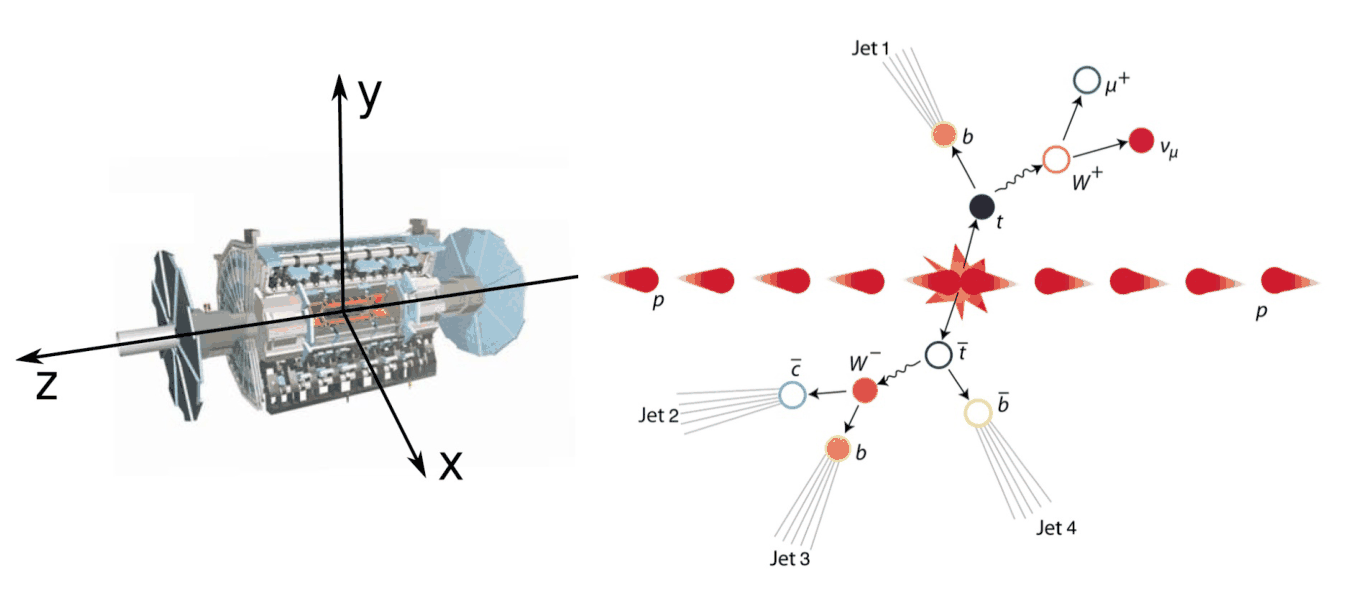
Figure 1. Schematic representation of the ATLAS detector coordinate system (left) and proton-proton collision (right).
The linear momenta of the three final-state particles coming from the top quark decay, including the neutrino, is presented below for each component.
| Particle | \(p_x\) (GeV/\(c\)) | \(p_y\) (GeV/\(c\)) | \(p_z\) (GeV/\(c\)) |
|---|---|---|---|
| anti-muon (\(\mu^+\)) | \(-24.7\) | \(-24.9\) | \(-12.4\) |
| jet 1 (\(j_1\)) | \(-14.2\) | \(+50.1\) | \(+94.1\) |
| neutrino (\(\nu\)) | \(-104.1\) | \(+5.3\) | --- |
B.1 — 1.5pt
Find an equation which relates the square of the \(W^+\) boson mass, \(m_{\mathrm W}^2\), with the neutrino and anti-muon momentum components presented in the table above. Express your answer in terms of the neutrino and anti-muon transverse momentum,
\[ \vec p_{\mathrm T}^{(\nu)} =p_x^{(\nu)}\hat\imath+p_y^{(\nu)}\hat\jmath \quad\text{and}\quad \vec p_{\mathrm T}^{(\mu)} =p_x^{(\mu)}\hat\imath+p_y^{(\mu)}\hat\jmath, \]
and their \(z\)-axis momentum components, \(p_z^{(\mu)}\) and \(p_z^{(\nu)}\).
B.2 — 1.5pt
Assuming a \(W^+\) boson mass of \(m_{\mathrm W}=80.4\ \mathrm{GeV}/c^2\) calculate the two possible solutions for the neutrino momentum along the \(z\)-axis, \(p_z^{(\nu)}\). Express your answer in GeV/c.
B.3 — 1.0pt
Calculate the top quark mass for each one of the two previous solutions. Express your answer in GeV/\(c^2\).
[If you did not obtain the two solutions in B.2, use \(p_z^{(\nu)}=70\ \mathrm{GeV}/c\) and \(p_z^{(\nu)}=-180\ \mathrm{GeV}/c\).]
The normalised number of collision events for the measurement of the top quark mass (as determined from the experiment), has two components: the so-called "signal" (corresponding to the decay of top quarks) and "background" (corresponding to events from other processes that do not include top quarks). Experimental data include both processes, see Fig. 2.
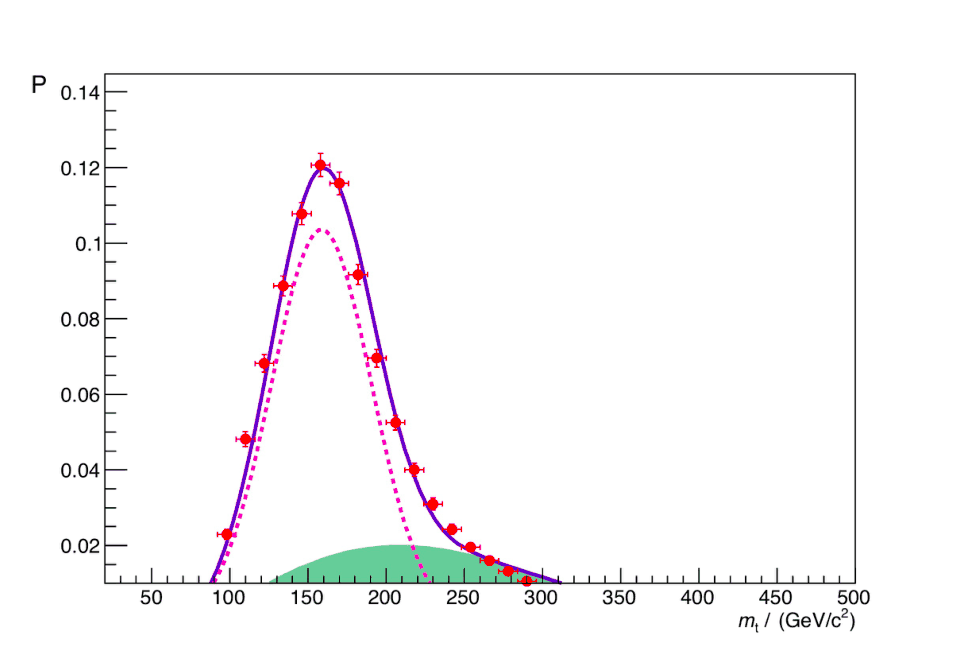
Figure 2. Top quark mass distribution as determined from the experiment, i.e. the normalised number of events plotted against the top quark mass. The dots correspond to the data. The dashed line corresponds to the "signal" and the shade to the "background".
B.4 — 1.0pt
According to the top quark mass distribution, which one of the two previous solutions is more likely to be the right one? Estimate the probability for the most likely solution.
B.5 — 1.0pt
Calculate the distance traveled by the top quark before decaying, using the most likely solution. Assume the top quark has a mean lifetime at rest of \(5\times10^{-25}\ \mathrm{s}\).
Official English text of the problem.
Answers
Here \(p_{\mathrm T}^{(a)}=|\vec p_{\mathrm T}^{(a)}|\).
- A.1: \(\displaystyle r=\frac{\sqrt{2mK}}{eB}\).
- A.2: \(\displaystyle p_{\min}=\frac{eBR}{2}=3.3\times10^2\ \mathrm{MeV}/c\).
- A.3: \(\displaystyle \xi=\frac{1}{6\pi},\qquad n=5,\qquad k=4\).
- A.4: \(\displaystyle \alpha=\frac{e^4B^2}{6\pi\epsilon_0m^4c^5}\).
- A.5: \(\displaystyle \Delta E\simeq55\ \mathrm{MeV}\).
- A.6: The instantaneous frequency is \[ f(t)=\frac{eBc^2}{2\pi E_0}(1+\alpha E_0t). \] The angular frequency is \(\omega(t)=2\pi f(t)\).
- B.1: \[ \begin{aligned} \frac{m_{\mathrm W}^2c^2}{2} ={}& \sqrt{\left[(p_{\mathrm T}^{(\mu)})^2+(p_z^{(\mu)})^2\right] \left[(p_{\mathrm T}^{(\nu)})^2+(p_z^{(\nu)})^2\right]}\\ &-\vec p_{\mathrm T}^{(\mu)}\cdot\vec p_{\mathrm T}^{(\nu)} -p_z^{(\mu)}p_z^{(\nu)}. \end{aligned} \]
- B.2: \(\displaystyle p_z^{(\nu)}\simeq+74.0\ \mathrm{GeV}/c\) or \(\displaystyle -188\ \mathrm{GeV}/c\).
- B.3: Respectively, \(\displaystyle m_t\simeq169\ \mathrm{GeV}/c^2\) or \(\displaystyle311\ \mathrm{GeV}/c^2\).
- B.4: The \(p_z^{(\nu)}\simeq+74.0\ \mathrm{GeV}/c\) solution is more likely. The plotted probability at its reconstructed mass is approximately \(\displaystyle P\simeq0.12\), or \(12\%\).
- B.5: The mean distance is \(\displaystyle \bar L\simeq1.9\times10^{-16}\ \mathrm m\).
Solution
A.1
For motion perpendicular to the magnetic field, the magnetic Lorentz force provides the centripetal force:
\[ evB=\frac{mv^2}{r}. \]
Thus \(r=mv/(eB)\). Using the non-relativistic kinetic energy \(K=\tfrac12mv^2\),
\[ \boxed{r=\frac{\sqrt{2mK}}{eB}}. \]
Equivalently, \(r=p/(eB)\), which also applies relativistically when \(p\) is the relativistic momentum.
A.2
Let the detector radius be \(R=1.1\ \mathrm m\). The electron’s circular orbit passes through the collision point, so its orbit centre is a distance \(r\) from that point. Its greatest radial distance from the collision point is therefore \(2r\).
The limiting orbit touches the cylindrical boundary when
\[ 2r=R. \]
The minimum total momentum occurs for motion perpendicular to the solenoid field. Hence the escape threshold is
\[ p_{\min}=eB\frac R2 =(1.60\times10^{-19})(2.00)\frac{1.1}{2} =1.76\times10^{-19}\ \mathrm{kg\,m\,s^{-1}}. \]
Since
\[ 1\ \mathrm{MeV}/c =\frac{10^6(1.60\times10^{-19})}{3.00\times10^8} =5.33\times10^{-22}\ \mathrm{kg\,m\,s^{-1}}, \]
we obtain
\[ \boxed{p_{\min}=3.3\times10^2\ \mathrm{MeV}/c}. \]
Just above this threshold, the orbit crosses the cylindrical boundary.
A.3
For acceleration perpendicular to the velocity, the relativistic transverse equation of motion is
\[ e vB=\gamma ma, \]
so the curvature acceleration is
\[ a=\frac{evB}{\gamma m}. \]
Substitution into the given radiation formula gives
\[ P=\frac{e^2}{6\pi\epsilon_0c^3} \frac{e^2v^2B^2}{\gamma^2m^2}\gamma^4 =\frac{e^4B^2v^2\gamma^2}{6\pi\epsilon_0m^2c^3}. \]
In the ultrarelativistic limit, \(v\simeq c\), while the total energy is \(E=\gamma mc^2\). Therefore,
\[ P\simeq \frac{e^4B^2}{6\pi\epsilon_0m^2c} \left(\frac{E}{mc^2}\right)^2 =\frac{e^4E^2B^2}{6\pi\epsilon_0m^4c^5}. \]
Comparison with the requested form yields
\[ \boxed{\xi=\frac1{6\pi},\qquad n=5,\qquad k=4}. \]
A.4
The magnetic force does no work, so the electron’s energy decreases by the energy radiated:
\[ \frac{dE}{dt}=-P=-\alpha E^2, \]
where, from A.3,
\[ \boxed{\alpha=\frac{e^4B^2}{6\pi\epsilon_0m^4c^5}}. \]
Integrating with \(E(0)=E_0\),
\[ \int_{E_0}^{E(t)}\frac{dE}{E^2} =-\alpha\int_0^t dt, \]
which gives
\[ \frac1{E(t)}-\frac1{E_0}=\alpha t. \]
Consequently,
\[ E(t)=\frac{E_0}{1+\alpha E_0t}, \]
as stated in the question.
A.5
First check the trajectory curvature. For an ultrarelativistic electron, \(p\simeq E/c\), so its initial cyclotron radius is
\[ r_0\simeq\frac{E_0}{eBc}. \]
Here
\[ E_0=100\ \mathrm{GeV}=1.60\times10^{-8}\ \mathrm J, \]
and therefore
\[ r_0= \frac{1.60\times10^{-8}} {(1.60\times10^{-19})(2.00)(3.00\times10^8)} =1.67\times10^2\ \mathrm m. \]
Since \(r_0\gg R=1.1\ \mathrm m\), the path through the detector is almost straight. Thus
\[ t_{\rm exit}\simeq\frac Rc =\frac{1.1}{3.00\times10^8} =3.67\times10^{-9}\ \mathrm s. \]
Using the supplied constants,
\[ \alpha =\frac{e^4B^2}{6\pi\epsilon_0m^4c^5} =9.39\times10^{12}\ \mathrm{J^{-1}\,s^{-1}}, \]
and
\[ \alpha E_0t_{\rm exit}=5.51\times10^{-4}. \]
The energy lost is
\[ \Delta E =E_0-\frac{E_0}{1+\alpha E_0t_{\rm exit}} =\frac{\alpha E_0^2t_{\rm exit}} {1+\alpha E_0t_{\rm exit}}. \]
Numerically,
\[ \Delta E=8.81\times10^{-12}\ \mathrm J =55.1\ \mathrm{MeV}. \]
Thus, to sensible precision,
\[ \boxed{\Delta E\simeq55\ \mathrm{MeV}}. \]
This is only about \(5.5\times10^{-4}\) of the initial energy, confirming that the radius remains very large throughout the flight.
A.6
The instantaneous angular rate of rotation of the momentum is
\[ \omega=\frac vr=\frac{eB}{\gamma m}. \]
Using \(E=\gamma mc^2\),
\[ \omega(t)=\frac{eBc^2}{E(t)}. \]
Substituting the result of A.4,
\[ \boxed{\omega(t)=\frac{eBc^2}{E_0}(1+\alpha E_0t)}. \]
The ordinary frequency, measured in cycles per second, is therefore
\[ \boxed{f(t)=\frac{eBc^2}{2\pi E_0}(1+\alpha E_0t)}. \]
Both increase linearly with time within the ultrarelativistic approximation.
B.1
Four-momentum conservation in \(W^+\to\mu^++\nu\) gives
\[ E_{\mathrm W}=E_\mu+E_\nu, \qquad \vec p_{\mathrm W}=\vec p^{(\mu)}+\vec p^{(\nu)}. \]
The invariant mass of the two-particle system satisfies
\[ m_{\mathrm W}^2c^4 =(E_\mu+E_\nu)^2 -c^2\left|\vec p^{(\mu)}+\vec p^{(\nu)}\right|^2. \]
Both daughter particles are treated as massless, so
\[ E_\mu=c|\vec p^{(\mu)}|, \qquad E_\nu=c|\vec p^{(\nu)}|. \]
The individual energy–momentum terms cancel on expanding the invariant:
\[ m_{\mathrm W}^2c^4 =2\left(E_\mu E_\nu -c^2\vec p^{(\mu)}\cdot\vec p^{(\nu)}\right). \]
Now
\[ |\vec p^{(a)}| =\sqrt{(p_{\mathrm T}^{(a)})^2+(p_z^{(a)})^2}, \]
and
\[ \vec p^{(\mu)}\cdot\vec p^{(\nu)} =\vec p_{\mathrm T}^{(\mu)}\cdot\vec p_{\mathrm T}^{(\nu)} +p_z^{(\mu)}p_z^{(\nu)}. \]
Hence the requested relation is
\[ \boxed{ \begin{aligned} \frac{m_{\mathrm W}^2c^2}{2} ={}& \sqrt{\left[(p_{\mathrm T}^{(\mu)})^2+(p_z^{(\mu)})^2\right] \left[(p_{\mathrm T}^{(\nu)})^2+(p_z^{(\nu)})^2\right]}\\ &-\vec p_{\mathrm T}^{(\mu)}\cdot\vec p_{\mathrm T}^{(\nu)} -p_z^{(\mu)}p_z^{(\nu)}. \end{aligned}} \]
B.2
Define
\[ q=p_z^{(\nu)},\qquad \ell=p_z^{(\mu)},\qquad a=(p_{\mathrm T}^{(\mu)})^2,\qquad b=(p_{\mathrm T}^{(\nu)})^2, \]
and let
\[ p_\mu=|\vec p^{(\mu)}|,\qquad D=\frac{m_{\mathrm W}^2c^2}{2} +\vec p_{\mathrm T}^{(\mu)}\cdot\vec p_{\mathrm T}^{(\nu)}. \]
The equation from B.1 becomes
\[ p_\mu\sqrt{b+q^2}=D+\ell q. \]
Squaring and using \(p_\mu^2-\ell^2=a\),
\[ a q^2-2D\ell q+p_\mu^2b-D^2=0. \]
Its roots are
\[ q=\frac{D\ell\pm p_\mu\sqrt{D^2-ab}}{a}. \]
The measured components give
\[ \begin{aligned} a&=24.7^2+24.9^2 =1230.1\ (\mathrm{GeV}/c)^2,\\ b&=104.1^2+5.3^2 =10864.9\ (\mathrm{GeV}/c)^2,\\ p_\mu&=\sqrt{24.7^2+24.9^2+12.4^2} =37.2003\ \mathrm{GeV}/c,\\ \vec p_{\mathrm T}^{(\mu)}\cdot\vec p_{\mathrm T}^{(\nu)} &=(-24.7)(-104.1)+(-24.9)(5.3)\\ &=2439.3\ (\mathrm{GeV}/c)^2,\\ D&=\frac{80.4^2}{2}+2439.3 =5671.38\ (\mathrm{GeV}/c)^2. \end{aligned} \]
Thus the two numerical roots are
\[ q_+=73.9532\ \mathrm{GeV}/c, \qquad q_-=-188.2937\ \mathrm{GeV}/c. \]
Both satisfy the original, unsquared equation. Therefore,
\[ \boxed{p_z^{(\nu)}\simeq+74.0\ \mathrm{GeV}/c \quad\text{or}\quad -188\ \mathrm{GeV}/c}. \]
B.3
The top quark decays into the anti-muon, neutrino and bottom-quark jet. Conservation of energy and momentum gives
\[ E_t=E_\mu+E_\nu+E_{j_1}, \qquad \vec p_t=\vec p^{(\mu)}+\vec p^{(\nu)}+\vec p^{(j_1)}. \]
Because all three decay products are treated as massless,
\[ E_t=c\left( |\vec p^{(\mu)}|+|\vec p^{(\nu)}|+|\vec p^{(j_1)}| \right). \]
The jet momentum magnitude is
\[ |\vec p^{(j_1)}| =\sqrt{(-14.2)^2+50.1^2+94.1^2} =107.5475\ \mathrm{GeV}/c. \]
Writing \(q\) as its numerical value in \(\mathrm{GeV}/c\),
\[ E_t= \left[37.2003+107.5475+\sqrt{10864.9+q^2}\right]\mathrm{GeV}, \]
and
\[ \vec p_t=(-143.0,\ 30.5,\ 81.7+q)\ \mathrm{GeV}/c. \]
The reconstructed top mass follows from
\[ m_t^2c^4=E_t^2-c^2|\vec p_t|^2. \]
Keeping extra digits during the calculation gives:
| Neutrino solution | \(E_\nu\) (GeV) | \(E_t\) (GeV) | \(p_{tz}\) (GeV/\(c\)) | \(m_t\) (GeV/\(c^2\)) |
|---|---|---|---|---|
| \(q_+=73.9532\ \mathrm{GeV}/c\) | 127.804 | 272.552 | 155.653 | 169.344 |
| \(q_-=-188.2937\ \mathrm{GeV}/c\) | 215.219 | 359.967 | \(-106.594\) | 311.183 |
Therefore,
\[ \boxed{m_t\simeq169\ \mathrm{GeV}/c^2 \quad\text{for }p_z^{(\nu)}>0}, \]
\[ \boxed{m_t\simeq311\ \mathrm{GeV}/c^2 \quad\text{for }p_z^{(\nu)}<0}. \]
B.4
The mass \(169\ \mathrm{GeV}/c^2\) lies close to the maximum of the distribution in Figure 2, whereas \(311\ \mathrm{GeV}/c^2\) lies in its small upper tail. The positive-\(p_z^{(\nu)}\) solution is therefore more likely.
Reading the ordinate of the plotted total-distribution curve near \(169\ \mathrm{GeV}/c^2\) gives
\[ \boxed{P\simeq0.12\quad\text{or approximately }12\%}. \]
The corresponding reconstructed neutrino momentum is
\[ \boxed{\vec p^{(\nu)} \simeq(-104.1,\ +5.3,\ +74.0)\ \mathrm{GeV}/c}. \]
B.5
For the more likely solution,
\[ \vec p_t=(-143.0,\ 30.5,\ 155.653)\ \mathrm{GeV}/c, \]
so
\[ |\vec p_t|=213.558\ \mathrm{GeV}/c. \]
The top quark’s Lorentz factor and speed are
\[ \gamma_t=\frac{E_t}{m_tc^2} =\frac{272.552}{169.344} =1.609, \]
\[ \beta_t=\frac{|\vec p_t|c}{E_t} =\frac{213.558}{272.552} =0.7836. \]
The mean lifetime in the detector frame is \(\gamma_t\tau_0\). Thus the mean distance travelled is
\[ \bar L=v_t\gamma_t\tau_0 =\beta_t\gamma_t c\tau_0 =\frac{|\vec p_t|c}{m_tc^2}\,c\tau_0. \]
Substitution gives
\[ \bar L =\frac{213.558}{169.344} (3.00\times10^8)(5\times10^{-25}) =1.89\times10^{-16}\ \mathrm m. \]
Therefore,
\[ \boxed{\bar L\simeq1.9\times10^{-16}\ \mathrm m}. \]
This is a mean distance because the supplied rest-frame lifetime is a mean lifetime.
The solution was checked against the official solution.
IPhO 2018 · Theorieaufgabe 2
Wo ist das Neutrino?
Wenn am Large Hadron Collider (LHC) zwei Protonen mit sehr hoher Energie kollidieren, können bei dieser Kollision verschiedene Teilchen entstehen, etwa Elektronen, Myonen, Neutrinos, Quarks und ihre jeweiligen Antiteilchen. Die meisten dieser Teilchen können mit dem Teilchendetektor nachgewiesen werden, der den Kollisionspunkt umgibt. Beispielsweise durchlaufen Quarks einen Prozess namens Hadronisierung, bei dem sie sich in einen Schauer subatomarer Teilchen verwandeln, der als „Jet“ bezeichnet wird. Außerdem bewirkt das starke Magnetfeld in den Detektoren, dass die Bahnen selbst sehr energiereicher geladener Teilchen ausreichend gekrümmt werden, um ihren Impuls bestimmen zu können. Der ATLAS-Detektor verwendet ein supraleitendes Solenoidsystem, das im inneren Teil des Detektors um den Kollisionspunkt ein zeitlich konstantes und homogenes Magnetfeld von 2.00 Tesla erzeugt. Die Bahnen geladener Teilchen mit Impulsen unterhalb eines bestimmten Wertes werden so stark gekrümmt, dass die Teilchen das Feld wiederholt auf geschlossenen Bahnen durchlaufen und höchstwahrscheinlich nicht gemessen werden. Das Neutrino wird aufgrund seiner Eigenschaften überhaupt nicht nachgewiesen, da es den Detektor ohne Wechselwirkung durchquert und entkommt.
Gegebene Daten: Ruhemasse des Elektrons, \(m=9.11\times10^{-31}\ \mathrm{kg}\); Elementarladung, \(e=1.60\times10^{-19}\ \mathrm{C}\);
Lichtgeschwindigkeit, \(c=3.00\times10^8\ \mathrm{m\,s^{-1}}\); elektrische Feldkonstante, \(\epsilon_0=8.85\times10^{-12}\ \mathrm{F\,m^{-1}}\)
Teil A. Physik des ATLAS-Detektors (4.0 Punkte)
A.1 — 0.5 Punkte
Leiten Sie einen Ausdruck für den Zyklotronradius \(r\) der Kreisbahn eines Elektrons her, auf das eine magnetische Kraft senkrecht zu seiner Geschwindigkeit wirkt, und drücken Sie diesen Radius als Funktion seiner kinetischen Energie \(K\), seines Ladungsbetrags \(e\), seiner Masse \(m\) und des Magnetfelds \(B\) aus. Nehmen Sie an, dass das Elektron ein nichtrelativistisches klassisches Teilchen ist.
Elektronen, die im ATLAS-Detektor entstehen, müssen relativistisch behandelt werden. Die Formel für den Zyklotronradius gilt jedoch auch für relativistische Bewegungen, wenn der relativistische Impuls verwendet wird.
A.2 — 0.5 Punkte
Berechnen Sie den Mindestwert des Impulses eines Elektrons, bei dem es den inneren Teil des Detektors in radialer Richtung verlassen kann. Der innere Teil des Detektors hat die Form eines Zylinders mit einem Radius von 1.1 Metern, und das Elektron entsteht am Kollisionspunkt genau im Zentrum des Zylinders. Geben Sie Ihre Antwort in MeV/\(c\) an.
Werden relativistische Teilchen mit der Ladung \(e\) und der Ruhemasse \(m\) senkrecht zu ihrer Geschwindigkeit beschleunigt, so emittieren sie elektromagnetische Strahlung, die als Synchrotronstrahlung bezeichnet wird. Die abgestrahlte Leistung ist gegeben durch
\[ P=\frac{e^2a^2\gamma^4}{6\pi\epsilon_0c^3} \]
wobei \(a\) die Beschleunigung ist und \(\gamma=[1-(v/c)^2]^{-1/2}\) gilt.
A.3 — 1.0 Punkte
Ein Teilchen wird als ultrarelativistisch bezeichnet, wenn seine Geschwindigkeit sehr nahe an der Lichtgeschwindigkeit liegt. Für ein ultrarelativistisches Teilchen lässt sich die abgestrahlte Leistung folgendermaßen ausdrücken:
\[ P=\xi\frac{e^4}{\epsilon_0m^kc^n}E^2B^2, \]
wobei \(\xi\) eine reelle Zahl ist, \(n\) und \(k\) ganze Zahlen sind, \(E\) die Energie des geladenen Teilchens und \(B\) das Magnetfeld ist. Bestimmen Sie \(\xi\), \(n\) und \(k\).
A.4 — 1.0 Punkte
Im ultrarelativistischen Grenzfall ist die Energie des Elektrons als Funktion der Zeit gegeben durch:
\[ E(t)=\frac{E_0}{1+\alpha E_0t}, \]
wobei \(E_0\) die Anfangsenergie des Elektrons ist. Bestimmen Sie \(\alpha\) als Funktion von \(e\), \(c\), \(B\), \(\epsilon_0\) und \(m\).
A.5 — 0.5 Punkte
Betrachten Sie ein Elektron, das am Kollisionspunkt mit einer Energie von 100 GeV in radialer Richtung erzeugt wird. Schätzen Sie die Energie ab, die durch Synchrotronstrahlung verloren geht, bis das Elektron den inneren Teil des Detektors verlässt. Geben Sie Ihre Antwort in MeV an.
A.6 — 0.5 Punkte
Bestimmen Sie im ultrarelativistischen Grenzfall einen Ausdruck für die Zyklotronfrequenz des Elektrons als Funktion der Zeit.
Teil B. Das Neutrino finden (6.0 Punkte)
Die in Abbildung 1 dargestellte Kollision zweier Protonen führt zur Erzeugung eines Top-Quarks (\(t\)) und eines Anti-Top-Quarks (\(\bar t\)), der schwersten jemals nachgewiesenen Elementarteilchen. Das Top-Quark zerfällt in ein \(W^+\)-Boson und ein Bottom-Quark (\(b\)), während das Anti-Top-Quark in ein \(W^-\)-Boson und ein Anti-Bottom-Quark (\(\bar b\)) zerfällt. Im in Abbildung 1 dargestellten Fall zerfällt das \(W^+\)-Boson in ein Antimyon (\(\mu^+\)) und ein Neutrino (\(\nu\)), und das \(W^-\)-Boson zerfällt in ein Quark und ein Antiquark. Ziel dieser Aufgabe ist es, den vollständigen Impuls des Neutrinos mithilfe der Impulse einiger nachgewiesener Teilchen zu rekonstruieren. Der Einfachheit halber werden alle Teilchen und Jets in dieser Aufgabe als masselos betrachtet, mit Ausnahme des Top-Quarks und der \(W^\pm\)-Bosonen.
Die Impulse der Zerfallsprodukte des Top-Quarks können experimentell bestimmt werden (siehe Tabelle), mit Ausnahme der Impulskomponente des Neutrinos entlang der \(z\)-Achse. Der Gesamtimpuls der vom Detektor erfassten Teilchen im Endzustand ist nur in der Transversalebene (\(xy\)-Ebene) null, nicht aber entlang der Kollisionsachse (\(z\)-Achse). Daher lässt sich der Transversalimpuls des Neutrinos aus dem fehlenden Impuls in der Transversalebene bestimmen.
Am 4. Juni 2015 zeichnete das ATLAS-Experiment am LHC um 00:21:24 GMT+1 eine Proton-Proton-Kollision auf, wie sie in Abbildung 1 dargestellt ist.
Abbildung 1. Schematische Darstellung des Koordinatensystems des ATLAS-Detektors (links) und der Proton-Proton-Kollision (rechts).
Die Impulse der drei Teilchen im Endzustand, die aus dem Zerfall des Top-Quarks hervorgehen, einschließlich des Neutrinos, sind nachfolgend für jede Komponente angegeben.
| Teilchen | \(p_x\) (GeV/\(c\)) | \(p_y\) (GeV/\(c\)) | \(p_z\) (GeV/\(c\)) |
|---|---|---|---|
| Antimyon (\(\mu^+\)) | \(-24.7\) | \(-24.9\) | \(-12.4\) |
| Jet 1 (\(j_1\)) | \(-14.2\) | \(+50.1\) | \(+94.1\) |
| Neutrino (\(\nu\)) | \(-104.1\) | \(+5.3\) | --- |
B.1 — 1.5 Punkte
Bestimmen Sie eine Gleichung, die das Quadrat der Masse des \(W^+\)-Bosons, \(m_{\mathrm W}^2\), mit den in der obigen Tabelle angegebenen Impulskomponenten des Neutrinos und des Antimyons verknüpft. Drücken Sie Ihre Antwort durch die Transversalimpulse des Neutrinos und des Antimyons,
\[ \vec p_{\mathrm T}^{(\nu)} =p_x^{(\nu)}\hat\imath+p_y^{(\nu)}\hat\jmath \quad\text{und}\quad \vec p_{\mathrm T}^{(\mu)} =p_x^{(\mu)}\hat\imath+p_y^{(\mu)}\hat\jmath, \]
und ihre Impulskomponenten entlang der \(z\)-Achse, \(p_z^{(\mu)}\) und \(p_z^{(\nu)}\), aus.
B.2 — 1.5 Punkte
Berechnen Sie unter der Annahme einer Masse des \(W^+\)-Bosons von \(m_{\mathrm W}=80.4\ \mathrm{GeV}/c^2\) die beiden möglichen Lösungen für den Impuls des Neutrinos entlang der \(z\)-Achse, \(p_z^{(\nu)}\). Geben Sie Ihre Antwort in GeV/c an.
B.3 — 1.0 Punkte
Berechnen Sie die Masse des Top-Quarks für jede der beiden vorherigen Lösungen. Geben Sie Ihre Antwort in GeV/\(c^2\) an.
[Falls Sie in B.2 die beiden Lösungen nicht erhalten haben, verwenden Sie \(p_z^{(\nu)}=70\ \mathrm{GeV}/c\) und \(p_z^{(\nu)}=-180\ \mathrm{GeV}/c\).]
Die normierte Anzahl der Kollisionsereignisse zur Messung der Masse des Top-Quarks (wie sie experimentell bestimmt wird) hat zwei Komponenten: das sogenannte „Signal“ (das dem Zerfall von Top-Quarks entspricht) und den „Untergrund“ (der Ereignissen aus anderen Prozessen entspricht, an denen keine Top-Quarks beteiligt sind). Die experimentellen Daten enthalten beide Prozesse, siehe Abb. 2.
Abbildung 2. Experimentell bestimmte Massenverteilung des Top-Quarks, d. h. die normierte Anzahl der Ereignisse, aufgetragen gegen die Masse des Top-Quarks. Die Punkte entsprechen den Daten. Die gestrichelte Linie entspricht dem „Signal“ und die schattierte Fläche dem „Untergrund“.
B.4 — 1.0 Punkte
Welche der beiden vorherigen Lösungen ist gemäß der Massenverteilung des Top-Quarks mit größerer Wahrscheinlichkeit die richtige? Schätzen Sie die Wahrscheinlichkeit für die wahrscheinlichere Lösung ab.
B.5 — 1.0 Punkte
Berechnen Sie anhand der wahrscheinlicheren Lösung die Strecke, die das Top-Quark vor seinem Zerfall zurücklegt. Nehmen Sie für das Top-Quark eine mittlere Lebensdauer in Ruhe von \(5\times10^{-25}\ \mathrm{s}\) an.
Aufgabentext aus dem offiziellen englischen Text übersetzt.
Antworten
Hier gilt \(p_{\mathrm T}^{(a)}=|\vec p_{\mathrm T}^{(a)}|\).
- A.1: \(\displaystyle r=\frac{\sqrt{2mK}}{eB}\).
- A.2: \(\displaystyle p_{\min}=\frac{eBR}{2}=3.3\times10^2\ \mathrm{MeV}/c\).
- A.3: \(\displaystyle \xi=\frac{1}{6\pi},\qquad n=5,\qquad k=4\).
- A.4: \(\displaystyle \alpha=\frac{e^4B^2}{6\pi\epsilon_0m^4c^5}\).
- A.5: \(\displaystyle \Delta E\simeq55\ \mathrm{MeV}\).
- A.6: Die momentane Frequenz ist \[ f(t)=\frac{eBc^2}{2\pi E_0}(1+\alpha E_0t). \] Die Kreisfrequenz ist \(\omega(t)=2\pi f(t)\).
- B.1: \[ \begin{aligned} \frac{m_{\mathrm W}^2c^2}{2} ={}& \sqrt{\left[(p_{\mathrm T}^{(\mu)})^2+(p_z^{(\mu)})^2\right] \left[(p_{\mathrm T}^{(\nu)})^2+(p_z^{(\nu)})^2\right]}\\ &-\vec p_{\mathrm T}^{(\mu)}\cdot\vec p_{\mathrm T}^{(\nu)} -p_z^{(\mu)}p_z^{(\nu)}. \end{aligned} \]
- B.2: \(\displaystyle p_z^{(\nu)}\simeq+74.0\ \mathrm{GeV}/c\) oder \(\displaystyle -188\ \mathrm{GeV}/c\).
- B.3: Entsprechend \(\displaystyle m_t\simeq169\ \mathrm{GeV}/c^2\) oder \(\displaystyle311\ \mathrm{GeV}/c^2\).
- B.4: Die Lösung \(p_z^{(\nu)}\simeq+74.0\ \mathrm{GeV}/c\) ist wahrscheinlicher. Die im Diagramm dargestellte Wahrscheinlichkeit bei ihrer rekonstruierten Masse beträgt ungefähr \(\displaystyle P\simeq0.12\), also \(12\%\).
- B.5: Die mittlere Strecke beträgt \(\displaystyle \bar L\simeq1.9\times10^{-16}\ \mathrm m\).
Lösung
A.1
Bei einer Bewegung senkrecht zum Magnetfeld liefert die magnetische Lorentzkraft die Zentripetalkraft:
\[ evB=\frac{mv^2}{r}. \]
Somit gilt \(r=mv/(eB)\). Mit der nichtrelativistischen kinetischen Energie \(K=\tfrac12mv^2\) ergibt sich
\[ \boxed{r=\frac{\sqrt{2mK}}{eB}}. \]
Äquivalent dazu gilt \(r=p/(eB)\), was auch relativistisch gilt, wenn \(p\) der relativistische Impuls ist.
A.2
Der Detektorradius sei \(R=1.1\ \mathrm m\). Die Kreisbahn des Elektrons verläuft durch den Kollisionspunkt, sodass ihr Mittelpunkt den Abstand \(r\) von diesem Punkt hat. Der größte radiale Abstand vom Kollisionspunkt beträgt daher \(2r\).
Die Grenzbahn berührt die zylindrische Begrenzung, wenn
\[ 2r=R. \]
Der minimale Gesamtimpuls ergibt sich bei einer Bewegung senkrecht zum Solenoidfeld. Daher beträgt der Schwellenimpuls für das Verlassen des Detektors
\[ p_{\min}=eB\frac R2 =(1.60\times10^{-19})(2.00)\frac{1.1}{2} =1.76\times10^{-19}\ \mathrm{kg\,m\,s^{-1}}. \]
Wegen
\[ 1\ \mathrm{MeV}/c =\frac{10^6(1.60\times10^{-19})}{3.00\times10^8} =5.33\times10^{-22}\ \mathrm{kg\,m\,s^{-1}}, \]
erhalten wir
\[ \boxed{p_{\min}=3.3\times10^2\ \mathrm{MeV}/c}. \]
Knapp oberhalb dieser Schwelle schneidet die Bahn die zylindrische Begrenzung.
A.3
Für eine Beschleunigung senkrecht zur Geschwindigkeit lautet die relativistische transversale Bewegungsgleichung
\[ e vB=\gamma ma, \]
sodass die Zentripetalbeschleunigung gegeben ist durch
\[ a=\frac{evB}{\gamma m}. \]
Einsetzen in die angegebene Strahlungsformel ergibt
\[ P=\frac{e^2}{6\pi\epsilon_0c^3} \frac{e^2v^2B^2}{\gamma^2m^2}\gamma^4 =\frac{e^4B^2v^2\gamma^2}{6\pi\epsilon_0m^2c^3}. \]
Im ultrarelativistischen Grenzfall gilt \(v\simeq c\), während die Gesamtenergie \(E=\gamma mc^2\) beträgt. Daher gilt
\[ P\simeq \frac{e^4B^2}{6\pi\epsilon_0m^2c} \left(\frac{E}{mc^2}\right)^2 =\frac{e^4E^2B^2}{6\pi\epsilon_0m^4c^5}. \]
Der Vergleich mit der gesuchten Form liefert
\[ \boxed{\xi=\frac1{6\pi},\qquad n=5,\qquad k=4}. \]
A.4
Die magnetische Kraft verrichtet keine Arbeit, sodass die Energie des Elektrons um die abgestrahlte Energie abnimmt:
\[ \frac{dE}{dt}=-P=-\alpha E^2, \]
wobei nach A.3 gilt:
\[ \boxed{\alpha=\frac{e^4B^2}{6\pi\epsilon_0m^4c^5}}. \]
Integration mit \(E(0)=E_0\) ergibt
\[ \int_{E_0}^{E(t)}\frac{dE}{E^2} =-\alpha\int_0^t dt, \]
woraus folgt:
\[ \frac1{E(t)}-\frac1{E_0}=\alpha t. \]
Somit gilt
\[ E(t)=\frac{E_0}{1+\alpha E_0t}, \]
wie in der Aufgabenstellung angegeben.
A.5
Zunächst überprüfen wir die Bahnkrümmung. Für ein ultrarelativistisches Elektron gilt \(p\simeq E/c\), sodass sein anfänglicher Zyklotronradius gegeben ist durch
\[ r_0\simeq\frac{E_0}{eBc}. \]
Hier gilt
\[ E_0=100\ \mathrm{GeV}=1.60\times10^{-8}\ \mathrm J, \]
und daher
\[ r_0= \frac{1.60\times10^{-8}} {(1.60\times10^{-19})(2.00)(3.00\times10^8)} =1.67\times10^2\ \mathrm m. \]
Da \(r_0\gg R=1.1\ \mathrm m\) gilt, ist die Bahn durch den Detektor nahezu geradlinig. Somit gilt
\[ t_{\rm exit}\simeq\frac Rc =\frac{1.1}{3.00\times10^8} =3.67\times10^{-9}\ \mathrm s. \]
Mit den angegebenen Konstanten ergibt sich
\[ \alpha =\frac{e^4B^2}{6\pi\epsilon_0m^4c^5} =9.39\times10^{12}\ \mathrm{J^{-1}\,s^{-1}}, \]
und
\[ \alpha E_0t_{\rm exit}=5.51\times10^{-4}. \]
Die verlorene Energie beträgt
\[ \Delta E =E_0-\frac{E_0}{1+\alpha E_0t_{\rm exit}} =\frac{\alpha E_0^2t_{\rm exit}} {1+\alpha E_0t_{\rm exit}}. \]
Numerisch ergibt sich
\[ \Delta E=8.81\times10^{-12}\ \mathrm J =55.1\ \mathrm{MeV}. \]
Mit angemessener Genauigkeit gilt somit
\[ \boxed{\Delta E\simeq55\ \mathrm{MeV}}. \]
Dies entspricht nur etwa \(5.5\times10^{-4}\) der Anfangsenergie und bestätigt, dass der Radius während des gesamten Flugs sehr groß bleibt.
A.6
Die momentane Winkelgeschwindigkeit der Drehung des Impulsvektors ist
\[ \omega=\frac vr=\frac{eB}{\gamma m}. \]
Mit \(E=\gamma mc^2\) ergibt sich
\[ \omega(t)=\frac{eBc^2}{E(t)}. \]
Einsetzen des Ergebnisses aus A.4 liefert
\[ \boxed{\omega(t)=\frac{eBc^2}{E_0}(1+\alpha E_0t)}. \]
Die gewöhnliche Frequenz, gemessen in Umläufen pro Sekunde, ist daher
\[ \boxed{f(t)=\frac{eBc^2}{2\pi E_0}(1+\alpha E_0t)}. \]
Beide nehmen im Rahmen der ultrarelativistischen Näherung linear mit der Zeit zu.
B.1
Die Erhaltung des Viererimpulses bei \(W^+\to\mu^++\nu\) ergibt
\[ E_{\mathrm W}=E_\mu+E_\nu, \qquad \vec p_{\mathrm W}=\vec p^{(\mu)}+\vec p^{(\nu)}. \]
Die invariante Masse des Zweiteilchensystems erfüllt
\[ m_{\mathrm W}^2c^4 =(E_\mu+E_\nu)^2 -c^2\left|\vec p^{(\mu)}+\vec p^{(\nu)}\right|^2. \]
Beide Tochterteilchen werden als masselos behandelt, daher gilt
\[ E_\mu=c|\vec p^{(\mu)}|, \qquad E_\nu=c|\vec p^{(\nu)}|. \]
Beim Ausmultiplizieren der Invariante heben sich die einzelnen Energie-Impuls-Terme auf:
\[ m_{\mathrm W}^2c^4 =2\left(E_\mu E_\nu -c^2\vec p^{(\mu)}\cdot\vec p^{(\nu)}\right). \]
Nun gilt
\[ |\vec p^{(a)}| =\sqrt{(p_{\mathrm T}^{(a)})^2+(p_z^{(a)})^2}, \]
und
\[ \vec p^{(\mu)}\cdot\vec p^{(\nu)} =\vec p_{\mathrm T}^{(\mu)}\cdot\vec p_{\mathrm T}^{(\nu)} +p_z^{(\mu)}p_z^{(\nu)}. \]
Die gesuchte Beziehung lautet daher
\[ \boxed{ \begin{aligned} \frac{m_{\mathrm W}^2c^2}{2} ={}& \sqrt{\left[(p_{\mathrm T}^{(\mu)})^2+(p_z^{(\mu)})^2\right] \left[(p_{\mathrm T}^{(\nu)})^2+(p_z^{(\nu)})^2\right]}\\ &-\vec p_{\mathrm T}^{(\mu)}\cdot\vec p_{\mathrm T}^{(\nu)} -p_z^{(\mu)}p_z^{(\nu)}. \end{aligned}} \]
B.2
Wir definieren
\[ q=p_z^{(\nu)},\qquad \ell=p_z^{(\mu)},\qquad a=(p_{\mathrm T}^{(\mu)})^2,\qquad b=(p_{\mathrm T}^{(\nu)})^2, \]
und setzen
\[ p_\mu=|\vec p^{(\mu)}|,\qquad D=\frac{m_{\mathrm W}^2c^2}{2} +\vec p_{\mathrm T}^{(\mu)}\cdot\vec p_{\mathrm T}^{(\nu)}. \]
Die Gleichung aus B.1 wird zu
\[ p_\mu\sqrt{b+q^2}=D+\ell q. \]
Quadrieren und Verwenden von \(p_\mu^2-\ell^2=a\) ergibt
\[ a q^2-2D\ell q+p_\mu^2b-D^2=0. \]
Ihre Lösungen lauten
\[ q=\frac{D\ell\pm p_\mu\sqrt{D^2-ab}}{a}. \]
Die gemessenen Komponenten liefern
\[ \begin{aligned} a&=24.7^2+24.9^2 =1230.1\ (\mathrm{GeV}/c)^2,\\ b&=104.1^2+5.3^2 =10864.9\ (\mathrm{GeV}/c)^2,\\ p_\mu&=\sqrt{24.7^2+24.9^2+12.4^2} =37.2003\ \mathrm{GeV}/c,\\ \vec p_{\mathrm T}^{(\mu)}\cdot\vec p_{\mathrm T}^{(\nu)} &=(-24.7)(-104.1)+(-24.9)(5.3)\\ &=2439.3\ (\mathrm{GeV}/c)^2,\\ D&=\frac{80.4^2}{2}+2439.3 =5671.38\ (\mathrm{GeV}/c)^2. \end{aligned} \]
Die beiden numerischen Lösungen sind somit
\[ q_+=73.9532\ \mathrm{GeV}/c, \qquad q_-=-188.2937\ \mathrm{GeV}/c. \]
Beide erfüllen die ursprüngliche, nicht quadrierte Gleichung. Daher gilt
\[ \boxed{p_z^{(\nu)}\simeq+74.0\ \mathrm{GeV}/c \quad\text{oder}\quad -188\ \mathrm{GeV}/c}. \]
B.3
Das Top-Quark zerfällt in das Antimyon, das Neutrino und den Bottom-Quark-Jet. Aus der Energie- und Impulserhaltung folgt
\[ E_t=E_\mu+E_\nu+E_{j_1}, \qquad \vec p_t=\vec p^{(\mu)}+\vec p^{(\nu)}+\vec p^{(j_1)}. \]
Da alle drei Zerfallsprodukte als masselos behandelt werden, gilt
\[ E_t=c\left( |\vec p^{(\mu)}|+|\vec p^{(\nu)}|+|\vec p^{(j_1)}| \right). \]
Der Betrag des Jetimpulses ist
\[ |\vec p^{(j_1)}| =\sqrt{(-14.2)^2+50.1^2+94.1^2} =107.5475\ \mathrm{GeV}/c. \]
Wenn \(q\) als sein Zahlenwert in \(\mathrm{GeV}/c\) eingesetzt wird, ergibt sich
\[ E_t= \left[37.2003+107.5475+\sqrt{10864.9+q^2}\right]\mathrm{GeV}, \]
und
\[ \vec p_t=(-143.0,\ 30.5,\ 81.7+q)\ \mathrm{GeV}/c. \]
Die rekonstruierte Masse des Top-Quarks folgt aus
\[ m_t^2c^4=E_t^2-c^2|\vec p_t|^2. \]
Wenn während der Rechnung zusätzliche Stellen beibehalten werden, ergibt sich:
| Neutrinolösung | \(E_\nu\) (GeV) | \(E_t\) (GeV) | \(p_{tz}\) (GeV/\(c\)) | \(m_t\) (GeV/\(c^2\)) |
|---|---|---|---|---|
| \(q_+=73.9532\ \mathrm{GeV}/c\) | 127.804 | 272.552 | 155.653 | 169.344 |
| \(q_-=-188.2937\ \mathrm{GeV}/c\) | 215.219 | 359.967 | \(-106.594\) | 311.183 |
Daher gilt
\[ \boxed{m_t\simeq169\ \mathrm{GeV}/c^2 \quad\text{für }p_z^{(\nu)}>0}, \]
\[ \boxed{m_t\simeq311\ \mathrm{GeV}/c^2 \quad\text{für }p_z^{(\nu)}<0}. \]
B.4
Die Masse \(169\ \mathrm{GeV}/c^2\) liegt nahe am Maximum der Verteilung in Abbildung 2, während \(311\ \mathrm{GeV}/c^2\) in ihrem schwach besetzten oberen Ausläufer liegt. Die Lösung mit positivem \(p_z^{(\nu)}\) ist daher wahrscheinlicher.
Das Ablesen der Ordinate der dargestellten Gesamtverteilungskurve in der Nähe von \(169\ \mathrm{GeV}/c^2\) ergibt
\[ \boxed{P\simeq0.12\quad\text{oder ungefähr }12\%}. \]
Der zugehörige rekonstruierte Neutrinoimpuls ist
\[ \boxed{\vec p^{(\nu)} \simeq(-104.1,\ +5.3,\ +74.0)\ \mathrm{GeV}/c}. \]
B.5
Für die wahrscheinlichere Lösung gilt
\[ \vec p_t=(-143.0,\ 30.5,\ 155.653)\ \mathrm{GeV}/c, \]
somit gilt
\[ |\vec p_t|=213.558\ \mathrm{GeV}/c. \]
Der Lorentzfaktor und die Geschwindigkeit des Top-Quarks sind
\[ \gamma_t=\frac{E_t}{m_tc^2} =\frac{272.552}{169.344} =1.609, \]
\[ \beta_t=\frac{|\vec p_t|c}{E_t} =\frac{213.558}{272.552} =0.7836. \]
Die mittlere Lebensdauer im Bezugssystem des Detektors beträgt \(\gamma_t\tau_0\). Somit ist die mittlere zurückgelegte Strecke
\[ \bar L=v_t\gamma_t\tau_0 =\beta_t\gamma_t c\tau_0 =\frac{|\vec p_t|c}{m_tc^2}\,c\tau_0. \]
Einsetzen ergibt
\[ \bar L =\frac{213.558}{169.344} (3.00\times10^8)(5\times10^{-25}) =1.89\times10^{-16}\ \mathrm m. \]
Daher gilt
\[ \boxed{\bar L\simeq1.9\times10^{-16}\ \mathrm m}. \]
Dies ist eine mittlere Strecke, da die angegebene Lebensdauer im Ruhesystem eine mittlere Lebensdauer ist.
Die Lösung wurde mit der offiziellen Lösung abgeglichen.
IPhO 2018 · Teori sorusu 2
Nötrino nerede?
Büyük Hadron Çarpıştırıcısı'nda (LHC) iki proton çok yüksek bir enerjiyle çarpıştığında, bu çarpışma sonucunda elektronlar, müonlar, nötrinolar, kuarklar ve bunların karşı parçacıkları gibi çeşitli parçacıklar üretilebilir. Bu parçacıkların çoğu, çarpışma noktasını çevreleyen parçacık dedektörü tarafından algılanabilir. Örneğin kuarklar, hadronlaşma adı verilen bir süreç geçirerek “jet” olarak adlandırılan bir atomaltı parçacık sağanağına dönüşür. Ayrıca dedektörlerde bulunan yüksek manyetik alan, çok yüksek enerjili yüklü parçacıkların bile momentumlarının belirlenmesine yetecek kadar sapmasını sağlar. ATLAS dedektörü, dedektörün çarpışma noktasını çevreleyen iç kısmında sabit ve düzgün bir 2.00 Tesla manyetik alan üreten süperiletken bir solenoid sistemi kullanır. Momentumları belirli bir değerin altında olan yüklü parçacıkların yörüngeleri o kadar güçlü biçimde bükülür ki bu parçacıklar alan içinde tekrar tekrar dolanır ve büyük olasılıkla ölçülemez. Nötrino ise doğası gereği dedektörle etkileşmeden içinden geçip kaçtığı için hiç algılanmaz.
Veriler: Elektronun durgun kütlesi, \(m=9.11\times10^{-31}\ \mathrm{kg}\); Temel yük, \(e=1.60\times10^{-19}\ \mathrm{C}\);
Işık hızı, \(c=3.00\times10^8\ \mathrm{m\,s^{-1}}\); Boşluğun elektriksel geçirgenliği, \(\epsilon_0=8.85\times10^{-12}\ \mathrm{F\,m^{-1}}\)
Bölüm A. ATLAS dedektörünün fiziği (4.0 puan)
A.1 — 0.5 puan
Hızına dik bir manyetik kuvvetin etkisindeki bir elektronun dairesel yörüngesinin siklotron yarıçapı \(r\) için bir ifade türetin ve bu yarıçapı kinetik enerjisi \(K\), yükünün büyüklüğü \(e\), kütlesi \(m\) ve manyetik alan \(B\) cinsinden ifade edin. Elektronun göreli olmayan klasik bir parçacık olduğunu varsayın.
ATLAS dedektörü içinde üretilen elektronlar göreli olarak ele alınmalıdır. Bununla birlikte, göreli momentum kullanıldığında siklotron yarıçapı formülü göreli hareket için de geçerlidir.
A.2 — 0.5 puan
Bir elektronun dedektörün iç kısmından radyal yönde çıkmasını sağlayan en küçük momentum değerini hesaplayın. Dedektörün iç kısmı, yarıçapı 1.1 metre olan silindir biçimindedir ve elektron, silindirin tam merkezindeki çarpışma noktasında üretilir. Cevabınızı MeV/\(c\) cinsinden ifade edin.
Yükü \(e\) ve durgun kütlesi \(m\) olan göreli parçacıklar, hızlarına dik yönde ivmelendirildiklerinde sinkrotron ışınımı adı verilen elektromanyetik ışınım yayar. Yayılan güç şu şekilde verilir:
\[ P=\frac{e^2a^2\gamma^4}{6\pi\epsilon_0c^3} \]
Burada \(a\) ivmedir ve \(\gamma=[1-(v/c)^2]^{-1/2}\).
A.3 — 1.0 puan
Hızı ışık hızına çok yakın olan bir parçacığa aşırı göreli parçacık denir. Aşırı göreli bir parçacığın yaydığı güç şu şekilde ifade edilebilir:
\[ P=\xi\frac{e^4}{\epsilon_0m^kc^n}E^2B^2, \]
Burada \(\xi\) bir gerçek sayı, \(n\), \(k\) tam sayılar, \(E\) yüklü parçacığın enerjisi ve \(B\) manyetik alandır. \(\xi\), \(n\) ve \(k\) değerlerini bulun.
A.4 — 1.0 puan
Aşırı göreli limitte elektronun enerjisinin zamana bağlılığı şöyledir:
\[ E(t)=\frac{E_0}{1+\alpha E_0t}, \]
Burada \(E_0\), elektronun başlangıç enerjisidir. \(\alpha\)'yı \(e\), \(c\), \(B\), \(\epsilon_0\) ve \(m\) cinsinden bulun.
A.5 — 0.5 puan
Çarpışma noktasında radyal yönde 100 GeV enerjiyle üretilen bir elektronu ele alın. Elektron dedektörün iç kısmından çıkana kadar sinkrotron ışınımı nedeniyle kaybettiği enerji miktarını tahmin edin. Cevabınızı MeV cinsinden ifade edin.
A.6 — 0.5 puan
Aşırı göreli limitte elektronun siklotron frekansının zamana bağlı ifadesini bulun.
Bölüm B. Nötrinoyu bulmak (6.0 puan)
Şekil 1'de gösterilen iki protonun çarpışması, şimdiye kadar algılanmış en ağır temel parçacıklar olan bir üst kuarkın (\(t\)) ve bir karşı üst kuarkın (\(\bar t\)) üretilmesine yol açar. Üst kuark bir \(W^+\) bozonuna ve bir alt kuarka (\(b\)) bozunurken, karşı üst kuark bir \(W^-\) bozonuna ve bir karşı alt kuarka (\(\bar b\)) bozunur. Şekil 1'de gösterilen durumda \(W^+\) bozonu bir karşı müona (\(\mu^+\)) ve bir nötrinoya (\(\nu\)), \(W^-\) bozonu ise bir kuarka ve bir karşı kuarka bozunur. Bu sorudaki görev, algılanan bazı parçacıkların momentumlarını kullanarak nötrinonun momentumunu tüm bileşenleriyle yeniden belirlemektir. Basitlik açısından, bu sorudaki tüm parçacıklar ve jetler, üst kuark ve \(W^\pm\) bozonları dışında kütlesiz kabul edilecektir.
Üst kuarkın bozunma ürünlerinin momentumları, nötrinonun (\(z\) ekseni) doğrultusundaki momentum bileşeni dışında deneyden belirlenebilir (tabloya bakınız). Dedektörün yakaladığı son durum parçacıklarının toplam doğrusal momentumu yalnızca enine düzlemde (\(xy\) düzlemi) sıfırdır; çarpışma doğrultusunda (\(z\) ekseni) sıfır değildir. Dolayısıyla nötrinonun enine momentumu, enine düzlemdeki eksik momentumdan bulunabilir.
4 Haziran 2015 tarihinde LHC'deki ATLAS deneyi, GMT+1 saat dilimine göre 00:21:24'te Şekil 1'de gösterilene benzer bir proton-proton çarpışması kaydetti.
Şekil 1. ATLAS dedektörünün koordinat sisteminin (solda) ve proton-proton çarpışmasının (sağda) şematik gösterimi.
Üst kuarkın bozunmasından gelen, nötrino dâhil üç son durum parçacığının doğrusal momentumları aşağıda her bir bileşen için verilmiştir.
| Parçacık | \(p_x\) (GeV/\(c\)) | \(p_y\) (GeV/\(c\)) | \(p_z\) (GeV/\(c\)) |
|---|---|---|---|
| karşı müon (\(\mu^+\)) | \(-24.7\) | \(-24.9\) | \(-12.4\) |
| jet 1 (\(j_1\)) | \(-14.2\) | \(+50.1\) | \(+94.1\) |
| nötrino (\(\nu\)) | \(-104.1\) | \(+5.3\) | --- |
B.1 — 1.5 puan
\(W^+\) bozonunun kütlesinin karesini, \(m_{\mathrm W}^2\), yukarıdaki tabloda verilen nötrino ve karşı müon momentum bileşenleriyle ilişkilendiren bir denklem bulun. Cevabınızı nötrino ve karşı müonun enine momentumları
\[ \vec p_{\mathrm T}^{(\nu)} =p_x^{(\nu)}\hat\imath+p_y^{(\nu)}\hat\jmath \quad\text{ve}\quad \vec p_{\mathrm T}^{(\mu)} =p_x^{(\mu)}\hat\imath+p_y^{(\mu)}\hat\jmath, \]
ve \(z\) ekseni doğrultusundaki momentum bileşenleri \(p_z^{(\mu)}\) ve \(p_z^{(\nu)}\) cinsinden ifade edin.
B.2 — 1.5 puan
\(W^+\) bozonunun kütlesini \(m_{\mathrm W}=80.4\ \mathrm{GeV}/c^2\) kabul ederek nötrinonun \(z\) ekseni doğrultusundaki momentumu \(p_z^{(\nu)}\) için iki olası çözümü hesaplayın. Cevabınızı GeV/c cinsinden ifade edin.
B.3 — 1.0 puan
Önceki iki çözümün her biri için üst kuarkın kütlesini hesaplayın. Cevabınızı GeV/\(c^2\) cinsinden ifade edin.
[B.2'de iki çözümü elde edemediyseniz \(p_z^{(\nu)}=70\ \mathrm{GeV}/c\) ve \(p_z^{(\nu)}=-180\ \mathrm{GeV}/c\) değerlerini kullanın.]
Üst kuarkın kütlesinin ölçümüne ilişkin normalize edilmiş çarpışma olayı sayısı (deneyden belirlendiği şekliyle) iki bileşenden oluşur: “sinyal” (üst kuarkların bozunmasına karşılık gelir) ve “arka plan” (üst kuark içermeyen diğer süreçlerden kaynaklanan olaylara karşılık gelir). Deneysel veriler her iki süreci de içerir; Şekil 2'ye bakınız.
Şekil 2. Deneyden belirlenen üst kuark kütle dağılımı, yani üst kuark kütlesine karşı çizilen normalize edilmiş olay sayısı. Noktalar verilere karşılık gelir. Kesikli çizgi “sinyale”, gölgeli bölge ise “arka plana” karşılık gelir.
B.4 — 1.0 puan
Üst kuark kütle dağılımına göre önceki iki çözümden hangisinin doğru olma olasılığı daha yüksektir? Daha olası çözümün olasılığını tahmin edin.
B.5 — 1.0 puan
Daha olası çözümü kullanarak üst kuarkın bozunmadan önce aldığı yolu hesaplayın. Üst kuarkın durgun hâldeki ortalama ömrünün \(5\times10^{-25}\ \mathrm{s}\) olduğunu varsayın.
Soru metni resmi İngilizce metinden çevrilmiştir.
Cevaplar
Burada \(p_{\mathrm T}^{(a)}=|\vec p_{\mathrm T}^{(a)}|\).
- A.1: \(\displaystyle r=\frac{\sqrt{2mK}}{eB}\).
- A.2: \(\displaystyle p_{\min}=\frac{eBR}{2}=3.3\times10^2\ \mathrm{MeV}/c\).
- A.3: \(\displaystyle \xi=\frac{1}{6\pi},\qquad n=5,\qquad k=4\).
- A.4: \(\displaystyle \alpha=\frac{e^4B^2}{6\pi\epsilon_0m^4c^5}\).
- A.5: \(\displaystyle \Delta E\simeq55\ \mathrm{MeV}\).
- A.6: Anlık frekans \[ f(t)=\frac{eBc^2}{2\pi E_0}(1+\alpha E_0t). \] Açısal frekans \(\omega(t)=2\pi f(t)\) olur.
- B.1: \[ \begin{aligned} \frac{m_{\mathrm W}^2c^2}{2} ={}& \sqrt{\left[(p_{\mathrm T}^{(\mu)})^2+(p_z^{(\mu)})^2\right] \left[(p_{\mathrm T}^{(\nu)})^2+(p_z^{(\nu)})^2\right]}\\ &-\vec p_{\mathrm T}^{(\mu)}\cdot\vec p_{\mathrm T}^{(\nu)} -p_z^{(\mu)}p_z^{(\nu)}. \end{aligned} \]
- B.2: \(\displaystyle p_z^{(\nu)}\simeq+74.0\ \mathrm{GeV}/c\) veya \(\displaystyle -188\ \mathrm{GeV}/c\).
- B.3: Sırasıyla, \(\displaystyle m_t\simeq169\ \mathrm{GeV}/c^2\) veya \(\displaystyle311\ \mathrm{GeV}/c^2\).
- B.4: \(p_z^{(\nu)}\simeq+74.0\ \mathrm{GeV}/c\) çözümü daha olasıdır. Bu çözümün yeniden belirlenen kütlesine karşılık gelen grafikteki olasılık yaklaşık \(\displaystyle P\simeq0.12\), yani \(12\%\)'dir.
- B.5: Ortalama yol \(\displaystyle \bar L\simeq1.9\times10^{-16}\ \mathrm m\) olur.
Çözüm
A.1
Manyetik alana dik hareket için manyetik Lorentz kuvveti merkezcil kuvveti sağlar:
\[ evB=\frac{mv^2}{r}. \]
Böylece \(r=mv/(eB)\) olur. Göreli olmayan kinetik enerji \(K=\tfrac12mv^2\) kullanılırsa,
\[ \boxed{r=\frac{\sqrt{2mK}}{eB}}. \]
Eşdeğer olarak, \(r=p/(eB)\) yazılır; bu bağıntı, \(p\) göreli momentum olduğunda göreli durumda da geçerlidir.
A.2
Dedektörün yarıçapı \(R=1.1\ \mathrm m\) olsun. Elektronun dairesel yörüngesi çarpışma noktasından geçtiğinden, yörüngesinin merkezi bu noktadan \(r\) uzaklıktadır. Dolayısıyla çarpışma noktasına olan en büyük radyal uzaklığı \(2r\)'dir.
Sınır durumdaki yörünge, şu koşulda silindirik sınıra teğet olur:
\[ 2r=R. \]
En küçük toplam momentum, solenoid alanına dik hareket için elde edilir. Dolayısıyla çıkış eşiği
\[ p_{\min}=eB\frac R2 =(1.60\times10^{-19})(2.00)\frac{1.1}{2} =1.76\times10^{-19}\ \mathrm{kg\,m\,s^{-1}}. \]
Şu dönüşüm kullanılarak
\[ 1\ \mathrm{MeV}/c =\frac{10^6(1.60\times10^{-19})}{3.00\times10^8} =5.33\times10^{-22}\ \mathrm{kg\,m\,s^{-1}}, \]
şu sonuç elde edilir:
\[ \boxed{p_{\min}=3.3\times10^2\ \mathrm{MeV}/c}. \]
Bu eşiğin hemen üzerinde yörünge silindirik sınırı geçer.
A.3
Hıza dik ivme için göreli enine hareket denklemi
\[ e vB=\gamma ma, \]
olduğundan, yörüngenin eğriliğine bağlı ivme
\[ a=\frac{evB}{\gamma m}. \]
Verilen ışınım formülünde yerine konulursa
\[ P=\frac{e^2}{6\pi\epsilon_0c^3} \frac{e^2v^2B^2}{\gamma^2m^2}\gamma^4 =\frac{e^4B^2v^2\gamma^2}{6\pi\epsilon_0m^2c^3}. \]
Aşırı göreli limitte \(v\simeq c\) olur; toplam enerji ise \(E=\gamma mc^2\)'dir. Dolayısıyla,
\[ P\simeq \frac{e^4B^2}{6\pi\epsilon_0m^2c} \left(\frac{E}{mc^2}\right)^2 =\frac{e^4E^2B^2}{6\pi\epsilon_0m^4c^5}. \]
İstenen biçimle karşılaştırıldığında
\[ \boxed{\xi=\frac1{6\pi},\qquad n=5,\qquad k=4}. \]
A.4
Manyetik kuvvet iş yapmadığından, elektronun enerjisi yayılan enerji kadar azalır:
\[ \frac{dE}{dt}=-P=-\alpha E^2, \]
Burada A.3'ten,
\[ \boxed{\alpha=\frac{e^4B^2}{6\pi\epsilon_0m^4c^5}}. \]
\(E(0)=E_0\) koşuluyla integral alınırsa,
\[ \int_{E_0}^{E(t)}\frac{dE}{E^2} =-\alpha\int_0^t dt, \]
buradan
\[ \frac1{E(t)}-\frac1{E_0}=\alpha t. \]
Sonuç olarak,
\[ E(t)=\frac{E_0}{1+\alpha E_0t}, \]
soruda verilen ifade elde edilir.
A.5
Önce yörüngenin eğriliğini kontrol edelim. Aşırı göreli bir elektron için \(p\simeq E/c\) olduğundan, başlangıçtaki siklotron yarıçapı
\[ r_0\simeq\frac{E_0}{eBc}. \]
Burada
\[ E_0=100\ \mathrm{GeV}=1.60\times10^{-8}\ \mathrm J, \]
ve dolayısıyla
\[ r_0= \frac{1.60\times10^{-8}} {(1.60\times10^{-19})(2.00)(3.00\times10^8)} =1.67\times10^2\ \mathrm m. \]
\(r_0\gg R=1.1\ \mathrm m\) olduğundan dedektör içindeki yol neredeyse doğrusaldır. Böylece
\[ t_{\rm exit}\simeq\frac Rc =\frac{1.1}{3.00\times10^8} =3.67\times10^{-9}\ \mathrm s. \]
Verilen sabitler kullanılarak,
\[ \alpha =\frac{e^4B^2}{6\pi\epsilon_0m^4c^5} =9.39\times10^{12}\ \mathrm{J^{-1}\,s^{-1}}, \]
ve
\[ \alpha E_0t_{\rm exit}=5.51\times10^{-4}. \]
Kaybedilen enerji
\[ \Delta E =E_0-\frac{E_0}{1+\alpha E_0t_{\rm exit}} =\frac{\alpha E_0^2t_{\rm exit}} {1+\alpha E_0t_{\rm exit}}. \]
Sayısal olarak,
\[ \Delta E=8.81\times10^{-12}\ \mathrm J =55.1\ \mathrm{MeV}. \]
Dolayısıyla uygun bir hassasiyetle,
\[ \boxed{\Delta E\simeq55\ \mathrm{MeV}}. \]
Bu, başlangıç enerjisinin yalnızca yaklaşık \(5.5\times10^{-4}\)'ü kadardır ve yarıçapın hareket boyunca çok büyük kaldığını doğrular.
A.6
Momentumun anlık açısal dönme hızı
\[ \omega=\frac vr=\frac{eB}{\gamma m}. \]
\(E=\gamma mc^2\) kullanılarak,
\[ \omega(t)=\frac{eBc^2}{E(t)}. \]
A.4'ün sonucu yerine konulursa,
\[ \boxed{\omega(t)=\frac{eBc^2}{E_0}(1+\alpha E_0t)}. \]
Dolayısıyla saniyedeki devir sayısı olarak ölçülen frekans
\[ \boxed{f(t)=\frac{eBc^2}{2\pi E_0}(1+\alpha E_0t)}. \]
Her ikisi de aşırı göreli yaklaşım çerçevesinde zamanla doğrusal olarak artar.
B.1
\(W^+\to\mu^++\nu\) bozunmasında dört-momentumun korunumu şu sonucu verir:
\[ E_{\mathrm W}=E_\mu+E_\nu, \qquad \vec p_{\mathrm W}=\vec p^{(\mu)}+\vec p^{(\nu)}. \]
İki parçacıklı sistemin değişmez kütlesi şu bağıntıyı sağlar:
\[ m_{\mathrm W}^2c^4 =(E_\mu+E_\nu)^2 -c^2\left|\vec p^{(\mu)}+\vec p^{(\nu)}\right|^2. \]
Her iki bozunma ürünü de kütlesiz kabul edildiğinden,
\[ E_\mu=c|\vec p^{(\mu)}|, \qquad E_\nu=c|\vec p^{(\nu)}|. \]
Değişmez ifade açıldığında tek tek parçacıklara ait enerji–momentum terimleri birbirini götürür:
\[ m_{\mathrm W}^2c^4 =2\left(E_\mu E_\nu -c^2\vec p^{(\mu)}\cdot\vec p^{(\nu)}\right). \]
Şimdi
\[ |\vec p^{(a)}| =\sqrt{(p_{\mathrm T}^{(a)})^2+(p_z^{(a)})^2}, \]
ve
\[ \vec p^{(\mu)}\cdot\vec p^{(\nu)} =\vec p_{\mathrm T}^{(\mu)}\cdot\vec p_{\mathrm T}^{(\nu)} +p_z^{(\mu)}p_z^{(\nu)}. \]
Böylece istenen bağıntı
\[ \boxed{ \begin{aligned} \frac{m_{\mathrm W}^2c^2}{2} ={}& \sqrt{\left[(p_{\mathrm T}^{(\mu)})^2+(p_z^{(\mu)})^2\right] \left[(p_{\mathrm T}^{(\nu)})^2+(p_z^{(\nu)})^2\right]}\\ &-\vec p_{\mathrm T}^{(\mu)}\cdot\vec p_{\mathrm T}^{(\nu)} -p_z^{(\mu)}p_z^{(\nu)}. \end{aligned}} \]
B.2
Şu tanımları yapalım:
\[ q=p_z^{(\nu)},\qquad \ell=p_z^{(\mu)},\qquad a=(p_{\mathrm T}^{(\mu)})^2,\qquad b=(p_{\mathrm T}^{(\nu)})^2, \]
ve
\[ p_\mu=|\vec p^{(\mu)}|,\qquad D=\frac{m_{\mathrm W}^2c^2}{2} +\vec p_{\mathrm T}^{(\mu)}\cdot\vec p_{\mathrm T}^{(\nu)}. \]
B.1'deki denklem şu hâle gelir:
\[ p_\mu\sqrt{b+q^2}=D+\ell q. \]
Karesi alınıp \(p_\mu^2-\ell^2=a\) kullanılırsa,
\[ a q^2-2D\ell q+p_\mu^2b-D^2=0. \]
Bu denklemin kökleri
\[ q=\frac{D\ell\pm p_\mu\sqrt{D^2-ab}}{a}. \]
Ölçülen bileşenlerden
\[ \begin{aligned} a&=24.7^2+24.9^2 =1230.1\ (\mathrm{GeV}/c)^2,\\ b&=104.1^2+5.3^2 =10864.9\ (\mathrm{GeV}/c)^2,\\ p_\mu&=\sqrt{24.7^2+24.9^2+12.4^2} =37.2003\ \mathrm{GeV}/c,\\ \vec p_{\mathrm T}^{(\mu)}\cdot\vec p_{\mathrm T}^{(\nu)} &=(-24.7)(-104.1)+(-24.9)(5.3)\\ &=2439.3\ (\mathrm{GeV}/c)^2,\\ D&=\frac{80.4^2}{2}+2439.3 =5671.38\ (\mathrm{GeV}/c)^2. \end{aligned} \]
Böylece iki sayısal kök
\[ q_+=73.9532\ \mathrm{GeV}/c, \qquad q_-=-188.2937\ \mathrm{GeV}/c. \]
Her ikisi de karesi alınmamış başlangıç denklemini sağlar. Dolayısıyla,
\[ \boxed{p_z^{(\nu)}\simeq+74.0\ \mathrm{GeV}/c \quad\text{veya}\quad -188\ \mathrm{GeV}/c}. \]
B.3
Üst kuark karşı müona, nötrinoya ve alt kuark jetine bozunur. Enerji ve momentumun korunumu şu sonucu verir:
\[ E_t=E_\mu+E_\nu+E_{j_1}, \qquad \vec p_t=\vec p^{(\mu)}+\vec p^{(\nu)}+\vec p^{(j_1)}. \]
Üç bozunma ürünü de kütlesiz kabul edildiğinden,
\[ E_t=c\left( |\vec p^{(\mu)}|+|\vec p^{(\nu)}|+|\vec p^{(j_1)}| \right). \]
Jet momentumunun büyüklüğü
\[ |\vec p^{(j_1)}| =\sqrt{(-14.2)^2+50.1^2+94.1^2} =107.5475\ \mathrm{GeV}/c. \]
\(q\), \(\mathrm{GeV}/c\) cinsinden sayısal değeriyle yazılırsa,
\[ E_t= \left[37.2003+107.5475+\sqrt{10864.9+q^2}\right]\mathrm{GeV}, \]
ve
\[ \vec p_t=(-143.0,\ 30.5,\ 81.7+q)\ \mathrm{GeV}/c. \]
Üst kuarkın yeniden belirlenen kütlesi şu bağıntıdan elde edilir:
\[ m_t^2c^4=E_t^2-c^2|\vec p_t|^2. \]
Hesaplama sırasında ek basamaklar korunduğunda şu değerler elde edilir:
| Nötrino çözümü | \(E_\nu\) (GeV) | \(E_t\) (GeV) | \(p_{tz}\) (GeV/\(c\)) | \(m_t\) (GeV/\(c^2\)) |
|---|---|---|---|---|
| \(q_+=73.9532\ \mathrm{GeV}/c\) | 127.804 | 272.552 | 155.653 | 169.344 |
| \(q_-=-188.2937\ \mathrm{GeV}/c\) | 215.219 | 359.967 | \(-106.594\) | 311.183 |
Dolayısıyla,
\[ \boxed{m_t\simeq169\ \mathrm{GeV}/c^2 \quad\text{şu koşulda }p_z^{(\nu)}>0}, \]
\[ \boxed{m_t\simeq311\ \mathrm{GeV}/c^2 \quad\text{şu koşulda }p_z^{(\nu)}<0}. \]
B.4
\(169\ \mathrm{GeV}/c^2\) kütlesi Şekil 2'deki dağılımın maksimumuna yakınken, \(311\ \mathrm{GeV}/c^2\) kütlesi dağılımın yüksek kütle tarafındaki küçük kuyruğunda yer alır. Dolayısıyla \(p_z^{(\nu)}\) değeri pozitif olan çözüm daha olasıdır.
Grafikte çizilen toplam dağılım eğrisinin \(169\ \mathrm{GeV}/c^2\) yakınındaki ordinatı okunursa
\[ \boxed{P\simeq0.12\quad\text{veya yaklaşık }12\%}. \]
Buna karşılık gelen, yeniden belirlenmiş nötrino momentumu
\[ \boxed{\vec p^{(\nu)} \simeq(-104.1,\ +5.3,\ +74.0)\ \mathrm{GeV}/c}. \]
B.5
Daha olası çözüm için,
\[ \vec p_t=(-143.0,\ 30.5,\ 155.653)\ \mathrm{GeV}/c, \]
dolayısıyla
\[ |\vec p_t|=213.558\ \mathrm{GeV}/c. \]
Üst kuarkın Lorentz çarpanı ve hızı
\[ \gamma_t=\frac{E_t}{m_tc^2} =\frac{272.552}{169.344} =1.609, \]
\[ \beta_t=\frac{|\vec p_t|c}{E_t} =\frac{213.558}{272.552} =0.7836. \]
Dedektörün referans sistemindeki ortalama ömür \(\gamma_t\tau_0\)'dır. Dolayısıyla alınan ortalama yol
\[ \bar L=v_t\gamma_t\tau_0 =\beta_t\gamma_t c\tau_0 =\frac{|\vec p_t|c}{m_tc^2}\,c\tau_0. \]
Değerler yerine konulursa
\[ \bar L =\frac{213.558}{169.344} (3.00\times10^8)(5\times10^{-25}) =1.89\times10^{-16}\ \mathrm m. \]
Dolayısıyla,
\[ \boxed{\bar L\simeq1.9\times10^{-16}\ \mathrm m}. \]
Verilen durgun referans sistemi ömrü ortalama ömür olduğundan, bu da ortalama bir yoldur.
Çözüm, resmi çözümle karşılaştırılarak kontrol edildi.
IPhO 2018 · Problema teórico 2
¿Dónde está el neutrino?
Cuando dos protones colisionan con una energía muy elevada en el Gran Colisionador de Hadrones (LHC), pueden producirse varias partículas como resultado de esa colisión, tales como electrones, muones, neutrinos, quarks y sus respectivas antipartículas. La mayoría de estas partículas pueden detectarse mediante el detector de partículas que rodea el punto de colisión. Por ejemplo, los quarks experimentan un proceso llamado hadronización, en el que se convierten en una cascada de partículas subatómicas denominada «jet». Además, el intenso campo magnético presente en los detectores permite que incluso las trayectorias de partículas cargadas muy energéticas se curven lo suficiente para determinar su cantidad de movimiento. El detector ATLAS utiliza un sistema de solenoides superconductores que produce un campo magnético constante y uniforme de 2.00 teslas en la parte interior del detector, alrededor del punto de colisión. Las trayectorias de las partículas cargadas con cantidades de movimiento inferiores a cierto valor se curvarán tanto que estas darán vueltas repetidamente en el campo y, muy probablemente, no serán medidas. Debido a su naturaleza, el neutrino no se detecta en absoluto, pues escapa atravesando el detector sin interaccionar.
Datos: masa en reposo del electrón, \(m=9.11\times10^{-31}\ \mathrm{kg}\); carga elemental, \(e=1.60\times10^{-19}\ \mathrm{C}\);
Velocidad de la luz, \(c=3.00\times10^8\ \mathrm{m\,s^{-1}}\); permitividad del vacío, \(\epsilon_0=8.85\times10^{-12}\ \mathrm{F\,m^{-1}}\)
Parte A. Física del detector ATLAS (4.0 puntos)
A.1 — 0.5pt
Deduzca una expresión para el radio ciclotrón, \(r\), de la trayectoria circular de un electrón sometido a una fuerza magnética perpendicular a su velocidad, y exprese dicho radio en función de su energía cinética, \(K\); el módulo de su carga, \(e\); su masa, \(m\); y el campo magnético, \(B\). Suponga que el electrón es una partícula clásica no relativista.
Los electrones producidos en el interior del detector ATLAS deben tratarse relativísticamente. Sin embargo, la fórmula del radio ciclotrón también es válida para el movimiento relativista cuando se considera la cantidad de movimiento relativista.
A.2 — 0.5pt
Calcule el valor mínimo de la cantidad de movimiento de un electrón que le permita escapar de la parte interior del detector en la dirección radial. La parte interior del detector tiene forma cilíndrica, con un radio de 1.1 metros, y el electrón se produce en el punto de colisión, exactamente en el centro del cilindro. Exprese su respuesta en MeV/\(c\).
Cuando se aceleran perpendicularmente a su velocidad, las partículas relativistas de carga \(e\) y masa en reposo \(m\) emiten radiación electromagnética, llamada radiación sincrotrón. La potencia emitida viene dada por
\[ P=\frac{e^2a^2\gamma^4}{6\pi\epsilon_0c^3} \]
donde \(a\) es la aceleración y \(\gamma=[1-(v/c)^2]^{-1/2}\).
A.3 — 1.0pt
Una partícula se denomina ultrarrelativista cuando su rapidez es muy próxima a la velocidad de la luz. Para una partícula ultrarrelativista, la potencia emitida puede expresarse como:
\[ P=\xi\frac{e^4}{\epsilon_0m^kc^n}E^2B^2, \]
donde \(\xi\) es un número real, \(n\), \(k\) son enteros, \(E\) es la energía de la partícula cargada y \(B\) es el campo magnético. Halle \(\xi\), \(n\) y \(k\).
A.4 — 1.0pt
En el límite ultrarrelativista, la energía del electrón en función del tiempo es:
\[ E(t)=\frac{E_0}{1+\alpha E_0t}, \]
donde \(E_0\) es la energía inicial del electrón. Halle \(\alpha\) en función de \(e\), \(c\), \(B\), \(\epsilon_0\) y \(m\).
A.5 — 0.5pt
Considere un electrón producido en el punto de colisión en la dirección radial con una energía de 100 GeV. Estime la cantidad de energía que pierde por radiación sincrotrón hasta que escapa de la parte interior del detector. Exprese su respuesta en MeV.
A.6 — 0.5pt
Halle una expresión para la frecuencia ciclotrón del electrón en función del tiempo en el límite ultrarrelativista.
Parte B. En busca del neutrino (6.0 puntos)
La colisión entre los dos protones mostrada en la Figura 1 da lugar a la producción de un quark top (\(t\)) y un antiquark top (\(\bar t\)), las partículas elementales más pesadas jamás detectadas. El quark top se desintegra en un bosón \(W^+\) y un quark bottom (\(b\)), mientras que el antiquark top se desintegra en un bosón \(W^-\) y un antiquark bottom (\(\bar b\)). En el caso representado en la Figura 1, el bosón \(W^+\) se desintegra en un antimuón (\(\mu^+\)) y un neutrino (\(\nu\)), y el bosón \(W^-\) se desintegra en un quark y un antiquark. El objetivo de este problema es reconstruir la cantidad de movimiento completa del neutrino utilizando las cantidades de movimiento de algunas partículas detectadas. Para simplificar, todas las partículas y los jets de este problema se considerarán sin masa, excepto el quark top y los bosones \(W^\pm\).
Las cantidades de movimiento de los productos de desintegración del quark top pueden determinarse a partir del experimento (véase la tabla), excepto la componente de la cantidad de movimiento del neutrino a lo largo del eje \(z\). La cantidad de movimiento total de las partículas del estado final captadas por el detector solo es cero en el plano transversal (plano \(xy\)), y no a lo largo de la línea de colisión (eje \(z\)). Por tanto, se puede hallar la cantidad de movimiento transversal del neutrino a partir de la cantidad de movimiento faltante en el plano transversal.
El 4 de junio de 2015, el experimento ATLAS del LHC registró, a las 00:21:24 GMT+1, una colisión protón-protón como la representada en la Figura 1.
Figura 1. Representación esquemática del sistema de coordenadas del detector ATLAS (izquierda) y de la colisión protón-protón (derecha).
A continuación se presentan las componentes de las cantidades de movimiento de las tres partículas del estado final procedentes de la desintegración del quark top, incluido el neutrino.
| Partícula | \(p_x\) (GeV/\(c\)) | \(p_y\) (GeV/\(c\)) | \(p_z\) (GeV/\(c\)) |
|---|---|---|---|
| antimuón (\(\mu^+\)) | \(-24.7\) | \(-24.9\) | \(-12.4\) |
| jet 1 (\(j_1\)) | \(-14.2\) | \(+50.1\) | \(+94.1\) |
| neutrino (\(\nu\)) | \(-104.1\) | \(+5.3\) | --- |
B.1 — 1.5pt
Halle una ecuación que relacione el cuadrado de la masa del bosón \(W^+\), \(m_{\mathrm W}^2\), con las componentes de las cantidades de movimiento del neutrino y del antimuón presentadas en la tabla anterior. Exprese su respuesta en términos de las cantidades de movimiento transversales del neutrino y del antimuón,
\[ \vec p_{\mathrm T}^{(\nu)} =p_x^{(\nu)}\hat\imath+p_y^{(\nu)}\hat\jmath \quad\text{y}\quad \vec p_{\mathrm T}^{(\mu)} =p_x^{(\mu)}\hat\imath+p_y^{(\mu)}\hat\jmath, \]
y de sus componentes de la cantidad de movimiento en el eje \(z\), \(p_z^{(\mu)}\) y \(p_z^{(\nu)}\).
B.2 — 1.5pt
Suponiendo una masa del bosón \(W^+\) de \(m_{\mathrm W}=80.4\ \mathrm{GeV}/c^2\), calcule las dos soluciones posibles para la cantidad de movimiento del neutrino a lo largo del eje \(z\), \(p_z^{(\nu)}\). Exprese su respuesta en GeV/c.
B.3 — 1.0pt
Calcule la masa del quark top para cada una de las dos soluciones anteriores. Exprese su respuesta en GeV/\(c^2\).
[Si no ha obtenido las dos soluciones en B.2, utilice \(p_z^{(\nu)}=70\ \mathrm{GeV}/c\) y \(p_z^{(\nu)}=-180\ \mathrm{GeV}/c\).]
El número normalizado de sucesos de colisión para la medida de la masa del quark top (determinado a partir del experimento) tiene dos componentes: la denominada «señal» (correspondiente a la desintegración de quarks top) y el «fondo» (correspondiente a sucesos de otros procesos que no incluyen quarks top). Los datos experimentales incluyen ambos procesos; véase la Fig. 2.
Figura 2. Distribución de la masa del quark top determinada a partir del experimento, es decir, el número normalizado de sucesos representado en función de la masa del quark top. Los puntos corresponden a los datos. La línea discontinua corresponde a la «señal» y la zona sombreada al «fondo».
B.4 — 1.0pt
Según la distribución de la masa del quark top, ¿cuál de las dos soluciones anteriores es más probable que sea la correcta? Estime la probabilidad de la solución más probable.
B.5 — 1.0pt
Calcule la distancia recorrida por el quark top antes de desintegrarse, utilizando la solución más probable. Suponga que el quark top tiene una vida media en reposo de \(5\times10^{-25}\ \mathrm{s}\).
Enunciado traducido del texto oficial en inglés.
Respuestas
Aquí \(p_{\mathrm T}^{(a)}=|\vec p_{\mathrm T}^{(a)}|\).
- A.1: \(\displaystyle r=\frac{\sqrt{2mK}}{eB}\).
- A.2: \(\displaystyle p_{\min}=\frac{eBR}{2}=3.3\times10^2\ \mathrm{MeV}/c\).
- A.3: \(\displaystyle \xi=\frac{1}{6\pi},\qquad n=5,\qquad k=4\).
- A.4: \(\displaystyle \alpha=\frac{e^4B^2}{6\pi\epsilon_0m^4c^5}\).
- A.5: \(\displaystyle \Delta E\simeq55\ \mathrm{MeV}\).
- A.6: La frecuencia instantánea es \[ f(t)=\frac{eBc^2}{2\pi E_0}(1+\alpha E_0t). \] La frecuencia angular es \(\omega(t)=2\pi f(t)\).
- B.1: \[ \begin{aligned} \frac{m_{\mathrm W}^2c^2}{2} ={}& \sqrt{\left[(p_{\mathrm T}^{(\mu)})^2+(p_z^{(\mu)})^2\right] \left[(p_{\mathrm T}^{(\nu)})^2+(p_z^{(\nu)})^2\right]}\\ &-\vec p_{\mathrm T}^{(\mu)}\cdot\vec p_{\mathrm T}^{(\nu)} -p_z^{(\mu)}p_z^{(\nu)}. \end{aligned} \]
- B.2: \(\displaystyle p_z^{(\nu)}\simeq+74.0\ \mathrm{GeV}/c\) o \(\displaystyle -188\ \mathrm{GeV}/c\).
- B.3: Respectivamente, \(\displaystyle m_t\simeq169\ \mathrm{GeV}/c^2\) o \(\displaystyle311\ \mathrm{GeV}/c^2\).
- B.4: La solución \(p_z^{(\nu)}\simeq+74.0\ \mathrm{GeV}/c\) es más probable. La probabilidad representada para su masa reconstruida es aproximadamente \(\displaystyle P\simeq0.12\), o \(12\%\).
- B.5: La distancia media es \(\displaystyle \bar L\simeq1.9\times10^{-16}\ \mathrm m\).
Solución
A.1
Para un movimiento perpendicular al campo magnético, la fuerza magnética de Lorentz proporciona la fuerza centrípeta:
\[ evB=\frac{mv^2}{r}. \]
Por tanto, \(r=mv/(eB)\). Utilizando la energía cinética no relativista \(K=\tfrac12mv^2\),
\[ \boxed{r=\frac{\sqrt{2mK}}{eB}}. \]
De forma equivalente, \(r=p/(eB)\), que también se aplica relativísticamente cuando \(p\) es la cantidad de movimiento relativista.
A.2
Sea \(R=1.1\ \mathrm m\) el radio del detector. La órbita circular del electrón pasa por el punto de colisión, por lo que el centro de su órbita está a una distancia \(r\) de dicho punto. Su máxima distancia radial al punto de colisión es, por tanto, \(2r\).
La órbita límite toca la superficie cilíndrica cuando
\[ 2r=R. \]
La cantidad de movimiento total mínima corresponde al movimiento perpendicular al campo del solenoide. Por tanto, el umbral de escape es
\[ p_{\min}=eB\frac R2 =(1.60\times10^{-19})(2.00)\frac{1.1}{2} =1.76\times10^{-19}\ \mathrm{kg\,m\,s^{-1}}. \]
Puesto que
\[ 1\ \mathrm{MeV}/c =\frac{10^6(1.60\times10^{-19})}{3.00\times10^8} =5.33\times10^{-22}\ \mathrm{kg\,m\,s^{-1}}, \]
obtenemos
\[ \boxed{p_{\min}=3.3\times10^2\ \mathrm{MeV}/c}. \]
Justo por encima de este umbral, la órbita cruza la superficie cilíndrica.
A.3
Para una aceleración perpendicular a la velocidad, la ecuación relativista transversal del movimiento es
\[ e vB=\gamma ma, \]
por lo que la aceleración debida a la curvatura es
\[ a=\frac{evB}{\gamma m}. \]
Al sustituir en la fórmula de radiación dada se obtiene
\[ P=\frac{e^2}{6\pi\epsilon_0c^3} \frac{e^2v^2B^2}{\gamma^2m^2}\gamma^4 =\frac{e^4B^2v^2\gamma^2}{6\pi\epsilon_0m^2c^3}. \]
En el límite ultrarrelativista, \(v\simeq c\), mientras que la energía total es \(E=\gamma mc^2\). Por tanto,
\[ P\simeq \frac{e^4B^2}{6\pi\epsilon_0m^2c} \left(\frac{E}{mc^2}\right)^2 =\frac{e^4E^2B^2}{6\pi\epsilon_0m^4c^5}. \]
La comparación con la forma solicitada da
\[ \boxed{\xi=\frac1{6\pi},\qquad n=5,\qquad k=4}. \]
A.4
La fuerza magnética no realiza trabajo, por lo que la energía del electrón disminuye en la cantidad de energía radiada:
\[ \frac{dE}{dt}=-P=-\alpha E^2, \]
donde, según A.3,
\[ \boxed{\alpha=\frac{e^4B^2}{6\pi\epsilon_0m^4c^5}}. \]
Integrando con \(E(0)=E_0\),
\[ \int_{E_0}^{E(t)}\frac{dE}{E^2} =-\alpha\int_0^t dt, \]
se obtiene
\[ \frac1{E(t)}-\frac1{E_0}=\alpha t. \]
En consecuencia,
\[ E(t)=\frac{E_0}{1+\alpha E_0t}, \]
como se indica en el enunciado.
A.5
Primero comprobamos la curvatura de la trayectoria. Para un electrón ultrarrelativista, \(p\simeq E/c\), por lo que su radio ciclotrón inicial es
\[ r_0\simeq\frac{E_0}{eBc}. \]
Aquí
\[ E_0=100\ \mathrm{GeV}=1.60\times10^{-8}\ \mathrm J, \]
y, por tanto,
\[ r_0= \frac{1.60\times10^{-8}} {(1.60\times10^{-19})(2.00)(3.00\times10^8)} =1.67\times10^2\ \mathrm m. \]
Como \(r_0\gg R=1.1\ \mathrm m\), la trayectoria a través del detector es casi rectilínea. Así,
\[ t_{\rm exit}\simeq\frac Rc =\frac{1.1}{3.00\times10^8} =3.67\times10^{-9}\ \mathrm s. \]
Utilizando las constantes proporcionadas,
\[ \alpha =\frac{e^4B^2}{6\pi\epsilon_0m^4c^5} =9.39\times10^{12}\ \mathrm{J^{-1}\,s^{-1}}, \]
y
\[ \alpha E_0t_{\rm exit}=5.51\times10^{-4}. \]
La energía perdida es
\[ \Delta E =E_0-\frac{E_0}{1+\alpha E_0t_{\rm exit}} =\frac{\alpha E_0^2t_{\rm exit}} {1+\alpha E_0t_{\rm exit}}. \]
Numéricamente,
\[ \Delta E=8.81\times10^{-12}\ \mathrm J =55.1\ \mathrm{MeV}. \]
Por tanto, con una precisión razonable,
\[ \boxed{\Delta E\simeq55\ \mathrm{MeV}}. \]
Esto representa solo aproximadamente \(5.5\times10^{-4}\) de la energía inicial, lo que confirma que el radio se mantiene muy grande durante todo el recorrido.
A.6
La velocidad angular instantánea de rotación de la cantidad de movimiento es
\[ \omega=\frac vr=\frac{eB}{\gamma m}. \]
Utilizando \(E=\gamma mc^2\),
\[ \omega(t)=\frac{eBc^2}{E(t)}. \]
Sustituyendo el resultado de A.4,
\[ \boxed{\omega(t)=\frac{eBc^2}{E_0}(1+\alpha E_0t)}. \]
La frecuencia ordinaria, medida en ciclos por segundo, es, por tanto,
\[ \boxed{f(t)=\frac{eBc^2}{2\pi E_0}(1+\alpha E_0t)}. \]
Ambas aumentan linealmente con el tiempo dentro de la aproximación ultrarrelativista.
B.1
La conservación del cuadrimomento en \(W^+\to\mu^++\nu\) da
\[ E_{\mathrm W}=E_\mu+E_\nu, \qquad \vec p_{\mathrm W}=\vec p^{(\mu)}+\vec p^{(\nu)}. \]
La masa invariante del sistema de dos partículas satisface
\[ m_{\mathrm W}^2c^4 =(E_\mu+E_\nu)^2 -c^2\left|\vec p^{(\mu)}+\vec p^{(\nu)}\right|^2. \]
Ambas partículas hijas se tratan como partículas sin masa, por lo que
\[ E_\mu=c|\vec p^{(\mu)}|, \qquad E_\nu=c|\vec p^{(\nu)}|. \]
Los términos individuales de energía y cantidad de movimiento se cancelan al desarrollar el invariante:
\[ m_{\mathrm W}^2c^4 =2\left(E_\mu E_\nu -c^2\vec p^{(\mu)}\cdot\vec p^{(\nu)}\right). \]
Ahora bien,
\[ |\vec p^{(a)}| =\sqrt{(p_{\mathrm T}^{(a)})^2+(p_z^{(a)})^2}, \]
y
\[ \vec p^{(\mu)}\cdot\vec p^{(\nu)} =\vec p_{\mathrm T}^{(\mu)}\cdot\vec p_{\mathrm T}^{(\nu)} +p_z^{(\mu)}p_z^{(\nu)}. \]
Por tanto, la relación solicitada es
\[ \boxed{ \begin{aligned} \frac{m_{\mathrm W}^2c^2}{2} ={}& \sqrt{\left[(p_{\mathrm T}^{(\mu)})^2+(p_z^{(\mu)})^2\right] \left[(p_{\mathrm T}^{(\nu)})^2+(p_z^{(\nu)})^2\right]}\\ &-\vec p_{\mathrm T}^{(\mu)}\cdot\vec p_{\mathrm T}^{(\nu)} -p_z^{(\mu)}p_z^{(\nu)}. \end{aligned}} \]
B.2
Definimos
\[ q=p_z^{(\nu)},\qquad \ell=p_z^{(\mu)},\qquad a=(p_{\mathrm T}^{(\mu)})^2,\qquad b=(p_{\mathrm T}^{(\nu)})^2, \]
y sean
\[ p_\mu=|\vec p^{(\mu)}|,\qquad D=\frac{m_{\mathrm W}^2c^2}{2} +\vec p_{\mathrm T}^{(\mu)}\cdot\vec p_{\mathrm T}^{(\nu)}. \]
La ecuación de B.1 se convierte en
\[ p_\mu\sqrt{b+q^2}=D+\ell q. \]
Elevando al cuadrado y utilizando \(p_\mu^2-\ell^2=a\),
\[ a q^2-2D\ell q+p_\mu^2b-D^2=0. \]
Sus raíces son
\[ q=\frac{D\ell\pm p_\mu\sqrt{D^2-ab}}{a}. \]
Las componentes medidas dan
\[ \begin{aligned} a&=24.7^2+24.9^2 =1230.1\ (\mathrm{GeV}/c)^2,\\ b&=104.1^2+5.3^2 =10864.9\ (\mathrm{GeV}/c)^2,\\ p_\mu&=\sqrt{24.7^2+24.9^2+12.4^2} =37.2003\ \mathrm{GeV}/c,\\ \vec p_{\mathrm T}^{(\mu)}\cdot\vec p_{\mathrm T}^{(\nu)} &=(-24.7)(-104.1)+(-24.9)(5.3)\\ &=2439.3\ (\mathrm{GeV}/c)^2,\\ D&=\frac{80.4^2}{2}+2439.3 =5671.38\ (\mathrm{GeV}/c)^2. \end{aligned} \]
Así, las dos raíces numéricas son
\[ q_+=73.9532\ \mathrm{GeV}/c, \qquad q_-=-188.2937\ \mathrm{GeV}/c. \]
Ambas satisfacen la ecuación original, sin elevar al cuadrado. Por tanto,
\[ \boxed{p_z^{(\nu)}\simeq+74.0\ \mathrm{GeV}/c \quad\text{o}\quad -188\ \mathrm{GeV}/c}. \]
B.3
El quark top se desintegra en el antimuón, el neutrino y el jet del quark bottom. La conservación de la energía y de la cantidad de movimiento da
\[ E_t=E_\mu+E_\nu+E_{j_1}, \qquad \vec p_t=\vec p^{(\mu)}+\vec p^{(\nu)}+\vec p^{(j_1)}. \]
Como los tres productos de desintegración se tratan como partículas sin masa,
\[ E_t=c\left( |\vec p^{(\mu)}|+|\vec p^{(\nu)}|+|\vec p^{(j_1)}| \right). \]
El módulo de la cantidad de movimiento del jet es
\[ |\vec p^{(j_1)}| =\sqrt{(-14.2)^2+50.1^2+94.1^2} =107.5475\ \mathrm{GeV}/c. \]
Escribiendo \(q\) como su valor numérico en \(\mathrm{GeV}/c\),
\[ E_t= \left[37.2003+107.5475+\sqrt{10864.9+q^2}\right]\mathrm{GeV}, \]
y
\[ \vec p_t=(-143.0,\ 30.5,\ 81.7+q)\ \mathrm{GeV}/c. \]
La masa reconstruida del quark top se obtiene de
\[ m_t^2c^4=E_t^2-c^2|\vec p_t|^2. \]
Conservando cifras adicionales durante el cálculo se obtiene:
| Solución para el neutrino | \(E_\nu\) (GeV) | \(E_t\) (GeV) | \(p_{tz}\) (GeV/\(c\)) | \(m_t\) (GeV/\(c^2\)) |
|---|---|---|---|---|
| \(q_+=73.9532\ \mathrm{GeV}/c\) | 127.804 | 272.552 | 155.653 | 169.344 |
| \(q_-=-188.2937\ \mathrm{GeV}/c\) | 215.219 | 359.967 | \(-106.594\) | 311.183 |
Por tanto,
\[ \boxed{m_t\simeq169\ \mathrm{GeV}/c^2 \quad\text{para }p_z^{(\nu)}>0}, \]
\[ \boxed{m_t\simeq311\ \mathrm{GeV}/c^2 \quad\text{para }p_z^{(\nu)}<0}. \]
B.4
La masa \(169\ \mathrm{GeV}/c^2\) se encuentra cerca del máximo de la distribución de la Figura 2, mientras que \(311\ \mathrm{GeV}/c^2\) se encuentra en su pequeña cola superior. Por tanto, la solución con \(p_z^{(\nu)}\) positivo es más probable.
Al leer la ordenada de la curva de la distribución total representada cerca de \(169\ \mathrm{GeV}/c^2\), se obtiene
\[ \boxed{P\simeq0.12\quad\text{o aproximadamente }12\%}. \]
La cantidad de movimiento reconstruida del neutrino correspondiente es
\[ \boxed{\vec p^{(\nu)} \simeq(-104.1,\ +5.3,\ +74.0)\ \mathrm{GeV}/c}. \]
B.5
Para la solución más probable,
\[ \vec p_t=(-143.0,\ 30.5,\ 155.653)\ \mathrm{GeV}/c, \]
por lo que
\[ |\vec p_t|=213.558\ \mathrm{GeV}/c. \]
El factor de Lorentz y la rapidez del quark top son
\[ \gamma_t=\frac{E_t}{m_tc^2} =\frac{272.552}{169.344} =1.609, \]
\[ \beta_t=\frac{|\vec p_t|c}{E_t} =\frac{213.558}{272.552} =0.7836. \]
La vida media en el sistema de referencia del detector es \(\gamma_t\tau_0\). Por tanto, la distancia media recorrida es
\[ \bar L=v_t\gamma_t\tau_0 =\beta_t\gamma_t c\tau_0 =\frac{|\vec p_t|c}{m_tc^2}\,c\tau_0. \]
Sustituyendo se obtiene
\[ \bar L =\frac{213.558}{169.344} (3.00\times10^8)(5\times10^{-25}) =1.89\times10^{-16}\ \mathrm m. \]
Por tanto,
\[ \boxed{\bar L\simeq1.9\times10^{-16}\ \mathrm m}. \]
Esta es una distancia media porque la vida proporcionada en el sistema de referencia en reposo es una vida media.
La solución se comprobó con la solución oficial.
IPhO 2018 · 理论题 2
中微子在哪里?
当两个质子在大型强子对撞机(LHC)中以极高的能量碰撞时,碰撞可能产生多种粒子,例如电子、μ子、中微子、夸克及其各自的反粒子。这些粒子中的大多数都能被环绕碰撞点的粒子探测器探测到。例如,夸克会经历一个称为强子化的过程,在这一过程中,它们转变成一簇亚原子粒子,称为“喷注”。此外,探测器中的强磁场能使即使能量很高的带电粒子也发生足够大的偏转,从而测定其动量。ATLAS 探测器采用超导螺线管系统,在探测器内部环绕碰撞点的区域产生恒定、均匀的 2.00 特斯拉磁场。动量低于某一数值的带电粒子会发生很强的偏转,以至于在磁场中反复绕圈,因此很可能无法被测量。由于中微子自身的性质,它会穿过探测器而不发生相互作用,因此完全无法被探测到。
已知数据:电子静止质量,\(m=9.11\times10^{-31}\ \mathrm{kg}\);元电荷,\(e=1.60\times10^{-19}\ \mathrm{C}\);
光速,\(c=3.00\times10^8\ \mathrm{m\,s^{-1}}\);真空介电常数,\(\epsilon_0=8.85\times10^{-12}\ \mathrm{F\,m^{-1}}\)
部分 A. ATLAS 探测器的物理原理(4.0 分)
A.1 — 0.5分
电子受到垂直于其速度方向的磁力作用而做圆周运动。推导其圆形轨迹的回旋半径 \(r\) 的表达式,并将该半径表示为其动能 \(K\)、电荷量的绝对值 \(e\)、质量 \(m\) 和磁场 \(B\) 的函数。假设电子是非相对论性的经典粒子。
ATLAS 探测器内部产生的电子必须用相对论处理。不过,只要采用相对论动量,回旋半径公式同样适用于相对论运动。
A.2 — 0.5分
计算使电子能够沿径向逃出探测器内部区域所需的最小动量。探测器内部区域呈圆柱形,半径为 1.1 米,电子在恰好位于圆柱中心的碰撞点产生。用 MeV/\(c\) 表示答案。
当电荷量为 \(e\)、静止质量为 \(m\) 的相对论性粒子沿垂直于速度的方向加速时,会发出称为同步辐射的电磁辐射。辐射功率为
\[ P=\frac{e^2a^2\gamma^4}{6\pi\epsilon_0c^3} \]
其中 \(a\) 为加速度,\(\gamma=[1-(v/c)^2]^{-1/2}\)。
A.3 — 1.0分
当粒子的速率非常接近光速时,称其为超相对论性粒子。对于超相对论性粒子,辐射功率可表示为:
\[ P=\xi\frac{e^4}{\epsilon_0m^kc^n}E^2B^2, \]
其中 \(\xi\) 为实数,\(n\)、\(k\) 为整数,\(E\) 为带电粒子的能量,\(B\) 为磁场。求 \(\xi\)、\(n\) 和 \(k\)。
A.4 — 1.0分
在超相对论极限下,电子能量随时间的变化为:
\[ E(t)=\frac{E_0}{1+\alpha E_0t}, \]
其中 \(E_0\) 为电子的初始能量。求 \(\alpha\) 关于 \(e\)、\(c\)、\(B\)、\(\epsilon_0\) 和 \(m\) 的表达式。
A.5 — 0.5分
考虑一个在碰撞点沿径向产生、能量为 100 GeV 的电子。估算该电子逃出探测器内部区域之前因同步辐射而损失的能量。用 MeV 表示答案。
A.6 — 0.5分
求超相对论极限下电子的回旋频率随时间变化的表达式。
部分 B. 寻找中微子(6.0 分)
图 1 所示的两个质子的碰撞产生了一个顶夸克(\(t\))和一个反顶夸克(\(\bar t\)),它们是迄今探测到的最重的基本粒子。顶夸克衰变为一个 \(W^+\) 玻色子和一个底夸克(\(b\)),而反顶夸克衰变为一个 \(W^-\) 玻色子和一个反底夸克(\(\bar b\))。在图 1 所示的情形中,\(W^+\) 玻色子衰变为一个反μ子(\(\mu^+\))和一个中微子(\(\nu\)),而 \(W^-\) 玻色子衰变为一个夸克和一个反夸克。本题的任务是利用部分已探测粒子的动量,重建中微子的完整动量。为简单起见,本题中除顶夸克和 \(W^\pm\) 玻色子外,所有粒子和喷注均视为无质量。
除中微子沿(\(z\) 轴)的动量分量外,顶夸克衰变产物的动量均可由实验确定(见表)。探测器捕获的末态粒子的总线动量仅在横向平面(\(xy\) 平面)内为零,而沿碰撞轴线(\(z\) 轴)方向并不为零。因此,可以由横向平面内的缺失动量求出中微子的横向动量。
2015 年 6 月 4 日,LHC 的 ATLAS 实验在 GMT+1 时间 00:21:24 记录到一次如图 1 所示的质子—质子碰撞。
图 1. ATLAS 探测器坐标系(左)和质子—质子碰撞(右)的示意图。
顶夸克衰变产生的三个末态粒子(包括中微子)的线动量各分量列于下表。
| 粒子 | \(p_x\) (GeV/\(c\)) | \(p_y\) (GeV/\(c\)) | \(p_z\) (GeV/\(c\)) |
|---|---|---|---|
| 反μ子(\(\mu^+\)) | \(-24.7\) | \(-24.9\) | \(-12.4\) |
| 喷注 1(\(j_1\)) | \(-14.2\) | \(+50.1\) | \(+94.1\) |
| 中微子(\(\nu\)) | \(-104.1\) | \(+5.3\) | --- |
B.1 — 1.5分
求一个方程,将 \(W^+\) 玻色子质量的平方 \(m_{\mathrm W}^2\) 与上表中中微子和反μ子的动量分量联系起来。用中微子和反μ子的横向动量
\[ \vec p_{\mathrm T}^{(\nu)} =p_x^{(\nu)}\hat\imath+p_y^{(\nu)}\hat\jmath \quad\text{和}\quad \vec p_{\mathrm T}^{(\mu)} =p_x^{(\mu)}\hat\imath+p_y^{(\mu)}\hat\jmath, \]
以及它们沿 \(z\) 轴的动量分量 \(p_z^{(\mu)}\) 和 \(p_z^{(\nu)}\) 表示答案。
B.2 — 1.5分
假设 \(W^+\) 玻色子的质量为 \(m_{\mathrm W}=80.4\ \mathrm{GeV}/c^2\),计算中微子沿 \(z\) 轴的动量 \(p_z^{(\nu)}\) 的两个可能解。用 GeV/c 表示答案。
B.3 — 1.0分
分别计算上述两个解对应的顶夸克质量。用 GeV/\(c^2\) 表示答案。
[如果你未能在 B.2 中求出这两个解,请使用 \(p_z^{(\nu)}=70\ \mathrm{GeV}/c\) 和 \(p_z^{(\nu)}=-180\ \mathrm{GeV}/c\)。]
用于测量顶夸克质量的碰撞事件的归一化数目(由实验确定)包含两个部分:所谓的“信号”(对应于顶夸克的衰变)和“本底”(对应于其他不包含顶夸克的过程所产生的事件)。实验数据包含这两种过程,见图 2。
图 2. 由实验确定的顶夸克质量分布,即归一化事件数随顶夸克质量的变化。圆点对应于数据。虚线对应于“信号”,阴影对应于“本底”。
B.4 — 1.0分
根据顶夸克质量分布,上述两个解中哪一个更可能是正确的?估算最可能的解所对应的概率。
B.5 — 1.0分
利用最可能的解,计算顶夸克在衰变之前运动的距离。假设顶夸克在静止时的平均寿命为 \(5\times10^{-25}\ \mathrm{s}\)。
题目译自官方英文原文。
答案
这里 \(p_{\mathrm T}^{(a)}=|\vec p_{\mathrm T}^{(a)}|\)。
- A.1: \(\displaystyle r=\frac{\sqrt{2mK}}{eB}\)。
- A.2: \(\displaystyle p_{\min}=\frac{eBR}{2}=3.3\times10^2\ \mathrm{MeV}/c\)。
- A.3: \(\displaystyle \xi=\frac{1}{6\pi},\qquad n=5,\qquad k=4\)。
- A.4: \(\displaystyle \alpha=\frac{e^4B^2}{6\pi\epsilon_0m^4c^5}\)。
- A.5: \(\displaystyle \Delta E\simeq55\ \mathrm{MeV}\)。
- A.6: 瞬时频率为 \[ f(t)=\frac{eBc^2}{2\pi E_0}(1+\alpha E_0t). \] 角频率为 \(\omega(t)=2\pi f(t)\)。
- B.1: \[ \begin{aligned} \frac{m_{\mathrm W}^2c^2}{2} ={}& \sqrt{\left[(p_{\mathrm T}^{(\mu)})^2+(p_z^{(\mu)})^2\right] \left[(p_{\mathrm T}^{(\nu)})^2+(p_z^{(\nu)})^2\right]}\\ &-\vec p_{\mathrm T}^{(\mu)}\cdot\vec p_{\mathrm T}^{(\nu)} -p_z^{(\mu)}p_z^{(\nu)}. \end{aligned} \]
- B.2: \(\displaystyle p_z^{(\nu)}\simeq+74.0\ \mathrm{GeV}/c\) 或 \(\displaystyle -188\ \mathrm{GeV}/c\)。
- B.3: 分别为 \(\displaystyle m_t\simeq169\ \mathrm{GeV}/c^2\) 或 \(\displaystyle311\ \mathrm{GeV}/c^2\)。
- B.4: \(p_z^{(\nu)}\simeq+74.0\ \mathrm{GeV}/c\) 这一解更可能正确。图中在其重建质量处的概率约为 \(\displaystyle P\simeq0.12\),即 \(12\%\)。
- B.5: 平均距离为 \(\displaystyle \bar L\simeq1.9\times10^{-16}\ \mathrm m\)。
解答
A.1
对于垂直于磁场方向的运动,洛伦兹磁力提供向心力:
\[ evB=\frac{mv^2}{r}. \]
因此 \(r=mv/(eB)\)。利用非相对论动能 \(K=\tfrac12mv^2\),可得
\[ \boxed{r=\frac{\sqrt{2mK}}{eB}}. \]
等价地,\(r=p/(eB)\),当 \(p\) 为相对论动量时,该式也适用于相对论情形。
A.2
设探测器半径为 \(R=1.1\ \mathrm m\)。电子的圆形轨道经过碰撞点,因此轨道圆心到碰撞点的距离为 \(r\)。所以,电子距碰撞点的最大径向距离为 \(2r\)。
临界轨道与圆柱边界相切的条件为
\[ 2r=R. \]
当运动方向垂直于螺线管磁场时,所需的总动量最小。因此,逃逸阈值为
\[ p_{\min}=eB\frac R2 =(1.60\times10^{-19})(2.00)\frac{1.1}{2} =1.76\times10^{-19}\ \mathrm{kg\,m\,s^{-1}}. \]
由于
\[ 1\ \mathrm{MeV}/c =\frac{10^6(1.60\times10^{-19})}{3.00\times10^8} =5.33\times10^{-22}\ \mathrm{kg\,m\,s^{-1}}, \]
得到
\[ \boxed{p_{\min}=3.3\times10^2\ \mathrm{MeV}/c}. \]
动量略高于这一阈值时,轨道就会穿过圆柱边界。
A.3
对于垂直于速度方向的加速度,相对论横向运动方程为
\[ e vB=\gamma ma, \]
因此,轨迹弯曲所对应的加速度为
\[ a=\frac{evB}{\gamma m}. \]
代入给定的辐射公式,得到
\[ P=\frac{e^2}{6\pi\epsilon_0c^3} \frac{e^2v^2B^2}{\gamma^2m^2}\gamma^4 =\frac{e^4B^2v^2\gamma^2}{6\pi\epsilon_0m^2c^3}. \]
在超相对论极限下,\(v\simeq c\),而总能量为 \(E=\gamma mc^2\)。因此,
\[ P\simeq \frac{e^4B^2}{6\pi\epsilon_0m^2c} \left(\frac{E}{mc^2}\right)^2 =\frac{e^4E^2B^2}{6\pi\epsilon_0m^4c^5}. \]
与题目要求的形式比较,得到
\[ \boxed{\xi=\frac1{6\pi},\qquad n=5,\qquad k=4}. \]
A.4
磁力不做功,因此电子能量的减少量等于辐射带走的能量:
\[ \frac{dE}{dt}=-P=-\alpha E^2, \]
其中,由 A.3 可得
\[ \boxed{\alpha=\frac{e^4B^2}{6\pi\epsilon_0m^4c^5}}. \]
利用 \(E(0)=E_0\) 积分,
\[ \int_{E_0}^{E(t)}\frac{dE}{E^2} =-\alpha\int_0^t dt, \]
得到
\[ \frac1{E(t)}-\frac1{E_0}=\alpha t. \]
于是,
\[ E(t)=\frac{E_0}{1+\alpha E_0t}, \]
与题目中给出的表达式一致。
A.5
首先检查轨迹的弯曲程度。对于超相对论性电子,\(p\simeq E/c\),因此其初始回旋半径为
\[ r_0\simeq\frac{E_0}{eBc}. \]
这里
\[ E_0=100\ \mathrm{GeV}=1.60\times10^{-8}\ \mathrm J, \]
因此
\[ r_0= \frac{1.60\times10^{-8}} {(1.60\times10^{-19})(2.00)(3.00\times10^8)} =1.67\times10^2\ \mathrm m. \]
由于 \(r_0\gg R=1.1\ \mathrm m\),电子穿过探测器的路径近似为直线。因此
\[ t_{\rm exit}\simeq\frac Rc =\frac{1.1}{3.00\times10^8} =3.67\times10^{-9}\ \mathrm s. \]
利用给定的常数,
\[ \alpha =\frac{e^4B^2}{6\pi\epsilon_0m^4c^5} =9.39\times10^{12}\ \mathrm{J^{-1}\,s^{-1}}, \]
并且
\[ \alpha E_0t_{\rm exit}=5.51\times10^{-4}. \]
损失的能量为
\[ \Delta E =E_0-\frac{E_0}{1+\alpha E_0t_{\rm exit}} =\frac{\alpha E_0^2t_{\rm exit}} {1+\alpha E_0t_{\rm exit}}. \]
代入数值得
\[ \Delta E=8.81\times10^{-12}\ \mathrm J =55.1\ \mathrm{MeV}. \]
因此,取合理精度,
\[ \boxed{\Delta E\simeq55\ \mathrm{MeV}}. \]
这仅约为初始能量的 \(5.5\times10^{-4}\),证实了在整个飞行过程中,回旋半径始终很大。
A.6
动量方向旋转的瞬时角速度为
\[ \omega=\frac vr=\frac{eB}{\gamma m}. \]
利用 \(E=\gamma mc^2\),得到
\[ \omega(t)=\frac{eBc^2}{E(t)}. \]
代入 A.4 的结果,
\[ \boxed{\omega(t)=\frac{eBc^2}{E_0}(1+\alpha E_0t)}. \]
因此,以每秒的周期数计量的普通频率为
\[ \boxed{f(t)=\frac{eBc^2}{2\pi E_0}(1+\alpha E_0t)}. \]
在超相对论近似下,两者均随时间线性增大。
B.1
由 \(W^+\to\mu^++\nu\) 过程中的四动量守恒可得
\[ E_{\mathrm W}=E_\mu+E_\nu, \qquad \vec p_{\mathrm W}=\vec p^{(\mu)}+\vec p^{(\nu)}. \]
这两个粒子组成的系统的不变质量满足
\[ m_{\mathrm W}^2c^4 =(E_\mu+E_\nu)^2 -c^2\left|\vec p^{(\mu)}+\vec p^{(\nu)}\right|^2. \]
两个衰变子粒子均视为无质量,因此
\[ E_\mu=c|\vec p^{(\mu)}|, \qquad E_\nu=c|\vec p^{(\nu)}|. \]
展开上述不变量时,各粒子自身的能量项与动量项相消:
\[ m_{\mathrm W}^2c^4 =2\left(E_\mu E_\nu -c^2\vec p^{(\mu)}\cdot\vec p^{(\nu)}\right). \]
又有
\[ |\vec p^{(a)}| =\sqrt{(p_{\mathrm T}^{(a)})^2+(p_z^{(a)})^2}, \]
以及
\[ \vec p^{(\mu)}\cdot\vec p^{(\nu)} =\vec p_{\mathrm T}^{(\mu)}\cdot\vec p_{\mathrm T}^{(\nu)} +p_z^{(\mu)}p_z^{(\nu)}. \]
因此,所求关系为
\[ \boxed{ \begin{aligned} \frac{m_{\mathrm W}^2c^2}{2} ={}& \sqrt{\left[(p_{\mathrm T}^{(\mu)})^2+(p_z^{(\mu)})^2\right] \left[(p_{\mathrm T}^{(\nu)})^2+(p_z^{(\nu)})^2\right]}\\ &-\vec p_{\mathrm T}^{(\mu)}\cdot\vec p_{\mathrm T}^{(\nu)} -p_z^{(\mu)}p_z^{(\nu)}. \end{aligned}} \]
B.2
定义
\[ q=p_z^{(\nu)},\qquad \ell=p_z^{(\mu)},\qquad a=(p_{\mathrm T}^{(\mu)})^2,\qquad b=(p_{\mathrm T}^{(\nu)})^2, \]
并令
\[ p_\mu=|\vec p^{(\mu)}|,\qquad D=\frac{m_{\mathrm W}^2c^2}{2} +\vec p_{\mathrm T}^{(\mu)}\cdot\vec p_{\mathrm T}^{(\nu)}. \]
B.1 中的方程变为
\[ p_\mu\sqrt{b+q^2}=D+\ell q. \]
两边平方,并利用 \(p_\mu^2-\ell^2=a\),得到
\[ a q^2-2D\ell q+p_\mu^2b-D^2=0. \]
其根为
\[ q=\frac{D\ell\pm p_\mu\sqrt{D^2-ab}}{a}. \]
由测得的动量分量可得
\[ \begin{aligned} a&=24.7^2+24.9^2 =1230.1\ (\mathrm{GeV}/c)^2,\\ b&=104.1^2+5.3^2 =10864.9\ (\mathrm{GeV}/c)^2,\\ p_\mu&=\sqrt{24.7^2+24.9^2+12.4^2} =37.2003\ \mathrm{GeV}/c,\\ \vec p_{\mathrm T}^{(\mu)}\cdot\vec p_{\mathrm T}^{(\nu)} &=(-24.7)(-104.1)+(-24.9)(5.3)\\ &=2439.3\ (\mathrm{GeV}/c)^2,\\ D&=\frac{80.4^2}{2}+2439.3 =5671.38\ (\mathrm{GeV}/c)^2. \end{aligned} \]
因此,两个根的数值为
\[ q_+=73.9532\ \mathrm{GeV}/c, \qquad q_-=-188.2937\ \mathrm{GeV}/c. \]
两者均满足平方之前的原方程。因此,
\[ \boxed{p_z^{(\nu)}\simeq+74.0\ \mathrm{GeV}/c \quad\text{或}\quad -188\ \mathrm{GeV}/c}. \]
B.3
顶夸克衰变产生反μ子、中微子和底夸克喷注。由能量和动量守恒可得
\[ E_t=E_\mu+E_\nu+E_{j_1}, \qquad \vec p_t=\vec p^{(\mu)}+\vec p^{(\nu)}+\vec p^{(j_1)}. \]
由于这三个衰变产物均视为无质量,
\[ E_t=c\left( |\vec p^{(\mu)}|+|\vec p^{(\nu)}|+|\vec p^{(j_1)}| \right). \]
喷注的动量大小为
\[ |\vec p^{(j_1)}| =\sqrt{(-14.2)^2+50.1^2+94.1^2} =107.5475\ \mathrm{GeV}/c. \]
用 \(q\) 表示以 \(\mathrm{GeV}/c\) 为单位的数值,则
\[ E_t= \left[37.2003+107.5475+\sqrt{10864.9+q^2}\right]\mathrm{GeV}, \]
并且
\[ \vec p_t=(-143.0,\ 30.5,\ 81.7+q)\ \mathrm{GeV}/c. \]
由下式可重建顶夸克质量:
\[ m_t^2c^4=E_t^2-c^2|\vec p_t|^2. \]
计算过程中多保留几位数字,得到:
| 中微子的解 | \(E_\nu\) (GeV) | \(E_t\) (GeV) | \(p_{tz}\) (GeV/\(c\)) | \(m_t\) (GeV/\(c^2\)) |
|---|---|---|---|---|
| \(q_+=73.9532\ \mathrm{GeV}/c\) | 127.804 | 272.552 | 155.653 | 169.344 |
| \(q_-=-188.2937\ \mathrm{GeV}/c\) | 215.219 | 359.967 | \(-106.594\) | 311.183 |
因此,
\[ \boxed{m_t\simeq169\ \mathrm{GeV}/c^2 \quad\text{当 }p_z^{(\nu)}>0}, \]
\[ \boxed{m_t\simeq311\ \mathrm{GeV}/c^2 \quad\text{当 }p_z^{(\nu)}<0}. \]
B.4
质量 \(169\ \mathrm{GeV}/c^2\) 接近图 2 中分布的峰值位置,而 \(311\ \mathrm{GeV}/c^2\) 位于其数值很小的高质量尾部。因此,\(p_z^{(\nu)}\) 为正的解更可能正确。
读取图中总分布曲线在 \(169\ \mathrm{GeV}/c^2\) 附近的纵坐标,得到
\[ \boxed{P\simeq0.12\quad\text{即约为 }12\%}. \]
相应的重建中微子动量为
\[ \boxed{\vec p^{(\nu)} \simeq(-104.1,\ +5.3,\ +74.0)\ \mathrm{GeV}/c}. \]
B.5
对于更可能正确的解,
\[ \vec p_t=(-143.0,\ 30.5,\ 155.653)\ \mathrm{GeV}/c, \]
因此
\[ |\vec p_t|=213.558\ \mathrm{GeV}/c. \]
顶夸克的洛伦兹因子和速率为
\[ \gamma_t=\frac{E_t}{m_tc^2} =\frac{272.552}{169.344} =1.609, \]
\[ \beta_t=\frac{|\vec p_t|c}{E_t} =\frac{213.558}{272.552} =0.7836. \]
在探测器参考系中,平均寿命为 \(\gamma_t\tau_0\)。因此,平均运动距离为
\[ \bar L=v_t\gamma_t\tau_0 =\beta_t\gamma_t c\tau_0 =\frac{|\vec p_t|c}{m_tc^2}\,c\tau_0. \]
代入得到
\[ \bar L =\frac{213.558}{169.344} (3.00\times10^8)(5\times10^{-25}) =1.89\times10^{-16}\ \mathrm m. \]
因此,
\[ \boxed{\bar L\simeq1.9\times10^{-16}\ \mathrm m}. \]
这是平均距离,因为给定的静止参考系寿命是平均寿命。
解答已与官方解答核对。
IPhO 2018 · Теоретическая задача 2
Где нейтрино?
При столкновении двух протонов с очень высокой энергией на Большом адронном коллайдере (LHC) могут образовываться различные частицы, например электроны, мюоны, нейтрино, кварки и соответствующие им античастицы. Большинство этих частиц можно зарегистрировать с помощью детектора частиц, окружающего точку столкновения. Например, кварки претерпевают процесс, называемый адронизацией, в ходе которого они превращаются в ливень субатомных частиц, называемый «струёй». Кроме того, сильное магнитное поле в детекторах позволяет достаточно сильно искривлять траектории даже очень энергичных заряженных частиц, чтобы можно было определить их импульс. В детекторе ATLAS используется система сверхпроводящих соленоидов, создающая постоянное однородное магнитное поле величиной 2.00 тесла во внутренней части детектора, окружающей точку столкновения. Траектории заряженных частиц с импульсами ниже некоторого значения искривляются настолько сильно, что частицы совершают многократные обороты в магнитном поле и, скорее всего, не будут зарегистрированы. В силу своих свойств нейтрино вообще не регистрируется, поскольку проходит сквозь детектор, не взаимодействуя с ним.
Данные: масса покоя электрона, \(m=9.11\times10^{-31}\ \mathrm{kg}\); элементарный заряд, \(e=1.60\times10^{-19}\ \mathrm{C}\);
скорость света, \(c=3.00\times10^8\ \mathrm{m\,s^{-1}}\); электрическая постоянная, \(\epsilon_0=8.85\times10^{-12}\ \mathrm{F\,m^{-1}}\)
Часть A. Физика детектора ATLAS (4.0 балла)
A.1 — 0.5 балла
Выведите выражение для циклотронного радиуса \(r\) круговой траектории электрона, на который действует магнитная сила, перпендикулярная его скорости, и выразите этот радиус через его кинетическую энергию \(K\), модуль заряда \(e\), массу \(m\) и магнитное поле \(B\). Считайте электрон нерелятивистской классической частицей.
Электроны, рождающиеся внутри детектора ATLAS, необходимо рассматривать релятивистски. Однако формула для циклотронного радиуса справедлива и для релятивистского движения, если использовать релятивистский импульс.
A.2 — 0.5 балла
Вычислите минимальное значение импульса электрона, при котором он может покинуть внутреннюю часть детектора в радиальном направлении. Внутренняя часть детектора имеет форму цилиндра радиусом 1.1 метра, а электрон рождается в точке столкновения точно в центре цилиндра. Выразите ответ в МэВ/\(c\).
При ускорении, перпендикулярном скорости, релятивистские частицы с зарядом \(e\) и массой покоя \(m\) испускают электромагнитное излучение, называемое синхротронным. Мощность излучения задаётся выражением
\[ P=\frac{e^2a^2\gamma^4}{6\pi\epsilon_0c^3} \]
где \(a\) — ускорение, а \(\gamma=[1-(v/c)^2]^{-1/2}\).
A.3 — 1.0 балла
Частица называется ультрарелятивистской, если её скорость очень близка к скорости света. Для ультрарелятивистской частицы мощность излучения можно выразить следующим образом:
\[ P=\xi\frac{e^4}{\epsilon_0m^kc^n}E^2B^2, \]
где \(\xi\) — действительное число, \(n\), \(k\) — целые числа, \(E\) — энергия заряженной частицы, а \(B\) — магнитное поле. Найдите \(\xi\), \(n\) и \(k\).
A.4 — 1.0 балла
В ультрарелятивистском пределе энергия электрона зависит от времени следующим образом:
\[ E(t)=\frac{E_0}{1+\alpha E_0t}, \]
где \(E_0\) — начальная энергия электрона. Найдите \(\alpha\) как функцию \(e\), \(c\), \(B\), \(\epsilon_0\) и \(m\).
A.5 — 0.5 балла
Рассмотрите электрон, родившийся в точке столкновения и движущийся в радиальном направлении с энергией 100 ГэВ. Оцените энергию, потерянную вследствие синхротронного излучения к моменту выхода электрона из внутренней части детектора. Выразите ответ в МэВ.
A.6 — 0.5 балла
Найдите выражение для циклотронной частоты электрона как функции времени в ультрарелятивистском пределе.
Часть B. Поиск нейтрино (6.0 балла)
Столкновение двух протонов, показанное на рисунке 1, приводит к рождению топ-кварка (\(t\)) и анти-топ-кварка (\(\bar t\)) — самых тяжёлых из когда-либо зарегистрированных элементарных частиц. Топ-кварк распадается на бозон \(W^+\) и боттом-кварк (\(b\)), а анти-топ-кварк — на бозон \(W^-\) и анти-боттом-кварк (\(\bar b\)). В случае, изображённом на рисунке 1, бозон \(W^+\) распадается на антимюон (\(\mu^+\)) и нейтрино (\(\nu\)), а бозон \(W^-\) — на кварк и антикварк. Цель этой задачи — восстановить полный импульс нейтрино по импульсам некоторых зарегистрированных частиц. Для простоты все частицы и струи в этой задаче считаются безмассовыми, за исключением топ-кварка и бозонов \(W^\pm\).
Импульсы продуктов распада топ-кварка можно определить экспериментально (см. таблицу), за исключением компоненты импульса нейтрино вдоль оси \(z\). Полный импульс частиц конечного состояния, зарегистрированных детектором, равен нулю только в поперечной плоскости (плоскости \(xy\)), но не вдоль линии столкновения (оси \(z\)). Таким образом, поперечный импульс нейтрино можно найти по недостающему импульсу в поперечной плоскости.
4 июня 2015 года в эксперименте ATLAS на LHC в 00:21:24 GMT+1 было зарегистрировано протон-протонное столкновение, подобное изображённому на рисунке 1.
Рисунок 1. Схематическое изображение системы координат детектора ATLAS (слева) и протон-протонного столкновения (справа).
Ниже приведены компоненты импульсов трёх частиц конечного состояния, образовавшихся при распаде топ-кварка, включая нейтрино.
| Частица | \(p_x\) (ГэВ/\(c\)) | \(p_y\) (ГэВ/\(c\)) | \(p_z\) (ГэВ/\(c\)) |
|---|---|---|---|
| антимюон (\(\mu^+\)) | \(-24.7\) | \(-24.9\) | \(-12.4\) |
| струя 1 (\(j_1\)) | \(-14.2\) | \(+50.1\) | \(+94.1\) |
| нейтрино (\(\nu\)) | \(-104.1\) | \(+5.3\) | --- |
B.1 — 1.5 балла
Найдите уравнение, связывающее квадрат массы бозона \(W^+\), \(m_{\mathrm W}^2\), с компонентами импульсов нейтрино и антимюона, приведёнными в таблице выше. Выразите ответ через поперечные импульсы нейтрино и антимюона,
\[ \vec p_{\mathrm T}^{(\nu)} =p_x^{(\nu)}\hat\imath+p_y^{(\nu)}\hat\jmath \quad\text{и}\quad \vec p_{\mathrm T}^{(\mu)} =p_x^{(\mu)}\hat\imath+p_y^{(\mu)}\hat\jmath, \]
и компоненты их импульсов вдоль оси \(z\), \(p_z^{(\mu)}\) и \(p_z^{(\nu)}\).
B.2 — 1.5 балла
Считая массу бозона \(W^+\) равной \(m_{\mathrm W}=80.4\ \mathrm{GeV}/c^2\), вычислите два возможных значения импульса нейтрино вдоль оси \(z\), \(p_z^{(\nu)}\). Выразите ответ в ГэВ/c.
B.3 — 1.0 балла
Вычислите массу топ-кварка для каждого из двух полученных выше решений. Выразите ответ в ГэВ/\(c^2\).
[Если вы не получили два решения в B.2, используйте \(p_z^{(\nu)}=70\ \mathrm{GeV}/c\) и \(p_z^{(\nu)}=-180\ \mathrm{GeV}/c\).]
Нормированное число событий столкновения, используемых для измерения массы топ-кварка (определённое экспериментально), имеет две составляющие: так называемый «сигнал» (соответствующий распадам топ-кварков) и «фон» (соответствующий событиям других процессов, в которых топ-кварки не участвуют). Экспериментальные данные включают оба процесса, см. рис. 2.
Рисунок 2. Экспериментально определённое распределение массы топ-кварка, то есть нормированное число событий в зависимости от массы топ-кварка. Точки соответствуют данным. Штриховая линия соответствует «сигналу», а затенённая область — «фону».
B.4 — 1.0 балла
Судя по распределению массы топ-кварка, какое из двух полученных выше решений с большей вероятностью является правильным? Оцените вероятность для наиболее вероятного решения.
B.5 — 1.0 балла
Вычислите расстояние, пройденное топ-кварком до распада, используя наиболее вероятное решение. Считайте, что среднее время жизни топ-кварка в покое равно \(5\times10^{-25}\ \mathrm{s}\).
Условие переведено с официального английского текста.
Ответы
Здесь \(p_{\mathrm T}^{(a)}=|\vec p_{\mathrm T}^{(a)}|\).
- A.1: \(\displaystyle r=\frac{\sqrt{2mK}}{eB}\).
- A.2: \(\displaystyle p_{\min}=\frac{eBR}{2}=3.3\times10^2\ \mathrm{MeV}/c\).
- A.3: \(\displaystyle \xi=\frac{1}{6\pi},\qquad n=5,\qquad k=4\).
- A.4: \(\displaystyle \alpha=\frac{e^4B^2}{6\pi\epsilon_0m^4c^5}\).
- A.5: \(\displaystyle \Delta E\simeq55\ \mathrm{MeV}\).
- A.6: Мгновенная частота равна \[ f(t)=\frac{eBc^2}{2\pi E_0}(1+\alpha E_0t). \] Угловая частота равна \(\omega(t)=2\pi f(t)\).
- B.1: \[ \begin{aligned} \frac{m_{\mathrm W}^2c^2}{2} ={}& \sqrt{\left[(p_{\mathrm T}^{(\mu)})^2+(p_z^{(\mu)})^2\right] \left[(p_{\mathrm T}^{(\nu)})^2+(p_z^{(\nu)})^2\right]}\\ &-\vec p_{\mathrm T}^{(\mu)}\cdot\vec p_{\mathrm T}^{(\nu)} -p_z^{(\mu)}p_z^{(\nu)}. \end{aligned} \]
- B.2: \(\displaystyle p_z^{(\nu)}\simeq+74.0\ \mathrm{GeV}/c\) или \(\displaystyle -188\ \mathrm{GeV}/c\).
- B.3: Соответственно, \(\displaystyle m_t\simeq169\ \mathrm{GeV}/c^2\) или \(\displaystyle311\ \mathrm{GeV}/c^2\).
- B.4: Решение \(p_z^{(\nu)}\simeq+74.0\ \mathrm{GeV}/c\) более вероятно. Вероятность, считываемая с графика при соответствующей восстановленной массе, приблизительно равна \(\displaystyle P\simeq0.12\), или \(12\%\).
- B.5: Среднее расстояние равно \(\displaystyle \bar L\simeq1.9\times10^{-16}\ \mathrm m\).
Решение
A.1
При движении перпендикулярно магнитному полю магнитная составляющая силы Лоренца играет роль центростремительной силы:
\[ evB=\frac{mv^2}{r}. \]
Следовательно, \(r=mv/(eB)\). Используя выражение для нерелятивистской кинетической энергии \(K=\tfrac12mv^2\), получаем
\[ \boxed{r=\frac{\sqrt{2mK}}{eB}}. \]
Эквивалентная запись \(r=p/(eB)\) справедлива и в релятивистском случае, если \(p\) — релятивистский импульс.
A.2
Пусть радиус детектора равен \(R=1.1\ \mathrm m\). Круговая орбита электрона проходит через точку столкновения, поэтому её центр находится на расстоянии \(r\) от этой точки. Следовательно, максимальное радиальное расстояние электрона от точки столкновения равно \(2r\).
Предельная орбита касается цилиндрической границы при
\[ 2r=R. \]
Минимальный полный импульс соответствует движению перпендикулярно полю соленоида. Поэтому пороговое значение импульса для выхода из детектора равно
\[ p_{\min}=eB\frac R2 =(1.60\times10^{-19})(2.00)\frac{1.1}{2} =1.76\times10^{-19}\ \mathrm{kg\,m\,s^{-1}}. \]
Поскольку
\[ 1\ \mathrm{MeV}/c =\frac{10^6(1.60\times10^{-19})}{3.00\times10^8} =5.33\times10^{-22}\ \mathrm{kg\,m\,s^{-1}}, \]
получаем
\[ \boxed{p_{\min}=3.3\times10^2\ \mathrm{MeV}/c}. \]
При импульсе чуть выше этого порога орбита пересекает цилиндрическую границу.
A.3
Для ускорения, перпендикулярного скорости, релятивистское уравнение движения в поперечном направлении имеет вид
\[ e vB=\gamma ma, \]
поэтому нормальное ускорение равно
\[ a=\frac{evB}{\gamma m}. \]
Подстановка в данную формулу мощности излучения даёт
\[ P=\frac{e^2}{6\pi\epsilon_0c^3} \frac{e^2v^2B^2}{\gamma^2m^2}\gamma^4 =\frac{e^4B^2v^2\gamma^2}{6\pi\epsilon_0m^2c^3}. \]
В ультрарелятивистском пределе \(v\simeq c\), а полная энергия равна \(E=\gamma mc^2\). Следовательно,
\[ P\simeq \frac{e^4B^2}{6\pi\epsilon_0m^2c} \left(\frac{E}{mc^2}\right)^2 =\frac{e^4E^2B^2}{6\pi\epsilon_0m^4c^5}. \]
Сравнение с требуемым видом выражения даёт
\[ \boxed{\xi=\frac1{6\pi},\qquad n=5,\qquad k=4}. \]
A.4
Магнитная сила не совершает работы, поэтому энергия электрона уменьшается на величину излучённой энергии:
\[ \frac{dE}{dt}=-P=-\alpha E^2, \]
где, согласно A.3,
\[ \boxed{\alpha=\frac{e^4B^2}{6\pi\epsilon_0m^4c^5}}. \]
Интегрируя с учётом \(E(0)=E_0\), получаем
\[ \int_{E_0}^{E(t)}\frac{dE}{E^2} =-\alpha\int_0^t dt, \]
откуда
\[ \frac1{E(t)}-\frac1{E_0}=\alpha t. \]
Следовательно,
\[ E(t)=\frac{E_0}{1+\alpha E_0t}, \]
как и указано в условии.
A.5
Сначала оценим кривизну траектории. Для ультрарелятивистского электрона \(p\simeq E/c\), поэтому его начальный циклотронный радиус равен
\[ r_0\simeq\frac{E_0}{eBc}. \]
Здесь
\[ E_0=100\ \mathrm{GeV}=1.60\times10^{-8}\ \mathrm J, \]
и, следовательно,
\[ r_0= \frac{1.60\times10^{-8}} {(1.60\times10^{-19})(2.00)(3.00\times10^8)} =1.67\times10^2\ \mathrm m. \]
Поскольку \(r_0\gg R=1.1\ \mathrm m\), траектория внутри детектора почти прямолинейна. Поэтому
\[ t_{\rm exit}\simeq\frac Rc =\frac{1.1}{3.00\times10^8} =3.67\times10^{-9}\ \mathrm s. \]
Используя приведённые значения констант, получаем
\[ \alpha =\frac{e^4B^2}{6\pi\epsilon_0m^4c^5} =9.39\times10^{12}\ \mathrm{J^{-1}\,s^{-1}}, \]
и
\[ \alpha E_0t_{\rm exit}=5.51\times10^{-4}. \]
Потерянная энергия равна
\[ \Delta E =E_0-\frac{E_0}{1+\alpha E_0t_{\rm exit}} =\frac{\alpha E_0^2t_{\rm exit}} {1+\alpha E_0t_{\rm exit}}. \]
Численно
\[ \Delta E=8.81\times10^{-12}\ \mathrm J =55.1\ \mathrm{MeV}. \]
Таким образом, с разумной точностью,
\[ \boxed{\Delta E\simeq55\ \mathrm{MeV}}. \]
Это составляет лишь около \(5.5\times10^{-4}\) начальной энергии, что подтверждает, что радиус остаётся очень большим на протяжении всего пролёта.
A.6
Мгновенная угловая скорость вращения импульса равна
\[ \omega=\frac vr=\frac{eB}{\gamma m}. \]
Используя \(E=\gamma mc^2\), получаем
\[ \omega(t)=\frac{eBc^2}{E(t)}. \]
Подставляя результат A.4, находим
\[ \boxed{\omega(t)=\frac{eBc^2}{E_0}(1+\alpha E_0t)}. \]
Следовательно, обычная частота, измеряемая числом оборотов в секунду, равна
\[ \boxed{f(t)=\frac{eBc^2}{2\pi E_0}(1+\alpha E_0t)}. \]
Обе частоты линейно возрастают со временем в рамках ультрарелятивистского приближения.
B.1
Закон сохранения четырёхимпульса при \(W^+\to\mu^++\nu\) даёт
\[ E_{\mathrm W}=E_\mu+E_\nu, \qquad \vec p_{\mathrm W}=\vec p^{(\mu)}+\vec p^{(\nu)}. \]
Инвариантная масса системы двух частиц удовлетворяет соотношению
\[ m_{\mathrm W}^2c^4 =(E_\mu+E_\nu)^2 -c^2\left|\vec p^{(\mu)}+\vec p^{(\nu)}\right|^2. \]
Обе дочерние частицы считаются безмассовыми, поэтому
\[ E_\mu=c|\vec p^{(\mu)}|, \qquad E_\nu=c|\vec p^{(\nu)}|. \]
При раскрытии выражения для инварианта слагаемые с квадратами энергии и импульса каждой отдельной частицы сокращаются:
\[ m_{\mathrm W}^2c^4 =2\left(E_\mu E_\nu -c^2\vec p^{(\mu)}\cdot\vec p^{(\nu)}\right). \]
Теперь
\[ |\vec p^{(a)}| =\sqrt{(p_{\mathrm T}^{(a)})^2+(p_z^{(a)})^2}, \]
и
\[ \vec p^{(\mu)}\cdot\vec p^{(\nu)} =\vec p_{\mathrm T}^{(\mu)}\cdot\vec p_{\mathrm T}^{(\nu)} +p_z^{(\mu)}p_z^{(\nu)}. \]
Следовательно, искомое соотношение имеет вид
\[ \boxed{ \begin{aligned} \frac{m_{\mathrm W}^2c^2}{2} ={}& \sqrt{\left[(p_{\mathrm T}^{(\mu)})^2+(p_z^{(\mu)})^2\right] \left[(p_{\mathrm T}^{(\nu)})^2+(p_z^{(\nu)})^2\right]}\\ &-\vec p_{\mathrm T}^{(\mu)}\cdot\vec p_{\mathrm T}^{(\nu)} -p_z^{(\mu)}p_z^{(\nu)}. \end{aligned}} \]
B.2
Введём обозначения
\[ q=p_z^{(\nu)},\qquad \ell=p_z^{(\mu)},\qquad a=(p_{\mathrm T}^{(\mu)})^2,\qquad b=(p_{\mathrm T}^{(\nu)})^2, \]
и положим
\[ p_\mu=|\vec p^{(\mu)}|,\qquad D=\frac{m_{\mathrm W}^2c^2}{2} +\vec p_{\mathrm T}^{(\mu)}\cdot\vec p_{\mathrm T}^{(\nu)}. \]
Уравнение из B.1 принимает вид
\[ p_\mu\sqrt{b+q^2}=D+\ell q. \]
Возводя в квадрат и используя \(p_\mu^2-\ell^2=a\), получаем
\[ a q^2-2D\ell q+p_\mu^2b-D^2=0. \]
Его корни равны
\[ q=\frac{D\ell\pm p_\mu\sqrt{D^2-ab}}{a}. \]
Из измеренных компонент получаем
\[ \begin{aligned} a&=24.7^2+24.9^2 =1230.1\ (\mathrm{GeV}/c)^2,\\ b&=104.1^2+5.3^2 =10864.9\ (\mathrm{GeV}/c)^2,\\ p_\mu&=\sqrt{24.7^2+24.9^2+12.4^2} =37.2003\ \mathrm{GeV}/c,\\ \vec p_{\mathrm T}^{(\mu)}\cdot\vec p_{\mathrm T}^{(\nu)} &=(-24.7)(-104.1)+(-24.9)(5.3)\\ &=2439.3\ (\mathrm{GeV}/c)^2,\\ D&=\frac{80.4^2}{2}+2439.3 =5671.38\ (\mathrm{GeV}/c)^2. \end{aligned} \]
Таким образом, численные значения двух корней равны
\[ q_+=73.9532\ \mathrm{GeV}/c, \qquad q_-=-188.2937\ \mathrm{GeV}/c. \]
Оба удовлетворяют исходному уравнению до возведения в квадрат. Следовательно,
\[ \boxed{p_z^{(\nu)}\simeq+74.0\ \mathrm{GeV}/c \quad\text{или}\quad -188\ \mathrm{GeV}/c}. \]
B.3
Топ-кварк распадается на антимюон, нейтрино и струю боттом-кварка. Законы сохранения энергии и импульса дают
\[ E_t=E_\mu+E_\nu+E_{j_1}, \qquad \vec p_t=\vec p^{(\mu)}+\vec p^{(\nu)}+\vec p^{(j_1)}. \]
Поскольку все три продукта распада считаются безмассовыми,
\[ E_t=c\left( |\vec p^{(\mu)}|+|\vec p^{(\nu)}|+|\vec p^{(j_1)}| \right). \]
Модуль импульса струи равен
\[ |\vec p^{(j_1)}| =\sqrt{(-14.2)^2+50.1^2+94.1^2} =107.5475\ \mathrm{GeV}/c. \]
Обозначая через \(q\) его численное значение в \(\mathrm{GeV}/c\), получаем
\[ E_t= \left[37.2003+107.5475+\sqrt{10864.9+q^2}\right]\mathrm{GeV}, \]
и
\[ \vec p_t=(-143.0,\ 30.5,\ 81.7+q)\ \mathrm{GeV}/c. \]
Восстановленная масса топ-кварка находится из соотношения
\[ m_t^2c^4=E_t^2-c^2|\vec p_t|^2. \]
Сохраняя дополнительные значащие цифры в ходе вычислений, получаем:
| Решение для нейтрино | \(E_\nu\) (ГэВ) | \(E_t\) (ГэВ) | \(p_{tz}\) (ГэВ/\(c\)) | \(m_t\) (ГэВ/\(c^2\)) |
|---|---|---|---|---|
| \(q_+=73.9532\ \mathrm{GeV}/c\) | 127.804 | 272.552 | 155.653 | 169.344 |
| \(q_-=-188.2937\ \mathrm{GeV}/c\) | 215.219 | 359.967 | \(-106.594\) | 311.183 |
Следовательно,
\[ \boxed{m_t\simeq169\ \mathrm{GeV}/c^2 \quad\text{при }p_z^{(\nu)}>0}, \]
\[ \boxed{m_t\simeq311\ \mathrm{GeV}/c^2 \quad\text{при }p_z^{(\nu)}<0}. \]
B.4
Масса \(169\ \mathrm{GeV}/c^2\) находится вблизи максимума распределения на рисунке 2, тогда как \(311\ \mathrm{GeV}/c^2\) соответствует его малому хвосту со стороны больших масс. Поэтому решение с положительным \(p_z^{(\nu)}\) более вероятно.
Считывая ординату кривой полного распределения вблизи \(169\ \mathrm{GeV}/c^2\), получаем
\[ \boxed{P\simeq0.12\quad\text{или приблизительно }12\%}. \]
Соответствующий восстановленный импульс нейтрино равен
\[ \boxed{\vec p^{(\nu)} \simeq(-104.1,\ +5.3,\ +74.0)\ \mathrm{GeV}/c}. \]
B.5
Для более вероятного решения
\[ \vec p_t=(-143.0,\ 30.5,\ 155.653)\ \mathrm{GeV}/c, \]
поэтому
\[ |\vec p_t|=213.558\ \mathrm{GeV}/c. \]
Лоренц-фактор и скорость топ-кварка равны
\[ \gamma_t=\frac{E_t}{m_tc^2} =\frac{272.552}{169.344} =1.609, \]
\[ \beta_t=\frac{|\vec p_t|c}{E_t} =\frac{213.558}{272.552} =0.7836. \]
Среднее время жизни в системе отсчёта детектора равно \(\gamma_t\tau_0\). Следовательно, среднее пройденное расстояние равно
\[ \bar L=v_t\gamma_t\tau_0 =\beta_t\gamma_t c\tau_0 =\frac{|\vec p_t|c}{m_tc^2}\,c\tau_0. \]
Подстановка даёт
\[ \bar L =\frac{213.558}{169.344} (3.00\times10^8)(5\times10^{-25}) =1.89\times10^{-16}\ \mathrm m. \]
Следовательно,
\[ \boxed{\bar L\simeq1.9\times10^{-16}\ \mathrm m}. \]
Это среднее расстояние, поскольку заданное время жизни в системе покоя является средним временем жизни.
Решение проверено по официальному решению.
IPhO 2018 · مسألة نظرية 2
أين النيوترينو؟
عندما يتصادم بروتونان بطاقة عالية جدًا في مصادم الهادرونات الكبير (LHC)، قد ينتج عن هذا التصادم عدد من الجسيمات، مثل الإلكترونات والميونات والنيوترينوات والكواركات والجسيمات المضادة المناظرة لها. ويمكن رصد معظم هذه الجسيمات بواسطة كاشف الجسيمات المحيط بنقطة التصادم. فعلى سبيل المثال، تخضع الكواركات لعملية تسمى التهدرن، تتحول فيها إلى وابل من الجسيمات دون الذرية يسمى «نفاثة». إضافة إلى ذلك، يسمح المجال المغناطيسي الشديد الموجود في الكواشف بانحناء مسارات الجسيمات المشحونة، حتى ذات الطاقات العالية جدًا، بمقدار يكفي لتحديد زخمها. ويستخدم كاشف ATLAS منظومة ملفات لولبية فائقة التوصيل تولّد مجالًا مغناطيسيًا ثابتًا ومنتظمًا مقداره 2.00 تسلا في الجزء الداخلي من الكاشف، المحيط بنقطة التصادم. أما الجسيمات المشحونة التي يقل زخمها عن قيمة معينة، فتنحني مساراتها بشدة بحيث تدور مرارًا داخل المجال، وعلى الأرجح لا تُقاس. وبحكم طبيعة النيوترينو، لا يُرصد إطلاقًا، إذ ينفذ عبر الكاشف دون أن يتفاعل.
المعطيات: كتلة سكون الإلكترون، \(m=9.11\times10^{-31}\ \mathrm{kg}\)؛ الشحنة الأولية، \(e=1.60\times10^{-19}\ \mathrm{C}\)؛
سرعة الضوء، \(c=3.00\times10^8\ \mathrm{m\,s^{-1}}\)؛ سماحية الفراغ، \(\epsilon_0=8.85\times10^{-12}\ \mathrm{F\,m^{-1}}\)
الجزء A. فيزياء كاشف ATLAS (4.0 نقاط)
A.1 — 0.5 نقطة
اشتق تعبيرًا لنصف قطر السيكلوترون، \(r\)، للمسار الدائري لإلكترون تؤثر فيه قوة مغناطيسية عمودية على سرعته، وعبّر عن نصف القطر هذا بدلالة طاقته الحركية، \(K\)؛ ومقدار شحنته، \(e\)؛ وكتلته، \(m\)؛ والمجال المغناطيسي، \(B\). افترض أن الإلكترون جسيم كلاسيكي غير نسبي.
يجب التعامل مع الإلكترونات الناتجة داخل كاشف ATLAS وفقًا للنظرية النسبية. ومع ذلك، فإن صيغة نصف قطر السيكلوترون تصح أيضًا للحركة النسبية عند استخدام الزخم النسبي.
A.2 — 0.5 نقطة
احسب القيمة الدنيا لزخم إلكترون التي تتيح له الخروج من الجزء الداخلي للكاشف في الاتجاه الشعاعي. يتخذ الجزء الداخلي للكاشف شكل أسطوانة نصف قطرها 1.1 متر، وينتج الإلكترون عند نقطة التصادم الواقعة تمامًا في مركز الأسطوانة. عبّر عن إجابتك بوحدة MeV/\(c\).
عندما تتسارع جسيمات نسبية ذات شحنة \(e\) وكتلة سكون \(m\) في اتجاه عمودي على سرعتها، فإنها تبعث إشعاعًا كهرومغناطيسيًا يسمى إشعاع السنكروترون. وتُعطى القدرة المنبعثة بالعلاقة
\[ P=\frac{e^2a^2\gamma^4}{6\pi\epsilon_0c^3} \]
حيث \(a\) هو التسارع و\(\gamma=[1-(v/c)^2]^{-1/2}\).
A.3 — 1.0 نقطة
يسمى الجسيم فائق النسبية عندما تكون سرعته قريبة جدًا من سرعة الضوء. ويمكن التعبير عن القدرة المنبعثة من جسيم فائق النسبية كما يلي:
\[ P=\xi\frac{e^4}{\epsilon_0m^kc^n}E^2B^2, \]
حيث \(\xi\) عدد حقيقي، و\(n\)، \(k\) عددان صحيحان، و\(E\) طاقة الجسيم المشحون، و\(B\) المجال المغناطيسي. أوجد \(\xi\) و\(n\) و\(k\).
A.4 — 1.0 نقطة
في الحد فائق النسبية، تكون طاقة الإلكترون بدلالة الزمن:
\[ E(t)=\frac{E_0}{1+\alpha E_0t}, \]
حيث \(E_0\) هي الطاقة الابتدائية للإلكترون. أوجد \(\alpha\) بدلالة \(e\) و\(c\) و\(B\) و\(\epsilon_0\) و\(m\).
A.5 — 0.5 نقطة
اعتبر إلكترونًا ينتج عند نقطة التصادم ويتحرك في الاتجاه الشعاعي بطاقة مقدارها 100 GeV. قدّر مقدار الطاقة التي يفقدها بسبب إشعاع السنكروترون حتى يخرج من الجزء الداخلي للكاشف. عبّر عن إجابتك بوحدة MeV.
A.6 — 0.5 نقطة
أوجد تعبيرًا لتردد السيكلوترون للإلكترون بدلالة الزمن في الحد فائق النسبية.
الجزء B. العثور على النيوترينو (6.0 نقاط)
يؤدي التصادم بين البروتونين الموضح في الشكل 1 إلى إنتاج كوارك قمي (\(t\)) وكوارك قمي مضاد (\(\bar t\))، وهما أثقل الجسيمات الأولية التي رُصدت على الإطلاق. يضمحل الكوارك القمي إلى بوزون \(W^+\) وكوارك قعري (\(b\))، بينما يضمحل الكوارك القمي المضاد إلى بوزون \(W^-\) وكوارك قعري مضاد (\(\bar b\)). وفي الحالة المبينة في الشكل 1، يضمحل البوزون \(W^+\) إلى ميون مضاد (\(\mu^+\)) ونيوترينو (\(\nu\))، ويضمحل البوزون \(W^-\) إلى كوارك وكوارك مضاد. والمطلوب في هذه المسألة هو إعادة بناء الزخم الكامل للنيوترينو باستخدام زخوم بعض الجسيمات المرصودة. للتبسيط، ستُعد جميع الجسيمات والنفاثات في هذه المسألة عديمة الكتلة، باستثناء الكوارك القمي وبوزونات \(W^\pm\).
يمكن تحديد زخوم نواتج اضمحلال الكوارك القمي من التجربة (انظر الجدول)، باستثناء مركبة زخم النيوترينو على امتداد المحور (\(z\)). ولا ينعدم الزخم الخطي الكلي لجسيمات الحالة النهائية التي يرصدها الكاشف إلا في المستوى المستعرض (المستوى \(xy\))، ولا ينعدم على امتداد خط التصادم (المحور \(z\)). لذلك، يمكن إيجاد الزخم المستعرض للنيوترينو من الزخم المفقود في المستوى المستعرض.
في 4 يونيو 2015، سجلت تجربة ATLAS في LHC تصادمًا بين بروتونين عند الساعة 00:21:24 بتوقيت GMT+1 مماثلًا للتصادم الممثل في الشكل 1.
الشكل 1. تمثيل تخطيطي لنظام إحداثيات كاشف ATLAS (يسارًا) ولتصادم بروتونين (يمينًا).
تُعرض أدناه مركبات الزخوم الخطية لجسيمات الحالة النهائية الثلاثة الناتجة عن اضمحلال الكوارك القمي، بما فيها النيوترينو.
| الجسيم | \(p_x\) (GeV/\(c\)) | \(p_y\) (GeV/\(c\)) | \(p_z\) (GeV/\(c\)) |
|---|---|---|---|
| ميون مضاد (\(\mu^+\)) | \(-24.7\) | \(-24.9\) | \(-12.4\) |
| النفاثة 1 (\(j_1\)) | \(-14.2\) | \(+50.1\) | \(+94.1\) |
| نيوترينو (\(\nu\)) | \(-104.1\) | \(+5.3\) | --- |
B.1 — 1.5 نقطة
أوجد معادلة تربط مربع كتلة البوزون \(W^+\)، أي \(m_{\mathrm W}^2\)، بمركبات زخمي النيوترينو والميون المضاد الواردة في الجدول أعلاه. عبّر عن إجابتك بدلالة الزخمين المستعرضين للنيوترينو والميون المضاد،
\[ \vec p_{\mathrm T}^{(\nu)} =p_x^{(\nu)}\hat\imath+p_y^{(\nu)}\hat\jmath \quad\text{و}\quad \vec p_{\mathrm T}^{(\mu)} =p_x^{(\mu)}\hat\imath+p_y^{(\mu)}\hat\jmath, \]
ومركبتي زخميهما على المحور \(z\)، أي \(p_z^{(\mu)}\) و\(p_z^{(\nu)}\).
B.2 — 1.5 نقطة
بافتراض أن كتلة البوزون \(W^+\) هي \(m_{\mathrm W}=80.4\ \mathrm{GeV}/c^2\)، احسب الحلين الممكنين لزخم النيوترينو على امتداد المحور \(z\)، أي \(p_z^{(\nu)}\). عبّر عن إجابتك بوحدة GeV/c.
B.3 — 1.0 نقطة
احسب كتلة الكوارك القمي لكل من الحلين السابقين. عبّر عن إجابتك بوحدة GeV/\(c^2\).
[إذا لم تحصل على الحلين في B.2، فاستخدم \(p_z^{(\nu)}=70\ \mathrm{GeV}/c\) و\(p_z^{(\nu)}=-180\ \mathrm{GeV}/c\).]
يتألف العدد المُطبَّع لأحداث التصادم المستخدمة في قياس كتلة الكوارك القمي (كما تحدده التجربة) من مكونين: ما يسمى «الإشارة» (المقابلة لاضمحلال الكواركات القمية) و«الخلفية» (المقابلة لأحداث ناتجة عن عمليات أخرى لا تتضمن كواركات قمية). وتشمل البيانات التجريبية كلا النوعين من العمليات، انظر الشكل 2.
الشكل 2. توزيع كتلة الكوارك القمي كما تحدده التجربة، أي العدد المُطبَّع للأحداث مرسومًا بدلالة كتلة الكوارك القمي. تمثل النقاط البيانات. ويمثل الخط المتقطع «الإشارة»، وتمثل المنطقة المظللة «الخلفية».
B.4 — 1.0 نقطة
وفقًا لتوزيع كتلة الكوارك القمي، أي الحلين السابقين أرجح أن يكون صحيحًا؟ قدّر احتمال الحل الأرجح.
B.5 — 1.0 نقطة
احسب المسافة التي يقطعها الكوارك القمي قبل اضمحلاله، باستخدام الحل الأرجح. افترض أن متوسط عمر الكوارك القمي في حالة السكون هو \(5\times10^{-25}\ \mathrm{s}\).
نص المسألة مترجم عن النص الإنجليزي الرسمي.
الإجابات
هنا \(p_{\mathrm T}^{(a)}=|\vec p_{\mathrm T}^{(a)}|\).
- A.1: \(\displaystyle r=\frac{\sqrt{2mK}}{eB}\).
- A.2: \(\displaystyle p_{\min}=\frac{eBR}{2}=3.3\times10^2\ \mathrm{MeV}/c\).
- A.3: \(\displaystyle \xi=\frac{1}{6\pi},\qquad n=5,\qquad k=4\).
- A.4: \(\displaystyle \alpha=\frac{e^4B^2}{6\pi\epsilon_0m^4c^5}\).
- A.5: \(\displaystyle \Delta E\simeq55\ \mathrm{MeV}\).
- A.6: التردد اللحظي هو \[ f(t)=\frac{eBc^2}{2\pi E_0}(1+\alpha E_0t). \] والتردد الزاوي هو \(\omega(t)=2\pi f(t)\).
- B.1: \[ \begin{aligned} \frac{m_{\mathrm W}^2c^2}{2} ={}& \sqrt{\left[(p_{\mathrm T}^{(\mu)})^2+(p_z^{(\mu)})^2\right] \left[(p_{\mathrm T}^{(\nu)})^2+(p_z^{(\nu)})^2\right]}\\ &-\vec p_{\mathrm T}^{(\mu)}\cdot\vec p_{\mathrm T}^{(\nu)} -p_z^{(\mu)}p_z^{(\nu)}. \end{aligned} \]
- B.2: \(\displaystyle p_z^{(\nu)}\simeq+74.0\ \mathrm{GeV}/c\) أو \(\displaystyle -188\ \mathrm{GeV}/c\).
- B.3: على الترتيب، \(\displaystyle m_t\simeq169\ \mathrm{GeV}/c^2\) أو \(\displaystyle311\ \mathrm{GeV}/c^2\).
- B.4: الحل \(p_z^{(\nu)}\simeq+74.0\ \mathrm{GeV}/c\) هو الأرجح. والاحتمال المبين في الرسم عند الكتلة المعاد بناؤها لهذا الحل يساوي تقريبًا \(\displaystyle P\simeq0.12\)، أو \(12\%\).
- B.5: متوسط المسافة هو \(\displaystyle \bar L\simeq1.9\times10^{-16}\ \mathrm m\).
الحل
A.1
في الحركة العمودية على المجال المغناطيسي، توفر قوة لورنتز المغناطيسية القوة الجاذبة المركزية:
\[ evB=\frac{mv^2}{r}. \]
إذن \(r=mv/(eB)\). وباستخدام الطاقة الحركية غير النسبية \(K=\tfrac12mv^2\)،
\[ \boxed{r=\frac{\sqrt{2mK}}{eB}}. \]
وبصورة مكافئة، \(r=p/(eB)\)، وهي علاقة تنطبق أيضًا في الحالة النسبية عندما يكون \(p\) هو الزخم النسبي.
A.2
ليكن نصف قطر الكاشف \(R=1.1\ \mathrm m\). يمر المدار الدائري للإلكترون بنقطة التصادم، ولذلك يقع مركز مداره على بُعد \(r\) من تلك النقطة. ومن ثم فإن أكبر مسافة شعاعية له عن نقطة التصادم هي \(2r\).
يلامس المدار الحدي السطح الأسطواني عندما
\[ 2r=R. \]
تتحقق القيمة الدنيا للزخم الكلي عندما تكون الحركة عمودية على مجال الملف اللولبي. ومن ثم فإن عتبة الخروج هي
\[ p_{\min}=eB\frac R2 =(1.60\times10^{-19})(2.00)\frac{1.1}{2} =1.76\times10^{-19}\ \mathrm{kg\,m\,s^{-1}}. \]
وبما أن
\[ 1\ \mathrm{MeV}/c =\frac{10^6(1.60\times10^{-19})}{3.00\times10^8} =5.33\times10^{-22}\ \mathrm{kg\,m\,s^{-1}}, \]
نحصل على
\[ \boxed{p_{\min}=3.3\times10^2\ \mathrm{MeV}/c}. \]
عند تجاوز هذه العتبة بقليل، يعبر المدار السطح الأسطواني.
A.3
عندما يكون التسارع عموديًا على السرعة، تكون معادلة الحركة النسبية المستعرضة
\[ e vB=\gamma ma, \]
ومن ثم فإن التسارع الناتج عن انحناء المسار هو
\[ a=\frac{evB}{\gamma m}. \]
بالتعويض في صيغة الإشعاع المعطاة نحصل على
\[ P=\frac{e^2}{6\pi\epsilon_0c^3} \frac{e^2v^2B^2}{\gamma^2m^2}\gamma^4 =\frac{e^4B^2v^2\gamma^2}{6\pi\epsilon_0m^2c^3}. \]
في الحد فائق النسبية، \(v\simeq c\)، بينما تكون الطاقة الكلية \(E=\gamma mc^2\). لذلك،
\[ P\simeq \frac{e^4B^2}{6\pi\epsilon_0m^2c} \left(\frac{E}{mc^2}\right)^2 =\frac{e^4E^2B^2}{6\pi\epsilon_0m^4c^5}. \]
بالمقارنة مع الصيغة المطلوبة نجد
\[ \boxed{\xi=\frac1{6\pi},\qquad n=5,\qquad k=4}. \]
A.4
لا تبذل القوة المغناطيسية شغلًا، ولذلك تنخفض طاقة الإلكترون بمقدار الطاقة المشعّة:
\[ \frac{dE}{dt}=-P=-\alpha E^2, \]
حيث، من A.3،
\[ \boxed{\alpha=\frac{e^4B^2}{6\pi\epsilon_0m^4c^5}}. \]
بالتكامل مع الشرط \(E(0)=E_0\)،
\[ \int_{E_0}^{E(t)}\frac{dE}{E^2} =-\alpha\int_0^t dt, \]
فنحصل على
\[ \frac1{E(t)}-\frac1{E_0}=\alpha t. \]
وبالتالي،
\[ E(t)=\frac{E_0}{1+\alpha E_0t}, \]
كما ورد في السؤال.
A.5
نتحقق أولًا من انحناء المسار. بالنسبة إلى إلكترون فائق النسبية، \(p\simeq E/c\)، ولذلك يكون نصف قطر السيكلوترون الابتدائي له
\[ r_0\simeq\frac{E_0}{eBc}. \]
هنا
\[ E_0=100\ \mathrm{GeV}=1.60\times10^{-8}\ \mathrm J, \]
ومن ثم
\[ r_0= \frac{1.60\times10^{-8}} {(1.60\times10^{-19})(2.00)(3.00\times10^8)} =1.67\times10^2\ \mathrm m. \]
بما أن \(r_0\gg R=1.1\ \mathrm m\)، فإن المسار عبر الكاشف شبه مستقيم. لذا
\[ t_{\rm exit}\simeq\frac Rc =\frac{1.1}{3.00\times10^8} =3.67\times10^{-9}\ \mathrm s. \]
باستخدام الثوابت المعطاة،
\[ \alpha =\frac{e^4B^2}{6\pi\epsilon_0m^4c^5} =9.39\times10^{12}\ \mathrm{J^{-1}\,s^{-1}}, \]
و
\[ \alpha E_0t_{\rm exit}=5.51\times10^{-4}. \]
الطاقة المفقودة هي
\[ \Delta E =E_0-\frac{E_0}{1+\alpha E_0t_{\rm exit}} =\frac{\alpha E_0^2t_{\rm exit}} {1+\alpha E_0t_{\rm exit}}. \]
عدديًا،
\[ \Delta E=8.81\times10^{-12}\ \mathrm J =55.1\ \mathrm{MeV}. \]
إذن، بدقة مناسبة،
\[ \boxed{\Delta E\simeq55\ \mathrm{MeV}}. \]
لا يمثل ذلك إلا نحو \(5.5\times10^{-4}\) من الطاقة الابتدائية، مما يؤكد أن نصف القطر يبقى كبيرًا جدًا طوال الرحلة.
A.6
المعدل الزاوي اللحظي لدوران الزخم هو
\[ \omega=\frac vr=\frac{eB}{\gamma m}. \]
باستخدام \(E=\gamma mc^2\)،
\[ \omega(t)=\frac{eBc^2}{E(t)}. \]
بالتعويض بنتيجة A.4،
\[ \boxed{\omega(t)=\frac{eBc^2}{E_0}(1+\alpha E_0t)}. \]
ومن ثم فإن التردد العادي، المقاس بعدد الدورات في الثانية، هو
\[ \boxed{f(t)=\frac{eBc^2}{2\pi E_0}(1+\alpha E_0t)}. \]
كلاهما يزداد خطيًا مع الزمن ضمن التقريب فائق النسبية.
B.1
يعطي انحفاظ الزخم الرباعي في \(W^+\to\mu^++\nu\)
\[ E_{\mathrm W}=E_\mu+E_\nu, \qquad \vec p_{\mathrm W}=\vec p^{(\mu)}+\vec p^{(\nu)}. \]
تحقق الكتلة اللامتغيرة لمنظومة الجسيمين العلاقة
\[ m_{\mathrm W}^2c^4 =(E_\mu+E_\nu)^2 -c^2\left|\vec p^{(\mu)}+\vec p^{(\nu)}\right|^2. \]
يُعامل كلا الجسيمين الناتجين عن الاضمحلال على أنه عديم الكتلة، ولذلك
\[ E_\mu=c|\vec p^{(\mu)}|, \qquad E_\nu=c|\vec p^{(\nu)}|. \]
عند نشر التعبير اللامتغير، تُلغى حدود الطاقة والزخم الخاصة بكل جسيم على حدة:
\[ m_{\mathrm W}^2c^4 =2\left(E_\mu E_\nu -c^2\vec p^{(\mu)}\cdot\vec p^{(\nu)}\right). \]
والآن
\[ |\vec p^{(a)}| =\sqrt{(p_{\mathrm T}^{(a)})^2+(p_z^{(a)})^2}, \]
و
\[ \vec p^{(\mu)}\cdot\vec p^{(\nu)} =\vec p_{\mathrm T}^{(\mu)}\cdot\vec p_{\mathrm T}^{(\nu)} +p_z^{(\mu)}p_z^{(\nu)}. \]
ومن ثم فإن العلاقة المطلوبة هي
\[ \boxed{ \begin{aligned} \frac{m_{\mathrm W}^2c^2}{2} ={}& \sqrt{\left[(p_{\mathrm T}^{(\mu)})^2+(p_z^{(\mu)})^2\right] \left[(p_{\mathrm T}^{(\nu)})^2+(p_z^{(\nu)})^2\right]}\\ &-\vec p_{\mathrm T}^{(\mu)}\cdot\vec p_{\mathrm T}^{(\nu)} -p_z^{(\mu)}p_z^{(\nu)}. \end{aligned}} \]
B.2
نعرّف
\[ q=p_z^{(\nu)},\qquad \ell=p_z^{(\mu)},\qquad a=(p_{\mathrm T}^{(\mu)})^2,\qquad b=(p_{\mathrm T}^{(\nu)})^2, \]
ونضع
\[ p_\mu=|\vec p^{(\mu)}|,\qquad D=\frac{m_{\mathrm W}^2c^2}{2} +\vec p_{\mathrm T}^{(\mu)}\cdot\vec p_{\mathrm T}^{(\nu)}. \]
تصبح المعادلة المستنتجة في B.1
\[ p_\mu\sqrt{b+q^2}=D+\ell q. \]
بالتربيع واستخدام \(p_\mu^2-\ell^2=a\)،
\[ a q^2-2D\ell q+p_\mu^2b-D^2=0. \]
وجذراها هما
\[ q=\frac{D\ell\pm p_\mu\sqrt{D^2-ab}}{a}. \]
تعطي المركبات المقاسة
\[ \begin{aligned} a&=24.7^2+24.9^2 =1230.1\ (\mathrm{GeV}/c)^2,\\ b&=104.1^2+5.3^2 =10864.9\ (\mathrm{GeV}/c)^2,\\ p_\mu&=\sqrt{24.7^2+24.9^2+12.4^2} =37.2003\ \mathrm{GeV}/c,\\ \vec p_{\mathrm T}^{(\mu)}\cdot\vec p_{\mathrm T}^{(\nu)} &=(-24.7)(-104.1)+(-24.9)(5.3)\\ &=2439.3\ (\mathrm{GeV}/c)^2,\\ D&=\frac{80.4^2}{2}+2439.3 =5671.38\ (\mathrm{GeV}/c)^2. \end{aligned} \]
إذن القيمتان العدديتان للجذرين هما
\[ q_+=73.9532\ \mathrm{GeV}/c, \qquad q_-=-188.2937\ \mathrm{GeV}/c. \]
كلاهما يحقق المعادلة الأصلية قبل تربيعها. لذلك،
\[ \boxed{p_z^{(\nu)}\simeq+74.0\ \mathrm{GeV}/c \quad\text{أو}\quad -188\ \mathrm{GeV}/c}. \]
B.3
يضمحل الكوارك القمي إلى الميون المضاد والنيوترينو ونفاثة الكوارك القعري. ويعطي انحفاظ الطاقة والزخم
\[ E_t=E_\mu+E_\nu+E_{j_1}, \qquad \vec p_t=\vec p^{(\mu)}+\vec p^{(\nu)}+\vec p^{(j_1)}. \]
لأن نواتج الاضمحلال الثلاثة جميعها تُعامل على أنها عديمة الكتلة،
\[ E_t=c\left( |\vec p^{(\mu)}|+|\vec p^{(\nu)}|+|\vec p^{(j_1)}| \right). \]
مقدار زخم النفاثة هو
\[ |\vec p^{(j_1)}| =\sqrt{(-14.2)^2+50.1^2+94.1^2} =107.5475\ \mathrm{GeV}/c. \]
بكتابة \(q\) على صورة قيمته العددية بوحدة \(\mathrm{GeV}/c\)،
\[ E_t= \left[37.2003+107.5475+\sqrt{10864.9+q^2}\right]\mathrm{GeV}, \]
و
\[ \vec p_t=(-143.0,\ 30.5,\ 81.7+q)\ \mathrm{GeV}/c. \]
تُستنتج كتلة الكوارك القمي المعاد بناؤها من
\[ m_t^2c^4=E_t^2-c^2|\vec p_t|^2. \]
بالاحتفاظ بأرقام إضافية أثناء الحساب نحصل على:
| حل النيوترينو | \(E_\nu\) (GeV) | \(E_t\) (GeV) | \(p_{tz}\) (GeV/\(c\)) | \(m_t\) (GeV/\(c^2\)) |
|---|---|---|---|---|
| \(q_+=73.9532\ \mathrm{GeV}/c\) | 127.804 | 272.552 | 155.653 | 169.344 |
| \(q_-=-188.2937\ \mathrm{GeV}/c\) | 215.219 | 359.967 | \(-106.594\) | 311.183 |
لذلك،
\[ \boxed{m_t\simeq169\ \mathrm{GeV}/c^2 \quad\text{عندما }p_z^{(\nu)}>0}, \]
\[ \boxed{m_t\simeq311\ \mathrm{GeV}/c^2 \quad\text{عندما }p_z^{(\nu)}<0}. \]
B.4
تقع الكتلة \(169\ \mathrm{GeV}/c^2\) بالقرب من القيمة العظمى للتوزيع في الشكل 2، بينما تقع الكتلة \(311\ \mathrm{GeV}/c^2\) في ذيله الصغير عند الكتل العالية. لذلك فإن الحل الذي تكون فيه \(p_z^{(\nu)}\) موجبة هو الأرجح.
بقراءة الإحداثي الرأسي لمنحنى التوزيع الكلي المرسوم بالقرب من \(169\ \mathrm{GeV}/c^2\) نجد
\[ \boxed{P\simeq0.12\quad\text{أو تقريبًا }12\%}. \]
زخم النيوترينو المعاد بناؤه الموافق لذلك هو
\[ \boxed{\vec p^{(\nu)} \simeq(-104.1,\ +5.3,\ +74.0)\ \mathrm{GeV}/c}. \]
B.5
بالنسبة إلى الحل الأرجح،
\[ \vec p_t=(-143.0,\ 30.5,\ 155.653)\ \mathrm{GeV}/c, \]
ومن ثم
\[ |\vec p_t|=213.558\ \mathrm{GeV}/c. \]
عامل لورنتز للكوارك القمي وسرعته هما
\[ \gamma_t=\frac{E_t}{m_tc^2} =\frac{272.552}{169.344} =1.609, \]
\[ \beta_t=\frac{|\vec p_t|c}{E_t} =\frac{213.558}{272.552} =0.7836. \]
متوسط العمر في إطار الكاشف هو \(\gamma_t\tau_0\). لذا فإن متوسط المسافة المقطوعة هو
\[ \bar L=v_t\gamma_t\tau_0 =\beta_t\gamma_t c\tau_0 =\frac{|\vec p_t|c}{m_tc^2}\,c\tau_0. \]
بالتعويض نحصل على
\[ \bar L =\frac{213.558}{169.344} (3.00\times10^8)(5\times10^{-25}) =1.89\times10^{-16}\ \mathrm m. \]
لذلك،
\[ \boxed{\bar L\simeq1.9\times10^{-16}\ \mathrm m}. \]
هذه مسافة متوسطة لأن العمر المعطى في إطار السكون هو متوسط العمر.
تمت مراجعة الحل بمقارنته بالحل الرسمي.